WO2016171652A1 - Compositions, systems, and methods for removing iron sulfide scale from oilfield components using methyl acrylate - Google Patents
Compositions, systems, and methods for removing iron sulfide scale from oilfield components using methyl acrylate Download PDFInfo
- Publication number
- WO2016171652A1 WO2016171652A1 PCT/US2015/026670 US2015026670W WO2016171652A1 WO 2016171652 A1 WO2016171652 A1 WO 2016171652A1 US 2015026670 W US2015026670 W US 2015026670W WO 2016171652 A1 WO2016171652 A1 WO 2016171652A1
- Authority
- WO
- WIPO (PCT)
- Prior art keywords
- removal material
- iron sulfide
- sulfide scale
- oilfield component
- removal
- Prior art date
- Legal status (The legal status is an assumption and is not a legal conclusion. Google has not performed a legal analysis and makes no representation as to the accuracy of the status listed.)
- Ceased
Links
Classifications
-
- C—CHEMISTRY; METALLURGY
- C09—DYES; PAINTS; POLISHES; NATURAL RESINS; ADHESIVES; COMPOSITIONS NOT OTHERWISE PROVIDED FOR; APPLICATIONS OF MATERIALS NOT OTHERWISE PROVIDED FOR
- C09K—MATERIALS FOR MISCELLANEOUS APPLICATIONS, NOT PROVIDED FOR ELSEWHERE
- C09K8/00—Compositions for drilling of boreholes or wells; Compositions for treating boreholes or wells, e.g. for completion or for remedial operations
-
- C—CHEMISTRY; METALLURGY
- C08—ORGANIC MACROMOLECULAR COMPOUNDS; THEIR PREPARATION OR CHEMICAL WORKING-UP; COMPOSITIONS BASED THEREON
- C08L—COMPOSITIONS OF MACROMOLECULAR COMPOUNDS
- C08L33/00—Compositions of homopolymers or copolymers of compounds having one or more unsaturated aliphatic radicals, each having only one carbon-to-carbon double bond, and only one being terminated by only one carboxyl radical, or of salts, anhydrides, esters, amides, imides or nitriles thereof; Compositions of derivatives of such polymers
- C08L33/04—Homopolymers or copolymers of esters
- C08L33/06—Homopolymers or copolymers of esters of esters containing only carbon, hydrogen and oxygen, which oxygen atoms are present only as part of the carboxyl radical
- C08L33/08—Homopolymers or copolymers of acrylic acid esters
-
- C—CHEMISTRY; METALLURGY
- C09—DYES; PAINTS; POLISHES; NATURAL RESINS; ADHESIVES; COMPOSITIONS NOT OTHERWISE PROVIDED FOR; APPLICATIONS OF MATERIALS NOT OTHERWISE PROVIDED FOR
- C09K—MATERIALS FOR MISCELLANEOUS APPLICATIONS, NOT PROVIDED FOR ELSEWHERE
- C09K8/00—Compositions for drilling of boreholes or wells; Compositions for treating boreholes or wells, e.g. for completion or for remedial operations
- C09K8/52—Compositions for preventing, limiting or eliminating depositions, e.g. for cleaning
- C09K8/528—Compositions for preventing, limiting or eliminating depositions, e.g. for cleaning inorganic depositions, e.g. sulfates or carbonates
- C09K8/532—Sulfur
-
- C—CHEMISTRY; METALLURGY
- C23—COATING METALLIC MATERIAL; COATING MATERIAL WITH METALLIC MATERIAL; CHEMICAL SURFACE TREATMENT; DIFFUSION TREATMENT OF METALLIC MATERIAL; COATING BY VACUUM EVAPORATION, BY SPUTTERING, BY ION IMPLANTATION OR BY CHEMICAL VAPOUR DEPOSITION, IN GENERAL; INHIBITING CORROSION OF METALLIC MATERIAL OR INCRUSTATION IN GENERAL
- C23G—CLEANING OR DE-GREASING OF METALLIC MATERIAL BY CHEMICAL METHODS OTHER THAN ELECTROLYSIS
- C23G1/00—Cleaning or pickling metallic material with solutions or molten salts
-
- C—CHEMISTRY; METALLURGY
- C23—COATING METALLIC MATERIAL; COATING MATERIAL WITH METALLIC MATERIAL; CHEMICAL SURFACE TREATMENT; DIFFUSION TREATMENT OF METALLIC MATERIAL; COATING BY VACUUM EVAPORATION, BY SPUTTERING, BY ION IMPLANTATION OR BY CHEMICAL VAPOUR DEPOSITION, IN GENERAL; INHIBITING CORROSION OF METALLIC MATERIAL OR INCRUSTATION IN GENERAL
- C23G—CLEANING OR DE-GREASING OF METALLIC MATERIAL BY CHEMICAL METHODS OTHER THAN ELECTROLYSIS
- C23G1/00—Cleaning or pickling metallic material with solutions or molten salts
- C23G1/24—Cleaning or pickling metallic material with solutions or molten salts with neutral solutions
-
- E—FIXED CONSTRUCTIONS
- E21—EARTH OR ROCK DRILLING; MINING
- E21B—EARTH OR ROCK DRILLING; OBTAINING OIL, GAS, WATER, SOLUBLE OR MELTABLE MATERIALS OR A SLURRY OF MINERALS FROM WELLS
- E21B37/00—Methods or apparatus for cleaning boreholes or wells
-
- C—CHEMISTRY; METALLURGY
- C01—INORGANIC CHEMISTRY
- C01G—COMPOUNDS CONTAINING METALS NOT COVERED BY SUBCLASSES C01D OR C01F
- C01G49/00—Compounds of iron
- C01G49/12—Sulfides
-
- C—CHEMISTRY; METALLURGY
- C09—DYES; PAINTS; POLISHES; NATURAL RESINS; ADHESIVES; COMPOSITIONS NOT OTHERWISE PROVIDED FOR; APPLICATIONS OF MATERIALS NOT OTHERWISE PROVIDED FOR
- C09K—MATERIALS FOR MISCELLANEOUS APPLICATIONS, NOT PROVIDED FOR ELSEWHERE
- C09K2208/00—Aspects relating to compositions of drilling or well treatment fluids
-
- C—CHEMISTRY; METALLURGY
- C09—DYES; PAINTS; POLISHES; NATURAL RESINS; ADHESIVES; COMPOSITIONS NOT OTHERWISE PROVIDED FOR; APPLICATIONS OF MATERIALS NOT OTHERWISE PROVIDED FOR
- C09K—MATERIALS FOR MISCELLANEOUS APPLICATIONS, NOT PROVIDED FOR ELSEWHERE
- C09K2208/00—Aspects relating to compositions of drilling or well treatment fluids
- C09K2208/20—Hydrogen sulfide elimination
Definitions
- the present disclosure relates to compositions, systems, and methods for removing iron sulfide scale from a solid object, such as an oilfield component.
- Iron sulfide scale commonly forms in the oilfield environment, particularly if there is water in the formation being drilled or used for production. Scale can cause equipment to break or perform sub-optimally and may also reduce production from a well. Iron sulfide scale is difficult to remove because of its low water solubility and its complex composition and structure. Conventional methods for removing scale in the oilfield setting involve chemicals with limited effectiveness, such as
- THPS tetrakishhydroxymethylphosphonium salt
- More effective chemicals such as strong inorganic or organic acids or acrolein (2-propenal) are dangerous. For instance, acrolein has a very high acute toxicity, necessitating extremely careful handling.
- FIGURE 1 presents a schematic diagram of a closed system for iron sulfide removal
- FIGURE 2 presents a schematic diagram of a system for iron sulfide removal from a tubular in an oil or gas well
- FIGURE 3 presents results from an iron sulfide removal test immediately upon addition of a removal material (FIGURE 3A), and after ten minutes (FIGURE 3B);
- FIGURE 4 presents results from an iron sulfide removal test immediately upon addition of another removal material (FIGURE 4A), and after ten minutes (FIGURE 4B);
- FIGURE 5 presents results from an iron sulfide removal test immediately upon addition of yet another removal material (FIGURE 5 A), and after thirty minutes (FIGURE 5B).
- the present disclosure relates to compositions, systems, and methods for removing iron sulfide scale from a solid object.
- the object may be an oilfield component.
- compositions of the present disclosure generally include a carbon-carbon (C- C) double bond with an R 1 group bonded to at least one of the double-bonded carbons.
- the R 1 group includes an electron withdrawing group.
- Both of the double-bonded carbons may be bonded to an R 1 group, or one of the double-bonded carbons may be bonded to hydrogen (H) instead.
- compositions in which both double- bonded carbons are bonded to an R 1 group may be more effective at removing iron sulfide scale than compositions with only one R 1 group and with H on the other double-bonded C.
- Compositions of the present disclosure may thus have the following general structural formula:
- R 1 is an electron withdrawing group and R 2 is R 1 or H.
- R 1 may, for instance, include an acetate (C 2 H 3 O 2 ) group; a nitrile (C ⁇ N) group; a ketone group:
- R is a carbon-containing group, such as an alkyl group, particularly a methyl (CH 3 ) group or a methyl-terminated group; or a acyl halide group:
- R 1 may further be selected so that the composition has a lower corrosion rate and/or lower toxicity than acrolein or a strong inorganic or organic acid.
- R 1 when R 1 includes a nitrile group and R 2 is H, the composition may have the following general structural formula:
- composition when R 1 includes a nitrile group and R 2 is the same as R 1 , the composition may have the following general structural formula:
- the composition when R 1 includes an acetate group and R 2 is H, the composition may be methyl acrylate and may have the following general structural formula:
- methyl-acrylate-containing composition such as a composition with more than one acrylate group and, for example, the following general structural formula:
- electron withdrawing group is directly bonded to one of the double-bonded carbon atoms
- spacer moieties such as carbon chains, may also be present. These may allow the attachment of multiple electron
- R 1 group all electron withdrawing groups in an R 1 group will typically be the same, it is possible to have different electron withdrawing groups in an R 1 group.
- R 2 is not H, it will typically be the same as R 1 also for ease of synthesis, it may differ from R 1 , for instance by having different electron withdrawing groups.
- One of ordinary skill in the art may achieve the substitution of different electron withdrawing groups or different R 1 and R 2 groups on the carbon-carbon double bond backbone molecule by using blocking groups or other chemical synthesis techniques.
- composition may have the following general structural formula:
- synthesis conditions may yield a mixture of a) molecules in which R 1 and R 2 are the same and b) molecules in which R 1 is an electron withdrawing group and R 2 is H.
- Ferric sulfide scale may be removed from a solid object, such as an oilfield component, using any composition described above or any combination of any compositions described above in the form of a removal material.
- the removal material may contain a composition or compositions of the present disclosure in an aqueous solvent or another polar solvent able to dissolve both the composition or compositions of this disclosure and iron and sulfide or any iron or sulfide-containing compounds produced by reaction of iron sulfide with the composition or compositions of this disclosure.
- Ferric sulfide scale may have the general formula Fe x S y .
- the value of x and y may vary primarily due to the redox state of Fe, which may be 2+ or 3+.
- the ferric sulfide scale typically includes a mixture of molecules.
- iron sulfide commonly contains one or more of the following: pyrrhotite, (Fe 1-x S), troilite (FeS), mackinawite (Fe 1+x S), pyrite or marcasite (FeS 2 ), or greigite (Fe 3 S 4 ).
- Removal may be accomplished by breaking the iron sulfide into component ions, which are then dissolved in the removal mixture or by forming a compound containing a component of a composition or compositions of this disclosure and iron or sulfide.
- the amount of scale removed from solid object may be at least 80%, at least 90%, at least 95%, or substantially all of the iron sulfide scale.
- the solid object may include any oilfield component on which iron sulfide scale accumulates.
- it may include a component with movable parts whose movement is hampered by the iron sulfide scale or a component with a fluid passageway that is blocked by iron sulfide scale.
- Specific oilfield components from which iron sulfide scale may be removed include perforations, casing, production tubulars, valves, pumps, such as electric submersible pumps, and downhole completion equipment, such as safety equipment and gas lift mandrels.
- Iron sulfide scale may be removed from a solid object by exposing the object to a removal material for a length of time sufficient to remove all or a pre-determined amount of iron sulfide scale.
- a pre-determined amount may be the amount sufficient to allow the solid object to fulfill its intended function for a selected period of time.
- the length of time may vary depending upon the composition of the removal material, the concentration of the compound or compounds according to this disclosure in the removal material, the amount of iron sulfide scale to be removed, and the removal material and iron sulfide scale temperature, among other factors. Removal may take place at atmospheric pressure, or at an elevated pressure resulting from removal material being stored in a pressurized container.
- Appropriate removal material composition and length of time for the removal process may be determined by conducting tests such as those described in the following examples designed to mimic the iron sulfide scale to be removed and removal conditions.
- compositions of the present disclosure are generally safer than conventional iron sulfide removal materials, protective measures and equipment may still be put in place during the removal process in order to protect personnel and/or the environment and/or to recover removal materials and removed scale.
- the removal process may be conducted in a closed system 100, such as that depicted in FIGURE 1.
- Sealed container 110 may solid object 120 and removal material 130 to avoid release of removal material 130, which may be a liquid or a gas.
- Removal material 130 may be provided to sealed container 110 via a connector 140.
- Removal material 130 may be stored in a pressurized container 150 or in another suitable vessel.
- Connector 140 may also further contain various pressurized manifolds, hoses, and/or fittings (not shown) to transfer removal material 130 to sealed container 140.
- Sealed container 110 may contain applicators (not shown) that direct removal material 130 to particular areas of solid object 120.
- Closed system 100 may further contain leak-proof chemical pumps, metering equipment, and a purge subsystem to remove removal material 130 from sealed container 110 (all not shown) as suitable for use with a particular solid object 120 and removal material 130.
- system 200 may contain removal material 210 in a sealed container 220, which may be a pressurized container.
- Connector 230 allows the removal material to flow from container 220 to tubular 240, where it removed iron sulfide scale.
- Connector 230 may contain applicators (not shown) that direct removal material 210 to particular areas of tubular 240. Closed system 200 may further contain leak-proof chemical pumps, metering equipment, and a recapture subsystem to capture removal material 210 from tubular 240.
- the disclosure provides a method of removing iron sulfide scale from an oilfield component with iron sulfide scale, by applying to the oilfield component a removal material comprising a composition with the general structural formula (I).
- R 1 is an electron withdrawing group and
- R 2 is R 1 , hydrogen (H) or a carbon (C)-containing group.
- the removal material is applied in an amount and for a time sufficient to remove iron sulfide scale from the oilfield component.
- the disclosure provides a system for removing iron sulfide scale, the system containing the removal material from embodiment A and a system for applying the removal material to the oilfield component in an amount and for a time sufficient to remove iron sulfide scale from the oilfield component.
- Embodiments A and B may be combined with one another or with any of the following additional elements, which may also be combined with one another: 1) the removal material may include at least two distinct compositions with the general structural formula I, 2) R 1 may include an acetate group, 3) R 1 may include a nitrile group; The method of claim 1, wherein R 1 comprises a ketone group with the following general structural formula:
- R 3 is a carbon-containing group.
- R comprises an acyl halide group having the following general structural formula:
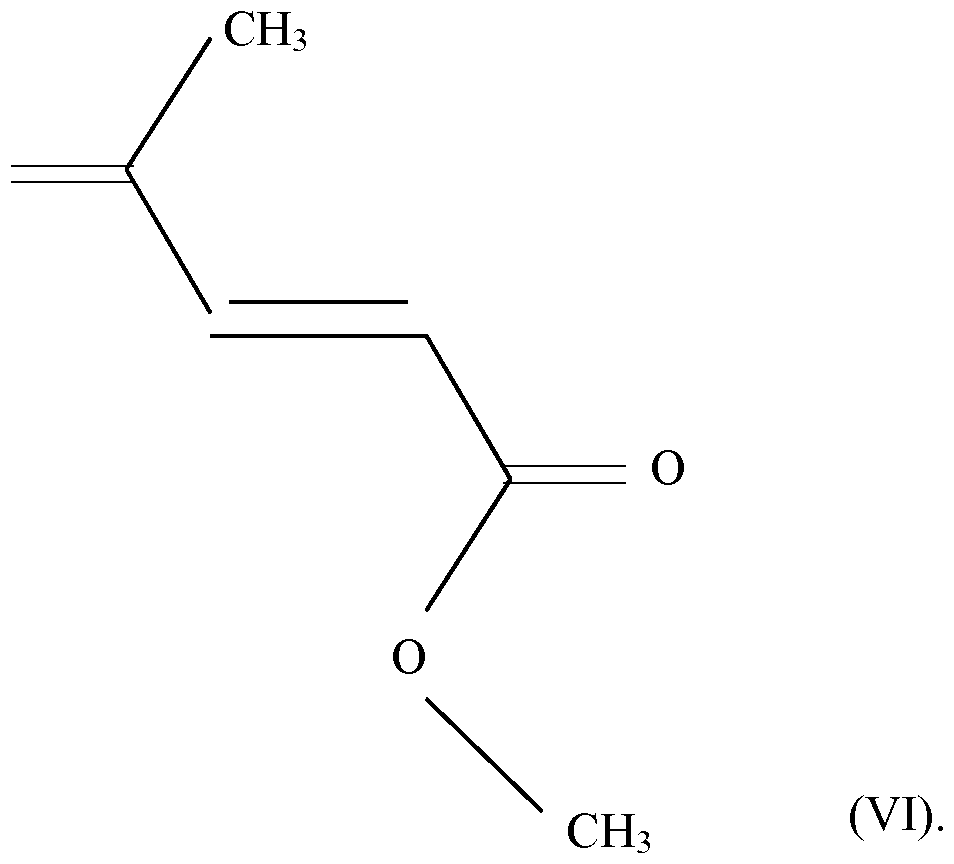
- the removal material may further include a polar solvent; 5) the polar solvent may include water; 6) at least 80% of the iron sulfide scale may be removed from the oilfield component; 7) applying may occur in a sealed container; 8) the removal material may be recovered; 9) the oilfield component may include a perforation, a casing, a production tubular, a valve, a pump, or downhole completion equipment with iron sulfide scale; 10) the composition may have the general structural formula II; 11) the composition may have the general structural formula III; 12) the composition may be methyl acrylate or a methyl acrylate-containing composition; 13) the composition may have the general structural formula IV; 14) the composition may have the general structural formula V; 15) the composition may have the general structural formula VI; 16) the removal material may include an additional
- the system for applying the removal material may include a sealed container; 18) the system for applying the removal material may further include a subsystem for recovering the removal material; 19) the oilfield component may include a tubular and the system for applying the removal material to the oilfield component may include a container to house the removal material and a connector to supply the removal material to the tubular; 20) the container may be a pressurized container; 21) the oilfield component may be placeable in a container and the system for applying the removal material to the oilfield component may include a sealed container in which the oilfield component is placed, a container housing the removal material, and a connector to supply the removal material to the sealed container; 22) the container housing the removal material may be a pressurized container.
- a removal material containing a composition of formula II was prepared and added to water containing 10 ppm iron and 100 ppm sulfide, which mimics iron sulfide scale. At the time the removal material was added, the water was black due to the presence of iron sulfide as shown in FIGURE 3 A. After 10 minutes at 50 °C, atmospheric pressure, and a pH of 7-8, the sample to which the removal material was added was white, as shown in the right bottle in FIGURE 3B, while the untreated water remained black, as shown in the left bottle in FIGURE 3B. This shows that the removal material containing a composition with formula II is able to react with iron sulfide in a manner that would result in its removal from a solid object.
- a removal material containing a composition of formula III was prepared and added to water containing 10 ppm iron and 100 ppm sulfide, which mimics iron sulfide scale. At the time the removal material was added, the water was black due to the presence of iron sulfide as shown in FIGURE 4 A. After 10 minutes at 50 °C, atmospheric pressure, and a pH of 7-8, the sample to which the removal material was added was white, as shown in the right bottle in FIGURE 4B, while the untreated water remained black, as shown in the left bottle in FIGURE 4B. This shows that the removal material containing a composition with formula III is able to react with iron sulfide in a manner that would result in its removal from a solid object.
- a removal material containing a composition of formula IV was prepared and added to water containing 50 ppm iron and 200 ppm sulfide, which mimics iron sulfide scale. At the time the removal material was added, the water was black due to the presence of iron sulfide as shown in FIGURE 5 A. After 30 minutes at 50 °C, atmospheric pressure, and a pH of 7-8, the sample to which the removal material was added was white, as shown in the right bottle in FIGURE 5B, while the untreated water remained black, as shown in the left bottle in FIGURE 5B. This shows that the removal material containing a composition with formula IV is able to react with iron sulfide in a manner that would result in its removal from a solid object.
Landscapes
- Chemical & Material Sciences (AREA)
- Engineering & Computer Science (AREA)
- Organic Chemistry (AREA)
- Materials Engineering (AREA)
- Life Sciences & Earth Sciences (AREA)
- General Life Sciences & Earth Sciences (AREA)
- Chemical Kinetics & Catalysis (AREA)
- General Chemical & Material Sciences (AREA)
- Inorganic Chemistry (AREA)
- Metallurgy (AREA)
- Mechanical Engineering (AREA)
- Mining & Mineral Resources (AREA)
- Geology (AREA)
- Health & Medical Sciences (AREA)
- Medicinal Chemistry (AREA)
- Polymers & Plastics (AREA)
- Geochemistry & Mineralogy (AREA)
- Physics & Mathematics (AREA)
- Fluid Mechanics (AREA)
- Environmental & Geological Engineering (AREA)
- Production Of Liquid Hydrocarbon Mixture For Refining Petroleum (AREA)
- Inorganic Compounds Of Heavy Metals (AREA)
- Preparation Of Compounds By Using Micro-Organisms (AREA)
- Micro-Organisms Or Cultivation Processes Thereof (AREA)
Abstract
Description


Claims


Priority Applications (10)
| Application Number | Priority Date | Filing Date | Title |
|---|---|---|---|
| GB1714601.0A GB2552606B (en) | 2015-04-20 | 2015-04-20 | Compositions, systems and methods for removing iron sulfide scale from oilfield components using methyl acrylate |
| MX2017013078A MX2017013078A (en) | 2015-04-20 | 2015-04-20 | Compositions, systems, and methods for removing iron sulfide scale from oilfield components using methyl acrylate. |
| AU2015391990A AU2015391990B2 (en) | 2015-04-20 | 2015-04-20 | Compositions, systems, and methods for removing iron sulfide scale from oilfield components using methyl acrylate |
| PCT/US2015/026670 WO2016171652A1 (en) | 2015-04-20 | 2015-04-20 | Compositions, systems, and methods for removing iron sulfide scale from oilfield components using methyl acrylate |
| US15/560,033 US10584275B2 (en) | 2015-04-20 | 2015-04-20 | Compositions, systems, and methods for removing iron sulfide scale from oilfield components using methyl acrylate |
| CA2979665A CA2979665C (en) | 2015-04-20 | 2015-04-20 | Compositions, systems, and methods for removing iron sulfide scale from oilfield components using methyl acrylate |
| ARP160100694A AR103943A1 (en) | 2015-04-20 | 2016-03-16 | METHOD FOR REMOVING THE IRON SULFIDE SARRO OF PETROLEUM YEAR COMPONENTS |
| FR1652312A FR3035115A1 (en) | 2015-04-20 | 2016-03-18 | COMPOSITIONS, SYSTEMS AND METHODS FOR REMOVING IRON SULFIDE DEPOSITS FROM PETROLEUM FIELD COMPONENTS USING METHYL ACRYLATE |
| SA517382297A SA517382297B1 (en) | 2015-04-20 | 2017-09-13 | Compositions, Systems, and Methods for Removing Iron Sulfide Scale from Oilfield Components Using Methyl Acrylate |
| NO20171483A NO344958B1 (en) | 2015-04-20 | 2017-09-14 | Compositions, systems, and methods for removing iron sulfide scale from oilfield components using methyl acrylate |
Applications Claiming Priority (1)
| Application Number | Priority Date | Filing Date | Title |
|---|---|---|---|
| PCT/US2015/026670 WO2016171652A1 (en) | 2015-04-20 | 2015-04-20 | Compositions, systems, and methods for removing iron sulfide scale from oilfield components using methyl acrylate |
Publications (1)
| Publication Number | Publication Date |
|---|---|
| WO2016171652A1 true WO2016171652A1 (en) | 2016-10-27 |
Family
ID=57101223
Family Applications (1)
| Application Number | Title | Priority Date | Filing Date |
|---|---|---|---|
| PCT/US2015/026670 Ceased WO2016171652A1 (en) | 2015-04-20 | 2015-04-20 | Compositions, systems, and methods for removing iron sulfide scale from oilfield components using methyl acrylate |
Country Status (10)
| Country | Link |
|---|---|
| US (1) | US10584275B2 (en) |
| AR (1) | AR103943A1 (en) |
| AU (1) | AU2015391990B2 (en) |
| CA (1) | CA2979665C (en) |
| FR (1) | FR3035115A1 (en) |
| GB (1) | GB2552606B (en) |
| MX (1) | MX2017013078A (en) |
| NO (1) | NO344958B1 (en) |
| SA (1) | SA517382297B1 (en) |
| WO (1) | WO2016171652A1 (en) |
Citations (6)
| Publication number | Priority date | Publication date | Assignee | Title |
|---|---|---|---|---|
| US4351673A (en) * | 1981-05-22 | 1982-09-28 | Halliburton Company | Method for removing iron sulfide scale from metal surfaces |
| US20070175635A1 (en) * | 2003-09-25 | 2007-08-02 | Bj Services Company | Scaling inhibitors and method for using the same in high density brines |
| US20090143252A1 (en) * | 2007-06-15 | 2009-06-04 | Baker Hughes Incorporated | Dispersing Sulfide Scales in Oil and Gas Production Systems |
| US20110152153A1 (en) * | 2008-10-16 | 2011-06-23 | Trahan David O | Method and composition to remove iron and iron sulfide compounds from pipeline networks |
| US20120080641A1 (en) * | 2010-09-30 | 2012-04-05 | Amsa, Inc. | Formulations for use in sulfur scale control in industrial water systems |
| US20130281329A1 (en) * | 2010-12-17 | 2013-10-24 | Akzo Nobel Chemicals International B.V. | Ammonium salts of chelating agents and their use in oil and gas field applications |
Family Cites Families (12)
| Publication number | Priority date | Publication date | Assignee | Title |
|---|---|---|---|---|
| US4032360A (en) | 1974-09-23 | 1977-06-28 | Sharp Thomas L | Method of removing iron sulfide and sludge from metal surfaces |
| US4220550A (en) | 1978-12-06 | 1980-09-02 | The Dow Chemical Company | Composition and method for removing sulfide-containing scale from metal surfaces |
| US4762626A (en) | 1987-04-03 | 1988-08-09 | Nalco Chemical Company | Hydroxyethylacrylate/acrylate copolymers as zinc sulfide scale inhibitors |
| US5104630A (en) | 1990-11-13 | 1992-04-14 | Uop | Processes for removing carbonyl sulfide from hydrocarbon feedstreams |
| GB0017675D0 (en) | 2000-07-20 | 2000-09-06 | Rhodia Cons Spec Ltd | Treatment of iron sulphide deposits |
| US6866048B2 (en) | 2001-08-15 | 2005-03-15 | Mark Andrew Mattox | Method to decrease iron sulfide deposits in pipe lines |
| US7398824B1 (en) | 2003-09-25 | 2008-07-15 | Bj Services Company | Method for inhibiting or controlling inorganic scale formations with copolymers of acrylamide and quaternary ammonium salts |
| US7384892B2 (en) | 2004-07-22 | 2008-06-10 | Hercules Incorporated | Water-based drilling fluids |
| US8673832B2 (en) | 2007-08-24 | 2014-03-18 | The Dial Corporation | Liquid skin cleanser with multiple signals of adequate wash duration with adequate mechanical force |
| EP2650314A1 (en) | 2012-04-13 | 2013-10-16 | Clariant International Ltd. | Process for inhibition of sulphide scales |
| US20140100142A1 (en) * | 2012-10-05 | 2014-04-10 | Meadwestvaco Corporation | Traceable polymeric scale inhibitors and methods of using such scale inhibitors |
| US10550309B2 (en) * | 2014-12-22 | 2020-02-04 | Multi-Chem Group, Llc | Synergistic sulfide scavenging additives for use in oilfield operations |
-
2015
- 2015-04-20 CA CA2979665A patent/CA2979665C/en active Active
- 2015-04-20 MX MX2017013078A patent/MX2017013078A/en unknown
- 2015-04-20 AU AU2015391990A patent/AU2015391990B2/en not_active Ceased
- 2015-04-20 GB GB1714601.0A patent/GB2552606B/en not_active Expired - Fee Related
- 2015-04-20 WO PCT/US2015/026670 patent/WO2016171652A1/en not_active Ceased
- 2015-04-20 US US15/560,033 patent/US10584275B2/en active Active
-
2016
- 2016-03-16 AR ARP160100694A patent/AR103943A1/en active IP Right Grant
- 2016-03-18 FR FR1652312A patent/FR3035115A1/en not_active Withdrawn
-
2017
- 2017-09-13 SA SA517382297A patent/SA517382297B1/en unknown
- 2017-09-14 NO NO20171483A patent/NO344958B1/en unknown
Patent Citations (6)
| Publication number | Priority date | Publication date | Assignee | Title |
|---|---|---|---|---|
| US4351673A (en) * | 1981-05-22 | 1982-09-28 | Halliburton Company | Method for removing iron sulfide scale from metal surfaces |
| US20070175635A1 (en) * | 2003-09-25 | 2007-08-02 | Bj Services Company | Scaling inhibitors and method for using the same in high density brines |
| US20090143252A1 (en) * | 2007-06-15 | 2009-06-04 | Baker Hughes Incorporated | Dispersing Sulfide Scales in Oil and Gas Production Systems |
| US20110152153A1 (en) * | 2008-10-16 | 2011-06-23 | Trahan David O | Method and composition to remove iron and iron sulfide compounds from pipeline networks |
| US20120080641A1 (en) * | 2010-09-30 | 2012-04-05 | Amsa, Inc. | Formulations for use in sulfur scale control in industrial water systems |
| US20130281329A1 (en) * | 2010-12-17 | 2013-10-24 | Akzo Nobel Chemicals International B.V. | Ammonium salts of chelating agents and their use in oil and gas field applications |
Also Published As
| Publication number | Publication date |
|---|---|
| NO20171483A1 (en) | 2017-09-14 |
| GB2552606A (en) | 2018-01-31 |
| GB201714601D0 (en) | 2017-10-25 |
| GB2552606B (en) | 2022-01-12 |
| US10584275B2 (en) | 2020-03-10 |
| FR3035115A1 (en) | 2016-10-21 |
| CA2979665C (en) | 2018-11-27 |
| AU2015391990B2 (en) | 2018-02-08 |
| NO344958B1 (en) | 2020-08-03 |
| US20180072940A1 (en) | 2018-03-15 |
| SA517382297B1 (en) | 2021-12-08 |
| AR103943A1 (en) | 2017-06-14 |
| AU2015391990A1 (en) | 2017-10-12 |
| CA2979665A1 (en) | 2016-10-27 |
| MX2017013078A (en) | 2017-12-04 |
Similar Documents
| Publication | Publication Date | Title |
|---|---|---|
| CA2720382C (en) | Organic corrosion inhibitor package for organic acids | |
| US20230272266A1 (en) | Modified acid compositions | |
| CA2892877A1 (en) | Using non-regulated synthetic acid compositions as alternatives to conventional acids in the oil and gas industry | |
| US10668510B2 (en) | Compositions, systems, and methods for removing iron sulfide scale from oilfield components | |
| BR112017009339B1 (en) | method | |
| US11136491B2 (en) | Iron sulfide removal in oilfield applications | |
| EP3548646B1 (en) | Novel corrosion inhibition package | |
| US10280362B2 (en) | Organic acid compositions for use in the oil and gas industry | |
| CN103649462B (en) | The sampling method of polymer-based solution for subterranean strata | |
| CA2979665C (en) | Compositions, systems, and methods for removing iron sulfide scale from oilfield components using methyl acrylate | |
| CN107502329B (en) | A kind of remover for removing the associated hydrogen sulfide gas in heavy oil thermal recovery | |
| EP3201290A1 (en) | Synthetic acid compositions alternatives to conventional acids in the oil and gas industry | |
| WO2016049739A1 (en) | Synthetic acid compositions alternatives to conventional acids for use in the oil and gas industry | |
| CN113289481B (en) | Oil field acidified hydrogen sulfide remover and use method thereof | |
| NO20240747A1 (en) | Stabilizing aqueous lysine-hcl compositions | |
| WO2023223261A1 (en) | Stabilizing aqueous amino acid-hcl compositions | |
| WO2016018376A1 (en) | Environmentally friendly corrosion inhibitors for high temperature applications |
Legal Events
| Date | Code | Title | Description |
|---|---|---|---|
| 121 | Ep: the epo has been informed by wipo that ep was designated in this application |
Ref document number: 15890059 Country of ref document: EP Kind code of ref document: A1 |
|
| ENP | Entry into the national phase |
Ref document number: 201714601 Country of ref document: GB Kind code of ref document: A Free format text: PCT FILING DATE = 20150420 |
|
| ENP | Entry into the national phase |
Ref document number: 2979665 Country of ref document: CA |
|
| WWE | Wipo information: entry into national phase |
Ref document number: 15560033 Country of ref document: US |
|
| WWE | Wipo information: entry into national phase |
Ref document number: MX/A/2017/013078 Country of ref document: MX |
|
| ENP | Entry into the national phase |
Ref document number: 2015391990 Country of ref document: AU Date of ref document: 20150420 Kind code of ref document: A |
|
| NENP | Non-entry into the national phase |
Ref country code: DE |
|
| 122 | Ep: pct application non-entry in european phase |
Ref document number: 15890059 Country of ref document: EP Kind code of ref document: A1 |