WO2016161067A1 - Double-deprotected chemically amplified photoresists - Google Patents
Double-deprotected chemically amplified photoresists Download PDFInfo
- Publication number
- WO2016161067A1 WO2016161067A1 PCT/US2016/025171 US2016025171W WO2016161067A1 WO 2016161067 A1 WO2016161067 A1 WO 2016161067A1 US 2016025171 W US2016025171 W US 2016025171W WO 2016161067 A1 WO2016161067 A1 WO 2016161067A1
- Authority
- WO
- WIPO (PCT)
- Prior art keywords
- compound
- polymer according
- hydrocarbon
- hydrogen
- optionally substituted
- Prior art date
- Legal status (The legal status is an assumption and is not a legal conclusion. Google has not performed a legal analysis and makes no representation as to the accuracy of the status listed.)
- Ceased
Links
Classifications
-
- C—CHEMISTRY; METALLURGY
- C07—ORGANIC CHEMISTRY
- C07C—ACYCLIC OR CARBOCYCLIC COMPOUNDS
- C07C69/00—Esters of carboxylic acids; Esters of carbonic or haloformic acids
- C07C69/52—Esters of acyclic unsaturated carboxylic acids having the esterified carboxyl group bound to an acyclic carbon atom
- C07C69/533—Monocarboxylic acid esters having only one carbon-to-carbon double bond
- C07C69/54—Acrylic acid esters; Methacrylic acid esters
-
- C—CHEMISTRY; METALLURGY
- C07—ORGANIC CHEMISTRY
- C07C—ACYCLIC OR CARBOCYCLIC COMPOUNDS
- C07C271/00—Derivatives of carbamic acids, i.e. compounds containing any of the groups, the nitrogen atom not being part of nitro or nitroso groups
- C07C271/06—Esters of carbamic acids
- C07C271/08—Esters of carbamic acids having oxygen atoms of carbamate groups bound to acyclic carbon atoms
- C07C271/26—Esters of carbamic acids having oxygen atoms of carbamate groups bound to acyclic carbon atoms with the nitrogen atom of at least one of the carbamate groups bound to a carbon atom of a six-membered aromatic ring
- C07C271/28—Esters of carbamic acids having oxygen atoms of carbamate groups bound to acyclic carbon atoms with the nitrogen atom of at least one of the carbamate groups bound to a carbon atom of a six-membered aromatic ring to a carbon atom of a non-condensed six-membered aromatic ring
-
- C—CHEMISTRY; METALLURGY
- C07—ORGANIC CHEMISTRY
- C07C—ACYCLIC OR CARBOCYCLIC COMPOUNDS
- C07C69/00—Esters of carboxylic acids; Esters of carbonic or haloformic acids
- C07C69/62—Halogen-containing esters
- C07C69/63—Halogen-containing esters of saturated acids
-
- C—CHEMISTRY; METALLURGY
- C07—ORGANIC CHEMISTRY
- C07C—ACYCLIC OR CARBOCYCLIC COMPOUNDS
- C07C69/00—Esters of carboxylic acids; Esters of carbonic or haloformic acids
- C07C69/76—Esters of carboxylic acids having a carboxyl group bound to a carbon atom of a six-membered aromatic ring
- C07C69/78—Benzoic acid esters
-
- C—CHEMISTRY; METALLURGY
- C07—ORGANIC CHEMISTRY
- C07C—ACYCLIC OR CARBOCYCLIC COMPOUNDS
- C07C69/00—Esters of carboxylic acids; Esters of carbonic or haloformic acids
- C07C69/96—Esters of carbonic or haloformic acids
-
- C—CHEMISTRY; METALLURGY
- C07—ORGANIC CHEMISTRY
- C07D—HETEROCYCLIC COMPOUNDS
- C07D319/00—Heterocyclic compounds containing six-membered rings having two oxygen atoms as the only ring hetero atoms
- C07D319/04—1,3-Dioxanes; Hydrogenated 1,3-dioxanes
- C07D319/06—1,3-Dioxanes; Hydrogenated 1,3-dioxanes not condensed with other rings
-
- C—CHEMISTRY; METALLURGY
- C07—ORGANIC CHEMISTRY
- C07D—HETEROCYCLIC COMPOUNDS
- C07D319/00—Heterocyclic compounds containing six-membered rings having two oxygen atoms as the only ring hetero atoms
- C07D319/04—1,3-Dioxanes; Hydrogenated 1,3-dioxanes
- C07D319/08—1,3-Dioxanes; Hydrogenated 1,3-dioxanes condensed with carbocyclic rings or ring systems
-
- C—CHEMISTRY; METALLURGY
- C08—ORGANIC MACROMOLECULAR COMPOUNDS; THEIR PREPARATION OR CHEMICAL WORKING-UP; COMPOSITIONS BASED THEREON
- C08F—MACROMOLECULAR COMPOUNDS OBTAINED BY REACTIONS ONLY INVOLVING CARBON-TO-CARBON UNSATURATED BONDS
- C08F212/00—Copolymers of compounds having one or more unsaturated aliphatic radicals, each having only one carbon-to-carbon double bond, and at least one being terminated by an aromatic carbocyclic ring
- C08F212/02—Monomers containing only one unsaturated aliphatic radical
- C08F212/04—Monomers containing only one unsaturated aliphatic radical containing one ring
- C08F212/14—Monomers containing only one unsaturated aliphatic radical containing one ring substituted by heteroatoms or groups containing heteroatoms
- C08F212/22—Oxygen
- C08F212/24—Phenols or alcohols
-
- C—CHEMISTRY; METALLURGY
- C09—DYES; PAINTS; POLISHES; NATURAL RESINS; ADHESIVES; COMPOSITIONS NOT OTHERWISE PROVIDED FOR; APPLICATIONS OF MATERIALS NOT OTHERWISE PROVIDED FOR
- C09D—COATING COMPOSITIONS, e.g. PAINTS, VARNISHES OR LACQUERS; FILLING PASTES; CHEMICAL PAINT OR INK REMOVERS; INKS; CORRECTING FLUIDS; WOODSTAINS; PASTES OR SOLIDS FOR COLOURING OR PRINTING; USE OF MATERIALS THEREFOR
- C09D125/00—Coating compositions based on homopolymers or copolymers of compounds having one or more unsaturated aliphatic radicals, each having only one carbon-to-carbon double bond, and at least one being terminated by an aromatic carbocyclic ring; Coating compositions based on derivatives of such polymers
- C09D125/02—Homopolymers or copolymers of hydrocarbons
- C09D125/04—Homopolymers or copolymers of styrene
- C09D125/08—Copolymers of styrene
- C09D125/14—Copolymers of styrene with unsaturated esters
-
- C—CHEMISTRY; METALLURGY
- C09—DYES; PAINTS; POLISHES; NATURAL RESINS; ADHESIVES; COMPOSITIONS NOT OTHERWISE PROVIDED FOR; APPLICATIONS OF MATERIALS NOT OTHERWISE PROVIDED FOR
- C09D—COATING COMPOSITIONS, e.g. PAINTS, VARNISHES OR LACQUERS; FILLING PASTES; CHEMICAL PAINT OR INK REMOVERS; INKS; CORRECTING FLUIDS; WOODSTAINS; PASTES OR SOLIDS FOR COLOURING OR PRINTING; USE OF MATERIALS THEREFOR
- C09D125/00—Coating compositions based on homopolymers or copolymers of compounds having one or more unsaturated aliphatic radicals, each having only one carbon-to-carbon double bond, and at least one being terminated by an aromatic carbocyclic ring; Coating compositions based on derivatives of such polymers
- C09D125/18—Homopolymers or copolymers of aromatic monomers containing elements other than carbon and hydrogen
-
- G—PHYSICS
- G03—PHOTOGRAPHY; CINEMATOGRAPHY; ANALOGOUS TECHNIQUES USING WAVES OTHER THAN OPTICAL WAVES; ELECTROGRAPHY; HOLOGRAPHY
- G03F—PHOTOMECHANICAL PRODUCTION OF TEXTURED OR PATTERNED SURFACES, e.g. FOR PRINTING, FOR PROCESSING OF SEMICONDUCTOR DEVICES; MATERIALS THEREFOR; ORIGINALS THEREFOR; APPARATUS SPECIALLY ADAPTED THEREFOR
- G03F7/00—Photomechanical, e.g. photolithographic, production of textured or patterned surfaces, e.g. printing surfaces; Materials therefor, e.g. comprising photoresists; Apparatus specially adapted therefor
- G03F7/004—Photosensitive materials
- G03F7/039—Macromolecular compounds which are photodegradable, e.g. positive electron resists
- G03F7/0392—Macromolecular compounds which are photodegradable, e.g. positive electron resists the macromolecular compound being present in a chemically amplified positive photoresist composition
-
- G—PHYSICS
- G03—PHOTOGRAPHY; CINEMATOGRAPHY; ANALOGOUS TECHNIQUES USING WAVES OTHER THAN OPTICAL WAVES; ELECTROGRAPHY; HOLOGRAPHY
- G03F—PHOTOMECHANICAL PRODUCTION OF TEXTURED OR PATTERNED SURFACES, e.g. FOR PRINTING, FOR PROCESSING OF SEMICONDUCTOR DEVICES; MATERIALS THEREFOR; ORIGINALS THEREFOR; APPARATUS SPECIALLY ADAPTED THEREFOR
- G03F7/00—Photomechanical, e.g. photolithographic, production of textured or patterned surfaces, e.g. printing surfaces; Materials therefor, e.g. comprising photoresists; Apparatus specially adapted therefor
- G03F7/004—Photosensitive materials
- G03F7/039—Macromolecular compounds which are photodegradable, e.g. positive electron resists
- G03F7/0392—Macromolecular compounds which are photodegradable, e.g. positive electron resists the macromolecular compound being present in a chemically amplified positive photoresist composition
- G03F7/0397—Macromolecular compounds which are photodegradable, e.g. positive electron resists the macromolecular compound being present in a chemically amplified positive photoresist composition the macromolecular compound having an alicyclic moiety in a side chain
-
- C—CHEMISTRY; METALLURGY
- C07—ORGANIC CHEMISTRY
- C07C—ACYCLIC OR CARBOCYCLIC COMPOUNDS
- C07C2601/00—Systems containing only non-condensed rings
- C07C2601/02—Systems containing only non-condensed rings with a three-membered ring
-
- C—CHEMISTRY; METALLURGY
- C07—ORGANIC CHEMISTRY
- C07C—ACYCLIC OR CARBOCYCLIC COMPOUNDS
- C07C2601/00—Systems containing only non-condensed rings
- C07C2601/06—Systems containing only non-condensed rings with a five-membered ring
- C07C2601/08—Systems containing only non-condensed rings with a five-membered ring the ring being saturated
-
- C—CHEMISTRY; METALLURGY
- C07—ORGANIC CHEMISTRY
- C07C—ACYCLIC OR CARBOCYCLIC COMPOUNDS
- C07C2601/00—Systems containing only non-condensed rings
- C07C2601/06—Systems containing only non-condensed rings with a five-membered ring
- C07C2601/10—Systems containing only non-condensed rings with a five-membered ring the ring being unsaturated
-
- C—CHEMISTRY; METALLURGY
- C07—ORGANIC CHEMISTRY
- C07C—ACYCLIC OR CARBOCYCLIC COMPOUNDS
- C07C2602/00—Systems containing two condensed rings
- C07C2602/36—Systems containing two condensed rings the rings having more than two atoms in common
- C07C2602/42—Systems containing two condensed rings the rings having more than two atoms in common the bicyclo ring system containing seven carbon atoms
-
- C—CHEMISTRY; METALLURGY
- C07—ORGANIC CHEMISTRY
- C07C—ACYCLIC OR CARBOCYCLIC COMPOUNDS
- C07C2603/00—Systems containing at least three condensed rings
- C07C2603/56—Ring systems containing bridged rings
- C07C2603/58—Ring systems containing bridged rings containing three rings
- C07C2603/70—Ring systems containing bridged rings containing three rings containing only six-membered rings
- C07C2603/74—Adamantanes
Definitions
- the present invention generally relates to compositions and methods for blocking polymer-bound carboxylic acids in photoresists and other relevant applications.
- a photoresist is a material used in photolithography that undergoes a chemical transformation when it is exposed to radiation, for instance, visible light, ultraviolet light, extreme ultraviolet light, electron beam, or ion beam.
- a typical photolithographic procedure begins by applying a layer of photoresist to the top of a substrate and then drying the photoresist material in place.
- a photomask is then placed between a radiation source and the layer of photoresist; the photomask will have a pattern printed on it such that some areas are opaque to the radiation and some are transparent. Those portions of the photoresist layer not covered by the opaque areas of the photomask are then exposed to radiation from the radiation source.
- this exposure step is followed by a post-exposure bake (PEB), which precedes the development step, wherein the entire photoresist layer is chemically treated.
- PEB post-exposure bake
- the chemical changes to the exposed and unexposed areas of photoresist result in the removal of a portion of the photoresist on the substrate.
- Those areas of the top layer of the substrate which are uncovered as a result of the development step are etched away, and the remaining photoresist is removed to leave exposed substrate.
- Circuits are being required to be physically smaller.
- One way to enable the formation of these smaller circuits includes the use of light of shorter wavelengths.
- a photoresist material should not absorb light too strongly at the wavelength used, different materials are needed for new photoresists.
- phenolic materials are generally not suitable for use as photoresists for light of 193 nm, since phenolic materials tend to absorb 193 nm light.
- materials which may be useful at 193 nm light may not be appropriate for other wavelength ranges.
- CAMP Chemically Amplified Photoresists
- the concentration of acid in the film will also be in a sine-wave pattern.
- the acid catalyzes the transformation of an ester side group on a polymer to a carboxylic acid; since the conversion of the protected ester to the carboxylic acid is first-order in catalytic acid, the concentration of the carboxylic acid is also a sine wave pattern.
- the carboxylic acid increases the solubility of the resist film in 13.4 pH developer. Therefore, the greater the concentration of carboxylic acids, the greater the dissolution rate of the photoresist.
- the present invention provides, in a first aspect, a compound of formula I or
- R 1 is a (C 2- 3) alkene
- R 2 is (Ci -2 o)hydrocarbon optionally substituted with halogen
- R 6 is selected from the group consisting of hydrogen; -OR 60 ; and (O- 2o)hydrocarbon optionally substituted with halogen;
- R 60 is (Ci- 2 o)hydrocarbon
- R 80 is (Ci- 20 )hydrocarbon optionally substituted with halogen
- R 9 and R 10 are selected independently in each instance from the group consisting of hydrogen, (Ci-6)alkyl, and phenyl;
- n is selected from 0, 1 , or 2;
- R 6 and R 7 when n is 0, at least one of R 6 and R 7 must be an aliphatic (C 2 - 2 o)hydrocarbon;
- the present invention provides, in a second aspect, a polymer of formula Ip
- P is a polymer chain
- R 2 is (Ci -2 o)hydrocarbon optionally substituted with halogen
- R 6 is selected from the group consisting of hydrogen; -OR 60 ; and (Ci- 2o)hydrocarbon optionally substituted with halogen;
- R 60 is (G-2o)hydrocarbon
- R 80 is (Ci-2o)hydrocarbon optionally substituted with halogen
- R 9 and R 10 are selected independently in each instance from the group consisting of hydrogen, (Ci-6)alkyl, and phenyl;
- n is selected from 0, 1, or 2;
- R 6 and R 7 when n is 0, at least one of R 6 and R 7 must be an aliphatic (C2-2o)hydrocarbon; and when n is 2, the two R 5 substituents, together with the carbons to which they are attached, form a cyclopropyl ring.
- the present invention provides, in a third aspect, a composition for photolithography comprising a polymer disclosed herein.
- the present invention provides, in a fourth aspect, a photoresist composition comprising a polymer disclosed herein.
- the present invention provides, in a fifth aspect, a photoresist substrate which is coated with a photoresist composition disclosed herein.
- the present invention provides, in a sixth aspect, a method for preparing a substrate for photolithography, comprising coating the substrate with a photoresist composition disclosed herein.
- the present invention provides, in a seventh aspect, a method for conducting photolithography on a substrate, comprising (a) providing a substrate, (b) coating the substrate with a photoresist composition disclosed herein, and (c) irradiating the coated substrate through a photomask.
- FIG. 1 depicts the relative concentrations of carboxylic acid starting with a sine-wave under control conditions vs. the improved acid profile resulting from an embodiment of the invention.
- FIG. 2 depicts the relationship between post-exposure bake and line edge roughness for embodiments of the invention.
- FIG. 3 illustrates a graph resulting from the plot of focus vs. line edge roughness (LER) utilizing embodiments of the invention.
- FIG. 4 shows SEM results for an embodiment of the invention.
- FIG. 5 depicts a graph resulting from the plot of focus vs. line edge roughness (LER) utilizing embodiments of the invention.
- the current disclosure relates to a method for blocking polymer-bound carboxylic acids in 193nm and EUV resists, as well as those used in deep UV and e- beam lithography.
- Previous acid amplifiers utilize one acid-catalyzed step to deprotect the compound. This method, in contrast to previous methods, requires two acid- catalyzed steps for deprotection, as shown below ("P" represents a link to a polymer):
- FIG. 1 shows the relative concentrations of carboxylic acid starting with a sine-wave under control conditions vs. the improved acid profile resulting from DD-CAMP.
- the shape of the carboxylic acid concentration shown in FIG. 1 in the DD-CAMP curve is dramatically better than the conventional profile, for a number of reasons.
- the slope at the mask edge is steeper in the DD-CAMP curve than in the control curve, resulting in lines with better line edge roughness (LER).
- the width at half-maximum is 39% narrower in the DD-CAMP curve than in the control, which translates to 39% better resolution.
- the unexposed regions of the DD- CAMP curve are very flat, causing smoother, flatter tops of the resist lines. All of these characteristics are desirable for photoresists.
- a cyclopropyl may be present within the polymer.
- the mechanism of decomposition of such an example is shown below:
- Acid amplifiers may be conceptualized as having three components: a trigger, a body and an acid precursor.
- the trigger is an acid sensitive group that, when activated under acid, allows the compound to decompose to create a double bond allylic to the carboxyl.
- the resulting allylic ester decomposes thermally, producing an acid.
- the new blocking groups are composed of a body and a trigger:
- the group protecting the carboxylic acid on the polymer (BT) is unreactive, but the trigger (T) (e.g., a tertiary alcohol) is reactive under the reaction conditions. Once the trigger is "pulled", a double-bond is created that enables the intermediate blocking group (B) to be removed under acid-catalyzed conditions (k 2 ), producing a carboxylic acid (CA).
- T e.g., a tertiary alcohol
- the invention relates to a compound of formula I:
- the invention relates to a compound of formula II:
- R' is a (C 2 - 3 ) alkene.
- the invention relates to a polymer of formula Ip:
- the invention relates to a polymer of formula Hp:
- P is a polymer chain in which the polymer is a polyolefin.
- P is a polyacrylate.
- P is a polymethacrylate.
- P is a copolymer of two or more monomers chosen from a styrene, an acrylate, and a methacrylate.
- R 2 is (Ci-2o)hydrocarbon optionally substituted with halogen.
- the halogen is fluorine.
- R 2 is (Ci-io)hydrocarbon optionally substituted with fluorine.
- R 2 is methyl.
- R 2 is phenyl.
- R 3 , R 4 , R 5 , and R 7 are selected independently in each instance from hydrogen or (Ci -2 o)hydrocarbon.
- the (Ci- 2 o)hydrocarbon may in each instance be substituted independently with halogen.
- the halogen is fluorine.
- a -CH 2 - moeity of the (Ci-2o)hydrocarbon may be replaced by -Si(CH3) 2 -.
- a -CH 2 - moeity of the (Ci -2 o)hydrocarbon may be replaced by -0-. In some embodiments, more than one -CH 2 - moeity of the (G -2 o)hydrocarbon may be replaced by -0-. In some embodiments, a -CH 2 - moeity of the (Ci- 2 o)hydrocarbon may be replaced by-S-.
- R 3 is hydrogen. In other embodiments, R 3 is methyl.
- R 4 is hydrogen.
- R 5 is hydrogen. In other embodiments, R 5 is methyl. In some embodiments, R 4 is hydrogen and R 5 is hydrogen or methyl.
- R 7 is hydrogen. In still other embodiments, R 7 is methyl. In other embodiments, R 7 is phenyl.
- R 6 is hydrogen. In other embodiments, R 6 is -OR 60 . In still other embodiments, R 6 is (Ci-2o)hydrocarbon optionally substituted with halogen. In some embodiments, the halogen is fluorine. In yet other embodiments, R 6 is (Ci-io)hydrocarbon. In some embodiments, R 6 is methyl.
- R 60 is (Ci. 2 o)hydrocarbon.
- R 80 is (G -2 o)hydrocarbon optionally substituted with halogen.
- the halogen is fluorine.
- R 80 is (Ci-4)alkyl optionally substituted with halogen.
- R 80 is (Ci- 4 )alkyl optionally substituted with fluorine.
- R 80 is phenyl optionally substituted with halogen.
- R 80 is phenyl optionally substituted with fluorine.
- R 80 is -CH 2 -adamantyl. In other embodiments, R 80 is adamantyl.
- R 9 is hydrogen. In other embodiments, R 9 is (Ci- 6 )alkyl. In some embodiments, R 9 is phenyl.
- R 10 is hydrogen. In other embodiments, R 10 is (C
- n is 0.
- the ester and trigger are two carbons apart (1 ,2 arrangements).
- n is 1.
- the trigger and ester are essentially spaced three carbons apart (1,3 arrangements).
- n is 2.
- the trigger and ester are essentially spaced four carbons apart (1,4 arrangements).
- a plurality of R 2 , R 3 , R 4 , R 5 , R 6 , R 7 , R 8 , R 9 , R 10 , R 60 , and R 80 may form a monocyclic ring or a polycyclic ring system.
- a "plurality", for purposes of this disclosure, indicates two or more of R 2 , R 3 , R 4 , R 5 , R 6 , R 7 , R 8 , R 9 , R 10 , R 60 , and R 80 .
- R 5 and R 7 together with the carbons to which they are attached, may form cyclohexyl, while in other embodiments R 2 , R 3 , R 5 and R 7 , together with the carbons to which they are attached, may form adamantane.
- these ring systems may be formed in compounds of formula I or formula II, or in polymers of formula Ip or formula lip. More than one of these ring systems may be formed by these substituent pairings at one time; for instance a ring system may be formed by R 5 and R 7 and by R 8 and R 60 at the same time in the same compound or polymer.
- R 5 is present (that is, n is not 0), and R 5 and R 7 , together with the carbons to which they are attached, form a 3- to 6-membered monocyclic ring.
- R s is present (that is, n is not 0), and R s and R 7 , together with the carbons to which they are attached, form a 7- to 10-membered bicyclic ring system.
- R 2 and R 6 when R 6 is a (Ci -2 o)hydrocarbon optionally substituted with halogen), or R 2 and R 7 , together with the carbons to which they are attached, form a 3- to 6-membered monocyclic carbocycle.
- R 2 and R 6 when R 6 is a (Ci-2o)hydrocarbon optionally substituted with halogen
- R 2 and R 7 together with the carbons to which they are attached, form a 7- to 10-membered bicyclic carbocycle.
- R 2 and R 60 together with the atoms to which they are attached, form a 5- or 6-membered oxygen-containing heterocycle.
- R 2 and R 5 together with the carbons to which they are attached, form a monocyclic. In some embodiments, R 2 and R 5 , together with the carbons to which they are attached, form a bicyclic carbocycle.
- R 2 and R 3 together with the carbons to which they are attached, form a 3- to 6-membered monocyclic carbocycle. In some embodiments, R 2 and R 3 , together with the carbons to which they are attached, form a 7- to 10- membered polycyclic carbocycle.
- R 4 and R 5 together with the carbons to which they are attached, form a 3- to 6-membered monocyclic carbocycle. In some embodiments, R 4 and R 5 , together with the carbons to which they are attached, form a 7- to 10- membered polycyclic carbocycle.
- R 6 and R 7 together with the carbons to which they are attached, form a 3- to 6-membered monocyclic carbocycle.
- R 6 and R 7 together with the carbons to which they are attached, form a 7- to 10-membered polycyclic carbocycle.
- R 8 and R 60 form a dioxane. In another embodiment, R 8 and R 60 form dioxolane. The dioxane or dioxolane may be substituted with one or two methyl groups.
- R 5 and R 7 form a ring and R 8 and R 60 form a dioxane or dioxolane optionally substituted with one or two methyl groups.
- R 2 and R 7 form a ring and R 8 and R 60 form a dioxane or dioxolane optionally substituted with one or two methyl groups.
- R 6 is hydrogen or (Ci-io)hydrocarbon and R 7 is hydrogen. In other embodiments, R 6 is hydrogen or (Ci-io)hydrocarbon and R 7 is methyl. In still other embodiments, R 6 is hydrogen or (Ci-io)hydrocarbon and R 7 is phenyl.
- both R 9 and R 10 are hydrogen.
- both R 9 and R l are hydrogen.
- R 6 and R 9 together with the carbons to which they are attached, form an unsaturated 3- to 6- membered monocyclic carbocycle. In other embodiments, R 6 and R 9 , together with the carbons to which they are attached, form an unsaturated 7- to 10-membered bicyclic carbocycle.
- R 6 and R 9 together with the carbons to which they are attached, form an unsaturated 3- to 6- membered monocyclic carbocycle. In other embodiments, R 6 and R 9 , together with the carbons to which they are attached, form an unsaturated 7- to 10-membered bicyclic carbocycle.
- R 6 is hydrogen. In some embodiments when the polymer is of formula II, R 6 is methyl.
- R 6 is hydrogen. In some embodiments when the polymer is of formula Hp, R 6 is methyl.
- n is 0 and at least one of R 6 and R 7 is an aliphatic (Ci- 2o)hydrocarbon.
- n is 0 and R 2 and R 7 form a 3- to 6-membered monocyclic carbocycle. In other embodiments, n is 0 and R 2 and R 7 form a 5- to 6- membered monocyclic carbocycle. In still other embodiments, n is 0 and R 2 and R 7 form a a 7- to 10-membered bicyclic carbocycle. In some of these embodiments, R 8 and R 60 form a dioxane or dioxolane optionally substituted with one or two methyl groups.
- R 2 and R 3 when n is 0, at least one of R 2 and R 3 is (Ci-6)alkyl, and at least one of R 6 and R 7 is (Ci-6)alkyl. In some embodiments, n is 0, at least one of R 2 and R 3 is methyl, and at least one of R 6 and R 7 is (Ci-3)alkyl. In some of these embodiments, R 8 and R 60 form a dioxane or dioxolane optionally substituted with one or two methyl groups.
- n 2 and the two R 5 substituents, together with the carbons to which they are attached, form a cyclopropyl ring.
- the halogen is fluorine
- R 2 is (O-io)hydrocarbon optionally substituted with fluorine and R 3 is hydrogen. In some embodiments, R 2 is (Ci-io)hydrocarbon optionally substituted with fluorine and R 3 is methyl.
- alkyl is intended to include linear or branched saturated hydrocarbon structures and combinations thereof.
- Cycloalkyl includes cyclic hydrocarbon groups of from 3 to 8 carbon atoms. Examples of cycloalkyl groups include c-propyl, c-butyl, c-pentyl, norbornyl and the like.
- Hydrocarbon refers to a substituent comprised of hydrogen and carbon as the only elemental constituents, and therefore includes, for instance, alkyl, cycloalkyl, polycycloalkyl, alkenyl, alkynyl, aryl and combinations thereof. Examples include benzyl, phenyl, ethyl, phenethyl, cyclohexylmethyl, adamantyl, and naphthylethyl. To be perfectly clear, (Ci-Cs)hydrocarbon refers to a moiety that includes 1 , 2, 3, 4, 5, 6, 7 or 8 carbons and the appropriate number of hydrogen atoms to satsify valency.
- carbocycle is intended to include ring systems consisting entirely of carbon but of any oxidation state.
- C3-C12 carbocycle refers to such systems as cyclopropane, benzene, adamantyl, and cyclohexene;
- C8-C12 carbopolycycle refers to such systems as norbornane, decalin, indane and naphthalene.
- Acyl refers to groups of from 1 to 8 carbon atoms of a straight, branched, cyclic configuration, saturated, unsaturated and aromatic and combinations thereof, attached to the parent structure through a carbonyl functionality.
- Acyl also refers to formyl, which has only a hydrogen attached to the parent structure through a carbonyl functionality.
- One or more carbons in the acyl residue may be replaced by nitrogen, oxygen or sulfur as long as the point of attachment to the parent remains at the carbonyl. Examples include acetyl, benzoyl, propionyl, isobutyryl, /-butoxycarbonyl, benzyloxycarbonyl and the like.
- Lower-acyl refers to groups containing one to four carbons.
- Aliphatic refers to non-aromatic hydrocarbon substituents.
- Aliphatic substituents may be cyclic (such as cyclopentane or adamantyl) or acyclic, and may contain saturated or unsaturated bonds (i.e., they may be straight or branched alkanes, alkenes or alkynes).
- the terms "monocycle” and “bicycle” or “monocyclic” and “bicyclic” refer to carbocycles and heterocycles having one or two rings respectively.
- Preferred monocycles are 3, 4, 5, 6 or 7-membered rings, which may be aromatic, saturated or partially unsaturated.
- Non-limiting examples include cyclopropane, cyclopentane, cyclohexane, pyran, furan, tetrahydrofuran, tetrahydropyran, oxepane and phenyl.
- Preferred bicycles are those having from 8 to 12 ring atoms in total.
- Non-limiting examples include chroman, tetralin, naphthalene, benzofuran, indole,
- a particular embodiment comprises fused 5:6 and 6:6 systems.
- a "polycyclic" ring system includes bicyclic ring systems, such as norbornyl; tricyclic ring systems, such as adamantane; as well as other ring systems with more than three rings.
- Aryl and heteroaryl mean a 5- or 6-membered aromatic or heteroaromatic ring containing 0-3 heteroatoms selected from O, N, or S; a bicyclic 9- or 10- membered aromatic or heteroaromatic ring system containing 0-3 heteroatoms selected from O, N, or S; or a tricyclic 13- or 14-membered aromatic or
- the aromatic 6- to 14-membered carbocyclic rings include, e.g., benzene, naphthalene, indane, tetralin, and fluorene and the 5- to 10-membered aromatic heterocyclic rings include, e.g., imidazole, pyridine, indole, thiophene, benzopyranone, thiazole, furan, benzimidazole, quinoline, isoquinoline, quinoxaline, pyrimidine, pyrazine, tetrazole and pyrazole.
- Arylalkyl refers to a substituent in which an aryl residue is attached to the parent structure through alkyl. Examples are benzyl, phenethyl and the like.
- Heteroarylalkyl refers to a substituent in which a heteroaryl residue is attached to the parent structure through alkyl. Examples include, e.g., pyridinylmethyl,
- Heterocycle means a cycloalkyl or aryl residue in which from one to three carbons is replaced by a heteroatom selected from the group consisting of N, O and S.
- the nitrogen and sulfur heteroatoms may optionally be oxidized, and the nitrogen heteroatom may optionally be quaternized.
- heterocycles examples include pyrrolidine, pyrazole, pyrrole, indole, quinoline, isoquinoline, tetrahydroisoquinoline, benzofuran, benzodioxan, benzodioxole (commonly referred to as methylenedioxyphenyl, when occurring as a substituent), tetrazole, morpholine, thiazole, pyridine, pyridazine, pyrimidine, thiophene, furan, oxazole, oxazoline, isoxazole, dioxane, tetrahydrofuran and the like. It is to be noted that heteroaryl is a subset of heterocycle in which the heterocycle is aromatic.
- heterocyclyl residues additionally include piperazinyl, 2-oxopiperazinyl, 2-oxopiperidinyl, 2-oxo-pyrrolidinyl, 2-oxoazepinyl, azepinyl, 4-piperidinyl, pyrazolidinyl, imidazolyl, imidazolinyl, imidazolidinyl, pyrazinyl, oxazolidinyl, isoxazolidinyl, thiazolidinyl, isothiazolyl, quinuclidinyl, isothiazolidinyl,
- An oxygen heterocycle is a heterocycle containing at least one oxygen in the ring; it may contain additional oxygens, as well as other heteroatoms.
- a sulphur heterocycle is a heterocycle containing at least one sulphur in the ring; it may contain additional sulphurs, as well as other heteroatoms.
- Oxygen heteroaryl is a subset of oxygen heterocycle; examples include furan and oxazole.
- Sulphur heteroaryl is a subset of sulphur heterocycle; examples include thiophene and thiazine.
- a nitrogen heterocycle is a heterocycle containing at least one nitrogen in the ring; it may contain additional nitrogens, as well as other heteroatoms. Examples include piperidine, piperazine, morpholine, pyrrolidine and thiomorpholine.
- Nitrogen heteroaryl is a subset of nitrogen heterocycle; examples include pyridine, pyrrole and thiazole.
- substituted refers to the replacement of one or more hydrogen atoms in a specified group with a specified radical.
- Oxo is also included among the substituents referred to in "optionally substituted”; it will be appreciated by persons of skill in the art that, because oxo is a divalent radical, there are circumstances in which it will not be appropriate as a substituent (e.g. on phenyl).
- 1 , 2 or 3 hydrogen atoms are replaced with a specified radical.
- more than three hydrogen atoms can be replaced by fluorine; indeed, all available hydrogen atoms could be replaced by fluorine.
- halogen means fluorine, chlorine, bromine or iodine.
- Photoresist polymers i.e polymers suitable for use with photoacid generators and/or acid amplifiers in making photoresists are well-known in the art. In the context of the present disclosure, any polymer or polymer chain arising from an olefin polymerization may be utilized. In some embodiments, styrene, acrylate,
- methacrylate or mixtures thereof may be used.
- photoresist polymer refers to a polymer which may serve as the primary component in a photoresist.
- photoresist substrate refers to an article, such as a silicon wafer, which is suitable for use as a substrate in photolithography or other similar processes, and thus may have a photoresist applied thereto as part of the photolithography process.
- photoresist composition refers to a composition which may be used in connection with photolithography.
- an integer between two numbers is used, it is meant to include any single integer between and including the two named numbers.
- an integer between 1 and 4" indicates that any integer selected from 1, 2, 3, or 4 is meant to be included.
- Some of the compounds described herein contain one or more asymmetric centers and may thus give rise to enantiomers, diastereomers, and other
- stereoisomeric forms that may be defined, in terms of absolute stereochemistry, as (R)- or (S)-. Unless indicated otherwise, the present invention is meant to include all such possible isomers, as well as, their racemic and optically pure forms.
- Optically active (R)- and (S)-, or (D)- and (L)- isomers may be prepared using chiral synthons or chiral reagents, or resolved using conventional techniques.
- the compounds described herein contain olefinic double bonds or other centers of geometric asymmetry, and unless specified otherwise, it is intended that the compounds include both E and Z geometric isomers. Likewise, all tautomeric forms are also intended to be included.
- any carbon-carbon double bond other than an endocyclic double bond appearing herein is selected for convenience only and is not intended to designate a particular configuration; thus a carbon-carbon double bond depicted arbitrarily herein as trans may be cis, trans, or a mixture of the two in any proportion.
- a protecting group refers to a group which is used to mask a functionality during a process step in which it would otherwise react, but in which reaction is undesirable.
- the protecting group prevents reaction at that step, but may be subsequently removed to expose the original functionality.
- the removal or "deprotection” occurs after the completion of the reaction or reactions in which the functionality would interfere.
- E represents (P)C0 2 -, where (P) is a polymer chain or a (C 2-
- reaction mixture was poured into a cold solution of saturated aqueous sodium bicarbonate. The mixture was stirred for 5 min. then extracted with ethyl acetate, dried with sodium sulfate, filtered and concentrated to an oil. Purification was done using silica gel chromatography. The compound was eluted with 2: 1 hexane: ether to yield 2.6g (59%) of 11 as a colorless oil.
- Example 21 2.07- 1.64 (m, 3H, A,B), 1 .93 (s, 1.2H,
- Example 14 (m, 6H, A,B), 1 .95 (s, 0.6H, B), 1 .93
- EUV polymer (39) (hydroxystyrene/styrene/4- (ethoxycarbonyloxy)-4-methylpentan-2-yl methacrylate)(60%/20%/20%): This synthesis is similar to a procedure from Patent 6,042,997 Barclay et al. The three monomers (4-hydroxy styrene (2.33g, 17.4 mmol), Styrene (0.60g, 5.8 mmol), 4- (ethoxycarbonyloxy)-4-methylpentan-2-yl methacrylate (1.5g, 5.8 mmol) were combined in 15 ml of THF. AIBN (0.143g, 0.87 mmol) was added to the solution.
- the reaction was cooled and added to 30 ml of ether, after which a white solid formed.
- the solvents were filtered away from the solid.
- the polymer (40) was obtained as a white solid 2.6g (80%).
- EUV extreme ultraviolet
- LBNL Lawrence Berkeley National Laboratory
- ALS Advanced Light Source
- BMET SEMATECH Berkeley Microexposure Tool
- EUV exposures were performed at SUNY Polytechnic Institute on the SEMATECH Albany
- DCT Dose Calibration Tool
- 193-nm exposures at the Albany 1700i consist of a contrast curve exposure consisting of 100 stops with 1 cm square exposures of increasing dose to demonstrate photoresist 193-nm sensitivity and to generate a contrast curve to help evaluate the photoresist's performance.
- the wafer coated with resist was inserted into the exposure tool (DCT at LBNL, AMET) and evaluated with a wide dose range contrast curve exposure. After exposure, the wafer was removed from the tool and developed in 0.26N TMAH for 45 seconds. The development step removed any exposed resist material from the wafer (positive tone development). The dose (mJ/cm 2 ) required to achieve E 0 was determined optically and recorded.
- the E 0 dose determined from the contrast curve was multiplied by 2.5 for the control resist (P- COOt-Bu) and 3.5 for the DD-CAMP resists as a rough estimate of the centering dose.
- FEM Focus Exposure Matrix
- LER Lithographic Evaluation - Line Edge Roughness
- Line edge roughness determined by importing TIFF files of the SEM images into SuMMIT software.
- SuMMIT is an interactive off-line analysis package for critical dimension (CD) and line-edge/width roughness (LER/LWR) processing of SEM images.
- SuMMIT has integrated stochastic resist modeling capabilities. Load an aerial image into SuMMIT, define the resist parameters, and SuMMIT will compute the resulting stochastic resist image and automatically compute the LER. Information on SuMMIT software for LER analysis can be found at the Company website
- FIG. 3 illustrates a graph resulting from the plot of focus vs. line edge roughness (LER). In general, better focus leads to more desirable LER.
- a single-deprotection CAMP was used as a control, while the DD- CAMP compound (OAc) was tested at varying temperatures, doses and times. The control was tested at 1 10°C for 180 seconds (designated "Ctrl/ 1 10/180"), while OAc was tested at a number of different temperatures and times (1 10°C for 180 seconds, 1 10°C for 210 seconds, 1 10°C for 240 seconds, and 100°C for 270 seconds).
- M (P) designates the polymer, and the value of (P) was the same for both compounds shown in FIG. 3. As can be seen by the graph, all test compound parameters resulted in lower LER values than the control.
- FIG. 4 shows the scanning electron microscope results for each curve of the graph.
- FIG. 5 illustrates a graph resulting from the plot of focus vs. line edge roughness (LER) for some embodiments of the invention.
- "(P)” designates the polymer, and the value of (P) was the same for all compounds shown in FIG. 5.
- the post exposure bake for this experiment was 1 10°C for 210 seconds.
Landscapes
- Chemical & Material Sciences (AREA)
- Organic Chemistry (AREA)
- Physics & Mathematics (AREA)
- Spectroscopy & Molecular Physics (AREA)
- Health & Medical Sciences (AREA)
- Chemical Kinetics & Catalysis (AREA)
- Polymers & Plastics (AREA)
- Life Sciences & Earth Sciences (AREA)
- Engineering & Computer Science (AREA)
- Materials Engineering (AREA)
- Wood Science & Technology (AREA)
- Medicinal Chemistry (AREA)
- Emergency Medicine (AREA)
- General Physics & Mathematics (AREA)
- Addition Polymer Or Copolymer, Post-Treatments, Or Chemical Modifications (AREA)
Abstract
There are disclosed compositions requiring two acid-catalyzed steps for deprotection. The compositions are of formula I or formula II. Also disclosed are polymers formed from these compositions, and methods of using these compositions in, for example,photolithography.
Description
DOUBLE-DEPROTECTED CHEMICALLY AMPLIFIED PHOTORESISTS
CROSS REFERENCE TO RELATED APPLICATIONS
[0001] This application claims priority benefit of U.S. Provisional Patent
Application Serial No. 62/142,524, filed April 3, 2015, the disclosure of which is hereby incorporated by reference herein in its entirety.
BACKGROUND OF THE INVENTION
Technical Field
[0002] The present invention generally relates to compositions and methods for blocking polymer-bound carboxylic acids in photoresists and other relevant applications.
Background Information
[0003] A photoresist is a material used in photolithography that undergoes a chemical transformation when it is exposed to radiation, for instance, visible light, ultraviolet light, extreme ultraviolet light, electron beam, or ion beam. A typical photolithographic procedure begins by applying a layer of photoresist to the top of a substrate and then drying the photoresist material in place. A photomask is then placed between a radiation source and the layer of photoresist; the photomask will have a pattern printed on it such that some areas are opaque to the radiation and some are transparent. Those portions of the photoresist layer not covered by the opaque areas of the photomask are then exposed to radiation from the radiation source. In some cases, this exposure step is followed by a post-exposure bake (PEB), which precedes the development step, wherein the entire photoresist layer is chemically treated. The chemical changes to the exposed and unexposed areas of photoresist result in the removal of a portion of the photoresist on the substrate. Those areas of the top layer of the substrate which are uncovered as a result of the development step are etched away, and the remaining photoresist is removed to leave exposed substrate.
[0004] Circuits are being required to be physically smaller. One way to enable the formation of these smaller circuits includes the use of light of shorter wavelengths.
However, because a photoresist material should not absorb light too strongly at the wavelength used, different materials are needed for new photoresists. For example, phenolic materials are generally not suitable for use as photoresists for light of 193 nm, since phenolic materials tend to absorb 193 nm light. Similarly, materials which may be useful at 193 nm light may not be appropriate for other wavelength ranges.
[0005] Nearly all photoresists used by the microelectronics industry in recent years are positive-tone Chemically Amplified Photoresists (CAMP). This technology has been the driving force behind successes in deep UV (248 nm), Argon Fluoride laser (ArF, 193 nm), and EUV (13.5 nm) lithography. Exposure through a mask converts photoacid generators (PAGs) into catalytic acid in concentrations that are approximately proportional to the absorbed dose in each volume in space. As light passes through a mask of dense line patterns of opaque and transparent lines, the aerial image (light intensity over distance) is a sine wave. Since the amount of acid generated during exposure is approximately proportional to the absorbed dose, the concentration of acid in the film will also be in a sine-wave pattern. During a postexposure bake (PEB), the acid catalyzes the transformation of an ester side group on a polymer to a carboxylic acid; since the conversion of the protected ester to the carboxylic acid is first-order in catalytic acid, the concentration of the carboxylic acid is also a sine wave pattern. The carboxylic acid increases the solubility of the resist film in 13.4 pH developer. Therefore, the greater the concentration of carboxylic acids, the greater the dissolution rate of the photoresist.
SUMMARY OF THE INVENTION
[0006] The present invention provides, in a first aspect, a compound of formula I or
II:

I II;
wherein
R1 is a (C2-3) alkene;
R2 is (Ci-2o)hydrocarbon optionally substituted with halogen;
R3, R4, R5, and R7 are selected independently in each instance from the group consisting of hydrogen and (Ci-2o)hydrocarbon, wherein said (Ci- 2o)hydrocarbon may in each instance be substituted independently with halogen, and wherein a -CH2- in the (Ci-2o)hydrocarbon may be replaced by - Si(CH3)2-, -N(C=0)-, -0-, or -S-;
R6 is selected from the group consisting of hydrogen; -OR60; and (O- 2o)hydrocarbon optionally substituted with halogen;
R60 is (Ci-2o)hydrocarbon;
R8 is selected from the group consisting of hydrogen; (Ci-2o)hydrocarbon optionally substituted with one or more substituents selected from halogen, dioxane, and dioxolane; -C(=0)R80; -C(=0)C(=0)-0-R80; -C(=0)OR8°; and - C(=0)NHR80;
R80 is (Ci-20)hydrocarbon optionally substituted with halogen;
R9 and R10 are selected independently in each instance from the group consisting of hydrogen, (Ci-6)alkyl, and phenyl;
n is selected from 0, 1 , or 2;
or, alternatively, a plurality of R2, R3, R4, R5, R6, R7, R8, R9, R10, R60, and R80, together with the atoms to which they are attached, may form a monocyclic ring or a polycyclic ring system; and wherein a -CH2- in the monocyclic ring or polycyclic ring system may be replaced by -Si(CH3)2-, -N(C=0)-, -0-, or - S-;
wherein:
when n is 0, at least one of R6 and R7 must be an aliphatic (C2-2o)hydrocarbon; and
when n is 2, the two R5 substituents, together with the carbons to which they are attached, form a cyclopropyl ring.
The present invention provides, in a second aspect, a polymer of formula Ip

wherein
P is a polymer chain;
R2 is (Ci-2o)hydrocarbon optionally substituted with halogen;
R3, R4, R5, and R7 are selected independently in each instance from the group consisting of hydrogen and (Ci-2o)hydrocarbon, wherein said (Ci- 20)hydrocarbon may in each instance be substituted independently with halogen, and wherein a -CH2- in the (Ci-2o)hydrocarbon may be replaced by - Si(CH3)2-, -N(C=0)-, -0-, or -S-;
R6 is selected from the group consisting of hydrogen; -OR60; and (Ci- 2o)hydrocarbon optionally substituted with halogen;
R60 is (G-2o)hydrocarbon;
R8 is selected from the group consisting of hydrogen; (Ci-2o)hydrocarbon optionally substituted with one or more substituents selected from halogen, dioxane, and dioxolane; -C(=0)R80; -C(=0)C(=0)-0-R80; -C(=0)OR8°; and - C(=0)NHR80;
R80 is (Ci-2o)hydrocarbon optionally substituted with halogen;
R9 and R10 are selected independently in each instance from the group consisting of hydrogen, (Ci-6)alkyl, and phenyl;
n is selected from 0, 1, or 2;
or, alternatively, a plurality of R2, R3, R4, R5, R6, R7, R8, R9, R10, R60, and R80, together with the atoms to which they are attached, may form a monocyclic ring or a polycyclic ring system; and wherein a -CH2- in the monocyclic ring or polycyclic ring system may be replaced by -Si(CH )2-, -N(C=0)-, -0-, or - S-;
wherein:
when n is 0, at least one of R6 and R7 must be an aliphatic (C2-2o)hydrocarbon; and
when n is 2, the two R5 substituents, together with the carbons to which they are attached, form a cyclopropyl ring.
[0008] The present invention provides, in a third aspect, a composition for photolithography comprising a polymer disclosed herein.
[0009] The present invention provides, in a fourth aspect, a photoresist composition comprising a polymer disclosed herein.
[0010] The present invention provides, in a fifth aspect, a photoresist substrate which is coated with a photoresist composition disclosed herein.
[001 1 ] The present invention provides, in a sixth aspect, a method for preparing a substrate for photolithography, comprising coating the substrate with a photoresist composition disclosed herein.
[0012] The present invention provides, in a seventh aspect, a method for conducting photolithography on a substrate, comprising (a) providing a substrate, (b) coating the substrate with a photoresist composition disclosed herein, and (c) irradiating the coated substrate through a photomask.
[0013] These, and other objects, features and advantages of this invention will become apparent from the following detailed description of the various aspects of the invention taken in conjunction with the accompanying drawings.
BRIEF DESCRIPTION OF THE DRAWINGS
[0014] FIG. 1 depicts the relative concentrations of carboxylic acid starting with a sine-wave under control conditions vs. the improved acid profile resulting from an embodiment of the invention.
[0015] FIG. 2 depicts the relationship between post-exposure bake and line edge roughness for embodiments of the invention.
[0016] FIG. 3 illustrates a graph resulting from the plot of focus vs. line edge roughness (LER) utilizing embodiments of the invention.
[0017] FIG. 4 shows SEM results for an embodiment of the invention.
[0018] FIG. 5 depicts a graph resulting from the plot of focus vs. line edge roughness (LER) utilizing embodiments of the invention.
DETAILED DESCRIPTION OF THE INVENTION
[0019] The current disclosure relates to a method for blocking polymer-bound carboxylic acids in 193nm and EUV resists, as well as those used in deep UV and e- beam lithography. Previous acid amplifiers utilize one acid-catalyzed step to deprotect the compound. This method, in contrast to previous methods, requires two acid- catalyzed steps for deprotection, as shown below ("P" represents a link to a polymer):

Since two reactions are needed for deprotection, this can be represented by "Double Deprotected-Chemically AMplified Photoresist" or "DD-CAMP". By design, if the second step is equivalent in speed, or is slightly slower than the first step, the kinetic rate law will be approximately second-order in acid. (Experimental results have shown the kinetic rate to be slightly less than second-order, at 1.84.) The resulting concentration of carboxylic acid that will be generated after the post-exposure bake should form a pattern that is proportional to approximately the square of the absorbed dose, as shown in FIG. 1. FIG. 1 shows the relative concentrations of carboxylic acid starting with a sine-wave under control conditions vs. the improved acid profile resulting from DD-CAMP. The shape of the carboxylic acid concentration shown in FIG. 1 in the DD-CAMP curve is dramatically better than the conventional profile, for a number of reasons. The slope at the mask edge is steeper in the DD-CAMP curve than in the control curve, resulting in lines with better line edge roughness (LER). The width at half-maximum is 39% narrower in the DD-CAMP curve than in the control, which translates to 39% better resolution. Finally, the unexposed regions of the DD- CAMP curve are very flat, causing smoother, flatter tops of the resist lines. All of these characteristics are desirable for photoresists.
[0020] The reaction below shows one example of a DD-CAMP blocking group that could react in the way proposed in FIG. 1. Catalytic acid would be generated by photolysis of a PAG molecule. This catalytic acid protonates and removes the tertiary
alcohol, converting it to an olefin. This olefin would then make the carbon-oxygen bond in the ester allylic, and easier to remove during the second acidolysis step.
Since at the beginning of the reaction, the C-0 bond in the ester is only a secondary ester, it will not be removed until it is allylic; therefore, the reaction will require two catalytic steps in order to produce the carboxylic acid. An example of the mechanism of the decomposition of a polymer of formula Ip is shown below:

An example of the mechanism of the decomposition of a polymer of formula lip is shown below:
O I H+ O i l H* 0
( )--^0'^^^ ^ isomerization (pj-^o1^^ (P)^^OH <iir" ^ \
In some embodiments described herein, a cyclopropyl may be present within the polymer. The mechanism of decomposition of such an example is shown below:

[0021] Acid amplifiers (AAs) may be conceptualized as having three components: a trigger, a body and an acid precursor. The trigger is an acid sensitive group that, when activated under acid, allows the compound to decompose to create a double bond allylic to the carboxyl. The resulting allylic ester decomposes thermally, producing an acid.
[0022] As shown below, the new blocking groups are composed of a body and a trigger:

Without being held to any one theory, it is hypothesized that the group protecting the carboxylic acid on the polymer (BT) is unreactive, but the trigger (T) (e.g., a tertiary alcohol) is reactive under the reaction conditions. Once the trigger is "pulled", a double-bond is created that enables the intermediate blocking group (B) to be removed under acid-catalyzed conditions (k2), producing a carboxylic acid (CA).
[0023] In some embodiments, the invention relates to a compound of formula I:

[0024] In other embodiments, the invention relates to a compound of formula II:
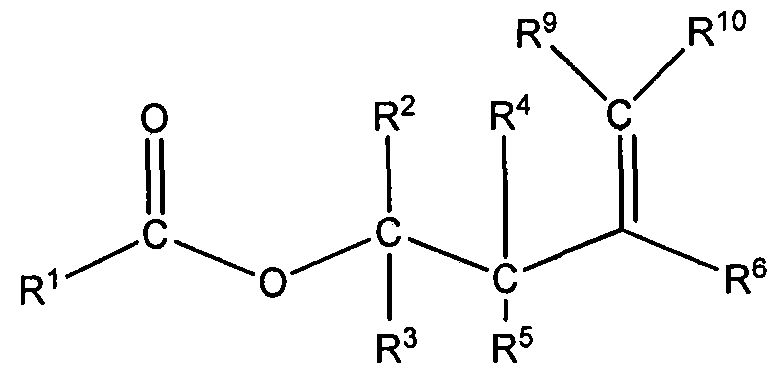
II.
[0025] In some embodiments, R' is a (C2-3) alkene. In other embodiments, R1 is■ C(=C)H. In still other embodiments, R1 is -C(=C)CH3.
[0026] In some embodiments, the invention relates to a polymer of formula Ip:

Ip.
[0027] In some embodiments, the invention relates to a polymer of formula Hp:

Hp.
[0028] In some embodiments, P is a polymer chain in which the polymer is a polyolefin. In some embodiments, P is a polyacrylate. In still other embodiments, P is a polymethacrylate. In some embodiments P is a copolymer of two or more monomers chosen from a styrene, an acrylate, and a methacrylate.
[0029] In some embodiments, R2 is (Ci-2o)hydrocarbon optionally substituted with halogen. In some embodiments, the halogen is fluorine. In other embodiments, R2 is (Ci-io)hydrocarbon optionally substituted with fluorine. In still other embodiments, R2 is methyl. In some embodiments, R2 is phenyl.
[0030] In some embodiments, R3, R4, R5, and R7 are selected independently in each instance from hydrogen or (Ci-2o)hydrocarbon. In some of these embodiments, the (Ci-2o)hydrocarbon may in each instance be substituted independently with halogen. In some embodiments, the halogen is fluorine. In other embodiments, a -CH2- moeity of the (Ci-2o)hydrocarbon may be replaced by -Si(CH3)2-. In still other embodiments, a -CH2- moeity of the (Ci-2o)hydrocarbon may be replaced by -N(C=0)-. In yet other embodiments, a -CH2- moeity of the (Ci-2o)hydrocarbon may be replaced by -0-. In some embodiments, more than one -CH2- moeity of the (G-2o)hydrocarbon may be replaced by -0-. In some embodiments, a -CH2- moeity of the (Ci-2o)hydrocarbon
may be replaced by-S-. In some embodiments, R3 is hydrogen. In other embodiments, R3 is methyl. In still other embodiments, R4 is hydrogen. In yet other embodiments, R5 is hydrogen. In other embodiments, R5 is methyl. In some embodiments, R4 is hydrogen and R5 is hydrogen or methyl. In yet other embodiments, R7 is hydrogen. In still other embodiments, R7 is methyl. In other embodiments, R7 is phenyl.
[0031 ] In some embodiments, R6 is hydrogen. In other embodiments, R6 is -OR60. In still other embodiments, R6 is (Ci-2o)hydrocarbon optionally substituted with halogen. In some embodiments, the halogen is fluorine. In yet other embodiments, R6 is (Ci-io)hydrocarbon. In some embodiments, R6 is methyl.
[0032] In some embodiments, R60 is (Ci.2o)hydrocarbon.
[0033] In some embodiments, R8 is hydrogen. In other embodiments, R8 is (Ci. 2o)hydrocarbon optionally substituted with one or more substituents selected from halogen, dioxane, and dioxolane. In some embodiments, R8 is (Ci-6)alkyl. In other embodiments, R8 is phenyl. In still other embodiments, R8 is -C(=0)R80. In some embodiments, R8 is -C(=0)C(=0)-0-R80. In other embodiments, R8 is -C(=0)OR8°. In yet other embodiments, R8 is -C(=0)NHR80. In some embodiments, the halogen is fluorine.
[0034] In some embodiments, R80 is (G-2o)hydrocarbon optionally substituted with halogen. In some embodiments, the halogen is fluorine. In other embodiments, R80 is (Ci-4)alkyl optionally substituted with halogen. In still other embodiments, R80 is (Ci- 4)alkyl optionally substituted with fluorine. In other embodiments, R80 is phenyl optionally substituted with halogen. In yet other embodiments, R80 is phenyl optionally substituted with fluorine. In some embodiments, R80 is -CH2-adamantyl. In other embodiments, R80 is adamantyl.
[0035] In some embodiments, R8 is -C(=0)OR8°, and R80 is (CM)alkyl optionally substituted with halogen. In some embodiments, R8 is -C(=0)OR80, and R80 is (Ci- 4)alkyl optionally substituted with fluorine. In some embodiments, R8 is -C(=0)OR8°, and R80 is phenyl optionally substituted with halogen. In some embodiments, R8 is - C(=0)OR80, and R80 is phenyl optionally substituted with fluorine. In some embodiments, R8 is -C(=0)OR80, and R80 is -CH2-adamantyl. In some embodiments, R8 is -C(=0)OR80, and R80 is adamantyl.
[0036] In some embodiments, R8 is -C(=0)R80, and R80 is phenyl optionally substituted with halogen. In other embodiments, R8 is -C(=0)R80, and R80 is phenyl optionally substituted with fluorine. In some embodiments, R8 is -C(=0)R80, and R80 is (Ci-4)alkyl optionally substituted with halogen. In other embodiments, R8 is - C(=0)R80, and R80 is (Ci-4)alkyl optionally substituted with fluorine.
[0037] In some embodiments, R9 is hydrogen. In other embodiments, R9 is (Ci- 6)alkyl. In some embodiments, R9 is phenyl.
[0038] In some embodiments, R10 is hydrogen. In other embodiments, R10 is (C|. 6)alkyl. In some embodiments, R10 is phenyl.
[0039] In some embodiments, n is 0. In these instances, the ester and trigger are two carbons apart (1 ,2 arrangements). In other embodiments, n is 1. In these instances, the trigger and ester are essentially spaced three carbons apart (1,3 arrangements). In still other embodiments, n is 2. In these instances, the trigger and ester are essentially spaced four carbons apart (1,4 arrangements).
[0040] In some embodiments, a plurality of R2, R3, R4, R5, R6, R7, R8, R9, R10, R60, and R80, together with the atoms to which they are attached, may form a monocyclic ring or a polycyclic ring system. A "plurality", for purposes of this disclosure, indicates two or more of R2, R3, R4, R5, R6, R7, R8, R9, R10, R60, and R80. For instance, in some embodiments, R5 and R7, together with the carbons to which they are attached, may form cyclohexyl, while in other embodiments R2, R3, R5 and R7, together with the carbons to which they are attached, may form adamantane. To be perfectly clear, these ring systems may be formed in compounds of formula I or formula II, or in polymers of formula Ip or formula lip. More than one of these ring systems may be formed by these substituent pairings at one time; for instance a ring system may be formed by R5 and R7 and by R8 and R60 at the same time in the same compound or polymer. In some of these embodiments, a -CH2- in the monocyclic ring or polycyclic ring system may be replaced by -Si(CH3)2-, -N(C=0)-, -0-, or -S-.
[0041] In some embodiments, R5 is present (that is, n is not 0), and R5 and R7, together with the carbons to which they are attached, form a 3- to 6-membered monocyclic ring. In some embodiments, Rs is present (that is, n is not 0), and Rs and R7, together with the carbons to which they are attached, form a 7- to 10-membered
bicyclic ring system. An example of formula I, when R5 and R7 form a ring, represented by ring J, is shown below:

A more specific example is shown below:

In some embodiments, a -CH2- in the monocyclic ring or bicyclic ring system may be replaced by -Si(CH3)2-, -0-, -NC(=0)-, or -S-.
[0042] In some embodiments, R2 and R6 (when R6 is a (Ci-2o)hydrocarbon optionally substituted with halogen), or R2 and R7, together with the carbons to which they are attached, form a 3- to 6-membered monocyclic carbocycle. In some embodiments, R2 and R6 (when R6 is a (Ci-2o)hydrocarbon optionally substituted with halogen), or R2 and R7, together with the carbons to which they are attached, form a 7- to 10-membered bicyclic carbocycle. An example of formula I when R2 and R7 form a ring, represented by ring K, is shown below:

A more specific example is shown below:

[0043] In some embodiments, R2 and R60 (when R6 is -OR60), together with the atoms to which they are attached, form a 5- or 6-membered oxygen-containing heterocycle. An example of formula II when R2 and R60 form a ring, represented by ring L, is shown below:

A more specific example is shown below:

[0044] In some embodiments, R2 and R5, together with the carbons to which they are attached, form a monocyclic. In some embodiments, R2 and R5, together with the carbons to which they are attached, form a bicyclic carbocycle.
[0045] In some embodiments, R2 and R3, together with the carbons to which they are attached, form a 3- to 6-membered monocyclic carbocycle. In some embodiments, R2 and R3, together with the carbons to which they are attached, form a 7- to 10- membered polycyclic carbocycle.
[0046] In some embodiments, R4 and R5, together with the carbons to which they are attached, form a 3- to 6-membered monocyclic carbocycle. In some embodiments,
R4 and R5, together with the carbons to which they are attached, form a 7- to 10- membered polycyclic carbocycle.
[0047] In some embodiments, R6 and R7, together with the carbons to which they are attached, form a 3- to 6-membered monocyclic carbocycle. In another
embodiment, R6 and R7, together with the carbons to which they are attached, form a 7- to 10-membered polycyclic carbocycle.
[0048] In some embodiments, R8 and R60 form a dioxane. In another embodiment, R8 and R60 form dioxolane. The dioxane or dioxolane may be substituted with one or two methyl groups.
[0049] In some embodiments, R5 and R7 form a ring and R8 and R60 form a dioxane or dioxolane optionally substituted with one or two methyl groups. In another embodiment, R2 and R7 form a ring and R8 and R60 form a dioxane or dioxolane optionally substituted with one or two methyl groups.
[0050] In some embodiments, R6 is hydrogen or (Ci-io)hydrocarbon and R7 is hydrogen. In other embodiments, R6 is hydrogen or (Ci-io)hydrocarbon and R7 is methyl. In still other embodiments, R6 is hydrogen or (Ci-io)hydrocarbon and R7 is phenyl.
[0051] In some embodiments when the compound is of formula II, both R9 and R10 are hydrogen.
[0052] In some embodiments when the compound is of formula Hp, both R9 and Rl ( are hydrogen.
[0053] In some embodiments when the compound is of formula II, R6 and R9, together with the carbons to which they are attached, form an unsaturated 3- to 6- membered monocyclic carbocycle. In other embodiments, R6 and R9, together with the carbons to which they are attached, form an unsaturated 7- to 10-membered bicyclic carbocycle.
[0054] In some embodiments when the polymer is of formula Hp, R6 and R9, together with the carbons to which they are attached, form an unsaturated 3- to 6- membered monocyclic carbocycle. In other embodiments, R6 and R9, together with
the carbons to which they are attached, form an unsaturated 7- to 10-membered bicyclic carbocycle.
[0055] In some embodiments when the polymer is of formula II, R6 is hydrogen. In some embodiments when the polymer is of formula II, R6 is methyl.
[0056] In some embodiments when the polymer is of formula Hp, R6 is hydrogen. In some embodiments when the polymer is of formula Hp, R6 is methyl.
[0057] In some embodiments, n is 0 and at least one of R6 and R7 is an aliphatic (Ci- 2o)hydrocarbon.
[0058] In some embodiments, n is 0 and R2 and R7 form a 3- to 6-membered monocyclic carbocycle. In other embodiments, n is 0 and R2 and R7 form a 5- to 6- membered monocyclic carbocycle. In still other embodiments, n is 0 and R2 and R7 form a a 7- to 10-membered bicyclic carbocycle. In some of these embodiments, R8 and R60 form a dioxane or dioxolane optionally substituted with one or two methyl groups.
[0059] In some embodiments when n is 0, at least one of R2 and R3 is (Ci-6)alkyl, and at least one of R6 and R7 is (Ci-6)alkyl. In some embodiments, n is 0, at least one of R2 and R3 is methyl, and at least one of R6 and R7 is (Ci-3)alkyl. In some of these embodiments, R8 and R60 form a dioxane or dioxolane optionally substituted with one or two methyl groups.
[0060] In some embodiments, n is 2 and the two R5 substituents, together with the carbons to which they are attached, form a cyclopropyl ring. Some examples are shown below:

[0061] In some embodiments, the halogen is fluorine.
[0062] In some embodiments, R2 is (O-io)hydrocarbon optionally substituted with fluorine and R3 is hydrogen. In some embodiments, R2 is (Ci-io)hydrocarbon optionally substituted with fluorine and R3 is methyl.
[0063] All of the compounds falling within the foregoing parent genera and their subgenera are useful for photolithography. It may be found upon examination that compounds that have been included in the claims are not patentable to the inventors in this application. In this event, subsequent exclusions of species from the compass of applicants' claims are to be considered artifacts of patent prosecution and not reflective of the inventors' concept or description of their invention; the invention encompasses all of the members of the genera described above that are not already in the possession of the public. The invention also encompasses the use of a broader genus of compounds in photoresists.
[0064] Most, but not all, of the compounds disclosed herein are novel, and thus, there are provided in some embodiments of the invention, the molecules per se, as well as methods for preparing these molecules.
[0065] In the context of the present disclosure, alkyl is intended to include linear or branched saturated hydrocarbon structures and combinations thereof.
[0066] Cycloalkyl includes cyclic hydrocarbon groups of from 3 to 8 carbon atoms. Examples of cycloalkyl groups include c-propyl, c-butyl, c-pentyl, norbornyl and the like.
[0067] Hydrocarbon refers to a substituent comprised of hydrogen and carbon as the only elemental constituents, and therefore includes, for instance, alkyl, cycloalkyl, polycycloalkyl, alkenyl, alkynyl, aryl and combinations thereof. Examples include benzyl, phenyl, ethyl, phenethyl, cyclohexylmethyl, adamantyl, and naphthylethyl. To be perfectly clear, (Ci-Cs)hydrocarbon refers to a moiety that includes 1 , 2, 3, 4, 5, 6, 7 or 8 carbons and the appropriate number of hydrogen atoms to satsify valency. The term "carbocycle" is intended to include ring systems consisting entirely of carbon but of any oxidation state. Thus (C3-C12) carbocycle refers to such systems as cyclopropane, benzene, adamantyl, and cyclohexene; (C8-C12) carbopolycycle refers to such systems as norbornane, decalin, indane and naphthalene.
[0068] Acyl refers to groups of from 1 to 8 carbon atoms of a straight, branched, cyclic configuration, saturated, unsaturated and aromatic and combinations thereof, attached to the parent structure through a carbonyl functionality. Acyl also refers to formyl, which has only a hydrogen attached to the parent structure through a carbonyl functionality. One or more carbons in the acyl residue may be replaced by nitrogen, oxygen or sulfur as long as the point of attachment to the parent remains at the carbonyl. Examples include acetyl, benzoyl, propionyl, isobutyryl, /-butoxycarbonyl, benzyloxycarbonyl and the like. Lower-acyl refers to groups containing one to four carbons.
[0069] Aliphatic refers to non-aromatic hydrocarbon substituents. Aliphatic substituents may be cyclic (such as cyclopentane or adamantyl) or acyclic, and may contain saturated or unsaturated bonds (i.e., they may be straight or branched alkanes, alkenes or alkynes).
[0070] The terms "monocycle" and "bicycle" or "monocyclic" and "bicyclic" refer to carbocycles and heterocycles having one or two rings respectively. Preferred monocycles are 3, 4, 5, 6 or 7-membered rings, which may be aromatic, saturated or partially unsaturated. Non-limiting examples include cyclopropane, cyclopentane, cyclohexane, pyran, furan, tetrahydrofuran, tetrahydropyran, oxepane and phenyl.
Preferred bicycles are those having from 8 to 12 ring atoms in total. Non-limiting examples include chroman, tetralin, naphthalene, benzofuran, indole,
octahydropentalene and tetrahydrobenzo[b]oxepine. A particular embodiment comprises fused 5:6 and 6:6 systems. A "polycyclic" ring system includes bicyclic ring systems, such as norbornyl; tricyclic ring systems, such as adamantane; as well as other ring systems with more than three rings.
[0071] Aryl and heteroaryl mean a 5- or 6-membered aromatic or heteroaromatic ring containing 0-3 heteroatoms selected from O, N, or S; a bicyclic 9- or 10- membered aromatic or heteroaromatic ring system containing 0-3 heteroatoms selected from O, N, or S; or a tricyclic 13- or 14-membered aromatic or
heteroaromatic ring system containing 0-3 heteroatoms selected from O, N, or S: The aromatic 6- to 14-membered carbocyclic rings include, e.g., benzene, naphthalene, indane, tetralin, and fluorene and the 5- to 10-membered aromatic heterocyclic rings include, e.g., imidazole, pyridine, indole, thiophene, benzopyranone, thiazole, furan, benzimidazole, quinoline, isoquinoline, quinoxaline, pyrimidine, pyrazine, tetrazole and pyrazole.
[0072] Arylalkyl refers to a substituent in which an aryl residue is attached to the parent structure through alkyl. Examples are benzyl, phenethyl and the like.
Heteroarylalkyl refers to a substituent in which a heteroaryl residue is attached to the parent structure through alkyl. Examples include, e.g., pyridinylmethyl,
pyrimidinylethyl and the like.
[0073] Heterocycle means a cycloalkyl or aryl residue in which from one to three carbons is replaced by a heteroatom selected from the group consisting of N, O and S. The nitrogen and sulfur heteroatoms may optionally be oxidized, and the nitrogen heteroatom may optionally be quaternized. Examples of heterocycles that fall within the scope of the invention include pyrrolidine, pyrazole, pyrrole, indole, quinoline, isoquinoline, tetrahydroisoquinoline, benzofuran, benzodioxan, benzodioxole (commonly referred to as methylenedioxyphenyl, when occurring as a substituent), tetrazole, morpholine, thiazole, pyridine, pyridazine, pyrimidine, thiophene, furan, oxazole, oxazoline, isoxazole, dioxane, tetrahydrofuran and the like. It is to be noted that heteroaryl is a subset of heterocycle in which the heterocycle is aromatic.
Examples of heterocyclyl residues additionally include piperazinyl, 2-oxopiperazinyl,
2-oxopiperidinyl, 2-oxo-pyrrolidinyl, 2-oxoazepinyl, azepinyl, 4-piperidinyl, pyrazolidinyl, imidazolyl, imidazolinyl, imidazolidinyl, pyrazinyl, oxazolidinyl, isoxazolidinyl, thiazolidinyl, isothiazolyl, quinuclidinyl, isothiazolidinyl,
benzimidazolyl, thiadiazolyl, benzopyranyl, benzothiazolyl, tetrahydrofuryl, tetrahydropyranyl, thienyl, benzothienyl, thiamorpholinyl, thiamorpholinylsulfoxide, thiamo ho-linylsulfone, oxadiazolyl, triazolyl and tetrahydroquinolinyl. An oxygen heterocycle is a heterocycle containing at least one oxygen in the ring; it may contain additional oxygens, as well as other heteroatoms. A sulphur heterocycle is a heterocycle containing at least one sulphur in the ring; it may contain additional sulphurs, as well as other heteroatoms. Oxygen heteroaryl is a subset of oxygen heterocycle; examples include furan and oxazole. Sulphur heteroaryl is a subset of sulphur heterocycle; examples include thiophene and thiazine. A nitrogen heterocycle is a heterocycle containing at least one nitrogen in the ring; it may contain additional nitrogens, as well as other heteroatoms. Examples include piperidine, piperazine, morpholine, pyrrolidine and thiomorpholine. Nitrogen heteroaryl is a subset of nitrogen heterocycle; examples include pyridine, pyrrole and thiazole.
[0074] As used herein, the term "optionally substituted" may be used
interchangeably with "unsubstituted or substituted". The term "substituted" refers to the replacement of one or more hydrogen atoms in a specified group with a specified radical. For example, substituted alkyl, aryl, cycloalkyl, heterocyclyl etc. refer to alkyl, aryl, cycloalkyl, or heterocyclyl wherein one or more H atoms in each residue are replaced with halogen, haloalkyl, alkyl, acyl, alkoxyalkyl, hydroxyloweralkyl, carbonyl, phenyl, heteroaryl, benzenesulfonyl, hydroxy, loweralkoxy, haloalkoxy, oxaalkyl, carboxy, alkoxycarbonyl [-C(=0)0-alkyl], cyano, acetoxy, nitro, mercapto, alkylthio, alkylsulfinyl, alkylsulfonyl, aryl, benzyl, oxaalkyl, and benzyloxy. "Oxo" is also included among the substituents referred to in "optionally substituted"; it will be appreciated by persons of skill in the art that, because oxo is a divalent radical, there are circumstances in which it will not be appropriate as a substituent (e.g. on phenyl). In one embodiment, 1 , 2 or 3 hydrogen atoms are replaced with a specified radical. In the case of alkyl, cycloalkyl and aryl, more than three hydrogen atoms can be replaced by fluorine; indeed, all available hydrogen atoms could be replaced by fluorine.
[0075] The term "halogen" means fluorine, chlorine, bromine or iodine.
[0076] Photoresist polymers, i.e polymers suitable for use with photoacid generators and/or acid amplifiers in making photoresists are well-known in the art. In the context of the present disclosure, any polymer or polymer chain arising from an olefin polymerization may be utilized. In some embodiments, styrene, acrylate,
methacrylate, or mixtures thereof may be used.
[0077] As used herein, the term "photoresist polymer" refers to a polymer which may serve as the primary component in a photoresist.
[0078] As used herein, the term "photoresist substrate" refers to an article, such as a silicon wafer, which is suitable for use as a substrate in photolithography or other similar processes, and thus may have a photoresist applied thereto as part of the photolithography process.
[0079] As used herein, the term "photoresist composition" refers to a composition which may be used in connection with photolithography.
[0080] When the term "an integer between" two numbers is used, it is meant to include any single integer between and including the two named numbers. For instance, the term "an integer between 1 and 4" indicates that any integer selected from 1, 2, 3, or 4 is meant to be included.
[0081] Some of the compounds described herein contain one or more asymmetric centers and may thus give rise to enantiomers, diastereomers, and other
stereoisomeric forms that may be defined, in terms of absolute stereochemistry, as (R)- or (S)-. Unless indicated otherwise, the present invention is meant to include all such possible isomers, as well as, their racemic and optically pure forms. Optically active (R)- and (S)-, or (D)- and (L)- isomers may be prepared using chiral synthons or chiral reagents, or resolved using conventional techniques. When the compounds described herein contain olefinic double bonds or other centers of geometric asymmetry, and unless specified otherwise, it is intended that the compounds include both E and Z geometric isomers. Likewise, all tautomeric forms are also intended to be included.
[0082] The configuration of any carbon-carbon double bond other than an endocyclic double bond appearing herein is selected for convenience only and is not intended to designate a particular configuration; thus a carbon-carbon double bond depicted arbitrarily herein as trans may be cis, trans, or a mixture of the two in any proportion.
[0083] Terminology related to "protecting", "deprotecting" and "protected" functionalities occurs in some places in this application. Such terminology is well understood by persons of skill in the art and is used in the context of processes which involve sequential treatment with a series of reagents. In that context, a protecting group refers to a group which is used to mask a functionality during a process step in which it would otherwise react, but in which reaction is undesirable. The protecting group prevents reaction at that step, but may be subsequently removed to expose the original functionality. The removal or "deprotection" occurs after the completion of the reaction or reactions in which the functionality would interfere. Thus, when a sequence of reagents is specified, as it is in the processes of the invention, the person of ordinary skill can readily envision those groups that would be suitable as "protecting groups".
[0084] The following abbreviations and terms have the indicated meanings throughout:
Ac acetyl
Bu butyl
c- cyclo
Et ethyl
EUV = extreme ultraviolet
LER line edge roughness
Me methyl
PAG photo acid generator
PEB post-exposure bake
Ph phenyl
rt room temperature
sat'd saturated
s- = secondary
t- tertiary
[0085] A comprehensive list of abbreviations utilized by organic chemists (i.e. persons of ordinary skill in the art) appears in the first issue of each volume of the
Journal of Organic Chemistry. The list, which is typically presented in a table entitled "Standard List of Abbreviations" is incorporated herein by reference.
[0086] Examples
[0087] The following compounds have been synthesized. These compounds may be used with EUV (13.5 nm) radiation. Compound numbers are listed next to the substituent (R), where applicable:


[0088] Other compounds that fall within the genus described herein include those shown below, although these examples are not exhaustive. These compounds are useful for EUV wavelengths. In the examples below, E represents (P)C02-, where (P)


[0089] The compounds below have been synthesized and may be used for photolithography using 193 nm wavelength:

[0090] Other compounds that fall within the genus described herein include those shown below, although these examples are not exhaustive. These compounds are
useful for 193 nm wavelengths. Compound numbers are listed next to the compound, where applicable:

In the examples below, E represents (P)C02-, where (P) is a polymer chain or a (C2-

[0091 ] A non-limiting example of a polymer of the genus disclosed herein for use in EUV photolithography is shown below:

EUV Polymer
60/20/20 (OHStyr/Styr/DD-CAMP)
This is a random terpolymer of hydroxystyrene, styrene, and a methacrylate DD- CAMP monomer.
[0092] A non-limiting example of a polymer of the genus disclosed herein for use in photolithograph

193-nm polymer
20/40/40 (HadMA/GBLMA/DD-CAMP)
This is a random terpolymer of HadMA, GBLMA, and a methacrylate monomer of DD-CAMP.
Syntheses
[0093] In general, compounds per se or for use in accordance with embodiments of present invention may be prepared by the methods illustrated in the general reaction schemes as, for example, described below, or by modifications thereof, using readily available starting materials, reagents and conventional synthesis procedures. In these reactions, it is also possible to make use of variants that are in themselves known, but are not mentioned here.
[0094] Methacrylate Monomers. Monomers were synthesized using procedures adapted from the literature. A specific synthetic procedure is described for
Monomer 1 1 and spectroscopic data is listed in Table 1.

[0095] Synthesis of Intermediate 4 (4-hydroxy-4-methylpentan-2-yl
methacrylate): To a solution of 2-methylpentane-2,4-diol (20.5g, 173 mmol) in 100 ml of THF, 4-(dimethylamino)pyridine (DMAP) (4.2g, 34.6 mmol) was added followed by pyridine (27.4g, 346 mmol) and methacrylic anhydride (21.25g, 208 mmol). A constant flow of nitrogen was kept through the reaction vessel. The reaction was to stir for 14 hours at room temperature. 40 ml of a 1 % aqueous solution of NaHCCb was added to the reaction mixture. The mixture was stirred for 10 minutes and then extracted with ethyl acetate (3x40 ml). The organic layers were combined and dried with sodium sulfate, filtered and concentrated under vacuum.
Chromatography on silica gel eluting with 1 :1 ether : hexane yielded 4 (15.6g 48%) as a colorless oil. 'H NMR (400 MHz, Chloroform-cf) δ 6.06 (s, 1H), 5.53 (s, 1 H), 5.19 (dqd, J = 9.4, 6.3, 6.3, 6.2, 3.1 Hz, 1H), 2.1 (m, 1H), 1.91-1.87 (m, 1H), 1.91 (s, 3H), 1.66 (dd, J = 14.9, 3.3 Hz, 1 H), 1.27 (d, J = 6.2 Hz, 3H), 1.20 (s, 6H),
[0096] Synthesis of Monomer 11 (4-(ethoxycarbonyloxy)-4-methylpentan-2-yl methacrylate): Methylmagnesium bromide (1 M in THF) (13.2 ml, 13.2 mmol) was added to a solution of 4-hydroxy-4-methylpentan-2-yl methacrylate (4) (2.25g, 13.2 mmol) in THF (40 ml) at -78 °C. The reaction was stirred at -78 °C for 1 hour, then ethylchloroformate (1.14g, 10.5 mmol) was added dropwise. The reaction was then slowly warmed to room temperature and kept at room temperature for 1 hour. The reaction mixture was poured into a cold solution of saturated aqueous sodium bicarbonate. The mixture was stirred for 5 min. then extracted with ethyl acetate, dried with sodium sulfate, filtered and concentrated to an oil. Purification was done using silica gel chromatography. The compound was eluted with 2: 1 hexane: ether to yield 2.6g (59%) of 11 as a colorless oil. Ή NMR (400 MHz, Chloroform-i/) Ή
NMR (400 MHz, Chloroform-i/) δ 6.05 (s, IH), 5.51 (s, IH), 5.17 (dqd, J= 8.6, 6.3, 6.3,6.3,3.1 Hz, IH), 4.18-4.06 (m, 2H), 2.25-2.18 (m, IH), 2.01 (dd,J= 15.0,8.5 Hz, IH), 1.95 (s, 3H), 1.51 (s, 6H), 1.35-1.2 (m, 6H).
Table 1.

(400 MHZ, CDC13)
2 major diastereomers (A,B) δ 7.36-7.22 (m, 5H, A,B), 6.20 (s, 0.4H, A), 6.12 (s, 0.6H, B), 5.89 (d, J
(2-hydroxy-2- = 10.3 Hz, .4H, A), 5.70 - 5.44 (m, methylcyclopentyl)(phenyl) 1.6H, A, B), 4.12-4.05 (m, 0.6H, B), methyl methacrylate 2.98-2.10 (m, 0.4H, A), 2.55-2.44 (m,
0.4H, A), 2.24-2.14 (m, 0.6H, B),
Example 21 2.07- 1.64 (m, 3H, A,B), 1 .93 (s, 1.2H,
A), 1.90 (s, 1.8, B), 1.54- 1.12 (m, 3H, A,B), 1 .37 (s, 1.8H, B), 1 .27 (s, 1.2H, A).
δ 6.13 (s, IH), 5.91 -5.79 (m, I H), l-(2-(trifluoromethyl)- 1 ,3- 5.59 (s, 1 H), 3.97 - 3.64 (m, 4H), 2.14 dioxan-2-yl)propan-2-yl
(dd, J = 15.0, 9.3 Hz, I H), 2.04 (dd, J methacrylate
= 15.1, 1.6 Hz, I H), 1 .94 (s, 3H), 1 .91 - 1.75 (m, IH), 1 ,43-1.32 (m, I H)
Example 15
1.40 (s, 3 H).
Diasteromers (A,B)
δ 6.25-6.19 (m, IH, A,B), 6.13 (s,
2,2,2-trifluoro-l-(1 ,5- 0.6H, B), 6.10 (s, 0.4H, A), 5.97-5.89 dioxaspiro[5.5]undecan-7- (m, 0.4H, A), 5.56 (s, 0.6H, B),5.54 yl)ethyl methacrylate (s, 0.4H.A), 4.10-3.47 (m, 4H, A,B)
2.77-2.67 (M, IH, A,B), 2.12 - 1.48
Example 14 (m, 6H, A,B), 1 .95 (s, 0.6H, B), 1 .93
(s, 0.4H, A), 1.32 - 0.99 (m, 4H, A3),
2 major diastereomers (A,B) δ 7.47 - 7.10 (m, 5H, A,B), 6.18 (s, 0.4H, A), 6.09 (s, 0.6H, B)), 5.99 (d, J
(2-acetoxy-2- = 10.5 Hz, 0.6H, B), 5.67 (d, J=10.5 methylcyclopentyl)(phenyl)
Hz, 0.4H, A), 5.55-5.49 (m, I H, A,B), methyl methacrylate
2.98 - 2.80 (m, 0.6H, B)), 2.42 (ddd, J = 14.6, 7.9, 6.6 Hz, 0.4H, A), 2.03 -
Example 22
1.05 (m, 6H), 1.90 (s, 0.4H, A), 1.89 (s, 0.6H, B), 1.69 (s, 0.6H, B), 1.48 (s, 0.4H, A).
5 6.03 (s, I H), 5.50 (s, 1 H), 5.19 (dqd, J = 12.4, 6.3, 6.2, 6.2, 3.3 Hz, I H), ethyl 4-(methacryloyloxy)-
4.26 (q, J= 7.2, 7.2, 7.1 Hz, 2H), 2.32 2-methylpentan-2-yl oxalate
(dd, J = 15.1 , 8.4 Hz, 1 H), 2.02 (dd, J = 15.1 , 3.4 Hz, IH), 1 .89 (s, 3H), 1.54
Example 6
(s, 6H), 1 .32 (t, J = 7.2, 7.2 Hz, 3H),
1.27 (d, 7 = 6.3 Hz, 3H).
δ 7.42 - 7.14 (m, 4H), 7.00 (t, J = 7.1 ,
4-methyl-4- Hz, I H), 6.45 (s, I H), 6.05 (s, I H),
(phenylcarbamoyloxy)penta 5.44 (s, 1 H), 5.26 (ddt, J = 9.9, 6.3, n-2-yl methacrylate 3.2, 3.2 Hz, I H), 2.33 (dd, J = 15.1,
8.9 Hz, I H), 2.01 (dd, ,/ = 1 5.1 , 2.6
Example 12 Hz, 1 H), 1.86 (s, 3H), 1.49 (s, 6H),
1.25 (d, = 6.3 Hz, 3H).

xamp e
[0097] SYNTHESIS of an EUV Polymer:

[0098] Synthesis of EUV polymer (39) (hydroxystyrene/styrene/4- (ethoxycarbonyloxy)-4-methylpentan-2-yl methacrylate)(60%/20%/20%): This synthesis is similar to a procedure from Patent 6,042,997 Barclay et al. The three monomers (4-hydroxy styrene (2.33g, 17.4 mmol), Styrene (0.60g, 5.8 mmol), 4- (ethoxycarbonyloxy)-4-methylpentan-2-yl methacrylate (1.5g, 5.8 mmol) were combined in 15 ml of THF. AIBN (0.143g, 0.87 mmol) was added to the solution. Nitrogen was bubbled thru the mixture for 10 min. The mixture was then heated at gentle reflux for 18 hours. The reaction was cooled and 15 ml of hexane was added, after which a gum formed. The solvents were decanted away from the gum. The gum
was dissolved in methylene chloride and added to an equal amount of hexane. The resulting precipitate was filtered, and a polymer 39 was obtained as a white solid 3.4g (78%). GPC MW 1 1,500
[0099] SYNTHESIS of an 193-nm Polymer:

[00100] Synthesis of 193-nm polymer (40) (HadMA/ GBLMA/4- (ethoxycarbonyIoxy)-4-methylpentan-2-yl methacrylate) (20%/40%/40%) Synthesis: The three monomers 4-(ethoxycarbonyloxy)-4-methylpentan-2-yl methacrylate (1.5g, 5.8 mmol), GBLMA (0.986g, 5.8 mmol), HadMA (0.685g, 2.9 mmol), were dissolved in 8.2 ml of Dioxane. AIBN (0.071g, 0.43 mmol) was added to the solution. Nitrogen was bubbled thru the mixture for 10 min. The mixture was then heated at 80°C for 3.5 hours. The reaction was cooled and added to 30 ml of ether, after which a white solid formed. The solvents were filtered away from the solid. The polymer (40) was obtained as a white solid 2.6g (80%). GPC MW 1 1 ,500.
LITHOGRAPHIC EVALUATION
[00101] Formulation and Coating: Polymer (0.626g), bis(4-tert- butylphenyl)iodonium l ,l,2,2,3,3,4,4,4-nonafluorobutane-l-sulfonate(PAG) (0.1 13g) and 1.125g of a 1% ethyl lactate solution tetrabutylammonium hydroxide (TBAH) were all dissolved in 23.14 g of PMA, followed by filtration through a 0.22 μιη Pall CR13 PTFE syringe filter to make a 3 wt% photoresist solution. 1.5 to 4 itiL of this photoresist solution was applied to a virgin 4" silicon wafer or 300mm silicon wafer coated with HMDS. The wafer was spun at 2000 RPM for 45 seconds to form an
amorphous, uniform thin film with a thickness of 60 nm. The coated wafer was optically inspected for defects and recoated, if necessary.
[00102] Facilities. EUV (extreme ultraviolet) exposures were performed at Lawrence Berkeley National Laboratory (LBNL), Advanced Light Source (ALS) on the SEMATECH Berkeley Microexposure Tool (BMET) or EUV exposures were performed at SUNY Polytechnic Institute on the SEMATECH Albany
Microexposure Tool (AMET). 193-nm exposures were performed at SUNY
Polytechnic Institute using the ASML TWINSCAN XT: 1700i.
[00103] Exposure Procedures. Coated wafer were inserted into exposure tools and irradiated with extreme ultraviolet (EUV, λ=13.5 nm) light or 193-nm light and tested for: 1. Photosensitivity and 2. Imaging. EUV exposures at the LBNL ALS and EUV AMET consisted of the following: 1 . DCT (Dose Calibration Tool) exposures consisted of 50 pinhole exposures of increasing dose to demonstrate photoresist EUV sensitivity and to generate a contrast curve to help evaluate the photoresist's performance. 2. 193-nm exposures at the Albany 1700i consist of a contrast curve exposure consisting of 100 stops with 1 cm square exposures of increasing dose to demonstrate photoresist 193-nm sensitivity and to generate a contrast curve to help evaluate the photoresist's performance. The wafer coated with resist was inserted into the exposure tool (DCT at LBNL, AMET) and evaluated with a wide dose range contrast curve exposure. After exposure, the wafer was removed from the tool and developed in 0.26N TMAH for 45 seconds. The development step removed any exposed resist material from the wafer (positive tone development). The dose (mJ/cm2) required to achieve E0was determined optically and recorded. The E0 dose determined from the contrast curve was multiplied by 2.5 for the control resist (P- COOt-Bu) and 3.5 for the DD-CAMP resists as a rough estimate of the centering dose. 3. Focus Exposure Matrix (FEM) exposures on BMET consisted of a dose and focus array of mask patterning using the LBNL Dark Field Mask to evaluate the resist imaging performance. The array size can vary, but an 1 1x7 array (1 1 dose variations, 7 focus variations) was typical. Although many illumination types are possible, most exposures were performed using annular illumination. After exposure, the wafer was removed from the tool and developed in 0.26N TMAH for 45 seconds. The developed chips were analyzed for patterning with a scanning electron microscope
(SEM). Although each site used a different SEM (Hitachi S4800 SEM at LBNL), the protocol for obtaining images was identical. Accelerating voltage was set to 2 keV and the working distance was typically 3-4 mm. The in-lens detector was used to maximize signal: noise. Micrographs were obtained at 150 - 200 kx magnification, if possible.
[00104] Lithographic Evaluation - Line Edge Roughness (LER). Line edge roughness determined by importing TIFF files of the SEM images into SuMMIT software. SuMMIT is an interactive off-line analysis package for critical dimension (CD) and line-edge/width roughness (LER/LWR) processing of SEM images.
SuMMIT has integrated stochastic resist modeling capabilities. Load an aerial image into SuMMIT, define the resist parameters, and SuMMIT will compute the resulting stochastic resist image and automatically compute the LER. Information on SuMMIT software for LER analysis can be found at the Company website
http://www.lithometrix.com/index.html .
Results
[00105] Various procedural modifications should be considered when optimizing the DD-CAMP resists. For instance, the post-exposure bake (PEB) times of DD-CAMP resists are able to be optimized to give the best LER. An example of this is illustrated in FIG. 2. The LER of the Control (t-BuO) changes linearly with PEB time, while the LER of the two DD-CAMP examples (OAc and OCOOEt) possess an optimum PEB time. "(P)" designates the polymer, and the value of (P) was the same for all compounds shown in FIG. 2. Without being held to any one theory, it is believed that this phenomena is a result of the need to balance the relative rates of the first and second deprotection steps to get the highest exponent value.
[00106] Representative compounds falling within the genus disclosed herein were tested in EUV imaging experiments. FIG. 3 illustrates a graph resulting from the plot of focus vs. line edge roughness (LER). In general, better focus leads to more desirable LER. A single-deprotection CAMP was used as a control, while the DD- CAMP compound (OAc) was tested at varying temperatures, doses and times. The control was tested at 1 10°C for 180 seconds (designated "Ctrl/ 1 10/180"), while OAc was tested at a number of different temperatures and times (1 10°C for 180 seconds,
1 10°C for 210 seconds, 1 10°C for 240 seconds, and 100°C for 270 seconds). M(P)" designates the polymer, and the value of (P) was the same for both compounds shown in FIG. 3. As can be seen by the graph, all test compound parameters resulted in lower LER values than the control. FIG. 4 shows the scanning electron microscope results for each curve of the graph.
[00107] FIG. 5 illustrates a graph resulting from the plot of focus vs. line edge roughness (LER) for some embodiments of the invention. "(P)" designates the polymer, and the value of (P) was the same for all compounds shown in FIG. 5. The post exposure bake for this experiment was 1 10°C for 210 seconds.
[00108] While several aspects of the present invention have been described and depicted herein, alternative aspects may be effected by those skilled in the art to accomplish the same objectives. Accordingly, it is intended by the appended claims to cover all such alternative aspects as fall within the true spirit and scope of the invention.
Claims
1. A compound of formula I or II:

wherein
R1 is a (C2-3) alkene;
R2 is (Ci-2o)hydrocarbon optionally substituted with halogen;
R3, R4, R5, and R7 are selected independently in each instance from the group consisting of hydrogen and (Ci-2o)hydrocarbon, wherein said (Ci-2o)hydrocarbon may in each instance be substituted independently with halogen, and wherein a -CH2- in the (Ci-2o)hydrocarbon may be replaced by -Si(CH3)2-, -N(C=0)-, -0-, or -S-;
R6 is selected from the group consisting of hydrogen; -OR60; and (Ci- 20)hydrocarbon optionally substituted with halogen;
R60 is (Ci-20)hydrocarbon;
R8 is selected from the group consisting of hydrogen; (Ci-2o)hydrocarbon optionally substituted with one or more substituents selected from halogen, dioxane, and dioxolane; -C(=0)R80; -C(=0)C(=0)-0-R80; -C(=0)OR8°; and -C(=0)NHR80;
R80 is (Ci-2o)hydrocarbon optionally substituted with halogen;
R9 and R10 are selected independently in each instance from the group consisting of hydrogen, (Ci-6)alkyl, and phenyl;
n is selected from 0, 1, or 2;
or, alternatively, a plurality of R2, R3, R4, R5, R6, R7, R8, R9, R10, R60, and R80, together with the atoms to which they are attached, may form a monocyclic ring or a polycyclic ring system; and wherein a -CH2- in the monocyclic ring or polycyclic ring system may be replaced by -Si(CH3)2-, -N(C=0)-, -0-, or -S-;
wherein:
when n is 0, at least one of R6 and R7 must be an aliphatic (C2-2o)hydrocarbon; and
when n is 2, the two R5 substituents, together with the carbons to which they are attached, form a cyclopropyl ring.
2. A polymer of formula Ip or Hp:

wherein
P is a polymer chain;
R2 is (Ci-2o)hydrocarbon optionally substituted with halogen;
R3, R4, R5, and R7 are selected independently in each instance from the group consisting of hydrogen and (Ci-2o)hydrocarbon, wherein said (Ci-2o)hydrocarbon may in each instance be substituted independently with halogen, and wherein a -CH2- in the (Ci-2o)hydrocarbon may be replaced by -Si(CH3)2-, -N(C=0)-, -0-, or -S-;
R6 is selected from the group consisting of hydrogen; -OR60; and (O- 2o)hydrocarbon optionally substituted with halogen;
R60 is (Ci-2o)hydrocarbon;
R8 is selected from the group consisting of hydrogen; (Ci-2o)hydrocarbon optionally substituted with one or more substituents selected from halogen, dioxane, and dioxolane; -C(=0)R80; -C(=0)C(=0)-0-R80; -C(=0)OR8°; and -C(=0)NHR80;
R80 is (Ci-2o)hydrocarbon optionally substituted with halogen;
R9 and R10 are selected independently in each instance from the group consisting of hydrogen, (Ci-6)alkyl, and phenyl;
n is selected from 0, 1, or 2;
or, alternatively, a plurality of R2, R3, R4, R5, R6, R7, R8, R9, R10, R60, and R80, together with the atoms to which they are attached, may form a monocyclic ring or a polycyclic ring system; and wherein a -CH2- in the monocyclic ring or polycyclic ring system may be replaced by -Si(CH3)2-, -N(C=0)-, -0-, or -S-;
wherein:
when n is 0, at least one of R6 and R7 must be an aliphatic (C2-2o)hydrocarbon; and
when n is 2, the two R5 substituents, together with the carbons to which they are attached, form a cyclopropyl ring.
3. A compound according to claim 1 , wherein the compound is of formula I.
4. A compound according to claim 1 , wherein the compound is of formula II.
5. A polymer according to claim 2, wherein the compound is of formula Ip.
6. A polymer according to claim 2 wherein the compound is of formula Hp.
7. A compound according to claim 1 , wherein R1 is -C(=C)H or -C(=C)CH3.
8. A compound or polymer according to claim 1 or claim 2, wherein R2 is (Ci- io)hydrocarbon optionally substituted with fluorine and R3 is selected from hydrogen and methyl.
9. A compound or polymer according to any one of claim 1 , claim 2, or claim 5, wherein R4 is hydrogen and R5 is hydrogen or methyl.
10. A compound or polymer according to claim 1 or claim 2, wherein R6 is hydrogen or (Ci-io)hydrocarbon and R7 is hydrogen, methyl, or phenyl.
1 1. A compound or polymer according to claim 1 or claim 2, wherein R5 and R7, together with the carbons to which they are attached, form a 3- to 6-membered monocyclic ring or a 7- to 10-membered bicyclic ring system, wherein a -CH2- in the monocyclic ring or bicyclic ring system may be replaced by -Si(CH3)2-, -0-, - NC(=0)-, or -S-.
12. A compound or polymer according to claim 1 or claim 2, wherein R2 and R6, or R2 and R7, together with the carbons to which they are attached, form a 3- to 6- membered monocyclic carbocycle or a 7- to 10-membered bicyclic carbocycle; or wherein R2 and R60, together with the atoms to which they are attached, form a 5- or 6-membered oxygen-containing heterocycle.
13. A compound or polymer according to claim 1 or claim 2, wherein R2 and R5, together with the carbons to which they are attached, form a monocyclic or bicyclic carbocycle.
14. A compound or polymer according to claim 1 or claim 2, wherein R2 and R3, R4 and R5, or R6 and R7, together with the carbons to which they are attached, form a 3- to 6-membered monocyclic carbocycle or a 7- to 10-membered polycyclic carbocycle.
15. A compound or polymer according to claim 14, wherein R2 and R3, together with the carbons to which they are attached, form a 3- to 6-membered monocyclic carbocycle, or R6 and R7, together with the carbons to which they are attached, form a 7- to 10-membered polycyclic carbocycle
16. A compound or polymer according to claim 1 or claim 2, wherein R8 is - C(=0)OR80.
17. A compound or polymer according to claim 16, wherein R80 is (Ci-4)alkyl, phenyl, -CH2-adamantyl, or adamantyl, wherein said phenyl and (0-4)alkyl may optionally be substituted with fluorine.
18. A compound or polymer according to claim 1 or claim 2, wherein R8 is - C(=0)R80, and R80 is selected from phenyl and (Ci-4)alkyl, wherein said phenyl and (Chalky! may optionally be substituted with fluorine.
19. A compound or polymer according to claim 1 or claim 2, wherein R8 and R60 form a dioxane or dioxolane optionally substituted with one or two methyl groups.
20. A compound or polymer according to claim 19, wherein R5 and R7 or R2 and R7 form a ring and R8 and R60 form a dioxane or dioxolane optionally substituted with one or two methyl groups.
21. A compound or polymer according to claim 1 or claim 2, wherein R8 is selected from the group consisting of hydrogen, (Ci-6)alkyl, and phenyl.
22. A compound or polymer according to claim 4 or claim 6, wherein R9 and R10 are each hydrogen.
23. A compound or polymer according to claim 4 or claim 6, wherein R6 and R9, together with the carbons to which they are attached, form an unsaturated 3- to 6- membered monocyclic carbocycle or an unsaturated 7- to 10-membered bicyclic carbocycle.
24. A compound or polymer according to claim 4 or claim 6, wherein R6 is hydrogen or methyl.
25. A compound or polymer according to claim 1 or claim 2, wherein R80 is adamantyl.
26. A compound or polymer according to claim 1 or claim 2, wherein R2 is methyl or phenyl.
27. A compound or polymer according to claim 1 or claim 2, wherein n is 0.
28. A compound or polymer according to claim 27, wherein R2 and R7 form a 3- to 6-membered monocyclic carbocycle or a 7- to 10-membered bicyclic carbocycle.
29. A compound or polymer according to claim 28, wherein R2 and R7 form a 5- or 6-membered monocyclic carbocycle.
30. A compound or polymer according to claim 27, wherein at least one of R2 and R3 is (Ci-6)alkyl, and at least one of R6 and R7 is (Ci-6)alkyl.
31. A compound or polymer according to claim 30, wherein at least one of R2 and R3 is methyl, and at least one of R6 and R7 is (Ci-3)alkyl.
32. A compound or polymer according to one of claims 28 to 31 , wherein R8 and R60 form a dioxane or dioxolane optionally substituted with one or two methyl groups.
33. A compound or polymer according to claim 1 or claim 2, wherein n is 1.
34. A compound or polymer according to claim 1 or claim 2, wherein n is 2.
35. A compound or polymer according to claim 1 or claim 2, wherein the halogen is fluorine.
36. A polymer according to claim 2, wherein P is a polyacrylate.
37. A polymer according to claim 2, wherein P is a polymethacrylate.
38. A polymer according to claim 2, wherein P is a copolymer of two or more monomers chosen from styrenes, acrylates and methacrylates.
39. A composition for photolithography comprising a polymer according to any one of claims 2-38.
40. A photoresist composition comprising a polymer according to any one of claims 2-38.
41. A photoresist substrate which is coated with a photoresist composition according to claim 40.
42. A method for preparing a substrate for photolithography, comprising coating said substrate with a composition according to claim 40.
43. A method for conducting photolithography on a substrate, comprising (a) providing a substrate, (b) coating said substrate with a composition according to claim 40, and (c) irradiating the coated substrate through a photomask.
44. A method according to claim 43, wherein said irradiation is conducted using electromagnetic radiation of wavelength 248 nm, 193 nm, 13.5 nm, or radiation from electron or ion beams.
Applications Claiming Priority (2)
| Application Number | Priority Date | Filing Date | Title |
|---|---|---|---|
| US201562142524P | 2015-04-03 | 2015-04-03 | |
| US62/142,524 | 2015-04-03 |
Publications (1)
| Publication Number | Publication Date |
|---|---|
| WO2016161067A1 true WO2016161067A1 (en) | 2016-10-06 |
Family
ID=57007316
Family Applications (1)
| Application Number | Title | Priority Date | Filing Date |
|---|---|---|---|
| PCT/US2016/025171 Ceased WO2016161067A1 (en) | 2015-04-03 | 2016-03-31 | Double-deprotected chemically amplified photoresists |
Country Status (1)
| Country | Link |
|---|---|
| WO (1) | WO2016161067A1 (en) |
Citations (1)
| Publication number | Priority date | Publication date | Assignee | Title |
|---|---|---|---|---|
| US3536687A (en) * | 1968-07-16 | 1970-10-27 | Ashland Oil Inc | Polymers and copolymers from cyclohexenyl-alkyl alcohol ester of alpha,beta-unsaturated acids |
-
2016
- 2016-03-31 WO PCT/US2016/025171 patent/WO2016161067A1/en not_active Ceased
Patent Citations (1)
| Publication number | Priority date | Publication date | Assignee | Title |
|---|---|---|---|---|
| US3536687A (en) * | 1968-07-16 | 1970-10-27 | Ashland Oil Inc | Polymers and copolymers from cyclohexenyl-alkyl alcohol ester of alpha,beta-unsaturated acids |
Non-Patent Citations (2)
| Title |
|---|
| JIN-BAEK KIM ET AL.: "Synthesis of copolymers containing 3-hydroxycyclohexyl methacrylate and their application as ArF excimer laser resists", POLYMER, vol. 40, no. 1, January 1998 (1998-01-01), pages 273 - 276, XP004145564 * |
| UNEP PUBLICATIONS: "HYDROXYPROPYL ACRYLATE CAS N° : 25584-83-2", SIDS INITIAL ASSESSMENT REPORT FOR SIAM, vol. 20, 2005, pages 1 - 112, XP055318780 * |
Similar Documents
| Publication | Publication Date | Title |
|---|---|---|
| KR102014600B1 (en) | Sulfonium salt, resist composition, and patterning process | |
| JP5556765B2 (en) | Chemically amplified positive resist material for ArF immersion exposure and pattern forming method | |
| JP5919148B2 (en) | Resist composition, resist pattern forming method, and polymer compound | |
| JP6141925B2 (en) | Acid generator compound and photoresist containing the same | |
| KR102155386B1 (en) | Resist composition and patterning process | |
| TW201708944A (en) | Resist composition, method of forming resist pattern, acid generator, and compound | |
| KR20170001616A (en) | Positive resist composition, method for forming resist pattern, photo-reactive quencher, and polymeric compound | |
| JP6130109B2 (en) | Resist composition, resist pattern forming method, compound | |
| WO2012135286A2 (en) | Stabilized acid amplifiers | |
| JP2013213951A (en) | Photoresist composition and resist pattern formation method | |
| CN103254346A (en) | Photosensitive copolymer, photoresist comprising the copolymer, and articles formed therefrom | |
| JPWO2005097725A1 (en) | Calix resorcinarene compound, photoresist substrate and composition thereof | |
| JPWO2016088648A1 (en) | Sulfonic acid derivative, photoacid generator using the same, resist composition, and device manufacturing method | |
| KR100517260B1 (en) | Method for pattern formation and process for preparing semiconductor device | |
| JP2018009023A (en) | Alcohol compound, (meth) acrylic acid ester, polymer and method for producing the same, resist composition, method for producing substrate on which pattern is formed | |
| JP2023046908A (en) | Resist composition, resist pattern forming method, compound and acid diffusion control agent | |
| KR101047372B1 (en) | Monomer, resin, resist composition using this resin, and manufacturing method of semiconductor device using this resist composition | |
| WO2016161067A1 (en) | Double-deprotected chemically amplified photoresists | |
| KR101021456B1 (en) | Positive resist composition, method of forming resist pattern, polymeric compound, and compound | |
| KR100729679B1 (en) | Polymer Compounds for Photoresist and Resin Compositions for Photoresist | |
| TW201111340A (en) | Alicyclic compound, production method therefor, composite containing said compound, and resist pattern forming method using same | |
| JP5097380B2 (en) | Adamantane derivative and method for producing the same | |
| TW202611007A (en) | Inhibitor composition, inhibitor pattern formation method, compound, acid diffusion control agent and acid generator | |
| WO2023163008A1 (en) | Resist composition, resist pattern formation method, compound, and polymer compound | |
| WO2010087339A1 (en) | Alicyclic compound, method for manufacturing same, composition containing same and resist pattern formation method using same |
Legal Events
| Date | Code | Title | Description |
|---|---|---|---|
| 121 | Ep: the epo has been informed by wipo that ep was designated in this application |
Ref document number: 16774165 Country of ref document: EP Kind code of ref document: A1 |
|
| NENP | Non-entry into the national phase |
Ref country code: DE |
|
| 122 | Ep: pct application non-entry in european phase |
Ref document number: 16774165 Country of ref document: EP Kind code of ref document: A1 |