WO2016159405A1 - 마우스에서 oct2 유전자 인간화를 위한 녹-인 벡터 - Google Patents
마우스에서 oct2 유전자 인간화를 위한 녹-인 벡터 Download PDFInfo
- Publication number
- WO2016159405A1 WO2016159405A1 PCT/KR2015/003167 KR2015003167W WO2016159405A1 WO 2016159405 A1 WO2016159405 A1 WO 2016159405A1 KR 2015003167 W KR2015003167 W KR 2015003167W WO 2016159405 A1 WO2016159405 A1 WO 2016159405A1
- Authority
- WO
- WIPO (PCT)
- Prior art keywords
- gene
- oct2
- vector
- knock
- human
- Prior art date
- Legal status (The legal status is an assumption and is not a legal conclusion. Google has not performed a legal analysis and makes no representation as to the accuracy of the status listed.)
- Ceased
Links
Images



Classifications
-
- A—HUMAN NECESSITIES
- A01—AGRICULTURE; FORESTRY; ANIMAL HUSBANDRY; HUNTING; TRAPPING; FISHING
- A01K—ANIMAL HUSBANDRY; AVICULTURE; APICULTURE; PISCICULTURE; FISHING; REARING OR BREEDING ANIMALS, NOT OTHERWISE PROVIDED FOR; NEW BREEDS OF ANIMALS
- A01K67/00—Rearing or breeding animals, not otherwise provided for; New or modified breeds of animals
- A01K67/027—New or modified breeds of vertebrates
-
- C—CHEMISTRY; METALLURGY
- C12—BIOCHEMISTRY; BEER; SPIRITS; WINE; VINEGAR; MICROBIOLOGY; ENZYMOLOGY; MUTATION OR GENETIC ENGINEERING
- C12N—MICROORGANISMS OR ENZYMES; COMPOSITIONS THEREOF; PROPAGATING, PRESERVING, OR MAINTAINING MICROORGANISMS; MUTATION OR GENETIC ENGINEERING; CULTURE MEDIA
- C12N15/00—Mutation or genetic engineering; DNA or RNA concerning genetic engineering, vectors, e.g. plasmids, or their isolation, preparation or purification; Use of hosts therefor
- C12N15/09—Recombinant DNA-technology
- C12N15/63—Introduction of foreign genetic material using vectors; Vectors; Use of hosts therefor; Regulation of expression
- C12N15/79—Vectors or expression systems specially adapted for eukaryotic hosts
- C12N15/85—Vectors or expression systems specially adapted for eukaryotic hosts for animal cells
Definitions
- the present invention relates to a knock-in vector for humanization of the OCT2 gene in mice.
- Drug transporters are a type of membrane protein that helps drugs move across the cell membrane. There are many types of drug transporters and each transporter is deeply involved in the absorption, distribution, metabolism and excretion of specific drugs. According to the principle of operation, it can be divided into SLC transporter known as influx transporter and ABC transporter known as efflux transporter.
- OCT2 is a transporter belonging to the SLC22 family and is mainly distributed in the kidney and small intestine walls, and is involved in the process of drug entry into the cell from the basolateral membrane. Therefore, the drug plays an important role in the excretion of the kidneys.
- OCT2 has various organic cationic substances such as metformin and MPP + (1-methyl-4-phenylpyridinium) as substrates.
- FDA has selected OCT2 as one of seven carriers that are thought to play an important role in drug interactions.
- An object of the present invention is to provide a knock-in vector for humanizing OCT2 in mice.
- the present invention is the -908 to +91 gene of mouse Oct2 exon 1 described in SEQ ID NO: 2, the human OCT2 gene described in SEQ ID NO: 1, and mouse Oct2 exon 1 described in SEQ ID NO: 3
- a knock-in vector for humanization of the OCT2 gene in a mouse, comprising the +104 to +1103 th gene, is provided.
- the recombinant vector may further include Bovine Growth Hormone (BGH) _PolyA, puromycin resistance gene, TK (Thymidine kinase) gene.
- BGH_polyA is for suppressing the expression of the gene
- the puromycin resistance gene serves as a positive selection marker
- the TK gene serves as a negative selection marker.
- the recombinant vector is a -908 to + 91th gene of mouse Oct2 exon 1 as set forth in SEQ ID NO: 2 from the origin of replication, a human OCT2 gene as set out in SEQ ID NO: 1, BGH_polyA, puro It may include the mycin resistance gene, the TK gene, and the +104 to +1103 th gene of mouse Oct2 exon 1 described in SEQ ID NO: 3.
- the present invention provides a method for inserting the human OCT2 gene into the OCT2 gene region of mouse cells using the knock-in vector.
- homologous recombination of the gene of SEQ ID NO: 2 and the gene of SEQ ID NO: 3 can accurately insert the human OCT2 gene into the mouse Oct2 exon region.
- Existing methods have a disadvantage in that it is difficult to study the exact function because the position where the gene is inserted is difficult, but by using the present invention it is possible to study the exact function by inserting the human OCT2 gene at the mouse OCT2 gene position.
- the present invention also provides a method for producing a transgenic mouse expressing the human OCT2 gene using the knock-in vector.
- Transgenic mice prepared by the methods of the invention can be utilized to study the function of the human OCT2 gene in vivo.
- the vector of the present invention it is possible to express human OCT2 gene in mouse cells, and furthermore, to prepare a transgenic mouse stably expressing the human OCT2 gene. Therefore, it can be usefully used to conduct research on OCT2 transporter which is an important drug receptor.
- FIG. 2 is a graph showing that MDCK cell lines stably expressing human OCT2 increase MPP + uptake compared to wild type MDCK cell line.
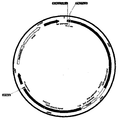
- 3 is a map of the knock-in vector of the present invention.
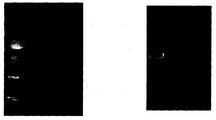
- Figure 4 shows the expression of mouse OCT2 gene and human OCT2 gene in wild-type CMT-93 cells and CMT-93 cells transfected with the knock-in vector of the present invention, respectively.
- FIG. 5 is a diagram confirming whether the knock-in vector of the present invention is well inserted into the CMT-93 cells as a whole.
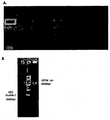
- FIG. 6 is a diagram confirming that the knock-in vector of the present invention was inserted into the mouse Oct2 exon region in CMT-93 cells.
- FIG. 7 is a diagram illustrating an outline of a process for preparing a knock-in vector of the present invention and a process for producing a mouse model using the knock-in vector.
- RT Reverse transcription reaction
- PrimeScript RT-PCR kit (Takara) using total RNA isolated from human kidney cells as a template, and the resulting cDNA was used as a template and Ex Taq polymerase and the following table.
- a primer of 1 was used to amplify the human OCT2 (hOCT2) (SEQ ID NO: 4) gene.
- the obtained human OCT2 gene (2176 bp) was electrophoresed on an agarose gel to confirm the band, and the band portion was cut to extract DNA corresponding to the hOCT2 gene using WelPrep gel extraction kit (Welgene). hOCT2 DNA was ligated into a pCR®2.1 vector (Invitrogen).
- Sequencing was performed to determine whether the ligation was successful, and the mutation was found and corrected.
- Bands were separated by cleaving hOCT2 DNA ligated to pcDNA TM 3.1 vector and pCR®2.1 vector using KpnI and XHOI, and then gel electrophoresis. After extracting the DNA corresponding to each band by gel extraction, hOCT2 DNA was ligated to the pcDNA TM 3.1 vector.
- MDCK cells were cultured, and the cells were divided into 24 well plates and grown to 70-90%. FuGENE® HD transfection reagent (Promega) was then used to transfect the pcDNA TM 3.1 vector containing hOCT2 prepared in 1-2 above. After incubation for 24 to 48 hours, TE treatment was transferred to a 25T flask. After 24 hours, the hygromycin was added to the medium so as to be 10 ⁇ g / mL and selected. After about two weeks, an MDCK cell line (MDCK-OCT2 stable cell line) stably expressing human OCT2 was obtained.
- MDCK-OCT2 stable cell line stably expressing human OCT2 was obtained.
- RT-PCR was performed to confirm the stable expression of human OCT2 in the cell lines prepared in 1-3.
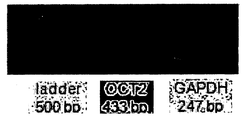
- Canine GAPDH (canine GAPDH) was used as a positive control. RT-PCR results are shown in FIG. 1.
- 24-well plates were prepared in a cleanbench, and then 20 ⁇ l of poly-L-ornithine (Sigma) was added to each well and evenly distributed at the bottom of each well with a sterile tip. The lid of the well plate was then opened and dried for at least about 1 hour with the flow and UV on. Control cells (wild type MDCK cells) and experimental cells (MDCK-OCT2 stable cell line) were each dispensed and incubated for about 48 hours. Thereafter, the medium contained in the well was removed, 500 ⁇ l of PBS warmed at 37 ° C. was added, and then removed twice. 500 ⁇ l per well of a transport medium (TM) warmed at 37 ° C. was incubated at 37 ° C. for about 30 minutes. Thereafter, TM was removed and 200 ⁇ l of 1 ⁇ M MPP + (1-methyl-4-phenylpyridinium) solution, warmed at 37 ° C., was added thereto and incubated at 37 ° C. for 10 minutes.
- TM
- the MPP + solution was completely removed and washed three times using 500 ⁇ l of cold PBS at 4 ° C. After complete removal of PBS, 500 ⁇ l of 0.2 N NaOH was added per well and left at room temperature overnight to induce cell lysis. The obtained lysate and liquid scintillation fluid were added to the vials and mixed, respectively, and the DPM values of the samples were measured using a Liquid Scintillation Counter (LSC). Differences in the number of cells present per well were corrected based on the amount of protein obtained from the Bradford assay.
- LSC Liquid Scintillation Counter
- MDCK cell line stably expressing human OCT2 increased the MPP + uptake by 1.43 times compared to the wild type MDCK cell line (FIG. 2).
- the BGH (Bovine Growth Hormone) _PolyA a positive selection marker, which inhibits human OCT2 gene and gene expression at both ends of left arm (LA) and right arm (RA) required for homologous recombination
- Knock-in vectors were designed in the order of mycin resistance gene, TK (Thymidine kinase) gene, which is a negative selection marker (FIG. 3). Avoiding restriction enzyme sites in each gene itself, the restriction enzyme sequence to link genes was determined (Table 2).
- the T-MCS vector was created by newly synthesizing the Multiple Cloning Site (MCS) portion of the pCR®2.1 vector to create the basic skeleton of the vector.
- MCS Multiple Cloning Site
- the previously cloned human OCT2 was PCR again to remove the MCS portion and 5'UTR of the commercial vector.
- Kpn I and Xba I cleavage sequences were sequentially added to the primers.
- BGH_pA was obtained by PCR using pcDNA TM 3.1 as a template.
- XbaI and XhoI cleavage sequences were placed in the primers in order.
- GLS-1 PuroTK donor plasmid was digested with XhoI and BamHI to obtain Puro / Tk gene, a selection marker.
- the sequences of the primers used are shown in Table 3 below.
- Each gene was in turn subcloned into a T-MCS vector.
- a predetermined sequence was set in subcloning to prevent unwanted cleavage.
- LA, hOCT2 and BGH_pA were set to one set, RA and Puro / TK to one set first, and finally the final vector was created.
- the ligation order is shown in Table 4 below.
- CMT-93 cells which are cells derived from mice, were grown and grown, and then the transfection of the knock-in vector prepared in 2-1 above was performed. At this time, 2 ⁇ g of mOct2 TALEN prepared in advance was added to LA and RA, respectively, and 5 ⁇ g of a knock-in vector was added.
- the DNA recognition portion of mOct2 TALEN is shown in the table below.
- the puromycin was added to 4 ⁇ g / mL after 24 to 48 hours, and the cells were selected for about 2 weeks.
- Cells were then separated by TE treatment, and RNAs of transfected CMT-93 and wild type CMT-93 were extracted and subjected to RT-PCR, respectively.
- PCR was performed using primers for human OCT2 or mouse OCT2, respectively, and the expression of each gene was observed.
- mOct2 gene was identified in wild-type CMT-93 cells (lane 3 in Fig. 4 left), but in human transfected CMT-93 cells, the human OCT2 gene (lane 1 in Fig. 4 right) and the mOct2 gene (right in Fig. 4). 2 lanes), and the band of the human OCT2 gene is stronger.
- the middle point 500 of LA was set as a forward primer and the middle point 1800 of human OCT2 as a reverse primer section, and PCR was performed.
- the band came out a little larger than 2000bp, and the PCR result was about 2200bp, so the PCR was judged to be correct.
- the band came out a little larger than 1000 bp, but the estimated band size was 1200 bp, and the PCR was determined to be correct (FIG. 5).
- genomic DNA was extracted from the transfected CMT-93 cells and wild-type CMT-93 cells, respectively, to confirm where the knock-in occurred in the CMT-93 cell genes.
- PCR was performed from -44, an intron portion of mOct2, to base No. 1680 of the hOCT2 gene, and confirmed at 64 ° C.
- the left side shows a band (marked with a blue box) (about 2900 bp) of human OCT2 in the transfected CMT-93 cells.
- the right side is wild-type CMT-93 cells, and it can be seen that the band of the human OCT2 is not identified. Since the expected PCR result was about 2700bp, it was determined that the desired result was obtained.
- the present invention can be usefully used to conduct studies on OCT2 transporter, which is an important drug receptor.
Landscapes
- Life Sciences & Earth Sciences (AREA)
- Health & Medical Sciences (AREA)
- Genetics & Genomics (AREA)
- Zoology (AREA)
- Engineering & Computer Science (AREA)
- Biotechnology (AREA)
- Wood Science & Technology (AREA)
- Organic Chemistry (AREA)
- Chemical & Material Sciences (AREA)
- Environmental Sciences (AREA)
- Biomedical Technology (AREA)
- Bioinformatics & Cheminformatics (AREA)
- General Engineering & Computer Science (AREA)
- Animal Behavior & Ethology (AREA)
- Molecular Biology (AREA)
- Plant Pathology (AREA)
- Biophysics (AREA)
- Microbiology (AREA)
- Animal Husbandry (AREA)
- Physics & Mathematics (AREA)
- Biochemistry (AREA)
- General Health & Medical Sciences (AREA)
- Biodiversity & Conservation Biology (AREA)
- Micro-Organisms Or Cultivation Processes Thereof (AREA)
Abstract
본 발명은 마우스에서 OCT2 유전자의 인간화를 위한 녹-인 벡터에 관한 것이다. 본 발명의 벡터를 이용하면 마우스 세포에서 인간 OCT2 유전자를 발현시킬 수 있고, 더 나아가 인간 OCT2 유전자를 안정적으로 발현하는 형질전환 마우스를 제조할 수 있다. 따라서 중요한 약물 수용체인 OCT2 수송체에 대한 연구를 수행하는 데 유용하게 활용될 수 있다.
Description
본 발명은 마우스에서 OCT2 유전자의 인간화를 위한 녹-인 벡터에 관한 것이다.
약물 수송체(Drug Transporter)는 약물이 세포막 반대편으로 이동하는 것을 도와주는 막 단백질의 일종이다. 약물 수송체에는 다양한 종류가 존재하며 각 수송체마다 특정한 약물의 흡수, 분포, 대사, 배설에 깊이 관여한다. 작동원리에 따라서 유입 수송체(influx transporter)로 알려진 SLC 수송체, 유출 수송체(efflux transporter)로 알려진 ABC 수송체로 나눌 수 있다.
OCT2는 SLC22 패밀리에 속하는 수송체로서, 신장, 소장 벽에 주로 분포하며 기저측막(Basolateral membrane)에서 약물이 세포내로 유입되는 과정에 관여한다. 따라서 약물이 신장에서 배설되는데 중요한 역할을 한다. OCT2는 메트포르민(Metformin), MPP+(1-methyl-4-phenylpyridinium) 등 다양한 유기 양이온성 물질을 기질로 가진다. FDA는 약물 상호작용에 중요한 역할을 한다고 생각되는 수송체 7가지 중 하나로서 OCT2를 선정한 바 있다.
인간에서 약물 상호작용을 연구하는 것은 엄청난 비용과 시간이 소요되고 위험이 크기 때문에, 현재 OCT2를 비롯한 약물 수송체 연구는 주로 형질전환 동물 모델을 사용하여 수행되고 있다. 예를 들어, 인간의 수송체를 마우스에 발현시킨 후 그 기능을 생체내(in vivo)에서 확인하는 연구가 보고된 바 있다(van de Steeg et al., Organic anion transporting polypeptide 1a/1b-knockout mice provide insights into hepatic handling of bilirubin, bile acids, and drugs, J Clin Invest. 2010 Aug;120(8):2942-52). 그러나 인간의 수송체는 기질 특이성, 친화성 등에 있어서 동물 모델의 수송체와 다르기 때문에 생체내 약물 상호작용을 동물 모델에서 연구하는 데에는 한계가 있다.
본 발명은 마우스에서 OCT2 인간화를 위한 녹-인 벡터(Knock-in vector)를 제공하는 것을 목적으로 한다.
상기 과제를 달성하기 위하여, 본 발명은 서열번호 2로 기재되는 마우스 Oct2 엑손1의 -908 ∼ +91번째 유전자, 서열번호 1로 기재되는 인간 OCT2 유전자, 및 서열번호 3으로 기재되는 마우스 Oct2 엑손1의 +104 ∼ +1103번째 유전자를 포함하는, 마우스에서 OCT2 유전자의 인간화를 위한 녹-인 벡터(Knock-in vector)를 제공한다.
본 발명의 일 구현예로서, 상기 재조합 벡터는 BGH(Bovine Growth Hormone)_폴리A, 퓨로마이신 내성 유전자, TK(Thymidine kinase) 유전자를 더 포함할 수 있다. 여기에서 BGH_폴리A는 유전자의 발현을 억제하기 위한 것이며, 퓨로마이신 내성 유전자는 양성 선별 마커, TK 유전자는 음성 선별 마커의 역할을 한다.
본 발명의 다른 구현예로서, 상기 재조합 벡터는 복제 기점으로부터 서열번호 2로 기재되는 마우스 Oct2 엑손1의 -908 ∼ +91번째 유전자, 서열번호 1로 기재되는 인간 OCT2 유전자, BGH_폴리A, 퓨로마이신 내성 유전자, TK 유전자, 및 서열번호 3으로 기재되는 마우스 Oct2 엑손1의 +104 ∼ +1103번째 유전자를 순서대로 포함할 수 있다.
또한 본 발명은 상기 녹-인 벡터를 이용하여 마우스 세포의 OCT2 유전자 부위에 인간 OCT2 유전자를 삽입하는 방법을 제공한다.
본 발명의 녹-인 벡터에서 서열번호 2로 기재되는 유전자 및 서열번호 3으로 기재되는 유전자의 상동성 재조합에 의해 마우스 Oct2 엑손 부위에 정확히 인간 OCT2 유전자가 삽입될 수 있다. 기존의 방법은 유전자가 삽입되는 위치를 특정할 수 없어 정확한 기능 연구가 어렵다는 단점이 있었으나, 본 발명을 이용하면 마우스 OCT2 유전자 위치에 인간 OCT2 유전자를 삽입함으로써 정확한 기능 연구가 가능하다.
또한 본 발명은 상기 녹-인 벡터를 이용하여 인간 OCT2 유전자를 발현하는 형질전환 마우스를 제조하는 방법을 제공한다.
본 발명의 방법에 의해 제조된 형질전환 마우스는 인간 OCT2 유전자의 기능을 생체내(In-vivo)에서 연구하는 데 활용될 수 있다.
본 발명의 벡터를 이용하면 마우스 세포에서 인간 OCT2 유전자를 발현시킬 수 있고, 더 나아가 인간 OCT2 유전자를 안정적으로 발현하는 형질전환 마우스를 제조할 수 있다. 따라서 중요한 약물 수용체인 OCT2 수송체에 대한 연구를 수행하는 데 유용하게 활용될 수 있다.
도 1은 분리한 인간 OCT2 유전자를 확인한 결과이다.
도 2는 인간 OCT2를 안정하게 발현하는 MDCK 세포주가 야생형 MDCK 세포주에 비해 MPP+흡수를 증가시킴을 보여주는 그래프이다.
도 3은 본 발명의 녹-인 벡터의 맵(map)이다.
도 4는 야생형 CMT-93 세포와 본 발명의 녹-인 벡터로 형질감염된 CMT-93 세포에서 마우스 OCT2 유전자 및 인간 OCT2 유전자의 발현을 각각 확인한 도이다.
도 5는 본 발명의 녹-인 벡터가 CMT-93 세포에 전체적으로 잘 삽입되었는지 여부를 확인한 도이다.
도 6은 본 발명의 녹-인 벡터가 CMT-93 세포에서 마우스 Oct2 엑손 부위에 삽입된 것을 확인한 도이다.
도 7은 본 발명의 녹-인 벡터 제조 과정 및 상기 녹-인 벡터를 이용한 마우스 모델 제작 과정의 개요를 나타낸 도이다.
이하, 본 발명을 실시예를 통하여 더욱 상세히 설명한다. 그러나 이들 실시예 는 본 발명을 예시하기 위한 것으로, 본 발명의 범위가 이들에 제한되는 것은 아니다.
또한, 이하에서 언급된 시약 및 용매는 특별한 언급이 없는 한 시그마 알드리치(Sigma Aldrich)® 로부터 구입한 것이다.
[실시예]
실시예 1. 인간 OCT2 유전자의 분리 및 기능 확인
1-1. 인간 OCT2 유전자의 분리
인간 신장세포에서 분리한 총 RNA를 주형으로 하여 PrimeScript RT-PCR 키트(타카라(Takara))를 이용하여 역전사 반응(RT)을 수행하고, 그 결과 얻은 cDNA를 주형으로 하고 Ex Taq 폴리머라제 및 하기 표 1의 프라이머를 사용하여 인간 OCT2(human OCT2, hOCT2)(서열번호 4) 유전자를 증폭하였다.
[표 1] 프라이머 서열

수득된 인간 OCT2 유전자(2176 bp)를 아가로스 젤에 전기영동하여 밴드를 확인하고, 밴드 부분을 절단하여 WelPrep 젤 추출 키트(웰진(Welgene))를 이용하여 hOCT2 유전자에 해당하는 DNA를 추출하였다. pCR®2.1 벡터 (인비트로젠(Invitrogen)) 에 hOCT2 DNA를 라이게이션 시켰다.
라이게이션이 잘 되었는지 여부를 확인하기 위해 시퀀싱을 한 결과, 돌연변이가 발생했음을 발견하고 이를 수정하였다.
1-2. 서브클로닝
KpnΙ과 XhoΙ을 이용하여 pcDNA™3.1 벡터 및 pCR®2.1 벡터에 라이게이션된 hOCT2 DNA를 각각 절단한 다음 젤 전기영동을 시켜 밴드를 분리하였다. 젤 추출로 각 밴드에 해당하는 DNA를 얻은 후 hOCT2 DNA를 pcDNA™3.1 벡터에 라이게이션하였다.
1-3. 형질감염 및 선별
MDCK 세포를 배양하고, 24 웰 플레이트에 상기 세포를 분주한 후 70~90%가 되도록 키웠다. 그 후 FuGENE® HD 형질감염 시약(프로메가(Promega))을 사용하여 상기 1-2에서 준비한 hOCT2가 포함된 pcDNA™3.1 벡터를 형질감염시켰다. 24~48시간 동안 배양한 후 TE 처리하여 25T 플라스크로 옮겼다. 24시간 후 하이그로마이신을 10 ㎍/mL가 되도록 배지에 넣어 선별해 주었다. 약 2주 후에 인간 OCT2를 안정하게 발현하는 MDCK 세포주(MDCK-OCT2 stable cell line)를 얻을 수 있었다.
1-4. RT-PCR
1-3에서 준비한 세포주에서 인간 OCT2가 안정하게 발현하는지 확인하기 위해 RT-PCR을 수행하였다. 양성 대조군으로 개 GAPDH(canine GAPDH)를 사용하였다. RT-PCR 결과는 도 1에 나타내었다.
1-5. 기능 연구(Function study)
클린벤치에 24-웰 플레이트를 준비한 다음, 각 웰 당 20 ㎕의 폴리-L-오르니틴(시그마(Sigma))을 넣고 멸균된 팁으로 각 웰의 바닥에 골고루 분포시켰다. 그 다음 웰 플레이트의 뚜껑을 열고 플로우(flow)와 UV를 켠 채 약 1 시간 이상 건조시켰다. 그리고 대조군 세포(야생형 MDCK 세포)와 실험군 세포(MDCK-OCT2 stable cell line)를 각각 분주하고 약 48시간 배양하였다. 이후 웰에 담겨있는 배지를 제거하고, 37℃로 데워둔 PBS를 500 ㎕씩 넣은 다음 제거하기를 2번 반복하였다. 37℃로 데워둔 수송 배지(transport media, TM)를 웰당 500 ㎕씩 넣은 후 37℃에서 약 30 분간 배양하였다. 그 후 TM을 제거하고 37℃로 데워둔 1 μM MPP+(1-methyl-4-phenylpyridinium) 용액을 웰 당 200 ㎕씩 넣고 37℃에서 10분 배양하였다.
10분 후 MPP+ 용액을 완전히 제거하고, 4℃ 정도의 차가운 PBS를 500 ㎕씩 사용하여 3 회 세척하였다. PBS를 완전히 제거한 후 0.2 N NaOH를 웰 당 500 ㎕씩 넣고 밤새 상온에 방치하여 세포 용해를 유도하였다. 얻은 용해물과 액체 신틸레이션 액(liquid scintillation fluid)을 바이알에 각각 가하여 섞은 후 LSC(Liquid Scintillation Counter, Perkinelmer)를 이용하여 시료의 DPM 값을 측정하였다. 웰 당 존재하는 세포 수의 차이를 브래드포드 검정에서 구한 단백질 양을 근거로 보정해주었다.
그 결과, 인간 OCT2를 안정하게 발현하는 MDCK 세포주(MDCK-OCT2 stable cell line)는 야생형 MDCK 세포주에 비해 MPP+흡수가 1.43배 증가하는 것을 확인하였다(도 2).
실시예 2. 녹-인(Knock-in) 벡터의 제작
2-1. 녹-인 벡터의 제작
상동성 재조합에 필요한 레프트 암(Left arm, LA), 라이트 암(Right arm, RA)을 양 끝에 놓고 인간 OCT2 유전자와 유전자 발현을 억제해줄 BGH(Bovine Growth Hormone)_폴리A, 양성 선별 마커인 퓨로마이신 내성 유전자, 음성 선별 마커인 TK(Thymidine kinase) 유전자 순서로 녹-인 벡터를 설계하였다(도 3). 각 유전자 자체에 들어있는 제한효소 부위를 피해서, 유전자들을 연결시켜줄 제한 효소 순서를 정하였다(표 2).
[표 2]

벡터의 기본 골격을 만들기 위해 pCR®2.1 벡터의 MCS(Multiple Cloning Site) 부분을 새로 합성하여 T-MCS 벡터를 만들었다.
마우스 Oct2(mOct2) 엑손1의 -908 ∼ +91(mOct2 엑손1의 시작부분 GGTCAA의 전자 G를 기준 0으로 보고 유전자 위치를 설정)(서열번호 2)를 LA, +104 ∼ +1103(서열번호 3)을 RA으로 두고 bMQ417-m15 플라스미드를 주형으로 PCR을 통해 각각의 유전자를 얻었다. LA의 프라이머에는 순서대로 NotⅠ, KpnⅠ 절단 서열을, RA의 프라이머에는 순서대로 BamHⅠ, NsiⅠ 절단 서열을 넣었다. 기존에 클로닝해 놓은 인간 OCT2는 상용 벡터의 MCS부분과 5'UTR을 제거하도록 다시 PCR하였다. 프라이머에 순서대로 KpnⅠ, XbaⅠ 절단 서열을 넣었다. pcDNA™3.1 벡터를 주형으로 하여 BGH_pA를 PCR로 얻었다. 프라이머에 순서대로 XbaⅠ, XhoⅠ 절단 서열을 넣었다. GLS-1 PuroTK 도너 플라스미드(Donor Plasmid)를 XhoⅠ, BamHⅠ으로 절단하여 선별 마커인 Puro/Tk 유전자를 얻었다. 사용한 프라이머의 서열은 하기 표 3과 같다.
[표 3]

각 유전자를 차례대로 T-MCS 벡터에 서브클로닝 시켰다. 이 때 각 유전자에 절단할 수 있는 제한효소를 일부 사용하였기에 서브클로닝할 때 일정한 순서를 정하여 원치 않는 절단을 방지했다. LA, hOCT2, BGH_pA를 한 세트로, RA, Puro/TK를 한 세트로 먼저 라이게이션 시킨 후 마지막에 최종 벡터를 만들었다. 라이게이션 순서는 하기 표 4와 같다.
[표 4]

시퀀싱을 통해 돌연변이 여부를 확인하고, 돌연변이를 제거한 후, 인간 OCT2 유전자(서열번호 1)가 마우스 엑손에 삽입된 녹-인 벡터가 완성되었음을 확인하였다.
2-2. 형질감염 여부 확인
마우스에서 유래한 세포인 CMT-93 세포를 분양받아 성장시킨 후, 상기 2-1에서 제조한 녹-인 벡터를 형질감염시켰다. 이 때 미리 제작한 mOct2 TALEN을 LA, RA 각각 2 ㎍씩 가하고 녹-인 벡터를 5 ㎍ 첨가하였다. 이때 mOct2 TALEN의 DNA 인식 부분은 하기 표와 같다.
[표 5]

25T 플라스크로 세포를 옮긴 후 24∼48 시간 후에 퓨로마이신을 4 ㎍/mL 가 되도록 넣고 약 2주간 선별하였다. 그 후 세포를 TE처리하여 떼어낸 후 형질감염된 CMT-93과 야생형 CMT-93의 RNA를 각각 추출하고 RT-PCR을 하였다. 얻은 cDNA를 주형으로 하고, 인간 OCT2 또는 마우스 OCT2에 대한 프라이머를 각각 사용하여 PCR하여 각 유전자의 발현 여부를 관찰하였다. 그 결과, 야생형 CMT-93 세포에서는 mOct2 유전자만이 확인되었으나(도 4 좌측 도의 3레인), 형질감염된 CMT-93 세포에서는 인간 OCT2 유전자(도 4 우측 도의 1레인) 및 mOct2 유전자(도 4 우측도의 2레인)가 모두 나타났으며, 인간 OCT2 유전자의 밴드가 좀 더 강하게 나타났다.
또한 녹-인 벡터가 전체적으로 잘 들어갔는지 확인하기 위해, LA의 중간지점(500)을 정방향 프라이머, 인간 OCT2의 중간지점(1800)을 역방향 프라이머 구간으로 설정하고 PCR을 수행하였다. 밴드가 2000bp보다 조금 더 크게 나왔는데 PCR 결과물의 크기가 약 2200bp이므로 PCR이 제대로 되었다고 판단하였다. 또한 선별 마커의 뒷 부분(2400)부터 RA까지를 PCR한 결과, 밴드가 1000bp보다 조금 더 크게 나왔는데 예상한 밴드 크기가 1200bp이므로 PCR이 제대로 되었다고 판단하였다(도 5).
2-3. 녹-인 위치 확인
또한 CMT-93 세포 유전자의 어느 위치에 녹-인이 일어났는지 확인하기 위해, 형질감염된 CMT-93 세포와 야생형 CMT-93 세포에서 게놈 DNA를 각각 추출하였다. 이를 주형으로 mOct2의 인트론 부분인 -44부터 hOCT2 유전자의 1680번 염기까지 PCR을 진행하고 64℃ 조건에서 확인하였다.
결과는 도 6에 나타내었다. 도 6의 A에서 좌측은 형질감염된 CMT-93 세포에서 인간 OCT2의 밴드(파란 상자로 표시한 부분)(약 2900bp)을 확인한 것이다. 도 6의 A에서 우측은 야생형 CMT-93 세포의 경우인데, 상기 인간 OCT2의 밴드가 확인되지 않음을 알 수 있다. 예상한 PCR 결과물이 2700bp 정도이므로 원하는 결과가 나왔다고 판단하였다.
또한 형질감염된 CMT-93 세포에서 파란 상자로 표시한 부분에 대해서 별도로 PCR을 진행하고 확인한 결과, 인간 OCT2의 밴드가 뚜렷이 나타났다(도 6의 B).
따라서 LA, RA에 대한 상동성 재조합에 의해 mOct2 엑손 부분에 녹-인이 일어났음을 확인할 수 있었다.
본 발명은 중요한 약물 수용체인 OCT2 수송체에 대한 연구를 수행하는 데 유용하게 활용될 수 있다.
Claims (5)
- 서열번호 2로 기재되는 마우스 Oct2 엑손1의 -908 ∼ +91번째 유전자, 서열번호 1로 기재되는 인간 OCT2 유전자, 및 서열번호 3으로 기재되는 마우스 Oct2 엑손1의 +104 ∼ +1103번째 유전자를 포함하는, 마우스에서 OCT2 유전자의 인간화를 위한 녹-인 벡터(Knock-in vector).
- 제1항에 있어서, 상기 재조합 벡터는 BGH(Bovine Growth Hormone)_폴리A, 퓨로마이신 내성 유전자, TK(Thymidine kinase) 유전자를 더 포함하는 녹-인 벡터.
- 제1항에 있어서, 상기 재조합 벡터는 복제 기점으로부터 서열번호 2로 기재되는 마우스 Oct2 엑손1의 -908 ∼ +91번째 유전자, 서열번호 1로 기재되는 인간 OCT2 유전자, BGH_폴리A, 퓨로마이신 내성 유전자, TK 유전자, 및 서열번호 3으로 기재되는 마우스 Oct2 엑손1의 +104 ∼ +1103번째 유전자를 순서대로 포함하는 녹-인 벡터.
- 제1항 내지 제3항 중 어느 한 항의 녹-인 벡터를 이용하여 마우스 세포의 OCT2 유전자 부위에 인간 OCT2 유전자를 삽입하는 방법.
- 제1항 내지 제3항 중 어느 한 항의 녹-인 벡터를 이용하여 인간 OCT2 유전자를 발현하는 형질전환 마우스를 제조하는 방법.
Priority Applications (1)
| Application Number | Priority Date | Filing Date | Title |
|---|---|---|---|
| PCT/KR2015/003167 WO2016159405A1 (ko) | 2015-03-31 | 2015-03-31 | 마우스에서 oct2 유전자 인간화를 위한 녹-인 벡터 |
Applications Claiming Priority (1)
| Application Number | Priority Date | Filing Date | Title |
|---|---|---|---|
| PCT/KR2015/003167 WO2016159405A1 (ko) | 2015-03-31 | 2015-03-31 | 마우스에서 oct2 유전자 인간화를 위한 녹-인 벡터 |
Publications (1)
| Publication Number | Publication Date |
|---|---|
| WO2016159405A1 true WO2016159405A1 (ko) | 2016-10-06 |
Family
ID=57004370
Family Applications (1)
| Application Number | Title | Priority Date | Filing Date |
|---|---|---|---|
| PCT/KR2015/003167 Ceased WO2016159405A1 (ko) | 2015-03-31 | 2015-03-31 | 마우스에서 oct2 유전자 인간화를 위한 녹-인 벡터 |
Country Status (1)
| Country | Link |
|---|---|
| WO (1) | WO2016159405A1 (ko) |
Citations (2)
| Publication number | Priority date | Publication date | Assignee | Title |
|---|---|---|---|---|
| JP2003250576A (ja) * | 2002-03-04 | 2003-09-09 | Japan Science & Technology Corp | ヒト腎臓に発現する有機カチオントランスポータhOCT2−Aとその遺伝子 |
| KR20140052093A (ko) * | 2012-09-27 | 2014-05-07 | 전남대학교산학협력단 | 넉인 벡터 및 이를 이용한 장기이식용 형질전환 동물의 제조방법 |
-
2015
- 2015-03-31 WO PCT/KR2015/003167 patent/WO2016159405A1/ko not_active Ceased
Patent Citations (2)
| Publication number | Priority date | Publication date | Assignee | Title |
|---|---|---|---|---|
| JP2003250576A (ja) * | 2002-03-04 | 2003-09-09 | Japan Science & Technology Corp | ヒト腎臓に発現する有機カチオントランスポータhOCT2−Aとその遺伝子 |
| KR20140052093A (ko) * | 2012-09-27 | 2014-05-07 | 전남대학교산학협력단 | 넉인 벡터 및 이를 이용한 장기이식용 형질전환 동물의 제조방법 |
Non-Patent Citations (3)
| Title |
|---|
| DATABASE NCBI 15 March 2015 (2015-03-15), Database accession no. NM_003058.3 * |
| HYUNG, SEONG U: "Knock-in Vector Design for the Humanization of OCT2 in Mice", THESIS, 2014, pages 1 - 40 * |
| JONKER, JOHAN W. ET AL.: "Deficiency in the Organic Cation Transporters 1 and 2 (Oct1/Oct2 [Slc22al/Slc22a2]) in Mice Abolishes Renal Secretion of Organic Cations", MOLECULAR AND CELLULAR BIOLOGY, vol. 23, no. 21, November 2003 (2003-11-01), pages 7902 - 7908, XP055320027 * |
Similar Documents
| Publication | Publication Date | Title |
|---|---|---|
| AU2020272668B2 (en) | Integration of nucleic acid constructs into eukaryotic cells with a transposase from oryzias | |
| US12054702B2 (en) | DNA vectors, transposons and transposases for eukaryotic genome modification | |
| van Sluis et al. | Human NORs, comprising rDNA arrays and functionally conserved distal elements, are located within dynamic chromosomal regions | |
| US10927384B2 (en) | DNA vectors, transposons and transposases for eukaryotic genome modification | |
| CA3111432A1 (en) | Novel crispr enzymes and systems | |
| SG11202107383RA (en) | Transposition of nucleic acid constructs into eukaryotic genomes with a transposase from amyelois | |
| KR20220139433A (ko) | Rna-가이드된 인간 게놈 조작 | |
| EP4419669A1 (en) | Genomic editing with site-specific retrotransposons | |
| US8598331B2 (en) | CLDN5 mini-promoters | |
| Chalker | Transformation and strain engineering of Tetrahymena | |
| EP2455454A1 (en) | Method for introducing a polynucleotide into plant protoplast cells | |
| Watt et al. | A gene trap integration provides an early in situ marker for hepatic specification of the foregut endoderm | |
| Miura et al. | Impaired expression of importin/karyopherin β1 leads to post-implantation lethality | |
| Koirala et al. | eSPLIT and iSWAP: CRISPR-Mediated Conditional Allele Engineering with Short Artificial Introns | |
| KR102091511B1 (ko) | 줄기세포 분화 효율 촉진 방법 | |
| Weber et al. | Precise and Scarless Insertion of Transposable Elements by Cas9-Mediated Genome Engineering | |
| JPWO2020204055A5 (ko) | ||
| Bennett et al. | 12 Detection of Insertion/Deletion (Indel) Events after Genome Targeting: Pros and Cons of the Available Methods | |
| CN105695509B (zh) | 一种获得高纯度心肌细胞的方法 | |
| US20260130347A1 (en) | Transgenic animals and recombinant host cells comprising specific gene variants and methods of creating same | |
| US20240035008A1 (en) | Genomic editing with site-specific retrotransposons | |
| CN113564205B (zh) | 一种平衡染色体动物模型的构建方法 | |
| Van Laere | From QTL to QTN: Identification of a quantitative trait nucleotide influencing muscle development and fat deposition in pig | |
| WO2024220409A1 (en) | Genomic editing with site-specific retrotransposons | |
| US9790477B2 (en) | Transposon vector for vertebrate and invertebrate genetic manipulation |
Legal Events
| Date | Code | Title | Description |
|---|---|---|---|
| 121 | Ep: the epo has been informed by wipo that ep was designated in this application |
Ref document number: 15887815 Country of ref document: EP Kind code of ref document: A1 |
|
| NENP | Non-entry into the national phase |
Ref country code: DE |
|
| 122 | Ep: pct application non-entry in european phase |
Ref document number: 15887815 Country of ref document: EP Kind code of ref document: A1 |