WO2016149324A1 - Negative allosteric modulators of metabotropic glutamate receptor 2 - Google Patents
Negative allosteric modulators of metabotropic glutamate receptor 2 Download PDFInfo
- Publication number
- WO2016149324A1 WO2016149324A1 PCT/US2016/022580 US2016022580W WO2016149324A1 WO 2016149324 A1 WO2016149324 A1 WO 2016149324A1 US 2016022580 W US2016022580 W US 2016022580W WO 2016149324 A1 WO2016149324 A1 WO 2016149324A1
- Authority
- WO
- WIPO (PCT)
- Prior art keywords
- fluorophenyl
- picolinamide
- alkyl
- independently selected
- heterocycle
- Prior art date
- Legal status (The legal status is an assumption and is not a legal conclusion. Google has not performed a legal analysis and makes no representation as to the accuracy of the status listed.)
- Ceased
Links
- 0 C*C(C)C(C)CC(C)CN(C)C1CCCCCCCC1 Chemical compound C*C(C)C(C)CC(C)CN(C)C1CCCCCCCC1 0.000 description 15
- NSEXMKOUXWPNRE-UHFFFAOYSA-N N#Cc(nc1)cc(-c(cc2)ccc2F)c1F Chemical compound N#Cc(nc1)cc(-c(cc2)ccc2F)c1F NSEXMKOUXWPNRE-UHFFFAOYSA-N 0.000 description 1
- XIHAFAYXAVEQKO-UHFFFAOYSA-N N#Cc(nc1)cc(-c(cc2)ccc2F)c1OCCO Chemical compound N#Cc(nc1)cc(-c(cc2)ccc2F)c1OCCO XIHAFAYXAVEQKO-UHFFFAOYSA-N 0.000 description 1
- QZQHXJYXDMPRPJ-UHFFFAOYSA-N N#Cc(nc1)cc(-c(cc2)ccc2F)c1OCCOC1OCCCC1 Chemical compound N#Cc(nc1)cc(-c(cc2)ccc2F)c1OCCOC1OCCCC1 QZQHXJYXDMPRPJ-UHFFFAOYSA-N 0.000 description 1
- XDBZJXRPEKFIFR-UHFFFAOYSA-N OCCOC1OCCCC1 Chemical compound OCCOC1OCCCC1 XDBZJXRPEKFIFR-UHFFFAOYSA-N 0.000 description 1
Classifications
-
- C—CHEMISTRY; METALLURGY
- C07—ORGANIC CHEMISTRY
- C07D—HETEROCYCLIC COMPOUNDS
- C07D213/00—Heterocyclic compounds containing six-membered rings, not condensed with other rings, with one nitrogen atom as the only ring hetero atom and three or more double bonds between ring members or between ring members and non-ring members
- C07D213/02—Heterocyclic compounds containing six-membered rings, not condensed with other rings, with one nitrogen atom as the only ring hetero atom and three or more double bonds between ring members or between ring members and non-ring members having three double bonds between ring members or between ring members and non-ring members
- C07D213/04—Heterocyclic compounds containing six-membered rings, not condensed with other rings, with one nitrogen atom as the only ring hetero atom and three or more double bonds between ring members or between ring members and non-ring members having three double bonds between ring members or between ring members and non-ring members having no bond between the ring nitrogen atom and a non-ring member or having only hydrogen or carbon atoms directly attached to the ring nitrogen atom
- C07D213/60—Heterocyclic compounds containing six-membered rings, not condensed with other rings, with one nitrogen atom as the only ring hetero atom and three or more double bonds between ring members or between ring members and non-ring members having three double bonds between ring members or between ring members and non-ring members having no bond between the ring nitrogen atom and a non-ring member or having only hydrogen or carbon atoms directly attached to the ring nitrogen atom with hetero atoms or with carbon atoms having three bonds to hetero atoms with at the most one bond to halogen, e.g. ester or nitrile radicals, directly attached to ring carbon atoms
- C07D213/78—Carbon atoms having three bonds to hetero atoms, with at the most one bond to halogen, e.g. ester or nitrile radicals
- C07D213/81—Amides; Imides
-
- C—CHEMISTRY; METALLURGY
- C07—ORGANIC CHEMISTRY
- C07D—HETEROCYCLIC COMPOUNDS
- C07D213/00—Heterocyclic compounds containing six-membered rings, not condensed with other rings, with one nitrogen atom as the only ring hetero atom and three or more double bonds between ring members or between ring members and non-ring members
- C07D213/02—Heterocyclic compounds containing six-membered rings, not condensed with other rings, with one nitrogen atom as the only ring hetero atom and three or more double bonds between ring members or between ring members and non-ring members having three double bonds between ring members or between ring members and non-ring members
- C07D213/04—Heterocyclic compounds containing six-membered rings, not condensed with other rings, with one nitrogen atom as the only ring hetero atom and three or more double bonds between ring members or between ring members and non-ring members having three double bonds between ring members or between ring members and non-ring members having no bond between the ring nitrogen atom and a non-ring member or having only hydrogen or carbon atoms directly attached to the ring nitrogen atom
- C07D213/60—Heterocyclic compounds containing six-membered rings, not condensed with other rings, with one nitrogen atom as the only ring hetero atom and three or more double bonds between ring members or between ring members and non-ring members having three double bonds between ring members or between ring members and non-ring members having no bond between the ring nitrogen atom and a non-ring member or having only hydrogen or carbon atoms directly attached to the ring nitrogen atom with hetero atoms or with carbon atoms having three bonds to hetero atoms with at the most one bond to halogen, e.g. ester or nitrile radicals, directly attached to ring carbon atoms
- C07D213/78—Carbon atoms having three bonds to hetero atoms, with at the most one bond to halogen, e.g. ester or nitrile radicals
- C07D213/84—Nitriles
-
- C—CHEMISTRY; METALLURGY
- C07—ORGANIC CHEMISTRY
- C07D—HETEROCYCLIC COMPOUNDS
- C07D401/00—Heterocyclic compounds containing two or more hetero rings, having nitrogen atoms as the only ring hetero atoms, at least one ring being a six-membered ring with only one nitrogen atom
- C07D401/02—Heterocyclic compounds containing two or more hetero rings, having nitrogen atoms as the only ring hetero atoms, at least one ring being a six-membered ring with only one nitrogen atom containing two hetero rings
- C07D401/04—Heterocyclic compounds containing two or more hetero rings, having nitrogen atoms as the only ring hetero atoms, at least one ring being a six-membered ring with only one nitrogen atom containing two hetero rings directly linked by a ring-member-to-ring-member bond
-
- C—CHEMISTRY; METALLURGY
- C07—ORGANIC CHEMISTRY
- C07D—HETEROCYCLIC COMPOUNDS
- C07D401/00—Heterocyclic compounds containing two or more hetero rings, having nitrogen atoms as the only ring hetero atoms, at least one ring being a six-membered ring with only one nitrogen atom
- C07D401/02—Heterocyclic compounds containing two or more hetero rings, having nitrogen atoms as the only ring hetero atoms, at least one ring being a six-membered ring with only one nitrogen atom containing two hetero rings
- C07D401/12—Heterocyclic compounds containing two or more hetero rings, having nitrogen atoms as the only ring hetero atoms, at least one ring being a six-membered ring with only one nitrogen atom containing two hetero rings linked by a chain containing hetero atoms as chain links
-
- C—CHEMISTRY; METALLURGY
- C07—ORGANIC CHEMISTRY
- C07D—HETEROCYCLIC COMPOUNDS
- C07D401/00—Heterocyclic compounds containing two or more hetero rings, having nitrogen atoms as the only ring hetero atoms, at least one ring being a six-membered ring with only one nitrogen atom
- C07D401/14—Heterocyclic compounds containing two or more hetero rings, having nitrogen atoms as the only ring hetero atoms, at least one ring being a six-membered ring with only one nitrogen atom containing three or more hetero rings
-
- C—CHEMISTRY; METALLURGY
- C07—ORGANIC CHEMISTRY
- C07D—HETEROCYCLIC COMPOUNDS
- C07D405/00—Heterocyclic compounds containing both one or more hetero rings having oxygen atoms as the only ring hetero atoms, and one or more rings having nitrogen as the only ring hetero atom
- C07D405/02—Heterocyclic compounds containing both one or more hetero rings having oxygen atoms as the only ring hetero atoms, and one or more rings having nitrogen as the only ring hetero atom containing two hetero rings
- C07D405/12—Heterocyclic compounds containing both one or more hetero rings having oxygen atoms as the only ring hetero atoms, and one or more rings having nitrogen as the only ring hetero atom containing two hetero rings linked by a chain containing hetero atoms as chain links
-
- C—CHEMISTRY; METALLURGY
- C07—ORGANIC CHEMISTRY
- C07D—HETEROCYCLIC COMPOUNDS
- C07D413/00—Heterocyclic compounds containing two or more hetero rings, at least one ring having nitrogen and oxygen atoms as the only ring hetero atoms
- C07D413/02—Heterocyclic compounds containing two or more hetero rings, at least one ring having nitrogen and oxygen atoms as the only ring hetero atoms containing two hetero rings
- C07D413/06—Heterocyclic compounds containing two or more hetero rings, at least one ring having nitrogen and oxygen atoms as the only ring hetero atoms containing two hetero rings linked by a carbon chain containing only aliphatic carbon atoms
-
- C—CHEMISTRY; METALLURGY
- C07—ORGANIC CHEMISTRY
- C07D—HETEROCYCLIC COMPOUNDS
- C07D413/00—Heterocyclic compounds containing two or more hetero rings, at least one ring having nitrogen and oxygen atoms as the only ring hetero atoms
- C07D413/02—Heterocyclic compounds containing two or more hetero rings, at least one ring having nitrogen and oxygen atoms as the only ring hetero atoms containing two hetero rings
- C07D413/12—Heterocyclic compounds containing two or more hetero rings, at least one ring having nitrogen and oxygen atoms as the only ring hetero atoms containing two hetero rings linked by a chain containing hetero atoms as chain links
-
- A—HUMAN NECESSITIES
- A61—MEDICAL OR VETERINARY SCIENCE; HYGIENE
- A61K—PREPARATIONS FOR MEDICAL, DENTAL OR TOILETRY PURPOSES
- A61K31/00—Medicinal preparations containing organic active ingredients
- A61K31/02—Halogenated hydrocarbons
-
- A—HUMAN NECESSITIES
- A61—MEDICAL OR VETERINARY SCIENCE; HYGIENE
- A61K—PREPARATIONS FOR MEDICAL, DENTAL OR TOILETRY PURPOSES
- A61K31/00—Medicinal preparations containing organic active ingredients
- A61K31/16—Amides, e.g. hydroxamic acids
- A61K31/165—Amides, e.g. hydroxamic acids having aromatic rings, e.g. colchicine, atenolol, progabide
-
- A—HUMAN NECESSITIES
- A61—MEDICAL OR VETERINARY SCIENCE; HYGIENE
- A61K—PREPARATIONS FOR MEDICAL, DENTAL OR TOILETRY PURPOSES
- A61K31/00—Medicinal preparations containing organic active ingredients
- A61K31/275—Nitriles; Isonitriles
- A61K31/277—Nitriles; Isonitriles having a ring, e.g. verapamil
Definitions
- the present disclosure relates to compounds, compositions, and methods for treating metabotropic glutamate receptor 2 related diseases and/or disorders, such as depression, anxiety, obsessive-compulsive disorder, cognitive disorders, Alzheimer's disease, and autism spectrum disorders.
- metabotropic glutamate receptor 2 related diseases and/or disorders such as depression, anxiety, obsessive-compulsive disorder, cognitive disorders, Alzheimer's disease, and autism spectrum disorders.
- Metabotropic glutamate (mGlu) receptors a class of G-protein coupled receptor (GPCR) family C, have recently emerged as targets of potential therapeutic value. They bind glutamate, an amino acid that is the most prominent excitatory neurotransmitter in the human central nervous system (CNS). mGlus are known to activate biochemical cascades, leading to the modification of other proteins. For example, this can lead to changes in a synapse's excitability by presynaptic inhibition of neurotransmission, or modulation and even induction of postsynaptic responses.
- GPCR G-protein coupled receptor
- Metabotropic glutamate receptor 2 (mGlu 2 ) is one of eight mGlus that have been identified, and, along with mGlu 3 , is classified as a group II mGlu.
- Group II mGlus play an important role is synaptic plasticity, which directly effects cognitive function (including learning and memory), among other things.
- the effects of group II mGlus occur primarily presynaptically via their inhibition of glutamate release. These effects can also be due to the inhibition of nonvesicular glutamate release from glia.
- group II receptors are known to also reduce the activity of postsynaptic potentials, both excitatory and inhibitory, in the cortex.
- R a and R are each independently hydrogen, halogen, C 1 -C 4 alkyl, C 1 -C 4 alkoxy, C 1 -C 4 haloalkyl, or C 1 -C4 haloalkoxy;
- R 3 is -X-(CR 5a R 5b ) p -Z-(CR 5c R 5d ) q -N(R 6a )(R 6b ), -X- (CR 5a R 5b ) p -Z-(CR 5c R 5d ) q -Y-A, -A'-X-(CR 5a R 5b ) p -Z-(CR 5c R 5d ) q -N(R 6a )(R 6b ), -X-(CR 5a R 5b ) p -Z- (CR 5c R 5d ) q -A'-Y-A, or -A-X-(CR 5a R 5b )
- compositions comprising the compounds, methods of making the compounds, and methods of using the compounds for treatment of metabotropic glutamate receptor 2 related diseases and/or disorders.
- NAMs negative allosteric modulators
- the modulators can be compounds of formula (I).
- Compounds of formula (I) may exhibit selectivity for mGlu 2 over other mGlu receptors.
- Compounds of formula (I) can be used to treat or prevent diseases and disorders associated with mGlu 2 by modulating mGlu 2 activity.
- mGlu 2 has been implicated in a number of different diseases and disorders including, but not limited to, depression, anxiety, obsessive-compulsive disorder, cognitive disorders, Alzheimer's disease, and autism spectrum disorders.
- mGlu 2 Since the orthosteric binding sites of the mGlu isoforms are highly conserved, very few selective modulators of the mGlus that bind at the orthosteric site have been identified.
- One strategy to selectively bind and modulate the mGlus includes identifying allosteric sites which may be amenable to modulation by a small molecule.
- negative allosteric modulation of mGlu 2 can result in inhibition of processes governed by mGlu 2 and provide therapeutic benefits for disorders caused by mGlu 2 dysfunction.
- the modifier "about” used in connection with a quantity is inclusive of the stated value and has the meaning dictated by the context (for example, it includes at least the degree of error associated with the measurement of the particular quantity).
- the modifier “about” should also be considered as disclosing the range defined by the absolute values of the two endpoints. For example, the expression “from about 2 to about 4" also discloses the range “from 2 to 4.”
- the term “about” may refer to plus or minus 10% of the indicated number. For example, “about 10%” may indicate a range of 9% to 11%, and “about 1" may mean from 0.9-1.1. Other meanings of "about” may be apparent from the context, such as rounding off, so, for example "about 1” may also mean from 0.5 to 1.4.
- alkoxy refers to an alkyl group, as defined herein, appended to the parent molecular moiety through an oxygen atom.
- Representative examples of alkoxy include, but are not limited to, methoxy, ethoxy, propoxy, 2-propoxy, butoxy and tert- butoxy.
- alkyl as used herein, means a straight or branched, saturated hydrocarbon chain containing from 1 to 10 carbon atoms.
- lower alkyl or “Ci-Ce-alkyl” means a straight or branched chain hydrocarbon containing from 1 to 6 carbon atoms.
- C 1 -C3- alkyl means a straight or branched chain hydrocarbon containing from 1 to 3 carbon atoms.
- alkyl include, but are not limited to, methyl, ethyl, ⁇ -propyl, iso- propyl, «-butyl, sec-butyl, /so-butyl, tert-butyl, «-pentyl, isopentyl, neopentyl, «-hexyl, 3- methylhexyl, 2,2-dimethylpentyl, 2,3-dimethylpentyl, «-heptyl, «-octyl, «-nonyl, and «-decyl.
- alkoxy alkyl refers to an alkoxy group, as defined herein, appended to the parent molecular moiety through an alkyl group, as defined herein.
- alkylene refers to a divalent group derived from a straight or branched chain hydrocarbon of 1 to 10 carbon atoms, for example, of 2 to 5 carbon atoms.
- Representative examples of alkylene include, but are not limited to, -CH 2 CH 2 -, -CH 2 CH 2 CH 2 -, - CH 2 CH 2 CH 2 CH 2 -, and -CH 2 CH 2 CH 2 CH 2 CH 2 -.
- aryl refers to a phenyl group, or a bicyclic fused ring system.
- Bicyclic fused ring systems are exemplified by a phenyl group appended to the parent molecular moiety and fused to a cycloalkyl group, as defined herein, a phenyl group, a heteroaryl group, as defined herein, or a heterocycle, as defined herein.
- Representative examples of aryl include, but are not limited to, indolyl, naphthyl, phenyl, quinolinyl and tetrahydroquinolinyl.
- cyanoalkyl refers to a cyano group appended to the parent molecular moiety through an alkyl group, as defined herein.
- cyanofluoroalkyl refers to a cyano group appended to the parent molecular moiety through a fluoroalkyl group, as defined herein.
- cycloalkyl refers to a carbocyclic ring system containing three to ten carbon atoms, zero heteroatoms and zero double bonds.
- Representative examples of cycloalkyl include, but are not limited to, cyclopropyl, cyclobutyl, cyclopentyl, cyclohexyl, cycloheptyl, cyclooctyl, cyclononyl and cyclodecyl.
- cycloalkenyl as used herein, means a non-aromatic monocyclic or multicyclic ring system containing at least one carbon-carbon double bond and preferably having from 5-10 carbon atoms per ring.
- exemplary monocyclic cycloalkenyl rings include cyclopentenyl, cyclohexenyl or cycloheptenyl.
- fluoroalkyl as used herein, means an alkyl group, as defined herein, in which one, two, three, four, five, six, seven or eight hydrogen atoms are replaced by fluorine.
- Representative examples of fluoroalkyl include, but are not limited to, 2-fluoroethyl, 2,2,2- trifluoroethyl, trifluoromethyl, difluoromethyl, pentafluoroethyl, and trifluoropropyl such as 3,3,3 -trifluoropropyl .
- alkoxyfluoroalkyl refers to an alkoxy group, as defined herein, appended to the parent molecular moiety through a fluoroalkyl group, as defined herein.
- fluoroalkoxy means at least one fluoroalkyl group, as defined herein, is appended to the parent molecular moiety through an oxygen atom.
- fluoroalkyloxy include, but are not limited to, difluoromethoxy, trifluoromethoxy and 2,2,2-trifluoroethoxy.
- fluorocycloalkyl as used herein, means a cycloalkyl group, as defined herein, in which one, two, three, four, five, six, seven or eight hydrogen atoms are replaced by fluorine.
- halogen or "halo" as used herein, means CI, Br, I, or F.
- haloalkyl as used herein, means an alkyl group, as defined herein, in which one, two, three, four, five, six, seven or eight hydrogen atoms are replaced by a halogen.
- haloalkoxy means at least one haloalkyl group, as defined herein, is appended to the parent molecular moiety through an oxygen atom.
- heteroalkyl as used herein, means an alkyl group, as defined herein, in which one or more of the carbon atoms has been replaced by a heteroatom selected from S, O, P and N.
- Representative examples of heteroalkyl s include, but are not limited to, alkyl ethers, secondary and tertiary alkyl amines, amides, and alkyl sulfides.
- heteroaryl refers to an aromatic monocyclic ring or an aromatic bicyclic ring system.
- the aromatic monocyclic rings are five or six membered rings containing at least one heteroatom independently selected from the group consisting of N, O and S (e.g. 1, 2, 3, or 4 heteroatoms independently selected from O, S, and N).
- the five membered aromatic monocyclic rings have two double bonds and the six membered six membered aromatic monocyclic rings have three double bonds.
- the bicyclic heteroaryl groups are exemplified by a monocyclic heteroaryl ring appended to the parent molecular moiety and fused to a monocyclic cycloalkyl group, as defined herein, a monocyclic aryl group, as defined herein, a monocyclic heteroaryl group, as defined herein, or a monocyclic heterocycle, as defined herein.
- heteroaryl include, but are not limited to, indolyl, pyridinyl
- heterocycle or “heterocyclic” as used herein, means a monocyclic heterocycle, a bicyclic heterocycle, or a tricyclic heterocycle.
- the monocyclic heterocycle is a three-, four-, five-, six-, seven-, or eight-membered ring containing at least one heteroatom independently selected from the group consisting of O, N, and S.
- the three- or four-membered ring contains zero or one double bond, and one heteroatom selected from the group consisting of O, N, and S.
- the five-membered ring contains zero or one double bond and one, two or three heteroatoms selected from the group consisting of O, N and S.
- the six-membered ring contains zero, one or two double bonds and one, two, or three heteroatoms selected from the group consisting of O, N, and S.
- the seven- and eight-membered rings contains zero, one, two, or three double bonds and one, two, or three heteroatoms selected from the group consisting of O, N, and S.
- monocyclic heterocycles include, but are not limited to, azetidinyl, azepanyl, aziridinyl, diazepanyl, 1,3-dioxanyl, 1,3-dioxolanyl, 1,3-dithiolanyl, 1,3-dithianyl, imidazolinyl, imidazolidinyl, isothiazolinyl, isothiazolidinyl, isoxazolinyl, isoxazolidinyl, morpholinyl, oxadiazolinyl, oxadiazolidinyl, oxazolinyl, oxazolidinyl, oxetanyl, piperazinyl, piperidinyl, pyranyl, pyrazolinyl, pyrazolidinyl, pyrrolinyl, pyrrolidinyl,
- tetrahydrofuranyl tetrahydropyranyl, tetrahydropyridinyl, tetrahydrothienyl, thiadiazolinyl, thiadiazolidinyl, 1,2-thiazinanyl, 1,3-thiazinanyl, thiazolinyl, thiazolidinyl, thiomorpholinyl, 1, 1- dioxidothiomorpholinyl (thiomorpholine sulfone), thiopyranyl, and trithianyl.
- the bicyclic heterocycle is a monocyclic heterocycle fused to a phenyl group, or a monocyclic heterocycle fused to a monocyclic cycloalkyl, or a monocyclic heterocycle fused to a monocyclic cycloalkenyl, or a monocyclic heterocycle fused to a monocyclic heterocycle, or a spiro heterocycle group, or a bridged monocyclic heterocycle ring system in which two non-adjacent atoms of the ring are linked by an alkylene bridge of 1, 2, 3, or 4 carbon atoms, or an alkenylene bridge of two, three, or four carbon atoms.
- bicyclic heterocycles include, but are not limited to, benzopyranyl, benzothiopyranyl, chromanyl, 2,3- dihydrobenzofuranyl, 2,3-dihydrobenzothienyl, 2,3-dihydroisoquinoline, 2-azaspiro[3.3]heptan- 2-yl, azabicyclo[2.2.1]heptyl (including 2-azabicyclo[2.2.1]hept-2-yl), 2,3-dihydro-lH-indolyl, isoindolinyl, octahydrocyclopenta[c]pyrrolyl, octahydropyrrolopyridinyl, and
- Tricyclic heterocycles are exemplified by a bicyclic heterocycle fused to a phenyl group, or a bicyclic heterocycle fused to a monocyclic cycloalkyl, or a bicyclic heterocycle fused to a monocyclic cycloalkenyl, or a bicyclic heterocycle fused to a monocyclic heterocycle, or a bicyclic heterocycle in which two non-adjacent atoms of the bicyclic ring are linked by an alkylene bridge of 1, 2, 3, or 4 carbon atoms, or an alkenylene bridge of two, three, or four carbon atoms.
- tricyclic heterocycles include, but are not limited to, octahydro-2,5-epoxypentalene, hexahydro-2H-2,5-methanocyclopenta[£]furan, hexahydro-lH- l,4-methanocyclopenta[c]furan, aza-adamantane (l-azatricyclo[3.3.1.1 3 ' 7 ]decane), and oxa- adamantane (2-oxatricyclo[3.3.1.1 3 ' 7 ]decane).
- the monocyclic, bicyclic, and tricyclic heterocycles are connected to the parent molecular moiety through any carbon atom or any nitrogen atom contained within the rings, and can be unsubstituted or substituted.
- hydroxyl or "hydroxy” as used herein, means an -OH group.
- hydroxyfluoroalkyl refers to a hydroxy group, as defined herein, appended to the parent molecular moiety through a fluoroalkyl group, as defined herein.
- the number of carbon atoms in a hydrocarbyl substituent is indicated by the prefix “C x -C y -", wherein x is the minimum and y is the maximum number of carbon atoms in the substituent.
- C x -C y - the number of carbon atoms in a hydrocarbyl substituent
- x the minimum
- y the maximum number of carbon atoms in the substituent.
- Ci-C 3 -alkyl refers to an alkyl substituent containing from 1 to 3 carbon atoms.
- substituted refers to a group “substituted” on an aryl, heteroaryl, phenyl or pyridinyl group at any atom of that group. Any atom can be substituted.
- substituted refers to a group that may be further substituted with one or more non-hydrogen substituent groups.
- groups and substituents thereof may be selected in accordance with permitted valence of the atoms and the substituents, such that the selections and substitutions result in a stable compound, e.g., which does not spontaneously undergo
- each intervening number there between with the same degree of precision is explicitly contemplated.
- the numbers 7 and 8 are contemplated in addition to 6 and 9, and for the range 6.0-7.0, the number 6.0, 6.1, 6.2, 6.3, 6.4, 6.5, 6.6, 6.7, 6.8, 6.9, and 7.0 are explicitly contemplated.
- R a and R are each independently hydrogen, halogen, C 1 -C4 alkyl, C 1 -C4 alkoxy, C 1 -C4 haloalkyl, or C 1 -C4 haloalkoxy;
- R 3 is -X-(CR 5a R 5b ) p -Z-(CR 5c R 5d ) q -N(R 6a )(R 6b ), -X- (CR 5a R 5b ) p -Z-(CR 5c R 5d ) q -Y-A, -A'-X-(CR 5a R 5b ) p -Z-(CR 5c R 5d ) q -N(R 6a )(R 6b ), -X-(CR 5a R 5b ) p -Z- (CR 5c R 5d ) q -A-Y-A, or -A-X-(CR 5a R 5b )
- R 1 is aryl, heteroaryl, heterocycle, or cycloalkyl
- R 2a and R 2b are each independently hydrogen, halogen, C 1 -C 4 alkyl, C 1 -C 4 alkoxy, C 1 -C 4 haloalkyl, or C 1 -C 4 haloalkoxy
- R 3 is -X-(CR 5a R 5b ) p -Z-(CR 5c R 5d ) q -N(R 6a )(R 6b ), -X-(CR 5a R 5b ) p -Z-(CR 5c R 5d ) q -Y-A, - A'-X-(CR 5a R 5b ) p -Z-(CR 5c R 5d ) q -N(R 6a )(R 6b ), -X-(CR 5a R 5b ) p -Z-(CR 5c R 5d ) q -N(R
- halogen independently selected from the group consisting of halogen, (), S. cyano, mtro, fluoroalkyl, alkoxyfluoroalkyl, fluoroalkoxy, alkyl, alkenyl, alkynyl, haloalkyl, haloalkoxy, heteroalkyl, cycloalkyl, cycloalkenyl, aryl, heteroaryl, heterocycle, cycloalkyl alkyl, heteroaryl alkyl, aryla!ky!, hydroxy, hydroxyalkyl, alkoxy, alkoxyalkyl, alkylene, aryloxy, phenoxy, benzyl oxy, amino, alkylamino, acylamino, aminoalkyl, arylamino, sulfonylamino, sulfmylamino, sulfonyl, alkylsulfonyl, arylsulfonyl, aminosulfon
- R 1 is aryl, heteroaryl, heterocycle, or cycloalkyl.
- R 1 is aryl or heteroaryl.
- R 1 is aryl or heteroaryl with 0-3 substituents independently selected from fluorine, cyano, Ci-C 6 alkyl, Ci-C 6 fluoroalkyl, Ci-C 6 alkoxy(Ci-C 6 )alkyl, Ci-C 6 hydroxyalkyl, Ci-C 6 hydroxy(Ci-C 6 )fluoroalkyl, Ci-C 6 alkoxy(Ci-C 6 )fluoroalkyl, Ci-C 6 cyanoalkyl, Ci-C 6 cyanofluoroalkyl, C 3 -C 8 cycloalkyl, C 3 -C 8 fluorocycloalkyl, OR 4 , and
- R 5a R 5b wherein R 4 is hydrogen, Ci-C 6 alkyl or Ci-C 6 fluoroalkyl; and R 5a and R 5b are each independently hydrogen, Ci-C 6 alkyl, C 3 -C 8 cycloalkyl, or Ci-C 6 heteroalkyl; or R 5a and R 5b together with the nitrogen atom to which they are attached form a heterocycle; wherein each R 5a and R 5b are substituted with 0-3 fluorine atoms.
- R 1 is aryl substituted with 0-3 substituents independently selected from fluoro, chloro, cyano, C 1 -C3 alkyl, C 1 -C3 fluoroalkyl, C 1 -C3 alkoxy(Ci-C 3 )alkyl, and OR 4 ; wherein R 4 is hydrogen, C 1 -C3 alkyl, or Ci-C 3 fluoroalkyl.
- R 1 is phenyl substituted with 0-3 substituents independently selected from fluoro, chloro, cyano, Ci-C 3 alkyl, Ci-C 3 fluoroalkyl, Ci-C 3 alkoxy(Ci-C 3 )alkyl, and OR 4 ; wherein R 4 is hydrogen, Ci-C 3 alkyl, or Ci-C 3 fluoroalkyl.
- R 1 is phenyl substituted with 0-2 substituents independently selected from fluoro, chloro, cyano, Ci-C 3 alkyl, Ci-C 3 fluoroalkyl, and OR 4 ; wherein R 4 is Ci- C 3 alkyl.
- R 1 is phenyl substituted with 0-2 substituents independently selected from fluoro and OR 4 ; wherein R 4 is Ci-C 3 alkyl.
- R 1 is phenyl. In certain embodiments, R 1 is pyridyl. In certain embodiments, R 1 is isothiazolyl. In certain embodiments, R 1 is thiazolyl. In certain embodiments,
- R 1 is pyrazolyl. In certain embodiments, R 1 is imidazolyl. In certain embodiments, R 1 is pyrrolyl. In certain embodiments, R 1 is thienyl. In certain embodiments, R 1 is furanyl. In certain embodiments, R 1 is benzofuranyl. In certain embodiments, R 1 is benzothienyl. In certain embodiments, R 1 is indolyl. In certain embodiments, R 1 is naphthyl. In certain embodiments, R 1 is quinolinyl. In certain embodiments, R 1 is tetrahydroquinolinyl. In certain embodiments, R 1 is pyrimidinyl. In certain embodiments, R 1 is pyridazinyl. In certain embodiments, R 1 is pyrazinyl. In certain embodiments, R 1 is oxazolyl. In certain embodiments, R 1 is is isoxazolyl. In certain embodiments, R 1 is is isoxazolyl. In certain embodiments, R
- R 2a and R 2b are each independently hydrogen, halogen, C 1 -C 4 alkyl, C 1 -C 4 alkoxy, C 1 -C 4 haloalkyl, or C 1 -C 4 haloalkoxy. In certain embodiments, R 2a and R 2b are hydrogen.
- R 3 is -X-(CR 5a R 5b ) p -Z-(CR 5c R 5d ) q -N(R 6a )(R 6b ), -X- (CR 5a R 5b ) p -Z-(CR 5c R 5d ) q -Y-A, -A'-X-(CR 5a R 5b ) p -Z-(CR 5c R 5d ) q -N(R 6a )(R 6b ), -X-(CR 5a R 5b ) p -Z- (CR 5c R 5d ) q -A'-Y-A, or -A-X-(CR 5a R 5b ) p -Z-(CR 5c R 5d ) q -Y-A; wherein p is 0-2; q is 0-2; X, Y, and Z are each independently selected from a bond, CR 5
- R 7 at each occurrence is independently selected from hydrogen, C 1 -C 4 alkyl, and C 1 -C 4 haloalkyl;
- A is aryl, heteroaryl, cycloalkyl, or heterocycle; and A is aryl, heteroaryl, cycloalkyl, or heterocycle.
- R 3 is -X-(CR 5a R 5b ) p -Z-(CR 5c R 5d ) q -N(R 6a )(R 6b ), -X- (CR 5a R 5b ) p -Z-(CR 5c R 5d ) q -Y-A, -X-(CR 5a R 5b ) p -Z-(CR 5c R 5d ) q -A'-Y-A, or -A-X-(CR 5a R 5b ) p -Z- (CR 5c R 5d ) q -Y-A; wherein p is 0-2; q is 0-2; X, Y, and Z are each independently selected from a bond, CR 5e R 5f , O, S, NR 7 and -S0 2 -; R 5a , R 5b , R 5c , R 5d , R 5e and R 5
- R 3 is -X-(CR 5a R 5b ) p -Z-(CR 5c R 5d ) q -N(R 6a )(R 6b ), -X- (CR 5a R 5b ) p -Z-(CR 5c R 5d ) q -Y-A, -X-(CR 5a R 5b ) p -Z-(CR 5c R 5d ) q -A-Y-A, or -A-X-(CR 5a R 5b ) p -Z- (CR 5c R 5d ) q -Y-A; wherein p is 0-2; q is 0-2; X, Y, and Z are each independently selected from a bond, CR 5e R 5f , O, S, NR 7 and -S0 2 -; R 5a , R 5b , R 5c , R 5d , R 5e and R 5f
- R 3 is -X-(CR 5a R 5b ) p -Z-(CR 5c R 5d ) q -N(R 6a )(R 6b ), -X- (CR 5a R 5b ) p -Z-(CR 5c R 5d ) q -Y-A, -X-(CR 5a R 5b ) p -Z-(CR 5c R 5d ) q -A-Y-A, or -A-X-(CR 5a R 5b ) p -Z- (CR 5c R 5d ) q -Y-A; wherein p is 0-2; q is 0-2; X, Y, and Z are each independently selected from a bond, CR 3e R , O and NR ; R 3a , R , R 3C , R 3a , R 3e and R , at each occurrence, are independently selected from hydrogen and C 1
- R 3 is
- R s is hydrogen, fluoro or methyl; n is 0-4; m is 0-2; and X, Y, Z, R , R , R , R , R 5f , R 6a , R 6b and A are as defined in any of the previous embodiments.
- R 3 is
- X, Y, and Z are each independently selected from a bond, CR 3e R , O and NR ;
- R 3a , R , R 3C , R 3a , R 5e and R 5f , at each occurrence, are independently selected from hydrogen and C 1 -C 4 alkyl;
- R 6a and R 6b are each independently selected from Ci-C 6 alkyl, Ci-C 6 heteroalkyl, or R 6a and R 6b together with the nitrogen atom to which they attach form a heterocycle;
- R 7 at each occurrence is independently selected from hydrogen and C 1 -C 4 alkyl;
- A is aryl, heteroaryl, or heterocycle;
- R 8 is hydrogen, fluoro or methyl; n is 0-4; and m is 0-2.
- R is
- X and Y are each independently selected from a bond, CR 5e R 5f , O and NR'; R •' 5 a a, R , '5b D , R' 5 c c, R , 3 5 a , R 5e and R 5f , at each occurrence, are independently selected from hydrogen and C 1 -C 4 alkyl; R 6a and R 6b are each independently selected from Ci-C 6 alkyl, Ci-C 6 heteroalkyl, or R 6a and R 6b together with the nitrogen atom to which they attach form a heterocycle; R 7 at each occurrence is independently selected from hydrogen and C 1 -C 4 alkyl; and A is aryl, heteroaryl, or heterocycle.
- R 3 is
- X and Y are each independently selected from a bond, CR 5e R 5f , O and NR 7 ; R 5a , R 5b , R 5c , R 5d ,
- R , 5f 6a e and R 31 are independently selected from hydrogen and C 1 -C 4 alkyl;
- R and R 6b are each independently selected from Ci-C 6 alkyl, Ci-C 6 heteroalkyl, or R 6a and R 6b together with the nitrogen atom to which they attach form a heterocycle;
- R 7 at each occurrence is independently selected from hydrogen and C 1 -C 4 alkyl; and
- A is phenyl, pyridyl, pyrimidinyl, pyridazinyl, tetrahydropyranyl, pyrazolyl, imidazopyridinyl, morpholinyl, piperidinyl, wherein A is unsubstituted or substituted with 0-2 substituents selected from C 1 -C 4 alkyl, halogen, cyano, C 1 -C 4 alkoxy, and C 1 -C 4 fluoroalkyl.
- X, Y and Z are each independently selected from a bond, CR 3e R , O and NR ;
- R 3a , R , R , R 3a , R 5e and R 5f , at each occurrence, are independently selected from hydrogen and C 1 -C 4 alkyl;
- R 7 at each occurrence is independently selected from hydrogen and C 1 -C 4 alkyl; and
- A is aryl, heteroaryl, or heterocycle.
- R 3 is
- X, Y and Z are each independently selected from a bond, CR 3e R , O and NR ;
- R 3a , R , R , R 3a , R 5e and R 5f , at each occurrence, are independently selected from hydrogen and C 1 -C 4 alkyl;
- R 7 at each occurrence is independently selected from hydrogen and C 1 -C 4 alkyl;
- A is phenyl, pyridyl, pyrimidinyl, pyridazinyl, tetrahydropyranyl, pyrazolyl, imidazopyridinyl, mo holinyl, piperidinyl, wherein A is unsubstituted or substituted with 0-2 substituents selected from C 1 -C 4 alkyl, halogen, cyano, C 1 -C 4 alkoxy, and C 1 -C 4 fluoroalkyl.
- A' is aryl, heteroaryl, cycloalkyl, or heterocycle. In certain embodiments, A' is cycloalkyl or heterocycle.
- A' is a monocyclic aryl. In certain embodiments, A is a bicyclic aryl. In certain embodiments, A is a tricyclic aryl. In certain embodiments, A is a monocyclic heteroaryl. In certain embodiments, A' is a monocyclic heterocycle. In certain embodiments, A' is bicyclic heterocycle. In certain embodiments, A is a monocyclic heterocycle fused to a phenyl group. In certain embodiments, A is a monocyclic heterocycle fused to a monocyclic cycloalkenyl. In certain embodiments, A is a monocyclic heterocycle fused to a monocyclic heterocycle. In certain embodiments, A is a spiro heterocycle. In certain
- A' is a bridged monocyclic heterocycle ring system. In certain embodiments, A is a tricyclic heterocycle. In certain embodiments, A is a bicyclic heterocycle fused to a phenyl group. In certain embodiments, A is a bicyclic heterocycle fused to a monocyclic cycloalkyl. In certain embodiments, A is a bicyclic heterocycle fused to a monocyclic cycloalkenyl. In certain embodiments, A' is a bicyclic heterocycle fused to a monocyclic heterocycle. In certain embodiments, A' is a bicyclic heterocycle in which two non-adjacent atoms of the bicyclic ring are linked by an alkylene bridge.
- A' is phenyl. In certain embodiments, A is pyridyl. In certain embodiments, A is isothiazolyl. In certain embodiments, A' is thiazolyl. In certain embodiments, A is pyrazolyl. In certain embodiments, A is imidazolyl. In certain embodiments, A is pyrrolyl. In certain embodiments, A' is thienyl. In certain embodiments, A' is furanyl. In certain embodiments, A' is benzofuranyl. In certain embodiments, A' is benzothienyl. In certain embodiments, A is indolyl. In certain embodiments, A is naphthyl. In certain embodiments, A is quinolinyl.
- A is tetrahydroquinolinyl. In certain embodiments, A is pyrimidinyl. In certain embodiments, A is pyridazinyl. In certain embodiments, A' is pyrazinyl. In certain embodiments, A is oxazolyl. In certain embodiments, A is isoxazolyl. In certain embodiments, A' is pyranyl. In certain embodiments, A is tetrahydropyranyl. In certain embodiments, A' is imidazopyridinyl. In certain embodiments, A' is morpholinyl. In certain embodiments, A is piperidinyl. In certain embodiments, A is azetidinyl. In certain embodiments, A' is pyrrolidinyl.
- A is a monocyclic aryl. In certain embodiments, A is a bicyclic aryl. In certain embodiments, A is a tricyclic aryl. In certain embodiments, A is a monocyclic heteroaryl. In certain embodiments, A is a monocyclic heterocycle. In certain embodiments, A is bicyclic heterocycle. In certain embodiments, A is a monocyclic heterocycle fused to a phenyl group. In certain embodiments, A is a monocyclic heterocycle fused to a monocyclic cycloalkenyl. In certain embodiments, A is a monocyclic heterocycle fused to a monocyclic heterocycle. In certain embodiments, A is a spiro heterocycle. In certain
- A is a bridged monocyclic heterocycle ring system. In certain embodiments, A is a tricyclic heterocycle. In certain embodiments, A is a bicyclic heterocycle fused to a phenyl group. In certain embodiments, A is a bicyclic heterocycle fused to a monocyclic cycloalkyl. In certain embodiments, A is a bicyclic heterocycle fused to a monocyclic cycloalkenyl. In certain embodiments, A is a bicyclic heterocycle fused to a monocyclic heterocycle. In certain embodiments, A is a bicyclic heterocycle in which two non-adjacent atoms of the bicyclic ring are linked by an alkylene bridge.
- A is an aromatic monocyclic ring. In certain embodiments, A is an aromatic bicyclic ring system. In certain embodiments, A is a cycloalkyl. In certain embodiments, A is unsubstituted. In certain embodiments, A is substituted with 1, 2, 3, 4, 5, 6, or 7 functional groups independently selected from the group consisting of halogen, O, S, cyano, nitro, fluoroalkyl, alkoxyfluoroalkyl, fluoroalkoxy, alkyl, alkenyl, alkynyl, haloalkyl, haloalkoxy, heteroalkyl, cyc!oalkyl, cycloalkenyl, aryl, heteroaryl, heterocycle, cycloalkylalkyl, heteroarylalkyl, aryiaikyi, hydroxy, hydroxyalkyl, alkoxy, alkoxyalkyl, alkylene, aryloxy, phenoxy, benzyloxy,
- A is phenyl. In certain embodiments, A is pyridyl. In certain embodiments, A is isothiazolyl. In certain embodiments, A is thiazolyl. In certain embodiments, A is pyrazolyl. In certain embodiments, A is imidazolyl. In certain embodiments, A is pyrrolyl. In certain embodiments, A is thienyl. In certain embodiments, A is furanyl. In certain embodiments,
- A is benzofuranyl. In certain embodiments, A is benzothienyl. In certain embodiments, A is indolyl. In certain embodiments, A is naphthyl. In certain embodiments, A is quinolinyl. In certain embodiments, A is tetrahydroquinolinyl. In certain embodiments, A is pyrimidinyl. In certain embodiments, A is pyridazinyl. In certain embodiments, A is pyrazinyl. In certain embodiments, A is oxazolyl. In certain embodiments, A is isoxazolyl. In certain embodiments, A is pyranyl. In certain embodiments, A is tetrahydropyranyl.
- A is imidazopyridinyl. In certain embodiments, A is morpholinyl. In certain embodiments, A is piperidinyl. In certain embodiments, A is azetidinyl. In certain embodiments, A is pyrrolidinyl.
- R 4 is -CO H2. In certain embodiments, R 4 is cyano.
- the compound of formula (I) is the compound of formula (la)
- R 1 is aryl, heteroaryl, heterocycle, or cycloalkyl
- R 2a and R 2b are each independently hydrogen, halogen, C1-C4 alkyl, C1-C4 alkoxy, C1-C4 haloalkyl, or C1-C4 haloalkoxy
- R 3 is -X-
- R 1 is aryl, heteroaryl, heterocycle, or cycloalkyl
- R 2a and R 2b are each independently hydrogen, halogen, C 1 -C 4 alkyl, C 1 -C 4 alkoxy, C 1 -C 4 haloalkyl, or C 1 -C 4 haloalkoxy
- R 3 is -X-(CR 5a R 5b ) p -Z-(CR 5c R 5d ) q -N(R 6a )(R 6b ), -X-(CR 5a R 5b ) p -Z-(CR 5c R 5d ) q -Y-A, - A'-X-(CR 5a R 5b )p-Z-(CR 5c R 5d ) q -N(R 6a )(R 6b ), -X-(CR 5a R 5b ) p -Z-(CR 5c R 5d ) q -N(R 6a
- R 1 is aryl or heteroaryl
- R 2a and R 2b are each independently hydrogen, halogen, C 1 -C 4 alkyl, C 1 -C 4 alkoxy, C 1 -C 4 haloalkyl, or C 1 -C 4 haloalkoxy
- R 3 is -X- (CR 5a R 5b ) p -Z-(CR 5c R 5d ) q -N(R 6a )(R 6b ), -X-(CR 5a R 5b ) p -Z-(CR 5c R 5d ) q -Y-A, -A-X-(CR 5a R 5b ) p -Z- (CR 5c R 5d ) q -N(R 6a )(R 6b ), -X-(CR 5a R 5b )p-Z-(CR 5c R 5d ) q -A'-Y-A, or -A
- R 1 is aryl or heteroaryl with 0-3 substituents independently selected from fluorine, cyano, Ci-C 6 alkyl, Ci-C 6 fluoroalkyl, Ci-C 6 alkoxy(Ci-C 6 )alkyl, Ci-C 6 hydroxyalkyl, Ci-C 6 hydroxy(Ci-C 6 )fluoroalkyl, Ci-C 6 alkoxy(Ci-C 6 )fluoroalkyl, Ci-C 6 cyanoalkyl, Ci-C 6 cyanofluoroalkyl, C 3 -C 8 cycloalkyl, C 3 -C 8 fluorocycloalkyl, OR 4 , and
- R 5a R 5b wherein R 4 is hydrogen, Ci-C 6 alkyl or Ci-C 6 fluoroalkyl; and R 5a and R 5b are each independently hydrogen, Ci-C 6 alkyl, C 3 -C 8 cycloalkyl, or Ci-C 6 heteroalkyl; or R 5a and R 5b together with the nitrogen atom to which they are attached form a heterocycle; wherein each R 5a and R 5b are substituted with 0-3 fluorine atoms; R 2a and R 2b are each independently hydrogen, halogen, C1-C4 alkyl, C1-C4 alkoxy, C1-C4 haloalkyl, or C1-C4 haloalkoxy; R 3 is -X-(CR 5a R 5b ) p - Z-(CR 5c R 5d ) q -N(R 6a )(R 6b ), -X-(CR 5a R 5b ) p -Z-(CR
- R 5a , R 5b , R 5c , R 5d , R 5e and R 5f are independently selected from hydrogen, fluorine, C 1 -C 4 alkyl, C 1 -C 4 alkoxy, C 1 -C 4 haloalkyl, and C 1 -C 4 haloalkoxy;
- R 6a and R 6b are each independently selected from Ci-C 6 alkyl, Ci-C 6 haloalkyl, cycloalkyl, Ci-C 6 heteroalkyl, and heterocycle, or R 6a and
- R 1 is aryl substituted with 0-3 substituents independently selected from fluoro, chloro, cyano, C 1 -C 3 alkyl, C 1 -C 3 fluoroalkyl, C 1 -C 3 alkoxy(Ci-C 3 )alkyl, and OR 4 ; wherein R 4 is hydrogen, C 1 -C 3 alkyl, or C C 3 fluoroalkyl; R 2a and R 2b are each independently hydrogen, halogen, C 1 -C 4 alkyl, C 1 -C 4 alkoxy, C 1 -C 4 haloalkyl, or C 1 -C 4 haloalkoxy; R 3 is -X-(CR 5a R 5b ) p -Z-(CR 5c R 5d ) q -N(R 6a )(R 6b ), -X-(CR 5a R 5b ) p -Z-(CR 5c R 5d )
- R 1 is phenyl substituted with 0-3 substituents independently selected from fluoro, chloro, cyano, C 1 -C 3 alkyl, C 1 -C 3 fluoroalkyl, C 1 -C 3 alkoxy(Ci-C 3 )alkyl, and OR 4 ; wherein R 4 is hydrogen, C 1 -C 3 alkyl, or C C 3 fluoroalkyl; R 2a and R 2b are each independently hydrogen, halogen, C 1 -C 4 alkyl, C 1 -C 4 alkoxy, C 1 -C 4 haloalkyl, or C 1 -C 4 haloalkoxy; R 3 is -X-(CR 5a R 5b ) p -Z-(CR 5c R 5d ) q -N(R 6a )(R 6b ), -X-(CR 5a R 5b ) p -Z-(CR 5c R 5d )
- R 1 is phenyl substituted with 0-2 substituents independently selected from fluoro, chloro, cyano, C 1 -C 3 alkyl, C 1 -C 3 fluoroalkyl, and OR 4 ; wherein R 4 is Ci- C 3 alkyl; R 2a and R 2b are each independently hydrogen, halogen, C 1 -C 4 alkyl, C 1 -C 4 alkoxy, Ci- C 4 haloalkyl, or C 1 -C4 haloalkoxy; R 3 is -X-(CR 5a R 5b ) p -Z-(CR 5c R 5d ) q -N(R 6a )(R 6b ), -X- (CR 5a R 5b ) p -Z-(CR 5c R 5d ) q -Y-A, -A'-X-(CR 5a R 5b ) p -Z-(CR 5c R 5d ;
- R 1 is phenyl substituted with 0-2 substituents independently selected from fluoro and OR 4 ; wherein R 4 is C 1 -C 3 alkyl; R 2a and R 2b are each independently hydrogen, halogen, C 1 -C 4 alkyl, C 1 -C 4 alkoxy, C 1 -C 4 haloalkyl, or C 1 -C 4 haloalkoxy; R 3 is -X- (CR 5a R 5b ) p -Z-(CR 5c R 5d ) q -N(R 6a )(R 6b ), -X-(CR 5a R 5b ) p -Z-(CR 5c R 5d ) q -Y-A, -A-X-(CR 5a R 5b ) p -Z- (CR 5c R 5d ) q -N(R 6a )(R 6b ), -X-(CR 5a R 5a R 5b ) p
- R 1 is aryl, heteroaryl, heterocycle, or cycloalkyl;
- R 2a and R 2b are hydrogen;
- R 3 is -X-(CR 5a R 5b ) p -Z-(CR 5c R 5d ) q -N(R 6a )(R 6b ), -X-(CR 5a R 5b ) p -Z-(CR 5c R 5d ) q -Y-A, - A'-X-(CR 5a R 5b ) p -Z-(CR 5c R 5d ) q -N(R 6a )(R 6b ), -X-(CR 5a R 5b ) p -Z-(CR 5c R 5d ) q -A-Y-A, or -A'-X- (CR 5a R 5b ) p -Z-(CR 5c R 5d ) q -Y-A;
- p is
- R 1 is aryl or heteroaryl; R 2a and R 2b are hydrogen; R 3 is -X- (CR 5a R 5b ) p -Z-(CR 5c R 5d ) q -N(R 6a )(R 6b ), -X-(CR 5a R 5b ) p -Z-(CR 5c R 5d ) q -Y-A, -A-X-(CR 5a R 5b ) p -Z- (CR 5c R 5d ) q -N(R 6a )(R 6b ), -X-(CR 5a R 5b )p-Z-(CR 5c R 5d ) q -A-Y-A, or -A-X-(CR 5a R 5b ) p -Z-(CR 5c R 5d ) q - Y-A; p is 0-2; q is 0-2; X,
- R 1 is aryl or heteroaryl with 0-3 substituents independently selected from fluorine, cyano, Ci-C 6 alkyl, Ci-C 6 fluoroalkyl, Ci-C 6 alkoxy(Ci-C 6 )alkyl, Ci-C 6 hydroxyalkyl, Ci-C 6 hydroxy(Ci-C 6 )fluoroalkyl, Ci-C 6 alkoxy(Ci-C 6 )fluoroalkyl, Ci-C 6 cyanoalkyl, Ci-C 6 cyanofluoroalkyl, C 3 -C 8 cycloalkyl, C 3 -C 8 fluorocycloalkyl, OR 4 , and
- R 5a R 5b wherein R 4 is hydrogen, Ci-C 6 alkyl or Ci-C 6 fluoroalkyl; and R 5a and R 5b are each independently hydrogen, Ci-C 6 alkyl, C 3 -C 8 cycloalkyl, or Ci-C 6 heteroalkyl; or R 5a and R 5b together with the nitrogen atom to which they are attached form a heterocycle; wherein each R 5a and R 5b are substituted with 0-3 fluorine atoms; R 2a and R 2b are hydrogen; R 3 is -X-(CR 5a R 5b ) p - Z-(CR 5c R 5d ) q -N(R 6a )(R 6b ), -X-(CR 5a R 5b )p-Z-(CR 5c R 5d ) q -Y-A, -A-X-(CR 5a R 5b ) p -Z-(CR 5c R 5d ) q - N(
- R 7 , -C(O)-, -O-C(O)-, -C(0)-0-, -0-C(0)- R 7 -, -C(0)- R 7 -, - R 7 -C(0)-, - R 7 -C(0)-0-, - R 7 -C(0)- R 7 -, - R 7 -S0 2 -, and -S0 2 -;
- R 5a , R 5b , R 5c , R 5d , R 5e and R 5f at each occurrence, are independently selected from hydrogen, fluorine, C 1 -C 4 alkyl, C 1 -C 4 alkoxy, C 1 -C 4 haloalkyl, and C 1 -C 4 haloalkoxy;
- R 6a and R 6b are each independently selected from Ci-C 6 alkyl, Ci-C 6 haloalkyl, cycloalkyl, Ci-C 6 heteroalkyl, and heterocycle, or R 6a
- R 1 is aryl substituted with 0-3 substituents independently selected from fluoro, chloro, cyano, C 1 -C 3 alkyl, C 1 -C 3 fluoroalkyl, C 1 -C 3 alkoxy(Ci-C 3 )alkyl, and OR 4 ; wherein R 4 is hydrogen, C 1 -C 3 alkyl, or C 1 -C 3 fluoroalkyl; R 2a and R 2b are hydrogen; R 3 is -X-(CR 5a R 5b ) p -Z-(CR 5c R 5d ) q -N(R 6a )(R 6b ), -X-(CR 5a R 5b ) p -Z-(CR 5c R 5d ) q -Y-A, -A'-X- (CR R ) P -Z-(CR R ) q -N(R )(R ), -X-(CR 3a
- R 1 is phenyl substituted with 0-3 substituents independently selected from fluoro, chloro, cyano, C 1 -C 3 alkyl, C 1 -C 3 fluoroalkyl, C 1 -C 3 alkoxy(Ci-C 3 )alkyl, and OR 4 ; wherein R 4 is hydrogen, C 1 -C 3 alkyl, or C 1 -C 3 fluoroalkyl; R 2a and R 2b are hydrogen; R 3 is -X-(CR 5a R 5b ) p -Z-(CR 5c R 5d ) q -N(R 6a )(R 6b ), -X-(CR 5a R 5b ) p -Z-(CR 5c R 5d ) q -Y-A, -A'-X- (CR 5a R 5b ) p -Z-(CR 5c R 5d ) q -N(R 6a )
- R a and R are each independently selected from C 1 -C6 alkyl, Ci-C 6 haloalkyl, cycloalkyl, Ci-C 6 heteroalkyl, and heterocycle, or R ba and R bD together with the nitrogen atom to which they attach form a heterocycle;
- R 7 at each occurrence is independently selected from hydrogen, C 1 -C 4 alkyl, and C 1 -C 4 haloalkyl;
- A is aryl, heteroaryl, cycloalkyl, or heterocycle; and A is aryl, heteroaryl, cycloalkyl, or heterocycle; wherein said aryl, heteroaryl, cycloalkyl, and heterocycle, at each occurrence, are independently substituted unsubstituted.
- R 1 is phenyl substituted with 0-2 substituents independently selected from fluoro, chloro, cyano, C 1 -C 3 alkyl, C 1 -C 3 fluoroalkyl, and OR 4 ; wherein R 4 is Ci- C 3 alkyl; R 2a and R 2b are hydrogen; R 3 is -X-(CR 5a R 5b ) p -Z-(CR 5c R 5d ) q -N(R 6a )(R 6b ), -X- (CR 5a R 5b ) p -Z-(CR 5c R 5d ) q -Y-A, -A'-X-(CR 5a R 5b ) p -Z-(CR 5c R 5d ) q -N(R 6a )(R 6b ), -X-(CR 5a R 5b ) p -Z- (CR 5c R 5d ) q -A
- R 1 is phenyl substituted with 0-2 substituents independently selected from fluoro and OR 4 ; wherein R 4 is C 1 -C3 alkyl; R 2a and R 2b are hydrogen; R 3 is -X- (CR 5a R 5b ) p -Z-(CR 5c R 5d ) q -N(R 6a )(R 6b ), -X-(CR 5a R 5b ) p -Z-(CR 5c R 5d ) q -Y-A, -A-X-(CR 5a R 5b ) p -Z- (CR 5c R 5d ) q -N(R 6a )(R 6b ), -X-(CR 5a R 5b )p-Z-(CR 5c R 5d ) q -A'-Y-A, or -A-X-(CR 5a R 5b ) p -Z-(CR 5c
- R 1 is aryl, heteroaryl, heterocycle, or cycloalkyl;
- R 2a and R 2b are hydrogen;
- R 3 is -X-(CR 5a R 5b ) p -Z-(CR 5c R 5d ) q -N(R 6a )(R 6b ), -X-(CR 5a R 5b ) p -Z-(CR 5c R 5d ) q -Y-A, - X-(CR 5a R 5b ) p -Z-(CR 5c R 5d ) q -A-Y-A, or -A-X-(CR 5a R 5b ) p -Z-(CR 5c R 5d ) q -Y-A;
- p is 0-2;
- q is 0-2;
- X, Y, and Z are each independently selected from a bond, CR 5e R 5f , O, S, NR 7 and -
- R 1 is aryl or heteroaryl;
- R 2a and R 2b are hydrogen;
- R 3 is -X- (CR 5a R 5b ) p -Z-(CR 5c R 5d ) q -N(R 6a )(R 6b ), -X-(CR 5a R 5b ) p -Z-(CR 5c R 5d ) q -Y-A, -X-(CR 5a R 5b ) p -Z- (CR 5c R 5d ) q -A-Y-A, or -A-X-(CR 5a R 5b ) p -Z-(CR 5c R 5d ) q -Y-A;
- p is 0-2;
- q is 0-2;
- X, Y, and Z are each independently selected from a bond, CR 5e R 5f , O, S, R 7 and -S0 2 -;
- R 1 is aryl or heteroaryl with 0-3 substituents independently selected from fluorine, cyano, Ci-C 6 alkyl, Ci-C 6 fluoroalkyl, Ci-C 6 alkoxy(Ci-C 6 )alkyl, Ci-C 6 hydroxyalkyl, Ci-C 6 hydroxy(Ci-C 6 )fluoroalkyl, Ci-C 6 alkoxy(Ci-C 6 )fluoroalkyl, Ci-C 6 cyanoalkyl, Ci-C 6 cyanofluoroalkyl, C 3 -C 8 cycloalkyl, C 3 -C 8 fluorocycloalkyl, OR 4 , and
- R 5a R 5b wherein R 4 is hydrogen, Ci-C 6 alkyl or Ci-C 6 fluoroalkyl; and R 5a and R 5b are each independently hydrogen, Ci-C 6 alkyl, C 3 -C 8 cycloalkyl, or Ci-C 6 heteroalkyl; or R 5a and R 5b together with the nitrogen atom to which they are attached form a heterocycle; wherein each R 5a and R 5b are substituted with 0-3 fluorine atoms; R 2a and R 2b are hydrogen; R 3 is -X-(CR 5a R 5b ) p - Z-(CR 5c R 5d ) q -N(R 6a )(R 6b ), -X-(CR 5a R 5b ) p -Z-(CR 5c R 5d ) q -Y-A, -X-(CR 5a R 5b ) p -Z-(CR 5c R 5d ) q -A-X
- R 1 is aryl substituted with 0-3 substituents independently selected from fluoro, chloro, cyano, C 1 -C 3 alkyl, C 1 -C 3 fluoroalkyl, C 1 -C 3 alkoxy(Ci-C 3 )alkyl, and OR 4 ; wherein R 4 is hydrogen, C 1 -C 3 alkyl, or C 1 -C 3 fluoroalkyl; R 2a and R 2b are hydrogen; R 3 is -X-(CR 5a R 5b ) p -Z-(CR 5c R 5d ) q -N(R 6a )(R 6b ), -X-(CR 5a R 5b ) p -Z-(CR 5c R 5d ) q -Y-A, -X-(CR 5a R 5b ) p - Z-(CR 5c R 5d ) q -A-Y-A, or -A-
- R 1 is phenyl substituted with 0-3 substituents independently selected from fluoro, chloro, cyano, C 1 -C 3 alkyl, C 1 -C 3 fluoroalkyl, C 1 -C 3 alkoxy(Ci-C 3 )alkyl, and OR 4 ; wherein R 4 is hydrogen, C 1 -C 3 alkyl, or C 1 -C 3 fluoroalkyl; R 2a and R 2b are hydrogen; R 3 is -X-(CR 5a R 5b )p-Z-(CR 5c R 5d ) q -N(R 6a )(R 6b ), -X-(CR 5a R 5b ) p -Z-(CR 5c R 5d ) q -Y-A, -X-(CR 5a R 5b ) p - Z-(CR 5c R 5d ) q -A-Y-A, or -A-X
- R 1 is phenyl substituted with 0-2 substituents independently selected from fluoro, chloro, cyano, C 1 -C3 alkyl, C 1 -C3 fluoroalkyl, and OR 4 ; wherein R 4 is Ci- C 3 alkyl; R 2a and R 2b are hydrogen; R 3 is -X-(CR 5a R 5b ) p -Z-(CR 5c R 5d ) q -N(R 6a )(R 6b ), -X- (CR 5a R 5b ) p -Z-(CR 5c R 5d ) q -Y-A, -X-(CR 5a R 5b ) p -Z-(CR 5c R 5d ) q -A'-Y-A, or -A-X-(CR 5a R 5b ) p -Z- (CR 5c R 5d ) q -Y-A; p is
- R 6a and R 6b are each independently selected from Ci-C 6 alkyl, Ci-C 6 fluoroalkyl, cycloalkyl, Ci-C 6 heteroalkyl, and heterocycle, or R 6a and R 6b together with the nitrogen atom to which they attach form a heterocycle;
- R 7 at each occurrence is independently selected from hydrogen, C 1 -C 4 alkyl, and C 1 -C 4 fluoroalkyl;
- A is aryl, heteroaryl, cycloalkyl, or heterocycle; and A is heteroaryl or heterocycle; wherein said aryl, heteroaryl, cycloalkyl, and heterocycle, at each occurrence, are independently substituted or unsubstituted.
- R 1 is phenyl substituted with 0-2 substituents independently selected from fluoro and OR 4 ; wherein R 4 is C 1 -C3 alkyl; R 2a and R 2b are hydrogen; R 3 is -X- (CR 5a R 5b ) p -Z-(CR 5c R 5d ) q -N(R 6a )(R 6b ), -X-(CR 5a R 5b ) p -Z-(CR 5c R 5d ) q -Y-A, -X-(CR 5a R 5b ) p -Z- (CR 5c R 5d ) q -A-Y-A, or -A-X-(CR 5a R 5b ) p -Z-(CR 5c R 5d ) q -Y-A; p is 0-2; q is 0-2; X, Y, and Z are each independently selected from a bond, CR
- R 1 is aryl, heteroaryl, heterocycle, or cycloalkyl;
- R 2a and R 2b are hydrogen;
- R 3 is -X-(CR 5a R 5b ) p -Z-(CR 5c R 5d ) q -N(R 6a )(R 6b ), -X-(CR 5a R 5b ) p -Z-(CR 5c R 5d ) q -Y-A, - X-(CR 5a R 5b ) p -Z-(CR 5c R 5d ) q -A'-Y-A, or -A-X-(CR 5a R 5b ) p -Z-(CR 5c R 5d ) q -Y-A;
- p is 0-2;
- q is 0-2;
- X, Y, and Z are each independently selected from a bond, CR 5e R 5f , O, S, NR 7 and
- R 1 is aryl or heteroaryl;
- R 2a and R 2b are hydrogen;
- R 3 is -X- (CR 5a R 5b ) p -Z-(CR 5c R 5d ) q -N(R 6a )(R 6b ), -X-(CR 5a R 5b ) p -Z-(CR 5c R 5d ) q -Y-A, -X-(CR 5a R 5b ) p -Z- (CR 5c R 5d ) q -A-Y-A, or -A-X-(CR 5a R 5b ) p -Z-(CR 5c R 5d ) q -Y-A;
- p is 0-2;
- q is 0-2;
- X, Y, and Z are each independently selected from a bond, CR 5e R 5f , O, S, NR 7 and -S0 2 -;
- R 1 is aryl or heteroaryl with 0-3 substituents independently selected from fluorine, cyano, Ci-C 6 alkyl, Ci-C 6 fluoroalkyl, Ci-C 6 alkoxy(Ci-C 6 )alkyl, Ci-C 6 hydroxyalkyl, Ci-C 6 hydroxy(Ci-C 6 )fluoroalkyl, Ci-C 6 alkoxy(Ci-C 6 )fluoroalkyl, Ci-C 6 cyanoalkyl, Ci-C 6 cyanofluoroalkyl, C 3 -C 8 cycloalkyl, C 3 -C 8 fluorocycloalkyl, OR 4 , and
- R 5a R 5b wherein R 4 is hydrogen, Ci-C 6 alkyl or Ci-C 6 fluoroalkyl; and R 5a and R 5b are each independently hydrogen, Ci-C 6 alkyl, C 3 -C 8 cycloalkyl, or Ci-C 6 heteroalkyl; or R 5a and R 5b together with the nitrogen atom to which they are attached form a heterocycle; wherein each R 5a and R 5b are substituted with 0-3 fluorine atoms; R 2a and R 2b are hydrogen; R 3 is -X-(CR 5a R 5b ) p - Z-(CR 5c R 5d ) q -N(R 6a )(R 6b ), -X-(CR 5a R 5b ) p -Z-(CR 5c R 5d ) q -Y-A, -X-(CR 5a R 5b ) p -Z-(CR 5c R 5d ) q -A-X
- R 1 is aryl substituted with 0-3 substituents independently selected from fluoro, chloro, cyano, C 1 -C3 alkyl, C 1 -C3 fluoroalkyl, C 1 -C3 alkoxy(Ci-C 3 )alkyl, and OR 4 ; wherein R 4 is hydrogen, C 1 -C3 alkyl, or Ci-C 3 fluoroalkyl; R 2a and R 2b are hydrogen; R 3 is -X-(CR 5a R 5b )p-Z-(CR 5c R 5d ) q -N(R 6a )(R 6b ), -X-(CR 5a R 5b ) p -Z-(CR 5c R 5d ) q -Y-A, -X-(CR 5a R 5b ) p - Z-(CR 5c R 5d ) q -A-Y-A, or -A-X-(CR 5a R 5b )
- R 1 is phenyl substituted with 0-3 substituents independently selected from fluoro, chloro, cyano, Ci-C 3 alkyl, Ci-C 3 fluoroalkyl, Ci-C 3 alkoxy(Ci-C 3 )alkyl, and OR 4 ; wherein R 4 is hydrogen, Ci-C 3 alkyl, or Ci-C 3 fluoroalkyl; R 2a and R 2b are hydrogen; R 3 is -X-(CR 5a R 5b )p-Z-(CR 5c R 5d ) q -N(R 6a )(R 6b ), -X-(CR 5a R 5b ) p -Z-(CR 5c R 5d ) q -Y-A, -X-(CR 5a R 5b ) p - Z-(CR 5c R 5d ) q -A-Y-A, or -A-X-(CR 5a R 5b )
- R 1 is phenyl substituted with 0-2 substituents independently selected from fluoro, chloro, cyano, C 1 -C3 alkyl, C 1 -C3 fluoroalkyl, and OR 4 ; wherein R 4 is Ci- C 3 alkyl; R 2a and R 2b are hydrogen; R 3 is -X-(CR 5a R 5b ) p -Z-(CR 5c R 5d ) q -N(R 6a )(R 6b ), -X- (CR 5a R 5b ) p -Z-(CR 5c R 5d ) q -Y-A, -X-(CR 5a R 5b ) p -Z-(CR 5c R 5d ) q -A-Y-A, or -A-X-(CR 5a R 5b ) p -Z- (CR 5c R 5d ) q -Y-A; p is -X-(CR 5a R
- R 6a and R 6b are each independently selected from Ci-C 6 alkyl, Ci-C 6 fluoroalkyl, cycloalkyl, Ci-C 6 heteroalkyl, and heterocycle, or R 6a and R 6b together with the nitrogen atom to which they attach form a heterocycle;
- R 7 at each occurrence is independently selected from hydrogen, C 1 -C 4 alkyl, and C 1 -C 4 fluoroalkyl;
- A is aryl, heteroaryl, or heterocycle; and A is heterocycle; wherein said aryl, heteroaryl, and heterocycle, at each occurrence, are independently substituted or unsubstituted.
- R 1 is phenyl substituted with 0-2 substituents independently selected from fluoro and OR 4 ; wherein R 4 is C 1 -C3 alkyl; R 2a and R 2b are hydrogen; R 3 is -X- (CR 5a R 5b ) p -Z-(CR 5c R 5d ) q -N(R 6a )(R 6b ), -X-(CR 5a R 5b ) p -Z-(CR 5c R 5d ) q -Y-A, -X-(CR 5a R 5b ) p -Z- (CR 5c R 5d ) q -A-Y-A, or -A-X-(CR 5a R 5b ) p -Z-(CR 5c R 5d ) q -Y-A; p is 0-2; q is 0-2; X, Y, and Z are each independently selected from a bond, CR 5a R 5b )
- R 1 is aryl, heteroaryl, heterocycle, or cycloalkyl;
- R 2a and R 2b are hydrogen;
- R 3 is -X-(CR 5a R 5b ) p -Z-(CR 5c R 5d ) q -N(R 6a )(R 6b ), -X-(CR 5a R 5b ) p -Z-(CR 5c R 5d ) q -Y-A, - X-(CR 5a R 5b ) p -Z-(CR 5c R 5d ) q -A-Y-A, or -A-X-(CR 5a R 5b ) p -Z-(CR 5c R 5d ) q -Y-A;
- p is 0-2;
- q is 0-2;
- X, Y, and Z are each independently selected from a bond, CR 5e R 5f , O and R 7 ;
- R 1 is aryl or heteroaryl;
- R 2a and R 2b are hydrogen;
- R 3 is -X- (CR 5a R 5b ) p -Z-(CR 5c R 5d ) q -N(R 6a )(R 6b ), -X-(CR 5a R 5b ) p -Z-(CR 5c R 5d ) q -Y-A, -X-(CR 5a R 5b ) p -Z- (CR 5c R 5d ) q -A-Y-A, or -A-X-(CR 5a R 5b ) p -Z-(CR 5c R 5d ) q -Y-A;
- p is 0-2;
- q is 0-2;
- X, Y, and Z are each independently selected from a bond, CR 5e R 5f , O and NR 7 ;
- R 1 is aryl or heteroaryl with 0-3 substituents independently selected from fluorine, cyano, Ci-C 6 alkyl, Ci-C 6 fluoroalkyl, Ci-C 6 alkoxy(Ci-C 6 )alkyl, Ci-C 6 hydroxyalkyl, Ci-C 6 hydroxy(Ci-C 6 )fluoroalkyl, Ci-C 6 alkoxy(Ci-C 6 )fluoroalkyl, Ci-C 6 cyanoalkyl, Ci-C 6 cyanofluoroalkyl, C 3 -C 8 cycloalkyl, C 3 -C 8 fluorocycloalkyl, OR 4 , and
- R 4 is hydrogen, Ci-C 6 alkyl or Ci-C 6 fluoroalkyl
- R 5a and R 5b are each independently hydrogen, Ci-C 6 alkyl, C 3 -C 8 cycloalkyl, or Ci-C 6 heteroalkyl
- R 5a and R 5b together with the nitrogen atom to which they are attached form a heterocycle
- each R 5a and R 5b are substituted with 0-3 fluorine atoms
- R 2a and R 2b are hydrogen
- R 3 is -X-(CR 5a R 5b ) p - Z-(CR 5c R 5d ) q -N(R 6a )(R 6b ), -X-(CR 5a R 5b ) p -Z-(CR 5c R 5d ) q -Y-A, -X-(CR 5a R 5b ) p -Z-(CR 5c R 5d ) q -A
- R 1 is aryl substituted with 0-3 substituents independently selected from fluoro, chloro, cyano, C 1 -C 3 alkyl, C 1 -C 3 fluoroalkyl, C 1 -C 3 alkoxy(Ci-C 3 )alkyl, and OR 4 ; wherein R 4 is hydrogen, C 1 -C 3 alkyl, or C 1 -C 3 fluoroalkyl; R 2a and R 2b are hydrogen; R 3 is -X-(CR 5a R 5b )p-Z-(CR 5c R 5d ) q -N(R 6a )(R 6b ), -X-(CR 5a R 5b ) p -Z-(CR 5c R 5d ) q -Y-A, -X-(CR 5a R 5b ) p - Z-(CR 5c R 5d ) q -A-Y-A, or -A-X-
- R 1 is phenyl substituted with 0-3 substituents independently selected from fluoro, chloro, cyano, C 1 -C 3 alkyl, C 1 -C 3 fluoroalkyl, C 1 -C 3 alkoxy(Ci-C 3 )alkyl, and OR 4 ; wherein R 4 is hydrogen, C 1 -C 3 alkyl, or C 1 -C 3 fluoroalkyl; R 2a and R 2b are hydrogen; R 3 is -X-(CR 5a R 5b ) p -Z-(CR 5c R 5d ) q -N(R 6a )(R 6b ), -X-(CR 5a R 5b ) p -Z-(CR 5c R 5d ) q -Y-A, -X-(CR 5a R 5b ) p - Z-(CR 5c R 5d ) q -A-Y-A, or -A
- R 1 is phenyl substituted with 0-2 substituents independently selected from fluoro, chloro, cyano, C 1 -C 3 alkyl, C 1 -C 3 fluoroalkyl, and OR 4 ; wherein R 4 is Ci- C 3 alkyl; R 2a and R 2b are hydrogen; R 3 is -X-(CR 5a R 5b ) p -Z-(CR 5c R 5d ) q -N(R 6a )(R 6b ), -X- (CR 5a R 5b ) p -Z-(CR 5c R 5d ) q -Y-A, -X-(CR 5a R 5b ) p -Z-(CR 5c R 5d ) q -A-Y-A, or -A-X-(CR 5a R 5b ) p -Z- (CR C R ) q -Y-A; p is 0-2;
- R 1 is phenyl substituted with 0-2 substituents independently selected from fluoro and OR 4 ; wherein R 4 is C 1 -C3 alkyl; R 2a and R 2b are hydrogen; R 3 is -X- (CR 5a R 5b ) p -Z-(CR 5c R 5d ) q -N(R 6a )(R 6b ), -X-(CR 5a R 5b ) p -Z-(CR 5c R 5d ) q -Y-A, -X-(CR 5a R 5b ) p -Z- ( C R 5c R 5d ) q -A'-Y-A, or .
- R 1 is aryl, heteroaryl, heterocycle, or cycloalkyl
- X, Y, and Z are each independently selected from a bond, CR 5e R 5f , O and NR 7 ; R 5a , R 5b , R 5c , R 5d ,
- R e and R at each occurrence, are independently selected from hydrogen and C 1 -C 4 alkyl;
- R a and R 6b are each independently selected from Ci-C 6 alkyl, Ci-C 6 heteroalkyl, or R 6a and R 6b together with the nitrogen atom to which they attach form a heterocycle;
- R 7 at each occurrence is independently selected from hydrogen and C 1 -C 4 alkyl;
- A is aryl, heteroaryl, or heterocycle;
- R 8 is hydrogen, fluoro or methyl; n is 0-4; and m is 0-2; wherein said aryl, heteroaryl, cycloalkyl, and heterocycle, at each occurrence, are independently substituted or unsubstituted.
- X, Y, and Z are each independently selected from a bond, CR 3e R , O and NR ;
- R , R , R , R , R 5e and R 5f , at each occurrence, are independently selected from hydrogen and C 1 -C 4 alkyl;
- R 6a and R 6b are each independently selected from Ci-C 6 alkyl, Ci-C 6 heteroalkyl, or R 6a and R 6b together with the nitrogen atom to which they attach form a heterocycle;
- R 7 at each occurrence is independently selected from hydrogen and C 1 -C 4 alkyl;
- A is aryl, heteroaryl, or heterocycle;
- R 8 is hydrogen, fluoro or methyl; n is 0-4; and m is 0-2; wherein said aryl, heteroaryl, and heterocycle, at each occurrence, are independently substituted or unsubstituted.
- R 1 is aryl or heteroaryl with 0-3 substituents independently selected from fluorine, cyano, Ci-C 6 alkyl, Ci-C 6 fluoroalkyl, Ci-C 6 alkoxy(Ci-C 6 )alkyl, Ci-C 6 hydroxyalkyl, Ci-C 6 hydroxy(Ci-C 6 )fluoroalkyl, Ci-C 6 alkoxy(Ci-C 6 )fluoroalkyl, Ci-C 6 cyanoalkyl, Ci-C 6 cyanofluoroalkyl, C 3 -C 8 cycloalkyl, C 3 -C 8 fluorocycloalkyl, OR 4 , and
- R 5a R 5b wherein R 4 is hydrogen, Ci-C 6 alkyl or Ci-C 6 fluoroalkyl; and R 5a and R 5b are each independently hydrogen, Ci-C 6 alkyl, C 3 -C 8 cycloalkyl, or Ci-C 6 heteroalkyl; or R 5a and R 5b together with the nitrogen atom to which they are attached form a heterocycle; wherein each R 5 and R 5b are substituted with 0-3 fluorine atoms; R 2a and R 2b are hydrogen; R 3 is
- X, Y, and Z are each independently selected from a bond, CR' e R 31 , O and NR ;
- R 3a , R , R 3C , R 3a R 5e and R 5f , at each occurrence, are independently selected from hydrogen and C 1 -C 4 alkyl;
- R 6a and R 6b are each independently selected from Ci-C 6 alkyl, Ci-C 6 heteroalkyl, or R 6a and R 6b together with the nitrogen atom to which they attach form a heterocycle;
- R 7 at each occurrence is independently selected from hydrogen and C 1 -C 4 alkyl;
- A is aryl, heteroaryl, or heterocycle;
- R 8 is hydrogen, fluoro or methyl; n is 0-4; and m is 0-2; wherein said aryl, heteroaryl, and heterocycle, at each occurrence, are independently substituted or unsubstituted.
- R 1 is aryl substituted with 0-3 substituents independently selected from fluoro, chloro, cyano, C 1 -C3 alkyl, Ci-C 3 fluoroalkyl, Ci-C 3 alkoxy(Ci-C 3 )alkyl, and OR 4 ; wherein R 4 is hydrogen, Ci-C 3 alkyl, or Ci-C 3 fluoroalkyl; R 2a and R 2b are hydrogen; R 3 is
- X, Y, and Z are each independently selected from a bond, CR' e R 31 , O and NR ;
- R 3a , R , R 3C , R 3a R 5e and R 5f , at each occurrence, are independently selected from hydrogen and C 1 -C 4 alkyl;
- R 6a and R 6b are each independently selected from Ci-C 6 alkyl, Ci-C 6 heteroalkyl, or R 6a and R 6b together with the nitrogen atom to which they attach form a heterocycle;
- R 7 at each occurrence is independently selected from hydrogen and C 1 -C 4 alkyl;
- A is aryl, heteroaryl, or heterocycle;
- R 8 is hydrogen, fluoro or methyl; n is 0-4; and m is 0-2; wherein said aryl, heteroaryl, and heterocycle, at each occurrence, are independently substituted or unsubstituted.
- R 1 is phenyl substituted with 0-3 substituents independently selected from fluoro, chloro, cyano, C 1 -C 3 alkyl, C 1 -C 3 fluoroalkyl, C 1 -C 3 alkoxy(Ci-C 3 )alkyl, and OR 4 ; wherein R 4 is hydrogen, C 1 -C 3 alkyl, or C 1 -C 3 fluoroalkyl; R 2a and R 2b are hydrogen;
- X, Y, and Z are each independently selected from a bond, CR 3e R , O and NR ;
- R 3a , R , R 3C , R 3a , R 5e and R 5f , at each occurrence, are independently selected from hydrogen and C 1 -C 4 alkyl;
- R 6a and R 6b are each independently selected from Ci-C 6 alkyl, Ci-C 6 heteroalkyl, or R 6a and R 6b together with the nitrogen atom to which they attach form a heterocycle;
- R 7 at each occurrence is independently selected from hydrogen and C 1 -C4 alkyl;
- A is aryl, heteroaryl, or heterocycle;
- R 8 is hydrogen, fluoro or methyl; n is 0-4; and m is 0-2; wherein said aryl, heteroaryl, and heterocycle, at each occurrence, are independently substituted or unsubstituted.
- R 1 is phenyl substituted with 0-2 substituents independently selected from fluoro, chloro, cyano, C 1 -C3 alkyl, C 1 -C3 fluoroalkyl, and OR 4 ; wherein R 4 is Ci- 2 a and R 2b are hydrogen; R 3 is
- X, Y, and Z are each independently selected from a bond, CR 3e R , O and NR ;
- R , R , R , R , R 5e and R 5f , at each occurrence, are independently selected from hydrogen and C 1 -C 4 alkyl;
- R 6a and R are each independently selected from Ci-C 6 alkyl, Ci-C 6 heteroalkyl, or R a and R together with the nitrogen atom to which they attach form a heterocycle;
- R 7 at each occurrence is independently selected from hydrogen and C 1 -C 4 alkyl;
- A is aryl, heteroaryl, or heterocycle;
- R 8 is hydrogen, fluoro or methyl; n is 0-4; and m is 0-2; wherein said aryl, heteroaryl, and heterocycle, at each occurrence, are independently substituted or unsubstituted.
- R 1 is phenyl substituted with 0-2 substituents independently selected from fluoro and OR 4 ; wherein R 4 is C 1 -C3 alkyl; R 2a and R 2b are hydrogen; R 3 is
- X, Y, and Z are each independently selected from a bond, CR 3e R , O and NR ;
- R 3a , R , R 3C , R 3a , R 5e and R 5f , at each occurrence, are independently selected from hydrogen and C 1 -C 4 alkyl;
- R 6a and R 6b are each independently selected from Ci-C 6 alkyl, Ci-C 6 heteroalkyl, or R 6a and R 6b together with the nitrogen atom to which they attach form a heterocycle;
- R 7 at each occurrence is independently selected from hydrogen and C 1 -C 4 alkyl;
- A is aryl, heteroaryl, or heterocycle;
- R 8 is hydrogen, fluoro or methyl; n is 0-4; and m is 0-2; wherein said aryl, heteroaryl, and heterocycle, at each occurrence, are independently substituted or unsubstituted.
- R 1 is aryl, heteroaryl, heterocycle, or cycloalkyl
- R 2a and R 2b are hydrogen
- R 3 is
- X and Y are each independently selected from a bond, CR 5e R , O and NR ;
- R 5a , R 5 , R 5c , R 5d , R 5e and R 5f , at each occurrence, are independently selected from hydrogen and C 1 -C 4 alkyl;
- R 6a and R 6b are each independently selected from Ci-C 6 alkyl, Ci-C 6 heteroalkyl, or R 6a and R 6b together with the nitrogen atom to which they attach form a heterocycle;
- R 7 at each occurrence is independently selected from hydrogen and C 1 -C 4 alkyl; and
- A is aryl, heteroaryl, or heterocycle; wherein said aryl, heteroaryl, cycloalkyl, and heterocycle, at each occurrence, are independently substituted or unsubstituted.
- R 1 is aryl or heteroaryl
- R 2a and R 2b are hydrogen
- R 3 is
- X and Y are each independently selected from a bond, CR 5e R , O and NR 7 ;
- R , R , R , R , R 5e and R 5f , at each occurrence, are independently selected from hydrogen and C 1 -C 4 alkyl;
- R 6a and R 6b are each independently selected from Ci-C 6 alkyl, Ci-C 6 heteroalkyl, or R 6a and R 6b together with the nitrogen atom to which they attach form a heterocycle;
- R 7 at each occurrence is independently selected from hydrogen and C 1 -C4 alkyl; and
- A is aryl, heteroaryl, or heterocycle; wherein said aryl, heteroaryl, and heterocycle, at each occurrence, are independently substituted or unsubstituted.
- R 1 is aryl or heteroaryl with 0-3 substituents independently selected from fluorine, cyano, Ci-C 6 alkyl, Ci-C 6 fluoroalkyl, Ci-C 6 alkoxy(Ci-C 6 )alkyl, Ci-C 6 hydroxyalkyl, Ci-C 6 hydroxy(Ci-C 6 )fluoroalkyl, Ci-C 6 alkoxy(Ci-C 6 )fluoroalkyl, Ci-C 6 cyanoalkyl, Ci-C 6 cyanofluoroalkyl, C 3 -C 8 cycloalkyl, C 3 -C 8 fluorocycloalkyl, OR 4 , and
- R 4 is hydrogen, Ci-C 6 alkyl or Ci-C 6 fluoroalkyl
- R 5a and R 5b are each independently hydrogen, Ci-C 6 alkyl, C 3 -C 8 cycloalkyl, or Ci-C 6 heteroalkyl
- R 5a and R 5b together with the nitrogen atom to which they are attached form a heterocycle
- each R 5a and R 5b are substituted with 0-3 fluorine atoms
- R 2a and R 2b are hydrogen
- R 3 is
- X and Y are each independently selected from a bond, CR 5e R , O and NR ;
- R 5a , R 5 , R 5c , R 5d , R 5e and R 5f , at each occurrence, are independently selected from hydrogen and C 1 -C 4 alkyl;
- R 6a and R 6b are each independently selected from Ci-C 6 alkyl, Ci-C 6 heteroalkyl, or R 6a and R 6b together with the nitrogen atom to which they attach form a heterocycle;
- R 7 at each occurrence is independently selected from hydrogen and C 1 -C 4 alkyl; and
- A is aryl, heteroaryl, or heterocycle; wherein said aryl, heteroaryl, and heterocycle, at each occurrence, are independently substituted or unsubstituted.
- R 1 is aryl substituted with 0-3 substituents independently selected from fluoro, chloro, cyano, C 1 -C 3 alkyl, C 1 -C 3 fluoroalkyl, C 1 -C 3 alkoxy(Ci-C 3 )alkyl, and OR 4 ; wherein R 4 is hydrogen, C 1 -C 3 alkyl, or C 1 -C 3 fluoroalkyl; R 2a and R 2b are hydrogen;
- X and Y are each independently selected from a bond, CR 3e R , O and NR ;
- R 3a , R , R 3C , R 3a , R 5e and R 5f , at each occurrence, are independently selected from hydrogen and C 1 -C 4 alkyl;
- R 6a and R 6b are each independently selected from Ci-C 6 alkyl, Ci-C 6 heteroalkyl, or R 6a and R 6b together with the nitrogen atom to which they attach form a heterocycle;
- R 7 at each occurrence is independently selected from hydrogen and C 1 -C 4 alkyl; and
- A is aryl, heteroaryl, or heterocycle; wherein said aryl, heteroaryl, and heterocycle, at each occurrence, are independently substituted or unsubstituted.
- R 1 is phenyl substituted with 0-3 substituents independently selected from fluoro, chloro, cyano, C 1 -C 3 alkyl, C 1 -C 3 fluoroalkyl, C 1 -C 3 alkoxy(Ci-C 3 )alkyl, and OR 4 ; wherein R 4 is hydrogen, C 1 -C 3 alkyl, or C 1 -C 3 fluoroalkyl; R 2a and R 2b are hydrogen;
- X and Y are each independently selected from a bond, CR 5e R , O and NR ;
- R 5a , R 5 , R 5c , R 5d , R 5e and R 5f , at each occurrence, are independently selected from hydrogen and C 1 -C 4 alkyl;
- R 6a and R 6b are each independently selected from Ci-C 6 alkyl, Ci-C 6 heteroalkyl, or R 6a and R 6b together with the nitrogen atom to which they attach form a heterocycle;
- R 7 at each occurrence is independently selected from hydrogen and C 1 -C 4 alkyl; and
- A is aryl, heteroaryl, or heterocycle; wherein said aryl, heteroaryl, and heterocycle, at each occurrence, are independently substituted or unsubstituted.
- R 1 is phenyl substituted with 0-2 substituents independently selected from fluoro, chloro, cyano, C 1 -C3 alkyl, C 1 -C3 fluoroalkyl, and OR 4 ; wherein R 4 is Ci- C 3 alkyl; R 2a and R 2b are h dro en R 3 is
- X and Y are each independently selected from a bond, CR 3e R , O and NR ;
- R 3a , R , R 3C , R 3a , R 5e and R 5f , at each occurrence, are independently selected from hydrogen and C 1 -C 4 alkyl;
- R 6a and R 6b are each independently selected from Ci-C 6 alkyl, Ci-C 6 heteroalkyl, or R 6a and R 6b together with the nitrogen atom to which they attach form a heterocycle;
- R 7 at each occurrence is independently selected from hydrogen and C 1 -C4 alkyl; and
- A is aryl, heteroaryl, or heterocycle; wherein said aryl, heteroaryl, and heterocycle, at each occurrence, are independently substituted or unsubstituted.
- R 1 is phenyl substituted with 0-2 substituents independently selected from fluoro and OR 4 ; wherein R 4 is C 1 -C3 alkyl; R 2a and R 2b are hydrogen; R 3 is
- X and Y are each independently selected from a bond, CR 3e R , O and NR ;
- R 3a , R , R 3C , R 3a , R 5e and R 5f , at each occurrence, are independently selected from hydrogen and C 1 -C 4 alkyl;
- R f and R are each independently selected from Ci-C 6 alkyl, Ci-C 6 heteroalkyl, or R a and R together with the nitrogen atom to which they attach form a heterocycle;
- R 7 at each occurrence is independently selected from hydrogen and C 1 -C 4 alkyl; and
- A is aryl, heteroaryl, or heterocycle; wherein said aryl, heteroaryl, and heterocycle, at each occurrence, are independently substituted or unsubstituted.
- R 1 is phenyl substituted with 0-2 substituents independently selected from fluoro and OR 4 ; wherein R 4 is C 1 -C 3 alkyl; R 2a and R 2b are hydrogen; R 3 is
- X and Y are each independently selected from a bond, CR 3e R , O and R ;
- R 3a , R , R 3C , R 3a , R 5e and R 5f , at each occurrence, are independently selected from hydrogen and C 1 -C 4 alkyl;
- R 6a and R 6b are each independently selected from Ci-C 6 alkyl, Ci-C 6 heteroalkyl, or R 6a and R 6b together with the nitrogen atom to which they attach form a heterocycle;
- R 7 at each occurrence is independently selected from hydrogen and C 1 -C 4 alkyl; and
- A is phenyl, pyridyl, pyrimidinyl, pyridazinyl, tetrahydropyranyl, pyrazolyl, imidazopyridinyl, morpholinyl, piperidinyl, wherein A is unsubstituted or substituted with 0-2 substituents selected from C 1 -C 3 al
- the compound of formula I is the compound of formula (lb)
- R 1 is aryl, heteroaryl, heterocycle, or cycloalkyl
- R 2a and R 2b are each independently hydrogen, halogen, C 1 -C 4 alkyl, C 1 -C 4 alkoxy, C 1 -C 4 haloalkyl, or C 1 -C 4 haloalkoxy
- R 3 is -X- (CR 5a R 5b ) p -Z-(CR 5c R 5d ) q -N(R 6a )(R 6b ), -X-(CR 5a R 5b ) p -Z-(CR 5c R 5d ) q -Y-A, -A-X-(CR 5a R 5b ) p -Z- (CR 5c R 5d ) q -N(R 6a )(R 6b ), -X-(CR 5a R 5b )p-Z-(CR 5c R 5d ) q -A-Y-A,
- R 1 is aryl, heteroaryl, heterocycle, or cycloalkyl
- R 2a and R 2b are each independently hydrogen, halogen, C 1 -C 4 alkyl, C 1 -C 4 alkoxy, C 1 -C 4 haloalkyl, or C 1 -C 4 haloalkoxy
- R 3 is -X-(CR 5a R 5b ) p -Z-(CR 5c R 5d ) q -N(R 6a )(R 6b ), -X-(CR 5a R 5b ) p -Z-(CR 5c R 5d ) q -Y-A, - A'-X-(CR 5a R 5b )p-Z-(CR 5c R 5d ) q -N(R 6a )(R 6b ), -X-(CR 5a R 5b ) p -Z-(CR 5c R 5d ) q -N(R 6a
- R 1 is aryl or heteroaryl;
- R 2a and R 2b are each independently hydrogen, halogen, C 1 -C 4 alkyl, C 1 -C 4 alkoxy, C 1 -C 4 haloalkyl, or C 1 -C 4 haloalkoxy;
- R 3 is -X- (CR 5a R 5b ) p -Z-(CR 5c R 5d ) q -N(R 6a )(R 6b ), -X-(CR 5a R 5b ) p -Z-(CR 5c R 5d ) q -Y-A, -A-X-(CR 5a R 5b ) p -Z- (CR 5c R 5d ) q -N(R 6a )(R 6b ), -X-(CR 5a R 5b )p-Z-(CR 5c R 5d ) q -A'-Y-A, or
- R 1 is aryl or heteroaryl with 0-3 substituents independently selected from fluorine, cyano, Ci-C 6 alkyl, Ci-C 6 fluoroalkyl, Ci-C 6 alkoxy(Ci-C 6 )alkyl, Ci-C 6 hydroxyalkyl, Ci-C 6 hydroxy(Ci-C 6 )fluoroalkyl, Ci-C 6 alkoxy(Ci-C 6 )fluoroalkyl, Ci-C 6 cyanoalkyl, Ci-C 6 cyanofluoroalkyl, C 3 -C 8 cycloalkyl, C 3 -C 8 fluorocycloalkyl, OR 4 , and
- R 5a R 5b wherein R 4 is hydrogen, Ci-C 6 alkyl or Ci-C 6 fluoroalkyl; and R 5a and R 5b are each independently hydrogen, Ci-C 6 alkyl, C 3 -C 8 cycloalkyl, or Ci-C 6 heteroalkyl; or R 5a and R 5b together with the nitrogen atom to which they are attached form a heterocycle; wherein each R 5a and R 5b are substituted with 0-3 fluorine atoms; R 2a and R 2b are each independently hydrogen, halogen, C 1 -C4 alkyl, C 1 -C4 alkoxy, C 1 -C4 haloalkyl, or C C 4 haloalkoxy; R 3 is -X-(CR 5a R 5b ) p - Z-(CR 5c R 5d ) q -N(R 6a )(R 6b ), -X-(CR 5a R 5b )p-Z-(CR 5
- R 5a , R 5b , R 5c , R 5d , R 5e and R 5f are independently selected from hydrogen, fluorine, C 1 -C 4 alkyl, C 1 -C 4 alkoxy, C 1 -C 4 haloalkyl, and C 1 -C 4 haloalkoxy;
- R 6a and R 6b are each independently selected from Ci-C 6 alkyl, Ci-C 6 haloalkyl, cycloalkyl, Ci-C 6 heteroalkyl, and heterocycle, or R 6a and
- R 1 is aryl substituted with 0-3 substituents independently selected from fluoro, chloro, cyano, C 1 -C3 alkyl, C 1 -C3 fluoroalkyl, C 1 -C3 alkoxy(Ci-C 3 )alkyl, and OR 4 ; wherein R 4 is hydrogen, C 1 -C3 alkyl, or Ci-C 3 fluoroalkyl; R 2a and R 2b are each independently hydrogen, halogen, C 1 -C 4 alkyl, C 1 -C 4 alkoxy, C 1 -C 4 haloalkyl, or C 1 -C 4 haloalkoxy; R 3 is -X-(CR 5a R 5b ) p -Z-(CR 5c R 5d ) q -N(R 6a )(R 6b ), -X-(CR 5a R 5b ) p -Z-(CR 5c R 5d )
- R 1 is phenyl substituted with 0-3 substituents independently selected from fluoro, chloro, cyano, Ci-C 3 alkyl, Ci-C 3 fluoroalkyl, Ci-C 3 alkoxy(Ci-C 3 )alkyl, and OR 4 ; wherein R 4 is hydrogen, Ci-C 3 alkyl, or Ci-C 3 fluoroalkyl; R 2a and R 2b are each independently hydrogen, halogen, C 1 -C 4 alkyl, C 1 -C 4 alkoxy, C 1 -C 4 haloalkyl, or C 1 -C 4 haloalkoxy; R 3 is -X-(CR 5a R 5b ) p -Z-(CR 5c R 5d ) q -N(R 6a )(R 6b ), -X-(CR 5a R 5b ) p -Z-(CR 5c R 5d ) q -Y-A
- R 1 is phenyl substituted with 0-2 substituents independently selected from fluoro, chloro, cyano, C 1 -C 3 alkyl, C 1 -C 3 fluoroalkyl, and OR 4 ; wherein R 4 is Ci- C 3 alkyl; R 2a and R 2b are each independently hydrogen, halogen, C 1 -C 4 alkyl, C 1 -C 4 alkoxy, Ci- C 4 haloalkyl, or C 1 -C4 haloalkoxy; R 3 is -X-(CR 5a R 5b ) p -Z-(CR 5c R 5d ) q -N(R 6a )(R 6b ), -X- (CR 5a R 5b ) p -Z-(CR 5c R 5d ) q -Y-A, -A'-X-(CR 5a R 5b ) p -Z-(CR 5c R 5d ;
- R 1 is phenyl substituted with 0-2 substituents independently selected from fluoro and OR 4 ; wherein R 4 is C 1 -C 3 alkyl; R 2a and R 2b are each independently hydrogen, halogen, C 1 -C 4 alkyl, C 1 -C 4 alkoxy, C 1 -C 4 haloalkyl, or C 1 -C 4 haloalkoxy; R 3 is -X- (CR 5a R 5b ) p -Z-(CR 5c R 5d ) q -N(R 6a )(R 6b ), -X-(CR 5a R 5b ) p -Z-(CR 5c R 5d ) q -Y-A, -A-X-(CR 5a R 5b ) p -Z- (CR 5c R 5d ) q -N(R 6a )(R 6b ), -X-(CR 5a R 5a R 5b ) p
- R 1 is aryl, heteroaryl, heterocycle, or cycloalkyl;
- R 2a and R 2b are hydrogen;
- R 3 is -X-(CR 5a R 5b ) p -Z-(CR 5c R 5d ) q -N(R 6a )(R 6b ), -X-(CR 5a R 5b ) p -Z-(CR 5c R 5d ) q -Y-A, - X-(CR 5a R 5b ) p -Z-(CR 5c R 5d ) q -A-Y-A, or -A-X-(CR 5a R 5b ) p -Z-(CR 5c R 5d ) q -Y-A;
- p is 0-2;
- q is 0-2;
- X, Y, and Z are each independently selected from a bond, CR 5e R 5f , O, S, NR 7 and -
- R 1 is aryl or heteroaryl;
- R 2a and R 2b are hydrogen;
- R 3 is -X- (CR 5a R 5b ) p -Z-(CR 5c R 5d ) q -N(R 6a )(R 6b ), -X-(CR 5a R 5b ) p -Z-(CR 5c R 5d ) q -Y-A, -X-(CR 5a R 5b ) p -Z- (CR 5c R 5d ) q -A-Y-A, or -A-X-(CR 5a R 5b ) p -Z-(CR 5c R 5d ) q -Y-A;
- p is 0-2;
- q is 0-2;
- X, Y, and Z are each independently selected from a bond, CR 5e R 5f , O, S, NR 7 and -S0 2 -;
- R 1 is aryl or heteroaryl with 0-3 substituents independently selected from fluorine, cyano, Ci-C 6 alkyl, Ci-C 6 fluoroalkyl, Ci-C 6 alkoxy(Ci-C 6 )alkyl, Ci-C 6 hydroxyalkyl, Ci-C 6 hydroxy(Ci-C 6 )fluoroalkyl, Ci-C 6 alkoxy(Ci-C 6 )fluoroalkyl, Ci-C 6 cyanoalkyl, Ci-C 6 cyanofluoroalkyl, C 3 -C 8 cycloalkyl, C 3 -C 8 fluorocycloalkyl, OR 4 , and
- R 5a R 5b wherein R 4 is hydrogen, Ci-C 6 alkyl or Ci-C 6 fluoroalkyl; and R 5a and R 5b are each independently hydrogen, Ci-C 6 alkyl, C 3 -C 8 cycloalkyl, or Ci-C 6 heteroalkyl; or R 5a and R 5b together with the nitrogen atom to which they are attached form a heterocycle; wherein each R 5a and R 5b are substituted with 0-3 fluorine atoms; R 2a and R 2b are hydrogen; R 3 is -X-(CR 5a R 5b ) p - Z-(CR 5c R 5d ) q -N(R 6a )(R 6b ), -X-(CR 5a R 5b ) p -Z-(CR 5c R 5d ) q -Y-A, -X-(CR 5a R 5b ) p -Z-(CR 5c R 5d ) q -A-X
- R 1 is aryl substituted with 0-3 substituents independently selected from fluoro, chloro, cyano, Ci-C 3 alkyl, Ci-C 3 fluoroalkyl, Ci-C 3 alkoxy(Ci-C 3 )alkyl, and OR 4 ; wherein R 4 is hydrogen, Ci-C 3 alkyl, or Ci-C 3 fluoroalkyl; R 2a and R 2b are hydrogen; R 3 is -X-(CR 5a R 5b )p-Z-(CR 5c R 5d ) q -N(R 6a )(R 6b ), -X-(CR 5a R 5b ) p -Z-(CR 5c R 5d ) q -Y-A, -X-(CR 5a R 5b ) p - Z-(CR 5c R 5d ) q -A-Y-A, or -A-X-(CR 5a R 5b )
- R 1 is phenyl substituted with 0-3 substituents independently selected from fluoro, chloro, cyano, C 1 -C 3 alkyl, C 1 -C 3 fluoroalkyl, C 1 -C 3 alkoxy(Ci-C 3 )alkyl, and OR 4 ; wherein R 4 is hydrogen, C 1 -C 3 alkyl, or C 1 -C 3 fluoroalkyl; R 2a and R 2b are hydrogen; R 3 is -X-(CR 5a R 5b )p-Z-(CR 5c R 5d ) q -N(R 6a )(R 6b ), -X-(CR 5a R 5b ) p -Z-(CR 5c R 5d ) q -Y-A, -X-(CR 5a R 5b ) p - Z-(CR 5c R 5d ) q -A-Y-A, or -A-X
- R 1 is phenyl substituted with 0-2 substituents independently selected from fluoro, chloro, cyano, C 1 -C 3 alkyl, C 1 -C 3 fluoroalkyl, and OR 4 ; wherein R 4 is C C 3 alkyl; R 2a and R 2b are hydrogen; R 3 is -X-(CR 5a R 5b ) p -Z-(CR 5c R 5d ) q -N(R 6a )(R 6b ), -X- (CR 5a R 5b ) p -Z-(CR 5c R 5d ) q -Y-A, -X-(CR 5a R 5b ) p -Z-(CR 5c R 5d ) q -A-Y-A, or -A-X-(CR 5a R 5b ) p -Z- (CR 5c R 5d ) q -Y-A; p is 0
- R 6a and R 6b are each independently selected from Ci-C 6 alkyl, Ci-C 6 fluoroalkyl, cycloalkyl, Ci-C 6 heteroalkyl, and heterocycle, or R 6a and R 6b together with the nitrogen atom to which they attach form a heterocycle;
- R 7 at each occurrence is independently selected from hydrogen, C 1 -C 4 alkyl, and C 1 -C 4 fluoroalkyl;
- A is aryl, heteroaryl, cycloalkyl, or heterocycle; and A is heteroaryl or heterocycle; wherein said aryl, heteroaryl, cycloalkyl, and heterocycle, at each occurrence, are independently substituted or unsubstituted.
- R 1 is phenyl substituted with 0-2 substituents independently selected from fluoro and OR 4 ; wherein R 4 is C 1 -C3 alkyl; R 2a and R 2b are hydrogen; R 3 is -X- (CR 5a R 5b ) p -Z-(CR 5c R 5d ) q -N(R 6a )(R 6b ), -X-(CR 5a R 5b ) p -Z-(CR 5c R 5d ) q -Y-A, -X-(CR 5a R 5b ) p -Z- (CR 5c R 5d ) q -A-Y-A, or -A'-X-(CR 5a R 5b ) p -Z-(CR 5c R 5d ) q -Y-A; p is 0-2; q is 0-2; X, Y, and Z are each independently selected from a bond,
- R 1 is aryl, heteroaryl, heterocycle, or cycloalkyl;
- R 2a and R 2b are hydrogen;
- R 3 is -X-(CR 5a R 5b ) p -Z-(CR 5c R 5d ) q -N(R 6a )(R 6b ), -X-(CR 5a R 5b ) p -Z-(CR 5c R 5d ) q -Y-A, - X-(CR 5a R 5b ) p -Z-(CR 5c R 5d ) q -A-Y-A, or -A-X-(CR 5a R 5b ) p -Z-(CR 5c R 5d ) q -Y-A;
- p is 0-2;
- q is 0-2;
- X, Y, and Z are each independently selected from a bond, CR 5e R 5f , O, S, NR 7 and -
- R 1 is aryl or heteroaryl;
- R 2a and R 2b are hydrogen;
- R 3 is -X- (CR 5a R 5b ) p -Z-(CR 5c R 5d ) q -N(R 6a )(R 6b ), -X-(CR 5a R 5b ) p -Z-(CR 5c R 5d ) q -Y-A, -X-(CR 5a R 5b ) p -Z- (CR 5c R 5d ) q -A-Y-A, or -A-X-(CR 5a R 5b ) p -Z-(CR 5c R 5d ) q -Y-A;
- p is 0-2;
- q is 0-2;
- X, Y, and Z are each independently selected from a bond, CR 5e R 5f , O, S, NR 7 and -S0 2 -;
- R 1 is aryl or heteroaryl with 0-3 substituents independently selected from fluorine, cyano, Ci-C 6 alkyl, Ci-C 6 fluoroalkyl, Ci-C 6 alkoxy(Ci-C 6 )alkyl, Ci-C 6 hydroxyalkyl, Ci-C 6 hydroxy(Ci-C 6 )fluoroalkyl, Ci-C 6 alkoxy(Ci-C 6 )fluoroalkyl, Ci-C 6 cyanoalkyl, Ci-C 6 cyanofluoroalkyl, C 3 -C 8 cycloalkyl, C 3 -C 8 fluorocycloalkyl, OR 4 , and
- R 5a R 5b wherein R 4 is hydrogen, Ci-C 6 alkyl or Ci-C 6 fluoroalkyl; and R 5a and R 5b are each independently hydrogen, Ci-C 6 alkyl, C 3 -C 8 cycloalkyl, or Ci-C 6 heteroalkyl; or R 5a and R 5b together with the nitrogen atom to which they are attached form a heterocycle; wherein each R 5a and R 5b are substituted with 0-3 fluorine atoms; R 2a and R 2b are hydrogen; R 3 is -X-(CR 5a R 5b ) p - Z-(CR 5c R 5d ) q -N(R 6a )(R 6b ), -X-(CR 5a R 5b ) p -Z-(CR 5c R 5d ) q -Y-A, -X-(CR 5a R 5b ) p -Z-(CR 5c R 5d ) q -A-X
- R 1 is aryl substituted with 0-3 substituents independently selected from fluoro, chloro, cyano, C 1 -C 3 alkyl, C 1 -C 3 fluoroalkyl, C 1 -C 3 alkoxy(Ci-C 3 )alkyl, and OR 4 ; wherein R 4 is hydrogen, C 1 -C 3 alkyl, or C 1 -C 3 fluoroalkyl; R 2a and R 2b are hydrogen; R 3 is -X-(CR 5a R 5b ) p -Z-(CR 5c R 5d ) q -N(R 6a )(R 6b ), -X-(CR 5a R 5b ) p -Z-(CR 5c R 5d ) q -Y-A, -X-(CR 5a R 5b ) p - Z-(CR 5c R 5d ) q -A-Y-A, or -A-
- R 1 is phenyl substituted with 0-3 substituents independently selected from fluoro, chloro, cyano, C 1 -C 3 alkyl, C 1 -C 3 fluoroalkyl, C 1 -C 3 alkoxy(Ci-C 3 )alkyl, and OR 4 ; wherein R 4 is hydrogen, C 1 -C 3 alkyl, or C 1 -C 3 fluoroalkyl; R 2a and R 2b are hydrogen; R 3 is -X-(CR 5a R 5b )p-Z-(CR 5c R 5d ) q -N(R 6a )(R 6b ), -X-(CR 5a R 5b ) p -Z-(CR 5c R 5d ) q -Y-A, -X-(CR 5a R 5b ) p - Z-(CR 5c R 5d ) q -A-Y-A, or -A-X
- R 1 is phenyl substituted with 0-2 substituents independently selected from fluoro, chloro, cyano, C 1 -C 3 alkyl, C 1 -C 3 fluoroalkyl, and OR 4 ; wherein R 4 is Ci- C 3 alkyl; R 2a and R 2b are hydrogen; R 3 is -X-(CR 5a R 5b ) p -Z-(CR 5c R 5d ) q -N(R 6a )(R 6b ), -X- (CR 5a R 5b ) p -Z-(CR 5c R 5d ) q -Y-A, -X-(CR 5a R 5b ) p -Z-(CR 5c R 5d ) q -A-Y-A, or -A-X-(CR 5a R 5b ) p -Z- (CR 5c R 5d ) q -Y-A; p is -X-(CR 5a R
- R 6a and R 6b are each independently selected from Ci-C 6 alkyl, Ci-C 6 fluoroalkyl, cycloalkyl, Ci-C 6 heteroalkyl, and heterocycle, or R 6a and R 6b together with the nitrogen atom to which they attach form a heterocycle;
- R 7 at each occurrence is independently selected from hydrogen, C 1 -C 4 alkyl, and C 1 -C 4 fluoroalkyl;
- A is aryl, heteroaryl, or heterocycle; and A is heterocycle; wherein said aryl, heteroaryl, and heterocycle, at each occurrence, are independently substituted or unsubstituted.
- R 1 is phenyl substituted with 0-2 substituents independently selected from fluoro and OR 4 ; wherein R 4 is C 1 -C3 alkyl; R 2a and R 2b are hydrogen; R 3 is -X- (CR 5a R 5b ) p -Z-(CR 5c R 5d ) q -N(R 6a )(R 6b ), -X-(CR 5a R 5b ) p -Z-(CR 5c R 5d ) q -Y-A, -X-(CR 5a R 5b ) p -Z- (CR 5c R 5d ) q -A-Y-A, or -A'-X-(CR 5a R 5b ) p -Z-(CR 5c R 5d ) q -Y-A; p is 0-2; q is 0-2; X, Y, and Z are each independently selected from a bond,
- R 1 is aryl, heteroaryl, heterocycle, or cycloalkyl;
- R 2a and R 2b are hydrogen;
- R 3 is -X-(CR 5a R 5b ) p -Z-(CR 5c R 5d ) q -N(R 6a )(R 6b ), -X-(CR 5a R 5b ) p -Z-(CR 5c R 5d ) q -Y-A, - X-(CR 5a R 5b ) p -Z-(CR 5c R 5d ) q -A-Y-A, or -A-X-(CR 5a R 5b ) p -Z-(CR 5c R 5d ) q -Y-A;
- p is 0-2;
- q is 0-2;
- X, Y, and Z are each independently selected from a bond, CR 5e R 5f , O and NR 7 ;
- R 1 is aryl or heteroaryl;
- R 2a and R 2b are hydrogen;
- R 3 is -X- (CR 5a R 5b ) p -Z-(CR 5c R 5d ) q -N(R 6a )(R 6b ), -X-(CR 5a R 5b ) p -Z-(CR 5c R 5d ) q -Y-A, -X-(CR 5a R 5b ) p -Z- (CR 5c R 5d ) q -A-Y-A, or -A-X-(CR 5a R 5b ) p -Z-(CR 5c R 5d ) q -Y-A;
- p is 0-2;
- q is 0-2;
- X, Y, and Z are each independently selected from a bond, CR 5e R 5f , O and NR 7 ;
- R 1 is aryl or heteroaryl with 0-3 substituents independently selected from fluorine, cyano, Ci-C 6 alkyl, Ci-C 6 fluoroalkyl, Ci-C 6 alkoxy(Ci-C 6 )alkyl, Ci-C 6 hydroxyalkyl, Ci-C 6 hydroxy(Ci-C 6 )fluoroalkyl, Ci-C 6 alkoxy(Ci-C 6 )fluoroalkyl, Ci-C 6 cyanoalkyl, Ci-C 6 cyanofluoroalkyl, C 3 -C 8 cycloalkyl, C 3 -C 8 fluorocycloalkyl, OR 4 , and
- R 5a R 5b wherein R 4 is hydrogen, Ci-C 6 alkyl or Ci-C 6 fluoroalkyl; and R 5a and R 5b are each independently hydrogen, Ci-C 6 alkyl, C 3 -C 8 cycloalkyl, or Ci-C 6 heteroalkyl; or R 5a and R 5b together with the nitrogen atom to which they are attached form a heterocycle; wherein each R 5a and R 5b are substituted with 0-3 fluorine atoms; R 2a and R 2b are hydrogen; R 3 is -X-(CR 5a R 5b ) p - Z-(CR 5c R 5d ) q -N(R 6a )(R 6b ), -X-(CR 5a R 5b ) p -Z-(CR 5c R 5d ) q -Y-A, -X-(CR 5a R 5b ) p -Z-(CR 5c R 5d ) q -A-X
- R 1 is aryl substituted with 0-3 substituents independently selected from fluoro, chloro, cyano, Ci-C 3 alkyl, Ci-C 3 fluoroalkyl, Ci-C 3 alkoxy(Ci-C 3 )alkyl, and OR 4 ; wherein R 4 is hydrogen, Ci-C 3 alkyl, or Ci-C 3 fluoroalkyl; R 2a and R 2b are hydrogen; R 3 is -X-(CR 5a R 5b ) p -Z-(CR 5c R 5d ) q -N(R 6a )(R 6b ), -X-(CR 5a R 5b ) p -Z-(CR 5c R 5d ) q -Y-A, -X-(CR 5a R 5b ) p - Z-(CR 5c R 5d ) q -A-Y-A, or -A-X-(CR 5a R 5b )
- R 1 is phenyl substituted with 0-3 substituents independently selected from fluoro, chloro, cyano, C 1 -C3 alkyl, C 1 -C3 fluoroalkyl, C 1 -C3 alkoxy(Ci-C 3 )alkyl, and OR 4 ; wherein R 4 is hydrogen, C 1 -C3 alkyl, or Ci-C 3 fluoroalkyl; R 2a and R 2b are hydrogen; R 3 is -X-(CR 5a R 5b )p-Z-(CR 5c R 5d ) q -N(R 6a )(R 6b ), -X-(CR 5a R 5b ) p -Z-(CR 5c R 5d ) q -Y-A, -X-(CR 5a R 5b ) p - Z-(CR 5c R 5d ) q -A-Y-A, or -A'-X-
- R 1 is phenyl substituted with 0-2 substituents independently selected from fluoro, chloro, cyano, Ci-C 3 alkyl, C C 3 fluoroalkyl, and OR 4 ; wherein R 4 is C C 3 alkyl; R 2a and R 2b are hydrogen; R 3 is -X-(CR 5a R 5b ) p -Z-(CR 5c R 5d ) q -N(R 6a )(R 6b ), -X- (CR 5a R 5b ) p -Z-(CR 5c R 5d ) q -Y-A, -X-(CR 5a R 5b ) p -Z-(CR 5c R 5d ) q -A-Y-A, or -A-X-(CR 5a R 5b ) p -Z- (CR 5c R 5d ) q -Y-A; p is 0-2; q is
- R 1 is phenyl substituted with 0-2 substituents independently selected from fluoro and OR 4 ; wherein R 4 is Ci-C 3 alkyl; R 2a and R 2b are hydrogen; R 3 is -X- (CR 5a R 5b ) p -Z-(CR 5c R 5d ) q -N(R 6a )(R 6b ), -X-(CR 5a R 5b ) p -Z-(CR 5c R 5d ) q -Y-A, -X-(CR 5a R 5b ) p -Z- (CR 5c R 5d ) q -A-Y-A, or -A-X-(CR 5a R 5b ) p -Z-(CR 5c R 5d ) q -Y-A; p is 0-2; q is 0-2; X, Y, and Z are each independently selected from a bond, CR 5e
- R 1 is aryl, heteroaryl, heterocycle, or cycloalkyl
- R e and R at each occurrence, are independently selected from hydrogen and C 1 -C 4 alkyl;
- R a and R 6b are each independently selected from Ci-C 6 alkyl, Ci-C 6 heteroalkyl, or R 6a and R 6b together with the nitrogen atom to which they attach form a heterocycle;
- R 7 at each occurrence is independently selected from hydrogen and C 1 -C 4 alkyl;
- A is aryl, heteroaryl, or heterocycle;
- R 8 is hydrogen, fluoro or methyl; n is 0-4; and m is 0-2; wherein said aryl, heteroaryl, cycloalkyl, and heterocycle, at each occurrence, are independently substituted or unsubstituted.
- X, Y, and Z are each independently selected from a bond, CR 3e R , O and NR ;
- R 3a , R , R 3C , R 3a , R 5e and R 5f , at each occurrence, are independently selected from hydrogen and C 1 -C 4 alkyl;
- R 6a and R 6b are each independently selected from Ci-C 6 alkyl, Ci-C 6 heteroalkyl, or R 6a and R 6b together with the nitrogen atom to which they attach form a heterocycle;
- R 7 at each occurrence is independently selected from hydrogen and C 1 -C4 alkyl;
- A is aryl, heteroaryl, or heterocycle;
- R 8 is hydrogen, fluoro or methyl; n is 0-4; and m is 0-2; wherein said aryl, heteroaryl, and heterocycle, at each occurrence, are independently substituted or unsubstituted.
- R 1 is aryl or heteroaryl with 0-3 substituents independently selected from fluorine, cyano, Ci-C 6 alkyl, Ci-C 6 fluoroalkyl, Ci-C 6 alkoxy(Ci-C 6 )alkyl, Ci-C 6 hydroxyalkyl, Ci-C 6 hydroxy(Ci-C 6 )fluoroalkyl, Ci-C 6 alkoxy(Ci-C 6 )fluoroalkyl, Ci-C 6 cyanoalkyl, Ci-C 6 cyanofluoroalkyl, C 3 -C 8 cycloalkyl, C 3 -C 8 fluorocycloalkyl, OR 4 , and
- R 4 is hydrogen, Ci-C 6 alkyl or Ci-C 6 fluoroalkyl
- R 5a and R 5b are each independently hydrogen, Ci-C 6 alkyl, C 3 -C 8 cycloalkyl, or Ci-C 6 heteroalkyl
- R 5a and R 5b together with the nitrogen atom to which they are attached form a heterocycle
- each R 5a and R 5b are substituted with 0-3 fluorine atoms
- R 2a and R 2b are hydrogen
- R 3 is
- X, Y, and Z are each independently selected from a bond, CR 5e R 5f , O and NR 7 ; R 5a , R 5b , R 5c , R 5d ,
- R e and R at each occurrence, are independently selected from hydrogen and C 1 -C 4 alkyl;
- R a and R 6b are each independently selected from Ci-C 6 alkyl, Ci-C 6 heteroalkyl, or R 6a and R 6b together with the nitrogen atom to which they attach form a heterocycle;
- R 7 at each occurrence is independently selected from hydrogen and C 1 -C 4 alkyl;
- A is aryl, heteroaryl, or heterocycle;
- R 8 is hydrogen, fluoro or methyl; n is 0-4; and m is 0-2; wherein said aryl, heteroaryl, and heterocycle, at each occurrence, are independently substituted or unsubstituted.
- R 1 is aryl substituted with 0-3 substituents independently selected from fluoro, chloro, cyano, C 1 -C 3 alkyl, C 1 -C 3 fluoroalkyl, C 1 -C 3 alkoxy(Ci-C 3 )alkyl, and OR 4 ; wherein R 4 is hydrogen, C 1 -C 3 alkyl, or C 1 -C 3 fluoroalkyl; R 2a and R 2b are hydrogen;
- X, Y, and Z are each independently selected from a bond, CR 3e R , O and NR ; R , R , R , R , R ,
- R 5e and R 5f at each occurrence, are independently selected from hydrogen and C 1 -C 4 alkyl;
- R 6a and R 6b are each independently selected from Ci-C 6 alkyl, Ci-C 6 heteroalkyl, or R 6a and R 6b together with the nitrogen atom to which they attach form a heterocycle;
- R 7 at each occurrence is independently selected from hydrogen and C 1 -C 4 alkyl;
- A is aryl, heteroaryl, or heterocycle;
- R 8 is hydrogen, fluoro or methyl; n is 0-4; and m is 0-2; wherein said aryl, heteroaryl, and heterocycle, at each occurrence, are independently substituted or unsubstituted.
- R 1 is phenyl substituted with 0-3 substituents independently selected from fluoro, chloro, cyano, C 1 -C 3 alkyl, C 1 -C 3 fluoroalkyl, C 1 -C 3 alkoxy(Ci-C 3 )alkyl, and OR 4 ; wherein R 4 is hydrogen, C 1 -C 3 alkyl, or C 1 -C 3 fluoroalkyl; R 2a and R 2b are hydrogen;
- X, Y, and Z are each independently selected from a bond, CR 3e R , O and NR ;
- R 3a , R , R 3C , R 3a , R 5e and R 5f , at each occurrence, are independently selected from hydrogen and C 1 -C 4 alkyl;
- R 6a and R 6b are each independently selected from Ci-C 6 alkyl, Ci-C 6 heteroalkyl, or R 6a and R 6b together with the nitrogen atom to which they attach form a heterocycle;
- R 7 at each occurrence is independently selected from hydrogen and C 1 -C4 alkyl;
- A is aryl, heteroaryl, or heterocycle;
- R 8 is hydrogen, fluoro or methyl; n is 0-4; and m is 0-2; wherein said aryl, heteroaryl, and heterocycle, at each occurrence, are independently substituted or unsubstituted.
- R 1 is phenyl substituted with 0-2 substituents independently selected from fluoro, chloro, cyano, C 1 -C 3 alkyl, C 1 -C 3 fluoroalkyl, and OR 4 ; wherein R 4 is Ci- C 3 alkyl; R 2a and R 2b are hydrogen; R 3 is
- X, Y, and Z are each independently selected from a bond, CR 3e R , O and NR ;
- R 3a , R , R 3C , R 3a , R 5e and R 5f , at each occurrence, are independently selected from hydrogen and C 1 -C 4 alkyl;
- R 6a and R 6b are each independently selected from Ci-C 6 alkyl, Ci-C 6 heteroalkyl, or R 6a and R 6b together with the nitrogen atom to which they attach form a heterocycle;
- R 7 at each occurrence is independently selected from hydrogen and C 1 -C 4 alkyl;
- A is aryl, heteroaryl, or heterocycle;
- R 8 is hydrogen, fluoro or methyl; n is 0-4; and m is 0-2; wherein said aryl, heteroaryl, and heterocycle, at each occurrence, are independently substituted or unsubstituted.
- R 1 is phenyl substituted with 0-2 substituents independently selected from fluoro and OR 4 ; wherein R 4 is C 1 -C3 alkyl; R 2a and R 2b are hydrogen; R 3 is
- X, Y, and Z are each independently selected from a bond, CR 3e R , O and NR ;
- R 3a , R , R 3C , R 3a , R 5e and R 5f , at each occurrence, are independently selected from hydrogen and C 1 -C 4 alkyl;
- R 6a and R 6b are each independently selected from Ci-C 6 alkyl, Ci-C 6 heteroalkyl, or R 6a and R 6b together with the nitrogen atom to which they attach form a heterocycle;
- R 7 at each occurrence is independently selected from hydrogen and C 1 -C 4 alkyl;
- A is aryl, heteroaryl, or heterocycle;
- R 8 is hydrogen, fluoro or methyl; n is 0-4; and m is 0-2; wherein said aryl, heteroaryl, and heterocycle, at each occurrence, are independently substituted or unsubstituted.
- R 1 is aryl, heteroaryl, heterocycle, or cycloalkyl
- R 2a and R 2b are hydrogen
- R is
- X, Y and Z are each independently selected from a bond, CR 5e R 5f , O and NR 7 ;
- R 5a , R 5b , R 5c , R 5d , R 5e and R 5f , at each occurrence, are independently selected from hydrogen and C 1 -C 4 alkyl;
- R 7 at each occurrence is independently selected from hydrogen and C 1 -C 4 alkyl;
- A is aryl, heteroaryl, or heterocycle; wherein said aryl, heteroaryl, cycloalkyl, and heterocycle, at each occurrence, are independently substituted or unsubstituted.
- R 1 is aryl or heteroaryl
- R 2a and R 2b are hydrogen
- R 3 is
- X, Y and Z are each independently selected from a bond, CR 5e R 5f , O and NR 7 ;
- R 5a , R 5b , R 5c , R 5d , R 5e and R 5f , at each occurrence, are independently selected from hydrogen and C 1 -C 4 alkyl;
- R 7 at each occurrence is independently selected from hydrogen and C 1 -C4 alkyl;
- A is aryl, heteroaryl, or heterocycle; wherein said aryl, heteroaryl, and heterocycle, at each occurrence, are independently substituted or unsubstituted.
- R 1 is aryl or heteroaryl with 0-3 substituents independently selected from fluorine, cyano, Ci-C 6 alkyl, Ci-C 6 fluoroalkyl, Ci-C 6 alkoxy(Ci-C 6 )alkyl, Ci-C 6 hydroxyalkyl, Ci-C 6 hydroxy(Ci-C 6 )fluoroalkyl, Ci-C 6 alkoxy(Ci-C 6 )fluoroalkyl, Ci-C 6 cyanoalkyl, Ci-C 6 cyanofluoroalkyl, C 3 -C 8 cycloalkyl, C 3 -C 8 fluorocycloalkyl, OR 4 , and R 5a R 5b ; wherein R 4 is hydrogen, Ci-C 6 alkyl or Ci-C 6 fluoroalkyl; and R 5a and R 5b are each independently hydrogen, Ci-C 6 alkyl, C 3 -C 8 cycloalkyl, or
- R 5b are substituted with 0-3 fluorine atoms; R 2a and R 2b are hydrogen; R 3 is
- X, Y and Z are each independently selected from a bond, CR 3e R , O and NR ;
- R 3a , R , R , R 3a , R 5e and R 5f , at each occurrence, are independently selected from hydrogen and C 1 -C 4 alkyl;
- R 7 at each occurrence is independently selected from hydrogen and C 1 -C 4 alkyl;
- A is aryl, heteroaryl, or heterocycle; wherein said aryl, heteroaryl, and heterocycle, at each occurrence, are independently substituted or unsubstituted.
- R 1 is aryl substituted with 0-3 substituents independently selected from fluoro, chloro, cyano, Ci-C 3 alkyl, Ci-C 3 fluoroalkyl, Ci-C 3 alkoxy(Ci-C 3 )alkyl, and OR 4 ; wherein R 4 is hydrogen, Ci-C 3 alkyl, or Ci-C 3 fluoroalkyl; R 2a and R 2b are hydrogen;
- X, Y and Z are each independently selected from a bond, CR 3e R , O and NR ;
- R 3a , R , R , R 3a , R 5e and R 5f , at each occurrence, are independently selected from hydrogen and C 1 -C 4 alkyl;
- R 7 at each occurrence is independently selected from hydrogen and C 1 -C 4 alkyl;
- A is aryl, heteroaryl, or heterocycle; wherein said aryl, heteroaryl, and heterocycle, at each occurrence, are independently substituted or unsubstituted.
- R 1 is phenyl substituted with 0-3 substituents independently selected from fluoro, chloro, cyano, Ci-C 3 alkyl, Ci-C 3 fluoroalkyl, Ci-C 3 alkoxy(Ci-C 3 )alkyl, and OR 4 ; wherein R 4 is hydrogen, Ci-C 3 alkyl, or Ci-C 3 fluoroalkyl; R 2a and R 2b are hydrogen;
- X, Y and Z are each independently selected from a bond, CR 3e R M , O and NR 7 ;
- R 3a , R 3D , R 3C , R 3a , R 5e and R 5f , at each occurrence, are independently selected from hydrogen and C 1 -C 4 alkyl;
- R 7 at each occurrence is independently selected from hydrogen and C 1 -C 4 alkyl;
- A is aryl, heteroaryl, or heterocycle; wherein said aryl, heteroaryl, and heterocycle, at each occurrence, are independently substituted or unsubstituted.
- R 1 is phenyl substituted with 0-2 substituents independently selected from fluoro, chloro, cyano, C 1 -C3 alkyl, C 1 -C3 fluoroalkyl, and OR 4 ; wherein R 4 is Ci- C 3 alkyl; R 2a and R 2b are hydrogen; R 3 is
- X, Y and Z are each independently selected from a bond, CR 5e R 5f , O and NR 7 ;
- R 3a , R 3D , R 3C , R 3a , R 5e and R 5f , at each occurrence, are independently selected from hydrogen and C 1 -C 4 alkyl;
- R 7 at each occurrence is independently selected from hydrogen and C 1 -C 4 alkyl;
- A is aryl, heteroaryl, or heterocycle; wherein said aryl, heteroaryl, and heterocycle, at each occurrence, are independently substituted or unsubstituted.
- R 1 is phenyl substituted with 0-2 substituents independently selected from fluoro and OR 4 ; wherein R 4 is C 1 -C3 alkyl; R 2a and R 2b are hydrogen; R 3 is
- X, Y and Z are each independently selected from a bond, CR 5e R 5f , O and NR 7 ;
- R 5a , R 5b , R 5c , R 5d , R 5e and R 5f , at each occurrence, are independently selected from hydrogen and C 1 -C 4 alkyl;
- R 7 at each occurrence is independently selected from hydrogen and C 1 -C 4 alkyl;
- A is aryl, heteroaryl, or heterocycle; wherein said aryl, heteroaryl, and heterocycle, at each occurrence, are independently substituted or unsubstituted.
- R 1 is phenyl substituted with 0-2 substituents independently selected from fluoro and OR 4 ; wherein R 4 is C 1 -C3 alkyl; R 2a and R 2b are hydrogen; R 3 is
- X, Y and Z are each independently selected from a bond, CR 3e R , O and R ;
- R 3a , R , R , R 3a , R 5e and R 5f , at each occurrence, are independently selected from hydrogen and C 1 -C 4 alkyl;
- R 7 at each occurrence is independently selected from hydrogen and C 1 -C 4 alkyl;
- A is phenyl, pyridyl, pyrimidinyl, pyridazinyl, tetrahydropyranyl, pyrazolyl, imidazopyridinyl, mo holinyl, piperidinyl, wherein A is unsubstituted or substituted with 0-2 substituents selected from C 1 -C 4 alkyl, halogen, cyano, C 1 -C 4 alkoxy, and C 1 -C 4 fluoroalkyl.
- Representative compounds of formula (lb) include, but are not limited to:
- the compound may exist as a stereoisomer wherein asymmetric or chiral centers are present.
- the stereoisomer is "R” or “S” depending on the configuration of substituents around the chiral carbon atom.
- R and S used herein are configurations as defined in IUPAC 1974 Recommendations for Section E, Fundamental Stereochemistry, in Pure Appl. Chem., 1976, 45: 13-30.
- Stereoisomers include enantiomers and diastereomers, and mixtures of enantiomers or diastereomers.
- stereoisomers of the compounds may be prepared synthetically from commercially available starting materials, which contain asymmetric or chiral centers or by preparation of racemic mixtures followed by methods of resolution well-known to those of ordinary skill in the art. These methods of resolution are exemplified by (1) attachment of a mixture of enantiomers to a chiral auxiliary, separation of the resulting mixture of diastereomers by recrystallization or chromatography and optional liberation of the optically pure product from the auxiliary as described in Furniss, Hannaford, Smith, and Tatchell, "Vogel's Textbook of Practical Organic Chemistry", 5th edition (1989), Longman Scientific & Technical, Essex CM20 2JE, England, or
- the present disclosure also includes an isotopically -labeled compound, which is identical to those recited in formula (I), but for the fact that one or more atoms are replaced by an atom having an atomic mass or mass number different from the atomic mass or mass number usually found in nature.
- isotopes suitable for inclusion in the compounds of the invention are hydrogen, carbon, nitrogen, oxygen, phosphorus, sulfur, fluorine, and chlorine, such as, but not limited to 2 H, 3 H, 13 C, 14 C, 15 N, 18 0, 17 0, 31 P, 32 P, 35 S, 18 F, and 36 C1, respectively.
- the compound may incorporate positron-emitting isotopes for medical imaging and positron-emitting tomography (PET) studies for determining the distribution of receptors.
- PET positron-emitting tomography
- isotopically-labeled compounds of formula (I) can generally be prepared by conventional techniques known to those skilled in the art or by processes analogous to those described in the accompanying Examples using appropriate isotopically-labeled reagent in place of non- isotopically-labeled reagent.
- the disclosed compounds may act or function as non-competitive antagonists, allosteric inhibitors, allosteric antagonists, or negative allosteric modulators (NAM) of mGlu 2 .
- the compounds may be procognitive and neuroprotective even in the presence of mGlu 2 dysfunction.
- Compounds of formula (I) can inhibit mGlu 2 with an IC 50 ranging from about 1 nM to about 30 ⁇ .
- the compounds may have an IC 50 of about 30 ⁇ , about 29 ⁇ , about 28 ⁇ , about 27 ⁇ , about 26 ⁇ , about 25 ⁇ , about 24 ⁇ , about 23 ⁇ , about 22 ⁇ , about 21 ⁇ , about 20 ⁇ , about 19 ⁇ , about 18 ⁇ , about 17 ⁇ , about 16 ⁇ , about 15 ⁇ , about 14 ⁇ , about 13 ⁇ , about 12 ⁇ , about 1 1 ⁇ , about 10 ⁇ , about 9 ⁇ , about 8 ⁇ , about 7 ⁇ , about 6 ⁇ , about 5 ⁇ , about 4 ⁇ , about 3 ⁇ , about 2 ⁇ , about 1 ⁇ , about 950 nM, about 900 nM, about 850 nM, about 800 nM, about 850 nM, about 800 nM, about 750 nM, about 700 nM, about 650 n
- Compounds of formula (I) can inhibit mGlu 2 with an IC50 of less than 30 ⁇ , less than 29 ⁇ , less than 28 ⁇ , less than 27 ⁇ , less than 26 ⁇ , less than 25 ⁇ , less than 24 ⁇ , less than 23 ⁇ , less than 22 ⁇ , less than 21 ⁇ , less than 20 ⁇ , less than 19 ⁇ , less than 18 ⁇ , less than 17 ⁇ , less than 16 ⁇ , less than 15 ⁇ , less than 14 ⁇ , less than 13 ⁇ , less than 12 ⁇ , less than 1 1 ⁇ , less than 10 ⁇ , less than 9 ⁇ , less than 8 ⁇ , less than 7 ⁇ , less than 6 ⁇ , less than 5 ⁇ , less than 4 ⁇ , less than 3 ⁇ , less than 2 ⁇ , less than 1 ⁇ , less than 950 nM, less than 900 nM, less than 850 nM, less than 800 nM, less than 850 nM, less than 800 nM, less than 750 nM
- Compounds of formula (I) may be selective modulators of mGlu 2 over mGlu 3 .
- the compounds may have a ratio of mGlu 2 IC 50 to mGlu 3 EC 50 of at least 100, at least 95, at least 90, at least 85, at least 80, at least 75, at least 70, at least 64, at least 60, at least 55, at least 50, at least 45, at least 40, at least 35, at least 33, at least 31, at least 30, at least 29, at least 28, at least 27, at least 26, at least 25, at least 24, at least 23, at least 22, at least 21, at least 20, at least 19, at least 18, at least 17, at least 16, at least 15, at least 14, at least 13, at least 12, at least 11, at least 10, at least 9, at least 8, at least 7, at least 6, at least 5, at least 4, at least 3, or at least 2.
- Compounds of formula (I) may have a ratio of mGlu 2 IC 50 to mGlu 3 EC 50 of about 100, about 95, about 90, about 85, about 80, about 75, about 70, about 64, about 60, about 55, about 50, about 45, about 40, about 35, about 33, about 31, about 30, about 29, about 28, about 27, about 26, about 25, about 24, about 23, about 22, about 21, about 20, about 19, about 18, about 17, about 16, about 15, about 14, about 13, about 12, about 11, about 10, about 9, about 8, about 7, about 6, about 5, about 4, about 3, or about 2.
- Compounds of formula (I) may be selective modulators of mGlu 2 over mGlu 5 .
- the compounds may have a ratio of mGlu 2 IC50 to mGlu 5 EC50 of at least 100, at least 95, at least 90, at least 85, at least 80, at least 75, at least 70, at least 64, at least 60, at least 55, at least 50, at least 45, at least 40, at least 35, at least 33, at least 31, at least 30, at least 29, at least 28, at least 27, at least 26, at least 25, at least 24, at least 23, at least 22, at least 21, at least 20, at least 19, at least 18, at least 17, at least 16, at least 15, at least 14, at least 13, at least 12, at least 11, at least 10, at least 9, at least 8, at least 7, at least 6, at least 5, at least 4, at least 3, or at least 2.
- Compounds of formula (I) may have a ratio of mGlu 2 IC50 to mGlu 5 EC50 of about 100, about 95, about 90, about 85, about 80, about 75, about 70, about 64, about 60, about 55, about 50, about 45, about 40, about 35, about 33, about 31, about 30, about 29, about 28, about 27, about 26, about 25, about 24, about 23, about 22, about 21, about 20, about 19, about 18, about 17, about 16, about 15, about 14, about 13, about 12, about 11, about 10, about 9, about 8, about 7, about 6, about 5, about 4, about 3, or about 2.
- the disclosed compounds may exist as pharmaceutically acceptable salts.
- pharmaceutically acceptable salt refers to salts or zwitterions of the compounds which are water or oil-soluble or dispersible, suitable for treatment of disorders without undue toxicity, irritation, and allergic response, commensurate with a reasonable benefit/risk ratio and effective for their intended use.
- the salts may be prepared during the final isolation and purification of the compounds or separately by reacting an amino group of the compounds with a suitable acid.
- a compound may be dissolved in a suitable solvent, such as but not limited to methanol and water and treated with at least one equivalent of an acid, like hydrochloric acid.
- the resulting salt may precipitate out and be isolated by filtration and dried under reduced pressure.
- salts include acetate, adipate, alginate, citrate, aspartate, benzoate, benzenesulfonate, bisulfate, butyrate, camphorate, camphorsulfonate, digluconate,
- glycerophosphate hemisulfate, heptanoate, hexanoate, formate, isethionate, fumarate, lactate, maleate, methanesulfonate, naphthylenesulfonate, nicotinate, oxalate, pamoate, pectinate, persulfate, 3-phenylpropionate, picrate, oxalate, maleate, pivalate, propionate, succinate, tartrate, thrichloroacetate, trifluoroacetate, glutamate, para-toluenesulfonate, undecanoate, hydrochloric, hydrobromic, sulfuric, phosphoric and the like.
- amino groups of the compounds may also be quaternized with alkyl chlorides, bromides and iodides such as methyl, ethyl, propyl, isopropyl, butyl, lauryl, myristyl, stearyl and the like.
- Basic addition salts may be prepared during the final isolation and purification of the disclosed compounds by reaction of a carboxyl group with a suitable base such as the hydroxide, carbonate, or bicarbonate of a metal cation such as lithium, sodium, potassium, calcium, magnesium, or aluminum, or an organic primary, secondary, or tertiary amine.
- a suitable base such as the hydroxide, carbonate, or bicarbonate of a metal cation such as lithium, sodium, potassium, calcium, magnesium, or aluminum, or an organic primary, secondary, or tertiary amine.
- Quaternary amine salts can be prepared, such as those derived from methylamine, dimethylamine, trimethylamine, triethylamine, diethylamine, ethylamine, tributylamine, pyridine, N,N- dimethylaniline, N-methylpiperidine, N-methylmorpholine, dicyclohexylamine, procaine, dibenzylamine, ⁇ , ⁇ -dibenzylphenethylamine, 1-ephenamine and ⁇ , ⁇ '- dibenzylethylenediamine, ethylenediamine, ethanolamine, diethanolamine, piperidine, piperazine, and the like.
- Compounds of formula (I) may be prepared by synthetic processes or by metabolic processes. Preparation of the compounds by metabolic processes includes those occurring in the human or animal body (in vivo) or processes occurring in vitro.
- intermediate viii wherein R 2a and R 2b are as defined in the Summary of the Invention and LG is CI, Br, I, or OS0 2 CF 3 , can be prepared from compound i.
- Compound i can be reacted in a palladium catalyzed Suzuki coupling with reagents such as ii or iii, wherein R 1 is as defined in the Summary of the Invention, to yield intermediate iv.
- Intermediate v can be treated with reagent vi and base to afford intermediate vii.
- Intermediate vii can be reacted in a palladium catalyzed coupling with zinc cyanide to provide intermediate viii.
- Scheme 2 illustrates the conversion of intermediate viii to intermediate xiii.
- Intermediate viii can be treated with sodium hydride and water to give intermediate ix.
- Intermediate ix can be treated with reagent vi and base to afford intermediate x.
- Intermediate x may be converted to alkene xii via a palladium catalyzed coupling reaction with potassium vinyltrifluoroborate xi, wherein R 5a is as defined in the Summary of the Invention.
- Treatment of intermediate xii with osmium tetroxide and NMO can form the corresponding diol, which can be reacted in situ with sodium (meta)periodate to afford intermediate xiii. heme 3.
- Scheme 3 illustrates the conversion of intermediate xiii to intermediate xv.
- Intermediate xiii can be treated with a reagent xiv, wherein M is a group that renders R 5b nucleophilic, wherein R 5b is as defined in the Summary of the Invention, to provide intermediate xv.
- Scheme 4 illustrates the conversion of intermediate viii to intermediate xviii.
- Intermediate viii can be treated with the sodium alkoxide of compound xvi, wherein each R 5 , Z, p, and q is as defined in the Summary of the Invention and PG is an acid labile protecting group, to provide ether intermediate xvii.
- the sodium alkoxide of xvi can be prepared in situ by treatment of xvi with sodium hydride. Treatment of intermediate xvii with a suitable acid can afford the alcohol intermediate xviii.
- R 6a , R 6b , R 7 , Z, p, and q is as defined in the Summary of the Invention, amine xxi, wherein each
- R 5a , R 5b , R 5c , R 5d , R 5e , R 5f , R 7 , Z, p, q, Y, and A is as defined in the Summary of the Invention, amine xxii, wherein each R 5a , R 5b , R 5c , R 5d , R 5e , R 5f , R 7 , Z, p, q, A', Y, and A is as defined in the
- R 5c , R 5d , R 5e , R 5f , R 8 , Z, p, q, m, n, Y, and A is as defined in the Summary of the Invention, can provide the compound of formula (I).
- the reaction may be optionally heated with or without the addition of a tertiary alkyl amine base (e.g., triethylamine, diisopropylethylamine).
- heme 6 Synthesis of the compound of formula (I)
- Scheme 6 illustrates the conversion of intermediate viii to the compound of formula (I).
- Intermediate viii can be treated with the sodium alkoxide of compound xxviii, wherein each R 5a , R 5b , R 5c , R 5d , R 5e , R 5f , R 6a , R 6b , Z, p, and q is as defined in the Summary of the Invention, compound xxix, wherein each R 5a , R 5b , R 5c , R 5d , R 5e , R 5f , Z, p, q, Y, and A is as defined in the Summary of the Invention, or compound xxx, wherein each R 5a , R 5b , R 5c , R 5d , R 5e , R 5f , Z, p, q, A', Y and A is as defined in the Summary of the Invention, to provide the nitrile compound of formula (I).
- the amide compound of formula (I) is produced as well, presumably due to the presence of trace water in the reagents and/or solvent.
- the sodium alkoxides of xviii, xxix, and xxx can be prepared in situ by treatment of each with sodium hydride.
- Scheme 7 illustrates the conversion of intermediate xiii to the compound of formula (I).
- Intermediate xiii can be treated with an amine xxxi, wherein R 6a and R 6b are as defined in the Summary of the Invention, and reagent xiv to provide the compound of formula (I).
- Scheme 8 illustrates the synthesis of the compound of formula (I) from intermediate xv. Pyridine xv may be reacted in a Mitsunobu reaction with alcohol xxxii, wherein, A is as defined in the Summary of the Invention, to produce the compound of formula (I).
- Scheme 9 illustrates the synthesis of the compound of formula (I) from intermediates xviii and xxvi. Both intermediate xviii and intermediate xxvi may be independently reacted in a Mitsunobu reaction with alcohol xxxii to produce the compound of formula (I). heme 10. Synthesis of the compound of formula (I)
- Scheme 10 illustrates the synthesis of the compound of formula (I) from intermediate xxvii.
- Intermediate xxvii may be reacted in a Mitsunobu reaction with alcohol xxxii to produce the compound of formula (I).
- Scheme 11 illustrates the synthesis of the compound of formula (I) from intermediates xviii and xxvi. Both intermediate xviii and intermediate xxvi may be independently reacted with methanesulfonyl chloride to produce intermediate mesylates xxxiii and xxxiv, respectively. Treatment of xxxiii or xxxiv with amine xxxi can afford the compound of formula (I).
- Scheme 12 illustrates the synthesis of the compound of formula (I) from intermediates xviii and xxvi. Both intermediate xviii and intermediate xxvi may be independently reacted with methanesulfonyl chloride to produce intermediate mesylates xxxiii and xxxiv, respectively. Treatment of xxxiii or xxxiv with the sodium alkoxide of compound xxxii with optional heating can afford the compound of formula (I). The sodium alkoxide of xxxii can be prepared in situ by treatment of xxii with sodium hydride.
- Scheme 13 illustrates the synthesis of the compound of formula (I) from intermediates xviii and xxvi.
- Both intermediate xviii and intermediate xxvi may be independently converted to their respective sodium alkoxides via in situ by treatment with sodium hydride and reacted with compound xxxv, where each R a , R , R c , R , R e , R , q, and A is as defined in the Summary of the Invention, and LG is CI, Br, I, OS0 2 CH 3 , OS0 2 CF 3 , OS0 2 Ph, or OS0 2 (p-tolyl), to provide the compound of formula (I).
- Scheme 14 illustrates the synthesis of the amide compound of formula (I) from the nitrile compound of formula (I).
- the nitrile compound of formula (I), wherein R 1 , R 2a , R 2b , and R 3 are as defined in the Summary of Invention, may be prepared according to methods outlined in Schemes 1-13. Treatment of the nitrile compound of formula (I) with potassium
- R 3 contains an aryl or R 3 contains an aryl or
- Scheme 15 illustrates the synthesis of a compound of formula (I) with an R 3 group containing an aryl or heteroaryl ring substituted with a cyano group from another compound of formula (I) with an R 3 group containing an aryl or heteroaryl ring substituted with chlorine, bromine, or iodine.
- R 2b and R 3 are as defined in the Summary of Invention, may be prepared according to methods outlined in Schemes 1-6, Schemes 8-10, and Schemes 12-14.
- Treatment of the compound of formula (I) with the requisite R 3 group with a palladium catalyst and zinc cyanide can provide the corresponding compound of formula (I) with an R group containing an aryl or heteroaryl ring substituted with a cyano group.
- the compounds and intermediates may be isolated and purified by methods well- known to those skilled in the art of organic synthesis.
- Examples of conventional methods for isolating and purifying compounds can include, but are not limited to, chromatography on solid supports such as silica gel, alumina, or silica derivatized with alkylsilane groups, by
- a disclosed compound may have at least one basic nitrogen whereby the compound can be treated with an acid to form a desired salt.
- a compound may be reacted with an acid at or above room temperature to provide the desired salt, which is deposited, and collected by filtration after cooling.
- acids suitable for the reaction include, but are not limited to tartaric acid, lactic acid, succinic acid, as well as mandelic, atrolactic,
- reaction conditions and reaction times for each individual step can vary depending on the particular reactants employed and substituents present in the reactants used. Specific procedures are provided in the Examples section. Reactions can be worked up in the conventional manner, e.g. by eliminating the solvent from the residue and further purified according to methodologies generally known in the art such as, but not limited to, crystallization, distillation, extraction, trituration and chromatography. Unless otherwise described, the starting materials and reagents are either commercially available or can be prepared by one skilled in the art from commercially available materials using methods described in the chemical literature. Starting materials, if not commercially available, can be prepared by procedures selected from standard organic chemical techniques, techniques that are analogous to the synthesis of known, structurally similar compounds, or techniques that are analogous to the above described schemes or the procedures described in the synthetic examples section.
- an optically active form of a disclosed compound when required, it can be obtained by carrying out one of the procedures described herein using an optically active starting material (prepared, for example, by asymmetric induction of a suitable reaction step), or by resolution of a mixture of the stereoisomers of the compound or intermediates using a standard procedure (such as chromatographic separation, recrystallization or enzymatic resolution).
- an optically active starting material prepared, for example, by asymmetric induction of a suitable reaction step
- resolution of a mixture of the stereoisomers of the compound or intermediates using a standard procedure (such as chromatographic separation, recrystallization or enzymatic resolution).
- a pure geometric isomer of a compound when required, it can be obtained by carrying out one of the above procedures using a pure geometric isomer as a starting material, or by resolution of a mixture of the geometric isomers of the compound or intermediates using a standard procedure such as chromatographic separation.
- the disclosed compounds may be incorporated into pharmaceutical compositions suitable for administration to a subject (such as a patient, which may be a human or non-human).
- the pharmaceutical compositions may include a "therapeutically effective amount” or a “prophylactically effective amount” of the agent.
- a “therapeutically effective amount” refers to an amount effective, at dosages and for periods of time necessary, to achieve the desired therapeutic result.
- a therapeutically effective amount of the composition may be determined by a person skilled in the art and may vary according to factors such as the disease state, age, sex, and weight of the individual, and the ability of the composition to elicit a desired response in the individual.
- a therapeutically effective amount is also one in which any toxic or detrimental effects of a compound of the invention [e.g., a compound of formula (I)] are outweighed by the therapeutically beneficial effects.
- prophylactically effective amount refers to an amount effective, at dosages and for periods of time necessary, to achieve the desired prophylactic result. Typically, since a prophylactic dose is used in subjects prior to or at an earlier stage of disease, the prophylactically effective amount will be less than the therapeutically effective amount.
- a therapeutically effective amount of a compound of formula (I) may be about 1 mg/kg to about 1000 mg/kg, about 5 mg/kg to about 950 mg/kg, about 10 mg/kg to about 900 mg/kg, about 15 mg/kg to about 850 mg/kg, about 20 mg/kg to about 800 mg/kg, about 25 mg/kg to about 750 mg/kg, about 30 mg/kg to about 700 mg/kg, about 35 mg/kg to about 650 mg/kg, about 40 mg/kg to about 600 mg/kg, about 45 mg/kg to about 550 mg/kg, about 50 mg/kg to about 500 mg/kg, about 55 mg/kg to about 450 mg/kg, about 60 mg/kg to about 400 mg/kg, about 65 mg/kg to about 350 mg/kg, about 70 mg/kg to about 300 mg/kg, about 75 mg/kg to about 250 mg/kg, about 80 mg/kg to about 200 mg/kg, about 85 mg/kg to about 150 mg/kg, and about 90 mg/kg to about
- the pharmaceutical compositions may include pharmaceutically acceptable carriers.
- pharmaceutically acceptable carrier means a non-toxic, inert solid, semi-solid or liquid filler, diluent, encapsulating material or formulation auxiliary of any type.
- materials which can serve as pharmaceutically acceptable carriers are sugars such as, but not limited to, lactose, glucose and sucrose; starches such as, but not limited to, corn starch and potato starch; cellulose and its derivatives such as, but not limited to, sodium carboxymethyl cellulose, ethyl cellulose and cellulose acetate; powdered tragacanth; malt;
- gelatin talc
- excipients such as, but not limited to, cocoa butter and suppository waxes
- oils such as, but not limited to, peanut oil, cottonseed oil, safflower oil, sesame oil, olive oil, corn oil and soybean oil
- glycols such as propylene glycol
- esters such as, but not limited to, ethyl oleate and ethyl laurate
- agar buffering agents such as, but not limited to, magnesium hydroxide and aluminum hydroxide; alginic acid; pyrogen-free water; isotonic saline; Ringer's solution; ethyl alcohol, and phosphate buffer solutions, as well as other non-toxic compatible lubricants such as, but not limited to, sodium lauryl sulfate and magnesium stearate, as well as coloring agents, releasing agents, coating agents, sweetening, flavoring and perfuming agents, preservatives and antioxidants can also be present in the
- the compounds and their physiologically acceptable salts and solvates may be formulated for administration by, for example, solid dosing, eyedrop, in a topical oil-based formulation, injection, inhalation (either through the mouth or the nose), implants, or oral, buccal, parenteral, or rectal administration.
- Techniques and formulations may generally be found in "Remington's Pharmaceutical Sciences", (Meade Publishing Co., Easton, Pa.).
- compositions must typically be sterile and stable under the conditions of
- compositions may be in a variety of forms, suitable, for example, for systemic administration (e.g., oral, rectal, nasal, sublingual, buccal, implants, or parenteral) or topical administration (e.g., dermal, pulmonary, nasal, aural, ocular, liposome delivery systems, or iontophoresis).
- systemic administration e.g., oral, rectal, nasal, sublingual, buccal, implants, or parenteral
- topical administration e.g., dermal, pulmonary, nasal, aural, ocular, liposome delivery systems, or iontophoresis.
- Carriers for systemic administration typically include at least one of diluents, lubricants, binders, disintegrants, colorants, flavors, sweeteners, antioxidants, preservatives, glidants, solvents, suspending agents, wetting agents, surfactants, combinations thereof, and others. All carriers are optional in the compositions.
- Suitable diluents include sugars such as glucose, lactose, dextrose, and sucrose; diols such as propylene glycol; calcium carbonate; sodium carbonate; sugar alcohols, such as glycerin; mannitol; and sorbitol.
- the amount of diluent(s) in a systemic or topical composition is typically about 50 to about 90%.
- Suitable lubricants include silica, talc, stearic acid and its magnesium salts and calcium salts, calcium sulfate; and liquid lubricants such as polyethylene glycol and vegetable oils such as peanut oil, cottonseed oil, sesame oil, olive oil, corn oil and oil of theobroma.
- the amount of lubricant(s) in a systemic or topical composition is typically about 5 to about 10%.
- Suitable binders include polyvinyl pyrrolidone; magnesium aluminum silicate;
- starches such as corn starch and potato starch; gelatin; tragacanth; and cellulose and its derivatives, such as sodium carboxymethylcellulose, ethyl cellulose, methylcellulose, microcrystalline cellulose, and sodium carboxymethylcellulose.
- the amount of binder(s) in a systemic composition is typically about 5 to about 50%.
- Suitable disintegrants include agar, alginic acid and the sodium salt thereof, effervescent mixtures, croscarmelose, crospovidone, sodium carboxymethyl starch, sodium starch glycolate, clays, and ion exchange resins.
- the amount of disintegrant(s) in a systemic or topical composition is typically about 0.1 to about 10%.
- Suitable colorants include a colorant such as an FD&C dye.
- the amount of colorant in a systemic or topical composition is typically about 0.005 to about 0.1%.
- Suitable flavors include menthol, peppermint, and fruit flavors.
- the amount of flavor(s), when used, in a systemic or topical composition is typically about 0.1 to about 1.0%.
- Suitable sweeteners include aspartame and saccharin.
- the amount of sweetener(s) in a systemic or topical composition is typically about 0.001 to about 1%.
- Suitable antioxidants include butylated hydroxyanisole (“BHA”), butylated
- antioxidant(s) in a systemic or topical composition is typically about 0.1 to about 5%.
- Suitable preservatives include benzalkonium chloride, methyl paraben and sodium benzoate.
- the amount of preservative(s) in a systemic or topical composition is typically about 0.01 to about 5%.
- Suitable glidants include silicon dioxide.
- the amount of glidant(s) in a systemic or topical composition is typically about 1 to about 5%.
- Suitable solvents include water, isotonic saline, ethyl oleate, glycerine, hydroxylated castor oils, alcohols such as ethanol, and phosphate buffer solutions.
- the amount of solvent(s) in a systemic or topical composition is typically from about 0 to about 100%.
- Suitable suspending agents include AVICEL RC-591 (from FMC Corporation of Philadelphia, PA) and sodium alginate.
- the amount of suspending agent(s) in a systemic or topical composition is typically about 1 to about 8%.
- Suitable surfactants include lecithin, Polysorbate 80, and sodium lauryl sulfate, and the TWEENS from Atlas Powder Company of Wilmington, Delaware.
- Suitable surfactants include those disclosed in the C.T.F.A. Cosmetic Ingredient Handbook, 1992, pp.587-592; Remington's Pharmaceutical Sciences, 15th Ed. 1975, pp. 335-337; and McCutcheon's Volume 1, Emulsifiers & Detergents, 1994, North American Edition, pp. 236-239.
- the amount of surfactant(s) in the systemic or topical composition is typically about 0.1% to about 5%.
- systemic compositions include 0.01% to 50% of active [e.g., compound of formula (I)] and 50% to 99.99%) of one or more carriers.
- Compositions for parenteral administration typically include 0.1% to 10% of actives and 90% to 99.9% of a carrier including a diluent and a solvent.
- compositions for oral administration can have various dosage forms.
- solid forms include tablets, capsules, granules, and bulk powders.
- These oral dosage forms include a safe and effective amount, usually at least about 5%, and more particularly from about 25%) to about 50% of actives.
- the oral dosage compositions include about 50% to about 95% of carriers, and more particularly, from about 50% to about 75%.
- Tablets can be compressed, tablet triturates, enteric-coated, sugar-coated, film-coated, or multiple-compressed. Tablets typically include an active component, and a carrier comprising ingredients selected from diluents, lubricants, binders, disintegrants, colorants, flavors, sweeteners, glidants, and combinations thereof.
- diluents include calcium carbonate, sodium carbonate, mannitol, lactose and cellulose.
- Specific binders include starch, gelatin, and sucrose.
- Specific disintegrants include alginic acid and croscarmelose.
- Specific lubricants include magnesium stearate, stearic acid, and talc. Specific colorants are the FD&C dyes, which can be added for appearance.
- Chewable tablets preferably contain sweeteners such as aspartame and saccharin, or flavors such as menthol, peppermint, fruit flavors, or a combination thereof.
- Capsules typically include an active compound [e.g., a compound of formula (I)], and a carrier including one or more diluents disclosed above in a capsule comprising gelatin.
- Granules typically comprise a disclosed compound, and preferably glidants such as silicon dioxide to improve flow characteristics.
- Implants can be of the biodegradable or the non-biodegradable type.
- ingredients in the carrier for oral compositions depends on secondary considerations like taste, cost, and shelf stability, which are not critical for the purposes of this invention.
- Solid compositions may be coated by conventional methods, typically with pH or time-dependent coatings, such that a disclosed compound is released in the gastrointestinal tract in the vicinity of the desired application, or at various points and times to extend the desired action.
- the coatings typically include one or more components selected from the group consisting of cellulose acetate phthalate, polyvinyl acetate phthalate, hydroxypropyl methyl cellulose phthalate, ethyl cellulose, EUDRAGIT coatings (available from Rohm & Haas G.M.B.H. of Darmstadt, Germany), waxes and shellac.
- compositions for oral administration can have liquid forms.
- suitable liquid forms include aqueous solutions, emulsions, suspensions, solutions reconstituted from non-effervescent granules, suspensions reconstituted from non-effervescent granules, effervescent preparations reconstituted from effervescent granules, elixirs, tinctures, syrups, and the like.
- Liquid orally administered compositions typically include a disclosed compound and a carrier, namely, a carrier selected from diluents, colorants, flavors, sweeteners, preservatives, solvents, suspending agents, and surfactants.
- Peroral liquid compositions preferably include one or more ingredients selected from colorants, flavors, and sweeteners.
- compositions useful for attaining systemic delivery of the subject compounds include sublingual, buccal and nasal dosage forms.
- Such compositions typically include one or more of soluble filler substances such as diluents including sucrose, sorbitol and mannitol; and binders such as acacia, microcrystalline cellulose, carboxymethyl cellulose, and hydroxypropyl methylcellulose.
- Such compositions may further include lubricants, colorants, flavors, sweeteners, antioxidants, and glidants.
- Topical compositions that can be applied locally to the skin may be in any form including solids, solutions, oils, creams, ointments, gels, lotions, shampoos, leave-on and rinse-out hair conditioners, milks, cleansers, moisturizers, sprays, skin patches, and the like.
- Topical compositions include: a disclosed compound [e.g., a compound of formula (I)], and a carrier.
- the carrier of the topical composition preferably aids penetration of the compounds into the skin.
- the carrier may further include one or more optional components.
- the amount of the carrier employed in conjunction with a disclosed compound is sufficient to provide a practical quantity of composition for administration per unit dose of the medicament.
- Techniques and compositions for making dosage forms useful in the methods of this invention are described in the following references: Modern Pharmaceutics, Chapters 9 and 10, Banker & Rhodes, eds. (1979); Lieberman et al., Pharmaceutical Dosage Forms: Tablets (1981); and Ansel, Introduction to Pharmaceutical Dosage Forms, 2nd Ed., (1976).
- a carrier may include a single ingredient or a combination of two or more ingredients.
- the carrier includes a topical carrier.
- Suitable topical carriers include one or more ingredients selected from phosphate buffered saline, isotonic water, deionized water, monofunctional alcohols, symmetrical alcohols, aloe vera gel, allantoin, glycerin, vitamin A and E oils, mineral oil, propylene glycol, PPG-2 myristyl propionate, dimethyl isosorbide, castor oil, combinations thereof, and the like.
- carriers for skin applications include propylene glycol, dimethyl isosorbide, and water, and even more particularly, phosphate buffered saline, isotonic water, deionized water, monofunctional alcohols, and symmetrical alcohols.
- the carrier of a topical composition may further include one or more ingredients selected from emollients, propellants, solvents, humectants, thickeners, powders, fragrances, pigments, and preservatives, all of which are optional.
- Suitable emollients include stearyl alcohol, glyceryl monoricinoleate, glyceryl monostearate, propane- 1,2-diol, butane- 1, 3 -diol, mink oil, cetyl alcohol, isopropyl isostearate, stearic acid, isobutyl palmitate, isocetyl stearate, oleyl alcohol, isopropyl laurate, hexyl laurate, decyl oleate, octadecan-2-ol, isocetyl alcohol, cetyl palmitate, di-n-butyl sebacate, isopropyl myristate, isopropyl palmitate, isopropyl stearate, butyl stearate, polyethylene glycol, triethylene glycol, lanolin, sesame oil, coconut oil, arachis oil, castor oil, acetylated lanolin alcohols, petroleum
- Suitable propellants include propane, butane, isobutane, dimethyl ether, carbon dioxide, nitrous oxide, and combinations thereof.
- the amount of propellant(s) in a topical composition is typically about 0% to about 95%.
- Suitable solvents include water, ethyl alcohol, methylene chloride, isopropanol, castor
- ethylene glycol monoethyl ether diethylene glycol monobutyl ether, diethylene glycol monoethyl ether, dimethylsulfoxide, dimethyl formamide, tetrahydrofuran, and combinations thereof.
- Specific solvents include ethyl alcohol and homotopic alcohols.
- the amount of solvent(s) in a topical composition is typically about 0% to about 95%.
- Suitable humectants include glycerin, sorbitol, sodium 2-pyrrolidone-5-carboxylate, soluble collagen, dibutyl phthalate, gelatin, and combinations thereof.
- Specific humectants include glycerin.
- the amount of humectant(s) in a topical composition is typically 0% to 95%.
- the amount of thickener(s) in a topical composition is typically about 0% to about 95%.
- Suitable powders include beta-cyclodextrins, hydroxypropyl cyclodextrins, chalk, talc, fullers earth, kaolin, starch, gums, colloidal silicon dioxide, sodium polyacrylate, tetra alkyl ammonium smectites, trialkyl aryl ammonium smectites, chemically-modified magnesium aluminum silicate, organically-modified Montmorillonite clay, hydrated aluminum silicate, fumed silica, carboxyvinyl polymer, sodium carboxymethyl cellulose, ethylene glycol monostearate, and combinations thereof.
- the amount of powder(s) in a topical composition is typically 0% to 95%.
- the amount of fragrance in a topical composition is typically about 0% to about 0.5%, particularly, about 0.001%) to about 0.1%>.
- Suitable pH adjusting additives include HC1 or NaOH in amounts sufficient to adjust the pH of a topical pharmaceutical composition.
- the disclosed compounds and compositions may be used in methods for treatment of mGlu 2 related medical disorders and/or diseases.
- the methods of treatment may comprise administering to a subject in need of such treatment a composition comprising a therapeutically effective amount of the compound of formula (I).
- compositions can be administered to a subject in need thereof to modulate mGlu 2 , for a variety of diverse biological processes.
- the present disclosure is directed to methods for administering the composition to inhibit mGlu 2 , a GPCR that plays a role in synaptic plasticity, which directly effects cognitive function and memory, for example.
- compositions may be useful for treating and preventing certain diseases and disorders in humans and animals related to mGlu 2 dysfunction. Treatment or prevention of such diseases and disorders can be effected by modulating mGlu 2 in a subject, by administering a compound or composition of the invention, either alone or in combination with another active agent as part of a therapeutic regimen to a subject in need thereof.
- MGS0039 and LY341495 Antidepressant-like effects of the mGlu 2/3 receptor antagonists, MGS0039 and LY341495, were first demonstrated in the rat forced swim test (FST) and mouse tail-suspension test (TST) using normal animals (Chaki et al. Neuropharmacology, 2004, 46, 457-467). More recently, studies have attempted to evaluate the effects of these drugs in paradigms implicated in the etiology of human depression. MGS0039 exhibited antidepressant effects in the learned helplessness test where treatment with MGS0039 for 7 days significantly reduced the number of escape failures (Yoshimizu et al. Psychopharmacology, 2006, 186, 587-593).
- R04491533 was shown to engage the central mGlu 2 and mGlu 3 receptors as the compound reversed the hypolocomotor effect of an mGlu 2/3 agonist (LY379268) in a target-specific manner.
- the known group II mGlu 2/3 antagonist LY341495 achieved the same result.
- R04491533 and LY341495 dose-dependently reduced immobility time of C57B16/J mice in the FST.
- R04491533 and LY341495 were also active in the tail suspension test in a line of Helpless (H) mice, a putative genetic model of depression.
- Blockade of mGlu 2 /3 receptors and ketamine may converge to the same neuronal circuits, which include activation of AMPA receptor and mTOR signaling. Because both AMPA receptor stimulation and subsequent mTOR signaling activation are presumed to be involved in rapid action of ketamine for patients with treatment-resistant depression (TRD), mGlu 2 /3 receptor antagonists could exert the same effects in humans. This assumption is underpinned by several animal studies.
- the mGlu 2 /3 receptor antagonist MGS0039 exhibited antidepressant effects in an animal model (the learned helplessness paradigm) which is refractory to currently prescribed antidepressants (Yoshimizu et al. Psychopharmacology, 2006, 186, 587-593).
- an AMPA receptor potentiator (AMPA receptor potentiation mediates antidepressant effects of mGlu 2 /3 receptor antagonists) showed faster effects (during the first week of treatment) compared to fluoxetine (after two weeks) in a dominant-submissive test (Knapp et al. Eur. J. Pharmacol. 2002, 440, 121-125).
- LY341495 exhibited a potent antidepressant effect in helpless mice following acute administration, while fluoxetine exerts a full antidepressant effect following chronic (21 days) treatment (Campo, B. et al. J. Neurogenetics 2011, 25, 152-166; El Yacoubi et al. PNAS, 2003, 100, 6227-6232). Therefore, blockade of mGlu 2 /3 receptors may show rapid and potent antidepressant effects in humans.
- BCI-838 Once-daily dosing of the orally bioavailable prodrug, BCI-838, delivered a sufficient brain concentration of its active metabolite BCI-632 to inhibit group II mGlu receptors for 22 hours.
- BCI-838 Three months of treatment with BCI-838 provided anxiolytic effects, reversed Dutch APP transgene-associated learning and memory impairment, and decreased the levels of monomelic and ⁇ peptides in the hippocampus and cortex of the two different AD mouse models.
- BCI-838 administration stimulated hippocampal progenitor cell proliferation in both wild-type and Alzheimer's diseased mice for 3 months, which resulted in significantly increased numbers of newborn neurons in the hippocampi of Dutch APP transgenic mice.
- the proneurogenic properties make the compound attractive for potential use in reversing some of the early symptoms of Alzheimer's disease (AD), possibly through reparative effects of the newborn neurons.
- Yoshimizu et al. Psychopharmacology, 2006, 186, 587-593 also demonstrated the anxiolytic effects of MGS0039, a potent antagonist of group II mGlu receptors (mGlu 2 and mGlu 3 ), by use of a conditioned fear stress (CFS) model, which represents emotional abnormality, including anxiety.
- CFS conditioned fear stress
- the CP ' S model reflects psychological stress without physical stimuli, and is useful in predicting the clinical efficacy of anxiolytic drugs.
- MG 80039 significantly decreased freezing behavior, as did diazepam and fluvoxamine, indicating the anxiolytic-like potential of MGS0039.
- the mGlui 3 ⁇ 4 receptors inhibit
- MGS0039 neurotra smitter release as autoreceptors located on glutamatergic terminals and treatment with rnGlu 2 /3 antagonists such as MGS0039 in vivo lead to an increase in extracellular glutamate. Therefore, the moderate elevation of glutamate levels in specific areas of the brain by MGS0039 may cause the anxiolytic-like effects seen in the CFS model.
- Methods of treatment may include any number of modes of administering a disclosed composition.
- Modes of administration may include tablets, pills, dragees, hard and soft gel capsules, granules, pellets, aqueous, lipid, oily or other solutions, emulsions such as oil-in-water emulsions, liposomes, aqueous or oily suspensions, syrups, elixirs, solid emulsions, solid dispersions or dispersible powders.
- the agent may be admixed with commonly known and used adjuvants and excipients such as for example, gum arabic, talcum, starch, sugars (such as, e.g., mannitose, methyl cellulose, lactose), gelatin, surface-active agents, magnesium stearate, aqueous or nonaqueous solvents, paraffin derivatives, cross-linking agents, dispersants, emulsifiers, lubricants, conserving agents, flavoring agents (e.g., ethereal oils), solubility enhancers (e.g., benzyl benzoate or benzyl alcohol) or bioavailability enhancers (e.g. Gelucire.TM.).
- adjuvants and excipients such as for example, gum arabic, talcum, starch, sugars (such as, e.g., mannitose, methyl cellulose, lactose), gelatin, surface-active agents, magnesium stea
- the agent may also be dispersed in a microparticle, e.g. a nanoparticulate composition.
- the agent can be dissolved or suspended in a
- physiologically acceptable diluent such as, e.g., water, buffer, oils with or without solubilizers, surface-active agents, dispersants or emulsifiers.
- oils for example and without limitation, olive oil, peanut oil, cottonseed oil, soybean oil, castor oil and sesame oil may be used.
- parenteral administration the agent can be in the form of an aqueous, lipid, oily or other kind of solution or suspension or even administered in the form of liposomes or nano-suspensions.
- parenterally refers to modes of administration which include intravenous, intramuscular, intraperitoneal, intrasternal, subcutaneous and intraarticular injection and infusion.
- Additional therapeutic agent(s) may be administered simultaneously or sequentially with the disclosed compounds and compositions. Sequential administration includes
- the additional therapeutic agent or agents may be administered in the same composition as the disclosed compounds. In other embodiments, there may be an interval of time between administration of the additional therapeutic agent and the disclosed compounds. In some embodiments, administration of an additional therapeutic agent with a disclosed compound may allow lower doses of the other therapeutic agents and/or administration at less frequent intervals.
- the compounds of the present invention and the other active ingredients may be used in lower doses than when each is used singly.
- the pharmaceutical compositions of the present invention include those that contain one or more other active ingredients, in addition to a compound of Formula (I).
- the above combinations include combinations of a compound of the present invention not only with one other active compound, but also with two or more other active compounds.
- the compound of Formula (I) can be combined with a variety of antidepressants, Alzheimer's disease medications, and anxiolytics.
- the compound of Formula (I) can be combined with the following antidepressants, but not limited to: Selective serotonin reuptake inhibitors (SSRIs) such as citalopram, dapoxetine, escitalopram, fluoxetine, fluvoxamine, indalpine, paroxetine, sertraline, and zimelidine;
- SSRIs Selective serotonin reuptake inhibitors
- Serotonin-norepinephrine reuptake inhibitors such as venlafaxine, desvenlafaxine, duloxetine, milnacipran, levomilnacipran, and sibutramine; Noradrenergic and specific serotonergic antidepressants (NaSSAs) or tetracyclic antidepressants (TeCAs) such as aptazapine, esmirtazapine, mianserin, mirtazapine, and setiptiline; Serotonin antagonist and reuptake inhibitors (SARIs) such as etoperidone, lorpiprazole, mepiprazole, nefazodone, trazodone, vilazodone, and niaprazine; Norepinephrine-dopamine reuptake inhibitors (NDRIs) such as armodafinil, bupropion, desoxypipradrol, dexmethyl
- the compound of Formula (I) can be combined with the following Alzheimer's disease medications, but not limited to: Acetylcholinesterase inhibitors such as tacrine, rivastigmine, galantamine, donepezil, edrophonium, physostigmine, pyridostigmine,
- ambenonium ambenonium, rivastigmine, ladostigil, and ungeremine
- NMDA receptor antagonists such as memantine, amantadine, delucemine, and ketamine.
- the compound of Formula (I) can be combined with the following anxiolytics, but not limited to: buspirone, tandosprione, gepirone, adaptol, afobazole, hyroxyzine, validol, melatonin, and benzodiazepines such as alprazolam, chlordiazepoxide, clonazepam, diazepam, etizolam, lorazepam, oxazepam, and tofisopam.
- anxiolytics but not limited to: buspirone, tandosprione, gepirone, adaptol, afobazole, hyroxyzine, validol, melatonin, and benzodiazepines such as alprazolam, chlordiazepoxide, clonazepam, diazepam, etizolam, lorazepam, oxazep
- kits comprising the compound [e.g., one or more compounds of formula (I)], a systemic or topical composition described above, or both; and information, instructions, or both that use of the kit will provide treatment for medical conditions in mammals (particularly humans).
- the information and instructions may be in the form of words, pictures, or both, and the like.
- the kit may include the medicament, a composition, or both; and information, instructions, or both, regarding methods of application of medicament, or of composition, preferably with the benefit of treating or preventing medical conditions in mammals (e.g., humans).
- Examples 1-4 below give representative experimental procedures for the syntheses of intermediates useful for the synthesis of compounds of formula (I).
- Examples 5-15 give representative experimental procedures for completion of the syntheses of compounds of formula (I).
- Example 16 reports the biological activity of compounds of formula (I).
- Reversed-phase LCMS analysis was performed using an Agilent 1200 system comprised of a binary pump with degasser, high-performance autosampler, thermostatted column compartment, CI 8 column, diode-array detector (DAD) and an Agilent 6150 MSD with the following parameters.
- the gradient conditions were 5% to 95% acetonitrile with the aqueous phase 0.1% TFA in water over 1.4 minutes.
- Samples were separated on a Waters Acquity UPLC BEH CI 8 column (1.7 ⁇ , 1.0 x 50 mm) at 0.5 mL/min, with column and solvent temperatures maintained at 55 °C.
- the DAD was set to scan from 190 to 300 nm, and the signals used were 220 nm and 254 nm (both with a band width of 4nm).
- the MS detector was configured with an electrospray ionization source, and the low-resolution mass spectra were acquired by scanning from 140 to 700 AMU with a step size of 0.2 AMU at 0.13 cycles/second, and peak width of 0.008 minutes.
- the drying gas flow was set to 13 liters per minute at 300 °C and the nebulizer pressure was set to 30 psi.
- the capillary needle voltage was set at 3000 V, and the fragmentor voltage was set at 100V. Data acquisition was performed with Agilent Chemstation and Analytical Studio Reviewer software.
- Triphenylphosphine 25 mg, 0.096 mmol, 2.2 eq
- di-tert-butylazodicarboxylate 16 mg, 0.070 mmol, 1.6 eq
- the reaction was concentrated and purified using reverse-phase HPLC to afford 16 mg (99%) of the title compound as a white solid.
- Triphenylphosphine (33.5 mg, 0.128 mmol, 2.2 eq) and di-tert-butylazodicarboxylate (21.4 mg, 0.093 mmol, 1.6 eq) were added, and the reaction was stirred at room temperature until judged complete by LCMS. The reaction was concentrated and purified using reverse-phase HPLC to afford 22 mg (94%) of the title compound.
- A. mGlii 2 Ca 2+ flux assay [00242] G a i5 HEK293 cells stably expressing rat mGlu 2 were plated in black-walled, clear- bottomed, poly-D-lysine coated 384-well plates in 20 ⁇ ⁇ of assay medium (DMEM containing 10% dialyzed FBS, 20 mM HEPES, and 1 mM sodium pyruvate) at a density of 12K cells/well. The cells were grown overnight at 37 °C in the presence of 5% C0 2 .
- assay medium DMEM containing 10% dialyzed FBS, 20 mM HEPES, and 1 mM sodium pyruvate
- Ca 2+ flux was measured using the Functional Drug Screening System (FDSS7000, Hamamatsu, Japan). After establishment of a fluorescence baseline for about 3 seconds, the compounds of the present invention were added to the cells, and the response in cells was measured. 2.3 minutes later an EC 2 o concentration of the mGlu 2 receptor agonist glutamate was added to the cells, and the response of the cells was measured for 1.9 minutes; an EC 80 concentration of agonist was added and readings taken for an additional 1.7 minutes. All test compounds were dissolved and diluted to a concentration of 10 mM in 100% DMSO.
- the raw data file containing all time points was used as the data source in the analysis template. This was saved by the FDSS as a tab-delimited text file. Data were normalized using a static ratio function (F/F 0 ) for each measurement of the total 360 values per well divided by each well's initial value. Data were then reduced to peak amplitudes (Max - Initial Min) using a time range that starts approximately 3 seconds prior to the glutamate EC 80 addition and continues for approximately 90 seconds. This is sufficient time to capture the peak amplitude of the cellular calcium response.
- F/F 0 static ratio function
- IC 50 values for test compounds were generated by fitting the normalized values versus the log of the test compound concentration (in mol/L) using a 4 parameter logistic equation where none of the parameters were fixed. Each of the three values collected at each concentration of test compound were weighted evenly.
- a compound was designated as a negative allosteric modulator (NAM) if the compound showed a concentration-dependent decrease in the glutamate EC 80 addition.
- NAAM negative allosteric modulator
- potency IC 50
- maximum response % Glu Max
- IC 50 potency
- % Glu Max maximum response
- % Glu Max maximum response
- % Glu Max the average of the maximum response at a single concentration (30 ⁇ ) was determined
- potencies were reported as ">10,000 nM”.
- Compounds with no measurable activity are designated as ">30,000 nM" since the top concentration of compound tested in the assay is 30 ⁇ .
- Table 1 The results of these assays are shown in Table 1.
Landscapes
- Chemical & Material Sciences (AREA)
- Organic Chemistry (AREA)
- Pharmaceuticals Containing Other Organic And Inorganic Compounds (AREA)
Abstract
Described are negative allosteric modulators of metabotropic glutamate receptor 2 (mGlu2), pharmaceutical compositions including the compounds, and methods of using the compounds and compositions for treating depression, anxiety, obsessive-compulsive disorder, cognitive disorders, Alzheimer's disease, or autism spectrum disorders in a subject.
Description
NEGATIVE ALLOSTERIC MODULATORS OF METABOTROPIC GLUTAMATE
RECEPTOR 2
CROSS-REFERENCE TO RELATED APPLICATION
[0001] This application claims priority to U.S. Provisional Application No. 62/133,904, filed March 16, 2015, the entire content of which is incorporated herein by reference.
STATEMENT OF GOVERNMENT INTEREST
[0002] This invention was made with government support under Grant number 5 U54 MH84659-06 awarded by the National Institute of Mental Health (NIMH). The government has certain rights in the invention.
TECHNICAL FIELD
[0003] The present disclosure relates to compounds, compositions, and methods for treating metabotropic glutamate receptor 2 related diseases and/or disorders, such as depression, anxiety, obsessive-compulsive disorder, cognitive disorders, Alzheimer's disease, and autism spectrum disorders.
BACKGROUND
[0004] Metabotropic glutamate (mGlu) receptors, a class of G-protein coupled receptor (GPCR) family C, have recently emerged as targets of potential therapeutic value. They bind glutamate, an amino acid that is the most prominent excitatory neurotransmitter in the human central nervous system (CNS). mGlus are known to activate biochemical cascades, leading to the modification of other proteins. For example, this can lead to changes in a synapse's excitability by presynaptic inhibition of neurotransmission, or modulation and even induction of postsynaptic responses.
[0005] Metabotropic glutamate receptor 2 (mGlu2) is one of eight mGlus that have been identified, and, along with mGlu3, is classified as a group II mGlu. Group II mGlus play an
important role is synaptic plasticity, which directly effects cognitive function (including learning and memory), among other things. The effects of group II mGlus occur primarily presynaptically via their inhibition of glutamate release. These effects can also be due to the inhibition of nonvesicular glutamate release from glia. However, group II receptors are known to also reduce the activity of postsynaptic potentials, both excitatory and inhibitory, in the cortex.
[0006] Dysfunction of mGlu2 has been implicated in many diseases and/or disorders. Hence, targeting mGlu2 activity has been the subject of much investigation. Several reports have highlighted its link to a variety of diseases, such as depression, anxiety, obsessive-compulsive disorder, cognitive disorders, Alzheimer's disease, and autism spectrum disorders. Accordingly, there exists a need for selective modulators of mGlu2.
SUMMARY OF THE INVENTION
[0007] In one aspect, disclosed are compounds of formula (I),

cycloalkyl; R a and R are each independently hydrogen, halogen, C1-C4 alkyl, C1-C4 alkoxy, C1-C4 haloalkyl, or C1-C4 haloalkoxy; R3 is -X-(CR5aR5b)p-Z-(CR5cR5d)q-N(R6a)(R6b), -X- (CR5aR5b)p-Z-(CR5cR5d)q-Y-A, -A'-X-(CR5aR5b)p-Z-(CR5cR5d)q-N(R6a)(R6b), -X-(CR5aR5b)p-Z- (CR5cR5d)q-A'-Y-A, or -A-X-(CR5aR5b)p-Z-(CR5cR5d)q-Y-A; p is 0-2; q is 0-2; X, Y, and Z are each independently selected from a bond, CR5eR5f, O, S, R7, -C(O)-, -O-C(O)-, -C(0)-0-, -O- C(0)- R7-, -C(0)- R7-, - R7-C(0)-, -NR7-C(0)-0-, - R7-C(0)- R7-, - R7-S02-, and -S02-; R5a, R5b, R5c, R5d, R5e and R5f, at each occurrence, are independently selected from hydrogen, fluorine, C1-C4 alkyl, C1-C4 alkoxy, C1-C4 haloalkyl, and C1-C4 haloalkoxy; R6a and R6b are each independently selected from Ci-C6 alkyl, Ci-C6 haloalkyl, cycloalkyl, Ci-C6 heteroalkyl, and heterocycle, or R6a and R6b together with the nitrogen atom to which they attach form a heterocycle; R7 at each occurrence is independently selected from hydrogen, C1-C4 alkyl, and Ci-
C4 haloalkyl; A is aryl, heteroaryl, cycloalkyl, or heterocycle; A' is aryl, heteroaryl, cycloalkyl, or heterocycle; and R4 is -CO H2 or cyano; wherein said aryl, heteroaryl, cycloalkyl, and heterocycle, at each occurrence, are independently substituted or unsubstituted.
[0008] Also disclosed are pharmaceutical compositions comprising the compounds, methods of making the compounds, and methods of using the compounds for treatment of metabotropic glutamate receptor 2 related diseases and/or disorders.
DETAILED DESCRIPTION
[0009] Disclosed herein are negative allosteric modulators (NAMs) of mGlu2. The modulators can be compounds of formula (I). Compounds of formula (I) may exhibit selectivity for mGlu2 over other mGlu receptors. Compounds of formula (I) can be used to treat or prevent diseases and disorders associated with mGlu2 by modulating mGlu2 activity. mGlu2 has been implicated in a number of different diseases and disorders including, but not limited to, depression, anxiety, obsessive-compulsive disorder, cognitive disorders, Alzheimer's disease, and autism spectrum disorders.
[0010] Since the orthosteric binding sites of the mGlu isoforms are highly conserved, very few selective modulators of the mGlus that bind at the orthosteric site have been identified. One strategy to selectively bind and modulate the mGlus includes identifying allosteric sites which may be amenable to modulation by a small molecule. In particular, negative allosteric modulation of mGlu2 can result in inhibition of processes governed by mGlu2 and provide therapeutic benefits for disorders caused by mGlu2 dysfunction.
1. Definitions
[0011] Unless otherwise defined, all technical and scientific terms used herein have the same meaning as commonly understood by one of ordinary skill in the art. In case of conflict, the present document, including definitions, will control. Preferred methods and materials are described below, although methods and materials similar or equivalent to those described herein can be used in practice or testing of the present invention. All publications, patent applications, patents and other references mentioned herein are incorporated by reference in their entirety.
The materials, methods, and examples disclosed herein are illustrative only and not intended to be limiting.
[0012] The terms "comprise(s)," "include(s)," "having," "has," "can," "contain(s)," and variants thereof, as used herein, are intended to be open-ended transitional phrases, terms, or words that do not preclude the possibility of additional acts or structures. The singular forms "a," "an" and "the" include plural references unless the context clearly dictates otherwise. The present disclosure also contemplates other embodiments "comprising," "consisting of and "consisting essentially of," the embodiments or elements presented herein, whether explicitly set forth or not.
[0013] The modifier "about" used in connection with a quantity is inclusive of the stated value and has the meaning dictated by the context (for example, it includes at least the degree of error associated with the measurement of the particular quantity). The modifier "about" should also be considered as disclosing the range defined by the absolute values of the two endpoints. For example, the expression "from about 2 to about 4" also discloses the range "from 2 to 4." The term "about" may refer to plus or minus 10% of the indicated number. For example, "about 10%" may indicate a range of 9% to 11%, and "about 1" may mean from 0.9-1.1. Other meanings of "about" may be apparent from the context, such as rounding off, so, for example "about 1" may also mean from 0.5 to 1.4.
[0014] Definitions of specific functional groups and chemical terms are described in more detail below. For purposes of this disclosure, the chemical elements are identified in accordance with the Periodic Table of the Elements, CAS version, Handbook of Chemistry and Physics, 75th Ed., inside cover, and specific functional groups are generally defined as described therein. Additionally, general principles of organic chemistry, as well as specific functional moieties and reactivity, are described in Organic Chemistry, Thomas Sorrell, University Science Books, Sausalito, 1999; Smith and March March's Advanced Organic Chemistry, 5th Edition, John Wiley & Sons, Inc., New York, 2001; Larock, Comprehensive Organic Transformations, VCH Publishers, Inc., New York, 1989; Carruthers, Some Modern Methods of Organic Synthesis, 3rd Edition, Cambridge University Press, Cambridge, 1987; the entire contents of each of which are incorporated herein by reference.
[0015] The term "alkoxy" as used herein, refers to an alkyl group, as defined herein, appended to the parent molecular moiety through an oxygen atom. Representative examples of
alkoxy include, but are not limited to, methoxy, ethoxy, propoxy, 2-propoxy, butoxy and tert- butoxy.
[0016] The term "alkyl" as used herein, means a straight or branched, saturated hydrocarbon chain containing from 1 to 10 carbon atoms. The term "lower alkyl" or "Ci-Ce-alkyl" means a straight or branched chain hydrocarbon containing from 1 to 6 carbon atoms. The term "C1-C3- alkyl" means a straight or branched chain hydrocarbon containing from 1 to 3 carbon atoms. Representative examples of alkyl include, but are not limited to, methyl, ethyl, ^-propyl, iso- propyl, «-butyl, sec-butyl, /so-butyl, tert-butyl, «-pentyl, isopentyl, neopentyl, «-hexyl, 3- methylhexyl, 2,2-dimethylpentyl, 2,3-dimethylpentyl, «-heptyl, «-octyl, «-nonyl, and «-decyl.
[0017] The term "alkoxy alkyl" as used herein, refers to an alkoxy group, as defined herein, appended to the parent molecular moiety through an alkyl group, as defined herein.
[0018] The term "alkylene", as used herein, refers to a divalent group derived from a straight or branched chain hydrocarbon of 1 to 10 carbon atoms, for example, of 2 to 5 carbon atoms. Representative examples of alkylene include, but are not limited to, -CH2CH2-, -CH2CH2CH2-, - CH2CH2CH2CH2-, and -CH2CH2CH2CH2CH2-.
[0019] The term "aryl" as used herein, refers to a phenyl group, or a bicyclic fused ring system. Bicyclic fused ring systems are exemplified by a phenyl group appended to the parent molecular moiety and fused to a cycloalkyl group, as defined herein, a phenyl group, a heteroaryl group, as defined herein, or a heterocycle, as defined herein. Representative examples of aryl include, but are not limited to, indolyl, naphthyl, phenyl, quinolinyl and tetrahydroquinolinyl.
[0020] The term "cyanoalkyl" as used herein, refers to a cyano group appended to the parent molecular moiety through an alkyl group, as defined herein.
[0021] The term "cyanofluoroalkyl" as used herein, refers to a cyano group appended to the parent molecular moiety through a fluoroalkyl group, as defined herein.
[0022] The term "cycloalkyl" as used herein, refers to a carbocyclic ring system containing three to ten carbon atoms, zero heteroatoms and zero double bonds. Representative examples of cycloalkyl include, but are not limited to, cyclopropyl, cyclobutyl, cyclopentyl, cyclohexyl, cycloheptyl, cyclooctyl, cyclononyl and cyclodecyl.
[0023] The term "cycloalkenyl" as used herein, means a non-aromatic monocyclic or multicyclic ring system containing at least one carbon-carbon double bond and preferably having
from 5-10 carbon atoms per ring. Exemplary monocyclic cycloalkenyl rings include cyclopentenyl, cyclohexenyl or cycloheptenyl.
[0024] The term "fluoroalkyl" as used herein, means an alkyl group, as defined herein, in which one, two, three, four, five, six, seven or eight hydrogen atoms are replaced by fluorine. Representative examples of fluoroalkyl include, but are not limited to, 2-fluoroethyl, 2,2,2- trifluoroethyl, trifluoromethyl, difluoromethyl, pentafluoroethyl, and trifluoropropyl such as 3,3,3 -trifluoropropyl .
[0025] The term "alkoxyfluoroalkyl" as used herein, refers to an alkoxy group, as defined herein, appended to the parent molecular moiety through a fluoroalkyl group, as defined herein.
[0026] The term "fluoroalkoxy" as used herein, means at least one fluoroalkyl group, as defined herein, is appended to the parent molecular moiety through an oxygen atom.
Representative examples of fluoroalkyloxy include, but are not limited to, difluoromethoxy, trifluoromethoxy and 2,2,2-trifluoroethoxy.
[0027] The term "fluorocycloalkyl" as used herein, means a cycloalkyl group, as defined herein, in which one, two, three, four, five, six, seven or eight hydrogen atoms are replaced by fluorine.
[0028] The term "halogen" or "halo" as used herein, means CI, Br, I, or F.
[0029] The term "haloalkyl" as used herein, means an alkyl group, as defined herein, in which one, two, three, four, five, six, seven or eight hydrogen atoms are replaced by a halogen.
[0030] The term "haloalkoxy" as used herein, means at least one haloalkyl group, as defined herein, is appended to the parent molecular moiety through an oxygen atom.
[0031] The term "heteroalkyl" as used herein, means an alkyl group, as defined herein, in which one or more of the carbon atoms has been replaced by a heteroatom selected from S, O, P and N. Representative examples of heteroalkyl s include, but are not limited to, alkyl ethers, secondary and tertiary alkyl amines, amides, and alkyl sulfides.
[0032] The term "heteroaryl" as used herein, refers to an aromatic monocyclic ring or an aromatic bicyclic ring system. The aromatic monocyclic rings are five or six membered rings containing at least one heteroatom independently selected from the group consisting of N, O and S (e.g. 1, 2, 3, or 4 heteroatoms independently selected from O, S, and N). The five membered aromatic monocyclic rings have two double bonds and the six membered six membered aromatic monocyclic rings have three double bonds. The bicyclic heteroaryl groups are exemplified by a
monocyclic heteroaryl ring appended to the parent molecular moiety and fused to a monocyclic cycloalkyl group, as defined herein, a monocyclic aryl group, as defined herein, a monocyclic heteroaryl group, as defined herein, or a monocyclic heterocycle, as defined herein.
Representative examples of heteroaryl include, but are not limited to, indolyl, pyridinyl
(including pyridin-2-yl, pyridin-3-yl, pyridin-4-yl), pyrimidinyl, thiazolyl, and quinolinyl.
[0033] The term "heterocycle" or "heterocyclic" as used herein, means a monocyclic heterocycle, a bicyclic heterocycle, or a tricyclic heterocycle. The monocyclic heterocycle is a three-, four-, five-, six-, seven-, or eight-membered ring containing at least one heteroatom independently selected from the group consisting of O, N, and S. The three- or four-membered ring contains zero or one double bond, and one heteroatom selected from the group consisting of O, N, and S. The five-membered ring contains zero or one double bond and one, two or three heteroatoms selected from the group consisting of O, N and S. The six-membered ring contains zero, one or two double bonds and one, two, or three heteroatoms selected from the group consisting of O, N, and S. The seven- and eight-membered rings contains zero, one, two, or three double bonds and one, two, or three heteroatoms selected from the group consisting of O, N, and S. Representative examples of monocyclic heterocycles include, but are not limited to, azetidinyl, azepanyl, aziridinyl, diazepanyl, 1,3-dioxanyl, 1,3-dioxolanyl, 1,3-dithiolanyl, 1,3-dithianyl, imidazolinyl, imidazolidinyl, isothiazolinyl, isothiazolidinyl, isoxazolinyl, isoxazolidinyl, morpholinyl, oxadiazolinyl, oxadiazolidinyl, oxazolinyl, oxazolidinyl, oxetanyl, piperazinyl, piperidinyl, pyranyl, pyrazolinyl, pyrazolidinyl, pyrrolinyl, pyrrolidinyl,
tetrahydrofuranyl, tetrahydropyranyl, tetrahydropyridinyl, tetrahydrothienyl, thiadiazolinyl, thiadiazolidinyl, 1,2-thiazinanyl, 1,3-thiazinanyl, thiazolinyl, thiazolidinyl, thiomorpholinyl, 1, 1- dioxidothiomorpholinyl (thiomorpholine sulfone), thiopyranyl, and trithianyl. The bicyclic heterocycle is a monocyclic heterocycle fused to a phenyl group, or a monocyclic heterocycle fused to a monocyclic cycloalkyl, or a monocyclic heterocycle fused to a monocyclic cycloalkenyl, or a monocyclic heterocycle fused to a monocyclic heterocycle, or a spiro heterocycle group, or a bridged monocyclic heterocycle ring system in which two non-adjacent atoms of the ring are linked by an alkylene bridge of 1, 2, 3, or 4 carbon atoms, or an alkenylene bridge of two, three, or four carbon atoms. Representative examples of bicyclic heterocycles include, but are not limited to, benzopyranyl, benzothiopyranyl, chromanyl, 2,3- dihydrobenzofuranyl, 2,3-dihydrobenzothienyl, 2,3-dihydroisoquinoline, 2-azaspiro[3.3]heptan-
2-yl, azabicyclo[2.2.1]heptyl (including 2-azabicyclo[2.2.1]hept-2-yl), 2,3-dihydro-lH-indolyl, isoindolinyl, octahydrocyclopenta[c]pyrrolyl, octahydropyrrolopyridinyl, and
tetrahydroisoquinolinyl. Tricyclic heterocycles are exemplified by a bicyclic heterocycle fused to a phenyl group, or a bicyclic heterocycle fused to a monocyclic cycloalkyl, or a bicyclic heterocycle fused to a monocyclic cycloalkenyl, or a bicyclic heterocycle fused to a monocyclic heterocycle, or a bicyclic heterocycle in which two non-adjacent atoms of the bicyclic ring are linked by an alkylene bridge of 1, 2, 3, or 4 carbon atoms, or an alkenylene bridge of two, three, or four carbon atoms. Examples of tricyclic heterocycles include, but are not limited to, octahydro-2,5-epoxypentalene, hexahydro-2H-2,5-methanocyclopenta[£]furan, hexahydro-lH- l,4-methanocyclopenta[c]furan, aza-adamantane (l-azatricyclo[3.3.1.13'7]decane), and oxa- adamantane (2-oxatricyclo[3.3.1.13'7]decane). The monocyclic, bicyclic, and tricyclic heterocycles are connected to the parent molecular moiety through any carbon atom or any nitrogen atom contained within the rings, and can be unsubstituted or substituted.
[0034] The term "hydroxyl" or "hydroxy" as used herein, means an -OH group.
[0035] The term "hydroxyfluoroalkyl" as used herein, refers to a hydroxy group, as defined herein, appended to the parent molecular moiety through a fluoroalkyl group, as defined herein.
[0036] In some instances, the number of carbon atoms in a hydrocarbyl substituent (e.g., alkyl or cycloalkyl) is indicated by the prefix "Cx-Cy-", wherein x is the minimum and y is the maximum number of carbon atoms in the substituent. Thus, for example, "Ci-C3-alkyl" refers to an alkyl substituent containing from 1 to 3 carbon atoms.
[0037] The term "substituents" refers to a group "substituted" on an aryl, heteroaryl, phenyl or pyridinyl group at any atom of that group. Any atom can be substituted.
[0038] The term "substituted" refers to a group that may be further substituted with one or more non-hydrogen substituent groups. Substituent groups include, but are not limited to, halogen, =0, =S, cyano, nitro, fluoroalkyl, alkoxyfluoroalkyl, fluoroalkoxy, alkyl, alkenyl, alkynyl, haloalkyl, haloalkoxy, heteroalkyl, cycloalkyl, cycloalkenyl, aryl, heteroaryl, heterocycle, cycloalkylalkyl, heteroarylalkyl, arylalkyl, hydroxy, hydroxyalkyl, alkoxy, alkoxyalkyl, alkylene, aryloxy, phenoxy, benzyloxy, amino, alkylamino, acylamino, aminoalkyl, arylamino, sulfonylamino, sulfinylamino, sulfonyl, alkylsulfonyl, arylsulfonyl, aminosulfonyl, sulfinyl, -COOH, ketone, amide, carbamate, and acyl.
[0039] For compounds described herein, groups and substituents thereof may be selected in accordance with permitted valence of the atoms and the substituents, such that the selections and substitutions result in a stable compound, e.g., which does not spontaneously undergo
transformation such as by rearrangement, cyclization, elimination, etc.
[0040] For the recitation of numeric ranges herein, each intervening number there between with the same degree of precision is explicitly contemplated. For example, for the range of 6-9, the numbers 7 and 8 are contemplated in addition to 6 and 9, and for the range 6.0-7.0, the number 6.0, 6.1, 6.2, 6.3, 6.4, 6.5, 6.6, 6.7, 6.8, 6.9, and 7.0 are explicitly contemplated.
2. Compounds
A. Compound of Formula (I)
[0041] In one aspect, disclosed is a compound of formula (I):

cycloalkyl; R a and R are each independently hydrogen, halogen, C1-C4 alkyl, C1-C4 alkoxy, C1-C4 haloalkyl, or C1-C4 haloalkoxy; R3 is -X-(CR5aR5b)p-Z-(CR5cR5d)q-N(R6a)(R6b), -X- (CR5aR5b)p-Z-(CR5cR5d)q-Y-A, -A'-X-(CR5aR5b)p-Z-(CR5cR5d)q-N(R6a)(R6b), -X-(CR5aR5b)p-Z- (CR5cR5d)q-A-Y-A, or -A-X-(CR5aR5b)p-Z-(CR5cR5d)q-Y-A; p is 0-2; q is 0-2; X, Y, and Z are each independently selected from a bond, CR5eR5f, O, S, R7, -C(O)-, -O-C(O)-, -C(0)-0-, -O- C(0)- R7-, -C(0)- R7-, - R7-C(0)-, -NR7-C(0)-0-, - R7-C(0)- R7-, - R7-S02-, and -S02-; R5a, R5b, R5c, R5d, R5e and R5f, at each occurrence, are independently selected from hydrogen, fluorine, C1-C4 alkyl, C1-C4 alkoxy, C1-C4 haloalkyl, and C1-C4 haloalkoxy; R6a and R6b are each independently selected from Ci-C6 alkyl, Ci-C6 haloalkyl, cycloalkyl, Ci-C6 heteroalkyl, and heterocycle, or R6a and R6b together with the nitrogen atom to which they attach form a heterocycle; R7 at each occurrence is independently selected from hydrogen, C1-C4 alkyl, and Ci- C4 haloalkyl; A is aryl, heteroaryl, cycloalkyl, or heterocycle; A is aryl, heteroaryl, cycloalkyl, or heterocycle; and R4 is -CO H2 or cyano; wherein said aryl, heteroaryl, cycloalkyl, and heterocycle, at each occurrence, are independently substituted or unsubstituted.
[0042] In certain embodiments, R1 is aryl, heteroaryl, heterocycle, or cycloalkyl; R2a and R2b are each independently hydrogen, halogen, C1-C4 alkyl, C1-C4 alkoxy, C1-C4 haloalkyl, or C1-C4 haloalkoxy; R3 is -X-(CR5aR5b)p-Z-(CR5cR5d)q-N(R6a)(R6b), -X-(CR5aR5b)p-Z-(CR5cR5d)q-Y-A, - A'-X-(CR5aR5b)p-Z-(CR5cR5d)q-N(R6a)(R6b), -X-(CR5aR5b)p-Z-(CR5cR5d)q-A'-Y-A, or -A'-X- (CR5aR5b)p-Z-(CR5cR5d)q-Y-A; p is 0-2; q is 0-2; X, Y, and Z are each independently selected from a bond, CR5eR5f, O, S, R7, -C(O)-, -O-C(O)-, -C(0)-0-, -0-C(0)- R7-, -C(0)- R7-, - R7-C(0)-, - R7-C(0)-0-, - R7-C(0)- R7-, - R7-S02-, and -S02-; R5a, R5b, R5c, R5d, R5e and R , at each occurrence, are independently selected from hydrogen, fluorine, C1-C4 alkyl, C1-C4 alkoxy, C1-C4 haloalkyl, and C1-C4 haloalkoxy; R6a and R6b are each independently selected from Ci-C6 alkyl, Ci-C6 haloalkyl, cycloalkyl, Ci-C6 heteroalkyl, and heterocycle, or R6a and R6b together with the nitrogen atom to which they attach form a heterocycle; R7 at each occurrence is independently selected from hydrogen, C1-C4 alkyl, and C1-C4 haloalkyl; A is aryl, heteroaryl, cycloalkyl, or heterocycle; A' is aryl, heteroaryl, cycloalkyl, or heterocycle; and R4 is -CO H2 or cyano; wherein said aryl, heteroaryl, cycloalkyl, and heterocycle, at each occurrence, are each independently unsubstituted or substituted with 1, 2, 3, 4, 5, 6, or 7 functional groups
independently selected from the group consisting of halogen, (), S. cyano, mtro, fluoroalkyl, alkoxyfluoroalkyl, fluoroalkoxy, alkyl, alkenyl, alkynyl, haloalkyl, haloalkoxy, heteroalkyl, cycloalkyl, cycloalkenyl, aryl, heteroaryl, heterocycle, cycloalkyl alkyl, heteroaryl alkyl, aryla!ky!, hydroxy, hydroxyalkyl, alkoxy, alkoxyalkyl, alkylene, aryloxy, phenoxy, benzyl oxy, amino, alkylamino, acylamino, aminoalkyl, arylamino, sulfonylamino, sulfmylamino, sulfonyl, alkylsulfonyl, arylsulfonyl, aminosulfonyl, sulfmyl, -COOH, ketone, amide, carbamate, and acyl.
[0043] In certain embodiments, R1 is aryl, heteroaryl, heterocycle, or cycloalkyl.
[0044] In certain embodiments, R1 is aryl or heteroaryl.
[0045] In certain embodiments, R1 is aryl or heteroaryl with 0-3 substituents independently selected from fluorine, cyano, Ci-C6 alkyl, Ci-C6 fluoroalkyl, Ci-C6 alkoxy(Ci-C6)alkyl, Ci-C6 hydroxyalkyl, Ci-C6 hydroxy(Ci-C6)fluoroalkyl, Ci-C6 alkoxy(Ci-C6)fluoroalkyl, Ci-C6 cyanoalkyl, Ci-C6 cyanofluoroalkyl, C3-C8 cycloalkyl, C3-C8 fluorocycloalkyl, OR4, and
R5aR5b; wherein R4 is hydrogen, Ci-C6 alkyl or Ci-C6 fluoroalkyl; and R5a and R5b are each independently hydrogen, Ci-C6 alkyl, C3-C8 cycloalkyl, or Ci-C6 heteroalkyl; or R5a and R5b together with the nitrogen atom to which they are attached form a heterocycle; wherein each R5a and R5b are substituted with 0-3 fluorine atoms.
[0046] In certain embodiments, R1 is aryl substituted with 0-3 substituents independently selected from fluoro, chloro, cyano, C1-C3 alkyl, C1-C3 fluoroalkyl, C1-C3 alkoxy(Ci-C3)alkyl, and OR4; wherein R4 is hydrogen, C1-C3 alkyl, or Ci-C3 fluoroalkyl.
[0047] In certain embodiments, R1 is phenyl substituted with 0-3 substituents independently selected from fluoro, chloro, cyano, Ci-C3 alkyl, Ci-C3 fluoroalkyl, Ci-C3 alkoxy(Ci-C3)alkyl, and OR4; wherein R4 is hydrogen, Ci-C3 alkyl, or Ci-C3 fluoroalkyl.
[0048] In certain embodiments, R1 is phenyl substituted with 0-2 substituents independently selected from fluoro, chloro, cyano, Ci-C3 alkyl, Ci-C3 fluoroalkyl, and OR4; wherein R4 is Ci- C3 alkyl.
[0049] In certain embodiments, R1 is phenyl substituted with 0-2 substituents independently selected from fluoro and OR4; wherein R4 is Ci-C3 alkyl.
[0050] In certain embodiments, R1 is phenyl. In certain embodiments, R1 is pyridyl. In certain embodiments, R1 is isothiazolyl. In certain embodiments, R1 is thiazolyl. In certain
embodiments, R1 is pyrazolyl. In certain embodiments, R1 is imidazolyl. In certain embodiments, R1 is pyrrolyl. In certain embodiments, R1 is thienyl. In certain embodiments, R1 is furanyl. In certain embodiments, R1 is benzofuranyl. In certain embodiments, R1 is benzothienyl. In certain embodiments, R1 is indolyl. In certain embodiments, R1 is naphthyl. In certain embodiments, R1 is quinolinyl. In certain embodiments, R1 is tetrahydroquinolinyl. In certain embodiments, R1 is pyrimidinyl. In certain embodiments, R1 is pyridazinyl. In certain embodiments, R1 is pyrazinyl. In certain embodiments, R1 is oxazolyl. In certain embodiments, R1 is isoxazolyl.
[0051] In certain embodiments, R2a and R2b are each independently hydrogen, halogen, C1-C4 alkyl, C1-C4 alkoxy, C1-C4 haloalkyl, or C1-C4 haloalkoxy. In certain embodiments, R2a and R2b are hydrogen.
[0052] In certain embodiments, R3 is -X-(CR5aR5b)p-Z-(CR5cR5d)q-N(R6a)(R6b), -X- (CR5aR5b)p-Z-(CR5cR5d)q-Y-A, -A'-X-(CR5aR5b)p-Z-(CR5cR5d)q-N(R6a)(R6b), -X-(CR5aR5b)p-Z- (CR5cR5d)q-A'-Y-A, or -A-X-(CR5aR5b)p-Z-(CR5cR5d)q-Y-A; wherein p is 0-2; q is 0-2; X, Y, and Z are each independently selected from a bond, CR5eR5f, O, S, R7, -C(O)-, -O-C(O)-, -C(0)-0-, -0-C(0)- R7-, -C(0)- R7-, - R7-C(0)-, - R7-C(0)-0-, - R7-C(0)- R7-, - R7-S02-, and - S02-; R5a, R5b, R5c, R5d, R5e and R5f, at each occurrence, are independently selected from hydrogen, fluorine, C1-C4 alkyl, C1-C4 alkoxy, C1-C4 haloalkyl, and C1-C4 haloalkoxy; R6a and
R6b
are each independently selected from Ci-C6 alkyl, Ci-C6 haloalkyl, cycloalkyl, Ci-C6
heteroalkyl, and heterocycle, or R6a and R6b together with the nitrogen atom to which they attach form a heterocycle; R7 at each occurrence is independently selected from hydrogen, C1-C4 alkyl, and C1-C4 haloalkyl; A is aryl, heteroaryl, cycloalkyl, or heterocycle; and A is aryl, heteroaryl, cycloalkyl, or heterocycle.
[0053] In certain embodiments, R3 is -X-(CR5aR5b)p-Z-(CR5cR5d)q-N(R6a)(R6b), -X- (CR5aR5b)p-Z-(CR5cR5d)q-Y-A, -X-(CR5aR5b)p-Z-(CR5cR5d)q-A'-Y-A, or -A-X-(CR5aR5b)p-Z- (CR5cR5d)q-Y-A; wherein p is 0-2; q is 0-2; X, Y, and Z are each independently selected from a bond, CR5eR5f, O, S, NR7 and -S02-; R5a, R5b, R5c, R5d, R5e and R5f, at each occurrence, are independently selected from hydrogen, fluorine, C1-C4 alkyl, C1-C4 alkoxy, C1-C4 fluoroalkyl, and C1-C4 fluoroalkoxy; R6a and R6b are each independently selected from Ci-C6 alkyl, Ci-C6 fluoroalkyl, cycloalkyl, Ci-C6 heteroalkyl, and heterocycle, or R6a and R6b together with the nitrogen atom to which they attach form a heterocycle; R7 at each occurrence is independently selected from hydrogen, C1-C4 alkyl, and C1-C4 fluoroalkyl; A is aryl, heteroaryl, cycloalkyl, or heterocycle; and A is heteroaryl or heterocycle.
[0054] In certain embodiments, R3 is -X-(CR5aR5b)p-Z-(CR5cR5d)q-N(R6a)(R6b), -X- (CR5aR5b)p-Z-(CR5cR5d)q-Y-A, -X-(CR5aR5b)p-Z-(CR5cR5d)q-A-Y-A, or -A-X-(CR5aR5b)p-Z- (CR5cR5d)q-Y-A; wherein p is 0-2; q is 0-2; X, Y, and Z are each independently selected from a bond, CR5eR5f, O, S, NR7 and -S02-; R5a, R5b, R5c, R5d, R5e and R5f, at each occurrence, are independently selected from hydrogen, fluoro, C1-C4 alkyl, C1-C4 alkoxy, C1-C4 fluoroalkyl, and C1-C4 fluoroalkoxy; R6a and R6b are each independently selected from Ci-C6 alkyl, Ci-C6 fluoroalkyl, cycloalkyl, Ci-C6 heteroalkyl, and heterocycle, or R6a and R6b together with the nitrogen atom to which they attach form a heterocycle; R7 at each occurrence is independently selected from hydrogen, C1-C4 alkyl, and C1-C4 fluoroalkyl; A is aryl, heteroaryl, or heterocycle; and A is heterocycle.
[0055] In certain embodiments, R3 is -X-(CR5aR5b)p-Z-(CR5cR5d)q-N(R6a)(R6b), -X- (CR5aR5b)p-Z-(CR5cR5d)q-Y-A, -X-(CR5aR5b)p-Z-(CR5cR5d)q-A-Y-A, or -A-X-(CR5aR5b)p-Z- (CR5cR5d)q-Y-A; wherein p is 0-2; q is 0-2; X, Y, and Z are each independently selected from a bond, CR3eR , O and NR ; R3a, R , R3C, R3a, R3e and R , at each occurrence, are independently selected from hydrogen and C1-C4 alkyl; R6a and R6b are each independently selected from Ci-C alkyl, Ci-C6 heteroalkyl, or R6a and R6b together with the nitrogen atom to which they attach
form a heterocycle; R at each occurrence is independently selected from hydrogen and C1-C4 alkyl; A is aryl, heteroaryl, or heterocycle; and A is heterocycle.
[0056] In certain embodiments, R3 is

wherein Rs is hydrogen, fluoro or methyl; n is 0-4; m is 0-2; and X, Y, Z, R , R , R , R , R , R5f, R6a, R6b and A are as defined in any of the previous embodiments.
[0057] In certain embodiments, R3 is


X, Y, and Z are each independently selected from a bond, CR3eR , O and NR ; R3a, R , R3C, R3a, R5e and R5f, at each occurrence, are independently selected from hydrogen and C1-C4 alkyl; R6a and R6b are each independently selected from Ci-C6 alkyl, Ci-C6 heteroalkyl, or R6a and R6b together with the nitrogen atom to which they attach form a heterocycle; R7 at each occurrence is independently selected from hydrogen and C1-C4 alkyl; A is aryl, heteroaryl, or heterocycle; R8 is hydrogen, fluoro or methyl; n is 0-4; and m is 0-2.
[0058] In certain embodiments, R is

d
X and Y are each independently selected from a bond, CR5eR5f, O and NR'; R •' 5aa, R , '5bD, R' 5cc, R , 35a, R5e and R5f, at each occurrence, are independently selected from hydrogen and C1-C4 alkyl; R6a and R6b are each independently selected from Ci-C6 alkyl, Ci-C6 heteroalkyl, or R6a and R6b together with the nitrogen atom to which they attach form a heterocycle; R7 at each occurrence is independently selected from hydrogen and C1-C4 alkyl; and A is aryl, heteroaryl, or heterocycle.
[0059] In certain embodiments, R3 is

X and Y are each independently selected from a bond, CR5eR5f, O and NR7; R5a, R5b, R5c, R5d,
R , 5f 6a e and R31, at each occurrence, are independently selected from hydrogen and C1-C4 alkyl; R and R6b are each independently selected from Ci-C6 alkyl, Ci-C6 heteroalkyl, or R6a and R6b together with the nitrogen atom to which they attach form a heterocycle; R7 at each occurrence is independently selected from hydrogen and C1-C4 alkyl; and A is phenyl, pyridyl, pyrimidinyl, pyridazinyl, tetrahydropyranyl, pyrazolyl, imidazopyridinyl, morpholinyl, piperidinyl, wherein A is unsubstituted or substituted with 0-2 substituents selected from C1-C4 alkyl, halogen, cyano, C1-C4 alkoxy, and C1-C4 fluoroalkyl.
[0060] In c

X, Y and Z are each independently selected from a bond, CR3eR , O and NR ; R3a, R , R , R3a, R5e and R5f, at each occurrence, are independently selected from hydrogen and C1-C4 alkyl; R7 at each occurrence is independently selected from hydrogen and C1-C4 alkyl; and A is aryl, heteroaryl, or heterocycle.
[0061] In certain embodiments, R3 is

X, Y and Z are each independently selected from a bond, CR3eR , O and NR ; R3a, R , R , R3a, R5e and R5f, at each occurrence, are independently selected from hydrogen and C1-C4 alkyl; R7 at each occurrence is independently selected from hydrogen and C1-C4 alkyl; and A is phenyl, pyridyl, pyrimidinyl, pyridazinyl, tetrahydropyranyl, pyrazolyl, imidazopyridinyl, mo holinyl, piperidinyl, wherein A is unsubstituted or substituted with 0-2 substituents selected from C1-C4 alkyl, halogen, cyano, C1-C4 alkoxy, and C1-C4 fluoroalkyl.
[0062] In certain embodiments, R3 is -X-(CR5aR5b)p-Z-(CR5cR5d)q-N(R6a)(R6b), provided that when q = 0, Z is not O, S, NR7, -C(0)-0-, -0-C(0)-NR7-, -C(0)-NR7-, -NR7-C(0)-0-, or -NR7- C(0)-NR7-.
[0063] In certain embodiments, R3 is -X-(CR5aR5b)p-Z-(CR5cR5d)q-N(R6a)(R6b), provided that when p = 0, then Z and X do not form an O-O, N-N, O-N, or N-0 bond.
[0064] In certain embodiments, R3 is -X-(CR5aR5b)p-Z-(CR5cR5d)q-Y-A, provided that when q = 0, Z and Y do not form an O-O, N-N, O-N, or N-0 bond.
[0065] In certain embodiments, R3 is -X-(CR5aR5b)p-Z-(CR5cR5d)q-Y-A, provided that when p = 0, Z and X do not form an O-O, N-N, O-N, or N-0 bond.
[0066] In certain embodiments, R3 is -A'-X-(CR5aR5b)p-Z-(CR5cR5d)q-N(R6a)(R6b), provided that when q = 0, Z is not O, S, NR7, -C(0)-0-, -0-C(0)-NR7-, -C(0)-NR7-, -NR7-C(0)-0-, or - NR7-C(0)-NR7-.
[0067] In certain embodiments, R is
 provided that when p = 0, X and Y do not form an O-O, N-N, O-N, or N-0 bond.
[0068] In certain embodiments, R3 is -X-(CR5aR5b)p-Z-(CR5cR5d)q-A-Y-A, provided that when p = 0, X and Y do not form an O-O, N-N, O-N, or N-0 bond.
[0069] In certain embodiments, R3 is -A-X-(CR5aR5b)p-Z-(CR5cR5d)q-Y provided that when q = 0, Z and Y do not form an O-O, N-N, O-N, or N-0 bond.
[0070] In certain embodiments, R3 is -A-X-(CR5aR5b)p-Z-(CR5cR5d)q-Y provided that when p = 0, X and Z do not form an O-O, N-N, O-N, or N-0 bond.
[0071] In certain embodiments, A' is aryl, heteroaryl, cycloalkyl, or heterocycle. In certain embodiments, A' is cycloalkyl or heterocycle.
[0072] In certain embodiments, A' is a monocyclic aryl. In certain embodiments, A is a bicyclic aryl. In certain embodiments, A is a tricyclic aryl. In certain embodiments, A is a monocyclic heteroaryl. In certain embodiments, A' is a monocyclic heterocycle. In certain embodiments, A' is bicyclic heterocycle. In certain embodiments, A is a monocyclic heterocycle fused to a phenyl group. In certain embodiments, A is a monocyclic heterocycle fused to a monocyclic cycloalkenyl. In certain embodiments, A is a monocyclic heterocycle fused to a monocyclic heterocycle. In certain embodiments, A is a spiro heterocycle. In certain
embodiments, A' is a bridged monocyclic heterocycle ring system. In certain embodiments, A is a tricyclic heterocycle. In certain embodiments, A is a bicyclic heterocycle fused to a phenyl group. In certain embodiments, A is a bicyclic heterocycle fused to a monocyclic cycloalkyl. In certain embodiments, A is a bicyclic heterocycle fused to a monocyclic cycloalkenyl. In certain embodiments, A' is a bicyclic heterocycle fused to a monocyclic heterocycle. In certain embodiments, A' is a bicyclic heterocycle in which two non-adjacent atoms of the bicyclic ring are linked by an alkylene bridge. In certain embodiments, A' is an aromatic monocyclic ring. In certain embodiments, A is an aromatic bicyclic ring system. In certain embodiments, A is a cycloalkyl. In certain embodiments, A' is unsubstituted. In certain embodiments, A is substituted with 1, 2, 3, 4, 5, 6, or 7 functional groups independently selected from the group consisting of halogen, =0, ;=S, cyano, nitro, fluoroalkyl, alkoxyfluoroalkyl, fluoroalkoxy, alkyl, alkeny!, alkynyl, haloalkyl, haloalkoxy, heteroaikyi, cycloalkyl, cycloalkenyl, aryl, heteroaryl, heterocycle, cycloalkyl alkyl, heteroaryl alkyl, arylalkyl, hydroxy, hydroxyalkyl, a!koxy, alkoxvalkyl, alkylene, aryloxy, phenoxy, benzyloxy, amino, alkylamino, acylamino, ammoalkyl,
aryiamino, sulfonylamino, sulfmylamino, sulfonyl, alkylsulfonyl, arylsulfonyl, aniinosulfonyl, sulfinyl, -COOH, ketone, amide, carbamate, and acyl.
[0073] In certain embodiments, A' is phenyl. In certain embodiments, A is pyridyl. In certain embodiments, A is isothiazolyl. In certain embodiments, A' is thiazolyl. In certain embodiments, A is pyrazolyl. In certain embodiments, A is imidazolyl. In certain embodiments, A is pyrrolyl. In certain embodiments, A' is thienyl. In certain embodiments, A' is furanyl. In certain embodiments, A' is benzofuranyl. In certain embodiments, A' is benzothienyl. In certain embodiments, A is indolyl. In certain embodiments, A is naphthyl. In certain embodiments, A is quinolinyl. In certain embodiments, A is tetrahydroquinolinyl. In certain embodiments, A is pyrimidinyl. In certain embodiments, A is pyridazinyl. In certain embodiments, A' is pyrazinyl. In certain embodiments, A is oxazolyl. In certain embodiments, A is isoxazolyl. In certain embodiments, A' is pyranyl. In certain embodiments, A is tetrahydropyranyl. In certain embodiments, A' is imidazopyridinyl. In certain embodiments, A' is morpholinyl. In certain embodiments, A is piperidinyl. In certain embodiments, A is azetidinyl. In certain embodiments, A' is pyrrolidinyl.
[0074] In certain embodiments, A is a monocyclic aryl. In certain embodiments, A is a bicyclic aryl. In certain embodiments, A is a tricyclic aryl. In certain embodiments, A is a monocyclic heteroaryl. In certain embodiments, A is a monocyclic heterocycle. In certain embodiments, A is bicyclic heterocycle. In certain embodiments, A is a monocyclic heterocycle fused to a phenyl group. In certain embodiments, A is a monocyclic heterocycle fused to a monocyclic cycloalkenyl. In certain embodiments, A is a monocyclic heterocycle fused to a monocyclic heterocycle. In certain embodiments, A is a spiro heterocycle. In certain
embodiments, A is a bridged monocyclic heterocycle ring system. In certain embodiments, A is a tricyclic heterocycle. In certain embodiments, A is a bicyclic heterocycle fused to a phenyl group. In certain embodiments, A is a bicyclic heterocycle fused to a monocyclic cycloalkyl. In certain embodiments, A is a bicyclic heterocycle fused to a monocyclic cycloalkenyl. In certain embodiments, A is a bicyclic heterocycle fused to a monocyclic heterocycle. In certain embodiments, A is a bicyclic heterocycle in which two non-adjacent atoms of the bicyclic ring are linked by an alkylene bridge. In certain embodiments, A is an aromatic monocyclic ring. In certain embodiments, A is an aromatic bicyclic ring system. In certain embodiments, A is a cycloalkyl. In certain embodiments, A is unsubstituted. In certain embodiments, A is substituted
with 1, 2, 3, 4, 5, 6, or 7 functional groups independently selected from the group consisting of halogen, O, S, cyano, nitro, fluoroalkyl, alkoxyfluoroalkyl, fluoroalkoxy, alkyl, alkenyl, alkynyl, haloalkyl, haloalkoxy, heteroalkyl, cyc!oalkyl, cycloalkenyl, aryl, heteroaryl, heterocycle, cycloalkylalkyl, heteroarylalkyl, aryiaikyi, hydroxy, hydroxyalkyl, alkoxy, alkoxyalkyl, alkylene, aryloxy, phenoxy, benzyloxy, amino, alkylamino, acyl amino, aminoalkyl, aryiamino, suifonylaniino, sulfmylamino, sulfonyl, aikylsulfonyl, arylsulfonyl, aminosulfonyl, suifmyl, -COOH, ketone, amide, carbamate, and acyl.
[0075] In certain embodiments, A is phenyl. In certain embodiments, A is pyridyl. In certain embodiments, A is isothiazolyl. In certain embodiments, A is thiazolyl. In certain embodiments, A is pyrazolyl. In certain embodiments, A is imidazolyl. In certain embodiments, A is pyrrolyl. In certain embodiments, A is thienyl. In certain embodiments, A is furanyl. In certain
embodiments, A is benzofuranyl. In certain embodiments, A is benzothienyl. In certain embodiments, A is indolyl. In certain embodiments, A is naphthyl. In certain embodiments, A is quinolinyl. In certain embodiments, A is tetrahydroquinolinyl. In certain embodiments, A is pyrimidinyl. In certain embodiments, A is pyridazinyl. In certain embodiments, A is pyrazinyl. In certain embodiments, A is oxazolyl. In certain embodiments, A is isoxazolyl. In certain embodiments, A is pyranyl. In certain embodiments, A is tetrahydropyranyl. In certain embodiments, A is imidazopyridinyl. In certain embodiments, A is morpholinyl. In certain embodiments, A is piperidinyl. In certain embodiments, A is azetidinyl. In certain embodiments, A is pyrrolidinyl.
[0076] In certain embodiments, R4 is -CO H2. In certain embodiments, R4 is cyano.
B. Compound of Formula (la)
[0077] In another aspect, the compound of formula (I) is the compound of formula (la)

(la),
wherein R1 is aryl, heteroaryl, heterocycle, or cycloalkyl; R2a and R2b are each independently hydrogen, halogen, C1-C4 alkyl, C1-C4 alkoxy, C1-C4 haloalkyl, or C1-C4 haloalkoxy; R3 is -X-
(CR R )P-Z-(CR R )q-N(R )(R ), -X-(CR3aR3%-Z-(CR R3a)q-Y-A, -A*-X-(CR3aR3B)p-Z-
(CR5cR5d)q-N(R6a)(R6b), -X-(CR5aR5b)p-Z-(CR5cR5d)q-A'-Y-A, or -A-X-(CR5aR5b)p-Z-(CR5cR5d)q- Y-A; p is 0-2; q is 0-2; X, Y, and Z are each independently selected from a bond, CR5eR5f, O, S, R7, -C(O)-, -O-C(O)-, -C(0)-0-, -0-C(0)- R7-, -C(0)- R7-, - R7-C(0)-, - R7-C(0)-0-, - R7-C(0)- R7-, - R7-S02-, and -S02-; R5a, R5b, R5c, R5d, R5e and R5f, at each occurrence, are independently selected from hydrogen, fluorine, C1-C4 alkyl, C1-C4 alkoxy, C1-C4 haloalkyl, and C1-C4 haloalkoxy; R6a and R6b are each independently selected from Ci-C6 alkyl, Ci-C6 haloalkyl, cycloalkyl, Ci-C6 heteroalkyl, and heterocycle, or R6a and R6b together with the nitrogen atom to which they attach form a heterocycle; R7 at each occurrence is independently selected from hydrogen, C1-C4 alkyl, and C1-C4 haloalkyl; A is aryl, heteroaryl, cycloalkyl, or heterocycle; and A is aryl, heteroaryl, cycloalkyl, or heterocycle; wherein said aryl, heteroaryl, cycloalkyl, and heterocycle, at each occurrence, are independently substituted or unsubstituted.
[0078] In certain embodiments, R1 is aryl, heteroaryl, heterocycle, or cycloalkyl; R2a and R2b are each independently hydrogen, halogen, C1-C4 alkyl, C1-C4 alkoxy, C1-C4 haloalkyl, or C1-C4 haloalkoxy; R3 is -X-(CR5aR5b)p-Z-(CR5cR5d)q-N(R6a)(R6b), -X-(CR5aR5b)p-Z-(CR5cR5d)q-Y-A, - A'-X-(CR5aR5b)p-Z-(CR5cR5d)q-N(R6a)(R6b), -X-(CR5aR5b)p-Z-(CR5cR5d)q-A-Y-A, or -A'-X- (CR5aR5b)p-Z-(CR5cR5d)q-Y-A; p is 0-2; q is 0-2; X, Y, and Z are each independently selected from a bond, CR5eR5f, O, S, NR7, -C(O)-, -O-C(O)-, -C(0)-0-, -0-C(0)-NR7-, -C(0)-NR7-, - NR7-C(0)-, -NR7-C(0)-0-, -NR7-C(0)-NR7-, -NR7-S02-, and -S02-; R5a, R5b, R5c, R5d, R5e and R , at each occurrence, are independently selected from hydrogen, fluorine, C1-C4 alkyl, C1-C4 alkoxy, C1-C4 haloalkyl, and C1-C4 haloalkoxy; R6a and R6b are each independently selected from Ci-C6 alkyl, Ci-C6 haloalkyl, cycloalkyl, Ci-C6 heteroalkyl, and heterocycle, or R6a and R6b together with the nitrogen atom to which they attach form a heterocycle; R7 at each occurrence is independently selected from hydrogen, C1-C4 alkyl, and C1-C4 haloalkyl; A is aryl, heteroaryl, cycloalkyl, or heterocycle; and A is aryl, heteroaryl, cycloalkyl, or heterocycle; wherein said aryl, heteroaryl, cycloalkyl, and heterocycle, at each occurrence, are each independently unsubstituted or substituted with 1, 2, 3, 4, 5, 6, or 7 functional groups independently selected from the group consisting of halogen, (), S, cyano, nitro, fluoroalkyl, alkoxyfluoroalkyl, fluoroalkoxy, alkyl, alkenyl, alkynyl, haloalkyl, haloalkoxy, heteroalkyl, cycloalkyl,
cycloalkenyl, aryl, heteroaryl, heterocycle, cycloalkylalkyl, heteroarylalkyl, arylaikyl, hydroxy, hydroxyalkyl, alkoxy, alkoxyalkyl, alkylene, aryloxy, phenoxy, benzyloxy, amino, a!kyf amino,
acylamino, aminoalkyl, arylamino, sulfonyl amino, sulfinylamino, sulfonyl, alkylsulfonyl, aryisulfonyl, arninosulfonyl, sulfmyl, -COOH, ketone, amide, carbamate, and acyi.
R1
[0079] In certain embodiments, R1 is aryl or heteroaryl; R2a and R2b are each independently hydrogen, halogen, C1-C4 alkyl, C1-C4 alkoxy, C1-C4 haloalkyl, or C1-C4 haloalkoxy; R3 is -X- (CR5aR5b)p-Z-(CR5cR5d)q-N(R6a)(R6b), -X-(CR5aR5b)p-Z-(CR5cR5d)q-Y-A, -A-X-(CR5aR5b)p-Z- (CR5cR5d)q-N(R6a)(R6b), -X-(CR5aR5b)p-Z-(CR5cR5d)q-A'-Y-A, or -A-X-(CR5aR5b)p-Z-(CR5cR5d)q- Y-A; p is 0-2; q is 0-2; X, Y, and Z are each independently selected from a bond, CR5eR5f, O, S, R7, -C(O)-, -O-C(O)-, -C(0)-0-, -0-C(0)- R7-, -C(0)- R7-, - R7-C(0)-, - R7-C(0)-0-, - R7-C(0)- R7-, - R7-S02-, and -S02-; R5a, R5b, R5c, R5d, R5e and R5f, at each occurrence, are independently selected from hydrogen, fluorine, C1-C4 alkyl, C1-C4 alkoxy, C1-C4 haloalkyl, and C1-C4 haloalkoxy; R6a and R6b are each independently selected from Ci-C6 alkyl, Ci-C6 haloalkyl, cycloalkyl, Ci-C6 heteroalkyl, and heterocycle, or R6a and R6b together with the nitrogen atom to which they attach form a heterocycle; R7 at each occurrence is independently selected from hydrogen, C1-C4 alkyl, and C1-C4 haloalkyl; A is aryl, heteroaryl, cycloalkyl, or heterocycle; and A is aryl, heteroaryl, cycloalkyl, or heterocycle; wherein said aryl, heteroaryl, cycloalkyl, and heterocycle, at each occurrence, are independently substituted or unsubstituted.
[0080] In certain embodiments, R1 is aryl or heteroaryl with 0-3 substituents independently selected from fluorine, cyano, Ci-C6 alkyl, Ci-C6 fluoroalkyl, Ci-C6 alkoxy(Ci-C6)alkyl, Ci-C6 hydroxyalkyl, Ci-C6 hydroxy(Ci-C6)fluoroalkyl, Ci-C6 alkoxy(Ci-C6)fluoroalkyl, Ci-C6 cyanoalkyl, Ci-C6 cyanofluoroalkyl, C3-C8 cycloalkyl, C3-C8 fluorocycloalkyl, OR4, and
R5aR5b; wherein R4 is hydrogen, Ci-C6 alkyl or Ci-C6 fluoroalkyl; and R5a and R5b are each independently hydrogen, Ci-C6 alkyl, C3-C8 cycloalkyl, or Ci-C6 heteroalkyl; or R5a and R5b together with the nitrogen atom to which they are attached form a heterocycle; wherein each R5a and R5b are substituted with 0-3 fluorine atoms; R2a and R2b are each independently hydrogen, halogen, C1-C4 alkyl, C1-C4 alkoxy, C1-C4 haloalkyl, or C1-C4 haloalkoxy; R3 is -X-(CR5aR5b)p- Z-(CR5cR5d)q-N(R6a)(R6b), -X-(CR5aR5b)p-Z-(CR5cR5d)q-Y-A, -A-X-(CR5aR5b)p-Z-(CR5cR5d)q- N(R6a)(R6b), -X-(CR5aR5b)p-Z-(CR5cR5d)q-A'-Y-A, or -A'-X-(CR5aR5b)p-Z-(CR5cR5d)q-Y-A; p is 0-2; q is 0-2; X, Y, and Z are each independently selected from a bond, CR5eR5f, O, S,
NR7, -C(O)-, -O-C(O)-, -C(0)-0-, -0-C(0)-NR7-, -C(0)-NR7-, -NR7-C(0)-, -NR7-C(0)-0-, - NR7-C(0)-NR7-, -NR7-S02-, and -S02-; R5a, R5b, R5c, R5d, R5e and R5f, at each occurrence, are
independently selected from hydrogen, fluorine, C1-C4 alkyl, C1-C4 alkoxy, C1-C4 haloalkyl, and C1-C4 haloalkoxy; R6a and R6b are each independently selected from Ci-C6 alkyl, Ci-C6 haloalkyl, cycloalkyl, Ci-C6 heteroalkyl, and heterocycle, or R6a and R6b together with the nitrogen atom to which they attach form a heterocycle; R7 at each occurrence is independently selected from hydrogen, C1-C4 alkyl, and C1-C4 haloalkyl; A is aryl, heteroaryl, cycloalkyl, or heterocycle; and A' is aryl, heteroaryl, cycloalkyl, or heterocycle; wherein said aryl, heteroaryl, cycloalkyl, and heterocycle, at each occurrence, are independently substituted or unsubstituted.
[0081] In certain embodiments, R1 is aryl substituted with 0-3 substituents independently selected from fluoro, chloro, cyano, C1-C3 alkyl, C1-C3 fluoroalkyl, C1-C3 alkoxy(Ci-C3)alkyl, and OR4; wherein R4 is hydrogen, C1-C3 alkyl, or C C3 fluoroalkyl; R2a and R2b are each independently hydrogen, halogen, C1-C4 alkyl, C1-C4 alkoxy, C1-C4 haloalkyl, or C1-C4 haloalkoxy; R3 is -X-(CR5aR5b)p-Z-(CR5cR5d)q-N(R6a)(R6b), -X-(CR5aR5b)p-Z-(CR5cR5d)q-Y-A, - A'-X-(CR5aR5b)p-Z-(CR5cR5d)q-N(R6a)(R6b), -X-(CR5aR5b)p-Z-(CR5cR5d)q-A-Y-A, or -A'-X- (CR5aR5b)p-Z-(CR5cR5d)q-Y-A; p is 0-2; q is 0-2; X, Y, and Z are each independently selected from a bond, CR5eR5f, O, S, R7, -C(O)-, -O-C(O)-, -C(0)-0-, -0-C(0)- R7-, -C(0)- R7-, - R7-C(0)-, - R7-C(0)-0-, - R7-C(0)- R7-, - R7-S02-, and -S02-; R5a, R5b, R5c, R5d, R5e and R , at each occurrence, are independently selected from hydrogen, fluorine, C1-C4 alkyl, C1-C4 alkoxy, C1-C4 haloalkyl, and C1-C4 haloalkoxy; R6a and R6b are each independently selected from Ci-C6 alkyl, Ci-C6 haloalkyl, cycloalkyl, Ci-C6 heteroalkyl, and heterocycle, or R6a and R6b together with the nitrogen atom to which they attach form a heterocycle; R7 at each occurrence is independently selected from hydrogen, C1-C4 alkyl, and C1-C4 haloalkyl; A is aryl, heteroaryl, cycloalkyl, or heterocycle; and A is aryl, heteroaryl, cycloalkyl, or heterocycle; wherein said aryl, heteroaryl, cycloalkyl, and heterocycle, at each occurrence, are independently substituted or unsubstituted.
[0082] In certain embodiments, R1 is phenyl substituted with 0-3 substituents independently selected from fluoro, chloro, cyano, C1-C3 alkyl, C1-C3 fluoroalkyl, C1-C3 alkoxy(Ci-C3)alkyl, and OR4; wherein R4 is hydrogen, C1-C3 alkyl, or C C3 fluoroalkyl; R2a and R2b are each independently hydrogen, halogen, C1-C4 alkyl, C1-C4 alkoxy, C1-C4 haloalkyl, or C1-C4 haloalkoxy; R3 is -X-(CR5aR5b)p-Z-(CR5cR5d)q-N(R6a)(R6b), -X-(CR5aR5b)p-Z-(CR5cR5d)q-Y-A, - A'-X-(CR5aR5b)p-Z-(CR5cR5d)q-N(R6a)(R6b), -X-(CR5aR5b)p-Z-(CR5cR5d)q-A-Y-A, or -A'-X- (CR5aR5b)p-Z-(CR5cR5d)q-Y-A; p is 0-2; q is 0-2; X, Y, and Z are each independently selected
from a bond, CR5eR5f, O, S, R7, -C(O)-, -O-C(O)-, -C(0)-0-, -0-C(0)- R7-, -C(0)- R7-, - R7-C(0)-, - R7-C(0)-0-, - R7-C(0)- R7-, - R7-S02-, and -S02-; R5a, R5b, R5c, R5d, R5e and R , at each occurrence, are independently selected from hydrogen, fluorine, C1-C4 alkyl, C1-C4 alkoxy, C1-C4 haloalkyl, and C1-C4 haloalkoxy; R6a and R6b are each independently selected from Ci-C6 alkyl, Ci-C6 haloalkyl, cycloalkyl, Ci-C6 heteroalkyl, and heterocycle, or R6a and R6b together with the nitrogen atom to which they attach form a heterocycle; R7 at each occurrence is independently selected from hydrogen, C1-C4 alkyl, and C1-C4 haloalkyl; A is aryl, heteroaryl, cycloalkyl, or heterocycle; and A is aryl, heteroaryl, cycloalkyl, or heterocycle; wherein said aryl, heteroaryl, cycloalkyl, and heterocycle, at each occurrence, are independently substituted or unsubstituted.
[0083] In certain embodiments, R1 is phenyl substituted with 0-2 substituents independently selected from fluoro, chloro, cyano, C1-C3 alkyl, C1-C3 fluoroalkyl, and OR4; wherein R4 is Ci- C3 alkyl; R2a and R2b are each independently hydrogen, halogen, C1-C4 alkyl, C1-C4 alkoxy, Ci- C4 haloalkyl, or C1-C4 haloalkoxy; R3 is -X-(CR5aR5b)p-Z-(CR5cR5d)q-N(R6a)(R6b), -X- (CR5aR5b)p-Z-(CR5cR5d)q-Y-A, -A'-X-(CR5aR5b)p-Z-(CR5cR5d)q-N(R6a)(R6b), -X-(CR5aR5b)p-Z- (CR5cR5d)q-A-Y-A, or -A-X-(CR5aR5b)p-Z-(CR5cR5d)q-Y-A; p is 0-2; q is 0-2; X, Y, and Z are each independently selected from a bond, CR5eR5f, O, S, NR7, -C(O)-, -O-C(O)-, -C(0)-0-, -O- C(0)-NR7-, -C(0)-NR7-, -NR7-C(0)-, -NR7-C(0)-0-, -NR7-C(0)-NR7-, -NR7-S02-, and -S02-; R5a, R5b, R5c, R5d, R5e and R5f, at each occurrence, are independently selected from hydrogen, fluorine, C1-C4 alkyl, C1-C4 alkoxy, C1-C4 haloalkyl, and C1-C4 haloalkoxy; R6a and R6b are each independently selected from Ci-C6 alkyl, Ci-C6 haloalkyl, cycloalkyl, Ci-C6 heteroalkyl, and heterocycle, or R6a and R6b together with the nitrogen atom to which they attach form a heterocycle; R7 at each occurrence is independently selected from hydrogen, C1-C4 alkyl, and Ci- C4 haloalkyl; A is aryl, heteroaryl, cycloalkyl, or heterocycle; and A is aryl, heteroaryl, cycloalkyl, or heterocycle; wherein said aryl, heteroaryl, cycloalkyl, and heterocycle, at each occurrence, are independently substituted or unsubstituted.
[0084] In certain embodiments, R1 is phenyl substituted with 0-2 substituents independently selected from fluoro and OR4; wherein R4 is C1-C3 alkyl; R2a and R2b are each independently hydrogen, halogen, C1-C4 alkyl, C1-C4 alkoxy, C1-C4 haloalkyl, or C1-C4 haloalkoxy; R3 is -X- (CR5aR5b)p-Z-(CR5cR5d)q-N(R6a)(R6b), -X-(CR5aR5b)p-Z-(CR5cR5d)q-Y-A, -A-X-(CR5aR5b)p-Z- (CR5cR5d)q-N(R6a)(R6b), -X-(CR5aR5b)p-Z-(CR5cR5d)q-A-Y-A, or -A-X-(CR5aR5b)p-Z-(CR5cR5d)q-
Y-A; p is 0-2; q is 0-2; X, Y, and Z are each independently selected from a bond, CR eR , O, S, R7, -C(O)-, -O-C(O)-, -C(0)-0-, -0-C(0)- R7-, -C(0)- R7-, - R7-C(0)-, - R7-C(0)-0-, - R7-C(0)- R7-, - R7-S02-, and -S02-; R5a, R5b, R5c, R5d, R5e and R5f, at each occurrence, are independently selected from hydrogen, fluorine, C1-C4 alkyl, C1-C4 alkoxy, C1-C4 haloalkyl, and C1-C4 haloalkoxy; R6a and R6b are each independently selected from Ci-C6 alkyl, Ci-C6 haloalkyl, cycloalkyl, Ci-C6 heteroalkyl, and heterocycle, or R6a and R6b together with the nitrogen atom to which they attach form a heterocycle; R7 at each occurrence is independently selected from hydrogen, C1-C4 alkyl, and C1-C4 haloalkyl; A is aryl, heteroaryl, cycloalkyl, or heterocycle; and A is aryl, heteroaryl, cycloalkyl, or heterocycle; wherein said aryl, heteroaryl, cycloalkyl, and heterocycle, at each occurrence, are independently substituted or unsubstituted. R2a and R2b
[0085] In certain embodiments, R1 is aryl, heteroaryl, heterocycle, or cycloalkyl; R2a and R2b are hydrogen; R3 is -X-(CR5aR5b)p-Z-(CR5cR5d)q-N(R6a)(R6b), -X-(CR5aR5b)p-Z-(CR5cR5d)q-Y-A, - A'-X-(CR5aR5b)p-Z-(CR5cR5d)q-N(R6a)(R6b), -X-(CR5aR5b)p-Z-(CR5cR5d)q-A-Y-A, or -A'-X- (CR5aR5b)p-Z-(CR5cR5d)q-Y-A; p is 0-2; q is 0-2; X, Y, and Z are each independently selected from a bond, CR5eR5f, O, S, NR7, -C(O)-, -O-C(O)-, -C(0)-0-, -0-C(0)-NR7-, -C(0)-NR7-, - NR7-C(0)-, -NR7-C(0)-0-, -NR7-C(0)-NR7-, -NR7-S02-, and -S02-; R5a, R5b, R5c, R5d, R5e and R , at each occurrence, are independently selected from hydrogen, fluorine, C1-C4 alkyl, C1-C4 alkoxy, C1-C4 haloalkyl, and C1-C4 haloalkoxy; R6a and R6b are each independently selected from Ci-C6 alkyl, Ci-C6 haloalkyl, cycloalkyl, Ci-C6 heteroalkyl, and heterocycle, or R6a and R6b together with the nitrogen atom to which they attach form a heterocycle; R7 at each occurrence is independently selected from hydrogen, C1-C4 alkyl, and C1-C4 haloalkyl; A is aryl, heteroaryl, cycloalkyl, or heterocycle; and A is aryl, heteroaryl, cycloalkyl, or heterocycle; wherein said aryl, heteroaryl, cycloalkyl, and heterocycle, at each occurrence, are independently substituted or unsubstituted.
[0086] In certain embodiments, R1 is aryl or heteroaryl; R2a and R2b are hydrogen; R3 is -X- (CR5aR5b)p-Z-(CR5cR5d)q-N(R6a)(R6b), -X-(CR5aR5b)p-Z-(CR5cR5d)q-Y-A, -A-X-(CR5aR5b)p-Z- (CR5cR5d)q-N(R6a)(R6b), -X-(CR5aR5b)p-Z-(CR5cR5d)q-A-Y-A, or -A-X-(CR5aR5b)p-Z-(CR5cR5d)q- Y-A; p is 0-2; q is 0-2; X, Y, and Z are each independently selected from a bond, CR5eR5f, O, S, NR7, -C(O)-, -O-C(O)-, -C(0)-0-, -0-C(0)-NR7-, -C(0)-NR7-, -NR7-C(0)-, -NR7-C(0)-0-, - NR7-C(0)-NR7-, -NR7-S02-, and -S02-; R5a, R5b, R5c, R5d, R5e and R5f, at each occurrence, are
independently selected from hydrogen, fluorine, C1-C4 alkyl, C1-C4 alkoxy, C1-C4 haloalkyl, and C1-C4 haloalkoxy; R6a and R6b are each independently selected from Ci-C6 alkyl, Ci-C6 haloalkyl, cycloalkyl, Ci-C6 heteroalkyl, and heterocycle, or R6a and R6b together with the nitrogen atom to which they attach form a heterocycle; R7 at each occurrence is independently selected from hydrogen, C1-C4 alkyl, and C1-C4 haloalkyl; A is aryl, heteroaryl, cycloalkyl, or heterocycle; and A' is aryl, heteroaryl, cycloalkyl, or heterocycle; wherein said aryl, heteroaryl, cycloalkyl, and heterocycle, at each occurrence, are independently substituted or unsubstituted.
[0087] In certain embodiments, R1 is aryl or heteroaryl with 0-3 substituents independently selected from fluorine, cyano, Ci-C6 alkyl, Ci-C6 fluoroalkyl, Ci-C6 alkoxy(Ci-C6)alkyl, Ci-C6 hydroxyalkyl, Ci-C6 hydroxy(Ci-C6)fluoroalkyl, Ci-C6 alkoxy(Ci-C6)fluoroalkyl, Ci-C6 cyanoalkyl, Ci-C6 cyanofluoroalkyl, C3-C8 cycloalkyl, C3-C8 fluorocycloalkyl, OR4, and
R5aR5b; wherein R4 is hydrogen, Ci-C6 alkyl or Ci-C6 fluoroalkyl; and R5a and R5b are each independently hydrogen, Ci-C6 alkyl, C3-C8 cycloalkyl, or Ci-C6 heteroalkyl; or R5a and R5b together with the nitrogen atom to which they are attached form a heterocycle; wherein each R5a and R5b are substituted with 0-3 fluorine atoms; R2a and R2b are hydrogen; R3 is -X-(CR5aR5b)p- Z-(CR5cR5d)q-N(R6a)(R6b), -X-(CR5aR5b)p-Z-(CR5cR5d)q-Y-A, -A-X-(CR5aR5b)p-Z-(CR5cR5d)q- N(R6a)(R6b), -X-(CR5aR5b)p-Z-(CR5cR5d)q-A'-Y-A, or -A'-X-(CR5aR5b)p-Z-(CR5cR5d)q-Y-A; p is 0-2; q is 0-2; X, Y, and Z are each independently selected from a bond, CR5eR5f, O, S,
R7, -C(O)-, -O-C(O)-, -C(0)-0-, -0-C(0)- R7-, -C(0)- R7-, - R7-C(0)-, - R7-C(0)-0-, - R7-C(0)- R7-, - R7-S02-, and -S02-; R5a, R5b, R5c, R5d, R5e and R5f, at each occurrence, are independently selected from hydrogen, fluorine, C1-C4 alkyl, C1-C4 alkoxy, C1-C4 haloalkyl, and C1-C4 haloalkoxy; R6a and R6b are each independently selected from Ci-C6 alkyl, Ci-C6 haloalkyl, cycloalkyl, Ci-C6 heteroalkyl, and heterocycle, or R6a and R6b together with the nitrogen atom to which they attach form a heterocycle; R7 at each occurrence is independently selected from hydrogen, C1-C4 alkyl, and C1-C4 haloalkyl; A is aryl, heteroaryl, cycloalkyl, or heterocycle; and A is aryl, heteroaryl, cycloalkyl, or heterocycle; wherein said aryl, heteroaryl, cycloalkyl, and heterocycle, at each occurrence, are independently substituted or unsubstituted.
[0088] In certain embodiments, R1 is aryl substituted with 0-3 substituents independently selected from fluoro, chloro, cyano, C1-C3 alkyl, C1-C3 fluoroalkyl, C1-C3 alkoxy(Ci-C3)alkyl, and OR4; wherein R4 is hydrogen, C1-C3 alkyl, or C1-C3 fluoroalkyl; R2a and R2b are hydrogen; R3 is -X-(CR5aR5b)p-Z-(CR5cR5d)q-N(R6a)(R6b), -X-(CR5aR5b)p-Z-(CR5cR5d)q-Y-A, -A'-X-
(CR R )P-Z-(CR R )q-N(R )(R ), -X-(CR3aR3B)p-Z-(CR ° )q-A*-Y-A, or -A'-X-CCR^R30) Z-(CR5cR5d)q-Y-A; p is 0-2; q is 0-2; X, Y, and Z are each independently selected from a bond, CR5eR5f, O, S, R7, -C(O)-, -O-C(O)-, -C(0)-0-, -0-C(0)- R7-, -C(0)- R7-, - R7-C(0)-, - R7-C(0)-0-, - R7-C(0)- R7-, - R7-S02-, and -S02-; R5a, R5b, R5c, R5d, R5e and R5f, at each occurrence, are independently selected from hydrogen, fluorine, C1-C4 alkyl, C1-C4 alkoxy, Ci- C4 haloalkyl, and C1-C4 haloalkoxy; R6a and R6b are each independently selected from Ci-C6 alkyl, Ci-C6 haloalkyl, cycloalkyl, Ci-C6 heteroalkyl, and heterocycle, or R6a and R6b together with the nitrogen atom to which they attach form a heterocycle; R7 at each occurrence is independently selected from hydrogen, C1-C4 alkyl, and C1-C4 haloalkyl; A is aryl, heteroaryl, cycloalkyl, or heterocycle; and A is aryl, heteroaryl, cycloalkyl, or heterocycle; wherein said aryl, heteroaryl, cycloalkyl, and heterocycle, at each occurrence, are independently substituted unsubstituted.
[0089] In certain embodiments, R1 is phenyl substituted with 0-3 substituents independently selected from fluoro, chloro, cyano, C1-C3 alkyl, C1-C3 fluoroalkyl, C1-C3 alkoxy(Ci-C3)alkyl, and OR4; wherein R4 is hydrogen, C1-C3 alkyl, or C1-C3 fluoroalkyl; R2a and R2b are hydrogen; R3 is -X-(CR5aR5b)p-Z-(CR5cR5d)q-N(R6a)(R6b), -X-(CR5aR5b)p-Z-(CR5cR5d)q-Y-A, -A'-X- (CR5aR5b)p-Z-(CR5cR5d)q-N(R6a)(R6b), -X-(CR5aR5b)p-Z-(CR5cR5d)q-A-Y-A, or -A'-X-(CR5aR5b) Z-(CR5cR5d)q-Y-A; p is 0-2; q is 0-2; X, Y, and Z are each independently selected from a bond, CR5eR5f, O, S, NR7, -C(O)-, -O-C(O)-, -C(0)-0-, -0-C(0)-NR7-, -C(0)-NR7-, -NR7-C(0)-, - NR7-C(0)-0-, -NR7-C(0)-NR7-, -NR7-S02-, and -S02-; R5a, R5b, R5c, R5d, R5e and R5f, at each occurrence, are independently selected from hydrogen, fluorine, C1-C4 alkyl, C1-C4 alkoxy, Ci-
C4 haloalkyl, and C1-C4 haloalkoxy; R a and R are each independently selected from C1-C6 alkyl, Ci-C6 haloalkyl, cycloalkyl, Ci-C6 heteroalkyl, and heterocycle, or Rba and RbD together with the nitrogen atom to which they attach form a heterocycle; R7 at each occurrence is independently selected from hydrogen, C1-C4 alkyl, and C1-C4 haloalkyl; A is aryl, heteroaryl, cycloalkyl, or heterocycle; and A is aryl, heteroaryl, cycloalkyl, or heterocycle; wherein said aryl, heteroaryl, cycloalkyl, and heterocycle, at each occurrence, are independently substituted unsubstituted.
[0090] In certain embodiments, R1 is phenyl substituted with 0-2 substituents independently selected from fluoro, chloro, cyano, C1-C3 alkyl, C1-C3 fluoroalkyl, and OR4; wherein R4 is Ci- C3 alkyl; R2a and R2b are hydrogen; R3 is -X-(CR5aR5b)p-Z-(CR5cR5d)q-N(R6a)(R6b), -X-
(CR5aR5b)p-Z-(CR5cR5d)q-Y-A, -A'-X-(CR5aR5b)p-Z-(CR5cR5d)q-N(R6a)(R6b), -X-(CR5aR5b)p-Z- (CR5cR5d)q-A-Y-A, or -A-X-(CR5aR5b)p-Z-(CR5cR5d)q-Y-A; p is 0-2; q is 0-2; X, Y, and Z are each independently selected from a bond, CR5eR5f, O, S, R7, -C(O)-, -O-C(O)-, -C(0)-0-, -O- C(0)- R7-, -C(0)- R7-, - R7-C(0)-, -NR7-C(0)-0-, - R7-C(0)- R7-, - R7-S02-, and -S02-; R5a, R5b, R5c, R5d, R5e and R5f, at each occurrence, are independently selected from hydrogen, fluorine, C1-C4 alkyl, C1-C4 alkoxy, C1-C4 haloalkyl, and C1-C4 haloalkoxy; R6a and R6b are each independently selected from Ci-C6 alkyl, Ci-C6 haloalkyl, cycloalkyl, Ci-C6 heteroalkyl, and heterocycle, or R6a and R6b together with the nitrogen atom to which they attach form a heterocycle; R7 at each occurrence is independently selected from hydrogen, C1-C4 alkyl, and Ci- C4 haloalkyl; A is aryl, heteroaryl, cycloalkyl, or heterocycle; and A is aryl, heteroaryl, cycloalkyl, or heterocycle; wherein said aryl, heteroaryl, cycloalkyl, and heterocycle, at each occurrence, are independently substituted or unsubstituted.
[0091] In certain embodiments, R1 is phenyl substituted with 0-2 substituents independently selected from fluoro and OR4; wherein R4 is C1-C3 alkyl; R2a and R2b are hydrogen; R3 is -X- (CR5aR5b)p-Z-(CR5cR5d)q-N(R6a)(R6b), -X-(CR5aR5b)p-Z-(CR5cR5d)q-Y-A, -A-X-(CR5aR5b)p-Z- (CR5cR5d)q-N(R6a)(R6b), -X-(CR5aR5b)p-Z-(CR5cR5d)q-A'-Y-A, or -A-X-(CR5aR5b)p-Z-(CR5cR5d)q- Y-A; p is 0-2; q is 0-2; X, Y, and Z are each independently selected from a bond, CR5eR5f, O, S, NR7, -C(O)-, -O-C(O)-, -C(0)-0-, -0-C(0)-NR7-, -C(0)-NR7-, -NR7-C(0)-, -NR7-C(0)-0-, - NR7-C(0)-NR7-, -NR7-S02-, and -S02-; R5a, R5b, R5c, R5d, R5e and R5f, at each occurrence, are independently selected from hydrogen, fluorine, C1-C4 alkyl, C1-C4 alkoxy, C1-C4 haloalkyl, and C1-C4 haloalkoxy; R6a and R6b are each independently selected from Ci-C6 alkyl, Ci-C6 haloalkyl, cycloalkyl, Ci-C6 heteroalkyl, and heterocycle, or R6a and R6b together with the nitrogen atom to which they attach form a heterocycle; R7 at each occurrence is independently selected from hydrogen, C1-C4 alkyl, and C1-C4 haloalkyl; A is aryl, heteroaryl, cycloalkyl, or heterocycle; and A is aryl, heteroaryl, cycloalkyl, or heterocycle; wherein said aryl, heteroaryl, cycloalkyl, and heterocycle, at each occurrence, are independently substituted or unsubstituted.
[0092] In certain embodiments, R1 is aryl, heteroaryl, heterocycle, or cycloalkyl; R2a and R2b are hydrogen; R3 is -X-(CR5aR5b)p-Z-(CR5cR5d)q-N(R6a)(R6b), -X-(CR5aR5b)p-Z-(CR5cR5d)q-Y-A, - X-(CR5aR5b)p-Z-(CR5cR5d)q-A-Y-A, or -A-X-(CR5aR5b)p-Z-(CR5cR5d)q-Y-A; p is 0-2; q is 0-2; X, Y, and Z are each independently selected from a bond, CR5eR5f, O, S, NR7 and -S02-; R5a, R5b, R5c, R5d, R5e and R5f, at each occurrence, are independently selected from hydrogen,
fluorine, C1-C4 alkyl, C1-C4 alkoxy, C1-C4 fluoroalkyl, and C1-C4 fluoroalkoxy; R6a and R6b are each independently selected from Ci-C6 alkyl, Ci-C6 fluoroalkyl, cycloalkyl, Ci-C6 heteroalkyl, and heterocycle, or R6a and R6b together with the nitrogen atom to which they attach form a heterocycle; R7 at each occurrence is independently selected from hydrogen, C1-C4 alkyl, and Ci- C4 fluoroalkyl; A is aryl, heteroaryl, cycloalkyl, or heterocycle; and A is heteroaryl or heterocycle; wherein said aryl, heteroaryl, cycloalkyl, and heterocycle, at each occurrence, are independently substituted or unsubstituted.
[0093] In certain embodiments, R1 is aryl or heteroaryl; R2a and R2b are hydrogen; R3 is -X- (CR5aR5b)p-Z-(CR5cR5d)q-N(R6a)(R6b), -X-(CR5aR5b)p-Z-(CR5cR5d)q-Y-A, -X-(CR5aR5b)p-Z- (CR5cR5d)q-A-Y-A, or -A-X-(CR5aR5b)p-Z-(CR5cR5d)q-Y-A; p is 0-2; q is 0-2; X, Y, and Z are each independently selected from a bond, CR5eR5f, O, S, R7 and -S02-; R5a, R5b, R5c, R5d, R5e and R , at each occurrence, are independently selected from hydrogen, fluorine, C1-C4 alkyl, Ci- C4 alkoxy, C1-C4 fluoroalkyl, and C1-C4 fluoroalkoxy; R6a and R6b are each independently selected from Ci-C6 alkyl, Ci-C6 fluoroalkyl, cycloalkyl, Ci-C6 heteroalkyl, and heterocycle, or R6a and R6b together with the nitrogen atom to which they attach form a heterocycle; R7 at each occurrence is independently selected from hydrogen, C1-C4 alkyl, and C1-C4 fluoroalkyl; A is aryl, heteroaryl, cycloalkyl, or heterocycle; and A is heteroaryl or heterocycle; wherein said aryl, heteroaryl, cycloalkyl, and heterocycle, at each occurrence, are independently substituted or unsubstituted.
[0094] In certain embodiments, R1 is aryl or heteroaryl with 0-3 substituents independently selected from fluorine, cyano, Ci-C6 alkyl, Ci-C6 fluoroalkyl, Ci-C6 alkoxy(Ci-C6)alkyl, Ci-C6 hydroxyalkyl, Ci-C6 hydroxy(Ci-C6)fluoroalkyl, Ci-C6 alkoxy(Ci-C6)fluoroalkyl, Ci-C6 cyanoalkyl, Ci-C6 cyanofluoroalkyl, C3-C8 cycloalkyl, C3-C8 fluorocycloalkyl, OR4, and
R5aR5b; wherein R4 is hydrogen, Ci-C6 alkyl or Ci-C6 fluoroalkyl; and R5a and R5b are each independently hydrogen, Ci-C6 alkyl, C3-C8 cycloalkyl, or Ci-C6 heteroalkyl; or R5a and R5b together with the nitrogen atom to which they are attached form a heterocycle; wherein each R5a and R5b are substituted with 0-3 fluorine atoms; R2a and R2b are hydrogen; R3 is -X-(CR5aR5b)p- Z-(CR5cR5d)q-N(R6a)(R6b), -X-(CR5aR5b)p-Z-(CR5cR5d)q-Y-A, -X-(CR5aR5b)p-Z-(CR5cR5d)q-A-Y- A, or -A-X-(CR5aR5b)p-Z-(CR5cR5d)q-Y-A; p is 0-2; q is 0-2; X, Y, and Z are each independently selected from a bond, CR5eR5f, O, S, NR7 and -S02-; R5a, R5b, R5c, R5d, R5e and R5f, at each occurrence, are independently selected from hydrogen, fluorine, C1-C4 alkyl, C1-C4 alkoxy, Ci-
C4 fluoroalkyl, and C1-C4 fluoroalkoxy; R6a and R6b are each independently selected from Ci-C6 alkyl, Ci-C6 fluoroalkyl, cycloalkyl, Ci-C6 heteroalkyl, and heterocycle, or R6a and R6b together with the nitrogen atom to which they attach form a heterocycle; R7 at each occurrence is independently selected from hydrogen, C1-C4 alkyl, and C1-C4 fluoroalkyl; A is aryl, heteroaryl, cycloalkyl, or heterocycle; and A is heteroaryl or heterocycle; wherein said aryl, heteroaryl, cycloalkyl, and heterocycle, at each occurrence, are independently substituted or unsubstituted.
[0095] In certain embodiments, R1 is aryl substituted with 0-3 substituents independently selected from fluoro, chloro, cyano, C1-C3 alkyl, C1-C3 fluoroalkyl, C1-C3 alkoxy(Ci-C3)alkyl, and OR4; wherein R4 is hydrogen, C1-C3 alkyl, or C1-C3 fluoroalkyl; R2a and R2b are hydrogen; R3 is -X-(CR5aR5b)p-Z-(CR5cR5d)q-N(R6a)(R6b), -X-(CR5aR5b)p-Z-(CR5cR5d)q-Y-A, -X-(CR5aR5b)p- Z-(CR5cR5d)q-A-Y-A, or -A-X-(CR5aR5b)p-Z-(CR5cR5d)q-Y-A; p is 0-2; q is 0-2; X, Y, and Z are each independently selected from a bond, CR5eR5f, O, S, R7 and -S02-; R5a, R5b, R5c, R5d, R5e and R , at each occurrence, are independently selected from hydrogen, fluorine, C1-C4 alkyl, Ci- C4 alkoxy, C1-C4 fluoroalkyl, and C1-C4 fluoroalkoxy; R6a and R6b are each independently selected from Ci-C6 alkyl, Ci-C6 fluoroalkyl, cycloalkyl, Ci-C6 heteroalkyl, and heterocycle, or R6a and R6b together with the nitrogen atom to which they attach form a heterocycle; R7 at each occurrence is independently selected from hydrogen, C1-C4 alkyl, and C1-C4 fluoroalkyl; A is aryl, heteroaryl, cycloalkyl, or heterocycle; and A is heteroaryl or heterocycle; wherein said aryl, heteroaryl, cycloalkyl, and heterocycle, at each occurrence, are independently substituted or unsubstituted.
[0096] In certain embodiments, R1 is phenyl substituted with 0-3 substituents independently selected from fluoro, chloro, cyano, C1-C3 alkyl, C1-C3 fluoroalkyl, C1-C3 alkoxy(Ci-C3)alkyl, and OR4; wherein R4 is hydrogen, C1-C3 alkyl, or C1-C3 fluoroalkyl; R2a and R2b are hydrogen; R3 is -X-(CR5aR5b)p-Z-(CR5cR5d)q-N(R6a)(R6b), -X-(CR5aR5b)p-Z-(CR5cR5d)q-Y-A, -X-(CR5aR5b)p- Z-(CR5cR5d)q-A-Y-A, or -A-X-(CR5aR5b)p-Z-(CR5cR5d)q-Y-A; p is 0-2; q is 0-2; X, Y, and Z are each independently selected from a bond, CR5eR5f, O, S, NR7 and -S02-; R5a, R5b, R5c, R5d, R5e and R , at each occurrence, are independently selected from hydrogen, fluorine, C1-C4 alkyl, Ci- C4 alkoxy, C1-C4 fluoroalkyl, and C1-C4 fluoroalkoxy; R6a and R6b are each independently selected from Ci-C6 alkyl, Ci-C6 fluoroalkyl, cycloalkyl, Ci-C6 heteroalkyl, and heterocycle, or R6a and R6b together with the nitrogen atom to which they attach form a heterocycle; R7 at each occurrence is independently selected from hydrogen, C1-C4 alkyl, and C1-C4 fluoroalkyl; A is
aryl, heteroaryl, cycloalkyl, or heterocycle; and A' is heteroaryl or heterocycle; wherein said aryl, heteroaryl, cycloalkyl, and heterocycle, at each occurrence, are independently substituted or unsubstituted.
[0097] In certain embodiments, R1 is phenyl substituted with 0-2 substituents independently selected from fluoro, chloro, cyano, C1-C3 alkyl, C1-C3 fluoroalkyl, and OR4; wherein R4 is Ci- C3 alkyl; R2a and R2b are hydrogen; R3 is -X-(CR5aR5b)p-Z-(CR5cR5d)q-N(R6a)(R6b), -X- (CR5aR5b)p-Z-(CR5cR5d)q-Y-A, -X-(CR5aR5b)p-Z-(CR5cR5d)q-A'-Y-A, or -A-X-(CR5aR5b)p-Z- (CR5cR5d)q-Y-A; p is 0-2; q is 0-2; X, Y, and Z are each independently selected from a bond, CR5eR5f, O, S, R7 and -S02-; R5a, R5b, R5c, R5d, R5e and R5f, at each occurrence, are
independently selected from hydrogen, fluorine, C1-C4 alkyl, C1-C4 alkoxy, C1-C4 fluoroalkyl, and C1-C4 fluoroalkoxy; R6a and R6b are each independently selected from Ci-C6 alkyl, Ci-C6 fluoroalkyl, cycloalkyl, Ci-C6 heteroalkyl, and heterocycle, or R6a and R6b together with the nitrogen atom to which they attach form a heterocycle; R7 at each occurrence is independently selected from hydrogen, C1-C4 alkyl, and C1-C4 fluoroalkyl; A is aryl, heteroaryl, cycloalkyl, or heterocycle; and A is heteroaryl or heterocycle; wherein said aryl, heteroaryl, cycloalkyl, and heterocycle, at each occurrence, are independently substituted or unsubstituted.
[0098] In certain embodiments, R1 is phenyl substituted with 0-2 substituents independently selected from fluoro and OR4; wherein R4 is C1-C3 alkyl; R2a and R2b are hydrogen; R3 is -X- (CR5aR5b)p-Z-(CR5cR5d)q-N(R6a)(R6b), -X-(CR5aR5b)p-Z-(CR5cR5d)q-Y-A, -X-(CR5aR5b)p-Z- (CR5cR5d)q-A-Y-A, or -A-X-(CR5aR5b)p-Z-(CR5cR5d)q-Y-A; p is 0-2; q is 0-2; X, Y, and Z are each independently selected from a bond, CR5eR5f, O, S, NR7 and -S02-; R5a, R5b, R5c, R5d, R5e and R , at each occurrence, are independently selected from hydrogen, fluorine, C1-C4 alkyl, Ci- C4 alkoxy, C1-C4 fluoroalkyl, and C1-C4 fluoroalkoxy; R6a and R6b are each independently selected from Ci-C6 alkyl, Ci-C6 fluoroalkyl, cycloalkyl, Ci-C6 heteroalkyl, and heterocycle, or R6a and R6b together with the nitrogen atom to which they attach form a heterocycle; R7 at each occurrence is independently selected from hydrogen, C1-C4 alkyl, and C1-C4 fluoroalkyl; A is aryl, heteroaryl, cycloalkyl, or heterocycle; and A is heteroaryl or heterocycle; wherein said aryl, heteroaryl, cycloalkyl, and heterocycle, at each occurrence, are independently substituted or unsubstituted.
[0099] In certain embodiments, R1 is aryl, heteroaryl, heterocycle, or cycloalkyl; R2a and R2b are hydrogen; R3 is -X-(CR5aR5b)p-Z-(CR5cR5d)q-N(R6a)(R6b), -X-(CR5aR5b)p-Z-(CR5cR5d)q-Y-A, -
X-(CR5aR5b)p-Z-(CR5cR5d)q-A'-Y-A, or -A-X-(CR5aR5b)p-Z-(CR5cR5d)q-Y-A; p is 0-2; q is 0-2; X, Y, and Z are each independently selected from a bond, CR5eR5f, O, S, NR7 and -S02-; R5a, R5b, R5c, R5d, R5e and R5f, at each occurrence, are independently selected from hydrogen, fluoro, C1-C4 alkyl, C1-C4 alkoxy, C1-C4 fluoroalkyl, and C1-C4 fluoroalkoxy; R6a and R6b are each independently selected from Ci-C6 alkyl, Ci-C6 fluoroalkyl, cycloalkyl, Ci-C6 heteroalkyl, and heterocycle, or R6a and R6b together with the nitrogen atom to which they attach form a heterocycle; R7 at each occurrence is independently selected from hydrogen, C1-C4 alkyl, and Ci- C4 fluoroalkyl; A is aryl, heteroaryl, or heterocycle; and A is heterocycle; wherein said aryl, heteroaryl, cycloalkyl, and heterocycle, at each occurrence, are independently substituted or unsubstituted.
[00100] In certain embodiments, R1 is aryl or heteroaryl; R2a and R2b are hydrogen; R3 is -X- (CR5aR5b)p-Z-(CR5cR5d)q-N(R6a)(R6b), -X-(CR5aR5b)p-Z-(CR5cR5d)q-Y-A, -X-(CR5aR5b)p-Z- (CR5cR5d)q-A-Y-A, or -A-X-(CR5aR5b)p-Z-(CR5cR5d)q-Y-A; p is 0-2; q is 0-2; X, Y, and Z are each independently selected from a bond, CR5eR5f, O, S, NR7 and -S02-; R5a, R5b, R5c, R5d, R5e and R , at each occurrence, are independently selected from hydrogen, fluoro, C1-C4 alkyl, Ci- C4 alkoxy, C1-C4 fluoroalkyl, and C1-C4 fluoroalkoxy; R6a and R6b are each independently selected from Ci-C6 alkyl, Ci-C6 fluoroalkyl, cycloalkyl, Ci-C6 heteroalkyl, and heterocycle, or R6a and R6b together with the nitrogen atom to which they attach form a heterocycle; R7 at each occurrence is independently selected from hydrogen, C1-C4 alkyl, and C1-C4 fluoroalkyl; A is aryl, heteroaryl, or heterocycle; and A is heterocycle; wherein said aryl, heteroaryl, and heterocycle, at each occurrence, are independently substituted or unsubstituted.
[00101] In certain embodiments, R1 is aryl or heteroaryl with 0-3 substituents independently selected from fluorine, cyano, Ci-C6 alkyl, Ci-C6 fluoroalkyl, Ci-C6 alkoxy(Ci-C6)alkyl, Ci-C6 hydroxyalkyl, Ci-C6 hydroxy(Ci-C6)fluoroalkyl, Ci-C6 alkoxy(Ci-C6)fluoroalkyl, Ci-C6 cyanoalkyl, Ci-C6 cyanofluoroalkyl, C3-C8 cycloalkyl, C3-C8 fluorocycloalkyl, OR4, and
R5aR5b; wherein R4 is hydrogen, Ci-C6 alkyl or Ci-C6 fluoroalkyl; and R5a and R5b are each independently hydrogen, Ci-C6 alkyl, C3-C8 cycloalkyl, or Ci-C6 heteroalkyl; or R5a and R5b together with the nitrogen atom to which they are attached form a heterocycle; wherein each R5a and R5b are substituted with 0-3 fluorine atoms; R2a and R2b are hydrogen; R3 is -X-(CR5aR5b)p- Z-(CR5cR5d)q-N(R6a)(R6b), -X-(CR5aR5b)p-Z-(CR5cR5d)q-Y-A, -X-(CR5aR5b)p-Z-(CR5cR5d)q-A-Y- A, or -A-X-(CR5aR5b)p-Z-(CR5cR5d)q-Y-A; p is 0-2; q is 0-2; X, Y, and Z are each independently
selected from a bond, CR5eR5f, O, S, R7 and -S02-; R5a, R5b, R5c, R5d, R5e and R5f, at each occurrence, are independently selected from hydrogen, fluoro, C1-C4 alkyl, C1-C4 alkoxy, C1-C4 fluoroalkyl, and C1-C4 fluoroalkoxy; R6a and R6b are each independently selected from Ci-C6 alkyl, Ci-C6 fluoroalkyl, cycloalkyl, Ci-C6 heteroalkyl, and heterocycle, or R6a and R6b together with the nitrogen atom to which they attach form a heterocycle; R7 at each occurrence is independently selected from hydrogen, C1-C4 alkyl, and C1-C4 fluoroalkyl; A is aryl, heteroaryl, or heterocycle; and A is heterocycle; wherein said aryl, heteroaryl, and heterocycle, at each occurrence, are independently substituted or unsubstituted.
[00102] In certain embodiments, R1 is aryl substituted with 0-3 substituents independently selected from fluoro, chloro, cyano, C1-C3 alkyl, C1-C3 fluoroalkyl, C1-C3 alkoxy(Ci-C3)alkyl, and OR4; wherein R4 is hydrogen, C1-C3 alkyl, or Ci-C3 fluoroalkyl; R2a and R2b are hydrogen; R3 is -X-(CR5aR5b)p-Z-(CR5cR5d)q-N(R6a)(R6b), -X-(CR5aR5b)p-Z-(CR5cR5d)q-Y-A, -X-(CR5aR5b)p- Z-(CR5cR5d)q-A-Y-A, or -A-X-(CR5aR5b)p-Z-(CR5cR5d)q-Y-A; p is 0-2; q is 0-2; X, Y, and Z are each independently selected from a bond, CR5eR5f, O, S, NR7 and -S02-; R5a, R5b, R5c, R5d, R5e and R , at each occurrence, are independently selected from hydrogen, fluoro, C1-C4 alkyl, Ci- C4 alkoxy, C1-C4 fluoroalkyl, and C1-C4 fluoroalkoxy; R6a and R6b are each independently selected from Ci-C6 alkyl, Ci-C6 fluoroalkyl, cycloalkyl, Ci-C6 heteroalkyl, and heterocycle, or R6a and R6b together with the nitrogen atom to which they attach form a heterocycle; R7 at each occurrence is independently selected from hydrogen, C1-C4 alkyl, and C1-C4 fluoroalkyl; A is aryl, heteroaryl, or heterocycle; and A is heterocycle; wherein said aryl, heteroaryl, and heterocycle, at each occurrence, are independently substituted or unsubstituted.
[00103] In certain embodiments, R1 is phenyl substituted with 0-3 substituents independently selected from fluoro, chloro, cyano, Ci-C3 alkyl, Ci-C3 fluoroalkyl, Ci-C3 alkoxy(Ci-C3)alkyl, and OR4; wherein R4 is hydrogen, Ci-C3 alkyl, or Ci-C3 fluoroalkyl; R2a and R2b are hydrogen; R3 is -X-(CR5aR5b)p-Z-(CR5cR5d)q-N(R6a)(R6b), -X-(CR5aR5b)p-Z-(CR5cR5d)q-Y-A, -X-(CR5aR5b)p- Z-(CR5cR5d)q-A-Y-A, or -A-X-(CR5aR5b)p-Z-(CR5cR5d)q-Y-A; p is 0-2; q is 0-2; X, Y, and Z are each independently selected from a bond, CR5eR5f, O, S, NR7 and -S02-; R5a, R5b, R5c, R5d, R5e and R , at each occurrence, are independently selected from hydrogen, fluoro, C1-C4 alkyl, Ci- C4 alkoxy, C1-C4 fluoroalkyl, and C1-C4 fluoroalkoxy; R6a and R6b are each independently selected from Ci-C6 alkyl, Ci-C6 fluoroalkyl, cycloalkyl, Ci-C6 heteroalkyl, and heterocycle, or R6a and R6b together with the nitrogen atom to which they attach form a heterocycle; R7 at each
occurrence is independently selected from hydrogen, C1-C4 alkyl, and C1-C4 fluoroalkyl; A is aryl, heteroaryl, or heterocycle; and A is heterocycle; wherein said aryl, heteroaryl, and heterocycle, at each occurrence, are independently substituted or unsubstituted.
[00104] In certain embodiments, R1 is phenyl substituted with 0-2 substituents independently selected from fluoro, chloro, cyano, C1-C3 alkyl, C1-C3 fluoroalkyl, and OR4; wherein R4 is Ci- C3 alkyl; R2a and R2b are hydrogen; R3 is -X-(CR5aR5b)p-Z-(CR5cR5d)q-N(R6a)(R6b), -X- (CR5aR5b)p-Z-(CR5cR5d)q-Y-A, -X-(CR5aR5b)p-Z-(CR5cR5d)q-A-Y-A, or -A-X-(CR5aR5b)p-Z- (CR5cR5d)q-Y-A; p is 0-2; q is 0-2; X, Y, and Z are each independently selected from a bond, CR5eR5f, O, S, R7 and -S02-; R5a, R5b, R5c, R5d, R5e and R5f, at each occurrence, are
independently selected from hydrogen, fluoro, C1-C4 alkyl, C1-C4 alkoxy, C1-C4 fluoroalkyl, and C1-C4 fluoroalkoxy; R6a and R6b are each independently selected from Ci-C6 alkyl, Ci-C6 fluoroalkyl, cycloalkyl, Ci-C6 heteroalkyl, and heterocycle, or R6a and R6b together with the nitrogen atom to which they attach form a heterocycle; R7 at each occurrence is independently selected from hydrogen, C1-C4 alkyl, and C1-C4 fluoroalkyl; A is aryl, heteroaryl, or heterocycle; and A is heterocycle; wherein said aryl, heteroaryl, and heterocycle, at each occurrence, are independently substituted or unsubstituted.
[00105] In certain embodiments, R1 is phenyl substituted with 0-2 substituents independently selected from fluoro and OR4; wherein R4 is C1-C3 alkyl; R2a and R2b are hydrogen; R3 is -X- (CR5aR5b)p-Z-(CR5cR5d)q-N(R6a)(R6b), -X-(CR5aR5b)p-Z-(CR5cR5d)q-Y-A, -X-(CR5aR5b)p-Z- (CR5cR5d)q-A-Y-A, or -A-X-(CR5aR5b)p-Z-(CR5cR5d)q-Y-A; p is 0-2; q is 0-2; X, Y, and Z are each independently selected from a bond, CR5eR5f, O, S, NR7 and -S02-; R5a, R5b, R5c, R5d, R5e and R , at each occurrence, are independently selected from hydrogen, fluoro, C1-C4 alkyl, Ci- C4 alkoxy, C1-C4 fluoroalkyl, and C1-C4 fluoroalkoxy; R6a and R6b are each independently selected from Ci-C6 alkyl, Ci-C6 fluoroalkyl, cycloalkyl, Ci-C6 heteroalkyl, and heterocycle, or R6a and R6b together with the nitrogen atom to which they attach form a heterocycle; R7 at each occurrence is independently selected from hydrogen, C1-C4 alkyl, and C1-C4 fluoroalkyl; A is aryl, heteroaryl, or heterocycle; and A is heterocycle; wherein said aryl, heteroaryl, and heterocycle, at each occurrence, are independently substituted or unsubstituted.
[00106] In certain embodiments, R1 is aryl, heteroaryl, heterocycle, or cycloalkyl; R2a and R2b are hydrogen; R3 is -X-(CR5aR5b)p-Z-(CR5cR5d)q-N(R6a)(R6b), -X-(CR5aR5b)p-Z-(CR5cR5d)q-Y-A, - X-(CR5aR5b)p-Z-(CR5cR5d)q-A-Y-A, or -A-X-(CR5aR5b)p-Z-(CR5cR5d)q-Y-A; p is 0-2; q is 0-2;
X, Y, and Z are each independently selected from a bond, CR5eR5f, O and R7; R5a, R5b, R5c, R5d, R5e and R5f, at each occurrence, are independently selected from hydrogen and C1-C4 alkyl; R6a and R6b are each independently selected from Ci-C6 alkyl, Ci-C6 heteroalkyl, or R6a and R6b together with the nitrogen atom to which they attach form a heterocycle; R7 at each occurrence is independently selected from hydrogen and C1-C4 alkyl; A is aryl, heteroaryl, or heterocycle; and A is heterocycle; wherein said aryl, heteroaryl, cycloalkyl, and heterocycle, at each occurrence, are independently substituted or unsubstituted.
[00107] In certain embodiments, R1 is aryl or heteroaryl; R2a and R2b are hydrogen; R3 is -X- (CR5aR5b)p-Z-(CR5cR5d)q-N(R6a)(R6b), -X-(CR5aR5b)p-Z-(CR5cR5d)q-Y-A, -X-(CR5aR5b)p-Z- (CR5cR5d)q-A-Y-A, or -A-X-(CR5aR5b)p-Z-(CR5cR5d)q-Y-A; p is 0-2; q is 0-2; X, Y, and Z are each independently selected from a bond, CR5eR5f, O and NR7; R5a, R5b, R5c, R5d, R5e and R5f, at each occurrence, are independently selected from hydrogen and C1-C4 alkyl; R6a and R6b are each independently selected from Ci-C6 alkyl, Ci-C6 heteroalkyl, or R6a and R6b together with the nitrogen atom to which they attach form a heterocycle; R7 at each occurrence is independently selected from hydrogen and C1-C4 alkyl; A is aryl, heteroaryl, or heterocycle; and A is heterocycle; wherein said aryl, heteroaryl, and heterocycle, at each occurrence, are independently substituted or unsubstituted.
[00108] In certain embodiments, R1 is aryl or heteroaryl with 0-3 substituents independently selected from fluorine, cyano, Ci-C6 alkyl, Ci-C6 fluoroalkyl, Ci-C6 alkoxy(Ci-C6)alkyl, Ci-C6 hydroxyalkyl, Ci-C6 hydroxy(Ci-C6)fluoroalkyl, Ci-C6 alkoxy(Ci-C6)fluoroalkyl, Ci-C6 cyanoalkyl, Ci-C6 cyanofluoroalkyl, C3-C8 cycloalkyl, C3-C8 fluorocycloalkyl, OR4, and
NR5aR5b; wherein R4 is hydrogen, Ci-C6 alkyl or Ci-C6 fluoroalkyl; and R5a and R5b are each independently hydrogen, Ci-C6 alkyl, C3-C8 cycloalkyl, or Ci-C6 heteroalkyl; or R5a and R5b together with the nitrogen atom to which they are attached form a heterocycle; wherein each R5a and R5b are substituted with 0-3 fluorine atoms; R2a and R2b are hydrogen; R3 is -X-(CR5aR5b)p- Z-(CR5cR5d)q-N(R6a)(R6b), -X-(CR5aR5b)p-Z-(CR5cR5d)q-Y-A, -X-(CR5aR5b)p-Z-(CR5cR5d)q-A-Y- A, or -A-X-(CR5aR5b)p-Z-(CR5cR5d)q-Y-A; p is 0-2; q is 0-2; X, Y, and Z are each independently selected from a bond, CR5eR5f, O and NR7; R5a, R5b, R5c, R5d, R5e and R5f, at each occurrence, are independently selected from hydrogen and C1-C4 alkyl; R6a and R6b are each independently selected from Ci-C6 alkyl, Ci-C6 heteroalkyl, or R6a and R6b together with the nitrogen atom to which they attach form a heterocycle; R7 at each occurrence is independently selected from
hydrogen and C1-C4 alkyl; A is aryl, heteroaryl, or heterocycle; and A is heterocycle; wherein said aryl, heteroaryl, and heterocycle, at each occurrence, are independently substituted or unsubstituted.
[00109] In certain embodiments, R1 is aryl substituted with 0-3 substituents independently selected from fluoro, chloro, cyano, C1-C3 alkyl, C1-C3 fluoroalkyl, C1-C3 alkoxy(Ci-C3)alkyl, and OR4; wherein R4 is hydrogen, C1-C3 alkyl, or C1-C3 fluoroalkyl; R2a and R2b are hydrogen; R3 is -X-(CR5aR5b)p-Z-(CR5cR5d)q-N(R6a)(R6b), -X-(CR5aR5b)p-Z-(CR5cR5d)q-Y-A, -X-(CR5aR5b)p- Z-(CR5cR5d)q-A-Y-A, or -A-X-(CR5aR5b)p-Z-(CR5cR5d)q-Y-A; p is 0-2; q is 0-2; X, Y, and Z are each independently selected from a bond, CR5eR5f, O and R7; R5a, R5b, R5c, R5d, R5e and R5f, at each occurrence, are independently selected from hydrogen and C1-C4 alkyl; R6a and R6b are each independently selected from Ci-C6 alkyl, Ci-C6 heteroalkyl, or R6a and R6b together with the nitrogen atom to which they attach form a heterocycle; R7 at each occurrence is independently selected from hydrogen and C1-C4 alkyl; A is aryl, heteroaryl, or heterocycle; and A is heterocycle; wherein said aryl, heteroaryl, and heterocycle, at each occurrence, are independently substituted or unsubstituted.
[00110] In certain embodiments, R1 is phenyl substituted with 0-3 substituents independently selected from fluoro, chloro, cyano, C1-C3 alkyl, C1-C3 fluoroalkyl, C1-C3 alkoxy(Ci-C3)alkyl, and OR4; wherein R4 is hydrogen, C1-C3 alkyl, or C1-C3 fluoroalkyl; R2a and R2b are hydrogen; R3 is -X-(CR5aR5b)p-Z-(CR5cR5d)q-N(R6a)(R6b), -X-(CR5aR5b)p-Z-(CR5cR5d)q-Y-A, -X-(CR5aR5b)p- Z-(CR5cR5d)q-A-Y-A, or -A-X-(CR5aR5b)p-Z-(CR5cR5d)q-Y-A; p is 0-2; q is 0-2; X, Y, and Z are each independently selected from a bond, CR5eR5f, O and NR7; R5a, R5b, R5c, R5d, R5e and R5f, at each occurrence, are independently selected from hydrogen and C1-C4 alkyl; R6a and R6b are each independently selected from Ci-C6 alkyl, Ci-C6 heteroalkyl, or R6a and R6b together with the nitrogen atom to which they attach form a heterocycle; R7 at each occurrence is independently selected from hydrogen and C1-C4 alkyl; A is aryl, heteroaryl, or heterocycle; and A is heterocycle; wherein said aryl, heteroaryl, and heterocycle, at each occurrence, are independently substituted or unsubstituted.
[00111] In certain embodiments, R1 is phenyl substituted with 0-2 substituents independently selected from fluoro, chloro, cyano, C1-C3 alkyl, C1-C3 fluoroalkyl, and OR4; wherein R4 is Ci- C3 alkyl; R2a and R2b are hydrogen; R3 is -X-(CR5aR5b)p-Z-(CR5cR5d)q-N(R6a)(R6b), -X- (CR5aR5b)p-Z-(CR5cR5d)q-Y-A, -X-(CR5aR5b)p-Z-(CR5cR5d)q-A-Y-A, or -A-X-(CR5aR5b)p-Z-
(CR CR )q-Y-A; p is 0-2; q is 0-2; X, Y, and Z are each independently selected from a bond, CR5eR5f, O and R7; R5a, R5b, R5c, R5d, R5e and R5f, at each occurrence, are independently selected from hydrogen and C1-C4 alkyl; R6a and R6b are each independently selected from Ci-C6 alkyl, Ci-C6 heteroalkyl, or R6a and R6b together with the nitrogen atom to which they attach form a heterocycle; R7 at each occurrence is independently selected from hydrogen and C1-C4 alkyl; A is aryl, heteroaryl, or heterocycle; and A is heterocycle; wherein said aryl, heteroaryl, and heterocycle, at each occurrence, are independently substituted or unsubstituted.
[00112] In certain embodiments, R1 is phenyl substituted with 0-2 substituents independently selected from fluoro and OR4; wherein R4 is C1-C3 alkyl; R2a and R2b are hydrogen; R3 is -X- (CR5aR5b)p-Z-(CR5cR5d)q-N(R6a)(R6b), -X-(CR5aR5b)p-Z-(CR5cR5d)q-Y-A, -X-(CR5aR5b)p-Z- (CR5cR5d)q-A'-Y-A, or .A'-X.(CR5aR5b)p-Z-(CR5cR5d)q-Y-A; p is 0-2; q is 0-2; X, Y, and Z are each independently selected from a bond, CR5eR5f, O and NR7; R5a, R5b, R5c, R5d, R5e and R5f, at each occurrence, are independently selected from hydrogen and C1-C4 alkyl; R6a and R6b are each independently selected from Ci-C6 alkyl, Ci-C6 heteroalkyl, or R6a and R6b together with the nitrogen atom to which they attach form a heterocycle; R7 at each occurrence is independently selected from hydrogen and C1-C4 alkyl; A is aryl, heteroaryl, or heterocycle; and A is heterocycle; wherein said aryl, heteroaryl, and heterocycle, at each occurrence, are independently substituted or unsubstituted.
[00113] In certain embodiments, R1 is aryl, heteroaryl, heterocycle, or cycloalkyl; R2a and R2b


X, Y, and Z are each independently selected from a bond, CR5eR5f, O and NR7; R5a, R5b, R5c, R5d,
R e and R , at each occurrence, are independently selected from hydrogen and C1-C4 alkyl; R a and R6b are each independently selected from Ci-C6 alkyl, Ci-C6 heteroalkyl, or R6a and R6b together with the nitrogen atom to which they attach form a heterocycle; R7 at each occurrence is independently selected from hydrogen and C1-C4 alkyl; A is aryl, heteroaryl, or heterocycle; R8 is hydrogen, fluoro or methyl; n is 0-4; and m is 0-2; wherein said aryl, heteroaryl, cycloalkyl, and heterocycle, at each occurrence, are independently substituted or unsubstituted.

X, Y, and Z are each independently selected from a bond, CR3eR , O and NR ; R , R , R , R , R5e and R5f, at each occurrence, are independently selected from hydrogen and C1-C4 alkyl; R6a and R6b are each independently selected from Ci-C6 alkyl, Ci-C6 heteroalkyl, or R6a and R6b together with the nitrogen atom to which they attach form a heterocycle; R7 at each occurrence is independently selected from hydrogen and C1-C4 alkyl; A is aryl, heteroaryl, or heterocycle; R8 is hydrogen, fluoro or methyl; n is 0-4; and m is 0-2; wherein said aryl, heteroaryl, and heterocycle, at each occurrence, are independently substituted or unsubstituted.
[00115] In certain embodiments, R1 is aryl or heteroaryl with 0-3 substituents independently selected from fluorine, cyano, Ci-C6 alkyl, Ci-C6 fluoroalkyl, Ci-C6 alkoxy(Ci-C6)alkyl, Ci-C6 hydroxyalkyl, Ci-C6 hydroxy(Ci-C6)fluoroalkyl, Ci-C6 alkoxy(Ci-C6)fluoroalkyl, Ci-C6 cyanoalkyl, Ci-C6 cyanofluoroalkyl, C3-C8 cycloalkyl, C3-C8 fluorocycloalkyl, OR4, and
R5aR5b; wherein R4 is hydrogen, Ci-C6 alkyl or Ci-C6 fluoroalkyl; and R5a and R5b are each independently hydrogen, Ci-C6 alkyl, C3-C8 cycloalkyl, or Ci-C6 heteroalkyl; or R5a and R5b together with the nitrogen atom to which they are attached form a heterocycle; wherein each R5 and R5b are substituted with 0-3 fluorine atoms; R2a and R2b are hydrogen; R3 is

X, Y, and Z are each independently selected from a bond, CR'eR31, O and NR ; R3a, R , R3C, R3a R5e and R5f, at each occurrence, are independently selected from hydrogen and C1-C4 alkyl; R6a and R6b are each independently selected from Ci-C6 alkyl, Ci-C6 heteroalkyl, or R6a and R6b together with the nitrogen atom to which they attach form a heterocycle; R7 at each occurrence is independently selected from hydrogen and C1-C4 alkyl; A is aryl, heteroaryl, or heterocycle; R8 is hydrogen, fluoro or methyl; n is 0-4; and m is 0-2; wherein said aryl, heteroaryl, and heterocycle, at each occurrence, are independently substituted or unsubstituted.
[00116] In certain embodiments, R1 is aryl substituted with 0-3 substituents independently selected from fluoro, chloro, cyano, C1-C3 alkyl, Ci-C3 fluoroalkyl, Ci-C3 alkoxy(Ci-C3)alkyl, and OR4; wherein R4 is hydrogen, Ci-C3 alkyl, or Ci-C3 fluoroalkyl; R2a and R2b are hydrogen; R3 is

X, Y, and Z are each independently selected from a bond, CR'eR31, O and NR ; R3a, R , R3C, R3a R5e and R5f, at each occurrence, are independently selected from hydrogen and C1-C4 alkyl; R6a and R6b are each independently selected from Ci-C6 alkyl, Ci-C6 heteroalkyl, or R6a and R6b together with the nitrogen atom to which they attach form a heterocycle; R7 at each occurrence is independently selected from hydrogen and C1-C4 alkyl; A is aryl, heteroaryl, or heterocycle; R8 is hydrogen, fluoro or methyl; n is 0-4; and m is 0-2; wherein said aryl, heteroaryl, and heterocycle, at each occurrence, are independently substituted or unsubstituted.
[00117] In certain embodiments, R1 is phenyl substituted with 0-3 substituents independently selected from fluoro, chloro, cyano, C1-C3 alkyl, C1-C3 fluoroalkyl, C1-C3 alkoxy(Ci-C3)alkyl, and OR4; wherein R4 is hydrogen, C1-C3 alkyl, or C1-C3 fluoroalkyl; R2a and R2b are hydrogen;
3 is


X, Y, and Z are each independently selected from a bond, CR3eR , O and NR ; R3a, R , R3C, R3a, R5e and R5f, at each occurrence, are independently selected from hydrogen and C1-C4 alkyl; R6a and R6b are each independently selected from Ci-C6 alkyl, Ci-C6 heteroalkyl, or R6a and R6b together with the nitrogen atom to which they attach form a heterocycle; R7 at each occurrence is independently selected from hydrogen and C1-C4 alkyl; A is aryl, heteroaryl, or heterocycle; R8 is hydrogen, fluoro or methyl; n is 0-4; and m is 0-2; wherein said aryl, heteroaryl, and heterocycle, at each occurrence, are independently substituted or unsubstituted.
[00118] In certain embodiments, R1 is phenyl substituted with 0-2 substituents independently selected from fluoro, chloro, cyano, C1-C3 alkyl, C1-C3 fluoroalkyl, and OR4; wherein R4 is Ci- 2a and R2b are hydrogen; R3 is

X, Y, and Z are each independently selected from a bond, CR3eR , O and NR ; R , R , R , R , R5e and R5f, at each occurrence, are independently selected from hydrogen and C1-C4 alkyl; R6a
and R are each independently selected from Ci-C6 alkyl, Ci-C6 heteroalkyl, or R a and R together with the nitrogen atom to which they attach form a heterocycle; R7 at each occurrence is independently selected from hydrogen and C1-C4 alkyl; A is aryl, heteroaryl, or heterocycle; R8 is hydrogen, fluoro or methyl; n is 0-4; and m is 0-2; wherein said aryl, heteroaryl, and heterocycle, at each occurrence, are independently substituted or unsubstituted.
[00119] In certain embodiments, R1 is phenyl substituted with 0-2 substituents independently selected from fluoro and OR4; wherein R4 is C1-C3 alkyl; R2a and R2b are hydrogen; R3 is

X, Y, and Z are each independently selected from a bond, CR3eR , O and NR ; R3a, R , R3C, R3a, R5e and R5f, at each occurrence, are independently selected from hydrogen and C1-C4 alkyl; R6a and R6b are each independently selected from Ci-C6 alkyl, Ci-C6 heteroalkyl, or R6a and R6b together with the nitrogen atom to which they attach form a heterocycle; R7 at each occurrence is independently selected from hydrogen and C1-C4 alkyl; A is aryl, heteroaryl, or heterocycle; R8 is hydrogen, fluoro or methyl; n is 0-4; and m is 0-2; wherein said aryl, heteroaryl, and heterocycle, at each occurrence, are independently substituted or unsubstituted.
[00120] In certain embodiments, R1 is aryl, heteroaryl, heterocycle, or cycloalkyl; R2a and R2b are hydrogen; R3 is

X and Y are each independently selected from a bond, CR5eR , O and NR ; R5a, R5 , R5c, R5d, R5e and R5f, at each occurrence, are independently selected from hydrogen and C1-C4 alkyl; R6a and R6b are each independently selected from Ci-C6 alkyl, Ci-C6 heteroalkyl, or R6a and R6b together with the nitrogen atom to which they attach form a heterocycle; R7 at each occurrence is independently selected from hydrogen and C1-C4 alkyl; and A is aryl, heteroaryl, or heterocycle; wherein said aryl, heteroaryl, cycloalkyl, and heterocycle, at each occurrence, are independently substituted or unsubstituted.
[00121] In certain embodiments, R1 is aryl or heteroaryl; R2a and R2b are hydrogen; R3 is

X and Y are each independently selected from a bond, CR5eR , O and NR7; R , R , R , R , R5e and R5f, at each occurrence, are independently selected from hydrogen and C1-C4 alkyl; R6a and R6b are each independently selected from Ci-C6 alkyl, Ci-C6 heteroalkyl, or R6a and R6b together with the nitrogen atom to which they attach form a heterocycle; R7 at each occurrence is independently selected from hydrogen and C1-C4 alkyl; and A is aryl, heteroaryl, or heterocycle; wherein said aryl, heteroaryl, and heterocycle, at each occurrence, are independently substituted or unsubstituted.
[00122] In certain embodiments, R1 is aryl or heteroaryl with 0-3 substituents independently selected from fluorine, cyano, Ci-C6 alkyl, Ci-C6 fluoroalkyl, Ci-C6 alkoxy(Ci-C6)alkyl, Ci-C6 hydroxyalkyl, Ci-C6 hydroxy(Ci-C6)fluoroalkyl, Ci-C6 alkoxy(Ci-C6)fluoroalkyl, Ci-C6 cyanoalkyl, Ci-C6 cyanofluoroalkyl, C3-C8 cycloalkyl, C3-C8 fluorocycloalkyl, OR4, and
NR5aR5b; wherein R4 is hydrogen, Ci-C6 alkyl or Ci-C6 fluoroalkyl; and R5a and R5b are each independently hydrogen, Ci-C6 alkyl, C3-C8 cycloalkyl, or Ci-C6 heteroalkyl; or R5a and R5b together with the nitrogen atom to which they are attached form a heterocycle; wherein each R5a and R5b are substituted with 0-3 fluorine atoms; R2a and R2b are hydrogen; R3 is

X and Y are each independently selected from a bond, CR5eR , O and NR ; R5a, R5 , R5c, R5d, R5e and R5f, at each occurrence, are independently selected from hydrogen and C1-C4 alkyl; R6a and R6b are each independently selected from Ci-C6 alkyl, Ci-C6 heteroalkyl, or R6a and R6b together with the nitrogen atom to which they attach form a heterocycle; R7 at each occurrence is independently selected from hydrogen and C1-C4 alkyl; and A is aryl, heteroaryl, or heterocycle; wherein said aryl, heteroaryl, and heterocycle, at each occurrence, are independently substituted or unsubstituted.
[00123] In certain embodiments, R1 is aryl substituted with 0-3 substituents independently selected from fluoro, chloro, cyano, C1-C3 alkyl, C1-C3 fluoroalkyl, C1-C3 alkoxy(Ci-C3)alkyl, and OR4; wherein R4 is hydrogen, C1-C3 alkyl, or C1-C3 fluoroalkyl; R2a and R2b are hydrogen;

X and Y are each independently selected from a bond, CR3eR , O and NR ; R3a, R , R3C, R3a, R5e and R5f, at each occurrence, are independently selected from hydrogen and C1-C4 alkyl; R6a and R6b are each independently selected from Ci-C6 alkyl, Ci-C6 heteroalkyl, or R6a and R6b together with the nitrogen atom to which they attach form a heterocycle; R7 at each occurrence is independently selected from hydrogen and C1-C4 alkyl; and A is aryl, heteroaryl, or heterocycle; wherein said aryl, heteroaryl, and heterocycle, at each occurrence, are independently substituted or unsubstituted.
[00124] In certain embodiments, R1 is phenyl substituted with 0-3 substituents independently selected from fluoro, chloro, cyano, C1-C3 alkyl, C1-C3 fluoroalkyl, C1-C3 alkoxy(Ci-C3)alkyl, and OR4; wherein R4 is hydrogen, C1-C3 alkyl, or C1-C3 fluoroalkyl; R2a and R2b are hydrogen;

X and Y are each independently selected from a bond, CR5eR , O and NR ; R5a, R5 , R5c, R5d, R5e and R5f, at each occurrence, are independently selected from hydrogen and C1-C4 alkyl; R6a and R6b are each independently selected from Ci-C6 alkyl, Ci-C6 heteroalkyl, or R6a and R6b together with the nitrogen atom to which they attach form a heterocycle; R7 at each occurrence is independently selected from hydrogen and C1-C4 alkyl; and A is aryl, heteroaryl, or heterocycle; wherein said aryl, heteroaryl, and heterocycle, at each occurrence, are independently substituted or unsubstituted.
[00125] In certain embodiments, R1 is phenyl substituted with 0-2 substituents independently selected from fluoro, chloro, cyano, C1-C3 alkyl, C1-C3 fluoroalkyl, and OR4; wherein R4 is Ci- C3 alkyl; R2a and R2b are h dro en R3 is

X and Y are each independently selected from a bond, CR3eR , O and NR ; R3a, R , R3C, R3a, R5e and R5f, at each occurrence, are independently selected from hydrogen and C1-C4 alkyl; R6a and R6b are each independently selected from Ci-C6 alkyl, Ci-C6 heteroalkyl, or R6a and R6b together with the nitrogen atom to which they attach form a heterocycle; R7 at each occurrence is independently selected from hydrogen and C1-C4 alkyl; and A is aryl, heteroaryl, or heterocycle; wherein said aryl, heteroaryl, and heterocycle, at each occurrence, are independently substituted or unsubstituted.
[00126] In certain embodiments, R1 is phenyl substituted with 0-2 substituents independently selected from fluoro and OR4; wherein R4 is C1-C3 alkyl; R2a and R2b are hydrogen; R3 is

X and Y are each independently selected from a bond, CR3eR , O and NR ; R3a, R , R3C, R3a, R5e and R5f, at each occurrence, are independently selected from hydrogen and C1-C4 alkyl; Rf
and R are each independently selected from Ci-C6 alkyl, Ci-C6 heteroalkyl, or R a and R together with the nitrogen atom to which they attach form a heterocycle; R7 at each occurrence is independently selected from hydrogen and C1-C4 alkyl; and A is aryl, heteroaryl, or heterocycle; wherein said aryl, heteroaryl, and heterocycle, at each occurrence, are independently substituted or unsubstituted.
[00127] In certain embodiments, R1 is phenyl substituted with 0-2 substituents independently selected from fluoro and OR4; wherein R4 is C1-C3 alkyl; R2a and R2b are hydrogen; R3 is

X and Y are each independently selected from a bond, CR3eR , O and R ; R3a, R , R3C, R3a, R5e and R5f, at each occurrence, are independently selected from hydrogen and C1-C4 alkyl; R6a and R6b are each independently selected from Ci-C6 alkyl, Ci-C6 heteroalkyl, or R6a and R6b together with the nitrogen atom to which they attach form a heterocycle; R7 at each occurrence is independently selected from hydrogen and C1-C4 alkyl; and A is phenyl, pyridyl, pyrimidinyl, pyridazinyl, tetrahydropyranyl, pyrazolyl, imidazopyridinyl, morpholinyl, piperidinyl, wherein A is unsubstituted or substituted with 0-2 substituents selected from C1-C3 alkyl, halogen, cyano, C1-C3 alkoxy, and C1-C3 fluoroalkyl.
[00128] Representative compounds of formula (la) include, but are not limited to:
5-((2,2-dimethylmorpholino)methyl)-4-(4-fluorophenyl)picolinamide;
5-((cis-2,6-dimethylmorpholino)methyl)-4-(4-fluorophenyl)picolinamide;
5-((3-cyanobenzyl)oxy)-4-(4-fluorophenyl)picolinamide;
5-((3,5-difluorobenzyl)oxy)-4-(4-fluorophenyl)picolinamide;
5-((3,5-difluorobenzyl)oxy)-4-(2-fluoro-4-methoxyphenyl)picolinamide;
5'-((3,5-difluorobenzyl)oxy)-6-(trifluoromethyl)-[3,4'-bipyridine]-2'-carboxamide;
5-((3,5-difluorobenzyl)oxy)-4-(l-methyl-lH-pyrazol-4-yl)picolinamide;
5-((3-cyano-5-fluorobenzyl)oxy)-4-(4-fluorophenyl)picolinamide;
5-((5-cyano-2-fluorobenzyl)oxy)-4-(4-fluorophenyl)picolinamide;
5-((3-cyano-4-fluorobenzyl)oxy)-4-(4-fluorophenyl)picolinamide;
5-((3-cyano-2-fluorobenzyl)oxy)-4-(4-fluorophenyl)picolinamide;
5-((2-cyanobenzyl)oxy)-4-(4-fluorophenyl)picolinamide;
5-((4-bromobenzyl)oxy)-4-(4-fluorophenyl)picolinamide;
5-((3-bromobenzyl)oxy)-4-(4-fluorophenyl)picolinamide;
5-((2-bromobenzyl)oxy)-4-(4-fluorophenyl)picolinamide;
5-((5-bromo-2-fluorobenzyl)oxy)-4-(4-fluorophenyl)picolinamide;
5-((3-bromo-5-fluorobenzyl)oxy)-4-(4-fluorophenyl)picolinamide;
5-((3-bromo-2-fluorobenzyl)oxy)-4-(4-fluorophenyl)picolinamide;
4-(4-fluorophenyl)-5-(pyridin-3-ylmethoxy)picolinamide;
4-(2-fluoro-4-methoxyphenyl)-5-(pyridin-3-ylmethoxy)picolinamide;
5'-(pyridin-3-ylmethoxy)-6-(trifluoromethyl)-[3,4'-bipyridine]-2'-carboxamide;
4- (l -methyl- lH-pyrazol-4-yl)-5-(pyridin-3-ylmethoxy)picolinamide;
5- ((5-cyanopyridin-3-yl)methoxy)-4-(4-fluorophenyl)picolinamide; 4-(4-fluorophenyl)-5-((6-methylpyridin-3-yl)methoxy)picolinamide; 4-(2-fluoro-4-methoxyphenyl)-5-((6-methylpyridin-3-yl)methoxy)picolinamide; 5'-((6-methylpyridin-3-yl)methoxy)-6-(trifluoromethyl)-[3,4'-bipyridine]-2'- carboxamide;
4-(l-methyl-lH-pyrazol-4-yl)-5-((6-methylpyridin-3-yl)methoxy)picolinamide;
4- (4-fluorophenyl)-5-((6-methoxypyridin-3-yl)methoxy)picolinamide;
5- ((6-chloropyridin-3-yl)methoxy)-4-(4-fluorophenyl)picolinamide; 4-(4-fluorophenyl)-5-((6-(trifluoromethyl)pyridin-3-yl)methoxy)picolinamide; 4-(2-fluoro-4-methoxyphenyl)-5-((6-(trifluoromethyl)pyridin-3- yl)methoxy)picolinamide;
4-(l-methyl-lH-pyrazol-4-yl)-5-((6-(trifluoromethyl)pyridin-3- yl)methoxy)picolinamide;
4-(4-fluorophenyl)-5-(pyridin-4-ylmethoxy)picolinamide;
4-(4-fluorophenyl)-5-((2-methylpyridin-4-yl)methoxy)picolinamide;
4-(2-fluoro-4-methoxyphenyl)-5-((2-methylpyridin-4-yl)methoxy)picolinamide;
4-(l-methyl-lH-pyrazol-4-yl)-5-((2-methylpyridin-4-yl)methoxy)picolinamide;
4-(4-fluorophenyl)-5-((2-methoxypyridin-4-yl)methoxy)picolinamide;
4-(4-fluorophenyl)-5-(l-(pyridin-3-yl)ethoxy)picolinamide;
4-(4-fluorophenyl)-5-(l-(pyridin-4-yl)ethoxy)picolinamide;
4-(4-fluorophenyl)-5-(pyridazin-3-ylmethoxy)picolinamide;
-(4-fluorophenyl)-5-(imidazo[l,2-a]pyridin-6-ylmethoxy)picolinamide;
-(4-fluorophenyl)-5-(thiazol-5-ylmethoxy)picolinamide;
-(4-fluorophenyl)-5-((l -methyl- lH-pyrazol-3-yl)methoxy)picolinamide;
- (4-fluorophenyl)-5-((l -methyl- lH-pyrazol-4-yl)methoxy)picolinamide;
- ((3,5-difluorophenoxy)methyl)-4-(4-fluorophenyl)picolinamide;
-(4-fluorophenyl)-5-(((6-(trifluoromethyl)pyridin-3-yl)oxy)methyl)picolinamide;-(4-fluorophenyl)-5-(((6-methylpyridin-3-yl)oxy)methyl)picolinamide;
-(4-fluorophenyl)-5-(((2-(trifluoromethyl)pyridin-4-yl)oxy)methyl)picolinamide;- (4-fluorophenyl)-5-(2-mo holinoethoxy)picolinamide;
- (2-((cis)-2,6-dimethylmorpholino)ethoxy)-4-(4-fluorophenyl)picolinamide;-(3-(4,4-difluoropiperidin-l-yl)propoxy)-4-(4-fluorophenyl)picolinamide;
- (4-fluorophenyl)-5-(3-(2-methylmo holino)propoxy)picolinamide;
- (3-(2,2-dimethylmo holino)propoxy)-4-(4-fluorophenyl)picolinamide;
-(3-((cis)-2,6-dimethylmorpholino)propoxy)-4-(4-fluorophenyl)picolinamide;- (4-fluorophenyl)-5-(3-morpholinopropoxy)picolinamide;
- (2-(3-cyanophenoxy)ethoxy)-4-(4-fluorophenyl)picolinamide;
-(2-(3-cyano-5-fluorophenoxy)ethoxy)-4-(4-fluorophenyl)picolinamide;
-(2-(3-cyano-4-fluorophenoxy)ethoxy)-4-(4-fluorophenyl)picolinamide;
-(2-(3-cyano-2-fluorophenoxy)ethoxy)-4-(4-fluorophenyl)picolinamide;
-(2-(5-cyano-2-fluorophenoxy)ethoxy)-4-(4-fluorophenyl)picolinamide;
-(2-(5-bromo-2-fluorophenoxy)ethoxy)-4-(4-fluorophenyl)picolinamide;
-(2-(3-bromo-5-fluorophenoxy)ethoxy)-4-(4-fluorophenyl)picolinamide;
-(2-(3-bromo-4-fluorophenoxy)ethoxy)-4-(4-fluorophenyl)picolinamide;
-(2-(3-bromo-2-fluorophenoxy)ethoxy)-4-(4-fluorophenyl)picolinamide;
-(2-(2-bromophenoxy)ethoxy)-4-(4-fluorophenyl)picolinamide;
-(2-(3-bromophenoxy)ethoxy)-4-(4-fluorophenyl)picolinamide;
-(2-(4-fluorophenoxy)ethoxy)-4-(4-fluorophenyl)picolinamide;
-(2-(3-fluorophenoxy)ethoxy)-4-(4-fluorophenyl)picolinamide;
-(2-(2-fluorophenoxy)ethoxy)-4-(4-fluorophenyl)picolinamide;
-(2-(3,5-difluorophenoxy)ethoxy)-4-(4-fluorophenyl)picolinamide;
-(4-fluorophenyl)-5-(2-(pyridin-3-yloxy)ethoxy)picolinamide;
5-(2-((5-bromopyridin-3-yl)oxy)ethoxy)-4-(4-fluorophenyl)picolinamide;
4- (4-fluorophenyl)-5-(2-((5-fluoropyridin-3-yl)oxy)ethoxy)picolinamide;
5- (2-((5-cyanopyridin-3-yl)oxy)ethoxy)-4-(4-fluorophenyl)picolinamide; 4-(4-fluorophenyl)-5-(2-((6-fluoropyridin-3-yl)oxy)ethoxy)picolinamide; 4-(4-fluorophenyl)-5-(2-((6-methylpyridin-3-yl)oxy)ethoxy)picolinamide; 4-(4-fluorophenyl)-5-(2-((6-(trifluoromethyl)pyridin-3-yl)oxy)ethoxy)picolinamide; 4-(4-fluorophenyl)-5-(2-((2-(trifluoromethyl)pyridin-4-yl)oxy)ethoxy)picolinamide; 4-(4-fluorophenyl)-5-(2-((2-fluoropyridin-4-yl)oxy)ethoxy)picolinamide; 4-(4-fluorophenyl)-5-(2-((2-methylpyridin-4-yl)oxy)ethoxy)picolinamide; 4-(4-fluorophenyl)-5-(2-((2-methylpyrimidin-5-yl)oxy)ethoxy)picolinamide; 4-(4-fluorophenyl)-5-((l-((2-(trifluoromethyl)pyridin-4-yl)oxy)propan-2- yl)oxy)picolinamide;
4-(4-fluorophenyl)-5-(2-((6-methylpyridin-3-yl)oxy)propoxy)picolinamide;
4-(4-fluorophenyl)-5-(2-((2-methylpyrimidin-5-yl)oxy)propoxy)picolinamide;
4-(4-fluorophenyl)-5-(2-(pyridin-3-yloxy)propoxy)picolinamide;
4-(4-fluorophenyl)-5-(2-((2-(trifluoromethyl)pyridin-4-yl)oxy)propoxy)picolinamide;
4-(4-fluorophenyl)-5-(2-(methyl(2-(trifluoromethyl)pyridin-4- yl)amino)ethoxy)picolinamide;
4-(4-fluorophenyl)-5-((l-(2-(trifluoromethyl)pyridin-4-yl)piperidin-4- yl)oxy)picolinamide;
4-(4-fluorophenyl)-5-((l-(2-(trifluoromethyl)pyridin-4-yl)pyrrolidin-3- yl)oxy)picolinamide;
4-(4-fluorophenyl)-5-((l-(2-(trifluoromethyl)pyridin-4-yl)azetidin-3- yl)oxy)picolinamide;
4-(4-fluorophenyl)-5-(3-((2-methylpyrimidin-5-yl)oxy)propoxy)picolinamide;
4-(4-fluorophenyl)-5-(3-((6-(trifluoromethyl)pyridin-3-yl)oxy)propoxy)picolinamide;
4-(4-fluorophenyl)-5-(3-((2-(trifluoromethyl)pyridin-4-yl)oxy)propoxy)picolinamide;
4-(4-fluorophenyl)-5-(3-(pyridin-3-yloxy)propoxy)picolinamide;
4- (4-fluorophenyl)-5-(3-((6-methylpyridin-3-yl)oxy)propoxy)picolinamide;
5- (2-(benzyloxy)ethoxy)-4-(4-fluorophenyl)picolinamide;
4-(4-fluorophenyl)-5-((2-((5-fluoropyridin-3- yl)methoxy)ethyl)(methyl)amino)picolinamide;
4-(4-fluorophenyl)-5-(((tetrahydro-2H-pyran-4-yl)methyl)amino)picolinamide;
4-(4-fluorophenyl)-5-((2-morpholinoethyl)amino)picolinamide;
4-(4-fluorophenyl)-5-((l-morpholinopropan-2-yl)amino)picolinamide;
4-(4-fluorophenyl)-5-((2-morpholinopropyl)amino)picolinamide;
4-(4-fluorophenyl)-5-(methyl(2-morpholinoethyl)amino)picolinamide;
4-(4-fluorophenyl)-5-((3-morpholinopropyl)amino)picolinamide;
4-(4-fluorophenyl)-5-(4-((2-(trifluoromethyl)pyridin-4-yl)oxy)piperidin-l- yl)picolinamide;
4-(4-fluorophenyl)-5-(4-((6-(trifluoromethyl)pyridin-3-yl)oxy)piperidin-l- yl)picolinamide;
4-(4-fluorophenyl)-5-(4-((6-methylpyridin-3-yl)oxy)piperidin-l-yl)picolinamide; 4-(4-fluorophenyl)-5-(4-(pyridin-3-yloxy)piperidin-l-yl)picolinamide;
4-(4-fluorophenyl)-5-(3-((6-(trifluoromethyl)pyridin-3-yl)oxy)azetidin-l- yl)picolinamide;
4-(4-fluorophenyl)-5-(3-((6-methylpyridin-3-yl)oxy)azetidin-l-yl)picolinamide;
4-(4-fluorophenyl)-5-(3-(pyridin-3-yloxy)azetidin-l-yl)picolinamide; and
4-(4-fluorophenyl)-5-(3-((2-(trifluoromethyl)pyridin-4-yl)oxy)pyrrolidin-l- yl)picolinamide; or pharmaceutically acceptable salts thereof.
C. Compound of Formula (lb)
[00129] In another aspect, the compound of formula I is the compound of formula (lb)

(lb),
wherein R1 is aryl, heteroaryl, heterocycle, or cycloalkyl; R2a and R2b are each independently hydrogen, halogen, C1-C4 alkyl, C1-C4 alkoxy, C1-C4 haloalkyl, or C1-C4 haloalkoxy; R3 is -X- (CR5aR5b)p-Z-(CR5cR5d)q-N(R6a)(R6b), -X-(CR5aR5b)p-Z-(CR5cR5d)q-Y-A, -A-X-(CR5aR5b)p-Z- (CR5cR5d)q-N(R6a)(R6b), -X-(CR5aR5b)p-Z-(CR5cR5d)q-A-Y-A, or -A-X-(CR5aR5b)p-Z-(CR5cR5d)q- Y-A; p is 0-2; q is 0-2; X, Y, and Z are each independently selected from a bond, CR5eR5f, O, S,
NR7, -C(O)-, -O-C(O)-, -C(0)-0-, -0-C(0)- R7-, -C(0)- R7-, - R7-C(0)-, - R7-C(0)-0-, - R7-C(0)- R7-, - R7-S02-, and -S02-; R5a, R5b, R5c, R5d, R5e and R5f, at each occurrence, are independently selected from hydrogen, fluorine, C1-C4 alkyl, C1-C4 alkoxy, C1-C4 haloalkyl, and C1-C4 haloalkoxy; R6a and R6b are each independently selected from Ci-C6 alkyl, Ci-C6 haloalkyl, cycloalkyl, Ci-C6 heteroalkyl, and heterocycle, or R6a and R6b together with the nitrogen atom to which they attach form a heterocycle; R7 at each occurrence is independently selected from hydrogen, C1-C4 alkyl, and C1-C4 haloalkyl; A is aryl, heteroaryl, cycloalkyl, or heterocycle; and A' is aryl, heteroaryl, cycloalkyl, or heterocycle; wherein said aryl, heteroaryl, cycloalkyl, and heterocycle, at each occurrence, are independently substituted or unsubstituted.
[00130] In certain embodiments, R1 is aryl, heteroaryl, heterocycle, or cycloalkyl; R2a and R2b are each independently hydrogen, halogen, C1-C4 alkyl, C1-C4 alkoxy, C1-C4 haloalkyl, or C1-C4 haloalkoxy; R3 is -X-(CR5aR5b)p-Z-(CR5cR5d)q-N(R6a)(R6b), -X-(CR5aR5b)p-Z-(CR5cR5d)q-Y-A, - A'-X-(CR5aR5b)p-Z-(CR5cR5d)q-N(R6a)(R6b), -X-(CR5aR5b)p-Z-(CR5cR5d)q-A-Y-A, or -A'-X- (CR5aR5b)p-Z-(CR5cR5d)q-Y-A; p is 0-2; q is 0-2; X, Y, and Z are each independently selected from a bond, CR5eR5f, O, S, NR7, -C(O)-, -O-C(O)-, -C(0)-0-, -0-C(0)-NR7-, -C(0)-NR7-, - NR7-C(0)-, -NR7-C(0)-0-, -NR7-C(0)-NR7-, -NR7-S02-, and -S02-; R5a, R5b, R5c, R5d, R5e and R , at each occurrence, are independently selected from hydrogen, fluorine, C1-C4 alkyl, C1-C4 alkoxy, C1-C4 haloalkyl, and C1-C4 haloalkoxy; R6a and R6b are each independently selected from Ci-C6 alkyl, Ci-C6 haloalkyl, cycloalkyl, Ci-C6 heteroalkyl, and heterocycle, or R6a and R6b together with the nitrogen atom to which they attach form a heterocycle; R7 at each occurrence is independently selected from hydrogen, C1-C4 alkyl, and C1-C4 haloalkyl; A is aryl, heteroaryl, cycloalkyl, or heterocycle; and A is aryl, heteroaryl, cycloalkyl, or heterocycle; wherein said aryl, heteroaryl, cycloalkyl, and heterocycle, at each occurrence, are each independently unsubstituted or substituted with 1, 2, 3, 4, 5, 6, or 7 functional groups independently selected from the group consisting of halogen, 0 S, eyano, nitro, fluoroalkyl, alkoxyfluoroalkyl, fluoroalkoxy, alkyl, alkenyl, alkynyl, haloalkyl, haloalkoxy, heteroalkyl, cycloalkyl,
cycloalkenyl, aryl, heteroaryl, heterocycle, cycloalkylalkvl, heteroarylalkvl, arylalkyl, hydroxy, hydroxyalkyl, alkoxy, alkoxy alkyl, alkylene, aryloxy, phenoxy, benzyl oxy, amino, alkylamino, acylamino, aminoaikyi, arylamino, sulfonylamino, sulfmylamino, suifonyl, alkylsulfonyl, aryisulfonyl, aminosulfonyl, sulfmyi, -COOH, ketone, amide, carbamate, and acyl.
R1
[00131] In certain embodiments, R1 is aryl or heteroaryl; R2a and R2b are each independently hydrogen, halogen, C1-C4 alkyl, C1-C4 alkoxy, C1-C4 haloalkyl, or C1-C4 haloalkoxy; R3 is -X- (CR5aR5b)p-Z-(CR5cR5d)q-N(R6a)(R6b), -X-(CR5aR5b)p-Z-(CR5cR5d)q-Y-A, -A-X-(CR5aR5b)p-Z- (CR5cR5d)q-N(R6a)(R6b), -X-(CR5aR5b)p-Z-(CR5cR5d)q-A'-Y-A, or -A-X-(CR5aR5b)p-Z-(CR5cR5d)q- Y-A; p is 0-2; q is 0-2; X, Y, and Z are each independently selected from a bond, CR5eR5f, O, S, R7, -C(O)-, -O-C(O)-, -C(0)-0-, -0-C(0)- R7-, -C(0)- R7-, - R7-C(0)-, - R7-C(0)-0-, - R7-C(0)- R7-, - R7-S02-, and -S02-; R5a, R5b, R5c, R5d, R5e and R5f, at each occurrence, are independently selected from hydrogen, fluorine, C1-C4 alkyl, C1-C4 alkoxy, C1-C4 haloalkyl, and C1-C4 haloalkoxy; R6a and R6b are each independently selected from Ci-C6 alkyl, Ci-C6 haloalkyl, cycloalkyl, Ci-C6 heteroalkyl, and heterocycle, or R6a and R6b together with the nitrogen atom to which they attach form a heterocycle; R7 at each occurrence is independently selected from hydrogen, C1-C4 alkyl, and C1-C4 haloalkyl; A is aryl, heteroaryl, cycloalkyl, or heterocycle; and A is aryl, heteroaryl, cycloalkyl, or heterocycle; wherein said aryl, heteroaryl, cycloalkyl, and heterocycle, at each occurrence, are independently substituted or unsubstituted.
[00132] In certain embodiments, R1 is aryl or heteroaryl with 0-3 substituents independently selected from fluorine, cyano, Ci-C6 alkyl, Ci-C6 fluoroalkyl, Ci-C6 alkoxy(Ci-C6)alkyl, Ci-C6 hydroxyalkyl, Ci-C6 hydroxy(Ci-C6)fluoroalkyl, Ci-C6 alkoxy(Ci-C6)fluoroalkyl, Ci-C6 cyanoalkyl, Ci-C6 cyanofluoroalkyl, C3-C8 cycloalkyl, C3-C8 fluorocycloalkyl, OR4, and
R5aR5b; wherein R4 is hydrogen, Ci-C6 alkyl or Ci-C6 fluoroalkyl; and R5a and R5b are each independently hydrogen, Ci-C6 alkyl, C3-C8 cycloalkyl, or Ci-C6 heteroalkyl; or R5a and R5b together with the nitrogen atom to which they are attached form a heterocycle; wherein each R5a and R5b are substituted with 0-3 fluorine atoms; R2a and R2b are each independently hydrogen, halogen, C1-C4 alkyl, C1-C4 alkoxy, C1-C4 haloalkyl, or C C4 haloalkoxy; R3 is -X-(CR5aR5b)p- Z-(CR5cR5d)q-N(R6a)(R6b), -X-(CR5aR5b)p-Z-(CR5cR5d)q-Y-A, -A-X-(CR5aR5b)p-Z-(CR5cR5d)q- N(R6a)(R6b), -X-(CR5aR5b)p-Z-(CR5cR5d)q-A'-Y-A, or -A-X-(CR5aR5b)p-Z-(CR5cR5d)q-Y-A; p is 0-2; q is 0-2; X, Y, and Z are each independently selected from a bond, CR5eR5f, O, S,
NR7, -C(O)-, -O-C(O)-, -C(0)-0-, -0-C(0)-NR7-, -C(0)-NR7-, -NR7-C(0)-, -NR7-C(0)-0-, - NR7-C(0)-NR7-, -NR7-S02-, and -S02-; R5a, R5b, R5c, R5d, R5e and R5f, at each occurrence, are independently selected from hydrogen, fluorine, C1-C4 alkyl, C1-C4 alkoxy, C1-C4 haloalkyl, and C1-C4 haloalkoxy; R6a and R6b are each independently selected from Ci-C6 alkyl, Ci-C6 haloalkyl, cycloalkyl, Ci-C6 heteroalkyl, and heterocycle, or R6a and R6b together with the
nitrogen atom to which they attach form a heterocycle; R7 at each occurrence is independently selected from hydrogen, C1-C4 alkyl, and C1-C4 haloalkyl; A is aryl, heteroaryl, cycloalkyl, or heterocycle; and A' is aryl, heteroaryl, cycloalkyl, or heterocycle; wherein said aryl, heteroaryl, cycloalkyl, and heterocycle, at each occurrence, are independently substituted or unsubstituted.
[00133] In certain embodiments, R1 is aryl substituted with 0-3 substituents independently selected from fluoro, chloro, cyano, C1-C3 alkyl, C1-C3 fluoroalkyl, C1-C3 alkoxy(Ci-C3)alkyl, and OR4; wherein R4 is hydrogen, C1-C3 alkyl, or Ci-C3 fluoroalkyl; R2a and R2b are each independently hydrogen, halogen, C1-C4 alkyl, C1-C4 alkoxy, C1-C4 haloalkyl, or C1-C4 haloalkoxy; R3 is -X-(CR5aR5b)p-Z-(CR5cR5d)q-N(R6a)(R6b), -X-(CR5aR5b)p-Z-(CR5cR5d)q-Y-A, - A'-X-(CR5aR5b)p-Z-(CR5cR5d)q-N(R6a)(R6b), -X-(CR5aR5b)p-Z-(CR5cR5d)q-A'-Y-A, or -A'-X- (CR5aR5b)p-Z-(CR5cR5d)q-Y-A; p is 0-2; q is 0-2; X, Y, and Z are each independently selected from a bond, CR5eR5f, O, S, R7, -C(O)-, -O-C(O)-, -C(0)-0-, -0-C(0)- R7-, -C(0)- R7-, - R7-C(0)-, - R7-C(0)-0-, - R7-C(0)- R7-, - R7-S02-, and -S02-; R5a, R5b, R5c, R5d, R5e and R , at each occurrence, are independently selected from hydrogen, fluorine, C1-C4 alkyl, C1-C4 alkoxy, C1-C4 haloalkyl, and C1-C4 haloalkoxy; R6a and R6b are each independently selected from Ci-C6 alkyl, Ci-C6 haloalkyl, cycloalkyl, Ci-C6 heteroalkyl, and heterocycle, or R6a and R6b together with the nitrogen atom to which they attach form a heterocycle; R7 at each occurrence is independently selected from hydrogen, C1-C4 alkyl, and C1-C4 haloalkyl; A is aryl, heteroaryl, cycloalkyl, or heterocycle; and A is aryl, heteroaryl, cycloalkyl, or heterocycle; wherein said aryl, heteroaryl, cycloalkyl, and heterocycle, at each occurrence, are independently substituted or unsubstituted.
[00134] In certain embodiments, R1 is phenyl substituted with 0-3 substituents independently selected from fluoro, chloro, cyano, Ci-C3 alkyl, Ci-C3 fluoroalkyl, Ci-C3 alkoxy(Ci-C3)alkyl, and OR4; wherein R4 is hydrogen, Ci-C3 alkyl, or Ci-C3 fluoroalkyl; R2a and R2b are each independently hydrogen, halogen, C1-C4 alkyl, C1-C4 alkoxy, C1-C4 haloalkyl, or C1-C4 haloalkoxy; R3 is -X-(CR5aR5b)p-Z-(CR5cR5d)q-N(R6a)(R6b), -X-(CR5aR5b)p-Z-(CR5cR5d)q-Y-A, - A'-X-(CR5aR5b)p-Z-(CR5cR5d)q-N(R6a)(R6b), -X-(CR5aR5b)p-Z-(CR5cR5d)q-A-Y-A, or -A'-X- (CR5aR5b)p-Z-(CR5cR5d)q-Y-A; p is 0-2; q is 0-2; X, Y, and Z are each independently selected from a bond, CR5eR5f, O, S, NR7, -C(O)-, -O-C(O)-, -C(0)-0-, -0-C(0)-NR7-, -C(0)-NR7-, - NR7-C(0)-, -NR7-C(0)-0-, -NR7-C(0)-NR7-, -NR7-S02-, and -S02-; R5a, R5b, R5c, R5d, R5e and R , at each occurrence, are independently selected from hydrogen, fluorine, C1-C4 alkyl, C1-C4
alkoxy, C1-C4 haloalkyl, and C1-C4 haloalkoxy; R6a and R6b are each independently selected from Ci-C6 alkyl, Ci-C6 haloalkyl, cycloalkyl, Ci-C6 heteroalkyl, and heterocycle, or R6a and R6b together with the nitrogen atom to which they attach form a heterocycle; R7 at each occurrence is independently selected from hydrogen, C1-C4 alkyl, and C1-C4 haloalkyl; A is aryl, heteroaryl, cycloalkyl, or heterocycle; and A is aryl, heteroaryl, cycloalkyl, or heterocycle; wherein said aryl, heteroaryl, cycloalkyl, and heterocycle, at each occurrence, are independently substituted or unsubstituted.
[00135] In certain embodiments, R1 is phenyl substituted with 0-2 substituents independently selected from fluoro, chloro, cyano, C1-C3 alkyl, C1-C3 fluoroalkyl, and OR4; wherein R4 is Ci- C3 alkyl; R2a and R2b are each independently hydrogen, halogen, C1-C4 alkyl, C1-C4 alkoxy, Ci- C4 haloalkyl, or C1-C4 haloalkoxy; R3 is -X-(CR5aR5b)p-Z-(CR5cR5d)q-N(R6a)(R6b), -X- (CR5aR5b)p-Z-(CR5cR5d)q-Y-A, -A'-X-(CR5aR5b)p-Z-(CR5cR5d)q-N(R6a)(R6b), -X-(CR5aR5b)p-Z- (CR5cR5d)q-A-Y-A, or -A-X-(CR5aR5b)p-Z-(CR5cR5d)q-Y-A; p is 0-2; q is 0-2; X, Y, and Z are each independently selected from a bond, CR5eR5f, O, S, R7, -C(O)-, -O-C(O)-, -C(0)-0-, -O- C(0)- R7-, -C(0)- R7-, - R7-C(0)-, -NR7-C(0)-0-, - R7-C(0)- R7-, - R7-S02-, and -S02-; R5a, R5b, R5c, R5d, R5e and R5f, at each occurrence, are independently selected from hydrogen, fluorine, C1-C4 alkyl, C1-C4 alkoxy, C1-C4 haloalkyl, and C1-C4 haloalkoxy; R6a and R6b are each independently selected from Ci-C6 alkyl, Ci-C6 haloalkyl, cycloalkyl, Ci-C6 heteroalkyl, and heterocycle, or R6a and R6b together with the nitrogen atom to which they attach form a heterocycle; R7 at each occurrence is independently selected from hydrogen, C1-C4 alkyl, and Ci- C4 haloalkyl; A is aryl, heteroaryl, cycloalkyl, or heterocycle; and A is aryl, heteroaryl, cycloalkyl, or heterocycle; wherein said aryl, heteroaryl, cycloalkyl, and heterocycle, at each occurrence, are independently substituted or unsubstituted.
[00136] In certain embodiments, R1 is phenyl substituted with 0-2 substituents independently selected from fluoro and OR4; wherein R4 is C1-C3 alkyl; R2a and R2b are each independently hydrogen, halogen, C1-C4 alkyl, C1-C4 alkoxy, C1-C4 haloalkyl, or C1-C4 haloalkoxy; R3 is -X- (CR5aR5b)p-Z-(CR5cR5d)q-N(R6a)(R6b), -X-(CR5aR5b)p-Z-(CR5cR5d)q-Y-A, -A-X-(CR5aR5b)p-Z- (CR5cR5d)q-N(R6a)(R6b), -X-(CR5aR5b)p-Z-(CR5cR5d)q-A-Y-A, or -A-X-(CR5aR5b)p-Z-(CR5cR5d)q- Y-A; p is 0-2; q is 0-2; X, Y, and Z are each independently selected from a bond, CR5eR5f, O, S, NR7, -C(O)-, -O-C(O)-, -C(0)-0-, -0-C(0)-NR7-, -C(0)-NR7-, -NR7-C(0)-, -NR7-C(0)-0-, - NR7-C(0)-NR7-, -NR7-S02-, and -S02-; R5a, R5b, R5c, R5d, R5e and R5f, at each occurrence, are
independently selected from hydrogen, fluorine, C1-C4 alkyl, C1-C4 alkoxy, C1-C4 haloalkyl, and C1-C4 haloalkoxy; R6a and R6b are each independently selected from Ci-C6 alkyl, Ci-C6 haloalkyl, cycloalkyl, Ci-C6 heteroalkyl, and heterocycle, or R6a and R6b together with the nitrogen atom to which they attach form a heterocycle; R7 at each occurrence is independently selected from hydrogen, C1-C4 alkyl, and C1-C4 haloalkyl; A is aryl, heteroaryl, cycloalkyl, or heterocycle; and A' is aryl, heteroaryl, cycloalkyl, or heterocycle; wherein said aryl, heteroaryl, cycloalkyl, and heterocycle, at each occurrence, are independently substituted or unsubstituted. R3
[00137] In certain embodiments, R1 is aryl, heteroaryl, heterocycle, or cycloalkyl; R2a and R2b are hydrogen; R3 is -X-(CR5aR5b)p-Z-(CR5cR5d)q-N(R6a)(R6b), -X-(CR5aR5b)p-Z-(CR5cR5d)q-Y-A, - X-(CR5aR5b)p-Z-(CR5cR5d)q-A-Y-A, or -A-X-(CR5aR5b)p-Z-(CR5cR5d)q-Y-A; p is 0-2; q is 0-2; X, Y, and Z are each independently selected from a bond, CR5eR5f, O, S, NR7 and -S02-; R5a, R5b, R5c, R5d, R5e and R5f, at each occurrence, are independently selected from hydrogen, fluorine, C1-C4 alkyl, C1-C4 alkoxy, C1-C4 fluoroalkyl, and C1-C4 fluoroalkoxy; R6a and R6b are each independently selected from Ci-C6 alkyl, Ci-C6 fluoroalkyl, cycloalkyl, Ci-C6 heteroalkyl, and heterocycle, or R6a and R6b together with the nitrogen atom to which they attach form a heterocycle; R7 at each occurrence is independently selected from hydrogen, C1-C4 alkyl, and Ci- C4 fluoroalkyl; A is aryl, heteroaryl, cycloalkyl, or heterocycle; and A is heteroaryl or heterocycle; wherein said aryl, heteroaryl, cycloalkyl, and heterocycle, at each occurrence, are independently substituted or unsubstituted.
[00138] In certain embodiments, R1 is aryl or heteroaryl; R2a and R2b are hydrogen; R3 is -X- (CR5aR5b)p-Z-(CR5cR5d)q-N(R6a)(R6b), -X-(CR5aR5b)p-Z-(CR5cR5d)q-Y-A, -X-(CR5aR5b)p-Z- (CR5cR5d)q-A-Y-A, or -A-X-(CR5aR5b)p-Z-(CR5cR5d)q-Y-A; p is 0-2; q is 0-2; X, Y, and Z are each independently selected from a bond, CR5eR5f, O, S, NR7 and -S02-; R5a, R5b, R5c, R5d, R5e and R , at each occurrence, are independently selected from hydrogen, fluorine, C1-C4 alkyl, Ci- C4 alkoxy, C1-C4 fluoroalkyl, and C1-C4 fluoroalkoxy; R6a and R6b are each independently selected from Ci-C6 alkyl, Ci-C6 fluoroalkyl, cycloalkyl, Ci-C6 heteroalkyl, and heterocycle, or R6a and R6b together with the nitrogen atom to which they attach form a heterocycle; R7 at each occurrence is independently selected from hydrogen, C1-C4 alkyl, and C1-C4 fluoroalkyl; A is aryl, heteroaryl, cycloalkyl, or heterocycle; and A is heteroaryl or heterocycle; wherein said aryl,
heteroaryl, cycloalkyl, and heterocycle, at each occurrence, are independently substituted or unsubstituted.
[00139] In certain embodiments, R1 is aryl or heteroaryl with 0-3 substituents independently selected from fluorine, cyano, Ci-C6 alkyl, Ci-C6 fluoroalkyl, Ci-C6 alkoxy(Ci-C6)alkyl, Ci-C6 hydroxyalkyl, Ci-C6 hydroxy(Ci-C6)fluoroalkyl, Ci-C6 alkoxy(Ci-C6)fluoroalkyl, Ci-C6 cyanoalkyl, Ci-C6 cyanofluoroalkyl, C3-C8 cycloalkyl, C3-C8 fluorocycloalkyl, OR4, and
R5aR5b; wherein R4 is hydrogen, Ci-C6 alkyl or Ci-C6 fluoroalkyl; and R5a and R5b are each independently hydrogen, Ci-C6 alkyl, C3-C8 cycloalkyl, or Ci-C6 heteroalkyl; or R5a and R5b together with the nitrogen atom to which they are attached form a heterocycle; wherein each R5a and R5b are substituted with 0-3 fluorine atoms; R2a and R2b are hydrogen; R3 is -X-(CR5aR5b)p- Z-(CR5cR5d)q-N(R6a)(R6b), -X-(CR5aR5b)p-Z-(CR5cR5d)q-Y-A, -X-(CR5aR5b)p-Z-(CR5cR5d)q-A-Y- A, or -A-X-(CR5aR5b)p-Z-(CR5cR5d)q-Y-A; P is 0-2; q is 0-2; X, Y, and Z are each independently selected from a bond, CR5eR5f, O, S, R7 and -S02-; R5a, R5b, R5c, R5d, R5e and R5f, at each occurrence, are independently selected from hydrogen, fluorine, C1-C4 alkyl, C1-C4 alkoxy, Ci- C4 fluoroalkyl, and Ci-C4 fluoroalkoxy; R6a and R6b are each independently selected from Ci-C6 alkyl, Ci-C6 fluoroalkyl, cycloalkyl, Ci-C6 heteroalkyl, and heterocycle, or R6a and R6b together with the nitrogen atom to which they attach form a heterocycle; R7 at each occurrence is independently selected from hydrogen, C1-C4 alkyl, and C1-C4 fluoroalkyl; A is aryl, heteroaryl, cycloalkyl, or heterocycle; and A is heteroaryl or heterocycle; wherein said aryl, heteroaryl, cycloalkyl, and heterocycle, at each occurrence, are independently substituted or unsubstituted.
[00140] In certain embodiments, R1 is aryl substituted with 0-3 substituents independently selected from fluoro, chloro, cyano, Ci-C3 alkyl, Ci-C3 fluoroalkyl, Ci-C3 alkoxy(Ci-C3)alkyl, and OR4; wherein R4 is hydrogen, Ci-C3 alkyl, or Ci-C3 fluoroalkyl; R2a and R2b are hydrogen; R3 is -X-(CR5aR5b)p-Z-(CR5cR5d)q-N(R6a)(R6b), -X-(CR5aR5b)p-Z-(CR5cR5d)q-Y-A, -X-(CR5aR5b)p- Z-(CR5cR5d)q-A-Y-A, or -A-X-(CR5aR5b)p-Z-(CR5cR5d)q-Y-A; p is 0-2; q is 0-2; X, Y, and Z are each independently selected from a bond, CR5eR5f, O, S, NR7 and -S02-; R5a, R5b, R5c, R5d, R5e and R , at each occurrence, are independently selected from hydrogen, fluorine, C1-C4 alkyl, Ci- C4 alkoxy, Ci-C4 fluoroalkyl, and Ci-C4 fluoroalkoxy; R6a and R6b are each independently selected from Ci-C6 alkyl, Ci-C6 fluoroalkyl, cycloalkyl, Ci-C6 heteroalkyl, and heterocycle, or R6a and R6b together with the nitrogen atom to which they attach form a heterocycle; R7 at each occurrence is independently selected from hydrogen, C1-C4 alkyl, and C1-C4 fluoroalkyl; A is
aryl, heteroaryl, cycloalkyl, or heterocycle; and A' is heteroaryl or heterocycle; wherein said aryl, heteroaryl, cycloalkyl, and heterocycle, at each occurrence, are independently substituted or unsubstituted.
[00141] In certain embodiments, R1 is phenyl substituted with 0-3 substituents independently selected from fluoro, chloro, cyano, C1-C3 alkyl, C1-C3 fluoroalkyl, C1-C3 alkoxy(Ci-C3)alkyl, and OR4; wherein R4 is hydrogen, C1-C3 alkyl, or C1-C3 fluoroalkyl; R2a and R2b are hydrogen; R3 is -X-(CR5aR5b)p-Z-(CR5cR5d)q-N(R6a)(R6b), -X-(CR5aR5b)p-Z-(CR5cR5d)q-Y-A, -X-(CR5aR5b)p- Z-(CR5cR5d)q-A-Y-A, or -A-X-(CR5aR5b)p-Z-(CR5cR5d)q-Y-A; p is 0-2; q is 0-2; X, Y, and Z are each independently selected from a bond, CR5eR5f, O, S, R7 and -S02-; R5a, R5b, R5c, R5d, R5e and R , at each occurrence, are independently selected from hydrogen, fluorine, C1-C4 alkyl, Ci- C4 alkoxy, C1-C4 fluoroalkyl, and C1-C4 fluoroalkoxy; R6a and R6b are each independently selected from Ci-C6 alkyl, Ci-C6 fluoroalkyl, cycloalkyl, Ci-C6 heteroalkyl, and heterocycle, or R6a and R6b together with the nitrogen atom to which they attach form a heterocycle; R7 at each occurrence is independently selected from hydrogen, C1-C4 alkyl, and C1-C4 fluoroalkyl; A is aryl, heteroaryl, cycloalkyl, or heterocycle; and A is heteroaryl or heterocycle; wherein said aryl, heteroaryl, cycloalkyl, and heterocycle, at each occurrence, are independently substituted or unsubstituted.
[00142] In certain embodiments, R1 is phenyl substituted with 0-2 substituents independently selected from fluoro, chloro, cyano, C1-C3 alkyl, C1-C3 fluoroalkyl, and OR4; wherein R4 is C C3 alkyl; R2a and R2b are hydrogen; R3 is -X-(CR5aR5b)p-Z-(CR5cR5d)q-N(R6a)(R6b), -X- (CR5aR5b)p-Z-(CR5cR5d)q-Y-A, -X-(CR5aR5b)p-Z-(CR5cR5d)q-A-Y-A, or -A-X-(CR5aR5b)p-Z- (CR5cR5d)q-Y-A; p is 0-2; q is 0-2; X, Y, and Z are each independently selected from a bond, CR5eR5f, O, S, NR7 and -S02-; R5a, R5b, R5c, R5d, R5e and R5f, at each occurrence, are
independently selected from hydrogen, fluorine, C1-C4 alkyl, C1-C4 alkoxy, C1-C4 fluoroalkyl, and C1-C4 fluoroalkoxy; R6a and R6b are each independently selected from Ci-C6 alkyl, Ci-C6 fluoroalkyl, cycloalkyl, Ci-C6 heteroalkyl, and heterocycle, or R6a and R6b together with the nitrogen atom to which they attach form a heterocycle; R7 at each occurrence is independently selected from hydrogen, C1-C4 alkyl, and C1-C4 fluoroalkyl; A is aryl, heteroaryl, cycloalkyl, or heterocycle; and A is heteroaryl or heterocycle; wherein said aryl, heteroaryl, cycloalkyl, and heterocycle, at each occurrence, are independently substituted or unsubstituted.
[00143] In certain embodiments, R1 is phenyl substituted with 0-2 substituents independently selected from fluoro and OR4; wherein R4 is C1-C3 alkyl; R2a and R2b are hydrogen; R3 is -X- (CR5aR5b)p-Z-(CR5cR5d)q-N(R6a)(R6b), -X-(CR5aR5b)p-Z-(CR5cR5d)q-Y-A, -X-(CR5aR5b)p-Z- (CR5cR5d)q-A-Y-A, or -A'-X-(CR5aR5b)p-Z-(CR5cR5d)q-Y-A; p is 0-2; q is 0-2; X, Y, and Z are each independently selected from a bond, CR5eR5f, O, S, R7 and -S02-; R5a, R5b, R5c, R5d, R5e and R , at each occurrence, are independently selected from hydrogen, fluorine, C1-C4 alkyl, Ci- C4 alkoxy, C1-C4 fluoroalkyl, and C1-C4 fluoroalkoxy; R6a and R6b are each independently selected from Ci-C6 alkyl, Ci-C6 fluoroalkyl, cycloalkyl, Ci-C6 heteroalkyl, and heterocycle, or R6a and R6b together with the nitrogen atom to which they attach form a heterocycle; R7 at each occurrence is independently selected from hydrogen, C1-C4 alkyl, and C1-C4 fluoroalkyl; A is aryl, heteroaryl, cycloalkyl, or heterocycle; and A is heteroaryl or heterocycle; wherein said aryl, heteroaryl, cycloalkyl, and heterocycle, at each occurrence, are independently substituted or unsubstituted.
[00144] In certain embodiments, R1 is aryl, heteroaryl, heterocycle, or cycloalkyl; R2a and R2b are hydrogen; R3 is -X-(CR5aR5b)p-Z-(CR5cR5d)q-N(R6a)(R6b), -X-(CR5aR5b)p-Z-(CR5cR5d)q-Y-A, - X-(CR5aR5b)p-Z-(CR5cR5d)q-A-Y-A, or -A-X-(CR5aR5b)p-Z-(CR5cR5d)q-Y-A; p is 0-2; q is 0-2; X, Y, and Z are each independently selected from a bond, CR5eR5f, O, S, NR7 and -S02-; R5a, R5b, R5c, R5d, R5e and R5f, at each occurrence, are independently selected from hydrogen, fluoro, C1-C4 alkyl, C1-C4 alkoxy, C1-C4 fluoroalkyl, and C1-C4 fluoroalkoxy; R6a and R6b are each independently selected from Ci-C6 alkyl, Ci-C6 fluoroalkyl, cycloalkyl, Ci-C6 heteroalkyl, and heterocycle, or R6a and R6b together with the nitrogen atom to which they attach form a heterocycle; R7 at each occurrence is independently selected from hydrogen, C1-C4 alkyl, and Ci- C4 fluoroalkyl; A is aryl, heteroaryl, or heterocycle; and A is heterocycle; wherein said aryl, heteroaryl, cycloalkyl, and heterocycle, at each occurrence, are independently substituted or unsubstituted.
[00145] In certain embodiments, R1 is aryl or heteroaryl; R2a and R2b are hydrogen; R3 is -X- (CR5aR5b)p-Z-(CR5cR5d)q-N(R6a)(R6b), -X-(CR5aR5b)p-Z-(CR5cR5d)q-Y-A, -X-(CR5aR5b)p-Z- (CR5cR5d)q-A-Y-A, or -A-X-(CR5aR5b)p-Z-(CR5cR5d)q-Y-A; p is 0-2; q is 0-2; X, Y, and Z are each independently selected from a bond, CR5eR5f, O, S, NR7 and -S02-; R5a, R5b, R5c, R5d, R5e and R , at each occurrence, are independently selected from hydrogen, fluoro, C1-C4 alkyl, Ci- C4 alkoxy, C1-C4 fluoroalkyl, and C1-C4 fluoroalkoxy; R6a and R6b are each independently
selected from Ci-C6 alkyl, Ci-C6 fluoroalkyl, cycloalkyl, Ci-C6 heteroalkyl, and heterocycle, or R6a and R6b together with the nitrogen atom to which they attach form a heterocycle; R7 at each occurrence is independently selected from hydrogen, C1-C4 alkyl, and C1-C4 fluoroalkyl; A is aryl, heteroaryl, or heterocycle; and A is heterocycle; wherein said aryl, heteroaryl, and heterocycle, at each occurrence, are independently substituted or unsubstituted.
[00146] In certain embodiments, R1 is aryl or heteroaryl with 0-3 substituents independently selected from fluorine, cyano, Ci-C6 alkyl, Ci-C6 fluoroalkyl, Ci-C6 alkoxy(Ci-C6)alkyl, Ci-C6 hydroxyalkyl, Ci-C6 hydroxy(Ci-C6)fluoroalkyl, Ci-C6 alkoxy(Ci-C6)fluoroalkyl, Ci-C6 cyanoalkyl, Ci-C6 cyanofluoroalkyl, C3-C8 cycloalkyl, C3-C8 fluorocycloalkyl, OR4, and
R5aR5b; wherein R4 is hydrogen, Ci-C6 alkyl or Ci-C6 fluoroalkyl; and R5a and R5b are each independently hydrogen, Ci-C6 alkyl, C3-C8 cycloalkyl, or Ci-C6 heteroalkyl; or R5a and R5b together with the nitrogen atom to which they are attached form a heterocycle; wherein each R5a and R5b are substituted with 0-3 fluorine atoms; R2a and R2b are hydrogen; R3 is -X-(CR5aR5b)p- Z-(CR5cR5d)q-N(R6a)(R6b), -X-(CR5aR5b)p-Z-(CR5cR5d)q-Y-A, -X-(CR5aR5b)p-Z-(CR5cR5d)q-A-Y- A, or -A-X-(CR5aR5b)p-Z-(CR5cR5d)q-Y-A; P is 0-2; q is 0-2; X, Y, and Z are each independently selected from a bond, CR5eR5f, O, S, R7 and -S02-; R5a, R5b, R5c, R5d, R5e and R5f, at each occurrence, are independently selected from hydrogen, fluoro, C1-C4 alkyl, C1-C4 alkoxy, C1-C4 fluoroalkyl, and C1-C4 fluoroalkoxy; R6a and R6b are each independently selected from Ci-C6 alkyl, Ci-C6 fluoroalkyl, cycloalkyl, Ci-C6 heteroalkyl, and heterocycle, or R6a and R6b together with the nitrogen atom to which they attach form a heterocycle; R7 at each occurrence is independently selected from hydrogen, C1-C4 alkyl, and C1-C4 fluoroalkyl; A is aryl, heteroaryl, or heterocycle; and A is heterocycle; wherein said aryl, heteroaryl, and heterocycle, at each occurrence, are independently substituted or unsubstituted.
[00147] In certain embodiments, R1 is aryl substituted with 0-3 substituents independently selected from fluoro, chloro, cyano, C1-C3 alkyl, C1-C3 fluoroalkyl, C1-C3 alkoxy(Ci-C3)alkyl, and OR4; wherein R4 is hydrogen, C1-C3 alkyl, or C1-C3 fluoroalkyl; R2a and R2b are hydrogen; R3 is -X-(CR5aR5b)p-Z-(CR5cR5d)q-N(R6a)(R6b), -X-(CR5aR5b)p-Z-(CR5cR5d)q-Y-A, -X-(CR5aR5b)p- Z-(CR5cR5d)q-A-Y-A, or -A-X-(CR5aR5b)p-Z-(CR5cR5d)q-Y-A; p is 0-2; q is 0-2; X, Y, and Z are each independently selected from a bond, CR5eR5f, O, S, NR7 and -S02-; R5a, R5b, R5c, R5d, R5e and R , at each occurrence, are independently selected from hydrogen, fluoro, C1-C4 alkyl, Ci- C4 alkoxy, C1-C4 fluoroalkyl, and C1-C4 fluoroalkoxy; R6a and R6b are each independently
selected from Ci-C6 alkyl, Ci-C6 fluoroalkyl, cycloalkyl, Ci-C6 heteroalkyl, and heterocycle, or R6a and R6b together with the nitrogen atom to which they attach form a heterocycle; R7 at each occurrence is independently selected from hydrogen, C1-C4 alkyl, and C1-C4 fluoroalkyl; A is aryl, heteroaryl, or heterocycle; and A is heterocycle; wherein said aryl, heteroaryl, and heterocycle, at each occurrence, are independently substituted or unsubstituted.
[00148] In certain embodiments, R1 is phenyl substituted with 0-3 substituents independently selected from fluoro, chloro, cyano, C1-C3 alkyl, C1-C3 fluoroalkyl, C1-C3 alkoxy(Ci-C3)alkyl, and OR4; wherein R4 is hydrogen, C1-C3 alkyl, or C1-C3 fluoroalkyl; R2a and R2b are hydrogen; R3 is -X-(CR5aR5b)p-Z-(CR5cR5d)q-N(R6a)(R6b), -X-(CR5aR5b)p-Z-(CR5cR5d)q-Y-A, -X-(CR5aR5b)p- Z-(CR5cR5d)q-A-Y-A, or -A-X-(CR5aR5b)p-Z-(CR5cR5d)q-Y-A; p is 0-2; q is 0-2; X, Y, and Z are each independently selected from a bond, CR5eR5f, O, S, R7 and -S02-; R5a, R5b, R5c, R5d, R5e and R , at each occurrence, are independently selected from hydrogen, fluoro, C1-C4 alkyl, Ci- C4 alkoxy, C1-C4 fluoroalkyl, and C1-C4 fluoroalkoxy; R6a and R6b are each independently selected from Ci-C6 alkyl, Ci-C6 fluoroalkyl, cycloalkyl, Ci-C6 heteroalkyl, and heterocycle, or R6a and R6b together with the nitrogen atom to which they attach form a heterocycle; R7 at each occurrence is independently selected from hydrogen, C1-C4 alkyl, and C1-C4 fluoroalkyl; A is aryl, heteroaryl, or heterocycle; and A is heterocycle; wherein said aryl, heteroaryl, and heterocycle, at each occurrence, are independently substituted or unsubstituted.
[00149] In certain embodiments, R1 is phenyl substituted with 0-2 substituents independently selected from fluoro, chloro, cyano, C1-C3 alkyl, C1-C3 fluoroalkyl, and OR4; wherein R4 is Ci- C3 alkyl; R2a and R2b are hydrogen; R3 is -X-(CR5aR5b)p-Z-(CR5cR5d)q-N(R6a)(R6b), -X- (CR5aR5b)p-Z-(CR5cR5d)q-Y-A, -X-(CR5aR5b)p-Z-(CR5cR5d)q-A-Y-A, or -A-X-(CR5aR5b)p-Z- (CR5cR5d)q-Y-A; p is 0-2; q is 0-2; X, Y, and Z are each independently selected from a bond, CR5eR5f, O, S, NR7 and -S02-; R5a, R5b, R5c, R5d, R5e and R5f, at each occurrence, are
independently selected from hydrogen, fluoro, C1-C4 alkyl, C1-C4 alkoxy, C1-C4 fluoroalkyl, and C1-C4 fluoroalkoxy; R6a and R6b are each independently selected from Ci-C6 alkyl, Ci-C6 fluoroalkyl, cycloalkyl, Ci-C6 heteroalkyl, and heterocycle, or R6a and R6b together with the nitrogen atom to which they attach form a heterocycle; R7 at each occurrence is independently selected from hydrogen, C1-C4 alkyl, and C1-C4 fluoroalkyl; A is aryl, heteroaryl, or heterocycle; and A is heterocycle; wherein said aryl, heteroaryl, and heterocycle, at each occurrence, are independently substituted or unsubstituted.
[00150] In certain embodiments, R1 is phenyl substituted with 0-2 substituents independently selected from fluoro and OR4; wherein R4 is C1-C3 alkyl; R2a and R2b are hydrogen; R3 is -X- (CR5aR5b)p-Z-(CR5cR5d)q-N(R6a)(R6b), -X-(CR5aR5b)p-Z-(CR5cR5d)q-Y-A, -X-(CR5aR5b)p-Z- (CR5cR5d)q-A-Y-A, or -A'-X-(CR5aR5b)p-Z-(CR5cR5d)q-Y-A; p is 0-2; q is 0-2; X, Y, and Z are each independently selected from a bond, CR5eR5f, O, S, R7 and -S02-; R5a, R5b, R5c, R5d, R5e and R , at each occurrence, are independently selected from hydrogen, fluoro, C1-C4 alkyl, Ci- C4 alkoxy, C1-C4 fluoroalkyl, and C1-C4 fluoroalkoxy; R6a and R6b are each independently selected from Ci-C6 alkyl, Ci-C6 fluoroalkyl, cycloalkyl, Ci-C6 heteroalkyl, and heterocycle, or R6a and R6b together with the nitrogen atom to which they attach form a heterocycle; R7 at each occurrence is independently selected from hydrogen, C1-C4 alkyl, and C1-C4 fluoroalkyl; A is aryl, heteroaryl, or heterocycle; and A is heterocycle; wherein said aryl, heteroaryl, and heterocycle, at each occurrence, are independently substituted or unsubstituted.
[00151] In certain embodiments, R1 is aryl, heteroaryl, heterocycle, or cycloalkyl; R2a and R2b are hydrogen; R3 is -X-(CR5aR5b)p-Z-(CR5cR5d)q-N(R6a)(R6b), -X-(CR5aR5b)p-Z-(CR5cR5d)q-Y-A, - X-(CR5aR5b)p-Z-(CR5cR5d)q-A-Y-A, or -A-X-(CR5aR5b)p-Z-(CR5cR5d)q-Y-A; p is 0-2; q is 0-2; X, Y, and Z are each independently selected from a bond, CR5eR5f, O and NR7; R5a, R5b, R5c, R5d, R5e and R5f, at each occurrence, are independently selected from hydrogen and C1-C4 alkyl; R6a and R6b are each independently selected from Ci-C6 alkyl, Ci-C6 heteroalkyl, or R6a and R6b together with the nitrogen atom to which they attach form a heterocycle; R7 at each occurrence is independently selected from hydrogen and C1-C4 alkyl; A is aryl, heteroaryl, or heterocycle; and A is heterocycle; wherein said aryl, heteroaryl, cycloalkyl, and heterocycle, at each occurrence, are independently substituted or unsubstituted.
[00152] In certain embodiments, R1 is aryl or heteroaryl; R2a and R2b are hydrogen; R3 is -X- (CR5aR5b)p-Z-(CR5cR5d)q-N(R6a)(R6b), -X-(CR5aR5b)p-Z-(CR5cR5d)q-Y-A, -X-(CR5aR5b)p-Z- (CR5cR5d)q-A-Y-A, or -A-X-(CR5aR5b)p-Z-(CR5cR5d)q-Y-A; p is 0-2; q is 0-2; X, Y, and Z are each independently selected from a bond, CR5eR5f, O and NR7; R5a, R5b, R5c, R5d, R5e and R5f, at each occurrence, are independently selected from hydrogen and C1-C4 alkyl; R6a and R6b are each independently selected from Ci-C6 alkyl, Ci-C6 heteroalkyl, or R a and R together with the nitrogen atom to which they attach form a heterocycle; R7 at each occurrence is independentl selected from hydrogen and C1-C4 alkyl; A is aryl, heteroaryl, or heterocycle; and A is
heterocycle; wherein said aryl, heteroaryl, and heterocycle, at each occurrence, are independently substituted or unsubstituted.
[00153] In certain embodiments, R1 is aryl or heteroaryl with 0-3 substituents independently selected from fluorine, cyano, Ci-C6 alkyl, Ci-C6 fluoroalkyl, Ci-C6 alkoxy(Ci-C6)alkyl, Ci-C6 hydroxyalkyl, Ci-C6 hydroxy(Ci-C6)fluoroalkyl, Ci-C6 alkoxy(Ci-C6)fluoroalkyl, Ci-C6 cyanoalkyl, Ci-C6 cyanofluoroalkyl, C3-C8 cycloalkyl, C3-C8 fluorocycloalkyl, OR4, and
R5aR5b; wherein R4 is hydrogen, Ci-C6 alkyl or Ci-C6 fluoroalkyl; and R5a and R5b are each independently hydrogen, Ci-C6 alkyl, C3-C8 cycloalkyl, or Ci-C6 heteroalkyl; or R5a and R5b together with the nitrogen atom to which they are attached form a heterocycle; wherein each R5a and R5b are substituted with 0-3 fluorine atoms; R2a and R2b are hydrogen; R3 is -X-(CR5aR5b)p- Z-(CR5cR5d)q-N(R6a)(R6b), -X-(CR5aR5b)p-Z-(CR5cR5d)q-Y-A, -X-(CR5aR5b)p-Z-(CR5cR5d)q-A-Y- A, or -A-X-(CR5aR5b)p-Z-(CR5cR5d)q-Y-A; P is 0-2; q is 0-2; X, Y, and Z are each independently selected from a bond, CR5eR5f, O and R7; R5a, R5b, R5c, R5d, R5e and R5f, at each occurrence, are independently selected from hydrogen and C1-C4 alkyl; R6a and R6b are each independently selected from Ci-C6 alkyl, Ci-C6 heteroalkyl, or R6a and R6b together with the nitrogen atom to which they attach form a heterocycle; R7 at each occurrence is independently selected from hydrogen and C1-C4 alkyl; A is aryl, heteroaryl, or heterocycle; and A is heterocycle; wherein said aryl, heteroaryl, and heterocycle, at each occurrence, are independently substituted or unsubstituted.
[00154] In certain embodiments, R1 is aryl substituted with 0-3 substituents independently selected from fluoro, chloro, cyano, Ci-C3 alkyl, Ci-C3 fluoroalkyl, Ci-C3 alkoxy(Ci-C3)alkyl, and OR4; wherein R4 is hydrogen, Ci-C3 alkyl, or Ci-C3 fluoroalkyl; R2a and R2b are hydrogen; R3 is -X-(CR5aR5b)p-Z-(CR5cR5d)q-N(R6a)(R6b), -X-(CR5aR5b)p-Z-(CR5cR5d)q-Y-A, -X-(CR5aR5b)p- Z-(CR5cR5d)q-A-Y-A, or -A-X-(CR5aR5b)p-Z-(CR5cR5d)q-Y-A; p is 0-2; q is 0-2; X, Y, and Z are each independently selected from a bond, CR5eR5f, O and NR7; R5a, R5b, R5c, R5d, R5e and R5f, at each occurrence, are independently selected from hydrogen and C1-C4 alkyl; R6a and R6b are each independently selected from Ci-C6 alkyl, Ci-C6 heteroalkyl, or R6a and R6b together with the nitrogen atom to which they attach form a heterocycle; R7 at each occurrence is independently selected from hydrogen and C1-C4 alkyl; A is aryl, heteroaryl, or heterocycle; and A is heterocycle; wherein said aryl, heteroaryl, and heterocycle, at each occurrence, are independently substituted or unsubstituted.
[00155] In certain embodiments, R1 is phenyl substituted with 0-3 substituents independently selected from fluoro, chloro, cyano, C1-C3 alkyl, C1-C3 fluoroalkyl, C1-C3 alkoxy(Ci-C3)alkyl, and OR4; wherein R4 is hydrogen, C1-C3 alkyl, or Ci-C3 fluoroalkyl; R2a and R2b are hydrogen; R3 is -X-(CR5aR5b)p-Z-(CR5cR5d)q-N(R6a)(R6b), -X-(CR5aR5b)p-Z-(CR5cR5d)q-Y-A, -X-(CR5aR5b)p- Z-(CR5cR5d)q-A-Y-A, or -A'-X-(CR5aR5b)p-Z-(CR5cR5d)q-Y-A; p is 0-2; q is 0-2; X, Y, and Z are each independently selected from a bond, CR5eR5f, O and R7; R5a, R5b, R5c, R5d, R5e and R5f, at each occurrence, are independently selected from hydrogen and C1-C4 alkyl; R6a and R6b are each independently selected from Ci-C6 alkyl, Ci-C6 heteroalkyl, or R6a and R6b together with the nitrogen atom to which they attach form a heterocycle; R7 at each occurrence is independently selected from hydrogen and C1-C4 alkyl; A is aryl, heteroaryl, or heterocycle; and A is heterocycle; wherein said aryl, heteroaryl, and heterocycle, at each occurrence, are independently substituted or unsubstituted.
[00156] In certain embodiments, R1 is phenyl substituted with 0-2 substituents independently selected from fluoro, chloro, cyano, Ci-C3 alkyl, C C3 fluoroalkyl, and OR4; wherein R4 is C C3 alkyl; R2a and R2b are hydrogen; R3 is -X-(CR5aR5b)p-Z-(CR5cR5d)q-N(R6a)(R6b), -X- (CR5aR5b)p-Z-(CR5cR5d)q-Y-A, -X-(CR5aR5b)p-Z-(CR5cR5d)q-A-Y-A, or -A-X-(CR5aR5b)p-Z- (CR5cR5d)q-Y-A; p is 0-2; q is 0-2; X, Y, and Z are each independently selected from a bond, CR5eR5f, O and NR7; R5a, R5b, R5c, R5d, R5e and R5f, at each occurrence, are independently selected from hydrogen and C1-C4 alkyl; R6a and R6b are each independently selected from Ci-C6 alkyl, Ci-C6 heteroalkyl, or R6a and R6b together with the nitrogen atom to which they attach form a heterocycle; R7 at each occurrence is independently selected from hydrogen and C1-C4 alkyl; A is aryl, heteroaryl, or heterocycle; and A is heterocycle; wherein said aryl, heteroaryl, and heterocycle, at each occurrence, are independently substituted or unsubstituted.
[00157] In certain embodiments, R1 is phenyl substituted with 0-2 substituents independently selected from fluoro and OR4; wherein R4 is Ci-C3 alkyl; R2a and R2b are hydrogen; R3 is -X- (CR5aR5b)p-Z-(CR5cR5d)q-N(R6a)(R6b), -X-(CR5aR5b)p-Z-(CR5cR5d)q-Y-A, -X-(CR5aR5b)p-Z- (CR5cR5d)q-A-Y-A, or -A-X-(CR5aR5b)p-Z-(CR5cR5d)q-Y-A; p is 0-2; q is 0-2; X, Y, and Z are each independently selected from a bond, CR5eR5f, O and NR7; R5a, R5b, R5c, R5d, R5e and R5f, at each occurrence, are independently selected from hydrogen and C1-C4 alkyl; R6a and R6b are each independently selected from Ci-C6 alkyl, Ci-C6 heteroalkyl, or R6a and R6b together with the nitrogen atom to which they attach form a heterocycle; R7 at each occurrence is independently
selected from hydrogen and C1-C4 alkyl; A is aryl, heteroaryl, or heterocycle; and A' is heterocycle; wherein said aryl, heteroaryl, and heterocycle, at each occurrence, are independently substituted or unsubstituted.
[00158] In certain embodiments, R1 is aryl, heteroaryl, heterocycle, or cycloalkyl; R2a and R2b

R e and R , at each occurrence, are independently selected from hydrogen and C1-C4 alkyl; R a and R6b are each independently selected from Ci-C6 alkyl, Ci-C6 heteroalkyl, or R6a and R6b together with the nitrogen atom to which they attach form a heterocycle; R7 at each occurrence is independently selected from hydrogen and C1-C4 alkyl; A is aryl, heteroaryl, or heterocycle; R8 is hydrogen, fluoro or methyl; n is 0-4; and m is 0-2; wherein said aryl, heteroaryl, cycloalkyl, and heterocycle, at each occurrence, are independently substituted or unsubstituted.


X, Y, and Z are each independently selected from a bond, CR3eR , O and NR ; R3a, R , R3C, R3a, R5e and R5f, at each occurrence, are independently selected from hydrogen and C1-C4 alkyl; R6a and R6b are each independently selected from Ci-C6 alkyl, Ci-C6 heteroalkyl, or R6a and R6b together with the nitrogen atom to which they attach form a heterocycle; R7 at each occurrence is independently selected from hydrogen and C1-C4 alkyl; A is aryl, heteroaryl, or heterocycle; R8 is hydrogen, fluoro or methyl; n is 0-4; and m is 0-2; wherein said aryl, heteroaryl, and heterocycle, at each occurrence, are independently substituted or unsubstituted.
[00160] In certain embodiments, R1 is aryl or heteroaryl with 0-3 substituents independently selected from fluorine, cyano, Ci-C6 alkyl, Ci-C6 fluoroalkyl, Ci-C6 alkoxy(Ci-C6)alkyl, Ci-C6 hydroxyalkyl, Ci-C6 hydroxy(Ci-C6)fluoroalkyl, Ci-C6 alkoxy(Ci-C6)fluoroalkyl, Ci-C6 cyanoalkyl, Ci-C6 cyanofluoroalkyl, C3-C8 cycloalkyl, C3-C8 fluorocycloalkyl, OR4, and
NR5aR5b; wherein R4 is hydrogen, Ci-C6 alkyl or Ci-C6 fluoroalkyl; and R5a and R5b are each independently hydrogen, Ci-C6 alkyl, C3-C8 cycloalkyl, or Ci-C6 heteroalkyl; or R5a and R5b together with the nitrogen atom to which they are attached form a heterocycle; wherein each R5a and R5b are substituted with 0-3 fluorine atoms; R2a and R2b are hydrogen; R3 is


X, Y, and Z are each independently selected from a bond, CR5eR5f, O and NR7; R5a, R5b, R5c, R5d,
R e and R , at each occurrence, are independently selected from hydrogen and C1-C4 alkyl; R a and R6b are each independently selected from Ci-C6 alkyl, Ci-C6 heteroalkyl, or R6a and R6b together with the nitrogen atom to which they attach form a heterocycle; R7 at each occurrence is independently selected from hydrogen and C1-C4 alkyl; A is aryl, heteroaryl, or heterocycle; R8 is hydrogen, fluoro or methyl; n is 0-4; and m is 0-2; wherein said aryl, heteroaryl, and heterocycle, at each occurrence, are independently substituted or unsubstituted.
[00161] In certain embodiments, R1 is aryl substituted with 0-3 substituents independently selected from fluoro, chloro, cyano, C1-C3 alkyl, C1-C3 fluoroalkyl, C1-C3 alkoxy(Ci-C3)alkyl, and OR4; wherein R4 is hydrogen, C1-C3 alkyl, or C1-C3 fluoroalkyl; R2a and R2b are hydrogen;
3 is

X, Y, and Z are each independently selected from a bond, CR3eR , O and NR ; R , R , R , R ,
R5e and R5f, at each occurrence, are independently selected from hydrogen and C1-C4 alkyl; R6a and R6b are each independently selected from Ci-C6 alkyl, Ci-C6 heteroalkyl, or R6a and R6b together with the nitrogen atom to which they attach form a heterocycle; R7 at each occurrence is independently selected from hydrogen and C1-C4 alkyl; A is aryl, heteroaryl, or heterocycle; R8 is
hydrogen, fluoro or methyl; n is 0-4; and m is 0-2; wherein said aryl, heteroaryl, and heterocycle, at each occurrence, are independently substituted or unsubstituted.
[00162] In certain embodiments, R1 is phenyl substituted with 0-3 substituents independently selected from fluoro, chloro, cyano, C1-C3 alkyl, C1-C3 fluoroalkyl, C1-C3 alkoxy(Ci-C3)alkyl, and OR4; wherein R4 is hydrogen, C1-C3 alkyl, or C1-C3 fluoroalkyl; R2a and R2b are hydrogen;
3 is

X, Y, and Z are each independently selected from a bond, CR3eR , O and NR ; R3a, R , R3C, R3a, R5e and R5f, at each occurrence, are independently selected from hydrogen and C1-C4 alkyl; R6a and R6b are each independently selected from Ci-C6 alkyl, Ci-C6 heteroalkyl, or R6a and R6b together with the nitrogen atom to which they attach form a heterocycle; R7 at each occurrence is independently selected from hydrogen and C1-C4 alkyl; A is aryl, heteroaryl, or heterocycle; R8 is hydrogen, fluoro or methyl; n is 0-4; and m is 0-2; wherein said aryl, heteroaryl, and heterocycle, at each occurrence, are independently substituted or unsubstituted.
[00163] In certain embodiments, R1 is phenyl substituted with 0-2 substituents independently selected from fluoro, chloro, cyano, C1-C3 alkyl, C1-C3 fluoroalkyl, and OR4; wherein R4 is Ci- C3 alkyl; R2a and R2b are hydrogen; R3 is


X, Y, and Z are each independently selected from a bond, CR3eR , O and NR ; R3a, R , R3C, R3a, R5e and R5f, at each occurrence, are independently selected from hydrogen and C1-C4 alkyl; R6a and R6b are each independently selected from Ci-C6 alkyl, Ci-C6 heteroalkyl, or R6a and R6b together with the nitrogen atom to which they attach form a heterocycle; R7 at each occurrence is independently selected from hydrogen and C1-C4 alkyl; A is aryl, heteroaryl, or heterocycle; R8 is hydrogen, fluoro or methyl; n is 0-4; and m is 0-2; wherein said aryl, heteroaryl, and heterocycle, at each occurrence, are independently substituted or unsubstituted.
[00164] In certain embodiments, R1 is phenyl substituted with 0-2 substituents independently selected from fluoro and OR4; wherein R4 is C1-C3 alkyl; R2a and R2b are hydrogen; R3 is

[00165] In certain embodiments, R1 is aryl, heteroaryl, heterocycle, or cycloalkyl; R2a and R2b are hydrogen; R is

X, Y and Z are each independently selected from a bond, CR5eR5f, O and NR7; R5a, R5b, R5c, R5d, R5e and R5f, at each occurrence, are independently selected from hydrogen and C1-C4 alkyl; R7 at each occurrence is independently selected from hydrogen and C1-C4 alkyl; and A is aryl, heteroaryl, or heterocycle; wherein said aryl, heteroaryl, cycloalkyl, and heterocycle, at each occurrence, are independently substituted or unsubstituted.
[00166] In certain embodiments, R1 is aryl or heteroaryl; R2a and R2b are hydrogen; R3 is

X, Y and Z are each independently selected from a bond, CR5eR5f, O and NR7; R5a, R5b, R5c, R5d, R5e and R5f, at each occurrence, are independently selected from hydrogen and C1-C4 alkyl; R7 at each occurrence is independently selected from hydrogen and C1-C4 alkyl; and A is aryl, heteroaryl, or heterocycle; wherein said aryl, heteroaryl, and heterocycle, at each occurrence, are independently substituted or unsubstituted.
[00167] In certain embodiments, R1 is aryl or heteroaryl with 0-3 substituents independently selected from fluorine, cyano, Ci-C6 alkyl, Ci-C6 fluoroalkyl, Ci-C6 alkoxy(Ci-C6)alkyl, Ci-C6 hydroxyalkyl, Ci-C6 hydroxy(Ci-C6)fluoroalkyl, Ci-C6 alkoxy(Ci-C6)fluoroalkyl, Ci-C6 cyanoalkyl, Ci-C6 cyanofluoroalkyl, C3-C8 cycloalkyl, C3-C8 fluorocycloalkyl, OR4, and
R5aR5b; wherein R4 is hydrogen, Ci-C6 alkyl or Ci-C6 fluoroalkyl; and R5a and R5b are each independently hydrogen, Ci-C6 alkyl, C3-C8 cycloalkyl, or Ci-C6 heteroalkyl; or R5a and R5b together with the nitrogen atom to which they are attached form a heterocycle; wherein each 5a
R
and R5b are substituted with 0-3 fluorine atoms; R2a and R2b are hydrogen; R3 is

X, Y and Z are each independently selected from a bond, CR3eR , O and NR ; R3a, R , R , R3a, R5e and R5f, at each occurrence, are independently selected from hydrogen and C1-C4 alkyl; R7 at each occurrence is independently selected from hydrogen and C1-C4 alkyl; and A is aryl, heteroaryl, or heterocycle; wherein said aryl, heteroaryl, and heterocycle, at each occurrence, are independently substituted or unsubstituted.
[00168] In certain embodiments, R1 is aryl substituted with 0-3 substituents independently selected from fluoro, chloro, cyano, Ci-C3 alkyl, Ci-C3 fluoroalkyl, Ci-C3 alkoxy(Ci-C3)alkyl, and OR4; wherein R4 is hydrogen, Ci-C3 alkyl, or Ci-C3 fluoroalkyl; R2a and R2b are hydrogen;

X, Y and Z are each independently selected from a bond, CR3eR , O and NR ; R3a, R , R , R3a, R5e and R5f, at each occurrence, are independently selected from hydrogen and C1-C4 alkyl; R7 at each occurrence is independently selected from hydrogen and C1-C4 alkyl; and A is aryl, heteroaryl, or heterocycle; wherein said aryl, heteroaryl, and heterocycle, at each occurrence, are independently substituted or unsubstituted.
[00169] In certain embodiments, R1 is phenyl substituted with 0-3 substituents independently selected from fluoro, chloro, cyano, Ci-C3 alkyl, Ci-C3 fluoroalkyl, Ci-C3 alkoxy(Ci-C3)alkyl, and OR4; wherein R4 is hydrogen, Ci-C3 alkyl, or Ci-C3 fluoroalkyl; R2a and R2b are hydrogen;

X, Y and Z are each independently selected from a bond, CR3eRM, O and NR7; R3a, R3D, R3C, R3a, R5e and R5f, at each occurrence, are independently selected from hydrogen and C1-C4 alkyl; R7 at each occurrence is independently selected from hydrogen and C1-C4 alkyl; and A is aryl, heteroaryl, or heterocycle; wherein said aryl, heteroaryl, and heterocycle, at each occurrence, are independently substituted or unsubstituted.
[00170] In certain embodiments, R1 is phenyl substituted with 0-2 substituents independently selected from fluoro, chloro, cyano, C1-C3 alkyl, C1-C3 fluoroalkyl, and OR4; wherein R4 is Ci- C3 alkyl; R2a and R2b are hydrogen; R3 is

X, Y and Z are each independently selected from a bond, CR5eR5f, O and NR7; R3a, R3D, R3C, R3a, R5e and R5f, at each occurrence, are independently selected from hydrogen and C1-C4 alkyl; R7 at each occurrence is independently selected from hydrogen and C1-C4 alkyl; and A is aryl, heteroaryl, or heterocycle; wherein said aryl, heteroaryl, and heterocycle, at each occurrence, are independently substituted or unsubstituted.
[00171] In certain embodiments, R1 is phenyl substituted with 0-2 substituents independently selected from fluoro and OR4; wherein R4 is C1-C3 alkyl; R2a and R2b are hydrogen; R3 is

X, Y and Z are each independently selected from a bond, CR5eR5f, O and NR7; R5a, R5b, R5c, R5d, R5e and R5f, at each occurrence, are independently selected from hydrogen and C1-C4 alkyl; R7 at each occurrence is independently selected from hydrogen and C1-C4 alkyl; and A is aryl, heteroaryl, or heterocycle; wherein said aryl, heteroaryl, and heterocycle, at each occurrence, are independently substituted or unsubstituted.
[00172] In certain embodiments, R1 is phenyl substituted with 0-2 substituents independently selected from fluoro and OR4; wherein R4 is C1-C3 alkyl; R2a and R2b are hydrogen; R3 is
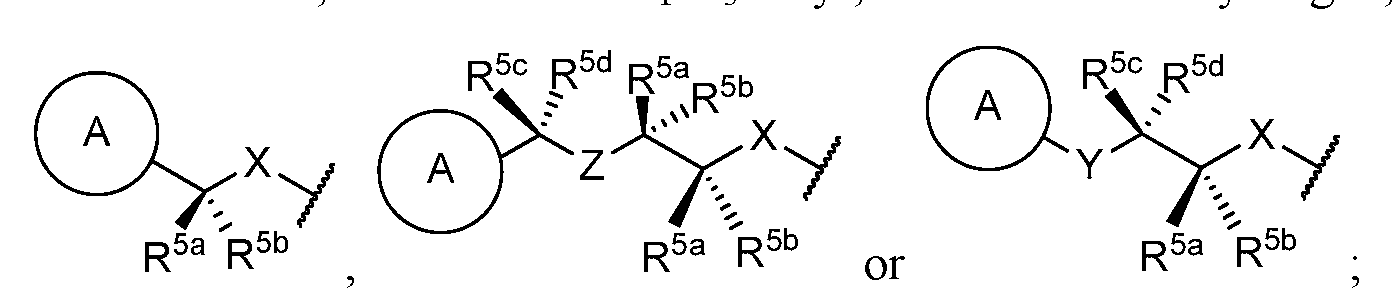
X, Y and Z are each independently selected from a bond, CR3eR , O and R ; R3a, R , R , R3a, R5e and R5f, at each occurrence, are independently selected from hydrogen and C1-C4 alkyl; R7 at each occurrence is independently selected from hydrogen and C1-C4 alkyl; and A is phenyl, pyridyl, pyrimidinyl, pyridazinyl, tetrahydropyranyl, pyrazolyl, imidazopyridinyl, mo holinyl, piperidinyl, wherein A is unsubstituted or substituted with 0-2 substituents selected from C1-C4 alkyl, halogen, cyano, C1-C4 alkoxy, and C1-C4 fluoroalkyl.
[00173] Representative compounds of formula (lb) include, but are not limited to:
4-(4-fluorophenyl)-5-((tetrahydro-2H-pyran-4-yl)methoxy)picolinonitrile;
4- (4-fluorophenyl)-5-(pyridin-3-ylmethoxy)picolinonitrile;
5- ((3-cyanobenzyl)oxy)-4-(4-fluorophenyl)picolinonitrile;
5-((3,5-difluorobenzyl)oxy)-4-(4-fluorophenyl)picolinonitrile;
5-((5-chloropyridin-3-yl)methoxy)-4-(4-fluorophenyl)picolinonitrile;
4-(4-fluorophenyl)-5-((6-methylpyridin-3-yl)methoxy)picolinonitrile;
4- (4-fluorophenyl)-5-((6-methoxypyridin-3-yl)methoxy)picolinonitrile;
5- ((6-chloropyridin-3-yl)methoxy)-4-(4-fluorophenyl)picolinonitrile;
4-(4-fluorophenyl)-5-(l-(pyridin-3-yl)ethoxy)picolinonitrile;
4-(4-fluorophenyl)-5-(pyridin-4-ylmethoxy)picolinonitrile;
4-(4-fluorophenyl)-5-((2-methylpyridin-4-yl)methoxy)picolinonitrile;
4-(4-fluorophenyl)-5-(l-(pyridin-4-yl)ethoxy)picolinonitrile;
4-(4-fluorophenyl)-5-((2-(trifluoromethyl)pyridin-4-yl)methoxy)picolinonitrile;
4-(4-fluorophenyl)-5-(imidazo[l,2-a]pyridin-6-ylmethoxy)picolinonitrile; 4-(4-fluorophenyl)-5-((l -methyl- lH-pyrazol-3-yl)methoxy)picolinonitrile; 4-(4-fluorophenyl)-5-(2-(pyridin-3-yl)ethoxy)picolinonitrile;
4- (4-fluorophenyl)-5-(2-mo holinoethoxy)picolinonitrile;
5- (2-((cis)-2,6-dimethylmorpholino)ethoxy)-4-(4-fluorophenyl)picolinonitrile;
4-(4-fluorophenyl)-5-(3-mo holinopropoxy)picolinonitrile;
4- (4-fluorophenyl)-5-(3-(2-methylmo holino)propoxy)picolinonitrile;
5- (3-(2,2-dimethylmorpholino)propoxy)-4-(4-fluorophenyl)picolinonitrile; 5-(3-(4,4-difluoropiperidin-l-yl)propoxy)-4-(4-fluorophenyl)picolinonitrile; 4-(4-fluorophenyl)-5-(2-(pyridin-3-yloxy)ethoxy)picolinonitrile;
4-(4-fluorophenyl)-5-(2-((2-methylpyrimidin-5-yl)oxy)ethoxy)picolinonitrile; 4-(4-fluorophenyl)-5-(2-((6-methylpyridin-3-yl)oxy)propoxy)picolinonitrile; 4-(4-fluorophenyl)-5-(2-((2-(trifluoromethyl)pyridin-4-yl)oxy)propoxy)picolinonitrile; 4-(4-fluorophenyl)-5-((l-(2-(trifluoromethyl)pyridin-4-yl)piperidin-4- yl)oxy)picolinonitrile;
4-(4-fluorophenyl)-5-((l-(2-(trifluoromethyl)pyridin-4-yl)pyrrolidin-3- yl)oxy)picolinonitrile;
4-(4-fluorophenyl)-5-((l-(2-(trifluoromethyl)pyridin-4-yl)azetidin-3- yl)oxy)picolinonitrile;
4-(4-fluorophenyl)-5-(3-((2-methylpyrimidin-5-yl)oxy)propoxy)picolinonitrile;
4-(4-fluorophenyl)-5-(3-(pyridin-3-yloxy)propoxy)picolinonitrile;
4-(4-fluorophenyl)-5-(3-((6-(trifluoromethyl)pyridin-3-yl)oxy)propoxy)picolinonitrile;
4-(4-fluorophenyl)-5-(3-((2-(trifluoromethyl)pyridin-4-yl)oxy)propoxy)picolinonitrile;
4-(4-fluorophenyl)-5-(3-((6-methylpyridin-3-yl)oxy)propoxy)picolinonitrile;
4- (4-fluorophenyl)-5-((2-((5-fluoropyridin-3- yl)methoxy)ethyl)(methyl)amino)picolinonitrile;
5- (2-(benzyloxy)ethoxy)-4-(4-fluorophenyl)picolinonitrile;
4-(4-fluorophenyl)-5-(((tetrahydro-2H-pyran-4-yl)methyl)amino)picolinonitrile;
4-(4-fluorophenyl)-5-((2-morpholinoethyl)amino)picolinonitrile;
4-(4-fluorophenyl)-5-(methyl(2-morpholinoethyl)amino)picolinonitrile;
4-(4-fluorophenyl)-5-((l-morpholinopropan-2-yl)amino)picolinonitrile;
4-(4-fluorophenyl)-5-((2-morpholinopropyl)amino)picolinonitrile;
4-(4-fluorophenyl)-5-((3-morpholinopropyl)amino)picolinonitrile;
4-(4-fluorophenyl)-5-(2-((tetrahydro-2H-pyran-2-yl)oxy)ethoxy)picolinonitrile;
4- (4-fluorophenyl)-5-(4-hydroxypiperidin-l-yl)picolinonitrile;
5- ((2,2-dimethylmorpholino)methyl)-4-(4-fluorophenyl)picolinonitrile;
4-(4-fluorophenyl)-5-(((2-(trifluoromethyl)pyridin-4-yl)oxy)methyl)picolinonitrile;
4-(4-fluorophenyl)-5-(2-((2-(trifluoromethyl)pyridin-4-yl)oxy)ethoxy)picolinonitrile; and
4-(4-fluorophenyl)-5-(4-((6-(trifluoromethyl)pyridin-3-yl)oxy)piperidin-l- yl)picolinonitrile; or pharmaceutically acceptable salts thereof.
[00174] Compound names are assigned by using Struct=Name naming algorithm as part of CHEMDRAW® ULTRA v. 12.0.
[00175] The compound may exist as a stereoisomer wherein asymmetric or chiral centers are present. The stereoisomer is "R" or "S" depending on the configuration of substituents around the chiral carbon atom. The terms "R" and "S" used herein are configurations as defined in IUPAC 1974 Recommendations for Section E, Fundamental Stereochemistry, in Pure Appl. Chem., 1976, 45: 13-30. The disclosure contemplates various stereoisomers and mixtures thereof and these are specifically included within the scope of this invention. Stereoisomers include enantiomers and diastereomers, and mixtures of enantiomers or diastereomers.
Individual stereoisomers of the compounds may be prepared synthetically from commercially available starting materials, which contain asymmetric or chiral centers or by preparation of racemic mixtures followed by methods of resolution well-known to those of ordinary skill in the art. These methods of resolution are exemplified by (1) attachment of a mixture of enantiomers to a chiral auxiliary, separation of the resulting mixture of diastereomers by recrystallization or chromatography and optional liberation of the optically pure product from the auxiliary as described in Furniss, Hannaford, Smith, and Tatchell, "Vogel's Textbook of Practical Organic Chemistry", 5th edition (1989), Longman Scientific & Technical, Essex CM20 2JE, England, or
(2) direct separation of the mixture of optical enantiomers on chiral chromatographic columns or
(3) fractional recrystallization methods.
[00176] It should be understood that the compound may possess tautomeric forms, as well as geometric isomers, and that these also constitute an aspect of the invention.
[00177] The present disclosure also includes an isotopically -labeled compound, which is identical to those recited in formula (I), but for the fact that one or more atoms are replaced by an atom having an atomic mass or mass number different from the atomic mass or mass number usually found in nature. Examples of isotopes suitable for inclusion in the compounds of the invention are hydrogen, carbon, nitrogen, oxygen, phosphorus, sulfur, fluorine, and chlorine, such as, but not limited to 2H, 3H, 13C, 14C, 15N, 180, 170, 31P, 32P, 35S, 18F, and 36C1, respectively.
Substitution with heavier isotopes such as deuterium, i.e., 2H, can afford certain therapeutic advantages resulting from greater metabolic stability, for example increased in vivo half-life or reduced dosage requirements and, hence, may be preferred in some circumstances. The compound may incorporate positron-emitting isotopes for medical imaging and positron-emitting tomography (PET) studies for determining the distribution of receptors. Suitable positron-
11 13 15 18 emitting isotopes that can be incorporated in compounds of formula (I) are L LC, "N, iJ0, and i0F. Isotopically-labeled compounds of formula (I) can generally be prepared by conventional techniques known to those skilled in the art or by processes analogous to those described in the accompanying Examples using appropriate isotopically-labeled reagent in place of non- isotopically-labeled reagent.
D. Allosteric Modulation of mGlu2
[00178] The disclosed compounds may act or function as non-competitive antagonists, allosteric inhibitors, allosteric antagonists, or negative allosteric modulators (NAM) of mGlu2. The compounds may be procognitive and neuroprotective even in the presence of mGlu2 dysfunction.
[00179] Compounds of formula (I) can inhibit mGlu2 with an IC50 ranging from about 1 nM to about 30 μΜ. The compounds may have an IC50 of about 30 μΜ, about 29 μΜ, about 28 μΜ, about 27 μΜ, about 26 μΜ, about 25 μΜ, about 24 μΜ, about 23 μΜ, about 22 μΜ, about 21 μΜ, about 20 μΜ, about 19 μΜ, about 18 μΜ, about 17 μΜ, about 16 μΜ, about 15 μΜ, about 14 μΜ, about 13 μΜ, about 12 μΜ, about 1 1 μΜ, about 10 μΜ, about 9 μΜ, about 8 μΜ, about 7 μΜ, about 6 μΜ, about 5 μΜ, about 4 μΜ, about 3 μΜ, about 2 μΜ, about 1 μΜ, about 950 nM, about 900 nM, about 850 nM, about 800 nM, about 850 nM, about 800 nM, about 750 nM, about 700 nM, about 650 nM, about 600 nM, about 550 nM, about 500 nM, about 450 nM, about 400 nM, about 350 nM, about 300 nM, about 250 nM, about 200 nM, about 150 nM, about 100 nM, about 50 nM, about 10 nM, about 5 nM, or about 1 nM. Compounds of formula (I) can inhibit mGlu2 with an IC50 of less than 30 μΜ, less than 29 μΜ, less than 28 μΜ, less than 27 μΜ, less than 26 μΜ, less than 25 μΜ, less than 24 μΜ, less than 23 μΜ, less than 22 μΜ, less than 21 μΜ, less than 20 μΜ, less than 19 μΜ, less than 18 μΜ, less than 17 μΜ, less than 16 μΜ, less than 15 μΜ, less than 14 μΜ, less than 13 μΜ, less than 12 μΜ, less than 1 1 μΜ, less than 10 μΜ, less than 9 μΜ, less than 8 μΜ, less than 7 μΜ, less than 6 μΜ, less than 5 μΜ, less
than 4 μΜ, less than 3 μΜ, less than 2 μΜ, less than 1 μΜ, less than 950 nM, less than 900 nM, less than 850 nM, less than 800 nM, less than 850 nM, less than 800 nM, less than 750 nM, less than 700 nM, less than 650 nM, less than 600 nM, less than 550 nM, less than 500 nM, less than 450 nM, less than 400 nM, less than 350 nM, less than 300 nM, less than 250 nM, less than 200 nM, less than 150 nM, less than 100 nM, less than 50 nM, less than 10 nM, less than 5 nM, or less than 1 nM.
[00180] Compounds of formula (I) may be selective modulators of mGlu2 over mGlu3. The compounds may have a ratio of mGlu2 IC50 to mGlu3 EC50 of at least 100, at least 95, at least 90, at least 85, at least 80, at least 75, at least 70, at least 64, at least 60, at least 55, at least 50, at least 45, at least 40, at least 35, at least 33, at least 31, at least 30, at least 29, at least 28, at least 27, at least 26, at least 25, at least 24, at least 23, at least 22, at least 21, at least 20, at least 19, at least 18, at least 17, at least 16, at least 15, at least 14, at least 13, at least 12, at least 11, at least 10, at least 9, at least 8, at least 7, at least 6, at least 5, at least 4, at least 3, or at least 2.
Compounds of formula (I) may have a ratio of mGlu2 IC50 to mGlu3 EC50 of about 100, about 95, about 90, about 85, about 80, about 75, about 70, about 64, about 60, about 55, about 50, about 45, about 40, about 35, about 33, about 31, about 30, about 29, about 28, about 27, about 26, about 25, about 24, about 23, about 22, about 21, about 20, about 19, about 18, about 17, about 16, about 15, about 14, about 13, about 12, about 11, about 10, about 9, about 8, about 7, about 6, about 5, about 4, about 3, or about 2.
[00181] Compounds of formula (I) may be selective modulators of mGlu2 over mGlu5. The compounds may have a ratio of mGlu2 IC50 to mGlu5 EC50 of at least 100, at least 95, at least 90, at least 85, at least 80, at least 75, at least 70, at least 64, at least 60, at least 55, at least 50, at least 45, at least 40, at least 35, at least 33, at least 31, at least 30, at least 29, at least 28, at least 27, at least 26, at least 25, at least 24, at least 23, at least 22, at least 21, at least 20, at least 19, at least 18, at least 17, at least 16, at least 15, at least 14, at least 13, at least 12, at least 11, at least 10, at least 9, at least 8, at least 7, at least 6, at least 5, at least 4, at least 3, or at least 2.
Compounds of formula (I) may have a ratio of mGlu2 IC50 to mGlu5 EC50 of about 100, about 95, about 90, about 85, about 80, about 75, about 70, about 64, about 60, about 55, about 50, about 45, about 40, about 35, about 33, about 31, about 30, about 29, about 28, about 27, about 26, about 25, about 24, about 23, about 22, about 21, about 20, about 19, about 18, about 17, about
16, about 15, about 14, about 13, about 12, about 11, about 10, about 9, about 8, about 7, about 6, about 5, about 4, about 3, or about 2.
[00182] The disclosed compounds may exist as pharmaceutically acceptable salts. The term "pharmaceutically acceptable salt" refers to salts or zwitterions of the compounds which are water or oil-soluble or dispersible, suitable for treatment of disorders without undue toxicity, irritation, and allergic response, commensurate with a reasonable benefit/risk ratio and effective for their intended use. The salts may be prepared during the final isolation and purification of the compounds or separately by reacting an amino group of the compounds with a suitable acid. For example, a compound may be dissolved in a suitable solvent, such as but not limited to methanol and water and treated with at least one equivalent of an acid, like hydrochloric acid. The resulting salt may precipitate out and be isolated by filtration and dried under reduced pressure. Alternatively, the solvent and excess acid may be removed under reduced pressure to provide a salt. Representative salts include acetate, adipate, alginate, citrate, aspartate, benzoate, benzenesulfonate, bisulfate, butyrate, camphorate, camphorsulfonate, digluconate,
glycerophosphate, hemisulfate, heptanoate, hexanoate, formate, isethionate, fumarate, lactate, maleate, methanesulfonate, naphthylenesulfonate, nicotinate, oxalate, pamoate, pectinate, persulfate, 3-phenylpropionate, picrate, oxalate, maleate, pivalate, propionate, succinate, tartrate, thrichloroacetate, trifluoroacetate, glutamate, para-toluenesulfonate, undecanoate, hydrochloric, hydrobromic, sulfuric, phosphoric and the like. The amino groups of the compounds may also be quaternized with alkyl chlorides, bromides and iodides such as methyl, ethyl, propyl, isopropyl, butyl, lauryl, myristyl, stearyl and the like.
[00183] Basic addition salts may be prepared during the final isolation and purification of the disclosed compounds by reaction of a carboxyl group with a suitable base such as the hydroxide, carbonate, or bicarbonate of a metal cation such as lithium, sodium, potassium, calcium, magnesium, or aluminum, or an organic primary, secondary, or tertiary amine. Quaternary amine salts can be prepared, such as those derived from methylamine, dimethylamine, trimethylamine, triethylamine, diethylamine, ethylamine, tributylamine, pyridine, N,N- dimethylaniline, N-methylpiperidine, N-methylmorpholine, dicyclohexylamine, procaine, dibenzylamine, Ν,Ν-dibenzylphenethylamine, 1-ephenamine and Ν,Ν'- dibenzylethylenediamine, ethylenediamine, ethanolamine, diethanolamine, piperidine, piperazine, and the like.
E. General Synthesis
[00184] Compounds of formula (I) may be prepared by synthetic processes or by metabolic processes. Preparation of the compounds by metabolic processes includes those occurring in the human or animal body (in vivo) or processes occurring in vitro.
[00185] Compounds of formula (I), wherein the groups R1, R2a, R2b, R3, and R4 have the meanings as set forth in the Summary of the Invention section unless otherwise noted, can be synthesized as shown in Schemes 1-14.
[00186] Abbreviations which have been used in the descriptions of the Schemes that follow are: AcOH for acetic acid; DlBAD for di-tert-butylazodicarboxylate; DIEA for
diisopropylethylamine; DME for dimethoxyethane; DMF for dimethylformamide; dppf for 1, 1'- bis(diphenylphosphino)ferrocene; NEt3 for triethylamine; MO for 4-methylmorpholine N- oxide; THF for tetrahydrofuran. of intermediate

viii vii
[00187] As shown in Scheme 1, intermediate viii, wherein R2a and R2b are as defined in the Summary of the Invention and LG is CI, Br, I, or OS02CF3, can be prepared from compound i. Compound i can be reacted in a palladium catalyzed Suzuki coupling with reagents such as ii or iii, wherein R1 is as defined in the Summary of the Invention, to yield intermediate iv.
Intermediate iv can be heated in aqueous acetic acid solution to afford intermediate v.
Intermediate v can be treated with reagent vi and base to afford intermediate vii. Intermediate vii can be reacted in a palladium catalyzed coupling with zinc cyanide to provide intermediate viii.
Scheme 2. Synthesis of intermediate xiii

xiii
[00188] Scheme 2 illustrates the conversion of intermediate viii to intermediate xiii.
Intermediate viii can be treated with sodium hydride and water to give intermediate ix.
Intermediate ix can be treated with reagent vi and base to afford intermediate x. Intermediate x may be converted to alkene xii via a palladium catalyzed coupling reaction with potassium vinyltrifluoroborate xi, wherein R5a is as defined in the Summary of the Invention. Treatment of intermediate xii with osmium tetroxide and NMO can form the corresponding diol, which can be reacted in situ with sodium (meta)periodate to afford intermediate xiii. heme 3. Synthesis of intermediate xv

XII I XV
[00189] Scheme 3 illustrates the conversion of intermediate xiii to intermediate xv.
Intermediate xiii can be treated with a reagent xiv, wherein M is a group that renders R5b nucleophilic, wherein R5b is as defined in the Summary of the Invention, to provide intermediate xv.
Scheme 4. Synthesis of intermediate xviii

[00190] Scheme 4 illustrates the conversion of intermediate viii to intermediate xviii.
Intermediate viii can be treated with the sodium alkoxide of compound xvi, wherein each R5, Z, p, and q is as defined in the Summary of the Invention and PG is an acid labile protecting group, to provide ether intermediate xvii. The sodium alkoxide of xvi can be prepared in situ by treatment of xvi with sodium hydride. Treatment of intermediate xvii with a suitable acid can afford the alcohol intermediate xviii.
Scheme 5. S nthesis of intermediate xxvi intermediate xxvii, and the compound of formula (I)

[00191] Scheme 5 illustrates the conversion of intermediate viii to intermediate xxvi,
intermediate xxvii, and the compound of formula (I). Reaction of intermediate viii with amine xix, wherein each R5a, R5b, R5c, R5d, R5e, R5f, R7, Z, p, and q is as defined in the Summary of the
Invention, or amine xxiii, wherein each R5a, R5b, R5c, R5d, R5e, R5f, R8, Z, p, q, n and m is as defined in the Summary of the Invention, yields intermediates xxvi and xxvii, respectively.
Likewise, reaction of intermediate viii with amines xx, wherein each R5a, R5b, R5c, R5d, R5e, R5f,
R6a, R6b, R7, Z, p, and q is as defined in the Summary of the Invention, amine xxi, wherein each
R5a, R5b, R5c, R5d, R5e, R5f, R7, Z, p, q, Y, and A is as defined in the Summary of the Invention, amine xxii, wherein each R5a, R5b, R5c, R5d, R5e, R5f, R7, Z, p, q, A', Y, and A is as defined in the
Summary of the Invention, amine xxiv, wherein each R5a, R5b, R5c, R5d, R5e, R5f, R6a, R6b, R8, Z, p, q, n and m is as defined in the Summary of the Invention, or amine xxv, wherein each R5a, R5b,
R5c, R5d, R5e, R5f, R8, Z, p, q, m, n, Y, and A is as defined in the Summary of the Invention, can
provide the compound of formula (I). The reaction may be optionally heated with or without the addition of a tertiary alkyl amine base (e.g., triethylamine, diisopropylethylamine). heme 6. Synthesis of the compound of formula (I)

[00192] Scheme 6 illustrates the conversion of intermediate viii to the compound of formula (I). Intermediate viii can be treated with the sodium alkoxide of compound xxviii, wherein each R5a, R5b, R5c, R5d, R5e, R5f, R6a, R6b, Z, p, and q is as defined in the Summary of the Invention, compound xxix, wherein each R5a, R5b, R5c, R5d, R5e, R5f, Z, p, q, Y, and A is as defined in the Summary of the Invention, or compound xxx, wherein each R5a, R5b, R5c, R5d, R5e, R5f, Z, p, q, A', Y and A is as defined in the Summary of the Invention, to provide the nitrile compound of formula (I). In certain cases, the amide compound of formula (I) is produced as well, presumably due to the presence of trace water in the reagents and/or solvent. The sodium alkoxides of xviii, xxix, and xxx can be prepared in situ by treatment of each with sodium hydride.
Scheme 7. S nthesis of the compound of formula (I)

[00193] Scheme 7 illustrates the conversion of intermediate xiii to the compound of formula (I). Intermediate xiii can be treated with an amine xxxi, wherein R6a and R6b are as defined in the Summary of the Invention, and reagent xiv to provide the compound of formula (I).
Scheme 8. Synthesis of the compound of formula (I)

[00194] Scheme 8 illustrates the synthesis of the compound of formula (I) from intermediate xv. Pyridine xv may be reacted in a Mitsunobu reaction with alcohol xxxii, wherein, A is as defined in the Summary of the Invention, to produce the compound of formula (I).
Scheme 9. S nthesis of the compound of formula (I)

[00195] Scheme 9 illustrates the synthesis of the compound of formula (I) from intermediates xviii and xxvi. Both intermediate xviii and intermediate xxvi may be independently reacted in a Mitsunobu reaction with alcohol xxxii to produce the compound of formula (I). heme 10. Synthesis of the compound of formula (I)

XXVII (I)

[00196] Scheme 10 illustrates the synthesis of the compound of formula (I) from intermediate xxvii. Intermediate xxvii may be reacted in a Mitsunobu reaction with alcohol xxxii to produce the compound of formula (I).
Scheme 11. Synthesis of the compound of formula (I)

[00197] Scheme 11 illustrates the synthesis of the compound of formula (I) from intermediates xviii and xxvi. Both intermediate xviii and intermediate xxvi may be independently reacted with methanesulfonyl chloride to produce intermediate mesylates xxxiii and xxxiv, respectively. Treatment of xxxiii or xxxiv with amine xxxi can afford the compound of formula (I).
Scheme 12. Synthesis of the compound of formula (I)

[00198] Scheme 12 illustrates the synthesis of the compound of formula (I) from intermediates xviii and xxvi. Both intermediate xviii and intermediate xxvi may be independently reacted with methanesulfonyl chloride to produce intermediate mesylates xxxiii and xxxiv, respectively. Treatment of xxxiii or xxxiv with the sodium alkoxide of compound xxxii with optional heating can afford the compound of formula (I). The sodium alkoxide of xxxii can be prepared in situ by treatment of xxii with sodium hydride.
Scheme 13. Synthesis of the compound of formula (I)

[00199] Scheme 13 illustrates the synthesis of the compound of formula (I) from intermediates xviii and xxvi. Both intermediate xviii and intermediate xxvi may be independently converted to their respective sodium alkoxides via in situ by treatment with sodium hydride and reacted with
compound xxxv, where each R a, R , R c, R , R e, R , q, and A is as defined in the Summary of the Invention, and LG is CI, Br, I, OS02CH3, OS02CF3, OS02Ph, or OS02(p-tolyl), to provide the compound of formula (I).
Scheme 14. Synthesis of the compound of formula (I)

[00200] Scheme 14 illustrates the synthesis of the amide compound of formula (I) from the nitrile compound of formula (I). The nitrile compound of formula (I), wherein R1, R2a, R2b, and R3 are as defined in the Summary of Invention, may be prepared according to methods outlined in Schemes 1-13. Treatment of the nitrile compound of formula (I) with potassium
trimethylsilanolate with heating can provide the amide compound of formula (I).
Scheme 15. Synthesis of the compound of formula (I)

(I) (I)
R3 contains an aryl or R3 contains an aryl or
heteroaryl ring substituted with heteroaryl ring substituted chlorine, bromine, or iodine with cyano
[00201] Scheme 15 illustrates the synthesis of a compound of formula (I) with an R3 group containing an aryl or heteroaryl ring substituted with a cyano group from another compound of formula (I) with an R3 group containing an aryl or heteroaryl ring substituted with chlorine, bromine, or iodine. The compound of formula (I) with the requisite R3 group, wherein R1, R2a,
R2b and R3 are as defined in the Summary of Invention, may be prepared according to methods outlined in Schemes 1-6, Schemes 8-10, and Schemes 12-14. Treatment of the compound of formula (I) with the requisite R3 group with a palladium catalyst and zinc cyanide can provide
the corresponding compound of formula (I) with an R group containing an aryl or heteroaryl ring substituted with a cyano group.
[00202] The compounds and intermediates may be isolated and purified by methods well- known to those skilled in the art of organic synthesis. Examples of conventional methods for isolating and purifying compounds can include, but are not limited to, chromatography on solid supports such as silica gel, alumina, or silica derivatized with alkylsilane groups, by
recrystallization at high or low temperature with an optional pretreatment with activated carbon, thin-layer chromatography, distillation at various pressures, sublimation under vacuum, and trituration, as described for instance in "Vogel's Textbook of Practical Organic Chemistry", 5th edition (1989), by Furniss, Hannaford, Smith, and Tatchell, pub. Longman Scientific &
Technical, Essex CM20 2JE, England.
[00203] A disclosed compound may have at least one basic nitrogen whereby the compound can be treated with an acid to form a desired salt. For example, a compound may be reacted with an acid at or above room temperature to provide the desired salt, which is deposited, and collected by filtration after cooling. Examples of acids suitable for the reaction include, but are not limited to tartaric acid, lactic acid, succinic acid, as well as mandelic, atrolactic,
methanesulfonic, ethanesulfonic, toluenesulfonic, naphthalenesulfonic, benzenesulfonic, carbonic, fumaric, maleic, gluconic, acetic, propionic, salicylic, hydrochloric, hydrobromic, phosphoric, sulfuric, citric, hydroxybutyric, camphorsulfonic, malic, phenylacetic, aspartic, or glutamic acid, and the like.
[00204] Optimum reaction conditions and reaction times for each individual step can vary depending on the particular reactants employed and substituents present in the reactants used. Specific procedures are provided in the Examples section. Reactions can be worked up in the conventional manner, e.g. by eliminating the solvent from the residue and further purified according to methodologies generally known in the art such as, but not limited to, crystallization, distillation, extraction, trituration and chromatography. Unless otherwise described, the starting materials and reagents are either commercially available or can be prepared by one skilled in the art from commercially available materials using methods described in the chemical literature. Starting materials, if not commercially available, can be prepared by procedures selected from standard organic chemical techniques, techniques that are analogous to the synthesis of known,
structurally similar compounds, or techniques that are analogous to the above described schemes or the procedures described in the synthetic examples section.
[00205] Routine experimentations, including appropriate manipulation of the reaction conditions, reagents and sequence of the synthetic route, protection of any chemical functionality that cannot be compatible with the reaction conditions, and deprotection at a suitable point in the reaction sequence of the method are included in the scope of the invention. Suitable protecting groups and the methods for protecting and deprotecting different substituents using such suitable protecting groups are well known to those skilled in the art; examples of which can be found in PGM Wuts and TW Greene, in Greene's book titled Protective Groups in Organic Synthesis (4th ed.), John Wiley & Sons, NY (2006), which is incorporated herein by reference in its entirety. Synthesis of the compounds of the invention can be accomplished by methods analogous to those described in the synthetic schemes described hereinabove and in specific examples.
[00206] When an optically active form of a disclosed compound is required, it can be obtained by carrying out one of the procedures described herein using an optically active starting material (prepared, for example, by asymmetric induction of a suitable reaction step), or by resolution of a mixture of the stereoisomers of the compound or intermediates using a standard procedure (such as chromatographic separation, recrystallization or enzymatic resolution).
[00207] Similarly, when a pure geometric isomer of a compound is required, it can be obtained by carrying out one of the above procedures using a pure geometric isomer as a starting material, or by resolution of a mixture of the geometric isomers of the compound or intermediates using a standard procedure such as chromatographic separation.
[00208] It can be appreciated that the synthetic schemes and specific examples as described are illustrative and are not to be read as limiting the scope of the invention as it is defined in the appended claims. All alternatives, modifications, and equivalents of the synthetic methods and specific examples are included within the scope of the claims.
3. Pharmaceutical compositions
[00209] The disclosed compounds may be incorporated into pharmaceutical compositions suitable for administration to a subject (such as a patient, which may be a human or non-human).
[00210] The pharmaceutical compositions may include a "therapeutically effective amount" or a "prophylactically effective amount" of the agent. A "therapeutically effective amount" refers to an amount effective, at dosages and for periods of time necessary, to achieve the desired
therapeutic result. A therapeutically effective amount of the composition may be determined by a person skilled in the art and may vary according to factors such as the disease state, age, sex, and weight of the individual, and the ability of the composition to elicit a desired response in the individual. A therapeutically effective amount is also one in which any toxic or detrimental effects of a compound of the invention [e.g., a compound of formula (I)] are outweighed by the therapeutically beneficial effects. A "prophylactically effective amount" refers to an amount effective, at dosages and for periods of time necessary, to achieve the desired prophylactic result. Typically, since a prophylactic dose is used in subjects prior to or at an earlier stage of disease, the prophylactically effective amount will be less than the therapeutically effective amount.
[00211] For example, a therapeutically effective amount of a compound of formula (I), may be about 1 mg/kg to about 1000 mg/kg, about 5 mg/kg to about 950 mg/kg, about 10 mg/kg to about 900 mg/kg, about 15 mg/kg to about 850 mg/kg, about 20 mg/kg to about 800 mg/kg, about 25 mg/kg to about 750 mg/kg, about 30 mg/kg to about 700 mg/kg, about 35 mg/kg to about 650 mg/kg, about 40 mg/kg to about 600 mg/kg, about 45 mg/kg to about 550 mg/kg, about 50 mg/kg to about 500 mg/kg, about 55 mg/kg to about 450 mg/kg, about 60 mg/kg to about 400 mg/kg, about 65 mg/kg to about 350 mg/kg, about 70 mg/kg to about 300 mg/kg, about 75 mg/kg to about 250 mg/kg, about 80 mg/kg to about 200 mg/kg, about 85 mg/kg to about 150 mg/kg, and about 90 mg/kg to about 100 mg/kg.
[00212] The pharmaceutical compositions may include pharmaceutically acceptable carriers. The term "pharmaceutically acceptable carrier," as used herein, means a non-toxic, inert solid, semi-solid or liquid filler, diluent, encapsulating material or formulation auxiliary of any type. Some examples of materials which can serve as pharmaceutically acceptable carriers are sugars such as, but not limited to, lactose, glucose and sucrose; starches such as, but not limited to, corn starch and potato starch; cellulose and its derivatives such as, but not limited to, sodium carboxymethyl cellulose, ethyl cellulose and cellulose acetate; powdered tragacanth; malt;
gelatin; talc; excipients such as, but not limited to, cocoa butter and suppository waxes; oils such as, but not limited to, peanut oil, cottonseed oil, safflower oil, sesame oil, olive oil, corn oil and soybean oil; glycols; such as propylene glycol; esters such as, but not limited to, ethyl oleate and ethyl laurate; agar; buffering agents such as, but not limited to, magnesium hydroxide and aluminum hydroxide; alginic acid; pyrogen-free water; isotonic saline; Ringer's solution; ethyl alcohol, and phosphate buffer solutions, as well as other non-toxic compatible lubricants such as,
but not limited to, sodium lauryl sulfate and magnesium stearate, as well as coloring agents, releasing agents, coating agents, sweetening, flavoring and perfuming agents, preservatives and antioxidants can also be present in the composition, according to the judgment of the formulator.
[00213] Thus, the compounds and their physiologically acceptable salts and solvates may be formulated for administration by, for example, solid dosing, eyedrop, in a topical oil-based formulation, injection, inhalation (either through the mouth or the nose), implants, or oral, buccal, parenteral, or rectal administration. Techniques and formulations may generally be found in "Remington's Pharmaceutical Sciences", (Meade Publishing Co., Easton, Pa.).
Therapeutic compositions must typically be sterile and stable under the conditions of
manufacture and storage.
[00214] The route by which the disclosed compounds are administered and the form of the composition will dictate the type of carrier to be used. The composition may be in a variety of forms, suitable, for example, for systemic administration (e.g., oral, rectal, nasal, sublingual, buccal, implants, or parenteral) or topical administration (e.g., dermal, pulmonary, nasal, aural, ocular, liposome delivery systems, or iontophoresis).
[00215] Carriers for systemic administration typically include at least one of diluents, lubricants, binders, disintegrants, colorants, flavors, sweeteners, antioxidants, preservatives, glidants, solvents, suspending agents, wetting agents, surfactants, combinations thereof, and others. All carriers are optional in the compositions.
[00216] Suitable diluents include sugars such as glucose, lactose, dextrose, and sucrose; diols such as propylene glycol; calcium carbonate; sodium carbonate; sugar alcohols, such as glycerin; mannitol; and sorbitol. The amount of diluent(s) in a systemic or topical composition is typically about 50 to about 90%.
[00217] Suitable lubricants include silica, talc, stearic acid and its magnesium salts and calcium salts, calcium sulfate; and liquid lubricants such as polyethylene glycol and vegetable oils such as peanut oil, cottonseed oil, sesame oil, olive oil, corn oil and oil of theobroma. The amount of lubricant(s) in a systemic or topical composition is typically about 5 to about 10%.
[00218] Suitable binders include polyvinyl pyrrolidone; magnesium aluminum silicate;
starches such as corn starch and potato starch; gelatin; tragacanth; and cellulose and its derivatives, such as sodium carboxymethylcellulose, ethyl cellulose, methylcellulose,
microcrystalline cellulose, and sodium carboxymethylcellulose. The amount of binder(s) in a systemic composition is typically about 5 to about 50%.
[00219] Suitable disintegrants include agar, alginic acid and the sodium salt thereof, effervescent mixtures, croscarmelose, crospovidone, sodium carboxymethyl starch, sodium starch glycolate, clays, and ion exchange resins. The amount of disintegrant(s) in a systemic or topical composition is typically about 0.1 to about 10%.
[00220] Suitable colorants include a colorant such as an FD&C dye. When used, the amount of colorant in a systemic or topical composition is typically about 0.005 to about 0.1%.
[00221] Suitable flavors include menthol, peppermint, and fruit flavors. The amount of flavor(s), when used, in a systemic or topical composition is typically about 0.1 to about 1.0%.
[00222] Suitable sweeteners include aspartame and saccharin. The amount of sweetener(s) in a systemic or topical composition is typically about 0.001 to about 1%.
[00223] Suitable antioxidants include butylated hydroxyanisole ("BHA"), butylated
hydroxytoluene ("BHT"), and vitamin E. The amount of antioxidant(s) in a systemic or topical composition is typically about 0.1 to about 5%.
[00224] Suitable preservatives include benzalkonium chloride, methyl paraben and sodium benzoate. The amount of preservative(s) in a systemic or topical composition is typically about 0.01 to about 5%.
[00225] Suitable glidants include silicon dioxide. The amount of glidant(s) in a systemic or topical composition is typically about 1 to about 5%.
[00226] Suitable solvents include water, isotonic saline, ethyl oleate, glycerine, hydroxylated castor oils, alcohols such as ethanol, and phosphate buffer solutions. The amount of solvent(s) in a systemic or topical composition is typically from about 0 to about 100%.
[00227] Suitable suspending agents include AVICEL RC-591 (from FMC Corporation of Philadelphia, PA) and sodium alginate. The amount of suspending agent(s) in a systemic or topical composition is typically about 1 to about 8%.
[00228] Suitable surfactants include lecithin, Polysorbate 80, and sodium lauryl sulfate, and the TWEENS from Atlas Powder Company of Wilmington, Delaware. Suitable surfactants include those disclosed in the C.T.F.A. Cosmetic Ingredient Handbook, 1992, pp.587-592; Remington's Pharmaceutical Sciences, 15th Ed. 1975, pp. 335-337; and McCutcheon's Volume 1, Emulsifiers
& Detergents, 1994, North American Edition, pp. 236-239. The amount of surfactant(s) in the systemic or topical composition is typically about 0.1% to about 5%.
[00229] Although the amounts of components in the systemic compositions may vary depending on the type of systemic composition prepared, in general, systemic compositions include 0.01% to 50% of active [e.g., compound of formula (I)] and 50% to 99.99%) of one or more carriers. Compositions for parenteral administration typically include 0.1% to 10% of actives and 90% to 99.9% of a carrier including a diluent and a solvent.
[00230] Compositions for oral administration can have various dosage forms. For example, solid forms include tablets, capsules, granules, and bulk powders. These oral dosage forms include a safe and effective amount, usually at least about 5%, and more particularly from about 25%) to about 50% of actives. The oral dosage compositions include about 50% to about 95% of carriers, and more particularly, from about 50% to about 75%.
[00231] Tablets can be compressed, tablet triturates, enteric-coated, sugar-coated, film-coated, or multiple-compressed. Tablets typically include an active component, and a carrier comprising ingredients selected from diluents, lubricants, binders, disintegrants, colorants, flavors, sweeteners, glidants, and combinations thereof. Specific diluents include calcium carbonate, sodium carbonate, mannitol, lactose and cellulose. Specific binders include starch, gelatin, and sucrose. Specific disintegrants include alginic acid and croscarmelose. Specific lubricants include magnesium stearate, stearic acid, and talc. Specific colorants are the FD&C dyes, which can be added for appearance. Chewable tablets preferably contain sweeteners such as aspartame and saccharin, or flavors such as menthol, peppermint, fruit flavors, or a combination thereof.
[00232] Capsules (including implants, time release and sustained release formulations) typically include an active compound [e.g., a compound of formula (I)], and a carrier including one or more diluents disclosed above in a capsule comprising gelatin. Granules typically comprise a disclosed compound, and preferably glidants such as silicon dioxide to improve flow characteristics. Implants can be of the biodegradable or the non-biodegradable type.
[00233] The selection of ingredients in the carrier for oral compositions depends on secondary considerations like taste, cost, and shelf stability, which are not critical for the purposes of this invention.
[00234] Solid compositions may be coated by conventional methods, typically with pH or time-dependent coatings, such that a disclosed compound is released in the gastrointestinal tract
in the vicinity of the desired application, or at various points and times to extend the desired action. The coatings typically include one or more components selected from the group consisting of cellulose acetate phthalate, polyvinyl acetate phthalate, hydroxypropyl methyl cellulose phthalate, ethyl cellulose, EUDRAGIT coatings (available from Rohm & Haas G.M.B.H. of Darmstadt, Germany), waxes and shellac.
[00235] Compositions for oral administration can have liquid forms. For example, suitable liquid forms include aqueous solutions, emulsions, suspensions, solutions reconstituted from non-effervescent granules, suspensions reconstituted from non-effervescent granules, effervescent preparations reconstituted from effervescent granules, elixirs, tinctures, syrups, and the like. Liquid orally administered compositions typically include a disclosed compound and a carrier, namely, a carrier selected from diluents, colorants, flavors, sweeteners, preservatives, solvents, suspending agents, and surfactants. Peroral liquid compositions preferably include one or more ingredients selected from colorants, flavors, and sweeteners.
[00236] Other compositions useful for attaining systemic delivery of the subject compounds include sublingual, buccal and nasal dosage forms. Such compositions typically include one or more of soluble filler substances such as diluents including sucrose, sorbitol and mannitol; and binders such as acacia, microcrystalline cellulose, carboxymethyl cellulose, and hydroxypropyl methylcellulose. Such compositions may further include lubricants, colorants, flavors, sweeteners, antioxidants, and glidants.
[00237] The disclosed compounds can be topically administered. Topical compositions that can be applied locally to the skin may be in any form including solids, solutions, oils, creams, ointments, gels, lotions, shampoos, leave-on and rinse-out hair conditioners, milks, cleansers, moisturizers, sprays, skin patches, and the like. Topical compositions include: a disclosed compound [e.g., a compound of formula (I)], and a carrier. The carrier of the topical composition preferably aids penetration of the compounds into the skin. The carrier may further include one or more optional components.
[00238] The amount of the carrier employed in conjunction with a disclosed compound is sufficient to provide a practical quantity of composition for administration per unit dose of the medicament. Techniques and compositions for making dosage forms useful in the methods of this invention are described in the following references: Modern Pharmaceutics, Chapters 9 and
10, Banker & Rhodes, eds. (1979); Lieberman et al., Pharmaceutical Dosage Forms: Tablets (1981); and Ansel, Introduction to Pharmaceutical Dosage Forms, 2nd Ed., (1976).
[00239] A carrier may include a single ingredient or a combination of two or more ingredients. In the topical compositions, the carrier includes a topical carrier. Suitable topical carriers include one or more ingredients selected from phosphate buffered saline, isotonic water, deionized water, monofunctional alcohols, symmetrical alcohols, aloe vera gel, allantoin, glycerin, vitamin A and E oils, mineral oil, propylene glycol, PPG-2 myristyl propionate, dimethyl isosorbide, castor oil, combinations thereof, and the like. More particularly, carriers for skin applications include propylene glycol, dimethyl isosorbide, and water, and even more particularly, phosphate buffered saline, isotonic water, deionized water, monofunctional alcohols, and symmetrical alcohols.
[00240] The carrier of a topical composition may further include one or more ingredients selected from emollients, propellants, solvents, humectants, thickeners, powders, fragrances, pigments, and preservatives, all of which are optional.
[00241] Suitable emollients include stearyl alcohol, glyceryl monoricinoleate, glyceryl monostearate, propane- 1,2-diol, butane- 1, 3 -diol, mink oil, cetyl alcohol, isopropyl isostearate, stearic acid, isobutyl palmitate, isocetyl stearate, oleyl alcohol, isopropyl laurate, hexyl laurate, decyl oleate, octadecan-2-ol, isocetyl alcohol, cetyl palmitate, di-n-butyl sebacate, isopropyl myristate, isopropyl palmitate, isopropyl stearate, butyl stearate, polyethylene glycol, triethylene glycol, lanolin, sesame oil, coconut oil, arachis oil, castor oil, acetylated lanolin alcohols, petroleum, mineral oil, butyl myristate, isostearic acid, palmitic acid, isopropyl linoleate, lauryl lactate, myristyl lactate, decyl oleate, myristyl myristate, and combinations thereof. Specific emollients for skin include stearyl alcohol and polydimethylsiloxane. The amount of emollient(s) in a skin-based topical composition is typically about 5% to about 95%.
[00242] Suitable propellants include propane, butane, isobutane, dimethyl ether, carbon dioxide, nitrous oxide, and combinations thereof. The amount of propellant(s) in a topical composition is typically about 0% to about 95%.
[00243] Suitable solvents include water, ethyl alcohol, methylene chloride, isopropanol, castor
011, ethylene glycol monoethyl ether, diethylene glycol monobutyl ether, diethylene glycol monoethyl ether, dimethylsulfoxide, dimethyl formamide, tetrahydrofuran, and combinations
thereof. Specific solvents include ethyl alcohol and homotopic alcohols. The amount of solvent(s) in a topical composition is typically about 0% to about 95%.
[00244] Suitable humectants include glycerin, sorbitol, sodium 2-pyrrolidone-5-carboxylate, soluble collagen, dibutyl phthalate, gelatin, and combinations thereof. Specific humectants include glycerin. The amount of humectant(s) in a topical composition is typically 0% to 95%.
[00245] The amount of thickener(s) in a topical composition is typically about 0% to about 95%.
[00246] Suitable powders include beta-cyclodextrins, hydroxypropyl cyclodextrins, chalk, talc, fullers earth, kaolin, starch, gums, colloidal silicon dioxide, sodium polyacrylate, tetra alkyl ammonium smectites, trialkyl aryl ammonium smectites, chemically-modified magnesium aluminum silicate, organically-modified Montmorillonite clay, hydrated aluminum silicate, fumed silica, carboxyvinyl polymer, sodium carboxymethyl cellulose, ethylene glycol monostearate, and combinations thereof. The amount of powder(s) in a topical composition is typically 0% to 95%.
[00247] The amount of fragrance in a topical composition is typically about 0% to about 0.5%, particularly, about 0.001%) to about 0.1%>.
[00248] Suitable pH adjusting additives include HC1 or NaOH in amounts sufficient to adjust the pH of a topical pharmaceutical composition.
4. Methods of Treatment
[00249] The disclosed compounds and compositions may be used in methods for treatment of mGlu2 related medical disorders and/or diseases. The methods of treatment may comprise administering to a subject in need of such treatment a composition comprising a therapeutically effective amount of the compound of formula (I).
[00250] The compositions can be administered to a subject in need thereof to modulate mGlu2, for a variety of diverse biological processes. The present disclosure is directed to methods for administering the composition to inhibit mGlu2, a GPCR that plays a role in synaptic plasticity, which directly effects cognitive function and memory, for example.
[00251] The compositions may be useful for treating and preventing certain diseases and disorders in humans and animals related to mGlu2 dysfunction. Treatment or prevention of such diseases and disorders can be effected by modulating mGlu2 in a subject, by administering a
compound or composition of the invention, either alone or in combination with another active agent as part of a therapeutic regimen to a subject in need thereof.
A. Depression
[00252] Antidepressant-like effects of the mGlu2/3 receptor antagonists, MGS0039 and LY341495, were first demonstrated in the rat forced swim test (FST) and mouse tail-suspension test (TST) using normal animals (Chaki et al. Neuropharmacology, 2004, 46, 457-467). More recently, studies have attempted to evaluate the effects of these drugs in paradigms implicated in the etiology of human depression. MGS0039 exhibited antidepressant effects in the learned helplessness test where treatment with MGS0039 for 7 days significantly reduced the number of escape failures (Yoshimizu et al. Psychopharmacology, 2006, 186, 587-593).
[00253] Palucha-Poniewiera et al. Psychopharmacology, 2010, 212, 523-535 evaluated a potential antidepressant-like effect of MGS0039 in the olfactory bulbectomy (OB) model of depression in rats. A surgical lesion of the olfactory bulbs in animals is known to induce significant behavioral, physiological, endocrine and immune changes, many of which are qualitatively similar to those observed in depressive patients. Repeated administration of MGS0039 for 14 days attenuated the hyperactivity of olfactory bulbectomized rats in the open field test and attenuated the learning deficit in the passive avoidance test.
[00254] Kawasaki et al. Neuropharmacology, 2011, 60, 397-404 also examined the effect of MGS0039 on behaviors of social isolation-reared mice in the FST. Rearing rodents in isolation after weaning is known to lead to changes in brain neurochemistry that produce perturbations in behavior. Post-weaning chronic social isolation for more than 6 weeks increased immobility in the FST, suggesting that isolation rearing caused depression-like behavior. MGS0039 reversed the increased immobility of social isolation reared mice in the test.
[00255] Campo, B. et al. J. Neurogenetics 2011, 25, 152-166, demonstrated a selective group II (mGlu2 and mGlu3) negative allosteric modulator (R04491533) to be effective in several in vitro biochemical assays and in vivo models of depression. R04491533 was shown to engage the central mGlu2 and mGlu3 receptors as the compound reversed the hypolocomotor effect of an mGlu2/3 agonist (LY379268) in a target-specific manner. The known group II mGlu2/3 antagonist LY341495 achieved the same result. R04491533 and LY341495 dose-dependently reduced immobility time of C57B16/J mice in the FST. R04491533 and LY341495 were also active in the tail suspension test in a line of Helpless (H) mice, a putative genetic model of depression.
[00256] Blockade of mGlu2/3 receptors and ketamine may converge to the same neuronal circuits, which include activation of AMPA receptor and mTOR signaling. Because both AMPA receptor stimulation and subsequent mTOR signaling activation are presumed to be involved in rapid action of ketamine for patients with treatment-resistant depression (TRD), mGlu2/3 receptor antagonists could exert the same effects in humans. This assumption is underpinned by several animal studies. First, the mGlu2/3 receptor antagonist MGS0039 exhibited antidepressant effects in an animal model (the learned helplessness paradigm) which is refractory to currently prescribed antidepressants (Yoshimizu et al. Psychopharmacology, 2006, 186, 587-593). Second, although evidence of rapid onset of action with mGlu2/3 receptor antagonists are absent, an AMPA receptor potentiator (AMPA receptor potentiation mediates antidepressant effects of mGlu2/3 receptor antagonists) showed faster effects (during the first week of treatment) compared to fluoxetine (after two weeks) in a dominant-submissive test (Knapp et al. Eur. J. Pharmacol. 2002, 440, 121-125). Moreover, LY341495 exhibited a potent antidepressant effect in helpless mice following acute administration, while fluoxetine exerts a full antidepressant effect following chronic (21 days) treatment (Campo, B. et al. J. Neurogenetics 2011, 25, 152-166; El Yacoubi et al. PNAS, 2003, 100, 6227-6232). Therefore, blockade of mGlu2/3 receptors may show rapid and potent antidepressant effects in humans.
B. Cognitive Disorders
[00257] Woltering et al. Bioorg. Med. Chem. Lett. 2010, 20, 6969-74, demonstrated that a negative allosteric modulator of mGlu2/3 reversed mGlu2/3 agonist or scopolamine-induced working memory deficits in the delayed match to position (DMTP) task in rodents, a measure of working memory. Additionally, Woltering demonstrated a synergistic reversal of scopolamine- induced deficits in DMTP when low doses of a negative allosteric modulator of mGlu2/3 were combined with a threshold dose of the acetylcholinesterase inhibitor donezepil. Given the efficacy of donepezil and other acetylcholinesterase inhibitors in the treatment of the cognitive impairments in Alzheimer's disease, negative allosteric modulators of mGlu2 may have efficacy as cognitive enhancers.
C. Obsessive-Compulsive Disorder
[00258] Shimazaki, T. et al. Eur. J. Pharmacol. 2004, 501, 121-125, demonstrated that MGS0039 induced glutamatergic change in mice, resulting in anti-obsessive-compulsive disorder activity. In these studies, a marble-burying behavioral test was utilized as a model for
obsessive-compulsive disorder. The marble-burying behavior test is recognized as a useful model for evaluating the clinical potential of anti-obsessive-compulsive disorder drugs. Specifically, MGS0039 treated mice exhibited reduced marble-burying behavior in a significant and dose dependent manner, while no significant change was observed in spontaneous locomotor activity. In addition, LY341495, another potent antagonist of group II mGlu receptors, was also shown to significantly reduce marble-burying behavior in treated mice.
D. Alzheimer's disease
[00259] Kim, S.H. et al. Moecular Psychiatry 2014, 1-8, have assessed the therapeutic potential of chronic pharmacological inhibition of group II mGlu receptors (mGlu2 and mGlu3) with a group II mGlu receptor antagonist in an APP transgenic mouse model that develops impaired learning behavior in relation to accumulation of mutant Αβ oligomers that never form amyloid plaques. Once-daily dosing of the orally bioavailable prodrug, BCI-838, delivered a sufficient brain concentration of its active metabolite BCI-632 to inhibit group II mGlu receptors for 22 hours. Three months of treatment with BCI-838 provided anxiolytic effects, reversed Dutch APP transgene-associated learning and memory impairment, and decreased the levels of monomelic and οΑβ peptides in the hippocampus and cortex of the two different AD mouse models. Notably, BCI-838 administration stimulated hippocampal progenitor cell proliferation in both wild-type and Alzheimer's diseased mice for 3 months, which resulted in significantly increased numbers of newborn neurons in the hippocampi of Dutch APP transgenic mice. In addition to treatment, the proneurogenic properties make the compound attractive for potential use in reversing some of the early symptoms of Alzheimer's disease (AD), possibly through reparative effects of the newborn neurons. These findings suggest that chronic pharmacological inhibition of group II mGlu receptors has the potential to be a disease-modifying treatment for AD that targets cognitive/emotional defects and modulates neurogenesis.
[00260] Additional studies by Caraci, F. et al Mol. Pharmacol. 2011, 79, 618-626, showed that a positive allosteric modulator of mGlu2 (LY566332) amplified Αβ-induced neurodegeneration, but this effect was prevented by the mGlu2/3 receptor antagonist, LY341495.
E. Anxiety
[00201] Yoshimizu et al. Psychopharmacology, 2006, 186, 587-593 also demonstrated the anxiolytic effects of MGS0039, a potent antagonist of group II mGlu receptors (mGlu2 and mGlu3), by use of a conditioned fear stress (CFS) model, which represents emotional
abnormality, including anxiety. The CP'S model reflects psychological stress without physical stimuli, and is useful in predicting the clinical efficacy of anxiolytic drugs. In these studies, MG 80039 significantly decreased freezing behavior, as did diazepam and fluvoxamine, indicating the anxiolytic-like potential of MGS0039. The mGlui ¾ receptors inhibit
neurotra smitter release as autoreceptors located on glutamatergic terminals and treatment with rnGlu2/3 antagonists such as MGS0039 in vivo lead to an increase in extracellular glutamate. Therefore, the moderate elevation of glutamate levels in specific areas of the brain by MGS0039 may cause the anxiolytic-like effects seen in the CFS model. These results suggest that the blockade of mGlu2/3 with MGS0039 may be effective in the treatment of anxiety disorders.
F. Modes of Administration
[00202] Methods of treatment may include any number of modes of administering a disclosed composition. Modes of administration may include tablets, pills, dragees, hard and soft gel capsules, granules, pellets, aqueous, lipid, oily or other solutions, emulsions such as oil-in-water emulsions, liposomes, aqueous or oily suspensions, syrups, elixirs, solid emulsions, solid dispersions or dispersible powders. For the preparation of pharmaceutical compositions for oral administration, the agent may be admixed with commonly known and used adjuvants and excipients such as for example, gum arabic, talcum, starch, sugars (such as, e.g., mannitose, methyl cellulose, lactose), gelatin, surface-active agents, magnesium stearate, aqueous or nonaqueous solvents, paraffin derivatives, cross-linking agents, dispersants, emulsifiers, lubricants, conserving agents, flavoring agents (e.g., ethereal oils), solubility enhancers (e.g., benzyl benzoate or benzyl alcohol) or bioavailability enhancers (e.g. Gelucire.TM.). In the
pharmaceutical composition, the agent may also be dispersed in a microparticle, e.g. a nanoparticulate composition.
[00203] For parenteral administration, the agent can be dissolved or suspended in a
physiologically acceptable diluent, such as, e.g., water, buffer, oils with or without solubilizers, surface-active agents, dispersants or emulsifiers. As oils for example and without limitation, olive oil, peanut oil, cottonseed oil, soybean oil, castor oil and sesame oil may be used. More generally spoken, for parenteral administration, the agent can be in the form of an aqueous, lipid, oily or other kind of solution or suspension or even administered in the form of liposomes or nano-suspensions.
[00204] The term "parenterally," as used herein, refers to modes of administration which include intravenous, intramuscular, intraperitoneal, intrasternal, subcutaneous and intraarticular injection and infusion.
G. Combination Therapies
[00205] Additional therapeutic agent(s) may be administered simultaneously or sequentially with the disclosed compounds and compositions. Sequential administration includes
administration before or after the disclosed compounds and compositions. In some
embodiments, the additional therapeutic agent or agents may be administered in the same composition as the disclosed compounds. In other embodiments, there may be an interval of time between administration of the additional therapeutic agent and the disclosed compounds. In some embodiments, administration of an additional therapeutic agent with a disclosed compound may allow lower doses of the other therapeutic agents and/or administration at less frequent intervals. When used in combination with one or more other active ingredients, the compounds of the present invention and the other active ingredients may be used in lower doses than when each is used singly. Accordingly, the pharmaceutical compositions of the present invention include those that contain one or more other active ingredients, in addition to a compound of Formula (I). The above combinations include combinations of a compound of the present invention not only with one other active compound, but also with two or more other active compounds. For example, the compound of Formula (I) can be combined with a variety of antidepressants, Alzheimer's disease medications, and anxiolytics.
[00206] The compound of Formula (I) can be combined with the following antidepressants, but not limited to: Selective serotonin reuptake inhibitors (SSRIs) such as citalopram, dapoxetine, escitalopram, fluoxetine, fluvoxamine, indalpine, paroxetine, sertraline, and zimelidine;
Serotonin-norepinephrine reuptake inhibitors (S RIs) such as venlafaxine, desvenlafaxine, duloxetine, milnacipran, levomilnacipran, and sibutramine; Noradrenergic and specific serotonergic antidepressants (NaSSAs) or tetracyclic antidepressants (TeCAs) such as aptazapine, esmirtazapine, mianserin, mirtazapine, and setiptiline; Serotonin antagonist and reuptake inhibitors (SARIs) such as etoperidone, lorpiprazole, mepiprazole, nefazodone, trazodone, vilazodone, and niaprazine; Norepinephrine-dopamine reuptake inhibitors (NDRIs) such as armodafinil, bupropion, desoxypipradrol, dexmethylphenidate, methylphenidate, modafinil, prolintane, and tametraline; Serotonin-norepinephrine-dopamine reuptake inhibitors
(SNDRIs) such as nefopam, amitifadine, tesofensine, and tedatioxetine; Tricyclic antidepressants (TCAs) such as clomipramine, desipramine, imipramine, dibenzepin, lofepramine, nortriptyline, protriptyline, amitriptyline, amitriptylinoxide, amoxapine, butriptyline, demexiptiline, dimetacrine, dosulepin, doxepin, imipraminoxide, melitracen, metapramine, nitroxazepine, noxiptiline, pipofezine, propizepine, quinupramine, amineptine, iprindole, opipramol, tianeptine, and trimipramine; and Negative allosteric modulators of metabotropic glutamate receptor 5 (mGlu5) such as mavoglurant, basimglurant, dipraglurant, STX107, and N-(5-fluoropyridin-2- yl)-6-methyl-4-(pyrimidin-5-yloxy)picolinamide.
[00207] The compound of Formula (I) can be combined with the following Alzheimer's disease medications, but not limited to: Acetylcholinesterase inhibitors such as tacrine, rivastigmine, galantamine, donepezil, edrophonium, physostigmine, pyridostigmine,
ambenonium, rivastigmine, ladostigil, and ungeremine; and NMDA receptor antagonists such as memantine, amantadine, delucemine, and ketamine.
[00208] The compound of Formula (I) can be combined with the following anxiolytics, but not limited to: buspirone, tandosprione, gepirone, adaptol, afobazole, hyroxyzine, validol, melatonin, and benzodiazepines such as alprazolam, chlordiazepoxide, clonazepam, diazepam, etizolam, lorazepam, oxazepam, and tofisopam.
[00209] The disclosed compounds may be included in kits comprising the compound [e.g., one or more compounds of formula (I)], a systemic or topical composition described above, or both; and information, instructions, or both that use of the kit will provide treatment for medical conditions in mammals (particularly humans). The information and instructions may be in the form of words, pictures, or both, and the like. In addition or in the alternative, the kit may include the medicament, a composition, or both; and information, instructions, or both, regarding methods of application of medicament, or of composition, preferably with the benefit of treating or preventing medical conditions in mammals (e.g., humans).
[00210] The compounds and processes of the invention will be better understood by reference to the following examples, which are intended as an illustration of and not a limitation upon the scope of the invention.
5. Examples
[00211] Examples 1-4 below give representative experimental procedures for the syntheses of intermediates useful for the synthesis of compounds of formula (I). Examples 5-15 give
representative experimental procedures for completion of the syntheses of compounds of formula (I). Example 16 reports the biological activity of compounds of formula (I).
[00212] All NMR spectra were recorded on a 400 MHz AMX Bruker NMR spectrometer. 1H chemical shifts are reported in δ values in ppm downfield with the deuterated solvent as the internal standard. Data are reported as follows: chemical shift, multiplicity (s = singlet, bs = broad singlet, d = doublet, t = triplet, q = quartet, dd = doublet of doublets, m = multiplet, ABq = AB quartet), coupling constant, integration. Reversed-phase LCMS analysis was performed using an Agilent 1200 system comprised of a binary pump with degasser, high-performance autosampler, thermostatted column compartment, CI 8 column, diode-array detector (DAD) and an Agilent 6150 MSD with the following parameters. The gradient conditions were 5% to 95% acetonitrile with the aqueous phase 0.1% TFA in water over 1.4 minutes. Samples were separated on a Waters Acquity UPLC BEH CI 8 column (1.7 μπι, 1.0 x 50 mm) at 0.5 mL/min, with column and solvent temperatures maintained at 55 °C. The DAD was set to scan from 190 to 300 nm, and the signals used were 220 nm and 254 nm (both with a band width of 4nm). The MS detector was configured with an electrospray ionization source, and the low-resolution mass spectra were acquired by scanning from 140 to 700 AMU with a step size of 0.2 AMU at 0.13 cycles/second, and peak width of 0.008 minutes. The drying gas flow was set to 13 liters per minute at 300 °C and the nebulizer pressure was set to 30 psi. The capillary needle voltage was set at 3000 V, and the fragmentor voltage was set at 100V. Data acquisition was performed with Agilent Chemstation and Analytical Studio Reviewer software.
Example 1. 5-Fluoro-4-(4-fluorophenyl)picolinonitrile (G)

[00213] 2,5-Difluoro-4-(4-fluorophenyl)pyridine (C): 2,5-difluoro-4-iodo-pyridine (A) (5 00 g, 20.7 mmol, 1.0 eq), 4-fluorophenylboronic acid (B) (6.10 g, 43.6 mmol, 2.1 eq), [Ι, - bis(diphenylphosphino)-ferrocene]dichloropalladium(II) (1.52 g, 2.07 mmol, 0.10 eq) and 1M aqueous sodium carbonate (50.0 mL, 50.0 mmol, 2.4 eq) were dissolved in dimethoxyethane (100 mL) in a round-bottom flask. The reaction was heated at 100 °C overnight and then cooled and diluted with ethyl acetate. The mixture was washed with water and brine, and the aqueous phase was back-extracted with ethyl acetate. The combined organic layers were dried (MgS04), filtered, and concentrated in vacuo. Purification by flash liquid chromatography on silica gel afforded 4.00 g (92%) of the title compound as a white solid. 1H NMR (400 MHz, DMSO-i¾) δ 8.34 (t, J= 1.8 Hz, 1H), 7.79-7.75 (m, 2H), 7.49 (dd, J= 5.2, 2.3 Hz, 1H), 7.42-7.37 (m, 2H); ES-MS [M+l]+: 275.2.
[00214] 5-Fluoro-4-(4-fluorophenyl)pyridin-2(lH)-one (D): Compound C (4 00 g, 19.1 mmol, 1.0 eq) was dissolved in acetic acid (200 mL) and water (96 mL) in a sealed vessel. The reaction was heated at 130 °C for 5 days, cooled, and concentrated to give 4.06 g (-100%) of the title compound as yellow solid that was used without further purification. 1H NMR (400 MHz, DMSO-i¾) δ 7.81 (d, J= 4.3 Hz, 1H), 7.64-7.61 (m, 2H), 7.35-7.30 (m, 2H), 6.54 (d, J= 6.4 Hz, 1H); ES-MS [M+l]+: 208.2.
[00215] 5-Fluoro-4-(4-fluorophenyl)pyridin-2-yl trifluoromethanesulfonate (F):
Compound D (2.34 g, 11.3 mmol, 1.0 eq) and triethylamine (3.31 mL, 23.7 mmol, 2.1 eq) were dissolved in dichloromethane (28 mL) and DMF (28 mL). The reaction was cooled to 0 °C and N-phenyl-bis(trifluoromethanesulfonimide) (E) (4.84 g, 13.6 mmol, 1.2 eq) was added. The
reaction was stirred until judged complete by LCMS at which point it was neutralized with saturated sodium bicarbonate and extracted with dichloromethane (2x). The combined organics were dried (MgS04), filtered, and concentrated in vacuo. Purification by flash chromatography on silica gel afforded 3.57 g (93%) of the title compound as a white solid. 1H MR (400 MHz, DMSO-i¾) δ 8.60 (d, J= 2.2 Hz, 1H), 7.97 (d, J= 5.3 Hz, 1H), 7.83-7.79 (m, 2H), 7.45-7.40 (m, 2H); ES-MS [M+l]+: 340.2.
[00216] 5-Fluoro-4-(4-fluorophenyl)picolinonitrile (G): Compound F (6 32 g, 18 6 mmol, 1.0 eq), zinc cyanide (2.63 g, 22.4 mmol, 1.2 eq) and tetrakis(triphenylphosphine)palladium(0) (2.15 g, 1.86 mmol, 0.10 eq) were dissolved in DMF (56 mL) in a microwave vial and heated in a microwave reactor at 140 °C for 15 min. The reaction was concentrated and purified by flash liquid chromatography on silica gel to afford 2.96 g (73%) of the title compound as a white solid. 1H MR (400 MHz, DMSO-i¾) δ 8.87 (d, J= 2.6 Hz, 1H), 8.41 (d, J= 6.4 Hz, 1H), 7.83-7.79 (m, 2H), 7.44-7.39 (m, 2H); ES-MS [M+l]+: 217.3.
Example 2. 4- 4-Fluorophenyl)-5-formylpicolinonitrile (L)

[00217] 4-(4-Fluorophenyl)-5-hydroxypicolinonitrile (H): Compound G (prepared according to Example 1) (1.00 g, 4.63 mmol, 1.0 eq) was dissolved in DMF (23 mL) and water (417 μΐ., 23.1 mmol, 5.0 eq) was added followed by the addition of sodium hydride (234 mg, 9.25 mmol, 2.0 eq). After 2 hours the reaction was quenched with saturated ammonium chloride, diluted with ethyl acetate and washed with water (2x). The aqueous layers were back-extracted with ethyl acetate and the combined organics were dried (MgS04), filtered, and concentrated in vacuo.
Purification by flash chromatography on silica gel afforded 0.822 g (83%) of the title compound as an off-white solid. 1H MR (400 MHz, OMSO-d6) δ 8.23 (s, 1H), 7.91 (s, 1H), 7.83-7.79 (M, 2H), 7.30-7.25 (m, 2H); ES-MS [M+l]+: 215.2.
[00218] 6-Cyano-4-(4-fluorophenyl)pyridin-3-yl trifluoromethanesulfonate (I): Compound H (1.40 g, 6.51 mmol, 1.0 eq) and triethylamine (1.91 mL, 13.7 mmol, 2.1 eq) were dissolved in dichloromethane (16 mL). The reaction was cooled to 0 °C and N-phenyl- bis(trifluoromethanesulfonimide) (E) (2.79 g, 7.82 mmol, 1.20 eq) was added. The reaction was stirred until judged complete by LCMS at which point it was neutralized with saturated sodium bicarbonate and extracted with dichloromethane (2x). The combined organic layers were dried (MgS04), filtered, and concentrated in vacuo. Purification by flash chromatography on silica gel afforded 1.54 g (68%) of the title compound as a white solid. 1H MR (400 MHz, DMSO-i¾) δ 9.09 (s, 1H), 8.47 (s, 1H), 7.76-7.73 (m, 2H), 7.47-7.43 (m, 2H); ES-MS [M+l]+: 347.0.
[00219] 4-(4-Fluorophenyl)-5-vinylpicolinonitrile (K): Compound I (412 mg, 1.19 mmol, 1.0 eq), [l, -bis(diphenylphosphino)ferrocene]dichloropalladium (44 mg, 0.060 mmol, 0.050 eq), potassium vinyltrifluoroborate (J) (191 mg, 1.43 mmol, 1.2 eq) and triethylamine (332 μΕ, 2.38 mmol, 2.0 eq) were dissolved in DMF (6 mL) in a microwave vial and heated at 150 °C for 15 minutes in a microwave reactor. The reaction was filtered through celite and washed with 5% methanol/dichloromethane. The solvents were removed in vacuo, and the crude material was purified by flash chromatography on silica gel to afford 175 mg (66%) of the title compound as a white solid. 1H MR (400 MHz, DMSO-i¾) δ 9.03 (s, 1H), 8.02 (s, 1H), 7.52-7.47 (m, 2H), 7.42-7.35 (m, 2H), 6.63 (dd, J= 17.7, 11.3 Hz, 1H), 6.12 (d, J= 17.6 Hz, 1H), 5.56 (d, J= 11.4 Hz, 1H); ES-MS [M+l]+: 225.4.
[00220] 4-(4-Fluorophenyl)-5-formylpicolinonitrile (L): Compound K (230 mg, 1.03 mmol, 1.0 eq) and 4-methylmorpholine-N-oxide (180 mg, 1.54 mmol, 1.5 eq) were dissolved in acetone (5 mL) and water (1.7 mL). Osmium tetroxide (2.5 wt% in t-butanol) (209 μΕ, 0.0205 mmol, 0.020 eq) was added and the reaction was stirred for 4 hours, at which point sodium periodate (241 mg, 1.13 mmol, 1.1 eq) was added, and the reaction was stirred for an additional 3 hours. The reaction was diluted with ethyl acetate and washed with 10% sodium thiosulfate. The aqueous layer was extracted with an additional portion of ethyl acetate and the combined organics were dried (MgS04), filtered, and concentrated in vacuo to afford 215 mg (93%) of a
brown solid that was used without further purification: 1H NMR (400 MHz, DMSO-<f6) δ 9.99 (s, 1H), 9.08 (s, 1H), 8.31 (s, 1H), 7.70-7.67 (m, 2H), 7.45-7.41 (m, 1H); ES-MS [M+l]+: 227.2.
Example 3. 4-(4-Fluoroph nyl)-5-(hydroxymethyl)picolinonitrile (M)
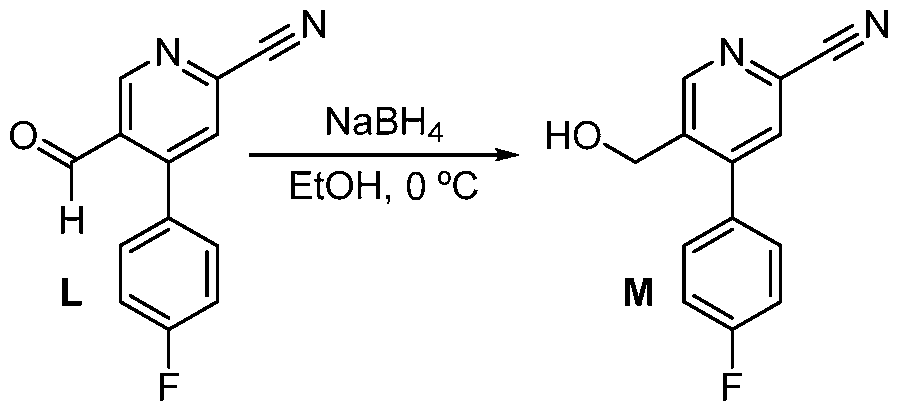
[00221] 4-(4-Fluorophenyl)-5-(hydroxymethyl)picolinonitrile (M): Compound L (prepared according to Example 2) (185 mg, 0.818 mmol, 1.0 eq) was dissolved in ethanol (4.1 mL) and cooled to 0 °C. Sodium borohydride (15.5 mg, 0.409 mmol, 0.50 eq) was added, and the reaction was stirred at 0 °C for 10 minutes at which point it was diluted with ethyl acetate and washed with water. The organic layer was dried (MgS04), filtered, and concentrated in vacuo.
Purification by flash chromatography on silica gel afforded 108 mg (58%) of the title compound as an off-white solid: 1H NMR (400 MHz, DMSO-i¾) δ 8.85 (s, 1H), 7.98 (s, 1H), 7.61-7.57 (m, 2H), 7.38-7.34 (m, 2H), 5.61 (t, J= 5.3 Hz, 1H), 4.53 (d, J= 4.9 Hz, 2H); ES-MS [M+l]+: 229.3.
Exam le 4. 4-(4-Fluorophenyl)-5-(2-hydroxyethoxy)picolinonitrile (P)

[00222] 4-(4-Fluorophenyl)-5-(2-((tetrahydro-2H-pyran-2-yl)oxy)ethoxy)picolinonitrile (O): To a solution of 2-(tetrahydro-2H-pyran-2-yloxy)ethanol (H) (301 \iL, 2.22 mmol, 1.2 eq.) and sodium hydride (93.5 mg, 3.7 mmol, 2.0 eq.) in DMF (9.25 mL) was added compound G (prepared according to Example 1) (400 mg, 1.85 mmol, 1.0 eq.). After three hours, the reaction was quenched with saturated aqueous ammonium chloride, diluted with ethyl acetate and washed with water and brine twice. The combined organics were dried (MgS04), filtered, and
concentrated in vacuo to give 633 mg of the title compound, which was used without further purification. ES-MS [M+l]+: 343.3.
[00223] 4-(4-Fluorophenyl)-5-(2-hydroxyethoxy)picolinonitrile (P): A mixture of compound O (633 mg, 1.85 mmol, 1.0 eq.) and ^-toluenesulfonic acid monohydrate (35.2 mg, 0.19 mmol, 0.10 eq.) in dichloromethane (4.62 mL) and ethanol (4.62 mL) was stirred for 18 hours. The reaction was washed with 10% aqueous potassium carbonate solution. The organic layer was separated, dried (MgS04), filtered and concentrated in vacuo. Purification by flash chromatography on silica gel afforded 312 mg (65%, 2 steps) of the title compound. 1H MR (400 MHz, DMSO-i¾) δ 8.66 (s, 1H), 8.07 (s, 1H), 7.83-7.79 (m, 2H), 7.35-7.31 (m, 2H), 4.94 (t, J= 5.2 Hz, 1H), 4.33 (t, J= 4.7 Hz, 2H), 3.74 (dt, J= 5.2, 4.7 Hz, 2H); ES-MS [M+l]+: 259.2.
Example 5. 4-(4-Fluor henyl)-5-(4-hydroxypiperidin-l-yl)picolinonitrile (R)

[00224] 4-(4-Fluorophenyl)-5-(4-hydroxypiperidin-l-yl)picolinonitrile (R): Compound G (prepared according to Example 1) (100 mg, 0.46 mmol, 1.0 eq.), 4-hydroxypiperidine (234 mg, 2.31 mmol, 5.0 eq.), and N,N-diisopropylethylamine (484 μΐ,, 2.78 mmol, 6.0 eq.) in NMP (2.3 mL) was added to a small vial. The vial was capped and stirred at 120°C for 18 hours. The reaction was diluted with ethyl acetate and washed with water and brine twice. The organic layers were combined, dried (MgS04), filtered, and concentrated in vacuo. Purification by flash chromatography on silica gel afforded 135 mg (98%) of the title compound. ES-MS [M+l]+: 298.4.
[00225] The following compounds were prepared in an analogous manner by first preparing the appropriate synthetic intermediate by use of the synthetic procedures indicated next to each compound:
 4-(4-fluorophenyl)-5-(((tetrahydro-2H-
1 312.4 pyran-4-yl)methyl)amino)picolinonitrile 1
4-(4-fluorophenyl)-5-((2-
2 327.4 mo holinoethyl)amino)picolinonitrile 1
4-(4-fluorophenyl)-5-(methyl(2-
3 341.3 mo holinoethyl)amino)picolinonitrile 1
4-(4-fluorophenyl)-5 -(( 1 -
4 mc^holinopropan-2- yl)amino)picolinonitrile ' 341.4
4-(4-fluorophenyl)-5-((2-
5 341.4 mo holinopropyl)amino)picolinonitrile 1
4-(4-fluorophenyl)-5 -((3 -
6 341.4 moφholinopropyl)amino)picolinonitrile 1
Example 6. 5-((6-Chloropyridin-3-yl)methoxy)-4-(4-fluorophenyl)picolinonitrile (7) and 5- ((6-chloropyridin-3-yl)methoxy)-4-(4-fluorophenyl)picolinamide (8)

[00226] 5-((6-Chloropyridin-3-yl)methoxy)-4-(4-fluorophenyl)picolinonitrile (7) and 5-((6- chloropyridin-3-yl)methoxy)-4-(4-fluorophenyl)picolinamide (8): A solution of 2-chloro-5- hydroxymethylpyridine (S) (20.9 mg, 0.15 mmol, 2.1 eq.) and sodium hydride (3.3 mg, 0.14 mmol, 2.0 eq.) in DMF (1 mL) was stirred for 20 minutes. Compound G (prepared according to Example 1) (15 mg, 0.069 mmol, 1.0 eq.) was added, and the reactions was stirred for two hours. Purification by reverse phase HPLC afforded 9.9 mg (42%) of the cyano product and 4.7 mg (19%)) of the amide product, which was presumably formed due to residual water present in the solvent or reactants (amide formation was less prevalent when THF was used instead of DMF as solvent). For compound 7: 1H MR (400 MHz, OMSO-d6) δ 8.76 (s, 1H), 8.48 (d, J= 2.2 Hz, 1H), 8.1 (s, 1H), 7.92 (dd, J= 5.8, 2.4 Hz, 1H), 7.75-7.72 (m, 2H), 7.58 (d, J= 8.2 Hz, 1H), 7.34-7.3 (m, 2H), 5.46 (s, 2H); ES-MS [M+l]+: 340.3. For compound 8: 1H MR (400 MHz, DMSO-i¾) δ 8.57 (s, 1H), 8.48 (d, J= 2.3 Hz, 1H), 8.03 (s, 1H), 7.98 (s, 1H), 7.91 (dd, J= 5.8,
2.4 Hz, 1H), 7.73-7.69 (m, 2H), 7.57 (d, J= 8.3, 2H), 7.33-7.29 (m, 2H), 5.43 (s, 2H); ES-MS [M+l]+: 358.4.
[00227] The following compounds were prepared in an analogous manner by first preparing the appropriate synthetic intermediate by use of the synthetic procedures indicated next to each compound:

320.3 yl)ethoxy)picolinonitrile 1
4-(4-fluorophenyl)-5-(2-
328.4 moφholinoethoxy)picolinonitrile 1
4-(4-fluorophenyl)-5-(2-(pyridin-3-
336.4 yloxy)ethoxy)picolinonitrile 1
4-(4-fluorophenyl)-5 -(( 1 - (2- (trifluoromethyl)pyridin-4-yl)piperidin-4- 443.2 yl)oxy)picolinonitrile
4-(4-fluorophenyl)-5 -(( 1 - (2- (trifluoromethyl)pyridin-4-yl)pyrrolidin- 429.3 3 -yl)oxy)picolinonitrile
4-(4-fluorophenyl)-5 -(( 1 - (2- (trifluoromethyl)pyridin-4-yl)azetidin-3- 415.3 yl)oxy)picolinonitrile
5-(2-(benzyloxy)ethoxy)-4-(4-
349.4 fluorophenyl)picolinonitrile 1
5 -((3 ,5 -difluorobenzyl)oxy)-4-(4-
359.3 fluorophenyl)picolinamide 1
5 -((3 ,5 -difluorobenzyl)oxy)-4-(2-fluoro-
389.2 4-methoxyphenyl)picolinamide 1
5 '-((3 , 5 -difluorobenzyl)oxy) -6- (trifluoromethyl)-[3,4'-bipyridine]-2'- 410.2 carboxamide
5-((4-bromobenzyl)oxy)-4-(4-
401.3 fluorophenyl)picolinamide 1
5 -((3 -bromobenzyl)oxy)-4-(4-
401.2 fluorophenyl)picolinamide 1
5-((2-bromobenzyl)oxy)-4-(4-
401.2 fluorophenyl)picolinamide 1
5-((5-bromo-2-fluorobenzyl)oxy)-4-(4-
419.2 fluorophenyl)picolinamide 1
5-((3 -bromo-5 -fluorobenzyl)oxy)-4-(4-
419.2 fluorophenyl)picolinamide 1
4-(4-fluorophenyl)-5 -(pyridin-3 -
324.2 ylmethoxy)picolinamide 1
4-(2-fluoro-4-methoxyphenyl)-5-
354.2 (pyridin-3 -ylmethoxy)picolinamide 1
5'-(pyridin-3-ylmethoxy)-6- (trifluoromethyl)-[3,4'-bipyridine]-2'- 375.3 carboxamide
4-(4-fluorophenyl)-5-((6-methylpyridin-
338.3 3 -y l)methoxy)picolinamide 1
4-(4-fluorophenyl)-5-((6- methoxypyridin-3 - 354.3 yl)methoxy)picolinamide
4-(4-fluorophenyl)-5-((6- (trifluoromethyl)pyridin-3- 392.4 yl)methoxy)picolinamide
4-(4-fluorophenyl)-5 -(pyridin-4-
324.4 ylmethoxy)picolinamide 1
4-(4-fluorophenyl)-5-((2-methylpyridin-
338.4 4-yl)methoxy)picolinamide 1
4-(4-fluorophenyl)-5-((2- methoxypyridin-4- 354.0 yl)methoxy)picolinamide
4-(4-fluorophenyl)-5-(l-(pyridin-3-
338.4 yl)ethoxy)picolinamide 1
4-(4-fluorophenyl)-5-( 1 -(pyridin-4-
338.4 yl)ethoxy)picolinamide 1
4-(4-fluorophenyl)-5 -(pyridazin-3 -
325.3 ylmethoxy)picolinamide 1
4-(4-fluorophenyl)-5 -(imidazo[ 1 ,2-
363.3 a]pyridin-6-ylmethoxy)picolinamide 1
4-(4-fluorophenyl)-5 -(thiazol-5 -
330.4 ylmethoxy)picolinamide 1
4-(4-fluorophenyl)-5-(( 1 -methyl- 1H-
327.4 pyrazol-3-yl)methoxy)picolinamide 1
4-(4-fluorophenyl)-5-(( 1 -methyl- 1H-
327.4 pyrazol-4-yl)methoxy)picolinamide 1
4-(4-fluorophenyl)-5-(2-(pyridin-3-
354.3 yloxy)ethoxy)picolinamide 1
4-(4-fluorophenyl)-5-(2-(methyl(2- (trifluoromethyl)pyridin-4- 435.3 yl)amino)ethoxy)picolinamide
4-(4-fluorophenyl)-5 -(( 1 -(2- (trifluoromethyl)pyridin-4-yl)piperidin-4- 461.3 yl)oxy)picolinamide
4-(4-fluorophenyl)-5 -(( 1 -(2- (trifluoromethyl)pyridin-4-yl)pyrrolidin- 447.4 3-yl)oxy)picolinamide
4-(4-fluorophenyl)-5 -(( 1 -(2- 433.4 (trifluoromethyl)pyridin-4-yl)azetidin-3- 1
yl)oxy)picolinamide
Example 7. 5-((2, -Dimethylmorpholino)methyl)-4-(4-fluorophenyl)picolinonitrile (59)

[00228] 5-((2,2-Dimethylmorpholino)methyl)-4-(4-fluorophenyl)picolinonitrile (59):
Compound L (prepared according to Example 2) (15 mg, 0.066 mmol, 1.0 eq) was dissolved in dichloromethane (0.5 mL) and 2,2-dimethylmorpholine (T) (15 mg, 0.13 mmol, 2.0 eq) and acetic acid (9.5 μΐ^, 0.17 mmol, 2.5 eq) were added. The reaction was stirred for one hour, and sodium triacetoxyborohydride (21 mg, 0.10 mmol, 1.5 eq) was added. After stirring for an additional hour, the reaction was concentrated and purified by reverse-phase HPLC to afford 7.8 mg (36%) of the title compound as white solid. 1H MR (400 MHz, OMSO-d6) δ 8.80 (s, 1H), 8.00 (s, 1H), 7.66-7.62 (m, 2H), 7.37-732 (m, 2H), 3.51 (t, J = 4.7 Hz, 2H), 3.46 (s, 2H), 2.20 (m, 2H), 2.05 (s, 2H), 1.06 (s, 6H); ES-MS [M+l]+: 326.3.
Example 8. 4-(4-Fluorophenyl)-5-(((2-(trifluoromethyl)pyridin-4- yl)oxy)methyl)picolinonitrile (60)

[00229] 4-(4-Fluorophenyl)-5-(((2-(trifluoromethyl)pyridin-4- yl)oxy)methyl)picolinonitrile (60): Compound M (prepared according to Example 3) (10 mg, 0.044 mmol, 1.0 eq) and 2-(trifluoromethyl)pyridine-4-ol (U) (14 mg, 0.088 mmol, 2.0 eq) were dissolved in THF (0.5 mL) and cooled to 0 °C. Triphenylphosphine (25 mg, 0.096 mmol, 2.2 eq)
and di-tert-butylazodicarboxylate (16 mg, 0.070 mmol, 1.6 eq) were added, and the reaction was stirred at room temperature until judged complete by LCMS. The reaction was concentrated and purified using reverse-phase HPLC to afford 16 mg (99%) of the title compound as a white solid. 1H MR (400 MHz, OMSO-d6) δ 9.00 (s, 1H), 8.56 (d, J = 5.7 Hz, 1H), 8.12 (s, 1H), Ί .60-1.51 (m, 2H), 7.44 (d, J = 2.3 Hz, 1H), 7.36-7.32 (m, 2H), 7.26 (dd, J = 5.7, 2.4 Hz, 1H), 5.35 (s, 2H); ES-MS [M+l]+: 374.2.
Example 9. 4-(4-Fluorophenyl)-5-(2-((2-(trifluoromethyl)pyridin-4- yl)oxy)ethoxy)picolinonitr ile (61)

[00230] 4-(4-Fluorophenyl)-5-(2-((2-(trifluoromethyl)pyridin-4- yl)oxy)ethoxy)picolinonitrile (61): Compound P (prepared according to Example 4) (15 mg, 0.058 mmol, 1.0 eq) and 2-(trifluoromethyl)pyridine-4-ol (U) (11 mg, 0.070 mmol, 1.2 eq) were dissolved in THF (0.5 mL) and cooled to 0 °C. Triphenylphosphine (33.5 mg, 0.128 mmol, 2.2 eq) and di-tert-butylazodicarboxylate (21.4 mg, 0.093 mmol, 1.6 eq) were added, and the reaction was stirred at room temperature until judged complete by LCMS. The reaction was concentrated and purified using reverse-phase HPLC to afford 22 mg (94%) of the title compound. 1H MR (400 MHz, DMSO-i¾) δ 8.71 (s, 1H), 8.55 (d, J= 5.7 Hz, 1H), 8.07 (s, 1H), 7.73-7.69 (m, 2H), 7.43 (d, J= 2.3 Hz, 1H), 7.29 (dd, J= 5.6, 2.3 Hz, 1H), 7.19 (t, J= 8.8 Hz, 2H), 4.69-4.67 (m, 2H), 4.57-4.55 (m, 2H); ES-MS [M+l]+: 404.3.
[00231] The following compounds were prepared in an analogous manner by first preparing the appropriate synthetic intermediate by use of the synthetic procedures indicated next to each compound:
 4-(4-fluorophenyl)-5 -(2-((6-methylpyridin-3 -
62 1, 4 364.3
yl)oxy)propoxy)picolinonitrile
4-(4-fluorophenyl)-5 -(2-((2-
63 (trifluoromethyl)pyridin-4- 1, 4 418.2
yl)oxy)propoxy)picolinonitrile
4-(4-fluorophenyl)-5 -(3 -((2-methylpyrimidin-
64 1, 4 365.2
5-yl)oxy)propoxy)picolinonitrile
4-(4-fluorophenyl)-5 -(3 -(pyridin-3 -
65 1, 4 350.3
yloxy)propoxy)picolinonitrile
4-(4-fluorophenyl)-5-(3-((6-
66 (trifluoromethyl)pyridin-3 - 1, 4 418.2
yl)oxy)propoxy)picolinonitrile
4-(4-fluorophenyl)-5-(3-((2-
67 (trifluoromethyl)pyridin-4- 1, 4 418.2
yl)oxy)propoxy)picolinonitrile
4-(4-fluorophenyl)-5 -(3 -((6-methylpyridin-3 -
68 1, 4 364.4
yl)oxy)propoxy)picolinonitrile
Example 10. 4-(4-Fluorophenyl)-5-(4-((6-(trifluoromethyl)pyridin-3-yl)oxy)piperidin-l- yl)picolin nitrile (69)

[00232] 4-(4-Fluorophenyl)-5-(4-((6-(trifluoromethyl)pyridin-3-yl)oxy)piperidin-l- yl)picolinonitrile (69): Compound R (prepared according to Example 5) (7.5 mg, 0.025 mmol, 1.0 eq.), 6-(trifluoromethyl)pyridine-3-ol (V) (4.9 mg, 0.03 mmol, 1.2 eq.), triphenylphosphine (14.5 mg, 0.056 mmol, 2.2 eq.), DlBAD (9.3 mg, 0.04 mmol, 1.6 eq.) and THF (1 mL) were added to a small microwave vial. The vial was capped and placed in the microwave reactor at 120°C for 15 minutes. Purification by reverse phase HPLC afforded 11 mg (99%) of the title compound. 1H MR (400 MHz, OMSO-d6) δ 8.49 (s, 1H), 8.44 (d, J= 2.7 Hz, 1H), 7.82-7.77 (m, 4H), 7.66 (dd, J= 6.1, 2.7 Hz, 1H), 7.37 (dd, J= 8.9, 8.9 Hz, 2H), 4.76-4.72 (m, 1H), 3.22- 3.17 (m, 2H), 2.97-2.92 (m, 2H), 1.96-1.93 (m, 2H), 1.68-1.61 (m, 2H); ES-MS [M+l]+: 443.2.
Example 11. 5-(2-((ci's)-2,6-Dimethylmorpholino)ethoxy)-4-(4-fluorophenyl)picolinonitrile

[00233] 2-[[6-Cyano-4-(4-fluorophenyl)-3-pyridyl]oxy]ethylmethanesulfonate (W): To a solution of compound P (prepared according to Example 4) (75 mg, 0.29 mmol, 1.0 eq.) and N,N-diisopropylethylamine (152 pL, 0.87 mmol, 3.0 eq.) in dichloromethane (2 mL) was added methanesulfonyl chloride (27 pL, 0.35 mmol, 1.2 eq.). After 30 minutes, the reaction was concentrated in vacuo to give 95 mg (97%) of the title compound that was used without further purification. ES-MS [M+l]+: 337.3.
[00234] 5-(2-((ci's)-2,6-Dimethylmorpholino)ethoxy)-4-(4-fluorophenyl)picolinonitrile (70): A mixture of compound W (8 mg, 0.024 mmol, 1.0 eq.) and c/s-2,6-dimethylmorpholine X (20 pL, 0.17 mmol, 7.0 eq) in THF (1 mL) was stirred for 50 hours. After concentration in vacuo, purification by reverse phase HPLC afforded 4.0 mg (47%) of the title compound. 1H MR (400 MHz, DMSO-i¾) δ 8.62 (s, 1H), 8.05 (s, 1H), 7.79-7.75 (m, 2H), 7.32-7.28 (m, 2H), 4.37 (t, J= 5.24 Hz, 2H), 3.49-3.44 (m, 2H), 2.71-2.64 (m, 4H), 1.64 (m, 2H), 0.96 (d, J= 6.28 Hz, 6H); ES-MS [M+l]+: 356.4.
[00235] The following compounds were prepared in an analogous manner by first preparing the appropriate synthetic intermediate by use of the synthetic procedures indicated next to each compound:

- I l l -
5-(3-(4,4-difluoropiperidin-l-yl)propoxy)-
74 1, 4 376.3
4-(4-fluorophenyl)picolinonitrile
Example 12: 4-(4-Fluorophenyl)-5-(2-((2-methylpyrimidin-5-yl)oxy)ethoxy)picolinonitrile (75)

[00236] 4-(4-Fluorophenyl)-5-(2-((2-methylpyrimidin-5-yl)oxy)ethoxy)picolinonitrile (75):
A solution of 5-hydroxy-2-methylpyrimidine Y (5.2 mg, 0.048 mmol, 2.0 eq.) and sodium hydride (1.3 mg, 0.052 mmol, 2.2 eq.) in DMF (1 mL) were stirred for 20 minutes. Compound W (prepared according to Example 11) (8 mg, 0.024 mmol, 1.0 eq.) was added. The reaction stirred for 18 hours and was purified by reverse phase HPLC to afford 4.0 mg (48%) of the title compound. 1H MR (400 MHz, OMSO-d6) δ 8.7 (s, 1H), 8.43 (s, 2H), 8.08 (s, 1H), 7.74-7.7 (m, 2H), 7.25-7.21 (m, 2H), 4.66-4.64 (m, 2H), 4.49-4.47 (m, 2H), 2.53 (d, J= 1.84 Hz, 3H); ES-MS [M+l]+: 351.2.
Example 13. 4-(4-Fluorophenyl)-5-((2-((5-fluoropyridin-3- yl)methoxy)ethyl)(methyl)amino)picolinonitrile (76)
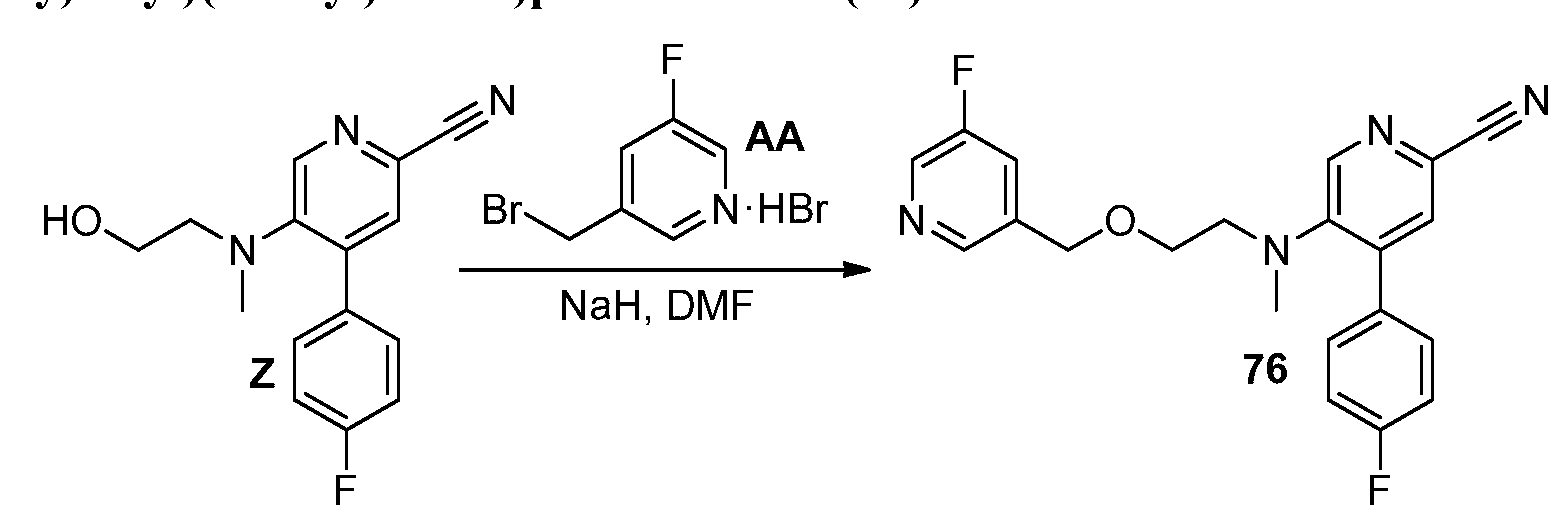
[00237] 4-(4-Fluorophenyl)-5-((2-((5-fluoropyridin-3- yl)methoxy)ethyl)(methyl)amino)picolinonitrile (76): A solution of 3-(bromomethyl)-5- fluoro-pyridine hydrobromide AA (53 mg, 0.19 mmol, 2.1 eq.) and sodium hydride (6.6 mg, 0.28 mmol, 3.0 eq.) in DMF (500 pL) were stirred for 10 minutes. Compound Z (prepared according
to methods described in Example 5) (25 mg, 0.092 mmol, 1.0 eq.) was added. After 18 hours, the reaction was diluted with ethyl acetate and washed with water and brine twice. The organic layerss were combined, dried over magnesium sulfate, filtered, and concentrated in vacuo.
Purification by reverse phase HPLC afforded 12.8 mg (37%) of the title compound. 1H MR (400 MHz, DMSO-i¾) δ 8.47 (d, J= 2.8 Hz, 1H), 8.43 (s, 1H), 8.25 (s, 1H), 7.66 (s, 1H), 7.57- 7.53 (m, 2H), 7.36 (dd, J= 1.92, 9.72 Hz, 1H), 7.29-7.25 (m, 2H), 4.41 (s, 2H), 3.49 (t, J= 5.2 Hz, 2H), 3.18 (t, J= 5.2 Hz, 2H), 2.76 (s, 3H); ES-MS [M+l]+: 381.2.
Example 14. 4-(4-Fluorophenyl)-5-(4-((6-(trifluoromethyl)pyridin-3-yl)oxy)piperidin-l- yl)picolin mide (77)

[00238] 4-(4-Fluorophenyl)-5-(4-((6-(trifluoromethyl)pyridin-3-yl)oxy)piperidin-l- yl)picolinamide (77): Compound 69 (prepared according to Example 10) (11 mg, 0.025 mmol, 1.0 eq.) and potassium trimethylsilanolate (6.7 mg, 0.052 mmol, 2.1 eq.) in THF (600 μΐ.) were added to a small vial. The vial was capped and the reaction was heated to reflux. After 24 hours, the reaction was filtered and purified by reverse phase HPLC to afford 6 mg (52%) of the title compound. 1H MR (400 MHz, DMSO-i¾) δ 8.45 (d, J= 2.8 Hz, 1H), 8.35 (s, 1H), 7.97 (s, 1H), 7.83-7.79 (m, 4H), 7.66 (dd, J= 8.8, 2.6 Hz, 1H), 7.52 (s, 1H), 7.39-7.34 (m, 2H), 4.76-4.72 (m, 1H), 3.19-3.16 (m, 2H), 2.93-2.89 (m, 2H), 1.98-1.94 (m, 2H), 1.68-1.61 (m, 2H); ES-MS
[M+l]+: 461.2.
[00239] The following compounds were prepared in an analogous manner by first preparing the appropriate synthetic intermediate by use of the synthetic procedures indicated next to each compound:
Examples
used to
ES-MS
No. Name prepare
[M+l]+
intermediate
compound
5-((2,2-dimethylmoφholino)methyl)-4-(4-
78 1, 2, 7 344.4 fluorophenyl)picolinamide
5-(((cis)-2,6-dimethylmoφholino)methyl)-4-
79 1, 2, 7 344.4
(4-fluorophenyl)picolinamide
5 -((3 , 5 -difluorobenzyl)oxy)-4-( 1 -methyl- 1 H-
80 1, 6 345.4 pyrazol-4-yl)picolinamide
5 -((3 -bromo-2-fluorobenzyl)oxy)-4-(4-
81 1, 6 419.2 fluorophenyl)picolinamide
4-(l-methyl-lH-pyrazol-4-yl)-5-(pyridin-3-
82 1, 6 310.3 ylmethoxy)picolinamide
4-(2-fluoro-4-methoxyphenyl)-5-((6-
83 1, 6 368.4 methylpyridin-3-yl)methoxy)picolinamide
5'-((6-methylpyridin-3-yl)methoxy)-6-
84 (trifluoromethyl)-[3,4'-bipyridine]-2'- 1, 6 389.3 carboxamide
4-( 1 -methyl- lH-pyrazol-4-yl)-5 -((6-
85 1, 6 324.3 methylpyridin-3-yl)methoxy)picolinamide
4-(2-fluoro-4-methoxyphenyl)-5-((6-
86 (trifluoromethyl)pyridin-3- 1, 6 422.3 yl)methoxy)picolinamide
4-( 1 -methyl- lH-pyrazol-4-yl)-5 -((6-
87 (trifluoromethy l)py ridin-3 - 1, 6 378.3 yl)methoxy)picolinamide
4-(2-fluoro-4-methoxyphenyl)-5-((2-
88 1, 6 368.4 methylpyridin-4-yl)methoxy)picolinamide
4-( 1 -methyl- lH-pyrazol-4-yl)-5 -((2-
89 1, 6 324.3 methylpyridin-4-yl)methoxy)picolinamide
5-((3,5-difluorophenoxy)methyl)-4-(4-
90 1, 2, 3, 8 359.2 fluorophenyl)picolinamide
4-(4-fluorophenyl)-5-(((6-
91 (trifluoromethy l)py ridin-3 - 1, 2, 3, 8 392.2 yl)oxy)methyl)picolinamide
4-(4-fluorophenyl)-5-(((6-methylpyridin-3-
92 1, 2, 3, 8 338.2 yl)oxy)methyl)picolinamide
4-(4-fluorophenyl)-5-(((2-
93 (trifluoromethyl)pyridin-4- 1, 2, 3, 8 392.2 yl)oxy)methyl)picolinamide
4-(4-fluorophenyl)-5 -(2-
94 1, 6 346.4 moφholinoethoxy)picolinamide
5-(2-((cis)-2,6-dimethylmoφholino)ethoxy)-
95 1, 4, 11 374.4
4-(4-fluorophenyl)picolinamide
5-(3-(4,4-difluoropiperidin-l-yl)propoxy)-4-
96 1, 4, 11 394.2
(4-fluorophenyl)picolinamide
4-(4-fluorophenyl)-5 -(3 -(2-
97 1, 4, 11 374.2 methylmoφholino)propoxy)picolinamide
5-(3-(2,2-dimethylmo holino)propoxy)-4-(4-
98 1, 4, 11 388.4 fluorophenyl)picolinamide
5-(3-((cis)-2,6-dimethylmo holino)propoxy)-
99 1, 4, 11 388.4
4-(4-fluorophenyl)picolinamide
4-(4-fluorophenyl)-5-(3-
100 1, 4, 11 360.4 moφholinopropoxy)picolinamide
5-(2-(5-bromo-2-fluorophenoxy)ethoxy)-4-(4-
101 1, 4, 9 449.3 fluorophenyl)picolinamide
5 -(2-(3 -bromo-5 -fluorophenoxy)ethoxy)-4-(4-
102 1, 4, 9 449.3 fluorophenyl)picolinamide
5-(2-(3-bromo-4-fluorophenoxy)ethoxy)-4-(4-
103 1, 4, 9 449.3 fluorophenyl)picolinamide
5-(2-(3-bromo-2-fluorophenoxy)ethoxy)-4-(4-
104 1, 4, 9 449.2 fluorophenyl)picolinamide
5-(2-(2-bromophenoxy)ethoxy)-4-(4-
105 1, 4, 9 431.2 fluorophenyl)picolinamide
5-(2-(3-bromophenoxy)ethoxy)-4-(4-
106 1, 4, 9 431.2 fluorophenyl)picolinamide
5-(2-(4-fluorophenoxy)ethoxy)-4-(4-
107 1, 4, 9 371.2 fluorophenyl)picolinamide
5-(2-(3-fluorophenoxy)ethoxy)-4-(4-
108 1, 4, 9 371.2 fluorophenyl)picolinamide
5-(2-(2-fluorophenoxy)ethoxy)-4-(4-
109 1, 4, 9 393.2 fluorophenyl)picolinamide
5 -(2-(3 ,5 -difluorophenoxy)ethoxy)-4-(4-
110 1, 4, 9 389.2 fluorophenyl)picolinamide
5 -(2-((5 -bromopyridin-3 -yl)oxy)ethoxy)-4-(4-
111 1, 4, 9 432.2 fluorophenyl)picolinamide
4-(4-fluorophenyl)-5-(2-((5-fluoropyridin-3-
112 1, 4, 9 372.2 yl)oxy)ethoxy)picolinamide
4-(4-fluorophenyl)-5-(2-((6-fluoropyridin-3-
113 1, 4, 9 372.2 yl)oxy)ethoxy)picolinamide
4-(4-fluorophenyl)-5-(2-((6-methylpyridin-3-
114 1, 4, 9 368.3 yl)oxy)ethoxy)picolinamide
115 4-(4-fluorophenyl)-5 -(2-((6- 1, 4, 9 422.3
(trifluoromethy l)py ridin-3 -
yl)oxy)ethoxy)picolinamide
4-(4-fluorophenyl)-5 -(2-((2-
116 (trifluoromethyl)pyridin-4- 1, 4, 9 422.4 yl)oxy)ethoxy)picolinamide
4-(4-fluorophenyl)-5-(2-((2-fluoropyridin-4-
117 1, 4, 9 372.2 yl)oxy)ethoxy)picolinamide
4-(4-fluorophenyl)-5-(2-((2-methylpyridin-4-
118 1, 4, 9 368.2 yl)oxy)ethoxy)picolinamide
4-(4-fluorophenyl)-5-(2-((2-methylpyrimidin-
119 1, 4, 12 369.4
5 -yl)oxy)ethoxy)picolinamide
4-(4-fluorophenyl)-5 -(( 1 -((2-
120 (trifluoromethyl)pyridin-4-yl)oxy)propan-2- 1, 6 436.2 yl)oxy)picolinamide
4-(4-fluorophenyl)-5-(2-((6-methylpyridin-3-
121 1, 4, 9 382.3 yl)oxy)propoxy)picolinamide
4-(4-fluorophenyl)-5-(2-((2-methylpyrimidin-
122 1, 4, 9 383.3
5 -yl)oxy)propoxy)picolinamide
4-(4-fluorophenyl)-5 -(2-(pyridin-3 -
123 1, 4, 9 368.3 yloxy)propoxy)picolinamide
4-(4-fluorophenyl)-5 -(2-((2-
124 (trifluoromethyl)pyridin-4- 1, 4, 9 436.2 yl)oxy)propoxy)picolinamide
4-(4-fluorophenyl)-5-(3-((2-methylpyrimidin-
125 1, 4, 9 383.3
5 -yl)oxy)propoxy)picolinamide
4-(4-fluorophenyl)-5 -(3 -((6-
126 (trifluoromethy l)py ridin-3 - 1, 4, 9 436.2 yl)oxy)propoxy)picolinamide
4-(4-fluorophenyl)-5 -(3 -((2-
127 (trifluoromethyl)pyridin-4- 1, 4, 9 436.2 yl)oxy)propoxy)picolinamide
4-(4-fluorophenyl)-5 -(3-(pyridin-3 -
128 1, 4, 9 368.3 yloxy)propoxy)picolinamide
4-(4-fluorophenyl)-5 -(3 -((6-methylpyridin-3 -
129 1, 4, 9 382.3 yl)oxy)propoxy)picolinamide
5-(2-(benzyloxy)ethoxy)-4-(4-
130 1, 6 367.2 fluorophenyl)picolinamide
4-(4-fluorophenyl)-5 -((2-((5 -fluoropyridin-3 -
131 1, 5, 13 399.2 yl)methoxy)ethyl)(methyl)amino)picolinamide
4-(4-fluorophenyl)-5-(((tetrahydro-2H-pyran-
132 1, 5 330.4
4-yl)methyl)amino)picolinamide
133 4-(4-fluorophenyl)-5-((2- 1, 5 345.4
ηιο 1ιο1ίηοεΐ1ιγ1)αΓηίηο)ρίοο1ίηαΓηίάε
4-(4-ΑυοΓορ1ιεηγ1)-5-((1-ηιοφ1ιο1ίηορΓοραη-2-
134 1, 5 359.4 yl)amino)picolinamide
4-(4-fluorophenyl)-5-((2-
135 1, 5 359.4 ηιοφ1ιο1ίηορΓοργ1)αΓηίηο)ρίοο1ίηαΓηίάε
4-(4-fluorophenyl)-5-(methyl(2-
136 1, 5 359.4 ηιοφ1ιο1ίηοεΐ1ιγ1)αΓηίηο)ρίοο1ίηαΓηίάε
4-(4-fluorophenyl)-5 -((3 -
137 1, 5 359.4 ηιοφ1ιο1ίηορΓοργ1)αΓηίηο)ρίοο1ίηαΓηίάε
4-(4-fluorophenyl)-5 -(4-((2-
138 (trifluoromethyl)pyridin-4-yl)oxy)piperidin- 1 - 1, 5, 10 461.2 yl)picolinamide
4-(4-fluorophenyl)-5-(4-((6-methylpyridin-3-
139 1, 5, 10 407.4 yl)oxy)piperidin- 1 -yl)picolinamide
4-(4-fluorophenyl)-5 -(4-(pyridin-3 -
140 1, 5, 10 393.4 yloxy)piperidin- 1 -yl)picolinamide
4-(4-fluorophenyl)-5 -(3 -((6-
141 (trifluoromethy l)pyridin-3 -yl)oxy )azetidin- 1 - 1, 5, 10 433.2 yl)picolinamide
4-(4-fluorophenyl)-5 -(3 -((6-methylpyridin-3 -
142 1, 5, 10 379.4 yl)oxy)azetidin- 1 -yl)picolinamide
4-(4-fluorophenyl)-5 -(3-(pyridin-3 -
143 1, 5, 10 365.4 yloxy)azetidin- 1 -yl)picolinamide
4-(4-fluorophenyl)-5 -(3 -((2-
144 (trifluoromethyl)pyridin-4-yl)oxy)pyrrolidin- 1, 5, 10 447.2 l-yl)picolinamide
Example 15. 5-((3-Cyanobenzyl)oxy)-4-(4-fluorophenyl)picolinamide (145)

[00240] 5-((3-Cyanobenzyl)oxy)-4-(4-fluorophenyl)picolinamide (145): Compound 34
(prepared according to methods described in Example 6) (24 mg, 0.06 mmol, 1.0 eq.), zinc cyanide (8.4 mg, 0.071 mmol, 1.2 eq.), tetrakis(triphenylphosphine)palladium(0) (6.9 mg, 0.006 mmol, 0.1 eq.), and DMF (600 μΐ.) were added to a small microwave vial. The vial was capped
and placed in the microwave reactor at 140 °C for 45 minutes. Purification by reverse phase HPLC afforded 8.4 mg (40%) of the title compound. 1H MR (400 MHz, OMSO-d6) δ 8.53 (s, 1H), 8.03 (s, 1H), 7.98 (s, 1H), 7.86 (s, 1H), 7.82 (d, J= 7.7 Hz, 1H), 7.77-7.72 (m, 3H), 7.63- 7.58 (m, 2H), 7.34-7.29 (m, 2H), 5.44 (s, 2H); ES-MS [M+l]+: 348.3.
[00241] The following compounds were prepared in an analogous manner by first preparing the appropriate synthetic intermediate by use of the synthetic procedures indicated next to each compound:

Example 16. Biological Activity
A. mGlii2 Ca2+ flux assay
[00242] Gai5 HEK293 cells stably expressing rat mGlu2 were plated in black-walled, clear- bottomed, poly-D-lysine coated 384-well plates in 20 μΐ^ of assay medium (DMEM containing 10% dialyzed FBS, 20 mM HEPES, and 1 mM sodium pyruvate) at a density of 12K cells/well. The cells were grown overnight at 37 °C in the presence of 5% C02. The next day, medium was removed and the cells incubated with 20 μΐ^ of 2.3 μΜ Fluo-4, AM prepared as a 2.3 mM stock in DMSO and mixed in a 1 : 1 ratio with 10% (w/v) pluronic acid F-127 and diluted in assay buffer (Hank's balanced salt solution, 20 mM HEPES, and 2.5 mM probenecid) for 45 minutes at 37 °C. Dye was removed, 20 μΐ^ of assay buffer was added, and the plate was incubated for 5 minutes at room temperature.
[00243] Ca2+ flux was measured using the Functional Drug Screening System (FDSS7000, Hamamatsu, Japan). After establishment of a fluorescence baseline for about 3 seconds, the compounds of the present invention were added to the cells, and the response in cells was measured. 2.3 minutes later an EC2o concentration of the mGlu2 receptor agonist glutamate was added to the cells, and the response of the cells was measured for 1.9 minutes; an EC80 concentration of agonist was added and readings taken for an additional 1.7 minutes. All test compounds were dissolved and diluted to a concentration of 10 mM in 100% DMSO.
Compounds were then serially diluted 1 :3 in DMSO into 10 point concentration response curves, transferred to daughter plates, and further diluted into assay buffer to a 2x stock. Calcium fluorescence measures were recorded as fold over basal fluorescence; raw data was then normalized to the maximal response to glutamate. Antagonism of the agonist response of the mGlu2 receptor in the present invention was observed as a decrease in response to nearly maximal concentrations of glutamate in the presence of compound compared to the response to glutamate in the absence of compound.
[00244] The raw data file containing all time points was used as the data source in the analysis template. This was saved by the FDSS as a tab-delimited text file. Data were normalized using a static ratio function (F/F0) for each measurement of the total 360 values per well divided by each well's initial value. Data were then reduced to peak amplitudes (Max - Initial Min) using a time range that starts approximately 3 seconds prior to the glutamate EC80 addition and continues for approximately 90 seconds. This is sufficient time to capture the peak amplitude of the cellular calcium response. Individual amplitudes were expressed as % ECMax by multiplying each amplitude by 100 and then dividing the product by the mean of the amplitudes derived from the
glutamate ECMax-treated wells. IC50 values for test compounds were generated by fitting the normalized values versus the log of the test compound concentration (in mol/L) using a 4 parameter logistic equation where none of the parameters were fixed. Each of the three values collected at each concentration of test compound were weighted evenly.
[00245] A compound was designated as a negative allosteric modulator (NAM) if the compound showed a concentration-dependent decrease in the glutamate EC80 addition. For NAMs, potency (IC50) and maximum response (% Glu Max), i.e. the amplitude of response in the presence of 30 μΜ test compound as a percentage of the maximal response to glutamate, are reported. For NAMs that show a decrease in the EC80 response, but do not hit a plateau, the average of the maximum response at a single concentration (30 μΜ) was determined (% Glu Max) and potencies were reported as ">10,000 nM". Compounds with no measurable activity are designated as ">30,000 nM" since the top concentration of compound tested in the assay is 30 μΜ.
B. Results and Discussion of Biological Activity Data
[00246] The results of these assays are shown in Table 1. The data in Table 1 demonstrates that the disclosed compounds are negative allosteric modulators of mGlu2 and show high affinity for the mGlu2 receptor(s). Data is from a single experiment unless otherwise noted. Data that is an average of two experiments is noted as "n=2" while data that is an average of three or more experiments is presented as the average plus or minus the standard error of the mean.
Table 1.

7110 29.93 90 2030 0.21
>30,000 N/A 91 639 0.51
>30,000 N/A 92 1660 -2.16
>30,000 N/A 93 477 (n=2) 0.38 (n=2)
>30,000 N/A 94 >10,000 48.96
>30,000 N/A 95 >10,000 22.82
1580
62.00 96 3270 7.38 (Partial NAM)
2690
47.48 97 >10,000 22.04 (Partial NAM)
>10,000 27.07 98 3250 0.97
>10,000 37.87 99 >10,000 15.84
3490 16.08 100 > 10,000 (n=2) 46.76 (n=2)
>10,000 11.10 101 4260 1.85
>30,000 N/A 102 5240 3.34
>30,000 N/A 103 >10,000 53.67
>10,000 38.97 104 >30,000 N/A
>30,000 N/A 105 >30,000 N/A
3440
>30,000 N/A 106 26.48
(Partial NAM)
>30,000 N/A 107 8510 -10.71
4250
65.23 108 2380 1.95 (Partial NAM)
401
18.71 109 2010 2.16
(Partial NAM)
1720
395 (n=2) 1.46 (n=2) 110 38.67
(Partial NAM)
>10,000 35.11 111 624 1.34
1690 2.29 112 827 0.05
1590 10.07 113 502 (n=2) 1.38 (n=2)
1110 1.55 114 738 1.80
650 3.82 115 1310 3.64
1470 3.54 116 242 ± 83 1.51 ± 0.16
507 ± 123 5.84 ± 1.16 117 615 (n=2) 1.02 (n=2)
39 (n=2) 1.36 (n=2) 118 410 (n=2) 1.16 (n=2)
>30,000 N/A 119 >10,000 20.32
343 1.59 120 483 1.72
266 (n=2) 2.20 (n=2) 121 2130 1.66
717 0.74 122 >10,000 8.04
239 0.42 123 1510 0.37
195 1.17 124 835 0.75
204 (n=2) 2.17 (n=2) 125 >10,000 35.12
2710 0.41 126 2940 5.52
504 1.40 127 1590 2.03
1470 -0.08 128 3780 2.52
129 1.41 129 2870 2.91
263 (n=2) 1.01 (n=2) 130 2250 9.91
66 (n=2) 0.93 (n=2) 131 5770 2.62
1000 -0.46 132 1050 -1.48
1370 1.35 133 6540 -4.31
1580 4.02 134 2710 -3.71
4190 4.50 135 5700 1.19
2120 2.39 136 >10,000 30.99
4140 4.30 137 9870 -13.48
~ ~ 138 >10,000 N/A
~ ~ 139 9590 7.04
~ ~ 140 >10,000 29.83
4630 35.79 141 >10,000 53.85
>10,000 30.69 142 1280 2.35
>30,000 N/A 143 2030 7.01
>10,000 68.83 144 7450 1.28
>30,000 N/A 145 429 (n=2) 1.50 (n=2)
>30,000 N/A 146 944 0.48
>10,000 28.99 147 313 (n=2) 0.73 (n=2)
~ ~ 148 1680 0.43
>30,000 N/A 149 254 (n=2) 1.66 (n=2)
>30,000 (n=2) N/A 150 98 (n=2) 1.14 (n=2)
>30,000 N/A 151 683 2.05
>30,000 N/A 152 1220 1.44
>10,000 49.62 153 1370 1.58
>10,000 30.16 154 1390 4.19
>10,000 33.33 155 528 1.07
>30,000 35.13 156 4230 -21.72
531 (n=2) -0.32 (n=2) 157 691 4.33
79 987 0.52
[00247] It is understood that the foregoing detailed description and accompanying examples are merely illustrative and are not to be taken as limitations upon the scope of the invention, which is defined solely by the appended claims and their equivalents.
[00248] Various changes and modifications to the disclosed embodiments will be apparent to those skilled in the art. Such changes and modifications, including without limitation those relating to the chemical structures, substituents, derivatives, intermediates, syntheses, compositions, formulations, or methods of use of the invention, may be made without departing from the spirit and scope thereof.
Claims
What is claimed is: 1. A compound of formula (I)

(I),
or a pharmaceutically acceptable salt thereof, wherein
R1 is aryl, heteroaryl, heterocycle, or cycloalkyl;
R2a and R2b are each independently hydrogen, halogen, C1-C4 alkyl, C1-C4 alkoxy, C1-C4 haloalkyl, or C1-C4 haloalkoxy;
R3 is -X-(CR5aR5b)p-Z-(CR5cR5d)q-N(R6a)(R6b), -X-(CR5aR5b)p-Z-(CR5cR5d)q-Y-A, -A'-X- (CR5aR5b)p-Z-(CR5cR5d)q-N(R6a)(R6b), -X-(CR5aR5b)p-Z-(CR5cR5d)q-A'-Y-A, or -A-X-(CR5aR5b)p- Z-(CR5cR5d)q-Y-A;
p is 0-2;
q is 0-2;
X, Y, and Z are each independently selected from a bond, CR5eR5f, O, S,
R7, -C(O)-, -O-C(O)-, -C(0)-0-, -0-C(0)- R7-, -C(0)- R7-, - R7-C(0)-, - R7-C(0)- 0-, - R7-C(0)- R7-, - R7-S02-, and -S02-;
R5a, R5b, R5c, R5d, R5e and R5f, at each occurrence, are independently selected from hydrogen, fluorine, C1-C4 alkyl, C1-C4 alkoxy, C1-C4 haloalkyl, and C1-C4 haloalkoxy;
R6a and R6b are each independently selected from Ci-C6 alkyl, Ci-C6 haloalkyl, cycloalkyl, Ci-C6 heteroalkyl, and heterocycle, or R6a and R6b together with the nitrogen atom to which they attach form a heterocycle;
R7 at each occurrence is independently selected from hydrogen, C1-C4 alkyl, and C1-C4 haloalkyl;
A is aryl, heteroaryl, cycloalkyl, or heterocycle;
A is aryl, heteroaryl, cycloalkyl, or heterocycle; and
R4 is -CO H2 or cyano;
wherein said aryl, heteroaryl, cycloalkyl, and heterocycle, at each occurrence, are independently substituted or unsubstituted.
2. The compound of claim 1, wherein R1 is aryl or heteroaryl.
3. The compound of claim 1 or claim 2, wherein R1 is aryl or heteroaryl with 0-3 substituents independently selected from fluorine, cyano, Ci-C6 alkyl, Ci-C6 fluoroalkyl, Ci-C6 alkoxy(Ci-C6)alkyl, Ci-C6 hydroxyalkyl, Ci-C6 hydroxy(Ci-C6)fluoroalkyl, Ci-C6 alkoxy(Ci- C6)fluoroalkyl, Ci-C6 cyanoalkyl, Ci-C6 cyanofluoroalkyl, C3-C8 cycloalkyl, C3-C8
fluorocycloalkyl, OR4, and R5aR5b; wherein
R4 is hydrogen, Ci-C6 alkyl or Ci-C6 fluoroalkyl; and
R5a and R5b are each independently hydrogen, Ci-C6 alkyl, C3-C8 cycloalkyl, or Ci-C6 heteroalkyl; or R5a and R5b together with the nitrogen atom to which they are attached form a heterocycle; wherein each R5a and R5b are substituted with 0-3 fluorine atoms.
4. The compound of any one of claims 1-3, wherein R1 is aryl substituted with 0-3 substituents independently selected from fluoro, chloro, cyano, C1-C3 alkyl, C1-C3 fluoroalkyl, C1-C3 alkoxy(Ci-C3)alkyl, and OR4; wherein R4 is hydrogen, C1-C3 alkyl, or C1-C3 fluoroalkyl.
5. The compound of any one of claims 1-4, wherein R1 is phenyl substituted with 0-3 substituents independently selected from fluoro, chloro, cyano, C1-C3 alkyl, C1-C3 fluoroalkyl, C1-C3 alkoxy(Ci-C3)alkyl, and OR4; wherein R4 is hydrogen, C1-C3 alkyl, or C1-C3 fluoroalkyl.
6. The compound of any one of claims 1-5, wherein R1 is phenyl substituted with 0-2 substituents independently selected from fluoro, chloro, cyano, C1-C3 alkyl, C1-C3 fluoroalkyl, and OR4; wherein R4 is C1-C3 alkyl.
7. The compound of any one of claims 1-6, wherein R2a and R2b are hydrogen.
8. The compound of any one of claims 1-7, wherein Rj is -X-(CR3aR3B)p-Z-(CR ° )q- N(R6a)(R6b), -X-(CR5aR5b)p-Z-(CR5cR5d)q-Y-A, -X-(CR5aR5b)p-Z-(CR5cR5d)q-A'-Y-A, or -A'-X- (CR5aR5b)p-Z-(CR5cR5d)q-Y-A;
p is 0-2;
q is 0-2;
X, Y, and Z are each independently selected from a bond, CR5eR5f, O, S, NR7 and
R5a, R5b, R5c, R5d, R5e and R5f, at each occurrence, are independently selected from hydrogen, fluorine, C1-C4 alkyl, C1-C4 alkoxy, C1-C4 fluoroalkyl, and C1-C4
fluoroalkoxy;
R6a and R6b are each independently selected from Ci-C6 alkyl, Ci-C6 fluoroalkyl, cycloalkyl, Ci-C6 heteroalkyl, and heterocycle, or R6a and R6b together with the nitrogen atom to which they attach form a heterocycle;
R7 at each occurrence is independently selected from hydrogen, C1-C4 alkyl, and C1-C4 fluoroalkyl;
A is aryl, heteroaryl, cycloalkyl, or heterocycle; and
A' is heteroaryl or heterocycle.
9. The compound of any one of claims 1 -8, wherein R3 is -X-(CR5aR5b)p-Z-(CR5cR5d)q- N(R6a)(R6b), -X-(CR5aR5b)p-Z-(CR5cR5d)q-Y-A, -X-(CR5aR5b)p-Z-(CR5cR5d)q-A-Y-A, or -A'-X- (CR5aR5b)p-Z-(CR5cR5d)q-Y-A;
p is 0-2;
q is 0-2;
X, Y, and Z are each independently selected from a bond, CR5eR5f, O, S, NR7 and
-S02-;
R5a, R5b, R5c, R5d, R5e and R5f, at each occurrence, are independently selected from hydrogen, fluorine, C1-C4 alkyl, C1-C4 alkoxy, C1-C4 fluoroalkyl, and C1-C4
fluoroalkoxy;
R6a and R6b are each independently selected from Ci-C6 alkyl, Ci-C6 fluoroalkyl, cycloalkyl, Ci-C6 heteroalkyl, and heterocycle, or R6a and R6b together with the nitrogen atom to which they attach form a heterocycle;
R at each occurrence is independently selected from hydrogen, C1-C4 alkyl, and C1-C4 fluoroalkyl;
A is aryl, heteroaryl, or heterocycle; and
A is heterocycle.
10. The compound of any one of claims 1 -8, wherein R3 is -X-(CR5aR5b)p-Z-(CR5cR5d)q- N(R6a)(R6b), -X-(CR5aR5b)p-Z-(CR5cR5d)q-Y-A, -X-(CR5aR5b)p-Z-(CR5cR5d)q-A-Y-A, or -A'-X- (CR5aR5b)p-Z-(CR5cR5d)q-Y-A;
p is 0-2;
q is 0-2;
X, Y, and Z are each independently selected from a bond, CR5eR5f, O and R7;
R5a, R5b, R5c, R5d, R5e and R5f, at each occurrence, are independently selected from hydrogen and C1-C4 alkyl;
R6a and R6b are each independently selected from Ci-C6 alkyl, Ci-C6 heteroalkyl, or R6a and R6b together with the nitrogen atom to which they attach form a heterocycle;
R7 at each occurrence is independently selected from hydrogen and C1-C4 alkyl;
A is aryl, heteroaryl, or heterocycle; and
A is heterocycle.


wherein
R8 is hydrogen, fluoro or methyl;
n is 0-4; and
m is 0-2.
12. The compound of any one claims 1-11, wherein the compound of formula (I) is the compound of formula (la)

(la).
13. The compound of claim 12, wherein R1 is phenyl substituted with 0-2 substituents independently selected from fluoro, chloro, cyano, C1-C3 alkyl, C1-C3 fluoroalkyl, and OR4; wherein R4 is C1-C3 alkyl
14. The compound of claim 12 or 13, wherein R2a and R2b are hydrogen.


X, Y, and Z are each independently selected from a bond, CR5eR5f, O and R7;
R5a, R5b, R5c, R5d, R5e and R5f, at each occurrence, are independently selected from hydrogen and C1-C4 alkyl;
R6a and R6b are each independently selected from Ci-C6 alkyl, Ci-C6 heteroalkyl, or R6a and R6b together with the nitrogen atom to which they attach form a heterocycle;
R7 at each occurrence is independently selected from hydrogen and C1-C4 alkyl;
A is aryl, heteroaryl, or heterocycle;
R8 is hydrogen, fluoro or methyl;
n is 0-4; and
m is 0-2.
16. The c

X and Y are each independently selected from a bond, CR eR , O and NR ;
R5a, R5b, R5c, R5d, R5e and R5f, at each occurrence, are independently selected from hydrogen and C1-C4 alkyl;
R6a and R6b are each independently selected from Ci-C6 alkyl, Ci-C6 heteroalkyl, or R6a and R6b together with the nitrogen atom to which they attach form a heterocycle;
R7 at each occurrence is independently selected from hydrogen and C1-C4 alkyl; and
A is aryl, heteroaryl, or heterocycle.
17. The compound of any one claims 1-11, wherein the compound of formula (I) is the compound of formula (lb)

(lb).
18. The compound of claim 17, wherein R1 is phenyl substituted with 0-2 substituents independently selected from fluoro, chloro, cyano, C1-C3 alkyl, C1-C3 fluoroalkyl, and OR4; wherein R4 is C1-C3 alkyl.
19. The compound of claim 17 or 18, wherein R2a and R2b are hydrogen.

X, Y, and Z are each independently selected from a bond, CR eR , O and R ;
R5a, R5b, R5c, R5d, R5e and R5f, at each occurrence, are independently selected from hydrogen and C1-C4 alkyl;
R6a and R6b are each independently selected from Ci-C6 alkyl, Ci-C6 heteroalkyl, or R6a and R6b together with the nitrogen atom to which they attach form a heterocycle;
R at each occurrence is independently selected from hydrogen and C1-C4 alkyl; A is aryl, heteroaryl, or heterocycle;
R8 is hydrogen, fluoro or methyl;
n is 0-4; and
m is 0-2.
The co

X, Y and Z are each independently selected from a bond, CR eR , O and R ; R5a, R5b, R5c, R5d, R5e and R5f, at each occurrence, are independently selected from hydrogen and C1-C4 alkyl;
R7 at each occurrence is independently selected from hydrogen and C1-C4 alkyl; and
A is aryl, heteroaryl, or heterocycle.
The compound of claim 1, selected from the group consisting of:
5-((2,2-dimethylmo holino)methyl)-4-(4-fluorophenyl)picolinamide;
5-(((cis)-2,6-dimethylmorpholino)methyl)-4-(4-fluorophenyl)picolinamide;
5-((3-cyanobenzyl)oxy)-4-(4-fluorophenyl)picolinamide;
5-((3,5-difluorobenzyl)oxy)-4-(4-fluorophenyl)picolinamide;
5-((3,5-difluorobenzyl)oxy)-4-(2-fluoro-4-methoxyphenyl)picolinamide;
5'-((3,5-difluorobenzyl)oxy)-6-(trifluoromethyl)-[3,4'-bipyridine]-2'-carboxamide;
5-((3,5-difluorobenzyl)oxy)-4-(l-methyl-lH-pyrazol-4-yl)picolinamide;
5-((3-cyano-5-fluorobenzyl)oxy)-4-(4-fluorophenyl)picolinamide;
5-((5-cyano-2-fluorobenzyl)oxy)-4-(4-fluorophenyl)picolinamide;
5-((3-cyano-4-fluorobenzyl)oxy)-4-(4-fluorophenyl)picolinamide;
5-((3-cyano-2-fluorobenzyl)oxy)-4-(4-fluorophenyl)picolinamide;
5-((2-cyanobenzyl)oxy)-4-(4-fluorophenyl)picolinamide;
5-((4-bromobenzyl)oxy)-4-(4-fluorophenyl)picolinamide;
5-((3-bromobenzyl)oxy)-4-(4-fluorophenyl)picolinamide;
5-((2-bromobenzyl)oxy)-4-(4-fluorophenyl)picolinamide;
5-((5-bromo-2-fluorobenzyl)oxy)-4-(4-fluorophenyl)picolinamide;
5-((3-bromo-5-fluorobenzyl)oxy)-4-(4-fluorophenyl)picolinamide;
5-((3-bromo-2-fluorobenzyl)oxy)-4-(4-fluorophenyl)picolinamide;
4-(4-fluorophenyl)-5-(pyridin-3-ylmethoxy)picolinamide;
4-(2-fluoro-4-methoxyphenyl)-5-(pyridin-3-ylmethoxy)picolinamide;
5'-(pyridin-3-ylmethoxy)-6-(trifluoromethyl)-[3,4'-bipyridine]-2'-carboxamide;
4- (l-methyl-lH-pyrazol-4-yl)-5-(pyridin-3-ylmethoxy)picolinamide;
5- ((5-cyanopyridin-3-yl)methoxy)-4-(4-fluorophenyl)picolinamide;
4-(4-fluorophenyl)-5-((6-methylpyridin-3-yl)methoxy)picolinamide;
4-(2-fluoro-4-methoxyphenyl)-5-((6-methylpyridin-3-yl)methoxy)picolinamide;
5'-((6-methylpyridin-3-yl)methoxy)-6-(trifluoromethyl)-[3,4'-bipyridine]-2'-carboxamide; 4-(l-methyl-lH-pyrazol-4-yl)-5-((6-methylpyridin-3-yl)methoxy)picolinamide;
4- (4-fluorophenyl)-5-((6-methoxypyridin-3-yl)methoxy)picolinamide;
5- ((6-chloropyridin-3-yl)methoxy)-4-(4-fluorophenyl)picolinamide;
4-(4-fluorophenyl)-5-((6-(trifluoromethyl)pyridin-3-yl)methoxy)picolinamide;
4-(2-fluoro-4-methoxyphenyl)-5-((6-(trifluoromethyl)pyridin-3- yl)methoxy)picolinamide;
4-(l-methyl-lH-pyrazol-4-yl)-5-((6-(trifluoromethyl)pyridin-3-yl)methoxy)picolinamide;
4-(4-fluorophenyl)-5-(pyridin-4-ylmethoxy)picolinamide;
4-(4-fluorophenyl)-5-((2-methylpyridin-4-yl)methoxy)picolinamide;
4-(2-fluoro-4-methoxyphenyl)-5-((2-methylpyridin-4-yl)methoxy)picolinamide;
4-(l-methyl-lH-pyrazol-4-yl)-5-((2-methylpyridin-4-yl)methoxy)picolinamide;
4-(4-fluorophenyl)-5-((2-methoxypyridin-4-yl)methoxy)picolinamide;
4-(4-fluorophenyl)-5-(l-(pyridin-3-yl)ethoxy)picolinamide;
4-(4-fluorophenyl)-5-(l-(pyridin-4-yl)ethoxy)picolinamide;
4-(4-fluorophenyl)-5-(pyridazin-3-ylmethoxy)picolinamide;
4-(4-fluorophenyl)-5-(imidazo[l,2-a]pyridin-6-ylmethoxy)picolinamide;
4-(4-fluorophenyl)-5-(thiazol-5-ylmethoxy)picolinamide;
4-(4-fluorophenyl)-5-((l -methyl- lH-pyrazol-3-yl)methoxy)picolinamide;
4- (4-fluorophenyl)-5-((l -methyl- lH-pyrazol-4-yl)methoxy)picolinamide;
5- ((3,5-difluorophenoxy)methyl)-4-(4-fluorophenyl)picolinamide;
4-(4-fluorophenyl)-5-(((6-(trifluoromethyl)pyridin-3-yl)oxy)methyl)picolinamide; 4-(4-fluorophenyl)-5-(((6-methylpyridin-3-yl)oxy)methyl)picolinamide;
4-(4-fluorophenyl)-5-(((2-(trifluoromethyl)pyridin-4-yl)oxy)methyl)picolinamide;
4- (4-fluorophenyl)-5-(2-mo holinoethoxy)picolinamide;
5- (2-((cis)-2,6-dimethylmorpholino)ethoxy)-4-(4-fluorophenyl)picolinamide; 5-(3-(4,4-difluoropiperidin-l-yl)propoxy)-4-(4-fluorophenyl)picolinamide;
4- (4-fluorophenyl)-5-(3-(2-methylmo holino)propoxy)picolinamide;
5- (3-(2,2-dimethylmorpholino)propoxy)-4-(4-fluorophenyl)picolinamide;
5-(3-((cis)-2,6-dimethylmorpholino)propoxy)-4-(4-fluorophenyl)picolinamide;
4- (4-fluorophenyl)-5-(3-mo holinopropoxy)picolinamide;
5- (2-(3-cyanophenoxy)ethoxy)-4-(4-fluorophenyl)picolinamide;
5-(2-(3-cyano-5-fluorophenoxy)ethoxy)-4-(4-fluorophenyl)picolinamide;
5-(2-(3-cyano-4-fluorophenoxy)ethoxy)-4-(4-fluorophenyl)picolinamide;
5-(2-(3-cyano-2-fluorophenoxy)ethoxy)-4-(4-fluorophenyl)picolinamide;
5-(2-(5-cyano-2-fluorophenoxy)ethoxy)-4-(4-fluorophenyl)picolinamide;
5-(2-(5-bromo-2-fluorophenoxy)ethoxy)-4-(4-fluorophenyl)picolinamide;
5-(2-(3-bromo-5-fluorophenoxy)ethoxy)-4-(4-fluorophenyl)picolinamide;
5-(2-(3-bromo-4-fluorophenoxy)ethoxy)-4-(4-fluorophenyl)picolinamide;
5-(2-(3-bromo-2-fluorophenoxy)ethoxy)-4-(4-fluorophenyl)picolinamide;
5-(2-(2-bromophenoxy)ethoxy)-4-(4-fluorophenyl)picolinamide;
5-(2-(3-bromophenoxy)ethoxy)-4-(4-fluorophenyl)picolinamide;
5-(2-(4-fluorophenoxy)ethoxy)-4-(4-fluorophenyl)picolinamide;
5-(2-(3-fluorophenoxy)ethoxy)-4-(4-fluorophenyl)picolinamide;
5-(2-(2-fluorophenoxy)ethoxy)-4-(4-fluorophenyl)picolinamide;
5-(2-(3,5-difluorophenoxy)ethoxy)-4-(4-fluorophenyl)picolinamide;
4- (4-fluorophenyl)-5-(2-(pyridin-3-yloxy)ethoxy)picolinamide;
5- (2-((5-bromopyridin-3-yl)oxy)ethoxy)-4-(4-fluorophenyl)picolinamide;
4- (4-fluorophenyl)-5-(2-((5-fluoropyridin-3-yl)oxy)ethoxy)picolinamide;
5- (2-((5-cyanopyridin-3-yl)oxy)ethoxy)-4-(4-fluorophenyl)picolinamide;
4-(4-fluorophenyl)-5-(2-((6-fluoropyridin-3-yl)oxy)ethoxy)picolinamide;
4-(4-fluorophenyl)-5-(2-((6-methylpyridin-3-yl)oxy)ethoxy)picolinamide;
4-(4-fluorophenyl)-5-(2-((6-(trifluoromethyl)pyridin-3-yl)oxy)ethoxy)picolinamide;
4-(4-fluorophenyl)-5-(2-((2-(trifluoromethyl)pyridin-4-yl)oxy)ethoxy)picolinamide;
4-(4-fluorophenyl)-5-(2-((2-fluoropyridin-4-yl)oxy)ethoxy)picolinamide;
4-(4-fluorophenyl)-5-(2-((2-methylpyridin-4-yl)oxy)ethoxy)picolinamide;
4-(4-fluorophenyl)-5-(2-((2-methylpyrimidin-5-yl)oxy)ethoxy)picolinamide;
4-(4-fluorophenyl)-5-((l-((2-(trifluoromethyl)pyridin-4-yl)oxy)propan-2- yl)oxy)picolinamide;
4-(4-fluorophenyl)-5-(2-((6-methylpyridin-3-yl)oxy)propoxy)picolinamide;
4-(4-fluorophenyl)-5-(2-((2-methylpyrimidin-5-yl)oxy)propoxy)picolinamide;
4-(4-fluorophenyl)-5-(2-(pyridin-3-yloxy)propoxy)picolinamide;
4-(4-fluorophenyl)-5-(2-((2-(trifluoromethyl)pyridin-4-yl)oxy)propoxy)picolinamide;
4-(4-fluorophenyl)-5-(2-(methyl(2-(trifluoromethyl)pyridin-4- yl)amino)ethoxy)picolinamide;
4-(4-fluorophenyl)-5-((l-(2-(trifluoromethyl)pyridin-4-yl)piperidin-4- yl)oxy)picolinamide;
4-(4-fluorophenyl)-5-((l-(2-(trifluoromethyl)pyridin-4-yl)pyrrolidin-3- yl)oxy)picolinamide;
4-(4-fluorophenyl)-5-((l-(2-(trifluoromethyl)pyridin-4-yl)azetidin-3- yl)oxy)picolinamide;
4-(4-fluorophenyl)-5-(3-((2-methylpyrimidin-5-yl)oxy)propoxy)picolinamide;
4-(4-fluorophenyl)-5-(3-((6-(trifluoromethyl)pyridin-3-yl)oxy)propoxy)picolinamide; 4-(4-fluorophenyl)-5-(3-((2-(trifluoromethyl)pyridin-4-yl)oxy)propoxy)picolinamide; 4-(4-fluorophenyl)-5-(3-(pyridin-3-yloxy)propoxy)picolinamide;
4- (4-fluorophenyl)-5-(3-((6-methylpyridin-3-yl)oxy)propoxy)picolinamide;
5- (2-(benzyloxy)ethoxy)-4-(4-fluorophenyl)picolinamide;
4-(4-fluorophenyl)-5-((2-((5-fluoropyridin-3- yl)methoxy)ethyl)(methyl)amino)picolinamide;
4-(4-fluorophenyl)-5-(((tetrahydro-2H-pyran-4-yl)methyl)amino)picolinamide;
4-(4-fluorophenyl)-5-((2-morpholinoethyl)amino)picolinamide;
4-(4-fluorophenyl)-5-((l-morpholinopropan-2-yl)amino)picolinamide;
4-(4-fluorophenyl)-5-((2-morpholinopropyl)amino)picolinamide;
4-(4-fluorophenyl)-5-(methyl(2-morpholinoethyl)amino)picolinamide;
4-(4-fluorophenyl)-5-((3-morpholinopropyl)amino)picolinamide;
4-(4-fluorophenyl)-5-(4-((2-(trifluoromethyl)pyridin-4-yl)oxy)piperidin-l- yl)picolinamide;
4-(4-fluorophenyl)-5-(4-((6-(trifluoromethyl)pyridin-3-yl)oxy)piperidin-l- yl)picolinamide;
4-(4-fluorophenyl)-5-(4-((6-methylpyridin-3-yl)oxy)piperidin-l-yl)picolinamide; 4-(4-fluorophenyl)-5-(4-(pyridin-3-yloxy)piperidin-l-yl)picolinamide;
4-(4-fluorophenyl)-5-(3-((6-(trifluoromethyl)pyridin-3-yl)oxy)azetidin-l- yl)picolinamide;
4-(4-fluorophenyl)-5-(3-((6-methylpyridin-3-yl)oxy)azetidin-l-yl)picolinamide; 4-(4-fluorophenyl)-5-(3-(pyridin-3-yloxy)azetidin-l-yl)picolinamide;
4-(4-fluorophenyl)-5-(3-((2-(trifluoromethyl)pyridin-4-yl)oxy)pyrrolidin-l- yl)picolinamide;
4-(4-fluorophenyl)-5-((tetrahydro-2H-pyran-4-yl)methoxy)picolinonitrile;
4- (4-fluorophenyl)-5-(pyridin-3-ylmethoxy)picolinonitrile;
5- ((3-cyanobenzyl)oxy)-4-(4-fluorophenyl)picolinonitrile;
5-((3,5-difluorobenzyl)oxy)-4-(4-fluorophenyl)picolinonitrile;
5-((5-chloropyridin-3-yl)methoxy)-4-(4-fluorophenyl)picolinonitrile;
4-(4-fluorophenyl)-5-((6-methylpyridin-3-yl)methoxy)picolinonitrile;
4- (4-fluorophenyl)-5-((6-methoxypyridin-3-yl)methoxy)picolinonitrile;
5- ((6-chloropyridin-3-yl)methoxy)-4-(4-fluorophenyl)picolinonitrile;
4-(4-fluorophenyl)-5-(l-(pyridin-3-yl)ethoxy)picolinonitrile;
4-(4-fluorophenyl)-5-(pyridin-4-ylmethoxy)picolinonitrile;
4-(4-fluorophenyl)-5-((2-methylpyridin-4-yl)methoxy)picolinonitrile;
4-(4-fluorophenyl)-5-(l-(pyridin-4-yl)ethoxy)picolinonitrile;
4-(4-fluorophenyl)-5-((2-(trifluoromethyl)pyridin-4-yl)methoxy)picolinonitrile; 4-(4-fluorophenyl)-5-(imidazo[l,2-a]pyridin-6-ylmethoxy)picolinonitrile;
4-(4-fluorophenyl)-5-((l-methyl-lH-pyrazol-3-yl)methoxy)picolinonitrile;
4-(4-fluorophenyl)-5-(2-(pyridin-3-yl)ethoxy)picolinonitrile;
4- (4-fluorophenyl)-5-(2-mo holinoethoxy)picolinonitrile;
5- (2-((cis)-2,6-dimethylmorpholino)ethoxy)-4-(4-fluorophenyl)picolinonitrile;
4-(4-fluorophenyl)-5-(3-mo holinopropoxy)picolinonitrile;
4- (4-fluorophenyl)-5-(3-(2-methylmo holino)propoxy)picolinonitrile;
5- (3-(2,2-dimethylmorpholino)propoxy)-4-(4-fluorophenyl)picolinonitrile;
5-(3-(4,4-difluoropiperidin-l-yl)propoxy)-4-(4-fluorophenyl)picolinonitrile;
4-(4-fluorophenyl)-5-(2-(pyridin-3-yloxy)ethoxy)picolinonitrile;
4-(4-fluorophenyl)-5-(2-((2-methylpyrimidin-5-yl)oxy)ethoxy)picolinonitrile;
4-(4-fluorophenyl)-5-(2-((6-methylpyridin-3-yl)oxy)propoxy)picolinonitrile;
4-(4-fluorophenyl)-5-(2-((2-(trifluoromethyl)pyridin-4-yl)oxy)propoxy)picolinonitrile; 4-(4-fluorophenyl)-5-((l-(2-(trifluoromethyl)pyridin-4-yl)piperidin-4- yl)oxy)picolinonitrile;
4-(4-fluorophenyl)-5-((l-(2-(trifluoromethyl)pyridin-4-yl)pyrrolidin-3- yl)oxy)picolinonitrile;
4-(4-fluorophenyl)-5-((l-(2-(trifluoromethyl)pyridin-4-yl)azetidin-3- yl)oxy)picolinonitrile;
4-(4-fluorophenyl)-5-(3-((2-methylpyrimidin-5-yl)oxy)propoxy)picolinonitrile;
4-(4-fluorophenyl)-5-(3-(pyridin-3-yloxy)propoxy)picolinonitrile;
4-(4-fluorophenyl)-5-(3-((6-(trifluoromethyl)pyridin-3-yl)oxy)propoxy)picolinonitrile;
4-(4-fluorophenyl)-5-(3-((2-(trifluoromethyl)pyridin-4-yl)oxy)propoxy)picolinonitrile;
4-(4-fluorophenyl)-5-(3-((6-methylpyridin-3-yl)oxy)propoxy)picolinonitrile;
4- (4-fluorophenyl)-5-((2-((5-fluoropyridin-3- yl)methoxy)ethyl)(methyl)amino)picolinonitrile;
5- (2-(benzyloxy)ethoxy)-4-(4-fluorophenyl)picolinonitrile;
4-(4-fluorophenyl)-5-(((tetrahydro-2H-pyran-4-yl)methyl)amino)picolinonitrile;
4-(4-fluorophenyl)-5-((2-morpholinoethyl)amino)picolinonitrile;
4-(4-fluorophenyl)-5-(methyl(2-morpholinoethyl)amino)picolinonitrile;
4-(4-fluorophenyl)-5-((l-mo holinopropan-2-yl)amino)picolinonitrile;
4-(4-fluorophenyl)-5-((2-moφholinopropyl)amino)picolinonitrile;
4-(4-fluorophenyl)-5-((3-moφholinopropyl)amino)picolinonitrile;
4-(4-fluorophenyl)-5-(2-((tetrahydro-2H-pyran-2-yl)oxy)ethoxy)picolinonitrile;
4- (4-fluorophenyl)-5-(4-hydroxypiperidin-l-yl)picolinonitrile;
5- ((2,2-dimethylmo holino)methyl)-4-(4-fluorophenyl)picolinonitrile;
4-(4-fluorophenyl)-5-(((2-(trifluoromethyl)pyridin-4-yl)oxy)methyl)picolinonitrile;
4-(4-fluorophenyl)-5-(2-((2-(trifluoromethyl)pyridin-4-yl)oxy)ethoxy)picolinonitrile; and 4-(4-fluorophenyl)-5-(4-((6-(trifluoromethyl)pyridin-3-yl)oxy)piperidin-l- yl)picolinonitrile; or a pharmaceutically acceptable salt thereof.
23. A method for treating a disease or disorder associated with dysfunction of metabotropic glutamate receptor 2 (mGlu2), comprising administration of a therapeutically effective amount of the compound of any one of claims 1-22, or a pharmaceutically acceptable salt thereof, to a subject in need thereof.
24. The method of claim 23, wherein the compound of any one of claims 1-22 is a negative allosteric modulator of mGlu2.
25. The method of claim 23 or claim 24, wherein the disease or disorder is selected from at least one of depression, anxiety, obsessive-compulsive disorder, cognitive disorders, Alzheimer's disease, and autism spectrum disorders.
26. A pharmaceutical composition comprising a therapeutically effective amount of the compound of any one of claims 1-22, or a pharmaceutically acceptable salt thereof, in combination with one or more pharmaceutically acceptable carriers.
Priority Applications (1)
| Application Number | Priority Date | Filing Date | Title |
|---|---|---|---|
| US15/558,788 US10538491B2 (en) | 2015-03-16 | 2016-03-16 | 4,5-substituted picolinamide and picolinonitrile metabotropic glutamate receptor 2 negative allosteric modulators |
Applications Claiming Priority (2)
| Application Number | Priority Date | Filing Date | Title |
|---|---|---|---|
| US201562133904P | 2015-03-16 | 2015-03-16 | |
| US62/133,904 | 2015-03-16 |
Publications (1)
| Publication Number | Publication Date |
|---|---|
| WO2016149324A1 true WO2016149324A1 (en) | 2016-09-22 |
Family
ID=56919417
Family Applications (1)
| Application Number | Title | Priority Date | Filing Date |
|---|---|---|---|
| PCT/US2016/022580 Ceased WO2016149324A1 (en) | 2015-03-16 | 2016-03-16 | Negative allosteric modulators of metabotropic glutamate receptor 2 |
Country Status (2)
| Country | Link |
|---|---|
| US (1) | US10538491B2 (en) |
| WO (1) | WO2016149324A1 (en) |
Cited By (1)
| Publication number | Priority date | Publication date | Assignee | Title |
|---|---|---|---|---|
| US10806724B2 (en) | 2016-09-27 | 2020-10-20 | Merck Sharp & Dohme Corp. | Chromane, isochromane and dihydroisobenzofuran derivatives as mGluR2-negative allosteric modulators, compositions, and their use |
Families Citing this family (2)
| Publication number | Priority date | Publication date | Assignee | Title |
|---|---|---|---|---|
| EP3870292A4 (en) | 2018-10-26 | 2022-11-09 | The Research Foundation for The State University of New York | COMBINATION OF A SPECIFIC SEROTONIN REUPSORPTION INHIBITOR AND A SEROTONIN 1A RECEPTOR PARTIAL AGONIST TO REDUCE L-DOPA-INDUCED DYSKINESIA |
| EP3886854A4 (en) | 2018-11-30 | 2022-07-06 | Nuvation Bio Inc. | PYRROLE AND PYRAZOLE COMPOUNDS AND METHODS OF USE THEREOF |
Citations (4)
| Publication number | Priority date | Publication date | Assignee | Title |
|---|---|---|---|---|
| US20070232583A1 (en) * | 2006-03-29 | 2007-10-04 | Mcarthur Silvia Gatti | Pyridine and pyrimidine derivatives as mGIuR2 antagonists |
| EP2308847A1 (en) * | 2009-10-09 | 2011-04-13 | EMC microcollections GmbH | Substituted pyridines as inhibitors of dipeptidyl peptidase IV and their application for the treatment of diabetes and related diseases |
| WO2013066736A1 (en) * | 2011-11-03 | 2013-05-10 | Merck Sharp & Dohme Corp. | QUINOLINE CARBOXAMIDE AND QUINOLINE CARBONITRILE DERIVATIVES AS mGluR2-NEGATIVE ALLOSTERIC MODULATORS, COMPOSITIONS, AND THEIR USE |
| US20130158002A1 (en) * | 2010-03-04 | 2013-06-20 | Mark E. Layton | Positive allosteric modulators of mglur2 |
Family Cites Families (3)
| Publication number | Priority date | Publication date | Assignee | Title |
|---|---|---|---|---|
| TWI287003B (en) | 2000-07-24 | 2007-09-21 | Hoffmann La Roche | 4-phenyl-pyridine derivatives |
| TWI259180B (en) * | 2000-08-08 | 2006-08-01 | Hoffmann La Roche | 4-Phenyl-pyridine derivatives |
| WO2012031817A1 (en) | 2010-09-09 | 2012-03-15 | F. Hoffmann-La Roche Ag | Determination of abca1 protein levels in cells |
-
2016
- 2016-03-16 US US15/558,788 patent/US10538491B2/en active Active
- 2016-03-16 WO PCT/US2016/022580 patent/WO2016149324A1/en not_active Ceased
Patent Citations (4)
| Publication number | Priority date | Publication date | Assignee | Title |
|---|---|---|---|---|
| US20070232583A1 (en) * | 2006-03-29 | 2007-10-04 | Mcarthur Silvia Gatti | Pyridine and pyrimidine derivatives as mGIuR2 antagonists |
| EP2308847A1 (en) * | 2009-10-09 | 2011-04-13 | EMC microcollections GmbH | Substituted pyridines as inhibitors of dipeptidyl peptidase IV and their application for the treatment of diabetes and related diseases |
| US20130158002A1 (en) * | 2010-03-04 | 2013-06-20 | Mark E. Layton | Positive allosteric modulators of mglur2 |
| WO2013066736A1 (en) * | 2011-11-03 | 2013-05-10 | Merck Sharp & Dohme Corp. | QUINOLINE CARBOXAMIDE AND QUINOLINE CARBONITRILE DERIVATIVES AS mGluR2-NEGATIVE ALLOSTERIC MODULATORS, COMPOSITIONS, AND THEIR USE |
Non-Patent Citations (1)
| Title |
|---|
| LUNDSTROM ET AL.: "Structural determinants of allosteric antagonism at metabotropic glutamate receptor 2: mechanistic studies with new potent negative allosteric modulators", BRITISH JOURNAL OF PHARMACOLOGY, vol. 164, 2011, pages 521 - 537, XP055123804 * |
Cited By (1)
| Publication number | Priority date | Publication date | Assignee | Title |
|---|---|---|---|---|
| US10806724B2 (en) | 2016-09-27 | 2020-10-20 | Merck Sharp & Dohme Corp. | Chromane, isochromane and dihydroisobenzofuran derivatives as mGluR2-negative allosteric modulators, compositions, and their use |
Also Published As
| Publication number | Publication date |
|---|---|
| US20180072674A1 (en) | 2018-03-15 |
| US10538491B2 (en) | 2020-01-21 |
Similar Documents
| Publication | Publication Date | Title |
|---|---|---|
| EP3703680B1 (en) | Antagonists of the muscarinic acetylcholine receptor m4 | |
| CA3079617A1 (en) | Antagonists of the muscarinic acetylcholine receptor m4 | |
| US11225484B2 (en) | Substituted octahydropyrrolo[3,4-b]pyrroles as antagonists of the muscarinic acetylcholine receptor M4 | |
| WO2019126559A1 (en) | Antagonists of the muscarinic acetylcholine receptor m4 | |
| WO2019014427A1 (en) | Antagonists of the muscarinic acetylcholine receptor m4 | |
| EP3697781B1 (en) | Antagonists of the muscarinic acetylcholine receptor m4 | |
| US11851428B2 (en) | Activator of TREK (TWIK RElated K+channels) channels | |
| AU2021381350A9 (en) | Antagonists of the muscarinic acetylcholine receptor m4 | |
| EP4196473B1 (en) | Antagonists of the muscarinic acetylcholine receptor m4 | |
| WO2022212818A1 (en) | 1,2,4-triazolo[4,3-a]pyridine derivatives as negative allosteric modulators of metabotropic glutamate receptor 2 | |
| US9382208B1 (en) | Negative allosteric modulators of metabotropic glutamate receptor 2 | |
| US10538491B2 (en) | 4,5-substituted picolinamide and picolinonitrile metabotropic glutamate receptor 2 negative allosteric modulators | |
| US9676782B2 (en) | Substituted pyrazolo[1,5-a]pyrazines as negative allosteric modulators of metabotropic glutamate receptor 3 | |
| US20240199640A1 (en) | Negative allosteric modulators of metabotropic glutamate receptor 2 | |
| US10399948B2 (en) | Negative allosteric modulators of metabotropic glutamate receptor 3 | |
| WO2022212815A1 (en) | Quinazoline-4(3h)-one derivatives as negative allosteric modulators of metabotropic glutamate receptor 2 | |
| WO2024182692A1 (en) | Negative allosteric modulators of metabotropic glutamate receptor 2 | |
| AU2023342126A1 (en) | Negative allosteric modulators of metabotropic glutamate receptor 2 |
Legal Events
| Date | Code | Title | Description |
|---|---|---|---|
| 121 | Ep: the epo has been informed by wipo that ep was designated in this application |
Ref document number: 16765627 Country of ref document: EP Kind code of ref document: A1 |
|
| NENP | Non-entry into the national phase |
Ref country code: DE |
|
| 122 | Ep: pct application non-entry in european phase |
Ref document number: 16765627 Country of ref document: EP Kind code of ref document: A1 |