WO2016140657A1 - Methods and systems employing a sulfonated iminodiacetic acid during subterranean treatment operations - Google Patents
Methods and systems employing a sulfonated iminodiacetic acid during subterranean treatment operations Download PDFInfo
- Publication number
- WO2016140657A1 WO2016140657A1 PCT/US2015/018627 US2015018627W WO2016140657A1 WO 2016140657 A1 WO2016140657 A1 WO 2016140657A1 US 2015018627 W US2015018627 W US 2015018627W WO 2016140657 A1 WO2016140657 A1 WO 2016140657A1
- Authority
- WO
- WIPO (PCT)
- Prior art keywords
- acid
- treatment fluid
- sulfonated
- acidic treatment
- metal ions
- Prior art date
- Legal status (The legal status is an assumption and is not a legal conclusion. Google has not performed a legal analysis and makes no representation as to the accuracy of the status listed.)
- Ceased
Links
- 0 C*(C*S(O)(=O)=O)N(CC(O)=O)CC(O)=O Chemical compound C*(C*S(O)(=O)=O)N(CC(O)=O)CC(O)=O 0.000 description 1
Classifications
-
- C—CHEMISTRY; METALLURGY
- C09—DYES; PAINTS; POLISHES; NATURAL RESINS; ADHESIVES; COMPOSITIONS NOT OTHERWISE PROVIDED FOR; APPLICATIONS OF MATERIALS NOT OTHERWISE PROVIDED FOR
- C09K—MATERIALS FOR MISCELLANEOUS APPLICATIONS, NOT PROVIDED FOR ELSEWHERE
- C09K8/00—Compositions for drilling of boreholes or wells; Compositions for treating boreholes or wells, e.g. for completion or for remedial operations
- C09K8/52—Compositions for preventing, limiting or eliminating depositions, e.g. for cleaning
- C09K8/528—Compositions for preventing, limiting or eliminating depositions, e.g. for cleaning inorganic depositions, e.g. sulfates or carbonates
-
- C—CHEMISTRY; METALLURGY
- C07—ORGANIC CHEMISTRY
- C07C—ACYCLIC OR CARBOCYCLIC COMPOUNDS
- C07C229/00—Compounds containing amino and carboxyl groups bound to the same carbon skeleton
- C07C229/02—Compounds containing amino and carboxyl groups bound to the same carbon skeleton having amino and carboxyl groups bound to acyclic carbon atoms of the same carbon skeleton
- C07C229/04—Compounds containing amino and carboxyl groups bound to the same carbon skeleton having amino and carboxyl groups bound to acyclic carbon atoms of the same carbon skeleton the carbon skeleton being acyclic and saturated
- C07C229/06—Compounds containing amino and carboxyl groups bound to the same carbon skeleton having amino and carboxyl groups bound to acyclic carbon atoms of the same carbon skeleton the carbon skeleton being acyclic and saturated having only one amino and one carboxyl group bound to the carbon skeleton
- C07C229/10—Compounds containing amino and carboxyl groups bound to the same carbon skeleton having amino and carboxyl groups bound to acyclic carbon atoms of the same carbon skeleton the carbon skeleton being acyclic and saturated having only one amino and one carboxyl group bound to the carbon skeleton the nitrogen atom of the amino group being further bound to acyclic carbon atoms or to carbon atoms of rings other than six-membered aromatic rings
- C07C229/16—Compounds containing amino and carboxyl groups bound to the same carbon skeleton having amino and carboxyl groups bound to acyclic carbon atoms of the same carbon skeleton the carbon skeleton being acyclic and saturated having only one amino and one carboxyl group bound to the carbon skeleton the nitrogen atom of the amino group being further bound to acyclic carbon atoms or to carbon atoms of rings other than six-membered aromatic rings to carbon atoms of hydrocarbon radicals substituted by amino or carboxyl groups, e.g. ethylenediamine-tetra-acetic acid, iminodiacetic acids
-
- C—CHEMISTRY; METALLURGY
- C07—ORGANIC CHEMISTRY
- C07C—ACYCLIC OR CARBOCYCLIC COMPOUNDS
- C07C309/00—Sulfonic acids; Halides, esters, or anhydrides thereof
- C07C309/01—Sulfonic acids
- C07C309/02—Sulfonic acids having sulfo groups bound to acyclic carbon atoms
- C07C309/03—Sulfonic acids having sulfo groups bound to acyclic carbon atoms of an acyclic saturated carbon skeleton
- C07C309/13—Sulfonic acids having sulfo groups bound to acyclic carbon atoms of an acyclic saturated carbon skeleton containing nitrogen atoms, not being part of nitro or nitroso groups, bound to the carbon skeleton
- C07C309/14—Sulfonic acids having sulfo groups bound to acyclic carbon atoms of an acyclic saturated carbon skeleton containing nitrogen atoms, not being part of nitro or nitroso groups, bound to the carbon skeleton containing amino groups bound to the carbon skeleton
-
- C—CHEMISTRY; METALLURGY
- C09—DYES; PAINTS; POLISHES; NATURAL RESINS; ADHESIVES; COMPOSITIONS NOT OTHERWISE PROVIDED FOR; APPLICATIONS OF MATERIALS NOT OTHERWISE PROVIDED FOR
- C09K—MATERIALS FOR MISCELLANEOUS APPLICATIONS, NOT PROVIDED FOR ELSEWHERE
- C09K8/00—Compositions for drilling of boreholes or wells; Compositions for treating boreholes or wells, e.g. for completion or for remedial operations
- C09K8/60—Compositions for stimulating production by acting on the underground formation
- C09K8/62—Compositions for forming crevices or fractures
- C09K8/72—Eroding chemicals, e.g. acids
- C09K8/74—Eroding chemicals, e.g. acids combined with additives added for specific purposes
-
- E—FIXED CONSTRUCTIONS
- E21—EARTH OR ROCK DRILLING; MINING
- E21B—EARTH OR ROCK DRILLING; OBTAINING OIL, GAS, WATER, SOLUBLE OR MELTABLE MATERIALS OR A SLURRY OF MINERALS FROM WELLS
- E21B43/00—Methods or apparatus for obtaining oil, gas, water, soluble or meltable materials or a slurry of minerals from wells
- E21B43/25—Methods for stimulating production
- E21B43/26—Methods for stimulating production by forming crevices or fractures
- E21B43/27—Methods for stimulating production by forming crevices or fractures by use of eroding chemicals, e.g. acids
Definitions
- the present disclosure generally relates to subterranean treatment operations, and, more specifically, to methods and systems for mitigating the presence of metal ions in a subterranean formation during subterranean treatment operations.
- Treatment fluids can be used in a variety of subterranean treatment operations.
- Such treatment operations can include, without limitation, drilling operations, stimulation operations, production operations, remediation operations, sand control treatments, and the like.
- the terms "treat,” “treatment,” “treating,” and grammatical equivalents thereof refer to any subterranean operation that uses a fluid in conjunction with achieving a desired function and/or for a desired purpose. Use of these terms does not imply any particular action by the treatment fluid or a component thereof, unless otherwise specified herein .
- More specific examples of illustrative treatment operations can include, for example, drilling operations, fracturing operations, gravel packing operations, acidizing operations, scale dissolution and removal operations, sand control operations, consolidation operations, and the like.
- Acidic treatment fluids are frequently utilized in the course of conducting various subterranean treatment operations.
- Illustrative uses of acidic treatment fluids during subterranean treatment operations include, for example, matrix acidizing of siliceous and/or non-siliceous formations, scale dissolution and removal processes, gel breaking, acid fracturing, and the like.
- Acidizing operations may be used to stimulate a subterranean formation to increase production of a hydrocarbon resource therefrom.
- an acid-reactive material in the subterranean formation can be at least partially dissolved by one or more acids to expand existing flow pathways in the subterranean formation, to create new flow pathways in the subterranean formation, and/or to remove acid-soluble scale in the subterranean formation.
- Acidizing a subterranean formation's matrix can be particularly effective for stimulating production .
- the material being reacted with an acidizing fluid can significantly dictate how an acidizing operation is performed.
- silica When acidizing a non-siliceous substance, such as a carbonate material, mineral acids, such as hydrochloric acid, may often be sufficient to affect dissolution. Organic acids may be used in a similar manner to hydrochloric acid when dissolving a non- siliceous substance. Siliceous materials, in contrast, are only readily dissolvable using hydrofluoric acid, optionally in combination with other acids to maintain a low pH environment.
- siceous refers to a substance having the characteristics of silica, including silicates and/or aluminosilicates.
- Illustrative siliceous materials can include, for example, silica, silicates, aluminosilicates, and any combination thereof, optionally in further combination with a non-siliceous substance, such as a carbonate material.
- Most sandstone formations for example, contain about 40% to about 98% sand quartz particles ⁇ i.e., silica), bonded together by various amounts of cementing materials, which may be siliceous in nature (e.g., aluminosilicates or other silicates) or non- siliceous in nature (e.g., carbonates, such as calcite) .
- Carbonate formations contain minerals that comprise a carbonate anion .
- Calcite calcium carbonate
- dolomite calcium magnesium carbonate
- acidity of the treatment fluid alone can be sufficient to solubilize the carbonate material by decomposing the carbonate anion into carbon dioxide and leaching a metal ion into the treatment fluid.
- concentration of dissolved metal ions rises, particularly at higher pH values upon spending of the acid, the solubility limit may be exceeded and precipitation of scale may occur.
- Siliceous formations can include minerals such as, for example, zeolites, clays and feldspars. As indicated above, siliceous formations are usually acidized with hydrofluoric acid, optionally in combination with another acid, in order to react the siliceous minerals and affect their dissolution. Dissolved silicon species can be particularly prone to undergo secondary reactions with alkali metal ions to form highly damaging alkali metal silicate precipitates. Co-present non-siliceous minerals, such as carbonate minerals, may be concurrently dissolved while acidizing a siliceous material.
- Calcium ions and other alkaline earth metal ions can be particularly problematic when acidizing either siliceous or non-siliceous formations. As indicated above, the solubility limit of the metal ions may be quickly exceeded and deposition of scale may occur. In the case of siliceous formations acidized with hydrofluoric acid, calcium ions can react readily with free fluoride ions to form highly insoluble calcium fluoride. Other metal ions can prove similarly problematic in this regard. Calcium fluoride and other types of scale formed from metal ions can be highly damaging to subterranean formations, possibly even more so than if the initial acidizing operation had not been performed in the first place.
- chelating agents which can sequester the liberated metal ions in a more soluble and less reactive form of a metal-ligand complex.
- complex the terms “complex,” “complexing,” “complexation” and other variants thereof refer to the formation of a metal- ligand bond without reference to the mode of bonding. Although complexation of a metal ion may involve a chelation process, complexation is not deemed to be limited in this manner. Once bound in a metal-ligand complex, the metal ions may have a significantly decreased propensity to undergo a further reaction to form scale.
- FIGURE 1 shows an illustrative schematic of a system that can deliver treatment fluids of the present disclosure to a downhole location, according to one or more embodiments.
- FIGURE 2 shows a bar graph summarizing the amounts of CaCI 2 and NaOH added to the chelant solution of Example 1 and the resulting pH values.
- FIGURE 3 shows a plot of differential pressure and permeability for a calcite core contacted with the chelant solution of Example 1 as a function of time.
- the present disclosure generally relates to subterranean treatment operations, and, more specifically, to methods and systems for mitigating the presence of metal ions in a subterranean formation during subterranean treatment operations.
- sulfonated aminopolycarboxylic acids more specifically sulfonated iminodiacetic acids
- sulfonated refers to the condition of a compound bearing a sulfonic acid group. Due to the presence of the sulfonic acid group, sulfonated iminodiacetic acids can maintain high solubility levels and low pH values in aqueous fluids, such as in aqueous acidizing fluids.
- Sulfonated iminodiacetic acids can be particularly advantageous in acidizing operations, since they can bear sufficient acidity alone to dissolve an acid-reactive substance, such as a metal carbonate material, without another acid being present for pH control. All of their acidic groups have pKa values under 6, which can allow each acidic group to contribute in acid-promoted dissolution processes to at least some degree. Accordingly, sulfonated iminodiacetic acids can serve as a direct replacement for mineral acids and organic acids that are commonly used in acidizing operations. Such replacement can decrease material costs, transportation expenses and sourcing issues for the additional acids.
- a mineral acid or organic acid can be used in combination with the sulfonated iminodiacetic acids to further promote dissolution of an acid-reactive substance.
- hydrofluoric acid or a hydrofluoric acid-generating compound can be used in combination with the sulfonated iminodiacetic acids.
- sulfonated iminodiacetic acids may also serve as a secondary acid source in combination with another chelating agent. When combined with one or more other chelating agents, the sulfonated iminodiacetic acid and the other chelating agents may promote complexation of different metal ions and/or provide effectiveness over differing pH ranges.
- sulfonated iminodiacetic acids can advantageously remain active for promoting metal ion complexation and lessen the likelihood of precipitate occurrence. In particular, these compounds can maintain a high affinity for promoting complexation of calcium ions, other alkaline earth metal ions, and transition metal ions. Accordingly, sulfonated iminodiacetic acids can promote dissolution of metal-containing substances through both their acidity and their complexation properties.
- sulfonated iminodiacetic acids may be readily obtained in their neutral forms, while still being substantially free of alkali metal ions.
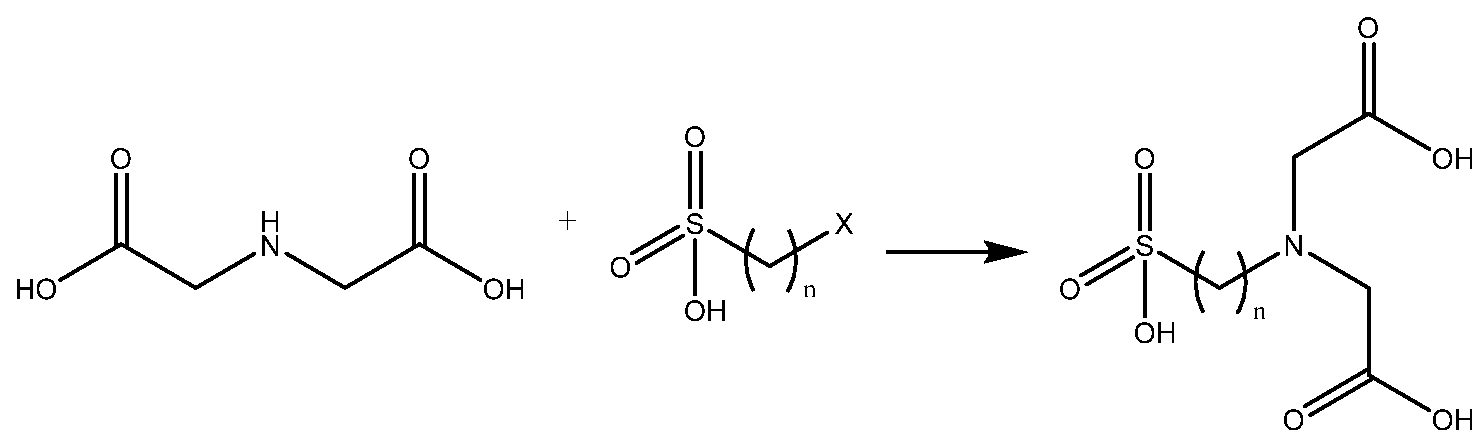
- iminodiacetic acid is alkylated with a haloalkylsulfonic acid under basic conditions to produce an alkali metal salt of the sulfonated iminodiacetic acid
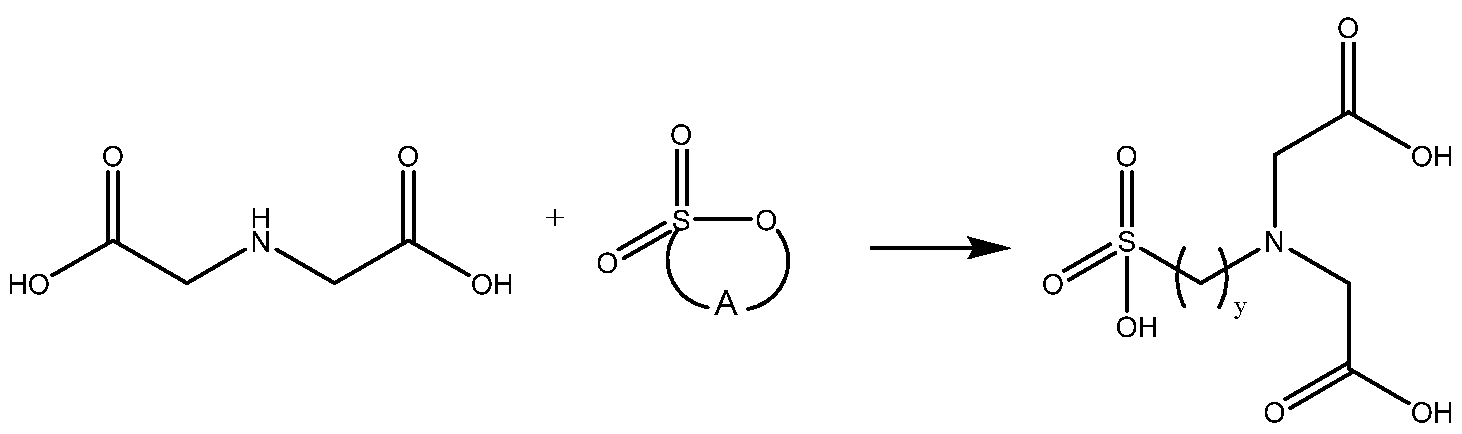
- sulfonated iminodiacetic acids may be synthesized in their free acid form under acidic conditions via a ring- opening process without alkali metal ions being present.
- iminodiacetic acid may be reacted in high yields with 1,2-oxathietane 2,2-dioxide (ethane sultone), 1,2-oxathiolane 2,2-dioxide (1,3-propane sultone), 1,2- oxathiane 2,2-dioxide (1,4-butane sultone), or various derivatives thereof to accomplish the foregoing.
- 1,2-oxathietane 2,2-dioxide ethane sultone
- 1,2-oxathiolane 2,2-dioxide 1,2-oxathiolane 2,2-dioxide
- 1,2-oxathiane 2,2-dioxide 1,4-butane sultone
- the fluid concentrate may then be employed directly as a treatment fluid or diluted further with a carrier fluid and possibly other substances of interest to form a treatment fluid that is substantially free of alkali metal ions.
- Sulfonated iminodiacetic acids that are substantially free of alkali metal ions may be particularly advantageous for acidizing a siliceous formation for the reasons discussed above.
- the sulfonated iminodiacetic acids described herein may be equally applicable to acidizing operations conducted in a carbonate formation or in a siliceous formation without greatly modifying the treatment fluid.
- hydrofluoric acid or a hydrofluoric acid- generating compound can be present in a treatment fluid containing the sulfonated iminodiacetic acid or be introduced separately to a subterranean formation to promote dissolution of the siliceous material therein.
- the ability to use the sulfonated iminodiacetic acids described herein in both types of acidizing operations may significantly simplify these oilfield operations and decrease their cost.
- the sulfonated iminodiacetic acids described herein may possess anti-scaling properties.
- methods described herein may comprise: providing an acidic treatment fluid comprising a sulfonated iminodiacetic acid; introducing the acidic treatment fluid into a subterranean formation; and at least partially dissolving an acid-reactive substance in the subterranean formation while complexing one or more metal ions with the sulfonated iminodiacetic acid.
- the sulfonated iminodiacetic acid may have the structure shown in Formula 1
- n is an integer ranging between 1 and about 6.
- Additional functionality may also be introduced to the sulfonated iminodiacetic acid of Formula 1 in order to further tailor its solubility, pKa values, and/or biodegradation rate, for example.
- n may be 2, 3 or 4 in Formula 1.
- sulfonated iminodiacetic acids may be readily synthesized in a form that is substantially free of alkali metal ions.
- iminodiacetic acid or a salt thereof may be alkylated under basic conditions with a haloalkylsulfonic acid or a salt thereof, as shown in Reaction 1, wherein X is a halide or a halide equivalent, such as an alkylsulfonate or an arylsulfonate.
- Reaction 1 wherein X is a halide or a halide equivalent, such as an alkylsulfonate or an arylsulfonate.
- the free acid form of the iminodiacetic acid can be produced by acidification, and the alkali metal ions can be removed therefrom via standard techniques before synthesizing the sulfonated iminodiacetic acid by Reaction 2.
- a further advantage of the synthetic approach depicted in Reaction 2 is that formation of the sulfonated iminodiacetic acid occurs in near-quantitative yield as a concentrate in an aqueous reaction medium. The concentrate may be used directly in an acidizing operation or undergo dilution with a carrier fluid in the course of formulating an acidizing fluid.
- the acidic treatment fluids of the present disclosure may be substantially free of alkali metal ions.
- substantially free of alkali metal ions refers to an alkali metal content of about 5 wt. % or less, particularly an alkali metal content of about 1 wt. % or less.
- providing the acidic treatment fluid may comprise preparing the sulfonated iminodiacetic acid in a form that is substantially free of alkali metal ions and forming the acidic treatment fluid therefrom.
- the sulfonated iminodiacetic acid may be formed from a sultone in a concentrate, which may be used directly in an acidizing operation or undergo further dilution with a carrier fluid to form an acidizing fluid.
- Carrier fluids used for forming the acidic treatment fluids of the present disclosure may be obtained from any suitable source.
- suitable aqueous carrier fluids may include, for example, fresh water, acidified water, treated water, salt water, seawater, brackish water, produced water, flowback water, brine (e.g., a saturated salt solution), or an aqueous salt solution (e.g., a non-saturated salt solution) .
- carrier fluids containing alkali metal ions e.g., salt water, seawater, brine, aqueous salt water, and the like
- alkali metal ions may not be suitable, unless they have undergone a treatment to remove a substantial portion of their alkali metal ions.
- an organic co-solvent may be present in the acidic treatment fluids.
- Suitable organic co-solvents may include, but are not limited to, glycols and alcohol solvents, for example.
- an amount of the organic co-solvent may range between about 1% to about 50% by volume of the treatment fluid.
- preparing the sulfonated iminodiacetic acid in a form that is substantially free of alkali metal ions may comprise reacting iminodiacetic acid with 1,2-oxathiolane 2,2-dioxide (1,3- propane sultone) to form a concentrate comprising the sulfonated iminodiacetic acid, and optionally, diluting the concentrate with a carrier fluid. This reaction forms a -CH 2 CH 2 - link between the nitrogen atom of the iminodiacetic acid and the sulfonic acid moiety.
- Related compounds may be formed by reacting ethane sultone or 1,4-butane sultone to form the -CH 2 - and -CH 2 CH 2 CH 2 - analogs, respectively.
- the reaction to form the sulfonated iminodiacetic acid in this manner may occur at a temperature between about 50°C and about 100°C, or between about 60°C and about 80°C.
- the concentrate obtained from the reaction to produce the sulfonated iminodiacetic acid may comprise the acidic treatment fluid directly.
- a concentration of the sulfonated iminodiacetic acid in the acidic treatment fluid and in the concentrate may range between about 0.1 M to about 5 M.
- the concentration may range between about 0.5 M and about 5 M, or between about 1 M and about 5 M, or between about 2 M and about 5 M, or between about 2 M and about 4 M.
- Dilution of the concentrate with a carrier fluid may be used to lower the concentration of the sulfonated iminodiacetic acid to a suitable working range, such as any concentration in the range of 0.1 M to about 5 M in the treatment fluid.
- the acidic treatment fluid may have a pH of about 4 or below, or a pH of about 3 or below, or a pH of about 2 or below, or a pH of about 1 or below. If the pH of the concentrate or the combination of the concentrate and a carrier fluid is not in a desired pH range, the methods described herein may further comprise raising the pH of the acidic treatment fluid with a base prior to introducing the acidic treatment fluid into the subterranean formation.
- ammonium hydroxide may comprise a suitable base, particularly if the treatment fluid is to be maintained in a form that is substantially free of alkali metal ions. Amine bases may also be suitable in this regard.
- Alkali metal bases may be suitable if there is no need to maintain the acidic treatment fluids free of alkali metal ions. More desirably, however, the acidic treatment fluid may be free of alkali metal ions by employing one or more of the non-metal bases noted above. Similarly, if the pH of the concentrate or the combination of the concentrate and the carrier flow is not low enough, an acid or acid-generating compound may be added thereto, as discussed below.
- methods of the present disclosure may comprise : providing an acidic treatment fluid that is substantially free of alkali metal ions and comprises a sulfonated iminodiacetic acid; introducing the acidic treatment fluid into a subterranean formation; at least partially dissolving an acid-reactive substance in the subterranean formation in the presence of the sulfonated iminodiacetic acid; and complexing one or more metal ions in the subterranean formation with the sulfonated iminodiacetic acid.
- the sulfonatated iminodiacetic acid may complex one or more metal ions in order to mitigate the metal ions' ability to undergo secondary reactions and form a precipitate within the subterranean formation.
- the resulting metal complexes may remain within the subterranean formation, or they may be produced therefrom before or concurrent with production of a hydrocarbon resource.
- the metal complexes may remain soluble within the acidic treatment fluid. Complexation of metal ions may, at least in part, promote dissolution of an acid- reactive substance.
- the sulfonated iminodiacetic acids described herein are highly acidic substances by themselves, and in addition to their metal complexation properties, they may also promote dissolution of the acid-reactive substance containing metal ions through their acidity. Accordingly, in some embodiments, the sulfonated iminodiacetic acid may be present alone in the acidic treatment fluid, such that the acidic treatment fluid is free of mineral acids and other organic acids. In some embodiments, the sulfonated iminodiacetic acid may serve as a replacement for a mineral acid, such as hydrochloric acid, in an acidic treatment fluid. This may particularly be the case when the acidic treatment fluids are used for acidizing a subterranean formation that primarily comprises a carbonate mineral such as calcite, dolomite, or the like.
- the acidic treatment fluids containing the sulfonated iminodiacetic acid may further comprise an acid or an acid-generating compound.
- the acid or acid-generating compound may supplement the innate acidity of the sulfonated iminodiacetic acid so that the treatment fluid spends less quickly. Both organic acids and mineral acids may be used for this purpose.
- organic and mineral acids examples include, for example, hydrochloric acid, hydrobromic acid, hydrofluoric acid formic acid, acetic acid, chloroacetic acid, dichloroacetic acid, trichloroacetic acid, methanesulfonic acid, citric acid, maleic acid, glycolic acid, lactic acid, malic acid, oxalic acid, the like, and any combination thereof.
- hydrofluoric acid in combination with the sulfonated iminodiacetic acid when acidizing a subterranean formation comprising a siliceous mineral or a subterranean formation of mixed mineralogy comprising both a siliceous mineral and a carbonate mineral.
- Suitable acid-generating compounds can include, for example, esters, aliphatic polyesters, orthoesters, poly(orthoesters), poly(lactides), poly(glycolides), poly(8-caprolactones), poly(hydroxybutyrates), poly(anhydrides), ethylene glycol monoformate, ethylene glycol diformate, diethylene glycol diformate, glyceryl monoformate, glyceryl diformate, glyceryl triformate, triethylene glycol diformate, formate esters of pentaerythritol, the like, any derivative thereof, and any combination thereof.
- the acid-reactive substance may comprise a carbonate mineral.
- Carbonate minerals that may undergo dissolution in the presence of the acidic treatment fluids of the present disclosure include, for example, calcite (calcium carbonate), dolomite (calcium magnesium carbonate), siderite (iron carbonate), or any combination thereof.
- the one or more metal ions may comprise at least calcium ions.
- the one or more metal ions may comprise iron ions and iron control may be achieved.
- the solubility limit of the metal ions may be increased relative to the uncomplexed metal ions, thereby lessening the likelihood of damaging precipitates forming within the subterranean formation.
- metal ions that may be complexed by the sulfonated iminodiacetic acid include alkaline earth metal ions, transition metal ions, main group metal ions, lanthanide ions, or any combination thereof.
- metal ions that may be complexed by the sulfonated iminodiacetic acid may include calcium ions, iron ions, aluminum ions, or any combination thereof.
- Zinc ions, titanium ions, and/or zirconium ions may also be desirable to complex for similar reasons. By complexing these metal ions and others, it may be possible to preclude their participation in secondary reactions that may form damaging precipitates in a subterranean formation.
- the acid-reactive substance may comprise a siliceous mineral, which optionally may be present in combination with a carbonate mineral.
- a siliceous mineral When a siliceous mineral is present, dissolution of the siliceous mineral may be promoted by hydrofluoric acid or a hydrofluoric acid-generating compound.
- the metal ions By complexing metal ions that may be present in the subterranean formation, the metal ions may be prevented from undergoing secondary reactions with dissolved silicon compounds or with the hydrofluoric acid itself. For example, by complexing calcium ions, the calcium ions may be prevented from undergoing a secondary reaction to form damaging calcium fluoride precipitates.
- the one or more metal ions may be co-present with or within the siliceous mineral and be liberated upon dissolution of the siliceous mineral by the hydrofluoric acid.
- metal ions can be liberated when dissolving a siliceous mineral that is co-present with a carbonate mineral, such as calcite.
- the hydrofluoric acid or the hydrofluoric acid-generating compound may be present in the acidic treatment fluid comprising the sulfonated iminodiacetic acid or it may be introduced in a separate treatment fluid.
- the acidic treatment fluid comprising the sulfonated iminodiacetic acid may be introduced to the subterranean formation first in order to promote metal ion complexation before forming dissolved silicon compounds from the siliceous mineral.
- the acidic treatment fluid comprising the sulfonated iminodiacetic acid may pre-condition the subterranean formation before dissolved silicon is formed therein.
- the hydrofluoric acid may be formed from a hydrofluoric acid-generating compound.
- Suitable hydrofluoric acid-generating compounds may include substances such as, for example, fluoroboric acid, fluorosulfuric acid, hexafluorophosphoric acid, hexafluoroantimonic acid, difluorophosphoric acid, hexafluorosilicic acid, potassium hydrogen difluoride, sodium hydrogen difluoride, polyvinylammonium fluoride, polyvinylpyridinium fluoride, pyridinium fluoride, imidazolium fluoride, ammonium fluoride, tetrafluoroborate salts, hexafluoroantimonate salts, hexafluorophosphate salts, bifluoride salts (e.g., ammonium bifluoride), perfluorinated organic compounds, boron trifluoride and various boron trifluoride complexes.
- fluoroboric acid fluoros
- a hydrofluoric acid-generating compound can be present in the treatment fluids described herein in an amount ranging between about 0.1% to about 20% by weight of the acidic treatment fluid. In other embodiments, an amount of the hydrofluoric acid-generating compound can range between about 0.5% to about 10% by weight of the treatment fluid or between about 0.5% to about 8% by weight of the treatment fluid. Hydrofluoric acid, when present, may be used in similar concentration ranges.
- the acidic treatment fluid can be substantially free of alkali metal ions in various embodiments.
- the treatment fluids described herein may further comprise any number of additives that are commonly used in downhole operations including, for example, silica scale control additives, corrosion inhibitors, surfactants, gel stabilizers, anti-oxidants, polymer degradation prevention additives, relative permeability modifiers, scale inhibitors, foaming agents, defoaming agents, antifoaming agents, emulsifying agents, de-emulsifying agents, iron control agents, proppants or other particulates, particulate diverters, acids, fluid loss control additives, gas, catalysts, clay control agents, dispersants, flocculants, scavengers (e.g., H 2 S scavengers, C0 2 scavengers or 0 2 scavengers), gelling agents, scavengers (e.g., H 2 S scavengers, C0 2 scavengers or 0 2
- the acidic treatment fluids described herein may be used in treating a particulate pack in a subterranean formation.
- Particulate packs may include, for example, proppant packs and gravel packs. Treatment of a particulate pack may beneficially allow the permeability of the pack to be increased, such that it presents a lower impediment to fluid flow.
- the acidic treatment fluids described herein may be utilized in matrix acidizing operations. That is, in some embodiments, the treatment fluids described herein can be introduced to a subterranean formation below a fracture gradient pressure of the subterranean formation. In some embodiments, the interaction of the treatment fluid with the formation matrix may result in the desirable formation of wormholes therein. In other embodiments, the treatment fluids described herein can be introduced to a subterranean formation at or above a fracture gradient pressure of the subterranean formation, such that one or more fractures are created or enhanced in the subterranean formation.
- the treatment fluids described herein may be used in remediation operations within a subterranean formation.
- treatment fluids described herein comprising a sulfonated iminodiacetic acid may be used to remove precipitation or accumulation damage within a subterranean formation .
- precipitation or accumulation damage refers to a siliceous or non- siliceous scale that has been dissolved in a subterranean formation and deposited elsewhere within the subterranean formation.
- the treatment fluids described herein may be used in conjunction with drilling a wellbore penetrating a subterranean formation.
- the treatment fluids may desirably leave the subterranean formation conditioned with the chelating agent so that precipitation can be subsequently mitigated at a later time.
- treatment fluids described herein may comprise a sulfonated iminodiacetic acid of Formula 1, in which n is 2, 3, or 4, and the acidic treatment fluid is substantially free of alkali metal ions.
- the treatment fluids may further comprise hydrofluoric acid or a hydrofluoric acid-generating compound.
- the treatment fluids may further comprise an acid or an acid-generating compound.
- systems configured for delivering a treatment fluid of the present disclosure to a downhole location are described herein.
- the systems can comprise a pump fluidly coupled to a tubular, the tubular containing an acidic treatment fluid that is substantially free of alkali metal ions and comprises a sulfonated iminodiacetic acid having the structure exemplified in Formula 1 in which n is 2, 3, or 4.
- the pump may be a high pressure pump in some embodiments.
- the term "high pressure pump” will refer to a pump that is capable of delivering a fluid downhole at a pressure of about 1000 psi or greater.
- a high pressure pump may be used when it is desired to introduce a treatment fluid of the present disclosure to a subterranean formation at or above a fracture gradient of the subterranean formation, but it may also be used in cases where fracturing is not desired.
- the treatment fluids described herein may be introduced with a high pressure pump, or they may be introduced following a treatment fluid (e.g., a pad fluid) that was introduced with a high pressure pump.
- the high pressure pump may be capable of fluidly conveying particulate matter into the subterranean formation.
- Suitable high pressure pumps will be known to one having ordinary skill in the art and may include, but are not limited to, floating piston pumps and positive displacement pumps.
- the pump may be a low pressure pump.
- the term "low pressure pump” will refer to a pump that operates at a pressure of about 1000 psi or less.
- a low pressure pump may be fluidly coupled to a high pressure pump that is fluidly coupled to the tubular. That is, in such embodiments, the low pressure pump may be configured to convey the treatment fluid to the high pressure pump. In such embodiments, the low pressure pump may "step up" the pressure of a treatment fluid before it reaches the high pressure pump.
- the systems described herein can further comprise a mixing tank that is upstream of the pump and in which the sulfonated iminodiacetic acid is provided in a concentrate and/or combined with a carrier fluid. Formation of the sulfonated iminodiacetic acid may also occur in the mixing tank, in some embodiments.
- the pump e.g., a low pressure pump, a high pressure pump, or a combination thereof
- the pump may convey the treatment fluid from the mixing tank or other source of the treatment fluid to the tubular.
- the treatment fluid can be formulated offsite and transported to a worksite, in which case the treatment fluid may be introduced to the tubular via the pump directly from its shipping container (e.g., a truck, a railcar, a barge, or the like) or from a transport pipeline. In either case, the treatment fluid may be drawn into the pump, elevated to an appropriate pressure, and then introduced into the tubular for delivery downhole.
- its shipping container e.g., a truck, a railcar, a barge, or the like
- the treatment fluid may be drawn into the pump, elevated to an appropriate pressure, and then introduced into the tubular for delivery downhole.
- FIGURE 1 shows an illustrative schematic of a system that can deliver treatment fluids of the present disclosure to a downhole location, according to one or more embodiments.
- system 1 may include mixing tank 10, in which a treatment fluid of the present disclosure may be formulated.
- the treatment fluid may be conveyed via line 12 to wellhead 14, where the treatment fluid enters tubular 16, tubular 16 extending from wellhead 14 into subterranean formation 18.
- Tubular 16 may include orifices that allow the treatment fluid to enter into the wellbore.
- Pump 20 may be configured to raise the pressure of the treatment fluid to a desired degree before its introduction into tubular 16. It is to be recognized that system 1 is merely exemplary in nature and various additional components may be present that have not necessarily been depicted in FIGURE 1 in the interest of clarity. Non-limiting additional components that may be present include, but are not limited to, supply hoppers, valves, condensers, adapters, joints, gauges, sensors, compressors, pressure controllers, pressure sensors, flow rate controllers, flow rate sensors, temperature sensors, and the like.
- the treatment fluid may, in some embodiments, flow back to wellhead 14 and exit subterranean formation 18. Flowback of the treatment fluid may serve to remove complexed metal ions from the subterranean formation, for example. In some embodiments, the treatment fluid that has flowed back to wellhead 14 may subsequently be recovered and recirculated to subterranean formation 18. In other embodiments, the treatment fluid may flow back to wellhead 14 in a produced hydrocarbon fluid from subterranean formation 18.
- the disclosed treatment fluids may also directly or indirectly affect the various downhole equipment and tools that may come into contact with the fracturing fluids during operation .
- equipment and tools may include, but are not limited to, wellbore casing, wellbore liner, completion string, insert strings, drill string, coiled tubing, slickline, wireline, drill pipe, drill collars, mud motors, downhole motors and/or pumps, surface-mounted motors and/or pumps, centralizers, turbolizers, scratchers, floats (e.g., shoes, collars, valves, etc.), logging tools and related telemetry equipment, actuators (e.g., electromechanical devices, hydromechanical devices, etc.), sliding sleeves, production sleeves, plugs, screens, filters, flow control devices (e.g., inflow control devices, autonomous inflow control devices, outflow control devices, etc.), couplings (e.g., electro- hydraulic wet connect, dry connect, inductive coupler, etc.), control lines
- actuators e.g.
- Embodiments disclosed herein include:
- A. Methods for acidizing a subterranean formation comprise : providing an acidic treatment fluid comprising a sulfonated iminodiacetic acid; introducing the acidic treatment fluid into a subterranean formation; and at least partially dissolving an acid-reactive substance in the subterranean formation while complexing one or more metal ions with the sulfonated iminodiacetic acid.
- Methods for acidizing a subterranean formation comprise : providing an acidic treatment fluid that is substantially free of alkali metal ions and comprises a sulfonated iminodiacetic acid; introducing the acidic treatment fluid into a subterranean formation; at least partially dissolving an acid-reactive substance in the subterranean formation in the presence of the sulfonated iminodiacetic acid; and complexing one or more metal ions in the subterranean formation with the sulfonated iminodiacetic acid.
- C. Acidic treatment fluids comprising a sulfonated iminodiacetic acid.
- the treatment fluids comprise : a sulfonated iminodiacetic acid having a structure of
- n 2, 3 or 4; and wherein the acidic treatment fluid is substantially free of alkali metal ions.
- Systems for introducing a treatment fluid to a subterranean formation comprise: a pump fluidly coupled to a tubular, the tubular containing an acidic treatment fluid comprising a sulfonated iminodiacetic acid, the sulfonated iminodiacetic acid having a structure of ⁇
- n 2, 3 or 4; and wherein the acidic treatment fluid is substantially free of alkali metal ions.
- Each of embodiments A and B may have one or more of the following additional elements in any combination :
- Element 1 wherein the sulfonated iminodiacetic acid has a structure of
- n is an integer ranging between 1 and about 6.
- Element 2 wherein n is 2, 3 or 4.
- Element 3 wherein the acidic treatment fluid is substantially free of alkali metal ions.
- Element 4 wherein the sulfonated iminodiacetic acid also promotes dissolution of the acid-reactive substance.
- Element 5 wherein the acid-reactive substance comprises a carbonate mineral.
- Element 6 wherein the acidic treatment fluid is free of mineral acids or other organic acids.
- Element 7 wherein the acidic treatment fluid further comprises an acid or an acid-generating compound.
- Element 8 wherein the acid-reactive substance comprises a siliceous mineral, and hydrofluoric acid or a hydrofluoric acid-generating compound is also present in the subterranean formation; wherein dissolution of the siliceous mineral is promoted by the hydrofluoric acid.
- Element 9 wherein the one or more metal ions are co-present with the siliceous mineral and are liberated upon dissolution of the siliceous mineral.
- Element 10 wherein the acidic treatment fluid further comprises the hydrofluoric acid or the hydrofluoric acid-generating compound.
- Element 11 wherein the one or more metal ions comprise at least calcium ions.
- Element 12 wherein the sulfonated iminodiacetic acid has a structure of
- n 2, 3 or 4.
- Element 13 wherein providing the acidic treatment fluid comprises preparing the sulfonated iminodiacetic acid in a form that is substantially free of alkali metal ions, the preparing comprising : reacting iminodiacetic acid with a sultone to form a concentrate comprising the sulfonated iminodiacetic acid; and optionally diluting the concentrate with a carrier fluid.
- Element 14 wherein the method further comprises : raising the pH of the acidic treatment fluid with a base prior to introducing the acidic treatment fluid into the subterranean formation.
- Element 15 wherein the treatment fluid further comprises : hydrofluoric acid or a hydrofluoric acid-generating compound.
- Element 16 wherein the treatment fluid further comprises : an acid or an acid-generating compound.
- Element 17 wherein the treatment fluid is free of mineral acids or other organic acids.
- exemplary combinations applicable to A-D include: [0085] The method of A n combination w th elements 1 and 3.
- Example 1 Synthesis of a Sulfonated Iminodiacetic Acid.
- Example 2 Effects of a Sulfonated Iminodiacetic Acid on Calcium Dissolution.
- An aliquot of the reaction mixture from Example 1 was diluted to a volume of 10 mL and a concentration of 0.6 M, and the pH was adjusted to approximately 1. Thereafter, varying amounts of CaCI 2 solution and NaOH solution were added to the pH-adjusted aliquot.
- FIGURE 2 shows a bar graph summarizing the amounts of CaCI 2 and NaOH added to the chelant solution of Example 1 and the resulting pH values. No precipitate formation occurred in any of the tested configurations, even at pH values and calcium concentrations where calcium hydroxide precipitation would normally be expected to occur.
- Example 3 Stabilization of Calcium Ions in the Presence of Hydrofluoric Acid.
- a control solution was prepared by dissolving CaCI 2 and ammonium bifluoride each at a concentration of 0.6 M in 5 mL of water.
- a test solution was prepared in the same manner as the control solution, except an equivalent molar amount of the chelating agent of Example 1 was added to this solution.
- the pH value of the control solution was raised to about 7 and the pH value of the test solution was raised to about 4 by adding ammonium hydroxide.
- a thick precipitate had formed and settled in the control solution.
- a milky suspension formed, and it did not settle upon standing for 24 hours.
- Example 4 Acidizing of a Calcite Core.
- the chelant solution of Example 1 was contacted with a calcite core, and the core's differential pressure and permeability were monitored over time.
- FIGURE 3 shows a plot of differential pressure and permeability for a calcite core contacted with the chelant solution of Example 1 as a function of time. As shown in FIGURE 3, a significant drop in differential pressure and an increase in permeability of the core occurred after a contact time period. Thus, it can be concluded that the sulfonated iminodiacetic acid alone was effective to promote dissolution of the calcium carbonate in the core.
- compositions and methods are described in terms of “comprising,” “containing,” or “including” various components or steps, the compositions and methods can also “consist essentially of” or “consist of” the various components and steps. All numbers and ranges disclosed above may vary by some amount. Whenever a numerical range with a lower limit and an upper limit is disclosed, any number and any included range falling within the range are specifically disclosed. In particular, every range of values (of the form, “from about a to about b,” or, equivalently, “from approximately a to b,” or, equivalently, “from approximately a-b”) disclosed herein is to be understood to set forth every number and range encompassed within the broader range of values.
Landscapes
- Chemical & Material Sciences (AREA)
- Organic Chemistry (AREA)
- Life Sciences & Earth Sciences (AREA)
- Engineering & Computer Science (AREA)
- General Life Sciences & Earth Sciences (AREA)
- Geology (AREA)
- Materials Engineering (AREA)
- Mining & Mineral Resources (AREA)
- Chemical Kinetics & Catalysis (AREA)
- General Chemical & Material Sciences (AREA)
- Physics & Mathematics (AREA)
- Environmental & Geological Engineering (AREA)
- Fluid Mechanics (AREA)
- Inorganic Chemistry (AREA)
- Geochemistry & Mineralogy (AREA)
- Organic Low-Molecular-Weight Compounds And Preparation Thereof (AREA)
Abstract
Description



Claims


Priority Applications (5)
| Application Number | Priority Date | Filing Date | Title |
|---|---|---|---|
| MYPI2017702756A MY192455A (en) | 2015-03-04 | 2015-03-04 | Methods and systems employing a sulfonated iminodiacetic acid during subterranean treatment operations |
| PCT/US2015/018627 WO2016140657A1 (en) | 2015-03-04 | 2015-03-04 | Methods and systems employing a sulfonated iminodiacetic acid during subterranean treatment operations |
| BR112017016109-5A BR112017016109B1 (en) | 2015-03-04 | 2015-03-04 | Methods of treatment of underground formations |
| US15/549,124 US20180037806A1 (en) | 2015-03-04 | 2015-03-04 | Methods and systems employing a sulfonated iminodiacetic acid during subterranean treatment operations |
| ARP160100215A AR103530A1 (en) | 2015-03-04 | 2016-01-26 | METHODS AND SYSTEMS THAT USE A SULFONATED IMINODIACTIC ACID DURING UNDERGROUND TREATMENT OPERATIONS |
Applications Claiming Priority (1)
| Application Number | Priority Date | Filing Date | Title |
|---|---|---|---|
| PCT/US2015/018627 WO2016140657A1 (en) | 2015-03-04 | 2015-03-04 | Methods and systems employing a sulfonated iminodiacetic acid during subterranean treatment operations |
Publications (1)
| Publication Number | Publication Date |
|---|---|
| WO2016140657A1 true WO2016140657A1 (en) | 2016-09-09 |
Family
ID=56848336
Family Applications (1)
| Application Number | Title | Priority Date | Filing Date |
|---|---|---|---|
| PCT/US2015/018627 Ceased WO2016140657A1 (en) | 2015-03-04 | 2015-03-04 | Methods and systems employing a sulfonated iminodiacetic acid during subterranean treatment operations |
Country Status (5)
| Country | Link |
|---|---|
| US (1) | US20180037806A1 (en) |
| AR (1) | AR103530A1 (en) |
| BR (1) | BR112017016109B1 (en) |
| MY (1) | MY192455A (en) |
| WO (1) | WO2016140657A1 (en) |
Cited By (1)
| Publication number | Priority date | Publication date | Assignee | Title |
|---|---|---|---|---|
| US11447691B1 (en) | 2021-07-28 | 2022-09-20 | Halliburton Energy Services, Inc. | Methods of making and using a wellbore servicing fluid for iron mitigation |
Families Citing this family (1)
| Publication number | Priority date | Publication date | Assignee | Title |
|---|---|---|---|---|
| CN112940704A (en) * | 2021-02-04 | 2021-06-11 | 四川省帕提科斯能源科技有限公司 | Method for bridging channels by using desert sand, slag and steel slag coupling fibers |
Citations (5)
| Publication number | Priority date | Publication date | Assignee | Title |
|---|---|---|---|---|
| US6436880B1 (en) * | 2000-05-03 | 2002-08-20 | Schlumberger Technology Corporation | Well treatment fluids comprising chelating agents |
| US20060142166A1 (en) * | 2002-11-18 | 2006-06-29 | Thomas Ronnie L | Method using particulate chelates to stimulate production of petroleum in carbonate formations |
| US20060264335A1 (en) * | 2005-05-17 | 2006-11-23 | Bj Services Company | Corrosion inhibitor intensifier and method of using the same |
| US20100276152A1 (en) * | 2008-01-09 | 2010-11-04 | Akzo Nobel N.V. | Acidic aqueous solution containing a chelating agent and the use thereof |
| US20140374107A1 (en) * | 2013-06-25 | 2014-12-25 | Halliburton Energy Services, Inc. | Methods and Systems for Acidizing Subterranean Formations with Treatment Fluids Containing Dual-Functioning Chelating Agents |
Family Cites Families (2)
| Publication number | Priority date | Publication date | Assignee | Title |
|---|---|---|---|---|
| JP3597223B2 (en) * | 1994-07-22 | 2004-12-02 | 三菱レイヨン株式会社 | Method for producing aminosulfonic acid-N, N-diacetic acid and alkali metal salt thereof and biodegradable chelating agent containing them |
| US9120964B2 (en) * | 2006-08-04 | 2015-09-01 | Halliburton Energy Services, Inc. | Treatment fluids containing biodegradable chelating agents and methods for use thereof |
-
2015
- 2015-03-04 US US15/549,124 patent/US20180037806A1/en not_active Abandoned
- 2015-03-04 BR BR112017016109-5A patent/BR112017016109B1/en active IP Right Grant
- 2015-03-04 MY MYPI2017702756A patent/MY192455A/en unknown
- 2015-03-04 WO PCT/US2015/018627 patent/WO2016140657A1/en not_active Ceased
-
2016
- 2016-01-26 AR ARP160100215A patent/AR103530A1/en active IP Right Grant
Patent Citations (5)
| Publication number | Priority date | Publication date | Assignee | Title |
|---|---|---|---|---|
| US6436880B1 (en) * | 2000-05-03 | 2002-08-20 | Schlumberger Technology Corporation | Well treatment fluids comprising chelating agents |
| US20060142166A1 (en) * | 2002-11-18 | 2006-06-29 | Thomas Ronnie L | Method using particulate chelates to stimulate production of petroleum in carbonate formations |
| US20060264335A1 (en) * | 2005-05-17 | 2006-11-23 | Bj Services Company | Corrosion inhibitor intensifier and method of using the same |
| US20100276152A1 (en) * | 2008-01-09 | 2010-11-04 | Akzo Nobel N.V. | Acidic aqueous solution containing a chelating agent and the use thereof |
| US20140374107A1 (en) * | 2013-06-25 | 2014-12-25 | Halliburton Energy Services, Inc. | Methods and Systems for Acidizing Subterranean Formations with Treatment Fluids Containing Dual-Functioning Chelating Agents |
Cited By (2)
| Publication number | Priority date | Publication date | Assignee | Title |
|---|---|---|---|---|
| US11447691B1 (en) | 2021-07-28 | 2022-09-20 | Halliburton Energy Services, Inc. | Methods of making and using a wellbore servicing fluid for iron mitigation |
| WO2023009115A1 (en) * | 2021-07-28 | 2023-02-02 | Halliburton Energy Services, Inc. | Methods of making and using a wellbore servicing fluid for iron mitigation |
Also Published As
| Publication number | Publication date |
|---|---|
| BR112017016109B1 (en) | 2022-05-03 |
| MY192455A (en) | 2022-08-22 |
| BR112017016109A2 (en) | 2018-03-27 |
| AR103530A1 (en) | 2017-05-17 |
| US20180037806A1 (en) | 2018-02-08 |
Similar Documents
| Publication | Publication Date | Title |
|---|---|---|
| US10005950B2 (en) | Methods and systems for removing geothermal scale | |
| US11505738B2 (en) | Methods, treatment fluids and systems for differential acidizing of a siliceous material | |
| US9809716B2 (en) | Methods and systems for protecting acid-reactive substances | |
| US10072205B2 (en) | Methods and systems for acidizing subterranean formations with treatment fluids containing dual-functioning chelating agents | |
| US10640697B2 (en) | Methods and systems for suppressing corrosion of metal surfaces | |
| US10344564B2 (en) | Methods and systems for wellbore remediation | |
| US10240442B2 (en) | Methods and systems for stimulating a subterranean formation containing a carbonate mineral | |
| US10711181B2 (en) | Methods and systems incorporating N-(phosphonoalkyl)iminodiacetic acid particulates | |
| US9556377B2 (en) | Treatment fluids containing a hydrophobically modified chelating agent and methods for use thereof | |
| US11248165B2 (en) | Sulfonated iminodialkanoic acids formed from an iminodialkylnitrile and a sultone and methods for use thereof | |
| US20180037806A1 (en) | Methods and systems employing a sulfonated iminodiacetic acid during subterranean treatment operations | |
| US10287488B2 (en) | Methods and systems for forming a fracturing fluid from a source of metal-laden water | |
| US10221658B2 (en) | Treatment fluids comprising carminic acid and related compounds and method for use thereof |
Legal Events
| Date | Code | Title | Description |
|---|---|---|---|
| 121 | Ep: the epo has been informed by wipo that ep was designated in this application |
Ref document number: 15884122 Country of ref document: EP Kind code of ref document: A1 |
|
| WWE | Wipo information: entry into national phase |
Ref document number: 15549124 Country of ref document: US |
|
| REG | Reference to national code |
Ref country code: BR Ref legal event code: B01A Ref document number: 112017016109 Country of ref document: BR |
|
| NENP | Non-entry into the national phase |
Ref country code: DE |
|
| ENP | Entry into the national phase |
Ref document number: 112017016109 Country of ref document: BR Kind code of ref document: A2 Effective date: 20170727 |
|
| 122 | Ep: pct application non-entry in european phase |
Ref document number: 15884122 Country of ref document: EP Kind code of ref document: A1 |