WO2016136907A1 - アポトーシス抑制剤 - Google Patents
アポトーシス抑制剤 Download PDFInfo
- Publication number
- WO2016136907A1 WO2016136907A1 PCT/JP2016/055691 JP2016055691W WO2016136907A1 WO 2016136907 A1 WO2016136907 A1 WO 2016136907A1 JP 2016055691 W JP2016055691 W JP 2016055691W WO 2016136907 A1 WO2016136907 A1 WO 2016136907A1
- Authority
- WO
- WIPO (PCT)
- Prior art keywords
- apoptosis
- group
- apoptosis inhibitor
- formula
- compound represented
- Prior art date
- Legal status (The legal status is an assumption and is not a legal conclusion. Google has not performed a legal analysis and makes no representation as to the accuracy of the status listed.)
- Ceased
Links
Images



Classifications
-
- A—HUMAN NECESSITIES
- A61—MEDICAL OR VETERINARY SCIENCE; HYGIENE
- A61K—PREPARATIONS FOR MEDICAL, DENTAL OR TOILETRY PURPOSES
- A61K31/00—Medicinal preparations containing organic active ingredients
- A61K31/33—Heterocyclic compounds
- A61K31/395—Heterocyclic compounds having nitrogen as a ring hetero atom, e.g. guanethidine or rifamycins
- A61K31/41—Heterocyclic compounds having nitrogen as a ring hetero atom, e.g. guanethidine or rifamycins having five-membered rings with two or more ring hetero atoms, at least one of which being nitrogen, e.g. tetrazole
- A61K31/425—Thiazoles
- A61K31/428—Thiazoles condensed with carbocyclic rings
Definitions
- the present invention relates to an apoptosis inhibitor.
- Apoptosis is pre-programmed cell death in vivo, and plays an important role in the removal of unnecessary cells in the development process of individuals, the removal of cancerous cells, and the like. However, it is also known that apoptosis is deeply involved in various diseases. If apoptosis can be suppressed, it can be expected to be a therapeutic drug for various diseases.
- Patent Document 1 describes a method of screening an organic dye compound for a receptor potential inducer that induces a receptor potential in response to light stimulation in the optic nerve.
- organic dye compounds A compound represented by the following formula (1a) is described.
- a receptor potential inducer containing such an organic dye compound is a visual disorder such as visual field stenosis, visual acuity, and night blindness caused by retinal disorders associated with wounds, drug addiction, and neurological disorders of the visual center.
- retina replacement materials including artificial retina for relieving or eliminating color vision abnormalities caused by retinal diseases and lack of specific pyramidal bodies, it is said to be extremely useful as a substitute for visual related substances. Yes.
- the effect of suppressing apoptosis has never been known so far.
- the present invention has been made to solve the above-described problems, and an object of the present invention is to provide an apoptosis inhibitor having high safety and an excellent effect of suppressing apoptosis.
- R 1 and R 2 each independently represents an alkyl group having 1 to 10 carbon atoms, and X ⁇ represents a halogen ion. ]
- the apoptosis inhibitor of the present invention is highly safe and has an excellent effect of suppressing apoptosis. It can be suitably used as an apoptosis inhibitor for retinal neurons.
- FIG. 1 is a photomicrograph of apoptotic cells in the retina of an RCS rat in Example 1.
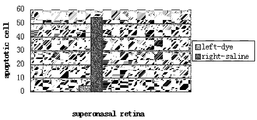
- FIG. FIG. 2 is a graph showing the results obtained by measuring the number of apoptosis-positive cells in Example 1.
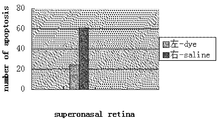
- FIG. 3 is a graph showing the results obtained by measuring the number of apoptosis-positive cells in Example 2.
- FIG. 4 is a graph showing the results obtained by measuring the number of apoptosis-positive cells in Example 3.
- FIG. 5 is a graph showing the results obtained by measuring the number of apoptosis-positive cells in Example 4.
- the apoptosis inhibitor of the present invention contains a compound represented by the following formula (1) as an active ingredient.
- R 1 and R 2 each independently represents an alkyl group having 1 to 10 carbon atoms, and X ⁇ represents a halogen ion. ]
- R 1 and R 2 are each independently an alkyl group having 1 to 10 carbon atoms.
- the alkyl group having 1 to 10 carbon atoms used for R 1 and R 2 may be a linear or branched alkyl group or a cyclic cycloalkyl group.
- R 1 and R 2 an alkyl group having 1 to 8 carbon atoms is preferable, an alkyl group having 1 to 6 carbon atoms is more preferable, and an alkyl group having 1 to 4 carbon atoms is more preferable.
- the alkyl groups used for R 1 and R 2 may be the same alkyl group or different alkyl groups.
- X ⁇ is a halogen ion.
- the halogen ion used for X ⁇ include fluorine ion, chlorine ion, bromine ion, iodine ion and the like.
- X ⁇ at least one selected from the group consisting of chlorine ion, bromine ion and iodine ion is preferable, and at least one selected from the group consisting of bromine ion and iodine ion is more preferable. .
- the apoptosis inhibitor of the present invention may be an actual embodiment in which the compound represented by the formula (1) is administered alone, or contains the compound represented by the formula (1) and a pharmacologically acceptable carrier. It may be an embodiment in which the preparation is administered.
- the carrier include solvents such as distilled water, physiological saline, and aqueous glucose solution; binders such as starch, dextrin, and gelatin; bactericides; surfactants; pH adjusters; emulsifiers; antioxidants; Can be mentioned.
- the preparation examples include tablets, sustained release agents, granules, powders, capsules, films, syrups, suspensions, injections, eye drops, external preparations, suppositories, and nasal preparations. .
- a method of preparing a dye solution by adding the compound represented by the formula (1) to a solvent such as physiological saline and administering the dye solution is suitably employed. That is, an apoptosis inhibitor containing a compound represented by the formula (1) and a pharmacologically acceptable solvent is a preferred embodiment of the present invention.
- supported the compound shown by Formula (1) on the polymer film etc. can also be used suitably as a sustained release agent.
- the compound contains a compound represented by the formula (1a) as a control compared with the result of injection of only physiological saline into one eye of a retinitis pigmentosa rat (RCS rat).
- RCS rat retinitis pigmentosa rat
- the present inventors confirmed that apoptosis of retinal neurons was significantly reduced. Therefore, it turns out that the apoptosis inhibitor of this invention has the outstanding apoptosis inhibitory effect.
- a preferred embodiment of the present invention is an apoptosis inhibitor for retinal neurons.
- the present inventors have verified that the compound represented by the formula (1a) was not toxic as a result of biological safety evaluation. From this, it can be seen that the apoptosis inhibitor of the present invention is highly safe.
- organic dye compound a polymethine-based organic dye compound represented by the following formula (1a), which was reported and manufactured as “NK-5962” from Hayashibara Co., Ltd., was used.
- Example 1 A dye solution was prepared by adding the organic dye compound (NK-5996) represented by the formula (1a) to physiological saline to a concentration of 8.2 ⁇ g / mL. 10 ⁇ L of the dye solution was injected into the vitreous body of one eye of a 4-week-old retinitis pigmentosa rat (RCS rat). The same amount of saline alone was injected into the vitreous body of the opposite eye to serve as a control. Two weeks later, eyeballs were extracted from RCS rats, and frozen sections were prepared.
- NK-5996 organic dye compound represented by the formula (1a)
- Apoptotic cells were stained by the TUNEL method using “In Situ Cell Death Detection Kit, Fluorescein” manufactured by Roche Diagnostics, and observed with a fluorescence microscope. The obtained results are shown in FIG. As shown in FIG. 1, many apoptosis-positive cells were observed as green fluorescence in the control eye (saline injection eye) injected with physiological saline alone. In contrast, in the dye-injected eye injected with the dye solution, the number of apoptosis-positive cells was remarkably suppressed. Moreover, the result obtained by measuring the number of apoptosis positive cells per 100 ⁇ m of the retina is shown in FIG. Apoptosis of retinal neurons was significantly reduced in eyes injected with organic pigment compounds compared to control eyes injected with saline alone. Therefore, it turns out that it is very useful as an apoptosis inhibitor.
- Example 2 In Example 1, apoptotic cells were stained by the TUNEL method in the same manner as in Example 1 except that the concentration of the dye solution was diluted 10 times, and the number of apoptotic positive cells per 100 ⁇ m of the retina was measured. The obtained results are shown in FIG.
- Example 3 In Example 1, apoptotic cells were stained by the TUNEL method in the same manner as in Example 1 except that the concentration of the dye solution was diluted 100 times, and the number of apoptosis-positive cells per 100 ⁇ m of the retina was measured. The obtained results are shown in FIG.
- Example 4 In Example 1, apoptotic cells were stained by the TUNEL method in the same manner as in Example 1 except that the concentration of the dye solution was diluted 1000 times and used, and the number of apoptosis-positive cells per 100 ⁇ m of the retina was measured. The obtained results are shown in FIG.
Landscapes
- Health & Medical Sciences (AREA)
- Chemical & Material Sciences (AREA)
- Medicinal Chemistry (AREA)
- Pharmacology & Pharmacy (AREA)
- Epidemiology (AREA)
- Life Sciences & Earth Sciences (AREA)
- Animal Behavior & Ethology (AREA)
- General Health & Medical Sciences (AREA)
- Public Health (AREA)
- Veterinary Medicine (AREA)
- Pharmaceuticals Containing Other Organic And Inorganic Compounds (AREA)
- Medicinal Preparation (AREA)
Abstract
安全性が高く、アポトーシスを抑制する効果に優れたアポトーシス抑制剤を提供する。 下記式(1)で示される化合物を有効成分として含有するアポトーシス抑制剤である。[式中、R1及びR2は、それぞれ独立して炭素数1~10のアルキル基であり、X-はハロゲンイオンである。]
Description
本発明は、アポトーシス抑制剤に関する。
アポトーシスは、生体内で予めプログラムされた細胞死であり、個体の発生過程における不要な細胞の除去や、癌化した細胞の除去等に重要な役割を果たしている。しかしながら、様々な疾患にアポトーシスが深く関与していることも知られており、アポトーシスを抑制することができれば、様々な疾患に対する治療薬となり得ることが期待できる。
特許文献1には、視神経において、光刺激に応じた受容器電位を誘発する受容器電位誘発剤のための有機色素化合物をスクリーニングする方法が記載されており、前記有機色素化合物の一つとして、下記式(1a)で示される化合物が記載されている。

特許文献1では、このような有機色素化合物を含む受容器電位誘発剤は、傷病に伴う網膜の障害に起因する視野狭窄、視力低下、夜盲などの視覚障害や、薬物中毒、視覚中枢の神経障害、網膜の疾患、特定の錘体の欠如に起因する色覚異常を緩和したり解消するための人工網膜をはじめとする網膜代替用材において、視覚関連物質を代替する材料として極めて有用であるとされている。しかしながら、アポトーシスを抑制する効果については、これまで全く知られていなかった。
本発明は上記課題を解決するためになされたものであり、安全性が高く、アポトーシスを抑制する効果に優れたアポトーシス抑制剤を提供することを目的とするものである。
上記課題は、下記式(1)で示される化合物を有効成分として含有するアポトーシス抑制剤を提供することによって解決される。

本発明のアポトーシス抑制剤は、安全性が高く、アポトーシスを抑制する効果に優れている。網膜の神経細胞に対するアポトーシス抑制剤として好適に使用することができる。
本発明のアポトーシス抑制剤は、下記式(1)で示される化合物を有効成分として含有するものである。

上記式(1)において、R1及びR2は、それぞれ独立して炭素数1~10のアルキル基である。R1及びR2に用いられる炭素数1~10のアルキル基としては、直鎖や分岐鎖のアルキル基であってもよいし、環状のシクロアルキル基であってもよい。例えば、メチル基、エチル基、n-プロピル基、イソプロピル基、n-ブチル基、イソブチル基、sec-ブチル基、tert-ブチル基、n-ペンチル基、イソペンチル基、ネオペンチル基、tert-ペンチル基、n-ヘキシル基、イソヘキシル基、2-エチルヘキシル基、n-ヘプチル基、n-オクチル基、n-ノニル基、n-デシル基等の直鎖や分岐鎖のアルキル基;シクロプロピル基、シクロブチル基、シクロペンチル基、シクロヘキシル基、シクロヘプタニル基、シクロオクタニル基、シクロノナニル基、シクロデカニル基等のシクロアルキル基が挙げられる。中でも、R1及びR2としては、炭素数1~8のアルキル基が好適であり、炭素数1~6のアルキル基がより好適であり、炭素数1~4のアルキル基が更に好適である。R1及びR2に用いられるアルキル基は、それぞれ同じアルキル基であってもよいし、異なるアルキル基であってもよい。
上記式(1)において、X-はハロゲンイオンである。X-に用いられるハロゲンイオンとしては、例えば、フッ素イオン、塩素イオン、臭素イオン、ヨウ素イオン等があげられる。中でも、X-としては、塩素イオン、臭素イオン及びヨウ素イオンからなる群から選択される少なくとも1種が好適であり、臭素イオン及びヨウ素イオンからなる群から選択される少なくとも1種がより好適である。
本発明のアポトーシス抑制剤は、式(1)で示される化合物を単独で投与する実際態様であってもよいし、式(1)で示される化合物と薬理学的に許容される担体とを含有する製剤を投与する実施態様であってもよい。前記担体としては、蒸留水、生理食塩水、ブドウ糖水溶液等の溶媒;デンプン、デキストリン、ゼラチン等の結合剤;殺菌剤;界面活性剤;pH調整剤;乳化剤;酸化防止剤;増粘剤等が挙げられる。
また、当該製剤としては、錠剤、徐放剤、顆粒剤、散剤、カプセル剤、フィルム剤、シロップ剤、懸濁剤、注射剤、点眼剤、外用剤、坐剤、経鼻剤等が挙げられる。中でも、式(1)で示される化合物を生理食塩水等の溶媒に加えて色素溶液を調製し、前記色素溶液を投与する方法が好適に採用される。すなわち、式(1)で示される化合物と薬理学的に許容される溶媒とを含有するアポトーシス抑制剤が本発明の好適な実施態様である。また、式(1)で示される化合物を高分子フィルム等に担持させたアポトーシス抑制剤を徐放剤として好適に用いることもできる。
後述する実施例からも分かるように、コントロールとして生理食塩水のみを網膜色素変性ラット(RCSラット)の一方の眼に対して注射した結果と比較して、式(1a)で示される化合物を含む色素溶液を同じラットの他方の眼に注射した場合では、網膜神経細胞のアポトーシスが有意に低下していたことが本発明者らにより確認された。したがって、本発明のアポトーシス抑制剤は、優れたアポトーシス抑制効果を有することが分かる。中でも、網膜の神経細胞に対するアポトーシス抑制剤であることが本発明の好適な実施態様である。また、本発明者らは、式(1a)で示される化合物について生物学的安全性評価を行った結果、毒性を有さなかったことを検証している。このことから、本発明のアポトーシス抑制剤は、安全性の高いものであることが分かる。
以下、実施例を用いて本発明を更に具体的に説明する。実施例中、有機色素化合物は、株式会社林原から「NK-5962」として報告、製造されている下記式(1a)で示されるポリメチン系の有機色素化合物を使用した。

[アポトーシス抑制試験]
実施例1
式(1a)で示される有機色素化合物(NK-5962)を生理食塩水に濃度8.2μg/mLとなるように添加して色素溶液を調製した。前記色素溶液を4週令の網膜色素変性ラット(RCSラット)の一眼の硝子体内に10μL注射した。反対眼の硝子体内に生理食塩水のみを同量注射してコントロールとした。2週間後にRCSラットから眼球摘出を行い、凍結切片を作成した。Roche Diagnostics社製「In Situ Cell Death Detection Kit, Fluorescein」を用いてTUNEL法によりアポトーシス細胞を染色し、蛍光顕微鏡で観察した。得られた結果を図1に示す。図1で示されるように、生理食塩水のみを注射したコントロール眼(saline注射眼)において、アポトーシス陽性細胞が緑色蛍光として多数観察された。これに対し、前記色素溶液を注射したdye注射眼においては、アポトーシス陽性細胞の数が顕著に抑制されていた。また、網膜100μmあたりのアポトーシス陽性細胞数を計測して得られた結果を図2に示す。生理食塩水のみを注射したコントロール眼と比べて、有機色素化合物を注射した眼では、網膜神経細胞のアポトーシスが有意に低下していた。したがって、アポトーシス抑制剤として非常に有用であることが分かる。
実施例1
式(1a)で示される有機色素化合物(NK-5962)を生理食塩水に濃度8.2μg/mLとなるように添加して色素溶液を調製した。前記色素溶液を4週令の網膜色素変性ラット(RCSラット)の一眼の硝子体内に10μL注射した。反対眼の硝子体内に生理食塩水のみを同量注射してコントロールとした。2週間後にRCSラットから眼球摘出を行い、凍結切片を作成した。Roche Diagnostics社製「In Situ Cell Death Detection Kit, Fluorescein」を用いてTUNEL法によりアポトーシス細胞を染色し、蛍光顕微鏡で観察した。得られた結果を図1に示す。図1で示されるように、生理食塩水のみを注射したコントロール眼(saline注射眼)において、アポトーシス陽性細胞が緑色蛍光として多数観察された。これに対し、前記色素溶液を注射したdye注射眼においては、アポトーシス陽性細胞の数が顕著に抑制されていた。また、網膜100μmあたりのアポトーシス陽性細胞数を計測して得られた結果を図2に示す。生理食塩水のみを注射したコントロール眼と比べて、有機色素化合物を注射した眼では、網膜神経細胞のアポトーシスが有意に低下していた。したがって、アポトーシス抑制剤として非常に有用であることが分かる。
実施例2
実施例1において、色素溶液の濃度を10倍に希釈して使用した以外は、実施例1と同様にしてTUNEL法によりアポトーシス細胞を染色し、網膜100μmあたりのアポトーシス陽性細胞数を計測した。得られた結果を図3に示す。
実施例1において、色素溶液の濃度を10倍に希釈して使用した以外は、実施例1と同様にしてTUNEL法によりアポトーシス細胞を染色し、網膜100μmあたりのアポトーシス陽性細胞数を計測した。得られた結果を図3に示す。
実施例3
実施例1において、色素溶液の濃度を100倍に希釈して使用した以外は、実施例1と同様にしてTUNEL法によりアポトーシス細胞を染色し、網膜100μmあたりのアポトーシス陽性細胞数を計測した。得られた結果を図4に示す。
実施例1において、色素溶液の濃度を100倍に希釈して使用した以外は、実施例1と同様にしてTUNEL法によりアポトーシス細胞を染色し、網膜100μmあたりのアポトーシス陽性細胞数を計測した。得られた結果を図4に示す。
実施例4
実施例1において、色素溶液の濃度を1000倍に希釈して使用した以外は、実施例1と同様にしてTUNEL法によりアポトーシス細胞を染色し、網膜100μmあたりのアポトーシス陽性細胞数を計測した。得られた結果を図5に示す。
実施例1において、色素溶液の濃度を1000倍に希釈して使用した以外は、実施例1と同様にしてTUNEL法によりアポトーシス細胞を染色し、網膜100μmあたりのアポトーシス陽性細胞数を計測した。得られた結果を図5に示す。
図3~5の結果から分かるように、色素溶液の濃度を変更した実施例2~4においても、生理食塩水のみを注射したコントロール眼と比べて、有機色素化合物を注射した眼では、網膜神経細胞のアポトーシスが有意に低下していた。したがって、アポトーシス抑制剤として非常に有用であることが分かる。
Claims (1)
- 下記式(1)で示される化合物を有効成分として含有するアポトーシス抑制剤。

Applications Claiming Priority (2)
| Application Number | Priority Date | Filing Date | Title |
|---|---|---|---|
| JP2015034737A JP6492755B2 (ja) | 2015-02-25 | 2015-02-25 | アポトーシス抑制剤 |
| JP2015-034737 | 2015-02-25 |
Publications (1)
| Publication Number | Publication Date |
|---|---|
| WO2016136907A1 true WO2016136907A1 (ja) | 2016-09-01 |
Family
ID=56788971
Family Applications (1)
| Application Number | Title | Priority Date | Filing Date |
|---|---|---|---|
| PCT/JP2016/055691 Ceased WO2016136907A1 (ja) | 2015-02-25 | 2016-02-25 | アポトーシス抑制剤 |
Country Status (2)
| Country | Link |
|---|---|
| JP (1) | JP6492755B2 (ja) |
| WO (1) | WO2016136907A1 (ja) |
Families Citing this family (1)
| Publication number | Priority date | Publication date | Assignee | Title |
|---|---|---|---|---|
| EP4159238A4 (en) | 2020-06-02 | 2024-08-07 | Chia Tai Tianqing Pharmaceutical Group Co., Ltd. | COMBINED PHARMACEUTICAL COMPOSITION OF C-MET KINASE INHIBITOR AND ANTI-PD-L1 ANTIBODY |
Family Cites Families (1)
| Publication number | Priority date | Publication date | Assignee | Title |
|---|---|---|---|---|
| JP2004121292A (ja) * | 2002-09-30 | 2004-04-22 | Hayashibara Biochem Lab Inc | 受容器電位誘発剤 |
-
2015
- 2015-02-25 JP JP2015034737A patent/JP6492755B2/ja active Active
-
2016
- 2016-02-25 WO PCT/JP2016/055691 patent/WO2016136907A1/ja not_active Ceased
Non-Patent Citations (2)
| Title |
|---|
| ALAMUSI ET AL.: "Behavior tests and immunohistochemical retinal response analyses in RCS rats with subretinal implantation of Okayama-University-type retinal prosthesis", J ARTIF ORGANS, vol. 16, no. 3, 26 March 2013 (2013-03-26), pages 343 - 351, XP035355359, DOI: doi:10.1007/s10047-013-0697-1 * |
| ALAMUSI ET AL.: "Behavior tests and immunohistochemical retinal response analyses in RCS rats with subretinal implantation of Okayama-University-type retinal prosthesis", THE 51ST ANNUAL MEETING OF THE JAPANESE SOCIETY FOR ARTIFICIAL ORGANS TOMINAGA AWARD 2012 JUSHO REPORT, vol. 43, no. 1, 15 June 2014 (2014-06-15), pages 31, 32 * |
Also Published As
| Publication number | Publication date |
|---|---|
| JP6492755B2 (ja) | 2019-04-03 |
| JP2016155778A (ja) | 2016-09-01 |
Similar Documents
| Publication | Publication Date | Title |
|---|---|---|
| Froger et al. | Taurine is a crucial factor to preserve retinal ganglion cell survival | |
| KR20190126365A (ko) | 마우스 근시 유도 모델 및 근시 예방·억제를 위한 소포체 스트레스 억제제 | |
| Nagai et al. | A nanoparticle formulation of disulfiram prolongs corneal residence time of the drug and reduces intraocular pressure | |
| US20230044710A1 (en) | Enantiomers of a2-73, analogues, and sigma agonist activity | |
| NZ749389A (en) | Lipids with odd number of carbon atoms and their use as pharmaceutical composition or nutritional supplement | |
| US20180207227A1 (en) | Therapeutic and Neuroprotective Peptides | |
| JP2009501727A (ja) | 巨大分子集合体の存在に関連した状態、特に眼科障害の治療 | |
| WO2011101802A1 (en) | Citicoline for the treatment of glaucoma and ocular hypertension | |
| CN111526878A (zh) | 含三萜类化合物的药物组合物及其用途 | |
| Latifi et al. | Chitosan nanoparticles improve the effectivity of miltefosine against Acanthamoeba | |
| Nagai et al. | Comparison of corneal wound healing rates after instillation of commercially available latanoprost and travoprost in rat debrided corneal epithelium | |
| JP6492755B2 (ja) | アポトーシス抑制剤 | |
| CN116898877B (zh) | 黑磷量子点在制备治疗青光眼药物中的应用 | |
| EA035966B1 (ru) | Применение фармацевтической композиции для местного применения для лечения расстройств лакримальной системы и переднего отрезка глаза | |
| Rusciano | A personal scientific journey in ophthalmology: Twenty-Five years of translating research into novel therapies | |
| WO2016088797A1 (ja) | Alsの原因タンパク毒性を軽減する核酸 | |
| CA3022385A1 (en) | Highly selective adenosine a3 receptor subtype agonsists for the prevention and treatment of neurodegenerative disorders | |
| JP2023011577A (ja) | アデノシン誘導体を含む網膜疾患または視神経疾患の予防及び治療用薬学的組成物 | |
| Isago et al. | Establishment of monocular-limited photoreceptor degeneration models in rabbits | |
| RU2012120096A (ru) | Офтальмологические препараты на основе bdnf (нейротрофического фактора головного мозга) и их применение | |
| Nagai et al. | Decrease in corneal damage due to benzalkonium chloride by the addition of sericin into timolol maleate eye drops | |
| Wang et al. | Compound anisodine affects the proliferation and calcium overload of hypoxia-induced rat retinal progenitor cells and brain neural stem cells via the p-ERK1/2/HIF-1α/VEGF pathway | |
| Afiat et al. | Age-related deficits in retinal autophagy following intraocular pressure elevation in autophagy reporter mouse model | |
| CA2831025A1 (en) | Pharmaceutical composition for preventing or treating macular degeneration | |
| CN106214682A (zh) | 雷公藤红素在制备抗角膜移植排斥滴眼液制剂中的应用 |
Legal Events
| Date | Code | Title | Description |
|---|---|---|---|
| 121 | Ep: the epo has been informed by wipo that ep was designated in this application |
Ref document number: 16755651 Country of ref document: EP Kind code of ref document: A1 |
|
| NENP | Non-entry into the national phase |
Ref country code: DE |
|
| 122 | Ep: pct application non-entry in european phase |
Ref document number: 16755651 Country of ref document: EP Kind code of ref document: A1 |