WO2016135215A1 - Composition comprising an ion-exchange fluorinated polymer - Google Patents
Composition comprising an ion-exchange fluorinated polymer Download PDFInfo
- Publication number
- WO2016135215A1 WO2016135215A1 PCT/EP2016/053911 EP2016053911W WO2016135215A1 WO 2016135215 A1 WO2016135215 A1 WO 2016135215A1 EP 2016053911 W EP2016053911 W EP 2016053911W WO 2016135215 A1 WO2016135215 A1 WO 2016135215A1
- Authority
- WO
- WIPO (PCT)
- Prior art keywords
- alkyl group
- group
- forms
- heteroatoms
- carbon atoms
- Prior art date
- Legal status (The legal status is an assumption and is not a legal conclusion. Google has not performed a legal analysis and makes no representation as to the accuracy of the status listed.)
- Ceased
Links
Classifications
-
- H—ELECTRICITY
- H01—ELECTRIC ELEMENTS
- H01M—PROCESSES OR MEANS, e.g. BATTERIES, FOR THE DIRECT CONVERSION OF CHEMICAL ENERGY INTO ELECTRICAL ENERGY
- H01M50/00—Constructional details or processes of manufacture of the non-active parts of electrochemical cells other than fuel cells, e.g. hybrid cells
- H01M50/40—Separators; Membranes; Diaphragms; Spacing elements inside cells
- H01M50/409—Separators, membranes or diaphragms characterised by the material
- H01M50/411—Organic material
- H01M50/414—Synthetic resins, e.g. thermoplastics or thermosetting resins
- H01M50/417—Polyolefins
-
- H—ELECTRICITY
- H01—ELECTRIC ELEMENTS
- H01M—PROCESSES OR MEANS, e.g. BATTERIES, FOR THE DIRECT CONVERSION OF CHEMICAL ENERGY INTO ELECTRICAL ENERGY
- H01M8/00—Fuel cells; Manufacture thereof
- H01M8/10—Fuel cells with solid electrolytes
- H01M8/1016—Fuel cells with solid electrolytes characterised by the electrolyte material
- H01M8/1018—Polymeric electrolyte materials
- H01M8/102—Polymeric electrolyte materials characterised by the chemical structure of the main chain of the ion-conducting polymer
- H01M8/1023—Polymeric electrolyte materials characterised by the chemical structure of the main chain of the ion-conducting polymer having only carbon, e.g. polyarylenes, polystyrenes or polybutadiene-styrenes
-
- C—CHEMISTRY; METALLURGY
- C02—TREATMENT OF WATER, WASTE WATER, SEWAGE, OR SLUDGE
- C02F—TREATMENT OF WATER, WASTE WATER, SEWAGE, OR SLUDGE
- C02F1/00—Treatment of water, waste water, or sewage
- C02F1/42—Treatment of water, waste water, or sewage by ion-exchange
-
- C—CHEMISTRY; METALLURGY
- C08—ORGANIC MACROMOLECULAR COMPOUNDS; THEIR PREPARATION OR CHEMICAL WORKING-UP; COMPOSITIONS BASED THEREON
- C08J—WORKING-UP; GENERAL PROCESSES OF COMPOUNDING; AFTER-TREATMENT NOT COVERED BY SUBCLASSES C08B, C08C, C08F, C08G or C08H
- C08J5/00—Manufacture of articles or shaped materials containing macromolecular substances
- C08J5/20—Manufacture of shaped structures of ion-exchange resins
- C08J5/22—Films, membranes or diaphragms
- C08J5/2206—Films, membranes or diaphragms based on organic and/or inorganic macromolecular compounds
- C08J5/2218—Synthetic macromolecular compounds
- C08J5/2231—Synthetic macromolecular compounds based on macromolecular compounds obtained by reactions involving unsaturated carbon-to-carbon bonds
- C08J5/2237—Synthetic macromolecular compounds based on macromolecular compounds obtained by reactions involving unsaturated carbon-to-carbon bonds containing fluorine
-
- C—CHEMISTRY; METALLURGY
- C25—ELECTROLYTIC OR ELECTROPHORETIC PROCESSES; APPARATUS THEREFOR
- C25B—ELECTROLYTIC OR ELECTROPHORETIC PROCESSES FOR THE PRODUCTION OF COMPOUNDS OR NON-METALS; APPARATUS THEREFOR
- C25B13/00—Diaphragms; Spacing elements
- C25B13/04—Diaphragms; Spacing elements characterised by the material
- C25B13/08—Diaphragms; Spacing elements characterised by the material based on organic materials
-
- H—ELECTRICITY
- H01—ELECTRIC ELEMENTS
- H01M—PROCESSES OR MEANS, e.g. BATTERIES, FOR THE DIRECT CONVERSION OF CHEMICAL ENERGY INTO ELECTRICAL ENERGY
- H01M50/00—Constructional details or processes of manufacture of the non-active parts of electrochemical cells other than fuel cells, e.g. hybrid cells
- H01M50/40—Separators; Membranes; Diaphragms; Spacing elements inside cells
- H01M50/409—Separators, membranes or diaphragms characterised by the material
- H01M50/411—Organic material
- H01M50/414—Synthetic resins, e.g. thermoplastics or thermosetting resins
- H01M50/423—Polyamide resins
-
- H—ELECTRICITY
- H01—ELECTRIC ELEMENTS
- H01M—PROCESSES OR MEANS, e.g. BATTERIES, FOR THE DIRECT CONVERSION OF CHEMICAL ENERGY INTO ELECTRICAL ENERGY
- H01M50/00—Constructional details or processes of manufacture of the non-active parts of electrochemical cells other than fuel cells, e.g. hybrid cells
- H01M50/40—Separators; Membranes; Diaphragms; Spacing elements inside cells
- H01M50/409—Separators, membranes or diaphragms characterised by the material
- H01M50/411—Organic material
- H01M50/414—Synthetic resins, e.g. thermoplastics or thermosetting resins
- H01M50/426—Fluorocarbon polymers
-
- H—ELECTRICITY
- H01—ELECTRIC ELEMENTS
- H01M—PROCESSES OR MEANS, e.g. BATTERIES, FOR THE DIRECT CONVERSION OF CHEMICAL ENERGY INTO ELECTRICAL ENERGY
- H01M8/00—Fuel cells; Manufacture thereof
- H01M8/10—Fuel cells with solid electrolytes
- H01M8/1016—Fuel cells with solid electrolytes characterised by the electrolyte material
- H01M8/1018—Polymeric electrolyte materials
- H01M8/1039—Polymeric electrolyte materials halogenated, e.g. sulfonated polyvinylidene fluorides
-
- C—CHEMISTRY; METALLURGY
- C02—TREATMENT OF WATER, WASTE WATER, SEWAGE, OR SLUDGE
- C02F—TREATMENT OF WATER, WASTE WATER, SEWAGE, OR SLUDGE
- C02F1/00—Treatment of water, waste water, or sewage
- C02F1/42—Treatment of water, waste water, or sewage by ion-exchange
- C02F2001/422—Treatment of water, waste water, or sewage by ion-exchange using anionic exchangers
-
- C—CHEMISTRY; METALLURGY
- C08—ORGANIC MACROMOLECULAR COMPOUNDS; THEIR PREPARATION OR CHEMICAL WORKING-UP; COMPOSITIONS BASED THEREON
- C08J—WORKING-UP; GENERAL PROCESSES OF COMPOUNDING; AFTER-TREATMENT NOT COVERED BY SUBCLASSES C08B, C08C, C08F, C08G or C08H
- C08J2327/00—Characterised by the use of homopolymers or copolymers of compounds having one or more unsaturated aliphatic radicals, each having only one carbon-to-carbon double bond, and at least one being terminated by a halogen; Derivatives of such polymers
- C08J2327/02—Characterised by the use of homopolymers or copolymers of compounds having one or more unsaturated aliphatic radicals, each having only one carbon-to-carbon double bond, and at least one being terminated by a halogen; Derivatives of such polymers not modified by chemical after-treatment
- C08J2327/12—Characterised by the use of homopolymers or copolymers of compounds having one or more unsaturated aliphatic radicals, each having only one carbon-to-carbon double bond, and at least one being terminated by a halogen; Derivatives of such polymers not modified by chemical after-treatment containing fluorine atoms
-
- H—ELECTRICITY
- H01—ELECTRIC ELEMENTS
- H01M—PROCESSES OR MEANS, e.g. BATTERIES, FOR THE DIRECT CONVERSION OF CHEMICAL ENERGY INTO ELECTRICAL ENERGY
- H01M10/00—Secondary cells; Manufacture thereof
- H01M10/05—Accumulators with non-aqueous electrolyte
- H01M10/056—Accumulators with non-aqueous electrolyte characterised by the materials used as electrolytes, e.g. mixed inorganic/organic electrolytes
- H01M10/0564—Accumulators with non-aqueous electrolyte characterised by the materials used as electrolytes, e.g. mixed inorganic/organic electrolytes the electrolyte being constituted of organic materials only
- H01M10/0565—Polymeric materials, e.g. gel-type or solid-type
-
- H—ELECTRICITY
- H01—ELECTRIC ELEMENTS
- H01M—PROCESSES OR MEANS, e.g. BATTERIES, FOR THE DIRECT CONVERSION OF CHEMICAL ENERGY INTO ELECTRICAL ENERGY
- H01M2300/00—Electrolytes
- H01M2300/0017—Non-aqueous electrolytes
- H01M2300/0065—Solid electrolytes
- H01M2300/0082—Organic polymers
-
- H—ELECTRICITY
- H01—ELECTRIC ELEMENTS
- H01M—PROCESSES OR MEANS, e.g. BATTERIES, FOR THE DIRECT CONVERSION OF CHEMICAL ENERGY INTO ELECTRICAL ENERGY
- H01M8/00—Fuel cells; Manufacture thereof
- H01M8/10—Fuel cells with solid electrolytes
- H01M8/1004—Fuel cells with solid electrolytes characterised by membrane-electrode assemblies [MEA]
-
- H—ELECTRICITY
- H01—ELECTRIC ELEMENTS
- H01M—PROCESSES OR MEANS, e.g. BATTERIES, FOR THE DIRECT CONVERSION OF CHEMICAL ENERGY INTO ELECTRICAL ENERGY
- H01M8/00—Fuel cells; Manufacture thereof
- H01M8/10—Fuel cells with solid electrolytes
- H01M8/1016—Fuel cells with solid electrolytes characterised by the electrolyte material
- H01M8/1018—Polymeric electrolyte materials
- H01M8/1058—Polymeric electrolyte materials characterised by a porous support having no ion-conducting properties
-
- Y—GENERAL TAGGING OF NEW TECHNOLOGICAL DEVELOPMENTS; GENERAL TAGGING OF CROSS-SECTIONAL TECHNOLOGIES SPANNING OVER SEVERAL SECTIONS OF THE IPC; TECHNICAL SUBJECTS COVERED BY FORMER USPC CROSS-REFERENCE ART COLLECTIONS [XRACs] AND DIGESTS
- Y02—TECHNOLOGIES OR APPLICATIONS FOR MITIGATION OR ADAPTATION AGAINST CLIMATE CHANGE
- Y02E—REDUCTION OF GREENHOUSE GAS [GHG] EMISSIONS, RELATED TO ENERGY GENERATION, TRANSMISSION OR DISTRIBUTION
- Y02E60/00—Enabling technologies; Technologies with a potential or indirect contribution to GHG emissions mitigation
- Y02E60/10—Energy storage using batteries
-
- Y—GENERAL TAGGING OF NEW TECHNOLOGICAL DEVELOPMENTS; GENERAL TAGGING OF CROSS-SECTIONAL TECHNOLOGIES SPANNING OVER SEVERAL SECTIONS OF THE IPC; TECHNICAL SUBJECTS COVERED BY FORMER USPC CROSS-REFERENCE ART COLLECTIONS [XRACs] AND DIGESTS
- Y02—TECHNOLOGIES OR APPLICATIONS FOR MITIGATION OR ADAPTATION AGAINST CLIMATE CHANGE
- Y02E—REDUCTION OF GREENHOUSE GAS [GHG] EMISSIONS, RELATED TO ENERGY GENERATION, TRANSMISSION OR DISTRIBUTION
- Y02E60/00—Enabling technologies; Technologies with a potential or indirect contribution to GHG emissions mitigation
- Y02E60/30—Hydrogen technology
- Y02E60/50—Fuel cells
Definitions
- composition comprising an ion-exchange fluorinated polymer
- the present invention provides a liquid composition comprising a solvent medium and an ion-exchange polymer, a solid support at least partially impregnated with said composition and an article comprising said solid support.
- Perfluorinated ionomers are derived from melt-processable precursor polymers that are obtained by copolymerization of tetrafluoroethylene and a perfluorinated vinyl ether containing a sulfonyl halide (e.g. SO 2 F) and/or a carboxylic or sulfonic acid functional group.
- a sulfonyl halide e.g. SO 2 F
- Perfluorinated ionomers find applications in several fields, ranging from fuel cells, batteries, filters for purification of water or of gases and heterogeneous catalysis.
- membranes produced directly from perfluorinated ionomers tend to have poor mechanical properties.
- Membranes comprising perfluorinated ionomers on an inert and mechanically resistant support are highly desirable, also because they are thinner and lighter than cast membranes and may have a relevant ionic conductivity in a through-plane direction, however no method is available to produce such reinforced membranes using anion-exchange perfluoroionomers.
- Perfluoroionomers bearing a quaternary ammonium group covalently bonded to the side chain are known e.g. from EP 166015 A (TOYO SODA MANUFACTURING) 02/01/1986 , EP 1612874 A (SOLVAY SA) 04/01/2006 and JP 62-161867 A (TOYO SODA MANUFACTURING LTD) 17/07/1987 .
- WO 2012/098146 A (SOLVAY SPECIALTY POLYMERS ITALY S.P.A.) 26/07/2012 discloses liquid compositions comprising a fluorinated anion exchange polymer having a concentration of the fluorinated anion exchange polymer suitable to be employed for the preparation of films, membranes and electrode layers by casting or coating techniques, wherein the liquid composition comprises an aprotic organic solvent and less than 25 wt%, based on the total weight of the composition, of an alcohol.
- compositions of WO2012/098146 are suitable for preparing membranes by casting the liquid compositions in a film-forming layer over an inert, non-porous support, such as plain glass, they are not appropriate for the preparation of reinforced membranes via impregnation process.
- an inert support such as fluorinated and non-fluorinated porous polymeric layer
- SEM scanning electron microscopy
- a liquid composition comprising the following: a) 1 to 40% in weight with respect to the total weight of the composition of at least one fluorinated anion exchange polymer (P) comprising a fluorocarbon backbone and side-chains, that are covalently attached to the backbone and bear terminal groups of formula (I): -SO 2 NRQ + X - (I); wherein Q + is a group comprising at least one quaternary nitrogen atom, R is H or a C 1 -C 20 alkyl group, or forms a ring together with a group in Q + , wherein the ring contains 3 to 10 carbon atoms and, optionally, 1 to 4 heteroatoms, and X - is an anion; b) a solvent mixture comprising: i.
- an alcohol selected from the group consisting of isopropanol, a C 4 -C 8 linear or branched alkanol, a C 2 -C 6 fluoroalkanol, or mixtures thereof; ii. a polar aprotic organic solvent; wherein the weight ratio of components i. and ii. in the solvent mixture b) is from 0.75:1 to 1:1, the sum of component a) and b) is at least 95% in weight with respect to the total weight of the composition.
- a method for manufacturing an impregnated solid support comprising the step of: i. providing a solid support ; ii. impregnating, at least partially, the solid support with a liquid composition comprising: a) 1 to 40% in weight with respect to the total weight of the composition of at least one fluorinated anion exchange polymer (P) comprising a fluorocarbon backbone and side-chains, that are covalently attached to the backbone and bear terminal groups of formula (I): -SO 2 NRQ + X - (I); wherein Q + is a group comprising at least one quaternary nitrogen atom, R is H or a C 1 -C 20 alkyl group, or forms a ring together with a group in Q + , wherein the ring contains 3 to 10 carbon atoms and, optionally, 1 to 4 heteroatoms, and X - is an anion; b) a solvent mixture comprising: i.
- an alcohol selected from the group consisting of isopropanol, a C 4 -C 8 linear or branched alkanol, a C 2 -C 6 fluoroalkanol, or mixtures thereof; ii. a polar aprotic organic solvent; wherein the weight ratio of components i. and ii. in the solvent mixture b) is from 0.75:1 to 1:1, the sum of component a) and b) is at least 95% in weight with respect to the total weight of the composition.
- the method according to the invention comprises the additional step:
- step iv. annealing and consolidation of the polymer to the support by heating the composition of step iii.
- the present invention also provides a composition
- a composition comprising a solid support at least partially impregnated with at least one fluorinated anion exchange polymer (P) comprising a fluorocarbon backbone and side-chains covalently attached to the backbone having terminal groups of formula (I): -SO 2 NR 1 Q + X - , wherein Q + is a group comprising at least one quaternary nitrogen atom, and R 1 is H or a C 1 -C 20 alkyl group, or forms a ring together with a group in Q + , wherein the ring contains 2 to 10 carbon atoms and, optionally, 1 to 4 heteroatoms, and X - is an anion, that is obtainable by the method as defined above.
- P fluorinated anion exchange polymer
- the present invention also provides an article comprising said at least partially impregnated solid support.
- solid support and “membrane” indicates a porous composition, generally in the shape of a thin film, having pores or non-linear channels that can act as a selective barrier towards certain chemical species on the basis of their sizes or chemical properties.
- the amount of a component in a composition is indicated as the ratio between the weight of the component and the total weight of the composition multiplied by 100 (also: “wt%”).
- liquid composition comprising a solvent indicates a free-flowing (i.e. homogeneous) mixture comprising a liquid medium and a polymer, that is at least partially dissolved in said liquid medium.
- the composition according to the present invention has a viscosity such that it can move smoothly, at least at a temperature above 0°C, and impregnate at least partially a structure such as a porous membrane.
- the composition according to the invention can be a solution or a suspension, according to the common meaning of these terms as familiar to the person skilled in the art, that designate homogeneous, i.e. single phase, compositions.
- biphasic compositions such as those formed by a liquid phase and a solid phase, are not within the definition of liquid composition.
- the term “impregnated” indicates a membrane wherein at least one part of the membrane structure is at least partially filled with polymer (P), which adheres firmly to the membrane structure, so that adhesion is maintained during use of the membrane under normal operation conditions.
- coating of the membrane can be in place on the whole structure of the membrane, i.e. internally and externally.
- fully impregnated supports are occlusive, meaning that the interior volume of the porous membrane is filled with the fluorinated anion exchange polymer to the degree that the final product is essentially impermeable to air, i.e. its Gurley number is greater than 10000 seconds.
- the Gurley test is a standard test used to measure airflow of low flowing media and the Gurley number is the time in seconds needed for 100 cc of air to pass through a circular area of one-square inch (6.45 square cm) of membrane when a constant pressure of 4.88 inches of water is applied (e.g. via method ISO 5636-5:2003 or TAPPI T 440, and suitable modifications thereof as in WO 2009/063067 A (DSM IP ASSETS BV) , Knauf, G. H., and Doshi, M. R., "Calculation of Aerodynamic Porosity, Specific Surface Area, and Specific Volume from Gurley Seconds Measurements," Proc. TAPPI 1986 Intl. Process and Materials Quality Eval. Conf., 33 1986).
- a partially impregnated support is a porous support that is permeable to air, i.e. wherein at least part of the pores are not occluded by the fluorinated anion exchange polymer.
- the Gurley numbers of the partially impregnated supports of the present invention are at least 20% greater than the Gurley numbers of the respective support prior to the impregnation treatment, preferably 50%, 100%, 200% or 500% greater.
- the minimum pore size of the solid support prior to the impregnation process is 50 nm, preferably 70 nm, more preferably 100 nmm, most preferably 200 nm.
- liquid compositions comprising an anion exchange polymer as described above are stable and can effectively impregnate an inert support to provide a reinforced and thin membrane with improved mechanical properties and good in-plane and through-plane ionic conductivity, in addition to excellent chemical and thermal resistance.
- compositions comprising aprotic polar solvents with a low amount of alcohols i.e. lower than 25% in weight based on the total weight of the composition are stable, in that precipitation of the anion-exchange polymer is not observed, however little or no impregnation of the inert support is obtained using such liquid compositions.
- compositions comprising certain alcohols and polar solvents in specific ratios could yield up to complete impregnation of the inert supports.
- the amount of alcohol (i) is higher than 25% in weight based on the total weight of the composition.
- the total weight of alcohol (i.) based on the total weight of the composition is above 25.5%, more preferably above 26% or above 27% and even more preferably above 30%.
- the weight of polymer (P) with respect to the total weight of the composition is from 5 to 35%, more preferably from 10 to 30%, even more preferably from 15 to 25% or 20%.
- Varying the ratio of solvents in mixture can influence the impregnation process.
- a low amount of alcohol in solution prevents the impregnation of ePTFE.
- An excess of alcohol may cause the precipitation of the polymer. It was found that the optimum weight ratio of the dispersion for impregnation of the support, for example, but not limited to, ePTFE, is from 0.75:1 to 1:1.
- the weight ratio of alcohol: polar solvent is from 0.8:1 to 0.95:1, more preferably from 0.85:1 to 0:9:1
- No impregnation was observed using a liquid composition containing 10.5% in weight of anion-exchange ionomer and a mixture of an alcohol and DMA in weight ratios from 1:10 to 3:5
- the introduction of a third solvent in the mixture may be possible.
- the obtained dispersion is quite stable, however it was found that the impregnation was not possible in the presence of as little as 5% in weight, based on the total weight of the composition, of water, ethanol or methanol as an additional solvent.
- the composition according to the invention comprises below 5%, preferably below 2.5% or below 1% or below 0.01% in weight based on the total weight of the composition, or water, ethanol or methanol.
- the sum of component a) and b) is at least 98%, more preferably at least 99% or at least 99.5% in weight with respect to the total weight of the composition.
- the polar aprotic solvent ii. is selected from the group consisting of dimethylformamide (DMF, dimethylacetamide (DMA), N-methylpyrrolidone (NMP), dimethyl sulfoxide (DMSO) and mixtures thereof.
- DMF dimethylformamide
- DMA dimethylacetamide
- NMP N-methylpyrrolidone
- DMSO dimethyl sulfoxide
- the alcohol i. is n-butanol, isopropanol, 2,2,2-trifluoroethanol or mixtures thereof.
- the weight ratio of (i):(ii) is lower than 1:1 when i. is isopropanol and ii. is DMF.
- the fluorinated backbone of the fluorinated anion exchange polymer (P) is a linear random polymer chain comprising a plurality of repeating units represented by the formula (II): -(CF 2 -CFR F ) p -(CF 2 -CFR S ) q - (II) wherein R F is F, Cl, -CF 3 ; p is an integer of 0 to 16, q is an integer of 1 to 10 and the ratio of p’/q’ is in the range 0.5 to 16 where p’ is an average value of all p values in the repeating units and q’ is an average value of all q values in the repeating units and R S is the covalently attached side-chain.
- the fluorinated anion exchange polymers (P) comprises repeating units represented by formula (III) wherein R F is selected from F, Cl, -CF 3 ; R’ F is selected from F, Cl, -CF 3 ; m is an integer equal to 0 or 1, n is an integer from 0 to 10; R 1 , Q + and X - are as defined in claim 1, provided that m and n are not simultaneously 0.
- each Y can be a C 6 -C 10 aryl group, a heteroaryl group or CR 7 R 8 wherein R 7 is H, a halogen atom or a C 1 -C 20 alkyl group or forms a ring together with one of R 2 , R 5 , or R 8 , and R 8 is H, a halogen atom or a C 1 -C 20 alkyl group or forms a ring together with one of R 3 , R 6 , or R 7 , each of the rings formed by R 7 or R 8 containing 2 to 10 carbon atoms and optionally 1 to 4 heteroatoms, and the heteroaryl group contains 5 to 10 ring atoms; each R 1 can be H or a C 1 -C 20 alkyl group, or forms a ring together with one of R 2 or R 5 , wherein the ring contains 2 to 10 carbon carbon
- Suitable organic anions X - may be selected from the group consisting of R A1 SO 3 - , wherein R A1 is a C 1 -C 20 linear or branched, optionally fluorinated, alkyl or a substituted or non-substituted aryl group, and of R A2 COO - , wherein R A2 is a C 1 -C 20 linear or branched, optionally fluorinated, alkyl or a substituted or non-substituted aryl group.
- R A1 is preferably selected from the group of the substituted or non-substituted aryl groups. More preferably R A1 is p -(CH 3 )C 6 H 4 - (tosylate anion).
- R A2 is preferably selected from C 1 -C 12 , more preferably C 1 -C 6 , linear or branched fluorinated alkyl groups.
- the Hofmeister series is conventionally taken as a measure of the lipophilic affinity of inorganic anions.
- a non-exhaustive version of the Hofmeister series is: CO 3 2- ⁇ SO 4 2- ⁇ S 2 O 3 2- ⁇ H 2 PO 4 - ⁇ F - ⁇ Cl - ⁇ Br - ⁇ NO 3 - ⁇ I - ⁇ ClO 4 - ⁇ SCN - (from the less to the most lipophilic).
- lipophilic inorganic anion is used to refer to inorganic anions which are to the right of Cl - , preferably to the right of Br - , in a Hofmeister series of anions.
- lipophilic inorganic anions are I - , ClO 4 - , SCN - , NO 3 - .
- X - is selected from I - or NO 3 - . More preferably X - is NO 3 - .
- X - is selected from the group consisting of NO 3 - and R A1 SO 3 - wherein R A1 is selected from the group of the substituted or non-substituted aryl groups, preferably R A1 is p -(CH 3 )C 6 H 4 - .
- the present invention provides a method for manufacturing an at least partially impregnated solid support comprising the step of: i. providing a solid support; ii. impregnating, at least partially, the solid support with a liquid composition as defined above, and iii. removing the solvent.
- the method of the invention comprises the additional step: iv. annealing the impregnated solid support obtained in step iii. by heating at high temperature
- the present invention entails a composition comprising an organic membrane impregnated with at least one fluorinated anion exchange polymer (P) comprising a fluorocarbon backbone and side-chains covalently attached to the backbone having terminal groups of formula (I): -SO 2 NR 1 Q + X - , wherein Q + is a group comprising at least one quaternary nitrogen atom, and R 1 is H or a C 1 -C 20 alkyl group, or forms a ring together with a group in Q + , wherein the ring contains 2 to 10 carbon atoms and, optionally, 1 to 4 heteroatoms, and X - is an anion, that is obtainable by the method as described above.
- the support is an organic membrane or an inorganic support. More preferably, the organic membrane is one of a fluoropolymer membrane, a polypropylene membrane, a polyamide membrane, a PEEK membrane or a polyethylene membrane. More preferably, the inorganic support is one of a glass fibers support, a ceramic support or an alumina support.
- the fluoropolymer membrane is a PFTE membrane, preferably a biaxially-expanded PTFE membrane (ePTFE).
- the fluorinated backbone of the fluorinated anion exchange polymer (P) is a linear random polymer chain comprising repeating units represented by the formula (II): -(CF 2 -CFR F ) p -(CF 2 -CFR S ) q - (II) wherein R F is F, Cl, -CF 3 ; p is an integer of 0 to 16, q is an integer of 1 to 10 and the ratio of p’/q’ is in the range 0.5 to 16 where p’ is an average value of all p values in the repeating units and q’ is an average value of all q values in the repeating units and R S is the covalently attached side-chain.
- the fluorinated anion exchange polymer (P) comprises repeating units represented by formula (III): wherein R F is selected from F, Cl, -CF 3 ; R’ F is selected from F, Cl, -CF 3 ; m is an integer equal to 0 or 1, n is an integer from 0 to 10; R 1 , Q + and X - are as defined in claim 1.
- the group of formula (I) has the following structure: wherein, independently from each other, each Y can be a C 6 -C 10 aryl group, a heteroaryl group or CR 7 R 8 wherein R 7 is H, a halogen atom or a C 1 -C 20 alkyl group or forms a ring together with one of R 2 , R 5 , or R 8 , and R 8 is H, a halogen atom or a C 1 -C 20 alkyl group or forms a ring together with one of R 3 , R 6 , or R 7 , each of the rings formed by R 7 or R 8 containing 2 to 10 carbon atoms and optionally 1 to 4 heteroatoms, and the heteroaryl group contains 5 to 10 ring atoms; each R 1 can be H or a C 1 -C 20 alkyl group, or forms a ring together with one of R 2 or R 5 , wherein the ring contains 2 to 10 carbon carbon
- the equivalent weight of the at least partially impregnated support is advantageously less than 1000 g/eq, preferably less than 900 g/eq more preferably less than 800 g/eq, even more preferably less than 700 g/eq.
- the equivalent weight of the at least partially impregnated support is advantageously at least 400 g/eq, preferably at least 450 g/eq, more preferably at least 500 g/eq.
- the membrane obtained via the method of the present invention have thickness between 10 and 60 micrometers, preferably from 12 to 30 micrometers.
- the liquid composition of the present invention is used as a binder for the preparation of electrodes.
- the present invention provides an article comprising the solid support as described above.
- the at least partially impregnated support of the present invention can be advantageously used in the manufacturing of membrane-electrode assemblies for fuel cells, batteries, electrolyzers, as separators for electrodialysis, batteries, selective membrane for separation, desalification, ion purification, ion exchange, electrolysis, filtering elements for water or gases and purification of waste water.
- the polymer prepared according to the procedure of WO2012/048196 in Tosylate (Tos-) form was dissolved in a mixture of polar (n-butanol) and non-polar solvent (DMA) in a 0.75:1 weight ratio respectively.
- a ePTFE (expanded PTFE) support film is preliminarily extended on a plastic frame in order to avoid wrinkling.
- the polymer solution is poured into the frame on both sides.
- the solvent is then evaporated at high temperature for complete removal and annealing.
- Complete impregnation (a transparent membrane is obtained after impregnation) was obtained only with liquid compositions having polymer content higher than 5%wt.
- Membranes having thickness ranging from 12 to 50 micrometers were obtained varying the dry polymer content in the solution from 10 to 30% of polymer content.
- Similar membranes were obtained using as support, instead of ePTFE, different PP supports such as Polypropylene-PP(e.g. Viledon ® by Freudenberg ), monolayer polypropylene (e.g. supplied by Celgard), biaxially-oriented polypropylene (e.g. Treopore ® by Treofan), polyethylene-PE (e.g. supplied by Toray ® ), Polyamide (PA), 10 microns pores (Nylon net Millipore ® )
- Polypropylene-PP e.g. Viledon ® by Freudenberg
- monolayer polypropylene e.g. supplied by Celgard
- biaxially-oriented polypropylene e.g. Treopore ® by Treofan
- polyethylene-PE e.g. supplied by Toray ®
- Polyamide (PA) Polyamide
- 10 microns pores Naylon net Millipore ®
- the composite membranes Prior to conductivity measurements, the composite membranes were allowed to soak in hydroalcoholic solution (NaOH 0.5M H 2 O:EtOH (1:1)) for 4 hours to exchange Tosylate groups with –OH groups.
- hydroalcoholic solution NaOH 0.5M H 2 O:EtOH (1:1)
- the conductivity of anionic reinforced membrane according to the invention in the OH - form at different temperature was compared to that of the cast one and to that of commercially available anion exchange membranes, all in OH - form.
- reinforced Tokuyama membrane AHAA-0235 and Morgane ® ADP membrane (Solvay S.A.) and Fumatech FAA-3-PK130 were used as comparative membranes.
- Table 1 Table 1 Type of membrane Thickness (micro- meters) Conductivity in plane (mS/cm) Conductivity through plane (mS/cm) Cast 60 85 48 Reinforced 30 73 33 Tokuyama AHAA-0235 260 34 51 Fumatech FAA-3-PK-130 170 50 60 Morgane ADP 175 92 49
- Cast cast membrane, no support (comparative example according to WO2012098146)
- Reinforced reinforced membrane ( ePTFE) according to the invention.
- the reinforced anionic membrane according to the invention showed a 15% loss in conductivity (in-plane and through plane) with respect to cast one, likely due to the presence of PTFE.
- Tokuyama and Fumatech PEEK-reinforced membrane showed different conductivity behaviour compared to reinforced anionic membrane obtained in the following invention. Without wishing to be bound by theory, this is likely due to differences in the structure support of the two membranes, i.e. porous PTFE compared to mesh PEEK support.
- the conductivity obtained on the reinforced anionic membrane is in the range of commercially available membrane.
- the lower thickness of the reinforced membrane produced (30 microns) in the following invention would compensate the lower specific conductivity by decreasing the conductivity per area unit and it is expected to yield better performance in energy devices .
Landscapes
- Chemical & Material Sciences (AREA)
- Chemical Kinetics & Catalysis (AREA)
- Electrochemistry (AREA)
- General Chemical & Material Sciences (AREA)
- Engineering & Computer Science (AREA)
- Manufacturing & Machinery (AREA)
- Life Sciences & Earth Sciences (AREA)
- Organic Chemistry (AREA)
- Materials Engineering (AREA)
- Sustainable Development (AREA)
- Sustainable Energy (AREA)
- Crystallography & Structural Chemistry (AREA)
- Metallurgy (AREA)
- Inorganic Chemistry (AREA)
- Health & Medical Sciences (AREA)
- Medicinal Chemistry (AREA)
- Polymers & Plastics (AREA)
- Hydrology & Water Resources (AREA)
- Environmental & Geological Engineering (AREA)
- Water Supply & Treatment (AREA)
- Manufacture Of Macromolecular Shaped Articles (AREA)
Abstract
The present invention relates to a liquid composition comprising a solvent and a fluorinated ion-exchange polymer, a solid support at least partially impregnated with said composition and an article comprising said support.
Description
Composition comprising an ion-exchange fluorinated polymer
This application claims priority to the European application No. 15156880.5, filed February 27, 2015, the whole content of this application being incorporated herein by reference for all purposes.
The present invention provides a liquid composition comprising a solvent medium and an ion-exchange polymer, a solid support at least partially impregnated with said composition and an article comprising said solid support.
Perfluorinated ionomers are derived from melt-processable precursor polymers that are obtained by copolymerization of tetrafluoroethylene and a perfluorinated vinyl ether containing a sulfonyl halide (e.g. SO2F) and/or a carboxylic or sulfonic acid functional group.
Perfluorinated ionomers find applications in several fields, ranging from fuel cells, batteries, filters for purification of water or of gases and heterogeneous catalysis.
Despite the outstanding resistance of perfluoroionomers to chemical agents and to thermal stress, membranes produced directly from perfluorinated ionomers, e.g. by casting, tend to have poor mechanical properties. Membranes comprising perfluorinated ionomers on an inert and mechanically resistant support are highly desirable, also because they are thinner and lighter than cast membranes and may have a relevant ionic conductivity in a through-plane direction, however no method is available to produce such reinforced membranes using anion-exchange perfluoroionomers.
Perfluoroionomers bearing a quaternary ammonium group covalently bonded to the side chain are known e.g. from EP 166015 A (TOYO SODA MANUFACTURING) 02/01/1986 , EP 1612874 A (SOLVAY SA) 04/01/2006 and JP 62-161867 A (TOYO SODA MANUFACTURING LTD) 17/07/1987 .
WO 2012/098146 A (SOLVAY SPECIALTY POLYMERS ITALY S.P.A.) 26/07/2012 discloses liquid compositions comprising a fluorinated anion exchange polymer having a concentration of the fluorinated anion exchange polymer suitable to be employed for the preparation of films, membranes and electrode layers by casting or coating techniques, wherein the liquid composition comprises an aprotic organic solvent and less than 25 wt%, based on the total weight of the composition, of an alcohol. However, it was found by the present inventors that, although the compositions of WO2012/098146 are suitable for preparing membranes by casting the liquid compositions in a film-forming layer over an inert, non-porous support, such as plain glass, they are not appropriate for the preparation of reinforced membranes via impregnation process. In fact, all attempts to impregnate an inert support, such as fluorinated and non-fluorinated porous polymeric layer, using such compositions resulted in no detectable deposition of anion exchange ionomer in the inner portions of the support (as verified by scanning electron microscopy, SEM), indicating that the compositions of WO2012/098146 do not effectively impregnate the commonly available polymeric supports.
Thus, the need for liquid compositions suitable to form reinforced membranes by impregnation of an inert support is still unmet.
The present invention meets this need by providing a liquid composition comprising the following:
a) 1 to 40% in weight with respect to the total weight of the composition of at least one fluorinated anion exchange polymer (P) comprising a fluorocarbon backbone and side-chains, that are covalently attached to the backbone and bear terminal groups of formula (I):
-SO2NRQ+X- (I);
wherein Q+ is a group comprising at least one quaternary nitrogen atom, R is H or a C1-C20 alkyl group, or forms a ring together with a group in Q+, wherein the ring contains 3 to 10 carbon atoms and, optionally, 1 to 4 heteroatoms, and X- is an anion;
b) a solvent mixture comprising:
i. an alcohol selected from the group consisting of isopropanol, a C4-C8 linear or branched alkanol, a C2 -C6 fluoroalkanol, or mixtures thereof;
ii. a polar aprotic organic solvent;
wherein the weight ratio of components i. and ii. in the solvent mixture b) is from 0.75:1 to 1:1, the sum of component a) and b) is at least 95% in weight with respect to the total weight of the composition.
a) 1 to 40% in weight with respect to the total weight of the composition of at least one fluorinated anion exchange polymer (P) comprising a fluorocarbon backbone and side-chains, that are covalently attached to the backbone and bear terminal groups of formula (I):
-SO2NRQ+X- (I);
wherein Q+ is a group comprising at least one quaternary nitrogen atom, R is H or a C1-C20 alkyl group, or forms a ring together with a group in Q+, wherein the ring contains 3 to 10 carbon atoms and, optionally, 1 to 4 heteroatoms, and X- is an anion;
b) a solvent mixture comprising:
i. an alcohol selected from the group consisting of isopropanol, a C4-C8 linear or branched alkanol, a C2 -C6 fluoroalkanol, or mixtures thereof;
ii. a polar aprotic organic solvent;
wherein the weight ratio of components i. and ii. in the solvent mixture b) is from 0.75:1 to 1:1, the sum of component a) and b) is at least 95% in weight with respect to the total weight of the composition.
This aim is also achieved by the provision of a method for manufacturing an impregnated solid support comprising the step of:
i. providing a solid support ;
ii. impregnating, at least partially, the solid support with a liquid composition comprising:
a) 1 to 40% in weight with respect to the total weight of the composition of at least one fluorinated anion exchange polymer (P) comprising a fluorocarbon backbone and side-chains, that are covalently attached to the backbone and bear terminal groups of formula (I):
-SO2NRQ+X- (I);
wherein Q+ is a group comprising at least one quaternary nitrogen atom, R is H or a C1-C20 alkyl group, or forms a ring together with a group in Q+, wherein the ring contains 3 to 10 carbon atoms and, optionally, 1 to 4 heteroatoms, and X- is an anion;
b) a solvent mixture comprising:
i. an alcohol selected from the group consisting of isopropanol, a C4-C8 linear or branched alkanol, a C2 -C6 fluoroalkanol, or mixtures thereof;
ii. a polar aprotic organic solvent;
wherein the weight ratio of components i. and ii. in the solvent mixture b) is from 0.75:1 to 1:1, the sum of component a) and b) is at least 95% in weight with respect to the total weight of the composition.
i. providing a solid support ;
ii. impregnating, at least partially, the solid support with a liquid composition comprising:
a) 1 to 40% in weight with respect to the total weight of the composition of at least one fluorinated anion exchange polymer (P) comprising a fluorocarbon backbone and side-chains, that are covalently attached to the backbone and bear terminal groups of formula (I):
-SO2NRQ+X- (I);
wherein Q+ is a group comprising at least one quaternary nitrogen atom, R is H or a C1-C20 alkyl group, or forms a ring together with a group in Q+, wherein the ring contains 3 to 10 carbon atoms and, optionally, 1 to 4 heteroatoms, and X- is an anion;
b) a solvent mixture comprising:
i. an alcohol selected from the group consisting of isopropanol, a C4-C8 linear or branched alkanol, a C2 -C6 fluoroalkanol, or mixtures thereof;
ii. a polar aprotic organic solvent;
wherein the weight ratio of components i. and ii. in the solvent mixture b) is from 0.75:1 to 1:1, the sum of component a) and b) is at least 95% in weight with respect to the total weight of the composition.
iii. removing the solvent via evaporation.
Optionally, the method according to the invention comprises the additional step:
iv. annealing and consolidation of the polymer to the support by heating the composition of step iii.
The present invention also provides a composition comprising a solid support at least partially impregnated with at least one fluorinated anion exchange polymer (P) comprising a fluorocarbon backbone and side-chains covalently attached to the backbone having terminal groups of formula (I): -SO2NR1Q+X-, wherein Q+ is a group comprising at least one quaternary nitrogen atom, and R1 is H or a C1-C20 alkyl group, or forms a ring together with a group in Q+, wherein the ring contains 2 to 10 carbon atoms and, optionally, 1 to 4 heteroatoms, and X-
is an anion, that is obtainable by the method as defined above.
The present invention also provides an article comprising said at least partially impregnated solid support.
In the context of the present invention, the terms “solid support” and “membrane” indicates a porous composition, generally in the shape of a thin film, having pores or non-linear channels that can act as a selective barrier towards certain chemical species on the basis of their sizes or chemical properties.
Unless otherwise specified, in the context of the present invention the amount of a component in a composition is indicated as the ratio between the weight of the component and the total weight of the composition multiplied by 100 (also: “wt%”).
As used hereunder, the term "liquid composition comprising a solvent" indicates a free-flowing (i.e. homogeneous) mixture comprising a liquid medium and a polymer, that is at least partially dissolved in said liquid medium. In other words, the composition according to the present invention has a viscosity such that it can move smoothly, at least at a temperature above 0°C, and impregnate at least partially a structure such as a porous membrane. The composition according to the invention can be a solution or a suspension, according to the common meaning of these terms as familiar to the person skilled in the art, that designate homogeneous, i.e. single phase, compositions. For the avoidance of doubts, in the context of the present invention biphasic compositions, such as those formed by a liquid phase and a solid phase, are not within the definition of liquid composition.
In the context of the present invention, the term “impregnated” indicates a membrane wherein at least one part of the membrane structure is at least partially filled with polymer (P), which adheres firmly to the membrane structure, so that adhesion is maintained during use of the membrane under normal operation conditions. In the composition of the present invention, coating of the membrane can be in place on the whole structure of the membrane, i.e. internally and externally.
As non-limiting examples, fully impregnated supports are occlusive, meaning that the interior volume of the porous membrane is filled with the fluorinated anion exchange polymer to the degree that the final product is essentially impermeable to air, i.e. its Gurley number is greater than 10000 seconds. The Gurley test is a standard test used to measure airflow of low flowing media and the Gurley number is the time in seconds needed for 100 cc of air to pass through a circular area of one-square inch (6.45 square cm) of membrane when a constant pressure of 4.88 inches of water is applied (e.g. via method ISO 5636-5:2003 or TAPPI T 440, and suitable modifications thereof as in WO 2009/063067 A (DSM IP ASSETS BV) , Knauf, G. H., and Doshi, M. R., "Calculation of Aerodynamic Porosity, Specific Surface Area, and Specific Volume from Gurley Seconds Measurements," Proc. TAPPI 1986 Intl. Process and Materials Quality Eval. Conf., 33 1986).
As non-limiting examples, fully impregnated supports are occlusive, meaning that the interior volume of the porous membrane is filled with the fluorinated anion exchange polymer to the degree that the final product is essentially impermeable to air, i.e. its Gurley number is greater than 10000 seconds. The Gurley test is a standard test used to measure airflow of low flowing media and the Gurley number is the time in seconds needed for 100 cc of air to pass through a circular area of one-square inch (6.45 square cm) of membrane when a constant pressure of 4.88 inches of water is applied (e.g. via method ISO 5636-5:2003 or TAPPI T 440, and suitable modifications thereof as in WO 2009/063067 A (DSM IP ASSETS BV) , Knauf, G. H., and Doshi, M. R., "Calculation of Aerodynamic Porosity, Specific Surface Area, and Specific Volume from Gurley Seconds Measurements," Proc. TAPPI 1986 Intl. Process and Materials Quality Eval. Conf., 33 1986).
A partially impregnated support is a porous support that is permeable to air, i.e. wherein at least part of the pores are not occluded by the fluorinated anion exchange polymer. As non-limiting example, the Gurley numbers of the partially impregnated supports of the present invention are at least 20% greater than the Gurley numbers of the respective support prior to the impregnation treatment, preferably 50%, 100%, 200% or 500% greater.
As a general indication, in the context of the present invention the minimum pore size of the solid support prior to the impregnation process is 50 nm, preferably 70 nm, more preferably 100 nmm, most preferably 200 nm.
It was found that liquid compositions comprising an anion exchange polymer as described above are stable and can effectively impregnate an inert support to provide a reinforced and thin membrane with improved mechanical properties and good in-plane and through-plane ionic conductivity, in addition to excellent chemical and thermal resistance.
It was initially found that, although compositions comprising aprotic polar solvents with a low amount of alcohols i.e. lower than 25% in weight based on the total weight of the composition are stable, in that precipitation of the anion-exchange polymer is not observed, however little or no impregnation of the inert support is obtained using such liquid compositions.
Because impregnated porous membranes are practically transparent, due to the replacement of air in their structure with the liquid composition, the degree of impregnation can be ascertained by simple visual observation.
It was found that compositions comprising certain alcohols and polar solvents in specific ratios could yield up to complete impregnation of the inert supports.
Generally, in the compositions according to the invention the amount of alcohol (i) is higher than 25% in weight based on the total weight of the composition.
Preferably, in the compositions according to the present invention, the total weight of alcohol (i.) based on the total weight of the composition is above 25.5%, more preferably above 26% or above 27% and even more preferably above 30%.
Preferably, in the composition according to the present invention the weight of polymer (P) with respect to the total weight of the composition is from 5 to 35%, more preferably from 10 to 30%, even more preferably from 15 to 25% or 20%.
The effect of the type of polar solvent on the stability of the mixture with N,N-Dimethylacetamide (DMA) was studied. All alcohol type solvent tested (methanol, ethanol, 1-propanol, isopropanol, butanol, tert-butanol, 2,2,2-trifluoroethanol, 1-octanol) provide a stable mixture with DMA. Qualitatively, the viscosity decreases with longer chain alcohols. The maximum viscosity was observed for the 2,2,2-trifluoroethanol. It was found that using ketone-type liquid media, such as acetone and ethylmethylketone (MEK), or an ester (ethyl acetate) resulted in the precipitation of the polymer. Therefore, only alcohol-type co-solvents were selected for the impregnation process.
All alcohol solvents used alone impregnate expanded PTFE (ePTFE) supports. However, mixtures of certain shorter chain alcohols with DMA (0.75:1 weight ratio of alcohol: DMA) did not show good affinity with the support. Mixtures with shorter chain alcohols (methanol, ethanol, n-propanol) have high solution viscosity and did not impregnate the support. However, it was surprisingly found that viscosity is not the only relevant parameter, since a mixture of DMA and 2,2,2-trifluoroethanol (0.75:1 weight ratio of alcohol: DMA), that has the highest viscosity, as estimated by visual inspection, did impregnate adequately the support.
Other types of support (hydrogenated) were also fully or partially impregnated with anionic ionomers such as Polypropylene-PP (e.g. Viledon® by Freudenberg ), monolayer polypropylene (e.g. supplied by Celgard), biaxially-oriented polypropylene (e.g. Treopore® by Treofan), polyethylene-PE (e.g. supplied by Toray®), polypropylene-PP (Celgard®) and Polyamide, 10 microns pores (Nylon net Millipore®). Only supports that showed degradation with DMA solvent, like polyethersulphones, were found not suitable for impregnation.
Varying the ratio of solvents in mixture can influence the impregnation process. A low amount of alcohol in solution prevents the impregnation of ePTFE. An excess of alcohol may cause the precipitation of the polymer. It was found that the optimum weight ratio of the dispersion for impregnation of the support, for example, but not limited to, ePTFE, is from 0.75:1 to 1:1.
Preferably, in the composition according to the invention the weight ratio of alcohol: polar solvent is from 0.8:1 to 0.95:1, more preferably from 0.85:1 to 0:9:1 No impregnation was observed using a liquid composition containing 10.5% in weight of anion-exchange ionomer and a mixture of an alcohol and DMA in weight ratios from 1:10 to 3:5 , whereas using a composition having the same concentration of polymer and a mixture of alcohol: DMA in 4:3 (1:0.75) weight ratio a solid residue was observed, due to incomplete solubilisation or precipitation of the ionomer.
It should be noted that, although it was expected that increasing the temperature of the solution may have an effect on the threshold ratio and could allow impregnation at lower ratio of alcohol, no relevant differences were observed comparing impregnation processes carried out at 25°C with those conducted at higher temperature (up to 80°C).
The introduction of a third solvent in the mixture may be possible. The obtained dispersion is quite stable, however it was found that the impregnation was not possible in the presence of as little as 5% in weight, based on the total weight of the composition, of water, ethanol or methanol as an additional solvent. Preferably, the composition according to the invention comprises below 5%, preferably below 2.5% or below 1% or below 0.01% in weight based on the total weight of the composition, or water, ethanol or methanol.
SEM data confirm ePTFE impregnation by anion exchange fluoropolymer (P) from a butanol/DMA (0.75:1) mixture at 80°C.
In a preferred embodiment of the invention, the sum of component a) and b) is at least 98%, more preferably at least 99% or at least 99.5% in weight with respect to the total weight of the composition.
In a preferred embodiment, in the composition of the invention the polar aprotic solvent ii. is selected from the group consisting of dimethylformamide (DMF, dimethylacetamide (DMA), N-methylpyrrolidone (NMP), dimethyl sulfoxide (DMSO) and mixtures thereof.
In a preferred embodiment, in the composition of the invention the alcohol i. is n-butanol, isopropanol, 2,2,2-trifluoroethanol or mixtures thereof.
Preferably, the weight ratio of (i):(ii) is lower than 1:1 when i. is isopropanol and ii. is DMF.
The liquid medium (ii) is defined as a “solvent” in the sense that it dissolves a certain part of polymer (P), e.g. not less than 5% in weight (over the total weight of (ii)) of polymer (P) at 25°C and pressure = 100kPa.
Preferably, the liquid medium (ii) dissolves not less than 10% in weight, more preferably not less than 20% or not less that 50% in weight, of polymer (P), e.g. at 25°C or 30°C and pressure = 100kPa. More preferably, the liquid medium dissolves more than 90% of polymer(P), e.g. at 25°C or 30°C and pressure = 100kPa.
In a preferred embodiment, in the composition of the invention the fluorinated backbone of the fluorinated anion exchange polymer (P) is a linear random polymer chain comprising a plurality of repeating units represented by the formula (II):
-(CF2-CFRF)p-(CF2-CFRS)q- (II)
wherein RF is F, Cl, -CF3; p is an integer of 0 to 16, q is an integer of 1 to 10 and the ratio of p’/q’ is in the range 0.5 to 16 where p’ is an average value of all p values in the repeating units and q’ is an average value of all q values in the repeating units and RS is the covalently attached side-chain.
-(CF2-CFRF)p-(CF2-CFRS)q- (II)
wherein RF is F, Cl, -CF3; p is an integer of 0 to 16, q is an integer of 1 to 10 and the ratio of p’/q’ is in the range 0.5 to 16 where p’ is an average value of all p values in the repeating units and q’ is an average value of all q values in the repeating units and RS is the covalently attached side-chain.
In a more preferred embodiment, in the composition of the invention, the fluorinated anion exchange polymers (P) comprises repeating units represented by formula (III)

wherein RF is selected from F, Cl, -CF3; R’F is selected from F, Cl, -CF3; m is an integer equal to 0 or 1, n is an integer from 0 to 10; R1, Q+ and X- are as defined in claim 1, provided that m and n are not simultaneously 0.
wherein RF is selected from F, Cl, -CF3; R’F is selected from F, Cl, -CF3; m is an integer equal to 0 or 1, n is an integer from 0 to 10; R1, Q+ and X- are as defined in claim 1, provided that m and n are not simultaneously 0.
In a preferred embodiment, in the composition of the invention the group of formula (I) has the following structure:
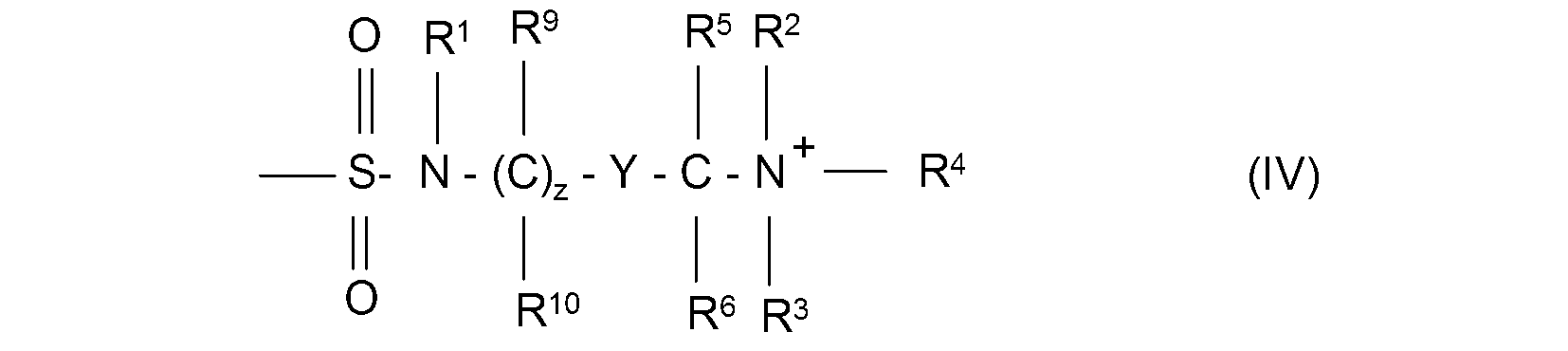
wherein, independently from each other, each Y can be a C6-C10 aryl group, a heteroaryl group or CR7R8 wherein R7 is H, a halogen atom or a C1-C20 alkyl group or forms a ring together with one of R2, R5, or R8, and R8 is H, a halogen atom or a C1-C20 alkyl group or forms a ring together with one of R3, R6, or R7, each of the rings formed by R7 or R8 containing 2 to 10 carbon atoms and optionally 1 to 4 heteroatoms, and the heteroaryl group contains 5 to 10 ring atoms; each R1 can be H or a C1-C20 alkyl group, or forms a ring together with one of R2 or R5, wherein the ring contains 2 to 10 carbon atoms and 1 to 4 heteroatoms; each R2 can be a C1-C20 alkyl group or forms a ring together with one of R1, R3, R5, R7 or R9, wherein the ring contains 2 to 10 carbon atoms and 1 to 4 heteroatoms; each R3 can be a C1-C20 alkyl group or forms a ring together with one of R2, R6, R8 or R10, wherein the ring contains 2 to 10 carbon atoms and 1 to 4 heteroatoms; each R4 can be a C1-C20 alkyl group; R5 is H, a halogen atom or a C1-C20 alkyl group, or forms a ring together with one of R1, R2, R7 or R9, wherein the ring contains 2 to 10 carbon atoms and optionally 1 to 4 heteroatoms; each R6 can be H, a halogen atom or a C1-C20 alkyl group, or forms a ring together with one of R3, R8 or R10, wherein the ring contains 2 to 10 carbon atoms and optionally 1 to 4 heteroatoms; each R9 can be independently H, a halogen atom or a C1-C20 alkyl group, or forms a ring together with one of R2 or R5, wherein the ring contains 2 to 10 carbon atoms and optionally 1 to 4 heteroatoms; each R10 can be independently H, a halogen atom or a C1-C20 alkyl group, or forms a ring together with one of R3 or R6, wherein the ring contains 2 to 10 carbon atoms and optionally 1 to 4 heteroatoms; z is an integer from 0 to 4; and wherein the ring structures in the group of formula (II) can be bridged by C1-C4 alkylene groups, more preferably wherein R2=R3=CH3, R1= R5=R6=R9=R10=H, z=1 and Y=CR8R9, wherein R8=R9=CH3.
wherein, independently from each other, each Y can be a C6-C10 aryl group, a heteroaryl group or CR7R8 wherein R7 is H, a halogen atom or a C1-C20 alkyl group or forms a ring together with one of R2, R5, or R8, and R8 is H, a halogen atom or a C1-C20 alkyl group or forms a ring together with one of R3, R6, or R7, each of the rings formed by R7 or R8 containing 2 to 10 carbon atoms and optionally 1 to 4 heteroatoms, and the heteroaryl group contains 5 to 10 ring atoms; each R1 can be H or a C1-C20 alkyl group, or forms a ring together with one of R2 or R5, wherein the ring contains 2 to 10 carbon atoms and 1 to 4 heteroatoms; each R2 can be a C1-C20 alkyl group or forms a ring together with one of R1, R3, R5, R7 or R9, wherein the ring contains 2 to 10 carbon atoms and 1 to 4 heteroatoms; each R3 can be a C1-C20 alkyl group or forms a ring together with one of R2, R6, R8 or R10, wherein the ring contains 2 to 10 carbon atoms and 1 to 4 heteroatoms; each R4 can be a C1-C20 alkyl group; R5 is H, a halogen atom or a C1-C20 alkyl group, or forms a ring together with one of R1, R2, R7 or R9, wherein the ring contains 2 to 10 carbon atoms and optionally 1 to 4 heteroatoms; each R6 can be H, a halogen atom or a C1-C20 alkyl group, or forms a ring together with one of R3, R8 or R10, wherein the ring contains 2 to 10 carbon atoms and optionally 1 to 4 heteroatoms; each R9 can be independently H, a halogen atom or a C1-C20 alkyl group, or forms a ring together with one of R2 or R5, wherein the ring contains 2 to 10 carbon atoms and optionally 1 to 4 heteroatoms; each R10 can be independently H, a halogen atom or a C1-C20 alkyl group, or forms a ring together with one of R3 or R6, wherein the ring contains 2 to 10 carbon atoms and optionally 1 to 4 heteroatoms; z is an integer from 0 to 4; and wherein the ring structures in the group of formula (II) can be bridged by C1-C4 alkylene groups, more preferably wherein R2=R3=CH3, R1= R5=R6=R9=R10=H, z=1 and Y=CR8R9, wherein R8=R9=CH3.
Suitable organic anions X- may be selected from the group consisting of RA1SO3
-, wherein RA1 is a C1-C20 linear or branched, optionally fluorinated, alkyl or a substituted or non-substituted aryl group, and of RA2COO-, wherein RA2 is a C1-C20 linear or branched, optionally fluorinated, alkyl or a substituted or non-substituted aryl group.
When X-=RA1SO3
-, RA1 is preferably selected from the group of the substituted or non-substituted aryl groups. More preferably RA1 is p-(CH3)C6H4
- (tosylate anion).
When X-=RA2COO-, RA2 is preferably selected from C1-C12, more preferably C1-C6, linear or branched fluorinated alkyl groups.
The Hofmeister series is conventionally taken as a measure of the lipophilic affinity of inorganic anions. A non-exhaustive version of the Hofmeister series is: CO3
2- < SO4
2- < S2O3
2- < H2PO4
- < F- < Cl- < Br- < NO3
- < I- < ClO4
- < SCN- (from the less to the most lipophilic). For the purpose of the present invention the term “lipophilic inorganic anion” is used to refer to inorganic anions which are to the right of Cl-, preferably to the right of Br-, in a Hofmeister series of anions. Notable examples of lipophilic inorganic anions are I-, ClO4
-, SCN-, NO3
-. Preferably X- is selected from I- or NO3
-. More preferably X- is NO3
-.
In an embodiment of the present invention X- is selected from the group consisting of NO3
- and RA1SO3
- wherein RA1 is selected from the group of the substituted or non-substituted aryl groups, preferably RA1 is p-(CH3)C6H4
-.
In an embodiment, the present invention provides a method for manufacturing an at least partially impregnated solid support comprising the step of:
i. providing a solid support;
ii. impregnating, at least partially, the solid support with a liquid composition as defined above, and
iii. removing the solvent.
i. providing a solid support;
ii. impregnating, at least partially, the solid support with a liquid composition as defined above, and
iii. removing the solvent.
Preferably, said solid support is an organic membrane.
Preferably, the method of the invention comprises the additional step:
iv. annealing the impregnated solid support obtained in step iii. by heating at high temperature In an embodiment, the present invention entails a composition comprising an organic membrane impregnated with at least one fluorinated anion exchange polymer (P) comprising a fluorocarbon backbone and side-chains covalently attached to the backbone having terminal groups of formula (I): -SO2NR1Q+X-, wherein Q+ is a group comprising at least one quaternary nitrogen atom, and R1 is H or a C1-C20 alkyl group, or forms a ring together with a group in Q+, wherein the ring contains 2 to 10 carbon atoms and, optionally, 1 to 4 heteroatoms, and X- is an anion, that is obtainable by the method as described above.
Preferably, the method of the invention comprises the additional step:
iv. annealing the impregnated solid support obtained in step iii. by heating at high temperature In an embodiment, the present invention entails a composition comprising an organic membrane impregnated with at least one fluorinated anion exchange polymer (P) comprising a fluorocarbon backbone and side-chains covalently attached to the backbone having terminal groups of formula (I): -SO2NR1Q+X-, wherein Q+ is a group comprising at least one quaternary nitrogen atom, and R1 is H or a C1-C20 alkyl group, or forms a ring together with a group in Q+, wherein the ring contains 2 to 10 carbon atoms and, optionally, 1 to 4 heteroatoms, and X- is an anion, that is obtainable by the method as described above.
In a preferred embodiment of the present invention, the support is an organic membrane or an inorganic support. More preferably, the organic membrane is one of a fluoropolymer membrane, a polypropylene membrane, a polyamide membrane, a PEEK membrane or a polyethylene membrane. More preferably, the inorganic support is one of a glass fibers support, a ceramic support or an alumina support.
In a more preferred embodiment of the present invention, the fluoropolymer membrane is a PFTE membrane, preferably a biaxially-expanded PTFE membrane (ePTFE).
In a preferred embodiment of the method of the present invention, the fluorinated backbone of the fluorinated anion exchange polymer (P) is a linear random polymer chain comprising repeating units represented by the formula (II):
-(CF2-CFRF)p-(CF2-CFRS)q- (II)
wherein RF is F, Cl, -CF3; p is an integer of 0 to 16, q is an integer of 1 to 10 and the ratio of p’/q’ is in the range 0.5 to 16 where p’ is an average value of all p values in the repeating units and q’ is an average value of all q values in the repeating units and RS is the covalently attached side-chain.
-(CF2-CFRF)p-(CF2-CFRS)q- (II)
wherein RF is F, Cl, -CF3; p is an integer of 0 to 16, q is an integer of 1 to 10 and the ratio of p’/q’ is in the range 0.5 to 16 where p’ is an average value of all p values in the repeating units and q’ is an average value of all q values in the repeating units and RS is the covalently attached side-chain.
More preferably, in the method of the present invention, the fluorinated anion exchange polymer (P) comprises repeating units represented by formula (III): 
wherein RF is selected from F, Cl, -CF3; R’F is selected from F, Cl, -CF3; m is an integer equal to 0 or 1, n is an integer from 0 to 10; R1, Q+ and X- are as defined in claim 1.
wherein RF is selected from F, Cl, -CF3; R’F is selected from F, Cl, -CF3; m is an integer equal to 0 or 1, n is an integer from 0 to 10; R1, Q+ and X- are as defined in claim 1.
More preferably, in the method of the present invention, the group of formula (I) has the following structure:
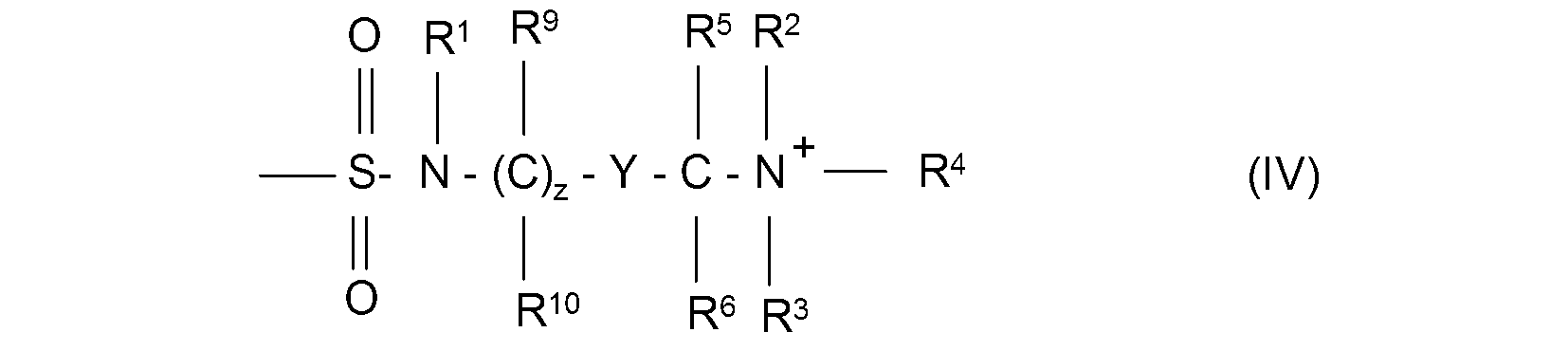
wherein, independently from each other, each Y can be a C6-C10 aryl group, a heteroaryl group or CR7R8 wherein R7 is H, a halogen atom or a C1-C20 alkyl group or forms a ring together with one of R2, R5, or R8, and R8 is H, a halogen atom or a C1-C20 alkyl group or forms a ring together with one of R3, R6, or R7, each of the rings formed by R7 or R8 containing 2 to 10 carbon atoms and optionally 1 to 4 heteroatoms, and the heteroaryl group contains 5 to 10 ring atoms; each R1 can be H or a C1-C20 alkyl group, or forms a ring together with one of R2 or R5, wherein the ring contains 2 to 10 carbon atoms and 1 to 4 heteroatoms; each R2 can be a C1-C20 alkyl group or forms a ring together with one of R1, R3, R5, R7 or R9, wherein the ring contains 2 to 10 carbon atoms and 1 to 4 heteroatoms; each R3 can be a C1-C20 alkyl group or forms a ring together with one of R2, R6, R8 or R10, wherein the ring contains 2 to 10 carbon atoms and 1 to 4 heteroatoms; each R4 can be a C1-C20 alkyl group; R5 is H, a halogen atom or a C1-C20 alkyl group, or forms a ring together with one of R1, R2, R7 or R9, wherein the ring contains 2 to 10 carbon atoms and optionally 1 to 4 heteroatoms; each R6 can be H, a halogen atom or a C1-C20 alkyl group, or forms a ring together with one of R3, R8 or R10, wherein the ring contains 2 to 10 carbon atoms and optionally 1 to 4 heteroatoms; each R9 can be independently H, a halogen atom or a C1-C20 alkyl group, or forms a ring together with one of R2 or R5, wherein the ring contains 2 to 10 carbon atoms and optionally 1 to 4 heteroatoms; each R10 can be independently H, a halogen atom or a C1-C20 alkyl group, or forms a ring together with one of R3 or R6, wherein the ring contains 2 to 10 carbon atoms and optionally 1 to 4 heteroatoms; z is an integer from 0 to 4; and wherein the ring structures in the group of formula (II) can be bridged by C1-C4 alkylene groups, preferably wherein R1=H, R2=R3=CH3, R5=R6=R9=R10=H, z=1 and Y=CR8R9, wherein R8=R9=CH3.
wherein, independently from each other, each Y can be a C6-C10 aryl group, a heteroaryl group or CR7R8 wherein R7 is H, a halogen atom or a C1-C20 alkyl group or forms a ring together with one of R2, R5, or R8, and R8 is H, a halogen atom or a C1-C20 alkyl group or forms a ring together with one of R3, R6, or R7, each of the rings formed by R7 or R8 containing 2 to 10 carbon atoms and optionally 1 to 4 heteroatoms, and the heteroaryl group contains 5 to 10 ring atoms; each R1 can be H or a C1-C20 alkyl group, or forms a ring together with one of R2 or R5, wherein the ring contains 2 to 10 carbon atoms and 1 to 4 heteroatoms; each R2 can be a C1-C20 alkyl group or forms a ring together with one of R1, R3, R5, R7 or R9, wherein the ring contains 2 to 10 carbon atoms and 1 to 4 heteroatoms; each R3 can be a C1-C20 alkyl group or forms a ring together with one of R2, R6, R8 or R10, wherein the ring contains 2 to 10 carbon atoms and 1 to 4 heteroatoms; each R4 can be a C1-C20 alkyl group; R5 is H, a halogen atom or a C1-C20 alkyl group, or forms a ring together with one of R1, R2, R7 or R9, wherein the ring contains 2 to 10 carbon atoms and optionally 1 to 4 heteroatoms; each R6 can be H, a halogen atom or a C1-C20 alkyl group, or forms a ring together with one of R3, R8 or R10, wherein the ring contains 2 to 10 carbon atoms and optionally 1 to 4 heteroatoms; each R9 can be independently H, a halogen atom or a C1-C20 alkyl group, or forms a ring together with one of R2 or R5, wherein the ring contains 2 to 10 carbon atoms and optionally 1 to 4 heteroatoms; each R10 can be independently H, a halogen atom or a C1-C20 alkyl group, or forms a ring together with one of R3 or R6, wherein the ring contains 2 to 10 carbon atoms and optionally 1 to 4 heteroatoms; z is an integer from 0 to 4; and wherein the ring structures in the group of formula (II) can be bridged by C1-C4 alkylene groups, preferably wherein R1=H, R2=R3=CH3, R5=R6=R9=R10=H, z=1 and Y=CR8R9, wherein R8=R9=CH3.
The equivalent weight of the at least partially impregnated support is advantageously less than 1000 g/eq, preferably less than 900 g/eq more preferably less than 800 g/eq, even more preferably less than 700 g/eq. The equivalent weight of the at least partially impregnated support is advantageously at least 400 g/eq, preferably at least 450 g/eq, more preferably at least 500 g/eq.
Typically, the membrane obtained via the method of the present invention have thickness between 10 and 60 micrometers, preferably from 12 to 30 micrometers.
In an embodiment, the liquid composition of the present invention is used as a binder for the preparation of electrodes.
In an embodiment, the present invention provides an article comprising the solid support as described above. The at least partially impregnated support of the present invention can be advantageously used in the manufacturing of membrane-electrode assemblies for fuel cells, batteries, electrolyzers, as separators for electrodialysis, batteries, selective membrane for separation, desalification, ion purification, ion exchange, electrolysis, filtering elements for water or gases and purification of waste water.
Experimental part
Preparation of membrane
The polymer prepared according to the procedure of WO2012/048196 in Tosylate (Tos-) form was dissolved in a mixture of polar (n-butanol) and non-polar solvent (DMA) in a 0.75:1 weight ratio respectively.
A ePTFE (expanded PTFE) support film is preliminarily extended on a plastic frame in order to avoid wrinkling. Then, the polymer solution is poured into the frame on both sides. The solvent is then evaporated at high temperature for complete removal and annealing. Complete impregnation (a transparent membrane is obtained after impregnation) was obtained only with liquid compositions having polymer content higher than 5%wt.
A ePTFE (expanded PTFE) support film is preliminarily extended on a plastic frame in order to avoid wrinkling. Then, the polymer solution is poured into the frame on both sides. The solvent is then evaporated at high temperature for complete removal and annealing. Complete impregnation (a transparent membrane is obtained after impregnation) was obtained only with liquid compositions having polymer content higher than 5%wt.
No impregnation of the inert support is obtained using liquid compositions containing less than 25% in weight based on the total weight of the composition of alcohol.
Membranes having thickness ranging from 12 to 50 micrometers were obtained varying the dry polymer content in the solution from 10 to 30% of polymer content.
Similar membranes were obtained using as support, instead of ePTFE, different PP supports such as Polypropylene-PP(e.g. Viledon ® by Freudenberg ), monolayer polypropylene (e.g. supplied by Celgard), biaxially-oriented polypropylene (e.g. Treopore ® by Treofan), polyethylene-PE (e.g. supplied by Toray ®), Polyamide (PA), 10 microns pores (Nylon net Millipore ®)
SEM Data
The cross-sectional SEM analysis of the ePTFE reinforced membrane using FE-SEM- model Leo Supra 35® showed a trilayer type form membrane. The external layers had homogeneous thickness and the polymer showed good contact with ePTFE at interfaces. At high magnification some spherolites-like shape could be observed in the central layer, validating the presence of the alkaline ionomer.
The cross-sectional SEM analysis of the ePTFE reinforced membrane using FE-SEM- model Leo Supra 35® showed a trilayer type form membrane. The external layers had homogeneous thickness and the polymer showed good contact with ePTFE at interfaces. At high magnification some spherolites-like shape could be observed in the central layer, validating the presence of the alkaline ionomer.
Conductivity measurements
Prior to conductivity measurements, the composite membranes were allowed to soak in hydroalcoholic solution (NaOH 0.5M H2O:EtOH (1:1)) for 4 hours to exchange Tosylate groups with –OH groups.
In-plane and through-plane conductivity measurements were performed at T=60°C using the membranes in alkaline OH- form.
The conductivity of anionic reinforced membrane according to the invention in the OH- form at different temperature was compared to that of the cast one and to that of commercially available anion exchange membranes, all in OH- form. In particular, reinforced Tokuyama membrane AHAA-0235 and Morgane® ADP membrane (Solvay S.A.) and Fumatech FAA-3-PK130 were used as comparative membranes.
The conductivity of anionic reinforced membrane according to the invention in the OH- form at different temperature was compared to that of the cast one and to that of commercially available anion exchange membranes, all in OH- form. In particular, reinforced Tokuyama membrane AHAA-0235 and Morgane® ADP membrane (Solvay S.A.) and Fumatech FAA-3-PK130 were used as comparative membranes.
“Table 1” summarizes all conductivity data at temperature= 60°C for the tested membranes.
Table 1
Table 1
| Type of membrane | Thickness (micro- meters) | Conductivity in plane (mS/cm) | Conductivity through plane (mS/cm) |
| Cast | 60 | 85 | 48 |
| Reinforced | 30 | 73 | 33 |
| Tokuyama AHAA-0235 | 260 | 34 | 51 |
| Fumatech FAA-3-PK-130 | 170 | 50 | 60 |
| Morgane ADP | 175 | 92 | 49 |
Cast = cast membrane, no support (comparative example according to WO2012098146)
Reinforced = reinforced membrane ( ePTFE) according to the invention.
Reinforced = reinforced membrane ( ePTFE) according to the invention.
The reinforced anionic membrane according to the invention showed a 15% loss in conductivity (in-plane and through plane) with respect to cast one, likely due to the presence of PTFE.
Tokuyama and Fumatech PEEK-reinforced membrane showed different conductivity behaviour compared to reinforced anionic membrane obtained in the following invention. Without wishing to be bound by theory, this is likely due to differences in the structure support of the two membranes, i.e. porous PTFE compared to mesh PEEK support.
In general, the conductivity obtained on the reinforced anionic membrane is in the range of commercially available membrane. However, the lower thickness of the reinforced membrane produced (30 microns) in the following invention would compensate the lower specific conductivity by decreasing the conductivity per area unit and it is expected to yield better performance in energy devices .
Durability tests in alkaline aqueous conditions showed that the membrane of the invention is at least as stable over time as the commercially available samples (Morgane ® ADP, Tokuyama® AHAA-0235 , Fumatech FAA-3-PK-130).
The conductivity remained stable when the membrane of the invention was soaked in KOH 6M at 25°C for 2 weeks.
Should the disclosure of any patents, patent applications, and publications which are incorporated herein by reference conflict with the description of the present application to the extent that it may render a term unclear, the present description shall take precedence
Claims (15)
- A liquid composition that comprises the following:a) 1 to 40% in weight with respect to the total weight of the composition of at least one fluorinated anion exchange polymer (P) comprising a fluorocarbon backbone and side-chains, that are covalently attached to the backbone and bear terminal groups of formula (I):-SO2NRQ+X- (I);wherein Q+ is a group comprising at least one quaternary nitrogen atom, R is H or a C1-C20 alkyl group, or forms a ring together with a group in Q+, wherein the ring contains 3 to 10 carbon atoms and, optionally, 1 to 4 heteroatoms, and X- is an anion;b) a solvent mixture comprising:i. an alcohol selected from the group consisting of isopropanol, a C4-C8 linear or branched alkanol, a C2 -C6 fluoroalkanol, or mixtures thereof;ii. a polar aprotic organic solvent;wherein the weight ratio of components i. and ii. in the solvent mixture b) is from 0.75:1 to 1:1 and the sum of component a) and b) is at least 95% in weight with respect to the total weight of the composition.
- The composition according to claim 1, wherein the polar aprotic solvent ii. is selected from the group consisting of dimethylformamide (DMF, dimethylacetamide (DMA), N-methylpyrrolidone (NMP), dimethyl sulfoxide (DMSO) and mixtures thereof.
- The composition according to claim 1 or 2, wherein the alcohol i. is n-butanol, isopropanol, 2,2,2-trifluoroethanol or mixtures thereof.
- The composition of any of the preceding claims, wherein the fluorinated backbone of the fluorinated anion exchange polymer (P) is a linear random polymer chain comprising repeating units represented by the formula (II):-(CF2-CFRF)p-(CF2-CFRS)q- (II)wherein RF is F, Cl, -CF3; p is an integer of 0 to 16, q is an integer of 1 to 10 and the ratio of p’/q’ is in the range 0.5 to 16 where p’ is an average value of all p values in the repeating units and q’ is an average value of all q values in the repeating units and RS is the covalently attached side-chain.
- The composition according to claim 4, wherein the fluorinated anion exchange polymers (P) comprises repeating units represented by formula (III)
 wherein RF is selected from F, Cl, -CF3; R’F is selected from F, Cl, -CF3; m is an integer equal to 0 or 1, n is an integer from 0 to 10; R1, Q+ and X- are as defined in claim 1, provided that m and n are not simultaneously 0.
 - The composition according to anyone of the claims 1-5 wherein the side-chain group of formula (I) has the following structure:
 wherein, independently from each other, each Y can be a C6-C10 aryl group, a heteroaryl group or CR7R8 wherein R7 is H, a halogen atom or a C1-C20 alkyl group or forms a ring together with one of R2, R5, or R8, and R8 is H, a halogen atom or a C1-C20 alkyl group or forms a ring together with one of R3, R6, or R7, each of the rings formed by R7 or R8 containing 2 to 10 carbon atoms and optionally 1 to 4 heteroatoms, and the heteroaryl group contains 5 to 10 ring atoms; each R1 can be H or a C1-C20 alkyl group, or forms a ring together with one of R2 or R5, wherein the ring contains 2 to 10 carbon atoms and 1 to 4 heteroatoms; each R2 can be a C1-C20 alkyl group or forms a ring together with one of R1, R3, R5, R7 or R9, wherein the ring contains 2 to 10 carbon atoms and 1 to 4 heteroatoms; each R3 can be a C1-C20 alkyl group or forms a ring together with one of R2, R6, R8 or R10, wherein the ring contains 2 to 10 carbon atoms and 1 to 4 heteroatoms; each R4 can be a C1-C20 alkyl group; R5 is H, a halogen atom or a C1-C20 alkyl group, or forms a ring together with one of R1, R2, R7 or R9, wherein the ring contains 2 to 10 carbon atoms and optionally 1 to 4 heteroatoms; each R6 can be H, a halogen atom or a C1-C20 alkyl group, or forms a ring together with one of R3, R8 or R10, wherein the ring contains 2 to 10 carbon atoms and optionally 1 to 4 heteroatoms; each R9 can be independently H, a halogen atom or a C1-C20 alkyl group, or forms a ring together with one of R2 or R5, wherein the ring contains 2 to 10 carbon atoms and optionally 1 to 4 heteroatoms; each R10 can be independently H, a halogen atom or a C1-C20 alkyl group, or forms a ring together with one of R3 or R6, wherein the ring contains 2 to 10 carbon atoms and optionally 1 to 4 heteroatoms; z is an integer from 0 to 4; and wherein the ring structures in the group of formula (II) can be bridged by C1-C4 alkylene groups, preferably wherein R1=H, R2=R3=CH3, R5=R6=R9=R10=H, z=1 and Y=CR8R9, wherein R8=R9=CH3.
 - The composition according to claim 6 wherein R1= R5=R6=R9=R10=H, R2=R3=CH3, z=1 and Y=CR8R9, wherein R8=R9=CH3.
- A method for manufacturing an al least partially impregnated support comprising the step of:i. providing a porous support;ii. impregnating the porous support with a liquid composition that comprises the following:a) 1 to 40% in weight with respect to the total weight of the composition of at least one fluorinated anion exchange polymer (P) comprising a fluorocarbon backbone and side-chains, that are covalently attached to the backbone and bear terminal groups of formula (I):-SO2NRQ+X- (I);wherein Q+ is a group comprising at least one quaternary nitrogen atom, R is H or a C1-C20 alkyl group, or forms a ring together with a group in Q+, wherein the ring contains 3 to 10 carbon atoms and, optionally, 1 to 4 heteroatoms, and X- is an anion;b) a solvent mixture comprising:i. an alcohol selected from the group consisting of isopropanol, a C4-C8 linear or branched alkanol, a C2 -C6 fluoroalkanol, or mixtures thereof;ii. a polar aprotic organic solvent;wherein the weight ratio of components i. and ii. in the solvent mixture b) is from 0.75:1 to 1:1 and the sum of component a) and b) is at least 95% in weight with respect to the total weight of the composition; andiii. removing the solvent.
- A composition comprising a porous support at least partially impregnated with at least one fluorinated anion exchange polymer (P) comprising a fluorocarbon backbone and side-chains covalently attached to the backbone having terminal groups of formula (I): -SO2NR1Q+X-, wherein Q+ is a group comprising at least one quaternary nitrogen atom, and R1 is H or a C1-C20 alkyl group, or forms a ring together with a group in Q+, wherein the ring contains 2 to 10 carbon atoms and, optionally, 1 to 4 heteroatoms, and X- is an anion, that is obtainable by the method of claim 8.
- The composition according to claim 9, wherein the support is an organic membrane selected from the group consisting of a fluoropolymer membrane, a polypropylene membrane, a polyamide membrane, a PEEK membrane, a polyethylene membrane.
- The composition according to claim 10, wherein the fluoropolymer membrane is a PFTE membrane, preferably a biaxially-expanded PTFE membrane (ePTFE).
- The composition of any of claims 9-11, wherein the fluorinated backbone of the fluorinated anion exchange polymer (P) is a linear random polymer chain comprising repeating units represented by the formula (II):-(CF2-CFRF)p-(CF2-CFRS)q- (II) ,wherein RF is F, Cl, -CF3; p is an integer of 0 to 16, q is an integer of 1 to 10 and the ratio of p’/q’ is in the range 0.5 to 16 where p’ is an average value of all p values in the repeating units and q’ is an average value of all q values in the repeating units and RS is the covalently attached side-chain,more preferably by formula (III)
 wherein RF is selected from F, Cl, -CF3; R’F is selected from F, Cl, -CF3; m is an integer equal to 0 or 1, n is an integer from 0 to 10; R1, Q+ and X- are as defined in claim 1, provided that m and n are not simultaneously,more preferably wherein the group of formula (I) has the following structure (IV):
 wherein, independently from each other, each Y can be a C6-C10 aryl group, a heteroaryl group or CR7R8 wherein R7 is H, a halogen atom or a C1-C20 alkyl group or forms a ring together with one of R2, R5, or R8, and R8 is H, a halogen atom or a C1-C20 alkyl group or forms a ring together with one of R3, R6, or R7, each of the rings formed by R7 or R8 containing 2 to 10 carbon atoms and optionally 1 to 4 heteroatoms, and the heteroaryl group contains 5 to 10 ring atoms; each R1 can be H or a C1-C20 alkyl group, or forms a ring together with one of R2 or R5, wherein the ring contains 2 to 10 carbon atoms and 1 to 4 heteroatoms; each R2 can be a C1-C20 alkyl group or forms a ring together with one of R1, R3, R5, R7 or R9, wherein the ring contains 2 to 10 carbon atoms and 1 to 4 heteroatoms; each R3 can be a C1-C20 alkyl group or forms a ring together with one of R2, R6, R8 or R10, wherein the ring contains 2 to 10 carbon atoms and 1 to 4 heteroatoms; each R4 can be a C1-C20 alkyl group; R5 is H, a halogen atom or a C1-C20 alkyl group, or forms a ring together with one of R1, R2, R7 or R9, wherein the ring contains 2 to 10 carbon atoms and optionally 1 to 4 heteroatoms; each R6 can be H, a halogen atom or a C1-C20 alkyl group, or forms a ring together with one of R3, R8 or R10, wherein the ring contains 2 to 10 carbon atoms and optionally 1 to 4 heteroatoms; each R9 can be independently H, a halogen atom or a C1-C20 alkyl group, or forms a ring together with one of R2 or R5, wherein the ring contains 2 to 10 carbon atoms and optionally 1 to 4 heteroatoms; each R10 can be independently H, a halogen atom or a C1-C20 alkyl group, or forms a ring together with one of R3 or R6, wherein the ring contains 2 to 10 carbon atoms and optionally 1 to 4 heteroatoms; z is an integer from 0 to 4; and wherein the ring structures in the group of formula (II) can be bridged by C1-C4 alkylene groups, preferably wherein R1=H, R2=R3=CH3, R5=R6=R9=R10=H, z=1 and Y=CR8R9, wherein R8=R9=CH3.
 - The composition of any of claims 9-12, wherein the equivalent weight of the at least partially impregnated support is less than 1000 g/eq, preferably less than 900 g/eq more preferably less than 800 g/eq, even more preferably less than 700 g/eq, and at least 400 g/eq, preferably at least 450 g/eq, more preferably at least 500 g/eq.
- An article comprising the composition of claim 9-13.
- The article of claim 14 in the form of a fluorinated anion exchange membrane, a film, a battery separator, a membrane-electrode assembly for fuel cells, batteries, electrolyzers, a separator for electrodialysis, batteries, a selective membrane for separation, desalification, ion purification, ion exchange, electrolysis, a filtering element for water or gases and for purification of waste water.
Applications Claiming Priority (2)
| Application Number | Priority Date | Filing Date | Title |
|---|---|---|---|
| EP15156880.5 | 2015-02-27 | ||
| EP15156880 | 2015-02-27 |
Publications (1)
| Publication Number | Publication Date |
|---|---|
| WO2016135215A1 true WO2016135215A1 (en) | 2016-09-01 |
Family
ID=52596799
Family Applications (1)
| Application Number | Title | Priority Date | Filing Date |
|---|---|---|---|
| PCT/EP2016/053911 Ceased WO2016135215A1 (en) | 2015-02-27 | 2016-02-25 | Composition comprising an ion-exchange fluorinated polymer |
Country Status (1)
| Country | Link |
|---|---|
| WO (1) | WO2016135215A1 (en) |
Cited By (2)
| Publication number | Priority date | Publication date | Assignee | Title |
|---|---|---|---|---|
| US11339483B1 (en) | 2021-04-05 | 2022-05-24 | Alchemr, Inc. | Water electrolyzers employing anion exchange membranes |
| WO2026003656A1 (en) * | 2024-06-24 | 2026-01-02 | Politecnico Di Milano | Fluoride ion batteries with electrolytes based on salified fluorinated polymers |
Citations (7)
| Publication number | Priority date | Publication date | Assignee | Title |
|---|---|---|---|---|
| EP0166015A1 (en) | 1984-06-26 | 1986-01-02 | Tosoh Corporation | Fluorcarbon anion exchangers and processes for their preparation |
| US4659744A (en) * | 1982-12-28 | 1987-04-21 | Toyo Soda Manufacturing Co., Ltd. | Fluorocarbon anion exchangers and processes for their preparation |
| JPS62161867A (en) | 1986-01-13 | 1987-07-17 | Toyo Soda Mfg Co Ltd | Solution of polycation polymer |
| EP1612874A1 (en) | 2004-07-02 | 2006-01-04 | SOLVAY (Société Anonyme) | Solid alkaline fuel cell comprising ion exchange membrane |
| WO2009063067A2 (en) | 2007-11-15 | 2009-05-22 | Dsm Ip Assets Bv | High performance membrane |
| WO2012048196A1 (en) | 2010-10-08 | 2012-04-12 | Shell Oil Company | Methods of heating a subsurface formation using electrically conductive particles |
| WO2012098146A1 (en) | 2011-01-21 | 2012-07-26 | Solvay Specialty Polymers Italy S.P.A. | Liquid compositions of fluorinated anion exchange polymers |
-
2016
- 2016-02-25 WO PCT/EP2016/053911 patent/WO2016135215A1/en not_active Ceased
Patent Citations (8)
| Publication number | Priority date | Publication date | Assignee | Title |
|---|---|---|---|---|
| US4659744A (en) * | 1982-12-28 | 1987-04-21 | Toyo Soda Manufacturing Co., Ltd. | Fluorocarbon anion exchangers and processes for their preparation |
| EP0166015A1 (en) | 1984-06-26 | 1986-01-02 | Tosoh Corporation | Fluorcarbon anion exchangers and processes for their preparation |
| JPS62161867A (en) | 1986-01-13 | 1987-07-17 | Toyo Soda Mfg Co Ltd | Solution of polycation polymer |
| EP1612874A1 (en) | 2004-07-02 | 2006-01-04 | SOLVAY (Société Anonyme) | Solid alkaline fuel cell comprising ion exchange membrane |
| WO2009063067A2 (en) | 2007-11-15 | 2009-05-22 | Dsm Ip Assets Bv | High performance membrane |
| WO2012048196A1 (en) | 2010-10-08 | 2012-04-12 | Shell Oil Company | Methods of heating a subsurface formation using electrically conductive particles |
| WO2012098146A1 (en) | 2011-01-21 | 2012-07-26 | Solvay Specialty Polymers Italy S.P.A. | Liquid compositions of fluorinated anion exchange polymers |
| US20130310246A1 (en) * | 2011-01-21 | 2013-11-21 | Solvay Specialty Polymers Italy S.P.A. | Liquid compositions of fluorinated anion exchange polymers |
Non-Patent Citations (1)
| Title |
|---|
| KNAUF, G. H.; DOSHI, M. R.: "Calculation of Aerodynamic Porosity, Specific Surface Area, and Specific Volume from Gurley Seconds Measurements", PROC. TAPPI 1986 INTL. PROCESS AND MATERIALS QUALITY EVAL. CONF., 1986, pages 33 |
Cited By (2)
| Publication number | Priority date | Publication date | Assignee | Title |
|---|---|---|---|---|
| US11339483B1 (en) | 2021-04-05 | 2022-05-24 | Alchemr, Inc. | Water electrolyzers employing anion exchange membranes |
| WO2026003656A1 (en) * | 2024-06-24 | 2026-01-02 | Politecnico Di Milano | Fluoride ion batteries with electrolytes based on salified fluorinated polymers |
Similar Documents
| Publication | Publication Date | Title |
|---|---|---|
| KR102112648B1 (en) | Polymer electrolyte membrane | |
| EP3411430B1 (en) | Bipolar ionomer membrane | |
| KR102466595B1 (en) | Highly reinforced ionomer membranes for high selectivity and high strength | |
| US20150298069A1 (en) | Polymer resin composition for preparing of microfilter membrane or ultrafilter membrane, preparation method of polymer filter membrane, and polymer filter membrane | |
| CN107254058A (en) | Oxidation, reduction liquid secondary cell and oxidation, reduction liquid secondary cell Electrolyte Membranes | |
| EP3348323A1 (en) | Film-forming stock solution for use in non-solvent-induced phase separation methods, and method for producing porous hollow fiber membrane using same | |
| KR102716792B1 (en) | Novel aliphatic chain-containing poly(alkyl-aryl piperidinium) ionomer, anion exchange membrane, composite membrane and method for preparing the same | |
| CN103547361B (en) | For the method preparing the fluorinated polymer of crosslinking | |
| CN110272512A (en) | With low surface tension, low liquid viscosity and highly filled fluorinated ionomer dispersion | |
| US20080269409A1 (en) | Composite Membranes of High Homogeneity | |
| WO2016135215A1 (en) | Composition comprising an ion-exchange fluorinated polymer | |
| JP2008251314A (en) | Polymer electrolyte membrane | |
| CN117024840A (en) | Surface modified microporous membrane and preparation method and application thereof | |
| EP3744420B1 (en) | Manufacturing method for porous fluoropolymer composite membrane | |
| JP2014110232A (en) | Fluorine-based polymer electrolyte film | |
| KR20140003278A (en) | Pressure retarded osmosis membrane and manufacturing method | |
| KR101582024B1 (en) | Polyolefinketone with pendent sulfonation groups, water-treatment membranes prepared therewith and polymer electrolyte membrane for fuel cell prepared therewith | |
| KR102888580B1 (en) | Non-delamination ion-exchange membrane for saline water electrolysis and method for preparing the same | |
| JP2021052001A (en) | Composite electrolyte membrane and membrane electrode composite using the same, and polymer electrolyte fuel cell | |
| KR102719628B1 (en) | Fiber surface-modified porous support and its application as reinforcement composite membrane | |
| CN104248914B (en) | A kind of reverse osmosis membrane and preparation method thereof | |
| JP2020161343A (en) | Electrolyte membrane and method for producing the same | |
| KR101217478B1 (en) | Manufacturing Method of Polyamideimide-Based Porous Membrane and Porous Membrane Thereby | |
| WO2025204506A1 (en) | Method for producing porous separator for alkaline water electrolysis, porous separator for alkaline water electrolysis, method for producing porous membrane, and porous membrane | |
| KR20250079376A (en) | Flat-type polyimide-based organic solvent nanofiltration membrane with crosslinked active layer and preparation method thereof |
Legal Events
| Date | Code | Title | Description |
|---|---|---|---|
| 121 | Ep: the epo has been informed by wipo that ep was designated in this application |
Ref document number: 16706586 Country of ref document: EP Kind code of ref document: A1 |
|
| NENP | Non-entry into the national phase |
Ref country code: DE |
|
| 122 | Ep: pct application non-entry in european phase |
Ref document number: 16706586 Country of ref document: EP Kind code of ref document: A1 |