WO2016134178A1 - Halogenated cyclic diesters, related polymers, and methods for their preparation and use - Google Patents
Halogenated cyclic diesters, related polymers, and methods for their preparation and use Download PDFInfo
- Publication number
- WO2016134178A1 WO2016134178A1 PCT/US2016/018529 US2016018529W WO2016134178A1 WO 2016134178 A1 WO2016134178 A1 WO 2016134178A1 US 2016018529 W US2016018529 W US 2016018529W WO 2016134178 A1 WO2016134178 A1 WO 2016134178A1
- Authority
- WO
- WIPO (PCT)
- Prior art keywords
- polymer
- fluoroalkyl
- cyclic diester
- group
- fluorocarbon
- Prior art date
- Legal status (The legal status is an assumption and is not a legal conclusion. Google has not performed a legal analysis and makes no representation as to the accuracy of the status listed.)
- Ceased
Links
- 0 CC(C)(C(C(*)OC(C(*)ON)=O)=O)OC(*)(*)C(OC(*)(C(N)=O)I)=O Chemical compound CC(C)(C(C(*)OC(C(*)ON)=O)=O)OC(*)(*)C(OC(*)(C(N)=O)I)=O 0.000 description 4
Classifications
-
- C—CHEMISTRY; METALLURGY
- C08—ORGANIC MACROMOLECULAR COMPOUNDS; THEIR PREPARATION OR CHEMICAL WORKING-UP; COMPOSITIONS BASED THEREON
- C08G—MACROMOLECULAR COMPOUNDS OBTAINED OTHERWISE THAN BY REACTIONS ONLY INVOLVING UNSATURATED CARBON-TO-CARBON BONDS
- C08G63/00—Macromolecular compounds obtained by reactions forming a carboxylic ester link in the main chain of the macromolecule
- C08G63/68—Polyesters containing atoms other than carbon, hydrogen and oxygen
- C08G63/682—Polyesters containing atoms other than carbon, hydrogen and oxygen containing halogens
- C08G63/6822—Polyesters containing atoms other than carbon, hydrogen and oxygen containing halogens derived from hydroxy carboxylic acids
-
- C—CHEMISTRY; METALLURGY
- C08—ORGANIC MACROMOLECULAR COMPOUNDS; THEIR PREPARATION OR CHEMICAL WORKING-UP; COMPOSITIONS BASED THEREON
- C08G—MACROMOLECULAR COMPOUNDS OBTAINED OTHERWISE THAN BY REACTIONS ONLY INVOLVING UNSATURATED CARBON-TO-CARBON BONDS
- C08G63/00—Macromolecular compounds obtained by reactions forming a carboxylic ester link in the main chain of the macromolecule
- C08G63/02—Polyesters derived from hydroxycarboxylic acids or from polycarboxylic acids and polyhydroxy compounds
- C08G63/06—Polyesters derived from hydroxycarboxylic acids or from polycarboxylic acids and polyhydroxy compounds derived from hydroxycarboxylic acids
- C08G63/08—Lactones or lactides
-
- A—HUMAN NECESSITIES
- A61—MEDICAL OR VETERINARY SCIENCE; HYGIENE
- A61L—METHODS OR APPARATUS FOR STERILISING MATERIALS OR OBJECTS IN GENERAL; DISINFECTION, STERILISATION OR DEODORISATION OF AIR; CHEMICAL ASPECTS OF BANDAGES, DRESSINGS, ABSORBENT PADS OR SURGICAL ARTICLES; MATERIALS FOR BANDAGES, DRESSINGS, ABSORBENT PADS OR SURGICAL ARTICLES
- A61L31/00—Materials for other surgical articles, e.g. stents, stent-grafts, shunts, surgical drapes, guide wires, materials for adhesion prevention, occluding devices, surgical gloves, tissue fixation devices
- A61L31/04—Macromolecular materials
- A61L31/06—Macromolecular materials obtained otherwise than by reactions only involving carbon-to-carbon unsaturated bonds
-
- A—HUMAN NECESSITIES
- A61—MEDICAL OR VETERINARY SCIENCE; HYGIENE
- A61L—METHODS OR APPARATUS FOR STERILISING MATERIALS OR OBJECTS IN GENERAL; DISINFECTION, STERILISATION OR DEODORISATION OF AIR; CHEMICAL ASPECTS OF BANDAGES, DRESSINGS, ABSORBENT PADS OR SURGICAL ARTICLES; MATERIALS FOR BANDAGES, DRESSINGS, ABSORBENT PADS OR SURGICAL ARTICLES
- A61L31/00—Materials for other surgical articles, e.g. stents, stent-grafts, shunts, surgical drapes, guide wires, materials for adhesion prevention, occluding devices, surgical gloves, tissue fixation devices
- A61L31/08—Materials for coatings
- A61L31/10—Macromolecular materials
-
- C—CHEMISTRY; METALLURGY
- C07—ORGANIC CHEMISTRY
- C07D—HETEROCYCLIC COMPOUNDS
- C07D319/00—Heterocyclic compounds containing six-membered rings having two oxygen atoms as the only ring hetero atoms
- C07D319/10—1,4-Dioxanes; Hydrogenated 1,4-dioxanes
- C07D319/12—1,4-Dioxanes; Hydrogenated 1,4-dioxanes not condensed with other rings
-
- C—CHEMISTRY; METALLURGY
- C08—ORGANIC MACROMOLECULAR COMPOUNDS; THEIR PREPARATION OR CHEMICAL WORKING-UP; COMPOSITIONS BASED THEREON
- C08G—MACROMOLECULAR COMPOUNDS OBTAINED OTHERWISE THAN BY REACTIONS ONLY INVOLVING UNSATURATED CARBON-TO-CARBON BONDS
- C08G63/00—Macromolecular compounds obtained by reactions forming a carboxylic ester link in the main chain of the macromolecule
- C08G63/91—Polymers modified by chemical after-treatment
- C08G63/912—Polymers modified by chemical after-treatment derived from hydroxycarboxylic acids
-
- C—CHEMISTRY; METALLURGY
- C08—ORGANIC MACROMOLECULAR COMPOUNDS; THEIR PREPARATION OR CHEMICAL WORKING-UP; COMPOSITIONS BASED THEREON
- C08J—WORKING-UP; GENERAL PROCESSES OF COMPOUNDING; AFTER-TREATMENT NOT COVERED BY SUBCLASSES C08B, C08C, C08F, C08G or C08H
- C08J3/00—Processes of treating or compounding macromolecular substances
- C08J3/28—Treatment by wave energy or particle radiation
-
- C—CHEMISTRY; METALLURGY
- C09—DYES; PAINTS; POLISHES; NATURAL RESINS; ADHESIVES; COMPOSITIONS NOT OTHERWISE PROVIDED FOR; APPLICATIONS OF MATERIALS NOT OTHERWISE PROVIDED FOR
- C09D—COATING COMPOSITIONS, e.g. PAINTS, VARNISHES OR LACQUERS; FILLING PASTES; CHEMICAL PAINT OR INK REMOVERS; INKS; CORRECTING FLUIDS; WOODSTAINS; PASTES OR SOLIDS FOR COLOURING OR PRINTING; USE OF MATERIALS THEREFOR
- C09D167/00—Coating compositions based on polyesters obtained by reactions forming a carboxylic ester link in the main chain; Coating compositions based on derivatives of such polymers
- C09D167/04—Polyesters derived from hydroxycarboxylic acids, e.g. lactones
-
- C—CHEMISTRY; METALLURGY
- C08—ORGANIC MACROMOLECULAR COMPOUNDS; THEIR PREPARATION OR CHEMICAL WORKING-UP; COMPOSITIONS BASED THEREON
- C08J—WORKING-UP; GENERAL PROCESSES OF COMPOUNDING; AFTER-TREATMENT NOT COVERED BY SUBCLASSES C08B, C08C, C08F, C08G or C08H
- C08J2377/00—Characterised by the use of polyamides obtained by reactions forming a carboxylic amide link in the main chain; Derivatives of such polymers
- C08J2377/02—Polyamides derived from omega-amino carboxylic acids or from lactams thereof
Definitions
- Polymers derived from lactic acid and glycolic acid have been extensively used for various biomedical applications due to their biocompatibility and biodegradability.
- the ability to modify the physiochemical properties, such as degradability, hydrophobicity, and hydrophilicity, of these polymers is a key to expand the spectrum of their uses.
- Conventional approaches usually involve copolymerization and block copolymer preparations.
- the use of lactic acid and glycolic acid derivatives as monomers for preparing polylactides and polyglycolides is less well known.
- the present invention provides halogenated cyclic diesters, halogenated polymers derived from the cyclic diesters, and methods for making the halogenated cyclic esters and related halogenated polymers.
- the present invention provides fluorinated cyclic diesters, fluorinated polymers derived from these cyclic diesters, and methods for making the fluorinated cyclic diesters and related fluorinated polymers.
- the invention provides a cyclic diester having formula (I)
- R 1 , R 2 , R 3 , and R 4 are independently selected from hydrogen, C1-C24 alkyl, aryl, fluoro, chloro, and halocarbon, with the proviso that at least one of R 1 , R 2 , R 3 , or R 4 is selected from fluoro, chloro, or halocarbon.
- the invention provides a cyclic diester having formula (I)
- R 1 , R 2 , R 3 , and R 4 are independently selected from hydrogen, C1-C24 alkyl, aryl, fluoro, and fluorocarbon (e.g., C1-C24 fluoroalkyl), with the proviso that at least one of R 1 , R 2 , R 3 , or R 4 is selected from fluoro or fluorocarbon.
- the fluorocarbon is a C1-C24 fluoroalkyl group. In other embodiments, the fluorocarbon is a C1-C12 fluoroalkyl group. In further embodiments, the fluorocarbon is a C1-C6 fluoroalkyl group.
- the invention provides a cyclic diester having formula (II)
- R 1 and R 3 are independently selected from C1-C24 alkyl and fluorocarbon (e.g., C1-C24 fluoroalkyl), with the proviso that at least on of R 1 or R 3 is fluorocarbon.
- the invention provides polymers prepared from the cyclic diesters of the invention.
- the invention provides a halogenated polymer, comprising a repeating unit having formula (III)
- R 1 , R 2 , R 3 , and R 4 are independently selected from hydrogen, C1-C24 alkyl, aryl, fluoro, chloro, and halocarbon, with the proviso that at least one of R 1 , R 2 , R 3 , or R 4 is selected from fluoro, chloro, or halocarbon.
- the invention provides a fluorinated polymer, comprising a repeating unit having formula (III)
- R 1 , R 2 , R 3 , and R 4 are independently selected from hydrogen, C1-C24 alkyl, aryl, fluoro, and fluorocarbon (e.g., C1-C24 fluoroalkyl), with the proviso that at least one of R 1 , R 2 , R 3 , or R 4 is selected from fluoro or fluorocarbon.
- the invention provides a halogenated polylactic acid, comprising a repeating unit having formula (IV)
- R 1 and R 3 are independently selected from C1-C24 alkyl and halocarbon, with the proviso that at least one of R 1 or R 3 is halocarbon.
- the invention provides a fluorinated polylactic acid, comprising a repeating unit having formula (IV)
- R 1 and R 3 are independently selected from C1-C24 alkyl and fluorocarbon (e.g., C1-C24 fluoroalkyl), with the proviso that at least one of R 1 or R 3 is fluorocarbon.
- the polymer of the invention further comprises one or more repeating units derived from comonomers suitable for polymerization with a halogenated cyclic diester.
- the invention provides a polymer having formula (V)
- n is an integer from about 10 to about 1000.
- the invention provides a polylactic acid having formula (VI)
- n is an integer from about 10 to about 1000.
- the invention provides a polymer having formula (VII) (VII) wherein R is hydrogen or methyl,
- n is an integer from about 10 to about 1000
- n is an integer from about 10 to about 1000.
- the invention provides a polylactic acid having formula
- R > 6 is hydrogen or methyl
- n is an integer from about 10 to about 1000
- n is an integer from about 10 to about 1000.
- the polymers of the invention are random copolymers. In other embodiments, the polymers of the invention are block copolymers.
- surfaces coated with a polymer of the invention are provided.
- the invention provides a surface of a substrate, wherein at least a portion of the surface is coated with a polymer of the invention.
- Suitable substrates include drug delivery devices, devices having a degradation-inhibiting coating, devices having a hydrophobic surface with high contact angle, and devices that contact blood.
- the substrate is a medical device, such as a cardiovascular stent.
- the invention provides methods for making halogenated polymers.
- the method comprises:
- the method comprises: subjecting a polymer with an ammonia plasma to provide a polymer functionalized with amino groups;
- a suitably reactive reagent comprising a fluorocarbon (e.g., fluoroalkyl group), wherein at least a portion of the amino groups react with the reagent to provide a polymer having at least of portion of the amino groups converted to amine groups covalently coupled to the fluorocarbon.
- a fluorocarbon e.g., fluoroalkyl group
- FIGURE 1 is a schematic illustration of a representative preparation of cyclic diesters of the invention from alpha-hydroxy acids and reactive alpha-bromo alkanoyl bromide compounds.
- FIGURE 5 is a schematic illustration of a representative preparation of cyclic diesters of the invention starting from the alpha-hydroxy acid: CF 3 C(Ph)(OH)-
- FIGURE 6 is a schematic illustration of a representative preparation of fluorinated polymers of the invention from cyclic diesters.
- FIGURE 8 is a schematic illustration of the preparation of fluorinated polymers of the invention prepared from reaction of suitably reactive fluoroalkyl reagents with amino- containing polymers prepared by treatment of suitable polymers with ammonia plasma.
- fluorinated polymers demonstrate excellent inertness in various biological environments and good blood compatibility, and have been used in various biomedical applications, such as prosthetics and drug delivery.
- the present invention provides halogenated polymers and methods for their preparation.
- the structure of polymer backbone remains unchanged and this in turn results in retention of their hydrolysis characteristics.
- the halogenated (e.g., fluorinated and or chlorinated) polymers of the invention hydrolyze at a reduced rate due to their increased hydrophobicity associated with the replacement of hydrogen in the parent polymers with a halogen (e.g., fluorine or chlorine), thereby improving long-term performance in biological environments.
- halogenated refers to a cyclic diester or polymer that includes one or more chlorine and/or fluorine atoms. With reference to the cyclic diesters and polymers of the invention, the term “halogenated” or “halogen” does not refer to cyclic diesters or polymers that include a bromine or an iodine atom.
- the present invention provides halogenated cyclic diester, halogenated polymers derived from the cyclic diesters, and methods for making the halogenated cyclic esters and related halogenated polymers.
- the present invention provides fluorinated cyclic diesters, fluorinated polymers derived from the cyclic diesters, and methods for making the fluorinated cyclic diesters and related fluorinated polymers.
- the invention provides halogenated cyclic diesters (i.e., cyclic diesters that include one or more halogen substituents also referred to herein as halogen- containing cyclic diesters).
- the cyclic diesters of the invention can be prepared from alpha-hydroxy acids. See FIGURES 1-5 and 7.
- the cyclic diesters of the invention can be polymerized to provide polyesters that include fluorine and/or chlorine substituents. See FIGURES 6 and 7.
- the cyclic diesters of the invention are 6-membered ring compounds.
- the cyclic diester is a lactide or a lactide derivative.
- the cyclic diester is a glycolide or a glycolide derivative.
- the cyclic diesters of the invention have the general structure shown in FIGURE 1 where R 1 - R 4 are as described below.
- FIGURE 1 is a schematic illustration of a representative preparation of cyclic diesters of the invention from alpha-hydroxy acids and reactive alpha-bromo alkanoyl bromide compounds.
- the cyclic diester of the invention has formula (I)
- R 1 , R 2 , R 3 , and R 4 are independently selected from hydrogen, C1-C24 alkyl, aryl, fluoro, chloro, and halocarbon, with the proviso that at least one of R 1 , R 2 , R 3 , or R 4 is selected from fluoro, chloro, or halocarbon.
- halocarbon refers to a substituent group that includes one or more carbons (e.g., C1-C24, CI -CI 2, or C1-C6) and one or more chlorine or fluorine atoms.
- Suitable halocarbon groups include one or more chlorine atoms (chloro substituents), one or more fluorine atoms (fluoro substituents), or one or more chlorine atoms and one or more fluorine atoms (chloro and fluoro substituents).
- Representative halocarbon groups include -CH 2 C1, -CH 2 F, and -CH(C1)F groups, among others.
- the cyclic diester of the invention has formula (I)
- R 1 , R 2 , R 3 , and R 4 are independently selected from hydrogen, C1-C24 alkyl, aryl, fluoro, and fluorocarbon (e.g., C1-C24 fluoroalkyl), with the proviso that at least one of R 1 , R 2 , R 3 , or R 4 is selected from fluoro or fluorocarbon.
- fluoroocarbon refers to a substituent group that includes one or more carbons (e.g., C1-C24, C1-C12, or C1-C6) and one or more fluorine atoms.
- fluorocarbon and “fluorocarbon group” are used interchangeably.
- Suitable fluorocarbon groups include one or more fluorine atoms (fluoro substituents).
- Representative fluoroocarbon groups include -CH 2 F, -CHF 2 , and -CF 3 groups, among others.
- the fluorocarbon group is a C1-C24 fluoroalkyl group.
- C1-C24 alkyl is C1-C12 alkyl. In certain embodiments,
- C1-C24 alkyl is C1-C6 alkyl.
- Representative alkyl groups include straight chain (e.g., n- propyl), branched (e.g., isopropyl), and cyclo (e.g., C3-C7 cycloalkyl, such as cyclopentyl) groups.
- C1-C24 (or C1-C12 or C1-C6) alkyl is selected from methyl, ethyl, n-propyl, i-propyl, and n-butyl.
- Cl- C24 (or C1-C12 or C1-C6) alkyl is methyl.
- the alkyl and aryl groups of the cyclic diester may be substituted or unsubstituted.
- substituted C1-C24 alkyl refers to a C1-C24 alkyl group in which one or more hydrogen atoms is replaced with a non-hydrogen atom.
- substituted aryl refers to an aryl group (e.g., phenyl group) in which one or more hydrogen atoms is replaced with a non-hydrogen atom.
- non-hydrogen atoms include heteroatoms such oxygen, nitrogen, sulfur, and silicon atoms, as well as substituents that include these atoms (e.g., hydroxy, alkoxyl, amino, alkylamino, thiol, thioether).
- the cyclic diesters of the invention include either a fluorine substituent or a fluoroalkyl substituent.
- fluoroalkyl or
- fluoroalkyl group refers to an alkyl group (i.e., a saturated hydrocarbon group) in which one or more hydrogen atoms is replaced with a fluorine atom (F).
- fluoro and “fluorine” are used interchangeably and refer to the substituent F.
- Representative fluoroalkyl groups include -CF 3 , -CH 2 F, -CHF 2 , -CF 2 CF 3 , -CH 2 CF 3 , - CF 2 CH 3 , -CH 2 CHF 2 , -CH 2 CH 2 F, among others.
- C1-C24 fluoroalkyl is C1-C12 fluoroalkyl. In certain embodiments, C1-C24 fluoroalkyl is C1-C6 fluoroalkyl.
- fluoroalkyl groups include straight chain (e.g., n-propyl), branched (e.g., isopropyl), and cyclo (e.g., C3-C7 cycloalkyl, such as cyclopentyl) groups.
- C1-C24 (or CI -CI 2 or C1-C6) fluoroalkyl is selected from methyl, ethyl, n-propyl, i-propyl, and n-butyl in which one or more hydrogen atoms is replaced with a fluorine atom.
- the fluoroalkyl is perfluoroalkyl (e.g., trifluoromethyl, pentafluoroethyl, n-perfluoropropyl, n-perfluorobutyl, and n- perfluoropentyl).
- C1-C24 (or C1-C12 or C1-C6) alkyl is methyl (i.e., trifluoromethyl, difluoromethyl, and fluorom ethyl).
- the fluoroalkyl group(s) of the cyclic diester has a ratio of F:C from about 0.4 to about 3.0. In certain embodiments, the fluoroalkyl group(s) of the cyclic diester has a ratio of F:C of about 0.5. In other embodiments, the fluoroalkyl group(s) of the cyclic diester has a ratio of F:C of about 1.0. In further embodiments, the fluoroalkyl group(s) of the cyclic diester has a ratio of F:C of about 2.0.
- R 1 and R 3 are hydrogen and R 2 and R 4 are trifluoromethyl.
- R 1 and R 3 are hydrogen, R 2 is methyl, and R 4 is trifluoromethyl.
- R 1 and R 2 are hydrogen and R 3 and R 4 are trifluoromethyl.
- R 1 , R 2 , and R 3 are hydrogen and R 4 is trifluoromethyl.
- R 1 , R 2 , R 3 , and R 4 are trifluoromethyl.
- R 1 and R 2 are hydrogen and R 3 and R 4 are fluoro.
- R 1 is hydrogen, R 2 is methyl, and R 3 and R 4 are fluoro.
- R 1 , R 2 , R 3 , and R 4 are fluoro.
- the cyclic diester of formula (I) is a lactide having formula (II)
- R 1 and R 3 are independently selected from C1-C24 alkyl and fluorocarbon (e.g., C1-C24 fluoroalkyl), with the proviso that R 1 and R 3 at least one of R 1 and R 3 is fluorocarbon (e.g., C1-C24 fluoroalkyl).
- R 1 and R 3 are as described above for formula (I).
- R 1 is methyl and R 3 is trifluoromethyl.
- R 1 is hydrogen and R 3 is trifluoromethyl.
- R 1 and R 3 are trifluoromethyl.
- the invention provides halogenated polymers.
- halogenated polymer refers to a polymer that includes one or more chlorine and/or one or more fluorine atoms, and particularly to a polymer that includes repeating units derived from monomers that include one or more halogen atoms (e.g., fluorine and/or chlorine atoms) or halogen-containing substituents (i.e., halocarbon groups, such as chlorocarbon, fluorocarbon, or chloro/fluorocarbon groups).
- the polymers of the invention are prepared from the halogenated cyclic diesters of the invention.
- the halogenated polymers are prepared by ring opening polymerization.
- the halogenated polymers are prepared by condensation polymerization.
- the invention provides fluorinated polymers.
- fluorinated polymer refers to a polymer that includes fluorine atoms, and particularly to a polymer that includes repeating units derived from monomers that include one or more fluorine atoms or fluorine-containing substituents (e.g., fluorocarbon groups, such as fluoroalkyl groups).
- the fluorinated polymers of the invention are prepared from the fluorinated cyclic diesters of the invention.
- the fluorinated polymers are prepared by ring opening polymerization. In other embodiments, the fluorinated polymers are prepared by condensation polymerization.
- FIGURE 6 is a schematic illustration of a representative preparation of fluorinated polymers of the invention from cyclic diesters.
- the halogenated polymer includes a repeating unit having formula (III)
- R 1 , R 2 , R 3 , and R 4 are independently selected from hydrogen, C1-C24 alkyl, aryl, fluoro, chloro, and halocarbon, with the proviso that at least one of R 1 , R 2 , R 3 , or R 4 is selected from fluoro, chloro, or halocarbon.
- the fluorinated polymer includes a repeating unit having formula (III)
- R 1 , R 2 , R 3 , and R 4 are independently selected from hydrogen, C1-C24 alkyl, aryl, fluoro, chloro, and halocarbon, with the proviso that at least one of R 1 , R 2 , R 3 , or R 4 is selected from fluoro or fluorocarbon.
- the halogenated polymer is a polylactic acid that includes a repeating unit having formula (IV)
- R 1 and R 3 are independently selected from C1-C24 alkyl and halocarbon, with the proviso that at least one of R 1 or R 3 is halocarbon.
- the fluorinated polymer is a fluorinated polylactic acid that includes a repeating unit having formula (IV)
- R 1 and R 3 are independently selected from C1-C24 alkyl and fluorocarbon (e.g., C1-C24 fluoroalkyl), with the proviso that at least one of R 1 and R 3 is fluorocarbon.
- R 1 and R 3 are as described above for the cyclic diesters.
- the invention includes the polymers of formulae (III) and (IV) that further include one or more repeating units derived from comonomers suitable for polymerization with a halogenated (e.g., fluorinated) cyclic diester (e.g., ring opening polymerization or condensation polymerization).
- a halogenated (e.g., fluorinated) cyclic diester e.g., ring opening polymerization or condensation polymerization.
- Suitable comonomers include cyclic diesters, such as lactides and lactide derivatives (e.g., non-halogenated lactides and non- halogenated lactide derivatives) and glycolides and glycolide derivatives (e.g., non- halogenated glycolides and non-halogenated glycolide derivatives), and other suitable polymerizable esters.
- the halogenated (e.g., fluorinated) polymer has formula
- n is an integer from about 10 to about 1000, and R 1 , R 2 , R 3 , and R 4 are as described above for the cyclic diesters.
- the terminal groups of the polymer depend on the nature of the polymerization reaction used to form the polymer. For ring opening polymerizations, the terminal groups are derived from the initiator used in the polymerization. Suitable initiators useful in polymerizing cyclic diesters are known and include water and alcohols. When the initiator is water, one terminal group is -OH and the other is -H. When the initiator is an alcohol (ROH), one terminal group is -OR and the other is -H.
- Representative alcohols useful as initiators include methanol, 2-propanol, 2-methyl-2-propanol, 1-butanol, 4- phenyl-2-butanol, 1-hexanol, 1-decanol, 1-dodecanol, 1-tetradecanol, 1-hexadecanol, 1- octadecanol, 1-eicosanol, 1-docosanol, 1-pyrene butanol, and benzyl alcohol.
- the R group of the alcohol includes a functional group that allows for further functionalization of the product polymer.
- the halogenated (e.g., fluorinated) polymer has formula
- n is an integer from about 10 to about 1000, and R 1 and R 3 are as described above for the cyclic diesters.
- n is an integer from about 10 to about
- n is an integer from about 100 to about 10,000. In further embodiments, n is an integer from about 50 to about 500. In other embodiments, n is an integer from about 50 to about 2000.
- the halogenated (e.g., fluorinated) polymer has formula (VII)
- R 6 is hydrogen or methyl
- n is an integer from about 10 to about 1000
- m is an integer from about 10 to about 1000
- R 1 , R 2 , R 3 , and R 4 are as described above for the cyclic diesters.
- the ratio of n:m can vary depending on the desired degree of hydrophobicity and degradability (hydrolysis). In certain embodiments, n:m is about 1 : 100. In other embodiments, the ratio of n:m is about 100: 1. In further embodiments, the ratio of n:m is about 1 : 1. Other suitable n:m ratios include about 1 :2, 1 :3, 1 :4, 1 :5, 1 : 10, 1 :20, 2: 1, 3 : 1 4: 1, 5: 1, 10: 1, and 20: 1.
- the fluorinated polymer is a halogenated (e.g., fluorinated) polylactic acid having formula (VIII)
- R 6 is hydrogen or methyl
- n is an integer from about 10 to about 1000
- m is an integer from about 10 to about 1000
- the ratio of n:m is as described above for formula (VII)
- R 1 and R 3 are as described above for the cyclic diesters.
- certain of the polymers of the invention are homopolymers (i.e., include a single type of repeating unit).
- the polymer of the invention when the polymer includes two or more different types of repeating units, is a random copolymer. In other embodiments, when the polymer includes two or more different types of repeating units, the polymer of the invention is a block copolymer.
- the polymers of the invention can be prepared from the cyclic diesters of the invention by polymerization methods.
- Suitable polymerization methods include polymerization methods known in the art for preparing polymers from cyclic diesters, and include ring opening polymerization methods and condensation polymerization methods. See, for example, U.S. Patent Nos. 6,469, 133 and 8,927,682, each expressly incorporated herein by reference in its entirety.
- a cyclic diester and a suitable catalyst are combined in a solvent to provide a reaction mixture, the reaction mixture is heated to polymerize the cyclic ester to form the polymer in the reaction mixture (preferably the mixture is heated to a temperature between about 20°C and 200°C), and the polymer is isolated from the reaction mixture.
- Suitable catalysts include those known in the art.
- Representative catalysts useful for preparing the fluorinatecl polymers of the invention from cyclic diesters include tin reagents such as Sn(octanoate)2, Sn(2-ethylhexanoate)2, Snftrifiuoroniethane sulfonate ⁇ , dibutylSn(2-ethy!hexanoate)2, Sn(phenyl)4, Sn(bromide)4, Sn(bromide)2, Sn(oxide).
- Other suitable catalysts include 4-(dimethylamino)pyridine (DMAP).
- Example 2 A representative procedure for the polymerization of a cyclic diester to provide a polymer of the invention is described in Example 2.
- the invention provides substrates and surfaces coated with a polymer of the invention.
- the invention provides a surface of a substrate, wherein at least a portion of the surface is coated with a polymer of the invention (i.e., polymer of formulae (III)-(VIII).
- the substrate is useful as a drug delivery device, a device having a degradation-inhibiting coating, a device having hydrophobic surfaces with high contact angle, and a device that contacts blood.
- the substrate is a medical device, such as a cardiovascular stent.
- a method for making a halogenated polymer is provided.
- halocarbon groups are introduced into the polymer.
- the method includes:
- the method includes:
- a suitably reactive reagent comprising a fluorocarbon (e.g., fluoroalkyl) group, wherein at least a portion of the amino groups react with the reagent to provide a polymer having at least of portion of the amino groups converted to amine groups covalently coupled to the fluorocarbon groups.
- a fluorocarbon e.g., fluoroalkyl
- FIGURE 8 An embodiment of the method is illustrated schematically in FIGURE 8.
- Suitable polymers useful in the method include polymers that can be modified by ammonia plasma to provide a polymer functionalized with amino groups.
- Polymers that are advantageously treated by the method of the invention include biocompatible, biodegradable polymers.
- Representative polymers include polylactic acids, polyglycolic acids, and poly(lactic-co-glycolic) acids.
- Reactive reagents comprising a halocarbon group have a reactive group capable of forming a covalent bond with the amino group imparted to the polymer by ammonia plasma.
- Representative reactive groups are selected from a carboxylic acid, carboxylic acid halide, carboxylic acid ester (NHS and fluorophenyl esters), isocyanate, isothiocyanate, acyl azide, aldehyde, epoxide, oxirane, carbonate, sulfonyl chloride, aryl halide, imidoester, glyoxal, carbodiimide, and anhydride. These reactive groups are covalently coupled to the amine groups by either alkylation or acylation.
- reactive reagents comprising a fluorocarbon (e.g., fluoroalkyl) group have a reactive group capable of forming a covalent bond with the amino group imparted to the polymer by ammonia plasma.
- Representative reactive groups are selected from a carboxylic acid, carboxylic acid halide, carboxylic acid ester (NHS and fluorophenyl esters), isocyanate, isothiocyanate, acyl azide, aldehyde, epoxide, oxirane, carbonate, sulfonyl chloride, aryl halide, imidoester, glyoxal, carbodiimide, and anhydride.
- These reactive groups are covalently coupled to the amine groups by either alkylation or acylation.
- the fluorocarbon is a fluoroalkyl group.
- the fluoroalkyl group is a C1-C24 fluoroalkyl group.
- the C1-C24 fluoroalkyl group is a C1-C12 fluoroalkyl group.
- the C1-C24 fluoroalkyl group is a C1-C6 fluoroalkyl group.
- Representative fluoroalkyl groups include those described above for the cyclic diesters.
- the polymer subjected to ammonia plasma is a coating on at least a portion of a surface of a substrate.
- Suitable substrates include drug delivery devices, devices having a degradation-inhibiting coating, devices having a hydrophobic surface with high contact angle, and a device that contacts blood.
- the substrate is a medical device.
- the substrate is a cardiovascular stent.
- the invention provides a polymer prepared by the above ammonia plasma method.
- the invention provides a surface of a substrate having at least a portion of the surface is coated with a polymer prepared by the above ammonia plasma method.
- TFLA 3,3,3-Trifluorolactic acid
- 2-bromopropionyl bromide (2-BPB) were purchased from Matrix Scientific (Columbia, USA) and Sigma-Aldrich, respectively, and were used as received.
- Proton nuclear magnetic resonance (1H MR) analyses were carried out at room temperature in deuterated chloroform (CDCh) on a Bruker AV- 300 spectrometer with the solvent proton signals being used as chemical shift standards.
- 2-BPB was first condensed with TFLA to form an intermediate ester, followed by ring closure under basic condition to yield the cyclic diester.
- the reaction was monitored by thin layer chromatography.
- 1H NMR (300 MHz, CDCI 3 ) spectrum of crude reaction mixture of intermediate ester and cyclized monomer showed characteristic peaks related to both intermediate ester and cyclized monomer.
- the methyl and methine protons can be identified as a doublet and quartet near ⁇ 1.9 and 4.5, respectively.
- the peak related to CF 3 group in intermediate ester overlaps by the same group in cyclic dimer at 5.55 ppm.
- the formation of fluorine- substituted lactide was evaluated under various synthesis conditions by changing the time and temperature of the reaction (Table 1).
- the present invention provides a versatile approach for synthesis of fluorine- substituted lactide monomer.
- Substituted monomer (0.025 raol) and 1 -dodecanol ( 1.93 ⁇ 1) in a dry three-neck reaction flask are subjected to several cycles of vacuum evacuation and argon flush.
- a toluene solution of tin (II)(dioctanoate) (Sn(Oct) 2 ) catalyst (0.03 x 10 "5 raol) is added to the reaction flask by syringe and the toluene distilled under vacuum.
- the reaction mixture is stirred at 140 °C for lOh.
- the reaction mixture was cooled and the product polymer is dissolved chloroform.
- the polymer is precipitated from the chloroform solution by the addition excess cold methanol.
- the polymer is collected by filtration and dried overnight at 40 °C in a vacuum oven.
Landscapes
- Chemical & Material Sciences (AREA)
- Health & Medical Sciences (AREA)
- Organic Chemistry (AREA)
- Chemical Kinetics & Catalysis (AREA)
- Medicinal Chemistry (AREA)
- Polymers & Plastics (AREA)
- Life Sciences & Earth Sciences (AREA)
- Public Health (AREA)
- Vascular Medicine (AREA)
- Epidemiology (AREA)
- Heart & Thoracic Surgery (AREA)
- Animal Behavior & Ethology (AREA)
- General Health & Medical Sciences (AREA)
- Surgery (AREA)
- Veterinary Medicine (AREA)
- General Chemical & Material Sciences (AREA)
- Engineering & Computer Science (AREA)
- Materials Engineering (AREA)
- Wood Science & Technology (AREA)
- Polyesters Or Polycarbonates (AREA)
Abstract
Halogenated cyclic diesters, halogenated polymers derived from the cyclic diesters, and methods for making the halogenated cyclic diesters and related halogenated polymers.
Description
HALOGENATED CYCLIC DIESTERS, RELATED POLYMERS, AND METHODS FOR THEIR PREPARATION AND USE
CROSS-REFERENCE TO RELATED APPLICATIONS This application claims the benefit of U.S. Patent No. 62/259,514, filed November 24, 2015, and U.S. Patent No. 62/117,900, filed February 18, 2015, each expressly incorporated herein by reference in its entirety.
BACKGROUND OF THE INVENTION
Polymers derived from lactic acid and glycolic acid have been extensively used for various biomedical applications due to their biocompatibility and biodegradability. The ability to modify the physiochemical properties, such as degradability, hydrophobicity, and hydrophilicity, of these polymers is a key to expand the spectrum of their uses. Conventional approaches usually involve copolymerization and block copolymer preparations. In contrast, the use of lactic acid and glycolic acid derivatives as monomers for preparing polylactides and polyglycolides is less well known.
Despites advances in the preparation of polylactides and polyglycolides, a need exists for the simple and versatile preparation of polylactides and polyglycolides having improved properties. The present invention seeks to fulfill these needs and provide further related advantages.
SUMMARY OF THE INVENTION
The present invention provides halogenated cyclic diesters, halogenated polymers derived from the cyclic diesters, and methods for making the halogenated cyclic esters and related halogenated polymers. In certain embodiments, the present invention provides fluorinated cyclic diesters, fluorinated polymers derived from these cyclic diesters, and methods for making the fluorinated cyclic diesters and related fluorinated polymers.
In one embodiment, the invention provides a cyclic diester having formula (I)

stereoisomers and racemates thereof,
wherein R1, R2, R3, and R4 are independently selected from hydrogen, C1-C24 alkyl, aryl, fluoro, chloro, and halocarbon, with the proviso that at least one of R1, R2, R3, or R4 is selected from fluoro, chloro, or halocarbon.
In another embodiment, the invention provides a cyclic diester having formula (I)

stereoisomers and racemates thereof,
wherein R1, R2, R3, and R4 are independently selected from hydrogen, C1-C24 alkyl, aryl, fluoro, and fluorocarbon (e.g., C1-C24 fluoroalkyl), with the proviso that at least one of R1, R2, R3, or R4 is selected from fluoro or fluorocarbon.
In certain embodiments, the fluorocarbon is a C1-C24 fluoroalkyl group. In other embodiments, the fluorocarbon is a C1-C12 fluoroalkyl group. In further embodiments, the fluorocarbon is a C1-C6 fluoroalkyl group.
In a further embodiment, the invention provides a cyclic diester having formula (II)

stereoisomers and racemates thereof,
wherein R1 and R3 are independently selected from C1-C24 alkyl and fluorocarbon (e.g., C1-C24 fluoroalkyl), with the proviso that at least on of R1 or R3 is fluorocarbon.
In another aspect, the invention provides polymers prepared from the cyclic diesters of the invention.
In one embodiment, the invention provides a halogenated polymer, comprising a repeating unit having formula (III)

wherein
R1, R2, R3, and R4 are independently selected from hydrogen, C1-C24 alkyl, aryl, fluoro, chloro, and halocarbon, with the proviso that at least one of R1, R2, R3, or R4 is selected from fluoro, chloro, or halocarbon.
In another embodiment, the invention provides a fluorinated polymer, comprising a repeating unit having formula (III)

wherein
R1, R2, R3, and R4 are independently selected from hydrogen, C1-C24 alkyl, aryl, fluoro, and fluorocarbon (e.g., C1-C24 fluoroalkyl), with the proviso that at least one of R1, R2, R3, or R4 is selected from fluoro or fluorocarbon.
In one embodiment, the invention provides a halogenated polylactic acid, comprising a repeating unit having formula (IV)

wherein
R1 and R3 are independently selected from C1-C24 alkyl and halocarbon, with the proviso that at least one of R1 or R3 is halocarbon.
In another embodiment, the invention provides a fluorinated polylactic acid, comprising a repeating unit having formula (IV)

wherein
R1 and R3 are independently selected from C1-C24 alkyl and fluorocarbon (e.g., C1-C24 fluoroalkyl), with the proviso that at least one of R1 or R3 is fluorocarbon.
In certain embodiments, the polymer of the invention further comprises one or more repeating units derived from comonomers suitable for polymerization with a halogenated cyclic diester.
In one embodiment, the invention provides a polymer having formula (V)

wherein
Represents the terminal groups of the polymer, and
n is an integer from about 10 to about 1000.
In another embodiment, the invention provides a polylactic acid having formula (VI)

wherein
Represents the terminal groups of the polymer, and
n is an integer from about 10 to about 1000.
In one embodiment, the invention provides a polymer having formula (VII)
 (VII) wherein
R is hydrogen or methyl,
(VII) wherein
R is hydrogen or methyl,
n is an integer from about 10 to about 1000, and
m is an integer from about 10 to about 1000.
In another embodiment, the invention provides a polylactic acid having formula
(VIII)

wherein
R > 6 is hydrogen or methyl,
n is an integer from about 10 to about 1000, and
m is an integer from about 10 to about 1000.
In certain embodiments, the polymers of the invention are random copolymers. In other embodiments, the polymers of the invention are block copolymers.
In a further aspect of the invention, surfaces coated with a polymer of the invention are provided. In one embodiment, the invention provides a surface of a substrate, wherein at least a portion of the surface is coated with a polymer of the invention. Suitable substrates include drug delivery devices, devices having a degradation-inhibiting coating, devices having a hydrophobic surface with high contact angle, and devices that contact blood. In certain embodiments, the substrate is a medical device, such as a cardiovascular stent.
In another aspect, the invention provides methods for making halogenated polymers. In one embodiment, the method comprises:
subjecting a polymer with an ammonia plasma to provide a polymer functionalized with amino groups;
reacting the polymer functionalized with amino groups with a suitably reactive reagent comprising a halocarbon, wherein at least a portion of the amino groups react with the reagent to provide a polymer having at least of portion of the amino groups converted to amine groups covalently coupled to the halocarbon.
In another embodiment, the method comprises:
subjecting a polymer with an ammonia plasma to provide a polymer functionalized with amino groups;
reacting the polymer functionalized with amino groups with a suitably reactive reagent comprising a fluorocarbon (e.g., fluoroalkyl group), wherein at least a portion of the amino groups react with the reagent to provide a polymer having at least of portion of the amino groups converted to amine groups covalently coupled to the fluorocarbon.
DESCRIPTION OF THE DRAWINGS
The foregoing aspects and many of the attendant advantages of this invention will become more readily appreciated as the same become better understood by reference to the following detailed description, when taken in conjunction with the accompanying drawings.
FIGURE 1 is a schematic illustration of a representative preparation of cyclic diesters of the invention from alpha-hydroxy acids and reactive alpha-bromo alkanoyl bromide compounds.
FIGURE 2 is a schematic illustration of a representative preparation of cyclic diesters of the invention starting from the alpha-hydroxy acid: CF3CH(OH)-C(=0)OH.
FIGURE 3 is a schematic illustration of a representative preparation of cyclic diesters of the invention starting from the alpha-hydroxy acid: CF2(OH)-C(=0)OH.
FIGURE 4 is a schematic illustration of a representative preparation of cyclic diesters of the invention starting from the alpha-hydroxy acid: (CF3)2C(OH)-C(=0)OH.
FIGURE 5 is a schematic illustration of a representative preparation of cyclic diesters of the invention starting from the alpha-hydroxy acid: CF3C(Ph)(OH)-
C(=0)OH.
FIGURE 6 is a schematic illustration of a representative preparation of fluorinated polymers of the invention from cyclic diesters.
FIGURE 7 is a schematic illustration of representative preparations of fluorinated polymers of the invention from cyclic diesters prepared from a representative alpha- hydroxy acid: CF3CH(OH)-C(=0)OH.
FIGURE 8 is a schematic illustration of the preparation of fluorinated polymers of the invention prepared from reaction of suitably reactive fluoroalkyl reagents with amino- containing polymers prepared by treatment of suitable polymers with ammonia plasma.
DETAILED DESCRIPTION OF THE INVENTION Fluorinated polymers demonstrate excellent inertness in various biological environments and good blood compatibility, and have been used in various biomedical applications, such as prosthetics and drug delivery.
In one aspect, the present invention provides halogenated polymers and methods for their preparation. In the halogenated polymers of the invention, the structure of polymer backbone remains unchanged and this in turn results in retention of their hydrolysis characteristics. However, due to the introduction of halogens (i.e., fluorine or chlorine) into these polymers the halogenated (e.g., fluorinated and or chlorinated) polymers of the invention hydrolyze at a reduced rate due to their increased hydrophobicity associated with the replacement of hydrogen in the parent polymers with a halogen (e.g., fluorine or chlorine), thereby improving long-term performance in biological environments.
As used herein, the term "halogenated" or "halogen" refers to a cyclic diester or polymer that includes one or more chlorine and/or fluorine atoms. With reference to the cyclic diesters and polymers of the invention, the term "halogenated" or "halogen" does not refer to cyclic diesters or polymers that include a bromine or an iodine atom.
The present invention provides halogenated cyclic diester, halogenated polymers derived from the cyclic diesters, and methods for making the halogenated cyclic esters and related halogenated polymers. In certain embodiments, the present invention provides fluorinated cyclic diesters, fluorinated polymers derived from the cyclic diesters, and methods for making the fluorinated cyclic diesters and related fluorinated polymers.
Cyclic Diesters
In one aspect, the invention provides halogenated cyclic diesters (i.e., cyclic diesters that include one or more halogen substituents also referred to herein as halogen- containing cyclic diesters). The cyclic diesters of the invention can be prepared from alpha-hydroxy acids. See FIGURES 1-5 and 7. The cyclic diesters of the invention can be polymerized to provide polyesters that include fluorine and/or chlorine substituents. See FIGURES 6 and 7. The cyclic diesters of the invention are 6-membered ring compounds. In certain embodiments, the cyclic diester is a lactide or a lactide derivative. In other embodiments, the cyclic diester is a glycolide or a glycolide derivative. The cyclic diesters of the invention have the general structure shown in FIGURE 1 where R1- R4 are as described below. FIGURE 1 is a schematic illustration of a representative
preparation of cyclic diesters of the invention from alpha-hydroxy acids and reactive alpha-bromo alkanoyl bromide compounds.
In one embodiment, the cyclic diester of the invention has formula (I)

stereoisomers and racemates thereof, wherein R1, R2, R3, and R4 are independently selected from hydrogen, C1-C24 alkyl, aryl, fluoro, chloro, and halocarbon, with the proviso that at least one of R1, R2, R3, or R4 is selected from fluoro, chloro, or halocarbon.
As used herein, the term "halocarbon" refers to a substituent group that includes one or more carbons (e.g., C1-C24, CI -CI 2, or C1-C6) and one or more chlorine or fluorine atoms. The terms "halocarbon" and "halocarbon group" are used interchangeably. Suitable halocarbon groups include one or more chlorine atoms (chloro substituents), one or more fluorine atoms (fluoro substituents), or one or more chlorine atoms and one or more fluorine atoms (chloro and fluoro substituents). Representative halocarbon groups include -CH2C1, -CH2F, and -CH(C1)F groups, among others.
In another embodiment, the cyclic diester of the invention has formula (I)

stereoisomers and racemates thereof, wherein R1, R2, R3, and R4 are independently selected from hydrogen, C1-C24 alkyl, aryl, fluoro, and fluorocarbon (e.g., C1-C24 fluoroalkyl), with the proviso that at least one of R1, R2, R3, or R4 is selected from fluoro or fluorocarbon.
As used herein, the term "fluoroocarbon" refers to a substituent group that includes one or more carbons (e.g., C1-C24, C1-C12, or C1-C6) and one or more fluorine
atoms. The terms "fluorocarbon" and "fluorocarbon group" are used interchangeably. Suitable fluorocarbon groups include one or more fluorine atoms (fluoro substituents). Representative fluoroocarbon groups include -CH2F, -CHF2, and -CF3 groups, among others. In certain embodiments, the fluorocarbon group is a C1-C24 fluoroalkyl group.
In certain embodiments, C1-C24 alkyl is C1-C12 alkyl. In certain embodiments,
C1-C24 alkyl is C1-C6 alkyl. Representative alkyl groups include straight chain (e.g., n- propyl), branched (e.g., isopropyl), and cyclo (e.g., C3-C7 cycloalkyl, such as cyclopentyl) groups. In certain embodiments, C1-C24 (or C1-C12 or C1-C6) alkyl is selected from methyl, ethyl, n-propyl, i-propyl, and n-butyl. In certain embodiments, Cl- C24 (or C1-C12 or C1-C6) alkyl is methyl.
The alkyl and aryl groups of the cyclic diester may be substituted or unsubstituted. As used herein, the term "substituted C1-C24 alkyl" refers to a C1-C24 alkyl group in which one or more hydrogen atoms is replaced with a non-hydrogen atom. The term "substituted aryl" refers to an aryl group (e.g., phenyl group) in which one or more hydrogen atoms is replaced with a non-hydrogen atom. Representative non-hydrogen atoms include heteroatoms such oxygen, nitrogen, sulfur, and silicon atoms, as well as substituents that include these atoms (e.g., hydroxy, alkoxyl, amino, alkylamino, thiol, thioether).
In certain embodiments, the cyclic diesters of the invention include either a fluorine substituent or a fluoroalkyl substituent. As used herein the term "fluoroalkyl" or
"fluoroalkyl group" refers to an alkyl group (i.e., a saturated hydrocarbon group) in which one or more hydrogen atoms is replaced with a fluorine atom (F). As used herein, the terms "fluoro" and "fluorine" are used interchangeably and refer to the substituent F. Representative fluoroalkyl groups include -CF3, -CH2F, -CHF2, -CF2CF3, -CH2CF3, - CF2CH3, -CH2CHF2, -CH2CH2F, among others.
In certain embodiments, C1-C24 fluoroalkyl is C1-C12 fluoroalkyl. In certain embodiments, C1-C24 fluoroalkyl is C1-C6 fluoroalkyl.
Representative fluoroalkyl groups include straight chain (e.g., n-propyl), branched (e.g., isopropyl), and cyclo (e.g., C3-C7 cycloalkyl, such as cyclopentyl) groups. In certain embodiments, C1-C24 (or CI -CI 2 or C1-C6) fluoroalkyl is selected from methyl, ethyl, n-propyl, i-propyl, and n-butyl in which one or more hydrogen atoms is replaced with a fluorine atom. In certain embodiments, the fluoroalkyl is perfluoroalkyl (e.g., trifluoromethyl, pentafluoroethyl, n-perfluoropropyl, n-perfluorobutyl, and n-
perfluoropentyl). In certain embodiments, C1-C24 (or C1-C12 or C1-C6) alkyl is methyl (i.e., trifluoromethyl, difluoromethyl, and fluorom ethyl).
In certain embodiments, the fluoroalkyl group(s) of the cyclic diester has a ratio of F:C from about 0.4 to about 3.0. In certain embodiments, the fluoroalkyl group(s) of the cyclic diester has a ratio of F:C of about 0.5. In other embodiments, the fluoroalkyl group(s) of the cyclic diester has a ratio of F:C of about 1.0. In further embodiments, the fluoroalkyl group(s) of the cyclic diester has a ratio of F:C of about 2.0.
In one embodiment of formula (I), R1 and R3 are hydrogen and R2 and R4 are trifluoromethyl.
In one embodiment of formula (I), R1 and R3 are hydrogen, R2 is methyl, and R4 is trifluoromethyl.
In one embodiment of formula (I), R1 and R2 are hydrogen and R3 and R4 are trifluoromethyl.
In one embodiment of formula (I), R1, R2, and R3 are hydrogen and R4 is trifluoromethyl.
In one embodiment of formula (I), R1, R2, R3, and R4 are trifluoromethyl.
In one embodiment of formula (I), R1 and R2 are hydrogen and R3 and R4 are fluoro.
In one embodiment of formula (I), R1 is hydrogen, R2 is methyl, and R3 and R4 are fluoro.
In one embodiment of formula (I), R1, R2, R3, and R4 are fluoro.
In another embodiment, the cyclic diester of formula (I) is a lactide having formula (II)

stereoisomers and racemates thereof, wherein R1 and R3 are independently selected from C1-C24 alkyl and fluorocarbon (e.g., C1-C24 fluoroalkyl), with the proviso that R1 and R3 at least one of R1 and R3 is fluorocarbon (e.g., C1-C24 fluoroalkyl). In this embodiment, R1 and R3 are as described above for formula (I).
In one embodiment of the lactide of formula (II), R1 is methyl and R3 is trifluoromethyl.
In one embodiment of the lactide of formula (II), R1 is hydrogen and R3 is trifluoromethyl.
In one embodiment of the lactide of formula (II), R1 and R3 are trifluoromethyl.
Representative cyclic diesters of the invention have the structures shown in FIGURES 2-5. FIGURE 2 is an illustration of the preparation a representative cyclic diester starting from CF3CH(OH)-C(=0)OH. FIGURE 3 is an illustration of the preparation a representative cyclic diester starting from CF2(OH)-C(=0)OH. FIGURE 4 is an illustration of the preparation a representative cyclic diester starting from (CF3)2C(OH)-C(=0)OH. FIGURE 5 is an illustration of the preparation a representative cyclic diester starting from CF3C(Ph)(OH)-C(=0)OH.
Polymers
In another aspect, the invention provides halogenated polymers. As used herein the terms "halogenated polymer" refers to a polymer that includes one or more chlorine and/or one or more fluorine atoms, and particularly to a polymer that includes repeating units derived from monomers that include one or more halogen atoms (e.g., fluorine and/or chlorine atoms) or halogen-containing substituents (i.e., halocarbon groups, such as chlorocarbon, fluorocarbon, or chloro/fluorocarbon groups). In certain embodiments, the polymers of the invention are prepared from the halogenated cyclic diesters of the invention. In certain embodiments, the halogenated polymers are prepared by ring opening polymerization. In other embodiments, the halogenated polymers are prepared by condensation polymerization.
In one embodiment, the invention provides fluorinated polymers. As used herein the terms "fluorinated polymer" refers to a polymer that includes fluorine atoms, and particularly to a polymer that includes repeating units derived from monomers that include one or more fluorine atoms or fluorine-containing substituents (e.g., fluorocarbon groups, such as fluoroalkyl groups). In one embodiment, the fluorinated polymers of the invention are prepared from the fluorinated cyclic diesters of the invention. In certain embodiments, the fluorinated polymers are prepared by ring opening polymerization. In other embodiments, the fluorinated polymers are prepared by condensation polymerization.
FIGURE 6 is a schematic illustration of a representative preparation of fluorinated polymers of the invention from cyclic diesters. FIGURE 7 is a schematic illustration of representative preparations of fluorinated polymers of the invention from cyclic diesters prepared from a representative alpha-hydroxy carboxylic acid: CF3CH(OH)-C(=0)OH.
In certain embodiments, the halogenated polymer includes a repeating unit having formula (III)

wherein R1, R2, R3, and R4 are independently selected from hydrogen, C1-C24 alkyl, aryl, fluoro, chloro, and halocarbon, with the proviso that at least one of R1, R2, R3, or R4 is selected from fluoro, chloro, or halocarbon.
In other embodiments, the fluorinated polymer includes a repeating unit having formula (III)

wherein R1, R2, R3, and R4 are independently selected from hydrogen, C1-C24 alkyl, aryl, fluoro, chloro, and halocarbon, with the proviso that at least one of R1, R2, R3, or R4 is selected from fluoro or fluorocarbon.
In certain embodiments, the halogenated polymer is a polylactic acid that includes a repeating unit having formula (IV)

wherein
R1 and R3 are independently selected from C1-C24 alkyl and halocarbon, with the proviso that at least one of R1 or R3 is halocarbon.
In other embodiments, the fluorinated polymer is a fluorinated polylactic acid that includes a repeating unit having formula (IV)

wherein R1 and R3 are independently selected from C1-C24 alkyl and fluorocarbon (e.g., C1-C24 fluoroalkyl), with the proviso that at least one of R1 and R3 is fluorocarbon. R1 and R3 are as described above for the cyclic diesters.
In certain embodiments, the invention includes the polymers of formulae (III) and (IV) that further include one or more repeating units derived from comonomers suitable for polymerization with a halogenated (e.g., fluorinated) cyclic diester (e.g., ring opening polymerization or condensation polymerization). Suitable comonomers include cyclic diesters, such as lactides and lactide derivatives (e.g., non-halogenated lactides and non- halogenated lactide derivatives) and glycolides and glycolide derivatives (e.g., non- halogenated glycolides and non-halogenated glycolide derivatives), and other suitable polymerizable esters.
In certain embodiments, the halogenated (e.g., fluorinated) polymer has formula
(V)

wherein Represents the terminal groups of the polymer, n is an integer from about 10 to about 1000, and R1, R2, R3, and R4 are as described above for the cyclic diesters.
The terminal groups of the polymer depend on the nature of the polymerization reaction used to form the polymer. For ring opening polymerizations, the terminal groups are derived from the initiator used in the polymerization. Suitable initiators useful in polymerizing cyclic diesters are known and include water and alcohols. When the initiator is water, one terminal group is -OH and the other is -H. When the initiator is an alcohol (ROH), one terminal group is -OR and the other is -H. Representative alcohols useful as initiators include methanol, 2-propanol, 2-methyl-2-propanol, 1-butanol, 4- phenyl-2-butanol, 1-hexanol, 1-decanol, 1-dodecanol, 1-tetradecanol, 1-hexadecanol, 1- octadecanol, 1-eicosanol, 1-docosanol, 1-pyrene butanol, and benzyl alcohol. In certain
embodiments, the R group of the alcohol includes a functional group that allows for further functionalization of the product polymer.
In certain embodiments, the halogenated (e.g., fluorinated) polymer has formula
(VI)

wherein Represents the terminal groups of the polymer as defined above, n is an integer from about 10 to about 1000, and R1 and R3 are as described above for the cyclic diesters.
As noted above, in certain embodiments, n is an integer from about 10 to about
1000. In other embodiments, n is an integer from about 100 to about 10,000. In further embodiments, n is an integer from about 50 to about 500. In other embodiments, n is an integer from about 50 to about 2000.
In certain embodiments, the halogenated (e.g., fluorinated) polymer has formula (VII)

wherein R6 is hydrogen or methyl, n is an integer from about 10 to about 1000, m is an integer from about 10 to about 1000, and R1, R2, R3, and R4 are as described above for the cyclic diesters.
For the polymers of the invention, the ratio of n:m can vary depending on the desired degree of hydrophobicity and degradability (hydrolysis). In certain embodiments, n:m is about 1 : 100. In other embodiments, the ratio of n:m is about 100: 1. In further embodiments, the ratio of n:m is about 1 : 1. Other suitable n:m ratios include about 1 :2, 1 :3, 1 :4, 1 :5, 1 : 10, 1 :20, 2: 1, 3 : 1 4: 1, 5: 1, 10: 1, and 20: 1.
As used herein, the term "about" refers to +/- 5% of the specified value.
In certain embodiments, the fluorinated polymer is a halogenated (e.g., fluorinated) polylactic acid having formula (VIII)

wherein R6 is hydrogen or methyl, n is an integer from about 10 to about 1000, and m is an integer from about 10 to about 1000, the ratio of n:m is as described above for formula (VII), and R1 and R3 are as described above for the cyclic diesters.
As indicated above, certain of the polymers of the invention are homopolymers (i.e., include a single type of repeating unit). In certain embodiments, when the polymer includes two or more different types of repeating units, the polymer of the invention is a random copolymer. In other embodiments, when the polymer includes two or more different types of repeating units, the polymer of the invention is a block copolymer.
The polymers of the invention can be prepared from the cyclic diesters of the invention by polymerization methods. Suitable polymerization methods include polymerization methods known in the art for preparing polymers from cyclic diesters, and include ring opening polymerization methods and condensation polymerization methods. See, for example, U.S. Patent Nos. 6,469, 133 and 8,927,682, each expressly incorporated herein by reference in its entirety.
In a representative polymerization method, a cyclic diester and a suitable catalyst are combined in a solvent to provide a reaction mixture, the reaction mixture is heated to polymerize the cyclic ester to form the polymer in the reaction mixture (preferably the mixture is heated to a temperature between about 20°C and 200°C), and the polymer is isolated from the reaction mixture.
Suitable catalysts include those known in the art. Representative catalysts useful for preparing the fluorinatecl polymers of the invention from cyclic diesters include tin reagents such as Sn(octanoate)2, Sn(2-ethylhexanoate)2, Snftrifiuoroniethane sulfonate^, dibutylSn(2-ethy!hexanoate)2, Sn(phenyl)4, Sn(bromide)4, Sn(bromide)2, Sn(oxide). Other suitable catalysts include 4-(dimethylamino)pyridine (DMAP).
A representative procedure for the polymerization of a cyclic diester to provide a polymer of the invention is described in Example 2.
Polymer-Coated Substrates
In a further aspect, the invention provides substrates and surfaces coated with a polymer of the invention.
In one embodiment, the invention provides a surface of a substrate, wherein at least a portion of the surface is coated with a polymer of the invention (i.e., polymer of formulae (III)-(VIII). In certain embodiments, the substrate is useful as a drug delivery device, a device having a degradation-inhibiting coating, a device having hydrophobic surfaces with high contact angle, and a device that contacts blood. In certain embodiments, the substrate is a medical device, such as a cardiovascular stent.
Ammonia Plasma Process
In another aspect of the invention, a method for making a halogenated polymer is provided. In the method, halocarbon groups are introduced into the polymer.
In one embodiment, the method includes:
subjecting a polymer with an ammonia plasma to provide a polymer functionalized with amino groups;
reacting the polymer functionalized with amino groups with a suitably reactive reagent comprising a halocarbon, wherein at least a portion of the amino groups react with the reagent to provide a polymer having at least of portion of the amino groups converted to amine groups covalently coupled to the halocarbon.
In another embodiment, the method includes:
subjecting a polymer with an ammonia plasma to provide a polymer functionalized with amino (- H2) groups;
reacting the polymer functionalized with amino groups with a suitably reactive reagent comprising a fluorocarbon (e.g., fluoroalkyl) group, wherein at least a portion of the amino groups react with the reagent to provide a polymer having at least of portion of the amino groups converted to amine groups covalently coupled to the fluorocarbon groups.
An embodiment of the method is illustrated schematically in FIGURE 8.
Methods for imparting amino groups to a polylactic acid film by ammonia plasma treatment are described in J. Biomedical Materials Research B: Applied Biomaterials, February 2014, Vol. 102B, Issue 2, pages 345-355, expressly incorporated herein by reference in its entirety.
Suitable polymers useful in the method include polymers that can be modified by ammonia plasma to provide a polymer functionalized with amino groups. Polymers that
are advantageously treated by the method of the invention include biocompatible, biodegradable polymers. Representative polymers include polylactic acids, polyglycolic acids, and poly(lactic-co-glycolic) acids.
Suitably reactive reagents comprising a halocarbon group have a reactive group capable of forming a covalent bond with the amino group imparted to the polymer by ammonia plasma. Representative reactive groups are selected from a carboxylic acid, carboxylic acid halide, carboxylic acid ester (NHS and fluorophenyl esters), isocyanate, isothiocyanate, acyl azide, aldehyde, epoxide, oxirane, carbonate, sulfonyl chloride, aryl halide, imidoester, glyoxal, carbodiimide, and anhydride. These reactive groups are covalently coupled to the amine groups by either alkylation or acylation.
Suitably reactive reagents comprising a fluorocarbon (e.g., fluoroalkyl) group have a reactive group capable of forming a covalent bond with the amino group imparted to the polymer by ammonia plasma. Representative reactive groups are selected from a carboxylic acid, carboxylic acid halide, carboxylic acid ester (NHS and fluorophenyl esters), isocyanate, isothiocyanate, acyl azide, aldehyde, epoxide, oxirane, carbonate, sulfonyl chloride, aryl halide, imidoester, glyoxal, carbodiimide, and anhydride. These reactive groups are covalently coupled to the amine groups by either alkylation or acylation.
In certain embodiments, the fluorocarbon is a fluoroalkyl group. In certan embodiments, the fluoroalkyl group is a C1-C24 fluoroalkyl group. In certain embodiments, the C1-C24 fluoroalkyl group is a C1-C12 fluoroalkyl group. In other embodiments, the C1-C24 fluoroalkyl group is a C1-C6 fluoroalkyl group. Representative fluoroalkyl groups include those described above for the cyclic diesters.
In certain embodiments of the method, the polymer subjected to ammonia plasma is a coating on at least a portion of a surface of a substrate. Suitable substrates include drug delivery devices, devices having a degradation-inhibiting coating, devices having a hydrophobic surface with high contact angle, and a device that contacts blood. In certain embodiments, the substrate is a medical device. In certain embodiments, the substrate is a cardiovascular stent.
In a further aspect, the invention provides a polymer prepared by the above ammonia plasma method. In one embodiment, the invention provides a surface of a substrate having at least a portion of the surface is coated with a polymer prepared by the above ammonia plasma method.
The following examples are provided for the purpose of illustrating, not limiting the invention.
EXAMPLES
Example 1
Preparation and Characterization of a Representative Cyclic Diester
In this example, preparations and characterization of representative cyclic diesters of the invention is described. The preparation is schematically illustrated in FIGURES 2 and 7.
Materials and Methods
3,3,3-Trifluorolactic acid (TFLA) and 2-bromopropionyl bromide (2-BPB) were purchased from Matrix Scientific (Columbia, USA) and Sigma-Aldrich, respectively, and were used as received. Proton nuclear magnetic resonance (1H MR) analyses were carried out at room temperature in deuterated chloroform (CDCh) on a Bruker AV- 300 spectrometer with the solvent proton signals being used as chemical shift standards.
Monomer synthesis. Under an argon atmosphere, equal molar amounts of TFLA and 2-BPB were mixed and heated at 75 °C for 1 2 hours . The evolved HBr g as was directed to a saturated solution of NaHCC^ for neutralization. At the end of reaction time samples were cooled and dissolved in 100 ml dry acetone. Then two molar equivalents of triethylamine were added dropwise and the mixture was refluxed for 6 h. After filtration of triethylammonium salts, acetone was removed in vacuo and resulting product was dissolved in ethyl acetate and filtered through silica gel. Then solvent was distilled off and remaining product was analyzed by ¾ NMR.
Results
2-BPB was first condensed with TFLA to form an intermediate ester, followed by ring closure under basic condition to yield the cyclic diester. The reaction was monitored by thin layer chromatography. 1H NMR (300 MHz, CDCI3) spectrum of crude reaction mixture of intermediate ester and cyclized monomer showed characteristic peaks related to both intermediate ester and cyclized monomer. The methyl and methine protons can be identified as a doublet and quartet near δ 1.9 and 4.5, respectively. The peak related to CF3 group in intermediate ester overlaps by the same group in cyclic dimer at 5.55 ppm.
The formation of fluorine- substituted lactide was evaluated under various synthesis conditions by changing the time and temperature of the reaction (Table 1). Although increasing time and temperature of the synthesis was an attempt to derive the reaction toward formation of the monomer, no significant change in final products was observed. Similar 1H MR spectra were obtained for samples prepared at different conditions, implying the flexibility and repeatability of t h e synthesis method. In addition, no additional byproducts were formed during step one of the reaction and observed impurities were traces of starting materials.
Table 1. Synthetic parameters of the fluorine-substituted lactide monomer.

The present invention provides a versatile approach for synthesis of fluorine- substituted lactide monomer.
Example 2
Representative Method for Polymerizing a Cyclic Diester
In this example, a representative method for polymerizing a cyclic diester to provide a fluorinated polymer of the invention is described.
Substituted monomer (0.025 raol) and 1 -dodecanol ( 1.93μηιο1) in a dry three-neck reaction flask are subjected to several cycles of vacuum evacuation and argon flush. A toluene solution of tin (II)(dioctanoate) (Sn(Oct)2) catalyst (0.03 x 10"5 raol) is added to the reaction flask by syringe and the toluene distilled under vacuum. The reaction mixture is stirred at 140 °C for lOh. At the end of the polymerization reaction, the reaction mixture was cooled and the product polymer is dissolved chloroform. The polymer is precipitated from the chloroform solution by the addition excess cold
methanol. The polymer is collected by filtration and dried overnight at 40 °C in a vacuum oven.
Claims
The embodiments of the invention in which an exclusive property or privilege is claimed are defined as follows:
1. A halogenated polymer, comprising a repeating unit having the formula

wherein
R1, R2, R3, and R4 are independently selected from hydrogen, C1-C24 alkyl, aryl, fluoro, chloro, and halocarbon, with the proviso that at least one of R1, R2, R3, or R4 is selected from fluoro, chloro, or halocarbon.
A fluorinated polymer, comprising a repeating unit having the formula

wherein
R1, R2, R3, and R4 are independently selected from hydrogen, C1-C24 alkyl, aryl, fluoro, and fluorocarbon (e.g., C1-C24 fluoroalkyl), with the proviso that at least one of R1, R2, R3, or R4 is selected from fluoro or fluorocarbon.
A halogenated polylactic acid, comprising a repeating unit having the formula

wherein
R1 and R3 are independently selected from C1-C24 alkyl and halocarbon, with the proviso that at least one of R1 or R3 is halocarbon.
A fluorinated polylactic acid, comprising a repeating unit having the formula

wherein
R1 and R3 are independently selected from C1-C24 alkyl and fluorocarbon (e.g., C1-C24 fluoroalkyl), with the proviso that at least one of R1 or R3 is fluorocarbon.
5. The polymer of any one of Claims 1-4 further comprising one or more repeating units derived from comonomers suitable for polymerization with a halogenated cyclic diester.
6. The polymer of Claims 1 or 2 having the formula
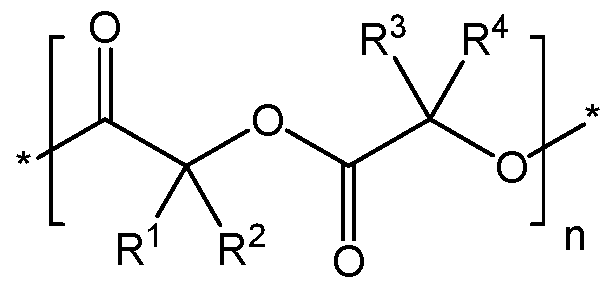
wherein
Represents the terminal groups of the polymer, and
n is an integer from about 10 to about 1000.
7. The polylactic acid of Claims 3 or 4 having the formula

wherein
Represents the terminal groups of the polymer,
n is an integer from about 10 to about 1000.
8. The polymer of Claims 1 or 2 having the formula

wherein
R6 is hydrogen or methyl,
n is an integer from about 10 to about 1000, and
m is an integer from about 10 to about 1000.
9. The polylactic acid of Claims 3 or 4 having the formula

wherein
R6 is hydrogen or methyl,
n is an integer from about 10 to about 1000, and
m is an integer from about 10 to about 1000.
10. The polymer of any one of Claims 1-5, 8, and 9, wherein the polymer is a random copolymer or a block copolymer.
11. A surface of a substrate, wherein at least a portion of the surface is coated with a polymer of any one of Claims 1-10.
12. The surface of Claim 11, wherein the substrate is a drug delivery device, a device having a degradation-inhibiting coating, a device having a hydrophobic surface with high contact angle, or a device that contacts blood.
13. The surface of Claim 11, wherein the substrate is a medical device.
14. The surface of Claim 11, wherein the substrate is a cardiovascular stent.
15. A method for making a halogenated polymer, comprising:
subjecting a polymer with an ammonia plasma to provide a polymer functionalized with amino groups;
reacting the polymer functionalized with amino groups with a suitably reactive reagent comprising a halocarbon, wherein at least a portion of the amino groups react with the reagent to provide a polymer having at least of portion of the amino groups converted to amine groups covalently coupled to the halocarbon.
16. A method for making a fluorinated polymer, comprising:
subjecting a polymer with an ammonia plasma to provide a polymer functionalized with amino groups;
reacting the polymer functionalized with amino groups with a suitably reactive reagent comprising a fluorocarbon (e.g., fluoroalkyl) group, wherein at least a portion of the amino groups react with the reagent to provide a polymer having at least of portion of the amino groups converted to amine groups covalently coupled to fluorocarbon (e.g., fluoroalkyl) groups.
17. The method of Claims 15 or 16 wherein the polymer is selected from the group consisting of a polylactic acid, a polyglycolic acid, and a poly(lactic-co-glycolic) acid.
18. The method of Claim 15, wherein suitably reactive reagent comprising a halocarbon has a reactive group selected from the group consisting of a carboxylic acid, carboxylic acid halide, carboxylic acid ester, isocyanate, isothiocyanate, acyl azide, aldehyde, epoxide, oxirane, carbonate, sulfonyl chloride, aryl halide, imidoester, glyoxal, carbodiimide, and anhydride.
19. The method of Claim 16, wherein suitably reactive reagent comprising a fluorocarbon group has a reactive group selected from the group consisting of a carboxylic acid, carboxylic acid halide, carboxylic acid ester, isocyanate, isothiocyanate, acyl azide, aldehyde, epoxide, oxirane, carbonate, sulfonyl chloride, aryl halide, imidoester, glyoxal, carbodiimide, and anhydride.
20. The method of Claim 16, wherein the fluoroalkyl group is a C1-C24 fluoroalkyl group.
21. The method of Claims 15 or 16, wherein the polymer is a coating on at least a portion of a surface of a substrate.
22. The method of Claim 21, wherein the substrate is a drug delivery device, a device having a degradation-inhibiting coating, a device having a hydrophobic surface with high contact angle, or a device that contacts blood.
23. The method of Claim 21, wherein the substrate is a medical device.
24. The surface of Claim 21, wherein the substrate is a cardiovascular stent.
25. A polymer obtainable by the process of any one of Claims 15-20.
26. A surface of a substrate having at least a portion of the surface is coated with a polymer obtainable by the process of any one of Claims 15-20.
27. A cyclic diester having the formula

stereoisomers and racemates thereof,
wherein R1, R2, R3, and R4 are independently selected from hydrogen, C1-C24 alkyl, aryl, fluoro, chloro, and halocarbon, with the proviso that at least one of R1, R2, R3, or R4 is selected from fluoro, chloro, or halocarbon.
28. A cyclic diester having the formula

stereoisomers and racemates thereof,
wherein R1, R2, R3, and R4 are independently selected from hydrogen, C1-C24 alkyl, aryl, fluoro, and fluorocarbon (e.g., C1-C24 fluoroalkyl), with the proviso that at least one of R1, R2, R3, or R4 is selected from fluoro or fluorocarbon.
29. The cyclic diester of Claim 28, wherein the C1-C24 fluoroalkyl group is a C 1 -C 12 fluoroalkyl group.
30. The cyclic diester of Claim 28, wherein the C 1-C24 fluoroalkyl group is a C1-C6 fluoroalkyl group.
31. The cyclic diester of Claim 28, wherein R1 and R3 are hydrogen and R2 and R4 are trifluoromethyl.
32. The cyclic diester of Claim 28, wherein R and R are hydrogen, R" is methyl, and R4 is trifluoromethyl.
33. The cyclic diester of Claim 28, wherein R1 and R2 are hydrogen and R3 and R4 are trifluoromethyl.
34. The cyclic diester of Claim 28, wherein R1, R2, and R3 are hydrogen and R4 is trifluoromethyl.
35. The cyclic diester of Claim 28, wherein R1, R2, R3, and R4 are trifluoromethyl.
36. The cyclic diester of Claim 28, wherein the C1-C24 alkyl is selected from the group consisting of straight chain, branched, and cyclo alkyl.
37. The cyclic diester of Claim 28, wherein the C 1-C24 alkyl is selected from the group consisting of methyl, ethyl, n-propyl, i-propyl, and n-butyl.
38. The cyclic diester of Claim 28, wherein the C1-C24 alkyl is methyl.
39. The cyclic diester of Claim 28, wherein the C1-C24 fluoroalkyl is selected from the group consisting of straight chain, branched, and cyclo fluoroalkyl.
40. The cyclic diester of Claim 28, wherein the C 1-C24 fluoroalkyl is a C l- C24 perfluoroalkyl.
41. The cyclic diester of Claim 28, wherein the C1-C24 fluoroalkyl has a ratio of F:C from 0.4 to 3.0.
42. The cyclic diester of Claim 28, wherein the C1-C24 fluoroalkyl is selected from the group consisting of trifluoromethyl, pentafluoroethyl, n-perfluoropropyl, n- perfluorobutyl, and n-perfluoropentyl.
43. The cyclic diester of Claim 28, wherein the C1-C24 fluoroalkyl is trifluoromethyl.
44. A cyclic diester having the formula

stereoisomers and racemates thereof,
wherein R1 and R3 are independently selected from C1-C24 alkyl and fluorocarbon (e.g., C1-C24 fluoroalkyl), with the proviso that at least on of R1 or R3 is fluorocarbon.
45. The cyclic diester of Claim 44, wherein R1 is methyl and R3 is trifluoromethyl.
46. The cyclic diester of Claim 44, wherein R1 is hydrogen and R3 is trifluoromethyl.
47. The cyclic diester of Claim 44, wherein R1 and R3 are trifluoromethyl.
48. A fluorinated polymer prepared from a cyclic diester of any one of Claims
28-46.
49. A halogenated polymer prepared from a cyclic diester of Claim 27.
Priority Applications (1)
| Application Number | Priority Date | Filing Date | Title |
|---|---|---|---|
| US15/678,581 US10577456B2 (en) | 2015-02-18 | 2017-08-16 | Halogenated cyclic diesters, related polymers, and methods for their preparation and use |
Applications Claiming Priority (4)
| Application Number | Priority Date | Filing Date | Title |
|---|---|---|---|
| US201562117900P | 2015-02-18 | 2015-02-18 | |
| US62/117,900 | 2015-02-18 | ||
| US201562259514P | 2015-11-24 | 2015-11-24 | |
| US62/259,514 | 2015-11-24 |
Related Child Applications (1)
| Application Number | Title | Priority Date | Filing Date |
|---|---|---|---|
| US15/678,581 Continuation-In-Part US10577456B2 (en) | 2015-02-18 | 2017-08-16 | Halogenated cyclic diesters, related polymers, and methods for their preparation and use |
Publications (1)
| Publication Number | Publication Date |
|---|---|
| WO2016134178A1 true WO2016134178A1 (en) | 2016-08-25 |
Family
ID=56689300
Family Applications (1)
| Application Number | Title | Priority Date | Filing Date |
|---|---|---|---|
| PCT/US2016/018529 Ceased WO2016134178A1 (en) | 2015-02-18 | 2016-02-18 | Halogenated cyclic diesters, related polymers, and methods for their preparation and use |
Country Status (2)
| Country | Link |
|---|---|
| US (1) | US10577456B2 (en) |
| WO (1) | WO2016134178A1 (en) |
Cited By (4)
| Publication number | Priority date | Publication date | Assignee | Title |
|---|---|---|---|---|
| US10035877B1 (en) | 2017-03-08 | 2018-07-31 | International Business Machines Corporation | Matrix-bondable lactide monomors for polylactide synthesis |
| US10072121B1 (en) | 2017-03-08 | 2018-09-11 | International Business Machines Corporation | Bottlebrush polymers derived from poly(methylidenelactide) |
| US10202489B2 (en) | 2017-03-08 | 2019-02-12 | International Business Machines Corporation | Lactide copolymers and ring-opened lactide copolymers |
| US10570252B2 (en) | 2017-03-08 | 2020-02-25 | International Business Machines Corporation | Flame retardant lactide monomors for polylactide synthesis |
Families Citing this family (2)
| Publication number | Priority date | Publication date | Assignee | Title |
|---|---|---|---|---|
| US10022455B2 (en) | 2014-05-30 | 2018-07-17 | Translate Bio, Inc. | Biodegradable lipids for delivery of nucleic acids |
| US12001927B2 (en) * | 2019-10-22 | 2024-06-04 | Capital One Services, Llc | Systems and methods for using a predictive engine to predict failures in machine-learning trained systems for display via graphical user interface |
Citations (4)
| Publication number | Priority date | Publication date | Assignee | Title |
|---|---|---|---|---|
| US20090054619A1 (en) * | 2007-08-24 | 2009-02-26 | Board Of Trustees Of Michigan State University | Functionalization of polyglycolides by "click" chemistry |
| US7695795B1 (en) * | 2007-03-09 | 2010-04-13 | Clemson University Research Foundation | Fluorinated lactide-based copolymers |
| US20110098500A1 (en) * | 2007-06-12 | 2011-04-28 | Central Glass Company, Limited | Polymerizable Fluorine-Containing Compound |
| US20130184429A1 (en) * | 2010-07-28 | 2013-07-18 | The University Of Akron | Functional biodegradable polymers |
-
2016
- 2016-02-18 WO PCT/US2016/018529 patent/WO2016134178A1/en not_active Ceased
-
2017
- 2017-08-16 US US15/678,581 patent/US10577456B2/en active Active
Patent Citations (4)
| Publication number | Priority date | Publication date | Assignee | Title |
|---|---|---|---|---|
| US7695795B1 (en) * | 2007-03-09 | 2010-04-13 | Clemson University Research Foundation | Fluorinated lactide-based copolymers |
| US20110098500A1 (en) * | 2007-06-12 | 2011-04-28 | Central Glass Company, Limited | Polymerizable Fluorine-Containing Compound |
| US20090054619A1 (en) * | 2007-08-24 | 2009-02-26 | Board Of Trustees Of Michigan State University | Functionalization of polyglycolides by "click" chemistry |
| US20130184429A1 (en) * | 2010-07-28 | 2013-07-18 | The University Of Akron | Functional biodegradable polymers |
Cited By (7)
| Publication number | Priority date | Publication date | Assignee | Title |
|---|---|---|---|---|
| US10035877B1 (en) | 2017-03-08 | 2018-07-31 | International Business Machines Corporation | Matrix-bondable lactide monomors for polylactide synthesis |
| US10072121B1 (en) | 2017-03-08 | 2018-09-11 | International Business Machines Corporation | Bottlebrush polymers derived from poly(methylidenelactide) |
| US10202489B2 (en) | 2017-03-08 | 2019-02-12 | International Business Machines Corporation | Lactide copolymers and ring-opened lactide copolymers |
| US10570252B2 (en) | 2017-03-08 | 2020-02-25 | International Business Machines Corporation | Flame retardant lactide monomors for polylactide synthesis |
| US10590236B2 (en) | 2017-03-08 | 2020-03-17 | International Business Machines Corporation | Lactide copolymers and ring-opened lactide copolymers |
| US10954338B2 (en) | 2017-03-08 | 2021-03-23 | International Business Machines Corporation | Flame retardant lactide monomors for polylactide synthesis |
| US11267936B2 (en) | 2017-03-08 | 2022-03-08 | International Business Machines Corporation | Lactide copolymers and ring-opened lactide copolymers |
Also Published As
| Publication number | Publication date |
|---|---|
| US20170342205A1 (en) | 2017-11-30 |
| US10577456B2 (en) | 2020-03-03 |
Similar Documents
| Publication | Publication Date | Title |
|---|---|---|
| US10577456B2 (en) | Halogenated cyclic diesters, related polymers, and methods for their preparation and use | |
| Han et al. | Synthesis and degradation behavior of poly (ethyl cyanoacrylate) | |
| EP3280757B1 (en) | Ring-opening polymerization methods and recyclable biorenewable polyesters | |
| JP2000313721A (en) | New hydroxy group-containing copolymer and its production | |
| Jiang et al. | The first amphiphilic graft copolymer bearing a hydrophilic poly (2-hydroxylethyl acrylate) backbone synthesized by successive RAFT and ATRP | |
| Góis et al. | Synthesis of well-defined alkyne terminated poly (N-vinyl caprolactam) with stringent control over the LCST by RAFT | |
| Góis et al. | Synthesis of functionalized poly (vinyl acetate) mediated by alkyne-terminated RAFT agents | |
| CN108409993B (en) | A kind of fluorine-containing polycaprolactone film and preparation method thereof | |
| JP6355109B2 (en) | Fluorine-containing nitrile oxide compounds | |
| Mishra et al. | Synthesis and self-assembly of amphiphilic and biocompatible poly (vinyl alcohol)-block-poly (l-lactide) copolymer | |
| Kyeremateng et al. | Synthesis and characterization of random copolymers of (2, 2-dimethyl-1, 3-dioxolan-4-yl) methyl methacrylate and 2, 3-dihydroxypropyl methacrylate | |
| WO2011112911A2 (en) | Poly(vinyl ester) block copolymers | |
| Nonque et al. | Study on polymerization of bio-based isosorbide monomethacrylate for the formation of low-Tg and high-Tg sustainable polymers | |
| US20210079184A1 (en) | Fluorine-containing polycaprolactone film and preparation method therefor | |
| CN102333785B (en) | Polylactide resin and preparation method thereof | |
| Çolak et al. | Symmetric star poly (substituted glycolide) homopolymers and their surface properties | |
| US5719231A (en) | Process for manufacturing polyvinyl alcohol polymers containing acetoacetic ester groups | |
| CN108484922B (en) | A kind of hydrophobic polycaprolactone and preparation method thereof | |
| CN110621707B (en) | Self-healing functional polyethylene compound and preparation method thereof | |
| AU2011258291B2 (en) | Solvent-based fluoropolymer additives and their use in coating compositions | |
| Arslan et al. | Brush Type Copolymers of Poly (3‐hydroxybutyrate) and Poly (3‐hydroxyoctanoate) with Same Vinyl Monomers via “Grafting From” Technique by Using Atom Transfer Radical Polymerization Method | |
| JP2021178951A (en) | Method for manufacturing polylactide-grafted polyvinyl alcohol-based resin | |
| CN117720734B (en) | Polyethylene glycol monomethyl ether-itaconic acid polyester-polyethylene glycol monomethyl ether amphiphilic block copolymer and preparation method and application thereof | |
| JPH10279528A (en) | Itaconic acid ester and its polymer | |
| Rubbert et al. | Biobased diblock copolymers and associated reactivity ratios via RAFT-polymerisation as new dispersing additives |
Legal Events
| Date | Code | Title | Description |
|---|---|---|---|
| 121 | Ep: the epo has been informed by wipo that ep was designated in this application |
Ref document number: 16753083 Country of ref document: EP Kind code of ref document: A1 |
|
| NENP | Non-entry into the national phase |
Ref country code: DE |
|
| 32PN | Ep: public notification in the ep bulletin as address of the adressee cannot be established |
Free format text: NOTING OF LOSS OF RIGHTS PURSUANT TO RULE 112(1) EPC (EPO FORM 1205A DATED 25.10.2017) |
|
| 122 | Ep: pct application non-entry in european phase |
Ref document number: 16753083 Country of ref document: EP Kind code of ref document: A1 |