WO2016130734A1 - Use of phenolic antioxidants in cell culture for the production of proteins - Google Patents
Use of phenolic antioxidants in cell culture for the production of proteins Download PDFInfo
- Publication number
- WO2016130734A1 WO2016130734A1 PCT/US2016/017432 US2016017432W WO2016130734A1 WO 2016130734 A1 WO2016130734 A1 WO 2016130734A1 US 2016017432 W US2016017432 W US 2016017432W WO 2016130734 A1 WO2016130734 A1 WO 2016130734A1
- Authority
- WO
- WIPO (PCT)
- Prior art keywords
- protein
- cells
- cell culture
- antioxidant
- culture
- Prior art date
- Legal status (The legal status is an assumption and is not a legal conclusion. Google has not performed a legal analysis and makes no representation as to the accuracy of the status listed.)
- Ceased
Links
Classifications
-
- C—CHEMISTRY; METALLURGY
- C12—BIOCHEMISTRY; BEER; SPIRITS; WINE; VINEGAR; MICROBIOLOGY; ENZYMOLOGY; MUTATION OR GENETIC ENGINEERING
- C12P—FERMENTATION OR ENZYME-USING PROCESSES TO SYNTHESISE A DESIRED CHEMICAL COMPOUND OR COMPOSITION OR TO SEPARATE OPTICAL ISOMERS FROM A RACEMIC MIXTURE
- C12P21/00—Preparation of peptides or proteins
- C12P21/02—Preparation of peptides or proteins having a known sequence of two or more amino acids, e.g. glutathione
-
- C—CHEMISTRY; METALLURGY
- C12—BIOCHEMISTRY; BEER; SPIRITS; WINE; VINEGAR; MICROBIOLOGY; ENZYMOLOGY; MUTATION OR GENETIC ENGINEERING
- C12N—MICROORGANISMS OR ENZYMES; COMPOSITIONS THEREOF; PROPAGATING, PRESERVING, OR MAINTAINING MICROORGANISMS; MUTATION OR GENETIC ENGINEERING; CULTURE MEDIA
- C12N5/00—Undifferentiated human, animal or plant cells, e.g. cell lines; Tissues; Cultivation or maintenance thereof; Culture media therefor
- C12N5/0018—Culture media for cell or tissue culture
-
- C—CHEMISTRY; METALLURGY
- C12—BIOCHEMISTRY; BEER; SPIRITS; WINE; VINEGAR; MICROBIOLOGY; ENZYMOLOGY; MUTATION OR GENETIC ENGINEERING
- C12Q—MEASURING OR TESTING PROCESSES INVOLVING ENZYMES, NUCLEIC ACIDS OR MICROORGANISMS; COMPOSITIONS OR TEST PAPERS THEREFOR; PROCESSES OF PREPARING SUCH COMPOSITIONS; CONDITION-RESPONSIVE CONTROL IN MICROBIOLOGICAL OR ENZYMOLOGICAL PROCESSES
- C12Q1/00—Measuring or testing processes involving enzymes, nucleic acids or microorganisms; Compositions therefor; Processes of preparing such compositions
- C12Q1/02—Measuring or testing processes involving enzymes, nucleic acids or microorganisms; Compositions therefor; Processes of preparing such compositions involving viable microorganisms
- C12Q1/04—Determining presence or kind of microorganism; Use of selective media for testing antibiotics or bacteriocides; Compositions containing a chemical indicator therefor
Definitions
- the present invention relates to new methods and processes for culturing
- ROS reactive oxygen species
- Antioxidants commonly used during cell culture include tocopherol, transferrin, selenium, ascorbate and reduced glutathione.
- Tocopherol is a membrane antioxidant with low solubility in water that functions to neutralize lipid peroxides.
- Transferrin is a chelator that binds iron with such high affinity leaving no iron available to generate free radicals. Transferrin serves as an extracellular iron transporter and storage molecule.
- Glutathione is a water-soluble antioxidant tripeptide, which contains a reducing thiol group. It is ubiquitously produced in all cell types and is important for cell proliferation and viability.
- Selenium is a component of the antioxidant enzymes glutathione peroxidase and thioredoxin reductase which reduce glutathione and thioredoxin, respectively.
- Ascorbate is a water-soluble antioxidant that regenerates reduced tocopherol.
- Most commercially-available basal mediums do not contain antioxidants as they were designed for use in conjunction with serum. The serum would typically provide the required antioxidants.
- the present invention provides new processes for the production of proteins by animal or mammalian cell cultures. These new processes achieve increased viable cell density, cell viability and productivity.
- the inventors have identified suitable phenolic antioxidants over a range of concentrations, in different chemically defined basal and feed media, in small and large scale cell culture using different transfected cell lines that produce antibody or fusion proteins.
- the cells are Chinese hamster Ovary cells and the antioxidant is added to the basal or feed media, or both the basal and feed media.
- Another aspect of the method of this invention concerns the selection of phenolic antioxidant from the group consisting of apigenin, catechin, chlorogenic acid, daidzein, genistein, hesperetin, melatonin, naringenin, pelargonidin, quercetin, resveratrol, rosmarinic acid and silibinin. More specifically, one or more antioxidant is selected from catechin, chlorogenic acid, pelargonidin, quercetin, resveratrol, rosmarinic acid or silibinin. More specifically, the antioxidant utilized in the method of this invention is catechin or rosmarinic acid.
- An amount of antioxidant suitable for use in the basal and/or feed medium comprises from about 0.0625 mM to about 1 mM. More specifically, the amount of antioxidant suitable for use in the basal media comprises the lower end of the suitable range, for example, from about 0.0625 mM to 0.25 mM. The amount of antioxidant suitable for the feed media comprises the upper end of the suitable range, for example, from about 0.25 mM to 1 mM.
- Figure 1 shows the impact of 0.0625 mM, 0.25 mM and 1 mM of different antioxidants added to the feed media M154A1B on aCD137 viable cell density (VCD) at day 8 (peak VCD).
- VCD viable cell density
- the basal media M17IB was not supplemented with antioxidant.
- the cell density for each condition was normalized to the control condition with no additional antioxidants in the feed.
- Figure 2 shows the impact of 0.0625 mM, 0.25 mM and 1 mM of different antioxidants added to the feed media M154A1B on productivity of the cultured aCD137 cells.
- the basal media M17IB was not supplemented with antioxidant.
- the final titer (harvested on days 14) for each condition was normalized to the control condition with no additional antioxidants in the feed.
- Figure 3A-C show the impact of catechin, chlorogenic acid, quercetin, resveratrol and rosmarinic acid on aCD137 cell culture
- A viable cell density
- B normalized protein titer
- C lactate concentration
- the antioxidants were added to basal media M17IB at 0.07 mM and feed media M154A1B at 1 mM.
- the media were then used in a standard shaker flask fed-batch culture with aCD137 cells.
- Figure 4A-D show the impact of catechin(ci) on aCD137 cell culture (A) viable cell density, (B) cell viability, (C) normalized protein titer, and (D) ammonium concentration.
- Catechin was added to feed media F3.2 at 1 mM. The media was then used in a standard shaker flask fed-batch culture with aCD137 cells together with basal media B 1
- Figure 5A-E shows the impact of rosmarinic acid(*) and catechin( A) on aCD137 cell culture
- A viable cell density
- B cell viability
- C normalized protein titer
- D lactate concentration
- E ammonium concentration.
- Rosmarinic acid or catechin were added to basal media M17IB at 0.1 mM. The media was then used in a standard 7- liter fed-batch culture together with feed media Ml 54A1 B.
- Figure 6A-D shows the impact of rosmarinic acid (A) on aCD137 cell culture (A) viable cell density, (B) cell viability, (C) normalized protein titer, and (D) lactate concentration. Rosmarinic acid was added to basal media M17IB at 0.1 mM. The media was then used in a standard fed-batch culture together with feed media M154A1B.
- Figure 7A-D shows the impact of rosmarinic acid addition to either basal media
- Figure 8A-C shows the impact of rosmarinic acid (RA-Basal) or catechin (Cat-
- Basal addition to basal media Bl at 0.1 mM on (A) viable cell density, (B) cell viability, (C) normalized protein titer and (D) ammonium concentration.
- the media was used in a 20-liter reactor with myostatin cells together with feed media F3.2.
- Figure 9A-C shows the impact of catechin addition to feed media 154A1 at 0.34 ⁇ , 3.45 ⁇ , 34.45 ⁇ or 344.52 ⁇ on (A) viable cell density, (B) cell viability and (C) normalized protein titer. Basal media M17IB without catechin was used for the culture. The media was used in standard shake flasks with aCD40L cells.
- This invention is directed to an enhanced process (method) for the preparation of recombinant proteins by mammalian cell cultures, specifically CHO cell cultures, in which the viable cell density and protein titer are increased by the use of a newly- described media strategy in which antioxidants are added to the cell cultures.
- the antioxidants are provided to the cell cultures in an amount that is effective for attaining and maintaining viable cell density and therefore maximizing protein production until the end of a culturing run.
- a variety of antioxidant supplementation regimens are encompassed by the present invention.
- the addition of antioxidants to the cell culture increases and/or maintains viable cell density during the production run.
- the presence of an effective amount of antioxidants in the basal media and/or over the course of the culturing process was found to result in an increased protein titer.
- antioxidants are added to the basal and or feed media.
- the processes and methods of the present invention are suited to both small (e.g. , 50 L-100 L) and large scale (e.g. , 500 L and greater) cell cultures.
- the methods of the present invention are particularly suited to cells grown and maintained as fed-batch cultures, of both small and large scale.
- a variety of culture media as known in the art can be used in the culturing methods of this invention.
- An antioxidant is a molecule that inhibits the oxidation of other molecules.
- Oxidation is a chemical reaction that transfers electrons or hydrogen from a substance to an oxidizing agent. Oxidation reactions can produce free radicals. In turn, these radicals can start chain reactions. When the chain reaction occurs in a cell, it can cause damage or death to the cell. Antioxidants terminate these chain reactions by removing free radical intermediates, and inhibit other oxidation reactions. They do this by being oxidized themselves, so antioxidants are often reducing agents such as thiols, ascorbic acid, or polyphenols.
- a polyphenol antioxidant is a type of antioxidant containing a polyphenol! c or natural phenol substructure. Although all polyphenols have similar chemical structures, there are some distinctive differences. Based on these differences polyphenols are subdivided into several major subclasses including: phenolic acids (such as rosmarinic acid and chlorogenic acid), stilbens (such as resveratrol), tannins, ilavonolignans (such as silibi n) and flavonoids, Flavonoids are the largest family of poly phenolic antioxidants.
- Flavonoids are further divided in several subclasses including: anthocyanins (such as pelargonidin), flavanols (such as catechin), flavanones (such as naringenin and hesperetin), flavonol (such as quercetin), flavones (such as apigenin), and isoflavones (such as genistein and daidzein).
- anthocyanins such as pelargonidin
- flavanols such as catechin
- flavanones such as naringenin and hesperetin
- flavonol such as quercetin
- flavones such as apigenin
- isoflavones such as genistein and daidzein
- An advantage of the present invention is that protein production costs are reduced by the increase in protein production as achieved by the culturing methods described herein.
- higher viable cell density was maintained throughout the culture run when antioxidants were included in the basal and/or feeding medium supplied to the cell culture as shown in Figures 1-9.
- One embodiment of the invention involves the addition of antioxidant to the basal media to allow for the production of large amounts of protein independent of the reactor scale as shown in Figures 5, 6, 7 and 8.
- One embodiment of the invention involves the maintenance of the antioxidant feeding strategy throughout a production run, preferably, with daily feeding, to allow for the production of large amounts of protein independent of the reactor scale as shown in Figures 1, 2, 4, 7 and 9.
- One embodiment of the invention involves the addition of antioxidant to the basal and feed media to allow for the production of large amounts of protein independent of the reactor scale as shown in Figures 3 and 7.
- An effective concentration of antioxidants as a component in a basal or feed media increases, maintains and/or sustains viable cell density throughout the production run.
- the type and amount of antioxidant suitable for use in the basal or feed medium can be determined by the skilled practitioner based on the reactor size and volume of the culture.
- the methods of the present invention are suitable for all reactor scales at which protein production occur, including, but not limited to, large and small production scale, and reactor scale, e.g. , large scale cultures or commercial scale cultures, e.g. , over 50 L, more preferably over 500 L.
- the antioxidant supplementation strategy is applicable for production scale cultures, e.g.
- one or more antioxidant is selected from the group consisting of apigenin, catechin, chlorogenic acid, daidzein, genistein, hesperetin, melatonin, naringenin, pelargonidin, quercetin, resveratrol, rosmarinic acid and silibinin; preferably, one or more antioxidant is selected from catechin, chlorogenic acid, pelargonidin, quercetin, resveratrol, rosmarinic acid and silibinin; more preferably, one or more antioxidant is selected from catechin, chlorogenic acid, quercetin, resveratrol and rosmarinic acid; more preferably, the antioxidant is catechin or rosmarinic acid.
- basal or feed medium concentration of one or more of the antioxidants selected from the list above is preferably provided in an amount which affords a higher sustained or maintained viable cell density in the culture, or reactor, during the culturing process.
- An amount of antioxidant suitable for use in the basal and/or feed medium comprises from about 0.0625 mM to about 1 mM, preferably about 0.1 mM to about 1 mM. More specifically, the amount of antioxidant suitable for use in the basal media comprises the lower end of the suitable range, for example, from about 0.0625 mM to 0.25 mM, and the amount of antioxidant suitable for the feed media comprises the upper end of the suitable range, for example, from about 0.25 mM to 1 mM.
- 1 mM catechin in the feed medium is suitable for use in the culturing method of the invention; or 0.1 mM rosmarinic acid or catechin in the basal media is suitable for use in the culturing method of the invention; or 0.1 mM rosmarinic acid in the basal media and 1 mM rosmarinic acid in the feed media is suitable for use in the culturing method of the invention.
- Cell cultures are fed with feeding medium containing antioxidants of the invention using a variety of feeding schedules or regimens to deliver and maintain the antioxidants in the cultures in amounts that sustain a viable cell density effective antioxidant concentration thereby increasing protein production.
- the culturing methods of the present invention comprise the feeding of cell cultures with the antioxidants of the invention in the feeding medium more than one time during the culture run. It is to be understood that the culture volume contributed by the feeding medium at the end of a culture run typically comprises approximately 30-60% of the original culture volume.
- the cell cultures can be fed the antioxidants of the invention on a daily basis, or on other than a daily basis, e.g.
- the feeding of cell cultures with the antioxidants of the invention can be performed once per day, more than once per day, or less than once per day, and can occur one time, two times, or more than two times, e.g. , three, four, five or more times, during the total culture run.
- the cells are fed with antioxidants more than once.
- a continuous feeding schedule for example, involving a continuous infusion of the antioxidants of the invention, preferably an antioxidant-containing feeding medium, into the cultures.
- the cultures receive antioxidants, preferably in feeding medium, for example, as a continuously-supplied "drip", or infusion, or other automated addition to the culture, in a timed, regulated, and/or programmed fashion so as to achieve and maintain the appropriate amount of antioxidant in the culture.
- a feeding regimen comprising a one time per day bolus feed with antioxidant, preferably with feeding medium containing antioxidant on each day of the culture run, from the beginning of the culture run to the day of harvesting the cells.
- the antioxidants of the invention can be fed to the cell culture at any of the aforementioned intervals in some way other than in the feed medium.
- the antioxidants can be fed to the culture in DMSO, ethanol or water.
- the culture may be fed with antioxidants and also fed with a feed medium, i.e. , there may be more than one composition being fed.
- feed refers to any addition of any substance made to a culture after inoculation. Feeding can be one or more additions.
- the term "inoculation” refers to the addition of cells to starting medium to begin the culture.
- feed medium refers to a medium containing one or more nutrients that is added to the culture beginning at some time after inoculation.
- the term “basal medium” and “basal media” refers to starting medium to which cells are added to begin the culture.
- the present invention encompasses a cell culture method or process of increasing protein titer in a cell culture, comprising the addition of catechin to the culturing medium.
- a related embodiment involves a cell culture method in which catechin is supplied to the culture for the duration of the production run, and preferably is present in the feeding medium.
- a preferred embodiment relates to processes of culturing cells comprising a daily feeding of the culture with medium containing catechin.
- catechin to the cells in culture as provided by this method, preferably supplied more than one time during the culture run, more preferably, on a daily basis, increases, maintains viable cell density in the culture, allowing the cells to continue to produce protein, thereby maximizing protein production.
- Another related embodiment involves a cell culture method in which catechin is supplied to the culture in the basal media.
- the addition of catechin to the cells in the basal media as provided by this method increases and/or maintains viable cell density in the culture, allowing the cells to continue to produce protein, thereby maximizing protein production.
- Another related embodiment involves a cell culture method in which catechin is supplied to the culture in the basal media as well as for the duration of the production run, preferably in the feeding medium.
- a preferred embodiment relates to processes of culturing cells comprising cell inoculation in an antioxidant supplemented basal media and a daily feeding of the culture with medium containing catechin.
- the addition of catechin to the cells in culture as provided by this method increases and/or maintains viable cell density in the culture, allowing the cells to continue to produce protein, thereby maximizing protein production
- the present invention encompasses a cell culture method or process of increasing protein titer in a cell culture, comprising the addition of rosmarinic acid to the culturing medium.
- a related embodiment involves a cell culture method in which rosmarinic acid is supplied to the culture for the duration of the production run, and preferably is present in the feeding medium.
- rosmarinic acid to the cells in culture as provided by this method, preferably supplied more than one time during the culture run, more preferably, on a daily basis, increases, maintains viable cell density in the culture, allowing the cells to continue to produce protein, thereby maximizing protein production.
- Another related embodiment involves a cell culture method in which rosmarinic acid is supplied to the culture in the basal media.
- the addition of rosmarinic acid to the cells in basal media as provided by this method increases and/or maintains viable cell density in the culture, allowing the cells to continue to produce protein, thereby maximizing protein production.
- Another related embodiment involves a cell culture method in which rosmarinic acid is supplied to the culture in the basal media as well as for the duration of the production run, preferably in the feeding medium.
- a preferred embodiment relates to processes of culturing cells comprising cell inoculation in an antioxidant supplemented basal media and a daily feeding of the culture with medium containing rosmarinic acid.
- the addition of rosmarinic acid to the cells in culture as provided by this method increases and/or maintains viable cell density in the culture, allowing the cells to continue to produce protein, thereby maximizing protein production.
- viable cell density is increased about 10-100% when the cell culture is supplemented with antioxidants, as compared with cell cultures in the absence of antioxidant supplementation.
- protein titer is increased, on average, about 30- 130% when cell cultures are supplemented with antioxidants, as compared with cell cultures in the absence of antioxidant supplementation.
- VCD viable cell density
- antioxidants to the feed media also affected the productivity of the cultured cells.
- protein titer was increased by as much as 80% by addition of antioxidant compared to the controls (DMSO, ethanol, or water).
- the cells can be maintained in a variety of cell culture media, i.e., basal culture media, as conventionally known in the art.
- the methods are applicable for use with large volumes of cells maintained in cell culture medium, which can be supplemented with nutrients and the like.
- cell culturing medium (also called “culture medium”) is a term that is understood by the practitioner in the art and is known to refer to a nutrient solution in which cells, preferably animal or mammalian cells, are grown and which generally provides at least one or more components from the following: an energy source (usually in the form of a carbohydrate such as glucose); all essential amino acids, and generally the twenty basic amino acids, plus cysteine; vitamins and/or other organic compounds typically required at low concentrations; lipids or free fatty acids, e.g., linoleic acid; and trace elements, e.g. , inorganic compounds or naturally occurring elements that are typically required at very low concentrations, usually in the micromolar range.
- an energy source usually in the form of a carbohydrate such as glucose
- all essential amino acids and generally the twenty basic amino acids, plus cysteine
- vitamins and/or other organic compounds typically required at low concentrations
- lipids or free fatty acids e.g., linoleic acid
- Cell culture medium can also be supplemented to contain a variety of optional components, such as hormones and other growth factors, e.g., insulin, transferrin, epidermal growth factor, serum, and the like; salts, e.g., calcium, magnesium and phosphate, and buffers, e.g., HEPES; nucleosides and bases, e.g. , adenosine, thymidine, hypoxanthine; and protein and tissue hydrolysates, e.g., hydrolyzed animal protein (peptone or peptone mixtures, which can be obtained from animal byproducts, purified gelatin or plant material); antibiotics, e.g., gentamycin; and cell protective agents, e.g. , a PLURONIC® polyol (PLURONIC® F68).
- Preferred is a cell nutrition medium that is serum-free and free of products or ingredients of animal origin.
- animal or mammalian cells are cultured in a medium suitable for the particular cells being cultured and which can be determined by the person of skill in the art without undue experimentation.
- Commercially available media can be utilized and include, for example, Minimal Essential Medium (MEM, Sigma, St. Louis, MO); Ham's F10 Medium (Sigma); Dulbecco's Modified Eagles Medium (DMEM, Sigma); RPMI-1640 Medium (Sigma); HYCLONE® cell culture medium (HyClone, Logan, UT); and chemically-defined (CD) media, which are formulated for particular cell types.
- MEM Minimal Essential Medium
- DMEM Dulbecco's Modified Eagles Medium
- RPMI-1640 Medium Sigma
- HYCLONE® cell culture medium HyClone, Logan, UT
- CD chemically-defined
- exemplary media can be added the above-described supplementary components or ingredients, including optional components, in appropriate concentrations or amounts, as necessary or desired, and as would be known and practiced by
- cell culture conditions suitable for the methods of the present invention are those that are typically employed and known for batch, fed-batch, or continuous culturing of cells, with attention paid to pH (e.g. , about 6.5 to about 7.5), dissolved oxygen (C ) (e.g. , between about 5-90% of air saturation), carbon dioxide
- a suitable cell culturing medium for the fed-batch processes of the present invention comprises a chemically defined basal and feed medium, preferably one or both containing the antioxidants of the invention (e.g. , Examplel).
- Animal cells, mammalian cells, cultured cells, animal or mammalian host cells, host cells, recombinant cells, recombinant host cells, and the like, are all terms for the cells that can be cultured according to the processes of this invention.
- Such cells are typically cell lines obtained or derived from mammals and are able to grow and survive when placed in either monolayer culture or suspension culture in medium containing appropriate nutrients and/or growth factors. Growth factors and nutrients that are necessary for the growth and maintenance of particular cell cultures are able to be readily determined empirically by those having skill in the pertinent art, such as is described, for example, by Barnes et al. (Cell, 22:649 (1980)); in Mather, J.P., ed., Mammalian Cell Culture, Plenum Press, NY (1984); and in U.S. Patent No. 5,721,121.
- the cells are typically animal or mammalian cells that can express and secrete, or that can be molecularly engineered to express and secrete, large quantities of a particular protein into the culture medium.
- the protein produced by a host cell can be endogenous or homologous to the host cell.
- the protein is heterologous, i.e., foreign, to the host cell, for example, a human protein produced and secreted by a Chinese hamster ovary (CHO) host cell.
- mammalian proteins that can be advantageously produced by the methods of this invention include, without limitation, cytokines, cytokine receptors, growth factors (e.g.
- EGF EGF
- HER-2 FGF-a, FGF- ⁇ , TGF-a, TGF- ⁇ , PDGF.
- IGF-1, IGF-2, NGF, NGF- ⁇ growth factor receptors, including fusion or chimeric proteins.
- growth hormones e.g., human growth hormone, bovine growth hormone
- insulin e.g., insulin A chain and insulin B chain
- proinsulin proinsulin
- EPO erythropoietin
- colony stimulating factors e.g. , G-CSF, GM-CSF, M-CSF
- interleukins e.g. , IL-1 through IL-12
- VEGF vascular endothelial growth factor
- VEGF-R vascular endothelial growth factor
- interferons e.g., IFN-a, ⁇ , or ⁇
- tumor necrosis factor e.g., TNF-a and TNF- ⁇
- TPO thrombopoietin
- thrombin thrombin
- clotting factors e.g., Factor VIII, Factor IX, von
- tissue plasminogen activator TP A
- FSH follicle stimulating hormone
- LH luteinizing hormone
- calcitonin CD proteins (e.g. , CD3, CD4, CD8, CD28, CD19, etc.); CTLA proteins (e.g. , CTLA4); T-cell and B-cell receptor proteins; bone morphogenic proteins (BNPs, e.g. , BMP-1, BMP -2, BMP-3, etc.); neurotrophic factors, e.g., bone derived neurotrophic factor (BDNF); neurotrophins, e.g. , 3-6; renin;
- rheumatoid factor RANTES; albumin; relaxin; macrophage inhibitory protein (e.g., MIP- 1, MIP-2); viral proteins or antigens; surface membrane proteins; ion channel proteins; enzymes; regulatory proteins; antibodies; immunomodulatory proteins, (e.g. , HLA, MHC, the B7 family); homing receptors; transport proteins; superoxide dismutase (SOD); G- protein coupled receptor proteins (GPCRs); neuromodulatory proteins; Alzheimer's Disease associated proteins and peptides, (e.g. , A-beta), and others as known in the art.
- macrophage inhibitory protein e.g., MIP- 1, MIP-2
- viral proteins or antigens e.g., surface membrane proteins; ion channel proteins; enzymes; regulatory proteins; antibodies; immunomodulatory proteins, (e.g. , HLA, MHC, the B7 family); homing receptors; transport proteins; superoxide dismutase (SOD);
- Fusion proteins and polypeptides, chimeric proteins and polypeptides, as well as fragments or portions, or mutants, variants, or analogs of any of the aforementioned proteins and polypeptides are also included among the suitable proteins, polypeptides and peptides that can be produced by the methods of the present invention.
- Nonlimiting examples of animal or mammalian host cells suitable for harboring, expressing, and producing proteins for subsequent isolation and/or purification include Chinese hamster ovary cells (CHO), such as CHO-K1 (ATCC® CCL-61), DG44 (Chasin et al, Som. CellMolec. Genet., 12:555-556 (1986); Kolkekar et al, Biochemistry, 36: 10901-10909 (1997); and WO 01/92337 A2), dihydrofolate reductase negative CHO cells (CHO/-DHFR, Urlaub et al., Proc. Natl. Acad. Sci. USA, 77:4216 (1980)), and dpl2.CH0 cells (U.S.
- CHO-K1 ATCC® CCL-61
- DG44 Chosin et al, Som. CellMolec. Genet., 12:555-556 (1986); Kolkekar et al, Biochemistry, 36: 109
- Patent No. 5,721,121 monkey kidney CV1 cells transformed by SV40 (COS cells, COS-7, ATCC® CRL-1651); human embryonic kidney cells (e.g. , 293 cells, or 293 cells subcloned for growth in suspension culture, Graham et al., J. Gen. Virol. , 36:59 (1977)); baby hamster kidney cells (BHK, ATCC® CCL-10); monkey kidney cells (CV1, ATCC® CCL-70); African green monkey kidney cells (VERO-76, ATCC® CRL-1587; VERO, ATCC® CCL-81); mouse Sertoli cells (TM4, Mather, Biol. Reprod.
- SV40 SV40
- human embryonic kidney cells e.g. , 293 cells, or 293 cells subcloned for growth in suspension culture, Graham et al., J. Gen. Virol. , 36:59 (1977)
- baby hamster kidney cells BHK, ATCC® CCL-10
- monkey kidney cells CV1,
- human cervical carcinoma cells HELA, ATCC® CCL-2
- canine kidney cells MDCK, ATCC® CCL-34
- human lung cells W138, ATCC® CCL- 75
- human hepatoma cells HEP-G2, HB 8065
- mouse mammary tumor cells MMT 060562, ATCC® CCL-51
- buffalo rat liver cells BRL 3A, ATCC® CRL-1442
- TRI cells Mather, Annals NY Acad. Sci., 383:44-68 (1982)
- MCR 5 cells FS4 cells.
- CHO cells particularly, CHO/-DHFR cells.
- the cells suitable for culturing in the methods and processes of the present invention can contain introduced (e.g. , via transformation, transfection, infection, or injection) expression vectors (constructs), such as plasmids and the like, that harbor coding sequences, or portions thereof, encoding the proteins for expression and production in the culturing process.
- expression vectors contain the necessary elements for the transcription and translation of the inserted coding sequence. Methods which are well known to and practiced by those skilled in the art can be used to construct expression vectors containing sequences encoding the produced proteins and
- polypeptides as well as the appropriate transcriptional and translational control elements.
- These methods include in vitro recombinant DNA techniques, synthetic techniques, and in vivo genetic recombination. Such techniques are described in Sambrook, J. et al., Molecular Cloning, A Laboratory Manual, Cold Spring Harbor Press, Plainview, NY (1989) and in Ausubel, F.M. et al, Current Protocols in Molecular Biology, John Wiley & Sons, New York, NY (1989).
- Control elements are those non-translated regions of the vector (e.g., enhancers, promoters, 5' and 3' untranslated regions) that interact with host cellular proteins to carry out transcription and translation. Such elements can vary in their strength and specificity. Depending on the vector system and host cell utilized, any number of suitable transcription and translation elements, including constitutive and inducible promoters, can be used. In mammalian cell systems, promoters from mammalian genes or from mammalian viruses are preferred.
- constructs for use in protein expression systems are designed to contain at least one promoter, an enhancer sequence (optional, for mammalian expression systems), and other sequences as necessary or required for proper transcription and regulation of gene expression (e.g., transcriptional initiation and termination sequences, origin of replication sites, polyadenylation sequences, e.g. , the Bovine Growth Hormone (BGH) poly A sequence).
- enhancer sequence optionally, for mammalian expression systems
- other sequences as necessary or required for proper transcription and regulation of gene expression (e.g., transcriptional initiation and termination sequences, origin of replication sites, polyadenylation sequences, e.g. , the Bovine Growth Hormone (BGH) poly A sequence).
- BGH Bovine Growth Hormone
- telomere sequence e.g., telomere sequence, telomere sequence, telomere sequence, telomere sequence, telomere sequence, telomere sequence, telomere sequence, telomere sequence, telomere sequence, telomere sequence, telomere sequence, telomere sequence, telomere sequence, telomere sequence, telomere sequence, telomere sequence, telomere sequence, telomere sequence, telomere sequence, telomere sequence, telomere sequence, telomere sequence, telomere sequence, telomere sequence, telomere sequence, telomere sequence, telomere sequence, telomere sequence, telomere sequence, telomere sequence, telomere sequence, telomere sequence, telomere sequence, telomere sequence, telomere sequence, telomere sequence, telomere sequence, telomere sequence, telomere sequence, telomere sequence, telome
- the glucocorticoid response element (GRE) of mouse mammary tumor virus (MMTV) is induced by glucocorticoids (Chandler, V. et al, Cell, 33:489-499 (1983)).
- GRE glucocorticoid response element
- tissue-specific promoters or regulatory elements can be used (Swift, G. et al., Cell, 38:639-646 (1984)), if necessary or desired.
- Expression constructs can be introduced into cells by a variety of gene transfer methods known to those skilled in the art, for example, conventional gene transfection methods, such as calcium phosphate co-precipitation, liposomal transfection, microinjection, electroporation, and infection or viral transduction. The choice of the method is within the competence of the skilled practitioner in the art. It will be apparent to those skilled in the art that one or more constructs carrying DNA sequences for expression in cells can be transfected into the cells such that expression products are subsequently produced in and/or obtained from the cells.
- mammalian expression systems containing appropriate control and regulatory sequences are preferred for use in protein expressing mammalian cells of the present invention.
- Commonly used eukaryotic control sequences for generating mammalian expression vectors include promoters and control sequences compatible with mammalian cells such as, for example, the cytomegalovirus (CMV) promoter (CDM8 vector) and avian sarcoma virus (ASV) JTLN vector.
- CMV cytomegalovirus
- ASV avian sarcoma virus
- promoters include the early and late promoters from Simian Virus 40 (SV40) (Fiers et al, Nature, 273: 113 (1973)), or other viral promoters such as those derived from polyoma, Adenovirus 2, and bovine papilloma virus.
- SV40 Simian Virus 40
- An inducible promoter such as hMTII (Karin et al, Nature, 299:797-802 (1982) can also be used.
- expression vectors suitable for eukaryotic host cells include, but are not limited to, vectors for mammalian host cells (e.g., BPV-1, pHyg, pRSV, pSV2, pTK2 (Maniatis); pIRES (Clontech); pRc/CMV2, pRc/RSV, pSFVl (Life Technologies); pVPakc Vectors, pCMV vectors, pSG5 vectors (Stratagene), retroviral vectors (e.g.
- mammalian host cells e.g., BPV-1, pHyg, pRSV, pSV2, pTK2 (Maniatis); pIRES (Clontech); pRc/CMV2, pRc/RSV, pSFVl (Life Technologies); pVPakc Vectors, pCMV vectors, pSG5 vectors (Stratagene), retroviral vectors (e.g.
- Vectors can also contain enhancer sequences upstream or downstream of promoter region sequences for optimizing gene expression.
- a selectable marker can also be used in a recombinant vector (e.g., a plasmid) to confer resistance to the cells harboring (preferably, having stably integrated) the vector to allow their selection in appropriate selection medium.
- a recombinant vector e.g., a plasmid
- a number of selection systems can be used, including but not limited to, the Herpes Simplex Virus thymidine kinase (HSV TK), (Wigler et al, Cell, 11 :223 (1977)), hypoxanthine-guanine
- HGPRT phosphoribosyltransferase
- APRT adenine phosphoribosyltransferase
- Anti-metabolite resistance can also be used as the basis of selection for the following nonlimiting examples of marker genes: dhfir, which confers resistance to methotrexate (Wigler et al, Proc. Natl. Acad. Sci. USA, 77:357 (1980); and O'Hare et al., Proc. Natl. Acad. Sci. USA, 78: 1527 (1981)); gpt, which confers resistance to mycophenolic acid (Mulligan et al, Proc. Natl. Acad. Sci. USA, 78:2072 (1981)); neo, which confers resistance to the aminoglycoside G418 ⁇ Clin.
- the expression levels of an expressed protein molecule can be increased by vector amplification (for a review, see Bebbington et al., Chapter 8: "The use of vectors based on gene amplification for the expression of cloned genes in mammalian cells in DNA cloning", DNA Cloning: A Practical Approach, Vol. 3, pp. 163-188, IRL Press Limited (1987)).
- a marker in the vector system expressing a protein is amplifiable
- an increase in the level of inhibitor present in the host cell culture will increase the number of copies of the marker gene. Since the amplified region is associated with the protein-encoding gene, production of the protein will concomitantly increase (Crouse et al, Mol. Cell. Biol, 3:257 (1983)).
- Gsencoding nucleic acid can be amplified in the presence of the drugs methionine sulphoximine or methotrexate, respectively.
- An advantage of glutamine synthase based vectors is the availability of cell lines (e.g. , the murine myeloma cell line, NSO) which are glutamine synthase negative.
- Glutamine synthase expression systems can also function in glutamine synthase expressing cells (e.g. , CHO cells) by providing additional inhibitor to prevent the functioning of the endogenous gene.
- Vectors that express DHFR as the selectable marker include, but are not limited to, the pSV2-dhfr plasmid (Subramani et al, Mol. Cell. Biol , 1 :854 (1981).
- Vectors that express glutamine synthase as the selectable marker include, but are not limited to, the pEE6 expression vector described in Stephens et al, Nucl. Acids. Res., 17:7110 (1989).
- a glutamine synthase expression system and components thereof are detailed in PCT publications: WO 87/04462; WO 86/05807; WO 89/01036; WO 89/10404; and WO 91/06657 which are incorporated by reference herein in their entireties.
- glutamine synthase expression vectors that can be used in accordance with the present invention are commercially available from suppliers, including, for example, Lonza Biologies, Inc. (Portsmouth, NH). Types of Cell Cultures
- cell cultures and culturing runs for protein production can include three general types; namely, continuous culture, batch culture and fed-batch culture.
- continuous culture for example, fresh culture medium supplement (i.e., feeding medium) is provided to the cells during the culturing period, while old culture medium is removed daily and the product is harvested, for example, daily or
- feeding medium can be added daily and can be added continuously, i.e. , as a drip or infusion.
- the cells can remain in culture as long as is desired, so long as the cells remain alive and the environmental and culturing conditions are maintained.
- cells are initially cultured in medium and this medium is neither removed, replaced, nor supplemented, i.e. , the cells are not "fed” with new medium, during or before the end of the culturing run.
- the desired product is harvested at the end of the culturing run.
- the culturing run time is increased by supplementing the culture medium one or more times daily (or continuously) with fresh medium during the run, i.e. , the cells are "fed” with new medium ("feeding medium") during the culturing period.
- feeding medium new medium
- Fed-batch cultures can include the various feeding regimens and times as described above, for example, daily, every other day, every two days, etc., more than once per day, or less than once per day, and so on. Further, fed-batch cultures can be fed continuously with feeding medium. The desired product is then harvested at the end of the culturing/production run.
- stimulation refers to the addition of cells to starting medium to begin the culture.
- the growth phase of a culture is the phase during which the viable cell density at any time point is higher than at any previous time point.
- the stationary phase of a culture is the phase during which the viable cell density is approximately constant (i.e. , within measuring error) over a time period of any length.
- the death phase of a culture is the phase that comes after the growth phase or after the growth phase and the stationary phase, and during which the viable cell density at any time point is lower than at any previous time point during that phase.
- the production phase may start during the extended growth phase.
- the production phase of cell culture may be the stationary phase.
- the culture medium is supplemented ("fed") during the production phase to support continued protein production, particularly in an extended production phase, and to attain ample quantities of protein product. Feeding can occur on a daily basis, or according to other schedules to support cell viability and protein production.
- the dhfr-negative Chinese Hamster Ovary (CHO) cell line in another embodiment, the dhfr-negative Chinese Hamster Ovary (CHO) cell line
- DG44 (Invitrogen Corp. Carlsbad, CA) were transfected in order to establish a stable cell line expressing a human IgG4 antibody.
- the transfected CHO DG44 cells expressing the antibody was grown in the presence of antioxidants according to the methods of the invention.
- catechin, chlorogenic acid, quercetin, resveratrol or rosmarinic acid increased viable cell density and protein titer when added to both the basal media at 0.07 mM and the feed media at 1 mM.
- Lactate production was reduced. Lactate produced in the glucose metabolism process is a major inhibitory waste product in mammalian cell cultures. High lactate concentrations may be an indication of malfunction of cell energy metabolism.
- lactate may also alter the pH of the cell culture.
- catechin addition to the cell culture maintained viable cell density and increased protein titer when added to the feed media at 1 mM.
- ammonium formation was reduced. Like lactate, ammonium is a major inhibitory waste product in mammalian cell cultures. High ammonium concentrations may alter the pH of the cell culture. Additionally, it is believed that high ammonium level may alter the quality attributes of the glycoproteins produced (N-link, etc.).
- rosmarinic acid or catechin addition to the cell culture increased viable cell density and protein titer; and reduced ammonium and lactate formation. Rosmarinic acid or catechin was added to basal media at 0.1 mM.
- the positive rosmarinic effect is maintained when the cell culture is scaled up to 500-liter production run.
- Adding rosmarinic acid to the basal media at 0.1 mM increased viable cell density and protein titer, and reduced lactate formation.
- the dhfr-negative Chinese Hamster Ovary (CHO) cell line DG44 (Invitrogen Corp. Carlsbad, CA) was transfected in order to establish a stable cell line expressing a recombinant human fusion protein.
- the transfected CHO DG44 cells expressing the fusion protein was grown in the presence of antioxidants according to the methods of the invention.
- rosmarinic acid addition to the cell culture either in the basal media at 0.1 mM or feed media at 1 mM or both, the feed and basal media increased the viable cell density and protein titer, and reduced ammonium formation.
- Figure 8 shows that when the cell culture was scaled up to a 20-liter bioreactor, the positive rosmarinic acid and catechin effect on protein titer was maintained while the viable cell density was not changed by the addition of rosmarinic acid or catechin to the basal media at 0.1 mM.
- the dhfr-negative Chinese Hamster Ovary (CHO) cell line DG44 (Invitrogen Corp. Carlsbad, CA) was transfected in order to establish a stable cell line expressing a recombinant human fusion protein.
- the transfected CHO DG44 cells expressing the fusion protein was grown in the presence of antioxidants according to the methods of the invention. As shown in Figure 9, the increase in viable cell density and protein titer corresponds to an increase in catechin concentration in the feed media (0.34 ⁇ , 3.45 ⁇ , 34.45 ⁇ and 344.52 ⁇ ).
- Example 1 the increase in viable cell density and protein titer corresponds to an increase in catechin concentration in the feed media (0.34 ⁇ , 3.45 ⁇ , 34.45 ⁇ and 344.52 ⁇ ).
- Cells were cultured either in 50 ml spin tubes with an initial volume of 25 ml and a shaking speed of 300 rpm; or 250 ml shake flasks with an initial volume of 80-100 ml and a shaking speed of 150 rpm on an orbital shaker with 25 mm throw distance.
- Temperature for the culture was controlled at constant 37 °C from the beginning of the culture and was shifted to 34 °C when viable cell density reached 10 6 cells/ml (usually on day 6) and CC was controlled at 6%.
- a standard fed-batch culture process involved culturing the cells for 14 days with feeding beginning on day 3 at a feeding volume of 3.64% of initial culture volume. All the media used for cultures were chemically defined. Chemically defined feed media M154A1B is an enriched version of feed media F3.2. While the ingredient lists are the same between the two feed media, the concentration of a few of the ingredients is increased. Likewise, chemically defined basal media M17IB is an enriched version of basal media Bl . For cultures in 7-liter or 500-liter reactors, dissolved oxygen (DO) was maintained at 50% and pH was controlled between 6.8 and 7.4.
- DO dissolved oxygen
- Viable cell density (VCD) and cell viability were measured off-line using a CEDEX® automated cell counter (Innovatis AG). Culture samples were also analyzed off-line using a BIOPROFILE® 400 Analyzer to monitor pH, pC02, p02, glucose, glutamine, glutamate, lactate, and ammonium (Nova Biomedical Corporation). A Protein A HPLC method was used to measure protein titer, which were reported as normalized values.
Landscapes
- Life Sciences & Earth Sciences (AREA)
- Chemical & Material Sciences (AREA)
- Health & Medical Sciences (AREA)
- Organic Chemistry (AREA)
- Engineering & Computer Science (AREA)
- Zoology (AREA)
- Wood Science & Technology (AREA)
- Biotechnology (AREA)
- Bioinformatics & Cheminformatics (AREA)
- Genetics & Genomics (AREA)
- General Health & Medical Sciences (AREA)
- General Engineering & Computer Science (AREA)
- Proteomics, Peptides & Aminoacids (AREA)
- Biochemistry (AREA)
- Microbiology (AREA)
- Biomedical Technology (AREA)
- Molecular Biology (AREA)
- General Chemical & Material Sciences (AREA)
- Chemical Kinetics & Catalysis (AREA)
- Toxicology (AREA)
- Physics & Mathematics (AREA)
- Analytical Chemistry (AREA)
- Biophysics (AREA)
- Immunology (AREA)
- Cell Biology (AREA)
- Preparation Of Compounds By Using Micro-Organisms (AREA)
- Micro-Organisms Or Cultivation Processes Thereof (AREA)
Abstract
The present invention relates to new methods and processes for culturing mammalian cells with the addition of phenolic antioxidants. Performance of the cell culturing methods and processes in their various aspects result in a higher viable cell density and higher protein titer.
Description
HENOLIC ANTIOXIDANTS IN CELL CULTURE FOR THE PRODUCTION OF PROTEINS
CROSS-REFERENCE TO RELATED APPLICATIONS
This application claims priority to U.S. Provisional Application Serial No.
62/114,635, filed February 11, 2015; the entire content of which is incorporated herein by reference.
FIELD OF THE INVENTION
The present invention relates to new methods and processes for culturing
mammalian cells with the addition of antioxidants. Performance of the cell culturing methods and processes in their various aspects result in a higher viable cell density and higher protein titer.
INTRODUCTION
Current ongoing efforts to maximize bioreactor productivity in both time and volume directly affect the scale and capital investment required for a bioreactor suite. As cells reach higher concentrations more quickly, yield is increased; therefore, the number and scale of bioreactors can be reduced. To that end, not only cell engineering, but also culture media and related chemical and physical environments are used to assist cells in reaching peak performance quickly and maintaining a high level as long as possible.
Removing or reducing reactive oxygen species (ROS) such as superoxide anions, hydrogen peroxide, hydroxyl radicals, or singlet oxygen has been shown to improve productivity, presumably through reduction of apoptosis. Yun et al. showed with Chinese Hamster Ovary (CHO) culture that a combination of glutathione and iron chelators
decreased intracellular ROS levels and increased the number of viable cells ("Combined Addition of Glutathione and Iron Chelators for Decrease of Intracellular Level of
Reactive Oxygen Species and Death of Chinese Hamster Ovary Cells", J. Biosci. Bioeng., 95: 124-127 (2003)). Addition of specific iron chelator combinations also reduced ROS and yielded improved viability. Adding several together was more effective than adding single chelators separately. Similar results were reported upon addition of ascorbic acid and glutathione as antioxidants to CHO culture by Yun et al. ("Effect of Antioxidants on
the Apoptosis of CHO Cells and Production of Tissue Plasminogen Activator in
Suspension Culture", J. Biosci. Bioeng. , 91 :581-585 (2001)).
Antioxidants commonly used during cell culture include tocopherol, transferrin, selenium, ascorbate and reduced glutathione. Tocopherol is a membrane antioxidant with low solubility in water that functions to neutralize lipid peroxides. Transferrin is a chelator that binds iron with such high affinity leaving no iron available to generate free radicals. Transferrin serves as an extracellular iron transporter and storage molecule. Glutathione is a water-soluble antioxidant tripeptide, which contains a reducing thiol group. It is ubiquitously produced in all cell types and is important for cell proliferation and viability. Selenium is a component of the antioxidant enzymes glutathione peroxidase and thioredoxin reductase which reduce glutathione and thioredoxin, respectively. Ascorbate is a water-soluble antioxidant that regenerates reduced tocopherol. Most commercially-available basal mediums do not contain antioxidants as they were designed for use in conjunction with serum. The serum would typically provide the required antioxidants.
Recombinantly produced protein products are increasingly becoming medically and clinically important for use as therapeutics, treatments and prophylactics. Therefore, the development of reliable cell culture processes that economically and efficiently achieve an increased viable cell density thereby resulting in increased final protein product concentration fulfills both a desired and needed goal in the art.
SUMMARY OF THE INVENTION
The present invention provides new processes for the production of proteins by animal or mammalian cell cultures. These new processes achieve increased viable cell density, cell viability and productivity.
The inventors have identified suitable phenolic antioxidants over a range of concentrations, in different chemically defined basal and feed media, in small and large scale cell culture using different transfected cell lines that produce antibody or fusion proteins.
On aspect of the invention concerns the growth of cells in antioxidant
supplemented culture media. More specifically, the cells are Chinese hamster Ovary cells and the antioxidant is added to the basal or feed media, or both the basal and feed media.
Another aspect of the method of this invention concerns the selection of phenolic antioxidant from the group consisting of apigenin, catechin, chlorogenic acid, daidzein, genistein, hesperetin, melatonin, naringenin, pelargonidin, quercetin, resveratrol, rosmarinic acid and silibinin. More specifically, one or more antioxidant is selected from catechin, chlorogenic acid, pelargonidin, quercetin, resveratrol, rosmarinic acid or silibinin. More specifically, the antioxidant utilized in the method of this invention is catechin or rosmarinic acid.
Another aspect of the method of this invention concerns the amount of antioxidant added to the cell culture. An amount of antioxidant suitable for use in the basal and/or feed medium comprises from about 0.0625 mM to about 1 mM. More specifically, the amount of antioxidant suitable for use in the basal media comprises the lower end of the suitable range, for example, from about 0.0625 mM to 0.25 mM. The amount of antioxidant suitable for the feed media comprises the upper end of the suitable range, for example, from about 0.25 mM to 1 mM.
BRIEF DESCRIPTION OF THE FIGURES
Figure 1 shows the impact of 0.0625 mM, 0.25 mM and 1 mM of different antioxidants added to the feed media M154A1B on aCD137 viable cell density (VCD) at day 8 (peak VCD). The basal media M17IB was not supplemented with antioxidant. The cell density for each condition was normalized to the control condition with no additional antioxidants in the feed.
Figure 2 shows the impact of 0.0625 mM, 0.25 mM and 1 mM of different antioxidants added to the feed media M154A1B on productivity of the cultured aCD137 cells. The basal media M17IB was not supplemented with antioxidant. The final titer (harvested on days 14) for each condition was normalized to the control condition with no additional antioxidants in the feed.
Figure 3A-C show the impact of catechin, chlorogenic acid, quercetin, resveratrol and rosmarinic acid on aCD137 cell culture (A) viable cell density, (B) normalized protein titer, and (C) lactate concentration. The antioxidants were added to basal media M17IB at 0.07 mM and feed media M154A1B at 1 mM. The media were then used in a standard shaker flask fed-batch culture with aCD137 cells.
Figure 4A-D show the impact of catechin(ci) on aCD137 cell culture (A) viable cell density, (B) cell viability, (C) normalized protein titer, and (D) ammonium concentration. Catechin was added to feed media F3.2 at 1 mM. The media was then used in a standard shaker flask fed-batch culture with aCD137 cells together with basal media B 1
Figure 5A-E shows the impact of rosmarinic acid(*) and catechin( A) on aCD137 cell culture (A) viable cell density, (B) cell viability, (C) normalized protein titer, (D) lactate concentration and (E) ammonium concentration. Rosmarinic acid or catechin were added to basal media M17IB at 0.1 mM. The media was then used in a standard 7- liter fed-batch culture together with feed media Ml 54A1 B.
Figure 6A-D shows the impact of rosmarinic acid (A) on aCD137 cell culture (A) viable cell density, (B) cell viability, (C) normalized protein titer, and (D) lactate concentration. Rosmarinic acid was added to basal media M17IB at 0.1 mM. The media was then used in a standard fed-batch culture together with feed media M154A1B.
Figure 7A-D shows the impact of rosmarinic acid addition to either basal media
Bl at 0.1 mM (RA-Basal) or feed media F3.2 at 1 mM (RA-Feed), or both (RA- Basal+Feed) on (A) viable cell density, (B) cell viability, (C) normalized protein titer and (D) ammonium concentration. The media was then used in a standard shake flask with myostatin cells.
Figure 8A-C shows the impact of rosmarinic acid (RA-Basal) or catechin (Cat-
Basal) addition to basal media Bl at 0.1 mM on (A) viable cell density, (B) cell viability, (C) normalized protein titer and (D) ammonium concentration. The media was used in a 20-liter reactor with myostatin cells together with feed media F3.2.
Figure 9A-C shows the impact of catechin addition to feed media 154A1 at 0.34 μΜ, 3.45 μΜ, 34.45 μΜ or 344.52 μΜ on (A) viable cell density, (B) cell viability and (C) normalized protein titer. Basal media M17IB without catechin was used for the culture. The media was used in standard shake flasks with aCD40L cells.
DETAILED DESCRIPTION OF THE INVENTION
This invention is directed to an enhanced process (method) for the preparation of recombinant proteins by mammalian cell cultures, specifically CHO cell cultures, in which the viable cell density and protein titer are increased by the use of a newly-
described media strategy in which antioxidants are added to the cell cultures. The antioxidants are provided to the cell cultures in an amount that is effective for attaining and maintaining viable cell density and therefore maximizing protein production until the end of a culturing run. As described herein, a variety of antioxidant supplementation regimens are encompassed by the present invention.
Culturing Processes Involving Antioxidant Addition
In accordance with this invention, the addition of antioxidants to the cell culture increases and/or maintains viable cell density during the production run. The presence of an effective amount of antioxidants in the basal media and/or over the course of the culturing process was found to result in an increased protein titer. To maintain and/or sustain the viable cell density antioxidants are added to the basal and or feed media. The processes and methods of the present invention are suited to both small (e.g. , 50 L-100 L) and large scale (e.g. , 500 L and greater) cell cultures. In addition, the methods of the present invention are particularly suited to cells grown and maintained as fed-batch cultures, of both small and large scale. In addition, a variety of culture media as known in the art can be used in the culturing methods of this invention.
An antioxidant is a molecule that inhibits the oxidation of other molecules.
Oxidation is a chemical reaction that transfers electrons or hydrogen from a substance to an oxidizing agent. Oxidation reactions can produce free radicals. In turn, these radicals can start chain reactions. When the chain reaction occurs in a cell, it can cause damage or death to the cell. Antioxidants terminate these chain reactions by removing free radical intermediates, and inhibit other oxidation reactions. They do this by being oxidized themselves, so antioxidants are often reducing agents such as thiols, ascorbic acid, or polyphenols.
A polyphenol antioxidant is a type of antioxidant containing a polyphenol! c or natural phenol substructure. Although all polyphenols have similar chemical structures, there are some distinctive differences. Based on these differences polyphenols are subdivided into several major subclasses including: phenolic acids (such as rosmarinic acid and chlorogenic acid), stilbens (such as resveratrol), tannins, ilavonolignans (such as silibi n) and flavonoids,
Flavonoids are the largest family of poly phenolic antioxidants. Flavonoids are further divided in several subclasses including: anthocyanins (such as pelargonidin), flavanols (such as catechin), flavanones (such as naringenin and hesperetin), flavonol (such as quercetin), flavones (such as apigenin), and isoflavones (such as genistein and daidzein).
An advantage of the present invention is that protein production costs are reduced by the increase in protein production as achieved by the culturing methods described herein. In a preferred embodiment, higher viable cell density was maintained throughout the culture run when antioxidants were included in the basal and/or feeding medium supplied to the cell culture as shown in Figures 1-9.
One embodiment of the invention involves the addition of antioxidant to the basal media to allow for the production of large amounts of protein independent of the reactor scale as shown in Figures 5, 6, 7 and 8.
One embodiment of the invention involves the maintenance of the antioxidant feeding strategy throughout a production run, preferably, with daily feeding, to allow for the production of large amounts of protein independent of the reactor scale as shown in Figures 1, 2, 4, 7 and 9.
One embodiment of the invention involves the addition of antioxidant to the basal and feed media to allow for the production of large amounts of protein independent of the reactor scale as shown in Figures 3 and 7.
An effective concentration of antioxidants as a component in a basal or feed media, increases, maintains and/or sustains viable cell density throughout the production run. The type and amount of antioxidant suitable for use in the basal or feed medium can be determined by the skilled practitioner based on the reactor size and volume of the culture. The methods of the present invention are suitable for all reactor scales at which protein production occur, including, but not limited to, large and small production scale, and reactor scale, e.g. , large scale cultures or commercial scale cultures, e.g. , over 50 L, more preferably over 500 L. For example, the antioxidant supplementation strategy is applicable for production scale cultures, e.g. , having a volume of about 50 liters (50 L) or less, as well as for reactor scale cultures, which can have a volume of several hundreds or thousands of liters.
In accordance with the methods of this invention, one or more antioxidant is selected from the group consisting of apigenin, catechin, chlorogenic acid, daidzein, genistein, hesperetin, melatonin, naringenin, pelargonidin, quercetin, resveratrol, rosmarinic acid and silibinin; preferably, one or more antioxidant is selected from catechin, chlorogenic acid, pelargonidin, quercetin, resveratrol, rosmarinic acid and silibinin; more preferably, one or more antioxidant is selected from catechin, chlorogenic acid, quercetin, resveratrol and rosmarinic acid; more preferably, the antioxidant is catechin or rosmarinic acid.
In accordance with the methods of this invention, basal or feed medium concentration of one or more of the antioxidants selected from the list above is preferably provided in an amount which affords a higher sustained or maintained viable cell density in the culture, or reactor, during the culturing process. An amount of antioxidant suitable for use in the basal and/or feed medium comprises from about 0.0625 mM to about 1 mM, preferably about 0.1 mM to about 1 mM. More specifically, the amount of antioxidant suitable for use in the basal media comprises the lower end of the suitable range, for example, from about 0.0625 mM to 0.25 mM, and the amount of antioxidant suitable for the feed media comprises the upper end of the suitable range, for example, from about 0.25 mM to 1 mM.
As specific yet nonlimiting examples, 1 mM catechin in the feed medium is suitable for use in the culturing method of the invention; or 0.1 mM rosmarinic acid or catechin in the basal media is suitable for use in the culturing method of the invention; or 0.1 mM rosmarinic acid in the basal media and 1 mM rosmarinic acid in the feed media is suitable for use in the culturing method of the invention.
Cell cultures are fed with feeding medium containing antioxidants of the invention using a variety of feeding schedules or regimens to deliver and maintain the antioxidants in the cultures in amounts that sustain a viable cell density effective antioxidant concentration thereby increasing protein production. In general, the culturing methods of the present invention comprise the feeding of cell cultures with the antioxidants of the invention in the feeding medium more than one time during the culture run. It is to be understood that the culture volume contributed by the feeding medium at the end of a culture run typically comprises approximately 30-60% of the original culture volume.
The cell cultures can be fed the antioxidants of the invention on a daily basis, or on other than a daily basis, e.g. , less often than once per day, and at varying intervals, preferably timed intervals, including every other day, every third day, every fourth day, and the like. For example, the feeding of cell cultures with the antioxidants of the invention, preferably with antioxidant-containing feeding medium, can be performed once per day, more than once per day, or less than once per day, and can occur one time, two times, or more than two times, e.g. , three, four, five or more times, during the total culture run. In one embodiment, the cells are fed with antioxidants more than once.
Also encompassed by this invention is a continuous feeding schedule, for example, involving a continuous infusion of the antioxidants of the invention, preferably an antioxidant-containing feeding medium, into the cultures. In such a continuous feeding regimen, the cultures receive antioxidants, preferably in feeding medium, for example, as a continuously-supplied "drip", or infusion, or other automated addition to the culture, in a timed, regulated, and/or programmed fashion so as to achieve and maintain the appropriate amount of antioxidant in the culture. Most preferred is a feeding regimen comprising a one time per day bolus feed with antioxidant, preferably with feeding medium containing antioxidant on each day of the culture run, from the beginning of the culture run to the day of harvesting the cells.
In accordance with the invention, the antioxidants of the invention can be fed to the cell culture at any of the aforementioned intervals in some way other than in the feed medium. As non-limiting examples, the antioxidants can be fed to the culture in DMSO, ethanol or water. As a non-limiting example, the culture may be fed with antioxidants and also fed with a feed medium, i.e. , there may be more than one composition being fed.
As used herein, the term "feed" refers to any addition of any substance made to a culture after inoculation. Feeding can be one or more additions.
As used herein, the term "inoculation" refers to the addition of cells to starting medium to begin the culture.
As used herein, the terms "feed medium", "feed media" and "feeding medium" refer to a medium containing one or more nutrients that is added to the culture beginning at some time after inoculation.
As used herein, the term "basal medium" and "basal media" refers to starting medium to which cells are added to begin the culture.
In another of its embodiments, the present invention encompasses a cell culture method or process of increasing protein titer in a cell culture, comprising the addition of catechin to the culturing medium. A related embodiment involves a cell culture method in which catechin is supplied to the culture for the duration of the production run, and preferably is present in the feeding medium. A preferred embodiment relates to processes of culturing cells comprising a daily feeding of the culture with medium containing catechin. The addition of catechin to the cells in culture as provided by this method, preferably supplied more than one time during the culture run, more preferably, on a daily basis, increases, maintains viable cell density in the culture, allowing the cells to continue to produce protein, thereby maximizing protein production. Another related embodiment involves a cell culture method in which catechin is supplied to the culture in the basal media. The addition of catechin to the cells in the basal media as provided by this method increases and/or maintains viable cell density in the culture, allowing the cells to continue to produce protein, thereby maximizing protein production. Another related embodiment involves a cell culture method in which catechin is supplied to the culture in the basal media as well as for the duration of the production run, preferably in the feeding medium. A preferred embodiment relates to processes of culturing cells comprising cell inoculation in an antioxidant supplemented basal media and a daily feeding of the culture with medium containing catechin. The addition of catechin to the cells in culture as provided by this method increases and/or maintains viable cell density in the culture, allowing the cells to continue to produce protein, thereby maximizing protein production
In another of its embodiments, the present invention encompasses a cell culture method or process of increasing protein titer in a cell culture, comprising the addition of rosmarinic acid to the culturing medium. A related embodiment involves a cell culture method in which rosmarinic acid is supplied to the culture for the duration of the production run, and preferably is present in the feeding medium. A preferred
embodiment relates to processes of culturing cells comprising a daily feeding of the culture with medium containing rosmarinic acid. The addition of rosmarinic acid to the cells in culture as provided by this method, preferably supplied more than one time during the culture run, more preferably, on a daily basis, increases, maintains viable cell density in the culture, allowing the cells to continue to produce protein, thereby maximizing protein production. Another related embodiment involves a cell culture method in which
rosmarinic acid is supplied to the culture in the basal media. The addition of rosmarinic acid to the cells in basal media as provided by this method increases and/or maintains viable cell density in the culture, allowing the cells to continue to produce protein, thereby maximizing protein production. Another related embodiment involves a cell culture method in which rosmarinic acid is supplied to the culture in the basal media as well as for the duration of the production run, preferably in the feeding medium. A preferred embodiment relates to processes of culturing cells comprising cell inoculation in an antioxidant supplemented basal media and a daily feeding of the culture with medium containing rosmarinic acid. The addition of rosmarinic acid to the cells in culture as provided by this method increases and/or maintains viable cell density in the culture, allowing the cells to continue to produce protein, thereby maximizing protein production.
In accordance with this invention, viable cell density is increased about 10-100% when the cell culture is supplemented with antioxidants, as compared with cell cultures in the absence of antioxidant supplementation.
In accordance with this invention, protein titer is increased, on average, about 30- 130% when cell cultures are supplemented with antioxidants, as compared with cell cultures in the absence of antioxidant supplementation. Screening Natural Phenolic Antioxidants for Bioproduction
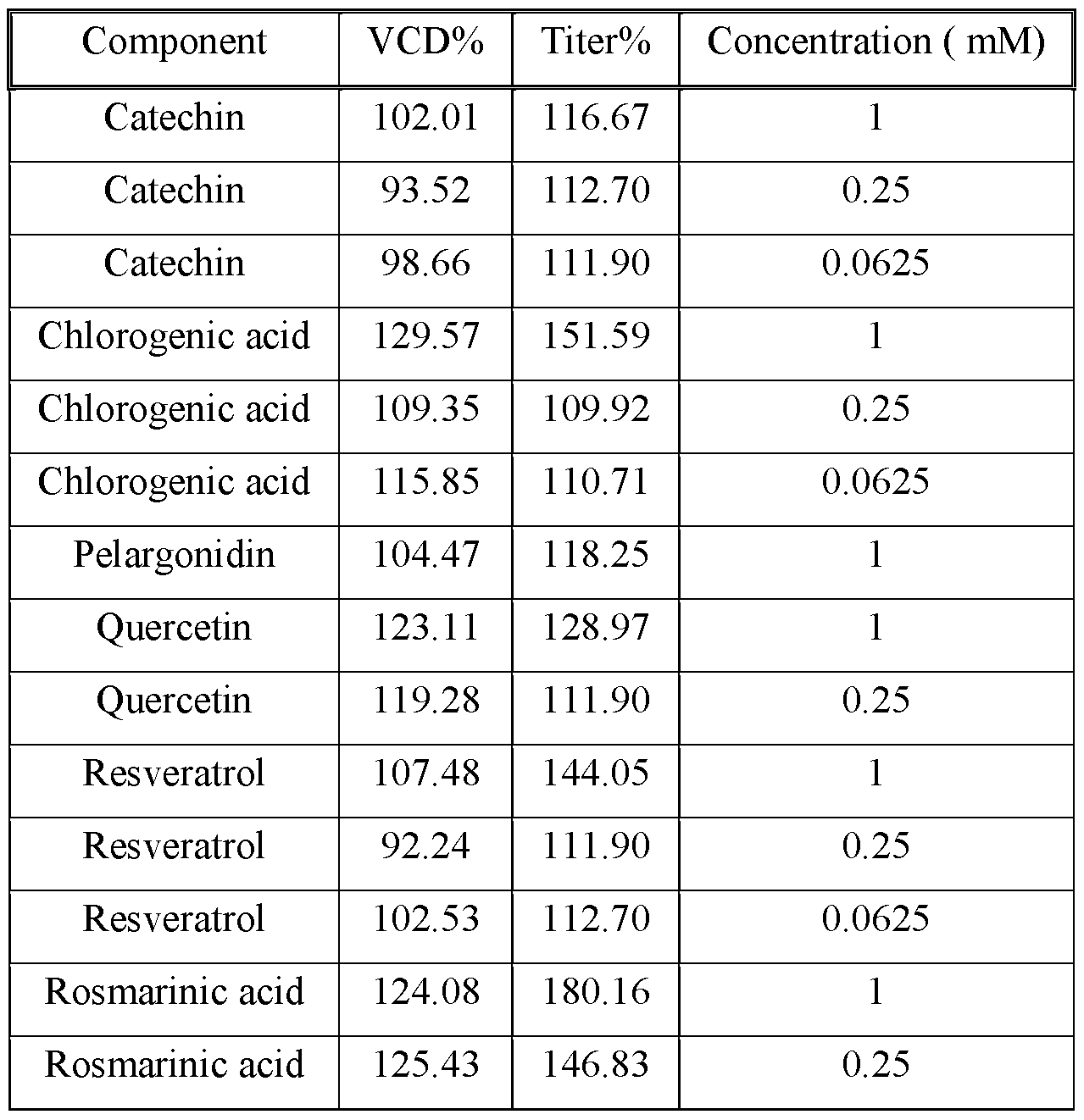
Following the cell culture process described in Example 1 , thirteen novel antioxidants (Table 1) were added to the feed media utilized in aCD137 cell culture. Three antioxidant concentrations were evaluated: 1 mM (Run# l-13), 0.25 mM (Run# 17- 29), and 0.0625 mM (Run#33-45). The antioxidants were dissolved in either pure ethanol or dimethyl sulfoxide (DMSO) at 50 mM stock concentration and added to feed media M154A1B at the designed final concentrations. The corresponding solvent negative controls were run numberl 6, 32, and 48. Two traditional antioxidants, ascorbic acid (Run#14, 30, and 46) and reduced glutathione (Run#15, 31 , and 47), served as positive controls. The basal media M17IB was not supplemented with antioxidant.
Table 1: List of Antioxidants and Concentrations Evaluated


As shown in Figure 2, addition of the antioxidants to the feed media also affected the productivity of the cultured cells. In some instances, protein titer was increased by as much as 80% by addition of antioxidant compared to the controls (DMSO, ethanol, or water).
The antioxidants with the greatest positive impact on protein titer are presented in Table 2 below. Addition of catechin, chlorogenic acid, resveratrol, and rosmarinic acid increased protein titer when feed at all three concentrations (0.0625-1 mM). Quercetin feed at 0.25 mM and 1 mM increased protein titer. Pelargonidin and silibinin feed increased protein titer when feed at 1 mM. Table 2: List of Antioxidants and Concentrations that Improved Protein Titer
Rosmarinic acid 129.25 132.14 0.0625
Silibinin 99.11 144.44 1
Cells, Proteins and Cell Culture
In the cell culture processes or methods of this invention, the cells can be maintained in a variety of cell culture media, i.e., basal culture media, as conventionally known in the art. For example, the methods are applicable for use with large volumes of cells maintained in cell culture medium, which can be supplemented with nutrients and the like. Typically, "cell culturing medium" (also called "culture medium") is a term that is understood by the practitioner in the art and is known to refer to a nutrient solution in which cells, preferably animal or mammalian cells, are grown and which generally provides at least one or more components from the following: an energy source (usually in the form of a carbohydrate such as glucose); all essential amino acids, and generally the twenty basic amino acids, plus cysteine; vitamins and/or other organic compounds typically required at low concentrations; lipids or free fatty acids, e.g., linoleic acid; and trace elements, e.g. , inorganic compounds or naturally occurring elements that are typically required at very low concentrations, usually in the micromolar range. Cell culture medium can also be supplemented to contain a variety of optional components, such as hormones and other growth factors, e.g., insulin, transferrin, epidermal growth factor, serum, and the like; salts, e.g., calcium, magnesium and phosphate, and buffers, e.g., HEPES; nucleosides and bases, e.g. , adenosine, thymidine, hypoxanthine; and protein and tissue hydrolysates, e.g., hydrolyzed animal protein (peptone or peptone mixtures, which can be obtained from animal byproducts, purified gelatin or plant material); antibiotics, e.g., gentamycin; and cell protective agents, e.g. , a PLURONIC® polyol (PLURONIC® F68). Preferred is a cell nutrition medium that is serum-free and free of products or ingredients of animal origin.
As is appreciated by the practitioner, animal or mammalian cells are cultured in a medium suitable for the particular cells being cultured and which can be determined by the person of skill in the art without undue experimentation. Commercially available media can be utilized and include, for example, Minimal Essential Medium (MEM, Sigma, St. Louis, MO); Ham's F10 Medium (Sigma); Dulbecco's Modified Eagles
Medium (DMEM, Sigma); RPMI-1640 Medium (Sigma); HYCLONE® cell culture medium (HyClone, Logan, UT); and chemically-defined (CD) media, which are formulated for particular cell types. To the foregoing, exemplary media can be added the above-described supplementary components or ingredients, including optional components, in appropriate concentrations or amounts, as necessary or desired, and as would be known and practiced by those having in the art using routine skill.
In addition, cell culture conditions suitable for the methods of the present invention are those that are typically employed and known for batch, fed-batch, or continuous culturing of cells, with attention paid to pH (e.g. , about 6.5 to about 7.5), dissolved oxygen (C ) (e.g. , between about 5-90% of air saturation), carbon dioxide
(CO2) (e.g., between about 10-150%), agitation (between about 50 to 200 rpm) and humidity, in addition to temperature (between about 30 °C to 37 °C). As an illustrative, yet nonlimiting, example, a suitable cell culturing medium for the fed-batch processes of the present invention comprises a chemically defined basal and feed medium, preferably one or both containing the antioxidants of the invention (e.g. , Examplel).
Animal cells, mammalian cells, cultured cells, animal or mammalian host cells, host cells, recombinant cells, recombinant host cells, and the like, are all terms for the cells that can be cultured according to the processes of this invention. Such cells are typically cell lines obtained or derived from mammals and are able to grow and survive when placed in either monolayer culture or suspension culture in medium containing appropriate nutrients and/or growth factors. Growth factors and nutrients that are necessary for the growth and maintenance of particular cell cultures are able to be readily determined empirically by those having skill in the pertinent art, such as is described, for example, by Barnes et al. (Cell, 22:649 (1980)); in Mather, J.P., ed., Mammalian Cell Culture, Plenum Press, NY (1984); and in U.S. Patent No. 5,721,121.
Numerous types of cells can be cultured according to the methods of the present invention. The cells are typically animal or mammalian cells that can express and secrete, or that can be molecularly engineered to express and secrete, large quantities of a particular protein into the culture medium. It will be understood that the protein produced by a host cell can be endogenous or homologous to the host cell. Alternatively, and preferably, the protein is heterologous, i.e., foreign, to the host cell, for example, a human protein produced and secreted by a Chinese hamster ovary (CHO) host cell.
Examples of mammalian proteins that can be advantageously produced by the methods of this invention include, without limitation, cytokines, cytokine receptors, growth factors (e.g. , EGF, HER-2, FGF-a, FGF-β, TGF-a, TGF-β, PDGF. IGF-1, IGF-2, NGF, NGF-β); growth factor receptors, including fusion or chimeric proteins. Other nonlimiting examples include growth hormones (e.g., human growth hormone, bovine growth hormone); insulin (e.g., insulin A chain and insulin B chain), proinsulin;
erythropoietin (EPO); colony stimulating factors (e.g. , G-CSF, GM-CSF, M-CSF);
interleukins (e.g. , IL-1 through IL-12); vascular endothelial growth factor (VEGF) and its receptor (VEGF-R); interferons (e.g., IFN-a, β, or γ); tumor necrosis factor (e.g., TNF-a and TNF-β) and their receptors, TNFR-1 and TNFR-2; thrombopoietin (TPO); thrombin; brain natriuretic peptide (BNP); clotting factors (e.g., Factor VIII, Factor IX, von
Willebrands factor, and the like); anti-clotting factors; tissue plasminogen activator (TP A), e.g., urokinase or human urine or tissue type TP A; follicle stimulating hormone (FSH); luteinizing hormone (LH); calcitonin; CD proteins (e.g. , CD3, CD4, CD8, CD28, CD19, etc.); CTLA proteins (e.g. , CTLA4); T-cell and B-cell receptor proteins; bone morphogenic proteins (BNPs, e.g. , BMP-1, BMP -2, BMP-3, etc.); neurotrophic factors, e.g., bone derived neurotrophic factor (BDNF); neurotrophins, e.g. , 3-6; renin;
rheumatoid factor; RANTES; albumin; relaxin; macrophage inhibitory protein (e.g., MIP- 1, MIP-2); viral proteins or antigens; surface membrane proteins; ion channel proteins; enzymes; regulatory proteins; antibodies; immunomodulatory proteins, (e.g. , HLA, MHC, the B7 family); homing receptors; transport proteins; superoxide dismutase (SOD); G- protein coupled receptor proteins (GPCRs); neuromodulatory proteins; Alzheimer's Disease associated proteins and peptides, (e.g. , A-beta), and others as known in the art. Fusion proteins and polypeptides, chimeric proteins and polypeptides, as well as fragments or portions, or mutants, variants, or analogs of any of the aforementioned proteins and polypeptides are also included among the suitable proteins, polypeptides and peptides that can be produced by the methods of the present invention.
Nonlimiting examples of animal or mammalian host cells suitable for harboring, expressing, and producing proteins for subsequent isolation and/or purification include Chinese hamster ovary cells (CHO), such as CHO-K1 (ATCC® CCL-61), DG44 (Chasin et al, Som. CellMolec. Genet., 12:555-556 (1986); Kolkekar et al, Biochemistry, 36: 10901-10909 (1997); and WO 01/92337 A2), dihydrofolate reductase negative CHO
cells (CHO/-DHFR, Urlaub et al., Proc. Natl. Acad. Sci. USA, 77:4216 (1980)), and dpl2.CH0 cells (U.S. Patent No. 5,721,121); monkey kidney CV1 cells transformed by SV40 (COS cells, COS-7, ATCC® CRL-1651); human embryonic kidney cells (e.g. , 293 cells, or 293 cells subcloned for growth in suspension culture, Graham et al., J. Gen. Virol. , 36:59 (1977)); baby hamster kidney cells (BHK, ATCC® CCL-10); monkey kidney cells (CV1, ATCC® CCL-70); African green monkey kidney cells (VERO-76, ATCC® CRL-1587; VERO, ATCC® CCL-81); mouse Sertoli cells (TM4, Mather, Biol. Reprod. , 23:243-251 (1980)); human cervical carcinoma cells (HELA, ATCC® CCL-2); canine kidney cells (MDCK, ATCC® CCL-34); human lung cells (W138, ATCC® CCL- 75); human hepatoma cells (HEP-G2, HB 8065); mouse mammary tumor cells (MMT 060562, ATCC® CCL-51); buffalo rat liver cells (BRL 3A, ATCC® CRL-1442); TRI cells (Mather, Annals NY Acad. Sci., 383:44-68 (1982)); MCR 5 cells; FS4 cells.
Preferred are CHO cells, particularly, CHO/-DHFR cells.
The cells suitable for culturing in the methods and processes of the present invention can contain introduced (e.g. , via transformation, transfection, infection, or injection) expression vectors (constructs), such as plasmids and the like, that harbor coding sequences, or portions thereof, encoding the proteins for expression and production in the culturing process. Such expression vectors contain the necessary elements for the transcription and translation of the inserted coding sequence. Methods which are well known to and practiced by those skilled in the art can be used to construct expression vectors containing sequences encoding the produced proteins and
polypeptides, as well as the appropriate transcriptional and translational control elements. These methods include in vitro recombinant DNA techniques, synthetic techniques, and in vivo genetic recombination. Such techniques are described in Sambrook, J. et al., Molecular Cloning, A Laboratory Manual, Cold Spring Harbor Press, Plainview, NY (1989) and in Ausubel, F.M. et al, Current Protocols in Molecular Biology, John Wiley & Sons, New York, NY (1989).
Control elements, or regulatory sequences, are those non-translated regions of the vector (e.g., enhancers, promoters, 5' and 3' untranslated regions) that interact with host cellular proteins to carry out transcription and translation. Such elements can vary in their strength and specificity. Depending on the vector system and host cell utilized, any number of suitable transcription and translation elements, including constitutive and
inducible promoters, can be used. In mammalian cell systems, promoters from mammalian genes or from mammalian viruses are preferred. The constructs for use in protein expression systems are designed to contain at least one promoter, an enhancer sequence (optional, for mammalian expression systems), and other sequences as necessary or required for proper transcription and regulation of gene expression (e.g., transcriptional initiation and termination sequences, origin of replication sites, polyadenylation sequences, e.g. , the Bovine Growth Hormone (BGH) poly A sequence).
As will be appreciated by those skilled in the art, the selection of the appropriate vector, components for proper transcription, expression, and isolation of proteins produced in eukaryotic expression systems is known and routinely determined and practiced by those having skill in the art. The expression of proteins by the cells cultured in accordance with the methods of this invention can be placed under the control of promoters such as viral promoters, e.g. , cytomegalovirus (CMV), Rous sarcoma virus (RSV), phosphoglycerol kinase (PGK), thymidine kinase (TK), or the a-ACTIN® promoter. Further, regulated promoters confer inducibility by particular compounds or molecules, e.g. , the glucocorticoid response element (GRE) of mouse mammary tumor virus (MMTV) is induced by glucocorticoids (Chandler, V. et al, Cell, 33:489-499 (1983)). Also, tissue-specific promoters or regulatory elements can be used (Swift, G. et al., Cell, 38:639-646 (1984)), if necessary or desired.
Expression constructs can be introduced into cells by a variety of gene transfer methods known to those skilled in the art, for example, conventional gene transfection methods, such as calcium phosphate co-precipitation, liposomal transfection, microinjection, electroporation, and infection or viral transduction. The choice of the method is within the competence of the skilled practitioner in the art. It will be apparent to those skilled in the art that one or more constructs carrying DNA sequences for expression in cells can be transfected into the cells such that expression products are subsequently produced in and/or obtained from the cells.
In a particular aspect, mammalian expression systems containing appropriate control and regulatory sequences are preferred for use in protein expressing mammalian cells of the present invention. Commonly used eukaryotic control sequences for generating mammalian expression vectors include promoters and control sequences compatible with mammalian cells such as, for example, the cytomegalovirus (CMV)
promoter (CDM8 vector) and avian sarcoma virus (ASV) JTLN vector. Other commonly used promoters include the early and late promoters from Simian Virus 40 (SV40) (Fiers et al, Nature, 273: 113 (1973)), or other viral promoters such as those derived from polyoma, Adenovirus 2, and bovine papilloma virus. An inducible promoter, such as hMTII (Karin et al, Nature, 299:797-802 (1982)) can also be used.
Examples of expression vectors suitable for eukaryotic host cells include, but are not limited to, vectors for mammalian host cells (e.g., BPV-1, pHyg, pRSV, pSV2, pTK2 (Maniatis); pIRES (Clontech); pRc/CMV2, pRc/RSV, pSFVl (Life Technologies); pVPakc Vectors, pCMV vectors, pSG5 vectors (Stratagene), retroviral vectors (e.g. , pFB vectors (Stratagene)), pcDNA-3 (Invitrogen), adenoviral vectors; Adeno-associated virus vectors, baculovirus vectors, yeast vectors (e.g. , pESC vectors (Stratagene)), or modified forms of any of the foregoing. Vectors can also contain enhancer sequences upstream or downstream of promoter region sequences for optimizing gene expression.
A selectable marker can also be used in a recombinant vector (e.g., a plasmid) to confer resistance to the cells harboring (preferably, having stably integrated) the vector to allow their selection in appropriate selection medium. A number of selection systems can be used, including but not limited to, the Herpes Simplex Virus thymidine kinase (HSV TK), (Wigler et al, Cell, 11 :223 (1977)), hypoxanthine-guanine
phosphoribosyltransferase (HGPRT), (Szybalska et al, Proc. Natl. Acad. Sci. USA, 48:202 (1992)), and adenine phosphoribosyltransferase (Lowy et al, Cell, 22:817 (1980)) genes, which can be employed in tk-, hgprt-, or aprt-cells (APRT), respectively.
Anti-metabolite resistance can also be used as the basis of selection for the following nonlimiting examples of marker genes: dhfir, which confers resistance to methotrexate (Wigler et al, Proc. Natl. Acad. Sci. USA, 77:357 (1980); and O'Hare et al., Proc. Natl. Acad. Sci. USA, 78: 1527 (1981)); gpt, which confers resistance to mycophenolic acid (Mulligan et al, Proc. Natl. Acad. Sci. USA, 78:2072 (1981)); neo, which confers resistance to the aminoglycoside G418 {Clin. Pharmacy, 12:488-505; Wu et al, Biotherapy, 3: 87-95 (1991); Tolstoshev, Ann. Rev. Pharmacol. Toxicol , 32:573- 596 (1993); Mulligan, Science, 260:926-932 (1993); Anderson, Ann. Rev. Biochem., 62: 191-21 (1993); TIB TECH, 11(5): 155-215 (May 1993); and hygro, which confers resistance to hygromycin (Santerre et al, Gene, 30: 147 (1984)). Methods commonly known in the art of recombinant DNA technology can be routinely applied to select the
desired recombinant cell clones, and such methods are described, for example, in Ausubel et al, eds., Current Protocols in Molecular Biology, John Wiley & Sons, NY (1993); Kriegler, Gene Transfer and Expression, A Laboratory Manual, Stockton Press, NY (1990); in Dracopoli et al., eds., Chapters 12 and 13, Current Protocols in Human Genetics, John Wiley & Sons, NY (1994); Colberre-Garapin et al, J. Mol. Biol., 150: 1 (1981), which are incorporated by reference herein in their entireties.
In addition, the expression levels of an expressed protein molecule can be increased by vector amplification (for a review, see Bebbington et al., Chapter 8: "The use of vectors based on gene amplification for the expression of cloned genes in mammalian cells in DNA cloning", DNA Cloning: A Practical Approach, Vol. 3, pp. 163-188, IRL Press Limited (1987)). When a marker in the vector system expressing a protein is amplifiable, an increase in the level of inhibitor present in the host cell culture will increase the number of copies of the marker gene. Since the amplified region is associated with the protein-encoding gene, production of the protein will concomitantly increase (Crouse et al, Mol. Cell. Biol, 3:257 (1983)).
Vectors which harbor glutamine synthase (GS) or dihydrofolate reductase (DHFR) encoding nucleic acid as the selectable markers can be amplified in the presence of the drugs methionine sulphoximine or methotrexate, respectively. An advantage of glutamine synthase based vectors is the availability of cell lines (e.g. , the murine myeloma cell line, NSO) which are glutamine synthase negative. Glutamine synthase expression systems can also function in glutamine synthase expressing cells (e.g. , CHO cells) by providing additional inhibitor to prevent the functioning of the endogenous gene.
Vectors that express DHFR as the selectable marker include, but are not limited to, the pSV2-dhfr plasmid (Subramani et al, Mol. Cell. Biol , 1 :854 (1981). Vectors that express glutamine synthase as the selectable marker include, but are not limited to, the pEE6 expression vector described in Stephens et al, Nucl. Acids. Res., 17:7110 (1989). A glutamine synthase expression system and components thereof are detailed in PCT publications: WO 87/04462; WO 86/05807; WO 89/01036; WO 89/10404; and WO 91/06657 which are incorporated by reference herein in their entireties. In addition, glutamine synthase expression vectors that can be used in accordance with the present invention are commercially available from suppliers, including, for example, Lonza Biologies, Inc. (Portsmouth, NH).
Types of Cell Cultures
For the purposes of understanding, yet without limitation, it will be appreciated by the skilled practitioner that cell cultures and culturing runs for protein production can include three general types; namely, continuous culture, batch culture and fed-batch culture. In a continuous culture, for example, fresh culture medium supplement (i.e., feeding medium) is provided to the cells during the culturing period, while old culture medium is removed daily and the product is harvested, for example, daily or
continuously. In continuous culture, feeding medium can be added daily and can be added continuously, i.e. , as a drip or infusion. For continuous culturing, the cells can remain in culture as long as is desired, so long as the cells remain alive and the environmental and culturing conditions are maintained.
In batch culture, cells are initially cultured in medium and this medium is neither removed, replaced, nor supplemented, i.e. , the cells are not "fed" with new medium, during or before the end of the culturing run. The desired product is harvested at the end of the culturing run.
For fed-batch cultures, the culturing run time is increased by supplementing the culture medium one or more times daily (or continuously) with fresh medium during the run, i.e. , the cells are "fed" with new medium ("feeding medium") during the culturing period. Fed-batch cultures can include the various feeding regimens and times as described above, for example, daily, every other day, every two days, etc., more than once per day, or less than once per day, and so on. Further, fed-batch cultures can be fed continuously with feeding medium. The desired product is then harvested at the end of the culturing/production run.
Phases of Cell Culture and Associated Parameters
The term "inoculation" refers to the addition of cells to starting medium to begin the culture.
The growth phase of a culture is the phase during which the viable cell density at any time point is higher than at any previous time point.
The stationary phase of a culture is the phase during which the viable cell density is approximately constant (i.e. , within measuring error) over a time period of any length.
The death phase of a culture is the phase that comes after the growth phase or after the growth phase and the stationary phase, and during which the viable cell density at any time point is lower than at any previous time point during that phase.
In a growth-associated culture process, the production phase may start during the extended growth phase.
In a non-growth associated culture process, the production phase of cell culture may be the stationary phase.
Preferably, the culture medium is supplemented ("fed") during the production phase to support continued protein production, particularly in an extended production phase, and to attain ample quantities of protein product. Feeding can occur on a daily basis, or according to other schedules to support cell viability and protein production.
Antioxidants Improved Process Performance for Multiple CHO Clones
aCD137 Cells
In another embodiment, the dhfr-negative Chinese Hamster Ovary (CHO) cell line
DG44 (Invitrogen Corp. Carlsbad, CA) were transfected in order to establish a stable cell line expressing a human IgG4 antibody.
The transfected CHO DG44 cells expressing the antibody was grown in the presence of antioxidants according to the methods of the invention.
As shown in Figure 3, catechin, chlorogenic acid, quercetin, resveratrol or rosmarinic acid increased viable cell density and protein titer when added to both the basal media at 0.07 mM and the feed media at 1 mM.
Additionally, lactate production was reduced. Lactate produced in the glucose metabolism process is a major inhibitory waste product in mammalian cell cultures. High lactate concentrations may be an indication of malfunction of cell energy metabolism.
Additionally, high concentrations of lactate may also alter the pH of the cell culture.
Therefore, it is preferred to maintain a lower lactate level (<5 g/L) during the course of production.
As shown in Figure 4, catechin addition to the cell culture maintained viable cell density and increased protein titer when added to the feed media at 1 mM.
Further, ammonium formation was reduced. Like lactate, ammonium is a major inhibitory waste product in mammalian cell cultures. High ammonium concentrations
may alter the pH of the cell culture. Additionally, it is believed that high ammonium level may alter the quality attributes of the glycoproteins produced (N-link, etc.).
Therefore, it is preferred to maintain a lower ammonium level for a cell culture process (<10 mM; <5 mM mostly preferred).
As shown in Figure 5, rosmarinic acid or catechin addition to the cell culture increased viable cell density and protein titer; and reduced ammonium and lactate formation. Rosmarinic acid or catechin was added to basal media at 0.1 mM.
As shown in Figure 6, the positive rosmarinic effect is maintained when the cell culture is scaled up to 500-liter production run. Adding rosmarinic acid to the basal media at 0.1 mM increased viable cell density and protein titer, and reduced lactate formation.
Myostatin Cells
In another embodiment, the dhfr-negative Chinese Hamster Ovary (CHO) cell line DG44 (Invitrogen Corp. Carlsbad, CA) was transfected in order to establish a stable cell line expressing a recombinant human fusion protein.
The transfected CHO DG44 cells expressing the fusion protein was grown in the presence of antioxidants according to the methods of the invention.
As shown in Figure 7, rosmarinic acid addition to the cell culture either in the basal media at 0.1 mM or feed media at 1 mM or both, the feed and basal media, increased the viable cell density and protein titer, and reduced ammonium formation.
Figure 8 shows that when the cell culture was scaled up to a 20-liter bioreactor, the positive rosmarinic acid and catechin effect on protein titer was maintained while the viable cell density was not changed by the addition of rosmarinic acid or catechin to the basal media at 0.1 mM.
CD40L Cells
In another embodiment, the dhfr-negative Chinese Hamster Ovary (CHO) cell line DG44 (Invitrogen Corp. Carlsbad, CA) was transfected in order to establish a stable cell line expressing a recombinant human fusion protein.
The transfected CHO DG44 cells expressing the fusion protein was grown in the presence of antioxidants according to the methods of the invention.
As shown in Figure 9, the increase in viable cell density and protein titer corresponds to an increase in catechin concentration in the feed media (0.34 μΜ, 3.45 μΜ, 34.45 μΜ and 344.52 μΜ). Example 1
Cell Culture
Cells were cultured either in 50 ml spin tubes with an initial volume of 25 ml and a shaking speed of 300 rpm; or 250 ml shake flasks with an initial volume of 80-100 ml and a shaking speed of 150 rpm on an orbital shaker with 25 mm throw distance.
Temperature for the culture was controlled at constant 37 °C from the beginning of the culture and was shifted to 34 °C when viable cell density reached 106 cells/ml (usually on day 6) and CC was controlled at 6%.
A standard fed-batch culture process involved culturing the cells for 14 days with feeding beginning on day 3 at a feeding volume of 3.64% of initial culture volume. All the media used for cultures were chemically defined. Chemically defined feed media M154A1B is an enriched version of feed media F3.2. While the ingredient lists are the same between the two feed media, the concentration of a few of the ingredients is increased. Likewise, chemically defined basal media M17IB is an enriched version of basal media Bl . For cultures in 7-liter or 500-liter reactors, dissolved oxygen (DO) was maintained at 50% and pH was controlled between 6.8 and 7.4.
Analyses
Viable cell density (VCD) and cell viability were measured off-line using a CEDEX® automated cell counter (Innovatis AG). Culture samples were also analyzed off-line using a BIOPROFILE® 400 Analyzer to monitor pH, pC02, p02, glucose, glutamine, glutamate, lactate, and ammonium (Nova Biomedical Corporation). A Protein A HPLC method was used to measure protein titer, which were reported as normalized values.
Claims
1. A cell culture process for the production of protein, comprising:
a) culturing host cells which produce a protein of interest in cell culture under conditions that allow for protein production; and
b) adding one or more antioxidant selected from the group consisting of apigenin, catechin, chlorogenic acid, daidzein, genistein, hesperetin, melatonin, naringenin, pelargonidin, quercetin, resveratrol, rosmarinic acid and silibinin to the cell culture.
2. The process according to claim 1, wherein the antioxidant is selected from the group consisting of catechin, chlorogenic acid, pelargonidin, quercetin, resveratrol, rosmarinic acid and silibinin.
3. The process according to claim 1, wherein the antioxidant is selected from the group consisting of catechin, chlorogenic acid, quercetin, resveratrol and rosmarinic acid.
4. The process according to claim 1, wherein the antioxidant is catechin or rosmarinic acid.
5. The process according to claim 1 -4, wherein the antioxidant is added to the basal media, feed media or both.
6. The process according to claim 5, wherein the antioxidant is added to the basal media.
7. The process according to claim 5, wherein the antioxidant is added to the feed media.
8. The process according to claim 5, wherein the antioxidant is added both the basal and feed media.
9. The process according to claim 7, wherein the feed media is added to the cell culture on a daily basis.
10. The process according to claim 1 , wherein the antioxidant is added to the cells in an amount of about 0.0625 mM to 1 mM.
11. The process according to claim 10, wherein antioxidant is added to the cells in an amount of about 0.1 mM to 1 mM.
12. The process according to claim 1, wherein the cells are mammalian cells.
13. The process according to claim 12, wherein the mammalian cells are CHO cells.
14. The process according to claim 1, wherein viable cell density is increased or maintained compared to the same cell culture without antioxidant supplementation.
15. The process according to claim 1, wherein protein titer is increased compared to the same cell culture without antioxidant supplementation.
16. A cell culture process for the production of protein, comprising:
a) culturing CHO cells which produce a protein of interest in cell culture under conditions that allow for protein production; and
b) feeding the cell culture with 1 mM rosmarinic acid added to the feed media.
17. A cell culture process for the production of protein, comprising culturing CHO cells which produce a protein of interest in cell culture under conditions that allow for protein production, wherein 0.1 mM rosmarinic acid is added to the basal media.
18. A cell culture process for the production of protein, comprising culturing CHO cells which produce a protein of interest in cell culture under conditions that allow for protein production, wherein 0.1 mM catechin is added to the basal media.
19. A cell culture process for the production of protein, comprising:
a) culturing CHO cells which produce a protein of interest in cell culture under conditions that allow for protein production; and
b) feeding the cell culture with 1 mM catechin added to the feed media.
20. A cell culture process for the production of protein, comprising:
a) culturing CHO cells which produce a protein of interest in cell culture under conditions that allow for protein production wherein 0.1 mM rosmarinic acid is added to the basal media; and
b) feeding the cell culture with 1 mM rosmarinic acid added to the feed media.
Priority Applications (3)
| Application Number | Priority Date | Filing Date | Title |
|---|---|---|---|
| US15/549,760 US10590457B2 (en) | 2015-02-11 | 2016-02-11 | Compositions for cell culture and methods of using the same |
| US16/782,195 US11078512B2 (en) | 2015-02-11 | 2020-02-05 | Compositions for cell bioproduction and methods of using the same |
| US17/365,673 US12410457B2 (en) | 2015-02-11 | 2021-07-01 | Use of rosmarinic acid in cell bioproduction |
Applications Claiming Priority (2)
| Application Number | Priority Date | Filing Date | Title |
|---|---|---|---|
| US201562114635P | 2015-02-11 | 2015-02-11 | |
| US62/114,635 | 2015-02-11 |
Related Child Applications (2)
| Application Number | Title | Priority Date | Filing Date |
|---|---|---|---|
| US15/549,760 A-371-Of-International US10590457B2 (en) | 2015-02-11 | 2016-02-11 | Compositions for cell culture and methods of using the same |
| US16/782,195 Continuation US11078512B2 (en) | 2015-02-11 | 2020-02-05 | Compositions for cell bioproduction and methods of using the same |
Publications (1)
| Publication Number | Publication Date |
|---|---|
| WO2016130734A1 true WO2016130734A1 (en) | 2016-08-18 |
Family
ID=55538587
Family Applications (1)
| Application Number | Title | Priority Date | Filing Date |
|---|---|---|---|
| PCT/US2016/017432 Ceased WO2016130734A1 (en) | 2015-02-11 | 2016-02-11 | Use of phenolic antioxidants in cell culture for the production of proteins |
Country Status (2)
| Country | Link |
|---|---|
| US (3) | US10590457B2 (en) |
| WO (1) | WO2016130734A1 (en) |
Cited By (2)
| Publication number | Priority date | Publication date | Assignee | Title |
|---|---|---|---|---|
| US11078512B2 (en) | 2015-02-11 | 2021-08-03 | Bristol-Myers Squibb Company | Compositions for cell bioproduction and methods of using the same |
| EP4493710A4 (en) * | 2022-04-06 | 2026-03-04 | Kashiv Biosciences Llc | IMPROVED CELL CULTURE METHOD FOR PROTEIN PRODUCTION |
Families Citing this family (3)
| Publication number | Priority date | Publication date | Assignee | Title |
|---|---|---|---|---|
| FR3103817B1 (en) | 2019-11-29 | 2021-12-17 | Arkema France | A composition comprising a multistage polymer and a (meth) acrylic polymer, its method of preparation and its use |
| CN114752554B (en) * | 2022-01-14 | 2023-06-13 | 江南大学 | A kind of serum-free myogenic differentiation medium containing natural compound and its application |
| CN116478913B (en) * | 2023-06-21 | 2023-08-18 | 苏州依科赛生物科技股份有限公司 | CHO cell culture medium and application thereof |
Citations (13)
| Publication number | Priority date | Publication date | Assignee | Title |
|---|---|---|---|---|
| WO1986005807A1 (en) | 1985-04-01 | 1986-10-09 | Celltech Limited | Transformed myeloma cell-line and a process for the expression of a gene coding for a eukaryotic polypeptide employing same |
| WO1987004462A1 (en) | 1986-01-23 | 1987-07-30 | Celltech Limited | Recombinant dna sequences, vectors containing them and method for the use thereof |
| WO1989001036A1 (en) | 1987-07-23 | 1989-02-09 | Celltech Limited | Recombinant dna expression vectors |
| WO1989010404A1 (en) | 1988-04-18 | 1989-11-02 | Celltech Limited | Recombinant dna methods, vectors and host cells |
| WO1991006657A1 (en) | 1989-10-25 | 1991-05-16 | Celltech Limited | Recombinant dna method and vectors for use therein |
| US5721121A (en) | 1995-06-06 | 1998-02-24 | Genentech, Inc. | Mammalian cell culture process for producing a tumor necrosis factor receptor immunoglobulin chimeric protein |
| WO2001092337A2 (en) | 2000-05-26 | 2001-12-06 | Bristol-Myers Squibb Company | Soluble ctla4 mutant molecules and uses thereof |
| WO2007067564A2 (en) * | 2005-12-08 | 2007-06-14 | Amgen Inc. | Improved host cells and culture methods |
| WO2010071800A1 (en) * | 2008-12-19 | 2010-06-24 | Schering Corporation | Feed supplement for mammalian cell culture and methods of use |
| WO2011050286A1 (en) * | 2009-10-23 | 2011-04-28 | Arkansas State University | Methods and compositions for enhancing polypeptide production |
| AU2010236145A1 (en) * | 2009-04-16 | 2011-11-10 | Forsyth Dental Infirmary For Children | New methods of making an antibody and compositions thereof |
| KR20140096534A (en) * | 2013-01-28 | 2014-08-06 | 동아쏘시오홀딩스 주식회사 | Highly efficient production methods of fusion proteins for antibody treatment using catechin |
| WO2014182658A1 (en) * | 2013-05-06 | 2014-11-13 | Abbvie Inc. | Compositions for cell culture and methods of using the same |
Family Cites Families (3)
| Publication number | Priority date | Publication date | Assignee | Title |
|---|---|---|---|---|
| US6410052B1 (en) * | 1999-03-30 | 2002-06-25 | Purdue Research Foundation | Tea catechins in sustained release formulations as cancer specific proliferation inhibitors |
| KR20160014382A (en) | 2014-07-29 | 2016-02-11 | 삼성전자주식회사 | Apparatus and method for relocating anchor gateway in wireless communication system |
| WO2016130734A1 (en) | 2015-02-11 | 2016-08-18 | Bristol-Myers Squibb Company | Use of phenolic antioxidants in cell culture for the production of proteins |
-
2016
- 2016-02-11 WO PCT/US2016/017432 patent/WO2016130734A1/en not_active Ceased
- 2016-02-11 US US15/549,760 patent/US10590457B2/en active Active
-
2020
- 2020-02-05 US US16/782,195 patent/US11078512B2/en active Active
-
2021
- 2021-07-01 US US17/365,673 patent/US12410457B2/en active Active
Patent Citations (13)
| Publication number | Priority date | Publication date | Assignee | Title |
|---|---|---|---|---|
| WO1986005807A1 (en) | 1985-04-01 | 1986-10-09 | Celltech Limited | Transformed myeloma cell-line and a process for the expression of a gene coding for a eukaryotic polypeptide employing same |
| WO1987004462A1 (en) | 1986-01-23 | 1987-07-30 | Celltech Limited | Recombinant dna sequences, vectors containing them and method for the use thereof |
| WO1989001036A1 (en) | 1987-07-23 | 1989-02-09 | Celltech Limited | Recombinant dna expression vectors |
| WO1989010404A1 (en) | 1988-04-18 | 1989-11-02 | Celltech Limited | Recombinant dna methods, vectors and host cells |
| WO1991006657A1 (en) | 1989-10-25 | 1991-05-16 | Celltech Limited | Recombinant dna method and vectors for use therein |
| US5721121A (en) | 1995-06-06 | 1998-02-24 | Genentech, Inc. | Mammalian cell culture process for producing a tumor necrosis factor receptor immunoglobulin chimeric protein |
| WO2001092337A2 (en) | 2000-05-26 | 2001-12-06 | Bristol-Myers Squibb Company | Soluble ctla4 mutant molecules and uses thereof |
| WO2007067564A2 (en) * | 2005-12-08 | 2007-06-14 | Amgen Inc. | Improved host cells and culture methods |
| WO2010071800A1 (en) * | 2008-12-19 | 2010-06-24 | Schering Corporation | Feed supplement for mammalian cell culture and methods of use |
| AU2010236145A1 (en) * | 2009-04-16 | 2011-11-10 | Forsyth Dental Infirmary For Children | New methods of making an antibody and compositions thereof |
| WO2011050286A1 (en) * | 2009-10-23 | 2011-04-28 | Arkansas State University | Methods and compositions for enhancing polypeptide production |
| KR20140096534A (en) * | 2013-01-28 | 2014-08-06 | 동아쏘시오홀딩스 주식회사 | Highly efficient production methods of fusion proteins for antibody treatment using catechin |
| WO2014182658A1 (en) * | 2013-05-06 | 2014-11-13 | Abbvie Inc. | Compositions for cell culture and methods of using the same |
Non-Patent Citations (39)
| Title |
|---|
| "Combined Addition of Glutathione and Iron Chelators for Decrease of Intracellular Level of Reactive Oxygen Species and Death of Chinese Hamster Ovary Cells", J BIOSCI. BIOENG., vol. 95, 2003, pages 124 - 127 |
| ANDERSON, ANN. REV. BIOCHEM., vol. 62, 1993, pages 191 - 21 |
| AUSUBEL ET AL.,: "Current Protocols in Molecular Biology", 1993, JOHN WILEY & SONS |
| AUSUBEL, F.M. ET AL.: "Current Protocols in Molecular Biology", 1989, JOHN WILEY & SONS |
| BARNES ET AL., CELL, vol. 22, 1980, pages 649 |
| BEBBINGTON ET AL.: "DNA Cloning: A Practical Approach", vol. 3, 1987, IRL PRESS LIMITED, article "The use of vectors based on gene amplification for the expression of cloned genes in mammalian cells in DNA cloning", pages: 163 - 188 |
| CHANDLER, V. ET AL., CELL, vol. 33, 1983, pages 489 - 499 |
| CHASIN ET AL., SOM. CELL MOLEC. GENET., vol. 12, 1986, pages 555 - 556 |
| CLIN. PHARMACY, vol. 12, pages 488 - 505 |
| COLBERRE-GARAPIN ET AL., J MOL. BIOL., vol. 150, 1981, pages 1 1 |
| CROUSE ET AL., MOL. CELL. BIOL., vol. 3, 1983, pages 257 |
| DRACOPOLI ET AL.,: "Current Protocols in Human Genetics", 1994, JOHN WILEY & SONS, article "Chapters 12 and 13," |
| FIERS ET AL., NATURE, vol. 273, 1973, pages 113 |
| GRAHAM ET AL., J GEN. VIROL., vol. 36, 1977, pages 59 |
| KARIN ET AL., NATURE, vol. 299, 1982, pages 797 - 802 |
| KIM KYUNG-CHAN ET AL: "Axl receptor tyrosine kinase is a novel target of apigenin for the inhibition of cell proliferation", INTERNATIONAL JOURNAL OF MOLECULAR MEDICINE, vol. 34, no. 2, August 2014 (2014-08-01), pages 592 - 598, XP002756641 * |
| KOLKEKAR ET AL., BIOCHEMISTRY, vol. 36, 1997, pages 10901 - 10909 |
| KRIEGLER: "Gene Transfer and Expression, A Laboratory Manual", 1990, STOCKTON PRESS |
| LOWY ET AL., CELL, vol. 22, 1980, pages 817 |
| MATHER, ANNALS NYACAD. SCI., vol. 383, 1982, pages 44 - 68 |
| MATHER, BIOL. REPROD., vol. 23, 1980, pages 243 - 251 |
| MATHER, J.P.,: "Mammalian Cell Culture", 1984, PLENUM PRESS |
| MULLIGAN ET AL., PROC. NATL. ACAD. SCI. USA, vol. 78, 1981, pages 2072 |
| MULLIGAN, SCIENCE, vol. 260, 1993, pages 926 - 932 |
| O'HARE ET AL., PROC. NATL. ACAD. SCI. USA, vol. 78, 1981, pages 1527 |
| SAMBROOK, J. ET AL.: "Molecular Cloning, A Laboratory Manual", 1989, COLD SPRING HARBOR PRESS |
| SANTERRE ET AL., GENE, vol. 30, 1984, pages 147 |
| STEPHENS ET AL., NUCL. ACIDS. RES., vol. 17, 1989, pages 7110 |
| SUBRAMANI ET AL., MOL. CELL. BIOL., vol. 1, 1981, pages 854 |
| SWIFT, G. ET AL., CELL, vol. 38, 1984, pages 639 - 646 |
| SZYBALSKA ET AL., PROC. NATL. ACAD SCI. USA, vol. 48, 1992, pages 202 |
| TIB TECH, vol. 11, no. 5, May 1993 (1993-05-01), pages 155 - 215 |
| TOLSTOSHEV, ANN. REV. PHARMACOL. TOXICOL., vol. 32, 1993, pages 573 - 596 |
| URLAUB ET AL., PROC. NATL. ACAD SCI. USA, vol. 77, 1980, pages 4216 |
| WIGLER ET AL., CELL, vol. 11, 1977, pages 223 |
| WIGLER ET AL., PROC. NATL. ACAD. SCI. USA, vol. 77, 1980, pages 357 |
| WU ET AL., BIOTHERAPY, vol. 3, 1991, pages 87 - 95 |
| YOON MAN-SOO ET AL: "Apigenin inhibits immunostimulatory function of dendritic cells: Implication of immunotherapeutic adjuvant", MOLECULAR PHARMACOLOGY, vol. 70, no. 3, September 2006 (2006-09-01), pages 1033 - 1044, XP002756642, ISSN: 0026-895X * |
| YUN ET AL.: "Effect of Antioxidants on the Apoptosis of CHO Cells and Production of Tissue Plasminogen Activator in Suspension Culture", J BIOSCI. BIOENG., vol. 91, 2001, pages 581 - 585, XP003009916, DOI: doi:10.1263/jbb.91.581 |
Cited By (2)
| Publication number | Priority date | Publication date | Assignee | Title |
|---|---|---|---|---|
| US11078512B2 (en) | 2015-02-11 | 2021-08-03 | Bristol-Myers Squibb Company | Compositions for cell bioproduction and methods of using the same |
| EP4493710A4 (en) * | 2022-04-06 | 2026-03-04 | Kashiv Biosciences Llc | IMPROVED CELL CULTURE METHOD FOR PROTEIN PRODUCTION |
Also Published As
| Publication number | Publication date |
|---|---|
| US20200172949A1 (en) | 2020-06-04 |
| US20230002800A1 (en) | 2023-01-05 |
| US11078512B2 (en) | 2021-08-03 |
| US12410457B2 (en) | 2025-09-09 |
| US20180044709A1 (en) | 2018-02-15 |
| US10590457B2 (en) | 2020-03-17 |
Similar Documents
| Publication | Publication Date | Title |
|---|---|---|
| US12410457B2 (en) | Use of rosmarinic acid in cell bioproduction | |
| AU2008251405B2 (en) | Improved feed media | |
| RS55727B1 (en) | METHODS FOR Glycoprotein Production in Mammalian Cell Cultures Using Glucocorticoids | |
| JP7495483B2 (en) | Concentrated perfusion medium | |
| JP2011224010A (en) | Glutamine-auxotrophic human cell capable of producing protein and capable of growing in glutamine-free medium | |
| EP2906683B1 (en) | Mammalian cell culture processes for protein production | |
| CA2852021C (en) | Addition of iron to improve cell culture | |
| US11401509B2 (en) | Methods of minimizing glycoprotein agregation in CHO cell production | |
| EP3122869B2 (en) | Methods for overcoming glutamine deprivation during mammalian cell culture | |
| US20170327558A1 (en) | Mammalian cell culture processes for protein production | |
| HK1119737A1 (en) | Mammalian expression vector comprising the mcmv promoter and first intron of hcmv major immediate early gene | |
| HK1119737B (en) | Mammalian expression vector comprising the mcmv promoter and first intron of hcmv major immediate early gene |
Legal Events
| Date | Code | Title | Description |
|---|---|---|---|
| 121 | Ep: the epo has been informed by wipo that ep was designated in this application |
Ref document number: 16710347 Country of ref document: EP Kind code of ref document: A1 |
|
| WWE | Wipo information: entry into national phase |
Ref document number: 15549760 Country of ref document: US |
|
| NENP | Non-entry into the national phase |
Ref country code: DE |
|
| 122 | Ep: pct application non-entry in european phase |
Ref document number: 16710347 Country of ref document: EP Kind code of ref document: A1 |