WO2016130562A2 - Metabolic analysis of the nucleotide de novo and salvage pathways - Google Patents
Metabolic analysis of the nucleotide de novo and salvage pathways Download PDFInfo
- Publication number
- WO2016130562A2 WO2016130562A2 PCT/US2016/017172 US2016017172W WO2016130562A2 WO 2016130562 A2 WO2016130562 A2 WO 2016130562A2 US 2016017172 W US2016017172 W US 2016017172W WO 2016130562 A2 WO2016130562 A2 WO 2016130562A2
- Authority
- WO
- WIPO (PCT)
- Prior art keywords
- isotopically labeled
- salvage pathway
- precursor
- kit
- salvage
- Prior art date
- Legal status (The legal status is an assumption and is not a legal conclusion. Google has not performed a legal analysis and makes no representation as to the accuracy of the status listed.)
- Ceased
Links
- NYFSNDWAAOSWGY-UHFFFAOYSA-N C=NC(C1CC1)=[IH] Chemical compound C=NC(C1CC1)=[IH] NYFSNDWAAOSWGY-UHFFFAOYSA-N 0.000 description 1
- KUPDOEXPDXGOQN-ZBHICJROSA-N C[C@@H](C1)C1[Cl+2](C)C Chemical compound C[C@@H](C1)C1[Cl+2](C)C KUPDOEXPDXGOQN-ZBHICJROSA-N 0.000 description 1
Classifications
-
- C—CHEMISTRY; METALLURGY
- C07—ORGANIC CHEMISTRY
- C07H—SUGARS; DERIVATIVES THEREOF; NUCLEOSIDES; NUCLEOTIDES; NUCLEIC ACIDS
- C07H19/00—Compounds containing a hetero ring sharing one ring hetero atom with a saccharide radical; Nucleosides; Mononucleotides; Anhydro-derivatives thereof
- C07H19/02—Compounds containing a hetero ring sharing one ring hetero atom with a saccharide radical; Nucleosides; Mononucleotides; Anhydro-derivatives thereof sharing nitrogen
- C07H19/04—Heterocyclic radicals containing only nitrogen atoms as ring hetero atom
- C07H19/06—Pyrimidine radicals
- C07H19/073—Pyrimidine radicals with 2-deoxyribosyl as the saccharide radical
-
- C—CHEMISTRY; METALLURGY
- C07—ORGANIC CHEMISTRY
- C07H—SUGARS; DERIVATIVES THEREOF; NUCLEOSIDES; NUCLEOTIDES; NUCLEIC ACIDS
- C07H19/00—Compounds containing a hetero ring sharing one ring hetero atom with a saccharide radical; Nucleosides; Mononucleotides; Anhydro-derivatives thereof
- C07H19/02—Compounds containing a hetero ring sharing one ring hetero atom with a saccharide radical; Nucleosides; Mononucleotides; Anhydro-derivatives thereof sharing nitrogen
- C07H19/04—Heterocyclic radicals containing only nitrogen atoms as ring hetero atom
- C07H19/16—Purine radicals
- C07H19/173—Purine radicals with 2-deoxyribosyl as the saccharide radical
-
- G—PHYSICS
- G01—MEASURING; TESTING
- G01N—INVESTIGATING OR ANALYSING MATERIALS BY DETERMINING THEIR CHEMICAL OR PHYSICAL PROPERTIES
- G01N2458/00—Labels used in chemical analysis of biological material
- G01N2458/15—Non-radioactive isotope labels, e.g. for detection by mass spectrometry
Definitions
- nucleotide biosynthesis consists of redundant and convergent biosynthetic pathways.
- Deoxynucleotide triphosphates (dNTPs) required for DNA replication and repair can be produced by the de novo pathway (DNP) or by the nucleoside salvage pathway (NSP).
- DNP de novo pathway
- NSP nucleoside salvage pathway
- the DNP uses glucose and amino acids to generate ribonucleotide diphosphates, which are then converted to dNTP precursors by the rate-limiting enzyme ribonucleotide reductase (RNR).
- RNR rate-limiting enzyme
- the same dNTP precursors can also be produced via the NSP from extracellular deoxyribonucleosides (dNs), which are phosphorylated by NSP kinases.
- Thymidine is salvaged by thymidine kinase 1 (TK1), while deoxycytidine,
- deoxyadenosine and deoxyguanosine are salvaged by dCK.
- the roles of the NSP kinases in the economy of the nucleotide metabolism of normal and malignant cells remain poorly understood.
- the ability of cancer cells to switch dCTP biosynthesis from the DNP to the NSP may explain why high dose thymidine given as a single dCTP-depleting therapeutic agent in hematological malignancies had limited efficacy in clinical trials.
- thymidine given as a single dCTP-depleting therapeutic agent in hematological malignancies had limited efficacy in clinical trials.
- compositions and kits comprising the de novo and salvage pathway precursors.
- FIG. 1 is a schematic representation of a new platform assay to quantify nucleotide metabolism in cancer cells.
- Panel (1) shows stable isotope ( 13 C and 15 N) labeled DNA precursors are used to generate nucleotides with unique 'barcodes' in tumor cells;
- panel (2) shows barcoded nucleotide precursors are added to cell culture media or infused in tumor bearing mice or patients. In cancer cells, barcoded precursors are converted via various biosynthetic pathways to deoxynucleotide triphosphates (dNTPs), which are then incorporated into the nuclear (n) and mitochondrial (mt) DNA.
- Panel (3) shows tumor nDNA and mtDNA are extracted and enzymatically digested into individual nucleosides.
- Panel (4) shows advanced mass spectrometry techniques are used to read the barcodes on individual nucleosides in nuclear and mitochondrial DNA.
- the information provided by the platform assay is used to decode the differential usage of nucleotide biosynthetic pathways in cancer cells. This information is then used to identify specific metabolic liabilities of tumor cells that can be targeted therapeutically.
- dC dC:
- deoxycytidine dT: thymidine
- dG deoxyguanosine
- dA deoxy adenosine
- 5mC 5 methyl- deoxycytidine.
- FIGS. 2A and 2B are schematics showing the functional redundancy in nucleotide biosynthesis can cause treatment failure.
- FIG. 2A shows nucleotides are synthesized by both de novo and salvage pathways.
- HGPRT Hypoxanthine-guanine phosphoribosyltransferase
- APRT Adenine phosphoribosyltransferase
- dCK deoxycytidine kinase
- TS - thymidylate synthase shows, upon therapeutic inhibition of the de novo pathways for dNTP biosynthesis, cancer cells may switch to the salvage pathways. This metabolic switch from de novo to salvage dNTP biosynthesis is a potential resistance mechanism in cancer therapy that is not addressed by existing drugs.
- FIGS. 3A, 3B and 3C are a schematic and graphs showing an exemplary barcoding assay provided herein.
- FIG. 3A is a schematic showing new mass spectrometry (MS) dNTP barcoding assay to simultaneously measure the contributions of both de novo (DNP) and nucleoside salvage pathways (NSP) to DNA synthesis.
- FIG. 3B is a graph showing analysis of DNA-deoxy cytidine (DNA-C) synthesis in a panel of leukemia and lymphoma cell lines.
- MS mass spectrometry
- DNP de novo
- NSP nucleoside salvage pathways
- FIG. 3C is a graph showing the DNP inhibitor thymidine (dT) switches DNA-C synthesis in Jurkat human T-ALL cells from the RNR-dependent DNP to the dCK-dependent NSP.
- FIG. 4 is a schematic showing MS dNTP barcoding schemes for multiplexed measurements of nucleotide metabolism.
- FIG. 5 is a schematic showing an exemplary barcode for deoxyadenosine.
- the barcode equals the number of labeled atoms in the base moiety; and number of labeled atoms in the sugar.
- the barcode consists of two numbers separated by semicolon; the first number corresponds to the mass increase for the base moiety and the second number indicates the mass increase for the sugar moiety.
- the "[10;5]" tag for dA indicates a mass increase of +10 in the base and a mass increase of a +5 in the sugar.
- FIG. 6 is a schematic showing an exemplary barcode for deoxycytidine.
- the barcode consists of two numbers separated by semicolon; the first number corresponds to the mass increase for the base moiety and the second number indicates the mass increase for the sugar moiety.
- the "[7;5]" tag for dC indicates a mass increase of +7 in the base and a mass increase of a +5 in the sugar.
- FIG. 7 is a schematic showing a barcoded hypoxanthine.
- the "-" replaces the second number (which in nucleosides and nucleotides corresponds to the sugar moiety).
- the labeled hypoxanthine nucleobase 13 C, 15 N4-Hx
- FIG. 8 is a schematic showing labeling of the sugar metabolite, phosphoribosyl pyrophosphate (PRPP).
- a sugar metabolite is indicated by "-" as the first base component of the barcode.
- labeled PRPP 13 C 5 -PRPP
- FIG. 9 is a schematic of a CTP metabolite carrying [7;5] isotopomers.
- FIG. 10 is a schematic of a CTP metabolite carrying [6;5] isotopomers.
- FIG.s 11 A, 1 IB, 11C, 1 ID, 1 IE, 1 IF, 11G, and 11H are schematics of exemplary labeled precursors.
- FIG. 11A is a schematic of 15 N-labeled deoxyadenosine, 15 N 5 -dA.
- FIG. 11B is a schematic of C and N-labeled deoxyadenosine, C 10 , N 5 -dA.
- FIG. 11C is a schematic of 15 N-labeled deoxyguanosine, 15 N 5 -dG
- FIG. 1 ID is a schematic of 13 C and 15 N-labeled deoxyguanosine, 13 Ci 0 , 15 N 5 -dG.
- FIG. 11A is a schematic of 15 N-labeled deoxyadenosine, 15 N 5 -dA.
- FIG. 11B is a schematic of C and N-labeled deoxyadenosine, C 10 , N 5 -dA.
- FIG. HE is a schematic of 15 N-labeled deoxycytidine, 15 N 3 -dC.
- FIG. 1 IF is a schematic of 13 C and 15 N-labeled deoxycytidine, 13 C 9 , 15 N 3 -dC.
- FIG. 11G is a schematic of 15 N-labeled thymidine, 15 N 2 -dT.
- FIG. 11H a schematic of is 13 C and 15 N-labeled thymidine, 13 Ci 0 , 15 N 2 -dT.
- FIGS. 12A, 12B, 12C, 12D, 12E, 12F, 12G, and 12H are schematics of exemplary labeled precursors.
- FIG. 12A is a schematic of deoxyadenosine with 13 C and 15 N-labeled nucleobase with unlabeled deoxyribose, 13 C 5 , 15 N 5 -dA.
- FIG. 12B is a schematic of
- FIG. 12C is a schematic of deoxyguanosine with 1J C and 1J N-labeled nucleobase with unlabeled deoxyribose, 13 C 5 , 15 N 5 -dG
- FIG. 12D is a schematic of
- FIG. 12E is a schematic of deoxycytidine with 13 C and 15 N-labeled nucleobase with unlabeled deoxyribose, 13 C4, 15 N 3 -dC.
- FIG. 12F is a schematic of deoxycytidine
- FIG. 12G is a schematic of thymidine with 13 C and 15 N-labeled nucleobase with unlabeled deoxyribose, 13 C 5 , 15 N 2 -dT.
- FIG. 12H is a schematic of thymidine with 13 C and 15 N-labeled nucleobase and deoxyribose labeled on 3 of its 5 carbons, 13 C8, 15 N 2 -dT.
- FIGS. 13A, 13B, 13C, 13D, 13E, 13F, 13G, 13H, 131, and 13J are schematics of exemplary ways in which the carbons on the deoxyribose can be labeled.
- FIG. 14 is a schematic of 13 C-labeled glucose.
- FIG. 15 is a schematic showing the de novo purine biosynthesis pathway.
- FIG. 16 is a schematic showing the deoxyadenosine salvage pathway. Abbreviations listed in Tables 2 and 3.
- FIG. 17 is a schematic showing the deoxyguanosine salvage pathway. Abbreviations listed in Tables 2 and 3.
- FIG. 18 is a schematic of the de novo pyrimidine biosynthesis pathway. Abbreviations listed in Tables 2 and 3.
- FIG. 19 is a schematic of the deoxycytidine salvage pathway. Abbreviations listed in Tables 2 and 3.
- FIG. 20 is a schematic of the thymidine salvage pathway. Abbreviations listed in Tables 2 and 3.
- FIG. 21 is a schematic of the adenosine, hypoxanthine and adenine salvage pathways. Abbreviations listed in Tables 2 and 3.
- FIG. 22 is a schematic of the cytidine, uridine and uracil salvage pathways.
- FIG. 23 is a schematic showing an exemplary workflow of the provided method.
- the nucleotide/DNA barcoding assay simultaneously measures the contributions of both de novo (DNP) and nucleoside/nucleobase salvage pathways (NSP) to DNA synthesis.
- DNP de novo
- NSP nucleoside/nucleobase salvage pathways
- DNA-C DNA-deoxy cytidine
- T-ALL and B-ALL cell lines predominantly use glucose to make dCTP for DNA replication.
- Other cell lines, such as TF1 have a significant fraction of their replicated DNA labeled from dCTP produced by salvaging dC.
- FIG. 24 are graphs showing characterization of the nDNA-N (nuclear DNA containing deoxynucleotides) in three different cell lines by either dN-dependent or dN-independent biosynthesis (dN; deoxynucleoside).
- dN deoxynucleoside
- Cells were cultured for 18 hours in the presence of 5 mM glucose and 5 ⁇ dNs (including dA, dG, dC and dT).
- the experiment was conducted by single labeling of either 13 C 6 -glucose; 13 C 9 , 15 N 3 -dC; 13 Ci 0 , 15 N 2 -dT; 13 Ci 0 , 15 N 5 -dA and 15 N 5 -dG
- the data was compiled to yield theoretical percent DNA labeling when all five labeled precursors were combined.
- FIG. 25 is a table of the abbreviations for enzymes used in FIGS. 15 through 22.
- FIG. 26 is a table of the abbreviations for metabolites used in FIGS. 15 through 22.
- nucleotide biosynthesis consists of redundant and convergent biosynthetic pathways.
- Deoxynucleotide triphosphates (dNTPs) required for DNA replication and repair can be produced by the de novo pathway (DNP) or by the nucleoside salvage pathway (NSP) (Fig. 1).
- DNP de novo pathway
- NSP nucleoside salvage pathway
- the DNP uses glucose and amino acids to generate ribonucleotide diphosphates, which are then converted to dNTP precursors by the rate- limiting enzyme ribonucleotide reductase (RNR).
- RNR rate- limiting enzyme
- dNTP precursors can also be produced via the NSP from extracellular deoxyribonucleosides (dNs), which are phosphorylated by NSP kinases. Thymidine is salvaged by thymidine kinase 1 (TK1), while deoxycytidine, deoxyadenosine and deoxyguanosine are salvaged by dCK.
- TK1 thymidine kinase 1
- dCK deoxycytidine, deoxyadenosine and deoxyguanosine
- the roles of the NSP kinases in the economy of the nucleotide metabolism of normal and malignant cells remain poorly understood.
- dNTP barcoding MS assays to quantify the contributions of de novo and salvage pathways to dNTP biosynthesis and DNA replication in cells, e.g., cancer cells.
- the dNTP barcoding MS assays can be used in conjunction with other assays to identify critical nodes in nucleotide metabolism that
- the method includes contacting a cell with an isotopically labeled glucose and (a) isotopically labeled salvage pathway precursors consisting of an isotopically labeled deoxycytidine and an isotopically labeled thymidine; (b) isotopically labeled salvage pathway precursors consisting of an isotopically labeled deoxyadenosine and an isotopically labeled deoxyguanosine; or (c) an isotopically labeled salvage pathway precursor that is an isotopically labeled hypoxanthine; or a combination thereof.
- the method includes allowing the cell to metabolize the isotopically labeled glucose and at least one or two or the isotopically labeled salvage pathway precursors thereby forming an isotopically labeled de novo pathway deoxynucleotide triphosphate or isotopically labeled de novo pathway deoxyribonucleic acid and an isotopically labeled salvage pathway deoxynucleotide triphosphate or isotopically labeled salvage pathway deoxyribonucleic acid; and identifying said isotopically labeled de novo pathway deoxynucleotide triphosphate or isotopically labeled de novo pathway deoxyribonucleic acid and said isotopically labeled salvage pathway deoxynucleotide triphosphate or isotopically labeled salvage pathway deoxyribonucleic acid using a mass spectrometer device thereby detecting an amount of de novo pathway deoxynucleotide triphosphate biosynthesis and an amount of salvage pathway deoxy
- deoxyribonucleic acid or said isotopically labeled salvage pathway deoxyribonucleic acid thereby forming an isotopically labeled deoxynucleoside; and detecting the mass of said isotopically labeled deoxynucleoside.
- Nucleic acids are linear polymers (chains) of nucleotides, which consist of a purine or pyrimidine nucleobase or base, a pentose sugar, and a phosphate group.
- Nucleic acid or “oligonucleotide” or “polynucleotide” or grammatical equivalents used herein means at least two nucleotides covalently linked together.
- the term “nucleic acid” includes single-, double-, or multiple-stranded DNA, RNA and analogs (derivatives) thereof.
- Oligonucleotides are typically from about 5, 6, 7, 8, 9, 10, 12, 15, 25, 30, 40, 50 or more nucleotides in length, up to about 100 nucleotides in length.
- Nucleic acids and polynucleotides are a polymers of any length, including longer lengths, e.g., 200, 300, 500, 1000, 2000, 3000, 5000, 7000, 10,000, etc.
- Nucleic acids containing one or more carbocyclic sugars are also included within one definition of nucleic acids.
- a “label” or a “detectable moiety” is a composition detectable by spectroscopic, photochemical, biochemical, immunochemical, chemical, or other physical means.
- useful labels include 32 P, fluorescent dyes, electron-dense reagents, enzymes (e.g., as commonly used in an ELISA), biotin, digoxigenin, or haptens and proteins or other entities which can be made detectable, e.g., by incorporating a radiolabel into a peptide or antibody specifically reactive with a target peptide. Any method known in the art for conjugating an antibody to the label may be employed, e.g., using methods described in Hermanson, Bioconjugate Techniques 1996, Academic Press, Inc., San Diego.
- An “isotope” is a variant of a particular atom that differs from the atom in neutron number. For example, carbon-12, carbon-13, carbon-14 and nitrogen- 15 are isotopes of carbon and nitrogen respectively.
- An isotope substituted for an atom in a molecule of interest is referred to herein as an "isotopic label.”
- isotopic labeling refers to the method used to track an isotope through a chemical reaction, e.g., through a metabolic pathway of a cell.
- isotopically labeled refers to a molecule of interest e.g., a nucleoside that contains at least one atom replaced with an isotope.
- isotopes can be detected through their mass, vibrational mode, or radioactive decay. Mass spectrometry detects the difference in an isotope's mass, while infrared spectroscopy detects the difference in the isotope's vibrational modes.
- Nuclear magnetic resonance detects atoms with different gyromagnetic ratios. Radioactive decay can be detected through an ionization chamber or autoradiographs of gels.
- isotope labeling involves the use of non-radioactive isotopes that can act as tracers used to model chemical and biochemical systems. The chosen isotope can act as a label on that compound that can be identified through nuclear magnetic resonance (NMR) and mass spectrometry (MS). Some of the most common stable isotopes include, but are not limited to 2 H, 13 C and 15 N. Methods for isotopically labeling molecules are known to those of skill in the art.
- MS mass spectrometry
- MS technology generally includes (1) ionizing the compounds to form charged compounds; and (2) detecting the molecular weight of the charged compound and calculating a mass-to-charge ratio (m/z).
- the compound may be ionized and detected by any suitable means.
- a "mass spectrometer” generally includes an ionizer and an ion detector. See, e.g., U.S. Patent No. 6,204,500; U.S. Patent No. 6,107,623; U.S. Patent No. 6,268, 144; and U.S. Patent No. 6,124,137.
- the provided methods include contacting a cell with any combination of an isotopically labeled glucose and isotopically labeled salvage pathway precursors.
- Suitable isotopically labeled salvage pathway precursors include, but are not limited to, an isotopically labeled deoxycytidine, an isotopically labeled thymidine, an isotopically labeled deoxyadenosine, an isotopically labeled deoxyguanosine, and an isotopically labeled hypoxanthine.
- Suitable isotopically labeled precursors include, but are not limited to, the isotopically labeled precursors shown in FIG.s 5, 6, 7, 8, 9, 10, 11 and 12.
- the isotopically labeled salvage pathway precursor has the formula:
- the isotopically labeled salvage pathway precursor isotopically labeled salvage pathway precursor
- the isotopically labeled salvage pathway precursors are labeled and used in such a way as to facilitate simultaneous detection of the amount of de novo pathway deoxynucleotide triphosphate biosynthesis and the amount of salvage pathway deoxynucleotide triphosphate biosynthesis in a cell. More specifically, to delineate the differential usage of de novo and salvage pathways stable isotope (e.g., 13 C and 15 N) labeled nucleotide precursors are added to cells. Nucleotides produced from these labeled precursors carry pre-defined molecular weights that act as unique "barcodes" corresponding to specific biosynthetic pathways.
- stable isotope e.g. 13 C and 15 N
- the barcode For a given nucleoside/nucleotide, the barcode consists of two numbers separated by semicolon: the first number corresponds to the mass increase for the base moiety; the second number indicates the mass increase for the sugar moiety.
- the first number corresponds to the mass increase for the base moiety
- the second number indicates the mass increase for the sugar moiety.
- "-" replaces the second number (which in nucleosides and nucleotides corresponds to the sugar moiety).
- sugar metabolites For barcoding sugar metabolites, "-" replaces the first number. If specific enzymatic modifications result in a certain metabolite carrying more than one barcode, this is indicated in the labeling modules using numbers separated by a comma in either the base or sugar component of the tag.
- CTP produced by salvaging labeled cytidine is shown with the "[7,6;5]" tag.
- This type of tag indicates that the CTP produced by the salvage can be found as either a "[7;5]” or a "[6;5]” barcoded nucleotide depending on the specific biochemical route utilized by the CTP precursors. See, for example, FIGS. 9 and 10.
- the provided methods include labeling glucose and the precursors in a variety of ways to analyze the de novo and salvage pathways.
- the isotopically labeled glucose is a 13 C isotopically labeled glucose.
- the isotopically labeled glucose is a 13 C isotopically labeled glucose comprising at least one, two, three, four, or five 13 C labels.
- the isotopically labeled glucose is a 13 C isotopically labeled glucose comprising at least three 13 C labels.
- the isotopically labeled glucose is a 13 C isotopically labeled glucose comprising six 13 C labels.
- cells can be contacted with one, two, three, four, five, six, seven, eight, nine, ten or more isotopically labeled salvage pathway precursors.
- the cell is contacted with at least two isotopically labeled salvage pathway precursors.
- the isotopically labeled salvage pathway precursors are an isotopically labeled deoxycytidine and an isotopically labeled thymidine.
- the isotopically labeled salvage pathway precursors are an isotopically labeled deoxyadenosine and an isotopically labeled
- the cell is contacted with at least three isotopically labeled salvage pathway precursors.
- the three isotopically labeled salvage pathway precursors are an isotopically labeled deoxycytidine, an isotopically labeled thymidine, and an isotopically labeled hypoxanthine.
- the cell is contacted with at least four isotopically labeled salvage pathway precursors.
- the four isotopically labeled salvage pathway precursors are an isotopically labeled deoxycytidine, an isotopically labeled thymidine, an isotopically labeled deoxyadenosine, and an isotopically labeled deoxyguanosine.
- the isotopically labeled salvage pathway precursors are optionally labeled with 13 C, 15 N or a combination thereof.
- the isotopically labeled salvage pathway precursor is a 13 C isotopically labeled salvage pathway precursor.
- the isotopically labeled salvage pathway precursor is a 13 C isotopically labeled salvage pathway precursor comprising at least one, two, three, four, five, or more 13 C labels.
- the 13 C label is present within a nitrogenous base moiety of said salvage pathway precursor or is present within a sugar moiety of said salvage pathway precursor.
- the said salvage pathway precursor comprises a 13 C labels within a sugar moiety and a 13 C label within a nitrogenous base moiety of said salvage pathway precursor.
- the isotopically labeled salvage pathway precursor is a N isotopically labeled salvage pathway precursor.
- the isotopically labeled salvage pathway precursor is a 15 N isotopically labeled salvage pathway precursor comprising at least one, two, three, four, five or more 15 N labels.
- the labeled salvage pathway precursor is an isotopically labeled 13 C and 15 N salvage pathway precursor.
- the isotopically labeled salvage pathway precursor is an isotopically labeled hypoxanthine.
- the amount of de novo pathway deoxynucleotide triphosphate biosynthesis can be a measure of de novo pathway purinyl triphosphate biosynthesis.
- the amount of de novo pathway deoxynucleotide triphosphate biosynthesis is a measure of de novo pathway pyrimidinyl triphosphate biosynthesis.
- the amount of de novo pathway deoxynucleotide triphosphate biosynthesis is a measure of de novo pathway purinyl triphosphate biosynthesis and a measure of de novo pathway pyrimidinyl triphosphate biosynthesis.
- the amount of salvage pathway deoxynucleotide triphosphate biosynthesis is a measure of salvage pathway purinyl triphosphate biosynthesis.
- the amount of salvage pathway deoxynucleotide triphosphate biosynthesis is a measure of salvage pathway pyrimidinyl triphosphate biosynthesis.
- the amount of salvage pathway deoxynucleotide triphosphate biosynthesis is a measure of salvage pathway purinyl triphosphate biosynthesis and a measure of salvage pathway pyrimidinyl triphosphate biosynthesis.
- the isotopically labeled glucose is metabolized by said cell to form an isotopically labeled de novo pathway deoxynucleotide triphosphate.
- deoxynucleotide triphosphate is a deoxycytidine triphosphate or a thymidine triphosphate, deoxyadenosine triphosphate, a deoxyguanosine triphosphate.
- the isotopically labeled glucose is metabolized by said cell to form an isotopically labeled de novo pathway deoxyribonucleic acid.
- the isotopically labeled salvage pathway precursors are metabolized by said cell to independently form isotopically labeled salvage pathway
- the isotopically labeled salvage pathway precursor is a deoxycytidine triphosphate, a thymidine triphosphate, a deoxyadenosine triphosphate, or a deoxyguanosine triphosphate.
- the isotopically labeled salvage pathway precursors are metabolized by said cell to form an isotopically labeled salvage pathway deoxyribonucleic acid.
- the isotopically labeled salvage pathway deoxyribonucleic acid is hydrolyzed to form a plurality of deoxynucleoside moieties.
- the amount of de novo pathway deoxynucleotide triphosphate biosynthesis is compared to said amount of salvage pathway deoxynucleotide triphosphate biosynthesis in the cell.
- the comparison is a measure of the differential use of a de novo pathway and a salvage pathway to synthesize a deoxynucleotide triphosphate.
- the provided methods can be used to determine the effects of a test compound on the de novo and/or salvage pathways.
- the provided methods further include contacting the cell with a test compound, wherein the test compound modulates an amount of de novo pathway deoxynucleotide triphosphate biosynthesis or an amount of salvage pathway deoxynucleotide triphosphate biosynthesis in the cell.
- the test compound is a therapeutic compound.
- the test compound can be a small molecule or nucleotide analog. In this way, the effects of a compound on the de novo and salvage pathways may be queried simultaneously.
- the effects of a change in cellular environmental conditions e.g.
- the de novo and salvage pathways may be queried.
- the effects of any appropriate cellular perturbation may be on the de novo and salvage pathways may be queried.
- the cellular effects of hypoxia, oxidative stress, and/or inflammatory cytokines are queried.
- cell-cell interactions are queried.
- the isotopically labeled precursors can be detected using a mass spectrometer device.
- the mass spectrometer device is a tandem-mass spectrometer device.
- identifying isotopically labeled precursors includes detecting the mass of an isotopically labeled deoxycytidine, an isotopically labeled thymidine, an isotopically labeled deoxyadenosine, and an isotopically labeled deoxyguanosine
- identifying isotopically labeled precursors includes detecting the mass of a nitrogenous base moiety of said isotopically labeled deoxycytidine, isotopically labeled thymidine, isotopically labeled deoxyadenosine, or isotopically labeled deoxyguanosine deoxynucleotide triphosphate.
- identifying isotopically labeled precursors includes detecting the mass of a sugar moiety of said isotopically labeled
- deoxycytidine isotopically labeled thymidine, isotopically labeled deoxyadenosine, or isotopically labeled deoxyguanosine deoxynucleotide triphosphate.
- the cells can be from (e.g. derived from) a biological sample.
- Biological sample or “sample” refers to materials obtained from or derived from a subject or patient.
- a biological sample includes sections of tissues such as biopsy and autopsy samples, and frozen sections taken for histological purposes.
- Such samples include bodily fluids such as blood and blood fractions or products (e.g., serum, plasma, platelets, red blood cells, and the like), sputum, tissue, cultured cells (e.g., primary cultures, explants, and transformed cells) stool, urine, synovial fluid, joint tissue, synovial tissue, synoviocytes, fibroblast-like synoviocytes, macrophage-like synoviocytes, immune cells, hematopoietic cells, fibroblasts, macrophages, T cells, and the like.
- bodily fluids such as blood and blood fractions or products (e.g., serum, plasma, platelets, red blood cells, and the like), sputum, tissue, cultured cells (e.g., primary cultures, explants, and transformed cells) stool, urine, synovial fluid, joint tissue, synovial tissue, synoviocytes, fibroblast-like synoviocytes, macrophage-like synoviocytes, immune cells, hematopoietic cells, fibro
- the cells can be cells obtained from an organism, such as a mammal such as a primate e.g., chimpanzee or human; cow; dog; cat; a rodent, e.g., guinea pig, rat, mouse; rabbit; or a bird; reptile; or fish.
- a mammal such as a primate e.g., chimpanzee or human; cow; dog; cat; a rodent, e.g., guinea pig, rat, mouse; rabbit; or a bird; reptile; or fish.
- the organism is a mammal.
- the mammal is a human.
- the cell is a cancer cell.
- kits comprising one or more of the provided labeled molecule and/or compositions and instructions for use.
- a provided kit can include an isotopically labeled glucose and/or one or more isotopically labeled salvage pathway precursors.
- the isotopically labeled salvage pathway precursors include, but are not limited to, isotopically labeled deoxycytidine, isotopically labeled thymidine, isotopically labeled deoxyadenosine, isotopically labeled deoxyguanosine, and isotopically labeled hypoxanthine.
- the isotopically labeled glucose is a 13 C isotopically labeled glucose.
- the isotopically labeled glucose is a 13 C isotopically labeled glucose comprising at least one, two, three, four, five or more 13 C labels.
- the isotopically labeled glucose is a 13 C isotopically labeled glucose comprising six 13 C labels.
- the kit comprises at least one, two, three, four, five or more isotopically labeled salvage pathway precursor.
- the kit comprises a 13 C isotopically labeled glucose and an isotopically labeled hypoxanthine.
- the kit comprises a 13 C isotopically labeled glucose, an isotopically labeled deoxycytidine, and an isotopically labeled thymidine.
- the kit comprises a 13 C isotopically labeled glucose, an isotopically labeled deoxyadenosine, and an isotopically labeled deoxyguanosine.
- the kit comprises a 13 C isotopically labeled glucose, an isotopically labeled deoxycytidine, an isotopically labeled thymidine, and an isotopically labeled hypoxanthine.
- the kit comprises a 13 C isotopically labeled glucose, an isotopically labeled deoxycytidine, an isotopically labeled thymidine, an isotopically labeled deoxyadenosine, and an isotopically labeled deoxyguanosine.
- the isotopically labeled salvage pathway precursor is a 13 C isotopically labeled salvage pathway precursor.
- the isotopically labeled salvage pathway precursor is a 13 C isotopically labeled salvage pathway precursor comprising at least two 13 C labels.
- the isotopically labeled salvage pathway precursor is a 13 C isotopically labeled salvage pathway precursor comprising at least three 13 C labels.
- the isotopically labeled salvage pathway precursor is a 13 C isotopically labeled salvage pathway precursor comprising at least four 13 C labels.
- the isotopically labeled salvage pathway precursor is a 13 C isotopically labeled salvage pathway precursor comprising at least five C labels.
- the C label is present within a nitrogenous base moiety of said salvage pathway precursor or within a sugar moiety of said salvage pathway precursor.
- the salvage pathway precursor comprises a 13 C labels within a sugar moiety and a 13 C label within a nitrogenous base moiety of said salvage pathway precursor.
- the isotopically labeled salvage pathway precursor is a 15 N isotopically labeled salvage pathway precursor.
- the isotopically labeled salvage pathway precursor is a 15 N isotopically labeled salvage pathway precursor comprising at least one, two, three, four, five or more 15 N labels.
- the labeled salvage pathway precursor is an isotopically labeled 13 C and 15 N salvage pathway precursor.
- the labeled salvage pathway precursor has the formula:
- the kit comprises a precursor selected from
- the kit further comprises a de novo pathway inhibitor compound, a salvage pathway inhibitor compound or a combination thereof.
- the kit may also comprise formulations and/or materials requiring sterilization and/or dilution prior to use.
- any subset or combination of these is also specifically contemplated and disclosed. This concept applies to all aspects of this disclosure including, but not limited to, steps in methods using the disclosed compositions. Thus, if there are a variety of additional steps that can be performed, it is understood that each of these additional steps can be performed with any specific method steps or combination of method steps of the disclosed methods, and that each such combination or subset of combinations is specifically contemplated and should be considered disclosed.
- Embodiments includes embodiments PI to P93 following.
- Embodiment PI A method of simultaneously detecting an amount of de novo pathway deoxynucleotide triphosphate biosynthesis and an amount of salvage pathway deoxynucleotide triphosphate biosynthesis in a cell, said method comprising: (i) contacting a cell with an isotopically labeled glucose and (a) isotopically labeled salvage pathway precursors consisting of an isotopically labeled deoxycytidine and an isotopically labeled thymidine; (b) isotopically labeled salvage pathway precursors consisting of an isotopically labeled deoxyadenosine and an isotopically labeled deoxyguanosine; or (c) an isotopically labeled salvage pathway precursor that is an isotopically labeled hypoxanthine; (ii) allowing said cell to metabolize said isotopically labeled glucose and at least one or two of said isotopically labeled salvage pathway precursors thereby forming an
- Embodiment P2 The method of embodiment PI, wherein said isotopically labeled glucose is a 13C isotopically labeled glucose.
- Embodiment P3 The method of any one of embodiments PI to P2, wherein said isotopically labeled glucose is a 13C isotopically labeled glucose comprising at least two 13C labels.
- Embodiment P4 The method of any one of embodiments PI to P3, wherein said isotopically labeled glucose is a 13C isotopically labeled glucose comprising at least three 13C labels.
- Embodiment P5. The method of any one of embodiments PI to P4, wherein said isotopically labeled glucose is a 13C isotopically labeled glucose comprising six 13C labels.
- Embodiment P6 The method of any one of embodiments PI to P5, wherein said cell is contacted with at least two isotopically labeled salvage pathway precursors.
- Embodiment P7 The method of embodiment P6, wherein said at least two isotopically labeled salvage pathway precursors are an isotopically labeled deoxycytidine and an isotopically labeled thymidine.
- Embodiment P8 The method of embodiment P6, wherein said at least two isotopically labeled salvage pathway precursors are an isotopically labeled deoxyadenosine and an isotopically labeled deoxyguanosine.
- Embodiment P9 The method of any one of embodiments PI to P5, wherein said cell is contacted with at least three isotopically labeled salvage pathway precursors.
- Embodiment P10 The method of embodiment P9, wherein said at least three isotopically labeled salvage pathway precursors are an isotopically labeled deoxycytidine, an isotopically labeled thymidine, and an isotopically labeled hypoxanthine.
- Embodiment PI 1 The method of any one of embodiments PI to P5, wherein said cell is contacted with at least four isotopically labeled salvage pathway precursors.
- Embodiment PI 2 The method of embodiment PI 1, wherein said at least four isotopically labeled salvage pathway precursors are an isotopically labeled deoxycytidine, an isotopically labeled thymidine, an isotopically labeled deoxyadenosine, and an isotopically labeled deoxyguanosine.
- Embodiment PI 3. The method of any one of embodiments PI to PI 2, wherein said isotopically labeled salvage pathway precursor is a 13C isotopically labeled salvage pathway precursor.
- Embodiment P14 The method of any one of embodiments PI to P13, wherein said isotopically labeled salvage pathway precursor is a 13C isotopically labeled salvage pathway precursor comprising at least two 13C labels.
- Embodiment PI 5 The method of any one of embodiments PI to PI 4, wherein said isotopically labeled salvage pathway precursor is a 13C isotopically labeled salvage pathway precursor comprising at least three 13C labels.
- Embodiment PI 6 The method of any one of embodiments PI to PI 5, wherein said isotopically labeled salvage pathway precursor is a 13C isotopically labeled salvage pathway precursor comprising at least four 13C labels.
- Embodiment PI 7 The method of any one of embodiments PI to PI 7, wherein said isotopically labeled salvage pathway precursor is a 13C isotopically labeled salvage pathway precursor comprising at least five 13C labels.
- Embodiment PI 8 The method of any one of embodiments P6 to PI 7, wherein said 13C label is present within a nitrogenous base moiety of said salvage pathway precursor.
- Embodiment PI 9 The method of any one of embodiments P6 to PI 8, wherein said 13C label is present within a sugar moiety of said salvage pathway precursor.
- Embodiment P20 The method of any one of embodiments P14 to PI 9, wherein said salvage pathway precursor comprises a 13C labels within a sugar moiety and a 13C label within a nitrogenous base moiety of said salvage pathway precursor.
- Embodiment P21 The method of any one of embodiments PI to P20, wherein said isotopically labeled salvage pathway precursor is a 15N isotopically labeled salvage pathway precursor.
- Embodiment P22 The method of any one of embodiments PI to P21, wherein said isotopically labeled salvage pathway precursor is a 15N isotopically labeled salvage pathway precursor comprising at least two 15N labels.
- Embodiment P23 The method of any one of embodiments PI to P22, wherein said isotopically labeled salvage pathway precursor is a 15N isotopically labeled salvage pathway precursor comprising at least three 15N labels.
- Embodiment P24 The method of any one of embodiments PI to P23, wherein said isotopically labeled salvage pathway precursor is a 15N isotopically labeled salvage pathway precursor comprising at least four 15N labels.
- Embodiment P25 The method of any one of embodiments PI to P24, wherein said isotopically labeled salvage pathway precursor is a 15N isotopically labeled salvage pathway precursor comprising at least five 15N labels.
- Embodiment P26 The method of any one of embodiments PI to P25, wherein said isotopically labeled salvage pathway precursor is an isotopically labeled 13C and 15N salvage pathway precursor.
- Embodiment P27 The method of embodiment PI , wherein said isotopically labeled salvage pathway precursor is an isotopically labeled hypoxanthine.
- Embodiment P28 The method of any one of embodi said
- Embodiment P29 The method of any one of embodiments PI to P28, wherein said amount of de novo pathway deoxynucleotide triphosphate biosynthesis is a measure of de novo pathway purinyl triphosphate biosynthesis.
- Embodiment P30 The method of any one of embodiments PI to P28, wherein said amount of de novo pathway deoxynucleotide triphosphate biosynthesis is a measure of de novo pathway pyrimidinyl triphosphate biosynthesis.
- Embodiment P31 The method of any one of embodiments PI to P28, wherein said amount of de novo pathway deoxynucleotide triphosphate biosynthesis is a measure of de novo pathway purinyl triphosphate biosynthesis and a measure of de novo pathway pyrimidinyl triphosphate biosynthesis.
- Embodiment P32 The method of any one of embodiments PI to P28, wherein said amount of salvage pathway deoxynucleotide triphosphate biosynthesis is a measure of salvage pathway purinyl triphosphate biosynthesis.
- Embodiment P33 The method of any one of embodiments PI to P28, wherein said amount of salvage pathway deoxynucleotide triphosphate biosynthesis is a measure of salvage pathway pyrimidinyl triphosphate biosynthesis.
- Embodiment P34 The method of any one of embodiments PI to P28, wherein said amount of salvage pathway deoxynucleotide triphosphate biosynthesis is a measure of salvage pathway purinyl triphosphate biosynthesis and a measure of salvage pathway pyrimidinyl triphosphate biosynthesis.
- Embodiment P35 The method of any one of embodiments PI to P34, wherein said isotopically labeled glucose is metabolized by said cell to form an isotopically labeled de novo pathway deoxynucleotide triphosphate.
- Embodiment P36 The method of embodiment P35, wherein said isotopically labeled de novo pathway deoxynucleotide triphosphate is a deoxycytidine triphosphate.
- Embodiment P37 The method of embodiment P35, wherein said isotopically labeled de novo pathway deoxynucleotide triphosphate is a thymidine triphosphate.
- Embodiment P38 The method of embodiment P35, wherein said isotopically labeled de novo pathway deoxynucleotide triphosphate is a deoxyadenosine triphosphate.
- Embodiment P 39 The method of embodiment P35, wherein said isotopically labeled de novo pathway deoxynucleotide triphosphate is a deoxyguanosine triphosphate.
- Embodiment P40 The method of any one of embodiments PI to P34, wherein said isotopically labeled glucose is metabolized by said cell to form an isotopically labeled de novo pathway deoxyribonucleic acid.
- Embodiment P41 The method of any one of embodiments PI to P40, wherein said isotopically labeled salvage pathway precursors are metabolized by said cell to independently form an isotopically labeled salvage pathway deoxynucleotide triphosphates.
- Embodiment P42 The method of embodiment P41, wherein said isotopically labeled salvage pathway precursor is a deoxycytidine triphosphate.
- Embodiment P43 The method of embodiment P41, wherein said isotopically labeled salvage pathway precursor is a thymidine triphosphate.
- Embodiment P44 The method of embodiment P41, wherein said isotopically labeled salvage pathway precursor is a deoxyadenosine triphosphate.
- Embodiment P45 The method of embodiment P41, wherein said isotopically labeled salvage pathway precursor is a deoxyguanosine triphosphate.
- Embodiment P46 The method of any one of embodiments PI to P40, wherein said isotopically labeled salvage pathway precursors are metabolized by said cell to form an isotopically labeled salvage pathway deoxyribonucleic acid.
- Embodiment P47 The method of embodiment P46, wherein said isotopically labeled salvage pathway deoxyribonucleic acid is hydrolyzed to form a plurality of deoxynucleoside moieties.
- Embodiment P48 The method of any one of embodiments PI to P47, wherein said mass spectrometer device is a tandem-mass spectrometer device.
- Embodiment P49 The method of any one of embodiments PI to P48, wherein said identifying further comprises detecting the mass of an isotopically labeled deoxycytidine, an isotopically labeled thymidine, an isotopically labeled deoxyadenosine, and an isotopically labeled deoxyguanosine deoxynucleotide triphosphate.
- Embodiment P50 The method of any one of embodiments PI to P9, wherein said identifying comprises detecting the mass of a nitrogenous base moiety of said isotopically labeled deoxycytidine, isotopically labeled thymidine, isotopically labeled deoxyadenosine, or isotopically labeled deoxyguanosine deoxynucleotide triphosphate.
- Embodiment P51 The method of any one of embodiments PI to P50, wherein said identifying comprises detecting the mass of a sugar moiety of said isotopically labeled deoxycytidine, isotopically labeled thymidine, isotopically labeled deoxyadenosine, or isotopically labeled deoxyguanosine deoxynucleotide triphosphate.
- Embodiment P52 The method of any one of embodiments PI to PI, wherein said cell is part of an organism.
- Embodiment P53 The method embodiment P52, wherein said organism is a mammal.
- Embodiment P54 The method of embodiment P53, wherein said mammal is a human.
- Embodiment P55 The method of any one of embodiments PI toP54, wherein said cell is a cancer cell.
- Embodiment P56 The method of any one of embodiments PI to P55, wherein said amount of de novo pathway deoxynucleotide triphosphate biosynthesis is compared to said amount of salvage pathway deoxynucleotide triphosphate biosynthesis in said cell.
- Embodiment P57 The method of embodiment P56, wherein said comparison is a measure of the differential use of a de novo pathway and a salvage pathway to synthesize a deoxynucleotide triphosphate.
- Embodiment P58 The method of embodiment P57, further comprising contacting said cell with a test compound, wherein said test compound modulates an amount of de novo pathway deoxynucleotide triphosphate biosynthesis or an amount of salvage pathway deoxynucleotide triphosphate biosynthesis in said cell.
- Embodiment P59 The method of embodiment P58, wherein test compound is a therapeutic compound.
- Embodiment P60 The method of any one of embodiments PI to P59, further comprising: i) hydrolyzing said isotopically labeled de novo pathway deoxyribonucleic acid or said isotopically labeled salvage pathway deoxyribonucleic acid, thereby forming an isotopically labeled deoxynucleoside; and ii) detecting the mass of said isotopically labeled deoxynucleoside.
- Embodiment P61 A kit comprising: an isotopically labeled glucose; and (a) isotopically labeled salvage pathway precursors consisting of an isotopically labeled
- deoxycytidine and an isotopically labeled thymidine are deoxycytidine and an isotopically labeled thymidine;
- isotopically labeled salvage pathway precursors consisting of an isotopically labeled deoxyadenosine and an isotopically labeled deoxyguanosine;
- an isotopically labeled salvage pathway precursor that is an isotopically labeled hypoxanthine.
- Embodiment P62 The kit of embodiment P61, wherein said isotopically labeled glucose is a 13C isotopically labeled glucose.
- Embodiment P63 The kit of any one of embodiments P61 to P62, wherein said isotopically labeled glucose is a 13C isotopically labeled glucose comprising at least two 13C labels.
- Embodiment P64 The kit of any one of embodiments P61 to P63, wherein said isotopically labeled glucose is a 13C isotopically labeled glucose comprising at least three 13C labels.
- Embodiment P65 The kit of any one of embodiments P61 to P64, wherein said isotopically labeled glucose is a 13C isotopically labeled glucose comprising six 13C labels.
- Embodiment P66 The kit of any one of embodiments P61 to P65, wherein said kit comprises at least one isotopically labeled salvage pathway precursor.
- Embodiment P67 The kit of any one of embodiments P61 to P66, wherein said kit comprises at least two isotopically labeled salvage pathway precursors.
- Embodiment P68 The kit of any one of embodiments P61 to P67, wherein said kit comprises at least three isotopically labeled salvage pathway precursors.
- Embodiment P69 The kit of any one of embodiments P61 to P68, wherein said kit comprises at least four isotopically labeled salvage pathway precursors.
- Embodiment P70 The kit of any one of embodiments P61 to P69, wherein said kit comprises a 13C isotopically labeled glucose and an isotopically labeled hypoxanthine.
- Embodiment P71 The kit of any one of embodiments P61 to P70, wherein said kit comprises a 13C isotopically labeled glucose, an isotopically labeled deoxycytidine, and an isotopically labeled thymidine.
- Embodiment P72 The kit of any one of embodiments P61 to P71, wherein said kit comprises a 13C isotopically labeled glucose, an isotopically labeled deoxyadenosine, and an isotopically labeled deoxyguanosine.
- Embodiment P73 The kit of any one of embodiments P61 to 7P2, wherein said kit comprises a 13C isotopically labeled glucose, an isotopically labeled deoxycytidine, an isotopically labeled thymidine, and an isotopically labeled hypoxanthine.
- Embodiment P74 The kit of any one of embodiments P61 to P73, wherein said kit comprises a 13C isotopically labeled glucose, an isotopically labeled deoxycytidine, an isotopically labeled thymidine, an isotopically labeled deoxyadenosine, and an isotopically labeled deoxyguanosine.
- Embodiment P75 The kit of any one of embodimentsP 61 to P74, wherein said isotopically labeled salvage pathway precursor is a 13C isotopically labeled salvage pathway precursor.
- Embodiment P76 The kit of any one of embodiments P61 to P75, wherein said isotopically labeled salvage pathway precursor is a 13C isotopically labeled salvage pathway precursor comprising at least two 13C labels.
- Embodiment P77 The kit of any one of embodiments P61 to P76, wherein said isotopically labeled salvage pathway precursor is a 13C isotopically labeled salvage pathway precursor comprising at least three 13C labels.
- Embodiment P78 The kit of any one of embodiments PI to P77, wherein said isotopically labeled salvage pathway precursor is a 13C isotopically labeled salvage pathway precursor comprising at least four 13C labels.
- Embodiment P79 The kit of any one of embodimentsP 61 to P78, wherein said isotopically labeled salvage pathway precursor is a 13C isotopically labeled salvage pathway precursor comprising at least five 13C labels.
- Embodiment P80 The kit of any one of embodiments P61 to P79, wherein said 13C label is present within a nitrogenous base moiety of said salvage pathway precursor.
- Embodiment P81 The kit of any one of embodiments P61 to P80, wherein said 13C label is present within a sugar moiety of said salvage pathway precursor.
- Embodiment P82 The kit of any one of embodiments P61 to P81, wherein said salvage pathway precursor comprises a 13C labels within a sugar moiety and a 13C label within a nitrogenous base moiety of said salvage pathway precursor.
- Embodiment P83 The kit of any one of embodiments P61 to P82, wherein said isotopically labeled salvage pathway precursor is a 15N isotopically labeled salvage pathway precursor.
- Embodiment P84 The kit of any one of embodiments P61 to P83, wherein said isotopically labeled salvage pathway precursor is a 15N isotopically labeled salvage pathway precursor comprising at least two 15N labels.
- Embodiment P85 The kit of any one of embodiments P61 to P84, wherein said isotopically labeled salvage pathway precursor is a 15N isotopically labeled salvage pathway precursor comprising at least three 15N labels.
- Embodiment P86 The kit of any one of embodiments P61 to P85, wherein said isotopically labeled salvage pathway precursor is a 15N isotopically labeled salvage pathway precursor comprising at least four 15N labels.
- Embodiment P87 The kit of any one of embodiments P61 to P86, wherein said isotopically labeled salvage pathway precursor is a 15N isotopically labeled salvage pathway precursor comprising at least five 15N labels.
- Embodiment P88 The kit of any one of embodiments P61 to P87, wherein said labeled salvage pathway precursor is an isotopically labeled 13C and 15N salvage pathway precursor.
- Embodiment P89 The kit of any one of embodiments P61 to P88, wherein said labeled
- Embodiment P90 The kit of any one of embodiments P61 to P89, wherein said kit further comprises a de novo pathway inhibitor compound.
- Embodiment P91 The kit of any one of embodiments P61 to P90, wherein said kit further comprises a salvage pathway inhibitor compound.
- Embodiment P92 An isotopically labeled salvage pathway precursor having the
- Embodiment P93 The isotopically labeled precursor of embodiment P92, wherein the
- precursor is selected from the group consisting of
- Embodiment 1 A method of simultaneously detecting an amount of de novo pathway deoxynucleotide triphosphate biosynthesis and an amount of salvage pathway deoxynucleotide triphosphate biosynthesis in a cell, said method comprising: (i) contacting a cell with an isotopically labeled glucose and (a) isotopically labeled salvage pathway precursors consisting of an isotopically labeled deoxycytidine and an isotopically labeled thymidine; (b) isotopically labeled salvage pathway precursors consisting of an isotopically labeled deoxyadenosine and an isotopically labeled deoxyguanosine; or (c) an isotopically labeled salvage pathway precursor that is an isotopically labeled hypoxanthine; (ii) allowing said cell to metabolize said isotopically labeled glucose and at least one or two of said isotopically labeled salvage pathway precursors thereby forming an iso
- Embodiment 2 The method of embodiment 1, wherein said isotopically labeled glucose is a 13 C isotopically labeled glucose.
- Embodiment 3 The method of any one of embodiments 1 to 2, wherein said isotopically labeled glucose is a 13 C isotopically labeled glucose comprising at least two 13 C labels.
- Embodiment 4 The method of any one of embodiments 1 to 3, wherein said isotopically labeled glucose is a 13 C isotopically labeled glucose comprising at least three 13 C labels.
- Embodiment 5 The method of any one of embodiments 1 to 4, wherein said isotopically labeled glucose is a 13 C isotopically labeled glucose comprising six 13 C labels.
- Embodiment 6 The method of any one of embodiments 1 to 5, wherein said cell is contacted with at least two isotopically labeled salvage pathway precursors.
- Embodiment 7 The method of embodiment 6, wherein said at least two isotopically labeled salvage pathway precursors are an isotopically labeled deoxycytidine and an isotopically labeled thymidine.
- Embodiment 8 The method of embodiment 6, wherein said at least two isotopically labeled salvage pathway precursors are an isotopically labeled deoxyadenosine and an isotopically labeled deoxyguanosine.
- Embodiment 9 The method of any one of embodiments 1 to 5, wherein said cell is contacted with at least three isotopically labeled salvage pathway precursors.
- Embodiment 10 The method of embodiment 9, wherein said at least three isotopically labeled salvage pathway precursors are an isotopically labeled deoxycytidine, an isotopically labeled thymidine, and an isotopically labeled hypoxanthine.
- Embodiment 1 1. The method of any one of embodiments 1 to 5, wherein said cell is contacted with at least four isotopically labeled salvage pathway precursors.
- Embodiment 12 The method of embodiment 1 1, wherein said at least four isotopically labeled salvage pathway precursors are an isotopically labeled deoxycytidine, an isotopically labeled thymidine, an isotopically labeled deoxyadenosine, and an isotopically labeled deoxyguanosine.
- Embodiment 13 The method of any one of embodiments 1 to 12, wherein said isotopically labeled salvage pathway precursor is a 13 C isotopically labeled salvage pathway precursor.
- Embodiment 14 The method of any one of embodiments 1 to 13, wherein said isotopically labeled salvage pathway precursor is a 13 C isotopically labeled salvage pathway precursor comprising at least two 13 C labels.
- Embodiment 15 The method of any one of embodiments 1 to 14, wherein said isotopically labeled salvage pathway precursor is a 13 C isotopically labeled salvage pathway precursor comprising at least three 13 C labels.
- Embodiment 16 The method of any one of embodiments 1 to 15, wherein said isotopically labeled salvage pathway precursor is a 13 C isotopically labeled salvage pathway precursor comprising at least four 13 C labels.
- Embodiment 17 The method of any one of embodiments 1 to 17, wherein said isotopically labeled salvage pathway precursor is a 13 C isotopically labeled salvage pathway precursor comprising at least five 13 C labels.
- Embodiment 18 The method of any one of embodiments 6 to 17, wherein said 13 C label is present within a nitrogenous base moiety of said salvage pathway precursor.
- Embodiment 19 The method of any one of embodiments 6 to 18, wherein said 13 C label is present within a sugar moiety of said salvage pathway precursor.
- Embodiment 20 The method of any one of embodiments 14 to 19, wherein said salvage pathway precursor comprises a 13 C labels within a sugar moiety and a 13 C label within a nitrogenous base moiety of said salvage pathway precursor.
- Embodiment 21 The method of any one of embodiments 1 to 20, wherein said isotopically labeled salvage pathway precursor is a 15 N isotopically labeled salvage pathway precursor.
- Embodiment 22 The method of any one of embodiments 1 to 21, wherein said isotopically labeled salvage pathway precursor is a 15 N isotopically labeled salvage pathway precursor comprising at least two 15 N labels.
- Embodiment 23 The method of any one of embodiments 1 to 22, wherein said isotopically labeled salvage pathway precursor is a 15 N isotopically labeled salvage pathway precursor comprising at least three 15 N labels.
- Embodiment 24 The method of any one of embodiments 1 to 23, wherein said isotopically labeled salvage pathway precursor is a 15 N isotopically labeled salvage pathway precursor comprising at least four 15 N labels.
- Embodiment 25 The method of any one of embodiments 1 to 24, wherein said isotopically labeled salvage pathway precursor is a 15 N isotopically labeled salvage pathway precursor comprising at least five 15 N labels.
- Embodiment 26 The method of any one of embodiments 1 to 25, wherein said isotopically labeled salvage pathway precursor is an isotopically labeled 13 C and 15 N salvage pathway precursor.
- Embodiment 27 The method of embodiment 1, wherein said isotopically labeled salvage pathway precursor is an isotopically labeled hypoxanthine.
- Embodiment 28 The method of any one of embodiments 1 to 26, wherein said
- Embodiment 29 The method of any one of embodiments 1 to 28, wherein said amount of de novo pathway deoxynucleotide triphosphate biosynthesis is a measure of de novo pathway purinyl triphosphate biosynthesis.
- Embodiment 30 The method of any one of embodiments 1 to 28, wherein said amount of de novo pathway deoxynucleotide triphosphate biosynthesis is a measure of de novo pathway pyrimidinyl triphosphate biosynthesis.
- Embodiment 31 The method of any one of embodiments 1 to 28, wherein said amount of de novo pathway deoxynucleotide triphosphate biosynthesis is a measure of de novo pathway purinyl triphosphate biosynthesis and a measure of de novo pathway pyrimidinyl triphosphate biosynthesis.
- Embodiment 32 The method of any one of embodiments 1 to 28, wherein said amount of salvage pathway deoxynucleotide triphosphate biosynthesis is a measure of salvage pathway purinyl triphosphate biosynthesis.
- Embodiment 33 The method of any one of embodiments 1 to 28, wherein said amount of salvage pathway deoxynucleotide triphosphate biosynthesis is a measure of salvage pathway pyrimidinyl triphosphate biosynthesis.
- Embodiment 34 The method of any one of embodiments 1 to 28, wherein said amount of salvage pathway deoxynucleotide triphosphate biosynthesis is a measure of salvage pathway purinyl triphosphate biosynthesis and a measure of salvage pathway pyrimidinyl triphosphate biosynthesis.
- Embodiment 35 The method of any one of embodiments 1 to 34, wherein said isotopically labeled glucose is metabolized by said cell to form an isotopically labeled de novo pathway deoxynucleotide triphosphate.
- Embodiment 36 The method of embodiment 35, wherein said isotopically labeled de novo pathway deoxynucleotide triphosphate is a deoxycytidine triphosphate.
- Embodiment 37 The method of embodiment 35, wherein said isotopically labeled de novo pathway deoxynucleotide triphosphate is a thymidine triphosphate.
- Embodiment 38 The method of embodiment 35, wherein said isotopically labeled de novo pathway deoxynucleotide triphosphate is a deoxyadenosine triphosphate.
- Embodiment 39 The method of embodiment 35, wherein said isotopically labeled de novo pathway deoxynucleotide triphosphate is a deoxyguanosine triphosphate.
- Embodiment 40 The method of any one of embodiments 1 to 34, wherein said isotopically labeled glucose is metabolized by said cell to form an isotopically labeled de novo pathway deoxyribonucleic acid.
- Embodiment 41 The method of any one of embodiments 1 to 40, wherein said isotopically labeled salvage pathway precursors are metabolized by said cell to independently form an isotopically labeled salvage pathway deoxynucleotide triphosphates.
- Embodiment 42 The method of embodiment 41, wherein said isotopically labeled salvage pathway precursor is a deoxycytidine triphosphate.
- Embodiment 43 The method of embodiment 41, wherein said isotopically labeled salvage pathway precursor is a thymidine triphosphate.
- Embodiment 44 The method of embodiment 41, wherein said isotopically labeled salvage pathway precursor is a deoxyadenosine triphosphate.
- Embodiment 45 The method of embodiment 41, wherein said isotopically labeled salvage pathway precursor is a deoxyguanosine triphosphate.
- Embodiment 46 The method of any one of embodiments 1 to 40, wherein said isotopically labeled salvage pathway precursors are metabolized by said cell to form an isotopically labeled salvage pathway deoxyribonucleic acid.
- Embodiment 47 The method of embodiment 46, wherein said isotopically labeled salvage pathway deoxyribonucleic acid is hydrolyzed to form a plurality of deoxynucleoside moieties.
- Embodiment 48 The method of any one of embodiments 1 to 47, wherein said mass spectrometer device is a tandem-mass spectrometer device.
- Embodiment 49 The method of any one of embodiments 1 to 48, wherein said identifying further comprises detecting the mass of an isotopically labeled deoxycytidine, an isotopically labeled thymidine, an isotopically labeled deoxyadenosine, and an isotopically labeled deoxyguanosine deoxynucleotide triphosphate.
- Embodiment 50 The method of any one of embodiments 1 to 49, wherein said identifying comprises detecting the mass of a nitrogenous base moiety of said isotopically labeled deoxycytidine, isotopically labeled thymidine, isotopically labeled deoxyadenosine, or isotopically labeled deoxyguanosine deoxynucleotide triphosphate.
- Embodiment 51 The method of any one of embodiments 1 to 50, wherein said identifying comprises detecting the mass of a sugar moiety of said isotopically labeled deoxycytidine, isotopically labeled thymidine, isotopically labeled deoxyadenosine, or isotopically labeled deoxyguanosine deoxynucleotide triphosphate.
- Embodiment 52 The method of any one of embodiments 1 to 51, wherein said cell is part of an organism.
- Embodiment 53 The method embodiment 52, wherein said organism is a mammal.
- Embodiment 54 The method of embodiment 53, wherein said mammal is a human.
- Embodiment 55 The method of any one of embodiments 1 to 54, wherein said cell is a cancer cell.
- Embodiment 56 The method of any one of embodiments 1 to 55, wherein said amount of de novo pathway deoxynucleotide triphosphate biosynthesis is compared to said amount of salvage pathway deoxynucleotide triphosphate biosynthesis in said cell.
- Embodiment 57 The method of embodiment 56, wherein said comparison is a measure of the differential use of a de novo pathway and a salvage pathway to synthesize a deoxynucleotide triphosphate.
- Embodiment 58 The method of embodiment 57, further comprising contacting said cell with a test compound, wherein said test compound modulates an amount of de novo pathway deoxynucleotide triphosphate biosynthesis or an amount of salvage pathway deoxynucleotide triphosphate biosynthesis in said cell.
- Embodiment 59 The method of embodiment 58, wherein test compound is a therapeutic compound.
- Embodiment 60 The method of any one of embodiments 1 to 59, further comprising: i) hydrolyzing said isotopically labeled de novo pathway deoxyribonucleic acid or said isotopically labeled salvage pathway deoxyribonucleic acid, thereby forming an isotopically labeled deoxynucleoside; and ii) detecting the mass of said isotopically labeled deoxynucleoside.
- Embodiment 61 A kit comprising: an isotopically labeled glucose; and (a) isotopically labeled salvage pathway precursors consisting of an isotopically labeled deoxycytidine and an isotopically labeled thymidine; (b) isotopically labeled salvage pathway precursors consisting of an isotopically labeled deoxyadenosine and an isotopically labeled deoxyguanosine; and (c) an isotopically labeled salvage pathway precursor that is an isotopically labeled hypoxanthine.
- Embodiment 62 The kit of embodiment 61, wherein said isotopically labeled glucose is a 13 C isotopically labeled glucose.
- Embodiment 63 The kit of any one of embodiments 61 to 62, wherein said isotopically labeled glucose is a 13 C isotopically labeled glucose comprising at least two 13 C labels.
- Embodiment 64 The kit of any one of embodiments 61 to 63, wherein said isotopically labeled glucose is a 13 C isotopically labeled glucose comprising at least three 13 C labels.
- Embodiment 65 The kit of any one of embodiments 61 to 64, wherein said isotopically labeled glucose is a 13 C isotopically labeled glucose comprising six 13 C labels.
- Embodiment 66 The kit of any one of embodiments 61 to 65, wherein said kit comprises at least one isotopically labeled salvage pathway precursor.
- Embodiment 67 The kit of any one of embodiments 61 to 66, wherein said kit comprises at least two isotopically labeled salvage pathway precursors.
- Embodiment 68 The kit of any one of embodiments 61 to 67, wherein said kit comprises at least three isotopically labeled salvage pathway precursors.
- Embodiment 69 The kit of any one of embodiments 61 to 68, wherein said kit comprises at least four isotopically labeled salvage pathway precursors.
- Embodiment 70 The kit of any one of embodiments 61 to 69, wherein said kit comprises a 13 C isotopically labeled glucose and an isotopically labeled hypoxanthine.
- Embodiment 71 The kit of any one of embodiments 61 to 70, wherein said kit comprises a 13 C isotopically labeled glucose, an isotopically labeled deoxycytidine, and an isotopically labeled thymidine.
- Embodiment 72 The kit of any one of embodiments 61 to 71, wherein said kit comprises a 13 C isotopically labeled glucose, an isotopically labeled deoxyadenosine, and an isotopically labeled deoxyguanosine.
- Embodiment 73 The kit of any one of embodiments 61 to 72, wherein said kit comprises a 13 C isotopically labeled glucose, an isotopically labeled deoxycytidine, an isotopically labeled thymidine, and an isotopically labeled hypoxanthine.
- Embodiment 74 The kit of any one of embodiments 61 to 73, wherein said kit comprises a 13 C isotopically labeled glucose, an isotopically labeled deoxycytidine, an isotopically labeled thymidine, an isotopically labeled deoxyadenosine, and an isotopically labeled deoxyguanosine.
- Embodiment 75 The kit of any one of embodiments 61 to 74, wherein said isotopically labeled salvage pathway precursor is a 13 C isotopically labeled salvage pathway precursor.
- Embodiment 76 The kit of any one of embodiments 61 to 75, wherein said isotopically labeled salvage pathway precursor is a 13 C isotopically labeled salvage pathway precursor comprising at least two 13 C labels.
- Embodiment 77 The kit of any one of embodiments 61 to 76, wherein said isotopically labeled salvage pathway precursor is a 13 C isotopically labeled salvage pathway precursor comprising at least three 13 C labels.
- Embodiment 78 The kit of any one of embodiments 61 to 77, wherein said isotopically labeled salvage pathway precursor is a 13 C isotopically labeled salvage pathway precursor comprising at least four 13 C labels.
- Embodiment 79 The kit of any one of embodiments 61 to 78, wherein said isotopically labeled salvage pathway precursor is a 13 C isotopically labeled salvage pathway precursor comprising at least five 13 C labels.
- Embodiment 80 The kit of any one of embodiments 61 to 79, wherein said 13 C label present within a nitrogenous base moiety of said salvage pathway precursor.
- Embodiment 81 The kit of any one of embodiments 61 to 80, wherein said 13 C label present within a sugar moiety of said salvage pathway precursor.
- Embodiment 82 The kit of any one of embodiments 61 to 81, wherein said salvage pathway precursor comprises a 13 C labels within a sugar moiety and a 13 C label within a nitrogenous base moiety of said salvage pathway precursor.
- Embodiment 83 The kit of any one of embodiments 61 to 82, wherein said isotopically labeled salvage pathway precursor is a 15 N isotopically labeled salvage pathway precursor.
- Embodiment 84 The kit of any one of embodiments 61 to 83, wherein said isotopically labeled salvage pathway precursor is a 15 N isotopically labeled salvage pathway precursor comprising at least two 15 N labels.
- Embodiment 85 The kit of any one of embodiments 61 to 84, wherein said isotopically labeled salvage pathway precursor is a 15 N isotopically labeled salvage pathway precursor comprising at least three 15 N labels.
- Embodiment 86 The kit of any one of embodiments 61 to 85, wherein said isotopically labeled salvage pathway precursor is a 15 N isotopically labeled salvage pathway precursor comprising at least four 15 N labels.
- Embodiment 87 The kit of any one of embodiments 61 to 86, wherein said isotopically labeled salvage pathway precursor is a 15 N isotopically labeled salvage pathway precursor comprising at least five 15 N labels.
- Embodiment 88 The kit of any one of embodiments 61 to 87, wherein said labeled salvage pathway precursor is an isotopically labeled 13 C and 15 N salvage pathway precursor.
- Embodiment 89 The kit of any one of embodiments 61 to 88, wherein said labeled
- Embodiment 90 The kit of any one of embodiments 61 to 89, wherein said kit further comprises a de novo pathway inhibitor compound.
- Embodiment 91 The kit of any one of embodiments 61 to 90, wherein said kit further comprises a salvage pathway inhibitor compound.
- Embodiment 92 An isotopically labeled salvage pathway precursor having the
- Embodiment 93 The isotopically labeled precursor of embodiment 92, wherein the precursor is selected from the group consisting of
- nucleotide biosynthesis consists of redundant and convergent biosynthetic pathways.
- Deoxynucleotide triphosphates (dNTPs) required for DNA replication and repair can be produced by the de novo pathway (DNP) or by the nucleoside salvage pathway (NSP) (Fig. 2A).
- DNP de novo pathway
- NSP nucleoside salvage pathway
- the DNP uses glucose and amino acids to generate ribonucleotide diphosphates, which are then converted to dNTP precursors by the rate- limiting enzyme ribonucleotide reductase (RNR).
- RNR rate- limiting enzyme
- dNTP precursors can also be produced via the NSP from extracellular deoxyribonucleosides (dNs), which are phosphorylated by NSP kinases. Thymidine is salvaged by thymidine kinase 1 (TK1), while deoxycytidine, deoxyadenosine and deoxyguanosine are salvaged by dCK.
- TK1 thymidine kinase 1
- deoxycytidine, deoxyadenosine and deoxyguanosine are salvaged by dCK.
- the roles of the NSP kinases in the economy of the nucleotide metabolism of normal and malignant cells remain poorly understood.
- dNTP production by the NSP may also be important in cancer.
- the ability of cancer cells to switch dCTP biosynthesis from the DNP to the NSP may explain why high dose thymidine given as a single dCTP-depleting therapeutic agent in hematological malignancies had limited efficacy in clinical trials (Fig. 2B).
- a schematic representation of such a platform assay is shown in FIG.s 1, 3 A, 3B, 3C, and 23.
- Exemplary stable isotope-labeled precursors are shown in FIG. 4.
- FIG.s 5-14 show exemplary labeled molecules including nucleotides/nucleosides, nucleobases, ribose metabolite, and glucose.
- FIGS. 15 through 22 are schematics showing barcoding modules for determining the amounts of de novo and salvage pathway biosynthesis.
Landscapes
- Chemical & Material Sciences (AREA)
- Organic Chemistry (AREA)
- Engineering & Computer Science (AREA)
- Health & Medical Sciences (AREA)
- Biochemistry (AREA)
- Biotechnology (AREA)
- General Health & Medical Sciences (AREA)
- Genetics & Genomics (AREA)
- Molecular Biology (AREA)
- Life Sciences & Earth Sciences (AREA)
- Measuring Or Testing Involving Enzymes Or Micro-Organisms (AREA)
- Investigating Or Analysing Biological Materials (AREA)
- Other Investigation Or Analysis Of Materials By Electrical Means (AREA)
Abstract
Provided herein are methods for simultaneously detecting an amount of de novo pathway deoxynucleotide triphosphate biosynthesis and an amount of salvage pathway deoxynucleotide triphosphate biosynthesis in a cell. The method includes contacting the cell with labeled de novo and salvage pathway precursors, allowing the cell to metabolize the precursors and identifying the labeled precursors. Also provided are compositions and kits comprising the de novo and salvage pathway precursors.
Description
METABOLIC ANALYSIS OF THE NUCLEOTIDE DE NOVO AND
SALVAGE PATHWAYS
CROSS-REFERENCES TO RELATED APPLICATIONS
[0001] This application claims the benefit of U.S. Provisional Application No. 62/113,898, filed February 9, 2015, which is hereby incorporated by reference in its entirety for all purposes.
STATEMENT AS TO RIGHTS TO INVENTIONS MADE UNDER FEDERALLY SPONSORED RESEARCH AND DEVELOPMENT
[0002] This invention was made with govemment support under P50 CA086306-13 awarded by the National Institutes of Health. The govemment has certain rights in the invention.
BACKGROUND
[0003] Similar to other major branches of cellular metabolism, nucleotide biosynthesis consists of redundant and convergent biosynthetic pathways. Deoxynucleotide triphosphates (dNTPs) required for DNA replication and repair can be produced by the de novo pathway (DNP) or by the nucleoside salvage pathway (NSP). The DNP uses glucose and amino acids to generate ribonucleotide diphosphates, which are then converted to dNTP precursors by the rate-limiting enzyme ribonucleotide reductase (RNR). The same dNTP precursors can also be produced via the NSP from extracellular deoxyribonucleosides (dNs), which are phosphorylated by NSP kinases. Thymidine is salvaged by thymidine kinase 1 (TK1), while deoxycytidine,
deoxyadenosine and deoxyguanosine are salvaged by dCK. The roles of the NSP kinases in the economy of the nucleotide metabolism of normal and malignant cells remain poorly understood. The ability of cancer cells to switch dCTP biosynthesis from the DNP to the NSP may explain why high dose thymidine given as a single dCTP-depleting therapeutic agent in hematological malignancies had limited efficacy in clinical trials. Thus, there is a need to further understand the DNP and NSP pathways. Provided herein is a solution to these and other unmet needs in the art.
BRIEF SUMMARY
[0004] Provided herein are, inter alia, are methods for simultaneously detecting an amount of de novo pathway deoxynucleotide triphosphate biosynthesis and an amount of salvage pathway
deoxynucleotide triphosphate biosynthesis in a cell. The method includes contacting the cell with labeled de novo and salvage pathway precursors, allowing the cell to metabolize the precursors and identifying the labeled precursors. Also provided are compositions and kits comprising the de novo and salvage pathway precursors.
BRIEF DESCRIPTION OF THE DRAWINGS
[0005] FIG. 1 is a schematic representation of a new platform assay to quantify nucleotide metabolism in cancer cells. Panel (1) shows stable isotope (13C and 15N) labeled DNA precursors are used to generate nucleotides with unique 'barcodes' in tumor cells; panel (2) shows barcoded nucleotide precursors are added to cell culture media or infused in tumor bearing mice or patients. In cancer cells, barcoded precursors are converted via various biosynthetic pathways to deoxynucleotide triphosphates (dNTPs), which are then incorporated into the nuclear (n) and mitochondrial (mt) DNA. Panel (3) shows tumor nDNA and mtDNA are extracted and enzymatically digested into individual nucleosides. Panel (4) shows advanced mass spectrometry techniques are used to read the barcodes on individual nucleosides in nuclear and mitochondrial DNA. The information provided by the platform assay is used to decode the differential usage of nucleotide biosynthetic pathways in cancer cells. This information is then used to identify specific metabolic liabilities of tumor cells that can be targeted therapeutically. dC:
deoxycytidine, dT: thymidine, dG: deoxyguanosine, dA: deoxy adenosine, 5mC: 5 methyl- deoxycytidine.
[0006] FIGS. 2A and 2B are schematics showing the functional redundancy in nucleotide biosynthesis can cause treatment failure. FIG. 2A shows nucleotides are synthesized by both de novo and salvage pathways. HGPRT - Hypoxanthine-guanine phosphoribosyltransferase; APRT - Adenine phosphoribosyltransferase; dCK - deoxycytidine kinase; dGK - deoxyguanosine kinase; TK - thymidine kinase; CDA - cytidine deaminase; TS - thymidylate synthase. FIG. 2B shows, upon therapeutic inhibition of the de novo pathways for dNTP biosynthesis, cancer cells may switch to the salvage pathways. This metabolic switch from de novo to salvage dNTP biosynthesis is a potential resistance mechanism in cancer therapy that is not addressed by existing drugs.
[0007] FIGS. 3A, 3B and 3C are a schematic and graphs showing an exemplary barcoding assay provided herein. FIG. 3A is a schematic showing new mass spectrometry (MS) dNTP barcoding assay to simultaneously measure the contributions of both de novo (DNP) and nucleoside salvage pathways (NSP) to DNA synthesis. FIG. 3B is a graph showing analysis of DNA-deoxy cytidine (DNA-C) synthesis in a panel of leukemia and lymphoma cell lines. Cells
were cultured for 18 hours in the presence of C6-glucose (to measure the RNR-dependent DNA-C enrichment) and 13C9,15N3-deoxycytidine (to measure the dCK-dependent DNA-C enrichment). The DNA was then extracted, hydrolyzed to nucleosides and analyzed by combined liquid chromatography tandem mass spectrometry operating in multiple reaction monitoring (LC/MS/MS-MRM). FIG. 3C is a graph showing the DNP inhibitor thymidine (dT) switches DNA-C synthesis in Jurkat human T-ALL cells from the RNR-dependent DNP to the dCK- dependent NSP.
[0008] FIG. 4 is a schematic showing MS dNTP barcoding schemes for multiplexed measurements of nucleotide metabolism. dA - deoxyadenosine; dT - thymidine; dC - deoxycytidine; dG - deoxyguanosine; Hx - hypoxanthine.
[0009] FIG. 5 is a schematic showing an exemplary barcode for deoxyadenosine. The barcode equals the number of labeled atoms in the base moiety; and number of labeled atoms in the sugar. For a given nucleoside/nucleotide, the barcode consists of two numbers separated by semicolon; the first number corresponds to the mass increase for the base moiety and the second number indicates the mass increase for the sugar moiety. Thus, the "[10;5]" tag for dA indicates a mass increase of +10 in the base and a mass increase of a +5 in the sugar.
[0010] FIG. 6 is a schematic showing an exemplary barcode for deoxycytidine. For a given nucleoside/nucleotide, the barcode consists of two numbers separated by semicolon; the first number corresponds to the mass increase for the base moiety and the second number indicates the mass increase for the sugar moiety. Thus, the "[7;5]" tag for dC indicates a mass increase of +7 in the base and a mass increase of a +5 in the sugar.
[0011] FIG. 7 is a schematic showing a barcoded hypoxanthine. For nucleobases, the "-" replaces the second number (which in nucleosides and nucleotides corresponds to the sugar moiety). For example, the labeled hypoxanthine nucleobase (13C,15N4-Hx) carries the "[9;-]" tag.
[0012] FIG. 8 is a schematic showing labeling of the sugar metabolite, phosphoribosyl pyrophosphate (PRPP). A sugar metabolite is indicated by "-" as the first base component of the barcode. For example, labeled PRPP (13C5-PRPP) carries the "[-;5]" tag.
[0013] FIG. 9 is a schematic of a CTP metabolite carrying [7;5] isotopomers.
[0014] FIG. 10 is a schematic of a CTP metabolite carrying [6;5] isotopomers.
[0015] FIG.s 11 A, 1 IB, 11C, 1 ID, 1 IE, 1 IF, 11G, and 11H are schematics of exemplary labeled precursors. FIG. 11A is a schematic of 15N-labeled deoxyadenosine, 15N5-dA. FIG. 11B
is a schematic of C and N-labeled deoxyadenosine, C10, N5-dA. FIG. 11C is a schematic of 15N-labeled deoxyguanosine, 15N5-dG FIG. 1 ID is a schematic of 13C and 15N-labeled deoxyguanosine, 13Ci0,15N5-dG. FIG. HE is a schematic of 15N-labeled deoxycytidine,15N3-dC. FIG. 1 IF is a schematic of 13C and 15N-labeled deoxycytidine, 13C9,15N3-dC. FIG. 11G is a schematic of 15N-labeled thymidine, 15N2-dT. FIG. 11H a schematic of is 13C and 15N-labeled thymidine, 13Ci0,15N2-dT.
[0016] FIGS. 12A, 12B, 12C, 12D, 12E, 12F, 12G, and 12H are schematics of exemplary labeled precursors. FIG. 12A is a schematic of deoxyadenosine with 13C and 15N-labeled nucleobase with unlabeled deoxyribose, 13C5,15N5-dA. FIG. 12B is a schematic of
deoxyadenosine with 13C and 15N-labeled nucleobase and deoxyribose labeled on 3 of its 5
13 15 13 15
carbons, C8, N5-dA. FIG. 12C is a schematic of deoxyguanosine with 1JC and 1JN-labeled nucleobase with unlabeled deoxyribose, 13C5,15N5-dG FIG. 12D is a schematic of
deoxyguanosine with 13C and 15N-labeled nucleobase and deoxyribose labeled on 3 of its 5 carbons, 13C3,15N5-dG FIG. 12E is a schematic of deoxycytidine with 13C and 15N-labeled nucleobase with unlabeled deoxyribose, 13C4,15N3-dC. FIG. 12F is a schematic of deoxycytidine
13 15 13 15 with C and N-labeled nucleobase and deoxyribose labeled on 3 of its 5 carbons, C7, N3-dC. FIG. 12G is a schematic of thymidine with 13C and 15N-labeled nucleobase with unlabeled deoxyribose, 13C5,15N2-dT. FIG. 12H is a schematic of thymidine with 13C and 15N-labeled nucleobase and deoxyribose labeled on 3 of its 5 carbons, 13C8,15N2-dT.
[0017] FIGS. 13A, 13B, 13C, 13D, 13E, 13F, 13G, 13H, 131, and 13J are schematics of exemplary ways in which the carbons on the deoxyribose can be labeled.
[0018] FIG. 14 is a schematic of 13C-labeled glucose.
[0019] FIG. 15 is a schematic showing the de novo purine biosynthesis pathway.
Abbreviations listed in Tables 2 and 3.
[0020] FIG. 16 is a schematic showing the deoxyadenosine salvage pathway. Abbreviations listed in Tables 2 and 3.
[0021] FIG. 17 is a schematic showing the deoxyguanosine salvage pathway. Abbreviations listed in Tables 2 and 3.
[0022] FIG. 18 is a schematic of the de novo pyrimidine biosynthesis pathway. Abbreviations listed in Tables 2 and 3.
[0023] FIG. 19 is a schematic of the deoxycytidine salvage pathway. Abbreviations listed in Tables 2 and 3.
[0024] FIG. 20 is a schematic of the thymidine salvage pathway. Abbreviations listed in Tables 2 and 3.
[0025] FIG. 21 is a schematic of the adenosine, hypoxanthine and adenine salvage pathways. Abbreviations listed in Tables 2 and 3.
[0026] FIG. 22 is a schematic of the cytidine, uridine and uracil salvage pathways.
Abbreviations listed in Tables 2 and 3.
[0027] FIG. 23 is a schematic showing an exemplary workflow of the provided method. The nucleotide/DNA barcoding assay simultaneously measures the contributions of both de novo (DNP) and nucleoside/nucleobase salvage pathways (NSP) to DNA synthesis. In this example, the biosynthesis of DNA-deoxy cytidine (DNA-C) was analyzed in a panel of leukemia and lymphoma cell lines. Cells were cultured for 18 hours in the presence of 13C6-glucose (to measure the RNR-dependent DNA-C enrichment) and 13C9,15N3-deoxy cytidine (to measure the dCK-dependent DNA-C enrichment). The barcoding assay revealed several patterns of DNA-C synthesis among the 11 leukemic cell lines tested in this experiment. T-ALL and B-ALL cell lines predominantly use glucose to make dCTP for DNA replication. Other cell lines, such as TF1, have a significant fraction of their replicated DNA labeled from dCTP produced by salvaging dC.
[0028] FIG. 24 are graphs showing characterization of the nDNA-N (nuclear DNA containing deoxynucleotides) in three different cell lines by either dN-dependent or dN-independent biosynthesis (dN; deoxynucleoside). Cells were cultured for 18 hours in the presence of 5 mM glucose and 5 μΜ dNs (including dA, dG, dC and dT). The experiment was conducted by single labeling of either 13C6-glucose; 13C9,15N3-dC; 13Ci0,15N2-dT; 13Ci0,15N5-dA and 15N5-dG The data was compiled to yield theoretical percent DNA labeling when all five labeled precursors were combined.
[0029] FIG. 25 is a table of the abbreviations for enzymes used in FIGS. 15 through 22.
[0030] FIG. 26 is a table of the abbreviations for metabolites used in FIGS. 15 through 22.
DETAILED DESCRIPTION
[0031] Similar to other major branches of cellular metabolism, nucleotide biosynthesis consists of redundant and convergent biosynthetic pathways. Deoxynucleotide triphosphates (dNTPs)
required for DNA replication and repair can be produced by the de novo pathway (DNP) or by the nucleoside salvage pathway (NSP) (Fig. 1). The DNP uses glucose and amino acids to generate ribonucleotide diphosphates, which are then converted to dNTP precursors by the rate- limiting enzyme ribonucleotide reductase (RNR). The same dNTP precursors can also be produced via the NSP from extracellular deoxyribonucleosides (dNs), which are phosphorylated by NSP kinases. Thymidine is salvaged by thymidine kinase 1 (TK1), while deoxycytidine, deoxyadenosine and deoxyguanosine are salvaged by dCK. The roles of the NSP kinases in the economy of the nucleotide metabolism of normal and malignant cells remain poorly understood. Provided herein are deoxynucleotide triphosphate (dNTP) barcoding MS assays to quantify the contributions of de novo and salvage pathways to dNTP biosynthesis and DNA replication in cells, e.g., cancer cells. The dNTP barcoding MS assays can be used in conjunction with other assays to identify critical nodes in nucleotide metabolism that are potential new therapeutic targets.
[0032] Provided herein is a method of simultaneously detecting an amount of de novo pathway deoxynucleotide triphosphate biosynthesis and an amount of salvage pathway deoxynucleotide triphosphate biosynthesis in a cell. The method includes contacting a cell with an isotopically labeled glucose and (a) isotopically labeled salvage pathway precursors consisting of an isotopically labeled deoxycytidine and an isotopically labeled thymidine; (b) isotopically labeled salvage pathway precursors consisting of an isotopically labeled deoxyadenosine and an isotopically labeled deoxyguanosine; or (c) an isotopically labeled salvage pathway precursor that is an isotopically labeled hypoxanthine; or a combination thereof. The method includes allowing the cell to metabolize the isotopically labeled glucose and at least one or two or the isotopically labeled salvage pathway precursors thereby forming an isotopically labeled de novo pathway deoxynucleotide triphosphate or isotopically labeled de novo pathway deoxyribonucleic acid and an isotopically labeled salvage pathway deoxynucleotide triphosphate or isotopically labeled salvage pathway deoxyribonucleic acid; and identifying said isotopically labeled de novo pathway deoxynucleotide triphosphate or isotopically labeled de novo pathway deoxyribonucleic acid and said isotopically labeled salvage pathway deoxynucleotide triphosphate or isotopically labeled salvage pathway deoxyribonucleic acid using a mass spectrometer device thereby detecting an amount of de novo pathway deoxynucleotide triphosphate biosynthesis and an amount of salvage pathway deoxynucleotide triphosphate biosynthesis in a cell. Optionally, the provided methods include, hydrolyzing said isotopically labeled de novo pathway
deoxyribonucleic acid or said isotopically labeled salvage pathway deoxyribonucleic acid,
thereby forming an isotopically labeled deoxynucleoside; and detecting the mass of said isotopically labeled deoxynucleoside.
[0033] Nucleic acids are linear polymers (chains) of nucleotides, which consist of a purine or pyrimidine nucleobase or base, a pentose sugar, and a phosphate group. "Nucleic acid" or "oligonucleotide" or "polynucleotide" or grammatical equivalents used herein means at least two nucleotides covalently linked together. The term "nucleic acid" includes single-, double-, or multiple-stranded DNA, RNA and analogs (derivatives) thereof. Oligonucleotides are typically from about 5, 6, 7, 8, 9, 10, 12, 15, 25, 30, 40, 50 or more nucleotides in length, up to about 100 nucleotides in length. Nucleic acids and polynucleotides are a polymers of any length, including longer lengths, e.g., 200, 300, 500, 1000, 2000, 3000, 5000, 7000, 10,000, etc. Nucleic acids containing one or more carbocyclic sugars are also included within one definition of nucleic acids.
[0034] A "label" or a "detectable moiety" is a composition detectable by spectroscopic, photochemical, biochemical, immunochemical, chemical, or other physical means. For example, useful labels include 32P, fluorescent dyes, electron-dense reagents, enzymes (e.g., as commonly used in an ELISA), biotin, digoxigenin, or haptens and proteins or other entities which can be made detectable, e.g., by incorporating a radiolabel into a peptide or antibody specifically reactive with a target peptide. Any method known in the art for conjugating an antibody to the label may be employed, e.g., using methods described in Hermanson, Bioconjugate Techniques 1996, Academic Press, Inc., San Diego.
[0035] An "isotope" is a variant of a particular atom that differs from the atom in neutron number. For example, carbon-12, carbon-13, carbon-14 and nitrogen- 15 are isotopes of carbon and nitrogen respectively. An isotope substituted for an atom in a molecule of interest is referred to herein as an "isotopic label."
[0036] As used herein, "isotopic labeling" refers to the method used to track an isotope through a chemical reaction, e.g., through a metabolic pathway of a cell. The term "isotopically labeled" refers to a molecule of interest e.g., a nucleoside that contains at least one atom replaced with an isotope. There are a variety of ways to detect the presence of labeling isotopes. For example, isotopes can be detected through their mass, vibrational mode, or radioactive decay. Mass spectrometry detects the difference in an isotope's mass, while infrared spectroscopy detects the difference in the isotope's vibrational modes. Nuclear magnetic resonance detects atoms with different gyromagnetic ratios. Radioactive decay can be detected through an
ionization chamber or autoradiographs of gels. Optionally, isotope labeling involves the use of non-radioactive isotopes that can act as tracers used to model chemical and biochemical systems. The chosen isotope can act as a label on that compound that can be identified through nuclear magnetic resonance (NMR) and mass spectrometry (MS). Some of the most common stable isotopes include, but are not limited to 2H, 13C and 15N. Methods for isotopically labeling molecules are known to those of skill in the art.
[0037] As used herein, "mass spectrometry" (MS) refers to an analytical technique to identify compounds by their mass. MS technology generally includes (1) ionizing the compounds to form charged compounds; and (2) detecting the molecular weight of the charged compound and calculating a mass-to-charge ratio (m/z). The compound may be ionized and detected by any suitable means. A "mass spectrometer" generally includes an ionizer and an ion detector. See, e.g., U.S. Patent No. 6,204,500; U.S. Patent No. 6,107,623; U.S. Patent No. 6,268, 144; and U.S. Patent No. 6,124,137.
[0038] The provided methods include contacting a cell with any combination of an isotopically labeled glucose and isotopically labeled salvage pathway precursors. Suitable isotopically labeled salvage pathway precursors include, but are not limited to, an isotopically labeled deoxycytidine, an isotopically labeled thymidine, an isotopically labeled deoxyadenosine, an isotopically labeled deoxyguanosine, and an isotopically labeled hypoxanthine. Suitable isotopically labeled precursors include, but are not limited to, the isotopically labeled precursors shown in FIG.s 5, 6, 7, 8, 9, 10, 11 and 12. Optionally, the isotopically labeled salvage pathway precursor has the formula:

[0039] Optionally, the isotopically labeled salvage pathway precursor is

[0040] The isotopically labeled salvage pathway precursors are labeled and used in such a way as to facilitate simultaneous detection of the amount of de novo pathway deoxynucleotide triphosphate biosynthesis and the amount of salvage pathway deoxynucleotide triphosphate biosynthesis in a cell. More specifically, to delineate the differential usage of de novo and salvage pathways stable isotope (e.g., 13C and 15N) labeled nucleotide precursors are added to cells. Nucleotides produced from these labeled precursors carry pre-defined molecular weights that act as unique "barcodes" corresponding to specific biosynthetic pathways. For a given nucleoside/nucleotide, the barcode consists of two numbers separated by semicolon: the first number corresponds to the mass increase for the base moiety; the second number indicates the mass increase for the sugar moiety. In barcodes for nucleobases, e.g., hypoxanthine, "-" replaces the second number (which in nucleosides and nucleotides corresponds to the sugar moiety). For barcoding sugar metabolites, "-" replaces the first number. If specific enzymatic modifications result in a certain metabolite carrying more than one barcode, this is indicated in the labeling
modules using numbers separated by a comma in either the base or sugar component of the tag. For example, CTP produced by salvaging labeled cytidine is shown with the "[7,6;5]" tag. This type of tag indicates that the CTP produced by the salvage can be found as either a "[7;5]" or a "[6;5]" barcoded nucleotide depending on the specific biochemical route utilized by the CTP precursors. See, for example, FIGS. 9 and 10.
[0041] Thus, the provided methods include labeling glucose and the precursors in a variety of ways to analyze the de novo and salvage pathways. Optionally, the isotopically labeled glucose is a 13C isotopically labeled glucose. Optionally, the isotopically labeled glucose is a 13C isotopically labeled glucose comprising at least one, two, three, four, or five 13C labels.
Optionally, the isotopically labeled glucose is a 13C isotopically labeled glucose comprising at least three 13C labels. Optionally, the isotopically labeled glucose is a 13C isotopically labeled glucose comprising six 13C labels.
[0042] In the provided methods cells can be contacted with one, two, three, four, five, six, seven, eight, nine, ten or more isotopically labeled salvage pathway precursors. Optionally, the cell is contacted with at least two isotopically labeled salvage pathway precursors. Optionally, the isotopically labeled salvage pathway precursors are an isotopically labeled deoxycytidine and an isotopically labeled thymidine. Optionally, the isotopically labeled salvage pathway precursors are an isotopically labeled deoxyadenosine and an isotopically labeled
deoxyguanosine. Optionally, the cell is contacted with at least three isotopically labeled salvage pathway precursors. Optionally, the three isotopically labeled salvage pathway precursors are an isotopically labeled deoxycytidine, an isotopically labeled thymidine, and an isotopically labeled hypoxanthine. Optionally, the cell is contacted with at least four isotopically labeled salvage pathway precursors. Optionally, the four isotopically labeled salvage pathway precursors are an isotopically labeled deoxycytidine, an isotopically labeled thymidine, an isotopically labeled deoxyadenosine, and an isotopically labeled deoxyguanosine.
[0043] The isotopically labeled salvage pathway precursors are optionally labeled with 13C, 15N or a combination thereof. Optionally, the isotopically labeled salvage pathway precursor is a 13C isotopically labeled salvage pathway precursor. Optionally, the isotopically labeled salvage pathway precursor is a 13C isotopically labeled salvage pathway precursor comprising at least one, two, three, four, five, or more 13C labels. Optionally, the 13C label is present within a nitrogenous base moiety of said salvage pathway precursor or is present within a sugar moiety of said salvage pathway precursor. Optionally, the said salvage pathway precursor comprises a 13C labels within a sugar moiety and a 13C label within a nitrogenous base moiety of said salvage
pathway precursor. Optionally, the isotopically labeled salvage pathway precursor is a N isotopically labeled salvage pathway precursor. Optionally, the isotopically labeled salvage pathway precursor is a 15N isotopically labeled salvage pathway precursor comprising at least one, two, three, four, five or more 15N labels. Optionally, the labeled salvage pathway precursor is an isotopically labeled 13C and 15N salvage pathway precursor. Optionally, the isotopically labeled salvage pathway precursor is an isotopically labeled hypoxanthine.
[0044] In the provided methods, the amount of de novo pathway deoxynucleotide triphosphate biosynthesis can be a measure of de novo pathway purinyl triphosphate biosynthesis. Optionally, the amount of de novo pathway deoxynucleotide triphosphate biosynthesis is a measure of de novo pathway pyrimidinyl triphosphate biosynthesis. Optionally, the amount of de novo pathway deoxynucleotide triphosphate biosynthesis is a measure of de novo pathway purinyl triphosphate biosynthesis and a measure of de novo pathway pyrimidinyl triphosphate biosynthesis.
Optionally, the amount of salvage pathway deoxynucleotide triphosphate biosynthesis is a measure of salvage pathway purinyl triphosphate biosynthesis. Optionally, the amount of salvage pathway deoxynucleotide triphosphate biosynthesis is a measure of salvage pathway pyrimidinyl triphosphate biosynthesis. Optionally, the amount of salvage pathway deoxynucleotide triphosphate biosynthesis is a measure of salvage pathway purinyl triphosphate biosynthesis and a measure of salvage pathway pyrimidinyl triphosphate biosynthesis. Optionally, the isotopically labeled glucose is metabolized by said cell to form an isotopically labeled de novo pathway deoxynucleotide triphosphate. Optionally, the isotopically labeled de novo pathway
deoxynucleotide triphosphate is a deoxycytidine triphosphate or a thymidine triphosphate, deoxyadenosine triphosphate, a deoxyguanosine triphosphate. Optionally, the isotopically labeled glucose is metabolized by said cell to form an isotopically labeled de novo pathway deoxyribonucleic acid. Optionally, the isotopically labeled salvage pathway precursors are metabolized by said cell to independently form isotopically labeled salvage pathway
deoxynucleotide triphosphates. Optionally, the isotopically labeled salvage pathway precursor is a deoxycytidine triphosphate, a thymidine triphosphate, a deoxyadenosine triphosphate, or a deoxyguanosine triphosphate. Optionally, the isotopically labeled salvage pathway precursors are metabolized by said cell to form an isotopically labeled salvage pathway deoxyribonucleic acid. Optionally, the isotopically labeled salvage pathway deoxyribonucleic acid is hydrolyzed to form a plurality of deoxynucleoside moieties.
[0045] In the provided methods, the amount of de novo pathway deoxynucleotide triphosphate biosynthesis is compared to said amount of salvage pathway deoxynucleotide triphosphate
biosynthesis in the cell. The comparison is a measure of the differential use of a de novo pathway and a salvage pathway to synthesize a deoxynucleotide triphosphate.
[0046] The provided methods can be used to determine the effects of a test compound on the de novo and/or salvage pathways. Thus, optionally, the provided methods further include contacting the cell with a test compound, wherein the test compound modulates an amount of de novo pathway deoxynucleotide triphosphate biosynthesis or an amount of salvage pathway deoxynucleotide triphosphate biosynthesis in the cell. Optionally, the test compound is a therapeutic compound. For example, the test compound can be a small molecule or nucleotide analog. In this way, the effects of a compound on the de novo and salvage pathways may be queried simultaneously. In other aspects, rather than a test compound, the effects of a change in cellular environmental conditions (e.g. temperature, pH, cell media conditions etc.) on the de novo and salvage pathways may be queried. In other aspects, the effects of any appropriate cellular perturbation may be on the de novo and salvage pathways may be queried. Optionally, the cellular effects of hypoxia, oxidative stress, and/or inflammatory cytokines are queried. In other aspects, cell-cell interactions are queried.
[0047] As discussed throughout, the isotopically labeled precursors can be detected using a mass spectrometer device. Optionally, the mass spectrometer device is a tandem-mass spectrometer device. Optionally, identifying isotopically labeled precursors includes detecting the mass of an isotopically labeled deoxycytidine, an isotopically labeled thymidine, an isotopically labeled deoxyadenosine, and an isotopically labeled deoxyguanosine
deoxynucleotide triphosphate. Optionally, identifying isotopically labeled precursors includes detecting the mass of a nitrogenous base moiety of said isotopically labeled deoxycytidine, isotopically labeled thymidine, isotopically labeled deoxyadenosine, or isotopically labeled deoxyguanosine deoxynucleotide triphosphate. Optionally, identifying isotopically labeled precursors includes detecting the mass of a sugar moiety of said isotopically labeled
deoxycytidine, isotopically labeled thymidine, isotopically labeled deoxyadenosine, or isotopically labeled deoxyguanosine deoxynucleotide triphosphate.
[0048] Any appropriate cell type can be used for analysis in the provided methods. Thus, the cells can be from (e.g. derived from) a biological sample. "Biological sample" or "sample" refers to materials obtained from or derived from a subject or patient. A biological sample includes sections of tissues such as biopsy and autopsy samples, and frozen sections taken for histological purposes. Such samples include bodily fluids such as blood and blood fractions or products (e.g., serum, plasma, platelets, red blood cells, and the like), sputum, tissue, cultured cells (e.g.,
primary cultures, explants, and transformed cells) stool, urine, synovial fluid, joint tissue, synovial tissue, synoviocytes, fibroblast-like synoviocytes, macrophage-like synoviocytes, immune cells, hematopoietic cells, fibroblasts, macrophages, T cells, and the like. Thus, the cells can be cells obtained from an organism, such as a mammal such as a primate e.g., chimpanzee or human; cow; dog; cat; a rodent, e.g., guinea pig, rat, mouse; rabbit; or a bird; reptile; or fish. Optionally, the organism is a mammal. Optionally, the mammal is a human. Optionally, the cell is a cancer cell.
[0049] Provided herein are kits comprising one or more of the provided labeled molecule and/or compositions and instructions for use. Thus, a provided kit can include an isotopically labeled glucose and/or one or more isotopically labeled salvage pathway precursors. The isotopically labeled salvage pathway precursors include, but are not limited to, isotopically labeled deoxycytidine, isotopically labeled thymidine, isotopically labeled deoxyadenosine, isotopically labeled deoxyguanosine, and isotopically labeled hypoxanthine. Optionally, the isotopically labeled glucose is a 13C isotopically labeled glucose. Optionally, the isotopically labeled glucose is a 13C isotopically labeled glucose comprising at least one, two, three, four, five or more 13C labels. Optionally, the isotopically labeled glucose is a 13C isotopically labeled glucose comprising six 13C labels. Optionally, the kit comprises at least one, two, three, four, five or more isotopically labeled salvage pathway precursor. Optionally, the kit comprises a 13C isotopically labeled glucose and an isotopically labeled hypoxanthine. Optionally, the kit comprises a 13C isotopically labeled glucose, an isotopically labeled deoxycytidine, and an isotopically labeled thymidine. Optionally, the kit comprises a 13C isotopically labeled glucose, an isotopically labeled deoxyadenosine, and an isotopically labeled deoxyguanosine. Optionally, the kit comprises a 13C isotopically labeled glucose, an isotopically labeled deoxycytidine, an isotopically labeled thymidine, and an isotopically labeled hypoxanthine. Optionally, the kit comprises a 13C isotopically labeled glucose, an isotopically labeled deoxycytidine, an isotopically labeled thymidine, an isotopically labeled deoxyadenosine, and an isotopically labeled deoxyguanosine. Optionally, the isotopically labeled salvage pathway precursor is a 13C isotopically labeled salvage pathway precursor. Optionally, the isotopically labeled salvage pathway precursor is a 13C isotopically labeled salvage pathway precursor comprising at least two 13C labels. Optionally, the isotopically labeled salvage pathway precursor is a 13C isotopically labeled salvage pathway precursor comprising at least three 13C labels. Optionally, the isotopically labeled salvage pathway precursor is a 13C isotopically labeled salvage pathway precursor comprising at least four 13C labels. Optionally, the isotopically labeled salvage pathway precursor is a 13C isotopically labeled salvage pathway precursor comprising at least
five C labels. Optionally, the C label is present within a nitrogenous base moiety of said salvage pathway precursor or within a sugar moiety of said salvage pathway precursor.
Optionally, the salvage pathway precursor comprises a 13C labels within a sugar moiety and a 13C label within a nitrogenous base moiety of said salvage pathway precursor. Optionally, the isotopically labeled salvage pathway precursor is a 15N isotopically labeled salvage pathway precursor. Optionally, the isotopically labeled salvage pathway precursor is a 15N isotopically labeled salvage pathway precursor comprising at least one, two, three, four, five or more 15N labels. Optionally, the labeled salvage pathway precursor is an isotopically labeled 13C and 15N salvage pathway precursor.
[0050] Optionally, the labeled salvage pathway precursor has the formula:

[0051] Optionally, the kit comprises a precursor selected from

[0052] Optionally, the kit further comprises a de novo pathway inhibitor compound, a salvage pathway inhibitor compound or a combination thereof. The kit may also comprise formulations and/or materials requiring sterilization and/or dilution prior to use.
[0053] Disclosed are materials, compositions, and components that can be used for, can be used in conjunction with, can be used in preparation for, or are products of the disclosed methods and compositions. These and other materials are disclosed herein, and it is understood that when combinations, subsets, interactions, groups, etc. of these materials are disclosed that while specific reference of each various individual and collective combinations and permutations of these compounds may not be explicitly disclosed, each is specifically contemplated and described herein. For example, if a method is disclosed and discussed and a number of modifications that can be made to a number of molecules including the method are discussed, each and every combination and permutation of the method, and the modifications that are
possible are specifically contemplated unless specifically indicated to the contrary. Likewise, any subset or combination of these is also specifically contemplated and disclosed. This concept applies to all aspects of this disclosure including, but not limited to, steps in methods using the disclosed compositions. Thus, if there are a variety of additional steps that can be performed, it is understood that each of these additional steps can be performed with any specific method steps or combination of method steps of the disclosed methods, and that each such combination or subset of combinations is specifically contemplated and should be considered disclosed.
[0054] Publications cited herein and the material for which they are cited are hereby specifically incorporated by reference in their entireties.
[0055] A number of embodiments have been described. Nevertheless, it will be understood that various modifications may be made. Accordingly, other embodiments are within the scope of the claims.
[0056] Embodiments.
[0057] Embodiments includes embodiments PI to P93 following.
[0058] Embodiment PI. A method of simultaneously detecting an amount of de novo pathway deoxynucleotide triphosphate biosynthesis and an amount of salvage pathway deoxynucleotide triphosphate biosynthesis in a cell, said method comprising: (i) contacting a cell with an isotopically labeled glucose and (a) isotopically labeled salvage pathway precursors consisting of an isotopically labeled deoxycytidine and an isotopically labeled thymidine; (b) isotopically labeled salvage pathway precursors consisting of an isotopically labeled deoxyadenosine and an isotopically labeled deoxyguanosine; or (c) an isotopically labeled salvage pathway precursor that is an isotopically labeled hypoxanthine; (ii) allowing said cell to metabolize said isotopically labeled glucose and at least one or two of said isotopically labeled salvage pathway precursors thereby forming an isotopically labeled de novo pathway deoxynucleotide triphosphate or isotopically labeled de novo pathway deoxyribonucleic acid and an isotopically labeled salvage pathway deoxynucleotide triphosphate or isotopically labeled salvage pathway deoxyribonucleic acid; and (iii) identifying said isotopically labeled de novo pathway deoxynucleotide
triphosphate or isotopically labeled de novo pathway deoxyribonucleic acid and said isotopically labeled salvage pathway deoxynucleotide triphosphate or isotopically labeled salvage pathway deoxyribonucleic acid using a mass spectrometer device thereby detecting an amount of de novo pathway deoxynucleotide triphosphate biosynthesis and an amount of salvage pathway deoxynucleotide triphosphate biosynthesis in a cell.
[0059] Embodiment P2. The method of embodiment PI, wherein said isotopically labeled glucose is a 13C isotopically labeled glucose.
[0060] Embodiment P3. The method of any one of embodiments PI to P2, wherein said isotopically labeled glucose is a 13C isotopically labeled glucose comprising at least two 13C labels.
[0061] Embodiment P4. The method of any one of embodiments PI to P3, wherein said isotopically labeled glucose is a 13C isotopically labeled glucose comprising at least three 13C labels.
[0062] Embodiment P5. The method of any one of embodiments PI to P4, wherein said isotopically labeled glucose is a 13C isotopically labeled glucose comprising six 13C labels.
[0063] Embodiment P6. The method of any one of embodiments PI to P5, wherein said cell is contacted with at least two isotopically labeled salvage pathway precursors.
[0064] Embodiment P7. The method of embodiment P6, wherein said at least two isotopically labeled salvage pathway precursors are an isotopically labeled deoxycytidine and an isotopically labeled thymidine.
[0065] Embodiment P8. The method of embodiment P6, wherein said at least two isotopically labeled salvage pathway precursors are an isotopically labeled deoxyadenosine and an isotopically labeled deoxyguanosine.
[0066] Embodiment P9. The method of any one of embodiments PI to P5, wherein said cell is contacted with at least three isotopically labeled salvage pathway precursors.
[0067] Embodiment P10. The method of embodiment P9, wherein said at least three isotopically labeled salvage pathway precursors are an isotopically labeled deoxycytidine, an isotopically labeled thymidine, and an isotopically labeled hypoxanthine.
[0068] Embodiment PI 1. The method of any one of embodiments PI to P5, wherein said cell is contacted with at least four isotopically labeled salvage pathway precursors.
[0069] Embodiment PI 2. The method of embodiment PI 1, wherein said at least four isotopically labeled salvage pathway precursors are an isotopically labeled deoxycytidine, an isotopically labeled thymidine, an isotopically labeled deoxyadenosine, and an isotopically labeled deoxyguanosine.
[0070] Embodiment PI 3. The method of any one of embodiments PI to PI 2, wherein said isotopically labeled salvage pathway precursor is a 13C isotopically labeled salvage pathway precursor.
[0071] Embodiment P14. The method of any one of embodiments PI to P13, wherein said isotopically labeled salvage pathway precursor is a 13C isotopically labeled salvage pathway precursor comprising at least two 13C labels.
[0072] Embodiment PI 5. The method of any one of embodiments PI to PI 4, wherein said isotopically labeled salvage pathway precursor is a 13C isotopically labeled salvage pathway precursor comprising at least three 13C labels.
[0073] Embodiment PI 6. The method of any one of embodiments PI to PI 5, wherein said isotopically labeled salvage pathway precursor is a 13C isotopically labeled salvage pathway precursor comprising at least four 13C labels.
[0074] Embodiment PI 7. The method of any one of embodiments PI to PI 7, wherein said isotopically labeled salvage pathway precursor is a 13C isotopically labeled salvage pathway precursor comprising at least five 13C labels.
[0075] Embodiment PI 8. The method of any one of embodiments P6 to PI 7, wherein said 13C label is present within a nitrogenous base moiety of said salvage pathway precursor.
[0076] Embodiment PI 9. The method of any one of embodiments P6 to PI 8, wherein said 13C label is present within a sugar moiety of said salvage pathway precursor.
[0077] Embodiment P20. The method of any one of embodiments P14 to PI 9, wherein said salvage pathway precursor comprises a 13C labels within a sugar moiety and a 13C label within a nitrogenous base moiety of said salvage pathway precursor.
[0078] Embodiment P21. The method of any one of embodiments PI to P20, wherein said isotopically labeled salvage pathway precursor is a 15N isotopically labeled salvage pathway precursor.
[0079] Embodiment P22. The method of any one of embodiments PI to P21, wherein said isotopically labeled salvage pathway precursor is a 15N isotopically labeled salvage pathway precursor comprising at least two 15N labels.
[0080] Embodiment P23. The method of any one of embodiments PI to P22, wherein said isotopically labeled salvage pathway precursor is a 15N isotopically labeled salvage pathway precursor comprising at least three 15N labels.
[0081] Embodiment P24. The method of any one of embodiments PI to P23, wherein said isotopically labeled salvage pathway precursor is a 15N isotopically labeled salvage pathway precursor comprising at least four 15N labels.
[0082] Embodiment P25. The method of any one of embodiments PI to P24, wherein said isotopically labeled salvage pathway precursor is a 15N isotopically labeled salvage pathway precursor comprising at least five 15N labels.
[0083] Embodiment P26. The method of any one of embodiments PI to P25, wherein said isotopically labeled salvage pathway precursor is an isotopically labeled 13C and 15N salvage pathway precursor.
[0084] Embodiment P27. The method of embodiment PI , wherein said isotopically labeled salvage pathway precursor is an isotopically labeled hypoxanthine.
[0085] Embodiment P28. The method of any one of embodi said
isotopically labeled salvage pathway precursor has the formula:


[0086] Embodiment P29. The method of any one of embodiments PI to P28, wherein said amount of de novo pathway deoxynucleotide triphosphate biosynthesis is a measure of de novo pathway purinyl triphosphate biosynthesis.
[0087] Embodiment P30. The method of any one of embodiments PI to P28, wherein said amount of de novo pathway deoxynucleotide triphosphate biosynthesis is a measure of de novo pathway pyrimidinyl triphosphate biosynthesis.
[0088] Embodiment P31. The method of any one of embodiments PI to P28, wherein said amount of de novo pathway deoxynucleotide triphosphate biosynthesis is a measure of de novo pathway purinyl triphosphate biosynthesis and a measure of de novo pathway pyrimidinyl triphosphate biosynthesis.
[0089] Embodiment P32. The method of any one of embodiments PI to P28, wherein said amount of salvage pathway deoxynucleotide triphosphate biosynthesis is a measure of salvage pathway purinyl triphosphate biosynthesis.
[0090] Embodiment P33. The method of any one of embodiments PI to P28, wherein said amount of salvage pathway deoxynucleotide triphosphate biosynthesis is a measure of salvage pathway pyrimidinyl triphosphate biosynthesis.
[0091] Embodiment P34. The method of any one of embodiments PI to P28, wherein said amount of salvage pathway deoxynucleotide triphosphate biosynthesis is a measure of salvage pathway purinyl triphosphate biosynthesis and a measure of salvage pathway pyrimidinyl triphosphate biosynthesis.
[0092] Embodiment P35. The method of any one of embodiments PI to P34, wherein said isotopically labeled glucose is metabolized by said cell to form an isotopically labeled de novo pathway deoxynucleotide triphosphate.
[0093] Embodiment P36. The method of embodiment P35, wherein said isotopically labeled de novo pathway deoxynucleotide triphosphate is a deoxycytidine triphosphate.
[0094] Embodiment P37. The method of embodiment P35, wherein said isotopically labeled de novo pathway deoxynucleotide triphosphate is a thymidine triphosphate.
[0095] Embodiment P38. The method of embodiment P35, wherein said isotopically labeled de novo pathway deoxynucleotide triphosphate is a deoxyadenosine triphosphate.
[0096] Embodiment P 39. The method of embodiment P35, wherein said isotopically labeled de novo pathway deoxynucleotide triphosphate is a deoxyguanosine triphosphate.
[0097] Embodiment P40. The method of any one of embodiments PI to P34, wherein said isotopically labeled glucose is metabolized by said cell to form an isotopically labeled de novo pathway deoxyribonucleic acid.
[0098] Embodiment P41. The method of any one of embodiments PI to P40, wherein said isotopically labeled salvage pathway precursors are metabolized by said cell to independently form an isotopically labeled salvage pathway deoxynucleotide triphosphates.
[0099] Embodiment P42. The method of embodiment P41, wherein said isotopically labeled salvage pathway precursor is a deoxycytidine triphosphate.
[0100] Embodiment P43. The method of embodiment P41, wherein said isotopically labeled salvage pathway precursor is a thymidine triphosphate.
[0101] Embodiment P44. The method of embodiment P41, wherein said isotopically labeled salvage pathway precursor is a deoxyadenosine triphosphate.
[0102] Embodiment P45. The method of embodiment P41, wherein said isotopically labeled salvage pathway precursor is a deoxyguanosine triphosphate.
[0103] Embodiment P46. The method of any one of embodiments PI to P40, wherein said isotopically labeled salvage pathway precursors are metabolized by said cell to form an isotopically labeled salvage pathway deoxyribonucleic acid.
[0104] Embodiment P47. The method of embodiment P46, wherein said isotopically labeled salvage pathway deoxyribonucleic acid is hydrolyzed to form a plurality of deoxynucleoside moieties.
[0105] Embodiment P48. The method of any one of embodiments PI to P47, wherein said mass spectrometer device is a tandem-mass spectrometer device.
[0106] Embodiment P49. The method of any one of embodiments PI to P48, wherein said identifying further comprises detecting the mass of an isotopically labeled deoxycytidine, an isotopically labeled thymidine, an isotopically labeled deoxyadenosine, and an isotopically labeled deoxyguanosine deoxynucleotide triphosphate.
[0107] Embodiment P50. The method of any one of embodiments PI to P9, wherein said identifying comprises detecting the mass of a nitrogenous base moiety of said isotopically labeled deoxycytidine, isotopically labeled thymidine, isotopically labeled deoxyadenosine, or isotopically labeled deoxyguanosine deoxynucleotide triphosphate.
[0108] Embodiment P51. The method of any one of embodiments PI to P50, wherein said identifying comprises detecting the mass of a sugar moiety of said isotopically labeled deoxycytidine, isotopically labeled thymidine, isotopically labeled deoxyadenosine, or isotopically labeled deoxyguanosine deoxynucleotide triphosphate.
[0109] Embodiment P52. The method of any one of embodiments PI to PI, wherein said cell is part of an organism.
[0110] Embodiment P53. The method embodiment P52, wherein said organism is a mammal.
[0111] Embodiment P54. The method of embodiment P53, wherein said mammal is a human.
[0112] Embodiment P55. The method of any one of embodiments PI toP54, wherein said cell is a cancer cell.
[0113] Embodiment P56. The method of any one of embodiments PI to P55, wherein said amount of de novo pathway deoxynucleotide triphosphate biosynthesis is compared to said amount of salvage pathway deoxynucleotide triphosphate biosynthesis in said cell.
[0114] Embodiment P57. The method of embodiment P56, wherein said comparison is a measure of the differential use of a de novo pathway and a salvage pathway to synthesize a deoxynucleotide triphosphate.
[0115] Embodiment P58. The method of embodiment P57, further comprising contacting said cell with a test compound, wherein said test compound modulates an amount of de novo pathway deoxynucleotide triphosphate biosynthesis or an amount of salvage pathway deoxynucleotide triphosphate biosynthesis in said cell.
[0116] Embodiment P59. The method of embodiment P58, wherein test compound is a therapeutic compound.
[0117] Embodiment P60. The method of any one of embodiments PI to P59, further comprising: i) hydrolyzing said isotopically labeled de novo pathway deoxyribonucleic acid or said isotopically labeled salvage pathway deoxyribonucleic acid, thereby forming an isotopically labeled deoxynucleoside; and ii) detecting the mass of said isotopically labeled deoxynucleoside.
[0118] Embodiment P61. A kit comprising: an isotopically labeled glucose; and (a) isotopically labeled salvage pathway precursors consisting of an isotopically labeled
deoxycytidine and an isotopically labeled thymidine; (b) isotopically labeled salvage pathway precursors consisting of an isotopically labeled deoxyadenosine and an isotopically labeled deoxyguanosine; and (c) an isotopically labeled salvage pathway precursor that is an isotopically labeled hypoxanthine.
[0119] Embodiment P62. The kit of embodiment P61, wherein said isotopically labeled glucose is a 13C isotopically labeled glucose.
[0120] Embodiment P63. The kit of any one of embodiments P61 to P62, wherein said isotopically labeled glucose is a 13C isotopically labeled glucose comprising at least two 13C labels.
[0121] Embodiment P64. The kit of any one of embodiments P61 to P63, wherein said isotopically labeled glucose is a 13C isotopically labeled glucose comprising at least three 13C labels.
[0122] Embodiment P65. The kit of any one of embodiments P61 to P64, wherein said isotopically labeled glucose is a 13C isotopically labeled glucose comprising six 13C labels.
[0123] Embodiment P66. The kit of any one of embodiments P61 to P65, wherein said kit comprises at least one isotopically labeled salvage pathway precursor.
[0124] Embodiment P67. The kit of any one of embodiments P61 to P66, wherein said kit comprises at least two isotopically labeled salvage pathway precursors.
[0125] Embodiment P68. The kit of any one of embodiments P61 to P67, wherein said kit comprises at least three isotopically labeled salvage pathway precursors.
[0126] Embodiment P69. The kit of any one of embodiments P61 to P68, wherein said kit comprises at least four isotopically labeled salvage pathway precursors.
[0127] Embodiment P70. The kit of any one of embodiments P61 to P69, wherein said kit comprises a 13C isotopically labeled glucose and an isotopically labeled hypoxanthine.
[0128] Embodiment P71. The kit of any one of embodiments P61 to P70, wherein said kit comprises a 13C isotopically labeled glucose, an isotopically labeled deoxycytidine, and an isotopically labeled thymidine.
[0129] Embodiment P72. The kit of any one of embodiments P61 to P71, wherein said kit comprises a 13C isotopically labeled glucose, an isotopically labeled deoxyadenosine, and an isotopically labeled deoxyguanosine.
[0130] Embodiment P73. The kit of any one of embodiments P61 to 7P2, wherein said kit comprises a 13C isotopically labeled glucose, an isotopically labeled deoxycytidine, an isotopically labeled thymidine, and an isotopically labeled hypoxanthine.
[0131] Embodiment P74. The kit of any one of embodiments P61 to P73, wherein said kit comprises a 13C isotopically labeled glucose, an isotopically labeled deoxycytidine, an isotopically labeled thymidine, an isotopically labeled deoxyadenosine, and an isotopically labeled deoxyguanosine.
[0132] Embodiment P75. The kit of any one of embodimentsP 61 to P74, wherein said isotopically labeled salvage pathway precursor is a 13C isotopically labeled salvage pathway precursor.
[0133] Embodiment P76. The kit of any one of embodiments P61 to P75, wherein said isotopically labeled salvage pathway precursor is a 13C isotopically labeled salvage pathway precursor comprising at least two 13C labels.
[0134] Embodiment P77. The kit of any one of embodiments P61 to P76, wherein said isotopically labeled salvage pathway precursor is a 13C isotopically labeled salvage pathway precursor comprising at least three 13C labels.
[0135] Embodiment P78. The kit of any one of embodiments PI to P77, wherein said isotopically labeled salvage pathway precursor is a 13C isotopically labeled salvage pathway precursor comprising at least four 13C labels.
[0136] Embodiment P79. The kit of any one of embodimentsP 61 to P78, wherein said isotopically labeled salvage pathway precursor is a 13C isotopically labeled salvage pathway precursor comprising at least five 13C labels.
[0137] Embodiment P80. The kit of any one of embodiments P61 to P79, wherein said 13C label is present within a nitrogenous base moiety of said salvage pathway precursor.
[0138] Embodiment P81. The kit of any one of embodiments P61 to P80, wherein said 13C label is present within a sugar moiety of said salvage pathway precursor.
[0139] Embodiment P82. The kit of any one of embodiments P61 to P81, wherein said salvage pathway precursor comprises a 13C labels within a sugar moiety and a 13C label within a nitrogenous base moiety of said salvage pathway precursor.
[0140] Embodiment P83. The kit of any one of embodiments P61 to P82, wherein said isotopically labeled salvage pathway precursor is a 15N isotopically labeled salvage pathway precursor.
[0141] Embodiment P84. The kit of any one of embodiments P61 to P83, wherein said isotopically labeled salvage pathway precursor is a 15N isotopically labeled salvage pathway precursor comprising at least two 15N labels.
[0142] Embodiment P85. The kit of any one of embodiments P61 to P84, wherein said isotopically labeled salvage pathway precursor is a 15N isotopically labeled salvage pathway precursor comprising at least three 15N labels.
[0143] Embodiment P86. The kit of any one of embodiments P61 to P85, wherein said isotopically labeled salvage pathway precursor is a 15N isotopically labeled salvage pathway precursor comprising at least four 15N labels.
[0144] Embodiment P87. The kit of any one of embodiments P61 to P86, wherein said isotopically labeled salvage pathway precursor is a 15N isotopically labeled salvage pathway precursor comprising at least five 15N labels.
[0145] Embodiment P88. The kit of any one of embodiments P61 to P87, wherein said labeled salvage pathway precursor is an isotopically labeled 13C and 15N salvage pathway precursor.
[0146] Embodiment P89. The kit of any one of embodiments P61 to P88, wherein said labeled
salvage pathway precursor has the formula:

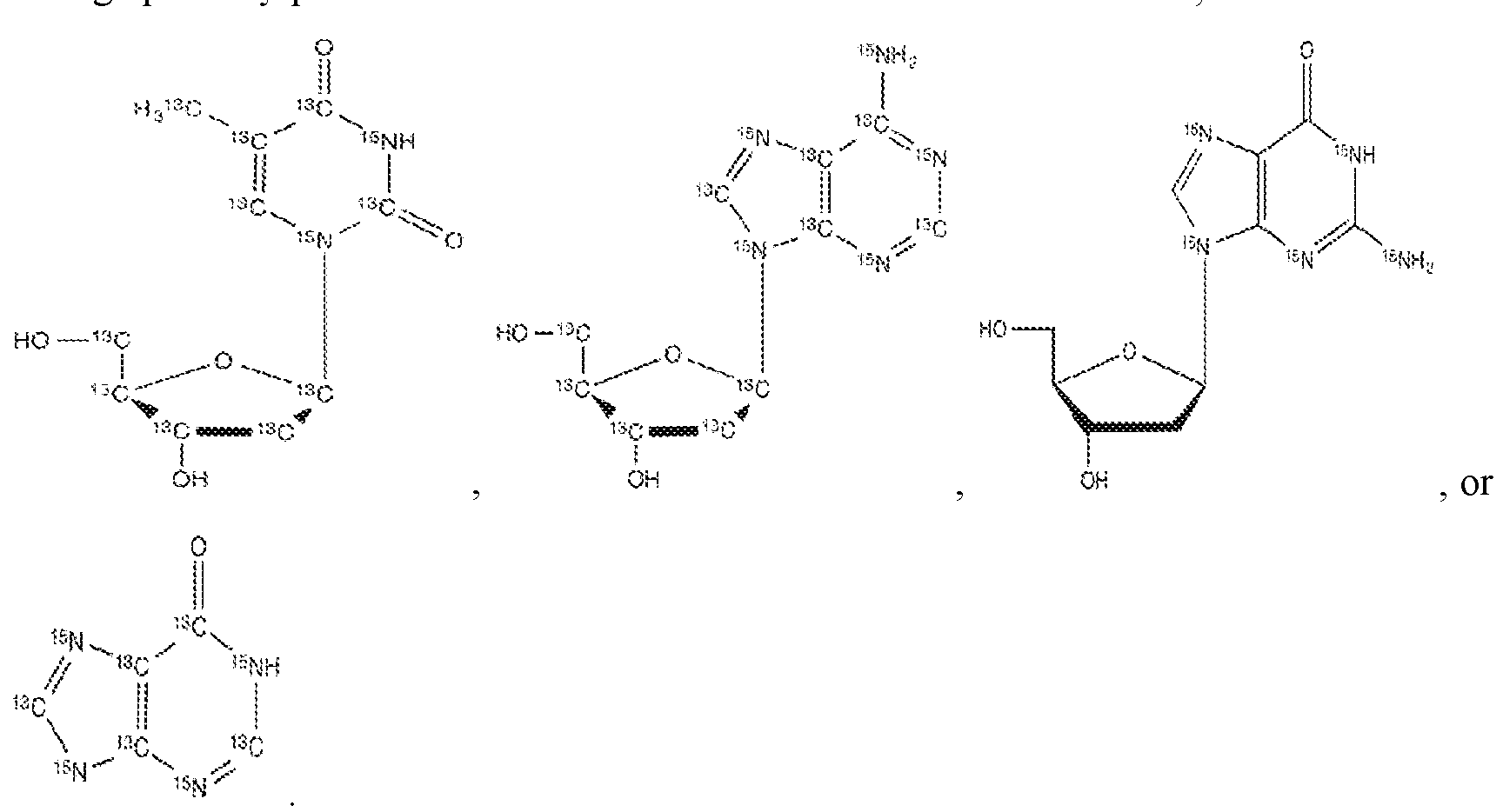
[0147] Embodiment P90. The kit of any one of embodiments P61 to P89, wherein said kit further comprises a de novo pathway inhibitor compound.
[0148] Embodiment P91. The kit of any one of embodiments P61 to P90, wherein said kit further comprises a salvage pathway inhibitor compound.
[0149] Embodiment P92. An isotopically labeled salvage pathway precursor having the
S H ?

[0150] Embodiment P93. The isotopically labeled precursor of embodiment P92, wherein the
3c-
precursor is selected from the group consisting of


[0151] Further embodiments include embodiments 1 to 93 following.
[0152] Embodiment 1. A method of simultaneously detecting an amount of de novo pathway deoxynucleotide triphosphate biosynthesis and an amount of salvage pathway deoxynucleotide triphosphate biosynthesis in a cell, said method comprising: (i) contacting a cell with an isotopically labeled glucose and (a) isotopically labeled salvage pathway precursors consisting of an isotopically labeled deoxycytidine and an isotopically labeled thymidine; (b) isotopically labeled salvage pathway precursors consisting of an isotopically labeled deoxyadenosine and an isotopically labeled deoxyguanosine; or (c) an isotopically labeled salvage pathway precursor that is an isotopically labeled hypoxanthine; (ii) allowing said cell to metabolize said isotopically labeled glucose and at least one or two of said isotopically labeled salvage pathway precursors thereby forming an isotopically labeled de novo pathway deoxynucleotide triphosphate or isotopically labeled de novo pathway deoxyribonucleic acid and an isotopically labeled salvage pathway deoxynucleotide triphosphate or isotopically labeled salvage pathway deoxyribonucleic acid; and (iii) identifying said isotopically labeled de novo pathway deoxynucleotide
triphosphate or isotopically labeled de novo pathway deoxyribonucleic acid and said isotopically labeled salvage pathway deoxynucleotide triphosphate or isotopically labeled salvage pathway deoxyribonucleic acid using a mass spectrometer device thereby detecting an amount of de novo pathway deoxynucleotide triphosphate biosynthesis and an amount of salvage pathway deoxynucleotide triphosphate biosynthesis in a cell.
[0153] Embodiment 2. The method of embodiment 1, wherein said isotopically labeled glucose is a 13C isotopically labeled glucose.
[0154] Embodiment 3. The method of any one of embodiments 1 to 2, wherein said isotopically labeled glucose is a 13C isotopically labeled glucose comprising at least two 13C labels.
[0155] Embodiment 4. The method of any one of embodiments 1 to 3, wherein said isotopically labeled glucose is a 13C isotopically labeled glucose comprising at least three 13C labels.
[0156] Embodiment 5. The method of any one of embodiments 1 to 4, wherein said isotopically labeled glucose is a 13C isotopically labeled glucose comprising six 13C labels.
[0157] Embodiment 6. The method of any one of embodiments 1 to 5, wherein said cell is contacted with at least two isotopically labeled salvage pathway precursors.
[0158] Embodiment 7. The method of embodiment 6, wherein said at least two isotopically labeled salvage pathway precursors are an isotopically labeled deoxycytidine and an isotopically labeled thymidine.
[0159] Embodiment 8. The method of embodiment 6, wherein said at least two isotopically labeled salvage pathway precursors are an isotopically labeled deoxyadenosine and an isotopically labeled deoxyguanosine.
[0160] Embodiment 9. The method of any one of embodiments 1 to 5, wherein said cell is contacted with at least three isotopically labeled salvage pathway precursors.
[0161] Embodiment 10. The method of embodiment 9, wherein said at least three isotopically labeled salvage pathway precursors are an isotopically labeled deoxycytidine, an isotopically labeled thymidine, and an isotopically labeled hypoxanthine.
[0162] Embodiment 1 1. The method of any one of embodiments 1 to 5, wherein said cell is contacted with at least four isotopically labeled salvage pathway precursors.
[0163] Embodiment 12. The method of embodiment 1 1, wherein said at least four isotopically labeled salvage pathway precursors are an isotopically labeled deoxycytidine, an isotopically labeled thymidine, an isotopically labeled deoxyadenosine, and an isotopically labeled deoxyguanosine.
[0164] Embodiment 13. The method of any one of embodiments 1 to 12, wherein said isotopically labeled salvage pathway precursor is a 13C isotopically labeled salvage pathway precursor.
[0165] Embodiment 14. The method of any one of embodiments 1 to 13, wherein said isotopically labeled salvage pathway precursor is a 13C isotopically labeled salvage pathway precursor comprising at least two 13C labels.
[0166] Embodiment 15. The method of any one of embodiments 1 to 14, wherein said isotopically labeled salvage pathway precursor is a 13C isotopically labeled salvage pathway precursor comprising at least three 13C labels.
[0167] Embodiment 16. The method of any one of embodiments 1 to 15, wherein said isotopically labeled salvage pathway precursor is a 13C isotopically labeled salvage pathway precursor comprising at least four 13C labels.
[0168] Embodiment 17. The method of any one of embodiments 1 to 17, wherein said isotopically labeled salvage pathway precursor is a 13C isotopically labeled salvage pathway precursor comprising at least five 13C labels.
[0169] Embodiment 18. The method of any one of embodiments 6 to 17, wherein said 13C label is present within a nitrogenous base moiety of said salvage pathway precursor.
[0170] Embodiment 19. The method of any one of embodiments 6 to 18, wherein said 13C label is present within a sugar moiety of said salvage pathway precursor.
[0171] Embodiment 20. The method of any one of embodiments 14 to 19, wherein said salvage pathway precursor comprises a 13C labels within a sugar moiety and a 13C label within a nitrogenous base moiety of said salvage pathway precursor.
[0172] Embodiment 21. The method of any one of embodiments 1 to 20, wherein said isotopically labeled salvage pathway precursor is a 15N isotopically labeled salvage pathway precursor.
[0173] Embodiment 22. The method of any one of embodiments 1 to 21, wherein said isotopically labeled salvage pathway precursor is a 15N isotopically labeled salvage pathway precursor comprising at least two 15N labels.
[0174] Embodiment 23. The method of any one of embodiments 1 to 22, wherein said isotopically labeled salvage pathway precursor is a 15N isotopically labeled salvage pathway precursor comprising at least three 15N labels.
[0175] Embodiment 24. The method of any one of embodiments 1 to 23, wherein said isotopically labeled salvage pathway precursor is a 15N isotopically labeled salvage pathway precursor comprising at least four 15N labels.
[0176] Embodiment 25. The method of any one of embodiments 1 to 24, wherein said isotopically labeled salvage pathway precursor is a 15N isotopically labeled salvage pathway precursor comprising at least five 15N labels.
[0177] Embodiment 26. The method of any one of embodiments 1 to 25, wherein said isotopically labeled salvage pathway precursor is an isotopically labeled 13C and 15N salvage pathway precursor.
[0178] Embodiment 27. The method of embodiment 1, wherein said isotopically labeled salvage pathway precursor is an isotopically labeled hypoxanthine.
[0179] Embodiment 28. The method of any one of embodiments 1 to 26, wherein said
I " 3C -
«
isotopically labeled salvage pathway precursor has the formula:

[0180] Embodiment 29. The method of any one of embodiments 1 to 28, wherein said amount of de novo pathway deoxynucleotide triphosphate biosynthesis is a measure of de novo pathway purinyl triphosphate biosynthesis.
[0181] Embodiment 30. The method of any one of embodiments 1 to 28, wherein said amount of de novo pathway deoxynucleotide triphosphate biosynthesis is a measure of de novo pathway pyrimidinyl triphosphate biosynthesis.
[0182] Embodiment 31. The method of any one of embodiments 1 to 28, wherein said amount of de novo pathway deoxynucleotide triphosphate biosynthesis is a measure of de novo pathway purinyl triphosphate biosynthesis and a measure of de novo pathway pyrimidinyl triphosphate biosynthesis.
[0183] Embodiment 32. The method of any one of embodiments 1 to 28, wherein said amount of salvage pathway deoxynucleotide triphosphate biosynthesis is a measure of salvage pathway purinyl triphosphate biosynthesis.
[0184] Embodiment 33. The method of any one of embodiments 1 to 28, wherein said amount of salvage pathway deoxynucleotide triphosphate biosynthesis is a measure of salvage pathway pyrimidinyl triphosphate biosynthesis.
[0185] Embodiment 34. The method of any one of embodiments 1 to 28, wherein said amount of salvage pathway deoxynucleotide triphosphate biosynthesis is a measure of salvage pathway purinyl triphosphate biosynthesis and a measure of salvage pathway pyrimidinyl triphosphate biosynthesis.
[0186] Embodiment 35. The method of any one of embodiments 1 to 34, wherein said isotopically labeled glucose is metabolized by said cell to form an isotopically labeled de novo pathway deoxynucleotide triphosphate.
[0187] Embodiment 36. The method of embodiment 35, wherein said isotopically labeled de novo pathway deoxynucleotide triphosphate is a deoxycytidine triphosphate.
[0188] Embodiment 37. The method of embodiment 35, wherein said isotopically labeled de novo pathway deoxynucleotide triphosphate is a thymidine triphosphate.
[0189] Embodiment 38. The method of embodiment 35, wherein said isotopically labeled de novo pathway deoxynucleotide triphosphate is a deoxyadenosine triphosphate.
[0190] Embodiment 39. The method of embodiment 35, wherein said isotopically labeled de novo pathway deoxynucleotide triphosphate is a deoxyguanosine triphosphate.
[0191] Embodiment 40. The method of any one of embodiments 1 to 34, wherein said isotopically labeled glucose is metabolized by said cell to form an isotopically labeled de novo pathway deoxyribonucleic acid.
[0192] Embodiment 41. The method of any one of embodiments 1 to 40, wherein said isotopically labeled salvage pathway precursors are metabolized by said cell to independently form an isotopically labeled salvage pathway deoxynucleotide triphosphates.
[0193] Embodiment 42. The method of embodiment 41, wherein said isotopically labeled salvage pathway precursor is a deoxycytidine triphosphate.
[0194] Embodiment 43. The method of embodiment 41, wherein said isotopically labeled salvage pathway precursor is a thymidine triphosphate.
[0195] Embodiment 44. The method of embodiment 41, wherein said isotopically labeled salvage pathway precursor is a deoxyadenosine triphosphate.
[0196] Embodiment 45. The method of embodiment 41, wherein said isotopically labeled salvage pathway precursor is a deoxyguanosine triphosphate.
[0197] Embodiment 46. The method of any one of embodiments 1 to 40, wherein said isotopically labeled salvage pathway precursors are metabolized by said cell to form an isotopically labeled salvage pathway deoxyribonucleic acid.
[0198] Embodiment 47. The method of embodiment 46, wherein said isotopically labeled salvage pathway deoxyribonucleic acid is hydrolyzed to form a plurality of deoxynucleoside moieties.
[0199] Embodiment 48. The method of any one of embodiments 1 to 47, wherein said mass spectrometer device is a tandem-mass spectrometer device.
[0200] Embodiment 49. The method of any one of embodiments 1 to 48, wherein said identifying further comprises detecting the mass of an isotopically labeled deoxycytidine, an isotopically labeled thymidine, an isotopically labeled deoxyadenosine, and an isotopically labeled deoxyguanosine deoxynucleotide triphosphate.
[0201] Embodiment 50. The method of any one of embodiments 1 to 49, wherein said identifying comprises detecting the mass of a nitrogenous base moiety of said isotopically labeled deoxycytidine, isotopically labeled thymidine, isotopically labeled deoxyadenosine, or isotopically labeled deoxyguanosine deoxynucleotide triphosphate.
[0202] Embodiment 51. The method of any one of embodiments 1 to 50, wherein said identifying comprises detecting the mass of a sugar moiety of said isotopically labeled deoxycytidine, isotopically labeled thymidine, isotopically labeled deoxyadenosine, or isotopically labeled deoxyguanosine deoxynucleotide triphosphate.
[0203] Embodiment 52. The method of any one of embodiments 1 to 51, wherein said cell is part of an organism.
[0204] Embodiment 53. The method embodiment 52, wherein said organism is a mammal.
[0205] Embodiment 54. The method of embodiment 53, wherein said mammal is a human.
[0206] Embodiment 55. The method of any one of embodiments 1 to 54, wherein said cell is a cancer cell.
[0207] Embodiment 56. The method of any one of embodiments 1 to 55, wherein said amount of de novo pathway deoxynucleotide triphosphate biosynthesis is compared to said amount of salvage pathway deoxynucleotide triphosphate biosynthesis in said cell.
[0208] Embodiment 57. The method of embodiment 56, wherein said comparison is a measure of the differential use of a de novo pathway and a salvage pathway to synthesize a deoxynucleotide triphosphate.
[0209] Embodiment 58. The method of embodiment 57, further comprising contacting said cell with a test compound, wherein said test compound modulates an amount of de novo pathway deoxynucleotide triphosphate biosynthesis or an amount of salvage pathway deoxynucleotide triphosphate biosynthesis in said cell.
[0210] Embodiment 59. The method of embodiment 58, wherein test compound is a therapeutic compound.
[0211] Embodiment 60. The method of any one of embodiments 1 to 59, further comprising: i) hydrolyzing said isotopically labeled de novo pathway deoxyribonucleic acid or said isotopically labeled salvage pathway deoxyribonucleic acid, thereby forming an isotopically labeled deoxynucleoside; and ii) detecting the mass of said isotopically labeled deoxynucleoside.
[0212] Embodiment 61. A kit comprising: an isotopically labeled glucose; and (a) isotopically labeled salvage pathway precursors consisting of an isotopically labeled deoxycytidine and an isotopically labeled thymidine; (b) isotopically labeled salvage pathway precursors consisting of an isotopically labeled deoxyadenosine and an isotopically labeled deoxyguanosine; and (c) an isotopically labeled salvage pathway precursor that is an isotopically labeled hypoxanthine.
[0213] Embodiment 62. The kit of embodiment 61, wherein said isotopically labeled glucose is a 13C isotopically labeled glucose.
[0214] Embodiment 63. The kit of any one of embodiments 61 to 62, wherein said isotopically labeled glucose is a 13C isotopically labeled glucose comprising at least two 13C labels.
[0215] Embodiment 64. The kit of any one of embodiments 61 to 63, wherein said isotopically labeled glucose is a 13C isotopically labeled glucose comprising at least three 13C labels.
[0216] Embodiment 65. The kit of any one of embodiments 61 to 64, wherein said isotopically labeled glucose is a 13C isotopically labeled glucose comprising six 13C labels.
[0217] Embodiment 66. The kit of any one of embodiments 61 to 65, wherein said kit comprises at least one isotopically labeled salvage pathway precursor.
[0218] Embodiment 67. The kit of any one of embodiments 61 to 66, wherein said kit comprises at least two isotopically labeled salvage pathway precursors.
[0219] Embodiment 68. The kit of any one of embodiments 61 to 67, wherein said kit comprises at least three isotopically labeled salvage pathway precursors.
[0220] Embodiment 69. The kit of any one of embodiments 61 to 68, wherein said kit comprises at least four isotopically labeled salvage pathway precursors.
[0221] Embodiment 70. The kit of any one of embodiments 61 to 69, wherein said kit comprises a 13C isotopically labeled glucose and an isotopically labeled hypoxanthine.
[0222] Embodiment 71. The kit of any one of embodiments 61 to 70, wherein said kit comprises a 13C isotopically labeled glucose, an isotopically labeled deoxycytidine, and an isotopically labeled thymidine.
[0223] Embodiment 72. The kit of any one of embodiments 61 to 71, wherein said kit comprises a 13C isotopically labeled glucose, an isotopically labeled deoxyadenosine, and an isotopically labeled deoxyguanosine.
[0224] Embodiment 73. The kit of any one of embodiments 61 to 72, wherein said kit comprises a 13C isotopically labeled glucose, an isotopically labeled deoxycytidine, an isotopically labeled thymidine, and an isotopically labeled hypoxanthine.
[0225] Embodiment 74. The kit of any one of embodiments 61 to 73, wherein said kit comprises a 13C isotopically labeled glucose, an isotopically labeled deoxycytidine, an isotopically labeled thymidine, an isotopically labeled deoxyadenosine, and an isotopically labeled deoxyguanosine.
[0226] Embodiment 75. The kit of any one of embodiments 61 to 74, wherein said isotopically labeled salvage pathway precursor is a 13C isotopically labeled salvage pathway precursor.
[0227] Embodiment 76. The kit of any one of embodiments 61 to 75, wherein said isotopically labeled salvage pathway precursor is a 13C isotopically labeled salvage pathway precursor comprising at least two 13C labels.
[0228] Embodiment 77. The kit of any one of embodiments 61 to 76, wherein said isotopically labeled salvage pathway precursor is a 13C isotopically labeled salvage pathway precursor comprising at least three 13C labels.
[0229] Embodiment 78. The kit of any one of embodiments 61 to 77, wherein said isotopically labeled salvage pathway precursor is a 13C isotopically labeled salvage pathway precursor comprising at least four 13C labels.
[0230] Embodiment 79. The kit of any one of embodiments 61 to 78, wherein said isotopically labeled salvage pathway precursor is a 13C isotopically labeled salvage pathway precursor comprising at least five 13C labels.
[0231] Embodiment 80. The kit of any one of embodiments 61 to 79, wherein said 13C label present within a nitrogenous base moiety of said salvage pathway precursor.
[0232] Embodiment 81. The kit of any one of embodiments 61 to 80, wherein said 13C label present within a sugar moiety of said salvage pathway precursor.
[0233] Embodiment 82. The kit of any one of embodiments 61 to 81, wherein said salvage pathway precursor comprises a 13C labels within a sugar moiety and a 13C label within a nitrogenous base moiety of said salvage pathway precursor.
[0234] Embodiment 83. The kit of any one of embodiments 61 to 82, wherein said isotopically labeled salvage pathway precursor is a 15N isotopically labeled salvage pathway precursor.
[0235] Embodiment 84. The kit of any one of embodiments 61 to 83, wherein said isotopically labeled salvage pathway precursor is a 15N isotopically labeled salvage pathway precursor comprising at least two 15N labels.
[0236] Embodiment 85. The kit of any one of embodiments 61 to 84, wherein said isotopically labeled salvage pathway precursor is a 15N isotopically labeled salvage pathway precursor comprising at least three 15N labels.
[0237] Embodiment 86. The kit of any one of embodiments 61 to 85, wherein said isotopically labeled salvage pathway precursor is a 15N isotopically labeled salvage pathway precursor comprising at least four 15N labels.
[0238] Embodiment 87. The kit of any one of embodiments 61 to 86, wherein said isotopically labeled salvage pathway precursor is a 15N isotopically labeled salvage pathway precursor comprising at least five 15N labels.
[0239] Embodiment 88. The kit of any one of embodiments 61 to 87, wherein said labeled salvage pathway precursor is an isotopically labeled 13C and 15N salvage pathway precursor.
[0240] Embodiment 89. The kit of any one of embodiments 61 to 88, wherein said labeled
salvage pathway precursor has the formula:

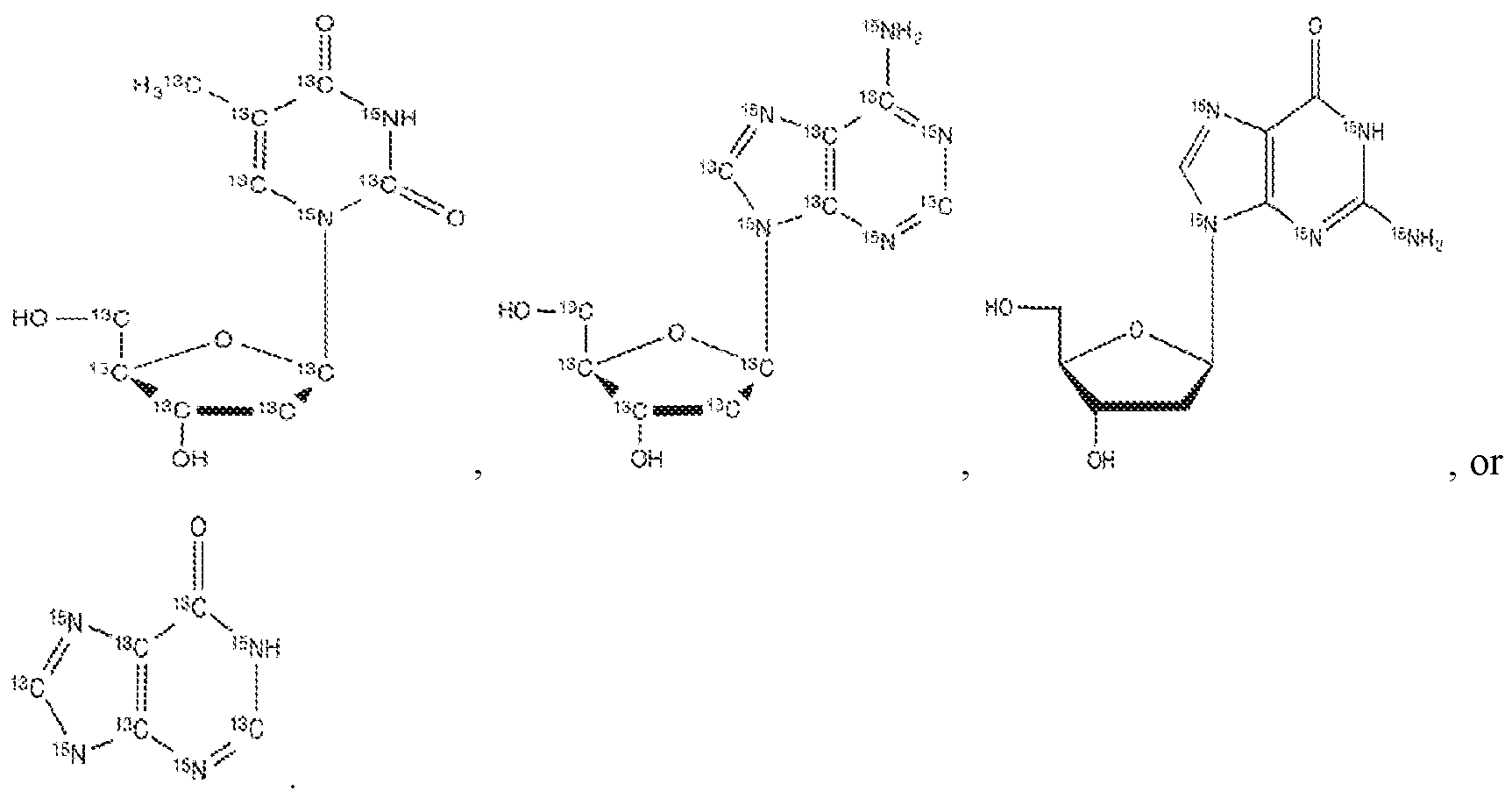
[0241] Embodiment 90. The kit of any one of embodiments 61 to 89, wherein said kit further comprises a de novo pathway inhibitor compound.
[0242] Embodiment 91. The kit of any one of embodiments 61 to 90, wherein said kit further comprises a salvage pathway inhibitor compound.
[0243] Embodiment 92. An isotopically labeled salvage pathway precursor having the
S H ?

[0244] Embodiment 93. The isotopically labeled precursor of embodiment 92, wherein the precursor is selected from the group consisting of


Examples
Example 1. dNTP/DNA Barcoding Assay to Measure the Differential Contribution of de novo and Salvage Pathways to DNA Synthesis
[0245] Similar to other major branches of cellular metabolism, nucleotide biosynthesis consists of redundant and convergent biosynthetic pathways. Deoxynucleotide triphosphates (dNTPs) required for DNA replication and repair can be produced by the de novo pathway (DNP) or by the nucleoside salvage pathway (NSP) (Fig. 2A). The DNP uses glucose and amino acids to generate ribonucleotide diphosphates, which are then converted to dNTP precursors by the rate- limiting enzyme ribonucleotide reductase (RNR). The same dNTP precursors can also be produced via the NSP from extracellular deoxyribonucleosides (dNs), which are phosphorylated by NSP kinases. Thymidine is salvaged by thymidine kinase 1 (TK1), while deoxycytidine, deoxyadenosine and deoxyguanosine are salvaged by dCK. The roles of the NSP kinases in the economy of the nucleotide metabolism of normal and malignant cells remain poorly understood. It has been reported that impaired hematopoiesis in dCK1' mice, due to dCTP pool deficiency, resulting in replication stress (RS), S-phase arrest and DNA damage in hematopoietic progenitors (Toy et al, PNAS 107(12):5551-6 (2010)). Subsequent studies in a newly generated dCKITKl double-knockout strain revealed that dCK supports normal hematopoiesis by
compensating for the constitutive inhibition of de novo dCTP production by excess dTTP produced from endogenous thymidine via TK1 (Austin et al, J. Exp. Med. 209(12):2215-2228 (2012)). In addition to hematopoiesis, dNTP production by the NSP may also be important in cancer. The ability of cancer cells to switch dCTP biosynthesis from the DNP to the NSP may explain why high dose thymidine given as a single dCTP-depleting therapeutic agent in hematological malignancies had limited efficacy in clinical trials (Fig. 2B). Provided herein are methods for determining the contribution of DNP and NSP in cells to help develop new therapeutic agents. A schematic representation of such a platform assay is shown in FIG.s 1, 3 A, 3B, 3C, and 23. Exemplary stable isotope-labeled precursors are shown in FIG. 4. FIG.s 5-14 show exemplary labeled molecules including nucleotides/nucleosides, nucleobases, ribose metabolite, and glucose. FIGS. 15 through 22 are schematics showing barcoding modules for determining the amounts of de novo and salvage pathway biosynthesis.
[0246] To demonstrate the provided methods, cells were cultured for 18 hours in the presence of 5 mM glucose and 5 μΜ deoxynucleotides (dNs). The experiment was conducted using single labeling of either 13C6-glucose; 13C9,15N3-dC; 13Ci0,15N2-dT; 13Ci0,15N5-dA and 15N5-dG The data was compiled to yield theoretical percent DNA labeling when all five labeled precursors were combined and the results are shown in the bar graphs of FIG. 24. The data demonstrate the feasibility of using barcoded isotopically labeled precursors to determine the amounts of de novo and salvage pathway biosynthesis.
Claims
1. A method of simultaneously detecting an amount of de novo pathway deoxynucleotide triphosphate biosynthesis and an amount of salvage pathway deoxynucleotide triphosphate biosynthesis in a cell, said method comprising:
(i) contacting a cell with an isotopically labeled glucose and
(a) isotopically labeled salvage pathway precursors consisting of an isotopically labeled deoxycytidine and an isotopically labeled thymidine;
(b) isotopically labeled salvage pathway precursors consisting of an isotopically labeled deoxyadenosine and an isotopically labeled deoxyguanosine; or
(c) an isotopically labeled salvage pathway precursor that is an isotopically labeled hypoxanthine;
(ii) allowing said cell to metabolize said isotopically labeled glucose and at least one or two of said isotopically labeled salvage pathway precursors thereby forming an isotopically labeled de novo pathway deoxynucleotide triphosphate or isotopically labeled de novo pathway deoxyribonucleic acid and an isotopically labeled salvage pathway
deoxynucleotide triphosphate or isotopically labeled salvage pathway deoxyribonucleic acid; and
(iii) identifying said isotopically labeled de novo pathway deoxynucleotide triphosphate or isotopically labeled de novo pathway deoxyribonucleic acid and said isotopically labeled salvage pathway deoxynucleotide triphosphate or isotopically labeled salvage pathway deoxyribonucleic acid using a mass spectrometer device thereby detecting an amount of de novo pathway deoxynucleotide triphosphate biosynthesis and an amount of salvage pathway deoxynucleotide triphosphate biosynthesis in a cell.
2. The method of claim 1, wherein said isotopically labeled glucose is a 13C isotopically labeled glucose.
3. The method of any one of claims 1 to 2, wherein said isotopically labeled glucose is a 13C isotopically labeled glucose comprising at least two 13C labels.
4. The method of any one of claims 1 to 3, wherein said isotopically labeled glucose is a 13C isotopically labeled glucose comprising at least three 13C labels.
5. The method of any one of claims 1 to 4, wherein said isotopically labeled glucose is a 13C isotopically labeled glucose comprising six 13C labels.
6. The method of any one of claims 1 to 5, wherein said cell is contacted with at least two isotopically labeled salvage pathway precursors.
7. The method of claim 6, wherein said at least two isotopically labeled salvage pathway precursors are an isotopically labeled deoxycytidine and an isotopically labeled thymidine.
8 The method of claim 6, wherein said at least two isotopically labeled salvage pathway precursors are an isotopically labeled deoxyadenosine and an isotopically labeled deoxyguanosine.
9. The method of any one of claims 1 to 5, wherein said cell is contacted with at least three isotopically labeled salvage pathway precursors.
10. The method of claim 9, wherein said at least three isotopically labeled salvage pathway precursors are an isotopically labeled deoxycytidine, an isotopically labeled thymidine, and an isotopically labeled hypoxanthine.
11. The method of any one of claims 1 to 5, wherein said cell is contacted with at least four isotopically labeled salvage pathway precursors.
12. The method of claim 1 1, wherein said at least four isotopically labeled salvage pathway precursors are an isotopically labeled deoxycytidine, an isotopically labeled thymidine, an isotopically labeled deoxyadenosine, and an isotopically labeled deoxyguanosine.
13. The method of any one of claims 1 to 12, wherein said isotopically labeled salvage pathway precursor is a 13C isotopically labeled salvage pathway precursor.
14. The method of any one of claims 1 to 13, wherein said isotopically labeled salvage pathway precursor is a 13C isotopically labeled salvage pathway precursor comprising at least two 13C labels.
15. The method of any one of claims 1 to 14, wherein said isotopically labeled salvage pathway precursor is a 13C isotopically labeled salvage pathway precursor comprising at least three 13C labels.
16. The method of any one of claims 1 to 15, wherein said isotopically labeled salvage pathway precursor is a 13C isotopically labeled salvage pathway precursor comprising at least four 13C labels.
17. The method of any one of claims 1 to 17, wherein said isotopically labeled salvage pathway precursor is a 13C isotopically labeled salvage pathway precursor comprising at least five 13C labels.
18. The method of any one of claims 6 to 17, wherein said 13C label is present within a nitrogenous base moiety of said salvage pathway precursor.
19. The method of any one of claims 6 to 18, wherein said 13C label is present within a sugar moiety of said salvage pathway precursor.
20. The method of any one of claims 14 to 19, wherein said salvage pathway precursor comprises a 13C labels within a sugar moiety and a 13C label within a nitrogenous base moiety of said salvage pathway precursor.
21. The method of any one of claims 1 to 20, wherein said isotopically labeled salvage pathway precursor is a 15N isotopically labeled salvage pathway precursor.
22. The method of any one of claims 1 to 21, wherein said isotopically labeled salvage pathway precursor is a 15N isotopically labeled salvage pathway precursor comprising at least two 15N labels.
23. The method of any one of claims 1 to 22, wherein said isotopically labeled salvage pathway precursor is a 15N isotopically labeled salvage pathway precursor comprising at least three 15N labels.
24. The method of any one of claims 1 to 23, wherein said isotopically labeled salvage pathway precursor is a 15N isotopically labeled salvage pathway precursor comprising at least four 15N labels.
25. The method of any one of claims 1 to 24, wherein said isotopically labeled salvage pathway precursor is a 15N isotopically labeled salvage pathway precursor comprising at least five 15N labels.
The method of any one of claims 1 to 25, wherein said isotopically labeled salvage pathway precursor is an isotopically labeled 1JC and N salvage pathway precursor.
27. The method of claim 1, wherein said isotopically labeled salvage pathway precursor is an isotopically labeled hypoxanthine.
28. The method of any one of claims 1 to 26, wherein said isotopically labeled salvage pathway precursor has the formula:

29. The method of any one of claims 1 to 28, wherein said amount of de novo pathway deoxynucleotide triphosphate biosynthesis is a measure of de novo pathway purinyl triphosphate biosynthesis.
30. The method of any one of claims 1 to 28, wherein said amount of de novo pathway deoxynucleotide triphosphate biosynthesis is a measure of de novo pathway pyrimidinyl triphosphate biosynthesis.
31. The method of any one of claims 1 to 28, wherein said amount of de novo pathway deoxynucleotide triphosphate biosynthesis is a measure of de novo pathway purinyl triphosphate biosynthesis and a measure of de novo pathway pyrimidinyl triphosphate biosynthesis.
32. The method of any one of claims 1 to 28, wherein said amount of salvage pathway deoxynucleotide triphosphate biosynthesis is a measure of salvage pathway purinyl triphosphate biosynthesis.
33. The method of any one of claims 1 to 28, wherein said amount of salvage pathway deoxynucleotide triphosphate biosynthesis is a measure of salvage pathway pyrimidinyl triphosphate biosynthesis.
34. The method of any one of claims 1 to 28, wherein said amount of salvage pathway deoxynucleotide triphosphate biosynthesis is a measure of salvage pathway purinyl triphosphate biosynthesis and a measure of salvage pathway pyrimidinyl triphosphate biosynthesis.
35. The method of any one of claims 1 to 34, wherein said isotopically labeled glucose is metabolized by said cell to form an isotopically labeled de novo pathway
deoxynucleotide triphosphate.
36. The method of claim 35, wherein said isotopically labeled de novo pathway deoxynucleotide triphosphate is a deoxycytidine triphosphate.
37. The method of claim 35, wherein said isotopically labeled de novo pathway deoxynucleotide triphosphate is a thymidine triphosphate.
38. The method of claim 35, wherein said isotopically labeled de novo pathway deoxynucleotide triphosphate is a deoxyadenosine triphosphate.
39. The method of claim 35, wherein said isotopically labeled de novo pathway deoxynucleotide triphosphate is a deoxyguanosine triphosphate.
40. The method of any one of claims 1 to 34, wherein said isotopically labeled glucose is metabolized by said cell to form an isotopically labeled de novo pathway
deoxyribonucleic acid.
41. The method of any one of claims 1 to 40, wherein said isotopically labeled salvage pathway precursors are metabolized by said cell to independently form an isotopically labeled salvage pathway deoxynucleotide triphosphates.
42. The method of claim 41, wherein said isotopically labeled salvage pathway precursor is a deoxycytidine triphosphate.
43. The method of claim 41, wherein said isotopically labeled salvage pathway precursor is a thymidine triphosphate.
44. The method of claim 41, wherein said isotopically labeled salvage pathway precursor is a deoxyadenosine triphosphate.
45. The method of claim 41, wherein said isotopically labeled salvage pathway precursor is a deoxyguanosine triphosphate.
46. The method of any one of claims 1 to 40, wherein said isotopically labeled salvage pathway precursors are metabolized by said cell to form an isotopically labeled salvage pathway deoxyribonucleic acid.
47. The method of claim 46, wherein said isotopically labeled salvage pathway deoxyribonucleic acid is hydrolyzed to form a plurality of deoxynucleoside moieties.
48. The method of any one of claims 1 to 47, wherein said mass spectrometer device is a tandem-mass spectrometer device.
49. The method of any one of claims 1 to 48, wherein said identifying further comprises detecting the mass of an isotopically labeled deoxycytidine, an isotopically labeled thymidine, an isotopically labeled deoxyadenosine, and an isotopically labeled deoxyguanosine deoxynucleotide triphosphate.
50. The method of any one of claims 1 to 49, wherein said identifying comprises detecting the mass of a nitrogenous base moiety of said isotopically labeled deoxycytidine, isotopically labeled thymidine, isotopically labeled deoxyadenosine, or isotopically labeled deoxyguanosine deoxynucleotide triphosphate.
51. The method of any one of claims 1 to 50, wherein said identifying comprises detecting the mass of a sugar moiety of said isotopically labeled deoxycytidine, isotopically labeled thymidine, isotopically labeled deoxyadenosine, or isotopically labeled deoxyguanosine deoxynucleotide triphosphate.
52. The method of any one of claims 1 to 51, wherein said cell is part of an organism.
53. The method claim 52, wherein said organism is a mammal.
54. The method of claim 53, wherein said mammal is a human.
55. The method of any one of claims 1 to 54, wherein said cell is a cancer cell.
56. The method of any one of claims 1 to 55, wherein said amount of de novo pathway deoxynucleotide triphosphate biosynthesis is compared to said amount of salvage pathway deoxynucleotide triphosphate biosynthesis in said cell.
57. The method of claim 56, wherein said comparison is a measure of the differential use of a de novo pathway and a salvage pathway to synthesize a deoxynucleotide triphosphate.
58. The method of claim 57, further comprising contacting said cell with a test compound, wherein said test compound modulates an amount of de novo pathway
deoxynucleotide triphosphate biosynthesis or an amount of salvage pathway deoxynucleotide triphosphate biosynthesis in said cell.
59. The method of claim 58, wherein test compound is a therapeutic compound.
60. The method of any one of claims 1 to 59, further comprising: i) hydrolyzing said isotopically labeled de novo pathway deoxyribonucleic acid or said isotopically labeled salvage pathway deoxyribonucleic acid, thereby forming an isotopically labeled deoxynucleoside; and
ii) detecting the mass of said isotopically labeled deoxynucleoside.
61. A kit comprising:
an isotopically labeled glucose; and
(a) isotopically labeled salvage pathway precursors consisting of an isotopically labeled deoxycytidine and an isotopically labeled thymidine;
(b) isotopically labeled salvage pathway precursors consisting of an isotopically labeled deoxyadenosine and an isotopically labeled deoxyguanosine; and
(c) an isotopically labeled salvage pathway precursor that is an isotopically labeled hypoxanthine.
62. The kit of claim 61, wherein said isotopically labeled glucose is a 13C isotopically labeled glucose.
63. The kit of any one of claims 61 to 62, wherein said isotopically labeled glucose is a 13C isotopically labeled glucose comprising at least two 13C labels.
64. The kit of any one of claims 61 to 63, wherein said isotopically labeled glucose is a 13C isotopically labeled glucose comprising at least three 13C labels.
65. The kit of any one of claims 61 to 64, wherein said isotopically labeled glucose is a 13C isotopically labeled glucose comprising six 13C labels.
66. The kit of any one of claims 61 to 65, wherein said kit comprises at least one isotopically labeled salvage pathway precursor.
67. The kit of any one of claims 61 to 66, wherein said kit comprises at least two isotopically labeled salvage pathway precursors.
68. The kit of any one of claims 61 to 67, wherein said kit comprises at least three isotopically labeled salvage pathway precursors.
69. The kit of any one of claims 61 to 68, wherein said kit comprises at least four isotopically labeled salvage pathway precursors.
70. The kit of any one of claims 61 to 69, wherein said kit comprises a 13C isotopically labeled glucose and an isotopically labeled hypoxanthine.
71. The kit of any one of claims 61 to 70, wherein said kit comprises a 13C isotopically labeled glucose, an isotopically labeled deoxycytidine, and an isotopically labeled thymidine.
72. The kit of any one of claims 61 to 71, wherein said kit comprises a C isotopically labeled glucose, an isotopically labeled deoxyadenosine, and an isotopically labeled deoxyguanosine.
73. The kit of any one of claims 61 to 72, wherein said kit comprises a 13C isotopically labeled glucose, an isotopically labeled deoxycytidine, an isotopically labeled thymidine, and an isotopically labeled hypoxanthine.
74. The kit of any one of claims 61 to 73, wherein said kit comprises a 13C isotopically labeled glucose, an isotopically labeled deoxycytidine, an isotopically labeled thymidine, an isotopically labeled deoxyadenosine, and an isotopically labeled deoxyguanosine.
75. The kit of any one of claims 61 to 74, wherein said isotopically labeled salvage pathway precursor is a 13C isotopically labeled salvage pathway precursor.
76. The kit of any one of claims 61 to 75, wherein said isotopically labeled salvage pathway precursor is a 13C isotopically labeled salvage pathway precursor comprising at least two 13C labels.
77. The kit of any one of claims 61 to 76, wherein said isotopically labeled salvage pathway precursor is a C isotopically labeled salvage pathway precursor comprising at least three 13C labels.
78. The kit of any one of claims 61 to 77, wherein said isotopically labeled salvage pathway precursor is a C isotopically labeled salvage pathway precursor comprising at least four 13C labels.
79. The kit of any one of claims 61 to 78, wherein said isotopically labeled salvage pathway precursor is a 13C isotopically labeled salvage pathway precursor comprising at least five 13C labels.
80. The kit of any one of claims 61 to 79, wherein said 13C label is present within a nitrogenous base moiety of said salvage pathway precursor.
81. The kit of any one of claims 61 to 80, wherein said C label is present within a sugar moiety of said salvage pathway precursor.
82. The kit of any one of claims 61 to 81, wherein said salvage pathway precursor comprises a 13C labels within a sugar moiety and a 13C label within a nitrogenous base moiety of said salvage pathway precursor.
83. The kit of any one of claims 61 to 82, wherein said isotopically labeled salvage pathway precursor is a 15N isotopically labeled salvage pathway precursor.
84. The kit of any one of claims 61 to 83, wherein said isotopically labeled salvage pathway precursor is a 15N isotopically labeled salvage pathway precursor comprising at least two 15N labels.
85. The kit of any one of claims 61 to 84, wherein said isotopically labeled salvage pathway precursor is a 15N isotopically labeled salvage pathway precursor comprising at least three 15N labels.
86. The kit of any one of claims 61 to 85, wherein said isotopically labeled salvage pathway precursor is a 15N isotopically labeled salvage pathway precursor comprising at least four 15N labels.
87. The kit of any one of claims 61 to 86, wherein said isotopically labeled salvage pathway precursor is a 15N isotopically labeled salvage pathway precursor comprising at least five 15N labels.
88. The kit of any one of claims 61 to 87, wherein said labeled salvage pathway precursor is an isotopically labeled 13C and 15N salvage pathway precursor.
89. The kit of any one of claims 61 to 88, wherein said labeled salvage pathway precursor has the formula:
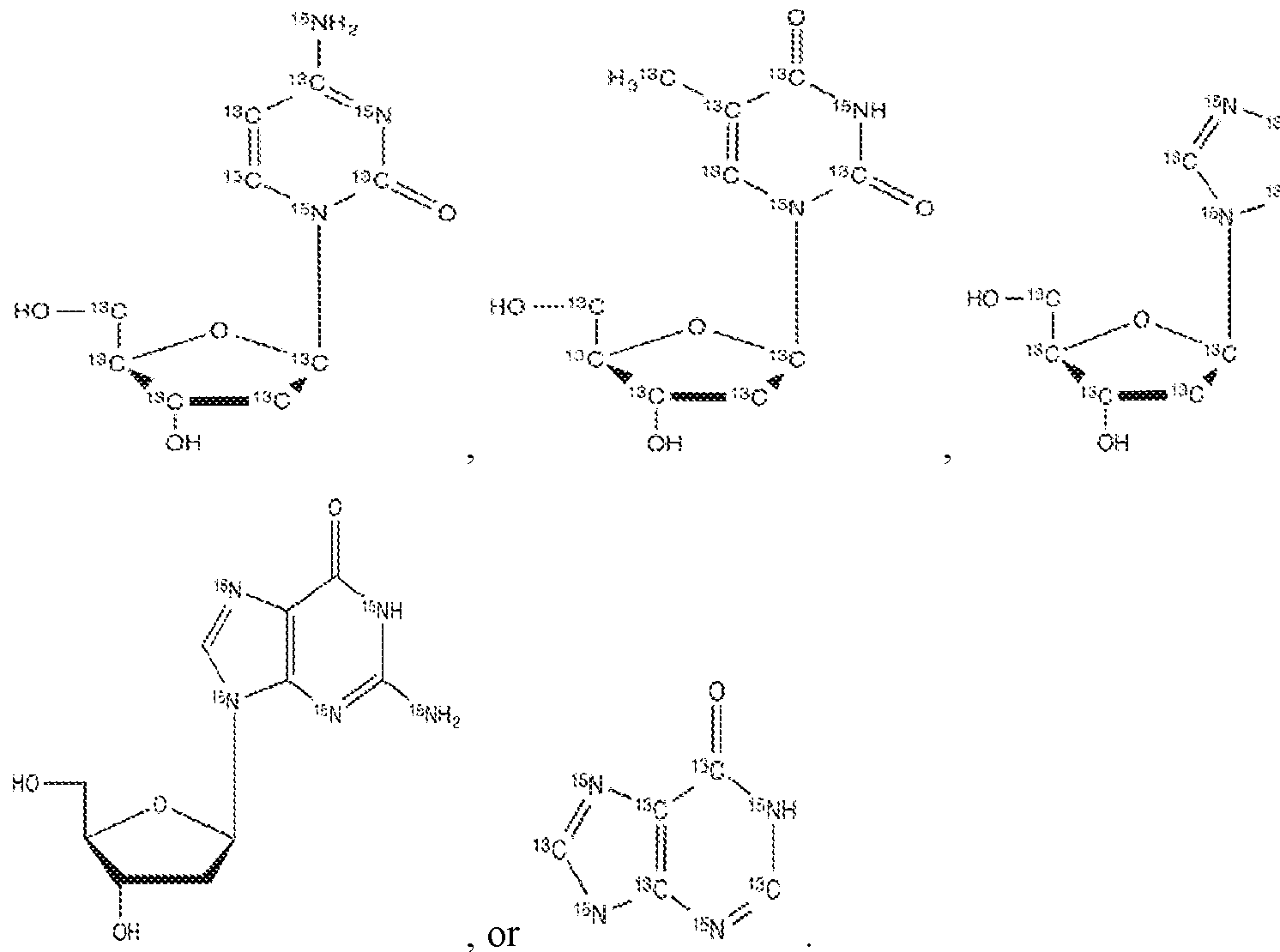
90. The kit of any one of claims 61 to 89, wherein said kit further comprises a de novo pathway inhibitor compound.
91. The kit of any one of claims 61 to 90, wherein said kit further comprises a salvage pathway inhibitor compound.
92. An isotopically labeled salvage pathway precursor having the formula:

93. The isotopically labeled precursor of claim 92, wherein the precursor is selected from the group consisting of

55
Applications Claiming Priority (2)
| Application Number | Priority Date | Filing Date | Title |
|---|---|---|---|
| US201562113898P | 2015-02-09 | 2015-02-09 | |
| US62/113,898 | 2015-02-09 |
Publications (2)
| Publication Number | Publication Date |
|---|---|
| WO2016130562A2 true WO2016130562A2 (en) | 2016-08-18 |
| WO2016130562A3 WO2016130562A3 (en) | 2016-09-29 |
Family
ID=56615665
Family Applications (1)
| Application Number | Title | Priority Date | Filing Date |
|---|---|---|---|
| PCT/US2016/017172 Ceased WO2016130562A2 (en) | 2015-02-09 | 2016-02-09 | Metabolic analysis of the nucleotide de novo and salvage pathways |
Country Status (1)
| Country | Link |
|---|---|
| WO (1) | WO2016130562A2 (en) |
Cited By (2)
| Publication number | Priority date | Publication date | Assignee | Title |
|---|---|---|---|---|
| WO2020232445A1 (en) * | 2019-05-16 | 2020-11-19 | The Regents Of The University Of California | Modulators of pyrimidine nucleotide biosynthetic pathways |
| US11446307B2 (en) | 2020-11-02 | 2022-09-20 | Trethera Corporation | Crystalline forms of a deoxycytidine kinase inhibitor and uses thereof |
Family Cites Families (1)
| Publication number | Priority date | Publication date | Assignee | Title |
|---|---|---|---|---|
| US9688673B2 (en) * | 2011-03-08 | 2017-06-27 | The Regents Of The University Of California | Deoxycytidine kinase binding compounds |
-
2016
- 2016-02-09 WO PCT/US2016/017172 patent/WO2016130562A2/en not_active Ceased
Cited By (2)
| Publication number | Priority date | Publication date | Assignee | Title |
|---|---|---|---|---|
| WO2020232445A1 (en) * | 2019-05-16 | 2020-11-19 | The Regents Of The University Of California | Modulators of pyrimidine nucleotide biosynthetic pathways |
| US11446307B2 (en) | 2020-11-02 | 2022-09-20 | Trethera Corporation | Crystalline forms of a deoxycytidine kinase inhibitor and uses thereof |
Also Published As
| Publication number | Publication date |
|---|---|
| WO2016130562A3 (en) | 2016-09-29 |
Similar Documents
| Publication | Publication Date | Title |
|---|---|---|
| McLennan | Ap4A and other dinucleoside polyphosphates | |
| US6355416B1 (en) | Assay for the measurement of DNA synthesis rates | |
| Pljevaljcic et al. | Design of a new fluorescent cofactor for DNA methyltransferases and sequence-specific labeling of DNA | |
| Bustamante et al. | Quantifying the cellular NAD+ metabolome using a tandem liquid chromatography mass spectrometry approach | |
| Rudenko et al. | Analogs of S-adenosyl-L-methionine in studies of methyltransferases | |
| Matter et al. | Quantitative analysis of the oxidative DNA lesion, 2, 2-diamino-4-(2-deoxy-β-D-erythro-pentofuranosyl) amino]-5 (2 H)-oxazolone (oxazolone), in vitro and in vivo by isotope dilution-capillary HPLC-ESI-MS/MS | |
| Schram | Mass spectrometry of nucleic acid components | |
| Gordon et al. | Anti‐HIV‐1 activity of 3‐deaza‐adenosine analogs: Inhibition of S‐adenosylhomocysteine hydrolase and nucleotide congeners | |
| Zahn et al. | Action of 1-β-d-Arabinofuranosylcytosine on mammalian tumor cells—1.: Incorporation into DNA | |
| Halbfinger et al. | Molecular recognition of modified adenine nucleotides by the P2Y1-receptor. 1. A synthetic, biochemical, and NMR approach | |
| el Kouni et al. | Metabolism and selective toxicity of 6-nitrobenzylthioinosine in Toxoplasma gondii | |
| Jansen et al. | Mass spectrometry in the quantitative analysis of therapeutic intracellular nucleotide analogs | |
| WO2016130562A2 (en) | Metabolic analysis of the nucleotide de novo and salvage pathways | |
| Ravanat | Chromatographic methods for the analysis of oxidatively damaged DNA | |
| Stoeckler et al. | C (2′)-substituted purine nucleoside analogs: Interactions with adenosine deaminase and purine nucleoside phosphorylase and formation of analog nucleotides | |
| Sjuvarsson et al. | Cellular influx, efflux, and anabolism of 3-carboranyl thymidine analogs: potential boron delivery agents for neutron capture therapy | |
| Casati et al. | Effects of cytokinins, cytokinin ribosides and their analogs on the viability of normal and neoplastic human cells | |
| Kim et al. | Direct measurement of nucleoside monophosphate delivery from a phosphoramidate pronucleotide by stable isotope labeling and LC− ESI--MS/MS | |
| Garrett et al. | Induction of hemoglobin synthesis by xylosyladenine in murine erythroleukemia cells. Metabolism of xylosyladenine and effects on transmethylation. | |
| Thakur et al. | Biomass production of site selective 13C/15N nucleotides using wild type and a transketolase E. coli mutant for labeling RNA for high resolution NMR | |
| Al Safarjalani et al. | 7-Deaza-6-benzylthioinosine analogues as subversive substrate of Toxoplasma gondii adenosine kinase: activities and selective toxicities | |
| Kumarapperuma et al. | Structural effects on the phosphorylation of 3-substituted 1-β-D-ribofuranosyl-1, 2, 4-triazoles by human adenosine kinase | |
| Simmonds et al. | ATP formation from deoxyadenosine in human erythrocytes: evidence for a hitherto unidentified route involving adenine and S-adenosylhomocysteine hydrolase | |
| Greene et al. | Assessment of DNA damage at the dimer level: Measurement of the formamide lesion | |
| Carlucci et al. | Synthesis of adenine and guanine nucleotides at the ‘inosinic branch point’in lymphocytes of leukemia patients |
Legal Events
| Date | Code | Title | Description |
|---|---|---|---|
| 121 | Ep: the epo has been informed by wipo that ep was designated in this application |
Ref document number: 16749723 Country of ref document: EP Kind code of ref document: A2 |
|
| NENP | Non-entry into the national phase |
Ref country code: DE |
|
| 122 | Ep: pct application non-entry in european phase |
Ref document number: 16749723 Country of ref document: EP Kind code of ref document: A2 |