WO2016128132A1 - 2-oxoester compounds and uses thereof - Google Patents
2-oxoester compounds and uses thereof Download PDFInfo
- Publication number
- WO2016128132A1 WO2016128132A1 PCT/EP2016/000217 EP2016000217W WO2016128132A1 WO 2016128132 A1 WO2016128132 A1 WO 2016128132A1 EP 2016000217 W EP2016000217 W EP 2016000217W WO 2016128132 A1 WO2016128132 A1 WO 2016128132A1
- Authority
- WO
- WIPO (PCT)
- Prior art keywords
- compound
- formula
- optionally substituted
- alkyl
- disease
- Prior art date
- Legal status (The legal status is an assumption and is not a legal conclusion. Google has not performed a legal analysis and makes no representation as to the accuracy of the status listed.)
- Ceased
Links
- PTYKMNPJUHXGIV-UHFFFAOYSA-N CC(C)(C)OC(CCCCOC(C(CCCc(cc1)ccc1-c1ccccc1)O)=O)=O Chemical compound CC(C)(C)OC(CCCCOC(C(CCCc(cc1)ccc1-c1ccccc1)O)=O)=O PTYKMNPJUHXGIV-UHFFFAOYSA-N 0.000 description 1
- CYMSUOYTYAATOC-UHFFFAOYSA-N CC(C)(C)OC(CCCOC(C(CCCCc1ccccc1)=O)=O)=O Chemical compound CC(C)(C)OC(CCCOC(C(CCCCc1ccccc1)=O)=O)=O CYMSUOYTYAATOC-UHFFFAOYSA-N 0.000 description 1
- WGSDDKOFOSUWKW-UHFFFAOYSA-N CC(C)(C)OC(CCCOC(C(CCCc(cc1)ccc1-c1ccccc1)O)=O)=O Chemical compound CC(C)(C)OC(CCCOC(C(CCCc(cc1)ccc1-c1ccccc1)O)=O)=O WGSDDKOFOSUWKW-UHFFFAOYSA-N 0.000 description 1
Classifications
-
- C—CHEMISTRY; METALLURGY
- C07—ORGANIC CHEMISTRY
- C07C—ACYCLIC OR CARBOCYCLIC COMPOUNDS
- C07C69/00—Esters of carboxylic acids; Esters of carbonic or haloformic acids
- C07C69/66—Esters of carboxylic acids having esterified carboxylic groups bound to acyclic carbon atoms and having any of the groups OH, O—metal, —CHO, keto, ether, acyloxy, groups, groups, or in the acid moiety
- C07C69/67—Esters of carboxylic acids having esterified carboxylic groups bound to acyclic carbon atoms and having any of the groups OH, O—metal, —CHO, keto, ether, acyloxy, groups, groups, or in the acid moiety of saturated acids
- C07C69/716—Esters of keto-carboxylic acids or aldehydo-carboxylic acids
-
- A—HUMAN NECESSITIES
- A61—MEDICAL OR VETERINARY SCIENCE; HYGIENE
- A61P—SPECIFIC THERAPEUTIC ACTIVITY OF CHEMICAL COMPOUNDS OR MEDICINAL PREPARATIONS
- A61P25/00—Drugs for disorders of the nervous system
-
- A—HUMAN NECESSITIES
- A61—MEDICAL OR VETERINARY SCIENCE; HYGIENE
- A61P—SPECIFIC THERAPEUTIC ACTIVITY OF CHEMICAL COMPOUNDS OR MEDICINAL PREPARATIONS
- A61P29/00—Non-central analgesic, antipyretic or antiinflammatory agents, e.g. antirheumatic agents; Non-steroidal antiinflammatory drugs [NSAID]
-
- A—HUMAN NECESSITIES
- A61—MEDICAL OR VETERINARY SCIENCE; HYGIENE
- A61P—SPECIFIC THERAPEUTIC ACTIVITY OF CHEMICAL COMPOUNDS OR MEDICINAL PREPARATIONS
- A61P35/00—Antineoplastic agents
-
- C—CHEMISTRY; METALLURGY
- C07—ORGANIC CHEMISTRY
- C07C—ACYCLIC OR CARBOCYCLIC COMPOUNDS
- C07C69/00—Esters of carboxylic acids; Esters of carbonic or haloformic acids
- C07C69/66—Esters of carboxylic acids having esterified carboxylic groups bound to acyclic carbon atoms and having any of the groups OH, O—metal, —CHO, keto, ether, acyloxy, groups, groups, or in the acid moiety
- C07C69/73—Esters of carboxylic acids having esterified carboxylic groups bound to acyclic carbon atoms and having any of the groups OH, O—metal, —CHO, keto, ether, acyloxy, groups, groups, or in the acid moiety of unsaturated acids
- C07C69/738—Esters of keto-carboxylic acids or aldehydo-carboxylic acids
Definitions
- Novel 2-oxoesters are described. Also described are uses thereof, such as for inhibition of phospholipase A 2 activity. Therapeutic uses thereof are also described, such as for the treatment of inflammatory conditions and/or neural conditions.
- Phospholipases A 2 are a superfamily of enzymes characterized by their ability to hydrolyze the ester bond at the sn-2 position of phospholipids generating a free fatty acid such as arachidonic acid (AA) and a lysophospholipid such as lysophosphatidylcholine (LPC).
- Arachidonic acid may give rise to eicosanoids via cyclooxygenase (COX-1 and 2) and 5 -lipoxygenase (5-LO) enzymes.
- Eicosanoids such as prostaglandins, thromboxanes, and leukotrienes are potent mediators of inflammation by increasing vascular permeability and inducing chemotaxis of immune cells.
- LPC may be converted to platelet activating factor PAF, which is also a mediator of inflammation.
- PAF platelet activating factor
- PLA 2 enzymes fall into various groups, the most important of which are the Group IV cytosolic PLA 2 (referred to as cPLA ), the group II secretory PLA 2 (referred to as sPLA 2 ), and the group VI Ca 2+ - independent PLA 2 (referred to as iPLA 2 ).
- cPLA 2 has a high molecular mass (85 kDa) and selectively hydrolyzes phospholipids containing arachidonic acid at the sn-2 position.
- sPLA 2 is a low molecular weight form (14 kDa) that has no preference for the type of fatty acid at the sn-2 position of phospholipids.
- iPLA 2 is divided into two groups, VIA and VIB, and is generally regarded as housekeeping enzymes for the maintenance/remodeling of membrane phospholipids.
- PLA 2 s are involved in phospholipid metabolism, inflammation, host defense, and signal transduction.
- cPLA 2 plays an essential role in the initiation of AA metabolism. Intracellular activation of cPLA 2 is tightly regulated by Ca 2+ and phosphorylation.
- sPLA 2 has been implicated in a number of biological processes including modification of eicosanoid generation, inflammation, host defense, and atherosclerosis.
- iPLA 2 may play a major role in membrane phospholipid remodeling.
- Synthetic inhibitors of the various forms of PLA 2 are attractive molecules that may have therapeutic potential because they may regulate PLA 2 activity and subsequently the release of arachidonic acid.
- a variety of synthetic inhibitors are known in the art (see, for example, Chem. Rev. 2011, 111, 6130-6185).
- the inhibitors described in various patents are summarized in two recent articles (V. Magrioti and G. Kokotos, Expert Opinion Therapeutic Patents 2010, 20, 1-18; V. Magrioti and G. Kokotos Expert Opinion Therapeutic Patents 2013, 23, 333-344).
- the most recent examples of cPLA 2 inhibitors are thiazolyl ketones (G. Kokotos et al J Med. Chem. 2014, 57, 7523-7535) and new indole-based derivatives (T. Tomoo et al J. Med. Chem. 2014, 57, 7244-7262).
- the present invention relates to 2-oxoester compounds as well as salts, and derivatives thereof, and compositions containing them.
- the invention further relates to uses of such compounds, salts, derivatives and compositions, such as for the inhibition of phospholipase A 2 and/or the treatment of various conditions (e.g., inflammatory conditions and/or neural conditions).
- the present invention provides 2-oxoester compounds of formula I wherein: R 1 is optionally substituted alkyl, optionally substituted alkenyl; optionally substituted alkynyl, optionally substituted C 6- i 2 monocyclic or bicyclic hydrocarbon ring wherein at least one ring is aromatic; or optionally substituted heteroaryl. Additionally R 1 can be aryl optionally substituted with an O-alkyl having 1 -8 carbon atoms.
- R 2 is H, F, or optionally substituted alkyl, or optionally substituted C 6- j 2 monocyclic or bicyclic hydrocarbon ring wherein at least one ring is aromatic, preferably R is H;
- R may also be selected from
- R 1 is alkyl, alkenyl, alkynyl, or a C 6-12 monocyclic or bicyclic hydrocarbon ring wherein at least one ring is aromatic optionally substituted with an O-alkyl having 1 -8 carbon atoms;
- R 2 is H or F
- the above-mentioned compound is:
- the present invention provides a composition comprising a compound of formula I and a pharmaceutically acceptable carrier or excipient therefore.
- the present invention provides a use of the above-mentioned compound of formula I as a medicament.
- the present invention provides a method for inhibiting PLA 2 activity in a system (e.g., a cell-free system), cell or subject, said method comprising contacting said system or cell with, or administering to said subject, an effective amount of the above-mentioned compound of formula I or composition comprising a compound of formula I.
- a system e.g., a cell-free system
- administering to said subject, an effective amount of the above-mentioned compound of formula I or composition comprising a compound of formula I.
- the present invention provides a method for the preventing and/or treating an inflammatory disease or condition in a subject, said method comprising administering to said subject a therapeutically-effective amount of a compound of formula I.
- the present invention provides the use of the above-mentioned compound of formula I or composition for the preparation of a medicament for inhibiting PLA 2 activity in a system (e.g., a cell-free system), cell or subject.
- a system e.g., a cell-free system
- the present invention provides a compound of formula I, or a composition comprising a compound of formula I, for use in the prevention and/or treatment of an inflammatory disease or condition or for use in the prevention and/or treatment of a neural disease or condition.
- the present invention provides a process for preparing a 2-oxoesster compound of formula I.
- a 2-oxoester compound of the present invention can be prepared from a 2-hydroxy carboxylic acid by coupling with a bromide or iodide bearing a tert-butyl ester at the end of the carbon chain. Oxidation of the 2-hydroxy ester to 2-oxoester functionality and removal of the protecting group provides the target compounds.
- Compounds of the invention are constructed based on 2-oxoester functionality with a long or medium hydrocarbon tail carrying an aryl or heteroaryl and a carbon tether bearing a carboxyl group.
- Some of the compounds described herein contain one or more asymmetric centers and may thus give rise to diastereomers and optical isomers.
- the present invention is meant to include such possible diastereomers as well as their racemic and resolved, enantiomerically pure forms, and pharmaceutically acceptable salts thereof.
- alkyl refers to the radical of saturated aliphatic groups, and means straight chain alkyl groups, branched-chain alkyl groups, cycloalkyl (alicyclic) groups, alkyl substituted cycloalkyl groups, and cycloalkyl substituted alkyl groups.
- the alkyl groups can be (C]-C 0 ) alkyl, or (Ci-Ci 0 ) alkyl or (C]-C 8 ) alkyl.
- alkyl groups are methyl, ethyl, n-propyl, wo-propyl, «-butyl, sec-butyl, wo-butyl, n- pentyl, n-hexyl, w-heptyl, «-octyl.
- lower alkyl refers to alkyl groups having up to 6 carbons (Ci-C 6 ).
- alkenyl refers to the radical of unsaturated alkyl, as defined above, containing at least one double bond.
- alkynyl refers to the radical of unsaturated alkyl, as defined above, containing at least one triple bond.
- lower alkoxy refers to a lower alkyl group singular bonded to oxygen.
- An “optionally substituted” has substituents replacing a hydrogen atom on one, preferably one, or more carbons of the radical.
- substituent(s) are selected from: halogen, hydroxyl, carbonyl (such as carboxyl, ketones (including alkylcarbonyl and arylcarbonyl groups), and esters (including alkyloxycarbonyl and aryloxycarbonyl groups)), thiocarbonyl, acyloxy, alkoxyl, amino, acylamino, amido, alkylthio, heterocyclyl, aralkyl, or an aryl or heteroaryl.
- aryl, alkyl, amino and amido moieties substituted on the hydrocarbon chain can themselves be substituted by further substituents selected from, alkyl, alkenyl, aryl, or heteroaryl. Additionally the substituent may be aryl optionally substituted with an O-alkyl having 1-8 carbon atoms.
- an aryl group is a C 6- i 2 monocyclic or bicyclic hydrocarbon ring wherein at least one ring is aromatic, preferred are phenyl, biphenyl, naphthyl or tetrahydronaphthalenyl. Preferred aryl groups are phenyl or biphenyl. Preferably they are unsubstituted.
- heteroaryl refers to a 5-6 membered monocyclic aromatic or a fused 8-10 membered bicyclic aromatic ring containing 1 to 4 heteroatoms selected from oxygen, nitrogen and sulphur.
- monocyclic aromatic rings include thienyl, furyl, pyrrolyl, imidazolyl, oxazolyl, thiazolyl, oxadiazolyl, isothiazolyl, isoxazolyl, thiadiazolyl, pyranyl, pyrazolyl, pyrimidyl, pyridazinyl, pyrazinyl and pyridyl
- heterocyclyl refers to a 5-6 membered monocyclic or a fused 8-10 membered bicyclic ring that is saturated or partially unsaturated containing 1 to 4 heteroatoms selected from oxygen, nitrogen and sulphur.
- heterocyclyl groups include piperidinyl, piperazinyl, morpholinyl, pyrrolinyl, pyrimidinyl, pyrrolidinyl, indolinyl, tetrahydropyridinyl, dihydropyran, thianthrene, pyran and benzopyran.
- the invention also includes pharmaceutically acceptable salts of the above-mentioned compounds (e.g., compounds of formula I).
- a compound of the invention can possess a sufficiently acidic functionality, a sufficiently basic functionality, or both functional groups. Accordingly, a compound may react with any of a number of inorganic bases, and organic and inorganic acids, to form a pharmaceutically acceptable salt.
- pharmaceutically acceptable salt refers to salts of the compounds of formula I which are substantially non-toxic to living organisms.
- Typical pharmaceutically acceptable salts include those salts prepared by reaction of the compounds of the present invention with a pharmaceutically acceptable mineral or organic acid or an inorganic base. Such salts are known as acid addition and base addition salts.
- Acids commonly employed to form acid addition salts are inorganic acids such as hydrochloric acid, hydrobromic acid, hydroiodic acid, sulfuric acid, phosphoric acid, and the like, and organic acids such as 7-toluenesulfonic, methanesulfonic acid, oxalic acid, >-bromophenylsulfonic acid, carbonic acid, succinic acid, citric acid, benzoic acid, acetic acid, and the like.
- salts examples include the sulfate, pyrosulfate, bisulfate, sulfite, bisulfite, phosphate, monohydrogen phosphate, dihydrogen phosphate, metaphosphate, pyrophosphate, chloride, bromide, iodide, acetate, propionate, decanoate, caprylate, acrylate, formate, isobutyrate, caproate, heptanoate, propionate, oxalate, malonate, succinate, suberate, sebacate, fumarate, maleate, butyne-l,4-dioate, hexyne-l ,6-dioate, benzoate, chlorobenzoate, methylbenzoate, dinitrobenzoate, hydroxybenzoate, methoxybenzoate, phthalate, sulfonate, xylene-sulfonate, phenylacetate, phenyipropionate
- Base addition salts include those derived from inorganic bases, such as ammonium or alkali or alkaline earth metal hydroxides, carbonates, bicarbonates, and the like.
- bases useful in preparing the salts of this invention thus include sodium hydroxide, potassium hydroxide, ammonium hydroxide, potassium carbonate, sodium carbonate, sodium bicarbonate, potassium bicarbonate, calcium hydroxide, calcium carbonate, and the like.
- Suitable organic bases include trialkylamines such as triethylamine, procaine, dibenzylamine, N-benzyl-P-phenethyl- amine, 1 -ephenamine, ⁇ , ⁇ '- dibenzylethylene-diamine, dehydroabietylamine, N-ethylpiperidine, benzylamine, dicyclohexylamine, or the like pharmaceutically acceptable amines.
- the above-mentioned salt is a potassium salt or a sodium salt.
- the present invention provides a composition comprising a compound of formula I and a pharmaceutically acceptable carrier or excipient thereof.
- the compound of formula I may be administered in the form of pharmaceutical compositions. They can be administered by a variety of routes including oral, rectal, transdermal, subcutaneous, intravenous, intramuscular, intranasal and intrathecal.
- the compounds are effective as both injectable and oral compositions.
- Such compositions are prepared in a manner well known in the pharmaceutical art and comprise at least one active compound and a pharmaceutically acceptable diluent or carrier or excipient. Supplementary active compounds can also be incorporated into the compositions.
- the active ingredient e.g., a compound of formula I
- a pharmaceutically acceptable carrier or excipient includes any and all solvents, buffers, dispersion media, coatings, antibacterial and antifungal agents, isotonic and absorption delaying agents, and the like that are physiologically compatible.
- the carrier can be suitable, for example, for intravenous, parenteral, subcutaneous, intramuscular, intracranial, intraorbital, ophthalmic, intraventricular, intracapsular, intraspinal, intrathecal, epidural, intracisternal, intraperitoneal, intranasal or pulmonary (e.g., aerosol) administration (see Remington: The Science and Practice of Pharmacy by Alfonso R. Gennaro, 2003, 21 th edition, Mack Publishing Company).
- Formulations suitable for oral administration can consist of (a) liquid solutions, such as an effective amount of active agent(s)/composition(s) suspended in diluents, such as water, saline or PEG 400; (b) capsules, sachets or tablets, each containing a predetermined amount of the active ingredient, as liquids, solids, granules or gelatin; (c) suspensions in an appropriate liquid; and (d) suitable emulsions.
- liquid solutions such as an effective amount of active agent(s)/composition(s) suspended in diluents, such as water, saline or PEG 400
- capsules, sachets or tablets each containing a predetermined amount of the active ingredient, as liquids, solids, granules or gelatin
- suspensions in an appropriate liquid such as water, saline or PEG 400
- Tablet forms can include one or more of lactose, sucrose, mannitol, sorbitol, calcium phosphates, corn starch, potato starch, microcrystalline cellulose, gelatin, colloidal silicon dioxide, talc, magnesium stearate, stearic acid, and other excipients, colorants, fillers, binders, diluents, buffering agents, moistening agents, preservatives, flavoring agents, dyes, disintegrating agents, and pharmaceutically compatible carriers.
- Lozenge forms can comprise the active ingredient in a flavor, e.g., sucrose, as well as pastilles comprising the active ingredient in an inert base, such as gelatin and glycerin or sucrose and acacia emulsions, gels, and the like containing, in addition to the active ingredient, carriers known in the art.
- a flavor e.g., sucrose
- an inert base such as gelatin and glycerin or sucrose and acacia emulsions, gels, and the like containing, in addition to the active ingredient, carriers known in the art.
- Formulations for parenteral administration may, for example, contain excipients, sterile water, or saline, polyalkylene glycols such as polyethylene glycol, oils of vegetable origin, or hydrogenated napthalenes.
- Biocompatible, biodegradable lactide polymer, lactide/glycolide copolymer, or polyoxyethylene-polyoxypropylene copolymers may be used to control the release of the compounds.
- Other potentially useful parenteral delivery systems for compounds/compositions of the invention include ethylenevinyl acetate copolymer particles, osmotic pumps, implantable infusion systems, and liposomes.
- Formulations for inhalation may contain excipients, (e.g., lactose) or may be aqueous solutions containing, for example, polyoxyethylene- 9-lauryl ether, glycocholate and deoxycholate, or may be oily solutions for administration in the form of nasal drops, or as a gel.
- excipients e.g., lactose
- aqueous solutions containing, for example, polyoxyethylene- 9-lauryl ether, glycocholate and deoxycholate
- glycocholate and deoxycholate may be oily solutions for administration in the form of nasal drops, or as a gel.
- pharmaceutically acceptable carriers are either solid or liquid.
- Solid form preparations include powders, tablets, pills, capsules, cachets, suppositories, and dispersible granules.
- a solid carrier can be one or more substance, which may also act as diluents, flavoring agents, binders, preservatives, tablet disintegrating agents, or an encapsulating material.
- the carrier is a finely divided solid, which is in a mixture with the finely divided active component.
- the active component is mixed with the carrier having the necessary binding properties in suitable proportions and compacted in the shape and size desired.
- the powders and tablets may typically contain from 5% or 10% to 70% of the active compound/composition.
- Suitable carriers are magnesium carbonate, magnesium stearate, talc, sugar, lactose, pectin, dextrin, starch, gelatin, tragacanth, methylcellulose, sodium carboxymethylcellulose, a low melting wax, cocoa butter, and the like.
- preparation is intended to include the formulation of the active compound with encapsulating material as a carrier providing a capsule in which the active component with or without other carriers, is surrounded by a carrier, which is thus in association with it.
- carrier providing a capsule in which the active component with or without other carriers, is surrounded by a carrier, which is thus in association with it.
- cachets and lozenges are included. Tablets, powders, capsules, pills, cachets, and lozenges can be used as solid dosage forms suitable for oral administration.
- Liquid form preparations include solutions, suspensions, and emulsions, for example, water or water/propylene glycol solutions.
- liquid preparations can be formulated in solution in aqueous polyethylene glycol solution.
- Aqueous solutions suitable for oral use are prepared by dissolving the active compound(s)/composition(s) in water and adding suitable colorants, flavors, stabilizers, and thickening agents as desired.
- Aqueous suspensions suitable for oral use can be made by dispersing the finely divided active component in water with viscous material, such as natural or synthetic gums, resins, methylcellulose, sodium carboxymethylcellulose, and other well-known suspending agents.
- Formulations to be used for in vivo administration are preferably sterile. This is readily accomplished, for example, by filtration through sterile filtration membranes.
- the composition may also contain more than one active compound for the particular indication being treated, preferably those with complementary activities that do not adversely affect each other. It may be desirable to use the above-mentioned composition in addition to one or more agents currently used to prevent or treat the disorder in question.
- the above-mentioned agents may be formulated in a single composition or in several individual compositions which may be co-administered in the course of the treatment.
- the amount of the pharmaceutical composition (e.g. , a compound of formula I, or a salt thereof) which is effective in the prevention and/or treatment of a particular disease, disorder or condition (e.g. , inflammatory disease, neural injury) will depend on the nature and severity of the disease, the chosen prophylactic/therapeutic regimen, the target site of action, the patient's weight, special diets being followed by the patient, concurrent medications being used, the administration route and other factors that will be recognized by those skilled in the art.
- the dosage will be adapted by the clinician in accordance with conventional factors such as the extent of the disease and different parameters from the patient. Typically, 0.001 to 1000 mg/kg of body weight/day will be administered to the subject.
- a daily dose range of about 0.01 mg/kg to about 500 mg/kg, in a further embodiment of about 0.1 mg/kg to about 200 mg/kg, in a further embodiment of about 1 mg/kg to about 100 mg/kg, in a further embodiment of about 10 mg/kg to about 50 mg/kg, may be used.
- the dose administered to a patient, in the context of the present invention should be sufficient to effect a beneficial prophylactic and/or therapeutic response in the patient over time.
- the size of the dose also will be determined by the existence, nature, and extent of any adverse side-effects that accompany the administration.
- Effective doses may be extrapolated from dose response curves derived from in vitro or animal model test systems. For example, in order to obtain an effective mg/kg dose for humans based on data generated from rat studies, the effective mg/kg dosage in rat may be divided by six.
- the present invention provides a method for inhibiting PLA 2 activity in a system, e. g. , a cell, cell-free system, biological system, or a subject, said method comprising contacting said system with, or administering to said subject, an effective amount of the above-mentioned compound or composition.
- the invention provides a method for preventing and/or treating an inflammatory disease or condition in a subject, said method comprising administering to said subject an effective amount of the above-mentioned compound or composition.
- the present invention provides the use of the above-mentioned compound or composition for the prevention and/or treatment of an inflammatory disease or condition.
- the term "inflammatory condition(s)" refers to the group of conditions including cancer, rheumatoid arthritis, osteoarthritis, juvenile idiopathic arthritis, psoriasis, allergic airway disease (e.g. asthma, rhinitis), inflammatory bowel diseases (e.g. Crohn's disease, colitis), endotoxin-driven disease states (e.g. complications after bypass surgery or chronic endotoxin states contributing to e.g. chronic cardiac failure), and related diseases involving cartilage, such as that of the joints.
- the term refers to rheumatoid arthritis, osteoarthritis, allergic airway disease (e.g. asthma) and inflammatory bowel diseases.
- the present invention provides the use of the above-mentioned compound or composition for the preparation of a medicament for the prevention and/or treatment of a neural disease or condition.
- neural diseases refers to the group of conditions including Parkinson Disease, Tauopathies, Alzheimer's Disease (AD), Diffuse Neurofibrillary Tangles with Calcification, Supranuclear Palsy, Progressive, TDP-43 Proteinopathies, Amyotrophic Lateral Sclerosis, Frontotemporal Lobar Degeneration, Lewy Body Disease, AIDS Dementia Complex , Aphasia, Primary Progressive, Primary Progressive Nonfluent Aphasia, Dementia, Vascular, CADASIL, Dementia, Muithinfarct, Diffuse Neurofibriiiary Tangles with Calcification, Frontotemporal Lobar Degeneration.
- Frontotemporal Dementia Primary Progressive Nonfluent Aphasia, Kluver-Bucy Syndrome, Pick's Disease, Motor Neuron Disease, Amyotrophic Lateral Sclerosis, Bulbar Palsy, Progressive, Muscular Atrophy, Spinal, Multiple System Atrophy, Olivopontocerebellar Atrophies, Shy-Drager Syndrome, Striatonigrai Degeneration, Olivopontocerebellar Atrophies, Paraneoplastic Syndromes, Nervous System, Lambert-Eaton Myasthenic Syndrome, Limbic Encephalitis, Myelitis, Transverse, Opsoclonus-Myoclonus Syndrome, Paraneoplastic Cerebellar Degeneration, Paraneoplastic Polyneuropathy, Postpoliomyelitis Syndrome, Prion Diseases, Encephalopathy, Bovine Spongiform, Gerstmann- Straussler-Scheinker Disease, Insomnia, Fatal Familial, Kuru, Scrapie, Wasting Disease, Chronic, C re utzfe!dt-
- Atrophy X-Linked, Canavan Disease, Cockayne Syndrome, Dystonia Musculorum Deformans, Gerstmann- Straussler-Scheinker Disease, Hepatolenticular Degeneration, Hereditary Central Nervous System Demyeiinating Diseases, Hereditary Sensory and Autonomic Neuropathies, Hereditary Sensory and Motor Neuropathy, Huntington Disease, Lafora Disease, Lesch-Nyhan Syndrome, Menkes Kinky Hair Syndrome, Myotonia Congenita, Myotonic Dystrophy, Neurofibromatoses, Neuronal Ceroid- Lipofuscinoses, Optic Atrophies, Hereditary, Pantothenate Kinase- Associated Neurodegeneration, Rett Syndrome, Spinal Muscular Atrophies of Childhood, Spinocerebellar Degenerations, Tourette Syndrome, Tuberous Sclerosis, Unverricht- Lundborg Syndrome.
- an “effective amount” refers to an amount effective, at dosages and for periods of time necessary, to achieve the desired prophylactic or therapeutic result.
- An effective amount refers to the amount of active compound or pharmaceutical agent that elicits the biological or medicinal response in a tissue, system, animal, individual or human that is being sought by a researcher, veterinarian, medical doctor or other clinician, which includes one or more of the following:
- (C) Ameliorating the disease; for example, ameliorating neural disease, condition or disorder and/or an inflammatory disease, condition or disorder in an individual that is experiencing or displaying the pathology or symptomatology of the disease, condition or disorder (i.e., reversing the pathology and/or symptomatology).
- An effective amount of a compound or composition of the present invention may vary according to factors such as the disease state, age, sex, and weight of the individual, and the ability of the compound to elicit a desired response in the individual. Dosage regimens may be adjusted to provide the optimum prophylactic or therapeutic response. An effective amount is also one in which any toxic or detrimental effects of the compound are outweighed by the therapeutically beneficial effects. It will be understood that the amount of the compound actually administered will be determined by a physician, in the light of the relevant circumstances, including the condition to be treated, the chosen route of administration, the actual compound administered, the age, weight, and response of the individual patient, and the severity of the patient's symptoms, and therefore the above dosage ranges are not intended to limit the scope of the invention in any way. In some instances dosage levels below the lower limit of the aforesaid range may be more than adequate, while in other cases still larger doses may be employed without causing any harmful side effect, provided that such larger doses are first divided into several smaller doses for administration throughout the day.
- the above-mentioned treatment may be effected prior to, after, or both prior to and after the onset of symptom(s) of a neural disease or condition.
- a compound or composition of the invention e.g., a compound of formula I or la, or a salt thereof, or a composition comprising a compound of formula I or la, or a salt thereof and a pharmaceutically-acceptable carrier
- the invention provides a use of a compound or composition of the invention (e.g., a compound of formula I or la, or a salt thereof, or a composition comprising a compound of formula I or la, or a salt thereof and a pharmaceutically-acceptable carrier) for the treatment of, or for the preparation of a medicament for the treatment of, a neural disease or condition, wherein the use is prior to, after, or both prior to and after the onset of symptom(s) of the neural disease or condition.
- a compound or composition of the invention e.g., a compound of formula I or la, or a salt thereof, or a composition comprising a compound of formula I or la, or a salt thereof and a pharmaceutically-acceptable carrier
- the above-mentioned disease/condition/disorder is associated with inflammation (e. g. , atherosclerosis).
- the above-mentioned disease/condition/disorder is an inflammatory disease or condition of the central nervous system (CNS).
- the above-mentioned neural disease/condition/disorder or inflammation is associated with PLA 2 activity.
- the above-mentioned PLA 2 activity is cPLA 2 activity.
- the terms "subject” or “patient” are used interchangeably are used to mean any animal, such as a mammal, including humans and non-human primates.
- the above-mentioned subject is a mammal.
- the above-mentioned subject is a human.
- Figure 1 Inhibition curves of selected 2-oxoester compounds.
- GK161 , 186, 200, 433, 452 are the most potent compounds in this series.
Landscapes
- Organic Chemistry (AREA)
- Chemical & Material Sciences (AREA)
- Health & Medical Sciences (AREA)
- General Health & Medical Sciences (AREA)
- Veterinary Medicine (AREA)
- Nuclear Medicine, Radiotherapy & Molecular Imaging (AREA)
- General Chemical & Material Sciences (AREA)
- Pharmacology & Pharmacy (AREA)
- Life Sciences & Earth Sciences (AREA)
- Animal Behavior & Ethology (AREA)
- Chemical Kinetics & Catalysis (AREA)
- Public Health (AREA)
- Medicinal Chemistry (AREA)
- Pain & Pain Management (AREA)
- Rheumatology (AREA)
- Engineering & Computer Science (AREA)
- Bioinformatics & Cheminformatics (AREA)
- Biomedical Technology (AREA)
- Neurology (AREA)
- Neurosurgery (AREA)
- Pharmaceuticals Containing Other Organic And Inorganic Compounds (AREA)
Abstract
Novel 2-oxoesters are described. Also described are uses thereof, such as for inhibition of phospholipase A2 activity. Therapeutic uses thereof are also described, such as for the treatment of neural conditions and/or inflammatory conditions.
Description
2-OXOESTER COMPOUNDS AND USES THEREOF
Novel 2-oxoesters are described. Also described are uses thereof, such as for inhibition of phospholipase A2 activity. Therapeutic uses thereof are also described, such as for the treatment of inflammatory conditions and/or neural conditions.
BACKGROUND OF THE INVENTION
Phospholipases A2 (PLA2s) are a superfamily of enzymes characterized by their ability to hydrolyze the ester bond at the sn-2 position of phospholipids generating a free fatty acid such as arachidonic acid (AA) and a lysophospholipid such as lysophosphatidylcholine (LPC). Arachidonic acid may give rise to eicosanoids via cyclooxygenase (COX-1 and 2) and 5 -lipoxygenase (5-LO) enzymes. Eicosanoids such as prostaglandins, thromboxanes, and leukotrienes are potent mediators of inflammation by increasing vascular permeability and inducing chemotaxis of immune cells. LPC may be converted to platelet activating factor PAF, which is also a mediator of inflammation. The structure and the biological functions of PLA2s are summarized in a review article ("Phospholipase A2 enzymes: Physical structure, biological function, disease implication, chemical inhibition, and therapeutic intervention" E. A. Dennis, G. Kokotos et al Chem. Rev. 2011, 111, 6130-6185).
So far, at least 19 enzymes that possess PLA2 activity have been identified in mammals {Chem. Rev. 2011, 111, 6130-6185). PLA2 enzymes fall into various groups, the most important of which are the Group IV cytosolic PLA2 (referred to as cPLA ), the group II secretory PLA2 (referred to as sPLA2), and the group VI Ca2+- independent PLA2 (referred to as iPLA2). cPLA2 has a high molecular mass (85 kDa) and selectively hydrolyzes phospholipids containing arachidonic acid at the sn-2 position. sPLA2 is a low molecular weight form (14 kDa) that has no preference for the type of fatty acid at the sn-2 position of phospholipids. iPLA2 is divided into two groups, VIA and VIB, and is generally regarded as housekeeping enzymes for the maintenance/remodeling of membrane phospholipids.
PLA2s are involved in phospholipid metabolism, inflammation, host defense, and signal transduction. cPLA2 plays an essential role in the initiation of AA metabolism. Intracellular activation of cPLA2 is tightly regulated by Ca2+ and phosphorylation. sPLA2 has been implicated in a number of biological processes including modification of eicosanoid generation, inflammation, host defense, and atherosclerosis. iPLA2 may play a major role in membrane phospholipid remodeling.
Synthetic inhibitors of the various forms of PLA2 are attractive molecules that may have therapeutic potential because they may regulate PLA2 activity and subsequently the release of arachidonic acid. A variety of synthetic inhibitors are known in the art (see, for example, Chem. Rev. 2011, 111, 6130-6185). The inhibitors described in various patents are summarized in two recent articles (V. Magrioti and G. Kokotos, Expert Opinion Therapeutic Patents 2010, 20, 1-18; V. Magrioti and G. Kokotos Expert Opinion Therapeutic Patents 2013, 23, 333-344). The most recent examples of cPLA2 inhibitors are thiazolyl ketones (G. Kokotos et al J Med. Chem. 2014, 57, 7523-7535) and new indole-based derivatives (T. Tomoo et al J. Med. Chem. 2014, 57, 7244-7262).
SUMMARY OF THE INVENTION
The present invention relates to 2-oxoester compounds as well as salts, and derivatives thereof, and compositions containing them. The invention further relates to uses of such compounds, salts, derivatives and compositions, such as for the inhibition of phospholipase A2 and/or the treatment of various conditions (e.g., inflammatory conditions and/or neural conditions).
In a first aspect, the present invention provides 2-oxoester compounds of formula I
 wherein:
R1 is optionally substituted alkyl, optionally substituted alkenyl; optionally substituted alkynyl, optionally substituted C6-i2 monocyclic or bicyclic hydrocarbon ring wherein at least one ring is aromatic; or optionally substituted heteroaryl. Additionally R1 can be aryl optionally substituted with an O-alkyl having 1 -8 carbon atoms.
wherein:
R1 is optionally substituted alkyl, optionally substituted alkenyl; optionally substituted alkynyl, optionally substituted C6-i2 monocyclic or bicyclic hydrocarbon ring wherein at least one ring is aromatic; or optionally substituted heteroaryl. Additionally R1 can be aryl optionally substituted with an O-alkyl having 1 -8 carbon atoms.
R2 is H, F, or optionally substituted alkyl, or optionally substituted C6-j2 monocyclic or bicyclic hydrocarbon ring wherein at least one ring is aromatic, preferably R is H;
wherein R3, R4, R5 is independently selected from H, optionally substituted alkyl,optionally substituted alkenyl, optionally substituted alkynyl, optionally substituted C6-12 monocyclic or bicyclic ring wherein at least one ring is aromatic, preferably one, two or three of R3, R4, R5 are hydrogen atoms; m = 0, 1 or 2; n = 1-14, preferably 1-8; preferably n is more than 1, 2, 3, 4, or 5 and preferably n is less than 14, 13, 12, 11, 10, 9 or 8; or esters of compounds of formula I with a lower alkoxy, or isomers, enantiomeric forms, pharmacologically acceptable salts, or prodrugs thereof.
R may also be selected from


R1 is alkyl, alkenyl, alkynyl, or a C6-12 monocyclic or bicyclic hydrocarbon ring wherein at least one ring is aromatic optionally substituted with an O-alkyl having 1 -8 carbon atoms;
R2 is H or F;
R3, R4, R5 is independently selected from a hydrogen atom, alkyl, alkenyl, alkynyl, preferably one, two or threeof R3, R4, R5 are hydrogen atoms; m = 0, 1 or 2; n = 1-14, preferably 1-8; preferably n is more than 1, 2, 3, 4, or 5 and preferably n is less than 14, 13, 12, 11, 10, 9 or 8;
or esters of compounds of formula I with a lower alkoxy, or isomers, enantiomeric forms, pharmacologically acceptable salts, or prodrugs thereof.
The applicant has found that there is an essential pharmacophore in the presence of a carboxylic acid within 3 to 5 carbons of an oxoester. Whilst a free carboxylic acid group is required it will be well understood that in the formation of ester prodrugs then more polar groups can be introduced to improve the physical properties of the compound of formula I, which groups are labile and will be removed after administration.
In an embodiment, the above-mentioned compound is:

In another aspect, the present invention provides a composition comprising a compound of formula I and a pharmaceutically acceptable carrier or excipient therefore.
In another aspect, the present invention provides a use of the above-mentioned compound of formula I as a medicament.
In another aspect, the present invention provides a method for inhibiting PLA2 activity in a system (e.g., a cell-free system), cell or subject, said method comprising contacting said system or cell with, or administering to said subject, an effective amount of the above-mentioned compound of formula I or composition comprising a compound of formula I.
In another aspect, the present invention provides a method for the preventing and/or treating an inflammatory disease or condition in a subject, said method comprising
administering to said subject a therapeutically-effective amount of a compound of formula I.
In another aspect, the present invention provides the use of the above-mentioned compound of formula I or composition for the preparation of a medicament for inhibiting PLA2 activity in a system (e.g., a cell-free system), cell or subject.
In another aspect, the present invention provides a compound of formula I, or a composition comprising a compound of formula I, for use in the prevention and/or treatment of an inflammatory disease or condition or for use in the prevention and/or treatment of a neural disease or condition.
In another aspect, the present invention provides a process for preparing a 2-oxoesster compound of formula I. In an embodiment, a 2-oxoester compound of the present invention can be prepared from a 2-hydroxy carboxylic acid by coupling with a bromide or iodide bearing a tert-butyl ester at the end of the carbon chain. Oxidation of the 2-hydroxy ester to 2-oxoester functionality and removal of the protecting group provides the target compounds.
DETAILED DESCRIPTION OF THE INVENTION
Overview of structures of compounds of the invention
Compounds of the invention are constructed based on 2-oxoester functionality with a long or medium hydrocarbon tail carrying an aryl or heteroaryl and a carbon tether bearing a carboxyl group.

Some of the compounds described herein contain one or more asymmetric centers and may thus give rise to diastereomers and optical isomers. The present invention is
meant to include such possible diastereomers as well as their racemic and resolved, enantiomerically pure forms, and pharmaceutically acceptable salts thereof.
The term "alkyl" as used herein refers to the radical of saturated aliphatic groups, and means straight chain alkyl groups, branched-chain alkyl groups, cycloalkyl (alicyclic) groups, alkyl substituted cycloalkyl groups, and cycloalkyl substituted alkyl groups. The alkyl groups can be (C]-C 0) alkyl, or (Ci-Ci0) alkyl or (C]-C8) alkyl. Preferred alkyl groups are methyl, ethyl, n-propyl, wo-propyl, «-butyl, sec-butyl, wo-butyl, n- pentyl, n-hexyl, w-heptyl, «-octyl. The term "lower alkyl" refers to alkyl groups having up to 6 carbons (Ci-C6). The term "alkenyl" as used herein refers to the radical of unsaturated alkyl, as defined above, containing at least one double bond. The term "alkynyl" as used herein refers to the radical of unsaturated alkyl, as defined above, containing at least one triple bond. The term "lower alkoxy" refers to a lower alkyl group singular bonded to oxygen.
An "optionally substituted" has substituents replacing a hydrogen atom on one, preferably one, or more carbons of the radical. Such substituent(s) are selected from: halogen, hydroxyl, carbonyl (such as carboxyl, ketones (including alkylcarbonyl and arylcarbonyl groups), and esters (including alkyloxycarbonyl and aryloxycarbonyl groups)), thiocarbonyl, acyloxy, alkoxyl, amino, acylamino, amido, alkylthio, heterocyclyl, aralkyl, or an aryl or heteroaryl. The aryl, alkyl, amino and amido moieties substituted on the hydrocarbon chain can themselves be substituted by further substituents selected from, alkyl, alkenyl, aryl, or heteroaryl. Additionally the substituent may be aryl optionally substituted with an O-alkyl having 1-8 carbon atoms.
Preferably an aryl group is a C6-i2 monocyclic or bicyclic hydrocarbon ring wherein at least one ring is aromatic, preferred are phenyl, biphenyl, naphthyl or tetrahydronaphthalenyl. Preferred aryl groups are phenyl or biphenyl. Preferably they are unsubstituted.
The term "heteroaryl" as used herein refers to a 5-6 membered monocyclic aromatic or a fused 8-10 membered bicyclic aromatic ring containing 1 to 4 heteroatoms
selected from oxygen, nitrogen and sulphur. Examples of such monocyclic aromatic rings include thienyl, furyl, pyrrolyl, imidazolyl, oxazolyl, thiazolyl, oxadiazolyl, isothiazolyl, isoxazolyl, thiadiazolyl, pyranyl, pyrazolyl, pyrimidyl, pyridazinyl, pyrazinyl and pyridyl
The term "heterocyclyl" as used herein refers to a 5-6 membered monocyclic or a fused 8-10 membered bicyclic ring that is saturated or partially unsaturated containing 1 to 4 heteroatoms selected from oxygen, nitrogen and sulphur. Examples of such heterocyclyl groups include piperidinyl, piperazinyl, morpholinyl, pyrrolinyl, pyrimidinyl, pyrrolidinyl, indolinyl, tetrahydropyridinyl, dihydropyran, thianthrene, pyran and benzopyran.
As mentioned above, the invention also includes pharmaceutically acceptable salts of the above-mentioned compounds (e.g., compounds of formula I). A compound of the invention can possess a sufficiently acidic functionality, a sufficiently basic functionality, or both functional groups. Accordingly, a compound may react with any of a number of inorganic bases, and organic and inorganic acids, to form a pharmaceutically acceptable salt.
The term "pharmaceutically acceptable salt" as used herein refers to salts of the compounds of formula I which are substantially non-toxic to living organisms. Typical pharmaceutically acceptable salts include those salts prepared by reaction of the compounds of the present invention with a pharmaceutically acceptable mineral or organic acid or an inorganic base. Such salts are known as acid addition and base addition salts.
Acids commonly employed to form acid addition salts are inorganic acids such as hydrochloric acid, hydrobromic acid, hydroiodic acid, sulfuric acid, phosphoric acid, and the like, and organic acids such as 7-toluenesulfonic, methanesulfonic acid, oxalic acid, >-bromophenylsulfonic acid, carbonic acid, succinic acid, citric acid, benzoic acid, acetic acid, and the like. Examples of such pharmaceutically acceptable salts are
the sulfate, pyrosulfate, bisulfate, sulfite, bisulfite, phosphate, monohydrogen phosphate, dihydrogen phosphate, metaphosphate, pyrophosphate, chloride, bromide, iodide, acetate, propionate, decanoate, caprylate, acrylate, formate, isobutyrate, caproate, heptanoate, propionate, oxalate, malonate, succinate, suberate, sebacate, fumarate, maleate, butyne-l,4-dioate, hexyne-l ,6-dioate, benzoate, chlorobenzoate, methylbenzoate, dinitrobenzoate, hydroxybenzoate, methoxybenzoate, phthalate, sulfonate, xylene-sulfonate, phenylacetate, phenyipropionate, phenylbutyrate, citrate, lactate, γ-hydroxybutyrate, glycolate, tartrate, methanesulfonate, propanesulfonate, naphthalene- 1 -sulfonate, napthalene-2-sulfonate, mandelate and the like.
Base addition salts include those derived from inorganic bases, such as ammonium or alkali or alkaline earth metal hydroxides, carbonates, bicarbonates, and the like. Such bases useful in preparing the salts of this invention thus include sodium hydroxide, potassium hydroxide, ammonium hydroxide, potassium carbonate, sodium carbonate, sodium bicarbonate, potassium bicarbonate, calcium hydroxide, calcium carbonate, and the like. Suitable organic bases include trialkylamines such as triethylamine, procaine, dibenzylamine, N-benzyl-P-phenethyl- amine, 1 -ephenamine, Ν,Ν'- dibenzylethylene-diamine, dehydroabietylamine, N-ethylpiperidine, benzylamine, dicyclohexylamine, or the like pharmaceutically acceptable amines. In an embodiment, the above-mentioned salt is a potassium salt or a sodium salt.
In another aspect, the present invention provides a composition comprising a compound of formula I and a pharmaceutically acceptable carrier or excipient thereof. The compound of formula I may be administered in the form of pharmaceutical compositions. They can be administered by a variety of routes including oral, rectal, transdermal, subcutaneous, intravenous, intramuscular, intranasal and intrathecal. The compounds are effective as both injectable and oral compositions. Such compositions are prepared in a manner well known in the pharmaceutical art and comprise at least one active compound and a pharmaceutically acceptable diluent or carrier or excipient. Supplementary active compounds can also be incorporated into the compositions.
In making the compositions employed in the present invention, the active ingredient (e.g., a compound of formula I) is usually mixed with a pharmaceutically acceptable carrier or excipient. As used herein "pharmaceutically acceptable carrier" or "excipient" includes any and all solvents, buffers, dispersion media, coatings, antibacterial and antifungal agents, isotonic and absorption delaying agents, and the like that are physiologically compatible. The carrier can be suitable, for example, for intravenous, parenteral, subcutaneous, intramuscular, intracranial, intraorbital, ophthalmic, intraventricular, intracapsular, intraspinal, intrathecal, epidural, intracisternal, intraperitoneal, intranasal or pulmonary (e.g., aerosol) administration (see Remington: The Science and Practice of Pharmacy by Alfonso R. Gennaro, 2003, 21th edition, Mack Publishing Company).
Formulations suitable for oral administration can consist of (a) liquid solutions, such as an effective amount of active agent(s)/composition(s) suspended in diluents, such as water, saline or PEG 400; (b) capsules, sachets or tablets, each containing a predetermined amount of the active ingredient, as liquids, solids, granules or gelatin; (c) suspensions in an appropriate liquid; and (d) suitable emulsions. Tablet forms can include one or more of lactose, sucrose, mannitol, sorbitol, calcium phosphates, corn starch, potato starch, microcrystalline cellulose, gelatin, colloidal silicon dioxide, talc, magnesium stearate, stearic acid, and other excipients, colorants, fillers, binders, diluents, buffering agents, moistening agents, preservatives, flavoring agents, dyes, disintegrating agents, and pharmaceutically compatible carriers. Lozenge forms can comprise the active ingredient in a flavor, e.g., sucrose, as well as pastilles comprising the active ingredient in an inert base, such as gelatin and glycerin or sucrose and acacia emulsions, gels, and the like containing, in addition to the active ingredient, carriers known in the art.
Formulations for parenteral administration may, for example, contain excipients, sterile water, or saline, polyalkylene glycols such as polyethylene glycol, oils of vegetable origin, or hydrogenated napthalenes. Biocompatible, biodegradable lactide polymer, lactide/glycolide copolymer, or polyoxyethylene-polyoxypropylene copolymers may be used to control the release of the compounds. Other potentially
useful parenteral delivery systems for compounds/compositions of the invention include ethylenevinyl acetate copolymer particles, osmotic pumps, implantable infusion systems, and liposomes. Formulations for inhalation may contain excipients, (e.g., lactose) or may be aqueous solutions containing, for example, polyoxyethylene- 9-lauryl ether, glycocholate and deoxycholate, or may be oily solutions for administration in the form of nasal drops, or as a gel.
For preparing pharmaceutical compositions from the compound(s)/composition(s) of the present invention, pharmaceutically acceptable carriers are either solid or liquid. Solid form preparations include powders, tablets, pills, capsules, cachets, suppositories, and dispersible granules. A solid carrier can be one or more substance, which may also act as diluents, flavoring agents, binders, preservatives, tablet disintegrating agents, or an encapsulating material.
In powders, the carrier is a finely divided solid, which is in a mixture with the finely divided active component. In tablets, the active component is mixed with the carrier having the necessary binding properties in suitable proportions and compacted in the shape and size desired. The powders and tablets may typically contain from 5% or 10% to 70% of the active compound/composition. Suitable carriers are magnesium carbonate, magnesium stearate, talc, sugar, lactose, pectin, dextrin, starch, gelatin, tragacanth, methylcellulose, sodium carboxymethylcellulose, a low melting wax, cocoa butter, and the like. The term "preparation" is intended to include the formulation of the active compound with encapsulating material as a carrier providing a capsule in which the active component with or without other carriers, is surrounded by a carrier, which is thus in association with it. Similarly, cachets and lozenges are included. Tablets, powders, capsules, pills, cachets, and lozenges can be used as solid dosage forms suitable for oral administration.
Liquid form preparations include solutions, suspensions, and emulsions, for example, water or water/propylene glycol solutions. For parenteral injection, liquid preparations can be formulated in solution in aqueous polyethylene glycol solution.
Aqueous solutions suitable for oral use are prepared by dissolving the active compound(s)/composition(s) in water and adding suitable colorants, flavors, stabilizers, and thickening agents as desired. Aqueous suspensions suitable for oral use can be made by dispersing the finely divided active component in water with viscous material, such as natural or synthetic gums, resins, methylcellulose, sodium carboxymethylcellulose, and other well-known suspending agents.
Formulations to be used for in vivo administration are preferably sterile. This is readily accomplished, for example, by filtration through sterile filtration membranes.
The composition may also contain more than one active compound for the particular indication being treated, preferably those with complementary activities that do not adversely affect each other. It may be desirable to use the above-mentioned composition in addition to one or more agents currently used to prevent or treat the disorder in question. The above-mentioned agents may be formulated in a single composition or in several individual compositions which may be co-administered in the course of the treatment.
The amount of the pharmaceutical composition (e.g. , a compound of formula I, or a salt thereof) which is effective in the prevention and/or treatment of a particular disease, disorder or condition (e.g. , inflammatory disease, neural injury) will depend on the nature and severity of the disease, the chosen prophylactic/therapeutic regimen, the target site of action, the patient's weight, special diets being followed by the patient, concurrent medications being used, the administration route and other factors that will be recognized by those skilled in the art. The dosage will be adapted by the clinician in accordance with conventional factors such as the extent of the disease and different parameters from the patient. Typically, 0.001 to 1000 mg/kg of body weight/day will be administered to the subject. In an embodiment, a daily dose range of about 0.01 mg/kg to about 500 mg/kg, in a further embodiment of about 0.1 mg/kg to about 200 mg/kg, in a further embodiment of about 1 mg/kg to about 100 mg/kg, in a further embodiment of about 10 mg/kg to about 50 mg/kg, may be used. The dose administered to a patient, in the context of the present invention should be sufficient
to effect a beneficial prophylactic and/or therapeutic response in the patient over time. The size of the dose also will be determined by the existence, nature, and extent of any adverse side-effects that accompany the administration. Effective doses may be extrapolated from dose response curves derived from in vitro or animal model test systems. For example, in order to obtain an effective mg/kg dose for humans based on data generated from rat studies, the effective mg/kg dosage in rat may be divided by six.
In another aspect, the present invention provides a method for inhibiting PLA2 activity in a system, e. g. , a cell, cell-free system, biological system, or a subject, said method comprising contacting said system with, or administering to said subject, an effective amount of the above-mentioned compound or composition.
In another aspect, the invention provides a method for preventing and/or treating an inflammatory disease or condition in a subject, said method comprising administering to said subject an effective amount of the above-mentioned compound or composition.
In another aspect, the present invention provides the use of the above-mentioned compound or composition for the prevention and/or treatment of an inflammatory disease or condition.
As used herein the term "inflammatory condition(s)" refers to the group of conditions including cancer, rheumatoid arthritis, osteoarthritis, juvenile idiopathic arthritis, psoriasis, allergic airway disease (e.g. asthma, rhinitis), inflammatory bowel diseases (e.g. Crohn's disease, colitis), endotoxin-driven disease states (e.g. complications after bypass surgery or chronic endotoxin states contributing to e.g. chronic cardiac failure), and related diseases involving cartilage, such as that of the joints. Particularly the term refers to rheumatoid arthritis, osteoarthritis, allergic airway disease (e.g. asthma) and inflammatory bowel diseases.
In yet another aspect, the present invention provides the use of the above-mentioned compound or composition for the preparation of a medicament for the prevention and/or treatment of a neural disease or condition.
As used herein the term "neural diseases" refers to the group of conditions including Parkinson Disease, Tauopathies, Alzheimer's Disease (AD), Diffuse Neurofibrillary Tangles with Calcification, Supranuclear Palsy, Progressive, TDP-43 Proteinopathies, Amyotrophic Lateral Sclerosis, Frontotemporal Lobar Degeneration, Lewy Body Disease, AIDS Dementia Complex , Aphasia, Primary Progressive, Primary Progressive Nonfluent Aphasia, Dementia, Vascular, CADASIL, Dementia, Muithinfarct, Diffuse Neurofibriiiary Tangles with Calcification, Frontotemporal Lobar Degeneration. Frontotemporal Dementia, Primary Progressive Nonfluent Aphasia, Kluver-Bucy Syndrome, Pick's Disease, Motor Neuron Disease, Amyotrophic Lateral Sclerosis, Bulbar Palsy, Progressive, Muscular Atrophy, Spinal, Multiple System Atrophy, Olivopontocerebellar Atrophies, Shy-Drager Syndrome, Striatonigrai Degeneration, Olivopontocerebellar Atrophies, Paraneoplastic Syndromes, Nervous System, Lambert-Eaton Myasthenic Syndrome, Limbic Encephalitis, Myelitis, Transverse, Opsoclonus-Myoclonus Syndrome, Paraneoplastic Cerebellar Degeneration, Paraneoplastic Polyneuropathy, Postpoliomyelitis Syndrome, Prion Diseases, Encephalopathy, Bovine Spongiform, Gerstmann- Straussler-Scheinker Disease, Insomnia, Fatal Familial, Kuru, Scrapie, Wasting Disease, Chronic, C re utzfe!dt- Jakob Syndrome, Shy-Drager Syndrome, Subacute Combined Degeneration, Heredodegenerative Disorders, Nervous System, Alexander Disease, Amyloid Neuropathies, Familial, Buibo-Spina! Atrophy, X-Linked, Canavan Disease, Cockayne Syndrome, Dystonia Musculorum Deformans, Gerstmann- Straussler-Scheinker Disease, Hepatolenticular Degeneration, Hereditary Central Nervous System Demyeiinating Diseases, Hereditary Sensory and Autonomic Neuropathies, Hereditary Sensory and Motor Neuropathy, Huntington Disease, Lafora Disease, Lesch-Nyhan Syndrome, Menkes Kinky Hair Syndrome, Myotonia Congenita, Myotonic Dystrophy, Neurofibromatoses, Neuronal Ceroid- Lipofuscinoses, Optic Atrophies, Hereditary, Pantothenate Kinase- Associated Neurodegeneration, Rett Syndrome, Spinal Muscular Atrophies of Childhood, Spinocerebellar Degenerations, Tourette Syndrome, Tuberous Sclerosis, Unverricht-
Lundborg Syndrome.
An "effective amount" refers to an amount effective, at dosages and for periods of time necessary, to achieve the desired prophylactic or therapeutic result. An effective amount refers to the amount of active compound or pharmaceutical agent that elicits the biological or medicinal response in a tissue, system, animal, individual or human that is being sought by a researcher, veterinarian, medical doctor or other clinician, which includes one or more of the following:
(A) Preventing the disease; for example, preventing a neural disease, condition or disorder and/or an inflammatory disease, condition or disorder in an individual that may be predisposed to the disease, condition or disorder but does not yet experience or display the pathology or symptomatology of the disease,
(B) Inhibiting the disease; for example, inhibiting a neural disease, condition or disorder and/or an inflammatory disease, condition or disorder in an individual that is experiencing or displaying the pathology or symptomatology of the disease, condition or disorder (i.e., arresting further development of the pathology and/or symptomatology), and
(C) Ameliorating the disease; for example, ameliorating neural disease, condition or disorder and/or an inflammatory disease, condition or disorder in an individual that is experiencing or displaying the pathology or symptomatology of the disease, condition or disorder (i.e., reversing the pathology and/or symptomatology).
An effective amount of a compound or composition of the present invention may vary according to factors such as the disease state, age, sex, and weight of the individual, and the ability of the compound to elicit a desired response in the individual. Dosage regimens may be adjusted to provide the optimum prophylactic or therapeutic response. An effective amount is also one in which any toxic or detrimental effects of the compound are outweighed by the therapeutically beneficial effects. It will be understood that the amount of the compound actually administered will be determined by a physician, in the light of the relevant circumstances, including the condition to be
treated, the chosen route of administration, the actual compound administered, the age, weight, and response of the individual patient, and the severity of the patient's symptoms, and therefore the above dosage ranges are not intended to limit the scope of the invention in any way. In some instances dosage levels below the lower limit of the aforesaid range may be more than adequate, while in other cases still larger doses may be employed without causing any harmful side effect, provided that such larger doses are first divided into several smaller doses for administration throughout the day.
In embodiments, the above-mentioned treatment may be effected prior to, after, or both prior to and after the onset of symptom(s) of a neural disease or condition. For example, a compound or composition of the invention (e.g., a compound of formula I or la, or a salt thereof, or a composition comprising a compound of formula I or la, or a salt thereof and a pharmaceutically-acceptable carrier) may be administered to a subject prior to, after, or both prior to and after the onset of symptom(s) of a neural disease or condition. Similarly, the invention provides a use of a compound or composition of the invention (e.g., a compound of formula I or la, or a salt thereof, or a composition comprising a compound of formula I or la, or a salt thereof and a pharmaceutically-acceptable carrier) for the treatment of, or for the preparation of a medicament for the treatment of, a neural disease or condition, wherein the use is prior to, after, or both prior to and after the onset of symptom(s) of the neural disease or condition.
In an embodiment, the above-mentioned disease/condition/disorder is associated with inflammation (e. g. , atherosclerosis). In a further embodiment, the above-mentioned disease/condition/disorder is an inflammatory disease or condition of the central nervous system (CNS). In a further embodiment, the above-mentioned neural disease/condition/disorder or inflammation is associated with PLA2 activity. In an embodiment, the above-mentioned PLA2 activity is cPLA2 activity.
As used herein, the terms "subject" or "patient" are used interchangeably are used to mean any animal, such as a mammal, including humans and non-human primates. In
an embodiment, the above-mentioned subject is a mammal. In a further embodiment, the above-mentioned subject is a human.
The articles "a," "an" and "the" are used herein to refer to one or to more than one (i.e., to at least one) of the grammatical object of the article.
One skilled in the art would readily appreciate that the present invention is well adapted to obtain the ends and advantages mentioned, as well as those inherent therein. The methods, variances, and compositions described herein as presently representative of preferred embodiments are exemplary and are not intended as limitations on the scope of the invention. Changes therein and other uses will occur to those skilled in the art, which are encompassed within the spirit of the invention, are defined by the scope of the claims.
Definitions provided herein are not intended to be limiting from the meaning commonly understood by one of skill in the art unless indicated otherwise. The present invention is illustrated in further details by the following non-limiting examples.
BRIEF DESCRIPTION OF FIGURES
Figure 1 : Inhibition curves of selected 2-oxoester compounds.
EXAMPLES
Example 1: Synthesis and characterization of 2-oxoesters. General route to 2-oxoesters

General method for synthesis of 2-hvdroxyesters

To a stirring solution of 2-hydroxyacid (1.0 mmol) in THF (6 mL), H20 (0.6 mL) is added and the solution is neutralized with aq. Cs2C03 (20%). The organic solvent is removed in vacuo followed by addition of DMF (20 mL) and tert-butyl ester of 4- bromobutanoic acid (1.2 mmol). The solution is stirred under reflux for 16 h. The solution is diluted with H20 and the crude product is extracted with EtOAc (2 x 20 mL). The combined organic layers are dried and the solvent is removed in vacuo. The product is purified by column chromatography eluting with a gradient of P.E.: EtOAc (9: 1 to 8:2).
4-(/ert-butoxy)-4-oxobutyl 2-hydroxyhexadecanoate

Oil, yield 24%; Ή NMR (CDC13) δ 4.25-4.10 (m, 3H, CH, CH20), 2.73 (b, 1H, OH), 2.30 (t, J= 6Hz, 2H, CH2), 1.94 (quintet, J= 6Hz, 2H, CH2), 1.60-1.45 (m, 2H, CH2), 1.43 (s, 9H, C(CH3)3), 1.40-1.20 (m, 24H, CH2), 0.86 (t, J = 6Hz, 3H, CH3); ,3C NMR (CDCb) δ 175.3, 171.9, 80.6, 70.4, 64.5, 34.4, 31.9, 31.7, 29.6, 29.5, 29.4, 29.3, 28.0, 24.7, 24.0, 22.6, 14.1.
5 -(/grt-buto v)-5 -oxopentyl 2 -h ydrox yhexadecanoate

Light yellow oil; yield 37%; Ή NMR (CDC13) δ 4.13 (t, J/ = 3.37, J2= 3.37 Hz, 2H), 2.84 (s, 1H), 2.21 (t, J/ = 6.68, J2= 6.68 Hz, 2H), 1.70-1.58 (m, 5H), 1.52-1.45 (s, 2H), 1.39 (s, 9H), 1.21 (s, 26H), 0.83 (s, 3H); 13C NMR (CDC13) δ 179.56, 161.43, 65.92, 39.57, 33.56, 32.15, 29.88, 29.81, 29.64, 29.59, 29.53, 29.16, 27.88, 23.15, 22.92, 21.19.
4-(Yert-butoxy)-4-oxobutyl 2-hydroxy-6-phenylhexanoate

Oil, yield 30%; 1H NMR (CDC13) δ 7.33-7.08 (m, 5H, arom CH), 4.23-4.10 (m, 3H, CH, CH20), 2.86 (d, J = 6Hz, 1H, OH), 2.61 (t, J = 6Hz, 2H, CH2), 2.28 (t, J = 6Hz, 2H, CH2), 2.00-1.75 (m, 2H, CH2), 1.70-1.45 (m, 6H, CH2), 1.44 (s, 9H, C(CH3)3); ,3C NMR (CDCI3) δ 175.1, 162.8, 142.3, 128.3, 128.1, 125.6, 80.3, 70.3, 64.5, 36.5, 35.7, 34.2, 31.5, 28.0, 24.4, 23.9.
4- 7ert-butoxy)-4-oxobutyl 6-(4-(hexyloxy)phenyl')-2-hydroxyhexanoate

Yellowish solid, yield 15%; Ή NMR (CDCI3) δ 7.08 (d, 2H, J = 10Hz, arom CH), 6.82 (d, 2H, J= 10Hz, arom CH), 4.27-4.12 (m, 3H, CH20, CH), 3.93 (t, J= 6Hz, 2H, CH20), 2.58 (t, J = 8Hz, 2H, CH2), 2. 30 (t, J = 8Hz, 2H, CH2), 1.95 (quintet, J = 8Hz, 2H, CH2), 1.85-1.47 (m, 8H, CH2), 1.46 (s, 9H, C(CH3)3) 1.45-1.20 (m, 6H, CH2), 0.91 (t, J = 6Hz, 3H, CH3); ,3C NMR (CDC13) δ 175.1 , 172.8, 157.1 , 134.1 ,
129.1, 1 14.2, 80.3, 70.3, 67.9, 64.4, 34.7, 34.2, 31.5, 31.3, 30.3, 29.2, 28.0, 25.7, 24.4, 23.6, 22.5, 14.0.
4-(tert-butoxy)-4-oxobutyl 6-( 1 , 1 '-biphenyl-4- νΠ-2-hvdroxyhexanoate


Colorless oil; yield 70%; lH NMR (CDC13) δ 7.64-7.14 (m, 9H), 4.24-4.03 (m, 3H), 2.66 (t, J= 7.4 Hz, 3H), 2.24 (t, J= 6.6 Hz, 2H), 1.86-1.53 (m, 10H), 1.44 (s, 9H); 13C NMR (CDCI3) <5 175.3, 172.5, 141.5, 141.1 , 138.6, 128.8, 128.7, 127.0, 126.9, 80.3, 70.3, 65.2, 35.4, 34.8, 34.3, 31.1, 28.1 , 27.9, 24.5, 21.4; MS (ESI) m/z (%): 458.15 (100) [(M+NH4)+].
4-(tert-butoxy)-4-oxobutyl 5-( 1.1 '-biphenyl-4-yl)-2-hydroxypentanoate

5-(Vert-butoxy)-5-oxopentyl 5-0 ,1 '-biphenyl-4-yl>2-hvdroxypentanoate

Colourless oil; yield 49%; 1H NMR (CDC13) δ 7.64-7.20 (m, 9H), 4.17 (t, Jt= 5.36, J2= 5.36 Hz, 3H), 2.68 (t, J/= 6.06, J2= 6.06 Hz, 2H), 2.23 (t, J/= 5.89, J2= 5.89 Hz, 2H), 2.00-1.50 (m, 10H), 1.44(s, 9H); ,3C NMR (CDC13) δ 175.46, 172.82, 141.28, 138.99, 129.05, 128.93, 127.28, 127.23, 127.19, 80.60, 70.54, 65.50, 35.34, 35.09, 34.16, 28.33, 28.13, 26.77, 21.69.
General method for the oxidation of 2-hvdrovesters to 2-oxoesters

To a stirring solution of 2-hydroxyester (0.30 mmol) in dry dichloromethane (6 mL), Dess-Martin periodinane (0.33 mmol) was added. The solution was stirred at room temperature for 1 h. The solvent was removed in vacuo and the product was purified by column chromatography eluting with P.E.: EtOAc 9: 1. 4-ftert-butoxy)-4-oxobutyl 2-oxohexadecanoate

Oil, yield 87%; Ή NMR (CDC13) δ 4.27 (t, J = 6Hz, 2H, CH20), 2.81 (t, J = 8Hz, 2H, CH2), 2.33 (t, J= 6Hz, 2H, CH2), 2.04 (quintet, J= 6Hz, 2H, CH2), 1.70-1.50 (m, 2H, CH2), 1.44 (s, 9H, C(CH3)3), 1.40-1.15 (m, 22H, C¾), 0.86 (t, J = 6Hz, 3H, CH3); 13C NMR (CDC13) δ 194.5, 171.8, 161.2, 80.6, 65.2, 39.3, 31.9, 31.6, 29.6, 29.5, 29.4, 29.3, 29.2, 28.9, 28.0, 23.8, 22.9, 22.6, 14.1.
5-(tert-Butoxy)-5-oxopentyl 2-oxohexadecanoate

White oil; yield 78%; Ή NMR (CDC13) δ 4.21 (t, J/ = 5.68, J2= 5.68 Hz, 2H), 2.78 (t, J, = 7.21, J2= 7.21 Hz, 2H), 2.23 (t, J, = 6.44, J2= 6.44 Hz, 2H), 1.80-1.45 (m, 7H), 1.44-1.33 (s, 9H), 1.39 (s, 9H), 1.21 (s, 26H), 0.83 (s, 3H); ,3C NMR (CDCI3) δ 194.76, 172.63, 161.45, 80.50, 66.04, 39.54, 35.02, 32.12, 29.85, 29.56, 29.14, 28.26, 27.95, 23.14, 22.89, 21.58, 14.32.
4-(,tgrt-butoxy)-4-oxobutyl 2-oxo-6-phenylhexanoate

Oil, yield 77%; Ή NMR (CDC13) δ 7.35-7.10 (m, 5H, arom CH), 4.26 (t, J = 8Hz, 2H, CH20), 2.84 (t, J= 6Hz, 2H, CH2), 2.70-2.55 (m, 2H, CH2), 2.32 (t, J= 6Hz, 2H, CH2), 2.00 (quintet, J = 6Hz, 2H, CH2), 1.70-1.60 (m, 4H, CH2), 1.44 (s, 9H, C(CH3)3); ,3C NMR (CDC13) δ 194.1, 171.7, 161.1 , 141.8, 128.3, 125.8, 80.6, 65.3, 39.1 , 35.5, 31.6, 30.6, 28.0, 23.8, 22.5.
4-tert-butox v-4-oxobutyl 6-( 1 ,1 '-biphenyl-4- νΠ-2-oxohexanoate

White solid, yield 86%; Ή NMR (200 MHz, CDCI3) δ 7.96-7.16 (m, 9H, Ar), 4.28 (t, J = 6.4 Hz, 2H, CH2), 2.97-2.83 (m, 2H, CH2), 2.77-2.62 (m, 2H, CH2), 2.42-2.28 (m, 2H, CH2), 2.1 1-1.55 (m, 6H, 3xCH2), 1.45 [s, 9H, C(CH3)3]; ,3C NMR (50 MHz, CDC13) δ 194.1, 171.8, 161.0, 140.9, 138.7, 128.9, 128.7, 128.6, 127.2, 127.0, 126.9, 80.6, 65.3, 39.1 , 35.1, 31.6, 30.5, 28.0, 23.7, 22.5; MS (ESI) m/z (%): 447.0 (100) [M + Na]+.
5-(/grt-Butoxy)-5-oxopentyl 6-( 1 , 1 '-biphenyl-4-yl)-2-oxohexanoate


Colourless oil; yield 48%; Ή NMR (CDC13) δ 7.64-7.20 (m, 9H), 4.27 (t, J,= 6.40, J2= 6.40, 2H), 2.88 (t, J,= 7.22, J2= 7.22, 2H), 2.70 (t, J,= 7.50, J2= 7.50, 2H), 2.33(t,
J,= 7.17, J2= 7.17, 2H), 2.10-1.90 (m, 4H), 1.43 (s, 9H); 13C NMR (CDC13) δ 194.32, 172.04, 161.27, 141.24, 141.17, 140.45, 139.30, 129.12, 128.958, 127.421 , 127.314, 127.209, 80.92, 65.51 , 38.79, 34.63, 31.89, 28.26, 24.68, 24.03.
5-ffert-Butoxy)-5-oxopentyl 5-Π , 1 '-biphenyl-4-vn-2-oxopentanoate

Colourless oil; yield 61%; Ή NMR (CDC13) δ 7.64-7.20 (m, 9H), 4.24 (t, J,= 5.08, J2= 5.08, 2H), 2.87 (t, J,= 7.20, J2= 7.20, 2H), 2.69 (t, J,= 7.52, J2= 7.52, 2H), 2.25 (t, J/= 5.85, J2= 5.85, 2H), 2.10-1.90 (m, 2H), 1.89-1.60 (m, 4H), 1.43 (s, 9H); ,3C NMR (CDCb) δ 194.40, 172.68, 161.33, 141.17, 140.47, 139.28, 129.13, 128.96, 127.41 , 127.31, 127.20, 80.57, 66.17, 38.82, 35.06, 34.64, 28.33, 27.97, 24.71, 21.607.
General method for the removal of tert-butyl ester

A solution of 2-oxoester (0.10 mmol) in 50% CF3COOH in dry dichloromethane (1 mL) was stirred at room temperature for 1 h. The solvent was removed under vacum, dichlroromethane (2 mL) was added and the solvent was evaporated. This process was repeated two more times. The product was obtained as a white solid.
4-|Y2-oxohexadecanovDoxy"lbutanoic acid

White solid, yield 85%; lH NMR (CDC13) δ 9.25-8.75 (b, 1H, COOH), 4.32 (t, J = 6Hz, 2H, CH20), 2.82 (t, J = 6Hz, 2H, CH2), 2.51 (t, J = 6Hz, 2H, CH2), 2.15
(quintet, J = 6Hz, 2H, CH2), 1.80-1.50 (m, 2H, CH2), 1.50-1.20 (m, 22H, CH2), 0.88 (t, J = 6Hz, 3H, CH3); 13C NMR (CDC13) δ 194.3, 178.6, 161.1, 65.0, 39.3, 31.9, 30.3, 29.6, 29.6, 29.4, 29.3, 29.3, 28.9, 23.4, 22.9, 22.7, 14.1.
5- (2-oxohexadecanoyl')oxylpentanoic acid

White Solid; yield 66%; lH NMR (CDC13) δ 9.28 (s, 1H), 4.25 (t, J/ = 5.98, J2= 5.98 Hz, 2H), 2.80 (t, J, = 7.28, J2= 7.28 Hz, 2H), 2.40 (t, J, = 6.75, J2= 6.75 Hz, 2H), 1.88-1.46 (m, 7H), 1.35-1.06 (m, 25H); 13C NMR (CDC13) δ 194.78, 179.57, 161.43, 65.92, 39.57, 33.56, 32.15, 29.88, 29.81, 29.64, 29.59, 29.53, 29.16, 27.88, 23.15, 22.92, 21.19, 14.36. HRMS exact mass calculated for [M-H]" (C2iH3705)" requires m/z 369.2646, found m/z 369.2640.
4- (|"6-(4-hexyloxy)phenyl-2-oxohexanoyl"loxylbutanoic acid

White solid, yield 54%; lH NMR (CDCI3) δ 7.04 (d, 2H, J= 6Hz, arom CH), 6.77 (d, 2H, J = 6Hz, arom CH), 4.26 (t, J = 8Hz, 2H, CH20), 3.89 (t, J = 8Hz, 2H, CH20), 2.81 (t, J = 6Hz, 2H, CH2), 2.60-2.45 (m, 2H, CH2), 2.39 (t, J = 6Hz, 2H, CH2), 2.00 (quintet, J = 6Hz, 2H, CH2), 1.72 (t, J = 6Hz, 2H, CH2), 1.65-1.50 (m, 4H, CH2), 1.48-1.35 (m, 2H, CH2), 1.35-1.20 (m, 4H, CH2), 0.86 (t, J= 6Hz, 3H, CH3).
4- { \6-( 1 , 1 '-biphenyl-4- vf)-2-oxohexanoyl1oxylbutanoic acid

4-ethoxy-4-oxobutyl 2-hydroxy-6-phenylhexanoate

To a stirring solution of 2-hydroxyacid (1.0 mmol) in THF (6 mL), H20 (0.6 mL) is added and the solution is neutralized with aq. Cs2C03 (20%). The organic solvent is removed in vacuo followed by addition of DMF (20 mL) and ter/-butyl ester of 4- bromobutanoic acid (1.2 mmol). The solution is stirred under reflux for 16 h. The crude product is extracted and the combined organic layers are dried and the solvent is removed in vacuo. The product is purified by column chromatography eluting with a gradient of P.E.: EtOAc (8:2). Yellow oil, yield 57%; *H NMR (CDC13) δ 7.30-7.05 (m, 5H, arom CH), 4.24-4.00 (m, 5H, CH, 2xCH20), 2.92 (d, J= 6Hz, 1H, OH), 2.61 (t, J= 8Hz, 2H, CH2), 2.36 (t, J= 6Hz, 2H, CH2), 1.96 (t, J= 8Hz, 2H, CH2), 1.80-1.60 (m, 4H, CH2), 1.60-1.40 (m, 2H, CH2), 1.24 (t, J= 6Hz, 3H, OCH2CH3); 13C NMR (CDCI3) δ 175.1 , 172.5, 142.2, 128.2, 128.1 , 125.6, 70.2, 64.4, 60.5, 35.6, 34.1, 31.0, 30.5, 24.4, 23.8, 14.1. 4-ethoxy-4-oxobutyl 2-oxo-6-phenylhexanoate

To a stirring solution of 2-hydroxyester (0.30 mmol) in dry dichloromethane (6 mL), Dess-Martin periodinane (0.33 mmol) was added. The solution was stirred at room temperature for 1 h. The solvent was removed in vacuo and the product was purified by column chromatography eluting with P.E. : EtOAc 9: 1.
Yellowish oil, yield 73%; Ή NMR (CDC13) δ 7.30-7.10 (m, 5H, arom CH), 4.28 (t, J = 8Hz, 2H, CH20), 4.13 (q, J = 6Hz, 2H, OCH2CH3) 2.84 (t, J= 6Hz, 2H, CH2), 2.70- 2.55 (m, 2H, CH2), 2.41 (t, J = 8Hz, 2H, CH2), 2.15-1.95 (m, 2H, CH2), 1.70-1.55 (m, 4H, CH2), 1.24 (t, J= 6Hz, 3H, OCH2CH3); 13C NMR (CDC13) δ 194.0, 172.4, 161.0, 141.8, 128.3, 125.7, 65.2, 60.5, 39.0, 35.5, 30.6, 30.5, 23.6, 22.5, 14.1.
5- {[6-( 1 , 1 '-biphenyl-4-v0-2-oxohexanoyl~|oxy|pentanoic acid

White solid; yield 91%; Ή NMR (CDC13) δ 7.64-7.12 (m, 9H), 4.25 (t, J = 5.0 Hz, 2H), 2.87 (t, J = 5.3 Hz, 2H), 2.67 (t, J = 5.9 Hz, 2H), 2.40 (t, J = 6.3 Hz, 2H), 1.89- 1.54 (m, 8H); 13C NMR (CDCI3) δ 194.2, 179.0, 161.1 , 141.0, 138.7, 128.8, 128.7, 127.0, 126.9, 65.7, 39.1 , 35.2, 33.2, 30.6, 27.6, 22.5, 20.9; MS (ESI) m/z (%): 400.18 (100) [(M+NH4)+]; HRMS m/z: 381.1694 (381.1707) [M-H]\
4- {[5-Π , 1 '-biphenyl-4-yiy2-oxopentanoyl~|oxylbutanoic acid

178.19, 161.13, 140.39, 140.36, 129.1 , 129.07, 128.95, 127.42, 127.38,127.32,
127.20, 65.27, 38.69, 34.54, 30.35, 24.59, 23.58. HRMS exact mass calculated for [M+Na]+ (C2iH22Na05)+ requires m/z 377.1359, found m/z 377.1357.
5- (Γ5-(1 , 1 '-biphenyl-4-ylV2-oxopentanoyl1oxy)pentanoic acid

Light yellow solid; yield 47%; Ή NMR (CDC13) δ 7.64-7.18 (m, 9H), 4.25 (t, J/= 5.29, J2= 5.29, 2H), 2.87 (t, J,= 8.24, J = 8.24, 2H), 2.69 (t, J,= 7.07, J2= 7.07, 2H), 2.40 (t,
 14.42 Hz), 1.81-1.67 (m, 4H); 13C NMR (CDCI3) δ 194.37, 179.53, 161.31 , 141.16, 140.45, 139.29, 129.13, 128.97, 127.42, 127.33, 127.20, 65.99, 38.81 , 34.64, 33.56, 27.88, 24.70, 21.22. HRMS exact mass calculated for [M+Na]+ (C22H24Na05)+ requires m/z 391.1516, found m/z 391.1504. Example 2: Inhibitory activities.
In vitro inhibition of cPLA2, iPLA2 and sPLA2 was estimated using mixed micelles- based assays previously described (G. Kokotos et al J. Med. Chem. 2004, 47, 3615-3628; D. Stephens et al J. Med. Chem. 2006, 49, 2821-2828; D. A. Six et al J Med. Chem. 2007, 50, 4222-4235).
Table I: Inhibition of PLA? by various 2-oxoester inhibitor compounds described herein.
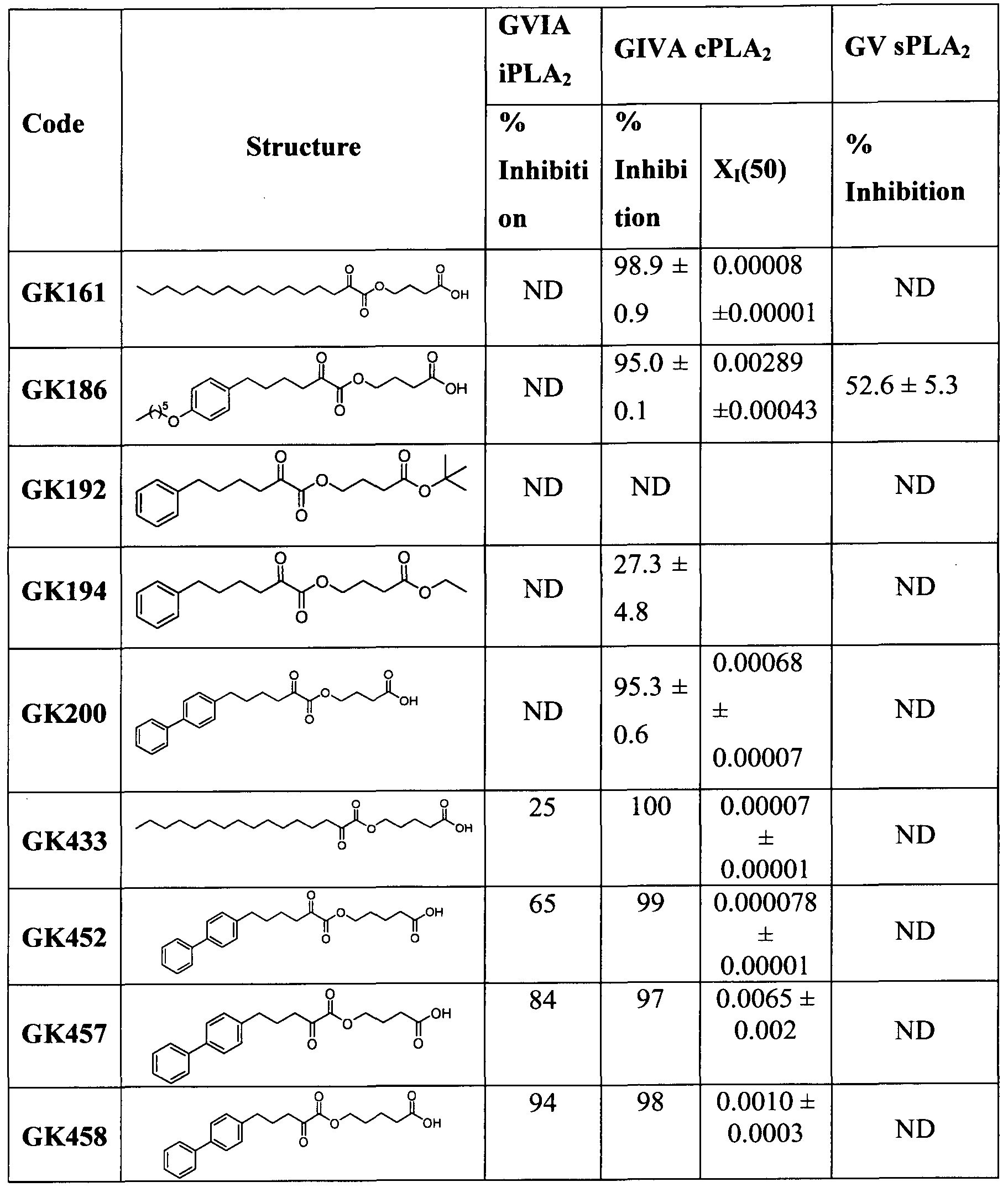
As indicated in table 1 , GK161 , 186, 200, 433, 452 are the most potent compounds in this series.
Although the present invention has been described hereinabove by way of specific embodiments thereof, it can be modified, without departing from the spirit and nature of the subject invention as defined in the appended claims.
Claims
1. A compound of formula I
 wherein:
R1 is optionally substituted alkyl, optionally substituted alkenyl; optionally substituted alkynyl, optionally substituted C6-12 monocyclic or bicyclic hydrocarbon ring wherein at least one ring is aromatic; or optionally substituted heteroaryl, or additionally aryl optionally substituted with an O- alkyl having 1-8 carbon atoms,
R is H, F, or optionally substituted alkyl, or optionally substituted C6-12 monocyclic or bicyclic hydrocarbon ring wherein at least one ring is aromatic;
R3, R4, R5 is independently selected from H, optionally substituted alkyl,optionally substituted alkenyl, optionally substituted alkynyl, optionally substituted C6-i2 monocyclic or bicyclic ring wherein at least one ring is aromatic, preferably two of R3, R4, R5 are hydrogen atoms; m = 0, 1 or 2; n = 1-14, preferably 1-8;
or esters of compounds of formula I with a lower alkoxy, or isomers, enantiomeric forms, pharmacologically acceptable salts, or prodrugs thereof.
2. A compound according to claim 1 wherein R1 is alkyl, alkenyl, alkynyl, or a C6-i2 monocyclic or bicyclic hydrocarbon ring wherein at least one ring is aromatic optionally substituted with an O-alkyl having 1-8 carbon atoms; R2 is H or F; R3, R4, R5 is independently selected from H, alkyl, alkenyl, alkynyl, preferably two of R3, R4, R5 are hydrogen atoms; m = 0, 1 or 2; and n = 1-14, preferably 1-8.
3. A compound of formula I as claimed in claim 1 , wherein said compound is:

or a salt thereof.
4. A compound of formula I as claimed in claim 1, wherein said compound is:

5. A pharmaceutical composition comprising a compound according to any of claims 1 to 4 and a pharmaceutically acceptable carrier or excipient.
6. A compound of formula I according to any of claims 1 to 4 for use as a medicament.
7. A compound of formula I as claimed in claim 6 for use in inhibiting phospholipase A2 (PLA2) activity in a biological system.
8. A compound of formula I as claimed in claims 6 or 7 for use in the prevention or treatment of an inflammatory disease or condition in a subject.
9. A compound as claimed in claim 8, wherein said inflammatory disease or condition is associated with phospholipase A2 (PLA2) activity.
10. A compound as claimed in claim 8 or 9, wherein said inflammatory disease or condition is cancer.
11. A compound of formula I according to any of claims 1 to 4 for use in the prevention or treatment of a neural disease or condition in a subject.
12. A compound as claimed in claim 1 1 , wherein said neural disease or condition is associated with phospholipase A2 (PLA2) activity.
13. A process for the preparation of a compound of formula I, as defined in claim 1 , comprising:
(a) reacting a 2-hydroxyacid compound of formula (II) with protected bromo or iodo ester III) to provide a 2-hydroxyester compound of formula (IV),


wherein R1, R2, R3, R4, R5 and m, n are defined in claim 1
(b) oxidizing the compound of formula (IV) obtained by step (a) to provide a compound of formula (V);

(c) hydrolyzing the 2-oxoester compound of formula (V) obtained by step (b) to obtain the carboxylic acid compound of formula I; and
(d) optionally, converting the carboxylic acid compound of formula I into an ester with lower alkoxy groups or isomers, enantiomeric forms, pharmaceutically acceptable salts, or prodrug thereof.
14. A process according to claim 13, wherein the reaction in step (a) is carried out in the presence of Cs2C03.
15. A process according to claim 13, wherein the reaction in step (b) is carried out in the presence of Dess-Martin periodinane.
16. A process according to claim 13, wherein the reaction in step (c) is carried out in the presence of CF3COOH.
17. A compound according to claim 1, wherein said compound is 4-[(2- oxohexadecanoyl)oxy]butanoic acid.
18. A compound according to claim 1, wherein said compound is 5-[(2- oxohexadecanoyl)oxy]pentanoic acid.
19. A compound according to claim 1, wherein said compound is 4-{[6-(4- hexyloxy)phenyl-2-oxohexanoyl] oxy} butanoic acid.
20. A compound according to claim 1, wherein said compound is 4-{[6-(1,Γ- biphenyl-4-yl)-2-oxohexanoyl]oxy} butanoic acid.
21. A compound according to claim 1, wherein said compound is 5-{[6-(1, - biphenyl-4-yl)-2-oxohexanoyl]oxy}pentanoic acid.
Applications Claiming Priority (2)
| Application Number | Priority Date | Filing Date | Title |
|---|---|---|---|
| EPPCT/EP2015/000267 | 2015-02-09 | ||
| EP2015000267 | 2015-02-09 |
Publications (1)
| Publication Number | Publication Date |
|---|---|
| WO2016128132A1 true WO2016128132A1 (en) | 2016-08-18 |
Family
ID=55442753
Family Applications (1)
| Application Number | Title | Priority Date | Filing Date |
|---|---|---|---|
| PCT/EP2016/000217 Ceased WO2016128132A1 (en) | 2015-02-09 | 2016-02-09 | 2-oxoester compounds and uses thereof |
Country Status (1)
| Country | Link |
|---|---|
| WO (1) | WO2016128132A1 (en) |
Citations (1)
| Publication number | Priority date | Publication date | Assignee | Title |
|---|---|---|---|---|
| WO2007022443A2 (en) * | 2005-08-17 | 2007-02-22 | The Regents Of The University Of California | Systemic and intrathecal effects of a novel series of phospholipase a2 inhibitors on hyperalgesia and spinal pge2 release |
-
2016
- 2016-02-09 WO PCT/EP2016/000217 patent/WO2016128132A1/en not_active Ceased
Patent Citations (1)
| Publication number | Priority date | Publication date | Assignee | Title |
|---|---|---|---|---|
| WO2007022443A2 (en) * | 2005-08-17 | 2007-02-22 | The Regents Of The University Of California | Systemic and intrathecal effects of a novel series of phospholipase a2 inhibitors on hyperalgesia and spinal pge2 release |
Non-Patent Citations (12)
| Title |
|---|
| ALFONSO R. GENNARO: "Remington: The Science and Practice of Pharmacy", 2003, MACK PUBLISHING COMPANY |
| CHEM, REV., vol. 111, 2011, pages 6130 - 6185 |
| CHERN. REV., vol. 111, 2011, pages 6130 - 6185 |
| D. A. SIX ET AL., J. MED. CHEM., vol. 50, 2007, pages 4222 - 4235 |
| D. STEPHENS, J. MED CHEM., vol. 49, 2006, pages 2821 - 2828 |
| E. A. DENNIS; G, KOKOTOS ET AL.: "Phospholipase A enzymes: Physical structure, biological function, disease implication, chemical inhibition, and therapeutic intervention", CHEM. REV., vol. 111, 2011, pages 6130 - 6185 |
| G. KOKOTOS ET AL., J. MED. CHEM., vol. 57, 2014, pages 7523 - 7535 |
| G. KOKOTOS, J. MED. CHEM., vol. 47, 2004, pages 3615 - 3628 |
| L ULLER ET AL: "Atmospheric Chemistry and Physics Unambiguous identification of esters as oligomers in secondary organic aerosol formed from cyclohexene and cyclohexene/[alpha]-pinene ozonolysis", ATMOS. CHEM. PHYS, 2008, pages 1423 - 1433, XP055274412, Retrieved from the Internet <URL:http://www.atmos-chem-phys.net/8/1423/2008/acp-8-1423-2008.pdf> * |
| T. TOMOO ET AL., J. MED. CHEM., vol. 57, 2014, pages 7244 - 7262 |
| V, MAGRIOTI; G. KOKOTOS, EXPERT OPINION THERAPEUTIC PATENTS, vol. 23, 2013, pages 333 - 344 |
| V. MAGRIOTI; G. KOKOTOS, EXPERT OPINION THERAPEUTIC PATENTS, vol. 20, 2010, pages 1 - 18 |
Similar Documents
| Publication | Publication Date | Title |
|---|---|---|
| US11420934B2 (en) | PPAR agonists | |
| JP6898961B2 (en) | Substituted diaminocarboxamide and diaminocarboxamide pyrimidines, compositions thereof, and therapeutic methods using them. | |
| US11130779B2 (en) | PPAR agonists and methods of use thereof | |
| KR101783817B1 (en) | Polyunsaturated fatty acids for the treatment of diseases related to cardiovascular, metabolic and inflammatory disease areas | |
| RU2532546C2 (en) | Oxidised lipid compounds and their application | |
| AU2017361253A1 (en) | MAGL inhibitors | |
| ES2684995T3 (en) | 2- (1- (1- (6 - ((cyclohexyl) oxy) -5- (trifluoromethyl) naphthalen-2-yl) ethyl) piperidin-3-yl) acetic acid derivatives as autotaxin (atx) modulators for the treatment of inflammations and autoimmune disorders | |
| EA038090B1 (en) | Magl inhibitors | |
| JP5575651B2 (en) | Novel DHA derivatives and their use as pharmaceuticals | |
| KR20160093710A (en) | S1p3 antagonists | |
| JP6496728B2 (en) | Phenyl carbamate derivatives as modulators of formyl peptide receptors | |
| CA2726666C (en) | Derivatives of 2-oxo-alkyl-1-piperazin-2-one, preparation method thereof and therapeutic use of same | |
| JOP20230072A1 (en) | Preparation of benzimidazolone derivatives as novel O-acylglycerol O-acyltransferase 2 inhibitors | |
| CN111253412A (en) | α -mangostin derivative and application thereof | |
| WO2016128132A1 (en) | 2-oxoester compounds and uses thereof | |
| RU2713886C2 (en) | Compositions and methods of treating diseases and conditions | |
| EA017306B1 (en) | Selective tr-beta 1 agonist | |
| WO2016184561A1 (en) | Autotaxin inhibitors and uses thereof | |
| JP2008239546A (en) | Amino alcohol derivatives and immunosuppressants containing them as active ingredients | |
| JP2023539291A (en) | Phenylalkyl carbamate compounds for the prevention or treatment of neurodegenerative diseases | |
| EP3751002A1 (en) | Novel compound for preventing or treating neurodegenerative disease and application thereof | |
| CA3228721A1 (en) | Inhibitors of 12/15-lipoxygenase | |
| WO2025219431A1 (en) | Prenylated tetrahydroquinolines and quinolines with ppar agonist activity | |
| WO2010049946A2 (en) | Thyroid receptor ligands | |
| HK1173339A1 (en) | Spirolactam derivatives and uses of same |
Legal Events
| Date | Code | Title | Description |
|---|---|---|---|
| 121 | Ep: the epo has been informed by wipo that ep was designated in this application |
Ref document number: 16706520 Country of ref document: EP Kind code of ref document: A1 |
|
| NENP | Non-entry into the national phase |
Ref country code: DE |
|
| 122 | Ep: pct application non-entry in european phase |
Ref document number: 16706520 Country of ref document: EP Kind code of ref document: A1 |