WO2016123250A1 - Zinc complexes of hydrazones and (thio)semicarbazones and their use for the treatment of cancer - Google Patents
Zinc complexes of hydrazones and (thio)semicarbazones and their use for the treatment of cancer Download PDFInfo
- Publication number
- WO2016123250A1 WO2016123250A1 PCT/US2016/015190 US2016015190W WO2016123250A1 WO 2016123250 A1 WO2016123250 A1 WO 2016123250A1 US 2016015190 W US2016015190 W US 2016015190W WO 2016123250 A1 WO2016123250 A1 WO 2016123250A1
- Authority
- WO
- WIPO (PCT)
- Prior art keywords
- cycloalkyl
- independently selected
- alkyl
- alkynyl
- alkenyl
- Prior art date
- Legal status (The legal status is an assumption and is not a legal conclusion. Google has not performed a legal analysis and makes no representation as to the accuracy of the status listed.)
- Ceased
Links
- 0 *c1nccc2ccccc12 Chemical compound *c1nccc2ccccc12 0.000 description 23
- SGLILPLVIPBGLY-KEBDBYFISA-N C/C(/c1nc(cccc2)c2[nH]1)=N\Nc1nc(cccc2)c2[s]1 Chemical compound C/C(/c1nc(cccc2)c2[nH]1)=N\Nc1nc(cccc2)c2[s]1 SGLILPLVIPBGLY-KEBDBYFISA-N 0.000 description 1
- WUTUVDYXAUYFFK-ARJAWSKDSA-N C=C/N=C(\C=C/N)/N Chemical compound C=C/N=C(\C=C/N)/N WUTUVDYXAUYFFK-ARJAWSKDSA-N 0.000 description 1
- QKMFRJKHSSUOMJ-UHFFFAOYSA-N CC(CNC)c1n[n]ccc1 Chemical compound CC(CNC)c1n[n]ccc1 QKMFRJKHSSUOMJ-UHFFFAOYSA-N 0.000 description 1
- SDADVYDRJRKLKY-UHFFFAOYSA-N CC1C=C2N=CNC2=CC=C1 Chemical compound CC1C=C2N=CNC2=CC=C1 SDADVYDRJRKLKY-UHFFFAOYSA-N 0.000 description 1
- DFDIROLDLLFVOE-UHFFFAOYSA-N CNCc1ncncc1 Chemical compound CNCc1ncncc1 DFDIROLDLLFVOE-UHFFFAOYSA-N 0.000 description 1
- BQNXHDSGGRTFNX-UHFFFAOYSA-N CNc1ncccn1 Chemical compound CNc1ncccn1 BQNXHDSGGRTFNX-UHFFFAOYSA-N 0.000 description 1
- LXBGSDVWAMZHDD-UHFFFAOYSA-N Cc1ncc[nH]1 Chemical compound Cc1ncc[nH]1 LXBGSDVWAMZHDD-UHFFFAOYSA-N 0.000 description 1
- ZCHCHJQEWYIJDQ-UHFFFAOYSA-N Cc1ncc[o]1 Chemical compound Cc1ncc[o]1 ZCHCHJQEWYIJDQ-UHFFFAOYSA-N 0.000 description 1
- LNJMHEJAYSYZKK-UHFFFAOYSA-N Cc1ncccn1 Chemical compound Cc1ncccn1 LNJMHEJAYSYZKK-UHFFFAOYSA-N 0.000 description 1
- ICSNLGPSRYBMBD-UHFFFAOYSA-N Nc1ncccc1 Chemical compound Nc1ncccc1 ICSNLGPSRYBMBD-UHFFFAOYSA-N 0.000 description 1
- SMWDFEZZVXVKRB-UHFFFAOYSA-N c1ccc2ncccc2c1 Chemical compound c1ccc2ncccc2c1 SMWDFEZZVXVKRB-UHFFFAOYSA-N 0.000 description 1
- IOJUPLGTWVMSFF-UHFFFAOYSA-N c1nc(cccc2)c2[s]1 Chemical compound c1nc(cccc2)c2[s]1 IOJUPLGTWVMSFF-UHFFFAOYSA-N 0.000 description 1
Classifications
-
- A—HUMAN NECESSITIES
- A61—MEDICAL OR VETERINARY SCIENCE; HYGIENE
- A61K—PREPARATIONS FOR MEDICAL, DENTAL OR TOILETRY PURPOSES
- A61K31/00—Medicinal preparations containing organic active ingredients
- A61K31/28—Compounds containing heavy metals
- A61K31/315—Zinc compounds
-
- A—HUMAN NECESSITIES
- A61—MEDICAL OR VETERINARY SCIENCE; HYGIENE
- A61K—PREPARATIONS FOR MEDICAL, DENTAL OR TOILETRY PURPOSES
- A61K31/00—Medicinal preparations containing organic active ingredients
- A61K31/33—Heterocyclic compounds
- A61K31/395—Heterocyclic compounds having nitrogen as a ring hetero atom, e.g. guanethidine or rifamycins
- A61K31/435—Heterocyclic compounds having nitrogen as a ring hetero atom, e.g. guanethidine or rifamycins having six-membered rings with one nitrogen as the only ring hetero atom
- A61K31/44—Non condensed pyridines; Hydrogenated derivatives thereof
- A61K31/4427—Non condensed pyridines; Hydrogenated derivatives thereof containing further heterocyclic ring systems
- A61K31/443—Non condensed pyridines; Hydrogenated derivatives thereof containing further heterocyclic ring systems containing a five-membered ring with oxygen as a ring hetero atom
-
- A—HUMAN NECESSITIES
- A61—MEDICAL OR VETERINARY SCIENCE; HYGIENE
- A61K—PREPARATIONS FOR MEDICAL, DENTAL OR TOILETRY PURPOSES
- A61K31/00—Medicinal preparations containing organic active ingredients
- A61K31/33—Heterocyclic compounds
- A61K31/395—Heterocyclic compounds having nitrogen as a ring hetero atom, e.g. guanethidine or rifamycins
- A61K31/435—Heterocyclic compounds having nitrogen as a ring hetero atom, e.g. guanethidine or rifamycins having six-membered rings with one nitrogen as the only ring hetero atom
- A61K31/44—Non condensed pyridines; Hydrogenated derivatives thereof
- A61K31/4427—Non condensed pyridines; Hydrogenated derivatives thereof containing further heterocyclic ring systems
- A61K31/4436—Non condensed pyridines; Hydrogenated derivatives thereof containing further heterocyclic ring systems containing a heterocyclic ring having sulfur as a ring hetero atom
-
- A—HUMAN NECESSITIES
- A61—MEDICAL OR VETERINARY SCIENCE; HYGIENE
- A61K—PREPARATIONS FOR MEDICAL, DENTAL OR TOILETRY PURPOSES
- A61K31/00—Medicinal preparations containing organic active ingredients
- A61K31/33—Heterocyclic compounds
- A61K31/395—Heterocyclic compounds having nitrogen as a ring hetero atom, e.g. guanethidine or rifamycins
- A61K31/435—Heterocyclic compounds having nitrogen as a ring hetero atom, e.g. guanethidine or rifamycins having six-membered rings with one nitrogen as the only ring hetero atom
- A61K31/44—Non condensed pyridines; Hydrogenated derivatives thereof
- A61K31/4427—Non condensed pyridines; Hydrogenated derivatives thereof containing further heterocyclic ring systems
- A61K31/4439—Non condensed pyridines; Hydrogenated derivatives thereof containing further heterocyclic ring systems containing a five-membered ring with nitrogen as a ring hetero atom, e.g. omeprazole
-
- A—HUMAN NECESSITIES
- A61—MEDICAL OR VETERINARY SCIENCE; HYGIENE
- A61P—SPECIFIC THERAPEUTIC ACTIVITY OF CHEMICAL COMPOUNDS OR MEDICINAL PREPARATIONS
- A61P35/00—Antineoplastic agents
-
- C—CHEMISTRY; METALLURGY
- C07—ORGANIC CHEMISTRY
- C07D—HETEROCYCLIC COMPOUNDS
- C07D277/00—Heterocyclic compounds containing 1,3-thiazole or hydrogenated 1,3-thiazole rings
- C07D277/60—Heterocyclic compounds containing 1,3-thiazole or hydrogenated 1,3-thiazole rings condensed with carbocyclic rings or ring systems
- C07D277/62—Benzothiazoles
- C07D277/68—Benzothiazoles with hetero atoms or with carbon atoms having three bonds to hetero atoms with at the most one bond to halogen, e.g. ester or nitrile radicals, directly attached in position 2
- C07D277/82—Nitrogen atoms
-
- C—CHEMISTRY; METALLURGY
- C07—ORGANIC CHEMISTRY
- C07D—HETEROCYCLIC COMPOUNDS
- C07D401/00—Heterocyclic compounds containing two or more hetero rings, having nitrogen atoms as the only ring hetero atoms, at least one ring being a six-membered ring with only one nitrogen atom
- C07D401/02—Heterocyclic compounds containing two or more hetero rings, having nitrogen atoms as the only ring hetero atoms, at least one ring being a six-membered ring with only one nitrogen atom containing two hetero rings
- C07D401/12—Heterocyclic compounds containing two or more hetero rings, having nitrogen atoms as the only ring hetero atoms, at least one ring being a six-membered ring with only one nitrogen atom containing two hetero rings linked by a chain containing hetero atoms as chain links
-
- C—CHEMISTRY; METALLURGY
- C07—ORGANIC CHEMISTRY
- C07D—HETEROCYCLIC COMPOUNDS
- C07D403/00—Heterocyclic compounds containing two or more hetero rings, having nitrogen atoms as the only ring hetero atoms, not provided for by group C07D401/00
- C07D403/02—Heterocyclic compounds containing two or more hetero rings, having nitrogen atoms as the only ring hetero atoms, not provided for by group C07D401/00 containing two hetero rings
- C07D403/12—Heterocyclic compounds containing two or more hetero rings, having nitrogen atoms as the only ring hetero atoms, not provided for by group C07D401/00 containing two hetero rings linked by a chain containing hetero atoms as chain links
-
- C—CHEMISTRY; METALLURGY
- C07—ORGANIC CHEMISTRY
- C07D—HETEROCYCLIC COMPOUNDS
- C07D413/00—Heterocyclic compounds containing two or more hetero rings, at least one ring having nitrogen and oxygen atoms as the only ring hetero atoms
- C07D413/02—Heterocyclic compounds containing two or more hetero rings, at least one ring having nitrogen and oxygen atoms as the only ring hetero atoms containing two hetero rings
- C07D413/12—Heterocyclic compounds containing two or more hetero rings, at least one ring having nitrogen and oxygen atoms as the only ring hetero atoms containing two hetero rings linked by a chain containing hetero atoms as chain links
-
- C—CHEMISTRY; METALLURGY
- C07—ORGANIC CHEMISTRY
- C07D—HETEROCYCLIC COMPOUNDS
- C07D417/00—Heterocyclic compounds containing two or more hetero rings, at least one ring having nitrogen and sulfur atoms as the only ring hetero atoms, not provided for by group C07D415/00
- C07D417/02—Heterocyclic compounds containing two or more hetero rings, at least one ring having nitrogen and sulfur atoms as the only ring hetero atoms, not provided for by group C07D415/00 containing two hetero rings
- C07D417/12—Heterocyclic compounds containing two or more hetero rings, at least one ring having nitrogen and sulfur atoms as the only ring hetero atoms, not provided for by group C07D415/00 containing two hetero rings linked by a chain containing hetero atoms as chain links
Definitions
- TP53 is the most commonly mutated gene in human cancer for which no effective targeted anti-cancer drug exists.
- the majority of TP53 mutations (>70%) are mis-sense mutations that generate a defective protein that is generally found at high levels in cancer cells due to loss of MDM2 negative feedback.
- Restoring the function of p53 in mouse models of cancer is highly therapeutic. Reactivating mutant p53 using small molecules has been highly sought after, yet remains an elusive goal in the development of cancer therapeutics.
- This invention provides novel complexes, kits, and methods directed toward refolding TP53 mutant proteins into their wild-type conformations by treatment with zinc(II)metallo- chaperone complexes.
- one aspect of the present invention provides a complex comprising Zn 2+ and a compound of formula (la) or (lla):
- the ring A is a fused benzo or heteroaryl ring
- R is optionally substituted with one or more groups independently selected from halo, cyano, hydroxy, nitro, -N(R a ) 2 , carboxy, phenyl, (Ci-C 6 )alkyl, (C 2 -C 6 )alkenyl, (C 2 - C 6 )alkynyl, (C 3 -C 6 )cycloalkyl, (C r C 6 )alkoxy, (Ci-C 6 )alkanoyl, (Ci-C 6 )alkoxycarbonyl, (C 2 - C 6 )alkanoyloxy, (C 4 -C 6 )heterocycloalkyl, (C2-C6)alkylaminocarbonyl and (C 2 - C 6 )alkanoylamino wherein any phenyl, (CrC ⁇ alkyl, (C 2 -C 6 )alkenyl, (C 2 -C 6 )alkynyl
- R 2 is selected from the group consisting of H, phenyl, heteroaryl, (C 1 -C 6 )alkyl, (C 2 - C 6 )alkenyl, (C 2 -C 6 )alkynyl, and (C3-Cg)cycloalkyl, wherein any phenyl, heteroaryl, (Ci- C 6 )alkyl, (C 2 -C 6 )alkenyl, (C 2 -C 6 )alkynyl, (C3-C 6 )cycloalkyl and C 4 -C 6 heterocycloalkyl, is optionally substituted with one or more groups independently selected from halo, -N(R b ) 2 , (C3-C6)cycloalkyl, (Ci-C ⁇ alkoxy, (C2-C 6 )alkanoyloxy, (C 2 -C 6 )alkoxycarbonyl, (C 2 -C 6 ) alkylaminocarbony
- R 3 and R 4 are each independently selected from H, (Ci-C 6 )alkyl, piperidinyl, or piperazinyl, which piperidinyl or piperazinyl is optionally substituted with pyridyl; or R 3 and each R 4 taken together with the nitrogen to which they are attached form a 3, 4, 5, 6, 7, 8, or 9 membered ring that is optionally substituted with one or more groups independently selected from the group consisting of halo; Y is S, O, or Se;
- each R a is independently selected from the group consisting of H, (Ci -C 6 )alkyl, (C 2 - C 6 )alkenyl, (C 2 -C 6 )alkynyl, (C3-C 6 )cycloalkyl, (Ci-C 6 )alkanoyl, and (Ci-C 6 )alkoxycarbonyl, wherein any (Ci-C 6 )alkyl, (C 2 -C 6 )alkenyl, (C 2 -C 6 )alkynyl, (C 3 -C 6 )cycloalkyl, (C r
- alkylaminocarbonyl, and (C 2 -C 6 ) alkanoylamino is optionally substituted with one or more groups independently selected from halo, (C3-C 6 )cycloalkyl, and (CrC 6 )alkoxy; or two R a taken together with the nitrogen to which they are attached form a azetidino, pyrrolidino, piperidino, or morpholino ring;
- each R 3 ⁇ 4 is independently selected from the group consisting of H, (Ci-C 6 )alkyl, (C 2 - C 6 )alkenyl, (C2-C 6 )alkynyl, (C3-C 6 )cycloalkyl, (C
- alkylaminocarbonyl, and (C2-C 6 ) alkanoylamino is optionally substituted with one or more groups independently selected from halo, (C 3 -C 6 )cycloalkyl, and (Ci-C 6 )alkoxy; or two R b taken together with the nitrogen to which they are attached form a azetidino, pyrrolidino, piperidino, or morpholino ring;
- R c is independently selected from the group consisting of H and (Ci-C 6 )alkyl that is optionally substituted with one or more groups independently selected from halo, (C 3 - C6)cycloalkyl, and (Ci-C 6 )alkoxy;
- HET is selected from the group consisting of:
- HET is optionally substituted with one or more (e.g. 1, 2, 3, or 4) groups independently selected from halo, cyano, hydroxy, nitro, -N(R aa ) 2 , carboxy, phenyl, (d- C 6 )alkyl, (C 2 -C 6 )alkenyl, (C 2 -C 6 )alkynyl, (C 3 -C 6 )cycloalkyl, (C C 6 )alkoxy, (Ci-C 6 )alkanoyl, (C I -C 6 )alkoxycarbonyl, (C2-C 6 )alkanoyloxy,
- groups independently selected from halo, cyano, hydroxy, nitro, -N(R aa ) 2 , carboxy, phenyl, (d- C 6 )alkyl, (C 2 -C 6 )alkenyl, (C 2 -C 6 )alkynyl, (C 3
- any phenyl, (Ci-C 6 )alkyl, (CrC6)alkoxy, (C 2 -C6)alkenyl, (C2-C 6 )alkynyl, and (C 3 - C 6 )cycloalkyl is optionally substituted with one or more groups independently selected from halo, azido, cyano, hydroxy, nitro, -N(R ba ) 2 , carboxy, (C 3 -C 6 )cycloalkyl, (Ci-C 6 )alkanoyL (Ci-C6)alkoxycarbonyl, (C 2 -C 6 )alkanoyloxy, and (C 1 -C 6 )alkoxy that is optionally substituted with carboxy;
- each R 2a is independently selected from the group consisting of H, phenyl, (Ci- C 6 )alkyl, (C 2 -C 6 )alkenyl, (C 2 -C6)alkynyl, and (C 3 -C 6 )cycloalkyl, wherein any phenyl, (Ci- C6)alkyl, (C 2 -C 6 )alkenyl, (C 2 -C 6 )alkynyl, and (C 3 -C 6 )cycloalkyl, is optionally substituted with one or more groups independently selected from halo, -N(R ca ) 2 , (C3-C6)cycloalkyl, (Ci- C 6 )alkoxy, and (C2-C 6 )alkanoyloxy;
- n 0, 1 , 2, 3, or 4;
- each R 3a is independently selected from halo, cyano, hydroxy, nitro, -N(R da ) 2 , carboxy, phenyl, (C,-C 6 )alkyl, (C 2 -C 6 )alkenyl, (C 2 -C 6 )alkynyl, (C 3 -C 6 )cycloalkyl, (C 1 -C 6 )alkoxy, (C r C 6 )alkanoyl, (Ci-C 6 )alkoxycarbonyl, and (C 2 -C 6 )alkanoyloxy, wherein any phenyl, (Ci- C 6 )alkyl, (C 2 -C 6 )alkenyl, (C2-C 6 )alkynyl, (Ci-C 6 )alkoxy, and (C3-C 6 )cycloalkyl, is optionally substituted with one or more groups independently selected from halo, cyano, hydroxy,
- R 33 is selected from the group consisting of H, (Ci-C 6 )alkyl, (C 2 -C 6 )alkenyl, (C 2 - C 6 )alkynyl, (C 3 -C6)cycloalkyl, (Ci-C 6 )alkanoyl, and (Ci-C 6 )alkoxycarbonyl, wherein any (C C 6 )alkyl, (C 2 -C 6 )alkenyl, (C 2 -C 6 )alkynyl, (C 3 -C 6 )cycloalkyl, (C C 6 )alkanoyl, and (CrC 6 )alkoxycarbonyl, is optionally substituted with one or more groups independently selected from halo, (C 3 -C6)cycloalkyl, -NtR ⁇ , morpholino, and (Ci-C 6 )alkoxy; or two R 3 taken together with the nitrogen to which they are attached form a a
- each R ba is independently selected from the group consisting of H, (Ci-C 6 )alkyl, (C 2 - C 6 )alkenyl, (C 2 -C 6 )alkynyl, (C 3 -C6)cycloalkyl, (Ci-C6.)alkanoyI, and (CrC6)alkoxycarbonyl 5 wherein any (Ci-C 6 )alkyl, (C 2 -C 6 )alkenyl, (C 2 -C 6 )alkynyl, (C 3 -C 6 )cycloalkyl, (C C 6 )alkanoyl, and (Ci-CeJalkoxycarbonyl, is optionally substituted with one or more groups independently selected from halo, (C 3 -C6)cycloalkyl, heteroaryl, and (Ci-C6)alkoxy; or two R ba taken together with the nitrogen to which they are attached form a azetidino, pyrrol
- each R ca is independently selected from the group consisting of H, (Ci-C 6 )alkyl, (C 2 - C 6 )alkenyl, (C 2 -C 6 )alkynyl, (C 3 -C6)cycloalkyl, (C
- C 6 )alkanoyl, and (C 1 -C 6 )alkoxycarbonyl is optionally substituted with one or more groups independently selected from halo, (C3-C 6 )cycloalkyl, and (Ci-C 6 )alkoxy; or two R ca taken together with the nitrogen to which they are attached form a azetidino, pyrrolidino, piperidino, or morpholino ring;
- each R da is independently selected from the group consisting of H, (C C 6 )alk l, (C 2 - C6)alkenyl, (C 2 -C6)alkynyl, (C3-C 6 )cycloalkyl, (Ci-C 6 )alkanoyl, and (Ci-C 6 )alkoxycarbonyl, wherein any (CrC ⁇ alkyl, (C 2 -C 6 )alkenyl, (C 2 -C 6 )alkynyl, (C 3 -C 6 )cycloalkyl, (C
- C 6 )alkanoyl, and (C 1 -C6)alkoxycarbonyl is optionally substituted with one or more groups independently selected from halo, (C 3 -C 6 )cycloalkyl, and (C 1 -C 6 )alkoxy; or two R da taken together with the nitrogen to which they are attached form a azetidino, pyrrolidino, piperidino, or morpholino ring; or a solvate thereof;
- R ea is independently selected from the group consisting of H and (Ci-C 6 )alkyl that is optionally substituted with one or more groups independently selected from halo, (C 3 - C 6 )cycloalkyl, -N(R fa ) 2; and (C 1 -C 6 )alkoxy;
- each R fa is independently selected from the group consisting of H, (Q-Ceialkyl, (C 2 - C6)alkenyl, (C 2 -C 6 )alkynyl, (C3-C6)cycloalkyl, (C 1 -C6)alkanoyl, and (Ci-Cs)alkoxycarbonyl, wherein any (d-C 6 )alkyl, (C 2 -C 6 )alkenyl, (C 2 -C 6 )alkynyl, (C 3 -C 6 )cycloalkyl, (C
- C 6 )alkanoyl, and (C 1 -C 6 )alkoxycarbonyl is optionally substituted with one or more groups independently selected from halo, (C3-C6)cycloalkyl, and (Ci-C 6 )alkoxy; or two R a taken together with the nitrogen to which they are attached form a azetidino, pyrrolidino, piperidino, or morpholino ring; and
- each R ga is independently selected from the group consisting of H, (C 1 -C 6 )alkyl, (C 2 - C 6 )alkenyl, (C 2 -C 6 )alkynyl, (C 3 -C 6 )cycloalkyl, (Ci-C6)alkanoyl, and (Ci-C 6 )alkoxycarbonyl, wherein any (Ci-C 6 )alkyl, (C 2 -C 6 )alkenyl, (C 2 -C 6 )alkynyl, (C 3 -C 6 )cycloalkyl, (C r C6)alkanoyl, and (Cj-C6)alkoxycarbonyl 5 is optionally substituted with one or more groups independently selected from halo, (C3-C 6 )cycloaIkyl, and (Ci-C 6 )alkoxy; or two R ga taken together with the nitrogen to which they are attached form a azetidino,
- R 1 is 2-pyridinyl
- R 2 is not H or (C,-C 6 )alkyl
- Another aspect of the present invention provides a method of inhibiting cancer cell growth comprising administering to a human afflicted with cancer, an amount of a complex having a Zn 2+ ion.
- Another aspect of the present invention provides a method comprising:
- Another aspect of the present invention provides a method comprising: diffusing a charge neutral complex comprising a Zn ion across a plasma membrane of a cell under conditions where the Zn 2+ ion will bind to a native ligation site of a mutant p53 inside the cell.
- Another aspect of the present invention provides a method comprising: contacting a cell having a mutant p53 with a charge neutral complex comprising a Zn ion under conditions where the complex enters the cell and induces a wild-type conformation change in the mutant p53.
- Another aspect of the present invention provides a pharmaceutical composition
- a pharmaceutical composition comprising, in a pharmaceutically acceptable carrier, a compound to release zinc to p53.
- Another aspect of the present invention provides a method of inhibiting cancer cell growth, comprising administering to an animal (e.g. a human), an effective amount of a compound or complex as described herein.
- an animal e.g. a human
- Another aspect of the present invention provides a method of inhibiting cancer cell growth, comprising administering to a human in need thereof, an effective amount of a complex as described herein and further comprising administering to the human a zinc supplement.
- Another aspect of the present invention provides a method of inhibiting cancer cell growth comprising administering to a human afflicted with cancer, an amount of a neutral complex having a Zn 2+ ion, effective to inhibit growth of cancer cells in the human.
- Another aspect of the present invention provides a method comprising: binding a Zn ion to a monomer in a ratio of 2: 1 (monomenzinc) to form a complex outside a cell; diffusing the complex including the Zn 2+ ion across a plasma membrane of the cell; and binding the Zn 2+ ion to a native ligation site of a mutant p53 inside the cell.
- Another aspect of the present invention provides a method comprising: binding one or more zinc atoms in an extracellular environment of a cell having a mutant p53; and transporting the one or more zinc atoms into the cell to induce a wild-type conformation change in the mutant p53.
- the invention further includes methods of preparing, methods of separating, and methods of purifying of the complexes described herein.
- Figure 1 shows the X-ray structure of compound 18 [Zn(Cl) 2 ]; ORTEP drawing from X-ray crystallographic data.
- Figure 2 illustrates the potency of Zn (II) complex 18.
- halo is fluoro, chloro, bromo, or iodo.
- Alkyl, alkoxy, alkenyl, alkynyl, etc. denote both straight and branched groups; but reference to an individual radical such as propyl embraces only the straight chain radical, a branched chain isomer such as isopropyl being specifically referred to.
- benzyl refers to a substituent, molecular fragment, or radical having the chemical formula -CFbCgHs.
- butyl refers to a four-carbon alkyl radical, substituent, or molecular fragment having the chemical formula -C 4 H9.
- cyclopropyl refers to a radical, substituent, or molecular fragment having a chemical structure derived from cyclopropane and having the chemical formula C3H5.
- ethyl refers to an alkyl substituent, radical, or molecular fragment having the chemical formula -C2H5.
- isopropyl refers to a propyl with a group attached to the secondary carbon.
- methyl refers to an alkyl derived from methane and containing one carbon atom bonded to three hydrogen atoms and having the chemical formula -C3 ⁇ 4.
- propyl refers to a linear three-carbon alkyl substituent, molecular fragment, or radical having the chemical formula -C3H7.
- phenyl refers to a cyclic group of atoms, radical, substituent, or molecular fragment having the chemical formula -C 6 Hs.
- the atom to which the bond is attached includes all stereochemical possibilities.
- a bond in a compound formula herein is drawn in a defined stereochemical manner (e.g. bold, bold-wedge, dashed or dashed-wedge)
- a bond in a compound formula herein is drawn in a defined stereochemical manner (e.g. bold, bold-wedge, dashed or dashed-wedge)
- the atom to which the stereochemical bond is attached is enriched in the absolute stereoisomer depicted unless otherwise noted.
- the compound may be at least 51% the absolute stereoisomer depicted.
- the compound may be at least 60% the absolute stereoisomer depicted.
- the compound may be at least 80% the absolute stereoisomer depicted.
- the compound may be at least 90% the absolute stereoisomer depicted. In another embodiment, the compound may be at least 95 the absolute stereoisomer depicted. In another embodiment, the compound may be at least 99% the absolute stereoisomer depicted.
- (Ci-C 6 )alkyl can be methyl, ethyl, propyl, isopropyl, butyl, iso-butyl, sec-butyl, pentyl, 3-pentyI, or hexyl;
- (C3-C 6 )cycloalkyl can be cyclopropyl, cyclobutyl, cyclopentyl, or cyclohexyl;
- (C C6)alkoxy can be methoxy, ethoxy, propoxy, isopropoxy, butoxy, iso-butoxy, sec-butoxy, pentoxy, 3-pentoxy, or hexyloxy;
- (C2-C 6 )alkenyl can be vinyl, allyl, 1-propenyl, 2-propenyl, 1-butenyl, 2-butenyl, 3-butenyl, 1 ,-pentenyl, 2-pentenyl, 3- pentenyl, 4-pentenyl, 1- he
- butoxycarbonyl, pentoxycarbonyl, or hexyloxycarbonyl; and (C2-C 6 )alkanoyloxy can be acetoxy, propanoyloxy, butanoyloxy, isobutanoyloxy, pentanoyloxy, or hexanoyloxy.
- each HET is independently selected from the group consisting of: wherein HET is optionally substituted with one or more groups independently selected from halo, cyano, hydroxy, nitro, -N( a ) 2 , carboxy, phenyl, (Ci-C 6 )alkyl, (C 2 -C 6 )alkenyl, (C 2 - C 6 )alkynyl, (C3-C6)cycloalkyl, (C 1 -C 6 )alkoxy, (C
- HET is optionally substituted with one or more groups independently selected from (Cj-Ceialkyl and -N(R a ) 2 .
- R 2 is selected from the group consisting of H, methyl, ethyl, propyl, isopropyl, butyl, tert-butyl, allyl, cyclopropyl, phenyl, benzyl, CH 2 CH2OCH 3 ,
- R is selected from the group consisting of methyl, ethyl, isopropyl, and ter /-butyl.
- Z C1, NTA (Zn' -binding homolog), and A6 (structural homolog) to increase intracellular [Zn 2+ ] f r ee was evaluated by treating cells with the fluorescent Zn 2+ indicator FluoZin-3-AM (FZ3-AM) in complete media and imaging them using confocal microscopy.
- FZ3-AM fluorescent Zn 2+ indicator FluoZin-3-AM
- ZMC 1 increased intracellular [Zn 2+ ] f r ee as indicated by increased fluorescence, but NTA and A6 did not.
- This result is consistent with the metallochaperone (MC) model for ZMC1 function and explains the inability of NTA and A6 to reactivate p53-R175H at micromolar concentrations.
- NTA binds Zn with an affinity similar to that of ZMC 1 , but it cannot cross either liposomal or cellular membranes, likely because it possesses negative charges.
- FBS fetal bovine serum
- [Zn 2+ ] free gradient was reversed by adding a large excess of metal ion chelator EDTA to the solution outside of the liposomes; fluorescence was monitored in the presence and absence of ZMC 1.
- EDTA alone did not cause a significant decrease in RZ-3 fluorescence as the liposomal membranes are impermeable to EDTA.
- ZMCl there was a time dependent decrease in RZ-3 fluorescence. This result indicates that free ZMCl crossed the liposomal membranes, bound internal Zn 2+ , and transported it back outside the liposome where the metal was then bound by the much stronger chelator EDTA.
- ZMCl can cross biological membranes both as free drug and drug-Zn 2+ complex
- a liposomal leakage assay was performed using the self-quenching fluorophore calcein.
- calcein When calcein is encapsulated at concentrations above 4 mM its fluorescence is decreased via self-quenching. Leakage is detected by a fluorescence increase as the dye dilutes and its fluorescence dequenches. At the highest concentrations of ZMCl and ZnCl 2 a significant fluorescence increase was not detected. Disruption of liposomes can also be detected by alteration of their size distribution.
- ZMCl- mediated Zn 2+ transport was quantified in cells.
- the kinetics of intracellular [Zn 2+ ] f i. ee increase was measured by loading HEK293 and TOV112D cells with FZ3-AM, treating the cells with ZMCl and ZnCl 2 , and monitoring fluorescence by time-lapse microscopy.
- FBS complete media
- [Zn 2+ ] free rose to 18.1 ⁇ 4.7 nM for HE 293 cells and 15.8 ⁇ 2.5 nM for TOV1 12D cells. These concentrations are theoretically sufficient to reactivate ⁇ 90 % of p53-Rl 75H based on the K d i value of 2.1 nM measured for DBD-R175H.
- FZ3-AM, RZ-3 (K + salt), and cell culture media were purchased from Life
- DOPC was purchased from Avanti Polar Lipids.
- ZMC1 and A6 were similarly obtained.
- Zn 2+ (ZMC1) 2 was synthesized and crystallized.
- HEK293 and TOV 112D cells were purchased from ATCC and maintained in DMEM + GlutaMAX with 10% FBS and 1 mg/mL penicillin-streptomycin under a 5% C0 2 atmosphere at 37 ° C. All non-cell based experiments were conducted in 50 mM Tris pH 7.2, 0.1 M NaCl at 25 ° C.
- the size distribution of the liposomes was determined by dynamic light scattering (DLS) using a Malvern Zetasizer Nano ZS.
- J is the initial flux
- ⁇ / ⁇ is the slope of the fit line
- F max is RZ-3 fluorescence in the presence of saturating Zn 2+ and 1% TritonX-100
- F m i n is RZ-3 fluorescence in the presence of excess EDTA and 1 % TritonX-100
- [RZ3] is the concentration of encapsulated RZ-3
- SA/Vol is the surface area to volume ratio calculated assuming hollow spheres of the mean diameter determined by DLS.
- TOV112D or HEK293 cells (40,000 cells/well) were plated on either 8-well BD Falcon chambered culture slides (Corning Life Sciences) or 8-chambered #1.5 Nunc Lab-Tek II chambered coverglasses (Thermo Scientific) treated with poly-L-lysine. After 48 h, cells were washed 2 x 5 m in serum-free media and incubated with 1 ⁇ FZ3-AM for 40 m at 37 °C. Cells were then washed 2 x 5 m in either EBSS/H (-)Ca/Mg or phenol-red free DMEM + 10% FBS containing the indicated treatments for 20 m before imaging.
- Hoechst 33342 For nuclear colocalization, 1 ⁇ g/mL Hoechst 33342 was also included. Cells were imaged using a Zeiss LSM510 META NLO confocal microscope equipped with 37 ° C environmental control chamber. FZ3 and Hoechst 33342 were excited at 488 nm (argon laser) and 790 nm
- F, F max , and Fmi n are fluorescence in the treatment, PYR/ZnCl 2 , and TPEN images, respectively, and 3 ⁇ 4 is that of FZ3 for Zn 2+ (15 nM) (31 ).
- 3 ⁇ 4 is that of FZ3 for Zn 2+ (15 nM) (31 ).
- the number of cells analyzed in each trial ranged from 54-163.
- treated, PYR/ZnCl 2 , and TPEN treated images costained with Hoechst 33342 were aligned and each pixel subjected to Eqn. 2 in MATLAB (Math Works).
- the resultant images were Gaussian mean filtered and false- colored by calculated [Zn ] free - p53-R175H Immunofluorescence
- DMEM + 10% FBS was treated with 5 g Chelex 100 resin per 100 mL media for 1 hour with gentle shaking. The media was then decanted and filtered through 0.2 ⁇ sterile filter. TOV112D cells were then incubated with 1 ⁇ ZMC1 in untreated media, Chelex- treated media, or media + 10 ⁇ TPEN at 37 °C for 2 h, fixed, and stained with PAB240 and PAB1640.
Landscapes
- Chemical & Material Sciences (AREA)
- Organic Chemistry (AREA)
- Health & Medical Sciences (AREA)
- Public Health (AREA)
- Medicinal Chemistry (AREA)
- Veterinary Medicine (AREA)
- Pharmacology & Pharmacy (AREA)
- Life Sciences & Earth Sciences (AREA)
- Animal Behavior & Ethology (AREA)
- General Health & Medical Sciences (AREA)
- Epidemiology (AREA)
- Chemical Kinetics & Catalysis (AREA)
- Nuclear Medicine, Radiotherapy & Molecular Imaging (AREA)
- General Chemical & Material Sciences (AREA)
- Pharmaceuticals Containing Other Organic And Inorganic Compounds (AREA)
Abstract
The invention provides complexes of Zn2+ of formulae (la) and (IIa) that are useful for treating cancer, as well as compositions and kits comprising such complexes.
Description
ZINC COMPLEXES OF HYDRAZONES AND
(THIO)SEMICARBAZONES AND THEIR USE FOR THE
TREATMENT OF CANCER
CROSS-REFERENCE TO RELATED APPLICATIONS
This patent application claims the benefit of priority of U.S. application serial No. 62/108,415, filed January 27, 2015, and of U.S. application serial No. 62/258,261 , filed November 20, 2015, which applications are herein incorporated by reference.
BACKGROUND OF THE INVENTION
TP53 is the most commonly mutated gene in human cancer for which no effective targeted anti-cancer drug exists. The majority of TP53 mutations (>70%) are mis-sense mutations that generate a defective protein that is generally found at high levels in cancer cells due to loss of MDM2 negative feedback. Restoring the function of p53 in mouse models of cancer is highly therapeutic. Reactivating mutant p53 using small molecules has been highly sought after, yet remains an elusive goal in the development of cancer therapeutics.
SUMMARY OF THE INVENTION
This invention provides novel complexes, kits, and methods directed toward refolding TP53 mutant proteins into their wild-type conformations by treatment with zinc(II)metallo- chaperone complexes.
More specifically, one aspect of the present invention provides a complex comprising Zn2+ and a compound of formula (la) or (lla):

(la) (lla) or an ion or poly-ion thereof, wherein:
the ring A is a fused benzo or heteroaryl ring;

wherein R is optionally substituted with one or more groups independently selected from halo, cyano, hydroxy, nitro, -N(Ra)2, carboxy, phenyl, (Ci-C6)alkyl, (C2-C6)alkenyl, (C2- C6)alkynyl, (C3-C6)cycloalkyl, (CrC6)alkoxy, (Ci-C6)alkanoyl, (Ci-C6)alkoxycarbonyl, (C2- C6)alkanoyloxy, (C4-C6)heterocycloalkyl, (C2-C6)alkylaminocarbonyl and (C2- C6)alkanoylamino wherein any phenyl, (CrC^alkyl, (C2-C6)alkenyl, (C2-C6)alkynyl, and (C3-C6)cycloalkyl, is optionally substituted with one or more groups independently selected from halo, cyano, hydroxy, nitro, -N(Ra)2, carboxy, (C3-C6)cycloalkyl, (Q-Cejalkoxy, (Ci- C6)alkanoyl, (Ci-C6)alkoxycarbonyl, (C2-C6)alkanoyloxy, (C4-C6)heterocycloalkyl, (C2- C6)alkylaminocarbonyl and (C2-C6)alkanoylamino;
R2 is selected from the group consisting of H, phenyl, heteroaryl, (C1-C6)alkyl, (C2- C6)alkenyl, (C2-C6)alkynyl, and (C3-Cg)cycloalkyl, wherein any phenyl, heteroaryl, (Ci- C6)alkyl, (C2-C6)alkenyl, (C2-C6)alkynyl, (C3-C6)cycloalkyl and C4-C6 heterocycloalkyl, is optionally substituted with one or more groups independently selected from halo, -N(Rb)2, (C3-C6)cycloalkyl, (Ci-C^alkoxy, (C2-C6)alkanoyloxy, (C2-C6)alkoxycarbonyl, (C2-C6) alkylaminocarbonyl, and (C2-C6) alkanoylamino;
R3 and R4 are each independently selected from H, (Ci-C6)alkyl, piperidinyl, or piperazinyl, which piperidinyl or piperazinyl is optionally substituted with pyridyl; or R3 and each R4 taken together with the nitrogen to which they are attached form a 3, 4, 5, 6, 7, 8, or 9 membered ring that is optionally substituted with one or more groups independently selected from the group consisting of halo;
Y is S, O, or Se;
each Ra is independently selected from the group consisting of H, (Ci -C6)alkyl, (C2- C6)alkenyl, (C2-C6)alkynyl, (C3-C6)cycloalkyl, (Ci-C6)alkanoyl, and (Ci-C6)alkoxycarbonyl, wherein any (Ci-C6)alkyl, (C2-C6)alkenyl, (C2-C6)alkynyl, (C3-C6)cycloalkyl, (Cr
C6)alkanoyl, and (Ci-C6)alkoxycarbonyl, (C2-C6)alkoxycarbonyl, (C2-C6)
alkylaminocarbonyl, and (C2-C6) alkanoylamino is optionally substituted with one or more groups independently selected from halo, (C3-C6)cycloalkyl, and (CrC6)alkoxy; or two Ra taken together with the nitrogen to which they are attached form a azetidino, pyrrolidino, piperidino, or morpholino ring;
each R¾ is independently selected from the group consisting of H, (Ci-C6)alkyl, (C2- C6)alkenyl, (C2-C6)alkynyl, (C3-C6)cycloalkyl, (C |-C6)alkanoyl, and (C C6)alkoxycarbonyl, wherein any (C,-C6)alkyl, (C2-C6)alkenyl, (C2-C6)alkynyl, (C3-C6)cycloalkyl, (d- C6)alkanoy], and (Ci-C6)alkoxycarbonyl, (C2-C6)alkoxycarbonyl, (C2-C6)
alkylaminocarbonyl, and (C2-C6) alkanoylamino is optionally substituted with one or more groups independently selected from halo, (C3-C6)cycloalkyl, and (Ci-C6)alkoxy; or two Rb taken together with the nitrogen to which they are attached form a azetidino, pyrrolidino, piperidino, or morpholino ring;
Rc is independently selected from the group consisting of H and (Ci-C6)alkyl that is optionally substituted with one or more groups independently selected from halo, (C3- C6)cycloalkyl, and (Ci-C6)alkoxy;
X is S, O, -CH=CH-, or N-R38;
HET is selected from the group consisting of:


wherein any phenyl, (Ci-C6)alkyl, (CrC6)alkoxy, (C2-C6)alkenyl, (C2-C6)alkynyl, and (C3- C6)cycloalkyl, is optionally substituted with one or more groups independently selected from halo, azido, cyano, hydroxy, nitro, -N(Rba)2, carboxy, (C3-C6)cycloalkyl, (Ci-C6)alkanoyL (Ci-C6)alkoxycarbonyl, (C2-C6)alkanoyloxy, and (C1-C6)alkoxy that is optionally substituted with carboxy;
each R2a is independently selected from the group consisting of H, phenyl, (Ci- C6)alkyl, (C2-C6)alkenyl, (C2-C6)alkynyl, and (C3-C6)cycloalkyl, wherein any phenyl, (Ci- C6)alkyl, (C2-C6)alkenyl, (C2-C6)alkynyl, and (C3-C6)cycloalkyl, is optionally substituted with one or more groups independently selected from halo, -N(Rca)2, (C3-C6)cycloalkyl, (Ci- C6)alkoxy, and (C2-C6)alkanoyloxy;
n is 0, 1 , 2, 3, or 4;
each R3a is independently selected from halo, cyano, hydroxy, nitro, -N(Rda)2, carboxy, phenyl, (C,-C6)alkyl, (C2-C6)alkenyl, (C2-C6)alkynyl, (C3-C6)cycloalkyl, (C1-C6)alkoxy, (Cr C6)alkanoyl, (Ci-C6)alkoxycarbonyl, and (C2-C6)alkanoyloxy, wherein any phenyl, (Ci- C6)alkyl, (C2-C6)alkenyl, (C2-C6)alkynyl, (Ci-C6)alkoxy, and (C3-C6)cycloalkyl, is optionally substituted with one or more groups independently selected from halo, cyano, hydroxy, nitro, -N(R°)2, carboxy, (C3-C6)cycloalkyl, (C|-C6)alkoxy, (d-C6)alkanoyl,
(Ci-C6)alkoxycarbonyl, and (C2-C6)alkanoyloxy;
R33 is selected from the group consisting of H, (Ci-C6)alkyl, (C2-C6)alkenyl, (C2- C6)alkynyl, (C3-C6)cycloalkyl, (Ci-C6)alkanoyl, and (Ci-C6)alkoxycarbonyl, wherein any (C C6)alkyl, (C2-C6)alkenyl, (C2-C6)alkynyl, (C3-C6)cycloalkyl, (C C6)alkanoyl, and (CrC6)alkoxycarbonyl, is optionally substituted with one or more groups independently selected from halo, (C3-C6)cycloalkyl, -NtR^, morpholino, and (Ci-C6)alkoxy; or two R3 taken together with the nitrogen to which they are attached form a azetidino, pyrrolidino, piperidino, or morpholino ring;
each Rba is independently selected from the group consisting of H, (Ci-C6)alkyl, (C2-
C6)alkenyl, (C2-C6)alkynyl, (C3-C6)cycloalkyl, (Ci-C6.)alkanoyI, and (CrC6)alkoxycarbonyl5 wherein any (Ci-C6)alkyl, (C2-C6)alkenyl, (C2-C6)alkynyl, (C3-C6)cycloalkyl, (C C6)alkanoyl, and (Ci-CeJalkoxycarbonyl, is optionally substituted with one or more groups independently selected from halo, (C3-C6)cycloalkyl, heteroaryl, and (Ci-C6)alkoxy; or two Rba taken together with the nitrogen to which they are attached form a azetidino, pyrrolidino, piperidino, or morpholino ring; and
each Rca is independently selected from the group consisting of H, (Ci-C6)alkyl, (C2- C6)alkenyl, (C2-C6)alkynyl, (C3-C6)cycloalkyl, (C|-C6)alkanoyl, and (CrC6)alkoxycarbonyls wherein any (Ci-C6)alkyl, (C2-C6)alkenyl, (C2-C6)alkynyl, (C3-C6)cycloalkyl, {C
C6)alkanoyl, and (C1-C6)alkoxycarbonyl, is optionally substituted with one or more groups independently selected from halo, (C3-C6)cycloalkyl, and (Ci-C6)alkoxy; or two Rca taken together with the nitrogen to which they are attached form a azetidino, pyrrolidino, piperidino, or morpholino ring;
each Rda is independently selected from the group consisting of H, (C C6)alk l, (C2- C6)alkenyl, (C2-C6)alkynyl, (C3-C6)cycloalkyl, (Ci-C6)alkanoyl, and (Ci-C6)alkoxycarbonyl, wherein any (CrC^alkyl, (C2-C6)alkenyl, (C2-C6)alkynyl, (C3-C6)cycloalkyl, (C
C6)alkanoyl, and (C1-C6)alkoxycarbonyl, is optionally substituted with one or more groups independently selected from halo, (C3-C6)cycloalkyl, and (C1-C6)alkoxy; or two Rda taken together with the nitrogen to which they are attached form a azetidino, pyrrolidino, piperidino, or morpholino ring; or a solvate thereof;
Rea is independently selected from the group consisting of H and (Ci-C6)alkyl that is optionally substituted with one or more groups independently selected from halo, (C3- C6)cycloalkyl, -N(Rfa)2; and (C1-C6)alkoxy;
each Rfa is independently selected from the group consisting of H, (Q-Ceialkyl, (C2- C6)alkenyl, (C2-C6)alkynyl, (C3-C6)cycloalkyl, (C1-C6)alkanoyl, and (Ci-Cs)alkoxycarbonyl, wherein any (d-C6)alkyl, (C2-C6)alkenyl, (C2-C6)alkynyl, (C3-C6)cycloalkyl, (C
C6)alkanoyl, and (C1-C6)alkoxycarbonyl, is optionally substituted with one or more groups independently selected from halo, (C3-C6)cycloalkyl, and (Ci-C6)alkoxy; or two R a taken together with the nitrogen to which they are attached form a azetidino, pyrrolidino, piperidino, or morpholino ring; and
each Rga is independently selected from the group consisting of H, (C1-C6)alkyl, (C2- C6)alkenyl, (C2-C6)alkynyl, (C3-C6)cycloalkyl, (Ci-C6)alkanoyl, and (Ci-C6)alkoxycarbonyl, wherein any (Ci-C6)alkyl, (C2-C6)alkenyl, (C2-C6)alkynyl, (C3-C6)cycloalkyl, (Cr
C6)alkanoyl, and (Cj-C6)alkoxycarbonyl5 is optionally substituted with one or more groups independently selected from halo, (C3-C6)cycloaIkyl, and (Ci-C6)alkoxy; or two Rga taken together with the nitrogen to which they are attached form a azetidino, pyrrolidino, piperidino, or morpholino ring;
provided that for a compound of formula (la), when R1 is 2-pyridinyl, then R2 is not H or (C,-C6)alkyl.
Another aspect of the present invention provides a method of inhibiting cancer cell growth comprising administering to a human afflicted with cancer, an amount of a complex having a Zn2+ ion.
Another aspect of the present invention provides a method comprising:
combining Zn2+ ions and a monomer in a ratio of 2: 1 (monomenzinc) to form a neutral complex; and
diffusing the complex across a plasma membrane of a cell under conditions where the Zn ion will bind to a native ligation site of a mutant p53 inside the cell.
Another aspect of the present invention provides a method comprising: diffusing a charge neutral complex comprising a Zn ion across a plasma membrane of a cell under conditions where the Zn2+ ion will bind to a native ligation site of a mutant p53 inside the cell.
Another aspect of the present invention provides a method comprising: contacting a cell having a mutant p53 with a charge neutral complex comprising a Zn ion under conditions where the complex enters the cell and induces a wild-type conformation change in the mutant p53.
Another aspect of the present invention provides a pharmaceutical composition comprising, in a pharmaceutically acceptable carrier, a compound to release zinc to p53.
Another aspect of the present invention provides a method of inhibiting cancer cell growth, comprising administering to an animal (e.g. a human), an effective amount of a compound or complex as described herein.
Another aspect of the present invention provides a method of inhibiting cancer cell growth, comprising administering to a human in need thereof, an effective amount of a complex as described herein and further comprising administering to the human a zinc supplement.
Another aspect of the present invention provides a method of inhibiting cancer cell growth comprising administering to a human afflicted with cancer, an amount of a neutral complex having a Zn2+ ion, effective to inhibit growth of cancer cells in the human.
Another aspect of the present invention provides a method comprising: binding a Zn ion to a monomer in a ratio of 2: 1 (monomenzinc) to form a complex outside a cell; diffusing the complex including the Zn2+ ion across a plasma membrane of the cell; and binding the Zn2+ ion to a native ligation site of a mutant p53 inside the cell.
Another aspect of the present invention provides a method comprising: binding one or more zinc atoms in an extracellular environment of a cell having a mutant p53; and transporting the one or more zinc atoms into the cell to induce a wild-type conformation change in the mutant p53.
The invention further includes methods of preparing, methods of separating, and methods of purifying of the complexes described herein.
Additional advantages and novel features of this invention shall be set forth in part in the description that follows, and in part will become apparent to those skilled in the art upon examination of the following specification, or may be learned by the practice of the invention. The advantages of the invention may be realized and attained by means of the
instrumentalities, combinations, compositions, and methods particularly pointed out in the appended claims.
BRIEF DESCRIPTION OF THE FIGURES
Figure 1 shows the X-ray structure of compound 18 [Zn(Cl)2]; ORTEP drawing from X-ray crystallographic data.
Figure 2 illustrates the potency of Zn (II) complex 18.
DESCRIPTION OF THE INVENTION
The following definitions are used, unless otherwise described: halo is fluoro, chloro, bromo, or iodo. Alkyl, alkoxy, alkenyl, alkynyl, etc. denote both straight and branched groups; but reference to an individual radical such as propyl embraces only the straight chain radical, a branched chain isomer such as isopropyl being specifically referred to.
The term allyl as used herein refers to a substituent, molecular fragment, or radical having the chemical formula -CH2-CH=CH2.
The term "benzyl" as used herein refers to a substituent, molecular fragment, or radical having the chemical formula -CFbCgHs.
The term "butyl" as used herein refers to a four-carbon alkyl radical, substituent, or molecular fragment having the chemical formula -C4H9.
The term "cyclopropyl" as used herein refers to a radical, substituent, or molecular fragment having a chemical structure derived from cyclopropane and having the chemical formula C3H5.
The term "ethyl" as used herein refers to an alkyl substituent, radical, or molecular fragment having the chemical formula -C2H5.
The term "isopropyl" as used herein refers to a propyl with a group attached to the secondary carbon.
The term "methyl" as used herein refers to an alkyl derived from methane and containing one carbon atom bonded to three hydrogen atoms and having the chemical formula -C¾.
The term "propyl" as used herein refers to a linear three-carbon alkyl substituent, molecular fragment, or radical having the chemical formula -C3H7.
The term "phenyl" refers to a cyclic group of atoms, radical, substituent, or molecular fragment having the chemical formula -C6Hs.
It will be appreciated by those skilled in the art that compounds of the invention having a chiral center may exist in and be isolated in optically active and racemic forms. Some compounds may exhibit polymorphism. It is to be understood that the present invention encompasses any racemic, optically-active, polymorphic, or stereoisomeric form, or mixtures thereof, of a compound of the invention, which possess the useful properties described herein, it being well known in the art how to prepare optically active forms (for example, by resolution of the racemic form by recrystallization techniques, by synthesis from optically-active starting materials, by chiral synthesis, or by chromatographic separation using a chiral stationary phase.
When a bond in a compound formula herein is drawn in a non-stereochemical manner (e.g. flat), the atom to which the bond is attached includes all stereochemical possibilities. When a bond in a compound formula herein is drawn in a defined stereochemical manner (e.g. bold, bold-wedge, dashed or dashed-wedge), it is to be understood that the atom to which the stereochemical bond is attached is enriched in the absolute stereoisomer depicted unless otherwise noted. In one embodiment, the compound may be at least 51% the absolute stereoisomer depicted. In another embodiment, the compound may be at least 60% the absolute stereoisomer depicted. In another embodiment, the compound may be at least 80% the absolute stereoisomer depicted. In another embodiment, the compound may be at least 90% the absolute stereoisomer depicted. In another embodiment, the compound may be at
least 95 the absolute stereoisomer depicted. In another embodiment, the compound may be at least 99% the absolute stereoisomer depicted.
Specific values listed below for radicals, substituents, and ranges, are for illustration only; they do not exclude other defined values or other values within defined ranges for the radicals and substituents.
Specifically, (Ci-C6)alkyl can be methyl, ethyl, propyl, isopropyl, butyl, iso-butyl, sec-butyl, pentyl, 3-pentyI, or hexyl; (C3-C6)cycloalkyl can be cyclopropyl, cyclobutyl, cyclopentyl, or cyclohexyl; (C C6)alkoxy can be methoxy, ethoxy, propoxy, isopropoxy, butoxy, iso-butoxy, sec-butoxy, pentoxy, 3-pentoxy, or hexyloxy; (C2-C6)alkenyl can be vinyl, allyl, 1-propenyl, 2-propenyl, 1-butenyl, 2-butenyl, 3-butenyl, 1 ,-pentenyl, 2-pentenyl, 3- pentenyl, 4-pentenyl, 1- hexenyl, 2-hexenyl, 3-hexenyl, 4-hexenyl, or 5-hexenyl; (C2- C6)alkynyl can be ethynyl, 1-propynyl, 2-propynyl, 1 -butynyl, 2-butynyl, 3-butynyl, 1- pentynyl, 2-pentynyl, 3-pentynyl, 4-pentynyl, 1- hexynyl, 2-hexynyl, 3-hexynyl, 4-hexynyl, or 5-hexynyl; (Ci-Ceialkanoyl can be acetyl, propanoyl or butanoyl; (CrC6)alkoxycarbonyl can be methoxycarbonyl, ethoxycarbonyl, propoxycarbonyl, isopropoxycarbonyl,
butoxycarbonyl, pentoxycarbonyl, or hexyloxycarbonyl; and (C2-C6)alkanoyloxy can be acetoxy, propanoyloxy, butanoyloxy, isobutanoyloxy, pentanoyloxy, or hexanoyloxy.
In one specifically embodiment, each HET is independently selected from the group consisting of:
 wherein HET is optionally substituted with one or more groups independently selected from halo, cyano, hydroxy, nitro, -N( a)2, carboxy, phenyl, (Ci-C6)alkyl, (C2-C6)alkenyl, (C2- C6)alkynyl, (C3-C6)cycloalkyl, (C1-C6)alkoxy, (C|-C6)alkanoyl, (C1-C6)alkoxycarbonyl, and (C2-C6)alkanoyloxy, wherein any phenyl, (Ci-C6)alkyl, (C2-C6)alkenyl, (C2-C6)alkynyl, and (C3-C6)cycloalkyl, is optionally substituted with one or more groups independently selected from halo, cyano, hydroxy, nitro, -N(Ra)2, carboxy, (C3-C6)cycloalkyl, (C C6)alko , (Cj- C6)alkanoyl, (Ci-C6)alkoxycarbonyl, and (C2-C6)alkanoyloxy.
In one specifically embodiment, each HET is independently selected from the group consisting of:
wherein HET is optionally substituted with one or more groups independently selected from halo, cyano, hydroxy, nitro, -N( a)2, carboxy, phenyl, (Ci-C6)alkyl, (C2-C6)alkenyl, (C2- C6)alkynyl, (C3-C6)cycloalkyl, (C1-C6)alkoxy, (C|-C6)alkanoyl, (C1-C6)alkoxycarbonyl, and (C2-C6)alkanoyloxy, wherein any phenyl, (Ci-C6)alkyl, (C2-C6)alkenyl, (C2-C6)alkynyl, and (C3-C6)cycloalkyl, is optionally substituted with one or more groups independently selected from halo, cyano, hydroxy, nitro, -N(Ra)2, carboxy, (C3-C6)cycloalkyl, (C C6)alko , (Cj- C6)alkanoyl, (Ci-C6)alkoxycarbonyl, and (C2-C6)alkanoyloxy.
In one specifically embodiment, each HET is independently selected from the group consisting of:

wherein HET is optionally substituted with one or more groups independently selected from (Cj-Ceialkyl and -N(Ra)2.
In one specifically embodiment, R2 is selected from the group consisting of H, methyl, ethyl, propyl, isopropyl, butyl, tert-butyl, allyl, cyclopropyl, phenyl, benzyl, CH2CH2OCH3,

In one specifically embodiment, R is selected from the group consisting of methyl, ethyl, isopropyl, and ter /-butyl.
The ability of Z C1, NTA (Zn' -binding homolog), and A6 (structural homolog) to increase intracellular [Zn2+]free was evaluated by treating cells with the fluorescent Zn2+ indicator FluoZin-3-AM (FZ3-AM) in complete media and imaging them using confocal microscopy. In both HEK293 (non-cancer, p53-WT) and TOV112D (ovarian cancer, p53- R175H) cells, ZMC 1 increased intracellular [Zn2+]free as indicated by increased fluorescence, but NTA and A6 did not. This result is consistent with the metallochaperone (MC) model for ZMC1 function and explains the inability of NTA and A6 to reactivate p53-R175H at micromolar concentrations.
Of the two c ontrol compounds, A6 shuttled Zn2+ into the liposomes, but NTA did not.

ZMC1 A6 NTA
NTA binds Zn with an affinity similar to that of ZMC 1 , but it cannot cross either liposomal or cellular membranes, likely because it possesses negative charges. A6, on the other hand, lacks charges and is similar in structure to ZMC1 , but binds Zn2+ weakly (Kd = 1.1 μΜ). It can function as an ionophore in conditions of the liposome experiments where external [Ζη2+]¾¾ was 10 μΜ. However, in complete media containing 10% fetal bovine serum (FBS), Zn -binding proteins from the serum (e.g. albumin) necessarily compete for Zn2+ with any putative MC, making the effective [Zn2+]free much lower than [Zn2+]totai■ A6
therefore likely does not increase intracellular [Zn ]free in culture because IQ A6 is greater than extracellular [Zn2+]free- Thus, both an appropriate Zn2+ ¾ and ionophore activity influence ZMC 1 activity.
To determine whether ZMC 1 can traverse lipid bilayers as a free compound, the
[Zn2+]free gradient was reversed by adding a large excess of metal ion chelator EDTA to the solution outside of the liposomes; fluorescence was monitored in the presence and absence of ZMC 1. EDTA alone did not cause a significant decrease in RZ-3 fluorescence as the liposomal membranes are impermeable to EDTA. After subsequent addition of ZMCl, there was a time dependent decrease in RZ-3 fluorescence. This result indicates that free ZMCl crossed the liposomal membranes, bound internal Zn2+, and transported it back outside the liposome where the metal was then bound by the much stronger chelator EDTA. Thus, ZMCl can cross biological membranes both as free drug and drug-Zn2+ complex, and
2+
therefore can transport Zn into cells without becoming trapped as either species.
To ensure that the fluorescence results were due to Zn transport and not to nonspecific disruption of liposomal membranes, a liposomal leakage assay was performed using the self-quenching fluorophore calcein. When calcein is encapsulated at concentrations above 4 mM its fluorescence is decreased via self-quenching. Leakage is detected by a fluorescence increase as the dye dilutes and its fluorescence dequenches. At the highest concentrations of ZMCl and ZnCl2 a significant fluorescence increase was not detected. Disruption of liposomes can also be detected by alteration of their size distribution. The size distribution of liposomes treated with the highest concentrations of ZnCl2 and ZMCl was identical to that of untreated liposomes. Together, these data indicate the liposomal membranes remained intact upon ZMCl treatment, and therefore the RZ-3 fluorescence
2+
changes are attributable only to specific Zn transport.
Characterization of ZMCl-mediated Zn2+ transport in live cells
To extend the investigation of ZMCl as an ionophore to living systems, ZMCl- mediated Zn2+ transport was quantified in cells. The kinetics of intracellular [Zn2+]fi.ee increase was measured by loading HEK293 and TOV112D cells with FZ3-AM, treating the cells with ZMCl and ZnCl2, and monitoring fluorescence by time-lapse microscopy. To minimize the potential for Zn2+ contamination and contributions from poorly defined elements in complete media (e.g. FBS), cells were treated and imaged in Ca2+ and Mg2+-free Earle's Balanced Salt Solution supplemented with 10 mM HEPES pH 7.4 (EBSS/H
(-)Ca Mg). Excess ZnCl2 with the Zn2+ ionophore pyrithione (PYR) was used as a positive
control. Excess membrane-permeable Zn chelator N,N,N',N'-tetrakis(2- p ridylmethyl)ethane- l ,2-diamine (TPEN) was used as a negative control. When treated with ZnCl2 alone or ZMC 1 alone, neither cell type showed an increase in intracellular
[Zn2+]free. When treated with both ZMC1 and ZnCl2, both cell lines showed a time dependent increase at two different ZnCl2 concentrations, demonstrating that both ZMC 1 and extracellular Zn2+ are required. When the fluorescence increases were fit to first-order exponentials, both concentrations of ZnCl2 yielded identical half-lives in their respective cell types, which we combine to report tin (HEK293) = 124 ± 20 s and /2 (TOV 112D) = 156 ± 50 s (mean ± SD, n=4).
The steady-state intracellular [Zn2+]free of both cell types was then quantified after treatment with the 2: 1 ratio of ZMC 1 :ZnCl2. Cells were again loaded with FZ3-AM, treated with 1 μΜ ZMC1 and 0.5 μΜ ZnCl2 in EBSS/H (-)Ca/Mg, and imaged as above. To normalize for differential dye loading, cells were then sequentially treated with excess PYR/ZnCl2, imaged, treated with TPEN, and imaged again. PYR/ZnCl2 and TPEN served to saturate and apoize the intracellular FZ3, respectively. In the absence of drug an
intracellular [Zn2+]free of 0.69 ± 0.25 nM was measured for HEK293 cells and 0.71 ± 0.19 nM was measured for TOV 1 12D cells. These values reflect the lower limit of detection by FZ3- AM and are likely overestimates. Upon treatment with ZMC 1 and ZnCl2 intracellular
[Zn2+]free rose to 18.1 ± 4.7 nM for HE 293 cells and 15.8 ± 2.5 nM for TOV1 12D cells. These concentrations are theoretically sufficient to reactivate ~90 % of p53-Rl 75H based on the Kdi value of 2.1 nM measured for DBD-R175H.
MATERIALS AND METHODS
Reagents
FZ3-AM, RZ-3 (K+ salt), and cell culture media were purchased from Life
Technologies. DOPC was purchased from Avanti Polar Lipids. ZMC1 and A6 were similarly obtained. Zn2+(ZMC1)2 was synthesized and crystallized. HEK293 and TOV 112D cells were purchased from ATCC and maintained in DMEM + GlutaMAX with 10% FBS and 1 mg/mL penicillin-streptomycin under a 5% C02 atmosphere at 37 °C. All non-cell based experiments were conducted in 50 mM Tris pH 7.2, 0.1 M NaCl at 25 °C.
Liposome Import Assay
DOPC-liposomes were prepared by film rehydration and extrusion followed by gel filtration and diluted to an ΟΟόοο = 0.06 in buffer. The size distribution of the liposomes was determined by dynamic light scattering (DLS) using a Malvern Zetasizer Nano ZS.
Fluorescence measurements were taken on a Horiba Fluoromax-4 spectrofluorimeter in a 5 x 5 mm quartz cuvette with
 = 550/572 nm for RZ-3 and 490/515 run for calcein. Initial Zn2+ import/export was quantified by fitting the first 10-30 s of data after each treatment to a line and converted to units of flux using the following Eqn 1

where J; is the initial flux, ΔΡ/Δί is the slope of the fit line, Fmax is RZ-3 fluorescence in the presence of saturating Zn2+ and 1% TritonX-100, Fmin is RZ-3 fluorescence in the presence of excess EDTA and 1 % TritonX-100, [RZ3] is the concentration of encapsulated RZ-3, and SA/Vol is the surface area to volume ratio calculated assuming hollow spheres of the mean diameter determined by DLS.
Intracellular [Zn2+]fr€<: Imaging
TOV112D or HEK293 cells (40,000 cells/well) were plated on either 8-well BD Falcon chambered culture slides (Corning Life Sciences) or 8-chambered #1.5 Nunc Lab-Tek II chambered coverglasses (Thermo Scientific) treated with poly-L-lysine. After 48 h, cells were washed 2 x 5 m in serum-free media and incubated with 1 μΜ FZ3-AM for 40 m at 37 °C. Cells were then washed 2 x 5 m in either EBSS/H (-)Ca/Mg or phenol-red free DMEM + 10% FBS containing the indicated treatments for 20 m before imaging. For nuclear colocalization, 1 μg/mL Hoechst 33342 was also included. Cells were imaged using a Zeiss LSM510 META NLO confocal microscope equipped with 37 °C environmental control chamber. FZ3 and Hoechst 33342 were excited at 488 nm (argon laser) and 790 nm
(Chameleon Ti: sapphire laser), respectively. To determine the kinetics of fluorescence change, each background-subtracted image in the time-lapse series was integrated in ImageJ and normalized to the integrated fluorescence of the first frame after treatment. For quantification of intracellular [Zn2+]free, each cell was analyzed in the treated, 50 μΜ
PYR/ZnCl2 (1 :1), and 100 μΜ TPEN images by taking the mean fluorescence of an ROI inside the cell subtracted by an ROI immediately outside the cell measured in ImageJ. The [Zn2+]free for each cell was then calculated by Eqn 2:
F -K mm
[Ζη2Ί free
Eqn. 2: max -F
Where F, Fmax, and Fmin are fluorescence in the treatment, PYR/ZnCl2, and TPEN images, respectively, and ¾ is that of FZ3 for Zn2+ (15 nM) (31 ). To minimize the effects of outliers the lowest and highest 5% of cells in each series were rejected, and the remaining values averaged to give the value from that experiment. The number of cells analyzed in each trial ranged from 54-163. For nuclear colocalization, treated, PYR/ZnCl2, and TPEN treated images costained with Hoechst 33342 were aligned and each pixel subjected to Eqn. 2 in MATLAB (Math Works). The resultant images were Gaussian mean filtered and false- colored by calculated [Zn ]free- p53-R175H Immunofluorescence
DMEM + 10% FBS was treated with 5 g Chelex 100 resin per 100 mL media for 1 hour with gentle shaking. The media was then decanted and filtered through 0.2 μηι sterile filter. TOV112D cells were then incubated with 1 μΜ ZMC1 in untreated media, Chelex- treated media, or media + 10 μΜ TPEN at 37 °C for 2 h, fixed, and stained with PAB240 and PAB1640.
Assays:
Cell growth inhibition assay using human tumor cell lines with different p53 status (wildtype, null, p53-R175H) were employed to determine if wildtype structure is restored to mutant p53 after treatment with a zinc metallochaperone
An immunofluorescence assay using conformation specific antibodies was used to determine if a test compound could induce a wildtype conformation of mutant p53.
The invention will now be illustrated by the following non-limiting Examples.
Examples
Chemistry: General Method A for the synthesis of the [Zn(thiosemicarbazone)2],
[Zn(hydrazinylbenzo[d]thiazole) 2], [Zn(hydrazinylbenzo[d]oxazole) 2] and
[Zn(hydrazinylbenzo[d]methylimidazole) 2] complexes.
A general synthetic approach to the preparation small molecule complexes with Zn+2 is shown in Scheme 1. Treatment of 3 with 0.5 equiv. of ZnCl2 and excess triethylamine in ethanol heated to reflux for 2 hours afforded, after cooling to ambient temperature, the crystalline complex 18 (Kovala-Demertzi, D., Yadav, P. N., Wiecek, J., Skoulika, S.,
Varadinova, T, and Demertzis, M. A. (2006) Zn(Ii) complexes derived from pyridine-2-
carbaldehyde thiosemicarbazone and (lE)-l-pyridin-2-ylethan-l-one thiosemicarbazone. Synthesis, crystal structures and antiproliferative activity of Zn(II) complexes. Journal of Inorganic Biochemistry 100, 1558-1567). Careful recrystallization from the appropriate solvent afforded crystals suitable for X-ray crystallographic analysis. In each case, the protocol gave the complex with 2:1 stoichiometry where two monomers were deprotonated to form a complex with Zn with an overall neutral charge. Figure 1 shows the ORTEP drawing of the X-ray structure of compound 18.

(18)
Example 1

(jE -7V-(l-(Pyrazin-2-yl)ethylidene)azetidine-l-carbothiohydrazide (1) General Method A:
To a solution of azetidine-l-carbothiohydrazide (156 mg, 1.19 mmol, 1.0 eq) and l-(pyrazin-2- yl)ethan-l-one (152 mg, 1.25 mmol, 1.05 eq) in DCM (6 ml) was added AcOH (4 drops). After stirring overnight at room temperature, the reaction was concentrated under reduced pressure and recrystallized from MeOH to afford 1 as a crystalline white solid (132 mg, 0.56 mmol, 47%). 'H- NMR (400 MHz, CDC13) δ 2.38 (t, J = 7.72 Hz, 1H), 2.42 (t, J = 7.88 Hz, 1H), 4.36 (br. t, J = 7.52 Hz, 1H), 4.73 (br. t, J = 7.40 Hz, 1 H), 8.50 (d, J = 2.56 Hz, 1H), 8.53 (m, 1H), 8.78 (s, 1H, NH), 9.13 (m, 1H). MS: 236.1 [M + H]+.
Example 2

(£)-A^-(l-(4-(dimethylamino)pyridio-2-yI)ethylidene)azetidine-l-carbothiohydrazide (2): Following Genera] Method A for the condensation of azetidine-l-carbothiohydrazide and l-(4- (dimethylamino)pyridin-2-yl)ethan-l-one the title compound 2 was isolated as a white solid after recrystallization from MeOH. Ή-NMR (400 MHz, CDC13) δ 2.34 (m, 5H), 3.02 (s, 6H), 4.34 (m, 2H), 4.70 (m, 2H), 6.49 and 6.54 (E/Z dd, J = 6.04 Hz, 2.64 Hz, IH), 6.62 and 7.08 (E/Z d, J = 2.44 Hz, 1 H), 8.26 (m, 1H), 8.71 (br. s, ΙΗ, ΝΗ). MS: 278.0 [M + H] \
Example 3

(E)-2-(2-(l-(pyridin-2-yI)ethy]idene)hydrazinyl)benzo[d]thiazole (3): Following General Method A for the condensation of 2-hydrazinylbenzo^thiazole and l-(pyridin-2-yl)ethan-l-one the title compound 3 was isolated as a white solid after recrystallization from MeOH. Ή-NMR (400 MHz, CDClj) δ 2.44 (s, 3H), 7.19 (dt, J = 7.2 Hz, 1.01 Hz, 1H), 7.26 (m, IH), 7.36 (dt, J = 7.2 Hz, 1.01 Hz, IH), 7.62 (d, J = 7.96 Hz, IH), 7.71 (d, J = 7.08 Hz, IH), 7.74 (dt, J = 7.76 Hz, 1.76 Hz, IH), 8.18 (d, J = 8.12 Hz, I H), 8.60 (br. d, J = 4.32 Hz, IH), 9.14 (br. s, IH, NH). MS: 269.0 [M + H] ' .
Example 4

(£)-2-(2-(l-(pyridin-2-yl)etbylidede)hydrazinyl)benzold]oxazole (4): Following General Method A for the condensation of 2-hydrazinylbenzo[i/]oxazole and l-(pyridin-2-yl)ethan-l-one the title compound 4 was isolated as a white solid after recrystallization from MeOH. 'H-NM (400 MHz, CDClj) δ 2.48 (s, 3H), 7.16 (br. t, J = 7.28 Hz, I H), 7.28 (m, 2H), 7.44 (br. d, J = 7.28 Hz, IH), 7.51 (br. d, J = 7.04 Hz), 7.73 (t, J = 7.40 Hz, IH), 8.27 (br. d, J = 7.28 Hz, I H), 8.60, (d, J = 4.72 Hz, IH), 8.85 (br. s, Ι Η, ΝΗ). MS: 253.1 [M + Hf.
Example 5

(EJ-l-iZ-ie -dih diOquinolin-SiSH^ lideneJh drazinylJbenzoldJthiazole (5): Following General Method A for the condensation of 2-hydrazinylbenzo[-/]thiazole and 6,7-dihydroquinolin- 8(5H)-one the title compound 5 was isolated as a white solid after recrystaUization from MeOH. 1H-
NMR (400 MHz, CDC13) δ 1.98 (m, 2H), 2.72 (br. t, J = 6.48 Hz, 2H), 2.81 (br. t, J = 5.88 Hz, 2H), 7.18 (m, 2H), 7.34 (t, J = 7.40 Hz, 1H), 7.47 (d, J = 7.44 Hz, 1H), 7.59 (d, J = 7.92 Hz, 1H), 7.70 (d, J = 7.72 Hz, 1H), 8.65 (d, J - 3.92 Hz, 1 H), 9.37 (br. s, IH, NH). MS: 295.0 [M + H]+.
Example 6

(E)-2-(2-(6,7-dihydroquinolin-8(5H)-ylidene)hydrazinyl)benzo[d]o3[azole (6): Following General Method A for the condensation of 2-hydrazinylbenzo[i ]oxazole and 6,7-dihydroquinolin- 8(5H)-one the title compound 6 was isolated as a white solid after recrystaUization from MeOH. Ή- NMR (400 MHz, CDC1,) δ 2.02 (m, 2H), 2.88 (t, J = 6.00 Hz, 2H), 3.00 (br. t, J - 5.64 Hz, 2H), 7.09 (m, IH), 7.19 (m, 2H), 7.31 (m, 2H), 7.61 (d, J = 7.60 Hz, I H), 8. 1 (br. s, 1H). MS: 279.1 [M + H]+.
Example 7

(E)-2-((l-(lH-benzo[d)imidazol-2-yl)ethyl)diazenyl)benzo[d]thiazole (7): Following General Method A for the condensation of 2-hydrazinylbenzo[£7]thiazole and l-(lH-benzo[</]imidazol-2- yl)ethan-l-one the title compound 7 was isolated as a white solid after recrystaUization from MeOH. 'H-NMR (400 MHz, MeOD) δ 2.51 (s, 3H), 7.15 (t, J = 7.60 Hz, IH), 7.28 (m, 2H), 7.33 (t, J = 7.28 Hz, I H), 7.47 (s, I H), 7.65 (m, 3H). MS: 308.1 [M + H]+.
Example 8

(E)-2-(l-(benzo[d]thiazol-2-yldiazenyl)ethyl)phenol (8): Following General Method A for the condensation of 2-hydrazinylbenzo[cT]thiazole and l-(2-hydroxyphenyl)ethan-l-one the title compound 8 was isolated as a white solid after recrystallization from MeOH. ^-NMR (400 MHz, CDClj) δ 2.49 (s, 3H), 6.91 (dt, J = 8.04 Hz, 1.16 Hz, 1H), 7.04 (dd, J = 8.20 Hz, 1.0 Hz, 1 H), 7.13 (dt, J = 7.72 Hz, 1.16 Hz, 1H), 7.25 (m, 1 H), 7.30 (m, 2H), 7.52 (m, 2H), 12.42 (s, 1H, NH). MS: 284.0 [M + H]\
Example 9

(E)-2-(2-(l-(pyridin-2-yl)ethylidene)hydrazinyl)-lH-benzo[d]imidazole (9): Following
General Method A for the condensation of 2-hydrazinyI-lH-benzo[< ]imidazole and l-(pyridin-2- yl)ethan-l-one the title compound 9 was isolated as a white solid after recrystallization from MeOH Ή-NM (400 MHz, CDC13) δ 2.44 (s, 3H), 7.14 (m, 2H). 7.26 (dt, J = 6.92 Hz, 1.08 Hz, 1H), 7.40 (br. s, 2H), 7.72 (dt, J = 7.64 Hz, 1.76 Hz, 1H), 8.08 (d, J = 8.08 Hz, 1 H), 8.60 (m, 1H). MS: 252.2 [M + H]+.
Example 10

(J^-l-methyl-2-(2-(l-(pyridin-2-yl)ethylidene)hydrazinyl)-lH-benzo[rf)imidazole (10):
Following General Method A for the condensation of 2-hydrazinyl- 1 -methyl- lH-benzo[< ]irnidazo]e and 1 -(pyridin-2-yl)ethan- 1 -one the title compound 10 was isolated as a white solid after
recrystallization from MeOH. Ή-NMR (400 MHz, CDC13) δ 2.59 (s, 3H), 3.54 (s, 3H), 7.02 (m, 4H), 7.21 (br. t, J = 5.50 Hz, 1H), 7.67 (t, J = 7.88 Hz, 1H), 8.08 (d, J = 8.00 Hz, 1H), 8.60 (d, J = 4.72 Hz, lH), 9.10 (br. s, 1H, NH). MS: 2*6.3 [M + H]+.
Example 11

(E)-2-(2-(l-(pyridin-2-yl)propylidene)hydrazinyl)benzo[d]thiazole (11): Following General Method A for the condensation of 2-hydrazinylbenzo[i/]thiazok and l-(pyridin-2-yl)propan-l-one the title compound 11 was isolated as a white solid after recr stall ization from MeOH. Ή-NMR (400 MHz, CDC13) δ 1.21 (t, J = 7.68 Hz, 3H), 2.99 (q, J = 7.70 Hz, 2H), 7.19 (t, J= 7.92 Hz, IH), 7.26 (dt, J = 5.92 Hz, 0.92 Hz, IH), 7.36 (dt, J - 8.16 Hz, 1.00 Hz, IH), 7.62 (d, J = 8.08 Hz, IH), 7.71 (d, J = 7.36 Hz, IH), 7.73 (dt, J = 7.64 Hz, 1.72 Hz, IH), 8.16 (d, J = 8.08 Hz, IH), 8.59 (d, J = 4.76 Hz, IH), 9.1 1 (br. s, IH, NH). MS: 283.2 [M + H]+.
Example 12

(£)-2-(2-(2-tnethyl-l-(pyridin-2-yl)propylidene)hydrazinyl)benzo[£nthiazole (12): Following General Method A for the condensation of 2-hydrazinylbenzo[c/]thiazole and 2-methyl- l-(pyridin-2- yl)propan-l -one the title compound 12 was isolated as a white solid after recrystallization from
MeOH. 1 H-NMR (400 MHz, CDC13) 6 1.32 (s, 3H), 1.34 (s, IH), 3.25 (m, IH), 7.14 (dt, J = 8.36 Hz, 1.04 Hz, IH), 7.33 (m, 2H), 7.63 (dd, J = 8.00 Hz, 2.40 Hz, 2H), 7.69 (d, J = 7.80 Hz, IH), 7.87 (dt, J = 8.04 Hz, 1.84 Hz, 1 H), 8.73 (d, J = 4.38 Hz, IH), 14.86 (br. s, IH). MS: 297.3 [M + H]+.
Example 13

(£)-2-(2-(l-(lH-iinidazoI-2-yl)ethylidene)hydrazinyl)benzo[i/lthiazole (13): Following
General Method A for the condensation of 2-hydrazinylbenzo[i/]thiazole and l-(lH-imidazol-2- yl)ethan-l-one the title compound 13 was isolated as a white solid after recrystallization from MeOH. 'H-NMR (400 MHz, CDC13) δ 2.42 (s, 3H), 7.17 (m, 3H), 7.34 (t, J = 7.36 Hz, IH), 7.53 (d, J = 7.92 Hz, IH), 7.66 (d, J - 7.84 Hz, IH), 9.89 (br. s, I H, NH). MS: 258.2 [M + H] ' .
Example 14

(E)-5-fluoro-2-(2-(l-(pyridin-2-yl)ethylidene)hydrazinyl)benzo[d]thiazole (14): Following
General Method A for the condensation of 5-fluoro-2-hydrazinylbenzo[c/]thiazole and l-(pyridin-2- yl)ethan-l -one the title compound 14 was isolated as a white solid after recrystallization from MeOH. Ή- MR (400 MHz, CDC13) 6 2.45 (s, 3H), 6.94 (dt, J = 8.80 Hz, 2.48 Hz, I H), 7.28 (ddd, J = 5.88 Hz, 4.92 Hz, 0.92 Hz, 1H), 7.32 (dd, J = 9.76 Hz, 2.44 Hz, 1H), 7.61 {dd, J - 8.64 Hz, 5.20 Hz, 1H), 7.74 (dt, J = 7.64 Hz, 1.72 Hz, 1H), 8.16 (d, J = 8.08 Hz, 1H), 8.60 (d, J = 4.80 Hz, 1H), 9.00 (br. s, ΙΗ, ΝΉ). MS: 287.0 [M + H]+.
Example 15
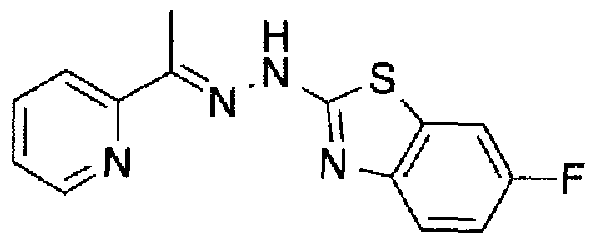
(£ -6-fluoro-2-(2-(l-(pyridin-2-yI)ethylidene)hydrazinyl)benzo[i )thiazole (15): Following General Method A for the condensation of 6-fluoro-2-hydrazinylbenzo[< |thiazole and 1 -(pyridin-2- yl)ethan-l-one the title compound 15 was isolated as a white solid after recrystallization from MeOH
Ή- MR (400 MHz, CDC13) δ 2.44 (s, 3H), 7.09 (dt, J = 8.92 Hz, 2.60 Hz, 1H), 7.27 (ddd, J = 6.00 Hz, 4.92 Hz, 1.12 Hz, 1H), 7.41 (dd, J = 8.16 Hz, 2.60 Hz, 1 H), 7.55 (dd, J = 8.84 Hz, 4.68 Hz, 1H), 7.74 (dt, J = 7.60 Hz, 1.80 Hz, 1H), 8.15 (d, J = 8.08 Hz, 1H), 8.60 (app. d, J = 4.80 Hz, 1H), 8.97 (br. s, 1 H, NH). MS: 355.2 [M + Hf.
Example 16

(^-2-(l-(pyridin-2-yl)ethylidene>-Ar-(l-(pyridin-2-yl)piperidin-4-yl)hydrazine-l-carbothw (16): Following General Method A for the condensation of N-(l-(pyridm-2-yl)piperidin-4- yl)hydrazinecarbothioamide and l-(pyridin-2-yl)ethan-l -one the title compound 16 was isolated as a white solid after recrystallization from MeOH. Ή- MR (400 MHz, CDC13) 5 1.76 (ddd, J = 15.33
Hz, 11.72 Hz, 3.92 Hz, 2H), 2.30 (m, 2H), 2.42 (s, 3H), 3.04 (dt, J - 13.73 Hz, 2.40 Hz, 2H), 3.72 (m, 2H), 4.57 (m, 1H), 7.16 and 7.19 (E/Z d, 1.56 Hz, 1H), 7.21 and 7.24 (E/Z m, IH), 7.30 (ddd, J - 5.87 Hz, 4.92 Hz, 1.04 Hz), 7.52 (br. d, J = 8.16 Hz, 1 H, NH), 7.72 (dt, J = 7.76 Hz, 1.72 Hz, IH), 7.90 (d, J = 8.04 Hz, IH), 8.11 (dd, J = 4.44 Hz, 1.32 Hz, I H), 8.35 (d, J = 2.68 Hz, IH), 8.61 (d, J = 4.12 Hz, IH), 8.68 (br. s, IH, NH). MS: 287.0 [M + H]+.
Example 17

(£ -2-(2-(l-(pyridin-2-y])ethylideue)hydra2inyl)thiazole (17): To a solution of (£)-2-(l- (pyridin-2-yl)ethylidene)hydrazine-l -carbothioaraide (6) (100 mg, 0.52 mmol, 1 eq) in DMF (0.75 ml) was added chloroacetaldehyde (50% wt. in H20, 65.4 pL, 0.52 mmol, 1 eq), and KOAc (50.5 mg, 0.52 mmol, 1 eq). The reaction was stirred overnight at 60 C and diluted in ¾0 (20 ml) to crash out crude product. The solid was partitioned in DCM/H20 and extracted 2 x DCM. The combined organics were dried over Na2SC>4, filtered, concentrated and purified by silica gel chromatography (eluting in 20% to 50% EtOAc Hex). The combined product containing fractions were concentrated and recrystallized from MeOH to afford 17 as a white solid. Ή-NMR (400 MHz, CDC13) δ 2.44 (s, 3H), 6.71 (d, J = 3.60 Hz, IH), 7.23 (ddd, J = 5.96 Hz, 4.88 Hz, 1.04 Hz, IH), 7.30 (d, J = 3.64 Hz, IH), 7.70 (dt, J = 7.84 Hz, 1 .76 Hz, IH), 8.15 (d, J = 8.08 Hz, IH), 8.57 (app. d, J = 4.46 Hz, IH). MS: 218.9 [M + H]+.
Example 18

Synthesis of (18): To a suspension of 10 (75.0 mg, .279 mmol, 1 equiv.) in EtOH (7 ml) was added ZnCl2 (19.1 mg, 0.140 mmol, 0.5 equiv.). After 5 minutes, TEA (0.279 ml, excess) was added and the mixture was heated for 2 hours at reflux under nitrogen. Upon cooling to ambient temperature, a solid precipitated that was collected by filtration and washed with 1 : 1 EtOH water mixture followed by Et20. The solids were dried under high vacuum to give [Zn(Cl)2] 18. (64.6 mg, 0.108 mmol, 77%)
as an orange solid. Ή-NMR (400 MHz, DMSO-d6) δ 2.66 (s, 6H), 6.64 (d, J = 7.96 Hz, 2H), 6.78 (t, J = Hz, Hz, 2H), 6.97 (t, J = Hz, 2H), 7.29 (t, J = Hz, Hz, 2H), 7.48 (d, J = 7.76 Hz, 2H), 7.85 (m, 2H), 7.91 (m, 4H). Slow evaporation of [Zn(C 1 )2] from THF afforded orange crystals that were suitable for X-ray crystallography. See X-ray ORTEP drawing (Figure 2) and data tables.
Example 19

Synthesis of (19): The title compound was prepared using Method A. Ή NMR (500 MHz, Methanol-. *) δ 7.69 (dd, J= 5.9, 0.8 Hz, 1H), 7.22 (d, J= 2.4 Hz, 1 H), 6.76 (ddd, J= 5.9, 2.4, 0.8 Hz, 1H), 4.19 (t, J= 5.4 Hz, 2H), 3.30 (d, J= 0.8 Hz, 6H), 2.77 (t, J= 5.4 Hz, 2H), 2.59 (d, J= 0.8 Hz, 3H), 2.32 (d, J= 0.8 Hz, 6H). (MS+H)+ 310.30 (monomer mass)
Cell-based TOV112D activity for representative compounds is shown in Table 1.
Table 1.


+++, most active; ++, moderately active; +, less active
All publications, patents, and patent documents are incorporated by reference herein, as though individually incorporated by reference. The invention has been described with reference to various specific and preferred embodiments and techniques. However, it should be understood that many variations and modifications may be made while remaining within the spirit and scope of the invention.
Claims
Claims
What is claimed is:
1. A complex comprising Zn and a compound a compound of formula (la) or (Ila):

ion or poly-ion thereof, wherein:
the ring A is a fused benzo or heteroaryl ring
R1 is selected from the roup consisting of:

wherein R is optionally substituted with one or more groups independently selected from halo, cyano, hydroxy, nitro, -N(Ra)2, carboxy, phenyl, (Ci-C6)alkyl, (C2-C6)alkenyl, (C2- C6)alkynyl, (C3-C6)cycloalkyl, (Ci-C6)alkoxy, (C]-C6)alkanoyl, (CrC6)alkoxycarbonyl, (C2- C6)alkanoyloxy, (C4-C5)heterocycloalkyl, (C2-C6)alkylaminocarbonyl and (C2- C6)alkanoylamino wherein any phenyl,
 (C2-C6) lkenyl, (C2-C6)alkynyl, (Q- C6)alkoxy, and (C3-C6)cycloalkyl, is optionally substituted with one or more groups independently selected from halo, cyano, hydroxy, nitro, -N(Ra)2, carboxy, (C3-C6)cycloalkyl, (Ci-C6)alkoxy, (Ci-C6)alkanoyl, (Ci-C6)alkoxycarbonyl, (C2-C6)alkanoyloxy, (C4- C6)heterocycloalkyl, (C2-C6)alkylaminocarbonyl and (C2-C6)alkanoylamino;
R2 is selected from the group consisting of H, phenyl, heteroaryl, (Ci-C6)alkyl, (C2- C6)alkenyl, (C2-C6)alkynyl, and (C3-C6)cycloalkyl, wherein any phenyl, heteroaryl, (Ci- C6)alkyl, (C2-C6)alkenyl, (C2-C6)alkynyl, and (C3-C6)cycloalkyl is optionally substituted with one or more groups independently selected from halo, -N(R )2, (C3-C6)cycIoalkyl, (Ci- C6)alkoxy, (C2-Cg)aIkanoyloxy, (C2-C6)alkoxycarbonyl, (C -C6) alkylaminocarbonyl, and (C2-C6) alkanoylamino;
(C2-C6) lkenyl, (C2-C6)alkynyl, (Q- C6)alkoxy, and (C3-C6)cycloalkyl, is optionally substituted with one or more groups independently selected from halo, cyano, hydroxy, nitro, -N(Ra)2, carboxy, (C3-C6)cycloalkyl, (Ci-C6)alkoxy, (Ci-C6)alkanoyl, (Ci-C6)alkoxycarbonyl, (C2-C6)alkanoyloxy, (C4- C6)heterocycloalkyl, (C2-C6)alkylaminocarbonyl and (C2-C6)alkanoylamino;
R2 is selected from the group consisting of H, phenyl, heteroaryl, (Ci-C6)alkyl, (C2- C6)alkenyl, (C2-C6)alkynyl, and (C3-C6)cycloalkyl, wherein any phenyl, heteroaryl, (Ci- C6)alkyl, (C2-C6)alkenyl, (C2-C6)alkynyl, and (C3-C6)cycloalkyl is optionally substituted with one or more groups independently selected from halo, -N(R )2, (C3-C6)cycIoalkyl, (Ci- C6)alkoxy, (C2-Cg)aIkanoyloxy, (C2-C6)alkoxycarbonyl, (C -C6) alkylaminocarbonyl, and (C2-C6) alkanoylamino;
R3 and R4 are each independently selected from H, (Ci-C6)alkyl, piperidinyl, or piperazinyl, which piperidinyl or piperazinyl is optionally substituted with pyridyl; or R3 and each R4 taken together with the nitrogen to which they are attached form a 3, 4, 5, 6, 7, 8, or 9 membered ring that is optionally substituted with one or more groups independently selected from the group consisting of halo;
Y is S, O, or Se;
each R is independently selected from the group consisting of H, (Ci-C6)alkyl, (C2- C6)alkenyl, (C2-C6)alkynyl, (C3-C6)cycloalkyl, (C]-C6)alkanoyl, and (C]-C6)alkoxycarbonyl, wherein any (d-CeJalkyl, (C2-C6)alkenyl, (C2-C6)alkynyl, (C3-C6)cycloalkyl, (d- C6)alkanoyl, and (d-C6)alkoxycarbonyI, is optionally substituted with one or more groups independently selected from halo, (C3-C6)cycloaIkyl, and (Ci-C6)alkoxy; or two Ra taken together with the nitrogen to which they are attached form a azetidino, pyrrolidino, piperidino. or morpholino ring;
each Rb is independently selected from the group consisting of H, (Ci-C6)alkyl, (C2- C6)alkenyl, (C2-C6)alkynyl, (C3-C6)cycloalkyl, (Ci-C6)alkanoyl, and (Ci-C6)alkoxycarbonyl, wherein any (Ci-C6)alkyl, (C2-C6)alkenyl, (C2-C6)alkynyl, (C3-C6)cycloalkyl, (C,- C6)alkanoyl, and (Ci-C6)alkoxycarbonyl is optionally substituted with one or more groups independently selected from halo, (d-d^ycloalkyl., and (Cj-C6)alkoxy; or two R taken together with the nitrogen to which they are attached form a azetidino, pyrrolidino, piperidino, or morpholino ring;
Rc is independently selected from the group consisting of H and (C]-C6)alkyl that is optionally substituted with one or more groups independently selected from halo, (C3- C6)cycloalkyl, and (Ci-C6)alkoxy;
X is S, O, -CH=CH-, or N-R33;
HET is selected from the group consisting of:


wherein any phenyl, (Ci-C6)alkyl, (Ci-C6)alkoxy, (C2-C6)alkenyl, (C2-C6)alkynyl, and (C3- C6)cycloalkyl, is optionally substituted with one or more groups independently selected from halo, azido, cyano, hydroxy, nitro, -N(Rba)2, carboxy, (C3-C6)cycloalkyl, (Ci-C6)alkanoyl, (Ci-C6)alkoxycarbonyl, (C2-C6)alkanoyloxy, and (Ci-C6)alkoxy that is optionally substituted with carboxy;
each R2a is independently selected from the group consisting of H, phenyl, (C(- C6)alkyl, (C2-C6)alkenyl, (C2-C6)alkynyl, and (C3-C6)cycloalkyl, wherein any phenyl, (Ci- C6)alkyl, (C2-C6)alkenyl, (C2-C6)alkynyl, and (C3-C6)cycloalkyl, is optionally substituted with one or more groups independently selected from halo. -N(Rca)2, (C3-C6)cycIoalkyl, (Cr C6)alkoxy, and (C2-C6)alkanoyloxy;
n is 0, 1 , 2, 3, or 4;
each R3a is independently selected from halo, cyano, hydroxy, nitro, -N(Rda)2, carboxy, phenyl, (C]-C6)alkyl, (C2-C6)alkenyl, (C2-C6)alkynyl, (C3-C6)cycloalkyl, (C,-C6)alkoxy, (d- C6)alkanoyl, (Ci-C6)alkoxycarbonyl, and (C2-C6)alkanoyloxy, wherein any phenyl, (C C6)alkyl, (C2-C6)alkenyl, (C2-C6)alkynyl, (Ci-C6)alkoxy, and (C3-C6)cycloalkyl, is optionally substituted with one or more groups independently selected from halo, cyano, hydroxy,
nitro, -N(RC)2, carboxy, (C3-C6)cycIoalkyl, (C1-C6)alkoxy, (Ci-C6)alkanoyl,
(Ci-C6)alkoxycarbonyl, and (C2-C6)alkanoyloxy;
R33 is selected from the group consisting of H, (Ci-C6)alkyl, (C2-C6)alkenyl, (C2- C6)alkynyl, (C3-C6)cycloalkyl, (Ci-C6)alkanoyl, and (Ci-C6)alkoxycarbonyl, wherein any (Ci-C6)alkyl, (C2-C6)alkenyl, (C2-C6)alkynyl, (C3-C6)cycloalkyl, (C1-C6)alkanoyl, and (Ci-C6)alkoxycarbonyl, is optionally substituted with one or more groups independently selected from halo, (C3-C6)cycloalkyl, -N(Rga)2, morpholino, and (Ci-C6)alkoxy; or two R33 taken together with the nitrogen to which they are attached form a azetidino, pyrrolidino, piperidino, or morpholino ring;
each R a is independently selected from the group consisting of H, (C1-C6)alkyl, (C2- C6)alkenyl, (C2-C6)alkynyl, (C3-C6)cycloalkyl, (Q-C^alkanoyl, and (Ci-C6)alkoxycarbonyl, wherein any (C C6)alkyl, (C2-C6)alkenyl, (C2-C6)alkynyl, (C3-C6)cycloalkyl, (C,- C6)alkanoyl, and (Ci-C6)alkoxycarbonyl, is optionally substituted with one or more groups independently selected from halo, (C3-C6)cycloalkyl, heteroaryl, and (Ci-C6)alkoxy; or two Rba taken together with the nitrogen to which they are attached form a azetidino, pyrrolidino, piperidino, or morpholino ring; and
each Rca is independently selected from the group consisting of H, (C|-C6)alkyl, (C2- C6)alkenyl, (C2-C6)alkynyl, (C3-C6)cycloalkyl, (Ci-C6)alkanoyl, and (C]-C6)alkoxycarbonyl, wherein any (Ci-C^alkyl, (C2-C6)alkenyl, (C2-C6)alkynyl, (C3-C6)cycloalkyl, (C]- C6)alkanoyl, and (Ci-C6)alkoxycarbonyl, is optionally substituted with one or more groups independently selected from halo, (C3-C6)cycloalkyl, and (Cj-C6)alkoxy; or two Rca taken together with the nitrogen to which they are attached form a azetidino, pyrrolidino, piperidino, or morpholino ring;
each Rda is independently selected from the group consisting of H, (Ci-C6)alkyl, (C2- C6)alkenyl, (C2-C6)alkynyl, (C3-C6)cycIoalkyl, (C1-C6)alkanoyl, and (Ci-C6)alkoxycarbonyl, wherein any (C C6)alkyl, (C2-C6)alkenyl, (C2-C6)alkynyl, (C3-C6)cyc]oalkyl, (Ci- C6)alkanoyl, and (Ci-C6)alkoxycarbonyl, is optionally substituted with one or more groups independently selected from halo, (C3-C6)cycloalkyl, and (C C6)alkox ; or two Rd taken together with the nitrogen to which they are attached form a azetidino, pyrrolidino, piperidino, or morpholino ring; or a solvate thereof;
Rea is independently selected from the group consisting of H and (Ci-C6)alkyl that is optionally substituted with one or more groups independently selected from halo, (C3- C6)cycloalkyl, -N(Rfa)2, and (C]-C6)alkoxy;
each R a is independently selected from the group consisting of H, (Ci-C6)alkyl, (C2- C6)alkenyl, (C2-C6)alkynyl, (C3-C6)cycloalkyl, (C]-C6)alkanoyl, and (Ci-C6)alkoxycarbonyl, wherein any (Ci-Q)alkyl. (C2-C6)alkenyl, (C2-C6)alkynyl, (C3-C6)cycloalkyl, (Cr
C6)alkanoyl, and (C1-C6)alkoxycarbonyl, is optionally substituted with one or more groups independently selected from halo, (C3-C6)cycloalkyl, and (Ci-C6)alkoxy; or two Rfa taken together with the nitrogen to which they are attached form a azetidino, pyrrolidino, piperidino, or morpholino ring; and
each Rg is independently selected from the group consisting of H, (Ci-C6)alkyl, (C2- C6)alkenyl, (C2-C6)alkynyl, (C3-C6)cycloalkyl, (C| -C6)alkanoyl, and (C1-C6)alkoxycarbonylJ wherein any (C1-C6)alkyl, (C2-C6)alkenyl, (C2-C6)alkynyl, (C3-C6)cycloalkyl, (Cr
C6)alkanoyl, and (C|-C6)alkoxycarbonyl, is optionally substituted with one or more groups independently selected from halo, (C3-C6)cycloalkyl, and (Ci-C6)alkoxy; or two Rga taken together with the nitrogen to which they are attached form a azetidino, pyrrolidino, piperidino, or morpholino ring;
provided that for a compound of formula (la), when R1 is 2-pyridinyl, then R2 is not H or (Ci-C6)alkyl.
2. The complex of claim ] that is a complex comprising Zn2+ and a compound of formula (la) or (Ilaa):

L is selected from the group consisting of:


wherein R is optionally substituted with one or more groups independently selected from halo, cyano, hydroxy, nitro, -N(Ra)2, carboxy, phenyl, (Ci-C6)alkyl, (C2-C6)alkenyl, (C2- C6)alkynyl, (C3-C6)cycloalkyl, (Ci-C6)alkoxy, (Ci-C6)alkanoyl, (C1-C6)alkoxycarbonyl, (C2- C6)alkanoyloxy, (C4-C6)heterocycloalkyl, (C2-C6)alkylaminocarbonyl and (C2- C6)aIkanoylamino wherein any phenyl, (Ci-C6)alkyl, (C2-C6)alkenyl, (C2-C6)alkynyl, and (C3-C6)cycloalkyl, is optionally substituted with one or more groups independently selected from halo, cyano, hydroxy, nitro, -N(Ra)2, carboxy, (C3-C6)cycloalkyl, (C i-C6)alkoxy, (Q- C6)alkanoyl, (Ci -C6)aIkoxycarbonyl, (C2-C6)alkanoy]oxy, (C4-C6)heterocycloalkyl, (C2- C6)alkyIaminocarbonyl and (C2-C6)alkanoylamino;
R is selected from the group consisting of H, phenyl, heteroaryl, (C]-C6)alkyl, (C2- C6)alkenyl, (C2-C6)alkynyl, and (C3-C6)cycloalkyl, wherein any phenyl, heteroaryl, (Ci- C6)alkyl, (C2-C6)alkenyl, (C2-C6)alkynyl, (C3-C6)cycloalkyl and C4-C6 heterocycloalkyl, is optionally substituted with one or more groups independently selected from halo, -N(Rb)2, (C3-C6)cycloalkyl, (Ci-C6)alkoxy, (C2-C6)alkanoyloxy, (C2-C6)alkoxycarbonyl, (C2-C6) alkylaminocarbonyl, and (C2-C6) alkanoylamino;
R3 and R4 are each independently selected from H, (Ci-C6)alky), piperidinyl, or piperazinyl, which piperidinyl or piperazinyl is optionally substituted with pyridyl; or R3 and each R4 taken together with the nitrogen to which they are attached form a 3, 4, 5, 6, 7, 8, or 9 membered ring that is optionally substituted with one or more groups independently selected from the group consisting of halo;
Y is S, 0, or Se;
each Ra is independently selected from the group consisting of H, (Ci-C6)alkyl, (C2- C6)alkenyl, (C2-C6)alkynyl, (C3-C6)cycloalkyl, (Ci-C6)alkanoyl, and (Ci-C6)alkoxycarbonyl, wherein any (C C6)alkyl, (C2-C6)alkenyl, (C2-C6)alkynyl, (C3-C6)cyc]oalkyl, (C,- C6)alkanoyl, and (Ci-C6)alkoxycarbonyl, (C2-C6)alkoxycarbonyl, (C2-C6)
alkylaminocarbonyl, and (C2-C6) alkanoylamino is optionally substituted with one or more groups independently selected from halo, (C3-C6)cycloalkyl, and (Ci -C6)alkoxy; or two Ra
taken together with the nitrogen to which they are attached form a azetidino, pyrrolidino, piperidino, or morpholino ring;
each Rb is independently selected from the group consisting of H, (Ci-C6)alkyl, (C2- C6)alkenyl, (C2-C6)alkynyl, {C3-C6)cycloalkyl, (Ci-C6)alkanoyl, and (Ci-C6)alkoxycarbonyl, wherein any (C|-C6)alkyl, (C2-C6)alkenyl, (C2-C6)alkynyl, (C3-C6)cycloalkyl, (Ci- C6)alkanoyl, and (Ci-C6)alkoxycarbonyl, (C2-C6)alkoxycarbonyI, (C2-C6)
alkylaminocarbonyl, and (C2-C6) alkanoylamino is optionally substituted with one or more groups independently selected from halo, (C3-C6)cycloalky], and (C]-C6)alkoxy; or two Rb taken together with the nitrogen to which they are attached form a azetidino, pyrrolidino, piperidino, or morpholino ring;
Rc is independently selected from the group consisting of H and (Ci-Cs)alkyl that is optionally substituted with one or more groups independently selected from halo, (C3- C6)cycloalkyl, and (C C6)alkoxy;
X is S, O, N-H, or N-R^;
HET is selected from the group consisting of:

wherein HET is optionally substituted with one or more groups independently selected from halo, cyano, hydroxy, nitro, - (Κω)2, carboxy, phenyl, (Ci-C6)alkyl, {C2-Q)alkenyl, (C2-
C6)alkynyl, (C3-C6)cycloalkyl, (Ci-C6)alkoxy, (Ci-C6)alkanoyl, (C1-C6)alkoxycarbonyl, (C2- C6)alkanoyloxy, and

wherein any phenyl, (C C6)alkyl, (CrC6)alkoxy, (C2-C6)alkenyl, (C2-C6)alkynyl, and (C3- C6)cycloalkyl, is optionally substituted with one or more groups independently selected from halo, cyano, hydroxy, nitro, -N(Rba)2, carboxy, (C3-C6)cycloalkyl, (C|-C6)alkoxy, (Ci- C6)alkanoyl, (CrC6)alkoxycarbonyl, and (C2-C6)alkanoyloxy;
R2a is selected from the group consisting of H, phenyl, (Ci-C6)alkyl, (C2-C6)alkenyl, (C2-C6)alkynyl, and (C3-C6)cycloalkyl, wherein any phenyl, (C|-C6)alkyl, (C2-C6)alkenyl, (C2-C6)alkynyl, and (C3-C6)cycloalkyl, is optionally substituted with one or more groups independently selected from halo, -N(Rca)2, (C3-C6)cycloalkyl, (C C )alkoxy, and (C2- C6)alkanoyloxy;
n is 1 , 2, 3, or 4;
each R3a is independently selected from halo, cyano, hydroxy, nitro, -N(Rda)2, carboxy, phenyl, (C,-C6)alkyl, (C2-C6)alkenyl: (C2-C6)alkynyl, (C3-C6)cycloalkyl, (Ci-C6)alkoxy, (C C6)alkanoyl, (Ci-C6)alkoxycarbonyl, and (C2-C6)alkanoyloxy, wherein any phenyl, (Ci- C6)alkyl, (C2-C6)alkenyl, (C2-C6)alkynyl, (C C6) lko , and (C3-C6)cyc]oalkyl, is optionally substituted with one or more groups independently selected from halo, cyano, hydroxy, nitro, -N(RC)2, carboxy, (C3-C6)cycloalkyl, (Ci-C6)alkoxy, (CrC6)alkanoyl,
(Ci-C6)alkoxycarbonyl, and (C2-C6)alkanoyloxy;
R33 is selected from the group consisting of H, (CrC6)alkyl, (C2-C6)alkenyl, (C2- C6)alkynyl, (C3-C6)cycloalkyl, (C!-C6)alkanoyl, and (Ci-C6)alkoxycarbonyl, wherein any (CrC6)alkyl, (C2-C6)alkenyl, (C2-C6)alkynyl, (C3-Q)cycloalkyl, (d-QJalkanoyl, and (CL-C6)alkoxycarbonyl, is optionally substituted with one or more groups independently selected from halo, {C3-C6)cycloalkyl, and (Q-C^alkoxy; or two RM taken together with the nitrogen to which they are attached form a azetidino, pyrrolidino, piperidino, or morpholino ring;
each Rba is independently selected from the group consisting of H, (CrC6)alkyl, (C2- C6)alkenyl, (C2-C6)alkynyl, (C3-C6)cycloalkyl, (Ci-C6)alkanoyl, and (Ci-C6)alkoxycarbonyl, wherein any (C1-C6)alkyl, (C2-C6)alkenyl, (C2-C6)alkynyl, (C3-C6)cycloalkyl, (C
C6)alkanoyl, and (Ci-C6)alkoxycarbonyl, is optionally substituted with one or more groups
independently selected from halo, (C3-C6)cycloalkyl, heteroaryl, and (Ci-C6)alkoxy; or two Rba taken together with the nitrogen to which they are attached form a azetidino, pyrrolidino, piperidino, or morpholino ring; and
each Rca is independently selected from the group consisting of H, (C]-C6)alkyl, (C2- C6)alkenyl, (C2-C6)alkynyl, (C3-C6)cycloalkyl, (Ci-C6)alkanoyl, and (CrC^alkoxycarbonyl, wherein any (C,-C6)alkyl, (C2-C6)alkenyl, (C2-C6)alkynyl (C C6)cycloalkyl, (d- C6)alkanoyl, and (Ci-C6)alkoxycarbonyl, is optionally substituted with one or more groups independently selected from halo, (C3-C6)cycloalkyl, and (Ci-C6)alkoxy; or two Rca taken together with the nitrogen to which they are attached form a azetidino, pyrrolidino, piperidino, or morpholino ring;
each Rda is independently selected from the group consisting of H, (C1-C6)alkyl, (C2- C6)alkenyl, (C2-C6)alkynyl, (C3-C6)cycloalkyl, (Ci-C6)alkanoyl, and (Ci-C6)alkoxycarbonyl, wherein any (C C6)alkyl, (C2-C6)alkenyl, (C2-C6)alkynyl, (C3-C6)cycloalkyl, (Ci- C6)alkanoyl, and (Ci-C6)alkoxycarbonyl, is optionally substituted with one or more groups independently selected from halo, (C3-C6)cycloalkyl, and (C1-C6)alkoxy; or two Rda taken together with the nitrogen to which they are attached form a azetidino, pyrrolidino, piperidino, or morpholino ring; or a solvate thereof;
Rea is independently selected from the group consisting of H and (Ci-C6)alkyl that is optionally substituted with one or more groups independently selected from halo, (C3- C6)cycloalkyl, -N(Rfa)2, and (d-C6)alkoxy; and
each Rfa is independently selected from the group consisting of H, (Ci-C6)alkyl, (C2- C6)alkenyl, (C2-C6)alkynyl, (C3-C6)cycloalkyI, (C Ceialkanoyl, and (Ci-C6)alkoxycarbonyl, wherein any (CrQ alkyl, (C2-C6)alkenyl, (C2-C6)alkynyl, (C3-C6)cycloalkyl, (C,- C6)alkanoyl, and (C]-C6)alkoxycarbonyl, is optionally substituted with one or more groups independently selected from halo, (C3-C6)cycloalkyl, and (Q-Cejalkoxy; or two Rfa taken together with the nitrogen to which they are attached form a azetidino, pyrrolidino, piperidino, or morpholino ring;
provided that for a compound of formula (la), when R1 is 2-pyridinyl, then R2 is not H or (Chalky!.
3. The complex of claim 1 or 2 or a solvate thereof, which comprises Zn2+ and a compound of formula (la).
4. The complex of claim 1 or a solvate thereof, which comprises Zn and a compound of formula (Ila).
5. The complex of any one of claims 1-4 or a solvate thereof, wherein the compound and the Zn are present in a ratio of about 1 : 1.
6. The complex of any one of claims 1-4 or a solvate thereof, wherein the compound and the Zn are present in a ratio of about 2: 1.
7. The complex or solvate of any one of claims 1-6 which is charge neutral.
8. The complex of claim 1 , which is a complex of formula (1-00):

(100)
or a solvate thereof.
The complex of claim 1 which is a complex of formula (101 ):

(101)
or a solvate thereof.
10. The complex of any one of claims 1-8 or a solvate thereof wherein R1 is selected from the group consisting of:

wherein R is optionally substituted with one or more groups independently selected from halo, cyano, hydroxy, nitro, -N(Ra)2, carboxy, phenyl, (Ci-Cejalkyl, (C2-C6)alkenyl, (C2- C6)alkynyl, (C3-C6)cycloalkyl, (C C6)alkoxy, (Ci-C6)alkanoyl, (C C6)alkoxycarbonyI, and (C2-C6)alkanoyloxy, wherein any phenyl, (Ci-C6)alkyl, (C2-C6)alkenyl, (C2-C6)alkynyl, and (C3-C6)cycloalkyl, is optionally substituted with one or more groups independently selected from halo, cyano, hydroxy, nitro, -N(Ra)2, carboxy, (C3-C6)cycloalkyl, (Ci-C6)alkoxy, (d- C6)alkanoyl, (Q-C^alkoxycarbonyl, (C2-C6)alkanoyloxy, (C2-C6)a1kylaminocarbonyl and (C2-C6)alkanoylamino.
11. The complex of claim 1 or 9 or a solvate thereof wherein HET is selected from the group consisting of:

12. The complex of any one of claims 1-11 or a solvate thereof wherein R2 is selected from the group consisting of H, methyl, ethyl, propyl, isopropyl, butyl, tert-butyl, allyl, cyclopropyl, phenyl, benzyl, CH2CH2OCH3, and CH2CH2-N(CH3)2.
13. A neutral coordination complex comprising Zn2+ and a compound selected from the

wherein the ratio of the compound to Zn is about 2: 1 , or a solvate thereof.

15. A pharmaceutical composition, comprising a complex of any one of claims 1 - 14 or a solvate thereof, and a pharmaceutically acceptable carrier.
16. An injectable pharmaceutical formulation comprising, a complex of any one of claims 1-14 or a solvate thereof, and a pharmaceutically acceptable carrier.
17. A method of inhibiting cancer cell growth in vivo or in vitro, comprising contacting a cancer cell with a complex of any one of claims 1-14 or a solvate thereof.
18. A method of treating cancer in an animal comprising administering a complex of any one of claims 1-14 or a solvate thereof to the animal.
19. The method of claim 18, further comprising administering zinc to the animal.
20. The method of any one of claims 17-19, wherein the cancer is caused by mutations affecting zinc binding proteins.
21 . The method of any one of claims 17-20, wherein the cancer is associated with a zinc binding p53 mutation.
22. The method of any one of claims 17-21, wherein the cancer is associated with a zinc binding p53 mutation selected from 175, CI 76, HI 79, C238, C242, and G245.
23. A complex of any one of claims 1-14 or a solvate thereof for use in medical treatment.
24. A complex of any one of claims 1-14 or a solvate thereof for the prophylactic or therapeutic treatment of cancer.
25. The complex or solvate of claim 24 wherein the cancer is caused by mutations affecting zinc binding proteins.
26. The complex or solvate of claim 24, wherein the cancer is associated with a zinc binding p53 mutation.
27. The complex or solvate of claim 24, wherein the cancer is associated with a zinc binding p53 mutation selected from R175, CI 76, HI 79, C238, C242, and G245.
28. The use of the complex of any one of claims 1-14 or a solvate thereof to prepare a medicament for treating cancer in an animal.
29. The use of claim 28 wherein the cancer is caused by mutations affecting zinc binding proteins.
30. The use of claim 28, wherein the cancer is associated with a zinc binding p53 mutation.
31. The use of claim 28, wherein the cancer is associated with a zinc binding p53 mutation selected from R175, C176, H179, C238, C242, and G245.
32. A method comprising:
combining Zn2+ ions and a monomer in a ratio of 2: 1 (monomer:zinc) to form a neutral complex; and
diffusing the complex across a plasma membrane of a cell under conditions where the Zn2+ ion will bind to a native ligation site of mutant p53 and provide a conformation change to wildtype inside the cell.
33. A method comprising: diffusing a charge neutral complex comprising a Zn2+ ion across a plasma membrane of a cell under conditions where the Zn2+ ion will bind to a native ligation site of a mutant p53 inside the cell.
34. The method of claim 33 further comprising boosting cellular reactive oxygen species in the cell.
35. A method comprising: contacting a cell having a mutant p53 with a charge neutral complex comprising a Zn2+ ion under conditions where the complex enters the cell and induces a wild-type conformation change in the mutant p53.
Priority Applications (1)
| Application Number | Priority Date | Filing Date | Title |
|---|---|---|---|
| US15/545,975 US10729671B2 (en) | 2015-01-27 | 2016-01-27 | Zinc complexes of hydrazones and (thio)semicarbazones and their use for the treatment of cancer |
Applications Claiming Priority (4)
| Application Number | Priority Date | Filing Date | Title |
|---|---|---|---|
| US201562108415P | 2015-01-27 | 2015-01-27 | |
| US62/108,415 | 2015-01-27 | ||
| US201562258261P | 2015-11-20 | 2015-11-20 | |
| US62/258,261 | 2015-11-20 |
Publications (1)
| Publication Number | Publication Date |
|---|---|
| WO2016123250A1 true WO2016123250A1 (en) | 2016-08-04 |
Family
ID=55300813
Family Applications (1)
| Application Number | Title | Priority Date | Filing Date |
|---|---|---|---|
| PCT/US2016/015190 Ceased WO2016123250A1 (en) | 2015-01-27 | 2016-01-27 | Zinc complexes of hydrazones and (thio)semicarbazones and their use for the treatment of cancer |
Country Status (2)
| Country | Link |
|---|---|
| US (1) | US10729671B2 (en) |
| WO (1) | WO2016123250A1 (en) |
Cited By (7)
| Publication number | Priority date | Publication date | Assignee | Title |
|---|---|---|---|---|
| WO2018081612A1 (en) * | 2016-10-31 | 2018-05-03 | Actavalon, Inc. | Compounds and methods for treating cancer |
| US10221133B2 (en) | 2015-01-27 | 2019-03-05 | Rutgers, The State University Of New Jersey | (Thio, oxo, and seleno) semicarbazone complexes with zinc and their use for treating cancer |
| CN109651357A (en) * | 2017-10-11 | 2019-04-19 | 中国科学院上海有机化学研究所 | 6,7- dihydro -5H- quinoline -8- hydrazone analog derivative iron chelating agents and its purposes for preparing anti-tumor drug |
| US10604480B2 (en) | 2015-01-27 | 2020-03-31 | Rutgers, The State University Of New Jersey | (Thio, oxo, and seleno) semicarbazone derivatives and their use for treating cancer |
| US10828288B2 (en) | 2015-01-27 | 2020-11-10 | Rutgers, The State University Of New Jersey | Hydrazone derivatives for the treatment of cancer |
| US12280065B2 (en) | 2019-04-23 | 2025-04-22 | Rutgers, The State University Of New Jersey | Pharmaceutical compounds and therapeutic methods |
| US12344626B2 (en) | 2019-04-23 | 2025-07-01 | Rutgers, The State University Of New Jersey | Pharmaceutical compounds and therapeutic methods |
Families Citing this family (1)
| Publication number | Priority date | Publication date | Assignee | Title |
|---|---|---|---|---|
| WO2020219587A1 (en) * | 2019-04-23 | 2020-10-29 | Rutgers, The State University Of New Jersey | Pharmaceutical compounds and therapeutic methods |
Citations (1)
| Publication number | Priority date | Publication date | Assignee | Title |
|---|---|---|---|---|
| WO2012175962A1 (en) * | 2011-06-20 | 2012-12-27 | Medical Research Council | COMPOUNDS FOR USE IN STABILISING p53 MUTANTS |
Family Cites Families (13)
| Publication number | Priority date | Publication date | Assignee | Title |
|---|---|---|---|---|
| US4665173A (en) | 1982-03-31 | 1987-05-12 | Klayman Daniel L | 2-acetyl- and 2-propionylpyridine selenosemicarbazones |
| AU2001265656A1 (en) | 2000-06-05 | 2001-12-17 | Johnny Easmon | Heterocyclic hydrazones for use as anti-cancer agents |
| WO2006019955A2 (en) | 2004-07-14 | 2006-02-23 | President And Fellows Of Harvard College | Antiviral methods and compositions |
| CA2600869A1 (en) | 2005-03-18 | 2006-09-28 | The Regents Of The University Of California | Compounds having activity in correcting mutant-cftr processing and uses thereof |
| AU2006292482A1 (en) | 2005-09-16 | 2007-03-29 | Government Of The United States Of America, As Represented By The Secretary, Department Of Health And Human Services | Methods of treating or preventing cancer using pyridine carboxaldehyde pyridine thiosemicarbazone radiosensitizing agents |
| US20080118576A1 (en) | 2006-08-28 | 2008-05-22 | Dan Theodorescu | Prediction of an agent's or agents' activity across different cells and tissue types |
| EP2193127A4 (en) | 2007-09-27 | 2011-09-14 | Inst Medical W & E Hall | benzothiazole |
| WO2011133748A1 (en) | 2010-04-21 | 2011-10-27 | University Of Medicine And Dentistry Of New Jersey | Treatments for cellular proliferative disorders and identification thereof |
| CN103492363B (en) | 2011-04-27 | 2016-08-24 | 日本瑞翁株式会社 | Polymerizable compounds, polymerizable compositions, polymers, and optically anisotropic substances |
| WO2015021456A1 (en) | 2013-08-09 | 2015-02-12 | The Regents Of The University Of California | Small molecules to enhance p53 activity |
| US10604480B2 (en) | 2015-01-27 | 2020-03-31 | Rutgers, The State University Of New Jersey | (Thio, oxo, and seleno) semicarbazone derivatives and their use for treating cancer |
| US10221133B2 (en) | 2015-01-27 | 2019-03-05 | Rutgers, The State University Of New Jersey | (Thio, oxo, and seleno) semicarbazone complexes with zinc and their use for treating cancer |
| US10828288B2 (en) | 2015-01-27 | 2020-11-10 | Rutgers, The State University Of New Jersey | Hydrazone derivatives for the treatment of cancer |
-
2016
- 2016-01-27 WO PCT/US2016/015190 patent/WO2016123250A1/en not_active Ceased
- 2016-01-27 US US15/545,975 patent/US10729671B2/en active Active
Patent Citations (1)
| Publication number | Priority date | Publication date | Assignee | Title |
|---|---|---|---|---|
| WO2012175962A1 (en) * | 2011-06-20 | 2012-12-27 | Medical Research Council | COMPOUNDS FOR USE IN STABILISING p53 MUTANTS |
Non-Patent Citations (16)
| Title |
|---|
| ABEER A. IBRAHIM ET AL: "Indole-7-carbaldehyde thiosemicarbazone as a flexidentate ligand toward ZnII, CdII, PdII and PtII ions: cytotoxic and apoptosis-inducing properties of the PtII complex", DALTON TRANSACTIONS: THE INTERNATIONAL JOURNAL FOR INORGANIC, ORGANOMETALLIC AND BIOINORGANIC CHEMISTRY, vol. 43, no. 10, 1 January 2014 (2014-01-01), GB, pages 3850 - 3860, XP055258930, ISSN: 1477-9226, DOI: 10.1039/c3dt53032a * |
| ALIAKBAR DEHNO KHALAJI ET AL: "Synthesis and Characterization of Zinc(II) Complexes with 3,4-Dimethoxybenzaldehyde Thiosemicarbazone: The Crystal Structure of [Zn(34-MBTSC) 2 Cl 2 ]", PHOSPHORUS, SULFUR AND SILICON AND THE RELATED ELEMENTS, vol. 188, no. 8, 1 August 2013 (2013-08-01), US, pages 1119 - 1126, XP055258940, ISSN: 1042-6507, DOI: 10.1080/10426507.2012.738736 * |
| ARAVINDAKSHAN, K. K. ET AL: "Preparation and characterization of vanillin thiosemicarbazone complexes with cobalt(II), nickel(II), copper(II), zinc(II), cadmium(II), and mercury(II)", PROCEEDINGS - INDIAN ACADEMY OF SCIENCES, CHEMICAL SCIENCES, vol. 93, no. 2, 1984, pages 111 - 115, ISSN: 0253-4134 * |
| BELLITTO CARLO ET AL: "Conformational Studies of some Potentially Bidentate Thiosemicarba- zones and Related Complexes of Zinc(ii) Analytical data for the thiosemicarbazones Analysis (%I", J.C.S. DALTON, vol. 68570, no. 21, 1 January 1976 (1976-01-01), pages 758 - 762, XP055259423 * |
| DATABASE CA [online] CHEMICAL ABSTRACTS SERVICE, COLUMBUS, OHIO, US; ARAVINDAKSHAN, K. K. ET AL: "Preparation and characterization of vanillin thiosemicarbazone complexes with cobalt(II), nickel(II), copper(II), zinc(II), cadmium(II), and mercury(II)", XP002755647, retrieved from STN Database accession no. 1984:202427 * |
| DATABASE CA [online] CHEMICAL ABSTRACTS SERVICE, COLUMBUS, OHIO, US; DEHNO KHALAJI, A. ET AL: "Synthesis and crystal structure of zinc(II) complex [Zn(25-MBTSC)2I2]", XP002755646, retrieved from STN Database accession no. 2013:1527952 * |
| DATABASE CA [online] CHEMICAL ABSTRACTS SERVICE, COLUMBUS, OHIO, US; ZHANG, NIAN-YOU ET AL: "Synthesis and structure of 1.5Zn(phen)3.cntdot.L.cntdot.3NO3 supramolecule (phen = o-phenanthroline, L = 4-aminoacetophenone thiosemicarbazone)", XP002755648, retrieved from STN Database accession no. 2008:1241650 * |
| DEHNO KHALAJI, A. ET AL: "Synthesis and crystal structure of zinc(II) complex [Zn(25-MBTSC)2I2]", MAJALLAH-I BULURSHINASI VA KANISHINASI-I IRAN, vol. 21, no. 1, 2013, pages 1 - 4, ISSN: 1726-3689 * |
| DUAN CHUN-YING ET AL: "SYNTHESIS, CRYSTAL STRUCTURE AND NONLINEAR OPTICAL PROPERTIES OF THIOSEMICARBAZONE ZINC COMPLEX", JOURNAL OF COORDINATION CHEMISTRY, vol. 47, no. 3, 1 May 1999 (1999-05-01), London, pages 433 - 439, XP055258946, ISSN: 0095-8972, DOI: 10.1080/00958979908022228 * |
| KOVALA-DEMERTZI D ET AL: "Zinc(II) complexes derived from pyridine-2-carbaldehyde thiosemicarbazone and (1E)-1-pyridin-2-ylethan-1-one thiosemicarbazone. Synthesis, crystal structures and antiproliferative activity of zinc(II) complexes", JOURNAL OF INORGANIC BIOCHEMISTRY, ELSEVIER INC, US, vol. 100, no. 9, 1 September 2006 (2006-09-01), pages 1558 - 1567, XP027900289, ISSN: 0162-0134 * |
| KOVALA-DEMERTZI, D.; YADAV, P. N.; WIECEK, J.; SKOULIKA, S.; VARADINOVA, T.; DEMERTZIS, M. A.: "Zn(II) complexes derived from pyridine-2- carbaldehyde thiosemicarbazone and (1E)-1-pyridin-2-ylethan-1-one thiosemicarbazone. Synthesis, crystal structures and antiproliferative activity of Zn(II) complexes", JOURNAL OF INORGANIC BIOCHEMISTRY, vol. 100, 2006, pages 1558 - 1567 |
| PENG REN ET AL: "A new approach to suppress nonlinearity-transparency trade-off through coordination chemistry: syntheses and spectroscopic study on second-order nonlinear optical properties of a series of square-pyramidal zinc(II) complexes", SPECTROCHIMICA ACTA. PART A: MOLECULAR AND BIOMOLECULAR SPECTROSCOPY, vol. 59, no. 5, 1 March 2003 (2003-03-01), NL, pages 1095 - 1101, XP055259033, ISSN: 1386-1425, DOI: 10.1016/S1386-1425(02)00289-5 * |
| VITHAYA RUANGPORNVISUTI ET AL: "A DFT investigation of conformational geometries and interconversion equilibria of phenylthiosemicarbazone and its complexation with zinc", JOURNAL OF MOLECULAR MODELING, SPRINGER, DE, vol. 10, no. 5-6, 1 December 2004 (2004-12-01), pages 418 - 426, XP019352170, ISSN: 0948-5023 * |
| XIN YU ET AL: "Small molecule restoration of wildtype structure and function of mutant p53 using a novel zinc-metallochaperone based mechanism", ONCOTARGET, vol. 5, no. 19, 3 September 2014 (2014-09-03), United States, pages 8879 - 8892, XP055259320, ISSN: 1949-2553, DOI: 10.18632/oncotarget.2432 * |
| YU-PENG TIAN ET AL: "Structural characterization and second-order nonlinear optical properties of zinc halide thiosemicarbazone complexes", POLYHEDRON., vol. 21, no. 12-13, 1 June 2002 (2002-06-01), GB, pages 1217 - 1222, XP055258944, ISSN: 0277-5387, DOI: 10.1016/S0277-5387(02)01004-5 * |
| ZHANG, NIAN-YOU ET AL: "Synthesis and structure of 1.5Zn(phen)3.cntdot.L.cntdot.3NO3 supramolecule (phen = o-phenanthroline, L = 4-aminoacetophenone thiosemicarbazone)", CHINESE JOURNAL OF STRUCTURAL CHEMISTRY, vol. 27, no. 9, 2008, pages 1055 - 1058 * |
Cited By (8)
| Publication number | Priority date | Publication date | Assignee | Title |
|---|---|---|---|---|
| US10221133B2 (en) | 2015-01-27 | 2019-03-05 | Rutgers, The State University Of New Jersey | (Thio, oxo, and seleno) semicarbazone complexes with zinc and their use for treating cancer |
| US10604481B2 (en) | 2015-01-27 | 2020-03-31 | Rutgers, The State University Of New Jersey | (Thio, oxo and seleno) semicarbazone complexes with zinc and their use for treating cancer |
| US10604480B2 (en) | 2015-01-27 | 2020-03-31 | Rutgers, The State University Of New Jersey | (Thio, oxo, and seleno) semicarbazone derivatives and their use for treating cancer |
| US10828288B2 (en) | 2015-01-27 | 2020-11-10 | Rutgers, The State University Of New Jersey | Hydrazone derivatives for the treatment of cancer |
| WO2018081612A1 (en) * | 2016-10-31 | 2018-05-03 | Actavalon, Inc. | Compounds and methods for treating cancer |
| CN109651357A (en) * | 2017-10-11 | 2019-04-19 | 中国科学院上海有机化学研究所 | 6,7- dihydro -5H- quinoline -8- hydrazone analog derivative iron chelating agents and its purposes for preparing anti-tumor drug |
| US12280065B2 (en) | 2019-04-23 | 2025-04-22 | Rutgers, The State University Of New Jersey | Pharmaceutical compounds and therapeutic methods |
| US12344626B2 (en) | 2019-04-23 | 2025-07-01 | Rutgers, The State University Of New Jersey | Pharmaceutical compounds and therapeutic methods |
Also Published As
| Publication number | Publication date |
|---|---|
| US10729671B2 (en) | 2020-08-04 |
| US20180000772A1 (en) | 2018-01-04 |
Similar Documents
| Publication | Publication Date | Title |
|---|---|---|
| WO2016123250A1 (en) | Zinc complexes of hydrazones and (thio)semicarbazones and their use for the treatment of cancer | |
| WO2016123253A1 (en) | Hydrazne derivatives for the treatment of cancer | |
| US10604481B2 (en) | (Thio, oxo and seleno) semicarbazone complexes with zinc and their use for treating cancer | |
| US10604480B2 (en) | (Thio, oxo, and seleno) semicarbazone derivatives and their use for treating cancer | |
| JP6109937B2 (en) | Fusion pyrimidines as inhibitors of the p97 complex | |
| CA2716109C (en) | Heteroaryl derivatives as cftr modulators | |
| CA3137458A1 (en) | Fgfr inhibitors and methods of use thereof | |
| EP3277678A1 (en) | Compositions and methods of targeting mutant k-ras | |
| JP2016527296A (en) | Thieno [2,3-C] pyran as a CFTR modulator | |
| JP6896628B2 (en) | Antimicrobial polymyxin for the treatment of bacterial infections | |
| CN121568944A (en) | Heterocyclic compounds useful as SHP2 inhibitors, pharmaceutical compositions comprising the same, methods of preparation and uses thereof | |
| CN112110938B (en) | Compound as protein kinase inhibitor and preparation method and application thereof | |
| JP6852199B2 (en) | 7-Substituted pyrorotriazine compounds or pharmaceutically acceptable salts thereof, and methods and uses thereof. | |
| WO2016090257A1 (en) | Salts and crystalline forms of 6-acetyl-8-cyclopentyl-5-methyl-2((5-(piperazin-1-yl)pyridin-2-yl)amino)pyrido[2,3-d] pyrimidin-7(8h)-one (palbociclib) | |
| JP2022504578A (en) | Substituted macrocycles useful as kinase inhibitors | |
| EP3988546A1 (en) | Salts of compound, crystalline forms thereof, preparation method therefor and application thereof | |
| KR20200116137A (en) | 4-(1H-imidazol-5-yl)-1H-pyrrolo[2,3-b]pyridine for use in the treatment of leukemia, lymphoma and solid tumors | |
| US5436337A (en) | Amines to sensitize multidrug-resistant cells | |
| Motohashi et al. | Antimicrobial activity of N-acylphenothiazines and their influence on lipid model membranes and erythrocyte membranes | |
| AU2023368722A1 (en) | Phosphorus-containing compound, pharmaceutical composition and use thereof | |
| US12280065B2 (en) | Pharmaceutical compounds and therapeutic methods | |
| EP3958833A1 (en) | Pharmaceutical compounds and therapeutic methods | |
| WO2020219587A1 (en) | Pharmaceutical compounds and therapeutic methods | |
| Neuner et al. | Iclaprim mesylate displaying a hydrogen-bonded molecular tape | |
| Fusco et al. | A new biologically active molecular scaffold: crystal structure of 7-(3-hydroxyphenyl)-4-methyl-2H-[1, 2, 4] triazolo [3, 2-c][1, 2, 4] triazole and selective antiproliferative activity of three isomeric triazolo–triazoles |
Legal Events
| Date | Code | Title | Description |
|---|---|---|---|
| 121 | Ep: the epo has been informed by wipo that ep was designated in this application |
Ref document number: 16703037 Country of ref document: EP Kind code of ref document: A1 |
|
| WWE | Wipo information: entry into national phase |
Ref document number: 15545975 Country of ref document: US |
|
| NENP | Non-entry into the national phase |
Ref country code: DE |
|
| 122 | Ep: pct application non-entry in european phase |
Ref document number: 16703037 Country of ref document: EP Kind code of ref document: A1 |