WO2016123246A1 - (thio, oxo and seleno) semicarbazone complexes with zinc and their use for treating cancer - Google Patents
(thio, oxo and seleno) semicarbazone complexes with zinc and their use for treating cancer Download PDFInfo
- Publication number
- WO2016123246A1 WO2016123246A1 PCT/US2016/015183 US2016015183W WO2016123246A1 WO 2016123246 A1 WO2016123246 A1 WO 2016123246A1 US 2016015183 W US2016015183 W US 2016015183W WO 2016123246 A1 WO2016123246 A1 WO 2016123246A1
- Authority
- WO
- WIPO (PCT)
- Prior art keywords
- complex
- solvate
- cancer
- ions
- compound
- Prior art date
- Legal status (The legal status is an assumption and is not a legal conclusion. Google has not performed a legal analysis and makes no representation as to the accuracy of the status listed.)
- Ceased
Links
- IEBACMXNXZBEKL-GXDHUFHOSA-N C/C(/c1c(C)cccn1)=N\NC(N1CCC1)=S Chemical compound C/C(/c1c(C)cccn1)=N\NC(N1CCC1)=S IEBACMXNXZBEKL-GXDHUFHOSA-N 0.000 description 1
- RXGGGWCBCJUEHR-GXDHUFHOSA-N C/C(/c1ccccn1)=N\N(C)C(N1CCC1)=S Chemical compound C/C(/c1ccccn1)=N\N(C)C(N1CCC1)=S RXGGGWCBCJUEHR-GXDHUFHOSA-N 0.000 description 1
- CRQCZBAIZDBLOE-GXDHUFHOSA-N C/C(/c1ccccn1)=N\NC(CN1CCC1)=S Chemical compound C/C(/c1ccccn1)=N\NC(CN1CCC1)=S CRQCZBAIZDBLOE-GXDHUFHOSA-N 0.000 description 1
- VJLWITXNZFXVIQ-OVCLIPMQSA-N C/C(/c1ccccn1)=N\NC(N(C1)CC1(F)F)S Chemical compound C/C(/c1ccccn1)=N\NC(N(C1)CC1(F)F)S VJLWITXNZFXVIQ-OVCLIPMQSA-N 0.000 description 1
- PMFLBUVQEALXJI-XSFVSMFZSA-N C/C(/c1ccccn1)=N\NC(N(CC1)CCN1C1=CCCC=N1)=S Chemical compound C/C(/c1ccccn1)=N\NC(N(CC1)CCN1C1=CCCC=N1)=S PMFLBUVQEALXJI-XSFVSMFZSA-N 0.000 description 1
- RIFVPOHZBSIFRL-IZZDOVSWSA-N C/C(/c1ncccc1)=N\NC(N)=S Chemical compound C/C(/c1ncccc1)=N\NC(N)=S RIFVPOHZBSIFRL-IZZDOVSWSA-N 0.000 description 1
Classifications
-
- C—CHEMISTRY; METALLURGY
- C07—ORGANIC CHEMISTRY
- C07C—ACYCLIC OR CARBOCYCLIC COMPOUNDS
- C07C337/00—Derivatives of thiocarbonic acids containing functional groups covered by groups C07C333/00 or C07C335/00 in which at least one nitrogen atom of these functional groups is further bound to another nitrogen atom not being part of a nitro or nitroso group
- C07C337/06—Compounds containing any of the groups, e.g. thiosemicarbazides
- C07C337/08—Compounds containing any of the groups, e.g. thiosemicarbazides the other nitrogen atom being further doubly-bound to a carbon atom, e.g. thiosemicarbazones
-
- A—HUMAN NECESSITIES
- A61—MEDICAL OR VETERINARY SCIENCE; HYGIENE
- A61K—PREPARATIONS FOR MEDICAL, DENTAL OR TOILETRY PURPOSES
- A61K31/00—Medicinal preparations containing organic active ingredients
- A61K31/16—Amides, e.g. hydroxamic acids
- A61K31/17—Amides, e.g. hydroxamic acids having the group >N—C(O)—N< or >N—C(S)—N<, e.g. urea, thiourea, carmustine
- A61K31/175—Amides, e.g. hydroxamic acids having the group >N—C(O)—N< or >N—C(S)—N<, e.g. urea, thiourea, carmustine having the group, >N—C(O)—N=N— or, e.g. carbonohydrazides, carbazones, semicarbazides, semicarbazones; Thioanalogues thereof
-
- A—HUMAN NECESSITIES
- A61—MEDICAL OR VETERINARY SCIENCE; HYGIENE
- A61K—PREPARATIONS FOR MEDICAL, DENTAL OR TOILETRY PURPOSES
- A61K31/00—Medicinal preparations containing organic active ingredients
- A61K31/28—Compounds containing heavy metals
- A61K31/315—Zinc compounds
-
- A—HUMAN NECESSITIES
- A61—MEDICAL OR VETERINARY SCIENCE; HYGIENE
- A61K—PREPARATIONS FOR MEDICAL, DENTAL OR TOILETRY PURPOSES
- A61K31/00—Medicinal preparations containing organic active ingredients
- A61K31/33—Heterocyclic compounds
- A61K31/395—Heterocyclic compounds having nitrogen as a ring hetero atom, e.g. guanethidine or rifamycins
- A61K31/397—Heterocyclic compounds having nitrogen as a ring hetero atom, e.g. guanethidine or rifamycins having four-membered rings, e.g. azetidine
-
- A—HUMAN NECESSITIES
- A61—MEDICAL OR VETERINARY SCIENCE; HYGIENE
- A61P—SPECIFIC THERAPEUTIC ACTIVITY OF CHEMICAL COMPOUNDS OR MEDICINAL PREPARATIONS
- A61P35/00—Antineoplastic agents
-
- C—CHEMISTRY; METALLURGY
- C07—ORGANIC CHEMISTRY
- C07C—ACYCLIC OR CARBOCYCLIC COMPOUNDS
- C07C281/00—Derivatives of carbonic acid containing functional groups covered by groups C07C269/00 - C07C279/00 in which at least one nitrogen atom of these functional groups is further bound to another nitrogen atom not being part of a nitro or nitroso group
- C07C281/06—Compounds containing any of the groups, e.g. semicarbazides
- C07C281/08—Compounds containing any of the groups, e.g. semicarbazides the other nitrogen atom being further doubly-bound to a carbon atom, e.g. semicarbazones
-
- C—CHEMISTRY; METALLURGY
- C07—ORGANIC CHEMISTRY
- C07D—HETEROCYCLIC COMPOUNDS
- C07D205/00—Heterocyclic compounds containing four-membered rings with one nitrogen atom as the only ring hetero atom
- C07D205/02—Heterocyclic compounds containing four-membered rings with one nitrogen atom as the only ring hetero atom not condensed with other rings
- C07D205/04—Heterocyclic compounds containing four-membered rings with one nitrogen atom as the only ring hetero atom not condensed with other rings having no double bonds between ring members or between ring members and non-ring members
-
- C—CHEMISTRY; METALLURGY
- C07—ORGANIC CHEMISTRY
- C07D—HETEROCYCLIC COMPOUNDS
- C07D213/00—Heterocyclic compounds containing six-membered rings, not condensed with other rings, with one nitrogen atom as the only ring hetero atom and three or more double bonds between ring members or between ring members and non-ring members
- C07D213/02—Heterocyclic compounds containing six-membered rings, not condensed with other rings, with one nitrogen atom as the only ring hetero atom and three or more double bonds between ring members or between ring members and non-ring members having three double bonds between ring members or between ring members and non-ring members
- C07D213/04—Heterocyclic compounds containing six-membered rings, not condensed with other rings, with one nitrogen atom as the only ring hetero atom and three or more double bonds between ring members or between ring members and non-ring members having three double bonds between ring members or between ring members and non-ring members having no bond between the ring nitrogen atom and a non-ring member or having only hydrogen or carbon atoms directly attached to the ring nitrogen atom
- C07D213/24—Heterocyclic compounds containing six-membered rings, not condensed with other rings, with one nitrogen atom as the only ring hetero atom and three or more double bonds between ring members or between ring members and non-ring members having three double bonds between ring members or between ring members and non-ring members having no bond between the ring nitrogen atom and a non-ring member or having only hydrogen or carbon atoms directly attached to the ring nitrogen atom with substituted hydrocarbon radicals attached to ring carbon atoms
- C07D213/44—Radicals substituted by doubly-bound oxygen, sulfur, or nitrogen atoms, or by two such atoms singly-bound to the same carbon atom
- C07D213/53—Nitrogen atoms
-
- C—CHEMISTRY; METALLURGY
- C07—ORGANIC CHEMISTRY
- C07D—HETEROCYCLIC COMPOUNDS
- C07D401/00—Heterocyclic compounds containing two or more hetero rings, having nitrogen atoms as the only ring hetero atoms, at least one ring being a six-membered ring with only one nitrogen atom
- C07D401/02—Heterocyclic compounds containing two or more hetero rings, having nitrogen atoms as the only ring hetero atoms, at least one ring being a six-membered ring with only one nitrogen atom containing two hetero rings
- C07D401/12—Heterocyclic compounds containing two or more hetero rings, having nitrogen atoms as the only ring hetero atoms, at least one ring being a six-membered ring with only one nitrogen atom containing two hetero rings linked by a chain containing hetero atoms as chain links
Definitions
- the disclosure relates to organic complexes of zinc and their use in the treatment of cancer.
- TP53 is the most commonly mutated gene in human cancer for which no effective targeted anti-cancer drug exists.
- the majority of TP53 mutations (>70%) are mis-sense mutations that generate a defective protein that is generally found at high levels in cancer cells due to loss of MDM2 negative feedback.
- Restoring the function of p53 in mouse models of cancer is highly therapeutic. Reactivating mutant p53 using small molecules has been highly sought after, yet remains an elusive goal in the development of cancer therapeutics.
- This invention provides novel complexes, kits, and methods directed toward refolding TP53 mutant proteins into their wild-type conformations by treatment with zinc(II)metallo- chaperone complexes.
- one aspect of the present invention provides a complex comprising Zn 2+ and a compound of formula (I):
- n 0, 1, 2, 3, or 4;
- Y is O, S, or Se
- each R l is independently selected from (C 1 -C4)alkyl, (d-C 4 )alkoxy, hydroxyl, and halo;
- R 2 is selected from the group consisting of H and (C 1 -C 6 )alkyl that is optionally substituted with aryl;
- R a and each R b are each independently selected from H, (CrC 6 )alkyl, aryl, and aryl(C 1 -C 6 )alkyl; or R a and each R b taken together with the nitrogen to which they are attached form a heterocycle that is optionally substituted with one to three substituents independently selected from (Ci-C4)alkyl, (C 1 -C4)alkoxy, hydroxy], halo, aryl, and heteroaryl.
- Another aspect of the invention provides a complex of zinc and a metallochaperone wherein the ratio of the number of compounds of formula (I) to zinc Zn ions is about 2:1.
- Another aspect of the invention provides a complex of formula:
- Another aspect of the present invention provides a pharmaceutical composition, comprising a complex of a compound of formula I and a pharmaceutically acceptable carrier.
- Another aspect of the present invention provides a method of inhibiting cancer cell growth, comprising contacting the cancer cell with an effective amount of a compound of formula I or a salt thereof.
- Another aspect of the present invention provides a method of treating cancer in an animal (e.g. a human), comprising administering to the animal a compound of formula I or a pharmaceutically acceptable salt thereof.
- the invention further includes methods of preparing, methods of separating, and methods of purifying the compounds described herein.
- Figure 1 shows the X-ray structure of compound 12 (ZMCl Zn); ORTEP drawing from X-ray crystallographic data.
- Figure 2 illustrates the three day cell growth inhibition assays comparing three human tumor cell lines, TOV112D (p53-R175H), H460 (p53-WT), and H1299 (p53-null) for compound 6.
- FIG. 3 shows the superiority of the Zinc (II) complex 12 over the monomelic form 6 (ZMCl ) in vitro: Zinc (II) complex 12 exhibits greater potency over monomeric form 6 (ZMCl).
- a cell growth inhibition assay was performed with 12 using monomer 6 as a control. Note the increased potency of the complex with tumor cell death approaching 100 percent.
- Figure 4 shows PAB1620 antibody recognition of wildtype conformation after treatment of mutant p53 with compound 6.
- Figure 5 illustrates data from Example 13 demonstrating that the Zinc (II) complex ZN1 exhibits greater potency over the monomeric form ZMCl in vivo.
- halo is fluoro, chloro, bromo, or iodo.
- Alkyl, alkoxy, , etc. denote both straight and branched groups; but reference to an individual radical such as propyl embraces only the straight chain radical, a branched chain isomer such as isopropyl being specifically referred to.
- Aryl denotes a phenyl radical or an ortho-fused bicyclic carbocyclic radical having about nine to ten ring atoms in which at least one ring is aromatic.
- Heteroaryl encompasses a radical of a monocyclic aromatic ring containing five or six ring atoms consisting of carbon and one to four heteroatoms each selected from the group consisting of non-peroxide oxygen, sulfur, and N(X) wherein X is absent or is H, O, (C 1 -C 4 )alkyl, phenyl or benzyl, as well as a radical of an ortho-fused bicyclic heterocycle of about eight to ten ring atoms comprising one to four heteroatoms each selected from the group consisting of non-peroxide oxygen, sulfur, and N(X).
- benzyl refers to a substituent, molecular fragment, or radical having the chemical formula -CH 2 C 6 H 5 .
- butyl refers to a four-carbon alkyl radical, substituent, or molecular fragment having the chemical formula -C 4 H9.
- cyclopropyl refers to a radical, substituent, or molecular fragment having a chemical structure derived from cyclopropane and having the chemical formula C3H5.
- ethyl refers to an alkyl substituent, radical, or molecular fragment having the chemical formula -C 2 H 5
- heterocycle as used herein includes 4-, 5-, and 6-membered rings containing one or more heteroatoms selected from N, O, and S.
- heterocycle includes azetidino, pyrrolidino, and piperidino.
- isopropyl refers to a propyl with a group attached to the secondary carbon.
- methyl refers to an alkyl derived from methane and containing one carbon atom bonded to three hydrogen atoms and having the chemical formula -C3 ⁇ 4.
- propyl refers to a linear three-carbon alkyl substituent, molecular fragment, or radical having the chemical formula -C3H7.
- phenyl refers to a cyclic group of atoms, radical, substituent, or molecular fragment having the chemical formula -C 6 H 5 .
- an ion of a compound of formula (I) can be prepared by deprotonating a compound of formula (I) to provide the corresponding ion of the compound of formula (I) that bears a - 1 charge.
- an poly-ion (e.g. a dianion) of a compound of formula (I) can be prepared by deprotonating a compound of formula (I) to provide the corresponding poly-ion of the compound of formula (I) that bears, for example, a -2 charge. Ions of the compounds of formula (I) may be incorporated into the complexes of the invention.
- the atom to which the bond is attached includes all stereochemical possibilities.
- a bond in a compound formula herein is drawn in a defined stereochemical manner (e.g. bold, bold-wedge, dashed or dashed-wedge)
- a bond in a compound formula herein is drawn in a defined stereochemical manner (e.g. bold, bold-wedge, dashed or dashed-wedge)
- the atom to which the stereochemical bond is attached is enriched in the absolute stereoisomer depicted unless otherwise noted.
- the compound may be at least 51% the absolute stereoisomer depicted.
- the compound may be at least 60% the absolute stereoisomer depicted.
- the compound may be at least 80% the absolute stereoisomer depicted.
- the compound may be at least 90% the absolute stereoisomer depicted. In another embodiment, the compound may be at least 95% the absolute stereoisomer depicted. In another embodiment, the compound may be at least 99% the absolute stereoisomer depicted.
- (C 1 -C 6 )alkyl can be methyl, ethyl, propyl, isopropyl, butyl, iso-butyl, sec-butyl, pentyl, 3-pentyl, or hexyl;
- -C 6 )alkoxy can be methoxy, ethoxy, propoxy, isopropoxy, butoxy, iso-butoxy, sec-butoxy, pentoxy, 3-pentoxy, or hexyloxy;
- aryl can be phenyl, indenyl, or naphthyl; and heteroaryl can be furyl, imidazolyl, triazolyl, triazinyl, oxazoyl, isoxazoyl, thiazolyl, isothiazoyl, pyrazolyl, pyrrolyl, pyrazinyl, tetrazolyl, pyridyl, (or its N-oxide), thieny
- R a and R taken together with the nitrogen to which they are attached form a 4-, 5-, or 6-membered heterocycle that is optionally substituted with one to three substituents independently selected from (Ci-C 4 )alkyl, (Q-G alkoxy, hydroxyl, halo, aryl, and heteroaryl.
- R a and R b taken together with the nitrogen to which they are attached form an azetidino, pyrrolidine, or piperidino ring that is optionally substituted with one to three substituents independently selected from (Ci-C 4 )alkyl, (C ⁇ - C 4 )alkoxy, hydroxyl, halo, aryl, and heteroaryl.
- the complexes of the invention have a j Zn in the range from about 1 nM - 500 nM.
- the complexes of the invention have a 3 ⁇ 4 Zn + in the range from about 10 - 200 nM.
- ZMC1, NTA (Zn 2+ -binding homolog), and A6 (Example 10) to increase intracellular [ ⁇ 2+ ] 3 ⁇ 4 ⁇ was evaluated by treating cells with the fluorescent Zn 2+ indicator FluoZin-3-AM (FZ3-AM) in complete media and imaging them using confocal microscopy.
- FZ3-AM FluoZin-3-AM
- ZMC1 increased intracellular [Zn ]r ree as indicated by increased fluorescence, but NTA and A6 did not.
- MC metallochaperone
- RhodZin- 3 RhodZin- 3
- DOPC fluorescent Zn indicator RhodZin- 3
- Zn 2+ alone was unable to permeate the liposomal membrane as indicated by the lack of RZ-3 fluorescence increase.
- Addition of ZMC1 caused a dose-dependent increase in the rate of RZ-3 fluorescence increase, indicating that ZMC1 can facilitate the transport of Zn 2+ into the liposomes.
- [Zn 2+ ] free gradient was reversed by adding a large excess of metal ion chelator EDTA to the solution outside of the liposomes; fluorescence was monitored in the presence and absence of ZMC1.
- EDTA alone did not cause a significant decrease in RZ-3 fluorescence as the liposomal membranes are impermeable to EDTA.
- ZMC 1 there was a time dependent decrease in RZ-3 fluorescence. This result indicates that free ZMC1 crossed the liposomal membranes, bound internal Zn " , and transported it back outside the liposome where the metal was then bound by the much stronger chelator EDTA.
- ZMC 1 can cross biological membranes both as free drug and drug-Zn 2+ complex, and therefore can transport Zn 2+ into cells without becoming trapped as either species.
- a liposomal leakage assay was performed using the self-quenching fluorophore calcein.
- calcein When calcein is encapsulated at concentrations above 4 mM its fluorescence is decreased via self-quenching. Teakage is detected by a fluorescence increase as the dye dilutes and its fluorescence dequenches. At the highest concentrations of ZMC1 and ZnCl 2 a significant fluorescence increase was not detected. Disruption of liposomes can also be detected by alteration of their size distribution.
- ZMCl - mediated Zn 2+ transport was quantified in cells.
- the kinetics of intracellular [Zn 2+ ] free increase was measured by loading HEK293 and TOV112D cells with FZ3-AM, treating the cells with ZMC 1 and ZnCl 2 , and monitoring fluorescence by time-lapse microscopy.
- FBS complete media
- [Zn 2+ ] free rose to 18.1 ⁇ 4.7 nM for HEK293 cells and 15.8 ⁇ 2.5 nM for TOV112D cells. These concentrations are theoretically sufficient to reactivate -90 % of p53-R175H based on the K dl value of 2.1 nM measured for DBD-R175H.
- FZ3-AM, RZ-3 (K + salt), and cell culture media were purchased from Life
- DOPC was purchased from Avanti Polar Lipids.
- ZMC1 and A6 were similarly obtained.
- Zn 2+ (ZMC1) 2 was synthesized and crystallized.
- HEK293 and TOV112D cells were purchased from ATCC and maintained in DMEM + GlutaMAX with 10% FBS and 1 mg mL penicillin-streptomycin under a 5% C0 2 atmosphere at 37 °C. All non-cell based experiments were conducted in 50 mM Tris pH 7.2, 0.1 M NaCl at 25 °C.
- the size distribution of the liposomes was determined by dynamic light scattering (DLS) using a Malvern Zetasizer Nano ZS.
- Jj is the initial flux
- AF/At is the slope of the fit line
- F max is RZ-3 fluorescence in the presence of saturating Zn 2+ and 1% TritonX-100
- F m j n is RZ-3 fluorescence in the presence of excess EDTA and 1 % TritonX-100
- [RZ3] is the concentration of encapsulated RZ-3
- SA/Vol is the surface area to volume ratio calculated assuming hollow spheres of the mean diameter determined by DLS.
- TOV112D or HEK293 cells (40,000 cells/well) were plated on either 8-well BD Falcon chambered culture slides (Corning Life Sciences) or 8-chambered #1.5 Nunc Lab-Tek II chambered coverglasses (Thermo Scientific) treated with poly-L-lysine. After 48 h, cells were washed 2 x 5 m in serum-free media and incubated with 1 ⁇ FZ3-AM for 40 m at 37 ° C. Cells were then washed 2 x 5 m in either EBSS/H (-)Ca/Mg or phenol-red free DMEM + 10% FBS containing the indicated treatments for 20 m before imaging.
- Hoechst 33342 For nuclear colocalization, 1 ⁇ g/mL Hoechst 33342 was also included. Cells were imaged using a Zeiss LSM510 META NLO confocal microscope equipped with 37 ° C environmental control chamber. FZ3 and Hoechst 33342 were excited at 488 nm (argon laser) and 790 nm
- F, F max , and F mm are fluorescence in the treatment, PYR/ZnCl 2 , and TPEN images, respectively, and 3 ⁇ 4 is that of FZ3 for Zn + (15 nM).
- 3 ⁇ 4 is that of FZ3 for Zn + (15 nM).
- the number of cells analyzed in each trial ranged from 54-163.
- treated, PYR/ZnCl 2 , and TPEN treated images costained with Hoechst 33342 were aligned and each pixel subjected to Eqn. 2 in MATLAB (Math Works). The resultant images were Gaussian mean filtered and false- colored by calculated [Zn ] free .
- DMEM + 10% FBS was treated with 5 g Chelex 100 resin per 100 mL media for 1 hour with gentle shaking. The media was then decanted and filtered through 0.2 ⁇ sterile filter. TOV112D cells were then incubated with 1 ⁇ ZMCl in untreated media, Chelex- treated media, or media + 10 ⁇ TPEN at 37 °C for 2 h, fixed, and stained with PAB240 and PAB1640.
- Example 2 A general synthetic approach to the preparation thiosemicarbazone monomers is shown in Example 2.
- mice were administered molar equivalents of monomer ZMC1 (5 mg/kg) versus complex ZNl (5.6 mg/kg) IP daily and monitored for survival. Results are shown in Figure 5.
Landscapes
- Chemical & Material Sciences (AREA)
- Organic Chemistry (AREA)
- Health & Medical Sciences (AREA)
- Animal Behavior & Ethology (AREA)
- Medicinal Chemistry (AREA)
- Pharmacology & Pharmacy (AREA)
- Life Sciences & Earth Sciences (AREA)
- General Health & Medical Sciences (AREA)
- Public Health (AREA)
- Veterinary Medicine (AREA)
- Epidemiology (AREA)
- Nuclear Medicine, Radiotherapy & Molecular Imaging (AREA)
- General Chemical & Material Sciences (AREA)
- Chemical Kinetics & Catalysis (AREA)
- Pharmaceuticals Containing Other Organic And Inorganic Compounds (AREA)
Abstract
The invention provides organic complexes of Zn2+ of formula (I) that are useful for treating cancer, as well as compositions and kits comprising such complexes, and intermediate monomer compounds that are useful for the preparation of such complexes.
Description
{ HIO, OXO AND SELENO) SEMICARBAZONS COMPLEXES WITH ZINC AND THEIR USE FOR
TREATING CANCER
CROSS-REFERENCE TO RELATED APPLICATIONS
This patent application claims the benefit of priority of U.S. application serial No. 62/108,415, filed January 27, 2015, and of U.S. application serial No. 62/258,177, filed November 20, 2015, which applications are herein incorporated by reference.
FIELD
The disclosure relates to organic complexes of zinc and their use in the treatment of cancer.
BACKGROUND OF THE INVENTION
TP53 is the most commonly mutated gene in human cancer for which no effective targeted anti-cancer drug exists. The majority of TP53 mutations (>70%) are mis-sense mutations that generate a defective protein that is generally found at high levels in cancer cells due to loss of MDM2 negative feedback. Restoring the function of p53 in mouse models of cancer is highly therapeutic. Reactivating mutant p53 using small molecules has been highly sought after, yet remains an elusive goal in the development of cancer therapeutics.
SUMMARY OF THE INVENTION
This invention provides novel complexes, kits, and methods directed toward refolding TP53 mutant proteins into their wild-type conformations by treatment with zinc(II)metallo- chaperone complexes.
More specifically, one aspect of the present invention provides a complex comprising Zn2+ and a compound of formula (I):

(I)
or an ion or poly-ion thereof, wherein:
n is 0, 1, 2, 3, or 4;
Y is O, S, or Se;
each Rl is independently selected from (C1-C4)alkyl, (d-C4)alkoxy, hydroxyl, and halo;
R2 is selected from the group consisting of H and (C1-C6)alkyl that is optionally substituted with aryl; and
Ra and each Rb are each independently selected from H, (CrC6)alkyl, aryl, and aryl(C1-C6)alkyl; or Ra and each Rb taken together with the nitrogen to which they are attached form a heterocycle that is optionally substituted with one to three substituents independently selected from (Ci-C4)alkyl, (C1-C4)alkoxy, hydroxy], halo, aryl, and heteroaryl.
Another aspect of the invention provides a complex of zinc and a metallochaperone wherein the ratio of the number of compounds of formula (I) to zinc Zn ions is about 2:1.
Another aspect of the invention provides a complex of formula:

or a solvate thereof.
Another aspect of the present invention provides a pharmaceutical composition, comprising a complex of a compound of formula I and a pharmaceutically acceptable carrier.
Another aspect of the present invention provides a method of inhibiting cancer cell growth, comprising contacting the cancer cell with an effective amount of a compound of formula I or a salt thereof.
Another aspect of the present invention provides a method of treating cancer in an animal (e.g. a human), comprising administering to the animal a compound of formula I or a pharmaceutically acceptable salt thereof.
The invention further includes methods of preparing, methods of separating, and methods of purifying the compounds described herein.
Additional advantages and novel features of this invention shall be set forth in part in the description that follows, and in part will become apparent to those skilled in the art upon examination of the following specification, or may be learned by the practice of the invention.
The advantages of the invention may be realized and attained by means of the instrumentalities, combinations, compositions, and methods particularly pointed out in the
appended claims.
BRIEF DESCRIPTION OF THE FIGURES
Figure 1 shows the X-ray structure of compound 12 (ZMCl Zn); ORTEP drawing from X-ray crystallographic data.
Figure 2 illustrates the three day cell growth inhibition assays comparing three human tumor cell lines, TOV112D (p53-R175H), H460 (p53-WT), and H1299 (p53-null) for compound 6.
Figure 3 shows the superiority of the Zinc (II) complex 12 over the monomelic form 6 (ZMCl ) in vitro: Zinc (II) complex 12 exhibits greater potency over monomeric form 6 (ZMCl). A cell growth inhibition assay was performed with 12 using monomer 6 as a control. Note the increased potency of the complex with tumor cell death approaching 100 percent.
Figure 4 shows PAB1620 antibody recognition of wildtype conformation after treatment of mutant p53 with compound 6.
Figure 5 illustrates data from Example 13 demonstrating that the Zinc (II) complex ZN1 exhibits greater potency over the monomeric form ZMCl in vivo.
DESCRIPTION OF THE INVENTION
The following definitions are used, unless otherwise described: halo is fluoro, chloro, bromo, or iodo. Alkyl, alkoxy, , etc. denote both straight and branched groups; but reference to an individual radical such as propyl embraces only the straight chain radical, a branched chain isomer such as isopropyl being specifically referred to. Aryl denotes a phenyl radical or an ortho-fused bicyclic carbocyclic radical having about nine to ten ring atoms in which at least one ring is aromatic. Heteroaryl encompasses a radical of a monocyclic aromatic ring containing five or six ring atoms consisting of carbon and one to four heteroatoms each selected from the group consisting of non-peroxide oxygen, sulfur, and N(X) wherein X is absent or is H, O, (C1-C4)alkyl, phenyl or benzyl, as well as a radical of an ortho-fused bicyclic heterocycle of about eight to ten ring atoms comprising one to four heteroatoms each selected from the group consisting of non-peroxide oxygen, sulfur, and N(X).
The term allyl as used herein refers to a substituent, molecular fragment, or radical having the chemical formula -CH2-CrF=CH2.
The term "benzyl" as used herein refers to a substituent, molecular fragment, or radical having the chemical formula -CH2C6H5.
The term "butyl" as used herein refers to a four-carbon alkyl radical, substituent, or molecular fragment having the chemical formula -C4H9.
The term "cyclopropyl" as used herein refers to a radical, substituent, or molecular fragment having a chemical structure derived from cyclopropane and having the chemical formula C3H5.
The term "ethyl" as used herein refers to an alkyl substituent, radical, or molecular fragment having the chemical formula -C2H5
The term "heterocycle" as used herein includes 4-, 5-, and 6-membered rings containing one or more heteroatoms selected from N, O, and S. In one embodiment, heterocycle includes azetidino, pyrrolidino, and piperidino.
The term "isopropyl" as used herein refers to a propyl with a group attached to the secondary carbon.
The term "methyl" as used herein refers to an alkyl derived from methane and containing one carbon atom bonded to three hydrogen atoms and having the chemical formula -C¾.
The term "propyl" as used herein refers to a linear three-carbon alkyl substituent, molecular fragment, or radical having the chemical formula -C3H7.
The term "phenyl" refers to a cyclic group of atoms, radical, substituent, or molecular fragment having the chemical formula -C6H5.
The term "ion" refers to a compound bearing a charge. The term poly-ion refers to a compound bearing more than one charge (e.g. two charges). For example, an ion of a compound of formula (I) can be prepared by deprotonating a compound of formula (I) to provide the corresponding ion of the compound of formula (I) that bears a - 1 charge.
Similarly, an poly-ion (e.g. a dianion) of a compound of formula (I) can be prepared by deprotonating a compound of formula (I) to provide the corresponding poly-ion of the compound of formula (I) that bears, for example, a -2 charge. Ions of the compounds of formula (I) may be incorporated into the complexes of the invention.
It will be appreciated by those skilled in the art that compounds of the invention having a chiral center may exist in and be isolated in optically active and racemic forms. Some compounds may exhibit polymorphism. It is to be understood that the present invention encompasses any racemic, optically-active, polymorphic, or stereoisomenc form, or mixtures thereof, of a compound of the invention, which possess the useful properties described herein, it being well known in the art how to prepare optically active forms (for
example, by resolution of the racemic form by recrystalHzation techniques, by synthesis from optically-active starting materials, by chiral synthesis, or by chromatographic separation using a chiral stationary phase.
When a bond in a compound formula herein is drawn in a non-stereochemical manner (e.g. flat), the atom to which the bond is attached includes all stereochemical possibilities. When a bond in a compound formula herein is drawn in a defined stereochemical manner (e.g. bold, bold-wedge, dashed or dashed-wedge), it is to be understood that the atom to which the stereochemical bond is attached is enriched in the absolute stereoisomer depicted unless otherwise noted. In one embodiment, the compound may be at least 51% the absolute stereoisomer depicted. In another embodiment, the compound may be at least 60% the absolute stereoisomer depicted. In another embodiment, the compound may be at least 80% the absolute stereoisomer depicted. In another embodiment, the compound may be at least 90% the absolute stereoisomer depicted. In another embodiment, the compound may be at least 95% the absolute stereoisomer depicted. In another embodiment, the compound may be at least 99% the absolute stereoisomer depicted.
Specific values listed below for radicals, substituents, and ranges, are for illustration only; they do not exclude other defined values or other values within defined ranges for the radicals and substituents.
Specifically, (C1-C6)alkyl can be methyl, ethyl, propyl, isopropyl, butyl, iso-butyl, sec-butyl, pentyl, 3-pentyl, or hexyl; (C |-C6)alkoxy can be methoxy, ethoxy, propoxy, isopropoxy, butoxy, iso-butoxy, sec-butoxy, pentoxy, 3-pentoxy, or hexyloxy; aryl can be phenyl, indenyl, or naphthyl; and heteroaryl can be furyl, imidazolyl, triazolyl, triazinyl, oxazoyl, isoxazoyl, thiazolyl, isothiazoyl, pyrazolyl, pyrrolyl, pyrazinyl, tetrazolyl, pyridyl, (or its N-oxide), thienyl, pyrimidinyl (or its N-oxide), indolyl, isoquinolyl (or its N-oxide) or quinolyl (or its N-oxide).
In one embodiment, Ra and R taken together with the nitrogen to which they are attached form a 4-, 5-, or 6-membered heterocycle that is optionally substituted with one to three substituents independently selected from (Ci-C4)alkyl, (Q-G alkoxy, hydroxyl, halo, aryl, and heteroaryl. In another embodiment, Ra and Rb taken together with the nitrogen to which they are attached form an azetidino, pyrrolidine, or piperidino ring that is optionally substituted with one to three substituents independently selected from (Ci-C4)alkyl, (C\- C4)alkoxy, hydroxyl, halo, aryl, and heteroaryl.
In one embodiment, the complexes of the invention have a j Zn in the range from about 1 nM - 500 nM.
In one embodiment, the complexes of the invention have a ¾ Zn + in the range from about 10 - 200 nM.
The ability of ZMC1, NTA (Zn2+-binding homolog), and A6 (Example 10) to increase intracellular [Ζη2+]¾ε was evaluated by treating cells with the fluorescent Zn2+ indicator FluoZin-3-AM (FZ3-AM) in complete media and imaging them using confocal microscopy. In both HEK293 (non-cancer, p53-WT) and TOV112D (ovarian cancer, p53- R175H) cells, ZMC1 increased intracellular [Zn ]rree as indicated by increased fluorescence, but NTA and A6 did not. This result is consistent with the metallochaperone (MC) model for ZMC1 function and explains the inability of NTA and A6 to reactivate p53-R175H at micromolar concentrations.

ZMC1 (6) A6 (10) NTA
To determine whether ZMC 1 is an ionophore the fluorescent Zn indicator RhodZin- 3 (RZ-3) was encapsulated inside l,2-dioleoyl-sn-glycero-3-phosphocholine (DOPC) liposomes; the ability to transport Zn2+ in and out was monitored by fluorescence. Zn2+ alone was unable to permeate the liposomal membrane as indicated by the lack of RZ-3 fluorescence increase. Addition of ZMC1 caused a dose-dependent increase in the rate of RZ-3 fluorescence increase, indicating that ZMC1 can facilitate the transport of Zn2+ into the liposomes.
Of the two control compounds, A6 (Example 10) shuttled Zn2+ into the liposomes, but NTA did not. NTA binds Zn2+ with an affinity similar to that of ZMC 1 , but it cannot cross either liposomal or cellular membranes, likely because it possesses negative charges. A6, on the other hand, lacks charges and is similar in structure to ZMC1, but binds Zn2+ weakly ( _d = 1.1 μΜ). It can function as an ionophore in conditions of the liposome experiments where
2+
external [Zn ]free was 10 μΜ. However, in complete media containing 10% fetal bovine serum (FBS), Zn +-binding proteins from the serum (e.g. albumin) necessarily compete for Zn2+ with any putative MC, making the effective [Zn2+]frec much lower than [Zn2+]totai■ A6 therefore likely does not increase intracellular [Zn2+]free in culture because ¾ A6 is greater than extracellular
 Thus, both an appropriate Zn2+ ¾ and ionophore activity
influence ZMC 1 activity.
Thus, both an appropriate Zn2+ ¾ and ionophore activity
influence ZMC 1 activity.
To determine whether ZMC1 can traverse lipid bilayers as a free compound, the
[Zn2+]free gradient was reversed by adding a large excess of metal ion chelator EDTA to the solution outside of the liposomes; fluorescence was monitored in the presence and absence of ZMC1. EDTA alone did not cause a significant decrease in RZ-3 fluorescence as the liposomal membranes are impermeable to EDTA. After subsequent addition of ZMC 1 , there was a time dependent decrease in RZ-3 fluorescence. This result indicates that free ZMC1 crossed the liposomal membranes, bound internal Zn" , and transported it back outside the liposome where the metal was then bound by the much stronger chelator EDTA. Thus, ZMC 1 can cross biological membranes both as free drug and drug-Zn2+ complex, and therefore can transport Zn2+ into cells without becoming trapped as either species.
To ensure that the fluorescence results were due to Zn2+ transport and not to nonspecific disruption of liposomal membranes, a liposomal leakage assay was performed using the self-quenching fluorophore calcein. When calcein is encapsulated at concentrations above 4 mM its fluorescence is decreased via self-quenching. Teakage is detected by a fluorescence increase as the dye dilutes and its fluorescence dequenches. At the highest concentrations of ZMC1 and ZnCl2 a significant fluorescence increase was not detected. Disruption of liposomes can also be detected by alteration of their size distribution. The size distribution of liposomes treated with the highest concentrations of ZnCl2 and ZMC1 was identical to that of untreated liposomes. Together, these data indicate the liposomal membranes remained intact upon ZMC1 treatment, and therefore the RZ-3 fluorescence changes are attributable only to specific Zn transport.
Characterization of ZMCl-mediated Zn transport in live cells
To extend the investigation of ZMC 1 as an ionophore to living systems, ZMCl - mediated Zn2+ transport was quantified in cells. The kinetics of intracellular [Zn2+]free increase was measured by loading HEK293 and TOV112D cells with FZ3-AM, treating the cells with ZMC 1 and ZnCl2, and monitoring fluorescence by time-lapse microscopy. To minimize the potential for Zn2+ contamination and contributions from poorly defined elements in complete media (e.g. FBS), cells were treated and imaged in Ca2+ and Mg2+-free Earle's Balanced Salt Solution supplemented with 10 mM HEPES pH 7.4 (EBSS/H
(-)Ca/Mg). Excess ZnCl2 with the Zn ionophore pyrithione (PYR) was used as a positive control. Excess membrane-permeable Zn2+ chelator N.N,N',N'-tetrakis(2-
pyridylmethyl)ethane-l ,2-diamine (TPEN) was used as a negative control. When treated with ZnCl2 alone or ZMC1 alone, neither cell type showed an increase in intracellular
[Zn2+]free- When treated with both ZMC1 and ZnCl2, both cell lines showed a time dependent increase at two different ZnCl2 concentrations, demonstrating that both ZMC1 and extracellular Zn2+ are required. When the fluorescence increases were fit to first-order exponentials, both concentrations of ZnCl2 yielded identical half-lives in their respective cell types, which we combine to report t1 2 (HEK293) = 124 ± 20 s and tU2 (TOV112D) = 156 ± 50 s (mean ± SD, n=4).
The steady-state intracellular [Zn2+]free of both cell types was then quantified after treatment with the 2: 1 ratio of ZMC1 :ZnCl2. Cells were again loaded with FZ3-AM, treated with 1 μΜ ZMC 1 and 0.5 μΜ ZnCl2 in EBSS/H (-)Ca/Mg, and imaged as above. To normalize for differential dye loading, cells were then sequentially treated with excess PYR/ZnCl2, imaged, treated with TPEN, and imaged again. PYR/ZnCl2 and TPEN served to saturate and apoize the intracellular FZ3, respectively. In the absence of drug an
intracellular [Zn2+]free of 0.69 ± 0.25 nM was measured for HE 293 cells and 0.71 ± 0.19 nM was measured for TOV112D cells. These values reflect the lower limit of detection by FZ3- AM and are likely overestimates. Upon treatment with ZMC1 and ZnCl2 intracellular
[Zn2+]free rose to 18.1 ± 4.7 nM for HEK293 cells and 15.8 ± 2.5 nM for TOV112D cells. These concentrations are theoretically sufficient to reactivate -90 % of p53-R175H based on the Kdl value of 2.1 nM measured for DBD-R175H.
MATERIALS AND METHODS
Reagents
FZ3-AM, RZ-3 (K+ salt), and cell culture media were purchased from Life
Technologies. DOPC was purchased from Avanti Polar Lipids. ZMC1 and A6 were similarly obtained. Zn2+(ZMC1)2 was synthesized and crystallized. HEK293 and TOV112D cells were purchased from ATCC and maintained in DMEM + GlutaMAX with 10% FBS and 1 mg mL penicillin-streptomycin under a 5% C02 atmosphere at 37 °C. All non-cell based experiments were conducted in 50 mM Tris pH 7.2, 0.1 M NaCl at 25 °C.
Liposome Import Assay
DOPC-liposomes were prepared by film rehydration and extrusion followed by gel filtration and diluted to an OD60o = 0.06 in buffer. The size distribution of the liposomes was
determined by dynamic light scattering (DLS) using a Malvern Zetasizer Nano ZS.
Fluorescence measurements were taken on a Horiba Fluoromax-4 spectrofluorimeter in a 5 x 5 mm quartz cuvette with J m = 550/572 nm for RZ-3 and 490/515 nm for calcein. Initial Zn import/export was quantified by fitting the first 10-30 s of data after each treatment to a line and converted to units of flux using the following Eqn 1 :

where Jj is the initial flux, AF/At is the slope of the fit line, Fmax is RZ-3 fluorescence in the presence of saturating Zn2+ and 1% TritonX-100, Fmjn is RZ-3 fluorescence in the presence of excess EDTA and 1 % TritonX-100, [RZ3] is the concentration of encapsulated RZ-3, and SA/Vol is the surface area to volume ratio calculated assuming hollow spheres of the mean diameter determined by DLS.
Intracellular [Zn2+]free Imaging
TOV112D or HEK293 cells (40,000 cells/well) were plated on either 8-well BD Falcon chambered culture slides (Corning Life Sciences) or 8-chambered #1.5 Nunc Lab-Tek II chambered coverglasses (Thermo Scientific) treated with poly-L-lysine. After 48 h, cells were washed 2 x 5 m in serum-free media and incubated with 1 μΜ FZ3-AM for 40 m at 37 °C. Cells were then washed 2 x 5 m in either EBSS/H (-)Ca/Mg or phenol-red free DMEM + 10% FBS containing the indicated treatments for 20 m before imaging. For nuclear colocalization, 1 μg/mL Hoechst 33342 was also included. Cells were imaged using a Zeiss LSM510 META NLO confocal microscope equipped with 37 °C environmental control chamber. FZ3 and Hoechst 33342 were excited at 488 nm (argon laser) and 790 nm
(Chameleon Ti: sapphire laser), respectively. To determine the kinetics of fluorescence change, each background-subtracted image in the time-lapse series was integrated in ImageJ and normalized to the integrated fluorescence of the first frame after treatment. For quantification of intracellular [Zn2+]rree, each cell was analyzed in the treated, 50 μΜ
PYR/ZnC (1 :1), and 100 μΜ TPEN images by taking the mean fluorescence of an ROI inside the cell subtracted by an ROI immediately outside the cell measured in ImageJ. The [Zn2+]free for each cell was then calculated by Eqn 2:
Eqn. 2: max
Where F, Fmax, and Fmm are fluorescence in the treatment, PYR/ZnCl2, and TPEN images,
respectively, and ¾ is that of FZ3 for Zn + (15 nM). To minimize the effects of outliers the lowest and highest 5% of cells in each series were rejected, and the remaining values averaged to give the value from that experiment. The number of cells analyzed in each trial ranged from 54-163. For nuclear colocalization, treated, PYR/ZnCl2, and TPEN treated images costained with Hoechst 33342 were aligned and each pixel subjected to Eqn. 2 in MATLAB (Math Works). The resultant images were Gaussian mean filtered and false- colored by calculated [Zn ]free. p53- 175H Immunofluorescence
DMEM + 10% FBS was treated with 5 g Chelex 100 resin per 100 mL media for 1 hour with gentle shaking. The media was then decanted and filtered through 0.2 μπι sterile filter. TOV112D cells were then incubated with 1 μΜ ZMCl in untreated media, Chelex- treated media, or media + 10 μΜ TPEN at 37 °C for 2 h, fixed, and stained with PAB240 and PAB1640.
Assays:
Cell growth inhibition assay using human tumor cell lines with different p53 status (wildtype, null, p53-R175H) were employed to determine if wildtype structure is restored to mutant p53 after treatment with a zinc metallochaperone. Compound 6 shown in Figure 2 selectively killed the p53-R175H tumor cell line (TOV112D) while leaving the p53 wildtype (H460) and p53 null (HI 299) cell lines undisturbed.
When assayed side-by-side, the Zn (II) complex 12 exhibited greater potency in the TOV112D (p53-R175H) cells than the monomers 6 alone, Figure 3.
An immunofluorescence assay using conformation specific antibodies was used to determine if a test compound could induce a wildtype conformation of mutant p53. The results illustrated in Figure 4 show PAB1620 antibody recognition of wildtype conformation after treatment of mutant p53 with compound 6. Compound 6 causes mutant p53 to refold into the wildtype conformation forcing cells to pro-apoptotic endpoint.
The invention will now be illustrated by the following non-limiting Examples.
Examples
Chemistry: General Method A.
A general synthetic approach to the preparation thiosemicarbazone monomers is shown in Example 2.
Chemistry: General Method B for the synthesis of the [Zn(thiosemicarbazone)2] complexes.
A general synthetic approach to the preparation small molecule complexes with Zn (II) is shown in Scheme 1. Treatment of 6 with 0.5 equiv. of ZnCl2 and excess triethylamine in ethanol heated to reflux for 2 hours afforded, after cooling to ambient temperature, the crystalline complex 12 (Kovala-Demertzi, D., Yadav, P. N., Wiecek, J., Skoulika, S.,
Varadinova, T., and Demertzis, M. A. (2006) Zn(Il) complexes derived from pyridine-2- carbaldehyde thiosemicarbazone and (lE)-l-pyridin-2-ylethan-l-one thiosemicarbazone. Synthesis, crystal structures and antiproliferative activity of Zn(II) complexes. Journal of Inorganic Biochemistry 100, 1558-1567). Recrystallization from the appropriate solvent afforded crystals suitable for X-ray crystallographic analysis. In each case, the protocol gave the complex with 2: 1 stoichiometry where two monomers were deprotonated to form a complex with Zn with an overall neutral charge. Figure 1 shows the ORTEP drawing of the X-ray structure of compound 12.
Scheme 1

(12)
Example 1

(^-^-(l-id-methylpyridin-l-y ethylideneJazetidine-l-carbothiohydrazide (1). General Method A: To a solution of azetidine- 1 -carbothiohydrazide (156 mg, 1.19 mmol, 1.0 eq) and 1 - (pyridin-2-yl)ethan- l-one ( 152 mg, 1.25 mmol, 1.05 eq) in DCM (6 ml) was added AcOH (4 drops). After stirring overnight at room temperature, the reaction was concentrated under reduced pressure and recrystallized from MeOH to afford 1 as a crystalline white solid ( 132 mg, 0.56 mmol, 47%). Ή- NMR (400 MHz, CDC13) δ 2.35 (m, 5H), 2.56 and 2.67 (E/Z s, 3H), 4.34 (m, 2H), 4.70 (m, 2H), 7.1 1 and 7.18 (E/Z d, J = 7.52 Hz, 1H), 7.30 and 7.65 (E/Z d, J = 8.00 Hz, 1H), 7.56 and 7.73 (E/Z t, J = 7.84 Hz, 1H), 8.71 (s, 1 H, NH). MS: 248.9 [M + H]+.
Example 2

(^-^-(l-iS-methylpyridm- -y ethylideneJazetidine-l-carbothiohydrazide (2): Following General Method A for the condensation of azetidine- I-carbothiohydrazide and l -(3-methylpyridin- 2-yl)ethan-l -one the title compound 2 was isolated as a white solid after recry stall ization from MeOH.
Ή-NMR (400 MHz, CDC13) δ 2.27 (m, 6H), 2.43 (m, 2H), 4.37 (m, 4H), 7.19 and 7.26 (E/Z dd, J = 7.72 Hz, 4.72 Hz, 1 H), 7.56 and 7.61 (E/Z d, J = 7.68 Hz, 1H), 8.40 and 8.66 (E/Z br. s, 1H, NH), 8.46 and 8.55 (E/Z d, J = 3.76 Hz, 1H). MS: 248.9 [M + Hf.
Example 3

( -Ar-methyl-A^-(l-(pyridin-2-yl)ethylidene)azetidine-l-carbothiohydrazide (3): Following General Method A for the condensation of N-methylazetidine-1 -carbothiohydrazide and l-(pyridin- 2-yl)ethan-l-one the title compound 3 was isolated as a yellow solid after recrystallization from
EtOAc Hex. ]H-NMR (400 MHz, CDC13) δ 2.10 (t, J = 7.76 Hz, 1H), 2.14 (t, J
(s, 3H), 3.56 (s, 3H), 4.18 (t, J = 7.72 Hz, 4H), 7.38 (ddd, J = 5.92 Hz, 4.80 Hz, 1.08 Hz, 1 H), 7.76 Hz (dt, J = 7.76 Hz, 1.76 Hz, 1H), 8.10 (d, J = 8.04 Hz, lH), 8.66 (m, 1 H). MS: 248.9 [M + H]+.
Example 4

(£)-2-(l-(pyridin-2-yI)ethylidene)hydrazine-l-carbothioamidc (4): Following General Method A for the condensation of hydrazinecarbothioamide and l-(pyridin-2-yl)ethan-l-one the title compound 4 was isolated as a white solid after recrystallization from MeOH. Ή-NIVIR (400 MHz, DMSO-d6) δ 239 (s, 3H), 7.38 (dd, J = 7.24 Hz, 5.76 Hz, 1H), 7.79 (dt, J = 9.17 Hz, 1.68 Hz, 1H), 8.13 (br. s, 1H, NH), 8.39 (br. s, 1 H, NH), 8.43 (d, J = 8.08 Hz, 1H), 8.58 (d, J = 4.08 Hz, 1 H), 10.30 (s, 1 H, NH).
Example 5

( }-4-(pyridiii-2-yl)-iV,-(l-(pyridin-2-yI)ethylidene)piperazine-l-carb(>thiohydra2ide (5): Following General Method A for the condensation of 4-(pyridin-2-yl)piperazine-l - carbothiohydrazide and l-(pyridin-2-yl)ethan-l-one the title compound 5 was isolated as a white solid after recrystallization from MeOH. 'H-NMR (400 MHz, DMSO-d6) δ 2.41 and 2.68 (E/Z s, 3H), 3.57 (t, J = 5.28 Hz, 2H), 3.66 (t, J = 5.30 Hz, 2H), 4.03 (t, J = 4.80, 2H), 4.12 (m, 2H), 6.68 (app t, J = 4.88 Hz, 1H), 6.85 (app. t, J = 8.72 Hz, 1 H), 7.40 and 7.57 (E/Z m, 1H), 7.57 (m, 1H), 7.84 and 8.03 (E/Z t, J = 7.72 Hz, 1.72 Hz, 1 H), 7.92 and 8.04 (E/Z d. J - 7.88 Hz, 1 H), 8.14 (m, 1H), 8.61 and 8.76 (E/Z d, J = 4.16 Hz, 1H), 10.00 and 14.81 (E/Z s, 1H, NH). MS: 341.1 [M + H]+.
Example 6

(£ -A?,-(l-(pyridin-2-yl)ethylidene)azetidine-l-carbothiohydrazide (6): Following General Method A for the condensation of azetidine-1 -carbothiohydrazide and l-(pyridin-2-yl)ethan-l -one
the title compound 6 was isolated as a white solid after recrystaUization from MeOH. Ή-NMR (400 MHz, DMSO-d6) δ 2.26 (m, 2H), 2.36 (s, 3H), 4.12 (ra, 2H), 4.59 (m, 2H), 7.39 (m, 1H), 7.83 (dt, J = 7.96 Hz, 1.76 Hz, 1H), 7.94 (d, J = 8.04 Hz, 1H), 8.60 (d, J - 4.00 Hz, 1 H), 10.24 (s, IH, NH). MS: 235.1 [M + H]+.
Example 7

(^-/y^-dnnethyl-2-(l-(pyridin-2-yl)ethylidene)hydrazine-l-carbothioamide (7): Following General Method A for the condensation of NN-dimethylhydrazinecarbothioamide and l-(pyridin-2- yl)ethan-l-one the title compound 7 was isolated as a white solid after recrystaUization from MeOH. MS: 223.1 [M + H .
Example 8

(jE^-TY-methyl-l-il-ipyridiii- -ylJethylideneJhydrazine-l-carbothioainide (8): Following General Method A for the condensation of N-methylhydrazinecarbothioamide and l-(pyridin-2- yl)ethan-l -one the title compound 8 was isolated as a white solid after recrystaUization from MeOH. 'H-NMR (400 MHz, DMSO-d6) δ 2.39 (s, 3H), 3.07 (d, J = 4.40 Hz, 3H), 7.40 (t, J = 6.20 Hz, IH), 7.82 (t, J = 8.00 Hz, IH), 8.43 (d, J = 8.04 Hz, IH), 8.59 (d, J - 4.80 Hz, I H), 8.64 (m, IH, NH), 10.35 (s, I H, NH). MS: 209.1 [M + Hf .
Example 9

(jE^-S^-difluoro-A^-il-ipyridin-Z-ylJethylideneJazetidine-l-carbothiohydrazide (9):
Following General Method A for the condensation of 3,3-difluoroazetidine- 1 -carbothiohydrazide and l-(pyridin-2-yl)ethan-l-one the title compound 9 was isolated as a white solid after
recrystaUization from MeOH. Ή-NMR (400 MHz, DMSO-d6) δ 1.19 (t, J = 7.24 Hz, 2H), 2.47 and
2.54 (E/Z s, 3H), 4.52 (t, J = 1 1.8 Hz, 2H), 7.47 (m, 1H), 7.89 (t, J = 7.40 Hz, 1H), 8.09 (d, J = 8.04 Hz, 1H), 8.63 (d, J = 4.80 Hz, 1 H), 9.71 (s, Ι Η, ΝΗ). MS: 271.1 [M + H]+.
Example 10
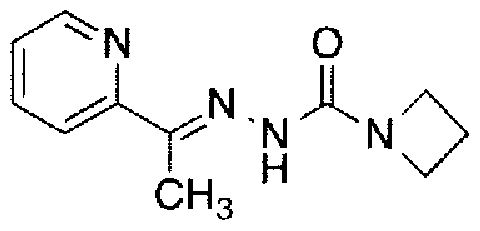
(£)-A''-(l-(pyridiii-2-yl)ethylidene)azetidine-l-carbohydrazide (10): Azetidine (85 mg, 1.5 mmol) was dissolved in 5 mL methylene chloride and diisopropylethylamine (195 mg, 1.50 mmol, 1.0 equiv.) was added followed by triphosgene (267 mg, 0.9 mmol, 0.6 equiv.) and the reaction mixture stirred at ambient temperature for 4 h to generate the azetidine- 1-carbonyl chloride in situ. Without workup, (E)-2-(l -hydrazonoethyl pyridine (203 mg, 1.5 mmol, 1.0 equiv.) was added directly to this mixture following by additional diisopropylethylamine 195 mg, 1.50 mmol, 1.0 equiv.) and the reaction continued to stir at ambient temperature for 72 h. The reaction was then evaporated to dryness and purified by silica gel chromatography (high purity grade silica gel, 32-64 microns, 230- 400 mesh) eluted with a gradient of 5-10% methanol/methylene chloride with 1 % triethylamine to give a white crystalline solid in selected middle fractions. These crystals were washed with 5: 1 hexanes:methylene chloride, and dried under vacuum to give 24 mg of the title compound 10 as a free flowing white crystalline solid. Ή-NMR (400 MHz, CDC13) δ 2.28 (s, 3H), 2.32 (t, J = 7.68 Hz, 1H), 2.36 (t, J - 7.80 Hz, 1H), 4.35 (t, J = 7.36 Hz, 4H), 7.24 (ddd, J = 3.52 Hz, 2.48 Hz, 1.08 Hz, 1H), 7.66 (dt, J = 7.84 Hz, 1.76 Hz, 1H), 7.81 (s, 1 H, NH), 7.91 (d, J = 8.08 Hz, 1H), 8.57 (d, J = 4.20 Hz, 1 H). MS: 219 [M + H]+.
Example 11

(J£ -/V-(2,2-dimethyl-l-(pyridin-2-yl)propylidene)azetidine-l-carbothiohydrazide (11):
Following General Method A for the condensation of azetidine- 1 -carbothiohydrazide and 2,2- dimethyl-l-(pyridin-2-yl)propan-l-one, the title compound 11 was isolated as a white solid after recrystallization from EtO Ac/Hex. Ή-NMR (400 MHz, CDC13) δ 1.18 (s, 9H), 2.29 (t, J = 7.76 Hz, 1 H), 2.33 (t, J = 7.84 Hz, 1 H), 4.26 (t, J = 7.36 Hz, 1H), 4.66 (t, J = 7.72 Hz, 1H), 7.18 (d, J = 7.76 Hz, 1H), 7.35 (ddd, J = 6.00 Hz, 4.92 Hz, 1.12 Hz, 1 H), 7.81 (dt, J = 7.76 Hz, 1.76 Hz, 1H), 8.26 (br. s,
1H, NH), 8.76 (d, J = 4.80 Hz, 1 H). MS: 277.1 [M
Example 12

Synthesis of (12): To a suspension of 6 (190.8 mg, .814 mmol, 1 equiv.) in EtOH (20 ml) was added ZnCl2 (55.5 mg, 0.407 mmol, 0.5 equiv.). After 5 minutes, TEA (0.80 ml, excess) was added and the mixture was heated for 2 hours at reflux under nitrogen. Upon cooling to ambient temperature, a solid precipitated that was collected by filtration and washed with EtOH followed by Et20. The solids were dried under high vacuum to give [Zn(ZMCl)2] 12, (215 mg, 0.404 mmol, 99%) as a bright yellow solid. Ή-NMR (400 MHz, DMSO-dfi) δ 2.26 (overlapping tt, J = 7.48Hz, 7.40Hz, 4H), 2.58 (s, 6H), 4.05 (m, 8H), 7.29 (dd, J = 7.28 Hz, 5.60 Hz, 2H), 7.75 (m, 4H), 7.88 (dt, J = 8.04 Hz, 1.52 Hz, 2H). Slow evaporation of [Zn(ZMC l)2]from a 1 : 1 mixture of DCM/MeOH afforded yellow crystals that were suitable for X-ray crystallography. See X-ray ORTEP drawing (Figure 1 ) and data tables.
Cell-based TO V I 12D activity for representative compounds is shown in Table 1.
Table 1.


+++, most act ve; ++, mo erate y act ve; +, ess act ve
Example 13
Mice were administered molar equivalents of monomer ZMC1 (5 mg/kg) versus complex ZNl (5.6 mg/kg) IP daily and monitored for survival. Results are shown in Figure 5.
All publications, patents, and patent documents are incorporated by reference herein, as though individually incorporated by reference. The invention has been described with reference to various specific and preferred embodiments and techniques. However, it should be understood that many variations and modifications may be made while remaining within the spirit and scope of the invention.
Claims
Claims
What is claimed is:
1. A complex comprising Zn2+ and a compound of formula (I):

(I)
or an ion or poly-ion thereof, wherein:
n is 0, 1 , 2, 3, or 4;
Y is O, S, or Se;
each R1 is independently selected from (Ci-C4)alkyl, (C]-C4)alkoxy, hydroxyl, and halo;
R2 is selected from the group consisting of H and (Q-QJalkyl that is optionally substituted with aryl; and
Ra and each Rb are each independently selected from H, (C1-C6)alkyl, aryl, and aryl(C|-Cs)alkyl; or Ra and each Rb taken together with the nitrogen to which they are attached form a heterocycle that is optionally substituted with one to three substituents independently selected from (C1-C4)alkyl, ( i-C4)alkoxy, hydroxyl, halo, aryl, and heteroaryl; or a solvate thereof.
2. The complex of claim 1 wherein:
n is 0;
R2 is (Ci-C4)alk l;
Y is S or Se; and
Ra and each Rb are each independently selected from H and (Ci-C6)alkyl; or Ra and each Rb taken together with the nitrogen to which they are attached form a heterocycle selected from:

or a solvate thereof.
3. The complex of claim 1 that comprises a compound selected from the group consisting of:

and ions and poly-ions thereof; or a solvate thereof.
4. The complex of any one of claims 1-3 wherein the ratio of the number of compounds of formula (I) or ions or poly-ions thereof to zinc Zn2+ ions is about 2: 1 ; or a solvate thereof.
5. The complex of claim 4 that comprises a compound selected from the group consistin of:

and ions and poly-ions thereof, wherem: the ratio of the compound or ion or poly-ion to Zn
is about 2: 1 ; or a solvate thereof.
6. A neutral coordination complex comprising Zn2+ and a compound selected from the group consisting of:

and ions and poly-ions thereof, wherein: the ratio of the compound or ion or poly-ion to Zri is about 2:1 ; or a solvate thereof.

or a solvate thereof.
8. A pharmaceutical composition, comprising a complex of any one of claims 1-7 or a solvate thereof, and a pharmaceutically acceptable carrier.
9. An injectable pharmaceutical formulation comprising, a complex of any one of claims 1-7 or a solvate thereof, and a pharmaceutically acceptable carrier.
10. A method of inhibiting cancer cell growth in vivo or in vitro, comprising contacting a cancer cell with a complex of any one of claims 1 -7 or a solvate thereof.
11. A method of treating cancer in an animal comprising administering a complex of any one of claims 1-7 or a solvate thereof to the animal.
12. The method of claim 11 , further comprising administering zinc to the animal.
13. The method of any one of claims 10-12, wherein the cancer is caused by mutations affecting zinc binding proteins.
14. The method of any one of claims 10-13, wherein the cancer is associated with a zinc binding p53 mutation.
15. The method of any one of claims 10-14, wherein the cancer is associated with a zinc binding p53 mutation selected from R175, C176, H179, C238, C242, and G245. 6. A complex of any one of claims 1 -7 or a solvate thereof for use in medical treatment.
17. A complex of any one of claims 1-7 or a solvate thereof for the prophylactic or therapeutic treatment of cancer.
18. The complex or solvate of claim 17 wherein the cancer is caused by mutations affecting zinc binding proteins.
19. The complex or solvate of claim 17, wherein the cancer is associated with a zinc binding p53 mutation.
20. The complex or solvate of claim 17, wherein the cancer is associated with a zinc binding p53 mutation selected from R175, CI 76, HI 79, C238, C242, and G245.
21. The use of the complex of any one of claims 1 -7 or a solvate thereof to prepare a medicament for treating cancer in an animal.
22. The use of claim 21 wherein the cancer is caused by mutations affecting zinc binding proteins.
23. The use of claim 21, wherein the cancer is associated with a zinc binding p53 mutation.
24. The use of claim 21 , wherein the cancer is associated with a zinc binding p53 mutation selected from R175, CI 76, HI 79, C238, C242, and G245.
Priority Applications (2)
| Application Number | Priority Date | Filing Date | Title |
|---|---|---|---|
| US15/545,966 US10221133B2 (en) | 2015-01-27 | 2016-01-27 | (Thio, oxo, and seleno) semicarbazone complexes with zinc and their use for treating cancer |
| US16/253,126 US10604481B2 (en) | 2015-01-27 | 2019-01-21 | (Thio, oxo and seleno) semicarbazone complexes with zinc and their use for treating cancer |
Applications Claiming Priority (4)
| Application Number | Priority Date | Filing Date | Title |
|---|---|---|---|
| US201562108415P | 2015-01-27 | 2015-01-27 | |
| US62/108,415 | 2015-01-27 | ||
| US201562258177P | 2015-11-20 | 2015-11-20 | |
| US62/258,177 | 2015-11-20 |
Related Child Applications (2)
| Application Number | Title | Priority Date | Filing Date |
|---|---|---|---|
| US15/545,966 A-371-Of-International US10221133B2 (en) | 2015-01-27 | 2016-01-27 | (Thio, oxo, and seleno) semicarbazone complexes with zinc and their use for treating cancer |
| US16/253,126 Continuation US10604481B2 (en) | 2015-01-27 | 2019-01-21 | (Thio, oxo and seleno) semicarbazone complexes with zinc and their use for treating cancer |
Publications (1)
| Publication Number | Publication Date |
|---|---|
| WO2016123246A1 true WO2016123246A1 (en) | 2016-08-04 |
Family
ID=55315781
Family Applications (1)
| Application Number | Title | Priority Date | Filing Date |
|---|---|---|---|
| PCT/US2016/015183 Ceased WO2016123246A1 (en) | 2015-01-27 | 2016-01-27 | (thio, oxo and seleno) semicarbazone complexes with zinc and their use for treating cancer |
Country Status (2)
| Country | Link |
|---|---|
| US (2) | US10221133B2 (en) |
| WO (1) | WO2016123246A1 (en) |
Cited By (7)
| Publication number | Priority date | Publication date | Assignee | Title |
|---|---|---|---|---|
| CN109265453A (en) * | 2018-10-23 | 2019-01-25 | 华侨大学 | It is a kind of as the semicarbazones analog derivative of caspase-3 activator and its application |
| US10604480B2 (en) | 2015-01-27 | 2020-03-31 | Rutgers, The State University Of New Jersey | (Thio, oxo, and seleno) semicarbazone derivatives and their use for treating cancer |
| WO2020107221A1 (en) * | 2018-11-27 | 2020-06-04 | Tsinghua University | Chemical activators of nicotinamide mononucleotide adenlyly transferase 2 (nmnat2) and uses thereof |
| US10729671B2 (en) | 2015-01-27 | 2020-08-04 | Rutgers, The State University Of New Jersey | Zinc complexes of hydrazones and (thio)semicarbazones and their use for the treatment of cancer |
| US10828288B2 (en) | 2015-01-27 | 2020-11-10 | Rutgers, The State University Of New Jersey | Hydrazone derivatives for the treatment of cancer |
| US12280065B2 (en) | 2019-04-23 | 2025-04-22 | Rutgers, The State University Of New Jersey | Pharmaceutical compounds and therapeutic methods |
| US12344626B2 (en) | 2019-04-23 | 2025-07-01 | Rutgers, The State University Of New Jersey | Pharmaceutical compounds and therapeutic methods |
Families Citing this family (3)
| Publication number | Priority date | Publication date | Assignee | Title |
|---|---|---|---|---|
| US10221133B2 (en) | 2015-01-27 | 2019-03-05 | Rutgers, The State University Of New Jersey | (Thio, oxo, and seleno) semicarbazone complexes with zinc and their use for treating cancer |
| WO2020219587A1 (en) * | 2019-04-23 | 2020-10-29 | Rutgers, The State University Of New Jersey | Pharmaceutical compounds and therapeutic methods |
| CN112341479A (en) * | 2020-11-13 | 2021-02-09 | 广西科技师范学院 | Synthetic method and application of binuclear zinc complex |
Citations (2)
| Publication number | Priority date | Publication date | Assignee | Title |
|---|---|---|---|---|
| WO2007035489A2 (en) * | 2005-09-16 | 2007-03-29 | Government Of The United States Of America, As Represented By The Secretary, Department Of Health And Human Services | Methods of treating or preventing cancer using pyridine carboxaldehyde pyridine thiosemicarbazone radiosensitizing agents |
| WO2012175962A1 (en) * | 2011-06-20 | 2012-12-27 | Medical Research Council | COMPOUNDS FOR USE IN STABILISING p53 MUTANTS |
Family Cites Families (12)
| Publication number | Priority date | Publication date | Assignee | Title |
|---|---|---|---|---|
| US4665173A (en) | 1982-03-31 | 1987-05-12 | Klayman Daniel L | 2-acetyl- and 2-propionylpyridine selenosemicarbazones |
| AU2001265656A1 (en) | 2000-06-05 | 2001-12-17 | Johnny Easmon | Heterocyclic hydrazones for use as anti-cancer agents |
| WO2006019955A2 (en) | 2004-07-14 | 2006-02-23 | President And Fellows Of Harvard College | Antiviral methods and compositions |
| CA2600869A1 (en) | 2005-03-18 | 2006-09-28 | The Regents Of The University Of California | Compounds having activity in correcting mutant-cftr processing and uses thereof |
| EP2193127A4 (en) | 2007-09-27 | 2011-09-14 | Inst Medical W & E Hall | benzothiazole |
| WO2011133748A1 (en) | 2010-04-21 | 2011-10-27 | University Of Medicine And Dentistry Of New Jersey | Treatments for cellular proliferative disorders and identification thereof |
| CN103492363B (en) | 2011-04-27 | 2016-08-24 | 日本瑞翁株式会社 | Polymerizable compounds, polymerizable compositions, polymers, and optically anisotropic substances |
| WO2015021456A1 (en) | 2013-08-09 | 2015-02-12 | The Regents Of The University Of California | Small molecules to enhance p53 activity |
| US10604480B2 (en) | 2015-01-27 | 2020-03-31 | Rutgers, The State University Of New Jersey | (Thio, oxo, and seleno) semicarbazone derivatives and their use for treating cancer |
| US10221133B2 (en) | 2015-01-27 | 2019-03-05 | Rutgers, The State University Of New Jersey | (Thio, oxo, and seleno) semicarbazone complexes with zinc and their use for treating cancer |
| US10828288B2 (en) | 2015-01-27 | 2020-11-10 | Rutgers, The State University Of New Jersey | Hydrazone derivatives for the treatment of cancer |
| WO2016123250A1 (en) | 2015-01-27 | 2016-08-04 | Rutgers, The State University Of New Jersey | Zinc complexes of hydrazones and (thio)semicarbazones and their use for the treatment of cancer |
-
2016
- 2016-01-27 US US15/545,966 patent/US10221133B2/en active Active
- 2016-01-27 WO PCT/US2016/015183 patent/WO2016123246A1/en not_active Ceased
-
2019
- 2019-01-21 US US16/253,126 patent/US10604481B2/en active Active
Patent Citations (2)
| Publication number | Priority date | Publication date | Assignee | Title |
|---|---|---|---|---|
| WO2007035489A2 (en) * | 2005-09-16 | 2007-03-29 | Government Of The United States Of America, As Represented By The Secretary, Department Of Health And Human Services | Methods of treating or preventing cancer using pyridine carboxaldehyde pyridine thiosemicarbazone radiosensitizing agents |
| WO2012175962A1 (en) * | 2011-06-20 | 2012-12-27 | Medical Research Council | COMPOUNDS FOR USE IN STABILISING p53 MUTANTS |
Non-Patent Citations (4)
| Title |
|---|
| DES R. RICHARDSON ET AL: "Dipyridyl Thiosemicarbazone Chelators with Potent and Selective Antitumor Activity Form Iron Complexes with Redox Activity", JOURNAL OF MEDICINAL CHEMISTRY, vol. 49, no. 22, 1 November 2006 (2006-11-01), US, pages 6510 - 6521, XP055258311, ISSN: 0022-2623, DOI: 10.1021/jm0606342 * |
| KOVALA-DEMERTZI D ET AL: "Zinc(II) complexes derived from pyridine-2-carbaldehyde thiosemicarbazone and (1E)-1-pyridin-2-ylethan-1-one thiosemicarbazone. Synthesis, crystal structures and antiproliferative activity of zinc(II) complexes", JOURNAL OF INORGANIC BIOCHEMISTRY, ELSEVIER INC, US, vol. 100, no. 9, 1 September 2006 (2006-09-01), pages 1558 - 1567, XP027900289, ISSN: 0162-0134, [retrieved on 20060901] * |
| KOVALA-DEMERTZI, D.; YADAV, P. N.; WIECEK, J.; SKOULIKA, S.; VARADINOVA, T.; DEMERTZIS, M. A.: "Zn(II) complexes derived from pyridine-2-carbatdehyde thiosemicarbazone and (1E)-1-pyridin-2-ylethan-1-one thiosemicarbazone. Synthesis, crystal structures and antiproliferative activity of Z (II) complexes", JOURNAL OF INORGANIC BIOCHEMISTRY, vol. 100, 2006, pages 1558 - 1567 |
| XIN YU ET AL: "Small molecule restoration of wildtype structure and function of mutant p53 using a novel zinc-metallochaperone based mechanism", ONCOTARGET, vol. 5, no. 19, 3 September 2014 (2014-09-03), United States, pages 8879 - 8892, XP055259320, ISSN: 1949-2553, DOI: 10.18632/oncotarget.2432 * |
Cited By (7)
| Publication number | Priority date | Publication date | Assignee | Title |
|---|---|---|---|---|
| US10604480B2 (en) | 2015-01-27 | 2020-03-31 | Rutgers, The State University Of New Jersey | (Thio, oxo, and seleno) semicarbazone derivatives and their use for treating cancer |
| US10729671B2 (en) | 2015-01-27 | 2020-08-04 | Rutgers, The State University Of New Jersey | Zinc complexes of hydrazones and (thio)semicarbazones and their use for the treatment of cancer |
| US10828288B2 (en) | 2015-01-27 | 2020-11-10 | Rutgers, The State University Of New Jersey | Hydrazone derivatives for the treatment of cancer |
| CN109265453A (en) * | 2018-10-23 | 2019-01-25 | 华侨大学 | It is a kind of as the semicarbazones analog derivative of caspase-3 activator and its application |
| WO2020107221A1 (en) * | 2018-11-27 | 2020-06-04 | Tsinghua University | Chemical activators of nicotinamide mononucleotide adenlyly transferase 2 (nmnat2) and uses thereof |
| US12280065B2 (en) | 2019-04-23 | 2025-04-22 | Rutgers, The State University Of New Jersey | Pharmaceutical compounds and therapeutic methods |
| US12344626B2 (en) | 2019-04-23 | 2025-07-01 | Rutgers, The State University Of New Jersey | Pharmaceutical compounds and therapeutic methods |
Also Published As
| Publication number | Publication date |
|---|---|
| US10221133B2 (en) | 2019-03-05 |
| US20190256460A1 (en) | 2019-08-22 |
| US10604481B2 (en) | 2020-03-31 |
| US20180002279A1 (en) | 2018-01-04 |
Similar Documents
| Publication | Publication Date | Title |
|---|---|---|
| US10604481B2 (en) | (Thio, oxo and seleno) semicarbazone complexes with zinc and their use for treating cancer | |
| US10729671B2 (en) | Zinc complexes of hydrazones and (thio)semicarbazones and their use for the treatment of cancer | |
| US10604480B2 (en) | (Thio, oxo, and seleno) semicarbazone derivatives and their use for treating cancer | |
| EP4112606A1 (en) | Aromatic compound and use thereof in preparing antineoplastic drugs | |
| US5444062A (en) | Quinazolines derivatives for enhancing antitumor activity | |
| JP6109937B2 (en) | Fusion pyrimidines as inhibitors of the p97 complex | |
| US10828288B2 (en) | Hydrazone derivatives for the treatment of cancer | |
| JP2009521468A (en) | Quinolin-4-one derivatives as regulators of ABC transporters | |
| DE69715010T2 (en) | SELECTED K-252A DERIVATIVES | |
| TW201609668A (en) | Novel DGAT2 inhibitors | |
| US8314085B2 (en) | Agent for overcoming resistance to anti-cancer agent | |
| US11851410B2 (en) | Sensors for detection of negatively charged phosphate-containing membranes and membrane components | |
| CN113278010A (en) | Protein kinase degradation agent and application thereof | |
| Murugkar et al. | Hormone anchored metal complexes. 1. Synthesis, structure, spectroscopy and in vitro antitumor activity of testosterone acetate thiosemicarbazone and its metal complexes | |
| CN114292270B (en) | BTK inhibitor and preparation method and application thereof | |
| RU2388749C2 (en) | Tri-indolylmethane derivatives substituted in indole nucleus, method of obtaining said compounds and antibacterial and antifungal activity thereof | |
| Motohashi et al. | Antimicrobial activity of N-acylphenothiazines and their influence on lipid model membranes and erythrocyte membranes | |
| Chugunova et al. | Synthesis and study of antimicrobial activity of quaternary ammonium benzofuroxan salts | |
| CN110734426A (en) | Acetylcholinesterase degradation compound and preparation method and application thereof | |
| US12280065B2 (en) | Pharmaceutical compounds and therapeutic methods | |
| CN111108083A (en) | Use of aminomethylene cyclohexane 1, 3-dione compounds | |
| CN119569765B (en) | A method for preparing and applying a reactive oxygen species-responsive artificial ion channel | |
| Cesarini et al. | 6-Amino-4-oxo-1, 3-diphenyl-2-thioxo-1, 2, 3, 4-tetrahydropyrimidine-5-carbonyl derivatives as a new class of potent inhibitors of Interleukin-8-induced neutrophil chemotaxis | |
| CN120535505A (en) | A compound for targeted degradation of TRIM72 protein and its preparation method and application | |
| CA3150653C (en) | Fused cyclic compound capable of degrading protein and use thereof |
Legal Events
| Date | Code | Title | Description |
|---|---|---|---|
| 121 | Ep: the epo has been informed by wipo that ep was designated in this application |
Ref document number: 16703693 Country of ref document: EP Kind code of ref document: A1 |
|
| WWE | Wipo information: entry into national phase |
Ref document number: 15545966 Country of ref document: US |
|
| NENP | Non-entry into the national phase |
Ref country code: DE |
|
| 122 | Ep: pct application non-entry in european phase |
Ref document number: 16703693 Country of ref document: EP Kind code of ref document: A1 |