WO2016115512A1 - Tissue culture in blood culture bottles - Google Patents
Tissue culture in blood culture bottles Download PDFInfo
- Publication number
- WO2016115512A1 WO2016115512A1 PCT/US2016/013689 US2016013689W WO2016115512A1 WO 2016115512 A1 WO2016115512 A1 WO 2016115512A1 US 2016013689 W US2016013689 W US 2016013689W WO 2016115512 A1 WO2016115512 A1 WO 2016115512A1
- Authority
- WO
- WIPO (PCT)
- Prior art keywords
- culture
- bacteria
- pji
- tissue
- detected
- Prior art date
- Legal status (The legal status is an assumption and is not a legal conclusion. Google has not performed a legal analysis and makes no representation as to the accuracy of the status listed.)
- Ceased
Links
Classifications
-
- C—CHEMISTRY; METALLURGY
- C12—BIOCHEMISTRY; BEER; SPIRITS; WINE; VINEGAR; MICROBIOLOGY; ENZYMOLOGY; MUTATION OR GENETIC ENGINEERING
- C12Q—MEASURING OR TESTING PROCESSES INVOLVING ENZYMES, NUCLEIC ACIDS OR MICROORGANISMS; COMPOSITIONS OR TEST PAPERS THEREFOR; PROCESSES OF PREPARING SUCH COMPOSITIONS; CONDITION-RESPONSIVE CONTROL IN MICROBIOLOGICAL OR ENZYMOLOGICAL PROCESSES
- C12Q1/00—Measuring or testing processes involving enzymes, nucleic acids or microorganisms; Compositions therefor; Processes of preparing such compositions
- C12Q1/02—Measuring or testing processes involving enzymes, nucleic acids or microorganisms; Compositions therefor; Processes of preparing such compositions involving viable microorganisms
- C12Q1/24—Methods of sampling, or inoculating or spreading a sample; Methods of physically isolating an intact microorganisms
-
- C—CHEMISTRY; METALLURGY
- C12—BIOCHEMISTRY; BEER; SPIRITS; WINE; VINEGAR; MICROBIOLOGY; ENZYMOLOGY; MUTATION OR GENETIC ENGINEERING
- C12Q—MEASURING OR TESTING PROCESSES INVOLVING ENZYMES, NUCLEIC ACIDS OR MICROORGANISMS; COMPOSITIONS OR TEST PAPERS THEREFOR; PROCESSES OF PREPARING SUCH COMPOSITIONS; CONDITION-RESPONSIVE CONTROL IN MICROBIOLOGICAL OR ENZYMOLOGICAL PROCESSES
- C12Q1/00—Measuring or testing processes involving enzymes, nucleic acids or microorganisms; Compositions therefor; Processes of preparing such compositions
- C12Q1/02—Measuring or testing processes involving enzymes, nucleic acids or microorganisms; Compositions therefor; Processes of preparing such compositions involving viable microorganisms
- C12Q1/04—Determining presence or kind of microorganism; Use of selective media for testing antibiotics or bacteriocides; Compositions containing a chemical indicator therefor
-
- C—CHEMISTRY; METALLURGY
- C12—BIOCHEMISTRY; BEER; SPIRITS; WINE; VINEGAR; MICROBIOLOGY; ENZYMOLOGY; MUTATION OR GENETIC ENGINEERING
- C12Q—MEASURING OR TESTING PROCESSES INVOLVING ENZYMES, NUCLEIC ACIDS OR MICROORGANISMS; COMPOSITIONS OR TEST PAPERS THEREFOR; PROCESSES OF PREPARING SUCH COMPOSITIONS; CONDITION-RESPONSIVE CONTROL IN MICROBIOLOGICAL OR ENZYMOLOGICAL PROCESSES
- C12Q1/00—Measuring or testing processes involving enzymes, nucleic acids or microorganisms; Compositions therefor; Processes of preparing such compositions
- C12Q1/02—Measuring or testing processes involving enzymes, nucleic acids or microorganisms; Compositions therefor; Processes of preparing such compositions involving viable microorganisms
- C12Q1/04—Determining presence or kind of microorganism; Use of selective media for testing antibiotics or bacteriocides; Compositions containing a chemical indicator therefor
- C12Q1/14—Streptococcus; Staphylococcus
Definitions
- the present invention relates to methods of culturing peri-prosthetic tissues in blood culture bottles (BCBs) for diagnosing prosthetic joint infection (PJI). These methods include using semi-automated methods, are at up to 50% more sensitive than and as specific as traditional agar and broth cultures, and yield faster results.
- Prosthetic joint infection places an increasing burden on patients and healthcare resources due to an aging population and increased demand for arthroplasty. 1"4 Its diagnosis can be challenging, owing to imperfect definitions, alongside inadequate diagnostic techniques. 4 While the new IDSA and the Musculoskeletal Infection Society (MSIS) diagnostic criteria aim for a unified approach to define and report infection, misclassification remains. 5 ' 6 Accurate detection of PJI pathogens aides in its diagnosis, ensures appropriate and directed therapy, optimizes patient outcome, prevents unnecessary medication toxicity, reduces cost and, in an era of increasing antimicrobial resistance, guides judicious antibiotic use.
- MSIS Musculoskeletal Infection Society
- the present invention relates to methods of culturing peri-prosthetic tissues in blood culture bottles (BCBs) for diagnosing prosthetic joint infection (PJI). These methods include using semi-automated methods, are at up to 50% more sensitive than and as specific as traditional agar and broth cultures, and yield faster results.
- the present invention provides a method of detecting prosthetic joint infection (PJI) in a subject having a prosthetic joint, the method comprising: a) obtaining a sample of tissue surrounding a prosthetic joint implanted in said subject; b) treating said tissue so as to created homogenized tissue; c) introducing said homogenized tissue into a first and second blood culture bottles; d) incubating said first culture bottle under aerobic conditions and said second culture bottle under anaerobic conditions; and e) detecting the presence of bacteria in said first and second blood culture bottles.
- PJI prosthetic joint infection
- the method further comprises identifying the genus of said bacteria. In one embodiment, the method further comprises identifying the species of said bacteria. In one embodiment, said bacteria are selected from the group consisting of Granulicatella adiacens, Staphylococcus warneri, and Staphylococcus hominis.
- the method further comprises treating said patient with an antibiotic with activity against said species of bacteria.
- the treating of step b) comprises exposing said tissue to a paddle blender under conditions such that bacteria are separated from said tissue and put in fluid suspension, hi one embodiment, said incubating of step d) is performed for at least seven days.
- bacteria are detected before 21 hours of incubation.
- bacteria are detected between 21 - 23 hours of incubation, hi yet another embodiment, bacteria are detected by 24 hours of incubation.
- bacteria are detected after only 24 hours of incubation, hi one embodiment, said tissue sample in step a) is obtained during surgery and in step e) said bacteria are detected 24 hours after said surgery.
- bacteria are detected within 21 hours after surgery. In another embodiment, bacteria are detected between 21 - 23 hours after surgery.
- bacteria are detected by 24 hours after surgery. In one embodiment, bacteria are detected before 2 days of incubation. In another embodiment, bacteria are detected before 3 days of incubation. In another embodiment, bacteria are detected before 4 days of incubation. In yet another embodiment, bacteria are detected before 5 days of incubation. In one embodiment, bacteria are detected only after five days of incubation. In one embodiment, bacteria are detected only after seven days of incubation. In one embodiment, Propionibacterium granulosum is detected after seven days of incubation. In one embodiment,
- Staphylococcus epidermidis was detected after seven days of incubation.
- the method further comprises sub-culturing bacteria from either said first or second culture bottles.
- said detecting of step d) reveals an acute infection.
- said detecting of step d) reveals a chronic infection.
- the present invention contemplates a method of detecting prosthetic joint infection in a subject, the method comprising: a) obtaining synovial fluid surrounding said prosthetic joint implant; b) introducing said synovial fluid into first and second blood culture bottles; c) incubating said first culture bottle under aerobic conditions and said second culture bottle under anaerobic conditions; and d) detecting the presence of bacteria in said first and second blood culture bottles.
- the present invention contemplates a method of detecting prosthetic joint infection in a subject having a prosthetic joint, the method comprising: a) removing said prosthetic joint; b) sonicating said prosthetic joint so as to provide a sonicate; c) introducing at least a portion of said sonicate into a first and a second blood culture bottle; d) incubating said first culture bottle under aerobic conditions and said second culture bottle under anaerobic conditions; and e) detecting the presence of bacteria in said first and second blood culture bottles.
- the present invention contemplates a method of detecting prosthetic joint infection in a subject having a prosthetic joint, the method comprising: a) removing said prosthetic joint; b) sonicating said prosthetic joint so as to provide a sonicate; c) introducing at least a portion of said sonicate onto an aerobic and a anaerobic agar plate; d) incubating the said aerobic plates under aerobic conditions and said anaerobic plates under anaerobic conditions; and e) detecting the presence of bacteria on the said plates.
- plates are not limited to the type of agar plate; for example, a plate may be chocolate agar plates, blood agar plates, etc.
- the term "prosthetic joint infection” or " ⁇ " in essence refers to a diagnosis of PJI by meeting criteria set by several medically related associations, in part relying upon a microbial test for the presence of microrganisms in the joint tissue or fluid in the area surronding or on the surface of a prosthetic joint implant in addition to the presence of clinical and laboratory findings.
- a patient is diagnosed with PJI by meeting Infectious Diseases Society of America (IDSA) criteria for PJI, or the use of another type of criteria usch as established by the Musculoskeletal Infection Society (MSIS).
- IDSA Infectious Diseases Society of America
- MSIS Musculoskeletal Infection Society
- PJI may have several types of presentations, such as late chronic PJI.
- BCB Blood Culture Bottle
- a BCB may be purchased from Becton-Dickinson under a variety of names depending upon the purpose of culture. BCB are also available from bioMerieux, Inc. Durham, North Carolina, USA. While normally used to assess blood for infections, the present invention contemplates the use of these culture bottles for assessing infection in tissue and fluids, and in particular tissue surrounding a prosthetic joint.
- homogenization refers to any means of processing tissue for use in preparing inoculants for blood culture bottles, including but not limited to a paddle blender, etc. In one embodiment, sonication is contemplated.
- sensitivity refers to the ability of a test to correctly identify the probability that a patient has a disease (also referred to as a true positive rate). Low sensitivity occurs where there is no detection when infection is in fact present. High sensitivity occurs where there is detection even when the level of infection is low.
- the term "specificity” or “specificities” refers to a measure of how accurate a test is against a false positive result, i.e. an ability of the test to correctly identify those without the disease (true negative rate).
- the term "aerobic" in reference to a growing condition refers to the presence of oxygen. Aerobic in reference to a miccrooganism refers to the capability to grow (i.e. multiply) in the presence of oxygen.
- the present invention contemplates testing for microbial infection by culturing tissue in both aerobic and anaerobic conditions.
- aneerobic in reference to a growing condition refers to the lack of oxygen.
- Aneerobic in reference to a miccrooganism refers to the capability to grow (i.e. multiply) in low oxygen or no oxygen cultures.
- the term "gold standard" in reference to a diagnostic test refers to a test against which other tests are measured.
- peri-prosthetic tissue or "PPT” refers to tissue surrounding a prosthetic joint.
- BCLM Bayesian Latent Class Modeling
- a BCLM analysis refers to a statistical method that introduces a set of latent categorical variables such that a BCLM analysis may be designed for a specific study, such as for diagnosing PJI, as described herein.
- a BLCM may be done without and with constraints or other independent variables.
- blood culture system refers to any automated microbiology growth and detection system that may be used with blood culture bottles.
- BACTECTM blood culture system refers to an automated microbiology growth and detection system, commercially available from Becton Dickinson, designed to detect microbial growth from blood specimens.
- Figure 1A and IB shows exemplary results from BCB incubations.
- the present invention relates to methods of culturing peri-prosthetic tissues in blood culture bottles (BCBs) for diagnosing prosthetic joint infection (PJI). These methods include using semi-automated methods, are at up to 50% more sensitive than and as specific as traditional agar and broth cultures, and yield faster results.
- the following descriptions provide information on methods of diagnosing PJI using blood culture bottles (BCBs) and an evaluation of their estimated accuracy.
- BACTECTM blood culture bottles were placed on the BACTECTM 960 platform (Becton Dickinson) for 5 days.
- the BACTECTM bottles demonstrated an average sensitivity of 87% ranging from 72-100, above cooked meat broth, and specificity of 98% (96-100), similar to the results using cooked meat broth, respectively. This method appeared to be as sensitive as traditional broth and more sensitive than agar plate culture 9 ' 12 but less specific.
- the same group recently demonstrated that PPT culture in BCBs for 14 days yielded positive results in 66 of 79 (84%) patients with PJI. 12 However, no comparison with other methods was performed. These studies have limitations.
- PJI was defined using histopathology alone, and details regarding anatomic location and chronicity of infection, which may impact on sensitivity, were not provided. 13 The authors suggested the future comparison of these bottles to the use of BACTECTM Paeds Plus/F bottles for small tissue samples.
- culture in BCBs as described herein is contemplated to provide the benefit of a (semi)automated method for culturing PPTs, improving sensitivity and time- to-positivity.
- Bayesian latent class modeling is a modern statistical method that overcomes potential flaws of traditional analysis. It is based on the assumption that no gold standard exists and therefore the true prevalence of the disease requires estimation, both germane to PJI. Bayesian LCM has been applied to diagnostic tests for infectious diseases, such as latent tuberculosis infection, but not to PJI. 14-16 Further, although it is traditional to compare a new diagnostic method to a standard test, in the clinical setting, a number of tests may be applied to the same specimen to optimize the diagnostic yield. Research and clinical applications are therefore disconnected.
- PJI patients including 369 subjects with prosthetic joints was used for inoculation of peri -prosthetic tissue specimens into blood culture bottles.
- This cohort included 1 17 (32%) patients that meet Infectious Diseases Society of America (IDSA) criteria for PJI of whom 82% had late chronic PJI.
- IDSA Infectious Diseases Society of America
- Incubation methods were compared from inoculation of peri-prosthetic tissue specimens into blood culture bottles to inoculations into standard agar and broth culture, applying Bayesian LCM in relation to diagnosing PJI.
- This form of statistical analysis is ideally suited to this clinical scenario.
- Challenges regarding classification of PJI using current criteria are illustrated by the discrepancy between classification using the MSIS and IDSA criteria. For example, a higher number of subjects met IDSA compared to MSIS criteria for PJI, with the majority of subjects with discrepant PJI classification over-represented in the culture-negative PJI cases.
- the disparity between sensitivity and specificity using the Bayesian LCM approach compared to applying the IDSA criteria for PJI is described herein. While a uniform definition is important, misclassification remains an issue when assessing new diagnostic techniques, compromising definition of performance characteristics of improved tests.
- time to microorganism detection was faster using the automated BCB system, facilitating the diagnosis of PJI within the first 24 hours of surgery.
- time to microorganism detection was shorter using blood culture bottles compared to standard media (pO.0001), with aerobic and anaerobic blood culture bottles flagging positive within a median of 21 and 23 hours, respectively.
- standard media pO.0001
- the use of BCBs and methods described herein decreases the time to identifying growth of microorganisms for diagnosing PJI.
- Another advantage of using the methods described herein is an increase in the incubation time of the anerobic bottles for increasing the diagnostic value of the tests.
- Extending anaerobic BCB incubation to 14 days resulted in 3 additional PJI diagnoses and detection of 3 additional contaminants, all P. acnes.
- studies using less sensitive approaches indicate that this should be unnecessary. 22
- the semi-automated method of peri-prosthetic tissue culture in blood culture bottles is almost 50% more sensitive than agar and broth cultures, as specific as agar and broth cultures, and yields faster results.
- the results indicate blood culture bottles should be used for culturing tissue harvested from patients undergoing prosthetic surgery.
- Blood culture bottles as opposed to other methods of detecting bacteria, demonstrate a higher level of sensitivity to bacterial growth for identifying prosthetic joint infection (PJI).
- peri-prosthetic tissue samples were collected intra-operatively then cultured on blood agar and chocolate agar (aerobically) and anaerobically on anaerobic agar pre- reduced. Additionally specimens were incubated in thioglycollate broth. However, there is no mention of blood culture bottles.
- the culture methods described herein can be combined with other methodologies. For example, using rapid diagnostics, such as MALDI TOF mass spectrometry or rapid nucleic acid amplification tests, direct species identification and antimicrobial susceptibility testing directly from BCBs is contemplated and may inform rapid selection of antimicrobial therapy. 21
- inoculation of homogenized PPTs into BCBs provides a strategy for partial automation of tissue culture work-up, overcoming a current limitation of total laboratory automation, the inability to handle anaerobic cultures. It also allows for improvements in technology, such as rapid antimicrobial susceptibility testing and in-bottle detection of microorganisms for blood culture diagnostics as applied to PJI diagnosis. Thus automated testing is contemplated which incorporates such improvements, as described herein.
- BCBs Overall PPT culture in BCBs resulted in 8 additional microbiological diagnoses of PJI.
- the use of BCBs and methods described herein increases the types of microorganisms identified related to PJI.
- the inventors discovered that by evaluating disease diagnostic methods for PJI using certain types of Bayesian Latent Class Modeling (LCM) a higher degree of accuracy was discovered when comparing diagnostic tests than by using other types of analysis.
- LCM Bayesian Latent Class Modeling
- a new diagnostic method evaluated by a LCM test may show more accurate results than by using the original Gold Standard.
- Streptococcus 4 (4%) 4 3 3 1 2 0 species
- Streptococcus 1 (1%) 1 0 0 0 0 0 0 group G
- Finegoldia magna 1 (1%) 1 1 1 0 1 0
- Propionibacterium 1 (1%) 1 1 1 0 0 0 granulosum
- Proteus mirabilis 1 (1%) 1 1 1 0 0
- Staphylococcus 1 (1%) 1 0 0 0 0 0 warneri
- Corynebacterium 1 (1%) 0 1 0 0 0 0 0 striatum
- the study population included patients undergoing revision arthroplasty surgery at Mayo Clinic, Rochester, MN, in particular between 08/2013 and 04/2014. Patients were excluded from the study when single PPTs were submitted.
- IDSA criteria for PJI were applied. 6 In a separate analysis, MSIS criteria were applied for comparative purposes. 5 ' 17 Infections were classified as acute post-operative, late chronic or acute hematogenous. 18 Microorganisms were considered 'pathogens' if isolated from >2 PPT, implant sonicate or synovial fluid specimens. Additionally, culture methods comprising incubation of joint tissue in BCBs are contemplated to be combined with incubation of synovial fluid in BCBs.
- the culture was subcultured when it became cloudy.
- lmL was inoculated into each of a BACTECTM Plus Aerobic/F and BACTECTM Lytic/10 Anaerobic/F BCB and placed on a BACTECTM 9240 instrument (BD Diagnostic Systems).
- BACTECTM 9240 instrument BD Diagnostic Systems
- bottles were incubated for 7 days, after which, they were incubated for 14 days. Bottles were subcultured when the instrument flagged positive. Methods for culture of synovial fluid and removed implants were described. 8,1 1 ' 19
- Descriptive statistics were based on percentages and frequencies for categorical variables and for continuous variables, means and standard deviation (SD) or medians and interquartile range (IQR) if data was skewed. Proportions were compared using Fisher's exact or chi-squared for categorical data and for continuous data, Student's t test or Mann Whitney U test, for example, when data was skewed. Time to positivity in different media was compared using log-rank test.
- This software generates a trace plot of each parameter (i.e., each parameter versus the iteration number of the Gibbs sampler) for an assessment of convergence of Gibbs sampler algorithm. Convergence of the Gibbs sampler suggests that estimates are valid. Prevalence, sensitivity and specificity with 95% confidence intervals were also estimated using IDSA criteria. Sensitivity estimates based on IDSA criteria for BCB types together with conventional culture types were compared using McNemar's test of paired proportion. SAS version 9.3 (SAS Inc., Cary, NC) was used.
- the following describes the patient population and sensitivity and specificity of the resulting analysis for diagnosing PJI.
- the study cohort consisted of 369 subjects, 117 of whom met IDSA criteria for PJI. Demographic and peri-operative characteristics are shown in Table 1. Eighty two percent (82%) of PJI cases were late chronic, 7% early post-operative and 1 1% acute hematogenous infections. One hundred and four (104) (28%) patients met the MSIS criteria for PJI, all of whom also met IDSA criteria for PJI. Of the 13 patients with discordant MSIS and IDSA criteria, 6 had purulence observed intra-operatively, 6 had acute inflammation on histopathology and 1 had both intra-operative purulence and acute inflammation on histopathology.
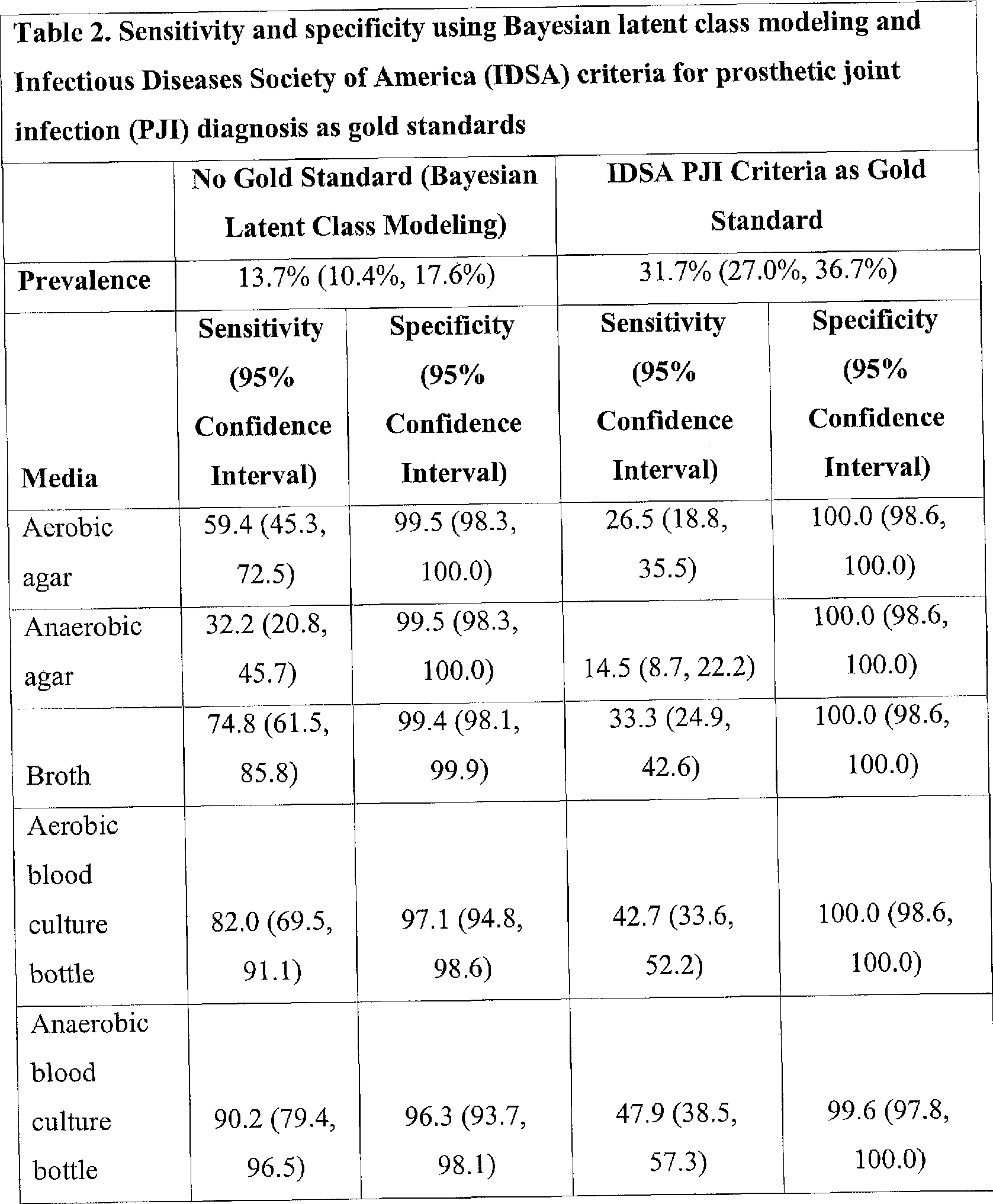
- Anaerobic and aerobic BCBs demonstrated the most sensitive media for PPT culture (sensitivity 90.2% and 82.0%, respectively), with aerobic and anaerobic agars and broth having sensitivities of 59.4, 32.2, and 74.8%, respectively.
- the specificities of anaerobic and aerobic BCBs, aerobic and anaerobic agars and broth were 97.1, 96.3, 99.5, 99.5 and 99.4%, respectively.
- IDSA criteria as a gold standard, sensitivities of the tests were reduced, however, the sensitivity of anaerobic and aerobic BCBs remained the highest of the methods studied (Table 2).
- Microorganism(s) were isolated from PPTs after 7 days of incubation in 25 subjects. No aerobic BCBs flagged after 7 days. The following results describe agar and broth results when incubated beyond 7 days. There were 7 positive anaerobic agar cultures beyond 7 days, none of which yielded additional PJI diagnoses. Extending broth culture incubation beyond 7 days yielded 16 positive cultures from 15 subjects, including 3 additional diagnoses of PJI (identified by the growth of Propionibacterium acnes). In 7 subjects, the same organism isolated in broth had been isolated in another medium by 7 days. In 5 patients not meeting criteria for PJI, a microorganism was isolated in broth beyond 7 days. In contrast, extending anaerobic BCB incubation beyond 7 days yielded 1 1 further positive culture results in 8 subjects, including 5 subjects with PJI and 3 subjects not meeting IDSA criteria for PJI.
- PJI (1 Propionibacterium granulosum case and 2 P. acnes cases; both P. acnes cases were also detected using extended broth culture).
- 2 anaerobic BCBs had flagged positive prior to day 7, with the third anaerobic bottle flagging positive on day 12.
- P. acnes was isolated from a single anaerobic BCB after 9 days (indeterminate result), in addition to multiple blood cultures isolating Staphylococcus epidermidis prior to 7 days.
- a pathogen was isolated from >2 PPTs in 83 subjects (71%) (Supplementary Table S I).
- 10 PJI subjects a microorganism was isolated from a single PPT specimen.
- Twenty two (22) subjects classified as having PJI had a microorganism isolated from a single PPT specimen as well as a second different microorganism detected in 2 or more PPT specimens.
- PPTs were culture-negative in 24 PJI subjects (21%); this was not influenced by whether the subject had received antibiotic therapy in the month prior to surgery.
- Two PJI subjects with negative PPT cultures had an organism isolated from multiple synovial fluids ⁇ Staphylococcus aureus in a shoulder PJI and S. epidermidis in a hip PJI) and 1 subject with negative PPT cultures had >100 colony forming units (CFUyiO mL Corynebacterium jeikeium isolated from sonication culture of their knee implant.
- the pathogen was detected from PPT cultures using another culture medium, including 2 cases of P. acnes PJI, 1 case of S. hominis PJI, 2 cases of Parvimonas micra PJI (bilateral knees from the same subject) and 1 case of S. epidermidis PJI.
- microorganisms were isolated in single PPTs in 28 BCB specimens (presumed contaminants). Aerobic BCBs yielded 14 contaminants and anaerobic BCBs yielded 11 contaminants; in 3 cases, both aerobic and anaerobic BCBs from the same PPT yielded a contaminant.
- Bozic KJ Ries MD. The impact of infection after total hip arthroplasty on hospital and surgeon resource utilization. J Bone Joint Surg Am 2005;87: 1746-51. Kurtz SM, Ong K, Lau E, Mow at F, Halpern M. Projections of primary and revision hip and knee arthroplasty in the United States from 2005 to 2030. Journal of Bone and Joint Surgery 2007;89:780-5.
Landscapes
- Chemical & Material Sciences (AREA)
- Life Sciences & Earth Sciences (AREA)
- Health & Medical Sciences (AREA)
- Organic Chemistry (AREA)
- Engineering & Computer Science (AREA)
- Zoology (AREA)
- Wood Science & Technology (AREA)
- Proteomics, Peptides & Aminoacids (AREA)
- Analytical Chemistry (AREA)
- General Engineering & Computer Science (AREA)
- Immunology (AREA)
- Microbiology (AREA)
- Molecular Biology (AREA)
- Biophysics (AREA)
- Physics & Mathematics (AREA)
- Genetics & Genomics (AREA)
- Biochemistry (AREA)
- Bioinformatics & Cheminformatics (AREA)
- Biotechnology (AREA)
- General Health & Medical Sciences (AREA)
- Toxicology (AREA)
- Pathology (AREA)
- Measuring Or Testing Involving Enzymes Or Micro-Organisms (AREA)
Abstract
The present invention relates to methods of culturing peri-prosthetic tissues in blood culture bottles (BCBs) for diagnosing prosthetic joint infection (PJI). These methods include using semi-automated methods, are at up to 50% more sensitive than and as specific as traditional agar and broth cultures, and yield faster results.
Description
Tissue Culture in Blood Culture Bottles
FIELD OF THE INVENTION
The present invention relates to methods of culturing peri-prosthetic tissues in blood culture bottles (BCBs) for diagnosing prosthetic joint infection (PJI). These methods include using semi-automated methods, are at up to 50% more sensitive than and as specific as traditional agar and broth cultures, and yield faster results.
BACKGROUND
Prosthetic joint infection (PJI) places an increasing burden on patients and healthcare resources due to an aging population and increased demand for arthroplasty.1"4 Its diagnosis can be challenging, owing to imperfect definitions, alongside inadequate diagnostic techniques.4 While the new IDSA and the Musculoskeletal Infection Society (MSIS) diagnostic criteria aim for a unified approach to define and report infection, misclassification remains.5'6 Accurate detection of PJI pathogens aides in its diagnosis, ensures appropriate and directed therapy, optimizes patient outcome, prevents unnecessary medication toxicity, reduces cost and, in an era of increasing antimicrobial resistance, guides judicious antibiotic use.4'7 Although implant sonication increases culture sensitivity over peri-prosthetic tissue (PPT) culture, slow adoption of sonication in clinical laboratories and increasingly used debridement and implant retention strategies obviate this approach, rendering PPTs the available specimens for culture.8 PPT culture methods are non-standardized; sensitivity using agar plates is low, though it is improved with broth culture.9'10
Despite known low sensitivity and often a lack of detecting certain microorganisms, culture of peri-prosthetic tissue on plates and in broths is routine, especially when implants are not removed.
Therefore, a more accurate method of diagnosing prosthetic joint infection (PJI) and methods for detecting microorganisms are needed for research and clinical applications.
SUMMARY OF THE INVENTION
The present invention relates to methods of culturing peri-prosthetic tissues in blood culture bottles (BCBs) for diagnosing prosthetic joint infection (PJI). These methods include using semi-automated methods, are at up to 50% more sensitive than and as specific as traditional agar and broth cultures, and yield faster results.
In one embodiment, the present invention provides a method of detecting prosthetic joint infection (PJI) in a subject having a prosthetic joint, the method comprising: a) obtaining a sample of tissue surrounding a prosthetic joint implanted in said subject; b) treating said tissue so as to created homogenized tissue; c) introducing said homogenized tissue into a first and second blood culture bottles; d) incubating said first culture bottle under aerobic conditions and said second culture bottle under anaerobic conditions; and e) detecting the presence of bacteria in said first and second blood culture bottles.
In one embodiment, the method further comprises identifying the genus of said bacteria. In one embodiment, the method further comprises identifying the species of said bacteria. In one embodiment, said bacteria are selected from the group consisting of Granulicatella adiacens, Staphylococcus warneri, and Staphylococcus hominis.
In one embodiment, the method further comprises treating said patient with an antibiotic with activity against said species of bacteria.
In one embodiment, the treating of step b) comprises exposing said tissue to a paddle blender under conditions such that bacteria are separated from said tissue and put in fluid suspension, hi one embodiment, said incubating of step d) is performed for at least seven days. In other embodiments, bacteria are detected before 21 hours of incubation. In another embodiment, bacteria are detected between 21 - 23 hours of incubation, hi yet another embodiment, bacteria are detected by 24 hours of incubation. In one embodiment, bacteria are detected after only 24 hours of incubation, hi one embodiment, said tissue sample in step a) is obtained during surgery and in step e) said bacteria are detected 24 hours after said surgery. In one embodiment, bacteria are detected within 21 hours after surgery. In another embodiment, bacteria are detected between 21 - 23 hours after surgery. In yet another embodiment, bacteria are detected by 24 hours after surgery. In one embodiment, bacteria are detected before 2 days of
incubation. In another embodiment, bacteria are detected before 3 days of incubation. In another embodiment, bacteria are detected before 4 days of incubation. In yet another embodiment, bacteria are detected before 5 days of incubation. In one embodiment, bacteria are detected only after five days of incubation. In one embodiment, bacteria are detected only after seven days of incubation. In one embodiment, Propionibacterium granulosum is detected after seven days of incubation. In one embodiment,
Staphylococcus epidermidis was detected after seven days of incubation.
In one embodiment, the method further comprises sub-culturing bacteria from either said first or second culture bottles. In one embodiment, said detecting of step d) reveals an acute infection. In one embodiment, said detecting of step d) reveals a chronic infection.
In another embodiment, the present invention contemplates a method of detecting prosthetic joint infection in a subject, the method comprising: a) obtaining synovial fluid surrounding said prosthetic joint implant; b) introducing said synovial fluid into first and second blood culture bottles; c) incubating said first culture bottle under aerobic conditions and said second culture bottle under anaerobic conditions; and d) detecting the presence of bacteria in said first and second blood culture bottles.
In another embodiment, the present invention contemplates a method of detecting prosthetic joint infection in a subject having a prosthetic joint, the method comprising: a) removing said prosthetic joint; b) sonicating said prosthetic joint so as to provide a sonicate; c) introducing at least a portion of said sonicate into a first and a second blood culture bottle; d) incubating said first culture bottle under aerobic conditions and said second culture bottle under anaerobic conditions; and e) detecting the presence of bacteria in said first and second blood culture bottles.
In another embodiment, the present invention contemplates a method of detecting prosthetic joint infection in a subject having a prosthetic joint, the method comprising: a) removing said prosthetic joint; b) sonicating said prosthetic joint so as to provide a sonicate; c) introducing at least a portion of said sonicate onto an aerobic and a anaerobic agar plate; d) incubating the said aerobic plates under aerobic conditions and said anaerobic plates under anaerobic conditions; and e) detecting the presence of bacteria on
the said plates. In one embodiment, plates are not limited to the type of agar plate; for example, a plate may be chocolate agar plates, blood agar plates, etc.
DEFINITIONS
To facilitate an understanding of the present invention, a number of terms and phrases are defined below. Terms defined herein have meanings as commonly understood by a person of ordinary skill in the areas relevant to the present invention. Terms such as "a", "an" and "the" are not intended to refer to only a singular entity, but include the general class of which a specific example may be used for illustration.
As used herein, the term "prosthetic joint infection" or "ΡΠ" in essence refers to a diagnosis of PJI by meeting criteria set by several medically related associations, in part relying upon a microbial test for the presence of microrganisms in the joint tissue or fluid in the area surronding or on the surface of a prosthetic joint implant in addition to the presence of clinical and laboratory findings. For example, a patient is diagnosed with PJI by meeting Infectious Diseases Society of America (IDSA) criteria for PJI, or the use of another type of criteria usch as established by the Musculoskeletal Infection Society (MSIS). PJI may have several types of presentations, such as late chronic PJI.
As used herein, the term "Blood Culture Bottle" or "BCB" refers to a container for culturing microorganisms containing culture media into which blood can be injected for determining whether microorganisms are present. In some examples, a BCB may be purchased from Becton-Dickinson under a variety of names depending upon the purpose of culture. BCB are also available from bioMerieux, Inc. Durham, North Carolina, USA. While normally used to assess blood for infections, the present invention contemplates the use of these culture bottles for assessing infection in tissue and fluids, and in particular tissue surrounding a prosthetic joint.
As used herein, the term "homogenization" refers to any means of processing tissue for use in preparing inoculants for blood culture bottles, including but not limited to a paddle blender, etc. In one embodiment, sonication is contemplated.
As used herein, the term "sensitivity" refers to the ability of a test to correctly identify the probability that a patient has a disease (also referred to as a true positive
rate). Low sensitivity occurs where there is no detection when infection is in fact present. High sensitivity occurs where there is detection even when the level of infection is low.
As used herein, the term "specificity" or "specificities" refers to a measure of how accurate a test is against a false positive result, i.e. an ability of the test to correctly identify those without the disease (true negative rate).
As used herein, the term "aerobic" in reference to a growing condition refers to the presence of oxygen. Aerobic in reference to a miccrooganism refers to the capability to grow (i.e. multiply) in the presence of oxygen. The present invention contemplates testing for microbial infection by culturing tissue in both aerobic and anaerobic conditions.
As used herein, the term "anaerobic" in reference to a growing condition refers to the lack of oxygen. Aneerobic in reference to a miccrooganism refers to the capability to grow (i.e. multiply) in low oxygen or no oxygen cultures.
As used herein, the term "gold standard" in reference to a diagnostic test refers to a test against which other tests are measured.
As used herein, the term "peri-prosthetic tissue" or "PPT" refers to tissue surrounding a prosthetic joint.
As used herein, the term "Bayesian Latent Class Modeling" or "LCM" analysis" refers to a statistical method that introduces a set of latent categorical variables such that a BCLM analysis may be designed for a specific study, such as for diagnosing PJI, as described herein. For example, a BLCM may be done without and with constraints or other independent variables.
As used herein, the term "blood culture system" refers to any automated microbiology growth and detection system that may be used with blood culture bottles.
As used herein, the term "BACTEC™ blood culture system" refers to an automated microbiology growth and detection system, commercially available from Becton Dickinson, designed to detect microbial growth from blood specimens.
BRIEF DESCRIPTION OF THE DRAWINGS
Figure 1A and IB shows exemplary results from BCB incubations. A) Aerobic blood culture bottle showing days of culture for detection of growing microorganisms by
Day 5. B) Anaerobic blood culture bottle showing days of culture for detection of growing microorganisms by Day 14.
DESCRIPTION OF THE INVENTION
The present invention relates to methods of culturing peri-prosthetic tissues in blood culture bottles (BCBs) for diagnosing prosthetic joint infection (PJI). These methods include using semi-automated methods, are at up to 50% more sensitive than and as specific as traditional agar and broth cultures, and yield faster results.
Assessment of the accuracy of new tests for prosthetic joint infection (PJI) diagnosis using traditional statistical methods is flawed due to imperfect clinical criteria and lack of 'gold standard' tests. Despite known low sensitivity of results, culture of peri- prosthetic tissue on plates and in broths is routine, especially when implants are not removed. Studies were done culturing sonicates of and samples of peri-prosthetic tissues in blood culture bottles (BCBs) however the results were evaluated in small and limited studies. During the course of evaluating a large cohort of patients using BCB cultures of peri-prosthetic tissue by applying Bayesian Latent Class Modeling (LCM) analysis to the results, the inventors discovered that the sensitivity and specificity were actually higher than previously reported. I. Diagnosing Prosthetic joint infection (PJI).
The following descriptions provide information on methods of diagnosing PJI using blood culture bottles (BCBs) and an evaluation of their estimated accuracy.
A. Study Design and Comparison Method Effects On Evaluating a new diagnostic method.
As one example, in 2011, Hughes et ah (Hughes, et al, "Microbiological diagnosis of prosthetic joint infections: a prospective evaluation of four bacterial culture media in the routine laboratory." Clin Micro Infect. 17: 1528 (2011)) published a small study evaluating 23 histologically classified PJI cases whose PPTs as intra-operative specimens (from joint revision patients) were processed using saline/glass beads, then inoculated into automated BACTEC™ blood culture bottles, i.e. BACTEC™ Standard Anaerobic/F blood culture bottle, and a BACTEC™ Plus Aerobic/F blood culture bottle
(Becton Dickinson, Oxford, UK). BACTEC™ blood culture bottles were placed on the BACTEC™ 960 platform (Becton Dickinson) for 5 days. The BACTEC™ bottles demonstrated an average sensitivity of 87% ranging from 72-100, above cooked meat broth, and specificity of 98% (96-100), similar to the results using cooked meat broth, respectively. This method appeared to be as sensitive as traditional broth and more sensitive than agar plate culture9'12 but less specific. The same group recently demonstrated that PPT culture in BCBs for 14 days yielded positive results in 66 of 79 (84%) patients with PJI.12 However, no comparison with other methods was performed. These studies have limitations. PJI was defined using histopathology alone, and details regarding anatomic location and chronicity of infection, which may impact on sensitivity, were not provided.13 The authors suggested the future comparison of these bottles to the use of BACTEC™ Paeds Plus/F bottles for small tissue samples.
In contrast, culture in BCBs as described herein is contemplated to provide the benefit of a (semi)automated method for culturing PPTs, improving sensitivity and time- to-positivity.
The prior studies used paired-design methodologies. Given the unknown prevalence of PJI and limitations of conventional microbiological techniques, application of traditional statistical methods may lead to miscalculation of true sensitivity of new tests and true prevalence of disease.14"16 Bayesian latent class modeling (LCM) is a modern statistical method that overcomes potential flaws of traditional analysis. It is based on the assumption that no gold standard exists and therefore the true prevalence of the disease requires estimation, both germane to PJI. Bayesian LCM has been applied to diagnostic tests for infectious diseases, such as latent tuberculosis infection, but not to PJI.14-16 Further, although it is traditional to compare a new diagnostic method to a standard test, in the clinical setting, a number of tests may be applied to the same specimen to optimize the diagnostic yield. Research and clinical applications are therefore disconnected.
However, despite the published information related to the use of BCBs for detecting PJI, the methods described herein show an increase in the number of patients identified by the use of BCBs as having joint infections over that of traditional methods. In part, extended incubation times and the overcoming limitations of analysis of BCB
culture results with the use of Bayesian LCM demonstrated an increase in the sensitivty of these diagnostic methods over previous diagnostic methods using BCBs and other types of incubation methods.
Thus, herein is a report of the results from a large prospective cohort study comparing inoculation of PPTs into BCBs to conventional agar and broth culture for the diagnosis of PJI, applying Bayesian LCM. The sensitivity and specificity of different culture techniques alone and in combination and time to positivity with the different techniques was compared. II. Results of a Large Cohort Study using BCBs and applying Bayesian Latent Class Modeling (LCM) analysis to the results.
As described herein, a large cohort of PJI patients including 369 subjects with prosthetic joints was used for inoculation of peri -prosthetic tissue specimens into blood culture bottles. This cohort included 1 17 (32%) patients that meet Infectious Diseases Society of America (IDSA) criteria for PJI of whom 82% had late chronic PJI.
A. Increased Sensitivity.
During analysis of this large cohort study, the results from inoculation of peri- prosthetic tissue specimens into blood culture bottles were compared with standard agar and broth culture. A sensitivity of 92.1% versus 62.6% for standard plate and broth culture was discovered after applying Bayesian Latent Class Modeling (LCM) analysis. Specificities were 99.7 and 98.1%, respectively. Using IDSA criteria for case classification, sensitivity using blood culture bottles was also higher than standard plate and broth cultures (p=0.0003). Thus, in one embodiment, the use of BCBs and methods described herein, increases the types of microorganisms identified related to PJI.
Incubation methods were compared from inoculation of peri-prosthetic tissue specimens into blood culture bottles to inoculations into standard agar and broth culture, applying Bayesian LCM in relation to diagnosing PJI. This form of statistical analysis is ideally suited to this clinical scenario. Challenges regarding classification of PJI using current criteria are illustrated by the discrepancy between classification using the MSIS and IDSA criteria. For example, a higher number of subjects met IDSA compared to MSIS criteria for PJI, with the majority of subjects with discrepant PJI classification
over-represented in the culture-negative PJI cases. The disparity between sensitivity and specificity using the Bayesian LCM approach compared to applying the IDSA criteria for PJI is described herein. While a uniform definition is important, misclassification remains an issue when assessing new diagnostic techniques, compromising definition of performance characteristics of improved tests.
B. Faster Incubation Time of BCBs to Diagnosis.
In addition to improved sensitivity, time to microorganism detection was faster using the automated BCB system, facilitating the diagnosis of PJI within the first 24 hours of surgery. In fact, time to microorganism detection was shorter using blood culture bottles compared to standard media (pO.0001), with aerobic and anaerobic blood culture bottles flagging positive within a median of 21 and 23 hours, respectively. Thus, in one embodiment, the use of BCBs and methods described herein decreases the time to identifying growth of microorganisms for diagnosing PJI.
Additionally, another advantage of using the methods described herein is an increase in the incubation time of the anerobic bottles for increasing the diagnostic value of the tests. Several studies previously focused on the duration of culture incubation for PJI diagnosis.12'22'23 In contrast, no organism was isolated in aerobic BCBs after 7 days of incubation in the present study. Extending anaerobic BCB incubation to 14 days resulted in 3 additional PJI diagnoses and detection of 3 additional contaminants, all P. acnes. Although the benefit of extending culture incubation beyond 14 days was not examined, studies using less sensitive approaches indicate that this should be unnecessary. 22
The semi-automated method of peri-prosthetic tissue culture in blood culture bottles is almost 50% more sensitive than agar and broth cultures, as specific as agar and broth cultures, and yields faster results. The results indicate blood culture bottles should be used for culturing tissue harvested from patients undergoing prosthetic surgery. Blood culture bottles, as opposed to other methods of detecting bacteria, demonstrate a higher level of sensitivity to bacterial growth for identifying prosthetic joint infection (PJI).
Other studies on incubation times by the inventors include, Dylla, et ah, no. 2052
"Comparative study of Propionibacteriiim acnes Growth in BACTEC™ Bottles versus Thioglycollate Broth." American Society for Microbiology, Boston, 114th General
Meeting, May. 17-20, 2014. This publication describes using BACTEC™ Anaerobic/F
blood culture bottles (Becton Dickinson) and ThioglycoUate broths for growing cultures of Propionibacterium acnes. Although the majority of isolates were detected faster in blood culture bottles, one isolate grew faster in ThioglycoUate broth and one isolate took more than five days to grow in BACTEC™ bottles. In Peel, et ah, "Culture Negative Prosthetic Joint Infection - A Description of Current Treatment and Outcomes." Clin Microbial, 2:2 (2013), methods for detecting prosthetic joint infections were described. Briefly, peri-prosthetic tissue samples were collected intra-operatively then cultured on blood agar and chocolate agar (aerobically) and anaerobically on anaerobic agar pre- reduced. Additionally specimens were incubated in thioglycollate broth. However, there is no mention of blood culture bottles.
The culture methods described herein can be combined with other methodologies. For example, using rapid diagnostics, such as MALDI TOF mass spectrometry or rapid nucleic acid amplification tests, direct species identification and antimicrobial susceptibility testing directly from BCBs is contemplated and may inform rapid selection of antimicrobial therapy.21
Thus, inoculation of homogenized PPTs into BCBs provides a strategy for partial automation of tissue culture work-up, overcoming a current limitation of total laboratory automation, the inability to handle anaerobic cultures. It also allows for improvements in technology, such as rapid antimicrobial susceptibility testing and in-bottle detection of microorganisms for blood culture diagnostics as applied to PJI diagnosis. Thus automated testing is contemplated which incorporates such improvements, as described herein.
C. Additional Microorganisms Identified Using BCBs.
Overall PPT culture in BCBs resulted in 8 additional microbiological diagnoses of PJI. Thus, in one embodiment, the use of BCBs and methods described herein, increases the types of microorganisms identified related to PJI.
III. Bayesian Latent Class Modeling (LCM) For Evaluating Disease Diagnostic Tests.
As described herein, the inventors discovered that by evaluating disease diagnostic methods for PJI using certain types of Bayesian Latent Class Modeling (LCM)
a higher degree of accuracy was discovered when comparing diagnostic tests than by using other types of analysis. In particular, even when Gold Standard Tests are used for comparison, a new diagnostic method evaluated by a LCM test may show more accurate results than by using the original Gold Standard.
The following exemplary publications (incorporated herein by reference) are related to using different types of Bayesian Latent Class Modeling (LCM) for evaluating diagnostic tests of several types of diseases. In Goncalves, et al., Bayesian Latent Class Models in Malaria Diagnosis." PLoS ONE 7(7):e40633 (2012), the application of Bayesian Latent Class Models used to estimate the malaria infection prevalence, together with sensitivities, specificities, and predictive values of three diagnostic tests (RDT (rapid diagnostic test by ICT Diagnostics), Microscopy and PCR), in four subpopulations simultaneously based on a stratified analysis by age groups and fever status (febrile, afebrile). This study was done in part because the accuracy of diagnostic tests for the malaria diagnosis is based on optical microscopy as a gold standard that has been criticized. This Bayesian analysis avoids defining a gold standard and provides estimates to the malaria infection prevalence and performance measures in different subpopulations simultaneously. The use of Bayesian Latent Class Models demonstrated that PCR yields the most reliable results across four subpopulations of patients.
In Limmathurotsakul, et al., "Defining the True Sensitivity of Culture for the Diagnosis of Melioidosis Using Bayesian Latent Class Models." PLoS ONE 5(8): el2485 (2010), the application of two general types of Bayesian latent class models (LCMs) to data from patients with a Gram-negative bacterial infection with microbial culture provided as a "gold standard" for diagnosing whether these patients had melioidosis. Patient data was provided from microbial culture and four serological tests (indirect hemagglutination test (IHA), IgM immunochromogenic cassette test (ICT), IgG ICT, and ELISA using affinity-purified antigen). One of the successful LCM models estimated culture sensitivity to be more accurate at 60.2% (instead of 100%). Thus, Bayesian latent class models (LCMs) were used here to define the "true" sensitivity of culture together with the impact of misclassification by culture on the reported accuracy of alternative diagnostic tests.
Table 1. Demographic, peri-operative biochemical, microbiological and histological characteristics of study subjects

Presenting symptoms

Positive sonicate culture 1 (2%) 23 (59%) O.001
Histopathology specimen obtained 207 (82%) 68 (58%) <0.001
Median number of microbiological 3 (3, 4) 5 (4, 6) <0.001 specimens obtained (IQR)
Median number of tissue cultures 3 (2, 3) 3 (3, 4) <0.001 performed
No Gold Standard
(Bayesian Latent Class IDSA PJI Criteria as Gold Modeling) Standard
Prevalence 21.7% (17.7%, 26.1%) 31.7% (27.0%, 36.7%)
Sensitivity Specificity Sensitivity
Specificity
Media (95% (95% (95%
(95% Confidence
Combination Confidence Confidence Confidence
Interval) Interval) Interval) Interval)
99.7
Aerobic and 48.9 33.3 100.0
(98.7,
anaerobic agars (38.3, 59.7) (24.9, 42.6) (98.6, 100.0)
100.0)
Aerobic and
62.6 98.1 44.4 98.8 anaerobic agars
(51.7, 72.5) (96.1 , 99.3) (35.3, 53.9) (96.6, 99.8) and broth
99.7
Aerobic and 92.1 60.7 98.8
(98.7,
anaerobic BCBs (84.9, 97.0) (51.2, 69.6) (96.6, 99.8)
100.0)
Aerobic and
92.1 98.8 63.3 98.8 anaerobic BCBs
(84.9, 97.0) (97.0, 99.6) (53.8, 72.0) (96.6, 99.8) and broth
Aerobic and
99.7
anaerobic BCBs 94.6 62.4 98.8
(98.7,
and aerobic (88.1, 98.6) (53.0, 71.2) (96.6, 99.8)
100.0)
agar
Aerobic and
99.8
anaerobic BCBs 96.8 62.4 98.0
(98.7,
and anaerobic (91.3, 99.3) (53.0, 71.2) (95.4, 99.4)
100.0)
agar
Aerobic and
99.1 99.7
anaerobic BCBs 64.1 98.0
(95.7, (98.7,
and aerobic and (54.7, 72.8) (95.4, 99.4)
100.0) 100.0)
anaerobic agars
99.1
All media 97.3 67.5 96.8
(95.7,
combined (94.8, 98.7) (58.2, 75.9) (93.8, 98.6)
100.0)
BCB, blood culture bottles
Table 4. Median hours (IQR) to detection of microorganisms according to different culture media. Time to detection was measured from the time the specimen was received in the laboratory until the time a microorganism was detected; in the case of broth and blood culture bottles, this was the time the broth was recorded as cloudy or the bottle flagged positive with an organism detected on Gram stain, respectively.

* Mann Whitney U test
Supplementary Table SI. Peri-prosthetic tissue culture results in subjects meeting Infectious Diseases Society of America criteria for prosthetic joint infection for different culture media
Microorganism(s) Total Peri-prosthetic tissue culture media
number BCB* Agar Thioglycollate of > 1 BCB > 2 BCB > 1 Agar > 2 Agar 1 > 2 Thioglycollate culture specimens specimens specime specimens Thioglycolla specimens positive positive positive n positive te specimen
positive
positive positive
PJI
(n=93)
Staphylococcus 46 44 41 38 25 36 22 species (49%)
S. aureus 22 22 22 18 14 18 13
(24%
S. epidermidis 19 18 15 17 9 14 9
(20%)
S. lugdunensis 2 (2%) 2 2 1 1 2 0
S. capitis 1 (1%) 1 1 0 0 1 0
S. hominis 1 (1%) 0 0 1 1 0 0
S. saccharolyticus 1 (1%) 1 1 1 0 1 0
Streptococcus 4 (4%) 4 3 3 1 2 0 species
S. agalactiae 1 (1%) 1 1 1 1 0 0
S. bovis 1 (1%) 1 1 1 0 1 0
S. gordonii 1 (1%) 1 1 1 0 1 0
Streptococcus 1 (1%) 1 0 0 0 0 0 group G
Enterococcus 2 (2%) 2 1 0 0 1 1 faecalis
Other Gram 6 (6%) 4 4 4 2 3 1 positive cocci
Facklamia 1 (1%) 1 1 1 0 1 1 hominis
Finegoldia magna 1 (1%) 1 1 1 0 1 0
Granulicatella 2 (2%) 2 2 0 0 0 0
adiacens
Parvimonas micra 2 (2%) 0 0 2 2 1 0
Gram positive 12 10 10 8 4 11 8 bacilli (13%)
Propionibacterium 10 8 8 6 3 10 7 acnes (11%)
Propionibacterium 1 (1%) 1 1 1 0 0 0 granulosum
Corynebacierium 1 (i%) 1 1 1 1 1 1 amycolatum
Gram negative 7 (8%) 7 7 7 5 6 4 bacilli
Escherichia coli 1 (1%) 1 1 1 1 1 1
Proteus mirabilis 1 (1%) 1 1 1 0 0
Enterobacter 1 (1%) 1 1 1 1 1
1
cloacae
Serratia 1 (1%) 1 1 1 1 1 1 marcescens
Pseudomonas 2 (2%) 2 2 2 1 2 0 aeruginosa
Stenotrophomonas 1 (1%) 1 1 1 1 1
1
maltophila
Candida albicans 1 (1%) 1 1 1 1 1 1
Polymicrobial 5 (5%) 5 4 4 5 4
S. aureus + P. 1 (1%) 1 0 1 1 1 1 acnes
S. aureus, S. 1 (1%) 1 1 1 1 1 agalactiae,
Enterobacter
aerogenes +
Gram-positive
bacillus
S. epidermidis + 1 (1%) 1 1 0 0 1 0 P. acnes
S. epidermidis + 1 (1%) 1 1 1 1 1 1 E. faecalis
Streptococcus 1 (1%) 1 1 1 1 1 1 sanguis,
Haemophilus
parainfluenzae +
Veillonella species
Indeterminate 10 7 3 2 0 0 0 (single positive peri- (11%)
prosthetic tissue
culture)
S. aureus 2 (2%) 2 0 0 0 0 0
S. epidermidis 1 (1%) 1 0 0 0 0 0
S. epidermidis + S. 1 (1%) 1 0 1 0 0 0 capitis
Staphylococcus 1 (1%) 1 0 0 0 0 0 warneri
S. hominis + Gram 1 (1%) 1 0 0 0 0 0 positive bacillus
Corynebacterium 1 (1%) 0 1 0 0 0 0 jeikeium
Corynebacterium 1 (1%) 0 1 0 0 0 0 striatum
C. amycolatum + 1 (1%) 1 0 1 0 0 0 Cellulosimicrobiu
m cellulans
P. acnes 1 (1%) 0 1 0 0 0 0
*BCB = Blood culture :ottle
+ Excludes cases with indeterminate culture results in addition to the isolation of a different microorganism isolated from >2 peri-prosthetic tissues
EXPERIMENTAL
The following examples serve to illustrate certain embodiments and aspects of the present invention and are not to be construed as limiting the scope thereof.
In the experimental disclosures which follow, the following abbreviations apply:
N (normal); M (molar); mM (millimolar); μΜ (micromolar); mol (moles); mmol
(millimoles); μιτιοΐ (micromoles); nmol (nanomoles); pmol (picomoles); g (grams); mg (milligrams); μg (micrograms); ng (nanograms); pg (picograms); L and (liters); ml (milliliters); μΐ (microliters); cm (centimeters); mm (millimeters); μτη (micrometers); nm (nanometers); U (units); min (minute); s and sec (second); deg (degree); °C (degrees Centigrade/Celsius).
EXAMPLE I.
The following describes exemplary methods and patients used herein.
Study Design:
The study population included patients undergoing revision arthroplasty surgery at Mayo Clinic, Rochester, MN, in particular between 08/2013 and 04/2014. Patients were excluded from the study when single PPTs were submitted.
Definitions of PJI:
IDSA criteria for PJI were applied.6 In a separate analysis, MSIS criteria were applied for comparative purposes.5'17 Infections were classified as acute post-operative, late chronic or acute hematogenous.18 Microorganisms were considered 'pathogens' if isolated from >2 PPT, implant sonicate or synovial fluid specimens. Additionally, culture methods comprising incubation of joint tissue in BCBs are contemplated to be combined with incubation of synovial fluid in BCBs.
Culture results were 'indeterminate' if microorganisms were isolated from single cultures in subjects meeting PJI criteria.6 Microorganisms were classified as 'contaminants' if isolated from single cultures in those not meeting PJI criteria.
Microbiological Methods:
Fluids and tissues were collected as described.8'"' 19 Briefly, tissues were homogenized using a Seward Stomacher 80 Biomaster (Seward Inc., Port St. Lucie, FL) in 5ml brain heart infusion broth for 1 minute and inoculated as follows; O. lmL was inoculated onto sheep blood and chocolate agar and incubated aerobically at 35°C in 5%C02 for 5 days, O. lmL was inoculated onto CDC anaerobic blood agar and incubated anaerobically for 14 days, and lmL was inoculated into enriched thioglycollate broth (BD Diagnostic Systems, Sparks, MD), incubated at 35°C for 14 days. The culture was subcultured when it became cloudy. In addition, lmL was inoculated into each of a BACTEC™ Plus Aerobic/F and BACTEC™ Lytic/10 Anaerobic/F BCB and placed on a BACTEC™ 9240 instrument (BD Diagnostic Systems). For the first month, bottles were incubated for 7 days, after which, they were incubated for 14 days. Bottles were subcultured when the instrument flagged positive. Methods for culture of synovial fluid and removed implants were described.8,1 1'19
Statistical Analysis:
Descriptive statistics were based on percentages and frequencies for categorical variables and for continuous variables, means and standard deviation (SD) or medians and interquartile range (IQR) if data was skewed. Proportions were compared using Fisher's exact or chi-squared for categorical data and for continuous data, Student's t test or Mann Whitney U test, for example, when data was skewed. Time to positivity in different media was compared using log-rank test.
Performance of the study tests was assessed individually and in combinations using Bayesian LCM, to estimate the prevalence of the disease, sensitivity and specificity, with 95% confidence intervals. Since the tests measured the same latent variable (i.e., true disease status), conditional independence among tests was set as a condition. The analysis was performed using Bayesian LCM software version (1.9.2 June 2013) which uses previously-described statistical methods.20 Prevalence of disease, sensitivities and specificities for each test or test combination were estimated using uniform (non-informative) prior using 500 burn-in iterations which were discarded so that the effect of initial values on the posterior inference is minimized. An additional 10000 iterations of the Gibbs sampler were used to get final estimates. This software generates a trace plot of each parameter (i.e., each parameter versus the iteration number
of the Gibbs sampler) for an assessment of convergence of Gibbs sampler algorithm. Convergence of the Gibbs sampler suggests that estimates are valid. Prevalence, sensitivity and specificity with 95% confidence intervals were also estimated using IDSA criteria. Sensitivity estimates based on IDSA criteria for BCB types together with conventional culture types were compared using McNemar's test of paired proportion. SAS version 9.3 (SAS Inc., Cary, NC) was used.
EXAMPLE II.
The following describes the patient population and sensitivity and specificity of the resulting analysis for diagnosing PJI.
Study Cohort:
The study cohort consisted of 369 subjects, 117 of whom met IDSA criteria for PJI. Demographic and peri-operative characteristics are shown in Table 1. Eighty two percent (82%) of PJI cases were late chronic, 7% early post-operative and 1 1% acute hematogenous infections. One hundred and four (104) (28%) patients met the MSIS criteria for PJI, all of whom also met IDSA criteria for PJI. Of the 13 patients with discordant MSIS and IDSA criteria, 6 had purulence observed intra-operatively, 6 had acute inflammation on histopathology and 1 had both intra-operative purulence and acute inflammation on histopathology. Nine (9) subjects with discordant MSIS and IDSA criteria had no organism detected from any specimen, and four (4) showed positive cultures for coagulase negative Staphylococcus species. One thousand one hundred fifty four (1 154) PPTs were studied (median, 3 per subject; IQR, 3, 3).
Sensitivity and Specificity:
For this analysis, the no gold standard test was used as a condition in the analysis.. Anaerobic and aerobic BCBs demonstrated the most sensitive media for PPT culture (sensitivity 90.2% and 82.0%, respectively), with aerobic and anaerobic agars and broth having sensitivities of 59.4, 32.2, and 74.8%, respectively. The specificities of anaerobic and aerobic BCBs, aerobic and anaerobic agars and broth were 97.1, 96.3, 99.5, 99.5 and 99.4%, respectively. Using IDSA criteria as a gold standard, sensitivities of the tests were reduced, however, the sensitivity of anaerobic and aerobic BCBs remained the highest of the methods studied (Table 2).
When combinations of different culture media were analyzed using Bayesian LCM, sensitivity using both BCB types together, the result was 92.1% positive, compared to 62.6% for the conventional combination of agar and broth culture methods (Table 3). Using Bayesian LCM, the specificity precentages when using both BCB types together and the conventional combination of culture methods were 99.7% and 98.1%, respectively. Using IDSA criteria for classification, the sensitivity using both BCB types together was 60.7%, compared to 44.4% for the conventional combination of culture methods (p=0.0003). Using IDSA criteria for classification, the specificity using both BCB types together and the conventional combination of culture methods were both 98.8%. Using all culture media combined marginally increased sensitivity to 99.1% and 67.5%) using Bayesian LCM and IDSA classification, respectively.
Time to Detection:
Aerobic and anaerobic BCBs flagged positive within the first day of incubation (Table 4). Aerobic BCBs detected pathogen growth more rapidly than did any other medium studied (anaerobic BCB, p=0.03; broth and all agars, p<0.0001). Anaerobic BCBs also more rapidly detected pathogen growth than did any other medium, except aerobic BCBs (pO.0001). In brief, aerobic and anaerobic BCBs flagged positive within the first day of incubation (aerobic bottle, median 21 hours, IQR 14-45; anaerobic bottle, median 23 hours, IQR 16-47, Table 4). There was no difference in time to contaminant detection across all media-types.The aerobic agar, thioglycollate broth and anaerobic BCB cultures from PJI subjects were positive earlier than those from subjects not meeting criteria for PJI. In contrast, there was no difference in time to positivity for pathogens using aerobic BCBs or anaerobic agar (Table 4 and Figure 1. Time to detection of pathogens compared to contaminants in aerobic and anaerobic BCBs).
Microorganism(s) were isolated from PPTs after 7 days of incubation in 25 subjects. No aerobic BCBs flagged after 7 days. The following results describe agar and broth results when incubated beyond 7 days. There were 7 positive anaerobic agar cultures beyond 7 days, none of which yielded additional PJI diagnoses. Extending broth culture incubation beyond 7 days yielded 16 positive cultures from 15 subjects, including 3 additional diagnoses of PJI (identified by the growth of Propionibacterium acnes). In 7 subjects, the same organism isolated in broth had been isolated in another medium by 7
days. In 5 patients not meeting criteria for PJI, a microorganism was isolated in broth beyond 7 days. In contrast, extending anaerobic BCB incubation beyond 7 days yielded 1 1 further positive culture results in 8 subjects, including 5 subjects with PJI and 3 subjects not meeting IDSA criteria for PJI.
Overall, extending anaerobic BCB incubation yielded 3 additional diagnoses of
PJI (1 Propionibacterium granulosum case and 2 P. acnes cases; both P. acnes cases were also detected using extended broth culture). In a further PJI case due to P. acnes, 2 anaerobic BCBs had flagged positive prior to day 7, with the third anaerobic bottle flagging positive on day 12. In the fifth PJI subject, P. acnes was isolated from a single anaerobic BCB after 9 days (indeterminate result), in addition to multiple blood cultures isolating Staphylococcus epidermidis prior to 7 days. In 6 of 7 subjects where isolation of a pathogen in the thiogycollate culture after day 7 was non diagnostic due to detection of the same pathogen in other meduium prior to day 7, the pathogen was isolated in multiple anaerobic blood culture bottles (3 P. acnes cases, 1 S. aureus case, 1 S. epidermidis and 1 Enterococcus faecalis case). Extending anaerobic BCB incubation beyond 7 days also yielded 3 contaminants, all P. acnes.
Microbiology:
A pathogen was isolated from >2 PPTs in 83 subjects (71%) (Supplementary Table S I). In 10 PJI subjects, a microorganism was isolated from a single PPT specimen. Twenty two (22) subjects classified as having PJI had a microorganism isolated from a single PPT specimen as well as a second different microorganism detected in 2 or more PPT specimens. PPTs were culture-negative in 24 PJI subjects (21%); this was not influenced by whether the subject had received antibiotic therapy in the month prior to surgery. Two PJI subjects with negative PPT cultures had an organism isolated from multiple synovial fluids {Staphylococcus aureus in a shoulder PJI and S. epidermidis in a hip PJI) and 1 subject with negative PPT cultures had >100 colony forming units (CFUyiO mL Corynebacterium jeikeium isolated from sonication culture of their knee implant.
In 13 PJI subjects, inoculation of PPTs into BCBs detected microorganisms not found from PPTs using any other culture media. Of these, the same microorganism was isolated from >2 BCB specimens in 5 subjects, including 3 and 2 cases due to S. aureus
and Granulicatella adiacens, respectively. In 3 additional PJI cases, a single BCB specimen yielded the same microorganism isolated in either sonication or synovial fluid culture. In addition, BCBs yielded a microorganism from single specimens alone in 5 PJI cases (2 with single bottles detecting S. aureus, 1 each with single bottles detecting S. epidermidis and Staphylococcus warneri, and 1 with separate single bottles detecting Staphylococcus hominis and a Gram positive bacillus).
In addition to the culture-negative cases, inoculation of PPTs into BCBs failed to identify the pathogen in 9 PJI subjects (8%). In 6 cases, the pathogen was detected from PPT cultures using another culture medium, including 2 cases of P. acnes PJI, 1 case of S. hominis PJI, 2 cases of Parvimonas micra PJI (bilateral knees from the same subject) and 1 case of S. epidermidis PJI. There were 3 additional PJI subjects with indeterminate tissue culture results in whom BCBs were negative, including 1 case isolating C. jeikeium, 1 isolating Corynebacterium striatum and 1 isolating of P. acnes.
In patients not meeting IDSA criteria for PJI, microorganisms were isolated in single PPTs in 28 BCB specimens (presumed contaminants). Aerobic BCBs yielded 14 contaminants and anaerobic BCBs yielded 11 contaminants; in 3 cases, both aerobic and anaerobic BCBs from the same PPT yielded a contaminant.
Results of this study demonstrated that changing laboratory practice to exclusive use of BCBs for PPT culture increased sensitivity of PJI diagnosis by almost 50% when compared to the standard method of agar plate and broth culture. This improved sensitivity was observed in a cohort of patients with primarily late chronic infection in whom sensitivity of culture-based diagnostics has been previously noted to be low compared to those with acute infection.1 Improved sensitivity was not at the detriment of specificity.
Results of the studies described herein demonstrate that PPT culture in BCBs improves sensitivity for diagnosis of PJI by almost 50% when compared to agar and broth culture. The use of automated blood culture systems also yields faster results with the potential for pathogen identification within 24 hours of surgery. Overall, the Bayesian LCM analysis results indicate that the use of BCBs should be a stand-alone gold standard method for culture of PPTs for diganosing PJI.
The following are herein incorporated by reference in their entirety:
Kurtz SM, Lau E, Watson H, Schmier JK, Parvizi J. Economic burden of periprosthetic joint infection in the United States. Journal of Arthroplasty 2012;27(8 Suppl):61-5.
Bozic KJ, Ries MD. The impact of infection after total hip arthroplasty on hospital and surgeon resource utilization. J Bone Joint Surg Am 2005;87: 1746-51. Kurtz SM, Ong K, Lau E, Mow at F, Halpern M. Projections of primary and revision hip and knee arthroplasty in the United States from 2005 to 2030. Journal of Bone and Joint Surgery 2007;89:780-5.
Tande AJ, Patel R. Prosthetic joint infection. Clin Microbiol Rev 2014;27:302-45. Parvizi J, Zmistowski B, Berbari E, et al. New definition for periprosthetic joint infection: from the workgroup of the musculoskeletal infection society. Clinical Orthopaedics and Related Research 2011;469: 2992-4.
Osmon D, Berbari E, Berendt A, et al. Diagnosis and management of prosthetic joint infection: clinical practice guidelines by the Infectious Diseases Society of America. Clin Infect Dis 2013;56:el - e25.
Dohmen PM. Antibiotic resistance in common pathogens reinforces the need to minimise surgical site infections. Journal of Hospital Infection 2008;70 Suppl 2: 15-20.
Trampuz A, Piper K, Jacobson M, et al. Sonication of removed hip and knee prostheses for diagnosis of infection. N Engl J Med 2007;357:654 - 63.
Hughes H, Newnham R, Athanasou N, Atkins B, Bejon P, Bowler I. Microbiological diagnosis of prosthetic joint infections: a prospective evaluation of four bacterial culture media in the routine laboratory. Clin Microbiol Infect 2011;17: 1528 - 30.
Shannon SK, Mandrekar J, Gustafson DR, et al. Anaerobic thioglycolate broth culture for recovery of Propionibacterium acnes from shoulder tissue and fluid specimens. J Clin Microbiol 2013;51:731-2.
Hughes JG, Vetter EA, Patel R, et al. Culture with BACTEC™ Peds Plus/F bottle compared with conventional methods for detection of bacteria in synovial fluid. J Clin Microbiol 2001;39:4468-71.
Minassian A, Newnham R, Kalimeris E, Bejon P, Atkins B, Bowler I. Use of an automated blood culture system (BD BACTEC™) for diagnosis of prosthetic joint infections: easy and fast. BMC Infectious Diseases 2014;14:233.
Font-Vizcarra L, Garcia S, Martinez-Pastor JC, Sierra JM, Soriano A. Blood culture flasks for culturing synovial fluid in prosthetic joint infections. Clin Orthop Relat Res 2010;468:2238-43.
Collins J, Huynh M. Estimation of diagnostic test accuracy without full verification: a review of latent class methods. Statistics in medicine 2014.
Ling DI, Pai M, Schiller I, Dendukuri N. A Bayesian framework for estimating the incremental value of a diagnostic test in the absence of a gold standard. BMC medical research methodology 2014;14:67.
Limmathurotsakul D, Jamsen K, Arayawichanont A, et al. Defining the true sensitivity of culture for the diagnosis of melioidosis using Bayesian latent class models. PLoS One 2010;5:el2485.
Musculoskeletal Infection Society, 2013. at http://www.msis-na.org/wp- content/themes/msis-temp/pdf ism-periprosthetic-joint-information.pdf.)
Tsukayama DT, Estrada R, Gustilo RB. Infection after total hip arthroplasty. A study of the treatment of one hundred and six infections. Journal of Bone and Joint Surgery 1996;78:512-23.
Piper KE, Jacobson MJ, Cofield RH, et al. Microbiologic diagnosis of prosthetic shoulder infection by use of implant sonication. Journal of Clinical Microbiology 2009;47: 1878-84.
Joseph L, Gyorkos TW, Coupal L. Bayesian estimation of disease prevalence and the parameters of diagnostic tests in the absence of a gold standard. Am J Epidemiol 1995;141:263-72.
Tamma PD, Tan K, Nussenblatt VR, Turnbull AE, Carroll KC, Cosgrove SE. Can matrix-assisted laser desorption ionization time-of-flight mass spectrometry (MALDI-TOF) enhance antimicrobial stewardship efforts in the acute care setting? Infect Control Hosp Epidemiol 2013;34:990-5.
22. Butler- Wu S, Burns E, Pottinger P, et al. Optimization of periprosthetic culture for diagnosis of Propionibacterium acnes prosthetic joint infection. J Clin Microbiol 2011;49:2490 - 5.
23. Schafer P, Fink B, Sandow D, Margull A, Berger I, Frommelt L. Prolonged bacterial culture to identify late periprosthetic joint infection: a promising strategy. Clinical Infectious Diseases 2008;47: 1403-9.
All publications and patents mentioned in the above specification are herein incorporated by reference. Various modifications and variations of the described methods and system of the invention will be apparent to those skilled in the art without departing from the scope and spirit of the invention. Although the invention has been described in connection with specific preferred embodiments, it should be understood that the invention as claimed should not be unduly limited to such specific embodiments. Indeed, various modifications of the described modes for carrying out the invention that are obvious to those skilled in microbiology, mycology, molecular biology, biochemistry, chemistry, botany, and medicine, or related fields are intended to be within the scope of the following claims.
Claims
1. A method of detecting prosthetic joint infection in a subj ect, the method comprising: a) obtaining a sample of tissue surrounding a prosthetic joint implanted in said subject; b) treating said tissue so as to created homogenized tissue; c) introducing said homogenized tissue into first and second blood culture bottles; d) incubating said first culture bottle under aerobic conditions and said second culture bottle under anaerobic conditions; e) detecting the presence of bacteria in said first and second blood culture bottles.
2. The method of Claim 1, further comprising identifying the genus of said bacteria.
3. The method of Claim 2, further comprising identifying the species of said bacteria.
4. The method of Claim 1, wherein said bacteria is selected from the group consisting of Granulicatella adiacens, Staphylococcus warneri, and Staphylococcus hominis.
5. The method of Claim 3, further comprising treating said patient with an antibiotic with activity against said species of bacteria.
6. The method of Claim 1, wherein said treating of step b) comprises exposing said tissue to a paddle blender under conditions such that bacteria are separated from said tissue and put in fluid suspension.
7. The method of Claim 1, wherein said incubating of step d) is performed for at least seven days.
8. The method of Claim 7, wherein bacteria are detected after only 24 hours of incubation.
9. The method of Claim 7, wherein said tissue sample in step a) is obtained during surgery and in step e) said bacteria are detected 24 hours after said surgery.
10. The method of Claim 7, wherein bacteria are detected only after five days of incubation.
11. The method of Claim 7, wherein bacteria are detected only after seven days of incubation.
12. The method of Claim 7, wherein Propionibacterium granulosum was detected after seven days of incubation.
13. The method of Claim 7, wherein Staphylococcus epidermidis was detected after seven days of incubation.
14. The method of Claim 1, further comprising sub-culturing bacteria from either said first or second culture bottles.
15. The method of Claim 1, wherein said detecting of step d) reveals an acute infection.
16. The method of Claim 1 , wherein said detecting of step d) reveals a chronic infection.
17. The method of Claim 1 , wherein bacteria are detected in less than 24 hours.
Applications Claiming Priority (2)
| Application Number | Priority Date | Filing Date | Title |
|---|---|---|---|
| US201562104212P | 2015-01-16 | 2015-01-16 | |
| US62/104,212 | 2015-01-16 |
Publications (1)
| Publication Number | Publication Date |
|---|---|
| WO2016115512A1 true WO2016115512A1 (en) | 2016-07-21 |
Family
ID=56406487
Family Applications (1)
| Application Number | Title | Priority Date | Filing Date |
|---|---|---|---|
| PCT/US2016/013689 Ceased WO2016115512A1 (en) | 2015-01-16 | 2016-01-15 | Tissue culture in blood culture bottles |
Country Status (1)
| Country | Link |
|---|---|
| WO (1) | WO2016115512A1 (en) |
Cited By (1)
| Publication number | Priority date | Publication date | Assignee | Title |
|---|---|---|---|---|
| CN113373047A (en) * | 2021-07-30 | 2021-09-10 | 北京大学第一医院 | Urine pathogenic bacteria detection system |
Citations (1)
| Publication number | Priority date | Publication date | Assignee | Title |
|---|---|---|---|---|
| WO2010080223A1 (en) * | 2008-12-18 | 2010-07-15 | 3M Innovative Properties Company | System and method for preparing samples |
-
2016
- 2016-01-15 WO PCT/US2016/013689 patent/WO2016115512A1/en not_active Ceased
Patent Citations (1)
| Publication number | Priority date | Publication date | Assignee | Title |
|---|---|---|---|---|
| WO2010080223A1 (en) * | 2008-12-18 | 2010-07-15 | 3M Innovative Properties Company | System and method for preparing samples |
Non-Patent Citations (2)
| Title |
|---|
| CAZANAVE ET AL.: "Rapid Molecular Microbiologic Diagnosis of Prosthetic Joint Infection", JOURNAL OF CLINICAL MICROBIOLOGY, vol. 51, no. 7, July 2013 (2013-07-01), pages 2281 - 7 * |
| CORVEC ET AL.: "Epidemiology and new developments in the diagnosis of prosthetic joint infection", INT J ARTIF ORGANS, vol. 35, no. 10, October 2012 (2012-10-01), pages 923 - 934 * |
Cited By (1)
| Publication number | Priority date | Publication date | Assignee | Title |
|---|---|---|---|---|
| CN113373047A (en) * | 2021-07-30 | 2021-09-10 | 北京大学第一医院 | Urine pathogenic bacteria detection system |
Similar Documents
| Publication | Publication Date | Title |
|---|---|---|
| Saibene et al. | Odontogenic and rhinogenic chronic sinusitis: a modern microbiological comparison | |
| Cheng et al. | Detection of pathogens from resected heart valves of patients with infective endocarditis by next-generation sequencing | |
| Condas et al. | Distribution of non-aureus staphylococci species in udder quarters with low and high somatic cell count, and clinical mastitis | |
| Huang et al. | Comparison of culture and broad-range polymerase chain reaction methods for diagnosing periprosthetic joint infection: analysis of joint fluid, periprosthetic tissue, and sonicated fluid | |
| Xu et al. | Microbiological diagnosis of device‐related biofilm infections | |
| Ascione et al. | General assembly, diagnosis, pathogen isolation-culture matters: proceedings of international consensus on orthopedic infections | |
| Nadig et al. | Staphylococcus aureus eye infections in two Indian hospitals: emergence of ST772 as a major clone | |
| Holmes et al. | Neer Award 2017: a rapid method for detecting Propionibacterium acnes in surgical biopsy specimens from the shoulder | |
| Namdari et al. | Cutibacterium acnes is isolated from air swabs: time to doubt the value of traditional cultures in shoulder surgery? | |
| JP2017516477A (en) | Compositions and methods for stabilizing and maintaining the viability of robust microorganisms | |
| Jakobsen et al. | Implants induce a new niche for microbiomes | |
| Magalhães et al. | Microbiota evaluation of patients with a Boston type I keratoprosthesis treated with topical 0.5% moxifloxacin and 5% povidone–iodine | |
| Ferrer et al. | PostoperativeCorynebacterium macginleyiendophthalmitis | |
| Rieber et al. | Microbiological diagnosis of polymicrobial periprosthetic joint infection revealed superiority of investigated tissue samples compared to sonicate fluid generated from the implant surface | |
| Han et al. | Nanopore 16S amplicon sequencing enables rapid detection of pathogen in knee periprosthetic joint infection | |
| Chang et al. | Application of next‐generation sequencing technology in the detection of pathogenic bacteria of the periprosthetic joint infection after arthroplasty | |
| Nastych et al. | Comparison of bacterial load parameters in subgingival plaque during peri-implantitis and periodontitis using the RT-PCR method | |
| Fujikawa et al. | Cholesteatoma has an altered microbiota with a higher abundance of Staphylococcus species | |
| Selva Pandiyan et al. | Identification of bacterial and fungal pathogens by rDNA gene barcoding in vitreous fluids of endophthalmitis patients | |
| Salar-Vidal et al. | Multicenter evaluation of BioFire JI panel related to improved microbiological diagnostics on acute osteoarticular infections | |
| Khalil et al. | The next step: role of metagenomic next generation sequencing for microbial detection in culture-negative cardiovascular infections | |
| Santos et al. | Comparative genomic analysis of resistance and virulence genes in staphylococcus epidermidis and their impact on clinical outcome of musculoskeletal infections | |
| Rieber et al. | Sonicate fluid inoculated into blood culture bottles does not improve diagnosis of periprosthetic joint infection caused by anaerobes. A retrospective analysis | |
| Lippmann et al. | Fluorescence in situ hybridization (FISH) for the diagnosis of periprosthetic joint infection in formalin-fixed paraffin-embedded surgical tissues | |
| Hoffmann et al. | New diagnostic techniques for diagnosing facture-related infections |
Legal Events
| Date | Code | Title | Description |
|---|---|---|---|
| 121 | Ep: the epo has been informed by wipo that ep was designated in this application |
Ref document number: 16738000 Country of ref document: EP Kind code of ref document: A1 |
|
| NENP | Non-entry into the national phase |
Ref country code: DE |
|
| 122 | Ep: pct application non-entry in european phase |
Ref document number: 16738000 Country of ref document: EP Kind code of ref document: A1 |