WO2016113757A1 - Novel recyclable iodinating agent and its applications - Google Patents
Novel recyclable iodinating agent and its applications Download PDFInfo
- Publication number
- WO2016113757A1 WO2016113757A1 PCT/IN2016/050011 IN2016050011W WO2016113757A1 WO 2016113757 A1 WO2016113757 A1 WO 2016113757A1 IN 2016050011 W IN2016050011 W IN 2016050011W WO 2016113757 A1 WO2016113757 A1 WO 2016113757A1
- Authority
- WO
- WIPO (PCT)
- Prior art keywords
- formula
- aromatic
- butyl
- methylpyridinium
- afford
- Prior art date
- Legal status (The legal status is an assumption and is not a legal conclusion. Google has not performed a legal analysis and makes no representation as to the accuracy of the status listed.)
- Ceased
Links
Classifications
-
- C—CHEMISTRY; METALLURGY
- C07—ORGANIC CHEMISTRY
- C07D—HETEROCYCLIC COMPOUNDS
- C07D213/00—Heterocyclic compounds containing six-membered rings, not condensed with other rings, with one nitrogen atom as the only ring hetero atom and three or more double bonds between ring members or between ring members and non-ring members
- C07D213/02—Heterocyclic compounds containing six-membered rings, not condensed with other rings, with one nitrogen atom as the only ring hetero atom and three or more double bonds between ring members or between ring members and non-ring members having three double bonds between ring members or between ring members and non-ring members
- C07D213/04—Heterocyclic compounds containing six-membered rings, not condensed with other rings, with one nitrogen atom as the only ring hetero atom and three or more double bonds between ring members or between ring members and non-ring members having three double bonds between ring members or between ring members and non-ring members having no bond between the ring nitrogen atom and a non-ring member or having only hydrogen or carbon atoms directly attached to the ring nitrogen atom
- C07D213/06—Heterocyclic compounds containing six-membered rings, not condensed with other rings, with one nitrogen atom as the only ring hetero atom and three or more double bonds between ring members or between ring members and non-ring members having three double bonds between ring members or between ring members and non-ring members having no bond between the ring nitrogen atom and a non-ring member or having only hydrogen or carbon atoms directly attached to the ring nitrogen atom containing only hydrogen and carbon atoms in addition to the ring nitrogen atom
- C07D213/16—Heterocyclic compounds containing six-membered rings, not condensed with other rings, with one nitrogen atom as the only ring hetero atom and three or more double bonds between ring members or between ring members and non-ring members having three double bonds between ring members or between ring members and non-ring members having no bond between the ring nitrogen atom and a non-ring member or having only hydrogen or carbon atoms directly attached to the ring nitrogen atom containing only hydrogen and carbon atoms in addition to the ring nitrogen atom containing only one pyridine ring
- C07D213/20—Quaternary compounds thereof
-
- C—CHEMISTRY; METALLURGY
- C07—ORGANIC CHEMISTRY
- C07C—ACYCLIC OR CARBOCYCLIC COMPOUNDS
- C07C209/00—Preparation of compounds containing amino groups bound to a carbon skeleton
- C07C209/68—Preparation of compounds containing amino groups bound to a carbon skeleton from amines, by reactions not involving amino groups, e.g. reduction of unsaturated amines, aromatisation, or substitution of the carbon skeleton
- C07C209/74—Preparation of compounds containing amino groups bound to a carbon skeleton from amines, by reactions not involving amino groups, e.g. reduction of unsaturated amines, aromatisation, or substitution of the carbon skeleton by halogenation, hydrohalogenation, dehalogenation, or dehydrohalogenation
-
- C—CHEMISTRY; METALLURGY
- C07—ORGANIC CHEMISTRY
- C07C—ACYCLIC OR CARBOCYCLIC COMPOUNDS
- C07C231/00—Preparation of carboxylic acid amides
- C07C231/12—Preparation of carboxylic acid amides by reactions not involving the formation of carboxamide groups
-
- C—CHEMISTRY; METALLURGY
- C07—ORGANIC CHEMISTRY
- C07C—ACYCLIC OR CARBOCYCLIC COMPOUNDS
- C07C45/00—Preparation of compounds having >C = O groups bound only to carbon or hydrogen atoms; Preparation of chelates of such compounds
- C07C45/61—Preparation of compounds having >C = O groups bound only to carbon or hydrogen atoms; Preparation of chelates of such compounds by reactions not involving the formation of >C = O groups
- C07C45/63—Preparation of compounds having >C = O groups bound only to carbon or hydrogen atoms; Preparation of chelates of such compounds by reactions not involving the formation of >C = O groups by introduction of halogen; by substitution of halogen atoms by other halogen atoms
-
- C—CHEMISTRY; METALLURGY
- C07—ORGANIC CHEMISTRY
- C07D—HETEROCYCLIC COMPOUNDS
- C07D215/00—Heterocyclic compounds containing quinoline or hydrogenated quinoline ring systems
- C07D215/02—Heterocyclic compounds containing quinoline or hydrogenated quinoline ring systems having no bond between the ring nitrogen atom and a non-ring member or having only hydrogen atoms or carbon atoms directly attached to the ring nitrogen atom
- C07D215/16—Heterocyclic compounds containing quinoline or hydrogenated quinoline ring systems having no bond between the ring nitrogen atom and a non-ring member or having only hydrogen atoms or carbon atoms directly attached to the ring nitrogen atom with hetero atoms or with carbon atoms having three bonds to hetero atoms with at the most one bond to halogen, e.g. ester or nitrile radicals, directly attached to ring carbon atoms
- C07D215/20—Oxygen atoms
- C07D215/24—Oxygen atoms attached in position 8
- C07D215/26—Alcohols; Ethers thereof
- C07D215/28—Alcohols; Ethers thereof with halogen atoms or nitro radicals in positions 5, 6 or 7
-
- C—CHEMISTRY; METALLURGY
- C07—ORGANIC CHEMISTRY
- C07D—HETEROCYCLIC COMPOUNDS
- C07D233/00—Heterocyclic compounds containing 1,3-diazole or hydrogenated 1,3-diazole rings, not condensed with other rings
- C07D233/54—Heterocyclic compounds containing 1,3-diazole or hydrogenated 1,3-diazole rings, not condensed with other rings having two double bonds between ring members or between ring members and non-ring members
- C07D233/66—Heterocyclic compounds containing 1,3-diazole or hydrogenated 1,3-diazole rings, not condensed with other rings having two double bonds between ring members or between ring members and non-ring members with hetero atoms or with carbon atoms having three bonds to hetero atoms with at the most one bond to halogen, e.g. ester or nitrile radicals, directly attached to ring carbon atoms
- C07D233/68—Halogen atoms
-
- Y—GENERAL TAGGING OF NEW TECHNOLOGICAL DEVELOPMENTS; GENERAL TAGGING OF CROSS-SECTIONAL TECHNOLOGIES SPANNING OVER SEVERAL SECTIONS OF THE IPC; TECHNICAL SUBJECTS COVERED BY FORMER USPC CROSS-REFERENCE ART COLLECTIONS [XRACs] AND DIGESTS
- Y02—TECHNOLOGIES OR APPLICATIONS FOR MITIGATION OR ADAPTATION AGAINST CLIMATE CHANGE
- Y02P—CLIMATE CHANGE MITIGATION TECHNOLOGIES IN THE PRODUCTION OR PROCESSING OF GOODS
- Y02P20/00—Technologies relating to chemical industry
- Y02P20/50—Improvements relating to the production of bulk chemicals
- Y02P20/582—Recycling of unreacted starting or intermediate materials
-
- Y—GENERAL TAGGING OF NEW TECHNOLOGICAL DEVELOPMENTS; GENERAL TAGGING OF CROSS-SECTIONAL TECHNOLOGIES SPANNING OVER SEVERAL SECTIONS OF THE IPC; TECHNICAL SUBJECTS COVERED BY FORMER USPC CROSS-REFERENCE ART COLLECTIONS [XRACs] AND DIGESTS
- Y02—TECHNOLOGIES OR APPLICATIONS FOR MITIGATION OR ADAPTATION AGAINST CLIMATE CHANGE
- Y02P—CLIMATE CHANGE MITIGATION TECHNOLOGIES IN THE PRODUCTION OR PROCESSING OF GOODS
- Y02P20/00—Technologies relating to chemical industry
- Y02P20/50—Improvements relating to the production of bulk chemicals
- Y02P20/584—Recycling of catalysts
Definitions
- the present invention relates to novel recyclable halogenating agents of formula I to III and a process for the synthesis thereof. More particularly the present invention relates to a novel recyclable iodinating agents of formula I to III and a process for the synthesis thereof. Further the present invention relates to solvent/catalyst free, regio selective iodination of amines and hetero aromatic compounds by using said iodinating agents.
- Aryl iodides are important intermediates in organic synthesis, medicine and biochemistry. They are also valuable and reactive intermediates for various cross-coupling reactions, for example, Heck, Stille and Negishi cross-coupling. Iodinated amino-aryl and hetero-aryl compounds have considerable value in synthetic intermediates for a wide range of substances useful in various industrial settings including pharmaceutical industry.
- halogen- substituted anilines including 4-bromoaniline, 4-chloroaniline, 4-fluoroaniline and 4-iodoaniline, are used as raw materials for azo dyes or intermediates in the manufacture of perfumes, herbicides, preservatives, plant growth regulators, drugs and laboratory reagents.
- Iodination of aromatic compounds has been carried out using molecular iodine together with strong oxidising agents such as nitric acid, sulphuric acid, iodic acid, sulphur trioxide and hydrogen peroxide, eerie ammonium nitrate, bismuth (III) nitrate pentahydrate, sodium hypochlorite and urea-hydrogen peroxide.
- Strong Lewis acid or Bronsted acids such as trifluoroacetic acid, trifluoromethanesulfonic acid, BF 3 .OEt 2 -H 2 0 have been utilised for electron-withdrawing groups on the aromatic ring, which is not suitable for acid- sensitive functional groups.
- NIS N-iodosuccinimide
- IIS gold
- Iodine monochloride is an interhalogen compound. Due to the electronegativity difference between chlorine and iodine, ICl is highly polar and behaves as an iodinating agent and is used as an iodinating agent. Iodination using ICl is usually carried out in polar solvents, such as methanol, water and acids such as acetic acid, trifluoroacetic acid, aq. hydrochloric acid, sulphuric acid, etc., in which the heterolytic dissociation facilitates electrophilic attack of iodine. Iodination using ICl is carried out in Lewis acids such as Hg(OTf)2 and AgOTf.
- Ionic liquids are interesting media for greener reaction protocols. Their green features depend on their non volatility and their unique physicochemical properties such as large electrochemical window, high thermal and chemical stability, broad range of liquid state temperature, and desired solvation behaviour. Ionic liquids have applications in synthetic transformation, electrochemistry, extraction and separation processes, and catalysis.
- PCT Appl. No. WO1991011430 discloses a process for halogenating an aromatic amine compound comprises forming a mixture including an aromatic amine compound in a quaternary ammonium halide, and halogenating the aromatic amine compound in the presence of the quaternary ammonium halide in the mixture.
- the solvent-catalyst solution remaining after removal of the precipitated hydrohalide salt can be recycled for further use by the subsequent addition of halogen and 2-haloaniline. This recycling further increases yields.
- the brominating reagents that have been used are tetrabutylammonium tribromide (TBATB), tetraethylammonium tribromide (TEATB), cetyltrimethylammonium tribromide (CTMATB) and tetramethylammonium tribromide (TMATB).
- TATB tetrabutylammonium tribromide
- TEATB tetraethylammonium tribromide
- CMATB cetyltrimethylammonium tribromide
- TMATB tetramethylammonium tribromide
- Trihalide ILs thus generated have been tested as reagent-solvents, or as reagents carrying out the reactions in [BmIm][PF 6 ], in iodobromination as well as iodochlorination of alkenes and alkynes. Furthermore, the addition of IC1 and IBr in [bmim][PF 6 ] was investigated. Yields of vic-iodochloro or iodobromo adducts from very good to almost quantitative are observed for all the substrates examined.
- the main objective of the present invention is to provide novel iodinating agents which can be recovered and recycled and process for preparation thereof.
- Another objective of the present invention is to provide a solvent free process of iodination of amines.
- Still another objective of the present invention is to provide simple efficient process of iodination of amines.
- Yet another objective of the present invention is to provide a solvent, base and catalyst free process of iodination of amines with good yields.
- the present invention relates to a novel recyclable catalysts of formula A
- halogen source is selected from Iodine monochloride (IC1), Iodine and chlorine gas.
- protic solvent is selected from the group consisting of water, methanol, Ethanol, Isopropanol, n- propanol.
- the aromatic compound is heterocyclic or aromatic amine, aldehyde and substitution in the aromatic ring is selected from the group consisting of halogen, aliphatic, aromatic, alkyl, amine, amide, I, CI, Br, methyl, ethyl, amide or benzyl.
- the present invention provides process of halogenation, preferably iodination of amines by employing recyclable catalyst of formula I, comprising heating a mixture of aromatic/heteroaromatic amine and catalyst followed by work-up, purification and separation of catalyst to afford the pure iodinated product of formula (IV) in 60-99% yields.
- said halogenation process is carried out in the absence of any solvent, catalyst or base.
- R is selected from halogen, aliphatic, aromatic, alkyl, amine, amide
- R is selected from I, CI, Br, Me, Et, Amide or Benzyl BRIEF DESCRIPTION OF THE DRAWINGS:
- Fig 1 Recovery and reusability of l-butyl-3-methylpyridinium dichloroiodate (BMPDCI); Conditions: 2,6-diethylaniline (1.0 g, 6.7 mmol), BMPDCI (2.7 g, 8.04 mmol), 80 °C/lh.
- 2,6-diethylaniline 1.0 g, 6.7 mmol
- BMPDCI 2.7 g, 8.04 mmol
- 80 °C/lh DETAILED DESCRIPTION OF THE INVENTION:
- the present invention provides a novel recyclable and recoverable iodinating agent of formula I, II or III.
- the present invention provides a process for preparation of recyclable catalyst of formula (I) and (II) comprising:
- step (a) Stirring the reaction mixture of step (a) for lh for formula (I) and 24 h for formula (II) at room temperature and separating the dichloromethane layer followed by drying to obtain the desired ionic liquid
- said halogen source may be selected from Iodine monochloride (IC1), Iodine
- the present invention provides a process for preparation of recyclable catalyst of formula (III) comprising:
- the present invention provides a process of halogenation of amines and heterocyclic compounds by employing recyclable catalyst of formula (I) comprising heating a mixture of aromatic/heteroaromatic amine and catalyst at 80 °C for 1-4 h followed by work-up, purification and separation of catalyst to afford the pure halogenated product of formula (IV) in 60-99 % yields.
- said halogenation process is carried out in the absence of any solvent, catalyst or base.
- said halogenation process is iodination of amines.
- R is selected from halogen, aliphatic, aromatic, alkyl, amine, amide
- R is selected from I, CI, Br, Me, Et, Amide or Benzyl
- the present invention provides said process of halogenation, wherein the number of halogens is dependent on the number of equivalents of catalyst used.
- the disclosed catalyst is used for the synthesis of drugs preferably selected from diiodohydroxyquinoline derivatives (lodoquinol), which are employed in the treatment of amoebiasis or an antifungal drug and antiprotozoal drug viz. Clioquinol (iodochlorhydroxyquin, 5-chloro-7-iodo-8-hydroxyquinoline).
- the present invention provide Iodination of aniline and hetero- aromatic derivatives using l-butyl-3-methylpyridinium dichloroiodate (BMPDCI) as shown in below
- Example 4 General procedure for the iodination of compounds 1 to 18.
- BMPDCI l-butyl-3-methylpyridinium dichloroiodate
- BMPDCI l-butyl-3-methylpyridinium dichloroiodate
- Vanillin 1.0 g, 6.5 mmol
- BMPDCI l-butyl-3-methylpyridinium dichloroiodate
Landscapes
- Chemical & Material Sciences (AREA)
- Organic Chemistry (AREA)
- Chemical Kinetics & Catalysis (AREA)
- Organic Low-Molecular-Weight Compounds And Preparation Thereof (AREA)
- Pyridine Compounds (AREA)
Abstract
The present invention provides a novel recyclable catalysts of formula A, [Formula A should be inserted here] wherein X is selected from the group consisting of [Formula should be inserted here] The present invention also provides a novel recyclable iodinating agent of formula I, II or III and a process for the synthesis thereof. [ Formula I, II & III should be inserted here] Further, the present invention provides a process of halogenation of amines and heterocyclic compounds by employing recyclable catalyst of formula (I).
Description
NOVEL RECYCLABLE IODINATING AGENT AND ITS APPLICATIONS
FIELD OF THE INVENTION:
The present invention relates to novel recyclable halogenating agents of formula I to III and a process for the synthesis thereof. More particularly the present invention relates to a novel recyclable iodinating agents of formula I to III and a process for the synthesis thereof. Further the present invention relates to solvent/catalyst free, regio selective iodination of amines and hetero aromatic compounds by using said iodinating agents. BACKGROUND OF THE INVENTION:
Aryl iodides are important intermediates in organic synthesis, medicine and biochemistry. They are also valuable and reactive intermediates for various cross-coupling reactions, for example, Heck, Stille and Negishi cross-coupling. Iodinated amino-aryl and hetero-aryl compounds have considerable value in synthetic intermediates for a wide range of substances useful in various industrial settings including pharmaceutical industry. For example, halogen- substituted anilines (haloanilines), including 4-bromoaniline, 4-chloroaniline, 4-fluoroaniline and 4-iodoaniline, are used as raw materials for azo dyes or intermediates in the manufacture of perfumes, herbicides, preservatives, plant growth regulators, drugs and laboratory reagents.
Iodination of aromatic compounds has been carried out using molecular iodine together with strong oxidising agents such as nitric acid, sulphuric acid, iodic acid, sulphur trioxide and hydrogen peroxide, eerie ammonium nitrate, bismuth (III) nitrate pentahydrate, sodium hypochlorite and urea-hydrogen peroxide. Strong Lewis acid or Bronsted acids, such as trifluoroacetic acid, trifluoromethanesulfonic acid, BF3.OEt2-H20 have been utilised for electron-withdrawing groups on the aromatic ring, which is not suitable for acid- sensitive functional groups. To date, two mild methods for iodination of arenes at room temperature were reported using N-iodosuccinimide (NIS) with a catalytic amount of In(OTf)3 and NIS with gold (I) as a catalyst.
Iodine monochloride (ICl) is an interhalogen compound. Due to the electronegativity difference between chlorine and iodine, ICl is highly polar and behaves as an iodinating agent and is used as an iodinating agent. Iodination using ICl is usually carried out in polar solvents, such as methanol, water and acids such as acetic acid, trifluoroacetic acid, aq. hydrochloric acid, sulphuric acid, etc., in which the heterolytic dissociation facilitates electrophilic attack of iodine. Iodination using ICl is carried out in Lewis acids such as
Hg(OTf)2 and AgOTf. Several ammonium IC12- salts have been reported for the iodination of aromatic compounds including benzyltrimethylammonium dichloroiodate, tetramethyl and tetraethylammonium dichloroiodate, and poly[N-(2-aminoethyl)- acrylamido]triethylammonium dichloroiodate. Ionic liquids are interesting media for greener reaction protocols. Their green features depend on their non volatility and their unique physicochemical properties such as large electrochemical window, high thermal and chemical stability, broad range of liquid state temperature, and desired solvation behaviour. Ionic liquids have applications in synthetic transformation, electrochemistry, extraction and separation processes, and catalysis. In addition, they have important roles as non-volatile and reusable solvents in different reactions, for example, they have been successfully used as solvents in iodination reactions. Apart from being applied as solvents, they have been shown to serve as reagents to some reactions, but there are only few examples of ionic liquids used as an iodinating reagent for organic compounds, which are not recyclable.
PCT Appl. No. WO1991011430 discloses a process for halogenating an aromatic amine compound comprises forming a mixture including an aromatic amine compound in a quaternary ammonium halide, and halogenating the aromatic amine compound in the presence of the quaternary ammonium halide in the mixture. The solvent-catalyst solution remaining after removal of the precipitated hydrohalide salt can be recycled for further use by the subsequent addition of halogen and 2-haloaniline. This recycling further increases yields. Article titled "An efficient, rapid, and regio selective bromination of anilines and phenols with l-butyl-3-methylpyridinium tribromide as a new reagent/solvent under mild conditions" by Sanjay P. Borikar et al. published in Tetrahedron Letters, 2009, 50, pp 1007-1009 reports the synthesis and characterization of the room temperature ionic liquid [BMPy]Br3 (2) are described. The bromination was carried out in the absence of organic solvents, and in most cases the only extraction solvent needed was water. The spent l-butyl-3-methylpyridinium bromide (1) was easily recycled. l-Butyl-3-methylpyridinium tribromide, [BMPy]Br3, proves to be a highly efficient, regio selective reagent/solvent for nuclear bromination of various anilines and phenols.
Article titled "A mild, efficient and regioselective monobromination of arylamines and phenols using [BBIm]Br3 as a new reagent" by Sanjay P. Borikar et al. published in Synthetic Communications, 2010, 40, pp 647-653 reports method for the synthesis and characterization of the room-temperature ionic liquid 1,3-di-n-butylimidazolium tribromide ([BBIm]Br3) and its application as an efficient reagent and solvent for regioselective bromination of arylamines and phenols under mild conditions. The bromination was carried out in the absence of
organic solvents, and in most cases, the only extraction solvent needed was water. The spent 1,3-di-n-butylimidazolium bromide was easily recycled.
Article titled "Aromatic bromination of aldehydes and ketones using 1,3-di-n- butylimidazolium tribromide [BBIm]Br3 ionic liquids under solvent-free conditions" by Sanjay P. Borikar et al. published in Journal of the Iranian Chemical Society, 2011, 8 (2), pp. 531-536 reports. An environmentally benign and efficient process for the preparation of monobromo derivatives of aryl aldehydes and ketones was developed by simple and practical reactions of aryl aldehydes or ketones with 1,3-di-n-butylimidazolium tribromide ([BBIm]Br3), as a brominating reagent under solvent-free conditions in very high yields. Preparation of 1,3-Di-n-Butylimidazolium Tribromide [BBIm]Br3 includes in a fume cupboard, molecular bromine (1.956 ml, 0.038 mol) was added dropwise for over 15 min to 1,3-di-nbutylimidazolium bromide [BBIm]Br (10.0 g, 0.038 mol) stirring and cooling in an ice-bath affording a deep red liquid IL 2 with stirring being continued for 2 h. Under reduced pressure for over 5 h at 60 °C, 15.5 g (96.1%) pure IL 2 was obtained as red oil.
Article titled "lodination of aromatic compounds under mild and solvent- free conditions" by Abdol R. Hajipour et al. published in Organic Preparations and Procedures International, 2002, 34, 6, pp 647-651 reports the process involves simple mixing of the aromatic compound and reagent in a mortar and grinding the mixture with a pestle to produce a homogenous powder, then allowing the mixture to stand for the specified time at room temperature. This reaction proceeds rapidly and purification of products is very simple. The iodination of activated aromatic compounds proceeded readily (10-25 min) in excellent yields, while deactivated aromatic compounds required 35-45 min at room temperature. The reagent does not affect oxidizable groups, such as hydroxy, aldehyde, or amino. The iodination was successfully scaled-up to afford multigram quantities of 4-iodoaniline, 4- iodoanisole and 3-(3-iodo-4-aminophenyl) propionic acid.
Article titled "Solvent-free methodologies for organic brominations using quaternary ammonium tribromides" by Anil Kumar et al. published in Organic Communication, 2012, 5(2), pp 64-69 reports the efficacies of different organic ammonium tribromides were studied with different classes of organic substrates using solvent-free reaction protocols involving reactions at elevated temperature and also under microwave conditions. The reactions were regio- selective, facile and afforded good to excellent product yields in short reaction time. The brominating reagents that have been used are tetrabutylammonium tribromide (TBATB), tetraethylammonium tribromide (TEATB), cetyltrimethylammonium tribromide (CTMATB) and tetramethylammonium tribromide (TMATB). A homogeneous mixture of substrate
(2mmol) and reagent (2 mmol) in the ratio 1: 1 was taken on petri dish. The reaction mixture was mixed thoroughly. The reaction mixture was then inserted in hot air oven in a pre- controlled temperature 60+5°C (70+5°C for reaction of anthracene). The progress of reaction was monitored by thin layer chromatography on silica gel by using ethyl acetate -hexane solvent system (volume ratio varied for different substrate).
Article titled "Trihalide-based ionic liquids. Reagent-solvents for stereoselective iodination of alkenes and alkynes" by Olga Bortolini et al. published in Green Chemistry, 2002,4, pp 621- 627 reports a study of the preparation of trihalide-based room temperature ionic liquids (ILs) has been made and the structure of trihalide ions has been investigated by electrospray ionization mass spectroscopy and NMR. The best procedure consists of mixing equimolar amount of IC1 to [HmIm][Cl] and IBr to [BmIm][Br] or alternatively Cl2 or Br2 to [EmIm][I]. Trihalide ILs thus generated have been tested as reagent-solvents, or as reagents carrying out the reactions in [BmIm][PF6], in iodobromination as well as iodochlorination of alkenes and alkynes. Furthermore, the addition of IC1 and IBr in [bmim][PF6] was investigated. Yields of vic-iodochloro or iodobromo adducts from very good to almost quantitative are observed for all the substrates examined.
Article titled "Ionic liquid iodinating reagent for mild and efficient iodination of aromatic and heteroaromatic amines and terminal alkynes" by Mahboobe Nouzarian et al. published in Synthetic Communications, 2013, 43(21), pp. 2913-2925 reports Hexamethylene bis(N- methylimidazolium) bis(dichloroiodate) (HMBMIBDCI), an ionic liquid iodinating reagent, have been prepared and characterized. Its ability to perform iodination reactions with a variety of substrates has been explored. In general, iodination reactions of aromatic and heteroaromatic amines proceed with good yields in the absence of solvent. Reactions of terminal alkynes in the presence of 1,8-diazabicyclo [5.4.0] undec-7-ene and tetrahydrofuran have been investigated as well.
Article titled "A new recyclable ditribromide reagent for efficient bromination under solvent free condition" by Veerababurao Kavala et al. published in Journal of Organic Chemistry, 2005, 70 (11), pp 4267-4271 reports 1,2-Dipyridiniumditribromide-ethane (DPTBE) has been synthesized and explored as a new efficient brominating agent. The crystalline ditribromide reagent is stable for months and acts as a safe source of bromine requiring just 0.5 equiv for complete bromination. It has high active bromine content per molecule and shows a remarkable reactivity compared to other tribromide reagents toward various substrates by just grinding the reagent and substrates in a porcelain mortar at room temperature. No organic solvent has been used during any stage of the reaction for substrates
giving product as solid. Product can easily be isolated by just washing the highly water soluble 1,2-dipyridiniumdibromide-ethane (DPDBE) from the brominated product. The spent reagent can be recovered, regenerated, and reused without any significant loss.
Article titled "Convenient and efficient method for the iodination of aromatic amines by pyridinium iodochloride" by Sandeep V. Khansole et al. published in Synthetic Communications: An International Journal for Rapid Communication of Synthetic Organic Chemistry, 2008,38(11), pp 1792-1798 reports a simple and efficient method for the iodination of aromatic amines using pyridinium iodochloride (PylCl) in methanol as solvent is reported. Mild reaction conditions, short reaction time, and good to excellent yields of the product are the noteworthy advantages of the method. Pyridinium iodochloride is an efficient solid iodinating reagent and can be handled safely.
Article titled "N-Octylquinolinium tribromide: a quinoline based ionic liquid as a new brominating agent for bromination of phenols, amines, alkenes, alkynes" by M. P. Kaushik et al. published in Indian Journal of Chemistry, 2006, 45B, 2542-2545 reports synthesis of brominating agent and bromination of phenols, amines, alkenes and alkynes. Brominating agent acts as a solvent and brominating agent.
Article titled "Pyridinium iodochloride: an efficient reagent for iodination of hydroxylated aromatic ketones and aldehydes" by Sandeep V. Khansole et al. published in Journal of the Chinese Chemical Society, 2008, 55(4), pp 871-874 reports direct iodination of several reactive aromatic compounds like hydroxy substituted acetophenones and aldehydes with pyridinium iodochloride (PylCl) proceeded smoothly to afford the corresponding aromatic iodides in good to excellent yield. Pyridinium iodochloride has been found to be an efficient solid iodinating reagent with no hazardous effect and it can be handled safely.
Article titled "Sol-gel entrapped pyridinium hydrobromide perbromide as a recyclable bromination agent: its application to a one-pot bromination and dehydrobromination process" by Yevgenia Levin et al. published in European Journal of Organic Chemistry ,2006, Issue 6, pages 1396-1399 reports silica sol-gel encaged pyridinium hydrobromide perbromide can be used for clean, odorless bromination of a variety of substrates, including alkenes, ketones, and arenes. The used heterogenized bromination reagent can be recharged with bromine and recycled. In the presence of sol-gel entrapped l,5,7-triazabicyclo[4.4.0]dec-5-ene, dibromides are dehydrobrominated to give vinyl monobromides and/or alkynes. Encapsulation of the pyridinium derivative and the guanidine base within separate sol-gel matrices enables the use of both opposing reagents in one-pot reactions without their mutual destroying each other.
Article titled "Halogenation using quaternary ammonium polyhalides. VII iodination of aromatic amines by use of benzyltrimethylammonium dichloroiodate(l— )" by Shoji Kajigaeshi et al. published in Bulletin of the Chemical Society of Japan, 1988, 61 (2) Pp 600-602 reports preparation of Benzyltrimethylammonium dichloroiodate and halogenation of aromatic amines.
Traditional methods are however associated with drawbacks involving unstable reagents, presence of catalyst and halogenated solvents. Hence, there is an increasing demand for new greener methods for iodination without catalyst and solvent.
OBJECTIVE OF THE INVENTION:
The main objective of the present invention is to provide novel iodinating agents which can be recovered and recycled and process for preparation thereof.
Another objective of the present invention is to provide a solvent free process of iodination of amines.
Still another objective of the present invention is to provide simple efficient process of iodination of amines.
Yet another objective of the present invention is to provide a solvent, base and catalyst free process of iodination of amines with good yields.
SUMMARY OF THE INVENTION:
Accordingly,
Accordin ly, the present invention relates to a novel recyclable catalysts of formula A

Formula A wherein X is selected from the group consisting of " ¾ -5
In an embodiment of the present invention provides novel recyclable catalysts of formula A, wherein the representative compounds are:
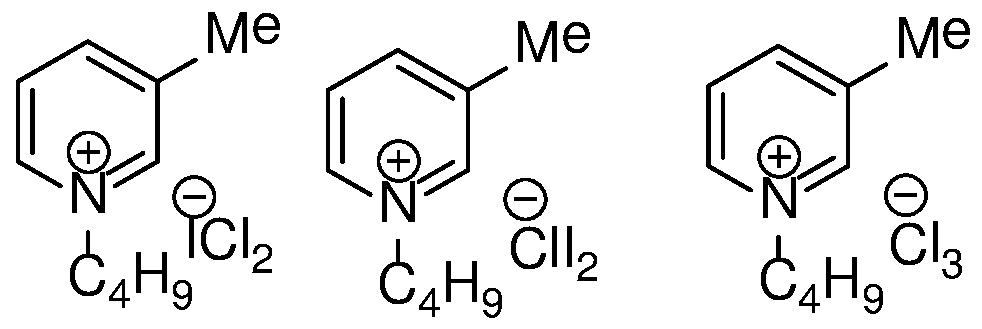
II III
In still another embodiment of the present invention provides a process for preparation of compound of formula A, wherein the process steps comprising;
i. adding a solution of halogen source in a dichloromethane or chloroform to a solution of l-butyl-3-methylpyridinium chloride in a protic solvent under stirring at a temperature ranging between 28 to 35 °C of for a period of time in the range of 1-24 h to obtain desired ionic liquids.
The above processes is shown below in Scheme 1 :
BMPDCI
BMPCDl

Scheme 1: Synthesis of ionic liquid l-butyl-3-methyl-pyridinium
dichloroiodate (BMPDCI) and l-butyl-3-methyl-pyridinium chlorodiiodide
(BMPCDl).
In yet another embodiment of the present invention provides the process, wherein said halogen source is selected from Iodine monochloride (IC1), Iodine and chlorine gas.
In an preferred embodiment of the present invention provides the process, wherein protic solvent is selected from the group consisting of water, methanol, Ethanol, Isopropanol, n- propanol.
In yet another embodiment of the present invention provides the process for preparation of compound of formula (III), wherein bubbling the chlorine gas to solution of l-butyl-3- methylpyridinium chloride in methanol for period of time in the range of 3-12 h at a temperature ranging between 0 to 5 °C followed by stirring reaction mixture at a temperature ranging between (28-35 °C) for a period of time in the range of 8-10 hours to afford compound of formula (III).
In still another embodiment of the present invention provides a process of halogenation of aromatic compounds by employing said recyclable catalyst of formula A comprising;
I. heating a mixture of aromatic compounds and a catalyst at a temperature 70 to 80 °C for a period of time in the range of 1-4 h to afford the pure halogenated desired product in the range from 60% to 99% yield.
In an another embodiment of the present invention provides the process, wherein the aromatic compound is heterocyclic or aromatic amine, aldehyde and substitution in the aromatic ring is selected from the group consisting of halogen, aliphatic, aromatic, alkyl, amine, amide, I, CI, Br, methyl, ethyl, amide or benzyl.
In yet another embodiment of the present invention provides the process, wherein the number of halogens is dependent on the number of equivalents of catalyst used.
In still another embodiment, the present invention provides process of halogenation, preferably iodination of amines by employing recyclable catalyst of formula I, comprising heating a mixture of aromatic/heteroaromatic amine and catalyst followed by work-up, purification and separation of catalyst to afford the pure iodinated product of formula (IV) in 60-99% yields.
In yet another embodiment, said halogenation process is carried out in the absence of any solvent, catalyst or base.
The above process is shown below in Scheme 2:

Scheme 2: Iodination of aromatic amines using l-butyl-3-methylpyridinium dichloroiodate
(BMPDCI)
wherein,
R is selected from halogen, aliphatic, aromatic, alkyl, amine, amide
More preferably R is selected from I, CI, Br, Me, Et, Amide or Benzyl
BRIEF DESCRIPTION OF THE DRAWINGS:
Fig 1: Recovery and reusability of l-butyl-3-methylpyridinium dichloroiodate (BMPDCI); Conditions: 2,6-diethylaniline (1.0 g, 6.7 mmol), BMPDCI (2.7 g, 8.04 mmol), 80 °C/lh. DETAILED DESCRIPTION OF THE INVENTION:
The invention will now be described in detail in connection with certain preferred and optional embodiments, so that various aspects thereof may be more fully understood and appreciated.
In view of above, the present invention provides a novel recyclable and recoverable iodinating agent of formula I, II or III.

I II III
In an embodiment, the present invention provides a process for preparation of recyclable catalyst of formula (I) and (II) comprising:
a. Adding a solution of halogen source in dichloromethane to an ice cold solution of 1- butyl-3-methylpyridinium chloride in water under stirring to obtain a reaction mixture;
b. Stirring the reaction mixture of step (a) for lh for formula (I) and 24 h for formula (II) at room temperature and separating the dichloromethane layer followed by drying to obtain the desired ionic liquid
In another embodiment, said halogen source may be selected from Iodine monochloride (IC1), Iodine
In still another embodiment, the present invention provides a process for preparation of recyclable catalyst of formula (III) comprising:
a. Bubbling chlorine gas to an ice cooled solution of l-butyl-3-methylpyridinium chloride in methanol for 3h at 0°C to obtain the reaction mixture;
b. Stirring the reaction mixture of step (a) for overnight at room temperature, monitoring the reaction by TLC and removing the excess of chlorine gas to afford quantitative yield of l-butyl-3-methylpyridinium trichloride (BMPTC) as a bright yellow liquid.
In yet another embodiment, the present invention provides a process of halogenation of amines and heterocyclic compounds by employing recyclable catalyst of formula (I) comprising heating a mixture of aromatic/heteroaromatic amine and catalyst at 80 °C for 1-4 h followed by work-up, purification and separation of catalyst to afford the pure halogenated product of formula (IV) in 60-99 % yields..
In still yet another embodiment, said halogenation process is carried out in the absence of any solvent, catalyst or base.
In still yet another embodiment, said halogenation process is iodination of amines.
The above process is shown below in Scheme 1:

Scheme 1: Iodination of aromatic amines using l-butyl-3-methylpyridinium dichloroiodate
(BMPDCI)
wherein,
R is selected from halogen, aliphatic, aromatic, alkyl, amine, amide
More preferably R is selected from I, CI, Br, Me, Et, Amide or Benzyl
In still yet another embodiment, the present invention provides said process of halogenation, wherein the number of halogens is dependent on the number of equivalents of catalyst used. Further, the disclosed catalyst is used for the synthesis of drugs preferably selected from diiodohydroxyquinoline derivatives (lodoquinol), which are employed in the treatment of amoebiasis or an antifungal drug and antiprotozoal drug viz. Clioquinol (iodochlorhydroxyquin, 5-chloro-7-iodo-8-hydroxyquinoline).
In an aspect the present invention provide Iodination of aniline and hetero- aromatic derivatives using l-butyl-3-methylpyridinium dichloroiodate (BMPDCI) as shown in below
Table 1:


Table 1: Iodination of aniline and hetero-aromatic derivatives using l-butyl-3- methylpyridinium dichloroiodate (BMPDCI)
The following examples, which include preferred embodiments, will serve to illustrate the practice of this invention, it being understood that the particulars shown are by way of example and for purpose of illustrative discussion of preferred embodiments of the invention.
EXAMPLES:
All starting materials were purchased from commercial sources (Sigma-Aldrich, Merck and Lancaster) and used without further purification. Solvents used as reaction media were purchased from local sources and used after distillation. Reactions were monitored using analytical TLC plates (Merck, silica gel 60 F254, 0.25mm) and compounds were visualized with ultraviolet light. Silica gel (60-120 and 230-400 mesh) was used for column
1 13
chromatography. H and C NMR spectra were recorded on a Bruker Advance 200 and 400 instrument operating at 200 MHz (1H), 400 MHz and 400 MHz (13C). Chemical shifts (δ) are reported in ppm using TMS as an internal standard. Gas chromatography was recorded on GC Varion CP3800, using HP-5 column. Mass spectra were obtained on a GCMSD- 5977A instrument. Melting points were determined on a Buchi instrument and are uncorrected.
Example 1:
Synthesis of ionic liqui -butyl-3-methylpyridinium dichloroiodate (BMPDCI).

Scheme 2: Synthesis of ionic liquid BMPDCI
A black solution of ICl (3.14g, 19.39 mmol) in dichloromethane (35ml) was added drop wise to an ice cold solution of l-butyl-3-methylpyridinium chloride (3.0g, 16.16 mmol) in water (16ml) under stirring and then left to attain room temperature. After the reaction mixture was stirred for 1 hour, the dichloromethane layer was separated and dried with sodium sulfate and then evaporated under vacuum to afford water soluble dark reddish brown ionic liquid 1- butyl-3-methylpyridinium dichloroiodate (BMPDCI) in quantitative yields (5.5g, 98%). This ionic liquid was stable and stored in dark at 10 °C (in refrigerator) for several months without any change in colour, loss of reactivity and degradation (checked by NMR).
1H NMR (200 MHz, DMSO-d6 δ/ppm): 9.03 (s, 1H, Ar-H), 8.97 (d, 1H, 7=5.94 Hz, Ar-H), 8.51 (d, 1H, 7=7.96 Hz, Ar-H), 8.10 (dd, 1H, 7=1.37 Hz, 8.42 Hz, Ar-H), 4.59 (t, 2H, CH2), 2.56 (s, 3H, Ar-CH3), 2.03-1.88 (m, 2H, -CH2-CH2), 1.40-1.29 (m, 2H, CH2-CH3) 0.97 (t, 3H,CH3).
13C NMR (50 MHz, CDC13+DMS0- 6): 12.23, 17.50, 18.13, 32.17, 60.56, 126.69, 138.72, 140.57, 142.91, 144.88.
Example 2:
Synthesis of ionic liquid l-butyl-3-methylpyridinium chlorodiiodide (BMPCDI).

Scheme 3: Synthesis of ionic liquid BMPCDI
A solution of iodine (0.3 g, 1.18 mmol) in dichloromethane (35ml) was added drop wise to an ice cold solution of l-butyl-3-methylpyridinium chloride (0.2g, 1.0 mmol) in water (16ml) under stirring and then left at room temperature. After the reaction mixture was stirred for 24 hours at room temperature, the dichloromethane layer was separated and dried with sodium sulfate and then evaporated under vacuum to afford water soluble dark reddish brown ionic liquid l-butyl-3-methylpyridinium chlorodiiodide (BMPCDI) in quantitative yields (0.4 g, 95%).
1H NMR (200 MHz, DMSO-d6 δ/ppm): 8.97 (s, 1H, Ar-H), 8.89 (d, =4.67 Hz, 1H, Ar-H), 8.32 (d, 1H, =7.6 Hz), 7.97 (t, 1H, Ar-H), 4.60 (t, 2H, CH2), 2.57 (s, 3H, Ar-CH3), 1.94 (m, 2H, -CH2-CH2-), 1.37 (m, 2H, -CH2-CH3), 0.94 (t, 3H,CH3).
13C NMR (125 MHz, CDCl3+DMSO-d6): 11.66, 16.60, 17.33, 31.38, 59.35, 125.94, 137.60, 140.21, 142.43, 144.17.
Example 3:
Synthesis of ionic liquid l-but l-3-methylpyridinium tric PTC).

Scheme 4: Synthesis of ionic liquid BMPTC
To an ice cooled solution of l-butyl-3-methylpyridinium chloride (1.0 g, 5.3 mmol) in methanol (10 ml) was bubbled chlorine gas through a balloon in a closed system for 3 hours at 0 °C. The ice bath was removed and the reaction mixture was left overnight at room temperature. The reaction was monitored by TLC. The excess of chlorine gas was removed under vacuum, to afford quantitative yield (1.3 g) of BMPTC as a bright yellow liquid.
1H NMR (200 MHz, DMSO-d6 δ/ppm): 9.05 (s, 1H, Ar-H), 8.94 (s, 1H, Ar-H), 8.34(d, 1H, J=6.19 Hz, Ar-H), 7.96 (s, 1H, Ar-H), 4.50 (t, 2H, CH2), 2.40 (s, 3H, Ar-CH3), 1.80 (m, 2H, - CH2-CH2-), 1.16 (m, 2H, -CH2-CH3), 0.80 (t, 3H,CH3).
13C NMR (100 MHz, CDCl3+DMSO-d6): 12.84, 18.02, 18.58, 32.93, 60.79, 127.29, 138.83, 141.66, 143.82, 145.16.
Example 4:
General procedure for the iodination of compounds 1 to 18.
A mixture of aromatic/heteroaromatic amine (1 mmol) and l-butyl-3-methylpyridinium dichloroiodate (BMPDCI) (1.2 mmol) was heated to 80 °C for 1-4 h. After completion of the reaction (monitored by TLC), ethyl acetate was added, followed by addition of water. The organic layer was separated and the aqueous layer was extracted three times with ethyl acetate. The combined organic layer was dried using sodium sulfate and evaporated under vacuum to afford the crude product, which on further column chromatography using silica gel afforded the pure iodinated product as shown in Table 1. The water layer was evaporated under vacuum at 60 °C to recover l-butyl-3-methylpyridinium chloride (BMPCI). Addition of IC1 (1.2 eq.) to BMPCI in water and dichloromethane (as reported in Scheme 1), afforded l-butyl-3-methylpyridinium dichloroiodate (BMPDCI), which was reused. The 1H NMR spectra were matched to literature reports of the identified compounds.
Example 5:
Reusability of l-butyl-3-methylpyridinium dichloroiodate (BMPDCI).
A set of experiments were carried out to examine the recovery and reusability of l-butyl-3- methylpyridinium dichloroiodate (BMPDCI) for iodination reactions. After completion of the reaction, ethyl acetate was added followed by water. The organic layer was separated and the aqueous layer was extracted three times with ethyl acetate. The combined organic layer was dried using sodium sulfate and evaporated under vacuum to afford the crude product, which on further column chromatography using silica gel afforded the pure iodinated product. The water layer was evaporated under vacuum at 60 0C to recover l-butyl-3- methylpyridinium chloride (BMPCI). Addition of IC1 (1.2 eq.) to BMPCI in water and dichloromethane (as reported in Scheme 2), afforded l-butyl-3-methylpyridinium dichloroiodate (BMPDCI), which was used for the next reaction. The l-butyl-3- methylpyridinium dichloroiodate (BMPDCI) can be recovered and reused for up to five runs with >90% yield of the iodinated product and without any loss of activity (Fig.12). To exhibit the recovery and reusability of l-butyl-3-methylpyridinium dichloroiodate (BMPDCI), 2,6- diethylaniline was chosen as a model example. The spectroscopic data for the iodinated compounds matched the reported literature data.
Example 6:
General Procedure for Iodination of Aromatic Amines by using l-butyl-3- methylpyridinium dichloroiodate (BMPDCI):
1) Synthesis of 2,4-diiodoaniline:
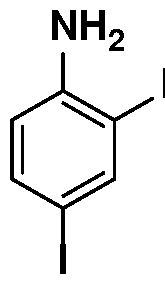
Aniline (0.1 g, 1.07 mmol) and l-butyl-3-methylpyridinium dichloroiodate (BMPDCI) (0.45 g, 1.29 mmol) were added in 10 ml single necked round bottomed flask in an inert atmosphere. The reaction mixture was heated at 80 °C for lhr. The reaction was monitored by TLC. After the reaction was completed (TLC), ethyl acetate (10ml) was added followed by addition of water (10ml). The entire reaction mixture was extracted with ethyl acetate (3x10ml). The combined ethyl acetate layer was washed with water, brine and dried over anhydrous sodium sulphate. The separated combined organic layers, was evaporated under vacuum, to afford the crude product. This crude product was purified by silica gel column chromatography to afford pure 2,4-diiodoaniline in 0.315 g, (85% yield).
1H NMR (CDC13 δ/ppm): 7.89 (d, 1H, 7=2.02 Hz, Ar-H), 7.39 (dd, 1H, 7= 8.49, 7=2.0 Hz, Ar-H), 6.53 (d, 7=8.34 Hz, 1H, Ar-H), 4.12 (broad singlet, 2H, NH2).
2) Synthesis of 2,4-diiodoaniline:

2-Iodo-aniline (0.1 g, 0.45mmol) and l-butyl-3-methylpyridinium dichloroiodate (BMPDCI) (0.19 g, 0.547 mmol) were added in 10 ml one necked round bottomed flask in an inert atmosphere. The reaction mixture was heated at 80 °C for lhr. The reaction was monitored by TLC. After the reaction was completed (TLC), ethyl acetate (10ml) was added followed by addition of water (10ml). The entire reaction mixture was extracted with ethyl acetate (3x10ml). The combined ethyl acetate layer was washed with water, brine and dried over anhydrous sodium sulphate. This crude product was purified by silica gel column chromatography to afford pure 2,4-diiodoaniline in 0.15 g, (95% yield).
1H NMR (CDCI3 δ/ppm): 7.89 (d, 1H, 7=2.02 Hz, Ar-H), 7.39 (dd, 1H, 7= 8.49, 7=2.0 Hz,
Ar-H), 6.53 (d, 7=8.34 Hz, 1H, Ar-H), 4.12 (broad singlet, 2H, NH2).
3) Synthesis of 4-iodo-N,N-dimethylaniline:
2
 N,N-Dimethylaniline (0.1 g, 0.825 mmol) and l-butyl-3-methylpyridinium dichloroiodate (BMPDCI) (0.345 g, 0.99 mmol) were added in 10 ml one necked round bottomed flask in an inert atmosphere. The reaction mixture was heated at 80 °C for lhr. The reaction was monitored by TLC. After the reaction was completed (TLC), ethyl acetate (10ml) was added followed by addition of water (10ml). The entire reaction mixture was extracted with ethyl acetate (3x10ml). The combined ethyl acetate layer was washed with water, brine and dried over anhydrous sodium sulphate. The separated combined organic layers, was evaporated under vacuum, to afford the crude product. This crude product was purified by silica gel column chromatography to afford pure 4-iodo-N,N-dimethylaniline in 0.175 g, (86%, yield). 1H NMR (CDC13 δ/ppm): 7.50-7.47 (d, 2H, 7=9.16 Hz, Ar-H), 6.53 (d, 2H, 7= 9.16 Hz, Ar- H), 2.94 (s, 6H, Me2).
4) Synthesis of 2-iodo-4,5-dimethylaniline:

3,4-Dimethylaniline (0.1 g, 0.82mmol) and l-butyl-3-methylpyridinium dichloroiodate (BMPDCI) (0.344 g, 0.99 mmol) were added in 10 ml one necked round bottomed flask in an inert atmosphere. The reaction mixture was heated at 80 °C for lhr. The reaction was monitored by TLC. After the reaction was completed (TLC), ethyl acetate (10ml) was added followed by addition of water (10ml). The entire reaction mixture was extracted with ethyl acetate (3x10ml). The combined ethyl acetate layer was washed with water, brine and dried over anhydrous sodium sulphate. The separated combined organic layers, was evaporated under vacuum, to afford the crude product. This crude product was purified by silica gel column chromatography to afford pure 2-iodo-4,5-dimethylaniline in 0.19 g, (93% yield).
1H NMR (CDCI3 δ/ppm): 7.31 (s, 1H), 6.49 (s, 1H), 3.79 (broad singlet, 2H, NH2), 2.12-2.14
(d, 6H, Ar-CH3).
5) Synthesis of 2-benzyl-4-iodoaniline:
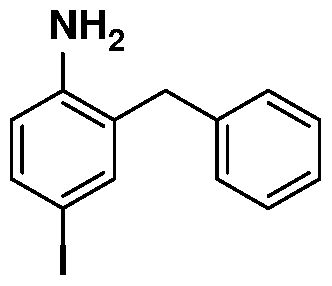
2-Benzylaniline (0.1 g, 0.54mmol) and l-butyl-3-methylpyridinium dichloroiodate (BMPDCI) (0.23 g, 0.65 mmol) were added in 10 ml one necked round bottomed flask in an
inert atmosphere. The reaction mixture was heated at 80 C for lhr. After the reaction was completed (TLC), ethyl acetate (10ml) was added followed by addition of water (10ml). The entire reaction mixture was extracted with ethyl acetate (3x10ml). The combined ethyl acetate layer was washed with water, brine and dried over anhydrous sodium sulphate. Solvent was evaporated under vacuum, the residue purified by silica gel chromatography to afford the pure 2-benzyl-4-iodoaniline in 0.128 g, (76% yield).
1H NMR (CDC13 δ/ppm): 7.04-7.26 (m, 7H), 6.31-6.35 (d, 1H, 7=8.71 Hz), 3.72 (s, 2H, CH2), 3.36 (broad singlet, 2H, NH2).
13C NMR (CDCI3): 37.62, 79.95, 117.98, 126.56, 127.67, 128.32, 128.71, 136.22, 138.34, 138.98, 144.22.
6) Synthesis of 4, 5-diiodo-l-methylimidazole:

1-methylimidazole (0.1 g, 1.21 mmol) and l-butyl-3-methylpyridinium dichloroiodate (BMPDCI) (0.50 g, 1.46 mmol) were added in 10 ml of one neck round bottomed flask in an inert atmosphere and then heated at 80 °C for 5hr. After the reaction was completed (TLC), ethyl acetate (10ml) was added followed by addition of water (10ml). The entire reaction mixture was extracted with ethyl acetate (3x10ml). The combined organic layers were dried using sodium sulphate and concentrated on rotavapor to afford the crude product. This was further purified by silica gel column chromatography to afford 0.32 g (69%) of pure 4,5- diiodo- 1-methylimidazole as a brownish solid. (M.P. 143-145 °C)
1H NMR (CDCI3 δ/ppm): 7.61 (s, 1H), 3.67 (s, 3H).
7) Synthesis of 5,7-diiodo-8-hydroxyquinoline:

lodoquinol
8-Hydroxyquinoline (0.1 g, 0.69 mmol) and l-butyl-3-methylpyridinium dichloroiodate (BMPDCI) (0.31 g, 0.89 mmol) were added in 10 ml of one neck round bottomed flask in an inert atmosphere and then heated at 80 °C for lhr. After the reaction was completed (TLC), ethyl acetate (10ml) was added followed by addition of water (10ml). The entire reaction mixture was extracted with ethyl acetate (3x10ml). The combined organic layers were dried using sodium sulphate and concentrated on rotavapor to afford the crude product. This was
further purified by silica gel column chromatography to afford 0.24 g (87 %) of pure 5,7- diiodo-8-hydroxyquinoline as a solid. (M.P. decomposes >210 °C)
1H NMR (DMSO-d6 δ/ppm): 8.88 (d, 1H, 7=4 Hz, Ar-H), 8.3 (s, 1H, Ar-H), 8.27-8.31 (dd,
1H, 7=1.3 Hz, 8.6 Hz, Ar-H), 7.75 (q, 1H, 7=4.2 Hz, 8.6 Hz, Ar-H).
8) Synthesis of 5-iodovanillin:

Vanillin (1.0 g, 6.5 mmol) and l-butyl-3-methylpyridinium dichloroiodate (BMPDCI) (2.76 g, 7.8 mmol) were added in 10 ml of one neck round bottomed flask in an inert atmosphere and then heated at 80 °C for lhr. After the reaction was completed (TLC), ethyl acetate (10ml) was added followed by addition of water (10ml). The entire reaction mixture was extracted with ethyl acetate (3x10ml). The combined organic layers were dried using sodium sulphate and concentrated on rotavapor to afford the crude product. This was further purified by silica gel column chromatography to afford 0.12 g (65%) of pure 5-iodovanillin as a slight yellow solid (M.P. 182-183 °C).
1H NMR (CDC13 δ/ppm): 9.71 (s, 1H, CHO), 7.76 (d, 1H, 7=1.91 Hz, Ar-H), 7.32(d, 1H, 7 = 1.5 Hz, Ar-H), 6.64 (s, 1H, OH), 3.91 (s, 3H, OCH3).
9) Synthesis of 5-chloro7-iodo-8-hydroxyquinoline:

5-Chloro-8-hydroxyquinoline (0.1 g, 0.55 mmol) and l-butyl-3-methylpyridinium dichloroiodate (BMPDCI) (0.3 8g, 1.11 mmol) were added in 10 ml of one neck round bottomed flask in an inert atmosphere and then heated at 80 °C for lhr. After the reaction was completed (TLC), ethyl acetate (10ml) was added followed by addition of water (10ml). The entire reaction mixture was extracted with ethyl acetate (3x10ml). The combined organic layers were dried using sodium sulphate and concentrated on rotavapor to afford the crude product. This was further purified by silica gel column chromatography to afford 0.16 g (94 %) of pure 5-chloro-7-iodo-8-hydroxyquinoline as a white solid, (M.P. 177 °C).
1H NMR (DMSO-d6 δ/ppm): 8.95 (dd, IH, 7=1.47 Hz, 7=4.22 Hz, Ar-H). 8.50 (dd,lH, 7=1.44 Hz, 7=8.54 Hz, Ar-H), 7.95 (s, IH, Ar-H), 7.77 (dd, IH, 7=4.24 Hz, 7=8.60 Hz, Ar- H). ADVANTAGES OF THE INVENTION:
• Simple efficient procedure.
• Good yields,
• Ionic liquid can be recovered and recycled and
• No need for solvent/catalyst/base
Claims
1. A novel recyclable catalysts of formula A,

Formula A wherein X is selected from the group consisting of

2. A novel recyclable catalysts of formula A as claimed in claim 1, wherein the representative compounds are:

I II III
3. A process for preparation of compound of formula A as claimed in claim 1, wherein the process steps comprising;
i. adding a solution of halogen source in a dichloromethane or chloroform to a solution of l-butyl-3-methylpyridinium chloride in a protic solvent under stirring at a temperature ranging between 28 to 35 °C of for a period of time in the range of 1-24 h to obtain desired ionic liquids.
4. The process as claimed in claim 3, wherein said halogen source is selected from Iodine monochloride (IC1), Iodine and chlorine gas.
5. The process as claimed in claim 3, wherein protic solvent is selected from the group consisting of water, methanol,ethanol, isopropanol, n-propanol.
6. The process for preparation of compound of formula (III) as claimed in claim 3, wherein bubbling the chlorine gas to solution of l-butyl-3-methylpyridinium chloride in methanol for period of time in the range of 3-12 h at a temperature ranging between 0 to 5 °C followed by stirring reaction mixture at a temperature ranging between (28- 35 °C) for a period of time in the range of 8-10 hours to afford compound of formula
(III).
7. A process of halogenation of aromatic compounds by employing said recyclable catalyst of formula A as claimed in claim 1 comprising;
i. heating a mixture of aromatic compounds and a catalyst at a temperature ranging between 70 to 80 °C for a period of time in the range of 1-4 h to afford the pure halogenated desired product in the range from 60% to 99% yield.
8. The process as claimed in claim 7, wherein the aromatic compound is heterocyclic or aromatic amine, aldehyde and substitution in the aromatic ring is selected from the group consisting of halogen, aliphatic, aromatic, alkyl, amine, amide, I, CI, Br, methyl, ethyl, amide or benzyl.
9. The process as claimed in claim 7, wherein the number of halogens is dependent on the number of equivalents of catalyst used.
Applications Claiming Priority (2)
| Application Number | Priority Date | Filing Date | Title |
|---|---|---|---|
| IN130DE2015 | 2015-01-15 | ||
| IN0130/DEL/2015 | 2015-01-15 |
Publications (1)
| Publication Number | Publication Date |
|---|---|
| WO2016113757A1 true WO2016113757A1 (en) | 2016-07-21 |
Family
ID=55590113
Family Applications (1)
| Application Number | Title | Priority Date | Filing Date |
|---|---|---|---|
| PCT/IN2016/050011 Ceased WO2016113757A1 (en) | 2015-01-15 | 2016-01-14 | Novel recyclable iodinating agent and its applications |
Country Status (1)
| Country | Link |
|---|---|
| WO (1) | WO2016113757A1 (en) |
Citations (1)
| Publication number | Priority date | Publication date | Assignee | Title |
|---|---|---|---|---|
| WO1991011430A1 (en) | 1990-01-31 | 1991-08-08 | Mallinckrodt, Inc. | Halogenation of aromatic amine compounds |
-
2016
- 2016-01-14 WO PCT/IN2016/050011 patent/WO2016113757A1/en not_active Ceased
Patent Citations (1)
| Publication number | Priority date | Publication date | Assignee | Title |
|---|---|---|---|---|
| WO1991011430A1 (en) | 1990-01-31 | 1991-08-08 | Mallinckrodt, Inc. | Halogenation of aromatic amine compounds |
Non-Patent Citations (17)
| Title |
|---|
| ABDOL R. HAJIPOUR ET AL.: "lodination of aromatic compounds under mild and solventifree conditions", ORGANIC PREPARATIONS AND PROCEDURES INTERNATIONAL, vol. 34, no. 6, 2002, pages 647 - 651 |
| AMARSINH DESHMUKH ET AL: "Recyclable ionic liquid iodinating reagent for solvent free, regioselective iodination of activated aromatic and heteroaromatic amines", RSC ADV., vol. 5, no. 107, 2015, pages 88311 - 88315, XP055274205, DOI: 10.1039/C5RA14702F * |
| ANIL KUMAR ET AL.: "Solvent-free methodologies for organic brominations using quaternary ammonium tribromides", ORGANIC COMMUNICATION, vol. 5, no. 2, 2012, pages 64 - 69 |
| BORIKAR S P ET AL: "An efficient, rapid, and regioselective bromination of anilines and phenols with 1-butyl-3-methylpyridinium tribromide as a new reagent/solvent under mild conditions", TETRAHEDRON LETTERS, PERGAMON, GB, vol. 50, no. 9, 4 March 2009 (2009-03-04), pages 1007 - 1009, XP025872525, ISSN: 0040-4039, [retrieved on 20090114], DOI: 10.1016/J.TETLET.2008.12.053 * |
| KAJIGAESHI S ET AL: "Halogenation using quaternary ammonium polyhalides. VII Iodination of aromatic amines by use of benzyltrimethylammonium dichloroiodate", BULLETIN OF THE CHEMICAL SOCIETY OF JAPAN, CHEMICAL SOCIETY OF JAPAN, TOKYO, JP, vol. 61, no. 2, 1988, pages 600 - 602, XP009050859, ISSN: 0009-2673 * |
| M. P. KAUSHIK ET AL.: "N-Octylquinolinium tribromide: a quinoline based ionic liquid as a new brominating agent for bromination of phenols, amines, alkenes, alkynes", INDIAN JOURNAL OF CHEMISTRY, vol. 45B, 2006, pages 2542 - 2545 |
| MAHBOOBE NOUZARIAN ET AL.: "Ionic liquid iodinating reagent for mild and efficient iodination of aromatic and heteroaromatic amines and terminal alkynes", SYNTHETIC COMMUNICATIONS, vol. 43, no. 21, 2013, pages 2913 - 2925 |
| MAHBOOBE NOUZARIAN ET AL: "Ionic Liquid Iodinating Reagent for Mild and Efficient Iodination of Aromatic and Heteroaromatic Amines and Terminal Alkynes", SYNTHETIC COMMUNICATIONS, vol. 43, no. 21, 2 November 2013 (2013-11-02), PHILADELPHIA, PA; US, pages 2913 - 2925, XP055274459, ISSN: 0039-7911, DOI: 10.1080/00397911.2012.749991 * |
| OLGA BORTOLINI ET AL.: "Trihalide-based ionic liquids. Reagent-solvents for stereoselective iodination of alkenes and alkynes", GREEN CHEMISTRY, no. 4, 2002, pages 621 - 627 |
| SANDEEP V. KHANSOLE ET AL.: "Convenient and efficient method for the iodination of aromatic amines by pyridinium iodochloride", SYNTHETIC COMMUNICATIONS: AN INTERNATIONAL JOURNAL FOR RAPID COMMUNICATION OF SYNTHETIC ORGANIC CHEMISTRY, vol. 38, no. 11, 2008, pages 1792 - 1798 |
| SANDEEP V. KHANSOLE ET AL.: "Pyridinium iodochloride: an efficient reagent for iodination ofhydroxylated aromatic ketones and aldehydes", JOURNAL OF THE CHINESE CHEMICAL SOCIETY, vol. 55, no. 4, 2008, pages 871 - 874 |
| SANJAY P. BORIKAR ET AL.: "A mild, efficient and regioselective monobromination of arylamines and phenols using [BBIm]Br as a new reagent", SYNTHETIC COMMUNICATIONS, vol. 40, 2010, pages 647 - 653 |
| SANJAY P. BORIKAR ET AL.: "An efficient, rapid, and regioselective bromination of anilines and phenols with 1-butyl-3-methylpyridinium tribromide as a new reagent/solvent under mild conditions", TETRAHEDRON LETTERS, vol. 50, 2009, pages 1007 - 1009 |
| SANJAY P. BORIKAR ET AL.: "Aromatic bromination of aldehydes and ketones using 1,3-di-n-butylimidazolium tribromide [BBIm]Br ionic liquids under solvent-free conditions", JOURNAL OF THE IRANIAN CHEMICAL SOCIETY, vol. 8, no. 2, 2011, pages 531 - 536 |
| SHOJI KAJIGAESHI ET AL.: "Halogenation using quaternary ammonium polyhalides. VII iodination of aromatic amines by use of benzyltrimethylammonium dichloroiodate(1", BULLETIN OF THE CHEMICAL SOCIETY OF JAPAN, vol. 61, no. 2, 1988, pages 600 - 602 |
| VEERABABURAO KAVALA ET AL.: "A new recyclable ditribromide reagent for efficient bromination under solvent free condition", JOURNAL OF ORGANIC CHEMISTRY, vol. 70, no. 11, 2005, pages 4267 - 4271 |
| YEVGENIA LEVIN ET AL., EUROPEAN JOURNAL OF ORGANIC CHEMISTRY, no. 6, 2006, pages 1396 - 1399 |
Similar Documents
| Publication | Publication Date | Title |
|---|---|---|
| St John-Campbell et al. | Transient imines as ‘next generation’directing groups for the catalytic functionalisation of C–H bonds in a single operation | |
| Zhang et al. | Synthesis of substituted quinolines by the electrophilic cyclization of n-(2-alkynyl) anilines | |
| Chupakhin et al. | Nucleophilic aromatic substitution of hydrogen | |
| Deshmukh et al. | Recyclable ionic liquid iodinating reagent for solvent free, regioselective iodination of activated aromatic and heteroaromatic amines | |
| US8399680B2 (en) | Arylamine synthesis method | |
| EP2940002B1 (en) | Halogenated aniline and method for producing same | |
| Chandrasekhar et al. | Inexpensive protocol for reduction of imines to amines using polymethylhydrosiloxane (PMHS) | |
| CN106188046B (en) | A kind of synthetic method of 3- arylthios imidazo [1,5-a] N- heterocyclic compounds that iodine promotes | |
| CN109824548B (en) | A kind of simple preparation method of N-acyl compound | |
| CN102732909B (en) | Method for synthesizing aromatic nitro compound under electrochemical condition | |
| Tewari et al. | An easy three step synthesis of perfluoroalkylated amphetamines | |
| CN112592280B (en) | Preparation method of racemic salbutamol | |
| CN104262159B (en) | A kind of synthetic method of ortho-nitrophenyl phenolic compound | |
| CN105085275B (en) | O-nitrophenol and its derivative synthesis method | |
| CN107400060A (en) | A kind of synthetic method of the bromaniline of 2 chlorine 6 | |
| CN101918346B (en) | Optically active 2,2'-biphenol derivative and its production method | |
| JPH0532589A (en) | Method for nitration of 2,6-dichlorophenol | |
| JP2951600B2 (en) | Method for selective nitration of phenol derivatives | |
| CN113620811A (en) | Halogenation method of aromatic compound | |
| US6992223B2 (en) | Method for producing 2-benzylaniline | |
| CN109336795B (en) | Preparation method of 3-trifluoromethylthiophenol and 3-methylthio benzotrifluoride | |
| Jin | Oxidant Evolution in Metal-Free Redox Amination Reactions | |
| CN114105857B (en) | 3-Azide indoline compound and preparation method thereof | |
| Greener | Transition-Metal-Free Hydroxylation of Aryl Halides and Nitroarenes | |
| EP3447044A1 (en) | Method for preparing d-4,4'-biphenylalanine alkyl ester or l-4,4'-biphenylalanine alkyl ester from dl-4,4'-biphenylalanine alkyl ester |
Legal Events
| Date | Code | Title | Description |
|---|---|---|---|
| 121 | Ep: the epo has been informed by wipo that ep was designated in this application |
Ref document number: 16711699 Country of ref document: EP Kind code of ref document: A1 |
|
| NENP | Non-entry into the national phase |
Ref country code: DE |
|
| 122 | Ep: pct application non-entry in european phase |
Ref document number: 16711699 Country of ref document: EP Kind code of ref document: A1 |