WO2016112088A1 - Aryloxyacetylindoles and analogs as antibiotic tolerance inhibitors - Google Patents
Aryloxyacetylindoles and analogs as antibiotic tolerance inhibitors Download PDFInfo
- Publication number
- WO2016112088A1 WO2016112088A1 PCT/US2016/012308 US2016012308W WO2016112088A1 WO 2016112088 A1 WO2016112088 A1 WO 2016112088A1 US 2016012308 W US2016012308 W US 2016012308W WO 2016112088 A1 WO2016112088 A1 WO 2016112088A1
- Authority
- WO
- WIPO (PCT)
- Prior art keywords
- mmol
- yloxy
- chloro
- indol
- compound
- Prior art date
- Legal status (The legal status is an assumption and is not a legal conclusion. Google has not performed a legal analysis and makes no representation as to the accuracy of the status listed.)
- Ceased
Links
- 0 C*C(*)*C1N(*)*(C)C(C)C(C(C*C2C(*)*C(*C(*)**)C(C)*2)O)C1* Chemical compound C*C(*)*C1N(*)*(C)C(C)C(C(C*C2C(*)*C(*C(*)**)C(C)*2)O)C1* 0.000 description 5
- RORSRPZIYBKZBE-WUXMJOGZSA-N C/C=C(\C)/NS(c1c(C)cc(C)cc1C)(=O)=O Chemical compound C/C=C(\C)/NS(c1c(C)cc(C)cc1C)(=O)=O RORSRPZIYBKZBE-WUXMJOGZSA-N 0.000 description 1
- TVTUMWXIIJHOJI-ZZXKWVIFSA-N C/C=C/N(CCBr)C=C Chemical compound C/C=C/N(CCBr)C=C TVTUMWXIIJHOJI-ZZXKWVIFSA-N 0.000 description 1
- XDTMQSROBMDMFD-UHFFFAOYSA-N C1CCCCC1 Chemical compound C1CCCCC1 XDTMQSROBMDMFD-UHFFFAOYSA-N 0.000 description 1
- BHCXXACRULZMTL-UHFFFAOYSA-N CC(C)Oc(cc(ccc(Cl)c1)c1c1)c1C(N)=O Chemical compound CC(C)Oc(cc(ccc(Cl)c1)c1c1)c1C(N)=O BHCXXACRULZMTL-UHFFFAOYSA-N 0.000 description 1
- QWSIBPBEQDUYMS-UHFFFAOYSA-N CC(N(CC(O)=O)C=C)=C Chemical compound CC(N(CC(O)=O)C=C)=C QWSIBPBEQDUYMS-UHFFFAOYSA-N 0.000 description 1
- HOOCNMOCZDSESH-OQLLNIDSSA-N CC/C=C(\C)/N(C=C)S(c1c(C)cc(C)cc1C)(=O)=O Chemical compound CC/C=C(\C)/N(C=C)S(c1c(C)cc(C)cc1C)(=O)=O HOOCNMOCZDSESH-OQLLNIDSSA-N 0.000 description 1
- CXUHPNVBYYWKIS-VOTSOKGWSA-N CC/C=C(\C)/NC=C Chemical compound CC/C=C(\C)/NC=C CXUHPNVBYYWKIS-VOTSOKGWSA-N 0.000 description 1
- OHBIRUYODDCBQG-RQSRLPFNSA-N CC1C=C(C(C(COc2cc3ccc(C)cc3cc2C(N)=O)=O)=CN2C[C@@H](C(NCCO)=O)O)C2=CC1C1CC1 Chemical compound CC1C=C(C(C(COc2cc3ccc(C)cc3cc2C(N)=O)=O)=CN2C[C@@H](C(NCCO)=O)O)C2=CC1C1CC1 OHBIRUYODDCBQG-RQSRLPFNSA-N 0.000 description 1
- KOWXZFWHVOIDIN-YMSAMKMVSA-N CC1C=C(C(C)(CN2C[C@@H](C(OC)=O)O)C(COC(C(C(N)=O)=C3)=CC4(C)C3=CC(C)=CC4)=O)C2=CC1C1CC1 Chemical compound CC1C=C(C(C)(CN2C[C@@H](C(OC)=O)O)C(COC(C(C(N)=O)=C3)=CC4(C)C3=CC(C)=CC4)=O)C2=CC1C1CC1 KOWXZFWHVOIDIN-YMSAMKMVSA-N 0.000 description 1
- PNIPIXREQVPOAI-SSDOTTSWSA-N COC([C@@H]1N(CCCl)CCC1)=O Chemical compound COC([C@@H]1N(CCCl)CCC1)=O PNIPIXREQVPOAI-SSDOTTSWSA-N 0.000 description 1
- VERSIJOLGNXUPL-XMMPIXPASA-N COC([C@@H]1N(CC[n]2c(cc(cc3)F)c3c(C(COc(c(C(N)=O)cc3c4)cc3ccc4Cl)=O)c2)CCC1)=O Chemical compound COC([C@@H]1N(CC[n]2c(cc(cc3)F)c3c(C(COc(c(C(N)=O)cc3c4)cc3ccc4Cl)=O)c2)CCC1)=O VERSIJOLGNXUPL-XMMPIXPASA-N 0.000 description 1
- BLWYXBNNBYXPPL-RXMQYKEDSA-N COC([C@@H]1NCCC1)=O Chemical compound COC([C@@H]1NCCC1)=O BLWYXBNNBYXPPL-RXMQYKEDSA-N 0.000 description 1
- ZEQVMBIOCFATAE-HWKANZROSA-N COC(c1cc(cc(cc2)Cl)c2cc1/C=C/C(O)=O)=O Chemical compound COC(c1cc(cc(cc2)Cl)c2cc1/C=C/C(O)=O)=O ZEQVMBIOCFATAE-HWKANZROSA-N 0.000 description 1
- KYYZVBZHBFAZCA-UHFFFAOYSA-N COC(c1cc(cc(cc2)Cl)c2cc1CCC(O)=O)=O Chemical compound COC(c1cc(cc(cc2)Cl)c2cc1CCC(O)=O)=O KYYZVBZHBFAZCA-UHFFFAOYSA-N 0.000 description 1
- XFKSVXMQJUUEAO-UHFFFAOYSA-N COc(c(C(N)=O)cc1c2)cc1ccc2Cl Chemical compound COc(c(C(N)=O)cc1c2)cc1ccc2Cl XFKSVXMQJUUEAO-UHFFFAOYSA-N 0.000 description 1
- ANSFKKHSNBWBHU-LJAQVGFWSA-N C[C@](CC[n]1c2cc(C3CC3)ccc2c(C(COc(c(C(N)=O)cc2c3)cc2ccc3Cl)=O)c1)(CO)O Chemical compound C[C@](CC[n]1c2cc(C3CC3)ccc2c(C(COc(c(C(N)=O)cc2c3)cc2ccc3Cl)=O)c1)(CO)O ANSFKKHSNBWBHU-LJAQVGFWSA-N 0.000 description 1
- YECJUZIGFPJWGQ-UHFFFAOYSA-N Cc(cc1C)cc(C)c1S(N)(=O)=O Chemical compound Cc(cc1C)cc(C)c1S(N)(=O)=O YECJUZIGFPJWGQ-UHFFFAOYSA-N 0.000 description 1
- VLHFYCNHWHVXDY-UHFFFAOYSA-N Cc(cc1C)cc(C)c1S([n]1c2cc(C=O)ccc2cc1)(=O)=O Chemical compound Cc(cc1C)cc(C)c1S([n]1c2cc(C=O)ccc2cc1)(=O)=O VLHFYCNHWHVXDY-UHFFFAOYSA-N 0.000 description 1
- YINGYVRBZYUMGT-UHFFFAOYSA-N Cc(cc1C)cc(C)c1S([n]1c2cc(CC3CC3)ccc2c(C(COCl)=O)c1)(=O)=O Chemical compound Cc(cc1C)cc(C)c1S([n]1c2cc(CC3CC3)ccc2c(C(COCl)=O)c1)(=O)=O YINGYVRBZYUMGT-UHFFFAOYSA-N 0.000 description 1
- XWVJALDNASTOJG-UHFFFAOYSA-N Cc(cc1C)cc(C)c1S([n]1c2cc(CC3CC3)ccc2cc1)(=O)=O Chemical compound Cc(cc1C)cc(C)c1S([n]1c2cc(CC3CC3)ccc2cc1)(=O)=O XWVJALDNASTOJG-UHFFFAOYSA-N 0.000 description 1
- OAEKIBKBVSQADQ-UHFFFAOYSA-N Cc(ccc1c2)cc1cc(C(N)=O)c2O Chemical compound Cc(ccc1c2)cc1cc(C(N)=O)c2O OAEKIBKBVSQADQ-UHFFFAOYSA-N 0.000 description 1
- XHQZFOFRSSBORB-UHFFFAOYSA-N Cc(ccnn1)c1Oc1ccc(c(C(COc(c(C(N)=O)cc2c3)cc2ccc3Cl)=O)c[nH]2)c2c1 Chemical compound Cc(ccnn1)c1Oc1ccc(c(C(COc(c(C(N)=O)cc2c3)cc2ccc3Cl)=O)c[nH]2)c2c1 XHQZFOFRSSBORB-UHFFFAOYSA-N 0.000 description 1
- DSTSXACHJVHPRS-UHFFFAOYSA-N Cc1cc(Oc(cc2)cc3c2c(C(CCc2cc(ccc(Cl)c4)c4cc2C(OC)=O)=O)c[nH]3)cnc1 Chemical compound Cc1cc(Oc(cc2)cc3c2c(C(CCc2cc(ccc(Cl)c4)c4cc2C(OC)=O)=O)c[nH]3)cnc1 DSTSXACHJVHPRS-UHFFFAOYSA-N 0.000 description 1
- FOCQIGOAXSBJII-UHFFFAOYSA-N NC(c(cc(cc(cc1)Cl)c1c1)c1OCC(c(c1ccc(C2CC2)cc11)c[n]1P(O)(O)=O)=O)=O Chemical compound NC(c(cc(cc(cc1)Cl)c1c1)c1OCC(c(c1ccc(C2CC2)cc11)c[n]1P(O)(O)=O)=O)=O FOCQIGOAXSBJII-UHFFFAOYSA-N 0.000 description 1
- UPJSXJJRPPQWRA-UHFFFAOYSA-N NC(c(cc(cc(cc1)Cl)c1c1)c1OCC(c1c[nH]c2c1ccc(Oc1cnccn1)c2)=O)=O Chemical compound NC(c(cc(cc(cc1)Cl)c1c1)c1OCC(c1c[nH]c2c1ccc(Oc1cnccn1)c2)=O)=O UPJSXJJRPPQWRA-UHFFFAOYSA-N 0.000 description 1
- IAYPXFJURYIQFC-UHFFFAOYSA-N NC(c1cc(cc(cc2)Cl)c2cc1CCC(c1c[nH]c2cc(Oc3cnccc3)ccc12)=O)=O Chemical compound NC(c1cc(cc(cc2)Cl)c2cc1CCC(c1c[nH]c2cc(Oc3cnccc3)ccc12)=O)=O IAYPXFJURYIQFC-UHFFFAOYSA-N 0.000 description 1
- JRHWWBIJGLNDMO-UHFFFAOYSA-N NC(c1cc(cc(cc2)Cl)c2cc1OCC(c1c[nH]c2c1ccc(F)c2)=O)=O Chemical compound NC(c1cc(cc(cc2)Cl)c2cc1OCC(c1c[nH]c2c1ccc(F)c2)=O)=O JRHWWBIJGLNDMO-UHFFFAOYSA-N 0.000 description 1
- KDIHNZUSURVOPE-UHFFFAOYSA-N NC(c1cc(cc(cc2)Cl)c2cc1OCC(c1c[nH]c2cc(CC3CC3)ccc12)=O)=O Chemical compound NC(c1cc(cc(cc2)Cl)c2cc1OCC(c1c[nH]c2cc(CC3CC3)ccc12)=O)=O KDIHNZUSURVOPE-UHFFFAOYSA-N 0.000 description 1
- ZRDBBJQRHVFEOG-UHFFFAOYSA-N NC(c1cc2cc(C(F)(F)F)ccc2cc1OCC(c1c[nH]c2cc(C3CC3)ccc12)=O)=O Chemical compound NC(c1cc2cc(C(F)(F)F)ccc2cc1OCC(c1c[nH]c2cc(C3CC3)ccc12)=O)=O ZRDBBJQRHVFEOG-UHFFFAOYSA-N 0.000 description 1
- NTFVFMAFKKPIOK-UHFFFAOYSA-N NC(c1cc2cc(Cl)ccc2cc1OCC(c1c[nH]c2cc(Oc3cnccc3)ccc12)=O)=O Chemical compound NC(c1cc2cc(Cl)ccc2cc1OCC(c1c[nH]c2cc(Oc3cnccc3)ccc12)=O)=O NTFVFMAFKKPIOK-UHFFFAOYSA-N 0.000 description 1
- JGXUGSFFFQRFKI-UHFFFAOYSA-N NC(c1cc2cc(Cl)ccc2cc1OCC(c1c[n](CCN(CC2)CCC2O)c2cc(Oc3cnccc3)ccc12)=O)=O Chemical compound NC(c1cc2cc(Cl)ccc2cc1OCC(c1c[n](CCN(CC2)CCC2O)c2cc(Oc3cnccc3)ccc12)=O)=O JGXUGSFFFQRFKI-UHFFFAOYSA-N 0.000 description 1
- NCBAEVUMCXAOOU-HSZRJFAPSA-N NC(c1cc2cc(Cl)ccc2cc1OCC(c1c[n](CCN(CCC2)[C@H]2C(O)=O)c2cc(F)ccc12)=O)=O Chemical compound NC(c1cc2cc(Cl)ccc2cc1OCC(c1c[n](CCN(CCC2)[C@H]2C(O)=O)c2cc(F)ccc12)=O)=O NCBAEVUMCXAOOU-HSZRJFAPSA-N 0.000 description 1
- BROYFABTHVDUHC-UHFFFAOYSA-N NC(c1cc2cc(Cl)ccc2cc1OCC(c1c[n](CCNCCO)c2cc(C3CC3)ccc12)=O)=O Chemical compound NC(c1cc2cc(Cl)ccc2cc1OCC(c1c[n](CCNCCO)c2cc(C3CC3)ccc12)=O)=O BROYFABTHVDUHC-UHFFFAOYSA-N 0.000 description 1
- KVNCGTVITIPJFZ-UHFFFAOYSA-N O=C(Oc1cccnc1)OCl Chemical compound O=C(Oc1cccnc1)OCl KVNCGTVITIPJFZ-UHFFFAOYSA-N 0.000 description 1
- YPTJZFKTXNUWIN-UHFFFAOYSA-N OC(Oc1cccnc1)=O Chemical compound OC(Oc1cccnc1)=O YPTJZFKTXNUWIN-UHFFFAOYSA-N 0.000 description 1
- OMIWRLIEDJAJLJ-UHFFFAOYSA-N OC(c1cc(cc(cc2)Cl)c2cc1CCC(c1c[nH]c2cc(Oc3cnccc3)ccc12)=O)=O Chemical compound OC(c1cc(cc(cc2)Cl)c2cc1CCC(c1c[nH]c2cc(Oc3cnccc3)ccc12)=O)=O OMIWRLIEDJAJLJ-UHFFFAOYSA-N 0.000 description 1
Classifications
-
- C—CHEMISTRY; METALLURGY
- C07—ORGANIC CHEMISTRY
- C07D—HETEROCYCLIC COMPOUNDS
- C07D403/00—Heterocyclic compounds containing two or more hetero rings, having nitrogen atoms as the only ring hetero atoms, not provided for by group C07D401/00
- C07D403/02—Heterocyclic compounds containing two or more hetero rings, having nitrogen atoms as the only ring hetero atoms, not provided for by group C07D401/00 containing two hetero rings
- C07D403/06—Heterocyclic compounds containing two or more hetero rings, having nitrogen atoms as the only ring hetero atoms, not provided for by group C07D401/00 containing two hetero rings linked by a carbon chain containing only aliphatic carbon atoms
-
- C—CHEMISTRY; METALLURGY
- C07—ORGANIC CHEMISTRY
- C07D—HETEROCYCLIC COMPOUNDS
- C07D209/00—Heterocyclic compounds containing five-membered rings, condensed with other rings, with one nitrogen atom as the only ring hetero atom
- C07D209/02—Heterocyclic compounds containing five-membered rings, condensed with other rings, with one nitrogen atom as the only ring hetero atom condensed with one carbocyclic ring
- C07D209/04—Indoles; Hydrogenated indoles
- C07D209/10—Indoles; Hydrogenated indoles with substituted hydrocarbon radicals attached to carbon atoms of the hetero ring
- C07D209/12—Radicals substituted by oxygen atoms
-
- C—CHEMISTRY; METALLURGY
- C07—ORGANIC CHEMISTRY
- C07D—HETEROCYCLIC COMPOUNDS
- C07D231/00—Heterocyclic compounds containing 1,2-diazole or hydrogenated 1,2-diazole rings
- C07D231/54—Heterocyclic compounds containing 1,2-diazole or hydrogenated 1,2-diazole rings condensed with carbocyclic rings or ring systems
- C07D231/56—Benzopyrazoles; Hydrogenated benzopyrazoles
-
- C—CHEMISTRY; METALLURGY
- C07—ORGANIC CHEMISTRY
- C07D—HETEROCYCLIC COMPOUNDS
- C07D401/00—Heterocyclic compounds containing two or more hetero rings, having nitrogen atoms as the only ring hetero atoms, at least one ring being a six-membered ring with only one nitrogen atom
- C07D401/02—Heterocyclic compounds containing two or more hetero rings, having nitrogen atoms as the only ring hetero atoms, at least one ring being a six-membered ring with only one nitrogen atom containing two hetero rings
- C07D401/12—Heterocyclic compounds containing two or more hetero rings, having nitrogen atoms as the only ring hetero atoms, at least one ring being a six-membered ring with only one nitrogen atom containing two hetero rings linked by a chain containing hetero atoms as chain links
-
- C—CHEMISTRY; METALLURGY
- C07—ORGANIC CHEMISTRY
- C07D—HETEROCYCLIC COMPOUNDS
- C07D401/00—Heterocyclic compounds containing two or more hetero rings, having nitrogen atoms as the only ring hetero atoms, at least one ring being a six-membered ring with only one nitrogen atom
- C07D401/14—Heterocyclic compounds containing two or more hetero rings, having nitrogen atoms as the only ring hetero atoms, at least one ring being a six-membered ring with only one nitrogen atom containing three or more hetero rings
-
- C—CHEMISTRY; METALLURGY
- C07—ORGANIC CHEMISTRY
- C07D—HETEROCYCLIC COMPOUNDS
- C07D403/00—Heterocyclic compounds containing two or more hetero rings, having nitrogen atoms as the only ring hetero atoms, not provided for by group C07D401/00
- C07D403/02—Heterocyclic compounds containing two or more hetero rings, having nitrogen atoms as the only ring hetero atoms, not provided for by group C07D401/00 containing two hetero rings
- C07D403/12—Heterocyclic compounds containing two or more hetero rings, having nitrogen atoms as the only ring hetero atoms, not provided for by group C07D401/00 containing two hetero rings linked by a chain containing hetero atoms as chain links
-
- C—CHEMISTRY; METALLURGY
- C07—ORGANIC CHEMISTRY
- C07D—HETEROCYCLIC COMPOUNDS
- C07D403/00—Heterocyclic compounds containing two or more hetero rings, having nitrogen atoms as the only ring hetero atoms, not provided for by group C07D401/00
- C07D403/14—Heterocyclic compounds containing two or more hetero rings, having nitrogen atoms as the only ring hetero atoms, not provided for by group C07D401/00 containing three or more hetero rings
-
- C—CHEMISTRY; METALLURGY
- C07—ORGANIC CHEMISTRY
- C07D—HETEROCYCLIC COMPOUNDS
- C07D405/00—Heterocyclic compounds containing both one or more hetero rings having oxygen atoms as the only ring hetero atoms, and one or more rings having nitrogen as the only ring hetero atom
- C07D405/02—Heterocyclic compounds containing both one or more hetero rings having oxygen atoms as the only ring hetero atoms, and one or more rings having nitrogen as the only ring hetero atom containing two hetero rings
- C07D405/06—Heterocyclic compounds containing both one or more hetero rings having oxygen atoms as the only ring hetero atoms, and one or more rings having nitrogen as the only ring hetero atom containing two hetero rings linked by a carbon chain containing only aliphatic carbon atoms
-
- C—CHEMISTRY; METALLURGY
- C07—ORGANIC CHEMISTRY
- C07D—HETEROCYCLIC COMPOUNDS
- C07D471/00—Heterocyclic compounds containing nitrogen atoms as the only ring hetero atoms in the condensed system, at least one ring being a six-membered ring with one nitrogen atom, not provided for by groups C07D451/00 - C07D463/00
- C07D471/02—Heterocyclic compounds containing nitrogen atoms as the only ring hetero atoms in the condensed system, at least one ring being a six-membered ring with one nitrogen atom, not provided for by groups C07D451/00 - C07D463/00 in which the condensed system contains two hetero rings
- C07D471/04—Ortho-condensed systems
-
- C—CHEMISTRY; METALLURGY
- C07—ORGANIC CHEMISTRY
- C07F—ACYCLIC, CARBOCYCLIC OR HETEROCYCLIC COMPOUNDS CONTAINING ELEMENTS OTHER THAN CARBON, HYDROGEN, HALOGEN, OXYGEN, NITROGEN, SULFUR, SELENIUM OR TELLURIUM
- C07F9/00—Compounds containing elements of Groups 5 or 15 of the Periodic Table
- C07F9/02—Phosphorus compounds
- C07F9/547—Heterocyclic compounds, e.g. containing phosphorus as a ring hetero atom
- C07F9/553—Heterocyclic compounds, e.g. containing phosphorus as a ring hetero atom having one nitrogen atom as the only ring hetero atom
- C07F9/572—Five-membered rings
- C07F9/5728—Five-membered rings condensed with carbocyclic rings or carbocyclic ring systems
Definitions
- the present disclosure includes aryloxyacetylindoles and related compounds and methods of using such compounds.
- the disclosure provides methods of using the compounds in treating acute and chronic bacterial infections.
- MvfR The ligand activated transcriptional regulator, plays a central role in controlling the pathology of acute bacterial infections, and the shift of Gram-negative bacteria from acute to chronic infection. MvfR inhibitors reduce virulence of Pseudomonas aeruginosa, a Gram-negative bacterial species, and reduce the formation of antibiotic resistant Pseudomonas strains in vitro.
- this disclosure includes compounds of Formula (I) and tautomers, prodrugs thereof:
- each of Y 1 , Y 2 , Y 3 , Y 4 , Y 5 , Y 6 , Y 7 , Y 10 , Y n , Y 12 and Y 13 is independently selected from N, CH, and C(R 2 ), wherein at least one of Y 2 , Y 3 , Y 4 or Y 5 is C(R 2 ).
- Each of Y 8 and Y 9 is independently selected from N and C.
- Each of V 1 and V 2 is independently selected from N, N(R 3 ), S, O, CH, and C(R 2 ), wherein V 1 and V 2 are not simultaneously S or simultaneously O.
- Each " represents independently a single or a double bond, wherein at least one is a double bond.
- X is selected from -CH 2 -, CF 2 -, -0-, -S- , and -NH-.
- R l and R lb are independently selected from hydrogen, fluoro, methyl, -OH and -NH 2 ; or R l and R lb are taken together with the carbon atom to which they are bound to form a cyclopropyl ring.
- Each R 2 is independently selected from
- halogen -S(0) 2 NH 2 , -OH, -N0 2 , -CN, -Ci-Ce-alkyl, -C 2 -C 6 -alkenyl, -C 2 -C 6 -alkynyl, -O-(heterocyclyl), -O-(carbocyclyl), -(Co-C4-alkylene)-(heterocyclyl), -(C 2 -C4-alkenylene)-(heterocyclyl),
- any two R 2 attached to adjacent carbons are optionally taken together with the carbon atoms to which they are bound to form an optionally substituted carbocyclyl or heterocyclyl.
- Each R 3 is independently selected from hydrogen, -Ci-Ce-alkyl,
- R 3 and a nitrogen atom to which it is bound is optionally taken together with an adjacent carbon atom and a R 2 bound to the carbon atom to form an optionally substituted heterocyclyl.
- Each alkyl, alkenyl, alkynyl, alkylene, alkenylene, alkynylene, heterocyclyl or carbocyclyl portion of any R 2 and R 3 is optionally and independently substituted.
- one or more methylene units in the alkyl, alkenyl, alkynyl, alkylene, alkenylene, or alkynylene portion of any R 2 and R 3 is optionally and independently replaced
- R 4 is hydrogen, -Ci-Ce-alkyl, -(C 0 - C4alkylene)cycloalkyl, where one or more methyl units in the alkyl, alkylene or cycloalkyl is optionally replaced with -0-, -S-, or -N(H)-.
- R 4 is hydrogen, -Ci-Ce-alkyl, -(C 0 - C4alkylene)cycloalkyl, where one or more methyl units in the alkyl, alkylene or cycloalkyl is optionally replaced with -0-, -S-, or -N(H)-.
- the disclosure further includes includes compounds of Formula (la) and tautomers olvates and prodrugs thereof:
- the variables e.g. Y 1 , Y 2 , Y 3 , Y 5 , Y 6 , Y 10 , Y n , Y 13 , R 2a , R 2b , R 2c , R 3a , V 1 , and X, carry the following definitions.
- Each of Y 1 , Y 3 , Y 5 , Y 6 , Y 10 , and Y n is independently selected from CH, N, and C(F).
- Each of Y 2 and Y 13 is independently selected from CH, N, C(CN), C(C1) and C(F).
- X is selected from -CH 2 -, -O- and -NH-.
- V 1 is selected from N, CH, and C(F).
- R 2 is selected from chloro, fluoro, CHF2, CF3 and cyano.
- R 2b is selected from -C(0)-NH 2 , -C(0)-NH-CH 3 , -CH(OH)-CH 2 OH, - CH2OH, -CH 2 -C(0)-NH 2 , and -CH(OH)-C(0)-NH 2 .
- R 2c is selected from chloro, fluoro, cyano, Ci-C4-alkyl, -O-Ci C3-alkyl, cyclopropyl, - CH 2 -cyclopropyl, -CH 2 -aryl, -CH 2 -heteroaryl, -CH 2 -heterocycloalkyl, -O- cyclopropyl, -O-aryl, -O-heteroaryl, and -O-heterocycloalkyl, wherein any aryl, heteroaryl,
- heterocycloalkyl, cyclopropyl, or alkyl portion of R 2c is optionally substituted.
- R 3 is selected from hydrogen, -CH3,
- the disclosure further includes a method of treating a bacterial infection in a subject, comprising administering a therapeutically effective amount of a compound, salt, solvate, or hydrate of Formula (I) or a prodrug thereof to a subject in need of such treatment.
- the compound of Formula (I) may be administered as the only active agent or may be administered together with one or more additional active agents.
- FIGURE 1 (Top) HHQ levels (ng/ g) at 12, 24, and 30 hours post infection for Vehicle and Compound 205. (Bottom) PQS levels (ng/ g) at 12, 24, and 30 hours post infection for Vehicle and Compound 205.
- Form (I) encompasses all compounds that satisfy Formula (I), including any enantiomers, racemates and stereoisomers, as well as all pharmaceutically acceptable salts, solvates, and hydrates of such compounds.
- “Formula (I)” includes all subgeneric groups of Formula (I) unless clearly contraindicated by the context in which this phrase is used.
- Compounds of Formula (I) include all compounds of Formula (I) having isotopic substitutions at any position.
- Isotopes include those atoms having the same atomic number but different mass numbers.
- isotopes of hydrogen include tritium and deuterium and isotopes of carbon include n C, 13 C, and 14 C. In some embodiments, any one or more hydrogen atoms are replaced with deuterium atoms.
- An "active agent” means a compound (including a compound disclosed herein), element, or mixture that when administered to a subject, alone or in combination with another compound, element, or mixture, confers, directly or indirectly, a physiological effect on the subject.
- the indirect physiological effect may occur via a metabolite or other indirect mechanism.
- a dash (“-") that is not between two letters or symbols is used to indicate a point of attachment for a substituent.
- -C(0)NH2 is attached through carbon of the keto C(O) group.
- An "aliphatic group” is a hydrocarbon group having the indicated number of carbon atoms in which the carbon atoms are covalently bound in single, double or triple covalent bonds in straight chains, branched chains, or non-aromatic rings. Aliphatic groups may be substituted.
- Alkyl is a branched or straight chain saturated aliphatic hydrocarbon group, having the specified number of carbon atoms, generally from 1 to about 8 carbon atoms.
- Ci-Ce-alkyl indicates an alkyl group having from 1, 2, 3, 4, 5, or 6 carbon atoms.
- Other embodiments include alkyl groups having from 1 to 6 carbon atoms, 1 to 4 carbon atoms or 1 or 2 carbon atoms, e.g. Ci-Cs-alkyl, Ci-C4-alkyl, and Ci-C2-alkyl.
- alkyl examples include, but are not limited to, methyl, ethyl, n-propyl, isopropyl, n-butyl, 3-methylbutyl, t-butyl, n-pentyl, and sec-pentyl.
- alkenyl is a branched or straight chain aliphatic hydrocarbon group having one or more double carbon-carbon bonds that may occur at any stable point along the chain, having the specified number of carbon atoms.
- alkenyl include, but are not limited to, ethenyl and propenyl.
- alkynyl is a branched or straight chain aliphatic hydrocarbon group having one or more triple carbon-carbon bonds that may occur at any stable point along the chain, having the specified number of carbon atoms.
- alkynyl include, but are not limited to, ethynyl and propynyl.
- Alkoxy is an alkyl group as defined above with the indicated number of carbon atoms covalently bound to the group it substitutes by an oxygen bridge (-0-).
- alkoxy include, but are not limited to, methoxy, ethoxy, n-propoxy, i-propoxy, n-butoxy, 2-butoxy, t-butoxy, n-pentoxy, 2-pentoxy, 3- pentoxy, isopentoxy, neopentoxy, n-hexoxy, 2-hexoxy, 3-hexoxy, and 3- methylpentoxy.
- Alkylthio indicates an alkyl group as defined above attached through a sulfur linkage, i.e. a group of the formula alkyl-S-. Examples include ethylthio and pentylthio.
- Alkanoyl is an alkyl group as defined above with the indicated number of carbon atoms covalently bound to the group it substitutes through a carbonyl C(O) bridge.
- the carbonyl carbon is included in the number of carbons, that is C2alkanoyl is a CH3C(0)- group.
- Alkylester is an alkyl group as defined herein covalently bound to the group it substitutes by an ester linkage.
- the ester linkage may be in either orientation, e.g., a group of the formula -OC(0)-alkyl or a group of the formula -C(0)0-alkyl.
- Aryl indicates aromatic groups containing only carbon in the aromatic ring or rings. Typical aryl groups contain 1 to 3 separate, fused, or pendant rings and from 6 to about 18 ring atoms, without heteroatoms as ring members. When indicated, such aryl groups may be further substituted with carbon or non-carbon atoms or groups.
- Aryl groups include, for example, phenyl, naphthyl, including 1- naphthyl, 2-naphthyl, and bi-phenyl.
- a "carbocycle” is a monocyclic or bicyclic saturated, partially unsaturated, or aromatic ring system in which all ring atoms are carbon. Usually each ring of the carbocycle contains from 3-6 ring atoms and a bicyclic carbocycle contains from 7 to 10 ring atoms, but some other number of ring atoms may be specified. Unless otherwise indicated, the carbocycle may be attached to the group it substitutes at any carbon atom that results in a stable structure. When indicated the carbocyclic rings described herein may be substituted at any carbon atom if the resulting compound is stable. Examples of carbocycles include phenyl, naphthyl, tetrahydronaphthyl, cyclopropyl, cyclohexyl, and cyclohexenyl.
- Cycloalkyl is a saturated hydrocarbon ring group, having the specified number of carbon atoms.
- Monocyclic cycloalkyl groups typically have from 3 to about 8 carbon ring atoms or from 3 to 6 (3, 4, 5, or 6) carbon ring atoms.
- Cycloalkyl substituents may be pendant from a substituted nitrogen, oxygen, or carbon atom, or a substituted carbon atom that may have two substituents may have a cycloalkyl group, which is attached as a spiro group.
- Examples of cycloalkyl groups include cyclopropyl, cyclobutyl, cyclopentyl, and cyclohexyl.
- Halo or “halogen” indicates any of fluoro, chloro, bromo, and iodo.
- “Haloalkyl” indicates both branched and straight-chain alkyl groups having the specified number of carbon atoms, substituted with 1 or more halogen atoms, up to the maximum allowable number of halogen atoms. Examples of haloalkyl include, but are not limited to, trifluoromethyl, difluoromethyl, 2-fluoroethyl, 2,2,2-trifluoroethyl, and penta-fluoroethyl.
- Haloalkoxy indicates a haloalkyl group as defined herein attached through an oxygen bridge (oxygen of an alcohol radical).
- heterocycle indicates a monocyclic saturated, partially unsaturated, or aromatic ring containing from 1 to 4 heteroatoms chosen from N, O, and S, with remaining ring atoms being carbon, or a bicyclic saturated, partially unsaturated, or aromatic heterocycle containing at least 1 heteroatom chosen from N, O, and S in one of the two rings of the two ring system and containing up to about 4 heteroatoms independently chosen from N, O, and S in each ring of the two ring system.
- each ring of the heterocycle contains from 4-6 ring atoms but some other number of ring atoms may be specified.
- the heterocycle may be attached to its pendant group at any heteroatom or carbon atom that results in a stable structure.
- the heterocycles described herein may be substituted on carbon, sulfur, or nitrogen atom if the resulting compound is stable. It is preferred that the total number of heteroatoms in a heterocycle is not more than 4 and that the total number of S and O atoms in a heterocycle is not more than 2, more preferably not more than 1.
- heterocycles include, pyridyl, indolyl, pyrimidinyl, pyridazinyl, pyrazinyl, imidazolyl, oxazolyl, furanyl, thiophenyl, thiazolyl, triazolyl, tetrazolyl, isoxazolyl, quinolinyl, pyrrolyl, pyrazolyl,
- benz[b]thiophenyl isoquinolinyl, quinazolinyl, quinoxalinyl, thienyl, isoindolyl, dihydroisoindolyl, 5,6,7, 8-tetrahydroisoquinoline, pyrazolyl, pyrrolidinyl, morpholinyl, piperazinyl, piperidinyl, and pyrrolidinyl.
- a heterocycle is chosen from pyridinyl, pyrimidinyl, furanyl, thienyl, and pyrrolyl.
- heterocycles include, but are not limited to, phthalazinyl, indolizinyl, indazolyl, benzothiazolyl, benzimidazolyl, benzofuranyl, benzoisoxolyl,
- Heterocycloalkyl refers to a heterocycle as defined above but does not include aromatic or unsaturated rings, thus it is composed of a saturated ring or rings.
- heterocycloalkyls include tetrahydropyranyl, tetrahydrofuranyl, piperidinyl, piperazinyl, morpholinyl, thiomorpholinyl, oxazolidinyl, tetrahydrothiophenyl, tetrahydrothiopyranyl, thiazolidinyl, and pyrrolidinyl.
- Heteroaryl is a stable monocyclic aromatic ring having the indicated number of ring atoms which contains from 1 to 4, or in some embodiments from 1 to 2, heteroatoms chosen from N, O, and S, with remaining ring atoms being carbon, or a stable bicyclic or tricyclic system containing at least one 5- to 7-membered aromatic ring which contains from 1 to 4, or in some embodiments from 1 to 2, heteroatoms chosen from N, O, and S, with remaining ring atoms being carbon.
- Monocyclic heteroaryl groups typically have from 5 to 7 ring atoms.
- bicyclic heteroaryl groups are 9- to 10-membered heteroaryl groups, that is, groups containing 9 or 10 ring atoms in which one 5- to
- 7-member aromatic ring is fused to a second aromatic or non-aromatic ring.
- the total number of S and O atoms in the heteroaryl group exceeds 1, these heteroatoms are not adjacent to one another. It is preferred that the total number of S and O atoms in the heteroaryl group is not more than 2. It is particularly preferred that the total number of S and O atoms in the aromatic heterocycle is not more than 1.
- heteroaryl groups include, but are not limited to, oxazolyl, pyranyl, pyrazinyl, pyrazolopyrimidinyl, pyrazolyl, pyridazinyl, pyridyl, pyrimidinyl, pyrrolyl, quinolinyl, tetrazolyl, thiazolyl, thienylpyrazolyl, thiophenyl, triazolyl, benzo[(f]oxazolyl, benzofuranyl, benzothiazolyl, benzothiophenyl, benzoxadiazolyl, dihydrobenzodioxynyl, furanyl, imidazolyl, indolyl, and isoxazolyl.
- mono- and/ or di-alkylamino indicates secondary or tertiary alkyl amino groups, wherein the alkyl groups are independently chosen alkyl groups, as defined herein, having the indicated number of carbon atoms. The point of attachment of the alkylamino group is on the nitrogen. Examples of mono- and di-alkylamino groups include ethylamino, dimethylamino, and
- substituted means that any one or more hydrogens on the designated atom or group is replaced with a selection from the indicated group, provided that the designated atom's normal valence is not exceeded.
- an oxo group substitutes a heteroaromatic moiety the resulting molecule can sometimes adopt tautomeric forms.
- a pyridyl group substituted by oxo at the 2- or 4-position can sometimes be written as a pyridine or hydroxypyridine.
- a stable compound or stable structure is meant to imply a compound that is sufficiently robust to survive isolation from a reaction mixture and subsequent formulation into an effective therapeutic agent.
- substituents are named into the core structure.
- aminoalkyl means the point of attachment of this substituent to the core structure is in the alkyl portion and alkylamino means the point of attachment is a bond to the nitrogen of the amino group.
- Suitable groups that may be present on a "substituted" or “optionally substituted” position include, but are not limited to, e.g., halogen; cyano; -OH; oxo; -Nth; nitro; azido; alkanoyl (such as a C2-C6 alkanoyl group); C(0)NH2; alkyl groups (including cycloalkyl and (cycloalkyl) alkyl groups) having 1 to about 8 carbon atoms, or 1 to about 6 carbon atoms; alkenyl and alkynyl groups including groups having one or more unsaturated linkages and from 2 to about 8, or 2 to about 6 carbon atoms; alkoxy groups having one or more oxygen linkages and from 1 to about 8, or from 1 to about 6 carbon atoms; aryloxy such as phenoxy; alkylthio groups including those having one or more thioether linkages and from 1 to about 8 carbon atoms, or from 1 to about 6 carbon
- heterocycles may be further substituted, e.g. with hydroxy, alkyl, alkoxy, halogen and amino.
- "optionally substituted” includes one or more substituents independently chosen from halogen, hydroxyl, oxo, amino, cyano, -CHO, -CO2H, -C(0)NH2, Ci-Ce-alkyl, C2-C6-alkenyl, Ci-Ce- alkoxy, C 2 -C6-alkanoyl, Ci-Ce-aikylester, (mono- and di-Ci-C6-alkylamino)Co-C 2 -alkyl, (mono- and di-Ci-C6-alkylamino)(CO)Co-C 2 -alkyl, Ci-C 2 -haloalkyl, Ci-C 2 haloalkoxy, and heterocyclic substituents of 5-6 members and 1 to 3 N, O or S atoms, i.e.
- pyridyl pyrazinyl, pyrimidinyl, furanyl, pyrrolyl, thienyl, thiazolyl, triazinyl, oxazolyl, isoxazolyl, imidazolyl, tetrahydrofuranyl, tetrahydropyranyl, piperidinyl, mo holinyl, piperazinyl, and pyrrolidinyl, each of which heterocycle can be substituted by amino, Ci-Ce- alkyl, Ci-C 6 -alkoxy,.or -CONH 2 .
- a "dosage form” means a unit of administration of an active agent.
- dosage forms include tablets, capsules, injections, suspensions, liquids, emulsions, creams, ointments, suppositories, inhalable forms, transdermal forms, and the like.
- compositions are compositions comprising at least one active agent, such as a compound or salt, solvate, or hydrate of Formula (I) or a prodrug thereof, and at least one other substance, such as a carrier.
- Pharmaceutical compositions optionally contain one or more additional active agents.
- pharmaceutical compositions meet the U.S. FDA's GMP (good manufacturing practice) standards for human or non-human drugs.
- “Pharmaceutical combinations” are combinations of at least two active agents which may be combined in a single dosage form or provided together in separate dosage forms with instructions that the active agents are to be used together to treat a disorder, such as a Gram-negative bacterial infection.
- “Pharmaceutically acceptable salts” includes derivatives of the disclosed compounds in which the parent compound is modified by making inorganic and organic, non-toxic, acid or base addition salts thereof.
- the salts of the present compounds can be synthesized from a parent compound that contains a basic or acidic moiety by conventional chemical methods. Generally, such salts can be prepared by reacting free acid forms of these compounds with a stoichiometric amount of the appropriate base (such as Na, Ca, Mg, or K hydroxide, carbonate, bicarbonate, or the like), or by reacting free base forms of these compounds with a stoichiometric amount of the appropriate acid. Such reactions are typically carried out in water or in an organic solvent, or in a mixture of the two. Salts of the present compounds further include solvates of the compounds and of the compound salts.
- Examples of pharmaceutically acceptable salts include, but are not limited to, mineral or organic acid salts of basic residues such as amines or nitrogen-containing heteroaryl rings (e.g. pyridine, quinoline, isoquinoline); alkali or organic salts of acidic residues such as carboxylic acids; and the like.
- the pharmaceutically acceptable salts include the conventional non-toxic salts and the quaternary ammonium salts of the parent compound formed, for example, from non-toxic inorganic or organic acids.
- conventional non-toxic acid salts include those derived from inorganic acids such as hydrochloric, hydrobromic, sulfuric, phosphoric, nitric and the like; and the salts prepared from organic acids such as acetic, propionic, succinic, glycolic, stearic, lactic, malic, tartaric, citric, ascorbic, pamoic, maleic, hydroxymaleic, phenylacetic, glutamic, benzoic, salicylic, mesylic, esylic, besylic, sulfanilic, 2-acetoxybenzoic, fumaric, toluenesulfonic, methanesulfonic, ethane disulfonic, oxalic, isethionic, H02C-(CH2)n-C02H where n is 0-4, and the like. Lists of additional suitable salts may be found, e.g., in G. Steffen Paulekuhn, et al., Journal of
- carrier applied to pharmaceutical compositions/combinations of the disclosure refers to a diluent, excipient, or vehicle with which an active compound is provided.
- a "pharmaceutically acceptable excipient” means an excipient that is useful in preparing a pharmaceutical composition/ combination that is generally safe, non-toxic and neither biologically nor otherwise undesirable, and includes an excipient that is acceptable for veterinary use as well as human pharmaceutical use.
- a “pharmaceutically acceptable excipient” as used in the present application includes both one and more than one such excipient.
- a "subject” is a human or non-human animal in need of medical treatment.
- Medical treatment can include treatment of an existing condition, such as a disease or disorder, prophylactic or preventative treatment, or diagnostic treatment.
- the subject is a human patient.
- Providing means giving, administering, selling, distributing, transferring (for profit or not), manufacturing, compounding, or dispensing.
- Treatment includes providing a compound of this disclosure such as a compound of any of Formulae (I), either as the only active agent or together with at least one additional active agent sufficient to: (a) inhibiting the disease, i.e. arresting its development; and (b) relieving the disease, i.e., causing regression of the disease and in the case of a bacterial infection to eliminate or reduce the virulence of the infection in the subject.
- Treating and “treatment” also means providing a therapeutically effective amount of a compound of the disclosure as the only active agent or together with at least one additional active agent to a subject having or susceptible to a bacterial infection.
- “Prophylactic treatment” includes administering an amount of a compound of the disclosure sufficient to significantly reduce the likelihood of a disease from occurring in a subject who may be predisposed to the disease but who does not have it.
- a "therapeutically effective amount" of a pharmaceutical composition/ combination is an amount effective, when administered to a subject, to provide a therapeutic benefit, such as to decrease the morbidity and mortality associated with bacterial infection and/ or effect a cure.
- a subject suffering from a microbial infection may not present symptoms of being infected.
- a therapeutically effective amount of a compound is also an amount sufficient to significantly reduce the detectable level of microorganism in the subject's blood, serum, other bodily fluids, or tissues.
- the disclosure also includes, in certain embodiments, using compounds of the disclosure in prophylactic treatment and therapeutic treatment. In the context of prophylactic or preventative treatment, a
- therapeutically effective amount is an amount sufficient to significantly decrease the incidence of or morbidity and mortality associated with bacterial infection.
- prophylactic treatment may be administered when a subject is known to be at enhanced risk of bacterial infection, such cystic fibrosis or ventilator patients.
- a significant reduction is any detectable negative change that is statistically significant in a standard parametric test of statistical significance such as Student's T-test, where p ⁇ 0.05.
- prodrug refers to compounds that are transformed in vivo to yield a disclosed compound or a pharmaceutically acceptable salt, hydrate or solvate of the compound.
- the transformation may occur by various mechanisms.
- a disclosed compound may be released by metabolic action (such as by esterase, amidase, phosphatase, oxidative and or reductive metabolism) in various locations (such as in the intestinal lumen or upon transit of the intestine, blood or liver) or in the absence of metabolism (such as pH-sensitive, cyclization-dependent cleavage of the prodrug moiety in the lung or plasma).
- Prodrugs are well known in the art (for example, see Nature Reviews Drug Discovery 2008, 7, 255; Current Topics in Medicinal Chemistry 2011, 11, 2265; Molecules 2008, 13, 519 and Molecules 2007, 12, 2484).
- a prodrug can comprise an ester formed by the replacement of the hydrogen atom of the acid group with a group such as Ci-Cs-alkyl, (C 2 -C 12 alkyl)carbonyloxymethyl, l-(alkylcarbonyloxy)ethyl having from 4 to 9 carbon atoms, 1 -methyl- 1- (alkylcarbonyloxy)-ethyl having from 5 to 10 carbon atoms, alkoxycarbonyloxymethyl having from 3 to 6 carbon atoms, 1 -(alkoxycarbonyloxy)ethyl having from 4 to 7 carbon atoms, 1-methyl-l- (alkoxycarbonyloxy)ethyl having from 5 to 8 carbon atoms, N-(alkoxycarbonyl)aminomethyl having from 3 to 9 carbon atoms, l-(N-(alkoxy)
- a prodrug can be formed by the replacement of the hydrogen atom of the alcohol group with a group such as (Ci-C6-alkyl)carbonyloxymethyl, l-((Ci-C6-alkyl)carbonyloxy)ethyl, l-methyl-l-((Ci-C6- alkyl)carbonyloxy)ethyl, (Ci-C6-alkoxy)carbonyloxymethyl, N-(Ci-C6-alkoxy)carbonylaminomethyl, succinoyl, (Ci-C6-alkyl)carbonyl, -P(0)(OH) 2 , glycosyl (the radical resulting from the removal of a hydroxyl group of the hemiacetal form of a carbohydrate) or alpha-aminoacyl, wherein the alpha- aminoacyl is derived from the natural L-aminoacids.
- a group such as (Ci-C6-alkyl)carbonyloxy
- a prodrug can be formed, for example, by creation of an amide or carbamate, an as (Ci-Ce- alkyl)carbonyloxymethylcarbonyl derivative, a l-((Ci-C6-alkyl)carbonyloxyethylcarbonyl) derivative, an (oxodioxolenyl)methyl derivative, a N-Mannich base, imine or enamine.
- a secondary amine can be metabolically cleaved to generate a bioactive primary amine, or a tertiary amine can metabolically cleaved to generate a bioactive primary or secondary amine.
- N-oxides can serve as prodrugs.
- active agents that contain tertiary amines or aromatic amines (such a pyridine)
- the corresponding N-oxides can serve as prodrugs.
- Formula (I) include all subformulae thereof.
- the compounds of any of Formula (I) may contain one or more asymmetric elements such as stereogenic centers, stereogenic axes and the like, e.g. asymmetric carbon atoms, so that the compounds can exist in different stereoisomeric forms.
- asymmetric elements such as stereogenic centers, stereogenic axes and the like, e.g. asymmetric carbon atoms, so that the compounds can exist in different stereoisomeric forms.
- These compounds can be, for example, racemates or optically active forms.
- these compounds with two or more asymmetric elements these compounds can additionally be mixtures of diastereomers.
- For compounds having asymmetric centers it should be understood that all of the optical isomers and mixtures thereof are encompassed.
- single enantiomers i.e., optically active forms
- Resolution of the racemates can also be accomplished, for example, by conventional methods such as crystallization in the presence of a resolving agent, or chromatography, using, for example using a chiral HPLC column.
- compounds with carbon-carbon double bonds may occur in Z- and E-forms, with all isomeric forms of the compounds being included in the present disclosure.
- Formula (I A) includes the following subformulae:
- Y 4 is C(R 2 ).
- C(R 2 ) includes C(R 2 ).
- Y 4 is C(R 2 ), wherein R 2 is selected from pyrazolyl, halogen, and cyano.
- Y 4 is C(R 2 ), wherein R 2 is selected from chloro and cyano.
- Y 7 is C(R 2 ).
- C(R 2 ) includes C(R 2b ).
- Y 7 is C(R 2b ), wherein R 2b is selected from -C(0)-NH-CH 3 , -C(0)-NH 2 , -CH(OH)-CH 2 OH, -CH 2 -C(0)-NH 2 , -CH 2 OH,
- R 2b is selected from -C(0)NH 2 .
- Y 6 is selected from C and N.
- each of Y 1 , Y 2 , and Y 3 is independently selected from N and CH, and Y 5 is CH.
- X is -0-.
- R l and R lb are hydrogen.
- V 2 is N(R 3 ) or N(R 3a ).
- R 3 is Ci-C3alkyl, which is optionally substituted with 1 to 3 substituents independently chosen from hydroxyl, -C(0)OH, and mono- or di-(Ci-C3)alkylamino, or R 3 (or R 3 ) is a Cs-Cecycloalkyl or (C3-C6cycloalkyl)alkyl group or a 4-7 membered heterocycloalkyl or (4-7 membered heterocycloalkyl) alkyl group wherein the 4-7 membered heterocycloalkyl contains 1 Nitrogen heteroatom and 0 or 1 additional nitrogen or oxygen heteroatoms, with remaining ring atoms being carbon, and the Cs-Cecycloalkyl, (C3-C6cycloalkyl)alkyl, 4-7 membered heterocycloalkyl, or (4-7 membered heterocycloalkyl) alkyl group is optionally substituted with 0, 1, 2, or 3 substitutuent
- R 3 is (cyclopropyl)Ci-C3alkyl, (morpholinyl)Ci-C3alkyl, (pyrrolidinyl)Ci-C3alkyl, or (piperidinyl)alkyl, each of which is is optionally substituted with 0, 1, 2, or 3 substitutuents independently chosen from oxo, halogen, hydroxyl, Ci-C 2 alkyl, and Ci-C 2 alkoxy.
- V 2 is N(R 3 ), wherein R 3 is selected from hydrogen
- R 3 (or R 3 ) is hydrogen.
- R 3 (or R 3 ) is not hydrogen.
- V 1 is selected from N, CH and C(F).
- Y 12 is C(R 2 ).
- Y 12 is C(R 2c ), wherein R 2c is selected from cyano, halogen, trifluoromethyl, cyclopropyl, cyclopropylmethyl, Ci-Cealkyl, optionally substituted with one or more oxo or hydroxyl substituents, -C 2 -C 4 alkenyl, -O-aryl, -O-heteroaryl, -O-heterocycloalkyl, -CH 2 -aryl, -CH 2 - heteroaryl, and -CH 2 -heterocycloalkyl wherein any aryl, heteroaryl, or heterocycloalkyl portion of R 2c is optionally substituted.
- Y 12 is C(R 2c ), wherein R 2c is selected from cyano, chloro, fluoro, trifluoromethyl, or Ci-Cealkyl, which is optionally substituted with 1 or 2 hydroxyl substituents or R 2c is (C 3 -C6cycloalkyl)Co-C 3 alkyl, (pyridinyl)Co-C 3 alkyl, (pyridinyl)Co-C 3 alkyl-0-, (pyridizinyl)Co-C 3 alkyl, (pyridizinyl)Co-C 3 alkyl-0-, (pyrimidinyl)Co-C 3 alkyl, (pyrimidinyl)Co-C 3 alkyl-0-, (pyrazolyl)Co-C 3 alkyl, (pyrazolyl)Co-C 3 alkyl-0-, (triazinyl)Co-C 3 alkyl, (triazinyl)Co-C 3 alkyl-C 3 alkyl-
- Y 12 is C(R 2c ), wherein R 2c is selected from cyano, chloro, fluoro, trifluoromethyl, cyclopropyl, cyclopropylmethyl, 2-trifluoromethyl-cyclopropyl, 1-methyl-cyclopropyl, 2-methyl-cyclopropyl, vinyl, -CH(OH)CH 2 OH, -CH 2 CH 2 -CH(OH)-CH 2 OH, -CH(CH 3 ) 2 , pyridin-3-yloxy, pyrazin-2-yloxy, 6-methylpyridin-3-yloxy, pyridazin-3-yloxy, 6-cyclopropyl-pyridazin-3-yloxy, pyridinium-1 -ylmethyl, 2-methylpyridin-3-yloxy, pyridin-2-ylmethyl, 6-methyl-pyridin-2-ylmethyl, pyridin-3 -ylmethyl, l,2,4-
- Y n is selected from N, CH, and C(F).
- Y 13 is selected from N, CH, C(CN), and C(F).
- Y 8 and Y 9 are C and Y 10 is CH.
- the disclosure includes a compound having the Formula (lb), or a hydrate,
- Each of Y 1 , Y 3 , Y 5 , Y 6 , Y 10 , and Y n is independently selected from CH, N, and C(F).
- Each of Y 2 and Y 13 is independently selected from CH, N, C(CN), C(C1) and C(F).
- X is selected from -CH 2 -, -O- and -NH-.
- V 1 is selected from N, CH, and C(F).
- R 2 is selected from chloro, fluoro, CHF 2 , CF 3 and cyano.
- R 2b is selected from -C(0)-NH 2 , -C(0)-NH-CH 3 , -CH(OH)-CH 2 OH,
- R 2b is -C(0)-NH 2 .
- R 2c is selected from chloro, fluoro, cyano, trifluoromethyl, Ci-C 4 -alkyl, C 2 -C 4 -alkenyl, - 0-CfC 3 -alkyl, cyclopropyl, -CH 2 -cyclopropyl, -CH 2 -aryl, -CH 2 -heteroaryl, -CH 2 -heterocycloalkyl, -O- cyclopropyl, -O-aryl, -O-heteroaryl, and -O-heterocycloalkyl, wherein any aryl, heteroaryl,
- heterocycloalkyl, cyclopropyl, or alkyl portion of R 2c is optionally substituted.
- R 3 is selected from hydrogen, hydroxyl, -CH 3 , -CH2CH3, -CH 2 -C(OH)(CH 3 ) 2 , -CH 2 CH 2 -CH(OH)-CH 2 OH, -CH 2 -CH(OH)CH 2 OH, -CH 2 - CH(OH)CH 2 NH 2 , -CH 2 -CH(NH 2 )CH 2 OH, -CH 2 CH 2 -CH(OH)CH 2 NH 2 , -CH 2 CH 2 -CH(NH 2 )CH 2 OH, - CH 2 -CH(OH)-C(0)NHCH 3 , -CH 2 CH 2 -CH(OH)-C(0)NHCH 3 ,-CH 2 CH 2 -CH(OH)-C(0)NHCH 3 ,-CH 2 -CH(OH)-C(0)NH 2 , -CH 2 CH 2 -CH(OH)-C(0)NH 2 ,-CH 2 -CH(OH)-C(0)NH 2 ,
- the disclosure includes compounds of Formula (lb), or a hydrate, tautomer, or salt thereof, in which R 2c is selected from cyano, cyclopropyl, 1-methyl- cyclopropyl, -CH(OH)CH 2 OH, -CH 2 CH 2 -CH(OH)-CH 2 OH, pyridin-3-yloxy, pyrazin-2-yloxy, 6- methylpyridin-3-yloxy, pyridazin-3-yloxy, 2-methylpyridin-3-yloxy, pyridin-2-ylmethyl, pyridin-3- ylmethyl, l,2,4-triazin-3-yloxy, l,2,4-triazin-6-yloxy, pyridazin-4-yloxy, pyrimidin-5-yloxy, lH-pyrazol- 1-ylmethyl, tetrahydropyran-4-yloxy, 4-chloropyridazin
- the disclosure includes compounds having Formula Ic: , (Formula IC) or a tautomer, solvate or hydrate thereof, of a pharmaceutically acceptable salt of any of the foregoing, wherein:
- Y 2 is selected from CH and N;
- R 2a is selected from chloro, -CN, -CF 3 and -N0 2 ;
- R 2c is selected from chloro, -CN, -CF 3 , cyclopropyl, cyclobutyl, oxatan-3-yl, and O-Ht, where Ht is a nitrogen-containing heteroaryl, wherein any cyclopropyl, cyclobutyl, oxatan-3-yl, or Ht portion of R 2c is optionally substituted; and
- R 3 is selected from
- R 2 is selected from chloro, -CN, and -CF 3 .
- Y 2 is CH. In alternate embodiments of Formula lb,
- Y 2 is N.
- R 2c is selected from chloro, -CF 3 , cyclopropyl, oxatan-3-yl, 2-trifluoromethylcyclopropyl, 2-tmethylcyclopropyl, pyridin-3-yl, pyrazin-2-yl, 6- methylpyridin-3-yl, 2-methylpyridin-3-yl, pyridazine-3-yl, pyridazine-4-yl, 4-methylpyridazine-3-yl, 5- methylpyridazine-3-yl, 6-cyclopropylpyridazin -3-yl, and pyrimidin-5-yl.
- R 3 is selected from hydrogen
- the compounds is selected from any one of compounds 100, 105, 111, 119, 120, 124, 127, 132, 134, 137, 148, 149, 150, 154, 168, 188, 197, 205, 211, 214, 215, 216, 222, 225, 227, 229, 231, 237, 240, 243, 246, 248, 252, 253, 255.
- the disclosure includes a method of treating a bacterial infection in a subject by administering an effective amount of one or more compounds of the disclosure to a subject at risk for a bacterial infection or suffering from a microbial infection.
- Treatment of human patients is particularly contemplated. However, treatment of non-human subjects is within the scope of the disclosure.
- the disclosure includes treatment or prevention of microbial infections in fish, amphibians, reptiles or birds, but a preferred embodiment of the disclosure includes treating mammals.
- the bacterial infection or antibiotic-tolerant or antibiotic -resistant infection is caused by a Gram-negative bacterium.
- the microbial infection is the result of a pathogenic bacterial infection.
- pathogenic bacteria include, without limitation, bacteria within the genera Aerobacter, Aeromonas, Acinetobacter, Agrobacterium, Bacillus, Bacteroides, Bartonella, Bordetella, Brucella, Burkholderia, Calymmatobacterium, Campylobacter, Citrobacter, Clostridium, Corynebacterium, Enterobacter, Enterococcus, Escherichia, Francisella, Haemophilus, Hafnia, Helicobacter, Klebsiella, Legionella, Listeria, Morganella, Moraxella, Proteus, Providencia, Pseudomonas, Salmonella, Serratia, Shigella, Staphylococcus, Streptococcus, Treponema, Xanthomonas, Vibrio, and Yersinia.
- Such bacteria include Vibrio harveyi, Vibrio cholerae, Vibrio parahemolyticus, Vibrio alginolyticus, Pseudomonas phosphoreum, Pseudomonas aeruginosa, Yersinia enterocolitica, Escherichia coli, Salmonella typhimurium, Haemophilus influenzae, Helicobacter pylori, Bacillus subtilis, Borrelia burgdorferi, Neisseria meningitidis, Neisseria gonorrhoeae, Yersinia pestis, Campylobacter jejuni, Mycobacterium tuberculosis, Enterococcus faecalis, Streptococcus pneumoniae, Streptococcus pyogenes, Klebsiella pneumoniae, Burkholderia cepacia, Acinetobacter baumannii, Staphylococcus epidermidis,
- the Gram-negative bacterium is a Pseudomonas, e.g., P.
- the Gram-negative bacterium is Burkholderia species.
- the Gram-negative bacterium is Acinetobacter, e.g., A. baumannii.
- the Gram-negative bacterium is an Enterobacteriaceae, e.g., Klebsiella pneumonia, e.g., Escherichia coli, e.g., Enterobacter cloacae, e.g., Serratia marcescens, e.g., Salmonella typhimurium, e.g., Shigella dysenteriae, e.g., Proteus mirabilis, e.g., Citrobacter freundii, e.g., Yersinia pestis.
- Enterobacteriaceae e.g., Klebsiella pneumonia, e.g., Escherichia coli, e.g., Enterobacter cloacae, e.g., Serratia marcescens, e.g., Salmonella typhimurium, e.g., Shigella dysenteriae, e.g., Proteus mirabilis,
- the infection is a polymicrobial infection, e.g., an infection comprising more than one organism.
- the infection comprises at least one of the organisms listed above, e.g., one or more of Pseudomonas, e.g., P. aeruginosa, Klebsiella, e.g., Klebsiella pneumoniae, and/ 'or Acinetobacter, e.g., A. baumannii.
- the methods further include administering an additional active agent in combination with a compound of the disclosure, such as an antibiotic selected from the group consisting of but not limited to: beta-lactams such as penicillins, cephalosporins, carbacephems, cephamycins, carbapenems, monobactams, quinolones including fluoroquinolones and similar DNA synthesis inhibitors, tetracyclines, aminoglycosides, macrolides, glycopeptides, chloramphenicols, glycylcyclines, lincosamides, lipopeptides, lipodepsipeptides, such as daptomycin, and oxazolidinones.
- an antibiotic selected from the group consisting of but not limited to: beta-lactams such as penicillins, cephalosporins, carbacephems, cephamycins, carbapenems, monobactams, quinolones including fluoroquinolones and similar DNA
- the bacterial infection is an upper and lower respiratory tract infection, pneumonia, bacteremia, a systemic infection, sepsis and septic shock, a urinary tract infection, a gastrointestinal infection, endocarditis, a bone infection, central nervous system infections such as meningitis, or an infection of the skin and soft tissue.
- the subject is a mammal, e.g., a human or non-human mammal.
- the methods include treating one or more cells, e.g., cells in a culture dish.
- the present disclosure features a method of treating a Gram-negative infection in a subject, the method comprising administering to said subject in need of such treatment a therapeutically effective amount of a compound described herein.
- the Gram-negative infection is caused by Pseudomonas aeruginosa.
- the disclosure includes treating an infection caused by Gram- positive bacteria, such as Staphylococcus epidermidis and Staphylococcus aureus.
- the subject is a trauma patient or a burn patient suffering from a burn or skin wound.
- the present disclosure features a method of reducing bacterial tolerance in a subject, the method comprising administering to said subject a therapeutically effective amount of a compound described herein.
- the method further includes identifying said subject suffering from an infection with bacteria resistant to antimicrobial therapy.
- the disclosure includes methods of treatment in which a compound or composition of the disclosure is administered orally, topically, intravenously, parenterally, or inhaled.
- a compound of the disclosure may be administered about 1 to about 5 times per day. Daily administration or post-periodic dosing may be employed. Frequency of dosage may also vary depending on the compound used, the particular disease treated and the bacteria causing the disease. It will be understood, however, that the specific dose level for any particular subject will depend upon a variety of factors including the activity of the specific compound employed, the age, body weight, general health, sex, diet, time of administration, route of administration, and rate of excretion, drug combination and the severity of the particular disease undergoing therapy.
- the disclosure also includes methods of treating bacterial infection in plants and fungal crops (e.g. mushrooms) comprising contacting a compound of the Formula I with a plant or fungal organism.
- fungal crops e.g. mushrooms
- the plant may be an agricultural crop plant, such as a tobacco plant or a tomato plant .
- Pseudomonas species also can be involved in agricultural damage.
- Some of Pseudomonas syringae's numerous pathovars can be plant pathogens.
- P. syringae pathovar tabacii, phaseolicola, and tomato are pathogenic to plants.
- Pseudomonas agarici and Pseudomonas tolaasii are pathogens of cultivated mushrooms.
- the compounds of this disclosure can are useful for reducing or eliminating the virulence of such Pseudomonal pathovars to plant and fungal crops.
- the disclosure includes the process for making a pharmaceutical composition containing at least one compound of Formula (I).
- An embodiment comprises mixing one or more of the present compounds and an optional pharmaceutically acceptable carrier; and includes those compositions resulting from such a process, which process includes conventional pharmaceutical techniques.
- compositions of the disclosure include ocular, oral, nasal, transdermal, topical with or without occlusion, intravenous (both bolus and infusion), inhalable, and injection (intraperitoneally, subcutaneously, intramuscularlyor parenterally) formulations.
- the composition may be in a dosage unit such as a tablet, pill, capsule, powder, granule, liposome, ion exchange resin, sterile ocular solution, or ocular delivery device (such as a contact lens and the like facilitating immediate release, timed release, or sustained release), parenteral solution or suspension, metered aerosol or liquid spray, drop, ampoule, auto- injector device, or suppository; for administration ocularly, orally, intranasally, sublingually, parenterally, or rectally, or by inhalation or insufflation.
- a dosage unit such as a tablet, pill, capsule, powder, granule, liposome, ion exchange resin, sterile ocular solution, or ocular delivery device (such as a contact lens and the like facilitating immediate release, timed release, or sustained release), parenteral solution or suspension, metered aerosol or liquid spray, drop, ampoule, auto- injector device, or suppository; for administration ocular
- the dosage form containing the composition of the disclosure contains an effective amount of the active ingredient necessary to provide a therapeutic effect by the chosen route of administration.
- the composition may contain from about 5,000 mg to about 0.5 mg (preferably, from about 1,000 mg to about 0.5 mg) of a compound of the disclosure or salt form thereof and may be constituted into any form suitable for the selected mode of administration.
- the pharmaceutical composition may be a parenteral formulation suitable for parenteral administration via injection or infusion.
- a parenteral formulation may consist of the active ingredient dissolved in or mixed with an appropriate inert liquid carrier.
- Acceptable liquid carriers usually comprise aqueous solvents and other optional ingredients for aiding solubility or preservation.
- aqueous solvents include sterile water, Ringer's solution, or an isotonic aqueous saline solution.
- Other optional ingredients include vegetable oils (such as peanut oil, cottonseed oil, and sesame oil), and organic solvents (such as solketal, glycerol, and formyl).
- a sterile, non-volatile oil may be employed as a solvent or suspending agent.
- the parenteral formulation is prepared by dissolving or suspending the active ingredient in the liquid carrier whereby the final dosage unit contains from 0.005 to 10% by weight of the active ingredient.
- Other additives include preservatives, isotonizers, solubilizers, stabilizers, and smoothing agents.
- injectable suspensions may also be prepared, in which case appropriate liquid carriers, suspending agents and the like may be employed.
- the pharmaceutical composition of this disclosure may be a composition formulated for administration directly to the lungs by inhalation, such as an aerosol formulation.
- aerosol drug delivery systems include, for example, a unit dose dry-powder inhaler, a dry powder pulmonary device, a pressurized metered dose inhaler, a metered-dose inhaler, a nebulizer, and the like.
- compositions of this disclosure may be formulated for oral administration.
- Compositions of the disclosure suitable for oral administration include solid forms such as pills, tablets, caplets, capsules (each including immediate release, timed release, and sustained release formulations), granules and powders; and, liquid forms such as solutions, syrups, elixirs, emulsions, and suspensions.
- compositions of this disclosure may be formulated for topical administration, including topical administration to the eye.
- topical administration including topical administration to the eye.
- the composition is preferably in the form of an ophthalmic composition.
- the ophthalmic compositions are preferably formulated as eye -drop formulations and filled in appropriate containers to facilitate administration to the eye, for example a dropper fitted with a suitable pipette.
- HMDS Hexamethyldisilazane r.t./RT Room temperature
- MvfR is a LysR-type transcriptional regulator that directs 4-hydroxy-2-alkylquinolines (HAQs) synthesis, including that of its ligands,
- HHQ 4-hydroxy-2-heptylquinoline
- PQS 3,4-dihydroxy-2-heptylquinoline
- MvfR promotes the production of HAQs by binding to and activating the pqs operon, which encodes enzymes for HAQ synthesis.
- Anthranilic acid (AA) derived from the phnAB, kynABU, and trpEG pathways, is the precursor for HAQs.
- Pqs A encodes an anthranilate -coenzyme A ligase, which activates anthranilic acid and catalyzes the first committed step to HAQ production.
- PqsB and PqsC are unknown, though both show homology to acyl-carrier-proteins and both are required for HHQ and PQS production.
- PqsD is a condensing enzyme that along with PqsA has been shown to be necessary and sufficient for the production of 2,4-dihydroxyquinoline (DHQ), a molecule whose biological role has yet to be determined.
- DHQ 2,4-dihydroxyquinoline
- PqsE encodes for a putative hydrolase, and while the protein is not required for the synthesis of HAQs, it is necessary for pyocyanin production. See Melissa Starkey, et al., PLOS Pathogens 2014, 10(8), el004321 and references therein.
- Inhibition of Pyocyanin production is correlated with reduced P. aeruginosa infectivity.
- HHQ and PQS inhibition is also correlated with reduced P. aeruginosa infectivity.
- PQS inhibition is correlated with reduced infectivity of other bacterial pathogens as PQS is known to affect oxygen consumption and cell to cell communication of other Gram-negative and Gram-positive bacteria (Toyofuku, M. et al., Microbes Environ. (2010) 25(1): 1-7).
- Step A 2-Methyl-3-(4-methyl-3-nitrophenoxy)pyridine.
- a mixture of 2-methylpyridin-3- ol (2.18 g, 20 mmol), 4-fluoro-l-methyl-2-nitrobenzene (3.48 g, 22 mmol) and CS 2 CO 3 (8.85 g, 27 mmol) in NMP (120 mL) was stirred at 160 °C for 10 hr then concentrated under reduced pressure. The residue was purified by column chromatography to give the desired product (1.0 g, 20.4% yield).
- Step B (E)-2-methyl-3-(3-nitro-4-(2-(pyrrolidin-l-yl)vinyl)phenoxy)-pyridine.
- a mixture of 2-methyl-3-(4-methyl-3-nitrophenoxy)pyridine (1.0 g, 4.1 mmol), pyrrolidine (873 mg, 12.3 mmol) and DMF-DMA (1.46 g, 12.3 mmol) in DMF (20 mL) was stirred at 120°C until LC-MS indicated the reaction was complete. The resulting mixture was concentrated under reduced pressure and the crude product was directly used in the next step without any further purification.
- Step C 6-((2-Methylpyridin-3-yl)oxy)-lH-indole.
- a mixture of the above (E)-2-methyl- 3-(3-nitro-4-(2-(pyrrolidin-l-yl)vinyl)phenoxy)-pyridine and Pd/C (50 mg, 10%wt) in EtOAc was stirred overnight at r.t. under an atmosphere of hydrogen.
- the reaction mixture was then filtered, and the filtrate was concentrated under reduced pressure.
- the residue was purified by column chromatography to give the desired product (400 mg, 43% yield over two steps).
- Step D Methyl 7-chloro-3-(2-(6-((2-methylpyridin-3-yl)oxy)-lH-indol-3-yl)-2- oxoethoxy)-2-naphthoate.
- a mixture of 7-chloro-3-(2-(dimethylamino)-2-oxoethoxy)-2-naphthamide (321 mg, 1 mmol) and POCL (0.36 ml, 4.0 mmol) in DCE (4 mL) was stirred at 50°C for 1 hr, followed by addition of 6-((2-methylpyridin-3-yl)oxy)-lH-indole (210 mg, 0.94 mmol).
- Step E 7-Chloro-3-(2-(6-((2-methylpyridin-3-yl)oxy)-lH-indol-3-yl)-2-oxoethoxy)-2- naphthamide .
- a mixture of methyl 7-chloro-3-(2-(6-((2-methylpyridin-3-yl)oxy)-lH-indol-3-yl)-2- oxoethoxy)-2-naphthoate (135 mg, 0.27 mmol) in a solution of N3 ⁇ 4 in CH3OH was stirred at r.t. until LC- MS indicated that the reaction was complete.
- Example 1 The procedure set forth above as Example 1 was used to produce the following compounds from the appropriate starting materials.
- Step A l-(2-Chloroethyl)-2,5-dihydro-lH-pyrrole.
- 2,5-dihydro-lH- pyrrole 690 mg, 10.0 mmol
- acetone 15 mL
- l-bromo-2-chloroethane 2.84 g, 20 mmol
- K 2 CO 3 2.76 g, 20 mmol
- Step B 7-Chloro-3-(2-(l-(2-(2,5-dihydro-lH ⁇ yrrol-l-yl)ethyl)-6-(pyrM
- indol-3-yl)-2-oxoethoxy)-2-naphthamide To a mixture of 7-chloro-3-(2-oxo-2-(6-(pyridin-3-yloxy)-lH- indol-3-yl)ethoxy)-2-naphthamide (100 mg, 0.21 mmol) in DMF (3 mL) were added l-(2-chloroethyl)- 2,5-dihydro-lH-pyrrole (80 mg, 0.61 mmol) and K 2 CO 3 (174 mg, 1.26 mmol). The reaction mixture was stirred at r.t. for 48 hr, then filtered through Celite.
- Step C 7-Chloro-3-(2-(l-(2-((3S,4R)-3,4-dihydroxypyrrolMin-l-yl)ethyl ⁇ yloxy)-lH-indol-3-yl)-2-oxoethoxy)-2-naphthamide.
- Example 2 The procedure set forth above as Example 2 was used to produce the following compounds using the appropriate starting materials.
- Step A 3-(2-(l-(But-3-enyl)-6-(pyrMin-3-yloxy)-lH-indol-3-yl)-2-oxoethoxy)-7-chloro- 2-naphthamide .
- Step B 7-Chloro-3-(2-(l-(3,4-dihydroxybutyl)-6-(pyridin-3-yloxy)-lH-indol-3-yl)-2- oxoethoxy) -2-naphthamide.
- Example 4 The procedure set forth above as Example 4 was used to produce the following compounds from the appropriate starting materials.
- Step A Tert-butyl 2-(3-(2-(3-carbamoyl-6-chloronaphthalen-2-yloxy)acetyl)-6- (pyridin-3-yloxy)-lH-indol-l-yl)acetate.
- a mixture of 7-chloro-3-(2-oxo-2-(6-(pyridin-3-yloxy)-lH- indol-3-yl)ethoxy)-2-naphthamide (47.2 mg, O.
- Step B 2-(3-(2-(3-Carbamoyl-6-chloronaphthalen-2-yloxy)acetyl)-6-(pyridin-3-yloxy)- lH-indol-l-yl)acetic acid.
- Step A l-(Phenylsulfonyl)-6-(tetrahydro-2H-pyran-4-yloxy)-lH-indole.
- l-(phenylsulfonyl)-lH-indol-6-ol (0.55 g, 2 mmol)
- tetrahydro-2H-pyran-4-ol 0.3 g, 3 mmol
- DEAD 0.52 g, 3 mmol
- triphenylphosphine 0.78 g, 3 mmol
- Step B 2-Chloro-l-(l-(phenylsulfonyl)-6-(tetrahydro-2H-pyran-4-yloxy)-lH-indol-3- yl)ethanone.
- Step C 7-Chloro-3-(2-oxo-2-(l-(phenylsulfonyl)-6-(tetrahydro-2H -pyran-4-yloxy)-lH- indol-3-yl)ethoxy)-2-naphthamide.
- Step D 7-Chloro-3-(2-oxo-2-(6-(tetrahydro-2H-pyran-4-yloxy)-lH-indol-3-yl)ethoxy)- 2-naphthamide.
- To a mixture of 7-chloro-3-(2-oxo-2-(l-(phenylsulfonyl)-6-(tetrahydro-2H-pyran-4- yloxy)-lH-indol-3-yl)ethoxy)-2-naphthamide (100 mg, 0.16mmol) in THF/H 2 O (18 mL, V:V 2: 1) was added NaOH (32 mg, 0.8 mmol).
- Step A 6-Bromo-l-((2-(trimethylsilyl)ethoxy)methyl)-lH-indole.
- THF THF
- 2-(chloromethoxy)ethyl)trimethylsilane 5.95 g, 35.71 mmol
- the reaction mixture was stirred at 0 °C for 2 hr, then quenched with saturated aq. NH 4 CI and extracted with EtOAc.
- Step B Pyridin-2-yl(l-((2-(trimethylsilyl)ethoxy)methyl)-lH-indol-6-yl)methanol.
- 6-bromo-l-((2-(trimethylsilyl)ethoxy)methyl)-lH-indole 6.0 g, 18.39 mmol
- BuLi 1.6 M in hexane, 11.5 mL
- the reaction mixture was stirred at that temperature for 30 min, followed by dropwise addition of a solution of picolinaldehyde (1.97 g, 18.39 mmol) in THF (5 mL).
- Step C Pyridin-2-yl(l-((2-(trimethylsilyl)ethoxy)methyl)-lH-indol-6-yl)methanone.
- ethyl pyridin-2-yl(l-((2-(trimethylsilyl)ethoxy)methyl)-lH-indol-6-yl) methanol 6.0 g, 16.92 mmol
- DCM 20 mL
- Step D 6-(Pyridin-2-ylmethyl)-l-((2-(trimethylsilyl)ethoxy)methyl)-lH-indole.
- a mixture of pyridin-2-yl(l-((2-(trimethylsilyl)ethoxy)methyl)-lH-indol-6-yl)methanone (5.97 g, 16.9 mmol) in a mixed solvent of ethane- 1,2-diol (10 mL) and hydrazine hydrate (10 mL) was stirred at 165°C for 1 hr, followed by addition of KOH (4.75 g, 84.7 mmol).
- Step E l-(Phenylsulfonyl)-6-(pyridin-2-ylmethyl)-lH-indole.
- 6- (pyridin-2-ylmethyl)-l-((2-(trimethylsilyl)ethoxy)methyl)-lH-indole (4.0 g, 11.82 mmol) in THF (5 mL) was added tetrabutylammonium fluoride (6.18 g, 23.63 mmol). The mixture was stirred at 80°C for 24 hr, then cooled to 0°C, followed by addition of NaH (1.89 g, 47.26 mmol) in portions.
- Step F 2-Chloro-l-(l-(phenylsulfonyl)-6-(pyridin-2-ylmethyl)-lH-indol-3-yl)ethanone.
- l-(phenylsulfonyl)-6-(pyridin-2-ylmethyl)-lH-indole 500 mg, 1.44 mmol
- aluminum trichloride 956 mg, 7.18 mmol
- 2-chloroacetyl chloride 810 mg, 7.18 mmol
- Step H 7-chloro-3-(2-oxo-2-(6-(pyridin-2-ylmethyl)-lH-indol-3-yl)ethoxy)-2- naphthamide.
- DMSO DMSO
- NaHCC 79 mg, 0.941 mmol
- Nal 141 mg, 0.941 mmol
- Step I To a mixture of the above methyl 7-chloro-3-(2-oxo-2-(l-(phenylsulfonyl)-6- (pyridin-2-ylmethyl)-lH-indol-3-yl)ethoxy)-2-naphthamide (60 mg, 0.098 mmol) in THF (4 mL) was added a solution of NaOH (16 mg, 0.395 mmol) in water (2 mL). The reaction mixture was stirred at r.t. for 1 hr, then concentrated under reduced pressure. The residue was adjusted with aq.
- Example 8 The procedure set forth above as Example 8 was used to produce the following compounds using the appropriate starting materials.
- Step A (2-Amino-4-chlorophenyl)methanol.
- L1AIH4 4.4 g, 116.6 mmol
- dry THF 116 mL
- 2-amino-4-chlorobenzoic acid 10 g, 58.3 mmol
- dry THF 80 mL
- Step B 2-Amino-4-chlorobenzaldehyde.
- a mixture of (2-amino-4- chlorophenyl)methanol (3.8 g, 24.2 mmol) and MnC (8.4 g, 96.8 mmol) in CH2CI2 (60 mL) was stirred at r.t. overnight under N2.
- the resulting mixture was filtered and concentrated under reduced pressure.
- the residue was re-crystallized from EtOAc/PE to give 2-amino-4-chlorobenzaldehyde (2.8 g, 74.1% yield).
- Step C 7-Chloro-3-methoxyquinoline.
- 2-amino-4-chlorobenzaldehyde 800 mg, 5.13 mmol
- 1,1,2-trimethoxyethane (0.78 mL, 6.15 mmol)
- p-toluenesulfonic acid monohydrate (194 mg, 1.03 mmol) in toluene (20 mL) was stirred at reflux using a Dean-Stark trap for 3 hr under N 2 .
- Step D 7-Chloro-3-methoxyquinoline-2-carbonitrile.
- m-CPBA 300 mg, 1.74 mmol
- Step E 7-Chloro-3-methoxyquinoline-2-carboxamide.
- DMSO dimethyl sulfoxide
- K2CO3 316 mg, 1.29 mmol
- H2O2 50%wt, 1 mL
- the resulting mixture was stirred at r.t. for 30 min, then quenched with aq. Na 2 S 2 C>4 (10%wt) and extracted with EtOAc.
- Step F 7-Chloro-3-hydroxyquinoline-2-carboxamide.
- the resulting mixture was stirred at r.t. for 24 hr, then quenched with saturated aqueous NaHCCh and extracted with EtOAc. The combined organic layers were washed with brine, dried over anhydrous Na 2 SC>4 and concentrated under reduced pressure. The residue was purified by flash column chromatography to give 7-chloro-3-hydroxyquinoline- 2-carboxamide (100 mg, 40.9% yield).
- LC-MS m/z 223 (M+H) + .
- Step G 7-Chloro-3-(2-oxo-2-(l-(phenylsulfonyl)-6-(pyridin-3-yloxy)-lH-indol-3- yl)ethoxy)quinoline-2-carboxamide.
- DMSO dimethyl sulfoxide
- Step H 7-Chloro-3-(2-oxo-2-(6-(pyridin-3-yloxy)-lH-indol-3-yl)ethoxy)quinoline- 2- carboxamide.
- Step A 2-(Dimethylamino)-2-oxoethyl acetate.
- DCM dimethylamine hydrochloride
- Et 3 N 0.1 mL , 150mmol
- 2-chloro-2-oxoethyl acetate 7.0 g, 50.0 mmol.
- the resulting mixture was concentrated under reduced pressure, and the residue was purified by column chromatography on silica gel (eluted with PE/EtOAc (5: 1) to give the product as white solid (6.9 g, 95.2% yield).
- LC-MS m/z 146 (M+H) + .
- Step B 2-Oxo-2-(6-(pyridin-3-yloxy)-lH-indol-3-yl)ethyl acetate.
- 2- (dimethylamino)-2-oxoethyl acetate 500 mg, 3.45 mmol
- DCE 20 mL
- POCI 3 1.0 mL, 10.98 mmol
- the resulting mixture was stirred at 80°C under N2 for 1 hr, then cooled to r.t., followed by addition of 6-(pyridin-3-yloxy)-lH-indole (500 mg, 2.37 mmol).
- Step C 2-Hydroxy-l-(6-(pyridin-3-yloxy)-lH-indol-3-yl)ethanone.
- 2- oxo-2-(6-(pyridin-3-yloxy)-lH-indol-3-yl)ethyl acetate 310 mg, 1.0 mmol
- MeOH MeOH
- THF 4.0 mL
- LiOH 48 mg, 2.0 mmol
- H 2 0 2 0°C
- Step D 6-Chloro-2-(2-oxo-2-(6-(pyridin-3-yloxy)-lH-indol-3-yl)ethoxy)quinoline-3- carboxylic acid.
- 2-hydroxy-l-(6-(pyridin-3-yloxy)-lH-indol-3-yl)ethanone 27 mg, 0.1 mmol
- NaH 25 mg, 0.63 mmol, 60% in oil
- Step E 6-Chloro-2-(2-oxo-2-(6-(pyridin-3-yloxy)-lH-indol-3-yl)ethoxy)quinoline-3- carboxamide.
- Step A (E)-l-(4-methoxy-2-nitrostyryl)pyrrolidine.
- DMF 70 mL
- ⁇ , ⁇ -Dimethylformamide dimethyl acetal 4.32 g, 36 mmol
- pyrrolidine 4.26 g, 60 mmol
- Step B 4-Methoxy-2-nitrobenzaldehyde .
- THF THF
- NalC NalC (16 g, 75 mmol
- H 2 O 240 mL
- DCM DCM
- Step C 2-Amino-4-methoxybenzaldehyde.
- MeOH 80 mL
- 10% Pd/C 460 mg
- the reaction mixture was stirred at r.t. for 24 hr under 1 atmosphere of 3 ⁇ 4.
- the resulting mixture was filtered, and the filtrate was concentrated under reduced pressure.
- the residue was purified by flash column
- Step D 2-Amino-5-iodo-4-methoxybenzaldehyde.
- a solution of NIS 450 mg, 2 mmol
- DCM 10 mL
- the reaction mixture was stirred at 0 °C for 1 hr, then washed with water (40 mL).
- the organic layer was separated, dried over anhydrous Na 2 SC>4, and concentrated under reduced pressure.
- the residue was purified by flash column chromatography to afford 2-amino-5-iodo-4- methoxybenzaldehyde (280 mg, 51% yield).
- LC-MS m/z 278 (M+H) + .
- Step E 3-Chloro-6-iodo-7-methoxyquinoline.
- 2-amino-5-iodo-4- methoxybenzaldehyde 280 mg, 1 mmol
- 2-chloro-l,l-diethoxyethane 184 mg, 1.2 mmol
- 4-methylbenzenesulfonic acid hydrate 38 mg, 0.2 mmol
- the reaction mixture was refluxed for 3 hr then concentrated under reduced pressure.
- the residue was purified by flash column chromatography to afford 3-chloro-6-iodo-7-methoxyquinoline (150 mg, 47% yield).
- LC-MS m/z 320 (M+H) + .
- Step F 3-Chloro-6-iodoquinolin-7-ol.
- a mixture of 3-chloro-6-iodo-7- methoxyquinoline (150 mg, 0.47 mmol) and pyridine hydrochloride (800 mg) was stirred at 170 °C for 4 hr, cooled to r.t., quenched with water (40 mL) and extracted with DCM (30 mL). The organic layer was separated, dried over anhydrous Na 2 SC>4, and concentrated under reduced pressure. The residue was purified by flash column chromatography to afford 3-chloro-6-iodoquinolin-7-ol (60 mg, 42% yield).
- LC-MS m/z 306 (M+H) + .
- Step G 2-(3-Chloro-6-iodoquinolin-7-yloxy)-l-(l-(phenylsulfonyl)-6-(pyridin-3-yloxy)- lH-indol-3-yl)ethanone .
- Step H 3-Chloro-7-(2-oxo-2-(6-(pyridin-3-yloxy)-lH-indol-3-yl)ethoxy)quinoline-6- carboxamide .
- 2-(3-chloro-6-iodoquinolin-7-yloxy)-l-(l-(phenylsulfonyl)-6-(pyridin-3- yloxy)-lH-indol-3-yl)ethanone 60 mg, 0.086 mmol
- Pd 2 (dba)3 3 mg, 0.0026 mmol
- Pd(OAc) 2 (1 mg, 0.00172 mmol
- DIPEA 23 mg, 0.173 mmol
- hexamethyldisilazane 97 mg, 0.6 mmol.
- Step A 2-Amino-5-chloronicotin ldehyde.
- a mixture of 2-aminonicotinaldehyde (1 g, 8.19 mmol) and N-chlorosuccinimide (1.31 g, 9.83 mmol) in MeCN (30 mL) was stirred at reflux for 1.5 hr then cooled to 0°C. The solid was collected by filtration, washed with MeCN and dried under high vacuum to give the desired product as yellow solid (1.2 g, 93.6% yield).
- Step B Ethyl 6-chloro-2-oxo-l,2-dihydro-l,8-naphthyridine-3-carboxylate.
- 2-amino-5-chloronicotinaldehyde 1.2 g, 7.66 mmol
- EtOH 15 mL
- diethyl malonate 1.2 g, 7.66 mmol
- piperidine 65 mg, 0.766 mmol
- Step C Ethyl 2,6-dichloro-l,8-naphthyridine-3-carboxylate.
- a mixture of 6-chloro-2- oxo-l,2-dihydro-l,8-naphthyridine-3-carboxylate (1.6 g, 6.33 mmol) in phosphoryl chloride (10 mL) was stirred at reflux for 4 hr, then cooled and slowly poured into ice water (200 mL). The solid was collected by filtration, washed with cold water and dried under high vacuum to give ethyl 2,6-dichloro-l,8- naphthyridine-3-carboxylate (1.0 g, 58.3% yield).
- Step D 6-Chloro-2-(2-oxo-2-(6-(pyridin-3-yloxy)-lH-indol-3-yl)ethoxy)-l,8- naphthyridine-3-carboxylic acid.
- 2-hydroxy-l-(6-(pyridin-3-yloxy)-lH-indol-3- yl)ethanone 68 mg, 0.25 mmol
- NaH 61 mg, 1.5 mmol, 60% in oil
- Step E 6-Chloro-2-(2-oxo-2-(6-(pyridin-3-yloxy)-lH-indol-3-yl)ethoxy)-l,8- naphthyridine-3-carboxamide.
- Step A 7-Chloro-N-methyl-3-(2-oxo-2-(6-(pyridin-3-yloxy)-lH-indol-3-yl)ethoxy)-2- naphth amide.
- DMF dimethyl sulfoxide
- Step A 6-Chloro-3-(hydroxymethyl)n phthalen-2-ol.
- LAH 760 mg, 20 mmol
- THF 100 mL
- EtOAc ethyl ether
- Step B (7-Chloro-3-methoxynaphthalen-2-yl)methanol.
- Step C 6-Chloro-3-(chloromethyl)-2-methoxynaphthalene.
- TEA 1.3 g, 13.4 mmol
- MsCl 1.1 g, 10.0 mmol
- Step D 2-(7-Chloro-3-methoxynaphthalen-2-yl)acetonitrile.
- DMSO dimethyl sulfoxide
- Step E 2-(7-Chloro-3-hydroxynaphthalen-2-yl)acetamide.
- BBr 3 50 mg, 2.0 mmol.
- the resulting mixture was stirred at r.t. for 48 hr, then quenched with water and extracted with DCM.
- the combined organic layers were washed with brine, dried over anhydrous Na 2 SC>4 and concentrated under reduced pressure.
- the residue was purified by prep-TLC to give the desired product as yellow solid (10.0 mg, 40% yield).
- Step F 2-(7-Chloro-3-(2-oxo-2-(l-(phenylsulfonyl)-6-(pyridin-3-yloxy)-lH-indol-3- yl)ethoxy) naphthalen-2-yl)acetamide.
- Step G 2-(7-Chloro-3-(2-oxo-2-(6-(pyridin-3-yloxy)-lH-indol-3-yl)ethoxy)naphthalen- 2-yl)acetamide.
- 2-(7-chloro-3-(2-oxo-2-(l-(phenylsulfonyl)-6-(pyridin-3-yloxy)-lH- indol-3-yl)ethoxy)naphthalen-2-yl)acetamide 40 mg, 0.064 mmol
- NaOH 5.0 mg, 0.128 mmol
- Step A 6-Chloro-3-(hydroxymethyl)n phthalen-2-ol.
- L1AIH4 161 mg, 4.24 mmol
- dry THF 20 mL
- methyl 7-chloro-3-hydroxy-2- naphthoate 500 mg, 2.12 mmol
- the reaction mixture was stirred at r.t. for 1 hr, then quenched by in sequence addition of H 2 0 (0.08 mL), NaOH (15 wt, 0.24 mL), and H 2 0 (0.08 mL).
- the resulting mixture was filtered, and the filtrate was extracted with EtOAc.
- Step B 2-((6-Chloro-3-(hydroxymethyl)naphthalen-2-yl)oxy)-l-(l-(phenylsulfonyl)-6- (pyridin-3-yloxy)-lH-indol-3-yl)ethanone.
- Step C 2-((6-Chloro-3-(hydroxymethyl)naphthalen-2-yl)oxy)-l-(6-(pyridin-3-yloxy)- lH-indol-3-yl)ethanone.
- 2-((6-chloro-3-(hydroxymethyl)naphthalen-2-yl)oxy)-l-(l- (phenylsulfonyl)-6-(pyridin-3-yloxy)-lH-indol-3-yl)ethanone (30 mg, 0.05 mmol) in THF/MeOH (2 mL/1 mL) at r.t.
- Step A 2-(4-Chlorophenyl)acetyl chloride.
- 2-(4-chlorophenyl)acetic acid 20 g, 117.6 mmol
- dry CH 2 C1 2 200 mL
- N 2 dropwise
- the reaction mixture was stirred at r.t. for 2 hr then concentrated under reduced pressure. The residue was used directly in the next step without any further purification.
- Step B 6-Chloro-3-(trimethylsilyl)naphthalen-2-ol.
- Step C (7-Chloro-3-methoxynaphthalen-2-yl)trimethylsilane.
- a mixture of the above 6- chloro-3-(trimethylsilyl)naphthalen-2-ol, K 2 CO 3 (22 g, 158.3 mmol), CH 3 I (10 mL, 160 mmol) in acetone (200 mL) was stirred at 50 °C overnight under N 2 .
- the resulting mixture was filtered and concentrated under reduced pressure.
- the residue was purified by column chromatography (eluting with PE) to give (7- chloro-3-methoxynaphthalen-2-yl)trimethylsilane (9 g, 29% yield).
- LC-MS m/z 265 (M+H) + .
- Step D 6-Chloro-3-iodo-2-methoxynaphthalene.
- IC1 7. g, 3.44 mmol
- IC1 7. g, 3.44 mmol
- the mixture was stirred at - 78 °C for 2 hr then quenched with aq. Na 2 S 2 0s (1 M). The resulting mixture was stirred over lhr then separated.
- Step E 6-Chloro-3-iodonaphthalen-2-ol.
- BBr 3 0.75 mL, 7.5 mmol
- the reaction mixture was stirred at r.t. for 5hr, then cooled to -78 °C, followed by addition of MeOH.
- the resulting mixture was stirred for 0.5h at r.t., then partitioned between CH 2 CI 2 and H 2 O.
- Step F 2-(6-Chloro-3-iodonaphthalen-2-yloxy)-N,N-dimethylacetamide.
- a mixture of 6-chloro-3-iodonaphthalen-2-ol (1 g, 3.29 mmol), 2-chloro-N,N-dimethylacetamide (0.37 mL, 3.62 mmol), potassium carbonate (914 mg, 6.58 mmol) in DMF was stirred at 30 °C for 2 hr, then quenched with water and extracted with EtOAc. The combined organic layers were washed with brine, dried over anhydrous Na 2 SC>4, and concentrated under reduced pressure.
- Step G 2-(6-Chloro-3-iodonaphthalen-2-yloxy)-l-(6-(pyridin-3-yloxy)-lH-indol-3- yl)ethanone.
- Step H 2-(6-Chloro-3-vinylnaphthalen-2-yloxy)-l-(6-(pyridin-3-yloxy)-lH-indol-3- yl)ethanone.
- Step I 2-(6-Chloro-3-(l,2-dihydroxyethyl)naphthalen-2-yloxy)-l-(6-(pyridin-3-yloxy)- lH-indol-3-yl)ethanone.
- 2-(6-chloro-3-vinylnaphthalen-2-yloxy)-l-(6-(pyridin-3-yloxy)- lH-indol-3-yl)ethanone 60 mg, 0.13 mmol
- NMO 0.5 mL
- OsO4 0.1 mg
- Step A S-(7-chloro-3-methoxyn phthal n-2-yl)ethanethioate.
- a mixture of 6-chloro-3- iodo-2-methoxynaphthalene (1.0 g, 3.1 mmol), AcSK (538 mg, 4.7 mmol), Cul (120 mg, 0.62 mmol) and 1,10-phenanthroline (226 mg, 1.24 mmol) in toluene (24 mL) was stirred at lOO C overnight then concentrated under reduced pressure. The residue was purified by flash column chromatography to give the desired product as white solid (800 mg, 90% yield).
- Step B 7-Chloro-3-methoxynaphthalene-2-thiol.
- S-(7-chloro-3- methoxynaphthalen-2-yl) ethanethioate 1.0 g, 3.8 mmol
- KOH 631 mg, 11.3 mmol
- the resulting mixture was stirred at r.t for 1 hr then acidified to pH 7 by aq. HC1 (I N) and extracted with DCM.
- the combined organic layers were washed with brine, dried over anhydrous Na2SC>4 and concentrated under reduced pressure to give the desired product as yellow solid (800 mg, 90% yield).
- Step C 7-Chloro-3-methoxynaphthalene-2-sulfonamide.
- a mixture of 7-chloro-3- methoxynaphthalene-2-thiol (800 mg, 3.6 mmol), H 2 0 2 (30% wt, 1.1 g, 10.2 mmol) and S0C1 2 (857 mg, 7.2 mmol) in MeCN (40 mL) was stirred at r.t. until the reaction was completed, then quenched with brine and extracted with EtOAc. The combined organic layers were diluted with NH 3 /THF (1M, 100 mL). The resulting mixture was stirred at r.t. for 15 min then concentrated under reduced pressure.
- Step D 7-Chloro-3-hydroxynaphthalene-2-sulfonamide.
- BBr 3 500 mg, 2.0 mmol.
- the resulting mixture was stirred at r.t. for 1 hr, then quenched with water and extracted with DCM.
- the combined organic layers were washed with brine, dried over anhydrous Na 2 SC>4 and concentrated under reduced pressure.
- the residue was purified by flash column chromatography to give the desired product as yellow solid (200 mg, 78% yield).
- Step E 3-(2-(l-(phenylsulfonyl)-6-(pyridin-3-yloxy)-lH-indol-3-yl)-2-oxoethoxy)-7- chloronaphthalene-2-sulfonamide.
- Step F 7-Chloro-3-(2-oxo-2-(6-(pyridin-3-yloxy)-lH-indol-3-yl)ethoxy)naphthalene-2- sulfonamide.
- To a mixture of 7-chloro-3-(2-oxo-2-(l-(phenylsulfonyl)-6-(pyridin-3-yloxy)-lH-indol-3- yl)ethoxy)naphthalene-2-sulfonamide (37 mg, 0.057 mmol) in THF/H 2 O (5 mL, V:V 2: 1) was added NaOH (4.5 mg, 0.11 mmol).
- Step A Methyl 7-chloro-3-(trifluoromethylsulfonyloxy)-2-n phthoate.
- TEA 855 mg, 8.45 mmol
- N,N-dimethylpyridin-4-amine 285 mg, 2.11 mmol.
- the reaction mixture was cooled down to 0°C, followed by dropwise addition of a solution of trifluoromethanesulfonic anhydride (1.79 g, 6.34 mmol) in DCM (5 mL).
- Step B Methyl 3-(3-tert-butoxy-3-oxoprop-l-enyl)-7-chloro-2-naphthoate.
- Step D 3-(6-Chloro-3-(methoxycarbonyl)naphthalen-2-yl)propanoic acid.
- a mixture of 3-(6-chloro-3-(methoxycarbonyl)naphthalen-2-yl)acrylic acid (0.2 g, 0.683 mmol) and Pd/C (0.02 g, 10% wt) in EtOAc (10 mL) was stirred at r.t. under h atmosphere overnight. The resulting mixture was filtered through Celite. The filtrate was concentrated under reduced pressure to give the desired product (0.2 g, quant, yield) which was used in the next step without any further purification.
- Step E Methyl 7-chloro-3-(3-oxo-3-(6-(pyridin-3-yloxy)-lH-indol-3-yl)propyl)- 2- naphthoate.
- DCM 3-(6-chloro-3-(methoxycarbonyl)naphthalen-2-yl)propanoic acid
- oxalyl dichloride 0.2 mL
- Step F 7-chloro-3-(3-oxo-3-(6-(pyridin-3-yloxy)-lH-indol-3-yl)propyl)-2-naphthoic acid.
- Example 19 The procedure set forth above as Example 19 was used to produce the following compounds using the appropriate starting materials.
- Step A (E)-ethyl 2-(3-tert-butoxy-3-oxoprop-l-enyl)-6-chloroquinoline-3-carboxyl te.
- Step B (E)-3-(6-chloro-3-(ethoxycarbonyl)quinolin-2-yl)acrylic acid.
- DCM dimethylethyl
- TFA trifluoroacetyl
- the resulting mixture was stirred at r.t. overnight then concentrated to dryness under high vacuum..
- the residue was purified by flash column chromatography to give 300 mg of the crude product.
- Step C (E)-ethyl 6-chloro-2-(3-oxo-3-(6-(pyridin-3-yloxy)-lH-indol-3-yl)prop-l- enyl)quinoline-3-carboxylate.
- Step D (E)-ethyl 6-chloro-2-(3-oxo-3-(6-(pyridin-3-yloxy)-lH-indol-3- yl)propyl)quinoline-3-carboxylate.
- Step E ethyl 6-chloro-2-(3-oxo-3-(6-(pyridin-3-yloxy)-lH-indol-3-yl)propyl)quinoline- 3-carboxylic acid.
- ethyl 6-chloro-2-(3-oxo-3-(6-(pyridin-3-yloxy)-lH-indol-3- yl)propyl)quinoline-3-carboxylate 40 mg, 0.08 mmol
- THF/MeOH 2 mL/ 2 mL
- NaOH 10 mg, 0.24 mmol
- Step F 6-chloro-2-(3-oxo-3-(6-(pyridin-3-yloxy)-lH-indol-3-yl)propyl)quinoline-3- carboxamide.
- a mixture of 6-chloro-2-(3-oxo-3-(6-(pyridin-3-yloxy)-lH-indol-3-yl)propyl)quinoline-3- carboxylic acid (47.1 mg, 0.1 mmol), NH 4 C1 (216 mg, 4 mmol), EDCI (95 mg, 0.5 mmol), HOBT (40 mg, 0.3 mmol), and TEA (202 mg, 2.0 mmol) in NMP (3 mL) was stirred at r.t.
- Step A 2-Chloro-l-(6-(pyridin-3-yloxy)-l-(tetrahydro-2H-pyran-2-yl)-lH-indazol-3- yl)ethanone.
- l-(6-(pyridin-3-yloxy)-l-(tetrahydro-2H-pyran-2-yl)-lH-indazol-3- yl)ethanone (170 mg, 0.5 mmol) in DCM (20 mL) at 0°C under an atmosphere of N 2 were added Et 3 N (61 mg, 0.6 mmol) and trimethylsilyl trifluoromethanesulfonate (166 mg, 0.75 mmol).
- Step B 7-Chloro-3-(2-oxo-2-(6-(pyridin-3-yloxy)-l-(tetrahydro-2H-pyran-2-yl)-lH- indazol-3-yl)ethoxy)-2-naphthamide.
- Step C 7-Chloro-3-(2-oxo-2-(6-(pyridin-3-yloxy)-lH-indazol-3-yl)ethoxy)-2- naphthamide.
- To a mixture of 7-chloro-3-(2-oxo-2-(6-(pyridin-3-yloxy)-l-(tetrahydro-2H-pyran-2-yl)- lH-indazol-3-yl)ethoxy)-2-naphthamide (180 mg, 0.27 mmol) in MeOH/THF (15 mL, V:V 2: 1) was added aq. HC1 (4 N, 8 mL).
- Step A 6-Bromo-l-(mesitylsulfonyl)-lH-indole.
- a mixture of 6-bromo-lH-indole (780 mg, 4.0 mmol) in anhydrous THF (10 mL) at 0 °C was added NaH (240 mg, 6.0 mmol, 60%wt).
- the reaction mixture was stirred at that temperature for 30 min, followed by addition of 2,4,6- trimethylbenzene-l-sulfonyl chloride (1.3 g, 6.0 mmol).
- the resulting mixture was stirred at 0°C for another 1 hr, then quenched with ice -water and extracted with EtOAc.
- the combined organic layers were dried over anhydrous Na 2 SC>4 and concentrated under reduced pressure.
- the residue was purified by column chromatography to afford the desired product (930 mg, 63% yield) as yellow solid.
- Step B l-(6-Bromo-l-(mesitylsulfonyl)-lH-indol-3-yl)ethanone.
- 6- bromo-l-(mesitylsulfonyl)-lH-indole 490 mg, 1.3 mmol
- AICL 621 mg, 2.6 mmol
- acetyl chloride 0.35 mL, 2.6 mmol
- Step C l-(6-Cyclopropyl-l-(mesitylsulfonyl)-lH-indol-3-yl)ethanone.
- Step D 2-Chloro-l-(6-cyclopropyl-l-(mesitylsulfonyl)-lH-indol-3-yl)ethanone.
- Step E 7-Chloro-3-(2-(6-cyclopropyl-l-(mesitylsulfonyl)-lH-indol-3-yl)-2-oxoethoxy) - 2-naphthamide.
- Step F 7-Chloro-3-(2-(6-cyclopropyl-lH-indol-3-yl)-2-oxoethoxy)-2-naphthamide.
- To a mixture of 7-chloro-3-(2-(6-cyclopropyl-l-(mesitylsulfonyl)-lH-indol-3-yl)-2-oxoethoxy)-2 - naphthamide (53 mg, 0.083 mmol) in THF (2 mL) was added a solution of NaOH (6.8 mg, 0.17 mmol) in H 2 O (2 mL). The reaction mixture was stirred at r.t.
- Step A 6-((6-Chloropyridazin-3-yl)oxy)-l-(phenylsulfonyl)-lH-indole.
- a mixture of 1- (phenylsulfonyl)-lH-indol-6-ol (388 mg, 1.42 mmol), 3,6-dichloropyridazine (222 mg, 1.49 mmol) and Cs 2 C0 3 (463 mg, 1.42 mmol) in DMSO (10 mL) was stirred at 100°C for 1.5 hr then diluted with water and extracted with EtOAc. The combined organic layers were dried over anhydrous Na 2 SC and concentrated under reduced pressure. The residue was purified by column chromatography to give the desired product (440 mg, 80% yield).
- Step B l-(Phenylsulfonyl)-6-(pyridazin-3-yloxy)-lH-indole.
- the reaction mixture was filtered through Celite and the filtrate was concentrated under reduced pressure. The residue was purified by column chromatography to give the desired product (145 mg, 41% yield).
- Step C 6-(Pyridazin-3-yloxy)-lH-indole.
- Step D Methyl 7-chloro-3-(2-oxo-2-(6-(pyridazin-3-yloxy)-lH-indol-3-yl-) ethoxy)-2- naphthoate.
- a mixture of 7-chloro-3-(2-(dimethylamino)-2-oxoethoxy)-2-naphthamide (64 mg, 0.30 mmol) and POCI 3 (0.11 mL, 1.2mmol) in DCE (4 mL) was stirred at 50°C for 1 hr, followed by addition of 6-(pyrazin-2-yloxy)-lH-indole (176 mg, 1.16 mmol).
- Step E 7-chloro-3-(2-oxo-2-(6-(pyridazin-3-yloxy)-lH-indol-3-yl)ethoxy)-2- naphthamide.
- a mixture of 7-chloro-3-(2-oxo-2-(6-(pyridazin-3-yloxy)-lH-indol-3-yl-)ethoxy)-2- naphthoate (28 mg, 0.18 mmol) in NH 3 /CH3OH was stirred at r.t.until complete conversion. The mixture was concentrated under reduced pressure and the residue was purified by prep-HPLC to give the desired product (2.8 mg, 3% yield).
- Step F 7-Chloro-3-(2-(l-(2-(4-hydroxypiperidin-l-yl)ethyl)-6-(pyridazin-3-yloxy)-lH- indol-3-yl)-2-oxoethoxy)-2-naphthamide.
- Step A (S)-3-(tert-butyldimethylsilyloxy)pyrrolidin-2-one.
- To a mixture of (S)-3- hydroxypyrrolidin-2-one (1 g, 10.0 mmol) in anhydrous DCM (100 mL) were added in sequence imidazole (1.36 g, 20.0 mmol), DMAP (122 mg, 1.0 mmol), and TBSC1 (1.8 g, 12.0 mmol). The reaction mixture was stirred at r.t. for 5 hr, then quenched with ice -water and extracted with DCM. The combined organic layers were dried over anhydrous Na2SC>4 and concentrated under reduced pressure. The residue was purified by column chromatography to give the desired product (1.8 g, 84.5% yield).
- Step B (S)-methyl 2-(3-(tert-butyldimethylsilyloxy)-2-oxopyrrolidin-l-yl)acetate.
- DMF dimethyl sulfoxide
- NaH sodium sulfate
- the mixture was stirred at that temperature for 0.5 hr, followed by dropwise addition of methyl 2-bromoacetate (1.9 g, 12.5 mmol) at 0 °C.
- Step D (S)-l-(2-bromoethyl)-3-(tert-butyldimethylsilyloxy)pyrrolidin-2-one.
- Step E (S)-3-(2-(l-(2-(3-(tert-butyldimethylsilyloxy)-2-oxopyrrolidin-l-yl)ethyl) -6- (pyridazin-3-yloxy)-lH-indol-3-yl)-2-oxoethoxy)-7-chloro-2-naphthamide.
- Step F (S)-7-chloro-3-(2-(l-(2-(3-hydroxy-2-oxopyrrolidin-l-yl)ethyl)-6-(pyrMazin-3- yloxy)-lH-indol-3-yl)-2-oxoethoxy)-2-naphthamide.
- Step A (3R,4R)-l-(2-(benzyloxy)ethyl)-2,5-dioxopyrrolidine-3,4-diyl di cetate.
- Step B (3R,4R)-l-(2-(benzyloxy)ethyl)-2-hydroxy-5-oxopyrrolidine-3,4-diyl diacetate.
- Step C (3R,4R)-l-(2-(benzyloxy)ethyl)-5-oxopyrrolidine-2,3,4-triyl triacetate.
- a mixture of (3R,4R)-l-(2-(benzyloxy)ethyl)-2-hydroxy-5-oxopyrrolidine-3,4-diyl diacetate (2.5 g, 7.1 mmol), Et 3 N (2.16 g, 21.4 mmol), and Ac 2 0 (2.18 g, 21.4 mmol) in CH 2 C1 2 (30 mL) was stirred at r.t. under N 2 overnight then concentrated under reduced pressure. The residue was purified by column chromatography to give the desired product (2.3 g, 82.1 yield).
- Step D (3R,4S)-l-(2-(benzyloxy)ethyl)-2-oxopyrrolidine-3,4-diyl diacetate.
- Step E (3R,4S)-l-(2-hydroxyethyl)-2-oxopyrrolidine-3,4-diyl diacetate.
- a mixture of (3R,4S)-l-(2-(benzyloxy)ethyl)-2-oxopyrrolidine-3,4-diyl diacetate (1.6 g, 4.8 mmol) and Pd/C (400 mg) in MeOH (80 mL) was stirred under H 2 at r.t. overnight then filtered through Celite. The filtrate was filtered and concentrated under reduced pressure. The residue was purified by column chromatography to give the desired product (1.0 g, 85.5% yield).
- Step F (3R,4S)-l-(2-bromoethyl)-2-oxopyrrolidine-3,4-diyl diacetate.
- Step G (3R,4S)-l-(2-(3-(2-(3-carbamoyl-6-chloronaphthalen-2-yloxy)acetyl)-6- (pyridazin-3-yloxy)-lH-indol-l-yl)ethyl)-2-oxopyrrolidine-3,4-diyl diacetate.
- Step H 7-Chlow-3-(2-(l-(2-((3R,4S)-3,4-dihydroxy-2-oxopyrrolUin-l-yl)ethyl) ⁇ 6- (pyridazin-3-yloxy)-lH-indol-3-yl)-2-oxoethoxy)-2-naphthamide.
- Step A 6-(6-Chloropyridazin-3-yloxy)-l-(mesitylsulfonyl)-lH-indole.
- 6- (6-chloropyridazin-3-yloxy)-lH-indole (1 g, 4.1 mmol) in anhydrous THF (50 mL) at 0°C was added NaH (328 mg, 60 w/w, 8.2 mmol).
- the reaction mixture was stirred at r.t. for 1 hr. then cooled to 0°C, followed by addition of 2,4,6-trimethylbenzene-l-sulfonyl chloride (1.1 g, 4.9 mmol).
- Step B l-(6-(6-Chloropyridazin-3-yloxy)-l-(mesitylsulfonyl)-lH-indol-3-yl)ethanone.
- Step C l-(6-(6-Cyclopropylpyridazin-3-yloxy)-l-(mesitylsulfonyl)-lH-indol-3- yl)ethanone.
- Step D 2-Chloro-l-(6-(6-cyclopropylpyridazin-3-yloxy)-l-(mesitylsulfonyl)-lH-indol-3- yl)ethanone.
- Step E 7-Chloro-3-(2-(6-(6-cyclopropylpyridazin-3-yloxy)-l-(mesitylsulfonyl)-lH- indol-3-yl)-2-oxoethoxy)-2-naphthamide.
- Step F 7-Chloro-3-(2-(6-(6-cyclopropylpyridazin-3-yloxy)-lH-indol-3-yl)-2- oxoethoxy)-2-naphthamide.
- Step A 2-Amino-5-iodo-4-methoxybenzaldehyde.
- NIS 1-(2-amino-4- methoxybenzaldehyde)
- the mixture was stirred at r.t. for 2 hr, then quenched with water and extracted with DCM.
- the combined organic layers were dried over anhydrous Na2S04 and concentrated under reduced pressure.
- the residue was purified by column chromatography to give the desired product (1.2 g, 63.8 % yield).
- Step B 3-Chloro-6-iodo-7-methoxyquinoline.
- 2-amino-5-iodo-4- methoxybenzaldehyde 500 mg, 1.8 mmol
- 2-chloro-l,l- diethoxyethane 330 mg, 2.2 mmol
- PTSA 50 mg
- the mixture was stirred at 120°C for 1 hr, then quenched with water and extracted with EtOAc.
- the combined organic layers were dried over anhydrous Na 2 SC>4 and concentrated under reduced pressure.
- the residue was purified by column chromatography to give the desired product (454 mg, 79.0% yield).
- Step C 3-Chloro-6-iodoquinolin-7-ol.
- a mixture of 3-chloro-6-iodo-7-methoxyquinoline (400 mg, 1.25 mmol) in Py.HCl (3.0 g) was stirred at 170°C for 2 hr, then quenched with water and extracted with EtOAc. The combined organic layers were dried over anhydrous Na 2 SC>4 and concentrated under reduced pressure. The residue was purified by column chromatography to give the desired product (317 mg, 83.0% yield).
- Step D 2-((3-Chloro-6-iodoquinolin-7-yl)oxy)-l-(6-cyclopropyl-lH-indol-3-yl) ethanone.
- Step E 3-Chloro-7-(2-(6-cyclopropyl-lH-indol-3-yl)-2-oxoethoxy)quinoline-6- carboxamide .
- Step A 2-(6-Cyclopropyl-l-(mesitylsulfonyl)-lH-indol-3-yl)-2-oxoethyl acetate.
- 2-chloro-l-(6-cyclopropyl-l-(mesitylsulfonyl)-lH-indol-3-yl)ethanone 830 mg, 2.0 mmol
- DMSO DMSO
- AcOK 2 g, 20 mmol
- Nal 300 mg, 2 mmol
- Step B l-(6-Cyclopropyl-lH-indol-3-yl)-2-hydroxyethanone.
- 2-(6- cyclopropyl-l-(mesitylsulfonyl)-lH-indol-3-yl)-2-oxoethyl acetate 800 mg, 1.82 mmol
- MeOH/THF MeOH/THF
- LiOH 87 mg, 3.64 mmol
- Step C 6-chloro-2-(2-(6-cyclopropyl-lH-indol-3-yl)-2-oxoethoxy)quinoline-3- carboxylic acid.
- l-(6-cyclopropyl-lH-indol-3-yl)-2 -hydroxyethanone 65 mg, 0.3 mmol
- ethyl 2,6-dichloroquinoline-3-carboxylate 186.3 mg, 0.69 mmol.
- the reaction mixture was cooled to 0°C, followed by addition of NaH (72 mg, 1.8 mmol). The mixture was slowly warmed to r.t.
- Step D 6-Chloro-2-(2-(6-cyclopropyl-lH-indol-3-yl)-2-oxoethoxy)quinoline-3- carboxamide .
- 6-chloro-2-(2-(6-cyclopropyl-lH-indol-3-yl)-2-oxoethoxy)quinoline-3- carboxylic acid 84 mg, 0.2 mmol
- EDCI 115 mg, 0.6 mmol
- HOBT 81 mg, 0.6 mmol
- TEA 162 mg, 1.6 mmol
- NH 4 CI 212 mg, 4 mmol
- reaction mixture was stirred at 25 °C for 48 hr, then poured into saturated aqueous NaHCC and extracted with DCM. The combined organic layers were washed with brine twice and concentrated under reduced pressure. The residue was purified by column chromatography to give the desired product as white solid.
- Step A To a mixture of 7-chloro-3-(2-(6-cyclopropyl-lH-indol-3-yl)-2-oxoethoxy)-2- naphthamide (42 mg, 0.1 mmol) in anhydrous DMF (3 mL) were added 3-bromopropan-l-ol (55 mg, 0.4 mmol) and K 2 CO 3 (138 mg, 1 mmol). The reaction mixture was stirred at 25°C overnight, then directly purified by prep-HPLC to afford the desired product (40 mg, 83.3% yield).
- Example 29 The procedure set forth above as Example 29 was used to produce the following compounds from the appropriate starting materials.
- Step A (S)-2,2-dimethyl-4-(methylsulfonylmethyl)-l,3-dioxol ne.
- (R)- (2,2-dimethyl-l,3-dioxolan-4-yl)methanol 300 mg, 2.27 mmol
- Et 3 N 0.69 mL, 5.5 mmol
- MsCl 0.24 mL, 3.4 mmol
- the reaction mixture was stirred at -5°C for 2 hr, then poured into ice-water and extracted with DCM.
- Step B (R)-7-chloro-3-(2-(6-cyclopropyl-l-((2,2-dimethyl-l,3-dioxoMn-4-yl) methyl)- lH-indol-3-yl)-2-oxoethoxy)-2-naphthamide.
- Step C (R)-7-chloro-3-(2-(6-cyclopropyl-l-(2,3-dihydroxypropyl)-lH-indol-3-yl)-2- oxoethoxy)-2-naphthamide.
- Example 30 The procedure set forth above as Example 30 was used to produce the following compounds from the appropriate starting materials.
- Step A (R)-7-chloro-3-(2-(6-cyclopropyl-l-(2-(2,2-dimethyl-l,3-dioxol n-4-yl) ethyl)- lH-indol-3-yl)-2-oxoethoxy)-2-naphthamide.
- Step B (R)-7-chloro-3-(2-(6-cyclopropyl-l-(3,4-dihydroxybutyl)-lH-indol-3-yl)-2- oxoethoxy)-2-naphthamide.
- Step A 7-Chloro-3-(2-(6-cyclopropyl-l-(4-methylpent-3-enyl)-lH-indol-3-yl)-2- oxoethoxy)-2-naphthamide.
- Step B (R)-7-Chloro-3-(2-(6-cyclopropyl-l-(3,4-dihydroxy-4-methylpentyl)-lH-indol-3- yl)-2-oxoethoxy)-2-naphthamide.
- Step A 2-((2-(tert-butyldimethylsilyloxy)ethyl)(methyl)amino)ethanol.
- Step B 3-(2-(l-(2-((2-(tert-butyldimethylsilyloxy)ethyl)(methyl)amino)ethyl)-6- cyclopropyl-lH-indol-3-yl)-2-oxoethoxy)-7-chloro-2-naphthamide.
- Step C 7-Chloro-3-(2-(6-cyclopropyl-l-(2-((2-hydroxyethyl)(methyl)amino)ethyl)-lH- indol-3-yl)-2-oxoethoxy)-2-naphthamide.
- Step A Di-tert-butyl((3-(2-((3-carbamoyl-6-chloronaphthalen-2-yl)oxy)acetyl)-6- cyclopropyl-lH-indol-l-yl)methyl) phosphate.
- 7-chloro-3-(2-(6-cyclopropyl-lH-indol-3- yl)-2-oxoethoxy)-2-naphthamide 100 mg, 0.24 mmol
- Step B 7-Chloro-3-(2-(6-cyclopropyl-l-(hydroxymethyl)-lH-indol-3-yl)-2-oxoethoxy)- 2-naphthamide.
- Step A (S)-5-(2-hydroxyethyl)-2,2-dimethyl-l,3-dioxol n-4-one.
- THF 1.4 mL
- BH 3 THF 1.0 M, 4.6 mL, 4.6 mmol
- the reaction mixture was stirred at 0°C for 15 min then quenched with methanol (10 mL) over 10 min.
- the resulting mixture was concentrated under reduced pressure below 18°C.
- Step B (S)-5-(2-bromoethyl)-2,2-dimethyl-l,3-dioxolan-4-one.
- PPI1 3 556 mg, 2.12 mmol
- DCM 10 mL
- CBr 4 703 mg, 2.12 mmol
- Step C (S)-7-chloro-3-(2-(6-cyclopropyl-l-(2-(2,2-dimethyl-5-oxo-l,3-dioxolan-4- yl)ethyl)-lH-indol-3-yl)-2-oxoethoxy)-2-naphthamide.
- Step D (S)-7-chloro-3-(2-(6-cyclopropyl-l-(3-hydroxy-4-(methylamino)-4- oxobutyl)- lH-indol-3-yl)-2-oxoethoxy)-2-naphthamide.
- Step A (R)-Methyl 3-(3-(2-(3-carbamoyl-6-chloronaphthalen-2-yloxy)acetyl)-6- (pyridazin-3-yloxy)-lH-indol-l-yl)-2-hydroxypropanoate.
- Step B (R)-7-chloro-3-(2-(l-(2-hydroxy-3-(methylamino)-3-oxopropyl)-6- (pyridazin-3- yloxy)-lH-indol-3-yl)-2-oxoethoxy)-2-naphthamide.
- MeNth/MeOH 3 mL
- the reaction mixture was stirred at r.t overnight, then poured into saturated aqueous LiCl and extracted with DCM. The combined organic layer was dried over anhydrous Na 2 SC>4 and concentrated under reduced pressure. The residue was purified by column chromatography to afford the desired product (8.0 mg, 13.9% yield).
- Example 36 The procedure set forth above as Example 36 was used to produce the following compounds from the appropriate starting materials.
- Step A l-(l-(Mesitylsulfonyl)-lH-indol-6-yl)propan-l-ol.
- Step B (E)-l-(mesitylsulfonyl)-6-(prop-l-enyl)-lH-indole.
- PTSA tetramethylsulfonyl
- Step C l-(Mesitylsulfonyl)-6-((lR,2R)-2-methylcyclopropyl)-lH-indole.
- (E)-l-(mesitylsulfonyl)-6-(prop-l-enyl)-lH-indole (340 mg, l.Ommol) andCuBr (28 mg, 0.2 mmol) in CH2Br2 (5.0 mL) was added Al(i-Bu)3 (5.0 mL,l.l M in hexanes).
- the reaction mixture was stirred at 70 ° C for 4hr, then quenched with ice- water and extracted with EtOAc.
- the combined organic layers were dried over anhydrous Na2SC>4 and concentrated under reduced pressure.
- the residue was purified by column chromatography to give the desired product (253 mg, 72% yield) as yellow solid.
- Step D l-(l-(Mesitylsulfonyl)-6-((lR,2R)-2-methylcyclopropyl)-lH-indol-3- yl)ethanone.
- l-(mesitylsulfonyl)-6-((lR,2R)-2-methylcyclopropyl)-lH-indole 176 mg, 0.5 mmol
- Et2AlCl 1.2 mL, 2.0 M
- acetyl chloride 0.34 mL, 2.5 mmol
- reaction mixture was stirred at r.t. for 2 hr, then quenched with aqueous HC1 (0.1 N, 10 drops) and extracted with DCM. The combined organic layers were dried over anhydrous Na2SC>4 and concentrated under reduced pressure. The residue was purified by column chromatography to give the desired product (130 mg, 56% yield) as yellow solid.
- Step F 7-Chloro-3-(2-(l-(mesitylsulfonyl)-6-((lR,2R)-2-methylcyclopropyl)-lH ndo ⁇ 3-yl)-2-oxoethoxy)-2-naphthamide.
- a mixture of 2-chloro-l-(l-(mesitylsulfonyl)-6-((lR,2R)-2- methylcyclopropyl)-lH-indol-3-yl)ethanone 43 mg, O.
- Step G 7-chloro-3-(2-(6-((lR,2R)-2-methylcyclopropyl)-lH-indol-3-yl)-2-oxoethoxy)-2- naphthamide.
- To a mixture of 7-chloro-3-(2-(l-(mesitylsulfonyl)-6-((lR,2R)-2-methylcyclopropyl)-lH- indol-3-yl)-2-oxoethoxy)-2-naphthamide (51 mg, 0.083 mmol) in THF (2 mL) was added a solution of NaOH (6.8 mg, 0.17 mmol) in H 2 O (2 mL).
- reaction mixture was stirred at r.t. for 2hr, then adjusted to pH 6 with aqueous HC1 (IN) and extracted with EtOAc. The combined organic layers were dried over anhydrous Na 2 SC>4 and concentrated under reduced pressure. The residue was purified by column chromatography to give the desired product as racemate (13 mg, 36% yield).
- Step A trans-2-(Trifluoromethyl)cyclopropylboronic acid N-methyliminodiacetic acid ester.
- Step B trans-l-(l-(Mesitylsulfonyl)-6-((lR,2R)-2-(trifluoromethyl)cyclopropyl)-lH- indol-3-yl)ethan-l-one.
- Step C 2-Chloro-l-(l-(mesitylsulfonyl)-6-((lR,2R)-2-(trifluoromethyl)cyclopropyl)-lH- indol-3-yl)ethan-l-one.
- Et 3 N 67 mg, 0.66 mmol
- TMSOTf 98 mg, 0.44 mmol
- Step D trans-7-Chloro-3-(2-oxo-2-(6-((lR,2R)-2-(trifluoromethyl)cyclopropyl)-lH- indol-3-yl)ethoxy)-2-naphthamide.
- Step A 6-Bromo-l-((2-(trimethylsilyl)ethoxy)methyl)-lH-indole. While cooling in an ice bath, to a mixture of NaH (1.71 g, 70.41 mmol) in 20 mL of THF was added dropwise and in sequence 6-bromo-lH-indole (7.0 g, 35.71 mmol) and a solution of (2-
- Step B (6-Methylpyridin-2-yl)(l-((2-(trimethylsilyl)ethoxy)methyl)-lH-indol-6- yl)methanol.
- 6-bromo-l-((2-(trimethylsilyl)ethoxy)methyl)-lH-indole 6.0 g, 18.39 mmol
- nBuLi (11.5 mL, 1.6 M in hexane).
- Step C (6-Methylpyridin-2-yl)(l-((2-(trimethylsilyl)ethoxy)methyl)-lH-indol-6- yl)methanone.
- 6-methylpyridin-2-yl)(l-((2-(trimethylsilyl)ethoxy)methyl)-lH-indol-6- yl)methanol 5.0 g, 13.57 mmol
- MnCh methanol
- the reaction mixture was stirred at r.t. for 2 hr, then filtered through Celite. The filtrate was concentrated under reduced pressure to give the crude product (4 g, 80.4 % crude yield) as oil which was used directly in the next step without any further purification.
- Step D 6-((6-Methylpyridin-2-yl)methyl)-l-((2-(trimethylsilyl)ethoxy)methyl)-lH- indole.
- Step E 6-((6-Methylpyridin-2-yl)methyl)-l-(phenylsulfonyl)-lH-indole.
- 6-((6-methylpyridin-2-yl)methyl)-l-((2-(trimethylsilyl)ethoxy)methyl)-lH-indole 2.0 g, 5.67 mmol
- tetrabutylammonium fluoride 2.97 g, 11.35 mmol.
- Step F 2-chloro-l-(6-((6-methylpyridin-2-yl)methyl)-l-(phenylsulfonyl)-lH-indol-3- yl)ethanone.
- 6-((6-methylpyridin-2-yl)methyl)-l-(phenylsulfonyl)-lH-indole 300 mg, 0.877 mmol
- aluminum trichloride 551 mg, 4.14 mmol
- Step G 7-Chloro-3-(2-(6-((6-methylpyridin-2-yl)methyl)-l-(phenylsulfonyl)-lH-indol- 3-yl)-2-oxoethoxy)-2-naphthamide.
- Step H 7-Chloro-3-(2-oxo-2-(6-(pyridin-2-ylmethyl)-lH-indol-3-yl)ethoxy)-2- naphthamide.
- Step A Methyl l-tosyl-lH-indole-6-carboxyl te.
- a mixture of methyl lH-indole-6- carboxylate (1.75 g, 10 mmol) and NaH (0.52 g, 13 mmol, 60% in oil) in THF (20 mL) was stirred at r.t. for 30 min, followed by addition of a solution of 4-methylbenzene-l-sulfonyl chloride (2.85 g, 15 mmol) in THF (5 mL).
- the reaction mixture was stirred at r.t. for another lhr, then quenched with water and extracted with EtOAc.
- the combined organic layers were dried over anhydrous Na 2 SC>4 and concentrated under reduced pressure.
- the residue was purified by column chromatography to give the desired product (2.8 g, 85% yield).
- Step B (l-Tosyl-lH-indol-6-yl)methanol.
- a mixture of lithium aluminum hydride (448 mg, 12 mmol) in THF (50 mL) at r.t. was added a solution of methyl l-tosyl-lH-indole-6- carboxylate (2.8 g, 8.5 mmol) in THF (50 mL).
- the mixture was stirred at r.t. for 2 hr, then quenched with water.
- the resulting mixture was then diluted with aqueous NaOH (10%wt) and water, and filtered.
- the filtrate was extracted with EtOAc.
- the combined organic layers were dried over anhydrous Na 2 SC>4 and concentrated under reduced pressure.
- the residue was purified by column chromatography to give the desired product (2.3 g, 65% yield).
- Step C 6-(Chloromethyl)-l-tosyl-lH-indole.
- a mixture of (l-tosyl-lH-indol-6- yl)methanol(2.3 g, 7.6 mmol), methanesulfonyl chloride (0.73 mL, 9.4 mmol) and triethyl amine (1.6 mL) in chloroform (20 mL) was stirred at r.t. overnight, then quenched with water and extracted with DCM. The combined organic layers were dried over anhydrous Na 2 SC>4 and concentrated under reduced pressure. The residue was purified by column chromatography to give the desired product (1.5 g, 62% yield).
- Step D 2-(l-Tosyl-lH-indol-6-yl)acetonitrile.
- Step E 2-(6-Chloropyridazin-3-yl)-2-(l-tosyl-lH-indol-6-yl)acetonitrile.
- 2-(l-tosyl-lH-indol-6-yl)acetonitrile 390 mg, 1.26 mmol
- sodium bis(trimethylsilyl)amide 0.66 mL, 1.9 M in THF.
- the reaction mixture was stirred at r.t. for 1.5 hr, followed by addition of a solution of 3,6-dichloropyridazine (190 mg, 8 mmol) in THF (2 mL).
- Step F 2-(Pyridazin-3-yl)-2-(l-tosyl-lH-indol-6-yl)acetonitrile.
- Step G 6-(Pyridazin-3-ylmethyl)-l-tosyl-lH-indole.
- HCI/HOAC/H 2 O (2 mL/1 mL/1 mL) was stirred at 100°C overnight, then concentrated under reduced pressure.
- the residue was adjusted to pH 8 with saturated aqueous NaHCC and extracted with EtOAc.
- the combined organic layers were dried over anhydrous Na 2 SC>4 and concentrated under reduced pressure.
- the residue was purified by column chromatography to give the desired product (190mg, quant. yield).
- LCMS m/z 364 (M+H) + .
- Step H 2-Chloro-l-(6-(pyridazin-3-ylmethyl)-l-tosyl-lH-indol-3- yl)ethanone.
- Step I 7-Chloro-3-(2-oxo-2-(6-(pyridazin-3-ylmethyl)-lH-indol-3-yl)ethoxy)-2- naphthamide.
- Step A Cyclopropyl(l-(mesitylsulfonyl)-lH-indol-6-yl)methanol.
- 1- (mesitylsulfonyl)-lH-indole-6-carbaldehyde (1 g, 3.05 mmol) in dry THF(10 mL) at 0 ° C under N2 was added dropwise a solution of cyclopropylmagnesium bromide (887 mg, 6.11 mmol).
- the reaction mixture was stirred at that temperature for 10 min, then quenched with saturated aqueous NH 4 CI and extracted with EtOAc.
- the combined organic layers were dried over anhydrous Na 2 SC>4 and concentrated under reduced pressure.
- the residue was purified by column chromatography to give the desired product (1.1 g, 97.0% yield).
- Step B 6-(Cyclopropylmethyl)-l-(mesitylsulfonyl)-lH-indole.
- cyclopropyl(l-(mesitylsulfonyl)-lH-indol-6-yl)methanol 1.1 g, 2.98 mmol
- DCM(10 mL) a mixture of cyclopropyl(l-(mesitylsulfonyl)-lH-indol-6-yl)methanol (1.1 g, 2.98 mmol) in DCM(10 mL) at 0 ° C under N 2 was added dropwise a solution of TFA (679 mg, 5.95 mmol). The reaction mixture was stirred at 0 ° C for 10 min, followed by addition of a solution of Et3SiH (692 mg, 5.95 mmol).
- Step C l-(6-(Cyclopropylmethyl)-l-(mesitylsulfonyl)-lH-indol-3-yl)ethanone.
- AICI 3 150 mg, 1.13 mmol
- DCM 8 mL
- acetyl chloride 133 mg, 1.70 mmol
- 6-(cyclopropylmethyl)-l-(mesitylsulfonyl)-lH- indole 200 mg, 0.57 mmol
- Step D 2-Chloro-l-(6-(cyclopropylmethyl)-l-(mesitylsulfonyl)-lH-indol-3-yl)ethanone.
- Step E 7-Chloro-3-(2-(6-(cyclopropylmethyl)-l-(mesitylsulfonyl)-lH-indol-3-yl)-2- oxoethoxy)-2-naphthamide.
- Step F 7-Chloro-3-(2-(6-(cyclopropylmethyl)-lH-indol-3-yl)-2-oxoethoxy)-2- naphthamide.
- Step A l-((l-Tosyl-lH-indol-6-yl)methyl)pyrrolidin-2-one.
- a mixture of pyrrolidin-2- one (170 mg, 2 mmol) and sodium hydride (80 mg, 2 mmol, 60%wt) in THF (10 mL) was stirred at r.t. for 0.5 hr, followed by addition of 6-(chloromethyl)-l-tosyl-lH-indole (638 mg, 2 mmol).
- the reaction mixture was stirred at that temperature for 1 hr, then quenched with water and extracted with EtOAc.
- the combined organic layers were dried over anhydrous Na 2 SC>4 and concentrated under reduced pressure.
- the residue was purified by prep-HPLC to give the desired product (400 mg, 54% yield).
- Step B l-((3-(2-Chloroacetyl)-l-tosyl-lH-indol-6-yl)methyl)pyrrolidin-2-one.
- Step C 7-chloro-3-(2-oxo-2-(6-((2-oxopyrrolidin-l-yl)methyl)-lH-indol-3-yl)ethoxy)-2- naphthamide.
- Step A lH-pyrrolo[2,3-b]pyridine-7-oxide.
- a mixture oflH-pyrrolo[2,3b)]pyridine (4.6 g, 39 mmol) in dimethoxyethane (150 mL) in an ice bath was added in portions 3-chloroperbenzoic acid (85% purity, 13.4g, 66.3 mmol).
- the reaction mixture was stirred at r.t. for 2 hr, then concentrated under reduced pressure to half volume and filtered.
- the precipitate was collected and washed with ether then suspended in water (70 mL).
- the pH of the suspension was adjusted to pH 9 with saturated potassium carbonate solution and left in the refrigerator overnight.
- the resulting mixture was filtered and the solid was washed with hexane and dried under high vacuum to afford the desired product as white solid. (2.5 g, 48% yield) which was directly used in the next step without any further purification.
- Step B Ethyl 6-chloro-lH-pyrrolo[2,3-b]pyridine-l-carboxylate.To a mixture of 1H- pyrrolo[2,3-b]pyridine 7-oxide (2.5 g, 18.6 mmol) in THF (200 mL) under N 2 at r.t. was added
- Step C 6-Chloro-lH-pyrrolo[2,3-b]pyridine.
- ethyl 6-chloro-lH- pyrrolo[2,3-b]pyridine-l-carboxylate 3.0 g, 13.4 mmol
- aqueous sodium hydroxide 40 mL, IN
- the reaction mixture was stirred at r.t. for 4 hr, then concentrated under reduced pressure.
- the residue was extracted with DCM.
- the combined organic layers were dried over anhydrous Na 2 SC>4, and concentrated under reduced pressure to give the desired product as white solid (1.9 g, 95% crude yield) which was directly used in the next step without any further purification.
- Step D l-(6-Chloro-lH-pyrrolo[2,3-b]pyridin-3-yl)ethanone.
- AICL 692 mg, 5.2 mmol
- acetyl chloride 483 mg, 7.8 mmol
- the reaction mixture was stirred at that temperature for 1 hr, followed by addition of a solution of 6-chloro- lH-pyrrolo[2,3-b]pyridine (400mg, 2.6 mmol) in anhydrous DCM (20 mL).
- the resulting reaction was stirred at r.t. for 2 hr, then poured into ice water and extracted with DCM.
- the combined organic layers were dried over anhydrous Na 2 SC>4 and concentrated under reduced pressure.
- the residue was purified by column chromatography to give the desired product (300 mg, 60% yield).
- Step E l-(6-Chloro-l-(mesitylsulfonyl)-lH-pyrrolo[2,3-b]pyridin-3-yl)ethanone.
- l-(6-chloro-lH-pyrrolo[2,3-b]pyridin-3-yl)ethanone 1942 mg, 1 mmol
- NaH 80 mg, 2.0 mmol, 60%w/w
- the mixture was stirred at that temperature for 1 hr, followed by addition of 2,4,6-trimethylbenzene-l-sulfonyl chloride (262 mg, 1.2 mmol).
- Step F l-(6-Cyclopropyl-l-(mesitylsulfonyl)-lH-indol-3-yl)ethanone.
- cyclopropylboronic acid (228 mg, 2.66 mmol), palladium acetate (24 mg, 0.106mmol), potassium phosphate tribasic (225 mg, 1.0 mmol), and tricyclohexylphosphine (30 mg, 0.106 mmol) in water (0.6 mL) and toluene(4 mL)was stirred under N 2 at 100 ° C for 16 hr in a sealed tube. The resulting mixture was concentrated under reduced pressure and the residue was purified by column chromatography to afford the desired product (180 mg, 89% yield).
- LC-MS m/z 383 (M+H) + .
- Step G 2-Chloro-l-(6-cyclopropyl-l-(mesitylsulfonyl)-lH-pyrrolo[2,3-b]pyridin-3- yl)ethanone.
- Step H 7-Chloro-3-(2-(6-cyclopropyl-l-(mesitylsulfonyl)-lH-pyrrolo[2,3-b]pyridin-3- yl)-2-oxoethoxy)-2-naphthamide.
- Step I 7-Chloro-3-(2-(6-cyclopropyl-lH-pyrrolo[2,3-b]pyridin-3-yl)-2-oxoethoxy)-2- naphthamide.
- Step A Methyl l-(mesitylsulfonyl)-lH-indole-6-carboxylate .
- a mixture of methyl lH-indole-6-carboxylate (lOg, 0.057mol) in anhydrous THF (100 mL) at 0°C was slowly added NaH (2.9 g, 0.074 mol, 60 wt).
- the reaction mixture was stirred at r.t. for lhr, followed by addition of a solution of 2,4,6-trimethylbenzene-l-sulfonyl chloride (16 g, 0.074 mol) in anhydrous THF (100 mL).
- the resulting mixture was stirred at r.t.
- Step B Methyl 3-acetyl-l-(mesitylsulfonyl)-lH-indol -6-carboxyl te.
- Step C l-(6-(Hydroxymethyl)-l-(mesitylsulfonyl)-lH-indol-3-yl)ethanol.
- L1AIH 4 380 mg, 10.00 mmol
- methyl 3-acetyl-l- (mesitylsulfonyl)-lH-indole-6-carboxylate 1 g, 2.51mmol.
- the reaction mixture was stirred at r.t. for 2 hr, then quenched with MeOH and extracted with EtOAc.
- the combined organic layers were dried over anhydrous Na 2 SC>4 and concentrated under reduced pressure.
- the residue was purified by column chromatography to give the desired product (800 mg, 85.5% yield) as white solid.
- Step D l-(6-((Tert-butyldimethylsilyloxy)methyl)-l-(mesitylsulfonyl)-lH-indol-3- yl)ethanol.
- l-(6-(hydroxymethyl)-l-(mesitylsulfonyl)-lH-indol-3-yl)ethanol 800 mg, 2.14 mmol
- imdiazole 291 mg, 4.28 mmoL
- TBSC1 321 mg, 2.14mmol
- Step E l-(6-((Tert-butyldimethylsilyloxy)methyl)-l-(mesitylsulfonyl)-lH-indol-3- yl)ethanone.
- l-(6-((tert-butyldimethylsilyloxy)methyl)-l-(mesitylsulfonyl)-lH-indol-3- yl)ethanol 900 mg, 1.85 mmol
- Mn0 2 1.6 g, 18.48 mmol
- the mixture was stirred at 30°C overnight and filtered.
- the filtrate was concentrated under reduced pressure, and the residue was purified by column chromatography to give the desired product (800 mg, 89.2% yield) as white solid.
- Step F 2-Bromo-l-(6-((tert-butyldimethylsilyloxy)methyl)-l-(mesitylsulfonyl)-lH- indol-3-yl)ethanone.
- l-(6-((tert-butyldimethylsilyloxy)methyl)-l-(mesitylsulfonyl)-lH- indol-3-yl)ethanone 800 mg, 1.65 mmol
- TEA 0.32 mL, 2.31mmol
- TMSOTf 0.36 mL, 1.98mmol
- Step G 3-(2-(6-((Tert-butyldimethylsilyloxy)methyl)-l-(mesitylsulfonyl)-lH-indol-3-yl)- 2-oxoethoxy)-7-chloro-2-naphthamide.
- Step H 7-chloro-3-(2-(6-(hydroxymethyl)-l-(mesitylsulfonyl)-lH-indol-3-yl)-2- oxoethoxy)-2-naphthamide.
- 3-(2-(6-((tert-butyldimethylsilyloxy)methyl)-l- (mesitylsulfonyl)-lH-indol-3-yl)-2-oxoethoxy)-7-chloro-2-naphthamide 500 mg, 0.71 mmol
- THF trifluoride
- TBAF 556 mg, 2.13 mmol
- the mixture was stirred at r.t. for 1 hr, then poured into ice water and filtered.
- the solid was purified by column chromatography to give the desired product (70 mg, 24.2% yield) as white solid.
- Step I l-((3-(2-(3-Carbamoyl-6-chloronaphthalen-2-yloxy)acetyl)-lH-indol-6- yl)methyl)pyridiniumformate.
- Step A Di-tert-butyl ((3-(2-((3-carbamoyl-6-chloronaphthalen-2-yl)oxy)acetyl) -6- cyclopropyl-lH-indol-l-yl)methyl) phosphate .
- Step A 6-Bromo-l-((2-(trimethylsilyl)ethoxy)methyl)-lH-indazole.
- the mixture was stirred at 0°C for 1 hr then concentrated under reduced pressure.
- the residue was partitioned between water and EtOAc.
- the orgainc layer was separated, washed with water and brine, dried over anhydrous Na 2 S04, and
- Step B 6-Cyclopropyl-l-((2-(trimethylsilyl)ethoxy)methyl)-lH-indazole.
- Step C 6-Cyclopropyl-lH-indazole.
- a mixture of 6-cyclopropyl-l-((2-(trimethyl - silyl)ethoxy)methyl)-lH-indazole (200 mg, 0.69 mmol) and TFA (1 mL) in DCM (3 mL) was stirred at r.t for 16 hr then concentrated under reduced pressure.
- the resiedue was dissolved in DCM (5 mL), followed by addition of ethylenediamine (2.0 mL). The resulting mixture was stirred at r.t. for 16 hr then partitioned between water and DCM.
- Step D 6-Cyclopropyl-3-iodo-lH-indazole.
- DMF dimethyl methoxysulfoxide
- I 2 3.01 g, 11.88 mmol
- KOH 1.34 g, 23.76 mmol
- the reaction mixture was stirred at r.t. for 3 hr then poured into cold aqueous Na 2 S 2 C>3 and extracted with EtOAc. The combined organic layers were washed with water and brine, dried over anhydrous Na 2 S04, and concentrated under reduced pressure. The residue was purified by column chromatography to give the desired product (1.24 g, 80% yield) as brown solid.
- LC-MS m/z 285 (M+H) + .
- Step E Methyl 6-cyclopropyl-lH-indazole-3-carboxylate.
- Step F 6-Cyclopropyl-lH-indazole-3-carboxylic acid.
- THF/MeOH/thO (18 mL/12 mL/4.5 mL) was stirred at 60°C for 4 hr then concentrated under reduced pressure to a volume of about 10 mL.
- the resulting mixture was diluted with water (10 mL) and washed with DCM.
- the aqueous phase was separated and acidified by aqueous HC1 (4 N) to pH to 5 - 6 at 0°C.
- the precipitated solid was collected and dried under high vacuum to give the desired product (600 mg, quant, crude yield) as brown solid which was used in the next step without any further purification.
- Step G 6-Cyclopropyl-N-methoxy-N-methyl-lH-indazole-3-carboxamide.
- Step H l-(6-Cyclopropyl-lH-indazol-3-yl)ethanone.
- 6-cyclopropyl-N- methoxy-N-methyl-lH-indazole-3-carboxamide 700 mg, 2.85 mmol
- MeMgBr 3.0 M in ether, 3.8 mL, 11.4 mmol
- the reaction mixture was stirred at 0°C for 1.5 hr then slowly poured into ice-cooled saturated aqueous NH 4 CI with vigorous stirring. The resulting mixture was extracted with EtOAc for twice.
- Step I l-(6-Cyclopropyl-l-(mesitylsulfonyl)-lH-indazol-3-yl)ethanone.
- l-(6-cyclopropyl-lH-indazol-3-yl)ethanone 100 mg, 0.5 mmol
- NaOH 50% in minerial oil, 40 mg, 1.0 mmol
- Step K 7-Chloro-3-(2-(6-cyclopropyl-lH-indazol-3-yl)-2-oxoethoxy)-2 -naphthamide.
- Step A 2-Bromo-l-(6-chloro-l-(mesitylsulfonyl)-lH-pyrrolo[2,3-b]pyridin-3-yl) ethanone.
- TEA 217 mg, 2.1 mmol
- TMSOTf 373 mg, 1.68 mmol
- Step B 7-Chloro-3-(2-(6-chloro-l-(mesitylsulfonyl)-lH-pyrrolo[2,3-b]pyridin-3-yl)-2- oxoethoxy)-2-naphthamide.
- Step C 7-Chloro-3-(2-(6-chloro-lH-pyrrolo[2,3-b]pyridin-3-yl)-2-oxoethoxy)-2- naphthamide.
- Step A (S)-2-(Tert-butoxycarbonyl mino)-4-hydroxybutanoic acid.
- Step B (S)-Methyl 2-(tert-butoxycarbonylamino)-4-hydroxybutanoate.
- K 2 CO 3 (1.38 g, lOmmol)
- Mel (1.41 g, 10 mmol).
- the reaction mixture was stirred at r.t overnight then quenched with water and extracted with EtOAc.
- the combined organic layers were dried over anhydrous Na 2 SC>4 and concentrated under reduced pressure.
- the residue was purified by flash column chromatography to give the desired product (1.0 g, 86% yield) as pale-yellow syrup.
- LC-MS m/z 234 (M+H) + .
Landscapes
- Chemical & Material Sciences (AREA)
- Organic Chemistry (AREA)
- Health & Medical Sciences (AREA)
- Life Sciences & Earth Sciences (AREA)
- Biochemistry (AREA)
- General Health & Medical Sciences (AREA)
- Molecular Biology (AREA)
- Pharmaceuticals Containing Other Organic And Inorganic Compounds (AREA)
Abstract
The disclosure provides compounds and pharmaceutical compositions of aryloxyacetylindoles compounds and analogs useful for treating chronic and acute bacterial infections. Certain of the compounds are compounds of general Formula (I) (I) or a pharmaceutically acceptable salt or prodrug thereof. Certain compounds of this disclosure are MvfR inhibitors. MvfR inhibitors reduce the formation of antibiotic tolerant bacterial strains and are useful for treating Gram-negative bacterial infections and reducing the virulence of Pseudomonas aeruginosa. Methods of treating bacterial infections in a subject, including Pseudomonas aeruginosa infections, are also provided by the disclosure.
Description
ARYLOXYACETYLINDOLES AND ANALOGS AS ANTIBIOTIC TOLERANCE INHIBITORS
CROSS REFERENCE TO RELATED APPLICATION
[0001] This application claims priority from U.S. provisional application ser. no. 62/100,205, filed January, 6, 2015 and from U.S. provisional application ser. no. 62/141,642, filed April 1, 2015, both of which are hereby incorporated by reference in their entirety.
TECHNICAL FIELD
[0002] The present disclosure includes aryloxyacetylindoles and related compounds and methods of using such compounds. For example, the disclosure provides methods of using the compounds in treating acute and chronic bacterial infections.
BACKGROUND
[0003] Hard-to-eradicate, often unbeatable, infections including chronic wounds and infections associated with medical devices pose increasing threats to human health worldwide. Such infections are often refractory to antibiotics due to antibiotic resistant bacterial cells, and/or to antibiotic tolerance of a subpopulation of bacterial cells that are not antibiotic resistant mutants but rather "dormant" cells that survive antibiotic killing. Antibiotic tolerance is defined as the ability of a fraction of a susceptible bacterial population to survive exposure to normally lethal concentrations of bactericidal antibiotics. According to the existing paradigm, many chronic infections are therefore unbeatable.
[0004] The ligand activated transcriptional regulator, MvfR, plays a central role in controlling the pathology of acute bacterial infections, and the shift of Gram-negative bacteria from acute to chronic infection. MvfR inhibitors reduce virulence of Pseudomonas aeruginosa, a Gram-negative bacterial species, and reduce the formation of antibiotic resistant Pseudomonas strains in vitro.
SUMMARY
[0005] In a first embodiment, this disclosure includes compounds of Formula (I) and tautomers, prodrugs thereof:

[0006] Within Formula (I) the variables, e.g. Y'-Y13, Rla, Rlb, V1, V2, and X, carry the following definitions.
[0007] Each of Y1, Y2, Y3, Y4, Y5, Y6, Y7, Y10, Yn, Y12 and Y13 is independently selected from N, CH, and C(R2), wherein at least one of Y2, Y3, Y4 or Y5 is C(R2).
[0008] Each of Y8 and Y9 is independently selected from N and C.
[0009] No more than four of Y1, Y2, Y3, Y4, Y5, Y6 and Y7 is N.
[0010] No more than three of Y8, Y9, Y10, Yn, Y12 and Y13 is N.
[0011] Each of V1 and V2 is independently selected from N, N(R3), S, O, CH, and C(R2), wherein V1 and V2 are not simultaneously S or simultaneously O.
[0012] Each " " represents independently a single or a double bond, wherein at least one is a double bond.
[0013] X is selected from -CH2-, CF2-, -0-, -S- , and -NH-.
[0014] Rl and Rlb are independently selected from hydrogen, fluoro, methyl, -OH and -NH2; or Rl and Rlb are taken together with the carbon atom to which they are bound to form a cyclopropyl ring.
[0015] Each R2 is independently selected from
halogen, -S(0)2NH2, -OH, -N02, -CN, -Ci-Ce-alkyl, -C2-C6-alkenyl, -C2-C6-alkynyl, -O-(heterocyclyl), -O-(carbocyclyl), -(Co-C4-alkylene)-(heterocyclyl), -(C2-C4-alkenylene)-(heterocyclyl),
-(C2-C4-alkynylene)-(heterocyclyl), -(Co-C4-alkylene)-(carbocyclyl), -(C2-C4-alkenylene)-(carbocyclyl), -(C2-C4-alkynylene) -(carbocyclyl) .
[0016] Or, any two R2 attached to adjacent carbons are optionally taken together with the carbon atoms to which they are bound to form an optionally substituted carbocyclyl or heterocyclyl.
[0017] Each R3 is independently selected from hydrogen, -Ci-Ce-alkyl,
-C2-C6-alkenyl, -C2-C6-alkynyl, -(Co-C4-alkylene) -(heterocyclyl), -(C2-C4-alkenylene)-(heterocyclyl), -(C2 -C4-alkynylene)-(heterocyclyl), -(Co-C4-alkylene)-(carbocyclyl), -(C2-C4-alkenylene)-(carbocyclyl), or -(C2-C4-alkynylene) -(carbocyclyl) .
[0018] Or, R3 and a nitrogen atom to which it is bound is optionally taken together with an adjacent carbon atom and a R2 bound to the carbon atom to form an optionally substituted heterocyclyl.
[0019] Each alkyl, alkenyl, alkynyl, alkylene, alkenylene, alkynylene, heterocyclyl or carbocyclyl portion of any R2 and R3 is optionally and independently substituted.
[0020] And one or more methylene units in the alkyl, alkenyl, alkynyl, alkylene, alkenylene, or alkynylene portion of any R2 and R3 is optionally and independently replaced
with -0-, -S-, -N(R4)-, -S(=0)- or -S(=0)2-. Where R4 is hydrogen, -Ci-Ce-alkyl, -(C0- C4alkylene)cycloalkyl, where one or more methyl units in the alkyl, alkylene or cycloalkyl is optionally replaced with -0-, -S-, or -N(H)-.
[0021] Wherein the compound is other than
 or
or

[0022] The disclosure further includes includes compounds of Formula (la) and tautomers olvates and prodrugs thereof:

within Formula (la) the variables, e.g. Y1, Y2, Y3, Y5, Y6, Y 10, Yn, Y13, R2a, R2b, R2c, R3a, V1, and X, carry the following definitions.
[0023] Each of Y1, Y3, Y5, Y6, Y10, and Yn is independently selected from CH, N, and C(F).
[0024] Each of Y2 and Y13 is independently selected from CH, N, C(CN), C(C1) and C(F).
[0025] X is selected from -CH2-, -O- and -NH-.
[0026] V1 is selected from N, CH, and C(F).
[0027] R2 is selected from chloro, fluoro, CHF2, CF3 and cyano.
[0028] R2b is selected from -C(0)-NH2, -C(0)-NH-CH3, -CH(OH)-CH2OH, - CH2OH, -CH2-C(0)-NH2, and -CH(OH)-C(0)-NH2.
[0029] R2c is selected from chloro, fluoro, cyano, Ci-C4-alkyl, -O-Ci C3-alkyl, cyclopropyl, - CH2-cyclopropyl, -CH2-aryl, -CH2-heteroaryl, -CH2-heterocycloalkyl, -O- cyclopropyl, -O-aryl, -O-heteroaryl, and -O-heterocycloalkyl, wherein any aryl, heteroaryl,
heterocycloalkyl, cyclopropyl, or alkyl portion of R2c is optionally substituted.
[0030] And R3 is selected from hydrogen, -CH3,
-CH2CH3, -CH2-C(OH)(CH3)2, -CH2CH2-CH(OH)-CH2OH, -CH2-CH(OH)CH2OH, -CH2- CH(OH)CH2NH2, -CH2-CH(NH2)CH2OH, -CH2CH2-CH(OH)CH2NH2, -CH2CH2-CH(NH2)CH2OH, - CH2-CH(OH)-C(0)NHCH3, -CH2CH2-CH(OH)-C(0)NHCH3,-CH2-CH(OH)-C(0)NH2, -CH2CH2- CH(OH)-C(0)NH2, -CH2CH2-N(CH2CH3)2, -CH2-C(0)-NH2, -CH2-C(0)-NH-CH3, -CH2-C(0)-N(CH3)2, -CH2-C(0)-N(CH2CH3)3, -CH2C(CH3)2OH, -CH2CH2C(CH3)2OH, (l-hydroxycyclopropyl)methyl, (1-
hydroxycyclopropyl)ethyl, 2-mo holinoethyl, 2-(pyrrolidin-l-yl)ethyl, 2-(3-hydroxy-3-methyl- pyrrolidin- 1 -yl)ethyl, 2-(3 -hydroxy-pyrrolidin- 1 -yl)ethyl, 2-oxo-2-(pyrrolidin- 1 -yl)ethyl, 2-(4-hydroxy- 2-oxopyrrolidin- 1 -yl)ethyl, 2-(3-hydroxy-2-oxopyrrolidin- 1 -yl)ethyl, 2-(3 ,4-dihydroxy-2-oxopyrrolidin- l-yl)ethyl, 2-(4-hydroxypiperidin-l-yl)-2-oxoethyl, 2-(3-hydroxyazetidin-l-yl)-2-oxoethyl,2-oxo-3- hydroxypyrrolidin- 1 -ylethyl, 2-( 1 -methyl-5 -oxopyrrolidin-2-yl)ethyl, 2-(3-hydroxyazetidin- 1 -yl)ethyl, 2- (3-hydroxy-3-methylazetidin-l-yl)ethyl, 2-(3,4-dihydroxypyrrolidin-l-yl)ethyl, 2-(l-methylpyrrolidin-2- yl)ethyl, 2-(4-hydroxypiperidin-l-yl)ethyl, and 2-(4-hydroxy-4-methylpiperidin-l-yl)ethyl.
[0031] The disclosure further includes a method of treating a bacterial infection in a subject, comprising administering a therapeutically effective amount of a compound, salt, solvate, or hydrate of Formula (I) or a prodrug thereof to a subject in need of such treatment. The compound of Formula (I) may be administered as the only active agent or may be administered together with one or more additional active agents.
BRIEF DESCRIPTION OF THE DRAWINGS
[0032] FIGURE 1. (Top) HHQ levels (ng/ g) at 12, 24, and 30 hours post infection for Vehicle and Compound 205. (Bottom) PQS levels (ng/ g) at 12, 24, and 30 hours post infection for Vehicle and Compound 205.
DETAILED DESCRIPTION
CHEMICAL DESCRIPTION AND TERMINOLOGY
[0033] Compounds are described using standard nomenclature. Unless defined otherwise, all technical and scientific terms used herein have the same meaning as is commonly understood by one of skill in the art to which this disclosure belongs. Unless clearly contraindicated by the context, each compound name includes the free acid or free base form of the compound as well as all pharmaceutically acceptable salts, solvates, and hydrates of the compound.
[0034] The term "Formula (I)" encompasses all compounds that satisfy Formula (I), including any enantiomers, racemates and stereoisomers, as well as all pharmaceutically acceptable salts, solvates, and hydrates of such compounds. "Formula (I)" includes all subgeneric groups of Formula (I) unless clearly contraindicated by the context in which this phrase is used.
[0035] The terms "a" and "an" do not denote a limitation of quantity, but rather denote the presence of at least one of the referenced item. The term "or" means "and/or". The open-ended transitional phrase "comprising" encompasses the intermediate transitional phrase "consisting essentially of and the close-ended phrase "consisting of." Claims reciting one of these three transitional phrases, or with an alternate transitional phrase such as "containing" or "including" can be written with any other
transitional phrase unless clearly precluded by the context or art. Recitation of ranges of values are merely intended to serve as a shorthand method of referring individually to each separate value falling within the range, unless otherwise indicated herein, and each separate value is incorporated into the specification as if it were individually recited herein. The endpoints of all ranges are included within the range and independently combinable. All methods described herein can be performed in a suitable order unless otherwise indicated herein or otherwise clearly contradicted by context. The use of any and all examples, or exemplary language (e.g., "such as"), is intended merely to for illustration and does not pose a limitation on the scope of the disclosure unless otherwise claimed. No language in the specification should be construed as indicating any non-claimed element as essential to the practice of the invention as used herein. Unless defined otherwise, technical and scientific terms used herein have the same meaning as is commonly understood by one of skill in the art to which this disclosure belongs.
[0036] Compounds of Formula (I) include all compounds of Formula (I) having isotopic substitutions at any position. Isotopes include those atoms having the same atomic number but different mass numbers. By way of general example, and without limitation, isotopes of hydrogen include tritium and deuterium and isotopes of carbon include nC, 13C, and 14C. In some embodiments, any one or more hydrogen atoms are replaced with deuterium atoms.
[0037] An "active agent" means a compound (including a compound disclosed herein), element, or mixture that when administered to a subject, alone or in combination with another compound, element, or mixture, confers, directly or indirectly, a physiological effect on the subject. The indirect physiological effect may occur via a metabolite or other indirect mechanism.
[0038] A dash ("-") that is not between two letters or symbols is used to indicate a point of attachment for a substituent. For example, -C(0)NH2 is attached through carbon of the keto C(O) group.
[0039] An "aliphatic group" is a hydrocarbon group having the indicated number of carbon atoms in which the carbon atoms are covalently bound in single, double or triple covalent bonds in straight chains, branched chains, or non-aromatic rings. Aliphatic groups may be substituted.
[0040] "Alkyl" is a branched or straight chain saturated aliphatic hydrocarbon group, having the specified number of carbon atoms, generally from 1 to about 8 carbon atoms. The term Ci-Ce-alkyl as used herein indicates an alkyl group having from 1, 2, 3, 4, 5, or 6 carbon atoms. Other embodiments include alkyl groups having from 1 to 6 carbon atoms, 1 to 4 carbon atoms or 1 or 2 carbon atoms, e.g. Ci-Cs-alkyl, Ci-C4-alkyl, and Ci-C2-alkyl. Examples of alkyl include, but are not limited to, methyl, ethyl, n-propyl, isopropyl, n-butyl, 3-methylbutyl, t-butyl, n-pentyl, and sec-pentyl.
[0041] "Alkenyl" is a branched or straight chain aliphatic hydrocarbon group having one or more double carbon-carbon bonds that may occur at any stable point along the chain, having the specified number of carbon atoms. Examples of alkenyl include, but are not limited to, ethenyl and propenyl.
[0042] "Alkynyl" is a branched or straight chain aliphatic hydrocarbon group having one or more triple carbon-carbon bonds that may occur at any stable point along the chain, having the specified number of carbon atoms. Examples of alkynyl include, but are not limited to, ethynyl and propynyl.
[0043] "Alkoxy" is an alkyl group as defined above with the indicated number of carbon atoms covalently bound to the group it substitutes by an oxygen bridge (-0-). Examples of alkoxy include, but are not limited to, methoxy, ethoxy, n-propoxy, i-propoxy, n-butoxy, 2-butoxy, t-butoxy, n-pentoxy, 2-pentoxy, 3- pentoxy, isopentoxy, neopentoxy, n-hexoxy, 2-hexoxy, 3-hexoxy, and 3- methylpentoxy.
[0044] "Alkylthio" indicates an alkyl group as defined above attached through a sulfur linkage, i.e. a group of the formula alkyl-S-. Examples include ethylthio and pentylthio.
[0045] "Alkanoyl" is an alkyl group as defined above with the indicated number of carbon atoms covalently bound to the group it substitutes through a carbonyl C(O) bridge. The carbonyl carbon is included in the number of carbons, that is C2alkanoyl is a CH3C(0)- group.
[0046] "Alkylester" is an alkyl group as defined herein covalently bound to the group it substitutes by an ester linkage. The ester linkage may be in either orientation, e.g., a group of the formula -OC(0)-alkyl or a group of the formula -C(0)0-alkyl.
[0047] "Aryl" indicates aromatic groups containing only carbon in the aromatic ring or rings. Typical aryl groups contain 1 to 3 separate, fused, or pendant rings and from 6 to about 18 ring atoms, without heteroatoms as ring members. When indicated, such aryl groups may be further substituted with carbon or non-carbon atoms or groups. Aryl groups include, for example, phenyl, naphthyl, including 1- naphthyl, 2-naphthyl, and bi-phenyl.
[0048] A "carbocycle" is a monocyclic or bicyclic saturated, partially unsaturated, or aromatic ring system in which all ring atoms are carbon. Usually each ring of the carbocycle contains from 3-6 ring atoms and a bicyclic carbocycle contains from 7 to 10 ring atoms, but some other number of ring atoms may be specified. Unless otherwise indicated, the carbocycle may be attached to the group it substitutes at any carbon atom that results in a stable structure. When indicated the carbocyclic rings described herein may be substituted at any carbon atom if the resulting compound is stable. Examples of carbocycles include phenyl, naphthyl, tetrahydronaphthyl, cyclopropyl, cyclohexyl, and cyclohexenyl.
[0049] "Cycloalkyl" is a saturated hydrocarbon ring group, having the specified number of carbon atoms. Monocyclic cycloalkyl groups typically have from 3 to about 8 carbon ring atoms or from 3 to 6 (3, 4, 5, or 6) carbon ring atoms. Cycloalkyl substituents may be pendant from a substituted nitrogen, oxygen, or carbon atom, or a substituted carbon atom that may have two substituents may have a cycloalkyl group, which is attached as a spiro group. Examples of cycloalkyl groups include cyclopropyl, cyclobutyl, cyclopentyl, and cyclohexyl.
[0050] "Halo" or "halogen" indicates any of fluoro, chloro, bromo, and iodo.
[0051] "Haloalkyl" indicates both branched and straight-chain alkyl groups having the specified number of carbon atoms, substituted with 1 or more halogen atoms, up to the maximum allowable number of halogen atoms. Examples of haloalkyl include, but are not limited to, trifluoromethyl, difluoromethyl, 2-fluoroethyl, 2,2,2-trifluoroethyl, and penta-fluoroethyl.
[0052] "Haloalkoxy" indicates a haloalkyl group as defined herein attached through an oxygen bridge (oxygen of an alcohol radical).
[0053] The term "heterocycle" indicates a monocyclic saturated, partially unsaturated, or aromatic ring containing from 1 to 4 heteroatoms chosen from N, O, and S, with remaining ring atoms being carbon, or a bicyclic saturated, partially unsaturated, or aromatic heterocycle containing at least 1 heteroatom chosen from N, O, and S in one of the two rings of the two ring system and containing up to about 4 heteroatoms independently chosen from N, O, and S in each ring of the two ring system. Usually each ring of the heterocycle contains from 4-6 ring atoms but some other number of ring atoms may be specified. Unless otherwise indicated, the heterocycle may be attached to its pendant group at any heteroatom or carbon atom that results in a stable structure. When indicated the heterocycles described herein may be substituted on carbon, sulfur, or nitrogen atom if the resulting compound is stable. It is preferred that the total number of heteroatoms in a heterocycle is not more than 4 and that the total number of S and O atoms in a heterocycle is not more than 2, more preferably not more than 1. Examples of heterocycles include, pyridyl, indolyl, pyrimidinyl, pyridazinyl, pyrazinyl, imidazolyl, oxazolyl, furanyl, thiophenyl, thiazolyl, triazolyl, tetrazolyl, isoxazolyl, quinolinyl, pyrrolyl, pyrazolyl,
benz[b]thiophenyl, isoquinolinyl, quinazolinyl, quinoxalinyl, thienyl, isoindolyl, dihydroisoindolyl, 5,6,7, 8-tetrahydroisoquinoline, pyrazolyl, pyrrolidinyl, morpholinyl, piperazinyl, piperidinyl, and pyrrolidinyl. In certain embodiments a heterocycle is chosen from pyridinyl, pyrimidinyl, furanyl, thienyl, and pyrrolyl.
[0054] Additional examples of heterocycles include, but are not limited to, phthalazinyl, indolizinyl, indazolyl, benzothiazolyl, benzimidazolyl, benzofuranyl, benzoisoxolyl,
dihydro-benzodioxinyl, oxadiazolyl, thiadiazolyl, triazolyl, tetrazolyl, oxazolopyridinyl, imidazopyridinyl, isothiazolyl, naphthyridinyl, cinnolinyl, carbazolyl, beta-carbolinyl, isochromanyl, chromanonyl, chromanyl, tetrahydroisoquinolinyl, isoindolinyl, isobenzotetrahydrofuranyl, isobenzotetrahydrothienyl, isobenzothienyl, benzoxazolyl, pyridopyridinyl, benzotetrahydrofuranyl, benzotetrahydrothienyl, purinyl, benzodioxolyl, triazinyl, phenoxazinyl, phenothiazinyl, 5 pteridinyl, benzothiazolyl, imidazopyridinyl, imidazothiazolyl, dihydrobenzisoxazinyl, benzisoxazinyl, benzoxazinyl, dihydrobenzisothiazinyl, benzopyranyl, benzothiopyranyl, coumarinyl, isocoumarinyl, chromanyl, tetrahydroquinolinyl, dihydroquinolinyl, dihydroquinolinonyl, dihydroisoquinolinonyl, dihydrocoumarinyl,
dihydroisocoumarinyl, isoindolinonyl, benzodioxanyl, benzoxazolinonyl, pyrrolyl N-oxide, pyrimidinyl
N-oxide, pyridazinyl N-oxide, pyrazinyl N-oxide, quinolinyl N-oxide, indolyl N-oxide, indolinyl N oxide, isoquinolyl N-oxide, quinazolinyl N-oxide, quinoxalinyl N-oxide, phthalazinyl N-oxide, imidazolyl N-oxide, isoxazolyl N-oxide, oxazolyl N- oxide, thiazolyl N-oxide, indolizinyl N oxide, indazolyl N-oxide, benzothiazolyl N-oxide, benzimidazolyl N-oxide, pyrrolyl N-oxide, oxadiazolyl N-oxide, thiadiazolyl N-oxide, tetrazolyl N- oxide, benzothiopyranyl S-oxide, and benzothiopyranyl S,S-dioxide.
[0055] "Heterocycloalkyl" refers to a heterocycle as defined above but does not include aromatic or unsaturated rings, thus it is composed of a saturated ring or rings. Examples of heterocycloalkyls include tetrahydropyranyl, tetrahydrofuranyl, piperidinyl, piperazinyl, morpholinyl, thiomorpholinyl, oxazolidinyl, tetrahydrothiophenyl, tetrahydrothiopyranyl, thiazolidinyl, and pyrrolidinyl.
[0056] "Heteroaryl" is a stable monocyclic aromatic ring having the indicated number of ring atoms which contains from 1 to 4, or in some embodiments from 1 to 2, heteroatoms chosen from N, O, and S, with remaining ring atoms being carbon, or a stable bicyclic or tricyclic system containing at least one 5- to 7-membered aromatic ring which contains from 1 to 4, or in some embodiments from 1 to 2, heteroatoms chosen from N, O, and S, with remaining ring atoms being carbon. Monocyclic heteroaryl groups typically have from 5 to 7 ring atoms. In some embodiments bicyclic heteroaryl groups are 9- to 10-membered heteroaryl groups, that is, groups containing 9 or 10 ring atoms in which one 5- to
7-member aromatic ring is fused to a second aromatic or non-aromatic ring. When the total number of S and O atoms in the heteroaryl group exceeds 1, these heteroatoms are not adjacent to one another. It is preferred that the total number of S and O atoms in the heteroaryl group is not more than 2. It is particularly preferred that the total number of S and O atoms in the aromatic heterocycle is not more than 1. Examples of heteroaryl groups include, but are not limited to, oxazolyl, pyranyl, pyrazinyl, pyrazolopyrimidinyl, pyrazolyl, pyridazinyl, pyridyl, pyrimidinyl, pyrrolyl, quinolinyl, tetrazolyl, thiazolyl, thienylpyrazolyl, thiophenyl, triazolyl, benzo[(f]oxazolyl, benzofuranyl, benzothiazolyl, benzothiophenyl, benzoxadiazolyl, dihydrobenzodioxynyl, furanyl, imidazolyl, indolyl, and isoxazolyl.
[0057] The term "mono- and/ or di-alkylamino" indicates secondary or tertiary alkyl amino groups, wherein the alkyl groups are independently chosen alkyl groups, as defined herein, having the indicated number of carbon atoms. The point of attachment of the alkylamino group is on the nitrogen. Examples of mono- and di-alkylamino groups include ethylamino, dimethylamino, and
methyl-propyl-amino.
[0058] The term "substituted", as used herein, means that any one or more hydrogens on the designated atom or group is replaced with a selection from the indicated group, provided that the designated atom's normal valence is not exceeded. When the substituent is oxo (i.e., =0) then 2 hydrogens on the atom are replaced. When an oxo group substitutes a heteroaromatic moiety, the resulting molecule can sometimes adopt tautomeric forms. For example a pyridyl group substituted by
oxo at the 2- or 4-position can sometimes be written as a pyridine or hydroxypyridine. Combinations of substituents and/or variables are permissible only if such combinations result in stable compounds or useful synthetic intermediates. A stable compound or stable structure is meant to imply a compound that is sufficiently robust to survive isolation from a reaction mixture and subsequent formulation into an effective therapeutic agent. Unless otherwise specified, substituents are named into the core structure. For example, it is to be understood that aminoalkyl means the point of attachment of this substituent to the core structure is in the alkyl portion and alkylamino means the point of attachment is a bond to the nitrogen of the amino group.
[0059] Suitable groups that may be present on a "substituted" or "optionally substituted" position include, but are not limited to, e.g., halogen; cyano; -OH; oxo; -Nth; nitro; azido; alkanoyl (such as a C2-C6 alkanoyl group); C(0)NH2; alkyl groups (including cycloalkyl and (cycloalkyl) alkyl groups) having 1 to about 8 carbon atoms, or 1 to about 6 carbon atoms; alkenyl and alkynyl groups including groups having one or more unsaturated linkages and from 2 to about 8, or 2 to about 6 carbon atoms; alkoxy groups having one or more oxygen linkages and from 1 to about 8, or from 1 to about 6 carbon atoms; aryloxy such as phenoxy; alkylthio groups including those having one or more thioether linkages and from 1 to about 8 carbon atoms, or from 1 to about 6 carbon atoms; alkylsulfinyl groups including those having one or more sulfinyl linkages and from 1 to about 8 carbon atoms, or from 1 to about 6 carbon atoms; alkylsulfonyl groups including those having one or more sulfonyl linkages and from 1 to about 8 carbon atoms, or from 1 to about 6 carbon atoms; aminoalkyl groups including groups having one or more N atoms and from 1 to about 8, or from 1 to about 6 carbon atoms; mono- or dialkylamino groups including groups having alkyl groups from 1 to about 6 carbon atoms; mono- or dialkylaminocarbonyl groups (i.e. alkylNHCO- or (alkyl l)(alkyl2)NCO-) having alkyl groups from about 1 to about 6 carbon atoms; aryl having 6 or more carbons and one or more rings, (e.g., phenyl, biphenyl, naphthyl, or the like, each ring either substituted or unsubstituted aromatic); arylalkyl having 1 to 3 separate or fused rings and from 6 to about 18 ring carbon atoms, with benzyl being an exemplary arylalkyl group; arylalkoxy having 1 to 3 separate or fused rings and from 6 to about 18 ring carbon atoms, with benzyloxy being an exemplary arylalkoxy group; or a saturated, unsaturated, or aromatic heterocycle having 1 to 3 separate or fused rings with 3 to about 8 members per ring and one or more N, O or S atoms, e.g. coumarinyl, quinolinyl, isoquinolinyl, quinazolinyl, pyridyl, pyrazinyl, pyrimidinyl, furanyl, pyrrolyl, thienyl, thiazolyl, triazinyl, oxazolyl, isoxazolyl, imidazolyl, indolyl, benzofuranyl, benzothiazolyl,
tetrahydrofuranyl, tetrahydropyranyl, piperidinyl, morpholinyl, piperazinyl, and pyrrolidinyl. Such heterocycles may be further substituted, e.g. with hydroxy, alkyl, alkoxy, halogen and amino. In certain embodiments "optionally substituted" includes one or more substituents independently chosen from halogen, hydroxyl, oxo, amino, cyano, -CHO, -CO2H, -C(0)NH2, Ci-Ce-alkyl, C2-C6-alkenyl, Ci-Ce-
alkoxy, C2-C6-alkanoyl, Ci-Ce-aikylester, (mono- and di-Ci-C6-alkylamino)Co-C2-alkyl, (mono- and di-Ci-C6-alkylamino)(CO)Co-C2-alkyl, Ci-C2-haloalkyl, Ci-C2haloalkoxy, and heterocyclic substituents of 5-6 members and 1 to 3 N, O or S atoms, i.e. pyridyl, pyrazinyl, pyrimidinyl, furanyl, pyrrolyl, thienyl, thiazolyl, triazinyl, oxazolyl, isoxazolyl, imidazolyl, tetrahydrofuranyl, tetrahydropyranyl, piperidinyl, mo holinyl, piperazinyl, and pyrrolidinyl, each of which heterocycle can be substituted by amino, Ci-Ce- alkyl, Ci-C6-alkoxy,.or -CONH2.
[0060] A "dosage form" means a unit of administration of an active agent. Examples of dosage forms include tablets, capsules, injections, suspensions, liquids, emulsions, creams, ointments, suppositories, inhalable forms, transdermal forms, and the like.
[0061] "Pharmaceutical compositions" are compositions comprising at least one active agent, such as a compound or salt, solvate, or hydrate of Formula (I) or a prodrug thereof, and at least one other substance, such as a carrier. Pharmaceutical compositions optionally contain one or more additional active agents. When specified, pharmaceutical compositions meet the U.S. FDA's GMP (good manufacturing practice) standards for human or non-human drugs. "Pharmaceutical combinations" are combinations of at least two active agents which may be combined in a single dosage form or provided together in separate dosage forms with instructions that the active agents are to be used together to treat a disorder, such as a Gram-negative bacterial infection.
[0062] "Pharmaceutically acceptable salts" includes derivatives of the disclosed compounds in which the parent compound is modified by making inorganic and organic, non-toxic, acid or base addition salts thereof. The salts of the present compounds can be synthesized from a parent compound that contains a basic or acidic moiety by conventional chemical methods. Generally, such salts can be prepared by reacting free acid forms of these compounds with a stoichiometric amount of the appropriate base (such as Na, Ca, Mg, or K hydroxide, carbonate, bicarbonate, or the like), or by reacting free base forms of these compounds with a stoichiometric amount of the appropriate acid. Such reactions are typically carried out in water or in an organic solvent, or in a mixture of the two. Salts of the present compounds further include solvates of the compounds and of the compound salts.
[0063] Examples of pharmaceutically acceptable salts include, but are not limited to, mineral or organic acid salts of basic residues such as amines or nitrogen-containing heteroaryl rings (e.g. pyridine, quinoline, isoquinoline); alkali or organic salts of acidic residues such as carboxylic acids; and the like. The pharmaceutically acceptable salts include the conventional non-toxic salts and the quaternary ammonium salts of the parent compound formed, for example, from non-toxic inorganic or organic acids. For example, conventional non-toxic acid salts include those derived from inorganic acids such as hydrochloric, hydrobromic, sulfuric, phosphoric, nitric and the like; and the salts prepared from organic acids such as acetic, propionic, succinic, glycolic, stearic, lactic, malic, tartaric, citric, ascorbic, pamoic,
maleic, hydroxymaleic, phenylacetic, glutamic, benzoic, salicylic, mesylic, esylic, besylic, sulfanilic, 2-acetoxybenzoic, fumaric, toluenesulfonic, methanesulfonic, ethane disulfonic, oxalic, isethionic, H02C-(CH2)n-C02H where n is 0-4, and the like. Lists of additional suitable salts may be found, e.g., in G. Steffen Paulekuhn, et al., Journal of Medicinal Chemistry 2007, 50, 6665 and Handbook of
Pharmaceutically Acceptable Salts: Properties, Selection and Use, P. Heinrich Stahl and Camille G. Wermuth Editors, Wiley-VCH, 2002.
[0064] The term "carrier" applied to pharmaceutical compositions/combinations of the disclosure refers to a diluent, excipient, or vehicle with which an active compound is provided.
[0065] A "pharmaceutically acceptable excipient" means an excipient that is useful in preparing a pharmaceutical composition/ combination that is generally safe, non-toxic and neither biologically nor otherwise undesirable, and includes an excipient that is acceptable for veterinary use as well as human pharmaceutical use. A "pharmaceutically acceptable excipient" as used in the present application includes both one and more than one such excipient.
[0066] A "subject" is a human or non-human animal in need of medical treatment. Medical treatment can include treatment of an existing condition, such as a disease or disorder, prophylactic or preventative treatment, or diagnostic treatment. In some embodiments the subject is a human patient.
[0067] "Providing" means giving, administering, selling, distributing, transferring (for profit or not), manufacturing, compounding, or dispensing.
[0068] "Treatment," as used herein includes providing a compound of this disclosure such as a compound of any of Formulae (I), either as the only active agent or together with at least one additional active agent sufficient to: (a) inhibiting the disease, i.e. arresting its development; and (b) relieving the disease, i.e., causing regression of the disease and in the case of a bacterial infection to eliminate or reduce the virulence of the infection in the subject. "Treating" and "treatment" also means providing a therapeutically effective amount of a compound of the disclosure as the only active agent or together with at least one additional active agent to a subject having or susceptible to a bacterial infection.
"Prophylactic treatment" includes administering an amount of a compound of the disclosure sufficient to significantly reduce the likelihood of a disease from occurring in a subject who may be predisposed to the disease but who does not have it.
[0069] A "therapeutically effective amount" of a pharmaceutical composition/ combination is an amount effective, when administered to a subject, to provide a therapeutic benefit, such as to decrease the morbidity and mortality associated with bacterial infection and/ or effect a cure. In certain circumstances a subject suffering from a microbial infection may not present symptoms of being infected. Thus a therapeutically effective amount of a compound is also an amount sufficient to significantly reduce the detectable level of microorganism in the subject's blood, serum, other bodily fluids, or tissues. The
disclosure also includes, in certain embodiments, using compounds of the disclosure in prophylactic treatment and therapeutic treatment. In the context of prophylactic or preventative treatment, a
"therapeutically effective amount" is an amount sufficient to significantly decrease the incidence of or morbidity and mortality associated with bacterial infection. For example, prophylactic treatment may be administered when a subject is known to be at enhanced risk of bacterial infection, such cystic fibrosis or ventilator patients. A significant reduction is any detectable negative change that is statistically significant in a standard parametric test of statistical significance such as Student's T-test, where p < 0.05.
[0070] The term "prodrug" refers to compounds that are transformed in vivo to yield a disclosed compound or a pharmaceutically acceptable salt, hydrate or solvate of the compound. The transformation may occur by various mechanisms. For example, a disclosed compound may be released by metabolic action (such as by esterase, amidase, phosphatase, oxidative and or reductive metabolism) in various locations (such as in the intestinal lumen or upon transit of the intestine, blood or liver) or in the absence of metabolism (such as pH-sensitive, cyclization-dependent cleavage of the prodrug moiety in the lung or plasma). Prodrugs are well known in the art (for example, see Nature Reviews Drug Discovery 2008, 7, 255; Current Topics in Medicinal Chemistry 2011, 11, 2265; Molecules 2008, 13, 519 and Molecules 2007, 12, 2484).
[0071] For example, if a compound of the disclosure or its pharmaceutically acceptable salt, hydrate or solvate contains a carboxylic acid functional group, a prodrug can comprise an ester formed by the replacement of the hydrogen atom of the acid group with a group such as Ci-Cs-alkyl, (C2-C12 alkyl)carbonyloxymethyl, l-(alkylcarbonyloxy)ethyl having from 4 to 9 carbon atoms, 1 -methyl- 1- (alkylcarbonyloxy)-ethyl having from 5 to 10 carbon atoms, alkoxycarbonyloxymethyl having from 3 to 6 carbon atoms, 1 -(alkoxycarbonyloxy)ethyl having from 4 to 7 carbon atoms, 1-methyl-l- (alkoxycarbonyloxy)ethyl having from 5 to 8 carbon atoms, N-(alkoxycarbonyl)aminomethyl having from 3 to 9 carbon atoms, l-(N-(alkoxycarbonyl)amino)ethyl having from 4 to 10 carbon atoms, 3- phthalidyl, 4-crotonolactonyl, gamma-butyrolacton-4-yl, di-N,N-(Ci-C2-alkyl)amino(C2-C3-alkyl) (such as beta-dimethylaminoethyl), carbamoyl-(Ci-C2-alkyl), N,N-di(Ci-C2-alkyl)carbamoyl-(Ci-C2-alkyl), and piperidino-, pyrrolidino- or morpholino-(C2-C3-aikyl).
[0072] Similarly, if a compound of the disclosure contains an alcohol functional group, a prodrug can be formed by the replacement of the hydrogen atom of the alcohol group with a group such as (Ci-C6-alkyl)carbonyloxymethyl, l-((Ci-C6-alkyl)carbonyloxy)ethyl, l-methyl-l-((Ci-C6- alkyl)carbonyloxy)ethyl, (Ci-C6-alkoxy)carbonyloxymethyl, N-(Ci-C6-alkoxy)carbonylaminomethyl, succinoyl, (Ci-C6-alkyl)carbonyl, -P(0)(OH)2, glycosyl (the radical resulting from the removal of a hydroxyl group of the hemiacetal form of a carbohydrate) or alpha-aminoacyl, wherein the alpha- aminoacyl is derived from the natural L-aminoacids.
[0073] If a compound of the disclosure incorporates an amine functional group, a prodrug can be formed, for example, by creation of an amide or carbamate, an as (Ci-Ce- alkyl)carbonyloxymethylcarbonyl derivative, a l-((Ci-C6-alkyl)carbonyloxyethylcarbonyl) derivative, an (oxodioxolenyl)methyl derivative, a N-Mannich base, imine or enamine. In addition, a secondary amine can be metabolically cleaved to generate a bioactive primary amine, or a tertiary amine can metabolically cleaved to generate a bioactive primary or secondary amine. In addition, for active agents that contain tertiary amines or aromatic amines (such a pyridine), the corresponding N-oxides can serve as prodrugs. For examples, see Simplicio, et al., Molecules 2008, 13, 519 and references therein; Boyd, S.A., et al, J. Med. Chem. 1994, 37, 2991 and WO 1997010223.
CHEMICAL DESCRIPTION
[0074] Formula (I) include all subformulae thereof. In certain situations, the compounds of any of Formula (I) may contain one or more asymmetric elements such as stereogenic centers, stereogenic axes and the like, e.g. asymmetric carbon atoms, so that the compounds can exist in different stereoisomeric forms. These compounds can be, for example, racemates or optically active forms. For compounds with two or more asymmetric elements, these compounds can additionally be mixtures of diastereomers. For compounds having asymmetric centers, it should be understood that all of the optical isomers and mixtures thereof are encompassed. In these situations, single enantiomers, i.e., optically active forms, can be obtained by asymmetric synthesis, synthesis from optically pure precursors, or by resolution of the racemates. Resolution of the racemates can also be accomplished, for example, by conventional methods such as crystallization in the presence of a resolving agent, or chromatography, using, for example using a chiral HPLC column. In addition, compounds with carbon-carbon double bonds may occur in Z- and E-forms, with all isomeric forms of the compounds being included in the present disclosure.
[0075] Where a compound exists in various tautomeric forms, the disclosure is not limited to any one of the specific tautomers, but rather includes all tautomeric forms.
[0076] Certain compounds are described herein using a general formula that includes variables, e.g. Ri- R9. Unless otherwise specified, each variable within such a formula is defined independently of other variables. Thus, if a group is said to be substituted, e.g. with 0-2 R*, then the group may be substituted with up to two R* groups and R* at each occurrence is selected independently from the definition of R*. Also, combinations of substituents and/or variables are permissible only if such combinations result in stable compounds.
[0077] In addition to compounds and salts of Formula (I) or Formula (IA) disclosed in the SUMMARY section, the disclosure includes embodiments in which any of the following conditions are met.
[0078] Formula (I A) includes the following subformulae:

Formula (IA-9) Formula (IA-10)

Formula (IA-11)
[0079] In some embodiments Y4 is C(R2).
[0080] C(R2) includes C(R2 ). In some embodiments Y4 is C(R2 ), wherein R2 is selected from pyrazolyl, halogen, and cyano.
[0081] In some embodiments Y4 is C(R2 ), wherein R2 is selected from chloro and cyano.
[0082] In some embodiments Y7 is C(R2).
[0083] C(R2) includes C(R2b). In some embodiments Y7 is C(R2b), wherein R2b is selected from -C(0)-NH-CH3, -C(0)-NH2, -CH(OH)-CH2OH, -CH2-C(0)-NH2, -CH2OH,
and -CH(OH)-C(0)-NH2. In some embodiments R2b is selected from -C(0)NH2.
[0084] In some embodiments Y6 is selected from C and N.
[0085] In some embodiments each of Y1, Y2, and Y3 is independently selected from N and CH, and Y5 is CH.
[0086] In some embodiments X is -0-.
[0087] In some embodiments Rl and Rlb are hydrogen.
[0088] In some embodiments V2 is N(R3) or N(R3a).
[0089] In some embodiments R3 (or R3 ) is Ci-C3alkyl, which is optionally substituted with 1 to 3 substituents independently chosen from hydroxyl, -C(0)OH, and mono- or di-(Ci-C3)alkylamino, or R3 (or R3 ) is a Cs-Cecycloalkyl or (C3-C6cycloalkyl)alkyl group or a 4-7 membered heterocycloalkyl or (4-7 membered heterocycloalkyl) alkyl group wherein the 4-7 membered heterocycloalkyl contains 1 Nitrogen heteroatom and 0 or 1 additional nitrogen or oxygen heteroatoms, with remaining ring atoms being carbon, and the Cs-Cecycloalkyl, (C3-C6cycloalkyl)alkyl, 4-7 membered heterocycloalkyl, or (4-7 membered heterocycloalkyl) alkyl group is optionally substituted with 0, 1, 2, or 3 substitutuents independently chosen from oxo, halogen, hydroxyl, Ci-C2alkyl, and Ci-C2alkoxy.
[0090] In some embodiments R3 (or R3 ) is (cyclopropyl)Ci-C3alkyl, (morpholinyl)Ci-C3alkyl, (pyrrolidinyl)Ci-C3alkyl, or (piperidinyl)alkyl, each of which is is optionally substituted with 0, 1, 2, or 3 substitutuents independently chosen from oxo, halogen, hydroxyl, Ci-C2alkyl, and Ci-C2alkoxy.
[0091] In some embodiments V2 is N(R3 ), wherein R3 is selected from hydrogen,
hydroxyl, -CH2C(0)OH, -CH3, -CH2-C(0)-NH-CH3, -CH2-C(OH)(CH3)-CH3, -CH2CH2-N(CH2CH3)2, -C H2CH2-C(OH)(CH3)-CH3, -CH(OH)CH2OH, -CH2CH2-CH(OH)-CH2OH, -CH2C(CH3)2OH,
-CH2CH2C(CH3)20H, -CH2C(0)NHCH2-CH(OH)-CH2OH, -CH2-CH(OH)-C(0)-NHCH3, -(CH2)3-CH(OH)-CH2OH, -CH2-C(0)-NH-CH2CH2OH, -CH2-C(0)-NH-CH2C(CH3)2OH,
-CH2CH2N(CH3)(CH2CH2OH), -CH2CH2-CH(OH)-C(0)-NHCH3, -CH2OH, -(CH2)2OH, -(CH2)3OH, -CH2-CH(OH)-CH2OH, -(CH2)2-CH(OH)-C(CH3)2-OH, -CH2-C(OH)CH3, , -CH2-C(0)NHCH3, -(CH2)2- C(OH)(CH3)-CH2-OH, -CH2-CH(OH)-C(0)-NH-(CH2)2-OH, -(CH2)2NH-(CH2)2-OH, -(CH2)2-CH(OH)- CH(OH)-CH2OH, -0-CH2CH(OH)-CH2-OH, -CH2-0-C(0)-CH(NH3)-CH(CH3)2,-(CH2)2CH(OH)- CH2NH2, -(CH2)2CH(NH2)-COOH, -CH2-CH(OH)-CH(OH)-CH2-OH, -(CH2)2-N-(CH3)2, -(CH2)3-N- (CH3)2, -(CH2)2-CH(OH)-CH(NH2)-CH3, -(CH2)2S02CH3, -(CH2)3-NH-CH3, -CH2-0-P(0)(OH)2, -(CH2)2-CH(OH)-0-P(0)(OH)2, -(CH2)2-CH(CH2OH)-0-P(0)(OH)2,-(CH2)2-CH(-0-P(0)(OH)2)(-CH2-
0- P(0)(OH)2), -0-P(0)(OH)2, morpholin-4-ylethyl, pyrrolidin-l -ylethyl, 3-hydroxy-3-methyl-pyrrolidin-
1- ylethyl, 3-hydroxy-pyrrolidin-l-ylethyl, 2-hydroxyazetidin-l -ylethyl, 3-hydroxyazetidin-l -ylethyl, 3- hydroxy-3-methylazetidin-l-ylethyl, 1 -hydroxy cyclopropylmethyl, 1 -hydroxy cyclopropylethyl, 1- hydroxy- 1 -hydroxymethyl-cyclobut-3 -yl, 3 ,4-dihydroxy-2-oxopyrrolidin- 1 -ylethyl, 2-oxopyrrolidin- 1 - ylethyl, 2-oxo-4-hydroxypyrrolidin-l -ylethyl, 2-oxo-3-hydroxypyrrolidin-l -ylethyl, 3,4- dihydroxypyrrolidin- 1 -ylethyl, 3 ,3-difluoropyrrolidin- 1 -ylethyl, 2-COOH-pyrrolidin- 1 -ylethyl, 1 -methyl - 5-oxopyrrolidin-2-ylethyl, 1 -methylpyrrolidin-2-ylethyl, 4-hydroxypiperidin- 1 -ylethyl, 3-hydroxy- oxetan-3-ylethyl, 3-hydroxy-oxetan-3-yl-CH(OH)-(CH2)2-, and 4-methyl -4-hydroxypiperidin- 1 -ylethyl.
[0092] In some embodiments R3 (or R3 ) is hydrogen.
[0093] In some embodiments R3 (or R3 ) is not hydrogen.
[0094] In some embodiments V1 is selected from N, CH and C(F).
[0095] In some embodiments Y12 is C(R2).
[0096] In some embodiments Y12 is C(R2c), wherein R2c is selected from cyano, halogen, trifluoromethyl, cyclopropyl, cyclopropylmethyl, Ci-Cealkyl, optionally substituted with one or more oxo or hydroxyl substituents, -C2-C4alkenyl, -O-aryl, -O-heteroaryl, -O-heterocycloalkyl, -CH2-aryl, -CH2- heteroaryl, and -CH2-heterocycloalkyl wherein any aryl, heteroaryl, or heterocycloalkyl portion of R2c is optionally substituted.
[0097] In some embodiments Y12 is C(R2c), wherein R2c is selected from cyano, chloro, fluoro, trifluoromethyl, or Ci-Cealkyl, which is optionally substituted with 1 or 2 hydroxyl substituents or R2c is (C3-C6cycloalkyl)Co-C3alkyl, (pyridinyl)Co-C3alkyl, (pyridinyl)Co-C3alkyl-0-, (pyridizinyl)Co-C3alkyl, (pyridizinyl)Co-C3alkyl-0-, (pyrimidinyl)Co-C3alkyl, (pyrimidinyl)Co-C3alkyl-0-, (pyrazolyl)Co-C3alkyl, (pyrazolyl)Co-C3alkyl-0-, (triazinyl)Co-C3alkyl, (triazinyl)Co-C3alkyl-0-, (tetrahydropyranyl)Co-C3alkyl, (tetrahydropyranyl)Co-C3alkyl-0-, (pyrrolyl)Co-C3alkyl, or (pyrrolyl)Co-C3alkyl-0-, each of which is optionally substituted with 1 to 3 substitutents independently chosen from halogen, hydroxyl, cyano, Ci- C2alkyl, and Ci-C2alkoxy.
[0098] In some embodiments Y12 is C(R2c), wherein R2c is selected from cyano, chloro, fluoro, trifluoromethyl, cyclopropyl, cyclopropylmethyl, 2-trifluoromethyl-cyclopropyl, 1-methyl-cyclopropyl, 2-methyl-cyclopropyl, vinyl, -CH(OH)CH2OH, -CH2CH2-CH(OH)-CH2OH, -CH(CH3)2, pyridin-3-yloxy, pyrazin-2-yloxy, 6-methylpyridin-3-yloxy, pyridazin-3-yloxy, 6-cyclopropyl-pyridazin-3-yloxy, pyridinium-1 -ylmethyl, 2-methylpyridin-3-yloxy, pyridin-2-ylmethyl, 6-methyl-pyridin-2-ylmethyl, pyridin-3 -ylmethyl, l,2,4-triazin-3-yloxy, 1 ,2,4-triazin-6-yloxy, pyridazin-4-yloxy, pyrimidin-5-yloxy, lH-pyrazol-1 -ylmethyl, tetrahydropyran-4-yloxy, 4-chloropyridazin-3-yloxy, 4-methylpyridazin-3-yloxy, 5-methyl- 1 H-pyrazol- 1 -ylmethyl, 3 -methyl- 1 H-pyrazol- 1 -ylmethyl, pyrazin-2-ylmethyl, pyrimidin-5- ylmethyl, pyridazin-3-ylmethyl, 3-methyl-pyrazin-2-ylmethyl, 5-methyl-pyridazin-3-yloxy, 6-chloro- pyridzin-3yloxy, 6-methyl -pyridin-3 -yl-oxy, 3-methylpyrazin-2-yloxy, 2-oxo-pyrrolidin-l -ylmethyl, 3- hydroxy-oxetanyl, and oxetan-3-yl.
[0099] In some embodiments Yn is selected from N, CH, and C(F).
[0100] In some embodiments Y13 is selected from N, CH, C(CN), and C(F).
[0101] In some embodiments Y8and Y9 are C and Y10 is CH.
In some embodiments the disclosure includes a compound having the Formula (lb), or a hydrate,

[0102] Within Formula (lb) the following conditions are met:
[0103] Each of Y1, Y3, Y5, Y6, Y10, and Yn is independently selected from CH, N, and C(F).
[0104] Each of Y2 and Y13 is independently selected from CH, N, C(CN), C(C1) and C(F).
[0105] X is selected from -CH2-, -O- and -NH-.
[0106] V1 is selected from N, CH, and C(F).
[0107] R2 is selected from chloro, fluoro, CHF2, CF3 and cyano.
[0108] R2b is selected from -C(0)-NH2, -C(0)-NH-CH3, -CH(OH)-CH2OH,
CH2OH, -CH2-C(0)-NH2, and -CH(OH)-C(0)-NH2. In certain embodiments R2b is -C(0)-NH2.
[0109] R2c is selected from chloro, fluoro, cyano, trifluoromethyl, Ci-C4-alkyl, C2-C4-alkenyl, - 0-CfC3-alkyl, cyclopropyl, -CH2-cyclopropyl, -CH2-aryl, -CH2-heteroaryl, -CH2-heterocycloalkyl, -O- cyclopropyl, -O-aryl, -O-heteroaryl, and -O-heterocycloalkyl, wherein any aryl, heteroaryl,
heterocycloalkyl, cyclopropyl, or alkyl portion of R2c is optionally substituted.
[0110] R3 is selected from hydrogen, hydroxyl,
-CH3, -CH2CH3, -CH2-C(OH)(CH3)2, -CH2CH2-CH(OH)-CH2OH, -CH2-CH(OH)CH2OH, -CH2- CH(OH)CH2NH2, -CH2-CH(NH2)CH2OH, -CH2CH2-CH(OH)CH2NH2, -CH2CH2-CH(NH2)CH2OH, - CH2-CH(OH)-C(0)NHCH3, -CH2CH2-CH(OH)-C(0)NHCH3,-CH2-CH(OH)-C(0)NH2, -CH2CH2- CH(OH)-C(0)NH2, -CH2CH2-N(CH2CH3)2, -CH2-C(0)-NH2, -CH2-C(0)-NH-CH3, -CH2-C(0)-N(CH3)2, -CH2-C(0)-N(CH2CH3)3, -CH2C(CH3)2OH, -CH2CH2C(CH3)2OH, -CH2C(0)NHCH2-CH(OH)-CH2OH, - CH2-CH(OH)-C(0)-NHCH3, -(CH2)3-CH(OH)-CH2OH, -CH2-C(0)-NH-CH2CH2OH, -CH2-C(0)-NH- CH2C(CH3)2OH, -CH2CH2N(CH3)(CH2CH2OH), -CH2CH2-CH(OH)-C(0)-NHCH3, -CH2OH, -(CH2)2OH, -(CH2)3OH, -CH2-CH(OH)-CH2OH, -(CH2)2-CH(OH)-C(CH3)2-OH, -CH2-C(OH)CH3, -CH2- C(0)NHCH3, -(CH2)2-C(OH)(CH3)-CH2-OH, -CH2-CH(OH)-C(0)-NH-(CH2)2-OH, -(CH2)2NH-(CH2)2- OH, -(CH2)2-CH(OH)-CH(OH)-CH2OH, -0-CH2CH(OH)-CH2-OH, -CH2-0-C(0)-CH(NH3)-CH(CH3)2,- (CH2)2CH(OH)-CH2NH2, -(CH2)2CH(NH2)-COOH, -CH2-CH(OH)-CH(OH)-CH2-OH, -(CH2)2-N-(CH3)2, -(CH2)3-N-(CH3)2, -(CH2)2-CH(OH)-CH(NH2)-CH3, -(CH2)2S02CH3, -(CH2)3-NH-CH3, -CH2-0- P(0)(OH)2, -(CH2)2-CH(OH)-0-P(0)(OH)2, -(CH2)2-CH(CH2OH)-0-P(0)(OH)2,-(CH2)2-CH(-0- P(0)(OH)2)(-CH2-0-P(0)(OH)2), -0-P(0)(OH)2, (l-hydroxycyclopropyl)methyl, (1- hydroxycyclopropyl)ethyl, 3-hydroxy-3-(hydroxymethyl)cyclobutyl, 2-mo holinoethyl, 2-(pyrrolidin-l - yl)ethyl, 2-(3-hydroxy-3-methyl-pyrrolidin- 1 -yl)ethyl, 2-(3-hydroxy-pyrrolidin- 1 -yl)ethyl, 2-(2- hydroxyazetidin- 1 -yl)ethyl, 2-(3 ,4-dihydroxy-2-oxopyrrolidin- 1 -yl)ethyl, 2-oxo-2-(pyrrolidin- 1 -yl)ethyl, 2-(4-hydroxy-2-oxopyrrolidin- 1 -yl)ethyl, 2-(3-hydroxy-2-oxopyrrolidin- 1 -yl)ethyl, 2-(3 ,4-dihydroxy-2- oxopyrrolidin-l-yl)ethyl, 2-(4-hydroxypiperidin-l-yl)-2-oxoethyl, 2-(3-hydroxyazetidin-l-yl)-2- oxoethyl,2-oxo-3-hydroxypyrrolidin-l-ylethyl, 2-(l-methyl-5-oxopyrrolidin-2-yl)ethyl , 2-(3- hydroxyazetidin-l-yl)ethyl, 2-(3-hydroxy-3-methylazetidin-l-yl)ethyl, 2-(3,4-dihydroxypyrrolidin-l- yl)ethyl, 2-(3 ,3-difluoropyrrolidin- 1 -yl)ethyl, 2-(2-COOH-pyrrolidin- 1 -yl)ethyl, 2-( 1 -methylpyrrolidin-2- yl)ethyl, 2-(4-hydroxypiperidin-l -yl)ethyl, 2-(3-hydroxy-oxetan-3-yl)ethyl, 2-hydroxy-2-(3-hydroxy- oxetan-3-yl)ethyl, and 2-(4-hydroxy-4-methylpiperidin-l -yl)ethyl.
[0111] In some embodiments the disclosure includes compounds of Formula (lb), or a hydrate, tautomer, or salt thereof, in which R2c is selected from cyano, cyclopropyl, 1-methyl- cyclopropyl, -CH(OH)CH2OH, -CH2CH2-CH(OH)-CH2OH, pyridin-3-yloxy, pyrazin-2-yloxy, 6- methylpyridin-3-yloxy, pyridazin-3-yloxy, 2-methylpyridin-3-yloxy, pyridin-2-ylmethyl, pyridin-3- ylmethyl, l,2,4-triazin-3-yloxy, l,2,4-triazin-6-yloxy, pyridazin-4-yloxy, pyrimidin-5-yloxy, lH-pyrazol- 1-ylmethyl, tetrahydropyran-4-yloxy, 4-chloropyridazin-3-yloxy, 4-methylpyridazin-3-yloxy, 5-methyl- lH-pyrazol-1 -ylmethyl, 3 -methyl- lH-pyrazol-1 -ylmethyl, pyrazin-2-ylmethyl, pyrimidin -5-ylmethyl, pyridazin-3-ylmethyl, 3-methylpyrazin-2-yloxy, 3-hydroxy-oxetan-3-yl, and oxetan-3-yl.
[0112] In some embodiments, the disclosure includes compounds having Formula Ic:
 , (Formula IC) or a tautomer, solvate or hydrate thereof, of a pharmaceutically acceptable salt of any of the foregoing, wherein:
[0113] Y2 is selected from CH and N;
[0114] R2a is selected from chloro, -CN, -CF3 and -N02;
[0115] R2c is selected from chloro, -CN, -CF3, cyclopropyl, cyclobutyl, oxatan-3-yl, and O-Ht, where Ht is a nitrogen-containing heteroaryl, wherein any cyclopropyl, cyclobutyl, oxatan-3-yl, or Ht portion of R2c is optionally substituted; and
[0116] R3 is selected from
hydrogen, -CH2CH2CH(OH)CH2OH, -CH2CH(OH)C(0)NH2, -CH2CH(OH)C(0)NHCH3, -CH2CH2CH(0 H)CH2OP03H, -CH2CH2CH(OP03H)CH2OP03H, -CH2CH(OP03H2)C(0)NH2
and -CH2CH(OP03H2)C(0)NHCH3.
[0117] In some embodiments of Formula Ic, R2 is selected from chloro, -CN, and -CF3.
[0118] In some embodiments of Formula Ic, Y2 is CH. In alternate embodiments of Formula lb,
Y2 is N.
[0119] In some embodiments of Formula Ic, R2c is selected from chloro, -CF3, cyclopropyl, oxatan-3-yl, 2-trifluoromethylcyclopropyl, 2-tmethylcyclopropyl, pyridin-3-yl, pyrazin-2-yl, 6- methylpyridin-3-yl, 2-methylpyridin-3-yl, pyridazine-3-yl, pyridazine-4-yl, 4-methylpyridazine-3-yl, 5- methylpyridazine-3-yl, 6-cyclopropylpyridazin -3-yl, and pyrimidin-5-yl.
[0120] In some embodiments of Formula Ic, R3 is selected from hydrogen,
-CH2CH2CH(OH)CH2OH, and -CH2CH(OH)C(0)NHCH3.
[0121] In some embodiments of Formula lb, the compounds is selected from any one of compounds 100, 105, 111, 119, 120, 124, 127, 132, 134, 137, 148, 149, 150, 154, 168, 188, 197, 205, 211, 214, 215, 216, 222, 225, 227, 229, 231, 237, 240, 243, 246, 248, 252, 253, 255.
METHODS OF TREATMENT
[0122] The disclosure includes a method of treating a bacterial infection in a subject by administering an effective amount of one or more compounds of the disclosure to a subject at risk for a bacterial infection or suffering from a microbial infection. Treatment of human patients is particularly contemplated. However, treatment of non-human subjects is within the scope of the disclosure. The
disclosure includes treatment or prevention of microbial infections in fish, amphibians, reptiles or birds, but a preferred embodiment of the disclosure includes treating mammals.
[0123] In some embodiments, the bacterial infection or antibiotic-tolerant or antibiotic -resistant infection is caused by a Gram-negative bacterium.
[0124] In an embodiment of any of the methods of this disclosure, the microbial infection is the result of a pathogenic bacterial infection. Examples of pathogenic bacteria include, without limitation, bacteria within the genera Aerobacter, Aeromonas, Acinetobacter, Agrobacterium, Bacillus, Bacteroides, Bartonella, Bordetella, Brucella, Burkholderia, Calymmatobacterium, Campylobacter, Citrobacter, Clostridium, Corynebacterium, Enterobacter, Enterococcus, Escherichia, Francisella, Haemophilus, Hafnia, Helicobacter, Klebsiella, Legionella, Listeria, Morganella, Moraxella, Proteus, Providencia, Pseudomonas, Salmonella, Serratia, Shigella, Staphylococcus, Streptococcus, Treponema, Xanthomonas, Vibrio, and Yersinia. Specific examples of such bacteria include Vibrio harveyi, Vibrio cholerae, Vibrio parahemolyticus, Vibrio alginolyticus, Pseudomonas phosphoreum, Pseudomonas aeruginosa, Yersinia enterocolitica, Escherichia coli, Salmonella typhimurium, Haemophilus influenzae, Helicobacter pylori, Bacillus subtilis, Borrelia burgdorferi, Neisseria meningitidis, Neisseria gonorrhoeae, Yersinia pestis, Campylobacter jejuni, Mycobacterium tuberculosis, Enterococcus faecalis, Streptococcus pneumoniae, Streptococcus pyogenes, Klebsiella pneumoniae, Burkholderia cepacia, Acinetobacter baumannii, Staphylococcus epidermidis, and Staphylococcus aureus.
[0125] In some embodiments, the Gram-negative bacterium is a Pseudomonas, e.g., P.
aeruginosa.
[0126] In some embodiments, the Gram-negative bacterium is Burkholderia species.
[0127] In some embodiments, the Gram-negative bacterium is Acinetobacter, e.g., A. baumannii.
[0128] In some embodiments, the Gram-negative bacterium is an Enterobacteriaceae, e.g., Klebsiella pneumonia, e.g., Escherichia coli, e.g., Enterobacter cloacae, e.g., Serratia marcescens, e.g., Salmonella typhimurium, e.g., Shigella dysenteriae, e.g., Proteus mirabilis, e.g., Citrobacter freundii, e.g., Yersinia pestis.
[0129] In some embodiments, the infection is a polymicrobial infection, e.g., an infection comprising more than one organism. In some embodiments, the infection comprises at least one of the organisms listed above, e.g., one or more of Pseudomonas, e.g., P. aeruginosa, Klebsiella, e.g., Klebsiella pneumoniae, and/ 'or Acinetobacter, e.g., A. baumannii.
[0130] In some embodiments, the methods further include administering an additional active agent in combination with a compound of the disclosure, such as an antibiotic selected from the group consisting of but not limited to: beta-lactams such as penicillins, cephalosporins, carbacephems, cephamycins, carbapenems, monobactams, quinolones including fluoroquinolones and similar DNA
synthesis inhibitors, tetracyclines, aminoglycosides, macrolides, glycopeptides, chloramphenicols, glycylcyclines, lincosamides, lipopeptides, lipodepsipeptides, such as daptomycin, and oxazolidinones.
[0131] In some embodiments, the bacterial infection is an upper and lower respiratory tract infection, pneumonia, bacteremia, a systemic infection, sepsis and septic shock, a urinary tract infection, a gastrointestinal infection, endocarditis, a bone infection, central nervous system infections such as meningitis, or an infection of the skin and soft tissue.
[0132] In some embodiments, the subject is a mammal, e.g., a human or non-human mammal. In some embodiments, the methods include treating one or more cells, e.g., cells in a culture dish.
[0133] In one aspect, the present disclosure features a method of treating a Gram-negative infection in a subject, the method comprising administering to said subject in need of such treatment a therapeutically effective amount of a compound described herein.
[0134] In some embodiments, the Gram-negative infection is caused by Pseudomonas aeruginosa.
[0135] In other embodiments the disclosure includes treating an infection caused by Gram- positive bacteria, such as Staphylococcus epidermidis and Staphylococcus aureus.
[0136] In some embodiments, the subject is a trauma patient or a burn patient suffering from a burn or skin wound.
[0137] In a further aspect, the present disclosure features a method of reducing bacterial tolerance in a subject, the method comprising administering to said subject a therapeutically effective amount of a compound described herein.
[0138] In some embodiments, the method further includes identifying said subject suffering from an infection with bacteria resistant to antimicrobial therapy.
[0139] The disclosure includes methods of treatment in which a compound or composition of the disclosure is administered orally, topically, intravenously, parenterally, or inhaled.
[0140] A compound of the disclosure may be administered about 1 to about 5 times per day. Daily administration or post-periodic dosing may be employed. Frequency of dosage may also vary depending on the compound used, the particular disease treated and the bacteria causing the disease. It will be understood, however, that the specific dose level for any particular subject will depend upon a variety of factors including the activity of the specific compound employed, the age, body weight, general health, sex, diet, time of administration, route of administration, and rate of excretion, drug combination and the severity of the particular disease undergoing therapy.
AGRICULTURAL METHODS
[0141] The disclosure also includes methods of treating bacterial infection in plants and fungal
crops (e.g. mushrooms) comprising contacting a compound of the Formula I with a plant or fungal organism.
[0142] The plant may be an agricultural crop plant, such as a tobacco plant or a tomato plant .For example Pseudomonas species also can be involved in agricultural damage. Some of Pseudomonas syringae's numerous pathovars can be plant pathogens. For example P. syringae pathovar tabacii, phaseolicola, and tomato are pathogenic to plants. Pseudomonas agarici and Pseudomonas tolaasii are pathogens of cultivated mushrooms. The compounds of this disclosure can are useful for reducing or eliminating the virulence of such Pseudomonal pathovars to plant and fungal crops.
PHARMACEUTICAL COMPOSITIONS
[0143] The disclosure includes the process for making a pharmaceutical composition containing at least one compound of Formula (I). An embodiment comprises mixing one or more of the present compounds and an optional pharmaceutically acceptable carrier; and includes those compositions resulting from such a process, which process includes conventional pharmaceutical techniques.
[0144] The compositions of the disclosure include ocular, oral, nasal, transdermal, topical with or without occlusion, intravenous (both bolus and infusion), inhalable, and injection (intraperitoneally, subcutaneously, intramuscularlyor parenterally) formulations. The composition may be in a dosage unit such as a tablet, pill, capsule, powder, granule, liposome, ion exchange resin, sterile ocular solution, or ocular delivery device (such as a contact lens and the like facilitating immediate release, timed release, or sustained release), parenteral solution or suspension, metered aerosol or liquid spray, drop, ampoule, auto- injector device, or suppository; for administration ocularly, orally, intranasally, sublingually, parenterally, or rectally, or by inhalation or insufflation.
[0145] The dosage form containing the composition of the disclosure contains an effective amount of the active ingredient necessary to provide a therapeutic effect by the chosen route of administration. The composition may contain from about 5,000 mg to about 0.5 mg (preferably, from about 1,000 mg to about 0.5 mg) of a compound of the disclosure or salt form thereof and may be constituted into any form suitable for the selected mode of administration.
[0146] In one embodiment of the disclosure, the pharmaceutical composition may be a parenteral formulation suitable for parenteral administration via injection or infusion. A parenteral formulation may consist of the active ingredient dissolved in or mixed with an appropriate inert liquid carrier. Acceptable liquid carriers usually comprise aqueous solvents and other optional ingredients for aiding solubility or preservation. Such aqueous solvents include sterile water, Ringer's solution, or an isotonic aqueous saline solution. Other optional ingredients include vegetable oils (such as peanut oil, cottonseed oil, and sesame oil), and organic solvents (such as solketal, glycerol, and formyl). A sterile,
non-volatile oil may be employed as a solvent or suspending agent. The parenteral formulation is prepared by dissolving or suspending the active ingredient in the liquid carrier whereby the final dosage unit contains from 0.005 to 10% by weight of the active ingredient. Other additives include preservatives, isotonizers, solubilizers, stabilizers, and smoothing agents. Injectable suspensions may also be prepared, in which case appropriate liquid carriers, suspending agents and the like may be employed.
[0147] In another embodiment, the pharmaceutical composition of this disclosure may be a composition formulated for administration directly to the lungs by inhalation, such as an aerosol formulation. Known aerosol drug delivery systems include, for example, a unit dose dry-powder inhaler, a dry powder pulmonary device, a pressurized metered dose inhaler, a metered-dose inhaler, a nebulizer, and the like.
[0148] In another embodiment, the pharmaceutical compositions of this disclosure may be formulated for oral administration. Compositions of the disclosure suitable for oral administration include solid forms such as pills, tablets, caplets, capsules (each including immediate release, timed release, and sustained release formulations), granules and powders; and, liquid forms such as solutions, syrups, elixirs, emulsions, and suspensions.
[0149] In another embodiment, the pharmaceutical compositions of this disclosure may formulated for topical administration, including topical administration to the eye. For ocular
administration, the composition is preferably in the form of an ophthalmic composition. The ophthalmic compositions are preferably formulated as eye -drop formulations and filled in appropriate containers to facilitate administration to the eye, for example a dropper fitted with a suitable pipette.
EXAMPLES ABBREVIATIONS


Bis(diphenylphosphino)ferrocene
NIS N-Iodosuccinimide
dppp 1 ,3-
NMe N-methyl
Bis(diphenylphosphino)propane
NMO N-methylmorpholine-N-oxide
EA Ethyl acetate
NMP N-methylpyrrolidinone
EDCI/EDC 3 -(ethyliminomethyleneamino) - Ν,Ν-dimethylpropan- 1 -amine NMR Nuclear magnetic resonance
Etl Ethyl Iodide Tris(dibenzylideneacetone)dipal-
Pd2(dba)3 ladium
EtOH Ethanol
Pd(dppf)Cl2 ( 1 , Γ -bis(diphenylphosphino) eq(s). equivalent(s)
ferrocene) palladium (II)
EtOAc ethyl acetate dichloride
Pd(OAc)2 Palladium(II) Acetate
Et Ethyl
PE Petroleum Ether
Et3N Triethylamine
Ph Phenyl
Et20 Diethyl ether
PPh3 Triphenyl Phosphine
Hr hour(s)
PPTS Pyridinium p-toluenesulfornate
HATU (Dimethylamino)-N,N- dimethyl(3H-[l ,2,3]triazolo[4,5- PTSA p-Toluenesulfonic acid
Z?]pyridin-3 -yloxy)methaniminium
Py pyridine
hexafluorophosphate
HMDS Hexamethyldisilazane r.t./RT Room temperature
HOAc Acetic acid S. Saturated
HOBt 1 -Hydroxybenzotriazole SEM 2-(Trimethylsilyl)ethoxymethyl
HPLC High pressure liquid SEMC1 2-(Trimethylsilyl)ethoxymethyl chromatography chloride
utyltin Hydride TBAB Tetrabutylammonium bromide
HSn(n-Bu)3 Trib
LAH Lithium Aluminum Hydride TBAF Tetrabutylammonium fluoride
LCMS; liquid chromatography mass TBS i-Butyldimethylsilyl
LC-MS spectrometry
TBSC1 t-Butyldimethylsilyl Chloride m-CPBA m-Chloroperoxybenzoic acid
t-BuOH t-Butyl Alcohol
MeOH Methanol
t-BuOK Potassium tert-Butoxide
Mes Mesityl
TEA Triethylamine
mg milligram(s)
THF Tetrahydrofuran
min Minute(s)
THP Tetrahydropyran
mL; ml milliliter(s)
Tf Trifluoromethanesulfonyl
Ms Methanesulfonyl
Tf20 Trifluoromethanesulfonic
NBS N-Bromosuccinimide Anhydride
TFA Trifluoroacetic acid TLC Thin layer chromatography
TMS Trimethylsilyl tol Toluene
TMSCN Trimethylsilyl cyanide Ts /?-Toluenesulfonyl
TMS2NH Bis(trimethylsilyl)amine UPLC Ultra performance liquid
chromatography
TMSOTf Trimethylsilyl Triflate
THF Tetrahydrofuran
BIOLOGICAL METHODS
[0150] Experiments were performed to identify compounds that inhibit the MvfR regulon without altering growth, ultimately attenuating infection. MvfR is a LysR-type transcriptional regulator that directs 4-hydroxy-2-alkylquinolines (HAQs) synthesis, including that of its ligands,
4-hydroxy-2-heptylquinoline (HHQ) and 3,4-dihydroxy-2-heptylquinoline (PQS). MvfR regulates the production of many virulence factors including pyocyanin, one of the many toxins secreted by
Pseudomonas aeruginosa. Both MvfR and PQS have been demonstrated as essential for pathogenesis in several host models.
[0151] MvfR promotes the production of HAQs by binding to and activating the pqs operon, which encodes enzymes for HAQ synthesis. Anthranilic acid (AA), derived from the phnAB, kynABU, and trpEG pathways, is the precursor for HAQs. Pqs A encodes an anthranilate -coenzyme A ligase, which activates anthranilic acid and catalyzes the first committed step to HAQ production. The exact roles of PqsB and PqsC are unknown, though both show homology to acyl-carrier-proteins and both are required for HHQ and PQS production. PqsD is a condensing enzyme that along with PqsA has been shown to be necessary and sufficient for the production of 2,4-dihydroxyquinoline (DHQ), a molecule whose biological role has yet to be determined. The final gene of the operon, PqsE encodes for a putative hydrolase, and while the protein is not required for the synthesis of HAQs, it is necessary for pyocyanin production. See Melissa Starkey, et al., PLOS Pathogens 2014, 10(8), el004321 and references therein.
[0152] Inhibition of Pyocyanin production is correlated with reduced P. aeruginosa infectivity. HHQ and PQS inhibition is also correlated with reduced P. aeruginosa infectivity. PQS inhibition is correlated with reduced infectivity of other bacterial pathogens as PQS is known to affect oxygen consumption and cell to cell communication of other Gram-negative and Gram-positive bacteria (Toyofuku, M. et al., Microbes Environ. (2010) 25(1): 1-7).
EXAMPLE 1. Synthesis of 7-chloro-3-(2-(6-((2-methylpyridin-3-yl)oxy)-lH-indol-3-yl)-2- oxoethoxy)-2-naphthamide (Compound 120)

[0153] Step A. 2-Methyl-3-(4-methyl-3-nitrophenoxy)pyridine. A mixture of 2-methylpyridin-3- ol (2.18 g, 20 mmol), 4-fluoro-l-methyl-2-nitrobenzene (3.48 g, 22 mmol) and CS2CO3 (8.85 g, 27 mmol) in NMP (120 mL) was stirred at 160 °C for 10 hr then concentrated under reduced pressure. The residue was purified by column chromatography to give the desired product (1.0 g, 20.4% yield). LC-MS: m/z 245 (M+H)+.
[0154] Step B. (E)-2-methyl-3-(3-nitro-4-(2-(pyrrolidin-l-yl)vinyl)phenoxy)-pyridine. A mixture of 2-methyl-3-(4-methyl-3-nitrophenoxy)pyridine (1.0 g, 4.1 mmol), pyrrolidine (873 mg, 12.3 mmol) and DMF-DMA (1.46 g, 12.3 mmol) in DMF (20 mL) was stirred at 120°C until LC-MS indicated the reaction was complete. The resulting mixture was concentrated under reduced pressure and the crude product was directly used in the next step without any further purification.
[0155] Step C. 6-((2-Methylpyridin-3-yl)oxy)-lH-indole. A mixture of the above (E)-2-methyl- 3-(3-nitro-4-(2-(pyrrolidin-l-yl)vinyl)phenoxy)-pyridine and Pd/C (50 mg, 10%wt) in EtOAc was stirred overnight at r.t. under an atmosphere of hydrogen. The reaction mixture was then filtered, and the filtrate was concentrated under reduced pressure. The residue was purified by column chromatography to give the desired product (400 mg, 43% yield over two steps). LC-MS: m/z 225 (M+H)+.
[0156] Step D. Methyl 7-chloro-3-(2-(6-((2-methylpyridin-3-yl)oxy)-lH-indol-3-yl)-2- oxoethoxy)-2-naphthoate. A mixture of 7-chloro-3-(2-(dimethylamino)-2-oxoethoxy)-2-naphthamide (321 mg, 1 mmol) and POCL (0.36 ml, 4.0 mmol) in DCE (4 mL) was stirred at 50°C for 1 hr, followed by addition of 6-((2-methylpyridin-3-yl)oxy)-lH-indole (210 mg, 0.94 mmol). The resulting mixture was stirred at reflux overnight, then concentrated under reduced pressure. The residue was diluted with saturated aqueous NaHCC and extracted with EtOAc. The combined organic layers were dried over
anhydrous Na2SC>4 and concentrated under reduced pressure. The residue was purified by column chromatography to give the desired product (135 mg, 26.9% yield). LC-MS: m/z: 501 (M+H)+
[0157] Step E. 7-Chloro-3-(2-(6-((2-methylpyridin-3-yl)oxy)-lH-indol-3-yl)-2-oxoethoxy)-2- naphthamide . A mixture of methyl 7-chloro-3-(2-(6-((2-methylpyridin-3-yl)oxy)-lH-indol-3-yl)-2- oxoethoxy)-2-naphthoate (135 mg, 0.27 mmol) in a solution of N¾ in CH3OH was stirred at r.t. until LC- MS indicated that the reaction was complete. The resulting mixture was concentrated under reduced pressure, and the residue was purified by column chromatography to give 60 mg of the desired product which was washed with DCM/Methanol to give 15 mg of the pure product (11.4% yield). LC-MS: m/z 486 (M+H)+. ¾ NMR (400 MHz, DMSO-d6) δ 12.1 (s, 1H), 8.62 -8.60 (m, 2H), 8.55 (m, 2H), 8.27-8.26 (m,2H), 7.88-7.85 (m, 2H), 7.64 (s,lH), 7.56 (dd, / = 8.4 Hz, 2 Hz, 1H), 7.39 (d, / = 2.0 Hz, 1H), 7.25 (m, 2H), 7.04 (d, / = 2.0 Hz, 1H), 6.97 (dd, / = 8.4 Hz, 2 Hz, 1H), 5.63 (s, 2H), 2.45 (s, 3H).
[0158] The procedure set forth above as Example 1 was used to produce the following compounds from the appropriate starting materials.
7-Chloro-3-(2-(6-(6-methylpyridin-3-yloxy)-lH-indol-3-yl)-2-oxoethoxy)-2-naphthamide
(Compound 111)

[0159] LC-MS: m/z 486 (M+H)+. ¾ NMR (400 MHz, DMSO-d6) δ 12.14 (s, 1H), 8.65 - 8.54 (m, 3H), 8.24 (t, / = 11.5 Hz, 1H), 8.17 (dd, / = 11.5, 5.3 Hz, 2H), 7.87 (d, / = 9.0 Hz, 2H), 7.64 (s, 1H), 7.57 (dd, / = 8.8, 2.1 Hz, 1H), 7.36 (dd, / = 8.5, 2.9 Hz, 1H), 7.28 (d, / = 8.5 Hz, 1H), 7.13 (d, / = 2.1 Hz, 1H), 7.00 (dd, / = 8.6, 2.2 Hz, 1H), 5.63 (s, 2H), 2.46 (s, 3H).
7-Chloro-3-(2-oxo-2-(6-(pyridin-3-yloxy)-lH-indol-3-yl)ethoxy)-2- naphthamide (Compound 100)
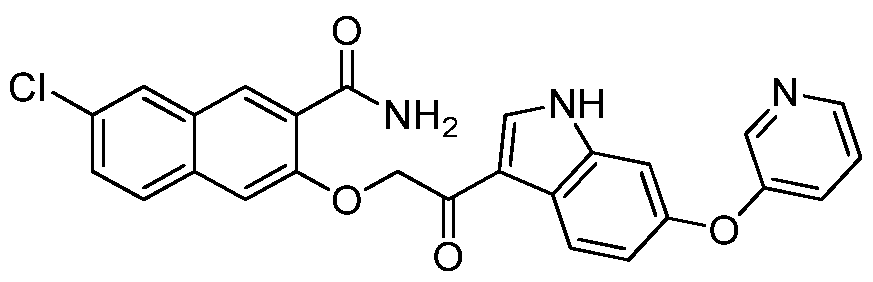
[0160] LCMS: m/z 472 (M+H)+. ¾ NMR (400MHz, DMSO-d6) δ 12.03 - 12.40 (m, 1 H), 8.59 - 8.71 (m, 2 H), 8.52 - 8.57 (m, 1 H), 8.32 - 8.43 (m, 2 H), 8.19 - 8.24 (m, 1 H), 8.13 - 8.18 (m, 1 H), 7.82 - 7.94 (m, 2 H), 7.65 (s, 1 H), 7.53 - 7.60 (m, 1 H), 7.41 (brs., 2 H), 7.20 (s, 1 H), 6.99 - 7.06 (m, 1 H), 5.63 (s, 2 H)
7-Chloro-3-(2-oxo-2-(6-(pyrimidin-5-yloxy)-lH-indol-3-yl)ethoxy)-2-naphthamide (Compound 134)

[0161] LC-MS: m/z 473 (M+H)+. NMR (400 MHz, DMSO-d6) δ 12.23 (brs, 1H), 8.98 (s, 1H), 8.64 (s, 1H), 8.61 (m, 3H), 8.55 (s, 1H), 8.23 (d, / = 8.6 Hz, 1H), 8.16 (s, 1H), 7.91 - 7.83 (m, 2H), 7.65 (s, 1H), 7.57 (dd, / = 8.9, 2.0 Hz, 1H), 7.31 (d, / = 2.1 Hz, 1H), 7.09 (dd, / = 8.7, 2.1 Hz, 1H), 5.64 (s, 2H).
7-Chloro-3-(2-oxo-2-(6-(pyrazin-2-yloxy)-lH-indol-3-yl)ethoxy)-2-naphthamide (Compound 105)

[0162] LC-MS: m/z 473 (M+H)+. ¾ NMR (400 MHz, DMSO-d6) δ 12.3 (brs, 1H), 8.64 -8.62 (m, 2H), 8.55 (m, 2H), 8.37 (d, / = 8.8 Hz, 1H), 8.23-8.15 (m, 3H), 7.88-7.86 (m, 2H), 7.66 (s, lH), 7.57 (dd, /= 8.4 Hz, 2.0 Hz, 1H), 7.39 (d, / = 2.0 Hz, 1H), 7.08 (dd, / = 8.4 Hz, 2.0 Hz, 1H), 5.65 (s, 2H).
7-Chloro-3-(2-oxo-2-(6-(pyridazin-3-yloxy)- lH-indol-3-yl)ethoxy)-2-naphthamide (Compound 119)

[0163] LC-MS: m/z 473 (M+H)+. ¾ NMR (400 MHz, DMSO-d6) δ 12.3 (brs, 1H), 9.07 (d, / = 8.8 Hz, 1H), 8.7 (m, 2H), 8.61 (s, 1H), 8.29 (d, / = 8.8 Hz, 1H), 8.22 (s, 1H), 7.94-7.92 (m, 2H), 7.84- 7.81 (m, 1H), 7.72 (s,lH), 7.63 (d, 1Η, / = 8.4 Hz), 7.51 (d, / = 8.4 Hz, 1H), 7.47 (s, 1H), 7.16 (m, 1H), 5.72 (s, 2H).
7-Chloro-3-(2-oxo-2-(6-(pyridazin-4-yloxy)- lH-indol-3-yl)ethoxy)-2-naphthamide (Compound 132)

[0164] LC-MS: m/z 473 (M+H)+. ¾ NMR (400 MHz, DMSO-d6) δ 12.36 (s, 1H), 9.13 (d, / = 3.2 Hz , 1H), 9.00 (d, / = 6.8 Hz, 1H), 8.69 (s, 1H), 8.60 (s, 1H), 8.54 (s, 1H), 8.28 (d, / = 8.4 Hz, 1H), 8.15-8.17 (m, 1H), 7.85-7.89 (m, 2H), 7.65 (s, 1H), 7.57 (d, / = 9.2 Hz, 1H), 7.44 (s, 1H), 7.11-7.14 (m, 1H), 7.00-7.02 (m, 1H), 5.65 (s, 2H).
7-Chloro-3-(2-(6-(5-methylpyridazin-3-yloxy)-lH-indol-3-yl)-2-oxoethoxy)-2-naphthamide
(Compound 197)
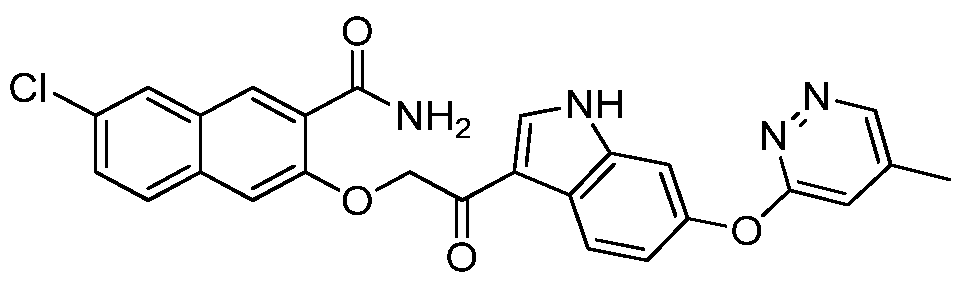
[0165] LCMS: m/z 487 (M+H)+. ¾ NMR (DMSO-d6 ,400MHz): δ 12.22 - 12.29 (m, 1 H), 8.81 - 8.84 (m, 1 H), 8.63 - 8.68 (m, 2 H), 8.56 (s, 1 H), 8.17 (m, 2 H), 7.84 - 7.93 (m, 2 H), 7.66 (s, 2 H), 7.59 (s, 1 H), 7.38 (m, 1 H), 7.02 - 7.11 (m, 1 H), 5.66 (s, 2 H), 2.37 - 2.40 (s, 3 H).
7-Chloro-3-(2-(6-(4-methylpyridazin-3-yloxy)-lH-indol-3-yl)-2-oxoethoxy)-2-naphthamide
(Compound 154)

[0166] LCMS: m/z 487 (M+H)+. ¾ NMR (DMSO-d6 ,400MHz) δ 12.25 - 12.29 (S, 1 H), 8.86 - 8.89 (S, 1 H), 8.63 - 8.68 (m, 2 H), 8.55 (s, 1 H), 8.20 - 8.25 (m, 2 H), 8.14 - 8.19 (m, 21 H), 7.84 - 7.92 (m, 1 H), 7.66 (s, 1 H), 7.55 - 7.60 (m, 1 H), 7.38 (s, 1 H), 7.27 (s, 1 H), 7.07 (m, 1 H), 5.65 - 5.68 (m, 2 H), 2.34 - 2.36 (m, 3 H).
7-Cyano-3-(2-oxo-2-(6-(pyridin-3-yloxy)-lH-indol-3-yl)ethoxy)-2-naphthamide (Compound 124)

7-Cyano-3-(2-oxo-2-(6-(pyrazin-2-yloxy)-lH-indol-3-yl)ethoxy)-2-naphthamide (Compound 149)

[0168] LC-MS: m/z 464 (M+H)+. ¾ NMR (400 MHz, DMSO-d6) δ 12.26 (s, 1H), 8.63 (dd, / = 36.0, 18.3 Hz, 5H), 8.37 (d, / = 2.5 Hz, 1H), 8.21 (d, / = 8.9 Hz, 2H), 7.99 (d, / = 8.7 Hz, 2H), 7.83 (d, / = 8.7 Hz, 1H), 7.74 (s, 1H), 7.40 (d, / = 1.7 Hz, 1H), 7.15 - 7.03 (m, 1H), 5.71 (s, 2H).
7-Cyano-3-(2-oxo-2-(6-(pyridazin-3-yloxy)-lH-indol-3-yl)ethoxy)-2-naphthamide (Compound 148)

[0169] LC-MS: m/z 464 (M+H)+. ¾ NMR (400 MHz, DMSO-d6) δ 12.11 (s, 1H), 9.00 (d, / = 4.8 Hz, 1H), 8.66 (s, 1H), 8.63 (s, 1H), 8.59 (s, 1H), 8.43-8.44 (m, 1H), 8.23 (d, / = 8.4 Hz, 1H), 7.98 (d, / = 8.4 Hz, 1H), 7.69-7.79 (m, 4H), 7.42 (s, 1H), 7.39 (s, 1H), 7.08-7.11 (m, 1H), 5.67 (s, 2H).
7-Cyano-3-(2-oxo-2-(6-(pyrimidin-5-yloxy)-lH-indol-3-yl)ethoxy)-2-naphthamide (Compound 150)

[0170] LC-MS: m/z 464 (M+H)+. ¾ NMR (400 MHz, DMSO-d6) δ 8.97 (s, 1Η),8.67-8.69 (m, 2H), 8.57-8.65 (m, 4H), 8.22 (d, / = 9.6 Hz, 1H), 7.96-7.98 (m, 2H), 7.80-7.83 (m, 1H), 7.72 (s, 1H), 7.32 (d, / = 2.0 Hz, 1H), 7.08-7.11 (m, 1H), 5.69 (s, 1H).
EXAMPLE 2. Synthesis of 7-chloro-3-(2-(l-(2-((3S,4R)-3,4-dihydroxypyrrolidin-l-yl)ethyl)-6- (pyridin-3-yloxy)-lH-indol-3-yl)-2-oxoethoxy)-2-naphthamide (Compound 184)

[0171] Step A. l-(2-Chloroethyl)-2,5-dihydro-lH-pyrrole. To a solution of 2,5-dihydro-lH- pyrrole (690 mg, 10.0 mmol) in acetone (15 mL) were added l-bromo-2-chloroethane (2.84 g, 20 mmol) and K2CO3 (2.76 g, 20 mmol). The reaction mixture was stirred at r.t. for 48 hr, then filtered through Celite. The filtrate was concentrated under reduced pressure and the residue was purified by flash column chromatography to give l-(2-chloroethyl)-2,5-dihydro-lH-pyrrole (250 mg, 19% yield) as yellow oil. LC-MS: m/z 132 (M+H)+.
[0172] Step B. 7-Chloro-3-(2-(l-(2-(2,5-dihydro-lH^yrrol-l-yl)ethyl)-6-(pyrM
indol-3-yl)-2-oxoethoxy)-2-naphthamide. To a mixture of 7-chloro-3-(2-oxo-2-(6-(pyridin-3-yloxy)-lH- indol-3-yl)ethoxy)-2-naphthamide (100 mg, 0.21 mmol) in DMF (3 mL) were added l-(2-chloroethyl)- 2,5-dihydro-lH-pyrrole (80 mg, 0.61 mmol) and K2CO3 (174 mg, 1.26 mmol). The reaction mixture was stirred at r.t. for 48 hr, then filtered through Celite. The filtrate was concentrated under reduced pressure, and the residue was purified by flash column chromatography to give 7-chloro-3-(2-(l-(2-(2,5-dihydro- lH^yrrol-l-yl)ethyl)-6-(pyridin-3-yloxy)-lH ndol-3-yl)-2-oxoethoxy)-2-naphthamide (120 mg, quant, yield) as pale yellow solid. LC-MS: m/z 567 (M+H)+.
[0173] Step C. 7-Chloro-3-(2-(l-(2-((3S,4R)-3,4-dihydroxypyrrolMin-l-yl)ethyl^^ yloxy)-lH-indol-3-yl)-2-oxoethoxy)-2-naphthamide. To a mixture of 7-chloro-3-(2-(l-(2-(2,5-dihydro- lH-pyrrol-l-yl)ethyl)-6-(pyridin-3-yloxy)-lH ndol-3-yl)-2-oxoethoxy)-2-naphthamide (56.7 mg, 0.1 mmol) in THF (5 mL) at r.t. were added H20 (0.5 mL) and NMO (200 mg, 1.0 mmol), followed by addition of OsC (1 mg, cat.). The reaction mixture was stirred at r.t. for 1 hr, quenched with saturated aqueous Na2S2C>3, and concentrated under reduced pressure. The residue was purified by prep-HPLC to give 7-chloro-3-(2-(l-(2-((3S,4R)-3,4-dihydroxypyrrolidin-l-yl)ethyl)-6-(pyridin-3-yloxy)-lH-indol-3- yl)-2-oxoethoxy)-2-naphthamide (10 mg, 16.7% yield) as white solid. LC-MS: m/z 601 (M+H)+. ¾ NMR (400 MHz, DMSO-dg) δ 8.69 (s, 1H), 8.58 (s, 1H), 8.52 (s, 1H), 8.39 (s, 1H), 8.16-8.23 (m, 3H), 7.86-
7.88 (m, 2H), 7.39-7.61 (m, 5H), 7.02-7.04 (m, IH), 5.58 (s, 2H), 4.31 (t, / = 6.0 Hz, 2H), 3.5 (m, 2H), 3.88 (m, 2H), 2.84-2.92 (m, 4H), 2.33-2.37 (m, 2H).
[0174] The procedure set forth above as Example 2 was used to produce the following compounds using the appropriate starting materials.
(R)-7 hloro-3-(2^1 2 3-hydroxypyrrolidin-l-yl)ethyl)-6-(pyridin-3-yloxy)-lH-indol-3-yl)-2- oxoethoxy)-2-naphthamide (Compound 185)

[0175] LC-MS: m/z 585 (M+H)+. ¾ NMR (400 MHz, DMSO-d6) δ 8.70 (s, IH), 8.57 (s, IH), 8.52 (s, IH), 8.39 (s, IH), 8.34 (m, IH), 8.22 (m, 2H), 7.87 (m, 2H), 7.61 (s, IH), 7.57 (d, / = 6.8 Hz, IH), 7.50 (s, IH), 7.39 (m, 2H), 7.04 (d, / = 6.5 Hz, IH), 5.58 (s, 2H), 4.70 (m, IH), 4.34 (m, 2H), 4.14 (m, IH), 2.85 (m, 2H), 2.74 (m, IH), 2.64 (m, IH), 2.33 (m, 2H), 1.89 (m, 2H).
7-Chloro-3-(2^1 2 3-hydroxy-3-methylpyrrolidin-l-yl)ethyl)-6-(pyridin-3-yloxy)-lH-indol-3-yl)-2-

[0176] LC-MS: m/z 599(M+H)+. ¾ NMR (400 MHz, DMSO-d6) δ 8.71 (s, IH), 8.58 (s, IH), 8.52 (s, IH), 8.39 (s, IH), 8.34 (s, IH), 8.22 (d, / = 8.6 Hz, IH), 8.16 (s, IH), 7.92 - 7.84 (m, 2H), 7.62 - 7.55 (m, 2H), 7.51 (s, IH), 7.39 (d, / = 4.2 Hz, 2H), 7.04 (d, / = 8.4 Hz, IH), 5.58 (s, 2H), 4.55 (s, IH), 4.33 (m, 2H), 2.84 (m, 2H), 2.64 (dd, / = 15.7, 7.7 Hz, 2H), 2.46 (s, IH), 2.33 (s, IH), 1.72 - 1.57 (m, 2H), 1.19 (s, 3H).
(S)-7-Chloro-3-(2 l-(2-(3-hydroxypyrrolidin-l-yl)ethyl)-6-(pyridin-3-yloxy)-lH-indol-3-yl)-2- oxoethoxy)-2-naphthamide (Compound 186)

[0177] LC-MS: m/z 585 (M+H)+. ¾ NMR (400 MHz, DMSO-d6) δ 8.71 (s, IH), 8.57 (s, IH), 8.52 (s, IH), 8.39 (d, / = 2.0 Hz, IH), 8.34 (dd, / = 4.2, 1.6 Hz, IH), 8.23 (d, / = 8.6 Hz, IH), 8.16 (s, IH), 7.87 (m, 2H), 7.61 (s, IH), 7.57 (dd, / = 8.8, 2.1 Hz, IH), 7.52 (d, / = 1.9 Hz, IH), 7.45 - 7.34 (m, 2H), 7.04 (dd, / = 8.6, 2.0 Hz, IH), 5.58 (s, 2H), 4.81 (m, IH), 4.38 (m, 2H), 4.18 (m, IH), 2.95 (m, 2H), 2.80 (m, IH), 2.75 - 2.66 (m, IH), 2.59 (m, IH), 2.47 - 2.41 (m, IH), 1.93 (m, IH), 1.55 (s, IH).
7-Chloro-3-(2^1-(2-(4-hydroxypiperidin-l-yl)ethyl)-6-(pyridin-3-yloxy)-lH-indol-3-yl)-2- oxoethoxy)-2-naphthamide (Compound 187)

[0178] LC-MS: m/z 599 (M+H)+. LCMS: m/z 599 (M+H)+. ¾ NMR (400MHz, DMSO-d6) δ 8.68 (s, 1 H), 8.54 - 8.60 (m, 1 H), 8.49 - 8.53 (m, 1 H), 8.37 - 8.41 (m, 1 H), 8.32 - 8.36 (m, 1 H), 8.19 - 8.25 (m, 1 H), 8.16 (s, 2 H), 7.84 - 7.90 (m, 2 H), 7.60 (s, 2 H), 7.48 - 7.52 (m, 1 H), 7.39 (s, 2 H), 7.03 m, 1 H), 5.58 (s, 2 H), 4.5(s, 1 H), 4.28 - 4.38 (m, 2 H), 2.68 - 2.79 (m, 4 H), 2.04 - 2.16 (m, 2 H), 1.58 - 1.70 (m, 2 H), 1.26 - 1.37 ppm (m, 2 H).
7-Chloro-3-(2^H2^4-hydroxy-4-methylpiperidm
oxoethoxy)-2-naphthamide (Compound 190)

[0179] LCMS: m/z 613 (M+H)+. ¾ NMR (400MHz, DMSO-d6) δ 8.69 (s, 1 H), 8.52 - 8.57 (m, 2 H), 8.39 (m, 1 H), 8.34 (m, 1 H), 8.21 - 8.23 (m, 1 H), 8.16 (m, 2 H), 7.86-7.88 (m, 2 H), 7.56 - 7.61 (m, 2 H), 7.51 (s, 1 H), 7.34 - 7.40 (m, 1 H), 7.03 - 7.06 (m, 2 H), 5.58 (s, 2 H), 4.35(m, 1 H), 4.09 (s, 1 H),2.68-2.72 (m, 2 H), 2.35 - 2.45 (m, 4 H), 1.37 - 1.40 (m, 4 H), 1.04(s, 3 H).
7-Chloro-3-(2-oxo-2-(6-(pyridin-3-yloxy)-l-(2-(pyrrolidin-l-yl)ethyl)-lH-indol-3-yl)ethoxy)-2-

[0180] LC-MS: m/z 569 (M+H)+. ¾ NMR (400 MHz, DMSO-d6) δ 8.70 (s, 1H), 8.52 (s, 1H), 8.38-8.41 (m, 1H), 8.34-8.41 (m, 1H), 8.23-8.27 (m, 1H), 8.19 - 8.11 (m, 2H), 7.87-7.92 (m, 2H), 7.63 - 7.51 (m, 2H), 7.50-7.53 (m, 1H), 7.45 - 7.33 (m, 2H), 7.05-7.11 (m, 1H), 5.58 (s, 2H), 4.37-4.41 (m, 2H), 2.90-2.92 (m, 2H), 2.51 (s, 4H), 1.64 (s, 4H).
7-Chloro-3-(2-(l-(2-morpholinoethyl)-6-(pyridin-3-yloxy)-lH-indol-3-yl)-2-oxoethoxy)-2- naphthamide (Compound 115)

[0181] LC-MS: m/z 586 (M+H)+. ¾ NMR (400 MHz, DMSO-d6) δ 8.69 (s, IH), 8.54 (s, IH), 8.50 (s, IH), 8.38 (d, / = 2.0 Hz, IH), 8.32-8.33 (m, IH), 8.22 (d, / = 8.8 Hz, IH), 8.15 (d, / = 1.6 Hz, IH), 7.85-7.87 (m, 2H), 7.59 (s, IH), 7.55-7.58 (m, IH), 7.52 (d, / = 2.0 Hz, IH), 7.36-7.41 (m, 2H), 7.02-7.05 (m, IH), 5.57 (s, 2H), 4.35-4.38 (m, 2H), 3.48-3.50 (m, 4H), 2.70- 2.73 (m, 2H), 2.40-2.45 (m, 4H).
7-Chloro-3-(2^1 2^diethylamino)ethyl)-6-(pyridin-3-yloxy)-lH-indol-3-yl)-2-oxoethoxy)-2-

[0182] LC-MS: m/z 571 (M+H)+. ¾ NMR (400 MHz, DMSO-d6) δ 8.69 (s, IH), 8.57 (s, IH), 8.52 (s, IH), 8.38-8.41 (m, IH), 8.36 - 8.31 (m, IH), 8.22-8.25 (m, IH), 8.16 (s, IH), 7.87-7.89 (m, 2H), 7.64 - 7.54 (m, 2H), 7.49 - 7.35 (m, 3H), 7.04-7.06 (m, 2H), 5.58 (s, 2H), 4.28-4.31 (m, 2H), 2.46-2.49 (m, 6H), 0.81-0.86 (m, 6H).
7-Chloro-3-(2-(l-methyl-6-(pyridin-3-yloxy)-lH-indol-3-yl)-2-oxoethoxy)-2-naphthamide
(Compound 104)

[0183] LC-MS: m/z 486 (M+H)+. ¾ NMR (400 MHz, DMSO-d6) δ 8.68 (s, IH), 8.58 (s, IH), 8.51 (s, IH), 8.39 (s, IH), 8.34-8.44 (m, IH), 8.22-8.26 (m, IH), 8.15-8.19 (m, IH), 7.87-7.92 (m, 2H), 7.63 (s, IH), 7.57-761 (m, IH), 7.46 - 7.36 (m, 3H), 7.06-7.12 (m, IH), 5.59 (s, 2H), 3.88 (s, 3H).
7-Chloro-3-(2-(l-(3-hydroxy-3-methylbutyl)-6-(pyridin-3-yloxy)-lH-indol-3-yl)-2-oxoethoxy)-2-

[0184] LC-MS: m/z 559 (M+H)+. ¾ NMR (400 MHz, DMSO-d6) δ 8.72 (s, IH), 8.58 (s, IH), 8.53 (s, IH), 8.39 (d, / = 2.0 Hz, IH), 8.32-8.34 (m, IH), 8.23 (d, / = 8.4 Hz, IH), 8.15 (d, / = 2.0 Hz, IH), (m, IH), 7.86 (d, / = 8.8 Hz 2H), 7.62 (s, IH), 7.55-7.58 (m, IH), 7.44 (d, / = 2.4 Hz , 1H),7.39- 7.40 ( m, 2H), 7.02-7.04 (m, IH), 5.59 (s, 2H), 4.57 (s, IH), 4.30-4.34 ( m, 2H ), 1.92-1.96 (m, 2H), 1.18 (s, 6H).
7-Chloro-3-(2-oxo-2-(6-(pyrazin-2-yloxy)-l-(2-(pyrrolidin-l-yl)ethyl)-lH-indol-3-yl)ethoxy)-2-

[0185] LC-MS: m/z: 570 (M+H)+. ¾ NMR (400 MHz, DMSO-d6) δ 8.72 (s, IH), 8.59 (s, IH), 8.56 (s, IH), 8.53 (s, IH), 8.38 (d, / = 2.6 Hz, IH), 8.23 (d, / = 8.6 Hz, IH), 8.20 (s, IH), 8.17 (s, IH), 7.88 (d, / = 8.9 Hz, 2H), 7.62 (s, 2H), 7.58 (dd, / = 8.8, 2.0 Hz, IH), 7.12 (dd, / = 8.5, 2.0 Hz, IH), 5.60 (s, 2H), 4.38 (t, / = 6.6 Hz, 2H), 2.88 (t, / = 6.4 Hz, 2H), 2.50 - 2.47 (m, 4H), 1.64 (m, 4H).
7-Chloro-3-(2-oxo-2-(6-(pyridazin-3-yloxy)-l-(2-(pyrrolidin-l-yl)ethyl)-lH-indol-3-yl)ethoxy)-2-

7-Chloro-3-(2-oxo-2-(l-(2-(2-oxopyrrolidin-l-yl)ethyl)-6-(pyridazin-3-yloxy)-lH-indol-3-yl)ethoxy)- -naphthamide (Compound 172)

[0187] LC-MS: m/z 584(M+H)+. ¾ NMR (400 MHz, DMSO-d6) δ 9.00 (m, IH), 8.67 (s, IH), 8.48 (s, IH), 8.44 - 8.35 (m, IH), 8.25 (m, IH), 8.11 (s, IH), 7.87-7.91 (m, IH), 7.80 - 7.71 (m, IH), 7.64 (s, IH), 7.60 (s, IH), 7.55-7.58 (m, 2H), 7.42-7.48 (m, IH), 7.13-7.16 (m, IH), 5.56 (s, 2H), 4.42 (s, 2H), 3.64-3.68 (m 2H), 3.18 (s, 2H), 2.11-2.15 (m, 2H), 1.86 - 1.73 (m, 2H).
7-Chloro-3-(2^1 2 l-methylpyrrolidin-2-yl)ethyl)-6-(pyridazin-3-yloxy)-lH-indol-3-yl)-2-

[0188] LC-MS: m/z: 584 (M+H)VH NMR (400 MHz, DMSO-d6) δ 9.02-9.03 (m, IH), 8.83- 8.96 (m, IH), 8.49-8.56 (m, IH), 8.27 (d, / = 8.8 Hz, IH), 8.16 (d, / = 1.6 Hz, IH), 8.27 (d, / = 8.6 Hz, IH), 8.16 (s, IH), 7.87 - 7.91 (m, 2H), 7.76 - 7.81 (m, 2H), 7.59 - 7.66 (m, 2H), 7.50 (d, / = 8.8Hz, IH), 5.59 (s, 2H), 4.38-4.41(m, 2H), 3.17-3.24(m, 2H), 3.18-3.21 (m, IH), 2.71-2.89 (m, 3H), 2.01-2.31 (m, 3H), 1.72-1.98 (m, 3H).
7-Cyano-3-(2-oxo-2-(6-(pyridazin-3-yloxy)-l-(2-(pyrrolidin-l-yl)ethyl)-lH-indol-3-yl)ethoxy)-2- naphthamide (Compound 196)

[0189] LC-MS: m/z: 561(M+H)VH NMR (400 MHz, DMSO-d6) δ 9.01 (d, / = 4.2 Hz, IH), 8.75 - 8.63 (m, 3H), 8.28 - 8.17 (m, 2H), 8.04 - 7.93 (m, 2H), 7.86 - 7.74 (m, 2H), 7.67 (d, / = 21.5 Hz, 2H), 7.46 (d, / = 9.0 Hz, IH), 7.14 (d, / = 10.4 Hz, IH), 5.66 (s, 2H), 4.38 (d, / = 6.4 Hz, 2H), 2.89 (t, / = 6.5 Hz, 2H), 1.64 (s, 4H), 1.24 (s, 4H).
7-Cyano-3-(2-(l-(2-morpholinoethyl)-6-(pyridazin-3-yloxy)-lH-indol-3-yl)-2-oxoethoxy)-2-

[0190] LC-MS: m/z: 577(M+H) +. ¾ NMR (400 MHz, DMSO-d6) δ 9.03 (d, / = 3.9 Hz, IH), 8.83 (s, IH), 8.69 (s, IH), 8.62 (s, IH), 8.52 (s, IH), 8.28 (d, / = 8.6 Hz, IH), 8.00 (d, / = 8.8 Hz, 2H), 7.87 - 7.76 (m, 3H), 7.71 (s, IH), 7.50 (d, / = 8.9 Hz, IH), 7.20 (d, / = 8.6 Hz, IH), 5.64 (s, 2H), 4.79 (s, 2H), 4.01 (d, / = 11.9 Hz, 2H), 3.78 (t, / = 12.5 Hz, 2H), 3.63 (d, / = 21.0 Hz, 4H), 3.20 (s, 2H).
7-Cyano-3-(2^1-(2-((3R,4R)-3,4-dihydroxypyrrolid^
yl)-2-oxoethoxy)-2-naphthamide (Compound 203)

[0191] LC-MS: m/z: 593(M+H)+. ¾ NMR (400 MHz, DMSO-d6) δ 9.03 (d, / = 3.8 Hz, IH), IH), 8.70 (s, IH), 8.64 (s, IH), 8.53 (s, IH), 8.28 (d, / = 8.6 Hz, IH), 8.03 - 7.95 (m, 2H), 7.86
7.77 (m, 2H), 7.75 (s, IH), 7.70 (s, IH), 7.50 (d, / = 8.9 Hz, IH), 7.20 (d, / = 8.6 Hz, IH), 5.66 (s, 2H), 4.71 (m, 2H), 4.13 (m, 2H), 3.72 (m, 3H), 3.50 (m, 4H), 3.06 (d, / = 12.5 Hz, IH).
EXAMPLE 3. Synthesis of 7-chloro-3-(2-(l-(2-hydroxy-2-methylpropyl)-6-(pyridin-3-yloxy)-lH- indol-3- l -2-oxoethox -2-na hthamide Com ound 110

[0192] A mixture of 7-chloro-3-(2-oxo-2-(6-(pyridin-3-yloxy)-lH-indol-3-yl)ethoxy)-2- naphthamide (47.2 mg, 0.1 mmol), 2,2-dimethyloxirane (8.64 mg, 0.12 mmol), potassium carbonate (27.6mg, 0.2 mmol), and LiCl (8.2 mg,0.2 mmol) in DMF was stirred at r.t. for 16 hr then quenched with water and extracted with EtOAc. The combined organic layers were washed with brine, dried over anhydrous Na2SC>4, and concentrated under reduced pressure. The residue was purified by prep-HPLC to afford the desired product (16 mg, 30% yield). LC-MS: m/z 544 (M+H)+. ¾ NMR (400 MHz, DMSO-d6) δ 8.61 (s, IH), 8.58 (s, IH), 8.53 (s, IH), 8.37-8.42 (m, IH), 8.32-8.36 (m, IH), 8.24-8.27 (m, IH), 8.16- 8.19 (m, IH), 7.88-7.91 (m, 2H), 7.65 (s, IH), 7.62 - 7.53 (m, 2H), 7.44 - 7.31 (m, 2H), 7.03-7.08 (m, IH), 5.60 (s, 2H), 4.81 (s, IH), 4.17 (s, 2H), 1.14 (s, 6H).
EXAMPLE 4. Synthesis of 7-chloro-3-(2-(l-(3,4-dihydroxybutyl)-6-(pyridin-3-yloxy)-lH-indol-3-

[0193] Step A. 3-(2-(l-(But-3-enyl)-6-(pyrMin-3-yloxy)-lH-indol-3-yl)-2-oxoethoxy)-7-chloro- 2-naphthamide . To a mixture of 7-chloro-3-(2-oxo-2-(6-(pyridin-3-yloxy)-lH-indol-3-yl)ethoxy)-2-
naphthamide (38 mg, 0.08 mmol) in DMF (3 mL) was added Cs2C03 (79 mg, 0.24 mmol) and 4- bromobut-l-ene (17 mg, 0.12 mmol). The reaction mixture was stirred at r.t. for 16 hr, then quenched with aq. LiCl (10 wt, 30 mL) and extracted with DCM (30 mL). The organic layer was separated, dried over anhydrous Na2SC>4 and concentrated under reduced pressure. The residue was purified by flash column chromatography to afford 3-(2-(l-(but-3-enyl)-6-(pyridin-3-yloxy)-lH-indol-3-yl)-2-oxoethoxy)- 7-chloro-2-naphthamide (37 mg, 88% yield) as white solid. LC-MS: m/z 526 (M+H)+.
[0194] Step B. 7-Chloro-3-(2-(l-(3,4-dihydroxybutyl)-6-(pyridin-3-yloxy)-lH-indol-3-yl)-2- oxoethoxy) -2-naphthamide. To a mixture of 3-(2-(l-(but-3-enyl)-6-(pyridin-3-yloxy)-lH-indol-3-yl)-2- oxoethoxy)-7-chloro-2-naphthamide (37 mg, 0.07 mmol) in THF/H2O (4.5 mL, V:V=8: 1) was added NMO (17 mg, 0.14 mmol) and OsC (2 mg). The reaction mixture was stirred at r.t. for 16 h, then quenched with aq. Na2S2C>3 (30% wt, 10 mL) and extracted with DCM (30 mL). The organic layer was separated, dried over anhydrous Na2SC>4 and concentrated under reduced pressure. The residue was purified via prep-HPLC to afford 7-chloro-3-(2-(l-(3,4-dihydroxybutyl)-6-(pyridin-3-yloxy)-lH-indol-3- yl)-2-oxoethoxy)-2-naphthamide (10 mg, 26% yield) as white solid. LC-MS: m/z: 560 (M+H)+. ¾ NMR (400 MHz, DMSO-dg) δ 8.68 (s, 1H), 8.60 (s, 1H), 8.53 (s, 1H), 8.39 (s, 1H), 8.36 - 8.31 (m, 1H), 8.23 (d, / = 8.6 Hz, 1H), 8.16 (s, 1H), 7.87 (d, / = 8.6 Hz, 2H), 7.64 (s, 1H), 7.57 (dd, / = 8.8, 2.0 Hz, 1H), 7.49 (d, / = 2.0 Hz, 1H), 7.40 (d, / = 2.7 Hz, 2H), 7.03 (dd, / = 8.6, 2.0 Hz, 1H), 5.60 (s, 2H), 4.82 (d, / = 4.9 Hz, 1H), 4.61 (m, 1H), 4.35 (m, 2H), 3.40 (m, 2H), 3.26 (m, 1H), 2.06 (m, 1H), 1.74 (m, 1H).
[0195] The procedure set forth above as Example 4 was used to produce the following compounds from the appropriate starting materials.
7-Chloro-3-(2-(l-(3,4-dihydroxybutyl)-6-(pyridazin-3-yloxy)-lH-indol-3-yl)-2-oxoethoxy)-2- naphthamide (Compound 168)

[0196] LC-MS: m/z: 561(M+H)+. ¾ NMR (400 MHz, DMSO-d6) δ 9.02 (d, / = 4.4 Hz, 1H), 8.71 (s, 1H), 8.63 (s, 1H), 8.55 (s, 1H), 8.26 (d, / = 8.6 Hz, 1H), 8.17 (s, 1H), 7.89 (d, / = 9.1 Hz, 2H), 7.78 (dd, / = 9.0, 4.6 Hz, 1H), 7.61 (dd, / = 18.8, 12.9 Hz, 3H), 7.47 (d, / = 8.8 Hz, 1H), 7.14 (d, / = 8.7 Hz, 1H), 5.63 (s, 2H), 4.87 (s, 1H), 4.64 (s, 1H), 4.37 (s, 2H), 2.13 - 1.94 (m, 2H), 1.29 - 1.14 (m, 3H).
EXAMPLE 5. Synthesis of 2-(3-(2-(3-carbamoyl-6-chloronaphthalen-2-yloxy)acetyl)-6-(pyridin-3-

[0197] Step A. Tert-butyl 2-(3-(2-(3-carbamoyl-6-chloronaphthalen-2-yloxy)acetyl)-6- (pyridin-3-yloxy)-lH-indol-l-yl)acetate. A mixture of 7-chloro-3-(2-oxo-2-(6-(pyridin-3-yloxy)-lH- indol-3-yl)ethoxy)-2-naphthamide (47.2 mg, O. lmmol), tert-butyl 2-bromoacetate (38.8 mg, 0.2 mmol) and potassium carbonate (27.6 mg, 0.2 mmol) in DMF was stirred at 50°C for 6hr then quenched with water and extracted with EtOAc. The combined organic layers were washed with brine, dried over anhydrous Na2SC>4, and concentrated under reduced pressure. The residue was purified by column chromatography to afford the desired product (50.6 mg, 86% yield) as yellow solid. LC-MS: m/z 586 (M+H)+.
[0198] Step B. 2-(3-(2-(3-Carbamoyl-6-chloronaphthalen-2-yloxy)acetyl)-6-(pyridin-3-yloxy)- lH-indol-l-yl)acetic acid. To a mixture of tert-butyl 2-(3-(2-(3-carbamoyl-6-chloronaphthalen-2- yloxy)acetyl)-6-(pyridin-3-yloxy)-lH-indol-l-yl)acetate (29.2 mg, 0.05mmol) in DCM (3 mL) was added TFA (1 mL). The reaction mixture was stirred at r.t. for 2 hr then concentrated under reduced pressure. The residue was partitioned between water and EtOAc. The organic layer was separated, washed with brine, dried over anhydrous Na2SC>4, and concentrated under reduced pressure. The residue was purified by prep-HPLC to afford the desired product (13 mg, 50% yield). LC-MS: m/z 530 (M+H)+. ¾ NMR (400 MHz, DMSO-de) δ 8.64 (s, IH), 8.58 (s, IH), 8.53 (s, IH), 8.36-8.38 (m, 3H), 8.22-8.23 (m, IH), 8.16 (s, IH), 7.86-7.91 (m, 2H), 7.68 - 7.51 (m, 2H), 7.46 - 7.31 (m, 3H), 7.05-7.08 (m, IH), 5.60 (s, 2H), 5.09 (s, 2H), 1.17-1.19 (m, 6H).
EXAMPLE 6. Synthesis of 7-chloro-3-(2-(l-(2-(methylamino)-2-oxoethyl)-6-(pyridin-3-yloxy)-lH-

[0199] A mixture of 2-(3-(2-(3-carbamoyl-6-chloronaphthalen-2-yloxy)acetyl)-6-(pyridin-3- yloxy)-lH-indol-l-yl)acetic acid (52.9 mg, O.lmmol), methylamine hydrochloride (8.7 mg, 0.13mmol), EDCI (16.2 mg, 0.12 mmol), HOBt (23 mg, 0.12 mmol), and triethylamine (30.3 mg,0.3 mmol) in DMF was stirred at r.t. for 16 hr, then quenched with water and extracted with EtOAc. The combined organic layers were washed with brine, dried over anhydrous Na2SC , and concentrated under reduced pressure. The residue was purified by prep-HPLC to afford the desired product (16 mg, 30% yield). LC-MS: m/z 543 (M+H)+. ¾ NMR (400 MHz, DMSO-d6) δ 8.63 (s, 1H), 8.59 (s, 1H), 8.53 (s, 1H), 8.38-8.41 (m, 1H), 8.34-8.38 (m, 1H), 8.24-8.27 (m, 2H), 8.16 -8.21(m 1H), 7.86-7.92 (m, 2H), 7.64 (s, 1H), 7.57-7.62 (m, 1H), 7.44 - 7.33 (m, 3H), 7.06-7.14 (m, 1H), 5.61 (s, 2H), 4.93 (s, 2H), 2.64-2.71 (m, 3H).
Example 7. Synthesis of 7-chloro-3-(2-oxo-2-(6-(tetrahydro-2H-pyran-4-yloxy) -lH-indol-3- yl)ethoxy)-2-naphthamide (Compound 158)

[0200] Step A. l-(Phenylsulfonyl)-6-(tetrahydro-2H-pyran-4-yloxy)-lH-indole. To a mixture of l-(phenylsulfonyl)-lH-indol-6-ol (0.55 g, 2 mmol) and tetrahydro-2H-pyran-4-ol (0.3 g, 3 mmol) in THF
(10 mL) were added DEAD (0.52 g, 3 mmol) and triphenylphosphine (0.78 g, 3 mmol). The reaction mixture was stirred at r.t. for 4 hr, then diluted with water and extracted with EtOAc. The combined organic layers were washed with brine, dried over anhydrous Na2SC>4 and concentrated under reduced pressure. The residue was purified by column chromatography to give l-(phenylsulfonyl)-6-(tetrahydro- 2H-pyran-4-yloxy)-lH-indole (0.5 g, 67% yield). LC-MS: m/z 358 (M+H)+.
[0201] Step B. 2-Chloro-l-(l-(phenylsulfonyl)-6-(tetrahydro-2H-pyran-4-yloxy)-lH-indol-3- yl)ethanone. To a mixture of l-(phenylsulfonyl)-6-(tetrahydro-2H-pyran-4-yloxy)-lH-indole (0.5 g, 1.4mmol) in anhydrous DCM (5 mL) at 0°C was added AICL (0.66 g, 7 mmol), followed by dropwise addition of a solution of 2-chloroacetyl chloride methyl (0.56 mL, 7 mmol) in anhydrous DCM (1 mL). The reaction mixture was stirred at that temperature for 4 hr, then quenched with aq. HC1 (0.1 N, 10 drops) and partitioned between DCM and H2O. The organic layer was separated, dried over anhydrous Na2SC>4 and concentrated under reduced pressure. The residue was purified by column chromatography to afford the desired product (250 mg, 41% yield) as yellow oil. LC-MS: m/z 434 (M+H)+.
[0202] Step C. 7-Chloro-3-(2-oxo-2-(l-(phenylsulfonyl)-6-(tetrahydro-2H -pyran-4-yloxy)-lH- indol-3-yl)ethoxy)-2-naphthamide. To a mixture of 2-chloro-l-(l-(phenylsulfonyl)-6-(tetrahydro-2H- pyran-4-yloxy)-lH-indol-3-yl)ethanone (210 mg, 0.5 mmol) in DMSO (5 mL) were added NaHC03 (420 mg, 5 mmol), Nal (75 mg, 0.5 mmol) and 7-chloro-3-hydroxy-2-naphthamide (110 mg, 0.5 mmol). The reaction mixture was stirred at r.t. for 16 hr, then quenched with aq. LiCl (10%wt, 30 mL) and filtered. The solid was collected and dried under high vacuum to afford 7-chloro-3-(2-oxo-2-(l-(phenylsulfonyl)- 6-(tetrahydro-2H-pyran-4-yloxy)-lH-indol-3-yl)ethoxy)-2-naphthamide (150 mg, 48% yield). LC-MS: m/z 619 (M+H)+.
[0203] Step D. 7-Chloro-3-(2-oxo-2-(6-(tetrahydro-2H-pyran-4-yloxy)-lH-indol-3-yl)ethoxy)- 2-naphthamide. To a mixture of 7-chloro-3-(2-oxo-2-(l-(phenylsulfonyl)-6-(tetrahydro-2H-pyran-4- yloxy)-lH-indol-3-yl)ethoxy)-2-naphthamide (100 mg, 0.16mmol) in THF/H2O (18 mL, V:V=2: 1) was added NaOH (32 mg, 0.8 mmol). The reaction mixture was stirred at r.t. for 2 hr, then extracted with DCM (20 mL). The organic layer was separated, dried over anhydrous Na2SC>4, and concentrated under reduced pressure. The residue was purified via prep-HPLC to give 7-chloro-3-(2-oxo-2-(6-(tetrahydro- 2H-pyran-4-yloxy)-lH-indol-3-yl)ethoxy)-2-naphthamide (25 mg, 32% yield) as white solid. LC-MS: m/z 479 (M+H)+. ¾ NMR (400 MHz, DMSO-d6) δ 11.17 (s, 1H), 8.60 (d, / = 10.3 Hz, 2H), 8.17 (d, / = 5.6 Hz, 2H), 7.92 - 7.80 (m, 2H), 7.55 (d, / = 9.4 Hz, 1H), 7.36 (d, / = 9.7 Hz, 2H), 7.15 (s, 1H), 6.51 (s, 1H), 5.65 (s, 2H), 4.84 (s, 1H), 4.00 (d, / = 12.1 Hz, 2H), 3.60 (t, / = 9.7 Hz, 2H), 2.21 (d, / = 11.4 Hz, 2H), 2.02 - 1.84 (m, 2H).
EXAMPLE 8. Synthesis of 7-chloro-3-(2-oxo-2-(6-(pyridin-2-ylmethyl)-lH-indol-3-yl)ethoxy)-2-

[0204] Step A. 6-Bromo-l-((2-(trimethylsilyl)ethoxy)methyl)-lH-indole. To a mixture of NaH (1.71 g, 70.41 mmol) in THF (20 mL) at 0 °C were added, in sequence, 6-bromo-lH-indole (7.0 g, 35.71 mmol) and a solution of (2-(chloromethoxy)ethyl)trimethylsilane (5.95 g, 35.71 mmol) in THF (10 mL). The reaction mixture was stirred at 0 °C for 2 hr, then quenched with saturated aq. NH4CI and extracted with EtOAc. The combined organic layers were dried over anhydrous Na2SC>4 and concentrated under reduced pressure to afford the desired product (11.6 g, quant, crude yield) which was used in the next step without any further purification. LCMS: m/z 326 (M+H)+.
[0205] Step B. Pyridin-2-yl(l-((2-(trimethylsilyl)ethoxy)methyl)-lH-indol-6-yl)methanol. To a solution of 6-bromo-l-((2-(trimethylsilyl)ethoxy)methyl)-lH-indole (6.0 g, 18.39 mmol) in THF (20 mL) at -70°C was added BuLi (1.6 M in hexane, 11.5 mL) drop wise. The reaction mixture was stirred at that temperature for 30 min, followed by dropwise addition of a solution of picolinaldehyde (1.97 g, 18.39 mmol) in THF (5 mL). The resulting mixture was stirred at -70°C for 1 hr, then quenched with saturated aqueous NH4CI and extracted with EtOAc. The combined organic layers were concentrated under reduced pressure, and the residue was purified via flash column chromatography to give the desired product (6 g, 92% yield). LCMS: m/z 355 (M+H)+.
[0206] Step C. Pyridin-2-yl(l-((2-(trimethylsilyl)ethoxy)methyl)-lH-indol-6-yl)methanone. To a mixture of ethyl pyridin-2-yl(l-((2-(trimethylsilyl)ethoxy)methyl)-lH-indol-6-yl) methanol (6.0 g, 16.92 mmol) in DCM (20 mL) was added 7.36 g of MnCh. The reaction mixture was stirred at r.t. for 2 hr, then filtered through Celite. The filtrate was concentrated under reduced pressure to give pyridin-2-yl(l-
((2-(trimethylsilyl) ethoxy)methyl)-lH-indol-6-yl)methanone (5.97 g, quant, crude yield) as oil which was used in the next step without any further purification. LCMS: m/z 353 (M+H)+.
[0207] Step D. 6-(Pyridin-2-ylmethyl)-l-((2-(trimethylsilyl)ethoxy)methyl)-lH-indole. A mixture of pyridin-2-yl(l-((2-(trimethylsilyl)ethoxy)methyl)-lH-indol-6-yl)methanone (5.97 g, 16.9 mmol) in a mixed solvent of ethane- 1,2-diol (10 mL) and hydrazine hydrate (10 mL) was stirred at 165°C for 1 hr, followed by addition of KOH (4.75 g, 84.7 mmol). The resulting mixture was stirred at 165°C for another 1.5 hr then poured into ice water and extracted with EtOAc. The organic layer was separated, dried and concentrated. The residue was purified via flash column chromatography to give the desired product (4 g, 69.8% yield). LCMS: m/z 339 (M+H)+.
[0208] Step E. l-(Phenylsulfonyl)-6-(pyridin-2-ylmethyl)-lH-indole. To a mixture of 6- (pyridin-2-ylmethyl)-l-((2-(trimethylsilyl)ethoxy)methyl)-lH-indole (4.0 g, 11.82 mmol) in THF (5 mL) was added tetrabutylammonium fluoride (6.18 g, 23.63 mmol). The mixture was stirred at 80°C for 24 hr, then cooled to 0°C, followed by addition of NaH (1.89 g, 47.26 mmol) in portions. The mixture was stirred at 0°C for 0.5 hr, followed by dropwise addition of benzenesulfonyl chloride (4.17 g, 23.63 mmol). The reaction mixture was stirred at r.t. for 30 min, then quenched with saturated aqueous NH4CI and extracted with EtOAc. The organic layer was separated, dried and concentrated under reduced pressure. The residue was purified via flash column chromatography to give the desired product (1.5 g, 36.4% yield). LCMS: m/z 349 (M+H)+.
[0209] Step F. 2-Chloro-l-(l-(phenylsulfonyl)-6-(pyridin-2-ylmethyl)-lH-indol-3-yl)ethanone. To a mixture of l-(phenylsulfonyl)-6-(pyridin-2-ylmethyl)-lH-indole (500 mg, 1.44 mmol), aluminum trichloride (956 mg, 7.18 mmol) in DCM (10 mL) was added a solution of 2-chloroacetyl chloride (810 mg, 7.18 mmol) in DCM (2 mL). The reaction mixture was stirred at 0°C for 2 hr then quenched with saturated aq. NH4CI solution and extracted with EtOAc. The organic layer was separated, dried and concentrated under reduced pressure. The residue was purified via flash column chromatography to give the desired product (0.3 g, 49.2% yield). LCMS: m/z 425 (M+H)+.
[0210] Step H. 7-chloro-3-(2-oxo-2-(6-(pyridin-2-ylmethyl)-lH-indol-3-yl)ethoxy)-2- naphthamide. To a solution of 7-chloro-3-hydroxy-2-naphthamide (52 mg, 0.235 mmol) in DMSO (10 mL) were added NaHCC (79 mg, 0.941 mmol) and Nal (141 mg, 0.941 mmol). The reaction mixture was stirred at r.t. for 1 hr, followed by addition of 2-chloro-l-(l-(phenylsulfonyl)-6-(pyridin-2-ylmethyl)-lH- indol-3-yl)ethanone (100 mg, 0.235 mmol). The resulting mixture was stirred at r.t. for another 5 hr then quenched with water and filtered. The solid was collected and dried to give 7-chloro-3-(2-oxo-2-(l- (phenylsulfonyl)-6-(pyridin-2-ylmethyl)-lH-indol-3-yl)ethoxy)-2-naphthamide (60 mg, 41.2 % crude yield). LCMS: m/z 611 (M+H)+.
[0211] Step I. To a mixture of the above methyl 7-chloro-3-(2-oxo-2-(l-(phenylsulfonyl)-6- (pyridin-2-ylmethyl)-lH-indol-3-yl)ethoxy)-2-naphthamide (60 mg, 0.098 mmol) in THF (4 mL) was added a solution of NaOH (16 mg, 0.395 mmol) in water (2 mL). The reaction mixture was stirred at r.t. for 1 hr, then concentrated under reduced pressure. The residue was adjusted with aq. HCl (10 wt) to pH 5-6, then filtered. The solid was collected and purified by prep-HPLC to give 7-chloro-3-(2-oxo-2-(6- (pyridin-2-ylmethyl)-lH-indol-3-yl)ethoxy)-2-naphthamide (7 mg, 15.1 % yield) as yellow solid. LCMS: m/z 470 (M+H)+. ¾ NMR (400M Hz, DMSO-d6) δ 12.03 - 12.18 (m, 1 H), 8.62 - 8.69 (m, 1 H), 8.53 - 8.58 (m, 2 H), 8.48 - 8.51 (m, 1 H), 8.13 - 8.17 (m, 1 H), 8.06 - 8.11 (m, 1 H), 7.82 - 7.91 (m, 2 H), 7.66 - 7.75 (m, 1 H), 7.62 - 7.65 (m, 1 H), 7.53 - 7.59 (m, 1 H), 7.39 - 7.43 (m, 1 H), 7.27 - 7.31 (m, 1 H), 7.14 - 7.24 (m, 2 H), 5.57 - 5.64 (m, 2 H), 4.15 - 4.21 (m, 2 H).
[0212] The procedure set forth above as Example 8 was used to produce the following compounds using the appropriate starting materials.
7-chloro-3-(2-oxo-2-(6-(pyridin-3-ylmethyl)-lH-indol-3-yl)ethoxy)-2-naphthamide (Compound 121)

[0213] LCMS: m/z 470 (M+H)+. ¾ NMR (400M Hz, DMSO-d6) δ 12.07 - 12.20 (m, 1 H), 8.62 - 8.67 (m, 1 H), 8.55 (s, 2 H), 8.47 - 8.51 (m, 1 H), 8.13 - 8.19 (m, 1 H), 8.06 - 8.11 (m, 1 H), 7.87 (s, 2 H), 7.67 - 7.74 (m, 1 H), 7.64 (s, 1 H), 7.54 - 7.58 (m, 1 H), 7.27 - 7.32 (m, 1 H), 7.14 - 7.24 (m, 7 H), 5.54 - 5.65 (m, 2 H), 4.10 - 4.26 (m, 2 H).
EXAMPLE 9. Synthesis of 7-chloro-3-(2-oxo-2-(6-(pyridin-3-yloxy)- lH-indol-3-

[0214] Step A. (2-Amino-4-chlorophenyl)methanol. To a mixture of L1AIH4 (4.4 g, 116.6 mmol) in dry THF (116 mL) at 0°C under N2 was added dropwise a solution of 2-amino-4-chlorobenzoic acid (10 g, 58.3 mmol) in dry THF (80 mL). The mixture was stirred at r.t. for 2 hr, then quenched, in sequence, by addition of H2O (4 mL), aq. NaOH (15 wt, 8 mL), and H2O (12 mL). The resulting mixture was filtered, and the filtrate was extracted with EtOAc. The combined organic layers were dried over anhydrous Na2SC>4 and concentrated under reduced pressure. The residue was re -crystallized from EtOAc/PE to give (2-amino-4-chlorophenyl)methanol (7.8 g, 85.4% yield). LC-MS: m/z 158(M+H)+.
[0215] Step B. 2-Amino-4-chlorobenzaldehyde. A mixture of (2-amino-4- chlorophenyl)methanol (3.8 g, 24.2 mmol) and MnC (8.4 g, 96.8 mmol) in CH2CI2 (60 mL) was stirred at r.t. overnight under N2. The resulting mixture was filtered and concentrated under reduced pressure. The residue was re-crystallized from EtOAc/PE to give 2-amino-4-chlorobenzaldehyde (2.8 g, 74.1% yield). LC-MS: m/z: 156 (M+H)+.
[0216] Step C. 7-Chloro-3-methoxyquinoline. To a mixture of 2-amino-4-chlorobenzaldehyde (800 mg, 5.13 mmol), 1,1,2-trimethoxyethane (0.78 mL, 6.15 mmol), and p-toluenesulfonic acid monohydrate (194 mg, 1.03 mmol) in toluene (20 mL) was stirred at reflux using a Dean-Stark trap for 3
hr under N2. The mixture was concentrated under reduced pressure and the residue was purified by column chromatography (eluted with PE/EtOAc=4/l) to give 7-chloro-3-methoxyquinoline (300 mg, 30.3% yield). LC-MS: m/z: 194 (M+H)+.
[0217] Step D. 7-Chloro-3-methoxyquinoline-2-carbonitrile. To a mixture of 7-chloro-3- methoxyquinoline (300 mg, 1.55 mmol) in CH2CI2 (5 mL) at 0 °C under N2 was added dropwise a solution of m-CPBA (300 mg, 1.74 mmol) in CH2CI2 (5 mL). The mixture was stirred at r.t. for 2 hr, then partitioned between CH2CI2 and H2O. The organic layer was separated, washed with saturated aqueous NaHCC and brine, dried over anhydrous Na2SC>4, and concentrated under reduced pressure to give 3- bromo-7-chloroquinoline 1-oxide (300 mg) which was directly used in the next step without any further purification.
[0218] To the above 3-bromo-7-chloroquinoline 1-oxide (300 mg, 1.44 mmol) in acetonitrile (4 mL) at 0°C was added Et3N (1 mL, 7.19 mmol) and TMSCN (1 mL, 8.0 mmol). The reaction mixture was stirred at r.t. overnight, then concentrated under reduced pressure. The residue was purified by column chromatography (eluting with PE/EtOAc=l/l) to give 7-chloro-3-methoxyquinoline-2-carbonitrile (250 mg, 74% yield). LC-MS: m/z 219 (M+H)+.
[0219] Step E. 7-Chloro-3-methoxyquinoline-2-carboxamide. To a mixture of 7-chloro-3- methoxyquinoline-2-carbonitrile (250 mg, 1.14 mmol) in DMSO (5 mL) were added 1 mL of water (1 mL) and K2CO3 (316 mg, 1.29 mmol), followed by dropwise addition of H2O2 (40%wt, 1 mL). The resulting mixture was stirred at r.t. for 30 min, then quenched with aq. Na2S2C>4 (10%wt) and extracted with EtOAc. The combined organic layers were washed with brine, dried over anhydrous Na2SC>4 and concentrated under reduced pressure to afford 7-chloro-3-methoxyquinoline-2-carboxamide (260 mg, 96.1% crude yield) which was directly used in the next step without any further purification. LC-MS: m/z 237 (M+H)+.
[0220] Step F. 7-Chloro-3-hydroxyquinoline-2-carboxamide. To a mixture of 7-chloro-3- methoxyquinoline-2-carboxamide (260 mg, 1.10 mmol) in DCM (10 mL) at 0°C was added dropwise a solution of tribromoborane (1.38 g, 5.49 mmol) in DCM (5 mL). The resulting mixture was stirred at r.t. for 24 hr, then quenched with saturated aqueous NaHCCh and extracted with EtOAc. The combined organic layers were washed with brine, dried over anhydrous Na2SC>4 and concentrated under reduced pressure. The residue was purified by flash column chromatography to give 7-chloro-3-hydroxyquinoline- 2-carboxamide (100 mg, 40.9% yield). LC-MS: m/z 223 (M+H)+.
[0221] Step G. 7-Chloro-3-(2-oxo-2-(l-(phenylsulfonyl)-6-(pyridin-3-yloxy)-lH-indol-3- yl)ethoxy)quinoline-2-carboxamide. To a mixture of 7-chloro-3-hydroxyquinoline-2-carboxamide (100 mg, 0.449 mmol) in DMSO (10 mL) were added NaHC03 (150 mg, 1.80 mmol) and Nal (269 mg, 1.80 mmol). The reaction mixture was stirred at r.t. for 1 hr, followed by addition of 2-chloro-l-(l-
(phenylsulfonyl)-6-(pyridin-2-yloxy)-lH-indol-3-yl)ethanone (191 mg, 0.449 mmol). The resulting mixture was stirred at r.t. for 5 hr then quenched with water. The solid was collected by filtration and dried under high vacuum to give 7-chloro-3-(2-oxo-2-(l-(phenylsulfonyl)-6-(pyridin-3-yloxy)-lH-indol- 3-yl)ethoxy)quinoline-2-carboxamide (150 mg, 54.5 % crude yield). LCMS: m/z 613 (M+H)+.
[0222] Step H. 7-Chloro-3-(2-oxo-2-(6-(pyridin-3-yloxy)-lH-indol-3-yl)ethoxy)quinoline- 2- carboxamide. To a mixture of 7-chloro-3-(2-oxo-2-(l-(phenylsulfonyl)-6-(pyridin-3-yloxy)-lH-indol-3- yl)ethoxy) quinoline-2-carboxamide (60 mg, 0.196 mmol) in THF (8 mL) was added a solution of NaOH (8 mg, 0.195 mmol) in water (4 mL). The reaction mixture was stirred at r.t. for 1 hr, then quenched with aq. HC1 (10 wt) to pH 5-6. The resulting mixture was filtered, and the solid was collected and purified via prep-HPLC to give 7-chloro-3-(2-oxo-2-(6-(pyridin-3-yloxy)-lH-indol-3-yl)ethoxy)quinoline-2- carboxamide (6 mg, 16 % yield) as white solid. LCMS: m/z 473 (M+H)+. ¾ NMR (400MHz, DMSO-d6) δ 12.12 - 12.17 (m, 1 H), 8.63 - 8.68 (m, 1 H), 8.33 - 8.42 (m, 2 H), 8.17 - 8.24 (m, 1 H), 8.10 - 8.15 (m, 1 H), 8.02 - 8.07 (m, 1 H), 7.90 - 7.97 (m, 2 H), 7.76 - 7.81 (m, 1 H), 7.59 - 7.65 (m, 1 H), 7.41 (t, /=2.0 Hz, 2 H), 7.17 (d, J=2. 0 Hz, 1 H), 7.02 (m, 1 H), 5.45 - 5.49 ppm (m, 2 H).
EXAMPLE 10. Synthesis of 6-chloro-2-(2-oxo-2-(6-(pyridin-3-yloxy)-lH-indol-3-yl)ethoxy) quinoline-3-carboxamide (Compound 107)

[0223] Step A. 2-(Dimethylamino)-2-oxoethyl acetate.To a mixture of dimethylamine hydrochloride (4.8 g, 60.0 mmol) in DCM (300 mL) at 0°C was added dropwise Et3N (20.1 mL , 150mmol ), followed by portionwise addition of 2-chloro-2-oxoethyl acetate (7.0 g, 50.0 mmol). The
resulting mixture was concentrated under reduced pressure, and the residue was purified by column chromatography on silica gel (eluted with PE/EtOAc (5: 1) to give the product as white solid (6.9 g, 95.2% yield). LC-MS: m/z 146 (M+H)+.
[0224] Step B. 2-Oxo-2-(6-(pyridin-3-yloxy)-lH-indol-3-yl)ethyl acetate. To a mixture of 2- (dimethylamino)-2-oxoethyl acetate (500 mg, 3.45 mmol) in DCE (20 mL) at r.t. was added POCI3 (1.0 mL, 10.98 mmol). The resulting mixture was stirred at 80°C under N2 for 1 hr, then cooled to r.t., followed by addition of 6-(pyridin-3-yloxy)-lH-indole (500 mg, 2.37 mmol). The resulting mixture was stirred at 80°C under N2 for another 16 hr. After cooling to r.t, the reaction mixture was concentrated under reduced pressure. The residue was diluted with DCM/MeOH (20: 1), then slowly poured into ice- water. The mixture was basified to pH 8-9 with saturated aqueous NaHCC and extracted with DCM. The combined organic layers were concentrated under reduced pressure, and the residue was purified by flash column chromatography to give 2-oxo-2-(6-(pyridin-3-yloxy)-lH-indol-3-yl)ethyl acetate (320 mg, 43.5% yield) as white solid. LC-MS: m/z 311 (M+H)+.
[0225] Step C. 2-Hydroxy-l-(6-(pyridin-3-yloxy)-lH-indol-3-yl)ethanone. To a mixture of 2- oxo-2-(6-(pyridin-3-yloxy)-lH-indol-3-yl)ethyl acetate (310 mg, 1.0 mmol) in MeOH (12 mL) were added THF (4.0 mL) and a solution of LiOH (48 mg, 2.0 mmol) in H20 (2 mL) at 0°C. The resulting mixture was stirred at r.t. for 2 hr until completion. The reaction mixture was concentrated under reduced pressure, and the residue was purified by flash column chromatography to give 2-hydroxy-l-(6-(pyridin- 3-yloxy)-lH-indol-3-yl)ethanone (160 mg, 59% yield) as pale yellow solid. LC-MS: m/z 269 (M+H)+.
[0226] Step D. 6-Chloro-2-(2-oxo-2-(6-(pyridin-3-yloxy)-lH-indol-3-yl)ethoxy)quinoline-3- carboxylic acid. To a mixture of 2-hydroxy-l-(6-(pyridin-3-yloxy)-lH-indol-3-yl)ethanone (27 mg, 0.1 mmol) in dry DMF (3 mL) at 0°C was added NaH (25 mg, 0.63 mmol, 60% in oil). After addition, the reaction mixture was stirred at r.t. for 0.5 hr followed by dropwise addition of a solution of ethyl 2,6- dichloroquinoline-3-carboxylate (54 mg, 0.2 mmol) in DMF (1 mL) at 0°C. The resulting mixture was warmed to r.t and stirred at r.t. for 1 h until completion. The mixture was poured slowly into ice-water, acidified to pH 4-5 with aq. HC1 (1 N), and extracted with DCM. The combined organic layers were concentrated under reduced pressure, and the residue was purified by flash column chromatography to give 6-chloro-2-(2-oxo-2-(6-(pyridin-3-yloxy)-lH-indol-3-yl)ethoxy)quinoline-3-carboxylic acid (45 mg, 95.7% yield) as yellow solid. LC-MS: m/z 474 (M+H)+.
[0227] Step E. 6-Chloro-2-(2-oxo-2-(6-(pyridin-3-yloxy)-lH-indol-3-yl)ethoxy)quinoline-3- carboxamide. A mixture of 6-chloro-2-(2-oxo-2-(6-(pyridin-3-yloxy)-lH-indol-3-yl)ethoxy)quinoline-3- carboxylic acid (45 mg, 0.1 mmol), NH4C1 (106 mg, 2 mmol), EDCI (50 mg, 0.26 mmol), HOBT (40 mg, 0.29 mmol), and TEA (0.2 mL, 1.4 mmol) in DMF (5 mL) was stirred at r.t. for 24 hr until the reaction was complete. The resulting mixture was quenched with saturated aqueous NaHCC and extracted with
DCM. The combined organic layers was washed with saturated aqueous LiCl and concentrated under reduced pressure. The residue was purified by prep-HPLC to give pure 6-chloro-2-(2-oxo-2-(6-(pyridin-3- yloxy)-lH-indol-3-yl)ethoxy)quinoline-3-carboxamide (7 mg, 14.8% yield) as white solid. LC-MS: m/z 473 (M+H)+. ¾ NMR (400 MHz, DMSO-d6) δ 12.13 (d, / = 2.4 Hz, 1H), 8.85 (s, 1H), 8.64 (s, 1H), 8.34- 8.39 (m, 2H), 8.27 (s, 1 H), 8.22 (d, / = 2.0 Hz, 1H), 8.15 (d, / = 8.4 Hz, 1H), 8.00 (s, 1H), 7.68-7.77 (m, 2H), 7.41-7.42 (m, 2H), 7.18 (d, / = 2.0 Hz, 1H), 6.99-7.02 (m, 1H), 5.85 (s, 2H).
EXAMPLE 11. Synthesis of 3-chloro-7-(2-oxo-2-(6-(pyridin-3-yloxy)-lH-indol-3- yl)ethoxy)quinoline-6-carboxamide (Compound 127)
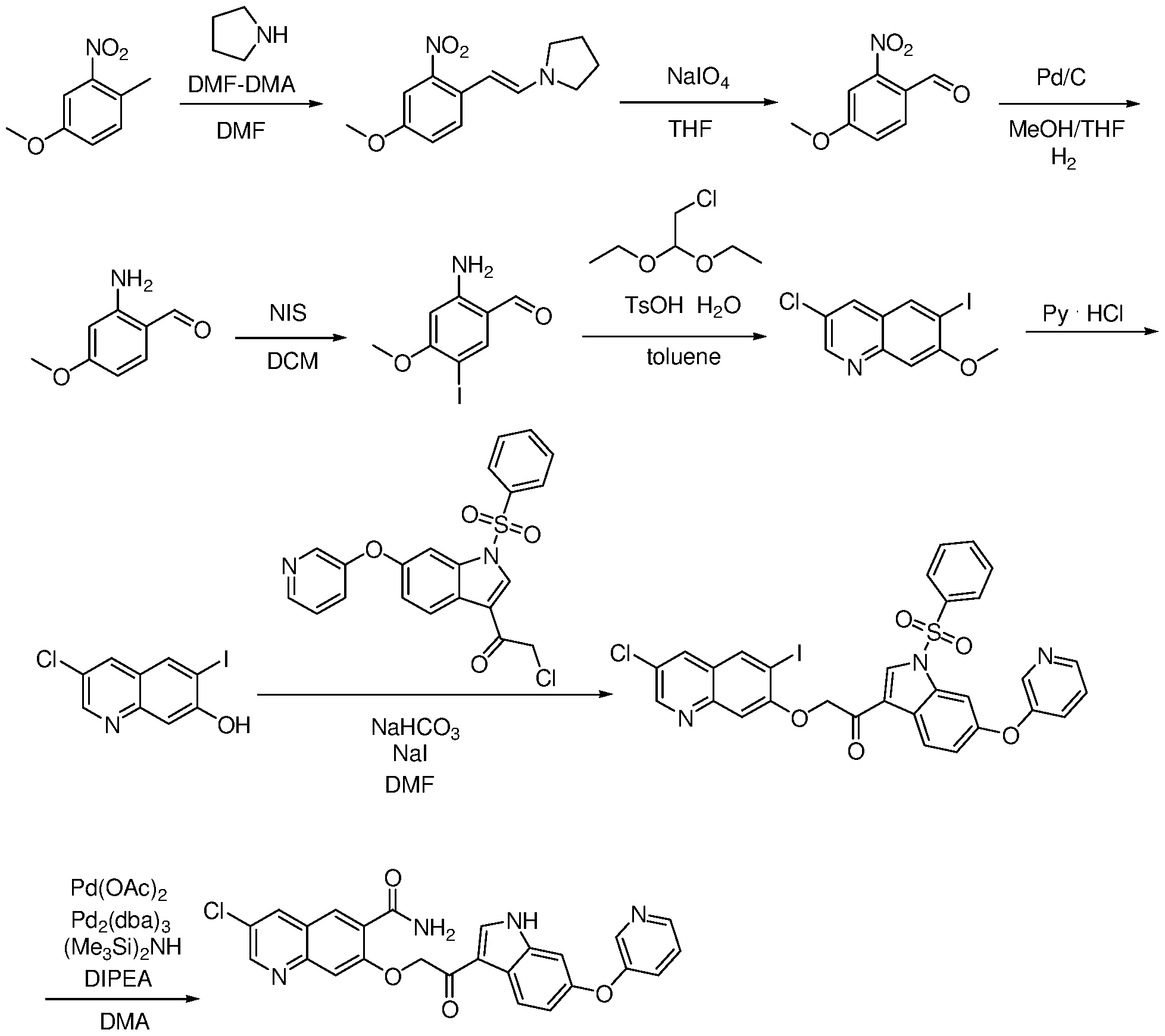
CO
[0227] Step A. (E)-l-(4-methoxy-2-nitrostyryl)pyrrolidine. To a mixture of 4-methoxy-l- methyl-2-nitrobenzene (5 g, 30 mmol) in DMF (70 mL) were added Ν,Ν-Dimethylformamide dimethyl acetal (4.32 g, 36 mmol) and pyrrolidine (4.26 g, 60 mmol). The reaction mixture was stirred at 120°C for 16 hr under an atmosphere of N2, then cooled and concentrated under reduced pressure to afford (E)-l-(4- methoxy-2-nitrostyryl)pyrrolidine (7.4 g, 99% yield) which was directly used in the next step without any further purification.
[0228] Step B. 4-Methoxy-2-nitrobenzaldehyde . To a mixture of (E)-l-(4-methoxy-2- nitrostyryl)pyrrolidine (7.4 g, 30 mmol) in THF (80 mL) was added a solution of NalC (16 g, 75 mmol) in H2O (240 mL). The reaction mixture was stirred at 35 °C for 16 hr then extracted with DCM (100 mL). The organic layer was separated, dried over anhydrous Na2SC>4, and concentrated under reduced pressure.
[0229] The residue was purified by flash column chromatography to afford 4-methoxy-2- nitrobenzaldehyde (5 g, 92% yield). LC-MS: m/z 182 (M+H)+.
[0230] Step C. 2-Amino-4-methoxybenzaldehyde. To a mixture of 4-methoxy-2- nitrobenzaldehyde (4.6 g, 25.4 mmol) in MeOH (80 mL) was added 10% Pd/C (460 mg). The reaction mixture was stirred at r.t. for 24 hr under 1 atmosphere of ¾. The resulting mixture was filtered, and the filtrate was concentrated under reduced pressure. The residue was purified by flash column
chromatography to afford 2-amino-4-methoxybenzaldehyde (3.7 g, 95% yield). LC-MS: m/z 152 (M+H)+.
[0231] Step D. 2-Amino-5-iodo-4-methoxybenzaldehyde. To a mixture of 2-amino-4- methoxybenzaldehyde (302 mg, 2 mmol) in DCM (20 mL) at 0 °C was slowly added a solution of NIS (450 mg, 2 mmol) in DCM (10 mL). The reaction mixture was stirred at 0 °C for 1 hr, then washed with water (40 mL). The organic layer was separated, dried over anhydrous Na2SC>4, and concentrated under reduced pressure. The residue was purified by flash column chromatography to afford 2-amino-5-iodo-4- methoxybenzaldehyde (280 mg, 51% yield). LC-MS: m/z 278 (M+H)+.
[0232] Step E. 3-Chloro-6-iodo-7-methoxyquinoline. To a mixture of 2-amino-5-iodo-4- methoxybenzaldehyde (280 mg, 1 mmol) in toluene (30 mL) were added 2-chloro-l,l-diethoxyethane (184 mg, 1.2 mmol) and 4-methylbenzenesulfonic acid hydrate (38 mg, 0.2 mmol). The reaction mixture was refluxed for 3 hr then concentrated under reduced pressure. The residue was purified by flash column chromatography to afford 3-chloro-6-iodo-7-methoxyquinoline (150 mg, 47% yield). LC-MS: m/z 320 (M+H)+.
[0233] Step F. 3-Chloro-6-iodoquinolin-7-ol. A mixture of 3-chloro-6-iodo-7- methoxyquinoline (150 mg, 0.47 mmol) and pyridine hydrochloride (800 mg) was stirred at 170 °C for 4 hr, cooled to r.t., quenched with water (40 mL) and extracted with DCM (30 mL). The organic layer was separated, dried over anhydrous Na2SC>4, and concentrated under reduced pressure. The residue was purified by flash column chromatography to afford 3-chloro-6-iodoquinolin-7-ol (60 mg, 42% yield). LC-MS: m/z 306 (M+H) +.
[0234] Step G. 2-(3-Chloro-6-iodoquinolin-7-yloxy)-l-(l-(phenylsulfonyl)-6-(pyridin-3-yloxy)- lH-indol-3-yl)ethanone . To a mixture of 3-chloro-6-iodoquinolin-7-ol (60 mg, 0.2mmol) in DMSO (6 ml) were added NaHCC (168 mg, 2 mmol), Nal (30 mg, 0.2 mmol) and 2-chloro-l-(l-(phenylsulfonyl)- 6-(pyridin-3-yloxy)-lH-indol-3-yl)ethanone (128 mg, 0.3 mmol). The reaction mixture was stirred at r.t.
for 5 hr then quenched with water (30 ml) and filtered. The precipitate was collected, dried over under reduced pressure, and then purified by flash column chromatography to afford 2-(3-chloro-6- iodoquinolin-7-yloxy)- 1 -(1 -(phenylsulfonyl)-6-(pyridin-3 -yloxy)- 1 H-indol-3 -yl)ethanone (70 mg, 50% yield). LC-MS: m/z 696 (M+H)+.
[0235] Step H. 3-Chloro-7-(2-oxo-2-(6-(pyridin-3-yloxy)-lH-indol-3-yl)ethoxy)quinoline-6- carboxamide . To a mixture of 2-(3-chloro-6-iodoquinolin-7-yloxy)-l-(l-(phenylsulfonyl)-6-(pyridin-3- yloxy)-lH-indol-3-yl)ethanone (60 mg, 0.086 mmol) in DMF (10 mL) were added Pd2(dba)3 (3 mg, 0.0026 mmol), Pd(OAc)2 (1 mg, 0.00172 mmol), DIPEA (23 mg, 0.173 mmol) and hexamethyldisilazane (97 mg, 0.6 mmol). The reaction mixture was stirred at 90°C for 16 hr under an atmosphere of CO. The resulting mixture was cooled to r.t. and filtered. The filtrate was quenched with aq. LiCl (10% wt, 30 mL) and extracted with DCM (30 mL). The organic layer was separated, dried over anhydrous Na2SC>4 and concentrated under reduced pressure. The residue was purified via prep-HPLC to afford 3-chloro-7-(2- oxo-2-(6-(pyridin-3-yloxy)-lH ndol-3-yl)ethoxy)quinoline-6-carboxarnide (5 mg, 13% yield). LC-MS: m/z 473 (M+H)+. ¾ NMR (400 MHz, DMSO-d6) δ 12.19 (s, 1H), 8.89 (d, / = 2.5 Hz, 1H), 8.68 (s, 2H), 8.61 (s, 2H), 8.40 (s, 1H), 8.35 (t, / = 2.9 Hz, 1H), 8.21 (d, / = 8.6 Hz, 1H), 7.97 (s, 1H), 7.75 (s, 1H), 7.44 _ 7.38 (m, 2H), 7.20 (d, / = 2.1 Hz, 1H), 7.05 - 6.99 (m, 1H), 5.71 (s, 2H).
EXAMPLE 12. Synthesis of 6-chloro-2-(2-oxo-2-(6-(pyridin-3-yloxy)-lH-indol-3-yl)ethoxy)-l,8-

[0237] Step B. Ethyl 6-chloro-2-oxo-l,2-dihydro-l,8-naphthyridine-3-carboxylate. To a mixture of 2-amino-5-chloronicotinaldehyde (1.2 g, 7.66 mmol) in EtOH (15 mL) were added diethyl malonate (1.84 g, 11.50 mmol) and piperidine (65 mg, 0.766 mmol). The reaction mixture was stirred under reflux for 20 hr then cooled to r.t. The solid was collected by filtration, washed with cold ethanol and dried under high vacuum to give 6-chloro-2-oxo-l,2-dihydro-l,8-naphthyridine-3-carboxylate (1.6 g, 82.6% yield). LC-MS: m/z 253 (M+H)+.
[0238] Step C. Ethyl 2,6-dichloro-l,8-naphthyridine-3-carboxylate. A mixture of 6-chloro-2- oxo-l,2-dihydro-l,8-naphthyridine-3-carboxylate (1.6 g, 6.33 mmol) in phosphoryl chloride (10 mL) was stirred at reflux for 4 hr, then cooled and slowly poured into ice water (200 mL). The solid was collected by filtration, washed with cold water and dried under high vacuum to give ethyl 2,6-dichloro-l,8- naphthyridine-3-carboxylate (1.0 g, 58.3% yield). LC-MS: m/z 271 (M+H)+.
[0239] Step D. 6-Chloro-2-(2-oxo-2-(6-(pyridin-3-yloxy)-lH-indol-3-yl)ethoxy)-l,8- naphthyridine-3-carboxylic acid. To a mixture of 2-hydroxy-l-(6-(pyridin-3-yloxy)-lH-indol-3- yl)ethanone (68 mg, 0.25 mmol) in dry DMF (5 mL) at 0°C was added NaH (61 mg, 1.5 mmol, 60% in oil). After addition, the mixture was stirred at r.t. for 0.5 hr, followed by dropwise addition of a solution of ethyl 2,6-dichloro-l,8-naphthyridine-3-carboxylate (136 mg, 0.5 mmol) in DMF (1.5 mL) at 0°C. The resulting mixture was warmed to r.t and stirred for 1 hr, followed by dropwise addition of a solution of cone. HC1 (0.2 mL) in MeOH (30 mL) at 0°C. The resulting mixture was stirred at 0°C for 0.5 hr then concentrated under reduced pressure. The residue was purified by flash column chromatography to give 6-chloro-2-(2-oxo-2-(6-(pyridin-3-yloxy)-lH-indol-3-yl)ethoxy)-l,8-naphthyridine-3-carboxylic acid (80 mg, 66.7% yield) as yellow solid. LC-MS: m/z 475 (M+H)+.
[0240] Step E. 6-Chloro-2-(2-oxo-2-(6-(pyridin-3-yloxy)-lH-indol-3-yl)ethoxy)-l,8- naphthyridine-3-carboxamide. A mixture of 6-chloro-2-(2-oxo-2-(6-(pyridin-3-yloxy)-lH-indol-3- yl)ethoxy)-l,8-naphthyridine-3-carboxylic acid (47.4 mg, 0.1 mmol), NH4CI (108 mg, 2 mmol), EDCI (60 mg, 0.3 mmol), HOBT (40 mg, 0.29 mmol), and TEA (101 mg, 1.0 mmol) in DMA (4 mL) was stirred at r.t. for 48 hr then poured into saturated aqueous NaHCC and extracted with DCM. The combined organic layers were washed with saturated aqueous LiCl, dried and concentrated under reduced pressure. The residue was purified by prep-HPLC to give 6-chloro-2-(2-oxo-2-(6-(pyridin-3-yloxy)-lH- indol-3-yl)ethoxy)-l,8-naphthyridine-3-carboxamide (8 mg, 17% yield) as white solid. LC-MS: m/z 474 (M+H)+. ¾ NMR (400 MHz, DMSO-d6) δ 12.13 (br, 1H), 8.90-8.92 (m, 2H), 8.73 (d, / = 2.8 Hz, 1H),
8.63 (s, 1H), 8.35-8.39 (s, 2H), 8.26 (s, 1H), 8.14 (d, / = 8.8 Hz, 1H), 8.05 (s, 1H), 7.41 (s, 2H), 7.18 (d, / = 2.4 Hz, 1H), 6.99-7.02 (m, 1H), 5.89 (s, 2H).
Example 13. Synthesis of 7-chloro-N-methyl-3-(2-oxo-2-(6-(pyridin-3-yloxy)-lH-indol-3-yl)ethoxy)-

[0241] Step A. 7-Chloro-N-methyl-3-(2-oxo-2-(6-(pyridin-3-yloxy)-lH-indol-3-yl)ethoxy)-2- naphth amide. To a mixture of methyl 7-chloro-3-(2-oxo-2-(6-(pyridin-3-yloxy)-lH-indol-3-yl)ethoxy)- 2-naphthoate (50 mg, 0.103 mmol) in DMF (1 mL) was added methanamine (30% in MeOH, 2 mL). The reaction mixture was stirred at r.t. overnight then filtered. The filtrate was concentrated under reduced pressure, and the residue was purified by prep-HPLC to give the desired product (16.5 g, 33.1% yield). LCMS: m/z 486 (M+H)+. ¾ NMR (400MHz, DMSO-d6) δ 12.04 - 12.34 (m, 1 H), 9.04 - 9.13 (m, 1 H), 8.63 (s, 1 H), 8.46 (s, 1 H), 8.40 (d, / = 2 Hz, 1 H), 8.35 (t, / = 4.0 Hz, 1 H), 8.23 (d, / = 8.0 Hz, 1 H), 8.15 (d, / = 2.0 Hz, 1 H), 7.84 (s, 1 H), 7.61 (s, 1 H), 7.54 - 7.58 (m, 1 H), 7.39 - 7.43 (m, 2 H), 7.19 - 7.22 (m, 1 H), 7.01 - 7.07 (m, 1 H), 5.55 - 5.63 (m, 2 H), 2.95 ppm (d, / = 4.0 Hz, 3 H)
EXAMPLE 14. Synthesis of 7-chloro-N-(2-hydroxyethyl)-3-(2-oxo-2-(6-(pyridin-3-yloxy)-lH-indol- -yl)ethoxy)-2-naphthamide (Compound 118)

[0242] To a mixture of methyl 7-chloro-3-(2-oxo-2-(6-(pyridin-3-yloxy)-lH-indol-3-yl)ethoxy)- 2-naphthoate (48.6 mg, 0.1 mmol) in MeOH (5 mL) was added 2-aminoethanol (610.0 mg, 10 mmol). The reaction mixture was stirred at rt for 16 hr, then quenched with water and extracted with EtOAc. The combined organic layers were washed with brine, dried over anhydrous Na2S04, and concentrated under reduced pressure. The residue was purified by prep-HPLC to afford the desired product (8 mg, 16% yield). LC-MS: m/z 516 (M+H)+. ¾ NMR (400 MHz, DMSO-d6) δ 9.08-9.11 (m, 1H), 8.62 (s, 1H), 8.48 (s, 1H), 8.39 (s, 1H), 8.35-8.37 (m, 1H), 8.22-8.24 (m, 1H), 8.15 (s, 1H), 7.86-7.91 (m, 1H), 7.62 (s, 1H), 7.56-7.58 (m, 1H), 7.41-7.46 (m, 2H), 7.20-7.25 (m, 1H), 7.05-7.08 (m, 1H), 5.60 (s, 2H), 3.64-3.71 (m, 2H), 3.49-3.51 (m , 3H).
EXAMPLE 15. Synthesis of 2-(7-chloro-3-(2-oxo-2-(6-(pyridin-3-yloxy)-lH-indol-3-yl)ethoxy)

[0243] Step A. 6-Chloro-3-(hydroxymethyl)n phthalen-2-ol. To a mixture of LAH (760 mg, 20 mmol) in THF (100 mL) at 0°C was added dropwise a solution of methyl 7-chloro-3-hydroxy-2- naphthoate (2.36 g, 10 mmol) in THF. The mixture stirred at r.t. for 2 hr, then cooled to 0°C and quenched by slow addition of saturated aqueous seignette salt tetrahydrate. The resulting mixture was stirred at r.t. for 2 hr then extracted with EtOAc. The combined organic layers were washed with brine, dried over anhydrous Na2SC>4 and concentrated under reduced pressure. The residue was purified by flash column chromatography to give the desired product as white solid (1.7 g, 81% yield). LC-MS: m/z 209 (M+H)+.
[0244] Step B. (7-Chloro-3-methoxynaphthalen-2-yl)methanol. To a mixture of 6-chloro-3- (hydroxymethyl)naphthalen-2-ol (1.4 g, 6.7 mmol) in actone (30 ml) at r.t. was added K2CO3 (1.8 g, 13.4 mmol) and Mel (1.4 g, 10.1 mmol). The resulting mixture was stirred at r.t. for 2 h r then filtered. The filtrate was concentrated under reduced pressure, and the residue was purified by flash column chromatography to give the desired product as white solid (1.5 g, 90% yield) .LC-MS: m/z 223 (M+H)+.
[0245] Step C. 6-Chloro-3-(chloromethyl)-2-methoxynaphthalene. To a mixture of (7-chloro-3- methoxynaphthalen-2-yl)methanol (1.5 g, 6.7 mmol) in DCM (30 mL) at 0°C was added TEA (1.3 g, 13.4 mmol), followed by slow addition of MsCl (1.1 g, 10.0 mmol). The resulting mixture was stirred at r.t. for
2 hr, then quenched with ice water and extracted with DCM. The combined organic layers were washed with brine, dried over anhydrous Na2SC>4 and concentrated under reduced pressure. The residue was purified by flash column chromatography to give the desired product as white solid (400 mg, 25% yield). LC-MS: m/z 241 (M+H)+.
[0246] Step D. 2-(7-Chloro-3-methoxynaphthalen-2-yl)acetonitrile. To a mixture of 6-chloro-3- (chloromethyl)-2-methoxynaphthalene (400 mg, 1.7 mmol) in DMSO (5 mL) was added KCN (130 mg, 2.0 mmol). The resulting mixture was stirred at r.t. for 3 h then quenched with water and extracted with DCM. The combined organic layers were washed with brine, dried over anhydrous Na2SC>4 and concentrated under reduced pressure. The residue was purified by flash column chromatography to give the desired product as white solid (300 mg, 78% yield). LC-MS: m/z 232 (M+H)+. ¾ NMR (400 MHz, CDC13) δ 7.79 (s, 2H), 7.71-7.68 (m, 1H), 7.45-7.41 (m, 1H), 7.14 (s, 1H), 3.99 (s, 3H), 3.85 (s, 2H).
[0247] Step E. 2-(7-Chloro-3-hydroxynaphthalen-2-yl)acetamide. To a mixture of 2-(7-chloro- 3-methoxynaphthalen-2-yl)acetonitrile (23.1 mg, 0.1 mmol) in DCM (2 mL) was added BBr3 (50 mg, 2.0 mmol). The resulting mixture was stirred at r.t. for 48 hr, then quenched with water and extracted with DCM. The combined organic layers were washed with brine, dried over anhydrous Na2SC>4 and concentrated under reduced pressure. The residue was purified by prep-TLC to give the desired product as yellow solid (10.0 mg, 40% yield). LC-MS: m/z 236 (M+H)+.
[0248] Step F. 2-(7-Chloro-3-(2-oxo-2-(l-(phenylsulfonyl)-6-(pyridin-3-yloxy)-lH-indol-3- yl)ethoxy) naphthalen-2-yl)acetamide. A mixture of 7-chloro-3-hydroxynaphthalene-2-sulfonamide (30 mg, 0.13 mmol), NaHC03 (54.6 mg, 0.65 mmol) and Nal (19.5 mg, 0.13 mmol) in DMF (1.5 mL) was stirred at r.t. for 5min, followed by addition of l-(l-(phenylsulfonyl)-6-(pyridin-3-yloxy)-lH-indol-3-yl)- 2-chloroethanone (54.0 mg, 0.13 mmol). The mixture was stirred at r.t. overnight, then quenched with water and extracted with DCM. The combined organic layers were washed with brine, dried over anhydrous Na2SC>4 and concentrated under reduced pressure. The residue was purified by flash column chromatography to give the desired product as yellow solid (40 mg, 49% yield). LC-MS: m/z 626 (M+H)+.
[0249] Step G. 2-(7-Chloro-3-(2-oxo-2-(6-(pyridin-3-yloxy)-lH-indol-3-yl)ethoxy)naphthalen- 2-yl)acetamide. To a mixture of 2-(7-chloro-3-(2-oxo-2-(l-(phenylsulfonyl)-6-(pyridin-3-yloxy)-lH- indol-3-yl)ethoxy)naphthalen-2-yl)acetamide (40 mg, 0.064 mmol) in THF/H2O (5 mL, V:V=2: 1) was added NaOH (5.0 mg, 0.128 mmol). The mixture was stirred at r.t. for 1 hr then concentrated under reduced pressure. The residue was purified by prep-HPLC to give 7-chloro-3-(2-oxo-2-(6-(pyridin-3- yloxy)-lH-indol-3-yl)ethoxy)naphthalene-2-sulfonamide (6.0 mg, 20% yield) as white solid. LC-MS: m/z 486 (M+H)+. ¾ NMR (400 MHz, DMSO-d6) δ 12.18 (s, 1H), 8.59 (s, 1H), 8.44-8.33 (m, 3H), 8.19-8.17
(m, IH), 7.92 (s, IH), 7.77-7.75 (m, 2H), 7.49 (s, IH), 7.41-7.36 (m, 4H), 7.18 (s, IH), 7.03-6.97 (m, 2H), 5.46 (s, 2H), 3.66 (s, 2H).
Example 16. Synthesis of 2-((6-chloro-3-(hydroxymethyl)naphthalen-2-yl)oxy)-l-(6-(pyridin-3-

[0250] Step A. 6-Chloro-3-(hydroxymethyl)n phthalen-2-ol. To a mixture of L1AIH4 (161 mg, 4.24 mmol) in dry THF (20 mL) at 0°C was added dropwise a solution of methyl 7-chloro-3-hydroxy-2- naphthoate (500 mg, 2.12 mmol) in dry THF (20 mL). The reaction mixture was stirred at r.t. for 1 hr, then quenched by in sequence addition of H20 (0.08 mL), NaOH (15 wt, 0.24 mL), and H20 (0.08 mL). The resulting mixture was filtered, and the filtrate was extracted with EtOAc. The combined organic layers were washed with brine, dried over anhydrous Na2SC>4 and concentrated under reduced pressure. The residue was purified with flash column chromatography to give 6-chloro-3- (hydroxymethyl)naphthalen-2-ol (280 mg, 63.6% yield) as white solid. LC-MS: m/z 207 (M-H)
[0251] Step B. 2-((6-Chloro-3-(hydroxymethyl)naphthalen-2-yl)oxy)-l-(l-(phenylsulfonyl)-6- (pyridin-3-yloxy)-lH-indol-3-yl)ethanone. To a mixture of methyl 6-chloro-3-
(hydroxymethyl)naphthalen-2-ol (150 mg, 0.72 mmol), NaHCC (605 mg, 7.2 mmol) and Nal (11 mg, 0.072 mmol) in DMSO (10 mL) at r.t. was added 2-chloro-l-(l-(phenylsulfonyl)-6-(pyridin-3-yloxy)-lH- indol-3-yl)ethanone (307 mg, 0.72 mmol). The resulting mixture was stirred at r.t. for 4 hr, then poured into ice water and filtered to give the crude product which was purified with flash column
chromatography to give 2-((6-chloro-3-(hydroxymethyl)naphthalen-2-yl)oxy)-l-(l-(phenylsulfonyl)-6- (pyridin-3-yloxy)-lH-indol-3-yl)ethanone (30 mg, 7% yield) as white solid. LC-MS: m/z 599 (M+H)+.
[0252] Step C. 2-((6-Chloro-3-(hydroxymethyl)naphthalen-2-yl)oxy)-l-(6-(pyridin-3-yloxy)- lH-indol-3-yl)ethanone. To a mixture of 2-((6-chloro-3-(hydroxymethyl)naphthalen-2-yl)oxy)-l-(l- (phenylsulfonyl)-6-(pyridin-3-yloxy)-lH-indol-3-yl)ethanone (30 mg, 0.05 mmol) in THF/MeOH (2 mL/1 mL) at r.t. was added a solution of NaOH (4 mg, 0.10 mmol) in H2O (0.5 mL). The reaction mixture
was stirred at r.t. for 0.5 hr, then cooled to 0°C and neutralized to pH 7 with AcOH. The resulting mixture was purified by prep-HPLC to give pure 2-((6-chloro-3-(hydroxymethyl)naphthalen-2-yl)oxy)-l-(6- (pyridin-3-yloxy)-lH-indol-3-yl)ethanone (1.6 mg, 7% yield) as white solid. LC-MS: m/z 459 (M+H)+. ¾ NMR (400 MHz, DMSO-d6) δ 12.09 (s, 1H), 8.59 (s, 1H), 8.37 (m, 2H), 8.18 (d, / = 8.4 Hz, 1H), 7.95 (m, 2H), 7.77 (d, / = 8.4 Hz, 1H), 7.37 (m, 4H), 7.19 (s, 1H), 7.02 (d, / = 9.6 Hz, 1H), 5.45 (s, 2H), 5.38 (s, 1H), 4.76 (s, 2H).
Example 17. Synthesis of 2-(6-chloro-3-(l,2-dihydroxyethyl)naphthalen-2-yloxy)-l-(6-(pyridin-3- yl

1 ,4-dioxane,H20

[0253] Step A. 2-(4-Chlorophenyl)acetyl chloride. To a mixture of 2-(4-chlorophenyl)acetic acid (20 g, 117.6 mmol) in dry CH2C12 (200 mL) at 0°C under N2 was slowly added dropwise (COCl)2 (20 mL), followed by addition of a drop of DMF. The reaction mixture was stirred at r.t. for 2 hr then concentrated under reduced pressure. The residue was used directly in the next step without any further purification.
[0254] Step B. 6-Chloro-3-(trimethylsilyl)naphthalen-2-ol. To a mixture of AICI3 (39 g, 293 mmol) in dry CH2CI2 (200 mL) at -20 °C under N2 was added dropwise a solution of the above 2-(4- chlorophenyl)acetyl chloride in dry CH2CI2 (200 mL). The reaction mixture was stirred at that temperature for 1 hr, followed by slow addition of ethynyltrimethylsilane (50 mL, 351 mmol). The resulting mixture was stirred at -20 °C for another 1 hr, then poured into ice, followed by addition of Rochelle salt solution (2 M). The mixture was stirred for 30 min then separated. The organic layer was washed with saturated aqueous NaHCC and brine, dried over anhydrous Na2SC>4, and concentrated under reducedpressure. The residue was used directly in the next step without any further purification. LC-MS: m/z 251 (M+H)+.
[0255] Step C. (7-Chloro-3-methoxynaphthalen-2-yl)trimethylsilane. A mixture of the above 6- chloro-3-(trimethylsilyl)naphthalen-2-ol, K2CO3 (22 g, 158.3 mmol), CH3I (10 mL, 160 mmol) in acetone (200 mL) was stirred at 50 °C overnight under N2. The resulting mixture was filtered and concentrated under reduced pressure. The residue was purified by column chromatography (eluting with PE) to give (7- chloro-3-methoxynaphthalen-2-yl)trimethylsilane (9 g, 29% yield). LC-MS: m/z 265 (M+H)+.
[0256] Step D. 6-Chloro-3-iodo-2-methoxynaphthalene. To a mixture of (7-chloro-3- methoxynaphthalen-2-yl)trimethylsilane (9 g, 34.1 mmol) in dry CH2CI2 (100 mL) at -78 °C under N2 was added dropwise a solution of IC1 (1.8 g, 3.44 mmol) in dry CH2CI2 (100 mL). The mixture was stirred at - 78 °C for 2 hr then quenched with aq. Na2S20s (1 M). The resulting mixture was stirred over lhr then separated. The aqueous layer was washed twice with CH2CI2. The combined organic layers were dried over anhydrous Na2SC>4 and concentrated under reduced pressure. The residue was purified by column chromatography (eluting with PE/EtOAc = 100/1) to give 6-chloro-3-iodo-2-methoxynaphthalene (8 g, 73.8% yield). LC-MS: m z 319 (M+H)+.
[0257] Step E. 6-Chloro-3-iodonaphthalen-2-ol. To a mixture of 6-chloro-3-iodo-2- methoxynaphthalene (2g, 6.3mmol) in dry CH2CI2 (20 mL) at -78 °C under N2 was added dropwise a solution of BBr3 (0.75 mL, 7.5 mmol) in dry CH2CI2 (10 mL). The reaction mixture was stirred at r.t. for 5hr, then cooled to -78 °C, followed by addition of MeOH. The resulting mixture was stirred for 0.5h at r.t., then partitioned between CH2CI2 and H2O. The organic layer was separated, washed with brine, dried over anhydrous Na2SC>4, and concentrated under reduced pressure. The residue was purified by column chromatography (eluted with PE/ EtOAc =8/1) to give 6-chloro-3-iodo-2-methoxynaphthalene (1.7 g, 89.0% yield). LC-MS: m/z 305 (M+H)+.
[0258] Step F. 2-(6-Chloro-3-iodonaphthalen-2-yloxy)-N,N-dimethylacetamide. A mixture of 6-chloro-3-iodonaphthalen-2-ol (1 g, 3.29 mmol), 2-chloro-N,N-dimethylacetamide (0.37 mL, 3.62 mmol), potassium carbonate (914 mg, 6.58 mmol) in DMF was stirred at 30 °C for 2 hr, then quenched with water and extracted with EtOAc. The combined organic layers were washed with brine, dried over
anhydrous Na2SC>4, and concentrated under reduced pressure. The residue was purified by column chromatography (eluted with PE/ EtOAc =1/1) to give 2-(6-chloro-3-iodonaphthalen-2-yloxy)-N,N- dimethylacetamide (1.15 g, 89.8% yield). LC-MS: m z 390 (M+H)+.
[0259] Step G. 2-(6-Chloro-3-iodonaphthalen-2-yloxy)-l-(6-(pyridin-3-yloxy)-lH-indol-3- yl)ethanone.
[0260] A mixture of 2-(6-chloro-3-iodonaphthalen-2-yloxy)-N,N-dimethylacetamide (200 mg, 0.51 mmol) and POCI3 (0.2 mL, 2.1 mmol) in 1 ,2-dichloroethane (8 mL) was stirred at 50°C for 2 hr under N2, then cooled to r.t., followed by addition of 6-(pyridin-3-yloxy)-lH-indole (108 mg, 0.51 mmol) in one portion. The resulting mixture was stirred at 90°C for 16 hr then poured into cold water. The mixture was adjusted the pH 8, then stirred at reflux for 10 min. The resulting mixture was cooled to r.t. then extracted with DCM (3x40 mL). The combined organic layers were dried over anhydrous Na2SC>4 and concentrated under reduced pressure. The residue was purified by column chromatography (eluted with PE/ EtOAc =1/1) to give 2-(6-chloro-3-iodonaphthalen-2-yloxy)-l-(6-(pyridin-3-yloxy)-lH-indol-3- yl)ethanone (80 mg, 28.1% yield). LC-MS: m z 555 (M+H)+.
[0261] Step H. 2-(6-Chloro-3-vinylnaphthalen-2-yloxy)-l-(6-(pyridin-3-yloxy)-lH-indol-3- yl)ethanone. A mixture of 2-(6-chloro-3-iodonaphthalen-2-yloxy)-l-(6-(pyridin-3-yloxy)-lH-indol-3- yl)ethanone (80 mg, 0.14 mmol), Pd(dppf)Cl2.DCM (5.9 mg, 0.01 mmol), potassium carbonate (60 mg, 0.43 mmol), and 4,4,5, 5-tetramethyl-2-vinyl-l,3,2-dioxaborolane (33 mg, 0.22 mmol) in H2O (0.3 mL) and dioxane (3 mL) was stirred at 80 °C for 4 hr, then quenched with water and extracted with EtOAc. The combined organic layers were washed with brine, dried over anhydrous Na2S04 and concentrated under reduced pressure. The residue was used directly in the next step without any further purification. LC-MS: m/z 455 (M+H)+.
[0262] Step I. 2-(6-Chloro-3-(l,2-dihydroxyethyl)naphthalen-2-yloxy)-l-(6-(pyridin-3-yloxy)- lH-indol-3-yl)ethanone. To a mixture of 2-(6-chloro-3-vinylnaphthalen-2-yloxy)-l-(6-(pyridin-3-yloxy)- lH-indol-3-yl)ethanone (60 mg, 0.13 mmol) in THF/H20 (3 mL/0.1 mL) were added NMO (0.5 mL) and OsO4 (0.1 mg). The reaction mixture was stirred at r.t. for 15 hr then quenched with aq. Na2S203. The resulting mixture was stirred at r.t. over 0.5 hr then extracted with EtOAc. The organic layer was washed with brine, dried over anhydrous Na2S04 and concentrated under reduced pressure. The residue was purified by prep-HPLC to give 2-(6-chloro-3-(l,2-dihydroxyethyl)naphthalen-2-yloxy)-l-(6-(pyridin-3- yloxy)-lH-indol-3-yl)ethanone (5.5 mg, 8.5% yield). LC-MS: m/z 489 (M+H)+. ¾ NMR (400 MHz, DMSO-dg) δ 12.10 (s, 1H), 8.58 (s, 1H), 8.35 (dd, / = 12.3, 9.1 Hz, 2H), 8.18 (d, / = 8.6 Hz, 1H), 7.96 (d, / = 4.2 Hz, 2H), 7.74 (d, / = 8.8 Hz, 1H), 7.47 - 7.29 (m, 4H), 7.19 (d, / = 2.1 Hz, 1H), 7.01 (dd, / = 8.6, 2.2 Hz, 1H), 5.49 (q, / = 16.1 Hz, 2H), 5.37 (d, / = 4.4 Hz, 1H), 5.14 (d, / = 3.6 Hz, 1H), 4.75 (t, / = 5.8 Hz, 1H), 3.79 (s, 1H), 3.41 (d, / = 5.3 Hz, 1H).
Example 18. Synthesis of 7-chloro-3-(2-oxo-2-(6-(pyridin-3-yloxy)-lH-indol-3-yl)ethoxy)naph thalene-2-sulfonamide (Com ound 113)

[0263] Step A. S-(7-chloro-3-methoxyn phthal n-2-yl)ethanethioate. A mixture of 6-chloro-3- iodo-2-methoxynaphthalene (1.0 g, 3.1 mmol), AcSK (538 mg, 4.7 mmol), Cul (120 mg, 0.62 mmol) and 1,10-phenanthroline (226 mg, 1.24 mmol) in toluene (24 mL) was stirred at lOO C overnight then concentrated under reduced pressure. The residue was purified by flash column chromatography to give the desired product as white solid (800 mg, 90% yield). ¾ NMR (400 MHz, CDC13) δ 7.87 (s, 1H), 7.74- 7.67 (m, 2H), 7.44-7.40 (m, 1H), 7.18 (s, 1H), 3.96 (s, 3H), 2.46 (s, 3H).
[0264] Step B. 7-Chloro-3-methoxynaphthalene-2-thiol. To a mixture of S-(7-chloro-3- methoxynaphthalen-2-yl) ethanethioate (1.0 g, 3.8 mmol) in THF/MeOH (20 mL, V:V=1 : 1) at r.t. was added KOH (631 mg, 11.3 mmol). The resulting mixture was stirred at r.t for 1 hr then acidified to pH 7 by aq. HC1 (I N) and extracted with DCM. The combined organic layers were washed with brine, dried over anhydrous Na2SC>4 and concentrated under reduced pressure to give the desired product as yellow solid (800 mg, 90% yield). LC-MS: m/z 223 (M-H) .
[0265] Step C. 7-Chloro-3-methoxynaphthalene-2-sulfonamide. A mixture of 7-chloro-3- methoxynaphthalene-2-thiol (800 mg, 3.6 mmol), H202 (30% wt, 1.1 g, 10.2 mmol) and S0C12 (857 mg, 7.2 mmol) in MeCN (40 mL) was stirred at r.t. until the reaction was completed, then quenched with brine and extracted with EtOAc. The combined organic layers were diluted with NH3/THF (1M, 100 mL). The resulting mixture was stirred at r.t. for 15 min then concentrated under reduced pressure. The residue was purified by flash column chromatography to give the desired product as yellow solid (230 mg, 23% yield).
¾ NMR (400 MHz, DMSO-d6) δ 8.41 (s, 1H), 8.20 (d, / = 1.6 Hz, 1H), 7.94 (d, / = 9.2 Hz, 1H), 7.63- 7.60(m, 2H), 7.25 (s, 2H), 4.00 (s, 3H).
[0266] Step D. 7-Chloro-3-hydroxynaphthalene-2-sulfonamide. To a mixture of 7-chloro-3- methoxynaphthalene-2-sulfonamide (271 mg, 1.0 mmol) in DCM (15 mL) was added BBr3 (500 mg, 2.0 mmol). The resulting mixture was stirred at r.t. for 1 hr, then quenched with water and extracted with DCM. The combined organic layers were washed with brine, dried over anhydrous Na2SC>4 and concentrated under reduced pressure. The residue was purified by flash column chromatography to give the desired product as yellow solid (200 mg, 78% yield). LC-MS: m/z 256 (M-H) .
[0267] Step E. 3-(2-(l-(phenylsulfonyl)-6-(pyridin-3-yloxy)-lH-indol-3-yl)-2-oxoethoxy)-7- chloronaphthalene-2-sulfonamide. A mixture of 7-chloro-3-hydroxynaphthalene-2-sulfonamide (30 mg, 0.12 mmol), NaHC03 (50.4 mg, 0.60 mmol) and Nal (12.5 mg, 0.12 mmol) in DMF (1.5 mL) was stirred at r.t. for 5min, followed by addition of l-(l-phenylsulfonyl)-6-(pyridin-3-yloxy)-lH-indol-3-yl)-2- chloroethanone (51.0 mg, 0.12 mmol). The reaction mixture was stirred at r.t. overnight, then quenched with water and extracted with DCM. The combined organic layers were washed with brine, dried over anhydrous Na2SC>4 and concentrated under reduced pressure. The residue was purified by flash column chromatography to give the desired product as yellow solid (20 mg, 25% yield). LC-MS: m/z 648 (M+H)+.
[0268] Step F. 7-Chloro-3-(2-oxo-2-(6-(pyridin-3-yloxy)-lH-indol-3-yl)ethoxy)naphthalene-2- sulfonamide. To a mixture of 7-chloro-3-(2-oxo-2-(l-(phenylsulfonyl)-6-(pyridin-3-yloxy)-lH-indol-3- yl)ethoxy)naphthalene-2-sulfonamide (37 mg, 0.057 mmol) in THF/H2O (5 mL, V:V=2: 1) was added NaOH (4.5 mg, 0.11 mmol). The mixture was stirred at r.t. for 1 hr then concentrated under reduced pressure. The residue was purified by prep-HPLC to give pure 7-chloro-3-(2-oxo-2-(6-(pyridin-3-yloxy)- lH-indol-3-yl)ethoxy)naphthalene-2-sulfonamide (25 mg, 86% yield) as yellow solid. LC-MS: m/z 508 (M+H)+. ¾ NMR (400 MHz, DMSO-d6) δ 12.21 (s, 1H), 8.65-8.63 (m, 1H), 8.47 (s, 1H), 8.40-8.35 (m, 2H), 8.27-8.20 (m, 2H), 7.92-7.89 (m, 1H), 7.66-7.61 (m, 2H), 7.53 (s, 1H), 7.42 (s, 1H), 7.20-7.19 (m, 1H), 7.06-7.03 (m, 1H),5.65 (s, 2H).
Example 19. Synthesis of 7-chloro-3-(3-oxo-3-(6-(pyridin-3-yloxy)-lH-indol-3-yl)propyl)- 2- naphthamide (Compound 102) (Compound 106 made in intermediate step)

[0269] Step A. Methyl 7-chloro-3-(trifluoromethylsulfonyloxy)-2-n phthoate. To a mixture of methyl 7-chloro-3-hydroxy-2-naphthoate (1 g, 4.23 mmol) in DCM (20 mL) were added TEA (855 mg, 8.45 mmol) and N,N-dimethylpyridin-4-amine (285 mg, 2.11 mmol). The reaction mixture was cooled down to 0°C, followed by dropwise addition of a solution of trifluoromethanesulfonic anhydride (1.79 g, 6.34 mmol) in DCM (5 mL). The reaction mixture was stirred at 0°C until the reaction was complete, then diluted with water and extracted with EtOAc (3x50 mL). The combined organic layers were dried and concentrated under reduced pressure. The residue was purified by flash column chromatography to give the desired product (1.5 g, quant, yield), which was used in the next step without further purification. LCMS: m/z 369 (M+H)+.
[0270] Step B. Methyl 3-(3-tert-butoxy-3-oxoprop-l-enyl)-7-chloro-2-naphthoate. A mixture of methyl 7-chloro-3-(trifluoromethylsulfonyloxy)-2-naphthoate (1 g, 2.71 mmol), tert-butyl acrylate (1.74 g, 13.56 mmol), TEA (686 mg, 6.78 mmol), l,3-bis(diphenylphosphino)propane (224 mg, 0.542 mmol), and Pd(OAc)2 (271 mg, 0.271 mmol) in DMF (10 mL) was stirred at 100 °C for 12 hr. The resulting mixture was cooled to r.t. and filtered. The filtrate was extracted with EtOAc (3x50 mL). The combined organic layers were dried and concentrated under reduced pressure. The residue was purified via flash column chromatography to give the desired product (0.6 g, 63.8 % yield). LCMS: m/z 347 (M+H)+.
[0271] Step C. 3-(6-Chloro-3-(methoxycarbonyl)naphthalen-2-yl)acrylic acid. To a mixture of methyl 3-(3-tert-butoxy-3-oxoprop-l-enyl)-7-chloro-2-naphthoate (0.3 g, 0.865 mrnol) in DCM (10 mL) was added TFA (1 mL) in portions. The reaction mixture was stirred at r.t. for 5 hr then concentrated under reduced pressure. The residue was triturated with MeOH/PE and filtered. The solid was collected and dried under high vacuum to give the desired product (0.2 g, 79.5 % yield). LCMS: m/z 291 (M+H)+.
[0272] Step D. 3-(6-Chloro-3-(methoxycarbonyl)naphthalen-2-yl)propanoic acid. A mixture of 3-(6-chloro-3-(methoxycarbonyl)naphthalen-2-yl)acrylic acid (0.2 g, 0.683 mmol) and Pd/C (0.02 g, 10% wt) in EtOAc (10 mL) was stirred at r.t. under h atmosphere overnight. The resulting mixture was filtered through Celite. The filtrate was concentrated under reduced pressure to give the desired product (0.2 g, quant, yield) which was used in the next step without any further purification. LCMS: m/z 293 (M+H)+.
[0273] Step E. Methyl 7-chloro-3-(3-oxo-3-(6-(pyridin-3-yloxy)-lH-indol-3-yl)propyl)- 2- naphthoate. To a mixture of 3-(6-chloro-3-(methoxycarbonyl)naphthalen-2-yl)propanoic acid (0.3 g, 1.02 mmol) in DCM (10 mL) was added dropwise a solution of oxalyl dichloride (0.2 mL) in 1 mL of DCM (1 mL). The reaction mixture was stirred at r.t. for 10 min, then dissolved in DCM (5 mL ) and added dropwise into a solution of 6-(pyridin-3-yloxy)-lH-indole (0.215 g, 1.02 mmol) and aluminum trichloride (0.683 g, 5.1 mmol) in DCM (10 mL). The resulting mixture was stirred at r.t. for 2 hr, then quenched with saturated aqueous NFLCl and extracted with EtOAc. The combined organic layers were dried and concentrated under reduced pressure. The residue was purified via flash column chromatography to give the desired product (0.1 g, 20.1 % yield). LCMS: m/z 485 (M+H)+.
[0274] Step F. 7-chloro-3-(3-oxo-3-(6-(pyridin-3-yloxy)-lH-indol-3-yl)propyl)-2-naphthoic acid. (C

[0275] To a mixture of methyl 7-chloro-3-(3-oxo-3-(6-(pyridin-3-yloxy)-lH-indol-3-yl)propyl)- 2-naphthoate (100 mg, 0.206 mmol) in MeOH/THF(4 mL, V/V= 1/1) was added a solution of NaOH (33 mg, 0.842 mmol) in water (2 mL). The reaction mixture was stirred at r.t. for 2 hr then concentrated under reduced pressure. The residue was acidified to pH 5-6 with aq. HC1 (10%wt) then filtered to give methyl 7-chloro-3-(3-oxo-3-(6-(pyridin-3-yloxy)-lH-indol-3-yl)propyl)-2 -naphthoic acid (70 mg, 72.1 % ) as yellow solid. LCMS: m/z 471 (M+H)+. ¾ NMR (400M Hz, DMSO-d6) δ 11.86 - 11.95 (m, 1 H), 8.39 (m, 4 H), 8.20 - 8.26 (m, 1 H), 8.14 - 8.17 (m, 1 H), 7.90 - 7.96 (m, 2 H), 7.54 - 7.61 (m, 1 H), 7.40 (s, 2 H), 7.11 (m, 1 H), 6.99 (m, 5 H), 3.19 - 3.29 ppm (m, 4 H)
[0276] Step G. 7-chloro-3-(2-oxo-2-(6-(pyridin-3-yloxy)-lH-indol-3-yl)ethoxy)-2- naphthamide . A mixture of 7-chloro-3-(3-oxo-3-(6-(pyridin-3-yloxy)-lH-indol-3-yl)propyl)-2-naphthoic acid (40 mg, 0.85 mmol) EDCI (33 mg, 0.169 mmol), HOBt ( 14 mg, 0.101 mmol), NH4C1 (23 mg, 0.424 mmol), and TEA (34 mg, 0.339 mmol) in DCM (5 mL) and stirred at r.t. for 1 hr then diluted with EtOAc. The resulting mixture was washed with saturated aqueous LiCl and concentrated under reduced pressure. The residue was purified via prep-TLC to give 7-chloro-3-(2-oxo-2-(6-(pyridin-3-yloxy)- 1H- indol-3-yl)ethoxy)-2-naphthamide (7 mg, 17.5 yield) as white solid. LCMS: m/z 470 (M+H)+. ¾ NMR (400M Hz, DMSO-dg) δ 11.83 - 11.98 (m, 1 H), 8.34 (s, 3 H), 8.18 - 8.24 (m, 1 H), 8.01 - 8.09 (m, 2 H), 7.93 (m, 3 H), 7.61 - 7.66 (m, 1 H), 7.51 - 7.57 (m, 1 H), 7.36 - 7.44 (m, 2 H), 7.11 (m, 1 H), 6.99 (m, 1 H), 3.20 - 3.29 ppm (m, 4 H)
[0277] The procedure set forth above as Example 19 was used to produce the following compounds using the appropriate starting materials.
7-Chloro-3-(3-oxo-3-(6-(pyrazin-2-yloxy)-lH-indol-3-yl)propyl)- 2-naphthamide (Compound 153)

[0278] LCMS: m/z 471 (M+H)+. ¾ NMR (400M Hz , DMSO-d6) δ 11.98 (m, 1 H), 8.53 (s, 1 H), 8.39 - 8.36 (m, 2 H), 8.23 - 8.19 (m, 2 H), 8.08-8.04 (m, 2 H), 7.95 - 7.90 (m, 3 H), 7.63-7.61 (m, 1 H), 7.55-7.53 (m, 1 H), 7.30-7.29 (m, 1 H), 7.05 -7.02 ppm (m, 1 H) , 3.27 -3.25 (m,4 H).
EXAMPLE 20. Synthesis of 6-chloro-2-(3-oxo-3-(6-(pyridin-3-yloxy)- lH-indol-3- yl)propyl)quinoline-3-carboxamide (Compound 152)


[0279] Step A. (E)-ethyl 2-(3-tert-butoxy-3-oxoprop-l-enyl)-6-chloroquinoline-3-carboxyl te.
A mixture of ethyl 2,6-dichloroquinoline-3-carboxylate (2.0 g, 7.4 mmol), tert-butyl acrylate (9.5 g, 74 mmol), Pd(OAc)2 (332 mg, 1.5 mmol), DPPP (610 mg, 1.5 mmol) and TEA (15 g, 148 mmol) in DMF (50 mL) was stirred at lOO C overnight, then diluted with water and extracted with EtOAc. The combined organic layers were washed with brine, dried over anhydrous Na2SC>4 and concentrated under reduced pressure. The residue was purified by flash column chromatography to give the desired product as white solid (1.2 g, 46% yield). LC-MS: m/z 362 (M+H)+.
[0280] Step B. (E)-3-(6-chloro-3-(ethoxycarbonyl)quinolin-2-yl)acrylic acid. To a mixture of (E)-ethyl 2-(3-(tert-butoxy)-3-oxoprop-l-en-l-yl)-6-chloroquinoline-3-carboxylate (300 mg, 0.83 mmol) in DCM (10 mL) was added TFA (5 mL). The resulting mixture was stirred at r.t. overnight then concentrated to dryness under high vacuum.. The residue was purified by flash column chromatography to give 300 mg of the crude product. The crude product was re-crystallized from DCM:MeOH=(200: l) to give the desired product as white solid (200 mg, 80% yield). LC-MS: m/z 304 (M-H) .
[0281] Step C. (E)-ethyl 6-chloro-2-(3-oxo-3-(6-(pyridin-3-yloxy)-lH-indol-3-yl)prop-l- enyl)quinoline-3-carboxylate. To a mixture of (E)-3-(6-chloro-3-(ethoxycarbonyl)quinolin-2-yl)acrylic acid (50 mg, 0.164 mmol) in dry DCM (10 mL) at 0°C was added dropwise oxalyl chloride (0.055 mL, 0.656 mmol). The reaction mixture was stirred at r.t for 15 min then concentrated under reduced pressure to give crude (E)-ethyl 6-chloro-2-(3-chloro-3-oxoprop-l-en-l-yl)quinoline-3-carboxylate which was then dissolved in dry DCM (2 mL). The resulting solution was added dropwise into a mixture of 6-
(pyridin-3-yloxy)-lH-indole (69 mg, 0.328 mmol) and A1C13 (174 mg, 1.312 mmol) in dry DCM (10 mL) at 0°C. The reaction mixture was stirred at r.t. for 2 hr then concentrated under reduced pressure. The residue was purified by flash column chromatography to give crude product. The crude product was washed with saturated aqueous NaHCC and brine, dried over anhydrous Na2SC>4 and concentrated under reduced pressure to afford (E)-ethyl 6-chloro-2-(3-oxo-3-(6-(pyridin-3-yloxy)-lH-indol-3-yl)prop-l-en-l- yl)quinoline-3-carboxylate (50 mg, 61.7% yield) as yellow solid. LC-MS: m/z 498 (M+H)+.
[0282] Step D. (E)-ethyl 6-chloro-2-(3-oxo-3-(6-(pyridin-3-yloxy)-lH-indol-3- yl)propyl)quinoline-3-carboxylate. To a mixture of (E)-ethyl 6-chloro-2-(3-oxo-3-(6-(pyridin-3-yloxy)- lH-indol-3-yl)prop-l-en-l-yl)quinoline-3-carboxylate (50 mg, 0.10 mmol) and diphenyl sulfide (1.68 uL, 0.01 mmol) in MeOH (10 mL) was added Pd/C (5 mg). The resulting mixture was stirred at r.t. for 5 hr under one atmosphere of ¾ then filtered. The filtrate was concentrated under reduced pressure to give the desired product (45 mg, 90% crude yield) as yellow solid which was used for the next step without any further purification. LC-MS: m/z 500 (M+H)+.
[0283] Step E. ethyl 6-chloro-2-(3-oxo-3-(6-(pyridin-3-yloxy)-lH-indol-3-yl)propyl)quinoline- 3-carboxylic acid. To a mixture of ethyl 6-chloro-2-(3-oxo-3-(6-(pyridin-3-yloxy)-lH-indol-3- yl)propyl)quinoline-3-carboxylate (40 mg, 0.08 mmol) in THF/MeOH (2 mL/ 2 mL) was added a solution of NaOH (10 mg, 0.24 mmol) in H2O (1 mL). The reaction mixture was stirred at r.t for 6 hr then neutralized to pH 7 with cone. HC1. The resulting mixture was concentrated under reduced pressure and dried by lyophilization to give the crude product (47 mg, quant, crude yield) as yellow solid which was used for the next step without any further purification. LC-MS: m/z 472 (M+H)+.
[0284] Step F. 6-chloro-2-(3-oxo-3-(6-(pyridin-3-yloxy)-lH-indol-3-yl)propyl)quinoline-3- carboxamide. A mixture of 6-chloro-2-(3-oxo-3-(6-(pyridin-3-yloxy)-lH-indol-3-yl)propyl)quinoline-3- carboxylic acid (47.1 mg, 0.1 mmol), NH4C1 (216 mg, 4 mmol), EDCI (95 mg, 0.5 mmol), HOBT (40 mg, 0.3 mmol), and TEA (202 mg, 2.0 mmol) in NMP (3 mL) was stirred at r.t. for 48 hr then poured into saturated aqueous NaHCC and extracted with DCM. The combined organic layers were washed with saturated aqueous LiCl and concentrated under reduced pressure. The residue was purified by prep-HPLC to give 6-chloro-2-(3-oxo-3-(6-(pyridin-3-yloxy)-lH-indol-3-yl)propyl)quinoline-3-carboxamide (12 mg, 25.5% yield) as white solid. LC-MS: m/z 471 (M+H)+. ¾ NMR (400 MHz, DMSO-d6) δ 11.91 (s, 1H), 8.34-8.42 (m, 4H), 8.15-8.19 (m, 3H), 7.89-7.92 (m, 1H), 7.74-7.79 (m, 2H), 7.40-7.41 (m, 2H), 7.13 (d, / = 2.0 Hz, 1H), 6.96-6.99 (m, 1H), 3.42-3.44 (m, 4H).
EXAMPLE 21. Synthesis of 7-chloro-3-(2-oxo-2-(6-(pyridin-3-yloxy)-lH-indazol-3-yl)ethoxy)-2- naphthamide (Compound 114)

[0285] Step A. 2-Chloro-l-(6-(pyridin-3-yloxy)-l-(tetrahydro-2H-pyran-2-yl)-lH-indazol-3- yl)ethanone. To a mixture of l-(6-(pyridin-3-yloxy)-l-(tetrahydro-2H-pyran-2-yl)-lH-indazol-3- yl)ethanone (170 mg, 0.5 mmol) in DCM (20 mL) at 0°C under an atmosphere of N2 were added Et3N (61 mg, 0.6 mmol) and trimethylsilyl trifluoromethanesulfonate (166 mg, 0.75 mmol). The reaction mixture was stirred from 0°C to r.t. over 2 hr, then cooled to 0°C again, followed by slow addition of a solution of NCS (74 mg, 0.55 mmol) in DCM (2 mL). The resulting mixture was stirred at 0°C for 45 min then quenched with saturated aqueous NaHCC (20 mL) and extracted with DCM (30 mL). The organic layer was separated, dried over anhydrous Na2SC>4 and concentrated under reduced pressure to afford 2-chloro- l-(6-(pyridin-3-yloxy)-l-(tetrahydro-2H-pyran-2-yl)-lH-indazol-3-yl)ethanone (149 mg, 80% crude yield) which was used in the next step without any further purification. LC-MS: m/z 372 (M+H)+.
[0286] Step B. 7-Chloro-3-(2-oxo-2-(6-(pyridin-3-yloxy)-l-(tetrahydro-2H-pyran-2-yl)-lH- indazol-3-yl)ethoxy)-2-naphthamide. To a mixture of 7-chloro-3-hydroxy-2-naphthamide (89 mg, 0.4 mmol) in DMF (6 mL) was added NaHC03 (135 mg, 1.6 mmol), Nal(10 mg, 0.04 mmol) and 2-chloro-l- (6-(pyridin-3-yloxy)-l-(tetrahydro-2H-pyran-2-yl)-lH-indazol-3-yl)ethanone(149 mg, 0.4 mmol). The reaction mixture was stirred at r.t. for 16 hr, then quenched with saturated aqueous LiCl (30 mL) and filtered. The solid was collected and dried under reduced pressure to afford 7-chloro-3-(2-oxo-2-(6- (pyridin-3-yloxy)-l -(tetrahydro-2H-pyran-2-yl)-lH-indazol-3-yl)ethoxy)-2-naphthamide (180 mg, 81 % crude yield) which was used in the next step without any further purification. LC-MS: m/z: 557 (M+H)+.
[0287] Step C. 7-Chloro-3-(2-oxo-2-(6-(pyridin-3-yloxy)-lH-indazol-3-yl)ethoxy)-2- naphthamide. To a mixture of 7-chloro-3-(2-oxo-2-(6-(pyridin-3-yloxy)-l-(tetrahydro-2H-pyran-2-yl)- lH-indazol-3-yl)ethoxy)-2-naphthamide (180 mg, 0.27 mmol) in MeOH/THF (15 mL, V:V=2: 1) was added aq. HC1 (4 N, 8 mL). The resulting mixture was stirred at 85°C for 3 hr then concentrated under reduced pressure. The residue was basified to pH 10 with aq. NaOH (10%wt) then filtered. The solid was
collected and dried under reduced pressure. The residue was purified via prep-HPLC to afford 7-chloro-3- (2-oxo-2-(6-(pyridin-3-yloxy)-lH-indazol-3-yl)ethoxy)-2-naphthamide (25mg, 20% yield) as white solid. LC-MS: m/z: 473 (M+H)+. ¾ NMR (400 MHz, DMSO-d6) δ 8.58 (s, 1H), 8.53 - 8.47 (m, 2H), 8.44 (d, / = 4.5 Hz, 1H), 8.22 (d, / = 8.8 Hz, 1H), 8.16 (s, 1H), 7.94 (d, / = 9.0 Hz, 2H), 7.67 (s, 1H), 7.59 - 7.53 (m, 2H), 7.48 (dd, / = 8.4, 4.5 Hz, 1H), 7.28 (d, / = 1.9 Hz, 1H), 7.18 (d, / = 8.8 Hz, 1H), 5.89 (s, 2H).
EXAMPLE 22. Synthesis of 7-Chloro-3-(2-(6-cyclopropyl-lH-indol-3-yl)-2-oxoethoxy)-2-

[0288] Step A. 6-Bromo-l-(mesitylsulfonyl)-lH-indole. To a mixture of 6-bromo-lH-indole (780 mg, 4.0 mmol) in anhydrous THF (10 mL) at 0 °C was added NaH (240 mg, 6.0 mmol, 60%wt). The reaction mixture was stirred at that temperature for 30 min, followed by addition of 2,4,6- trimethylbenzene-l-sulfonyl chloride (1.3 g, 6.0 mmol). The resulting mixture was stirred at 0°C for another 1 hr, then quenched with ice -water and extracted with EtOAc. The combined organic layers were dried over anhydrous Na2SC>4 and concentrated under reduced pressure. The residue was purified by column chromatography to afford the desired product (930 mg, 63% yield) as yellow solid.
[0289] Step B. l-(6-Bromo-l-(mesitylsulfonyl)-lH-indol-3-yl)ethanone. To a mixture of 6- bromo-l-(mesitylsulfonyl)-lH-indole (490 mg, 1.3 mmol) in anhydrous DCM (10 mL) at 0 °C was added AICL (621 mg, 2.6 mmol), followed by dropwise addition of a solution of acetyl chloride (0.35 mL, 2.6 mmol) in anhydrous DCM (1 mL). The reaction mixture was stirred at 0 °C for 10 min, then quenched with aqeous HCl (0.1N, 10 drops) and extracted with DCM. The combined organic layers were dried over anhydrous Na2SC>4 and concentrated under reduced pressure. The residue was purified by column
chromatography to afford the desired product (432 mg, 80% yield) as yellow solid. LC-MS: m/z 420(M+H)+.
[0290] Step C. l-(6-Cyclopropyl-l-(mesitylsulfonyl)-lH-indol-3-yl)ethanone. A mixture of 1- (6-bromo-l-(mesitylsulfonyl)-lH-indol-3-yl)ethanone (210 mg, 0.5 mmol), cyclo-propyl boronic acid (215 mg, 2.5 mmol), palladium acetate (11.2 mg, 0.05 mmol), potassium phosphate tribasic (212 mg, 1.0 mmol), tricyclohexylphosphine (16.8 g, 0.06 mmol) in water (0.32 mL) and degassed toluene (6 mL) was stirred at 100°C for 16 hr, then quenched with ice-water and extracted with EtOAc. The combined organic layers were dried over anhydrous Na2SC>4 and concentrated under reduced pressure. The residue was purified by column chromatography to afford the desired product (160 mg, 84% yield) as yellow solid. LC-MS: m/z 382 (M+H)+.
[0291] Step D. 2-Chloro-l-(6-cyclopropyl-l-(mesitylsulfonyl)-lH-indol-3-yl)ethanone. A mixture of l-(6-cyclopropyl-l-(mesitylsulfonyl)-lH-indol-3-yl)ethanone (190 mg, 0.5 mmol), TEA (100 mg, 1.0 mmol) in DCM (10 mL) was cooled to -5 to -10°C, followed by addition of TMSOTf (226 mg, 1.0 mmol). The reaction mixture was stirred at that temperature for 2 hr, followed by addition of NCS ( 28.5mg ,0.5 mmol) in one portion. The resulting mixture was stirred at that temperature for another 1 hr then diluted with EtOAc and washed with saturated aqueous NaHCC . The combined organic layers were dried over anhydrous Na2SC>4 and concentrated under reduced pressure. The residue was purified by column chromatography to afford 2-chloro-l-(6-cyclopropyl-l-(mesitylsulfonyl)-lH -indol-3-yl)ethanone (153 mg, 74% yield) as yellow semi-solid. LC-MS: m/z 416 (M+H)+.
[0292] Step E. 7-Chloro-3-(2-(6-cyclopropyl-l-(mesitylsulfonyl)-lH-indol-3-yl)-2-oxoethoxy) - 2-naphthamide. A mixture of 2-chloro-l-(6-cyclopropyl-l-(mesitylsulfonyl)-lH-indol-3-yl) ethanone (41.5 mg, O.lmmol), 7-chloro-3-hydroxy-2-naphthamide (22.1mg, 0.1 mmol), NaHCO3 (101 mg, 1.2 mmol), Nal (15 mg, 0.1 mmol) in DMSO (5 mL) was stirred at r.t. for 16 hr, then diluted with EtOAc and washed with brine. The combined organic layers were dried over anhydrous Na2S04 and concentrated under reduced pressure. The residue was purified by column chromatography to afford the desired product as yellow semi-solid. LC-MS: m/z 601 (M+H)+.
[0293] Step F. 7-Chloro-3-(2-(6-cyclopropyl-lH-indol-3-yl)-2-oxoethoxy)-2-naphthamide. To a mixture of 7-chloro-3-(2-(6-cyclopropyl-l-(mesitylsulfonyl)-lH-indol-3-yl)-2-oxoethoxy)-2 - naphthamide (53 mg, 0.083 mmol) in THF (2 mL) was added a solution of NaOH (6.8 mg, 0.17 mmol) in H2O (2 mL). The reaction mixture was stirred at r.t. for 2 hr, then adjusted to pH 6 with aqueous HC1 (IN) and extracted with EtOAc. The combined organic layers were dried over anhydrous Na2S04 and concentrated under reduced pressure. The residue was purified by prep-HPLC to afford the desired product (17 mg, 49% yield). ¾ NMR (400 MHz, DMSO-d6) δ 12.06 (s, 1H), 8.66 (s, 1H), 8.55-8.59 (m, 2H), 8.17-8.21 (m, 1H), 8.05-8.08 (m, 1H), 7.95 - 7.79 (m, 2H), 7.65 (s, 1H), 7.57-7.61 (m, 1H), 7.21 (s,
1H), 6.97-7.01 (m, 1H), 5.62 (s, 2H), 2.04-2.08 (m, 1H), 1.02 - 0.93 (m, 2H), 0.76 - 0.65 (m, 2H).
LC-MS: m/z 419 (M+H)+.
[0294] The following compounds are prepared by the methods shown in Example 22.
7-Chloro-3-(2-(6-chloro-lH-indol-3-yl)-2-oxoethoxy)-2-naphthamide (Compound 211)

[0295] LC-MS: m/z 413 (M+H)+. ¾ NMR (400 MHz, DMSO-d6) δ 8.66 (s, 1H), 8.61 (s, 1H), 8.55 (s, 1H), 8.24 - 8.11 (m, 2H), 7.97 - 7.81 (m, 2H), 7.60 (m, 3H), 7.26 (d, / = 12 Hz, 1H), 5.64 (s, 2H), 2.55 (s, 1H).
7-Chloro-3-(2-oxo-2-(6-(trifluoromethyl)-lH-indol-3-yl)ethoxy)-2-naphthamide (Compound 215)

[0296] LC-MS: m/z 447 (M+H)+. ¾ NMR (400 MHz, DMSO-d6) δ 12.59 (s, 1H), 8.83 (s, 1H), 8.60 (s, 1H), 8.55 (s, 1H), 8.40 (d, / = 8.4 Hz, 1H), 8.17 (s, 1H), 7.94 - 7.83 (m, 3H), 7.66 (s, 1H), 7.57 (t, / = 7.2 Hz, 2H), 5.68 (s, 2H).
7-Cyano-3-(2-(6-cyclopropyl- lH-indol-3-yl)-2-oxoethoxy)-2-naphthamide (Compound 216)

[0297] LC-MS: m/z 410 (M+H)+. ¾ NMR (400 MHz, DMSO-d6) δ 12.05 (s, 1H), 8.68 (s, 2H) 8.62 (s, 1H), 8.52 (s, 1H), 8.04 (d, / = 8.0 Hz, 1H), 7.97 (d, / = 8.8 Hz, 2H), 7.86 - 7.78 (m, 1H), 7.71 (s, 1H), 7.21 (s, 1H), 6.96 (d, / = 8.4 Hz, 1H), 5.66 (s, 2H), 2.11 - 1.99 (m, 1H), 1.01 - 0.89 (m, 2H), 0.73 - 0.64 (m, 2H).
7-Chloro-3-(2-(6-isopropyl-lH-indol-3-yl)-2-oxoethoxy)-2-naphthamide (Compound 221)

[0298] LC-MS: m/z 421 (M+H)+. ¾ NMR (400 MHz, DMSO-d6) δ 12.10 (s, 1H), 8.66 (s, 1H), 8.55 (s, 2H), 8.16 (s, 1H), 8.08 (d, / = 8.0 Hz, 1H), 7.93 - 7.79 (m, 2H), 7.64 (s, 1H), 7.57 (d, / = 8.8 Hz, 1H), 7.34 (s, 1H), 7.15 (d, / = 8.0 Hz, 1H), 5.62 (s, 2H), 3.08 - 2.91 (m, 1H), 1.25 (m, 6H). -Cyclopropyl-3-(2-(6-cyclopropyl-lH-indol-3-yl)-2-oxoethoxy)-2-naphthamide (Compound 218)

[0299] LC-MS: m/z 425 (M+H)+. ¾ NMR (400 MHz, DMSO-d6) δ 12.05 (s, 1H), 8.69 (s, 1H), 8.55 (s, 1H), 8.47 (s, 1H), 8.05 (d, / = 8.0 Hz, 1H), 7.80 (s, 1H), 7.72 (d, / = 8.0 Hz, 2H), 7.54 (s, 1H), 7.29 (d, / = 9.2 Hz, 1H), 7.21 (s, 1H), 6.97 (d, / = 8.0 Hz, 1H), 5.59 (s, 2H), 2.05 (m, 2H), 1.04 - 0.92 (m, 4H), 0.81 - 0.75 (m, 2H), 0.70 (m, 2H).
3-(2-(6-Cyclopropyl-lH-indol-3-yl)-2-oxoethoxy)-7-(trifluoromethyl)-2-naphthamide (Compound

[0300] LC-MS: m/z 453 (M+H)+. ¾ NMR (400 MHz, DMSO-d6) δ 12.08 (s, 1H), 8.76 (s, 1H), 8.65 (s, 1H), 8.54 (d, / = 6 Hz, 2H), 8.04 (m, 2H), 7.93 (s, 1H), 7.79 (d, / = 8.4 Hz, 1H), 7.74 (s, 1H), 7.22 (s, 1H), 6.97 (d, / = 8.4 Hz, 1H), 5.66 (s, 2H), 2.10-2.00 (m, 1H), 0.97 (d, / = 7.2 Hz, 2H), 0.70 (d, / = 4.8 Hz, 2H).
7-Chloro-3-(2-oxo-2-(6-vinyl-lH-indol-3-yl)ethoxy)-2-naphthamide (Compound 232)

EXAMPLE 23. Synthesis of 7-chloro-3-(2-(l-(2-(4-hydroxypiperidin-l-yl)ethyl)-6-(pyridazin-3-

[0302] Step A. 6-((6-Chloropyridazin-3-yl)oxy)-l-(phenylsulfonyl)-lH-indole. A mixture of 1- (phenylsulfonyl)-lH-indol-6-ol (388 mg, 1.42 mmol), 3,6-dichloropyridazine (222 mg, 1.49 mmol) and Cs2C03 (463 mg, 1.42 mmol) in DMSO (10 mL) was stirred at 100°C for 1.5 hr then diluted with water and extracted with EtOAc. The combined organic layers were dried over anhydrous Na2SC and concentrated under reduced pressure. The residue was purified by column chromatography to give the desired product (440 mg, 80% yield). LC-MS: m/z 386 (M+H)+.
[0303] Step B. l-(Phenylsulfonyl)-6-(pyridazin-3-yloxy)-lH-indole. A mixture of 6-((6- chloropyridazin-3-yl)oxy)-l-(phenylsulfonyl)-lH-indole (400 mg, 1.04 mmol), ammonium formate (600
mg) and 10% Pd/C (100 mg) in methanol (5 mL) was stirred r.t. until completion. The reaction mixture was filtered through Celite and the filtrate was concentrated under reduced pressure. The residue was purified by column chromatography to give the desired product (145 mg, 41% yield). LC-MS: m/z 352 (M+H)+.
[0304] Step C. 6-(Pyridazin-3-yloxy)-lH-indole. A mixture of l-(phenylsulfonyl)-6-(pyridazin- 3-yloxy)-lH-indole (140 mg, 0.4 mmol) and NaOH (80 mg, 2 mmol) in ethanol was stirred at reflux for 2 hr then concentrated under reduced pressure. The residue was purified by column chromatography to give the desired product (64 mg, 75% yield). LC-MS: m/z 212 (M+H)+.
[0305] Step D. Methyl 7-chloro-3-(2-oxo-2-(6-(pyridazin-3-yloxy)-lH-indol-3-yl-) ethoxy)-2- naphthoate. A mixture of 7-chloro-3-(2-(dimethylamino)-2-oxoethoxy)-2-naphthamide (64 mg, 0.30 mmol) and POCI3 (0.11 mL, 1.2mmol) in DCE (4 mL) was stirred at 50°C for 1 hr, followed by addition of 6-(pyrazin-2-yloxy)-lH-indole (176 mg, 1.16 mmol). The resulting mixture was stirred at reflux overnight then concentrated under reduced pressure. The residue was quenched with saturated aqueous NaHCC and extracted with EtOAc. The combined organic layers were dried over anhydrous Na2SC>4 and concentrated under reduced pressure. The residue was purified by column chromatography to give the desired product (40 mg, 27% yield). LC-MS: m/z 488 (M+H)+.
[0306] Step E. 7-chloro-3-(2-oxo-2-(6-(pyridazin-3-yloxy)-lH-indol-3-yl)ethoxy)-2- naphthamide. A mixture of 7-chloro-3-(2-oxo-2-(6-(pyridazin-3-yloxy)-lH-indol-3-yl-)ethoxy)-2- naphthoate (28 mg, 0.18 mmol) in NH3/CH3OH was stirred at r.t.until complete conversion. The mixture was concentrated under reduced pressure and the residue was purified by prep-HPLC to give the desired product (2.8 mg, 3% yield). LC-MS: m/z 473 (M+H)+. ¾ NMR (400 MHz, DMSO-d6) δ 12.3 (brs, 1H), 9.07 (d, / = 8.8 Hz, 1H), 8.7 (m, 2H), 8.61 (s, 1H), 8.29 (d, / = 8.8 Hz, 1H), 8.22 (s, 1H), 7.94-7.92 (m, 2H), 7.84-7.81 (m, 1H), 7.72 (s,lH), 7.63 (d, 1Η, / = 8.4 Hz), 7.51 (d, / = 8.4 Hz, 1H), 7.47 (s, 1H), 7.16 (m, 1H), 5.72 (s, 2H).
[0307] Step F. 7-Chloro-3-(2-(l-(2-(4-hydroxypiperidin-l-yl)ethyl)-6-(pyridazin-3-yloxy)-lH- indol-3-yl)-2-oxoethoxy)-2-naphthamide. To a mixture of 7-chloro-3-(2-oxo-2-(6-(pyridazin-3-yloxy)- lH-indol-3-yl)ethoxy)-2-naphthamide (65 mg, 0.14 mmol) in DMF(1.0 mL) were added l-(2- chloroethyl)piperidin-4-ol (45 mg, 0.28 mmol) and K2CO3 (78 mg, 0.56 mmol). The reaction mixture was stirred at 25°C for 24 hr then filtered. The filtrate was concentrated under reduced pressure and the residue was purified by prep-HPLC to give the desired product (21 mg, 25.5% yield). LC-MS: m/z 600(M+H)+. ¾ NMR (400 MHz, DMSO-d6) δ 9.99 - 9.82 (m, 1H), 9.02 (d, / = 4.0 Hz, 1H), 8.79 (s, 1H), 8.49 (d, / = 11.2 Hz„ 2H), 8.29 (d, / = 8.4 Hz 1H), 8.15 (d, / = 8.0 Hz, 1H), 7.88 (d, / = 8.4 Hz, 2H), 7.83 - 7.68 (m, 2H), 7.64 - 7.53 (m, 2H), 7.18 (s, 1H), 5.58 (s, 2H), 4.72 (s, 2H), 3.58 (m, 3H), 3.15 - 2.92 (m, 1H), 2.06 - 1.42 (m, 4H).
[0308] The procedure set forth above as Example 23 was used to produce the following compounds from the appropriate starting materials.
7-Chloro-3-(2 l-(2-(3-hydroxyazetidin-l-yl)ethyl)-6-(pyridazin-3-yloxy)-lH-indol-3-yl)-2- oxoethoxy)-2-naphthamide (Compound 171)

[0309] LC-MS: m/z 572 (M+H)+. ¾ NMR (400 MHz, DMSO-d6) δ 9.03 (d, / = 4.4 Hz, 1H), 8.77 (d, / = 8.0 Hz, 1H), 8.52 (m, 2H), 8.28 (d, / = 8.7 Hz, 1H), 8.17 (s, 1H), 7.89 (d, / = 8.9 Hz, 2H), 7.80 (dd, / = 9.0, 4.5 Hz, 1H), 7.73 (d, / = 5.7 Hz, 1H), 7.64 (d, / = 6.1 Hz, 1H), 7.58 (d, / = 8.8 Hz, 1H), 7.49 (d, / = 8.8 Hz, 1H), 7.19 (d, / = 8.6 Hz, 1H), 5.61 (d, / = 6.0 Hz, 2H), 4.58 (d, / = 5.9 Hz, 2H), 4.38 (m, 2H), 4.16 (m, 1H), 3.94 (m, 1H), 3.78 (m, 4H).
(S)-7-Chloro-3-(2 l-(2-(3-hydroxypyrrolidin-l-yl)ethyl)-6-(pyridazin-3-yloxy)-lH-indol-3-yl)-2- oxoethoxy)-2-naphthamide (Compound 206)

[0310] LC-MS: m/z 586 (M+H)+. ¾ NMR (400 MHz, DMSO-d6) δ 9.03 (d, / = 4.8 Hz, 1H), 8.81 (d, / = 19.1 Hz, 1H), 8.52 (d, / = 18.7 Hz, 2H), 8.28 (d, / = 8.3 Hz, 1H), 8.17 (s, 1H), 7.94 - 7.85 (m, 2H), 7.84 - 7.71 (m, 2H), 7.60 (m, 2H), 7.50 (d, / = 8.9 Hz, 1H), 7.20 (d, / = 8.1 Hz, 1H), 5.60 (d, / = 5.0 Hz, 2H), 4.69 (m, 2H), 4.46 (m, 1H), 3.69 (m, 3H), 3.16 (m, 2H), 3.08 - 2.97 (m, 1H), 2.33 - 2.13 (m, 1H), 1.96 (m, 2H).
7-Chloro-3-(2 l-(2-((3R,4S)-3,4-dihydroxypyrrolidin-l-yl)ethyl)-6-(pyridazin-3-yloxy)-lH-indol-3- yl)-2-oxoethoxy)-2-naphthamide (Compound 178)

[0311] LC-MS: m/z 602 (M+H)+. ¾ NMR (400 MHz, DMSO-d6) δ 9.01 (d, / = 4.4 Hz, IH), 8.72 (s, IH), 8.60 (s, IH), 8.54 (s, IH), 8.24 (d, / = 8.8 Hz, IH), 8.18 (m, 2H), 7.88 (d, / = 8.8 Hz, 2H), 7.78 (m, IH), 7.63 (d, / = 6.4 Hz, 2H), 7.58 (d, / = 8.8 Hz, IH), 7.46 (d, / = 8.8 Hz, IH), 7.13 (d, / = 9.6 Hz, IH), 5.61 (s, 2H), 4.57 (s, 2H), 4.34 (s, 2H), 3.89 (s, 2H), 2.96 - 2.87 (m, 4H), 2.38 (m, 2H).
(R)-7-Chloro-3-(2-(l-(3,4-dihydroxybutyl)-6-(pyridazin-3-yloxy)-lH-indol-3-yl)-2-oxoethoxy)-2-

[0312] LC-MS: m/z 561 (M+H)+. ¾ NMR (400 MHz, DMSO-d6) δ 9.02 (d, / = 4.4 Hz, IH), 8.72 (s, IH), 8.64 (s, IH), 8.55 (s, IH), 8.26 (d, / = 8.4 Hz, IH), 8.17 (s, IH), 7.95 - 7.85 (m, 2H), 7.78 (m, IH), 7.65 (s, IH), 7.63 - 7.56 (m, 2H), 7.47 (d, / = 8.8 Hz, IH), 7.14 (d, / = 8.0 Hz, IH), 5.63 (s, 2H), 4.87 (s, IH), 4.65 (s, IH), 4.37 (s, 2H), 3.29 - 3.21 (m, 2H), 1.76 (s, IH), 1.46 (s, IH).
7-Chloro-3-(2-(l-(2-(methylamino)-2-oxoethyl)-6-(pyridazin-3-yloxy)-lH-indol-3-yl)-2-oxoethoxy)- -naphthamide (Compound 207)

[0313] LC-MS: m/z 544 (M+H)+. ¾ NMR (400 MHz, DMSO-d6) δ 9.02 (d, / = 4.4 Hz, IH), 8.70 - 8.52 (m, 2H), 8.30 - 8.14 (m, 2H), 7.87 (d, / = 9.1 Hz, IH), 7.78 (dd, / = 9.0, 4.6 Hz, IH), 7.65 (s,
IH), 7.58 (d, / = 8.7 Hz, IH), 7.51 - 7.43 (m, IH), 7.15 (d, / = 8.5 Hz, IH), 5.63 (s, 2H), 4.96 (s, 2H), 2.65 (d, / = 4.5 Hz, 3H).
7-Chloro-3-(2-(l-(2-(2,3-dihydroxypropylamino)-2-oxoethyl)-6-(pyridazin-3-yloxy)-lH-indol-3-y 2-oxoethoxy)-2-naphthamide (racemic) (Compound 209)

[0314] LC-MS: m/z 604 (M+H)+. ¾ NMR (400 MHz, DMSO-d6) δ 9.02-9.00 (d, IH), 8.66 (s, IH), 8.61 (s, IH), 8.55 (s, IH), 8.33 (s, IH), 8.25-8.21 (d, IH), 8.17 (s, IH), 7.88-7.85 (d, 2H), 7.78-7.74 (m, IH), 7.66 (s, IH), 7.58-7.54 (d, IH), 7.53 - 7.42 (m, 2H), 7.15-7.13 (d, IH), 5.64 (s, 2H), 5.00 (s, 2H), 4.83-4.81 (d, IH), 4.57-4.55 (m, IH), 3.51 (s, IH), 3.28-3.25 (d, 2H), 3.10 - 2.95 (m, IH).
7-Cyano-3-(2-(l-(2-(3-hydroxyazetidin-l-yl)ethyl)-6-(pyridazin-3-yloxy)-lH-indol-3-yl)-2- oxoethoxy)-2-naphthamide (Compound 210)

[0315] LC-MS: m/z 563 (M+H)+. ¾ NMR (400 MHz, DMSO-d6) δ 9.01 (d, / = 4.1 Hz, IH), 8.64 (dd, / = 30.2, 15.0 Hz, 4H), 8.29 - 8.10 (m, 2H), 8.05 - 7.90 (m, 2H), 7.87 - 7.74 (m, 2H), 7.71 (s, IH), 7.61 (s, IH), 7.46 (d, / = 8.9 Hz, IH), 7.13 (d, / = 8.6 Hz, IH), 5.66 (s, 2H), 5.24 (brs, IH), 4.23 (d, / = 5.6 Hz, 2H), 4.16 - 4.00 (m, IH), 3.46 (t, / = 6.8 Hz, 2H), 2.84 (t, / = 5.8 Hz, 2H), 2.69 (t, / = 6.8 Hz, 2H).
EXAMPLE 24. Synthesis of (S)-7-Chloro-3-(2-(l-(2-(3-hydroxy-2-oxopyrrolidin-l-yl)ethyl)-6- (pyridazin-3-yloxy)-lH-indol-3-yl)-2-oxoethoxy)-2-naphthamide (Compound 174)

[0316] Step A. (S)-3-(tert-butyldimethylsilyloxy)pyrrolidin-2-one. To a mixture of (S)-3- hydroxypyrrolidin-2-one (1 g, 10.0 mmol) in anhydrous DCM (100 mL) were added in sequence imidazole (1.36 g, 20.0 mmol), DMAP (122 mg, 1.0 mmol), and TBSC1 (1.8 g, 12.0 mmol). The reaction mixture was stirred at r.t. for 5 hr, then quenched with ice -water and extracted with DCM. The combined organic layers were dried over anhydrous Na2SC>4 and concentrated under reduced pressure. The residue was purified by column chromatography to give the desired product (1.8 g, 84.5% yield). LC-MS: m/z 216 (M+H)+.
[0317] Step B. (S)-methyl 2-(3-(tert-butyldimethylsilyloxy)-2-oxopyrrolidin-l-yl)acetate. To a mixture of (S)-3-(tert-butyldimethylsilyloxy)pyrrolidin-2-one (1.8 g, 8.4 mmol) in DMF (15 mL) at 0 °C was added NaH (502 mg, 12.5 mmol). The mixture was stirred at that temperature for 0.5 hr, followed by dropwise addition of methyl 2-bromoacetate (1.9 g, 12.5 mmol) at 0 °C. The resulting reaction was stirred at 0°C for 20 min, then poured into ice -water and extracted with EtOAc. The combined organic layers were dried over anhydrous Na2SC and concentrated under reduced pressure. The residue was purified by column chromatography to give the desired product (1.4 g, 58.3% yield). LC-MS: m/z 288 (M+H)+.
[0318] Step C. (S)-3-(tert-butyMimethylsilyloxy)-l-(2-hydroxyethyl)pyrrolidin-2-one.To a mixture of 2-(3-(tert-butyldimethylsilyloxy)-2-oxopyrrolidin-l-yl)acetate (1.4 g, 4.9 mmol) in MeOH (25 mL) was added L1BH4 (529 mg, 24.4 mmol). The mixture was stirred at 40°C for 2 hr then concentrated under reduced pressure. The residue was purified by column chromatography to give the desired product (900 mg, 71.4% yield) LC-MS: m/z 260 (M+H)+.
[0319] Step D. (S)-l-(2-bromoethyl)-3-(tert-butyldimethylsilyloxy)pyrrolidin-2-one. To a mixture of (S)-3-(tert-butyldimethylsilyloxy)-l-(2-hydroxyethyl)pyrrolidin-2-one (259 mg, 1.0 mmol), and PPh3 (681 mg, 2.6 mmol) in DCM (15 mL) at 0°C was slowly added CBr4 (797 mg, 2.4 mmol). The mixture was stirred at that temperature for 2 hr. then concentrated under reduced pressure. The residue was dissolved in EtOAc and filtered. The filtrate was concentrated under reduced pressure and the residue was purified by column chromatography to give the desired product (140 mg, 43.61% yield). LC-MS: m/z 322 (M+H)+.
[0320] Step E. (S)-3-(2-(l-(2-(3-(tert-butyldimethylsilyloxy)-2-oxopyrrolidin-l-yl)ethyl) -6- (pyridazin-3-yloxy)-lH-indol-3-yl)-2-oxoethoxy)-7-chloro-2-naphthamide. A mixture of 7-chloro-3-(2- oxo-2-(6-(pyridazin-3-yloxy)-lH-indol-3-yl)ethoxy)-2-naphthamide (60 mg, 0.18 mmol), K2CO3 (50 mg, 0.36 mmol), and (S)-l-(2-bromoethyl)-3-(tert-butyldimethylsilyloxy)pyrrolidin-2-one (51 mg, 0.12 mmol) in DMF (5 mL), was stirred at 30°C for 72 hr, then poured into water and filtered. The solid was collected and dried under high vacuum to give the crude product (100 mg, 50% yield) which was directly used in the next step without any further purification. LC-MS: m/z: 714 (M+H)+.
[0321] Step F. (S)-7-chloro-3-(2-(l-(2-(3-hydroxy-2-oxopyrrolidin-l-yl)ethyl)-6-(pyrMazin-3- yloxy)-lH-indol-3-yl)-2-oxoethoxy)-2-naphthamide. To a mixture of (S)-3-(2-(l-(2-(4-(tert- butyldimethylsilyloxy)-2-oxopyrrolidin- 1 -yl)ethyl)-6-(pyridazin-3 -yloxy)- 1 H-indol-3 -yl)-2-oxoethoxy)- 7-chloro-2-naphthamide (100 mg, 0.14 mmol) in THF (5 mL) at 0°C was slowly added TB AF (0.2 mL, 0.2 mmol). The mixture was stirred at 0°C for lhr, then poured into water and extracted with EtOAc. The combined organic layers were dried over anhydrous Na2S04 and concentrated under reduced pressure. The residue was purified by prep-HPLC to give the desired product (10 mg, 5% yield). LC-MS: m/z 600 (M+H)+. ¾ NMR (400 MHz, DMSO-d6) δ 9.02 (d, / = 5.2 Hz, 1H), 8.66 (s, 1H), 8.58 (s, 1H), 8.53 (s, 1H), 8.24 (d, / = 8.4 Hz, 1H), 8.16 (s, 1H), 7.89 (d, / = 8.8 Hz, 2H), 7.78 (m, 1H), 7.66 (d, / = 1.6 Hz, 1H), 7.61 (s, 1H), 7.57 (m, 1H), 7.46 (d, / = 9.2 Hz, 1H), 7.14 (m, 1H), 5.60 (s, 2H), 5.53 (d, / = 5.6 Hz, 1H), 4.43 (t, / = 6.0 Hz, 2H), 4.00 (m, 1H), 3.70 - 3.53 (m, 2H), 3.18 - 3.06 (m, 2H), 2.18 (m, 1H), 1.64 (m, 1H).
[0322] The procedure set forth above as Example 24 was used to produce the following compounds from the appropriate starting materials.
(S)-7-Chloro-3-(2^1^2 4-hydroxy-2-oxopyrrolidin-l-yl)ethyl)-6-(pyridazin-3-yloxy)-lH-indol-3- yl)-2-oxoethoxy)-2-naphthamide (Compound 199)

[0323] LC-MS: m/z 600 (M+H)+. ¾ NMR (400 MHz, DMSO-d6) δ 9.01 (d, / = 4.0 Hz, IH), 8.64 (s, IH), 8.58 (s, IH), 8.53 (s, IH), 8.23 (d, / = 8.8 Hz, IH), 8.16 (s, IH), 7.88 (d, / = 8.8 Hz, 2H), 7.77 (m, IH), 7.66 (s, IH), 7.57 (d, / = 4.8 Hz, 2H), 7.46 (d, / = 9.2 Hz, IH), 7.14 (d, / = 8.8 Hz, IH), 5.59 (s, 2H), 5.30 (m, IH), 4.42 (m, / = 5.6 Hz, 2H), 4.22 (s, IH), 3.61 (m, 2H), 3.42 (m, IH), 3.06 (d, / = 10.0 Hz, IH), 2.44 (m, IH), 2.00 (d, / = 17.2 Hz, IH).
(R)-7-Chloro-3-(2-(l-(2-(4-hydroxy-2-oxopyrrolidin-l-yl)ethyl)-6-(pyridazin-3-yloxy)-lH-indol-3- yl)-2-oxoethoxy)-2-naphthamide (Compound 198)

[0324] LC-MS: m/z 600 (M+H)+. ¾ NMR (400 MHz, DMSO-d6) δ 9.02 (d, / = 4.4 Hz, IH), 8.64 (s, IH), 8.59 (s, IH), 8.54 (s, IH), 8.24 (d, / = 8.4 Hz, IH), 8.17 (s, IH), 7.88 (d, / = 9.2 Hz, 2H), 7.78 (m, IH), 7.67 (d, / = 1.6 Hz, IH), 7.61 - 7.55 (m, 2H), 7.47 (d, / = 8.8 Hz, IH), 7.14 (d, / = 8.4 Hz, IH), 5.60 (s, 2H), 5.29 (d, / = 3.6 Hz, IH), 4.43 (m, 2H), 4.23 (s, IH), 3.61 (m, 2H), 3.41 (m, IH), 3.07 (d, / = 10.4 Hz, IH), 2.43 (d, / = 6.4 Hz, IH), 2.01 (m, IH).
EXAMPLE 25. Synthesis of 7-Chloro-3-(2-(l-(2-((3R,4S)-3,4-dihydroxy-2-oxopyrrolidin-l-yl)ethyl)- 6-(pyridazin-3-yloxy)-lH-indol-3-yl)-2-oxoethoxy)-2-naphthamide (Compound 208)

[0325] Step A. (3R,4R)-l-(2-(benzyloxy)ethyl)-2,5-dioxopyrrolidine-3,4-diyl di cetate. To a mixture of ((3R,4R)-2,5-dioxotetrahydrofuran-3,4-diyl diacetate (2.16 g, 10.0 mmol) in THF (30 mL) at 0°C under N2 was slowly added 2-(benzyloxy)ethanamine (1.51 g, 10.0 mmol). The mixture was stirred at r.t. for 2 hr., followed by addition of SOCI2 (3 mL). The resulting mixture was stirred at 70°C for 2 hr. then concentrated under reduced pressure. The residue was dissolved in DCM, washed with saturated aqueous NaHCC and brine, dried over anhydrous Na2SC , and concentrated under reduced pressure. The residue was purified by column chromatography to give the desired product (3.1 g, 88.6%). LC-MS: m/z 350 (M+H)+.
[0326] Step B. (3R,4R)-l-(2-(benzyloxy)ethyl)-2-hydroxy-5-oxopyrrolidine-3,4-diyl diacetate.
To a mixture of (3R,4R)-l-(2-(benzyloxy)ethyl)-2,5-dioxopyrrolidine- 3,4-diyl diacetate (2.5 g, 7.2
mmol) in a mixture of CH2Cl2/MeOH (20 mL/20 mL) at -78°C under N2 was added NaBH4 (400 mg, 10.7 mmol). The mixture was stirred at 0°C for 1 hr. then quenched with ice-water. The resulting mixture was concentrated under reduced pressure and then filtered. The residue was filtered through Celite. The filtrate was extracted with EtOAc. The combined organic layers were dried over anhydrous Na2SC>4 and concentrated under reduced pressure. The residue was purified by column chromatography to give the desired product (2.5 g, quant, yield). LC-MS: m z 352 (M+H)+.
[0327] Step C. (3R,4R)-l-(2-(benzyloxy)ethyl)-5-oxopyrrolidine-2,3,4-triyl triacetate. A mixture of (3R,4R)-l-(2-(benzyloxy)ethyl)-2-hydroxy-5-oxopyrrolidine-3,4-diyl diacetate (2.5 g, 7.1 mmol), Et3N (2.16 g, 21.4 mmol), and Ac20 (2.18 g, 21.4 mmol) in CH2C12 (30 mL) was stirred at r.t. under N2 overnight then concentrated under reduced pressure. The residue was purified by column chromatography to give the desired product (2.3 g, 82.1 yield). LC-MS: m z 394 (M+H)+.
[0328] Step D. (3R,4S)-l-(2-(benzyloxy)ethyl)-2-oxopyrrolidine-3,4-diyl diacetate. To a mixture of (3R,4R)-l-(2-(benzyloxy)ethyl)-5-oxopyrrolidine-2,3,4-triyl triacetate (2.3 g, 5.9 mmol) in dry CH2C12 (50 mL) at -78 C under N2 was added dropwise BF3.Et20 (1.66 g, 11.8 mmol). The mixture was stirred at that temperature for 10 min, followed by addition of triethylsilane (2.04 g, 17.7 mmol). The resulting mixture was stirred at 0 C for 2 hr, then poured into ice-water and extracted with DCM. The combined organic layers were dried over anhydrous Na2SC>4 and concentrated under reduced pressure. The residue was purified by column chromatography to give the desired product (1.6 g, 81.6% yield). LC-MS: m/z 336 (M+H)+.
[0329] Step E. (3R,4S)-l-(2-hydroxyethyl)-2-oxopyrrolidine-3,4-diyl diacetate. A mixture of (3R,4S)-l-(2-(benzyloxy)ethyl)-2-oxopyrrolidine-3,4-diyl diacetate (1.6 g, 4.8 mmol) and Pd/C (400 mg) in MeOH (80 mL) was stirred under H2 at r.t. overnight then filtered through Celite. The filtrate was filtered and concentrated under reduced pressure. The residue was purified by column chromatography to give the desired product (1.0 g, 85.5% yield). LC-MS: m/z 246 (M+H)+.
[0330] Step F. (3R,4S)-l-(2-bromoethyl)-2-oxopyrrolidine-3,4-diyl diacetate. To a mixture of (3R,4S)-l-(2-hydroxyethyl)-2-oxopyrrolidine-3,4-diyl diacetate (200 mg, 0.82 mmol) in dry DCM (4 mL) at 0°C under N2 was added PPI13 (557 mg, 2.12 mmol). The reaction mixture was stirred at that temperature for 5 min., followed by addition of a solution of CBr4 (650 mg, 1.96 mmol) in DCM (1 mL). The resulting mixture was stirred at 0°C for 1 hr, then poured into ice -water and extracted with EtOAc. The combined organic layers were dried over anhydrous Na2SC>4 and concentrated under reduced pressure. The residue was purified by column chromatography to give the desired product (150 mg, 60.0% yield). LC-MS: m/z 308 (M+H)+.
[0331] Step G. (3R,4S)-l-(2-(3-(2-(3-carbamoyl-6-chloronaphthalen-2-yloxy)acetyl)-6- (pyridazin-3-yloxy)-lH-indol-l-yl)ethyl)-2-oxopyrrolidine-3,4-diyl diacetate. To a mixture of 7-chloro-3-
(2-oxo-2-(6-(pyridazin-3-yloxy)-lH-indol-3-yl)ethoxy)-2-naphthamide (60 mg, 0.127 mmol) in DMF (5 mL) were added (3R,4S)-l-(2-bromoethyl)-2-oxopyrrolidine-3,4-diyl diacetate (75 mg, 0.24 mmol) and K2CO3 (53 mg, 0.38 mmol). The reaction mixture was stirred at 30°C for 4 days then filtered. The filtrate was concentrated under high vacuum and the residue was purified by column chromatography to give the desired product (60 mg, 67.5% yield). LC-MS: m/z 700 (M+H) +.
[0332] Step H. 7-Chlow-3-(2-(l-(2-((3R,4S)-3,4-dihydroxy-2-oxopyrrolUin-l-yl)ethyl)^ 6- (pyridazin-3-yloxy)-lH-indol-3-yl)-2-oxoethoxy)-2-naphthamide. To a mixture of (3R,4S)-l-(2-(3-(2-(3- carbamoyl-6-chloronaphthalen-2-yloxy)acetyl)-6-(pyridazin-3-yloxy)-lH-indol-l-yl)ethyl)-2- oxopyrrolidine-3,4-diyl diacetate (60 mg, 0.086 mmol) in THF/MeOH (6 mL/3 mL) was added LiOH (10 mg, 0.43 mmol). The reaction mixture was stirred at r.t. for 1.5 hr. then concentrated under reduced pressure. The residue was purified by column chromatography to give the desired product (6 mg, 11.4% yield). LC-MS: m z 616 (M+H)+. ¾ NMR (400 MHz, DMSO-d6) δ 9.02 (d, / = 4.0 Hz, 1H), 8.68 - 8.48 (m, 3H), 8.24 (d, / = 8.8 Hz, 1H), 8.17 (s, 1H), 7.89 (s, 2H), 7.78 (m, 1H), 7.69 (s, 1H), 7.58 (d, / = 13.2 Hz, 2H), 7.46 (d, / = 9.2 Hz, 1H), 7.15 (d, / = 8.4 Hz, 1H), 5.84 - 5.48 (m, 4H), 4.43 (s, 2H), 3.91 (s, 1H), 3.80 (s, 1H), 3.70 - 3.48 (m, 3H), 2.99 - 2.85 (m, 1H).
EXAMPLE 26. Synthesis of 7-chloro-3-(2-(6-(6-cyclopropylpyridazin-3-yloxy)-lH-indol-3-yl)-2-

[0333] Step A. 6-(6-Chloropyridazin-3-yloxy)-l-(mesitylsulfonyl)-lH-indole. To a mixture of 6- (6-chloropyridazin-3-yloxy)-lH-indole (1 g, 4.1 mmol) in anhydrous THF (50 mL) at 0°C was added NaH (328 mg, 60 w/w, 8.2 mmol). The reaction mixture was stirred at r.t. for 1 hr. then cooled to 0°C, followed by addition of 2,4,6-trimethylbenzene-l-sulfonyl chloride (1.1 g, 4.9 mmol). The resulting mixture was stirred at r.t. for 1 hr, then quenched with ice -water and extracted with EtOAc. The combined organic layers were dried over anhydrous Na2SC>4 and concentrated under reduced pressure. The residue was purified by column chromatography to give the desired product (1.3 g, 71% yield). LC-MS: m/z 428 (M+H)+.
[0334] Step B. l-(6-(6-Chloropyridazin-3-yloxy)-l-(mesitylsulfonyl)-lH-indol-3-yl)ethanone.
To a mixture of AICI3 (497 mg, 3.74 mmol) in anhydrous DCM (30 mL) at 0°C was added acetyl chloride (348 mg, 5.62 mmol). The reaction mixture was stirred at that temperature for 1 hr, followed with dropwise addition of a solution of 6-(6-chloropyridazin-3-yloxy)-l-(mesitylsulfonyl)-lH-indole (490mg, 1.3 mmol) in anhydrous DCM (3 mL) at 0°C. The resulting reaction was stirred at r.t for 2 hr, then poured into ice-water and extracted with DCM. The combined organic layers were dried over anhydrous Na2SC>4 and concentrated under reduced pressure. The residue was purified by column chromatography to give the desired product (700 mg, 80% yield). LC-MS: m/z 470 (M+H)+.
[0335] Step C. l-(6-(6-Cyclopropylpyridazin-3-yloxy)-l-(mesitylsulfonyl)-lH-indol-3- yl)ethanone. A mixture of l-(6-(6-chloropyridazin-3-yloxy)-l-(mesitylsulfonyl)-lH-indol-3-yl)ethanone (234.5 mg, 0.5 mmol), cyclopropylboronic acid (172 mg, 2.0 mmol), palladium acetate (11.2 mg, 0.05 mmol), potassium phosphate (212 mg, 1.0 mmol), and tricyclohexylphosphine (14 mg, 0.05 mmol) in water (0.4 mL) and toluene (4 mL) under N2 was stirred in a sealed tube at 100°C for 16 hr. The resulting mixture was quenched with ice -water and extracted with EtOAc. The combined organic layers were dried over anhydrous Na2SC>4 and concentrated under reduced pressure. The residue was purified by column chromatography to give the desired product (180 mg, 76% yield). LC-MS: m/z 476 (M+H)+.
[0336] Step D. 2-Chloro-l-(6-(6-cyclopropylpyridazin-3-yloxy)-l-(mesitylsulfonyl)-lH-indol-3- yl)ethanone. A mixture of l-(6-(6-cyclopropylpyridazin-3-yloxy)-l-(mesitylsulfonyl)-lH-indol-3- yl)ethanone (180 mg, 0.38 mmol) and TEA (57 mg, 0.56 mmol) in lOmL of DCM was cooled to -5 to - 10°C, followed by addition of TMSOTf (101 mg, 0.46 mmol). The reaction mixture was stirred at that temperature for 2 hr, followed by addition of NCS (50 mg, 0.38 mmol) in one portion. The resulting mixture was stirred at -5 to -10°C for another 10 min then diluted with DCM and washed with saturated aqueous NaHCC . The combined organic layers were dried over anhydrous Na2SC>4 and concentrated under reduced pressure. The residue was purified by column chromatography to give the desired product (150 mg, 77% yield). LC-MS: m/z 510 (M+H)+.
[0337] Step E. 7-Chloro-3-(2-(6-(6-cyclopropylpyridazin-3-yloxy)-l-(mesitylsulfonyl)-lH- indol-3-yl)-2-oxoethoxy)-2-naphthamide. A mixture of 2-chloro-l-(6-(6-cyclopropylpyridazin-3-yloxy)- l-(mesitylsulfonyl)-lH-indol-3-yl)ethanone (150 mg, 0.29 mmol), 7-chloro-3-hydroxy-2-naphthamide (59 mg, 0.27 mmol), NaHC03 (337 mg, 4.0 mmol), and Nal (80 mg, 0.53 mmol) in 5 mL of DMSO was stirred at 30°C for 14 hr, then poured into water and filtered. The solid was collected and dried under high vacuum to give the crude product (100 mg, 75% crude yield) which was directly used in the next step without any further purification. LC-MS: m/z 695 (M+H)+.
[0338] Step F. 7-Chloro-3-(2-(6-(6-cyclopropylpyridazin-3-yloxy)-lH-indol-3-yl)-2- oxoethoxy)-2-naphthamide. To a mixture of 7-chloro-3-(2-(6-(6-cyclopropylpyridazin-3-yloxy)-l-
(mesitylsulfonyl)-lH-indol-3-yl)-2-oxoethoxy)-2-naphthamide (200 mg, 0.2 mmol) in THF (10 mL) and MeOH (5 mL) was added a solution of NaOH (32 mg, 0.8 mmol) in ¾0 (0.5 mL). The reaction mixture was stirred at r.t. for 1 hr. then concentrated under reduced pressure. The residue was purified by column chromatography to afford the crude product, which was re-crystallized from MeOH to give the pure product (15 mg, 15% yield). LC-MS: m/z 513 (M+H)+. ¾ NMR (400 MHz, DMSO-d6) δ 12.24 (s, 1H), 8.65 (d, / = 3.2 Hz, 2H), 8.56 (s, 1H), 8.21 (d, / = 8.4 Hz, 1H), 8.17 (d, / = 1.6 Hz, 1H), 7.93 - 7.81 (m, 2H), 7.66 (s, 1H), 7.61 - 7.47 (m, 2H), 7.34 (m, 2H), 7.06 (m, 1H), 5.66 (s, 2H), 2.22 (m, 1H), 1.08 - 0.89 (m, 4H).
EXAMPLE 27. Synthesis of 3-Chloro-7-(2-(6-cyclopropyl-lH-indol-3-yl)-2-oxoethoxy)quinoline-6- carboxamide (Compound 243)
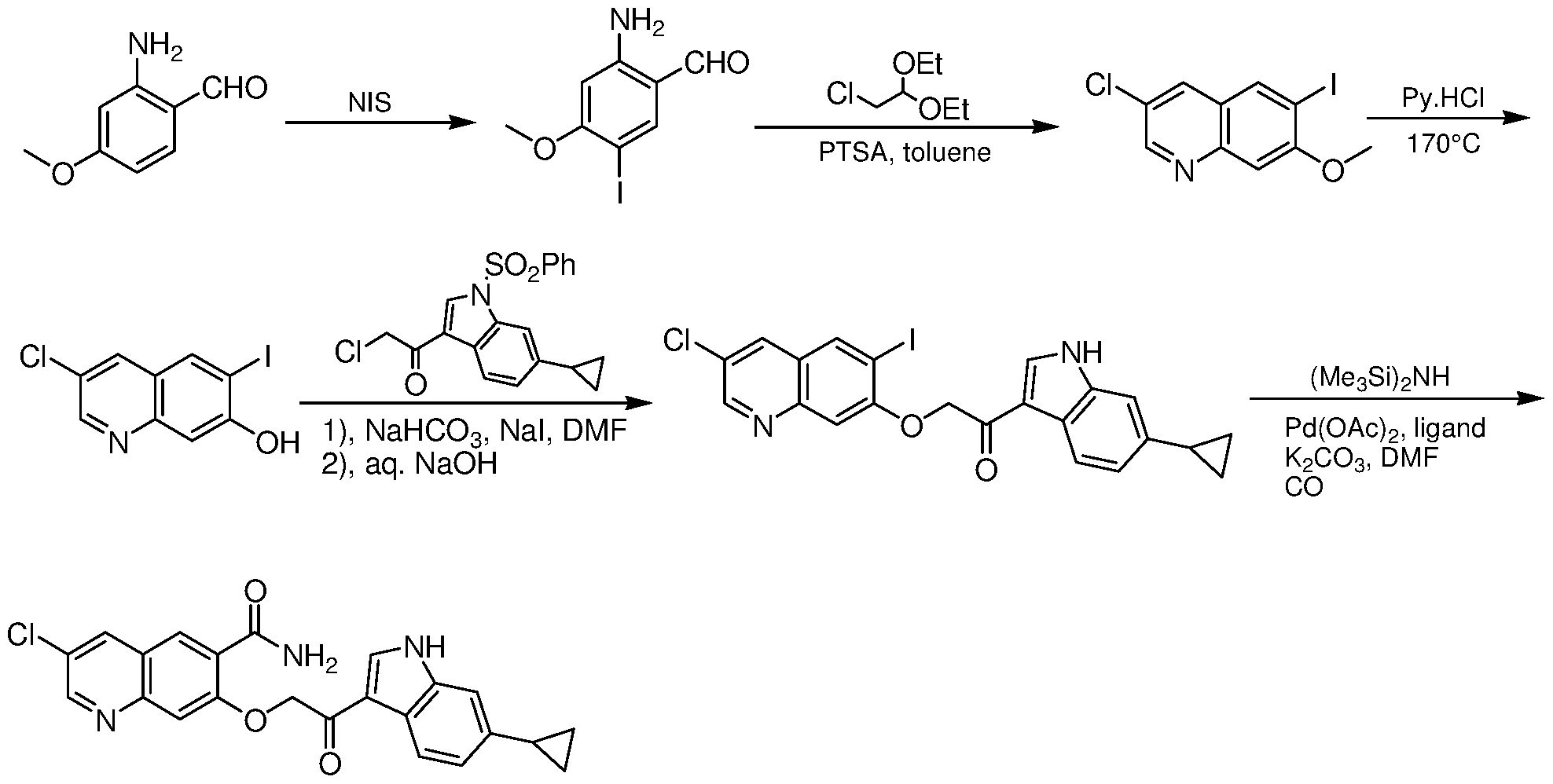
[0339] Step A. 2-Amino-5-iodo-4-methoxybenzaldehyde. To a mixture of methyl 2-amino-4- methoxybenzaldehyde (1.0 g, 6.62 mmol) in dry DCM (20 mL) at 0°C under N2 was added NIS (1.37 g, 7.95 mmol). The mixture was stirred at r.t. for 2 hr, then quenched with water and extracted with DCM. The combined organic layers were dried over anhydrous Na2S04 and concentrated under reduced pressure. The residue was purified by column chromatography to give the desired product (1.2 g, 63.8 % yield). LC-MS: m/z 278 (M+H)+.
[0340] Step B. 3-Chloro-6-iodo-7-methoxyquinoline. To a mixture of 2-amino-5-iodo-4- methoxybenzaldehyde (500 mg, 1.8 mmol) in anhydrous toluene (15 mL) were added 2-chloro-l,l- diethoxyethane (330 mg, 2.2 mmol) and PTSA (50 mg). The mixture was stirred at 120°C for 1 hr, then
quenched with water and extracted with EtOAc. The combined organic layers were dried over anhydrous Na2SC>4 and concentrated under reduced pressure. The residue was purified by column chromatography to give the desired product (454 mg, 79.0% yield). LC-MS: m/z 320 (M+H)+.
[0341] Step C. 3-Chloro-6-iodoquinolin-7-ol. A mixture of 3-chloro-6-iodo-7-methoxyquinoline (400 mg, 1.25 mmol) in Py.HCl (3.0 g) was stirred at 170°C for 2 hr, then quenched with water and extracted with EtOAc. The combined organic layers were dried over anhydrous Na2SC>4 and concentrated under reduced pressure. The residue was purified by column chromatography to give the desired product (317 mg, 83.0% yield). LC-MS: m/z 306 (M+H)+.
[0342] Step D. 2-((3-Chloro-6-iodoquinolin-7-yl)oxy)-l-(6-cyclopropyl-lH-indol-3-yl) ethanone. A mixture of 3-chloro-6-iodoquinolin-7-ol (150 mg, 0.49 mmol), 2-chloro-l-(6-cyclopropyl-l- (phenylsulfonyl)-lH-indol-3-yl)ethanone (183.3 mg, 0.49 mmol), NaHC03 (411.6 mg, 4.9 mmol), and Nal (73.5 mg, 0.49 mmol) in 8 mL of DMSO was stirred at 25 °C for 12 hr. then filtered. The filtrate was directly purified by column chromatography to give the crude product which was directly used in the next step without any further purification.
[0343] The above crude product was dissolved in 10 mL of THF/MeOH(10: 1), followed by addition of NaOH (40 mg , 1.0 mmol ). The resulting mixture was stirred at r.t. for 12 hr. then concentrated under reduced pressure. The residue was purified by column chromatography to give the desired product (100 mg, 64.0 %yield). LC-MS: m/z 503 (M+H)+.
[0344] Step E. 3-Chloro-7-(2-(6-cyclopropyl-lH-indol-3-yl)-2-oxoethoxy)quinoline-6- carboxamide . A mixture of 2-((3-chloro-6-iodoquinolin-7-yl)oxy)-l-(6-cyclopropyl-lH-indol-3- yl)ethanone (100 mg, 0.13 mmol), Pd(OAc)2 (0.4 mg, 0.002 mmol), Pd2(dba)3 (3 mg, 0.003 mmol), and DIPEA (27 mg, 0.21 mmol) in 10 mL of DMF was stirred at 90°C under N2 for 12 hr. The resulting mixture was directly purified by prep-HPLC to give the desired product (20 mg, 21.6% yield).
[0345] LC-MS: m/z 420 (M+H)+. ¾ NMR (400 MHz, DMSO-d6) δ 12.10 (s, 1H),8.85 (s, 1H), 8.70-8.50 (m,4H), 8.05-8.03 (d, / = 8.0 Hz, 1H), 7.96 (s, 1H), 7.74 (s, IK), 7.21 (s, 1H), 6.97-6.95 (d, / = 8.0 Hz, 1H), 5.68(s, 2H), 2.05-2.02 (m, 1H), 0.99-0.94(m, 2H), 0.71-0.67(m, 2H).
EXAMPLE 28. Synthesis of 6-Chloro-2-(2-(6-cyclopropyl-lH-indol-3-yl)-2-oxoethoxy)quinoline-3-

[0346] Step A. 2-(6-Cyclopropyl-l-(mesitylsulfonyl)-lH-indol-3-yl)-2-oxoethyl acetate. To a mixture of 2-chloro-l-(6-cyclopropyl-l-(mesitylsulfonyl)-lH-indol-3-yl)ethanone (830 mg, 2.0 mmol) in DMSO (10 mL) were added AcOK (2 g, 20 mmol) and Nal (300 mg, 2 mmol). The mixture was stirred at 25°C for 16 hr, then quenched with ice -water and extracted with EtOAc. The combined organic layers were dried over anhydrous Na2S04 and concentrated under reduced pressure. The residue was purified by column chromatography to give the desired product (800 mg, 91.1% yield). LC-MS: m/z 440 (M+H)+.
[0347] Step B. l-(6-Cyclopropyl-lH-indol-3-yl)-2-hydroxyethanone. To a mixture of 2-(6- cyclopropyl-l-(mesitylsulfonyl)-lH-indol-3-yl)-2-oxoethyl acetate (800 mg, 1.82 mmol) in MeOH/THF (15mL/5 mL) at 0°C was added a solution of LiOH (87 mg, 3.64 mmol) in ¾0 (5 mL). The reaction mixture was stirred at r.t. overnight then adjusted to pH 7-8 with AcOH. The resulting mixture was concentrated under reduced pressure. The residue was partitioned between EtOAc and H2O. The organic layer was separated, dried over anhydrous Na2S04 and concentrated under reduced pressure. The residue was purified by column chromatography to afford the desired product (100 mg, 25.5% yield). LC-MS: m/z 216 (M+H)+.
[0348] Step C. 6-chloro-2-(2-(6-cyclopropyl-lH-indol-3-yl)-2-oxoethoxy)quinoline-3- carboxylic acid. To a mixture of l-(6-cyclopropyl-lH-indol-3-yl)-2 -hydroxyethanone (65 mg, 0.3 mmol)
in dry DMF (6 mL) was added ethyl 2,6-dichloroquinoline-3-carboxylate (186.3 mg, 0.69 mmol). The reaction mixture was cooled to 0°C, followed by addition of NaH (72 mg, 1.8 mmol). The mixture was slowly warmed to r.t. and stirred for 0.5 hr, followed by slow addition of a solution of H2O (2 mL) in MeOH (50 mL). The resulting mixture was stirred for 0.5 hr, then acidified to pH 5-6 with aqueous HCl (I N) and concentrated under reduced pressure. The residue was partitioned between EtOAc and H2O. The organic layer was separated, dried over anhydrous Na2SC>4, and concentrated under reduced pressure. The residue was purified by column chromatography to give the desired product (110 mg, 87.3% yield) as yellow solid. LC-MS: m/z 421(M+H)+.
[0349] Step D. 6-Chloro-2-(2-(6-cyclopropyl-lH-indol-3-yl)-2-oxoethoxy)quinoline-3- carboxamide . To a mixture of 6-chloro-2-(2-(6-cyclopropyl-lH-indol-3-yl)-2-oxoethoxy)quinoline-3- carboxylic acid (84 mg, 0.2 mmol) in dry NMP (4 mL) were added EDCI (115 mg, 0.6 mmol) , HOBT (81 mg, 0.6 mmol), TEA (162 mg, 1.6 mmol) and NH4CI (212 mg, 4 mmol). The reaction mixture was stirred at 25 °C for 48 hr, then poured into saturated aqueous NaHCC and extracted with DCM. The combined organic layers were washed with brine twice and concentrated under reduced pressure. The residue was purified by column chromatography to give the desired product as white solid.
[0350] LC-MS: m/z 420 (M+H)+. ¾ NMR (400 MHz, DMSO-d6) δ 12.00 (s, 1H), 8.86 (s, 1H), 8.54 (s, 1H), 8.30 (s, 1H), 8.23 (d, / = 2.4 Hz, 1H), 7.98 (d, / = 8.4 Hz, 2H), 7.75 - 7.64 (m, 2H), 7.20 (s, 1H), 6.94 (d, / = 8.4 Hz, 1H), 5.83 (s, 2H), 2.05 - 1.99 (m, 1H), 0.94-0.98 (m, 2H), 0.66-0.70 (m, 2H).
EXAMPLE 29. 7-chloro-3-(2-(6-cyclopropyl-l-(3-hydroxypropyl)-lH-indol-3-yl)-2-oxoethoxy)-2- naphthamide (Compound 235)

[0351] Step A. To a mixture of 7-chloro-3-(2-(6-cyclopropyl-lH-indol-3-yl)-2-oxoethoxy)-2- naphthamide (42 mg, 0.1 mmol) in anhydrous DMF (3 mL) were added 3-bromopropan-l-ol (55 mg, 0.4 mmol) and K2CO3 (138 mg, 1 mmol). The reaction mixture was stirred at 25°C overnight, then directly purified by prep-HPLC to afford the desired product (40 mg, 83.3% yield).
[0352] LC-MS: m/z 477 (M+H)+. ¾ NMR (400 MHz, DMSO-d6) δ 8.62 (s, 1H), 8.57 (s, 1H), 8.54 (s, 1H), 8.16 (s, 1H), 8.06 (d, / = 8.4 Hz, 1H), 7.86 (d, / = 8.8 Hz, 2H), 7.63 (s, 1H), 7.60 - 7.51 (m,
1H), 7.35 (s, 1H), 7.00 (d, / = 8.0 Hz, 1H), 5.57 (s, 2H), 4.73 (m, 1H), 4.33 (m, 2H), 3.49 - 3.41 (m, 2H), 2.05 - 1.93 (m, 3H), 0.98 (m, 2H), 0.74 (m, 2H).
[0353] The procedure set forth above as Example 29 was used to produce the following compounds from the appropriate starting materials.
7-Chloro-3-(2-(6-cyclopropyl-l-(2-hydroxyethyl)-lH-indol-3-yl)-2-oxoethoxy)-2-naphthamide. (Compound 239)

[0354] LC-MS: m/z 463 (M+H)+. ¾ NMR (400 MHz, DMSO-d6) δ 8.64 (s, 1H), 8.55 (d, / = 2.7 Hz, 2H), 8.16 (s, 1H), 8.07 (d, / = 8.2 Hz, 1H), 7.87 (d, / = 8.9 Hz, 2H), 7.65 (s, 1H), 7.57 (d, / = 8.7 Hz, 1H), 7.35 (s, 1H), 7.01 (d, / = 8.2 Hz, 1H), 5.57 (s, 2H), 5.04 (t, / = 5.2 Hz, 1H), 4.32 (t, / = 4.9 Hz, 2H), 3.81 (d, / = 5.2 Hz, 2H), 2.07 - 1.96 (m, 1H), 0.98 (d, / = 6.5 Hz, 2H), 0.75 (d, / = 4.0 Hz, 2H).
(S)-7-Chloro-3-(2-(6-cyclopropyl-l-(2-hydroxypropyl)-lH-indol-3-yl)-2-oxoethoxy)-2-naphthamide.

[0355] LC-MS: m/z 477 (M+H)+. ¾ NMR (400 MHz, DMSO-d6) δ 8.64 (s, 1H), 8.54 (s, 1H), 8.52 (s, 1H), 8.16 (d, / = 2.0 Hz, 1H), 8.07 (d, / = 8.4 Hz, 1H), 7.87 (s, 1H), 7.85 (s, 1H), 7.64 (s, 1H), 7.55-7.58 (m, 1H), 7.36 (s, 1H), 6.98-7.00 (m, 1H), 5.56 (s, 2H), 5.05(d, / = 4.4 Hz, 1H), 4.24-4.26 (m, 1H), 4.05-4.11 (m, 2H),2.02-2.05 (m, 1H), 1.15 (d, / = 6.0 Hz, 3H), 0.95-1.00 (m, 2H), 0.72-0.76 (m, 2H).
(R)-7-Chloro-3-(2-(6-cyclopropyl-l-(2-hydroxypropyl)-lH-indol-3-yl)-2-oxoethoxy)-2-naphthamide. (Compound 245)

[0356] LC-MS: m/z 477 (M+H)+. ¾ NMR (400 MHz, DMSO-d6) δ 8.65 (s, IH), 8.54 (s, IH), 8.53 (s, IH), 8.17 (s, IH), 8.06 (d, / = 8.4 Hz, IH), 7.86-7.90 (m, 2H),7.65 (s, IH), 7.56-7.59 (m, IH), 7.37 (s, IH), 7.00 (d,J = 8.4 Hz, IH), 5.57 (s, 2H), 5.06(d, / = 4.8 Hz, IH), 4.24-4.27 (m, IH), 4.05-4.10 (m, 2H),2.03-2.05 (m, IH), 1.15 (d, / = 5.6 Hz, 3H), 0.97-0.99(m, 2H), 0.74-0.75 (m, 2H).
7-Chloro-3-(2-(6-cyclopropyl-l-(2-(l-hydroxycyclopropyl)ethyl)-lH-indol-3-yl)-2-oxoethoxy)-2-

[0357] LC-MS: m/z 503 (M+H)+. ¾ NMR (400 MHz, DMSO-d6) δ 8.41 (s, IH), 8.36 (s, IH), 8.31 (s, IH), 7.93 (s, IH), 7.84 (d, / = 8.0 Hz, IH), 7.64 (m, 2H), 7.39 (s, IH), 7.34 (d, / = 8.8 Hz, IH), 7.09 (s, IH), 6.76 (d, / = 8.0 Hz, IH), 5.34 (s, 2H), 5.21 (s, IH), 4.22 (m, 2H), 3.05 - 3.00 (m, 2H), 1.83 (m, IH), 1.77 (m, 2H), 0.76 (m, 2H), 0.63 (m, 2H), 0.31 (m, 2H).
7-Chloro-3-(2-(6-cyclopropyl-l-(2-(3-hydroxyazetidin-l-yl)ethyl)-lH-indol-3-yl)-2-oxoethoxy)-2- naphthamide. (Compound 249)

[0358] LC-MS: m/z 518 (M+H)+. ¾ NMR (400 MHz, DMSO-d6) δ 8.61 (d, / = 0.8 Hz, IH), 8.53 (d, / = 2 Hz, IH), 8.17-8.16 (m, 2H), δ 8.05 (d, / = 8 Hz, IH), 7.88-7.86 (m, 2H), 7.62 (s, IH), 7.56 (dd, / = 2, 8 Hz, IH), 7.01 (d, / = 1.2 Hz, IH), 6.99 (d, / = 1.2 Hz, IH), 5.56 (s, 2H), 4.15 (m, 2H), 4.10 (m, IH), 3.47 (m, 2H), 2.85 (m, 2H), 2.70 (m, 2H), 2.06 (m, IH), 0.99 (m, 2H), 0.75 (m, 2H).
(S)-7-chloro-3-(2-(6-cyclopropyl-l-(2-(3-hydroxypyrrolidin-l-yl)ethyl)-lH-indol-3-yl)-2-oxoethoxy)-

[0359] LC-MS: m/z 532 (M+H)VH NMR (400 MHz, DMSO-d6) δ 8.61- 8.58 (m, 3H),8.16 (s, IH), 8.06-8.04 (d, / = 8.0 Hz, IH), 7.87-7.85 (d, / = 8.0 Hz, 2H), 7.60-7.56 (m, 2H), 7.35 (s, IK), 7.00- 6.98 (d, / = 8.0 Hz, IH), 5.56 (s, 2H), 4.73-4.72 (d, / = 4.0 Hz, IH), 4.37-4.34 (m, 2H), 4.18(s, IH), 2.88- 2.87(m, 2H), 2.79-2.75(m, IH), 2.66-2.64(m, lH), 2.39-2.37(m, 1Η),2.09-2.05 (m, 2H), 1.58(s, 1H), 1.23 (s, IH), 0.99-0.97(m, 2H), 0.79-0.75(m, 2H).
7-Chloro-3-(2-(6-cyclopropyl-l-(2-(methylamino)-2-oxoethyl)-lH-indol-3-yl)-2-oxoethoxy)-2- naphthamide (Compound 250)

[0360] LC-MS: m/z 490 (M+H)+. ¾ NMR (400 MHz, DMSO-d6) δ 8.61 (s, IH), 8.53 (s, IH), 8.52 (s, IH), 8.26-8.29 (m, IH), 8.15 (d, / = 2.0 Hz, IH), 8.05 (d, / = 8.0 Hz , IH), 7.84-7.87 (m, 2H), 7.63 (s, IH), 7.55-7.57 (m, IH), 7.22 (s, IH), 6.99-7.02 (m, IH), 5.57 (s, 2H), 4.93 (s, 2H), 2.66 (d, / = 4.8 Hz , 3H), 1.99-2.06 (m, IH), 0.95-1.00 (m, 2H), 0.69-0.73 (m, 2H)
7-Chloro-3-(2-(6-cyclopropyl-l-(2-(2-hydroxyethylamino)-2-oxoethyl)-lH-indol-3-yl)-2-oxoethoxy)- -naphthamide (Compound 223)

[0361] LC-MS: m/z 520 (M+H)+. ¾ NMR (400 MHz, DMSO-d6) δ 8.63 (s, IH), 8.54 (d, / = 6.8 Hz, 2H), 8.47 (m, IH), 8.17 (s, IH), 8.06 (d, / = 8.0 Hz, IH), 7.91 - 7.83 (m, 2H), 7.65 (s, IH), 7.58 (m,
IH), 7.23 (s, IH), 7.03 (d, / = 8.0 Hz, IH), 5.59 (s, 2H), 4.96 (s, 2H), 4.81 (t, / = 7.2 Hz, IH), 3.49 - 3.45 (m, 2H), 3.21 (m, 2H), 2.06 - 1.96 (m, 2H), 0.98 (m, 2H), 0.72 (m, 2H).
(R)-7-Chloro-3-(2-(6-cyclopropyl-l-(2-(2,3-dihydroxypropylamino)-2-oxoethyl)-lH-indol-3-yl)-2- oxoethoxy)-2-naphthamide (Compound 219)

[0362] LC-MS: m/z 550 (M+H)+. ¾ NMR (400 MHz, DMSO-d6) δ 8.62 (s, IH), 8.53 (d, / = 5.6 Hz, 2H), 8.39 (m, IH), 8.16 (s, IH), 8.05 (d, / = 8.4 Hz, IH), 7.86 (m, 2H), 7.64 (s, IH), 7.57 (d, / = 9.6 Hz, IH), 7.22 (s, IH), 7.02 (d, / = 8.0 Hz, IH), 5.58 (s, 2H), 4.97 (s, 2H), 4.87 (d, / = 5.2 Hz, IH), 4.59 (t, / = 5.6 Hz, IH), 3.53 (m, IH), 3.31 - 3.27 (m, 3H), 3.05 (m, IH), 2.02 (m, IH), 0.97 (m, 2H), 0.71 (m, 2H).
(S)-7-Chloro-3-(2-(6-cyclopropyl-l-(2-(2,3-dihydroxypropylamino)-2-oxoethyl)-lH-indol-3-yl)-2-

[0363] LC-MS: m/z 550 (M+H)+. ¾ NMR (400 MHz, DMSO-d6) δ 8.63 (s, IH), 8.54 (d, / = 5.6 Hz, 2H), 8.42 (s, IH), 8.16 (d, / = 2.0 Hz, IH), 8.06 (d, / = 8.4 Hz, IH), 7.91 - 7.82 (m, 2H), 7.65 (s, IH), 7.57 (m, IH), 7.23 (s, IH), 7.03 (d, / = 8.0 Hz, IH), 5.59 (s, 2H), 4.98 (s, 2H), 4.90 (s, IH), 4.61 (s, IH), 3.55 (s, IH), 3.32 - 3.26 (m, 3H), 3.07 (m, IH), 2.08 - 1.98 (m, IH), 1.02 - 0.95 (m, 2H), 0.73 (m, 2H).
7-Chloro-3-(2-(6-cyclopropyl-l-(2-(2-hydroxy-2-methylpropylamino)-2-oxoethyl)-lH-indol-3-yl)-2- oxoethoxy)-2-naphthamide (Compound 224)

[0364] LC-MS: m/z 548 (M+H)+. ¾ NMR (400 MHz, DMSO-d6) δ 8.62 (s, 1H), 8.54 (s, 2H), 8.32 (m, 1H), 8.16 (s, 1H), 8.05 (d, / = 8.0 Hz, 1H), 7.93 - 7.78 (m, 2H), 7.64 (s, 1H), 7.57 (m, 1H), 7.21 (s, 1H), 7.04 (d, / = 8.4 Hz, 1H), 5.58 (s, 2H), 5.00 (s, 2H), 4.57 (s, 1H), 3.10 (d, / = 5.6 Hz, 2H), 2.08 - 1.90 (m, 1H), 1.09 (s, 6H), 0.97 (m, 2H), 0.70 (d, / = 4.0 Hz, 2H).
EXAMPLE 30. Synthesis of (R)-7-Chloro-3-(2-(6-cyclopropyl-l-(2,3-dihydroxypropyl)-lH-indol-3- yl)-2-oxoethoxy)-2-naphthamide (Compound 236)

[0365] Step A. (S)-2,2-dimethyl-4-(methylsulfonylmethyl)-l,3-dioxol ne. To a mixture of (R)- (2,2-dimethyl-l,3-dioxolan-4-yl)methanol (300 mg, 2.27 mmol) in dry DCM (10 mL) at -5°C under N2 was added Et3N (0.69 mL, 5.5 mmol). The mixture was stirred at that temperature for 10 min, followed by addition of MsCl (0.24 mL, 3.4 mmol). The reaction mixture was stirred at -5°C for 2 hr, then poured into ice-water and extracted with DCM. The combined organic layers were dried over anhydrous Na2SC>4 and concentrated under reduced pressure. The residue was purified by column chromatography to give the desired product (400 mg, 90.7% yield). LC-MS: m/z 195 (M+H)+.
[0366] Step B. (R)-7-chloro-3-(2-(6-cyclopropyl-l-((2,2-dimethyl-l,3-dioxoMn-4-yl) methyl)- lH-indol-3-yl)-2-oxoethoxy)-2-naphthamide. To a mixture of 7-chloro-3-(2-(6-cyclopropyl-lH-indol-3- yl)-2-oxoethoxy)-2-naphthamide (60 mg, 0.14 mmol) in anhydrous DMF (3 mL) were added (S)-2,2- dimethyl-4-(methylsulfonylmethyl)-l,3-dioxolane (56 mg, 0.29 mmol) and CS2CO3 (233 mg, 0.72 mmol). The reaction mixture was stirred at 90°C overnight then directly purified by column chromatography to afford the desired product (60 mg, 78.5% yield). LC-MS: m/z 533 (M+H)+.
[0367] Step C. (R)-7-chloro-3-(2-(6-cyclopropyl-l-(2,3-dihydroxypropyl)-lH-indol-3-yl)-2- oxoethoxy)-2-naphthamide. To a mixture of (R)-7-chloro-3-(2-(6-cyclopropyl-l-((2,2-dimethyl-l,3- dioxolan-4-yl)methyl)-lH-indol-3-yl)-2-oxoethoxy)-2-naphthamide (60 mg, 0.11 mmol) in MeOH/THF (15 mL/5 mL) was added aqueous HCl (1 N, 2 mL). The reaction mixture was stirred at r.t. for overnight then adjusted to pH 7-8 with saturated aqueous NaHCC . The resulting mixture was concentrated under reduced pressure and the residue was purified by column chromatography to give the desired product (1.8 mg, 2.5% yield).
[0368] LC-MS: m z493 (M+H)+. ¾ NMR (400 MHz, DMSO-d6) δ 8.66 (s, 1H), 8.55 (s, 1H), 8.52 (s, 1H), 8.16 (s, 1H), 8.06 (d, / = 8.0 Hz, 1H), 7.87 (m, 2H), 7.66 (s, 1H), 7.57 (m, 1H), 7.34 (s, 1H), 7.01 (d, / = 8.4 Hz, 1H), 5.58 (s, 2H), 5.17 (s, 1H), 4.94 (s, 1H), 4.41 (m, 1H), 4.11 (m, 1H), 3.87 (s, 1H), 2.08 - 1.96 (m, 3H), 1.00 - 0.95 (m, 2H), 0.76 - 0.70 (m, 2H).
[0369] The procedure set forth above as Example 30 was used to produce the following compounds from the appropriate starting materials.
(S)-7-Chloro-3-(2-(6-cyclopropyl-l-(2,3-dihydroxypropyl)-lH-indol-3-yl)-2-oxoethoxy)-2- naphthamide (Compound 242)

[0370] LC-MS: m z: 493 (M+H)+. ¾ NMR (400 MHz, DMSO-d6) δ 8.67 (s, 1H), 8.55 (s, 1H), 8.52 (s, 1H), 8.17 (s, 1H), 8.07 (d, / = 8.0 Hz, 1H), 7.94 - 7.80 (m, 2H), 7.66 (s, 1H), 7.58 (d, / = 8.8 Hz, 1H), 7.34 (s, 1H), 7.01 (d, / = 8.4 Hz, 1H), 5.58 (s, 2H), 5.17 (d, / = 5.2 Hz, 1H), 4.95 (m, 1H), 4.41 (m, 1H), 4.11 (m, 1H), 3.87 (s, 1H), 2.05 (m, 3H), 0.99 (d, / = 6.4 Hz, 2H), 0.74 (d, / = 4.8 Hz, 2H).
EXAMPLE 31. Synthesis of (R)-7-chloro-3-(2-(6-cyclopropyl-l-(3,4-dihydroxybutyl)-lH-indol-3-yl)-

[0371] Step A. (R)-7-chloro-3-(2-(6-cyclopropyl-l-(2-(2,2-dimethyl-l,3-dioxol n-4-yl) ethyl)- lH-indol-3-yl)-2-oxoethoxy)-2-naphthamide. To a mixture of 7-chloro-3-(2-(6-cyclopropyl-lH-indol-3- yl)-2-oxoethoxy)-2-naphthamide (42 mg, 0.1 mmol) in anhydrous DMF (3 mL) were added (R)-4-(2- bromoethyl)-2,2-dimethyl-l,3-dioxolane (63 mg, 0.3 mmol) and K2CO3 (138 mg, 1 mmol). The reaction mixture was stirred at r.t overnight then directly purified by column chromatography to afford the desired product (45 mg, 83.3% yield). LC-MS: m/z 547 (M+H)+.
[0372] Step B. (R)-7-chloro-3-(2-(6-cyclopropyl-l-(3,4-dihydroxybutyl)-lH-indol-3-yl)-2- oxoethoxy)-2-naphthamide. To a mixture of (R)-7-chloro-3-(2-(6-cyclopropyl-l-(2-(2,2-dimethyl-l,3- dioxolan-4-yl)ethyl)-lH-indol-3-yl)-2-oxoethoxy)-2-naphthamide (45 mg, 0.082 mmol) in MeOH/THF (15 mL / 5 mL) was added aqueous HCl (1 N, 2 mL). The reaction mixture was stirred at r.t. for 2 hr then adjusted to pH 7-8 with saturated aqueous NaHCC . The resulting mixture was concentrated under reduced pressure and the residue was purified by column chromatography to give the desired product (15 mg, 35.9% yield).
[0373] LC-MS: m/z 507 (M+H)+. ¾ NMR (400 MHz, DMSO-d6) δ 8.65 (s, 1H), 8.56 (d, / = 10.8 Hz, 2H), 8.17 (d, / = 1.6 Hz, 1H), 8.07 (d, / = 8.4 Hz, 1H), 7.87 (m, 2H), 7.64 (s, 1H), 7.58 (m, 1H), 7.35 (s, 1H), 7.00 (d, / = 9.2 Hz, 1H), 5.58 (s, 2H), 4.89 (d, / = 5.2 Hz, 1H), 4.64 (s, 1H), 4.37 (m, 2H), 3.43 (s, 1H), 3.29 (m, 2H), 2.10 - 2.00 (m, 2H), 1.77 (m, 1H), 1.03 - 0.95 (m, 2H), 0.78 - 0.71 (m, 2H).
[0374] The procedure set forth above as Example 31 was used to produce the following compounds from the appropriate starting materials.
(S)-7-chloro-3-(2-(6-cyclopropyl-l-(3,4-dihydroxybutyl)-lH-indol-3-yl)-2-oxoethoxy)-2-

[0375] LC-MS: m/z 507 (M+H)+. ¾ NMR (400 MHz, DMSO-d6) δ 8.65 (s, IH), 8.56 (d, / = 10.4 Hz, 2H), 8.16 (s, IH), 8.07 (d, / = 8.0 Hz, IH), 7.87 (d, / = 9.2 Hz, 2H), 7.64 (s, IH), 7.58 (d, / = 8.8 Hz, IH), 7.35 (s, IH), 7.00 (d, / = 8.4 Hz, IH), 5.58 (s, 2H), 4.88 (d, / = 4.8 Hz, IH), 4.64 (m, IH), 4.42 - 4.29 (m, 2H), 3.44 (m, IH), 3.32 - 3.20 (m, 2H), 2.16 - 2.00 (m, 2H), 1.76 (m, IH), 0.99 (m, 2H), 0.75 (m, 2H).
(R)-7-Chloro-3-(2-(6-chloro-l-(3,4-dihydroxybutyl)-lH-indol-3-yl)-2-oxoethoxy)-2-naphthamide (Compound 251)

[0376] LC-MS: m/z 501 (M+H)+. ¾ NMR (400 MHz, DMSO-d6) δ 8.71 (s, IH), 8.57-8.56 (d, / = 4.0 Hz, 2H), 8.21-8.15 (m, 2H), 7.88-7.86 (d, / = 8.0 Hz, 2H), 7.82-7.81(d, / = 4.0 Hz, IH), 7.63 (s, IH), 7.58 - 7.56 (m, IH), 7.31-7.28 (m, IH), 5.59(s, 2H), 4.87-4.85(d, / = 8.0 Hz, IH), 4.64-4.61 (m, IH), 4.41-4.37 (m, 2H), 3.43-3.36 (m, 2H), 3.30-3.25 (m, IH), 2.09-2.05 (m, IH), 1.78-1.75(m, IH).
EXAMPLE 32. Synthesis of (R)-7-chloro-3-(2-(6-cyclopropyl-l-(3,4-dihydroxy-4-methylpentyl)-lH-

[0377] Step A. 7-Chloro-3-(2-(6-cyclopropyl-l-(4-methylpent-3-enyl)-lH-indol-3-yl)-2- oxoethoxy)-2-naphthamide. To a mixture of 7-chloro-3-(2-(6-cyclopropyl-lH-indol-3-yl)-2-oxoethoxy)- 2-naphthamide (419mg, 1 mmol) in anhydrous DMF (10 mL) were added 5-bromo-2-methylpent-2-ene (0.6 g, 4 mmol) and K2CO3 (400 mg, 2.9 mmol).The reaction mixture was stirred at 20°C overnight then concentrated under high vacuum. The residue was purified by column chromatography to afford the desired product (450 mg, 92.2% yield) as white solid. LC-MS: m/z 501(M+H)+.
[0378] Step B. (R)-7-Chloro-3-(2-(6-cyclopropyl-l-(3,4-dihydroxy-4-methylpentyl)-lH-indol-3- yl)-2-oxoethoxy)-2-naphthamide. To a mixture of 7-chloro-3-(2-(6-cyclopropyl-l-(4-methylpent-3-enyl)- lH-indol-3-yl)-2-oxoethoxy)-2-naphthamide (49 mg, O.lmmol) in i-BuOH (10 mL) were added methanesulfonamide (10 mg, 0.1 mmol), AD-mix-beta (300 mg), THF (10 mL) and H2O (10 mL). The reaction mixture was stirred at r.t for 24 hr, then quenched with saturated aqueous Na2S2C>3 and extracted with EtOAc. The combined organic layers were dried over anhydrous Na2SC>4 and concentrated under reduced pressure. The residue was purified by prep-HPLC to give the desired product (25 mg, 46.7% yield, ee% = 60%) as white solid.
[0379] LC-MS: m/z 535(M+H)+. ¾ NMR (400 MHz, DMSO-d6) δ 8.64 (s, 1H), 8.57 (s, 1H), 8.54 (s, 1H), 8.16 (d, / = 2.0 Hz, 1H), 8.07 (d, / = 8.0 Hz, 1H), 7.88 (s, 1H), 7.86 (s, 1H), 7.64 (s, 1H), 7.56-7.58 (m, 1H), 7.34 (s, 1H), 7.00 (d, / = 8.0 Hz, 1H), 5.58 (s, 2H), 4.83(d, / = 6.0 Hz, 1H), 4.30-4.41 (m, 2H), 4.25 (s, 1H), 3.15-3.18 (m, 1H), 2.15-2.18 (m, 1H), 2.04-2.09 (m, 1H), 1.67-1.69 (m, 1H), 1.08 (s, 3H), 0.97-1.01 (m, 5H), 0.72-0.76 (m, 2H).
[0380] The procedure set forth above as Example 32 was used to produce the following compounds from the appropriate starting materials.
(S)-7-Chloro-3-(2-(6-cyclopropyl-l-(3,4-dihydroxy-4-methylpentyl)-lH-indol-3-yl)-2-oxoethoxy)-2-

[0381] LC-MS: m z 535 (M+H)+. ¾ NMR (400 MHz, DMSO-d6) δ 8.64 (s, IH), 8.57 (s, IH), 8.54 (s, IH), 8.16 (d, / = 2.0 Hz, IH), 8.07 (d, / = 8.0 Hz, IH), 7.88 (s, IH), 7.86 (s, IH), 7.64 (s, IH), 7.56-7.58 (m, IH), 7.34 (s, IH), 7.00 (d, / = 8.0 Hz, IH), 5.58 (s, 2H), 4.83(d, / = 6.0 Hz, IH), 4.30-4.41 (m, 2H), 4.25 (s, IH), 3.15-3.18 (m, IH), 2.15-2.18 (m, IH), 2.04-2.09 (m, IH), 1.67-1.69 (m, IH), 1.08 (s, 3H), 0.97-1.01 (m, 5H), 0.72-0.76 (m, 2H).
EXAMPLE 33. Synthesis of 7-Chloro-3-(2-(6-cyclopropyl-l-(2-((2- hydroxyethyl)(methyl)amino)ethyl)-lH-indol-3-yl)-2-oxoethoxy)-2-naphthamide (Compound 231)

HO^^^^^OH TBSCI, EtnN ^ HO^^^^^OTBS
I I DIAD, PPh3

[0382] Step A. 2-((2-(tert-butyldimethylsilyloxy)ethyl)(methyl)amino)ethanol. To a mixture of 2,2'-(methylazanediyl)diethanol (1.19 g, 10 mmol) and Et3N (2.02 g, 20 mmol) in DCM (50 mL) at 0°C was added dropwise a solution of TBSCI (1.5 g, 10 mmol) in DCM (5 mL). The mixture was stirred at 0 C for 1 hr then at r.t. for 2 hr. The resulting mixture was diluted with EtOAc and washed with brine. The organic layer was separated, dried over anhydrous Na2SC and concentrated under reduced pressure. The residue was purified by column chromatography to afford the desired product (1.3 g, 56% yield) as colorless oil. LC-MS: m/z 234 (M+H)+.
[0383] Step B. 3-(2-(l-(2-((2-(tert-butyldimethylsilyloxy)ethyl)(methyl)amino)ethyl)-6- cyclopropyl-lH-indol-3-yl)-2-oxoethoxy)-7-chloro-2-naphthamide. To a mixture of 7-chloro-3-(2-(6- cyclopropyl-lH-indol-3-yl)-2-oxoethoxy)-2-naphthamide (83.6 mg, 0.2 mmol), 2-((2-(tert- butyldimethylsilyloxy)ethyl)(methyl)amino)ethanol (65.2 mg, 0.28 mmol) and triphenylphosphine (105 mg, 0.4 mmol) in THF (30 mL) at 0°C under N2 was added dropwise DIAD (80.4 mg, 0.4 mmol) at 1.0 mL per min. The resulting mixture was stirred at r.t. for 4 hr, then quenched with water and extracted with EtOAc. The combined organic layers were dried over anhydrous Na2SC>4 and concentrated under reduced pressure. The residue was purified by column chromatography to give the desired product (53 mg, 42% yield). LC-MS: m/z 634 (M+H)+.
[0384] Step C. 7-Chloro-3-(2-(6-cyclopropyl-l-(2-((2-hydroxyethyl)(methyl)amino)ethyl)-lH- indol-3-yl)-2-oxoethoxy)-2-naphthamide. To a mixture of 3-(2-(l-(2-((2-(tert- butyldimethylsilyloxy)ethyl)(methyl)amino)ethyl)-6-cyclopropyl-lH-indol-3-yl)-2-oxoethoxy)-7-chloro- 2-naphthamide (47 mg, 0.074 mmol) in THF (10 mL) was added tetrabutylammonium fluoride (38.6 mg, 0.148 mmol). The mixture was stirred at r.t. for 3 hr, then quenched with water and extracted with EtOAc. The combined organic layers were dried over anhydrous Na2SC>4 and concentrated under reduced pressure. The residue was purified by prep-HPLC to give the desired product (13mg, 34% yield).
[0385] LC-MS: m/z 520 (M+H)+. ¾ NMR (400 MHz, DMSO-d6) δ 8.63-8.61 (d, 2H), 8.54 (s, 1H), 8.16 (s, 1H), 8.07 (s, 1H), 7.87-7.85 (d, 2H), 7.62 - 7.55 (m, 2H), 7.36 (s, 1H), 7.01-6.99 (d, 1H), 5.56 (s, 2H), 4.38 (s, 2H), 3.47 (s, 3H), 2.90 (s, 2H), 2.34 (s, 4H), 2.06 (s, 1H), 0.99-0.97 (d, 2H), 0.76- 0.74 (d, 2H).
EXAMPLE 34. Synthesis of 7-Chloro-3-(2-(6-cyclopropyl-l-(hydroxymethyl)-lH-indol-3-yl)-2-

[0386] Step A. Di-tert-butyl((3-(2-((3-carbamoyl-6-chloronaphthalen-2-yl)oxy)acetyl)-6- cyclopropyl-lH-indol-l-yl)methyl) phosphate. To a mixture of 7-chloro-3-(2-(6-cyclopropyl-lH-indol-3- yl)-2-oxoethoxy)-2-naphthamide (100 mg, 0.24 mmol) in anhydrous DMSO (3 mL) at r.t. were in
sequence added K2CO3 (132 mg, 0.96 mmol) and di-tert-butyl (chloromethyl)phosphate (123 mg, 0.48 mmol). The reaction mixture was stirred at r.t. overnight, then quenched with ice -water and extracted with EtOAc. The combined organic layers were dried over anhydrous Na2SC>4 and concentrated under reduced pressure. The residue was purified by column chromatography to give the desired product (35 mg, 22% yield).
[0387] LC-MS: m/z 641 (M+H)+. ¾ NMR (400 MHz, DMSO-d6) δ 8.69 (s, 1H), 8.56 (s, 1H), 8.53 (s, 1H), 8.15 (d, / = 2.4 Hz, 1H), 8.06 (d, / = 4.4 Hz, 1H), 7.89 (s, 1H), 7.84 (d, / = 8.8 Hz, 1H), 7.61 (s, 1H), 7.58 - 7.54 (m, 1H), 7.40 (s, 1H), 7.11 - 7.08 (m, 1H), 6.08 (d, / = 9.2 Hz, 1H), 5.59 (s, 2H), 2.05-2.03 (m, 1H), 1.29 (s, 18H), 1.02 - 0.976 (m, 2H) , 0.75 - 0.72 (m, 2H).
[0388] Step B. 7-Chloro-3-(2-(6-cyclopropyl-l-(hydroxymethyl)-lH-indol-3-yl)-2-oxoethoxy)- 2-naphthamide. To a mixture of di-tert-butyl ((3-(2-((3-carbamoyl- 6-chloronaphthalen-2-yl)oxy)acetyl)- 6-cyclopropyl-lH-indol-l-yl)methyl)phosphate (20 mg, 0.03 mmol) in anhydrous DCM (10 mL) at 0°C was added TFA (1 mL). The reaction mixture was stirred at that temperature for 1 hr, then poured into ice -water and extracted with DCM. The combined organic layers were dried over anhydrous Na2SC>4 and concentrated under reduced pressure. The residue was purified by column chromatography to give the desired product (8 mg, 57% yield).
[0389] LC-MS: m/z 449 (M+H)+.¾ NMR (400 MHz, DMSO-d6) δ 8.62-8.60 (m, 2H), 8.53 (s, 1H), 8.14 (s, 1H), 8.46 (d, / = 8.4 Hz, 1H), 7.88 - 7.83 (m, 2H), 7.62 (s, 1H), 7.55 (d, / = 9.2 Hz, 1H), 7.39 (m, 1H), 7.04 (d, / = 8.4 Hz, 1H), 5.60 (s, 2H), 5.58 (s, 2H), 2.07-2.00 (m, 1H), 0.98 - 0.96 (m, 2H) , 0.74 - 0.73 (m, 2H).
EXAMPLE 35. Synthesis of (S)-7-Chloro-3-(2-(6-cyclopropyl-l-(3-hydroxy-4-(methylamino)-4-

[0390] Step A. (S)-5-(2-hydroxyethyl)-2,2-dimethyl-l,3-dioxol n-4-one. To a mixture of (S)-2- (2,2-dimethyl-5-oxo-l,3-dioxolan-4-yl)acetic acid (350 mg, 2.0 mmol) in THF (1.4 mL) at 0°C under N2 was added BH3 THF (1.0 M, 4.6 mL, 4.6 mmol). The reaction mixture was stirred at 0°C for 15 min then quenched with methanol (10 mL) over 10 min. The resulting mixture was concentrated under reduced pressure below 18°C. The residue was purified by column chromatography to give the desired product (170 mg, 53% yield) as colorless oil. ¾ NMR (400 MHz, CDCL) δ 4.55-4.58 (m, 1H), 3.77-3.88 (m, 2H), 2.10-2.18 (m, 2H), 1.95-2.05 (m, 1H), 1.62 (s, 3H), 1.55 (s, 3H).
[0391] Step B. (S)-5-(2-bromoethyl)-2,2-dimethyl-l,3-dioxolan-4-one. To a mixture of (S)-5-(2- hydroxyethyl)-2,2-dimethyl-l,3-dioxolan-4-one (170 mg, 1.06 mmol), PPI13 (556 mg, 2.12 mmol) in DCM (10 mL) at 0°C was added a solution of CBr4 (703 mg, 2.12 mmol) in DCM ( 5 mL) over 20 min. The reaction mixture was stirred at 0°C for 30 min then concentrated under reduced pressure. The residue was purified by column chromatography to give the desired product (130 mg, 55% yield) as colorless oil. ¾ NMR (400 MHz, CDCI3) δ 4.56-4.59 (m, 1H), 3.55-3.61 (m, 1H), 3.47-3.53 (m, 1H), 2.36-2.44 (m, 1H), 2.19-2.28 (m, 1H), 1.61 (s, 3H), 1.56 (s, 3H)
[0392] Step C. (S)-7-chloro-3-(2-(6-cyclopropyl-l-(2-(2,2-dimethyl-5-oxo-l,3-dioxolan-4- yl)ethyl)-lH-indol-3-yl)-2-oxoethoxy)-2-naphthamide. A mixture of 7-chloro-3-(2-(6-cyclopropyl-lH-
indol-3-yl)-2-oxoethoxy)-2-naphthamide (100 mg, 0.24 mmol), (S)-5-(2-bromoethyl)-2,2-dimethyl-l,3- dioxolan-4-one (64 mg, 0.29 mmol) and CS2CO3 (233 mg, 0.72 mmol) in DMF (2 mL) was stirred at 25°C for 24 hr then partitioned between EtOAc and H2O. The organic layer was separated, washed with water, dried over anhydrous Na2SC>4, and concentrated under reduced pressure. The residue was purified by column chromatography to give the crude product (100 mg) as yellow solid which was directly used in the next step without any further purification. LC-MS: m/z 561 (M+H).+
[0393] Step D. (S)-7-chloro-3-(2-(6-cyclopropyl-l-(3-hydroxy-4-(methylamino)-4- oxobutyl)- lH-indol-3-yl)-2-oxoethoxy)-2-naphthamide. To a mixture of (S)-7-chloro-3-(2-(6-cyclopropyl-l-(2- (2,2-dimethyl-5-oxo-l ,3-dioxolan-4-yl)ethyl)-lH-indol-3-yl)-2-oxoethoxy)-2-naphthamide (100 mg, 0.18 mmol) in THF ( 2 mL) was added methyl amine (30%wt in methanol, 5 mL) .The mixture was stirred at r.t. for 72 hr then concentrated under reduced pressure. The residue was purified by column
chromatography to give the desired product (17 mg, 17% yield) as pale brown solid.
[0394] LC-MS: m/z 534 (M+H)+. ¾ NMR (400 MHz, DMSO-d6) δ 8.63 (s, 1H), 8.54 (d, / = 6.8 Hz , 2H), 8.15 (d, / = 1.2 Hz, 1H), 8.05 (d, / = 8.4 Hz , 1H), 7.85-7.89 (m, 3H), 7.62 (s, 1H), 7.55-7.57 (m, 1H), 7.32 (s, 1H), 7.00 (d, / = 8.0 Hz, 1H), 5.90 (d, / = 5.2 Hz , 1H), 5.57 (s, 2H), 4.32-4.38 (m, 2H), 3.84-3.89 (m,lH), 2.60 (d, / = 4.4 Hz, 3H), 1.95-2.08 (m, 3H), 0.96-1.01 (m, 2H), 0.72-0.76 (m, 2H).
EXAMPLE 36. Synthesis of (R)-7-chloro-3-(2-(l-(2-hydroxy-3-(methylamino)-3-oxopropyl)-6-

[0395] Step A. (R)-Methyl 3-(3-(2-(3-carbamoyl-6-chloronaphthalen-2-yloxy)acetyl)-6- (pyridazin-3-yloxy)-lH-indol-l-yl)-2-hydroxypropanoate. To a mixture of 7-chloro-3-(2-oxo-2-(6- (pyridazin-3-yloxy)-lH-indol-3-yl)ethoxy)-2-naphthamide (47 mg, 0.1 mmol) in anhydrous DMF (3 mL) at 0°C was added NaH (6 mg, 0.15 mmol, 60%wt). The mixture was stirred at r.t. for 30 min, followed by
addition of (R)-methyl oxirane-2-carboxylate (20 mg, 0.2 mmol). The resulting mixture was stirred at 50°C for 3 hr then directly used in the next step without any further purification. LC-MS: m/z 575 (M+H)+.
[0396] Step B. (R)-7-chloro-3-(2-(l-(2-hydroxy-3-(methylamino)-3-oxopropyl)-6- (pyridazin-3- yloxy)-lH-indol-3-yl)-2-oxoethoxy)-2-naphthamide. To the above reaction mixture at 0°C was added dropwise a solution of MeNth/MeOH (3 mL). The reaction mixture was stirred at r.t overnight, then poured into saturated aqueous LiCl and extracted with DCM. The combined organic layer was dried over anhydrous Na2SC>4 and concentrated under reduced pressure. The residue was purified by column chromatography to afford the desired product (8.0 mg, 13.9% yield).
[0397] LC-MS: m/z 574 (M+H)+. ¾ NMR (400 MHz, DMSO-d6) δ 9.02 (d, / = 4.4 Hz, IH), 8.64 (d, / = 10.8 Hz, 2H), 8.55 (s, IH), 8.24 (d, / = 8.8 Hz, IH), 8.17 (s, IH), 7.96 (d, / = 4.4 Hz, IH), 7.89 (d, / = 8.8 Hz, 2H), 7.78 (m, IH), 7.67 (s, IH), 7.61 - 7.57 (m, IH), 7.54 (s, IH), 7.46 (d, / = 9.2 Hz, IH), 7.14 (m, IH), 6.13 (d, / = 5.2 Hz, IH), 5.62 (s, 2H), 4.55 (d, / = 12.0 Hz, IH), 4.42 - 4.28 (m, 2H), 2.58 (d, / = 4.8 Hz, 3H).
[0398] The procedure set forth above as Example 36 was used to produce the following compounds from the appropriate starting materials.
(R)-7-Chloro-3-(2-(6-cyclopropyl-l-(2-hydroxy-3-(methylamino)-3-oxopropyl)-lH-indol-3-yl)-2- oxoethoxy)-2-naphthamide (Compound 248)

[0399] LC-MS: m/z 520 (M+H)+.¾ NMR (400 MHz, DMSO-d6) δ 8.63 (brs, IH), 8.54 (s, IH), 8.50 (s, IH), 8.15 (d, / = 1.6 Hz, IH), 8.05 (d, / = 8.4 Hz, IH), 7.97-7.93 (m, IH), 7.88-7.85 (m, 2H),7.65 (s, IH), 7.58-7.55 (m, IH), 7.32 (s, IH), 7.02-6.99 (m, IH), 6.10-6.08 (m, IH), 5.56 (s, 2H), 4.57-4.50 (m, IH), 4.37-4.29 (m, 2H), 2.60-2.59 (m, 3H), 2.07-2.00 (m, IH), 1.00-0.95 (m, 2H), 0.75-0.71 (m, 2H).
(S)-7-Chloro-3-(2-(6-cyclopropyl-l-(2-hydroxy-3-(methylamino)-3-oxopropyl)-lH-indol-3-yl)-2- oxoethoxy)-2-naphthamide (Compound 254)

[0400] LC-MS: mlz 520 (M+H)+. ¾ NMR (400 MHz, DMSO-d6) δ 8.63 (s, IH), 8.54 (s, IH), 8.51 (s, IH), 8.16 (d, / = 2.4 Hz, IH), 8.05 (d, / = 8.4 Hz, IH), 7.95-7.97 (m, IH), 7.86-7.88 (m, 2H), 7.65 (s, IH), 7.56-7.58 (m, IH), 7.32 (s, IH), 6.99-7.02 (m, IH), 6.10 (s, IH), 5.56 (s, 2H), 4.52-4.55 (m, IH), 4.32-4.37 (m, 2H), 2.59 (d, / = 4.8 Hz, 3H), 2.02-2.06 (m, IH), 0.96-1.00 (m, 2H), 0.71-0.75 (m, 2H).
EXAMPLE 37. Synthesis of 7-chloro-3-(2-(6-((lR,2R)-2-methylcyclopropyl)-lH-indol-3-yl)-2- oxoethoxy)-2-naphthamide (racemic) (Compound 246)

[0402] Step B. (E)-l-(mesitylsulfonyl)-6-(prop-l-enyl)-lH-indole. To a mixture of 1-(1- (mesitylsulfonyl)-lH-indol-6-yl)propan-l-ol (1.5g, 4.2 mrnol) in toluene (100 mL) was added PTSA (72.26 mg, 0.42 mmol). The reaction mixture was stirred at reflux for lhr, then concentrated under reduced pressure. The residue was purified by column chromatography to give the desired product (600 mg, 42% yield) as yellow solid.
[0403] ¾ NMR (400 MHz, CDC13) δ 7.46-7.43 (d, 1H), 7.39-7.40 (d, 1H), 7.19 (s, 2H), 7.15- 7.12 (d, 1H), 6.89 (s, 2H), 6.50-6.48 (d, 1H), 6.31-6.29 (d , 1H), 2.48 (s, 6H), 2.22 (s, 3H), 1.80-1.78 (m, 3H).
[0404] Step C. l-(Mesitylsulfonyl)-6-((lR,2R)-2-methylcyclopropyl)-lH-indole.To a mixture of (E)-l-(mesitylsulfonyl)-6-(prop-l-enyl)-lH-indole (340 mg, l.Ommol) andCuBr (28 mg, 0.2 mmol) in CH2Br2 (5.0 mL)was added Al(i-Bu)3 (5.0 mL,l.l M in hexanes). The reaction mixture was stirred at 70°C for 4hr, then quenched with ice- water and extracted with EtOAc. The combined organic layers were dried over anhydrous Na2SC>4 and concentrated under reduced pressure. The residue was purified by column chromatography to give the desired product (253 mg, 72% yield) as yellow solid.
[0405] ¾ NMR (400 MHz, CDCI3) δ 7.54-7.51 (d, 2H), 7.43-7.41 (d, 2H), 7.02 - 6.94 (m, 8H), 6.58-6.54 (m, 2H), 2.57 (s, 13H), 2.31 (s, 6H), 2.20 (s, 5H), 1.62 - 1.54 (m, 4H), 1.18-1.16 (d, 6H), 0.99 - 0.89 (m, 3H), 0.81 - 0.69 (m, 5H).
[0406] Step D. l-(l-(Mesitylsulfonyl)-6-((lR,2R)-2-methylcyclopropyl)-lH-indol-3- yl)ethanone. To a mixture of l-(mesitylsulfonyl)-6-((lR,2R)-2-methylcyclopropyl)-lH-indole (176 mg, 0.5 mmol) in anhydrous DCM (10 mL) at 0°C was added in sequence of Et2AlCl (1.2 mL, 2.0 M) and a solution of acetyl chloride (0.34 mL, 2.5 mmol) in anhydrous DCM (1 mL). The reaction mixture was stirred at r.t. for 2 hr, then quenched with aqueous HC1 (0.1 N, 10 drops) and extracted with DCM. The combined organic layers were dried over anhydrous Na2SC>4 and concentrated under reduced pressure. The residue was purified by column chromatography to give the desired product (130 mg, 56% yield) as yellow solid.
[0407] ¾ NMR (400 MHz, DMSO-d6) δ 8.70 (s, 1H), 8.06-8.03 (d, 1H), 7.21 (s, 2H), 7.08-7.05 (m, 1H), 6.69 (s, 1H), 2.56 (s, 3H), 2.48 (s, 6H), 2.30 (s, 3H), 1.66 - 1.57 (m, 1H), 1.11-113 (d, 3H), 0.87 - 0.78 (m, 1H), 0.79 - 0.72 (m, 1H), 0.63-0.61 (m, 1H).
[0408] Step E. 2-Chloro-l-(l-(mesitylsulfonyl)-6-((lR,2R)-2-methylcyclopropyl)-lH-indol-3- yl)ethanone. A mixture of l-(l-(mesitylsulfonyl)-6-((lR,2R)-2-methylcyclopropyl)-lH-indol-3- yl)ethanone (118 mg, 0.3 mmol) and TEA (60 mg, 0.6 mmol) in 10 mL of DCM was cooled to -5 to - IO C, followed by addition of TMSOTf (75 mg, 0.33 mmol). The reaction mixture was stirred at that temperature for 2 hr, followed by addition of NCS (40mg, 0.3 mmol). The resulting mixture was stirred at -5 to -IO C for another lhr, then diluted with EtOAc and washed with saturated aqueous NaHCC . The organic layer was dried over anhydrous Na2SC>4 and concentrated under reduced pressure. The residue was purified by gel column chromatography to give 2-chloro-l-(6-cyclopropyl-l-(mesitylsulfonyl)-lH- indol-3-yl)ethanone (153mg, 74% yield) as yellow semi-solid. LC-MS: m/z 430 (M+H)+.
[0409] Step F. 7-Chloro-3-(2-(l-(mesitylsulfonyl)-6-((lR,2R)-2-methylcyclopropyl)-lH ndo^ 3-yl)-2-oxoethoxy)-2-naphthamide. A mixture of 2-chloro-l-(l-(mesitylsulfonyl)-6-((lR,2R)-2- methylcyclopropyl)-lH-indol-3-yl)ethanone (43 mg, O. lmmol), 7-chloro-3-hydroxy-2-naphthamide (22.1 mg, 0.1 mmol) , NaHC03 (101 mg, 1.2 mmol), and Nal (15 mg,0.1 mmol) in 5 mL of DMSO was stirred at r.t. for 16 hr, then diluted with EtOAc and washed with brine. The organic layer was dried over anhydrous Na2SC>4 and concentrated under reduced pressure. The residue was purified by silica gel column chromatography to give the desired product as yellow semi-solid. LC-MS: m/z 615 (M+H)+.
[0410] Step G. 7-chloro-3-(2-(6-((lR,2R)-2-methylcyclopropyl)-lH-indol-3-yl)-2-oxoethoxy)-2- naphthamide. To a mixture of 7-chloro-3-(2-(l-(mesitylsulfonyl)-6-((lR,2R)-2-methylcyclopropyl)-lH- indol-3-yl)-2-oxoethoxy)-2-naphthamide (51 mg, 0.083 mmol) in THF (2 mL) was added a solution of NaOH (6.8 mg, 0.17 mmol) in H2O (2 mL). The reaction mixture was stirred at r.t. for 2hr, then adjusted to pH 6 with aqueous HC1 (IN) and extracted with EtOAc. The combined organic layers were dried over anhydrous Na2SC>4 and concentrated under reduced pressure. The residue was purified by column chromatography to give the desired product as racemate (13 mg, 36% yield).
[0411] LC-MS: m/z 433 (M+H)+. ¾ NMR (400 MHz, DMSO-d6) δ 12.13 (s, IH), 8.75 (s, IH), 8.65 (s, IH), 8.62-8.58 (d, IH), 8.26-8.24 (d, IH), 8.13-8.11 (d, IH), 7.96-7.95 (d, 2H), 7.75 (s, IH), 7.67- 7.63 (m, IH), 7.27 (s, IH), 7.04-7.01 (m, IH), 5.71 (s, 2H), 1.83-1.80 (m, IH), 1.28-1.25 (m, 3H), 1.16- 1.14 (m, IH), 1.04 - 0.94 (m, IH), 0.91 - 0.81 (m, IH).
EXAMPLE 38. Synthesis trans-7-chloro-3-(2-oxo-2-(6-(2-(trifluoromethyl)cyclopropyl)-lH-indol-3- yl)ethoxy)-2-naphthamide (Compound 240)

[0412] Step A. trans-2-(Trifluoromethyl)cyclopropylboronic acid N-methyliminodiacetic acid ester. To a mixture of 2,2,2-trifluoroethan-l -amine hydrochloride (2.02 g, 15 mmol) in H2O (5 mL) at 0°C was added dropwise a solution of NaNC>2 (1.15 g, 16 mmol) in H2O (5 mL). The mixture was stirred at 15°C for 0.5hr, then extracted with DCM (10 mL). The organic layer was washed in sequence with H2O (10 mL) and brine (10 mL), dried over anhydrous Na2SC>4 and filtered. The filtrate was used directly for the next step.
[0413] To a mixture of vinylboronic acid N-methyliminodiacetic acid ester (0.42 g, 2.3 mmol) in dry THF (3 mL) and dry DCM (2 mL) was added Pd(OAc)2 (10 mg, 0.045 mmol), followed by slow addition of the above DCM solution at room temperature. The reaction mixture was stirred at r.t. for 0.5hr, then concentrated under reduced pressure. The residue was purified by column chromatography to give the crude product (530mg) as white solid which was used directly in the next step without any further purification. LC-MS: m/z 266(M+H)+.
[0414] Step B. trans-l-(l-(Mesitylsulfonyl)-6-((lR,2R)-2-(trifluoromethyl)cyclopropyl)-lH- indol-3-yl)ethan-l-one. A mixture of the above crude trans-2-(trifluoromethyl)cyclopropylboronic acid N-methyliminodiacetic acid ester (380 mg), Pd(OAc)2 (24 mg, 0.11 mmol), PCy3 (60 mg, 0.21 mmol), Cs2CO3(930 mg, 2.86 mmol), and l-(6-bromo-l-(mesitylsulfonyl)-lH-indol-3-yl)ethan-l-one (300 mg, 0.71 mmol) in toluene (9 mL) and H2O (2.7 mL) was stirred at 100°C under N2for 15 hr. The resulting mixture was diluted with EtOAc (50 mL) and washed in sequence with water and brine, dried over
anhydrous Na2SC>4 and concentrated under reduced pressure. The residue was purified by column chromatography to give the crude product (245 mg) as a yellow solid which was directly used in the next step without any further purification. LC-MS: m/z 450 (M+H)+.
[0415] Step C. 2-Chloro-l-(l-(mesitylsulfonyl)-6-((lR,2R)-2-(trifluoromethyl)cyclopropyl)-lH- indol-3-yl)ethan-l-one.To a mixture of the above crude l-(l-(mesitylsulfonyl)-6-((lR,2R)-2- (trifluoromethyl)cyclopropyl)-lH-indol-3-yl)ethan-l-one (90 mg) in dry DCM (1 mL)was added Et3N (67 mg, 0.66 mmol) at 0°C, followed by dropwise addition of TMSOTf (98 mg, 0.44 mmol). The reaction mixture was stirred at 15°C for 0.5hr, followed by dropwise addition of NCS (38 mg, 0.29 mmol) in dry DCM (1 mL) at 0°C. The resulting mixture was stirred at that temperature for 20 min then quenched with water (30 mL) and extracted with DCM. The combined organic layers were washed with brine, dried over anhydrous Na2SC>4 and concentrated under reduced pressure. The residue was purified by column chromatography to give the crude product (50 mg) as yellow oil which was directly used in the next step without any further purification. LC-MS: m/z 449(M+H)+.
[0416] Step D. trans-7-Chloro-3-(2-oxo-2-(6-((lR,2R)-2-(trifluoromethyl)cyclopropyl)-lH- indol-3-yl)ethoxy)-2-naphthamide. A mixture of the crude trans-2-chloro-l-(l-(mesitylsulfonyl)-6- ((lR,2R)-2-(trifluoromethyl)cyclopropyl)-lH-indol-3-yl)ethan-l-one(50 mg, 0.1 mmol), Nal (25 mg, 0.17 mmol), NaHC03(142 mg, 1.70 mmol), and 7-chloro-3-hydroxy-2-naphthamide (30 mg, 0.14 mmol) in DMSO (1.5 mL) was stirred at 25 °C under N2 for 40 hr, then poured into water and extracted with DCM. The combined organic layers were washed with brine, dried over anhydrous Na2SC>4 and concentrated under reduced pressure. The residue was dissolved in a mixed solvent of THF (2 mL) and MeOH (6 mL), followed by addition of a solution of NaOH (12 mg, 0.3 mmol) in H2O (1 mL). The reaction mixture was stirred at r.t. for 12 hr, then the pH was adjusted to pH 7-8 with AcOH. The resulting mixture was concentrated, and the residue was purified by prep-HPLC to give the desired product as a pair of trans isomers (5 mg, 10.2% yield) as white solid.
[0417] LC-MS: m/z: 487 (M+H)+. ¾ NMR (400 MHz, DMSO-d6) δ 12.2 (br, 1H), 8.65 (s, 1H), 8.56-8.59 (m, 2H), 8.16 (s, 1H), 8.10 (d, / = 8.4 Hz, 1H), 7.85-7.89 (m, 2H), 7.66 (s, 1H), 7.56-7.58 (m, 1H), 7.38 (s, 1H), 7.06-7.08 (m, 1H), 5.63 (s, 2H), 2.54-2.57 (m, 1H), 2.26-2.32 (m, 1H), 1.29-1.41 (m, 2H).
EXAMPLE 39. Synthesis of 7-chloro-3-(2-(6-((6-methylpyridin-2-yl)methyl)-lH-indol-3-yl)-2-

[0418] Step A. 6-Bromo-l-((2-(trimethylsilyl)ethoxy)methyl)-lH-indole. While cooling in an ice bath, to a mixture of NaH (1.71 g, 70.41 mmol) in 20 mL of THF was added dropwise and in sequence 6-bromo-lH-indole (7.0 g, 35.71 mmol) and a solution of (2-
(chloromethoxy)ethyl)trimethylsilane (5.95 g, 35.71 mmol) in 10 mL of THF. The reaction mixture was stirred at 0 C for 2 hr, then quenched with saturated aqueous NH4CI and extracted with EtOAc. The combined organic layers were dried over anhydrous Na2SC>4 and concentrated under reduced pressure. The residue was purified by column chromatography to give the desired product (11.6 g, quant, yield). LCMS: m/z 327 (M+H)+.
[0419] Step B. (6-Methylpyridin-2-yl)(l-((2-(trimethylsilyl)ethoxy)methyl)-lH-indol-6- yl)methanol. To a mixture of 6-bromo-l-((2-(trimethylsilyl)ethoxy)methyl)-lH-indole (6.0 g, 18.39 mmol) in 20 mL of THF at -70 C was added dropwise nBuLi (11.5 mL, 1.6 M in hexane). The reaction mixture was stirred at that temperature for 30 min, followed by dropwise addition of a solution of 6- methylpicolinaldehyde (2.23 g, 18.39 mmol) in 5 mL of THF. The resulting mixture was stirred at -70 C for another 1 hr, then quenched with saturated aqueous NH4CI and extracted with EtOAc. The combined organic layers were dried over anhydrous Na2SC>4 and concentrated under reduced pressure. The residue
was purified by column chromatography to give the desired product (5 g, 73 % yield). LCMS: m/z 369 (M+H)+.
[0420] Step C. (6-Methylpyridin-2-yl)(l-((2-(trimethylsilyl)ethoxy)methyl)-lH-indol-6- yl)methanone. To a mixture of (6-methylpyridin-2-yl)(l-((2-(trimethylsilyl)ethoxy)methyl)-lH-indol-6- yl)methanol (5.0 g, 13.57 mmol) in 20 mL of DCM was added 5.9 g of MnCh. The reaction mixture was stirred at r.t. for 2 hr, then filtered through Celite. The filtrate was concentrated under reduced pressure to give the crude product (4 g, 80.4 % crude yield) as oil which was used directly in the next step without any further purification. LCMS: m/z 367 (M+H)+.
[0421] Step D. 6-((6-Methylpyridin-2-yl)methyl)-l-((2-(trimethylsilyl)ethoxy)methyl)-lH- indole. A mixture of (6-methylpyridin-2-yl)(l-((2-(trimethylsilyl)ethoxy)methyl)-lH-indol-6- yl)methanone (4 g, 10.91 mmol) in 10 mL of ethane- 1,2-diol and 10 mL of hydrazine hydrate was stirred at 175 C for 1 hr, followed by addition of KOH (6.12 g, 109.13 mmol). The resulting mixture was stirred at 175 C for another 3 hr, then poured into ice water and extracted with EtOAc. The combined organic layers were dried over anhydrous Na2SC>4 and concentrated under reduced pressure. The residue was purified by column chromatography to give the desired product (2 g, 69.8 % yield). LCMS: m/z 353 (M+H)+.
[0422] Step E. 6-((6-Methylpyridin-2-yl)methyl)-l-(phenylsulfonyl)-lH-indole. To a solution of 6-((6-methylpyridin-2-yl)methyl)-l-((2-(trimethylsilyl)ethoxy)methyl)-lH-indole (2.0 g, 5.67 mmol) in 5 mL of THF was added tetrabutylammonium fluoride (2.97 g, 11.35 mmol). The reaction mixture was stirred at 85°C for 24 hr,then cooled to 0 C, followed by addition in sequence of NaH (272 mg, 11.35 mmol, in portions) and benzenesulfonyl chloride(l g, 5.67 mmol). The resulting mixture was stirred at r.t. for 30 min, then quenched with saturated aqueous NH4CI and extracted with EtOAc. The combined organic layers were dried over anhydrous Na2SC>4 and concentrated under reduced pressure. The residue was purified by column chromatography to give the desired product (0.3 g, 14.59 % yield).LCMS: m/z 363 (M+H)+.
[0423] Step F. 2-chloro-l-(6-((6-methylpyridin-2-yl)methyl)-l-(phenylsulfonyl)-lH-indol-3- yl)ethanone. To a mixture of 6-((6-methylpyridin-2-yl)methyl)-l-(phenylsulfonyl)-lH-indole (300 mg, 0.877 mmol) and aluminum trichloride (551 mg, 4.14 mmol) in 10 mL of DCM was added a solution of 373 mg (3.31 mmol) of 2-chloroacetyl chloride in 2 mL of DCM. The reaction mixture was stirred at 0°C for 2 hr, then quenched with aqueous NH4CI (10 wt) and extracted with EtOAc. The combined organic layers were dried over anhydrous Na2SC>4 and concentrated under reduced pressure. The residue was purified by column chromatography to give the desired product (0.150 g, 41.3 % yield). LCMS: m/z 439 (M+H)+.
[0424] Step G. 7-Chloro-3-(2-(6-((6-methylpyridin-2-yl)methyl)-l-(phenylsulfonyl)-lH-indol- 3-yl)-2-oxoethoxy)-2-naphthamide. To a mixture of 7-chloro-3-hydroxy-2-naphthamide (76 mg, 0.341 mmol) in 10 mL of DMSO were added NaHC03(459 mg, 5.47 mmol) and Nal (102 mg, 0.683 mmol). The reaction mixture was stirred at r.t. for 1 hr, followed by addition of 2-chloro-l-(6-((6-methylpyridin- 2-yl)methyl)-l-(phenylsulfonyl)-lH-indol-3-yl)ethanone (150 mg, 341 mmol). The resulting mixture was stirred at r.t. for 5 hr, then quenched with water and filtered. The solid was collected and dried under high vacuum to give the desired product (80 mg, 37.5 % crude product), which was directly used in the next step without any further purification. LCMS: m/z 624 (M+H)+.
[0425] Step H. 7-Chloro-3-(2-oxo-2-(6-(pyridin-2-ylmethyl)-lH-indol-3-yl)ethoxy)-2- naphthamide. To a mixture of 7-chloro-3-(2-oxo-2-(6-(pyridin-2-ylmethyl)-lH-indol-3-yl)ethoxy)-2- naphthamide (80 mg, 0.128 mmol) in 4 mL of THF was added NaOH (11 mg, 0.26 mmol) in 2 mL of water. The reaction mixture was stirred at r.t. for 1 hr, and the pH was then adjusted to pH 5-6 with aqueous HCl (10 wt). The resulting mixture was filtered, and the solid was purified via prep-HPLC to afford the desired product (10 mg, 16.2% yield) as yellow solid. LCMS: m/z 484 (M+H)+.
[0426] ¾ NMR (400MHz, DMSO-d6) 512.04 - 12.17 (m, 1 H), 8.62 - 8.67 (m, 1 H), 8.55 (s, 2 H), 8.15 - 8.18 (m, 1 H), 8.06 - 8.11 (m, 1 H), 7.83 - 7.90 (m, 2 H), 7.63 - 7.66 (m, 1 H), 7.58 (s, 2 H), 7.38 - 7.41 (m, 1 H), 7.13 - 7.18 (m, 1 H), 7.06 (s, 2 H), 5.59 - 5.64 (m, 2 H), 4.13 - 4.16 (m, 2 H), 2.44 ppm (s, 3 H).
EXAMPLE 40. Synthesis of 7-chloro-3-(2-oxo-2-(6-(pyridazin-3-ylmethyl)-lH-indol-3-yl)ethoxy)-2-
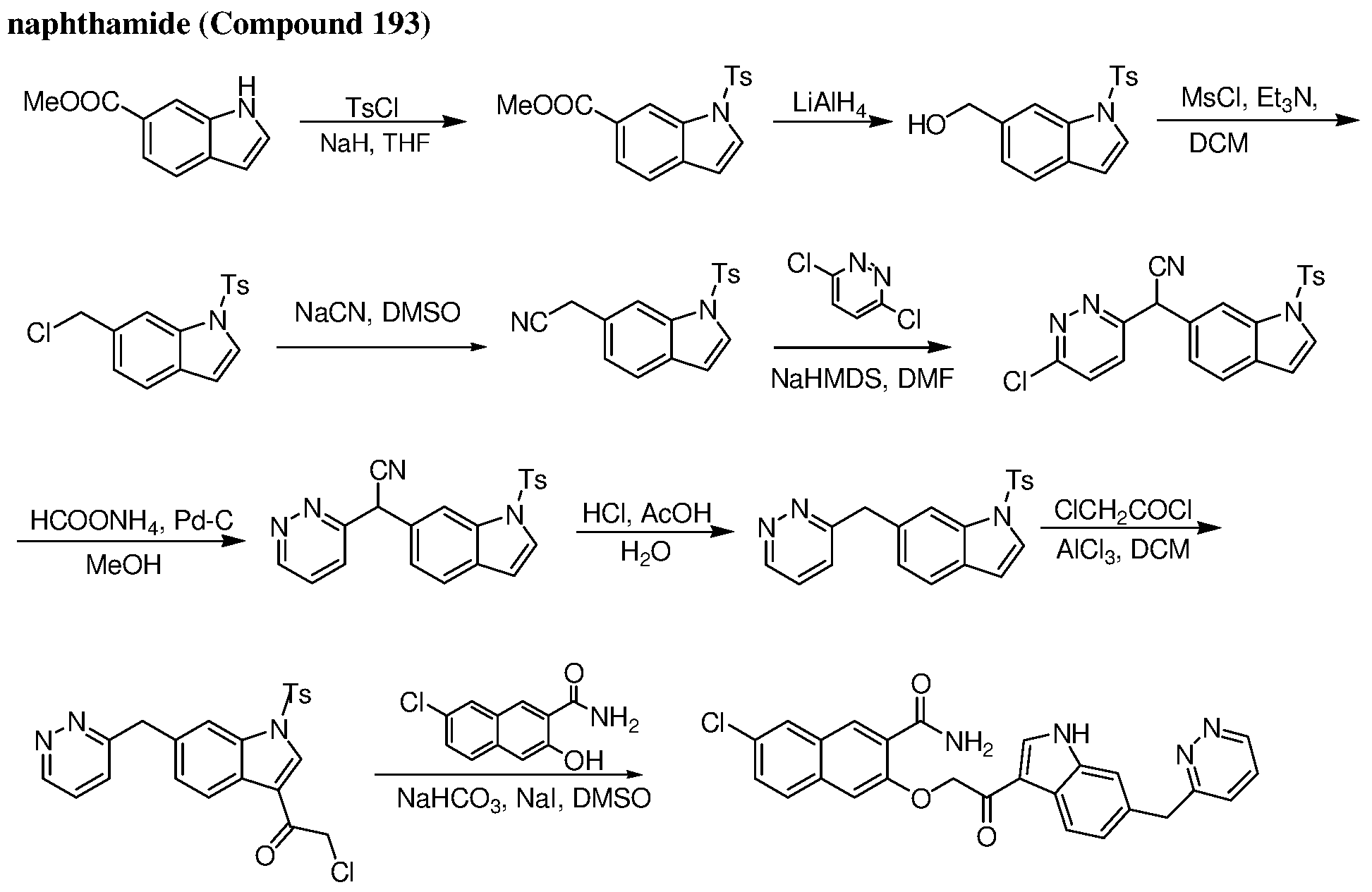
[0427] Step A. Methyl l-tosyl-lH-indole-6-carboxyl te. A mixture of methyl lH-indole-6- carboxylate (1.75 g, 10 mmol) and NaH (0.52 g, 13 mmol, 60% in oil) in THF (20 mL) was stirred at r.t. for 30 min, followed by addition of a solution of 4-methylbenzene-l-sulfonyl chloride (2.85 g, 15 mmol) in THF (5 mL). The reaction mixture was stirred at r.t. for another lhr, then quenched with water and extracted with EtOAc. The combined organic layers were dried over anhydrous Na2SC>4 and concentrated under reduced pressure. The residue was purified by column chromatography to give the desired product (2.8 g, 85% yield).LCMS: m/z 330 (M+H)+.
[0428] Step B. (l-Tosyl-lH-indol-6-yl)methanol. To a mixture of lithium aluminum hydride (448 mg, 12 mmol) in THF (50 mL) at r.t. was added a solution of methyl l-tosyl-lH-indole-6- carboxylate (2.8 g, 8.5 mmol) in THF (50 mL). The mixture was stirred at r.t. for 2 hr, then quenched with water. The resulting mixture was then diluted with aqueous NaOH (10%wt) and water, and filtered. The filtrate was extracted with EtOAc. The combined organic layers were dried over anhydrous Na2SC>4 and concentrated under reduced pressure. The residue was purified by column chromatography to give the desired product (2.3 g, 65% yield). LCMS: m/z 302 (M+H)+.
[0429] Step C. 6-(Chloromethyl)-l-tosyl-lH-indole. A mixture of (l-tosyl-lH-indol-6- yl)methanol(2.3 g, 7.6 mmol), methanesulfonyl chloride (0.73 mL, 9.4 mmol) and triethyl amine (1.6 mL) in chloroform (20 mL) was stirred at r.t. overnight, then quenched with water and extracted with DCM.
The combined organic layers were dried over anhydrous Na2SC>4 and concentrated under reduced pressure. The residue was purified by column chromatography to give the desired product (1.5 g, 62% yield).
LCMS: m/z 320 (M+H)+.
[0430] Step D. 2-(l-Tosyl-lH-indol-6-yl)acetonitrile. A mixture of 6-(chloromethyl)-l-tosyl- lH-indole (2.5 g, 7.8 mmol) and NaCN (870 mg, 17.7 mmol) in DMSO (40 mL) was stirred at r.t.
overnight, then diluted with water and extracted with EtOAc. The combined organic layers were dried over anhydrous Na2SC>4 and concentrated under reduced pressure. The residue was purified by column chromatography to give the desired product (1.93 g, 79.8% yield). LCMS: m/z 311 (M+H)+.
[0431] Step E. 2-(6-Chloropyridazin-3-yl)-2-(l-tosyl-lH-indol-6-yl)acetonitrile. To a mixture of 2-(l-tosyl-lH-indol-6-yl)acetonitrile (390 mg, 1.26 mmol) in THF (15 mL) at r.t. was added sodium bis(trimethylsilyl)amide (0.66 mL, 1.9 M in THF). The reaction mixture was stirred at r.t. for 1.5 hr, followed by addition of a solution of 3,6-dichloropyridazine (190 mg, 8 mmol) in THF (2 mL). The resulting mixture was stirred at r.t. for another 3 hr, then quenched with water and extracted with EtOAc. The combined organic layers were dried over anhydrous Na2SC>4 and concentrated under reduced pressure. The residue was purified by column chromatography to give the desired product (230mg, 43% yield). LCMS: m/z 423 (M+H)+.
[0432] Step F. 2-(Pyridazin-3-yl)-2-(l-tosyl-lH-indol-6-yl)acetonitrile. A mixture of 2-(6- chloropyridazin-3-yl)-2-(l-tosyl-lH-indol-6-yl)acetonitrile (220 mg, 0.52 mmol), ammonium formate (400 mg) and 10% Pd/C (60 mg) in methanol (5 mL) was stirred at r.t.until complete conversion, then filtered. The filtrate was concentrated under reduced pressure and the residue was purified by column chromatography to give the desired product (120mg, 59% yield). LCMS: m/z 389 (M+H)+.
[0433] Step G. 6-(Pyridazin-3-ylmethyl)-l-tosyl-lH-indole. A mixture of 2-(pyridazin-3-yl)-2- (l-tosyl-lH-indol-6-yl)acetonitrile (200 mg, 0.52 mmol) in a mixed solvent of cone. HCI/HOAC/H2O (2 mL/1 mL/1 mL) was stirred at 100°C overnight, then concentrated under reduced pressure. The residue was adjusted to pH 8 with saturated aqueous NaHCC and extracted with EtOAc. The combined organic layers were dried over anhydrous Na2SC>4 and concentrated under reduced pressure. The residue was purified by column chromatography to give the desired product (190mg, quant. yield).LCMS: m/z 364 (M+H)+.
[0434] Step H. 2-Chloro-l-(6-(pyridazin-3-ylmethyl)-l-tosyl-lH-indol-3- yl)ethanone. A mixture of 6-(Pyridazin-3-ylmethyl)-l-tosyl-lH-indole (91 mg, 0.25 mmol), aluminium chloride (167 mg, 1.26 mmol) and 2-chloroacetyl chloride (0.1 mmol, 1 mmol) in DCM was stirred at r.t. overnight, then diluted with water and extracted with DCM. The combined organic layers were dried over anhydrous Na2SC>4 and concentrated under reduced pressure. The residue was purified by column chromatography to give the desired product (60mg, 55% yield).LCMS: m/z 440 (M+H)+.
[0435] Step I. 7-Chloro-3-(2-oxo-2-(6-(pyridazin-3-ylmethyl)-lH-indol-3-yl)ethoxy)-2- naphthamide. A mixture of 2-chloro-l-(6-(pyridazin-3-ylmethyl)-l-tosyl-lH-indol-3- yl)ethanone (90 mg, 0.25 mmol), 7-chloro-3-hydroxy-2-naphthamide (45 mg, 0.20 mmol), sodium bicarbonate (258 mg, 3.07 mmol) and sodium iodide (46.2 mg, 0.31 mmol) in DMSO (8 mL) was stirred at r.t. overnight, then diluted with water and extracted with DCM. The combined organic layers were dried over anhydrous Na2SC>4 and concentrated under reduced pressure. The residue was purified by column chromatography to give the desired product (45 mg, 55% yield). LC-MS: m/z: 471 (M+H)+. ¾ NMR (400 MHz, DMSO-d6) δ 12.17 (s, 1H),8.64 (s, 1H), 8.59-8.57 (m, 2H), 8.55 (s, 1H), 8.16 (s, 1H), 8.11 (d, 1H, / = 8.0 Hz), 7.88- 7.84 (m, 2H), 7.64 (s, 1H), 7.61-7.55 (m, 3H), 7.45 (s, 1H), 7.19 (d,lH, / = 8.0 Hz), 5.62 (s, 2H), 4.40 (s, 2H).
EXAMPLE 41. Synthesis of 7-chloro-3-(2-(6-(cyclopropylmethyl)-lH-indol-3-yl)-2-oxoethoxy)-2-

[0436] Step A. Cyclopropyl(l-(mesitylsulfonyl)-lH-indol-6-yl)methanol. To a mixture of 1- (mesitylsulfonyl)-lH-indole-6-carbaldehyde (1 g, 3.05 mmol) in dry THF(10 mL) at 0°C under N2was added dropwise a solution of cyclopropylmagnesium bromide (887 mg, 6.11 mmol). The reaction mixture
was stirred at that temperature for 10 min, then quenched with saturated aqueous NH4CI and extracted with EtOAc. The combined organic layers were dried over anhydrous Na2SC>4 and concentrated under reduced pressure. The residue was purified by column chromatography to give the desired product (1.1 g, 97.0% yield). LC-MS: m/z 370 (M+H)+.
[0437] Step B. 6-(Cyclopropylmethyl)-l-(mesitylsulfonyl)-lH-indole. To a mixture of cyclopropyl(l-(mesitylsulfonyl)-lH-indol-6-yl)methanol (1.1 g, 2.98 mmol) in DCM(10 mL) at 0°C under N2was added dropwise a solution of TFA (679 mg, 5.95 mmol). The reaction mixture was stirred at 0°C for 10 min, followed by addition of a solution of Et3SiH (692 mg, 5.95 mmol). The resulting mixture was stirred at 0°C for another 10 min, followed by addition of 1M aqueous Na2S20s- The mixture was stirred for lhr, then quenched with saturated aqueous NH4CI and extracted with EtOAc. The combined organic layers were dried over anhydrous Na2SC>4 and concentrated under reduced pressure. The residue was purified by column chromatography to give the desired product (800 mg, 76% yield). LC-MS: m/z 354 (M+H)+.
[0438] Step C. l-(6-(Cyclopropylmethyl)-l-(mesitylsulfonyl)-lH-indol-3-yl)ethanone. To a mixture of AICI3 (150 mg, 1.13 mmol) in anhydrous DCM (8 mL) at -5°C was added acetyl chloride (133 mg, 1.70 mmol), followed by addition of a solution of 6-(cyclopropylmethyl)-l-(mesitylsulfonyl)-lH- indole (200 mg, 0.57 mmol) in anhydrous DCM (1 mL). The reaction mixture was stirred at that temperature for 10 min, then quenched with aqueous HC1 (0.1N, 3 drops). The resulting mixture was poured into ice-water and extracted with DCM. The combined organic layers were dried over anhydrous Na2SC>4 and concentrated under reduced pressure. The residue was purified by column chromatography to give the desired product (220 mg, 98% yield) LC-MS: m/z 396 (M+H)+.
[0439] Step D. 2-Chloro-l-(6-(cyclopropylmethyl)-l-(mesitylsulfonyl)-lH-indol-3-yl)ethanone. A mixture of l-(6-(cyclopropylmethyl)-l-(mesitylsulfonyl)-lH-indol-3-yl)ethanone(200 mg, 0.51 mmol) and TEA (153 mg, 1.52 mmol) in 8 mL of DCM was cooled to -5 to -IO C, followed by addition of TMSOTf (225 mg, 1.01 mmol). The reaction mixture was stirred at that temperature for 2hr, followed by addition of NCS (67 mg , 0.51 mmol) in one portion. The resulting mixture was stirred for another lhr, then diluted with EtOAc and washed with saturated aqueous NaHCC . The organic layer was dried over anhydrous Na2SC>4 and concentrated under reduced pressure. The residue was purified by silica gel column chromatography to give the desired product (160 mg, 73.6% yield). LC-MS: m/z 430 (M+H)+.
[0440] Step E. 7-Chloro-3-(2-(6-(cyclopropylmethyl)-l-(mesitylsulfonyl)-lH-indol-3-yl)-2- oxoethoxy)-2-naphthamide. A mixture of 2-chloro-l-(6-(cyclopropylmethyl)-l-(mesitylsulfonyl)-lH- indol-3-yl)ethanone (160 mg, 0.37 mmol), 7-chloro-3-hydroxy-2-naphthamide (82 mg, 0.37 mmol), NaHC03 (409 mg, 5.58 mmol), and Nal (82 mg, 0.74 mmol) in 10 mL of DMSO was stirred at 25°C overnight. The resulting mixture was poured into water and filtered. The solid was collected and dried
under high vacuum to give the crude product (130 mg, 57% crude yield) which was directly used in the next step without any further purification. LC-MS: m/z 615 (M+H)+.
[0441] Step F. 7-Chloro-3-(2-(6-(cyclopropylmethyl)-lH-indol-3-yl)-2-oxoethoxy)-2- naphthamide. To a mixture of 7-chloro-3-(2-(6-(cyclopropylmethyl)-l-(mesitylsulfonyl)-lH-indol-3-yl)- 2-oxoethoxy)-2-naphthamide (130 mg, 0.21 mmol) in THF (5 mL) and MeOH (5 mL) was added a solution of NaOH (17 mg, 0.42 mmol) in H2O (1 mL). The reaction mixture was stirred at r.t. for 0.5 h, then extracted with DCM. The combined organic layers were dried over anhydrous Na2SC>4 and concentrated under reduced pressure. The residue was purified by prep-HPLC to give the desired product (3.5 mg, 3.8 % yield). LC-MS: m/z 433 (M+H)+.'H NMR (400 MHz, DMSO-d6)512.07 - 12.14 (m, 1 H), 8.63 - 8.69 (m, 1 H), 8.55 (s, 2 H), 8.16 (d, /=2.0 Hz, 1 H), 8.08 (d, /=8.0 Hz, 1 H), 7.88 - 7.92 (m, 1 H), 7.84 (s, 1 H), 7.65 (s, 1 H), 7.54 - 7.59 (m, 1 H), 7.39 (s, 1 H), 7.15 (s, 1 H), 5.62 (s, 2 H), 2.58 - 2.64 (m, 2 H), 0.96 - 1.03 (m, 1 H), 0.44 - 0.51 (m, 2 H), 0.22 (d, /=4.0 Hz, 2 H).
EXAMPLE 42. Synthesis of 7-chloro-3-(2-oxo-2-(6-((2-oxopyrrolidin-l-yl)methyl)-lH-indol-3-

[0442] Step A. l-((l-Tosyl-lH-indol-6-yl)methyl)pyrrolidin-2-one. A mixture of pyrrolidin-2- one (170 mg, 2 mmol) and sodium hydride (80 mg, 2 mmol, 60%wt) in THF (10 mL) was stirred at r.t. for 0.5 hr, followed by addition of 6-(chloromethyl)-l-tosyl-lH-indole (638 mg, 2 mmol). The reaction mixture was stirred at that temperature for 1 hr, then quenched with water and extracted with EtOAc. The combined organic layers were dried over anhydrous Na2SC>4 and concentrated under reduced pressure. The residue was purified by prep-HPLC to give the desired product (400 mg, 54% yield). LC-MS: m/z 369 (M+H)+.
[0443] Step B. l-((3-(2-Chloroacetyl)-l-tosyl-lH-indol-6-yl)methyl)pyrrolidin-2-one. A mixture of l-((l-tosyl-lH-indol-6-yl)methyl)pyrrolidin-2-one (91 mg, 0.25 mmol), aluminium chloride
(167 mg, 1.26 mmol) and 2-chloroacetyl chloride (0.1 mmol, 1 mmol) in DCM was stirred at r.t.
overnight, then quenched with water and extracted with DCM. The combined organic layers were dried over anhydrous Na2SC>4 and concentrated under reduced pressure. The residue was purified by prep- HPLC to give the desired product (80 mg, 72% yield). LC-MS: m/z 445 (M+H)+.
[0444] Step C. 7-chloro-3-(2-oxo-2-(6-((2-oxopyrrolidin-l-yl)methyl)-lH-indol-3-yl)ethoxy)-2- naphthamide. A mixture of 1 -((3 -(2-chloroacetyl)- l-tosyl-lH-indol-6-yl)methyl)pyrrolidin-2 -one (90 mg, 0.25 mmol), 7-chloro-3-hydroxy-2-naphthamide (45 mg, 0.20 mmol), sodium bicarbonate (258 mg, 3.07 mmol) and sodium iodide (46.2 mg, 0.31 mmol) in DMSO (8 mL) was stirred at r.t. overnight, then quenched with water and extracted with DCM. The combined organic layers were dried over anhydrous Na2SC>4 and concentrated under reduced pressure. The residue was purified by prep-HPLC to give the desired product (45 mg, 38% yield). LC-MS: m/z 474 (M-H) . ¾ NMR (400 MHz, DMSO-d6) δ 12.2 (s, IH), 8.64 -8.61 (m, 2H), 8.56 (s, IH), 8.16-8.14 (m, 2H), 7.90-7.85 (m, 2H), 7.65 (s, IH), 7.60-7.55 (dd, /= 8.4, 1.6 Ηζ,ΙΗ), 7.39 (s, IH), 7.11 (d, / = 8.4 Ηζ,ΙΗ), 5.63 (s, IH), 4.76 (s, 2H), 3.23 (t, / = 6.8 Hz, 2H), 2.30 (t, / = 7.6 Hz, 2H), 1.95-1.87 (m, 2H).
EXAMPLE 43. Synthesis of 7-chloro-3-(2-(6-cyclopropyl-lH-pyrrolo[2,3-b]pyridin-3-yl)-2- oxoethoxy)-2-naphthamide (Compound 228)

[0445] Step A. lH-pyrrolo[2,3-b]pyridine-7-oxide. To a mixture oflH-pyrrolo[2,3b)]pyridine (4.6 g, 39 mmol) in dimethoxyethane (150 mL) in an ice bath was added in portions 3-chloroperbenzoic acid (85% purity, 13.4g, 66.3 mmol). The reaction mixture was stirred at r.t. for 2 hr, then concentrated under reduced pressure to half volume and filtered. The precipitate was collected and washed with ether then suspended in water (70 mL). The pH of the suspension was adjusted to pH 9 with saturated potassium carbonate solution and left in the refrigerator overnight. The resulting mixture was filtered and the solid was washed with hexane and dried under high vacuum to afford the desired product as white
solid. (2.5 g, 48% yield) which was directly used in the next step without any further purification.
LC-MS: m/z 135 (M+H)+.
[0446] Step B. Ethyl 6-chloro-lH-pyrrolo[2,3-b]pyridine-l-carboxylate.To a mixture of 1H- pyrrolo[2,3-b]pyridine 7-oxide (2.5 g, 18.6 mmol) in THF (200 mL) under N2 at r.t. was added
1,1,1,3,3,3-hexamethyldisilazane (3.3 g, 20.5 mol), followed by dropwise addition of ethyl chloroformate (7.0 g, 65.2 mmol). The reaction mixture was stirred at r.t. for 2 hr, then concentrated under reduced pressure. The residue was dissolved in EtOAc, washed with saturated aqueous sodium bicarbonate, dried over anhydrous Na2SC>4, and concentrated under reduced pressure. The residue was purified by column chromatography to give the desired product as colorless oil (2.8 g, 58% yield). LC-MS: m/z 225 (M+H)+.
[0447] Step C. 6-Chloro-lH-pyrrolo[2,3-b]pyridine. To a mixture of ethyl 6-chloro-lH- pyrrolo[2,3-b]pyridine-l-carboxylate (3.0 g, 13.4 mmol) in methanol(100 mL) was added aqueous sodium hydroxide (40 mL, IN) . The reaction mixture was stirred at r.t. for 4 hr, then concentrated under reduced pressure. The residue was extracted with DCM. The combined organic layers were dried over anhydrous Na2SC>4, and concentrated under reduced pressure to give the desired product as white solid (1.9 g, 95% crude yield) which was directly used in the next step without any further purification.
LC-MS: m/z 153 (M+H)+.
[0448] Step D. l-(6-Chloro-lH-pyrrolo[2,3-b]pyridin-3-yl)ethanone.To a mixture of AICL (692 mg, 5.2 mmol) in anhydrous DCM (30 mL) at 0°C was added acetyl chloride (483 mg, 7.8 mmol). The reaction mixture was stirred at that temperature for 1 hr, followed by addition of a solution of 6-chloro- lH-pyrrolo[2,3-b]pyridine (400mg, 2.6 mmol) in anhydrous DCM (20 mL). The resulting reaction was stirred at r.t. for 2 hr, then poured into ice water and extracted with DCM. The combined organic layers were dried over anhydrous Na2SC>4 and concentrated under reduced pressure. The residue was purified by column chromatography to give the desired product (300 mg, 60% yield). LC-MS: m/z 195 (M+H)+.
[0449] Step E. l-(6-Chloro-l-(mesitylsulfonyl)-lH-pyrrolo[2,3-b]pyridin-3-yl)ethanone. To a mixture of l-(6-chloro-lH-pyrrolo[2,3-b]pyridin-3-yl)ethanone (194 mg, 1 mmol) in anhydrous THF (20 mL) at 0°C was added NaH (80 mg, 2.0 mmol, 60%w/w). The mixture was stirred at that temperature for 1 hr, followed by addition of 2,4,6-trimethylbenzene-l-sulfonyl chloride (262 mg, 1.2 mmol). The resulting mixture was stirred at r.t. for 1 hr, then quenched with ice water and extracted with EtOAc. The combined organic layers were dried over anhydrous Na2SC>4 and concentrated under reduced pressure. The residue was purified by column chromatography to give the desired product (200 mg, 53% yield). LC-MS: m/z: 377 (M+H)+.
[0450] Step F. l-(6-Cyclopropyl-l-(mesitylsulfonyl)-lH-indol-3-yl)ethanone. A mixture of 1- (6-chloro-l-(mesitylsulfonyl)-lH-pyrrolo[2,3-b]pyridin-3-yl)ethanone (200 mg, 0.53 mmol),
cyclopropylboronic acid (228 mg, 2.66 mmol), palladium acetate (24 mg, 0.106mmol), potassium
phosphate tribasic (225 mg, 1.0 mmol), and tricyclohexylphosphine (30 mg, 0.106 mmol) in water (0.6 mL) and toluene(4 mL)was stirred under N2 at 100 °C for 16 hr in a sealed tube. The resulting mixture was concentrated under reduced pressure and the residue was purified by column chromatography to afford the desired product (180 mg, 89% yield). LC-MS: m/z 383 (M+H)+.
[0451] Step G. 2-Chloro-l-(6-cyclopropyl-l-(mesitylsulfonyl)-lH-pyrrolo[2,3-b]pyridin-3- yl)ethanone. A mixture of l-(6-cyclopropyl-l-(mesitylsulfonyl)-lH-pyrrolo[2,3-b]pyridin-3-yl)ethanone (180 mg, 0.47 mmol), TEA (71 mg, 0.71 mmol) in lOmL of DCM was cooled to -5 to -10°C, followed by addition of TMSOTf (125 mg, 0.56 mmol). The reaction mixture was stirred at that temperature for 2 hr, followed by addition of NCS (69 mg, 0.52 mmol) in one portion. The resulting mixture was stirred for another 10 min, then diluted with DCM and washed with saturated aqueous NaHCC . The organic layer was dried over anhydrous Na2SC>4 and concentrated under reduced pressure. The residue was purified by column chromatography to give the desired product (150 mg, 77% yield). LC-MS: m/z 417 (M+H)+.
[0452] Step H. 7-Chloro-3-(2-(6-cyclopropyl-l-(mesitylsulfonyl)-lH-pyrrolo[2,3-b]pyridin-3- yl)-2-oxoethoxy)-2-naphthamide. A mixture of 2-chloro-l-(6-cyclopropyl-l-(mesitylsulfonyl)-lH- pyrrolo[2,3-b]pyridin-3-yl)ethanone (150 mg, 0.36 mmol), 7-chloro-3-hydroxy-2-naphthamide (72 mg, 0.32 mmol), NaHC03 (413 mg, 4.9 mmol), and Nal (98 mg, 0.65 mmol) in 4 mL of DMSO was stirred at 30°C for 14 hr, then poured into water and filtered. The solid was collected and dried under high vacuum to afford the crude product (200 mg, 75% crude yield) which was directly used in the next step without any further purification. LC-MS: m/z 602 (M+H)+.
[0453] Step I. 7-Chloro-3-(2-(6-cyclopropyl-lH-pyrrolo[2,3-b]pyridin-3-yl)-2-oxoethoxy)-2- naphthamide. To a mixture of 7-chloro-3-(2-(6-cyclopropyl-l-(mesitylsulfonyl)-lH-pyrrolo[2,3- b]pyridin-3-yl)-2-oxoethoxy)-2-naphthamide (200 mg, 0.33 mmol) in THF (10 mL) and MeOH (5 mL) was added a solution of NaOH (53 mg, 1.3 mmol) in H2O (0.5 mL). The reaction mixture was stirred at r.t. for 2hr, then concentrated under reduced pressure. The residue was purified by column
chromatography to afford the crude product which was re -crystallized from MeOH to give the pure product (80 mg, 57% yield). LC-MS: m/z 420 (M+H)+. ¾ NMR (400 MHz, DMSO-d6) δ 12.56 (s, 1H), 8.62-8.55 (m, 3H), 8.33 (d, / = 8.0 Hz, 1H), 8.16 (d, / = 2 Hz, 1H), 7.89 - 7.84 (m, 2H), 7.64 (s, 1H), 7.58 - 7.55 (m, 2H), 7.23 (d, / = 7.8 Hz, 1H), 5.63 (s, 2H), 2.23-2.16 (m, 1H), 1.028 - 0.93 (m, 4H).
EXAMPLE 44. Synthesis of l-((3-(2-((3-carbamoyl-6-chloronaphthalen-2-yl)oxy)acetyl)-lH-indol-6-

HCOO"
[0454] Step A. Methyl l-(mesitylsulfonyl)-lH-indole-6-carboxylate .To a mixture of methyl lH-indole-6-carboxylate (lOg, 0.057mol) in anhydrous THF (100 mL) at 0°C was slowly added NaH (2.9 g, 0.074 mol, 60 wt). The reaction mixture was stirred at r.t. for lhr, followed by addition of a solution of 2,4,6-trimethylbenzene-l-sulfonyl chloride (16 g, 0.074 mol) in anhydrous THF (100 mL). The resulting mixture was stirred at r.t. for another lhr, then quenched with ice water and extracted with EtOAc. The combined organic layers were dried over anhydrous Na2SC>4 and concentrated under reduced pressure. The residue was purified by column chromatography to give the desired product (18g, 88.8% yield) as white solid. LC-MS: m/z 358 (M+H)+.
[0455] Step B. Methyl 3-acetyl-l-(mesitylsulfonyl)-lH-indol -6-carboxyl te. To a mixture of AICI3 (8.9 g, 67.22mmol) in anhydrous DCM (50 mL) at 0°C was added acetyl chloride (4.7 mL, 67.22mmol). The mixture was stirred at 0°C for lhr, followed by addition of a solution of methyl 1- (mesitylsulfonyl)-lH-indole-6-carboxylate (8 g, 22.41mmol) in anhydrous DCM (50 mL). The resulting mixture was stirred at r.t for lOmin, then quenched with cold saturated aqueous NaHCC and extracted with EtOAc. The combined organic layers were dried over anhydrous Na2SC>4 and concentrated under reduced pressure. The residue was purified by column chromatography to give the desired product (8g, 89.9% yield) as white solid. LC-MS: m/z400 (M+H)+.
[0456] Step C. l-(6-(Hydroxymethyl)-l-(mesitylsulfonyl)-lH-indol-3-yl)ethanol. To a mixture of L1AIH4 (380 mg, 10.00 mmol) in anhydrous THF (5 mL) at 0°C was slowly added methyl 3-acetyl-l- (mesitylsulfonyl)-lH-indole-6-carboxylate (1 g, 2.51mmol).The reaction mixture was stirred at r.t. for 2 hr, then quenched with MeOH and extracted with EtOAc. The combined organic layers were dried over anhydrous Na2SC>4 and concentrated under reduced pressure. The residue was purified by column chromatography to give the desired product (800 mg, 85.5% yield) as white solid.
[0457] Step D. l-(6-((Tert-butyldimethylsilyloxy)methyl)-l-(mesitylsulfonyl)-lH-indol-3- yl)ethanol. To a mixture of l-(6-(hydroxymethyl)-l-(mesitylsulfonyl)-lH-indol-3-yl)ethanol (800 mg, 2.14 mmol), imdiazole (291 mg, 4.28 mmoL) in anhydrous DCM (10 mL) at 0°C was slowly added TBSC1 (321 mg, 2.14mmol).The mixture was stirred at r.t. overnight, then quenched with ice water and extracted with EtOAc. The combined organic layers were washed with brine, dried over anhydrous Na2SC>4 and concentrated under reduced pressure. The residue was purified by column chromatography to give the desired product (900mg, 86.8% yield) as white solid.
[0458] Step E. l-(6-((Tert-butyldimethylsilyloxy)methyl)-l-(mesitylsulfonyl)-lH-indol-3- yl)ethanone. To a mixture of l-(6-((tert-butyldimethylsilyloxy)methyl)-l-(mesitylsulfonyl)-lH-indol-3- yl)ethanol (900 mg, 1.85 mmol) in anhydrous DCM (50 mL) at 0°C was slowly added Mn02 (1.6 g, 18.48 mmol). The mixture was stirred at 30°C overnight and filtered. The filtrate was concentrated under reduced pressure, and the residue was purified by column chromatography to give the desired product (800 mg, 89.2% yield) as white solid. LC-MS: m/z 486 (M+H)+.
[0459] Step F. 2-Bromo-l-(6-((tert-butyldimethylsilyloxy)methyl)-l-(mesitylsulfonyl)-lH- indol-3-yl)ethanone. To a mixture of l-(6-((tert-butyldimethylsilyloxy)methyl)-l-(mesitylsulfonyl)-lH- indol-3-yl)ethanone (800 mg, 1.65 mmol), and TEA (0.32 mL, 2.31mmol) in anhydrous DCM (20 mL) at -10°C was added TMSOTf (0.36 mL, 1.98mmol). The reaction mixture was stirred at that temperature for 2 hr, followed by addition of NBS (293 mg, 1.65 mmol) in one portion. The resulting mixture was stirred another 10 min, then quenched with ice water and extracted with EtOAc. The combined organic layers were dried over anhydrous Na2S04 and concentrated under reduced pressure. The residue was purified by
column chromatography to give the desired product (350 mg, 37.7% yield) as colorless oil. LC-MS: m/z 564 (M+H)+.
[0460] Step G. 3-(2-(6-((Tert-butyldimethylsilyloxy)methyl)-l-(mesitylsulfonyl)-lH-indol-3-yl)- 2-oxoethoxy)-7-chloro-2-naphthamide. A mixture of 2-bromo-l-(6-((tert-butyldimethylsilyloxy)methyl)- l-(mesitylsulfonyl)-lH-indol-3-yl)ethanone (350 mg, 0.62mmol), 7-chloro-3-hydroxy-2-naphthamide (137 mg, 0.62mmol), NaHC03 (986 mg, 9.30 mmol) and Nal (140 mg, 0.93mmol) in DMSO (10 mL) was stirred at 30°C for 16 hr, then poured into ice water and filtered. The solid was collected and dried under high vacuum to give the crude product (500 mg) as yellow solid which was directly used in the next step without any further purification. LC-MS: m/z 705 (M+H)+.
[0461] Step H. 7-chloro-3-(2-(6-(hydroxymethyl)-l-(mesitylsulfonyl)-lH-indol-3-yl)-2- oxoethoxy)-2-naphthamide. To a mixture of 3-(2-(6-((tert-butyldimethylsilyloxy)methyl)-l- (mesitylsulfonyl)-lH-indol-3-yl)-2-oxoethoxy)-7-chloro-2-naphthamide (500 mg, 0.71 mmol) in THF (30 mL) was slowly added TBAF (556 mg, 2.13 mmol). The mixture was stirred at r.t. for 1 hr, then poured into ice water and filtered. The solid was purified by column chromatography to give the desired product (70 mg, 24.2% yield) as white solid. LC-MS: m/z 407 (M-H) .
[0462] Step I. l-((3-(2-(3-Carbamoyl-6-chloronaphthalen-2-yloxy)acetyl)-lH-indol-6- yl)methyl)pyridiniumformate. To a mixture of 7-chloro-3-(2-(6-(hydroxymethyl)-lH-indol-3-yl)-2- oxoethoxy)-2-naphthamide (28 mg, 0.068 mmol) in dry DCM (10 mL) at 0°C were added THF (10 mL) and pyridine (1 mL), followed addition of MsCl (0.1 mL). The reaction mixture was stirred at r.t. for 24 hr, followed by addition of DCM (10 mL), THF (10 mL), pyridine (1 mL) and MsCl (0.1 mL). The resulting mixture was stirred at 40°C for another 24 hr, then concentrated under reduced pressure. The residue was purified by prep-HPLC (HCOOH system) to give the desired product (9 mg, 28% yield) as white solid. LC-MS: m/z 470(M)+. ¾ NMR (400 MHz, DMSO-d6) δ 13.1 (br, 1H), 9.23 (d, / = 6.0 Hz, 1H), 8.70 (s, 1H), 8.59-8.63 (m, 2H), 8.54 (s, 1H), 8.47 (s, 1.4H), 8.15-8.24 (m, 4H), 7.82-7.88 (m, 3H), 7.64 (s, 1H), 7.55-7.57 (m, 1H), 7.39 (d, / = 8.4 Hz, 1H), 5.96 (s, 2H), 5.63 (s, 2H).
EXAMPLE 45. Synthesis of (3-(2-((3-carbamoyl-6-chloronaphthalen-2-yl)oxy)acetyl)-6-cyclopropyl- -indol-l-yl)methyl dihydrogen phosphate

[0464] LC-MS: m z 527 (M-H) . *H NMR (400 MHz, DMSO-d6) δ 8.68 (s, 1H), 8.58 (s, 1H),
8.54 (s, 1H), 8.15 (d, / = 1.6 Hz, 1H), 8.06 (d, / = 6.0 Hz, 1H), 7.90 - 7.85 (m, 2H), 7.63 (s, 1H), 7.58 -
7.55 (m, 2H), 7.45 (s, 1H), 7.06 (d, / = 8.4 Hz, 1H), 6.01 (d, / = 9.2 Hz, 2H), 5.69 (s, 2H), 2.06 - 2.02 (m, 1H), 1.01 - 0.97 (m, 2H), 0.75 - 0.72 (m, 2H). 31P NMR (121.5 MHz, DMSO-d6) δ -2.486 (s).
EXAMPLE 46. Synthesis of 7-chloro-3-(2-(6-cyclopropyl-lH-indazol-3-yl)- 2-oxoethoxy)-2-

concentrated under reduced pressure. The residue was purified on column chromatography to give the desired product (3.2 g, 96% yiled) as brown oil. LC-MS: m/z 327 (M+H)+.
[0466] Step B. 6-Cyclopropyl-l-((2-(trimethylsilyl)ethoxy)methyl)-lH-indazole. A mixture of 6- bromo-l-((2-(trimethylsilyl)ethoxy)methyl)-lH-indazole (3.0 g, 9.16 mmol), cyclopropylbronic acid (3.94 g, 45.83 mmol), Pd(OAc)2 (205.6 mg, 0.916 mmol), tricyclohexylphosphine (308 mg, 1.1 mmol) and K3PO4 (3.89 g, 18.3 mmol) in toluene/H20 (30 mL/1.6 mL) under N2 was stirred at 100°C for 16 hr. The resulting mixture was cooled to r.t. then partitioned between EtOAc and water. The organic layer was separated, washed with brine, dried over anhydrous Na2S04 and concentrated under reduced pressure. The residue was purified by column chromatography to give the desired product (2.3 g, 87% yield) as brown oil. LC-MS: m/z 289 (M+H)+.
[0467] Step C. 6-Cyclopropyl-lH-indazole. A mixture of 6-cyclopropyl-l-((2-(trimethyl - silyl)ethoxy)methyl)-lH-indazole (200 mg, 0.69 mmol) and TFA (1 mL) in DCM (3 mL) was stirred at r.t for 16 hr then concentrated under reduced pressure. The resiedue was dissolved in DCM (5 mL), followed by addition of ethylenediamine (2.0 mL). The resulting mixture was stirred at r.t. for 16 hr then partitioned between water and DCM. The organic layer was separated, washed with water and brine, dried over anhydrous Na2SC>4, and concentrated under reduced pressure. The residue was purified by column chromatography to give the desired product (60 mg, 55% yield) as white solid. LC-MS: m/z 159 (M+H)+.
[0468] Step D. 6-Cyclopropyl-3-iodo-lH-indazole. To a mixture of 6-cyclopropyl-lH- indazole (0.94 g, 5.94 mmol) in DMF (20 mL) at 0°C was added I2 (3.01 g, 11.88 mmol) and KOH (1.34 g, 23.76 mmol). The reaction mixture was stirred at r.t. for 3 hr then poured into cold aqueous Na2S2C>3 and extracted with EtOAc. The combined organic layers were washed with water and brine, dried over anhydrous Na2S04, and concentrated under reduced pressure. The residue was purified by column chromatography to give the desired product (1.24 g, 80% yield) as brown solid. LC-MS: m/z 285 (M+H)+.
[0469] Step E. Methyl 6-cyclopropyl-lH-indazole-3-carboxylate. A mixture of 6-cyclopropyl-3- iodo-lH-indazole (1.24 g, 4.36 mmol), Pd(dppf)Cl2 (95.7 mg, 0.13 mmol), dppf (96.7 mg, 0.17 mmol) and Et3N (750 mg, 7.41 mmol) in toluene/methanol (15 mL/ 15 mL) was stirred at 70°C for 6 hr under an atmosphere of carbon monoxide. The resulting mixture was cooled to r.t. and concentrated under reduced
pressure. The residue was purified by column chromatography to give the desired product (750 mg, 79% yield) as brown solid. LC-MS: m/z 217 (M+H)+.
[0470] Step F. 6-Cyclopropyl-lH-indazole-3-carboxylic acid. A mixture of methyl 6- cyclopropyl-lH-indazole-3-carboxylate (650 mg, 3.0 mmol) and NaOH (600 mg, 15.0 mmol) in
THF/MeOH/thO (18 mL/12 mL/4.5 mL) was stirred at 60°C for 4 hr then concentrated under reduced pressure to a volume of about 10 mL. The resulting mixture was diluted with water (10 mL) and washed with DCM. The aqueous phase was separated and acidified by aqueous HC1 (4 N) to pH to 5 - 6 at 0°C. The precipitated solid was collected and dried under high vacuum to give the desired product (600 mg, quant, crude yield) as brown solid which was used in the next step without any further purification.
LC-MS: m/z 203 (M+H)+.
[0471] Step G. 6-Cyclopropyl-N-methoxy-N-methyl-lH-indazole-3-carboxamide. A mixture of 6-cyclopropyl-lH-indazole-3-carboxylic acid (640 mg, 3.17 mmol), EDCI (1.09 mmol), pyridine (1.3 g, 16.48 mmol) and Ν,Ο-dimethylhydroxylamine hydrochloride (370 mg, 3.8 mmol) in THF (30 mL) was stirred at r.t for 16 hr then partitioned between EtOAc and water. The organic layer was separated, washed in sequence with diluted HC1 (IN), water, and brine, dried over anhydrous Na2SC>4, and concentrated under reduced pressure to give the desired product (700 mg, 90% crude yield) as brown solid which was used in the next step without any further purification. LC-MS: m/z 246 (M+H)+.
[0472] Step H. l-(6-Cyclopropyl-lH-indazol-3-yl)ethanone. To a mixture of 6-cyclopropyl-N- methoxy-N-methyl-lH-indazole-3-carboxamide (700 mg, 2.85 mmol) in anhydrous THF (30 mL) at 0°C was added MeMgBr (3.0 M in ether, 3.8 mL, 11.4 mmol) over 15 min. The reaction mixture was stirred at 0°C for 1.5 hr then slowly poured into ice-cooled saturated aqueous NH4CI with vigorous stirring. The resulting mixture was extracted with EtOAc for twice. The combined organic layers were washed with water and brine, dried over anhydrous Na2SC>4, and concentrated under reduced pressure. The residue was purified by column chromatography to give the desired product (530 mg, 92% yield) as brown solid. LC-MS: m/z 201 (M+H)+.
[0473] Step I. l-(6-Cyclopropyl-l-(mesitylsulfonyl)-lH-indazol-3-yl)ethanone. To a mixture of l-(6-cyclopropyl-lH-indazol-3-yl)ethanone (100 mg, 0.5 mmol) in anhydrous THF (5 mL) at 0°C was added NaOH (60% in minerial oil, 40 mg, 1.0 mmol). The mixture was stirred at 0°C for 10 min then at r.t. for 2 hr. The resulting mixture was cooled to 0°C again, followed by addition of a solution of 2,4,6- trimethyl benzene- 1-sulfonyl chloride (164 mg, 0.75 mmol) in 2 mL of anhydrous THF. The mixture was stirred at r.t. for 1 hr then quenched with saturated aquesous NH4CI and extracted with EtOAc. The combined organic layers were washed with brine, dried over anhydrous Na2S04, and concentrated under reduced pressure. The residue was purified by column chromatography to give the desired product (130 mg, 67% yield) as white solid. LC-MS: m/z 383 (M+H)+.
[0474] Step J. l-(6-Cyclopropyl-l-(mesitylsulfonyl)-lH-indazol-3-yl)ethanone. To a mixture of l-(6-cyclopropyl-l-(mesitylsulfonyl)-lH-indazol-3-yl)ethanone (130 mg, 0.34 mmol) and Et3N (69 mg, 0.68 mmol) in DCM (5 mL) at 0°C was added TMSOTf (113 mg, 0.51 mmol). The mixture was stirred at r.t. for 2 hr then cooled to 0°C, followed by addition of NBS (54 mg, 0.31 mmol). The mixture was stirred at that temperature for 2 hr then poured into water and extracted with DCM. The combined organic layers were dried over anhydrous Na2SC>4, and concentrated under reduced pressure. The residue was purified by column chromatography to give the desired product (120 mg, 76% yield) as white solid. LC-MS: m/z 462 (M+H)+.
[0475] Step K. 7-Chloro-3-(2-(6-cyclopropyl-lH-indazol-3-yl)-2-oxoethoxy)-2 -naphthamide.
A mixture of 7-chloro-3-hydroxy-2-naphthamide (57 mg, 0.26 mmol), 2-bromo-l-(6-cyclopropyl-l- (mesitylsulfonyl)-lH-indazol-3-yl)ethanone (120 mg, 0.26 mmol), NaHCC (218 mg, 2.6 mmol) and Nal (39 mg, 0.26 mmol) in anhydrous DMSO (2 mL) was stirred at 25 °C for 16 hr then partitioned between EtOAc and water. The organic layer was separated, washed with brine, dried over anhydrous Na2SC>4, and concentrated under reduced pressure. The residue was purified by pre-HPLC to give the desired product (8.0 mg, 7.5% yield) as white solid. LC-MS: m/z 420 (M+H)+.
[0476] ¾ NMR (400 MHz, DMSO-d6) δ 8.57 (s, 1H), 8.52 (s, 1H), 8.42 (s, 1H), 8.15 (d, / = 2.0 Hz, 1H), 8.04 (d, / = 8.4 Hz, 1H), 7.91-7.94 (m, 2H), 7.66 (s, 1H), 7.53-7.56 (m, 1H), 7.41 (s, 1H), 7.06- 7.08(m, 1H), 5.86 (s, 2H), 2.09-2.15 (m, 1H), 1.00-1.05 (m, 2H), 0.76-0.80 (m, 2H).
EXAMPLE 47. Synthesis of 7-Chloro-3-(2-(6-cyclopropyl-lH-pyrrolo [2,3-b]pyridin-3-yl)-2-

[0477] Step A. 2-Bromo-l-(6-chloro-l-(mesitylsulfonyl)-lH-pyrrolo[2,3-b]pyridin-3-yl) ethanone. To a mixture of l-(6-chloro-l-(mesitylsulfonyl)-lH-pyrrolo[2,3-b] pyridin -3-yl)ethanone (540
mg, 1.4 mmol), TEA (217 mg, 2.1 mmol) in 80 mL of DCM at below -5°C was added TMSOTf (373 mg, 1.68 mmol). The mixture was stirred at that temperature for 2 hr, followed by addition of NBS (267 mg , 1.5 mmol) in one portion. The mixture was stirred for another 10 min then diluted with DCM and washed with saturated aqueous NaHCC . The organic layer was separated, dried over anhydrous Na2SC>4 and concentrated under reduced pressure. The residue was purified by column chromatography to give the desired product (600 mg, 90% yield). LC-MS: m/z 457 (M+H)+.
[0478] Step B. 7-Chloro-3-(2-(6-chloro-l-(mesitylsulfonyl)-lH-pyrrolo[2,3-b]pyridin-3-yl)-2- oxoethoxy)-2-naphthamide. A mixture of 2-bromo-l-(6-chloro-l-(mesitylsulfonyl) -lH-pyrrolo[2,3- b]pyridin-3-yl)ethanone (456 mg, 1.0 mmol), 7-chloro-3-hydroxy-2 -naphthamide (221 mg, 1.0 mmol), NaHC03 (1.26 g, 15 mmol), and Nal (300 mg, 2.0 mmol) in 10 mL of DMSO was stirred at 30°C for 14 hr then poured into water and filtered. The solid was collected and dried under high vacuum to give the crude product which was used in the next step without any further purification. LC-MS: m/z 596 (M+H)+.
[0479] Step C. 7-Chloro-3-(2-(6-chloro-lH-pyrrolo[2,3-b]pyridin-3-yl)-2-oxoethoxy)-2- naphthamide. To a mixture of 7-chloro-3-(2-(6-chloro-l-(mesitylsulfonyl)-lH -pyrrolo[2,3-b]pyridin-3- yl)-2-oxoethoxy)-2-naphthamide (450 mg, 0.75 mmol) in THF (100 mL) and MeOH (1 mL) was added a solution of NaOH (120 mg, 3.0 mmol) in ¾0 (10 mL). The mixture was stirred at r.t. for 2 hr then concentrated under reduced pressure. The residue was purified by column chromatography to afford the crude product which was re-crystallized from MeOH to give the pure product (200 mg, 48% yield). LC-MS: m/z 414 (M+H)+. ¾ NMR (400 MHz, DMSO-d6) δ 12.94 (s, 1H), 8.79 (s, 1H), 8.54 - 8.50 (m, 3H), 8.16 (d, / = 6.0 Hz, 1H), 7.89 - 7.84 (m, 2H), 7.64 (s, 1H), 7.58 - 7.55 (m, 2H), 7.37 (d, / = 8 Hz, 1H), 5.66 (s, 2H).
EXAMPLE 48 . Synthesis of 2-amino-4-(3-(2-(3-carbamoyl-6-chloronaphthalen-2-yloxy)acetyl)-6- cyclopropyl-lH-indol-l-yl)butanoic acid (Compound 289)

[0480] Step A. (S)-2-(Tert-butoxycarbonyl mino)-4-hydroxybutanoic acid. To a mixture of homoserine sodium salt (1.0 g. 8.4 mmol) in 10 mL of dioxane and 15 mL of water was added NaHCC (1.77 g, 21 mmol). The mixture was cooled to -15°C, followed by dropwise addition of a solution of di- tert-butyl dicarbonate (2 g, 9.2 mmol) in 5 mL of dioxane. The resulting mixture was stirred at r.t. for 12 hr then acidified with diluted aqueous HCl (1 M) and extracted with EtOAc. The combined organic layers were washed with 50 mL of saturated aqueous NaHCC , dried over anhydrous Na2SC>4 and concentrated under reduced pressure to the crude product (1.8 g, 97.6% crude yield) as colorless solid which was directly used in the next step without any further purification. LC-MS: m/z: 220 (M+H)+.
[0481] Step B. (S)-Methyl 2-(tert-butoxycarbonylamino)-4-hydroxybutanoate. To a mixture of(S)-2-(tert-butoxycarbonylamino)-4-hydroxybutanoic acid (1.1 g, 5mmol) in DMF (5 mL) was added K2CO3 (1.38 g, lOmmol) and Mel (1.41 g, 10 mmol). The reaction mixture was stirred at r.t overnight then quenched with water and extracted with EtOAc. The combined organic layers were dried over anhydrous Na2SC>4 and concentrated under reduced pressure. The residue was purified by flash column chromatography to give the desired product (1.0 g, 86% yield) as pale-yellow syrup. LC-MS: m/z 234 (M+H)+.
[0482] Step C. (S)-Methyl 4-bromo-2-(tert-butoxycarbonylamino)butanoate. To a mixture of (S)-methyl 2-(tert-butoxycarbonylamino)-4-hydroxybutanoate (0.6 g, 2.57 mmol) and carbon
tetrabromide (1.26 g, 3.9 mmol) in DCM (10 mL) was added a solution of triphenylphosphine (0.67 g, 2.6 mmol) in DCM (8 mL). The mixture was stirred at r.t. for 16 hr then triturated with heptane (25 mL) and filtered. The filtrate was successively washed with heptane, aqueous NaHCC (5%wt) and brine. The organic was separated, dried over anhydrous MgSC , and concentrated under reduced pressure. The residue was purified by flash column chromatography to afford the desired product (0.6 g, 78% yield) as white solid. LC-MS: m/z: 296 (M+H)+.
[0483] Step D. Methyl 2-(tert-butoxycarbonylamino)-4-(3-(2-(3-carbamoyl-6- chloronaphthalen-2-yloxy)acetyl)-6-cyclopropyl-lH-indol-l-yl)butanoate. To a mixture of 7-chloro-3- (2-(6-cyclopropyl-lH-indol-3-yl)-2-oxoethoxy)-2-naphthamide (100 mg, 0.2 mmol) and methyl 4-bromo- 2-(tert-butoxycarbonylamino)butanoate (180 mg, 0.8 mmol) in DMF (5 mL) was added K2CO3 (138 mg, lmmol). The mixture was stirred at r.t. for 12 hr then quenched with water and extracted with EtOAc. The combined organic layers were dried over anhydrous Na2SC>4 and concentrated under reduced pressure. The residue was purified by flash column chromatography to give the desired product (120 mg, 95% yield) . LC-MS: m/z 634 (M+H)+.
[0484] Step E. Methyl 2-amino-4-(3-(2-(3-carbamoyl-6-chloronaphthalen-2-yloxy)acetyl)-6- cyclopropyl-lH-indol-l-yl)butanoate. A mixture of 2-(tert-butoxycarbonylamino)-4-(3-(2-(3-carbamoyl- 6-chloronaphthalen-2-yloxy)acetyl)-6-cyclopropyl-lH-indol-l-yl)butanoate (120 mg, 0.19mmol) in DCM (5 mL) and TFA (1 mL) was stirred at r.t. for 1 hr then concentrated under reduced pressure to afford the crude product (101 mg, quant, crude yield) which was directly used in the next step without any further purification. LC-MS: m/z: 534 (M+H)+.
[0485] Step F. 2-Amino-4-(3-(2-(3-carbamoyl-6-chloronaphthalen-2-yloxy)acetyl)-6- cyclopropyl-lH-indol-l-yl)butanoic acid. A mixture of 2-amino-4-(3-(2-(3-carbamoyl-6- chloronaphthalen-2-yloxy)acetyl)-6-cyclopropyl-lH-indol-l-yl)butanoate (50 mg, 0.09mmol) and LiOH (lmmol, 24 mg in a mixed solvent of DMF (3 mL), MeOH (3 mL) and H2O (0.5 mL). The mixture was stirred at r.t. for 1 hr then concentrated under reduced pressure. The residue was purified by prep-HPLC to afford the desired product (10 mg, 59% yield). LC-MS: m/z: 520 (M+H)VH NMR (400 MHz, DMSO- d6) δ 8.65 (s, 1H), 8.62 (s, 1H), 8.50 (s, 1H), 8.15 (s, 1H), 7.87-8.07 (m, 3H), 7.65 (s, 1H), 7.57 (m, 1H), 7.43 (s, 1H), 7.02 (m, 1H), 5.55 (s, 2H), 4.46 (m, 2H), 4.03 (m, 1H), 3.15 (m, 2H), 2.05-2.31 (m, 3H), 0.94-0.99 (m, 2H), 0.84-0.86 (m, 2H).
EXAMPLE 49. Synthesis of (R)-3-(2-(l-(4-amino-3-hydroxybutyl)-6-cyclopropyl-lH-indol-3-yl)-2- oxoethoxy)-7-chloro-2-naphthamide (Compound 290)

[0486] Step A. (R)-Butane-l,2,4-triol. To a mixture of BH3 »SMe2 (2 M in THF, 60 mL, 120 mmol) and B(OMe)3 (13.5 g, 130 mmol) in THF (30 mL) at 0°C was added a solution of (R)-malic acid (5.0 g, 37.3 mmol) in THF (30 mL). The mixture was stirred at r.t. for 16 hr then quenched with MeOH (75 mL) and concentrated under reduced pressure. The residue was purified by flash column
chromatography to give afford the desired product (3.5 g, 89 % yield). LC-MS: m/z 107 (M+H)+.
[0487] Step B. ((2R,4R)-2-(4-Methoxyphenyl)-l,3-dioxan-4-yl)methanol. To a solution of (R)- butane- 1,2,4-triol (530 mg, 5.0 mmol) in DCM (20 mL) was added 4-methoxybenzaldehyde (1.0 g, 7.5 mmol) and PPTS (125 mg, 0.5 mmol). The mixture was stirred at 45°C for 20 hr then concentrated under reduced pressure. The residue was purified by column chromatography to give the desired product (900 mg, 80 % yield). LC-MS: m/z 225 (M+H)+.
[0488] Step C. ((2R,4R)-2-(4-Methoxyphenyl)-l,3-dioxan-4-yl)methyl4- methylbenzenesulfonate. To a solution of ((2R,4R)-2-(4-methoxyphenyl)-l,3-dioxan-4-yl)methanol (900 mg, 4.0 mmol) in DCM (50 mL) were added TEA (600 mg, 6.0 mmol), 4-(N,N-dimethylamino)pyridine (50 mg, 0.4 mmol), and toluene -4-sulfonylchloride (912 mg, 4.8 mmol). The mixture was stirred for 15 min then quenched with ice water and extracted with DCM. The combined organic layers were washed with brine, dried over anhydrous Na2SC>4, and concentrated under reduced pressure. The residue was purified by flash column chromatography to afford the desired product (1.2 g, 80% yield). LC-MS: m/z 379 (M+H)+.
[0489] Step D. (2R,4R)-4-(Azidomethyl)-2-(4-methoxyphenyl)-l,3-dioxane. To a mixture of ((2R,4R)-2-(4-methoxyphenyl)-l,3-dioxan-4-yl)methyl 4-methylbenzenesulfonate (1.2 g, 3.2 mmol) in DMF (50 mL) was added NaN3 (1.0 g, 15.9 mmol). The mixture was stirred at 55°C for 24 hr then poured into H2O and extracted with EtOAc. The organic layer was separated, washed five times with H2O, dried over anhydrous Na2SC>4 and concentrated under reduced pressure. The residue was purified by column chromatography to give the desired product (600 mg, 75% yield) as colorless oil. LC-MS: m/z 250 (M+H)+.
[0490] Step E. (R)-((l-Azido-4-((4-methoxybenzyl)oxy)butan-2-yl)oxy)(tert- butyl)dimethylsilane. To a solution of (2R,4R)-4-(azidomethyl)-2-(4-methoxyphenyl)-l,3-dioxane (600 mg, 2.4 mmol) in 20 mL of DCM at 0°C under N2 was added NaBH3CN (303 mg, 4.8 mmol). The mixture was stirred at 0°C for 20 min, followed by addition of TBSC1 (722 mg, 4.8 mmol). The resulting mixture was stirred for 30 min then quenched saturated aqueous NaHCC and extracted with DCM. The combined organic layers were washed with brine, dried over anhydrous Na2SC>4, and concentrated under reduced pressure. The residue was purified by flash column chromatography to afford the desired product (750 mg, 80 %) as colorless oil. LC-MS: m/z 366 (M+H)+.
[0491] Step F. (R)-4-Azido-3-((tert-butyldimethylsilyl)oxy)butan-l-ol. To a solution of (R)-((l- azido-4-((4-methoxybenzyl)oxy)butan-2-yl)oxy)(tert-butyl)dimethylsilane (750 mg, 2.0 mmol) in DCM/H2O (V:V=8: 1, 5 mL) was added DDQ (466 mg, 2.4 mmol). The mixture was stirred for 20 min then filtered off through Celite. The filtrate was concentrated under reduced pressure and the residue was purified by gel column chromatography to give the desired product (400 mg, 81 % yield) as colorless oil. LC-MS: m/z 246 (M+H)+.
[0492] Step G. (R)-4-Azido-3-((tert-butyldimethylsilyl)oxy)butyl methanesulfonate. To a solution of (R)-4-azido-3-((tert-butyldimethylsilyl)oxy)butan-l-ol (400 mg, 1.6 mmol) and TEA (247mg, 2.4 mmol) in 20 mL of DCM at 0°C under N2 was added MsCl (242 mg, 2.1 mmol). The mixture was stirred at r.t. for 1 hr then quenched with ice water and extracted with DCM. The combined organic layers were washed with brine, dried over anhydrous Na2SC>4, and concentrated under reduced pressure. The
residue was purified by flash column chromatography to afford the desired product (400 mg, 80% yield). LC-MS: m/z 324 (M+H)+.
[0493] Step H. (R)-3-(2-(l-(4-Azido-3-hydroxybutyl)-6-cyclopropyl-lH-indol-3-yl)-2- oxoethoxy)-7-chloro-2-naphthamide. A mixture of (R)-4-azido-3-((tert-butyldimethylsilyl)oxy)butyl methanesulfonate (360 mg, 1.1 mmol), 7-chloro-3-(2-(6-cyclopropyl-lH-indol-3-yl)-2-oxoethoxy)-2- naphthamide (310 mg, 0.74 mmol), and K2CO3 (307 mg, 2.2 mmol) in 15 mL of DMSO was stirred at 30°C overnight then quenched with ice water and extracted with EtOAc. The organic layers were washed with brine, dried over anhydrous Na2SC>4 and concentrated under reduced pressure. The residue was dissolved with THF (50 mL), followed by addition of TBAF (485 mg, 1.86 mmol). The resulting mixture was stirred at r.t. for 1 hr then quenched with ice water and extracted with EtOAc. The combined organic layers were dried over anhydrous Na2S04 and concentrated under reduced pressure. The residue was re- crystallized from DCM to give the desired product (300 mg, 80% yield). LC-MS: m/z 532 (M+H)+.
[0494] Step I. (R)-3-(2-(l-(4-Amino-3-hydroxybutyl)-6-cyclopropyl-lH-indol-3-yl)-2- oxoethoxy)-7-chloro-2-naphthamide. A mixture of (R)-3-(2-(l-(4-azido-3-hydroxybutyl)-6-cyclopropyl- lH-indol-3-yl)-2-oxoethoxy)-7-chloro-2-naphthamide (265 mg, 0.5 mmol) and PPI13 (524 mg, 2.0 mmol) in 20 mL of THF/H2O (V:V=1 : 1) was stirred at r.t. overnight then quenched with ice water and extracted with EtOAc. The organic layers were washed with brine, dried over anhydrous Na2S04 and concentrated under reduced pressure. The residue was re-crystallized from MeOH to give the desired product (30 mg, 12% yield). LC-MS: m/z 506 (M+H)+. ¾ NMR (400 MHz, DMSO-d6) δ 8.67 (s, 1H), 8.61 (s, 1H), 8.52 (s, 1H), 8.15 (s, 1H), 8.06 (d, / = 8.4 Hz, 1H), 7.89-7.71 (m, 4H), 7.58-7.55 (m, 4H), 7.37 (s, 1H), 7.00 (d, / = 8.0 Hz, 1H), 5.65 (d, / = 8.8 Hz, 1H), 5.58 (s, 2H), 4.39-4.35 (m, 2H), 3.68 (s, 1H), 2.93-2.89 (m, 1H), 2.74-2.68 (m, 1H), 2.09-2.02 (m, 2H), 1.92-1.85 (m, 1H), 1.01-0.96 (m, 2H), 0.78-0.74 (m, 2H).
EXAMPLE 50. Synthesis of (R)-7-chloro-3-(2-(6-cyclopropyl-l-(3,4-dihydroxybutyl)-lH-indol-3-yl)- 2-oxoethoxy)-2-naphthamide (Compound 222)

[0495] Step A. (R)-7-Chloro-3-(2-(6-cyclopropyl-l-(2-(2,2-dimethyl-l,3-dioxol n-4-yl)ethyl)- lH-indol-3-yl)-2-oxoethoxy)-2-naphthamide. To a mixture of 7-chloro-3-(2-(6-cyclopropyl-lH-indol-3- yl)-2-oxoethoxy)-2-naphthamide (210 mg, 0.5 mmol) in anhydrous DMF (3 mL) were added (R)-4-(2- bromoethyl)-2,2-dimethyl-l,3-dioxolane (125 mg, 0.6 mmol) and K2CO3 (695 mg, 5 mmol). The reaction mixture was stirred at 25 °C overnight then quenched with water and extracted with EtOAc. The combined organic layers were washed with brine, dried over anhydrous Na2SC>4, and concentrated under reduced pressure. The residue was purified by flash column chromatography to afford the desired product (250 mg, 92.6% yield). LC-MS: m/z: 547 (M+H)+.
[0496] Step B. (R)-7-Chloro-3-(2-(6-cyclopropyl-l-(3,4-dihydroxybutyl)-lH-indol-3-yl)-2- oxoethoxy)-2-naphthamide. To a mixture of (R)-7-chloro-3-(2-(6-cyclopropyl-l-(2-(2,2-dimethyl-l,3- dioxolan-4-yl)ethyl)-lH-indol-3-yl)-2-oxoethoxy)-2-naphthamide (250 mg, 0.46 mmol) in a mixed solvents of MeOH/THF (15 mL/5 mL) was added diluted aqueous HCl (1 N, 2 mL). The reaction mixture was stirred at r.t. for overnight then adjusted to pH 7-8 with saturated aqueous NaHCC . The resulting mixture mixture was concentrated under reduced pressure and the residue was purified by column chromatography to give the desired product (150 mg, 59% yield) as white solid. LC-MS: m z: 507
(M+H)+. ¾ NMR (400 MHz, DMSO-d6) δ 8.65 (s, 1H), 8.56 (d, / = 10.8 Hz, 2H), 8.17 (d, / = 1.6 Hz, 1H), 8.07 (d, / = 8.4 Hz, 1H), 7.87 (m, 2H), 7.64 (s, 1H), 7.58 (m, 1H), 7.35 (s, 1H), 7.00 (d, / = 9.2 Hz, 1H), 5.58 (s, 2H), 4.89 (d, / = 5.2 Hz, 1H), 4.64 (s, 1H), 4.37 (m, 2H), 3.43 (s, 1H), 3.29 (m, 2H), 2.10 - 2.00 (m, 2H), 1.77 (m, 1H), 1.03 - 0.95 (m, 2H), 0.78 - 0.71 (m, 2H).
EXAMPLE 51. Synthesis of 7-chloro-3-(2-(6-cyclopropyl-l-(2-(2-hydroxyethylamino)ethyl)-lH- indol-3-yl)-2-oxoethoxy)-2-naphthamide (Compound 266)

[0497] Step A. 3-(2-(l-(2-Bromoethyl)-6-cyclopropyl-lH-indol-3-yl)-2-oxoethoxy)-7-chloro-2- naphthamide. A mixture of 7-chloro-3-(2-(6-cyclopropyl-lH-indol-3-yl)-2-oxoethoxy)-2-naphthamide (83.6 mg, 0.2 mmol), 1 ,2-dibromoethane (74.4 mg, 0.4 mmol), and potassium carbonate (59.2 mg, 0.4mmol) in DMF ( 6 mL) was stirred at r.t. for 16 hr then quenched with water and extracted with EtOAc. The combined organic layers were washed with brine, dried over anhydrous Na2SC and concentrated under reduced pressure. The residue was purified by flash column chromatography to give the desired product (53 mg, 50% yield). LC-MS: m/z 525 (M+H)+.
[0498] Step B. 7-Chloro-3-(2-(6-cyclopropyl-l-(2-(2-hydroxyethylamino)ethyl)-lH-indol-3-yl)- 2-oxoethoxy)-2-naphthamide. A mixture of 3-(2-(l-(2-bromoethyl)-6-cyclopropyl-lH-indol-3-yl)-2- oxoethoxy)-7-chloro-2-naphthamide (52 mg, 0.1 mmol) and 2-aminoethanol (122 mg, 2.0 mmol) in DMF (3 mL) was stirred at r.t. for 16 hr then concentrated under reduced pressure. The residue was purified by flash column chromatography to give the desired product (23 mg, 45.5% yield). ¾ NMR (400 MHz, DMSO-dg) δ 8.61 (s, 1H), 8.58 (s, 1H), 8.53 (s, 1H), 8.16-8.13 (d, 1H), 8.05-8.02 (d, 1H), 7.86-7.84 (d, 2H), 7.62 (s, 1H), 7.57-7.54 (m, 1H), 7.37 (s, 1H), 7.00-6.98 (d, 1H), 5.56 (s, 2H), 4.52-4.50 (m, 1H), 4.32 -4.31(m, 2H), 3.44-3.41 (m, 2H), 2.98 (s, 2H), 2.61-2.59 (m, 2H), 2.05 (s, 1H), 1.03 - 0.92 (m, 2H), 0.75-0.71 (m, 2H). LC-MS: m/z 506 (M+H)+.
EXAMPLE 52 . Synthesis of (R)-7-chloro-3-(2-(6-cyclopropyl-l-(3,4-dihydroxy-3-methylbutyl)-lH- indol-3-yl)-2-oxoethoxy)-2-naphthamide (Compound 258)


[0499] Step A. 4-Bromo-2-methy1but-l-ene. To a mixture of 3-methyl-3-butene-l-ol (10.1 mL, 0.100 mol), and triphenylphosphine (28.8 g, 0.110 mol) in dry DCM (20 mL) at 0°C was added NBS (19.6 g, 0.110 mol) in portions. The mixture was stirred at r.t. for 3 hr then diluted with hexane (60 mL) and filtered through a short silica gel pad. The filtrate was distilled under reduced pressure to afford the desired product (55.9 g, 75% yield).
[0500] Step B. 7-Chloro-3-(2-(6-cyclopropyl-l-(3-methylbut-3-enyl)-lH-indol-3-yl)-2- oxoethoxy)-2-naphthamide. A mixture of 7-chloro-3-(2-(6-cyclopropyl-lH-indol-3-yl)-2-oxoethoxy)-2- naphthamide (83.6 mg, 0.2 mmol), 4-bromo-2-methylbut-l-ene (76 mg, 0.4 mmol), and potassium carbonate (59.2 mg, 0.4 mmol) in DMF (6 mL) was stirred at r.t. for 16 hr then quenched with water and extracted with EtOAc. The organic layer was washed with brine, dried over anhydrous Na2SC>4, and concentrated under reduced pressure. The residue was purified by prep-HPLC to afford the desired product (11 mg, 25% yield). LC-MS: m/z 487 (M+H)+.
[0501] Step C. (R)-7-chloro-3-(2-(6-cyclopropyl-l-(3,4-dihydroxy-3-methylbutyl)-lH-indol-3- yl)-2-oxoethoxy)-2-naphthamide. To a mixture of 7-chloro-3-(2-(6-cyclopropyl-l-(3-methylbut-3-enyl)- lH-indol-3-yl)-2-oxoethoxy)-2-naphthamide (41 mg, 0.084 mmol) in t-BuOH (10 mL) and H20 (10 mL) at 0°C was added AD-mix-β (250mg). The mixture was stirred at r.t. for 24 h followed by addition of THF (5 mL). The resulting mixture was stirred at r.t. for 18 hr then quenched with Na2SC>3 (330 mg) at 0°C. The mixture was stirred at r.t. for 15 min then extracted with EtOAc. The organic layer was washed with brine, dried over anhydrous Na2SC>4, and concentrated under reduced pressure. The residue was purified by prep-HPLC to afford the desired product (13 mg, 34% yield). LC-MS: m/z 521 (M+H)+. ¾ NMR (400 MHz, DMSO-d6) δ 8.63 (s, 1H), 8.59 (s, 1H), 8.54 (s, 1H), 8.15-8.13 (m, 1H), 8.06-8.02 (m, 1H), 7.90 - 7.82 (m, 2H), 7.63 (s, 1H), 7.57-7.54 (m, 1H), 7.33 (s, 1H), 6.99-6.95 (m, 1.3 Hz, 1H), 5.57
(s, 2H), 4.81-4.79 (m, IH), 4.57 (s, IH), 4.33-4.31 (m, 2H), 2.09 (s, IH), 2.03-2.00 (m, 2H), 1.92-1.90 (m, IH), 1.16 (s, 3H), 1.02 - 0.95 (m, 2H), 0.77 - 0.70 (m, 2H).
[0502] The procedure set forth above as Example 52 was used to produce the following compounds from the appropriate starting materials.
(S)-7-Chloro-3-(2-(6-cyclopropyl-l-(3,4-dihydroxy-3-methylbutyl)-lH-indol-3-yl)-2-oxoethoxy)-2- napht

Synthesized by the method for Example 52 except that AD-mix-a was used in place of AD-mix- β·
[0503] LC-MS: m/z 521 (M+H)+. ¾ NMR (400 MHz, DMSO-d6) δ 8.64 (s, 2H), 8.60 (s, 2H), 8.54 (s, 2H), 8.16 (s, 2H), 8.06-8.04 (m, 2H), 7.86-7.85 (m, 4H), 7.63 (s, 2H), 7.57-7.55 (m, 2H), 7.33 (s, 2H), 6.99-6.96 (m, 2H), 5.57 (s, 4H), 4.82-4.79 (m, 2H), 4.59 (s, 2H), 4.33-4.31 (m, 4H), 2.09 (s, IH), 2.07 - 2.02 (m, 2H), 1.96-1.94 (m, 4H), 1.16 (s, 6H), 1.03 - 0.95 (m, 4H), 0.74-0.71 (m, 4H).
EXAMPLE 53 . Synthesis of (S)-7-chloro-3-(2-(6-cyclopropyl-l-(2-hydroxy-3-(2-hydroxyethyl -

[0504] Step A. (S)-Methyl 3-(3-(2-((3-carbamoyl-6-chloronaphthalen-2-yl)oxy)acetyl)-6- cyclopropyl-lH-indol-l-yl)-2-hydroxypropanoate. To a mixture of 7-chloro-3-(2-(6-cyclopropyl-lH-
indol-3-yl)-2-oxoethoxy)-2-naphthamide (100 mg, 0.24mmol) in anhydrous DMF (4 mL) at 0°C was added NaH (14.3 mg, 0.36 mmol, 60%wt). The reaction mixture was stirred at r.t. for 30 min, followed by addition of (S)-methyl oxirane-2-carboxylate (40 mg, 0.4 mmol). The reaction mixture was stirred at 45 °C for 16 hr then cooled and directly used in the next step without any further purification. LC-MS: m/z 521 (M+H)+.
[0505] Step B. (S)-7-chloro-3-(2-(6-cyclopropyl-l-(2-hydroxy-3-(2-hydroxyethylamino)-3- oxopropyl)-lH-indol-3-yl)-2-oxoethoxy)-2-naphthamide. The above reaction mixture was added dropwise into a solution of 2-aminoethanol (1 mL) in MeOH (15 ml) at 0°C. The reaction mixture was stirred at r.t. overnight then partitioned between saturated aqueous LiCl and DCM. The organic layer was separated, dried over anhydrous Na2SC>4, and concentrated under reduced pressure. The residue was purified by column chromatography to afford the desired product (15 mg, 11.4% yield). LC-MS: m/z 550 (M+H)+. ¾ NMR (400 MHz, DMSO-d6) δ 8.63 (s, 1H), 8.54 (s, 1H), 8.49 (s, 1H), 8.16 (d, / = 1.6 Hz, 1H), 8.05 (d, / = 8.4 Hz, 1H), 7.86-7.91 (m, 3H), 7.65 (s, 1H), 7.56-7.58 (m, 1H), 7.33 (s, 1H), 6.99-7.01 (m, 1H), 6.14 (d, / = 5.2 Hz, 1H), 5.56 (d, / = 3.6 Hz, 2H), 4.71 (t, / = 5.6 Hz, 1H), 4.53-4.56 (m, 1H), 4.34-4.37 (m, 2H), 3.36-3.40 (m, 2H), 3.14-3.18 (m, 2H), 2.02-2.06 (m, 1H), 0.96-1.00 (m, 2H), 0.71- 0.75 (m, 2H).
[0506] The procedure set forth above as Example 53 was used to produce the following compound from the appropriate starting materials.
(R)-7-Chloro-3-(2-(6-cyclopropyl-l-(2-hydroxy-3-(2-hydroxyethylamino)-3-oxopropyl)-lH-indol-3- yl)-2-oxoethoxy)-2-naphthamide (Compound 268)

[0507] LC-MS: m/z 550 (M+H)+. ¾ NMR (400 MHz, DMSO-d6) δ 8.63 (s, 1H), 8.54 (s, 1H), 8.49 (s, 1H), 8.16 (d, / = 1.6 Hz, 1H), 8.05 (d, / = 8.4 Hz, 1H), 7.86-7.91 (m, 3H), 7.65 (s, 1H), 7.56-7.58 (m, 1H), 7.33 (s, 1H), 6.99-7.01 (m, 1H), 6.14 (d, / = 5.2 Hz, 1H), 5.56 (d, / = 3.6 Hz, 2H), 4.71 (t, / = 5.6 Hz, 1H), 4.53-4.56 (m, 1H), 4.34-4.37 (m, 2H), 3.36-3.40 (m, 2H), 3.14-3.18 (m, 2H), 2.02-2.06 (m, 1H), 0.96-1.00 (m, 2H), 0.71-0.75 (m, 2H).
EXAMPLE 54. Synthesis of (S)-7-chloro-3-(2-(6-cyclopropyl-l-(3-hydroxy-4-((2-hydroxyethyl) amino)-4-oxobutyl)-lH-indol-3-yl)-2-oxoethoxy)-2-naphthamide (Compound 264)

[0508] Step A. (S)-7-Chloro-3-(2-(6-cyclopropyl-l-(3-hydroxy-4-((2-hydroxyethyl)amino)-4- oxobutyl)-lH-indol-3-yl)-2-oxoethoxy)-2-naphthamide. A mixture of (S)-7-chloro-3-(2-(6-cyclopropyl- l-(2-(2,2-dimethyl-5-oxo-1 -dioxolan-4-yl)ethyl)-lH-indol-3-yl)-2-oxoethoxy)-2-naphthamide (100 mg, 0.178 mmol) and 2-aminoethanol (2 mL) in THF (10 mL) was stirred at r.t. for 16 hr then concentrated under reduced pressure. The residue was purified by chromatography to give the desired product (5 mg, 5% yield) as white solid. LC-MS: m/z 564 (M+H)+. ¾ NMR (400 MHz, DMSO-d6) δ 8.62 (s, 1H), 8.55 (s, 1H), 8.53 (s, 1H), 8.15 (d, / = 1.6 Hz, 1H), 8.06 (d, / = 4.0 Hz, 1H), 7.82-7.87 (m, 3H), 7.62 (s, 1H), 7.55-7.57 (m, 1H), 7.33(s, 1H), 6.99-7.01 (m, 1H), 5.93-5.95 (d, / = 5.6 Hz, 1H), 5.57 (s, 2H), 4.70-4.73 (m, 1H), 4.32-4.38 (m, 2H), 3.88-3.93 (m, 1H), 3.42-3.43 (d, / = 5.6 Hz, 2H), 3.16-3.18 (d, / = 6.0 Hz, 2H), 1.95-2.05 (m, 3H), 0.96-1.01 (m, 2H), 0.72-0.76 (m, 2H).
EXAMPLE 55 . Synthesis of 7-chloro-3-(2-(6-cyclopropyl-l-((lr,3r)-3-hydroxy-3-(hydroxyl - methyl)cyclobutyl)-lH-indol-3-yl)-2-oxoethoxy)-2-naphthamide (Compound 270)

[0509] Step A. 2,2-Dichloro-3-oxocyclobutyl pivalate. To a mixture of vinyl pivalate (15.0 g, 0.117 mol) in Et20 (110 mL) was added Zn powder (15.5 g, 0.238 mol). The mixture was cooled to 18°C, followed by dropwise addition of a solution of 2,2,2-trichloroacetyl chloride (27.5 g, 0.151 mol) in Et20 (55 mL) over 2 hr. The resulting mixture was stirred at 15°C for 4 hr then filtered through Celite. The filtrate was washed in sequence with H2O (150 mL) and brine (150 mL), dried over anhydrous Na2SC and concentrated under reduced pressure. The residue was purified by flash column chromatography to give the desired product (22.0 g, 78% yield) as yellow solid.
[0510] Step B. 3-Oxocyclobutyl pivalate. A solution of Zn powder (20.5 g, 0.315 mol) in HOAc (76 mL) was cooled to 20°C, followed by slow dropwise addition of a solution of 2,2-dichloro-3- oxocyclobutyl pivalate (15.0 g, 0.063 mol) in HOAc (25 mL). The mixture was stirred at 25 °C for 1 hr then filtered through Celite. The filtrate was diluted with MTBE, washed in turn with saturated aqueous
NaHCC and brine until pH reached 8, then dried over anhydrous Na2SC>4 and concentrated under reduced pressure. The residue was purified by flash column chromatography to give the desired product (9.0 g, 85% yield) as yellow oil.
[0511] Step C. (ls,3s)-3-Hydroxy-3-vinylcyclobutyl pivalate. To a mixture of vinylmagnesium bromide (24.7 mL, 24.7 mmol, 1M in THF) in dry THF (18 mL) at 0°C was added dropwise a solution of 3-oxocyclobutyl pivalate (2.8 g, 16.4 mmol) in dry THF (9 mL). The mixture was stirred at 10°C for 0.5 hr then poured into saturated aqueous NH4CI (60 mL) and extracted with EtOAc (60 mL). The organic layer was separated, washed with brine, dried over anhydrous Na2SC>4 and concentrated under reduced pressure. The residue was purified by flash column chromatography to give the desired product (1.7 g, 52% yield) as yellow oil.
[0512] Step D. (ls,3s)-3-Hydroxy-3-(hydroxymethyl)cyclobutyl pivalate. A mixture of (ls,3s)- 3-hydroxy-3-vinylcyclobutyl pivalate (1.7 g, 8.6 mmol) in DCM/MeOH (17 mL/3.5 mL)) was purged with O3 at -60 °C for 20 min until the solution turned blue. The reaction mixture was warmed to 0°C then diluted with MeOH (5 mL), followed by portion wise addition of NaBH4 (1.6 g, 43 mmol). The resulting mixture was stirred at 10°C for 0.5 hr then poured into ice -water (8 g) and extracted with DCM. The combined organic layers were washed with brine (20 mL), dried over anhydrous Na2SC>4 and concentrated under reduced pressure. The residue was purified by flash column chromatography to give the desired product (1.0 g, 57% yield) as a white solid.
[0513] Step E. 6,6-Dimethyl-5,7-dioxaspiro[3.4]octan-2-yl pivalate. To a mixture of (ls,3s)-3- hydroxy-3-(hydroxymethyl)cyclobutyl pivalate (1.1 g, 5.4 mmol) in acetone (20 mL) were added 2,2- dimethoxypropane (2.8 g, 27 mmol) and 4-methylbenzenesulfonic acid hydrate (60 mg, 0.32 mmol). The mixture was stirred at 20°C for 3 hr then concentrated under reduced pressure. The residue was dissolved in DCM, washed in sequence with saturated aqueous NaHCCh, H2O and brine, dried over anhydrous Na2SC>4 and concentrated under reduced pressure. The residue was purified by flash column
chromatography to give the desired product (1.1 g, 85% yield) as yellow oil.
[0514] Step F. 6,6-Dimethyl-5,7-dioxaspiro[3.4]octan-2-ol. To a mixture of 6,6-dimethyl-5,7- dioxaspiro[3.4]octan-2-yl pivalate (1.0 g, 4.1 mmol) in dry DCM (15 mL) at -60 °C was added dropwise DIBAL-H (9.4 mL, 9.4 mmol, 1.0 M in toluene). The mixture was stirred at -60°C for 0.5 hr then poured into saturated aqueous NH4CI (30 mL) and extracted with DCM. The organic layer was separated, washed with brine, dried over anhydrous Na2SC>4 and concentrated under reduced pressure. The residue was purified by flash column chromatography to give the desired product (0.5 g, 77% yield) as yellow oil.
[0515] Step G. 6,6-Dimethyl-5,7-dioxaspiro[3.4]octan-2-yl trifluoromethanesulfonate. To a mixture of 6,6-dimethyl-5,7-dioxaspiro[3.4]octan-2-ol(200 mg, 1.26 mmol) in dry DCM (7 mL) was added 2,6-dimethylpyridine (674 mg, 6.3 mmol). The mixture was cooled to -40°C, followed by dropwise
addition of trifluoromethanesulfonic anhydride (713 mg, 2.52 mmol). The reaction mixture was stirred at -40°C for 0.5 hr then diluted with DCM, washed with H2O and brine, dried over anhydrous Na2SC>4 and concentrated under reduced pressure. The residue was purified by flash column chromatography to give the desired product (260 mg, 71% yield) as colorless oil.
[0516] Step H. 7-Chloro-3-(2-(6-cyclopropyl-l-((2r,4r)-6,6-dimethyl-5, 7-dioxaspiro[3.4]octan- 2-yl)-lH-indol-3-yl)-2-oxoethoxy)-2-naphthamide. To a mixture of 7-chloro-3-(2-(6-cyclopropyl-lH- indol-3-yl)-2-oxoethoxy)-2 -naphthamide (115 mg, 0.27 mmol) in DMF (3 mL) were added 6,6-dimethyl- 5,7-dioxaspiro[3.4]octan-2-yl trifluoromethanesulfonate (170 mg, 0.59 mmol) and CS2CO3 (440 mg, 1.35 mmol). The mixture was stirred at 13°C for 0.5 hr then quenched with water (15 mL) and filtered. The solid was dissolved in THF and concentrated under reduced pressure. The residue was purified by flash column chromatography to give the desired product (50 mg, 33% yield) as yellow solid. LC-MS: m/z 559 (M+H)+.
[0517] Step I. 7-Chloro-3-(2-(6-cyclopropyl-l-((lr,3r)-3-hydroxy-3- (hydroxymethyl)cyclobutyl)-lH-indol-3-yl)-2-oxoethoxy)-2-naphthamide. To a mixture of 7-chloro-3- (2-(6-cyclopropyl-l-((2r,4r)-6,6-dimethyl-5,7-dioxaspiro[3.4]octan-2-yl)-lH-indol-3-yl)-2-oxoethoxy)-2- naphthamide (50 mg, 0.089 mmol) in THF/MeOH (8 mL/8 mL) was added aqueous HCl (IN, 3 mL). The mixture was stirred at 25°C for 36 hr then cooled to 5°C, adjusted to pH 7-8 with saturated aqueous NaHCC and concentrated under reduced pressure. The residue was purified by flash column
chromatography to give the desired product (14 mg, 30% yield) as white solid. LC-MS: m/z 519 (M+H)+. ¾ NMR (400 MHz, DMSO-d6) δ 8.649-8.652 (d, / = 1.2 Hz, 1H), 8.607 (s, 1H), 8.522 (s, 1H), 8.156- 8.161 (d, / = 2 Hz, 1H), 8.059-8.080 (d, / = 8.4 Hz, 1H), 7.867-7.888 (m, 2H), 7.626 (s, 1H), 7.553- 7.580(dd, 1H), 7.305 (s, 1H), 6.989-7.013 (dd, 1H), 5.606 (s, 2H) , 5.213 (s, 1H), 5.161-5.182 (d, / = 8.8 Hz, 1H), 4.961-4.990 (m, 1H), 2.700-2.728 (m, 2H), 2.472-2.507 (m, 2H), 2.037-2.091 (m, 1H), 0.966- 0.992 (m, 2H), 0.735-0.752 (m, 2H).
EXAMPLE 56. Synthesis of 7-chloro-3-(2-(6-cyclopropyl-l-(2-(3-hydroxyoxetan-3-yl)ethyl)-lH-indol- -yl)-2-oxoethoxy)-2-naphthamide (Compound 262)

[0518] Step A. 3-Allyloxetan-3-ol. To a solution of oxetan-3-one (2 g, 27.75 mmol) in 20 mL of THF under ice bath was added dropwise allylmagnesium bromide (33 mL, 1M in Et20). The reaction mixture was stirred at 0°C for 1 hr then quenched with saturated aqueous NH4CI and extracted with EtOAc. The combined organic layers were washed with brine, dried over anhydrous Na2SC>4, and concentrated under reduced pressure to afford the crude product (3.17 g, quant, crude yield) which was directly used in the next step without any further purification. LCMS: m/z 115 (M+H)+.
[0519] Step B. 3-(2-Hydroxyethyl)oxetan-3-ol. A solution of 3-allyloxetan-3-ol (3.17 g, 27.55 mmol) in 10 mL of DCM and 4 mL of MeOH under -70°C was bubbled with O3 until the solution turned blue. The reaction mixture was diluted with 5 mL of MeOH then warmed to 0°C, followed by addition of NaBH4 (3.17 g, 83.79 mmol) in portions. The resulting mixture was stirred for 30 min at this temperature then concentrated under reduced pressure. The residue was purified via flash column chromatography to afford the desired product (0.3 g, 9.1% yield). LCMS: m/z 119 (M+H)+.
[0520] Step C. 2-(3-Hydroxyoxetan-3-yl)ethyl 4-methylbenzenesulfonate. To a solution of 3-(2- hydroxyethyl)oxetan-3-ol (300 mg, 2.54 mmol) in 10 mL of THF was added TEA (642 mg, 6.35 mmol). The mixture was stirred at r.t. for 10 min, followed by addition of 4-methylbenzene-l-sulfonyl chloride (724 mg, 3.81 mmol). The mixture was stirred at r.t. for 5 hr then quenched with water and extracted with EtOAc. The combined organic layers were washed with brine, dried over anhydrous Na2S04, and concentrated under reduced pressure to afford the crude product which was directly used in the next step without any further purification. LCMS: m/z 273 (M+H)+.
[0521] Step D. 7-Chloro-3-(2-(6-cyclopropyl-l-(2-(3-hydroxyoxetan-3-yl)ethyl)-lH-indol-3-yl)- 2-oxoethoxy)-2-naphthamide. To a mixture of 7-chloro-3-(2-(6-cyclopropyl-lH-indol-3-yl)-2- oxoethoxy)- 2-naphthamide (100 mg, 0.238 mmol) in 4 mL of DMF were added K2CO3 (66 mg, 0.477
mmol) and the above crude 2-(3-hydroxyoxetan-3-yl)ethyl 4-methylbenzenesulfonate. The mixture was stirred at r.t. for 12 hr then concentrated under reduced pressure. The solid was directly purified via flash column chromatography to give the desired product (6 mg, 4.8 % yield) as yellow solid. ¾ NMR (400 MHz, DMSO-de) δ 8.61 - 8.64 (m, 1 H), 8.60 (s, 1 H), 8.52 - 8.55 (m, 1 H), 8.14 - 8.17 (m, 1 H), 8.06 (s, 1 H), 7.87 (d, / = 8.0 Hz, 2 H), 7.63 (s, 1 H), 7.57 (dd, / = 8.0, 2.0 Hz, 1 H), 7.37 (s, 1 H), 7.01 (dd, /=8.0, 2.0 Hz, 1 H), 6.06 (s, 1 H), 5.57 (s, 2 H), 4.41 - 4.47 (m, 2 H), 4.33 - 4.39 (m, 2 H), 4.25 (d, /=8.0 Hz, 2 H), 2.32 (br. s., 2 H), 2.03 - 2.11 (m, 1 H), 0.95 - 1.02 (m, 2 H), 0.72 - 0.78 (m, 2 H). LCMS: m/z 519 (M+H)+.
EXAMPLE 57. Synthesis of 7-chloro-3-(2-(6-cyclopropyl-l-(3-hydroxy-3-(3-hydroxyoxetan-3- yl)propyl)- lH-indol-3-yl)-2-oxoethoxy)-2-naphthamide (Compound 271)

[0522] Step A. Bromo(3-((tert-butyldimethylsilyl)oxy)propyl)triphenylphosphorane. A mixture of (3-bromopropoxyl)-(tert-butyl)dimethylsilane (3.0 g, 11.85 mmol) and triphenylphosphine (4.97 g, 18.96 mmol) in anhydrous toluene (25 mL) was stirred at 100°C for 16 hr then cooled to r.t. over a period of 25 min and filtered. The solid was washed with PE and EtOAc then dried under high vacuum to give the desired product (1.5 g, 24% yield) as white solid. LC-MS: m/z 435 (M)+.
[0523] Step B. Tert-butyldimethyl(3-(oxetan-3-ylidene)propoxy)silane. To a mixture of bromo(3-((tert-butyldimethylsilyl)oxy)propyl)triphenylphosphorane (1.15 g, 2.23 mmol) in anhydrous THF (20 mL) at -78°C was added n-BuLi (2.5 M, 0.98 mL, 2.45 mmol). The reaction mixture was stirred at -78°C for 20 min, followed by addition of oxetan-3-one (161 mg, 2.23 mmol). The resulting mixture
was allowed to warm to r.t, and stirred at that temperature for 3 hr. The mixture was cooled to 0°C, then quenched with methanol (0.5 mL) and saturated aqueous NH4CI, and extracted with EtOAc. The combined organic layers were washed with brine, dried over anhydrous Na2SC>4, and concentrated under reduced pressure. The residue was purified by column chromatography to give the desired product (350 mg, 68% yield) as colorless oil. ¾ NMR (400 MHz, CDCI3) δ 5.13-5.22 (m, 5H), 3.59-3.62 (m, 2H), 2.03-2.08 (m, 2H), 8.15 (d, / = 2.0 Hz, 1H), 0.89 (s , 9H), 0.05 (s, 6 H).
[0524] Step C. 3-(Oxetan-3-ylidene)propyl 4-methylbenzenesulfonate. To a mixture of tert- butyldimethyl(3-(oxetan-3-ylidene)propoxy)silane (280 mg, 1.22 mmol) in THF (10 mL) at 0°C was added TBAF (961 mg, 3.67 mmol). The reaction mixture was stirred at r.t. for 2 hr then diluted with water (2 mL), followed by addition of NaOH (195 mg, 4.88 mmol) and 4-methylbenzene-l-sulfonyl chloride (465 mg, 2.44 mmol). The resulting mixture was stirred at r.t. for 16 hr then partitioned between EtOAc and water. The organic layer was separated, washed with brine, dried over anhydrous Na2SC>4, and concentrated under reduced pressure. The residue was purified by column chromatography to give the desired product (180 mg, 55% yield) as colorless oil. ¾ NMR (400 MHz, CDCl3-d) δ 7.78-7.80 (m, 2H), 7.34-7.36 (m, 2H), 5.12-5.15 (m, 4H), 5.01-5.06 (m, 1H), 4.0-4.03 (m, 2H), 2.45 (s, 3H), 2.16-2.22 (m, 2H).
[0525] Step D. 7-Chloro-3-(2-(6-cyclopropyl-l-(3-(oxetan-3-ylMene)propyl)-lH-indol-3-yl)-2- oxoethoxy)-2-naphthamide. A mixture of 7-chloro-3-(2-(6-cyclopropyl-lH-indol-3-yl)-2-oxoethoxy)-2- naphthamide (200 mg, 0.48 mmol), 3-(oxetan-3-ylidene)propyl 4-methylbenzenesulfonate (180 mg, 0.67 mmol) and CS2CO3 (469 mg, 1.44 mmol) in DMF (3 mL) was stirred at 30°C for 16 hr then quenched with water and extracted with EtOAc. The combined organic layers were washed with brine, dried over anhydrous Na2SC>4, and concentrated under reduced pressure. The residue was purified by column chromatography to give the desired product (250 mg, 98% yield) as pale brown solid. LC-MS: m/z 515 (M+H)+.
[0526] Step E. Methyl 7-chloro-3-(2-(6-cyclopropyl-l-(3-hydroxy-3-(3-hydroxyoxetan-3- yl)propyl)-lH-indol-3-yl)-2-oxoethoxy)-2-naphthamide. A mixture of 7-chloro-3-(2-(6-cyclopropyl-l-(3- (oxetan-3-ylidene)propyl)-lH-indol-3-yl)-2-oxoethoxy)-2-naphthamide (50 mg, 0.097 mmol), NMO (0.1 mL) and Os04 (4 mg) in THF/H2O (10 mL/ 0.2 mL) was stirred at r.t for 16 hr then quenched with aq.Na2S203 and extracted with EtOAc. The combined organic layers were washed with brine, dried over anhydrous Na2S04, and concentrated under reduced pressure. The residue was purified by column chromatography to give the desired product (20 mg, 37% yield) as a white solid. LC-MS: m z 549 (M+H)+. ¾ NMR (400 MHz, DMSO-d6) δ 8.63 (s, 1H), 8.57 (s, 1H), 8.53 (s, 1H), 8.15 (d, / =2.0 Hz, 2H), 8.06 (d, / = 8 Hz, 1H), 7.85-7.88 (m, 2H), 7.62 (s, 1H), 7.55-7.576 (m, 1H), 7.35 (s, 1H), 6.98- 7.00(m, 1H), 5.72 (s, 1H), 5.57(s, 1H), 5.23 (d, / = 6.8 Hz , 2H), 4.57 (d, / = 6.0 Hz, 1H), 4.46 (d, / = 6.4
Hz, IH), 4.29-4.40 (m, 4H), 3.49-3.55 (m, IH), 1.99-2.08 (m, 2H), 1.72-1.82 (m, IH), 0.96-1.01 (m, 2H), 0.71-0.76 (m, 2H).
EXAMPLE 58 . Synthesis of 7-chloro-3-(2-(6-cyclopropyl-l-((3R,4R)-3,4,5-trihydroxypentyl)-lH-

[0527] Step A. ((4R,5R)-5-((Tert-butyldimethylsilyloxy)methyl)-2,2-dimethyl-l,3-dioxol n-4- yl) methanol. To a mixture of ((4R,5R)-2,2-dimethyl-l ,3-dioxolane-4,5-diyl)dimethanol (3.5 g, 21.58 mmol) in 25 mL of THF at 0°C was added NaH (1.04 g, 43.16 mmol) in portions. The mixture was stirred at that temperature for 60 min, followed by dropwise addition of a solution of TBSC1 (3.25 g, 21.58 mmol) in 10 mL of THF. The reaction mixture was stirred at 0°C for 2 hr then quenched with sauturated aquesous NH4CI and extracted with EtOAc. The combined organic layers were washed with
brine, dried over anhydrous Na2SC>4 and concentrated under reduced pressure. The residue was purified by column chromatography to afford the desired product (5.0 g, 83.8 % yield). LCMS: m/z 277 (M+H)+.
[0528] Step B. (4S,5R)-5-((tert-butyldimethylsilyloxy)methyl)-2,2-dimethyl-l,3-dioxolane-4- carbaldehyde. To a solution of oxalyl dichloride (2.07 g, 16.28 mmol) in THF (40 mL) at -78°C was added DMSO (1.7 g, 21.70 mmol). The solution mixture was stirred at -78°C for 15 min, followed by addition of a solution of ((4R,5R)-5-((tert-butyldimethylsilyloxy)methyl)-2,2-dimethyl-l,3-dioxolan-4- yl)methanol (3 g, 10.85 mmol) in 10 mL of THF. The mixture was stirred at that temperature for 2 hr, followed dropwise by addition of a solution of TEA (4.4 g, 16.28 mmol) in 5 mL of THF. The resulting mixture was stirred at 0°C for 0.5 hr then quenched with saturated aqueous NH4CI and extracted with EtOAc. The combined organic layers were washed with brine, dried over anhydrous Na2SC>4 and concentrated under reduced pressure to afford the desired product (2.8 g, 94.0 % crude yield) which was directly used in the next step without any further purification. LCMS: m/z 275 (M+H)+.
[0529] Step C. Tert-butyl(((4R,5R)-5-((Z)-2-methoxyvinyl)-2,2-dimethyl-l,3-dioxolan-4- yl)methoxy)dimethylsilane. To a mixture of (methoxymethyl)triphenylphosphonium chloride (3 g, 8.75 mmol) in 20 mL of DMF was added t-BuOK (1.23 g, 10.93 mmol) in portions. The mixture was stirred at r.t. for 1 hr, followed by addition of a solution of (4S,5R)-5-((tert-butyldimethylsilyloxy)methyl)-2,2- dimethyl-l,3-dioxolane-4-carbaldehyde (2 g, 7.29 mmol) in 5 mL of DMF. The mixture was stirred at r.t. for another 1 hr, then quenched with water and extracted with EtOAc. The combined organic layers were washed with brine, dried over anhydrous Na2SC>4 and concentrated under reduced pressure. The residue was purified by column chromatography to afford the desired product (2.0 g, 90.7 % yield). LCMS: m/z 303 (M+H)+.
[0530] Step D. 2-((4R,5R)-5-((tert-butyldimethylsilyloxy)methyl)-2,2-dimethyl-l,3-dioxolan-4- yl)acetaldehyde. To a mixture of tert-butyl(((4R,5R)-5-((Z)-2-methoxyvinyl)-2,2-dimethyl-l,3-dioxolan- 4-yl)methoxy)dimethylsilane (2.0 g, 6.61 mmol) in 10 mL of THF was added Hg(OAc)2 (3.79 g, 11.90 mmol) in 10 mL of H2O. The mixture was stirred at r.t. for 1.5 hr then poured into water and extracted with EtOAc. The combined organic layers were washed with saturated aqueous LiCl, dried over anhydrous Na2SC>4 and concentrated under reduced pressure. The residue was purified by column chromatography to afford the desired product (1.8 g, 93.7 % yield). LCMS: m/z 290 (M+H)+.
[0531] Step E. 2-((4R,5R)-5-((tert-butyldimethylsilyloxy)methyl)-2,2-dimethyl-l,3-dioxolan-4- yl)ethanol. To a mixture of 2-((4R,5R)-5-((tert-butyldimethylsilyloxy)methyl)-2,2-dimethyl- 1,3- dioxolan-4-yl)acetaldehyde (1.8 g, 6.24 mmol) in 15 mL of DCM and 5 mL of MeOH was added NaBH4 (1.18 g, 31.20 mmol) in portions. The mixture was stirred at r.t. for 1.5 hr then quenched with 5 mL of MeOH and filtered through Celite. The filtrate was concentrated under reduced pressure and the residue
was purified via flash column chromatography to afford the desired product (1.5 g, 82.7 % yield). LCMS: m/z 291 (M+H)+.
[0532] Step F. 2-((4R,5R)-5-((tert-butyldimethylsilyloxy)methyl)-2,2-dimethyl-l,3-dioxolan-4- yl)ethyl methanesulfonate. To a mixture of 2-((4R,5R)-5-((tert-butyldimethylsilyloxy)methyl)-2,2- dimethyl-l,3-dioxolan-4-yl)ethanol (0.1 g, 0.344 mmol) and TEA (0.070 g, 0.688 mmol) in 5 mL of DCM in an ice bath was added MsCl (47 mg, 0.413 mmol). The reaction mixture was stirred at r.t. for 2 hr then quenched with saturated aqueous NH4CI and extracted with EtOAc. The combined organic layers were washed with saturated aqueous LiCl, dried over anhydrous Na2SC>4 and concentrated under reduced pressure. The residue was purified by column chromatography to afford the desired product (0.12 g, 94.6 % yield). LCMS: m/z 367 (M+H)+.
[0533] Step G. (((4R,5R)-5-(2-bromoethyl)-2,2-dimethyl-l,3-dioxolan-4-yl)methoxy)(tert- butyl)dimethylsilane . A mixture of 2-((4R,5R)-5-((tert-butyldimethylsilyloxy)methyl)-2,2-dimethyl-l,3- dioxolan-4-yl)ethyl methanesulfonate (100 mg, 0.271 mmol), and MgBr2 Et20 (105 mg, 0.407 mmol) in 10 mL of Et20 was stirred at below -5°C for 12 hr then concentrated under reduced pressure. The residue was purified via flash column chromatography to afford the desired product (60 mg, 62.3 % yield).
LC-MS: m/z 354 (M+H)+.
[0534] Step H. 3-(2-(l-(2-((4R,5R)-5-((tert-butyldimethylsilyloxy)methyl)-2,2-d^
dioxolan-4-yl)ethyl)-6-cyclopropyl-lH ndol-3-yl)-2-oxoethoxy)-7-chloro-2-naphthamide. A mixture of 7-chloro-3-(2-(6-cyclopropyl-lH-indol-3-yl)-2-oxoethoxy)-2-naphthamide (71 mg, 0.170 mmol), (((4R,5R)-5-(2-bromoethyl)- 2,2-dimethyl-l,3-dioxolan-4-yl) methoxy)(tert-butyl)dimethylsilane (60 mg, 0.170 mmol), and K2CO3 (47 mg, 0.340 mmol) in 5 mL of DMSO was stirred at 25°C for 24 hr then quenched with water. The solid was collected by filtration and dried under high vacuum to afford the crude produc (110 mg, 93.7% crude yield) which was directly used in the next step without any further purification. LC-MS: m/z 692 (M+H)+.
[0535] Step I. 7-Chloro-3-(2-(6-cyclopropyl-l-(2-((4R,5R)-5-(hydroxymethyl)-2,2-dimethyl- l,3-dioxolan-4-yl)ethyl)-lH-indol-3-yl)-2-oxoethoxy)-2-naphthamide. To a mixture of 3-(2-(l-(2- ((4R,5R)-5-((tert-butyldimethylsilyloxy)methyl)-2,2-dimethyl-l,3-dioxolan-4-yl)ethyl)-6-cyclopropyl- lH-indol-3-yl)-2-oxoethoxy)-7-chloro-2-naphthamide (80 mg, 0.115 mmol) in 10 mL of THF was added TBAF (60 mg, 0.231 mmol) in 2 mL of THF. The mixture was stirred at r.t. for 1 hr then concentrated under reduced pressure. The residue was quenched with aqueous HC1 (10% wt) to adjust pH to 5-6 then filtered. The solid was collected and purified via flash column chromatography to afford the desired product (60 mg, 89.5 % yield). LC-MS: 577 (M+H)+.
[0536] Step J. 7-Chloro-3-(2-(6-cyclopropyl-l-((3R,4R)-3,4,5-trihydroxypentyl)-lH-indol-3- yl)-2-oxoethoxy)-2-naphthamide. To a mixture of 7-chloro-3-(2-(6-cyclopropyl-l-(2-((4R,5R)-5-
(hydroxymethyl)-2,2-dimethyl-l,3-dioxolan-4-yl)ethyl)-lH-indol-3-y^ (60 mg, 0.103 mmol) in 10 mL of THF was added aqueous HC1 (2N). The mixture was stirred at r.t. for 1 hr then filtered. The solid was purified via flash column chromatography to afford the desired product (20 mg, 35.9 % yield). ¾ NMR (400 MHz, DMSO-d6) δ 8.63 (s, 1 H), 8.54 - 8.56 (m, 2 H), 8.15 - 8.16 (m, 1 H), 8.05 - 8.07 (m, 2 H), 7.86- 7.88 (m, 3 H), 7.63 (m, 1 H), 7.35 (m, 1 H), 6.98 - 7.00 (s, 1 H), 5.57 (s, 2 H), 4.60-4.62 (m, 1 H), 4.56-4.57 (m, 1 H), 4.45 - 4.48 (m, 1 H), 4.56-4.57 (m, 1 H), 3.45-3.48 (m, 2 H), 1.99-2.09 (m, 3 H),0.97-1.00(m, 2 H), 0.74-0.75 (m, 2 H). LC-MS: 536 (M+H)+.
EXAMPLE 59 . Synthesis of (S)-l-((3-(2-((3-carbamoyl-6-chloronaphthalen-2-yl)oxy)acetyl)-6- cyclop 279)

[0537] Step A. (S)-Chloromethyl-2-((tert-butoxycarbonyl)amino)-3-methy1butanoate. To a mixture of (S)-2-((tert-butoxycarbonyl)amino)-3-methylbutanoic acid (2.17 g, 10.0 mmol) in water (100 mL) at r.t. were added NaHC03 (3.4 g, 40.0 mmol) and Bu4N+HS04 (339 mg, 1.0 mmol). The mixture was stirred at r.t. for 15 min, followed by addition of DCM (70 mL). The resulting mixture was cooled to 0°C, followed by addition of chloromethyl sulfochloridate (1.98 g, 12.0 mmol). The reaction mixture was then stirred at r.t. overnight. The organic layer was separated, dried over anhydrous Na2SC>4 and concentrated under reduced pressure. The residue was purified by column chromatography to afford the desired product (1.5 g, 58% yield). LC-MS: m/z 266 (M+H)+.
[0538] Step B. (S)-(3-(2-((3-Carbamoyl-6-chloronaphthalen-2-yl)oxy)acetyl)-6-cyclopropyl- lH-indol-l-yl)methyl-2-((tert-butoxycarbonyl)amino)-3-methylbutanoate. To a mixture of 7-chloro-3- (2-(6-cyclopropyl-lH ndol-3-yl)-2-oxoethoxy)-2-naphthamide (150 mg, 0.36 mmol) in anhydrous DMF (5 mL) at r.t. were added K2CO3 (248 mg, 1.79 mmol) and (S)-chloromethyl 2-((tert- butoxycarbonyl)amino)-3-methylbutanoate (285 mg, 1.07 mmol). The reaction mixture was stirred at 30°C overnight then quenched with ice-water and extracted with EtOAc. The combined organic layers were washed with brine, dried over anhydrous Na2SC>4, and concentrated under reduced pressure. The residue was purified by column chromatography to afford the desired product (120 mg, 51% yield). LC-MS: m/z 648 (M+H)+.
[0539] Step C. (S)-l-((3-(2-((3-Carbamoyl-6-chloronaphthalen-2-yl)oxy)acetyl)-6-cyclopropyl- lH-indol-l-yl)methoxy)-3-methyl-l-oxobutan-2-aminium chloride. To a mixture of (S)-(3-(2-((3- carbamoyl-6-chloronaphthalen-2-yl)oxy)acetyl)-6-cyclopropyl-lH-indol-l-yl)methyl-2-((tert- butoxycarbonyl)amino)-3-methylbutanoate (100 mg, 0.15 mmol) in anhydrous EtOAc (10 mL) at 0°C was added HQ/ EtOAc (10 ml,6 N). The reaction mixture was stirred at that temperature for 2 hr then concentrated under reduced pressure. The residue was purified by prep-HPLC to give the desired product (10 mg, 12% yield). ¾ NMR (400 MHz, DMSO-d6) δ 8.75 (s, 1H), 8.52 (s, 2H), 8.40 (brs, 3H), 8.16 (d, / = 2 Hz, 1H), 8.07 (d, / = 4 Hz, 1H),7.88 - 7.85 (m, 2H), 7.63 (s, 1H), 7.59 - 7.56 (m, 1H), 7.44 (s, 1H), 7.13 - 7.10 (m, 1H), 6.51 - 6.44 (m, 1H), 5.58 (s, 2H), 4.01 - 4.00 (m, 1H), 2.11-2.04 (m, 2H), 1.04 - 0.99 (m, 2H) , 0.88 - 0.83 (m, 6H) ,0.77 - 0.73 (m, 2H). LC-MS: m z 548 (M+H)+.
EXAMPLE 60 . Synthesis of 3-(2-((3-carbamoyl-6-chloronaphthalen-2-yl)oxy)acetyl)-6-c
lH-indol-l-yl dihydrogen phosphate (Compound 275)

[0540] Step A. Di-tert-butyl(3-(2-((3-carbamoyl-6-chloronaphthalen-2-yl)oxy)acetyl)-6- cyclopropyl-lH-indol-l-yl)phosphonate. To a mixture of 7-chloro-3-(2-(6-cyclopropyl-lH-indol-3-yl)-2-
oxoethoxy)-2-naphthamide (100 mg, 0.24 mmol) in anhydrous THF (20 mL) at 0°C was added NaH (40 mg, 0.96 mmol, 60 w/w). The mixture was stirred at r.t. for 1 hr, followed by addition of di-tert-butyl phosphorobromidate (300 mg, 0.94 mmol). The reaction mixture was stirred at r.t. for 30 min then quenched with ice -water and extracted with EtOAc. The combined organic layers were washed with brine, dried over anhydrous Na2SC>4, and concentrated under reduced pressure. The residue was purified by flash column chromatography to afford the desired product (90 mg, 61% yield) LC-MS: m/z: 611 (M+H)+.
[0541] Step B. (3-(2-((3-Carbamoyl-6-chloronaphthalen-2-yl)oxy)acetyl)-6-cyclopropyl-lH- indol-l-yl)phosphonic acid. To a mixture of di-tert-butyl (3-(2-((3-carbamoyl-6-chloronaphthalen-2- yl)oxy)acetyl)-6-cyclopropyl-lH-indol-l-yl)phosphonate (30 mg, 0.05 mmol) in THF (10 mL) and ¾0 (10 mL) was added AcOH (5 drops). The reaction mixture was stirred at 55°C under N2 overnight then diluted with DCM/H2O (V:V=10: 1, 50 mL) and filtered. The solid was collected and washed with DCM/MeOH (V:V=2: 1, 30 mL) to afford the desired product (10 mg, 42% yield). LC-MS: m/z 497 (M- H) . ¾ NMR (400 MHz, DMSO-d6) δ 8.75 (brs, 1H), 8.55 (brs, 2H), 8.13 (s, 1H), 7.99 - 7.86 (m, 3H), 7.75-7.69 (m, 2H), 7.53-7.51 (m, 1H), 6.88 - 6.86 (m, 1H), 5.47 (s, 2H), 1.86 (brs, 1H), 0.85 (brs, 2H), 0.60 (brs, 2H). 31P NMR (121.5 MHz, DMSO-d6) δ - 9.83.
EXAMPLE 61. Synthesis of (3-(2-((3-carbamoyl-6-chloronaphthalen-2-yl)oxy)acetyl)-6-cyclopropyl-

[0542] Step A. Di-tert-butyl ((3-(2-((3-carbamoyl-6-chloronaphthalen-2-yl)oxy)acetyl)-6- cyclopropyl-lH-indol-l-yl)methyl) phosphate. To a mixture of di-tert-butyl ((3-(2-((3-carbamoyl-6- chloronaphthalen-2-yl)oxy)acetyl)-6-cyclopropyl-lH-indol-l-yl)methyl) phosphate (64 mg, 0.1 mmol) in THF (10 mL) and H2O (10 mL) was added AcOH (5 drops). The mixture was stirred at 55°C under N2 overnight then diluted with DCM/H2O (V:V=10: 1, 50 mL) and filtered. The solid was collected and washed with DCM:MeOH (V:V=2: 1, 30 mL) and filtered to afford the desired product (20 mg, 38% yield). LC-MS: m/z 527 (M-H) . ¾ NMR (400 MHz, DMSO-d6) δ 8.68 (s, 1H), 8.58 (s, 1H), 8.54 (s, 1H), 8.15 (d, / = 1.6 Hz, 1H), 8.06 (d, / = 6.0 Hz, 1H), 7.90 - 7.85 (m, 2H), 7.63 (s, 1H), 7.58 - 7.55 (m, 2H), 7.45 (s, 1H), 7.06 (d, / = 8.4 Hz, 1H), 6.01 (d, / = 9.2 Hz, 2H), 5.69 (s, 2H), 2.06 - 2.02 (m, 1H), 1.01 - 0.97 (m, 2H), 0.75 - 0.72 (m, 2H). 31P NMR (121.5 MHz, DMSO-d6) δ - 2.49.
EXAMPLE 62. Synthesis of (R)-4-(3-(2-(3-carbamoyl-6-chloronaphthalen-2-yloxy) acetyl)-6- cyclopropyl-lH-indol-l-yl)-2-hydroxybutyl dihydrogen phosphate. (Compound 274)

[0543] Step A. Di-tert-butyl phosphorobromidate. To a mixture of carbon tetrabromide (1.66 g, 5 mmol) and benzyltriethylammonium chloride (114 mg, 0.5 mmol) in DCM (5 mL) was added a solution of NaOH in water (20% wt, 5 mL), followed by dropwise addition of a solution of di-tert-butyl phosphonate (2 g, 9.9 mmol) in DCM (2 mL). The mixture was stirred at 25 °C for 3 hr then diluted with DCM. The organic layer was separated, washed with saturated aqueous NaHSC and brine, dried over anhydrous Na2SC>4 and concentrated under reduced pressure. The residue was dried under high vacuum for 1 hr to give the crude product (2.4 g, 88.9% yield) as brown liquid which was immediately used in the next step without any further purification.
[0544] Step B. (R)-Di-tert-butyl 4-(3-(2-(3-carbamoyl-6-chloronaphthalen-2-yloxy)acetyl)-6- cyclopropyl-lH-indol-l-yl)-2-hydroxybutyl phosphate. To a mixture of (R)-7-chloro-3-(2-(6- cyclopropyl-l-(3,4-dihydroxybutyl) -lH-indol-3-yl)-2-oxoethoxy)-2-naphthamide (80 mg, 0.158 mmol) in anhydrous DCM/pyridine (3 mL/3 mL) at -30°C was added dropwise a solution of the above di-tert- butyl phosphorobromidate (500 mg) in DCM. The mixture was stirred at -30°C for 25 min then quenched with EtOH, diluted with DCM. The mixture was washed with brine, dried over anhydrous Na2S04 and concentrated under reduced pressure. The residue was purified by prep-TLC to afford the desired product (30 mg, 27.27%) as yellow oil. LC-MS: 699 (M+H)+.
[0545] Step C. (R)-4-(3-(2-(3-Carbamoyl-6-chloronaphthalen-2-yloxy)acetyl)-6-cyclopropyl- lH-indol-l-yl)-2-hydroxybutyl dihydrogen phosphate. To a mixtur of (R)-di-tert-butyl 4-(3-(2-(3- carbamoyl-6-chloronaphthalen-2-yloxy)acetyl)-6-cyclopropyl-lH-indol-l-yl)-2-hydroxybutyl phosphate (30 mg, 0.043 mmol) in methanol (2 mL) was added dropwise cone. HCl (0.2 mL). The reaction mixture was stirred at r.t. overnight then filtered. The solid was collected and recrystallized from methanol to afford the desired product (20 mg, 79.4% yield) as white solid. LC-MS: 587 (M+H)+. ¾ NMR (400 MHz, DMSO-de) δ 8.67 (s, 1H), 8.59 (s, 1H), 8.53 (s, 1H), 8.13 (s, 1H), 8.04 (d, / = 7.6 Hz, 1H), 7.92 - 7.87 (m, 2H), 7.67 (s, 1H), 7.54 (d, / = 8.0 Hz, 1H), 7.34 (s, 1H), 6.97 - 6.95 (m, 1H), 5.58 (s, 2 H), 4.35 (s, 2H), 3.76 - 3.57 (m, 6H), 2.03 - 1.99 (m, 2H), 1.84 - 1.76 (m, 1H), 0.97 - 0.94 (m, 2H), 0.74 - 0.73 (m, 2H). 31P NMR (121.5 MHz, DMSO-d6) δ 0.811.
EXAMPLE 63. Synthesis of (R)-4-(3-(2-(3-carbamoyl-6-chloronaphthalen-2-yloxy)acetyl)-6- cyclopropyl-lH-indol-l-yl)-l-hydroxybutan-2-yl dihydrogen phosphate (Compound 295)

[0546] Step A. (R)-l-(l-(4-(Tert-butyldimethylsilyloxy)-3-hydroxybutyl)-6-cyclopropyl-lH- indol-3-yl)-2-(6-chloro-3-iodonaphthalen-2-yloxy)ethanone. To a mixture of(R)-2-(6-chloro-3- iodonaphthalen-2-yloxy)-l-(6-cyclopropyl-l-(3,4-dihydroxybutyl)-lH-indol-3-yl)ethanone (295 mg, 0.5
mmol) in anhydrous DMF (4 mL) at 0°C was added imidazole (340 mg, 5 mmol) and TBSCl (300 mg, 2 mmol). The reaction mixture was stirred at r.t for 1 hr, followed by addition of another batch of imidazole (340 mg, 5 mmol) and TBSCl (150 mg, 1 mmol) at 0°C. The resulting mixture was stirred at r.t. for 0.5 hr then poured into water and extracted with EtOAc. The combined organic layers were washed with brine and concentrated under reduced pressure. The residue was purified by column chromatography to afford the desired product (250 mg, 71.9% yield) as pale-yellow solid. LC-MS: m/z 704 (M+H)+.
[0547] Step B. (R)-Di-tert-butyl l-(tert-butyldimethylsilyloxy)-4-(3-(2-(6-chloro-3- iodonaphthalen-2-yloxy)acetyl)-6-cyclopropyl-lH-indol-l-yl)butan-2-yl phosphate. To a mixture of (R)- l-(l-(4-(tert-butyldimethylsilyloxy)-3-hydroxybutyl)-6-cyclopropyl-lH-indol-3-yl)-2-(6-chloro-3- iodonaphthalen-2-yloxy)ethanone (200 mg, 0.284 mmol) in anhydrous THF (8 mL) at 0°C was added NaH (80 mg, 2 mmol, 60%wt) portionwise. The mixture was stirred at r.t. for 1 hr then cooled to -30°C, followed by dropwise addition of di-tert-butyl phosphorobromidate (1.0 g, 3.66 mmol) over 5 min. The resulting mixture was slowly warmed to 20°C and stirred at that temperature for 2 hr then poured into ice- water and extracted with EtOAc. The combined organic layers were washed with brine and concentrated under reduced pressure. The residue was purified by column chromatographyto afford the desired product (35 mg, 13.8% yield) as pale-yellow syrup. LC-MS: m/z 896 (M+H)+. ¾ NMR (400 MHz, DMSO-d6) δ 8.44 (s, 1H), 8.42 (s, 1H), 7.95 (d, / = 8.4 Hz, 1H), 7.85 (d, / = 2.0 Hz, 1H), 7.69 (d, / = 9.2 Hz, 1H), 7.35-7.38 (m, 1H), 7.26 (s, 1H), 7.15 (s, 1H), 6.92 (m, 1H), 5.31 (m, 2H), 4.20-4.24 (m, 2H), 3.92-3.94 (m, 1H), 3.71-3.73 (m, 2H), 1.89-2.15 (m, 3H), 1.31 (m, 18H), 0.85-0.95 (m, 2H), 0.81 (s, 9H) 0.63-0.69 (m, 2H), 0.00 (s, 6H). 31P NMR (121.5 MHz, DMSO-d6) δ-9.89 (s).
[0548] Step C. (R)-Di-tert-butyl l-(tert-butyldimethylsilyloxy)-4-(3-(2-(3-carbamoyl-6- chloronaphthalen-2-yloxy)acetyl)-6-cyclopropyl-lH-indol-l-yl)butan-2-yl phosphate. A mixture of (R)- di-tert-butyl l-(tert-butyldimethylsilyloxy)-4-(3-(2-(6-chloro-3-iodonaphthalen-2-yloxy)acetyl)-6- cyclopropyl-lH-indol-l-yl)butan-2-yl phosphate (35 mg, 0.04 mmol), hexamethyldisilazane (50 mg, 0.31 mmol), Pd(OAc)2 (5 mg, 0.02 mmol), Pd2(dba)3 (25 mg, 0.027 mmol), DIPEA (100 mg, 0.77 mmol), and NMP (3 mL) was stirred under CO (1 atm) at 90°C for 18 hr then poured into ice-water and extracted with EtOAc twice. The combined organic layers were washed with brine and concentrated under reduced pressure. The residue was purified by column chromatographyto afford the desired product (22 mg, 69.4% yield) as pale-yellow syrup. LC-MS: m/z 813 (M+H)+.
[0549] Step D. (R)-4-(3-(2-(3-Carbamoyl-6-chloronaphthalen-2-yloxy)acetyl)-6-cyclopropyl- lH-indol-l-yl)-l-hydroxybutan-2-yl dihydrogen phosphate. To a mixture of (R) -di-tert-butyl l-(tert- butyldimethylsilyloxy)-4-(3-(2-(3-carbamoyl-6-chloronaphthalen-2-yloxy)acetyl)-6-cyclopropyl-lH- indol-l-yl)butan-2-yl phosphate (22 mg, 0.027 mmol) in THF (3 mL) at 0°C was added TBAF (0.03 mL, 0.03 mmol, 1.0 M in THF). The mixture was stirred at r.t. for 0.5 hr then concentrated under reduced
pressure. The residue was dissolved in DCM (3 mL) and cooled to 0°C, followed by dropwise addition of TFA (0.2 mL). The resulting mixture was stirred at r.t. for 1 hr then cooled to 0°C again, followed by dropwise addition of TEA (0.25 mL). The resulting mixture was concentrated under reduced pressure and the residue was directly purified by prep-HPLC to afford the desired product (4.8 mg, 30.2% yield) as white solid. LC-MS: m/z 587 (M+H)+. ¾ NMR (400 MHz, DMSO-d6) δ 8.67 (s, 1H), 8.64 (s, 1H), 8.52 (s, 1H), 8.12 (s, 1H), 8.05 (d, / = 8.4 Hz, 1H), 7.90-7.93 (m, 2H), 7.73 (s, 1H), 7.54-7.57 (m, 1H), 7.34 (s, 1H), 6.97 (d, / = 8.0 Hz, 1H), 5.59 (m, 2H), 4.34 (m, 2H), 3.67-3.80 (m, 3H), 1.97-2.05 (m, 2H), 1.82- 1.86 (m, 1H), 1.21-1.31 (m, 2H), 0.76-0.78 (m, 2H). 31P NMR (121.5 MHz, DMSO-d6) δ 0.84.
EXAMPLE 64. Synthesis of (R)-4-(3-(2-(3-carbamoyl-6-chloronaphthalen-2-yloxy)acetyl)-6- cyclopropyl-lH-indol-l-yl)butane-l,2-diyl bis(dihydrogen phosphate) (Compound 291)


LC-MS: m/z 974 (M+H)+. ¾ NMR (400 MHz, DMSO-d6) δ 8.63 (s, 1H), 8.52 (s, 1H), 8.04 (d, / = 8.4 Hz, 1H), 7.95 (d, / = 2.0 Hz, 1H), 7.79 (d, / = 8.8 Hz, 1H), 7.45-7.47 (m, 1H), 7.33-7.36 (m, 2H), 7.00-7.02 (m, 1H), 5.37-5.47 (m, 2H), 4.36-4.45 (m, 3H), 4.03-4.08 (m, 2H), 2.16-2.23 (m, 2H), 2.03- 2.07 (m, 1H), 1.38 (m, 36H), 0.98 (m, 2H), 0.72 (m, 2H). 31P NMR (121.5 MHz, DMSO-d6) δ -9.58 (s), - 9.89 (s).
[0551] Step B. (R)-Di-tert-butyl 4-(3-(2-(3-carbamoyl-6-chloronaphthalen-2-yloxy)acetyl)-6- cyclopropyl-lH-indol-l-yl)butane-l,2-diyl diphosphate. A mixture of (R)-di-tert-butyl 4-(3-(2-(6-chloro- 3 -iodonaphthalen-2-yloxy) acetyl) -6 -cyclopropyl- 1 H-indol- 1 -yl)butane- 1 ,2-diyl diphosphate (220 mg, 0.226 mmol), hexamethyldisilazane (219 mg, 1.36 mmol), Pd(OAc)2 (10 mg, 0.045 mmol), Pd2(dba)3 (50 mg, 0.055 mmol), and DIPEA (0.5 mL, 3 mmol) in NMP (5 mL) was stirred at 90°C under CO atmosphere (1 atm) for 18 hr then poured into ice-water and extracted with DCM. The combined organic layers were washed with brine twice then concentrated under reduced pressure. The residue was purified by column chromatography to afford the desired product (80 mg, 39.8% yield) as pale -yellow syrup as pale-yellow solid. LC-MS: m/z 891 (M+H)+.
[0552] Step C. (R)-4-(3-(2-(3-Carbamoyl-6-chloronaphthalen-2-yloxy)acetyl)-6-cyclopropyl- lH-indol-l-yl)butane-l,2-diyl bis(dihydrogen phosphate). To a mixture of (R)-di-tert-butyl 4-(3-(2-(3- carbamoyl-6-chloronaphthalen-2-yloxy)acetyl)-6-cyclopropyl- 1 H-indol- 1 -yl) butane- 1 ,2-diyl diphosphate (60 mg, 0.067mmol) in DCM (5 mL) at 0°C was added dropwise TFA (0.5 mL). The reaction mixture was warmed to r.t and stirred at r.t. for 2 hr, followed by dropwise addition of TEA (1 mL) over 5 min. The resulting mixture was concentrated under reduced pressure and the residue was directly purified by prep-HPLC to afford the desired product (20 mg, 44.5% yield) as white solid. LC-MS: m/z 667 (M+H)+. ¾ NMR (400 MHz, DMSO-d6) δ 8.64 (s, 1H), 8.62 (d, / = 2.0 Hz, 1H), 8.54 (s, 1H), 8.14 (d, / = 2.0 Hz, 1H), 8.05 (d, / = 8.4 Hz, 1H), 7.86 (d, / = 8.8 Hz, 2H), 7.64 (s, 1H), 7.54-7.57 (m, 1H), 7.37 (s, 1H), 6.9- 7.01 (m, 1H), 5.59 (s, 2H), 4.31-4.45 (m, 3H), 3.91-4.08 (m, 2H), 2.02-2.23 (m, 3H), 0.95-1.00 (m, 2H), 0.76-0.78 (m, 2H). 31P NMR (121.5 MHz, DMSO-d6) δ -0.99 (s), -1.33 (s).
EXAMPLE 65. Synthesis of (S)-7-chloro-3-(2-(6-cyclopropyl-l-(2,3-dihydroxypropoxy)-lH-indol-3- -2-oxoethoxy)-2-naphthamide (Compound 272)

[0553] Step A. (E)-2-(4-Cyclopropyl-2-nitrophenyl)-N,N-dimethylethenamine. A mixture of 4- cyclopropyl-l-methyl-2-nitrobenzene (5.0 g, 42.7 mmol), DMF-DMA (7.08 g,89.7 mmol), and DBU (432 mg, 4.3 mmol) in anhydrous DMF (40 mL) was stirred under N2 at 150°C for 48 hr then concentrated under reduced pressure. The residue was used directly in the next step without any further purification. LC-MS: m/z 233 (M+H)+.
[0554] Step B. 6-Cyclopropyl-lH-indol-l-ol. A mixture of (E)-2-(4-cyclopropyl-2-nitrophenyl)- N,N-dimethylethenamine (6.6 g, 28.4 mmol), Zn (22.2 g, 341.4 mmol), and NH4C1 (6 g, 113.8 mmol) in
ether (200 mL) was stirred under N2 at r.t. for 4 hr then filtered. The filtrate was quenched with saturated aqueous NaHCC The organic layer was separated, dried over anhydrous Na2SC>4 and then directly used in the next step without any further purification. LC-MS: m/z 175 (M+H)+.
[0555] Step C. l-(Allyloxy)-6-cyclopropyl-lH-indole. A mixture of 6-cyclopropyl-lH-indol-l- ol (3 g, 17.3 mmol), K2CO3 (12.0 g, 86.7 mmol), and allyl bromide (6.2 g, 52.0 mmol) in DMF (30 mL) was stirred under N2 at 30°C for 2 hr then quenched with water and extracted with DCM. The combined organic layers were washed in sequence with aq. LiCl (10 wt) and brine, dried over anhydrous Na2SC>4, and concentrated under reduced pressure. The residue was purified by column chromatographybto give the desired product (1.5 g, 40.7% yield). LC-MS: m/z 214 (M+H)+.
[0556] Step D. l-(Allyloxy)-6-cyclopropyl-lH-indole-3-carbaldehyde. To a solution of DMF (9 mL) at 0°C under N2 was slowly added POCL (0.64 ml, 7.04 mmol). The mixture was stirred at that temperature for 1 hr, followed by addition of l-(allyloxy)-6-cyclopropyl-lH-indole (1.5 g, 7.04 mmol). The resulting mixture was stirred at 60°C under N2 for 2 hr then poured into ice water with DCM. The combined organic layers were washed with brine, dried over anhydrous Na2SC>4, and concentrated under reduced pressure. The residue was purified by column chromatography to give the desired product (700 mg, 41.2% yield) LC-MS: m/z 242 (M+H)+.
[0557] Step E. l-(l-(Allyloxy)-6-cyclopropyl-lH-indol-3-yl)ethanol. To a mixture of 1- (allyloxy)-6-cyclopropyl-lH-indole-3-carbaldehyde (700 mg, 2.9 mmol) in dry THF (116 mL) at 0°C under N2 was added dropwise methylmagnesium bromide (3 N, 1.5 mL, 4.4 mmol). The reaction mixture was stirred at that temperature until completion then poured into ice water and extracted with DCM. The combined organic layers were washed with brine, dried over anhydrous Na2SC>4, and concentrated under reduced pressure to give the crude product which was used directly in the next step without any further purification. LC-MS: m/z 258 (M+H)+.
[0558] Step F. l-(l-(Allyloxy)-6-cyclopropyl-lH-indol-3-yl)ethanone. A mixture of 1-(1- (allyloxy)-6-cyclopropyl-lH-indol-3-yl)ethanol (400 mg, 1.55 mmol) and Μη(¾ (675 mg, 7.75 mmol) in CH2CI2 (30 mL) was stirred under N2 at r.t. for 2 d then concentrated under reduced pressure. The residue was purified by column chromatography to give the desired product (150 mg, 37.8% yield). LC-MS: m/z: 256 (M+H)+.
[0559] Step G. l-(l-(Allyloxy)-6-cyclopropyl-lH-indol-3-yl)-2-chloroethanone. To a mixture of l-(l-(allyloxy)-6-cyclopropyl-lH-indol-3-yl)ethanone (50 mg, 0.2 mmol), TEA (81 mg, 0.8 mmol) in 10 mL of DCM at below -5°C was added TMSOTf (67 mg, 0.3 mmol). The mixture was stirred under N2 at - 5°C for 2 hr, followed by addition of NCS (27 mg, 0.2 mmol). The resulting mixture was stirred at that temperature for 10 min then quenched with water and extracted with DCM. The combined organic layers were washed with brine, dried over anhydrous Na2SC>4, and concentrated under reduced pressure to give
the crude product which was used directly in the next step without any further purification. LC-MS: m/z: 290 (M+H)+.
[0560] Step H. 3-(2-(l-(Allyloxy)-6-cyclopropyl-lH-indol-3-yl)-2-oxoethoxy)-7-chloro-2- naphthamide. A mixture of the above crude l-(l-(allyloxy)-6-cyclopropyl-lH-indol-3-yl)-2- chloroethanone (60.0 mg, 0.21 mmol), 7-chloro-3-hydroxy-2-naphthamide (46.4 mg, 0.21 mmol), NaHC03 (261 mg, 3.11 mmol), and Nal (31.5 mg, 0.21 mmol) in 5 mL of DMSO was stirred at 35°C overnight then poured into ice water and filtered. The solid was collected and purified by column chromatography to give the desired product (40 mg, 40.82%) as yellow semi-solid. LC-MS: m/z 475 (M+H)+.
[0561] Step I. (S)-7-chloro-3-(2-(6-cyclopropyl-l-(2,3-dihydroxypropoxy)-lH-indol-3-yl)-2- oxoethoxy) -2-naphthamide. A mixture of 3-(2-(l-(allyloxy)-6-cyclopropyl-lH-indol-3-yl)-2- oxoethoxy)-7-chloro-2-naphthamide (40 mg, 0.08 mmol), AD-mix-beta (400 mg), t-BuOH (5 ml), and H2O (5 mL) in THF (10 mL) was stirred under N2 at 30°C for 48 hr then quenched with saturated aqueous Na2SC>3 and extracted with DCM . The combined organic layers were washed with brine, dried over anhydrous Na2SC>4, and concentrated under reduced pressure. The residue was purified by prep-HPLC to give the desired product (6 mg, 63.5% yield) LC-MS: m/z 509 (M+H)+. ¾ NMR (400 MHz, DMSO-d6) δ 8.88 (s, 1H), 8.55 (m, 2H), 8.16 (s, 1H), 8.09 (d, / = 8.0 Hz, 1H), 7.91 - 7.80 (m, 2H), 7.62 (s, 1H), 7.57 (m, 1H), 7.38 (s, 1H), 7.05 (d, / = 8.4 Hz, 1H), 5.58 (s, 2H), 5.31 (d, / = 5.2 Hz, 1H), 4.85 (t, / = 5.6 Hz, 1H), 4.46 (m, 1H), 4.30 - 4.22 (m, 1H), 3.87 (s, 1H), 3.55 - 3.41 (m, 2H), 2.11 - 2.06 (m, 1H), 1.04 - 0.97 (m, 2H), 0.78 - 0.73 (m, 2H).
EXAMPLE 66. Synthesis of 7-chloro-3-(2-(6-cyclopropyl-l-hydroxy-lH-indol-3-yl)-2-oxoethoxy)-2-

[0562] Step A. 7-chloro-3-(2-(6-cyclopropyl-l-hydroxy-lH-indol-3-yl)-2-oxoethoxy)-2- naphthamide. A mixture of 3-(2-(l-(allyloxy)-6-cyclopropyl-lH-indol-3-yl)-2-oxoethoxy)-7-chloro-2- naphthamide (50 mg, 0.11 mmol), l-oxa-4-azacyclohexane (92 mg, l.lmmol), PPI13 (3.5 mg, 0.013 mmol), and Pd2(dba)3 (9.7 mg, 0.11 mmol) in THF (10 mL) was stirred under N2 at 30°C for 3 hr then quenched with water and extracted with DCM.. The combined organic layers were washed with brine, dried over anhydrous Na2SC>4, and concentrated under reduced pressure. The residue was purified by
prep-HPLC to give the desired product (15 mg, 32.77% yield) LC-MS: m/z: 435 (M+H)+. ¾ NMR (400 MHz, DMSO-de) δ 12.14 (s, 1H), 8.69 (s, 1H), 8.63 (s, 1H), 8.55 (s, 1H), 8.16 (d, / = 2.0 Hz, 1H), 8.07 (d, / = 8.0 Hz, 1H), 7.93 - 7.81 (m, 2H), 7.64 (s, 1H), 7.57 (m, 1H), 7.22 (s, 1H), 7.02 (d, / = 8.4 Hz, 1H), 5.57 (s, 2H), 2.08 (m, 1H), 0.99 (m, 2H), 0.77 - 0.67 (m, 2H).
EXAMPLE 67. Synthesis of (R)-7-chloro-3-(2-(6-cyclopropyl-l-(2,3-dihydroxypropoxy)-lH-indol-3- -2-oxoethoxy)-2-naphthamide (Compound 277)

[0563] Step A. (R)-7-chloro-3-(2-(6-cyclopropyl-l-(2,3-dihydroxypropoxy)-lH-indol-3-yl)-2- oxoethoxy)-2-naphthamide. A mixture of 3-(2-(l-(allyloxy)-6-cyclopropyl-lH-indol-3-yl)-2-oxoethoxy)- 7-chloro-2-naphthamide (40 mg, 0.08 mmol), AD-mix-alpha (400 mg), t-BuOH (5 ml), and H20 (5 mL) in THF (10 ml) was stirred under of N2 at 30°C for 48 hr then quenched with saturated aqueous Na2SC>3 and extracted with DCM.. The combined organic layers were washed with brine, dried over anhydrous Na2SC>4, and concentrated under reduced pressure. The residue was purified by prep-HPLC to give the desired product (8 mg, 63.5% yield) LC-MS: m/z 509 (M+H)+. ¾ NMR (400 MHz, DMSO-d6) δ 8.88 (s, 1H), 8.56 (m, 2H), 8.16 (d, / = 1.6 Hz, 1H), 8.09 (d, / = 8.0 Hz, 1H), 7.92 - 7.81 (m, 2H), 7.62 (s, 1H), 7.57 (m, 1H), 7.38 (s, 1H), 7.05 (m, 1H), 5.58 (s, 2H), 5.31 (d, / = 5.6 Hz, 1H), 4.85 (t, / = 5.6 Hz, 1H), 4.46 (m, 1H), 4.26 (m, 1H), 3.87 (s, 1H), 3.56 - 3.45 (m, 2H), 2.07 (m, 1H), 1.01 (m, 2H), 0.80 - 0.70 (m, 2H).
EXAMPLE 68. Synthesis of 7-chloro-3-(2-(6-cyclopropyl-5-fluoro-lH-indol-3-yl)-2-oxoethoxy)-2- nap
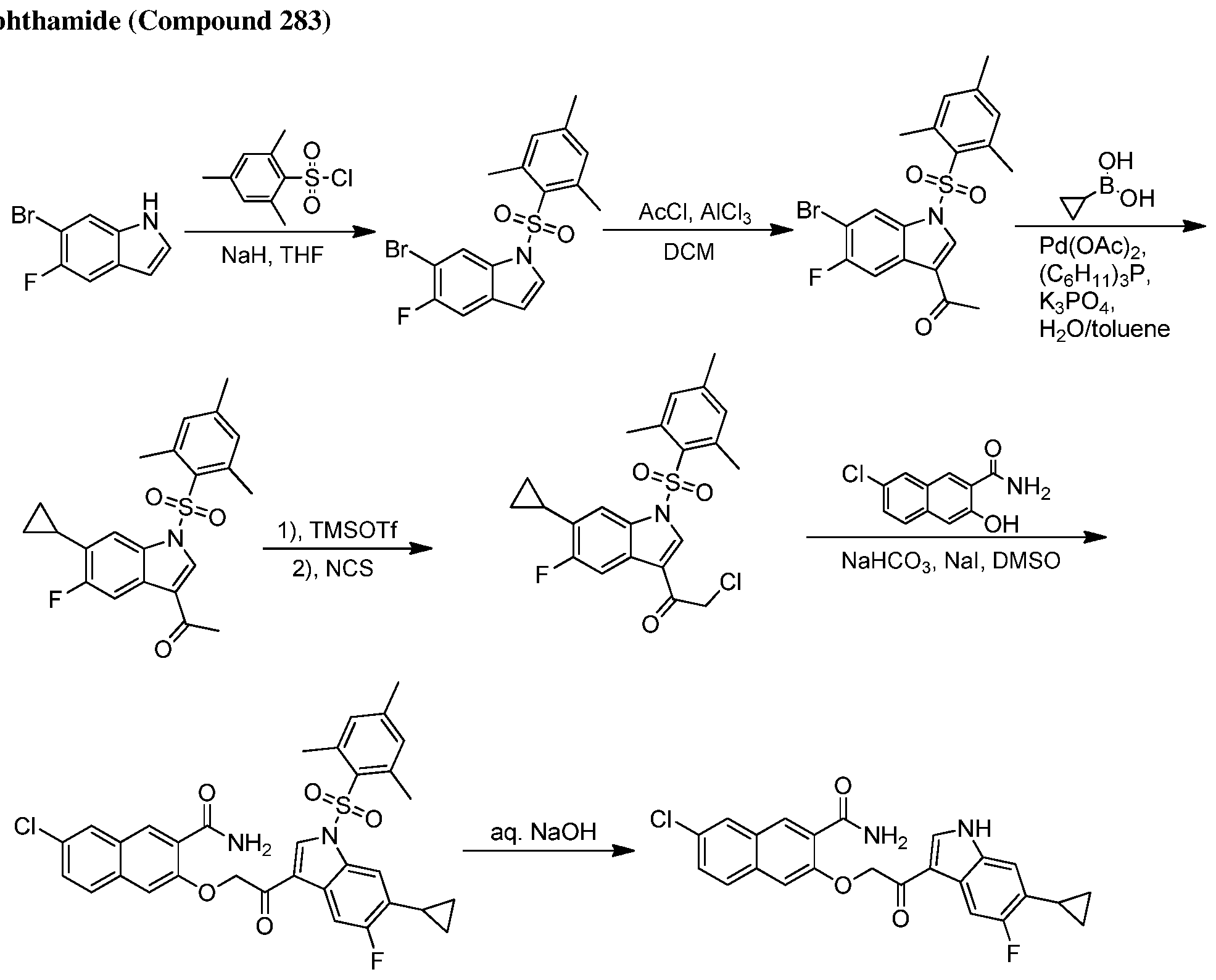
[0564] Step A. 6-Bromo-5-fluoro-l-(mesitylsulfonyl)-lH-indole. To a mixture of 6-bromo-5- fluoro-lH-indole (890 mg, 4.16 mmol) in dry THF (15 mL) under N2 at 0°C was added NaH (500 mg, 60% wt, 12.5 mmol). The mixture was stirred for 0.5 hr at 20°C, followed by addition of 2,4,6- trimethylbenzenesulfonyl chloride (1.09 g, 5.0 mmol) in portions. The resulting mixture was stirred for 0.5 hr at 20°C then quenched with water (50 mL) and extracted with EtOAc. The organic layer was separated, washed with brine (100 mL), dried over anhydrous Na2SC>4, and concentrated under reduced pressure. The residue was purified by flash column chromatography to give the desired product (1.5 g, 82% yield) as white solid. LC-MS: m/z 396 (M+H)+.
[0565] Step B. l-(6-Bromo-5-fluoro-l-(mesitylsulfonyl)-lH-indol-3-yl)ethan-l-one. To a mixture of AICI3 (1.1 g, 8.2 mmol) in anhydrous DCM (15 mL) under N2 at 0°C was added acetyl chloride (644 mg, 8.2 mmol). The mixture was stirred at 0°C for 10 min, followed by addition of a solution of 6-bromo-5-fluoro-l-(mesitylsulfonyl)-lH-indole (1.3 g, 3.28 mmol) in anhydrous DCM (8
mL). The resulting mixture was stirred at 0°C for 10 min then poured into water (30 mL) and extracted with DCM (30 mL). The organic layer was separated, washed with water (50 mL) and brine (50 mL), dried over anhydrous Na2SC>4, and concentrated under reduced pressure. The residue was purified by flash column chromatography to give the desired product (1.4 g, 88% yield) as white solid. LC-MS: m/z 438 (M+H)+.
[0566] Step C. l-(6-Cyclopropyl-5-fluoro-l-(mesitylsulfonyl)-lH-indol-3-yl)ethan-l-one. A mixture of l-(6-bromo-5-fluoro-l-(mesitylsulfonyl)-lH-indol-3-yl)ethan-l-one (1.4 g, 3.19 mmol), Pd(OAc)2 (72 mg, 0.32 mmol), K3PO4 (4.0 g, 19.1 mmol), cyclopropylboronic-acid (0.82 g, 9.57 mmol), and tricyclohexylphosphine (180 mg, 0.64 mmol ) in toluene (20 mL) and water (5 mL) was stirred at 100°C under N2 for 16 hr then quenched with saturated aqueous NH4CI (50 mL) and extracted with EtOAc (50 mL). The organic layer was separated, washed with water (50 mL) and brine (50 mL), dried over anhydrous Na2SC>4, and concentrated under reduced pressure. The residue was purified by flash column chromatography to give the desired product (1.1 g, 87% yield) as yellow solid. LC-MS: m/z 400 (M+H)+.
[0567] Step D. 2-Chloro-l-(6-cyclopropyl-5-fluoro-l-(mesitylsulfonyl)-lH-indol-3-yl)ethan-l- one. To a mixture of l-(6-cyclopropyl-5-fluoro-l-(mesitylsulfonyl)-lH-indol-3-yl)ethan-l-one (500 mg, 1.25 mmol) and TEA (506 mg, 5.0 mmol) in DCM (6 mL) at 0 -°C under N2 was added TMSOTf (555 mg, 2.5 mmol). The mixture was stirred for 0.5 hour at 15°C, followed by addition of NCS (200 mg, 1.5 mmol) at 0-5 °C. The mixture was stirred at that temperature for 10 min then quenched with water (30 mL) and extracted with DCM (30 mL). The organic layer was separated, washed with water (30 mL) and brine (30 mL), dried over anhydrous Na2SC>4, and concentrated under reduced pressure. The residue was purified by flash column chromatography to give the desired product (350 mg, 65% yield) as colorless oil. LC-MS: m/z 434 (M+H)+.
[0568] Step E. 7-Chloro-3-(2-(6-cyclopropyl-5-fluoro-l-(mesitylsulfonyl)-lH-indol-3-yl)-2- oxoethoxy)-2-naphthamide A mixture of 2-chloro-l-(6-cyclopropyl-5-fluoro-l-(mesitylsulfonyl)-lH- indol-3-yl)ethan-l-one (250 mg, 0.58 mmol), 7-chloro-3-hydroxy-2-naphthamide(129 mg, 0.58 mmol), Nal (130 mg, 0.87 mmol), and NaHC03 (730 mg, 8.7 mmol) in DMSO (7 mL) was stirred at 30°C under N2 for 16 hr, followed by addition of water (50 mL). The resulting mixture was stirred for 10 min then filtered to give the crude product as wet cake (250 mg) which was directly used in next step without any further purification. LC-MS: m/z 619 (M+H)+.
[0569] Step F. 7-Chloro-3-(2-(6-cyclopropyl-5-fluoro-lH-indol-3-yl)-2-oxoethoxy)-2- naphthamide. To a mixture of 7-chloro-3-(2-(6-cyclopropyl-5-fluoro-l-(mesitylsulfonyl)-lH-indol-3-yl)- 2-oxoethoxy)-2-naphthamide (250 mg crude) in MeOH (5 mL) and THF (30 mL) was added NaOH (1M, 3 mL). The reaction mixture was stirred at 16-20°C for 10 hr then adjusted pH to 7 with HOAc and
concentrated under reduced pressure. The residue was triturated with water and filtered. The solid was collected and purified by flash column chromatography to afford the desired product (30 mg, 17% yield) as white solid. LC-MS: m/z 437 (M+H)+. ¾ NMR (400 MHz, DMSO-d6) δ 12.126-12.148 (q, 1H), 8.583 (s, 2H), 8.540 (s, 1H), 8.150-8.156(d, / = 2.4 Hz, 1H), 7.868 (s, 1H), 7.846 (s, 1H), 7.787-7.814 (d, / = 10.8 Hz, 1H), 7.637 (s, 1Η),7.553-7.580 (m, 1H), 7.106-7.122(d, / = 6.4 Hz, 1H), 5.606(s, 2H), 2.088- 2.156 (m, 1H), 0.976- 1.024(m, 2H), 0.713-0.752 (m, 2H).
EXAMPLE 69. Synthesis of 7-chloro-3-(2-(6-(oxetan-3-yl)-lH-indol-3-yl)-2-oxoethoxy) -2- naphthamide (Compound 252)

[0570] Step A. 3-(l-((2-(Trimethylsilyl)ethoxy)methyl)-lH-indol-6-yl)oxetan-3-ol. To a mixture of 6-bromo-l-((2-(trimethylsilyl)ethoxy)methyl)-lH-indole (2.4 g, 7.36 mmol) in 20 mL of THF at -70°C
was added dropwise 4.6 mL of BuLi (1.6 M in hexane). The mixture was stirred at that temperature for 60 min, followed by dropwise addition of a solution of oxetan-3-one (530 mg, 7.36 mmol) in 5 mL of THF. The resulting mixture was stirred at -70°C for another 1 hr then quenched with saturated aqueous NH4CI and extracted with EtOAc. The combined organic layers were dried over anhydrous Na2S04 and concentrated under reduced pressure. The residue was purified via flash column chromatography to afford the desired product (1.5 g, 63.8 % yield). LCMS: m/z 320 (M+H)+.
[0571] Step B. S-Methyl 0-3-(l-((2-(trimethylsilyl)ethoxy)methyl)-lH-indol-6-yl)oxetan-3-yl carbonodithioate. To a mixture of 3-(l-((2-(trimethylsilyl)ethoxy)methyl)-lH-indol -6-yl)oxetan-3-ol (1.5 g, 4.7 mmol) in 20 mL of THF under an ice bath was added NaH (563 mg, 14.09 mmol). The mixture was stirred at r.t. for 2 hr, followed by in sequence dropwise addition of a solution of carbon disulfide (357 mg, 4.7 mmol) in 2 mL of THF and a solution of iodomethane (666 mg, 4.7 mmol) in 2 mL of THF. The resulting mixture was stirred at 0°C for 0.5 hr then quenched with saturated aqueous NH4CI and extracted with EtOAc. The combined organic layers were dried over anhydrous Na2S04 and concentrated under reduced pressure to give the crude product (1.4 g, 72.8 % crude yield) which was used in the next step without any further purification. LCMS: m/z 410 (M+H)+.
[0572] Step C. 6-(Oxetan-3-yl)-l-((2-(trimethylsilyl)ethoxy)methyl)-lH-indole. To a mixture of S-methyl 0-3 -( 1 -((2-(trimethylsilyl)ethoxy)methyl)- 1 H-indol-6-yl)oxetan-3 -ylcarbonodithioate ( 1.4 g, 3.42 mmol) in 20 mL of toluene were added AIBN (56 mg, 0.344 mmol) and (n-Bu)3SnH (1.99 g, 6.84 mmol). The mixture was stirred at 125°C for 30 min then concentrated under reduced pressure. The residue was purified via flash column chromatography to give the desired product (0.8 g, 77 % yield). LCMS: m/z 304 (M+H)+.
[0573] Step D. 6-(Oxetan-3-yl)-lH-indole. To a mixture of 6-(oxetan-3-yl)-l-((2-(trimethylsilyl) ethoxy)methyl)-lH-indole (0.8 g, 2.64 mmol) in 10 mL of DMF were added TBAF (1.38 g, 5.27 mmol) and ethane- 1,2-diamine (16 mg, 0.263 mmol). The mixture was stirred at 85°C for 15 hr then poured into ice water and extracted with EtOAc. The combined organic layers were washed with brine, dried over anhydrous Na2S04 and concentrated under reduced pressure. The residue was purified via flash column chromatography to give the desired product (0.3 g, 65.7 % yield). LCMS: m/z 174 (M+H)+.
[0574] Step E. l-(6-(Oxetan-3-yl)-lH-indol-3-yl)ethanone. To a mixture of 6-(oxetan-3-yl)-lH- indole (0.2 g, 1.15 mmol) in 15 mL of DCM under an ice bath was added Et2AlCl (1M in Et20,l 1.55 mL). The mixture was stirred at r.t. for 2 hr, followed by dropwise addition of AcCl (0.453 g, 5.77 mmol). The reaction mixture was stirred at r.t. for another 30 min then quenched with saturated aqueous NH4CI and extracted with EtOAc. The combined organic layers were dried over anhydrous Na2S04 and concentrated under reduced pressure. The residue was purified via flash column chromatography to give the desired product (0.2 g, 80.5 % yield). LCMS: m/z 216 (M+H)+.
[0575] Step F. l-(6-(Oxetan-3-yl)-l-(phenylsulfonyl)-lH-indol-3-yl)ethanone. To a mixture of l-(6-(oxetan-3-yl)-lH-indol-3-yl)ethanone (0.2 g, 0.929 mmol) in 20 mL of THF under an ice bath was added NaH (74 mg, 1.86 mmol). The reaction mixture was stirred at r.t. for 2 hr, followed by dropwise addition of a solution of phenylsulfonyl chloride (0.2 g, 1.11 mmol) in 2 mL of THF. The resulting mixture was stirred at r.t. for 2 hr then quenched with saturated aqueous NH4CI and extracted with EtOAc. The combined organic layers were dried over anhydrous Na2SC>4 and concentrated under reduced pressure. The residue was purified via flash column chromatography to give the desired product (0.15 g, 45.4 % yield). LCMS: m/z 356 (M+H)+.
[0576] Step G. 2-Chloro-l-(6-(oxetan-3-yl)-l-(phenylsulfonyl)-lH-indol-3-yl)ethanone. A mixture of l-(6-(oxetan-3-yl)-l -(phenylsulfonyl)- lH-indol-3-yl)ethanone (100 mg, 0.281 mmol) and TEA (43 mg, 0.422 mmol) in 2 mL of DCM was cooled to below -5°C, followed by dropwise addition of TMSOTf (75 mg, 0.377 mmol) in 0.5 mL of DCM. The mixture was stirred at that temperature for 2 hr, followed by addition of NCS (37 mg, 0.281 mmol) in one portion. The resulting mixture was stirred for another 0.5 hr then diluted with DCM and washed with saturated aqueous NaHCC . The organic layer was dried over anhydrous Na2SC>4 and concentrated under reduced pressure. The residue was purified via flash column chromatography to afford the desired product (0.10 g, 91.2% yield). LC-MS: m/z 390 (M+H)+.
[0577] Step H. 7-Chloro-3-(2-(6-(oxetan-3-yl)-l-(phenylsulfonyl)-lH-indol-3-yl)-2-oxoeth- oxy)-2-naphthamide . A mixture of 2-chloro-l-(6-(oxetan-3-yl)-l-(phenylsulfonyl)- lH-indol-3- yl)ethanone (100 mg, 0.256 mmol), 7-chloro-3-hydroxy-2-naphthamide (57 mg, 0.256 mmol) , NaHCC (323 mg, 3.85 mmol), and Nal (77 mg, 0.513 mmol) in 5 mL of DMSO was stirred at 25°C for 24 hr then poured into water. The solid was collected and dried under high vacuum to afford the crude product (147 mg) which was directly used in the next step without any further purification. LC-MS: m/z 576 (M+H)+.
[0578] Step H. 7-Chloro-3-(2-(6-(oxetan-3-yl)-lH-indol-3-yl)-2-oxoethoxy)-2-naphthamide. To a mixture of the above crude 7-chloro-3-(2-(6-(oxetan-3-yl)-l -(phenylsulfonyl)- lH-indol-3-yl)-2- oxoethoxy)-2-naphthamide (147 mg) in 4 mL of THF was added a solution of NaOH (41 mg, 1.02 mmol) in 2 mL of water. The mixture was stirred at r.t. for 1 hr then concentrated under reduced pressure. The residue was adjusted to pH 5-6 with aqueous HC1 (10%wt). The solid was collected by filtration and purified via prep-HPLC to give the desired product (20 mg, 18% yield) as yellow solid. LCMS: m/z 435 (M+H)+. ¾ NMR (400MHz, DMSO-d6) δ = 12.08 - 12.26 (m, 1 H), 8.64 - 8.68 (m, 1 H), 8.60 (d, J=4 Hz, 1 H), 8.54 - 8.57 (m, 1 H), 8.14 - 8.21 (m, 2 H), 7.89 (br. s., 1 H), 7.83 - 7.87 (m, 1 H), 7.65 (s, 1 H), 7.55 - 7.59 (m, 1 H), 7.52 (s, 1 H), 7.30 (s, 1 H), 5.60 - 5.65 (m, 2 H), 4.96 - 5.02 (m, 2 H), 4.63 - 4.69 (m, 2 H), 4.33 - 4.41 ppm (m, 1 H)
EXAMPLE 70. Synthesis of 7-chloro-3-(2-(6-fluoro-lH-indol-3-yl)-2-oxoethoxy)-2-naphthamide

[0579] Step A.6-Fluoro-l-(mesitylsulfonyl)-lH-indole. To a mixture of 6-fluoro-lH-indole (1.78 g, 13.2 mmol) in anhydrous THF (5 mL) at 0°C was added NaH (633 mg, 26.4 mmol, 60% wt). The mixture was stirred at that temperature for 30 min, followed by addition of 2,4,6-trimethylbenzene-l- sulfonyl chloride (3.46 g, 15.8 mmol). The reaction mixture was stirred at r.t. for 0.5 hr then quenched with ice -water and extracted with EtOAc. The combined organic layers were washed with brine, dried over anhydrous Na2SC>4, and concentrated under reduced pressure. The residue was purified by flash column chromatography to afford the desired product (2.8 g, 66.98% yield). LC-MS: m/z: 318 (M+H)+.
[0580] Step B. l-(6-Fluoro-l-(mesitylsulfonyl)-lH-indol-3-yl)ethanone. To a mixture of AICL (999 mg, 7.5 mmol) in anhydrous DCM (15 mL) at -5°C was added acetyl chloride (588 mg, 7.5 mmol). The mixture was stirred at that temperature for 30 min, followed by addition of a solution of 6-fluoro-l- (mesitylsulfonyl)-lH-indole (475.5 mg, 1.5 mmol) in anhydrous DCM (3 mL). The resulting mixture was stirred at at -5°C for another 10 min, then quenched with ice -water and extracted with DCM. The combined organic layers were washed with brine, dried over anhydrous Na2SC>4, and concentrated under reduced pressure. The residue was purified by flash column chromatography to afford the desired product (400 mg, 74.20% yield). LC-MS: m/z 360 (M+H)+.
[0581] Step C. 2-Bromo-l-(6-fluoro-l-(mesitylsulfonyl)-lH-indol-3-yl)ethanone. To a mixture of l-(6-fluoro-l-(mesitylsulfonyl)-lH-indol-3-yl)ethanone (190.27 mg, 0.53 mmol) and TEA (161 mg, 1.59 mmol) in 4 mL of DCM at below -5°C was added TMSOTf (235 mg, 1.06 mmol). The mixture was stirred at that temperature for 2 hr, followed by addition of NBS (94 mg, 0.53 mmol) in one portion. The
resulting mixture was stirred for another 0.1 hr then diluted with EtOAc and washed with saturated aqueous NaHCC . The organic layer was separated, washed with brine, dried over anhydrous Na2SC>4, and concentrated under reduced pressure. The residue was purified by flash column chromatography to afford the desired product (151.9 mg, 65.40% yield). LC-MS: m/z 438 (M+H)+.
[0582] Step D. 7-Chloro-3-(2-(6-fluoro-lH-indol-3-yl)-2-oxoethoxy)-2-naphthamide. A mixture of 2-bromo-l-(6-fluoro-l-(mesitylsulfonyl)-lH-indol-3-yl)ethanone (75 mg, 0.16 mmol), 7- chloro-3-hydroxy-2-naphthamide (36.5 mg, 0.16 mmol) , NaHCC (138.5 mg, 1.6 mmol), and Nal (24.7 mg, 0.16 mmol) in 5 mL of DMSO was stirred at 25 °C for 12 hr then filtered. The solid was collected and purified by column chromatography to give the desired product (8 mg, 12.62% yield). LC-MS: m/z 397 (M+H)+. ¾ NMR (400 MHz, DMSO-d6) δ 12.25 (s, 1H), 8.63 (s, 1H), 8.59 (s, 1H), 8.54 (s, 1H), 8.24 - 8.11 (m, 2H), 7.97 - 7.81 (m, 2H), 7.60 (m, 3H), 7.26 (d, / = 5 Hz, 1H), 5.63 (s, 2H).
EXAMPLE 71. Synthesis of (R)-7-chloro-3-(2-(6-fluoro-l-(3,4-dihydroxybutyl)-lH-indol-3-yl)-2-

[0583] Step A: (R)-7-Chloro-3-(2-(l-(2-(2,2-dimethyl-l -dioxoton-4-yl)etty^
indol-3-yl)-2-oxoethoxy)-2-naphthamide.To a mixture of 7-chloro-3-(2-(6-fluoro-lH-indol-3-yl)-2- oxoethoxy)-2-naphthamide (100 mg, 0.24 mmol) in anhydrous DMF (5 mL) were added (R)-4- (chloromethyl)-2,2-dimethyl-l,3-dioxolane (120 mg, 0.8 mmol) and CS2CO3 (780 mg, 2.4 mmol). The reaction mixture was stirred at 25 °C overnight then directly purified by column chromatography to afford the desired product (50 mg, 39.68% yield). LC-MS: m/z: 526 (M+H)+.
[0584] Step B. (R)-7-chloro-3-(2-(6-fluoro-l-(3,4-dihydroxybutyl)-lH-indol-3-yl)-2- oxoethoxy)-2-naphthamide .To a mixture of (R)-7-chloro-3-(2-(6-fluoro-l-(2-(2,2-dimethyl-l,3- dioxolan-4-yl)ethyl)-lH-indol-3-yl)-2-oxoethoxy)-2-naphthamide (50 mg, 0.092 mmol) in a solution of MeOH/THF (15 mL/5 mL) was added diluted aqueous HC1 (1 N, 2 mL). The mixture was stirred at r.t. for overnight then quenched with saturated aqueous NaHCC until pH reached 7-8. The resulting mixture was concentrated under reduced pressureand the residue was purified by column chromatography to give the desired product (20.0 mg, 43.2% yield). LC-MS: m/z: 485 (M+H)+. ¾ NMR (400 MHz, DMSO-d6) δ 8.71 (s, IH), 8.57-8.56 (d, / = 4.0 Hz, 2H), 8.21-8.15 (m, 2H), 7.88-7.86 (d, / = 8.0 Hz, 2H), 7.82-7.81 (d, / = 4.0 Hz, IH), 7.63 (s, IH), 7.58 - 7.56 (m, IH), 7.31-7.28 (m, IH), 5.59(s, 2H), 4.87-4.85(d, / = 8.0 Hz, IH), 4.64-4.61 (m, IH), 4.41-4.37 (m, 2H), 3.43-3.36 (m, 2H), 3.30-3.25 (m, IH), 2.09-2.05 (m, IH), 1.78-1.75(m, IH).
EXAMPLE 72. Synthesis of 7-chloro-3-(2-(6-cyclopropyl-7-fluoro-lH-indol-3-yl)-2-oxoethoxy)-2-

[0585] Step A. 6-Bromo-7-fluoro-lH-indole. To a mixture of l-bromo-2-fluoro-3- nitrobenzene(4.6 g, 20.9 mmol) in dry THF (40 mL) under N2 at -50°C was added dropwise
vinylmagnesium bromide (63 mL, 1 M in THF, 63 mmol ). The mixture was stirred for 1 hr at -50°C then quenched with saturated aqueous NH4CI (60 mL) and extracted with EtOAc. The combined organic layers were washed with brine, dried over anhydrous Na2SC>4, and concentrated under reduced pressure. The residue was purified by column chromatography to afford the desired product (1.0 g, 23% yield) as yellow oil. LC-MS: m/z 214 (M+H)+.
[0586] Step B. 6-Bromo-7-fluoro-l-(mesitylsulfonyl)-lH-indole. To a mixture of 6-bromo-7- fluoro-lH-indole (1.0 g, 4.7 mmol) in dry THF (15 mL) under N2 at 0°C was added NaH (560 mg, 60%, 14.1 mmol ) portionwise. The mixture was stirred at 20°C for 0.5 hr, followed by addition of 2,4,6- trimethylbenzenesulfonyl chloride (1.2 g, 5.6 mmol) in portions. The resulting mixture was stirred at 20°C for another 0.5 hour then quenched with water (50 mL) and extracted with EtOAc. The combined organic layers were washed with brine, dried over anhydrous Na2SC>4, and concentrated under reduced pressure. The residue was purified by column chromatography to afford the desired product (1.0 g, 56% yield) as white solid. LC-MS: m/z 396 (M+H)+.
[0587] Step C. l-(6-Bromo-7-fluoro-l-(mesitylsulfonyl)-lH-indol-3-yl)ethan-l-one. To a mixture of AICI3 (0.84 g, 6.3 mmol) in anhydrous DCM (15 mL) under N2 at 0°C was added acetyl chloride (490 mg, 6.3 mmol). The mixture was stirred at 0°C for 10 min, followed by addition of a solution of 6-bromo-7-fluoro-l-(mesitylsulfonyl)-lH-indole(1.0 g, 2.5 mmol) in anhydrous DCM (8 mL). The resulting mixture was stirred at 0°C for 10 min then quenched with water (30 mL) and extracted with DCM. The combined organic layers were washed with brine, dried over anhydrous Na2SC>4, and concentrated under reduced pressure. The residue was purified by column chromatography to afford the desired product (1.0 g, 92% yield) as white solid. LC-MS: m/z 438 (M+H)+.
[0588] Step D. l-(6-Cyclopropyl-7-fluoro-l-(mesitylsulfonyl)-lH-indol-3-yl)ethan-l-one. A mixture of l-(6-bromo-7-fluoro-l-(mesitylsulfonyl)-lH-indol-3-yl)ethan-l-one (1.0 g, 2.3 mmol), Pd(OAc)2 (77 mg, 0.34 mmol), K3P04 (2.9 g, 14.8 mmol), cyclopropylboronic-acid (0.59 g, 6.9 mmol), and tricyclohexylphosphine (193 mg, 0.69 mmol ) in toluene (20 mL) and water (5 mL) was stirred at 100°C under Ν2 ίθΓ 16 hr then quenched with saturated aqueous NH4CI (50 mL) and extracted with EtOAc. The combined organic layers were washed with brine, dried over anhydrous Na2SC>4, and concentrated under reduced pressure. The residue was purified by column chromatography to afford the desired product (0.8 g, 87% yield) as white solid. LC-MS: m/z 400 (M+H)+.
[0589] Step E. 2-Chloro-l-(6-cyclopropyl-7-fluoro-l-(mesitylsulfonyl)-lH-indol-3-yl)ethan-l- one. To a mixture of l-(6-cyclopropyl-7-fluoro-l-(mesitylsulfonyl)-lH-indol-3-yl)ethan-l-one(400 mg, 1.0 mmol) and TEA (404 mg, 4.0 mmol) in DCM (6 mL) at 0 -5°C under N2 was added TMSOTf (444 mg, 2.0 mmol). The mixture was stirred for 0.5 hr at 15°C, followed by addition of a solution of NCS (160 mg, 1.2 mmol) in DCM (4 mL). The mixture was stirred for 10 min then quenched with water (30
mL) and extracted with DCM. The combined organic layers were washed with brine, dried over anhydrous Na2SC>4, and concentrated under reduced pressure. The residue was purified by column chromatography to afford the desired product (300 mg, 69% yield) as white solid. LC-MS: m/z 434 (M+H)+.
[0590] Step F. 7-Chloro-3-(2-(6-cyclopropyl-7-fluoro-l-(mesitylsulfonyl)-lH-indol-3-yl)-2- oxoethoxy)-2-naphthamide. A mixture of 2-chloro-l-(6-cyclopropyl-7-fluoro-l-(mesitylsulfonyl)-lH- indol-3-yl)ethan-l-one (250 mg, 0.58 mmol), 7-chloro-3-hydroxy-2-naphthamide (129 mg, 0.58 mmol), Nal (130 mg, 0.87 mmol), and NaHC03 (730 mg, 8.7 mmol) in DMSO (7 mL) were stirred at 30°C under N2 for 16 hr then diluted with water (50 mL). The mixture was stirred for 10 min then filtered. The solid was collected by filtration and dried under high vacuum to give the crude product (200 mg) which was directly used in next step without any further purification. LC-MS: m/z 619 (M+H)+.
[0591] Step G. 7-Chloro-3-(2-(6-cyclopropyl-7-fluoro-lH-indol-3-yl)-2-oxoethoxy)-2- naphthamide. To a mixture of 7-chloro-3-(2-(6-cyclopropyl-7-fluoro-l-(mesitylsulfonyl)-lH-indol-3-yl)- 2-oxoethoxy)-2-naphthamide (200 mg crude) in MeOH (5 mL) and THF (30 mL) was added NaOH (1M, 3 mL). The mixture was stirred for 10 hr at 16-20°C then adjusted to pH 7 with HO Ac and concentrated under reduced pressure. The residue was triturated with water and filtered. The solid was collected and purified by flash column chromatography to give the desired product (20 mg, 15% yield) as white solid. LC-MS: m/z 437 (M+H)+. ¾ NMR (400 MHz, DMSO-d6) δ 12.584 (s, 1H), 8.608 (s, 1H), 8.587-8.591 (d, / = 1.6 Hz, 1H), 8.550 (s, 1H), 8.150-8.155 (d, / = 2.0 Hz, 1H), 7.837-7.869 (q, 3H), 7.643 (s, 1H), 7.552-7.580 (dd, 1H), 6.796-6.833 (m, 1H), 5.629 (s, 2H), 2.134-2.202 (m, 1H), 0.981-1.001 (m, 2H), 0.744-0.771 (m, 2H).
EXAMPLE 73. Synthesis of 7-chloro-3-(2-(6-cyclopropyl-lH-pyrrolo[3,2-c]pyridin-3-yl)-2- oxoethoxy)-2-naphthamide (Compound 282)


[0592] Step A. l-(6-Chloro-lH-pyrrolo[3,2-c]pyridin-3-yl)ethanone. To a mixture of AICI3 (5.2 g, 13.2 mmol) in anhydrous DCM (10 mL) under N2 at 0°C was added acetyl chloride (1.5 g, 19.7 mmol). The mixture was stirred at 0°C for 30 min, followed by addition of a solution of 6-chloro-lH-pyrrolo[3,2- c]pyridine (2.0 g, 13.2 mmol) in anhydrous DCM (3 mL). The reaction mixture was stirred at 0°C for 1 hr then poured into ice water and extracted with DCM. The combined organic layers were washed with brine, dried over anhydrous Na2SC>4, and concentrated under reduced pressure. The residue purified by column chromatography to give the desired product (1.5 g, 58.8% yield) as yellow solid. LC-MS: m/z 195 (M+H)+.
[0593] Step B. l-(6-Chloro-l-(mesitylsulfonyl)-lH-pyrrolo[3,2-c]pyridin-3-yl)ethanone. To a mixture of l-(6-chloro-lH-pyrrolo[3,2-c]pyridin-3-yl)ethanone (1.5 g, 7.73 mmol) in anhydrous THF (10 mL) under N2 at 0°C was added NaH (0.62 g, 15.5 mmol, 60%w/w). The mixture was stirred at r.t. for 30 min., followed by addition of 2,4,6-trimethylbenzene-l-sulfonyl chloride (1.9 g, 8.5 mmol). The resulting mixture was stirred at r.t. for 1 hr then quenched with ice-water and extracted with EtOAc. The combined organic layers were washed with brine, dried over anhydrous Na2SC>4, and concentrated under reduced
pressure. The residue was purified by flash column chromatography to afford the desired product (1.7 g, 58.6% yield) as yellow solid. LC-MS: m/z 377 (M+H)+.
[0594] Step C. l-(6-Cyclopropyl-l-(mesitylsulfonyl)-lH-pyrrolo[3,2-c]pyridin-3-yl)ethanone. A mixture of l-(6-chloro-l-(mesitylsulfonyl)-lH-pyrrolo[3,2-c]pyridin-3-yl)ethanone (752 mg, 2.0 mmol), cyclopropylboronic acid (860 mg, 10.0 mmol), palladium acetate (45 mg, 0.2 mmol), potassium phosphate (2.12 g, 10 mmol), tricyclohexylphosphine (67 mg, 0.24 mmol), and water (1 mL) in toluene (30 mL) was stirred at 100°C under ? for 16 hr then quenched with ice -water and extracted with EtOAc. The combined organic layers were washed with brine, dried over anhydrous Na2SC>4, and concentrated under reduced pressure. The residue was purified by flash column chromatography to afford the desired product (200 mg, 26.2% yield) as yellow solid. LC-MS: m/z 383 (M+H)+.
[0595] Step D. 2-Chloro-l-(6-cyclopropyl-l-(mesitylsulfonyl)-lH-pyrrolo[3,2-c]pyridin-3- yl)ethanone. To a mixture of l-(6-cyclopropyl-l-(mesitylsulfonyl)-lH-pyrrolo[3,2-c]pyridin-3- yl)ethanone (150 mg, 0.39 mmol) and TEA (198 mg, 1.96 mmol) in 10 mL of DCM at below 0°C was added TMSOTf (262 mg, 1.18 mmol). The mixture was stirred under N2 at 0°C for 2 hr, followed by addition of NCS (52 mg , 0.39 mmol). The resulting mixture was stirred at that temperature for 10 min then poured into ice water and extracted with DCM. The combined organic layers were washed with brine, dried over anhydrous Na2SC>4, and concentrated under reduced pressure. The residue was purified by flash column chromatography to afford the desired product (100 mg, 61.4% yield) as yellow semisolid. LC-MS: m/z 416 (M+H)+.
[0596] Step E. 7-Chloro-3-(2-(6-cyclopropyl-l-(mesitylsulfonyl)-lH-pyrrolo[3,2-c]pyridin-3- yl)-2-oxoethoxy)-2-naphthamide. A mixture of 2-chloro-l-(6-cyclopropyl-l-(mesitylsulfonyl)-lH- pyrrolo[3,2-c]pyridin-3-yl)ethanone (100.0 mg, 0.24 mmol), 7-chloro-3-hydroxy-2-naphthamide (53.0 mg, 0.24 mmol) , NaHC03 (303 mg, 3.61 mmol), and Nal (36.0 mg, 0.24 mmol) in DMSO (5 mL) was stirred at 35°C overnight then poured into ice water and filtered. The solid was collected and purified by column chromatography to give the desired product (80 mg, 80.0% yield) as yellow semi-solid. LC-MS: m/z 602 (M+H)+.
[0597] Step F. 7-Chloro-3-(2-(6-cyclopropyl-lH-pyrrolo[3,2-c]pyridin-3-yl)-2-oxoethoxy)-2- naphthamide. To a mixture of 7-chloro-3-(2-(6-cyclopropyl-l-(mesitylsulfonyl)-lH-pyrrolo[3,2- c]pyridin-3-yl)-2-oxoethoxy)-2-naphthamide (80 mg, 0.133 mmol) in a solution of THF (10 mL) and MeOH (2 mL) was added a solution of NaOH (21.3 mg, 0.53 mmol) in H2O (1 mL). The mixture was stirred at r.t. for 2 hr then adjusted to pH 6 with dilute aqueous HC1 (IN) and extracted with DCM. The organic layer was separated, dried over anhydrous Na2SC>4, and concentrated under reduced pressure. The residue was purified by prep-HPLC to afford the desired product (40.5 mg, 40.2% yield) as white solid. LC-MS: m/z 420 (M+H)+. ¾ NMR (400 MHz, DMSO-d6) δ 12.32 (s, 1H), 9.18 (d, / = 0.8 Hz, 1H), 8.60
(s, 1H), 8.54 (s, 2H), 8.15 (d, / = 2.0 Hz, 1H), 7.86 (d, / = 8.8 Hz, 2H), 7.65 (s, 1H), 7.57 (m, 1H), 7.40 (d, / = 0.8 Hz, 1H), 5.64 (s, 2H), 2.20 - 2.14 (m, 1H), 0.93 (t, / = 6.9 Hz, 4H).
EXAMPLE 74 . Synthesis of 7-chloro-3-(2-(6-(l-methylcyclopropyl)-lH-indol-3-yl)-2-oxoethoxy)-2- naphthamide (Compound 260)

[0598] Step A. Methyl l-(mesitylsulfonyl)-lH-indole-6-carboxyl te. To a mixture of methyl lH-indole-6-carboxylate (5 g, 0.029 mol) in anhydrous THF (50 mL) at 0°C was slowly added NaH
(1.5g, 0.036 mol, 60 w/w). The reaction mixture was stirred at r.t. for 1 hr, followed by addition of a solution of 2,4,6-trimethylbenzene-l-sulfonyl chloride (8 g, 0.036 mol) in anhydrous THF (50 mL) at 0°C. The resulting mixture was stirred at r.t. for another 1 hr then quenched with ice water and extracted with EtOAc. The combined organic layers were washed with brine, dried over anhydrous Na2SC>4, and concentrated under reduced pressure. The residue was purified by flash column chromatography to afford the desired product (9 g, 88.2% yield) as white solid. LCMS: m/z 358 (M+H)+.
[0599] Step B. 2-(l-(Mesitylsulfonyl)-lH-indol-6-yl)propan-2-ol. To a mixture of methyl 1- (mesitylsulfonyl)-lH-indole-6-carboxylate (4 g, 0.01 mol) in anhydrous THF (50 mL) at 0°C was added C¾MgBr (8 mL, 0.025 mol, 3 M). The mixture was stirred at 0°C for 5 min then quenched with ice- water and extracted with EtOAc. The combined organic layers were washed with brine, dried over anhydrous Na2SC>4, and concentrated under reduced pressure. The residue was purified by flash column chromatography to afford the desired product (3.6 g, 90.0% yield) as white solid. LCMS: m/z 358 (M+H)+.
[0600] Step C. l-(Mesitylsulfonyl)-6-(prop-l-en-2-yl)-lH-indole. To a mixture of 2-(l- (mesitylsulfonyl)-lH-indol-6-yl)propan-2-ol (1.2 g, 3.4 mmol) in toluene (20 mL) was added TsOH (10 mg, cat.). The mixture was stirred at 50°C for 30 min then quenched with saturated aqueous NaHCC and extracted with EtOAc. The combined organic layers were washed with brine, dried over anhydrous Na2SC>4, and concentrated under reduced pressure. The residue was purified by flash column
chromatography to afford the desired product (1 g, 87.8% yield) as oil. LCMS: m/z 340 (M+H)+.
[0601] Step D. l-(Mesitylsulfonyl)-6-(l-methylcyclopropyl)-lH-indole. To a mixture of 1- (mesitylsulfonyl)-6-(prop-l-en-2-yl)-lH-indole (800 mg, 2.36 mmol), CuBr (10 mg, cat.) in CH2Br2 (10 mL) at 0°C was added Al(i-Bu)3 (20.0mL,l.lM in hexanes). The reaction mixture was stirred at 70°C for 2 hr then quenched with methanol and concentrated under reduced pressure. The resuide was purified by column chromatography to afford the desired product (800 mg, 96.0% yield) as white solid. LCMS: m/z 354 (M+H)+.
[0602] Step E. l-(l-(Mesitylsulfonyl)-6-(l-methylcyclopropyl)-lH-indol-3-yl)ethanone. To a mixture of l-(mesitylsulfonyl)-6-(l-methylcyclopropyl)-lH-indole (800 mg, 2.27 mmol) in anhydrous dichloromethane (10 mL) at 0°C was added Et2AlCl (6.8 mL, 13.60 mmol, 2 M). The mixture was stirred at 0°C for 30 min, followed by addition of a solution of acetyl chloride (1.6 mL, 22.7 mmol) in anhydrous dichloromethane (5 mL). The resulting mixture was stirred at 0°C for another 30 min then quenched with ice water, basified with saturated aqueous NaHCC , and extracted with EtOAc. The combined organic layers were washed with brine, dried over anhydrous Na2S04, and concentrated under reduced pressure. The residue was purified by flash column chromatography to afford the desired product (750mg, 83.2% yield) as white solid. LCMS: m/z 396 (M+H)+.
[0603] Step F. 2-Chloro-l-(l-(mesitylsulfonyl)-6-(l-methylcyclopropyl)-lH-indol-3- yl)ethanone. To a mixture of l-(l-(mesitylsulfonyl)-6-(l-methylcyclopropyl)-lH-indol-3-yl)ethanone (750 mg, 1.90 mmol), and TEA (0.40 mL, 2.85 mmol) in anhydrous dichloromethane (20 mL) at -10°C was added TMSOTf (0.45 mL, 2.47 mmol). The resulting mixture was stirred at this temperature for 2 h, followed by addition of NCS (278 mg, 2.09 mmol) in one portion. The resulting mixture was stirred at that temperature for another 10 min then quenched with ice water and extracted with EtOAc. The combined organic layers were washed with brine, dried over anhydrous Na2SC>4, and concentrated under reduced pressure. The residue was purified by flash column chromatography to afford the desired product (480 mg, 58.9% yield) as white solid. LCMS: m/z 430 (M+H)+.
[0604] Step G. 7-Chloro-3-(2-(l-(mesitylsulfonyl)-6-(l-methylcyclopropyl)-lH-indol-3-yl)-2- oxoethoxy)-2-naphthamide. A mixture of 2-chloro-l-(l-(mesitylsulfonyl)-6-(l-methylcyclopropyl)-lH- indol-3-yl)ethanone (480 mg, 1.12 mmol), 7-chloro-3-hydroxy-2-naphthamide (247 mg, 1.12 mmol), NaHCC (1.78 g, 16.80 mmol) and Nal (252 mg, 1.68 mmol) in dimethyl sulfoxide (20 mL) was stirred at 30°C for 16 hr then poured into ice water and filtered. The solid was collected and dried under high vacuum to afford the crude product as yellow solid which was directly used in next step without any further purification. LCMS: m/z 615 (M+H)+.
[0605] Step H. 7-Chloro-3-(2-(6-(l-methylcyclopropyl)-lH-indol-3-yl)-2-oxoethoxy)-2- naphthamide. To a mixtue of the above 7-chloro-3-(2-(l-(mesitylsulfonyl)-6-(l-methylcyclopropyl)-lH- indol-3-yl)-2-oxoethoxy)-2-naphthamide (500 mg, 0.81 mmol) in THF (30 mL) was added a solution of NaOH (325 mg, 8.14 mmol) in H2O (1 mL). The reaction mixture was stirred at r.t. for 2 hr then partitioned between EtOAc and water. The combined organic layers were washed with brine, dried over anhydrous Na2SC>4, and concentrated under reduced pressure. The residue was purified by flash column chromatography to afford the crude product which was re -crystallized from methanol to afford the desired product (60 mg, 17.2% yield) as yellow solid. ¾ NMR (400 MHz, DMSO-d6) δ 12.07 (s, 1H), 8.65 (s, 1H), 8.55 (s, 2H), 8.16 (d, / = 2.0 Hz, 1H), 8.07 (d, / = 8.4 Hz, 1H),7.84 - 7.90 (m, 2H), 7.64 (s, 1H), 7.57 (dd, / = 8.8, 1H), 7.36 (s, 1H), 7.12 (dd, / = 8.4, 1H), 5.61 (s, 2H), 1.42 (s, 3H), 0.84 - 0.88 (m, 2H), 0.76 - 0.80 (m, 2H). LCMS: m/z 433 (M+H)+.
EXAMPLE 75. Synthesis of 3-(6-chloroquinazolin-2-yl)-N-(4-(pyridin-3-yloxy)phenyl) propanamide (Co

[0606] Step A. 2-Bromo-l-(6-(((tert-butyldimethylsilyl)oxy)methyl)-l-(mesitylsulfonyl)-lH- indol-3-yl)ethanone.To a mixture of l-(6-(((tert-butyldimethylsilyl)oxy)methyl)-l-(mesitylsulfonyl)-lH- indol-3-yl)ethanone (1.8 g, 3.8 mmol) and TEA (1.15g, 11.4 mmol) in anhydrous dichloromethane (20 mL) at 0°C was added trimethylsilyl trifluoromethanesulfonate (1.10 g, 4.94 mmol). The reaction mixture was stirred at r.t. for 1 hr, followed by addition of NBS (0.68 g, 3.8 mmol) at 0°C in portions. The reaction mixture was stirred at r.t. until completion then quenched with cooled water. The mixture was stirred for 10 min then extracted with DCM. The combined organic layers were washed with brine, dried over anhydrous Na2SC>4, and concentrated under reduced pressure. The residue was purified by column chromatography to give the desired product (1.9 g, 88% yield) as white solid. LC-MS: m/z 564 (M+H)+.
[0607] Step B. 3-(2-(6-(((Tert-butyldimethylsilyl)oxy)methyl)-l-(mesitylsulfonyl)-lH-indol-3- yl)-2-oxoethoxy)-7-chloro-2-naphthamide. A mixture of 2-bromo-l-(6-(((tert-butyldimethylsilyl)oxy) methyl)-l-(mesitylsulfonyl)-lH-indol-3-yl)ethanone (1.9 g, 3.45 mmol), 7-chloro-3-hydroxy-2- naphthamide (764.8 mg, 3.45 mmol), NaHC03 (2.9 g, 34.5 mmol) and Nal (534 mg, 3.45 mmol) in anhydrous DMSO (60 mL) was stirred at 30°C under N2 for 16 hr then poured into water. The mixture was stirred for 15 min then filtered. The solid was washed by water, dried under high vacuum to give the desiredproduct (2.34 g, 96% yield) as white solid. LC-MS: m/z 705 (M+H)+.
[0608] Step C. 7-Chloro-3-(2-(6-(hydroxymethyl)-lH-indol-3-yl)-2-oxoethoxy)-2- naphthamide. To a mixture of 3-(2-(6-(((tert-butyldimethylsilyl)oxy)methyl)-l-(mesitylsulfonyl)-lH- indol-3-yl)-2-oxoethoxy)-7-chloro-2-naphthamide (2.34 g, 3.32 mmol) in THF (25 mL) was added TBAF (2.6 g, 9.96 mmol). The reaction mixture was stirred at r.t. for 16 hr then quenched with water and extracted with EtOAc. The combined organic layers were washed with brine, dried over anhydrous Na2SC>4, and concentrated under reduced pressure. The residue was purified by column chromatography to give the desired product (1.0 g, yield: 73%) as white solid. LC-MS: m/z 409 (M+H)+.
[0609] Step D.7-Chloro-3-(2-(6-formyl-lH-indol-3-yl)-2-oxoethoxy)-2-naphthamide. To a mixture of 7-chloro-3-(2-(6-(hydroxymethyl)-lH-indol-3-yl)-2-oxoethoxy)-2-naphthamide (200 mg, 0.5 mmol) in anhydrous THF (40 mL) at 0°C was added Dess-Martin reagent (318 mg, 0.75 mmol). The resulting mixture was stirred at r.t. for 0.5 hr then quenched with saturated aqueous NaHCC and extracted with EtOAc. The combined organic layers were washed by brine, dried over anhydrous Na2SC>4, and concentrated under reduced pressure to give the crude product (140 mg, 68% yield) as white solid which was directly used in the next step without any further purification. LC-MS: m/z 407 (M+H)+.
[0610] Step E. 7-Chloro-3-(2-(6-(difluoromethyl)-lH-indol-3-yl)-2-oxoethoxy)-2- naphthamide. To a mixture of 7-chloro-3-(2-(6-formyl-lH-indol-3-yl)-2-oxoethoxy)-2-naphthamide (140 mg, 0.34 mmol) in anhydrous DCM (20 mL) at 0°C was added DAST (555 mg, 3.44 mmol). The reaction mixture was stirred at r.t. for 2 day then poured into water, adjusted to pH 7 with saturated aqueous NaHCC , and extracted with DCM. The combined organic layers were washed with brine, dried over anhydrous Na2SC>4, and concentrated under reduced pressure. The residue was purified by prep-HPLC to give the desired product (10 mg, 6.8% yield) LC-MS: m/z 429 (M+H)+. ¾ NMR (400 MHz, DMSO-d6) δ 12.47 (s, 1H), 8.74 (s, 1H), 8.60 (s, 1H), 8.54 (s, 1H), 8.31 (d, / = 8.0 Hz, 1H), 8.15 (d, / = 2.0 Hz , 1H), 7.85 (d, / = 9.2 Hz, 2H), 7.75 (s, 1H), 7.64 (s, 1H), 7.55-7.57 (m, 1H), 7.42 (d, / = 8.0 Hz, 1H), 7.0-7.28 (m, 1H), 5.65 (s, 2H).
EXAMPLE 76. Synthesis of 7-chloro-3-(2-(6-cyano-lH-pyrrolo[2,3-b]pyridin-3-yl)-2-oxoethoxy)-2- nap

[0611] Step A. lH-Pyrrolo[2,3-b]pyridine-6-carbonitrile. To a mixture of lH-pyrrolo[2,3- bjpyridine 7-oxide(3.0 g, 22.4 mmol) in MeCN were added TEA (5.6 g, 56 mmol) and TMSCN (13.2 g, 134 mmol) in five portions. The reaction mixture was stirred at reflux for 3 d then concentrated under reduced pressure. The residue was purified by column chromatography to give the desired compound (1.9 g, 60% yield) as yellow solid. LC-MS: m/z 144 (M+H)+.
[0612] Step B. 3-Acetyl-lH-pyrrolo[2,3-b]pyridine-6-carbonitrile. To a mixture of AICI3 (2.2 g, 16.8 mmol) in anhydrous DCM (50 mL) at 0°C was added acetyl chloride (2.1 g, 33.5 mmol). The mixture was stirred at r.t. for 1 hr, followed by addition of a solution of lH-pyrrolo[2,3-b]pyridine-6- carbonitrile (800 mg, 5.6 mmol) in anhydrous DCM (20 mL). The resulting mixture was stirred at r.t. for 2 hr then poured into ice -water and extracted with DCM. The combined organic layers were washed with brine, dried over anhydrous Na2SC>4, and concentrated under reduced pressure. The residue was purified by flash column chromatography to afford the desired product (500 mg, 50% yield). LC-MS: m/z 186 (M+H)+.
[0613] Step C. 3-Acetyl-l-(mesitylsulfonyl)-lH-pyrrolo[2,3-b]pyridine-6-carbonitrile.
To a mixture of 3-acetyl-lH-pyrrolo[2,3-b]pyridine-6-carbonitrile (185 mg, 1 mmol) in anhydrous THF
(20 mL) at 0 °C was added NaH (80 mg, 2.0 mmol, 60 w/w). The mixture was stirred at r.t. for 1 h, followed by addition of 2,4,6-trimethylbenzene-l-sulfonyl chloride (262 mg, 1.2 mmol) at 0°C. The reaction mixture was stirred at r.t. for another 1 hr then quenched with ice-water and extracted with EtOAc. The combined organic layers were dried over anhydrous Na2SC>4, and concentrated under reduced pressure. The residue was purified by column chromatography to afford the desired product (200 mg, 54% yield). LC-MS: m/z 368 (M+H)+.
[0614] Step D. 3-(2-Bromoacetyl)-l-(mesitylsulfonyl)-lH-pyrrolo[2,3-b]pyridine-6- carbonitrile. To a mixture of 3-acetyl-l-(mesitylsulfonyl)-lH-pyrrolo[2,3-b]pyridine-6-carbonitrile (200 mg, 0.53 mmol) and TEA (80 mg, 0.79 mmol) in 20 mL of DCM blow -5°C was added TMSOTf (125 mg, 0.56 mmol). The mixture was stirred at that temperature for 2 hr, followed by addition of NBS (69 mg , 0.52 mmol) in one portion. The reaction mixture was stirred for another 10 min then diluted with DCM and washed with saturated aqueous NaHCC The organic layer was separated, dried over anhydrous Na2SC>4 and concentrated under reduced pressure. The residue was purified by column chromatography to give the desired product (150 mg, 63% yield). LC-MS: m/z 446 (M+H)+.
[0615] Step E. 7-Chloro-3-(2-(6-cyano-l-(mesitylsulfonyl)-lH-pyrrolo[2,3-b]pyridin-3-yl)-2 - oxoethoxy)-2-naphthamide. A mixture of 3-(2-bromoacetyl)-l-(mesitylsulfonyl)-lH-pyrrolo[2,3- b]pyridine-6-carbonitrile (150 mg, 0.34 mmol), 7-chloro-3-hydroxy-2-naphthamide (72 mg, 0.34 mmol), NaHC03 (413 mg, 4.9 mmol), and Nal (98 mg, 0.65 mmol) in 4 mL of DMSO was stirred at 30°C for 14 hr then poured into water, and filtered. The solid was collected and dried under high vacuum to afford the crude product (200 mg, 50% crude yield) which was directly used in the next step without any further purification. LC-MS: m/z 587 (M+H)+.
[0616] Step F. 7-Chloro-3-(2-(6-cyano-lH-pyrrolo[2,3-b]pyridin-3-yl)-2-oxoethoxy)-2- naphthamide. To a mixture of 7-chloro-3-(2-(6-cyano-l-(mesitylsulfonyl)-lH-pyrrolo[2,3-b]pyridin-3- yl)-2-oxoethoxy)-2-naphthamide (200 mg, 0.33 mmol) in THF (10 mL) and MeOH (5 mL) was added a solution of NaOH (53 mg, 1.3 mmol) in H2O (0.5 mL). The mixture was stirred at r.t. for 2 hr then concentrated under reduced pressure. The residue was purified by column chromatography to afford the crude product which was re-crystallized from MeOH to give the desired product (10 mg, 7.5% yield). LC-MS: m/z 405 (M+H)+. ¾NMR (400 MHz, DMSO-d6) δ 13.29 (s, 1H), 9.07 (s, 1H), 8.68 (d, / = 8.0 Hz, 1H), 8.53 (s, 1H), 8.48 (s, 1H), 8.16 (d, / = 2 Hz, 1H), 7.89-7.84 (m, 3H), 7.64 (s, 1H), 7.58-7.55 (m, 1H), 5.68 (s, 2H).
EXAMPLE 77. Synthesis of 7-chloro-3-(2-(6-cyclopropyl-lH-indol-3-yl)-2-oxoethoxy)-6-hydroxy-2- naphthamide (Compound 293)


[0617] Step A. 2-Bromo-7-chloro-3,6-dimethoxynaphthalene. To a mixture of 2,7-dibromo-3,6- dimethoxynaphthalene (6.9 g, 20 mmol) in dry THF (100 mL) under N2 at -65°C was added n-BuLi (15 mL, 1.6M in hexane, 24 mmol ). The mixture was stirred for 0.5 hour at -65°C, followed by addition of a solution of hexachloroethane (6.15 g, 26 mmol) in dry THF (15 mL). The resulting mixture was stirred for 0.5 hour at -60°C then poured into saturated aqueous NH4CI (100 mL) and extracted with EtOAc. The combined organic layers were washed with brine, dried over anhydrous Na2SC>4, and concentrated under reduced pressure. The residue was purified by flash column chromatography to afford the desired product (3.8 g, 63% yield) as grey solid.
[0618] Step B. Methyl 7-chloro-3,6-dimethoxy-2-naphthoate. . A mixture of 2-bromo-7-chloro- 3,6-dimethoxynaphthalene (3.8 g, 10.4 mmol), Pd(OAc)2 (224 mg, 1.0 mmol), 1,3- bis(diphenylphosphino) propane(0.62 g, 1.5 mmol), triethylamine (3.0 g, 30.0 mmol) in DMF (40 mL) and MeOH (60 mL) was stirred at 80°C under CO for 16 hr then poured into water and filtered. The solid
was collected and purified by flash column chromatography to give the desired product (3.1 g, 81% yield) as white solid.
[0619] Step C. 0-(7-chloro-3,6-dimethoxy-2-naphthoyl)hydroxylamine. A mixture of methyl 7- chloro-3,6-dimethoxy-2-naphthoate (1.5 g, 5.3 mmol), NH3/MeOH (20 mL, 7M in MeOH, 140 mmol) was stirred at 25 °C for 60 hr then poured into water (100 mL) and filtered. The solid was collected then triturated in EtOAc/PE (V/V=l/2, 60 mL) and filtered. The solid was collected and dried under high vacuum to give the desired product (1.3 g, 93% yield) as white solid.
[0620] Step D. 7-Chloro-3,6-dihydroxy-2-naphthamide.To a mixture of 0-(7-chloro-3,6- dimethoxy-2-naphthoyl)hydroxylamine (200 mg, 0.75 mmol) in dry DCM (4 mL) under N2 at 0-5°C was added BBr3 (1.5 g, 6.0 mmol ). The mixture was stirred 25 °C for 16 hr then poured into ice- water (100 mL) and filtered. The solid was collected, washed with water and dried under high vaccumm to give the desired product (160 mg, 90% yield) as yellow solid.
[0621] Step E. 7-Chloro-3-(2-(6-cyclopropyl-l-(mesitylsulfonyl)-lH-indol-3-yl)-2-oxoethoxy)- 6-hydroxy-2-naphthamide. A mixture of 7-chloro-3,6-dihydroxy-2-naphthamide (100 mg, 0.42 mmol), 2-chloro-l-(6-cyclopropyl-l-(mesitylsulfonyl)-lH-indol-3-yl)ethan-l-one (175 mg, 0.42 mmol), Nal (63 mg, 0.42 mmol), and NaHC03 (529 mg, 6.3 mmol) in DMSO (3 mL) was stirred at 25°C under N2 for 16 hr then quenched with water (50 mL). The resulting mixture was stirred for 10 min then filtered to give the crude product (150 mg) as wet cake which was directly used in the next step without any further purification. LC-MS: m/z 617 (M+H)+.
[0622] Step F. 7-Chloro-3-(2-(6-cyclopropyl-lH-indol-3-yl)-2-oxoethoxy)-6-hydroxy-2- naphthamide To a mixture of the above crude 7-chloro-3-(2-(6-cyclopropyl-l-(mesitylsulfonyl)-lH- indol-3-yl)-2-oxoethoxy)-6-hydroxy-2-naphthamide (150 mg) in isopropanol (5 mL) and THF (10 mL) was added aqueous NaOH (1M, 3 mL). The mixture was stirred at 25°C for 16 hr then adjusted to pH 7 with HOAc and concentratued under reduced pressure. The residue was triturated with water and filtered. The solid was collected and purified by prep-HPLC to give the desired product (8 mg, 5% yield) as white solid. LC-MS: m/z 435 (M+H)+. ¾ NMR (400 MHz, DMSO-d6) δ 12.023 (s, 1H), 10.730-10.884 (m, 1H), 8.645-8.649(1, 1H), 8.524-8.527 (d, / = 1.2 Hz, 1H), 8.455 (s, 1H), 8.087 (s, 1H), 8.040-8.061 (d, / = 8.4 Hz, 1H), 7.719-7.724 (d, / = 2.0 Hz, 1H), 7.399(s, 1H), 7.227 (s, 1H), 7.210 (s, 1Η),6.954-6.978 (m, 1H), 5.568 (s, 2H), 2.005-2.074 (m, 1H), 0.955-0.981 (m, 2H), 0.685-0.702 (m, 2H).
EXAMPLE 78. Synthesis of 7-chloro-3-(2-(6-cyclopropyl-lH-indol-3-yl)-2- oxoethoxy)-l-hydroxy-2-

[0623] Step A. Methyl 3-(tert-butyldimethylsilyloxy)-7-chloro-l-hydroxy-2-n phthoate. To a mixture of methyl 7-chloro-l, 3-dihydroxy-2-naphthoate (1 g, 3.97 mmol) and TEA (1.10 mL, 7.94 mmol) in anhydrous DCM (50 mL) at -10°C was added TBSOTf (0.90 mL, 3.97 mmol). The resulting mixture was stirred at r.t. for 2 hr then quenched with ice water and extracted with EtOAc. The combined organic layers were washed with brine, dried over anhydrous Na2SC>4, and concentrated under reduced pressure. The residue was purified by flash column chromatography to afford the desired product
[0624] (1 g, 69% yield) as yellow solid. LC-MS: 367 (M+H)+.
[0625] Step B. Methyl l-(allyloxy)-3-(tert-butyldimethylsilyloxy)-7-chloro-2-naphthoate. To a mixture of methyl 3-(tert-butyldimethylsilyloxy)-7-chloro-l-hydroxy-2-naphthoate (500 mg, 1.37 mmol), potassium carbonate (189 mg, 1.37 mmol) in acetone (50 mL) was added allyl bromide (1.3 mL, 13.7
mmol). The resulting mixture was stirred at r.t. for 24 hr then quenched with ice water and extracted with EtOAc. The combined organic layers were washed with brine, dried over anhydrous Na2SC>4, and concentrated under reduced pressure. The residue was purified by flash column chromatography to afford the desired product (500 mg, 89.9% yield) as yellow solid.
[0626] Step C. Methyl l-(allyloxy)-7-chloro-3-hydroxy-2-naphthoate. To a mixture of methyl l-(allyloxy)-3-(tert-butyldimethylsilyloxy)-7-chloro-2-naphthoate (500 mg, 1.23 mmol) in THF (50 mL) was slowly added TBAF (1.6 g, 6.16 mmol). The resulting mixture was stirred at r.t. for 1 hr then quenched with ice water and extracted with EtOAc. The combined organic layers were washed with brine, dried over anhydrous Na2SC>4, and concentrated under reduced pressure. The residue was purified by flash column chromatography to afford the desired product (240 mg, 66.85% yield) as yellow solid. LC-MS: 293 (M+H)+.
[0627] Step D. l-(Allyloxy)-7-chloro-3-hydroxy-2-naphthamide. A mixture of methyl 1- (allyloxy)-7-chloro-3-hydroxy-2-naphthoate (240 mg, 0.82 mmol) and N¾ MeOH (10 mL) in a sealed tube was stirred at r.t. overnight then concentrated under reduced pressure . The residue was purified by flash column chromatography to afford desired product (80 mg, 35.71% yield) as a yellow solid. LC-MS: 278 (M+H)+.
[0628] Step E. l-(Allyloxy)-7-chloro-3-(2-(6-cyclopropyl-l-(mesitylsulfonyl)-lH-indol-3-yl)-2- oxoethoxy)-2-naphthamide. A mixture of l-(allyloxy)-7-chloro-3-hydroxy-2-naphthamide (40 mg, 0.14 mmol), 2-chloro-l-(6-cyclopropyl-l-(mesitylsulfonyl)-lH-indol-3-yl)ethanone (72 mg, 0.17 mmol), NaHC03 (230 mg, 2.17 mmol) and Nal (33 mg, 0.14 mmol) in DMSO (5 mL) was stirred at 30°C for 16 hr then poured into ice water and filtered. The solid was collected and dried under high vacuum to afford the crude product as yellow solid which was directly used in the next step without any further purification. . LC-MS: 657 (M+H)+.
[0629] Step F. l-(Allyloxy)-7-chloro-3-(2-(6-cyclopropyl-lH-indol-3-yl)-2-oxoethoxy)-2- naphthamide
[0630] To a solution of the above l-(allyloxy)-7-chloro-3-(2-(6-cyclopropyl-l-(mesitylsulfonyl)- lH-indol-3-yl)-2-oxoethoxy)-2-naphthamide (60 mg, 0.09 mmol) inTHF/MeOH (5 mL/3 mL) was slowly added a solution of NaOH (3.6 mg, 0.91 mmol) in H2O. The resulting mixture was stirred at r.t. for 1 hr then quenched with water and extracted with EtOAc. The combined organic layers were washed with brine, dried over anhydrous Na2SC>4, and concentrated under reduced pressure. The residue was purified by flash column chromatography to afford the desired product (30 mg, 69.77% yield) as yellow solid. LC- MS: 475 (M+H)+.
[0631] Step G. 7-Chloro-3-(2-(6-cyclopropyl-lH-indol-3-yl)-2-oxoethoxy)-l-hydroxy- 2- naphthamide
[0632] To a mixture of l-(allyloxy)-7-chloro-3-(2-(6-cyclopropyl-lH-indol-3-yl)-2- oxoethoxy)- 2-naphthamide (30 mg, 0.063 mmol) and morpholine (0.06 mL, 0.63 mmol) in THF (5 mL) under N2 were slowly added Pd2(dba)3 (6 mg, 0.006 mmol) and PPI13 (1.5 mg, 0.006 mmol). The resulting mixture was stirred at r.t. overnight then quenched with ice water and extracted with EtOAc. The combined organic layers were washed with brine, dried over anhydrous Na2SC>4, and concentrated under reduced pressure. The residue was purified by flash column chromatography to afford the desired product (5 mg, 18.5% yield) as white solid. ¾ NMR (400 MHz, DMSO-d6) δ 12.05 (s, IH), 9.41 (s, IH), 8.55 (s, IH), 8.50 (d, / = 2.8 Hz, IH), 8.13 (d, / = 2.4 Hz, IH), 8.05 (d, / = 8.0 Hz, IH), 7.76 (d, / = 8.8 Hz, IH), 7.64 - 7.61 (m, IH), 7.22 (s, IH), 7.06 (s, IH), 6.99 - 6.97 (m, IH), 5.76 (s, IH), 5.60 (s, 2H), 2.07 - 2.03 (m, IH), 1.00 - 0.95 (m, 2H), 0.72 - 0.68 (m, 2H). LC MS: 435 (M+H)+.
EXAMPLE 79. Synthesis of 3-(2-(6-cyclopropyl-lH-indol-3-yl)-2-oxoethoxy)-7-(lH-pyrazol-l-yl)-2- nap

[0633] Step A. Methyl 3-methoxy-7-(lH-pyrazol-l-yl)-2-naphthoate. A mixture of methyl 7- bromo-3-methoxy-2-naphthoate (295 mg, 1.0 mmol), IH-pyrazole (204 mg, 3.0 mmol), K2CO3 (414 mg, 3.0 mmol), 2,2,6,6-tetramethylheptane-3,5-dione (184 mg, 1.0 mmol), and Cul (95 mg, 0.5 mmol) in DMF (5 mL) was stirred at 130°C under N2 for 8 hr, then filtered through Celite. The filtrate was partitioned between DCM and water. The organic layer was separated, washed with aqueous LiCl (10%), dried over anhydrous Na2SC>4, and concentrated under reduced pressure. The residue was purified by column chromatography to afford the desired product (150 mg, 53.2% yield). LC-MS: m/z 283 (M+H)+.
[0634] Step B. Methyl 3-hydroxy-7-(lH-pyrazol-l-yl)-2-n phthoate. To a mixture of methyl 3- methoxy-7-(lH-pyrazol-l-yl)-2-naphthoate (170 mg, 0.60 mmol) in anhydrous dichloromethane (50 mL) at -78°C was added BBr3 (0.08 mL, 0.78 mol). The mixture was stirred at r.t for 1 hr then quenched with ice -water and extracted with EtOAc. The combined organic layers were washed with brine, dried over anhydrous Na2SC>4 and concentrated under reduced pressure. The residue was purified by column chromatography to afford the desired product (120 mg, 75.0% yield) as yellow soild. LC-MS: m/z 269 (M+H)+.
[0635] Step C. 3-Hydroxy-7-(lH-pyrazol-l-yl)-2-naphthamide. A mixture of 3-hydroxy-7-(lH- pyrazol-l-yl)-2-naphthoate (120 mg, 3.4 mmol) and Ntb/MeOH (100 mL) in a sealed tube was stirred at r.t for 48 hr then concentrated under reduced pressure. The residue was purified by column
chromatography to afford the desired product (70 mg, 61.95% yield) as yellow solid. LC-MS: m/z 254 (M+H)+.
[0636] Step D. 3-(2-(6-Cyclopropyl-l-(mesitylsulfonyl)-lH-indol-3-yl)-2-oxoethoxy)-7-(lH- pyrazol-l-yl)-2-naphthamide. A mixture of 2-chloro-l-(6-cyclopropyl-l-(mesitylsulfonyl)-lH-indol-3- yl)ethanone(115 mg, 0.28mmol), 3-hydroxy-7-(lH-pyrazol-l-yl)-2-naphthamide (70 mg, 0.28 mmol), NaHC03 (445 mg, 4.20 mmol) and Nal (63 mg, 0.42 mmol) in DMSO (5 mL) was stirred at 30°C for 16 h then poured into ice water and filtered. The solid was collected and dried under high vacuum to afford the crude product as yellow solid which was directly used in the next step without any further purification. LC-MS: m/z 633 (M+H)+.
[0637] Step E. 3-(2-(6-cyclopropyl-lH-indol-3-yl)-2-oxoethoxy)-7-(lH-pyrazol-l-yl)-2- naphthamide. To a mixture of 3-(2-(6-cyclopropyl-l-(mesitylsulfonyl)-lH-indol-3-yl)-2-oxoethoxy)-7- (lH-pyrazol-l-yl)-2-naphthamide (100 mg, 0.158 mmol) in tetrahydrofuran/methanol (10 mL/ 1 mL) was added a solution of NaOH (63 mg, 1.58 mmol) in H2O (1 mL). The reaction mixture was stirred at r.t. for 2 hr then partitioned between ethyl acetate and water. The organic layer was separated, washed with brine, dried over anhydrous Na2SC>4, and concentrated under reduced pressure. The residue was purified by flash column chromatography to afford the crude product which was re -crystallized from methanol to afford the desired product (30 mg, 42.3% yield) as yellow solid. ¾ NMR (400 MHz, DMSO-d6) δ 12.05 (d, / = 2.8 Hz, 1H), 8.67 (s, 1H), 8.61 (d, / = 2.0 Hz, 2H), 8.55 (d, / = 3.2 Hz, 1H), 8.43 (d, J = 2.0 Hz, 1H), 8.13 (dd, / = 8.8 Hz, 1H), 8.05 (d, / = 8.4 Hz, 1H), 7.95 (d, / = 9.2 Hz, 1H), 7.87 (s, 1H), 7.80 (d, / = 1.6 Hz, 1H), 7.66 (s, 1H), 7.21 (s, 1H), 6.97 (dd, / = 8.4 Hz, 1H), 6.65 - 6.56 (m, 1H), 5.63 (s, 2H), 2.09 - 1.97 (m, 1H), 1.01 - 0.92 (m, 2H), 0.75 - 0.64 (m, 2H). LC-MS: 451 (M+H)+.
EXAMPLE 80 . Synthesis of 6-(2-(6-cyclopropyl-lH-indol-3-yl)-2-oxoethoxy)isoquinoline-7-

[0638] Step A. (E)-N-(3-bromo-4-methoxybenzylidene)-2,2-dimethoxyethanamine. A mixture of 3-bromo-4-methoxybenzaldehyde (5.0 g, 23.3 mmol), aminoacetaldehyde dimethyl acetal (3.6 g, 35 mmol) in toluene (50 mL) was stirred at reflux for 6 hr with a Dean-Stark apparatus to remove water. The resulting mixture was concentrated under reduced pressure to afford the crude product (7.4 g) which was directly used in the next step without any further purification.
[0639] Step B. Ethyl (3-bromo-4-methoxyphenyl)(diethoxyphosphoryl)methyl(2,2- dimethoxyethyl) carbamate. The above crude (E)-N-(3-bromo-4-methoxybenzylidene)-2,2- dimethoxyethanamine was dissolved in THF (50 mL), followed by dropwise addition of ethyl chloroformate (2.52 g, 23.2 mmol) at 0°C. The reaction mixture was stirred for 5 min, followed by dropwise addition of triethylphosphite (46.4 g, 27.8 mmol). The mixture was stirred at r.t. for 18 hr then concentrated under reduced pressure to give the crude product (12 g) which was directly used in the next step without any further purification.
[0640] Step C. 7-Bromo-6-methoxyisoquinoline. A mixture of ethyl (3-bromo-4- methoxyphenyl)(diethoxyphosphoryl)methyl(2,2-dimethoxyethyl)carbamate and titanium tetrachloride
(17.6 g, 93.0 mmol) in chloroform (60 mL) was stirred at reflux for 16 hr then poured into ice, adjusted to pH 9 with aqueous ammonia, and extracted with EtOAc. The combined organic layers were washed with brine, dried over anhydrous Na2SC>4, and concentrated under reduced pressure. The residue was purified by column chromatography to afford the desired product (330 mg, 60% yield). ¾ NMR (400 MHz, CDC13) δ 9.01 (s, 1H), 8.42-8.38 (d , 1H), 8.14 (s, 1H), 7.53-7.49 (d, 1H), 7.04 (s, 1H), 3.98 (s, 3H).
[0641] Step D. 6-Methoxyisoquinoline-7-carbonitrile. To a mixture of 7-bromo-6- methoxyisoquinoline (300 mg, 1.26 mmol) and Zn(CN)2 (148 mg, 1.26 mmol) in DMF (10 mL) was added Pd(PPli3)4 (73 mg, 0.063 mmol). The reaction mixture was stirred at 150°C under N2 in a microwave reactor for 15 min, then diluted with EtOAc and filtered through Celite. The filtrate was concentrated under reduced pressure. The residue was purified by column chromatography to afford the desired product (175 mg, 75% yield). ¾ NMR (400 MHz, DMSO-d6) δ 9.26 (s, 1H), 8.76 (s, 1H), 8.57- 8.54 (d, 1H), 7.83-7.80 (d, 1H), 7.62 (s, 1H), 4.05 (s, 3H).
[0642] Step E. 6-Methoxyisoquinoline-7-carboxamide. To a mixture of 6-methoxyisoquinoline- 7-carbonitrile (160 mg, 0.87 mmol) and K2CO3 (240 mg, 1.74 mmol) in DMSO (10 mL) at 0°C was slowly added 30% H2O2 (2 mL). The mixture was stirred at r.t. for 2 hr then quenched with water (60 mL) and extracted with EtOAc (30 mL). The combined organic layers were washed with brine, dried over anhydrous Na2SC>4, and concentrated under reduced pressure. The residue was purified by column chromatography to afford the desired product (113 mg, 64% yield). LC-MS: m/z 203(M+H)+.
[0643] Step F. 6-Hydroxyisoquinoline-7-carboxamide. To a mixture of 6-methoxyisoquinoline- 7-carboxamide (75 mg, 0.37 mmol) in dry CH2CI2 (50 mL) at -78 °C under N2 was added dropwise a solution of BBr3 (183.3 mg, 0.74 mmol) in dry CH2CI2 (5 mL). The mixture was stirred at this temperature overnight then quenched with saturated aqueous NaHCC and extracted with DCM. The combined organic layers were washed with brine, dried over anhydrous Na2SC>4, and concentrated under reduced pressure. The residue was purified by column chromatography to afford the desired product (50 mg, 71% yield). ¾ NMR (400 MHz, CDCI3) δ 9.19 (s, 1H), 8.86 (s, 1H), 8.48-8.45 (m, 1H), 7.66 (s, 1H), 7.51-7.48 (d, 1H), 7.13 (s, 1H), 5.85 (s, 1H). LC-MS: m/z 189 (M+H)+.
[0644] Step G. 6-(2-(6-Cyclopropyl-l-(mesitylsulfonyl)-lH-indol-3-yl)-2- oxoethoxy)isoquinoline-7-carboxamide. A mixture of 2-chloro-l-(6-cyclopropyl-l-(mesitylsulfonyl)-lH- indol-3-yl)ethanone (41.5 mg, 0.22 mmol), 6-hydroxyisoquinoline-7-carboxamide (91.7 mg, 0.22 mmol), NaHC03 (185 mg, 2.2 mmol), and Nal (33 mg, 0.22 mmol) in 5 mL of DMSO was stirred at r.t. for 16 hr then diluted with EtOAc, and washed with brine. The organic layer was separated, dried over anhydrous Na2S04, and concentrated under reduced pressure. The residue was purified by column chromatography to afford the desired product (63 mg, 50% yield). LC-MS: m/z 568 (M+H)+.
[0645] Step H. 6-(2-(6-Cyclopropyl-lH-indol-3-yl)-2-oxoethoxy)isoquinoline-7-carboxamide.
To a mixture of 6-(2-(6-cyclopropyl-l-(mesitylsulfonyl)-lH-indol-3-yl)-2-oxoethoxy)isoquinoline-7- carboxamide ( 66 mg, 0.11 mmol ) in THF (6 mL) and MeOH (2 mL) was added a solution of NaOH ( 9.3 mg, 0.23 mmol ) in H2O (1 mL). The reaction mixture was stirred at r.t. for 30 min then adjusted to pH 6 with diluted HC1 (IN) and extracted with EtOAc. The combined organic layers were washed with brine, dried over anhydrous Na2SC>4, and concentrated under reduced pressure. The residue was purified by prep-HPLC to afford the desired product (16mg, 36% yield). ¾ NMR (400 MHz, DMSO-d6) δ 12.05 (s, IH), 9.33 (s, IH), 8.73 (s, IH), 8.62-8.58 (m, IH), 8.53 (s, IH), 8.48-8.45 (d, IH), 8.05-8.03 (d, IH), 7.91 (s, IH), 7.71-7.68 (d, IH), 7.60 (s, IH), 7.21 (s, IH), 6.98-6.96 (d, IH), 5.66 (s, 2H), 2.10 - 2.00 (m, IH), 0.99-0.95 (m, 2H), 0.73 - 0.65 (m, 2H). LC-MS: m/z 386 (M+l)+.
EXAMPLE 81. Synthesis of 7-(2-(6-cyclopropyl-lH-indol-3-yl)-2-oxoethoxy)isoquinoline-6-

[0646] Step A. 3-Hydroxy-4-iodobenzoic acid. To a solution of 3-hydroxybenzoic acid (6.91 g, 0.05 mol) in 70 mL of methanol were added sodium hydroxide (2.1 g, 0.052 mol) and sodium iodide (
7.87 g, 0.052 mol). The reaction mixture was cooled to 0°C, followed by dropwise addition of aqueous sodium hypochlorite solution (52 mmol, 0.1 eq). The reaction mixture was stirred at 0-5 °C for 2 hr then at r.t. overnight. The resulting mixture was concentrated under reduced pressure. The residue was acidified and filtered. The solid was collected, washed with water and dried under high vacuum to afford the desired product (12.1 g, 92% yield) which was directly used in the next step without any further purification.
[0647] Step B. Methyl 4-iodo-3-methoxybenzoate. A mixture of 3-hydroxy-4-iodobenzoic acid (2.64 g, 10 mmol), iodomethane (4.26 g, 30mmol) and potassium carbonate (13.8 g, 100 mmol) in acetone (100 mL) was stirred at reflux for 16 hr then filtered. The filtrate was concentrated to about 15 mL and directly used in the next step without any further purification.
[0648] Step C. (4-Iodo-3-methoxyphenyl)methanol. To a mixture of methyl 4-iodo-3- methoxybenzoate (11.65 g, 34.8 mmol) in THF (60 mL) at r.t. was added L1BH4 (2.3 g, 104.6 mmol). The reaction mixture was stirred at 60°C for 2 hr then quenched with cold saturated aqueous NH4CI, acidified with aqueous HC1 (2N), and extracted with EtOAc. The combined organic layers were washed with water, dried over anhydrous Na2SC>4, and concentrated under reduced pressure. The residue was purified by column chromatography to afford the desired product (10.6 g, quant.yield).
[0649] Step D. 4-Iodo-3-methoxybenzylmethanesulfonate. A mixture of the above (4-iodo-3- methoxyphenyl)methanol (5.0 g, 18.9 mmol), methanesulfonyl chloride (3.25 g, 28.4 mmol) and triethylamine (3.83 g, 37.87 mmol) in dichloromethane (100 mL) was stirred at r.t. for 16hr then quenched with water and extracted with DCM. The combined organic layers were washed with water, dried over anhydrous Na2SC>4, and concentrated under reduced pressure afford the desired product (5.3 g, 82% crude yield) which was directly used in the next step without any further purification.
[0650] Step E. 4-(Azidomethyl)-l-iodo-2-methoxybenzene. To a mixture of the above 4-iodo-3- methoxybenzyl methanesulfonate (5.0 g, 14.61 mmol) in DMSO (30 mL) was added sodium azide (1.9 g, 29.23 mmol). The reaction was stirred at room temperature overnight then quenched with water (120 mL) and extracted with EtOAc (2 x 100 ml). The combined organic layers were washed with water, dried over anhydrous Na2SC>4 then concentrated under reduced pressure below 40°C to afford the crude product (3.8 g, 90% yield) which was directly used in the next step without any further purification.
[0651] Step F. (4-iodo-3-methoxyphenyl)methanamine. To a mixture of the above 4- (azidomethyl)-l-iodo-2-methoxybenzene (3.5 g, 12.11 mmol) in THF (70 mL) at 0°C was added triphenylphosphine (9.53 g, 36.32 mmol) and water (6 mL). The reaction mixture was stirred at 0°C for 1 hr then at r.t. for 6 hr then concentrated under reduced pressure. The residue was dissolved in EtOAc (70 mL), followed by addition of HC1 (4N, 6 mL) in dioxane. The resulting mixture was stirred at 0°C for 2 hr then filtered. The solid was collected by filtration, washed with cold EtOAc (2 x 30 ml) and dried
under high vacuum to give the crude product (2.7 g, 85% crude yield) which was directly used in the next step without any further purification.
[0652] Step G. N-(4-Iodo-3-methoxybenzyl)-4-methylbenzenesulfonamide. To a mixture of (4- iodo-3-methoxyphenyl)methanamine (2.5 g, 9.5 mmol), and pyridine (20 mL) in benzene (10 mL) was added p-toluenesulfonyl chloride (2.7 g, 14.25 mmol) in portions over 5 min. The mixture was stirred at r.t. for 12 hr then poured into aqueous HC1 (1 M, 200 mL) and extracted with ether. The combined organic layers were washed with water, dried over anhydrous Na2SC>4, and concentrated under reduced pressure. The residue was purified by column chromatography to afford the desired product (2.6 g, 65% yield).
[0653] Step H. N-(2,2-dimethoxyethyl)-N-(4-iodo-3-methoxybenzyl)-4- methylbenzenesulfonamide. A mixture of N-(4-iodo-3-methoxybenzyl)-4-methylbenzenesulfonamide (2.6 g, 6.23 mmol), 2-bromo-l,l-dimethoxy ethane (2.11 g, 12.46 mmol), and potassium carbonate (1.72 g, 12.46 mmol) in DMF (60 mL) was stirred at r.t. for 16 hr then quenched with water and extracted with EtOAc. The combined organic layers were washed with water, dried over anhydrous Na2SC>4, and concentrated under reduced pressure. The residue was purified by column chromatography to afford the desired product (1.3 g, 41% yield).
[0654] Step I. 6-Iodo-7-methoxyisoquinoline. To a mixture of N-(2,2-dimethoxyethyl)-N-(4- iodo-3-methoxybenzyl)-4-methylbenzenesulfonamide (1.2 g, 2.37 mmol) in dichloromethane (50 mL) at r.t. was added AICL (0.95 g, 7.12 mmol). The reaction mixture was stirred at r.t. overnight then quenched with water and extracted with DCM. The combined organic layers were washed with water, dried over anhydrous Na2SC>4, and concentrated under reduced pressure. The residue was purified by column chromatography to afford the desired product (260 mg, 38% yield). ¾ NMR (400 MHz, DMSO-d6) δ 9.21(s, 1H), 8.56 (s, 1H), 8.40-8.35(d, 1H), 7.72-7.68 (m, 2H), 7.54 (s, 1H), 3.98 (s, 3H).
[0655] Step J. 7-Methoxyisoquinoline-6-carboxamide. To a mixture of 6-iodo-7- methoxyisoquinoline (248 mg, 0.87 mmol), Pd(OAc)2 (20 mg, 0.09 mmol), and Pd2(dba)3 (159 mg, 0.18 mmol) in NMP (5 mL) were added DIPEA (224 mg, 1.73 mmol) and (Me3Si)2NH (280 mg, 1.73 mmol). The mixture was stirred at 90°C under an atmosphere of carbon monoxide overnight. The resulting mixture was acidified with aqueous HC1 (1M) and stirred for 30 min then basified with aqueous NaOH (1M) and extracted with EtOAc. The combined organic layers were washed with water, dried over anhydrous Na2SC>4, and concentrated under reduced pressure. The residue was purified by column chromatography to afford the desired product (70 mg, 40% yield). LC-MS: m/z: 203 (M+H)+.
[0656] Step K. 7-Hydroxyisoquinoline-6-carboxamide. To a mixture of 7-methoxyisoquinoline- 6-carboxamide (55 mg, 0.27 mmol) in dry DCM (50 mL) at -78°C under N2 was added dropwise a solution of BBr3 (183.3 mg, 0.82 mmol) in dry DCM (5 mL). The mixture was stirred at that temperature
overnight then quenched with saturated aqueous NaHCC and extracted with DCM. The combined organic layers were washed with water, dried over anhydrous Na2SC>4, and concentrated under reduced pressure. The residue was purified by column chromatography to afford the desired product (30 mg, 59% yield).
[0657] StepL.7-(2-(6-Cyclopropyl-l-(mesitylsulfonyl)-lH-indol-3-yl)-2- oxoethoxy)isoquinoline-6-carboxamide. A mixture of 2-chloro-l-(6-cyclopropyl-l-(mesitylsulfonyl)-lH- indol-3-yl)ethanone (30 mg, 0.16 mmol), 7-hydroxyisoquinoline-6-carboxamide (66.3 mg, 0.16 mmol) , NaHC03(134 mg, 1.6 mmol), and Nal (24 mg, 0.16 mmol) in 5 mL of DMSO was stirred at r.t. for 16 hr then quenched with water and extracted with EtOAc. The combined organic layers were washed with water, dried over anhydrous Na2SC>4, and concentrated under reduced pressure. The residue was purified by column chromatography to afford the desired product (58 mg, 64% yield). LC-MS: m/z 568 (M+H)+.
[0658] StepM.7-(2-(6-Cyclopropyl-lH-indol-3-yl)-2-oxoethoxy)isoquinoline-6-carboxamide. To a mixture of 7-(2-(6-cyclopropyl-l-(mesitylsulfonyl)-lH-indol-3-yl)-2-oxoethoxy)isoquinoline-6- carboxamide (56 mg, 0.1 mmol) in THF (6 mL) and MeOH (2 mL) was added a solution of NaOH (7.9 mg, 0.2 mmol) in H2O (1 mL). The reaction mixture was stirred at r.t. for 0.5 hr then diluted with water and extracted with EtOAc. The combined organic layers were washed with water, dried over anhydrous Na2SC>4, and concentrated under reduced pressure. The residue was purified by prep-TLC to afford the desired product (9 mg, 24 % yield). LC-MS: m/z 386 (M+H)+. ¾ NMR (400 MHz, DMSO-d6) δ 12.05 (s, 1H), 9.24-9.20 (m, 1H), 8.62 (s, 1H), 8.56-8.52 (m, 2H), 8.45-8.42 (m, 1H), 8.06-8.04 (m, 1H), 7.95 (s, 1H), 7.92-7.88 (m, 1H), 7.78 (s, 1H), 7.21 (s, 1H), 6.98-6.94 (m, 1H), 5.64 (s, 2H), 2.06 - 2.00 (m, 1H), 0.98 - 0.95 (m, 2H), 0.69-0.65 (m, 2H).
EXAMPLE 82. Synthesis of 2-(6-chloronaphthalen-2-yloxy)-l-(6-cyclopropyl-lH-indol-3- yl)e

[0659] Step A. 2-(6-Chloron phthalen-2-yloxy)-l-(6-cyclopropyl-lH-indol-3-yl)ethanone. A mixture of 2-(6-chloro-3-iodonaphthalen-2-yloxy)-l-(6-cyclopropyl-lH-indol-3-yl)ethanone (100 mg, 0.20 mmol) and Pd/C (100 mg) in MeOH (20 mL) was stirred under ¾ at r.t for 48 hr then filtered through Celite. The filtrate was concentrated under reduced pressure and the residue was purified by prep- HPLC to give the desired product (2.0 mg, 2.67% yield). LC-MS: m/z 376 (M+H)+. ¾ NMR (400 MHz, DMSO-de) δ 11.94 (s, 1H), 8.46 (s, 1H), 8.01 (d, / = 8.0 Hz, 1H), 7.96 (d, / = 2.0 Hz, 1H), 7.86 (d, / =
9.2 Hz, 1H), 7.79 (d, / = 8.8 Hz, 1H), 7.44 (m, 1H), 7.39 - 7.27 (m, 2H), 7.19 (s, 1H), 6.94 (m, 1H), 5.40 (s, 2H), 2.12 - 1.90 (m, 1H), 1.00 - 0.87 (m, 2H), 0.73 - 0.56 (m, 2H).
EXAMPLE 83. Synthesis of 7-chloro-3-(2-(6-cyclopropylimidazo[l,5-a]pyridin-l-yl)-2-oxoethoxy)-2-

[0660] Step A. Tert-butyl ((5-bromopyridin-2-yl)methyl)carbamate. To a mixture of 5- bromopicolinonitrile (3.0 g, 16.4 mmol) in MeOH (60 mL) was added di-tert-butyl dicarbonate (7.2 g, 32.8 mmol) and nickel chloride hexahydrate (0.33 g, 1.64 mmol). The mixture was cooled to 0°C, followed by portion wise addition of NaBH4 (4.3 g, 0.115 mol) over 2 hr. The mixture was stirred at 15°C for 1 hr then poured into ice- water (200 g) and extracted with EtOAc. The combined organic layers were washed with brine, dried over anhydrous Na2SC>4, and concentrated under reduced pressure. The residue was purified by flash column chromatography to give the desired product (2.2 g, 47% yield) as a yellow solid. LC-MS: m/z 287,289 (M+H)+.
[0661] Step B. (5-Bromopyridin-2-yl)methanamine hydrochloride. To a mixture of tert-butyl ((5-bromopyridin-2-yl)methyl)carbamate (2.2 g, 7.7 mmol) in 1,4-dioxone (4 mL) was added a solution of HCl in 1,4-dioxane (20 mL, 60 mmol, 3 M HCl in 1,4-dioxane). The mixture was stirred at 28°C for 2
hr then concentrated to dryness to give the crude product (2.2 g crude) as yellow solid which was directly used in the next step without further purification. LC-MS: m/z 186,188 (M+H)+.
[0662] Step C. N-((5-bromopyridin-2-yl)methyl)formamide. A mixture of (5-bromopyridin-2- yl)methanamine hydrochloride (2.2 g crude) in HCOOH (30 mL) was stirred at 100°C for 15 hr then concentrated to dryness. The residue was dissolved in DCM, washed in sequence with saturated aqueous NaHCC and brine, dried over anhydrous Na2SC>4 and concentrated under reduced pressure. The residue was purified by flash column chromatography to give the desired product (1.0 g, 60% yield over two steps) as yellow solid. LC-MS: m/z 215, 217 (M+H)+.
[0663] Step D. 6-Bromoimidazo[l,5-a]pyridine. To a mixture of N-((5-bromopyridin-2- yl)methyl)formamide (1.0 g, 4.6 mmol) in toluene (30 mL) was added POCI3 (1.0 mL, 10.9 mmol). The mixture was stirred at 103°C for 2 hr then concentrated to dryness. The residue was dissolved in DCM, washed in sequence with saturated aqueous NaHCCh and brine, dried over anhydrous Na2SC>4 and concentrated under reduced pressure. The residue was purified by flash column chromatography to give the desired product (0.5 g, 55% yield) as yellow solid. LC-MS: m/z 197,199 (M+H)+.
[0664] Step E. l-(6-Bromoimidazo[l,5-a]pyridin-l-yl)ethan-l-one. To a mixture of AICI3 (798 mg, 6.0 mmol) in dry DCM (12 mL) at 0°C was added dropwise acetyl chloride (471 mg, 6.0 mmol). The mixture was stirred at 0°C for 10 min, followed by dropwise addition of a solution of 6- bromoimidazo[l,5-a]pyridine (400 mg, 2.0 mmol) in dry DCM (3 mL). The resulting mixture was stirred at 0°C for 0.5 hr then poured into ice -water (20 g) and extracted with DCM. The combined organic layers were washed with brine, dried over anhydrous Na2SC>4, and concentrated under reduced pressure. The residue was purified by flash column chromatography to give the desired product (130 mg, 27% yield) as a yellow solid. LC-MS: m/z 239, 241 (M+H)+.
[0665] Step F. l-(6-Cyclopropylimidazo[l,5-a]pyridin-l-yl)ethan-l-one A mixture of l-(6- bromoimidazo[l,5-a]pyridin-l-yl)ethan-l-one (130 mg, 0.54 mmol), Pd(OAc)2 (18 mg, 0.08 mmol), Pcy3 (45 mg, 0.16 mmol), K3P04(687 mg, 3.24 mmol), and cyclopropylboronic acid (139 mg, 1.65 mmol) in toluene (5 mL) and H2O (1.5 mL) was stirred at 100°C under N2 for 15 hr then diluted with EtOAc (50 mL) and washed with brine, dried over anhydrous Na2SC>4 and concentrated under reduced pressure. The residue was purified by flash column chromatography to give the desired product (75 mg, 69% yield) as yellow solid. LC-MS: m/z 201 (M+H)+.
[0666] Step G. 2-chloro-l-(6-cyclopropylimidazo[l,5-a]pyridin-l-yl)ethan-l-one. To a mixture of l-(6-cyclopropylimidazo[l,5-a]pyridin-l-yl)ethan-l-one (70 mg, 0.38 mmol) in dry DCM (2 mL) at 0°C was added Et3N (0.16 mL, 1.13 mmol), followed by dropwise addition of TMSOTf (167 mg, 0.75 mmol. The mixture was stirred at 15°C for 0.5 hr, followed by dropwise addition of a solution of NCS (60 mg, 0.45 mmol) in dry DCM(1 mL) at 0°C. The mixture was stirred at 0-5°C for 10 min then diluted with
DCM and washed with brine, dried over anhydrous Na2SC>4 and concentrated under reduced pressure. The residue was purified by flash column chromatography to give the desired product (40 mg, 45% yield) as yellow solid.. LC-MS: m/z 235 (M+H)+.
[0667] Step H. 7-Chloro-3-(2-(6-cyclopropylimidazo[l,5-a]pyridin-l-yl)-2-oxoethoxy)-2- naphthamide. A mixture of 2-chloro-l-(6-cyclopropylimidazo[l,5-a]pyridin-l-yl)ethan-l-one (40 mg, 0.17 mmol), Nal (38 mg, 0.26 mmol), NaHC03 (214 mg, 2.55 mmol), and 7-chloro-3-hydroxy-2- naphthamide (41 mg, 0.19 mmol) in DMSO (3 mL) was stirred at 30°C under N2 for 15 hr then poured into water and filtered. The solid was collected, dissolved in THF and concentrated under reduced pressure. The residue was purified by flash column chromatography to give the desired product (20 mg, 30% yield) as white solid. LC-MS: m/z 420 (M+H)+. ¾ NMR (400 MHz, DMSO-d6) δ 8.686 (s, 1H), 8.580 (s, 1H), 8.512 (s, 1H), 8.484 (s, 1H), 8.149 (s, 1H), 8.073-8.096 (d, / = 9.2 Hz, 2H), 7.900-7.947(1, 2H), 7.639 (s, 1H), 7.543-7.564 (d, / = 9.2 Hz, 1H), 7.192-7.215 (d, / = 9.2 Hz, 1H), 5.759 (s, 2H), 1.990- 2.037 (m, 1H), 0.990-1.010 (d, / = 8.0 Hz, 2H), 0.768-0.780 (d, / = 4.8 Hz, 2H).
EXAMPLE 84. Synthesis of 7-chloro-3-(2-(6-cyclopropyl-7-oxo-4,7-dihydro-lH-pyrrolo[3,2- b]

[0668] Step A. 4-(Benzyloxy)-3-bromo-5-nitropyridine. To a mixture of benzyl alcohol (1.37 g, 12.63 mmol) in 40 mL of toluene were added KOH (2.84 g, 50.54 mmol) and K2C03 (3.49 g, 25.27 mmol), followed by dropwise addition of a solution of 4-(benzyloxy)-3-bromo-5-nitropyridine (3.0 g,
12.63 mmol) in 40 mL of toluene. The reaction mixture was stirred at r.t. for 2 hr then quenched with water and extracted with EtOAc. The combined organic layers were washed with brine, dried over anhydrous Na2SC>4, and concentrated under reduced pressure. The residue was purified by flash column chromatography to afford the desired product (3.0 g, 76.8% yield). LCMS: m/z 310 (M+H)+.
[0669] Step B. 4-(Benzyloxy)-3-cyclopropyl-5-nitropyridine. To a mixture of 4-(benzyloxy)-3- bromo-5-nitropyridine (3.0 g, 9.71 mmol) in 50 mL of toluene under N2 were added cyclopropylboronic acid (4.17 g, 48.53 mmol), tricyclohexylphosphine (272 mg, 0.97 mmol), K3PO4 (5.15 g, 24.26 mmol) , and Pd(OAc)2 (218 mg, 0.97 mmol). The reaction mixture was stirred at 100°C under N2 for 15 hr then concentrated under reduced pressure. The residue was purified by flash column chromatography to afford the desired product (2.1 g, 80.0% yield). LCMS: m/z 271 (M+H)+.
[0670] Step C. 7-(Benzyloxy)-6-cyclopropyl-lH-pyrrolo[3,2-b]pyridine. To a mixture of 4- (benzyloxy)-3-cyclopropyl-5-nitropyridine (3.0 g, 11.10 mmol) in 50 mL of THF under -78°C was added 33.3 mL of vinylmagnesium bromide. The reaction mixture was stirred at that temperature for 2 hr then quenched with saturated aqueous NH4CI and extracted with EtOAc. The combined organic layers were washed with brine, dried over anhydrous Na2SC>4, and concentrated under reduced pressure. The residue was purified by flash column chromatography to afford the desired product (1.0 g, 34.1% yield). LCMS: m/z 265 (M+H)+.
[0671] Step D. 7-(Benzyloxy)-6-cyclopropyl-3-iodo-lH-pyrrolo[3,2-b]pyridine. To a mixture of 7-(benzyloxy)-6-cyclopropyl-lH-pyrrolo[3,2-b]pyridine (1.0 g, 3.78 mmol) in 40 mL of THF was added NIS (851 mg, 3.78 mmol). The reaction mixture was stirred at r.t. for 2 hr then quenched with water and extracted with EtOAc. The combined organic layers were washed with brine, dried over anhydrous Na2SC>4, and concentrated under reduced pressure. The residue was purified by flash column
chromatography to afford the desired product (1.0 g, 67.7% yield). LCMS: m/z 391 (M+H)+.
[0672] Step E. 7-(Benzyloxy)-6-cyclopropyl-3-iodo-l-(phenylsulfonyl)-lH-pyrrolo[3,2-b] pyridine. To a mixture of 7-(benzyloxy)-6-cyclopropyl-3-iodo-lH-pyrrolo[3,2-b]pyridine (1.0 g, 2.56 mmol) in 40 mL of THF was added NaH (123 mg, 3.08 mmol). The reaction mixture was stirred at r.t. for I hr, followed by addition of a solution of benzenesulfonyl chloride (453 mg, 2.56 mmol). The reaction mixture was stirred at r.t. until completion then quenched with saturated aqueous NH4CI and extracted with EtOAc. The combined organic layers were washed with brine, dried over anhydrous Na2S04, and concentrated under reduced pressure. The residue was purified by flash column chromatography to afford the desired product (1.0 g, 73.6% yield). LCMS: m/z 531 (M+H)+.
[0673] Step F. 7-(Benzyloxy)-6-cyclopropyl-3-(l-ethoxyvinyl)-l-(phenylsulfonyl)-lH- pyrrolo[3,2-b]pyridine. To a mixture of 7-(benzyloxy)-6-cyclopropyl-3-iodo-l-(phenylsulfonyl)-lH- pyrrolo[3,2-b]pyridine (1.0 g, 1.89 mmol) in 20 mL of tolulene were added tributyl(l-
ethoxyvinyl)stannane (1.02 g, 2.83 mmol), 2,4,6-trimethylphenol (26 mg, 0.188 mmol), and Pd(PPri3)4 (204 mg, 0.188 mmol). The reaction mixture was stirred at 100°C under N2 for 15 hr then concentrated under reduced pressure. The residue was purified via flash column chromatography to give the desired product (0.3 g, 35.6% yield). LCMS: m/z 475 (M+H)+.
[0674] Step G. l-(7-(Benzyloxy)-6-cyclopropyl-l-(phenylsulfonyl)-lH-pyrrolo[3,2-b] pyridin- 3-yl)ethanone. To a mixture of 7-(benzyloxy)-6-cyclopropyl-3-(l-ethoxyvinyl)-l-(phenylsulfonyl)-lH- pyrrolo[3,2-b]pyridine (0.3 g, 0.632 mmol) in 10 mL of EtOAc was added diluted aqueous HQ (2N, 5 mL). The reaction mixture was stirred at r.t. for 2 hr then quenched with brine and extracted with EtOAc. The combined organic layers were washed with brine, dried over anhydrous Na2SC>4, and concentrated under reduced pressure. The residue was purified by flash column chromatography to afford the desired product (0.180 g, 63.8% yield). LCMS: m/z 447 (M+H)+.
[0675] Step H. l-(7-(Benzyloxy)-6-cyclopropyl-l-(phenylsulfonyl)-lH-pyrrolo[3,2-b]pyridin-3- yl)-2-bromoethanone. To a mixture of l-(7-(benzyloxy)-6-cyclopropyl-l-(phenylsulfonyl)-lH- pyrrolo[3,2-b]pyridin-3-yl)ethanone (160 mg, 0.36 mmol) and TEA (362mg, 3.6 mmol) in 30mL of DCM at 0°C under N2 was added TMSOTf (637 mg, 2.9 mmol). The mixture was stirred at r.t. for 5 hr, followed by addition of a solution of NBS (64 mg, 0.36 mmol) in DCM. The mixture was stirred at r.t. for 10 min then quenched with ice water and extracted with DCM. The combined organic layers were washed with brine, dried over anhydrous Na2SC>4, and concentrated under reduced pressure. The residue was purified by flash column chromatography to afford the desired product (150 mg, 79% yield). LC-MS: m/z 527 (M+H)+.
[0676] Step I. 3-(2-(7-(Benzyloxy)-6-cyclopropyl-lH-pyrrolo[3,2-b]pyridin-3-yl)-2-oxoethoxy)- 7-chloro-2-naphthamide. A mixture of l-(7-(benzyloxy)-6-cyclopropyl-l-(phenylsulfonyl)-lH- pyrrolo[3,2-b]pyridin-3-yl)-2-bromoethanone (150 mg, 0.28 mmol), 7-chloro-3-hydroxy-2-naphthamide (94 mg, 0.43 mmol), NaHC03 (359 mg, 4.3 mmol), and Nal (86 mg, 0.57 mmol) in 5 mL of DMSO was stirred at 30°C overnight then quenched with ice water and extracted with EtOAc. The combined organic layers were washed with brine, dried over anhydrous Na2SC>4, and concentrated under reduced pressure. The residue was purified by flash column chromatography to afford the desired product (100 mg, 68% yield). LC-MS: m/z 526 (M+H)+.
[0677] Step G . 7-Chloro-3-(2-(6-cyclopropyl-7-oxo-4,7-dihydro-lH-pyrrolo[3,2-b]pyridin-3- yl)-2-oxoethoxy)-2-naphthamide. A mixture of 3-(2-(7-(benzyloxy)-6-cyclopropyl-lH-pyrrolo[3,2- b]pyridin-3-yl)-2-oxoethoxy)-7-chloro-2-naphthamide (20 mg, 0.038 mmol) and Pd/C (4 mg, 20%wt) in THF/MeOH (60 mL, V:V=10: 1) was stirred at r.t. under ¾ for 3 hr then filtered theough Celite. The filtrate was concentrated under reduced pressure and the residue was purified by column chromatography to give the desired product (5 mg, 31% yield). LC-MS: m/z 436 (M+H)+. ¾ NMR (400 MHz, DMSO-d6)
δ 12.66 (brs, 1H), 11.54 (d, / = 5.6 Hz, 1H), 8.57-8.55 (m, 2H), 8.36 (s, 1H), 8.15 (s, 1H), 7.93-7.82 (m, 2H), 7.65-7.18 (m, 2H), 8.33 (d, / = 8.0 Hz, 1H), 7.18 (d, / = 5.2 Hz, 1H), 5.61 (s, 2H), 1.99-1.91 (m, 1H), 0.86 - 0.75 (m, 2H), 0.51 - 0.49 (m, 2H).
EXAMPLE 85. Synthesis of 7-chloro-3-(2-(6-cyclopropyl-7-oxo-6,7-dihydro-lH-pyrrolo[2,3-

[0678] Step A. 7-Methoxy-lH-pyrrolo[2,3-c]pyridine. To a mixture of 2-methoxy-3- nitropyridine (5 g, 0.032 mol) in tetrahydrofuran (100 mL) at -78°C was added dropwise vinylmagnesium bromide (100 mL, 1 M). The reaction mixture was stirred at -20°C overnight then quenched with saturated aqueous NH4CI and extracted with ethyl acetate. The combined organic layers were washed with brine, dried over anhydrous Na2SC>4, and concentrated under reduced pressure. The residue was purified by flash column chromatography to afford the desired product (1 g, 21.27% yield) as black solid. LC-MS: 149 (M+H)+.
[0679] Step B. l-(Mesitylsulfonyl)-7-methoxy-lH-pyrrolo[2,3-c]pyridine. To a mixture of 7- methoxy-lH-pyrrolo[2,3-c]pyridine (800 mg, 5.41 mmol) in anhydrous tetrahydrofuran (20 mL) at 0°C was slowly added NaH (432 mg, 10.82 mmol, 60 wt). The mixture was stirred at r.t. for 1 hr, followed by addition of a solution of 2,4,6-trimethylbenzene-l-sulfonyl chloride (1.4 g, 6.49 mmol) in anhydrous tetrahydrofuran (5 mL). The resulting mixture was stirred at r.t. for another 1 hr then quenched with ice water and extracted with ethyl acetate. The combined organic layers were washed with brine, dried over anhydrous Na2SC>4, and concentrated under reduced pressure. The residue was purified by flash column chromatography to afford the desired product (1.1 g, 61.11% yield) as white solid. LC-MS: 331 (M+H)+.
[0680] Step C. l-(Mesitylsulfonyl)-lH-pyrrolo[2,3-c]pyridin-7(6H)-one. To a mixture of 1- (mesitylsulfonyl)-7-methoxy-lH-pyrrolo[2,3-c]pyridine (1.1 g, 2.53 mmol) in dixoane (12 mL) was added HC1 (4 mL, 12 M). The mixture was sitrred at 40°C overnight then quenched with ice water, basified with aqueous NaOH (IN), and extracted with ethyl acetate. The combined organic layers were washed with brine, dried over anhydrous Na2SC>4, and concentrated under reduced pressure. The residue was purified by flash column chromatography to afford the desired product (800 mg, 76.19% yield) as white solid. LC-MS: 317 (M+H)+.
[0681] Step D. 6-Cyclopropyl-l-(mesitylsulfonyl)-lH-pyrrolo[2,3-c]pyridin-7(6H)-one. A mixture of l-(mesitylsulfonyl)-lH-pyrrolo[2,3-c]pyridin-7(6H)-one (800 mg, 2.53 mmol),
cyclopropylboronic acid (1.1 g, 12.66 mmol), Cu(OAc)2 (1.3 g, 7.89 mmol), pyridine (1.0 mL, 12.6 mmol), and triethylamine (1.7 mL, 12.6 mmol) in tetrahydrofuran (5 mL) in a sealed tube was stirred at 100°C under microwave for 1.5 hr then quenched with ice water and extracted with ethyl acetate. The combined organic layers were washed in sequence with aqueous HC1 (1M), saturated aqueous NaHCC and brine. The combined organic layers were washed with brine, dried over anhydrous Na2SC>4, and concentrated under reduced pressure. The residue was purified by flash column chromatography to afford the desired product (500 mg, 55.56% yield) as white solid. LC-MS: 357 (M+H)+.
[0682] Step E. 6-Cyclopropyl-lH-pyrrolo[2,3-c]pyridin-7(6H)-one. To a mixture of 6- cyclopropyl-l-(mesitylsulfonyl)-lH-pyrrolo[2,3-c]pyridin-7(6H)-one (500 mg, 1.4 mmol) in tetrahydrofuran/methanol (10 mL/ 5 mL) was added a solution of NaOH (562 mg, 14.0 mmol) in ¾0 (1 mL). The reaction mixture was stirred at r.t. for 2 h. The reaction mixture was partitioned with ethyl acetate and water. The combined organic layers were washed with brine, dried over anhydrous Na2S04, and concentrated under reduced pressure. The residue was purified by flash column chromatography to afford the desired product (220 mg, 90.54% yield) as a white solid. LC-MS: 175 (M+H)+.
[0683] Step F. 3-Acetyl-6-cyclopropyl-lH-pyrrolo[2,3-c]pyridin-7(6H)-one.To a mixture of AICL (944 mg, 12.1 mmol) in anhydrous dichloromethane (10 mL) at 0°C was added acetyl chloride (1.4 mL, 12.1 mmol). After stirring the reaction mixture at r.t for 1 h, a solution of 6-cyclopropyl-lH-
pyrrolo[2,3-c]pyridin-7(6H)-one (220 mg, 1.21 mmol) in anhydrous dichloromethane (10 mL) was added at 0°C. Then the resulting mixture was sitrred at 0°C for another 10 min. The reaction mixture was quenched with ice water, basified by saturation NaHCC solution and extracted with ethyl acetate. The combined organic layers were washed with brine, dried over anhydrous Na2SC>4, and concentrated under reduced pressure. The residue was purified by flash column chromatography to afford the desired product (200 mg, 76.63% yield) as white solid. LC-MS: 218 (M+H)+.
[0684] Step G. 3-Acetyl-6-cyclopropyl-l-(mesitylsulfonyl)-lH-pyrrolo[2,3-c]pyridin-7(6H)- one.To a mixture of 3-acetyl-6-cyclopropyl-lH-pyrrolo[2,3-c]pyridin-7(6H)-one (200 mg, 0.93 mmol) in anhydrous tetrahydrofuran (10 mL) at 0°C was slowly added NaH (74 mg, 1.86 mmol, 60%w/w). The mixture was stirred at r.t. for 1 hr, followed by addition a solution of 2,4,6-trimethylbenzene-l-sulfonyl chloride (242 mg, 1.11 mmol) in anhydrous tetrahydrofuran (5 mL). The resulting mixture was stirred at r.t. for another 1 hr then quenched with ice water and extracted with ethyl acetate. The combined organic layers were washed with brine, dried over anhydrous Na2SC>4, and concentrated under reduced pressure. The residue was purified by flash column chromatography to afford the desired product (300 mg, 81.08% yield) as white solid. LC-MS: 399 (M+H)+.
[0685] Step H. 3-(2-Bromoacetyl)-6-cyclopropyl-l-(mesitylsulfonyl)-lH-pyrrolo[2,3-c]pyridin- 7(6H)-one. To a mixture of 3-acetyl-6-cyclopropyl-l-(mesitylsulfonyl) -lH-pyrrolo[2,3-c]pyridin-7(6H)- one (150 mg, 0.38 mmol) and TEA (0.15 mL, 1.14 mmol) in anhydrous dichloromethane (3 mL) at -10°C was added TMSOTf (0.10 mL, 0.57 mmol). The mixture was stirred at that temperature for 2 hr, followed by addition of NBS (70 mg , 0.41 mmol) in one portion. The resulting mixture was stirred for anther 5 min then quenched with ice water and extracted with ethyl acetate. The combined organic layers were washed with brine, dried over anhydrous Na2SC>4, and concentrated under reduced pressure. The residue was purified by flash column chromatography to afford the desired product (150 mg, 83.33% yield) as white solid. LC-MS: 477 (M+H)+.
[0686] Step I. 7-Chloro-3-(2-(6-cyclopropyl-l-(mesitylsulfonyl)-7-oxo-6,7-dihydro-lH- pyrrolo[2,3-c]pyridin-3-yl)-2-oxoethoxy)-2-naphthamide. A mixture of 3-(2-bromoacetyl)-6- cyclopropyl-l-(mesitylsulfonyl)-lH-pyrrolo[2,3-c]pyridin-7(6H)-one (150 mg, 0.32 mmol), 3-hydroxy-7- (lH-pyrazol-l-yl)-2-naphthamide (70 mg, 0.32 mmol), NaHC03 (501 mg, 4.73 mmol) and Nal (70 mg, 0.47 mmol) in dimethyl sulfoxide (5 mL) was stirred at 30°C for 16 hr then poured into ice water and filtered. The solid was collected and dried under high vacuum to afford the crude product as yellow solid which was directly used in the next step without any further purification. LC-MS: 618 (M+H)+.
[0687] Step J. 7-Chloro-3-(2-(6-cyclopropyl-7-oxo-6,7-dihydro-lH-pyrrolo[2,3-c]pyridin-3-yl)- 2-oxoethoxy)-2-naphthamide. To a mixture of 7-chloro-3-(2-(6-cyclopropyl-l-(mesitylsulfonyl) -7-oxo- 6,7-dihydro-lH-pyrrolo[2,3-c]pyridin-3-yl)-2-oxoethoxy)-2-naphthamide (200 mg, 0.32 mmol) in
tetrahydrofuran/methanol (10 mL/5 mL) was added a solution of NaOH (129 mg, 3.24 mmol) in H2O (1 mL). The reaction mixture was stirred at r.t for 1 hr then quenched with ice water and extracted with ethyl acetate. The combined organic layers were washed with brine, dried over anhydrous Na2SC , and concentrated under reduced pressure. The residue was purified by flash column chromatography to afford the desired product (8 mg, 5.75% yield) as white solid. ¾ NMR (400 MHz, DMSO-d6) δ 12.91 (s, 1H), 8.50 - 8.60 (m, 2H), 8.44 (s, 1H), 8.15 (s, 1H), 7.92 - 7.78 (m, 2H), 7.64 (s, 1H), 7.57 (d, / = 8.4 Hz, 1H), 7.28 (d, / = 7.2 Hz, 1H), 6.96 (d, / = 7.2 Hz, 1H), 5.60 (s, 2H), 3.44 - 3.32 (m, 1H), 1.09 - 0.99 (m, 2H), 0.92 - 0.82 (m, 2H). LC-MS: 436 (M+H)+.
EXAMPLE 86. Synthesis of 7-chloro-5-fluoro-3-(2-(6-fluoro-lH-indol-3-yl)-2-oxoethoxy)-2- naphthamide (Compound 296)


[0688] Step A. 2-(4-Chloro-2-fluorophenyl)acetyl chloride. To a mixture of 2-(4-chloro-2- fluorophenyl)acetic acid (5.0 g, 26.6 mmol) and (COCl)2 (4.5 mL, 53.2 mmol) in DCM (80 mL) under N2 at 0 °C was added DMF (0.1 mL). The reaction mixture was stirred at r.t. for 0.5h then concentrated under reduced pressure. The residue was used directly in the next step without any further purification.
[0689] Step B. 6-Chloro-8-fluoro-3-(trimethylsilyl)n phthalen-2-ol. To a solution of AICI3 (6.5 g, 48.5mmol) in dry DCM (200 mL) at -20 °C under N2 was added dropwise a solution of 2-(4-chloro-2- fluorophenyl)acetyl chloride (5.0 g, 24.3) in dry DCM (200 mL). The mixture was stirred at 20 °C for 1 hr followed by slow addition of ethynyltrimethylsilane (10.3 mL, 72.8 mmol). The reaction mixture was stirred at -20 °C for 1 hr then poured into ice, followed by addition of aqueous Rochelle salt (2M). The mixture was stirred at r.t. for 30 min then extracted with DCM. The combined organic layers were washed with brine, dried over anhydrous Na2SC>4, and concentrated under reduced pressure. The residue was used directly used in the next step without any further purification.
[0690] Step C. 7-Chloro-5-fluoro-3-methoxynaphthalen-2-yl)trimethylsilane. A mixture of 6- chloro-8-fluoro-3-(trimethylsilyl)naphthalen-2-ol (6.0 g, 22.4 mmol), K2CO3 (9.3 g, 67.2 mmol), and CH3I (2.1 ml, 33.58mmol) in acetone (60 mL) was stirred at 40 °C under N2 overnight. The mixture was filtered and the filtrate was concentrated under reduced pressure. The residue purified by column chromatography to give the desired product (800 mg, 12.7% yield). LC-MS: m/z 283(M+H)+.
[0691] Step D. 3-Chloro-l-fluoro-6-iodo-7-methoxynaphthalene. To a solution of (7-chloro-5- fluoro-3-methoxynaphthalen-2-yl)trimethylsilane (800 mg, 2.84 mmol) in dry DCM (10 mL) at -78 °C under N2 was added dropwise a solution of IC1 (551 mg, 3.4 mmol) in dry DCM (10 mL). The reaction mixture was stirred at that temperature for 2 hr then quenched with aqueous Na2S20s (IN, 20 mL) and extracted with DCM. The combined organic layers were dried over anhydrous Na2SC>4 and concentrated under reduced pressure. The residue purified by column chromatography to give the desired product (700 mg, 73.45 % yield). LC-MS: m/z 357 (M+H)+.
[0692] Step E. 6-Chloro-8-fluoro-3-iodonaphthalen-2-ol. To a solution of 3-chloro-l-fluoro-6- iodo-7-methoxynaphthalene (700 mg, 2.08 mmol) in dry DCM (20 mL) at -78 °C under N2 was added dropwise a solution of BBr3 (625 mg, 2.5 mmol) in dry DCM (10 mL). The reaction mixture was stirred at r.t. for 5 hr then quenched with MeOH at -78 °C. The mixture was stirred at r.t. for 0.5 hr then partitioned between DCM and H2O. The organic layer was separated, wash with brine, dried over anhydrous Na2SC>4 , and concentrated under reduced pressure. The residue was purified by column chromatography to give the desired product (500 mg, 74.52 % yield) LC-MS: m/z 323(M+H)+.
[0693] Step F. 2-(6-Chloro-8-fluoro-3-iodonaphthalen-2-yloxy)-l-(6-fluoro-l-(mesitylsul - fonyl)-lH-indol-3-yl)ethanone. A mixture of 6-chloro-8-fluoro-3-iodonaphthalen-2-ol (200.0 mg, 0.62 mmol), 2-bromo-l-(6-fluoro-l-(mesitylsulfonyl)-lH-indol-3-yl)ethanone (271.0 mg, 0.62 mmol), NaHC03 (781.0 mg, 9.3 mmol), and Nal (93.0 mg, 0.62 mmol) in DMSO (5 mL) was stirred at r.t. under N2 for overnight then poured into ice water and filtered. The filter cake was collected and used directly in the next step without any further purification.
[0694] Step G. 2-(6-Chloro-8-fluoro-3-iodon phthal n-2-yloxy)-l-(6-fluoro-lH-indol-3- yl)ethanone. To a mixture of 2-(6-chloro-8-fluoro-3-iodonaphthalen-2-yloxy)-l-(6-fluoro-l- (mesitylsulfonyl)-lH-indol-3-yl)ethanone (300 mg, 0.44 mmol) in THF (10 mL) and MeOH (2 mL) was added a solution of NaOH (71.0 mg, 1.77 mmol) in H2O (1 mL). The mixture was stirred at r.t. for 2 hr then concentrated under reduced pressure. The residue was purified by column chromatography to give the desired product (180 mg, 58.44% crude yield) which was used directly in the next step without any further purification.
[0695] Step H. 7-Chloro-5-fluoro-3-(2-(6-fluoro-lH-indol-3-yl)-2-oxoethoxy)-2-naphthamide.
A mixture of 2-(6-chloro-8-fluoro-3-iodonaphthalen-2-yloxy)-l-(6-fluoro-lH-indol-3-yl)ethanone (50 mg, 0.1 mmol), Pd(OAc) 2 (3.4 mg, 0.02 mmol), Pd3(dba)3 (27 mg, 0.03 mmol), DIPEA (0.03 mL, 0.2mmol), (Me3Si)2NH (0.15 ml 0.7 mmol) in NMP (10 mL) was stirred at 90°C under CO overnight then quenched with aqueous HC1 (IN) then adjusted to pH 9-10 with aqueous NaOH (2N). The resulting mixture was extracted with DCM. The combined organic layers were washed with brine, dried over anhydrous Na2S04, and concentrated under reduced pressure. The residue was purified by prep-HPLC to give the desired product (lOmg, 24.15% yield). LC-MS: m/z: 415 (M+H)+. ¾ NMR (400 MHz, DMSO- d6) δ 12.30 (s, 1H), 8.70 (s, 1H), 8.66 (s, 1H), 8.62 (s, 1H), 8.18 (m, 1H), 8.07 (s, 1H), 7.95 (s, 1H), 7.65 (s, 1H) 7.59 (m, 1H),7.35 (m, 1H), 7.14 - 7.03 (m, 1H), 5.69 (s, 2H).
EXAMPLE 87. Synthesis of 7-chloro-3-(2-(6-fluoro-l-((2S,3S)-2,3,4-trihydroxybutyl)-lH-indol-3-yl)- 2-oxoethoxy)-2-naphthamide (Compound 297)


[0696] Step A. ((4S,5S)-5-(((tert-butyldiphenylsilyl)oxy )methyl)-2,2-dimethyl-l,3-dioxol n-4- yl)methanol. To a mixture of ((4S,5S)-2,2-dimethyl-l,3-dioxolane-4,5-diyl)dimethanol (1.6 g, 9.87 mmol) in anhydrous THF (25 mL) at 0°C was added NaH (440 mg, 11.0 mmol, 60 w/w). The mixture was stirred at the temperature for 30 min, followed by addition of tert-butylchlorodiphenylsilane (3.7 g, 13.5 mmol). The reaction mixture was stirred at r.t. for another 2 hr then quenched with ice-waterand extracted with EtOAc. The combined organic layers were dried over anhydrous Na2SC>4, and concentrated under reduced pressure. The residue was purified by column chromatography to afford the desired product (3.6 g, 92.3% yield). LC-MS: m/z 401 (M+H)+.
[0697] Step B. Tert-butyl(((4S,5S)-5-(iodomethyl)-2,2-dimethyl-l,3-dioxolan-4- yl)methoxy)diphenylsilane. To a mixture of ((4S,5S)-5-(((tert-butyldiphenylsilyl)oxy)methyl)-2,2- dimethyl-l,3-dioxolan-4-yl)methanol (2.48 g, 6.22 mmol) in anhydrous toluene (25 mL) at r.t were added triphenylphosphine (2.4 g, 9.15 mmol), I2 (3.2 g, 12.6 mmol), and imidazole (1.3 g, 19.1mmol). The mixture was stirred at 90°C for 6 hr then quenched by saturated aqueous Na2S2C>3, and extracted with EtOAc. The combined organic layers were concentrated under reduced pressure and the residue was purified by column chromatography to give the desired product (2.5 g, 80.6% yield). LC-MS: m/z 512 (M+H)+.
[0698] Step C. 3-(2-(l-(((4S,5S)-5-(((Tert-butyMiphenylsilyl)oxy)methyl)-2,2-dm^ dioxolan-4-yl)methyl)-6-fluoro-lH-indol-3-yl)-2-oxoethoxy)-7-chloro-2-naphthamide. To a mixture of 7-chloro-3-(2-(6-fluoro-lH ndol-3-yl)-2-oxoethoxy)-2-naphthamide (396 mg, 1.0 mmol) in anhydrous DMF (10 mL) were added tert-butyl(((4S,5S)-5-(iodomethyl)-2,2-dimethyl-l,3-dioxolan-4- yl)methoxy)diphenylsilane (767 mg, 1.5 mmol) and K2CO3 (414 mg, 3.0 mmol). The reaction mixture was stirred at 60°C for 4 hr then quenched with water and extracted with EtOAc. The combined organic layers were washed with brine, dried over anhydrous Na2SC>4, and concentrated under reduced pressure. The residue was purified by column chromatography to afford the desired product (600 mg, 77.0% yield). LC-MS: m/z: 779 (M+H)+.
[0699] Step D. 7-Chloro-3-(2-(6-fluoro-l-(((4S,5S)-5^ydroxymethyl)-2,2-dimethy^ dioxolan-4-yl)methyl)-lH-indol-3-yl)-2-oxoethoxy)-2-naphthamide. To a mixture of 3-(2-(l-(((4S,5S)- 5-(((tert-butyldiphenylsilyl)oxy)methyl)-2,2-dimethyl-l,3-dioxolan-4-yl)methyl)-6-fluoro-lH-indol-3-yl)- 2-oxoethoxy)-7-chloro-2-naphthamide (340 mg, 0.5 mmol) at 0°C was added tetrabutylammonium fluoride (261.5 mg, 1.0 mmol. The mixture was stirred at r.t. for 0.5 hr then concentrated under reduced pressure The residue was purified by column chromatography to give the desired product (200 mg, 74.07% yield). LC-MS: m/z 541(M+H)+.
[0700] Step E. 7-chloro-3-(2-(6^uoro-l-((2S^S)-2^,4-tnhydroxybutyl)-lH Mol-3-yl)-2- oxoethoxy)-2-naphthamide. To a solution of 3-(2-(l-(((4S,5S)-5-(((tert-butyldiphenylsilyl)oxy)methyl)- 2,2-dimethyl-l,3-dioxolan-4-yl)methyl)-6-fluoro-lH-indol-3-yl)-2-oxoethoxy)-7-chloro-2-naphthamide (100 mg, 0.185 mmol) in a mixed solvent of MeOH and THF (15 mL/5 mL) was added 1 N HC1 (2 mL). The solution was stirred at r.t. overnight then adjusted to pH 7-8 with saturated aqueous NaHCC then concentrated under reduced pressure. The residue was purified by column chromatography to give the desired product (20.0 mg, 21.6% yield). LC-MS: m/z: 501 (M+H)+. ¾ NMR (400 MHz, DMSO-d6) δ 8.65 (s, 1H), 8.58 (s, 1H), 8.53 (s, 1H), 8.21-8.15 (m, 2H), 7.88-7.85 (m, 2H), 7.64 (s, 1H), 7.58-7.50 (m, 2H), 7.15-7.10 (m, 1H), 5.59 (s, 2H), 4.91-4.89(d, / = 8.0 Hz, 2H), 4.84-4.82 (d, / = 8.0 Hz, 1H), 4.59- 4.58 (d, / = 4.0 Hz, 1H), 4.44-4.39 (m, 1H), 3.91 (s, 1H), 3.53-3.45 (m, 3H).
EXAMPLE 88. Synthesis of 7-chloro-3-(2-(l-(2-(dimethylamino)ethyl) -6-fluoro-lH-indol-3-yl)-2- oxoethoxy)-2-naphthamide (Compound 298)

EXAMPLE 89. Synthesis of 7-chloro-3-(2-(6-cyclopropyl-lH-indol-3-yl)-2-oxoethoxy)-l-fluoro-2-

[0703] Step B. Methyl 3-((tert-butyldimethylsilyl)oxy)-7-chloro-l-(((trifluoromethyl) sulfonyl)oxy)-2-naphthoate. To a solution of methyl 3-((tert-butyldimethylsilyl)oxy)-7-chloro-l- hydroxy-2-naphthoate (2.2 g, 6.0 mmol) in DCM (150 mL) at 0°C under N2 was added TEA (0.9 g, 9.0 mmol), followed by slow addition of Tf20 (2.0 g, 7.2 mmol). The resulting mixture was stirred at r.t. for lhr then diluted with ice water and extracted with DCM. The organic layers were dried over anhydrous Na2SC>4 and concentrated under reduced pressure. The residue was purified by column chromatography to give the desired product as yellow oil. (2.2 g, 80% yield). LC-MS: m/z 499 (M+H)+.
[0704] Step C. 7-Chloro-3-methoxy-l-(((trifluoromethyl)sulfonyl)oxy)-2-naphthoic acid. To a solution of methyl 3-((tert-butyldimethylsilyl)oxy)-7-chloro-l-(((trifluoromethyl)sulfonyl)oxy)-2- naphthoate (2.2 g, 4.4 mmol) in acetone (100 mL) were added Mel (815 mg, 5.7 mmol) and K2CO3 (1.8 g, 13.2 mmol). The resulting mixture was stirred at r.t. overnight then filtered. The filtrate was concentrated under reduced pressure. The residue was purified by column chromatography to give the desired product (1.1 g, 69 % yield). LC-MS: m/z 385 (M+H)+.
[0705] Step D. Methyl 7-chloro-3-methoxy-l-(((trifluoromethyl)sulfonyl)oxy)-2-naphthoate. To a solution of 7-chloro-3-methoxy-l-(((trifluoromethyl)sulfonyl)oxy)-2-naphthoic acid (l.lg, 3.0 mmol) in acetone (100 mL) were added Mel (1.2 g, 9.0 mmol) and K2CO3 (1.2 g, 9.0 mmol). The resulting mixture was stirred at r.t. overnight then filtered. The filtrate was concentrated under reduced pressure and the residue was purified by column chromatography to give the desired product (1.1 g, 90 % yield). LC-MS: m/z 399 (M+H)+.
[0706] Step E. Methyl l-amino-7-chloro-3-methoxy-2-naphthoate. A mixture of methyl 7- chloro-3-methoxy-l-(((trifluoromethyl)sulfonyl)oxy)-2-naphthoate (1.0 g, 2.5 mmol),
diphenylmethanimine (682 mg, 3.8 mmol), Pd2(dba)3 (230 mg, 0.25mmol), potassium phosphate tribasic (1.0 g, 5.0 mmol), and Xantphos (145 mg, 0.25 mmol) in toluene (50 mL) was stirred under N2 at 90°C for 2 hr. The resulting mixture was quenched with ice-water then partitioned between EtOAc and H2O . The organic layer was separated, dried over anhydrous Na2SC>4, and concentrated under reduced pressure. The residue was dissolved in MeOH, followed by addition of IN HCl (100 mL). The mixture was stirred at r.t. for lhr then quenched with ice -water and extracted with EtOAc. The combined organic layers were
dried over anhydrous Na2SC>4 and concentrated under reduced pressure. The residue was purified by column chromatography to afford the desired product (650 mg, 90 % yield). LC-MS: m/z 266 (M+H)+.
[0707] Step F. Methyl 7-chloro-l-fluoro-3-methoxy-2-naphthoate. To a mixture of methyl 1- amino-7-chloro-3-methoxy-2-naphthoate (200 mg, 0.75mmol) in a mixed solvents of water and THF (V:V=10: 1, 2 mL) was added concentrated HQ (2 mL). The mixture was stirred at 0°C for 10 min, followed by addition of a solution of NaNCh (208 mg, 3.0 mmol) in water (1 mL). The resulting mixture was stirred at 0°C for lhr, followed by addition of NaBF4 (407 mg, 3.7mmol). The mixture was allowed to warm to r.t. over lhr then filtered. The solid was collected, washed with ether and dried under high vacuum. The resulting yellow solid was suspended in xylene and stirred at reflux for lhr. The mixture was concentrated under reduced pressure and the residue was purified by column chromatography to afford the desired product (100 mg, 50 % yield). LC-MS: m/z 269 (M+H)+.
[0708] Step H. Methyl 7-chloro-l-fluoro-3-hydroxy-2-naphthoate. To a mixture of (methyl 7- chloro-l-fluoro-3-methoxy-2-naphthoate (70 mg, 0.26 mmol) in 20 mL of DCM at 0°C was added BBr3 (326 mg, 1.3 mmol). The resulting stirred at 30°C for 30 min then diluted with MeOH and concentrated under reduced pressure. The residue was purified by column chromatography to give the desired product as white solid (50 mg, 75 % yield). LC-MS: m/z 255 (M+H)+.
[0709] Step I. 7-Chloro-l-fluoro-3-hydroxy-2-naphthamide. A mixture of methyl 7-chloro-l- fluoro-3-hydroxy-2-naphthoate (50 mg, 0.2mmol) in 20 mL of NH3/MeOH (6N) was stirred at 30°C overnight then concentrated under reduced pressure. The residue was purified by column
chromatography to give the desired product as white solid (45 mg, 90 % yield). LC-MS: m/z 240 (M+H)+.
[0710] Step J. 7-Chloro-3-(2-(6-cyclopropyl-l-(mesitylsulfonyl)-lH-indol-3-yl)-2-oxoethoxy)- l-fluoro-2-naphthamide A mixture of 2-bromo-l-(6-cyclopropyl-l-(mesitylsulfonyl)-lH-indol-3- yl)ethanone (86 mg, 0.19 mmol), 7-chloro-l-fluoro-3-hydroxy-2-naphthamide (45 mg, 0.19 mmol), NaHC03 (237 mg, 2.8 mmol), and Nal (56 mg, 0.38 mmol) in 2 mL of DMSO was stirred at 30°C overnight. The resulting mixture was diluted with ice water and filtered. The solid was collected and dried under high vacuum to afford the crude product which was directly used in the next step without any further purification (60 mg, 51 % crude yield).
[0711] Step K. 7-Chloro-3-(2-(6-cyclopropyl-lH-indol-3-yl)-2-oxoethoxy)-l-fluoro-2- naphthamide. To a mixture of 7-chloro-3-(2-(6-cyclopropyl-l-(mesitylsulfonyl)-lH-indol-3-yl)-2- oxoethoxy)-l-fluoro-2-naphthamide (60 mg, 0.1 mmol) in THF( 5 mL) was added TBAF (78 mg, 0.3 mmol). The mixture was stirred at r.t. for 2hr then diluted with ice water and extracted with EtOAc. The combinedorganic layers were dried over anhydrous Na2SC>4 and concentrated under reduced pressure. The residue was purified by column chromatography to give the crude product which was re-crystallized by MeOH to give the desired product as yellow solid (20 mg, 30% yield). LC-MS: m/z 437 (M+H)+. ¾
NMR (400 MHz, DMSO-d6) δ 11.91 (s, IH), 8.28-8.20 (m, 3H), 8.05-7.93 (m, 3H), 7.67-7.62 (m, 2H), 7.18 (s, IH), 6.98-6.95 (m, 2H), 5.38 (s, 2H), 2.05-2.00 (m, IH), 0.99-0.94 (m, 2H), 0.71-0.66 (m, 2H).
EXAMPLE 90.Synthesis of 7-chloro-3-(2-(l-(3-(dimethylamino)propyl)-6-fluoro-lH-indol-3-yl)-2- oxoethoxy)-2-naphthamide (Compound 300)

[0712] Step A. 7-Chloro-3-(2-(l-(3-(dimethyl mino)propyl)-6-fluoro-lH-indol-3-yl)-2- oxoethoxy)-2-naphthamide. To a solution of 3-dimethylaminopropylchloride hydrochloride (100 mg, 0.63 mmol) and cesium carbonate (510 mg, 12.6 mmol) in DMF (5 mL) was added 7-chloro-3-(2-(6- fluoro-lH-indol-3-yl)-2-oxoethoxy)-2-naphthamide (50 mg, 0.13 mmol). The mixture was stirred at 40°C for 16 hr then quenched with icy water and filtered. The solid was collected and re-crystallized from MeOH to give the desired product (36 mg, 58% yield).LC-MS: m/z 482 (M+H)+. ¾ NMR (400 MMR, DMSO-de) δ 8.69 (s, IH), 8.55 (s, IH), 8.52 (s, IH), 8.15-8.21(m, 2H), 7.85-7.87 (m, 2H), 7.55-7.61 (m, 3H), 7.10-7.15 (m, IH), 5.58 (s, 2H), 4.29 (t, / = 7.2 Hz, 2H), 2.22(t, / = 6.8 Hz, 2H), 2.16 (s, 3H), 1.96- 2.01(m, 2H).
EXAMPLE 91. Synthesis of 5,7-dichloro-3-(2-(6-cyclopropyl-lH-indol-3-yl)-2-oxoethoxy)-2- naphthamide (Compound 301)

[0709] Step A. 6,8-Dichloro-3-(trimethylsilyl)naphthalen-2-ol. To a solution of 2-(2,4- dichlorophenyl)acetic acid (5.0 g, 24.5 mmol) in dry DCM (50 mL) at 0°C was slowly added (COCl)2 (4.1
mL, 49.0 mmol) and a drop of DMF. The reaction mixture was stirred at r.t. for 1 hr then concentrated under reduced pressure to give the crude product which was directly used for the next step without any further purification.
[0710] To a solution of A1C13 (6.5 g, 49.0 mmol) in dry DCM (50 mL) at -20°C under N2 was added dropwise a solution of the above 2-(2,4-dichlorophenyl)acetyl chloride in dry DCM (30 mL). The mixture was stirred at that temperature for 30 min, followed by slow addition of ethynyltrimethylsilane (50 mL, 351 mmol). The mixture was stirred at -20 °C for 1 hr then poured into ice water, followed by addition of a solution of Rochelle salt in water (2 M). The mixture was stirred for 30 min then extracted with DCM. The combined organic layers were washed with saturated aqueous NaHCC and brine, dried over anhydrous Na2SC>4, and concentrated under reduced pressure. The residue was directly used in the next step without any further purification.
[0711] Step B. 5,7-Dichloro-3-methoxynaphthalen-2-yl)trimethylsilane. A mixture of 6,8- dichloro-3-(trimethylsilyl)naphthalen-2-ol (7.0 g), K2CO3 (6.7 g, 49.0 mmol), and CH3I (4.2, 29.5 mmol) in acetone (100 mL) was stirred at 50°C under N2 for 3 hr then filtered. The filtrate was concentrated under reduced pressure. The residue was purified by column chromatography to give the desired product (1.0 g) as yellow solid.
[0712] Step C. l,3-Dichloro-6-iodo-7-methoxynaphthalene. To a solution of 5,7-dichloro-3- methoxynaphthalen-2-yl)trimethylsilane (1.0 g, 3.3 mmol) in dry DCM (10 mL) at -78 °C under N2 was added dropwise a solution of IC1 (652 mg, 4.0 mmol) in dry DCM (3 mL). The mixture was stirred at that temperature for 2 hr then quenched by aqueous Na2S20s (1M) and extracted with DCM. The combinedorganic layers were washed with brine, dried over anhydrous Na2SC>4 and concentrated under reduced pressure. The residue was purified by chromatography to give the desired product (790 mg, 68.1% yield) as brown solid.
[0713] Step D. 6,8-Dichloro-3-iodonaphthalen-2-ol. To a solution of l,3-dichloro-6-iodo-7- methoxynaphthalene (790 mg, 2.2 mmol) in dry DCM (8 mL) at -78 °C under N2 was added dropwise a solution of BBr3 (373 mg, 2.7 mmol) in dry DCM (70 mL). The reaction mixture was stirred at r.t.
overnight then quenched by MeOH (8 mL) at -78 °C. The resulting mixture was stirred for 30 min at r.t. then concentrated under reduced pressure. The residue was purified by column chromatography to give the desired product (470 mg, 63.2% yield) as off-white solid. LC-MS: m/z 337 (M-H) .
[0714] Step E. l-(6-Cyclopropyl-lH-indol-3-yl)-2-((6,8-dichloro-3-iodonaphthalen-2- yl)oxy)ethanone A mixture of 6,8-dichloro-3-iodonaphthalen-2-ol (200 mg, 0.59 mmol), 2-bromo-l-(6- cyclopropyl-l-(thioxoboryl)-lH-indol-3-yl)ethanone (0.59 mmol), NaHCC (496 mg, 5.9 mmol) and Nal (89 mg, 0.59 mmol) in DMF was stirred at r.t. for 3 hr then poured into ice water and extracted with EtOAc. The combined organic layers were washed with brine, dried over anhydrous Na2SC>4 and
concentrated under reduced pressure to give the crude product which was directly used for the next step without any further purification.
[0715] To a solution of the above l-(6-cyclopropyl-l-(mesitylsulfonyl)-lH-indol-3-yl)-2-((6,8- dichloro-3-iodonaphthalen-2-yl)oxy)ethanone (400 mg) in THF (4 mL) was added a solution of NaOH (67 mg, 1.7 mmol) in a mixed solvent of water (1 mL) and isopropanol (0.5 mL). The reaction mixture was stirred at r.t. overnight then partitioned between EtOAc and water. The organic layer was separated, dried over anhydrous Na2SC>4 and concentrated under reduced pressure. The residue was purified by chromatography to give the desired product (45 mg, 14% yield) as yellow solid. LC-MS: m/z 536
(M+H)+.
[0716] Step F. 5,7-Dichloro-3-(2-(6-cyclopropyl-lH-indol-3-yl)-2-oxoethoxy)-2-naphthamide.
A mixture of l-(6-cyclopropyl-lH-indol-3-yl)-2-((6,8-dichloro-3-iodonaphthalen-2-yl)oxy) ethanone (45 mg, 0.08 mmol), Pd(OAc)2 (3.0 mg, 0.01 mmol), Pd2(dba)3 (3.0 mg, 0.01 mmol), (TMS)2NH and DIPEA (21 mg, 0.16 mmol) in NMP (3 mL) was stirred at 95°C under CO overnight. The resulting mixture was filtered and the filtrate was concentrated under reduced pressure. The residue was purified by prep-HPLC to give the desired product (5.0 mg, 13.8% yield) as white solid. LC-MS: m/z 453.32 (M+H)+. ¾ NMR (400 MHz, DMSO-de) δ 12.10 (s, 1H), 8.62 (s, 2H), 8.44 (s, 1H), 8.23 (s, 1H), 8.04 (d, / = 8.2 Hz, 1H), 7.94 (s, 1H), 7.86 (d, / = 1.8 Hz, 1H), 7.68 (s, 1H), 7.21 (s, 1H), 6.96 (d, / = 8.3 Hz, 1H), 5.67 (s, 2H), 2.07 - 2.00 (m, 1H), 0.96 (dd, / = 8.2, 1.8 Hz, 2H), 0.69 (d, / = 4.8 Hz, 2H).
EXAMPLE 92. Synthesis of 7-chloro-3-(2-(6-fluoro-l-(2-(2-oxopyrrolidin-l-yl)ethyl) -lH-indol-3-yl)-

[0717] Step A. l-(2-Bromoethyl)pyrrolidin-2-one. To a solution of l-(2- hydroxyethyl)pyrrolidin-2-one (1 g, 7.75 mmol) and triphenylphosphine (262 mg, 20.15 mmol) in DCM (100 mL) at 0°C was added carbon tetrabromide (6.2 g, 18.6 mmol). The reaction mixture was stirred at r.t for 2 hr then partitioned with EtOAc and water. The organic layer was separated, washed with brine, dried over anhydrous Na2SC>4 and concentrated under reduced pressure. The residue was purified by column chromatography to afford the desired product (800 mg, 54.05% yield) as colorless oil. LC-MS: 192 (M+H)+.
[0718] Step B. 7-Chloro-3-(2-(6-fluoro-l-(2-(2-oxopyrrolidin-l-yl)ethyl)-lH-indol-3-yl)-2 - oxoethoxy)-2-naphthamide. To a mixture of 7-chloro-3-(2-(6-fluoro-lH-indol-3-yl)-2-oxoethoxy)-2-
naphthamide (50 mg, 0.13 mmol) and cesium carbonate (212 mg, 0.65 mmol) in N,N-dimethylformamide (3 mL) was added l-(2-bromoethyl)pyrrolidin-2-one (241 mg, 1.26 mmol). The resulting mixture was stirred at r.t. overnight then quenched with ice water and extracted with EtOAc. The combined organic layers were washed with brine, dried over anhydrous Na2SC>4 and concentrated under reduced pressure. The residue was purified by prep-HPLC to afford the desired product (10 mg, 15.15% yield) as white solid. LC-MS: 508 (M+H)+. ¾ NMR (400 MHz, DMSO-d6) 58.68 (s, 1H), 8.53 - 8.51 (m, 2H), 8.20 - 8.15 (m, 2H), 7.87 - 7.85 (m, 2H), 7.63 - 7.55 (m, 3H), 7.14 - 7.13 (m, 1H), 5.56 (s, 1H), 4.41 (dd, / = 2 Hz, 2H), 3.62 (dd, / = 2 Hz, 2H), 3.18 (t, / = 1.2 Hz, 1H), 2.13 - 2.09 (m, 2H), 1.82 - 1.78 (m, 2H).
EXAMPLE 93. Synthesis of 3-(2-(l-((4R)-4-amino-3-hydroxypentyl)-6-fluoro-lH-indol-3-yl)-2- oxoethoxy)-7-chloro-2-naphthamide (Compound 303)


[0719] Step A. (R)-Tert-butyl (l-oxopropan-2-yl)carbamate. To a solution of (R)-tert-butyl (1- hydroxypropan-2-yl)carbamate (1.75 g, 10 mmol) in DCM (100 mL) was added Dess-Martin regent (5.9 g, 14 mmol). The mixture was stirred at r.t. under N2 for lhr then quenched with water and extracted with EtOAc. The organic layer was separated, washed in sequence with saturated aqueous Na2S2C>3 twice, H2O, and brine, dried over anhydrous Na2SC>4 and concentrated under reduced pressure. The residue was directly used in next step without any further purification. (1.3 g, 74 % yield). LC-MS: m/z 174 (M+H)+.
[0720] Step B. (4R)-Ethyl 4-((tert-butoxycarbonyl)amino)-3-hydroxypentanoate. To a solution of EtOAc (560 mg, 6.3 mmol) in THF (100 mL) at -78°C under N2 was slowly added LDA (2.5 mL, 3.0M in THF, 7.5 mmol). The mixture was stirred at -78°C under N2 for 30 min, followed by slow addition of the above (R)-tert-butyl(l-oxopropan-2-yl)carbamate (1.1 g, 6.3 mmol). The resulting mixture was stirred
at -78°C under N2 for another 30 min then quenched with saturated aqueous NH4CI and extracted with EtOAc. The combined organic layers were dried over anhydrous Na2SC>4 and concentrated under reduced pressure. The residue was purified by column chromatography to give the desired product as yellow oil (900 mg, 60 % yield). LC-MS: m/z 262 (M+H)+.
[0721] Step C. (4R)-Ethyl 4-((tert-butoxycarbonyl)amino)-3-((tert-butyldimethylsilyl)oxy) pentaneperoxoate. To a solution of (4R)-ethyl 4-((tert-butoxycarbonyl)amino)-3-hydroxypentanoate (900 mg, 3.4 mmol) in DCM (100 mL) at OOC was added TEA (686 mg, 6.8 mmol), followed by slow addition of TBSOTf (1.1 g, 4.1 mmol. The mixture was stirred at r.t. under N2 for 2 hr then diluted with ice water and extracted with DCM. The combined organic layers were dried over anhydrous Na2SC>4 and concentrated under reduced pressure. The residue was purified by column chromatography to give the desired product as yellow oil (800 mg, 61 % yield). LC-MS: m/z 392 (M+H)+.
[0722] Step D. Methyl tert-butyl ((2R)-3-((tert-butyldimethylsilyl)oxy)-5-hydroxypentan-2- yl)carbamate. To a solution of (4R)-ethyl 4-((tert-butoxycarbonyl)amino)-3-((tert- butyldimethylsilyl)oxy)pentaneperoxoate (300 mg, 0.77 mmol) in THF (20 mL) at r.t. was slowly added NaBtLt (146 mg, 3.8 mmol). The mixture was stirred at 60°C under N2 for 3 hr then quenched with ice water and extracted with EtOAc. The combined organic layers were dried over anhydrous Na2S04 and concentrated under reduced pressure. The residue was purified by column chromatography to give the desired product as yellow oil (100 mg, 39 % yield). LC-MS: m/z 334 (M+H)+.
[0723] Step E. Tert-butyl ((2R)-3-((tert-butyldimethylsilyl)oxy)-5-iodopentan-2-yl)carbamate. A mixture of tert-butyl ((2R)-3-((tert-butyldimethylsilyl)oxy)-5-hydroxypentan-2-yl)carbamate (100 mg, 0.3 mmol), PPh3 (118 mg, 0.45 mmol), imidazole (30.6 mg, 0.45mmol) and I2 (114 mg, 0.45 mmol) in THF (20 mL) was stirred at r.t. for 3 hr then quenched with ice-water and extracted with EtOAc. The combined organic layers were dried over anhydrous Na2S04 and concentrated under reduced pressure. The residue was purified by column chromatography to give the desired product as yellow oil (50 mg, 38% yield). LC-MS: m/z 444 (M+H)+.
[0724] Step F. Tert-butyl ((2R)-3-((tert-butyldimethylsilyl)oxy)-5-(3-(2-((3-carbamoyl-6- chloronaphthalen-2-yl)oxy)acetyl)-6-fluoro-lH-indol-l-yl)pentan-2-yl)carbamate. A mixture of 7- chloro-3-(2-(6-fluoro-lH-indol-3-yl)-2-oxoethoxy)-2-naphthamide (47 mg, 0.11 mmol), tert-butyl ((2R)- 3-((tert-butyldimethylsilyl)oxy)-5-iodopentan-2-yl)carbamate (50 mg, 0.11 mmol) and K2CO3 (45 mg, 0.33mmol) in DMF (3 mL) was stirred at r.t. overnight then quenched with ice -water and extracted with EtOAc. The combined organic layers were dried over anhydrous Na2S04 and concentrated under reduced pressure. The residue was purified by column chromatography to give the desired product as yellow oil (50 mg, 64% yiled). LC-MS: m/z 711 (M+H)+.
[0725] Step H. 3-(2-(l-((4R)-4-amino-3-hydroxypentyl)-6-fluoro-lH-indol-3-yl)-2-oxoethoxy)- 7-chloro-2-naphthamide. To a mixture of tert-butyl ((2R)-3-((tert-butyldimethylsilyl)oxy)-5-(3-(2-((3- carbamoyl-6-chloronaphthalen-2-yl)oxy)acetyl)-6-fluoro-lH-indol-l-yl)pentan-2-yl)carbamate (50 mg, 0.07 mmol) in 10 mL of THF at 0°C was added TBAF (55 mg, 0.2 mmol). The mixture was stirred at 30°C for 2 hr then diluted with ice water and extracted with EtOAc. The combined organic layers were dried over anhydrous Na2SC>4 and concentrated under reduced pressure. The residue was dissolved in DCM (4 mL), followed by addition of TFA (2 mL). The resulting mixture was concentrated under reduced pressure and the residue was purified by prep-HPLC to give the desired product as white solid (10 mg, 29 % yield). LC-MS: m/z 497 (M+H)+. ¾ NMR (400 MHz, DMSO-d6) δ 8.63 (s, IH), 8.49 (brs, IH), 8.44 (s, IH), 8.32 (s, IH), 8.15-8.11 (m, IH), 8.08 (s, IH), 7.81-7.78 (m, 2H), 7.57 (s, IH), 7.53-7.48 (m, 2H), 7.10-7.04 (m, IH), 5.52 (s, 2H), 4.35-4.30 (m, 2H), 2.93-2.84 (m, 2H), 2.03-1.95 (m, 2H), 1.77- 1.74 (m, IH), 0.98 (d, / = 6.4 Hz, 3H).
EXAMPLE 94. Synthesis of 7-chloro-3-(2-(l-(2-(3,3-difluoropyrrolidin-l-yl)ethyl)-6-fluoro-lH-indol- 3-yl)-2-oxoethoxy)-2-naphthamide (Compound 304)

[0726] Step A. l-(2-Chloroethyl)-3,3-difluoropyrrolidine. To a solution of 3,3- difluoropyrrolidine (300 mg, 2.8 mmol) in 1 ,2-dichloroethane (6.0 mL) at 25°C were added HOAc (0.2 mL), 2-chloroacetaldehyde (0.75 g, 4.8 mmol, 50 w.t in ¾0) and sodium triacetoxyborohydride (2.37 g, 11.2 mmol). The mixture was stirred for 1 hr at 25 °C , then diluted with DCM, adjusted pH 9 with aqueous NaOH (IN), and extracted with DCM. The combined organic layers were washed with brine (100 mL), dried over anhydrous Na2SC>4, and concentrated under reduced pressure. The residue was purified by column chromatography to the desired product (50 mg, 11 % yield) as yellow oil.
[0727] Step B. 7-Chloro-3-(2-(l-(2-(3,3-difluoropyrrolidin-l-yl)ethyl)-6-fluoro-lH-indol-3-yl)- 2-oxoethoxy)-2-naphthamide. A mixture of 7-chloro-3-(2-(6-fluoro-lH-indol-3-yl)-2-oxoethoxy)-2- naphthamide(50 mg, 0.13 mmol), l-(2-chloroethyl)-3,3-difluoropyrrolidine(50 mg, 0.30 mmol) and Cs2C03(164 mg, 0.50 mmol) in DMF (3 mL) were stirred at 25°C under N2 for 16 hr then quenched with water (20 mL) and extracted with a mixed solvents of EtOAc/THF(V:V=l : l).
[0728] The combined organic layer were washed with brine (30 mL), dried over anhydrous Na2SC>4, and concentrated under reduced pressure. The residue was purified by column chromatography to give the crude product which was washed with MeOH (3 mL) to afford the desired product (5 mg, 8% yield) as white solid. LC-MS: m/z 530 (M+H)+. ¾ NMR (400 MHz, DMSO-d6) δ 8.076 (s, 1H), 8.525- 8.529 (brs, 1H), 8.502 (s, 1H), 8.169-8.205 (m, 1H), 8.146-8.151(d, / = 2.0 Hz, 1H), 7.848-7.870 (m, 2H), 7.621-7.651(m, 1H), 7.581(s, 1H), 7.553-7.580 (m, 1H), 7.109-7.161(m, 1H), 5.560 (s, 2H), 4.372-4.404 (m, 2H), 2.962-3.030 (m, 2H), 2.919-2.951(m, 2H), 2.764-2.799 (m, 2H), 2.157-2.268 (m, 2H).
EXAMPLE 95.Synthesis of 7-chloro-3-(2-(6-fluoro-l-(2-(methylsulfonyl)ethyl)-lH-indol-3-yl)-2-

[0729] Step A. l-Bromo-2-(methylsulfonyl)ethane. To a mixture of 2-(methylsulfonyl)ethanol (500 mg, 4.03 mmol) and PPh3 (2.11 g, 8.04 mmol) in anhydrous DCM (10 mL) at 0°C under N2 was added a solution of CBr4 (2.67 g, 8.04 mmol) in anhydrous DCM ( 4 mL). The reaction mixture was stirred at 0°C for 15 min then concentrated under reduced pressure. The residue was purified by column chromatography to give the desired product (160 mg, 21% yield) as colorless oil. ¾ NMR (400 MHz, CDCL) 53 .67- 3.71 (m, 2H), 3.52 -3.55 (m, 2H), 3.01 (s, 3H).
[0730] Step B. 7-Chloro-3-(2-(6^uoro-l-(2-(methylsulfonyl)ethyl)-lH ndol-3-yl)-2- oxoethoxy)-2-naphthamide. A mixture of 7-chloro-3-(2-(6-fluoro-lH-indol-3-yl)-2-oxoethoxy)-2- naphthamide (50 mg, 0.126 mmol), CS2CO3 (123 mg, 0.378 mmol), and l-bromo-2- (methylsulfonyl)ethane (28 mg, 0.15 mmol) in DMF (10 mL) was stirred at r.t. for 2 hr then filtered. The filter cake was washed by DMSO and water, dried under high vacuum to give the desired product (30 mg, 47% yield) as white solid. LC-MS: m/z 503 (M+H)+. ¾ NMR (400 MHz, DMSO-d6) δ 8.77 (s, 1H), 8.50 (s, 2H), 8.17 ~ 8.21 (m, 1H), 8.15 (d, / = 1.6 Hz, 1H), 7.85 ~ 7.87 (m, 2H), 7.64 ~ 7.68 (m, 1H), 7.55 ~ 7.59 (m, 2H), 7.13 ~ 7.18 (m, 1H), 5.55 (s, 2H), 4.70 ~ 4.73 (m, 2H), 3.80 ~ 3.83 (m, 2H), 3.03 (s, 3H).
EXAMPLE 96. Synthesis of 7-chloro-3-(2-(6-fluoro-l-(3-(methylamino)propyl)-lH-indol-3-yl)-2- oxoethoxy)-2-naphthamide (Compound 306)

[0731] Step A. Tert-butyl (3-hydroxypropyl)(methyl)carbamate. To a solution of 3- (methylamino)propan-l-ol (0.6 g, 6.7 mmol) in DCM (8 mL) at 0-5°C was added dropwise a solution of di-tert-butyl dicarbonate(1.6 g, 7.4 mmol) in DCM (3 mL). The mixture was stirred at 25°C for 1 hr then quenched with aqueous HC1 (0.1 N, 5 mL) at 0-5°C,a nd extracted with DCM. The combined organic layers were washed with H2O and brine, dried over anhydrous Na2SC>4, and concentrated under reduced pressure. The residue was purified by flash column chromatography to give the desired product (1.1 g, 87% yield) as yellow oil.
[0732] Step B. Tert-butyl (3-bromopropyl)(methyl)carbamate. To a solution of tert-butyl (3- hydroxypropyl)(methyl)carbamate (500 mg, 2.6 mmol) in dry DCM (8 mL) was added
triphenylphosphane (1.0 g, 4.0 mmol ). The mixture was cooled to 0°C, followed dropwise addition of a solution of carbon tetrabromide (1.3 g, 4.0 mmol) in dry DCM (5 mL) . The mixture was stirred at 0 °C for 10 min then concentrated under reduced pressure. The residue was purified by column
chromatography to give the desired product (330 m g, 50% yield) as colorless oil.
[0733] Step C. Tert-butyl (3-(3-(2-((3-carbamoyl-6-chloronaphthalen-2-yl)oxy)acetyl)-6- fluoro-lH-indol-l-yl)propyl)(methyl)carbamate. A mixture of 7-chloro-3-(2-(6-fluoro-lH-indol-3-yl)-2- oxoethoxy)-2-naphthamide (115 mg, 0.29 mmol), tert-butyl (3-bromopropyl)(methyl)carbamate (330 mg, 1.31 mmol) and Cs2C03(283 mg, 0.87 mmol) in DMF (5 mL) was stirred at 25°C under N2 for 3 hr then quenched with water (20 mL) and extracted with a mixed solvents of EtOAc/THF (V:V=1: 1). The combined organic layers were washed with brine, dried over anhydrous Na2SC>4, and concentrated under reduced pressure. The residue was washed with MeOH (5 mL) to give the desired product (120 mg, 73% yield) as yellow solid. LC-MS: m/z 568 (M+H)+.
[0734] Step D. 7-Chloro-3-(2-(6-fluoro-l-(3-(methylamino)propyl)-lH-indol-3-yl)-2- oxoethoxy)-2-naphthamide. To a solution of tert-butyl (3-(3-(2-((3-carbamoyl-6-chloronaphthalen-2-
yl)oxy)acetyl)-6-fluoro-lH-indol-l-yl)propyl)(methyl)carbamate (120 mg, 0.21 mmol) in DCM (10 mL) at 0-5 °C was added TFA (1.0 mL). The mixture was stirred at 25 °C for 16 hr then concentrated under reduced pressure to dryness. The residue was triturated in aqueous NaHCC (2 wt)/EtOH (V:V=1 : 1, 20 mL) to give the desired product (90 mg, 92% yield) as white solid. LC-MS: m/z 468 (M+H)+. ¾ NMR (400 MHz, DMSO-de) δ 8.689(s, 1H), 8.547 (br, 1H), 8.517 (s, 1H), 8.174-8.210 (m, 1H), 8.148-8.153(d, / = 2.0 Hz, 1H), 7.873(s, 1H), 7.851-7.873 (d, / = 8.8 Hz, 1H), 7.613(s, 1H), 7.581-7.613 (m, 1H), 7.550- 7.578 (m, 1H), 7.102-7.153 (m, 1H), 5.574 (s, 2H), 4.303-4.338 (m, 2H), 2.437-2.470 (m, 2H), 2.272 (s, 3H), 1.944-1.978 (m, 2H)
EXAMPLE 98. Synthesis of (S)-l-(2-(3-(2-(3-carbamoyl-6-chloronaphthalen-2-yloxy)acetyl)-6-fluoro- lH-indol-l-yl)ethyl)pyrrolidine-2-carboxylic acid (Compound 307)

[0735] Step A. (S)-Methyl l-(2-chloroethyl)pyrrolidine-2-carboxyl te. To a solution of methyl L-prolinate hydrochloride (1.44 g, 8.6 mmol) in 15 mL of DMF were added l-bromo-2-chloroethane (1.44 mL, 17.2 mmol) and CS2CO3 (5.6 g, 17.2 mmol). The mixture was stirred at 60°C for 1 hr then diluted with Et20 and washed with H2O and brine. The organic layer was separated, dried over anhydrous Na2SC>4 and concentrated under reduced pressure. The residue was purified by column chromatography to give the desired product (318 mg, 20% yield).
[0736] Step B. (S)-Methyl l-(2-(3-(2-(3-carbamoyl-6-chloronaphthalen-2-yloxy)acetyl)-6- fluoro-lH-indol-l-yl)ethyl)pyrrolidine-2-carboxylate. To a mixture of (S)-methyl l-(2- chloroethyl)pyrrolidine-2-carboxylate (106 mg, 0.67 mmol) and CS2CO3 (200 mg, 0.61 mmol) in 3 mL of DMF was added 7-chloro-3-(2-(6-fluoro-lH-indol-3-yl)-2-oxoethoxy)-2-naphthamide (40 mg, 0.2 mmol).
The reaction was stirred at 25 °C for 48 hr then quenched with H2O and extracted with EtOAc. The combined organic layers were dried over anhydrous Na2SC>4 and concentrated under reduced pressure. The residue was purified by column chromatography to give the desired product (59 mg, 54% yield). LC- MS: m/z 552 (M+H)+.
[0737] Step C. (S)-l-(2-(3-(2-(3-carbamoyl-6-chloronaphthalen-2-yloxy)acetyl)-6-fluoro-lH- indol-l-yl)ethyl)pyrrolidine-2-carboxylic acid. To a solution of (S)-methyl l-(2-(3-(2-(3-carbamoyl-6- chloronaphthalen-2-yloxy)acetyl)-6-fluoro-lH-indol-l-yl)ethyl)pyrrolidine-2-carboxylate (20 mg, 0.036 mmol) in a mixed solvents of THF (1 mL) and MeOH (1 mL) was added a solution of NaOH (4.4 mg, 0.11 mmol) in 0.5 mL of water. The mixture was stirred at 25 °C for 16 hr then adjusted to pH 1-2 by aqueous HC1 (1 N) and extracted with EtOAc. The combined organic layers were dried over anhydrous Na2SC>4 and concentrated under reduced pressure. The residue was washed with MeOH to give the desired product (15 mg, 77% yield). LC-MS: m/z 538 (M+H)+. ¾ NMR (400 MHZ, DMSO-d6) δ 8.80 (s, 1H), 8.54 (s, 1H), 8.52 (s, 1H), 8.15-8.20 (m, 2H), 7.85-7.88 (m, 2H), 7.54-7.60 (m, 3H), 7.10-7.15 (s, 1H), 3.58 (s, 1H), 4.40 (t, / = 6.8 Hz, 2H), 3.08-3.2 (m, 2H), 2.93-3.01 (m, 1H), 2.56 (t, / = 6.8 Hz, 2H), 1.86-2.07 (m, 1H), 1.70-1.85 (m, 3H).
EXAMPLE 99. Synthesis of 7-chloro-3-(2-(6-fluoro-l-(2-sulfamoylethyl)-lH-indol-3-yl)-2-oxoethoxy)- 2-naphthamide (Compound 308)

[0738] Step A. Ethenesulfonamide. A solution of 2-chloroethane-l-sulfonyl chloride (1.0 g, 6.1 mmol) in NH3/THF (20 mL) was stirred under N2 at -60 to -30°C for 20 min then at 25 °C for 0.5 hour. The resulting mixture was filtered and the filtrate was concentrated under reduced pressure. The residue was purified by column chromatography to give the desired product (200 mg, 30% yield) as yellow oil.
[0739] Step B. 7-Chloro-3-(2-(6-fluoro-l-(2-sulfamoylethyl)-lH-indol-3-yl)-2-oxoethoxy)-2- naphthamide. To a solution of 7-chloro-3-(2-(6-fluoro-lH-indol-3-yl)-2-oxoethoxy)-2-naphthamide (80 mg, 0.2 mmol) in THF (5 mL) were added ethenesulfonamide (130 mg, 1.2 mmol) and 1,5- diaza(5,4,0)undec-5-ene (152 mg, 1.0 mmol). The mixture was stirred at 55 °C for 3 hr then filtered. The solid was collected and washed with MeOH (3 mL) to give the desired product (15 mg, 15% yield) as pale-yellow solid. ¾ NMR (400 MHz, DMSO-d6) δ 8.513(s, 2H), 8.180-8.215(m, 1H), 8.150-8.155 (d, /
= 2.0 Hz, IH), 7.854-7.876 (d, / = 8.8 Hz, IH), 7.854 (brs, IH), 7.574-7.590 (m, 2H), 7.552-7.557(d, / = 2.0 Hz, IH), 7.130-7.186 (m, IH), 7.113-7.118 (brs, 2H), 5.560 (s, 2H), 4.654-4.688 (m, 2H), 3.594-3.629 (m, 2H).
EXAMPLE 100. Synthesis of 7-chloro-3-(2-(l-((3R,4R)-3,4-dihydroxypentyl)-6-fluoro-lH-indol-3- yl)-2-oxoethoxy)-2-naphthamide (Compound 309)
[0740] Step A. (E)-Pent-3-en-l-ol. To a suspension of lithium aluminium hydride (5.86 g, 153.90 mmol, 2.59 eq.) in triglyme (46 rnL) and THF (9 raL) at 0°C was added dropwise a solution of propargylic alcohol (59.44 mmol, 1.00 eq.) in THF (10 rnL) while maintaining the inner temperature below 25 ('C. The mixture was then stirred at 85°C for 16 hr then quenched with ice (100 g), followed by addition of diluted aqueous HCi (1 .0 M, 300 ml..) with stirring. The resulting solution was extracted with E†?0. The combined organic layers were dried over anhydrous magnesium sulfate, and concentrated under reduced pressure. The residue was purified by distillation under reduced pressure (1Q0°C, 114 mm Hg) to give the desired product(3.7 g. 72.4 % yield) as colorless oil.
[0741 ] Step B. (E)-Tert-butyl(pent-3-enyloxy)diphenylsilane. To a solution of (£')-pent-3-en-l- oi (1.02 g, 11.84 mmol) in DMF (60 mL) were added imidazole (1.61 g, 23.68 mmol) and TBDPSC1
(3.39, 13.03 mmol). The reaction mixture was stirred at r.t. overnight then quenched with water and extracted with DCM. The combined organic layers were washed with aqueous HC1 (1 N), dried over anhydrous MgSC , and concentrated under reduced pressure. The residue was purified by column chromatography to afford the desired product (3.1 g, 81.6% yield ) as colorless oil.
[0742] Step C.( 2R,3R)-5-(Tert-butyldiphenylsilyloxy)pentane-2,3-diol. A suspension of AD- mix β (6.47 g) and methanesuifonamide (439 mg, 4.62 mmol) in a mixed solvent of iBuOH/H^Q
(V:V=1:1, 80 mL) was stirred at r.t. till the suspension turned clear. The resulting mixture was cooled to 0°C, followed by addition of (E)-tert-but l(pent-3-enyloxy)dipbeny1silane (1.5 g, 4.62 mmol). The reaction mixture was stirred at 0°C for 48 hi', followed by addition of sodium sulfite (6.9 g). The resulting mixture stirred for 1 hr then extracted with EtOAc. The combined organic layers were washed with aqueous NaOH (1 N) and brine, dried over anhydrous MgSC , and concentrated under reduced pressure. The residue was purified by column chromatography to afford the desired product (1.31 g, 79.4% yield) as colorless oil. ¾ NMR (400 MHz, CDC13) δ 7.66-7.69 (m, 4H), 7.56 - 7.34 (m, 6H), 4.00 - 3.84 (m, 2H), 3.64-3.67 (m, 2H), 3.47-3.49 (d, 1H), 2.61-2.65 (d, 1H), 1.82 - 1.63-1.65 (m, 2H), 1.17-1.19 (d, 3H), 1.04-1.07 (d, 9H).
[0743] Step D. Tert-butyldiphenyl(2-((4R,5R)-2,2,5-trimethyl-l,3-dioxolan-4-yl)ethoxy)silane.
To a solution of (2R,3R)-5-(tert-butyldiphenylsilyloxy)pentane-2,3-diol (888 mg, 2.46 mmol) in acetone (20 ml) were added 2,2-dimethoxypropane (0.42 mL, 3.34 mmol) and PTSA-HaO (42 mg, 0.22 mmol). The reaction mixture was stirred at r.t. overnight then quenched with aqueous NaOH (1 N, 20 mL) and extracted with DCM. The combined organic extracts were washed with brine, dried with anhydrous MgSC>4, and concentrated under reduced pressure to afford the crude product (970 mg, quant, yield) as pale-yellow oil which was directly used in the next step without any further purification.
[0744] Step E. 2-((4R,5R)-2,2,5-Trimethyl-l,3-dioxolan-4-yl)ethanol. To a solution of tert- butyldiphenyl(2-((4R,5R)-2,2,5-trimethyl-l,3-dioxolan-4-yl)ethoxy)silane (0.8 g, 1.99 mmol) in dry THE (10 mL) was added a solution of TBAF in THE (!M, 5.98 mL, 5.98 mmol). The reaction mixture was stirred at r.t. for 5 hr then quenched with aqueous saturated NH4CI then extracted ether. The combined organic layers were dried with anhydrous MgS04, and concentrated under reduced pressure. The residue was purified by column chromatography to afford the desired product (317 mg, quant, yield) as pale- yellow oil.
[0745] Step F. 2-((4R,5R)-2,2,5-Trimethyl-l,3-dioxolan-4-yl)ethyl methanesulfonate. To a solution of 2-((4R,5R)-2,2,5-trimethyl-l,3-dioxolan-4-yl)ethanol (300 mg, 1.87 mmol) in dry DCM (5 mL) at -5°C under N2 was added Et3N (379 mg, 3.75 mmol). The mixture was stirred at that temperature for 10 min, followed by slow addition of MsCl (321mg, 2.81 mmol). The resulting mixture was stirred at -5°C for 2 hr then poured into ice-water and extracted with DCM. The combined organic layers were
dried over anhydrous Na2SC>4 and concentrated under reduced pressure. The residue was purified by column chromatography to afford the desired product (400mg, 89.7% yield). LC-MS: m/z 239 (M+H)+.
[0746] Step G. (4R,5R)-4-(2-Bromoethyl)-2,2,5-trimethyl-l,3-dioxolane. To a solution of 2- ((4R,5R)-2,2,5-trimethyl-l,3-dioxolan-4-yl)ethyl methanesulfonate (138 mg, 0.58 mmol) in DCM (10 mL) under N2 was added magnesium bromide ether complex (250 mg, 0.99 mmol). The mixture was stirred at r.t overnight then partitioned between EtOAc and H2O. The organic layer was separated and concentrated under reduced pressure. The residue was purified by column chromatography to afford the desired product (100 mg, 77.5% yield) LC-MS: m/z 223 (M+H)+.
[0747] Step H. 7-Chloro-3-(2-(6-fluoro-l-(2-((4R,5R)-2,2,5-Mmethyl-l,3-diox
lH-indol-3-yl)-2-oxoethoxy)-2-naphthamide. To a mixture of 7-chloro-3-(2-(6-cyclopropyl-lH-indol-3- yl)-2-oxoethoxy)-2-naphthamide (100 mg, 0.25 mmol) in anhydrous DMF (3 mL) were added (4R,5R)-4- (2-bromoethyl)-2,2,5-trimethyl-l,3-dioxolane (56 mg, 0.25 mmol) and K2CO3 (69.7 mg, 0.50 mmol). The reaction mixture was stirred at 25 °C overnight then filtered. The filtrate was purified by column chromatography to afford the desired product (120 mg, 88% yield). LC-MS: m/z 539 (M+H)+.
[0748] Step I. 7-Chloro-3-(2-(l-((3R,4R)-3,4-dihydroxypentyl)-6-fluoro-lH ndol-3-yl)-2- oxoethoxy)-2-naphthamide. To a solution of 7-chloro-3-(2-(6-fluoro-l-(2-((4R,5R)-2,2,5-trimethyl-l,3- dioxolan-4-yl)ethyl)-lH-indol-3-yl)-2-oxoethoxy)-2-naphthamide (50 mg, 0.093 mmol) in a mixed solvents of MeOH/THF (15 mL/ 5 mL) was added aqueous HC1 (1 N, 2 mL). The solution was stirred at r.t. for overnight then adjusted to pH 7-8 with saturated aqueous NaHCC . The mixture was concentrated under reduced pressure and the residue was purified by column chromatography to give the desired product (43 mg, 93.4% yield). LC-MS: m/z 499 (M+H)+. ¾ NMR (400 MHz, DMSO-d6) δ 8.68 (s, IH), 8.53-8.56 (d, 2H), 8.34 - 8.05 (m, 2H), 7.85-7.88 (d, 2H), 7.63 (s, IH), 7.60 - 7.49 (m, 2H), 7.14 (s, IH), 5.59 (s, 2H), 4.74-4.76 (d, IH), 4.48-4.51 (d, IH), 4.36 (s, 2H), 3.51-3.55 (m, IH), 3.24-3.26 (d, IH), 1.99 (s, IH), 1.80 (s, IH), 1.00-1.04 (d, 3H).
EXAMPLE 101. Synthesis of (S)-l-(2-(3-(2-((3-carbamoyl-6-chloronaphthalen-2-yl)oxy)i fluoro-lH-indol-l-yl)ethyl)pyrrolidine-3-carboxylic acid (Compound 310)

[0749] Step A. l-(Tert-butyl) 3-methyl (S)-pyrrolidine-l,3-dicarboxyl te. A mixture of (S)-l- (tert-butoxycarbonyl)pyrrolidine-3-carboxylic acid (623 mg, 2.90 mmol), iodomethane (617 mg, 4.35 mmol) and Cs2CC>3(2.8 g, 8.70 mmol) in acetone (15 mL) was stirred at 25°C for lhr then filtered. The filtrate was washed with brine (30 mL), dried over anhydrous Na2SC , and concentrated under reduced pressure. The residue was purified by flash column chromatography to afford the desired product (600 mg, 90% yield) as colorless oil.
[0750] Step B. Methyl (S)-pyrrolidine-3-carboxylate hydrochloride. A solution of l-(tert-butyl) 3-methyl (S)-pyrrolidine-l,3-dicarboxylate(0.6 g, 2.62 mmol) in HCl/MeOH (4M HCI in MeOH) was stirred at 25°C for 1 hr then concentrated to dryness to afford the crude product (430 mg, 96% crude yield) as yellow oil which was directly used in the next step without any further purification.
[0751] Step C. Methyl (S)-l-(2-chloroethyl)pyrrolidine-3-carboxylate. A mixture of (S)- pyrrolidine-3-carboxylate hydrochloride (430 mg, 2.60 mmol), l-bromo-2-chloroethane (746 mg, 5.20 mmol) and Cs2CC>3(2.54 g, 7.80 mmol) in DMF (5 mL) was stirred at 25°C for 2 hr then quenched with water (20 mL) and extracted with EtOAc. The combined organic layers were washed with brine (30 mL), dried over anhydrous Na2SC>4, and concentrated under reduced pressure. The residue was purified by column chromatography to afford the desired product (200 mg, 40% yield) as yellow oil.
[0752] Step D. Methyl (S)-l-(2-(3-(2-((3-carbamoyl-6-chloronaphthalen-2-yl)oxy)acetyl)-6- fluoro-lH-indol-l-yl)ethyl)pyrrolidine-3-carboxylate. A mixture of 7-chloro-3-(2-(6-fluoro-lH-indol-3- yl)-2-oxoethoxy)-2-naphthamide (100 mg, 0.25 mmol), methyl (S)-l-(2-chloroethyl)pyrrolidine-3-
carboxylate(200 mg, 1.04 mmol) and Cs2C03 (246 mg, 0.75 mmol) in DMF (3 mL) was stirred at 25°C under N2 for 16 hr then quenched with water (20 mL) and extracted with a mixed solvent of EtOAc/THF (V:V=1 : 1). The combined organic layers were washed with brine (30 mL), dried over anhydrous Na2SC , and concentrated under reduced pressure. The residue was purified by flash column chromatography to give a crude product which was washed with MeOH (3 mL) to afford the desired product (40 mg, 29% yield) as white solid. LC-MS: m/z 552 (M+H)+.
[0753] Step E. (S)-l-(2-(3-(2-((3-Carbamoyl-6-chloronaphthalen-2-yl)oxy)acetyl)-6-fluoro- lH-indol-l-yl)ethyl)pyrrolidine-3-carboxylic acid. To a solution of methyl (S)-l-(2-(3-(2-((3-carbamoyl- 6-chloronaphthalen-2-yl)oxy)acetyl)-6-fluoro-lH-indol-l-yl)ethyl)pyrrolidine-3-carboxylate (40 mg, 0.072 mmol) in THF(3 mL) and MeOH(l mL) was added aqueous NaOH (IN, 0.8 mL). The mixture was stirred at 25 °C for 2 hr, cooled to 0-5 °C, adjusted to pH 3-4 with aqueous HC1 (IN) and filtered. The filter cake was washed with water and triturated in MeOH (3 mL) to afford the desired product (18 mg, 46% yield) as pale-yellow solid. LC-MS: m/z 538 (M+H)+. ¾ NMR (400 MHz, DMSO-d6) δ 8.683(s, 1H), 8.545-8.548 (m, 1H), 8.519 (s, 1H), 8.161-8.197(m, 1H), 8.147-8.153 (d, / = 2.4 Hz, 1H), 7.849-7.870(m, 2H), 7.608-7.633 (m, 2H), 7.547-7.574 (m, 1H), 7.095-7.147 (m, 1H), 5.577 (s, 2H), 4.365-4.397 (m, 2H), 2.862-2.918 (m, 3H), 2.755-2.779 (m, 2H), 2.564-2.590 (m, 2H), 1.925-1.943 (m, 2H).
EXAMPLE 102.Synthesis of (2-(3-(2-((3-carbamoyl-6-chloronaphthalen-2-yl)oxy)acetyl)-6-fluoro- lH-indol-l-yl)ethyl)-D-proline (Compound 311)

[0754] Step A. Methyl (2-chloroethyl)-D-prolinate To a solution of methyl D-prolinate hydrochloride(0.5 g, 3.0 mmol) in DCM (10 mL) at 0-5 °C was added Et3N until pH reached 7, followed by addition of HOAc(0.5 mL), 2-chloroacetaldehyde (1.3 g, 6.0 mmol, 40%w.t in H20) and NaBH(OAc)3
(2.5 g, 12.0 mmol). The mixture was stirred at 25 °C for 2 hr then adjusted to pH 7-8 with saturated aqueous NaHCC and extracted with DCM. The combined organic layers were washed with brine (30 mL), dried over anhydrous Na2SC>4, and concentrated under reduced pressure. The residue was purified by flash column chromatography to afford the desired product (200 mg, 35% yield) as yellow oil.
[0755] Step B. Methyl (2-(3-(2-((3-carbamoyl-6-chloronaphthalen-2-yl)oxy)acetyl)-6-fluoro- lH-indol-l-yl)ethyl)-D-prolinate.A mixture of 7-chloro-3-(2-(6-fluoro-lH-indol-3-yl)-2-oxoethoxy)-2- naphthamide (100 mg, 0.25 mmol), methyl (2-chloroethyl)-D-prolinate (200 mg, 1.04 mmol) and Cs2CC>3(246 mg, 0.75 mmol) in DMF (3 mL) was stirred at 25°C under N2 for 16 hr then quenched with water (20 mL) and extracted with a mixed solvents of EtOAc/THF (V:V=1 :1). The combined organic layers were washed with brine (30 mL), dried over anhydrous Na2SC>4, and concentrated under reduced pressure. The residue was purified by flash column chromatography to afford the crude product which was washed with MeOH to give the desired product (40 mg, 29% yield) as a white solid. LC-MS: m/z 552 (M+H)+.
[0756] Step C. (2-(3-(2-((3-Carbamoyl-6-chloronaphthalen-2-yl)oxy)acetyl)-6-fluoro-lH- indol-l-yl)ethyl)-D-proline. To a solution of methyl (2-(3-(2-((3-carbamoyl-6-chloronaphthalen-2- yl)oxy)acetyl)-6-fluoro-lH-indol-l-yl)ethyl)-D-prolinate (40 mg, 0.072 mmol) in THF (2 mL) and MeOH (1 mL) was added aqueous NaOH (IN, 1.0 mL). The mixture was stirred at 25 °C for 1 hr then cooled to 0-5 °C and adjusted to pH 2-3 with aqueous HC1 (IN), followed by addition of water (5 mL) and filtered. The filter cake was washed with water and triturated in MeOH (3 mL) to afford the desired product (26 mg, 67% yield) as pale-yellow solid. LC-MS: m/z 538 (M+H)+. ¾ NMR (400 MHz, DMSO-d6) δ 8.804 (s, 1H), 8.541(brs, 1H), 8.519 (s, 1H), 8.162-8.198 (m, 1H), 8.149-8.154 (d, / = 2.0 Hz, 1H), 7.855-7.877 (m, 2H), 7.548-7.604 (m, 3H), 7.103-7.155 (m, 1H), 5.584 (s, 2H), 4.379-4.412 (m, 2H), 3.233-3.244 (m, 1H), 3.087-3.137 (m, 1H), 2.950-3.012 (m, 1H), 2.535-2.563 (m, 2H), 2.005-2.099 (m, 1H), 1.704-1.858 (m, 3H).


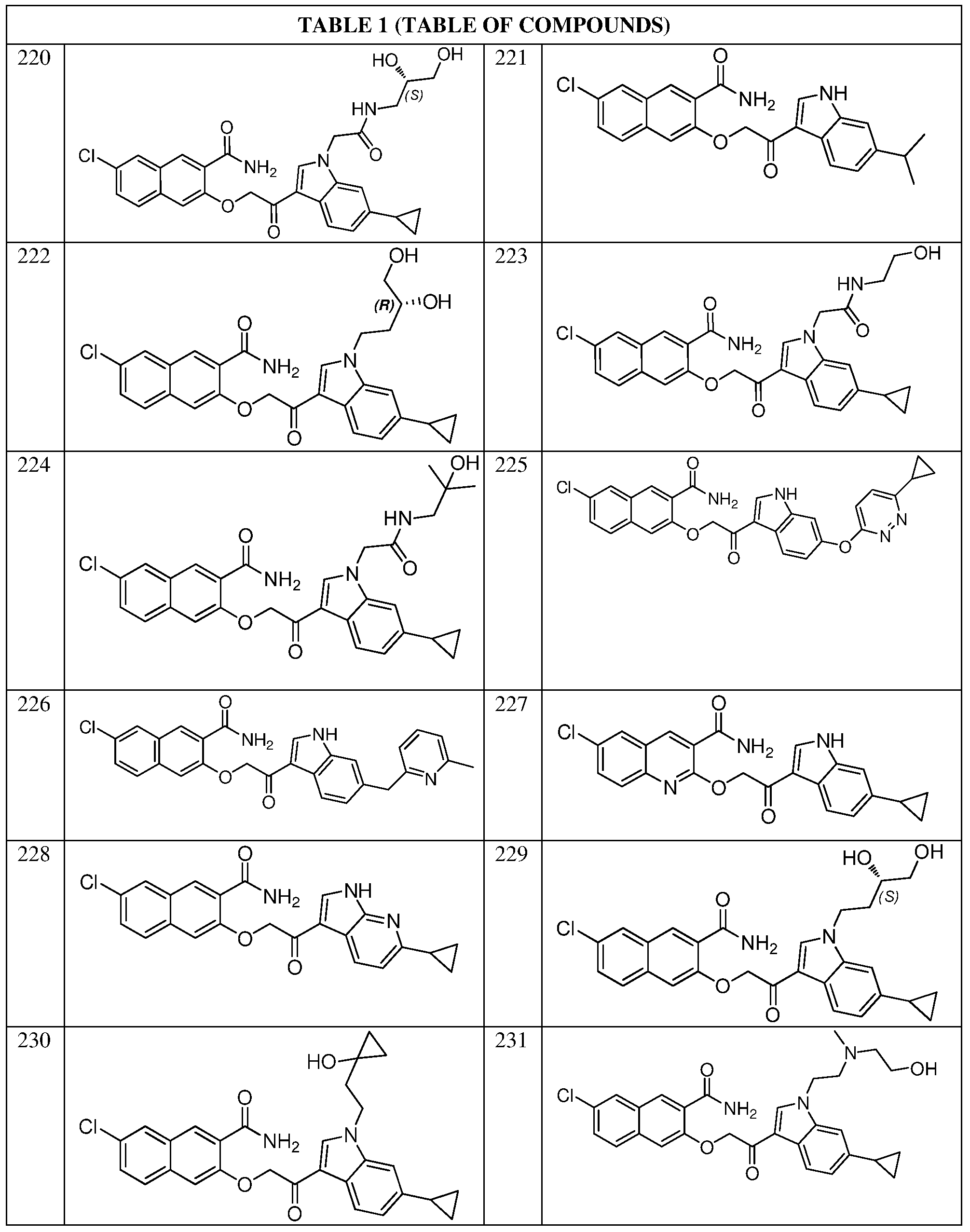


EXAMPLE 103. Pyocyanin Inhibition Assay (Breathable Seal)
[0757] The virulence factors PYO (pyocyanin) is produced both in vitro and in vivo and provides a surrogate measurement to the MvfR ICso-
[0758] Test compounds were dissolved in DMSO at 10 mM and stored at -20 °C until needed. Test concentrations from 0.001 micromolar to 31.6 micromolar (breathable seal) were used for each compound. Eight test concentrations were used for each compound in the breathable seal assay.
[0759] P. aeruginosa, strain PA14, was inoculated into 5 mL of LB broth in a 15-mL sterile glass culture tube and incubated overnight at 37°C under shaking (~ 240 rpm). The overnight culture was then diluted in LB Broth to give an ODeoo = 0.04 (To culture). Colony Forming Units (CFU)/mL of the overnight culture and To culture were determined by a series of 1 : 10 serial dilutions in sterile saline. 4x20 μL· of each dilution was seeded on LB agar plates and incubated at 35+2 °C for 20 hours. CFU/mL was determined from the dilution that gives 2 to 50 colonies/ 20μί.
[0760] For concentration response curve (CRC) experiments, internal standard, 2-((5-nitro-lH- indol-2-yl)thio)-N-(4-phenoxyphenyl)acetamide, a compound previously identified as an MvfR inhibitor
(see Example 1 of US 2014-0066454 (WO 2012/116010)), and test compounds were serially diluted in DMSO to 200 times each final concentration (0.5% DMSO final), and ^L/well is dispensed in duplicate into 2 mL wells of a 96-well deep well plate. 200 μΕΛνεΙΙ of To culture were added to each internal standard/ test compound well. Wells containing only To culture (200 200 μΕΛνεΙΙ) were used to determine pyocyanin control level and wells containing only LB broth (blank wells) were also included in the plate.
[0761] In the breathable seal assay the plate was sealed with a breathable seal, covered with a lid, and incubated at 37°C under shaking (700 rpm) using a microtiter shaker for 24 hours. At the end of the incubation period, the plate was centrifuged at 4,000g for 40 minutes at room temperature, 100 μΕΛνεΙΙ of the supernatant was transferred to a 96-microtiter PS flat-bottom plate, and absorbance at 690 nm was determined using SPECTROstar® Nano microplate reader. Pyocyanin concentration (M) is determined using the equation C = Αβ9ο/ (ε xd), where ε is the Pyocyanin extinction coefficient, at Αβ9ο nm ε is 4,310 M 'cm 1 and d is the experimentally derived pathlength. The level of pyocyanin in the presence of test compound was expressed as percentage of inhibition with respect to the control. Curve fitting and IC50 determination were carried out using a four-parameter logistic model using GraphPad Prism v.5.
[0762] Pyocyanin inhibition data obtained in the breathable seal assay is provided in Table 2. Three stars (***) indicates an IC50 < 0.05 μΜ, two stars (**) indicates 0.05 μΜ < ICso<0.25 μΜ, one star (*) indicates 0.25 μΜ < ICso≤l-0 μΜ, no stars beside a compound number indicates that compound has an ICso > Ι.Ο μΜ.


EXAMPLE 104. Assay for PQS and HHQ Inhibition (6 hour Incubation)
[0763] Virulence factors HHQ (2-hydroxy-2-heptyl-quinoline) and PQS (3,4-dihydroxy-2- heptoquinoline) are produced both in vivo and in vitro and like Pyo can also be used a surrogate measurement of MvfR IC50.
[0764] A concentration range with 7 test concentrations was chosen for each test compound. Typically concentration ranges for the PQS and HHQ assays were from 0.03 to 31.6 μΜ. Compounds were prepared in solvent, usually DMSO, at either 200 or 500 times the final test concentration.
[0765] P. aeruginosa PA14 wild-type strain was inoculated into 5 ml LB broth in a 15 ml sterile glass culture tube and incubated overnight at 37°C under shaking (~ 240 rpm). After overnight incubation, the bacterial culture was diluted in fresh LB broth to an OD600 nm=0.04, and 5 mL aliquots of the diluted bacterial culture were distributed into 15-mL glass tubes. 10 μL· of test compound at 500 times the final test concentration or 25μL· of test compound at 200 times the final test concentration or solvent alone was added to each of the bacterial suspension tubes, and the tubes were incubated at 37°C under shaking (300rpm) for 6 hours. At the end of the incubation period, a 0.5 mL aliquot of bacterial suspension was transferred from each 15 mL glass tube, after shaking, to a 2 mL polypropylene vial. 0.5 mL of methanol-containing D4-PQS (deuterated-PQS), D4-HHQ (deuterated-HHQ) and 2% acetic acid were added to each 2 mL vial and each vial was vigorously shaken. The vials were then centrifuged for 5 minutes at 12,000g, and 200 μL· of supernatant from each vial is transferred to a glass vial (vials crimp
0.2mL), and the sealed vials were kept at 4°C until LC-MS/MS analysis was performed. HAQs quantification is carried out analyzing samples in discrete batches together with spiked standards and blank samples. Calibration curves were constructed from HAQs standards, and respective deuterated forms were used as Internal Standards (IS), to calculate the concentration of analytes in the sample and improve the precision of the assay. The back-calculated concentrations of the calibration standards from the calibration curve are within ± 20% of the nominal values, the range of the analytical method was determined, and the lower and upper limit of quantification specified.
[0766] Liquid chromatography separations were performed using Agilent HP1100 system (Agilent Technologies) coupled with a CTC PAL Autos ampler (CTC Analytics AG). Chromatographic retention is obtained using a monolithic column (Chromolith® RP-18, 50 x 4.6 mm). The solvent system consists of water containing 0.1 % (v/v) formic acid (A) and acetonitrile containing 0.1 % (v/v) formic acid (B). The gradient elution profile was chosen as follows: 0 min: 70% A (1500 μL/min), 0.3 min: 70% A (1500 μί/ηήη), 1.3 min: 5% A (2500 μΙ7ηώι), 1.6 min: 5% A (2500 μΙ7ηώι).
[0767] The MS/MS analysis was performed with a API4000 series mass spectrometer (AB Sciex™) operating in Multiple Reaction Monitoring (MRM) mode and equipped with a TIS ion source. The specific ions monitored were PQS (m/z 260 -> m/z 175), D4-PQS (m/z 264 -> m/z 179), HHQ (m/z 244 -> m/z 159) and D4-HHQ (m/z 248 -> m/z 163). PQS and HHQ in presence of different test compound concentrations were expressed as percentage of inhibition of the basal level in control samples.
[0768] PQS 6 hour inhibition data is provided in Table 3. HHQ 6 hour inhibition data is provided in Table 4. Typically compounds that exhibited an IC50 of less than 1 micromolar in the Pyocyanin inhibition assay were tested in the PQS and HHQ 6 hour inhibition assays. Three stars (***) indicates an IC50 < 0.05 μΜ, two stars (**) indicates 0.05 μΜ < ICso<0.25 μΜ, one star (*) indicates 0.25 μΜ < IC5o≤ 1-0 μΜ, no stars beside a compound number indicates that compound has an IC50 > 1.0 μΜ.

Cmp. No. PQS (6 hr) Cmp. No. PQS (6 hr)
ICso (μΜ) ICso (μΜ)
116 ** 247
119 ** 248 **
120 *** 251 ***
121 ** 254 *
123 ** 281 **
124 *** 283 *
127 ** 285 *
134 *** 287 **
149 ** 288 ***
154 *** 290 ***
184 ** 298 **
186 *** 306 *
308 *

EXAMPLE 105. Acute Immunocompetent Pseudomonas Aeruginosa Thigh Infection for Biomarker Quantitation
[0769] Pseudomonas aeruginosa (Pa) is a common opportunistic human pathogen that has developed resistance to many classes of the available antibiotics.
[0770] The thigh infection model was used to measure target engagement in vivo using both neutropenic and immunocompetent acute models of Pa infection. The PA 14 strain was used as the infective organism. Immunocompetent mice were inoculated with PA 14 using an inoculum of 2.8 lx 106cfu/ mouse. Inoculated mice, 18 mice per group, were administered vehicle, M64 (IV at 10 mg/kg) or Compound 205 (PO at 200 mg/kg) at 2, 10, 18 and 26 hours post infection. Mice were sacrificed at 12, 24, 30 hours post infection, 6 mice per group. The PA14 cfu in thigh tissue, blood were measured. HHQ, PQS, and compound levels in plasma were also measured. M64 was found to have no effect on HHQ or PQS levels compared to vehicle. Very low levels of M64 were found in thigh tissue.
[0771] HHQ and PQS IC50 were measured using the isotope -dilution method followed by LC- MS/MS analysis. Target engagement was measured in vivo as HHQ and PQS levels quantified from murine thigh tissues (both immunocompetent and neutropenic) infected with PA 14. HHQ and PQS werequantified at 12 hours, 24 hours, and 30 hours. 2 animals were lost by 30 hours post infection from the Vehicle group and 1 animal was lost by 30 hours post infection from the compound 205-treated group. The compound 205 levels at 12, 24, and 30 hours in thigh and plasma is given in Table 5.

[0772] A 40% decrease in HHQ and 50% decrease in PQS at t = 12 for compound 205 treated animals relative to vehicle, low levels of both HHQ and PQS were observed at t = 24 for both compound 205 and vehicle treated animals. This was observed previously, the explanation is unknown. There was a significant decrease in both HHQ and PQS in compound 205 treated animals compared to vehicle treated animals at t=30 hours. See FIGURE 1.
Claims
What is claimed is:
1.

, or a tautomer or a pharmaceutically acceptable salt thereof, wherein:
each of Y1, Y2, Y3, Y4, Y5, Y6, Y7, Y10, Yn, Y12 and Y13 is independently selected from N, CH, and C(R2), wherein at least one of Y2, Y3, Y4 or Y5 is C(R2);
each of Y8 and Y9 is independently selected from N and C;
no more than four of Y1, Y2, Y3, Y4, Y5, Y6 and Y7 is N;
no more than three of Y8, Y9, Y10, Yn, Y12 and Y13 is N;
each of V1 and V2 is independently selected from N, N(R3), S, O, CH, and C(R2), wherein V1 and V2 are not simultaneously S or simultaneously O;
each " " represents independently a single or a double bond, wherein at least one ===== is a double bond;
X is selected from -CH2-, CF2-, -0-, -S- , and -NH-
Rl and Rlb are independently selected from hydrogen, fluoro, methyl, -OH and -NH2; or Rl and Rlb are taken together with the carbon atom to which they are bound to form a cyclopropyl ring;
each R2 is independently selected from
halogen, -S(0)2NH2, -OH, -N02, -CN, -Ci-Ce-alkyl, -C2-C6-alkenyl, -C2-C6-alkynyl, -O-(heterocyclyl), -O-(carbocyclyl), -(Co-C4-alkylene)-(heterocyclyl), -(C2-C4-alkenylene)-(heterocyclyl),
-(C2-C4-alkynylene)-(heterocyclyl), -(Co-C4-alkylene)-(carbocyclyl), -(C2-C4-alkenylene)-(carbocyclyl), -(C2-C4-alkynylene) -(carbocyclyl) , or
any two R2 attached to adjacent carbons are optionally taken together with the carbon atoms to which they are bound to form an optionally substituted carbocyclyl or heterocyclyl;
each R3 is independently selected from hydrogen, -Ci-Ce-alkyl,
-C2-C6-alkenyl, -C2-C6-alkynyl, -(Co-C4-alkylene) -(heterocyclyl), -(C2-C4-alkenylene)-(heterocyclyl), -(C2 -C4-alkynylene)-(heterocyclyl), -(Co-C4-alkylene)-(carbocyclyl), -(C2-C4-alkenylene)-(carbocyclyl), or -(C2-C4-alkynylene)-(carbocyclyl); or
R3 and a nitrogen atom to which it is bound is optionally taken together with an adjacent carbon atom and a R2 bound to the carbon atom to form an optionally substituted heterocyclyl;
each alkyl, alkenyl, alkynyl, alkylene, alkenylene, alkynylene, heterocyclyl or carbocyclyl portion of any R2 and R3 is optionally and independently substituted; and
one or more methylene units in the alkyl, alkenyl, alkynyl, alkylene, alkenylene, or alkynylene portion of any R2 and R3 is optionally and independently replaced
with -0-, -S-, -N(R4)-, -S(=0)- or -S(=0)2-, where R4 is hydrogen, -Ci-Ce-alkyl, -(C0- C4alkylene)cycloalkyl, where one or more methyl units in the alkyl, alkylene or cycloalkyl is optionally replaced with -0-, -S-, or -N(H)-.

2. The compound, tautomer, or salt of claim 1, wherein Y4 is C(R2).
3. The compound, tautomer, or salt of claim 2, wherein Y4 is C(R2 ), wherein R2 is selected from chloro and cyano.
4. The compound, tautomer, or salt of any one of claims 1-3, wherein Y7 is C(R2).
5. The compound, tautomer, or salt of claim 4, wherein Y7 is C(R2b), wherein R2b is selected from -C(0)-NH-CH3, -C(0)-NH2, -CH(OH)-CH2OH, -CH2-C(0)-NH2, -CH2-OH,
and -CH(OH)-C(0)-NH2.
6. The compound, tautomer, or salt of any one of claims 1-5, wherein Y6 is selected from C and N.
7. The compound, tautomer, or salt of any one of claims 1-6, wherein:
each of Y1, Y2, and Y3 is independently selected from N and CH; and
Y5 is CH.
8. The compound, tautomer, or salt of any one of claims 1-7, wherein X is -O-
9. The compound, tautomer, or salt of any one of claim 1-8, wherein Rl and Rlb are hydrogen.
10. The compound, tautomer, or salt of any one of claims 1-9, wherein V2 is N(R3).
11. The compound, tautomer, or salt of any one of claims 1-8 wherein V1 is CH, V2 is N(R3), and Y8 and Y9 are both C.
12. The compound tautomer, or salt of claim 10, wherein V2 is N(R3 ) and R3 is selected from hydrogen, hydroxyl, -CH2C(0)OH, -CH3, -CH2-C(0)-NH-CH3, -CH2-C(OH)(CH3)-CH3, - CH2CH2-N(CH2CH3)2, -CH2CH2-C(OH)(CH3)-CH3, -CH(OH)CH2OH, -CH2CH2-CH(OH)-CH2OH, - CH2C(CH3)2OH, -CH2CH2C(CH3)2OH, -CH2C(0)NHCH2-CH(OH)-CH2OH, -CH2-CH(OH)-C(0)- NHCH3, -(CH2)3-CH(OH)-CH2OH, -CH2-C(0)-NH-CH2CH2OH, -CH2-C(0)-NH-CH2C(CH3)2OH, -CH2CH2N(CH3)(CH2CH2OH), -CH2CH2-CH(OH)-C(0)-NHCH3, -CH2OH, -(CH2)2OH, -(CH2)3OH, -CH2-CH(OH)-CH2OH, -(CH2)2-CH(OH)-C(CH3)2-OH, -CH2-C(OH)CH3, -CH2-C(0)NHCH3, -(CH2)2- C(OH)(CH3)-CH2-OH, -CH2-CH(OH)-C(0)-NH-(CH2)2-OH, -(CH2)2NH-(CH2)2-OH, -(CH2)2-CH(OH)- CH(OH)-CH2OH, -0-CH2CH(OH)-CH2-OH, -CH2-0-C(0)-CH(NH3)-CH(CH3)2,-(CH2)2CH(OH)- CH2NH2, -(CH2)2CH(NH2)-COOH, -CH2-CH(OH)-CH(OH)-CH2-OH, -(CH2)2-N-(CH3)2, -(CH2)3-N- (CH3)2, -(CH2)2-CH(OH)-CH(NH2)-CH3, -(CH2)2S02CH3, -(CH2)3-NH-CH3,-CH2-0-P(0)(OH)2, -(CH2)2- CH(OH)-0-P(0)(OH)2, -(CH2)2-CH(CH2OH)-0-P(0)(OH)2,-(CH2)2-CH(-0-P(0)(OH)2)(-CH2-0- P(0)(OH)2), -0-P(0)(OH)2, mo holin-4-ylethyl, pyrrolidin-1 -ylethyl, 3-hydroxy-3-methyl-pyrrolidin-l- ylethyl, 3-hydroxy-pyrrolidin-l -ylethyl, 2-hydroxyazetidin-l -ylethyl, 3-hydroxyazetidin-l -ylethyl, 3- hydroxy-3-methylazetidin-l -ylethyl, 1 -hydroxy cyclopropylmethyl, 1 -hydroxy cyclopropylethyl, 1- hydroxy- 1 -hydroxymethyl-cyclobut-3 -yl, 3 ,4-dihydroxy-2-oxopyrrolidin- 1 -ylethyl, 2-oxopyrrolidin- 1 - ylethyl, 2-oxo-4-hydroxypyrrolidin-l -ylethyl, 2-oxo-3-hydroxypyrrolidin-l -ylethyl, 3,4- dihydroxypyrrolidin- 1 -ylethyl, 3 ,3-difluoropyrrolidin- 1 -ylethyl, 2-COOH-pyrrolidin- 1 -ylethyl, 1 -methyl - 5-oxopyrrolidin-2-ylethyl, 1 -methylpyrrolidin-2-ylethyl, 4-hydroxypiperidin- 1 -ylethyl, 3-hydroxy- oxetan-3-ylethyl, 3-hydroxy-oxetan-3-yl-CH(OH)-(CH2)2-, and 4-methyl -4-hydroxypiperidin- 1 -ylethyl.
13. The compound of any one of claims 1-12, wherein Y7 is C(R2b), wherein R2b is -C(0)-NH2.
14. The compound of claim 13, wherein V1 is selected from N, CH and C(F).
15. The compound of any one of claims 1-14, wherein Y12 is C(R2).
16. The compound of claim 14, wherein Y12 is C(R2c), wherein R2c is selected from cyano, halogen, trifluoromethyl, cyclopropyl, cyclopropylmethyl, Ci-Cealkyl, optionally substituted with one or more oxo or hydroxyl substituents, -C2-C4alkenyl, -O-aryl, -O-heteroaryl, -O-heterocycloalkyl, -CH2-aryl, -C¾- heteroaryl, and -Cth-heterocycloalkyl wherein any aryl, heteroaryl, or heterocycloalkyl portion of R2c is optionally substituted.
17. The compound of claim 16, wherein R2c is selected from cyano, chloro, fluoro, trifluoromethyl, cyclopropyl, cyclopropylmethyl, 2-trifluoromethyl-cyclopropyl, 1 -methyl -cyclopropyl, 2-methyl- cyclopropyl, vinyl, -CH(OH)CH2OH, -CH2CH2-CH(OH)-CH2OH, -CH(CH3)2, pyridin-3-yloxy, pyrazin-
2- yloxy, 6-methylpyridin-3-yloxy, pyridazin-3-yloxy, 6-cyclopropyl-pyridazin-3-yloxy, pyridinium-1- ylmethyl, 2-methylpyridin-3-yloxy, pyridin-2-ylmethyl, 6-methyl-pyridin-2-ylmethyl, pyridin-3-ylmethyl, l,2,4-triazin-3-yloxy, l,2,4-triazin-6-yloxy, pyridazin-4-yloxy, pyrimidin-5-yloxy, lH-pyrazol-1- ylmethyl, tetrahydropyran-4-yloxy, 4-chloropyridazin-3-yloxy, 4-methylpyridazin-3-yloxy, 5-methyl-lH- pyrazol-1 -ylmethyl, 3 -methyl- lH-pyrazol-1 -ylmethyl, pyrazin-2-ylmethyl, pyrimidin-5-ylmethyl, pyridazin-3-ylmethyl, 5-methyl-pyridazin-3-yloxy, 6-chloro-pyridzin-3yloxy, 6-methyl-pyridin-3-yl-oxy,
3- methylpyrazin-2-yloxy, 2-oxo-pyrrolidin-l -ylmethyl, 3-hydroxy-oxetanyl, and oxetan-3-yl.
18. The compound of any one of claims 1-17, wherein Yn is selected from N, CH, and C(F).
19. The compound of any one of claims 1-18, wherein Y13 is selected from N, CH, C(CN), and C(F).
20. The compound of any one of claims 1-19, wherein Y8and Y9 are C and Y10 is CH.

or a tautomer or pharmaceutically acceptable salt thereof, wherein:
Each of Y1, Y3, Y5, Y6, Y10, and Yn is independently selected from CH, N, and C(F);
Each of Y2 and Y13 is independently selected from CH, N, C(CN), C(C1) and C(F);
X is selected from -CH2-, -O- and -NH-;
V1 is selected from N, CH, and C(F);
R2 is selected from chloro, fluoro, CHF2, CF3 and cyano;
R2b is selected from -C(0)-NH2, -C(0)-NH-CH3, -CH(OH)-CH2OH, -CH2OH, -CH2-C(0)-NH2, and -CH(OH)-C(0)-NH2;
R2c is selected from chloro, fluoro, cyano, trifluoromethyl, Ci-C4-alkyl, C2-C4-alkenyl, -O-C1 C3- alkyl, cyclopropyl, -CH2-cyclopropyl, -CH2-aryl, -CH2-heteroaryl, -CH2-heterocycloalkyl, -O- cyclopropyl, -O-aryl, -O-heteroaryl, and -O-heterocycloalkyl, wherein any aryl, heteroaryl,
heterocycloalkyl, cyclopropyl, or alkyl portion of R2c is optionally substituted; and
R3 is selected from hydrogen, hydroxyl,
-CH3, -CH2CH3, -CH2-C(OH)(CH3)2, -CH2CH2-CH(OH)-CH2OH, -CH2-CH(OH)CH2OH, -CH2- CH(OH)CH2NH2, -CH2-CH(NH2)CH2OH, -CH2CH2-CH(OH)CH2NH2, -CH2CH2-CH(NH2)CH2OH, - CH2-CH(OH)-C(0)NHCH3, -CH2CH2-CH(OH)-C(0)NHCH3, -CH2-CH(OH)-C(0)NH2, -CH2CH2- CH(OH)-C(0)NH2, -CH2CH2-N(CH2CH3)2, -CH2-C(0)-NH2, -CH2-C(0)-NH-CH3, -CH2-C(0)-N(CH3)2, -CH2-C(0)-N(CH2CH3)3, -CH2C(CH3)2OH, -CH2CH2C(CH3)2OH, -CH2C(0)NHCH2-CH(OH)-CH2OH, - CH2-CH(OH)-C(0)-NHCH3, -(CH2)3-CH(OH)-CH2OH, -CH2-C(0)-NH-CH2CH2OH, -CH2-C(0)-NH- CH2C(CH3)2OH, -CH2CH2N(CH3)(CH2CH2OH), -CH2CH2-CH(OH)-C(0)-NHCH3, -CH2OH, - (CH2)2OH, -(CH2)3OH, -CH2-CH(OH)-CH2OH, -(CH2)2-CH(OH)-C(CH3)2-OH, -CH2-C(OH)CH3, -CH2- C(0)NHCH3, -(CH2)2-C(OH)(CH3)-CH2-OH, -CH2-CH(OH)-C(0)-NH-(CH2)2-OH, -(CH2)2NH-(CH2)2- OH, -(CH2)2-CH(OH)-CH(OH)-CH2OH, -0-CH2CH(OH)-CH2-OH, -CH2-0-C(0)-CH(NH3)-CH(CH3)2,- (CH2)2CH(OH)-CH2NH2, -(CH2)2CH(NH2)-COOH, -CH2-CH(OH)-CH(OH)-CH2-OH, -(CH2)2-N-(CH3)2, -(CH2)3-N-(CH3)2, -(CH2)2-CH(OH)-CH(NH2)-CH3, -(CH2)2S02CH3, -(CH2)3-NH-CH3, -CH2-0- P(0)(OH)2, -(CH2)2-CH(OH)-0-P(0)(OH)2, -(CH2)2-CH(CH2OH)-0-P(0)(OH)2,-(CH2)2-CH(-0- P(0)(OH)2)(-CH2-0-P(0)(OH)2), -0-P(0)(OH)2, (l-hydroxycyclopropyl)methyl, (1- hydroxycyclopropyl)ethyl, 3-hydroxy-3-(hydroxymethyl)cyclobutyl, 2-mo holinoethyl, 2-(pyrrolidin-l- yl)ethyl, 2-(3-hydroxy-3-methyl-pyrrolidin- 1 -yl)ethyl, 2-(3-hydroxy-pyrrolidin- 1 -yl)ethyl, 2-(2- hydroxyazetidin- 1 -yl)ethyl, 2-(3 ,4-dihydroxy-2-oxopyrrolidin- 1 -yl)ethyl, 2-oxo-2-(pyrrolidin- 1 -yl)ethyl, 2-(4-hydroxy-2-oxopyrrolidin- 1 -yl)ethyl, 2-(3-hydroxy-2-oxopyrrolidin- 1 -yl)ethyl, 2-(3 ,4-dihydroxy-2- oxopyrrolidin-l-yl)ethyl, 2-(4-hydroxypiperidin-l-yl)-2-oxoethyl, 2-(3-hydroxyazetidin-l-yl)-2- oxoethyl,2-oxo-3-hydroxypyrrolidin-l-ylethyl, 2-(l-methyl-5-oxopyrrolidin-2-yl)ethyl , 2-(3- hydroxyazetidin-l-yl)ethyl, 2-(3-hydroxy-3-methylazetidin-l-yl)ethyl, 2-(3,4-dihydroxypyrrolidin-l- yl)ethyl, 2-(3 ,3-difluoropyrrolidin- 1 -yl)ethyl, 2-(2-COOH-pyrrolidin- 1 -yl)ethyl, 2-( 1 -methylpyrrolidin-2-
yl)ethyl, 2-(4-hydroxypiperidin-l -yl)ethyl, 2-(3-hydroxy-oxetan-3-yl)ethyl, 2-hydroxy-2-(3-hydroxy- oxetan-3-yl)ethyl, and 2-(4-hydroxy-4-methylpiperidin-l -yl)ethyl.
22. The compound, tautomer, or salt of claim 21, wherein R2c is selected from cyano, cyclopropyl, 1- methyl-cyclopropyl, -CH(OH)CH2OH, -CH2CH2-CH(OH)-CH2OH, pyridin-3-yloxy, pyrazin-2-yloxy, 6- methylpyridin-3-yloxy, pyridazin-3-yloxy, 2-methylpyridin-3-yloxy, pyridin-2-ylmethyl, pyridin-3- ylmethyl, l,2,4-triazin-3-yloxy, l,2,4-triazin-6-yloxy, pyridazin-4-yloxy, pyrimidin-5-yloxy, lH-pyrazol- 1-ylmethyl, tetrahydropyran-4-yloxy, 4-chloropyridazin-3-yloxy, 4-methylpyridazin-3-yloxy, 5-methyl- lH-pyrazol-1 -ylmethyl, 3 -methyl- lH-pyrazol-1 -ylmethyl, pyrazin-2-ylmethyl, pyrimidin -5-ylmethyl, pyridazin-3-ylmethyl, 3-methylpyrazin-2-yloxy, 3-hydroxy-oxetan-3-yl, and oxetan-3-yl.

Y2 is selected from CH and N;
R2 is selected from chloro, -CN, -CF3 and -N02;
R2c is selected from chloro, -CN, -CF3, cyclopropyl, cyclobutyl, oxatan-3-yl, and O-Ht, where Ht is a nitrogen-containing heteroaryl, wherein any cyclopropyl, cyclobutyl, oxatan-3-yl, or Ht portion of R2' is optionally substituted; and
R3a is selected from hydrogen, -CH2CH2CH(OH)CH2OH, -CH2CH(OH)C(0)NH2,
-CH2CH(OH)C(0)NHCH3, -CH2CH2CH(OH)CH2OP03H, -CH2CH2CH(OP03H)CH2OP03H,
-CH2CH(OP03H2)C(0)NH2 and -CH2CH(OP03H2)C(0)NHCH3.
24. A compound, tautomer, or salt of Claim 23, in which R2 is selected from chloro, -CN, and -CF3.
25. A compound, tautomer, or salt of Claim 23 or 24, in which Y2 is CH.
26. A compound, tautomer, or salt of Claim 23 or 24, in which Y2 is N.
27. A compound, tautomer, or salt of any one of Claims 23 to 26, in which R2c is selected from chloro, -CF3, cyclopropyl, oxatan-3-yl, 2-trifluoromethylcyclopropyl, 2-tmethylcyclopropyl, pyridin-3-yl, pyrazin-2-yl, 6-methylpyridin-3-yl, 2-methylpyridin-3-yl, pyridazine-3-yl, pyridazine-4-yl, 4- methylpyridazine-3-yl, 5-methylpyridazine-3-yl, 6-cyclopropylpyridazin -3-yl, and pyrimidin-5-yl.
28. A compound, tautomer, or salt of any one of Claims 23 to 27 in which R3 is selected from hydrogen, -CH2CH2CH(OH)CH2OH, and -CH2CH(OH)C(0)NHCH3.
29. The compound of claim 1, wherein the compound is selected from any single compound in TABLE 1 (TABLE OF COMPUNDS), provided in the specification.
30. A pharmaceutical composition comprising a therapeutically effective amount of compound, tautomer, or salt of any one of claims 1-29, and a pharmaceutically acceptable carrier.
31. A method of treating a bacterial infection in a subject comprising administering to the subject in need thereof the composition of claim 30.
32. The method of claim 31 , wherein the bacterial infection is a Pseudomonas aeruginosa infection.
Applications Claiming Priority (4)
| Application Number | Priority Date | Filing Date | Title |
|---|---|---|---|
| US201562100205P | 2015-01-06 | 2015-01-06 | |
| US62/100,205 | 2015-01-06 | ||
| US201562141642P | 2015-04-01 | 2015-04-01 | |
| US62/141,642 | 2015-04-01 |
Publications (1)
| Publication Number | Publication Date |
|---|---|
| WO2016112088A1 true WO2016112088A1 (en) | 2016-07-14 |
Family
ID=56356380
Family Applications (1)
| Application Number | Title | Priority Date | Filing Date |
|---|---|---|---|
| PCT/US2016/012308 Ceased WO2016112088A1 (en) | 2015-01-06 | 2016-01-06 | Aryloxyacetylindoles and analogs as antibiotic tolerance inhibitors |
Country Status (1)
| Country | Link |
|---|---|
| WO (1) | WO2016112088A1 (en) |
Cited By (10)
| Publication number | Priority date | Publication date | Assignee | Title |
|---|---|---|---|---|
| CN110256342A (en) * | 2019-07-16 | 2019-09-20 | 河南省科学院化学研究所有限公司 | A kind of synthetic method of 2-cyanoquinoline derivatives |
| WO2020007938A1 (en) | 2018-07-03 | 2020-01-09 | Helmholtz-Zentrum für Infektionsforschung GmbH | PqsR INVERSE AGONISTS |
| WO2020140054A1 (en) | 2018-12-28 | 2020-07-02 | Spv Therapeutics Inc. | Cyclin-dependent kinase inhibitors |
| WO2021136805A1 (en) | 2020-01-02 | 2021-07-08 | Helmholtz-Zentrum für Infektionsforschung GmbH | NOVEL PqsR INVERSE AGONISTS |
| WO2021136803A1 (en) | 2020-01-02 | 2021-07-08 | Helmholtz-Zentrum für Infektionsforschung GmbH | NEW PqsR INVERSE AGONISTS |
| CN113683505A (en) * | 2021-09-29 | 2021-11-23 | 厦门大华本安化工安全研究院有限公司 | Preparation method of carboxylic ester compound containing oxygenated cyclobutyl |
| CN117209343A (en) * | 2023-09-08 | 2023-12-12 | 菏泽学院 | A kind of continuous synthesis method of 2-naphthol compounds |
| WO2024126650A1 (en) | 2022-12-15 | 2024-06-20 | Syngenta Crop Protection Ag | Novel bicyclic-carboxamide compounds useful as pesticides |
| WO2024231436A1 (en) * | 2023-05-11 | 2024-11-14 | Arxada Ag | Hydrogenation of cyclic ketones |
| WO2025078654A1 (en) * | 2023-10-12 | 2025-04-17 | Veirulence Ltd | Antibacterial compounds |
Citations (4)
| Publication number | Priority date | Publication date | Assignee | Title |
|---|---|---|---|---|
| WO2000042045A2 (en) * | 1999-01-13 | 2000-07-20 | Warner-Lambert Company | Functionalized heterocycles as chemokine receptor modulators |
| US20040186131A1 (en) * | 2002-08-30 | 2004-09-23 | Wathen Michael W | Method of preventing or treating atherosclerosis or restenosis |
| WO2010139982A1 (en) * | 2009-06-02 | 2010-12-09 | The University Of Sheffield | Indole derivatives for the stimulation of stem cell proliferation |
| US8110570B2 (en) * | 2008-07-14 | 2012-02-07 | Cropsolution, Inc. | Modulators of acetyl-coenzyme A carboxylase and methods of use thereof |
-
2016
- 2016-01-06 WO PCT/US2016/012308 patent/WO2016112088A1/en not_active Ceased
Patent Citations (4)
| Publication number | Priority date | Publication date | Assignee | Title |
|---|---|---|---|---|
| WO2000042045A2 (en) * | 1999-01-13 | 2000-07-20 | Warner-Lambert Company | Functionalized heterocycles as chemokine receptor modulators |
| US20040186131A1 (en) * | 2002-08-30 | 2004-09-23 | Wathen Michael W | Method of preventing or treating atherosclerosis or restenosis |
| US8110570B2 (en) * | 2008-07-14 | 2012-02-07 | Cropsolution, Inc. | Modulators of acetyl-coenzyme A carboxylase and methods of use thereof |
| WO2010139982A1 (en) * | 2009-06-02 | 2010-12-09 | The University Of Sheffield | Indole derivatives for the stimulation of stem cell proliferation |
Non-Patent Citations (2)
| Title |
|---|
| DATABASE PubChem 11 July 2007 (2007-07-11), Database accession no. 1536684 * |
| ILANGOVAN ET AL.: "Structural Basis for Native Agonist and Synthetic Inhibitor Recognition by the Pseudomonas aeruginosa Quorum Sensing Regulator PqsR (MvfR", PLOS PATHOGENS, vol. 9, no. 7, 2013 * |
Cited By (13)
| Publication number | Priority date | Publication date | Assignee | Title |
|---|---|---|---|---|
| WO2020007938A1 (en) | 2018-07-03 | 2020-01-09 | Helmholtz-Zentrum für Infektionsforschung GmbH | PqsR INVERSE AGONISTS |
| US11883387B2 (en) | 2018-07-03 | 2024-01-30 | Helmholtz-Zentrum für Infektionsforschung GmbH | PqsR inverse agonists |
| WO2020140054A1 (en) | 2018-12-28 | 2020-07-02 | Spv Therapeutics Inc. | Cyclin-dependent kinase inhibitors |
| CN110256342B (en) * | 2019-07-16 | 2022-06-07 | 河南省科学院化学研究所有限公司 | Synthetic method of 2-cyano quinoline derivative |
| CN110256342A (en) * | 2019-07-16 | 2019-09-20 | 河南省科学院化学研究所有限公司 | A kind of synthetic method of 2-cyanoquinoline derivatives |
| WO2021136805A1 (en) | 2020-01-02 | 2021-07-08 | Helmholtz-Zentrum für Infektionsforschung GmbH | NOVEL PqsR INVERSE AGONISTS |
| WO2021136803A1 (en) | 2020-01-02 | 2021-07-08 | Helmholtz-Zentrum für Infektionsforschung GmbH | NEW PqsR INVERSE AGONISTS |
| US12528783B2 (en) | 2020-01-02 | 2026-01-20 | Helmholtz-Zentrum Fur Infektionsforschung Gmbh | PqsR inverse agonists |
| CN113683505A (en) * | 2021-09-29 | 2021-11-23 | 厦门大华本安化工安全研究院有限公司 | Preparation method of carboxylic ester compound containing oxygenated cyclobutyl |
| WO2024126650A1 (en) | 2022-12-15 | 2024-06-20 | Syngenta Crop Protection Ag | Novel bicyclic-carboxamide compounds useful as pesticides |
| WO2024231436A1 (en) * | 2023-05-11 | 2024-11-14 | Arxada Ag | Hydrogenation of cyclic ketones |
| CN117209343A (en) * | 2023-09-08 | 2023-12-12 | 菏泽学院 | A kind of continuous synthesis method of 2-naphthol compounds |
| WO2025078654A1 (en) * | 2023-10-12 | 2025-04-17 | Veirulence Ltd | Antibacterial compounds |
Similar Documents
| Publication | Publication Date | Title |
|---|---|---|
| US11866450B2 (en) | Modulators of Cystic Fibrosis Transmembrane Conductance regulator, pharmaceutical compositions, methods of treatment, and process for making the modulators | |
| US12202836B2 (en) | Bicyclic-fused heteroaryl or aryl compounds | |
| TWI894260B (en) | Fused tricyclic kras inhibitors | |
| JP6775645B2 (en) | Thiazole carboxamide and pyridine carboxamide compounds useful as PIM kinase inhibitors | |
| CN108699038B (en) | Spirocycloheptanesalicylic acid amides and related compounds as Rock inhibitors | |
| US20230312586A1 (en) | Heterobicyclic amides as inhibitors of cd38 | |
| CN106999479B (en) | Heteroaryl Compounds Useful as SUMO Activase Inhibitors | |
| TWI330081B (en) | New compounds, their preparations and their use in treatment and/or prevention of disease associated with glycogen synthase kinase-3 | |
| TW201446758A (en) | Perfluorinated 5,6-dihydro-4H-1,3-oxazin-2-amine compounds as beta-secretase inhibitors and methods of use | |
| US12473304B2 (en) | Heterocyclic PAD4 inhibitors | |
| CN103717599A (en) | Indazoles | |
| US20240150343A1 (en) | Compound having brd4 inhibitory activity, preparation method therefor and use thereof | |
| JP2016505021A (en) | Bicyclic aromatic carboxamide compounds useful as Pim kinase inhibitors | |
| CN116600808A (en) | Tetrahydronaphthyridine derivative serving as KRAS mutant G12C inhibitor, and preparation method and application thereof | |
| US20240158370A1 (en) | CK1 alpha AND DUAL CK1 alpha / GSPT1 DEGRADING COMPOUNDS | |
| TW201602116A (en) | Bridged bicyclic amino thiazine dioxide compounds as inhibitors of beta-secretase and methods of use thereof | |
| KR20100135743A (en) | Thiazolyl-dihydro-indazole | |
| WO2016007837A1 (en) | Carbonyl linked bicyclic heteroaryl antibiotic tolerance inhibitors | |
| CN119855589A (en) | Heterocyclic PAD4 inhibitors |
Legal Events
| Date | Code | Title | Description |
|---|---|---|---|
| 121 | Ep: the epo has been informed by wipo that ep was designated in this application |
Ref document number: 16735344 Country of ref document: EP Kind code of ref document: A1 |
|
| NENP | Non-entry into the national phase |
Ref country code: DE |
|
| 122 | Ep: pct application non-entry in european phase |
Ref document number: 16735344 Country of ref document: EP Kind code of ref document: A1 |