WO2016111647A1 - A fiber-reinforced polymer composite - Google Patents
A fiber-reinforced polymer composite Download PDFInfo
- Publication number
- WO2016111647A1 WO2016111647A1 PCT/SG2016/050003 SG2016050003W WO2016111647A1 WO 2016111647 A1 WO2016111647 A1 WO 2016111647A1 SG 2016050003 W SG2016050003 W SG 2016050003W WO 2016111647 A1 WO2016111647 A1 WO 2016111647A1
- Authority
- WO
- WIPO (PCT)
- Prior art keywords
- fiber
- organosilicon
- carbon atoms
- substituted
- clay material
- Prior art date
- Legal status (The legal status is an assumption and is not a legal conclusion. Google has not performed a legal analysis and makes no representation as to the accuracy of the status listed.)
- Ceased
Links
Classifications
-
- C—CHEMISTRY; METALLURGY
- C08—ORGANIC MACROMOLECULAR COMPOUNDS; THEIR PREPARATION OR CHEMICAL WORKING-UP; COMPOSITIONS BASED THEREON
- C08K—Use of inorganic or non-macromolecular organic substances as compounding ingredients
- C08K9/00—Use of pretreated ingredients
- C08K9/08—Ingredients agglomerated by treatment with a binding agent
-
- C—CHEMISTRY; METALLURGY
- C08—ORGANIC MACROMOLECULAR COMPOUNDS; THEIR PREPARATION OR CHEMICAL WORKING-UP; COMPOSITIONS BASED THEREON
- C08J—WORKING-UP; GENERAL PROCESSES OF COMPOUNDING; AFTER-TREATMENT NOT COVERED BY SUBCLASSES C08B, C08C, C08F, C08G or C08H
- C08J3/00—Processes of treating or compounding macromolecular substances
- C08J3/20—Compounding polymers with additives, e.g. colouring
- C08J3/203—Solid polymers with solid and/or liquid additives
-
- C—CHEMISTRY; METALLURGY
- C08—ORGANIC MACROMOLECULAR COMPOUNDS; THEIR PREPARATION OR CHEMICAL WORKING-UP; COMPOSITIONS BASED THEREON
- C08K—Use of inorganic or non-macromolecular organic substances as compounding ingredients
- C08K9/00—Use of pretreated ingredients
- C08K9/04—Ingredients treated with organic substances
- C08K9/06—Ingredients treated with organic substances with silicon-containing compounds
-
- C—CHEMISTRY; METALLURGY
- C08—ORGANIC MACROMOLECULAR COMPOUNDS; THEIR PREPARATION OR CHEMICAL WORKING-UP; COMPOSITIONS BASED THEREON
- C08J—WORKING-UP; GENERAL PROCESSES OF COMPOUNDING; AFTER-TREATMENT NOT COVERED BY SUBCLASSES C08B, C08C, C08F, C08G or C08H
- C08J2323/00—Characterised by the use of homopolymers or copolymers of unsaturated aliphatic hydrocarbons having only one carbon-to-carbon double bond; Derivatives of such polymers
Definitions
- Various embodiments relate to the field of polymer composites. Various embodiments are further directed to a method for manufacturing polymer composites and their respective uses.
- Short glass-fiber-reinforced polymer composites are widely used in the automobile industry to replace some heavy metallic parts due to their lightweight, processibility, low-cost and ability to tailor their properties for different applications.
- high loadings of the glass-fibers which are used to impart great strength and stiffness to these composites result in reduced fracture toughness, thus limiting their use to only non-impact or low-impact applications.
- Natural fiber reinforced polymer composites have been used to replace glass fiber reinforced polymer composites, as natural fibers are renewable, naturally abundant, lightweight, and low-cost. However, they suffer from drawbacks such as low modulus, strength, and impact resistance as compared to short glass fiber reinforced composites, thus limiting their use in many applications.
- a method for preparing a fiber-reinforced polymer composite comprises:
- a fiber-reinforced polymer composite obtainable by the method according to the first aspect is provided.
- a fiber-reinforced polymer composite is provided.
- the fiber-reinforced polymer composite comprises
- an intercalated clay material comprising a clay material modified with a first organosilicon and which is intercalated with a binder
- intercalated clay material wherein the intercalated clay material, the modified natural fibrous material, the compatibilizer and the fiber are dispersed in the polyolefin resin.
- Figure 1 A) is a schematic diagram depicting fabrication of clay through solution intercalation by liquid epoxy resin (DER 332) and spray drying according to embodiments.
- Figure 1 B) is a schematic diagram showing structure of chopped jute fiber reinforced polyolefin composite containing modified clay and chopped glass fiber according to embodiments.
- Figure 2 A) is a photograph showing pellets of chopped jute fiber
- Figure 2 B shows enhanced chemical bonding of the organosilicon moieties on the natural fibrous material ("natural fiber") with other components in the fiber-reinforced polymer composite according to embodiments.
- FIG. 3 is a schematic diagram showing screw configuration of a twin-screw extruder for compounding according to embodiments, where Mixing zone #1 , Mixing zone #2, and Mixing zone #3 are depicted relative to Feed port #1 , Feed port #2 and the die.
- Feed port #2 is located nearer to the die, it is positioned at a later stage of the melt-compounding process, therefore components which are sensitive and can break easily may be added to the reaction mixture at Feed port #2.
- polyolefin resin a compatibilizer such as maleic anhydride-grafted polypropylene (MAPP), a clay material such as nanoclay, and a fiber such as a glass fiber may be added to Feed port #1 , while a natural fibrous material such as chopped jute fiber and a fiber such as glass fiber pellets may be added to Feed port #2.
- MAPP maleic anhydride-grafted polypropylene
- Figure 4 shows X-ray powder diffraction (XRD) spectra of raw organoclay (Nanomer® I.34TCN), modified clay and polyolefin composites. From the XRD, it may be seen that the interlayer distance of clay was expanded after modification by organosilicon and intercalation by epoxy.
- XRD X-ray powder diffraction
- FIG. 5 shows thermogravimetric analysis (TGA) thermograms of raw organoclay (Nanomer® I.34TCN) and modified clay. From the TGA, it may be seen that the thermal stability of clay was increased after modification.
- TGA thermogravimetric analysis
- Figure 6 A) and B) are high-magnification scanning electron microscopy (SEM) images of a composite of untreated polyolefin/jute fiber.
- the jute fiber used to form the composite is a non- modified jute fiber, and is presented herein for comparison purposes.
- Scale bar in the images denote ⁇ ⁇ .
- Figure 7 A) and B) are high-magnification SEM images of a composite of amino- organosilicon and vinyl-organosilicon treated polyolefin/jute fiber, corresponding to Sample #5. Scale bar in A) denotes 100 ⁇ , while scale bar in B) denotes 10 ⁇ . As compared to the composite shown in Figure 6 A) and B), it may be seen that surface modification of natural fiber enhances the interfacial bonding between the natural fiber and polyolefin matrix.
- Figure 8 A) and B) are high-magnification SEM images of a composite of polyolefin/jute fiber/organoclay (Nanomer 1.31 PC from Nanocor), corresponding to Sample #6. Scale bar in A) denotes 100 ⁇ , while scale bar in B) denotes 10 ⁇ .
- Figure 9 A) and B) are high-magnification SEM images of a composite of polyolefin/jute fiber/clay, wherein the clay has been modified with amino-organosilicon as disclosed herein, corresponding to Sample #7.
- Scale bar in A) denotes 100 ⁇
- scale bar in B) denotes 10 ⁇ .
- modification of clay enhances the interfacial bonding between the natural fiberous material and polyolefin matrix.
- Figure 10 A) and B) are high-magnification SEM images of a composite of PP GF 40 LFT, which is a type of polypropylene/glass fiber (20 wt.%), corresponding to Sample #3.
- Scale bar in A) denotes 100 ⁇
- scale bar in B) denotes 10 ⁇ .
- Figure 11 is a high magnification SEM image of a composite of polyolefin/jute fiber/1.31 PS/glass fiber, corresponding to Sample #12. Scale bar in the image denotes 100 ⁇ .
- Figure 12 A), B), C), and D) show four high-magnification images of a cross section of polyolefin/jute fiber/modified organoclay/glass fiber composite, corresponding to Sample #13.
- Figure 12 B) shows the interface of a glass fiber and a polyolefin (see black box).
- Figure 12 D) is an image enlargement of the black box showing residual partial bonding between said fibers and said polyolefin after tension failure.
- Various embodiments disclosed herein are based on the inventors' surprising finding that the strength and modulus of polyolefin/natural fiber composites may be significantly improved by using a modified natural fibrous material bearing organosilicon moieties, such as at least one amino- organosilicon moiety and at least one vinyl-organosilicon moiety, to form the polyolefin/natural fiber composite, and further incorporating (i) a modified clay material bearing a organosilicon moiety such as at least one amino-organosilicon moiety and which is intercalated with a binder, (ii) at least one fiber, and (iii) at least one compatibilizer into the polyolefin/natural fiber composites.
- organosilicon moieties such as at least one amino- organosilicon moiety and at least one vinyl-organosilicon moiety
- the manufactured composite disclosed herein has demonstrated improved mechanical properties, such as tensile modulus, flexural modulus, tensile strength, flexural strength, as well as improved impact resistance and thermal stability. Moreover, the composite according to embodiments disclosed herein are sound absorbing and lightweight. Due to the renewable and naturally abundant used natural fibers, the obtained composites are low-cost and sustainable. The composites are thus attractive for automotive industry and suitable for use as interior parts for vehicles.
- the above outlined advantageous properties of the composite are attributable to the synergistic effects provided by combination of the specific components of the reaction mixture, in particular to the modified natural fiberous material, the modified clay material, the intercalated binder in the modified clay material, and further by use of the fiber and the compatibilizer.
- the organosilicon moieties as exemplified by the vinyl-organosilicon moiety and/or the amino-organosilicon moiety, the binder such as epoxy resin, as well as the fiber such as glass fiber contained in the reaction mixture result in a composite with chemical bondings between the components of the composite providing the advantageous properties.
- the composite disclosed herein is eco-friendly, low- cost, lightweight, and sound absorbing.
- said composite has improved mechanical properties and thermal stability.
- the composites disclosed herein are particularly suitable for the use as interior parts for vehicles.
- the term “a” refers to one as well as to at least one.
- the term “at least one” as used herein relates to one or more, for example 1 , 2, 3, 4, 5, 6, 7, 8, 9 or more of the referenced species.
- the method according to the first aspect includes chemically modifying a clay material with a first organosilicon to form a modified clay material.
- the term "clay material” refers to natural rock or soil material that contains at least one clay mineral and traces of metal oxides and natural matter. Such minerals are, for example, Fe, alkali and alkaline metals, and hydrous aluminum phyllosilicates.
- the clay material may comprise or consist of silicates with a layered or platelet structure, with thickness of the layered or platelet structure in the nanometers range.
- the clay material is selected from the group consisting of mineral clays, synthetic clays, organoclays, and mixtures thereof.
- a swollen clay material may be formed when a clay material is exposed to an organic solvent, whereby the organic solvent diffuses into the clay material between the layers, causing the layers to move apart. This results in expansion or swelling of the clay material, where the layers are not as strongly held together.
- Suitable organic solvents may be selected from the group consisting of acetone, tetrahydrofuran, methanol, ethanol, and combinations thereof.
- chemically modifying the clay material with the first organosilicon comprises dispersing and swelling the clay material in acetone.
- the clay material comprises an organoclay.
- organoclay refers to clay modified with organic moieties.
- the clay may be modified by, for example, octadyl ammonium, silane, methyl, bis hydroxyethyl, octadecyl ammonium, and mixtures thereof.
- Organoclays are commercially obtainable, for example, such as Nanomer® I.34TCN, and Nanomer®l.31 PC from Nanocor.
- the clay material may be functionalized with one or more amino-organosilicon moieties via reaction of the clay material and a first organosilicon.
- organosilicon refers to a compound containing at least one silicon-carbon (Si— C) bond.
- the first organosilicon may be selected from the group consisting of an amino-organosilicon, an organosilicon containing an glycidyl group, an organosilicon containing a carboxylic group, and combinations thereof.
- the first organosilicon is an amino-organosilicon.
- amino- organosilicon refers to a compound containing an amino-group and at least one silicon-carbon bond.
- the first organosilicon may be any amino-organosilicon that is able to chemically modify the clay material to impart one or more amino-organosilicon moieties to the clay material.
- organic moieties of the organoclay may function as linkers between the clay and the amino-organosilicon moieties. Due to the organic moieties, the modified organoclay material can bear a higher amount of amino- organosilicon moieties.
- the first organosilicon is an amino-organosilicon having Formula (I)
- R 1 , R 2 and R 3 are independently selected from the group consisting of hydrogen, a linear or branched, substituted or unsubstituted alkyl with 1 to 20 carbon atoms, substituted or unsubstituted, linear or branched alkenyl with 2 to 20 carbon atoms; substituted or unsubstituted cycloalkyl with 5 to 20 carbon atoms; substituted or unsubstituted cycloalkenyl with 5 to 20 carbon atoms; substituted or unsubstituted aryl with 5 to 14 carbon atoms; and substituted or unsubstituted heteroaryl with 5 to 14 carbon atoms.
- m is from 1 to 10
- R 1 , R 2 and R 3 are independently a linear or branched, unsubstituted alkyl with 1 to 10 carbon atoms. More preferably, m is from 1 to 5, and R 1 , R 2 and R 3 are independently a linear or branched, unsubstituted alkyl with 1 to 5 carbon atoms, and even more preferably m is 3, and R 1 , R 2 and R 3 are ethyl.
- the first organosilicon comprises or consists of 3-aminopropyl triethoxysilane.
- alkyl refers to a saturated hydrocarbon moiety, such as methyl, ethyl, and the like.
- alkenyl and alkynyl comprise at least one carbon-carbon double bonds or triple bonds, respectively, and are otherwise defined as alkyl above.
- cycloalkyl refers to a non-aromatic carbocyclic moiety, such as cyclopentanyl, cyclohexanyl, and the like.
- cycloalkenyl refers to non-aromatic carbocyclic compounds that comprise at least one carbon-carbon double bond.
- heterocycloalk(en)yl relates to cycloalk(en)yl groups wherein 1 or more ring carbon atoms are replaced by heteroatoms, preferably selected from nitrogen, oxygen, and sulfur.
- aryl as used herein, relates to an aromatic ring that is preferably monocyclic or consists of condensed aromatic rings. Preferred aryl substituents are moieties with 6 to 14 carbon atoms, such as phenyl, naphthyl, anthracenyl, and phenanthrenyl.
- heteroaryl refers to aromatic moieties that correspond to the respective aryl moiety wherein one or more ring carbon atoms have been replaced by heteroatoms, such as nitrogen, oxygen, and sulfur.
- substituted in relation to the above moieties refers to a substituent other than hydrogen.
- a substituent is preferably selected from the group consisting of halogen, - CF 3 , -C 2 F 5 , -C3F7, -C4F9, -C 5 Fn, and other fluoroalkyl of 2 to 5 carbons, -OH, -NH 2 , -N0 2 , -CHO, -CN, -COOH, -SH, -SO2OH, -CONH 2 , -NH-NH 2 , -OR, -NRR', -C(0)R, -C(0)OR, -(CO)NRR', -NR'C(0)R, - OC(0)R, aryl with 5 to 20 carbon atoms, cycloalk(en)yl with 3 to 20 carbon atoms, 3- to 8-membered heterocycloalk(en)y
- content of the first organosilicon moiety of the modified clay material may be varied and adapted such to achieve the desired property of the obtained composite.
- the modified clay material comprises at least one amino-organosilicon moiety.
- content of the first organosilicon moiety such as amino-organosilicon moiety of the modified clay material is from 0.1 wt.% to 20 wt.% relative to the clay, more preferable from 1 wt.% to 10 wt.%.
- the content of the first organosilicon moiety of the modified clay material is 5 wt.% relative to the clay material.
- Chemically modifying the clay material with the first organosilicon to form the modified clay material may carried out at a temperature in the range of about 50 °C to about 70 °C, such as in the range of about 55 °C to about 70 °C, about 60 °C to about 70 °C, about 50 °C to about 65 °C, about 50 °C to about 60 °C, or about 55 °C to about 65 °C.
- the modified clay material is intercalated with a binder to form an intercalated clay material.
- the term "intercalated”, as used herein, refers to the reversible inclusion or insertion of a molecule into compounds without. Said compounds may have a layered structure.
- the modified clay material is intercalated with a binder.
- binder refers to a material that is able to bind or hold the components in the fiber-reinforced polymer composite together.
- binder include, but are not limited to, epoxy resins, polyvinyl butyral resins, polyvinyl formal resins, silicone resins, polyamide resins, polyester resins, polystyrene resins, polycarbonate resins, polyvinyl acetate resins, polyurethane resins, and phenoxy resins.
- the binder comprises or consists of an epoxy resin.
- the epoxy molecules are able to provide chemical bonding between the clay platelets' surfaces and the polymer matrix, as well as between fibers and polymer matrix during subsequent melt- compounding, thus ensuring high composite strength and stiffness.
- the epoxy resin bears at least one epoxy group.
- the epoxy resin that is intercalated in the clay material described herein may generally include any epoxy resins, for example, epoxy resins bearing 1 to 10 epoxy groups per molecule, more preferably 2 epoxy groups. These epoxy groups can be 1 ,2-epoxy groups.
- the epoxy resin can in principle be a saturated, unsaturated, cyclic or acyclic, aliphatic, alicyclic, aromatic or heterocyclic polyepoxide compound.
- suitable epoxy resins include polyglycidyl ethers, commonly prepared by reacting epichlorohydrin or epibromohydrin with a polyphenol in the presence of alkali as well as polyglycidyl ethers of phenol-formaldehyde novolac resins, alkyl substituted phenol-formaldehyde resins (epoxy novalac resins), phenol-hydroxybenzaldehyde resins, cresol-hydroxybenzaldehyde resins, dicyclopentadiene-phenol resins and dicyclopentadiene-substituted phenol resins.
- polyglycidyl ethers commonly prepared by reacting epichlorohydrin or epibromohydrin with a polyphenol in the presence of alkali as well as polyglycidyl ethers of phenol-formaldehyde novolac resins, alkyl substituted phenol-formaldehyde resins (epoxy novalac resins), phenol-hydroxy
- Polyphenols suitable for this purpose include, for example, resorcinol, pyrocatechol, hydroquinone, bisphenol A (2,2-bis(4-hydroxyphenyl)propane), bisphenol F (bis(4-hydroxy-phenyl)methane), 1 ,1 - bis(4-hydroxyphenyl)isobutane, 4,4'-dihydroxybenzophenone, 1 ,1 -bis(4-hydroxyphenyl)-ethane, 1 ,5- hydroxynaphthalene.
- DGER diglycidyl ethers of ethoxylated resorcinol
- DGER diglycidyl ethers of ethoxylated resorcinol
- catechol hydroquinone
- bisphenol bisphenol A
- bisphenol AP 1,1-bis(4-hydroxylphenyl)-1 -phenyl ethane
- bisphenol F bisphenol K
- bisphenol M bisphenol S, tetramethylbiphenol
- polyglycidyl ethers of polyalcohols or diamines are the polyglycidyl ethers of polyalcohols or diamines. These polyglycidyl ethers may be derived from polyalcohols such as ethylene glycol, diethylene glycol, triethylene glycol, 1 ,2-propylene glycol, 1 ,4-butylene glycol, triethylene glycol, 1 ,5-pentanediol, 1 ,6- hexanediol or trimethylolpropane.
- polyalcohols such as ethylene glycol, diethylene glycol, triethylene glycol, 1 ,2-propylene glycol, 1 ,4-butylene glycol, triethylene glycol, 1 ,5-pentanediol, 1 ,6- hexanediol or trimethylolpropane.
- Still other suitable epoxy resins may include polyglycidyl esters of polycarboxylic acids, examples being reaction products of glycidol or epichlorohydrin with aliphatic or aromatic polycarboxylic acids such as oxalic acid, succinic acid, glutaric acid, terephthalic acid or dimer fatty acid.
- Further suitable epoxy resins may be epoxy resins derived from the epoxidation products of olefinically unsaturated cycloaliphatic compounds or from natural oils and fats.
- the epoxy resin is selected from the group consisting of diglycidyl ethers of resorcinol, catechol, hydroquinone, bisphenol, bisphenol A, bisphenol AP (1 ,1-bis(4- hydroxyl phenyl )-1 -phenyl ethane), bisphenol F, bisphenol K, bisphenol M, bisphenol S, tetramethylbiphenol, diglycidyl ethers of alkylene glycols with 2 to 20 carbon atoms and poly( ethylene oxide) or poly(propylene oxide); polyglycidyl ethers of phenol-formaldehyde novolac resins, alkyl substituted phenol-formaldehyde resins (epoxy novalac resins), phenol-hydroxybenzaldehyde resins, cresol-hydroxybenzaldehyde resins, dicyclopentadiene-phenol resins and dicyclopentadiene- substituted phenol resins, and mixtures thereof
- epoxy resins which are derived from the reaction of bisphenol A or bisphenol F and epichlorohydrin are derived from the reaction of bisphenol A or bisphenol F and epichlorohydrin.
- the liquid epoxy resins preferably being based on bisphenol A and having a sufficiently low molecular weight.
- the epoxy resins which are liquid at room temperature generally have an epoxide equivalent weight of from 150 to about 220; particular preference is given to an epoxy equivalent weight range of from 182 to 192.
- the epoxy resin is selected from the group consisting of diglycidyl ethers of bisphenol F, diglycidyl ethers of bisphenol A, and mixtures thereof. In specific embodiments, the epoxy resin comprises or consists of diglycidyl ethers of bisphenol A.
- the binder may penetrate into the inter-layer gaps of the clay material, and be retained within the clay material.
- the intercalation is carried out in a suitable organic solvent.
- the organic solvent is selected from the group consisting of acetone, tetrahydrofuran, methanol, ethanol, and combinations thereof.
- the organic solvent comprises acetone.
- the intercalation may be conducted under agitation such as via stirring or sonication of a mixture of the binder and the clay material in the solvent. If suitable, the mixture may be heated.
- Content of the intercalated binder may be varied and adapted so as to achieve the desired property of the obtained composite.
- the content of the binder intercalated in the clay material may be from 1 wt.% to 90 wt.% relative to the clay material, more preferably from 30 wt.% to 70 wt.%. In an even more preferred embodiment, the content of the binder intercalated in the clay material is 50 wt.% relative to the clay material.
- the method of the first aspect may further comprise drying the intercalated clay material prior to melt-compounding. During this time, the intercalated clay material may remain in a swollen state due to solvent that is taken up in the clay material. In various embodiments, drying the intercalated clay material is carried out by spray drying or freeze drying.
- the method according to the first aspect comprises chemically modifying a natural fibrous material with a second organosilicon to form a modified natural fibrous material.
- natural fibrous material as used herein, otherwise termed as “natural fiber”, refers to a material significantly longer than wide and which originates - in contrast to synthetic fibers derived from mineral oil - from a natural source, such as plants.
- the natural fibrous material may be any natural fiber known in the art and suitable for the purpose of fiber-reinforced polymer composite disclosed herein.
- the natural fibrous material may, for example, be selected from the group consisting of cellulose, cellulose derivates, jute fiber, cotton, paper, wastepaper, hemp fiber, pulp, starch, brown algae, and mixtures thereof.
- jute fibers may be used as the natural fibrous material.
- the natural fibrous material may comprise or consist of jute fiber.
- Jute belongs to the genus Corchorus. In general, the species Corchorus capsularis and Corchorus olitorius are used for obtaining fibers.
- the natural fibrous material may comprise cellulose.
- Cellulose refers generally to a polysaccharide with a linear chain consisting of /?(1 ,4) linked D-glucose units, and may be of the following Formula (IV)
- Formula (IV) In Formula (IV), p is from 25 to 10000, preferably from 50 to 5000, and R 9 is hydrogen.
- cellulose derivate as used herein, relates to an organic compound of Formula (IV), wherein p is from 25 to 50000 and each R 9 in each unit is independently selected from the group consisting of hydrogen, a linear or branched, substituted or unsubstituted alkyl with 1 to 6 carbon atoms, and -N(R a )(R b ) with the proviso that at least one of R 9 is not hydrogen.
- Each R a and R b may be independently selected from the group consisting of linear or branched alkyl with 1 to 6 carbon atoms.
- each R 9 is independently selected from the group consisting of methyl and ethyl.
- each R a and R b of -N(R a )(R b ) is independently selected from the group consisting of methyl and ethyl.
- p is from 50 to 5000.
- the natural fibrous material may comprise or consist of alginic acid.
- Alginic acid is a linear copolymer with homopolymeric blocks of (1 ,4)-linked ?-D-mannuronate and its C-5 epimer ⁇ -L-guluronate residues, respectively, covalentiy linked together in different sequences or blocks.
- Alginic acid has the Formula (V)
- Alginic acid is distributed widely in the cell walls of brown algae, where it forms together with water a viscous gum.
- cotton may be used as the natural fibrous material.
- Cotton is a natural fiber obtained from the hair of the seed plants of the genus Gossypium. Cotton contains cellulose as main ingredient and further ingredients like proteins, waxes, and other plant debris. Cotton as described herein may be used naturally or, alternatively, treated by conventional chemical and/or mechanical methods.
- paper may be used as the natural fibrous material. Papers are flexible sheets obtained by pressing together moist fibers, typically cellulose pulp derived from wood, rags or grasses, to form sheets and subsequently drying said sheets. Optionally, papers may further comprise glue and fillers and may comprise papers as they are, for example, used in books, documents, newspapers, cardboards, and the like.
- wastepaper may be used as the natural fibrous material.
- "Wastepaper”, as used herein, relates to paper as defined above which has been discarded after use, for example originating from discarded books, newspapers, packages, and the like.
- hemp fibers can be used as the natural fibrous material. These fibers are fibers from the bast of cannabis which is a genus of flowering plants including the single species Cannabis sativa.
- pulp may be used as the natural fibrous material.
- pulp refers to a fibrous slurry with cellulose as main ingredient prepared by chemical and mechanical separation from wood or wastepaper. Typically, the slurry is an aqueous slurry.
- starch may be used as the natural fibrous material.
- Starch is a carbohydrate consisting of a large number of glucose units joined by glycosidic bonds. This polysaccharide is, inter alia, produced by plants and is contained in large amounts in potatoes, corn, wheat, and rice.
- brown algaes can be used as the natural fibrous material, which are a large group of mostly marine multicellular algae including many seaweeds of colder Northern Hemisphere waters, such as Macrocystis, Sargassum, and Ascophyllum nodosum. These algae contain alginic acid in large amounts.
- the natural fibrous material disclosed herein may be treated before it is processed.
- the natural fibrous material may be washed with water and/or organic solvents in order to remove elements and compounds, which may influence the method and the obtained composite, respectively.
- chemically modifying the natural fibrous material with the second organosilicon comprises dispersing and swelling the natural fibrous material in a solvent selected from the group consisting of acetone, tetrahydrofuran, methanol, ethanol, and combinations thereof.
- the length of the natural fibrous material may be adjusted, for example, in order to achieve the desired properties of the composite.
- the natural fibrous material is chopped. Length of the natural fibrous material may be from 0.01 cm to 10 cm, or from 0.1 cm to 5 cm, or from 0.1 cm to 1 cm, or from 0.1 cm to 0.5 cm, or from 0.2 cm to about 1 cm. In some embodiments, the natural fibrous material has a length in the range of about 1 mm to about 100 mm.
- the natural fibrous material is chemically modified with a second organosilicon to form a modified natural fibrous material.
- the second organosilicon comprises (i) an organosilicon selected from the group consisting of an amino- organosilicon, an organosilicon containing an glycidyl group, an organosilicon containing a carboxyiic group, and combinations thereof, and (ii) an organosilicon comprising a carbon double bond, such as a vinyl group or an acrylate group.
- the second organosilicon comprises an amino-organosilicon and a vinyl-organosilicon.
- the natural fibrous material may bear at least one amino-organosilicon moiety and at least one vinyl- organosilicon moiety.
- the terms "bear” or “bearing”, as used herein, refers to a chemical bond connecting said moieties with the natural fibrous material.
- the at least one amino-organosilicon moiety and vinyl-organosilicon moiety may respectively be any amino-organosilicon moiety and vinyl- organosilicon moiety known in the art and suitable for the purposes disclosed herein.
- the vinyl-organosilicon moiety may generally be any the vinyl-organosilicon moiety known in the art and suitable for the purpose of the present invention.
- the ethylenically unsaturated carbon-carbon bond may be located terminally.
- the second organosilicon comprises (a) an amino-organosilicon having general formula (I)
- n is from 1 to 20;
- R 4 R 5 and R 6 are independently selected from the group consisting of hydrogen, a linear or branched, substituted or unsubstituted alkyl with 1 to 20 carbon atoms, substituted or unsubstituted, linear or branched alkenyl with 2 to 20 carbon atoms; substituted or unsubstituted cycloalkyl with 5 to 20 carbon atoms; substituted or unsubstituted cycloalkenyl with 5 to 20 carbon atoms; substituted or unsubstituted aryl with 5 to 14 carbon atoms; and substituted or unsubstituted heteroaryl with 5 to 14 carbon atoms.
- n in Formula (II) is from 0 to 10
- R 4 R 5 and R 6 are independently a linear or branched, unsubstituted alkyl with 1 to 10 carbon atoms.
- n is from 0 to 5
- R 4 R 5 and R 6 are independently a linear or branched, unsubstituted alkyl with 1 to 5 carbon atoms.
- n is 0, and R 4 R 5 and R 6 are methyl.
- the natural fibrous material may be functionalized with an amino-organosilicon moiety and a vinyl-organosilicon moiety, respectively.
- Weight ratio of the amino-organosilicon and the vinyl-organosilicon in the second organosilicon may be about 1 :1.
- the second organosilicon comprises 3-aminopropyl triethoxysilane and vinyl trimethoxysilane.
- Chemically modifying the natural fibrous material with the second organosilicon may be carried out at a temperature in the range of about 30 °C about 60 °C, such as about 40 °C about 60 °C, about 50 °C about 60 °C, about 30 °C about 50 °C, about 30 °C about 40 °C, or about 40 °C about 50 °C.
- the method of the first aspect may further comprise drying the modified natural fibrous material at a temperature in the range of about 80 °C to about 100 °C prior to melt-compounding.
- the modified natural fibrous material is melt compounded with the intercalated clay material, a polyolefin resin, a compatibilizer, and a fiber to obtain the fiber-reinforced polymer composite.
- polyolefin resin includes monomers, prepolymers, and polymers.
- polyolefin resin is a thermoplastic polyolefin resin.
- the polyolefin resin may be a copolymer or a homopolymer.
- homopolymer refers to a polymer obtained by polymerization of one specific type of monomer.
- copolymer refers to polymers obtained by polymerization of at least two or more different types of monomers.
- the copolymer may be a copolymer in which the monomers are randomly distributed, or a block copolymer consisting of blocks or long sequences of each monomer, or a graft copolymer.
- graft copolymers have a backbone of a first monomer type, attached to which a monomer or polymer of a second type are "grafted" on the backbone.
- the polyolefin resin may be any polyolefin resin known in the art and suitable for the purpose of the present invention.
- the polyolefin resin is selected from the group consisting of polyethylene, such as low density polyethylene (LDPE), linear low-density polyethylene (LLDPE), metallocene catalyzed polyethylene (PE), and high density polyethylene (HDPE), polypropylene such as polypropene (PP), cast polypropylene (CPP), and oriented polypropylene (OPP), polyvinylchloride (PVC), ethylene copolymer such as ethylene vinyl acetate (EVA), ethylene methacrylate copolymer (EMA), ethylene methyl methacrylate copolymer (EMMA), ethylene acrylate copolymer (EAA), and ethylene propylene copolymer, polyacrylate, polyester, polyurethane (PU), silicone, polylactide (PLA), polyamide, ionomer, polycarbonate (PC), acrylonitrile butadiene styrene (ABS), polyethersulfone, polyetherimide, polyethylene propylene cop
- the polyolefin resin comprises or consists of a polypropylene/polyethylene copolymer.
- the polyolefin rein may further contain additives known in the art, such as pigments, dyes, and plasticizers.
- the polyolefin resin may be present in an amount such that the resulting fiber-reinforced polymer composite has a polyolefin resin content in the range of about 45 wt.% to 95 wt.%.
- the polyolefin resin is present in an amount in the range of about 45 wt.% to 95 wt.%, such as about 45 wt.% to 85 wt.%, about 45 wt.% to 70 wt.%, about 45 wt.% to 60 wt.%, about 45 wt.% to 50 wt.%, about 50 wt.% to 95 wt.%, about 65 wt.% to 95 wt.%, about 75 wt.% to 95 wt.%, or about 55 wt.% to 75 wt.%.
- the method disclosed herein includes melt compounding a compatibilizer with the intercalated clay material, the modified natural fibrous material, and the polyolefin resin.
- compatibilizer as used herein, relates to compounds, which promote interfacial adhesion between ingredients being otherwise immiscible. Compatibilizers are usually block copolymers, both blocks being compatible with one of the phases.
- the compatibilizer disclosed herein may be a polyolefin resin bearing at least one carboxylic anhydride. Examples of suitable polyolefin resin have already been mentioned above.
- carboxylic anhydride as defined herein, relates to a compound with two acyl groups bonded to the same oxygen atom.
- the at least one carboxylic anhydride is of the following Formula (III) R 7 R 8
- the compatibilizer is selected from the group consisting of maleic anhydride-grafted polypropylene (MAPP), maleic anhydride-grafted polyethylene (MAPE), and mixtures thereof.
- MAPP maleic anhydride-grafted polypropylene
- MAPP maleic anhydride-grafted polypropylene
- MPE maleic anhydride-grafted polyethylene
- the compatibilizer comprises or consists of maleic anhydride-grafted polypropylene.
- the compatibilizer may be present in an amount such that the resulting fiber-reinforced polymer composite has a compatibilizer content in the range of about 1 wt.% to 10 wt.%.
- the compatibilizer may be present in an amount in the range of about 1 wt.% to 10 wt.%, such as about 2 wt.% to 10 wt.%, about 3 wt.% to 10 wt.%, about 5 wt.% to 10 wt.%, about 1 wt.% to 8 wt.%, about 1 wt.% to 6 wt.%, about 2 wt.% to 4 wt.%, about 3 wt.% to 5 wt.%, or about 4 wt.% to 6 wt.%.
- the method disclosed herein includes melt compounding a fiber with the intercalated clay material, the modified natural fibrous material, the polyolefin resin, and the compatiblilizer.
- fibers refers to a class of materials, which may be natural or synthetic, that are in discrete elongated pieces.
- the fiber comprised in the composite is formed from a material different from the natural fibrous material.
- the natural fibrous material comprises a natural fiber such as jute fiber
- the fiber comprised in the composite may be a synthetic fiber such as glass fiber.
- the fibers may be produced by conventional techniques such as electrospinning, interfacial polymerization, and the like.
- the fibers may be used as a component of polymer composite materials to reinforce mechanical properties of the composites.
- the fibers may be incorporated in the composites via cross-linking, gluing, weaving, braiding, knitting, knotting, or molding during the composites manufacturing process.
- fibers include, but are not limited to, glass fibers, carbon and graphite fibers, polymer fibers, aramid fibers, metal fibers, silicon carbide fibers, cellulose fibers, and mixtures thereof.
- polymer fibers include, but are not limited to, fibers formed of unsaturated polyesters, epoxies, phenolics, and polyimides, to name only a few.
- the fiber is a synthetic fiber.
- the fiber may comprise or consist of glass.
- glass fiber relates to a material with silicon dioxide as main component, which is at least 90 wt.% of the glass fiber, preferably more than 95 wt.%, and which is significantly longer than wide.
- the glass fiber is selected from the group consisting of A-glass, C-glass, D-glass, E-glass, E-CR-glass, R-glass, S-glass, and mixtures thereof.
- the glass fiber is E-glass.
- the at least one glass fiber is chopped.
- the glass fibers are provided as pallets.
- the length of the fiber may be adjusted, for example, in order to achieve the desired properties of the composite.
- the fiber is chopped.
- the length of the fiber may be from 0.01 cm to 5 cm, or from 0.1 cm to 3 cm, or from 0.1 cm to 1 cm, or from 0.1 cm to 0.5 cm.
- the fiber has a length in the range of about 5 mm to about 15 mm.
- the fiber may be present in an amount such that content of the fiber in the resulting fiber- reinforced polymer composite is in the range of about 1 wt.% to 10 wt.%.
- the fiber may be present in an amount in the range of about 1 wt.% to 10 wt.%, such as about 2 wt.% to 10 wt.%, about 3 wt.% to 10 wt.%, about 5 wt.% to 10 wt.%, about 1 wt.% to 8 wt.%, about 1 wt.% to 6 wt.%, about 2 wt.% to 4 wt.%, about 3 wt.% to 5 wt.%, or about 4 wt.% to 6 wt.%.
- melt-compounding refers to the preparation of reaction mixtures by mixing and/or blending components and additives in a molten state.
- the melt-compounding may be carried out in any suitable reaction vessel.
- the melt-compounding is carried out in an extruder.
- Extruders in general provide homogenous reaction mixtures, in particular for highly viscous mixtures with optionally solid material, and therefore ensure good reaction conditions, which have good impact on the manufactured composites.
- the extruder is a twin-screw extruder.
- a twin screw extruder includes two intermeshing, co-rotating screws mounted on splined shafts in a closed barrel.
- twin-screw extruders with stronger mixing effect are more suited to produce composites with good mechanical properties due to improved dispersion of fillers in the polymer matrix.
- the glass fibers tend to be shortened, resulting in significant decrease in mechanical performance.
- the length-to-diameter ratio of the twin screw extruder may be in the range of about 35 to about 45.
- the twin-screw extruder may be driven at a screw speed from 1 rpm to 300 rpm, or from 50 rpm to 200 rpm.
- the rotation speed of the twin screw extruder is in the range of about 80 rpm to about 120 rpm.
- melt-compounding the mixture may be carried out at a temperature in the range of about 150 °C to about 200 °C.
- the extruder may comprise several mixing zones along a length of the extruder, which may be set at the same or different temperatures.
- the temperatures of the mixing zones may depend on the components of the reaction mixture and may be adapted.
- the temperature at the inlet position is lower than the temperature at the outlet position.
- the mixing zone at the inlet may have a temperature of 160°C, whereas the temperature at the die may have a temperature of 170°C.
- components of the reaction mixture may be provided before the rest of the components are provided to the extruder. This may be suitable in case a component is sensitive, such as fibers, and mixing may damage and break said fibers. This procedure may be conducted with an extruder with several mixing zones. Thus, in carrying out the melt compounding, components, such as glass fibers, which are sensitive and can break, can be added to the reaction mixture at a later stage, while the other components may be fed to the extruder at an earlier stage.
- a fiber-reinforced polymer composite obtainable by the method according to the first aspect is provided.
- a fiber-reinforced polymer composite is provided.
- the fiber-reinforced polymer composite comprises
- an intercalated clay material comprising a clay material modified with a first organosilicon and which is intercalated with a binder
- intercalated clay material wherein the intercalated clay material, the modified natural fibrous material, the compatibilizer and the fiber are dispersed in the polyolefin resin.
- polyolefin resin examples include clay material, first organosilicon, binder, natural fibrous material, second organosilicon, compatibilizer, and fiber have already been mentioned above.
- Other components such as further fillers, dyes, pigments, stabilizers, and flame-retardants may be contained in the composite.
- the fiber-reinforced polymer composite has a composition of a) about 45 wt.% to about 95 wt.% of the polyolefin resin, b) about 10 wt.% to about 45 wt.% of the natural fibrous material modified with a second organosilicon, and
- all of the intercalated clay material, the compatibilizer, and the fiber are present in the fiber-reinforced polymer composite, with total content of the intercalated clay material, the compatibilizer and the fiber are expressed herein as being in the range of about 1 wt.% to about 10 wt.%. Amounts and/or ratio of the intercalated clay material, the compatibilizer and the fiber may be varied according to performance target, which may in turn depend on the intended application of the fiber-reinforced polymer composite.
- the fiber-reinforced polymer composite disclosed herein has shown improved mechanical properties, such as tensile modulus, flexural modulus, tensile strength, flexural strength, as well as improved impact resistance and thermal stability. Moreover, the composite disclosed herein have been shown to be sound absorbing and lightweight. Due to the renewable and naturally abundant used natural fibers, the obtained composites may be low-cost and sustainable. The composites are thus attractive for automotive industry and suitable for interior part for vehicles.
- the fiber-reinforced polymer composite is in the form of a molding.
- the molding may have any desired shape. Treatments and techniques to obtain the desired shape of the composite are known in the art.
- use of a fiber-reinforced polymer composite made by a method according to the first aspect, or a composite according to the third aspect as an interior part for a vehicle is provided.
- Such interior parts may be, for example, coverings and infills for doors and dashboards, cup holder, air bag lid and assay, instrument panel, clutch, brake, glove box, or rear seat armrest.
- All features and embodiments described for the method are also applicable to the composite and use disclosed herein and wee versa.
- polyolefin/jute-fiber/nanoclay/glass fiber composites were fabricated by melt-compounding polyolefin with chopped jute fiber (as major filler, 30 wt.%) surface- treated by two types of silane, MAPP (as phase compatibilizer), organoclay (as nanofiller, may be as high as 5.5 wt.%) that has been surface-modified with silane and intercalated by epoxy, and short glass fibers (as co-filler, about 5 wt.%).
- the surface of chopped jute fiber was modified by chemically bonding two types of silanes, (3-aminopropyl)triethoxysilane and vinyl trimethoxysilane.
- the (3-aminopropyl)triethoxysilane allowed formation of chemical bonding between jute fiber surface, MAPP and epoxy molecules released from modified clay, while the vinyl trimethoxysilane allowed formation of chemical bonding between the jute fiber surface and polyolefin matrix during melt-compounding.
- (3-aminopropyl)triethoxysilane was used to modify organoclay, which was chemically bonded onto the surface of the organoclay platelets. This allowed formation of chemical bonding between the clay platelets, MAPP and epoxy molecules. The epoxy molecules may be released into the polymer matrix during melt-compounding and allowed formation of chemical and physical bonds between jute fiber or glass fiber, MAPP and polymer matrix.
- organoclay and short glass fiber co-filler in the composites allowed for simultaneous enhancement of the strength and modulus of natural fiber (jute) reinforced polymer composites to the level comparable to glass fiber reinforced polymer composites.
- Hydrophobic silane molecules bonded to the clay platelets' surfaces ensured good compatibility between the hydrophilic clay platelets and the hydrophobic polymer matrix.
- epoxy molecules used in the embodiments provided further bonding (both chemically and physically) between the clay platelets' surfaces and the polymer matrix as well as between glass fibers, natural fibers and polymer matrix during melt-compounding, thus ensuring high composite strength and stiffness.
- the melt-compounding may be carried out using thermoplastic processing equipment and manufacturing technology.
- the polymer matrix was well bonded to both the jute fiber and glass fiber, and showed much improved inter-molecular interaction which resulted in more plastic deformation and energy absorption.
- the developed polyolefin/jute-fiber composites also exhibited improved thermal stability.
- Nanostructure and composition of modified clay, organoclay (Nanomer® I.34TCN from Nanocor) and clay-reinforced polyolefin composites were investigated by X-ray scattering (XRD). Dry clay powder flake and polyolefin composite sheets were characterized using a Bruker GADDS D8 Discover diffractometer with Cu Ka radiation over a 2 ⁇ range of 1.3 - 33°. Thermo properties of modified clay and organoclay were evaluated by thermogravimetric analyzer (TGA, TA Q500). Clays were heated from room temperature to 700°C at 20°C/min in air.
- TGA thermogravimetric analyzer
- Dry organoclay powder (190 g, Nanomer® I.34TCN from Nanocor) were dispersed in acetone (2000 ml) under stirring overnight.
- 3-Aminopropyl)triethoxysilane (9.5 g) were added after which the suspension was heated up to 60°C under stirring for 6 hrs.
- a liquid epoxy resin, bisphenol A diglycidylether (95 g, DER332 from Dow Chemical Company), was added to the suspension, after which the suspension was stirred overnight.
- the suspension was then sonicated for 30 mins in an ultrasonic water-bath and homogenized by a high-speed shear homogenizer for 60 mins.
- the resulting clay suspension was spray-dried.
- the spray-drying was carried out by a BUCHI B290 spray dryer with an inlet temperature of 140°C, drying air flow rate of 40m 3 /h, and a feed rate between 2 to 5mL/min.
- the modified clay powder obtained was a homogeneous fine powder.
- Polyolefin/jute-fiber/nanoclay/glass fiber composites were manufactured by melt-compounding modified clay powder with polyolefin resin, maleic anhydride-grafted polypropylene (MAPP), chopped jute fiber and glass-fiber pellet in a twin-screw extruder.
- the polyolefin resin used was a polypropylene/polyethylene copolymer (COSMOPLENE® AS164 from TPC SINGAPORE).
- the clay used included modified clay, which was obtained in section A above, and commercial organoclay (Nanomer® 1.31 PS from Nanocor).
- the chopped jute fiber was in the form of a pellet with length of 5 mm containing a bundle of jute fibers (obtained from KYOTO INSTITUTE OF TECHNOLOGY, JAPAN). Surface modification by silane was carried out on the fiber for improved bonding strength with both modified clay and polymer matrix.
- the chopped glass fiber was a polypropylene master batch pellet with length of about 10 mm and which contained a bundle of chopped E-glass fiber at content of 40 wt.%.
- the maleic anhydride-grafted polypropylene (MAPP, EPOLENE® G3003 from Eastman) was used as compatibilizer in the composites.
- the polyolefin resin, MAPP, nanoclay and commercial polypropylene/chopped glass fiber composites (RTP) were well-mixed and then fed at zone-1 which went through all 3 mixing zones.
- the chopped jute fiber and glass fiber pellets were mixed and then fed at zone-6 which went through mixing zone #3 only. This was carried out to protect the fiber from being broken down by the wide mixing elements at mixing zone #2.
- the extruded composites were pelletized and then conducted with mechanical testing and characterization studies shown in section III below.
- Composite pellets were dried overnight at 80°C in a vacuum oven and injection molded into tensile, flexural and impact test bars using an injection molding machine (Haake Mini Jet II, Thermo Scientific). The cylinder was set to 220°C and the composite melts were injected at 600 bars in 20s into a 70°C mold and a post injection pressure of 300 bars was maintained for 10s. SEM image of the cross-section of composite test bars was examined using a field emission scanning electron microscope (SEM, JEOL JSM-6700F).
- Table 1 shows composition and mechanica properties of Polyolefin composites
- Table 2 shows composition and mechanical properties of Polyolefin composites containing 30 wt% jute fiber and commercial organoclay (Nanomer® I 31PS), or modified clay, respectively.
- Table 3 shows composition and mechanical properties of Polyolefin composites containing jute fiber, commercial organoclay (Nanomer® i.31PS), modified clay and commercial Potyolefin glass fiber resin, individually or as combination.
- Table 4 shows composition and mechanical properties of Pdyolefin composites containing jute fiber, commercial organoclay (Nanomer® I 31 PS), modified clay and
- modified clay and glass fiber can synergistically increase the tensile modulus, flexural modulus, tensile strength, and flexural strength of polyolefin/modified natural fiber.
- mechanical property of polyolefin/modified natural fiber (30 %)/modified clay (6 %)/glass fiber (5 %)/MAPP of Sample #13 is comparable to that of polyolefin/glass fiber (20 wt%) of Sample #3.
- Table 5 below provides a comparison of the properties of a composite disclosed herein (Example 5) with selected samples from Tables 1 to 4 (Examples 1 to 4).
- Example 5 Polypropylene as Polyolefin was used.
- Example 4 commercial organoclay Nanomer 1.31 PS from Nanocor was used.
Landscapes
- Chemical & Material Sciences (AREA)
- Health & Medical Sciences (AREA)
- Chemical Kinetics & Catalysis (AREA)
- Medicinal Chemistry (AREA)
- Polymers & Plastics (AREA)
- Organic Chemistry (AREA)
- Compositions Of Macromolecular Compounds (AREA)
Abstract
A method for preparing a fiber-reinforced polymer composite is provided. The method comprises chemically modifying a clay material with a first organosilicon to form a modified clay material; intercalating the modified clay material with a binder to form an intercalated clay material; chemically modifying a natural fibrous material with a second organosilicon to form a modified natural fibrous material; and melt compounding the intercalated clay material with the modified natural fibrous material, a polyolefin resin, a compatibilizer, and a fiber to obtain the fiber-reinforced polymer composite. A fiber-reinforced polymer composite and use of the composite are also provided.
Description
A FIBER-REINFORCED POLYMER COMPOSITE
CROSS-REFERENCE TO RELATED APPLICATION
[001] This application claims the benefit of priority of Singapore patent application No. 10201500056T filed on 5 January 2015, the content of which is incorporated herein by reference in its entirety for all purposes.
TECHNICAL FIELD
[002] Various embodiments relate to the field of polymer composites. Various embodiments are further directed to a method for manufacturing polymer composites and their respective uses.
BACKGROUND
[003] Short glass-fiber-reinforced polymer composites are widely used in the automobile industry to replace some heavy metallic parts due to their lightweight, processibility, low-cost and ability to tailor their properties for different applications. However, high loadings of the glass-fibers which are used to impart great strength and stiffness to these composites result in reduced fracture toughness, thus limiting their use to only non-impact or low-impact applications.
[004] Natural fiber reinforced polymer composites have been used to replace glass fiber reinforced polymer composites, as natural fibers are renewable, naturally abundant, lightweight, and low-cost. However, they suffer from drawbacks such as low modulus, strength, and impact resistance as compared to short glass fiber reinforced composites, thus limiting their use in many applications.
[005] In view of the above, there exists a need for eco-friendly, lightweight composites with improved strength, modulus, and impact resistance that overcome or at least alleviates one or more of the above-mentioned problems.
SUMMARY [006] In a first aspect, a method for preparing a fiber-reinforced polymer composite is provided. The method comprises:
(a) chemically modifying a clay material with a first organosilicon to form a modified clay material;
(b) intercalating the modified clay material with a binder to form an intercalated clay material;
(c) chemically modifying a natural fibrous material with a second organosilicon to form a modified natural fibrous material; and
(d) melt compounding the intercalated clay material with the modified natural fibrous material, a polyolefin resin, a compatibilizer, and a fiber to obtain the fiber-reinforced polymer composite.
[007] In a second aspect, a fiber-reinforced polymer composite obtainable by the method according to the first aspect is provided. [008] In a third aspect, a fiber-reinforced polymer composite is provided. The fiber-reinforced polymer composite comprises
a) a polyolefin resin,
b) an intercalated clay material comprising a clay material modified with a first organosilicon and which is intercalated with a binder,
c) a natural fibrous material modified with a second organosilicon,
d) a compatibilizer, and
e) a fiber,
wherein the intercalated clay material, the modified natural fibrous material, the compatibilizer and the fiber are dispersed in the polyolefin resin.
[009] In a fourth aspect, use of a fiber-reinforced polymer composite obtainable by the method according to the first aspect or a fiber-reinforced polymer composite according to the third aspect as interior part for a vehicle is provided.
BRIEF DESCRIPTION OF THE FIGURES
[010] Figure 1 A) is a schematic diagram depicting fabrication of clay through solution intercalation by liquid epoxy resin (DER 332) and spray drying according to embodiments. Figure 1 B) is a schematic diagram showing structure of chopped jute fiber reinforced polyolefin composite containing modified clay and chopped glass fiber according to embodiments.
[011] Figure 2 A) is a photograph showing pellets of chopped jute fiber, while Figure 2 B) shows enhanced chemical bonding of the organosilicon moieties on the natural fibrous material ("natural fiber") with other components in the fiber-reinforced polymer composite according to embodiments.
[012] Figure 3 is a schematic diagram showing screw configuration of a twin-screw extruder for compounding according to embodiments, where Mixing zone #1 , Mixing zone #2, and Mixing zone #3 are depicted relative to Feed port #1 , Feed port #2 and the die. As Feed port #2 is located nearer to the die, it is positioned at a later stage of the melt-compounding process, therefore components which are sensitive and can break easily may be added to the reaction mixture at Feed port #2. In embodiments, polyolefin resin, a compatibilizer such as maleic anhydride-grafted polypropylene (MAPP), a clay material such as nanoclay, and a fiber such as a glass fiber may be added to Feed
port #1 , while a natural fibrous material such as chopped jute fiber and a fiber such as glass fiber pellets may be added to Feed port #2.
[013] Figure 4 shows X-ray powder diffraction (XRD) spectra of raw organoclay (Nanomer® I.34TCN), modified clay and polyolefin composites. From the XRD, it may be seen that the interlayer distance of clay was expanded after modification by organosilicon and intercalation by epoxy.
[014] Figure 5 shows thermogravimetric analysis (TGA) thermograms of raw organoclay (Nanomer® I.34TCN) and modified clay. From the TGA, it may be seen that the thermal stability of clay was increased after modification.
[015] Figure 6 A) and B) are high-magnification scanning electron microscopy (SEM) images of a composite of untreated polyolefin/jute fiber. The jute fiber used to form the composite is a non- modified jute fiber, and is presented herein for comparison purposes. Scale bar in the images denote ΙΟ μΐτι.
[016] Figure 7 A) and B) are high-magnification SEM images of a composite of amino- organosilicon and vinyl-organosilicon treated polyolefin/jute fiber, corresponding to Sample #5. Scale bar in A) denotes 100 μηι, while scale bar in B) denotes 10 μπι. As compared to the composite shown in Figure 6 A) and B), it may be seen that surface modification of natural fiber enhances the interfacial bonding between the natural fiber and polyolefin matrix.
[017] Figure 8 A) and B) are high-magnification SEM images of a composite of polyolefin/jute fiber/organoclay (Nanomer 1.31 PC from Nanocor), corresponding to Sample #6. Scale bar in A) denotes 100 μηη, while scale bar in B) denotes 10 μΐη.
[018] Figure 9 A) and B) are high-magnification SEM images of a composite of polyolefin/jute fiber/clay, wherein the clay has been modified with amino-organosilicon as disclosed herein, corresponding to Sample #7. Scale bar in A) denotes 100 μΐη, while scale bar in B) denotes 10 μηι. As compared to the composite shown in Figure 8 A) and B), it may be seen that modification of clay enhances the interfacial bonding between the natural fiberous material and polyolefin matrix.
[019] Figure 10 A) and B) are high-magnification SEM images of a composite of PP GF 40 LFT, which is a type of polypropylene/glass fiber (20 wt.%), corresponding to Sample #3. Scale bar in A) denotes 100 μΐη, while scale bar in B) denotes 10 μπι.
[020] Figure 11 is a high magnification SEM image of a composite of polyolefin/jute fiber/1.31 PS/glass fiber, corresponding to Sample #12. Scale bar in the image denotes 100 μηι.
[021] Figure 12 A), B), C), and D) show four high-magnification images of a cross section of polyolefin/jute fiber/modified organoclay/glass fiber composite, corresponding to Sample #13. Figure 12 B) shows the interface of a glass fiber and a polyolefin (see black box). Figure 12 D) is an image enlargement of the black box showing residual partial bonding between said fibers and said polyolefin after tension failure. The scale bars in A), B) and C) are 10 pm, and that in D) is 1 pm. From the images, strong interfacial bonding between natural fiber and polyolefin matrix may be observed in the exemplified polyolefin/jute fiber/modified organoclay/glass fiber composite. DETAILED DESCRIPTION
[022] Various embodiments disclosed herein are based on the inventors' surprising finding that the strength and modulus of polyolefin/natural fiber composites may be significantly improved by using a modified natural fibrous material bearing organosilicon moieties, such as at least one amino- organosilicon moiety and at least one vinyl-organosilicon moiety, to form the polyolefin/natural fiber composite, and further incorporating (i) a modified clay material bearing a organosilicon moiety such as at least one amino-organosilicon moiety and which is intercalated with a binder, (ii) at least one fiber, and (iii) at least one compatibilizer into the polyolefin/natural fiber composites. The manufactured composite disclosed herein has demonstrated improved mechanical properties, such as tensile modulus, flexural modulus, tensile strength, flexural strength, as well as improved impact resistance and thermal stability. Moreover, the composite according to embodiments disclosed herein are sound absorbing and lightweight. Due to the renewable and naturally abundant used natural fibers, the obtained composites are low-cost and sustainable. The composites are thus attractive for automotive industry and suitable for use as interior parts for vehicles.
[023] Without wishing to be bound to a specific theory, it is believed that the above outlined advantageous properties of the composite are attributable to the synergistic effects provided by combination of the specific components of the reaction mixture, in particular to the modified natural fiberous material, the modified clay material, the intercalated binder in the modified clay material, and further by use of the fiber and the compatibilizer. In more detail, it is believed that the organosilicon moieties as exemplified by the vinyl-organosilicon moiety and/or the amino-organosilicon moiety, the binder such as epoxy resin, as well as the fiber such as glass fiber contained in the reaction mixture result in a composite with chemical bondings between the components of the composite providing the advantageous properties.
[024] In contrast to the existing approaches, the composite disclosed herein is eco-friendly, low- cost, lightweight, and sound absorbing. In addition, said composite has improved mechanical properties and thermal stability. Thus, the composites disclosed herein are particularly suitable for the use as interior parts for vehicles.
[025] Based on this finding, various embodiments refer in a first aspect to a method for preparing a fiber-reinforced polymer composite. The method comprises:
(a) chemically modifying a clay material with a first organosilicon to form a modified clay material;
(b) intercalating the modified clay material with a binder to form an intercalated clay material;
(c) chemically modifying a natural fibrous material with a second organosilicon to form a modified natural fibrous material; and
(d) melt compounding the intercalated clay material with the modified natural fibrous material, a polyoiefin resin, a compatibilizer, and a fiber to obtain the fiber-reinforced polymer composite.
[026] The term "a" refers to one as well as to at least one. The term "at least one" as used herein relates to one or more, for example 1 , 2, 3, 4, 5, 6, 7, 8, 9 or more of the referenced species. [027] The method according to the first aspect includes chemically modifying a clay material with a first organosilicon to form a modified clay material. As used herein, the term "clay material" refers to natural rock or soil material that contains at least one clay mineral and traces of metal oxides and natural matter. Such minerals are, for example, Fe, alkali and alkaline metals, and hydrous aluminum phyllosilicates. The clay material may comprise or consist of silicates with a layered or platelet structure, with thickness of the layered or platelet structure in the nanometers range. In various embodiments, the clay material is selected from the group consisting of mineral clays, synthetic clays, organoclays, and mixtures thereof.
[028] A swollen clay material may be formed when a clay material is exposed to an organic solvent, whereby the organic solvent diffuses into the clay material between the layers, causing the layers to move apart. This results in expansion or swelling of the clay material, where the layers are not as strongly held together. Suitable organic solvents may be selected from the group consisting of acetone, tetrahydrofuran, methanol, ethanol, and combinations thereof. In some embodiments, chemically modifying the clay material with the first organosilicon comprises dispersing and swelling the clay material in acetone.
[029] In a preferred embodiment, the clay material comprises an organoclay. The term "organoclay", as used herein, refers to clay modified with organic moieties. The clay may be modified by, for example, octadyl ammonium, silane, methyl, bis hydroxyethyl, octadecyl ammonium, and mixtures thereof. Organoclays are commercially obtainable, for example, such as Nanomer® I.34TCN, and Nanomer®l.31 PC from Nanocor.
[030] The clay material may be functionalized with one or more amino-organosilicon moieties via reaction of the clay material and a first organosilicon. The term "organosilicon" as used herein refers
to a compound containing at least one silicon-carbon (Si— C) bond. The first organosilicon may be selected from the group consisting of an amino-organosilicon, an organosilicon containing an glycidyl group, an organosilicon containing a carboxylic group, and combinations thereof. [031] In specific embodiments, the first organosilicon is an amino-organosilicon. The term "amino- organosilicon" as used herein, refers to a compound containing an amino-group and at least one silicon-carbon bond. For example, the first organosilicon may be any amino-organosilicon that is able to chemically modify the clay material to impart one or more amino-organosilicon moieties to the clay material. Advantageously, in embodiments where an organoclay is used, organic moieties of the organoclay may function as linkers between the clay and the amino-organosilicon moieties. Due to the organic moieties, the modified organoclay material can bear a higher amount of amino- organosilicon moieties.
[032] In various embodiments, the first organosilicon is an amino-organosilicon having Formula (I)
OR1
R30- -S I f YVmNH2
OR2
Formula (I) wherein,
m is from 1 to 20; and R1 , R2 and R3 are independently selected from the group consisting of hydrogen, a linear or branched, substituted or unsubstituted alkyl with 1 to 20 carbon atoms, substituted or unsubstituted, linear or branched alkenyl with 2 to 20 carbon atoms; substituted or unsubstituted cycloalkyl with 5 to 20 carbon atoms; substituted or unsubstituted cycloalkenyl with 5 to 20 carbon atoms; substituted or unsubstituted aryl with 5 to 14 carbon atoms; and substituted or unsubstituted heteroaryl with 5 to 14 carbon atoms.
[033] Preferably, in Formula (I) m is from 1 to 10, and R1 , R2 and R3 are independently a linear or branched, unsubstituted alkyl with 1 to 10 carbon atoms. More preferably, m is from 1 to 5, and R1 , R2 and R3 are independently a linear or branched, unsubstituted alkyl with 1 to 5 carbon atoms, and even more preferably m is 3, and R1 , R2 and R3 are ethyl. In specific embodiments, the first organosilicon comprises or consists of 3-aminopropyl triethoxysilane.
[034] The term "alkyl", as used herein, refers to a saturated hydrocarbon moiety, such as methyl, ethyl, and the like.
[035] The terms "alkenyl" and "alkynyl", as used herein, comprise at least one carbon-carbon double bonds or triple bonds, respectively, and are otherwise defined as alkyl above.
[036] The term "cycloalkyl", as used herein, refers to a non-aromatic carbocyclic moiety, such as cyclopentanyl, cyclohexanyl, and the like. [037] The term "cycloalkenyl", as used herein, refers to non-aromatic carbocyclic compounds that comprise at least one carbon-carbon double bond.
[038] Similarly, the term "heterocycloalk(en)yl" as used herein, relates to cycloalk(en)yl groups wherein 1 or more ring carbon atoms are replaced by heteroatoms, preferably selected from nitrogen, oxygen, and sulfur. [039] The term "aryl", as used herein, relates to an aromatic ring that is preferably monocyclic or consists of condensed aromatic rings. Preferred aryl substituents are moieties with 6 to 14 carbon atoms, such as phenyl, naphthyl, anthracenyl, and phenanthrenyl.
[040] The term "heteroaryl", as used herein, refers to aromatic moieties that correspond to the respective aryl moiety wherein one or more ring carbon atoms have been replaced by heteroatoms, such as nitrogen, oxygen, and sulfur.
[041] The term "substituted", as used herein, in relation to the above moieties refers to a substituent other than hydrogen. Such a substituent is preferably selected from the group consisting of halogen, - CF3, -C2F5, -C3F7, -C4F9, -C5Fn, and other fluoroalkyl of 2 to 5 carbons, -OH, -NH2, -N02, -CHO, -CN, -COOH, -SH, -SO2OH, -CONH2, -NH-NH2, -OR, -NRR', -C(0)R, -C(0)OR, -(CO)NRR', -NR'C(0)R, - OC(0)R, aryl with 5 to 20 carbon atoms, cycloalk(en)yl with 3 to 20 carbon atoms, 3- to 8-membered heterocycloalk(en)yl, and 5- to 20-membered heteroaryl, wherein R and R' are independently selected from hydrogen, alkyl with 1 to 10 carbon atoms, alkenyl with 2 to 10 carbon atoms, alkynyl with 2 to 10 carbon atoms, aryl with 5 to 14 carbon atoms, cycloalk(en)yl with 3 to 20 carbon atoms, 5- to 14- membered heteroaryl, comprising 1 to 4 heteroatoms selected from nitrogen, oxygen, and sulfur, and 5- to 14-membered heterocycloalk(en)yl, comprising 1 to 4 heteroatoms selected from nitrogen, oxygen, and sulfur. Any of these substituents may again be substituted, it is however preferred that these substituents are unsubstituted.
[042] All of the afore-mentioned groups can be substituted or unsubstituted. When substituted the substituent can be selected from the above list of substituents.
[043] In general, content of the first organosilicon moiety of the modified clay material may be varied and adapted such to achieve the desired property of the obtained composite. In various embodiments, the modified clay material comprises at least one amino-organosilicon moiety. Preferably, content of the first organosilicon moiety such as amino-organosilicon moiety of the
modified clay material is from 0.1 wt.% to 20 wt.% relative to the clay, more preferable from 1 wt.% to 10 wt.%. In an even more preferred embodiment, the content of the first organosilicon moiety of the modified clay material is 5 wt.% relative to the clay material. [044] Chemically modifying the clay material with the first organosilicon to form the modified clay material may carried out at a temperature in the range of about 50 °C to about 70 °C, such as in the range of about 55 °C to about 70 °C, about 60 °C to about 70 °C, about 50 °C to about 65 °C, about 50 °C to about 60 °C, or about 55 °C to about 65 °C. [045] The modified clay material is intercalated with a binder to form an intercalated clay material. The term "intercalated", as used herein, refers to the reversible inclusion or insertion of a molecule into compounds without. Said compounds may have a layered structure.
[046] The modified clay material is intercalated with a binder. As used herein, the term "binder" refers to a material that is able to bind or hold the components in the fiber-reinforced polymer composite together. Examples of binder include, but are not limited to, epoxy resins, polyvinyl butyral resins, polyvinyl formal resins, silicone resins, polyamide resins, polyester resins, polystyrene resins, polycarbonate resins, polyvinyl acetate resins, polyurethane resins, and phenoxy resins. [047] In various embodiments, the binder comprises or consists of an epoxy resin. Advantageously, the epoxy molecules are able to provide chemical bonding between the clay platelets' surfaces and the polymer matrix, as well as between fibers and polymer matrix during subsequent melt- compounding, thus ensuring high composite strength and stiffness. The epoxy resin bears at least one epoxy group. The epoxy resin that is intercalated in the clay material described herein may generally include any epoxy resins, for example, epoxy resins bearing 1 to 10 epoxy groups per molecule, more preferably 2 epoxy groups. These epoxy groups can be 1 ,2-epoxy groups. The epoxy resin can in principle be a saturated, unsaturated, cyclic or acyclic, aliphatic, alicyclic, aromatic or heterocyclic polyepoxide compound. [048] Examples of suitable epoxy resins include polyglycidyl ethers, commonly prepared by reacting epichlorohydrin or epibromohydrin with a polyphenol in the presence of alkali as well as polyglycidyl ethers of phenol-formaldehyde novolac resins, alkyl substituted phenol-formaldehyde resins (epoxy novalac resins), phenol-hydroxybenzaldehyde resins, cresol-hydroxybenzaldehyde resins, dicyclopentadiene-phenol resins and dicyclopentadiene-substituted phenol resins. Polyphenols suitable for this purpose include, for example, resorcinol, pyrocatechol, hydroquinone, bisphenol A (2,2-bis(4-hydroxyphenyl)propane), bisphenol F (bis(4-hydroxy-phenyl)methane), 1 ,1 - bis(4-hydroxyphenyl)isobutane, 4,4'-dihydroxybenzophenone, 1 ,1 -bis(4-hydroxyphenyl)-ethane, 1 ,5- hydroxynaphthalene. Likewise suitable are diglycidyl ethers of ethoxylated resorcinol (DGER), for example, from Indspec Chemical Corporation, and diglcydidyl ethers of resorcinol, catechol,
hydroquinone, bisphenol, bisphenol A, bisphenol AP (1 ,1-bis(4-hydroxylphenyl)-1 -phenyl ethane), bisphenol F, bisphenol K, bisphenol M, bisphenol S, tetramethylbiphenol; diglycidyl ethers of alkylene glycols with 2 to 20 carbon atoms and poly(ethylene oxide) or poly(propylene oxide) glycols. [049] Additional suitable epoxy resins are the polyglycidyl ethers of polyalcohols or diamines. These polyglycidyl ethers may be derived from polyalcohols such as ethylene glycol, diethylene glycol, triethylene glycol, 1 ,2-propylene glycol, 1 ,4-butylene glycol, triethylene glycol, 1 ,5-pentanediol, 1 ,6- hexanediol or trimethylolpropane. [050] Still other suitable epoxy resins may include polyglycidyl esters of polycarboxylic acids, examples being reaction products of glycidol or epichlorohydrin with aliphatic or aromatic polycarboxylic acids such as oxalic acid, succinic acid, glutaric acid, terephthalic acid or dimer fatty acid. [051] Further suitable epoxy resins may be epoxy resins derived from the epoxidation products of olefinically unsaturated cycloaliphatic compounds or from natural oils and fats.
[052] In various embodiments, the epoxy resin is selected from the group consisting of diglycidyl ethers of resorcinol, catechol, hydroquinone, bisphenol, bisphenol A, bisphenol AP (1 ,1-bis(4- hydroxyl phenyl )-1 -phenyl ethane), bisphenol F, bisphenol K, bisphenol M, bisphenol S, tetramethylbiphenol, diglycidyl ethers of alkylene glycols with 2 to 20 carbon atoms and poly( ethylene oxide) or poly(propylene oxide); polyglycidyl ethers of phenol-formaldehyde novolac resins, alkyl substituted phenol-formaldehyde resins (epoxy novalac resins), phenol-hydroxybenzaldehyde resins, cresol-hydroxybenzaldehyde resins, dicyclopentadiene-phenol resins and dicyclopentadiene- substituted phenol resins, and mixtures thereof.
[053] Particular preference is given to epoxy resins which are derived from the reaction of bisphenol A or bisphenol F and epichlorohydrin. In this case it may be advantageous to use mixtures of liquid and solid epoxy resins, the liquid epoxy resins preferably being based on bisphenol A and having a sufficiently low molecular weight. The epoxy resins which are liquid at room temperature generally have an epoxide equivalent weight of from 150 to about 220; particular preference is given to an epoxy equivalent weight range of from 182 to 192.
[054] In some embodiments, the epoxy resin is selected from the group consisting of diglycidyl ethers of bisphenol F, diglycidyl ethers of bisphenol A, and mixtures thereof. In specific embodiments, the epoxy resin comprises or consists of diglycidyl ethers of bisphenol A.
[055] The binder may penetrate into the inter-layer gaps of the clay material, and be retained within the clay material. In various embodiments, the intercalation is carried out in a suitable organic solvent. In various embodiments, the organic solvent is selected from the group consisting of acetone,
tetrahydrofuran, methanol, ethanol, and combinations thereof. In specific embodiments, the organic solvent comprises acetone. The intercalation may be conducted under agitation such as via stirring or sonication of a mixture of the binder and the clay material in the solvent. If suitable, the mixture may be heated.
[056] Content of the intercalated binder may be varied and adapted so as to achieve the desired property of the obtained composite. For example, the content of the binder intercalated in the clay material may be from 1 wt.% to 90 wt.% relative to the clay material, more preferably from 30 wt.% to 70 wt.%. In an even more preferred embodiment, the content of the binder intercalated in the clay material is 50 wt.% relative to the clay material.
[057] The method of the first aspect may further comprise drying the intercalated clay material prior to melt-compounding. During this time, the intercalated clay material may remain in a swollen state due to solvent that is taken up in the clay material. In various embodiments, drying the intercalated clay material is carried out by spray drying or freeze drying.
[058] The method according to the first aspect comprises chemically modifying a natural fibrous material with a second organosilicon to form a modified natural fibrous material. The term "natural fibrous material" as used herein, otherwise termed as "natural fiber", refers to a material significantly longer than wide and which originates - in contrast to synthetic fibers derived from mineral oil - from a natural source, such as plants.
[059] The natural fibrous material may be any natural fiber known in the art and suitable for the purpose of fiber-reinforced polymer composite disclosed herein. The natural fibrous material may, for example, be selected from the group consisting of cellulose, cellulose derivates, jute fiber, cotton, paper, wastepaper, hemp fiber, pulp, starch, brown algae, and mixtures thereof.
[060] In various embodiments, jute fibers may be used as the natural fibrous material. The natural fibrous material may comprise or consist of jute fiber. Jute belongs to the genus Corchorus. In general, the species Corchorus capsularis and Corchorus olitorius are used for obtaining fibers.
[061] In addition to, or apart from the above, the natural fibrous material may comprise cellulose. Cellulose refers generally to a polysaccharide with a linear chain consisting of /?(1 ,4) linked D-glucose units, and may be of the following Formula (IV)

Formula (IV) In Formula (IV), p is from 25 to 10000, preferably from 50 to 5000, and R9 is hydrogen.
[062] The term "cellulose derivate" as used herein, relates to an organic compound of Formula (IV), wherein p is from 25 to 50000 and each R9 in each unit is independently selected from the group consisting of hydrogen, a linear or branched, substituted or unsubstituted alkyl with 1 to 6 carbon atoms, and -N(Ra)(Rb) with the proviso that at least one of R9 is not hydrogen. Each Ra and Rb may be independently selected from the group consisting of linear or branched alkyl with 1 to 6 carbon atoms. In a preferred embodiment, each R9 is independently selected from the group consisting of methyl and ethyl. In a further preferred embodiment, each Ra and Rb of -N(Ra)(Rb) is independently selected from the group consisting of methyl and ethyl. In various embodiments, p is from 50 to 5000.
[063] Additionally, or alternatively, the natural fibrous material may comprise or consist of alginic acid. Alginic acid is a linear copolymer with homopolymeric blocks of (1 ,4)-linked ?-D-mannuronate and its C-5 epimer σ-L-guluronate residues, respectively, covalentiy linked together in different sequences or blocks. Alginic acid has the Formula (V)

Formula (V) wherein q and r are independently from 1 to 25 000. Alginic acid is distributed widely in the cell walls of brown algae, where it forms together with water a viscous gum.
[064] As disclosed herein, cotton may be used as the natural fibrous material. Cotton is a natural fiber obtained from the hair of the seed plants of the genus Gossypium. Cotton contains cellulose as main ingredient and further ingredients like proteins, waxes, and other plant debris. Cotton as described herein may be used naturally or, alternatively, treated by conventional chemical and/or mechanical methods.
[065] In other embodiments, paper may be used as the natural fibrous material. Papers are flexible sheets obtained by pressing together moist fibers, typically cellulose pulp derived from wood, rags or grasses, to form sheets and subsequently drying said sheets. Optionally, papers may further comprise glue and fillers and may comprise papers as they are, for example, used in books, documents, newspapers, cardboards, and the like.
[066] Further, wastepaper may be used as the natural fibrous material. "Wastepaper", as used herein, relates to paper as defined above which has been discarded after use, for example originating from discarded books, newspapers, packages, and the like.
[067] In still further embodiments, hemp fibers can be used as the natural fibrous material. These fibers are fibers from the bast of cannabis which is a genus of flowering plants including the single species Cannabis sativa. [068] In another embodiment, pulp may be used as the natural fibrous material. The term "pulp", as used herein, refers to a fibrous slurry with cellulose as main ingredient prepared by chemical and mechanical separation from wood or wastepaper. Typically, the slurry is an aqueous slurry.
[069] In still other embodiments, starch may be used as the natural fibrous material. Starch is a carbohydrate consisting of a large number of glucose units joined by glycosidic bonds. This polysaccharide is, inter alia, produced by plants and is contained in large amounts in potatoes, corn, wheat, and rice.
[070] In still further embodiments, brown algaes can be used as the natural fibrous material, which are a large group of mostly marine multicellular algae including many seaweeds of colder Northern Hemisphere waters, such as Macrocystis, Sargassum, and Ascophyllum nodosum. These algae contain alginic acid in large amounts.
[071] In general, the natural fibrous material disclosed herein may be treated before it is processed. For instance, the natural fibrous material may be washed with water and/or organic solvents in order to remove elements and compounds, which may influence the method and the obtained composite, respectively. In various embodiments, chemically modifying the natural fibrous material with the second organosilicon comprises dispersing and swelling the natural fibrous material in a solvent selected from the group consisting of acetone, tetrahydrofuran, methanol, ethanol, and combinations thereof.
[072] If suitable, the length of the natural fibrous material may be adjusted, for example, in order to achieve the desired properties of the composite. Preferably, the natural fibrous material is chopped. Length of the natural fibrous material may be from 0.01 cm to 10 cm, or from 0.1 cm to 5 cm, or from
0.1 cm to 1 cm, or from 0.1 cm to 0.5 cm, or from 0.2 cm to about 1 cm. In some embodiments, the natural fibrous material has a length in the range of about 1 mm to about 100 mm.
[073] As disclosed herein, the natural fibrous material is chemically modified with a second organosilicon to form a modified natural fibrous material. In various embodiments, the second organosilicon comprises (i) an organosilicon selected from the group consisting of an amino- organosilicon, an organosilicon containing an glycidyl group, an organosilicon containing a carboxyiic group, and combinations thereof, and (ii) an organosilicon comprising a carbon double bond, such as a vinyl group or an acrylate group.
[074] In specific embodiments, the second organosilicon comprises an amino-organosilicon and a vinyl-organosilicon. In chemically modifying the natural fibrous material with the second organosilicon, the natural fibrous material may bear at least one amino-organosilicon moiety and at least one vinyl- organosilicon moiety.
[075] The terms "bear" or "bearing", as used herein, refers to a chemical bond connecting said moieties with the natural fibrous material. In general, the at least one amino-organosilicon moiety and vinyl-organosilicon moiety may respectively be any amino-organosilicon moiety and vinyl- organosilicon moiety known in the art and suitable for the purposes disclosed herein. The term "vinyl- organosilicon moiety", as used herein, refers to a moiety with an ethylenically unsaturated carbon- carbon bond and a silicon-carbon bond. As already stated above, the vinyl-organosilicon moiety may generally be any the vinyl-organosilicon moiety known in the art and suitable for the purpose of the present invention. The ethylenically unsaturated carbon-carbon bond may be located terminally. [076] In various embodiments, the second organosilicon comprises (a) an amino-organosilicon having general formula (I)

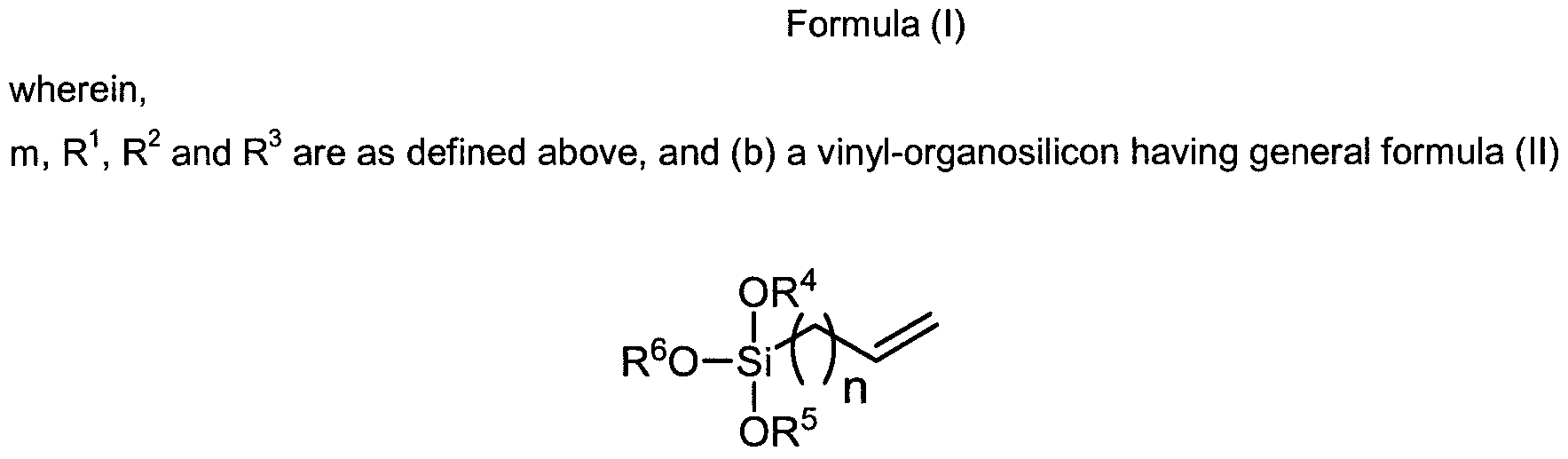
n is from 1 to 20; and
R4 R5 and R6 are independently selected from the group consisting of hydrogen, a linear or branched, substituted or unsubstituted alkyl with 1 to 20 carbon atoms, substituted or unsubstituted, linear or branched alkenyl with 2 to 20 carbon atoms; substituted or unsubstituted cycloalkyl with 5 to 20 carbon atoms; substituted or unsubstituted cycloalkenyl with 5 to 20 carbon atoms; substituted or unsubstituted aryl with 5 to 14 carbon atoms; and substituted or unsubstituted heteroaryl with 5 to 14 carbon atoms.
[077] In various embodiments, n in Formula (II) is from 0 to 10, and R4 R5 and R6 are independently a linear or branched, unsubstituted alkyl with 1 to 10 carbon atoms. In a more preferred embodiment, n is from 0 to 5, and R4 R5 and R6 are independently a linear or branched, unsubstituted alkyl with 1 to 5 carbon atoms. Even more preferred, n is 0, and R4 R5 and R6 are methyl.
[078] In reacting with the second organosilicon, the natural fibrous material may be functionalized with an amino-organosilicon moiety and a vinyl-organosilicon moiety, respectively. Weight ratio of the amino-organosilicon and the vinyl-organosilicon in the second organosilicon may be about 1 :1. In various embodiments, the second organosilicon comprises 3-aminopropyl triethoxysilane and vinyl trimethoxysilane.
[079] Chemically modifying the natural fibrous material with the second organosilicon may be carried out at a temperature in the range of about 30 °C about 60 °C, such as about 40 °C about 60 °C, about 50 °C about 60 °C, about 30 °C about 50 °C, about 30 °C about 40 °C, or about 40 °C about 50 °C.
[080] The method of the first aspect may further comprise drying the modified natural fibrous material at a temperature in the range of about 80 °C to about 100 °C prior to melt-compounding.
[081] The modified natural fibrous material is melt compounded with the intercalated clay material, a polyolefin resin, a compatibilizer, and a fiber to obtain the fiber-reinforced polymer composite.
[082] The term "resin", as used herein, includes monomers, prepolymers, and polymers. In various embodiments, polyolefin resin is a thermoplastic polyolefin resin. The polyolefin resin may be a copolymer or a homopolymer. The term "homopolymer" as used herein, refers to a polymer obtained by polymerization of one specific type of monomer. The term "copolymer", as used herein, refers to polymers obtained by polymerization of at least two or more different types of monomers. As disclosed herein, the copolymer may be a copolymer in which the monomers are randomly
distributed, or a block copolymer consisting of blocks or long sequences of each monomer, or a graft copolymer. In general, graft copolymers have a backbone of a first monomer type, attached to which a monomer or polymer of a second type are "grafted" on the backbone. [083] In general, the polyolefin resin may be any polyolefin resin known in the art and suitable for the purpose of the present invention. In a preferred embodiment, the polyolefin resin is selected from the group consisting of polyethylene, such as low density polyethylene (LDPE), linear low-density polyethylene (LLDPE), metallocene catalyzed polyethylene (PE), and high density polyethylene (HDPE), polypropylene such as polypropene (PP), cast polypropylene (CPP), and oriented polypropylene (OPP), polyvinylchloride (PVC), ethylene copolymer such as ethylene vinyl acetate (EVA), ethylene methacrylate copolymer (EMA), ethylene methyl methacrylate copolymer (EMMA), ethylene acrylate copolymer (EAA), and ethylene propylene copolymer, polyacrylate, polyester, polyurethane (PU), silicone, polylactide (PLA), polyamide, ionomer, polycarbonate (PC), acrylonitrile butadiene styrene (ABS), polyethersulfone, polyetherimide, polyphenylsulfone, polyphenylene, polystyrene, polysulfone, nylon, polyetheretherketone (PEEK), and mixtures thereof.
[084] In some embodiments, the polyolefin resin comprises or consists of a polypropylene/polyethylene copolymer. [085] If suitable, the polyolefin rein may further contain additives known in the art, such as pigments, dyes, and plasticizers.
[086] The polyolefin resin may be present in an amount such that the resulting fiber-reinforced polymer composite has a polyolefin resin content in the range of about 45 wt.% to 95 wt.%. In various embodiments, the polyolefin resin is present in an amount in the range of about 45 wt.% to 95 wt.%, such as about 45 wt.% to 85 wt.%, about 45 wt.% to 70 wt.%, about 45 wt.% to 60 wt.%, about 45 wt.% to 50 wt.%, about 50 wt.% to 95 wt.%, about 65 wt.% to 95 wt.%, about 75 wt.% to 95 wt.%, or about 55 wt.% to 75 wt.%. [087] The method disclosed herein includes melt compounding a compatibilizer with the intercalated clay material, the modified natural fibrous material, and the polyolefin resin. The term "compatibilizer" as used herein, relates to compounds, which promote interfacial adhesion between ingredients being otherwise immiscible. Compatibilizers are usually block copolymers, both blocks being compatible with one of the phases. The compatibilizer disclosed herein may be a polyolefin resin bearing at least one carboxylic anhydride. Examples of suitable polyolefin resin have already been mentioned above. The term "carboxylic anhydride", as defined herein, relates to a compound with two acyl groups bonded to the same oxygen atom.
[088] In various embodiments, the at least one carboxylic anhydride is of the following Formula (III)
R7 R8
Formula (III)
[089] In said Formula, R7 and R8 are independently selected from the group consisting of linear or branched, substituted or unsubstituted alkyl with 1 to 20 carbon atoms, linear or branched, substituted or unsubstituted alkenyi with 3 to 20 carbon atoms, linear or branched, substituted or unsubstituted alkoxy with 1 to 20 carbon atoms, substituted or unsubstituted aryl with 5 to 20 carbon atoms, and wherein optionally, R7 and R8 combine to form together with the -C(=0)- 0-C(=0)- fragment to which they are attached a substituted or unsubstituted 5- to 10- membered cycloalkyl or cycloalkenyl ring.
[090] In some embodiments, the compatibilizer is selected from the group consisting of maleic anhydride-grafted polypropylene (MAPP), maleic anhydride-grafted polyethylene (MAPE), and mixtures thereof. In specific embodiments, the compatibilizer comprises or consists of maleic anhydride-grafted polypropylene.
[091] The compatibilizer may be present in an amount such that the resulting fiber-reinforced polymer composite has a compatibilizer content in the range of about 1 wt.% to 10 wt.%. For example, the compatibilizer may be present in an amount in the range of about 1 wt.% to 10 wt.%, such as about 2 wt.% to 10 wt.%, about 3 wt.% to 10 wt.%, about 5 wt.% to 10 wt.%, about 1 wt.% to 8 wt.%, about 1 wt.% to 6 wt.%, about 2 wt.% to 4 wt.%, about 3 wt.% to 5 wt.%, or about 4 wt.% to 6 wt.%.
[092] The method disclosed herein includes melt compounding a fiber with the intercalated clay material, the modified natural fibrous material, the polyolefin resin, and the compatiblilizer.
[093] The term "fibers" as used herein refers to a class of materials, which may be natural or synthetic, that are in discrete elongated pieces. In various embodiments, the fiber comprised in the composite is formed from a material different from the natural fibrous material. For example, when the natural fibrous material comprises a natural fiber such as jute fiber, the fiber comprised in the composite may be a synthetic fiber such as glass fiber. The fibers may be produced by conventional techniques such as electrospinning, interfacial polymerization, and the like. The fibers may be used as a component of polymer composite materials to reinforce mechanical properties of the composites. In use, the fibers may be incorporated in the composites via cross-linking, gluing, weaving, braiding, knitting, knotting, or molding during the composites manufacturing process.
[094] Examples of fibers include, but are not limited to, glass fibers, carbon and graphite fibers, polymer fibers, aramid fibers, metal fibers, silicon carbide fibers, cellulose fibers, and mixtures thereof.
Examples of polymer fibers include, but are not limited to, fibers formed of unsaturated polyesters, epoxies, phenolics, and polyimides, to name only a few.
[095] In various embodiments, the fiber is a synthetic fiber. For example, the fiber may comprise or consist of glass. The term "glass fiber", as used herein, relates to a material with silicon dioxide as main component, which is at least 90 wt.% of the glass fiber, preferably more than 95 wt.%, and which is significantly longer than wide. In various embodiments, the glass fiber is selected from the group consisting of A-glass, C-glass, D-glass, E-glass, E-CR-glass, R-glass, S-glass, and mixtures thereof. Preferably, the glass fiber is E-glass. Further, in a preferred embodiment, the at least one glass fiber is chopped. Preferably, the glass fibers are provided as pallets.
[096] If suitable, the length of the fiber may be adjusted, for example, in order to achieve the desired properties of the composite. Preferably, the fiber is chopped. The length of the fiber may be from 0.01 cm to 5 cm, or from 0.1 cm to 3 cm, or from 0.1 cm to 1 cm, or from 0.1 cm to 0.5 cm. In some embodiments, the fiber has a length in the range of about 5 mm to about 15 mm.
[097] The fiber may be present in an amount such that content of the fiber in the resulting fiber- reinforced polymer composite is in the range of about 1 wt.% to 10 wt.%. For example, the fiber may be present in an amount in the range of about 1 wt.% to 10 wt.%, such as about 2 wt.% to 10 wt.%, about 3 wt.% to 10 wt.%, about 5 wt.% to 10 wt.%, about 1 wt.% to 8 wt.%, about 1 wt.% to 6 wt.%, about 2 wt.% to 4 wt.%, about 3 wt.% to 5 wt.%, or about 4 wt.% to 6 wt.%.
[098] The term "melt-compounding", as used herein, refers to the preparation of reaction mixtures by mixing and/or blending components and additives in a molten state. The melt-compounding may be carried out in any suitable reaction vessel. In various embodiments, the melt-compounding is carried out in an extruder. Extruders in general provide homogenous reaction mixtures, in particular for highly viscous mixtures with optionally solid material, and therefore ensure good reaction conditions, which have good impact on the manufactured composites. [099] In various embodiments, the extruder is a twin-screw extruder. Generally, a twin screw extruder includes two intermeshing, co-rotating screws mounted on splined shafts in a closed barrel. Depending on the processing requirements, various screw profiles and process functions may be set up by modifying the screw and barrel design. Twin-screw extruders with stronger mixing effect are more suited to produce composites with good mechanical properties due to improved dispersion of fillers in the polymer matrix. In embodiments where glass fibers are used however, the glass fibers tend to be shortened, resulting in significant decrease in mechanical performance. To avoid this situation, a good balance between dispersion of clay and retaining of length of glass fibers is important. The length-to-diameter ratio of the twin screw extruder may be in the range of about 35 to about 45. The twin-screw extruder may be driven at a screw speed from 1 rpm to 300 rpm, or from 50
rpm to 200 rpm. Preferably, the rotation speed of the twin screw extruder is in the range of about 80 rpm to about 120 rpm.
[0100] Melt-compounding the mixture may be carried out at a temperature in the range of about 150 °C to about 200 °C. In embodiments where an extruder is used, it may be suitable to vary the temperatures along the extruder. For example, the extruder may comprise several mixing zones along a length of the extruder, which may be set at the same or different temperatures. The temperatures of the mixing zones may depend on the components of the reaction mixture and may be adapted. In various embodiments, the temperature at the inlet position is lower than the temperature at the outlet position. For example, the mixing zone at the inlet may have a temperature of 160°C, whereas the temperature at the die may have a temperature of 170°C.
[0101] If necessary, only some components of the reaction mixture may be provided before the rest of the components are provided to the extruder. This may be suitable in case a component is sensitive, such as fibers, and mixing may damage and break said fibers. This procedure may be conducted with an extruder with several mixing zones. Thus, in carrying out the melt compounding, components, such as glass fibers, which are sensitive and can break, can be added to the reaction mixture at a later stage, while the other components may be fed to the extruder at an earlier stage.
[0102] In another aspect, a fiber-reinforced polymer composite obtainable by the method according to the first aspect is provided. In a further aspect, a fiber-reinforced polymer composite is provided. The fiber-reinforced polymer composite comprises
a) a polyolefin resin,
b) an intercalated clay material comprising a clay material modified with a first organosilicon and which is intercalated with a binder,
c) a natural fibrous material modified with a second organosilicon,
d) a compatibilizer, and
e) a fiber,
wherein the intercalated clay material, the modified natural fibrous material, the compatibilizer and the fiber are dispersed in the polyolefin resin.
[0103] Examples of suitable polyolefin resin, clay material, first organosilicon, binder, natural fibrous material, second organosilicon, compatibilizer, and fiber have already been mentioned above. Other components such as further fillers, dyes, pigments, stabilizers, and flame-retardants may be contained in the composite.
[0104] In various embodiments, the fiber-reinforced polymer composite has a composition of a) about 45 wt.% to about 95 wt.% of the polyolefin resin,
b) about 10 wt.% to about 45 wt.% of the natural fibrous material modified with a second organosilicon, and
c) about 1 wt.% to about 10 wt.% of the intercalated clay material, the compatibilizer, and the fiber, wherein wt% of the components in the composition add up to 100 wt% and is calculated based on total weight of the fiber-reinforced polymer composite.
[0105] Further, all of the intercalated clay material, the compatibilizer, and the fiber are present in the fiber-reinforced polymer composite, with total content of the intercalated clay material, the compatibilizer and the fiber are expressed herein as being in the range of about 1 wt.% to about 10 wt.%. Amounts and/or ratio of the intercalated clay material, the compatibilizer and the fiber may be varied according to performance target, which may in turn depend on the intended application of the fiber-reinforced polymer composite.
[0106] The fiber-reinforced polymer composite disclosed herein has shown improved mechanical properties, such as tensile modulus, flexural modulus, tensile strength, flexural strength, as well as improved impact resistance and thermal stability. Moreover, the composite disclosed herein have been shown to be sound absorbing and lightweight. Due to the renewable and naturally abundant used natural fibers, the obtained composites may be low-cost and sustainable. The composites are thus attractive for automotive industry and suitable for interior part for vehicles.
[0107] In various embodiment, the fiber-reinforced polymer composite is in the form of a molding. The molding may have any desired shape. Treatments and techniques to obtain the desired shape of the composite are known in the art. [0108] In a further aspect, use of a fiber-reinforced polymer composite made by a method according to the first aspect, or a composite according to the third aspect as an interior part for a vehicle is provided. Such interior parts may be, for example, coverings and infills for doors and dashboards, cup holder, air bag lid and assay, instrument panel, clutch, brake, glove box, or rear seat armrest. [0109] All features and embodiments described for the method are also applicable to the composite and use disclosed herein and wee versa.
[0110] The following examples are provided to better illustrate the claimed invention and are not be interpreted in any way as limiting the scope of the invention. All specific compounds, materials, and methods described below, in whole or in part, fall within the scope of the invention. These specific compounds, materials, and methods are not intended to limit the invention, but merely to illustrate specific embodiments falling within the scope of the invention. One skilled in the art may develop equivalent compounds, materials, and use without the exercise of inventive capacity and without
departing from the scope of the invention. It is the intention of the inventors that such variations are included in the scope of the present invention.
EXAMPLES
In exemplary embodiments disclosed herein, methods to produce polyolefin/jute- fiber/nanoclay/glass fiber composites with good mechanical property at low short glass fiber content and low modified nanoclay content (which may be as high as 5.5% by weight) through modifying the organoclay platelets by silane and intercalating the interlayer gaps of organoclay sheets using liquid epoxy resin, and their potential applications were demonstrated.
According to embodiments, polyolefin/jute-fiber/nanoclay/glass fiber composites were fabricated by melt-compounding polyolefin with chopped jute fiber (as major filler, 30 wt.%) surface- treated by two types of silane, MAPP (as phase compatibilizer), organoclay (as nanofiller, may be as high as 5.5 wt.%) that has been surface-modified with silane and intercalated by epoxy, and short glass fibers (as co-filler, about 5 wt.%).
The surface of chopped jute fiber was modified by chemically bonding two types of silanes, (3-aminopropyl)triethoxysilane and vinyl trimethoxysilane. The (3-aminopropyl)triethoxysilane allowed formation of chemical bonding between jute fiber surface, MAPP and epoxy molecules released from modified clay, while the vinyl trimethoxysilane allowed formation of chemical bonding between the jute fiber surface and polyolefin matrix during melt-compounding.
(3-aminopropyl)triethoxysilane was used to modify organoclay, which was chemically bonded onto the surface of the organoclay platelets. This allowed formation of chemical bonding between the clay platelets, MAPP and epoxy molecules. The epoxy molecules may be released into the polymer matrix during melt-compounding and allowed formation of chemical and physical bonds between jute fiber or glass fiber, MAPP and polymer matrix.
Use of appropriately-modified organoclay and short glass fiber co-filler in the composites allowed for simultaneous enhancement of the strength and modulus of natural fiber (jute) reinforced polymer composites to the level comparable to glass fiber reinforced polymer composites. Good interfacial interactions between natural fiber and polymer matrix, and between glass fibers and polymer matrix, were achieved via the use of silane treatment and epoxy modified organoclay. Hydrophobic silane molecules bonded to the clay platelets' surfaces ensured good compatibility between the hydrophilic clay platelets and the hydrophobic polymer matrix. Meanwhile, epoxy molecules used in the embodiments provided further bonding (both chemically and physically) between the clay platelets' surfaces and the polymer matrix as well as between glass fibers, natural fibers and polymer matrix during melt-compounding, thus ensuring high composite strength and stiffness. The melt-compounding may be carried out using thermoplastic processing equipment and manufacturing technology. In the resulting polymer composites, the polymer matrix was well bonded to both the jute fiber and glass fiber, and showed much improved inter-molecular interaction which
resulted in more plastic deformation and energy absorption. The developed polyolefin/jute-fiber composites also exhibited improved thermal stability.
I. GENERAL
Glassware was dried at 120 °C for at least 3 h before use. Acetone was dried over activated 4 A molecular sieve beads before use. Unless noted otherwise, commercially available chemicals were used as received without purification.
Nanostructure and composition of modified clay
Nanostructure and composition of modified clay, organoclay (Nanomer® I.34TCN from Nanocor) and clay-reinforced polyolefin composites were investigated by X-ray scattering (XRD). Dry clay powder flake and polyolefin composite sheets were characterized using a Bruker GADDS D8 Discover diffractometer with Cu Ka radiation over a 2Θ range of 1.3 - 33°. Thermo properties of modified clay and organoclay were evaluated by thermogravimetric analyzer (TGA, TA Q500). Clays were heated from room temperature to 700°C at 20°C/min in air.
II. EXAMPLES FOR MODIFYING COMPONENTS AND MANUFACTURING COMPOSITES
A. Modification of clay by solution intercalation and spray drying
Dry organoclay powder (190 g, Nanomer® I.34TCN from Nanocor) were dispersed in acetone (2000 ml) under stirring overnight. To this clay suspension (3-Aminopropyl)triethoxysilane (9.5 g) were added after which the suspension was heated up to 60°C under stirring for 6 hrs. A liquid epoxy resin, bisphenol A diglycidylether (95 g, DER332 from Dow Chemical Company), was added to the suspension, after which the suspension was stirred overnight. The suspension was then sonicated for 30 mins in an ultrasonic water-bath and homogenized by a high-speed shear homogenizer for 60 mins. The resulting clay suspension was spray-dried. The spray-drying was carried out by a BUCHI B290 spray dryer with an inlet temperature of 140°C, drying air flow rate of 40m3/h, and a feed rate between 2 to 5mL/min. The modified clay powder obtained was a homogeneous fine powder.
B. Modification of jute fiber by silane modification Dry jute fiber pellets (40g, about 5 mm length) were rinsed and swelled in acetone (200 ml) under stirring overnight. (3-Aminopropyl)triethoxysilane (0.2g) and vinyl trimethoxysilane (0.2g) were added into the jute fiber acetone suspension after which the suspension was heated up to 50°C under
stirring overnight. The modified jute fiber was filtered out by funnel and dried in oven under 100°C overnight. The modified jute fiber obtained was still in pellet shape.
C. Compounding of modified clay with polyolefin, chopped jute fiber, and glass fiber Polyolefin/jute-fiber/nanoclay/glass fiber composites were manufactured by melt-compounding modified clay powder with polyolefin resin, maleic anhydride-grafted polypropylene (MAPP), chopped jute fiber and glass-fiber pellet in a twin-screw extruder. The polyolefin resin used was a polypropylene/polyethylene copolymer (COSMOPLENE® AS164 from TPC SINGAPORE). The clay used included modified clay, which was obtained in section A above, and commercial organoclay (Nanomer® 1.31 PS from Nanocor). The chopped jute fiber was in the form of a pellet with length of 5 mm containing a bundle of jute fibers (obtained from KYOTO INSTITUTE OF TECHNOLOGY, JAPAN). Surface modification by silane was carried out on the fiber for improved bonding strength with both modified clay and polymer matrix. The chopped glass fiber was a polypropylene master batch pellet with length of about 10 mm and which contained a bundle of chopped E-glass fiber at content of 40 wt.%. The maleic anhydride-grafted polypropylene (MAPP, EPOLENE® G3003 from Eastman) was used as compatibilizer in the composites. For comparison purpose, commercial polypropylene/chopped glass fiber composites (obtained from RTP SINGAPORE) were compounded also with same processing conditions at glass fiber content varying from 5 to 30 % by weight. All materials were completely dried in oven under 100°C overnight before compounding.
The twin-screw extruder (L/D = 40; D = 16mm) (Eurolab 16 Twin Screw Extruder from Thermo
Scientific) was used for compounding polypropylene/jute composites at a screw speed of 100 rpm. The screws consisted of 3 mixing zones with 12 compounding elements in #1 mixing zone (F30X5, F60X3, A90X4), 13 wide compounding elements in #2 mixing zone (F30X4, R30X3, F30X3, R30X3) and 18 compounding elements in #3 mixing zone (F30X9, F60X3, A90X6), respectively. The temperatures employed along the barrel during extrusion from the inlet to the die were 160°C, 160°C, 170°C, 175°C, 175°C, 170°C, 170°C, 170°C, 170°C, 170°C and 170°C. The polyolefin resin, MAPP, nanoclay and commercial polypropylene/chopped glass fiber composites (RTP) were well-mixed and then fed at zone-1 which went through all 3 mixing zones. The chopped jute fiber and glass fiber pellets were mixed and then fed at zone-6 which went through mixing zone #3 only. This was carried out to protect the fiber from being broken down by the wide mixing elements at mixing zone #2. The extruded composites were pelletized and then conducted with mechanical testing and characterization studies shown in section III below.
III. ANALYSIS OF THE COMPOSITES
Tensile testing of all composites were conducted on the standard tensile test bars at a crosshead speed of 5 mm/min using a 10kN load cell in an Instron Universal Tester 5569. 3-Point bending
(flexural) testing of all composites obtained is conducted on the standard rectangular test bars at a crosshead speed of 13.65 mm/min using a 10kN load cell in an Instron Universal Tester 5569. Izod impact testing was conducted on the standard single-edge notch impact test bars in a Zwick Roell Pendulum impact testor HIT25P. Composite pellets were dried overnight at 80°C in a vacuum oven and injection molded into tensile, flexural and impact test bars using an injection molding machine (Haake Mini Jet II, Thermo Scientific). The cylinder was set to 220°C and the composite melts were injected at 600 bars in 20s into a 70°C mold and a post injection pressure of 300 bars was maintained for 10s. SEM image of the cross-section of composite test bars was examined using a field emission scanning electron microscope (SEM, JEOL JSM-6700F).
Results obtained are provided in Tables 1 to 4 below.
Table 1 shows composition and mechanica properties of Polyolefin composites
containing chopped glass fiber or jute fiber, respectively.
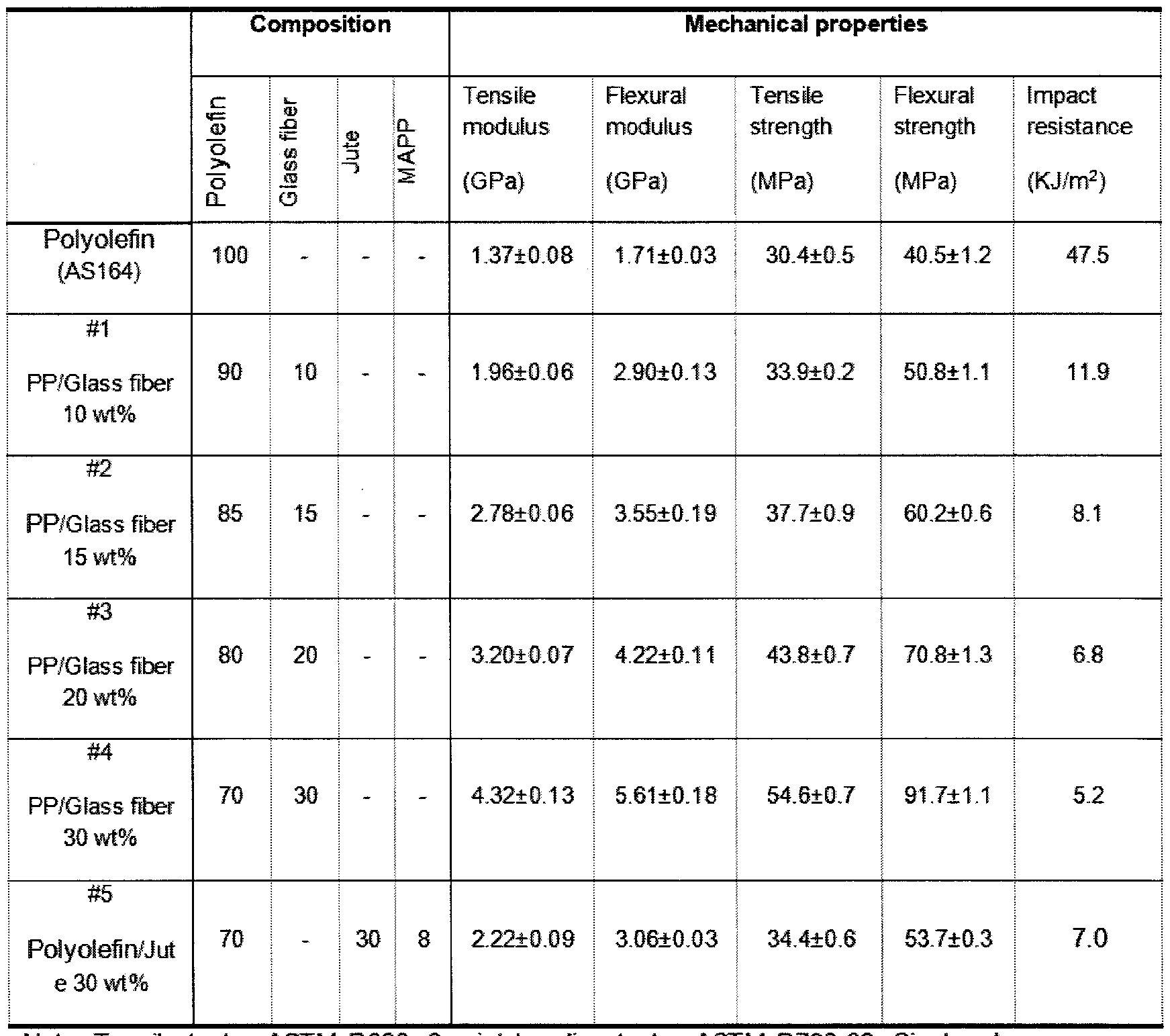
Note: Tensile test - ASTM D638, 3- point bending test - ASTM D790-03, Single-edge
notched Izod impact test - ASTM D256.
Table 2 shows composition and mechanical properties of Polyolefin composites containing 30 wt% jute fiber and commercial organoclay (Nanomer® I 31PS), or modified clay, respectively.

Table 3 shows composition and mechanical properties of Polyolefin composites containing jute fiber, commercial organoclay (Nanomer® i.31PS), modified clay and commercial Potyolefin glass fiber resin, individually or as combination.

chopp PPed glass fiber pellet, individually or as combination.
Jteu
Clay r

From the results obtained, it may be seen that modified clay and glass fiber can synergistically increase the tensile modulus, flexural modulus, tensile strength, and flexural strength of polyolefin/modified natural fiber. In particular, it has been shown that the mechanical property of polyolefin/modified natural fiber (30 %)/modified clay (6 %)/glass fiber (5 %)/MAPP of Sample #13 is comparable to that of polyolefin/glass fiber (20 wt%) of Sample #3.
Table 5 below provides a comparison of the properties of a composite disclosed herein (Example 5) with selected samples from Tables 1 to 4 (Examples 1 to 4).
Example Composition Mechanical properties
Tensile Flexural Tensile Flexural Impact modulus modulus strength strength resistance
 (GPa) (GPa) (MPa) (MPa) (KJ/m2)
1 (Sample 90 - - - 10 1.96±0.06 2.90+0.13 33.9+0.2 50.8±1.1 11.9
#1)
2 (Sample
70 30 - - 8 2.22±0.09 3.06±0.03 34.4±0.6 53.7+0.3 7.0 #5)
3 (Sample
65 30 - 5 8 2.44±0.19 3.22±0.11 37.1 ±0.8 58.1 ±0.2 7.6 #11 )
4 (Sample
59 30 6 - 5 8 3.00±0.03 _3.57±0.08 39.6±0.9 64.7±0.6 4.3 #12)
5 (Sample
59 30 6 5 8 3.78±0.11 4.26±0.03 44.9+0.7 71.7±0.7 5.7 #13)
Polypropylene as Polyolefin was used. In Example 4, commercial organoclay Nanomer 1.31 PS from Nanocor was used. The composite of Example 5, which is a composite according to the present invention, show overall improved mechanical properties compared to the comparative Examples 1 to
Claims
1. A method for preparing a fiber-reinforced polymer composite, the method comprising
a) chemically modifying a clay material with a first organosilicon to form a modified clay material;
b) intercalating the modified clay material with a binder to form an intercalated clay material;
c) chemically modifying a natural fibrous material with a second organosilicon to form a modified natural fibrous material; and
d) melt compounding the intercalated clay material with the modified natural fibrous material, a polyolefin resin, a compatibilizer, and a fiber to obtain the fiber-reinforced polymer composite.
The method according to claim 1 , wherein chemically modifying the clay material with the first organosilicon comprises dispersing and swelling the clay material in a solvent selected from the group consisting of acetone, tetrahydrofuran, methanol, ethanol, and combinations thereof.
The method according to claim 1 or 2, wherein the clay material comprises an organoclay.
The method according to any one of claims 1 to 3, wherein the first organosilicon is an amino- organosilicon having general formula (I)

Formula (I) wherein,
m is from 1 to 20; and
R2 and R3 are independently selected from the group consisting of hydrogen, a linear or branched, substituted or unsubstituted alkyl with 1 to 20 carbon atoms, substituted or unsubstituted, linear or branched alkenyl with 2 to 20 carbon atoms; substituted or unsubstituted cycloalkyl with 5 to 20 carbon atoms; substituted or unsubstituted cycloalkenyl with 5 to 20 carbon atoms; substituted or unsubstituted aryl with 5 to 14 carbon atoms; and substituted or unsubstituted heteroaryl with 5 to 14 carbon atoms.
5. The method according to claim 4, wherein m is from 1 to 10, and R1, R2 and R3 are independently a linear or branched, unsubstituted alkyl with 1 to 10 carbon atoms.
6. The method according to any one of claims 1 to 5, wherein the first organosilicon comprises or consists of 3-aminopropyl triethoxysilane.
7. The method according to any one of claims 1 to 6, wherein chemically modifying the clay material with the first organosilicon is carried out at a temperature in the range of about 50 °C to about 70 °C.
8. The method according to any one of claims 1 to 7, wherein the binder comprises or consists of an epoxy resin.
9. The method according to claim 8, wherein the epoxy resin is selected from the group consisting of diglycidyl ethers of resorcinol, catechol, hydroquinone, bisphenol, bisphenol A, bisphenol AP
(1 ,1-bis(4-hydroxylphenyl)-1 -phenyl ethane), bisphenol F, bisphenol K, bisphenol M, bisphenol S, tetramethylbiphenol, diglycidyl ethers of alkylene glycols with 2 to 20 carbon atoms and poly(ethylene oxide) or poly( propylene oxide); polyglycidyl ethers of phenol-formaldehyde novolac resins, alkyl substituted phenol-formaldehyde resins (epoxy novalac resins), phenol- hydroxybenzaldehyde resins, cresol-hydroxybenzaldehyde resins, dicyclopentadiene-phenol resins and dicyclopentadiene-substituted phenol resins, and mixtures thereof.
10. The method according to claim 8 or 9, wherein the epoxy resin comprises or consists of diglycidyl ethers of bisphenol A.
11. The method according to any one of claims 1 to 10, wherein intercalating the modified clay material with a binder is carried out under agitation.
12. The method according to any one of claims 1 to 11 , further comprising drying the intercalated clay material before melt compounding step d).
13. The method according to claim 12, wherein drying the intercalated clay material is carried out by spray drying or freeze drying. 14. The method according to any one of claims 1 to 13, wherein chemically modifying the natural fibrous material with the second organosilicon comprises dispersing and swelling the natural fibrous material in a solvent selected from the group consisting of acetone, tetrahydrofuran, methanol, ethanol, and combinations thereof.
15. The method according to any one of claims 1 to 14, wherein the natural fibrous material is selected from the group consisting of cellulose, a cellulose derivate, jute fiber, cotton, paper, wastepaper, hemp fiber, pulp, starch, brown algae, and mixtures thereof.
16. The method according to any one of claims 1 to 15, wherein the natural fibrous material comprises or consists of jute fiber.
17. The method according to any one of claims 1 to 16, wherein the natural fibrous material has a length in the range of about 1 mm to about 100 mm.
18. The method according to any one of claims 1 to 17, wherein the second organosilicon comprises (a) an amino-organosilicon having general formula (I)

Formula (I) wherein,
m, R1, R2 and R3 are as defined above, and (b) a vinyl-organosilicon having general formula (II)

Formula (II) wherein,
n is from 1 to 20; and
R4 R5 and R6 are independently selected from the group consisting of hydrogen, a linear or branched, substituted or unsubstituted alkyl with 1 to 20 carbon atoms, substituted or unsubstituted, linear or branched alkenyl with 2 to 20 carbon atoms; substituted or unsubstituted cycloalkyl with 5 to 20 carbon atoms; substituted or unsubstituted cycloalkenyl with 5 to 20 carbon atoms; substituted or unsubstituted aryl with 5 to 14 carbon atoms; and substituted or unsubstituted heteroaryl with 5 to 14 carbon atoms.
19. The method according to claim 18, wherein n is from 1 to 10, and R4, R5 and R6 are independently a linear or branched, unsubstituted alkyl with 1 to 10 carbon atoms.
20. The method according to claim 18 or 19, wherein weight ratio of the amino-organosilicon to the vinyl-organosilicon in the second organosilicon is about 1 :1.
21. The method according to any one of claims 1 to 20, wherein the second organosilicon comprises 3-aminopropyl triethoxysilane and vinyl trimethoxysilane. 22. The method according to any one of claims 1 to 21 , wherein chemically modifying the natural fibrous material with the second organosilicon is carried out at a temperature in the range of about 30 °C to about 60 °C.
23. The method according to any one of claims 1 to 22, further comprising drying the modified natural fibrous material at a temperature in the range of about 80 °C to about 100 °C before melt compounding step d).
24. The method according to any one of claims 1 to 23, wherein melt compounding the mixture is carried out at a temperature in the range of about 150 °C to about 200 °C.
25. The method according to any one of claims 1 to 24, wherein melt compounding the intercalated clay material is carried out in a twin screw extruder.
26. The method according to claim 25, wherein length-to-diameter ratio of the twin screw extruder is in the range of about 35 to about 45.
27. The method according to claim 25 or 26, wherein rotation speed of the twin screw extruder is in the range of about 80 rpm to about 120 rpm. 28. The method according to any one of claims 1 to 27, wherein the polyolefin resin is selected from the group consisting of polyethylene, polypropylene, polyvinylchloride, ethylene copolymer, polyacrylate, polyester, polyurethane, silicone, polylactide, polyamide, ionomer, polycarbonate, acrylonitrile butadiene styrene, polyethersulfone, polyetherimide, polyphenylsulfone, polyphenylene, polystyrene, polysulfone, nylon, polyetheretherketone, copolymers thereof, and mixtures thereof.
29. The method according to any one of claims 1 to 28, wherein the polyolefin resin comprises or consists of a polypropylene/polyethylene copolymer.
30. The method according to any one of claims 1 to 29, wherein the compatibilizer is a polyolefin resin bearing at least one carboxylic anhydride.
31. The method according to claim 30, wherein the carboxylic anhydride is of Formula (III)

Formula (III)
wherein
R7 and R8 are independently selected from the group consisting of linear or branched, substituted or unsubstituted alkyl with 1 to 20 carbon atoms, linear or branched, substituted or unsubstituted alkenyl with 3 to 20 carbon atoms, linear or branched, substituted or unsubstituted alkoxy with 1 to 20 carbon atoms, substituted or unsubstituted aryl with 5 to 20 carbon atoms, and wherein optionally, R7 and R8 combine to form together with the -C(=0)- 0-C(=0)- fragment to which they are attached a substituted or unsubstituted 5- to 10- membered cycloalkyl or cycloalkenyl ring.
32. The method according to any one of claims 1 to 31 , wherein the compatibilizer is selected from the group consisting of maleic anhydride-grafted polypropylene (MAPP), maleic anhydride- grafted polyethylene (MAPE), and mixtures thereof.
33. The method according to any one of claims 1 to 32, wherein the compatibilizer comprises or consists of maleic anhydride-grafted polypropylene.
34. The method according to any one of claims 1 to 33, wherein the fiber is a glass fiber.
35. The method according to any one of claims 1 to 34, wherein the fiber has a length in the range of about 5 mm to about 15 mm.
36. A fiber-reinforced polymer composite prepared by a method according to any one of claims 1 to
35.
37 A fiber-reinforced polymer composite comprising
a) a polyolefin resin,
b) a natural fibrous material modified with a first organosilicon,
c) an intercalated clay material comprising a clay material modified with a second organosilicon and which is intercalated with a binder,
d) a compatibilizer, and
e) a fiber,
wherein the modified natural fibrous material, the intercalated clay material, the compatibilizer and the fiber are dispersed in the polyolefin resin.
38. The fiber-reinforced polymer composite according to claim 37, having a composition of
a) about 45 wt% to about 95 wt% of the polyolefin resin,
b) about 10 wt% to about 45 wt% of the natural fibrous material modified with a first organosilicon, and
c) about 1 wt% to about 10 wt% of the intercalated clay material, the compatibilizer, and the fiber,
wherein wt% of the components in the composition add up to 100 wt% and is calculated based on total weight of the fiber-reinforced polymer composite.
39. Use of a fiber-reinforced polymer composite obtained by a method according to any one of claims 1 to 35 or a fiber-reinforced polymer composite according to claim 37 or 38 as an interior part for a vehicle.
Priority Applications (1)
| Application Number | Priority Date | Filing Date | Title |
|---|---|---|---|
| SG11201705532RA SG11201705532RA (en) | 2015-01-05 | 2016-01-05 | A fiber-reinforced polymer composite |
Applications Claiming Priority (2)
| Application Number | Priority Date | Filing Date | Title |
|---|---|---|---|
| SG10201500056T | 2015-01-05 | ||
| SG10201500056T | 2015-01-05 |
Publications (1)
| Publication Number | Publication Date |
|---|---|
| WO2016111647A1 true WO2016111647A1 (en) | 2016-07-14 |
Family
ID=56356228
Family Applications (1)
| Application Number | Title | Priority Date | Filing Date |
|---|---|---|---|
| PCT/SG2016/050003 Ceased WO2016111647A1 (en) | 2015-01-05 | 2016-01-05 | A fiber-reinforced polymer composite |
Country Status (2)
| Country | Link |
|---|---|
| SG (1) | SG11201705532RA (en) |
| WO (1) | WO2016111647A1 (en) |
Cited By (10)
| Publication number | Priority date | Publication date | Assignee | Title |
|---|---|---|---|---|
| CN107540856A (en) * | 2017-08-16 | 2018-01-05 | 宜宾天原集团股份有限公司 | A kind of preparation method of the compound polyether-ether-ketone reinforcing material of carbon fiber |
| WO2018182522A1 (en) * | 2017-03-28 | 2018-10-04 | Agency For Science, Technology And Research | Method of forming an exfoliated or intercalated filler material |
| WO2018226680A1 (en) * | 2017-06-05 | 2018-12-13 | Essentium Materials, Llc | Hybrid thermoplastic composites with long and short fiber materials and natural nanoparticles |
| CN110240796A (en) * | 2018-03-09 | 2019-09-17 | 中国石油化工股份有限公司 | Soft consumptive material composition of 3D printing and the preparation method and application thereof |
| WO2019190407A1 (en) * | 2018-03-29 | 2019-10-03 | Agency For Science, Technology And Research | A reinforced polyolefin composite |
| CN110483952A (en) * | 2019-09-09 | 2019-11-22 | 恩平市盈嘉丰胶粘制品有限公司 | A kind of plant fiber reinforced epoxy composite material |
| WO2020027735A1 (en) * | 2018-07-30 | 2020-02-06 | Agency For Science, Technology And Research | Silane grafted onto clay |
| CN113861551A (en) * | 2021-10-11 | 2021-12-31 | 安徽省天助纺织科技集团股份有限公司 | Sound insulation material prepared by regenerating waste textiles and production process thereof |
| CN114752179A (en) * | 2022-06-02 | 2022-07-15 | 泰山玻璃纤维有限公司 | Polyoxymethylene compositions with low fiber flotation and process for making same |
| CN117264433A (en) * | 2023-11-22 | 2023-12-22 | 潍坊云鼎新材料有限公司 | Plant fiber/polyethylene composite material and preparation method thereof |
Citations (6)
| Publication number | Priority date | Publication date | Assignee | Title |
|---|---|---|---|---|
| US4612238A (en) * | 1977-07-18 | 1986-09-16 | Allied Corporation | Fiber reinforced multi-ply stampable thermoplastic sheet |
| CN1844239A (en) * | 2006-03-30 | 2006-10-11 | 南京化工职业技术学院 | PET/clay nanocomposite material and preparation method thereof |
| US20070142547A1 (en) * | 2005-12-16 | 2007-06-21 | Schlumberger Technology Corporation | Polymeric Composites, Oilfield Elements Comprising Same, and Methods of Using Same in Oilfield Applications |
| CN1908038B (en) * | 2005-08-03 | 2010-11-17 | 徐松波 | Nano material brake slice and preparing process thereof |
| JP2012180452A (en) * | 2011-03-01 | 2012-09-20 | Akebono Brake Ind Co Ltd | Friction material and method for producing friction material |
| WO2014098772A1 (en) * | 2012-12-18 | 2014-06-26 | Agency For Science, Technology And Research | Method of preparing fiber-reinforced polymer composites and fiber-reinforced polymer composites prepared thereof |
-
2016
- 2016-01-05 WO PCT/SG2016/050003 patent/WO2016111647A1/en not_active Ceased
- 2016-01-05 SG SG11201705532RA patent/SG11201705532RA/en unknown
Patent Citations (6)
| Publication number | Priority date | Publication date | Assignee | Title |
|---|---|---|---|---|
| US4612238A (en) * | 1977-07-18 | 1986-09-16 | Allied Corporation | Fiber reinforced multi-ply stampable thermoplastic sheet |
| CN1908038B (en) * | 2005-08-03 | 2010-11-17 | 徐松波 | Nano material brake slice and preparing process thereof |
| US20070142547A1 (en) * | 2005-12-16 | 2007-06-21 | Schlumberger Technology Corporation | Polymeric Composites, Oilfield Elements Comprising Same, and Methods of Using Same in Oilfield Applications |
| CN1844239A (en) * | 2006-03-30 | 2006-10-11 | 南京化工职业技术学院 | PET/clay nanocomposite material and preparation method thereof |
| JP2012180452A (en) * | 2011-03-01 | 2012-09-20 | Akebono Brake Ind Co Ltd | Friction material and method for producing friction material |
| WO2014098772A1 (en) * | 2012-12-18 | 2014-06-26 | Agency For Science, Technology And Research | Method of preparing fiber-reinforced polymer composites and fiber-reinforced polymer composites prepared thereof |
Cited By (20)
| Publication number | Priority date | Publication date | Assignee | Title |
|---|---|---|---|---|
| WO2018182522A1 (en) * | 2017-03-28 | 2018-10-04 | Agency For Science, Technology And Research | Method of forming an exfoliated or intercalated filler material |
| US11248106B2 (en) | 2017-03-28 | 2022-02-15 | Agency For Science, Technology And Research | Method of forming an exfoliated or intercalated filler material |
| WO2018226680A1 (en) * | 2017-06-05 | 2018-12-13 | Essentium Materials, Llc | Hybrid thermoplastic composites with long and short fiber materials and natural nanoparticles |
| US11542378B2 (en) | 2017-06-05 | 2023-01-03 | Essentium Ipco, Llc | Hybrid thermoplastic composites with long and short fiber materials and natural nanoparticles |
| CN107540856A (en) * | 2017-08-16 | 2018-01-05 | 宜宾天原集团股份有限公司 | A kind of preparation method of the compound polyether-ether-ketone reinforcing material of carbon fiber |
| CN110240796B (en) * | 2018-03-09 | 2021-07-27 | 中国石油化工股份有限公司 | 3D printing soft consumable composition and preparation method and application thereof |
| CN110240796A (en) * | 2018-03-09 | 2019-09-17 | 中国石油化工股份有限公司 | Soft consumptive material composition of 3D printing and the preparation method and application thereof |
| JP2021519835A (en) * | 2018-03-29 | 2021-08-12 | エージェンシー フォー サイエンス,テクノロジー アンド リサーチ | Reinforced polyolefin composite |
| CN112204097A (en) * | 2018-03-29 | 2021-01-08 | 新加坡科技研究局 | Reinforced polyolefin composite material |
| JP2024028594A (en) * | 2018-03-29 | 2024-03-04 | エージェンシー フォー サイエンス,テクノロジー アンド リサーチ | Reinforced polyolefin composite material |
| US12104048B2 (en) | 2018-03-29 | 2024-10-01 | Agency For Science, Technology And Research | Reinforced polyolefin composite |
| WO2019190407A1 (en) * | 2018-03-29 | 2019-10-03 | Agency For Science, Technology And Research | A reinforced polyolefin composite |
| JP7507379B2 (en) | 2018-03-29 | 2024-06-28 | エージェンシー フォー サイエンス,テクノロジー アンド リサーチ | Reinforced Polyolefin Composites |
| WO2020027735A1 (en) * | 2018-07-30 | 2020-02-06 | Agency For Science, Technology And Research | Silane grafted onto clay |
| CN110483952A (en) * | 2019-09-09 | 2019-11-22 | 恩平市盈嘉丰胶粘制品有限公司 | A kind of plant fiber reinforced epoxy composite material |
| CN113861551A (en) * | 2021-10-11 | 2021-12-31 | 安徽省天助纺织科技集团股份有限公司 | Sound insulation material prepared by regenerating waste textiles and production process thereof |
| CN114752179B (en) * | 2022-06-02 | 2023-07-07 | 泰山玻璃纤维有限公司 | Low-fiber-floating polyoxymethylene composition and preparation method thereof |
| CN114752179A (en) * | 2022-06-02 | 2022-07-15 | 泰山玻璃纤维有限公司 | Polyoxymethylene compositions with low fiber flotation and process for making same |
| CN117264433A (en) * | 2023-11-22 | 2023-12-22 | 潍坊云鼎新材料有限公司 | Plant fiber/polyethylene composite material and preparation method thereof |
| CN117264433B (en) * | 2023-11-22 | 2024-03-26 | 潍坊云鼎新材料有限公司 | Plant fiber/polyethylene composite material and preparation method thereof |
Also Published As
| Publication number | Publication date |
|---|---|
| SG11201705532RA (en) | 2017-08-30 |
Similar Documents
| Publication | Publication Date | Title |
|---|---|---|
| WO2016111647A1 (en) | A fiber-reinforced polymer composite | |
| Trinh et al. | Hydrophobic esterification of cellulose nanocrystals for epoxy reinforcement | |
| Olonisakin et al. | Key improvements in interfacial adhesion and dispersion of fibers/fillers in polymer matrix composites; focus on pla matrix composites | |
| Mohammed et al. | Interfacial bonding mechanisms of natural fibre-matrix composites: an overview | |
| Gorgun et al. | Biocomposites of poly (lactic acid) and microcrystalline cellulose: influence of the coupling agent on thermomechanical and absorption characteristics | |
| Saba et al. | Magnesium hydroxide reinforced kenaf fibers/epoxy hybrid composites: Mechanical and thermomechanical properties | |
| Kargarzadeh et al. | Cellulose nanocrystal: A promising toughening agent for unsaturated polyester nanocomposite | |
| JP6580471B2 (en) | Polylactic acid composition, method for producing the same, and composite | |
| Syamimi et al. | Mechanical and thermal properties of snail shell particles-reinforced bisphenol-A bio-composites | |
| US10011706B2 (en) | System and method for synthesis of POSS-graphene oxide derivatives as effective fillers for developing high performance composites | |
| US10155851B2 (en) | System and method for synthesis of POSS-starch derivatives as effective fillers for developing high performance composites | |
| Rasana et al. | Polypropylene/short glass fiber/nanosilica hybrid composites: evaluation of morphology, mechanical, thermal, and transport properties | |
| US9803079B2 (en) | Method of preparing fiber-reinforced polymer composites and fiber-reinforced polymer composites prepared thereof | |
| Wei et al. | Preparation and Characterization of the Nanocomposites from Chemically Modified Nanocellulose and Poly (lactic acid) | |
| Vo et al. | Crucial role of covalent surface functionalization of clay nanofillers on improvement of the mechanical properties of bioepoxy resin | |
| Padinjakkara et al. | Enhancement of adhesive strength of epoxy/carboxyl-terminated poly (butadiene-co-acrylonitrile) nanocomposites using waste hemp fiber-derived cellulose nanofibers | |
| Necolau et al. | Tailoring an effective interface between nanocellulose and the epoxidized linseed oil network through functionalization | |
| Lashgari et al. | A study on some properties of polypropylene based nanocomposites made using almond shell flour and organoclay. | |
| Abdul Majid et al. | Processing, tensile, and thermal studies of poly (vinyl chloride)/epoxidized natural rubber/kenaf core powder composites with benzoyl chloride treatment | |
| Arjmandi et al. | Effects of micro-and nano-cellulose on tensile and morphological properties of montmorillonite nanoclay reinforced polylactic acid nanocomposites | |
| RU2513766C2 (en) | Superconcentrate and based on it composition materials | |
| Hatano et al. | Preparation process for biomass nanofiber/bisphenol A-type epoxy resin composites with superior mechanical and thermal properties | |
| Maziad et al. | The effects of a silane coupling agent on properties of rice husk-filled maleic acid anhydride compatibilized natural rubber/low-density polyethylene blend | |
| Eng et al. | Chemical modification of oil palm mesocarp fiber by methacrylate silane: Effects on morphology, mechanical, and dynamic mechanical properties of biodegradable hybrid composites | |
| JP7078374B2 (en) | Molds and pipes |
Legal Events
| Date | Code | Title | Description |
|---|---|---|---|
| 121 | Ep: the epo has been informed by wipo that ep was designated in this application |
Ref document number: 16735237 Country of ref document: EP Kind code of ref document: A1 |
|
| DPE1 | Request for preliminary examination filed after expiration of 19th month from priority date (pct application filed from 20040101) | ||
| NENP | Non-entry into the national phase |
Ref country code: DE |
|
| WWE | Wipo information: entry into national phase |
Ref document number: 11201705532R Country of ref document: SG |
|
| 122 | Ep: pct application non-entry in european phase |
Ref document number: 16735237 Country of ref document: EP Kind code of ref document: A1 |