WO2016109684A2 - Derivatives and methods of treating hepatitis b infections - Google Patents
Derivatives and methods of treating hepatitis b infections Download PDFInfo
- Publication number
- WO2016109684A2 WO2016109684A2 PCT/US2015/068091 US2015068091W WO2016109684A2 WO 2016109684 A2 WO2016109684 A2 WO 2016109684A2 US 2015068091 W US2015068091 W US 2015068091W WO 2016109684 A2 WO2016109684 A2 WO 2016109684A2
- Authority
- WO
- WIPO (PCT)
- Prior art keywords
- compound
- alkyl
- mixture
- independently selected
- mmol
- Prior art date
- Legal status (The legal status is an assumption and is not a legal conclusion. Google has not performed a legal analysis and makes no representation as to the accuracy of the status listed.)
- Ceased
Links
- 0 C1CC2=ICCC=C2*C1 Chemical compound C1CC2=ICCC=C2*C1 0.000 description 4
- PNPCRKVUWYDDST-UHFFFAOYSA-N Nc1cccc(Cl)c1 Chemical compound Nc1cccc(Cl)c1 PNPCRKVUWYDDST-UHFFFAOYSA-N 0.000 description 1
Classifications
-
- C—CHEMISTRY; METALLURGY
- C07—ORGANIC CHEMISTRY
- C07D—HETEROCYCLIC COMPOUNDS
- C07D471/00—Heterocyclic compounds containing nitrogen atoms as the only ring hetero atoms in the condensed system, at least one ring being a six-membered ring with one nitrogen atom, not provided for by groups C07D451/00 - C07D463/00
- C07D471/02—Heterocyclic compounds containing nitrogen atoms as the only ring hetero atoms in the condensed system, at least one ring being a six-membered ring with one nitrogen atom, not provided for by groups C07D451/00 - C07D463/00 in which the condensed system contains two hetero rings
- C07D471/04—Ortho-condensed systems
-
- A—HUMAN NECESSITIES
- A61—MEDICAL OR VETERINARY SCIENCE; HYGIENE
- A61K—PREPARATIONS FOR MEDICAL, DENTAL OR TOILETRY PURPOSES
- A61K31/00—Medicinal preparations containing organic active ingredients
- A61K31/33—Heterocyclic compounds
- A61K31/395—Heterocyclic compounds having nitrogen as a ring hetero atom, e.g. guanethidine or rifamycins
- A61K31/435—Heterocyclic compounds having nitrogen as a ring hetero atom, e.g. guanethidine or rifamycins having six-membered rings with one nitrogen as the only ring hetero atom
- A61K31/4353—Heterocyclic compounds having nitrogen as a ring hetero atom, e.g. guanethidine or rifamycins having six-membered rings with one nitrogen as the only ring hetero atom ortho- or peri-condensed with heterocyclic ring systems
- A61K31/437—Heterocyclic compounds having nitrogen as a ring hetero atom, e.g. guanethidine or rifamycins having six-membered rings with one nitrogen as the only ring hetero atom ortho- or peri-condensed with heterocyclic ring systems the heterocyclic ring system containing a five-membered ring having nitrogen as a ring hetero atom, e.g. indolizine, beta-carboline
-
- A—HUMAN NECESSITIES
- A61—MEDICAL OR VETERINARY SCIENCE; HYGIENE
- A61K—PREPARATIONS FOR MEDICAL, DENTAL OR TOILETRY PURPOSES
- A61K31/00—Medicinal preparations containing organic active ingredients
- A61K31/33—Heterocyclic compounds
- A61K31/395—Heterocyclic compounds having nitrogen as a ring hetero atom, e.g. guanethidine or rifamycins
- A61K31/435—Heterocyclic compounds having nitrogen as a ring hetero atom, e.g. guanethidine or rifamycins having six-membered rings with one nitrogen as the only ring hetero atom
- A61K31/4353—Heterocyclic compounds having nitrogen as a ring hetero atom, e.g. guanethidine or rifamycins having six-membered rings with one nitrogen as the only ring hetero atom ortho- or peri-condensed with heterocyclic ring systems
- A61K31/4375—Heterocyclic compounds having nitrogen as a ring hetero atom, e.g. guanethidine or rifamycins having six-membered rings with one nitrogen as the only ring hetero atom ortho- or peri-condensed with heterocyclic ring systems the heterocyclic ring system containing a six-membered ring having nitrogen as a ring heteroatom, e.g. quinolizines, naphthyridines, berberine, vincamine
-
- A—HUMAN NECESSITIES
- A61—MEDICAL OR VETERINARY SCIENCE; HYGIENE
- A61K—PREPARATIONS FOR MEDICAL, DENTAL OR TOILETRY PURPOSES
- A61K31/00—Medicinal preparations containing organic active ingredients
- A61K31/33—Heterocyclic compounds
- A61K31/395—Heterocyclic compounds having nitrogen as a ring hetero atom, e.g. guanethidine or rifamycins
- A61K31/435—Heterocyclic compounds having nitrogen as a ring hetero atom, e.g. guanethidine or rifamycins having six-membered rings with one nitrogen as the only ring hetero atom
- A61K31/44—Non condensed pyridines; Hydrogenated derivatives thereof
- A61K31/445—Non condensed piperidines, e.g. piperocaine
- A61K31/4523—Non condensed piperidines, e.g. piperocaine containing further heterocyclic ring systems
- A61K31/4545—Non condensed piperidines, e.g. piperocaine containing further heterocyclic ring systems containing a six-membered ring with nitrogen as a ring hetero atom, e.g. pipamperone, anabasine
-
- A—HUMAN NECESSITIES
- A61—MEDICAL OR VETERINARY SCIENCE; HYGIENE
- A61K—PREPARATIONS FOR MEDICAL, DENTAL OR TOILETRY PURPOSES
- A61K31/00—Medicinal preparations containing organic active ingredients
- A61K31/33—Heterocyclic compounds
- A61K31/395—Heterocyclic compounds having nitrogen as a ring hetero atom, e.g. guanethidine or rifamycins
- A61K31/495—Heterocyclic compounds having nitrogen as a ring hetero atom, e.g. guanethidine or rifamycins having six-membered rings with two or more nitrogen atoms as the only ring heteroatoms, e.g. piperazine or tetrazines
- A61K31/50—Pyridazines; Hydrogenated pyridazines
- A61K31/501—Pyridazines; Hydrogenated pyridazines not condensed and containing further heterocyclic rings
-
- A—HUMAN NECESSITIES
- A61—MEDICAL OR VETERINARY SCIENCE; HYGIENE
- A61K—PREPARATIONS FOR MEDICAL, DENTAL OR TOILETRY PURPOSES
- A61K31/00—Medicinal preparations containing organic active ingredients
- A61K31/33—Heterocyclic compounds
- A61K31/395—Heterocyclic compounds having nitrogen as a ring hetero atom, e.g. guanethidine or rifamycins
- A61K31/535—Heterocyclic compounds having nitrogen as a ring hetero atom, e.g. guanethidine or rifamycins having six-membered rings with at least one nitrogen and one oxygen as the ring hetero atoms, e.g. 1,2-oxazines
- A61K31/5375—1,4-Oxazines, e.g. morpholine
- A61K31/5377—1,4-Oxazines, e.g. morpholine not condensed and containing further heterocyclic rings, e.g. timolol
-
- A—HUMAN NECESSITIES
- A61—MEDICAL OR VETERINARY SCIENCE; HYGIENE
- A61K—PREPARATIONS FOR MEDICAL, DENTAL OR TOILETRY PURPOSES
- A61K38/00—Medicinal preparations containing peptides
- A61K38/16—Peptides having more than 20 amino acids; Gastrins; Somatostatins; Melanotropins; Derivatives thereof
- A61K38/17—Peptides having more than 20 amino acids; Gastrins; Somatostatins; Melanotropins; Derivatives thereof from animals; from humans
- A61K38/19—Cytokines; Lymphokines; Interferons
- A61K38/21—Interferons [IFN]
- A61K38/212—IFN-alpha
-
- A—HUMAN NECESSITIES
- A61—MEDICAL OR VETERINARY SCIENCE; HYGIENE
- A61K—PREPARATIONS FOR MEDICAL, DENTAL OR TOILETRY PURPOSES
- A61K39/00—Medicinal preparations containing antigens or antibodies
- A61K39/12—Viral antigens
- A61K39/29—Hepatitis virus
- A61K39/292—Serum hepatitis virus, hepatitis B virus, e.g. Australia antigen
-
- A—HUMAN NECESSITIES
- A61—MEDICAL OR VETERINARY SCIENCE; HYGIENE
- A61K—PREPARATIONS FOR MEDICAL, DENTAL OR TOILETRY PURPOSES
- A61K45/00—Medicinal preparations containing active ingredients not provided for in groups A61K31/00 - A61K41/00
- A61K45/06—Mixtures of active ingredients without chemical characterisation, e.g. antiphlogistics and cardiaca
-
- A—HUMAN NECESSITIES
- A61—MEDICAL OR VETERINARY SCIENCE; HYGIENE
- A61P—SPECIFIC THERAPEUTIC ACTIVITY OF CHEMICAL COMPOUNDS OR MEDICINAL PREPARATIONS
- A61P31/00—Antiinfectives, i.e. antibiotics, antiseptics, chemotherapeutics
- A61P31/12—Antivirals
-
- C—CHEMISTRY; METALLURGY
- C12—BIOCHEMISTRY; BEER; SPIRITS; WINE; VINEGAR; MICROBIOLOGY; ENZYMOLOGY; MUTATION OR GENETIC ENGINEERING
- C12N—MICROORGANISMS OR ENZYMES; COMPOSITIONS THEREOF; PROPAGATING, PRESERVING, OR MAINTAINING MICROORGANISMS; MUTATION OR GENETIC ENGINEERING; CULTURE MEDIA
- C12N7/00—Viruses; Bacteriophages; Compositions thereof; Preparation or purification thereof
-
- C—CHEMISTRY; METALLURGY
- C12—BIOCHEMISTRY; BEER; SPIRITS; WINE; VINEGAR; MICROBIOLOGY; ENZYMOLOGY; MUTATION OR GENETIC ENGINEERING
- C12N—MICROORGANISMS OR ENZYMES; COMPOSITIONS THEREOF; PROPAGATING, PRESERVING, OR MAINTAINING MICROORGANISMS; MUTATION OR GENETIC ENGINEERING; CULTURE MEDIA
- C12N2730/00—Reverse transcribing DNA viruses
- C12N2730/00011—Details
- C12N2730/10011—Hepadnaviridae
- C12N2730/10111—Orthohepadnavirus, e.g. hepatitis B virus
-
- C—CHEMISTRY; METALLURGY
- C12—BIOCHEMISTRY; BEER; SPIRITS; WINE; VINEGAR; MICROBIOLOGY; ENZYMOLOGY; MUTATION OR GENETIC ENGINEERING
- C12N—MICROORGANISMS OR ENZYMES; COMPOSITIONS THEREOF; PROPAGATING, PRESERVING, OR MAINTAINING MICROORGANISMS; MUTATION OR GENETIC ENGINEERING; CULTURE MEDIA
- C12N2730/00—Reverse transcribing DNA viruses
- C12N2730/00011—Details
- C12N2730/10011—Hepadnaviridae
- C12N2730/10111—Orthohepadnavirus, e.g. hepatitis B virus
- C12N2730/10134—Use of virus or viral component as vaccine, e.g. live-attenuated or inactivated virus, VLP, viral protein
-
- C—CHEMISTRY; METALLURGY
- C12—BIOCHEMISTRY; BEER; SPIRITS; WINE; VINEGAR; MICROBIOLOGY; ENZYMOLOGY; MUTATION OR GENETIC ENGINEERING
- C12N—MICROORGANISMS OR ENZYMES; COMPOSITIONS THEREOF; PROPAGATING, PRESERVING, OR MAINTAINING MICROORGANISMS; MUTATION OR GENETIC ENGINEERING; CULTURE MEDIA
- C12N2730/00—Reverse transcribing DNA viruses
- C12N2730/00011—Details
- C12N2730/10011—Hepadnaviridae
- C12N2730/10111—Orthohepadnavirus, e.g. hepatitis B virus
- C12N2730/10171—Demonstrated in vivo effect
Definitions
- HBV infection chronic hepatiti s B virus (HBV) infection is a significant global health problem, affecting over 5% of the world population (ov er 350 million people worldwide and 1 .25 million indiv iduals in the U. S.).
- HBV Despite the availability of a prophylactic HBV vaccine, the burden of chronic HBV infection continues to be a significant unmet worldwide medical problem, due to suboptimal treatment options and sustained rates of new infections in most parts of the developing world.
- Current treatments do not prov ide a cure and are limited to only two classes of agents (interferon alpha and nucleoside anal ogues/i nhi bi tors of the viral polymerase); drug resistance, low efficacy, and toierability issues limit their impact.
- the low cure rates of HBV are attributed at least in part to the fact that complete suppression of virus production is difficult to achiev e with a single antiv iral agent.
- the compound of Formula I is a compound of Formula
- the compound of Formula I is a compound of Formula
- the compound of Formula I is a compound of Formula IV :
- compositions comprising a compound of Formula I, II, II I, or IV, or a pharmaceutically acceptable salt thereof, together with a pharmaceutically acceptable carrier.
- provided herein is a method of treating an HBV infection in an individual in need thereof, compri sing administering to the individual a therapeutically effective amount of a compound of Formula I, II, III, or IV, or a pharmaceutically acceptable salt thereof.
- provided herein is a method of eradicating an HBV infection in an individual in need thereof, compri sing administering to the individual a therapeutically effective amount of a compound of Formula I, II, III, or IV, or a pharmaceutically acceptable salt thereof.
- provided herein is a method of reducing the viral load associated with an HBV infection in an individual in need thereof, comprising administering to the individual a therapeutically effective amount of a compound of Formula I, I I, 111, or IV, or a pharmaceutically acceptable salt thereof.
- a method of reducing reoccurrence of an HBV infection in an individual in need thereof comprising administering to the individual a therapeutically effective amount of a compound of Formula I, II, III, or IV, or a
- prov ided herein is a method of inhibiting or reducing the formation or presence of HBV DNA-containing particl es or HBV RNA-containing particles in an individual in need thereof, compri sing administering to the individual a therapeutically effective amount of a compound of Formula I, II, III, or IV, or a pharmaceutically acceptable salt thereof.
- prov ided herein is a method of reducing an adverse physiological impact of an HBV infection in an indiv idual in need thereof, comprising administering to the indiv idual a therapeutically effectiv e amount of a compound of Formula I, II, III, or IV, or a pharmaceutically acceptable salt thereof.
- prov ided herein is a method of inducing remission of hepatic injury from an HBV infection in an indiv idual in need thereof, comprising administering to the indiv idual a therapeutically effectiv e amount of a compound of Formula I, I I, 111, or IV, or a pharmaceutically acceptable salt thereof.
- prov ided herein is a method of reducing the physiological impact of long-term antiviral therapy for HBV infection in an indiv idual in need thereof, comprising administering to the indiv idual a therapeutical ly effective amount of a compound of Formula I, II, III, or IV, or a pharmaceutically acceptable salt thereof.
- prov ided herein is a method of prophylactically treating an HBV infection in an indiv idual in need thereof, wherein the indiv idual is afflicted with a latent HBV infection, comprising administering to the i ndiv idual a therapeutically effectiv e amount of a compound of Formula I, I I, III, or IV, or a pharmaceutically acceptabl e salt thereof.
- the methods prov ided herein can further comprise administering to the individual at least one additional therapeutic agent selected from the group consi sting of an HBV polymerase inhibitor, immunomodulatory agents, pegylated interferon, viral entry inhibitor, viral maturation inhibitor, literature-described capsid assembly modulator, rev erse transcriptase inhibitor, a cyciophilin/TNF inhibitor, a TLR-agonist, an HBV vaccine, agents of distinct or unknown mechanism, and a combination thereof.
- the methods provided herein allow for administering of the at least one additional therapeutic agent at a lower dose or frequency as compared to the administering of the at least one additional therapeutic agent alone that is req ired to achieve similar results in prophylactically treating an HBV infection in an individual in need thereof.
- the methods provided herein reduce the viral load in the individual to a greater extent or at a faster rate compared to the administering of a compound selected from the group consisting of an HBV polymerase inhibitor, interferon, viral entry inhibitor, viral maturation inhibitor, di stinct capsid assembly modulator, antiviral compounds of distinct or unknown mechanism, and any combination thereof.
- the methods provided herein cause a lower incidence of viral mutation and/or viral resi stance than the admini stering of a compound selected from the group consisting of an HBV polymerase inhibitor, interferon, viral entry inhibitor, viral maturation inhibitor, di stinct capsid assembly modulator, antiviral compounds of distinct or unknown mechanism, and combination thereof.
- the methods provided herein further comprise admini stering to the individual at least one HBV vaccine, a nucleoside HBV inhibitor, an interferon or any combination thereof.
- a method of treating an HBV infection in an individual in need thereof comprising reducing the HBV viral load by administering to the indiv idual a therapeutical ly effective amount of a compound of Formula 1, I I, III, or IV, or a pharmaceutically acceptable salt thereof, alone or in combination with a reverse transcriptase inhibitor; and further administering to the individual a therapeutical ly effective amount of HBV vaccine.
- the methods provided herein further compri se monitoring the H BV viral load of the subject, wherein the method is carried out for a period of ti me such that the HBV virus is undetectable.
- compounds e.g., the compounds of Formulas I, II, III, or IV, or pharmaceutically acceptable salts thereof, that are useful in the treatment and prevention of HBV infection in subject.
- these compounds may modulate or disrupt HBV assembly and other HBV core protein functions necessary for HBV replication or the generation of infectious particles, may inhibit the production of infectious virus particles or infection or may interact ith HBV capsid to afford defective viral particles with greatly reduced infectivity or replication capacity.
- the compounds provided herein may act as capsid assembly modulators.
- the compounds provided herein have potent antiviral activity, exhibit favorable metabolic properties, tissue distribution, safety and pharmaceutical profiles, and are suitable for use in humans.
- HBV capsid protein plays essential functions during the viral life cycle.
- HBV capsid/core proteins form metastable viral particles or protein shel ls that protect the viral genome during intercellular passage, and al so play a central role in viral replication processes, including genome encapsidation, genome replication, and virion morphogenesis and egress.
- Capsid structures al so respond to environmental cues to allow un-coating after viral entry. Consistently, the appropriate timing of capsid assembly and di s-assembly, the appropriate capsid stability and the function of core protein have been found to be critical for viral infectivity.
- HBV capsid proteins imposes stringent evolutionary constraints on the viral capsid protein sequence, leading to the observed low sequence variability and high conserv ation. Consistently, mutations in HBV capsid that disrupt its assembly are lethal, and mutations that perturb capsid stability severely attenuate viral replication.
- the high functional constraints on the multi-functional HBV core/capsid protein is consi stent with a high sequence conserv ation, as many mutations are deleterious to function. Indeed, the core/capsid protein sequences are >90% identical across HBV genotypes and show only a small number of polymorphic residues. Resi stance selection to HBV core/capsid protein binding compounds may therefore be difficult to select without large impacts on v irus replication fitness.
- the compounds provided herein are useful in HBV treatment by di srupting, accelerating, reducing, delaying and/or inhibiting normal vi al capsid assembly and/or disassembly of immature or mature particles, thereby inducing aberrant capsid morphology and leading to antiv iral effects such as di sruption of virion assembly and/or disassembly, virion maturation, virus egress and/or infection of target cells.
- a disruptor of capsid assembly interacts with mature or immature viral capsid to perturb the stability of the capsid, thus affecting assembly and/or disassembly.
- a di sruptor of capsid assembly perturbs protein folding and/or salt bridges required for stability, function and/or normal morphology of the viral capsi d, thereby disrupting and/or accelerating capsid assembly and/or disassembly.
- the compounds of the inv ention bind capsid and alter metabolism of cellular polyproteins and precursors, leading to abnormal accumulation of protein monomers and/or oligomers and/or abnormal particles, which causes cellular toxicity and death of infected cells.
- the compounds provided herein cause failure of the formation of capsids of optimal stability, affecting efficient uncoating and/or disassembly of viruses (e.g., during infectivity).
- disruption, acceleration, inhibition, delay and/or reduction of capsid assembly and/or disassembly eradicates the virus from the host organism.
- eradication of the HBV from a host advantageously obviates the need for chronic long-term therapy and/or reduces the duration of long-term therapy.
- the compounds described herein are suitable for monotherapy and are effective against natural or native HBV strains and against HBV strains resistant to currently known drugs. In another embodiment, the compounds described herein are suitable for use in combination therapy.
- the compounds proided herein can be used in methods of modulating (e.g., inhibiting or di srupting) the activity, stability, function, and viral replication properties of HBV cccDNA.
- the compounds of the invention can be used in methods of diminishing or preventing the formation of HBV cccDNA.
- the compounds prov ided herein can be used in methods of modulating (e.g., inhibiting or disrupting) the activity of HBV cccDNA.
- the compounds of the inv ention can be used in methods of diminishing the formation of HBV cccDNA.
- the compounds prov ided herein can be used in methods of modulating, inhibiting, or disrupting the generation or release of HBV RNA particles from within the infected cell .
- the total burden (or concentration) of HBV RNA particles is modulated.
- the total burden of HBV RNA is diminished.
- the articles “a” and “an” refer to one or to more than one (i.e. to at least one) of the grammatical object of the article.
- an element means one element or more than one element.
- use of the term “including “ as well as other forms, such as “include “ , “includes, “ and “included, “ is not limiting.
- the term “about” will be understood by persons of ordinary skill in the art and wi ll vary to some extent on the context in hich it is used. As used herein when referring to a measurable value such as an amount, a temporal duration, and the like, the term “about” is meant to encompass variations of ⁇ 20% or ⁇ 10%, including ⁇ 5%, ⁇ 1 %, and ⁇ 0.1% from the specified value, as such variations are appropriate to perform the disclosed methods.
- capsid assembly modulator refers to a compound that disrupts or accelerates or inhibits or hinders or delays or reduces or modifies normal capsid assembly (e.g., during maturation ) or normal capsid disassembly (e.g. , during infectivity) or perturbs capsid stability, thereby inducing aberrant capsid morphology and function.
- a capsid assembly modulator accelerates capsid assembly or disassembly, thereby inducing aberrant capsid morphology.
- a capsid assembly modulator interacts (e.g.
- a capsid assembly modulator causes a perturbation in structure or function of CA (e.g., ability of CA to assemble, disassemble, bind to a substrate, fold into a suitable conformation, or the like), which attenuates viral infectivity and/or is lethal to the virus.
- treatment is defined as the application or administration of a therapeutic agent, i .e., a compound of the invention (alone or in combination with another pharmaceutical agent), to a patient, or application or administration of a therapeutic agent to an isolated tissue or cell line from a patient (e.g., for diagnosis or ex vivo applications), who has an HBV infection, a symptom of HBV infection or the potential to develop an HBV infection, with the purpose to cure, heal, alleviate, relieve, alter, remedy, ameliorate, improve or affect the HBV infection, the symptoms of HBV infection or the potential to develop an HBV infection .
- Such treatments may be speci ically tailored or modified, based on knowledge obtained from the field of pharm acogen om i c s .
- prevent means no disorder or di sease development if none had occurred, or no further di sorder or disease development if there had already been development of the di sorder or disease. Also considered is the ability of one to prevent some or all of the symptoms associated with the di sorder or disease.
- the term "patient, " “individual “ or “subject” refers to a human or a non-human mammal.
- Non-human mammals include, for example, livestock and pets, such as ovine, bovine, porcine, canine, feline and murine mammals.
- the patient, subject or individual is human.
- the terms "effective amount, " “pharmaceutically effective amount” and “therapeutically effective amount” refer to a nontoxic but sufficient amount of an agent to prov ide the desired biological result. That result may be reduction and/or al leviation of the signs, symptoms, or causes of a disease, or any other desired alteration of a biological system. An appropriate therapeutic amount in any individual case may be determined by one of ordinary skill in the art using routine experimentation.
- the term “pharmaceutically acceptable” refers to a material, such as a carrier or di luent, which does not abrogate the biological activity or properties of the compound, and is relatively non-toxic, i .e., the material may be administered to an individual without causing undesirable biological effects or i nteracting in a deleterious manner with any of the components of the composition in which it is contained.
- the term "pharmaceutically acceptable salt” refers to derivatives of the disclosed compounds wherein the parent compound is modified by conv erting an existing acid or base moiety to its salt form.
- pharmaceutically acceptable salts include, but are not limited to, mineral or organic acid salts of basic residues such as amines; alkali or organic salts of acidic residues such as carboxylic acids; and the like.
- the pharmaceutically acceptable salts of the present invention include the conv entional non-toxic salts of the parent compound formed, for example, from non-toxic inorganic or organic acids.
- salts of the present invention can be synthesized from the parent compound which contains a basic or acidic moiety by conventional chemical methods.
- such salts can be prepared by reacting the free acid or base forms of these compounds with a stoichiometric amount of the appropriate base or acid in water or in an organic solvent, or in a mixture of the two; generally, nonaqueous media like ether, ethyl acetate, ethanol, i sopropanol , or acetonitrile are preferred.
- Lists of suitable salts are found in Remington's Pharmaceutical Sciences, 17th ed., Mack Publi shing Company, Easton, Pa., 1985, p. 14 1 8 and Journal of Pharmaceutical Science, 66, 2 (1977), each of which is incorporated herein by reference in its entirety.
- composition refers to a mixture of at least one compound useful within the invention with a pharmaceutically acceptable carrier.
- the pharmaceutical composition facilitates administration of the compound to a patient or subject. Multiple techniques of administering a compound exist in the art including, but not limited to, intravenous, oral , aerosol, parenteral, ophthalmic, pulmonary and topical administration.
- pharmaceutically acceptable carrier means a
- composition or carrier such as a liquid or solid filler, stabilizer, dispersing agent, suspending agent, diluent, excipient, thickening agent, solvent or encapsulating material , involved in carrying or transporting a compound useful w ithin the invention within or to the patient such that it may perform its intended function.
- a pharmaceutically acceptable material , composition or carrier such as a liquid or solid filler, stabilizer, dispersing agent, suspending agent, diluent, excipient, thickening agent, solvent or encapsulating material , involved in carrying or transporting a compound useful w ithin the invention within or to the patient such that it may perform its intended function.
- a compound useful w ithin the invention within or to the patient such that it may perform its intended function.
- Such constructs are carried or transported from one organ, or portion of the body, to another organ, or portion of the body.
- Each carrier must be "acceptable " in the sense of being compatible with the other ingredients of the formulation, including the compound useful within the invention
- materials that may serve as pharmaceutically acceptable carriers include: sugars, such as lactose, glucose and sucrose; starches, such as corn starch and potato starch; cellulose, and its derivatives, such as sodium carboxymethyl cell lose, ethyl cellulose and cellulose acetate; powdered tragacanth; malt; gelatin, talc; excipients, such as cocoa butter and suppository waxes; oils, such as peanut oil, cottonseed oil, safflower oil, sesame oil, olive oil, corn oil and soybean oil;
- glycols such as propylene glycol ; polvols, such as glycerin, sorbitol, mannitol and polyethylene glycol; esters, such as ethyl oleate and ethyl laurate; agar; buffering agents, such as magnesium hydroxide and aluminum hydroxide; surface active agents; alginic acid;
- pharmaceutically acceptable carrier also includes any and all coatings, antibacterial and antifungal agents, and absorption delaying agents, and the like that are compatible with the activity of the compound useful within the invention, and are physiologically acceptable to the patient. Supplementary active compounds may also be incorporated into the compositions.
- pharmaceutically acceptable carrier may further include a pharmaceutically acceptable salt of the compound useful within the invention.
- alkyl by itself or as part of another substituent means, unless otherwise stated, a straight or branched chain hydrocarbon having the number of carbon atoms designated (i .e., CYCValkyl means one to six carbon atoms) and includes strai ht, branched chain. Examples include methyl, ethyl, propyl, isopropyl, butyl, isobutyl, tert-butyl, pentyl, neopentyl, and hexyl. Other examples of Ci-Ce-alkyl include ethyl, methyl, isopropyl, isobutyl , n-pentyl, and n-hexyl .
- alkenyl denotes a monovalent group derived from a hydrocarbon moiety containing at least two carbon atoms and at least one carbon-carbon double bond. The double bond may or may not be the point of attachment to another group.
- Alkenyl groups e.g., CVCValkenvl
- alkenyl groups include, but are not limited to, for example, ethenyl, propenyl, prop- l -en-2-yl, butenyl, 1 -methyl-2-buten- 1 -yl, heptenyl, octenyl and the like.
- halo or halogen alone or as part of another substituent means, unless otherwise stated, a fluorine, chlorine, bromine, or iodine atom, preferably, fluorine, chlorine, or bromine, more preferably, fluorine or chlorine.
- haioalkyl refers to alkl radicals wherein any one or more of the alkyl carbon atoms is substituted with halo as defined above. Haioalkyl embraces monohaloalkyl, dihaloalkyl, and polyhaioalkyl radicals.
- haioalkyl includes, but is not limited to, fluorom ethyl, dilluoromethyl , trifl orom ethyl, chloromethyl , dichloromethyl, trichloromethyl, and pentafluoroethyl .
- cycloalkyl refers to a mono cyclic or polycyclic non- aromatic radical, wherein each of the atoms forming the ring (i .e., skeletal atoms) is a carbon atom.
- the cycloalkyl group is saturated or partially unsaturated.
- the cycloalkyl group is fused with an aromatic ring.
- Cycloal kyl groups include groups having 3 to 10 ring atoms iC ⁇ .C in-cycloalkyl ), groups having 3 to 8 ring atoms (CYCVcycloalkyl ), groups having 3 to 7 ring atoms (CYC— cycioalkyl ), and groups having 3 to 6 ring atoms ( C ;.Cv,-cycloalkyl ).
- Illustrative examples of cy cioalkyl groups include, but are not limited to, the following moieties:
- Monocyclic cycioalkyl s include, but are not limited to, cyclopropyl , cyclobutyl, cyclopentyl, cyclohexyl, cycloheptyl, and cyclooctyl .
- Di cyclic cycloalkyls include, but are not limited to, tetrahydronaphthyl , indanyl, and tetrahydropentalene.
- Polycyclic cycloalkyls include adamantine and norbornane.
- cycioalkyl includes "unsaturated nonaromatic carbocyclyl” or “nonaromatic unsaturated carbocyclyf " groups, both of which refer to a nonaromatic carbocycle as defined herein, which contains at least one carbon carbon double bond or one carbon carbon triple bond.
- heterocycloalkyf or “heterocyclyl” refers to a
- heteroalicyclic group containing one to four ring heteroatoms each selected from O, S and N.
- each heterocyclyl group has from 3 to 10 atoms in its ring system, with the proviso that the ring of said group does not contain two adjacent O or S atoms.
- Heterocyclyl substituents may be alternatively defined by the number of carbon atoms, e g., CVCx-heterocyclyl indicates the number of carbon atoms contained in the heterocyclic group without including the number of heteroatoms.
- a CVCVheterocycl y 1 will include an additional one to four heteroatoms.
- the hetet ocycloalkyl group is fused with an aromatic ring.
- the nitrogen and sulfur heteroatoms may be optionally oxidized, and the nitrogen atom may be optionally quaternized.
- the heterocyclic system may be attached, unless otherwise stated, at any heteroatom or carbon atom that affords a stable structure.
- An example of a 3-membered heterocycly l group includes, and is not limited to, aziridine.
- 4-membered heterocyclyl groups include, and are not limited to, azetidine and a beta lactam.
- 5-membered heterocyclyl groups include, and are not limited to, pyrrolidine, oxazolidine and thiazolidinedione.
- 6-membered heterocycl oalkyl groups include, and are not limited to, piperidine, morpholine and piperazine.
- heterocycl oal kyl groups are:
- heterocycl es include monocyclic groups such as aziridine, oxirane, thiirane, azetidine, oxetane, thietane, pyrrolidine, pyrrol ine, pyrazolidine, imidazoline, dioxolane, sulfolane, 2,3-dihydrofuran, 2,5-dihydrofuran, tetrahydrofuran, thiophane, piperidine, 1 ,2,3,6-tetrahydropyridine, 1 ,4-dihydropyridine, piperazine, morpholine, thiomorpholine, pyran, 2,3-di hydropyran, tetrahydropyran, 1 ,4-dioxane, 1 ,3-dioxane, homopiperazine, homopiperidine, 1 ,3-dioxepane, 4,7-dihydro- 1 ,3-dioxepin
- aromatic refers to a carbocycle or heterocycl e with one or more polyunsaturated rings and having aromatic character, i.e., having (4n + 2) delocalized ⁇ (pi) electrons, where n i s an integer.
- aryl employed alone or in combination with other terms, means, unless otherwise stated, a carbocyclic aromatic system containing one or more rings (typically one, two, or three rings), wherein such rings may be attached together in a pendent manner, such as a bi phenyl, or may be fused, such as naphthalene.
- aryl groups include phenyl, anthracyl, and naphthyl .
- Preferred examples are phenyl (e.g., (Varyl ) and bi phenyl (e.g., C 12 -aryl).
- aryl groups have from six to sixteen carbon atoms.
- aryl groups have from six to twelve carbon atoms (e.g., C 6 - Ci2-aryl).
- aryl groups have six carbon atoms (e.g., CVaryl ).
- heteroaryl refers to a heterocycle having aromatic character.
- Heteroaryl substituents may be defined by the number of carbon atoms, e.g., Ci-tVheteroaryl indicates the number of carbon atoms contained in the heteroaiyl group without including the number of heteroatoms.
- Ci-tVheteroaryl indicates the number of carbon atoms contained in the heteroaiyl group without including the number of heteroatoms.
- -CV heteroaryl will include an additional one to four heteroatoms.
- a polvcyclic heteroaryl may- include one or more rings that are partially saturated.
- Non-limiting examples of heteroaryls include:
- heteroaryl groups include pyridyl, pyrazinyl pyrimidinyl (including, e.g., 2- and 4-pyrimidinyl), pyndazinyl, thienyl, furyl, pyrrolyl (including, e.g., 2-pyrrolyl), imidazolyl, thiazolyl, oxazolyl, pyrazolyl (including, e.g., 3 5-pyrazolyl), isothiazolyl, 1,2,3-tnazolyl, 1,2,4-triazolyl, 1,3,4-triazolyL tetrazolyl, 1.2.3-thiadia/olyl. 1,2,3-oxadiazolyl, 1.3.4-thiadia/olyl and 1,3,4-oxadiazolyl.
- Non-limiting examples of polvcyclic heterocycles and heteroaryls include indolyl (including, e.g., 3-, 4-, 5-, 6- and 7-indoh I ), mdolinyl, quiiioiyl, tetrahydroquinolyl, isoquinolyl (including, e.g., 1- and 5-isoquinolyl), cinnolinyl, quinoxalinyl (including, e.g., 2- and 5-quinoxaiinyl), quinazolinyl, phthalazinyl,
- substituted means that an atom or group of atoms has replaced hydrogen as the substituent attached to another group.
- W' and W are each independently selected from N, NR a , and CR a , wherein one of W 1 and W is NR a ;
- X is N or CR b ;
- Y is selected from a bond, -C(O)-, and -SO 2 -;
- R 1 is selected from C 6 -Ci 2 -aryi, Ci-C 9 -heteroaryl, (VCVcycloalkyl, C 2 -C 8 - heterocyclyl, OR c , C -CVaikyl, C(0)OR c , C(0)R c , C(0)NR d R e , NR d C(0)R c , OC(0)R c , halo, and CVCx-alkenyl, wherein alkyl, aryi, heteroaryl, cycloalkyl, heterocyclyl, and alkenyl are optionally substituted with 1, 2, 3, or 4 groups each independently selected from -OH, halo, Ci-Ce-aikyl, Ci-CVha!oalkyl, -O-C i-CValkyl, and Ci-Ce-aikyl-OH;
- R is, at each occurrence, independently selected from H, -OH, halo, Ci-C 6 -alkyl, C
- R is, at each occurrence, independently selected from H, -OH, halo, C CValkyl, Cj - Ce-haloalkyl, -Q-Ci-Ce-alkyl, and Ci-Ce-alkyl-OH;
- R 4 is selected from Ci-C 6 -alkyl, (CR 8 R 9 ) p -C 3 -C 8 -cycloaikyi, (CR 8 R 9 ) P -C 2 -C 8 - heterocyclyl, (CR 8 R 9 ) p -C 6 -C 12 -aryl, and (CR 8 R 9 ) p -Ci-C9-heteroaryl, wherein alkyl, cycloalkyl, heterocyclyl, aryl, and heteroaryl are optionally substituted with 1, 2, 3, or 4 groups, each independently selected from -OH, halo, CN, Ci-C 6 -aikyl, C
- R 5 is, at each occurrence, independently selected from H, -OH, halo, Ci-C 6 -alkyl, CV C 6 -haloalkyl, -0-C C 6 -alkyl, and G-CValkyl-OH;
- R 4 and R 5 are optionally joined to form a ring
- R" is, at each occurrence, independently selected from H, OH, halo, Ci-Ce-alkyl, C ⁇ - Ce-haloalkyl, -0-Ci-C 6 -alkyl, and
- R is selected from H, G-CValkyl, and Ci-C 6 -alkyl-OH;
- R 8 is, at each occurrence, independently selected from H, -OH, halo, C i-CValkyl, C
- R 9 is, at each occurrence, independently selected from H, -OH, halo, C i-CValkyl, C ⁇ - Ce-haloalkyl, O-d-CV.-alkyl , and d-C 6 -alkyl-OH;
- R a is selected from H, C i-CValkyl, and C
- R b is selected from H and C i-CValkyl
- R c is selected from H, C i-CValkyl, CVCValkyl-OH, C 3 -C 8 -cycloalkyl, CVCV heterocyclyl, C 6 -Ci 2 -aryl, and Cj-Cg-heteroaryl;
- R d is selected from H, C i-CVal kyl , and C " i-CVal kyl-OH;
- R e is selected from H, C i-CValkyl, C i-CValkyl-OH, CVCVcycloalkyl, C 2 -C 8 - heterocyclyl, C 6 -Ci 2 -aiyl, CVCVheteroaryl, and 0-(VC(,-alkyl ;
- R d and R e are optionally joined to form a heterocyclic ring
- R is, at each occurrence, independently selected from H and C i-CValkyl
- n 0, 1 , 2, 3, or 4;
- n 0, 1, 2, or 3;
- p 0, 1, 2, 3, or 4.
- W 1 and W are each independently selected from N, NR a , and CR a , wherein one of W and W is NR a ;
- X is N or CR b ;
- Y is selected from a bond, -C(0)-, and -S0 2 -;
- R 1 is selected from CVCVcycloalkyl, C 2 -C 8 -heterocyclyl, -OR c , CVCValkyl, halo, and CVCValkenyl, wherein alkyl, cycloalkyl, heterocyclyl, and alkenvl are optionally substituted with 1, 2, 3, or 4 groups each independently selected from OH, halo, C 1 -C fl - alkyl, C i-CVhaloa! ky! , -0-CVCValkyl , and CVCVal kyl -OH;
- R is, at each occurrence, independently selected from H, -OH, halo, Ci-C 6 -alkyl, CV
- R 3 is, at each occurrence, independently selected from H, -OH, halo, CVCValkyl, CV G.-haloalkyl , -0-Cj -C 6 -alkyl, and C
- R 4 is selected from C ,-C ( ,-alkyl, (CR 8 R 9 ) p -C 3 -C 8 -cycloalkyl, (CR 8 R 9 ) P -C 2 -C 8 - heterocyclyl, ( C R X R 4 ) P -CVC 1 2-aryl , and ( CR X R'' ) p -C 1 -Cj-heteroary 1 , wherein alkyl, cycloalkyl, heterocyclyl, aryl, and heteroaryl are optionally substituted with 1, 2, 3, or 4 groups, each independently selected from OH, halo, CN, CVCValkyl, CVCVhaloalkyl, O- CrCe-alkyl, C(0)N(R f ) 2 , C(0)OR f , -OCH 2 C(0)OR f , » S0 2 R f , and Ci-C 6 -alkyl-OH;
- R 5 is, at each occurrence, independently selected from H, -OH, halo, CVCValkyl, CV CVha!oalkyl, -0-Ci-C 6 -alkyl, and d-C-alkyl-OH;
- R 4 and R are optional ly joined to form a heterocyclic ring
- R 6 is, at each occurrence, independently selected from H, -OH, halo, CVCValkyl, CV CVhaloalkyl , O-d-CV.-alkyl , and d-Ce-alkyl-OH; R is selected from H, C i-CValkyl, and Ci-Ce-alkyl-OH;
- R 8 is, at each occurrence, independently selected from H, Oil, halo, C i-CValkyl, Ci- C 6 -haloaikyl, -0-C
- R 9 is, at each occurrence, independently selected from H, OH, halo, Ci-C 6 -alkyl, C Ce-haloalkyl, -0-Ci-C 6 -alkyl, and C i -Cv.-alkyl-OH;
- R a is selected from H, Ci-C 6 -alkyl, and Ci-C 6 -alkyl-OH;
- R b is selected from H and C i-CValkyl
- R c is selected from H, C i-CValkyl, C
- R is, at each occurrence, independently selected from H and Cj-C 6 -alkyl
- n 0, 1 , 2, 3, or 4;
- n 0, 1, 2, or 3;
- p is O, 1, 2, 3, or 4.
- W 1 and W are each independently selected from N, NR d , and CR d , wherein one of W and W is NR a ;
- X is N or CR b ;
- Y is selected from a bond, -C(O)-, and -S0 2 -;
- R 1 is selected from C -Cg-cycloalkyl, C -Cx-heterocyclyl, Ci-C 6 -alkyl, and C 2 -C 8 - alkenyl, wherein alkyl, cycloalkyl, heterocyclyl, and alkenyl are optionally substituted with 1, 2, 3, or 4 groups each independently selected from -OH, halo, CVCValkv , Ci-CVhaloalkv , -O-Ci-Ce-aikyl, and C C 6 -alkyl ⁇ OH;
- R 2 is, at each occurrence, independently selected from H, -OH, halo, Ci-C 6 -alkyl, Ci- G-haloalkyl, ⁇ -0-Ci-C 6 -alkyl, and d-CValkyl-OH;
- R 3 is, at each occurrence, independently selected from H, Oil, halo, Ci-Ce-alkyl, Ci- CVhaloalkyl, 0-C
- R 4 is selected from C ,-C t -alkyl, (CR 8 R 9 ) p -C 3 -C 8 -cycloalkyl, (CR 8 R 9 ) P -C 2 -C 8 - heterocyclyl, (CR 8 R 9 ) p -C 6 -Ci 2 -aryl, and (CR 8 R 9 ) p -Ci-C9-heteroaryl, wherein alkyl, cycioalkyl, heterocyclyl, aryl, and heteroaryl are optionally substituted with 1, 2, 3, or 4 groups, each independently selected from -OH, halo, CN, Ci-CValkyl, Ci-Ce-haloalkyl, -O- Ci-Ce-alkyl, C(0)N(R f ) 2 , C(0)OR f , -OCH 2 C(0)OR , -S0 2 R , and Ci-C 6 -alkyl-OH;
- R 5 is, at each occurrence, independently selected from H, -OH, halo, Ci-C 6 -alkyl, Ci- C 6 -haloalkyl, -0-C C 6 -alkyl, and C,-G,-alkyl-OH;
- R 4 and R 5 are optionally joined to form a ring
- R" is, at each occurrence, independently selected from H, OH, halo, Ci-Ce-alkyl, C ⁇ - Ce-haloalkyl, -0-Ci-C 6 -alkyl, and d-d-alkyl-OH;
- R is selected from H, d-CValkyl, and Ci-C 6 -alkyl-OH;
- R 8 is, at each occurrence, independently selected from H, -OH, halo, Ci-G,-alkyl, C
- Ce-haloalkyl -0-Ci-C 6 -alkyl, and Ci-C 6 -alkyl-OH;
- R 9 is, at each occurrence, independently selected from H, -OH, halo, Ci-CValkyl, C ⁇ - Ce-haloalkyl, 0-(VG,-alkyl, and d-Ce-alkyl-OH;
- R a is selected from H, Ci-Ce-alkyl, and C
- R b is selected from H and Ci-Ce-alkyl
- R is, at each occurrence, independently selected from H and C i-CValkyl
- n 0, 1, 2, 3, or 4;
- n 0, 1, 2, or 3;
- p is O, 1, 2, 3, or 4.
- W 1 is R a and W is N or CR '.
- W 1 is NH.
- W 1 is N or CR a and W is NR a .
- X is .
- Y is -C(O)- or -S0 2 -
- Z is -(CR 5 R°) m -
- n 0 or 1
- R 5 is H, -OH, or C C 6 -alkyl
- R 6 is H or Ci-Ce-alkyl
- R is H or Ci-C(,-alkyl.
- R 1 is CVCx-cycloalkyl, C 2 -C 8 - heterocyclyl, Ci-C 6 -alkyl, or C 2 -C 8 -alkenyl, wherein alkyl, cycloalkvl, heterocyclyl, and alkenyl are optionally substituted with 1, 2, 3, or 4 groups each independently selected from - OH, halo, C
- R 1 is (VCVcycloalkyl or C 2 - Cg-heterocyclyl, wherein cycloalkyl and heterocyclyl are optionally substituted with 1, 2, 3, or 4 groups each independently selected from -OH, halo, Ci-C 6 -alkyl, Ci-Ce-hafoalkyl, -O- Ci-C 6 -alkyl, and C ,-C ( ,-alkyl-OH.
- R 1 is CVG.-cycloalkyl or C 2 - Cs-heterocyclyl, wherein cycloalkyl and heterocyclyl are optionally substituted with 1 or 2 groups each independently selected from -OH, halo, Cj-C 6 -alkyl, C
- each R 2 is independently selected from H or Ci-CValkyl . In a further embodiment of the compound of Formula I, R 2 is H.
- R 3 is H.
- R 4 is (CR 8 R 9 ) p -C 3 -C 8 -cycloalkyl, ⁇ C R )p-CVCYheterocycl yl , (CR 8 R 9 ) p -C 6 -Ci 2 -aryl, or ⁇ C Il ) regularly-C i -CVheteroary I , wherein cycloalkyl, heterocyclyl, aryl, and heteroaryl are optionally substituted with 1, 2, 3, or 4 groups each independently selected from -OH, halo, CN, C CValkyl, Ci-C 6 -haloalkyl, O- CrC 6 -aiky ⁇ , C(0)N(R f ) 2 , C(0)OR f , -OCH 2 C(0)OR f , -S0 2 R f , and Ci-C 6 -alkyl-OH.
- R 4 is (CR 8 R 9 ) p -C6-Ci 2 -aryl, or (CR X R ') P -C I -C)-heteroaryl, wherein aryl, and heteroaryl are optionally substituted with 1, 2, 3, or 4 groups, each independently selected from -OH, halo, CN, Ci-C 6 -alkyl, Ci-C 6 - haloalkyl, -0-C C 6 -alkyL C(0)N(R f ) 2 , C(0)OR f , -OCH 2 C(0)OR f , -S0 2 R f , and C C 6 -aikyl- OH.
- p is 0 or 1;
- R 8 is H, -OH, or C C 6 -alkyl
- R' is H or Ci-CValkyl .
- n 1
- X is N; Y is -C(O)-;
- Z is NR. ;
- R is H or Ci-4-alkyl.
- X is N
- Y is -C(Q)-
- Z is NR 7 ;
- R is H or Cj-4-alkyl
- n 1.
- Y is C(O) or -S0 2 -.
- Z is -(CR 5 R 6 ) m -, -(CR 5 R 6 ) ffi O- or -(CR 5 R 6 ) m -NR 7 -.
- n 0 or 1 ;
- R 5 is II, -OH, or C C 6 -alkyl
- R 6 is I I or Ci-C(,-alkyl
- R is H or Ci-C 6 -alkyl.
- R 1 is CVCVcycloalkyl, C 2 -C 8 - heterocyclyl, Ci-C 6 -aiky ⁇ , and C 2 -C 8 -aikeiiyl, wherein alkyi, cvcloalkyl, heterocyclyl, and alkenyl are optionally substituted with 1, 2, 3, or 4 groups each independently selected from - OH, halo, Ci-CValkyl, C ,-G,-haloalkyl, -0-Ci-C 6 -alkyl, and Ci-C 6 -alkyl-OH.
- R 1 is CVCVcycloalkyl or C 2 - Cg-heterocyclyl, wherein cvcloalkyl and heterocyclyl are optionally substituted with 1, 2, 3, or 4 groups each independently selected from OH, halo, CVCValkyl, C
- Ci-Ce-alkyl and CVCVal kyl -OH.
- R 1 is CVCVcycloalkyl or C -
- C -heterocyclyl wherein cycloalkyl and heterocyclyl are optionally substituted with 1 or 2 groups each independently selected from OH, halo, CVCValkyl, Ci-Ce-haloalkyl, -O-Ci-Ce- alkyl, and CVCe-alkyl-OH.
- R 1 i selected from OH, -Br, methyl, ethyl, ethenyl, propyl, propenyl, isopropyl, butyl, t-butyl, butenyl , pentanyl, 2- methylpentan-2-yl, cyclopropyl, cyclobutyl , cyclopentyl, cyclopentenyl, cyclohexyl , cyclohexenyl, tetrahydrofuranyi, tetraliydropyranyi , dihydropyranyl, pyrrol idinyl,
- OJhexanyl wherein methyl , ethyl, ethenyl, propyl, propenyl , isopropyl, butyl, t- biityl, butenyl, pentanyl, and 2-methylpentan-2-yl are optionally substituted with 1 or 2 groups independently sel ected from OH, and halo, or wherein cyclopropyl, cyclobutyl , cyclopentyl, cyclopentenyl, cyclohexyl, cyclohexenyl, tetrahydrofuranyi, tetraliydropyranyi, dihydropyranyl, pyrrol idinyl, and bicyclo[3.1.
- OJhexanyl are optionally substituted with 1 or 2 groups independently selected from OH, halo, CVCValkyl, CVCVhaloalkyi, O-CVCV alkyl, and CVCValkyl -OH.
- R 1 is selected from methyl, ethyl, ethenyl, propyl, propenyl, isopropyl, butyl, t-butyl, butenyl, pentanyl, 2-methylpentan- 2-yl , cyclopropyl , cyclobutyl, cyclopentyl, cyclopentenyl, cyclohexyl, cycl ohexenyl , tetrahydrofuranyi, tetraliydropyranyi, dihydropyranyl, pyrrol idinyl, bicyclo[3.1. OJhexanyl, any of which are optionally substituted with 1 or 2 groups independently selected from OH and halo.
- each R 2 i s independently selected from H or CVCValkyl .
- R 2 is H
- R 4 is ( C R X R ' ) p -C -,-CVcy cl oal kyl , (CR 8 R 9 ) p -C 2 -C 3 -heterocyclyl, (CR s R 9 ) p -C 6 -Ci 2 -aiyl, or ( C R X R'' ) favor-C i -C-heteroary 1 , wherein cycloal kyl , heterocyclyl , aryl, and heteroaryl are optionally substituted with 1, 2, 3, or 4 groups, each independently selected from OH, halo, CN, CVCValkyl, CVCVhaloalkyi, O- CVCValkyl, C(0)N(R f ) 2 , C(0)OR f , -OCH 2 C(0)OR , -S0 2 R , and C
- R 4 is (CR 8 R 9 ) p -CVCi 2 -aryl, or (CR X R ') P -C I -Crheteroaryl, and wherein aryl and heteroaryl are optionally substituted with 1, 2, 3, or 4 groups, each independently selected from OH, halo, CN, CVCValkyl, CVCV haloalkyl, - 0-C ,-CValkyl, C(0)N(R ) 2 , C(0)OR f , -OCH 2 C(0)OR f , -S0 2 R f , and G-CValkyl- OH.
- Y is -C(0)-
- Z is -(CR 5 R 6 )m-, -(CR 5 R 6 ) m O- or -(CR 5 R 6 ) m -NR 7 -;
- R 1 is GVCg-cycloalkyl, CVCVheterocyclyl, -OH, CVCe-alkyl, halo, and CVCV alkenyl, wherein alkyi, cycloalkyl, heterocvciyl, and alkenyl are optionally substituted with 1 , 2, 3, or 4 groups each independently selected from -OH, halo, CVCValkyl, G-CVhaloalkyl, -O-d-Ce-alkyl, and d-Cg-alkyl-OH;
- R ⁇ and R 3 are H
- R 4 is ( C R x R ) p -C(,-C 12 -aiy 1 , or (CR 8 R 9 ) p -Ci-C9-heteroaryl, and wherein aryl and heteroaryl are optionally substituted with 1, 2, 3, or 4 groups, each independently selected from -OH, halo, CN, Ci-C 6 -alkyl, G-CVhaloal kyl , -0-Ci-C 6 -alkyl, C(0)N(R f ) 2 , C(0)OR f , -OCH 2 C(0)OR f , -S0 2 R f , and G-CValkyl-OH;
- R 5 is H, -OH, or G-CValkyl
- R" is H or Ci-Ce-alkyl
- R is H or C i-CValkyl
- R 8 is, at each occurrence, independently selected from H, -OH, halo, and Ci-C 6 -alkyl
- R 9 is, at each occurrence, independently selected from H, OH, halo, and CVCValkyl
- R c is Ci-Ce-alkyl
- R is, at each occurrence, independently selected from H and C i-CValkyl
- n 1, or 2;
- n 1 ;
- p 0, 1, or 2.
- R 1 is CVCVcycloalkyl, C 2 -C 8 -heterocyclyl, Ci-C 6 -alkyl, and C 2 -C 8 -alkenyl, wherein alkyl, cycloalkyl, heterocvciyl, and alkenyl are optionally substituted with 1 or 2 groups each independently selected from -OH, halo, CVCValkyl.
- R 4 is (CR 8 R 9 ) p -CVCi 2 -aryi, or (CR 8 R 9 ) P -Cr Cg-heteroaryl, and wherein aryl and heteroaryl are optionally substituted with 1, 2, or 3 groups, each independently selected from -OH, halo, CN, Ci-Ce-alkyl, Ci-Ce-haloalkyl, -O- Ci-Ce-alkyl, and Ci-C 6 -alkyl-OH.
- R 8 is independently selected from H, OH, and CVCValkyl
- R 9 is independently selected from H and CVCValkyl .
- n 1
- Y is -C(O)-
- Z is NR 7 ;
- R is H or Ci-4-alkyl.
- Y is -C(O)-
- Z is NR 7 ;
- R is I I or C i-i-alkyl
- n 1.
- Y is -C(O)- or -SO?-;
- R 1 is Cr s-cycloal kyl , (VCYheterocyclyl, -OH, Ci-C 6 -alkyl, halo, and C 2 -C 8 - alkenyl, wherein alkyl, cycloalkvl, heterocyclyl, and alkenyl are optionally substituted with 1, 2, 3, or 4 groups each independently selected from OH, halo, C i-Ci,-haloalkyl, -0-Ci-C 6 -alkyl, and C
- R 2 is, at each occurrence, independently selected from H, OH, halo, Cj-C 6 -alkyl, C
- R J is selected from H, -OH, halo, Ci-Ce-alkyl, C i-C Too-haloalkyl, -0-C
- R 4 is selected from (CR X R ') P -C I -Crheteroaryl, (CR 8 R 9 ) p -C 6 -Ci 2 -aryl, and C 3 -C 3 - cycloal kyl herein heteroaryl, aryl, and cycloalkvl are optionally substituted with 1 , 2, or 3 groups, each independently selected from OH, halo, CN, CVCValkyl, CVCVhaloalkyl, O- Ci-CValkyl, CVCValkyl -OH, and CVC cycloalkyl.
- R is selected from H, Ci-Ce-alkyl, and CVCValkyl -OH;
- R 8 is, at each occurrence, independently selected from H, OH, halo, CVCValkyl, CV CVhaloalkyl, -O-Ci-CValkyl, and
- R 9 is, at each occurrence, independently selected from H and CVCValkyl; and p is O, l, 2, 3, or 4.
- Y is -C(O)- or -SO,-;
- R 1 is CVCVcycloalkyl, CVCVheterocyclyl, CVCValkyl, and CVCValkenyl, wherein alkyl, cycloalkyl, heterocyclyl, and alkenyl are optionally substituted with 1, 2, 3, or 4 groups each independently selected from -OH, halo, CVCValkyl, CVCVhaloalkyl, -O-CV Valkyl, and C-CValkyl-OH;
- R 2 is, at each occurrence, independently selected from H, -OH, halo, CVCValkyl, C'r Ce-haloalkyl, -0-Ci-C 6 -alkyl, and Ci-C 6 -alkyl-OH;
- R 3 is selected from H, -OH, halo, Ci-Ce-alkyl, CVCVhaloalkyl, -O-CVCValkyl, and CrC 6 -alkyl-OH;
- R 4 is selected from ( CR X R ) P -C i -Orheteroaryl and (CR X R'') P -CV i aryl, wherein heteroaryl and aryl are optionally substituted with 1, 2, or 3 groups, each independently selected from OH, halo, CN, CVCValkyl, CVCVhaloalkyl, O-CVCValkyl, and CVCe- alkyl-OH;
- R is selected from H, CVCValkyl, and Ci-C 6 -alkyl-OH;
- R 8 is, at each occurrence, independently selected from H, -OH, halo, CVCValkyl, CV
- Ce-haloalkyl -0-Ci-C 6 -alkyl, and CVCValkyl -OH;
- R 9 is, at each occurrence, independently selected from H and CVCValkyl; and p is 0, 1, 2, 3, or 4.
- Y is -C(O)-.
- R 1 is CVCVcycloalkyl, C 2 -C 8 - heterocyclyl, -OH, Ci-Ce-alkyl, halo, and C 2 -C 8 -alkenyl, wherein alkyl, cycloalkyl, heterocyclyl, and alkenyl are optionally substituted with 1 or 2 groups each independently selected from -OH, halo, CVCValkyl, CVCVhaloalkyl, -0-Ci-C 6 -aikyl, and Ci-C 6 -alkyl-OH.
- R 1 is Cs-Cs-cycloalkyl, CVCV heterocyclyl, Ci-C 6 -alkyl, and C:>-Cx-alkenyl , wherein alkyl, cycloalkyl, heterocyclyl, and alkenyl are optionally substituted with 1 or 2 groups each independently selected from -OH, halo, CVCValkyl, C ' i-CVha!oalkyl, -O-Ci-Ce-alkyl, and CVG.-alkyl-OH;
- R 1 is CVCVcycloalkyl or C 2 -C 8 - heterocyclyl, wherein cycloalkyl and heterocyclyl are optionally substituted with 1 or 2 groups each independently selected from -OH, halo, CVCValkyl, CVCVhaloalkyl, O-CVCV alkyl, and G-CValkyl-OH
- R 1 is C 3 -C 6 -cycloalkyl or C 2 - Cj-heterocyclyi, wherein cycloalkyl and heterocyclyl are optionally substituted with 1 or 2 groups each independently selected from -OH, halo, CVCValkyl, CVC-haloalkyl, -O-CVCV alkyl, and CVCValkyl -OH.
- R 1 is selected from -OH, - Br, methyl, ethyl, ethenyl, propyl, propenyl, isopropyl, butyl, t-butyl, butenyl, pentanyl, 2- methylpentan-2-yl, cyclopropyl, cyclobutyl, cyclopentyl, cyclopentenyl, cyclohexyl, cyciohexenyl, tetrahydrofuranvl, tetrahydropyranvl , di hvdropyranyl, pyrrol idinyl,
- bicyclo[3.1.0]hexanyl wherein methyl, ethyl, ethenyl, propyl, propenyl, isopropyl, butyl, t- butyl, butenyl, pentanyl, and 2-methylpentan-2-yl are optionally substituted with 1 or 2 groups independently selected from -OH, and halo, or wherein cyclopropyl, cyclobutyl, cyclopentyl, cyclopentenyl, cyclohexyl, cyciohexenyl, tetrahydrofuranvl, tetrahydropyranvl, di hvdropyranyl, pyrrol idinyl, and bicyclo[3.1.0]hexanyl are optionally substituted with 1 or 2 groups independently selected from -OH, halo, CVCValkyl, CVCVhaloalkyl, -O-CVCV al kyl , and CVCValkyl
- R' is selected from methyl, ethyl, ethenyl, propyl, propenyl, isopropyl, butyl, t-butyl, butenyl, pentanyl, 2-methylpentan- 2-yl, cyclopropyl, cyclobutyl, cyclopentyl, cyclopentenyl, cyclohexyl, cyciohexenyl, tetrahydrofuranvl, tetrahydropyranvl, dihvdropyranyl, pyrrol idinyl, bicyclo[3.1.0]hexanyl, any of which are optionally substituted with 1 or 2 groups independently selected from OH and halo.
- each R 2 is independently selected from H or C i-CValkyl . In a further embodiment of the compound of Formula III, R 2 is H.
- R 3 is H.
- R is H or CrC 4 -alkyl. In a further embodiment, R i s H or -CH 3 . In yet another embodiment, R is I I.
- R 4 is (CR 8 R 9 ) p -Ci-C5-heteroaryl or (CR x R l ') p -C t ,-aryl, or CVCVcycloalkyl, wherein heteroaryl, aryl and cycloalkyl are optionally substituted with 1, 2, or 3 groups, each i ndependently selected from -OH, halo, CN, and C i -CValkyl ,
- R 8 is H or Ci-C 6 -alkyl
- R 9 is I I or Ci-Ce-alkyl
- R 4 is (CR 8 R 9 ) p -Ci-Cs-heteroaryl or (CR s R 9 ) p -C 1 ,-aryl, wherein heteroaryl and aryl are optionally substituted with 1, 2, or 3 groups, each independently selected from OH, halo, CN, and C i-CValkyl;
- R 8 is H or Ci-Ce-alkyl
- R 9 is I I or i-CValkyl
- p is 0 or 1 .
- R 4 i Ci-C 5 -heteroaryl or CVaryl, wherein heteroaryl and aryl are optionally substituted with 1, 2, or 3 groups, each independently selected from -OH, halo, CN, and Ci-Ce-alkyl.
- R 4 i Ci-C 5 -heteroaryl or CVaryl, wherein heteroaryl and aryl are optionally substituted with 1, 2, or 3 groups, each independently selected from -OH, halo, CN, and Ci-Ce-alkyl.
- n 0, 1 , or 2.
- Y is -C(O)-.
- R 1 is CVCYcycloalkyl, C 2 -CV heterocycl l, -OH, CVCValkyl, halo, and C 2 -C 8 -alkenyl, wherein alkyl, cycloalkyl , heterocyclvi, and alkenyl are optionally substituted with 1 or 2 groups each independently selected from OH, halo, CYCValkyl, C
- R 1 is Cs-Cs-cycloalkyl, C 2 -C 8 - heterocyclyl, CVCr.-alkyl, and CVC alkenyl, wherein alkyl, cycloalkyl, heterocyclvi, and al kenyl are optional ly substituted with 1 or 2 groups each independently selected from OH, halo, Ci-Ce-alkyl, C i-CVhaloalkyl, -O-Ci-Ce-alkyl, and Ci-Ce-alkyl-OH;
- each R " is independently selected from I I or C CValkyl .
- R 2 is H
- m is 1, R 5 is H or Ci-C 6 - alkyl, R 6 is H or Ci-Ce-alkyl, and wherein R 5 and R 4 are optionally joined to form a ring.
- m is 1 ; R 5 is Ci-Ce-a!kyl; R 6 is I I or Ci-Ce-alkyl; and R 5 and R 4 are optionally joined to form a ring. For example, in an embodiment.
- R 4 is C i -CValky! or (CR 8 R 9 ) p -C 6 -Ci2-aiyl, wherein alkyl and aryl are optionally substituted with 1, 2, or 3, groups, each independently selected from -OH, halo, CN, Ci-Ce-alkyl, Ci-Ce-haloalkyl, -O- Ci-Ce-alkyl, C(0)N(R ) 2 , C(0)OR f , -OCH 2 C(0)OR f , S0 2 R f , and Ci-C 6 -alkyl-OH.
- the compound of Formula 111 is selected from compounds shown in Table 2 and pharmaceutically acceptable salts thereof
- the compounds of the invention may possess one or more stereocenters, and each stereocenter may exist independently in either the R or S configuration.
- compounds described herein are present in optically active or racemic forms. It i s to be understood that the compounds described herein encompass racemic, optically-active, regioisomeric and stereoi somer ⁇ forms, or combinations thereof that possess the
- optically active forms are achieved in any suitable manner, including by way of non-limiting example, by resolution of the racemic form with recrystal lization techniques, synthesis from optically-active starting materials, chiral synthesis, or
- chromatographic separation using a chiral stationary phase In one embodiment, a mixture of one or more isomer is utilized as the therapeutic compound described herein. In another embodiment, compounds described herein contain one or more chiral centers. These compounds are prepared by any means, including stereoselective synthesis, enantioselective synthesis and/or separation of a mixture of enantiomers and/or diastereomers. Resolution of compounds and isomers thereof is achieved by any means including, by way of non-limiting example, chemical processes, enzymatic processes, fractional crystallization, distillation, and chromatography .
- the compounds of the invention may exist as tautomers. All tautomers are included within the scope of the compounds presented herein.
- Compounds described herein al so include isotopically-labeled compounds wherein one or more atoms is replaced by an atom having the same atomic number, but an atomic mass or mass number different from the atomic mass or mass number usually found in nature.
- isotopes suitable for inclusion in the compounds described herein include and are not limited to L 3 H, U C, 13 C, 14 C, 36 C1, 18 F, 123 I, 125 I, 13 N, 15 N, 15 0, 17 0, 18 0, 32 P, and 35 S.
- isotopically-labeled compounds are useful in drug and/or substrate tissue distribution studies.
- substitution with heavier isotopes such as deuterium affords greater metabolic stability (for example, increased in vivo half-life or reduced dosage requirements).
- substitution with positron emitting isotopes such as U C, 18 F, L, 0 and L, N, is useful in Positron Emission Topography (PET) studies for examining substrate receptor occupancy.
- Isotopically-labeled compounds are prepared by any suitable method or by processes using an appropriate isotopically-labeled reagent in place of the non-labeled reagent otherwise employed.
- the compounds described herein are labeled by other means, including, but not limited to, the use of chromophores or fluorescent moieties, bioluminescent labels, or chem i 1 umi nescent labels.
- reactive functional groups such as hydroxy], amino, imino, thio or carboxy groups
- Protecting groups are used to block some or all of the reactive moieties and prevent such groups from participating in chemical reactions until the protective group is removed.
- each protective group i s removable by a different means.
- Protective groups that are cleaved under totally disparate reaction conditions fulfill the requirement of differential removal .
- the invention provides a method of treating an HBV infection in an individual in need thereof, comprising administering to the individual a therapeutical ly effective amount of a compound of the invention.
- the invention al so provides a method of eradicating an HBV infection in an individual in need thereof, comprising administering to the individual a therapeutically effective amount of a compound of the invention.
- the invention also provides a method of reducing viral load associated with an HBV infection in an individual in need thereof, comprising administering to the individual a therapeutically effective amount of a compound of the invention.
- the invention further prov ides a method of reducing reoccurrence of an HBV infection in an individual in need thereof, comprising admini stering to the indiv idual a therapeutically effectiv e amount of a compound of the invention.
- prov ided herein is a method of inhibiting and/or reducing the formation or presence of HBV DNA-containing particles and/or HBV RNA-containing particles in an indiv idual in need thereof, comprisi ng admini stering to the i ndiv idual a therapeutically effectiv e amount of a compound of the inv ention.
- the inv ention also provides a method of reducing an adverse physiological impact of an HBV infection in an i ndiv idual in need thereof, comprising admini stering to the indiv idual a therapeutically effectiv e amount of a compound of the invention.
- the invention further provides a method of reducing, slowing, or inhibiting an HBV infection in an individual in need thereof, comprising admini stering to the individual a therapeutically effective amount of a compound of the invention.
- the invention al so provides a method of inducing remission of hepatic injury from an HBV infection in an individual in need thereof, compri sing administering to the individual a therapeutically effectiv e amount of a compound of the invention.
- the invention further provides a method of reducing the physiological impact of long- term antiviral therapy for HBV infection in an individual in need thereof, comprising admini stering to the individual a therapeutically effective amount of a compound of the invention.
- the invention further provides a method of prophylactical ly treating an HBV infection in an individual in need thereof, wherein the individual is afflicted with a latent HBV infection, comprisi ng administering to the indiv idual a therapeutically effective amount of a compound of the invention.
- the methods described herein further comprise administering at least one additional therapeutic agent selected from the group consisting of
- the compound of the invention and the at least one additional therapeutic agent are co-formulated.
- the compound of the invention and the at least one additional therapeutic agent are co-administered.
- the individual i s refractory to other therapeutic classes of HBV drugs (e.g, HBV polymerase inhibitors, interferons, viral entry inhibitors, v ital maturation inhibitors, 1 i terature-descri bed capsid assembly modulators, antiviral compounds of distinct or unknown mechanism, and the like, or combinations thereof)-
- the method of the inv ention reduces viral load in an indiv idual suffering from an HBV infection to a greater extent or at a faster rate compared to the extent that other therapeutic classes of HBV drugs reduce viral load in the individual .
- the admini stering of a compound of the inv ention, or a pharmaceutically acceptable salt thereof allows for administering of the at least one additional therapeutic agent at a low er dose or frequency as compared to the admini stering of the at least one additional therapeutic agent alone that is required to achieve similar results in prophylactically treating an HBV infection in an individual in need thereof.
- the administering of a compound of the invention, or a pharmaceutically acceptable salt thereof reduces the viral load in the individual to a greater extent or at a faster rate compared to the administering of a compound selected from the group consisting of an HBV polymerase inhibitor, interferon, viral entry inhibitor, viral maturation inhibitor, distinct capsid assembly modulator, antiviral compounds of distinct or unknown mechanism, and any combination thereof.
- the method of the invention reduces viral load in an individual suffering from an HBV infection, thus allowing lower doses or varying regimens of combination therapies to be used.
- the method of the invention causes a lower incidence of viral mutation and/or viral resi stance compared to other classes of HBV drugs, thereby allowing for long term therapy and minimizing the need for changes in treatment regi mens.
- the method of the invention increases the seroconversion rate beyond that of current treatment regimens.
- the method of the invention increases and/or normalizes and/or restores normal health, elicits full recovery of normal health, restores life expectancy, and/or resolves the viral infection in the individual in need thereof.
- the method of the invention eliminates or decreases the number of HBV RNA particles that are released from HBV infected cells thus enhancing, prolonging, or increasing the therapeutic benefit of the compounds of the invention.
- the method of the invention eradicates HBV from an individual infected with HBV, thereby obviating the need for long term and/or life-long treatment, or shortening the duration of treatment, and/or al lowing for reduction in dosing of other antiviral agents.
- the method of the invention further comprises monitoring the HBV viral load of the subject, and wherein the method i s carried out for a period of time such that the HBV virus is undetectable.
- a method of treating an HBV infection in an individual in need thereof comprising administering to the individual a therapeutically effective amount of a compound of Formula I, or a pharmaceutically acceptable salt thereof.
- provided herein is a method of treating an HBV infection in an individual in need thereof, comprising administering to the individual a therapeutically effective amount of a compound of Formula II, or a pharmaceutical ly acceptable salt thereof.
- provided herein is a method of treating an HBV infection in an individual in need thereof, comprising administering to the individual a therapeutically effective amount of a compound of Formula III, or a pharmaceutically acceptable salt thereof.
- provided herein is a method of treating an HBV infection in an individual in need thereof, comprising administering to the individual a therapeutically effective amount of a compound of Formula IV, or a pharmaceutically acceptable salt thereof.
- provided herein is a method of treating an HBV infection in an individual in need thereof comprising admini stering to the individual a therapeutically effective amount of a compound of Table 1, or a pharmaceutically acceptable salt thereof.
- prov ided herein is a method of treating an HBV infection in an individual in need thereof, comprising administering to the individual a therapeutically effective amount of a compound of Table 2, or a pharmaceutically acceptable salt thereof.
- the method can further comprise monitoring the HBV viral load of the subject, wherein the method is carried out for a period of time such that the HBV virus is undetectable.
- the compounds of the present inv ention are intended to be useful in combination with one or more additional compounds useful for treating HBV infection.
- additional compounds may comprise compounds of the present inv ention or compounds known to treat, prev ent, or reduce the symptoms or effects of HBV infection.
- Such compounds include but are not limited to HBV polymerase inhibitors, interferons, viral entry inhibitors, viral maturation inhibitors, literature-described capsid assembly modulators, reverse transcriptase inhibitor, i m m un om odul atory agents, a TLR-agonist, and other agents with di stinct or unknown mechanisms that affect the HBV life cycle and/or affect the consequences of HBV infection.
- the compounds of the invention may be used in combination with one or more drugs (or a salt thereof) selected from the group consisting of
- HBV reverse transcriptase inhibitors and DNA and RNA polymerase inhibitors, including but not limited to: lamivudine (3TC, Zeffix, Heptovir, Epivir, and Epivir-FIBV), entecavir (Baraclude, Entav ir), adefov ir dipiv oxil (Hepsara, Preveon, bis-POM PMEA), tenofov ir disoproxil lumarate (Vi ead, TDF or PMPA );
- interferons including but not limited to interferon alpha (IFN-o), interferon beta ( IFN- ⁇ ), interferon lambda ( IFN- ⁇ ), and interferon gamma ( IFN-y);
- IFN-o interferon alpha
- IFN- ⁇ interferon beta
- IFN- ⁇ interferon lambda
- IFN-y interferon gamma
- an i m m u nom odul atory agent such as a TLR-agonist
- agents of distinct or unknown mechanism such as but not limited to AT-6 1 ((E)-N-(l- chloro- -oxo- 1 -phenyl -3 -(piperi din- 1 -yl)prop- 1 -en-2-yl )benzamide), A T- 130 ((E)-N-( 1 - bromo- 1 1 -yl )prop- 1 -en-2-yl )-4-nitrobenzamide), and similar analogs.
- the additional therapeutic agent is an interferon.
- interferon or “IFN” refers to any member the famly of highly homologous species-speci ic proteins that inhibit viral replication and cellular proliferation, and modulate immune response.
- Human interferons are grouped into three classes; Type I, which include interferon-alpha (IFN-a), interferon-beta ( lFN- ⁇ ), and interferon-omega (IF - ⁇ ), Type 11, which includes i nterferon -gam m a ( IFN-y), and Type III, which includes i nterferon-1 ambda ( IFN- ⁇ ).
- interferons Recombinant forms of interferons that hav e been dev eloped and are commercially av ailable are encompassed by the term "interferon " as used herein .
- Chemically modified interferons include pegylated interferons and glycosylated interferons.
- Exampl es of interferons also include, but are not limited to, interferon-alpha-2a, interferon-alpha-2b, interferon-alpha-n 1 , interferon-beta- l a, interferon- beta- 1 b, interferon-lamda- 1 , interferon-lamda-2, and interferon-lamda-3.
- Examples of pegylated interferons incl ude pegylated i nterferon-al pha-2a and pegylated interferson alpha- 2b.
- the compounds of Formula I, II, III, or IV can be administered in combination with an interferon selected from the group consi ting of interferon alpha ( IFN-ot), interferon beta ( IFN- ⁇ ), interferon lambda (IF - ⁇ ), and interferon gamma (IFN- ⁇ ).
- interferon i s interferon-alpha-2a, i n terferon -al ph a-2b , or interferon-alpha-n I .
- the interferon- alpha-2a or interferon-alpha-2b is pegylated.
- the interferon- alpha-2a is pegylated interferon-alpha-2a (PEGASYS).
- the additional therapeutic agent is selected from immune modulator or immune stimulator therapies, which includes biological agents belonging to the interferon class.
- the additional therapeutic agent may be an agent of distinct or unknown mechanism including agents that disrupt the function of other essential viral protein(s) or host proteins required for HBV replication or persistence.
- the additional therapeutic agent is an antiviral agent that blocks viral entry or maturation or targets the HBV polymerase such as nucleoside or nucleotide or non-nucleos(t)ide polymerase inhibitors.
- the reverse transcriptase inhibitor and/or DNA and/or RNA polymerase inhibitor is Zidovudine, Didanosine, Zalcitabine, ddA, Stavudine, Lamiv udine, Abacavir, Emtricitabine, Entecav ir, Apricitabine, Atevi rapine, ribavirin, acyclovir, famciclovir, val acyclovir, ganciclov ir, val ganciclovir, Tenofovir, Adefov ir, PMPA, cidofov ir, Efav irenz, Nevi rapine, Delav irdine, or Etrav i
- the additional therapeutic agent is an i m m un om odul atory agent that induces a natural, limited immune response leading to induction of immune responses against unrelated viruses.
- the i m m unom od ul atory agent can effect maturation of antigen presenting cell s, proliferation of T-cells and cytokine release (e.g., IL- 12, IL- 1 8, IFN-alpha, -beta, and -gamma and TNF-alpha among others),
- the additional therapeutic agent i s a TLR modulator or a TLR agonist, such as a TLR- 7 agonist or TLR-9 agonist.
- the TLR-7 agoni t is selected from the group consisting of SM360320 (9-benzyl-8-hydroxy-2-(2-methoxy-ethoxy)adenine) and AZD 8848 (methyl [3-( ⁇ [3-(6- amino-2 ⁇ butoxy-8-oxo-7,8 ⁇ dihydro-9H-purin ⁇ 9-yl)propyl][3-(4- morpholinyl )propyl Jamino J methyl (phenyl ]acetate).
- the method may further comprise
- the HBV vaccine is at least one of RECOMBIVAX HB, ENGERIX-B, ELOVAC B, GENEVAC-B, or SHANVAC B.
- provided herein is method of treating an HBV infection in an individual in need thereof, comprising reducing the HBV viral load by administering to the indiv idual a therapeutical ly effective amount of a compound of the invention alone or in combination with a reverse transcriptase inhibitor; and further admini stering to the individual a therapeutically effective amount of HBV vaccine.
- the reverse transcriptase inhibitor may be one of Zidov udine, Didanosine, Zalcitabine, ddA, Stav udine, Lamiv udine, Abacav ir, Emtricitabine, Entecavir, Apricitabine, A tev i rapine, ribavirin, acyclovir, famciclovir, val acyclov ir, ganciclov ir, valganciclovir, Tenofov ir, Adefovir, PMPA, cidofov ir, Efavirenz, evi rapine, Delavirdine, or Etravirine.
- synergistic effect may be calculated, for example, using suitable methods such as the Sigmoid-E max equation (Hoi ford & Scheiner, 19981, Clin. Pharmacokinet. 6: 429-453), the equation of Loewe additiv ity (Loewe & Muischnek, 1926, Arch. Exp. Pathol Pharmacol . 1 14: 313-326) and the median-effect equation (Chou & Talalay, 1984, Adv . Enzyme Regul . 22: 27-55).
- Each equation referred to above may be applied to experimental data to generate a corresponding graph to aid in assessing the effects of the drug combination.
- the corresponding graphs associated with the equations referred to abov e are the concentrati on-elYect curve, isobologram curv e and combination index curv e, respectively.
- the method can further compri se monitoring the H BV viral load of the subject, wherein the method is carried out for a period of time such that the HBV virus is undetectable
- prov ided herein is pharmaceutical composition
- a compound of the inv ention or a pharmaceutically acceptable salt thereof, together with a pharmaceutically acceptable carrier.
- Actual dosage levels of the active ingredients in the pharmaceutical compositions of this inv ention may be varied so as to obtain an amount of the active ingredient that is effective to achieve the desired therapeutic response for a particular patient, composition, and mode of administration, without being toxic to the patient.
- the selected dosage level will depend upon a variety of factors including the activity of the particular compound employed, the time of administration, the rate of excretion of the compound, the duration of the treatment, other drugs, compounds or material s used in combination with the compound, the age, sex, weight, condition, general health and prior medi cal hi story of the patient bei ng treated, and like factors well, known in the medical arts.
- a medical doctor e.g., physician or veterinarian, having ordinary skil l in the art may readily determine and prescribe the effective amount of the pharmaceutical composition required.
- physician or veterinari an could start doses of the compounds of the invention employed in the pharmaceutical composition at levels lower than that required in order to achi eve the desired therapeutic effect and gradually increase the dosage until the desired effect is achieved.
- Dosage unit form refers to physically discrete units suited as unitary dosages for the patients to be treated; each unit containing a predetermined quantity of therapeutic compound calculated to produce the desired therapeutic effect in association with the required pharmaceutical vehicle.
- the dosage unit forms of the invention are dictated by and directly dependent on (a) the unique characteristics of the therapeutic compound and the particular therapeutic effect to be achieved, and (b) the limitations inherent in the art of compounding/formul ating such a therapeutic compound for the treatment of HBV infection in a patient.
- compositions of the invention are formulated using one or more pharmaceutical ly acceptable excipients or carriers.
- the compositions of the invention are formulated using one or more pharmaceutical ly acceptable excipients or carriers.
- compositions of the invention comprise a therapeutically effective amount of a compound of the invention and a pharmaceutically acceptable carrier.
- the dose of a compound of the inv ention is from about 1 mg to about 2,500 mg. In some embodiments, a dose of a compound of the invention used in compositions described herein is less than about 10,000 mg, or less than about 8,000 mg, or less than about 6,000 mg, or less than about 5,000 mg, or less than about 3,000 mg, or less than about 2,000 mg, or less than about 1,000 mg, or less than about 500 mg, or less than about 200 mg, or less than about 50 mg.
- a dose of a second compound is less than about 1,000 mg, or less than about 800 mg, or less than about 600 mg, or less than about 500 mg, or less than about 400 mg, or less than about 300 mg, or less than about 200 mg, or less than about 100 mg, or less than about 50 mg, or less than about 40 mg, or less than about 30 mg, or less than about 25 mg, or less than about 20 mg, or less than about 15 mg, or less than about 10 mg, or less than about 5 mg, or less than about 2 mg, or less than about 1 mg, or less than about 0.5 mg, and any and all whole or partial increments thereof.
- the present invention is directed to a packaged pharmaceutical composition
- a packaged pharmaceutical composition comprising a container holding a therapeutically effective amount of a compound of the invention, alone or in combination with a second pharmaceutical agent; and instructions for using the compound to treat, prevent, or reduce one or more symptoms of HBV infection in a patient.
- compositions of the invention include oral, nasal, rectal, intravaginal, parenteral , buccal, sublingual or topical .
- the compounds for use in the invention may be formulated for administration by any suitable route, such as for oral or parenteral, for example, transdermal, transmucosal (e.g.
- vaginal e.g., trans- and perivaginally
- intranasal and (trans)rectal intravesical, intrapulmonary, intraduodenal, intragastrical, intrathecal, subcutaneous, intramuscular, intradermal, intra-arterial, intrav enous, intrabronchial, inhalation, and topical administration.
- compositions and dosage forms include, for example, tablets, capsules, caplets, pills, gel caps, troches, dispersions, suspensions, solutions, syrups, granules, beads, transdermal patches, gels, powders, pellets, magmas, lozenges, creams, pastes, plasters, lotions, discs, suppositories, liquid sprays for nasal or oral administration, dry powder or aerosolized formulations for inhalation, compositions and formulations for intravesical admini stration and the like. It should be understood that the formulations and compositions that would be useful in the present invention are not limited to the particular formulations and compositions that are described herein.
- compositions intended for oral use may ⁇ be prepared according to any method known in the art and such compositions may contain one or more agents selected from the group consi sting of inert, non-toxic pharmaceutically excipients that are suitable for the manufacture of tablets.
- excipients include, for example an inert diluent such as lactose; granulating and disintegrating agents such as cornstarch; binding agents such as starch; and lubricating agents such as magnesium stearate.
- the tablets may be uncoated or they may be coated by known techniques for elegance or to delay the release of the active ingredients.
- Formulations for oral use may also be presented as hard gelatin capsules wherein the active ingredient is mixed with an inert diluent.
- the compounds of the invention may be formulated for injection or infusion, for example, intravenous, intramuscular or subcutaneous injection or infusion, or for admini stration in a bolus dose and/or continuous infusion.
- Suspensions, solutions or emulsions in an oily or aqueous vehicle, optionally containing other formulatory agents such as suspending, stabilizing and/or dispersing agents may be used.
- Example 1 Procedure for the Preparation of Compounds 040 and 239
- the aqueous phase was extracted with DCM ( 100 mL*2).
- the combined organic phase was washed with saturated brine (50 mL*2), dried over anhydrous a.->S0 , filtered and concentrated in vacuum.
- the reaction vessel was sealed and heated in microwave at 130 °C for 2 hr. LCMS showed the reaction was completed.
- the mixture was poured into water (10 mL) and stirred for 2 min.
- the aqueous phase was extracted with ethyl acetate (10 mL* 2).
- the combined organic phase was washed with brine (10 mL*2), dried with anhydrous Na?S0 4 , filtered and concentrated in
- Step 4 Preapration of Compound 264
- the reaction mixture was diluted with Na 2 S0 3 (Saturated, 60 mL), and extracted with EA (80 mL). The organic layer was concentrated under reduced pressure to give a yellow residue. The residue was purified by Prep-FIPLC(FA) to afford N-(3-chlorophenyl)-3-(2-hydroxy-l-methyl-ethyl)-l, 4,6,7- tetrahydropyrazolo[4,3-c]pyridine-5-carboxamide (15.00 mg, 43.28 umol, 27.42% yield, 96.6% purity) as white solid.
- the pH of the reaction mixture was adjusted to around 5 by adding diluted hydrochloride acid (1 N), then extracted with EA (500 mL*4) and water (300 mL). The organic phase was dried over anhydrous Na 2 S0 4 , filtered and concentrated in vacuum to afford 5-[(3- chiorophenyl)carbamoyl]-l,4,6,7-tetrahydropyrazolo[4,3-c]pyridine-3-carboxylic acid (23.00 g, crude) as light yellow solid. The crude product was used in next step directly without further purification.
- [4,3-c] pyridine-5-carboxamide (60.00 mg, 180.30 umol, 1.00 eq) in DCM (3.00 mL) was added DAST (145.31 mg, 901.50 umol, 1 19.1 1 uL, 5.00 eq) at -40 °C. The mixture was stirred at 15 C for 2 hr. The mixture was extracted with DCM (10 mL*2). The organic layer was washed with saturated aHCO, (10 mL), dried over Na 2 SO.t, filtrated, and concentrated in vacumm.
- 2,2-dimethylbut-3-enoic acid (200,00 nig, 1 .75 mmol, 1.00 eq) was dissolved in SOQ 2 (208.46 mg, 1.75 mmol, 127.1 1 uL, 1.00 eq) and heated to 8 C for 1 hr. The mixture was concentrated in vacumm to get 2, 2-di m eth yl b ut-3 -en oy 1 chloride (190.46 mg), compound 2.
- reaction mixture was warmed to 30 °C and stirred at 30 °C for another 2 hours. TLC showed compound 5 was consumed completely.
- the reaction mixture was added to saturated aqueous of NH 4 C1 (30 mL) and then extracted with EA (50 mL*3), the combined organic phase was dried over anhydrous a 2 S0 4 , filtered and concentrated in vacuum to afford tert-butyi 3-( 1 - methylcyclopentanecarbonyi) -4-oxo-piperidine- 1 -carboxylate (730.00 mg, crude) as yellow oil. The crude product was used in the next step directly without purification.
- the aqueous phase was extracted with ethyl acetate (100 mL*3).
- the combined organic phase was washed with brine (200 mL*2), dried with anhydrous Na 2 S0 4 , filtered and concentrated in vacuum.
- Example 28 Procedure for preparation of Compounds 660, 661, 662, 663, 664, 665, 666, 667, 668, and 669
- reaction mixture was added to aqueous solution of NH 4 C1 (100 mL) and then neutralised by dilute hydrochloric acid (1 N), the aqueous layer was extracted with EA (200 mL*3), the combined organic phase was dried over anhydrous Na?S0 4 , filtered and concentrated in vacuum to afford tert-butyl 3-(cyclobutanecarbonyl )-4-o ⁇ o-piperidine- 1 -carboxylate (5.00 g, crude) as yellow oil. The crude product was used in the next step directly without
- Example 30 Preparation of Compounds 782, 783, 784, 785, 786, 787, 788, 789, 790, 791, and 792
- Example 35 Preparation of ' Compounds ' / 7 04 and 7 7 56, 757, 758, 759, 760, 761, 762, 763, 764, and 765
- Step 1 Preparation of Compounds 2A and 2B
Landscapes
- Health & Medical Sciences (AREA)
- Life Sciences & Earth Sciences (AREA)
- Chemical & Material Sciences (AREA)
- General Health & Medical Sciences (AREA)
- Medicinal Chemistry (AREA)
- Veterinary Medicine (AREA)
- Public Health (AREA)
- Animal Behavior & Ethology (AREA)
- Pharmacology & Pharmacy (AREA)
- Epidemiology (AREA)
- Organic Chemistry (AREA)
- Virology (AREA)
- Immunology (AREA)
- Bioinformatics & Cheminformatics (AREA)
- Engineering & Computer Science (AREA)
- Zoology (AREA)
- Communicable Diseases (AREA)
- Genetics & Genomics (AREA)
- Microbiology (AREA)
- Wood Science & Technology (AREA)
- Gastroenterology & Hepatology (AREA)
- Proteomics, Peptides & Aminoacids (AREA)
- Oncology (AREA)
- Chemical Kinetics & Catalysis (AREA)
- General Chemical & Material Sciences (AREA)
- Nuclear Medicine, Radiotherapy & Molecular Imaging (AREA)
- Biotechnology (AREA)
- Biomedical Technology (AREA)
- Mycology (AREA)
- Biochemistry (AREA)
- General Engineering & Computer Science (AREA)
- Pharmaceuticals Containing Other Organic And Inorganic Compounds (AREA)
- Nitrogen Condensed Heterocyclic Rings (AREA)
- Medicines That Contain Protein Lipid Enzymes And Other Medicines (AREA)
- Peptides Or Proteins (AREA)
Abstract
Provided herein are compounds useful for the treatment of HBV infection in a subject in need thereof, pharmaceutical compositions thereof, and methods of inhibiting, suppressing, or preventing HBV infection in the subject.
Description
DERIVATIVES
AND METHODS OF TREATING HEPATITIS B INFECTIONS
RELATE D APPLICATIONS
This application claims priority to U. S. Provisional Application No. 62/097,835, filed December 30, 2014, and U. S. Provi sional Application No. 62/163, 150, filed May 18, 2015. The contents of these provi sional applications are incorporated herein by reference in their entirety.
BACKGROUND
Chronic hepatiti s B virus (HBV) infection is a significant global health problem, affecting over 5% of the world population (ov er 350 million people worldwide and 1 .25 million indiv iduals in the U. S.).
Despite the availability of a prophylactic HBV vaccine, the burden of chronic HBV infection continues to be a significant unmet worldwide medical problem, due to suboptimal treatment options and sustained rates of new infections in most parts of the developing world. Current treatments do not prov ide a cure and are limited to only two classes of agents (interferon alpha and nucleoside anal ogues/i nhi bi tors of the viral polymerase); drug resistance, low efficacy, and toierability issues limit their impact. The low cure rates of HBV are attributed at least in part to the fact that complete suppression of virus production is difficult to achiev e with a single antiv iral agent. However, persistent suppression of HBV DNA slows liv er disease progression and helps to prevent hepatocellular carcinoma. Current therapy goals for HBV-infected patients are directed to reducing serum HBV DNA to low or undetectable levels, and to ultimately reducing or prev enting the dev elopment of cirrhosis and hepatocellular carcinoma.
There i s a need in the art for therapeutic agents that can increase the suppression of virus production and that can treat, ameliorate and/or prevent HBV infection. Administration of such therapeutic agents to an HBV infected patient, either as monotherapy or in
combination with other HBV treatments or ancillary treatments, will lead to significantly reduced virus burden, improv ed prognosis, diminished progression of the disease and enhanced seroconv ersion rates.
Provided herein are compounds useful for the treatment of HBV infection in a subject thereof, having the structure:

or a pharmaceutically acceptable salt thereof.
In one aspect, provided herein is a compound of Formul a I:

I,
or a pharmaceutically acceptable salt thereof.
In an embodiment, the compound of Formula I is a compound of Formula

I I,
or a pharmaceutical ly acceptable salt thereof.
In another embodiment, the compound of Formula I is a compound of Formula

R4
III,
or a pharmaceutically acceptable salt thereof.
In another embodiment, the compound of Formula I is a compound of Formula IV :

IV ,
or a pharmaceutical ly acceptable salt thereof.
In another aspect, provided herein are pharmaceutical compositions comprising a compound of Formula I, II, II I, or IV, or a pharmaceutically acceptable salt thereof, together with a pharmaceutically acceptable carrier.
In one aspect, provided herein is a method of treating an HBV infection in an individual in need thereof, compri sing administering to the individual a therapeutically effective amount of a compound of Formula I, II, III, or IV, or a pharmaceutically acceptable salt thereof.
In another aspect, provided herein is a method of eradicating an HBV infection in an individual in need thereof, compri sing administering to the individual a therapeutically effective amount of a compound of Formula I, II, III, or IV, or a pharmaceutically acceptable salt thereof.
In another aspect, provided herein is a method of reducing the viral load associated with an HBV infection in an individual in need thereof, comprising administering to the individual a therapeutically effective amount of a compound of Formula I, I I, 111, or IV, or a pharmaceutically acceptable salt thereof.
In another aspect, provided herein is a method of reducing reoccurrence of an HBV infection in an individual in need thereof, comprising administering to the individual a therapeutically effective amount of a compound of Formula I, II, III, or IV, or a
pharmaceutically acceptable salt thereof.
In another aspect, prov ided herein is a method of inhibiting or reducing the formation or presence of HBV DNA-containing particl es or HBV RNA-containing particles in an individual in need thereof, compri sing administering to the individual a therapeutically effective amount of a compound of Formula I, II, III, or IV, or a pharmaceutically acceptable salt thereof.
In another aspect, prov ided herein is a method of reducing an adverse physiological impact of an HBV infection in an indiv idual in need thereof, comprising administering to the indiv idual a therapeutically effectiv e amount of a compound of Formula I, II, III, or IV, or a pharmaceutically acceptable salt thereof.
In another aspect, prov ided herein is a method of inducing remission of hepatic injury from an HBV infection in an indiv idual in need thereof, comprising administering to the indiv idual a therapeutically effectiv e amount of a compound of Formula I, I I, 111, or IV, or a pharmaceutically acceptable salt thereof.
In another aspect, prov ided herein is a method of reducing the physiological impact of long-term antiviral therapy for HBV infection in an indiv idual in need thereof, comprising administering to the indiv idual a therapeutical ly effective amount of a compound of Formula I, II, III, or IV, or a pharmaceutically acceptable salt thereof.
In another aspect, prov ided herein is a method of prophylactically treating an HBV infection in an indiv idual in need thereof, wherein the indiv idual is afflicted with a latent HBV infection, comprising administering to the i ndiv idual a therapeutically effectiv e amount of a compound of Formula I, I I, III, or IV, or a pharmaceutically acceptabl e salt thereof.
In an embodiment, the methods prov ided herein can further comprise administering to the individual at least one additional therapeutic agent selected from the group consi sting of an HBV polymerase inhibitor, immunomodulatory agents, pegylated interferon, viral entry inhibitor, viral maturation inhibitor, literature-described capsid assembly modulator, rev erse transcriptase inhibitor, a cyciophilin/TNF inhibitor, a TLR-agonist, an HBV vaccine, agents of distinct or unknown mechanism, and a combination thereof. In a further embodiment, the methods provided herein allow for administering of the at least one additional therapeutic agent at a lower dose or frequency as compared to the administering of the at least one
additional therapeutic agent alone that is req ired to achieve similar results in prophylactically treating an HBV infection in an individual in need thereof.
In another embodiment, the methods provided herein reduce the viral load in the individual to a greater extent or at a faster rate compared to the administering of a compound selected from the group consisting of an HBV polymerase inhibitor, interferon, viral entry inhibitor, viral maturation inhibitor, di stinct capsid assembly modulator, antiviral compounds of distinct or unknown mechanism, and any combination thereof.
In another embodiment, the methods provided herein cause a lower incidence of viral mutation and/or viral resi stance than the admini stering of a compound selected from the group consisting of an HBV polymerase inhibitor, interferon, viral entry inhibitor, viral maturation inhibitor, di stinct capsid assembly modulator, antiviral compounds of distinct or unknown mechanism, and combination thereof.
In another embodiment, the methods provided herein further comprise admini stering to the individual at least one HBV vaccine, a nucleoside HBV inhibitor, an interferon or any combination thereof.
In an aspect, provided herein is a method of treating an HBV infection in an individual in need thereof, comprising reducing the HBV viral load by administering to the indiv idual a therapeutical ly effective amount of a compound of Formula 1, I I, III, or IV, or a pharmaceutically acceptable salt thereof, alone or in combination with a reverse transcriptase inhibitor; and further administering to the individual a therapeutical ly effective amount of HBV vaccine.
In an embodiment, the methods provided herein further compri se monitoring the H BV viral load of the subject, wherein the method is carried out for a period of ti me such that the HBV virus is undetectable.
DETAI LE D DESCRIPTION
Provided herein are compounds, e.g., the compounds of Formulas I, II, III, or IV, or pharmaceutically acceptable salts thereof, that are useful in the treatment and prevention of HBV infection in subject. In a non-limiting aspect, these compounds may modulate or disrupt HBV assembly and other HBV core protein functions necessary for HBV replication or the generation of infectious particles, may inhibit the production of infectious virus particles or infection or may interact ith HBV capsid to afford defective viral particles with greatly reduced infectivity or replication capacity. In other words, the compounds provided herein may act as capsid assembly modulators. The compounds provided herein have potent
antiviral activity, exhibit favorable metabolic properties, tissue distribution, safety and pharmaceutical profiles, and are suitable for use in humans.
The HBV capsid protein plays essential functions during the viral life cycle. HBV capsid/core proteins form metastable viral particles or protein shel ls that protect the viral genome during intercellular passage, and al so play a central role in viral replication processes, including genome encapsidation, genome replication, and virion morphogenesis and egress. Capsid structures al so respond to environmental cues to allow un-coating after viral entry. Consistently, the appropriate timing of capsid assembly and di s-assembly, the appropriate capsid stability and the function of core protein have been found to be critical for viral infectivity.
The crucial function of HBV capsid proteins imposes stringent evolutionary constraints on the viral capsid protein sequence, leading to the observed low sequence variability and high conserv ation. Consistently, mutations in HBV capsid that disrupt its assembly are lethal, and mutations that perturb capsid stability severely attenuate viral replication. The high functional constraints on the multi-functional HBV core/capsid protein is consi stent with a high sequence conserv ation, as many mutations are deleterious to function. Indeed, the core/capsid protein sequences are >90% identical across HBV genotypes and show only a small number of polymorphic residues. Resi stance selection to HBV core/capsid protein binding compounds may therefore be difficult to select without large impacts on v irus replication fitness.
Reports describing compounds that bind vi al capsids and inhibit replication of HIV, rhinovirus and HBV provide strong pharmacological proof of concept for v iral capsid proteins as antiv iral drug targets.
In one aspect, the compounds provided herein are useful in HBV treatment by di srupting, accelerating, reducing, delaying and/or inhibiting normal vi al capsid assembly and/or disassembly of immature or mature particles, thereby inducing aberrant capsid morphology and leading to antiv iral effects such as di sruption of virion assembly and/or disassembly, virion maturation, virus egress and/or infection of target cells. In one embodiment, a disruptor of capsid assembly interacts with mature or immature viral capsid to perturb the stability of the capsid, thus affecting assembly and/or disassembly. In another embodiment, a di sruptor of capsid assembly perturbs protein folding and/or salt bridges required for stability, function and/or normal morphology of the viral capsi d, thereby disrupting and/or accelerating capsid assembly and/or disassembly. In yet another embodiment, the compounds of the inv ention bind capsid and alter metabolism of cellular
polyproteins and precursors, leading to abnormal accumulation of protein monomers and/or oligomers and/or abnormal particles, which causes cellular toxicity and death of infected cells. In another embodiment, the compounds provided herein cause failure of the formation of capsids of optimal stability, affecting efficient uncoating and/or disassembly of viruses (e.g., during infectivity).
In one embodiment, the compounds provided herein di srupt and/or accelerate capsid assembly and/or disassembly when the capsid protein is immature. In another embodiment, the compounds provided herein disrupt and/or accelerate capsid assembly and/or disassembly when the capsid protein is mature. In yet another embodiment, the compounds provided herein di srupt and/or accelerate capsid assembly and/or disassembly during viral infectivity. In yet another embodiment, the disruption and/or acceleration of capsid assembly and/or disassembly attenuates HBV viral infectivity and/or reduces viral load. In yet another embodiment, disruption, acceleration, inhibition, delay and/or reduction of capsid assembly and/or disassembly eradicates the virus from the host organism. In yet another embodiment, eradication of the HBV from a host advantageously obviates the need for chronic long-term therapy and/or reduces the duration of long-term therapy.
In one embodiment, the compounds described herein are suitable for monotherapy and are effective against natural or native HBV strains and against HBV strains resistant to currently known drugs. In another embodiment, the compounds described herein are suitable for use in combination therapy.
In another embodiment, the compounds proided herein can be used in methods of modulating (e.g., inhibiting or di srupting) the activity, stability, function, and viral replication properties of HBV cccDNA. In yet another embodiment, the compounds of the invention can be used in methods of diminishing or preventing the formation of HBV cccDNA.
In another embodiment, the the compounds prov ided herein can be used in methods of modulating (e.g., inhibiting or disrupting) the activity of HBV cccDNA. In yet another embodiment, the compounds of the inv ention can be used in methods of diminishing the formation of HBV cccDNA.
In another embodiment, the the compounds prov ided herein can be used in methods of modulating, inhibiting, or disrupting the generation or release of HBV RNA particles from within the infected cell . In a further embodiment, the total burden (or concentration) of HBV RNA particles is modulated. In a preferred embodiment, the total burden of HBV RNA is diminished.
Definitions
Listed below are definitions of various terms used to describe this invention. These definitions apply to the tenns as they are used throughout this specification and claims, unless otherwise limited in specific instances, either individually or as part of a larger group.
Unless defined otherwise, all technical and scientific tenns used herein generally have the same meaning as commonly understood by one of ordinary skil l in the art to which thi s invention belongs. Generally, the nomenclature used herein and the laboratory procedures in cell culture, molecular genetics, organic chemistry, and peptide chemistry are those well- known and commonly employed in the art.
As used herein, the articles "a" and "an" refer to one or to more than one (i.e. to at least one) of the grammatical object of the article. By way of example, "an element" means one element or more than one element. Furthermore, use of the term "including" as well as other forms, such as "include", "includes," and "included," is not limiting.
As used herein, the term "about" will be understood by persons of ordinary skill in the art and wi ll vary to some extent on the context in hich it is used. As used herein when referring to a measurable value such as an amount, a temporal duration, and the like, the term "about" is meant to encompass variations of ±20% or ±10%, including ±5%, ±1 %, and ±0.1% from the specified value, as such variations are appropriate to perform the disclosed methods.
As used herein, the term "capsid assembly modulator" refers to a compound that disrupts or accelerates or inhibits or hinders or delays or reduces or modifies normal capsid assembly (e.g., during maturation ) or normal capsid disassembly (e.g. , during infectivity) or perturbs capsid stability, thereby inducing aberrant capsid morphology and function. In one embodiment, a capsid assembly modulator accelerates capsid assembly or disassembly, thereby inducing aberrant capsid morphology. In another embodiment, a capsid assembly modulator interacts (e.g. binds at an active site, binds at an allosteric site, modifies and/or hinders folding and the like) with the major capsid assembly protein (CA), thereby disrupting capsid assembly or di sassembly. In yet another embodiment, a capsid assembly modulator causes a perturbation in structure or function of CA (e.g., ability of CA to assemble, disassemble, bind to a substrate, fold into a suitable conformation, or the like), which attenuates viral infectivity and/or is lethal to the virus.
As used herein, the term "treatment" or "treating," is defined as the application or administration of a therapeutic agent, i .e., a compound of the invention (alone or in
combination with another pharmaceutical agent), to a patient, or application or administration of a therapeutic agent to an isolated tissue or cell line from a patient (e.g., for diagnosis or ex vivo applications), who has an HBV infection, a symptom of HBV infection or the potential to develop an HBV infection, with the purpose to cure, heal, alleviate, relieve, alter, remedy, ameliorate, improve or affect the HBV infection, the symptoms of HBV infection or the potential to develop an HBV infection . Such treatments may be speci ically tailored or modified, based on knowledge obtained from the field of pharm acogen om i c s .
As used herein, the term "prevent" or "prevention" means no disorder or di sease development if none had occurred, or no further di sorder or disease development if there had already been development of the di sorder or disease. Also considered is the ability of one to prevent some or all of the symptoms associated with the di sorder or disease.
As used herein, the term "patient," "individual" or "subject" refers to a human or a non-human mammal. Non-human mammals include, for example, livestock and pets, such as ovine, bovine, porcine, canine, feline and murine mammals. Preferably, the patient, subject or individual is human.
As used herein, the terms "effective amount," "pharmaceutically effective amount" and "therapeutically effective amount" refer to a nontoxic but sufficient amount of an agent to prov ide the desired biological result. That result may be reduction and/or al leviation of the signs, symptoms, or causes of a disease, or any other desired alteration of a biological system. An appropriate therapeutic amount in any individual case may be determined by one of ordinary skill in the art using routine experimentation.
As used herein, the term "pharmaceutically acceptable" refers to a material, such as a carrier or di luent, which does not abrogate the biological activity or properties of the compound, and is relatively non-toxic, i .e., the material may be administered to an individual without causing undesirable biological effects or i nteracting in a deleterious manner with any of the components of the composition in which it is contained.
As used herein, the term "pharmaceutically acceptable salt" refers to derivatives of the disclosed compounds wherein the parent compound is modified by conv erting an existing acid or base moiety to its salt form. Examples of pharmaceutically acceptable salts include, but are not limited to, mineral or organic acid salts of basic residues such as amines; alkali or organic salts of acidic residues such as carboxylic acids; and the like. The pharmaceutically acceptable salts of the present invention include the conv entional non-toxic salts of the parent compound formed, for example, from non-toxic inorganic or organic acids. The
pharmaceutically acceptable salts of the present invention can be synthesized from the parent
compound which contains a basic or acidic moiety by conventional chemical methods. Generally, such salts can be prepared by reacting the free acid or base forms of these compounds with a stoichiometric amount of the appropriate base or acid in water or in an organic solvent, or in a mixture of the two; generally, nonaqueous media like ether, ethyl acetate, ethanol, i sopropanol , or acetonitrile are preferred. Lists of suitable salts are found in Remington's Pharmaceutical Sciences, 17th ed., Mack Publi shing Company, Easton, Pa., 1985, p. 14 1 8 and Journal of Pharmaceutical Science, 66, 2 (1977), each of which is incorporated herein by reference in its entirety.
As used herein, the term "composition" or "pharmaceutical composition" refers to a mixture of at least one compound useful within the invention with a pharmaceutically acceptable carrier. The pharmaceutical composition facilitates administration of the compound to a patient or subject. Multiple techniques of administering a compound exist in the art including, but not limited to, intravenous, oral , aerosol, parenteral, ophthalmic, pulmonary and topical administration.
As used herein, the term "pharmaceutically acceptable carrier" means a
pharmaceutically acceptable material , composition or carrier, such as a liquid or solid filler, stabilizer, dispersing agent, suspending agent, diluent, excipient, thickening agent, solvent or encapsulating material , involved in carrying or transporting a compound useful w ithin the invention within or to the patient such that it may perform its intended function. Typically, such constructs are carried or transported from one organ, or portion of the body, to another organ, or portion of the body. Each carrier must be "acceptable" in the sense of being compatible with the other ingredients of the formulation, including the compound useful within the invention, and not injurious to the patient. Some examples of materials that may serve as pharmaceutically acceptable carriers include: sugars, such as lactose, glucose and sucrose; starches, such as corn starch and potato starch; cellulose, and its derivatives, such as sodium carboxymethyl cell lose, ethyl cellulose and cellulose acetate; powdered tragacanth; malt; gelatin, talc; excipients, such as cocoa butter and suppository waxes; oils, such as peanut oil, cottonseed oil, safflower oil, sesame oil, olive oil, corn oil and soybean oil;
glycols, such as propylene glycol ; polvols, such as glycerin, sorbitol, mannitol and polyethylene glycol; esters, such as ethyl oleate and ethyl laurate; agar; buffering agents, such as magnesium hydroxide and aluminum hydroxide; surface active agents; alginic acid;
pyrogen-free water; i sotonic saline; Ringer's solution; ethyl alcohol; phosphate buffer solutions; and other non-toxic compatible substances employed in pharmaceutical formulations.
As used herein, "pharmaceutically acceptable carrier" also includes any and all coatings, antibacterial and antifungal agents, and absorption delaying agents, and the like that are compatible with the activity of the compound useful within the invention, and are physiologically acceptable to the patient. Supplementary active compounds may also be incorporated into the compositions. The "pharmaceutically acceptable carrier" may further include a pharmaceutically acceptable salt of the compound useful within the invention. Other additional ingredients that may be included in the pharmaceutical compositions used in the practice of the invention are known in the art and described, for example in Remington's Pharmaceutical Sciences (Genaro, Ed., Mack Publishing Co., 1985, Easton, PA), which is incorporated herein by reference.
As used herein, the term "alkyl," by itself or as part of another substituent means, unless otherwise stated, a straight or branched chain hydrocarbon having the number of carbon atoms designated (i .e., CYCValkyl means one to six carbon atoms) and includes strai ht, branched chain. Examples include methyl, ethyl, propyl, isopropyl, butyl, isobutyl, tert-butyl, pentyl, neopentyl, and hexyl. Other examples of Ci-Ce-alkyl include ethyl, methyl, isopropyl, isobutyl , n-pentyl, and n-hexyl .
As used herein, the term "alkenyl," denotes a monovalent group derived from a hydrocarbon moiety containing at least two carbon atoms and at least one carbon-carbon double bond. The double bond may or may not be the point of attachment to another group. Alkenyl groups (e.g., CVCValkenvl ) include, but are not limited to, for example, ethenyl, propenyl, prop- l -en-2-yl, butenyl, 1 -methyl-2-buten- 1 -yl, heptenyl, octenyl and the like.
As used herein, the term "halo" or "halogen" alone or as part of another substituent means, unless otherwise stated, a fluorine, chlorine, bromine, or iodine atom, preferably, fluorine, chlorine, or bromine, more preferably, fluorine or chlorine.
As used herein, the term "haioalkyl" refers to alkl radicals wherein any one or more of the alkyl carbon atoms is substituted with halo as defined above. Haioalkyl embraces monohaloalkyl, dihaloalkyl, and polyhaioalkyl radicals. The term "haioalkyl" includes, but is not limited to, fluorom ethyl, dilluoromethyl , trifl orom ethyl, chloromethyl , dichloromethyl, trichloromethyl, and pentafluoroethyl .
As used herein, the term "cycloalkyl" refers to a mono cyclic or polycyclic non- aromatic radical, wherein each of the atoms forming the ring (i .e., skeletal atoms) is a carbon atom. In one embodiment, the cycloalkyl group is saturated or partially unsaturated. In another embodiment, the cycloalkyl group is fused with an aromatic ring. Cycloal kyl groups
include groups having 3 to 10 ring atoms iC^.C in-cycloalkyl ), groups having 3 to 8 ring atoms (CYCVcycloalkyl ), groups having 3 to 7 ring atoms (CYC— cycioalkyl ), and groups having 3 to 6 ring atoms ( C ;.Cv,-cycloalkyl ). Illustrative examples of cy cioalkyl groups include, but are not limited to, the following moieties:

Monocyclic cycioalkyl s include, but are not limited to, cyclopropyl , cyclobutyl, cyclopentyl, cyclohexyl, cycloheptyl, and cyclooctyl . Di cyclic cycloalkyls include, but are not limited to, tetrahydronaphthyl , indanyl, and tetrahydropentalene. Polycyclic cycloalkyls include adamantine and norbornane. The term cycioalkyl includes "unsaturated nonaromatic carbocyclyl" or "nonaromatic unsaturated carbocyclyf" groups, both of which refer to a nonaromatic carbocycle as defined herein, which contains at least one carbon carbon double bond or one carbon carbon triple bond.
As used herein, the term "heterocycloalkyf" or "heterocyclyl" refers to a
heteroalicyclic group containing one to four ring heteroatoms each selected from O, S and N. In one embodiment, each heterocyclyl group has from 3 to 10 atoms in its ring system, with the proviso that the ring of said group does not contain two adjacent O or S atoms.
Heterocyclyl substituents may be alternatively defined by the number of carbon atoms, e g., CVCx-heterocyclyl indicates the number of carbon atoms contained in the heterocyclic group without including the number of heteroatoms. For example, a CVCVheterocycl y 1 will include an additional one to four heteroatoms. In another embodiment, the hetet ocycloalkyl group is fused with an aromatic ring. In one embodiment, the nitrogen and sulfur heteroatoms may be optionally oxidized, and the nitrogen atom may be optionally quaternized. The heterocyclic system may be attached, unless otherwise stated, at any heteroatom or carbon atom that affords a stable structure.
An example of a 3-membered heterocycly l group includes, and is not limited to, aziridine. Examples of 4-membered heterocyclyl groups include, and are not limited to, azetidine and a beta lactam. Examples of 5-membered heterocyclyl groups include, and are
not limited to, pyrrolidine, oxazolidine and thiazolidinedione. Examples of 6-membered heterocycl oalkyl groups include, and are not limited to, piperidine, morpholine and piperazine.
Other non-limiting examples of heterocycl oal kyl groups are:

Examples of heterocycl es include monocyclic groups such as aziridine, oxirane, thiirane, azetidine, oxetane, thietane, pyrrolidine, pyrrol ine, pyrazolidine, imidazoline, dioxolane, sulfolane, 2,3-dihydrofuran, 2,5-dihydrofuran, tetrahydrofuran, thiophane, piperidine, 1 ,2,3,6-tetrahydropyridine, 1 ,4-dihydropyridine, piperazine, morpholine, thiomorpholine, pyran, 2,3-di hydropyran, tetrahydropyran, 1 ,4-dioxane, 1 ,3-dioxane, homopiperazine, homopiperidine, 1 ,3-dioxepane, 4,7-dihydro- 1 ,3-dioxepin, and
hexamethyl eneoxi de .
As used herein, the term "aromatic" refers to a carbocycle or heterocycl e with one or more polyunsaturated rings and having aromatic character, i.e., having (4n + 2) delocalized π (pi) electrons, where n i s an integer.
As used herein, the term "aryl," employed alone or in combination with other terms, means, unless otherwise stated, a carbocyclic aromatic system containing one or more rings (typically one, two, or three rings), wherein such rings may be attached together in a pendent manner, such as a bi phenyl, or may be fused, such as naphthalene. Examples of aryl groups include phenyl, anthracyl, and naphthyl . Preferred examples are phenyl (e.g., (Varyl ) and bi phenyl (e.g., C12-aryl). In some embodiments, aryl groups have from six to sixteen carbon atoms. In some embodiments, aryl groups have from six to twelve carbon atoms (e.g., C6- Ci2-aryl). In some embodiments, aryl groups have six carbon atoms (e.g., CVaryl ).
As used herein, the term "heteroaryl" or "heteroaromatic" refers to a heterocycle having aromatic character. Heteroaryl substituents may be defined by the number of carbon
atoms, e.g., Ci-tVheteroaryl indicates the number of carbon atoms contained in the heteroaiyl group without including the number of heteroatoms. For example, a C |-CV heteroaryl will include an additional one to four heteroatoms. A polvcyclic heteroaryl may- include one or more rings that are partially saturated. Non-limiting examples of heteroaryls include:

Additional non-limiting examples of heteroaryl groups include pyridyl, pyrazinyl pyrimidinyl (including, e.g., 2- and 4-pyrimidinyl), pyndazinyl, thienyl, furyl, pyrrolyl (including, e.g., 2-pyrrolyl), imidazolyl, thiazolyl, oxazolyl, pyrazolyl (including, e.g., 3 5-pyrazolyl), isothiazolyl, 1,2,3-tnazolyl, 1,2,4-triazolyl, 1,3,4-triazolyL tetrazolyl, 1.2.3-thiadia/olyl. 1,2,3-oxadiazolyl, 1.3.4-thiadia/olyl and 1,3,4-oxadiazolyl.
Non-limiting examples of polvcyclic heterocycles and heteroaryls include indolyl (including, e.g., 3-, 4-, 5-, 6- and 7-indoh I ), mdolinyl, quiiioiyl, tetrahydroquinolyl, isoquinolyl (including, e.g., 1- and 5-isoquinolyl),
 cinnolinyl, quinoxalinyl (including, e.g., 2- and 5-quinoxaiinyl), quinazolinyl, phthalazinyl,
1,8-naphthyridinyl, 1,4-benzodioxan.yl, coumarin, dihydrocoumarin, 1,5-naphthyridinyl, benzofuryl (including, e.g., 3-, 4-, 5-, 6- and 7-benzofuryi), 2,3-dihydi benzofuryl, 1,2-benzisoxazolyl, benzothienyl (including, e.g., 3-, 4-, 5-, 6-, and 7-benzothienyl), benz.oxaz.olyl, benzothiazolyl (including, e.g., 2-benzothiazolyl and 5-benzothiazolyl), purinyl, benzimidazolyl (including, e.g., 2-benzimidazolyl), benzotriazolyl, thioxanthmvl, carbazolyl, carbolinyl. acridmyi, pyrrolizidmyl, and qumolizidinyl.
As used herein, the term "substituted" means that an atom or group of atoms has replaced hydrogen as the substituent attached to another group.
Compounds of the Invention
Provided herein are compounds useful for the treatment of HBV infection in a subject m thereof, having the structure:

or pharmaceutically acceptable salts thereof.
In one aspect, provided herein is a compound of Formula la

wherein
W' and W are each independently selected from N, NRa, and CRa, wherein one of W1 and W is NRa;
X is N or CRb;
Y is selected from a bond, -C(O)-, and -SO2-;
Z is selected from -(CR5R6)m- - CR5R6)mO-, -(CR5R6)mCR5=CR5--, -(CR5R6)m-C3- Ce-cycloalkylene-, and -(CR5R6)m-NR7-:
R1 is selected from C6-Ci2-aryi, Ci-C9-heteroaryl, (VCVcycloalkyl, C2-C8- heterocyclyl, ORc, C -CVaikyl, C(0)ORc, C(0)Rc, C(0)NRdRe, NRdC(0)Rc, OC(0)Rc, halo, and CVCx-alkenyl, wherein alkyl, aryi, heteroaryl, cycloalkyl, heterocyclyl, and alkenyl are optionally substituted with 1, 2, 3, or 4 groups each independently selected from -OH, halo, Ci-Ce-aikyl, Ci-CVha!oalkyl, -O-C i-CValkyl, and Ci-Ce-aikyl-OH;
R is, at each occurrence, independently selected from H, -OH, halo, Ci-C6-alkyl, C|- Ce-haloalkyl, -O-Ci-Ce-alkyl, and Ci-C„-alkyl-OH;
R is, at each occurrence, independently selected from H, -OH, halo, C CValkyl, Cj - Ce-haloalkyl, -Q-Ci-Ce-alkyl, and Ci-Ce-alkyl-OH;
R4 is selected from Ci-C6-alkyl, (CR8R9)p-C3-C8-cycloaikyi, (CR8R9)P-C2-C8- heterocyclyl, (CR8R9)p-C6-C12-aryl, and (CR8R9)p-Ci-C9-heteroaryl, wherein alkyl, cycloalkyl, heterocyclyl, aryl, and heteroaryl are optionally substituted with 1, 2, 3, or 4 groups, each independently selected from -OH, halo, CN, Ci-C6-aikyl, C | -G,-haloalkyl, -O- Ci-Ce-alkyl, C(0)N(Rf)2, C(0)ORf, OCH2C(0)ORf, S02Rf, G-CValkyl-OH, and C3-C8- cycloalkyl;
R5 is, at each occurrence, independently selected from H, -OH, halo, Ci-C6-alkyl, CV C6-haloalkyl, -0-C C6-alkyl, and G-CValkyl-OH;
alternatively, R4 and R5 are optionally joined to form a ring;
R" is, at each occurrence, independently selected from H, OH, halo, Ci-Ce-alkyl, C \- Ce-haloalkyl, -0-Ci-C6-alkyl, and

R is selected from H, G-CValkyl, and Ci-C6-alkyl-OH;
R8 is, at each occurrence, independently selected from H, -OH, halo, C i-CValkyl, C | -
CVhaloalkyl, -0-Ci-C6-alkyl, and Ci-C6-alkyl-OH;
R9 is, at each occurrence, independently selected from H, -OH, halo, C i-CValkyl, C \- Ce-haloalkyl, O-d-CV.-alkyl , and d-C6-alkyl-OH;
Ra is selected from H, C i-CValkyl, and C | -CValkyl-OH;
Rb is selected from H and C i-CValkyl;
Rc is selected from H, C i-CValkyl, CVCValkyl-OH, C3-C8-cycloalkyl, CVCV heterocyclyl, C6-Ci2-aryl, and Cj-Cg-heteroaryl;
Rd is selected from H, C i-CVal kyl , and C" i-CVal kyl-OH;
Re is selected from H, C i-CValkyl, C i-CValkyl-OH, CVCVcycloalkyl, C2-C8- heterocyclyl, C6-Ci2-aiyl, CVCVheteroaryl, and 0-(VC(,-alkyl ;
alteniatively, Rd and Re are optionally joined to form a heterocyclic ring;
f
R is, at each occurrence, independently selected from H and C i-CValkyl;
m is 0, 1 , 2, 3, or 4;
n is 0, 1, 2, or 3; and
p is 0, 1, 2, 3, or 4.
In another aspect, provided herein is a compound of Formula I

I,
or a pharmaceutically acceptable salt thereof,
wherein
W1 and W are each independently selected from N, NRa, and CRa, wherein one of W and W is NRa;
X is N or CRb;
Y is selected from a bond, -C(0)-, and -S02-;
Z is selected from -(CR5R6)m- -(CR5R6)fflO- -(CR5R6)fflCR5=CR5-, -(CR5R6)ffi-C3- CVcycloalkylene , and -(CR5R6)m- R7-;
R1 is selected from CVCVcycloalkyl, C2-C8-heterocyclyl, -ORc, CVCValkyl, halo, and CVCValkenyl, wherein alkyl, cycloalkyl, heterocyclyl, and alkenvl are optionally substituted with 1, 2, 3, or 4 groups each independently selected from OH, halo, C 1 -Cfl- alkyl, C i-CVhaloa! ky! , -0-CVCValkyl , and CVCVal kyl -OH;
R is, at each occurrence, independently selected from H, -OH, halo, Ci-C6-alkyl, CV
CVha!oalkyl, -O-Ci-Ce-alkyl, and CVCValkyl-OH;
R3 is, at each occurrence, independently selected from H, -OH, halo, CVCValkyl, CV G.-haloalkyl , -0-Cj -C6-alkyl, and C | -C(,-alkyl-OH,
R4 is selected from C ,-C(,-alkyl, (CR8R9)p-C3-C8-cycloalkyl, (CR8R9)P-C2-C8- heterocyclyl, ( C RXR 4 )P-CVC 1 2-aryl , and ( CRXR'' )p-C 1 -Cj-heteroary 1 , wherein alkyl, cycloalkyl, heterocyclyl, aryl, and heteroaryl are optionally substituted with 1, 2, 3, or 4 groups, each independently selected from OH, halo, CN, CVCValkyl, CVCVhaloalkyl, O- CrCe-alkyl, C(0)N(Rf)2, C(0)ORf, -OCH2C(0)ORf, »S02Rf, and Ci-C6-alkyl-OH;
R5 is, at each occurrence, independently selected from H, -OH, halo, CVCValkyl, CV CVha!oalkyl, -0-Ci-C6-alkyl, and d-C-alkyl-OH;
altematively, R4 and R are optional ly joined to form a heterocyclic ring;
R6 is, at each occurrence, independently selected from H, -OH, halo, CVCValkyl, CV CVhaloalkyl , O-d-CV.-alkyl , and d-Ce-alkyl-OH;
R is selected from H, C i-CValkyl, and Ci-Ce-alkyl-OH;
R8 is, at each occurrence, independently selected from H, Oil, halo, C i-CValkyl, Ci- C6-haloaikyl, -0-C | -Cf,-alkyl, and Ci-C6-alkyl-OH;
R9 is, at each occurrence, independently selected from H, OH, halo, Ci-C6-alkyl, C Ce-haloalkyl, -0-Ci-C6-alkyl, and C i -Cv.-alkyl-OH;
Ra is selected from H, Ci-C6-alkyl, and Ci-C6-alkyl-OH;
Rb is selected from H and C i-CValkyl;
Rc is selected from H, C i-CValkyl, C|-G,-alky!-OH, Cs-Cg-cycloalkyl, C2-Cg- heterocyclvl, C6-Ci2-aryl, and Ci-C9-heteroaryl;
R is, at each occurrence, independently selected from H and Cj-C6-alkyl;
m is 0, 1 , 2, 3, or 4;
n is 0, 1, 2, or 3; and
p is O, 1, 2, 3, or 4.
In an embodiment of the compound of Formula I

I,
or a pharmaceutically acceptable salt thereof,
W1 and W are each independently selected from N, NRd, and CRd, wherein one of W and W is NRa;
X is N or CRb;
Y is selected from a bond, -C(O)-, and -S02-;
Z is selected from -(CR5R6)m-, -(CR5R6)mO~, -(CR5R6)mCR5=CR5~, -(CR5R6)m-C3- C(,-cycloalkylene -, and -(CR5R6)m-NR '-;
R1 is selected from C -Cg-cycloalkyl, C -Cx-heterocyclyl, Ci-C6-alkyl, and C2-C8- alkenyl, wherein alkyl, cycloalkyl, heterocyclyl, and alkenyl are optionally substituted with 1, 2, 3, or 4 groups each independently selected from -OH, halo, CVCValkv , Ci-CVhaloalkv , -O-Ci-Ce-aikyl, and C C6-alkyl~OH;
R2 is, at each occurrence, independently selected from H, -OH, halo, Ci-C6-alkyl, Ci-
G-haloalkyl, ~-0-Ci-C6-alkyl, and d-CValkyl-OH;
R3 is, at each occurrence, independently selected from H, Oil, halo, Ci-Ce-alkyl, Ci- CVhaloalkyl, 0-C|-G,-alkyl, and Ci-C6-alkyl-OH;
R4 is selected from C ,-Ct -alkyl, (CR8R9)p-C3-C8-cycloalkyl, (CR8R9)P-C2-C8- heterocyclyl, (CR8R9)p-C6-Ci2-aryl, and (CR8R9)p-Ci-C9-heteroaryl, wherein alkyl, cycioalkyl, heterocyclyl, aryl, and heteroaryl are optionally substituted with 1, 2, 3, or 4 groups, each independently selected from -OH, halo, CN, Ci-CValkyl, Ci-Ce-haloalkyl, -O- Ci-Ce-alkyl, C(0)N(Rf)2, C(0)ORf, -OCH2C(0)OR , -S02R , and Ci-C6-alkyl-OH;
R5 is, at each occurrence, independently selected from H, -OH, halo, Ci-C6-alkyl, Ci- C6-haloalkyl, -0-C C6-alkyl, and C,-G,-alkyl-OH;
alternatively, R4 and R5 are optionally joined to form a ring;
R" is, at each occurrence, independently selected from H, OH, halo, Ci-Ce-alkyl, C\- Ce-haloalkyl, -0-Ci-C6-alkyl, and d-d-alkyl-OH;
R is selected from H, d-CValkyl, and Ci-C6-alkyl-OH;
R8 is, at each occurrence, independently selected from H, -OH, halo, Ci-G,-alkyl, C|-
Ce-haloalkyl, -0-Ci-C6-alkyl, and Ci-C6-alkyl-OH;
R9 is, at each occurrence, independently selected from H, -OH, halo, Ci-CValkyl, C\- Ce-haloalkyl, 0-(VG,-alkyl, and d-Ce-alkyl-OH;
Ra is selected from H, Ci-Ce-alkyl, and C |-CValkyl-OH;
Rb is selected from H and Ci-Ce-alkyl;
R is, at each occurrence, independently selected from H and C i-CValkyl;
m is 0, 1, 2, 3, or 4;
n is 0, 1, 2, or 3; and
p is O, 1, 2, 3, or 4.
In another embodiment of the compound of Formula I, W 1 is Ra and W is N or CR '.
In a further embodiment, W 1 is NH.
In another embodiment of the compound of Formula I, W1 is N or CRa and W is NRa. In another embodiment of the compound of Formula I, X is .
In an embodiment of the compound of Formula I, Y is -C(O)- or -S02- In a further embodiment of the compound of Formula I, Z is -(CR5R°)m-
-(CR5R6)mO- or -(CR5R6)m- R7-.
In an embodiment of the compound of Formula I,
m is 0 or 1;
R5 is H, -OH, or C C6-alkyl;
R6 is H or Ci-Ce-alkyl; and
R is H or Ci-C(,-alkyl.
In another embodiment of the compound of Formula I, R1 is CVCx-cycloalkyl, C2-C8- heterocyclyl, Ci-C6-alkyl, or C2-C8-alkenyl, wherein alkyl, cycloalkvl, heterocyclyl, and alkenyl are optionally substituted with 1, 2, 3, or 4 groups each independently selected from - OH, halo, C|-C(,-alkyl, Ci-C6-haioalkyl, -0-Ci-C6-alkyl, and Ci-C6-alkyl-OH.
In another embodiment of the compound of Formula I, R1 is (VCVcycloalkyl or C2- Cg-heterocyclyl, wherein cycloalkyl and heterocyclyl are optionally substituted with 1, 2, 3, or 4 groups each independently selected from -OH, halo, Ci-C6-alkyl, Ci-Ce-hafoalkyl, -O- Ci-C6-alkyl, and C ,-C(,-alkyl-OH.
In another embodiment of the compound of Formula I, R1 is CVG.-cycloalkyl or C2- Cs-heterocyclyl, wherein cycloalkyl and heterocyclyl are optionally substituted with 1 or 2 groups each independently selected from -OH, halo, Cj-C6-alkyl, C|-C(,-haloalkyL -C |-C- alkyl, and CVCValkyl-OH.
In an embodiment of the compound of Formula I, each R2 is independently selected from H or Ci-CValkyl . In a further embodiment of the compound of Formula I, R2 is H.
In an embodiment of the compound of Formula I, R3 is H.
In an embodiment of the compound of Formula I, R4 is (CR8R9)p-C3-C8-cycloalkyl, < C R )p-CVCYheterocycl yl , (CR8R9)p-C6-Ci2-aryl, or < C Il )„-C i -CVheteroary I , wherein cycloalkyl, heterocyclyl, aryl, and heteroaryl are optionally substituted with 1, 2, 3, or 4 groups each independently selected from -OH, halo, CN, C CValkyl, Ci-C6-haloalkyl, O- CrC6-aiky{, C(0)N(Rf)2, C(0)ORf, -OCH2C(0)ORf, -S02Rf, and Ci-C6-alkyl-OH.
In another embodiment of the compound of Formula I, R4 is (CR8R9)p-C6-Ci2-aryl, or (CRXR ')P-C I -C)-heteroaryl, wherein aryl, and heteroaryl are optionally substituted with 1, 2, 3, or 4 groups, each independently selected from -OH, halo, CN, Ci-C6-alkyl, Ci-C6- haloalkyl, -0-C C6-alkyL C(0)N(Rf)2, C(0)ORf, -OCH2C(0)ORf, -S02Rf, and C C6-aikyl- OH.
In another embodiment of the compound of Formula I,
p is 0 or 1;
R8 is H, -OH, or C C6-alkyl; and
R' is H or Ci-CValkyl .
In an embodiment of the compound of Formula I, n is 1.
In another embodiment of the compound of Formula I,
X is N;
Y is -C(O)-;
Z is NR. ; and
R is H or Ci-4-alkyl.
In a further embodiment of the compound of Formula I,
X is N;
Y is -C(Q)-;
Z is NR7;
R is H or Cj-4-alkyl; and
n is 1.
Also provided herein is a compound of Formula I, having the structure of Formula II (also referred to as "a compound of Formula IF):

R4
II,
or a pharmaceutically acceptable salt thereof.
In an embodiment of the compound of Formula 11, Y is C(O) or -S02-.
In an embodiment of the compound of Formula II, Z is -(CR5R6)m-, -(CR5R6)ffiO- or -(CR5R6)m-NR7-.
In an embodiment of the the compound of Formula II,
m is 0 or 1 ;
R5 is II, -OH, or C C6-alkyl;
R6 is I I or Ci-C(,-alkyl; and
R is H or Ci-C6-alkyl.
In an embodiment of the compound of Formula II, R1 is CVCVcycloalkyl, C2-C8- heterocyclyl, Ci-C6-aiky{, and C2-C8-aikeiiyl, wherein alkyi, cvcloalkyl, heterocyclyl, and alkenyl are optionally substituted with 1, 2, 3, or 4 groups each independently selected from - OH, halo, Ci-CValkyl, C ,-G,-haloalkyl, -0-Ci-C6-alkyl, and Ci-C6-alkyl-OH.
In another embodiment of the compound of Formula II, R1 is CVCVcycloalkyl or C2- Cg-heterocyclyl, wherein cvcloalkyl and heterocyclyl are optionally substituted with 1, 2, 3,
or 4 groups each independently selected from OH, halo, CVCValkyl, C | -CVhaloalkyl, O-
Ci-Ce-alkyl, and CVCVal kyl -OH.
In another embodiment of the compound of Formula II, R1 is CVCVcycloalkyl or C -
C -heterocyclyl, wherein cycloalkyl and heterocyclyl are optionally substituted with 1 or 2 groups each independently selected from OH, halo, CVCValkyl, Ci-Ce-haloalkyl, -O-Ci-Ce- alkyl, and CVCe-alkyl-OH.
In another embodiment of the compound of Formula II, R 1 i s selected from OH, -Br, methyl, ethyl, ethenyl, propyl, propenyl, isopropyl, butyl, t-butyl, butenyl , pentanyl, 2- methylpentan-2-yl, cyclopropyl, cyclobutyl , cyclopentyl, cyclopentenyl, cyclohexyl , cyclohexenyl, tetrahydrofuranyi, tetraliydropyranyi , dihydropyranyl, pyrrol idinyl,
bicyclo[3. 1 OJhexanyl, wherein methyl , ethyl, ethenyl, propyl, propenyl , isopropyl, butyl, t- biityl, butenyl, pentanyl, and 2-methylpentan-2-yl are optionally substituted with 1 or 2 groups independently sel ected from OH, and halo, or wherein cyclopropyl, cyclobutyl , cyclopentyl, cyclopentenyl, cyclohexyl, cyclohexenyl, tetrahydrofuranyi, tetraliydropyranyi, dihydropyranyl, pyrrol idinyl, and bicyclo[3.1. OJhexanyl are optionally substituted with 1 or 2 groups independently selected from OH, halo, CVCValkyl, CVCVhaloalkyi, O-CVCV alkyl, and CVCValkyl -OH.
In another embodiment of the compound of Formula II, R 1 is selected from methyl, ethyl, ethenyl, propyl, propenyl, isopropyl, butyl, t-butyl, butenyl, pentanyl, 2-methylpentan- 2-yl , cyclopropyl , cyclobutyl, cyclopentyl, cyclopentenyl, cyclohexyl, cycl ohexenyl , tetrahydrofuranyi, tetraliydropyranyi, dihydropyranyl, pyrrol idinyl, bicyclo[3.1. OJhexanyl, any of which are optionally substituted with 1 or 2 groups independently selected from OH and halo.
In an embodiment of the compound of Formula II, each R2 i s independently selected from H or CVCValkyl . In a further embodiment of the compound of Formula II, R2 is H
In an embodiment of the compound of Formula II R3 i s H
In an embodiment of the compound of Fomiula II, R4 is ( C RXR ' )p-C -,-CVcy cl oal kyl , (CR8R9)p-C2-C3-heterocyclyl, (CRsR9)p-C6-Ci2-aiyl, or ( C RXR'' )„-C i -C-heteroary 1 , wherein cycloal kyl , heterocyclyl , aryl, and heteroaryl are optionally substituted with 1, 2, 3, or 4 groups, each independently selected from OH, halo, CN, CVCValkyl, CVCVhaloalkyi, O- CVCValkyl, C(0)N(Rf)2, C(0)ORf, -OCH2C(0)OR , -S02R , and C | -CValkyl-OH.
In an embodiment of the compound of Formula 11, R4 is (CR8R9)p-CVCi2-aryl, or (CRXR ')P-C I -Crheteroaryl, and wherein aryl and heteroaryl are optionally substituted with 1, 2, 3, or 4 groups, each independently selected from OH, halo, CN, CVCValkyl, CVCV
haloalkyl, - 0-C ,-CValkyl, C(0)N(R )2, C(0)ORf, -OCH2C(0)ORf, -S02Rf, and G-CValkyl- OH.
In an embodiment of the compound of Fomiula II,
Y is -C(0)-;
Z is -(CR5R6)m-, -(CR5R6)mO- or -(CR5R6)m-NR7-;
R1 is GVCg-cycloalkyl, CVCVheterocyclyl, -OH, CVCe-alkyl, halo, and CVCV alkenyl, wherein alkyi, cycloalkyl, heterocvciyl, and alkenyl are optionally substituted with 1 , 2, 3, or 4 groups each independently selected from -OH, halo, CVCValkyl, G-CVhaloalkyl, -O-d-Ce-alkyl, and d-Cg-alkyl-OH;
R~ and R3 are H;
R4 is ( C R x R )p-C(,-C 12-aiy 1 , or (CR8R9)p-Ci-C9-heteroaryl, and wherein aryl and heteroaryl are optionally substituted with 1, 2, 3, or 4 groups, each independently selected from -OH, halo, CN, Ci-C6-alkyl, G-CVhaloal kyl , -0-Ci-C6-alkyl, C(0)N(Rf)2, C(0)ORf, -OCH2C(0)ORf, -S02Rf, and G-CValkyl-OH;
R5 is H, -OH, or G-CValkyl;
R" is H or Ci-Ce-alkyl;
R is H or C i-CValkyl;
R8 is, at each occurrence, independently selected from H, -OH, halo, and Ci-C6-alkyl; R9 is, at each occurrence, independently selected from H, OH, halo, and CVCValkyl; Rc is Ci-Ce-alkyl;
R is, at each occurrence, independently selected from H and C i-CValkyl;
m is 1, or 2;
n is 1 ; and
p is 0, 1, or 2.
In an embodiment of this embodiment, R1 is CVCVcycloalkyl, C2-C8-heterocyclyl, Ci-C6-alkyl, and C2-C8-alkenyl, wherein alkyl, cycloalkyl, heterocvciyl, and alkenyl are optionally substituted with 1 or 2 groups each independently selected from -OH, halo, CVCValkyl. G-CVhaloalkyl, -0-Ci-C6-alkyl, and i-CValkyl -OH.
In an embodiment of this embodiment, R4 is (CR8R9)p-CVCi2-aryi, or (CR8R9)P-Cr Cg-heteroaryl, and wherein aryl and heteroaryl are optionally substituted with 1, 2, or 3 groups, each independently selected from -OH, halo, CN, Ci-Ce-alkyl, Ci-Ce-haloalkyl, -O- Ci-Ce-alkyl, and Ci-C6-alkyl-OH.
In an embodiment of the compound of Formula II,
p is 0 or 1 ;
R8 is independently selected from H, OH, and CVCValkyl; and
R9 is independently selected from H and CVCValkyl .
In an embodiment of the compound of Formula II, n is 1.
In an embodiment of the compound of Formula II,
Y is -C(O)-;
Z is NR7; and
R is H or Ci-4-alkyl.
In an embodiment of the compound of Formula II,
Y is -C(O)-;
Z is NR7;
R is I I or C i-i-alkyl; and
n is 1.
Also provided herein is a compound of Formula I, having the structure of Formula III (also referred to compound of Formula III" ):

Y is -C(O)- or -SO?-;
R1 is Cr s-cycloal kyl , (VCYheterocyclyl, -OH, Ci-C6-alkyl, halo, and C2-C8- alkenyl, wherein alkyl, cycloalkvl, heterocyclyl, and alkenyl are optionally substituted with 1, 2, 3, or 4 groups each independently selected from OH, halo,
 C i-Ci,-haloalkyl, -0-Ci-C6-alkyl, and C |-C -alkyl-OH;
R2 is, at each occurrence, independently selected from H, OH, halo, Cj-C6-alkyl, C | - C6-haloaikyl, -0-Ci-C6-alkyl, and C i -CValkyl-OH;
RJ is selected from H, -OH, halo, Ci-Ce-alkyl, C i-C„-haloalkyl, -0-C | -G,-alkyl, and Ci-Ce-alkyl-OH;
R4 is selected from (CRXR ')P-C I -Crheteroaryl, (CR8R9)p-C6-Ci2-aryl, and C3-C3- cycloal kyl herein heteroaryl, aryl, and cycloalkvl are optionally substituted with 1 , 2, or 3 groups, each independently selected from OH, halo, CN, CVCValkyl, CVCVhaloalkyl, O-
Ci-CValkyl, CVCValkyl -OH, and CVC cycloalkyl.
R is selected from H, Ci-Ce-alkyl, and CVCValkyl -OH;
R8 is, at each occurrence, independently selected from H, OH, halo, CVCValkyl, CV CVhaloalkyl, -O-Ci-CValkyl, and

R9 is, at each occurrence, independently selected from H and CVCValkyl; and p is O, l, 2, 3, or 4.
In an embodiment of the Compound of Formula III,

R4
III,
or a pharmaceutically acceptable salt thereof,
Y is -C(O)- or -SO,-;
R1 is CVCVcycloalkyl, CVCVheterocyclyl, CVCValkyl, and CVCValkenyl, wherein alkyl, cycloalkyl, heterocyclyl, and alkenyl are optionally substituted with 1, 2, 3, or 4 groups each independently selected from -OH, halo, CVCValkyl, CVCVhaloalkyl, -O-CV Valkyl, and C-CValkyl-OH;
R2 is, at each occurrence, independently selected from H, -OH, halo, CVCValkyl, C'r Ce-haloalkyl, -0-Ci-C6-alkyl, and Ci-C6-alkyl-OH;
R3 is selected from H, -OH, halo, Ci-Ce-alkyl, CVCVhaloalkyl, -O-CVCValkyl, and CrC6-alkyl-OH;
R4 is selected from ( CRXR )P-C i -Orheteroaryl and (CRXR'')P-CV i aryl, wherein heteroaryl and aryl are optionally substituted with 1, 2, or 3 groups, each independently selected from OH, halo, CN, CVCValkyl, CVCVhaloalkyl, O-CVCValkyl, and CVCe- alkyl-OH;
R is selected from H, CVCValkyl, and Ci-C6-alkyl-OH;
R8 is, at each occurrence, independently selected from H, -OH, halo, CVCValkyl, CV
Ce-haloalkyl, -0-Ci-C6-alkyl, and CVCValkyl -OH;
R9 is, at each occurrence, independently selected from H and CVCValkyl; and p is 0, 1, 2, 3, or 4.
In an embodiment of the compound of Formula III, Y is -C(O)-.
In an embodiment of the compound of Formula III, R 1 is CVCVcycloalkyl, C2-C8- heterocyclyl, -OH, Ci-Ce-alkyl, halo, and C2-C8-alkenyl, wherein alkyl, cycloalkyl, heterocyclyl, and alkenyl are optionally substituted with 1 or 2 groups each independently selected from -OH, halo, CVCValkyl, CVCVhaloalkyl, -0-Ci-C6-aikyl, and Ci-C6-alkyl-OH.
In an embodiment of the compound of Formula III, R 1 is Cs-Cs-cycloalkyl, CVCV heterocyclyl, Ci-C6-alkyl, and C:>-Cx-alkenyl , wherein alkyl, cycloalkyl, heterocyclyl, and alkenyl are optionally substituted with 1 or 2 groups each independently selected from -OH, halo, CVCValkyl, C' i-CVha!oalkyl, -O-Ci-Ce-alkyl, and CVG.-alkyl-OH;
In an embodiment of the compound of Formula III, R 1 is CVCVcycloalkyl or C2-C8- heterocyclyl, wherein cycloalkyl and heterocyclyl are optionally substituted with 1 or 2 groups each independently selected from -OH, halo, CVCValkyl, CVCVhaloalkyl, O-CVCV alkyl, and G-CValkyl-OH
In another embodiment of the compound of Formula III, R1 is C3-C6-cycloalkyl or C2- Cj-heterocyclyi, wherein cycloalkyl and heterocyclyl are optionally substituted with 1 or 2 groups each independently selected from -OH, halo, CVCValkyl, CVC-haloalkyl, -O-CVCV alkyl, and CVCValkyl -OH.
In another embodiment of the compound of Formula III, R 1 is selected from -OH, - Br, methyl, ethyl, ethenyl, propyl, propenyl, isopropyl, butyl, t-butyl, butenyl, pentanyl, 2- methylpentan-2-yl, cyclopropyl, cyclobutyl, cyclopentyl, cyclopentenyl, cyclohexyl, cyciohexenyl, tetrahydrofuranvl, tetrahydropyranvl , di hvdropyranyl, pyrrol idinyl,
bicyclo[3.1.0]hexanyl, wherein methyl, ethyl, ethenyl, propyl, propenyl, isopropyl, butyl, t- butyl, butenyl, pentanyl, and 2-methylpentan-2-yl are optionally substituted with 1 or 2 groups independently selected from -OH, and halo, or wherein cyclopropyl, cyclobutyl, cyclopentyl, cyclopentenyl, cyclohexyl, cyciohexenyl, tetrahydrofuranvl, tetrahydropyranvl, di hvdropyranyl, pyrrol idinyl, and bicyclo[3.1.0]hexanyl are optionally substituted with 1 or 2 groups independently selected from -OH, halo, CVCValkyl, CVCVhaloalkyl, -O-CVCV al kyl , and CVCValkyl -OH.
In another embodiment of the compound of Formula III, R' is selected from methyl, ethyl, ethenyl, propyl, propenyl, isopropyl, butyl, t-butyl, butenyl, pentanyl, 2-methylpentan- 2-yl, cyclopropyl, cyclobutyl, cyclopentyl, cyclopentenyl, cyclohexyl, cyciohexenyl, tetrahydrofuranvl, tetrahydropyranvl, dihvdropyranyl, pyrrol idinyl, bicyclo[3.1.0]hexanyl, any of which are optionally substituted with 1 or 2 groups independently selected from OH and halo.
In an embodiment of the compound of Formula III, each R2 is independently selected
from H or C i-CValkyl . In a further embodiment of the compound of Formula III, R2 is H.
In an embodiment of the compound of Formula III, R3 is H.
In an embodiment of the compound of Formula III, R is H or CrC4-alkyl. In a further embodiment, R i s H or -CH3. In yet another embodiment, R is I I.
In an embodiment of the compound of Formula 111, R4 is (CR8R9)p-Ci-C5-heteroaryl or (CRxRl')p-Ct,-aryl, or CVCVcycloalkyl, wherein heteroaryl, aryl and cycloalkyl are optionally substituted with 1, 2, or 3 groups, each i ndependently selected from -OH, halo, CN, and C i -CValkyl ,
R8 is H or Ci-C6-alkyl;
R9 is I I or Ci-Ce-alkyl; and
p i s 0 or 1 .
In an embodiment of the compound of Formula III, R4 is (CR8R9)p-Ci-Cs-heteroaryl or (CRsR9)p-C1,-aryl, wherein heteroaryl and aryl are optionally substituted with 1, 2, or 3 groups, each independently selected from OH, halo, CN, and C i-CValkyl;
R8 is H or Ci-Ce-alkyl;
R9 is I I or i-CValkyl; and
p is 0 or 1 .
In an embodiment of the compound of Formula III, R4 i s Ci-C5-heteroaryl or CVaryl, wherein heteroaryl and aryl are optionally substituted with 1, 2, or 3 groups, each independently selected from -OH, halo, CN, and Ci-Ce-alkyl. In a particular embodiment of the compound of For 4 is


(also referred to as "a compound of Formula IV"):

IV ,
or a pharmaceutically acceptable salt thereof wherein,
Y i s C(O) or -S02-; and
m is 0, 1 , or 2.
In an embodiment of the compound of Formula IV, Y is -C(O)-.
In an embodiment of the compound of Formula IV, R1 is CVCYcycloalkyl, C2-CV heterocycl l, -OH, CVCValkyl, halo, and C2-C8-alkenyl, wherein alkyl, cycloalkyl , heterocyclvi, and alkenyl are optionally substituted with 1 or 2 groups each independently selected from OH, halo, CYCValkyl, C | -CVhaloalkyl, 0-C i-CValkyl, and d-CValkyl-OH.
In an embodiment of the compound of Formula IV, R1 is Cs-Cs-cycloalkyl, C2-C8- heterocyclyl, CVCr.-alkyl, and CVC alkenyl, wherein alkyl, cycloalkyl, heterocyclvi, and al kenyl are optional ly substituted with 1 or 2 groups each independently selected from OH, halo, Ci-Ce-alkyl, C i-CVhaloalkyl, -O-Ci-Ce-alkyl, and Ci-Ce-alkyl-OH;
In an embodiment of the compound of Formula IV, each R" is independently selected from I I or C CValkyl . In a further embodiment of the compound of Formula IV, R2 is H
In an embodiment of the compound of Formula IV, R3 i s H
In another embodiment of the compound of Formula IV, m is 1, R5 is H or Ci-C6- alkyl, R6 is H or Ci-Ce-alkyl, and wherein R5 and R4 are optionally joined to form a ring. In another embodiment of the compound of Formula IV, m is 1 ; R5 is Ci-Ce-a!kyl; R6 is I I or Ci-Ce-alkyl; and R5 and R4 are optionally joined to form a ring. For example, in an embodiment.


In another embodiment of the compound of Formula IV, R4 is C i -CValky! or (CR8R9)p-C6-Ci2-aiyl, wherein alkyl and aryl are optionally substituted with 1, 2, or 3, groups, each independently selected from -OH, halo, CN, Ci-Ce-alkyl, Ci-Ce-haloalkyl, -O- Ci-Ce-alkyl, C(0)N(R )2, C(0)ORf, -OCH2C(0)ORf, S02Rf, and Ci-C6-alkyl-OH.
In furth

Certain embodiments of Formulas I- IV, including pharmaceutically acceptable salts thereof, are shown below in Table 1. All compounds of Formula I, II, 111, and IV as well as pharmaceutically acceptable salts thereof, and the compounds of Table 1, as well as pharmaceutically acceptable salts thereof, are considered to be "compounds of the invention."
Table 1.


33


In yet another embodiment of Formula 1 prov ided herein, the compound of Formula 111, or a pharmaceutically acceptable salt thereof, is selected from compounds shown in Table 2 and pharmaceutically acceptable salts thereof
Table 2.


40

41

42


44

The compounds of the invention may possess one or more stereocenters, and each stereocenter may exist independently in either the R or S configuration. In one embodiment, compounds described herein are present in optically active or racemic forms. It i s to be understood that the compounds described herein encompass racemic, optically-active, regioisomeric and stereoi somer^ forms, or combinations thereof that possess the
therapeutically useful properties described herein.
Preparation of optically active forms is achieved in any suitable manner, including by way of non-limiting example, by resolution of the racemic form with recrystal lization techniques, synthesis from optically-active starting materials, chiral synthesis, or
chromatographic separation using a chiral stationary phase. In one embodiment, a mixture of one or more isomer is utilized as the therapeutic compound described herein. In another
embodiment, compounds described herein contain one or more chiral centers. These compounds are prepared by any means, including stereoselective synthesis, enantioselective synthesis and/or separation of a mixture of enantiomers and/or diastereomers. Resolution of compounds and isomers thereof is achieved by any means including, by way of non-limiting example, chemical processes, enzymatic processes, fractional crystallization, distillation, and chromatography .
In one embodiment, the compounds of the invention may exist as tautomers. All tautomers are included within the scope of the compounds presented herein.
Compounds described herein al so include isotopically-labeled compounds wherein one or more atoms is replaced by an atom having the same atomic number, but an atomic mass or mass number different from the atomic mass or mass number usually found in nature. Examples of isotopes suitable for inclusion in the compounds described herein include and are not limited to L 3H, UC, 13C, 14C, 36C1, 18F, 123I, 125I, 13N, 15N, 150, 170, 180, 32P, and 35S. In one embodiment, isotopically-labeled compounds are useful in drug and/or substrate tissue distribution studies. In another embodiment, substitution with heavier isotopes such as deuterium affords greater metabolic stability (for example, increased in vivo half-life or reduced dosage requirements). In yet another embodiment, substitution with positron emitting isotopes, such as UC, 18F, L,0 and L,N, is useful in Positron Emission Topography (PET) studies for examining substrate receptor occupancy. Isotopically-labeled compounds are prepared by any suitable method or by processes using an appropriate isotopically-labeled reagent in place of the non-labeled reagent otherwise employed.
In one embodiment, the compounds described herein are labeled by other means, including, but not limited to, the use of chromophores or fluorescent moieties, bioluminescent labels, or chem i 1 umi nescent labels.
The compounds described herein, and other rel ated compounds having different substituents are synthesized using techniques and materials described herein and as described, for example, in Fieser and Fieser's Reagents for Organic Synthesis, Volumes 1 -17 (John Wiley and Sons, 1991); Rodd's Chemistry of Carbon Compounds, Volumes 1-5 and
Supplementals (Elsevier Science Publishers, 1989); Organic Reactions, Volumes 1 -40 (John Wiley and Sons, 19 1 ), Larock's Comprehensive Organic Transformations (VCH Publishers Inc., 1989), March, Advanced Organic Chemistry 4th Ed., (Wiley 1992); Carey and Sundberg, Advanced Organic Chemistry 4th Ed., Vols. A and B (Plenum 2000,2001), and Green and Wuts, Protective Groups in Organic Synthesis 3rd Ed., (Wiley 1999) (all of which are incorporated by reference for such disclosure). General methods for the preparation of
compound as described herein are modified by the use of appropriate reagents and conditions, for the introduction of the various moieties found in the formula as provided herein.
Compounds described herein are synthesized using any suitable procedures starting from compounds that are available from commercial sources, or are prepared using procedures described herein.
In one embodiment, reactive functional groups, such as hydroxy], amino, imino, thio or carboxy groups, are protected in order to avoid their unwanted participation in reactions. Protecting groups are used to block some or all of the reactive moieties and prevent such groups from participating in chemical reactions until the protective group is removed. In another embodiment, each protective group i s removable by a different means. Protective groups that are cleaved under totally disparate reaction conditions fulfill the requirement of differential removal .
Methods of the Invention
The invention provides a method of treating an HBV infection in an individual in need thereof, comprising administering to the individual a therapeutical ly effective amount of a compound of the invention.
The invention al so provides a method of eradicating an HBV infection in an individual in need thereof, comprising administering to the individual a therapeutically effective amount of a compound of the invention.
The invention also provides a method of reducing viral load associated with an HBV infection in an individual in need thereof, comprising administering to the individual a therapeutically effective amount of a compound of the invention.
The invention further prov ides a method of reducing reoccurrence of an HBV infection in an individual in need thereof, comprising admini stering to the indiv idual a therapeutically effectiv e amount of a compound of the invention.
In another aspect, prov ided herein is a method of inhibiting and/or reducing the formation or presence of HBV DNA-containing particles and/or HBV RNA-containing particles in an indiv idual in need thereof, comprisi ng admini stering to the i ndiv idual a therapeutically effectiv e amount of a compound of the inv ention.
The inv ention also provides a method of reducing an adverse physiological impact of an HBV infection in an i ndiv idual in need thereof, comprising admini stering to the indiv idual a therapeutically effectiv e amount of a compound of the invention.
The invention further provides a method of reducing, slowing, or inhibiting an HBV infection in an individual in need thereof, comprising admini stering to the individual a therapeutically effective amount of a compound of the invention.
The invention al so provides a method of inducing remission of hepatic injury from an HBV infection in an individual in need thereof, compri sing administering to the individual a therapeutically effectiv e amount of a compound of the invention.
The invention further provides a method of reducing the physiological impact of long- term antiviral therapy for HBV infection in an individual in need thereof, comprising admini stering to the individual a therapeutically effective amount of a compound of the invention.
The invention further provides a method of prophylactical ly treating an HBV infection in an individual in need thereof, wherein the individual is afflicted with a latent HBV infection, comprisi ng administering to the indiv idual a therapeutically effective amount of a compound of the invention.
In one embodiment, the methods described herein further comprise administering at least one additional therapeutic agent selected from the group consisting of
nucl eoti de/ nucl eosi de analogs, entry inhibitors, fusion inhibitors, and any combination of these or other antiviral mechanisms. In another embodiment, the compound of the invention and the at least one additional therapeutic agent are co-formulated. In yet another
embodiment, the compound of the invention and the at least one additional therapeutic agent are co-administered.
In one embodiment, the individual i s refractory to other therapeutic classes of HBV drugs (e.g, HBV polymerase inhibitors, interferons, viral entry inhibitors, v ital maturation inhibitors, 1 i terature-descri bed capsid assembly modulators, antiviral compounds of distinct or unknown mechanism, and the like, or combinations thereof)- In another embodiment, the method of the inv ention reduces viral load in an indiv idual suffering from an HBV infection to a greater extent or at a faster rate compared to the extent that other therapeutic classes of HBV drugs reduce viral load in the individual .
In one embodiment, the admini stering of a compound of the inv ention, or a pharmaceutically acceptable salt thereof, allows for administering of the at least one additional therapeutic agent at a low er dose or frequency as compared to the admini stering of the at least one additional therapeutic agent alone that is required to achieve similar results in prophylactically treating an HBV infection in an individual in need thereof.
In one embodiment, the administering of a compound of the invention, or a pharmaceutically acceptable salt thereof, reduces the viral load in the individual to a greater extent or at a faster rate compared to the administering of a compound selected from the group consisting of an HBV polymerase inhibitor, interferon, viral entry inhibitor, viral maturation inhibitor, distinct capsid assembly modulator, antiviral compounds of distinct or unknown mechanism, and any combination thereof.
In one embodiment, the method of the invention reduces viral load in an individual suffering from an HBV infection, thus allowing lower doses or varying regimens of combination therapies to be used.
In one embodiment, the method of the invention causes a lower incidence of viral mutation and/or viral resi stance compared to other classes of HBV drugs, thereby allowing for long term therapy and minimizing the need for changes in treatment regi mens.
In one embodiment, the administering of a compound the invention, or a
pharmaceutically acceptable salt thereof, C3.USCS £1 lower incidence of viral mutation and/or viral resi stance than the administering of a compound selected from the group consisting of an HBV polymerase inhibitor, interferon, viral entry inhibitor, viral maturation inhibitor, distinct capsid assembly modulator, antiviral compounds of di stinct or unknown mechanism, and combination thereof.
In one embodiment, the method of the invention increases the seroconversion rate beyond that of current treatment regimens.
In one embodiment, the method of the invention increases and/or normalizes and/or restores normal health, elicits full recovery of normal health, restores life expectancy, and/or resolves the viral infection in the individual in need thereof.
In one embodiment, the method of the invention eliminates or decreases the number of HBV RNA particles that are released from HBV infected cells thus enhancing, prolonging, or increasing the therapeutic benefit of the compounds of the invention.
In one embodiment, the method of the invention eradicates HBV from an individual infected with HBV, thereby obviating the need for long term and/or life-long treatment, or shortening the duration of treatment, and/or al lowing for reduction in dosing of other antiviral agents.
In another embodiment, the method of the invention further comprises monitoring the HBV viral load of the subject, and wherein the method i s carried out for a period of time such that the HBV virus is undetectable.
Accordingly, in one embodiment, provided herein is a method of treating an HBV infection in an individual in need thereof, comprising administering to the individual a therapeutically effective amount of a compound of Formula I, or a pharmaceutically acceptable salt thereof.
In another embodiment, provided herein is a method of treating an HBV infection in an individual in need thereof, comprising administering to the individual a therapeutically effective amount of a compound of Formula II, or a pharmaceutical ly acceptable salt thereof.
In another embodiment, provided herein is a method of treating an HBV infection in an individual in need thereof, comprising administering to the individual a therapeutically effective amount of a compound of Formula III, or a pharmaceutically acceptable salt thereof.
In another embodiment, provided herein is a method of treating an HBV infection in an individual in need thereof, comprising administering to the individual a therapeutically effective amount of a compound of Formula IV, or a pharmaceutically acceptable salt thereof.
In another embodiment, provided herein is a method of treating an HBV infection in an individual in need thereof comprising admini stering to the individual a therapeutically effective amount of a compound of Table 1, or a pharmaceutically acceptable salt thereof.
In another embodiment, prov ided herein is a method of treating an HBV infection in an individual in need thereof, comprising administering to the individual a therapeutically effective amount of a compound of Table 2, or a pharmaceutically acceptable salt thereof.
In an embodiment of any of the methods provided herein, the method can further comprise monitoring the HBV viral load of the subject, wherein the method is carried out for a period of time such that the HBV virus is undetectable. Combination Therapies
The compounds of the present inv ention are intended to be useful in combination with one or more additional compounds useful for treating HBV infection. These additional compounds may comprise compounds of the present inv ention or compounds known to treat, prev ent, or reduce the symptoms or effects of HBV infection. Such compounds include but are not limited to HBV polymerase inhibitors, interferons, viral entry inhibitors, viral maturation inhibitors, literature-described capsid assembly modulators, reverse transcriptase inhibitor, i m m un om odul atory agents, a TLR-agonist, and other agents with di stinct or unknown mechanisms that affect the HBV life cycle and/or affect the consequences of HBV infection.
In non-limiting examples, the compounds of the invention may be used in combination with one or more drugs (or a salt thereof) selected from the group consisting of
HBV reverse transcriptase inhibitors, and DNA and RNA polymerase inhibitors, including but not limited to: lamivudine (3TC, Zeffix, Heptovir, Epivir, and Epivir-FIBV), entecavir (Baraclude, Entav ir), adefov ir dipiv oxil (Hepsara, Preveon, bis-POM PMEA), tenofov ir disoproxil lumarate (Vi ead, TDF or PMPA );
interferons, including but not limited to interferon alpha (IFN-o), interferon beta ( IFN-β), interferon lambda ( IFN-λ), and interferon gamma ( IFN-y);
viral entry inhibitors;
v iral maturation inhibitors;
literature-described capsid assembly modulators, such as, but not limited to BAY 41-
4109;
rev erse transcriptase inhibitor;
an i m m u nom odul atory agent such as a TLR-agonist; and
agents of distinct or unknown mechanism, such as but not limited to AT-6 1 ((E)-N-(l- chloro- -oxo- 1 -phenyl -3 -(piperi din- 1 -yl)prop- 1 -en-2-yl )benzamide), A T- 130 ((E)-N-( 1 - bromo- 1
 1 -yl )prop- 1 -en-2-yl )-4-nitrobenzamide), and similar analogs.
In one embodiment, the additional therapeutic agent is an interferon. The term "interferon" or "IFN" refers to any member the famly of highly homologous species-speci ic proteins that inhibit viral replication and cellular proliferation, and modulate immune response. Human interferons are grouped into three classes; Type I, which include interferon-alpha (IFN-a), interferon-beta ( lFN-β), and interferon-omega (IF -ω), Type 11, which includes i nterferon -gam m a ( IFN-y), and Type III, which includes i nterferon-1 ambda ( IFN-λ). Recombinant forms of interferons that hav e been dev eloped and are commercially av ailable are encompassed by the term "interferon" as used herein . Subtypes of interferons, such as chemically modified or mutated interferons, are also encompassed by the term "interferon" as used herein. Chemically modified interferons include pegylated interferons and glycosylated interferons. Exampl es of interferons also include, but are not limited to, interferon-alpha-2a, interferon-alpha-2b, interferon-alpha-n 1 , interferon-beta- l a, interferon- beta- 1 b, interferon-lamda- 1 , interferon-lamda-2, and interferon-lamda-3. Examples of pegylated interferons incl ude pegylated i nterferon-al pha-2a and pegylated interferson alpha- 2b.
Accordingly, in one embodiment, the compounds of Formula I, II, III, or IV, can be administered in combination with an interferon selected from the group consi ting of interferon alpha ( IFN-ot), interferon beta ( IFN-β), interferon lambda ( IF -λ), and interferon gamma (IFN-γ). In one specific embodiment, the interferon i s interferon-alpha-2a, i n terferon -al ph a-2b , or interferon-alpha-n I . In another specific embodiment, the interferon- alpha-2a or interferon-alpha-2b is pegylated. In a preferred embodiment, the interferon- alpha-2a is pegylated interferon-alpha-2a (PEGASYS).
In another embodiment, the additional therapeutic agent is selected from immune modulator or immune stimulator therapies, which includes biological agents belonging to the interferon class.
Further, the additional therapeutic agent may be an agent of distinct or unknown mechanism including agents that disrupt the function of other essential viral protein(s) or host proteins required for HBV replication or persistence.
In another embodiment, the additional therapeutic agent is an antiviral agent that blocks viral entry or maturation or targets the HBV polymerase such as nucleoside or nucleotide or non-nucleos(t)ide polymerase inhibitors. In a further embodiment of the combination therapy, the reverse transcriptase inhibitor and/or DNA and/or RNA polymerase inhibitor is Zidovudine, Didanosine, Zalcitabine, ddA, Stavudine, Lamiv udine, Abacavir, Emtricitabine, Entecav ir, Apricitabine, Atevi rapine, ribavirin, acyclovir, famciclovir, val acyclovir, ganciclov ir, val ganciclovir, Tenofovir, Adefov ir, PMPA, cidofov ir, Efav irenz, Nevi rapine, Delav irdine, or Etrav irine.
In an embodiment, the additional therapeutic agent is an i m m un om odul atory agent that induces a natural, limited immune response leading to induction of immune responses against unrelated viruses. In other words, the i m m unom od ul atory agent can effect maturation of antigen presenting cell s, proliferation of T-cells and cytokine release (e.g., IL- 12, IL- 1 8, IFN-alpha, -beta, and -gamma and TNF-alpha among others),
In a further embodiment, the additional therapeutic agent i s a TLR modulator or a TLR agonist, such as a TLR- 7 agonist or TLR-9 agonist. In further embodiment of the combination therapy, the TLR-7 agoni t is selected from the group consisting of SM360320 (9-benzyl-8-hydroxy-2-(2-methoxy-ethoxy)adenine) and AZD 8848 (methyl [3-({ [3-(6- amino-2~butoxy-8-oxo-7,8~dihydro-9H-purin~9-yl)propyl][3-(4- morpholinyl )propyl Jamino J methyl (phenyl ]acetate).
In any of the methods prov ided herein, the method may further comprise
administering to the indiv idual at least one HBV vaccine, a nucleoside HBV inhibitor, an
interferon or any combination thereof. In an embodiment, the HBV vaccine is at least one of RECOMBIVAX HB, ENGERIX-B, ELOVAC B, GENEVAC-B, or SHANVAC B.
In another aspect, provided herein is method of treating an HBV infection in an individual in need thereof, comprising reducing the HBV viral load by administering to the indiv idual a therapeutical ly effective amount of a compound of the invention alone or in combination with a reverse transcriptase inhibitor; and further admini stering to the individual a therapeutically effective amount of HBV vaccine. The reverse transcriptase inhibitor may be one of Zidov udine, Didanosine, Zalcitabine, ddA, Stav udine, Lamiv udine, Abacav ir, Emtricitabine, Entecavir, Apricitabine, A tev i rapine, ribavirin, acyclovir, famciclovir, val acyclov ir, ganciclov ir, valganciclovir, Tenofov ir, Adefovir, PMPA, cidofov ir, Efavirenz, evi rapine, Delavirdine, or Etravirine.
For any combination therapy described herein, synergistic effect may be calculated, for example, using suitable methods such as the Sigmoid-Emax equation (Hoi ford & Scheiner, 19981, Clin. Pharmacokinet. 6: 429-453), the equation of Loewe additiv ity (Loewe & Muischnek, 1926, Arch. Exp. Pathol Pharmacol . 1 14: 313-326) and the median-effect equation (Chou & Talalay, 1984, Adv . Enzyme Regul . 22: 27-55). Each equation referred to above may be applied to experimental data to generate a corresponding graph to aid in assessing the effects of the drug combination. The corresponding graphs associated with the equations referred to abov e are the concentrati on-elYect curve, isobologram curv e and combination index curv e, respectively.
In an embodiment of any of the methods of administering combination therapies prov ided herein, the method can further compri se monitoring the H BV viral load of the subject, wherein the method is carried out for a period of time such that the HBV virus is undetectable
Administration/Dosage/Formulations
In another aspect, prov ided herein is pharmaceutical composition comprising a compound of the inv ention, or a pharmaceutically acceptable salt thereof, together with a pharmaceutically acceptable carrier.
Actual dosage levels of the active ingredients in the pharmaceutical compositions of this inv ention may be varied so as to obtain an amount of the active ingredient that is effective to achieve the desired therapeutic response for a particular patient, composition, and mode of administration, without being toxic to the patient.
In particular, the selected dosage level will depend upon a variety of factors including the activity of the particular compound employed, the time of administration, the rate of excretion of the compound, the duration of the treatment, other drugs, compounds or material s used in combination with the compound, the age, sex, weight, condition, general health and prior medi cal hi story of the patient bei ng treated, and like factors well, known in the medical arts.
A medical doctor, e.g., physician or veterinarian, having ordinary skil l in the art may readily determine and prescribe the effective amount of the pharmaceutical composition required. For example, the physician or veterinari an could start doses of the compounds of the invention employed in the pharmaceutical composition at levels lower than that required in order to achi eve the desired therapeutic effect and gradually increase the dosage until the desired effect is achieved.
In particular embodiments, it i s especially advantageous to formulate the compound in dosage unit form for ease of administration and uniformity of dosage. Dosage unit form as used herein refers to physically discrete units suited as unitary dosages for the patients to be treated; each unit containing a predetermined quantity of therapeutic compound calculated to produce the desired therapeutic effect in association with the required pharmaceutical vehicle. The dosage unit forms of the invention are dictated by and directly dependent on (a) the unique characteristics of the therapeutic compound and the particular therapeutic effect to be achieved, and (b) the limitations inherent in the art of compounding/formul ating such a therapeutic compound for the treatment of HBV infection in a patient.
In one embodiment, the compositions of the invention are formulated using one or more pharmaceutical ly acceptable excipients or carriers. In one embodiment, the
pharmaceutical compositions of the invention comprise a therapeutically effective amount of a compound of the invention and a pharmaceutically acceptable carrier.
In some embodiments, the dose of a compound of the inv ention is from about 1 mg to about 2,500 mg. In some embodiments, a dose of a compound of the invention used in compositions described herein is less than about 10,000 mg, or less than about 8,000 mg, or less than about 6,000 mg, or less than about 5,000 mg, or less than about 3,000 mg, or less than about 2,000 mg, or less than about 1,000 mg, or less than about 500 mg, or less than about 200 mg, or less than about 50 mg. Similarly, in some embodiments, a dose of a second compound (i .e., another drug for HBV treatment) as described herein is less than about 1,000 mg, or less than about 800 mg, or less than about 600 mg, or less than about 500 mg, or less than about 400 mg, or less than about 300 mg, or less than about 200 mg, or less than about
100 mg, or less than about 50 mg, or less than about 40 mg, or less than about 30 mg, or less than about 25 mg, or less than about 20 mg, or less than about 15 mg, or less than about 10 mg, or less than about 5 mg, or less than about 2 mg, or less than about 1 mg, or less than about 0.5 mg, and any and all whole or partial increments thereof.
In one embodiment, the present invention is directed to a packaged pharmaceutical composition comprising a container holding a therapeutically effective amount of a compound of the invention, alone or in combination with a second pharmaceutical agent; and instructions for using the compound to treat, prevent, or reduce one or more symptoms of HBV infection in a patient.
Routes of administration of any of the compositions of the invention include oral, nasal, rectal, intravaginal, parenteral , buccal, sublingual or topical . The compounds for use in the invention may be formulated for administration by any suitable route, such as for oral or parenteral, for example, transdermal, transmucosal (e.g. , sublingual, lingual, (trans)buccal, (trans)urethral, vaginal (e.g., trans- and perivaginally), ( intranasal and (trans)rectal ), intravesical, intrapulmonary, intraduodenal, intragastrical, intrathecal, subcutaneous, intramuscular, intradermal, intra-arterial, intrav enous, intrabronchial, inhalation, and topical administration.
Suitable compositions and dosage forms include, for example, tablets, capsules, caplets, pills, gel caps, troches, dispersions, suspensions, solutions, syrups, granules, beads, transdermal patches, gels, powders, pellets, magmas, lozenges, creams, pastes, plasters, lotions, discs, suppositories, liquid sprays for nasal or oral administration, dry powder or aerosolized formulations for inhalation, compositions and formulations for intravesical admini stration and the like. It should be understood that the formulations and compositions that would be useful in the present invention are not limited to the particular formulations and compositions that are described herein.
For oral application, parti cularly suitable are tablets, dragees, liquids, drops, suppositories, or capsules, caplets and gelcaps. The compositions intended for oral use may¬ be prepared according to any method known in the art and such compositions may contain one or more agents selected from the group consi sting of inert, non-toxic pharmaceutically excipients that are suitable for the manufacture of tablets. Such excipients include, for example an inert diluent such as lactose; granulating and disintegrating agents such as cornstarch; binding agents such as starch; and lubricating agents such as magnesium stearate. The tablets may be uncoated or they may be coated by known techniques for elegance or to
delay the release of the active ingredients. Formulations for oral use may also be presented as hard gelatin capsules wherein the active ingredient is mixed with an inert diluent.
For parenteral administration, the compounds of the invention may be formulated for injection or infusion, for example, intravenous, intramuscular or subcutaneous injection or infusion, or for admini stration in a bolus dose and/or continuous infusion. Suspensions, solutions or emulsions in an oily or aqueous vehicle, optionally containing other formulatory agents such as suspending, stabilizing and/or dispersing agents may be used.
Those skilled in the art will recognize, or be able to ascertain using no more than routine experimentation, numerous equivalents to the speci ic procedures, embodiments, claims, and examples described herein. Such equivalents were considered to be within the scope of thi s invention and covered by the claims appended hereto. For example, it should be understood, that modifications in reaction conditions, including but not limited to reaction times, reaction size/volume, and experimental reagents, such as solvents, catalysts, pressures, atmospheric conditions, e.g., nitrogen atmosphere, and reducing/oxidizing agents, with art- recognized alternatives and using no more than routine experimentation, are within the scope of the present application.
It is to be understood that wherever values and ranges are provided herein, all values and ranges encompassed by these values and ranges, are meant to be encompassed within the scope of the present invention. Moreover, all values that fall within these ranges, as well as the upper or lower limits of a range of values, are also contemplated by the present application.
The following examples further illustrate aspects of the present invention. However, they are in no way a limitation of the teachings or di sclosure of the present invention as set forth herein.
EXAMPLES
The invention is now described with reference to the following Examples. These Examples are provided for the purpose of i llustration only, and the invention i s not limited to these Examples, but rather encompasses all variations that are evident as a result of the teachings provided herein.
Example 1: Procedure for the Preparation of Compounds 040 and 239

3
040

Step 1 : Preparation of Compound 2
Cool the three-necked round bottom flask to -78 C, LiAlH4 (192.75 mg, 5.08 mmol,
3.00 eq) was added under N2, then a solution of 05-tert-butyl 03-ethyl 1 ,4,6,7- tetrahydropyrazolo[4,3-c]pyridine-3,5-dicarboxylate (500.00 mg, 1.69 mmol, 1.00 eq) in THF (5.00 mL) was added dropvvise, after addition the reaction mixture was warmed to 0 C and stirred at 0 °C for 5 hours. LCMS showed starting material was consumed completely and one main peak with desired MS was detected. The reaction was quenched with water (10 mL) and then extracted with EA (30 mL*3), the combined organic phase was dried over anhydrous Na2S04, filtered and concentrated in vacuum. Compound tert-butyl 3- (hydroxymethv )- 1 ,4,6,7- tetrahydropyrazolo[4,3-c]pyridine -5-carboxylate (350.00 mg, crude) was obtained as yellow oil. The crude product was used into next step directly without further purification. LCMS: 254 [M+l],
Step 2: Preparation of Compound 3
To a mixture of tert-butyl 3-(hydroxymethyl)-l,4,6,7-tetrahydropyrazolo[4,3-c] pyridine-5-carboxylate (350.00 mg, 1.38 mmol, 1.00 eq) in dioxane (5.00 mL) was added HCl/dioxane (3.00 mL) in one portion, the reaction mixture was stirred at 20 °C for one hour, solid was precipitate out. TLC (Petroleum ether : Ethyl acetate=0: 1) showed the reaction was completed. The solution was concentrated on a water bath under reduced pressure using a
rotary evaporator. 4,5,6,7- tetrah ydro- 1 H-pyrazol o[4, 3 -c] pyri di n-3 -y I methanol (165.00 mg, crude) was obtained as yellow solid. The crude product was used into next step directly without further purification.
Preparation of Compound 040
To a mixture of 4,5,6,7-tetrahydro-lH-pyrazolo[4,3-c]pyridin-3-ylmethanol (100.00 mg, 527.31 umol, 1.00 eq) and HATU (201.60 mg, 530.19 umol, 1.00 eq) in DCM (5.00 ml,) was added DIPEA ( 102.78 mg, 795.29 umol, 1 .50 eq) and 2- phenoxyacetic acid (80.23 mg,
527.31 umol, 1.00 eq) in one portion, the mixture was sti red at 20 °C for one hour. The desired compound was detected by LCMS. The mixture was extracted with DCM (10 mL*3) and water (10 niL), the organic phase was dried over anhydrous Na2S04, filtered and concentrated in vacuum. Further purification by pre-HPLC(FA) to afford Compound 040
(40.00 mg, 139.22 umol, 26.26% yield) as yellow oil. LCMS: 288 [M+l].
Preparation of Compound 239
To a solution of 4,5,6,7-tetrahydro- 1 H-pyrazolo[4,3-c]pyridin-3-ylmethano! (85.00 mg, 448.22 umol, 1.00 eq, HC1) in DCM (5.00 ml.) was added TEA (136.07 mg, 1.34 mmol, 3.00 eq) at 0 C, followed by l -chloro-3-isocyanato-benzene (75.72 mg, 493.04 umol, 1.10 eq) , the reaction mixture was stirred at 0 °C for 30 minutes. LCMS showed compound 3 was consumed completely and one main peak with desired MS was detected. The mixture was extracted with DCM (15 mL*3 ) and water (15 ml,), the organic phase was dried with anhydrous a2S04, filtered and concentrated in vacuum. Further purification by prep-
HPLC(FA) to afford Compound 239 (41.00 mg, 127.24 umol, 28.39% yield, 95.2% purity) as hite solid.
Ή NMR (400MHz, METHANOL-d ) 7.52 - 7.53 (t, J=2.01 Hz, 1 H) 7.2 1 - 7.28 (m, 2 H) 6.99 - 7.01 (m, 1 H) 4.61 (s, 4 H) 3.79 - 3.82 (t, J=5.77 Hz, 2 H) 2,79 - 2.82 (t, J=5.71 Hz, 2 H). LCMS: 307 [M+l].
xample 2: Procedure for the Preparation of Compounds 041 and 238

Step 1 : Preparation of Compound 2
Cooled the three-necked round bottom flask in an ice bath to 0 °C, MeMgBr (3 M,
2.82 mL, 5.00 eg) was added under N2, then a solution of 5-tert-butyl -ethyl 1,4,6,7- tetrahydropyrazolo[4,3-c]pyridine-3,5-dicarboxylate (500.00 mg, 1.69 mmol, 1.00 eq) in THF (10.00 mL) was added dropvvise under N2, after addition the reaction mixture was warmed to 20 °C and stirred at 20 °C for 3 hours. LCMS showed starting material was consumed completely and one main peak with desired MS was detected. The reaction was quenched with aqueous solution of H4CI (15 mL) and then extracted with EA (20 mL*3), the combined organic phase was dried over anhydrous Na2S04, filtered and concentrated in vacuum. Tert-butyl 3-(l -hydroxy- 1 -methyl-ethyl)-!, 4,6,7-tetrahydropyrazolo[4,3-c]pyridine- 5-carboxylae (350.00 mg, crude) was obtained as yellow oil. The crude product was used into next step directly without further purification. LCMS: 282 [M+l],
Step 2: Preparation of Compound 3
To a solution of tert-buty l 3-( 1 -hydroxy- 1 -methyl-ethyl )- 1 ,4,6,7-tetrahydropyrazolo [4,3-c]pyridine-5-carboxylate (350.00 mg, 1.24 mmol, 1.00 eq) in dioxane (5.00 mL) was added HCl/dioxane (3.00 mL) in one portion, the reaction mixture was stirred at 20 °C for one hour, solid was precipitate out. TLC (Petroleum ether : Ethyl acetate=0: l) showed the reaction was completed. The mixture was evaporated on a water bath under reduced pressure using a rotary evaporator. 2-(4,5,6,7- tetrahydro-lH-pyrazolo[4,3-c]pyridin-3-yl)propan-2-ol (200.00 mg, crude) was obtained as yellow solid. The crude product was used into next step directly without further purification.
Preparation of Compound 041
To a mixture of 2-(4,5,6,7-tetrahydro-l H-pyrazolo[4,3-c]pyridin-3-yl)propan-2-ol (100.00 mg, 551.79 umol, 1.00 eq) and HATU (314.71 mg, 827.68 umol, 1.50 eq) in DCM (5.00 niL) was added DIPEA (71.31 mg, 551.79 umol, 1.00 eq) and 2- phenoxyacetic acid (83.95 mg, 551 .79 umol, 1.00 eq) in one portion, the reaction mixture was stirred at 20 °C for one hour. The desired product was detected by LCMS. The reaction mixture was extracted with DCM (15 mL*3) and water (15 ml.), the organic phase was dried ov er anhydrous Na2S04, filtered and concentrated in vacuum. Further purification by prep-HPLC(FA ) to afford Compound 041 (40.00 mg, 125.57 umol, 22.76% yield, 99% purity ) as yellow oi l . 1 H NMR (400MHz, METHANOLS) 7.24 - 7.30 (m, 2 H) 6.94 - 6.99 (m, 3 H) 4.86 (s, 2 H)
4.73 (s, 2 H) 3.80 - 3.89 (m, 2 H) 2.72 - 2.83 (m, 2 H) 1.53 (s, 6 H). LCMS : 316 [M+l].
Preparation of Compound 238
To a solution of 2-(4,5,6,7-tetrahydro- lH-pyrazolo[4,3-c]pyridin-3-yl)propan-2-ol (85.00 mg, 390.45 umol, 1 .00 eq, HC1) in DCM (5.00 ml.) was added TEA (1 18.53 mg, 1 .17 mmol, 3.00 eq) at 0 °C, followed by l -chloro-3-isocyanato-benzene (65.96mg, 429.49 umol, 1.10 eq) , the reaction mixture was stirred at 0 °C for 30 minutes. LCMS (EW 1 3 0- 1 80- PIC) showed the desired compound was obtained. The mixture was extracted with DCM ( 1 5 mL*3) and water (15 mL), the organic phase was dried over with anhydrous Na2S04, filtered and concentrated in vacuum. Further purification by prep-HPLC(FA) to afford Compound 238(48.00 mg, 142.94 umol, 36.61% yield, 99.7% purity) as white solid. Ή NMR (400MHz, METHANOL-cU) 7.51 - 7.52 (t, J=2.01 Hz, 1 H) 7.23 - 7.28 (m, 2 H) 6.99 - 7.01 (m, 1 H) 4.68 (s, 2 H) 3.77 - 3.80 (t, J=5.84 Hz, 2 H) 2.77 - 2.80 (t, J=5.77 Hz, 2 H) 1.55 (s, 6 H). LCMS: 335 [M+l ].
Example 3: Proccedure for the Preparation of Compound 042 and 324

324
Step 1 : Preparation of Compound 2
To a solution of tert-butyl 3-(hydiOxymethyl)-l,4,6,7-tetrahydropyrazolo[4,3-c] pyridine-5-carboxylate (200.00 mg, 789.58 umol, 1.00 eq) in DCM (5.00 mL) was added DAST (152.73 mg, 947.50 umol, 1.20 eq) drop vise at -78 °C, the reaction mixture was stirred at -78 °C for 5 hours. TLC (Ethyl acetate. Methanol ::: 20. 1 ) showed the starting material was consumed completely, The desired product was detected by LCMS. The reaction was quenched with saturated aqueous of NaHC03 (10 mL) and extracted with DCM (15 mL*3), the combined organic phase was dried over anhydrous Na2S04, filtered and concentrated in vacuum. Compound tert-butyl 3-(fluoromethyl)-l, 4,6,7- tetrahydropyrazolo[4,3-c] pyri di ne-5-carboxyl ate (180.00 mg, crude) was obtained as yellow oil. The crude product was used into next step directly without further purification. LCMS: 256 [M+l].
Step 2: Preparation of Compound 3
To a solution of tert-butyl 3-(fluoromethyl)-l,4,6,7-tetrahydropyrazolo[4,3-c]pyridine -5-carboxylate (180.00 mg, 705.08 umol, 1.00 eq) in dioxane (5.00 mL) was added
HCI/dioxane (3.00 mL) in one portion, the reaction mixture was stirred at 10 °C for one hour, solid was precipitate out. TLC (Ethyl acetate: Methanol =20: 1) showed the reaction was completed. The solution was removed on a water bath under reduced pressure using a rotary evaporator. 3 -( fl uorom ethyl )-4, 5 ,6,7 -tetrahy dro -lH-pyrazolo[4,3-c]pyridine (120.00 mg, crude, HCI) was obtained as light yellow solid. The crude product was used into next step directly without further purification.
Preparation of Compound 042
To a mixture of 2-phenoxyacetic acid (63.52 mg, 417.47 umol, 1.00 eq) and HATU (158.74 mg, 417.47 umol, 1.00 eq) in DCM (5.00 mL) was added DIPEA (80.93 mg, 626.21
umol, 1.50 eq) and 3-(fluoromethyl)-4,5,6,7-tetrahydro-lH-pyrazolo[4,3- cjpyridine (80.00 mg, 417.47 umol, 1.00 eq, HC1) in one portion, the reaction mixture was stirred at 10 C for one hour. LCMS (EW 1350-204-P 1 A) showed the desired compound was obtained. The mixture was extracted with DCM (15 mL*3) and water (15 mL), the organic phase was dried with anhydrous Na2S04, filtered and concentrated in vacuum. Further purification by pre- HPLC(FA) to afford Compound 042 (20.00 mg, 65.68 umol, 15.73% yield, 95% purity) as yellow solid.
Ή NMR (400MHz, METHANOL-d4) 7.24 - 7.30 (m, 2 H) 6.94 - 6.99 (m, 3 H) 5.29 - 5.43 (m, 2 H) 4.90 (br. s., 2 H) 4.66 - 4.68 (m, 2 H) 3.84 - 3.93 (m, 2 H) 2.75 - 2.88 (m, 2 H). LCMS: 290 [M+l].
Preparation of Compound 324
To a smixture of 3-(fluoromethyl)-4,5,6,7 etrahydro-lH-pyrazoio[4,3-c]pyridine (40.00 mg, 208.74 umol, 1.00 eq, HC1) in DCM (5.00 mL) was added TEA (63.37 mg, 626.22 umol, 3.00 eq) at 0 °C, followed by l-chloro-3-isocyanato-benzene (32.06 mg, 208.74 umol, 1.00 eq) , the reaction mixture was stirred at 0 °C for 30 minutes. The desired product was detected by LCMS. The mixture was extracted with DCM (15 mL*3) and water (15 mL), the organic phase was dried with anhydrous Na2S04, filtered and concentrated in vacuum. Further purification b pre-HPLC(FA) to afford Compound 24 (23.00 mg, 72.48 umol, 34.72% yield, 97.3% purity) as white solid. Ή NMR (400MHz, METHANOL-d,) 7.52 - 7.53 (t, J=2.01 Hz, 1 H) 7.21 - 7.29 (m, 2 H) 7.01 - 7.02 (m, 1 H) 5.31 - 5.43 (m, 2 H) 4.62 (s, 2 H) 3.81 - 3.84 (t, J=5.77 Hz, 2 H) 2.82 - 2.85 (t, J=5.71 Hz, 2 H). LCMS: 309 [M+l].
Example 4: Procedure for the Preparation of Compound 241

To a mixture of ethyl 4-oxopiperidine-3-carboxylate (10,00 g, 48.16 mmol, 1.00 eq, HC1) and TEA (19.49 g, 192.64 mmol, 4.00 eq) in DCM (150.00 mL) was added l -chloro-3- i socyanato-benzen e (7.40 g, 48.16 mmol, 1.00 eq) dropwise at 0 °C under N2. The mixture was stirred at 0 °C for 30 min, then heated to 15 °C and stirred for 4 hours. TLC showed the reaction was completed. The mixture was poured into water (100 mL) and stirred for 5 min. The aqueous phase was extracted with DCM ( 100 mL*2). The combined organic phase was washed with saturated brine (50 mL*2), dried over anhydrous a.->S0 , filtered and concentrated in vacuum. The residue was purified by silica gel chromatography (Petroleum ether/Ethyl acetate=4/l) to afford ethyl l-[(3-chlorophenyl)carbamoyl]-4-oxo-piperidine-3- carboxylate( 15 60 g, 47.31 mmol, 98.25% yield, 98.5% purity) as yellow solid. 1H NMR (400 MHz, METHANOLS) 7.44-7.60 (m, 1H), 7.17-7.35 (m, 2H), 6.95-7.08 (m, 1H), 4.28 (d, J 7. ! 5 Hz, 1H), 4.18 (s, 2H), 3.90-4.03 (m, 1H), 3.68 (s, 2H), 2.56-2.64 (m, 1H), 2.40- 2.51 (m, 1H), 1.29-1.38 (m, 2H), 1 .2 1 - 1 .28 (m, 1H). LCMS: 325 [M+ l ],
Step. 2: Preparation of Compound 241
To a mixture of ethyl l-[(3-chloiOphenyl)carbamoyl]-4-oxo-piperidine-3-carboxylate (2.00 g, 6.16 mmol, 1.00 eq) in EtOH (20.00 mL) was added N2H4-H20 (501.10 mg, 8.01 mmol, 1 .30 eq) in one portion under N2. The mixture was stirred at 80 °C for 3
hours. LCMS showed the reaction was completed. The mixture was concentrated in vacuum to afford N-(3-chlorophenyl)-3-hydroxy-l,4,6,7-tetrahydropyrazolo[4,3-c] pyridine-5- carboxamide (1.78 g, 6.02 mmol, 97.78% yield, 99.05% purity) as white solid. Ή NMR (400 MHz, METHANOL-d4) 7.49-7.60 (m, 1H), 7.20-7.33 (m, 2H), 6.99-7.04 (m, H i ), 4.35 (s, 2H), 3.78 (s, 2H), 2.65-2.76 (m, 2H). LCMS: 293 [M+l]. Example 5: Procedure or the Preparation of Compound 337

5 337
To a mixture of [5-[(3-chloropheiiyl)carbamoyl]-l,4,6,7-tetrahydiOpyrazolo[4,3-c] pyridin-3-yl] tri 11 uoromethanesul fonate (400.00 mg, 941.66 umol, 1.00 eq) and cyclohexen- 1 -ylboronic acid (237.22 mg, 1.88 mmol, 2.00 eq) in dioxane (15.00 mL) was added
Pd(dppf)Cl2 (68.90 nig, 94.17 umol, 0.10 eq), DPPF (52.20 mg, 94.17 umol, 0.10 eq) and K3PO4 (599.66 rag, 2,82 mmol, 3.00 eq) in one portion under N2. The reaction vessel was sealed and heated in microwave at 130 °C for 2 hr. LCMS showed the reaction was completed. The mixture was poured into water (10 mL) and stirred for 2 min. The aqueous phase was extracted with ethyl acetate (10 mL* 2). The combined organic phase was washed with brine (10 mL*2), dried with anhydrous Na?S04, filtered and concentrated in
vacuum . The residue was purified by prep-HPLC(FA) to afford Ni -( 3 -chl oropheny I )-3 - (cyclohexen- 1 -yl )- 1 ,4,6,7-tetrahydro pyrazolo[4,3-c]pyridine-5-carboxamide (195.00 mg, 510.93 umol, 54.26% yield, 93.5% purity) as white solid. Ή NMR (400 MHz,
METHANOL^) D7.52-7.56 (m, 1H), 7.22-7.35 (m, 2H), 7.00-7.06 (m, IH), 6.04-6.10 (m, IH), 4.64 (s, 3H), 3.79-3.89 (m, 2H), 2.82 (s, 2H), 2.39-2.49 (m, 2H), 2.23-2.33 (m, 2H), 1.66-1.87 (m, 4H). LCMS: 357 [M+l].
Example 6: Preparation o f Compounds 338

Step 1 : Preparation of Compound 2
To a mixture of 2-(cyclopenten-l-yl)-4,4,5,5-tetramethyl-l,3,2-dioxaborolane (200.00 mg, 1.03 mmol, 1.00 eq) in H20 (5.00 mL) was added KHF2 (241.45 mg, 3.09 mmol, 3.00 eq) in one portion under N2. The reaction stirred at 20 C for 13 h. TLC showed the reaction was completed. The mixture was concentrated in vacuum to afford potassium cyclopent- 1 - en- 1 -yltri fl uoroborate (445.00 mg, crude) as yellow solid.
Step 2: Preparation of Compound 338
To a mixture of [5-[(3-chlorophenyl)carbamoyl]-l,4,6,7-tetrahydropyrazolo[4,3-c] pyridin-3-yl] tri tl uorom eth anesul fon ate (50.00 mg, 117.71 umol, 1.00 eq) and potassium cyclopent- 1 -en- 1 -yltri fluoroborate (40.97 mg, 2 5.42 umol, 2.00 eq) in dioxane (3.00 mL) was added Pd(dppf)Cl2 (8.61 mg, 1 1 .77 umol, 0.10 e ), DPPF (6.53 mg, 1 1.77 umol, 0.10 eq)
and K3PO4 (74.96 nig, 353.12 uniol, 3.00 eq) in one portion under Nk The mixture was stirred at 145 °C for 1.5 hour. LCMS showed the starting material was consumed completely and the desired compound was detected. The mixture was poured into water (10 niL) and stirred for 2 min. The aqueous phase was extracted with ethyl acetate (10 mL*2) The combined organic phase was washed with saturated brine (10 ml.* 2 ), dried with anhydrous Na2S04, filtered and concentrated in vacuum. The residue was purified by prep-HPLC(FA) to afford N-( 3 -chl orophenyl )-3 -(cycl openten- 1 -yl )- 1 ,4,6,7-tetrahydropyrazol o[4,3 -c] pyridine-5-carboxamide (10.23 mg, 28. 1 1 umol, 23.88% yield, 94.2% purity) as white solid. LCMS: 343 [M+l ].
Example 7: Preparation o f Compound 264

Step 1 : Preparation of Compound 3
To a mixture of tert-butyl 3-(trifluoromethylsulfonyloxy)-l ,4,6,7-tetrahydropyrazolo [4,3-c]pyridine-5-carboxylate (300.00 mg, 807.91 umol, 1.00 eq) and cycl openten- 1 - y 1 boron ic acid (135.64 mg, 1.21 mmol, 1.50 eq) in dioxane (2.00 m l.) and H20 (200.00 uL) was added XPHOS-PD-G, (63.57 mg, 80.79 umol, 0.10 eq), K3P04 (342.99 mg, 1.62 mmol, 2.00 eq) in one portion under 2. The mixture was stirred at 1 10 °C for 10 hour. TLC (Ethyl acetate:Petroleum ether=2: 1) showed the reaction was completed and the desired product was detected. The mixture was poured into water (20 mL) and stirred for 2 min. The aqueous phase was extracted with ethyl acetate (20 niL*2). The combined organic phase was washed with brine (20 mL*2), dried with anhydrous Na2S04, filtered and concentrated in vacuum. The residue was purified by silica gel chromatography (Petroleum ether/Ethyl acetate=2/l) to afford tert-butyl 3~(cyclopenten-l~yl)-l,4,6,7-tetrahydropyrazolo[4,3~c]pyridine-5- carboxylate (Compound 3) (200.00 mg, 691 .16 umol, 85.55% yield) as white solid.
Step 2: Preparation of Compound 4
To a solution of tert-butyl 3-(cyclopenten-l-yi)-l,4,6,7-tetrahydropyrazoio[4,3-c] pyridine-5-carboxylate (50.00 mg, 172.79 umol, 1.00 eq) in MeOH (5.00 mL) was added Pd/C (10%, 5 mg) under N2. The suspension was degassed under vacuum and purged with Hi several times. The mixture was stirred under H2 (15 psi ) at 20 °C for 12 hours. I MS showed the starting material was consumed completely. The reaction mixture was filtered and the filter was concentrated to give tert-butyl 3 -cyclopentyl- 1,4,6,7- tetrahydropyrazolo[4,3-c]pyridine-5-carboxylate (Compound 4) (44.00 mg, 151.00 umol, 87.39% yield) as yellow solid. LCMS: 292 [M+1 ],
Step 3 : Preparation of Compound 5
To a mixture of tert-butyl 3 -cy cl opentyl - 1 ,4,6, 7-tetrahy dropyrazol o[4,3 -cjpyri di ne-5- carboxylate (44.00 mg, 151.00 umol, 1.00 eq) in dioxane (2.00 mL) was added HCl/dioxane (4 M, 4.00 mL, 105.96 eq) in one portion at 1 5 °C under 2. The mixture was stirred at 15 C for 2 hours. TLC (Ethyl acetate:Petroleum ether=2: 1) showed the reaction was completed. The mixture was concentrated in vacuum to afford 3 -cy cl opentyl -4,5,6,7- tetrahydro-lH-pyrazolo[4,3-c]pyridine (34.39 mg, 151.01 umol, 100.00%) yield, HC1) as yellow solid.
Step 4: Preapration of Compound 264
To a mixture of 3-cyclopeiityl-4,5,6,7-tetrahydro-lH-pyrazolo[4,3-c]pyridine (34.00 mg, 149.30 umol, 1.00 eq, HC1) and TEA (30.22 mg, 298.60 umol, 2.00 eq) in DCM (3.00 mL) was added l -chloro-3-isocyanato-benzene (22.93 mg, 149.30 umol, 1.00 eq) in one portion at 0 °C under N2. The mixture was stirred at 15 C for 0.5 hours. LCMS showed the reaction was completed. The mixture was poured into water (10 ml.) and stirred for I min. The aqueous phase was extracted with DCM (10 mL*2). The combined organic phase was washed with brine (10 mL*2), dried with anhydrous Na2S04, filtered and concentrated in vacuum. The residue was purified by prep-HPLC(FA) to afford -( -chl orophenyl )-3 - cyclopentyl - 1 ,4,6,7-tetrahydro pyrazolo[4,3-c]pyridine-5-carboxamide (26.00 mg, 73.44 umol, 49.19% yield, 97.4% purity) as white solid. 1H NMR (400 MHz, METHANOLS)□ 7.49-7.56 (m, 1H), 7.27-7.33 (m, 1 H), 7.20-7.26 (m, 1H), 6.97-7.04 (m, 1H), 4.55 (s, 2H), 3.80 (s, 2H), 3.00-3.15 (m, 1H), 2.72-2.83 (m, 2H), 1.98-2.16 (m, 2H), 1.70 (br. s., 6H). LCMS: 345 [M+1].
xample 8: Preparation of Compounds 274 and 275

Step 1 : Preaparation of Compound 2
To a solution of Compound 1 (400.00 mg, 1.90 mmol, 1.00 eq) in H20 (4 mL) was added a solution of potassium fluoride hydrofluoride (446.12 mg, 5.71 mmol, 3.00 eq) in H20 (4 mL) at 0 °C under N2, and the mixture was stirred at 18 °C for 16 hrs. The reaction mixture was concentrated under reduced pressure to afford the desired product, Compound 2, (847.00 mg, crude) as yellow solid, which was used directly for the next step.
Preparation of Compound 274
A mixture of Compound 3 (30.00 mg, 70.62 umol, 1.00 eq). Compound 2 (20. 13 mg, 105.94 umol, 1.50 eq), K3PO4 (29.98 mg, 141.25 umol, 2,00 eq), DPPF (3.92 mg, 7.06 umol, 0.10 eq), KBr (840.38 ug, 7.06 umol, 0.10 eq) and Pd(dppf)Cl2 (2.58 mg, 3.53 umol, 0.05 eq) in dioxane (3.00 mL) was heated to 145 °C in microwave for I hr. The reaction mixture was diluted with brine (60 mL), and extracted ith EA (80 mL ). The organic layer was concentrated under reduced pressure to give a brown residue. The residue was purified by prep-HPLC (FA) to afford desire product (10.00 mg, 27.20 umol, 38.52% yield, 97.6% purity) as yellow solid. 1H NMR (400 MHz, METHANOL-d4) δ = 7.54 (t, J = 2.01 Hz, IH), 7.30 - 7.35 (m, H), 7.21 - 7.28 (m, 1H), 7.04 (d, J = 0.88 Hz, 1H), 6.07 (s, 1H), 4.66 (s, 2H), 4.35 (q, J = 2.64 Hz, 2H), 3.93 (t, J = 5.52 Hz, 2H), 3.84 (t, J = 5.77 Hz, 2H), 2.84 (s, 2H), 2.56 (d, J = 1 .76 Hz, 2H). LCMS: 359/361 [M+ ],
Preparation of Compound 275
A mixture of Compound 274 (30.00 mg, 83.61 umol, 1.00 eq), Lid (3.54 mg, 83.61 umol, 1.00 eq) and Pd/C (5.00 mg) in EA (8.00 mL) was heated to 50 °C under H2 (50 Psi) for 16 hrs. The mixture was filtered, and the filtrate was concentrated under reduced pressure to give a yellow residue. The residue was purified by prep-HPLC (FA) to give impure
product. The impure product was purified by prep-TLC to afford desire product (5.00 mg, 13.59 umol, 16.26% yield, 98.1% purity) as yellow solid. 1H NMR (400 MHz,
METHANOLS) δ = 7.55 (s, 1H), 7.20 - 7.37 (m, 2H), 7.03 (d, J= 7.53 Hz, IH), 4.61 (s, 2H), 4.05 (d, J = 11.17 Hz, 2H), 3.82 (t, J = 5.52 Hz, 2H), 3.57 (t, ./ 1 1.48 Hz, 2H), 2.98 (s, IH), 2.81 (t, J= 5.52 Hz, 2H), 1.80 - 1.94 (m, 4H). LCMS: 361/363 [M+l],
Example 9: Preparation of Compounds 267, 336, 388, and 441

Step 1 : Preparation of Compound 336
A mixture of Compound 1 (100.00 mg, 235.42 umol, 1.00 eq), potassium
trifluoroiprop- 1 -en-2-yl )borate (52.26 mg, 353.13 umol, 1.50 eq), K3P04 (99.95 mg, 470.84 umol, 2.00 eq) and Pd(dppf)Cl2 (17.23 mg, 23.54 umol, 0.10 eq) in dioxane (3.00 mL) was heated to 140 °C in microwave for 1 hr. The reaction mixture was diluted with brine (60 mL), and extracted with EA (80 mL). The organic layer was dried over Na2S04, filtered and concentrated under reduced pressure to give a brown residue. The residue was purified by prep-HPLC (FA) to afford desire product (14.00 mg, 43.63 umol, 18.53% yield, 98.73% purity) as yellow solid. LCMS: 31 7/319 [M+l]. 1H NMR (400 MHz, DMSO-d6) δ = 12.34 - 12.75 (m, IH), 8.85 (s, IH), 7.64 (s, IH), 7.42 (d, J=8.16 Hz, IH), 7.26 (t, J= 8.09 Hz, IH), 6.99 (d, J= 9.16 Hz, IH), 5.17 (s, 2H), 4.57 (s, 2H), 3.73 (t, J= 5.52 Hz, 2H), 2.71 (s, 2H), 2.09 (s, 3H).
Preparation of Compound 267
A mixture of Compound 1 (40.00 nig, 126.27 umol, 1 .00 eq), Li CI (5.35 nig, 126.27 umol, 1.00 eq) and Pd/C (5.00 mg) in EA (8.00 mL) was heated to 65 C under H2 ( 1 5 Psi ) for 16 hrs. LCMS showed no reaction . The mixture was stirred at 50 °C under H2 (50 Psi) for 1 6 hrs. The mixture was filtered, and the filtrate was concentrated under reduced pressure to give a yellow residue. The residue was purified by prep-HPLC (FA) to afford the desired product, Compound 267 (15.00 mg, 45.12 umol, 35.73% yield, 95.90% purity) as white solid. LCMS: 3 19/321 [M+l].
1H MR (400 MHz, METHANOL^) δ = 7.55 (t, J= 1.94 Hz, IH), 7.21 - 7.37 (m, 2H), 7.04 (d, J = 8.66 Hz, 1H), 4.62 (s, 2H), 3.85 (t, J = 5.96 Hz, 2H), 3.04 - 3.17 (m, 1H), 2.86 (s, 2H), 1.35 (d, ./ 7.03 FIz, 6H).
Preparation of Compound 388
To a solution of Compound 1 (50.00 mg, 157.84 umol, 1 .00 eq) in TH (3.00 mL) was added BH3-Me2S (10 M, 63.14 uL, 4.00 eq) at 0 C under N2, and the mixture was stirred at 15 C for 16 hrs. A solution of NaOH (25.25 mg, 631.36 umol, 4.00 eq) in FLO (1.00 mL) and H 02 (81.34 mg, 789.20 umol, 5.00 eq) was added into the mixture at 0 °C, and the reaction mixture was stirred at 15 °C for another 2 hrs. The reaction mixture was diluted with Na2S03 (Saturated, 60 mL), and extracted with EA (80 mL). The organic layer was concentrated under reduced pressure to give a yellow residue. The residue was purified by Prep-FIPLC(FA) to afford N-(3-chlorophenyl)-3-(2-hydroxy-l-methyl-ethyl)-l, 4,6,7- tetrahydropyrazolo[4,3-c]pyridine-5-carboxamide (15.00 mg, 43.28 umol, 27.42% yield, 96.6% purity) as white solid. LCMS: 335/337 [M+l], 1H NMR (400 MHz, METHANOL- d4) δ = 7.54 (t, J= 1.88 Hz, 1H), 7.29 - 7.35 (m, H), 7.21 - 7.28 (m, 1H), 7.02 (d, J= 7.91 Hz, IH), 4.60 (d, J = 2.64 Hz, 2H), 3.62 - 3.92 (m, 4H), 2.98 - 3.1 1 (m, I H), 2.81 (s, 2H), 1 .32 (d, J = 7.15 Hz, 3H).
Preparation of Compound 441
To a solution of Compound 1 (35.00 mg, 1 10.49 umol, 1.00 eq) in DCM (4.00 mL) was added ZnEt2 (1 M, 552.43 uL, 5.00 eq) at 0 °C under N2, followed by
ch 1 oro( i odo )m eth an e (1 16.93 mg, 662,92 umol, 6.00 eq) after 0.5 h, and the mixture was stirred at 18 °C for 16 hrs. The mixture was quenched with HQ (2M) to pH = 6 and extracted with EA (60 mL). The organic layer was dried over Na2S04, filtered and concentrated under reduced pressure to give yellow residue. The residue was purified with EW645-4 16-P 1 by prep-HPLC (FA) to afford desired product. Compound 44 1 , (9.00 mg, 26.77 umol, 24.23% yield, 98.4% purity) as yellow solid. LCMS: 331 333 [M+l ]. Ή NMR
(400 MHz, METHANOLS) δ = 7.55 (s, IH), 7.29 - 7.35 (m, 1H), 7.22 - 7.29 (m, IH), 7.03 (d, ./ 7.65 Hz, IH), 4.62 (s, 211), 3.81 (t, J = 5.65 Hz, 2H), 2.79 (t, ./ 5.52 Hz, 2H), 1.40 (s, 3H), 0.93 (s, 2H), 0.73 (s, 2H). Example 10: Preparation of Compound 547

547
Step 1 : Preparation of Compound 3
To a solution of 2-chl oro-3 -fl uoro-pyri di n-4-am i n e (100.00 mg, 682.36 umol, 1.00 eq) and pyridine (161.92 mg, 2.05 mmol, 3.00 eq) in DCM (5.00 mL) was added phenyl carbonochloridate ( 160.26 mg, 1.02 mmol, 1 .50 eq) at 0 °C under N2, and the mixture was stirred at 18 °C for 0.5 hr. The reaction mixture was diluted with DCM (50 mL) and washed with brine (40 mL, three times). The organic layer was concentrated under reduced pressure to afford desired product, Compound 3, (180.00 mg, crude) as yellow oil, which was used directly for the next step.
Step 2: Preparation of Compound 6
A mixture of Compound 4 (1.00 g, 3.31 mmol, 1.00 eq), Compound 5 (734.59 mg, 4.97 mmol, 1 .50 eq), K3P04 (1 .41 g, 6.62 mmol, 2.00 eq) and Pd(dppf)Cl2 (121.10 mg, 165.50 umol, 0.05 eq) in dioxane (20.00 mL) was heated to 120 °C in microwave for 1 hr. The reaction mixture was diluted with brine (80 mL) and extracted with EA (100 mL). The organic layer was dried over Na2S04, filtered and concentrated under reduced pressure to give a brown residue. The residue was purified by silicagel column to afford desire product (580.00 mg, 2.20 mmol, 66.47% yield) as yellow solid. LCMS: 264 [M M J .
Step 3 : Preparation of Compound 7
To a solution of Compound 6 (315.00 mg, 1.20 mmol, 1.00 eq) in DCM (1 .00 mL) was added TFA ( 1 .53 g, 13.42 mmol, 1 1 . 1 8 eq) under N2, and the mixture was stirred at 1 8 °C under N2 for 1 hr. The reaction mixture was concentrated under reduced pressure to afford
3-isopropeny{-4,5,6,7-tetraliydro-lH-pyrazoio[4,3-c]pyridine (330.00 mg, 1.19 mmol, 99.19% yield, TFA) as yellow oil, which was used directly for the next step.
Step 4: Preparation of Compound 547
To a solution of 3 -i sopropen yl -4,5,6, 7-tetrah ydro- 1 H-py razol o[4, 3 -c jpyri di ne (55.09 mg, 337.50 umol, 2.00 eg) and Et3N (68.30 mg, 675.00 umol, 4.00 eg) in DCM (4.00 mL) was added phenyl N-(2-chl oro-3 -tl uoro-4-py ri dyl )carbam ate (45.00 mg, 168.75 umol, 1.00 eg), and the mixture was stirred at 18 °C for 16 hrs. The reaction mixture was diluted with brine (40 mL) and extracted with DCM (50 mL). The organic layer was concentrated under reduced pressure to give a yellow residue. The residue was purified by prep-HPLC (FA) to afford the desired product, Compound 547, (20.00 mg, 57.66 umol, 34.17% yield, 96.8% purity) as yellow solid. LCMS: 336/338 [M+l]. lH NMR (400 MHz, METHANOL- d4) δ = 7.22 (s, 1H), 7.12 - 7.19 (m, 2H), 6.84 - 6.91 (m, 1H), 5.26 (s, 2H), 4.66 (s, 2H), 3.84 (t, ./ 5.77 FIz, 2H), 2.84 (t, J = 5.71 Hz, 2FI), 2.32 (s, 3FI), 2.16 (s, 3H). Example 11: Preparation o f Compound 548

To a solution of -bromo-2-fl uoro-ani 1 i ne (25.00 mg, 131.57 umol, 1.00 eg) and Et3N (66.57 mg, 657.85 umol, 5.00 eg) in DCM (4.00 mL) was added TRIPFIO S GENE (19.52 mg, 65.79 umol, 0.50 eg) at 0 C under N2, and the mixture was stirred at 18 °C for 0.5 hr. A solution of Compound I (42,95 mg, 263.14 umol, 2.00 eg) and Et3N (56.66 mg, 559.95 umol, 3.00 eg) in DCM (4.00 mL) was added, and the reaction mixture was stirred at 18 °C for 0.5 h. The reaction mixture was diluted with brine (40 mL) and extracted with DCM (50 mL). The organic layer was concentrated under reduced pressure to give a yellow residue. The residue was purified by prep-HPLC (FA) to afford desire product, Compound 548, (26.00 mg, 67.87 umol, 51.59% yield, 99.00% purity) as yellow solid. LCMS: 379/381 [M+l]. Ή NMR (400 MHz, METHANOLS) δ = 7.32 - 7.51 (m, 2H), 7.07 (dt, J= 1.32, 8. 13 Hz, 1H), 5.25 (s, 2FI), 4.68 (s, 2FL), 3.86 (t, ./ 5.83 FIz, 2H), 2.85 (t, J = 5.77 Hz, 2FI), 2.16 (s, 3FI).
xample 12: Preparatio of Compound 549

549
To a solution of 3 -methyl aniline (20.00 mg, 86.65 umol, 1.00 eq) and Et3N (94.44 mg, 933.25 umol, 5.00 eq) in DCM (4.00 mL) was added TRIPHOSGENE (27.69 mg, 93.33 umol, 0.50 eq) at 0 °C under N2, and the mixture was stirred at 18 °C for 0.5 hr. A solution of 3 -i sopropenyi -4, 5, 6,7-tetrahydro- 1 H-pyrazol o[4, 3-c] pyri di ne (54.84 mg, 335.97 umol, 1.80 eq) and Et3N (56.66 mg, 559.95 umol, 3.00 eq) in DCM (4.00 mL) was added, and the reaction mixture was stirred at 1 8 °C for 0.5 h . The reaction mixture was diluted with brine (40 mL), and extracted with DCM (50 mL). The organic layer was concentrated under reduced pressure to give a yellow residue. The residue was purified by prep-HPLC (FA) to afford 3-isopropenyl-N-(m-tolyl)-l,4,6,7-tetrahydropyrazolo[4,3-c]pyridine-5-carboxamide (23.00 mg, 76.29 umol, 40.87% yield, 98.30% purity) as yellow solid. LCMS: 297 [M i l], Ή NMR (400 MHz, METHANOLS ) δ = 7.22 (s, IH), 7.12 - 7.19 (m, 2H), 6.84 - 6.91 (m, 1 H), 5.26 (s, 2H), 4.66 (s, 2H), 3.84 (t, J = 5.77 Hz, 2H), 2.84 (t, J = 5.71 Hz, 2H), 2.32 (s, 3H), 2.16 (s, 3H).
Example 13: Preparation of Compounds 260

260
Step 1 : Preparation of Compound 2
To a mixture of ethyl 3-aminopropanoate (50.00 g, 320.55 mmol, 1.00 eq, HCl salt) in
MeOH (150.00 niL) was added NaOH (13 g, 320.55 mmol, 1.00 eq). The mixture was heated to 70°C. Acrylonitrile (21.8 g, 410.1 mmol, 1.26 eq) was added dropwise into the above mixture. And the mixture was stirred at 70°C for 4h. It was cooled 25 C, Boc20
(6.39 g, 29.30 mmol, 0.90 eq) was added. Then the mixture was stirred at 25°C for 16h.
TLC showed the reaction completed. The mixture was filtered, the filtrate was wahsed with water (500 rtiL), extracted with EtOAc (500 mL*3), the filtrate was dried over Na?S04 and concentrated to give Compound 2A (6.70 g, 24.79 mmol, 76.15% yield), which was used directly. Ή NMR (400 MHz, CHLOROF ORM-d) δ= 3.71 (s, 3H), 3.50-3.63 (m, 4H), 2.56-
2.70 (m, 4H), 1.49 (s, 9H).
Step 2: Preparation of Compound 3
To a mixture of ethyl 3-[tert-butoxycarbonyl(2-cyanoethyl)amino]piOpanoate (70.00 g, 258.95 mmol, 1.00 eq) in PhMe (150.00 mL) was added NaH (10.46 g, 261.54 mmol, 1.01 eq) in three portions. The mixture was stirred at 1 10°C for 4h. TLC showed the reaction completed. The reaction was quenched with aqueous saturate NH4C1 (200 ml. ), the aqueous was acidified with HCl (2N) to pH=6, then the mixture was extracted with EtOAc (150 mL*3),the organic layer was washed with brine ( 100 mL), dried over Na2S04 and concentrated to give Compound 3 which was used directly. Ή NMR (400 MHz,
CHLOROFORM-d) δ==4.40 (br. s., 1H), 4.16-4.26 (m, 1H), 3.58 (brs., 2H), 3.41 (d, J=7.28
Hz, 1H), 2.67 (d, J=14.31 Hz, 1H), 2.53 (dd, J=5.77, 9.54 Hz, 1H), 1.52 (s, 9H).
Step 3 : Preparation of Compound 4
To a mixture of tert-butyl 3-cyano-4-oxo-piperidine- 1 -carboxylate (20.00 g, 89.18 mmol, 1.00 eq) in EtOH (200.00 mL) was added NH2NH2.H20 (8.93 g, 178.36 mmol, 2.00 eq ) in one portion. The mixture was stirred at 80°C for 2 h. TLC showed the reaction worked well. The mixture was concentrated to give Compound 4 (19.70 g, 82.67 mmol, 92.70% yield).
Step 4: Preparation of Compound 5
To a suspension of Compound 4 (40.00 g, 0.47 mol, 1.00 eq) and CuBr2 (44 g, 0.58 mol, 1.20 eq) in 500 mL of acetonitrile was added t-BuONO (20.2 g, 0.58 mol, 1.20 eq) dropwise at 0°C. The contents were allowed to stir at 50°C for 4 h. TLC showed the reaction completed. Then it was quenched with HCl (1M, 300 mL), extracted with EtOAc (200 mL*3 ), the organic layer was washed with brine (300 mL), dried over Na2S04 and
concentrated to give Compound 5 (1 1.00 g, 36.40 mmol, 21.69% yi eld). 1H MR (400 MHz, CHLOROFORM-d) 6 4.33 (brs, 2H), 3.72 (brs, 2H), 2.83 (t, J=5.27 Hz, 2H), 1 .50 (s, 9H). Step 5 : Preparation of Compound 6
To a mixture of Compound 5 (1 1.00 g, 36.40 mmol, 1 .00 eq) in DCM (10.00 mL)was added HCl/dioxane (4 M, 20.02 ml.) in one portion at 0°C. The mixture was stirred at 0°C for 1 h. The mixture was concentrated to give Compound 5 (HCI )
Preparation of Compound 260
To a mixture of 3-bromo-4,5,6,7-tetrahydro-lH-pyrazolo[4,3-c]pyridine (10.50 g, 38.19 mmol, 1.00 eq, 2HC1) in MeOH (350.00 ml.) was added K2C03 (13.20 g, 95.48 mmol, 2.50 eq). Then the mixture was filtered, the filtrate was used directly. And l-chloro-3- isocyanato-benzene (5.86 g, 38.19 mmol, 1.00 eq) was added slowly into above filtrate at 25°C. The reaction was stirred at 25°C for lh. LCMS showed the reaction worked well . The mixture was concentrated. The residue was rinsed with a mixed solution of PE/EA (10/1, 20 mL). The mixture was filtered and the cake was collected to give Compound 260 (1 1.00 g, 30.93 mmol, 80.99% yield). 1H NMR (400 MHz, DMSO-d6) δ= 12.95 (brs, 1H), 8.88 (s, H), 7.64 (s, I H), 7.41 (d, J=8.03 Hz, 1 H), 7.26 (t, J=8.16 Hz, 1H), 6.99 (d, J=7.78 Hz, IH), 4.34 (s, 2H), 3.72 (brs, 2H), 2.72 (brs, 2H). LCMS: 355 [M+l].
Example 14: Preparation of Compound 515
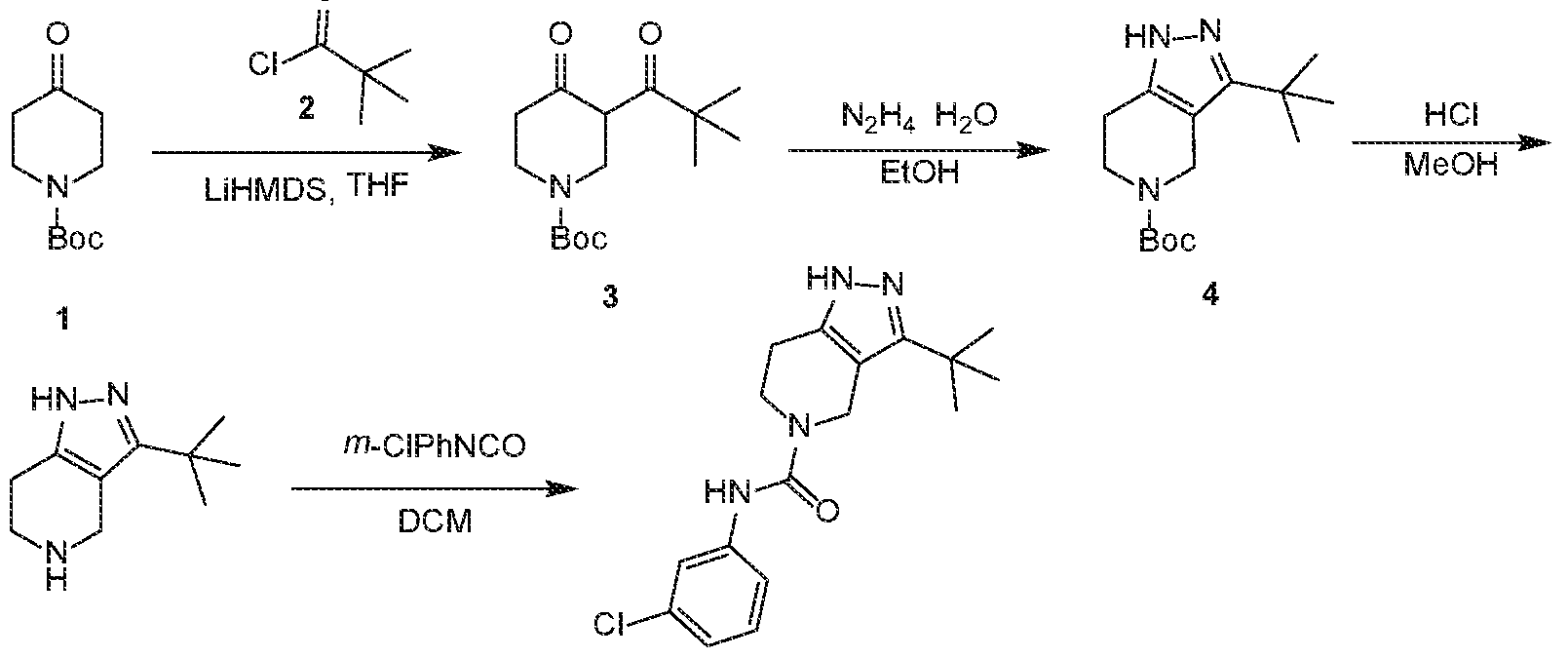
515
Step 1 : Preparation of Compound 3
To a solution of tert-butyl 4-oxopiperidine- 1 -carboxylate (1.00 g, 5.02 mmol, 1.00 eq) in THF (15.00 mL) was added LiHMDS (1 M, 6.53 mL, 1.30 eq) portion-wise at -60 °C under N2. The mixture was stirred at -60 °C for 30 min, 2,2-dimethylpropanoyl chloride (786.91 mg, 6.53 mmol, 1.30 eq) in THF (2.00 mL) was added dropwise at -60 °C. The
mixture was stirred at 10 °C for 2 hr. TLC showed the reaction was completed. The mixture was quenched by saturated NH4CI (20 mL) and extrated with EA (50 mL*2). The combined organic phase was dried with anhydrous Na2S04, filtered and concentrated in vacuum to afford tert-butyl 3-(2,2-dimethylpropanoyl)-4-oxo-piperidine-l-carboxylate (1.20 g, crude) as yellow oil.
Step 2: Preparation of Compound 4
To a solution of tert-butyl 3-(2,2-dimethylpropanoyl)-4-oxo-piperidine-l-carboxylate (1.20 g, 4.23 mmol, 1.00 eq) in EtOH (10.00 mL) was added NH2NH2.H20 (498.24 mg, 8.46 mmol, 2.00 eq) in one portion. The mixture was heated to 110 °C and stirred for 5 hours. LCMS showed the reaction was completed. The mixture was concentrated in vacumm. The residue was purified by prep-HPLC (FA) to afford tert-butyl -3 -tert-butyl- 1, 4,6,7- tetrah ydropyrazol o[4, 3 -c] pyri di ne-5-carboxy 1 ate( 300.00 mg, 1.07 mmol, 25.39% yield) as white solid. 1H NMR (400MHz, CHLOROFORM-d) 6 4.56 (brs, 2 H), 3.69 (brs, 2 PI), 2.70 - 2.81 (m, 2 H), 1.50 (s, 10 H), 1.35 (s, 9 H).
Step 3 : Preparation of Compound 5
To a solution of tert-butyl 3-tert-butyl-l,4,6,7-tetrahydropyrazolo[4,3-c]pyridine -5- carboxylate (80.00 mg, 286.35 umol, 1.00 eq) in dioxane (3.00 mL) was added HCl/dioxane (4 M, 3.00 mL, 41.91 eq) in one portion. The mixture was stirred at 10 °C for 30 min. TLC showed the reaction was completed. The mixture was concentrated in vacumm to afford 3- tert-butyl-4,5,6,7-tetrahydro-lH-pyrazolo [4,3 -cjpyri dine (65.00 mg, 257.75 umol, 90.01% yield, 2HC1) as white solid.
Step 4: Preparation of Compound 515
To a solution of 3-tert-butyl-4,5,6,7-tetrahydro-l H-pyrazolo[4,3-c]pyridine (65.00 mg, 257.75 umol, 1.00 eq, 2HC1) in DCM (10.00 mL) was added TEA (52.16 mg, 515.50 umol, 2.00 eq) followed by a solution of l-chloro-3-isocyanato-benzene (39.58 mg, 257.75 umol, 1.00 eq) in DCM (1.00 mL) dropwise at -10 °C. The mixture was stirred at -10 °C for 20 min. LCMS showed the reaction was completed. The mixture was quenched with H20 (10 mL) and extracted with DCM (20 mL*2). The combined organic phase was dried with anhydrous Na2S04, filtered and concentrated in vacuum. The residue was purified by pre-HPLC (FA) to afford 3-tert-butyl-N-(3-chlorophenyl )- 1 ,4,6,7-tetrahydropyrazolo[4,3- c]pyri di ne-5 -carboxami de (35.00 mg, 102.21 umol, 39.66% yield, 97.2% purity) as yellow solid.
1H NMR (400MHz, METHANOL-d4)6= 7.54 (t, ,1 = 2.0 Hz, 1 H), 7.34 - 7.30 (m, IH), 7.22 - 7.28 (ra, 1 H), 7.01 - 7.05 (m, 1 H), 4.69 (s, 2 H), 3.80 (t, ./ 5.8 Hz, 2 H), 2.81 (t, J 5.8 Hz, 2 H), 1.38 (s, 9 H). Example 15: Preparation of Compound 554

Step 1 : Preparation of Compound 2
To a solution of LiHMDS (1 M, 7.53 mL, 1.50 eq) was added dropwise tert-butyl 4- oxopi peri dine- 1 -carboxylate (1.00 g, 5.02 mmol, 1.00 eq) in THF (4.00 mL) at -70 °C for 30 min, then cyclobutanecarbonyl chloride (892,76 mg, 7.53 mmol, 1.50 eq) in THF (4.00 mL) was added dropwise at -70 °C. The mixture was stirred at 16 °C for 3 hr. The reaction was quenched with sat. NH4CI (20 mL) and then extracted with EA (20 mL*2). The combined organic phase was washed with brine (15 mL), dried over anhydrous Na2S04, filtered and concentrated in vacuo to give tert-butyl 3 -(cy cl obutan ecarbonyl )-4-oxo- piperi dine- 1 -carboxylate (1.50 g, crude) as a yellow solid. LCMS: I 82[M + l - I OOj .
Step 2: Preparation of Compound 3
A solution of tert-butyl 3 -(cyclobutanecarbonyl )-4-oxo-piperidine- 1 -carboxyl ate (7.50 g, 5.33 mmol, 1.00 eq), N2H4.H20 (320.18 mg, 6.40 mmol, 1.20 eq) in EtOH (10.00 mL) was heated to 80 C for 3 hr. The solution was concentrated. The residue was purified by column chromatography (Si02, PE/E A= 1 0/ 1 to 3/1) to give tert-butyl 3-cyclobutyl- 1 ,4,6,7- tetrahydropyrazolo[4,3-c]pyridine-5-carboxylate (700.00 mg, 1.51 mmol, 28.41% yield, 60% purity) as a light yellow solid. LCMS: 278[M+1],
Step 3 : Preparation of Compound 4
To a solution of tert-butyl 3 -cycl obutyl - 1 ,4,6,7-tetrahy dropyrazol o[4,3 -c] pyridine- 5- carboxylate (245.00 mg, 883.33 umol, 1.00 eq) in dioxane (3.00 mL) was added HCl/dioxane
(4 M, 3.00 mL, 13.58 eq), the solution was stirred at 16 °C for 2 hr. The reaction was concentrated to give 3-cyclobutyl-4,5,6,7-tetrahydro-lH-pyrazolo[4,3- c] py ri di ne; hy droch I ori de (200.00 mg, caide) as a white solid. LCMS: 178ΓΜ+1],
Step 4: Preparation of Compound 554
To a solution of 3-cyclobutyl-4,5,6,7-tetrahydro-l H-pyrazolo[4,3-c]pyridine hydrochloride (90.00 mg, 421.13 umol, 1.00 eq), TEA (127.84 mg, 1.26 mmol, 3.00 eq) in DCM (8.00 mL) was added dropwise I -chloro-3-i socvanato-benzene (64.67 mg, 421.13 umol, 1.00 eq) in DCM (lmL) at -10 °C and stirred for 30 min. The solution was washed with water (lOmL), the organic phase was dried over anhydrous Na2S04, filtered and concentrated in vacuum. The residue was purified by prep-HPLC ( basic ) to give N-(3- chl oropheny 1 )- -cy cl obutyl - 1 ,4,6,7-tetrahydropyrazol o[4,3 -c] pyri dine -5-carboxamide (40.00 mg, 120.19 umol, 28.54% yield, 99.4% purity) as a white solid. Ή NMR (400 MHz, METHANOL-^) ppm 7.52 (t, ./ 2.01 Hz, 1 H), 7.28 - 7.32 (m, 1 H), 7.21 - 7.26 (m, 1 H), 6.99 - 7.03 (m, 1 H), 4.55 (brs, 2 H), 3.79 (t, .1 = 5.77 Hz, 2 H), 3.58 (brs, 1 H), 2.78 (t, .1 = 5.65 Hz, 2 H), 2.24 - 2.40 (m, 4 H), 2.03 - 2.15 (m, 1 H), 1.93 (d, J= 7.03 Hz, 1 H). LCMS: 331 ΓΜ+1],
Example 16: Preparation of Compound 455

455
Step 1 : Preparation of Compound 2
To a mixture of tert-butyl 3-amino-l,4,6,7-tetrahydropyrazolo[4,3-c]pyridine-5-carbo xylate (150.00 mg, 629.49 umol, 1.00 eq) and 1,4-dibromobutane (135.91 mg, 629.49 umol, 1.00 eq) in MeCN (10.00 mL) was added Cs2C03 (410.20 mg, 1.26 mmol, 2.00 eq). The mixture was stirred at 50 C for I hr. TLC (Petroleum ether/Ethyl acetate=0/l) showed the starting material 1 was consumed completely, and a major new spot detected. The solvent was evaporated, the residue was washed with water (20 mL), extracted with Ethyl acetate (20 mL*2), the combined organic layer was dried over anhydrous Na?S04, concentrated. The residue was purified by chromatography (silica gel, eluting with Petroleum ether/Ethyl acetate=l/l to 0/1) to afford tert-butyl-3-pyrrolidin- 1 -yl- 1 ,4,6,7-tetrahydropyrazolo[4,3- c] py ri di ne-5 -carboxyl ate (45.00 mg, 153.91 umol, 24.45% yield) as light yellow oil. Ή
NMR (400 MHz, CDC13) δ 4.46 (br. s., 2 H), 3.59 (brs, 2 H), 3.28 (t, .1 = 6.27 Hz, 4 H), 2.57 (br. s., 2 H), 1.87 (br. s., 4 H), 1.38 - 1.45 (m, 9 H). LCMS: 293 [M+\\ .
Step 2: Preparation of Compound 3
To a solution of tert-butyl 3-pyrrolidin-l-y{-l,4,6,7-tetrahydropyrazolo[4,3-c]pyridine -5-carboxylate (45.00 mg, 153.91 umol, 1 .00 eq) in dioxane (1.00 ml.) was added
HCl/dioxane (4 M, 3.00 mL, 77.97 eq). The mixture was stirred at 15 °C for 1 hr. Then white solid was formed, the solvent was evaporated to afford 3-pyrro!idin- 1 -yl-4,5,6,7-tetrahvdro- I H-pyrazol o[4, -c]py ri di ne (38.00 mg, crude, HC1) as white solid, which was not purified and used directly in the next step.
Step 3 : Preparation of Compound 455
To a solution of 3-pyiTolidin-l-yi-4,5,6,7-tetrahydro-lH-pyrazolo[4,3-c]pyridine (38.00 mg, 166.14 umol, 1.00 eq, HC1) in DCM (3.00 mL) was added TEA (33.62 mg, 332.28 umol, 2.00 eq) and I -chloro-3-isocyanato-benzene (25.51 mg, 166.14 umol, 1.00 eq). The mixture was stirred at 1 5 °C for 1 hr. LCMS showed the material 3 was consumed completely, and a main peak with desired MS detected. The solvent was evaporated, the residue was washed with water (10 mL), extracted with ethyl acetate (10 niL*3 ), the combined organic layer was dried over anhydrous Na2S04, concentrated to afford a residue. The residue was purified by prep-HPLC (FA) to afford -(3 -chl orophenyl )-3 - pyrrolidin- 1 -yl- 1 ,4,6,7-tetrahydropyrazolo[4,3-c] pyridine-5-carboxamide (23.94 mg, 60.77 umol, 36.58% yield, 99.47% purity, F A salt) as white solid. 1H NMR (400 MHz, MeOD) δ 8.17 (brs, 1 H), 7.54 (brs, 1 H), 7.22 - 7.34 (m, 2 H), 7.03 (d, J = 7.53 Hz, 1 H), 4.66 (s, 2 H), 3.80 (t, J = 5.27 Hz, 2 H), 3.38 (brs, 4 H), 2.75 (brs, 2 FI), 1 .99 (brs, 4 FT). LCMS: 346/348 [MM ].
Example 17: Preparation of Compound 546

Step 1 : Preparation of Compound 3
To a mixture of tert-butyl 3~(trifluoromethylsulfonyloxy)-L4,6,7-tetrahydropyrazolo [4,3-c]pyridine-5-carboxyiate (300.00 mg, 807.91 umol, 1.00 eq) and cyclopenten- 1 - ylboronic acid (135.64 mg, 1 .2 1 mmol, 1 .50 eq) i n dioxane (2.00 niL) and Ι¾0 (200.00 uL) was added XPHGS-PD-G2 (63.57 mg, 80.79 umol, 0.10 eq), K3PO4 (342.99 mg, 1 .62 mmol, 2.00 eq) in one portion under Nk The mixture was stirred at 1 10 °C for 10 hour. TLC (Ethyl acetate: Petroleum ether:::2: 1 ) showed the reaction was completed and the desired product was detected. The mixture was poured into water (20 raL) and stirred for 2 min. The aqueous phase was extracted with ethyl acetate (20 mL*2). The combined organic phase was washed with brine (20 mL*2), dried with anhydrous Na2S04, filtered and concentrated in vacuum. The residue was purified by silica gel chromatography (Petroleum ether/Ethyl acetate=2/l) to afford tert-butyl 3-(cyclopenten-l -yl)-l,4,6,7-tetrahydropyrazolo[4,3-c]pyridine-5- carboxylate (200.00 mg, 691.16 umol, 85.55% yield) as white solid. LCMS: 290 [M+l], Step 2 : Preparation of Compound 4
To a mixture of tert-butyl 3-(cyclopenten-l-yl)-l,4,6,7-tetrahydropyrazolo[4,3-c] pyridine-5-carboxylate (50.00 mg, 172.79 umol, 1.00 eq) in DCM (8.00 mL ) was added diethylzinc (1 M, 863.95 uL, 5.00 eq) at 0°C under Nk Then ch 1 oro( i odo )m eth an e (182.86 mg, 1.04 mmol, 6.00 eq) was added to the mixture and stirred at 20 °C for 12 hours. LCMS showed the reaction was completed. The mixture was poured into water (10 raL) and stirred for 2 min. The aqueous phase was extracted with DCM (10 mL*2). The combined organic phase was washed with brine (10 mL*2), dried with anhydrous Na2S0 i, filtered and concentrated in vacuum. The residue was purified by prep-HPLC(FA) to afford tert-butyl 3- (l-bicyclo[3. 1.0] hexanyl)-l ,4,6,7-tetrahydropyrazolo[4,3-c]pyridine-5-carboxylate (20.00 mg, 65.92 umol, 38.15% yield) as yellow solid. LCMS: 304 [M+l].
Step 3 : Preparation of Compound 5
To a mixture of tert-butyl 3-( I -bicyclo[3. 1 .Ojhexanyl )- 1 ,4,6,7-tetrahydropyrazolo [4,3-c]pyridine-5-carboxylate (20.00 mg, 65.92 umol, 1.00 eq) in dioxane (1.00 niL ) was added HCl/dioxane (4 M, 2.00 mL, 121.36 eq) in one portion under N2. The mixture was stirred at 18 °C for 1 hour. TLC (Petroleum ether : Ethyl acetate=2: l) showed the reaction was completed. The mixture was concentrated in vacuum to afford 3-( I - bicyclo[3.1 .0]hexanyl)-4,5,6,7-tetrahydro-l H-pyrazolo[4,3-c]pyridine ( 15.80 mg, 65.90 umol, 100.00% yield, HC1) as yellow solid.
Step 4: Preparation of Compound 546
To a mixture of 3-( 1 -bicyclo[3 1 .Ojhexanyl )-4,5,6,7-tetrahydro- 1 H-pyrazolo[4,3-c] pyridine (15.80 mg, 65.90 umol, 1.00 eq, HQ) and TEA (20.01 mg, 197.70 umol, 3.00 eq) in DCM (2.00 mL) was added 1 -chloro-3-isocyanato-benzene (9.1 1 mg, 59.31 umol, 0.90 eq) in one portion at 1 5 C under N2. The mixture was stirred at 15 °C for 30 min. LCMS showed the reaction was completed. The mixture was poured into water (10 mL) and stirred for 2 min. The aqueous phase was extracted with DCM (10 mL*2). The combined organic phase was washed with brine (10 mL*2), dried with anhydrous Na.>S() i, filtered and concentrated in vacuum. The residue was purified by prep-HPLC(FA) to afford 3-( I - bicycio[3.1.0]hexanyl)-N-(3- chlorophenyl)-l ,4,6,7-tetrahydropyrazolo[4,3-c]pyridine-5- carboxamide (10.00 mg, 26.90 umol, 40.82% yield, 96.0% purity) as white solid. Ή NMR (400 MHz, METHANOL^) 7.50-7.54 (m, 1H), 7.27-7.32 (m, 1 H), 7.20-7.26 (m, 1H), 6.98- 7.04 (m, 1H), 4.57 (s, 2H), 3.78 (t, J=5.77 Hz, 2H), 2.77 (t, J=5.71 Hz, 2H), 2.05-2.13 (m, 1H), 1 .90-2.03 (m, 2H), 1.65-1.87 (m, 3H), 1 .28-1 .43 (m, 1H), 0.79-0.88 (m, 2H). LCMS: 357 [M+l]. Example 18: Preparation of Compound 644

To a mixture of I -tert-butyl 3 -ethyl 4-oxopiperidine-l,3-dicarboxylate (10.00 g, 36.86 niniol, 1.00 eq) in EtOH (130.00 mL) was added N2H4-H20 (2.77 g, 44.23 mmol, 1.20 eq) in one portion under N2. The reaction was stirred at 85 °C for 2 hr. TLC (Petroleum ether: ethyl acetate=T : 1 ) showed the reaction was completed. The mixture was concentrated in vacuum to afford tert-butyl 3 -hydroxy- 1 , 4,6,7- tetrahydropyrazolo[4,3-c]pyridine-5-carboxylate (8.82 g, 36.86 mmol, 100.00% yield) as white solid. I MS: 240 [M+l].
Step 2: Preparation of Compound 3
To a mixture of tert-butyl-3-hydroxy-l,4,6,7-tetrahydropyrazolo[4,3-c]
pyridine-5-carboxylate (8.82 g, 36.86 mmol, 1.00 eq) in Py (100.00 mL) was added 1, 1, 1- tri 11 uoro- -ph enyl - -(tri tl uorom ethyl sul fony 1 )m ethanesul fonami de at 10 °C. The reaction mixture was stirred at 10 C for 12 hours. The mixture was concentrated in vacuum. The residue was diluted with ethyl acetate (150 mL) and poured into 0.5N HCl (20 mL) and stirred for 1 min. The aqueous phase was extracted with ethyl acetate (100 mL*2). The combined organic phase was washed with brine (100 mL*2), dried with anhydrous Na?S04, filtered and concentrated in vacuum . The residue was purified by si lica gel chromatography (Petroleum ether/Ethyl acetate=5/l) to afford tert-butyl 3 -( tri 11 uorom ethyl sul Ion y 1 ox y )- 1 ,4,6,7- tetrahydropyrazolo[4,3-c]pyridine-5-carboxylate (9.16 g, 23.19 mmol, 62.91% yield, 94% purity) as yellow solid. LCMS: 372 [M+l].
Step 3 : Preparation of Compound 5
To a mixture of tert-butyl 3 -(tri 11 uoromethy 1 sul fonyl oxy )- l,4,6,7-tetrahydropyrazolo[4,3-c]pyridine-5-carboxylate (900.00 mg, 2.42 mmol, 1 .00 eq) and 2-allyl-4,4,5,5 -tetramethyl- 1 ,3,2-dioxaborolane (610.92 mg, 3.64 mmol, 1.50 eq) in dioxane (1.00 mL)/H20 (100.00 uL) was added XPHOS-PD-G2 (190.70 mg, 242.37 umol, 0.10 eq) under N2, followed by K3PO4 (1 .03 g, 4.85 mmol, 2.00 eq). The reaction mixture was stirred at 1 10 C for 16 hours. The mixture was extracted with EA (10 mL*3) and water (5 mL), the organic phase was dried with anhydrous Na2SO}, filtered and concentrated in vacuum. The residue was purified by silica gel chromatography (Petroleum ether/Ethyl acetate=10/l to 1/1) to afford Compound 5 (400.00 mg, 1.52 mmol, 62,77% yield) was obtained as yellow oil.
Step 4: Preparation of Compound 6
To a solution of tert-butyl -3 -al 1 yl - 1 ,4,6, 7-tetrahydropy azol o[ 4,3 -c Jpyri di ne- 5-carboxylate (147.06 mg, 1 89.88 umol, 1.00 eq) in MeOH (20.00 mL) was added
Pd/C (10%, 0.1 g) under N2. The suspension was degassed under vacuum and purged with
H; several times. The mixture was stirred under ¾ (20 psi) at 15 °C for 16 hours. The mixture was filtrated. The filtrates was concentrated in vacumm to afford tert-butyl 3-propyl- l,4,6,7-tetrahydropyrazolo[4,3-c]pyridine-5- carboxylate (110.00 mg, crude) as colorless oil. Preparation of Compound 644
Tert-butyl 3-piOpyl-l,4,6 7-tetraliydropyrazolo[4,3-cjpyridine-5-carboxylate (80.00 mg, 301.49 umol, 1.00 eq) was dissolved in DCM (1.00 mL) and TFA (1.60 g, 14.03 mmol, 46.52 eq). The mixture was stirred at 10 °C for 0.5 hr. The mixture was concentrated in vacumm. The residue was dissolved in DCM (5.00 mL) and added TEA (122.03 mg, 1.21 mmol, 4.00 eq) followed by a solution of l-chloro-3-isocyanato-benzene (46.30 mg, 301.49 umol, 1.00 eq) in DCM (300.00 uL) dropwise at 0 °C. The reaction mixture was stirred at 0 °C for 10 min. The mixture was extracted with DCM (10 mL*2) and H20 (10 mL). The organic layer was concentrated in vacumm. The residue was purified by prep-HPLC (FA) to afford N-(3-chlorophenyl)-3-propyl-l,4,6,7-tetrahydropyrazolo[4,3-c]pyridine-5- carboxamide (37.00 mg, 112.69 umol, 37.38% yield, 97.1% punt}') as white solid. Ή NMR (400MHz, METHANQL-d4) δ - 7.55 (t, .1 = 1.9 Hz, 1 H), 7.30 - 7.35 (m, 1 H), 7.22 - 7.28 (m. 1 H), 7.03 (d, J= 7.8 Hz, 1 H), 4.54 (s, 2 H), 3.82 (t J= 5.8 Hz, 2 H). 2.80 (t, J= 5.8 Hz, 2 H), 2.62 (t, J = 7.5 Hz, 2 H), 1.63 - 1.75 (m, 2 H), 0.99 (t, J = 7.3 Hz, 3 H). LCMS:
319/321 [M+1]. Example 19: Preparation of Compound 642

Step 1 : Preparation of Compound 2
To a solution of 5-tert-buty 1-3-ethy 1- 1 ,4,6,7-tetrahydropyrazolo[4,3-c]
pyridine- 3.5 -di carbox late (50.00 g, 169.30 mmol, 1.00 eq) in dioxane (200.00 mL) was added HCl/dioxane (4 M, 300.00 mL, 7.09 eq) at 15 °C. The reaction mixture was stirred at 15 °C for one hour. Precipitate formed. Evaporated the solution on a water bath under
reduced pressure using a rotary evaporator to afford ethyl 4,5,6, 7-tetrahydro- 1 H- py razol o[4,3 -c jpyri di ne-3 -carboxyl ate (37.00 g, 59.70 mraol, 94.33% yield, HC1) as yellow solid. The crude product was used in next step directly without further purification.
Step 2 : Preparation of Compound 3
To a mixture of ethyl 4,5,6,7-tetrahydro-l H-pyrazolo[4,3-c]pyridine-
3-carboxylate (37.00 g, 159.70 mmol, 1.00 eq, HC1) in DCM (300.00 mL) was added TEA (48.48 g, 479.11 mmol, 3.00 eq) at -10 °C, followed by 1 -chloro-3-i socyanato-benzene (19.62 g, 127.76 mmol, 0.80 eq). The reaction mixture was stirred at -10 °C for another 30 minutes. TLC (Petroleum ether: Ethyl acetate=0: l ) indicated 5% of compound 2 was remained, and one major new spot with lower polarity was detected. The mixture was extracted with DCM (800 mL*3) and water (300 mL*2), the organic phase was dried with anhydrous Na2S04, filtered and concentrated in vacuum to afford ethyl-5-[(3- chlorophenyl )carbamoyl]- l,4,6,7-tetrahydi pyrazolo[4,3-c]pyridine-3-carboxylate (52.00 g, crude) as yellow solid. The crude product was used in next step directly without further purification.
Step 3 : Preparation of Compound 4
To a solution of ethyl 5-[(3-chlorophenyl)carbamoyl]-l, 4,6,7- tetrahydropyrazolo [4,3 -c] pyri di ne-3 -carboxyl ate (30.00 g, 86.01 mmol, 1.00 eq) in THF (300.00 mL) was added a solution of NaOH (6.88 g, 172.02 mmol, 2.00 eq) in ¾0 (60.00 mL) , the reaction mixture was warmed to 40 °C and stirred at 40 °C for 16 hours. TLC (Petroleum ether: Ethyl acetate=0: 1) showed the reaction was completed. The pH of the reaction mixture was adjusted to around 5 by adding diluted hydrochloride acid (1 N), then extracted with EA (500 mL*4) and water (300 mL). The organic phase was dried over anhydrous Na2S04, filtered and concentrated in vacuum to afford 5-[(3- chiorophenyl)carbamoyl]-l,4,6,7-tetrahydropyrazolo[4,3-c]pyridine-3-carboxylic acid (23.00 g, crude) as light yellow solid. The crude product was used in next step directly without further purification. lH NMR (400 MHz, METHANOL-d4) 1 1.48 (t, J-1.94 Hz, 1 H) 1 1.23 - 11.28 (m, 1 H) 11.14 - 11.21 (m, 1 H) 10.92 - 10.98 (m, 1 H) 8.71 (s, 2 H) 7.78 ( t, ,7 = 5.71 Hz, 2 H) 6.80 (t, ./ 5.65 Hz, 2 H). LCMS: 321/323 [M i l],
Step 4: Preparation of Compound 6
To a mixture of 5-[(3-chlorophenyl)carbamoyl]-l,4,6,7- tetrahydropyrazolo[4,3-c] pyri di ne-3 -carboxyl i c acid (10.00 g, 31.18 mmol, 1.00 eq) and HATU ( 1 1 .86 g, 3 1 . 18 mmol, 1.00 eq) in DMF (150.00 mL) was added DIPEA (6.04 g, 46.77 mmol, 1.50 eq), followed by -methoxymethanamine (4.56 g, 46.77 mmol, 1.50 eq.
HQ), the reaction mixture was stirred at 15 °C for 16 hours. TLC (Ethyl acetate: Methanol ::::20: 1 ) indicated compound 4 was consumed completely, and one major new spot with lower polarity was detected. The mixture was extracted with EA (500 niL*3) and water (300 mL*3), the organic phase was dried with anhydrous Na2SQ4, filtered and concentrated in vacuum . Further purification by silica gel chromatography (100-200 mesh silica gel, Ethyl acetate: Methanol = 100: 1 to 20: 1) to afford N5-(3-chlorophenyl)-N3-methoxy-N3-methyl- 1 ,4,6,7-tetrahydropyrazolo [4,3-c]pyridine-3,5-dicarboxamide (8.00 g, 17.59 mmol, 56.42% yield, 80% purity) as yellow solid. Ή NMR (400 MHz, M ETH ANOL-d4 ) 11.48 (t, J= 1.94 Hz, 1 H) 11.23 - 1 1 .28 (m, 1 H) 11.14 - 11.21 (m, 1 H) 10.92 - 10.98 (m, 1 H) 8.71 is, 2 H) 7.78 (t, J= 5.71 Hz, 2 H) 6.80 (t, J = 5.65 Hz, 2 H). LCMS: 364/366 [M+1].
Step 5: Preparation of Compound 7
To a solution of N5-(3-ch{orophenyl)-N3-methoxy-N3-methyl- 6,7-dihydro-lH- pyrazolo[4,3-c]pyridine-3,5(4H)-dicarboxamide (200.00 nig, 549.75 umol, 1.00 eq) in THF (5.00 niL) was added propylmagnesium bromide (1 M, 5.50 niL, 10.00 eq) at -10 °C. The reaction mixture was stirred at 10 °C for 3 hr. The mixture was added into saturated NH4C1 (10 ml.) and extracted with EA (10 mL*2). The combined organic layer was dried over Na2S04, and concentrated. The residue was purified by column
chromatography (PE : E A=30%~60%) to afford 3-butanoyl-N-(3-chlorophenyl )- 1 ,4,6,7- tetrahydropyrazolo[4,3-c]pyridine-5-carboxamide (85.00 mg, 245.09 umol, 44.58% yield) as white solid.
Preparation of Compound 642
To a solution of 3-butanoyl-N-(3-chlorophenyl)-l,4,6,7-tetraHydropyrazolo
[4,3-c] pyridine-5-carboxamide (40.00 mg, 115.34 umol, 1.00 eq) in DCM (4.00 m L) was added DAST (74.37 mg, 461.36 umol, 4.00 eq) at -10 °C. The mixture was stirred at 10 °C for 2 hr. The mixture was extracted with DCM (10 mL*2) and H20 (10 mL). The combined organic layer was dried over Na2S04, and filtrated and concentrated in vacumm. The residue was purified by prep-HPLC (FA) to afford N-(3-chlorophenyl)-3-(l, l- difluorobutyl )- 1 ,4,6,7-tetrahydropyrazolo [4,3-c]pyridine-5-carboxamide (11.00 mg, 29.68 umol, 25.73% yield, 99.5% purity) as white solid. 1H NMR (400MHz, METHANOL-d4) δ 7.54 (t, J= 1.9 Hz, 1 H), 7.29 - 7.33 (m, 1 H), 7.22 - 7.28 (m, 1 H), 7.03 (d, J= 7.9 Hz, 1 H), 4.65 (s, 2 H), 3.83 (t, J= 5.7 Hz, 2 H), 2.87 (t, J= 5.6 Hz, 2 H), 2.16 - 2.34 (m, 2 H), 1.54 (qd, J= 7.5, 15.4 Hz, 2 H), 1.00 (t, J= 7.5 Hz, 3 H). LCMS: 369/371 [M+1].
Example 20: Preparation of Compound 696

^ 695 696
Preparation of Compound 695
To a solution of EtMgBr (1 M, 4. 12 niL, 5.00 eq) was added a solution of N5-(3- chlorophenyl)-N3-methoxy-N3-methyl-l,4,6,7 etrahydropyrazolo[4,3-c]pyridine-3,5-- dicarboxamide (300.00 mg, 824.63 umol, 1.00 eq) in THF (5.00 ml.) at -10 °C. The mixture was stirred at 15 °C for 3 hr. TLC (PE:EA = 0: 1) showed starting material was remained. EtMgBr (1 M, 4.12 ml., 5.00 eq) was added at -10 °C. The mixture was stirred at 15 °C for 2 hr. The mixture was quenched by saturated with NH4C1 (10 mL ) and extracted with EA (20 mL*2). The combined organic layer was dried over
 filtrated, and concentrated in vacumni. The residue was purified by prep-TLC (PE:EA=0: 1) to afford N- (3-chlorophenyl )- 3-propanoyl-l,4,6,7-tetrahydi pyrazoio[4,3-c]pyridine-5-carboxamide (100.00 mg, 287.88 umol, 34.91% yield, 95.8% purity) as white solid. Ή NMIl (400MHz, METHANOL-d4) δ = 7.54 (t, J = 1.9 Hz, 1 H), 7.29 - 7.33 (m, 1 H), 7.22 - 7.27 (m, 1 H), 7.02 (d, J = 7.9 Hz, 1 H), 4.76 (s, 2 H), 3.82 (t, J = 5.6 Hz, 2 H), 3.03 (q, J = 7.4 Hz, 2 H), 2.87 (t, J = 5.7 Hz, 2 H), 1.12 - 1.23 (m, 3 H). LCMS: 333/335[M+l].
Preparation of Compound 696
To a solution of N-(3-chlorophenyl )-3-propanoyl- 1 ,4,6,7-tetrahydropyrazolo
[4,3-c] pyridine-5-carboxamide (60.00 mg, 180.30 umol, 1.00 eq) in DCM (3.00 mL) was added DAST (145.31 mg, 901.50 umol, 1 19.1 1 uL, 5.00 eq) at -40 °C. The mixture was stirred at 15 C for 2 hr. The mixture was extracted with DCM (10 mL*2). The organic layer was washed with saturated aHCO, (10 mL), dried over Na2SO.t, filtrated, and concentrated in vacumm. The residue was purified by prep-HPLC (FA) to afford N-(3- chlorophenyl )-3-( 1 , 1 -ditiuoropropv )- 1 ,4,6,7-tetra hy dropy razol o[ 4, 3 -c ] py ri di n e-5 - carboxamide (23.00 mg, 64.76 umol, 35.92% yield, 99.9% purity) as white solid. Ή NMR (400MHz, METHANOL-d4) 6 7.54 (t, J = 1 .9 Hz, 1 H), 7.29 - 7.33 (m, 1 H), 7.22 - 7.28 (m, 1 H), 7.00 - 7.05 (m, 1 H), 4.66 (s, 2 H), 3.83 (t, J= 5.7 Hz, 2 H), 2.87 (t, J = 5.6 Hz, 2 H), 2.21 - 2.38 (m, 2 H), 1 .06 (t, J 7.5 Hz, 3 H). LCMS: 355/357ΓΜ+1].
Example 21. Preparation of Compound 604

Steps 1 and 2: Preparation of Compounds 2 and 4
2,2-dimethylbut-3-enoic acid (200,00 nig, 1 .75 mmol, 1.00 eq) was dissolved in SOQ2 (208.46 mg, 1.75 mmol, 127.1 1 uL, 1.00 eq) and heated to 8 C for 1 hr. The mixture was concentrated in vacumm to get 2, 2-di m eth yl b ut-3 -en oy 1 chloride (190.46 mg), compound 2.
A solution of tert-butyl 4-oxopiperidine-l -carboxyl ate (278.95 mg, 1.40 mmol, 0.80 eq) in THF (3.00 mL) was added into Li HM DS (1 M, 1.75 mL, 1 .00 eq) dropwise at -70 °C under N2. The mixture was stirred at -70 °C for 0.5 hr. A solution of 2,2-dimethylbut-3- enoyl chloride (190.46 mg, obtained above) in THF (2.00 mL) was added dropwise at -70 °C. The mixture was stirred at 15 C for 16 hr. The mixture was quenched by NH4C1 (10 mL) and extracted with EA (10 mL*2). The combined organic layer was dried over Na2SC«4, filtrated. The filtrates was concentrated in vacumm to afford tert-butyl 3-(2,2-dimethylbut-3- enoyl )-4-oxo-piperidine- 1 -carboxylate (450.00 mg, crude) as brown oil .
Step 3 : Preparation of Compound 5
To a solution of tert-butyl 3-(2,2-dimethylbut-3-enoyl)-4-oxo-piperidine-l - carboxylate (300.00 mg, 1.02 mmol, 1.00 eq) in EtOH (2.00 mL) was added NH2N 1 L. H 0 (204.24 mg, 2.04 mmol, 198.29 uL, 50% purity, 2.00 eq). The mixture was heated to 90 C for 2 hr. The mixture was concentrated. The residue was extracted with EA (10 m L*2 ) and H20 (10 mL). The combined organic layer was dried
 filtrated, and
concentrated. The residue was purified by prep-HPLC (FA) to afford tert-butyl 3 -( 1 , 1 - dimethylpropyl)- 1,4,6,7- tetrahydropyrazolo[4,3-c]pyridine-5-carboxylate (10.00 mg, 34.08 umol, 3.34% yield) as colorless oil. 1H NMR (400MHz, CHLOROFORM-d) δ 4.52 (brs, H),
3.69 (brs, H), 2.76 (brs, 2 H), 1.64 (q, .1 = 7.4 Hz, 2 H), 1.45 - 1.53 (m, 16 H), 1.32 (s, 6 H), 0.80 (t, J == 7.5 Hz, 3 H).
Preparation of Compound 604
Tert-butyl 3-(l, l -dimethylpropyl)- l ,4,6,7-tetrahydropyrazolo[4,3-c]
pyridine-5-carboxy!ate (10.00 mg, 34.08 umol, 1.00 eq) was dissolved in HCl/dioxane (4 M, 3.00 mL, 352.1 1 eq) and stirred at 15 °C for 1 hr. The mixture was concentrated and dissolved in DCM (5.00 mL) added phenyl N-(3-chlorophenyl)carbamate (8.44 mg, 34.08 umol, 1.00 eq) followed by TEA (17.24 mg, 170.40 umol, 23.62 uL, 5.00 eq). The mixture was stirred at 1 5 °C for 1 6 hr. LCMS showed the reaction was completed. The mixture was concentrated in vacumm. The residue was purified by prep-HPLC (FA) to afford N-(3- chiorophenyl)-3 -(1, 1 -dim ethyl propyl )- 1,4,6, 7-tetrahydropyrazolo
[4,3-c]pyridine-5-carboxamide (4.80 mg, 12.90 umol, 37.85% yield, 93.2% purity).
1H MR (400MHz, METHANOL-d4) δ 7.53 (s, 1 H), 7.29 - 7.34 (m, 1 H), 7.22 - 7.28 (m, 1 H), 7.03 (d, J = 7.0 Hz, 1 H), 4.65 (s, 2 H), 3.80 (t, J= 5.8 Hz, 2 H), 2.82 (t, J = 5.7 Hz, 2 H), 1.70 (q, J = 7.4 Hz, 2 H), 1.35 (s, 6 H), 0.79 (t, J = 7.4 Hz, 3 H).
LCMS: 347/349ΓΜ+1 ],
Example 22. Preparation of Compound 694

To a solution of 1 -methyl cycl obutanecarboxy 1 i c acid (2.00 g, 17.52 mniol, 1.00 eq) in DCM (20.00 mL) was added GDI (3.12 g, 19.27 mmol, 1.10 eq) under N2. The mixture was stirred at 15 °C for 1 hr. The mixture was extracted with EA (20 mL). The organic layer was dried over Na2S04, filtrated, and concentrated in vacumm . The residue was used in the next step directly to afford imidazol- 1 -yl-( 1 -methylcyclobutyl )methanone (2.60 g, 15.83 mmol, 90.38% yield) as brown oil.
Step 2: Preparation of Compound 4
To a solution of LiHMDS (1 M, 21.92 mL, 1.20 eq) in THF (10.00 ml.) was added a solution of tert-butyl 4-oxopiperidine-l-carboxylate (2.55 g, 12.79 mmol, 0.70 eq) in THF (15.00 mL) under N2 at -65 °C. The mixture was stirred at -65 °C for 0.5 hr. A solution of imidazol-l-yl-(l-methylcyclobutyl)methanone (3.00 g, 1 8.27 mmol, 1.00 eq) in THF ( I 5.00 mL) was added at -65 °C dropwise. The solution was stirred at 15 °C for 16 hr. The mixture was quenched by saturated NH4C1 (20 raL) and extracted with EA (20 niL*2). The combined organic layer was dried over Na2S04 and concentrated to afford tert-butyl 3-(l- methylcyclobutanecarbonyl )-4- oxo-piperidine-l-carboxylate (759.10 nig, 2.57 mmol, 14.07% yield) as colorless oil.
Step 3 : Preparation of Compound 5
To a solution of tert-butyl-3-( 1 -methylcyclobutanecarbonyl )-4-oxo- piperidine- 1 - carboxylate (760.00 mg, 2.57 mmol, 1.00 eq) in EtOH (20.00 mL) was added NH2NH2-H20 (515.23 mg, 5.15 mmol, 500.22 uL, 50% purity, 2.00 eq). The mixture was heated to 90 C for 2 hr. The mixture was concentrated in vacumm. The residue was purified by flash chromatography (PE:EA=50%~1 00%) to afford tert-butyl 3-( 1 - methylcyclobutyl)-l,4,6,7-tetrahydropyrazolo[4,3-c] pyridine-5-carboxylate (500.00 mg, 1.72 mmol, 66.77%) yield) as colorless oil.
Step 4: Preparation of Compound 694
Tert-butyl 3-( 1 -methylcyclobutyl )- 1 ,4,6,7-tetrahydropyrazolo[4,3-cJpyridine-5- carboxylate (60.00 mg, 205. 1 umol, 1.00 eq) was dissolved in HCl/Dioxane (4 M) and stirred at 15 °C for 1 hr. The mixture was concentrated in vacumm. The residue was dissolved in DCM (3.00 mL), then TEA (62.51 mg, 617.73 umol, 85.63 uL, 3.00 eq) and 1 - chloro-3-isocyanato-benzene (31.62 mg, 205.91 umol, 24.90 uL, 1.00 eq) was added at -10 °C. The mixture was stirred at -10 °C for 30 min. The mixture was concentrated in vacumm. The residue was purified by prep-HPLC (FA) to afford N-(3-chlorophenyl)-3-(l- m ethyl cyclobutyl )- 1 ,4,6,7-tetrahydropyrazolo [4,3-c]pyridine-5-carboxamide (42.00 mg, 1 1 5.7 1 umol, 56.19% yield, 95.0% purity) as white solid. Ή NMR (400MHz, METHANOL- d4) δ 7.53 (t, J 2.0 Hz, 1 H), 7.29 - 7.33 (m, 1 H), 7.22 - 7.28 (m, 1 H), 7.00 - 7.05 (m, 1 H), 4.57 (s, 2 H), 3.81 (t, J = 5.8 Hz, 2 H), 2.81 (t, .1 = 5.8 Hz, 2 H), 2.46 - 2.56 (m, 2 H), 2.04 - 2.23 (m, 3 H), 1.89 - 2.00 (m, 1 H), 1.52 (s, 3 H). LCMS: 345/347[M+l],
xample 23: Preparation of Compounds 508 (E and Z) and 0509

509
Step 1 : Preparation of Compound 2
To a cooled the three-necked round bottom flask in an ice bath at 0 °C, was added NaH (880.40 mg, 22.01 mrnol, 1.30 eg) under N2, then a solution of 5-tert-butyl 3 -ethyl l,4,6,7-tetrahydropyrazolo[4,3-c]pyridine-3,5-dicarboxylate (5.00 g, 16.93 mmol, 1.00 eq) in DMF (70.00 niL) was added dropwise. The reaction mixture was stirred at 0 °C for 30 minutes. PMBCI (2.92 g, 18.62 mmol, 1.10 eq) was added dropwise, the reaction mixture was warmed to 10 °C and stirred at 10 °C for another 16 hours. TLC showed starting material was consumed completed and two major new spots with lower polarity was detected. The reaction was added to water (60 niL) and then extracted with EA (100 mL*3), the
combined organic phase was dried over anhydrous Na2S04, filtered and concentrated in vacuum. The residue was purified by silica gel chromatography to afford 5-tert-butyl 3- ethyl- l -[(4-methoxyphenyl )methyl]-6,7-dihydro-4H- pyrazolo[4,3-c]pyridine-3,5-dicarboxylate (4.30 g, 7.24 mmol, 42.79% yield, 70% purity) as yellow oil. LCMS: 416 [M+l].
Step 2: Preparation of Compound 3
Cooled the three-necked round bottom flask to -50 °C, LiAlH4 (511.50 mg, 13.48 mmol, 2.00 eq) was added under N2, then a solution of 5-tert-butyl 3 -ethyl l-[(4- methoxyphenyl)methyl]-6,7-dihydro-4H-pyrazolo[4,3-c]pyridine-3,5-dicarboxylate (4.00 g, 6.74 mmol, 1.00 eq) in THF (50.00 mL) was added dropwise, after addition the reaction mixture was warmed to 0 °C and stirred at 0 C for 2 hours. TLC showed the reaction was completed, two major new spot with larger polarity was detected. The reaction mixture was quenched with water (5 mL) and filtered. The filtrate was washed with DCM (80 mL*3). The organic phase was dried with anhydrous Na2S04, filtered and concentrated in vacuum. Tert-butyl 3-(hydroxymethyl)-l-[(4-methoxyphenyl)methyl]-6,7-dihydro-4H-pyrazolo[4,3- c]pyridine-5-carboxylate (2.30 g, crude) was obtained as yellow oil. The crude product was used in the next step directly without further purification. LCMS: 374 [M+l].
Step 3 : Preparation of Compound 4
To a solution of tert-butyl-3-(hydroxym ethyl)- l-[(4-methoxyphenyl)
methyl] -6, 7- dihydro-4H-pyrazolo[4,3-c]pyridine-5-carboxylate (1.40 g, 3.75 mmol, 1.00 eq) in DCM (25.00 mL) was added Mn02 (6.52 g, 75.00 mmol, 20.00 eq) in three portions. The reaction mixture was warmed to 60 °C and stirred at 60 °C for 16 hours. LCMS showed starting material was consumed completely and one main peak with desired M S was detected. The mixture was filtered to remove MnO?. The filtrate was extracted with DCM (30 mL*3) and water (20 mL). The organic phase was dried with anhydrous Na2S04, filtered and concentrated in vacuum. The residue was purified by silica gel chromatography to afford tert-buty1-3-formyl-l -[(4-methoxy^henyl)methyl]-6,7-dihydro-4H-pyTazolo[4,3-c]pyridine-5- carboxylate (750.00 mg, 2.02 mmol, 53.85% yield) as yellow oil.
LCMS: 372 [M+l],
Step 4: Preparation of Compound 5
To a mixture of triphenyl(propyl)phosphonium;bromide (1.24 g, 3.23 mmol, 4.00 eq) in THF (1.00 mL) was added t-BuOK (362.52 mg, 3.23 mmol, 4.00 eq) under N2 at 0 °C, the reaction mixture was stirred at 0 °C for one hour, then a solution of tertbutyl-3-forrnyl- 1 -[(4- methoxyphenyl)methyl]-6,7-dihydro-4H-pyrazolo[4,3-c] pyridine-5-carboxylate (300.00 mg,
807.69 umol, 1.00 eq) in THF (2.00 niL ) was added dropwise under N2, the mixture was wanned to 10 °C and stirred at 10 C for 16 hours. LCMS showed compound 4 was consumed completely and one main peak with desired MS was detected. The mixture was extracted with EtOAc (10 mL*3) and water (5 ml.). The organic phase was dried with anhydrous filtered and concentrated in vacuum. The residue was purified by silica gel chromatography to afford tert-butyl-3-[but-l-enyl]-l- [(4-methoxyphenyl )methyl ]-6,7- dihydro-4H-pyrazolo[4,3-c]pyridine-5-carboxylate (200.00 mg, 503.13 umol, 62.29% yield) as yellow oil. LCMS: 398 [ X I 1 1.
Step 5 : Preparation of Compound 6
Tert-butyl-3~[but- 1 -enyl j- 1 ~[(4-methoxyphenyl)methyl]-6,7-dihydro-4H~pyrazolo
[4,3- c]pyridine-5-carboxylate (50.00 mg, 125.78 umol, 1.00 eq) was dissolved in TFA (2.00 niL). The mixture was heated to 80 °C for 16 hours. LCMS showed the reaction was completed. The mixture was concentrated in vacuum to afford 3-[but-l -enyl]-4,5,6,7- tetrahydro- 1 H-pyrazolo[4,3-c]pyridine (20.00 mg, 1 12.83 umol, 89.71% yield) as brown oil. The residue was used in the next step directly. LCMS: 178 [M+l].
Preparation of Compound 508 (E and Z)
To a solution of 3-[but-l-enyl]-4,5,6,7-tetrahydro- lH-pyrazolo[4,3-c]
pyridine (20.00 mg, 1 12.83 umol, 1.00 eq) in DCM (3.00 ml.) was added TEA (34.25 mg, 338.49 umol, 3.00 eq) at 0 °C, followed by 1 -chloro-3-isocyanato-benzene (17.33 mg, 1 12.83 umol, 1.00 eq), the reaction mixture was stirred at 0 °C for 30 minutes. LCMS showed compound 6 was consumed completely and one main peak with desired MS was detected. The mixture was extracted with DCM (10 mL*3) and water (5 ml.), the organic phase was dried with anhydrous a2SO.i, filtered and concentrated in vacuum. Purification by prep- HPLC (FA) gave both E-isomer and Z-isomer.
3-[(E)-but-l -enyl]-N-(3-chlorophenyl)-l,4,6,7-tetrahydropyrazolo[4,3-c]pyridine-5- carboxamide (2.00 mg, 5.92 umol, 5.25% yield, 98.0% purity) was obtained as white solid. 1H MR (400 MHz, METHANGL-d4) 7.52 (brs, 1 H), 7.29 (brs, 1 H), 7.23 - 7.25 (d, 1 H), 7.00 - 7.02 (d, 1 H), 6.33 - 6.37 (m, J = 16 Hz, 1 H), 6. 1 7 - 6.21 (m, 1 H), 4.61 (brs, 2 H), 3.81 (brs, 2 H), 2.79 (brs, 2 H), 2.27 (brs, 2 H), 1. 12 (brs, 3 FI). LCMS: 331/333 [M+l ].
3-[(Z)-but-l-enyl]-N-(3-chlorophenyl)-l,4,6,7-tetrahydropyrazolo[4,3-c]pyridine-5- carboxamide (16.00 mg, 47.83 umol, 42.39% yield, 98.9% purity) was obtained as white solid. 1H MR (400 MHz, METHANOL-d4) 7.52 (brs, 1 H), 7.28 - 7.30 (m, 1 H), 7.20 - 7.24 (m, 1 H), 6.99 - 7.00 (d, 1 H), 6. 15 - 6.18 (d, J = 12 Hz, 1 H), 5.79 - 5.80 (d, 1 H), 4.49
(brs, 2 H), 3.81 (brs, 2 H), 2.8 1 (brs, 2 H), 2.32 (brs, 2 H), 1.03 - 1.05 (m, 3 H). LCMS: 331/333 [M+l].
Step 7: Preparation of Compound 7
To a solution of tert-butyl-3-[but- 1 -enyl ]- 1 -[(4-methoxyphenyl )
methyl ]-6,7-dihydro -4H-pyrazol o[4, 3 -c] pyri di ne-5-carboxyl ate (50.00 nig, 125.78 umol, 1.00 eq) in CH3OH (10.00 ml.) was added Pd/C (10.00 mg) under N2, the suspension was degassed under vacuum and purged with H2 three times, the mixture was stirred under H2 ( 15 psi) at 15 C for 16 hours. LCMS showed starting material was consumed completely and one main peak with desired MS was detected. The reaction mixture was filtered and the filter was concentrated. Compound tert-butyl-3-butyl-l -[(4~methoxyphenyl)methyl]~6,7-dihydro- 4H-pyrazoio[4,3-c]pyridine-5-carboxyiate (45.00 mg, 1 12.63 umol, 89.54% yield) was obtained as yellow oil . The crude product was used in the next step directly without further purification. LCMS: 400 [M+l ].
Step 8: Preparation of Compound 8
Tert-butyl-3~butyl-l-[(4~methoxyphenyl)methyl]~6,7-dihydro-4H-pyrazolo[4,3~c] pyridine-5-carboxylate (45.00 mg, 1 12.63 umol, 1.00 eq) was dissolved in TFA (3.00 m L), the reaction mixture was warmed to 75 °C and stirred at 75 °C for 16 hours. LCMS showed that the Boc was removed and the PMB preserved. The reaction mixture was warmed to 80 C and stirred at 80 C for another 16 hours. Several new peaks were shown on LCMS and 50% of desired compound was detected. Removed the solvent on a rotary evaporator to afford 3-butyl-4,5,6,7-tetrahydro- 1 H-pyrazolo [4,3-c]pyridine(18.00 mg, crude) as black brown oil. The crude product was used in the next step without further purification. LCMS: 180 [M+l].
Preparation of Compound 509
To a solution of 3-butyl-4,5,6,7-tetrahydro-l H-pyrazolo[4,3-c]pyridine (18.00 mg,
100.41 umol, 1.00 eq) in DCM (5.00 111 L) was added TEA (30.48 mg, 301.23 umol, 3.00 eq) at 0 °C, followed by I -chloro-3-isocyanato-benzene (15.42 mg, 100.41 umol, 1.00 eq). The reaction mixture was stirred at 0 C for 30 minutes. LCMS showed compound 8 was consumed completely and one main peak with desired MS was detected. The mixture was extracted with DCM (10 mL*3 ) and water (10 niL ), the organic phase was dried with anhydrous filtered and concentrated in vacuum. Further purification by prep- HPLC(FA ) afforded Compound 509 (20.00 mg, 58.89 umol, 58.65% yield, 98%) purity) as white solid. 1H NMR (400MHz, METHANOL-d4) 7.52 - 7.53 (t, J= 1.94 Hz, 1 H), 7.29 (m, 1 H), 7.21 - 7.25 (m, 1 H), 6.99 - 7.01 (m, 1 H), 4.51 (s, 2 H), 3.78 - 3.81 (t, J= 5.83 Hz, 2
H), 2.76 - 2.79 (t, J= 5.77 Hz, 2 H), 2.60 - 2.64 (t, J= 7.65 Hz, 2 H), 1.59 - 1.65 (q, J= 7.65 Hz, 2 H), 1.34 - 1.40 (dq, J = 14.98, 7.39 Hz, 2 H), 0.93 - 0.97 (t, ./ 7.34 Hz, 3 H). LCMS: 333/335 [M+l].
Example 24: Preparation of Compounds 693 and 734

734
Step 1 : Preparation of Compound 2
To a solution of cyclopent-3-ene- 1 -carboxylic acid (6.00 g, 53.51 mmol, 1.00 eq) in DCM (20.00 ml.) was added catalytic amount of DMF. (COCl)2 (10.19 g, 80.26 mmol, 1.50 eq) was added dropwise at 0 °C. The reaction mixture was stirred at 0 °C for one hour. TLC monitored that starting material was consumed completely by quenching with MeOH. The reaction mixture was concemtrated in vacuo on a rotary evaporator. The residue was purified by distillation (bp 120-125°C 50 mm Hg) to give cyclopent-3-ene- 1 -carbonyl chloride (4.10 g, 31.40 mmol, 58.68% yield) as colorless oil.
Step 2: Preparation of Compound 4
A three-necked round bottom flask was cooled to -78 °C, a solution of tert-butyl 4- oxopiperidine- 1 -carboxylate (3.82 g, 19.15 mmol, 1.00 eq) in THF (15.00 niL) was added dropwise to Li HMDS (1 M, 22.98 raL, 1.20 eq) under N2. The reaction mixture was stirred at -78 °C for one hour under N2. Then, cyclopent-3-ene- 1 -carbonyl chloride (2.50 g, 1 . 15 mmol, 1 .00 eq) was added dropwise. After addition the reaction mixture was warmed to 25
C and stirred at 25 °C for another 2 hours. TLC showed starting material was consumed completely. Several new peaks were shown on LCMS and 20% of desired compound was detected. The reaction mixture was added to saturated aqueous NH4C1 (40 niL) and then extracted with EA (80 mL*3). The combined organic phase was dried over anhydrous Na2S04, filtered and concentrated in vacuum to afford tert-butyl 3-(cyclopent-3-ene- 1 - carbonyl )-4-oxo-piperidine- 1 -carboxylate (4.20 g, crude) as yellow oil. The crude product was used in the next step directly without further purification. LCMS: 294 [M+l ],
Step 3 : Preparation of Compound 5
To a solution of tert-butyl-3-(cyclopent-3-ene- 1 -carbonyl )-4-oxo-pi peri din e- 1 -carboxylate (7.00 g, 23.86 mmol, 1.00 eq) in EtOH (15.00 niL) was added NH2NH2 H20 (2.1 1 g, 35.79 mmol, 1.50 eq). The reaction mixture was warmed to 60 °C and stirred at 60 °C for 2 hours. TLC indicated starting material was consumed completely and many new spots formed. The mixture was extracted with EA (50 mL*3) and water (20 mL*2), the organic phase was dried with anhydrous a2S04, filtered and concentrated in vacuum. The residue was purified by silica gel chromatography to give tert-butyl 3-cyclopent-3-en- 1 -yl- 1 ,4,6,7- tetrahydropyrazolo[4,3-c]pyridine-5-carboxylate (4.50 g, 12.44 mmol, 52.14% yield, 80% purity) as yellow solid. LCMS: 290 [M+l].
Step 4: Preparation of Compound 6
To a solution of tert-butyl-3-cyclopent-3-en- 1 -yl- 1 ,4,6,7-tetrahydropyrazolo
[4,3-c] pyri di ne-5-carboxyl ate (500.00 nig, 1.73 mmol, 1.00 eq) in dioxane (3.00 ml .) was added HCl/dioxane (4 M, 10.00 niL, 23. 12 eq). The reaction mixture was stirred at 25 °C for 30 minutes. TLC showed starting material was consumed completely. The reaction mixture was filtered and the filtrate was washed with dioxane (15 niL*3) to give 3-cyclopent-3-en-l- yl-4,5,6,7-tetrahydro- 1 H-pyrazolo [4,3-c]pyridine (320.00 mg, 1.42 mmol, 81.95%
yield,HCl) as light yellow solid. The crude product was used in the next step directly without further purification.
1H MR (400MHz, METHANOL-d4) 5.82 - 5.86 (s, 2 H), 4.30 (s, 2 H), 3.72 - 3.75 (tt, ./ 9.22, 6.02 Hz, 1 H), 3.60 - 3.63 (t, J= 6.34 Hz, 2 H), 3.18 - 3.20 (t, .1 = 6.27 Hz, 2 H), 2.90 - 2.96 (m, 2 H), 2.50 - 2.55 (m, 2 H).
Preparation of Compound 693
To a mixture of 3-cyclopent-3-en-l-yl-4,5,6,7-tetrahydro-lH-pyrazolo[4,3-c] pyridine (120.00 mg, 531.63 umol, 1 .00 eq, HC1) in DCM (2.00 ml.) was added TEA (161.39 mg, 1.59 mmol, 3.00 eq) at 0 °C, followed by l-chloro-3-isocyanato-benzene (48.99 mg, 318.98 umol, 0.60 eq), the reaction mixture was stirred at 0 °C for 30 minutes. LCMS showed
compound 6 was consumed completely and one main peak with desired MS was detected. The mixture was extracted with DCM (10 mL*3) and water (10 mL), the organic phase was dried with anhydrous Na2S04, filtered and concentrated in vacuum. The residue was purified by prep-HPLC (FA) to afford Compound 693 (35.00 nig, 97.70 umol, 18.38% yield, 95.7% purity) as white solid. 1H NMR (400 MHz, METHANOL-d4) 7.51 - 7.52 (t, J= 1.94 Hz, 1 H), 7.28 - 7.30 (m, I H), 7.20 - 7.25 (m, 1 H), 6.99 - 7.01 (d, ./ 7.78 Hz, 1 H), 5.78 - 5.82 (m, 2 H), 4.51 (s, 2 H), 3.77 - 3.80 (t, J= 5.77 Hz, 2 H), 3.51 - 3.57 (m, 1 H), 2.76 - 2.81 (dt, J= 1 1.51, 5.85 Hz, 4 H), 2.50 - 2.54 (dd, J= 14.12, 7.47 Hz, 2 H). LCMS: 343/345 [ XI i |. Preparation of Compound 734
To a solution of N-(3-chlorophenyl)-3-cyclopent-3-en-l-yl-l,4,6,7- tetrahydropyrazoio[4,3-c]pyridine-5-carboxamide (80.00 nig, 233.36 umol, 1.00 eq) in DCM (2.00 mL) was added Et2Zn (1 M, 1 . 17 mL, 5.00 eq) dropwise at 0 °C. The mixture was stirred at 0 °C for 30 min. A solution of C1CH2I (246.99 mg, 1.40 mmol, 6.00 eq) in DCM (500.00 uL) was added dropwise at 0 °C. The mixture was stirred at 1 °C for 1 hr. LCMS showed the reaction was completed. The mixture was quenched by saturted H4C1 (10 mL) and extracted with EA (10 mL*2). The combined organic layer was dried over Na2S04, filtrated and concentrated in vacumrn. The residue was purified by prep-HPLC (FA) to afford 3-(3-bicyclo[3.1.0]hexanyl)-N-(3-chlorophenyl)-l,4,6,7-tetrahydropyrazolo[4,3- c ] p y ri d i n e- 5 -ca rb ox a m i de (12.00 mg, 31.07 umol, 13.31% yield, 92.4% purity) as white solid. lH NMR (400MHz, METHANOL-d4) 6 = 7.54 (t, J = 1.9 Hz, 1 II), 7.30 - 7.34 (m, 1 H), 7.22 - 7.28 (m, 1 H), 7.00 - 7.05 (m, 1 H), 4.54 (s, 2 H), 3.77 - 3.83 (m, 2 H), 3.47 - 3.58 (m, 1 FI), 2.78 (t, ./ 5.7 FIz, 2 H), 2.10 - 2.42 (m, 2 FI), 1.93 (dd, J = 5.2, 13.5 Hz, 2 II), 1.38 - 1 .47 (m, 2 H), 0.58 - 0.66 (m, 1 H), 0.16 - 0.46 (m, 1 H). LCMS: 357/359ΓΜ+1].
Exam le 25: Preparation of Compound 827

627
Step 1 : Preparation of Compound 2
To a solution of methyl cyclopentanecarboxylate (6.40 g, 49.93 mmol, 1.00 eq) in THF (40.00 ml.) was added LDA (2 M, 29.96 mL, 1.20 eg) at 0 °C under N2, followed by Mel (8.50 g, 59.92 mmol, 3.73 mL, 1 .20 eq) after 0.5 h. The mixture was stirred at 25 °C for 1 .5 h. TLC showed two major new spots. The mixture was quenched with NH4C1 (saturated, 120 raL) and extracted with EA (120 mL). The organic layer was dried over a2S04, filtered and concentrated under reduced pressure to afford methyl 1 - methyl cyclopentanecarboxylate (7.20 g, crude), which was used directly for the next step. Step 2: Preparation of Compound 3
To a solution of methyl I -methyl cyclopentanecarboxylate (3.60 g, 25.32 mmol, 1.00 eq) in MeOH (30.00 mL )/l LO (6.00 mL) was added NaOH ( 1.52 g, 37.98 mmol, 1.50 eq). The reaction mixture was warmed to 70 °C and stirred at 70 C for 2 hours. TLC indicated starting material was consumed completely. The reaction mixture was extracted with DCM (20 mL) and water (10 mL*2). The pH of the aqueous phase was adjusted to around 6 by adding diluted hydrochloride acid (1 N, 5 mL), then extracted with DCM (20 mL*4). The organic phase was dried over anhydrous a2S04, filtered and concentrated in vacuum. The residue was purified by silica gel chromatography to afford 1-m ethyl cyclopentanecarboxylic acid (2.10 g, 16.38 mmol, 64.71% yield) as yellow oil. 1H NMR (400 MHz, DMSO-£¾) 1 1.92 (brs, 1 H), 1.97 - 2.01 (m, 2 H), 1.58 - 1.61 (m, 4 H), 1.34 - 1.38 (m, 2 H), 1.14 (s, 3 H).
Step 3 : Preparation of Compound 4
To a solution of 1 -methyl cyclopentanecarboxylic acid (400.00 nig, 3.12 mmol, 1.00 eq) in DCM (10.00 mL) was added CDI (556.65 mg, 3.43 mmol, 1.10 eq) at 0 °C under N », the reaction mixture was warmed to 30 °C and stirred at 30 °C for one hour. TLC showed the reaction was completed. The mixture was extracted with DCM ( 10 ml_*3) and water (10 mL*2). The organic phase was dried with anhydrous Na2S04, filtered and concentrated in vacuum to afford imidazol- 1 -yl-( 1 -methyl cyclopentyl )methanone (510.00 mg, crude) as yellow oil. The crude product was used in the next step without further purification.
Step 4: Preparation of Compound 6
At -78 °C, to Li HMDS (1 M, 4.01 mL, 1.40 eq) was added a solution of tert-butyi 4- oxopiperidine- 1 -carboxylate (456.12 mg, 2.29 mmol, 0.80 eq) in THF (10.00 mL) dropwise under N2. The reaction mixture was stirred at -78 °C for one hour under N2. A solution of imidazol- 1 -yl-( 1 -methylcyclopentyl )methanone (510.00 mg, 2.86 mmol, 1.00 eq) in THF (10.00 mL) was added dropwise. After addition, the reaction mixture was warmed to 30 °C and stirred at 30 °C for another 2 hours. TLC showed compound 5 was consumed completely. The reaction mixture was added to saturated aqueous of NH4C1 (30 mL) and then extracted with EA (50 mL*3), the combined organic phase was dried over anhydrous a2S04, filtered and concentrated in vacuum to afford tert-butyi 3-( 1 - methylcyclopentanecarbonyi) -4-oxo-piperidine- 1 -carboxylate (730.00 mg, crude) as yellow oil. The crude product was used in the next step directly without purification.
Step 5: Preparation of Compound 7
To a solution of tert-butyi 3 -(1 -methyl cycl ope tanecarbonyl)-4-oxo- pi peri dine- 1 - carboxylate (500.00 mg, 1.62 mmol, 1.00 eq) in EtOH (10.00 mL) was added ΝΗ?ΝΗ2Ή20 (124.03 mg, 2.11 mmol, 120.42 uL, 85% purity, 1.30 eq), the reaction mixture was warmed to 60 °C and stirred at 60 °C for 30 minutes. Several new peaks were shown on LCMS and 25% of the desired compound was detected. The mixture was extracted with EA (20 mL*3) and water (20 mL), the organic phase was washed with water (20 mL), dried with anhydrous Na2SC«4, filtered and concentrated in vacuum. The residue was purified by silica gel chromatography, further purification by prep-TLC to afford tert-butyi -3 -( 1 - methylcyclopentyl) -l,4,6,7-tetrahydropyrazolo[4,3-c]pyridine-5-carboxylate (31.00 mg, 101.50 umol, 6.27% yield) as yellow oil. LCMS: 306 [M+l].
Step 6: Preparation of Compound 8
To a solution of tert-butyi 3-( 1 -methylcyclopentyl )- 1 ,4,6,7-
tetrahydropyrazolo[4,3-c] pyridine-5-carboxylate (31.00 mg, 81.20 umol, 1.00 eq) in dioxane (1.00 ml.) was added HCl/dioxane (4 M, 1.00 mL, 49.26 eq). The reaction mixture was stirred at 30 °C for 3 hours. TLC showed starting material was consumed completely.
Evaporated the solution on a water bath under reduced pressure using a rotary evaporator to afford 3-( I -methylcyclopentvi )- 4,5,6,7-tetrahydro- 1 H-pyrazol o[4,3-c] pyridine (13.00 mg, 53.77 umol, 66.22% yield, HCI) as yellow oil. The crude product was used in the next step directly without further purification.
Preparation of Compound 827
To a mixture of 3-( 1 -methylcyclopentvi )-4,5,6,7-tetrahydro- 1 H- pyrazolo[4,3-c] pyridine (13.00 mg, 43.02 umol, 1.00 eq, HCI) in DCM (5.00 mL) was added TEA (13.06 mg, 129.05 umol, 17.89 uL, 3.00 eq), followed by phenyl N-(3- c h 1 orop h en y 1 ) c a rb a m ate ( 10.65 mg, 43.02 umol, 1.00 eq). The reaction mixture was stirred at 30 °C for 5 hours. EC MS showed the starting material was consumed completely and one main peak with desired MS was detected. The mixture was extracted with DCM ( 1 5 niL*3) and water (10 mL). The organic phase was dried with anhydrous Na2S04, filtered and concentrated in vacuum . The residue was purified by prep-HP LC (FA ) to afford Compound 827 (5.16 mg, 14. 14 umol, 32.86% yield, 98.32% purity) as white solid. Ή NMR (400 MHz, METHANOL-d4) 7.51 - 7.52 (t, J= 2.01 Hz, 1 H), 7.28 (m, 1 H), 7.21 - 7.25 (m, 1 H), 7.00 - 7.02 (m, 1 H), 4.62 (s, 2 H), 3.77 - 3.80 (t, J = 5.83 Hz, 2 H), 2.77 - 2.80 (t, J= 5.77 Hz, 2 H), 2.01 - 2.03 (t, ./ 7.09 Hz, 2 H), 1.73 - 1.81 (m, 6 H), 1.29 (s, 3 H). LCMS: 359/361 [M+l ],
Example 26: Preparation o f Compound 700

Steps I and 2: Preparation of Compounds 2 and 4
To a solution of tert-butyl 4-o\opiperidine- 1 -carboxylate (2.59 g, 12.98 mmol, 1.00 eq) in THF (20.00 mL) was added GDI (2.32 g, 14.28 mmol, 1 . 10 eq) under N2. The mixture was stirred at 1 C for I hr. The mixture was extracted with DCM (20 mL ) and H20 (10 mL). The organic layer was dried over Na2S04, filtrated and concentrated in vacumm to gave a crude (IH-imidazo!-l-y!) (1 -( tri lluoromethyl )cycl opropyl )methanone.
A solution of tert-butyl 4-oxopiperidine-l -carboxyl ate (2.59 g, 12.98 mmol , 1 .00 eq) in THF ( 15.00 mL) was added to LiHMDS (1 M, 16.87 mL, 1 .30 eq) dropwise at -70 °C under N2. The mixture was stirred at -70 °C for 0.5 hr. ( l H-imidazol- l -yl )( 1 - ( tri lluoromethyl jcyclopropyl )methanone prepared above was dissolved in THF (5.00 mL) and added to reaction mixture at -70 °C. Then the resulting mixture was stirred at 15 °C for 16 hr. The mixture was quenched by saturated N H jCl (20 mL) and extracted with EA (50 mL*2). The combined organic layer was dried over Na2S04, filtrated. The filtrates was concentrated in vacumm to afford tert-butyl 4-oxo-3-[l-
(tri lluoromethyl )cyclopropanecarbonyl]piperidine- 1 - carboxylate (3.30 g, crude) as brown oil.
Step 3 : Preparation of Compound 5
To a solution of tert-butyl 4-oxo-3-[ 1 -(trifluoromethyl Jcyclopropanecarbonyl] pi pen di ne- 1 -carboxyl ate (3.30 g, 9.84 mmol, 1.00 eq) in EtOH (30.00 mL) was added ΝΗ2ΝΗ2·Η20 (985.18 mg, 19.68 mmol, 956.49 uL, 2.00 eq). The solution was heated at 90 °C for 16 hr. The mixture was concentrated in vacumm and extracted with EA (20
mL*2). The combined organic layer was dried over Na2S04. The residue was purified by prep-HPLC (FA) to afford tert-butyl 3-[ 1 -(tri lluoromethyl )cyclopropyl]- 1 ,4,6,7- tetrahydropyrazolo[4,3-c]pyridine-5-carboxylate (200.00 mg, 603.63 umol, 6.13% yield) as brown oil.
Step 4: Preparation of Compound 6
Tert-butyl3-[ l-(trifluoromethyi)cyclopropyi]-l,4,6,7-tetrahydropyrazolo[4,3- c]py ri di ne-5 -carboxyl ate (50.00 mg, 150.91 umol, 1.00 eq) was treated with HCl/dioxane (4 M, 7.73 uL, 1.00 eq). The mixture was stirred at 1 5 °C for 1 hr. TLC (PE:EA=0: 1) showed the reaction was completed. The mixture was concentrated in vacumm to afford 3-[ l - ( tri fl uorom ethyl )cycl opropyl ] -4, 5 , 6, 7-tetrahydro- 1 H-pyrazolo
[4,3-c]pyridine (45.00 mg, 147.96 umol, 98.04% yield, 2HC1) as brown solid.
Preparation of Compound 700
To a solution of 3 - [ 1 -( tri 11 uorom ethyl )cy cl opropyl ] -4,5,6, 7-tetrah y d ro-
l H-pyrazolo [4,3 -c]pyri dine (45.90 mg, 150.92 umol, 1.00 eq, 2HC1) in DCM (8.00 mL) was added phenyl N-(3-chlorophenyl)carbamate (37.38 mg, 150.92 umol, 1.00 eq) and TEA (61.09 mg, 603.68 umol, 83.68 uL, 4.00 eq). The mixture was stirred at 15 °C for 16 hr. The mixture was concentrated in vacumm. The residue was purified by prep-HPLC (FA) to afford N-(3-chlorophenyl )-3-[ 1 -(trifluoromethyl )
cyclopropyl] - 1 ,4,6, 7-tetrahy dropyrazol o[4,3 -c]py ri di ne-5-carboxam i de (25.00 mg, 63.93 umol, 42,36% yield, 98.4% purity) as white solid. lH NMR (400MHz, METHANOL-d4) δ 7.54 (t, J = 2.0 Hz, 1 H), 7.29 - 7.34 (m, 1 H), 7.22 - 7.28 (m, 1 H), 7.00 - 7.05 (m, 1 H), 4.61 (brs, 3 H), 3.83 (t, J = 5.8 Hz, 2 H), 2.84 (t, J = 5.5 Hz, 2 H), 1.37 (brs, 2 H), 1.18 (brs, 2 H). LCMS: 385/387[M+l]
Example 27: Preparation of Compound 446

446 Step 1 : Preparation of Compound 2
A mixture of tetrahydrofuran-3 -carboxy 1 i c acid (8.00 g, 68.90 mmol, 1.00 eq) in SOCl2 (80.00 mL) was stirred at 60 °C for 1 hour. TLC showed the reaction was completed. The mixture was concentrated in vacuum to give tetrahydrofuran-3 - carbonyl chloride (8.90 g, 66. 14 mmol, 96.00%) yield) as light yellow oil, which was used directly for next step.
Step 2: Preparation of Compound 4
To a mixture of LiHMDS (1 M, 65.25 mL, 1.30 eq) in THF (100 mL) at -60°C under N2, then tert-butyl 4-oxopiperidine- 1 -carboxylate (10.00 g, 50. 19 mmol, 1.00 eq) in THF (25 mL ) was added portion-wise at -60°C under N2. The mixture was stirred at -60°C for 30 min. Then tetrahydrofuran-3 -carbonyl chloride (8.78 g, 65.25 mmol, 1 .30 eq) in TH (25 m L ) was
added dropwise at -60°C. The mixture was stirred at 15°C for 2.5 hr under N2 atmosphere. TLC and I MS showed the reaction was completed. The mixture was quenched by saturated NH4C1 (200 mL ) and extracted with EA (50 mL*3). The combined organic phase was dried over anhydrous Na2S04, filtered and concentrated in vacuum to give tert-butyl4- oxo-3-(tetrahydrofuran-3-carbonyl)piperidine-l -carboxylate (15.60 g, crude) as a yellow oil. LCMS: 298 [M+l],
Step 3 : Preparation of Compound 5
A mixture of tert-butyl 4-oxo-3~(tetrahydrofuran-3-carbonyl)piperidine-l - carboxylate (15.50 g, 52.13 mmol, 1.00 eq) , ΝΗ2ΝΗ2·Η20 (6.14 g, 104.25 mmol, 2.00 eq) in EtOH (150.00 mL) was degassed and purged with N2 for 3 times, and then the mixture was stirred at 80 °C for 3 hour under N2 atmosphere. LCMS and TLC showed the reaction was completed. The mixture was poured into HCl (0.5N 200 mL) and stirred for 5 min. The aqueous phase was extracted with ethyl acetate (100 mL*3). The combined organic phase was washed with brine (200 mL*2), dried with anhydrous Na2S04, filtered and concentrated in vacuum. The residue was purified by column chromatography (Si02, Petroleum ether/Ethyl acetate=100/l to 1/1) to give tert-butyl 3-tetrahydrofuran-3-yl-l , 4,6,7- tetrahydropyrazolo[4,3-c]pyridine-5-carboxylate (6.00 g, 20.45 mmol, 39.23% yield) as a yellow oil. 1H NMR (400 MHz, CHLOROFORM-d) ppm 4.42 (brs, 2 H), 4.03 (dt, J = 5.46, 8. 19 Hz, 2 H), 3.82 - 3.94 (m, 2 H), 3.69 (brs, 2 H), 3.39 - 3.48 (m, 1 H), 2.73 (t, J = 5.71 Hz, 2 H), 2.27 - 2.39 (m, 1 H), 2.05 - 2.15 (m, 1 H), 1.45 - 1.53 (m, 1 1 l i ) LCMS: 294 [M+l].
Step 4: Preparation of Compound 6
A mixture of tert-butyl-3-tetrahydrofuran-3-yl-l, 4,6,7- tetrahydropyrazolo[4,3-c] pyridine-5-carboxylate (6.00 g, 20.45 mmol, 1.00 eq) in dioxane (20.00 mL) was added HCl/dioxane (4 M, 40.00 mL, 7.82 eq) , and then the mixture was stirred at 15 °C for 1 hour. TLC showed the reaction was completed. The mixture was concentrated in vacuum to give 3-tetrahydrofuran-3- yl-4,5,6,7-tetrahydro-lH-pyrazolo[4,3-c]pyridine (4.50 g, 19.59 mmol, 95.79% yield, HCl) as a yellow solid. 1H NMR (300 MHz, METHANOL-d4) ppm 4.38 (s, I H), 4.09 (dt, ./ 4.62, 8.52 Hz, 1 H), 3.96 - 4.03 (m, 1 H), 3.86 - 3.94 (m, 1 H), 3.78 - 3.85 (m, 1 H), 3.70 (d, J = 2.07 Hz, 1 H), 3.58 - 3.64 (m, 2 H), 3.31 (td, J = 1.67, 3.25 Hz, 1 H), 3.20 (t, J= 6.3 1 Hz, 2 H), 2,48 (dd, J = AAA, 8.48 Hz, 1 H), 2.06 (dd, J = 5.46, 7.54 Hz, 1 H).
Preparation of Compound 446
A mixture of 3-tetrahydrofuran-3-yl-4,5,6,7-tetrahydro-lH-pyrazolo [4,3-c]pyridine (80.00 mg, 348.27 umol, 1.00 eq, HCI), TEA (70.48 mg, 696.53 umol, 2.00 eq), l-chloro-3- i socyanato-benzen e (48.13 mg, 313.44 umol, 0.90 eq) in DCM (5.00 ml .) was degassed and purged with N2 for 3 times, and then the mixture was stirred at 1 5 °C for I hour under N2 atmosphere. LCMS showed the reaction was completed. The mixture was poured into water (10 m L ) and stirred at 5 min. The aqueous phase was extracted with ethyl acetate (5 mL*3). The combined organic phase was washed with brine (10 mL*2), dried with anhydrous a2S04, filtered and concentrated in vacuum. The residue was purified by prep-HPLC (FA) to give N-(3-chlorophenyl )-3-tetrahydrofuran-3-yl- 1 ,4,6,7-tetrahydropyrazolo[4,3-c] pyridine-5-carboxamide (30.00 mg, 85.38 umol, 24.51% yield, 98.7% purity) as a white solid. 1H MR (400 MHz, METHANOL-d4) ppm 7.52 (t, J= 1.94 Hz, 1 H), 7.27 - 7.32 (m, 1 H), 7.20 - 7.26 (m, 1 H), 7.00 (td, ./ 0.93, 7.81 Hz, 1 H), 4.56 (s, 2 H), 4.00 - 4.1 1 (m, 2 H), 3.87 (q, ./ = 7.95 Hz, 1 H), 3.75 - 3.82 (m, 3 H), 3.50 (t, J = 7.91 Hz, 1 H), 2.79 (t, J = 5.71 Hz, 2 H), 2.30 - 2.40 (m, 1 H), 2.04 - 2.17 (m, 1 H). LCMS: 347/349 [ X I i |.
Example 28: Procedure for preparation of Compounds 660, 661, 662, 663, 664, 665, 666, 667, 668, and 669

660, 661 , 662, 663,
664, 665, 666, 667,
668, 669
Step 1 : Preparation of Compound 3
At -78 °C, to LiHMDS (1 M, 24.10 niL, 1.20 eq) was added a solution of ten-butyl 4- oxopiperidine- 1 -carboxylate (4.00 g, 20.08 mmol, 1.00 eq) in THF (50.00 mL) dropwise under N2. The reaction mixture was stirred at -78 °C for one hour under N2.
Cyclobutanecarbonyl chloride (2.38 g, 20.08 mmol, 1.00 eq) was added dropwise. After addition, the reaction mixture was warmed to 20 °C and stirred at 20 °C for another 2 hours.
Several new peaks were shown on LCMS and 20% of desired compound was detected. The reaction mixture was added to aqueous solution of NH4C1 (100 mL) and then neutralised by dilute hydrochloric acid (1 N), the aqueous layer was extracted with EA (200 mL*3), the combined organic phase was dried over anhydrous Na?S04, filtered and concentrated in vacuum to afford tert-butyl 3-(cyclobutanecarbonyl )-4-o\o-piperidine- 1 -carboxylate (5.00 g, crude) as yellow oil. The crude product was used in the next step directly without
purification.
Step 2: Preparation of Compound 4
To a solution of tert-butyl 3-(cyclobutanecarbonyl)-4-oxo- piperidine- 1 -carboxylate (5.00 g, 1 7.77 mmol, 1.00 eq) in EtOH (50.00 mL) was added
NH2NH2 H2Q (2.09 g, 35.54 mmol, 2.00 eq) drop wise, the reaction mixture was warmed to 60 °C and stirred at 60 °C for 2 hours. LCM S showed starting material was consumed completely. Several new peaks were shown on LCMS and 50% of desired compound was detected. Removed the solvent on a rotary evaporator, the mixture was extracted with EA (80 mL*3) and water (50 mL*2). The organic phase was dried with anhydrous Na2S04, filtered and concentrated in vacuum . The residue was purified by si lica gel chromatography to afford tert-butyl 3-cyclobutyl- l,4,6,7-tetrahydropyrazolo[4,3-c]pyridine-5-carboxylate (3.20 g, 9.23 mmol, 51.94% yield, 80%) purity) as yellow oil.
Step 3 : Preparation of Compound 5
To a solution of tert-butyl-3-cyclobutyl- l ,4,6,7-tetrahydropyrazolo[4,3-c]
pyridine-5-carboxylate (2.70 g, 9.73 mmol, 1.00 eq) in dioxane (10.00 mL) was added HCl/dioxane (4 M, 25.00 mL, 10.28 eq) at 30 °C. The reaction mixture was stirred at 30 °C for one hour. Precipitate formed. TLC showed starting material was consumed completely. The reaction mixture was filtered and the filtrate cake was washed with dioxane (15 mL*2) to afford 3-cyclobutyl-4,5,6,7-tetrahydro -l H-pyrazolo[4,3-c] pyridine (2.00 g, 9.36 mmol, 96.18%> yield, HC1) as light yellow solid. The crude product was used in the next step directly without further purification. 1H MR (400 MHz, METHANOL-^) 4.35 (s, 2 H), 3.78 (m, ./ = 9.03 Hz, 1 H), 3.62 - 3.66 (m, 2 H), 3.16 - 3.28 (m, 2 H), 2.39 - 2.53 (m, 2 H), 2.28 - 2.39 (m, 2 H), 2.12 - 2.26 (m, 1 H), 1 .93 - 2.06 (m, 1 H).
Gen ral procedure for preparation of Compounds 660 through 669

5 660 - 669
To a solution of amine (1 eq) and TEA (10 eq. ) in 1.5 niL of dry THE, a solution of triphosgene (0.45 eq) in 0.5 ml, dry THE was added. The resulting mixture was stirred at 0°C for 4 hr and TLC showed amine was consumed completely. Then a mixture of compound 5 (1 eq) in 1 ml, of dry THE was added. The reaction mixture was allowed to warm to 30°C for 8 hr. LC-MS showed the reaction was completed. The solution was concentrated under reduced pressure to give a residue. The residue was purified by pre- HPLC (FA or Base) to afford the desired products.
General procedure II:

5 660-669
To a stirred solution of amine (1.2 eq) and phenyl carbonochloridate (1.2 eq) in 2 ml, of dry DCM was added a solution of Py (3 eq). The mixture was stirred at 0 °C for 4 hr and TLC showed amine was consumed completely. The mixture was quenched with water (15 ml,) and extracted with DCM ( 1 5m L). The combined organic phase was dried with a2S04 and concentrated in vacuum. The residue was dissolved in DM SO (3mL). Compound 5 (1 eq), TEA (3 eq.) was added and stirred at 40°C for 8 hr. LC-MS showed reaction was completed. The solution was purified by pre-HPLC (FA or Base) to afford the desired product.
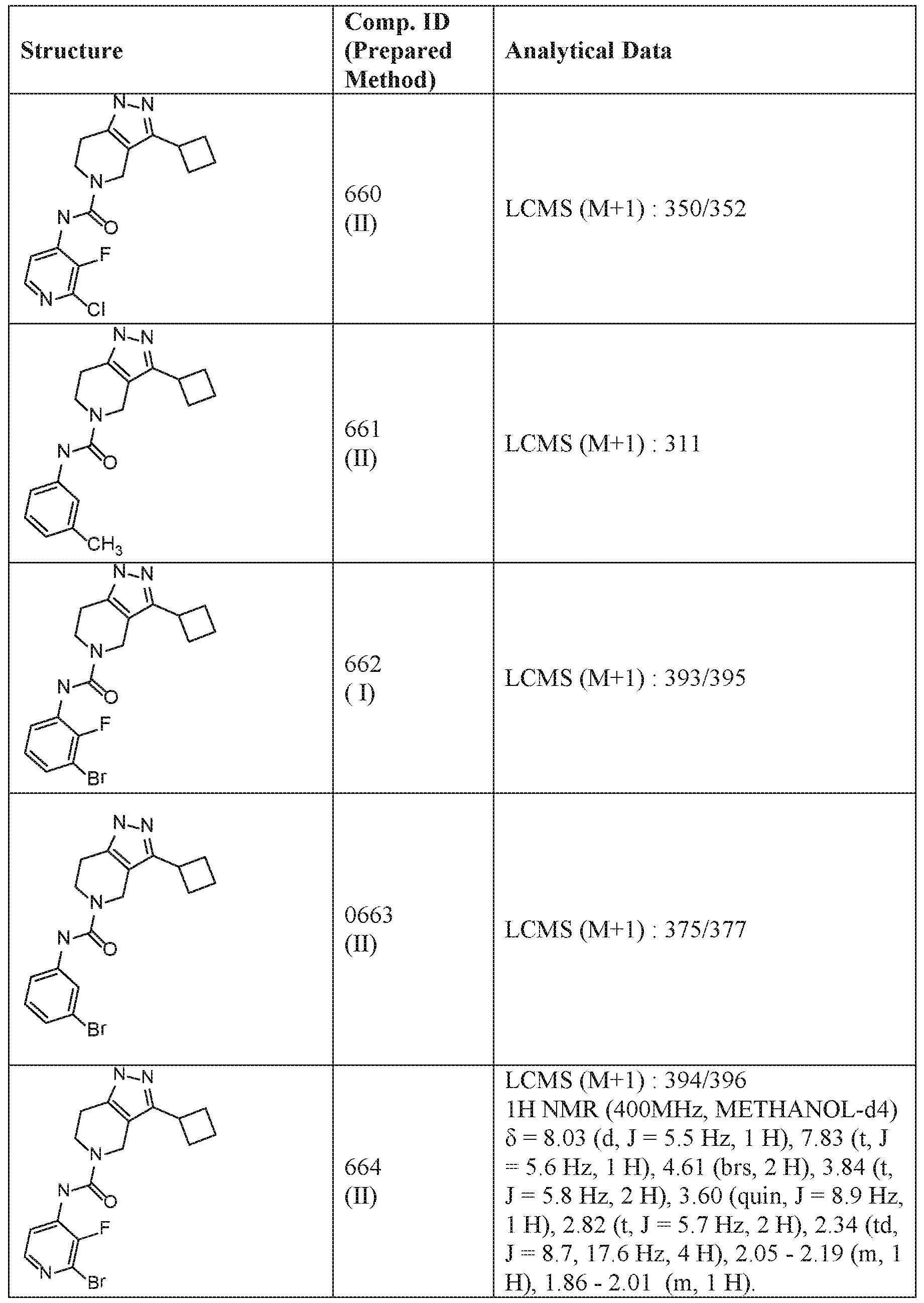
 Example 29: Procedure for Preparation o f Compounds 648, 649, 650, 651, 652, 653, 654, 655, 656, and 657

648-0657
Step 1 : Preparation of Compound 3
A mixture of tert-butyl 4-oxopi peri dine- 1 -carboxylate (20.00 g, 100.38 mmol, 1.00 eq), (15.73 g, 130.49 mmol, 1.30 eq) in THF (20 mL) was added to Li HMDS (1 M, 130.49 mL, 1.30 eq) portion-wise at -60 °C under N2. The mixture was stirred at -60 °C for 30 min. 2,2-dimethylpropanoyl chloride (15.73 g, 130.49 mmol, 1.30 eq) in THF (20 mL) was added dropwise at -60°C. The mixture was stirred at 15 °C for 2.5 hr. TLC showed the reaction was completed. The mixture was quenched by saturated NH4C1 (80 mL) and extracted with EA (50 mL*3). The combined organic phase was dried with anhydrous Na2S04, filtered and concentrated in vacuum to give tert-butyl 3 -(2,2-dimethylpropanoyl )- 4-oxo-piperidine-l- carboxylat e (33.29 g, crude) as a yellow oil, which was used directly for next step.
Step 2: Preparation of Compound 4
A mixture of tert-butyl 3-(2,2-dimethylpropanoyl)-4-oxo-piperidine-
1 -carboxylate (33.29 g, 1 17.48 mmol, 1.00 eq), Ν2Η4·Η20 (11.76 g, 234.96 mmol, 2.00 eq) in EtOH (350.00 mL) was degassed and purged with N2 for 3 times, and then the mixture was stirred at 80 °C for 16 hour under N2 atmosphere. LCMS showed the reaction was completed. The mixture was poured into FICl (0.5 N, 500 mL) and stirred at 5 min. The aqueous phase was extracted with ethyl acetate (200 niL*3). The combined organic phase was washed with brine (500 mL*2), dried with anhydrous Na2S04, filtered and concentrated in vacuum. The residue was purified by column chromatography (Si02, Petroleum ether/Ethyl acetate=100/l to 1/1) and checked by LCMS and HPLC, the desired product was
impurity. The impure desired product was puri ied by Prep-HPLC (FA) to give tert-butyl 3- tert-butyl- 1 ,4,6,7-tetrahydropyr azol o[4, -c]py ri di ne-5-carbox yl ate (4.00 g, 14.32 mmol.
12.19% yield) as a white solid. 1H NMR (400 MHz, METHANOL-d4) ppm 4.54 (s, 2 H), 3.66 (s, 2 H), 2.68 (s, 2 H), 1.46 - 1.50 (m, 9 H), 1.32 (s, 9 H). LCMS: 280 [M+l].
Step 3 : Preparation of Compound 5
A mixture of tert-butyl3-tert-butyl-l,4,6,7-tetrahydropyrazolo[4,3-c]
pyridinee-5- carboxylate (4.00 g, 14.32 mmol, 1.00 eq) in dioxane (30.00 mL) was added HCl/dioxane (4 M, 30.00 mL, 8.38 eq), and then the mixture was stirred at 15 °C for 2 hour. TLC showed the reaction was completed. The mixture was concentrated in vacuum to give 3- tert-butyl -4,5,6,7 -tetrahydro- 1 H-pyrazol o
[4,3 -c] pyridine (2.60 g, 12.05 mmol, 84.17% yield, HC1) as a yellow solid. Ή NMR (400 MHz, METHANOL^) ppm 4.50 (s, 2 H), 3.59 - 3.65 (m, 2 H), 3.21 (s, 2 H), 1.43 (s, 9 H). General procedure for preparation of Compounds 648 through 0657
General procedure I:

648 - 0657
To a solution of amine (1 eq) and TEA (10 eq) in 1.5 mL of dry THF, a solution of triphosgene (0.45 eq) in 0.5 mL dry THF was added. The resulting mixture was stirred at 0°C for 4 hr and TLC showed amine was consumed completely. Then Compound 5 (1 eq) in 1 mL of dry THF was added. The reaction mixture was allowed to warm to 30°C for 8 hr. LC-MS showed the reaction was completed. The solution was concentrated under reduced pressure to give a residue. The residue was purified by pre-HPLC (FA or Base) to afford the desired products.
General procedure II:

648 - 06
To a stirred solution of amine (1.2 eq) and phenyl carbonochloridate ( 1 .2 eq ) in 2 mL of dry DCM was added a solution of Py (3 eq.). The mixture was stirred at 0°C for 4 hr and TLC showed amine was consumed completely. The mixture was quenched with water (15
niL) and extracted with DCM (15mL). The combined organic phase was dried with a^SClt and concentrated in vacuum. The residue was di ssolved in DMSO (3mL). Compound 5 (1 eq), TEA (3 eq) was added and stirred at 40°C for 8 hr. LC-MS showed reaction was completed. The solution was purified by pre-HPLC (F A or Base) to afford the desired product.


Example 30: Preparation of Compounds 782, 783, 784, 785, 786, 787, 788, 789, 790, 791, and 792

782 - 792
Step 1 : Preparation of Compound 3
To a solution of ethyl B-hydroxycyclohexanecarboxylate (10.00 g, 58.07 mmol, 1.00 eq) in DCM (100.00 mL ) was added 4-bromobenzenesulfonyl chloride (22.26 g, 87. 1 1 mmol, 1.50 eq) under N2. The mixture was stirred at 15 °C for 16 hr. TLC (PE:EA =3 : 1) showed the reaction was nearly completed. The mixture was extracted wih DCM (200 mL) and saturated NaHCO; (80 mL). The organic layer was washed with IN HCl (50 mL), dried over Na2S04, filtrated, and concentrated. The residue was purified by flash chromatography (PE:EA= 0%~10%) to afford ethyl 3 -(4-bromophen yl )sul fony 1 oxycy cl ohex anecarboxyl ate (20.00 g, 51.11 mmol, 88.02% yield) as colorless oil.
Step 2: Preparation of Compound 4
To a solution of ethyl 3-(4-bromophenyl)sulfonyloxycyclohexane
carboxylate (20.00 g, 51.11 mmol, 1.00 eq) in t-BuOH (200.00 mL) was added a solution of t-BuOK (7.46 g, 66.44 mmol, 1.30 eq) in t-BuOH (60.00 mL) dropwise under Nk The mixture was stirred at 90 °C for 1.0 hr. TLC (PE:EA = 20: 1) showed the reaction was completed. The mixture was extracted with DCM (200 mL*3) and H20 (100 mL). The combined organic layer was washed saturated NaCl (80 mL), dried over Na2S04, filiated, and concentrated in vacumm. The residue was purified by column chromatography (PE:EA
0%~1%) to afford ethyl bicyclo[3.1.0] hexane- 1 -carboxylate (4.80 g, 31.13 mmol, 60.90% yield) as colorless oil.
Step 3 : Preparation of Compound 5
To a solution of ethyl bicyclo[3. 1 .Ojhexane- 1 -carboxylate (2.00 g, 12.97 mmol, 1.00 eq) in MeOH (20.00 m l. ) was added a solution of NaOH (778.16 mg, 19.45 mmol, 1 .50 eq) in H20 (8.00 mL). The mixture was stirred at 70 °C for 3 hr. The mixture was concentrated in vacumm. pH of the residue was adjusted to 6 and the mixture was extracted with DCM (50 mL*3). The organic layer was dried over Na2S04, filtrated and concentrated. The residue was used in the next step directly to afford bicyclo[3.1.0]hexane-l -carboxylic acid (1 .40 g, crude) as brown oil .
Step 4: Preparation of Compound 6
To a solution of bicyclo[3.1.0]hexane-l-carboxylic acid (2.40 g, 19.02 mmol, 1.00 eq) in DCM (24.00 mL) was added di(imidazol- 1 -y )methanone (3.39 g, 20.92 mmol, 1.10 eq). The mixture was stirred at 1 5 °C for 3 hr. The mixture was extracted with DCM (80 mL*2) and H20 (50 mL). The combined organic layer was dried over Na2S04, filtrated and concentrated. The residue was used in the next step directly to afford 1 - bicyclo[3.1.0]hexanyl(imidazol-l-yl)-methanone (2.40 g, 13.62 mmol, 71.61% yield) as brown oil.
Step 5 : Preparation of Compound 8
To a solution of LiHMDS (1 M, 16.34 mL, 1.20 eq) in THF (5.00 ml,) was added a solution of tert-butyl 4-oxopi peri dine- 1 -carboxylate (2.71 g, 13.62 mmol, 1.00 eq) in THF (20.00 mL) under N2 at -65°C. The mixture was stirred at -65 °C for 0.5 hr. A solution of I - bicyclo[3.1.0]hexanyl(imidazol-l-yl)methanone (2.40 g, 13.62 mmol, 1.00 eq) in THF (20.00 mL) was added at -65 C dropwise. The solution was stirred at 1 5 C for 16 hr. The reaction was quenched by saturated NH4C1 (30 mL) and extracted with EA (50 mL*3). The combined organic layer was dried over Na2S04, filtrated and concentrated in vacumm. The residue was purified by column chromatography (PE:EA : 10%~100%) to afford tert-butyl 3- (bicyclo[3. 1 .0]hexane- l -carbonyl )-4-oxo-piperidine- l -carboxylate (2.30 g, 4.94 mmol, 36.26% yield, 66% purity) as colorless oil.
Step 6: Preparation of Compound 9
To a solution of tert-butyl-3-(bicyclo[3.1. Ojhexane- l-carbonyl)-4-oxo- piperidine-1 - carboxylate (2.30 g, 7.48 mmol, 1.00 eq) in EtOH (1 5.00 mL) was added NH2NH2*H20 (1.50 g, 14.97 mmol, 1.45 mL, 50% purity, 2.00 eq). The mixture was heated to 90 °C for 3 hr. The mixture was concentrated in vacumm . The residue was extracted with
EtOAc (50 mL*3) and H20 (50 mL). The organic layer was dried over Na2S04, filtrated, and concentrated in vaciimm. The residue was purified by column chromatography
(PE:EA=20%~100%) to afford tert-butyl-3-(l -bicyclo[3.1.0]hexanyl)-l,4,6,7- tetrahydropyrazolo[4,3-c]pyridine-5- carboxylate (1.90 g, 6.26 mmol, 83.69% yield) as brown oil.
Step 7: Preparation of Compound 10
Tert-butyl-3-( I -bicyclo[3. 1 .Ojhexanyl )- 1 ,4,6,7-tetrahydropyrazolo[4,3-c]pyridine-5- carboxylate (1.30 g, 4.28 mmol, 1.00 eq) was dissolved in HCl/dioxane (4 M, 20.00 mL, 18.69 eq) and stirred at 1 °C for I hr. The mixture was filtrated. The solid was collected and dried to afford 3-( I -bicyclo[3. 1 .Ojhexanyl )-4,5,6,7-tetrahydro- 1 H-pyrazolo[4,3- cjpyridine (950.00 mg, crude, 2HC1) as yellow solid. 1H MR (400MHz, METHANOL-d4) δ 4.40 (brs, 2 H), 3.53 - 3.69 (m, 1 H), 3.21 (brs, 1 H), 2.12 - 2.21 (m, 1 H), 1.87 - 2.08 (m, 4 H), 1 .76 - 1.86 (m, 1 H), 1.43 (d, ./ 1 1.2 Hz, I H), 1.13 (brs, 1 H), 1.03 (brs, 1 H).
General procedure for preparation of Compounds 648 through 657

782 - 792
To a solution of amine (1.00 eq) in DCM (2.00 mL) were added TEA (2.00 eq) and phenyl carbonochloridate (1.00 eq). The mixture was stirred at 25°C for 2 hr. To a solution of compound 10 (60.00 mg, 1.00 eq, HC1) and TEA (2.00 eq) in DCM (2.00 mL) were added above reaction mixture. The mixture was stirred at 25 °C for 20 hr. LC-MS showed the reaction was completed. The reaction mixture was concentrated in vacuo. The resiude was purified by prep-HPLC (FA) to afford the desired product.


Example 31: Preparation o f Compound 440

440 Step 1 : Preparation of Compound 2
A mixture of 3-bromo-N-(3-chlorophenyl)-l ,4,6,7-tetrahydropyrazolo[4,3-c] pyridine-5-carboxamide (1.07 g, 3.00 mniol, 1.00 eq), potassium trifluoro(vinyl)borate (602.78 nig, 4.50 mmol, 1.50 eq), Pd2(dba)3 (137.36 mg, 150.00 umol, 0.05 eq), XPhos (143.02 mg, 300.00 umol, 0.10 eq) and Na2C03 (699.53 mg, 6.60 mmol, 2.20 eq) in dioxane (40.00 mL) and H?0 (6.00 mL) was degassed and purged with N2 for 3 times, and then the mixture was stirred at 100 °C for 8 hours under N2 atmosphere. TLC indicated the reactant was consumed, and a major new spot formed. The reaction mixture was concentrated, extracted with EA (30 mL) and water (10 mL). The aqueous layer was extracted with EA (20
mL*2). The combined organic layer was washed with brine, dried over a^SC^, and concentrated in vacuo. The residue was purified by column chromatography (Si02,
Petroleum ether/Ethyl acetate=3/l to 1 : 1 , then DCM: MeOH 50: 1 to 20: 1) to afford -(3- chlorophenyi)-3-viny{-l,4,6,7-tetrahydropyrazoio[4,3-c]pyridine-5- carboxamide (435.97 mg, 1.44 mmoi, 48.00% yield) as yellow solid.
Preparation of Compound 440
A mixture of N-(3 -chlorophenyl)-3 -vinyl- 1 ,4,6,7-tetrahydropyrazolo
[4,3-c]pyridine -5-carboxamide (100.00 mg, 330.29 umol, 1.00 eq) in DCM (2.00 mL) was degassed and purged with N2 for 3 times, and then ZnEt2 (1 M, 1.65 mL, 5.00 eq) was added dropwise at 0 °C. The mixture was stirred for 30 min. C hi oro( i odo )m eth ane (291.28 mg, 1.65 mmoi, 5.00 eq) was added. The mixture was stirred at 1 C for 1 hr under N2 atmosphere. LCMS showed material was consumed completely. The mixture was poured into saturated NH4CI (10 mL), extracted with ethyl acetate (15 mL*2), the combined organic layer was dried over anhydrous Na2S04, concentrated. The residue was purified by prep-HPLC (FA) to afford N-(3-chlorophenyl)-3-cyclopropyl-l,4,6,7-tetrahydropyrazolo[4,3-c]pyridine- 5- carboxamide (7.87 mg, 24.40 umol, 7.39% yield, 98.21% purity) as white solid. 1 H NMR (400 MHz, MeOD) δ 7.54 (s, 1 H), 7.20 - 7.35 (m, 2 H), 7.02 (d, J= 7.72 Hz, 1 H), 4.57 (s, 2 H), 3.80 (s, 2 H), 2.77 (t, J = 5.65 Hz, 2 H), 1.84 (brs, 1 H), 0.94 (d, J = 6.59 Hz, 2 H), 0.81 (d, J=3.77 Hz, 2 H). LCMS: 317/319 [M+l].
xample 32: Preparation of Compounds 742 and 743

743
Step 1 : Preparation of Compound 3
To a solution of tert-butyl 3-bromo-l-(2-trimethylsilylethoxymethyl)- 6,7-dihydro -4H-pyrazolo[4,3-c]pyridine-5-carboxylate (200.00 mg, 462.50 umol, 1.00 eq) and cyclopent-2-en- 1 -one (56.96 mg, 693.75 umol, 1.50 eq) in DMF (2.00 niL) were added N-cyclohexyl-N-methylcyclohexanamine (135.52 mg, 693.75 umol, 1 .50 eq) and Ad2nBuP Biphenyl (9.28 mg, 13.88 umol, 0.03 eq). The mixture was stirred at 100 °C for 16 hr under 2 protection. LCMS showed starting material remained and desired product and multiply peaks were detected. The mixture was poured into water (10 niL), extracted with ethyl acetate (10 mL*3), the combined organic layer was dried over anhydrous Na2S04, concentrated. The residue was purified by chromatography ( silica gel, eluting with Petroleum ether/Ethyl acetate=50: l, 10: 1) to afford tert-butyl 3-(3-o\ocyclopenten- 1 -yl )- 1 -(2-trimethyl
silylethoxymethyl)-6,7-dihydro-4H-pyrazolo[4,3-c]pyridine-5-carboxylate (55.00 mg, 126.84 umol, 27.42% yield) as colorless oil. LCMS: 434 [M+l].
Step 2: Preparation of Compound 4
To a solution of tert-butyl 3-(3-oxocyclopenten- 1 -yl )- 1 - (2-trimethylsilylethoxymethyl)-6,7-dihydro-4H-pyrazolo[4,3-c]pyridine-5-carboxylate (300.00 mg, 691.85 umol, 1.00 eq) in DCM (4.00 niL) was added DIBAL-H (146.54 mg, 1.04 mmol, 1.50 eq) at -78 °C under N2 protection. The mixture was stirred at 25 °C for 16 hr. TLC (Petroleum ether/ethyl acetate=3 : l) showed material was consumed completely, and
a major new spot detected. The mixture was poured into water (10 mL), extracted with ethyl acetate 10 mL*3). The combined organic layer was dried over anhydrous Na2S04,
concentrated. The residue was purified by chromatography (silica gel, eluting with
Petroleum ether/ethyl acetate=10: l, 5 : 1 , 3 : 1 ) to afford tert-butyl 3-(3-hydroxycyclopenten-l-

(180.00 mg, 413.19 umol, 59.72% yield) as colorless oil .
Step 3 : Preparation of Compound 5
To a solution of tert-butyl 3-(3~hydroxycyclopenten-l-yl)- l-(2 rimethylsilyiethoxymethyl)-6,7-dihydro-4H-pyrazolo[4,3-c]pyridine-5-carboxylate (120.00 mg, 275.46 umol, 1.00 eq) in MeOH (10.00 mL) was added Pd-C (10%, 25 mg) under N2. The suspension was degassed under vacuum and purged with H2 several times. The mixture was stirred under H2 (45 psi ) at 50°C for 16 hours. LCMS showed the material was consumed completely, and major desired MS detected. The reaction mixture was filtered and the filtrate was concentrated to afford tert-butyl 3-( 3-hydroxycyclopentyl )- 1 -(2- trimethylsilylethoxymethyl)- 6, 7-di hydro-4H-py razol o[4,3 -cjpyri di ne-5-carboxyl ate (100.00 mg, 228.49 umol, 82.95% yield) as colorless oil, which was used directly in the next step. LCMS: 438 [M+l].
Step 4: Preparation of Compound 6
A mixture of tert-butyl 3-(3-hydroxycyclopentyl )- 1 -(2-trimethylsilylethoxy methyl )- 6,7-dihydro-4H-pyrazolo[4,3-c]pyridine-5-carboxylate (180.00 mg, 41 1.29 umol, 1.00 eq) in HCl/dioxane (4 M, 5.00 mL, 48.63 eq) was stirred at 25 °C for 2 hr. Precipitate was formed. The mixture was evaporated to afford 3-(4,5,6,7- tetrahydro- lH-pyrazolo[4,3- c] py ri di n-3 -yl )cycl opentanol (100.00 mg, 410.29 umol, 99.76% yield, HCl ) as white solid, without further purification and used directly in the next step.
Preparation of Compound 742
To a solution of 3-(4,5,6,7-tetrahydro- 1 H-pyrazolo[4,3-c]pyridin- 3 -yl)cycl opentanol (100.00 mg, 410.29 umol, 1.00 eq, HCl) in DCM (5.00 mL) were added TEA (83.03 mg, 820.58 umol, I 13.74 uL, 2.00 eq) and phenyl N-(3-chlorophenyl)carbamate (101.62 mg, 410.29 umol, 1.00 eq). The mixture was stirred at 25 °C for 2 hr. LCMS showed material was consumed completely, and major desired MS detected. The solvent was evaporated. The residue was purified by prep-HPLC(FA) to afford N-(3 -chl oropheny 1 )- -( 3 - hydroxycyciopentyl)-l,4,6,7-tetrahydropyrazolo[4,3-c] pyridine-5-carboxamide (57.00 mg, 155.04 umol, 37.79% yield, 98. 15% purity) as white solid. 1H NMR (400 MHz, MeOD) δ 7.54 (s, 1 H), 7.31 (s, 1 H), 7.20 - 7.28 (m, 1 H), 7.02 (d, J= 7.78 Hz, 1 H), 4.54 - 4.71 (m, 2
H), 4.39 (brs, 1 H), 3.72 - 3.93 (m, 3 H), 3.03 (ddd, .1 = 11.67, 7.65, 4.27 Hz, 1 H), 2.81 (t, J = 5.65 Hz, 2 H), 1.91 - 2.22 (m, 4 H), 1.69 - 1.87 (ra, 2 H). LCMS: 361/363 [M+l].
Preparation of Compound 743
To a solution of N-(3-chlorophenyl)-3-(3-hydroxycyclopentyl)-l , 4,6,7- tetrahydropyrazolo[4,3-c]pyridine-5-carboxamide (50.00 mg, 138.57 umol, 1.00 eq) in DCM (3.00 ml.) was added DAST (33.50 mg, 207.86 umol, 27.46 uL, 1.50 eq) at -78°C, The mixture was stirred at 25 °C for 16 hr. LCMS showed the material was consumed
completely, and major desired MS detected. The reaction was quenched by water (10 mL), extracted with DCM (10 mL*2). The combined organic layer was dried over anhydrous Na2S04, concentrated, the residue was purified by prep-HPLC (FA) to afford N-(3- chlorophenyl)-3-(3-fluorocyciopentyl) -l,4,6,7-tetrahydropyrazolo[4,3-c]pyridine-5- carboxamide (6.02 mg, 16.06 umol, 11.59% yield, 96.8% purity) as white solid. LCMS: 363/365 [M+l]. Example 33: Preparation of Compounds535 and 744

Preparation of Compound 535
A mixture of tert-butyl 3-(3~hydroxycyclopenten-l-yl)-l-(2- trimethylsilylethoxymethyl)-6,7-dihydro-4Fl )yrazolo[4,3-c]pyridine-5-carboxylate (60.00 mg, 137.73 umol, 1.00 eq) in HCI/dioxane (4 M, 4.00 mL, 116.17 e ) was stirred at 25 C for 2 hr. The the solvent was evaporated, and diluted in DCM (3.00 mL), TEA (27.87 mg, 275.46 umol, 38.18 uL, 2.00 eq) and phenyl N-(3-chlorophenyl)carbamate (34.11 mg, 137.73 umol, 1.00 eq) were added, the mixture was stirred at 25 °C for 16 hr. LCMS showed the material was consumed completely, and major desired MS detected. The solvent was evaporated. The residue was purified by prep-HPLC (FA) to afford N-( -chl orophenyl )-3 -( - hydroxycyciopenten-l-yi) -l,4,6,7-tetrahydropyrazolo[4,3-c]pyridine-5-carboxamide (7.44 mg, 20.21 umol, 14.67% yield, 97.46% purity) as white solid. LCMS: 359/361 [M+l],
Preparation of Compound 744
To a solution of N-(3-chlorophenyl)-3-(3-hydroxycyclopenten-l-y{)-l, 4,6,7- tetrahydropyrazolo[4,3-c]pyridine-5-carboxamide (50.00 mg, 139.35 umol, 1.00 eq) in DCM (5.00 mL) was added DAST (44.92 mg, 278.70 umol, 36.82 uL, 2.00 eq) at - 78 °C under N,
protection. The mixture was stirred at 25 °C for 16 hr. LCMS showed the material was consumed completely, and major desired MS detected. The mixture was poured into water (10 mL), extracted with ethyl acetate (10 mL*2 ). the combined organic layer was dried over anhydrous concentrated. The residue was purified by prep-HPLC (FA) to afford N- (3-chlorophenyl)-3-( 3-fluorocyclopenten- l -vl H ^
carboxamide (15.00 mg, 41.03 umoi, 29.45% yield, 98.7% purity) as white solid. LCMS: 361/363 [M+l].
Example 34: Preparation of Compound 704

Step 1: Preparation of Compound 2
To a solution of 4-methoxypyridine (16.10 g, 147.53 mmol, 1.00 eq) in THF (200.00 mL) was added CTLMgBr (3 M, 59.50 mL, 1.21 eq) at -10 °C over a period of 20 min under N2j during which the temperature was maintained below 5 °C. The reaction mixture was warmed to 25 °C for 30 mm. A solution of CbzCl (30.20 g, 177.04 mmol, 1.20 eq) in THF (80.00 mL) was added dropwise at -10 °C under 2. during which the temperature was maintained below 25°C. The reaction mixture was stirred at 25 °C for 3hr. TLC
(PE:EA=3: 1) showed the starting material was dissapeared. A HC1 solution (3N, 300 mL) was added into the reaction dropwise at -10 °C. The mixtire was extracted with EA (200 mL*2). The combined organic layer was washed 5 % NaHCC (500 mL) and dried over Na2S04, filtrated. The filtrate was concentrated in vacuum. The residue was purified by column chromatography (PE:EA=10: 1,5: 1) to afford benzyl 2-methyl-4-oxo- 2,3-dihydropyridine-l-carboxylate (14.50 g, 59.12 mmol, 40.07% yield) as brown oil. Hi NMR (400 MHz, CDCI3) δ 7.67 (d, J = 7.9 Hz, 1 H), 7.35 - 7.27 (m, 5 H), 5.28 - 5.22 (m, 1 H), 5.20 (d, J= 4.0 Hz, 2H), 4.70 - 4.61 (m, 1 H), 2.78 (dd, J = 6.8, 16.4 Hz, 1H), 2.24 (d, J = 16.4 Hz, 1H), 1.19 (d, J 6.8 Hz, 3H).
Step 2: Preparation of Compound 3
To a solution of benzyl 2-methyl-4-oxo-2,3-dihydropyridine-l-carboxylate (1.00 g, 4.08 mmol, 1.00 eg) in THF (10.00 niL) was added lithium trisec-butylboranuide (1 M, 4.90 mL, 1.20 eg) at -78 °C under N2 protection. The reaction mixture was stirred for 1 hr. Then a solution of cyclobutanecarbonyl chloride (628.84 nig, 5.30 mmol, 604.65 uL, 1.30 eg) in THF (1 mL) was added at -78 C. The mixture was stirred 20 °C for 16 hr. LCMS showed material was consumed completely, and several new peaks were detected. The mixture was poured into saturated H4CI (20 mL), extracted with ethyl acetate (15 niL*2), the combined organic layer was dried over anhydrous Na2S04, concentrated to afford benzyl 5- (cyclobutanecarbonyl)-2-methyl~4-oxo-piperidine- l-carboxylate (1.30 g, crude) as light yellow oil, which was not purified and used directly in the next step. LCMS: 352 [M+23], Step 3 : Preparation of Compound 4
To a solution of benzyl

1-carboxylate (1.00 g, 3.04 mmol, 1.00 eg) in EtOH (10.00 mL) was added N2H4-H20 (1.22 g, 6.08 mmol, 1.18 mL, 2.00 eg). The mixture was stirred at 80 °C for 1 hr. TLC (petroleum ether/ethyl acetate=l : 1 ) showed a major new spot. The mixture was concentrated. The residue was extracted with ethyl acetate (10 mL*2). The combined organic layer was dried over anhydrous Na2S04, and concentrated. The residue was purified by chromatography (silical gel, eluting with petroleum ether/ethyl acetate=10: 1, 1 : 1) to afford impure product (230 nig with 30 % purity, colorless oil) which was purified by prep-HPLC (FA) to afford benzyl 3-cyclobutyl-6-methyl- l ,4,6,7-tetrahydropyrazolo[4,3-c]pyridine-5-carboxylate (30.00 mg, 92.19 umol, 3.03% yield) as colorless oil. 1H MR (400 MHz, CDC13) δ 7.38 (d, J=3.96 Hz, 5 H), 5.19 (s, 2 H), 4.58 - 4.65 (m, 1 H), 4.14 (brs, 1 H), 3.56 (s, 1 H), 2.90 (dd, J = 15.82, 5.84 Hz, 1 H), 2.56 (d, J = 15.82 Hz, 1 H), 2.32 (brs, 4 H), 2.02 - 2.15 (m, 1 H), 1.84 - 1.99 (m, 1 H), 1.15 (d, J = 6.97 Hz, 3 H). LCMS: 326 [M+l],
Step 4: Preparation of Compound 5
To a solution of benzyl 3-cyclobutyl-6-methyl-l , 4,6,7- tetrahydropyrazolo[4,3-c]pyridine-5-carboxylate (60.00 mg, 184.39 umol, 1.00 eg) in MeOH (5.00 mL) was added Pd/C (6.00 mg, 10%) under N2. The suspension was degassed under vacuum and purged with H2 several times. The mixture was stirred under H2 (50psi) at 25 °C for 16 hours. TLC (Petroleum ether/ethyl acetate=l : l) showed the material was consumed completely. The reaction mixture was filtered and the filtrate was concentrated to afford 3- cyclobutyl-6-methyl-4,5,6,7~tetrahydro-lH~pyrazolo[4,3-c] pyridine (18.00 mg, 94.1 1 umol, 51 .04% yield) as colorless oil .
Preparation of Compound 704
To a solution of 3-cyclobutyl-6-methyl-4,5,6,7-tetrahydro-lH-pyrazolo[4,3-c] pyridine (18.00 mg, 94.1 1 umol, 1.00 eq) and phenyl N-( 3 -chl oropheny 1 )carbamate (27.97 mg, 1 12.93 umol, 1.20 eq) in DCM (4.00 mL) was added TEA (19.05 mg, 188.22 umol, 26. 1 0 uL, 2.00 eq). The mixture was stirred at 25 °C for 4 hr. LCMS showed the material was consumed completely, major was desired MS detected. The mixture was concentrated in vacuo. The residue was purified by prep-HPLC (FA) to afford N-(3-chlorophenyl)-3- cyclobutyl-6-methyl-l, 4,6,7- tetrahydropyrazolo[4,3-c]pyridine-5-carboxamide (29.98 mg, 81.35 umol, 86.44% yield, 93.57% purity) as white solid. Ή NMR (400 MHz, MeOD) δ 7.54 (s, 1 H), 7.19 - 7.36 (m, 2 H), 7.03 (d, J = 7.78 Hz, 1 H), 4.91 (brs, 2 H), 4.2 1 (d, J = 15.3 1 Hz, 1 H), 3.61 (s, 1 FI), 2.98 (d, J 5.77 Hz, 1 H), 2.62 (d, ./ 15.81 Hz, 1 FI), 2.28 - 2.43 (m, 4 H), 2.04 - 2.16 (m, 1 H), 1.97 (brs, 1 H), 1.20 (d, J= 6.78 Hz, 3 H). LCMS:
345/347 [M+l]. Example 35: Preparation of 'Compounds'/ 704 and 7756, 757, 758, 759, 760, 761, 762, 763, 764, and 765

704 and 756 - 766

A B C D E F

Step 1 : Preparation of Compounds 2A and 2B
To a solution of tert-butyl 2-m ethyl -4-oxo-pi peri dine- 1 -carboxyl ate (1 ,00 g, 4.69 mmol, 1.00 eq) in THF (10.00 mL) was added Li HMDS (1 M, 9.38 mL, 2.00 eq) at -78 °C. The mixture was stirred for 1 hr. Then cyclobutanecarbonyl chloride (834.07 nig, 7.04 mmol, 801 .99 uL, 1.50 eq) was added, and the mixture was stirred at 25 °C for 15 hr. TLC (Petroleum ether/ethyl acetate=5: l) showed material was consumed completely and a major new spot detected. The mixture was poured into saturated NH4C1 (20 mL), extracted with ethyl acetate (20 mL*2). The combined organic layer was dried over anhydrous Na2S04, concentrated to afford a mixture of tert-butyl3-(cyclobutanecarbonyl)-2-methyl-4-oxo- pi peri dine- 1 - carboxylate and tert-butyl 5-(cyclobiitanecarbonyl )-2-methyl-4-oxo-piperidine- 1 -carboxyl ate (1.10 g, crude) as light yellow oil.
Step 2: Preparation of Compounds 3A and 3B

2A 2B 3B
To a mixture of tert-butyl 3-(cyclobutanecarbonyl )-2-methyl -4-oxo- pi peri dine- 1 - carboxylate (1.10 g, 3.72 mmol, 1.00 eq) and tert-butyl 5- ( cyclobutanecarbonyl )-2-methyl-4-oxo-piperidine- l -carboxylate (1.10 g, 3.72 mmol, 1.00 eq) in EtOH (15.00 mL) was added hydrazine (238.45 mg, 7.44 mmol, 267.92 uL, 2.00 eq). The mixture was stirred at 80 C for I hr. TLC (Petroleum ether/ethyl acetate= 1 : 1 ) showed material was consumed completely, and a major new spot detected. The solvent was evaporated. The residue was washed with water (20 mL), extracted with ethyl acetate (30 mL*2). The combined organic layer was dried over anhydrous Na2S04, and concentrated. The residue was purified by chromatography (silical gel, eluting with Petroleum ether/ethyl
acetate=10: l, 3 : 1, 1 : 1 ) to afford a mixture of tert-butyl 3-cyclobutyl-4-methyl-l, 4,6,7- tetrahydro pyrazolo[4,3-c]pyridine-5-carboxylate and tert-butyl 3 -cy cl obutyl -6-m ethyl - l ,4,6,7-tetrahydropyrazolo[4,3-c]pyridine-5-carbo\ylate (680.00 mg, 2.33 mmol, 62.63% yield) as white solid. The mixture (200 mg) was purified by chiral SFC to afford
two fractions, fraction 1 (86 mg, white solid, Rt = 1 .855, 1.922 min) and fraction 2 (82 mg white solid, Rt = 2.251,2.357 min).
The separation method:
Instrument: SFC 80
Column: AD-lOum.
Mobile phase: A for C02 and B for Ethanol (0. 1 % Ammonia)
Gradient: B 40%
Flow rate: 70m L /min
Back pressure: lOObar
Column temperature: 35°C
Wavelength: 220nm
The fraction 1 (2.5 g) was further purified by chiral SFC to afford the first enantiomer of tert-butyi3-cyclobutyl-4-methyl-l ,4,6,7-tetrahydropyrazoio[4,3-c] pyridine-5- carboxylate 3A E 1 (: .10 g, 3.78 mmol, 44.06% yield, Rt = 1.128 min) as white solid and the first enantiomer of tert-butyl 3- cyclobutyl-6-methyl-l,4,6,7-tetrahydropyrazolo[4,3- c ] py ri d i n e- 5 -ca rb ox y 1 at e 3B E 1 (1.20 g, 4.12 mmol, 48.02% yield, Rt = 1.536 min) as white solid.
3A_E1 : Ή NMR (400 MHz, CDC13) δ 4.93 - 5.20 (m, 1 H), 4.09 - 4.40 (m, 1 H), 3.43 (q, J 8.72 Hz, 1 H), 2.98 (brs, 1 H), 2.51 - 2.74 (m, 2 H), 2.08 - 2.34 (m, 4 H), 1.95 - 2.04 (m, 1 H), 1.85 (d, J = 7.28 Hz, 1 H), 1.41 (s, 9 H), 1 .18 - 1.26 (m, 3 H). 3B_E1 : lB NMR (400 MHz, CDC13) δ 4.73 (brs, 2 H), 3.90 (d, J= 15.56 Hz, 1 H), 3.39 - 3.51 (m, 1 H), 2.86 (dd, J = 15.69, 5.90 Hz, 1 H), 2.46 (d, J = 15.56 Hz, 1 H), 2, 1 1 - 2.33 (m, 4 H), 1.93 - 2.07 (m, 1 H), 1.78 - 1.90 (m, 1 H), 1.37 - 1.49 (m, 9 H), 1.05 (d, J = 7.03 Hz, 3 H).
The separation method:
Instrument: SFC 80
Column: AS-lOum.
Mobile phase: A for CO 2 and B for Ethanol (0.1 % Ammonia)
Gradient: B 40%
Flow rate: 70m L /min
Back pressure: lOObar
Column temperature: 35°C
Wavelength: 220nm
The fraction 2 (2,5 g) was further purified by chiral SFC to afford the second enantiomer of tert-butyl3-cyclobutyl-4-methyl- l ,4,6,7-tetrahydropyrazolo [4,3-c]pyridine-5- carboxylate 3A_E2 (1.10 g, 3.78 mmol, 44.06% yield, Rt :::: 1.587) as white solid and the second enantiomer of tert-butyl 3 -cycl obutyl -6-methyl - 1 ,4,6, 7-tetrahydropyrazol o[4,3 - c J py ri di n e- 5 -ca rb o y 1 a t e 3 B E 2 (1.20 g, 4.12 mmol, 48.02% yield, Rt = 1.841 min) as white solid. 3A_E2: 1H NMR (400 MHz, CDC13) δ 4.91 - 5.22 (m, 1 H), 4.06 - 4.39 (m, 1 H), 3.36 - 3.50 (m, 1 H), 2.98 (brs, 1 H), 2.59 (brs, 2 H), 2.09 - 2.34 (m, 4 H), 1.93 - 2.06 (m, 1 H), 1.85 (d, J = 7.28 Hz, 1 H), 1 .31 - 1 .46 (m, 9 H), 1 .22 (d, J= 6.53 Hz, 3 H). 3B E2: 1H MR (400 MHz, CDC13) δ 4.73 (brs, 2 H), 3.90 (d, J= 15.56 Hz, 1 H), 3.45 (t, J = 8.78 Hz, 1 H), 2.86 (dd, J = 15.69, 5.90 Hz, 1 H), 2.46 (d, ./ 15.81 Hz, 1 H), 2.12 - 2.34 (m, 4 H), 1.96 - 2.04 (m, 1 H), 1.78 - 1.90 (m, 1 H), 1.42 (s, 9 H), 1.05 (d, J=6.78 Hz, 3 H).
The separation method:
Instrument: SFC 80
Column: AD-lOum.
Mobile phase: A for CO: and B for Ethanol (0.1 % Ammonia)
Gradient: B 40%
Flow rate: 70m L /min
Back pressure: lOObar
Column temperature: 35°C
Wavelength: 220nm.
Step 3 : Preparation of Compound 4B E I /E2

3B E1 4B E1
3B E2 4B E2
A mixture of tert-butyl 3-cyclobutyl-6-methyi-l,4,6,7-tetrahydropyrazolo [4,3- c]pyridine-5 -carboxylate 3B E 1 (1.20 g, 4.12 mmol, 1.00 eq) in HCl/dioxane (4 M, 10.00 mL, 9.71 eq) was stirred at 25 °C for 2 hr. White solid was formed. The solvent was evaporated to afford 3 -cycl obutyl -6-methyl -4, ,6, 7-tetrahydro - 1 H-pyrazolo[4,3-c]pyridine 4 B E I (930.00 mg, 4.08 mmol, 99.12% yield, HC1) as white solid.
Preparation of Compounds 704, and 757 through 765

704 and 757 - 765
General Procedure
To a solution of amine (1.0 eq) and phenyl carbonochloridate (1.0 eq) in DCM (1.00 rnL) was added TEA (3 eq), the reaction mixture was stirred at 30 °C for 30 minutes. TLC indicated amine was consumed completely. The mixture was added to a mixture of compound 4B (1.00 eq, HC1 salt) in DCM (1.00 ml_) and TEA (3 eq ). The reaction mixture was stirred at 30 C for 16 hours. LCMS showed reaction was completed. The mixture was extracted with DCM (10 mL*3) and water (10 niL), the organic phase was dried with anhydrous Na2S04, filtered and concentrated in vacuum. The residue was purified by prep-
HPLC (FA) to give the desired product as white solid.
Structure Comp. ID Analytical Data
LCMS(M+l):345/347; Ή NMR (400 MHz, METHANOL-d4) d ppm 7.54 (t, ./ 1.88 Hz, 1 H), 7.31 (s, 1 H), 7.22 - 7.28 (m, 1 H), 7.03 (d, J = 7.78 Hz, 1 H), 4.84 (brs, 2 H), 4.21 (d,
704 (El) ./ 15.06 Hz, 1 H), 3.61 (t, ./ 8.78 Hz, 1 H),
3.00 (dd, .1 = 15.69, 5.90 Hz, 1 H), 2.62 (d, J ----- 15.81 Hz, 1 H), 2.27 - 2.43 (m, 4 H), 2.10
 (d, J = 9.03 Hz, 1 H), 1.95 (dd, J= 7.53, 3.26
Hz, 1 H), 1.20 (d, J= 6.78 Hz, 3 H).
LCMS(M+l):345/347; Ή NMR (400 MHz, METHANOL-d4) d ppm 7.54 (t, J = 1.88 Hz, 1 H), 7.21 - 7.37 (m, 2 H), 7.03 (d, J = 7.78 Hz, 1 H), 4.84 (brs, 2 H), 4.21 (d, J= 15.06
704 (E2) Hz, 1 H), 3.61 (t, ./ 8.91 Hz, 1 H), 3.00 (dd,
J= 15.81, 5.77 Hz, 1 H), 2.62 (d, J = 15.81 Hz, 1 H), 2.26 - 2.46 (m, 4 H), 2.10 (d, J = 9.29 Hz, 1 H), 1.95 (dd, J = 7.53, 3.51 Hz, 1 H), 1.20 (d, J= 6.78 Hz, 3 H).


HCI dioxane

861
Step 1 : Preparation of Compound 2
A mixture of tetrahydrofuran-2-carboxylic acid (2.00 g, 17.23 mmol, 1.65 mL, 1.00 eq) in SOCK (10.25 g, 86.13 mmol, 6.25 mL, 5.00 eq) was stirred at 90 °C for 3 hours. The mixture was concentrated in reduced pressure to afford tetrahydrofiiran-2-carbonyl chloride (2.32 g, 17.24 mmol, 100.00% yield) as yellow oil.
Step 2 : Preparation of Compound 4
To a mixture of tert -butyl 4-o\opiperidine- 1 -carboxylate (3.44 g, 17.24 mmol, 1 .00 eq) in THF (20 mL) was added Li HMDS (1 M, 25.86 mL, 1.50 eq) dropwise at -78 °C under N.<. The mixture was stirred at -78 °C for 30 min, then tetrahydrofuran-2-carbonyl
chloride (2.32 g, 1 7.24 mmol, 1.00 eq) in THF (20 mL) was added to the mixture. The mixture was heated to 25 °C and stirred for 2.5 hours. LCMS showed the reaction was completed. The mixture was quenched with aq. NH4C1 (30 mL). The aqueous phase was extracted with ethyl acetate (40 mL*2). The combined organic phase was washed with brine (40 mL*2 ), dried with anhydrous a2SO.), filtered and concentrated in vacuum to afford tert- butyl 4-ox o- -(tetrahydrofuran-2-carbonyl )pi peri di ne- 1 -carboxy 1 ate (6.00 g, crude) as yellow oil. LCMS: 298 [M+l].
Step 3 : Preparation of Compound 5
To a mixture of tert-butyl 4-oxo-3-(tetrahydrofuran-2-carbonyi)piperidine- 1 -carboxy late (6.00 g, 20.18 mmol, 1.00 eq) in MeOH (100.00 mL) was added Ν2Η4Ή20 (1.19 g, 20.18 mmol, 1 .15 mL, 85% purity, 1 .00 eq) in one portion under N2. The mixture was stirred at 30 C for 12 hours. LCMS showed the reaction was completed, and desired product was detected. The mixture was concentrated in reduced pressure. The residue was poured into water (50 mL) and stirred for 2 min. The aqueous phase was extracted with ethyl acetate (50 mL*2). The combined organic phase was washed with brine (50 mL*2), dried w ith anhydrous Na2SO filtered and concentrated in vacuum . The residue was purified by silica gel chromatography (Petroleum ether/Ethyl acetate=T/l) to afford tert-butyl 3- tetrahydrofuran-2-yl-l,4,6,7-tetrahydropyrazolo[4,3-c]pyridine-5- carboxylate (1.80 g, 3.31 mmol, 16.42% yield, 54% purity) as yellow solid.
LCMS: 294 [M+l],
Step 4: Preparation of Compound 6
To a mixture of tert-butyl 3-tetrahydrofuran-2-yl-l ,4,6,7-tetrahydropyrazolo
[4,3 -c] pyri di ne-5-carboxyl ate (80.00 nig, 272,70 umol, 1.00 eq) in dioxane (1.00 mL) was added HCl/dioxane (4 M, 4.00 mL, 58.67 eq) in one portion at 25 C under N2. The mixture was stirred at 25 °C for 2 hours. TLC (Petroleum ether : Ethyl acetate=T : 1) showed the reaction was completed. The mixture was concentrated in vacuum to afford 3- tetrahydrofuran-2-yl-4,5,6,7-tetrahydro-lH-pyrazolo[4,3-c] pyridine (62,64 mg, 272.69 umol, 100.00% yield, HC1) as yellow solid.
Preparation of Compound 861
To a mixture of 3-tetrahydrofuran-2-yl-4,5,6,7-tetrahydro-lH-pyrazolo
[4,3-c] pyridine (62.64 mg, 272.69 umol, 1.00 eq, HC1) and phenyl N-(3-chlorophenyl) carbamate (67.54 mg, 272.69 umol, 1.00 eq) in DCM (8.00 mL) was added TEA (82.78 mg, 818.07 umol, 113.40 uL, 3.00 eq) in one portion at 30 °C under N2. The mixture was stirred at 30 °C for 12 hours. LCMS showed the reaction was completed. The mixture was poured
into water (10 mL) and stirred for 2 min. The aqueous phase was extracted with ethyl acetate (10 mL*2). The combined organic phase was washed with brine (10 mL*2), dried with anhydrous a2S04, filtered and concentrated in vacuum. The residue was purified by prep- HPLC(FA) to afford N-(3-chlorophenyl)-3-tetrahydrofuran-2-yl-
1,4,6,7-tetrahydropyrazolo [4,3 -c] pyri di n e-5 -carbox amide (31.66 mg, 91.29 umol, 33.48% yield, 100% purity) as white solid. 1H NMR (400 MHz, METHANOL-d4) δ 7.51 (t, J=1.95 Hz, 1H), 7.23 (s, 2H), 6.97-7.04 (m, lH), 4.92-4.96 (m, 1H), 4.58 (s, 2H), 3.99-4.08 (m, 1H), 3.73-3.92 (m, 3H), 2.74-2.87 (m, 2H), 2.23-2.37 (m, 1H), 1.95-2.13 (m, 3H). LCMS: 347
[M i l ] .
Example 37: Preparation of Compounds 927, 928, 929, 930, 93 J, 932, 933, and 934

927, 928, 929, 930, 931 , 932, 933,
934 (R&S)
Step 1 : Preparation of Compound 2
To a solution of methyl cyclopentanecarboxylate (10.00 g, 78.02 mmol, 1.00 eq) in MeOH (100.00 mL) was added a solution of NaOH (6.24 g, 156.04 mmol, 2.00 eq) in H20 (40.00 mL), the reaction mixture was stirred at 25 °C for 2 hours. TLC indicated starting material was consumed completely, and one major new spot with larger polarity was detected. The pH of the reaction mixture was adjusted to around 6 by adding diluted hydrochloride acid (6 N, 40 mL), then extracted with EA (200 mL*4), the organic phase was
dried over anhydrous Na^SO , filtered and concentrated in vacuum to afford
cycl open taneca rbo y 1 i c acid (8.80 g, 77.10 mmol, 98.82% yield) as yellow oil. The crude product was used in the next step directly without further purification. Ή NMR (400 MHz, DMSO-d6) δ ppm 1 1.90 (br. s., 1 H) 2.56 - 2.67 (m, 1 H) 1.73 - 1.82 (m, 2 H) 1.46 - 1.71 (m, 6 H).
Step 2: Preparation of Compound 3
To a solution of cyclopentanecarboxylic acid (8.80 g, 77.10 mmol , 8.38 ml., 1.00 eq) in DCM (60.00 niL) was added DMF (563.52 nig, 7.7 1 mmol, 593.18 uL, 0.10 eq), followed by (COCl)2 (19.57 g, 154.20 mmol, 13.50 ml.., 2.00 eq) dropwise at 0 °C, the reaction mixture was warmed to 25 °C and stirred at 25 C for 2 hours. TLC indicated starting material was consumed completely (treating with MeOH and monitoring the ester).
Removed the solvent on a rotary evaporator to afford cyclopentanecarbonyl chloride (9.80 g, 73.91 mmol, 95.87% yield) as yellow oil . The crude product was used in the next step directly without purification.
Step 3 : Preparation of Compound 4
To a mixture of N-methoxymethanamine (7.21 g, 73.91 mmol, 1.00 eq, HQ) in DCM (100.00 niL) was added TEA (22.44 g, 221.73 mmol, 30.74 niL, 3.00 eq) at 0 °C, followed by cyclopentanecarbonyl chloride (9.80 g, 73.91 mmol, 8.99 ml., 1 .00 eq), the reaction mixture was stirred at 25 °C for 2 hou s. One main peak with desired MS was detected by LCMS. The mixture was extracted with DCM (500 mL*2) and water (400 mL*2), the organic phase was dried with anhydrous Na2S04, filtered and concentrated in vacuum. The residue was purified by silica gel chromatography to afford N -m ethox y-N-m eth y 1 - cyclopentanecarboxamide (10.80 g, 68.70 mmol, 92.95% yield) as yellow oil. 1 H NMR (400 MHz, CHLOROFORM-d) δ ppm 3.67 (s, 3 H) 3. 16 (s, 3 H) 2.98 - 3.13 (m, 1 H) 1.67 - 1.87 (m, 6 H) 1.47 - 1 .62(m, 2 H).
Step 4: Preparation of Compound 5
Cooled the three-necked round bottom flask to -78 °C, bromo( vinyl )magnesium (1 M, 25.44 niL, 2.00 eq) was added to a solution of N-methoxy- -methyl - cyclopentane carboxamide (2.00 g, 12.72 mmol, 1.00 eq) in THF (25.00 ml,) dropwise under N2, the reaction mixture was stirred at -78 °C for one hour, then warmed to 25 °C and stirred at 25 °C for another 30 minutes. TLC indicated starting material was consumed completely, and one major new spot with lower polarity was detected. The reaction mixture was added to diluted hydrochloride acid (2N, 100 niL) dropwise and then extracted with EA (150 mL*3 ), the combined organic phase was dried over anhydrous Na2S04, filtered and concentrated in
vacuum to afford 1 -cyclopentylprop-2-en- 1 -one (1.30 g, 10.47 mmol, 82.30% yield) as yellow oil. The crude product was used in the next step directly without purification. 1 I I
NMR (400 MHz, CHLOROFORM-d) d ppm 6.33 - 6.46 (m, 1 H) 6.19 - 6.27 (m, 1 H) 5.73 - 5.79 (m, 1 H) 3.08 - 3.18 (m, 1 II) 1.74 - 1.84 (m, 4 H) 1.56 - 1 .69 (m, 4 H).
Preparation of Compound (S)-7

To a mixture of ethyl (3 S)-3-aminobutanoate (1.76 g, 10.47 mmol, 1.00 eq, HCl) in THF (10.00 rnL) was added TEA ( 3. 1 8 g, 31.41 mmol, 4.36 mL, 3.00 eq), followed by a solution of I -cyclopentylprop-2-en- 1 -one (1.30 g, 10.47 mmol, 1.00 eq) in THF (10.00 m l.), the reaction mixture was stirred at 25 C for 16 hours. TLC showed the reaction was completed. To the mixture was added (Boc)20 (2.29 g, 10.47 mmol, 2.41 ml., 1.00 eq) , the mixture was stirred at 25 °C for 2 hours, 60% of desired compound was detected by LCMS. The reaction mixture was extracted with EA (100 ml.) and diluted hydrochloride acid (IN, 80 m l.* 2), the organic phase was dried with anhydrous Na2S04, filtered and concentrated in vacuum. The residue was purified by silica gel chromatography to afford ethyl (3 S)-3-[tert- butoxycarbonyl-(3- cycl opentyl -3 -o o-propyl )am i no Jbutanoate (1.90 g, 5.35 mmol, 51.05% yield) as light yellow oil. Ή NMR (400 MHz, CHLOROFORM-d) δ ppm 4. 10 - 4.49 (m, 1 H) 4.02 - 4.09 (m, 2 H) 3.20 - 3.45 (m, 2 H) 2.60 - 2.86 (m, 3 H) 2.32 - 2.57 (m, 2 IT) 1.49 - 1.78 (m, 8 H) 1.40 (s, 9 H) 1.14 - 1.2 1 (m, 6 H).
Preparation of Compound (R)-7

To a solution of ethyl ( 3 R )-3 -ami nobutanoate ( 1 .62 g, 9.66 mmol, 1.00 eq, HCl) in THF (10.00 mL) was added TEA (2.93 g, 28.99 mmol, 4.02 ml,, 3.00 eq) , followed by a solution of I -cyclopentylprop-2-en- 1 -one (1.20 g, 9.66 mmol, 1.00 eq) in THF (10.00 mL),
the reaction mixture was stirred at 25 °C for 16 hours. TLC showed the reaction was completed. To the mixture was (Boc)20 (2.11 g, 9.66 mmol, 2.22 mL, 1.00 eq), the mixture was stirred at 25 C for 2 hours, 65% of desired compound was detected by LCMS. The reaction mixture was dissolved with EA (100 mL) and washed with diluted HCl (IN, 80 mL* 2), the organic phase was dried with anhydrous "Na2S04, filtered and concentrated in vacuum. The residue was purified by silica gel chromatography to afford ethyl (3R)-3-[tert- butoxycarbonyl -( 3 -cycl open ty 1 -3 -ox o-propy 1 )am i n o] bu tanoate (2.10 g, 5.91 mmol, 61 .16% yield) as yellow oil.
Preparation of Compound (S)-8

To a solution of ethyl ( 3 S )-3 -[ tert-butoxycarbon \ -( 3 -cycl openty 1 -3 - oxo-propyl ) amino]butanoate (1.70 g, 4.78 mmol, 1.00 eq) in THF (20.00 mL) was added t- BuOK (1.18 g, 10.52 mmol, 2.20 eq) at -40 °C under 2, the reaction mixture was warmed to 0 C and stirred at 0 °C for one hour. TLC indicated starting material was consumed completely, and one major new spot with lower polarity was detected. The reaction was quenched with aqueous solution of NH4C1 (70 mL) and then extracted with EA (100 mL*3), the combined organic phase was dried over anhydrous Na2S04, filtered and concentrated in vacuum to afford tert-butyl (2S)-5-(cyclopentanecarbonyl )-2- methyl-4-oxo-piperidine- 1 - carbox late ( 1 .38 g, crude) as yellow oil. The crude product was used in the next step directly without purification.
Preparation of Compound (R)-8

(R)-7 (R)-
To a solution of ethyl ( 3 R )-3 -[tert-butox ycarbonyl -(3 -cycl openty 1 -3 - oxo-propyl) amino]butanoate (1.90 g, 5.35 mmol, 1.00 eq) in THF (20.00 mL) was added t- BuOK ( 1.32 g, 11.77 mmol, 2.20 eq) at -40 °C under N2, the reaction mixture was warmed to 0 °C and stirred at 0 °C for one hour. TLC indicated starting material was consumed
completely, and one major new spot with lower polarity was detected. The reaction was quenched with aqueous solution of NH4CI (80 mL) and then extracted with EA (100 mL*3), the combined organic phase was dried over anhydrous Na2S04, filtered and concentrated in vacuum to afford tert-butyl (2R)-5-(cyclopentanecarbonyl )-2-methyl-4-oxo-piperidine- 1 - carboxylate (1.53 g, caide) as yellow oil. The crude product was used in the next step directly without purification.
Preparation of Compound (S)-9

To a solution of tert-butyl (2S)-5-(cyclopentanecarbonvl )-2-methyl-4-oxo- piperidine- 1 -carboxylate (1.38 g, 4.46 mmol, 1.00 eq) in EtOH (20.00 mL) was added NH2 H2 H20 (525.36 mg, 8.92 mmol, 510.06 uL, 85% purity, 2.00 eq) , the reaction mixture was warmed to 50 °C and stirred at 50 °C for one hour. TLC indicated starting material was consumed completely, and one major new spot with larger polarity was detected. The mixture was extracted with EA (180 mL*2) and water (80 niL*3), the organic phase was dried with anhydrous Na2S04, filtered and concentrated in vacuum. The residue was purified by silica gel chromatography to afford tert-butyl (6S)-3-cyclopentyl-6-m ethyl- 1,4,6,7- tetrahydropyrazolo[4,3-c] pyridine-5-carboxylate (1.30 g, 4.21 mmol, 94.48% yield, 99% purity) as yellow solid.
Preparation of Compound (R)-9

To a solution of tert-butyl ( 2 R )- 5 -( cy cl opentan ecarbony 1 )-2-m ethyl -4-ox o- pi eridine- I -carboxylate (1.53 g, 4.95 mmol, 1.00 eq) in EtOH (20.00 mL) was added NH2NH2 H20 (582.47 mg, 9.90 mmol, 565.50 uL, 85% purity, 2.00 eq) , the reaction mixture was warmed to 50 C and stirred at 50 °C for one hour. TLC indicated starting material was consumed completely, and one major new spot with larger polarity was detected. The mixture was extracted with EA (200 mL*2) and water (100 mL*3), the organic phase was dried with
anhydrous Na2S04, filtered and concentrated in vacuum. The residue was purified by silica gel chromatography to afford tert-butyl (6R)-3-cyclopentyl-6-methyl-l,4,6,7- tetrahydropyrazol o[4, 3 -c] pyridine-5-carboxylate (1.40 g, 4.54 nimol, 91.68% yield, 99% purity) as yellow solid.
Preparation of Compound (S)-10

To a solution of tert-butyl (6S)-3-cyclopentyl-6-methyl- 1 ,4,6,7- tetrah y dropy razol o [4,3 -c] pyri di ne-5-carboxyl ate (1.40 g, 4.58 mmol, 1.00 eq) in dioxane (10.00 raL) was added HCl/dioxane (4 M, 20.00 m L, 17.47 eq) , the reaction mixture was stirred at 25 °C for 2 hours. TLC indicated starting material was consumed completely, and one major new spot with larger polarity was detected. Removed the solvent on a rotary evaporator to afford (6S)-3-cyclopentyl-6-methyl-4,5,6,7-tetrahydro-lH- pyrazolo[4,3- c] pyri dine (1.10 g, 4.55 mmol, 99.34% yield, HC1 ) as white solid. The product was used in the next step directly without purification. Ή MR (400 MHz, METHANOL-d4) δ ppm 4.29 - 4.50 (m, 2 H) 3.79 (td, J=10.57, 5.46 Hz, 1 H) 3.17 - 3.29 (m, 2 H) 2.87 - 3.01 (m, 1 H) 2.12 - 2.27 (m, 2 H) 1.66 - 1.90 (m, 6 H) 1.53 - 1.59 (m, 3 H).
Preparation of Compound (R)-10

(R)-9 (R)-10
To a solution of tert-butyl (6R)-3-cyclopentyl-6-methyl- 1 ,4,6,7
tetrahy dropyrazol o [4,3-c]pyridme-5-carboxylate (1.50 g, 4.91 mmol, 1.00 eq) in dioxane (10.00 niL) was added HCl/dioxane (4 M, 20.00 mL, 16.29 eq) , the reaction mixture was stirred at 20 °C for one hour. TLC showed the reaction was completed. Evaporate the solution on a water bath under reduced pressure using a rotary evaporator to afford (6R)-3- cyclopentyl-6~methyl~4,5,6,7-tetrahydro-lH-pyrazolo[4,3-c]pyridine (1.20 g, crude, HC1) as white solid. The product was used in the next step directly without purification.
General procedure for preparation of Compounds 927 through 934

(S) 10 01 (R) 10 327 through 934
(S and )
A solution of compound 10 (40.00 mg, 157.62 umol, 1.00 eq, HC1), phenyl carbamate 11 (1.00 eq) and TEA (73.00 mg, 721.42 umol, 100.00 uL, 4.58 eq) in DCM (2.00 ml,) and MeOH (0. 1 mL) was stirred at 25 °C for 1 2 hours. LCMS showed desired product was detected. The solvent was removed. The residue was purified by prep-HPLC(FA) to afford the desired product.


6 7 8

964, 965, 966, 967, 968, 969, 970, and 0971
(D1 and Da)
Step 1 : Preparation of Compound 2
To a solution of tetrahydrofuran-2-carboxylic acid (8.00 g, 68.90 mmol, 6.6 1 mL, 1.00 eq) in DCM (80.00 mL) was added DMF (503.59 mg, 6.89 mmol, 530.10 uL, 0.10 eq), followed by (COCl )2 (17.49 g, 137.80 mmol, 12.06 mL, 2.00 eq) dropwise at 0 °C, the reaction mixture was stirred at 0 C for 2 hours. The solvent was removed on a rotary evaporator to afford tetrahydrofuran-2-carbonyl chloride (9.00 g, crude) as yellow oil. The product was used in the next step directly without purification.
Step 2 : Preparation of Compound 3
To a mixture of N-methoxymethanamine (9.79 g, 100.32 mmol, 1.50 eq, HCl ) in DCM (100.00 mL) was added TEA (20.30 g, 200.64 mmol, 27.81 mL, 3.00 eq), followed by tetrahydrofuran-2-carbonyl chloride (9.00 g, 66.88 mmol, 1.00 eq), the reaction mixture was stirred at 20 °C for 2 hours. One main peak with desired MS was detected by LCMS. The mixture was diluted with DCM (300 mL) and washed with diluted HCl (IN, 100 mL*2), the organic phase was dried with anhydrous Na2S04, filtered and concentrated in vacuum. The residue was purified by silica gel chromatography to afford N-methoxy-N-methyl- tetrahydrofuran-2- carboxamide (8.80 g, 55.28 mmol, 82.66% yield) as yellow oil. Ή NMR (400 MHz, CHLOROFORM-d) d ppm 4.71 (br. s., 1 H) 3.80 - 4.00 (m, 2 H) 3.63 - 3.67 (m, H) 3.13 (s, 3 H) 2.06 -2.19 (m, 1 H) 1.79 - 1.99 (m, 3 H).
Step 3 : Preparation of Compound 4
Cooled the three-necked round bottom flask to -78 °C, brom o( vi n y 1 )m agn esi um (1 M, 50.26 mL, 2.00 eq) was added to a solution of - m et h ox y- N - m et h y 1 - tetrahydrofuran-2- carboxamide (4.00 g, 25. 13 mmol, 1.00 eq) in THF (40.00 mL) dropwise under N2, the reaction mixture as stirred at -78 °C for one hour, then warmed to 1 5 °C and stirred at 1 5 °C for another 30 minutes. TLC indicated starting material was consumed completely, and one major new spot w ith lower polarity was detected. The reaction mixture was added to diluted HQ (2N, 200 mL) dropwise and then extracted with EA (300 mL*3 ), the combined organic phase was dried over anhydrous a^SO ), filtered and concentrated in vacuum to afford I - tetralrydrofuran-2-ylprop-2-en- 1 -one (2.10 g, crude) as yellow oil. The product was used in the next step directly without purification.
Step 4: Preparation of Compound 6
To a solution of ethyl (3 S)-3-aminobutanoate (2,79 g, 16.65 mmol, 1.00 eq, HQ) in THF (20.00 mL) was added TEA (5.05 g, 49.95 mmol, 6.92 mL, 3.00 eq), followed by a solution of I -tetrahydrofuran-2-ylprop-2-en- 1 -one (2.10 g, 16.65 mmol, 1.00 eq) in THF
(20.00 mL), the reaction mixture was stirred at 15 °C for 4 hours. TLC showed the reaction was completed, (Boc)20 (3.63 g, 16.65 mmol, 3.83 mL, 1.00 eq) was added, the mixture was stirred at 15 °C for another 12 hours. TLC indicated many new spots formed. The reaction mixture was dissolved with EA (300 mL ) and washed with diluted HQ (IN, 100 mL*2), the organic phase was dried with anhydrous
 filtered and concentrated in vacuum. The residue was purified by silica gel chromatography to afford ethyl (3 S)-3-ftert-butoxycarbonyl -(3-oxo-3-tetrahydrofuran-2-yl-propyl)amino]butanoate (3.10 g, 7.81 mmol, 46.88% yield, 90% purity) as yellow oil .
Step 5 : Preparation of Compound 7
To a solution of ethyl (3 S)-3-[tert-butoxycarbonyl-(3-oxo-3-tetrahydrofuran
-2-yl -propyl )amino]butanoate (1.40 g, 3.92 mmol, 1.00 eq) in THF (15.00 mL) was added t- BuOK (879.00 mg, 7.83 mmol, 2.00 eq) at -40 °C under N2, the reaction mixture was stirred at -10 °C for one hour, then warmed to 10 °C and stirred at 10 °C for another one hour. TLC indicated starting material was consumed completely, and three new spots formed. The reaction mixture was quenched with aqueous solution of N Hi CI (70 mL) and then extracted with EA (150 m L*3 ), the combined organic phase was dried over anhydrous Na2SC«4, filtered and concentrated in vacuum to afford tert-butyl (2S)-2-methyl-4-oxo-5- ( tetrahydrofuran-2- carbonyl Jpiperidine- 1 -carboxylate (750.00 mg, crude) as yellow oil. The product was used in the next step directly without purification .
Step 6: Preparation of Compound 8
To a solution of tert-butyl (2S)-2-methyl-4-oxo-5-(tetrahydrofuran- 2-carbonyl ) pi peri dine- 1 -carboxylate (750.00 mg, 2.4 1 mmol, 1.00 eg) in EtOH (10.00 niL ) was added ΝΗ2ΝΗ2Ή20 (283.72 mg, 4.82 mmol, 275.46 uL, 85% purity, 2,00 eg). The reaction mixture was stirred at 10 °C for 16 hours. Several new peaks were shown on LCM S and about 50% of desired compound was detected. The reaction mixture was diluted with EA (150 mL) and washed with diluted HCl (I N, 80 mL*2), the organic phase was dried with anhydrous Na. SO.», filtered and concentrated in vacuum. The residue combined with another two batch was purified by prep-HPLC(FA) to give desired compound (800 mg, purity 90%) as yellow oil, which was further separated by SFC to get peak one (D l, 0.36 g) and peak two (D2, 0.23 g).
Compound 8 (Dl) (Peak one) Ή NMR (400 MHz, CHLOROFORM-d ) δ ppm 4.98 (t, J=6.90 Hz, I H) 4.83 (d, J= 14.05 Hz, 2 H) 3.97 - 4.05 (m, 2 II) 3.86 -3.93 (m, 1 H) 2.95 (dd, J= 1 5.69, 5.90 Hz, 1 H) 2.54 (d, J= 1 5.69 Hz, 1 H) 2.24 - 2.34 (m, 1 H) 1.95 - 2.07 (m, 3 H) 1.49 (s, 9 H) 1.13 (d, J=6.90 Hz, 3 H).
Compound 8 (D2) (Peak two) Ή NMR (400 MHz, CHLOROFORM-d) δ ppm 4.9 1 - 5.00 (m, 1 H) 4.84 (d, J=14.68 Hz, 2 H) 3.95 - 4.05 (m, 2 H) 3.86 - 3.94 (m, 1 H) 2.95 (dd, .1=15.56, 5.77 Hz, 1 H) 2.55 (d, J=15.69 Hz, 1 H) 2,25 - 2.35 (m, 1 H) 1.99 - 2.08 (m, 3 H) 1.49 (s, 9 H) 1.13 (d, J=6.90 Hz, 3 H).
SFC separation condition:
Instrument: Waters Q 80 preparative
SFCcolumn: ChiralPak AD-H, 250x30mm I D. , particle size lOum
Mobile Phase : Phase A for C02
Phase B for Ethanol (0. l 'OAmmonia)
Isocratic:25% Phase B
Flow rate:55g /min
Column Temp: room temperature
Back pressure: lOObar
UV:220nm
Cycle Time:3.3min.
Preparation of Compound 9 (D l )

S I 9 D1
To a solution of tert-butyl (6S)-6-methyl-3-tetrahydrofuran-2-yi- 1 , 4,6,7- tetrahydropyrazolo[4,3-c]pyridine-5-carboxylate (360.00 nig, 1.17 mmol, 1.00 eq) in dioxane (2.00 mL) was added HCl/dioxane (4 M, 10.00 mL, 34.19 eq), the reaction mixture was stirred at 10 °C for 2 hours. TLC showed the reaction was completed. Evaporated the solution on a water bath under reduced pressure using a rotary evaporator to afford (6S)-6- methyl-3-tetrahydrofuran-2-yl -4,5,6,7- tetrahydro- 1 H-pyrazolo[4,3-c]pyridine (330.00 mg, cmde, 2HC1) as yellow solid. The product product was used in the next step directly without purification.
Preparation of Compound 9 (D2 )

8 I 9 D2
To a solution of tert-butyl (6S)-6-methyl-3-tetrahydrofuran-2-yl-l,4,6,7- tetrahydropyrazolo[4,3-c]pyridine-5-carboxylate (230.00 mg, 748.24 umol, 1.00 eq) in dioxane (2.00 mL) was added HCl/dioxane (4 M, 8.00 mL, 42.77 eq), the reaction mixture was stirred at 10 °C for 2 hours. TLC showed the reaction was completed. Evaporated the solution on a water bath under reduced pressure using a rotary evaporator to afford ( 6S)-6- m ethyl - -tetrahydrofuran -2-v -4, 5,6, 7- tetrahydro- lH-pyrazolo[4,3-c]pyri dine (170.00 mg, crude, 2HC1) as yellow solid. The product product was used in the next step directly without puri ication.
General Preparation of Compounds 964 through 971 (D1&D2)

9_D1 or 9_D2 Compounds 964 through 0971
(D1 and D2)
A mixture of compound 9 (40 mg, 142.76 umol, 1.00 eq, 2HC1), phenyl carbamate 10 (142.76 umol, 1.00 eq) and TEA (146.00 mg, 1.44 mniol, 200.00 uL, 10.1 1 eq) in DCM (2.00 mL) was stirred at 25 °C for 16 hours. LCMS showed desired product was detected. The solvent was removed. The residue was purified by prep-HPLC(FA) to afford the desired product.


Example 39: HBV Assembly Assay
The interference of compounds from this invention with HBV capsid assembly could be measured using an in vitro assembly assay based on fluorescence quenching, which was developed according to a method described by Zlotnick and coworkers (Nature
Biotechnology 2006, 24:358). In a typical assay, a mutant HBV C I 50 protein (amino acids 1-150, C49A, C61A, C 107A, 150C) is cloned into a T7 RNA-polymerase based expression vector, expressed in E.coli and purified to homogeneity as a dimer. The purified HBV core protein is desalted and labeled with BODIPY-FL Dye.
In a non-limiting embodiment, the assembly assay is conducted in 96- well plate format. The assembly reactions are carried out in 50 mM Hepes buffer, pH 7.5 and 150 mM NaCl. The compounds are pre-incubated with the HBV CA protein for 15 min, and the assembly reactions are initiated by addition of NaCl. The reaction is allowed to continue for 1 hour at room temperature. The changes in fluorescence between DMSO treated and compound treated samples are recorded and analyzed for assembly modulation.
Example 40: HBV Replication Inhibition Assay
HBV replication inhibition by the compounds of this invention could be determined in cells infected or transfected with HBV, or cells with stably integrated HBV, such as
HepG2.2. 1 5 cells ( Sells et al . 1987), In thi s example, HepG2.2. 1 5 cells were maintained in cell culture medium containing 10% fetal bovine serum (FBS), Geneticin, L-glutamine, penicillin and streptomycin. HepG2.2. 1 5 cells could be seeded in 96-well plates at a density of 40,000 cells/well and be treated with serially diluted compounds at a final DM SO concentration of 0.5% either alone or in combination by adding drugs in a checker box format. Cells were incubated with compounds for three days, after which medium was removed and fresh medium containing compounds was added to cells and incubated for another three days. At day 6, supernatant was removed and treated with DNase at 37°C for 60 minutes, followed by enzyme inactivation at 75 °C for 1 5 minutes. Encapsi dated HBV DNA was released from the virions and covalently linked HBV polymerase by incubating in lysis buffer (Affymetrix QSOO I O) containing 2.5 ng proteinase K at 50°C for 40 minutes. HBV DNA was denatured by addition of 0.2 M NaOH and detected using a branched DNA (BDNA) QuantiGene assay kit according to manufacturer recommendation (Affymetrix). HBV DNA levels could also be quantified using qPCR, based on amplification of encapsidated HBV DNA extraction with QuickExtraction Solution (Epicentre
Biotechnologies) and am pi ill cation of HBV DNA using HBV specific PGR probes that can hybridize to HBV DNA and a fluorescentlv labeled probe for quantitation. In addition, cell viabi lity of HepG2.2. 1 5 cel ls incubated with test compounds alone or in combination was determined by using CellTitre-Glo reagent according to the manufacturer protocol
(P romega). The mean background signal from wells containing only culture medium was subtracted from all other samples, and percent inhibition at each compound concentration was calculated by normalizing to signals from HepG2 2. 1 5 cells treated w ith 0.5% DM SO using equation E l .
E l : % inhibition = (DMSOave - Xi)/DMSOave x 100%
where DMSOave is the mean signal calculated from the well s that were treated w ith DM SO control (0% inhibition control ) and Xi is the signal measured from the individual wells. EC 50 values, effective concentrations that achieved 50% inhibitory effect were determined by non-linear fitting using Graphpad Prism software ( San Diego, CA) and equation E2
E2: Y = Ymin + (Ymax - Ymin) / (l+lQ(LogEC50-X) x Hi ll Slope)
where Y represents percent inhibition values and X represents the logarithm of compound concentrations.
Selected compounds of the invention were assayed in the HBV replication assay (BDN A assay), as described above and a representative group of these active compounds is shown in Table 3. Table 3 shows EC50 values obtained by the BDNA assay for a group of select compounds. In Table 3, "A" represents 0.01 < EC50 < 0.10; "B" represents 0J 0<EC50 < 0.50; and "C" represents 0.50 <EC50 < 1.0; ('+' indicates >50% activity at 10 μΜ).
Activ ity in BDNA-assay (EC50)

971 Dl A 971 D2 B
238 + 260 +
241 + 388 +
604 B 669 B
642 A 782 A
644 B 783 A
693 A 784 A
694 A 785 A
696 B 786 A
700 B 787 A
660 B 788 A
661 B 789 A
662 A 790 A
663 A 791 A
664 B 792 B
665 A 760 S B
440 B 760 R B
742 B 762 E1/E2 A
744 A 763 E1/E2 A
757 E1/E2 A 764 E1/E2 A
758 E1/E2 A 765 E1 /E2 A
759 E1/E2 B 667 A
666 A 668 A
The disclosures of each and ever)' patent, patent application, and publication cited herein are hereby incorporated herein by reference in their entirety.
While the invention has been disclosed with reference to specific embodiments, it is apparent that other embodiments and variations of this invention may be devised by others skilled in the art without departing from the true spirit and scope of the invention. The appended claims are intended to be construed to include all such embodiments and equivalent variations.
Claims
1 , A compound having the structure of Formula III:

R4
III,
or a pharmaceutically acceptable salt thereof, wherein
Y is -C(0>- or -SO2-;
R1 is C -C'x-cycloalkyl, CV Cx-heterocy cl yl , -OH, Ci-C6-alkyl, halo, and C2-C8- alkenyl, wherein alkyl, cycloalkyl, heterocyclyl, and alkenyl are optionally substituted with 1, 2, 3, or 4 groups each independently selected from OH, halo, CVCValkyl, Cj-Ce-haioalkyl, -O-Ci-Ce-alkyl, and Ci-C6-alkyl-OH;
R is, at each occurrence, independently selected from H, -OH, halo, Ci-C6-alkyl, C | - C6-haloalkyl, -0-Ci-C6-alkyl, and Ci-C6-alkyi-OH;
\V is selected from H, -OH, halo, Ci-Ce-alkyl, i-CVhaloalkyl, -O-Ci-Ce-alkyl, and Ci-Ce-alkyl-OH;
R4 is selected from (CRxR',)p-Ci-C.»-heteroaryl and (CR8R9)p-C6-Ci2-aryl, wherein heteroaryl and aryl are optionally substituted with 1, 2, or 3 groups, each independently selected from -OH, halo, CN, Ci-Ce-alkyl, Ci-Ce-haloalkyl, -O-Ci-Ce-alkyl, and Ci-Ce- alkyl-OH.
R is selected from H, C |-Ci,-alkyl, and CVCValkyl-OH,
R8 is, at each occurrence, independently selected from H, -OH, halo, Ci-C6-alkyl, C | - CVha!oalkyl, -O-Ci-Ce-alkyl, and Ci-C„-alkyl-OH;
R9 is, at each occurrence, independently selected from H and Ci-Ce-alkyf; and p is O, 1, 2, 3, or 4.
2. The compound of claim 1, wherein Y is -C(O)-.
3. The compound of claim 1 or 2, wherein R1 is Cs-Cg-cycloalkyl or C2-C8-heterocyclyi,
wherein cycloalkyl and heterocvclyl are optionally substituted with 1 or 2 groups each independently selected from OH, halo, C i-CValkyl, d-CVhaloalkyl, -Q-Ci-Ce-alkyl, and C-CValkyl-OH.
4. The compound of any one of claims 1 -3, wherein R1 is (VG,-cycloalkyl or (VCV heterocyclyl, wherein cycloalkyl and heterocvclyl are optional ly substituted with 1 or 2 groups each independently selected from OH, halo, G-CV-alkyl, Ci-Ce-haloalkyl, -O-Ci-C alkyl, and C' i-CValkyl-OH.
5. The compound of any one of claims 1 -4, wherein each R2 is independently selected from H or Ci-C4-alkyl and R3 is H.
6. The compound of any one of claims 1 -5, wherein R4 is is Ci-Cj-heteroaryl or 0,-aryl wherein heteroaryl and aryl are optionally substituted with 1 , 2, or 3 groups, each independently selected from -OH, halo, CN, and C CValky! .
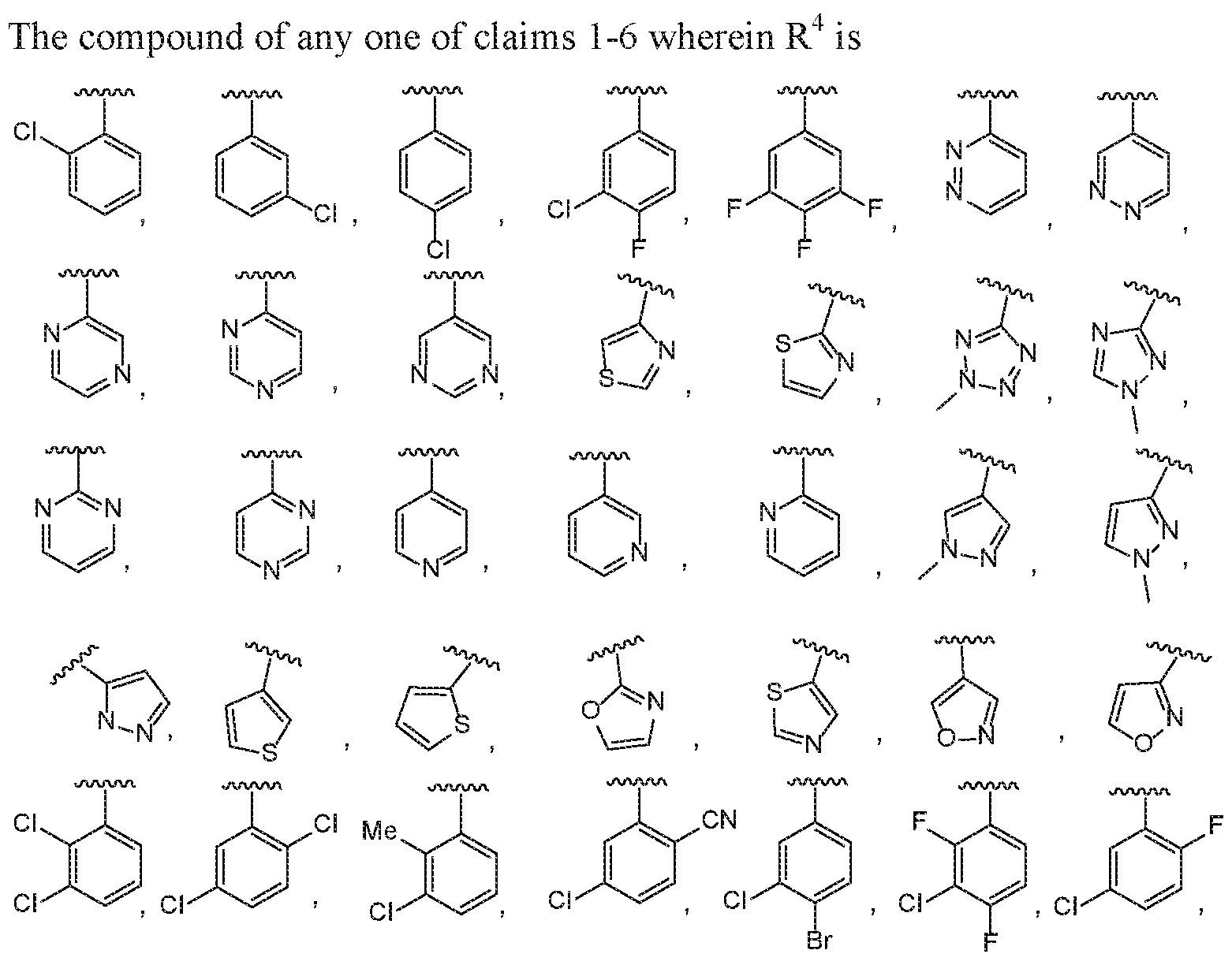

The compound of any one of claim 1-7, wherein R is H. The compound of any one of claims 1-8, selected from


155
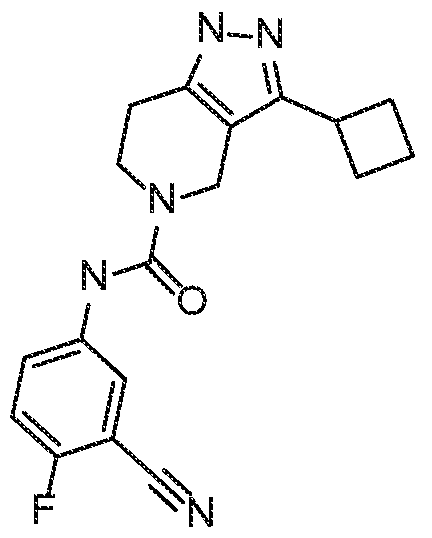
656

157

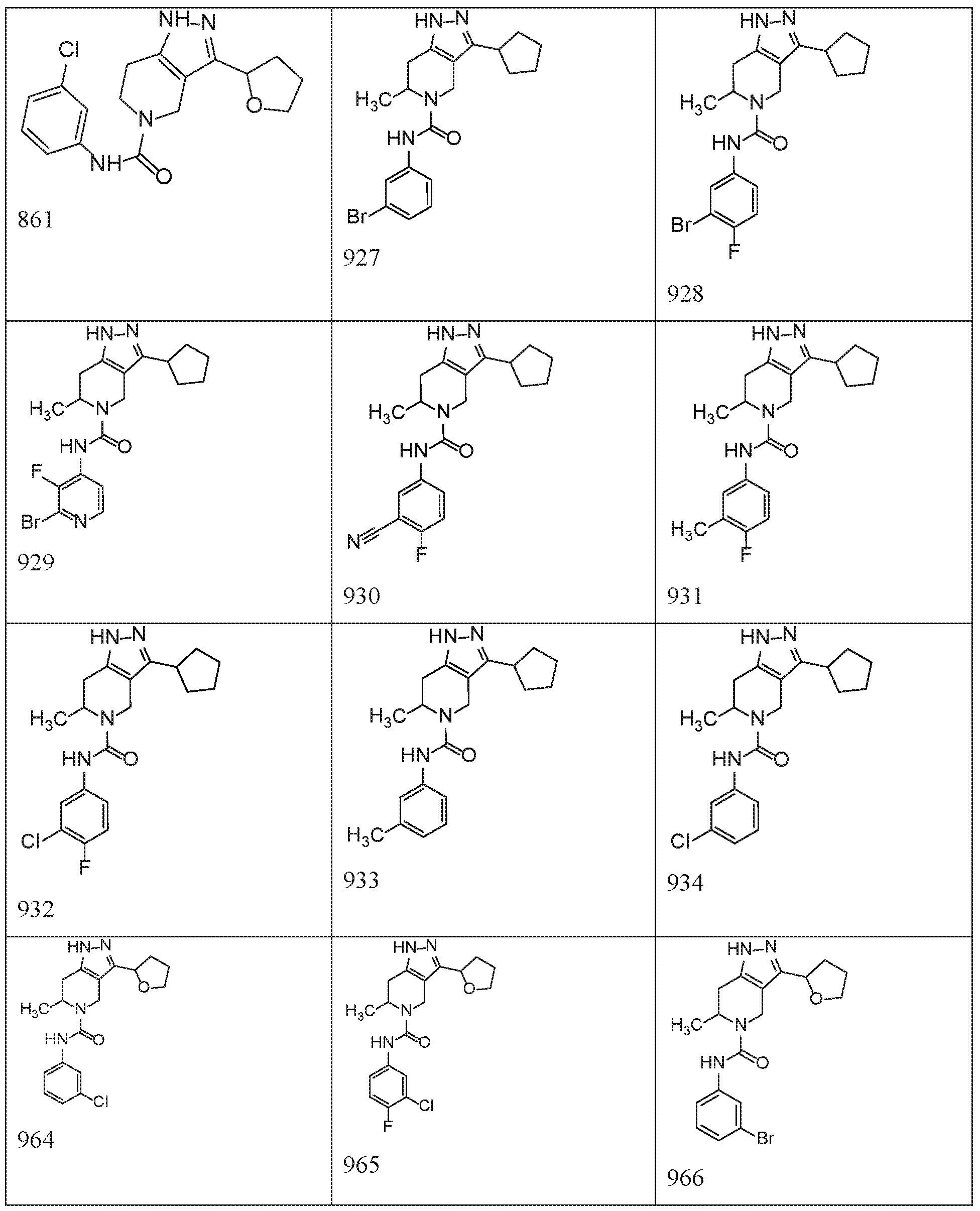
159

10. A compound of Formula I

I,
or a pharmaceutically acceptable salt thereof,
wherein
W1 and W are each independently selected from N, Ra, and CR 1, wherein one of W and W is NR:i;
X is N or CRb;
Y is selected from a bond, -C(O)-, and -S02-;
Z is selected from -(CR5R6)m-, -(CR5R6)mQ-, -(CR5R6)mCR5==CR5-, -(CR5R6)m-C3- (Vcycloalkylene , and (CR R" )„,- R ;
R1 is selected from CVCVcycloalkyl, CVCVheterocyclyl, ORc, CVCValkyl, halo, and CVCValkenyl, wherein alkyl, cycloalkyl, heterocyclyl, and alkenvl are optionally substituted with 1, 2, 3, or 4 groups each independently selected from OH, halo, CVCV al kyl , CVCVhaloal kyl , -0-CVCValkyl , and

R2 is, at each occurrence, independently selected from H, -OH, halo, CVCValkyl, CV
C6-haloalkyl, -0-Ci-C6-alkyl, and Ci-C6-alkyl-OH;
R3 is, at each occurrence, independently selected from H, -OH, halo, CVCValkyl, CV Ce-haloalkyl, -O-CVCValky! , and CVCValkyl-OH,
R4 is selected from C ,-C(,-alkyl, (CR8R9)p-C3-C8-cycloalkyl, (CR8R9)P-C2-C8- heterocyclyl, (CR8R9)p-C6-Ci2-aryl, and ( CRXR9 )P-C i -CVheteroaryl , wherein alkyl, cycloalkyl, heterocyclyl, aryl, and heteroaryl are optionally substituted with 1, 2, 3, or 4 groups, each independently selected from OH, halo, CN, CVCValkyl, CVCVhaloalkyl, O- CrCe-alkyl, C(0)N(Rf)2, C(0)ORf, -QCH2C(Q)ORf, -SQ2Rf, and Ci-C6-alkyl-OH;
R5 is, at each occurrence, independently selected from H, -OH, halo, CVCValkyl, CV CVha!oalkyl, -0-Ci-C6-alkyl, and G-CValkyl-OH;
alternatively, R4 and R are optional ly joined to form a heterocyclic ring;
R6 is, at each occurrence, independently selected from H, -OH, halo, CVCValkyl, CV CVhaloalkyl , O-d-CV.-alkyl , and d-Ce-alkyl-OH;
R is selected from H, CVCValkyl, and CVCValkyl-OH;
R8 is, at each occurrence, independently selected from H, OH, halo, Ci-Ce-alkyl, CV
CVhaloalkyl, 0-C | -CValkyl, and CVCValkyl-OH;
R9 is, at each occurrence, independently selected from H, -OH, halo, CVCValkyl, CV Ce-haloalkyl, -0-Ci-C6-alkyl, and Ci-C6-alkyl-OH;
Ra is selected from H, CVCValkyl, and CVCValkyl -OH;
Rb is selected from H and CVCValkyl;
Rc is selected from H, CVCValkyl, CVCValkyl -OH, CVCVcycloa!kyl, C2-C8- heterocyclyl, C6-Ci2-aryl, and CVCVheteroaryl;
Rf is, at each occurrence, independently selected from H and CVCValkyl;
m is 0, 1 , 2, 3, or 4;
n is 0, 1, 2, or 3; and
p is O, 1, 2, 3, or 4.
1 1. The compound of claim 10, wherein W 1 is NRa and W is or CRd.
12. The compound of claim 10, wherein W ' is N or CR'1 and W is NRa.
13. The compound of any one of claims 10- 12, wherein X is N. 14. The compound of any one of claims 10-13, wherein Y is -C(0)- or -S02-
15. The compound of any one of claims 10- 14, wherein Z is-(CR5R6)m-,
-(CR5R6)mO- or -(CR5R6)m- R7-. 16. The compound of any one of claims 10-15, wherein
m is 0 or 1;
R5 is H, OH, or Ci-C6-alkyl;
R6 is H or Ci-C(,-alkyl; and
R is H or Ci-CValkyl.
17. The compound of any one of claims 10-16, wherein R1 is C3-C8-cycloalkyl, C2-C8- heterocyclyl, Ci-C6-alkyl, or CVCValkenyl, wherein alkyl, cycloalkyl, heterocyclyl, and alkenyl are optionally substituted with 1, 2, 3, or 4 groups each independently selected from - OH, halo, Ci-CValkyl, Ci-C6-haloalkyl, -0-Ci-C6-alkyl, and Ci-C6-aikyl-OH.
18. The compound of any one of claims 10-17, wherein each R2 is independently selected from H or Ci-C alkyl and RJ is H.
19. The compound of any one of claims 10-18, wherein R4 is ( CRXR ' )P-C <-CVcycl oal kyl , (CR8R9)p-C2-C8-heterocyciyl, (CR8R9)p-C6-C12-aryl, or
wherein cycloalkyl, heterocyclyl, aryl, and heteroaryl are optionally substituted with 1, 2, 3, or 4 groups, each independently selected from -OH, halo, CN, CVCValky , G-CVhaloalkyl, -O- Ci-Ce-alkyl, C(0)N(Rf)2, C(0)OR , -OCH2C(0)ORf, -S02Rf, and Ci-C6-alkyl-OH. 20. The compound of any one of claims 10-19, wherein R4 is (CR8R9)p-C6-Ci2-aryl or (C RXR'* )p-C i -C)-heteroaryl , wherein aryl and heteroaryl are optionally substituted with 1, 2, 3, or 4 groups, each independently selected from -OH, halo, CN, C i-CValkyl, (VG,- haloalkyl, -0-C ,-G,-alkyl. C(0)N(R )2, C(0)ORf, -OCH2C(0)ORf, -S02Rf, and C C6-alkyl- OH.
21 . The compound of any one of claims 10-20, wherein
p is 0 or 1 ;
R8 is H, -OH, or Ci-C6-alkyl; and
R9 is H or Ci-C6-alkyl .
22. The compound of any one of claims 10-21 , wherein n is 1.
23. The compound of any one of claims 10-22, wherein
X is N;
Y is -C(Q)-;
Z is NR ; and
R i s H or Ci-4-alkyl .
24. The compound of any one of claims 10-23, wherein
X is N;
Y is -C(O)-;
Z is NR7;
R is H or Ci-4-alkyl; and
n is 1 .
25. The compound of any one of claims 10-24, having the structure of Fonnul a II:
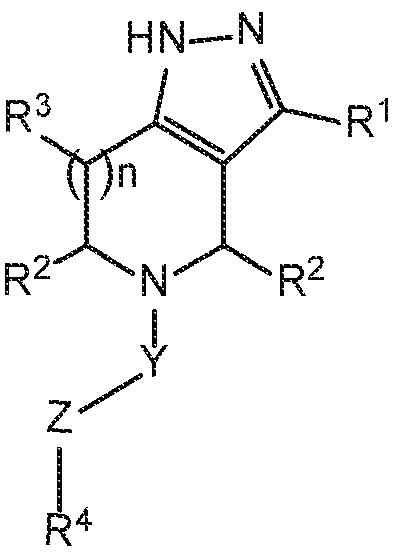
II,
or a pharmaceutically acceptable salt thereof. 26. The compound of claim 25, wherein Y is -C(O)- or -S02-
27. The compound of claim 25 or 26, wherein Z is < CR5R'V , -(CR5R6)mO- or -
(CR5R6)m-NR7-.
28. The compound of any one of claims 25-27, wherein
m is 0 or 1 ;
R5 is H, -OH, or CVCValkyl;
R" is H or C-CValkyl; and
R is H or CVCValkyl . 29. The compound of any one of claims 25-28, wherein R1 is CVCVcycloalkyl, C2-C - heterocyclyl, Ci-CValkyl, or C2-C8-alkenyl, wherein alkyl, cycloalkyl, heterocyclyl, and alkenyl are optionally substituted with 1, 2, 3, or 4 groups each independently selected from - OH, halo, C CValkyl, d-CVhaloalkyl, -0-Cj-C6-alkyl, and Ci-C6-alkyl-OH. 30. The compound of any one of claims 25-29, wherein each R" is independently selected from H or CVCValkyl and R3 is H.
31. The compound of any one of claims 25-30, wherein R4 is (CR^R ^p-CVCVcycloalkyl, (CR8R9)p-C2-C8-heterocyclyl, (CRsR9)p-C6-Ci2-aiyl, or < C Il )„-C i -CVheteroary I , wherein cycloalkyl, heterocyclyl, aryl, and heteroaryl are optionally substituted with 1, 2, 3, or 4 groups, each independently selected from OH, halo, CN, CVCValkyl, CVCVhaloalkyl, O- CrC6-aiky{, C(0)N(Rf)2, C(0)ORf, -OCH2C(0)ORf, -S02Rf, and Ci-C6-alkyl-OH.
32. The compound of any one of claims 25-31, wherein R4 is (C'RXR ')P-CVC I 2-aryl, or ( C" RSR'' )p-C i -Crheteroaryl , and wherein aryl and heteroaryl are optionally substituted with 1,
2, 3, or 4 groups, each independently selected from -OH, halo, CN, CVCValkyl, CVCV haloalkyl, -O-CVCValkyl, C(0)N(Rf)2, C(0)ORf, -OCH2C(0)ORf, -S02Rf, and Ci-C6-alkyl- OH. 33. The compound of any one of claims 25-32, wherein
p is 0 or 1;
R8 is independently selected from H, Oi l, or CVC alkyl ; and
R9 is independently selected from H or CVCValkyl.
34. The compound of any one of claims 25-33, wherein n is 1.
The compound of any one of claims 25-34, wherein
Y is -C(0)-;
Z is NR7; and
R is H or C i - -alkyl .
The compound of any one of claims 25-35, wherein
Y is --C(O) -;
Z is NR7;
R is H or C i -i-alkyl; and
n is 1.
37. The compound of claim 10 or 25, wherein the compound is selected from


167


171

38. A pharmaceutical composition comprising a compound of any one of claims 1 -37, a pharmaceutically acceptable salt thereof, together with a pharmaceutically acceptable carrier.
39. A method of treating an HBV infection in an individual in need thereof, comprising administering to the individual a therapeutically effective amount of a compound according to any one of claims 1-37.
40. A method of inhibiting or reducing the formation or presence of HBV DNA- containing particles or HBV RN A-containing particles in an individual in need thereof,
comprising administering to the individual a therapeutically effective amount of a compound according to any one of claims 1-37.
41. The method of claim 39 or 40 further comprising administering to the individual at least one additional therapeutic agent selected from the group consi sting of an HB V polymerase inhibitor, immunomodulatory agents, pegylated interferon, viral entry inhibitor, viral maturation inhibitor, literature-described cap si d assembly modulator, reverse
transcriptase inhibitor, a cyclophilin/TNF inhibitor, a TLR-agonist, an HBV vaccine, and agents of distinct or unknown mechanism, and a combination thereof.
42, The method of claim 41, wherein the therapeutic agent is a reverse transcriptase inhibitor, and is at least one of Zidovudine, Didanosine, Zalcitabine, ddA, Stavudine, Lamivudine, Abacavir, Emtricitabine, Entecavir, Apricitabme, Atevi rapine, ribavirin, acyclovir, famciclovir, val acyclovir, ganciclovir, valganciclovir, Tenofovir, Adefovir, PMPA, cidofovir, Efavirenz, evi rapine, Delavirdine, and Etravirine.
43. The method of claim 41, wherein the therapeutic agent is a TLR agonist, and wherein the TLR agonist is a TLR- 7 agonist selected from the group consisting of SM360320 (9- benzyl-8-hydiOxy-2-(2-methoxy-ethoxy)adenine) and AZD 8848 (methyl [3-({ [3-(6-amino- 2-butoxy-8-oxo-7,8-dihydro-9H-purin-9-yl)propyl][3-(4- morpholinyl )propyl]amino | methyl )phenyl]acetate).
44. The method of claim 41 , wherein the therapeutic agent is an interferon selected from the group consisting of interferon alpha (IFN-a), interferon beta ( IFN-β), interferon lambda (IFN-λ), and interferon gamma ( IFN-γ).
45. The method of cl aim 44, wherein the interferon is i nterferon -al ph a-2a, interferon- alpha-2b, or interferon-al pha-n 1 . 46. The method of claim 45, wherein the interferon-alpha-2a or interferon-alpha-2b is pegylated.
47. The method of any one of claims 39-46, further comprising administering to the individual at least one HBV vaccine, a nucleoside HBV inhibitor, an interferon or any combination thereof.
48. The method of claim 47, wherein the HBV vaccine is selected from the group consisting of RECOMBIVAX HB, ENGERIX-B, ELOVAC B, GENEVAC-B, and SHAN VAC B.
Applications Claiming Priority (4)
| Application Number | Priority Date | Filing Date | Title |
|---|---|---|---|
| US201462097835P | 2014-12-30 | 2014-12-30 | |
| US62/097,835 | 2014-12-30 | ||
| US201562163150P | 2015-05-18 | 2015-05-18 | |
| US62/163,150 | 2015-05-18 |
Publications (2)
| Publication Number | Publication Date |
|---|---|
| WO2016109684A2 true WO2016109684A2 (en) | 2016-07-07 |
| WO2016109684A3 WO2016109684A3 (en) | 2016-08-25 |
Family
ID=56163427
Family Applications (3)
| Application Number | Title | Priority Date | Filing Date |
|---|---|---|---|
| PCT/US2015/068099 Ceased WO2016109689A2 (en) | 2014-12-30 | 2015-12-30 | Derivatives and methods of treating hepatitis b infections |
| PCT/US2015/068059 Ceased WO2016109663A2 (en) | 2014-12-30 | 2015-12-30 | Derivatives and methods of treating hepatitis b infections |
| PCT/US2015/068091 Ceased WO2016109684A2 (en) | 2014-12-30 | 2015-12-30 | Derivatives and methods of treating hepatitis b infections |
Family Applications Before (2)
| Application Number | Title | Priority Date | Filing Date |
|---|---|---|---|
| PCT/US2015/068099 Ceased WO2016109689A2 (en) | 2014-12-30 | 2015-12-30 | Derivatives and methods of treating hepatitis b infections |
| PCT/US2015/068059 Ceased WO2016109663A2 (en) | 2014-12-30 | 2015-12-30 | Derivatives and methods of treating hepatitis b infections |
Country Status (10)
| Country | Link |
|---|---|
| US (11) | US9527845B2 (en) |
| EP (1) | EP3240787A4 (en) |
| JP (1) | JP6713465B2 (en) |
| KR (1) | KR20170118706A (en) |
| CN (1) | CN107531691A (en) |
| AU (2) | AU2015373996B2 (en) |
| CA (1) | CA2972434A1 (en) |
| MX (1) | MX383929B (en) |
| RU (1) | RU2742305C2 (en) |
| WO (3) | WO2016109689A2 (en) |
Cited By (37)
| Publication number | Priority date | Publication date | Assignee | Title |
|---|---|---|---|---|
| US9518057B2 (en) | 2014-12-30 | 2016-12-13 | Novira Therapeutics, Inc. | Derivatives and methods of treating hepatitis B infections |
| US9873671B2 (en) | 2014-01-16 | 2018-01-23 | Novira Therapeutics, Inc. | Azepane derivatives and methods of treating hepatitis B infections |
| US9884818B2 (en) | 2013-05-17 | 2018-02-06 | Janssen Sciences Ireland Uc | Sulphamoylpyrrolamide derivatives and the use thereof as medicaments for the treatment of hepatitis B |
| US9895349B2 (en) | 2013-04-03 | 2018-02-20 | Janssen Sciences Ireland Us | N-phenyl-carboxamide derivatives and the use thereof as medicaments for the treatment of hepatitis B |
| US10071961B2 (en) | 2013-10-23 | 2018-09-11 | Janssen Sciences Ireland Uc | Carboxamide derivatives and the use thereof as medicaments for the treatment of hepatitis B |
| US10077239B2 (en) | 2015-09-29 | 2018-09-18 | Novira Therapeutics, Inc. | Crystalline forms of a hepatitis B antiviral agent |
| US10125094B2 (en) | 2013-02-28 | 2018-11-13 | Janssen Sciences Ireland Uc | Sulfamoyl-arylamides and the use thereof as medicaments for the treatment of hepatitis B |
| US10160743B2 (en) | 2013-05-17 | 2018-12-25 | Janssen Sciences Ireland Uc | Sulphamoylthiophenamide derivatives and the use thereof as medicaments for the treatment of hepatitis B |
| US10196376B2 (en) | 2011-12-21 | 2019-02-05 | Novira Therapeutics, Inc. | Hepatitis B antiviral agents |
| US10213420B2 (en) | 2014-02-05 | 2019-02-26 | Novira Therapeutics, Inc. | Combination therapy for treatment of HBV infections |
| WO2019086142A1 (en) | 2017-11-02 | 2019-05-09 | Aicuris Gmbh & Co. Kg | Novel, highly active pyrazolo-piperidine substituted indole-2-carboxamides active against the hepatitis b virus (hbv) |
| WO2019086141A1 (en) | 2017-11-02 | 2019-05-09 | Aicuris Gmbh & Co. Kg | Novel, highly active amino-thiazole substituted indole-2-carboxamides active against the hepatitis b virus (hbv) |
| US10392349B2 (en) | 2014-01-16 | 2019-08-27 | Novira Therapeutics, Inc. | Azepane derivatives and methods of treating hepatitis B infections |
| US10441589B2 (en) | 2016-04-15 | 2019-10-15 | Novira Therapeutics, Inc. | Combinations and methods comprising a capsid assembly inhibitor |
| US10450270B2 (en) | 2013-07-25 | 2019-10-22 | Janssen Sciences Ireland Uc | Glyoxamide substituted pyrrolamide derivatives and the use thereof as medicaments for the treatment of hepatitis B |
| US10537580B2 (en) | 2015-03-19 | 2020-01-21 | Novira Therapeutics, Inc. | Azocane and azonane derivatives and methods of treating hepatitis B infections |
| WO2020089460A1 (en) | 2018-11-02 | 2020-05-07 | Aicuris Gmbh & Co. Kg | Novel urea 6,7-dihydro-4h-thiazolo[5,4-c]pyridines active against the hepatitis b virus (hbv) |
| WO2020089452A1 (en) | 2018-11-02 | 2020-05-07 | Aicuris Gmbh & Co. Kg | Novel urea 6,7-dihydro-4h-pyrazolo[4,3-c]pyridines active against the hepatitis b virus (hbv) |
| WO2020089455A1 (en) | 2018-11-02 | 2020-05-07 | Aicuris Gmbh & Co. Kg | 6,7-dihydro-4h-pyrazolo[1,5-a]pyrazine indole-2-carboxamides active against the hepatitis b virus (hbv) |
| WO2020089459A1 (en) | 2018-11-02 | 2020-05-07 | Aicuris Gmbh & Co. Kg | Novel urea 6,7-dihydro-4h-pyrazolo[1,5-a]pyrazines active against the hepatitis b virus (hbv) |
| WO2020089453A1 (en) | 2018-11-02 | 2020-05-07 | Aicuris Gmbh & Co. Kg | Novel 6,7-dihydro-4h-pyrazolo[1,5-a]pyrazine indole-2-carboxamides active against the hepatitis b virus (hbv) |
| WO2020089456A1 (en) | 2018-11-02 | 2020-05-07 | Aicuris Gmbh & Co. Kg | Novel urea 6,7-dihydro-4h-pyrazolo[1,5-a]pyrazines active against the hepatitis b virus (hbv) |
| US10676429B2 (en) | 2012-08-28 | 2020-06-09 | Janssen Sciences Ireland Uc | Sulfamoyl-arylamides and the use thereof as medicaments for the treatment of hepatitis B |
| WO2020221824A1 (en) | 2019-04-30 | 2020-11-05 | Aicuris Gmbh & Co. Kg | Novel indolizine-2-carboxamides active against the hepatitis b virus (hbv) |
| WO2020221826A1 (en) | 2019-04-30 | 2020-11-05 | Aicuris Gmbh & Co. Kg | Novel indole-2-carboxamides active against the hepatitis b virus (hbv) |
| WO2020221816A1 (en) | 2019-04-30 | 2020-11-05 | Aicuris Gmbh & Co. Kg | Novel phenyl and pyridyl ureas active against the hepatitis b virus (hbv) |
| WO2020221811A1 (en) | 2019-04-30 | 2020-11-05 | Aicuris Gmbh & Co. Kg | Novel oxalyl piperazines active against the hepatitis b virus (hbv) |
| WO2020239862A1 (en) * | 2019-05-28 | 2020-12-03 | Janssen Sciences Ireland Unlimited Company | Di-fluoro azepanes as hbv capsid assembly modulators |
| WO2020243153A1 (en) * | 2019-05-28 | 2020-12-03 | Janssen Sciences Ireland Unlimited Company | Fused heterocyclic derivatives |
| WO2020239861A1 (en) * | 2019-05-28 | 2020-12-03 | Janssen Sciences Ireland Unlimited Company | Azepines as hbv capsid assembly modulators |
| WO2020239864A1 (en) * | 2019-05-28 | 2020-12-03 | Janssen Sciences Ireland Unlimited Company | Fused heterocycle derivatives as capsid assembly modulators |
| US10875876B2 (en) | 2015-07-02 | 2020-12-29 | Janssen Sciences Ireland Uc | Cyclized sulfamoylarylamide derivatives and the use thereof as medicaments for the treatment of hepatitis B |
| US10954233B2 (en) | 2016-09-09 | 2021-03-23 | Novartis Ag | Compounds and compositions as inhibitors of endosomal toll-like receptors |
| US10973801B2 (en) | 2018-03-14 | 2021-04-13 | Janssen Sciences Ireland Unlimited Company | Capsid assembly modulator dosing regimen |
| US11078193B2 (en) | 2014-02-06 | 2021-08-03 | Janssen Sciences Ireland Uc | Sulphamoylpyrrolamide derivatives and the use thereof as medicaments for the treatment of hepatitis B |
| US11096931B2 (en) | 2019-02-22 | 2021-08-24 | Janssen Sciences Ireland Unlimited Company | Amide derivatives useful in the treatment of HBV infection or HBV-induced diseases |
| US11491148B2 (en) | 2019-05-06 | 2022-11-08 | Janssen Sciences Ireland Unlimited Company | Amide derivatives useful in the treatment of HBV infection or HBV-induced diseases |
Families Citing this family (79)
| Publication number | Priority date | Publication date | Assignee | Title |
|---|---|---|---|---|
| US10738035B2 (en) | 2015-05-13 | 2020-08-11 | Enanta Pharmaceuticals, Inc. | Hepatitis B antiviral agents |
| WO2017011552A1 (en) | 2015-07-13 | 2017-01-19 | Enanta Pharmaceuticals, Inc. | Hepatitis b antiviral agents |
| KR102398439B1 (en) | 2016-03-07 | 2022-05-16 | 이난타 파마슈티칼스, 인코포레이티드 | Hepatitis B antiviral drugs |
| EP3468561A4 (en) | 2016-06-10 | 2019-12-04 | Enanta Pharmaceuticals, Inc. | HEPATITIS B virucidal |
| TW201806956A (en) | 2016-06-29 | 2018-03-01 | 諾維拉治療公司 | Oxadiazepinone derivatives and methods of treating hepatitis B infections |
| CA3029566A1 (en) | 2016-06-29 | 2018-01-04 | Novira Therapeutics, Inc. | Diazepinone derivatives and their use in the treatment of hepatitis b infections |
| WO2018011100A1 (en) * | 2016-07-14 | 2018-01-18 | F. Hoffmann-La Roche Ag | Novel tetrahydropyrazolopyridine compounds for the treatment of infectious diseases |
| WO2018011163A1 (en) | 2016-07-14 | 2018-01-18 | F. Hoffmann-La Roche Ag | 6,7-dihydro-4h-pyrazolo[1,5-a]pyrazine and 6,7-dihydro-4h-triazolo[1,5-a]pyrazine compounds for the treatment of infectious diseases |
| WO2018011160A1 (en) * | 2016-07-14 | 2018-01-18 | F. Hoffmann-La Roche Ag | 6,7-dihydro-4h-pyrazolo[1,5-a]pyrazine compounds for the treatment of infectious diseases |
| CN109415368B (en) * | 2016-07-14 | 2021-04-30 | 豪夫迈·罗氏有限公司 | Carboxy 6, 7-dihydro-4H-pyrazolo [1,5-a ] pyrazine compounds for the treatment of infectious diseases |
| KR20230010826A (en) | 2016-10-14 | 2023-01-19 | 프리시젼 바이오사이언시스 인코포레이티드 | Engineered meganucleases specific for recognition sequences in the hepatitis b virus genome |
| SG11202001685TA (en) | 2017-08-28 | 2020-03-30 | Enanta Pharm Inc | Hepatitis b antiviral agents |
| US11572372B2 (en) | 2017-11-16 | 2023-02-07 | Medshine Discovery Inc. | Anti-HBVtetrahydroisoxazolo[4,3-c]pyridine compounds |
| WO2019097479A1 (en) * | 2017-11-17 | 2019-05-23 | Novartis Ag | Novel dihydroisoxazole compounds and their use for the treatment of hepatitis b |
| US10723733B2 (en) | 2017-12-06 | 2020-07-28 | Enanta Pharmaceuticals, Inc. | Hepatitis B antiviral agents |
| US11203610B2 (en) | 2017-12-20 | 2021-12-21 | Institute Of Organic Chemistry And Biochemistry Ascr, V.V.I. | 2′3′ cyclic dinucleotides with phosphonate bond activating the sting adaptor protein |
| JP7037667B2 (en) | 2017-12-20 | 2022-03-16 | インスティチュート オブ オーガニック ケミストリー アンド バイオケミストリー エーエスシーアール,ヴイ.ヴイ.アイ. | 3'3'cyclic dinucleotide with phosphonate binding that activates the STING adapter protein |
| JP2021506852A (en) * | 2017-12-21 | 2021-02-22 | ヤンセン・サイエンシズ・アイルランド・アンリミテッド・カンパニー | Isoxazole compounds for the treatment of diseases associated with HBV infection |
| US11058678B2 (en) | 2018-01-22 | 2021-07-13 | Enanta Pharmaceuticals, Inc. | Substituted heterocycles as antiviral agents |
| JP7050165B2 (en) | 2018-02-26 | 2022-04-07 | ギリアード サイエンシーズ, インコーポレイテッド | Substituted pyrrolidine compounds as HBV replication inhibitors |
| US10729688B2 (en) | 2018-03-29 | 2020-08-04 | Enanta Pharmaceuticals, Inc. | Hepatitis B antiviral agents |
| WO2019195181A1 (en) | 2018-04-05 | 2019-10-10 | Gilead Sciences, Inc. | Antibodies and fragments thereof that bind hepatitis b virus protein x |
| TW202005654A (en) | 2018-04-06 | 2020-02-01 | 捷克科學院有機化學與生物化學研究所 | 2'2'-cyclic dinucleotides |
| TWI818007B (en) | 2018-04-06 | 2023-10-11 | 捷克科學院有機化學與生物化學研究所 | 2'3'-cyclic dinucleotides |
| TWI833744B (en) | 2018-04-06 | 2024-03-01 | 捷克科學院有機化學與生物化學研究所 | 3'3'-cyclic dinucleotides |
| US11142750B2 (en) | 2018-04-12 | 2021-10-12 | Precision Biosciences, Inc. | Optimized engineered meganucleases having specificity for a recognition sequence in the Hepatitis B virus genome |
| WO2019211799A1 (en) | 2018-05-03 | 2019-11-07 | Institute Of Organic Chemistry And Biochemistry Ascr, V.V.I. | 2'3'-cyclic dinucleotide analogue comprising a cyclopentanyl modified nucleotide |
| CN110437132B (en) * | 2018-05-04 | 2022-04-01 | 上海长森药业有限公司 | Bifused heterocyclic nucleocapsid inhibitors and pharmaceutical uses thereof |
| WO2020028097A1 (en) | 2018-08-01 | 2020-02-06 | Gilead Sciences, Inc. | Solid forms of (r)-11-(methoxymethyl)-12-(3-methoxypropoxy)-3,3-dimethyl-8-0x0-2,3,8,13b-tetrahydro-1h-pyrido[2,1-a]pyrrolo[1,2-c] phthalazine-7-c arboxylic acid |
| TW202024093A (en) | 2018-09-21 | 2020-07-01 | 美商安塔製藥公司 | Functionalized heterocycles as antiviral agents |
| MA53721A (en) | 2018-09-28 | 2021-09-15 | Janssen Pharmaceutica Nv | MONOACYLGLYCEROL LIPASE MODULATORS |
| IL328538A (en) * | 2018-10-05 | 2026-07-01 | Univ Emory | Monomer and multimeric anti-hbv agents |
| EP4371987B9 (en) | 2018-10-31 | 2025-11-26 | Gilead Sciences, Inc. | Substituted 6-azabenzimidazole compounds as hpk1 inhibitors |
| EP3873608A1 (en) | 2018-10-31 | 2021-09-08 | Gilead Sciences, Inc. | Substituted 6-azabenzimidazole compounds having hpk1 inhibitory activity |
| EP3883570A4 (en) | 2018-11-21 | 2022-07-13 | Enanta Pharmaceuticals, Inc. | FUNCTIONALIZED HETEROCYCLES USEFUL AS ANTIVIRAL AGENTS |
| CN111333590B (en) * | 2018-12-18 | 2022-05-17 | 沈阳中化农药化工研发有限公司 | A kind of preparation method of isoxazolidine hydrochloride |
| CN113574063B (en) | 2019-03-07 | 2025-03-18 | 捷克共和国有机化学与生物化学研究所 | 3'3'-Cyclic dinucleotides and prodrugs thereof |
| WO2020178769A1 (en) | 2019-03-07 | 2020-09-10 | Institute Of Organic Chemistry And Biochemistry Ascr, V.V.I. | 2'3'-cyclic dinucleotides and prodrugs thereof |
| WO2020178768A1 (en) | 2019-03-07 | 2020-09-10 | Institute Of Organic Chemistry And Biochemistry Ascr, V.V.I. | 3'3'-cyclic dinucleotide analogue comprising a cyclopentanyl modified nucleotide as sting modulator |
| PH12021552191A1 (en) * | 2019-03-14 | 2022-08-15 | Janssen Sciences Ireland Unlimited Co | Fused ring pyrimidone derivatives for use in the treatment of hbv infection or of hbv-induced diseases |
| TWI751517B (en) | 2019-04-17 | 2022-01-01 | 美商基利科學股份有限公司 | Solid forms of a toll-like receptor modulator |
| TW202210480A (en) | 2019-04-17 | 2022-03-16 | 美商基利科學股份有限公司 | Solid forms of a toll-like receptor modulator |
| WO2020228745A1 (en) * | 2019-05-14 | 2020-11-19 | 正大天晴药业集团股份有限公司 | Crystal form of tetrahydroisoxazolo[4,3-c]pyridine compound against hbv |
| US11453681B2 (en) | 2019-05-23 | 2022-09-27 | Gilead Sciences, Inc. | Substituted eneoxindoles and uses thereof |
| UY38705A (en) * | 2019-05-23 | 2020-12-31 | Irbm S P A | TRICYCLIC INHIBITORS SUBSTITUTED WITH HEPATITIS B VIRUS OXALAMIDE |
| US20220323455A1 (en) * | 2019-05-28 | 2022-10-13 | Janssen Sciences Ireland Unlimited Company | Fused heterocyclic derivatives as antiviral agents |
| CR20210666A (en) * | 2019-05-28 | 2022-03-11 | Janssen Sciences Ireland Unlimited Co | CONDENSED HETEROCYCLIC DERIVATIVES |
| WO2020247444A1 (en) | 2019-06-03 | 2020-12-10 | Enanta Pharmaceuticals, Inc, | Hepatitis b antiviral agents |
| US11472808B2 (en) | 2019-06-04 | 2022-10-18 | Enanta Pharmaceuticals, Inc. | Substituted pyrrolo[1,2-c]pyrimidines as hepatitis B antiviral agents |
| WO2020247561A1 (en) | 2019-06-04 | 2020-12-10 | Enanta Pharmaceuticals, Inc, | Hepatitis b antiviral agents |
| CN114245807B (en) | 2019-06-25 | 2025-05-02 | 吉利德科学公司 | FLT3L-FC fusion proteins and methods of use |
| WO2021007488A1 (en) | 2019-07-11 | 2021-01-14 | Enanta Pharmaceuticals, Inc. | Substituted heterocycles as antiviral agents |
| WO2021023662A1 (en) * | 2019-08-02 | 2021-02-11 | Janssen Sciences Ireland Unlimited Company | Pyrazolo[4,3-c]pyridine compounds for use in the treatment of hbv infection |
| US20220296619A1 (en) | 2019-08-19 | 2022-09-22 | Gilead Sciences, Inc. | Pharmaceutical formulations of tenofovir alafenamide |
| WO2021055425A2 (en) | 2019-09-17 | 2021-03-25 | Enanta Pharmaceuticals, Inc. | Functionalized heterocycles as antiviral agents |
| HRP20241379T1 (en) | 2019-09-30 | 2024-12-20 | Gilead Sciences, Inc. | HBV VACCINES AND HBV TREATMENT PROCEDURES |
| US12410418B2 (en) | 2019-12-06 | 2025-09-09 | Precision Biosciences, Inc. | Optimized engineered meganucleases having specificity for a recognition sequence in the Hepatitis B virus genome |
| CN113264931B (en) * | 2020-02-17 | 2022-06-07 | 成都先导药物开发股份有限公司 | A kind of preparation method of 1,4,6,7-tetrahydro-5H-pyrazolo[4,3-c]pyridine derivative |
| US11802125B2 (en) | 2020-03-16 | 2023-10-31 | Enanta Pharmaceuticals, Inc. | Functionalized heterocyclic compounds as antiviral agents |
| KR102987126B1 (en) | 2020-03-20 | 2026-07-07 | 길리애드 사이언시즈, 인코포레이티드 | Prodrug of 4'-C-substituted-2-halo-2'-deoxyadenosine nucleoside and method of preparation and use thereof |
| CA3176946A1 (en) * | 2020-03-26 | 2021-09-30 | Janssen Pharmaceutica Nv | Monoacylglycerol lipase modulators |
| GB202103704D0 (en) * | 2021-03-17 | 2021-04-28 | Pathios Therapeutics Ltd | Compounds |
| KR20230022433A (en) * | 2020-06-05 | 2023-02-15 | 파티오스 테라퓨틱스 리미티드 | N-(phenylaminocarbonyl)tetrahydro-isoquinoline and related compounds as modulators of GPR65 |
| LT4192474T (en) | 2020-08-07 | 2025-11-25 | Prodrugs of phosphonamide nucleotide analogues and their pharmaceutical use | |
| WO2022053010A1 (en) * | 2020-09-11 | 2022-03-17 | Janssen Sciences Ireland Unlimited Company | Fused ring pyrimidone derivatives for use in the treatment of hbv infection or of hbv-induced diseases |
| TWI815194B (en) | 2020-10-22 | 2023-09-11 | 美商基利科學股份有限公司 | INTERLEUKIN-2-Fc FUSION PROTEINS AND METHODS OF USE |
| TW202237617A (en) * | 2020-12-02 | 2022-10-01 | 愛爾蘭商健生科學愛爾蘭無限公司 | Fused heterocyclic derivatives |
| US20240269142A1 (en) | 2021-05-13 | 2024-08-15 | Gilead Sciences, Inc. | COMBINATION OF A TLR8 MODULATING COMPOUND AND ANTI-HBV siRNA THERAPEUTICS |
| EP4359413A1 (en) | 2021-06-23 | 2024-05-01 | Gilead Sciences, Inc. | Diacylglyercol kinase modulating compounds |
| JP7651018B2 (en) | 2021-06-23 | 2025-03-25 | ギリアード サイエンシーズ, インコーポレイテッド | Diacylglycerol kinase modulating compounds |
| MX2023014762A (en) | 2021-06-23 | 2024-01-15 | Gilead Sciences Inc | DIACYL GLYCEROL KINASE MODULATING COMPOUNDS. |
| CN117355531A (en) | 2021-06-23 | 2024-01-05 | 吉利德科学公司 | diacylglycerol kinase modulating compounds |
| TW202325279A (en) | 2021-10-29 | 2023-07-01 | 美商阿克思生物科學有限公司 | Inhibitors of hif-2alpha and methods of use thereof |
| CN119176776A (en) * | 2023-06-21 | 2024-12-24 | 上海皓元医药股份有限公司 | Beta-lactamase inhibitor intermediate and preparation method thereof |
| WO2025117677A1 (en) * | 2023-11-29 | 2025-06-05 | Actio Biosciences, Inc. | Heterocyclic compounds useful as kcnt1 inhibitors |
| TW202608468A (en) | 2024-05-13 | 2026-03-01 | 美商基利科學股份有限公司 | Combination therapies |
| WO2025240246A1 (en) | 2024-05-13 | 2025-11-20 | Gilead Sciences, Inc. | Combination therapies with ribavirin |
| US20250345390A1 (en) | 2024-05-13 | 2025-11-13 | Gilead Sciences, Inc. | Combination therapies |
| WO2025240242A1 (en) | 2024-05-13 | 2025-11-20 | Gilead Sciences, Inc. | Combination therapies with ribavirin |
Family Cites Families (26)
| Publication number | Priority date | Publication date | Assignee | Title |
|---|---|---|---|---|
| DK27383A (en) | 1982-02-17 | 1983-08-18 | Lepetit Spa | PROCEDURE FOR PREPARING PYRAZOLE (4,3-C) PYRIDINES |
| CA2416527C (en) * | 2000-08-10 | 2009-12-22 | Pharmacia Italia S.P.A. | Bicyclo-pyrazoles active as kinase inhibitors, process for their preparation and pharmaceutical compositions comprising them |
| US7589202B2 (en) * | 2000-08-14 | 2009-09-15 | Ortho Mcneil Pharmaceutical, Inc. | Substituted pyrazoles |
| CN1642973A (en) * | 2000-09-06 | 2005-07-20 | 奥索-麦克尼尔药品公司 | A method for treating allergies |
| US6897208B2 (en) | 2001-10-26 | 2005-05-24 | Aventis Pharmaceuticals Inc. | Benzimidazoles |
| IL161576A0 (en) * | 2001-10-26 | 2004-09-27 | Aventis Pharma Inc | Benzimidazoles and analogues and their use as protein kinases inhibitors |
| CA2487679A1 (en) * | 2002-05-30 | 2003-12-11 | Vertex Pharmaceuticals Incorporated | Inhibitors of jak and cdk2 protein kinases |
| CN1656079A (en) * | 2002-05-31 | 2005-08-17 | 卫材株式会社 | Pyrazole compound and pharmaceutical composition containing same |
| US20060100233A1 (en) * | 2002-07-25 | 2006-05-11 | Manuela Villa | Bicyclo-pyrazoles active as kinase inhibitors, process for their preparation and pharmaceutical compositions comprising them |
| MXPA05000945A (en) * | 2002-07-25 | 2005-05-16 | Pharmacia Italia Spa | Bicyclo-pyrazoles active as kinase inhibitors, process for their preparation and pharmaceutical compositions comprising them. |
| WO2005030776A1 (en) * | 2003-09-23 | 2005-04-07 | Vertex Pharmaceuticals Incorporated | Pyrazolopyrrole derivatives as protein kinase inhibitors |
| RU2008152171A (en) * | 2006-07-05 | 2010-08-10 | Интермьюн, Инк. (Us) | NEW HEPATITIS C VIRAL REPLICATION INHIBITORS |
| EP2303876B1 (en) * | 2008-06-25 | 2014-03-19 | Bristol-Myers Squibb Company | Diketo azolopiperidines and azolopiperazines as anti-hiv agents |
| US8309578B2 (en) * | 2008-11-25 | 2012-11-13 | Nerviano Medical Sciences S.R.L. | Bicyclic pyrazole and isoxazole derivatives as antitumor and antineurodegenerative agents |
| CN102282147B (en) * | 2009-01-28 | 2015-09-30 | 卡拉治疗学股份有限公司 | Bicyclic pyrazolo-heterocycles |
| AU2010282506A1 (en) * | 2009-08-12 | 2012-03-08 | Janssen Pharmaceutica Nv | Process for the preparation of Cathepsin S inhibitors |
| US20130178475A1 (en) * | 2010-03-17 | 2013-07-11 | Ironwood Pharmaceuticals, Inc. | sGC STIMULATORS |
| US9242981B2 (en) * | 2010-09-16 | 2016-01-26 | Merck Sharp & Dohme Corp. | Fused pyrazole derivatives as novel ERK inhibitors |
| WO2012087772A1 (en) * | 2010-12-21 | 2012-06-28 | Schering Corporation | Indazole derivatives useful as erk inhibitors |
| KR101316101B1 (en) * | 2011-05-26 | 2013-10-11 | 연세대학교 산학협력단 | A Composition for Inhibiting Protein Tyrosine Kinase 6 and a Composition for Preventing and Treating Cancers Using the Same |
| CA2845473A1 (en) * | 2011-09-12 | 2013-03-21 | Sanofi | Indanyl-substituted 4,5,6,7-tetrahydro-1h-pyrazolo[4,3-c]pyridines, their use as medicament, and pharmaceutical preparations comprising them |
| ES2559450T3 (en) | 2011-09-16 | 2016-02-12 | Sanofi | 4,5,6,7-Tetrahydro-1H-pyrazolo [4,3-c] substituted pyridines, their use as a medicine, and pharmaceutical preparations comprising them |
| WO2013037914A1 (en) * | 2011-09-16 | 2013-03-21 | Sanofi | Substituted 4,5,6,7-tetrahydro-1h-pyrazolo[4,3-c]pyridines, their use as medicament, and pharmaceutical preparations comprising them |
| US10273243B2 (en) * | 2013-03-14 | 2019-04-30 | The Trustees Of Columbia University In The City Of New York | 4-phenylpiperidines, their preparation and use |
| WO2016109689A2 (en) | 2014-12-30 | 2016-07-07 | Novira Therapeutics, Inc. | Derivatives and methods of treating hepatitis b infections |
| MA41338B1 (en) | 2015-01-16 | 2019-07-31 | Hoffmann La Roche | Pyrazine compounds for the treatment of infectious diseases |
-
2015
- 2015-12-30 WO PCT/US2015/068099 patent/WO2016109689A2/en not_active Ceased
- 2015-12-30 JP JP2017534909A patent/JP6713465B2/en not_active Expired - Fee Related
- 2015-12-30 US US14/984,293 patent/US9527845B2/en not_active Expired - Fee Related
- 2015-12-30 CN CN201580077237.2A patent/CN107531691A/en active Pending
- 2015-12-30 AU AU2015373996A patent/AU2015373996B2/en not_active Ceased
- 2015-12-30 MX MX2017008720A patent/MX383929B/en unknown
- 2015-12-30 EP EP15876275.7A patent/EP3240787A4/en not_active Withdrawn
- 2015-12-30 US US14/984,654 patent/US9550779B2/en not_active Expired - Fee Related
- 2015-12-30 CA CA2972434A patent/CA2972434A1/en not_active Abandoned
- 2015-12-30 RU RU2017126995A patent/RU2742305C2/en active
- 2015-12-30 WO PCT/US2015/068059 patent/WO2016109663A2/en not_active Ceased
- 2015-12-30 US US14/984,325 patent/US9518057B2/en not_active Expired - Fee Related
- 2015-12-30 WO PCT/US2015/068091 patent/WO2016109684A2/en not_active Ceased
- 2015-12-30 KR KR1020177020897A patent/KR20170118706A/en not_active Withdrawn
-
2016
- 2016-11-09 US US15/347,468 patent/US10093669B2/en not_active Expired - Fee Related
- 2016-11-15 US US15/351,851 patent/US9890161B2/en not_active Expired - Fee Related
- 2016-12-12 US US15/375,652 patent/US10077264B2/en not_active Expired - Fee Related
-
2017
- 2017-12-15 US US15/843,598 patent/US10189835B2/en not_active Expired - Fee Related
-
2018
- 2018-07-02 US US16/024,954 patent/US10538519B2/en not_active Expired - Fee Related
- 2018-08-31 US US16/118,760 patent/US10544141B2/en not_active Expired - Fee Related
- 2018-12-20 US US16/226,780 patent/US10556904B2/en not_active Expired - Fee Related
-
2019
- 2019-12-03 US US16/702,069 patent/US20200181142A1/en not_active Abandoned
-
2020
- 2020-09-15 AU AU2020233640A patent/AU2020233640A1/en not_active Abandoned
Cited By (55)
| Publication number | Priority date | Publication date | Assignee | Title |
|---|---|---|---|---|
| US10196376B2 (en) | 2011-12-21 | 2019-02-05 | Novira Therapeutics, Inc. | Hepatitis B antiviral agents |
| US10676429B2 (en) | 2012-08-28 | 2020-06-09 | Janssen Sciences Ireland Uc | Sulfamoyl-arylamides and the use thereof as medicaments for the treatment of hepatitis B |
| US10995064B2 (en) | 2012-08-28 | 2021-05-04 | Janssen Sciences Ireland Uc | Sulfamoyl-arylamides and the use thereof as medicaments for the treatment of hepatitis B |
| US10125094B2 (en) | 2013-02-28 | 2018-11-13 | Janssen Sciences Ireland Uc | Sulfamoyl-arylamides and the use thereof as medicaments for the treatment of hepatitis B |
| US10941113B2 (en) | 2013-02-28 | 2021-03-09 | Janssen Sciences Ireland Uc | Sulfamoyl-arylamides and the use thereof as medicaments for the treatment of hepatitis B |
| US10398677B2 (en) | 2013-04-03 | 2019-09-03 | Janssen Sciences Ireland Uc | N-phenyl-carboxamide derivatives and the use thereof as medicaments for the treatment of hepatitis B |
| US9895349B2 (en) | 2013-04-03 | 2018-02-20 | Janssen Sciences Ireland Us | N-phenyl-carboxamide derivatives and the use thereof as medicaments for the treatment of hepatitis B |
| US9884818B2 (en) | 2013-05-17 | 2018-02-06 | Janssen Sciences Ireland Uc | Sulphamoylpyrrolamide derivatives and the use thereof as medicaments for the treatment of hepatitis B |
| US10457638B2 (en) | 2013-05-17 | 2019-10-29 | Janssen Sciences Ireland Uc | Sulphamoylpyrrolamide derivatives and the use thereof as medicaments for the treatment of hepatitis B |
| US10160743B2 (en) | 2013-05-17 | 2018-12-25 | Janssen Sciences Ireland Uc | Sulphamoylthiophenamide derivatives and the use thereof as medicaments for the treatment of hepatitis B |
| US10450270B2 (en) | 2013-07-25 | 2019-10-22 | Janssen Sciences Ireland Uc | Glyoxamide substituted pyrrolamide derivatives and the use thereof as medicaments for the treatment of hepatitis B |
| US10071961B2 (en) | 2013-10-23 | 2018-09-11 | Janssen Sciences Ireland Uc | Carboxamide derivatives and the use thereof as medicaments for the treatment of hepatitis B |
| US10377709B2 (en) | 2013-10-23 | 2019-08-13 | Janssen Sciences Ireland Uc | Carboxamide derivatives and the use thereof as medicaments for the treatment of hepatitis B |
| US9873671B2 (en) | 2014-01-16 | 2018-01-23 | Novira Therapeutics, Inc. | Azepane derivatives and methods of treating hepatitis B infections |
| US10392349B2 (en) | 2014-01-16 | 2019-08-27 | Novira Therapeutics, Inc. | Azepane derivatives and methods of treating hepatitis B infections |
| US10632112B2 (en) | 2014-02-05 | 2020-04-28 | Novira Therapeutics, Inc. | Combination therapy for treatment of HBV infections |
| US10213420B2 (en) | 2014-02-05 | 2019-02-26 | Novira Therapeutics, Inc. | Combination therapy for treatment of HBV infections |
| US11078193B2 (en) | 2014-02-06 | 2021-08-03 | Janssen Sciences Ireland Uc | Sulphamoylpyrrolamide derivatives and the use thereof as medicaments for the treatment of hepatitis B |
| US10544141B2 (en) | 2014-12-30 | 2020-01-28 | Novira Therapeutics, Inc. | Derivatives and methods of treating hepatitis B infections |
| US10077264B2 (en) | 2014-12-30 | 2018-09-18 | Novira Therapeutics, Inc. | Derivatives and methods of treating hepatitis B infections |
| US9527845B2 (en) | 2014-12-30 | 2016-12-27 | Novira Therapeutics, Inc. | Derivatives and methods of treating hepatitis B infections |
| US9550779B2 (en) | 2014-12-30 | 2017-01-24 | Novira Therapeutics, Inc. | Derivatives and methods of treating hepatitis B infections |
| US10189835B2 (en) | 2014-12-30 | 2019-01-29 | Novira Therapeutics, Inc. | Derivatives and methods of treating hepatitis B infections |
| US10093669B2 (en) | 2014-12-30 | 2018-10-09 | Novira Therapeutics, Inc. | Derivatives and methods of treating hepatitis B infections |
| US10538519B2 (en) | 2014-12-30 | 2020-01-21 | Novira Therapeutics, Inc. | Derivatives and methods of treating hepatitis B infections |
| US9518057B2 (en) | 2014-12-30 | 2016-12-13 | Novira Therapeutics, Inc. | Derivatives and methods of treating hepatitis B infections |
| US10556904B2 (en) | 2014-12-30 | 2020-02-11 | Novira Therapeutics, Inc. | Derivatives and methods of treating hepatitis B infections |
| US9890161B2 (en) | 2014-12-30 | 2018-02-13 | Novira Therapeutics, Inc. | Derivatives and methods of treating hepatitis B infections |
| US10537580B2 (en) | 2015-03-19 | 2020-01-21 | Novira Therapeutics, Inc. | Azocane and azonane derivatives and methods of treating hepatitis B infections |
| US10875876B2 (en) | 2015-07-02 | 2020-12-29 | Janssen Sciences Ireland Uc | Cyclized sulfamoylarylamide derivatives and the use thereof as medicaments for the treatment of hepatitis B |
| US10077239B2 (en) | 2015-09-29 | 2018-09-18 | Novira Therapeutics, Inc. | Crystalline forms of a hepatitis B antiviral agent |
| US11129834B2 (en) | 2016-04-15 | 2021-09-28 | Novira Therapeutics, Inc. | Combinations and methods comprising a capsid assembly inhibitor |
| US10441589B2 (en) | 2016-04-15 | 2019-10-15 | Novira Therapeutics, Inc. | Combinations and methods comprising a capsid assembly inhibitor |
| US10954233B2 (en) | 2016-09-09 | 2021-03-23 | Novartis Ag | Compounds and compositions as inhibitors of endosomal toll-like receptors |
| WO2019086141A1 (en) | 2017-11-02 | 2019-05-09 | Aicuris Gmbh & Co. Kg | Novel, highly active amino-thiazole substituted indole-2-carboxamides active against the hepatitis b virus (hbv) |
| CN111448199A (en) * | 2017-11-02 | 2020-07-24 | 艾库里斯有限及两合公司 | Novel highly active amino-thiazole substituted indole-2-carboxamides with anti-hepatitis B virus (HBV) activity |
| WO2019086142A1 (en) | 2017-11-02 | 2019-05-09 | Aicuris Gmbh & Co. Kg | Novel, highly active pyrazolo-piperidine substituted indole-2-carboxamides active against the hepatitis b virus (hbv) |
| US10973801B2 (en) | 2018-03-14 | 2021-04-13 | Janssen Sciences Ireland Unlimited Company | Capsid assembly modulator dosing regimen |
| WO2020089456A1 (en) | 2018-11-02 | 2020-05-07 | Aicuris Gmbh & Co. Kg | Novel urea 6,7-dihydro-4h-pyrazolo[1,5-a]pyrazines active against the hepatitis b virus (hbv) |
| WO2020089455A1 (en) | 2018-11-02 | 2020-05-07 | Aicuris Gmbh & Co. Kg | 6,7-dihydro-4h-pyrazolo[1,5-a]pyrazine indole-2-carboxamides active against the hepatitis b virus (hbv) |
| WO2020089452A1 (en) | 2018-11-02 | 2020-05-07 | Aicuris Gmbh & Co. Kg | Novel urea 6,7-dihydro-4h-pyrazolo[4,3-c]pyridines active against the hepatitis b virus (hbv) |
| WO2020089460A1 (en) | 2018-11-02 | 2020-05-07 | Aicuris Gmbh & Co. Kg | Novel urea 6,7-dihydro-4h-thiazolo[5,4-c]pyridines active against the hepatitis b virus (hbv) |
| WO2020089453A1 (en) | 2018-11-02 | 2020-05-07 | Aicuris Gmbh & Co. Kg | Novel 6,7-dihydro-4h-pyrazolo[1,5-a]pyrazine indole-2-carboxamides active against the hepatitis b virus (hbv) |
| WO2020089459A1 (en) | 2018-11-02 | 2020-05-07 | Aicuris Gmbh & Co. Kg | Novel urea 6,7-dihydro-4h-pyrazolo[1,5-a]pyrazines active against the hepatitis b virus (hbv) |
| US11096931B2 (en) | 2019-02-22 | 2021-08-24 | Janssen Sciences Ireland Unlimited Company | Amide derivatives useful in the treatment of HBV infection or HBV-induced diseases |
| WO2020221824A1 (en) | 2019-04-30 | 2020-11-05 | Aicuris Gmbh & Co. Kg | Novel indolizine-2-carboxamides active against the hepatitis b virus (hbv) |
| WO2020221811A1 (en) | 2019-04-30 | 2020-11-05 | Aicuris Gmbh & Co. Kg | Novel oxalyl piperazines active against the hepatitis b virus (hbv) |
| WO2020221816A1 (en) | 2019-04-30 | 2020-11-05 | Aicuris Gmbh & Co. Kg | Novel phenyl and pyridyl ureas active against the hepatitis b virus (hbv) |
| WO2020221826A1 (en) | 2019-04-30 | 2020-11-05 | Aicuris Gmbh & Co. Kg | Novel indole-2-carboxamides active against the hepatitis b virus (hbv) |
| US11491148B2 (en) | 2019-05-06 | 2022-11-08 | Janssen Sciences Ireland Unlimited Company | Amide derivatives useful in the treatment of HBV infection or HBV-induced diseases |
| WO2020239864A1 (en) * | 2019-05-28 | 2020-12-03 | Janssen Sciences Ireland Unlimited Company | Fused heterocycle derivatives as capsid assembly modulators |
| WO2020239861A1 (en) * | 2019-05-28 | 2020-12-03 | Janssen Sciences Ireland Unlimited Company | Azepines as hbv capsid assembly modulators |
| WO2020243153A1 (en) * | 2019-05-28 | 2020-12-03 | Janssen Sciences Ireland Unlimited Company | Fused heterocyclic derivatives |
| WO2020239862A1 (en) * | 2019-05-28 | 2020-12-03 | Janssen Sciences Ireland Unlimited Company | Di-fluoro azepanes as hbv capsid assembly modulators |
| CN113906030A (en) * | 2019-05-28 | 2022-01-07 | 爱尔兰詹森科学公司 | Fused heterocyclic derivatives |
Also Published As
Similar Documents
| Publication | Publication Date | Title |
|---|---|---|
| US10544141B2 (en) | Derivatives and methods of treating hepatitis B infections | |
| US10987359B2 (en) | Oxadiazepinone derivatives and methods of treating hepatitis B infections | |
| US9181288B2 (en) | Azepane derivatives and methods of treating hepatitis B infections | |
| US9873671B2 (en) | Azepane derivatives and methods of treating hepatitis B infections | |
| AU2018291688A1 (en) | Heteroaryldihydropyrimidine derivatives and methods of treating hepatitis B infections | |
| CA3099605A1 (en) | Dihydropyrimidine derivatives and uses thereof in the treatment of hbv infection or of hbv-induced diseases | |
| US10392349B2 (en) | Azepane derivatives and methods of treating hepatitis B infections |
Legal Events
| Date | Code | Title | Description |
|---|---|---|---|
| NENP | Non-entry into the national phase |
Ref country code: DE |
|
| 122 | Ep: pct application non-entry in european phase |
Ref document number: 15876271 Country of ref document: EP Kind code of ref document: A2 |