WO2016108206A2 - Processes for preparation of idelalisib and intermediates thereof - Google Patents
Processes for preparation of idelalisib and intermediates thereof Download PDFInfo
- Publication number
- WO2016108206A2 WO2016108206A2 PCT/IB2015/060069 IB2015060069W WO2016108206A2 WO 2016108206 A2 WO2016108206 A2 WO 2016108206A2 IB 2015060069 W IB2015060069 W IB 2015060069W WO 2016108206 A2 WO2016108206 A2 WO 2016108206A2
- Authority
- WO
- WIPO (PCT)
- Prior art keywords
- formula
- idelalisib
- compound
- acid
- group
- Prior art date
- Legal status (The legal status is an assumption and is not a legal conclusion. Google has not performed a legal analysis and makes no representation as to the accuracy of the status listed.)
- Ceased
Links
- 0 CC[C@](*)C(N1c2ccccc2)=Nc2cccc(F)c2C1=O Chemical compound CC[C@](*)C(N1c2ccccc2)=Nc2cccc(F)c2C1=O 0.000 description 6
- UYKIFPNDBOTARG-AWEZNQCLSA-N C#C[C@@H](C(N1c2ccccc2)=Nc(cccc2F)c2C1=O)Nc1nc(Cl)nc2c1[nH]cn2 Chemical compound C#C[C@@H](C(N1c2ccccc2)=Nc(cccc2F)c2C1=O)Nc1nc(Cl)nc2c1[nH]cn2 UYKIFPNDBOTARG-AWEZNQCLSA-N 0.000 description 1
- BVUBLIHUYSRSFE-LBPRGKRZSA-N C[C@@H](C(N1c2ccccc2)=Nc(cccc2F)c2C1=O)Nc1ncnc2c1[nH]cn2 Chemical compound C[C@@H](C(N1c2ccccc2)=Nc(cccc2F)c2C1=O)Nc1ncnc2c1[nH]cn2 BVUBLIHUYSRSFE-LBPRGKRZSA-N 0.000 description 1
Classifications
-
- C—CHEMISTRY; METALLURGY
- C07—ORGANIC CHEMISTRY
- C07D—HETEROCYCLIC COMPOUNDS
- C07D473/00—Heterocyclic compounds containing purine ring systems
- C07D473/02—Heterocyclic compounds containing purine ring systems with oxygen, sulphur, or nitrogen atoms directly attached in positions 2 and 6
- C07D473/04—Heterocyclic compounds containing purine ring systems with oxygen, sulphur, or nitrogen atoms directly attached in positions 2 and 6 two oxygen atoms
-
- C—CHEMISTRY; METALLURGY
- C07—ORGANIC CHEMISTRY
- C07C—ACYCLIC OR CARBOCYCLIC COMPOUNDS
- C07C235/00—Carboxylic acid amides, the carbon skeleton of the acid part being further substituted by oxygen atoms
- C07C235/02—Carboxylic acid amides, the carbon skeleton of the acid part being further substituted by oxygen atoms having carbon atoms of carboxamide groups bound to acyclic carbon atoms and singly-bound oxygen atoms bound to the same carbon skeleton
- C07C235/04—Carboxylic acid amides, the carbon skeleton of the acid part being further substituted by oxygen atoms having carbon atoms of carboxamide groups bound to acyclic carbon atoms and singly-bound oxygen atoms bound to the same carbon skeleton the carbon skeleton being acyclic and saturated
- C07C235/16—Carboxylic acid amides, the carbon skeleton of the acid part being further substituted by oxygen atoms having carbon atoms of carboxamide groups bound to acyclic carbon atoms and singly-bound oxygen atoms bound to the same carbon skeleton the carbon skeleton being acyclic and saturated having the nitrogen atom of at least one of the carboxamide groups bound to a carbon atom of a six-membered aromatic ring
-
- C—CHEMISTRY; METALLURGY
- C07—ORGANIC CHEMISTRY
- C07D—HETEROCYCLIC COMPOUNDS
- C07D239/00—Heterocyclic compounds containing 1,3-diazine or hydrogenated 1,3-diazine rings
- C07D239/70—Heterocyclic compounds containing 1,3-diazine or hydrogenated 1,3-diazine rings condensed with carbocyclic rings or ring systems
- C07D239/72—Quinazolines; Hydrogenated quinazolines
- C07D239/86—Quinazolines; Hydrogenated quinazolines with hetero atoms directly attached in position 4
- C07D239/88—Oxygen atoms
- C07D239/90—Oxygen atoms with acyclic radicals attached in position 2 or 3
Definitions
- the present application relates to novel processes for preparation of Idelalisib and intermediates thereof.
- the drug compound having the adopted name Idelalisib (GS-1 101 , CAL-101 ) has a chemical name (S)-2-(1 -(9H-purin-ylamino)propyl)-5-fluoro-3-phenylquinazolin- 4(3H)-one and is represented by structure of formula I.
- Idelalisib is an oral inhibitor of phosphatidylinositol 3-kinase-5 and is indicated for the treatment of relapsed chronic lymphocytic leukemia (CLL), relapsed follicular B-cell non-Hodgkin lymphoma (FL) and relapsed small lymphocytic lymphoma (SLL).
- CLL chronic lymphocytic leukemia
- FL relapsed follicular B-cell non-Hodgkin lymphoma
- SLL small lymphocytic lymphoma
- US Patent No. US 7932260 B2 discloses Idelalisib, related compounds, and their pharmaceutical compositions. Further, it describes a process for the preparation of Idelalisib, in which2-fluoro-6-nitrobenzoic acid was reacted with oxalyl chloride in presence of catalytic amount of DMF, and the obtained acid chloride was reacted with aniline to form 2-fluoro-6-nitro-N-phenylbenzamide, the phenylbenzamide was reacted with N-Boc-L-2-aminobutyric acid in presence of thionyl chloride to form tert-butyl (S)-(1 -(2-fluoro-6-nitro-N-phenylbenzamido)-1 -oxobutan-2-yl)carbamate then the nitro carbamate was reduced using Zinc and acetic acid and the intermediate amino compound was cyclized and deprotected to yield (S)-2-(1 -
- the present application provides a process for increasing the purity of idelalisib, comprising:
- the present application provides a process for preparation of idelalisib, comprising:
- R 1 is selected from the group comprising hydrogen, CrC 5 alkyl, alkenyl, alkynyl, aryl, aralkyland each of which may optionally be substituted, -COR 2 and SO 2 R 2 ;
- R 2 is selected from the group comprising C 1 -C5 alkyl, optionally substituted phenyl and tolyl;
- P 1 and P 2 each independently represent a hydrogen atom or a protective group for the amino group.
- the present application provides a process for preparation of Idelalisib, comprising:
- R 1 is hydrogen
- the present application provides a process for preparation of Idelalisib, comprising:
- P 1 and P 2 each independently represent a hydrogen atom or a protective group for the amino group;
- R represents hydrogen or a halogen atom such as fluorine, chlorine and bromine.
- the present application provides a process for preparation of idelalisib, comprising:
- P 1 and P 2 each independently represent a hydrogen atom or a protective group for the amino group;
- R represents a hydrogen atom or a halogen atom such as fluorine, chlorine and bromine.
- P 1 and P 2 represent a protective group for the amino group
- R represents a hydrogen atom or a halogen atom such as fluorine, chlorine and bromine.
- the present application provides use of the compound of formula l-C in the synthesis of idelalisib.
- the present application provides an acid addition salt of idelalisib with a chiral acid.
- the present application provides novel intermediates of the compounds of formula l-A, l-B, II, ll-A, III, IV, VII and formula VII'.
- R 1 is selected from the group comprising hydrogen, C 1 -C5 alkyl, alkenyl, alkynyl, aryl, aralkyl and each of which may optionally be substituted, -COR 2 and S0 2 R 2 ;
- R 2 is selected from the group comprising C1 -C5 alkyl, optionally substituted phenyl and tolyl;
- P 1 and P 2 each independently represent a hydrogen atom or a protective group for the amino group.
- the present application provides use of the compounds of formula l-A, II, ll-A, III, IV and formula VII in the synthesis of idelalisib.
- the present application provides use of Idelalisib prepared by the processes disclosed above in the preparation of a pharmaceutical composition for the treatment of cancer.
- Figure 1 is powder X-ray power diffraction pattern of an amorphous form of idelalisib prepared according to Example 42.
- the present application provides a process for increasing the purity of idelalisib, comprising:
- the starting material of the Idelalisib used in the above purification process may be Idelalisib without the desired chemical purity or the Idelalisib without the desired enantiomeric purity or both.
- Step a) of the embodiment involves the combining idelalisib with an acid in a solvent to form an Idelalisib acid addition salt.
- Idelalisib acid addition salt can be carried out using any suitable acid in presence of a solvent.
- the formation of the acid addition salt of Idelalisib will enhance the chemical purity or chiral purity or both.
- Idelalisib salt with any pharmaceutically acceptable acids such as hydrobromic acid, sulfuric acid, nitric acid, phosphoric acid, formic acid, acetic acid, trifluoro acetic acid, citric acid, oxalic acid, maleic acid, fumaric acid, methane sulfonic acid, ethane sulfonic acid, benzene sulfonic acid, toluene sulfonic acid or any other pharmaceutically acceptable acid.
- any pharmaceutically acceptable acids such as hydrobromic acid, sulfuric acid, nitric acid, phosphoric acid, formic acid, acetic acid, trifluoro acetic acid, citric acid, oxalic acid, maleic acid, fumaric acid, methane sulfonic acid, ethane sulfonic acid, benzene sulfonic acid, toluene sulfonic acid or any other pharmaceutically acceptable acid.
- the chiral purity also enhanced with this
- the enhancement of chemical purity includes reduction of the presence of the starting compound and or intermediate compound (such as compound of formula IX) in idelalisib. Since both the compound of formula IX and idelalisib form salts with acids, the salt of the compound of formula IX can be eliminated easily in view of the difference in solubility.
- This process is advantageous in the reduction of the impurity. Otherwise to eliminate or reduce this impurity repeated purification or column chromatography is required. The instant process avoids such time consuming processes.
- the solvent used to combine idelalisib with the acid include, but are not limited to, water, lower alcohols such as methanol, ethanol and isopropanol; esters such as ethylacetate, methyl acetate, propyl acetate; ketones such as acetone, methyl isobutyl ketone and the like; ethers such as diethyl ether, tetrahydrofuran, dioxane, methyl isobutyl ether, hydrocarbons such as n-hexane, cyclohexane, n-heptane, toluene, xylene and the like; halogenated hydrocarbons such as dichloromethane, chloroform, carbon tetrachloride, chlorobenzene and the like.
- the racemic or otherwise optically impure idelalisib is converted into the salt by contacting idelalisib in a suitable solvent, with the corresponding acid or optically pure chiral acid in a predetermined molar ratio.
- the idelalisib be applied in an isolated state, such as a crystalline or non-crystalline solid, a semisolid or liquid, or in a solution or as a product of a chemical reaction, i.e. as a product or reaction mixture obtained in the last step of the manufacturing process leading to it. It may be used either crude or purified by any suitable method, in any solvated or hydrated form.
- the proper molar ratio has basic importance as it has an influence both on the ability to crystallize and the crystallization yield of the corresponding salt and on the degree of enantiomeric enrichment of the crystallized solid salt.
- the proper molar ratio between idelalisib and the acid is about 1 : 5 to 5:1 .
- the substrate for the process of optical resolution is a mixture of idelalisib enantiomers.
- the mixture of (R) and (S) enantiomers can be equimolar (50:50) as in racemic idelalisib or unequal.
- the amount of one enantiomer can be significantly greater than the amount of the other enantiomer, especially if the process is being applied to idelalisib already partially resolved into enantiomers or to a substrate made by an optically specific method that has insufficient optical purity.
- a small (up to 10%) amount of water may be added to the solvent.
- the substrate and the acid are dissolved in the solvent under heating, which includes reflux heating, but it is not strictly required. It is further not required that a complete solution is formed in this step, though it is preferred.
- the salt reaction forms a pair of diastereomers in the solvent: one diastereomer resulting from the reaction of (S)- idelalisib with the optically pure chiral acid and another, resulting from the reaction of the (R)-idelalisib with such acid.
- the solution of the salt pair is subjected to fractional crystallization.
- the crystallization is fractional in that the conditions used allow for one of the diastereomers to be precipitated to a greater extent than the other.
- the crystallization of the solid precipitate may be spontaneous, or may be induced by changing the conditions of the solution, e.g.
- the mixture by cooling the mixture, adding a seed crystal, removal of a part of the solvent or by combination of these techniques.
- Preferred is to cool the obtained solution to a predetermined temperature, which is different for each of the acids, and to allow crystallization at this temperature.
- the optimal crystallization temperature is of certain importance: at higher temperatures the yield is lower; at lower temperatures the degree of enrichment is lower.
- Step (b) involves optional isolation of the salt.
- the precipitate may be separated from the reaction mixture by ordinary methods such as filtration or centrifugation. If the desired purity of the acid addition salt is achieved, then the salt can be used for liberation of idelalisib without isolating the acid addition salt.
- the acid addition salt of idelalisib can be taken to next step, if the required product is present in the mother liquor. The mother liquor can optionally be washed.
- the purity can be yet increased by at least one recrystallization of the acid addition salt from the same or a different solvent.
- preferred diastereomeric salt pairs include (S)- and (R)-idelalisib-(L)-dibenzoyl tartrate, (S)- and (R)-idelalisib-(L)-tartrate, (S)- and (R)-idelalisib-(L)- di(ortho)-tolyl tartrate, (S)- and (R)-idelalisib-(S)- mandalate, (S)- and (R)-idelalisib-(L)-malate and (S)- and (R)-idelalisib-camphorsulfonate.
- each one of these diastereomers is a specific aspect of the present invention.
- the (S)-idelalisib containing diastereomer is particularly preferred as it may be used for making the desired (S)-idelalisib.
- the (R)-idelalisib containing diastereomer is useful as well as it may be subjected to a racemization reaction, which results in the formation of a next crop of racemic idelalisib that may be re-used as a substrate for resolution into enantiomers.
- optical purity of (S)-idelalisib in the prepared chiral salt is desired to be high, preferably is at least about 90%, still more preferably at least about 95%, and still more preferably at least about 99% including about 99.5% or more.
- such products may be obtained by the process of the present invention and thus form a specific aspect of the invention.
- Step (c) involves liberation of idelalisib form the acid addition salt.
- the liberation step comprises treatment of the salt (in solid, suspended or dissolved state) with an organic or inorganic base.
- the liberation step is advantageously performed in a solvent which at least partially dissolves the used salt and base.
- the liberation of idelalisib from the acid addition salt proceeds by contacting the salt with an equivalent of a suitable base, e.g., metal hydroxides, in water.
- a suitable base e.g., metal hydroxides
- the so formed free base of the idelalisib may be isolated by ordinary methods, e.g. by extraction with a water-immiscible organic solvent, and the extraction solvent may be evaporated to provide the idelalisib in an isolated state.
- a suitable organic solvent for the extraction is a hydrocarbon, e.g. toluene or an ester such as ethylacetate.
- any conventional method applicable to the liberation of the idelalisib base from a salt may be employed.
- the resulted free base of idelalisib preferably exhibit(s) an optical/ chemical purity higher than about 95% and preferably higher than about 99%.
- Such product is "substantially optically pure". If the optical purity is lower than the desired one, the isolated product may be subjected to the same purification process described above. The same or another acid may be employed in the repeated process as per the procedures described herein. General procedures such as recrystallization, slurrying in a solvent can be employed if the desired purity requirement is minimal with respect to the starting idelalisib.
- the present application provides a process for purification of compound of formula IX.
- Purity of the compound of formula IX can be increased by the same way as the process described above for increasing the purity of idelalisib.
- purity of the compound of formula IX can be increased by contacting it with a chiral acid such as dibenzoyl-L- tartaric acid in a suitable solvent such as THF to form a diastereomeric salt of the compound of formula IX, and then isolating the pure compound of formula IX from the diastereomeric salt.
- the present application provides a process for purification of idelalisib.
- the purity of idelalisib can be increased by slurrying and/ or dissolving idelalisib in a suitable solvent or a mixture of solvents.
- purity of idelalisib can be increased dissolving idelalisib in THF and/ or ethylacetate.
- the present application provides a process for preparation of idelalisib, comprising:
- R 1 is selected from the group comprising hydrogen, C 1 -C5 alkyl, alkenyl, alkynyl, aryl, aralkyl and each of which may optionally be substituted, -COR 2 and SO 2 R 2 ;
- R 2 is selected from the group comprising C 1 -C5 alkyl, optionally substituted phenyl and tolyl ;
- P 1 and P 2 each independently represent a hydrogen atom or a protective group for the amino group.
- the protective group for the amino group is a group for protecting an amino group.
- the groups to be generally used the protective groups described in PROTECTIVE GROUPS IN ORGANIC SYNTHESIS 4 tfl Ed. (published by JOHN WILEY & SONS in 2006) can be used.
- the preferred protective groups in the above general formula l-A and formula VII- are not specifically limited, but include, for example, carbamate-type protective groups such as methyloxy carbonyl group, an ethyloxy carbonyl group, a benzyloxy carbonyl group, and a tert-butyloxy carbonyl group; acyl groups such as an acetyl group, a trifluoroacetyl group, a phthaloyl group, and a benzoyl group; alkyl groups such as a benzyl group, a trityl group, and a dibenzoyl group; sulfonyl groups such as tosyl group and a mesyl group; and silyl groups such as a trimethylsilyl group.
- carbamate-type protective groups Among them a tert-butyloxy carbonyl group, a benzyloxy carbonyl group and a trityl group are preferably used
- the absolute configuration of the carbon which is marked with * in the compounds of general formula (l-A) to (VI) is not specifically limited, but an optically active compound having an asymmetric carbon is preferable.
- a compound having an absolute configuration (R) is preferable as the compounds of formula II, formula IV and formula to VI; and a compound having an absolute configuration (S) is preferable as the compounds of formula l-A.
- the step (a) of the process involves reaction of compound of formula V with compound of formula VI in presence of suitable base and solvent to form compound of formula IV.
- R 1 of compound of formula VI is 'acetyl' and the compound is 1 -chloro-1 -oxobutan-2-yl acetate.
- the R 3 of compound of formula V is hydrogen and the compound is 2-amino-6-fluorobenzoic acid.
- Compounds of formula V and formula VI may be obtained by any process including processes described in the art, or by a process described in this application.
- the reaction is effected in the presence of suitable solvent.
- the solvent that can be used include, but or not limited to, hydrocarbon solvents such as n-hexane, n- heptane, cyclohexane, toluene, or the like;a halogenated hydrocarbon solvent such as dichloromethane, ethylene dichloride, chloroform, or the like; ether solvents such as diethyl ether, methyl tert-butyl ether, tetrahydrofuran, 2-methyl tetrahydrofuran, or the like; aprotic polar solvents such as ⁇ , ⁇ -dimethylformamide (DMF), dimethylsulfoxide (DMSO), dimethylacetamide (DMA), acetonitrile or the like; or mixtures thereof.
- DMF dimethylsulfoxide
- the reaction is carried out in presence of a base.
- the base that can be used, include, but or not limited to methylamine, ethylamine, dimethylamine, diethylamine, triethylamine, diisopropylethylamine, dimethylaminopyridine, sodium bicarbonate, potassium bicarbonate, sodium carbonate, potassium carbonate, or the like; or mixtures thereof.
- the reaction may be carried out at a temperature about -10°C to about 80°C, preferably at about 10°C to about 40°C.
- the reaction mass may be acidified with acids such as aqueous hydrochloric acid, aqueous sulfuric acid, or aqueous acetic acid.
- acids such as aqueous hydrochloric acid, aqueous sulfuric acid, or aqueous acetic acid.
- the product is isolated by filtrationof the mass, or the reaction mass containing product is extracted with an organic solvent.
- the product may be isolated by removing solvent from the resulting organic solvent extractionor may be used directly in the next step.
- Step (b) of the process involves reaction of the compound of formula IV with aniline in presence of a suitable dehydrating agent to form a compound of formula II.
- R 1 of compound of formula IV is 'acetyl' and the compound is 2-(2- acetoxybutanamido)-6-fluorobenzoic acid.
- the R 3 of compound of formula II is hydrogen and the compound is 1 -(5-fluoro-4-oxo-3-phenyl-3,4- dihydroquinazolin-2-yl)propyl acetate.
- the reaction is carried in the presence of suitable solvent.
- suitable solvent include, but or not limited to, hydrocarbon solvents such as n-hexane, n- heptane, cyclohexane, toluene, or the like; a nitrile solvent such as acetonitrile, propionitrile, or the like; aprotic polar solvents such as ⁇ , ⁇ -dimethylformamide (DMF), dimethylsulfoxide (DMSO), dimethylacetamide (DMA), or the like; or mixtures thereof.
- hydrocarbon solvents such as n-hexane, n- heptane, cyclohexane, toluene, or the like
- a nitrile solvent such as acetonitrile, propionitrile, or the like
- aprotic polar solvents such as ⁇ , ⁇ -dimethylformamide (DMF), dimethylsulfoxide (DMSO), dimethylacetamide (DMA),
- the dehydrating agent that can be used is selected form the group comprising thionyl chloride, oxalyl chloride, phosphorous trichloride and phosphorous pentachloride. In one embodiment, the dehydrating agent is phosphorous trichloride.
- the reaction is carried out at ambient temperature.
- the higher limit is not specifically limited, but is generally 100°C, preferably 50°C.
- the reaction mass may be quenched with acids such as aqueous hydrochloric acid, aqueous sulfuric acid, or aqueous acetic acid.
- acids such as aqueous hydrochloric acid, aqueous sulfuric acid, or aqueous acetic acid.
- the product is isolated by filtration of the mass, or the reaction mass containing product is extracted with an organic solvent.
- the product may be isolated by removing solvent from the resulting organic solvent extractionor may be used directly in the next step.
- Step (c) of the process involves reaction of the compound of formula II with a compound of formula VII to form compound of formula l-A.
- R 1 of compound of formula II is 'acetyl' and the compound is 1 -(5-fluoro-4-oxo-3-phenyl-3,4- dihydroquinazolin-2-yl)propyl acetate.
- 6-Amino purine of compound of formula VII can also exist as compound of formula VN'or a mixture of compound of formula VII and VII'
- the compound of formula II before reacting with compound of formula VII, may be hydrolyzed.
- 1 -(5-fluoro-4-oxo-3- phenyl-3,4-dihydroquinazolin-2-yl)propyl acetate is hydrolyzed to get 5-fluoro-2-(1 - hydroxypropyl)-3-phenylquinolin-4(3H)-one.
- the P 1 of compound of formula VII is tert.- butyloxycarbonyl and P 2 is triphenylmethyl, and the compound of formula VII is tert- butyl-(9-trityl-9H-purin-6-yl)carbamate; and the compound of formula VII' is tert-butyl (7- trityl-7H-purin-6-yl)carbamate.
- the compound of formula II is reacted with compound of formula VII using a suitable nucleophilic displacement reaction such as 'Mitsunobu reaction'.
- the reaction is carried out in a suitable solvent.
- the solvent that can be usedinclude,but or not limited to, hydrocarbon solvents such as n-hexane, n-heptane, cyclohexane, toluene, or the like; a halogenated hydrocarbon solvent such as dichloromethane, ethylene dichloride, chloroform, or the like; ether solvents such as diethyl ether, methyl tert-butyl ether, tetrahydrofuran, 2-methyl tetrahydrofuran, or the like; a nitrile solvent such as acetonitrile, propionitrile, or the like; aprotic polar solvents such as N,N- dimethylformamide (DMF), dimethylsulfoxide (DMSO), dimethylacetamide (DMA), or the
- the reaction is carried out at ambient temperature or at elevated temperature.
- the higher limit is not specifically limited, but is generally 130°C, preferably 80°C.
- the reaction mass may be concentrated and the inorganic salts are separated to get compound of formula l-A.
- the compound of formula l-A can also exist as compound of formula l-B, or a mixture of compound of formula l-A and l-B.
- the application further provides a process for converting compound of formula I- A into idelalisib of formula I.
- a suitable method may be selected depending on the type of P 1 and P 2 which represent the N-protective group.
- P 1 and P 2 are a protective group capable of being deprotected with an acid such as tert-butoxycarbonyl, benzyloxycarbonyl, triphenylmethyl
- the reaction of the process may be attained by acid treatment as shown below.
- the acid to be used includes, for example, a mineral acid, a sulfonic acid, and a carboxylic acid.
- the mineral acid is not specifically limited, but includes hydrogen halides such as hydrogen chloride, and hydrogen bromide; sulfuric acid; phosphoric acid.
- the sulfonic acid is not specifically limited, but includes, for example, methane sulfonic acid, ethane sulfonic acid, benzenesulfonic acid, p-toluenesulfonic acid, camphorsulfonic acid, and 1 -phenylethanesulfonic acid.
- the carboxylic acid is not specifically limited, but includes, for example, formic acid, acetic acid and trifluoroacetic acid.
- the amount of acid to be used may be at least a theoretical amount; but the use thereof in a large amount is not economical. Therefore the lower limit of the amount is generally not less than 1 mol equivalent, and the higher limit is generally not more than 10 mol equivalents, preferably not more than 3 mol equivalents, more preferably not more than 2 molequivalentsrelative to the compound of the formula (I).
- the acid may be added directly as it is, or the aqueous solution or the solution in which the acid is previously dissolved in a solvent mentioned below may be used.
- concentration of the acid to be added is not specifically limited, but the lower limit is generally 0.1 % by weight, preferably 1 % by weight, more preferably 5% by weight and the higher limit is 100% by weight.
- the reaction is generally carried out in a solvent.
- the solvent is not specifically limited, but includes alcohols such as methanol, ethanol, isopropanol, n-propanol, tert- butanol; ethers such as tetrahydrofuran, diethyl ether, methyl tert-butyl ether, 1 ,3- dioxolan, 1 ,2-dimethoxy ethane, diethylene glycol dimethyl ether; and halogenated hydrocarbons such as dichloromethane, 1 ,2-dichloethane.
- alcohols are preferable from the view point of the high reactivity and the stability to acid.
- P 1 and P 2 are protective groups that could not be deprotected by acid
- the compound is appropriately deprotected according to the type of the protective group to obtain idelalisib.
- the present application provides a process for preparation of Idelalisib, comprising:
- R 1 is hydrogen
- Step (a) of the process involves oxidation of the compound of formula II to form compound of formula ll-B.
- Typical reagents/methods that may be employed for this purpose include (but are not limited to) Swern oxidation, Oppenauer oxidation, sodium hypochlorite, manganese (IV) oxide, pyridinium chlorochromate, pyridinium dichromate, Jones reagent, 2-iodoxybenzoic acid and Dess-Martin periodinane (1 ,1 - dihydro-1 ,1 ,1 - triacetoxy-1 ,2-benzoiodooxol-3(1 H)-one).
- the oxidation is typically carried out in the presence of a solvent.
- the solvents that can be used include, but are not limited to, ethers such as diethyl ether, tetrahydrofuran (THF) and the like; halogenated solvent such as dichloromethane, ethylene dichloride, chloroform and the like; aprotic polar solvents such as ⁇ , ⁇ -dimethylformamide (DMF), dimethylsulfoxide (DMSO), dimethylacetamide (DMA), acetonitrile and the like; hydrocarbon solvents such as n- hexane, n-heptane, cyclohexane, toluene and the like and mixtures thereof.
- the solvent is preferably dichloromethane and the oxidation is carried out at a temperature from about -20°C to about 60°C (preferably from about 0°C to about 40°C).
- reaction mass After completion of the reaction the reaction mass may be diluted and washed with water. The reaction mass containing product is extracted with an organic solvent.
- Step (b) of the process involves reaction of compound of formula ll-B with a compound of formula VII-A to form idelalisib.
- the reaction may be carried out in presence of a chiral agent.
- the present application provides a process for preparation of Idelalisib, comprising:
- P 1 and P 2 each independently represent a hydrogen atom or a protective group for the amino group;
- R represents hydrogen or a halogen atom such as fluorine, chlorine and bromine.
- Step (a) of the process involves reaction of the compound of formula IX with a compound of formula VIII to form compound of formula l-C.
- P 1 of compound of formula IX is 'tert-butyloxycarbonyl' and the compound is tert-butyl (S)-(1 - (5-fluoro-4-ox -3-phenyl-3,4-dihydroquinazolin-2-yl)propyl)carbamate
- Chloropurine of compound of formula VIII can also exist as compound formula VIM' or a mixture of compound of formula VIII and VIM'
- the compound of formula IX before reacting with compound of formula VIII, the compound of formula IX may be deprotected.
- tert-butyl (S)-(1 -(5- fluoro-4-oxo-3-phenyl-3,4-dihydroquinazolin-2-yl)propyl)carbamate is deprotected to get (S)-2-(1 -aminopropyl)-5-fluoro-3-phenylquinazolin-4(3H)-one.
- the P 2 and R of compound of formula VIII represent hydrogen, and the compound of formula VIII is 6-chloro-7H-purine.
- the P 2 of compound of formula VIII represents hydrogen and R represents chlorine, and the compound of formula VIII is 2,6-dichloro-7H-purine.
- the compound of formula IX is reacted with compound of formula VIII using a suitable base and a suitable solvent.
- the base that can be used include, but or not limited to, triethylamine, ⁇ , ⁇ -dimethylamino pyridine, piperidine, NaHC03, Na2C03, K 2 C0 3 , LiOH, NaOH, KOH and the like.
- the solvent that can be used include, but or not limited to, hydrocarbon solvents such as n-hexane, n-heptane, cyclohexane, toluene, or the like; a halogenated hydrocarbon solvent such as dichloromethane, ethylene dichloride, chloroform, or the like; ether solvents such as diethyl ether, methyl tert-butyl ether, tetrahydrofuran, 2- methyl tetrahydrofuran, or the like; a nitrile solvent such as acetonitrile, propionitrile, or the like; aprotic polar solvents such as ⁇ , ⁇ -dimethylformamide (DMF), dimethylsulfoxide (DMSO), dimethylacetamide (DMA), or the like C1 -C5 alcohols such as isopropyl alcohol, n-Butyl alcohol, tert-Butyl alcohol or the like; or mixtures thereof.
- hydrocarbon solvents
- the reaction is carried out at ambient temperature or at elevated temperature.
- the higher limit is not specifically limited, but is generally 130°C, preferably 100°C.
- the reaction mass may be concentrated and crude compound can be purified to get compound of formula l-C.
- 6-chloro-7H-purine of compound of formula VIII is reacted with (S)-2-(1 -aminopropyl)-5-fluoro-3-phenylquinazolin-4(3H)-one of compound of formula IX to produce Idelalisib.
- the compound of formula l-C can also exist as compound of formula l-D, or a mixture of compound of formula l-C and l-D.
- the compound of formula l-C in which P 1 or P 2 represents an amino protecting group and R represents hydrogen, is converted into idelalisib of formula I.
- a suitable method may be selected depending on the type of P 1 and P 2 which represent the N-protective group.
- P 1 and P 2 are a protective group capable of being deprotected with an acid such as tert-butoxycarbonyl, benzyloxycarbonyl, triphenylmethyl
- the reaction of the process may be attained by acid treatment as shown below.
- the acid to be used includes, for example, a mineral acid, and a sulfonic acid.
- the mineral acid is not specifically limited, but includes hydrogen halides such as hydrogen chloride, and hydrogen bromide; sulfuric acid; phosphoric acid.
- the sulfonic acid is not specifically limited, but includes, for example, methane sulfonic acid, ethane sulfonic acid, benzenesulfonic acid, p-toluenesulfonic acid, camphorsulfonic acid, and 1 - phenylethanesulfonic acid.
- the amount of acid to be used may be at least a theoretical amount; but the use thereof in a large amount is not economical.
- the lower limit of the amount is generally not less than 1 mol equivalent, and the higher limit is generally not more than 10 mol equivalents, preferably not more than 3 mol equivalents, more preferably not more than 2 mol equivalents relative to the compound of the formula (I).
- the acid may be added directly as it is, or the aqueous solution or the solution in which the acid is previously dissolved in a solvent mentioned below may be used.
- concentration of the acid to be added is not specifically limited, but the lower limit is generally 0.1 % by weight, preferably 1 % by weight, more preferably 5% by weight and the higher limit is 100% by weight.
- the reaction is generally carried out in a solvent.
- the solvent is not specifically limited, but includes alcohols such as methanol, ethanol, isopropanol, n-propanol, tert- butanol; ethers such as tetrahydrofuran, diethyl ether, methyl tert-butyl ether, 1 ,3- dioxolan, 1 ,2-dimethoxy ethane, diethylene glycol dimethyl ether; and halogenated hydrocarbons such as dichloromethane, 1 ,2-dichloethane.
- alcohols are preferable from the view point of the high reactivity and the stability to acid.
- P 1 and P 2 are protective groups that could not be deprotected by acid
- the compound is appropriately deprotected according to the type of the protective group to obtain idelalisib.
- the dehalogenation reaction is carried out using a noble metal catalyst such ium, platinum and nickel, and hydrogen gas.
- a noble metal catalyst such ium, platinum and nickel, and hydrogen gas.
- the present application provides a process for preparation of idelalisib, comprising:
- P 1 and P 2 each independently represent a hydrogen atom or a protective group for the amino group;
- R represents a hydrogen atom or a halogen atom such as fluorine, chlorine and bromine.
- the protective group for the amino group is a group for protecting an amino group.
- the groups to be generally used the protective groups described in PROTECTIVE GROUPS IN ORGANIC SYNTHESIS 4 th Ed. (published by JOHN WILEY & SONS in 2006) can be used.
- step (a) of the process involves reaction of 2-Fluoro-6-nitrobenzoic acid or its acid chloride of compound of formula XII with aniline to form compound of formula XI.
- the compound of formula XII is obtained by reacting 2- Fluoro-6-nitrobenzoic acid with thionyl chloride.
- the reaction is carried out at a temperature about 30°C to about 120°C, preferably at about 50°C to about 100°C.
- the product is isolated by filtration of the mass, or the reaction mass containing product is extracted with an organic solvent.
- the product may be isolated by removing solvent from the resulting organic solvent extraction or may be used directly in the next step.
- the acid chloride intermediate is reacted with aniline in presence of a suitable aqueous base such as aqueous NaOH or aqueous NaHC0 3 .
- a suitable aqueous base such as aqueous NaOH or aqueous NaHC0 3 .
- the reaction is carried out at a temperature about 10°C to about 50°C.
- the reaction mass is diluted with water, the product is isolated by filtration of the mass, or the reaction mass containing product is extracted with an organic solvent.
- the product may be isolated by removing solvent from the resulting organic solvent extraction or may be used directly in the next step.
- Step (b) of the process involves reaction of the compound of formula XI with thionyl chloride to form an imidoyl chloride intermediate.
- the reaction is carried out at a temperature about 30°C to about 120°C, preferably at about 50°C to about 100°C.
- the product is isolated by filtration of the mass, or the reaction mass containing product is extracted with an organic solvent.
- the product may be isolated by removing solvent from the resulting organic solvent extraction or may be used directly in the next step.
- the imidoyl chloride intermediate is reacted with amino protected L-2- aminobutyric acid in presence of a suitable bases include, but are not limited to, triethylamine, diisopropylethylamine, dimethylaminopyridine and 2,6-lutidine.
- Suitable solvents include, but are not limited to, dichloromethane, THF and 2-Me THF.
- the amino protected L-2-aminobutyric acid is N-Boc-L-2- aminobutyric acid.
- the reaction is carried out at a temperature about 10°C to about 50°C.
- the mass is diluted with water and the product is isolated by filtration of the mass, or the reaction mass containing product is extracted with an organic solvent.
- the product may be isolated by removing solvent from the resulting organic solvent extraction or may be used directly in the next step.
- Step (c) of the process involves reaction of the compound of formula X with Zinc dust in presence of acetic acid to form compound of formula IX.
- the P 1 of compound of formula X is tert.-butyloxycarbonyl and the compound of formula X is tert-butyl (S)-(1 -(2-fluoro-6-nitro-N- phenylbenzamido)-1 -oxobutan-2-yl)carbamate.
- the compound of formula X is reacted with Zinc dust in presence of acetic acid at about 10°C to about 30°C over a period of about 2 hours to 20 hours.
- the reaction mass is concentrated completely and the crude mass is dissolved in water and basified using a suitable base and the aqueous layer is extracted with an organic solvent.
- the product may be isolated by removing solvent from the resulting organic solvent extraction or may be used directly in the next step.
- Step (d) involves deprotection of P 1 of compound of formula IX. If the P 1 represents an amino protecting group such as tert-butyloxycarbonyl (Boc), the compound of formula IX is deprotected.
- P 1 represents an amino protecting group such as tert-butyloxycarbonyl (Boc)
- Step (e) to step (f) of the process are carried out as discussed above.
- Idelalisib prepared according to the processes described above may be contaminated with the intermediate compound of formula IX and 6-chloropurine.
- idelalisib is treated with an acid in a suitable solvent to form an acid addition salt.
- Both idelalisib and the compound of formula IX form salts with acids. Because of differentiation in solubility of the salts of idelalisib and the compound of formula IX, the salt of idelalisib can be isolated easily, and then liberating the pure idelalisib by the process described in this application.
- the present application provides novel intermediate of the compound of formula l-C
- P 1 and P 2 each represent a protective group for the amino group
- R represents a hydrogen atom or a halogen atom such as fluorine, chlorine and bromine.
- the present application provides use of the compound of formula l-C in the synthesis of idelalisib.
- the present application provides novel intermediates of the compounds of formula l-A, l-B, I I, l l-A, II I, IV, VII and formula VII'.
- R 1 is selected from the group comprising hydrogen, C 1 -C5 alkyl, alkenyl, alkynyl, aryl, aralkyl and each of which may optionally be substituted, -COR 2 and SO2R 2 ;
- R 2 is selected from the group comprising C1-C5 alkyl, optionally substituted phenyl and tolyl;
- P 1 and P 2 each independently represent a hydrogen atom or a protective group for the amino group.
- the present application provides use of the compounds of formula l-A, II, ll-B, III, IV and formula VII in the synthesis of idelalisib.
- the present application provides use of Idelalisib prepared by the process disclosed above in the preparation of a pharmaceutical composition for the treatment of cancer.
- Idelalisib may be re-crystallized by any of the suitable techniques which include but not limited to cooling the reaction mass, removal of solvent, combining with an anti-solvent, etc., or any combination of techniques thereof.
- Re-crystallization by cooling crystallization which includes, but not limited to: crystallization by controlled cooling or crash cooling of the reaction mass and methods similar thereof.
- Re-crystallization by solvent removal includes, but not limited to: solvent evaporation under atmospheric pressure or under reduced pressure / vacuum, spray drying, freeze drying and the like.
- Anti-solvents include, but not limited to: C 2 -C 6 aliphatic or cyclic ethers; C 5 -C 8 aliphatic or aromatic hydrocarbons; water or mixtures thereof.
- Idelalisib obtained according to the process of present application may be having purity of greater than about 99% or greater than about 9.5%, specifically greater than about 99.9 % and the impurities are at the acceptable limit as measured by HPLC.
- Idelalisib or the intermediates obtained according to the aspects of present application may be in either crystalline or amorphous state.
- Idelalisib obtained according to the processes of the present application may be milled or micronized by any of the processes known in the art, such as ball milling, jet milling, wet milling and the like, to produce desired particle sizes and particle size distributions.
- the present application provides use of Idelalisib prepared by the process disclosed above in the preparation of a pharmaceutical composition for the treatment of cancer.
- the present application provides a pharmaceutical composition comprising idelalisib prepared by the processes described herein.
- Polymorphs are different solids sharing the same molecular formula, yet having distinct physical properties when compared to other polymorphs of the same formula.
- the abbreviation "MC" mean moisture content. Moisture content can be conveniently measured, for example, by the Karl Fischer method.
- pure When a molecule or other material is identified herein as “pure”, it generally means, unless specified otherwise, that the material is 99% pure or more, as determined by methods conventional in art such as high performance liquid chromatography (HPLC) or optical methods. In general, this refers to purity with regard to unwanted residual solvents, reaction byproducts, impurities, and unreacted starting materials. In the case of stereoisomers, “pure” also means 99% of one enantiomer or diastereomer, as appropriate. “Substantially” pure means, the same as “pure except that the lower limit is about 98% pure or more and likewise, “essentially” pure means the same as “pure” except that the lower limit is about 95% pure.
- Idelalisib and its intermediates can be analyzed using HPLC equipped with variable wavelength UV-detector and the parameters described below:
- Idelalisib and its intermediates can be analyzed using chiral HPLC equipped with UV- detector and the parameters described below:
- the resultant residue was diluted with ethylacetate (200 ml_) and solution was washed with water (20 ml_), 0.5 N hydrochloric acid (20 ml_) and brine (20 ml_). The organic layer was dried with sodium sulphate and concentrated completely under reduced pressure. The crude was triturated with hexane (100 ml_) and the solid was dried under vacuum for one hour to obtain 5.1 gm of the title product as pale yellow solid.
- the Di-Boc compound of example 8 (5 gm, 8.665 mmol) and methanol (80 ml_) were charged into a 250 ml_ round bottom flask. Potassium carbonate (3.58 gm, 25.986 mmol) was added and the resulted mixture was heated to 50°C and stirred for six hours. The reaction mixture was cooled to 25°C and evaporated completely under reduced pressure at 40°C. The resultant residue was diluted with ethylacetate (200 ml_) and the solution was washed with water (2 X 50 ml_) and brine (50 ml_). The organic layer was dried with sodium sulphate and concentrated completely under reduced pressure. The crude was triturated with 10% ethylacetate-hexane (100 ml_) to obtain 2.2 gm of the title mono-Boc product as off-white solid.
- DIAD Diisopropylazodicarboxylate
- the resultant reaction mixture was stirred for five hours at 45°C.
- the reaction mixture was cooled to 25°C and stirred for 16 hours at 25°C.
- the reaction mixture was cooled to 25°C and evaporated completely under reduced pressure at 40°C.
- Inorganic solids were removed from the crude mixture by column chromatography using silica gel (100-200 mesh, 1 :1 ethylacetate-hexane to give 5 gm of the title compound as colorless thick liquid.
- reaction mixture was diluted with DCM (20 mL) and the solution was washed with water (5 mL) and with brine (5 mL) and dried over sodium sulphate and concentrated completely under reduced pressure.
- the crude product was triturated with hexane (10 mL) to obtain 200 mg of the title product as off-white solid.
- reaction mixture was evaporated completely under reduced pressure at 40°C.
- the resultant residue was diluted with ethylacetate (20 mL) and the solution was washed with water (2 X 10 mL) and brine (10 mL).
- the organic layer was dried with sodium sulphate and concentrated completely under reduced pressure to yield 170 mg of title compound as thick mass.
- Example 17 Preparation of (R)-2-acetoxybutanoic acid (R)-2-hydroxybutanoic acid (4.2 gm, 0.040 mol) and Pyridine (21 mL) were charged into 500 mL round bottom flask and the resulted solution was cooled to 0°C. Acetic anhydride (5.71 mL, 0.060 mol) was added slowly over a period of 10 minutes and the resulted reaction mixture was stirred for 30 minutes at 0°C. The reaction mixture was heated to 25°C and stirred for 16 hours. The reaction mixture was concentrated completely under reduced pressure at 50°C.
- 2-Amino-6- fluorobenzoic acid (5.02 gm, 0.032 mol) and DMF (1 1 mL) were charged into another 100 mL round bottom flask and the resulted suspension was cooled to 0°C. The solution of acid chloride in dichloromethane was added slowly over a period of 15 minutes. The reaction mixture was stirred for 2 hours at 25°C. The reaction mixture was concentrated under reduced pressure to remove dichloromethane. 1 N HCI (22 mL) and water (100 mL) were added to the crude and the resulted heterogeneous mixture was stirred vigorously for 30 minutes.
- reaction mixture was cooled to 25°C and stirred for 16 hours.
- the reaction mixture was evaporated completely under reduced pressure at 40°C.
- Inorganic salts were removed from the crude mixture by column chromatography using silica gel (100-200 mesh, 1 :1 ethylacetate-hexane to give 2 gm of the title compound as pale yellow thick liquid.
- the imidoyl chloride solution was added drop-wise into the A/-Boc-L-2-aminobutyric acid solution over a period of 20 minutes and the mixture was stirred for 20 hours at 30 °C.
- Dichloromethane (300 mL) and water (200 mL) were added to the reaction mixture and stirred for 10 minutes.
- Organic layer was separated and was washed with saturated NaHCO 3 solution (120 mL), 10% citric acid solution ((100 mL), water (150 mL) and brine solution (100 mL).
- the organic layer dried over anhydrous sodium sulphate (20 g) and concentrated completely under reduced pressure to yield 40 g of the crude product.
- the crude product was used in the next step without any further purification.
- the organic layer was water (2 X 300 mL) and brine solution (200 mL) and dried over anhydrous sodium sulphate (51 g) and concentrated completely under reduced pressure to yield 31 g of crude.
- the crude product was used in the next step without any further purification.
- the reaction mass was saturated with sodium chloride (100 g) and extracted with ethylacetate (2 X 300 mL). The organic layer was washed with water (2 X 200 mL) and brine solution (200 mL) and dried over anhydrous sodium sulphate (30 g) and concentrated completely under reduced pressure. The crude product obtained was co-evaporated with toluene (2 ⁇ 100 mL) to yield a colorless viscous liquid, which crystallized upon seeding to give the product (80 g) as a white solid.”
- the precipitate was filtered and the solid was washed with water (10 mL) and n-Hexane (10 mL) and dried for 1 hour under vacuum.
- the solid was dissolved in THF (10 mL).
- a solution of dibenzoyl-L- tartaric acid (L-DBTA) (1 .2 g) in MTBE (30 mL) was added dropwise.
- the suspension was stirred for 16 hours at 25°C.
- the suspension was filtered through a pad of Celite and the Celite was washed with MTBE (20 mL).
- the MTBE layers were mixed and concentrated, and the residue was triturated with MTBE (20 mL).
- the residue obtained was suspended in water (15 mL) and treated with saturated NaHC0 3 solution (10 mL).
- aqueous layer was extracted with DCM (2 X 25 mL) and the DCM layer was washed successively with water (2 X 25 mL) and brine (25 mL).
- the DCM layer was dried with Na 2 S0 4 and concentrated to 3 mL.
- n-Hexane 50 mL was added to the product and the suspension was stirred for 1 hour.
- the suspension was filtered and the solid was washed with hexanes and dried under vacuum to obtain 550 mg of idelalisib as an off-white solid. Purity: 97.05% by HPLC; chiral purity: 99.30% by HPLC.
- the crude product was purified by column chromatography by using Si0 2 (100- 200) and 3% MeOH-DCM-TEA drops. The eluted fractions were evaporated and characterized by 1 HNMR. The isolated solid was dissolved in ethylacetate (20 mL). The organic layer was washed with water (20 mL) and brine (2 X 5 mL) and the organic layer was dried over sodium sulphate and evaporated under reduced pressure. to yield 100mg of Idelalisib as pale yellow solid. Purity: 95.79% by HPLC; chiral purity: 96.47% by HPLC.
- Example 38 Purification of Idelalisib using oxalic acid
- Idelalisib having 95.77% of chiral purity; 20 mg
- THF 0.5 mL
- a solution of oxalic acid (4.33 mg of oxalic acid in 0.6 mL of THF) was added to the solution.
- the resultant mixture was stirred for 16 hours at 25°C.
- the suspension was centrifuged for 10 minutes.
- the solvent was removed and triturated with 50% MTBE- THF (1 mL).
- the precipitation was basified with saturated NaHC0 3 solution (1 mL) and extracted with ethylacetate.
- the reaction mass mother liquor and washed layers are combined and basified with with saturated NaHC0 3 solution (1 mL) and extracted with ethylacetate.
- the organic layer was concentrated to obtain idelalisib as pale yellow solid.
- Example 44 Preparation of idelalisib according to the process described in WO2005092877A1
Landscapes
- Chemical & Material Sciences (AREA)
- Organic Chemistry (AREA)
- Laser Beam Processing (AREA)
- Pharmaceuticals Containing Other Organic And Inorganic Compounds (AREA)
Abstract
The present application provides processes for preparation of Idelalisib and intermediates thereof. The present application also provides a process for purification of Idelalisib.
Description
PROCESSES FOR PREPARATION OF IDELALISIB AND INTERMEDIATES
THEREOF
FIELD OF THE INVENTION
The present application relates to novel processes for preparation of Idelalisib and intermediates thereof.
BACKGROUND OF THE INVENTION
The drug compound having the adopted name Idelalisib (GS-1 101 , CAL-101 ) has a chemical name (S)-2-(1 -(9H-purin-ylamino)propyl)-5-fluoro-3-phenylquinazolin- 4(3H)-one and is represented by structure of formula I.

Formula 1
Idelalisib is an oral inhibitor of phosphatidylinositol 3-kinase-5 and is indicated for the treatment of relapsed chronic lymphocytic leukemia (CLL), relapsed follicular B-cell non-Hodgkin lymphoma (FL) and relapsed small lymphocytic lymphoma (SLL).
US Patent No. US 7932260 B2 (US '260) discloses Idelalisib, related compounds, and their pharmaceutical compositions. Further, it describes a process for the preparation of Idelalisib, in which2-fluoro-6-nitrobenzoic acid was reacted with oxalyl chloride in presence of catalytic amount of DMF, and the obtained acid chloride was reacted with aniline to form 2-fluoro-6-nitro-N-phenylbenzamide, the phenylbenzamide was reacted with N-Boc-L-2-aminobutyric acid in presence of thionyl chloride to form tert-butyl (S)-(1 -(2-fluoro-6-nitro-N-phenylbenzamido)-1 -oxobutan-2-yl)carbamate then the nitro carbamate was reduced using Zinc and acetic acid and the intermediate amino compound was cyclized and deprotected to yield (S)-2-(1 -aminopropyl)-5-fluoro-3- phenylquinazolin-4(3H)-one, finally the quinazolinone was reacted with 6-bromopurine
to form idelalisib. The synthetic process disclosed in US '260 is schematically represented below.

The process disclosed in US '260involves use of Bromopurine for synthesis of idelalisib and use of chromatography for purification of idelalisib and intermediate compounds, and the process is not desirable for large-scale manufacturing. In addition, the process disclosed in US '260 ends up with low yield, less purity.
It is therefore essential to develop simplified and viable process for preparation of pure idelalisib that alleviates the deficits of prior art process.
SUMMARY OF THE INVENTION
In one embodiment, the present application provides a process for increasing the purity of idelalisib, comprising:
(a) combining idelalisib with an acid in a solvent to form Idelalisib acid addition salt,
(b) optionally isolating the acid addition salt of Idelalisib, and
(c) liberating idelalisib from the acid addition salt of Idelalisib.
In one embodiment, the present application provides a process for preparation of idelalisib, comprising:
(a) reacting a compound of formula V with a compound of formula VI to form a compound of formula IV

(b) reacting the compound of formula IV with aniline in presence of a dehydrating agent to form a compound of formula II

(c) reacting the compound of formula II with a compound of Formula VII to get compound of formula l-A

Formula I-A
(d) optionally deprotecting the compound of formula l-A to form idelalisib.
wherein, R1is selected from the group comprising hydrogen, CrC5alkyl, alkenyl, alkynyl, aryl, aralkyland each of which may optionally be substituted, -COR2 and SO2R2; R2is selected from the group comprising C1 -C5 alkyl, optionally substituted phenyl and tolyl; P1 and P2each independently represent a hydrogen atom or a protective group for the amino group.
In another embodiment, the present application provides a process for preparation of Idelalisib, comprising:
(a) oxidizing a compound of formula II to get a compound of formula I l-A

Formula II Formula II-A
wherein R1 is hydrogen.
(b) reactingthe compound of formula II-A with a compound of Formula Vll-A to form idelalisib.

Idelalisib
In one embodiment, the present application provides a process for preparation of Idelalisib, comprising:
(a) reacting a compound of formula IX with a compound of formula VIII to form a compound of formula l-C, and

Formula I-C
(b) deprotecting the compound of formula l-C in which P1 and P2 represent amino protecting groups to producecompound of formula l-E, and

Formula I-C Formula I-E
(c) reductivelydehalogenating the compound of formula l-E in which R represents a halogen atom to produce Idelalisib.
wherein, P1 and P2each independently represent a hydrogen atom or a protective group for the amino group; R represents hydrogen or a halogen atom such as fluorine, chlorine and bromine.
In another embodiment, the present application provides a process for preparation of idelalisib, comprising:
(a) reacting 2-Fluoro-6-nitrobenzoic acid or its acid chloride of compound of formula XII with aniline to form a compound of formula XI

(b) reacting the compound of formula XI with amino protected L-2-aminobutyric acid in presence of thionyl chloride to form a compound of formula X,

(c) reacting the compound of formula X with Zinc dust in presence of acetic acid to get compound of formula IX,

(e) reacting the compound of formula IX with a compound of formula VIII to form a compound of formula I-C, and

Formula I-C
(f) deprotecting the compound of formula I-C in which P1 and P2 represent amino protecting groups to produce compound of formula l-E, and

Formula I-C Formula I-E
(g) reductively dehalogenating the compound of formula l-E in which R represents a halogen atom to produce Idelalisib
wherein, P1 and P2each independently represent a hydrogen atom or a protective group for the amino group; R represents a hydrogen atom or a halogen atom such as fluorine, chlorine and bromine.
In another embodiment, the present application provides novel intermediate of the compound of formula I-C

Formula I-C wherein, P1 and P2represent a protective group for the amino group; R represents a hydrogen atom or a halogen atom such as fluorine, chlorine and bromine.
In another embodiment, the present application provides use of the compound of formula l-C in the synthesis of idelalisib.
In another embodiment, the present application provides an acid addition salt of idelalisib with a chiral acid.
In another embodiment, the present application provides novel intermediates of the compounds of formula l-A, l-B, II, ll-A, III, IV, VII and formula VII'.


In another embodiment, the present application provides use of the compounds of formula l-A, II, ll-A, III, IV and formula VII in the synthesis of idelalisib.
In another embodiment, the present application provides use of Idelalisib prepared by the processes disclosed above in the preparation of a pharmaceutical composition for the treatment of cancer.
BRIEF DESCRIPTION OF THE DRAWINGS
Figure 1 is powder X-ray power diffraction pattern of an amorphous form of idelalisib prepared according to Example 42.
DETAILED DESCRITPION OF THE INVENTION
In one embodiment, the present application provides a process for increasing the purity of idelalisib, comprising:
(a) combining idelalisib with an acid in a solvent to form Idelalisib acid addition salt,
(b) optionally isolating the acid addition salt of Idelalisib, and
(c) liberating idelalisib from the acid addition salt of Idelalisib.
The starting material of the Idelalisib used in the above purification process may be Idelalisib without the desired chemical purity or the Idelalisib without the desired enantiomeric purity or both.
Step a) of the embodiment involves the combining idelalisib with an acid in a solvent to form an Idelalisib acid addition salt.
The preparation of Idelalisib acid addition salt can be carried out using any suitable acid in presence of a solvent. The formation of the acid addition salt of Idelalisib will enhance the chemical purity or chiral purity or both.
If the chemical purity only needs to be enhanced, we can proceed through the formation of Idelalisib salt with any pharmaceutically acceptable acids such as hydrobromic acid, sulfuric acid, nitric acid, phosphoric acid, formic acid, acetic acid, trifluoro acetic acid, citric acid, oxalic acid, maleic acid, fumaric acid, methane sulfonic acid, ethane sulfonic acid, benzene sulfonic acid, toluene sulfonic acid or any other
pharmaceutically acceptable acid. During the enhancement of the chemical purity, it is also observed that the chiral purity also enhanced with this process.
The enhancement of chemical purity includes reduction of the presence of the starting compound and or intermediate compound (such as compound of formula IX) in idelalisib. Since both the compound of formula IX and idelalisib form salts with acids, the salt of the compound of formula IX can be eliminated easily in view of the difference in solubility.

This process is advantageous in the reduction of the impurity. Otherwise to eliminate or reduce this impurity repeated purification or column chromatography is required. The instant process avoids such time consuming processes.
If the chiral purity only needs to be enhanced, we can proceed through the formation of Idelalisib salt with any chiral acids such as mandelic acid, malic acid, camphorsulfonic acid, tartaric acid, dibenzoyi tartaric acid, di(ortho)-tolyl tartaric acid or any other chiral acid. During the enhancement of the chiral purity, it is also observed that the chemical purity also enhanced with this process.
Therefore, depending on the requirement and availability of the acids, we may adopt either the commercially available acids or the chiral acids.
The solvent used to combine idelalisib with the acid include, but are not limited to, water, lower alcohols such as methanol, ethanol and isopropanol; esters such as ethylacetate, methyl acetate, propyl acetate; ketones such as acetone, methyl isobutyl ketone and the like; ethers such as diethyl ether, tetrahydrofuran, dioxane, methyl isobutyl ether, hydrocarbons such as n-hexane, cyclohexane, n-heptane, toluene, xylene and the like; halogenated hydrocarbons such as dichloromethane, chloroform, carbon tetrachloride, chlorobenzene and the like.
The racemic or otherwise optically impure idelalisib is converted into the salt by contacting idelalisib in a suitable solvent, with the corresponding acid or optically pure chiral acid in a predetermined molar ratio. The idelalisib be applied in an isolated state,
such as a crystalline or non-crystalline solid, a semisolid or liquid, or in a solution or as a product of a chemical reaction, i.e. as a product or reaction mixture obtained in the last step of the manufacturing process leading to it. It may be used either crude or purified by any suitable method, in any solvated or hydrated form. The proper molar ratio has basic importance as it has an influence both on the ability to crystallize and the crystallization yield of the corresponding salt and on the degree of enantiomeric enrichment of the crystallized solid salt. Thus, the proper molar ratio between idelalisib and the acid is about 1 : 5 to 5:1 .
The substrate for the process of optical resolution is a mixture of idelalisib enantiomers. The mixture of (R) and (S) enantiomers can be equimolar (50:50) as in racemic idelalisib or unequal. In some embodiments the amount of one enantiomer can be significantly greater than the amount of the other enantiomer, especially if the process is being applied to idelalisib already partially resolved into enantiomers or to a substrate made by an optically specific method that has insufficient optical purity.
Under certain embodiments, a small (up to 10%) amount of water may be added to the solvent. Typically, the substrate and the acid are dissolved in the solvent under heating, which includes reflux heating, but it is not strictly required. It is further not required that a complete solution is formed in this step, though it is preferred.
In the process of treatment with chiral acid, the salt reaction forms a pair of diastereomers in the solvent: one diastereomer resulting from the reaction of (S)- idelalisib with the optically pure chiral acid and another, resulting from the reaction of the (R)-idelalisib with such acid. Under the condition of the present invention, the solution of the salt pair is subjected to fractional crystallization. The crystallization is fractional in that the conditions used allow for one of the diastereomers to be precipitated to a greater extent than the other. The crystallization of the solid precipitate may be spontaneous, or may be induced by changing the conditions of the solution, e.g. by cooling the mixture, adding a seed crystal, removal of a part of the solvent or by combination of these techniques. Preferred is to cool the obtained solution to a predetermined temperature, which is different for each of the acids, and to allow crystallization at this temperature. The optimal crystallization temperature is of certain
importance: at higher temperatures the yield is lower; at lower temperatures the degree of enrichment is lower.
Step (b) involves optional isolation of the salt. The precipitate may be separated from the reaction mixture by ordinary methods such as filtration or centrifugation. If the desired purity of the acid addition salt is achieved, then the salt can be used for liberation of idelalisib without isolating the acid addition salt. The acid addition salt of idelalisib can be taken to next step, if the required product is present in the mother liquor. The mother liquor can optionally be washed.
If the desired purity is not achieved, the purity can be yet increased by at least one recrystallization of the acid addition salt from the same or a different solvent.
In the process of chiral salt formation, preferred diastereomeric salt pairs include (S)- and (R)-idelalisib-(L)-dibenzoyl tartrate, (S)- and (R)-idelalisib-(L)-tartrate, (S)- and (R)-idelalisib-(L)- di(ortho)-tolyl tartrate, (S)- and (R)-idelalisib-(S)- mandalate, (S)- and (R)-idelalisib-(L)-malate and (S)- and (R)-idelalisib-camphorsulfonate. Each one of these diastereomers is a specific aspect of the present invention. The (S)-idelalisib containing diastereomer is particularly preferred as it may be used for making the desired (S)-idelalisib. However, the (R)-idelalisib containing diastereomer is useful as well as it may be subjected to a racemization reaction, which results in the formation of a next crop of racemic idelalisib that may be re-used as a substrate for resolution into enantiomers.
The optical purity of (S)-idelalisib in the prepared chiral salt is desired to be high, preferably is at least about 90%, still more preferably at least about 95%, and still more preferably at least about 99% including about 99.5% or more. In accordance with the above, such products may be obtained by the process of the present invention and thus form a specific aspect of the invention.
Step (c) involves liberation of idelalisib form the acid addition salt. The liberation step comprises treatment of the salt (in solid, suspended or dissolved state) with an organic or inorganic base.
The liberation step is advantageously performed in a solvent which at least partially dissolves the used salt and base. Generally, the liberation of idelalisib from the acid addition salt proceeds by contacting the salt with an equivalent of a suitable base,
e.g., metal hydroxides, in water. The so formed free base of the idelalisib may be isolated by ordinary methods, e.g. by extraction with a water-immiscible organic solvent, and the extraction solvent may be evaporated to provide the idelalisib in an isolated state. A suitable organic solvent for the extraction is a hydrocarbon, e.g. toluene or an ester such as ethylacetate.
Any conventional method applicable to the liberation of the idelalisib base from a salt may be employed. The resulted free base of idelalisib preferably exhibit(s) an optical/ chemical purity higher than about 95% and preferably higher than about 99%. Such product is "substantially optically pure". If the optical purity is lower than the desired one, the isolated product may be subjected to the same purification process described above. The same or another acid may be employed in the repeated process as per the procedures described herein. General procedures such as recrystallization, slurrying in a solvent can be employed if the desired purity requirement is minimal with respect to the starting idelalisib.
In another embodiment, the present application provides a process for purification of compound of formula IX. Purity of the compound of formula IX can be increased by the same way as the process described above for increasing the purity of idelalisib. Preferably purity of the compound of formula IX can be increased by contacting it with a chiral acid such as dibenzoyl-L- tartaric acid in a suitable solvent such as THF to form a diastereomeric salt of the compound of formula IX, and then isolating the pure compound of formula IX from the diastereomeric salt.
In another embodiment, the present application provides a process for purification of idelalisib. The purity of idelalisib can be increased by slurrying and/ or dissolving idelalisib in a suitable solvent or a mixture of solvents. Preferably, purity of idelalisib can be increased dissolving idelalisib in THF and/ or ethylacetate.
In another embodiment, the present application provides a process for preparation of idelalisib, comprising:
(a) reacting a compound of formula V with a compound of formula VI to form a compound of formula IV

(b) reacting the compound of formula IV with anilinein presence of a dehydrating agent to form a compound of formula II

(c) reacting the compound of formula I I with a compound of Formula VII to get compound of formula l-A

Formula I-A
(d) optionally deprotecting the compound of formula l-A to form idelalisib.
wherein, R1is selected from the group comprising hydrogen, C1 -C5 alkyl, alkenyl, alkynyl, aryl, aralkyl and each of which may optionally be substituted, -COR2 and SO2R2; R2is selected from the group comprising C1 -C5 alkyl, optionally substituted phenyl and tolyl ; P1 and P2each independently represent a hydrogen atom or a protective group for the amino group.
The protective group for the amino group is a group for protecting an amino group. As the groups to be generally used, the protective groups described in
PROTECTIVE GROUPS IN ORGANIC SYNTHESIS 4tfl Ed. (published by JOHN WILEY & SONS in 2006) can be used. The preferred protective groups in the above general formula l-A and formula VII- are not specifically limited, but include, for example, carbamate-type protective groups such as methyloxy carbonyl group, an ethyloxy carbonyl group, a benzyloxy carbonyl group, and a tert-butyloxy carbonyl group; acyl groups such as an acetyl group, a trifluoroacetyl group, a phthaloyl group, and a benzoyl group; alkyl groups such as a benzyl group, a trityl group, and a dibenzoyl group; sulfonyl groups such as tosyl group and a mesyl group; and silyl groups such as a trimethylsilyl group. Preferred are carbamate-type protective groups. Among them a tert-butyloxy carbonyl group, a benzyloxy carbonyl group and a trityl group are preferably used.
The absolute configuration of the carbon which is marked with * in the compounds of general formula (l-A) to (VI) is not specifically limited, but an optically active compound having an asymmetric carbon is preferable. Especially, a compound having an absolute configuration (R) is preferable as the compounds of formula II, formula IV and formula to VI; and a compound having an absolute configuration (S) is preferable as the compounds of formula l-A.
The step (a) of the process involves reaction of compound of formula V with compound of formula VI in presence of suitable base and solvent to form compound of formula IV. In one embodiment R1 of compound of formula VI is 'acetyl' and the compound is 1 -chloro-1 -oxobutan-2-yl acetate. In another embodiment, the R3 of compound of formula V is hydrogen and the compound is 2-amino-6-fluorobenzoic acid.

Compounds of formula V and formula VI may be obtained by any process including processes described in the art, or by a process described in this application.
The reaction is effected in the presence of suitable solvent. The solvent that can be used, include, but or not limited to, hydrocarbon solvents such as n-hexane, n- heptane, cyclohexane, toluene, or the like;a halogenated hydrocarbon solvent such as dichloromethane, ethylene dichloride, chloroform, or the like; ether solvents such as diethyl ether, methyl tert-butyl ether, tetrahydrofuran, 2-methyl tetrahydrofuran, or the like; aprotic polar solvents such as Ν,Ν-dimethylformamide (DMF), dimethylsulfoxide (DMSO), dimethylacetamide (DMA), acetonitrile or the like; or mixtures thereof.
Optionally, the reaction is carried out in presence of a base. The base that can be used, include, but or not limited to methylamine, ethylamine, dimethylamine, diethylamine, triethylamine, diisopropylethylamine, dimethylaminopyridine, sodium bicarbonate, potassium bicarbonate, sodium carbonate, potassium carbonate, or the like; or mixtures thereof.
The reaction may be carried out at a temperature about -10°C to about 80°C, preferably at about 10°C to about 40°C. After completion of the reaction, the reaction mass may be acidified with acids such as aqueous hydrochloric acid, aqueous sulfuric acid, or aqueous acetic acid. The product is isolated by filtrationof the mass, or the reaction mass containing product is extracted with an organic solvent. The product may be isolated by removing solvent from the resulting organic solvent extractionor may be used directly in the next step.
Step (b) of the process involves reaction of the compound of formula IV with aniline in presence of a suitable dehydrating agent to form a compound of formula II. In one embodiment R1 of compound of formula IV is 'acetyl' and the compound is 2-(2- acetoxybutanamido)-6-fluorobenzoic acid. In another embodiment, the R3 of compound of formula II is hydrogen and the compound is 1 -(5-fluoro-4-oxo-3-phenyl-3,4- dihydroquinazolin-2-yl)propyl acetate.

The dehydrating agent that can be used is selected form the group comprising thionyl chloride, oxalyl chloride, phosphorous trichloride and phosphorous pentachloride. In one embodiment, the dehydrating agent is phosphorous trichloride.
The reaction is carried out at ambient temperature. The higher limit is not specifically limited, but is generally 100°C, preferably 50°C. After completion of the reaction, the reaction mass may be quenched with acids such as aqueous hydrochloric acid, aqueous sulfuric acid, or aqueous acetic acid. The product is isolated by filtration of the mass, or the reaction mass containing product is extracted with an organic solvent. The product may be isolated by removing solvent from the resulting organic solvent extractionor may be used directly in the next step.
Step (c) of the process involves reaction of the compound of formula II with a compound of formula VII to form compound of formula l-A. In one embodiment R1 of compound of formula II is 'acetyl' and the compound is 1 -(5-fluoro-4-oxo-3-phenyl-3,4- dihydroquinazolin-2-yl)propyl acetate.
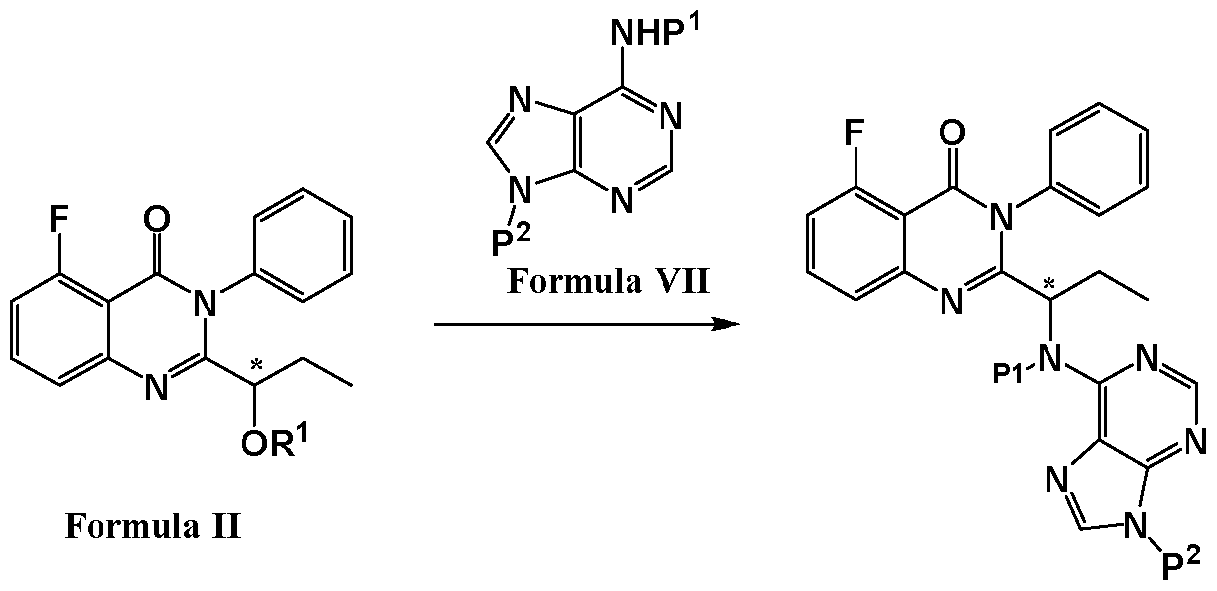
Formula I-A
The 6-Amino purine of compound of formula VII can also exist as compound of formula VN'or a mixture of compound of formula VII and VII'

Formula VII Formula VII'
In another embodiment, before reacting with compound of formula VII, the compound of formula II may be hydrolyzed. In one embodiment, 1 -(5-fluoro-4-oxo-3- phenyl-3,4-dihydroquinazolin-2-yl)propyl acetate is hydrolyzed to get 5-fluoro-2-(1 - hydroxypropyl)-3-phenylquinolin-4(3H)-one.
In another embodiment, the P1 of compound of formula VII is tert.- butyloxycarbonyl and P2 is triphenylmethyl, and the compound of formula VII is tert- butyl-(9-trityl-9H-purin-6-yl)carbamate; and the compound of formula VII' is tert-butyl (7- trityl-7H-purin-6-yl)carbamate.
The compound of formula II is reacted with compound of formula VII using a suitable nucleophilic displacement reaction such as 'Mitsunobu reaction'. The reaction is carried out in a suitable solvent. The solvent that can be usedinclude,but or not limited to, hydrocarbon solvents such as n-hexane, n-heptane, cyclohexane, toluene, or the like; a halogenated hydrocarbon solvent such as dichloromethane, ethylene dichloride, chloroform, or the like; ether solvents such as diethyl ether, methyl tert-butyl ether, tetrahydrofuran, 2-methyl tetrahydrofuran, or the like; a nitrile solvent such as acetonitrile, propionitrile, or the like; aprotic polar solvents such as N,N- dimethylformamide (DMF), dimethylsulfoxide (DMSO), dimethylacetamide (DMA), or the like; or mixtures thereof.
The reaction is carried out at ambient temperature or at elevated temperature. The higher limit is not specifically limited, but is generally 130°C, preferably 80°C. After completion of the reaction, the reaction mass may be concentrated and the inorganic salts are separated to get compound of formula l-A.
The compound of formula l-A can also exist as compound of formula l-B, or a mixture of compound of formula l-A and l-B.

Formula I-A Formula I-B
The application further provides a process for converting compound of formula I- A into idelalisib of formula I. For the conversion, a suitable method may be selected depending on the type of P1 and P2 which represent the N-protective group. For example when P1 and P2 are a protective group capable of being deprotected with an acid such as tert-butoxycarbonyl, benzyloxycarbonyl, triphenylmethyl, the reaction of the process may be attained by acid treatment as shown below.
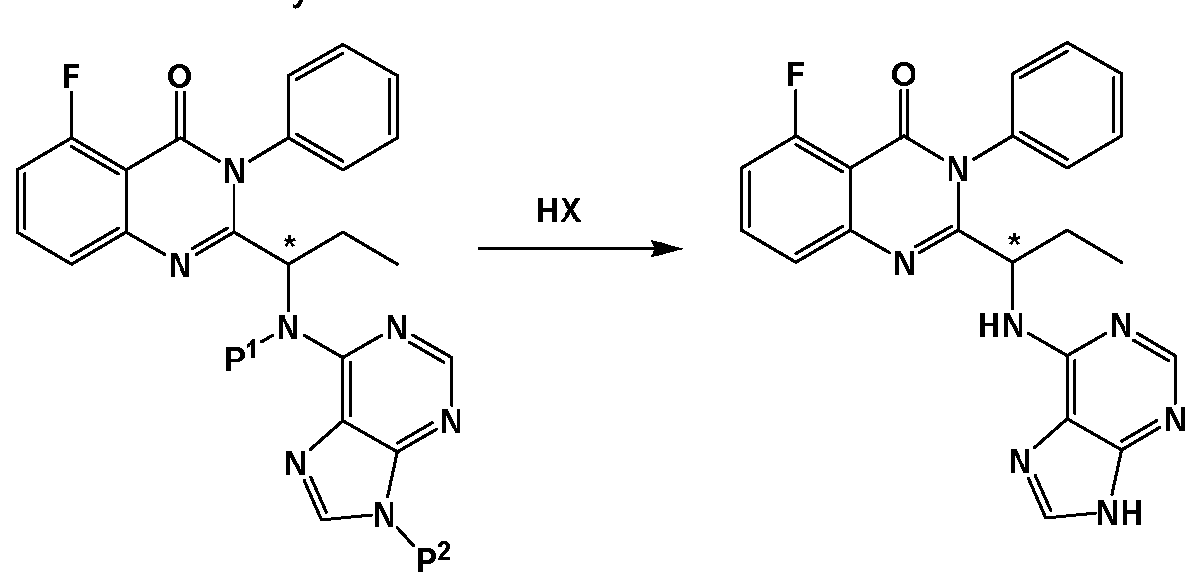
The acid to be used includes, for example, a mineral acid, a sulfonic acid, and a carboxylic acid. The mineral acid is not specifically limited, but includes hydrogen halides such as hydrogen chloride, and hydrogen bromide; sulfuric acid; phosphoric acid. The sulfonic acid is not specifically limited, but includes, for example, methane sulfonic acid, ethane sulfonic acid, benzenesulfonic acid, p-toluenesulfonic acid, camphorsulfonic acid, and 1 -phenylethanesulfonic acid. The carboxylic acid is not specifically limited, but includes, for example, formic acid, acetic acid and trifluoroacetic acid.
The amount of acid to be used may be at least a theoretical amount; but the use thereof in a large amount is not economical. Therefore the lower limit of the amount is generally not less than 1 mol equivalent, and the higher limit is generally not more than
10 mol equivalents, preferably not more than 3 mol equivalents, more preferably not more than 2 molequivalentsrelative to the compound of the formula (I).
The acid may be added directly as it is, or the aqueous solution or the solution in which the acid is previously dissolved in a solvent mentioned below may be used. The concentration of the acid to be added is not specifically limited, but the lower limit is generally 0.1 % by weight, preferably 1 % by weight, more preferably 5% by weight and the higher limit is 100% by weight.
The reaction is generally carried out in a solvent. The solvent is not specifically limited, but includes alcohols such as methanol, ethanol, isopropanol, n-propanol, tert- butanol; ethers such as tetrahydrofuran, diethyl ether, methyl tert-butyl ether, 1 ,3- dioxolan, 1 ,2-dimethoxy ethane, diethylene glycol dimethyl ether; and halogenated hydrocarbons such as dichloromethane, 1 ,2-dichloethane.
Among the above mentioned solvents alcohols are preferable from the view point of the high reactivity and the stability to acid.
In case where P1 and P2 are protective groups that could not be deprotected by acid, the compound is appropriately deprotected according to the type of the protective group to obtain idelalisib.
In another embodiment, the present application provides a process for preparation of Idelalisib, comprising:
(a) oxidizing a compound of formula II to get a compound of formula ll-A

wherein R1 is hydrogen.
(b) reacting a compound of formula ll-A with a compound of Formula Vll-A to form idelalisib.

Idelalisib
Step (a) of the process involves oxidation of the compound of formula II to form compound of formula ll-B. Typical reagents/methods that may be employed for this purpose include (but are not limited to) Swern oxidation, Oppenauer oxidation, sodium hypochlorite, manganese (IV) oxide, pyridinium chlorochromate, pyridinium dichromate, Jones reagent, 2-iodoxybenzoic acid and Dess-Martin periodinane (1 ,1 - dihydro-1 ,1 ,1 - triacetoxy-1 ,2-benzoiodooxol-3(1 H)-one). The oxidation is typically carried out in the presence of a solvent. The solvents that can be used include, but are not limited to, ethers such as diethyl ether, tetrahydrofuran (THF) and the like; halogenated solvent such as dichloromethane, ethylene dichloride, chloroform and the like; aprotic polar solvents such as Ν,Ν-dimethylformamide (DMF), dimethylsulfoxide (DMSO), dimethylacetamide (DMA), acetonitrile and the like; hydrocarbon solvents such as n- hexane, n-heptane, cyclohexane, toluene and the like and mixtures thereof. With Dess- Martin periodinane as the oxidizing agent, the solvent is preferably dichloromethane and the oxidation is carried out at a temperature from about -20°C to about 60°C (preferably from about 0°C to about 40°C).
After completion of the reaction the reaction mass may be diluted and washed with water. The reaction mass containing product is extracted with an organic solvent.
Step (b) of the process involves reaction of compound of formula ll-B with a compound of formula VII-A to form idelalisib. The reaction may be carried out in presence of a chiral agent.
In one embodiment, the present application provides a process for preparation of Idelalisib, comprising:
(a) reacting a compound of formula IX with a compound of formula VIII to form a compound of formula l-C, and

Formula I-C
(b) deprotecting the compound of formula l-C in which P1 and P2 represent
protecting groups to produce compound of formula l-E, and

Formula I-C Formula I-E
(c) reductively dehalogenating the compound of formula l-E in which R represents a halogen atom to produce Idelalisib.
Wherein, P1 and P2each independently represent a hydrogen atom or a protective group for the amino group; R represents hydrogen or a halogen atom such as fluorine, chlorine and bromine.
Step (a) of the process involves reaction of the compound of formula IX with a compound of formula VIII to form compound of formula l-C. In one embodiment P1 of compound of formula IX is 'tert-butyloxycarbonyl' and the compound is tert-butyl (S)-(1 - (5-fluoro-4-ox -3-phenyl-3,4-dihydroquinazolin-2-yl)propyl)carbamate

Formula I-C
The Chloropurine of compound of formula VIII can also exist as compound formula VIM' or a mixture of compound of formula VIII and VIM'

Formula VIII'
In another embodiment, before reacting with compound of formula VIII, the compound of formula IX may be deprotected. In one embodiment, tert-butyl (S)-(1 -(5- fluoro-4-oxo-3-phenyl-3,4-dihydroquinazolin-2-yl)propyl)carbamate is deprotected to get (S)-2-(1 -aminopropyl)-5-fluoro-3-phenylquinazolin-4(3H)-one.
In another embodiment, the P2 and R of compound of formula VIII represent hydrogen, and the compound of formula VIII is 6-chloro-7H-purine.
In another embodiment, the P2 of compound of formula VIII represents hydrogen and R represents chlorine, and the compound of formula VIII is 2,6-dichloro-7H-purine.
The compound of formula IX is reacted with compound of formula VIII using a suitable base and a suitable solvent. The base that can be used include, but or not limited to, triethylamine, Ν,Ν-dimethylamino pyridine, piperidine, NaHC03, Na2C03, K2C03, LiOH, NaOH, KOH and the like.
The solvent that can be used include, but or not limited to, hydrocarbon solvents such as n-hexane, n-heptane, cyclohexane, toluene, or the like; a halogenated hydrocarbon solvent such as dichloromethane, ethylene dichloride, chloroform, or the like; ether solvents such as diethyl ether, methyl tert-butyl ether, tetrahydrofuran, 2- methyl tetrahydrofuran, or the like; a nitrile solvent such as acetonitrile, propionitrile, or the like; aprotic polar solvents such as Ν,Ν-dimethylformamide (DMF), dimethylsulfoxide (DMSO), dimethylacetamide (DMA), or the like C1 -C5 alcohols such as isopropyl alcohol, n-Butyl alcohol, tert-Butyl alcohol or the like; or mixtures thereof.
The reaction is carried out at ambient temperature or at elevated temperature. The higher limit is not specifically limited, but is generally 130°C, preferably 100°C. After completion of the reaction, the reaction mass may be concentrated and crude compound can be purified to get compound of formula l-C.
In one embodiment 6-chloro-7H-purine of compound of formula VIII is reacted with (S)-2-(1 -aminopropyl)-5-fluoro-3-phenylquinazolin-4(3H)-one of compound of formula IX to produce Idelalisib.
The compound of formula l-C can also exist as compound of formula l-D, or a mixture of compound of formula l-C and l-D.

Formula I-D
Optionally the compound of formula l-C, in which P1 or P2 represents an amino protecting group and R represents hydrogen, is converted into idelalisib of formula I. For the conversion, a suitable method may be selected depending on the type of P1 and P2which represent the N-protective group. For example when P1 and P2 are a protective group capable of being deprotected with an acid such as tert-butoxycarbonyl, benzyloxycarbonyl, triphenylmethyl, the reaction of the process may be attained by acid treatment as shown below.

The acid to be used includes, for example, a mineral acid, and a sulfonic acid. The mineral acid is not specifically limited, but includes hydrogen halides such as hydrogen chloride, and hydrogen bromide; sulfuric acid; phosphoric acid. The sulfonic acid is not specifically limited, but includes, for example, methane sulfonic acid, ethane sulfonic acid, benzenesulfonic acid, p-toluenesulfonic acid, camphorsulfonic acid, and 1 - phenylethanesulfonic acid.
The amount of acid to be used may be at least a theoretical amount; but the use thereof in a large amount is not economical. Therefore the lower limit of the amount is generally not less than 1 mol equivalent, and the higher limit is generally not more than 10 mol equivalents, preferably not more than 3 mol equivalents, more preferably not more than 2 mol equivalents relative to the compound of the formula (I).
The acid may be added directly as it is, or the aqueous solution or the solution in which the acid is previously dissolved in a solvent mentioned below may be used. The concentration of the acid to be added is not specifically limited, but the lower limit is generally 0.1 % by weight, preferably 1 % by weight, more preferably 5% by weight and the higher limit is 100% by weight.
The reaction is generally carried out in a solvent. The solvent is not specifically limited, but includes alcohols such as methanol, ethanol, isopropanol, n-propanol, tert- butanol; ethers such as tetrahydrofuran, diethyl ether, methyl tert-butyl ether, 1 ,3- dioxolan, 1 ,2-dimethoxy ethane, diethylene glycol dimethyl ether; and halogenated hydrocarbons such as dichloromethane, 1 ,2-dichloethane.
Among the above mentioned solvents alcohols are preferable from the view point of the high reactivity and the stability to acid.
In case where P1 and P2 are protective groups that could not be deprotected by acid, the compound is appropriately deprotected according to the type of the protective group to obtain idelalisib.
The compound of formula l-E, in which R represents a halogen atom such as fluorine, chlorine and bromine, is converted into Idelalisib by reductively dehalogenating the compound of formula l-

Formula I-E
The dehalogenation reaction is carried out using a noble metal catalyst such ium, platinum and nickel, and hydrogen gas.
In another embodiment, the present application provides a process for preparation of idelalisib, comprising:
(a) reacting 2-Fluoro-6-nitrobenzoic acid or its acid chloride of compound of formula XII with aniline to form a compound of formula XI,

Formula XII Formula XI
(b) reacting the compound of formula XI with thionyl chloride and subsequently with amino protected L-2-aminobutyric acid to form a compound of formula X,

(c) reacting the compound of formula X with Zinc dust in presence of acetic acid to get compound of formula IX,

(d) optionally deprotecting the compound of formula IX in which P1 represents an amino protecting group,
(e) reacting the compound of formula IX with a compound of formula VIII to form a compound of formula l-C, and

Formula I-C
(f) deprotecting the compound of formula l-C in which P1 and P2 represent amino protecting groups to produce compound of formula l-E, and

Formula I-C Formula I-E
(g) dehalogenating the compound of formula l-E in which R represents a halogen to produce Idelalisib.
wherein, P1 and P2 each independently represent a hydrogen atom or a protective group for the amino group; R represents a hydrogen atom or a halogen atom such as fluorine, chlorine and bromine.
The protective group for the amino group is a group for protecting an amino group. As the groups to be generally used, the protective groups described in PROTECTIVE GROUPS IN ORGANIC SYNTHESIS 4th Ed. (published by JOHN WILEY & SONS in 2006) can be used.
The step (a) of the process involves reaction of 2-Fluoro-6-nitrobenzoic acid or its acid chloride of compound of formula XII with aniline to form compound of formula XI.

Formula ΧΠ Formula XI
Compound of formula XII is obtained by any process including processes described in the art, or by a process described in this application.
In one embodiment the compound of formula XII is obtained by reacting 2- Fluoro-6-nitrobenzoic acid with thionyl chloride.
The reaction is carried out at a temperature about 30°C to about 120°C, preferably at about 50°C to about 100°C. After completion of the reaction, the product is isolated by filtration of the mass, or the reaction mass containing product is extracted
with an organic solvent. The product may be isolated by removing solvent from the resulting organic solvent extraction or may be used directly in the next step.
The acid chloride intermediate is reacted with aniline in presence of a suitable aqueous base such as aqueous NaOH or aqueous NaHC03. The reaction is carried out at a temperature about 10°C to about 50°C. After completion of the reaction, the reaction mass is diluted with water, the product is isolated by filtration of the mass, or the reaction mass containing product is extracted with an organic solvent. The product may be isolated by removing solvent from the resulting organic solvent extraction or may be used directly in the next step.
Step (b) of the process involves reaction of the compound of formula XI with thionyl chloride to form an imidoyl chloride intermediate.

The reaction is carried out at a temperature about 30°C to about 120°C, preferably at about 50°C to about 100°C. After completion of the reaction, the product is isolated by filtration of the mass, or the reaction mass containing product is extracted with an organic solvent. The product may be isolated by removing solvent from the resulting organic solvent extraction or may be used directly in the next step.
The imidoyl chloride intermediate is reacted with amino protected L-2- aminobutyric acid in presence of a suitable bases include, but are not limited to, triethylamine, diisopropylethylamine, dimethylaminopyridine and 2,6-lutidine. Suitable solvents include, but are not limited to, dichloromethane, THF and 2-Me THF.
In one embodiment the amino protected L-2-aminobutyric acid is N-Boc-L-2- aminobutyric acid. The reaction is carried out at a temperature about 10°C to about 50°C. After completion of the reaction, the mass is diluted with water and the product is isolated by filtration of the mass, or the reaction mass containing product is extracted with an organic solvent. The product may be isolated by removing solvent from the resulting organic solvent extraction or may be used directly in the next step.
Step (c) of the process involves reaction of the compound of formula X with Zinc dust in presence of acetic acid to form compound of formula IX.

In one embodiment, the P1 of compound of formula X is tert.-butyloxycarbonyl and the compound of formula X is tert-butyl (S)-(1 -(2-fluoro-6-nitro-N- phenylbenzamido)-1 -oxobutan-2-yl)carbamate.
The compound of formula X is reacted with Zinc dust in presence of acetic acid at about 10°C to about 30°C over a period of about 2 hours to 20 hours. The reaction mass is concentrated completely and the crude mass is dissolved in water and basified using a suitable base and the aqueous layer is extracted with an organic solvent. The product may be isolated by removing solvent from the resulting organic solvent extraction or may be used directly in the next step.
Step (d) involves deprotection of P1 of compound of formula IX. If the P1 represents an amino protecting group such as tert-butyloxycarbonyl (Boc), the compound of formula IX is deprotected.
Step (e) to step (f) of the process are carried out as discussed above.
Idelalisib prepared according to the processes described above may be contaminated with the intermediate compound of formula IX and 6-chloropurine. To remove these impurities, particularly the compound of formula IX, idelalisib is treated with an acid in a suitable solvent to form an acid addition salt. Both idelalisib and the compound of formula IX form salts with acids. Because of differentiation in solubility of the salts of idelalisib and the compound of formula IX, the salt of idelalisib can be isolated easily, and then liberating the pure idelalisib by the process described in this application.
In another embodiment, the present application provides novel intermediate of the compound of formula l-C

Formula I-C wherein, P1 and P2 each represent a protective group for the amino group; R represents a hydrogen atom or a halogen atom such as fluorine, chlorine and bromine.
In another embodiment, the present application provides use of the compound of formula l-C in the synthesis of idelalisib.
In another embodiment, the present application provides novel intermediates of the compounds of formula l-A, l-B, I I, l l-A, II I, IV, VII and formula VII'.


In another embodiment, the present application provides use of the compounds of formula l-A, II, ll-B, III, IV and formula VII in the synthesis of idelalisib.
In another embodiment, the present application provides use of Idelalisib prepared by the process disclosed above in the preparation of a pharmaceutical composition for the treatment of cancer.
In an embodiment, Idelalisib may be re-crystallized by any of the suitable techniques which include but not limited to cooling the reaction mass, removal of solvent, combining with an anti-solvent, etc., or any combination of techniques thereof.
Re-crystallization by cooling crystallization which includes, but not limited to: crystallization by controlled cooling or crash cooling of the reaction mass and methods similar thereof.
Re-crystallization by solvent removal includes, but not limited to: solvent evaporation under atmospheric pressure or under reduced pressure / vacuum, spray drying, freeze drying and the like.
Re-crystallization by combining reaction mass with an anti-solvent wherein anti- solvent is a solvent in which Idelalisib has low solubility. Anti-solvents include, but not limited to: C2-C6 aliphatic or cyclic ethers; C5-C8 aliphatic or aromatic hydrocarbons; water or mixtures thereof.
Idelalisib obtained according to the process of present application may be having purity of greater than about 99% or greater than about 9.5%, specifically greater than about 99.9 % and the impurities are at the acceptable limit as measured by HPLC.
Idelalisib or the intermediates obtained according to the aspects of present application may be in either crystalline or amorphous state.
In another aspect, the present application provides, Idelalisib obtained according to the processes of the present application may be milled or micronized by any of the processes known in the art, such as ball milling, jet milling, wet milling and the like, to produce desired particle sizes and particle size distributions.
In another embodiment, the present application provides use of Idelalisib prepared by the process disclosed above in the preparation of a pharmaceutical composition for the treatment of cancer.
In another aspect, the present application provides a pharmaceutical composition comprising idelalisib prepared by the processes described herein.
Definitions
The following definitions are used in connection with the present application unless the context indicates otherwise. Polymorphs are different solids sharing the same molecular formula, yet having distinct physical properties when compared to other polymorphs of the same formula. The abbreviation "MC" mean moisture content. Moisture content can be conveniently measured, for example, by the Karl Fischer method.
The term "about" when used in the present invention preceding a number and referring to it, is meant to designate any value which lies within the range of ±10%,preferably within a range of ±5%, more preferably within a range of ±2%, still more preferably within a range of ±1 % of its value. For example "about 10" should be construed as meaning within the range of 9 to 1 1 , preferably within the range of 9.5to 10.5, more preferably within the range of 9.8 to 10.2, and still more preferably within the range of 9.9 to 10.1 .
All percentages and ratios used herein are by weight of the total composition, unless the context indicates otherwise. All temperatures are in degrees Celsius unless specified otherwise and all measurements are made at 25°C and normal pressure unless otherwise designated. The present disclosure can comprise the components discussed in the present disclosure as well as other ingredients or elements described herein.
As used herein, "comprising" means the elements recited, or their equivalents in structure or function, plus any other element or elements which are not recited. The terms "having" and "including" are also to be construed as open ended unless the context suggests otherwise.
Terms such as "about," "generally," "substantially," or the like are to be construed as modifying a term or value such that it is not an absolute. Such terms will be defined by the circumstances and the terms that they modify, as those terms are understood by those of skill in the art. This includes, at very least, the degree of expected experimental error, technique error and instrument error for a given technique used to measure a value.
When a molecule or other material is identified herein as "pure", it generally means, unless specified otherwise, that the material is 99% pure or more, as determined by methods conventional in art such as high performance liquid chromatography (HPLC) or optical methods. In general, this refers to purity with regard to unwanted residual solvents, reaction byproducts, impurities, and unreacted starting materials. In the case of stereoisomers, "pure" also means 99% of one enantiomer or diastereomer, as appropriate. "Substantially" pure means, the same as "pure except that the lower limit is about 98% pure or more and likewise, "essentially" pure means the same as "pure" except that the lower limit is about 95% pure.
Certain specific aspects and embodiments of the present application will be explained in greater detail with reference to the following examples, which are provided only for purposes of illustration and should not be construed as limiting the scope of the application in any manner. Variations of the described procedures, as will be apparent to those skilled in the art, are intended to be within the scope of the present application.
The invention is further defined by reference to the following examples describing in detail the processes of the invention. It will be apparent to those skilled in the art that many modifications, both to materials and methods, may be practiced without departing from the scope of the invention.
Idelalisib and its intermediates can be analyzed using HPLC equipped with variable wavelength UV-detector and the parameters described below:

Mobile Phase B : Acetonitrile
Gradient Program:

Idelalisib and its intermediates can be analyzed using chiral HPLC equipped with UV- detector and the parameters described below:
For Compound of Formula IX

For Compounds of Formulae II
Column CHIRALPAK IC-3 (150x4.6mm, 3μιη).
Detector Wavelength 210nm or 220nm
Flow rate 1 .OmL/min
Buffer Preparation —
Mobile Phase A n-Hexane
Mobile Phase B Ethanol
Isocratic A:B(75:25)
EXAMPLES
Example 1 : Preparation of DL-2-acetoxybutanoic acid

DL-2-aminobutyric acid (1 1 gm, 0.106 mol) and acetic acid (330 mL) were charged into 500 mL round bottom flask. The obtained white suspension was cooled to 15°C and sodium nitrite (14.7 gm, 0.213 mol) was added slowly. The resultant mixture was stirred for 30 minutes at 15°C. Then the reaction mixture was heated to 25°C and stirred for 4 hours. The reaction mixture was concentrated completely under vacuum at 50°C to get crude. Toluene (50 mL) was added the crude and concentrated completely under vacuum at 50°C. The resultant crude was dissolved in water (100 mL) and the solution was extracted with diethyl ether (3X 70 mL). The combined organic layer was washed with water (3X 50 mL) and brine (50 mL). The organic layer was dried with sodium sulphate and evaporated under reduced pressure to obtain 5.8 gm of title product as a pale yellow liquid.
Example 2: Preparation of DL-2-hydroxybutanoic acid

DL-2-aminobutyric acid (50 gm, 0.484 mol) and 0.5 N sulfuric acid (95 gm in 1937 mL of water) were charged into 1000 mL round bottom flask and the resulted solution was heated to 60°C. Sodium nitrite (200.5 gm, 2.906 mol) was added slowly over a period of one hour and the resultant mixture was stirred for 4 hours at 60°C. The reaction mixture was allowed to cool to 25°C and stirred for 16 hours at 25°C. Sodium
sulphate (400 gm) was added to the reaction mixture and stirred for 10 minutes. The mixture was extracted with ethylacetate (5X 600 mL). The combined organic layer was dried with sodium sulphate and concentrated completely under reduced pressure. The resultant crude was triturated with hexane (100 mL) at 0°C to obtain 34.2 gm of title compound as an off-white solid.
Example 3: Preparation of DL-2-acetoxybutanoic acid

DL-2-hydroxybutanoic acid (33 gm, 0.316 mol) and Pyridine (165 mL) were charged into 500 mL round bottom flask and the resulted solution was cooled to 0°C. Acetic anhydride (44.85 mL, 0.474 mol) was added slowly over a period of 20 minutes and the resulted reaction mixture was stirred for 30 minutes at 0°C. The reaction mixture was heated to 25°C and stirred for 16 hours. The reaction mixture was concentrated completely under reduced pressure at 50°C. The crude was dissolved in water (150 mL) and the solution was extracted with ethylacetate (4 x 250 mL). The combined organic layer was washed with water (500 mL) and brine (300 mL). The organic layer was dried with sodium sulphate and concentrated completely under reduced pressure to obtain 42 gm of title compound as pale yellow liquid.
Example 4: Preparation of2-(2-acetoxybutanamido)-6-fluorobenzoic acid

DL-2-acetoxybutanoic acid (2.7 gm, 0.0174 mol) and dichloromethane (30 mL) were charged into 100 mL round bottom flask. The resulted solution was cooled to 0°C then oxalyl chloride (3.36 mL, 0.039 mol) was added slowly over a period of 10 minutes. The resultant mixture was stirred at 0°C for 30 minutes and heated to 25°C and stirred for 2 hours. The reaction mass was concentrated completely under reduced pressure. The crude acid chloride was dissolved in dichloromethane (20 mL). 2-Amino-6-
fluorobenzoic acid (2.7 gm, 0.0174 mol) and dichloromethane (30 ml_) were charged into another 100 ml_ round bottom flask and the resulted suspension was cooled to 0°C. Triethylamine (9.42 ml_, 0.068 mol) was added then the solution of acid chloride in dichloromethane was added slowly over a period of 15 minutes. The reaction mixture was stirred for 16 hours at 25°C. The reaction mixture was diluted with ethyl acetate (100 ml_) and washed with 1 N hydrochloric acid (20 ml_), water (2X 15 ml_) and brine (2X 15 ml_). The organic layer was dried with sodium sulphate and concentrated completely under reduced pressure. The resulted crude was dissolved in ethyl acetate (200 ml_) and activated charcoal (1 gm) was added and the resulting suspension was heated to 50°C. The hot suspension was filtered and the filtrate was concentrated completely under reduced pressure. The crude product was triturated with 10% ethylacetate- hexane (100 ml_) to obtain 3.25 gm of the title product as pale yellow solid.
Example 5: Preparation of 1-(5-fluoro-4-oxo-3-phenyl-3,4-dihydroquinazolin-2- yl)propyl acetate

2-(2-acetoxybutanamido)-6-fluorobenzoic acid (2.5 gm, 8.833 mmol) and acetonitrile (25 ml_) were charged into 100 ml_ round bottom flask. Aniline (1 .1 gm, 1 1 .749 mmol) was added then PC (1 .54 ml_, 17.666 mmol) was added slowly over a period of 10 minutes. The resultant suspension was heated to 50°C and stirred for 3 hours. The reaction mixture was allowed to cool to 25°C and stirred for 16 hours. The reaction mixture was diluted with ethyl acetate (100 ml_) and quenched with 1 N hydrochloric acid. Organic layer was separated and aqueous layer was extracted with ethyl acetate (2X 50 ml_). The combined organic layers were washed with water (20 ml_) and brine (2>20 ml_). The organic layer was dried with sodium sulphate and concentrated completely under reduced pressure to obtain 3.012 gm of the title product as pale yellow solid. Purity: 98.42% by HPLC
Example 6: Preparation of5-fluoro-2-(1-hydroxypropyl)-3-phenylquinazolin-4(3H)- one
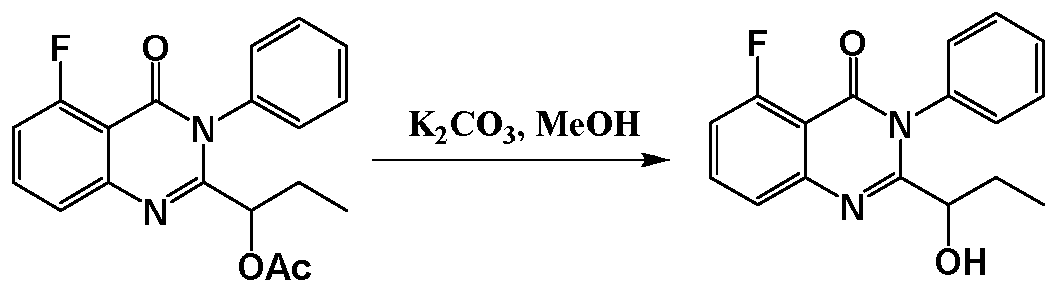
1 -(5-fluoro-4-oxo-3-phenyl-3,4-dihydroquinazolin-2-yl)propyl acetate (3 gm, 8.823 mmol) and methanol (30 mL) were charged into 100 mL round bottom flask. Potassium carbonate (1 .52 gm, 1 1 .029 mmol) was added and the resultant mixture was stirred at 25°C for 3 hours. The reaction mixture was diluted with water (70 mL) and stirred at 25°C for 30 minutes. The precipitated product was filtered and washed with water (3X20 mL) and dried under vacuum for 1 hour to obtain 2 gm of the title compound.
Purity: 99.87% by HPLC.
Example 7: Preparation of 9-trityl-9H-purin-6-amine

Adenine (3 gm, 0.022 mol) and 1 :3 DMF-pyridine (88 mL) were charged under nitrogen atmosphere into a 250 mL round bottom flask. Trityl chloride (6.18 gm, 0.022 mol) was added. The reaction mixture was stirred at 25°C for 16 hours. The reaction mixture was diluted with ethyl acetate (200 mL) and washed with water (200 mL). The aqueous layer was extracted with ethyl acetate (2X50 mL). Then the combined organic layers were washed with water (4X 100 mL) and brine (100 mL). The organic layer was dried with sodium sulphate and concentrated completely under reduced pressure. The crude was triturated with 10% ethylacetate-hexane (100 mL) to obtain 3.97 gm of the title product as off-white solid.
Purity: 98.82 by HPLC.
Example 8: Preparation of di-tert-butyl (9-trityl-9H-purin-6-yl)-di-carbamate

Purity: 91 .52% by HPLC.
Example 9: Preparation of tert-butyl (9-trityl-9H-purin-6-yl)carbamate

The Di-Boc compound of example 8 (5 gm, 8.665 mmol) and methanol (80 ml_) were charged into a 250 ml_ round bottom flask. Potassium carbonate (3.58 gm, 25.986 mmol) was added and the resulted mixture was heated to 50°C and stirred for six hours. The reaction mixture was cooled to 25°C and evaporated completely under reduced pressure at 40°C. The resultant residue was diluted with ethylacetate (200 ml_) and the solution was washed with water (2X 50 ml_) and brine (50 ml_). The organic layer was dried with sodium sulphate and concentrated completely under reduced pressure. The crude was triturated with 10% ethylacetate-hexane (100 ml_) to obtain 2.2 gm of the title mono-Boc product as off-white solid.
Example 10: Preparation of(±)-tert-butyl (1 -(5-fluoro-4-oxo-3-phenyl-3,4- dihydroquinazolin-2-yl)propyl)(9-trityl-9H-purin-6-yl)carbamate

tert-butyl (9-trityl-9H-purin-6-yl)carbamate (2 gm, 4.192 mmol), (±)-5-fluoro-2-(1 - hydroxypropyl)-3-phenylquinazolin-4(3H)-one (1 .87 gm, 6.287 mmol), triphenyl phosphine (1 .64 gm, 6.287 mmol) and THF (100 mL) were charged into a 250 mL round bottom flask. The resultant solution was heated to 45°C and Diisopropylazodicarboxylate (DIAD, 1.24 mL, 6.287 mmol) was added. The resultant reaction mixture was stirred for five hours at 45°C. The reaction mixture was cooled to 25°C and stirred for 16 hours at 25°C. The reaction mixture was cooled to 25°C and evaporated completely under reduced pressure at 40°C. Inorganic solids were removed from the crude mixture by column chromatography using silica gel (100-200 mesh, 1 :1 ethylacetate-hexane to give 5 gm of the title compound as colorless thick liquid.
Example 11 : Preparation of (±)-ldelalisib

5 gm of the compound prepared in example 10 and DCM (30 mL) were charged into a 250 mL round bottom flask. The contents of the flask were cooled to 0°C and trifluoro acetic acid (30 mL) was added. The resultant reaction mixture was stirred at 0°C for 15 minutes. The reaction mixture was heated to 25°C and stirred for 3 hours. The reaction mixture was evaporated completely under reduced pressure at 40°C. The resultant residue was diluted with ethylacetate (150 mL) and the solution was washed with saturated NaHC03 solution (50 mL). The organic layer was filtered through a celite
pad and the pad was washed with ethylacetate (50 mL). The combined filtrates were washed with water (50 mL) and brine (50 mL) and dried over sodium sulphate and concentrated completely under reduced pressure to yield 1 .1 gm of racemic idelalisib as an off-white solid.
Example 12: Preparation of (±)-1-(5-fluoro-4-oxo-3-phenyl-3,4-dihydroquinazolin-2- yl)propyl methanesulfonate

(±)-5-fluoro-2-(1 -hydroxypropyl)-3-phenylquinazolin-4(3H)-one (200 mg, 0.671 mmol) and DCM (8 mL) were charged into a 50 mL round bottom flask. The contents of the flask were cooled to 0°C. Triethylamine (0.18 mL, 1 .342 mmol) and Mesyl chloride (78 μί, 1 .006 mmol) were added. The reaction mixture was stirred at 0°C for 20 minutes. The reaction mixture was heated to 25°C and stirred for 4 hours. The reaction mixture was diluted with DCM (20 mL) and the solution was washed with water (5 mL) and with brine (5 mL) and dried over sodium sulphate and concentrated completely under reduced pressure. The crude product was triturated with hexane (10 mL) to obtain 200 mg of the title product as off-white solid.
Purity: 99.14% by HPLC.
Example 13: Preparation of (t)-tert-butyl (1-(5-fluoro-4-oxo-3-phenyl-3,4- dihydroquin zolin-2-yl)propyl)(9-trityl-9H-purin-6-yl)carbamate

tert-butyl (9-trityl-9H-purin-6-yl)carbamate (100 mg, 0.209 mmol), (±)-1 -(5-fluoro- 4-oxo-3-phenyl-3,4-dihydroquinazolin-2-yl)propylmethanesulfonate (95 mg, 0.251 mmol) and 1 :1 DMF-MeCN (5 mL) were charged into a 50 mL round bottom flask. Cesium
carbonate (170 mg, 0.522 mmol) was added to the resultant mixture. The reaction mixture was heated to 80°C and stirred for 6 hours. The reaction mixture was cooled to 25°C and stirred for 16 hours. The reaction mixture was evaporated completely under reduced pressure at 40°C. The resultant residue was diluted with ethylacetate (20 mL) and the solution was washed with water (2X10 mL) and brine (10 mL). The organic layer was dried with sodium sulphate and concentrated completely under reduced pressure to yield 170 mg of title compound as thick mass.
Example 14: Preparation of2-(1-((9H-purin-6-yl)amino)propyl)-5-fluoro-3- phenylquinazolin-4(3H)-one ((±)-ldelalisib)

170 mg of the compound prepared in example 13 and DCM (1 mL) were charged into a 25 mL round bottom flask. The contents of the flask were cooled to 0°C and trifluoro acetic acid (1 mL) was added. The resultant reaction mixture was stirred at 0°C for 15 minutes. The reaction mixture was heated to 25°C and stirred for 2 hours. The reaction mixture was evaporated completely under reduced pressure at 40°C. The resultant residue was diluted with ethylacetate (20 mL) and the solution was washed with saturated NaHC03 solution (5 mL). The organic layer was filtered through a celite pad and the pad was washed with ethylacetate (2 mL). The combined filtrates were washed with water (2X 5 mL) and brine (5 mL) and dried over sodium sulphate and concentrated completely under reduced pressure to yield 33 mg of racemic idelalisib as an off-white solid. Purity: 98.99% by HPLC.
Example 15: Preparation of5-fluoro-3-phenyl-2-propionylquinazolin-4(3H)-one

Purity: 96.92% by HPLC.
Example 16: Preparation of (R)-2-hydroxybutanoic acid

D-2-aminobutyric acid (10 gm, 0.096 mol) and aqueous sulfuric acid (5.15 mL in 300 mL of water) were charged into 1000 mL round bottom flask and the resulted solution was heated to 60°C. Sodium nitrite (40.1 gm, 0.581 mol) was added slowly over a period of one hour and the resultant mixture was stirred for 30 minutes at 60°C. The reaction mixture was allowed to cool to 25°C and stirred for 16 hours at 25°C. Sodium sulphate (50 gm) was added to the reaction mixture and stirred for 10 minutes. The mixture was extracted with ethylacetate (4X 150 mL). The combined organic layer was dried with sodium sulphate and concentrated completely under reduced pressure. The resultant crude was triturated with hexane (15 mL) at 0°C to obtain 5.5 gm of title compound as an off-white solid.
Example 17: Preparation of (R)-2-acetoxybutanoic acid
 (R)-2-hydroxybutanoic acid (4.2 gm, 0.040 mol) and Pyridine (21 mL) were charged into 500 mL round bottom flask and the resulted solution was cooled to 0°C. Acetic anhydride (5.71 mL, 0.060 mol) was added slowly over a period of 10 minutes and the resulted reaction mixture was stirred for 30 minutes at 0°C. The reaction mixture was heated to 25°C and stirred for 16 hours. The reaction mixture was concentrated completely under reduced pressure at 50°C. The crude was added to a mixture of water (60 mL) and 1 N aqueous HCI; and the solution was extracted with ethylacetate (3 X 40 mL). The combined organic layer was washed with water (20 mL) and brine (20 mL). The organic layer was dried with sodium sulphate and concentrated completely under reduced pressure to obtain 5.5 gm of title compound as pale yellow liquid.
Example 18: Preparation of (R)-2-(2-acetoxybutanamido)-6-fluorobenzoic acid

(R)-2-acetoxybutanoic acid (5.5 gm, 0.032 mol) and dichloromethane (44 mL) were charged into 250 mL round bottom flask and the resulted solution was cooled to 0°C.Oxalyl chloride (4.19 mL, 0.048 mol) was added slowly over a period of 10 minutes. The resultant mixture was stirred at 0°C for 30 minutes and heated to 25°C and stirred for 2 hours. The reaction mass was concentrated completely under reduced pressure. The crude acid chloride was dissolved in dichloromethane (22 mL). 2-Amino-6- fluorobenzoic acid (5.02 gm, 0.032 mol) and DMF (1 1 mL) were charged into another 100 mL round bottom flask and the resulted suspension was cooled to 0°C. The solution of acid chloride in dichloromethane was added slowly over a period of 15 minutes. The reaction mixture was stirred for 2 hours at 25°C. The reaction mixture was concentrated under reduced pressure to remove dichloromethane. 1 N HCI (22 mL) and water (100 mL) were added to the crude and the resulted heterogeneous mixture was stirred vigorously for 30 minutes. The resulted solution was seeded with (R)-2-(2- acetoxybutanamido)-6-fluorobenzoic acid (20 mg) and stirred for 30 minutes. The
suspension was filtered and the wet material was washed with water (50 mL) to obtain 6.3 gm of the title product as pale yellow solid.
Purity: 95.27% by HPLC.
Example 19: Preparation of (R)-1-(5-fluoro-4-oxo-3-phenyl-3,4-dihydroquinazolin- 2-yl)propyl acetate

(R)-2-(2-acetoxybutanamido)-6-fluorobenzoic acid (6 gm, 0.021 mol) and acetonitrile (60 mL) were charged into 250 mL round bottom flask. Aniline (2.62 gm, 0.028 mol) was added then PCI3 (3.74 mL, 0.042 mol) was added slowly over a period of 10 minutes. The resultant suspension was heated to 50°C and stirred for 3 hours. The reaction mixture was allowed to cool to 25°C and stirred for 5 hours. The reaction mixture was quenched with water (20 mL) and concentrated completely under reduced pressure. The crude was diluted with ethylacetate (200 mL) and washed with 1 N HCI (50 mL), water (2X25 mL), sat. NaHC03 (50 mL) and brine (2*25 mL). The organic layer was dried with sodium sulphate and concentrated completely under reduced pressure to obtain 7.2 gm of the title product as pale yellow sticky liquid. Purity: 72.36% by HPLC. Example 20: Preparation of (R)-5-fluoro-2-(1 -hydroxypropyl)-3-phenylquinazolin- 4(3H)-one

(R)-1 -(5-fluoro-4-oxo-3-phenyl-3,4-dihydroquinazolin-2-yl)propyl acetate (7.2 gm, 0.021 1 mol) and methanol (36 mL) were charged into 100 mL round bottom flask. Potassium carbonate (3.79 gm, 0.0275 mol) was added and the resultant mixture was stirred at 25°C for 30 minutes. The reaction mixture was diluted with water (150 mL) and stirred at 25°C for 30 minutes. The precipitated product was filtered and washed with
water (50 mL) and dried under vacuum for 1 hour to obtain 4.5 gm of the title compound.
Purity: 99.21 % by HPLC.
Example 21 : Preparation of (S)-tert-butyl (1-(5-fluoro-4-oxo-3-phenyl-3,4- dihydroquin zolin-2-yl)propyl)(9-trityl-9H-purin-6-yl)carbamate

tert-butyl (9-trityl-9H-purin-6-yl)carbamate (1 gm, 2.096 mmol), (R)-5-fluoro-2-(1 - hydroxypropyl)-3-phenylquinazolin-4(3H)-one (0.937 gm, 3.144 mmol), triphenyl phosphine (0.824 gm, 3.144 mmol) and THF (100 mL) were charged into a 250 mL round bottom flask. The resultant solution was heated to 45°C and Diisopropylazodicarboxylate (DIAD, 0.62 mL, 3.144 mmol) was added. The resultant reaction mixture was stirred for five hours at 45°C. The reaction mixture was cooled to 25°C and stirred for 16 hours. The reaction mixture was evaporated completely under reduced pressure at 40°C. Inorganic salts were removed from the crude mixture by column chromatography using silica gel (100-200 mesh, 1 :1 ethylacetate-hexane to give 2 gm of the title compound as pale yellow thick liquid.
Example 22: Preparation of Idelalisib

2 gm of the compound prepared in example 21 and DCM (10 mL) were charged into a 100 mL round bottom flask. The contents of the flask were cooled to 0°C and
trifluoroacetic acid (10 mL) was added. The resultant reaction mixture was stirred at 0°C for 15 minutes. The reaction mixture was heated to 25°C and stirred for 2 hours. The reaction mixture was evaporated completely under reduced pressure at 40°C. The resultant residue was diluted with ethylacetate (50 mL) and the solution was washed with saturated NaHC03 solution (20 mL). The organic layer was filtered through a celite pad and the pad was washed with ethylacetate (10 mL). The combined filtrates were washed with water (2X 10 mL) and brine (20 mL) and dried over sodium sulphate and concentrated completely under reduced pressure to yield 525 mg of idelalisib as pale yellow solid.
Purity: 96.87% by HPLC
Example 23: Preparation of 2-Fluoro-6-nitro-N-phenylbenzamide (compound of formula XI)

Fomula ΧΠ Formula XI
2-Fluoro-6-nitrobenzoic acid (20 g), thionyl chloride (20 mL) and N,N- dimethylformamide (0.3 mL) were charged into a 250 mL round bottom flask. The mixture was heated to 85 °C and maintained for 3 hours at 85 °C. The reaction mixture was concentrated completely under vacuum and aqueous NaHC03 (27. 22 g of NaHC03 was dissolved in 100 mL of water) was added to the residue. Aniline (10.74 mL) was charged to the reaction mass and the mass was stirred for 2 hours at 30 °C. The reaction mass was diluted with water (300 mL) and stirred for 20 minutes. The suspension was filtered and material was dried in an oven at 45-50 °C
Wet weight: 40 g; dry weight: 26 g; yield: 92.49%; purity: 99.89% by HPLC.
Example 24: Preparation of tert-butyl (S)-(1-(2-fluoro-6-nitro-N-phenylbenzamido)- 1-oxobutan- -yl)carbamate (compound of formula X)

Example 25: Preparation of tert-butyl (S)-(1-(5-fluoro-4-oxo-3-phenyl-3,4- dihydroquinazolin-2-yl)propyl)carbamate (compound of formula IX)

Compound of formula X (40 g crude) and acetic acid (400 mL) were charged into a 2L round bottom flask and the mixture was cooled to 15 °C. Activated Zinc powder (35.22 g) was added portion wise over a period of 30 minutes and the mass was stirred for 20 hours at 20 °C. The reaction mass was filtered through a celite bed and the bed was washed with acetic acid (200 mL). The mass was concentrated completely under reduced pressure and the residue was dissolved in water (300 mL). The solution was basified with solid NaHCO3 (70 g) and extracted with ethylacetate (2X 400 mL). The organic layer was water (2X 300 mL) and brine solution (200 mL) and dried over anhydrous sodium sulphate (51 g) and concentrated completely under reduced
pressure to yield 31 g of crude. The crude product was used in the next step without any further purification.
Example 26: Preparation of(S)-2-(1-aminopropyl)-5-fluoro-3-phenylquinazolin- 4(3H)-one

Compound of formula IX (31 g crude) and THF (31 mL) were charged into a 1 L round bottom flask and the mixture was cooled to 10 °C. Concentrated HCI (62 mL) was added drop-wise over a period of 15 minutes and the reaction mass was stirred for 2 hours at 30 °C. Water (100 mL) was added and the resulted solution was washed with 200 mL of ethylacetate and n-Hexane mixture (100 mL of ethylacetate and 100 mL n- Hexane). The aqueous layer was basified with solid K2C03 (70 g) and extracted with ethylacetate (2X 300 mL). The organic layer was washed with water (2X 200 mL) and brine solution (100 mL) and dried over anhydrous sodium sulphate (50 g) and concentrated completely under reduced pressure. The crude product was purified by column chromatography using silica gel (100-200 mesh) (solvent MeOH: DCM; TFA→ 1 %). Eluted pure fractions were evaporated and dissolved in water (150 mL) and basified with solid K2CO3 (15 g) and extracted with ethylacetate (2X 200 mL). The organic layer was washed with water (150 mL) and brine solution (100 mL) and dried over anhydrous sodium sulphate (20 g) and concentrated completely under reduced pressure to yield 9.5 g of the product as a pale yellow solid (Purity: 98% by HPLC; chiral purity: 96% by HPLC).
The product (9.5 g) and THF were charged into a 1 L round bottom flask and dibenzoyl-L-tartaric acid (L-DBTA, 1 1 .46 g) was added and resulted suspension was heated to 55 °C and stirred for 30 minutes. The reaction mass was diluted with MTBE (200 mL) and stirred for 10 hours at 30 °C. The reaction mass was filtered and washed with MTBE (100 mL) and concentrated completely under vacuum. The resulted crude was dissolved in water (200 mL) and basified with solid K2C03 (10 g) and extracted with ethylacetate (3X200 mL). The organic layer was washed with water (100 mL) and brine
solution (100 imL) and dried over anhydrous sodium sulphate (20 g) and concentrated completely under reduced pressure to yield 8.5 g of off-white solid. Purity: 99.79% by HPLC; chiral purity: 99.50% by HPLC.
Example 27: Preparation of(S)-2-(1-aminopropyl)-5-fluoro-3-phenylquinazolin- 4(3H)-one

Compound of formula IX (36 g crude) and THF (36 mL) were charged into a 1 L round bottom flask and the mixture was cooled to 10 °C. Concentrated HCI (72 mL) was added drop-wise over a period of 15 minutes and the reaction mass was stirred for 2 hours at 30 °C. Water (100 mL) was added and the resulted solution was washed with 200 mL of ethylacetate and n-Hexane mixture (100 mL of ethylacetate and 100 mL n- Hexane). The aqueous layer was basified with solid K2C03 (70 g) and extracted with ethylacetate (2X 300 mL). The organic layer was washed with water (2X 200 mL) and brine solution (100 mL) and dried over anhydrous sodium sulphate (50 g) and concentrated completely under reduced pressure. The crude product was purified by column chromatography using Si02 (100:200) (solvent MeOH: DCM; TFA→ 1 %)to yield 9.5 g of the product as an off white solid. Purity: 98.59% by HPLC; chiral purity: 99.10% by HPLC.
Example 28: Preparation of Idelalisib

(S)-2-(1 -aminopropyl)-5-fluoro-3-phenylquinazolin-4(3H)-one prepared in example 26 (4.2 g) and t-Butanol (21 mL) were charged into a 100 mL round bottom
flask. Triethylamine (3.91 mL) and 6-Chloropurine (2.5 g) were added at 30 °C. The resultant reaction mixture was heated to85°C and stirred for 24 hours. The reaction mixture was evaporated completely under reduced pressure at 40°C. The resultant residue was diluted with water (100 mL) and stirred for 30 minutes. The precipitate was filtered and the solid was washed with water (30 mL) and n-Hexane (50 mL) and dried for 1 hour under vacuum. The crude was purified by chromatographyusing Si02 (100:200) (solvent MeOH: DCM: TFA:: 5: 94: 1 ). The eluted fractions were evaporated completely under vacuum. The isolated product was diluted in dichloromethane (100 mL) and the organic layer was washed with brine solution (2X25 mL). The organic layer dried over sodium sulphate (10 g) and evaporated under reduced pressure to yield 3.1 g of Idelalisib as pale yellow solid. Purity: 97.87% by HPLC; chiral purity: 98.77% by HPLC.
Example 29: Preparation ofN-Boc-L-2-aminobutyric acid

L-2-aminobutyric acid (50 g) and aqueous sodium hydroxide (19.39 g of NaOH dissolved in 100 mL of water) were charged into a 2L round bottom flask. THF (100 mL) was added at 30 °C then the mass was cooled to 0 °C. BOC anhydride ((Boc)20, 171 .4 mL) was added at 0 °C and the reaction mass was stirred at 30 °C for 20 hours. The reaction mass was washed with a mixture of 50% ethylacetate and n-Hexane (300 mL) and acidified with 2N aqueous HCI (280 mL). The reaction mass was saturated with sodium chloride (100 g) and extracted with ethylacetate (2X300 mL). The organic layer was washed with water (2X 200 mL) and brine solution (200 mL) and dried over anhydrous sodium sulphate (30 g) and concentrated completely under reduced pressure. The crude product obtained was co-evaporated with toluene (2 χ 100 mL) to yield a colorless viscous liquid, which crystallized upon seeding to give the product (80 g) as a white solid."
Example 30: Preparation of(S)-2-(1-((2-chloro-7H-purin-6-yl)amino)propyl)-5- fluoro-3-phenylquinazolin-4(3H)-one (Chloro-idelalisib)

(S)-2-(1 -aminopropyl)-5-fluoro-3-phenylquinazolin-4(3H)-one (50mg) and t- Butanol (2 mL) were charged into a 10 mL round bottom flask. Triethylamine (46μί) and 2,6-Dichloropurine (35 mg) were added at 30 °C. The resultant reaction mixture was heated to 80°C and stirred for 24 hours. The reaction mixture was evaporated completely under reduced pressure at 40°Cto yield 100mg of the title product as off- white fluffy solid. LCMS: 93.09%.
Example 31 : Preparation of Idelalisib

(S)-2-(1 -((2-chloro-7H-purin-6-yl)amino)propyl)-5-fluoro-3-phenylquinazolin- 4(3H)-one prepared in example 8 (crude, 100 mg) and Ethanol (4 mL) were charged into a 25 mL round bottom single neck flask attached with hydrogen balloon. 10% Pd/C (50% wet, 15 mg) and sodium acetate (28 mg) were added. The resultant mixture was stirred under hydrogen balloon pressure for 16 hours at 30 °C. Reaction was monitored by TLC and LCMS.
LCMS: 15.55% product and 74.55% Chloro-idelalisib.
The resultant product is purified through column chromatography.
Example 33: Preparation of Idelalisib
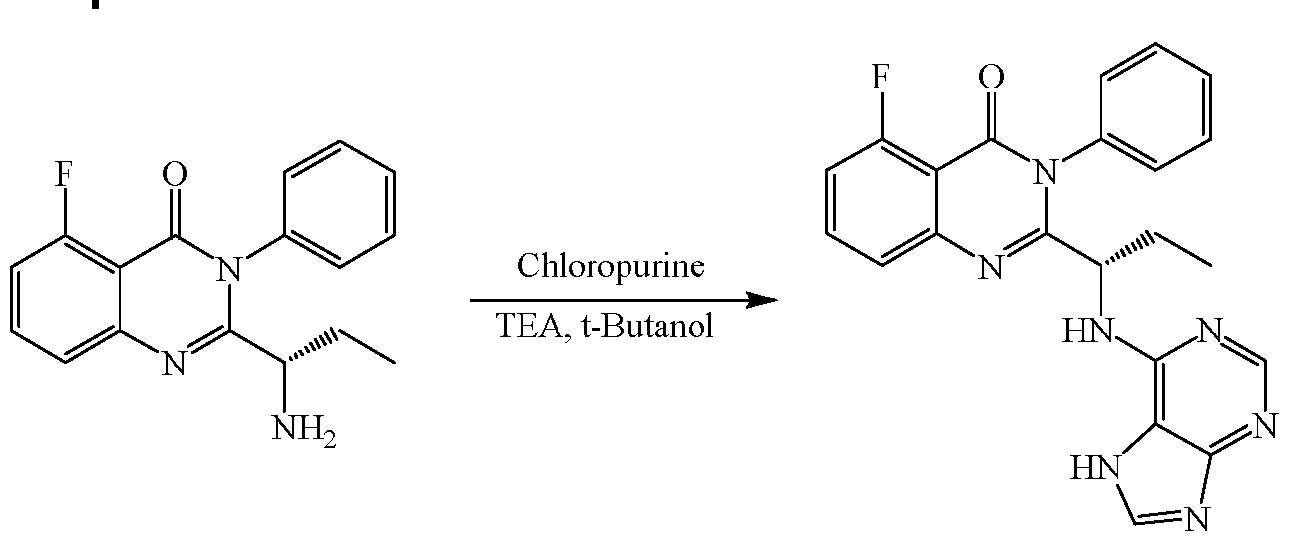
(S)-2-(1 -aminopropyl)-5-fluoro-3-phenylquinazolin-4(3H)-one prepared in example 26 (1 g), t-Butanol (5 mL) and 6-Chloropurine (0.59 g) were charged into a 50 mL round bottom flask. Triethylamine (0.93 mL) was added at 30 °C. The resultant reaction mixture was heated to85°C and stirred for 24 hours. The reaction mixture was evaporated completely under reduced pressure at 40°C. The resultant residue was diluted with water (20 mL) and stirred for 30 minutes. The precipitate was filtered and the solid was washed with water (10 mL) and n-Hexane (10 mL) and dried for 1 hour under vacuum. The solid was dissolved in THF (10 mL). A solution of dibenzoyl-L- tartaric acid (L-DBTA) (1 .2 g) in MTBE (30 mL) was added dropwise. The suspension was stirred for 16 hours at 25°C. The suspension was filtered through a pad of Celite and the Celite was washed with MTBE (20 mL). The MTBE layers were mixed and concentrated, and the residue was triturated with MTBE (20 mL). The residue obtained was suspended in water (15 mL) and treated with saturated NaHC03 solution (10 mL). The aqueous layer was extracted with ethylacetate (2X 50 mL) and the ethylacetate layer was washed successively with water (2X 50 mL) and brine (50 mL). The ethylacetate layer was dried with Na2S04 and concentrated to obtain idelalisib as pale yellow solid. HPLC showed the presence of idelalisib to an extent of 95.48%
The pale yellow solid was dissolved in THF (10 mL). A solution of dibenzoyl-L- tartaric acid (L-DBTA) (0.6 g) in MTBE (30 mL) was added dropwise. The suspension was stirred for 10 hours at 25°C. Activated charcoal (50 mg) added to the resultant suspension and was stirred for 1 hour. The suspension was filtered through a pad of Celite and the Celite was washed with MTBE (20 mL). The MTBE layers were mixed and concentrated, and the residue was triturated with MTBE (20 mL). The residue obtained was suspended in water (15 mL) and treated with saturated NaHC03 solution
(10 mL). The aqueous layer was extracted with DCM (2X25 mL) and the DCM layer was washed successively with water (2X25 mL) and brine (25 mL). The DCM layer was dried with Na2S04 and concentrated to 3 mL. n-Hexane (50 mL) was added to the product and the suspension was stirred for 1 hour. The suspension was filtered and the solid was washed with hexanes and dried under vacuum to obtain 550 mg of idelalisib as an off-white solid. Purity: 97.05% by HPLC; chiral purity: 99.30% by HPLC.
Example 34: Preparation of Idelalisib (comparative example)

(S)-2-(1 -aminopropyl)-5-fluoro-3-phenylquinazolin-4(3H)-one prepared in example 4 (160 mg) and t-Butanol (2 mL) were charged into a 10 mL round bottom flask. DIPEA (0.19 mL) and 6-Bromopurine (1 18mg) were added at 30 °C. The resultant reaction mixture was heated to80°C and stirred for 48 hours. The reaction mixture was evaporated completely under reduced pressure at 40°C. The resultant residue was diluted with ethylacetate (20 mL) and stirred for 30 minutes. The organic layer was washed with water (2X 5 mL) and brine (5 mL) and the organic layer was dried over sodium sulphate and evaporated under reduced pressure.
The crude product was purified by column chromatography by using Si02 (100- 200) and 3% MeOH-DCM-TEA drops. The eluted fractions were evaporated and characterized by 1HNMR. The isolated solid was dissolved in ethylacetate (20 mL). The organic layer was washed with water (20 mL) and brine (2X5 mL) and the organic layer was dried over sodium sulphate and evaporated under reduced pressure. to yield 100mg of Idelalisib as pale yellow solid. Purity: 95.79% by HPLC; chiral purity: 96.47% by HPLC.
Example 35: Chiral enrichment of Idelalisib
In an Eppendorf® centrifuge vial, Idelalisib (having 93.6% of chiral purity; 50 mg) and THF (0.5 mL) were charged at 25°C. Clear solution was obtained. (L)-
dibenzoyi tartaric acid (L-DBTA) (43.1 mg) was added to the solution. The resultant mixture was stirred for 16 hours at 25°C. The suspension was centrifuged for 10 minutes. The suspension separated into a clear supernatant liquid and a small quantity of a white precipitate. The supernatantliquid was separated from the precipitate by filtration. The residue was washed with ethylacetate (2.5 mL). The filtrate and washings were combined, diluted with ethylacetate (10 mL) and washed successively with saturated NaHC03 solution (1 mL), water (2X5 mL) and brine (5 mL). The organic layer was dried with Na2S04 and concentrated to obtain 20 mg of idelalisib as pale yellow solid.
Chiral purity: 99.76% by HPLC.
Example 36: Purification of Idelalisib using maleic acid
In a2 mL Eppendorf® centrifuge vial, Idelalisib (having 95.77% of chiral purity; 20 mg) and THF (0.5 mL) were charged at 25°C. Clear solution was obtained. A solution of maleic acid (5.58 mg of maleic acid in 0.6 mL of THF) was added to the solution. The resultant mixture was stirred for 16 hours at 25°C. The suspension was centrifuged for 10 minutes. The solvent was removed and triturated with 50% MTBE-THF (1 mL). The precipitation was basified with saturated NaHC03 solution (1 mL) and extracted with ethylacetate. The reaction mass mother liquor and washed layers are combined and basified with saturated NaHC03 solution (1 mL) and extracted with ethylacetate. The organic layer was concentrated to obtain idelalisib as pale yellow solid.
Chiral purity: 99.67% by HPLC.
Example 37: Purification of Idelalisib using maleic acid
In a 2 mL Eppendorf® centrifuge vial idelalisib (having 97.04% of purity; 20 mg) and ethylacetate (0.5 mL) were charged at 25°C. Clear solution was obtained. A solution of maleic acid (5.58 mg of maleic acid in 0.6 mL of ethylacetate) was added to the solution. The resultant mixture was stirred for 16 hours at 25°C. The suspension was centrifuged for 10 minutes. The precipitation was basified with saturated NaHC03 solution (1 mL) and extracted with ethylacetate. The organic layer was concentrated to obtain idelalisib as pale yellow solid. Purity: 98.47% by HPLC.
Example 38: Purification of Idelalisib using oxalic acid
In a 2 mL Eppendorf® centrifuge vial, Idelalisib (having 95.77% of chiral purity; 20 mg) and THF (0.5 mL) were charged at 25°C. Clear solution was obtained. A solution of oxalic acid (4.33 mg of oxalic acid in 0.6 mL of THF) was added to the solution. The resultant mixture was stirred for 16 hours at 25°C. The suspension was centrifuged for 10 minutes. The solvent was removed and triturated with 50% MTBE- THF (1 mL). The precipitation was basified with saturated NaHC03 solution (1 mL) and extracted with ethylacetate. The reaction mass mother liquor and washed layers are combined and basified with with saturated NaHC03 solution (1 mL) and extracted with ethylacetate. The organic layer was concentrated to obtain idelalisib as pale yellow solid.
Chiral purity: 99.37% by HPLC.
Example 39: Purification of Idelalisib using oxalic acid
In a 2 mL Eppendorf® centrifuge vial idelalisib (having 97.04% of chiral purity; 20 mg) and THF (0.5 mL) were charged at 25°C. Clear solution was obtained. A solution of oxalic acid (4.33 mg of oxalic acid in 0.6 mL of THF) was added to the solution. The resultant mixture was stirred for 16 hours at 25°C. The suspension was centrifuged for 10 minutes. The precipitation was basified with saturated NaHC03 solution (1 mL) and extracted with ethylacetate. The organic layer was concentrated to obtain idelalisib as pale yellow solid. Purity: 98.38% by HPLC.
Example 40: Purification of Idelalisib
In a 2 mL Eppendorf® centrifuge vial idelalisib (having 97.04% of chemical purity and 95.77% of chiral purity; 1 1 mg) and THF (0.75 mL) were charged at 25°C. The resultant turbid solution was stirred for 16 hours at 25°C. The reaction mass was centrifuged for 10 minutes. The supernatant liquid was removed and triturated with THF (0.2 mL). The precipitate was analyzed by HPLC. Purity: 98.56% by HPLC.
The supernatant liquid and the THF washing were combined and then concentrate. The solid was analyzed for chiral HPLC. Chiral purity: 99.34% by HPLC. Example 41 : Purification of Idelalisib
In a 2 mL Eppendorf® centrifuge vial idelalisib (having 97.04% of chemical purity and 95.77% of chiral purity; 1 1 mg) and ethylacetate (0.75 mL) were charged at 25°C. The resultant slight suspension was stirred for 16 hours at 25°C. The suspension was
centrifuged for 10 minutes. The supernatant liquid was removed and triturated with ethylacetate (0.2 ml_). The precipitate was analyzed by HPLC. Purity: 98.93% by HPLC.
The supernatant liquid and the THF washing were combined and then concentrated. The solid was analyzed for chiral HPLC. Chiral purity: 99.35% by HPLC. Example 42: Preparation of idelalisib according to the process described in WO2005092877A1
Idelalisib (0.8 gm) and ethanol (25 mL) were charged into a 50 mL round bottom flask and the mixture was stirred for 10 minutes, clear solution formed. The solution was concentrated completely under vacuum. The solid was dried under vacuum at 60°C for 3 hours to obtain 0.65 gm of amorphous idelalisib. PXRD pattern is shown in Figure 1 . Example 43: Preparation of idelalisib according to the process described in WO2005092877A1
Idelalisib (0.8 gm) and ethanol (25 mL) were charged into a 50 mL round bottom flask and the mixture was stirred for 15 minutes. The clear solution was concentrated completely under vacuum. The solid was dried under vacuum at 60°C for 3 hours to obtain 0.65 gm of amorphous idelalisib. PXRD pattern is same as Figure 1 .
Purity: 99.26% by HPLC; Moisture content: 5.2%; GC (ethanol): 12265 ppm; TGA:
6.87%.
Example 44: Preparation of idelalisib according to the process described in WO2005092877A1
Idelalisib (0.8 gm) and ethanol (25 mL) were charged into a 50 mL round bottom flask and the mixture was stirred for 15 minutes. The clear solution was concentrated completely under vacuum. The solid was dried under vacuum at 58°C for 2 hours to obtain 0.61 gm of amorphous idelalisib. PXRD pattern is same as Figure 1 .
Purity: 99.15% by HPLC; Moisture content: 5.45%; GC (ethanol): 60769 ppm.
Claims
1 . A process for increasing the purity of idelalisib, comprising:
(a) combining idelalisib with an acid in a solvent to form Idelalisib acid addition salt,
(b) optionally isolating the acid addition salt of Idelalisib, and
(c) liberating idelalisib from the acid addition salt of Idelalisib.
2. The process according to claim 1 , wherein the acid is selected form the group comprising of mandelic acid, malic acid, camphorsulfonic acid, tartaric acid, dibenzoyi tartaric acid, and di(ortho)-tolyl tartaric acid.
3. The process according to claim 1 , wherein the acid is nitric acid, sulphuric acid, phosphoric acid, formic acid, hydrobromic acid, acetic acid, trifluoroacetic acid, methanesulphonic acid, ethanesulphonic acid, benzenesulphonic acid, toluenesulphonic acid, fumaric acid, citric acid, maleic acid, and oxalic acid.
4. A process for preparation of idelalisib, comprising:
(a) reacting a compound of formula V with a compound of formula VI to form a compound of formula IV

(b) reacting the compound of formula IV with aniline in presence of a dehydrating agent to form a compound of formula II


Formula I-A
(d) optionally deprotecting the compound of formula l-A to form idelalisib.
wherein, R1is selected from the group comprising hydrogen, CrC5alkyl, alkenyl, alkynyl, aryl, aralkyl and each of which may optionally be substituted, -COR2 and SO2R2; R2is selected from the group comprising C1 -C5 alkyl, optionally substituted phenyl and tolyl; P1 and P2each independently represent a hydrogen atom or a protective group for the amino group.
5. A process for preparation of Idelalisib, comprising:
(a) oxidizing a compound of formula II to get a compound of formula ll-A

Formula Π Formula Π-Α
wherein R1 is hydrogen.
(b) reacting the compound of formula ll-A with a compound of Formula Vll-A to form idelalisib.

Idelalisib
6. A process for preparation of Idelalisib, comprising:
(a) reacting a compound of formula IX with a compound of formula VIII to form a compound of formula l-C, and

Formula I-C
(b) deprotecting the compound of formula I-C in which P1 and P2 represent
protecting groups to produce compound of formula l-E, and

Formula I-C Formula I-F
(c) reductively dehalogenating the compound of formula l-E in which R represents a halogen atom to produce Idelalisib.
wherein, P1 and P2 each independently represent a hydrogen atom or a protective group for the amino group; R represents hydrogen or a halogen atom such as fluorine, chlorine and bromine.
7. A process for preparation of idelalisib, comprising:
(a) reacting 2-Fluoro-6-nitrobenzoic acid or its acid chloride of compound of formula XII with aniline to form a compound of formula XI,

Formula XII Formula XI
(b) reacting the compound of formula XI with thionyl chloride and subsequently with amino protected L-2-aminobutyric acid to form a compound of formula X,

(c) reacting the compound of formula X with Zinc dust in presence of acetic acid to get compound of formula IX,

(d) optionally deprotecting the compound of formula IX in which P1 represents an amino protecting group,
(e) reacting the compound of formula IX with a compound of formula VIII to form a compound of formula I-C, and

(f) deprotecting the compound of formula I-C in which P1 and P2 represent
protecting groups to produce compound of formula l-E,

Formula I-C Formula I-E
(g) reductively dehalogenating the compound of formula I-E in which R represents a halogen atom to produce Idelalisib.
wherein, P1 and P2 each independently represent a hydrogen atom or a protective group for the amino group; R represents a hydrogen atom or a halogen atom such as fluorine, chlorine and bromine.
8. The compound of formul -C

Formula I-C wherein, P1 and P2 represent a protective group for the amino group; R represents a hydrogen atom or a halogen atom such as fluorine, chlorine and bromine.
9. The compounds of formula l-A, l-B, II, ll-A, III, IV, VII and formula VII'.
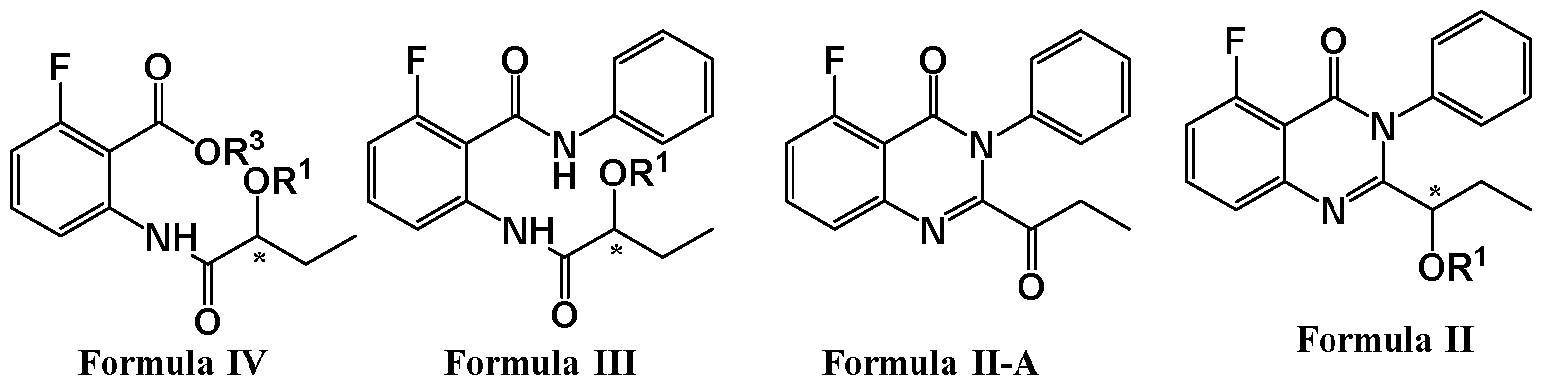

10. Use of the compounds of claim 8 and 9 in the preparation of idelalisib.
1 1 . A diastereomeric salt of idelalisib with a chiral acid.
12. The diastereomeric salt of idelalisib according to claim 14, wherein the chiral acid is selected from the group comprising mandelic acid, malic acid, camphorsulfonic acid, tartaric acid, dibenzoyl tartaric acid, di(ortho)-tolyl tartaric acid.
13. Use of idelalisib acid addition salt in the purification of idelalisib.
14. The acid addition salt of idelalisib according to claim 13 is selected from the group comprising: idelalisib hydrobromide, idelalisib sulphate, idelalisib phosphate, idelalisib nitrate, idelalisib formate, idelalisib acetate, idelalisib trifluoroacetate, idelalisib methanesulphonate, idelalisib ethanesulphonate, idelalisib benzenesulphonate, idelalisib toluenesulphonate, idelalisib fumarate, idelalisib oxalate, idelalisib maleate, idelalisib citrate.
15. Use of Idelalisib prepared by the process of claims 1 to 7 in the preparation of a pharmaceutical composition for the treatment of cancer.
16. Use of idelalisib prepared by using the compounds according to claims 8 to 14 in the preparation of a pharmaceutical composition for the treatment of cancer.
Applications Claiming Priority (4)
| Application Number | Priority Date | Filing Date | Title |
|---|---|---|---|
| IN6844CH2014 | 2014-12-31 | ||
| IN6844/CHE/2014 | 2014-12-31 | ||
| IN2493/CHE/2015 | 2015-05-18 | ||
| IN2493CH2015 | 2015-05-18 |
Publications (2)
| Publication Number | Publication Date |
|---|---|
| WO2016108206A2 true WO2016108206A2 (en) | 2016-07-07 |
| WO2016108206A3 WO2016108206A3 (en) | 2016-08-18 |
Family
ID=56285111
Family Applications (1)
| Application Number | Title | Priority Date | Filing Date |
|---|---|---|---|
| PCT/IB2015/060069 Ceased WO2016108206A2 (en) | 2014-12-31 | 2015-12-31 | Processes for preparation of idelalisib and intermediates thereof |
Country Status (1)
| Country | Link |
|---|---|
| WO (1) | WO2016108206A2 (en) |
Cited By (6)
| Publication number | Priority date | Publication date | Assignee | Title |
|---|---|---|---|---|
| WO2017009333A1 (en) * | 2015-07-13 | 2017-01-19 | Synthon B.V. | Method for purifying idelalisib |
| CN108409740A (en) * | 2018-03-14 | 2018-08-17 | 盐城师范学院 | A kind of new Chinese mugwort is for this preparation method of Larry |
| WO2018198131A1 (en) * | 2017-04-24 | 2018-11-01 | Natco Pharma Limited | Process for the preparation of amorphous idelalisib |
| CN109503430A (en) * | 2018-12-29 | 2019-03-22 | 浙江东亚药业股份有限公司 | A kind of neighbour's fluorine neighbour's imido grpup benzoic acid Intermediate compound and its preparation method and application |
| WO2019092253A1 (en) | 2017-11-10 | 2019-05-16 | Synthon B.V. | Process for preparing idelalisib |
| US11358966B2 (en) | 2018-03-16 | 2022-06-14 | Johnson Matthey Public Limited Company | Pyridine or N,N-dimethyl acetamide solvated solid state forms of solvated idelalisib, their use and preparation |
Family Cites Families (1)
| Publication number | Priority date | Publication date | Assignee | Title |
|---|---|---|---|---|
| LT2612862T (en) * | 2004-05-13 | 2017-01-25 | Icos Corporation | Quinazolinones as inhibitors of human phosphatidylinositol 3-kinase delta |
-
2015
- 2015-12-31 WO PCT/IB2015/060069 patent/WO2016108206A2/en not_active Ceased
Cited By (9)
| Publication number | Priority date | Publication date | Assignee | Title |
|---|---|---|---|---|
| WO2017009333A1 (en) * | 2015-07-13 | 2017-01-19 | Synthon B.V. | Method for purifying idelalisib |
| WO2018198131A1 (en) * | 2017-04-24 | 2018-11-01 | Natco Pharma Limited | Process for the preparation of amorphous idelalisib |
| US10870650B2 (en) | 2017-04-24 | 2020-12-22 | Natco Pharma Limited | Process for the preparation of amorphous idelalisib |
| WO2019092253A1 (en) | 2017-11-10 | 2019-05-16 | Synthon B.V. | Process for preparing idelalisib |
| CN108409740A (en) * | 2018-03-14 | 2018-08-17 | 盐城师范学院 | A kind of new Chinese mugwort is for this preparation method of Larry |
| CN108409740B (en) * | 2018-03-14 | 2020-05-08 | 盐城师范学院 | Preparation method of Aidallas |
| US11358966B2 (en) | 2018-03-16 | 2022-06-14 | Johnson Matthey Public Limited Company | Pyridine or N,N-dimethyl acetamide solvated solid state forms of solvated idelalisib, their use and preparation |
| CN109503430A (en) * | 2018-12-29 | 2019-03-22 | 浙江东亚药业股份有限公司 | A kind of neighbour's fluorine neighbour's imido grpup benzoic acid Intermediate compound and its preparation method and application |
| CN109503430B (en) * | 2018-12-29 | 2021-01-29 | 浙江东亚药业股份有限公司 | O-fluoro-o-imine benzoic acid intermediate compound and preparation method and application thereof |
Also Published As
| Publication number | Publication date |
|---|---|
| WO2016108206A3 (en) | 2016-08-18 |
Similar Documents
| Publication | Publication Date | Title |
|---|---|---|
| US8969561B2 (en) | Apixaban preparation process | |
| WO2014059938A1 (en) | Method for preparing important intermediate of linagliptin | |
| EP3042893B1 (en) | Novel crystalline arylalkylamine compound and method for producing same | |
| CN108601355A (en) | Process for preparing kinase inhibitors and intermediates thereof | |
| WO2019026014A1 (en) | Processes for preparation of lifitegrast and intermediates thereof | |
| JP6370316B2 (en) | Process for the preparation of enantiomerically enriched 3-aminopiperidine | |
| JP2017522343A (en) | Synthesis of phosphoramidates | |
| KR102477924B1 (en) | Methods for preparing indole carboxamide compounds | |
| WO2007100387A2 (en) | Process for preparing tadalafil | |
| EP2178864B1 (en) | Process for the preparation of alfuzosin hydrochloride | |
| JP4294121B2 (en) | Process for producing pyridonecarboxylic acid derivatives and intermediates thereof | |
| TWI762527B (en) | Processes for preparing tph1 inhibitors | |
| JP5017101B2 (en) | Preparation of asymmetric tetrasubstituted carbon atom-containing compounds | |
| JP7379381B2 (en) | Intermediates and processes for the manufacture of linagliptin and its salts | |
| WO2007054969A2 (en) | Process for the preparation of lercanidipine and amorphous form of lercanidipine hydrochloride | |
| JP7693921B2 (en) | Method for producing prolinamide compound | |
| JP7279134B2 (en) | Method for producing prolinamide compound | |
| JP3884063B2 (en) | Cefcapene pivoxil methanesulfonate | |
| MXPA03009946A (en) | Novel processes for the preparation of adenosine compounds and intermediates thereto. | |
| HK1256344B (en) | Process for producing an aminopyrrolidine derivative | |
| WO2012001357A1 (en) | Crystalline form of prulifloxacin and processes for its preparation | |
| US7977330B2 (en) | Salts and crystal modifications thereof | |
| WO2017130221A1 (en) | Improved process for the preparation of idelalisib | |
| HK1223928B (en) | Novel crystalline arylalkylamine compound and method for producing same |
Legal Events
| Date | Code | Title | Description |
|---|---|---|---|
| 121 | Ep: the epo has been informed by wipo that ep was designated in this application |
Ref document number: 15875357 Country of ref document: EP Kind code of ref document: A2 |
|
| NENP | Non-entry into the national phase in: |
Ref country code: DE |
|
| 122 | Ep: pct application non-entry in european phase |
Ref document number: 15875357 Country of ref document: EP Kind code of ref document: A2 |