WO2016107344A1 - 对输入法的上屏候选项进行筛选的方法和装置 - Google Patents
对输入法的上屏候选项进行筛选的方法和装置 Download PDFInfo
- Publication number
- WO2016107344A1 WO2016107344A1 PCT/CN2015/095600 CN2015095600W WO2016107344A1 WO 2016107344 A1 WO2016107344 A1 WO 2016107344A1 CN 2015095600 W CN2015095600 W CN 2015095600W WO 2016107344 A1 WO2016107344 A1 WO 2016107344A1
- Authority
- WO
- WIPO (PCT)
- Prior art keywords
- stroke
- sequence
- candidate
- initial
- screening
- Prior art date
- Legal status (The legal status is an assumption and is not a legal conclusion. Google has not performed a legal analysis and makes no representation as to the accuracy of the status listed.)
- Ceased
Links
Images


Classifications
-
- G—PHYSICS
- G06—COMPUTING OR CALCULATING; COUNTING
- G06F—ELECTRIC DIGITAL DATA PROCESSING
- G06F3/00—Input arrangements for transferring data to be processed into a form capable of being handled by the computer; Output arrangements for transferring data from processing unit to output unit, e.g. interface arrangements
- G06F3/01—Input arrangements or combined input and output arrangements for interaction between user and computer
- G06F3/02—Input arrangements using manually operated switches, e.g. using keyboards or dials
- G06F3/023—Arrangements for converting discrete items of information into a coded form, e.g. arrangements for interpreting keyboard generated codes as alphanumeric codes, operand codes or instruction codes
-
- G—PHYSICS
- G06—COMPUTING OR CALCULATING; COUNTING
- G06F—ELECTRIC DIGITAL DATA PROCESSING
- G06F3/00—Input arrangements for transferring data to be processed into a form capable of being handled by the computer; Output arrangements for transferring data from processing unit to output unit, e.g. interface arrangements
- G06F3/01—Input arrangements or combined input and output arrangements for interaction between user and computer
- G06F3/02—Input arrangements using manually operated switches, e.g. using keyboards or dials
- G06F3/023—Arrangements for converting discrete items of information into a coded form, e.g. arrangements for interpreting keyboard generated codes as alphanumeric codes, operand codes or instruction codes
- G06F3/0233—Character input methods
- G06F3/0236—Character input methods using selection techniques to select from displayed items
Definitions
- the present invention relates to the field of input method technologies, and in particular, to a method and apparatus for screening an upper screen candidate of an input method.
- the default input language is a character in English.
- English input can be entered by directly selecting a letter.
- the input of other languages is more troublesome.
- the Chinese language has tens of thousands of characters. It is impossible to input directly through the buttons.
- the Chinese characters are encoded according to the pronunciation characteristics of Chinese characters (corresponding to the Pinyin input method).
- the glyph characteristics of Chinese characters such as strokes and radicals
- the Chinese characters are encoded (corresponding to the font input method), etc., and each key combination can be associated with the Chinese character encoding, so that the Chinese characters can be input.
- the mapping relationship between key combinations and Chinese characters is not unique. Especially in the process of using input methods such as pinyin or double-spelling input method, since the same initials and finals of Chinese characters are particularly numerous, The mapping between key combinations and Chinese characters is more complicated. Especially in many smart mobile terminals, when using the input keyboard of Jiugongge, the mapping relationship between the key combination and the Chinese characters is more complicated, because the first combination of the pinyin combinations will be more, and the corresponding Chinese characters will be derived from each pinyin combination. Multiplied.
- the present invention has been made in order to provide an apparatus for screening an upper screen candidate of an input method and correspondingly screening an upper screen candidate of an input method, which overcomes the above problems or at least partially solves the above problems. Methods.
- a method for screening an upper screen candidate of an input method including:
- the present invention also discloses an apparatus for screening an upper screen candidate of an input method, including:
- the screening receiving module is adapted to receive a sequence of filtering strokes input by the user in an initial screening mode screening mode of the input method
- a matching module configured to match the filtered stroke sequence with a first stroke sequence of each initial upper screen candidate
- the adjustment module is adapted to adjust the display position of the initial upper screen candidate according to the matching result of the stroke sequence.
- a computer program comprising computer readable code, when the computer readable code is run on a terminal device, causing the terminal device to perform any of the input methods described above The method of filtering on the screen candidate.
- a computer readable medium storing a computer program for performing the method of screening any of the above-described screen candidates for an input method.
- the user can add the screening stroke mode to the obtained initial screen candidate according to the traditional input process, and further correct the stroke sequence input by the user again.
- the initial screen candidate is filtered to narrow the range of the initial screen candidate. For example, click the button -> get the string candidate (such as the pinyin candidate) -> determine the string candidate -> according to the string candidate, find the matching initial screen candidate from the thesaurus -> according to The user's click triggers the initial upper screen candidate filtering mode -> receives the user-entered filtered stroke sequence again -> filters the initial upper screen candidate through the filtered stroke sequence to obtain a more accurate upper screen candidate.
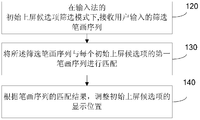
- FIG. 1 is a flow chart showing a method for screening an upper screen candidate of an input method according to an embodiment of the present invention
- FIG. 2 is a flow chart showing a method for screening an upper screen candidate of an input method according to an embodiment of the present invention
- FIG. 3 is a flow chart showing a method for screening an upper screen candidate of an input method according to an embodiment of the present invention
- FIG. 4 is a flow chart showing a method for screening an upper screen candidate of an input method according to an embodiment of the present invention
- FIG. 5 is a schematic structural diagram of an apparatus for screening an upper screen candidate of an input method according to an embodiment of the present invention.
- FIG. 6 is a schematic structural diagram of an apparatus for screening an upper screen candidate of an input method according to an embodiment of the present invention.
- FIG. 7 is a schematic structural diagram of an apparatus for screening an upper screen candidate of an input method according to an embodiment of the present invention.
- FIG. 8 is a schematic structural diagram of an apparatus for screening an upper screen candidate of an input method according to an embodiment of the present invention.
- Figure 9 shows a block diagram of a terminal device for performing the method according to the invention.
- Figure 10 shows a storage list for holding or carrying program code implementing the method according to the invention yuan.
- One of the core ideas of the present invention is to add a screening stroke mode to the initial screen candidate obtained by the user according to the traditional input process, and further filter the initial screen candidate through the stroke sequence input by the user again, and narrow down the initial selection.
- the range of options That is, the user starts inputting, clicks the button -> gets the character string candidate (such as pinyin candidate) -> determines the character string candidate -> according to the character string candidate, finds the matching initial upper screen candidate from the thesaurus Item->Trigger initial screen selection filter mode according to user's click->Receive user-entered filter stroke sequence->Filter the initial screen candidate through the filter stroke sequence to get more accurate screen Candidates make it easy for users to quickly find the waiting options on the target and improve the user's input efficiency.
- FIG. 1 it is a schematic flowchart of a method for screening an upper screen candidate of an input method according to the present invention, which may specifically include:
- Step 120 Receive a filtered stroke sequence input by a user in an initial screen selection mode of the input method.
- the user may first use the traditional input process of the input method, for example, using the pinyin input method, the user may click a button in the input keyboard to obtain a pinyin string, and the input rule may be in the thesaurus according to the pinyin string. Find the corresponding initial upper screen candidate. For example, the user inputs a pinyin string yazhou, and the input method can obtain an initial screen candidate "Asia”, “Axle”, “Tooth Week”, “Yazhou”, “Zhouzhou” from the lexicon according to the Pinyin string. a series of initials such as "duck porridge" On the screen candidate. After the input method obtains the above initial screen candidate, the user can trigger the initial screen candidate screening mode of the input method, and the user can filter the initial screen candidate by inputting the filtered stroke sequence again.
- Step 130 Match the filtered stroke sequence with the first stroke sequence of each initial upper screen candidate
- the sequence of the filtered strokes can be matched with the stroke sequence of the initial screen candidate.
- the "one ⁇ " can be compared with the first stroke sequence of "Asia”, “the finale”, “periodontal”, “Yazhou”, “presszhou”, “duck porridge”, etc. If the strokes of "Asia” are found to match " ⁇ ", then "Asia” is transferred to step 140.
- the screening sequence may be matched one by one with the first stroke sequence of the initial initial screen candidate.
- matching the screening stroke sequence with the first stroke sequence of each initial upper screen candidate comprises:
- Sub-step 131 matching the filtered stroke sequence with a first stroke sequence consisting of at least a first stroke of each word of each initial upper screen candidate.
- each first stroke sequence of the initial upper screen candidate at least the first pen of each word may be extracted, and the at least first pen of each word is combined into a first stroke sequence.
- the first stroke of each word is used to form a first stroke selection sequence, or the first two strokes of each word are used to form a first stroke selection sequence.
- the filtered stroke sequence is then matched to a first stroke sequence consisting of at least a first stroke of each word of each initial upper screen candidate.
- the matching the screening stroke sequence with the first stroke sequence consisting of at least the first stroke of each word of each initial upper screen candidate comprises:
- Sub-step S132 matching the screening stroke sequence with a first stroke sequence consisting of a complete stroke sequence of each initial screen candidate word
- the complete strokes of each word of each initial screen candidate can be extracted to form a first stroke sequence, such as the aforementioned "Asia”, and the complete stroke sequence of "Asia” is "a glimpse” "", “Zhou” complete stroke sequence is " ⁇ ”, then the first stroke sequence composed is " ⁇ ", the screening stroke sequence It can be matched with the first stroke sequence.
- sub-step S133 matching the filtered stroke sequence with a first stroke sequence consisting of the first stroke of each word of each initial upper screen candidate.
- the complete strokes of each word of each initial screen candidate can be extracted to form a first stroke sequence, such as the aforementioned "Asia", the first stroke of "Asia” is "one”, “continental” The first stroke of the stroke is " ⁇ ”, then the first stroke sequence composed is " ⁇ ”, and the sequence of the filtered strokes can be matched with the first stroke sequence.
- the sub-step S132 and the sub-step S133 may be used at the same time, or may be used separately.
- the preferred manner is:
- Sub-step S132 matching the screening stroke sequence with a first stroke sequence consisting of a complete stroke sequence of each initial screen candidate word; if matching, displaying the initial screen candidate position Advance; when all the initial upper screen candidates are matched, proceed to step S133;
- Sub-step S133 matching the screening stroke sequence with the first stroke sequence consisting of the first stroke of each word of each initial upper screen candidate; if matching, displaying the initial upper screen candidate Advance position
- Step 140 Adjust the display position of the initial upper screen candidate according to the matching result of the stroke sequence.
- This step adjusts the display position of the initial upper screen candidate according to the matching result of the stroke sequence.
- the adjusting the display position of the initial upper screen candidate according to the matching result of the stroke sequence comprises:
- Sub-step 141 when the stroke sequences match, the corresponding initial upper screen candidates are displayed in front of the candidate display interface.
- the initial screen candidates on the matching are advanced in order.
- the initial screen candidate has an initial screen candidate, an initial screen candidate 2, an initial screen candidate 3, an initial screen candidate 4, and an initial screen candidate 5, when the aforementioned screening stroke sequence is one by one.
- the initial screen candidate if there is no match, you can not use it as the upper screen candidate or move backward. For example, if the screening stroke sequence does not match the initial screen candidate 1, the initial screen candidate 1 will be displayed.
- the position is moved to the back of the queue or is no longer used as the upper screen candidate; if the filtered stroke sequence matches the initial upper screen candidate 2, the initial upper screen candidate 2 is advanced to the first position; the stroke sequence is filtered and initially If the waiting screen option 3 is not matched, the position of the initial upper screen candidate 3 is moved to the back of the queue or is no longer used as the upper screen candidate; if the filtering stroke sequence is not matched with the initial upper screen candidate 3, the initial will be The position of the upper screen candidate 3 is moved to the back of the queue or is no longer used as the upper screen candidate; if the filtering stroke sequence matches the initial upper screen candidate 5, the initial upper screen candidate 5 is advanced to the second position. Other situations are analogous.
- the method further includes:
- Step 150 Receive a deletion operation of the user, and delete the content in the filtered stroke sequence input by the user according to the deletion operation.
- the received deletion operation may modify the deletion operation to delete the filtered stroke sequence. Strokes. For example, if the foregoing screening stroke sequence is "single”, then a delete instruction is received, " ⁇ " is deleted first, and then a delete command is received to delete "one".
- the method further includes:
- Step 160 In the input method display interface, provide a character string candidate display interface; when the user receives a click on a character string candidate on the character string candidate display interface, obtain each initial screen corresponding to the character string candidate Candidates are displayed.
- buttons correspond to a plurality of pinyin.
- a nine-key keyboard When a user clicks a button to input pinyin in a nine-key keyboard, it may correspond to a plurality of pinyin.
- the button 929468 in order, it may actually correspond to a plurality of pinyin strings.
- the trigger After the user selects a pinyin string, the trigger enters the initial screen candidate screening mode, and when the user does not need the pinyin string under the button sequence, and needs to select another pinyin string, the input method display interface may be In addition, a character candidate display interface is also provided, and various character string candidates corresponding to the key sequence can be displayed on the character candidate display interface, which is convenient for the user to select. For example, 929468, the corresponding pinyin string is "yazhou”, and there are other pinyin strings "wazhou”, “zazhou” and so on. Then these strings can be displayed in the string candidate display interface. When the user clicks on one of the strings, the input rule extracts the corresponding initial selection of the corresponding string from the lexicon and displays it on the upper screen candidate. Display interface.
- the user adds a screening stroke mode to the obtained initial screen candidate according to the traditional input process, and further filters the initial screen candidate by the stroke sequence input by the user again, and reduces the range of the initial screen candidate.
- the process is roughly as follows: the user starts typing, click the button -> get the string candidate (such as pinyin candidates) -> determine the string candidate -> according to the string candidate, find the matching initial from the thesaurus
- the upper screen candidate -> triggers the initial screen candidate filtering mode according to the user's click -> receives the user-entered filtering stroke sequence again -> filters the initial screen candidate through the filtering stroke sequence, thereby obtaining more precision
- the upper screen candidate allows users to quickly find the target screen options and improve user input efficiency.
- the deletion instruction input by the user can also be adjusted to the screening stroke sequence, which is convenient for the user to modify the selection stroke sequence, further facilitating user input and improving the screening efficiency.
- the input method interface can continue to provide a selection function of the character string candidates for finding the initial screen candidate in the thesaurus, which is seamless and convenient for the user to switch.
- a string (such as a pinyin string) that improves the input efficiency of the input method.
- FIG. 2 it is a schematic flowchart of a method for screening an upper screen candidate of an input method according to the present invention, which may specifically include:
- Step 220 Receive a filtered stroke sequence input by the user in an initial screen selection mode of the input method
- Step 230 For each initial upper screen candidate, obtain a first stroke sequence of each initial upper screen candidate from the thesaurus;
- the stroke of each word can be saved in the vocabulary in advance, and the vocabulary can be installed in the specified path of the system with the client at the time of installation.
- the first stroke sequence of each initial upper screen candidate may be extracted from the thesaurus before, during or after the process of receiving the user input screening stroke sequence.
- a first stroke sequence composed of at least a first stroke of each word of each initial upper screen candidate may be extracted.
- Step 240 Match the filtered stroke sequence with a first stroke sequence consisting of at least a first stroke of each word of each initial upper screen candidate; for the initial upper screen candidate on the matching, proceed to step 270 For the initial upper screen candidate on the unmatched, go to step 250.
- the sequence of the filtered strokes input by the user is “one by one”, and when the filtered stroke sequence is all matched with the initial upper screen candidate in sequence, the initial upper screen candidate is transferred to step 260.
- the screening stroke sequence is not all matched with the initial upper screen candidate, for example, only "one inch” is matched, then step 250 is transferred.
- Step 250 when the screening stroke sequence does not completely match the first stroke sequence of the initial upper screen candidate, using a stroke-based error correction model to determine the stroke sequence input by the user and the initial upper screen candidate The probability that the first stroke sequence matches;
- an error may be input.
- the "one, ⁇ , ⁇ , ⁇ , and B" of the five-stroke input method is taken as an example.
- the correct stroke order should be “ ⁇ ”, and the input next to the vertical is easy to make mistakes, such as “ ⁇ ”, then the wrong input can be judged by the stroke-based error correction model to judge the stroke sequence input by the user.
- the probability of matching the first stroke sequence of the initial upper screen candidate is taken as an example.
- Step 260 when the probability of the matching is greater than a threshold, determining the sequence of the filtered strokes The first stroke sequence of the initial upper screen candidate is matched;
- the screening stroke sequence and the initial may be considered The first stroke sequence of the upper screen candidate matches; otherwise, it is considered that there is no match.
- the method further includes:
- Sub-step S251 constructing the stroke-based error correction model by using a binary or multi-relationship of words in a phrase and/or a sentence;
- the binary relationship is used to indicate the probability that two elements appear successively, that is, P(B
- Multivariate relationships are derived from binary relationships.
- the probability of occurrence of the stroke can be determined according to the strokes of the pre-statistical phrase and the word, according to the direct binary or multi-dimensional relationship of the direct word of the phrase or the sentence.
- the sequence of happy strokes is “ ⁇ ”
- the probability of corresponding happiness is “90% by ⁇ ”
- “ ⁇ The probability that ⁇ ” corresponds to happiness is 79%, and so on, thus constructing a stroke-based error correction model.
- the matching probability of the stroke selection sequence and each initial upper screen candidate may be determined according to the stroke-based error correction model. If it is greater than the threshold, for example, greater than 60%, It can be considered that the initial screen candidate is matched.
- sub-step S252 constructing the stroke-based error correction model using the binary or multivariate relationship between the strokes constituting each word.
- the stroke of "fast” is “ ⁇ "
- the probability that the stroke sequence " ⁇ " corresponds to "fast” is 90%
- the stroke sequence is " ⁇ ”
- the probability of corresponding "fast” word is 80%, and similar principles can construct a correction model based on strokes.
- the matching probability of the stroke selection sequence and each initial upper screen candidate may also be determined according to the above-described stroke-based error correction model. If it is greater than the threshold, for example, greater than 60%, the initial upper screen candidate may be considered to be matched.
- Step 270 Adjust the display position of the initial upper screen candidate according to the matching result of the stroke sequence.
- the embodiment of the invention can correct the screening stroke sequence input by the user, improve the screening efficiency, and further improve the input efficiency of the user. .
- FIG. 3 it is a schematic flowchart of a method for screening an upper screen candidate of an input method according to the present invention, which may specifically include:
- Step 320 Receive a filtered stroke sequence input by the user in an initial screen selection mode of the input method
- Step 330 determining whether there is a separator in the sequence of the filtered strokes; if there is a separator, separating the sequence of the filtered strokes input by the user into each of the screening stroke sub-sequences according to the separator;
- a separator may be set in the upper screen candidate filtering mode, for example, ",” or “;” is set as a separator, and the user may input a separator between the input filtering strokes to separate the filtering stroke sequence.
- each of the filtered stroke subsequences may correspond to a sequence of filtered strokes.
- the filtered stroke sequence can be matched in sequence with the first stroke sequence consisting of at least the first stroke of each word of each initial upper screen candidate.
- Step 340 in the unit of filtering the stroke sub-sequence, sequentially matching the screening stroke sub-sequence with the stroke sequence of the word in the corresponding order in each initial upper-screen candidate;
- the filter stroke subsequence between the two separators corresponds to the initial match.
- the word at the corresponding position of the screen For example, there are two separators.
- the filter stroke subsequence before the first separator corresponds to the first word matching the initial screen candidate
- the filter stroke subsequence between the first separator and the second separator corresponds to Matches the second word of the initial upper screen candidate
- the filtered stroke subsequence after the second delimiter corresponds to the third word that matches the initial upper screen candidate
- Step 350 adjusting the display position of the initial upper screen candidate according to the matching result of the stroke sequence Set.
- the embodiment of the present invention can provide a separator for the user to split the input stroke sequence of the input, and to match the corresponding corresponding initial screen candidate with each filter subsequence, thereby further improving the screening precision and speed, and further Improve input efficiency.
- FIG. 4 it is a schematic flowchart of a method for screening an upper screen candidate of an input method according to the present invention, which may specifically include:
- Step 410 Receive a key combination input by a user.
- the nine-key keyboard is as follows: 1 button corresponds to: @, 2 button corresponds to: ABC, 3 button corresponds to: DEF, 4 button corresponds to: GHI, 5 button corresponds to: JKL, 6 button corresponds to: MNO, 7 button corresponds to: PQRS, 8 button Corresponding: TUV, 9-key corresponding: WXYZ.
- Step 420 Determine a default pinyin string according to the button combination, and display a candidate pinyin string on the pinyin string candidate interface;
- the key combination of the present invention may obtain a plurality of pinyin strings.
- the default pinyin string determined is “yazhou”, and the candidate pinyin string can be displayed as “wa” “ya” “za” in the string candidate interface.
- Step 430 Obtain, according to the default pinyin string, each initial upper screen candidate from the vocabulary and display the top N items to the upper screen candidate display interface;
- this step can display the initial upper screen candidate of the top 5 in the interface.
- Step 440 Receive a user selection of a pinyin string, and after determining the pinyin string, trigger an initial screen candidate screening mode;
- Step 450 Receive a sequence of filtered strokes input by a user
- Step 460 matching the screening stroke sequence with the first stroke sequence of each initial upper screen candidate
- Step 470 when the stroke sequences match, the corresponding initial upper screen candidates are displayed in front of the candidate display interface.
- step 470 the method further includes:
- Step 480 Receive a deletion instruction of the user, and delete a stroke in the sequence of the filtered strokes; when the stroke in the sequence of the filtered stroke is deleted, the deletion instruction is for the Pinyin string.
- FIG. 5 it is a schematic structural diagram of an apparatus for screening an upper screen candidate of an input method according to the present invention, which may specifically include:
- the screening receiving module 520 is adapted to receive a filtered stroke sequence input by the user in an initial screen selection filtering mode of the input method
- the matching module 530 is adapted to match the screening stroke sequence with the first stroke sequence of each initial upper screen candidate
- the adjusting module 540 is adapted to adjust the display position of the initial upper screen candidate according to the matching result of the stroke sequence.
- the matching module 530 includes:
- the first matching module is adapted to match the filtered stroke sequence with a first stroke sequence consisting of at least a first stroke of each word of each initial upper screen candidate.
- the first matching module includes:
- a complete matching module adapted to match the filtered stroke sequence with a first stroke sequence consisting of a complete stroke sequence of each initial screen candidate word
- a first matching module adapted to match the sequence of filtered strokes with a sequence of first strokes consisting of the first stroke of each word of each initial upper screen candidate.
- the adjustment module 540 includes:
- the sorting adjustment module is adapted to display the corresponding initial screen candidate in the front of the candidate display interface when the stroke sequence matches.
- FIG. 6 it is a schematic structural diagram of an apparatus for screening an upper screen candidate of an input method according to the present invention, which may specifically include:
- the screening receiving module 620 is adapted to receive a filtered stroke sequence input by the user in an initial screening mode screening mode of the input method
- the first stroke sequence obtaining module 630 is adapted to obtain, for each initial upper screen candidate, a first stroke sequence of each initial upper screen candidate from the thesaurus;
- the matching module 640 includes:
- a first matching module 641 configured to match the filtered stroke sequence with a first stroke sequence consisting of at least a first stroke of each word of each initial upper candidate; for an initial upper candidate on the match Entry, enter the adjustment module 650; for the initial upper screen candidate on the unmatched, enter the error correction matching module 642;
- the error correction matching module 642 is adapted to determine, when the screening stroke sequence does not completely match the first stroke sequence of the initial upper screen candidate, using a stroke-based error correction model to determine the stroke sequence input by the user and the a probability of matching the first stroke sequence of the initial upper screen candidate; when the probability of the matching is greater than the threshold, determining that the screening stroke sequence matches the first stroke sequence of the initial upper screen candidate;
- the adjustment module 650 is adapted to adjust the display position of the initial upper screen candidate according to the matching result of the stroke sequence.
- the method further includes:
- a first error correction model building module is adapted to construct the stroke-based error correction model by using a binary or multi-dimensional relationship of words in a phrase and/or a sentence;
- a second error correction model building module is adapted to construct the stroke-based error correction model by using a binary or multi-dimensional relationship between the strokes constituting each word.
- FIG. 7 is a schematic structural diagram of an apparatus for screening an upper screen candidate of an input method according to the present invention, which may specifically include:
- the screening receiving module 720 includes:
- the stroke receiving module 721 is adapted to receive a filtered stroke sequence input by the user in an initial screen selection screening mode of the input method
- the separator receiving module 722 is adapted to receive a user input delimiter during the process of receiving the filtered stroke sequence input by the user, and divide the sequence of the filtered stroke input by the user into the first stroke subsequence according to the delimiter;
- the matching module 730 includes:
- the subsequence matching module 731 is adapted to sequentially match the filtered stroke subsequence with the stroke sequence of the words in the corresponding order in each of the initial upper screen candidates in units of the filtered stroke subsequence.
- the adjusting module 740 is adapted to adjust the display position of the initial upper screen candidate according to the matching result of the stroke sequence.
- FIG. 8 is a schematic structural diagram of an apparatus for screening an upper screen candidate of an input method according to the present invention, which may specifically include:
- the button combination receiving module 810 is adapted to receive a button combination input by the user
- the pinyin string processing module 812 is adapted to determine a default pinyin string according to the button combination, and display a candidate pinyin string in the pinyin string candidate interface;
- the initial candidate display module 814 is adapted to obtain each initial upper screen candidate from the lexicon according to the default pinyin string and display the top N items to the upper screen candidate display interface;
- the screening mode triggering module 816 is adapted to receive a user selection of a pinyin string, and after determining the pinyin string, trigger an initial screen candidate screening mode;
- the screening stroke receiving module 818 is adapted to receive a sequence of screening strokes input by the user;
- the screening matching module 820 is adapted to match the screening stroke sequence with the first stroke sequence of each initial upper screen candidate
- the screening display module 822 is adapted to display the corresponding initial upper screen candidate in the front of the candidate display interface when the stroke sequence matches.
- the method further includes:
- the deletion instruction receiving module is adapted to receive a deletion instruction of the user, and delete a stroke in the sequence of the filtered strokes; when the stroke in the sequence of the filtered stroke is deleted, the deletion instruction is for the pinyin string.
- modules in the devices of the embodiments can be adaptively changed and placed in one or more devices different from the embodiment.
- the modules or units or components of the embodiments may be combined into one module or unit or component, and further they may be divided into a plurality of sub-modules or sub-units or sub-components.
- any combination of the descriptions may be employed All the features disclosed in the book (including the accompanying claims, abstract and drawings) and all processes or units of any method or device disclosed herein are combined.
- Each feature disclosed in this specification including the accompanying claims, the abstract and the drawings) may be replaced by alternative features that provide the same, equivalent or similar purpose.
- the various component embodiments of the present invention may be implemented in hardware, or in a software module running on one or more processors, or in a combination thereof.
- a microprocessor or digital signal processor may be used in practice to implement some or all of the components of the screening device for input screen candidates in accordance with embodiments of the present invention.
- the invention can also be implemented as a device or device program (e.g., a computer program and a computer program product) for performing some or all of the methods described herein.
- a program implementing the invention may be stored on a computer readable medium or may be in the form of one or more signals. Such signals may be downloaded from an Internet website, provided on a carrier signal, or provided in any other form.
- FIG. 9 illustrates a terminal device that can perform screening of upper screen candidates for an input method in accordance with the present invention.
- the terminal device conventionally includes a processor 910 and a computer program product or computer readable medium in the form of a memory 920.
- the memory 920 may be an electronic memory such as a flash memory, an EEPROM (Electrically Erasable Programmable Read Only Memory), an EPROM, a hard disk, or a ROM.
- Memory 920 has a memory space 930 for program code 931 for performing any of the method steps described above.
- storage space 930 for program code may include various program code 931 for implementing various steps in the above methods, respectively.
- the program code can be read from or written to one or more computer program products.
- Such computer program products include program code carriers such as hard disks, compact disks (CDs), memory cards or floppy disks.
- Such a computer program product is typically a portable or fixed storage unit as described with reference to FIG.
- the storage unit may have a storage section, a storage space, and the like arranged similarly to the storage 920 in the terminal device of FIG.
- the program code can be compressed, for example, in an appropriate form.
- the storage unit includes computer readable code 931' Code read by a processor, such as 910, that when executed by a terminal device causes the terminal device to perform various steps in the methods described above.
Landscapes
- Engineering & Computer Science (AREA)
- General Engineering & Computer Science (AREA)
- Theoretical Computer Science (AREA)
- Human Computer Interaction (AREA)
- Physics & Mathematics (AREA)
- General Physics & Mathematics (AREA)
- Input From Keyboards Or The Like (AREA)
Abstract
一种对输入法的上屏候选项进行筛选的方法和装置,涉及输入法技术领域。所述方法包括:在输入法的初始上屏候选项筛选模式下,接收用户输入的筛选笔画序列(120);将所述筛选笔画序列与每个初始上屏候选项的第一笔画序列进行匹配(130);根据笔画序列的匹配结果,调整初始上屏候选项的显示位置(140)。解决了与用户初次输入的按键组合对应的初始上屏候选项过多,用户不能快速定位目标候选项的问题,可提供再次筛选的模式,通过笔画序列对初始的候选项进行再次筛选,提高用户查找目标候选项的效率,从而提高输入效率的有益效果。
Description
本发明涉及输入法技术领域,具体涉及一种对输入法的上屏候选项进行筛选的方法和装置。
在各种计算机系统中,缺省的输入语言是英语中的字符。英语输入可以直接选择字母即可进行输入。而其他语言的输入则较为麻烦,比如中文语言有上万个字符,完全无法简单的通过按键直接进行输入,需要对汉字进行编码,比如按照汉字的发音特性对汉字进行编码(对应拼音输入法),按照汉字的字形特性(如笔画和偏旁部首)对汉字进行编码(对应字型输入法)等等,各个按键组合则可与汉字编码进行对应,从而可进行汉字的输入。
但是,由于汉语本身的特征,按键组合与汉字的映射关系不是唯一的,特别是在使用拼音或双拼输入法等输入法的过程中,由于汉字的同声母、韵母的字词特别多,其按键组合与汉字的映射关系更为复杂。特别是在很多智能移动终端中,采用九宫格的输入键盘时,其按键组合与汉字的映射关系更加复杂,因为首先按键组合对应的拼音组合会更多,而由各个拼音组合衍生对应的汉字又会成倍增加。
因此,在用户通过按键组合输入汉字的时候,在众多候选项中找到目标候选项是比较繁琐的事,可能需要翻页进行查找,并且可能需要多次翻页并在翻页过程中保持高度注意力才能找到目标候选项,非常影响用户的输入效率。
发明内容
鉴于上述问题,提出了本发明以便提供一种克服上述问题或者至少部分地解决上述问题的一种对输入法的上屏候选项进行筛选的装置和相应的对输入法的上屏候选项进行筛选的方法。
依据本发明的一个方面,提供了一种对输入法的上屏候选项进行筛选的方法,包括:
在输入法的初始上屏候选项筛选模式下,接收用户输入的筛选笔画序列;
将所述筛选笔画序列与每个初始上屏候选项的第一笔画序列进行匹配;
根据笔画序列的匹配结果,调整初始上屏候选项的显示位置。
依据本发明的另外一个方面,本发明还公开了一种对输入法的上屏候选项进行筛选的装置,包括:
筛选接收模块,适于在输入法的初始上屏候选项筛选模式下,接收用户输入的筛选笔画序列;
匹配模块,适于将所述筛选笔画序列与每个初始上屏候选项的第一笔画序列进行匹配;
调整模块,适于根据笔画序列的匹配结果,调整初始上屏候选项的显示位置。
根据本发明的又一个方面,提供了一种计算机程序,其包括计算机可读代码,当所述计算机可读代码在终端设备上运行时,导致所述终端设备执行上述的任一个对输入法的上屏候选项进行筛选的方法。
根据本发明的再一个方面,提供了一种计算机可读介质,其中存储了执行上述的任一个对输入法的上屏候选项进行筛选的方法的计算机程序。
根据本发明的一种对输入法的上屏候选项进行筛选的方法,可以在用户按照传统的输入过程中对得到的初始上屏候选项加入筛选笔画模式,通过用户再次输入的笔画序列进一步对初始上屏候选项进行筛选,缩小初始上屏候选项的范围。比如,点击按键->得到字符串候选项(比如拼音候选项)->确定字符串候选项->根据所述字符串候选项,从词库中查找相匹配的初始上屏候选项->根据用户的点击触发初始上屏候选项筛选模式->再次接收用户输入的筛选笔画序列->通过所述筛选笔画序列对初始的上屏候选项进行筛选,得到更精准的上屏候选项,由此解决了与用户初次输入的按键组合对应的初始上屏候选项过多,用户不能快速定位目标候选项的问题,可提供再次筛选的模式,通过笔画序列对初始的候选项进行再次筛
选,提高用户查找目标候选项的效率,从而提高输入效率的有益效果。
上述说明仅是本发明技术方案的概述,为了能够更清楚了解本发明的技术手段,而可依照说明书的内容予以实施,并且为了让本发明的上述和其它目的、特征和优点能够更明显易懂,以下特举本发明的具体实施方式。
通过阅读下文优选实施方式的详细描述,各种其他的优点和益处对于本领域普通技术人员将变得清楚明了。附图仅用于示出优选实施方式的目的,而并不认为是对本发明的限制。而且在整个附图中,用相同的参考符号表示相同的部件。在附图中:
图1示出了根据本发明一个实施例的一种对输入法的上屏候选项进行筛选的方法的流程示意图;
图2示出了根据本发明一个实施例的一种对输入法的上屏候选项进行筛选的方法的流程示意图;
图3示出了根据本发明一个实施例的一种对输入法的上屏候选项进行筛选的方法的流程示意图;
图4示出了根据本发明一个实施例的一种对输入法的上屏候选项进行筛选的方法的流程示意图;
图5示出了根据本发明一个实施例的一种对输入法的上屏候选项进行筛选的装置的结构示意图;
图6示出了根据本发明一个实施例的一种对输入法的上屏候选项进行筛选的装置的结构示意图;
图7示出了根据本发明一个实施例的一种对输入法的上屏候选项进行筛选的装置的结构示意图;
图8示出了根据本发明一个实施例的一种对输入法的上屏候选项进行筛选的装置的结构示意图;
图9示出了用于执行根据本发明的方法的终端设备的框图;
图10示出了用于保持或者携带实现根据本发明的方法的程序代码的存储单
元。
下面将参照附图更详细地描述本公开的示例性实施例。虽然附图中显示了本公开的示例性实施例,然而应当理解,可以以各种形式实现本公开而不应被这里阐述的实施例所限制。相反,提供这些实施例是为了能够更透彻地理解本公开,并且能够将本公开的范围完整的传达给本领域的技术人员。
本发明的核心思想之一是:在用户按照传统的输入过程中对得到的初始上屏候选项加入筛选笔画模式,通过用户再次输入的笔画序列进一步对初始上屏候选项进行筛选,缩小初始上屏候选项的范围。即,用户开始输入,点击按键->得到字符串候选项(比如拼音候选项)->确定字符串候选项->根据所述字符串候选项,从词库中查找相匹配的初始上屏候选项->根据用户的点击触发初始上屏候选项筛选模式->再次接收用户输入的筛选笔画序列->通过所述筛选笔画序列对初始的上屏候选项进行筛选,从而得到更精准的上屏候选项,方便用户快速查找目标上屏候选项,提高用户的输入效率。
实施例一
参照图1,其示出了本发明一种对输入法的上屏候选项进行筛选的方法的流程示意图,具体可以包括:
步骤120,在输入法的初始上屏候选项筛选模式下,接收用户输入的筛选笔画序列;
在本发明实施例中,用户可以先使用输入法传统的输入过程,比如采用拼音输入法,用户可以在输入键盘中点击按键,得到拼音字符串,输入法则可根据所述拼音字符串在词库中查找对应的初始上屏候选项。比如用户输入拼音字符串yazhou,输入法可根据所述拼音字符串从词库中获得初始上屏候选项“亚洲”、“压轴”、“牙周”、“崖州”、“压洲”、“鸭粥”等一系列的初始
上屏候选项。在输入法得到上述初始上屏候选项之后,用户可以触发输入法的初始上屏候选项筛选模式,用户可以通过再次输入筛选笔画序列,对上述初始上屏候选项进行筛选。
比如如果用户的输入目标是“亚洲”,可以输入筛选笔画序列“一丨”。
步骤130,将所述筛选笔画序列与每个初始上屏候选项的第一笔画序列进行匹配;
那么本步骤,则可以将筛选笔画序列,与初始上屏候选项的笔画序列进行匹配。比如前述例子,则可以将“一丨”分别与“亚洲”、“压轴”、“牙周”、“崖州”、“压洲”、“鸭粥”等各自的第一笔画序列进行比较,发现“亚洲”的笔画与“一丨”能匹配上,则将“亚洲”转入步骤140。
在本发明实施例中,可以将筛选序列逐个与前述初始上屏候选项的第一笔画序列进行匹配。
优选的,将所述筛选笔画序列与每个初始上屏候选项的第一笔画序列进行匹配包括:
子步骤131,将所述筛选笔画序列与由每个初始上屏候选项的各字的至少第一个笔画所组成的第一笔画序列进行匹配。
在本发明实施例中,对于每个初始上屏候选项的第一笔画序列,可以提取各字的至少第一笔,将各字的所述至少第一笔组合为第一笔画序列。比如取各字的第一笔组成第一笔画筛选序列,或者取各字的前两笔组成第一笔画筛选序列等等。那么所述筛选笔画序列与由每个初始上屏候选项的各字的至少第一个笔画所组成的第一笔画序列进行匹配。
优选的,所述将所述筛选笔画序列与由每个初始上屏候选项的各字的至少第一个笔画所组成的第一笔画序列进行匹配包括:
子步骤S132,将所述筛选笔画序列与由每个初始上屏候选项各字的完整笔画序列组成的第一笔画序列进行匹配;
在本发明实施例中可将各初始上屏候选项的各字的完整笔画提取出来,组成第一笔画序列,比如前述“亚洲”,“亚”的完整笔画序列为“一丨丨丿丶
一”,“洲”的完整笔画序列为“丶丶一丶丿丶丨丶丨”,那么组成的第一笔画序列为“一丨丨丿丶一丶丶一丶丿丶丨丶丨”,所述筛选笔画序列可与该第一笔画序列进行匹配。
和/或,子步骤S133,将所述筛选笔画序列与由每个初始上屏候选项的各字的首个笔画组成的第一笔画序列相匹配。
在本发明实施例中可将各初始上屏候选项的各字的完整笔画提取出来,组成第一笔画序列,比如前述“亚洲”,“亚”的首个笔画为“一”,“洲”的首个笔画为“丶”,那么组成的第一笔画序列为“一丶”,所述筛选笔画序列可与该第一笔画序列进行匹配。
在本发明实施例中,子步骤S132和子步骤S133可以同时使用,也可以单独使用,在本发明实施例中优选的方式是:
子步骤S132,将所述筛选笔画序列与由每个初始上屏候选项各字的完整笔画序列组成的第一笔画序列进行匹配;如果匹配上,则将所述初始上屏候选项的显示位置提前;当所有初始上屏候选项匹配完毕,则进入步骤S133;
子步骤S133,将所述筛选笔画序列与由每个初始上屏候选项的各字的首个笔画组成的第一笔画序列相匹配;如果匹配上,则将所述初始上屏候选项的显示位置提前;
如果两者均未匹配上,则返回空,即在上屏候选项展示界面不展示任何候选项。
步骤140,根据笔画序列的匹配结果,调整初始上屏候选项的显示位置。
本步骤根据笔画序列的匹配结果,调整初始上屏候选项的显示位置。
优选的,所述根据笔画序列的匹配结果,调整初始上屏候选项的显示位置包括:
子步骤141,当笔画序列相匹配,则将相应的初始上屏候选项在候选项展示界面排序靠前显示。
可将与筛选序列匹配上的初始上屏候选项,则可将其显示顺序提前,对
于没匹配上的初始上屏候选项,则可不在将其作为上屏候选项或者将其显示顺序往后排。
在本发明实施例中,在前述逐个与初始上屏候选项匹配的过程中,对于匹配上的初始上屏候选项,则按序将其提前。比如初始上屏候选项原来有初始上屏候选项1、初始上屏候选项2、初始上屏候选项3、初始上屏候选项4、初始上屏候选项5个,当前述筛选笔画序列逐个与前述候选项进行匹配时,如果没匹配上,则可不将其作为上屏候选项或者往后移,比如筛选笔画序列与初始上屏候选项1没匹配上,则将初始上屏候选项1的位置移到队列后面或者不再将其作为上屏候选项;筛选笔画序列与初始上屏候选项2匹配上,则将初始上屏候选项2提前到第一位;筛选笔画序列与初始上屏候选项3未匹配上,则将初始上屏候选项3的位置移到队列后面或者不再将其作为上屏候选项;筛选笔画序列与初始上屏候选项3未匹配上,则将初始上屏候选项3的位置移到队列后面或者不再将其作为上屏候选项;筛选笔画序列与初始上屏候选项5匹配上,则将初始上屏候选项5提前到第二位。其他情况依次类推。
优选的,在触发输入法的初始上屏候选项筛选模式之后,还包括:
步骤150,接收用户的删除操作,根据所述删除操作以删除所述用户输入的筛选笔画序列中的内容。
由于用户可以输入多个笔画对初始上屏候选项进行筛选,本发明实施例中,在输出上屏候选项筛选模式触发之后,接收的删除操作,可以将删除操作修改为删除筛选笔画序列中的笔画。比如前述筛选笔画序列“一丨”,那么接收一个删除指令,先删除“丨”,再接收删除指令将“一”删除。
优选的,还包括:
步骤160,在输入法显示界面,提供字符串候选项展示界面;当在字符串候选项展示界面接收到用户对一字符串候选项的点击时,获取对应该字符串候选项的各初始上屏候选项进行展示。
在本发明实施例中,比如在移动终端使用的九键键盘的情况下,其用户在九键键盘中点击按键输入拼音时,可能对应多个拼音。比如九键键盘
如下:1键对应:@,2键对应:ABC,3键对应:DEF,4键对应:GHI,5键对应:JKL,6键对应:MNO,7键对应:PQRS,8键对应:TUV,9键对应:WXYZ。那么用户按序点击按键929468时,其实际上可能对应多个拼音字符串。在用户选择一个拼音字符串后,触发进入初始上屏候选项筛选模式,而当用户不需要该按键序列下的所述拼音字符串之后,需要选择其他拼音字符串,则可以在输入法显示界面中,还提供字符串候选项展示界面,将对应按键序列的各种字符串候选项可以在字符串候选项展示界面进行展示,方便用户选择。比如929468,对应的拼音字符串为“yazhou”,还有其他拼音字符串“wazhou”,“zazhou”等等。那么这些字符串可在字符串候选项展示界面进行展示,当用户点击其中某个字符串时,则输入法则从词库中提取相应字符串的各初始上屏候选项展示在上屏候选项的展示界面。
本发明实施例在用户按照传统的输入过程中对得到的初始上屏候选项加入筛选笔画模式,通过用户再次输入的笔画序列进一步对初始上屏候选项进行筛选,缩小初始上屏候选项的范围。其过程大致为:用户开始输入,点击按键->得到字符串候选项(比如拼音候选项)->确定字符串候选项->根据所述字符串候选项,从词库中查找相匹配的初始上屏候选项->根据用户的点击触发初始上屏候选项筛选模式->再次接收用户输入的筛选笔画序列->通过所述筛选笔画序列对初始的上屏候选项进行筛选,从而得到更精准的上屏候选项,方便用户快速查找目标上屏候选项,提高用户的输入效率。
当然在初始上屏候选项筛选模式中,也可将用户输入的删除指令调整为针对筛选笔画序列,方便用户对筛选笔画序列的修改,进一步方便用户的输入,提高筛选效率。
另外,在本发明的初始上屏候选项筛选模式中,在输入法界面还能继续提供用于在词库中查找初始上屏候选项的字符串候选项的选择功能,无缝的方便用户切换字符串(比如拼音字符串),提高输入法的输入效率。
实施例二
参照图2,其示出了本发明一种对输入法的上屏候选项进行筛选的方法的流程示意图,具体可以包括:
步骤220,在输入法的初始上屏候选项筛选模式下,接收用户输入的筛选笔画序列;
步骤230,针对每个初始上屏候选项,从词库中获取每个初始上屏候选项的第一笔画序列;
在本发明实施例中,可预先在词库中保存每个字的笔画,该词库可在安装时随客户端安装在系统的指定路径下。
本发明实施例中,在接收用户输入筛选笔画序列的过程之前、之中或者之后,均可从词库中提取每个初始上屏候选项的第一笔画序列。当然如实施例一所述,可以提取每个初始上屏候选项的各字的至少第一个笔画所组成的第一笔画序列。
步骤240,将所述筛选笔画序列与由每个初始上屏候选项的各字的至少第一个笔画所组成的第一笔画序列进行匹配;对于匹配上的初始上屏候选项,进入步骤270;对于未匹配上的初始上屏候选项,进入步骤250。
比如用户输入的筛选笔画序列为“一丨丨丿丶一”,当筛选笔画序列按序与初始上屏候选项全部匹配上时,该初始上屏候选项转让步骤260。当筛选笔画序列按序与初始上屏候选项没有全部匹配上时,比如只匹配上了“一丨丨丿丶”,那么转让步骤250。
步骤250,当所述筛选笔画序列与所述初始上屏候选项的第一笔画序列不完全匹配时,利用基于笔画的纠错模型判断所述用户输入的笔画序列与所述初始上屏候选项的第一笔画序列匹配的概率;
在实际应用中,用户输入筛选笔画序列时,可能会输入错误,比如输入“快”字时,以五笔输入法的“一、丨、丿、丶、乙”为例,正确的笔画顺序应该为“丶丶丨乙一丿丶”,而对于竖心旁的输入则容易出错,比如“丨丶丶”,那么该种错误输入则可通过基于笔画的纠错模型对其进行判断,判断用户输入的笔画序列与初始上屏候选项的第一笔画序列匹配的概率。
步骤260,当所述匹配的概率大于阈值时,则判断所述筛选笔画序列与
所述初始上屏候选项的第一笔画序列匹配上;
当通过基于笔画的纠错模型判断所述用户输入的笔画序列与所述初始上屏候选项的第一笔画序列匹配的概率大于一定的阈值时,则可认为所述筛选笔画序列与所述初始上屏候选项的第一笔画序列匹配上;反之,则认为没有匹配上。
优选的,还包括:
子步骤S251,利用词组和/或句子中字词的二元或多元关系,构建所述基于笔画的纠错模型;
二元关系,用于表示两个元素相继出现的概率,即P(B|A),表示A出现的条件下,B出现的概率。多元关系由二元关系衍生而来。
在本发明实施例中,可以根据预先统计词组和字词的笔画,根据词组或者句子直接的字直接的二元或者多元关系确定笔画出现的概率。比如快乐的笔画序列为“丶丶丨乙一丿丶丿乙丨丿丶”,通过统计得到“丶丨丶乙一丿丶丿乙丨丿丶”对应快乐的概率为90%,“丨丶丶乙一丿丶丿乙丨丿丶”对应快乐的概率为79%,以此类推,从而构建基于笔画的纠错模型。如此,对于未匹配上初始上屏候选项的笔画筛选序列,可以根据上述基于笔画的纠错模型判断笔画筛选序列与各初始上屏候选项的匹配概率,如果大于阈值,比如大于60%,则可认为初始上屏候选项被匹配上。
和/或,子步骤S252,利用组成每个字的笔画之间的二元或者多元关系,构建所述基于笔画的纠错模型。
比如“快”字的笔画“丶丶丨乙一丿丶”为,统计可得到笔画序列“丶丨丶乙一丿丶”对应“快”字的概率为为90%,笔画序列“丨丶丶乙一丿丶”对应“快”字的概率为80%,类似原理可以构建基于笔画的纠错模型。也可以根据上述基于笔画的纠错模型判断笔画筛选序列与各初始上屏候选项的匹配概率,如果大于阈值,比如大于60%,则可认为初始上屏候选项被匹配上。
步骤270,根据笔画序列的匹配结果,调整初始上屏候选项的显示位置。
本发明实施例可以对用户输入的筛选笔画序列进行纠错,提高筛选效率,进而提高用户的输入效率。。
实施例三
参照图3,其示出了本发明一种对输入法的上屏候选项进行筛选的方法的流程示意图,具体可以包括:
步骤320,在输入法的初始上屏候选项筛选模式下,接收用户输入的筛选笔画序列;
步骤330判断所述筛选笔画序列中是否存在分隔符;如果存在分隔符,则根据所述分隔符将用户输入的筛选笔画序列分隔为各筛选笔画子序列;
在本发明实施例中,可以在上屏候选项筛选模式下设置分隔符,比如设置“、”或者“;”为分隔符,用户可以在输入筛选笔画之间输入分隔符,将筛选笔画序列分隔为筛选笔画子序列,每个筛选笔画子序列可以对应一个字的筛选笔画序列。
如果没有分隔符,则可按序将筛选笔画序列与由每个初始上屏候选项的各字的至少第一个笔画所组成的第一笔画序列进行匹配。
步骤340,以筛选笔画子序列为单位,按序将所述筛选笔画子序列与每个初始上屏候选项中相应顺序上的字的笔画序列进行匹配;
比如用户输入“一丨”后输入分隔符“;”,那么即可确定“一丨”为筛选初始上屏候选项第一个字的筛选笔画子序列,用户在输入分隔符之后,继续输入“丶丶”,那么可以将该“丶丶”作为为筛选初始上屏候选项第二个字的筛选笔画子序列,如果还有分隔符,那么两个分隔符之间的筛选笔画子序列对应匹配初始上屏候选项相应位置的字。比如有两个分隔符,第一个分隔符之前的筛选笔画子序列对应匹配初始上屏候选项的第一个字,第一个分隔符和第二个分隔符之间的筛选笔画子序列对应匹配初始上屏候选项的第二个字,第二个分隔符之后的筛选笔画子序列对应匹配初始上屏候选项的第三个字。
步骤350,根据笔画序列的匹配结果,调整初始上屏候选项的显示位
置。
本发明实施例可提供分隔符,供用户对其输入的筛选笔画序列进行拆分,以各个筛选子序列去匹配对应的初始上屏候选项的对应字,可以进一步的提高筛选精度和速度,进而提高输入效率。
实施例四
参照图4,其示出了本发明一种对输入法的上屏候选项进行筛选的方法的流程示意图,具体可以包括:
步骤410,接收用户输入的按键组合;
比如九键键盘如下:1键对应:@,2键对应:ABC,3键对应:DEF,4键对应:GHI,5键对应:JKL,6键对应:MNO,7键对应:PQRS,8键对应:TUV,9键对应:WXYZ。
当用户输入929468的按键组合,则进行接收。
步骤420,根据所述按键组合确定默认的拼音字符串,并在拼音字符串候选界面展示候选拼音字符串;
比如在输入键盘为九键模式的情况下,本发明的按键组合可能得到多个拼音字符串。
对于929468,确定的默认拼音字符串为“yazhou”,在字符串候选界面展示候选拼音字符串可为“wa”“ya”“za”
步骤430,根据所述默认的拼音字符串从词库中获取各初始上屏候选项并将排序靠前的N个展示到上屏候选项展示界面;
比如上屏候选项展示界面只能展示5个,那么本步骤则可将排序前5的初始上屏候选项在所述界面中展示。
步骤440,接收用户对拼音字符串的选择,在确定拼音字符串之后,则触发初始上屏候选项筛选模式;
步骤450,接收用户输入的筛选笔画序列;
步骤460,将所述筛选笔画序列与每个初始上屏候选项的第一笔画序列进行匹配;
步骤470,当笔画序列相匹配,则将相应的初始上屏候选项在候选项展示界面排序靠前显示。
当然,在步骤470之后,还包括:
步骤480,接收用户的删除指令,删除筛选笔画序列中的笔画;当所述筛选笔画序列中的笔画删除完毕后,所述删除指令针对拼音字符串。
即将筛选笔画序列删除之后,如果继续收到删除指令,则可以对拼音字符串进行删除。
实施例五
参照图5,其示出了本发明一种对输入法的上屏候选项进行筛选的装置的结构示意图,具体可以包括:
筛选接收模块520,适于在输入法的初始上屏候选项筛选模式下,接收用户输入的筛选笔画序列;
匹配模块530,适于将所述筛选笔画序列与每个初始上屏候选项的第一笔画序列进行匹配;
调整模块540,适于根据笔画序列的匹配结果,调整初始上屏候选项的显示位置。
优选的,所述匹配模块530包括:
第一匹配模块,适于将所述筛选笔画序列与由每个初始上屏候选项的各字的至少第一个笔画所组成的第一笔画序列进行匹配。
优选的,所述第一匹配模块包括:
完整匹配模块,适于将所述筛选笔画序列与由每个初始上屏候选项各字的完整笔画序列组成的第一笔画序列进行匹配;
和/或首笔匹配模块,适于将所述筛选笔画序列与由每个初始上屏候选项的各字的首个笔画组成的第一笔画序列相匹配。
优选地,所述调整模块540包括:
排序调整模块,适于当笔画序列相匹配,则将相应的初始上屏候选项在候选项展示界面排序靠前显示。
实施例六
参照图6,其示出了本发明一种对输入法的上屏候选项进行筛选的装置的结构示意图,具体可以包括:
筛选接收模块620,适于在输入法的初始上屏候选项筛选模式下,接收用户输入的筛选笔画序列;
第一笔画序列获取模块630,适于针对每个初始上屏候选项,从词库中获取每个初始上屏候选项的第一笔画序列;
匹配模块640,包括:
第一匹配模块641,适于将所述筛选笔画序列与由每个初始上屏候选项的各字的至少第一个笔画所组成的第一笔画序列进行匹配;对于匹配上的初始上屏候选项,进入调整模块650;对于未匹配上的初始上屏候选项,进入纠错匹配模块642;
纠错匹配模块642,适于当所述筛选笔画序列与所述初始上屏候选项的第一笔画序列不完全匹配时,利用基于笔画的纠错模型判断所述用户输入的笔画序列与所述初始上屏候选项的第一笔画序列匹配的概率;当所述匹配的概率大于阈值时,则判断所述筛选笔画序列与所述初始上屏候选项的第一笔画序列匹配上;
当所述匹配的概率小于或等于阈值时,则认为没有匹配上。
调整模块650,适于根据笔画序列的匹配结果,调整初始上屏候选项的显示位置。
优选的,还包括:
第一纠错模型构建模块,适于利用词组和/或句子中字词的二元或多元关系,构建所述基于笔画的纠错模型;
和/或,第二纠错模型构建模块,适于利用组成每个字的笔画之间的二元或者多元关系,构建所述基于笔画的纠错模型。
实施例七
参照图7,其示出了本发明一种对输入法的上屏候选项进行筛选的装置的结构示意图,具体可以包括:
筛选接收模块720,包括:
笔画接收模块721,适于在输入法的初始上屏候选项筛选模式下,接收用户输入的筛选笔画序列;
分隔符接收模块722,适于在接收用户输入的筛选笔画序列的过程中,接收用户输入分隔符,根据所述分隔符将用户输入的筛选笔画序列分隔为各第一笔画子序列;
匹配模块730,包括:
子序列匹配模块731,适于以筛选笔画子序列为单位,按序将所述筛选笔画子序列与每个初始上屏候选项中相应顺序上的字的笔画序列进行匹配。
调整模块740,适于根据笔画序列的匹配结果,调整初始上屏候选项的显示位置。
实施例八
参照图8,其示出了本发明一种对输入法的上屏候选项进行筛选的装置的结构示意图,具体可以包括:
按键组合接收模块810,适于接收用户输入的按键组合;
拼音字符串处理模块812,适于根据所述按键组合确定默认的拼音字符串,并在拼音字符串候选界面展示候选拼音字符串;
初始候选项展示模块814,适于根据所述默认的拼音字符串从词库中获取各初始上屏候选项并将排序靠前的N个展示到上屏候选项展示界面;
筛选模式触发模块816,适于接收用户对拼音字符串的选择,在确定拼音字符串之后,则触发初始上屏候选项筛选模式;
筛选笔画接收模块818,适于接收用户输入的筛选笔画序列;
筛选匹配模块820,适于将所述筛选笔画序列与每个初始上屏候选项的第一笔画序列进行匹配;
筛选展示模块822,适于当笔画序列相匹配,则将相应的初始上屏候选项在候选项展示界面排序靠前显示。
优选的,还包括:
删除指令接收模块,适于接收用户的删除指令,删除筛选笔画序列中的笔画;当所述筛选笔画序列中的笔画删除完毕后,所述删除指令针对拼音字符串。
即将筛选笔画序列删除之后,如果继续收到删除指令,则可以对拼音字符串进行删除。
在此提供的算法和显示不与任何特定计算机、虚拟系统或者其它设备固有相关。各种通用系统也可以与基于在此的示教一起使用。根据上面的描述,构造这类系统所要求的结构是显而易见的。此外,本发明也不针对任何特定编程语言。应当明白,可以利用各种编程语言实现在此描述的本发明的内容,并且上面对特定语言所做的描述是为了披露本发明的最佳实施方式。
在此处所提供的说明书中,说明了大量具体细节。然而,能够理解,本发明的实施例可以在没有这些具体细节的情况下实践。在一些实例中,并未详细示出公知的方法、结构和技术,以便不模糊对本说明书的理解。
类似地,应当理解,为了精简本公开并帮助理解各个发明方面中的一个或多个,在上面对本发明的示例性实施例的描述中,本发明的各个特征有时被一起分组到单个实施例、图、或者对其的描述中。然而,并不应将该公开的方法解释成反映如下意图:即所要求保护的本发明要求比在每个权利要求中所明确记载的特征更多的特征。更确切地说,如下面的权利要求书所反映的那样,发明方面在于少于前面公开的单个实施例的所有特征。因此,遵循具体实施方式的权利要求书由此明确地并入该具体实施方式,其中每个权利要求本身都作为本发明的单独实施例。
本领域那些技术人员可以理解,可以对实施例中的设备中的模块进行自适应性地改变并且把它们设置在与该实施例不同的一个或多个设备中。可以把实施例中的模块或单元或组件组合成一个模块或单元或组件,以及此外可以把它们分成多个子模块或子单元或子组件。除了这样的特征和/或过程或者单元中的至少一些是相互排斥之外,可以采用任何组合对本说明
书(包括伴随的权利要求、摘要和附图)中公开的所有特征以及如此公开的任何方法或者设备的所有过程或单元进行组合。除非另外明确陈述,本说明书(包括伴随的权利要求、摘要和附图)中公开的每个特征可以由提供相同、等同或相似目的的替代特征来代替。
此外,本领域的技术人员能够理解,尽管在此所述的一些实施例包括其它实施例中所包括的某些特征而不是其它特征,但是不同实施例的特征的组合意味着处于本发明的范围之内并且形成不同的实施例。例如,在下面的权利要求书中,所要求保护的实施例的任意之一都可以以任意的组合方式来使用。
本发明的各个部件实施例可以以硬件实现,或者以在一个或者多个处理器上运行的软件模块实现,或者以它们的组合实现。本领域的技术人员应当理解,可以在实践中使用微处理器或者数字信号处理器(DSP)来实现根据本发明实施例的对输入法的上屏候选项进行筛选设备中的一些或者全部部件的一些或者全部功能。本发明还可以实现为用于执行这里所描述的方法的一部分或者全部的设备或者装置程序(例如,计算机程序和计算机程序产品)。这样的实现本发明的程序可以存储在计算机可读介质上,或者可以具有一个或者多个信号的形式。这样的信号可以从因特网网站上下载得到,或者在载体信号上提供,或者以任何其他形式提供。
例如,图9示出了可以实现根据本发明的一种对输入法的上屏候选项进行筛选的终端设备。该终端设备传统上包括处理器910和以存储器920形式的计算机程序产品或者计算机可读介质。存储器920可以是诸如闪存、EEPROM(电可擦除可编程只读存储器)、EPROM、硬盘或者ROM之类的电子存储器。存储器920具有用于执行上述方法中的任何方法步骤的程序代码931的存储空间930。例如,用于程序代码的存储空间930可以包括分别用于实现上面的方法中的各种步骤的各个程序代码931。这些程序代码可以从一个或者多个计算机程序产品中读出或者写入到这一个或者多个计算机程序产品中。这些计算机程序产品包括诸如硬盘,紧致盘(CD)、存储卡或者软盘之类的程序代码载体。这样的计算机程序产品通常为如参考图10所述的便携式或者固定存储单元。该存储单元可以具有与图9的终端设备中的存储器920类似布置的存储段、存储空间等。程序代码可以例如以适当形式进行压缩。通常,存储单元包括计算机可读代码931’,即可以
由例如诸如910之类的处理器读取的代码,这些代码当由终端设备运行时,导致该终端设备执行上面所描述的方法中的各个步骤。
应该注意的是上述实施例对本发明进行说明而不是对本发明进行限制,并且本领域技术人员在不脱离所附权利要求的范围的情况下可设计出替换实施例。在权利要求中,不应将位于括号之间的任何参考符号构造成对权利要求的限制。单词“包含”不排除存在未列在权利要求中的元件或步骤。位于元件之前的单词“一”或“一个”不排除存在多个这样的元件。本发明可以借助于包括有若干不同元件的硬件以及借助于适当编程的计算机来实现。在列举了若干装置的单元权利要求中,这些装置中的若干个可以是通过同一个硬件项来具体体现。单词第一、第二、以及第三等的使用不表示任何顺序。可将这些单词解释为名称。
此外,还应当注意,本说明书中使用的语言主要是为了可读性和教导的目的而选择的,而不是为了解释或者限定本发明的主题而选择的。因此,在不偏离所附权利要求书的范围和精神的情况下,对于本技术领域的普通技术人员来说许多修改和变更都是显而易见的。对于本发明的范围,对本发明所做的公开是说明性的,而非限制性的,本发明的范围由所附权利要求书限定。
Claims (24)
- 一种对输入法的上屏候选项进行筛选的方法,包括:在输入法的初始上屏候选项筛选模式下,接收用户输入的筛选笔画序列;将所述筛选笔画序列与每个初始上屏候选项的第一笔画序列进行匹配;根据笔画序列的匹配结果,调整初始上屏候选项的显示位置。
- 如权利要求1所述的方法,其特征在于,将所述筛选笔画序列与每个初始上屏候选项的第一笔画序列进行匹配包括:将所述筛选笔画序列与由每个初始上屏候选项的各字的至少第一个笔画所组成的第一笔画序列进行匹配。
- 如权利要求2所述的方法,其特征在于,所述将所述筛选笔画序列与由每个初始上屏候选项的各字的至少第一个笔画所组成的第一笔画序列进行匹配包括:将所述筛选笔画序列与由每个初始上屏候选项各字的完整笔画序列组成的第一笔画序列进行匹配;和/或,将所述筛选笔画序列与由每个初始上屏候选项的各字的首个笔画组成的第一笔画序列相匹配。
- 如权利要求1所述的方法,其特征在于,在将所述筛选笔画序列与每个初始上屏候选项的第一笔画序列进行匹配之前还包括:针对每个初始上屏候选项,从词库中获取每个初始上屏候选项的第一笔画序列。
- 如权利要求1所述的方法,其特征在于,所述将所述筛选笔画序列与所述每个初始上屏候选项的笔画序列进行匹配还包括:当所述筛选笔画序列与所述初始上屏候选项的第一笔画序列不完全匹配时,利用基于笔画的纠错模型判断所述用户输入的笔画序列与所述初始上屏候选项的第一笔画序列匹配的概率;当所述匹配的概率大于阈值时,则判断所述筛选笔画序列与所述初始上屏候选项的第一笔画序列匹配上。
- 如权利要求5所述的方法,其特征在于,还包括:利用词组和/或句子中字词的二元或多元关系,构建所述基于笔画的纠错模型;和/或,利用组成每个字的笔画之间的二元或者多元关系,构建所述基于笔画的纠错模型。
- 如权利要求1所述的方法,其特征在于,所述在输入法的初始上屏候选项筛选模式下,接收用户输入的筛选笔画序列,包括:判断所述筛选笔画序列中是否存在分隔符;如果存在分隔符,则根据所述分隔符将用户输入的筛选笔画序列分隔为各筛选笔画子序列。
- 如权利要求7所述的方法,其特征在于,所述将所述筛选笔画序列与每个初始上屏候选项的第一笔画序列进行匹配包括:以筛选笔画子序列为单位,按序将所述筛选笔画子序列与每个初始上屏候选项中相应顺序上的字的笔画序列进行匹配。
- 如权利要求1所述的方法,其特征在于,所述根据笔画序列的匹配结果,调整初始上屏候选项的显示位置包括:当笔画序列相匹配,则将相应的初始上屏候选项在候选项展示界面排序靠前显示。
- 如权利要求1所述的方法,其特征在于,在触发输入法的初始上屏候选项筛选模式之后,还包括:接收用户的删除操作,根据所述删除操作以删除所述用户输入的筛选笔画序列中的内容。
- 如权利要求1所述的方法,其特征在于,还包括:在输入法显示界面,提供字符串候选项展示界面;当在字符串候选项展示界面接收到用户对一字符串候选项的点击时,获取对应该字符串候选项的各初始上屏候选项进行展示。
- 一种对输入法的上屏候选项进行筛选的装置,包括:筛选接收模块,适于在输入法的初始上屏候选项筛选模式下,接收用户输入的筛选笔画序列;匹配模块,适于将所述筛选笔画序列与每个初始上屏候选项的第一笔画 序列进行匹配;调整模块,适于根据笔画序列的匹配结果,调整初始上屏候选项的显示位置。
- 如权利要求12所述的装置,其特征在于,所述匹配模块包括:第一匹配模块,适于将所述筛选笔画序列与由每个初始上屏候选项的各字的至少第一个笔画所组成的第一笔画序列进行匹配。
- 如权利要求13所述的装置,其特征在于,所述第一匹配模块包括:完整匹配模块,适于将所述筛选笔画序列与由每个初始上屏候选项各字的完整笔画序列组成的第一笔画序列进行匹配;和/或首笔匹配模块,适于将所述筛选笔画序列与由每个初始上屏候选项的各字的首个笔画组成的第一笔画序列相匹配。
- 如权利要求12所述的装置,其特征在于,在所述匹配模块之前还包括:第一笔画序列获取模块,适于针对每个初始上屏候选项,从词库中获取每个初始上屏候选项的第一笔画序列。
- 如权利要求12所述的装置,其特征在于,所述匹配模块还包括:纠错匹配模块,适于当所述筛选笔画序列与所述初始上屏候选项的第一笔画序列不完全匹配时,利用基于笔画的纠错模型判断所述用户输入的笔画序列与所述初始上屏候选项的第一笔画序列匹配的概率;当所述匹配的概率大于阈值时,则判断所述筛选笔画序列与所述初始上屏候选项的第一笔画序列匹配上。
- 如权利要求16所述的装置,其特征在于,还包括:第一纠错模型构建模块,适于利用词组和/或句子中字词的二元或多元关系,构建所述基于笔画的纠错模型;和/或,第二纠错模型构建模块,适于利用组成每个字的笔画之间的二元或者多元关系,构建所述基于笔画的纠错模型。
- 如权利要求12所述的装置,其特征在于,所述筛选接收模块包括:分隔符接收模块,适于在接收用户输入的筛选笔画序列的过程中,接收 用户输入分隔符,根据所述分隔符将用户输入的筛选笔画序列分隔为各第一笔画子序列。
- 如权利要求18所述的装置,其特征在于,所述将匹配模块包括:子序列匹配模块,适于以筛选笔画子序列为单位,按序将所述筛选笔画子序列与每个初始上屏候选项中相应顺序上的字的笔画序列进行匹配。
- 如权利要求12所述的装置,其特征在于,所述调整模块包括:排序调整模块,适于当笔画序列相匹配,则将相应的初始上屏候选项在候选项展示界面排序靠前显示。
- 如权利要求12所述的装置,其特征在于,在触发模块之后,还包括:筛选删除模块,适于接收用户的删除操作,根据所述删除操作以删除所述用户输入的筛选笔画序列中的内容。
- 如权利要求12所述的装置,其特征在于,还包括:字符串候选展示模块,适于在输入法显示界面,提供字符串候选项展示界面;当在字符串候选项展示界面接收到用户对一字符串候选项的点击时,获取对应该字符串候选项的各初始上屏候选项进行展示。
- 一种计算机程序,包括计算机可读代码,当所述计算机可读代码在终端设备上运行时,导致所述终端设备执行根据权利要求1-11中的任一个所述的对输入法的上屏候选项进行筛选的方法。
- 一种计算机可读介质,其中存储了如权利要求23所述的计算机程序。
Applications Claiming Priority (2)
| Application Number | Priority Date | Filing Date | Title |
|---|---|---|---|
| CN201410851263.3 | 2014-12-30 | ||
| CN201410851263.3A CN104571587B (zh) | 2014-12-30 | 2014-12-30 | 对输入法的上屏候选项进行筛选的方法和装置 |
Publications (1)
| Publication Number | Publication Date |
|---|---|
| WO2016107344A1 true WO2016107344A1 (zh) | 2016-07-07 |
Family
ID=53087860
Family Applications (1)
| Application Number | Title | Priority Date | Filing Date |
|---|---|---|---|
| PCT/CN2015/095600 Ceased WO2016107344A1 (zh) | 2014-12-30 | 2015-11-26 | 对输入法的上屏候选项进行筛选的方法和装置 |
Country Status (2)
| Country | Link |
|---|---|
| CN (1) | CN104571587B (zh) |
| WO (1) | WO2016107344A1 (zh) |
Cited By (13)
| Publication number | Priority date | Publication date | Assignee | Title |
|---|---|---|---|---|
| CN110069143A (zh) * | 2018-01-22 | 2019-07-30 | 北京搜狗科技发展有限公司 | 一种信息防误纠方法、装置和电子设备 |
| CN110244860A (zh) * | 2018-03-08 | 2019-09-17 | 北京搜狗科技发展有限公司 | 一种输入方法、装置和电子设备 |
| CN110389668A (zh) * | 2018-04-20 | 2019-10-29 | 北京搜狗科技发展有限公司 | 一种输入方法、装置和用于输入的装置 |
| CN110716653A (zh) * | 2018-07-11 | 2020-01-21 | 北京搜狗科技发展有限公司 | 一种联想源确定方法和装置 |
| CN111435270A (zh) * | 2019-01-11 | 2020-07-21 | 北京搜狗科技发展有限公司 | 一种推荐方法、装置和电子设备 |
| CN111831131A (zh) * | 2019-04-18 | 2020-10-27 | 北京搜狗科技发展有限公司 | 一种联想输入方法和相关装置 |
| CN112083811A (zh) * | 2019-06-14 | 2020-12-15 | 北京搜狗科技发展有限公司 | 一种候选项展示方法和装置 |
| CN112684910A (zh) * | 2020-12-29 | 2021-04-20 | 维沃移动通信有限公司 | 输入法候选词显示方法、装置及电子设备 |
| CN113138910A (zh) * | 2021-04-23 | 2021-07-20 | 杭州安恒信息技术股份有限公司 | 一种输入数据获取方法、装置及介质 |
| CN113589949A (zh) * | 2020-04-30 | 2021-11-02 | 北京搜狗科技发展有限公司 | 一种输入方法、装置和电子设备 |
| CN113589953A (zh) * | 2020-04-30 | 2021-11-02 | 北京搜狗科技发展有限公司 | 一种信息展示方法、装置和电子设备 |
| CN113867547A (zh) * | 2021-09-30 | 2021-12-31 | 维沃移动通信有限公司 | 文本处理方法、装置及电子设备 |
| CN114413141A (zh) * | 2022-03-30 | 2022-04-29 | 广东中强精英电子科技有限公司 | 一种显示屏的位姿调整方法、装置、终端设备和存储介质 |
Families Citing this family (6)
| Publication number | Priority date | Publication date | Assignee | Title |
|---|---|---|---|---|
| CN104571587B (zh) * | 2014-12-30 | 2018-06-26 | 北京奇虎科技有限公司 | 对输入法的上屏候选项进行筛选的方法和装置 |
| CN109388249B (zh) * | 2017-08-02 | 2023-03-10 | 北京搜狗科技发展有限公司 | 输入信息的处理方法、装置、终端及可读存储介质 |
| CN107943318A (zh) * | 2017-11-10 | 2018-04-20 | 北京小米移动软件有限公司 | 输入方法和装置、电子设备以及计算机可读存储介质 |
| CN109144290B (zh) * | 2018-08-17 | 2023-07-25 | 科大讯飞股份有限公司 | 一种候选词条调整方法、装置、设备及可读存储介质 |
| CN113641253B (zh) * | 2021-07-09 | 2024-08-23 | 北京搜狗科技发展有限公司 | 筛选候选项的方法、装置和介质 |
| CN119828900B (zh) * | 2024-09-29 | 2025-11-18 | 北京奇虎科技有限公司 | 文字筛选方法、装置、存储介质以及电子设备 |
Citations (5)
| Publication number | Priority date | Publication date | Assignee | Title |
|---|---|---|---|---|
| CN101149805A (zh) * | 2006-09-19 | 2008-03-26 | 北京三星通信技术研究有限公司 | 利用字符结构信息进行后处理的手写识别的方法和装置 |
| CN101303626A (zh) * | 2008-06-19 | 2008-11-12 | 陈通平 | 一种拼音输入法重码多的解决方法 |
| CN101620480A (zh) * | 2008-06-30 | 2010-01-06 | 戴静芬 | 触摸屏上实现手写笔画输入的方法 |
| CN102419645A (zh) * | 2011-10-28 | 2012-04-18 | 汉王科技股份有限公司 | 组合输入汉字的方法和装置、掌上终端 |
| CN104571587A (zh) * | 2014-12-30 | 2015-04-29 | 北京奇虎科技有限公司 | 对输入法的上屏候选项进行筛选的方法和装置 |
Family Cites Families (2)
| Publication number | Priority date | Publication date | Assignee | Title |
|---|---|---|---|---|
| US7957955B2 (en) * | 2007-01-05 | 2011-06-07 | Apple Inc. | Method and system for providing word recommendations for text input |
| CN103631385B (zh) * | 2012-08-23 | 2017-05-10 | 北京搜狗科技发展有限公司 | 一种在文字输入中筛选候选项的方法和装置 |
-
2014
- 2014-12-30 CN CN201410851263.3A patent/CN104571587B/zh active Active
-
2015
- 2015-11-26 WO PCT/CN2015/095600 patent/WO2016107344A1/zh not_active Ceased
Patent Citations (5)
| Publication number | Priority date | Publication date | Assignee | Title |
|---|---|---|---|---|
| CN101149805A (zh) * | 2006-09-19 | 2008-03-26 | 北京三星通信技术研究有限公司 | 利用字符结构信息进行后处理的手写识别的方法和装置 |
| CN101303626A (zh) * | 2008-06-19 | 2008-11-12 | 陈通平 | 一种拼音输入法重码多的解决方法 |
| CN101620480A (zh) * | 2008-06-30 | 2010-01-06 | 戴静芬 | 触摸屏上实现手写笔画输入的方法 |
| CN102419645A (zh) * | 2011-10-28 | 2012-04-18 | 汉王科技股份有限公司 | 组合输入汉字的方法和装置、掌上终端 |
| CN104571587A (zh) * | 2014-12-30 | 2015-04-29 | 北京奇虎科技有限公司 | 对输入法的上屏候选项进行筛选的方法和装置 |
Cited By (19)
| Publication number | Priority date | Publication date | Assignee | Title |
|---|---|---|---|---|
| CN110069143B (zh) * | 2018-01-22 | 2024-06-07 | 北京搜狗科技发展有限公司 | 一种信息防误纠方法、装置和电子设备 |
| CN110069143A (zh) * | 2018-01-22 | 2019-07-30 | 北京搜狗科技发展有限公司 | 一种信息防误纠方法、装置和电子设备 |
| CN110244860A (zh) * | 2018-03-08 | 2019-09-17 | 北京搜狗科技发展有限公司 | 一种输入方法、装置和电子设备 |
| CN110244860B (zh) * | 2018-03-08 | 2024-02-02 | 北京搜狗科技发展有限公司 | 一种输入方法、装置和电子设备 |
| CN110389668A (zh) * | 2018-04-20 | 2019-10-29 | 北京搜狗科技发展有限公司 | 一种输入方法、装置和用于输入的装置 |
| CN110716653A (zh) * | 2018-07-11 | 2020-01-21 | 北京搜狗科技发展有限公司 | 一种联想源确定方法和装置 |
| CN110716653B (zh) * | 2018-07-11 | 2023-11-21 | 北京搜狗科技发展有限公司 | 一种联想源确定方法和装置 |
| CN111435270A (zh) * | 2019-01-11 | 2020-07-21 | 北京搜狗科技发展有限公司 | 一种推荐方法、装置和电子设备 |
| CN111435270B (zh) * | 2019-01-11 | 2024-03-01 | 北京搜狗科技发展有限公司 | 一种推荐方法、装置和电子设备 |
| CN111831131A (zh) * | 2019-04-18 | 2020-10-27 | 北京搜狗科技发展有限公司 | 一种联想输入方法和相关装置 |
| CN112083811A (zh) * | 2019-06-14 | 2020-12-15 | 北京搜狗科技发展有限公司 | 一种候选项展示方法和装置 |
| CN112083811B (zh) * | 2019-06-14 | 2024-01-30 | 北京搜狗科技发展有限公司 | 一种候选项展示方法和装置 |
| CN113589953A (zh) * | 2020-04-30 | 2021-11-02 | 北京搜狗科技发展有限公司 | 一种信息展示方法、装置和电子设备 |
| CN113589949A (zh) * | 2020-04-30 | 2021-11-02 | 北京搜狗科技发展有限公司 | 一种输入方法、装置和电子设备 |
| CN112684910A (zh) * | 2020-12-29 | 2021-04-20 | 维沃移动通信有限公司 | 输入法候选词显示方法、装置及电子设备 |
| CN113138910A (zh) * | 2021-04-23 | 2021-07-20 | 杭州安恒信息技术股份有限公司 | 一种输入数据获取方法、装置及介质 |
| CN113138910B (zh) * | 2021-04-23 | 2023-08-08 | 杭州安恒信息技术股份有限公司 | 一种输入数据获取方法、装置及介质 |
| CN113867547A (zh) * | 2021-09-30 | 2021-12-31 | 维沃移动通信有限公司 | 文本处理方法、装置及电子设备 |
| CN114413141A (zh) * | 2022-03-30 | 2022-04-29 | 广东中强精英电子科技有限公司 | 一种显示屏的位姿调整方法、装置、终端设备和存储介质 |
Also Published As
| Publication number | Publication date |
|---|---|
| CN104571587A (zh) | 2015-04-29 |
| CN104571587B (zh) | 2018-06-26 |
Similar Documents
| Publication | Publication Date | Title |
|---|---|---|
| CN104571587B (zh) | 对输入法的上屏候选项进行筛选的方法和装置 | |
| US9508028B2 (en) | Converting text strings into number strings, such as via a touchscreen input | |
| CN105094368B (zh) | 一种对输入法候选项进行调频排序的控制方法及控制装置 | |
| CN100587660C (zh) | 一种手写字符预测识别的方法和装置 | |
| KR101586890B1 (ko) | 입력 처리 방법 및 장치 | |
| US20170206002A1 (en) | User-centric soft keyboard predictive technologies | |
| US20170270092A1 (en) | System and method for predictive text entry using n-gram language model | |
| EP3065083A1 (en) | Method and apparatus for on-top writing | |
| CN107679032A (zh) | 语音转换纠错方法和装置 | |
| WO2016107316A1 (zh) | 输入法光标操作方法和装置 | |
| WO2016107317A1 (zh) | 输入法光标操作方法和装置 | |
| CN107544684B (zh) | 一种候选词显示方法及装置 | |
| CN105981005A (zh) | 使用统计语言模型改进文本输入 | |
| WO2014120462A2 (en) | Character and word level language models for out-of-vocabulary text input | |
| WO2016095645A1 (zh) | 笔画输入方法、装置和系统 | |
| CN107797676B (zh) | 一种单字输入方法及装置 | |
| CN110633017A (zh) | 一种输入方法、装置和用于输入的装置 | |
| CN104635949A (zh) | 一种汉字输入装置及方法 | |
| CN112783337B (zh) | 输入法候选项的排序方法及相关模型的训练方法 | |
| CN104571584B (zh) | 文字输入方法和装置 | |
| US20130073572A1 (en) | Method of learning character segments from received text, and associated handheld electronic device | |
| CN108829266A (zh) | 音节补全方法及装置、存储介质、电子设备 | |
| WO2018054127A1 (zh) | 一种手写输入方法及装置 | |
| CN113553832B (zh) | 文字处理方法和装置、电子设备以及计算机可读存储介质 | |
| EP1975807B1 (en) | Use of a suffix-removing spell check algorithm for a spell check function, and associated handheld electronic device |
Legal Events
| Date | Code | Title | Description |
|---|---|---|---|
| 121 | Ep: the epo has been informed by wipo that ep was designated in this application |
Ref document number: 15875023 Country of ref document: EP Kind code of ref document: A1 |
|
| NENP | Non-entry into the national phase |
Ref country code: DE |
|
| 122 | Ep: pct application non-entry in european phase |
Ref document number: 15875023 Country of ref document: EP Kind code of ref document: A1 |