WO2016102633A1 - Heterocyclic derivatives as rorgamma modulators - Google Patents
Heterocyclic derivatives as rorgamma modulators Download PDFInfo
- Publication number
- WO2016102633A1 WO2016102633A1 PCT/EP2015/081095 EP2015081095W WO2016102633A1 WO 2016102633 A1 WO2016102633 A1 WO 2016102633A1 EP 2015081095 W EP2015081095 W EP 2015081095W WO 2016102633 A1 WO2016102633 A1 WO 2016102633A1
- Authority
- WO
- WIPO (PCT)
- Prior art keywords
- methyl
- phenyl
- indol
- carbamoyl
- group
- Prior art date
- Legal status (The legal status is an assumption and is not a legal conclusion. Google has not performed a legal analysis and makes no representation as to the accuracy of the status listed.)
- Ceased
Links
- 0 CC(*1)=C*c2c1c(*)c[n]2* Chemical compound CC(*1)=C*c2c1c(*)c[n]2* 0.000 description 1
Classifications
-
- C—CHEMISTRY; METALLURGY
- C07—ORGANIC CHEMISTRY
- C07D—HETEROCYCLIC COMPOUNDS
- C07D471/00—Heterocyclic compounds containing nitrogen atoms as the only ring hetero atoms in the condensed system, at least one ring being a six-membered ring with one nitrogen atom, not provided for by groups C07D451/00 - C07D463/00
- C07D471/02—Heterocyclic compounds containing nitrogen atoms as the only ring hetero atoms in the condensed system, at least one ring being a six-membered ring with one nitrogen atom, not provided for by groups C07D451/00 - C07D463/00 in which the condensed system contains two hetero rings
- C07D471/04—Ortho-condensed systems
-
- A—HUMAN NECESSITIES
- A61—MEDICAL OR VETERINARY SCIENCE; HYGIENE
- A61P—SPECIFIC THERAPEUTIC ACTIVITY OF CHEMICAL COMPOUNDS OR MEDICINAL PREPARATIONS
- A61P1/00—Drugs for disorders of the alimentary tract or the digestive system
-
- A—HUMAN NECESSITIES
- A61—MEDICAL OR VETERINARY SCIENCE; HYGIENE
- A61P—SPECIFIC THERAPEUTIC ACTIVITY OF CHEMICAL COMPOUNDS OR MEDICINAL PREPARATIONS
- A61P11/00—Drugs for disorders of the respiratory system
-
- A—HUMAN NECESSITIES
- A61—MEDICAL OR VETERINARY SCIENCE; HYGIENE
- A61P—SPECIFIC THERAPEUTIC ACTIVITY OF CHEMICAL COMPOUNDS OR MEDICINAL PREPARATIONS
- A61P17/00—Drugs for dermatological disorders
-
- A—HUMAN NECESSITIES
- A61—MEDICAL OR VETERINARY SCIENCE; HYGIENE
- A61P—SPECIFIC THERAPEUTIC ACTIVITY OF CHEMICAL COMPOUNDS OR MEDICINAL PREPARATIONS
- A61P19/00—Drugs for skeletal disorders
-
- A—HUMAN NECESSITIES
- A61—MEDICAL OR VETERINARY SCIENCE; HYGIENE
- A61P—SPECIFIC THERAPEUTIC ACTIVITY OF CHEMICAL COMPOUNDS OR MEDICINAL PREPARATIONS
- A61P27/00—Drugs for disorders of the senses
-
- A—HUMAN NECESSITIES
- A61—MEDICAL OR VETERINARY SCIENCE; HYGIENE
- A61P—SPECIFIC THERAPEUTIC ACTIVITY OF CHEMICAL COMPOUNDS OR MEDICINAL PREPARATIONS
- A61P37/00—Drugs for immunological or allergic disorders
-
- C—CHEMISTRY; METALLURGY
- C07—ORGANIC CHEMISTRY
- C07D—HETEROCYCLIC COMPOUNDS
- C07D209/00—Heterocyclic compounds containing five-membered rings, condensed with other rings, with one nitrogen atom as the only ring hetero atom
- C07D209/02—Heterocyclic compounds containing five-membered rings, condensed with other rings, with one nitrogen atom as the only ring hetero atom condensed with one carbocyclic ring
- C07D209/04—Indoles; Hydrogenated indoles
- C07D209/10—Indoles; Hydrogenated indoles with substituted hydrocarbon radicals attached to carbon atoms of the hetero ring
- C07D209/18—Radicals substituted by carbon atoms having three bonds to hetero atoms with at the most one bond to halogen, e.g. ester or nitrile radicals
-
- C—CHEMISTRY; METALLURGY
- C07—ORGANIC CHEMISTRY
- C07D—HETEROCYCLIC COMPOUNDS
- C07D209/00—Heterocyclic compounds containing five-membered rings, condensed with other rings, with one nitrogen atom as the only ring hetero atom
- C07D209/02—Heterocyclic compounds containing five-membered rings, condensed with other rings, with one nitrogen atom as the only ring hetero atom condensed with one carbocyclic ring
- C07D209/04—Indoles; Hydrogenated indoles
- C07D209/10—Indoles; Hydrogenated indoles with substituted hydrocarbon radicals attached to carbon atoms of the hetero ring
- C07D209/18—Radicals substituted by carbon atoms having three bonds to hetero atoms with at the most one bond to halogen, e.g. ester or nitrile radicals
- C07D209/20—Radicals substituted by carbon atoms having three bonds to hetero atoms with at the most one bond to halogen, e.g. ester or nitrile radicals substituted additionally by nitrogen atoms, e.g. tryptophane
-
- C—CHEMISTRY; METALLURGY
- C07—ORGANIC CHEMISTRY
- C07D—HETEROCYCLIC COMPOUNDS
- C07D231/00—Heterocyclic compounds containing 1,2-diazole or hydrogenated 1,2-diazole rings
- C07D231/54—Heterocyclic compounds containing 1,2-diazole or hydrogenated 1,2-diazole rings condensed with carbocyclic rings or ring systems
- C07D231/56—Benzopyrazoles; Hydrogenated benzopyrazoles
-
- C—CHEMISTRY; METALLURGY
- C07—ORGANIC CHEMISTRY
- C07D—HETEROCYCLIC COMPOUNDS
- C07D401/00—Heterocyclic compounds containing two or more hetero rings, having nitrogen atoms as the only ring hetero atoms, at least one ring being a six-membered ring with only one nitrogen atom
- C07D401/02—Heterocyclic compounds containing two or more hetero rings, having nitrogen atoms as the only ring hetero atoms, at least one ring being a six-membered ring with only one nitrogen atom containing two hetero rings
- C07D401/12—Heterocyclic compounds containing two or more hetero rings, having nitrogen atoms as the only ring hetero atoms, at least one ring being a six-membered ring with only one nitrogen atom containing two hetero rings linked by a chain containing hetero atoms as chain links
-
- C—CHEMISTRY; METALLURGY
- C07—ORGANIC CHEMISTRY
- C07D—HETEROCYCLIC COMPOUNDS
- C07D401/00—Heterocyclic compounds containing two or more hetero rings, having nitrogen atoms as the only ring hetero atoms, at least one ring being a six-membered ring with only one nitrogen atom
- C07D401/14—Heterocyclic compounds containing two or more hetero rings, having nitrogen atoms as the only ring hetero atoms, at least one ring being a six-membered ring with only one nitrogen atom containing three or more hetero rings
-
- C—CHEMISTRY; METALLURGY
- C07—ORGANIC CHEMISTRY
- C07D—HETEROCYCLIC COMPOUNDS
- C07D403/00—Heterocyclic compounds containing two or more hetero rings, having nitrogen atoms as the only ring hetero atoms, not provided for by group C07D401/00
- C07D403/02—Heterocyclic compounds containing two or more hetero rings, having nitrogen atoms as the only ring hetero atoms, not provided for by group C07D401/00 containing two hetero rings
- C07D403/12—Heterocyclic compounds containing two or more hetero rings, having nitrogen atoms as the only ring hetero atoms, not provided for by group C07D401/00 containing two hetero rings linked by a chain containing hetero atoms as chain links
Definitions
- the present invention relates to novel compounds that are modulators of RORgamma and the pharmaceutical use of such compounds.
- RORy The retinoic acid-related orphan receptor ⁇
- RORy is a member of the ROR subfamily of nuclear receptors which includes three genes; RORA, RORB and RORC (also known as RORy).
- Rory encodes two isoforms RORyl and RORy2 (also termed RORyt).
- RORyl is preferentially expressed in skeletal muscle and several other tissues, including pancreas, thymus, prostate, liver and testis (Hirose et al, 1994; Ortiz et al, 1995).
- RORyt is restricted to several distinct immune cell types (He et al, 1998).
- This immune system-specific isoform is the key lineage-defining transcription factor for the differentiation program of T helper type 17 (Th17) cells, a subset of CD4+ T-helper and the most prominent cells in producing a number of inflammatory cytokines, such as IL-17A, IL-17F, IL-22, and IL-23 considered as important pathogenic factors for many immune and inflammatory diseases.
- Th17 cells are activated and are responsible for recruiting other inflammatory cell types, such as neutrophils, to mediate pathology in the target tissues (Korn et al, 2009).
- RORyt is also able to induce IL-17A and IL-17F in naive CD4+ T-helper, NKT and iNKT cells (Rachitskaya et al, 2008), ⁇ cells (Murdoch & Lloyd, 2010), CD8+ Tcells (Liu et al, 2007) and CD4-CD8+TCRab+T cells (Crispin et al, 2008).
- RORyt is also expressed in and is required for the generation of LTi cells (Eberl et al, 2004), which are central to the development of lymphoid organs such as lymph node and Peyer's patch (Lipp & Muller, 2004).
- mice Overexpression of RORyt in naive CD4+ T cells was demonstrated to drive the induction and development of Th17 cells.
- RORyt deficiency in mice completely impairs Th17 cell differentiation and induces resistance to the development of autoimmune diseases, such as experimental autoimmune encephalomyelitis (EAE) a model of multiple sclerosis (Dang et al, 201 1 ; Yang et al, 2008) or experimental autoimmune myocarditis (EAM) (Yamashita et al, 201 1 ).
- EAE experimental autoimmune encephalomyelitis
- EAM experimental autoimmune myocarditis
- mice lacking IL-17 are resistant to development of EAE, and collagen-induced arthritis (CIA), a model of rheumatoid arthritis.
- IL- 17 neutralization with a targeted antibody suppresses autoimmune inflammation, joint damage, and bone destruction (Furuzawa-Carballeda et al, 2007; Lubberts et al, 2004; Stockinger et al, 2007).
- blocking Th17 pathway demonstrated good efficacy in patients with some chronic inflammatory diseases.
- the anti-p40 monoclonal antibody Ustekinumab (Stelara) that targets Th17 and Th1 through IL-23 and IL-12 respectively, has been approved for the treatment of moderate to severe plaque psoriasis in adult patients and showed a clinical (phase lib) efficacy in refractory Crohn diseased patients (Tuskey & Behm, 2014).
- Small molecule RORvt modulators have therapeutic effects in preclinical disease models.
- compounds TMP778 and SR1001 were efficacious in psoriasis and multiple sclerosis models, respectively, when administered by injection (Skepner et al, 2014; Solt et al, 201 1 ).
- RORvt activity modulation results in the modulation of IL-17 dependent immune and inflammatory responses.
- RORvt/IL-17 component is closely associated with a range of chronic inflammatory diseases such as multiple sclerosis (MS), psoriasis, inflammatory bowel diseases (IBD), rheumatoid arthritis (RA), uveitis and lung diseases.
- MS multiple sclerosis
- IBD inflammatory bowel diseases
- RA rheumatoid arthritis
- Compounds able to modulate RORvt activity are also expected to provide a therapeutic benefit in the treatment of numerous medical disorders, including autoimmune, inflammatory, fibrotic and cholestatic disorders, such as asthma, ankylosing spondylitis, autoimmune cardiomyopathy, autoimmune hepatitis, Crohn's disease, chronic obstructive proliferative disease (COPD), diabetes mellitus type 1 , lupus erythematosus, lupus nephritis, multiple sclerosis, psoriasis, psoriatic arthritis, rheumatoid arthritis, ulcerative colitis, myocarditis, pulmonary fibrosis (idiopathic pulmonary, interstitial lung, cystic and progressive massive fibrosis), NonAlcoholic SteatoHepatitis (NASH) and Alcoholic SteatoHepatitis (ASH), cardiac fibrosis and heart myocardial and endomyocardial fibrosis, arterial fibro
- the present invention describes novel RORvt modulators, their preparation and their use in therapy, in particular in the treatment of immune, inflammatory, fibrotic and cholestatic diseases.
- RORy inverse agonists were proposed in Skepner et al., 2014 who allegedly showed that compound T was efficacious in psoriasis model when administered by injection.
- compound T present a very poor drug likeness in the sense that it presents a poor eADME profile, a poor metabolic stability and has effects on P450 cytochrome mediated xenobiotic metabolism.
- compound T of Skepner et al., 2014 is ineffective in delaying the onset of experimental autoimmune encephalomyelitis, when administered orally.
- the compounds of the present invention are potent, orally available RORy modulators that have a very good drug likeliness profile, as shown in the below experimental part.
- the present invention thus provides novel compounds that are modulators of RORy and have the following formula (I):
- the present invention also provides pharmaceutical compositions comprising the compounds of formula (I) since they modulate RORy in vitro and in cellular models, indicating that these compounds can have properties of pharmaceutical interest. Accordingly, further objects of the invention include methods of treatment comprising the administration of said pharmaceutical composition for the treatment of RORy-related diseases such as autoimmune, inflammatory diseases, fibrotic and cholestatic diseases.
- RORy-related diseases such as autoimmune, inflammatory diseases, fibrotic and cholestatic diseases.
- the present invention also provides a compound of formula (I), for use as a medicament.
- the present invention also provides a compound of formula (I), for use in a method for the treatment of RORy-related diseases.
- IL-17A (Figure 4A) and IL-17F (Figure 4B) secretion from murine splenocytes ex vivo. ( ** p ⁇ 0.01 vs. Vehicle, *** p ⁇ 0.001 vs. Vehicle, unpaired t test)
- the present invention provides novel compounds that are modulators of RORgamma. These compounds, and pharmaceutical compositions comprising the same, are suitable for treating any disease wherein the activation of RORgamma has pathogenic effects, for instance in multiple autoimmune, inflammatory, fibrotic and cholestatic disorders.
- A is a C-R1 b group or a nitrogen atom
- R1 a is a hydrogen atom, a halogen atom, a nitrile group, a nitro group (N02), an alkyl group, an alkyloxy group, an alkylthio group, an amino group, an alkylamino group, a dialkylamino group, or a heterocyclic group;
- R1 b is a hydrogen atom, an alkyloxy group, an alkyl group or a heterocyclic group; or R1 a and R1 b can form, together with the carbon atoms to which they are attached, an aryl group or a heterocyclic group;
- R1 c is a hydrogen atom, a halogen atom, an alkyl group, an alkyloxy group, an alkylthio group, a heterocyclic group, a cyano group, an amido group or a hydroxyl group;
- R1 d is a hydrogen atom, a halogen atom, an alkyloxy group or an alkyl group;
- R2 and R'2 are independently a hydrogen atom, an alkyl group, an alkynyl group, a cycloalkyl group, an aryl group or a heterocyclic group, with the proviso that R2 and R'2 are not simultaneously a hydrogen atom, or R2 and R2' can form, together with the carbon atom to which they are attached, a cycloalkyl group or a heterocycloalkyl group;
- L is a NR7-CO-CH2, NR7-CO-NH, NR7-CO-C(CH3)2, NR7-CS-CH2, NR7-CS-NH, NR7-CS-C(CH3)2, NR7-S02-CH2, NR7-S02-C(CH3)2, CO-NH-CH2 or CO-NH-C(CH3)2 group;
- HET is a heterocyclic group selected from:
- B1 and B2 are independently a nitrogen atom or a carbon atom
- R3 is a COR5 group, a CO-Alkyl-COR5 group or an alkyl group substituted by a COR5 group;
- R4 is a hydrogen atom, an alkyl group or a hydroxyl group
- R5 is a hydroxyl group, an alkyloxy group, an alkyl group, a NR8R8'group or a -O-CH- (CH2-0-CO-R6)2 group;
- R6 is a long chain alkyl group
- R7 is a hydrogen atom or an alkyl group
- R8 is a hydrogen atom or an alkyl group
- R9 is a hydrogen atom, an alkyl group or a halogen atom.
- an alkyl group may be substituted or unsubsituted, in particular a substituted or unsubstituted (C1 -C7)alkyl or a (C1 -C4)alkyl group;
- an alkynyl group may be a substituted or unsubstituted alkynyl group, in particular a substituted or unsubstituted (C2-C6)alkynyl group;
- a cycloalkyl group may be a substituted or unsubstituted cycloalkyl, such as a substituted or unsubstituted (C3-C14)cycloalkyl group
- an alkyloxy group may be either substituted or unsubstituted, such as a substituted or unsubstituted (C1 -C7)alkyloxy or (C1 -C4)alkyloxy group;
- an alkylthio group may be either substituted or unsubstituted, such as a substituted or unsubstituted (C1 -C7)alkylthio or (C1 -C4)alkylthio group;
- an alkylamino group may be a (C1 -C7)alkylamino or (C1 -C4)alkylamino group;
- a dialkylamino group may be a (C1 -C7)dialkylamino or (C1 -C4)dialkylamino group;
- an aryl group may be a substituted or unsubstituted (C6-C14)aryl group;
- a heterocyclic group may be a substituted or unsubstituted heterocycloalkyi or heteroaryl group.
- the compound of the invention is of formula (I), wherein: A is a C-R1 b group or a nitrogen atom;
- R1 a is a hydrogen atom, a halogen atom, an alkyl group, an alkyloxy group, an amino group, an alkylamino group, a dialkylamino group or a heterocyclic group;
- R1 b is hydrogen, an alkyl group or a heterocyclic group
- R1 a and R1 b can form, together with the carbon atoms to which they are attached, an aryl group or a heterocyclic group;
- R1 c is a hydrogen atom, a halogen atom, an alkyl group, an alkyloxy group, a cyano group, an amido group or a hydroxyl group;
- R1 d is a hydrogen atom, a halogen atom, an alkyloxy group or an alkyl group;
- R2 and R'2 are independently a hydrogen atom, an alkyl group, an alkynyl group, a cycloalkyi group, an aryl group or a heterocyclic group, with the proviso that R2 and R'2 are not simultaneously a hydrogen atom,
- R2 and R2' can form, together with the carbon atom to which they are attached, a cycloalkyi group
- L is a NR7-CO-CH2, NR7-CO-NH, or CO-NH-CH2 group;
- HET is a heterocyclic group selected from:
- B1 and B2 are independently a nitrogen atom or a carbon atom
- R3 is a COR5 group, or a CO-Alkyl-COR5 group or an alkyl group substituted by a
- R4 is a hydrogen atom or an alkyl group
- R5 is a hydroxyl group, an alkyloxy group, an alkyl group, a NR8R8'group or a -O-CH- (CH2-0-CO-R6)2 group;
- R6 is a long chain alkyl group
- R7 is a hydrogen atom
- R8 is a hydrogen atom or an alkyl group
- R9 is a hydrogen atom.
- the compound of the invention is of formula (I), wherein:
- A is a C-R1 b group or a nitrogen atom
- R1 a is a halogen atom, a nitrile group, a nitro group (N02), an alkyl group, an alkyloxy group, an alkylthio group, an amino group, an alkylamino group, a dialkylamino group or a heterocyclic group;
- R1 b is a hydrogen atom or a heterocyclic group
- R1 a and R1 b can optionally form, together with the carbon atoms to which they are attached, an aryl group or a heterocyclic group;
- R1 c is a hydrogen atom, a halogen atom, an alkyl group, an alkyloxy group, an alkylthio or a heterocyclic group;
- R1 d is a hydrogen atom, a halogen atom or an alkyl group
- R2 and R'2 are independently a hydrogen atom, an alkyl group, a cycloalkyl group, an aryl group, or a heterocyclic group, with the proviso that R2 and R'2 are not simultaneously a hydrogen atom,
- R2 and R2' can form, together with the carbon atom to which they are attached, a cycloalkyl group or a heterocycloalkyl group;
- L is a NR7-CO-CH2, NR7-CO-NH, NR7-CO-C(CH3)2, NR7-CS-CH2, NR7-CS-NH, NR7-CS-C(CH3)2, NR7-S02-CH2, NR7-S02-C(CH3)2, CO-NH-CH2 or CO-NH-C(CH3)2 group;
- HET is a heterocyclic group selected from:
- B1 and B2 are independently a nitrogen atom or a carbon atom
- R3 is a COR5 group or an alkyl group substituted by a COR5 group
- R4 is a hydrogen atom or a hydroxyl group
- R5 is a hydroxyl group, an alkyloxy group, a NR8R8'group or a -0-CH-(CH2-0-CO-
- R6 is a long chain alkyl group
- R7 is a hydrogen atom or an alkyl group
- R8 and R8' are independently a hydrogen atom or an alkyl group
- R9 is a hydrogen atom, an alkyl group or a halogen atom.
- the present invention also includes stereoisomers (diastereoisomers, enantiomers), pure or mixed, as well as racemic mixtures and geometric isomers, or tautomers of compounds of formula (I).
- the invention further includes salts, solvates (in particular hydrates) and polymorphs or crystalline forms of the compounds of formula (I).
- the invention relates to a compound of formula (I) wherein:
- A is a C-R1 b group
- R1 a is a halogen atom, a nitrile group, a nitro group (N02), an alkyl group, an alkyloxy group, an alkylthio group, an alkylamino group, a dialkylamino group, a 1 -pyrrolidinyl group, a 1 -azepanyl group, a 4-morpholinyl group, a 1 -piperidinyl group, a 1 -piperazinyl group, wherein said piperidinyl or piperazinyl group can be optionally substituted by one or more alkyl groups;
- R1 b is a hydrogen atom, a 1 -pyrrolidinyl group, a 1 -azepanyl group, a 4-morpholinyl group, a 1 -piperidinyl group or a 1 -piperazinyl group;
- R1 c is a hydrogen atom, a halogen atom, an alkyl group or an alkyloxy group
- R2 is an alkyl group, a cycloalkyl group, an aryl group, or a heteroaryl group, and R'2 is a hydrogen atom.
- R1 a is a hydrogen atom, a halogen atom (in particular a Br, CI or F atom), a substituted or unsubstituted alkyl group (such as a C1 -C4 alkyl group, in particular a methyl or ethyl group, more particularly a methyl group or a N(CH3)2-methyl group), an alkyloxy group (such as a OCH3, OCH2CH3 or O-isopropyl group), an amino group, an alkylamino group (such as a NH-CH3, NH-CH2CH3 or NH-isopropyl group), a dialkylamino group (such as a N(CH3)2 or N(CH2CH3)2 group) or a heterocyclic group.
- a halogen atom in particular a Br, CI or F atom
- a substituted or unsubstituted alkyl group such as a C1 -C4 alkyl group, in particular
- Illustrative substituted or unsubstituted heterocyclic group that may be in the R1 a position include the heterocyclic groups selected from a pyridin group (such as a pyridin-1 -yl group), a 1 ,2,3,6-tetrahydropyridin-1 -yl group, a pyrrol group (such as a pyrrol-1 -yl or a 2,5-dihydro- pyrrol-1 -yl group), a piperidin group (such as a piperidin-1 -yl group, for example a substituted piperidin-1 -yl group such as a 2-CF3-piperidin-1 -yl, a 3,3-difluoro-piperidin-1 -yl, a 3,5- dimethyl-piperidin-1 -yl, a 3-hydroxy-piperidin-1 -yl or a 4,4-difluoro-piperidin-1 -yl), a piperazin group (such as
- R1 a is a 1 -piperidinyl group or a pyrrolidinyl group which is unsusbsituted or substituted with one or more substituents such as one or more (such as two) halogen atoms, one or more (e.g two) alkyl groups (for example one or more, in particular two, methyl groups) or one or more -CF3 groups.
- substituents such as one or more (such as two) halogen atoms, one or more (e.g two) alkyl groups (for example one or more, in particular two, methyl groups) or one or more -CF3 groups.
- A is a C-R1 b group, wherein R1 b is a hydrogen atom; an alkyl group, such as a C1 -C4 alkyl group, in particular a methyl or ethyl group, more particularly a methyl group; or a heterocyclic group such as a piperidinyl group, for example a piperidin-1 -yl group.
- R1 a and R1 b form, together with the carbon atoms to which they are attached, an aryl group or a heterocyclic group.
- the group formed by R1 a and R1 b, and the part of the compound of formula (I) to which they are attached is a substituted or unsubstituted indol group, such as a 1 H-indol-7-yl group or a N-methyl-1 H-indol-7yl group that is substituted or not, the resulting compound of formula (I) having the following structures, respectively:
- indol groups include the 1 H-indol-5-yl and N-methyl-1 H-indol-5-yl groups.
- the group formed by R1 a and R1 b, and the part of the compound of formula (I) to which they are attached is a substituted or unsubstituted naphtyl group, i.e. the resulting compound of formula (I) has the following structure:
- the group formed by R1 a and R1 b, and the part of the compound of formula (I) to which they are attached is a substituted or unsubstituted quinolin group, such as a substituted or unsubstituted quinolin-8-yl group, i.e. the resulting compound of formula (I) may have the following structure:
- R1 c is a hydrogen atom, a halogen atom (for example a Br, CI or F atom), a substituted or unsubstituted alkyl group (such as a C1 -C4 alkyl group, in particular a methyl or ethyl group, more particularly a methyl group or a CF3 group), an alkyloxy group (such as a OCH3, OCH2CH3 or O-isopropyl group), a cyano group, an amido group or a hydroxyl group.
- a halogen atom for example a Br, CI or F atom
- a substituted or unsubstituted alkyl group such as a C1 -C4 alkyl group, in particular a methyl or ethyl group, more particularly a methyl group or a CF3 group
- an alkyloxy group such as a OCH3, OCH2CH3 or O-isopropyl group
- R1 d is a hydrogen atom, a halogen atom (such as a Br, CI or F atom, more particularly a Br or CI atom), a substituted or unsubstituted alkyl group (such as a C1 -C4 alkyl group, in particular a methyl or ethyl group, more particularly a methyl group) or an alkyloxy group (such as a OCH3, OCH2CH3 or O-isopropyl group, more particularly a OCH3 group).
- a halogen atom such as a Br, CI or F atom, more particularly a Br or CI atom
- a substituted or unsubstituted alkyl group such as a C1 -C4 alkyl group, in particular a methyl or ethyl group, more particularly a methyl group
- an alkyloxy group such as a OCH3, OCH2CH3 or O-isopropyl group, more particularly a
- R2 is a substituted or unsubstituted alkyl group (such as a C1 -C6 alkyl group, in particular a methyl, ethyl, propyl, butyl group (e.g. an isobutyl group) or a pentyl group (e.g.
- R'2 is a hydrogen atom.
- R2 and R'2 form, together with the carbon to which they are attached, a cycloalkyl group such as a cyclohexyl or cyclopentyl group.
- B1 and B2 are both nitrogen atoms.
- B1 is a nitrogen atom and B2 is a carbon atom or B2 is a nitrogen atom and B1 is a carbon atom.
- B1 and B2 are carbon atoms.
- L is NH-CO-CH2, NH-CO-NH, NH-S02-CH2, CO-NH-CH2, N(CH3)-CO-
- L is selected in the group consisting of CO-NH-CH2, NH-CO-CH2 and NH-CO-NH.
- HET is selected from , and
- B1 is CH or a nitrogen atom
- B2 is CH
- R4 is a hydrogen atom or a substituted or unsubstituted alkyi group (such as a C1 -C4 alkyi group, in particular such as a methyl or ethyl group, more particularly a methyl group).
- R3 is a COR5 group, a CO-alkyl-COR5 group or an alkyi group substituted by a COR5 group.
- the alkyi group in the CO-alkyl-COR5 group or the alkyi group substituted by a COR5 group is a (C1 -C6)alkyl group, such as a methyl, ethyl, propyl (e.g. a n-propyl or isopropyl), a butyl (e.g. a n-butyl, isobutyl or tert-butyl), a pentyl or a hexyl group.
- R9 is a hydrogen atom.
- the invention relates to a compound of formula (I), in which R1 a is a heterocyclic group, a halogen atom (such as a Br, CI or F atom), a substituted or unsubstituted alkyl group, a dialkylamino group, a dialkylaminoalkyi group or an alkyloxy group;
- R1 a is a heterocyclic group, a halogen atom (such as a Br, CI or F atom), a substituted or unsubstituted alkyl group, a dialkylamino group, a dialkylaminoalkyi group or an alkyloxy group;
- A is a nitrogen atom or a C-R1 b group
- R1 b is an alkyl group or a hydrogen atom
- R1 a and R1 b can form, together with the carbon atoms to which they are attached, an aryl group or a heterocylclic group;
- R1 c is a hydrogen atom, a halogen atom, a substituted or unsubstituted alkyl group, a cyano group, or an alkyloxy group;
- R1 d is a hydrogen atom, a halogen atom, a substituted or unsubstituted alkyl group or an alkyloxy group;
- R2 is a substituted or unsubstituted alkyl group; a substituted or unsubstituted aryl group; or a cycloalkyle group;
- R'2 is a hydrogen atom
- R2 and R'2 can form together with the carbon atom to which they are attached a cycloalkyl group
- L is a CO-NH-CH2, N -CO-CH2 or NH-CO-NH group
- HET is selected from
- B1 and B2 are CH;
- R4 is a hydrogen atom or a substituted or unsubstituted alkyl group
- R3 is a CO-alkyl-COR5 group or an alkyl group susbtituted by a COR5 group;
- R9 is a hydrogen atom.
- the invention relates to a compound of formula (I), in which A is a CH group, R1 a is a heterocycloalkyi group, R1 c is a hydrogen atom or an alkyl group, R2 is a phenyl group or an alkyl group a NH-CO-CH2 group or a NH-CO-NH
- HET has the following structure in which B1 and B2 are carbon atoms,
- R9 is a hydrogen atom
- R4 is a hydrogen atom
- R3 represents a CH2-CH2-COR5 group, wherein R5 is a hydroxyl group or an alkyloxy group.
- the R3 group is a -CH2-CH2-COR5 group.
- the R2 is a hydrogen atom and R2' is a phenyl group optionally substituted with one or more halogen atoms, in particular with a fluorine atom.
- R2 is a hydrogen atom and R2' is a pyridine group.
- the invention relates to a compound of formula (I), in which A is a CH group, R1 a is a piperidinyl group, R1 c is a hydrogen atom or an alkyl group, R2 is a heterocyclic group, preferably a furan-2-yl group substituted or not by an alkyl
- HET has the following structure
- R9 is a hydrogen atom
- R4 is a hydrogen atom
- R3 represents a CH2-CH2-COR5 group, wherein R5 is a hydroxyl group or an alkyloxy group.
- alkyl refers to a saturated hydrocarbon radical that is linear or branched, substituted or not, having preferably from one to seven, and even more preferably from one to four carbon atoms, such as methyl, ethyl, n-propyl, isopropyl, n-butyl, isobutyl, tert-butyl, or sec-butyl.
- the alkyl group can be optionally substituted by one or more halogen atoms, by an aryl group or by a cycloalkyi group. Further possible substituents of an alkyl group also include one or more substituents selected from an amino group, an alkylamino group, a dialkylamino group, and an alkynyl group.
- alkynyl denotes linear or branched hydrocarbon groups containing from 2 to 6 carbon atoms and containing at least one triple bond.
- alkynyl containing from 3 to 6 carbon atoms are 1 -propynyl, 2-propynyl, 1 -butynyl, 2-butynyl, 3-butynyl, 1 -pentynyl, 2- pentynyl, 3-pentynyl, 4-pentynyl, 1 -hexynyl, 2-hexynyl, 3-hexynyl, 4-hexynyl, 5-hexynyl and the isomeric forms thereof.
- long chain alkyl group refers to a saturated hydrocarbon radical that is linear or branched, substituted or not, having preferably from ten to twenty carbon atoms.
- the long chain alkyl group has preferably 12 to 18 carbon atoms, in particular 12, 13, 14, 15, 16, 17 or 18 carbon atoms, more particularly 15 carbon atoms.
- the long chain alkyl group may be substituted by the substituents provided above for an alkyl.
- the long chain alkyl group is an unsubstituted alkyl group.
- alkyloxy and alkylthio refer to an alkyl group as defined above that is linked to the remainder of the compound by an oxygen or sulfur atom, respectively.
- alkylamino refers to monoalkylamino (-NHR) or dialkylamino (-NRR') group where R and R' independently represent an alkyl group as defined above.
- the alkyl group(s) of the alkylamino group may be substituted or not with a cycloalkyi group, an aryl group, a heterocyclic group, or an alkyloxycarbonyl group.
- cycloalkylamino refers to a -NH-cycloalkyl group or a -N(alkyl)cycloalkyl group.
- amino group designates a -NH 2 group.
- hydroxyl group refers to a -OH group.
- cycloalkyi designates a substituted or unsubstituted alkyl group that forms one cycle having preferably from three to fourteen carbon atoms, and more preferably five to six carbon atoms, such as cyclopropyl, cyclopentyl and cyclohexyl.
- the cycloalkyi group of the present invention may be unsubstituted, or substituted, for example with an alkyl group, in particular with a alkyl group substituted with one or more halogen atoms, such as the CF3 group.
- carbonyl designates a CO group
- amido designates a CO-NH2 group.
- aryl designates an aromatic group, substituted or not, having preferably from six to fourteen carbon atoms such as phenyl, a-naphtyl, b-naphtyl, or biphenyl.
- heterocyclic refers to a heterocycloalkyl group or a heteroaryl group.
- heterocycloalkyl refers to a cycloalkyi as indicated above that further comprises one or several heteroatoms selected among nitrogen, oxygen or sulfur. They generally comprise from four to fourteen carbon atoms, such as morpholinyl, piperazinyl, piperidinyl, pyrrolidinyl, tetrahydropyranyl, dithiolanyl and azepanyl groups.
- the heterocycloalkyl group is a 5-, 6- or 7-membered cycle.
- heteroaryl refers to an aryl group as indicated above, substituted or not, that further comprises one or several heteroatoms selected among nitrogen, oxygen or sulfur. They generally comprise from four to fourteen carbon atoms. In a particular embodiment, the heteroaryl group is a 5-, 6- or 10- membered cycle. Representative heteroaryl groups include a pyridinyl, pyrimidinyl, furanyl, thiophenyl, quinoleinyl, and isoquinoleinyl group.
- the aryl group or the heterocyclic group can be optionally substituted by one or more halogen atom(s), alkyl group(s), or alkyloxy group(s).
- halogen atom an atom of bromine, chlorine, fluorine or iodine is understood, in particular an atom of bromine, chlorine or fluorine.
- Specific compounds according to the invention include: Cpd.1 : 3- ⁇ 5-[( ⁇ phenyl[2-(piperidin-1 -yl)phenyl]methyl ⁇ carbamoyl)methyl]-1 H-indol-3- yl ⁇ propanoic acid;
- Cpd.5 3- ⁇ 5-[( ⁇ [4-methyl-2-(pyrrolidin-1 -yl)phenyl](phenyl)methyl ⁇ carbamoyl)methyl]-1 H- indol-3-yl ⁇ propanoic acid;
- Cpd.6 tert-butyl 3- ⁇ 5-[( ⁇ [4-methyl-2-(pyrrolidin-1 - yl)phenyl](phenyl)methyl ⁇ carbamoyl)methyl]-1 H-indol-3-yl ⁇ propanoate;
- Cpd.7 3-[5-( ⁇ [(2-chloro-4-methylphenyl)(phenyl)methyl]carbamoyl ⁇ methyl)-1 H-indol-3- yl]propanoic acid;
- Cpd.15 3- ⁇ 5-[( ⁇ [6-methyl-2-(pyrrolidin-1 -yl)pyridin-3-yl](phenyl)methyl ⁇ carbamoyl)methyl]- 1 H-indol-3-yl ⁇ propanoic acid;
- Cpd.18 tert-butyl 3-[5-( ⁇ [(2-fluoro-4-methylphenyl)(phenyl)methyl]carbamoyl ⁇ methyl)-1 H- indol-3-yl]propanoate; Cpd.19: 3-[5-( ⁇ [(2-fluoro-5-methylphenyl)(phenyl)methyl]carbamoyl ⁇ methyl)-1 H-indol-3- yl]propanoic acid;
- Cpd.36 tert-butyl 3- ⁇ 5-[( ⁇ [2-(azepan-1 -yl)phenyl](phenyl)methyl ⁇ carbamoyl)methyl]-1 H- indol-3-yl ⁇ propanoate;
- Cpd.37 3-[5-( ⁇ [(4-methylnaphthalen-1 -yl)(phenyl)methyl]carbamoyl ⁇ methyl)-1 H-indol-3- yl]propanoic acid;
- Cpd.54 3- ⁇ 5-[( ⁇ [2-(dimethylamino)phenyl](phenyl)methyl ⁇ carbamoyl)methyl]-1 H-indol-3- yl ⁇ propanoic acid; Cpd.55 tert-butyl 3- ⁇ 5-[( ⁇ phenyl[2-(piperidin-1 -yl)phenyl]methyl ⁇ carbamoyl)amino]-1 H- indol-3-yl ⁇ propanoate;
- Cpd.1 10 tert-butyl 3- ⁇ 5-[( ⁇ [4-methoxy-2-(piperidin-1 - yl)phenyl](phenyl)methyl ⁇ carbamoyl)methyl]-1 H-indol-3-yl ⁇ propanoate;
- Cpd.1 1 3- ⁇ 5-[( ⁇ [4-methoxy-2-(piperidin-1 -yl)phenyl](phenyl)methyl ⁇ carbamoyl)methyl]-1 H- indol-3-yl ⁇ propanoic acid;
- Cpd.1 12 N,N-dimethyl-2- ⁇ 5-[( ⁇ [4-methyl-2-(morpholin-4- yl)phenyl](phenyl)methyl ⁇ carbamoyl)methyl]-1 H-indol-3-yl ⁇ acetamide; Cpd.1 13 tert-butyl 3- ⁇ 5-[( ⁇ [5-methyl-2-(piperidin-1 - yl)phenyl](phenyl)methyl ⁇ carbamoyl)methyl]-1 H-indol-3-yl ⁇ propanoate;
- Cpd.1 17 3- ⁇ 5-[( ⁇ [5-bromo-2-(pyrrolidin-1 -yl)phenyl](phenyl)methyl ⁇ carbamoyl)methyl]-1 H- indol-3-yl ⁇ propanoic acid;
- Cpd.1 18 3- ⁇ 5-[( ⁇ phenyl[2-(piperidin-1 -yl)phenyl]methyl ⁇ carbamoyl)methyl]-1 H-indol-3-yl ⁇ -N- (propan-2-yl)propanamide;
- Cpd.1 19 tert-butyl 3- ⁇ 5-[( ⁇ [2-(ethylamino)-4- methylphenyl](phenyl)methyl ⁇ carbamoyl)methyl]-1 H-indol-3-yl ⁇ propanoate;
- Cpd.140 3- ⁇ 5-[( ⁇ [4-methyl-2-(piperidin-1 -yl)phenyl](1 ,3-thiazol-2- yl)methyl ⁇ carbamoyl)methyl]-1 H-indol-3-yl ⁇ propanoic acid;
- Cpd.141 tert-butyl 3- ⁇ 5-[( ⁇ [2-(azepan-1 -yl)-4- methoxyphenyl](phenyl)methyl ⁇ carbamoyl)methyl]-1 H-indol-3-yl ⁇ propanoate; Cpd.142 3- ⁇ 5-[( ⁇ [2-(azepan-1 -yl)-4-methoxyphenyl](phenyl)methyl ⁇ carbamoyl)methyl]-1 H- indol-3-yl ⁇ propanoic acid;
- Cpd.152 3- ⁇ 5-[( ⁇ phenyl[2-(piperidin-1 -yl)-4-(propan-2- yloxy)phenyl]methyl ⁇ carbamoyl)methyl]-1 H-indol-3-yl ⁇ propanoic acid; Cpd.153 tert-butyl 3-[5-( ⁇ [(5-methyl-1 ,3-thiazol-2-yl)[2-(piperidin-1 - yl)phenyl]methyl]carbamoyl ⁇ methyl)-1 H-indol-3-yl]propanoate;
- Cpd.159 ethyl 3- ⁇ 5-[( ⁇ [4-methyl-2-(propan-2- yloxy)phenyl](phenyl)methyl ⁇ carbamoyl)methyl]-1 H-indazol-3-yl ⁇ propanoate; Cpd.160 3- ⁇ 5-[( ⁇ [4-methyl-2-(propan-2-yloxy)phenyl](phenyl)methyl ⁇ carbamoyl)methyl]-1 H- indazol-3-yl ⁇ propanoic acid;
- Cpd.200 3- ⁇ 5-[( ⁇ [2-(2,5-dihydro-1 H-pyrrol-1 -yl)-4- methylphenyl](phenyl)methyl ⁇ carbamoyl)methyl]-1 H-indol-3-yl ⁇ propanoic acid;
- Cpd.201 tert-butyl 3- ⁇ 5-[( ⁇ [3-methyl-2-(piperidin-1 - yl)phenyl](phenyl)methyl ⁇ carbamoyl)methyl]-1 H-indol-3-yl ⁇ propanoate;
- Cpd.202 3- ⁇ 5-[( ⁇ [3-methyl-2-(piperidin-1 -yl)phenyl](phenyl)methyl ⁇ carbamoyl)methyl]-1 H- indol-3-yl ⁇ propanoic acid;
- Cpd.214 ethyl 5-oxo-5- ⁇ 5-[( ⁇ phenyl[2-(piperidin-1 -yl)phenyl]methyl ⁇ carbamoyl)methyl]-1 H- indol-3-yl ⁇ pentanoate; Cpd.215 5-oxo-5- ⁇ 5-[( ⁇ phenyl[2-(piperidin-1 -yl)phenyl]methyl ⁇ carbamoyl)methyl]-1 H-indol- 3-yl ⁇ pentanoic acid;
- Cpd.235 1 - ⁇ 2-[(2- ⁇ 3-[2-(carbamimidoylcarbamoyl)ethyl]-1 H-indol-5- yl ⁇ acetamido)(phenyl)methyl]phenyl ⁇ piperidin-1 -ium chloride;
- RORy modulator refers to a chemical compound that modulates, either directly or indirectly, the activity of RORy.
- the RORy modulator inhibits, either directly or indirectly, the activity of RORy.
- RORy modulators include antagonists and inverse agonists of RORy.
- RORgamma modulators can be used as medicinal products. Consequently, the present invention provides a compound of formula (I) for use as a medicament.
- the present invention further provides pharmaceutical compositions comprising a compound of formula (I) and a pharmaceutically acceptable carrier. Such pharmaceutical compositions, optionally in combination with one or more other therapeutically active substances, can be used in methods for treating diseases for which the modulation of RORgamma has positive effects in a subject.
- the compounds of the invention may in particular be used in the treatment of autoimmune or autoimmune-related diseases, inflammation-related diseases and/or fibrotic diseases, cholestatic and cholestasis-related diseases.
- autoimmune diseases is used to designate a condition that arises from an abnormal immune response of the body against substances and tissues normally present in the body.
- the disease may be restricted to certain organs (e.g in type I diabetes or autoimmune thyroiditis) or involve a particular tissue in different places (e.g. in Goodpasture's disease, affection of the basement membrane in the lung and the kidney).
- the term "inflammation” is used to designate a condition that arise from a protective response involving host cells, blood vessels, and proteins and other mediators which may serve to eliminate the cause of cell/tissue injury, as well as the necrotic cells/tissues resulting from the original insult, and to initiate the process of repair.
- the inflammatory reaction may be manifested by pain, heat, redness, swelling, blood vessels dilatation, blood flow increase and loss of function.
- Fibrosis is a pathologic process, which includes scar formation and over production of extracellular matrix, by the connective tissue, as a response to tissue damage. Damage to tissue can result from a variety of stimuli including autoimmune reactions and mechanical injury. This can be a reactive, benign, or pathological state that occurs in an organ or tissue. In response to injury this is called scarring and if fibrosis arises from a single cell line this is called a fibroma. Physiologically the deposit of connective tissue can obliterate the architecture and function of the underlying organ or tissue.
- Cholestasis is defined as a decrease in bile flow due to impaired secretion by hepatocytes (hepato-cellular cholestasis) or to obstruction of bile flow through intra-or extrahepatic bile ducts (obstructive cholestasis).
- hepatocytes hepato-cellular cholestasis
- obstructive cholestasis cholestasis
- cholestasis is any condition in which the flow of bile from the liver is slowed or blocked.
- autoimmune diseases examples include arthritis, asthma, severe, glucocorticoid-nonresponsive asthma, asthma exacerbations due to ongoing and/or past pulmonary infection, Addison's disease, allergy, agammaglobulinemia, alopecia areata, ankylosing spondylitis, atherosclerosis, atopic allergy, atopic dermatitis, autoimmune cardiomyopathy, autoimmune enteropathy, autoimmune hemolytic anemia, autoimmune hepatitis, autoimmune lymphoproliferative syndrome, autoimmune pancreatitis, autoimmune peripheral neuropathy, Crohn's disease, Celiac disease, colitis, chronic inflammatory demyelinating polyneuropathy, chronic obstructive pulmonary disease (COPD), dermatomyositis, diabetes mellitus type 1 , diffuse cutaneous systemic sclerosis, eczema, gastrointestinal disorder, Goodpasture's syndrome, Grav
- treatment refers to therapy, prevention, or prophylaxis of a disorder, in particular of autoimmune and multiple inflammatory disorders in a subject in need thereof.
- the treatment involves the administration of a pharmaceutical composition to subjects (e.g. patients) having a declared disorder to prevent, cure, delay, reverse, or slow down the progression of the disorder, improving thereby the condition of patients.
- a treatment may be also administered to subjects that are either healthy or at risk of developing a disorder such as an autoimmune, inflammatory, fibrotic or cholestatic disorder.
- subject refers to a mammal and more particularly a human.
- the subjects to be treated according to the invention can be appropriately selected on the basis of several criteria associated with autoimmune, inflammatory, fibrotic and cholestatic pathological processes such as previous and/or present drug treatments, associated pathologies, genotype, exposure to risk factors, as well as any other relevant biomarker that can be evaluated by means of any suitable immunological, biochemical, or enzymatic method.
- Example 1 The details of the general methods of synthesis and purification of intermediate products for Compounds of formula (I) are provided in Example 1 .
- reaction intermediates can be synthesized and purified from compounds that may be already available commercially or that can readily be synthesized.
- the compounds according to the invention may contain one or more asymmetric centers.
- the present invention includes stereoisomers (diastereoisomers, enantiomers), pure or mixed, as well as racemic mixtures and geometric isomers, or tautomers of compounds of formula (I).
- an enantiomerically pure (or enriched) mixture is desired, it can be obtained either by purification of the final product or of chiral intermediates, or by asymmetric synthesis according to methods known by a person skilled in the art (using for example chiral reactants and catalysts).
- Certain compounds according to the invention can have various stable tautomeric forms and all these forms and mixtures thereof are included in the invention.
- the compounds of formula (I) can be purified by precipitation or solid/liquid extraction after evaporation of the reaction medium. Further or other purification step can be performed by chromatography over silica gel or by crystallization, when the compound is stable as a solid form, by applying techniques well known in the literature or, more in general, for chemicals (Armarego & Chai, 2009).
- the required purification and/or (re-)crystallization steps that are appropriate for isolating compounds of formula (I) from the reaction mixture can be used for obtaining amorphous, polymorphous, mono- or poly-crystalline forms.
- Such polymorphisms may present distinct pharmacological and/or chemical properties, for example in terms of solubility, intrinsic dissolution rate, melting temperature, bioavailability, and/or possible transition from a polymorphic state to another one in pharmaceutical compositions and/or biological fluids.
- the (re-)crystallisation assays can be performed in panels of different solvents (such as isopropanol, acetone, methanol, diisopropyl ether or water) or mixture thereof, and by applying different conditions, such as reaction volumes or temperatures.
- the resulting samples can be analyzed by different techniques such as microscopy, calorimetry, and/or spectroscopy that allow establishing the features of a particular crystalline form, such as structure, solubility, stability or conversion to other forms (Bauer, 2004; Erdemir et al, 2007; Morissette et al, 2004; Yin & Grosso, 2008).
- Certain compounds of formula (I) can be isolated in the form of zwitterions and each of these forms is included in the invention, as well as mixtures thereof.
- the present invention includes all solid and liquid forms of formula (I), which includes the amorphous, polymorphic, mono- and poly-crystalline forms.
- the compounds of formula (I) can exist in the free form or in the solvated form, i.e. in the form of associations or combinations with one or more molecules of a solvent, for example with pharmaceutically acceptable solvents such as water (hydrates) or ethanol.
- the present invention also includes the prodrugs of the compounds according to the invention which, after administration to a subject, are converted to the compounds as described in the invention or to their metabolites having therapeutic activities comparable to the compounds according to the invention.
- Specific compounds of formula (I) can comprise at least one atom of the structure that is replaced by an isotope (radioactive or not).
- isotopes that can be included in the structure of the compounds according to the invention can be selected from hydrogen, carbon, nitrogen, oxygen, sulphur such as 2 H, 3 H, 13 C, 14 C, 15 N, 18 0, 17 0, 35 S respectively.
- the stable isotope can be selectively incorporated in the structure in place of hydrogen (in the case of deuterium) or carbon (in the case of 13 C) not only as means of performing absorption, distribution, metabolism, and excretion (ADME) studies but also as means for obtaining compounds that may retain the desired biochemical potency and selectivity of the original compound while the metabolic fate is substantially altered.
- this modification has the potential to have a positive impact effect on safety, efficacy and/or tolerability of the original compound (Mutlib, 2008).
- radioactive isotopes 3 H and 14 C are particularly preferred as they are easy to prepare and detect in studies of the bioavailability in vivo of the substances.
- the heavy isotopes (such as 2 H) are particularly preferred as they are used as internal standards in analytical studies and as possible variants of pharmaceutical interest.
- Compounds of formula (I) can be obtained as specific salts, hydrates, and polymorphs that can be obtained during the final purification step of the compound or, in the case of salts, by incorporating the salt into the previously purified compound.
- the selection of a compound of formula (I) that is produced according to the methods of the Invention as an optimal candidate for drug development can be automated for a comprehensive biopharmaceutical characterization at the scale-up stage and for the solid or liquid formulation that is appropriate for the desired route of administration and therapeutic indication (Kumar et al, 2007; Mahato & Narang, 201 1 ; Stahl & Wermuth, 2002).
- the compounds of formula (I) can be formulated as pharmaceutically acceptable salts obtained from organic or inorganic bases or acids of such compounds.
- the compounds of formula (I) can be formulated as pharmaceutically acceptable hydrates or polymorphs of such compounds. These salts, hydrates, and polymorphs can be obtained during the final purification step of the compound or, in the case of salts, by incorporating the salt into the previously purified compound (Stahl & Wermuth, 2002).
- salts can be prepared with pharmaceutically acceptable acids but the salts of other acids useful for purifying or isolating the compounds of formula (I) also form part of the invention.
- the compounds according to the invention are in the form of a salt, it is a salt of an alkali metal, in particular a salt of sodium or of potassium, or a salt of an alkaline-earth metal, in particular magnesium or calcium, or a salt with an organic amine, more particularly with an amino acid such as arginine or lysine.
- the present invention further provides pharmaceutical compositions comprising a compound of formula (I), or its pharmaceutically acceptable salt, and optionally at least one pharmaceutically acceptable carrier or diluent.
- the pharmaceutical compositions comprising a compound of formula (I) may comprise one or several excipients or vehicles acceptable within a pharmaceutical context (e.g., for liquid formulations, saline solutions, physiological solutions, isotonic solutions).
- a further object of the invention are methods of preparing such pharmaceutical compositions, comprising admixing a compound of formula (I), with at least one pharmaceutically acceptable carrier, vehicle, or diluent. These methods involve, for example, conventional mixing, dissolving, granulation, dragee-making, levigating, emulsifying, encapsulating, entrapping, lyophilizing processes or spray drying (Gennaro, 2000; Rowe et al, 2003).
- pharmaceutically acceptable refers to those properties and/or substances that are acceptable to the patient from a pharmacological/toxicological point of view and to the manufacturing pharmaceutical chemist from a physical/chemical point of view regarding composition, formulation, stability, patient acceptance and bioavailability.
- carrier refers to any substance, not itself a therapeutic agent, that is added to a pharmaceutical composition to be used as a carrier, vehicle, and/or diluent for the delivery of a therapeutic agent to a subject in order to improve its handling or storage properties or to permit or facilitate formation of a dosage unit of the composition into a discrete article.
- the pharmaceutical compositions of the invention can comprise one or several agents or vehicles chosen among dispersants, solubilisers, stabilisers, preservatives, etc.
- Agents or vehicles useful for these formulations are particularly methylcellulose, hydroxymethylcellulose, polysorbate 80, mannitol, gelatin, lactose, vegetable oils, liposomes, etc.
- Acceptable excipients can be chosen among disintegrants, binding agents, adhesives, wetting agents, lubricants, glidants, flavors, dyes, fragrances, stearic acid, magnesium oxide, sodium and calcium salts of phosphoric and sulfuric acids, magnesium carbonate, talc, gelatin, lactose, sucrose, starches, polymers, such as polyvinyl alcohol and polyethylene glycols, and other pharmaceutically acceptable materials added to improve taste, odor or appearance of the composition.
- the compounds can be made up in solid or liquid form, such as tablets, capsules, powders, syrups, elixirs and the like, aerosols, sterile solutions, suspensions or emulsions, and the like.
- the composition may be presented in a solid preformulation composition wherein the active ingredients are dispersed evenly throughout the composition so that the composition may be readily subdivided into equally effective dosage forms such as tablets, pills and capsules. Additionally, the combined compositions may be delivered using sustained-release formulations.
- compositions can be formulated as injectable suspensions, gels, oils, pills, suppositories, powders, gel caps, capsules, aerosols, etc., eventually by means of galenic forms or devices assuring a prolonged and/or slow release.
- agents such as cellulose, carbonates or starches can advantageously be used.
- the compositions of the present invention can also be formulated in the form of liposome delivery systems, such as small unilamellar vesicles, large unilamellar vesicles, and multilamellar vesicles.
- Liposomes can be formed from a variety of lipids, including but not limited to amphipathic lipids such as phosphatidylcholines, sphingomyelins, phophatidylcholines, cardiolipins, phosphatidylethanolamines, phosphatidylserines, phosphatidylglycerols, phosphatidic acids, phosphatidylinositols, diacyl trimethylammonium propanes, diacyl dimethylammonium propanes, and stearylamine, neutral lipids such as triglycerides, and combinations thereof.
- amphipathic lipids such as phosphatidylcholines, sphingomyelins, phophatidylcholines, cardiolipins, phosphatidylethanolamines, phosphatidylserines, phosphatidylglycerols, phosphatidic acids, phosphatidylinos
- the pharmaceutical combination of the invention can be administered in a systematic or parenteral way, by using oral, topical, perlingual, nasal, rectal, transmucosal, transdermal, intestinal, intramuscular, intravenously, subcutaneous, intraarterial, intraperitoneal, intrapulmonary or intraocular route, by using methods known in the art.
- Formulations for oral administration may be in the form of aqueous solutions and suspensions, in addition to solid tablets and capsule formulations.
- the aqueous solutions and suspensions may be prepared from sterile powders or granules.
- the compounds may be dissolved in water, polyethylene glycol, propylene glycol, ethanol, corn oil, cottonseed oil, peanut oil, sesame oil, benzyl alcohol, sodium chloride, and/or various buffers.
- compositions comprising a compound of formula (I) are conveniently delivered in the form of an aerosol spray presentation from pressurized packs or a nebulizer, with the use of a suitable propellant, e.g., dichlorodifluoromethane, trichlorofluoromethane, dichlorotetrafluoroethane, 1 ,1 ,1 ,2- tetrafluoroethane, 1 ,1 ,1 ,2,3,3,3-heptafluoropropane, carbon dioxide or other suitable gas, alone or in combination.
- a suitable propellant e.g., dichlorodifluoromethane, trichlorofluoromethane, dichlorotetrafluoroethane, 1 ,1 ,1 ,2- tetrafluoroethane, 1 ,1 ,1 ,2,3,3,3-heptafluoropropane, carbon dioxide or other suitable gas, alone or in combination.
- Pressurized aerosols may be formulated as suspensions or solutions, and include an appropriate propellant formulation, and various excipients, such as surfactants, co-solvents, etc.
- the dosage unit may be determined by providing a valve to deliver a metered amount.
- Capsules and cartridges of e.g. gelatin for use in an inhaler or insufflators may be formulated containing a powder mix of the compound and a suitable powder base such as lactose or starch.
- the tablets or pills of the composition can be coated or otherwise compounded to provide a dosage form affording the advantage of prolonged action.
- the tablet or pill can comprise an inner dosage and an outer dosage component, the latter being in the form of an envelope over the former.
- the two components can be separated by an enteric layer that serves to resist disintegration in the stomach and permits the inner component to pass intact into the duodenum or to be delayed in release.
- enteric layers or coatings such materials including a number of polymeric acids with such as shellac and cellulose acetate.
- liquid forms in which the pharmaceutical compositions can be incorporated for oral administration or by injection include, aqueous solutions, suitably flavoured syrups, aqueous or oil suspensions, and flavoured emulsions with edible oils such as cottonseed oil, sesame oil, coconut oil or peanut oil, as well as elixirs and similar pharmaceutical vehicles.
- Suitable dispersing or suspending agents for aqueous suspensions include synthetic and natural gums such as tragacanth, acacia, alginate, dextran, sodium carboxymethylcellulose, methylcellulose, polyvinyl-pyrrolidone or gelatin.
- the liquid forms in suitably flavored suspending or dispersing agents may also include the synthetic and natural gums, for example, tragacanth, acacia, methyl-cellulose and the like.
- tragacanth for example, tragacanth
- acacia for example, tragacanth
- methyl-cellulose for example, tragacanth
- methyl-cellulose for example, tragacanth
- methyl-cellulose for example, tragacanth, acacia, methyl-cellulose and the like.
- sterile suspensions and solutions are desired.
- a person skilled in the art will take care to select the possible compound or compounds to be added to these compositions in such a way that the advantageous properties intrinsically attaching to the present invention are not or substantially not altered by the addition envisaged, as is also explained in the literature, for example in the book "Pharmaceutical Dosage Forms and Drug Delivery” (2007; edited by Mahato R; published by CRC Press).
- a pharmaceutical composition as disclosed herein is understood to be useful for treating a RORy related-disease, that is, the active ingredients are contained in an amount to achieve their intended purpose.
- a compound of formula (I) should be administered in an effective amount by using a pharmaceutical composition as above- defined. Administration can be performed daily or even several times per day, if necessary, and in an amount that can be optimal or suboptimal, if they are compared with dosages that are normally used for such compounds.
- an effective amount refers to an amount of the compound sufficient to produce the desired therapeutic result; in particular the compounds of formula (I) are administered in amounts that are sufficient to display desired effect.
- Optimal dosages of compounds of formula (I) to be administered may be readily determined by those skilled in the art, and will vary with the particular compound used, the strength of the preparation, the mode of administration, and the severity of the condition to be treated. In addition, factors associated with the particular patient being treated, including patient age, weight, diet and time of administration, will result in the need to adjust dosages and interval.
- the frequency and/or dose relative to the simultaneous or separate administrations can be adapted by one of ordinary skill in the art, in function of the patient, the pathology, the form of administration, etc.
- a compound of formula (I) should be provided in a dosage that allows its administration in the amount 0.01 mg/day to 1000 mg/day, preferably from 0.1 mg/day to 10 mg/day.
- the compounds of formula (I) can advantageously be formulated and/or administered in combination with one or more other therapeutically active substances, marketed or under development, that are selected according to a specific autoimmune, inflammatory, fibrotic or cholestatic disorder or any other disorders that may be found associated to said disorder in medical settings and that should be also treated.
- Such a combined administration includes two possibilities: the two agents are administered to a subject at substantially similar times; or the two agents are administered to a subject at different times, at independent intervals that may or may not overlap or coincide.
- the invention also relates to a kit-of-parts, comprising a compound of the invention, in association with another therapeutically active substance, for their simultaneous, separate or sequential use in the therapy, in particular in the treatment of an autoimmune, inflammatory, fibrotic or cholestatic disorder.
- the invention also relates to a pharmaceutical composition
- a pharmaceutical composition comprising a compound of formula (I) and another therapeutically active substance.
- a non-exhaustive list of therapeutically active substances that may be advantageously formulated and/or administered with compounds of formula (I) includes:
- Agents used in the treatment of metabolic diseases such as anti-diabetic, anti- NASH, hypolipidemic, hypocholesterolemic, anti-atherosclerotic and anti-obesity agents.
- a further embodiment of the invention is a method of treating a RORy related-disease comprising the administration of a compound of formula (I) to a patient in need thereof.
- the spectral splitting patterns are designated as follows: s, singlet; d, doublet; dd, doublet of doublets; ddd, doublet of doublet of doublets; t, triplet; dt, doublet of triplets; q, quartet; m, multiplet; br s, broad singlet.
- Coupling constants (J) are quoted to the nearest 0.1 Hz.
- Example 1 Synthesis of intermediates for the synthesis of compounds according to the invention
- Protocol B step 1 : to a solution of bromobenzene (1 eq.) in dry THF (50 mL for 50 mmol of starting material) was added n-BuLi (1 .5 eq.) at -78°C under N2 atmosphere. After 40 min of stirring at -78°C, the 2-substituted benzonitrile (1 eq.) dissolved/diluted in dry THF (small amount) was introduced dropwise. After 30 min of stirring, the ice bath was removed and the reaction mixture was warmed to rt.
- Step 2 a solution of substituted benzophenone (1 eq.) isolated at the step before, hydroxyl amine hydrochloride (1.1 eq.) and NaOH (1.1 eq.) in MeOH (50 mL for 50 mmol of starting material) was heated at 70°C.
- Step 3 the corresponding isolated oxime (1 eq.) was heated with zinc dust (1 eq.) in AcOH at 60°C. The reaction was monitored by TLC at all steps.
- Protocol C step 1 : a solution of 2-substituted benzaldehyde (1 eq.) was dissolved in THF (20 mL for 2 g). To the solution was added titanium ethoxide (3 eq.) followed by rac-2-methyl-2- propane-sulfinamide (1 eq.). The reaction mixture was stirred at rt for 20h. Step 2: to the previous synthesised imine in dry toluene (6 mL for 1 g), a solution of phenyl magnesium bromide (1 .5 eq.) was added at 0°C and the reaction mixture was stirred at rt for 24h.
- Step 3 the previous synthesised intermediates was dissolved in MeOH (5 mL for 500 mg). Cone. HCI (2.5 mL for 500 mg) was added to cleave the protecting group and the solution was stirred at rt overnight. The reaction mixture was poured into CH2CI2 (20 mL) and a solution of sodium hydroxide 2 M was added dropwise. The reaction was monitored by TLC at all steps.
- the titled compound was obtained following the modified procedure described in WO2006035157 (Protocol A).
- the starting material 2-(1 H-pyrrol-1 - yl)benzonitrile was prepared from 2-bromobenzonitrile using a Ullmann reaction: to a solution of 2-bromobenzonitrile (1 eq.), pyrrole (1 . eq.) and
- magnesium organic compound was done by suspending magnesium turnings (3.5 eq.) and crystal of iodine in dry THF (4 mL) and addition of 1 -bromo-2,4- dimethylbenzene (3 eq.). After 2h of stirring at 40°C, the mixture was transferred to proper flask which was firstly cooled down. Reaction was continued at reflux for 17h. The reaction was cooled down and quenched with sat. NH4CI. THF was evaporated and extraction with EtOAc was done. The combined organic layers were dried over MgS04, filtered and the the solution was concentrated to dryness. The residue was dissolved in methanol (10 mL and reaction mixture was cooled down to 0°C.
- the titled compound was obtained following the procedure described in (Robak et al, 2010) (Protocol C).
- the starting material 4-methoxy-2-(pyrrolidin- 1 -yl)benzaldehyde was prepared from 2-bromo-4-methoxybenzaldehyde using
- the titled compound was obtained following the procedure described in (Robak et al, 2010) (Protocol C).
- the starting material 5-methoxy-2-(piperidin- 1 -yl)benzaldehyde was prepared from 2-bromo-5-methoxybenzaldehyde using a Buchwald-Hartwig reaction (2-bromo-5-methoxybenzaldehyde (1 eq.),
- Step 1 a solution of 3,3-dimethylbutanal (1 .0 g, 10 mmol) was diluted in
- Ex.101 organic layer was extracted with a non-water miscible organic solvent. The combined organic layers were dried over MgS04, filtered and the solution was concentrated to dryness. The crude material was purified on silica gel column chromatography using hexanes/EtOAc (4:1 ) as eluent.
- Ex.112 was obtained from 2-bromo-5-methylbenzonitrile using the same protocol described in WO2006035157 (Protocol A)
- Step 1 a mixture of 2-(2-aminophenyl)acetonitrile (8.00 g, 60.5 mmol), 1 ,5- dibromopentane (14.6 g, 63.6 mmol), K2C03 (25.1 g, 182 mmol) and Nal (907 mg, 6.05 mmol) in MeCN (500 mL) was heated 3 days at 90°C. The mixture was cooled down to rt, diluted with EtOAc and filtered. The filtrate was washed with brine, dried over MgS04, filtered and the solution was concentrated under reduced pressure.
- Step 1 a mixture of 2-(2-aminophenyl)acetonitrile (5.52 g, 34.2 mmol), 1 ,4- dibromobutane (9.60 g, 44.5 mmol), K2C03 (14.2 g, 103 mmol) and Nal (513
Landscapes
- Chemical & Material Sciences (AREA)
- Organic Chemistry (AREA)
- Health & Medical Sciences (AREA)
- Pharmacology & Pharmacy (AREA)
- Animal Behavior & Ethology (AREA)
- Chemical Kinetics & Catalysis (AREA)
- General Chemical & Material Sciences (AREA)
- Medicinal Chemistry (AREA)
- Nuclear Medicine, Radiotherapy & Molecular Imaging (AREA)
- Bioinformatics & Cheminformatics (AREA)
- Engineering & Computer Science (AREA)
- Life Sciences & Earth Sciences (AREA)
- Veterinary Medicine (AREA)
- General Health & Medical Sciences (AREA)
- Public Health (AREA)
- Immunology (AREA)
- Pulmonology (AREA)
- Dermatology (AREA)
- Physical Education & Sports Medicine (AREA)
- Pharmaceuticals Containing Other Organic And Inorganic Compounds (AREA)
- Plural Heterocyclic Compounds (AREA)
Abstract
The present invention provides novel compounds of formula (I) that are modulators of RORgamma. These compounds, and pharmaceutical compositions comprising the same, are suitable means for treating any disease wherein the modulation of RORgamma has therapeutic effects, for instance in autoimmune diseases, autoimmune-related diseases, inflammatory diseases, fibrotic diseases, or cholestatic diseases.
Description
HETEROCYCLIC DERIVATIVES AS RORGAMMA MODULATORS
TECHNICAL FIELD
The present invention relates to novel compounds that are modulators of RORgamma and the pharmaceutical use of such compounds.
BACKGROUND
The retinoic acid-related orphan receptor γ (RORy) is a member of the ROR subfamily of nuclear receptors which includes three genes; RORA, RORB and RORC (also known as RORy). Rory encodes two isoforms RORyl and RORy2 (also termed RORyt). RORyl is preferentially expressed in skeletal muscle and several other tissues, including pancreas, thymus, prostate, liver and testis (Hirose et al, 1994; Ortiz et al, 1995). RORyt is restricted to several distinct immune cell types (He et al, 1998). This immune system-specific isoform (RORyt) is the key lineage-defining transcription factor for the differentiation program of T helper type 17 (Th17) cells, a subset of CD4+ T-helper and the most prominent cells in producing a number of inflammatory cytokines, such as IL-17A, IL-17F, IL-22, and IL-23 considered as important pathogenic factors for many immune and inflammatory diseases. During the disease process Th17 cells are activated and are responsible for recruiting other inflammatory cell types, such as neutrophils, to mediate pathology in the target tissues (Korn et al, 2009). RORyt is also able to induce IL-17A and IL-17F in naive CD4+ T-helper, NKT and iNKT cells (Rachitskaya et al, 2008), γδΤ cells (Murdoch & Lloyd, 2010), CD8+ Tcells (Liu et al, 2007) and CD4-CD8+TCRab+T cells (Crispin et al, 2008). RORyt is also expressed in and is required for the generation of LTi cells (Eberl et al, 2004), which are central to the development of lymphoid organs such as lymph node and Peyer's patch (Lipp & Muller, 2004).
Overexpression of RORyt in naive CD4+ T cells was demonstrated to drive the induction and development of Th17 cells. In contrast, RORyt deficiency in mice completely impairs Th17 cell differentiation and induces resistance to the development of autoimmune diseases, such as experimental autoimmune encephalomyelitis (EAE) a model of multiple sclerosis (Dang et al, 201 1 ; Yang et al, 2008) or experimental autoimmune myocarditis (EAM) (Yamashita et al, 201 1 ). In the same manner, mice lacking IL-17 are resistant to development of EAE, and collagen-induced arthritis (CIA), a model of rheumatoid arthritis. IL- 17 neutralization with a targeted antibody suppresses autoimmune inflammation, joint damage, and bone destruction (Furuzawa-Carballeda et al, 2007; Lubberts et al, 2004; Stockinger et al, 2007). Moreover, blocking Th17 pathway demonstrated good efficacy in patients with some chronic inflammatory diseases. For example, the anti-p40 monoclonal antibody Ustekinumab (Stelara) that targets Th17 and Th1 through IL-23 and IL-12
respectively, has been approved for the treatment of moderate to severe plaque psoriasis in adult patients and showed a clinical (phase lib) efficacy in refractory Crohn diseased patients (Tuskey & Behm, 2014).
Small molecule RORvt modulators have therapeutic effects in preclinical disease models. In particular, compounds TMP778 and SR1001 were efficacious in psoriasis and multiple sclerosis models, respectively, when administered by injection (Skepner et al, 2014; Solt et al, 201 1 ).
To summarise, RORvt activity modulation results in the modulation of IL-17 dependent immune and inflammatory responses.
Currently, there is considerable evidence suggesting that RORvt/IL-17 component is closely associated with a range of chronic inflammatory diseases such as multiple sclerosis (MS), psoriasis, inflammatory bowel diseases (IBD), rheumatoid arthritis (RA), uveitis and lung diseases. Compounds able to modulate RORvt activity are also expected to provide a therapeutic benefit in the treatment of numerous medical disorders, including autoimmune, inflammatory, fibrotic and cholestatic disorders, such as asthma, ankylosing spondylitis, autoimmune cardiomyopathy, autoimmune hepatitis, Crohn's disease, chronic obstructive proliferative disease (COPD), diabetes mellitus type 1 , lupus erythematosus, lupus nephritis, multiple sclerosis, psoriasis, psoriatic arthritis, rheumatoid arthritis, ulcerative colitis, myocarditis, pulmonary fibrosis (idiopathic pulmonary, interstitial lung, cystic and progressive massive fibrosis), NonAlcoholic SteatoHepatitis (NASH) and Alcoholic SteatoHepatitis (ASH), cardiac fibrosis and heart myocardial and endomyocardial fibrosis, arterial fibrosis, atherosclerosis/restenosis, intestinal fibrosis (occurs for example in Crohn's disease and collagenous colitis), kidney fibrosis, scleroderma and systemic sclerosis Primary Biliary Cirrhosis (PBC), Hepatitis (hepatitis A, hepatitis B, hepatitis C).
The present invention describes novel RORvt modulators, their preparation and their use in therapy, in particular in the treatment of immune, inflammatory, fibrotic and cholestatic diseases. SUMMARY OF INVENTION
RORy inverse agonists were proposed in Skepner et al., 2014 who allegedly showed that compound T was efficacious in psoriasis model when administered by injection. However, it is herein shown that such compound present a very poor drug likeness in the sense that it presents a poor eADME profile, a poor metabolic stability and has effects on P450 cytochrome mediated xenobiotic metabolism. In addition, compound T of Skepner et al., 2014 is ineffective in delaying the onset of experimental autoimmune encephalomyelitis,
when administered orally. On the contrary, the compounds of the present invention are potent, orally available RORy modulators that have a very good drug likeliness profile, as shown in the below experimental part.
The present invention thus provides novel compounds that are modulators of RORy and have the following formula (I):

The present invention also provides pharmaceutical compositions comprising the compounds of formula (I) since they modulate RORy in vitro and in cellular models, indicating that these compounds can have properties of pharmaceutical interest. Accordingly, further objects of the invention include methods of treatment comprising the administration of said pharmaceutical composition for the treatment of RORy-related diseases such as autoimmune, inflammatory diseases, fibrotic and cholestatic diseases.
The present invention also provides a compound of formula (I), for use as a medicament.
The present invention also provides a compound of formula (I), for use in a method for the treatment of RORy-related diseases.
Further objects of the present invention, including preferred compounds of formula (I), methods of preparing compounds of formula (I) and preferred medical uses or methods, in combination or not with other compounds, are provided in the Detailed Description.
DESCRIPTION OF THE FIGURES
Abbreviations used in the figures and in the text:
- AcOH Acetic acid
- atm p. atmospheric pressure
- ca circa
- CD Cluster of Differentiation
- CFA Complete Freund's Adjuvant
- CH2CI2 Dichloromethane
- CIA Collagen-Induced Arthritis
- CMC CarboxyMethyl Cellulose
- CNS Conserved non coding sequence
- Cpd: Compound
- DIPE DilsoPropylEther
- DCC N,N'-DiCyclohexylCarbodiimide
- DMAP 4-(DiMethylAmino)Pyridine
- DMEM: Dulbecco's modified Eagle's medium
- DMF DiMethylFormamide
- DMSO DiMethyl Sulfoxide
- dr diastereoisomeric excess
- eADME Early Absorption, Distribution, Metabolism, and Excretion
- EAE Experimental Autoimmune Encephalomyelitis
- EC50: Half maximal effective concentration
- EDCI N-Ethyl-N'-(3-Dimethylaminopropyl)Carbodilmide Hydrochloride
- EAM Experimental Autoimmune Myocarditis
- equiv equivalent
- Et20 Diethyl ether
- Et3N Triethylamine
- EtOAc Ethyl acetate
- EtOH Ethanol
- H2 Hydrogen
- H2S04 Sulfuric acid
- HCI Hydrochloric acid
- HPLC High Performance Liquid Chromatography
- HOBt 1 -Hydroxybenzotriazole
- HOPd Palladium Hydroxide
- IBD Inflammatory Bowel Diseases
- IC50: Half maximal inhibitory concentration
- IL-17 interleukin 17
- K2C03 Potassium carbonate
- KCN Potassium cyanide
- LiOH Lithium hydroxide
- Na2C03 Sodium carbonate
- NaBH4 Sodium borohydride
- NaHC03 Sodium bicarbonate
- NaOH Sodium hydroxide
- N2 Nitrogen
NH4CI Ammonium chloride
MeOH Methanol
MgS04 Magnesium sulfate
MOG Myelin Oligodendrocyte Glycoprotein
mp melting point
NR Nuclear Receptor
PCR Polymerase Chain Reaction
Pd/C Palladium on activated charcoal
PMA Phorbol 12-Myristate 13-Acetate
POCI3 Phosphorus oxychloride
RA Rheumatoid Arthritis
ROR Retinoic Acid-Related Orphan Receptor
RPMI Roswell Park Memorial Institute medium
rt room temperature
SPF Specific Pathogen Free
TFA TriFluoroacetic Acid
Th17 T helper 17
THF TetraHydroFuran
TLC Thin-Layer Chromatography
Fig. 1 and 2-lntermediate compounds for the synthesis of the Compounds of formula (I)
Intermediates are independently generated for the synthesis of compounds of formula
(I): for example 2-{3-[3-(tert-butoxy)-3-oxopropyl]-1 H-indol-5-yl}acetic acid Ex.1 (Figure 1A),2-[3-(2-methoxy-2-oxoethyl)-1 H-indol-5-yl]acetic acid Ex.5 (Figurel B), and 2-[4-methyl-
2-(piperidin-1 -yl)phenyl]-2-phenylacetic acid Ex.128 (Figure 1 C)
In a same manner were synthetised different substituted benzyl amines (Figure 2A
(Protocol A) , Figure 2B (Protocol B), and Figure 2C (Protocol C)), {3-[3-(tert-butoxy)-3- oxopropyl]-1 H-indol-5-yl}methanaminium chloride Ex.131 (Figure 2D), and tert-butyl 3-(5- amino-1 H-indol-3-yl)propanoate Ex.133 (Figure 2E), and tert-butyl 3-(5-amino-1 H- pyrrolo[2,3-b]pyridin-3-yl)propanoate Ex. 136 (Figure 2F). Intermediate tert-butyl 3-
((methoxycarbonyl)methyl)-5-amino-1 H-indole-1 -carboxylate Ex.140 was synthetised following protocol described in Figure 2G.
Fig. 3-General synthesis scheme of Compounds of formula (I)
Compounds of formula (I) are generated using the Protocol D summarized in Figure
3A. The tert-butyl esters used as precursors are synthesized following Protocol E (Figure
3B). The methyl esters used as precursors are synthesized following Protocol F (Figure 3C). Urea derivatives are synthetised following Protocol G (Figure 3D).
Fig. 4-lnhibition of IL-17 secretion ex vivo.
IL-17A (Figure 4A) and IL-17F (Figure 4B) secretion from murine splenocytes ex vivo. (**p<0.01 vs. Vehicle, ***p<0.001 vs. Vehicle, unpaired t test)
Fig. 5- Effect of compounds according to the invention on clinical score.
Clinical score from MOG-induced EAE mice treated with Cpd.1 (Figure 5A) and comparative compound T-4 (Figure 5B) scored by a visual inspection of behavior daily. Figure 5C shows the EAE disease score for all animal groups at the day of sacrifice. (**p<0.01 vs. Vehicle, ***p<0.001 vs. Vehicle, unpaired t test).
DETAILED DESCRIPTION OF THE INVENTION
The present invention provides novel compounds that are modulators of RORgamma. These compounds, and pharmaceutical compositions comprising the same, are suitable for treating any disease wherein the activation of RORgamma has pathogenic effects, for instance in multiple autoimmune, inflammatory, fibrotic and cholestatic disorders.
The compounds according to the invention have the following formula (I):

in which,
A is a C-R1 b group or a nitrogen atom;
R1 a is a hydrogen atom, a halogen atom, a nitrile group, a nitro group (N02), an alkyl group, an alkyloxy group, an alkylthio group, an amino group, an alkylamino group, a dialkylamino group, or a heterocyclic group;
R1 b is a hydrogen atom, an alkyloxy group, an alkyl group or a heterocyclic group; or R1 a and R1 b can form, together with the carbon atoms to which they are attached, an aryl group or a heterocyclic group;
R1 c is a hydrogen atom, a halogen atom, an alkyl group, an alkyloxy group, an alkylthio group, a heterocyclic group, a cyano group, an amido group or a hydroxyl group;
R1 d is a hydrogen atom, a halogen atom, an alkyloxy group or an alkyl group;
R2 and R'2 are independently a hydrogen atom, an alkyl group, an alkynyl group, a cycloalkyl group, an aryl group or a heterocyclic group, with the proviso that R2 and R'2 are not simultaneously a hydrogen atom,
or R2 and R2' can form, together with the carbon atom to which they are attached, a cycloalkyl group or a heterocycloalkyl group;
L is a NR7-CO-CH2, NR7-CO-NH, NR7-CO-C(CH3)2, NR7-CS-CH2, NR7-CS-NH, NR7-CS-C(CH3)2, NR7-S02-CH2, NR7-S02-C(CH3)2, CO-NH-CH2 or CO-NH-C(CH3)2 group;
HET is a heterocyclic group selected from:

B1 and B2 are independently a nitrogen atom or a carbon atom;
R3 is a COR5 group, a CO-Alkyl-COR5 group or an alkyl group substituted by a COR5 group;
R4 is a hydrogen atom, an alkyl group or a hydroxyl group;
R5 is a hydroxyl group, an alkyloxy group, an alkyl group, a NR8R8'group or a -O-CH- (CH2-0-CO-R6)2 group;
R6 is a long chain alkyl group;
R7 is a hydrogen atom or an alkyl group;
R8 is a hydrogen atom or an alkyl group;
R8' is a hydrogen atom, an alkyl group, a C(=NH)NH2 group, a C(=NH)NHCOOtBu group or an alkoxy group; and
R9 is a hydrogen atom, an alkyl group or a halogen atom.
As indicated below, in a particular embodiment, in the compound of formula (I) of the present invention:
an alkyl group may be substituted or unsubsituted, in particular a substituted or unsubstituted (C1 -C7)alkyl or a (C1 -C4)alkyl group;
an alkynyl group may be a substituted or unsubstituted alkynyl group, in particular a substituted or unsubstituted (C2-C6)alkynyl group;
a cycloalkyl group may be a substituted or unsubstituted cycloalkyl, such as a substituted or unsubstituted (C3-C14)cycloalkyl group
an alkyloxy group may be either substituted or unsubstituted, such as a substituted or unsubstituted (C1 -C7)alkyloxy or (C1 -C4)alkyloxy group;
an alkylthio group may be either substituted or unsubstituted, such as a substituted or unsubstituted (C1 -C7)alkylthio or (C1 -C4)alkylthio group;
an alkylamino group may be a (C1 -C7)alkylamino or (C1 -C4)alkylamino group;
a dialkylamino group may be a (C1 -C7)dialkylamino or (C1 -C4)dialkylamino group; an aryl group may be a substituted or unsubstituted (C6-C14)aryl group;
a heterocyclic group may be a substituted or unsubstituted heterocycloalkyi or heteroaryl group.
In a particular embodiment, the compound of the invention is of formula (I), wherein: A is a C-R1 b group or a nitrogen atom;
R1 a is a hydrogen atom, a halogen atom, an alkyl group, an alkyloxy group, an amino group, an alkylamino group, a dialkylamino group or a heterocyclic group;
R1 b is hydrogen, an alkyl group or a heterocyclic group;
R1 a and R1 b can form, together with the carbon atoms to which they are attached, an aryl group or a heterocyclic group;
R1 c is a hydrogen atom, a halogen atom, an alkyl group, an alkyloxy group, a cyano group, an amido group or a hydroxyl group;
R1 d is a hydrogen atom, a halogen atom, an alkyloxy group or an alkyl group;
R2 and R'2 are independently a hydrogen atom, an alkyl group, an alkynyl group, a cycloalkyi group, an aryl group or a heterocyclic group, with the proviso that R2 and R'2 are not simultaneously a hydrogen atom,
or R2 and R2' can form, together with the carbon atom to which they are attached, a cycloalkyi group;
L is a NR7-CO-CH2, NR7-CO-NH, or CO-NH-CH2 group;
HET is a heterocyclic group selected from:

B1 and B2 are independently a nitrogen atom or a carbon atom;
R3 is a COR5 group, or a CO-Alkyl-COR5 group or an alkyl group substituted by a
COR5 group;
R4 is a hydrogen atom or an alkyl group;
R5 is a hydroxyl group, an alkyloxy group, an alkyl group, a NR8R8'group or a -O-CH- (CH2-0-CO-R6)2 group;
R6 is a long chain alkyl group;
R7 is a hydrogen atom;
R8 is a hydrogen atom or an alkyl group;
R8' is a hydrogen atom, an alkyl group, a C(=NH)NH2 group or a C(=NH)NHCOOtBu group; and
R9 is a hydrogen atom. In another particular embodiment, the compound of the invention is of formula (I), wherein:
A is a C-R1 b group or a nitrogen atom;
R1 a is a halogen atom, a nitrile group, a nitro group (N02), an alkyl group, an alkyloxy group, an alkylthio group, an amino group, an alkylamino group, a dialkylamino group or a heterocyclic group;
R1 b is a hydrogen atom or a heterocyclic group;
wherein R1 a and R1 b can optionally form, together with the carbon atoms to which they are attached, an aryl group or a heterocyclic group;
R1 c is a hydrogen atom, a halogen atom, an alkyl group, an alkyloxy group, an alkylthio or a heterocyclic group;
R1 d is a hydrogen atom, a halogen atom or an alkyl group;
R2 and R'2 are independently a hydrogen atom, an alkyl group, a cycloalkyl group, an aryl group, or a heterocyclic group, with the proviso that R2 and R'2 are not simultaneously a hydrogen atom,
or R2 and R2' can form, together with the carbon atom to which they are attached, a cycloalkyl group or a heterocycloalkyl group;
L is a NR7-CO-CH2, NR7-CO-NH, NR7-CO-C(CH3)2, NR7-CS-CH2, NR7-CS-NH, NR7-CS-C(CH3)2, NR7-S02-CH2, NR7-S02-C(CH3)2, CO-NH-CH2 or CO-NH-C(CH3)2 group;
HET is a heterocyclic group selected from:

B1 and B2 are independently a nitrogen atom or a carbon atom;
R3 is a COR5 group or an alkyl group substituted by a COR5 group;
R4 is a hydrogen atom or a hydroxyl group;
R5 is a hydroxyl group, an alkyloxy group, a NR8R8'group or a -0-CH-(CH2-0-CO-
R6)2 group;
R6 is a long chain alkyl group;
R7 is a hydrogen atom or an alkyl group;
R8 and R8' are independently a hydrogen atom or an alkyl group; and
R9 is a hydrogen atom, an alkyl group or a halogen atom.
The present invention also includes stereoisomers (diastereoisomers, enantiomers), pure or mixed, as well as racemic mixtures and geometric isomers, or tautomers of compounds of formula (I). The invention further includes salts, solvates (in particular hydrates) and polymorphs or crystalline forms of the compounds of formula (I).
According to a particular embodiment, the invention relates to a compound of formula (I) wherein:
A is a C-R1 b group;
R1 a is a halogen atom, a nitrile group, a nitro group (N02), an alkyl group, an alkyloxy group, an alkylthio group, an alkylamino group, a dialkylamino group, a 1 -pyrrolidinyl group, a 1 -azepanyl group, a 4-morpholinyl group, a 1 -piperidinyl group, a 1 -piperazinyl group, wherein said piperidinyl or piperazinyl group can be optionally substituted by one or more alkyl groups;
R1 b is a hydrogen atom, a 1 -pyrrolidinyl group, a 1 -azepanyl group, a 4-morpholinyl group, a 1 -piperidinyl group or a 1 -piperazinyl group;
R1 c is a hydrogen atom, a halogen atom, an alkyl group or an alkyloxy group;
R2 is an alkyl group, a cycloalkyl group, an aryl group, or a heteroaryl group, and R'2 is a hydrogen atom.
In a particular embodiment, R1 a is a hydrogen atom, a halogen atom (in particular a Br, CI or F atom), a substituted or unsubstituted alkyl group (such as a C1 -C4 alkyl group, in particular a methyl or ethyl group, more particularly a methyl group or a N(CH3)2-methyl group), an alkyloxy group (such as a OCH3, OCH2CH3 or O-isopropyl group), an amino group, an alkylamino group (such as a NH-CH3, NH-CH2CH3 or NH-isopropyl group), a dialkylamino group (such as a N(CH3)2 or N(CH2CH3)2 group) or a heterocyclic group. Illustrative substituted or unsubstituted heterocyclic group that may be in the R1 a position include the heterocyclic groups selected from a pyridin group (such as a pyridin-1 -yl group), a 1 ,2,3,6-tetrahydropyridin-1 -yl group, a pyrrol group (such as a pyrrol-1 -yl or a 2,5-dihydro- pyrrol-1 -yl group), a piperidin group (such as a piperidin-1 -yl group, for example a substituted piperidin-1 -yl group such as a 2-CF3-piperidin-1 -yl, a 3,3-difluoro-piperidin-1 -yl, a 3,5- dimethyl-piperidin-1 -yl, a 3-hydroxy-piperidin-1 -yl or a 4,4-difluoro-piperidin-1 -yl), a piperazin group (such as a piperazin-1 -yl group, for example a 4-methyl-piperazin-1 -yl or a 4-N-benzyl- piperazin-1 -yl group), a pyrrolidinyl group (such as a pyrrolidin-1 -yl group), an azepanyl
group( such as a azepan-1 -yl group) and a morpholinyl group (such as a morpholin-1 -yl group).
In a particular embodiment, R1 a is a 1 -piperidinyl group or a pyrrolidinyl group which is unsusbsituted or substituted with one or more substituents such as one or more (such as two) halogen atoms, one or more (e.g two) alkyl groups (for example one or more, in particular two, methyl groups) or one or more -CF3 groups.
In a particular embodiment, A is a C-R1 b group, wherein R1 b is a hydrogen atom; an alkyl group, such as a C1 -C4 alkyl group, in particular a methyl or ethyl group, more particularly a methyl group; or a heterocyclic group such as a piperidinyl group, for example a piperidin-1 -yl group.
In a particular embodiment, R1 a and R1 b form, together with the carbon atoms to which they are attached, an aryl group or a heterocyclic group. In a particular embodiment, the group formed by R1 a and R1 b, and the part of the compound of formula (I) to which they are attached, is a substituted or unsubstituted indol group, such as a 1 H-indol-7-yl group or a N-methyl-1 H-indol-7yl group that is substituted or not, the resulting compound of formula (I) having the following structures, respectively:

Other illustrative indol groups include the 1 H-indol-5-yl and N-methyl-1 H-indol-5-yl groups.
In a particular embodiment, the group formed by R1 a and R1 b, and the part of the compound of formula (I) to which they are attached, is a substituted or unsubstituted naphtyl group, i.e. the resulting compound of formula (I) has the following structure:

In a particular embodiment, the group formed by R1 a and R1 b, and the part of the compound of formula (I) to which they are attached, is a substituted or unsubstituted quinolin
group, such as a substituted or unsubstituted quinolin-8-yl group, i.e. the resulting compound of formula (I) may have the following structure:

In another embodiment, R1 c is a hydrogen atom, a halogen atom (for example a Br, CI or F atom), a substituted or unsubstituted alkyl group (such as a C1 -C4 alkyl group, in particular a methyl or ethyl group, more particularly a methyl group or a CF3 group), an alkyloxy group (such as a OCH3, OCH2CH3 or O-isopropyl group), a cyano group, an amido group or a hydroxyl group.
In a particular embodiment, R1 d is a hydrogen atom, a halogen atom (such as a Br, CI or F atom, more particularly a Br or CI atom), a substituted or unsubstituted alkyl group (such as a C1 -C4 alkyl group, in particular a methyl or ethyl group, more particularly a methyl group) or an alkyloxy group (such as a OCH3, OCH2CH3 or O-isopropyl group, more particularly a OCH3 group).
In a particular embodiment, R2 is a substituted or unsubstituted alkyl group (such as a C1 -C6 alkyl group, in particular a methyl, ethyl, propyl, butyl group (e.g. an isobutyl group) or a pentyl group (e.g. an isopentyl group), a (tetrahydropyran-4-yl)methyl group, a 3-methyl- phenyl-methyl group, a cyclohexyl-methyl group); a substituted or unsubstituted alkynyl group (such as a propyn-2-yl group); a substituted or unsubstituted aryl group (such as a substituted or unsusbtituted phenyl group, for example a phenyl, 3-fluoro-phenyl, 3-methyl- phenyl or 4-methyl-phenyl group; a substituted or unsubstituted thiazol group, such as a thiazol-2-yl or thiazol-5-yl group, a 2-methyl-thiazol-5-yl group or a 5-methyl-thiazol-2-yl group; a substituted or unsubstituted furan group, such as a 5-methyl-furan-2-yl group or a 4,5-dimethyl-furan-2-yl group; a substituted or unsubstituted thiophene group, such as a thiophen-2-yl group or a 5-methyl-thiophen-2-yl group; a substituted or unsubstituted pyridin group, such as a pyridin-2-yl group or a pyridin-3-yl group; a substituted or unsubstituted pyrimidin group, such as a pyrimidin-2-yl group); or a cycloalkyl group (such as a cyclopropyl group).
In a particular embodiment, R'2 is a hydrogen atom.
In a further particular embodiment, R2 and R'2 form, together with the carbon to which they are attached, a cycloalkyl group such as a cyclohexyl or cyclopentyl group.
In a particular embodiment, B1 and B2 are both nitrogen atoms. In another embodiment, B1 is a nitrogen atom and B2 is a carbon atom or B2 is a nitrogen atom and B1 is a carbon atom. In a preferred embodiment, B1 and B2 are carbon atoms. Preferably L is NH-CO-CH2, NH-CO-NH, NH-S02-CH2, CO-NH-CH2, N(CH3)-CO-
CH2 or NH-CO-C(CH3)2. In a further preferable embodiment, L is selected in the group consisting of CO-NH-CH2, NH-CO-CH2 and NH-CO-NH.
In a particular embodiment, HET is selected from
 , and
, and

the preceding sentence, B1 is CH or a nitrogen atom, and B2 is CH.
In a particular embodiment, R4 is a hydrogen atom or a substituted or unsubstituted alkyi group (such as a C1 -C4 alkyi group, in particular such as a methyl or ethyl group, more particularly a methyl group).
In another particular embodiment, R3 is a COR5 group, a CO-alkyl-COR5 group or an alkyi group substituted by a COR5 group. In a more particular embodiment of the invention, the alkyi group in the CO-alkyl-COR5 group or the alkyi group substituted by a COR5 group is a (C1 -C6)alkyl group, such as a methyl, ethyl, propyl (e.g. a n-propyl or isopropyl), a butyl (e.g. a n-butyl, isobutyl or tert-butyl), a pentyl or a hexyl group. Illustrative R3 groups include the groups selected from (CH2)2-CO-CH3, (CH2)2CONH(C=NH)NH2, (CH2)2CONH(C=NH)NHCOOtBu, (CH2)2-CO-NH(CH3), (CH2)2-CO-NH(lsoPr), (CH2)2- COOCH(CH2COOC15H31 )2, (CH2)2COOEt, (CH2)2-COOEt, (CH2)2COOH, (CH2)2- COOH, (CH2)2-COOtBu, (CH2)3-COOEt, (CH2)3-COOH, (CH2)4-COOEt, (CH2)4-COOH, CH2-COCH3, CH2-CON(CH3)(OCH3), CH2-CO-N(CH3)2, CH2-COOCH3, CH2-COOH, CHO, CO-(CH2)2-COOEt, CO-(CH2)2-COOH, CO-(CH2)3-COOEt, CO-(CH2)3-COOH and COOH.
In a particular embodiment, R9 is a hydrogen atom.
In a further particular embodiment, the invention relates to a compound of formula (I), in which
R1 a is a heterocyclic group, a halogen atom (such as a Br, CI or F atom), a substituted or unsubstituted alkyl group, a dialkylamino group, a dialkylaminoalkyi group or an alkyloxy group;
A is a nitrogen atom or a C-R1 b group;
R1 b is an alkyl group or a hydrogen atom;
or R1 a and R1 b can form, together with the carbon atoms to which they are attached, an aryl group or a heterocylclic group;
R1 c is a hydrogen atom, a halogen atom, a substituted or unsubstituted alkyl group, a cyano group, or an alkyloxy group;
R1 d is a hydrogen atom, a halogen atom, a substituted or unsubstituted alkyl group or an alkyloxy group;
R2 is a substituted or unsubstituted alkyl group; a substituted or unsubstituted aryl group; or a cycloalkyle group;
R'2 is a hydrogen atom;
or R2 and R'2 can form together with the carbon atom to which they are attached a cycloalkyl group;
L is a CO-NH-CH2, N -CO-CH2 or NH-CO-NH group;
HET is selected from
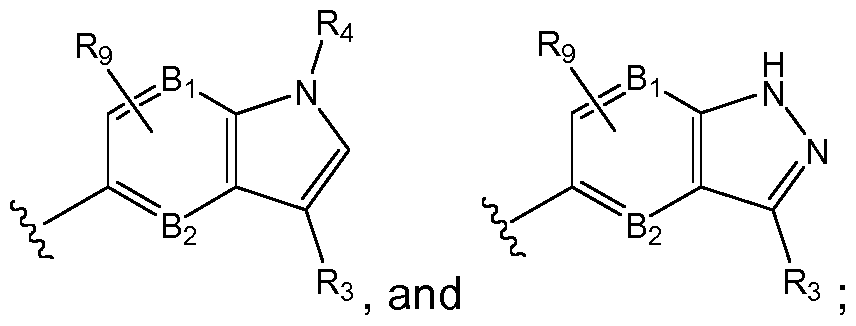
B1 and B2 are CH;
R4 is a hydrogen atom or a substituted or unsubstituted alkyl group;
R3 is a CO-alkyl-COR5 group or an alkyl group susbtituted by a COR5 group; and
R9 is a hydrogen atom.
In a particular embodiment, the invention relates to a compound of formula (I), in which A is a CH group, R1 a is a heterocycloalkyi group, R1 c is a hydrogen atom or an alkyl group, R2 is a phenyl group or an alkyl group a NH-CO-CH2 group or a NH-CO-NH
group, HET has the following structure
 in which B1 and B2 are carbon atoms,
R9 is a hydrogen atom, R4 is a hydrogen atom and R3 represents a CH2-CH2-COR5 group, wherein R5 is a hydroxyl group or an alkyloxy group.
In a particular embodiment, the R3 group is a -CH2-CH2-COR5 group.
In a particular embodiment, the R2 is a hydrogen atom and R2' is a phenyl group optionally substituted with one or more halogen atoms, in particular with a fluorine atom.
In a particular embodiment, R2 is a hydrogen atom and R2' is a pyridine group. In a further particular embodiment, the invention relates to a compound of formula (I), in which A is a CH group, R1 a is a piperidinyl group, R1 c is a hydrogen atom or an alkyl group, R2 is a heterocyclic group, preferably a furan-2-yl group substituted or not by an alkyl
group, L represents a NH-CO-CH2 group, HET has the following structure

which B1 and B2 are carbon atoms, R9 is a hydrogen atom, R4 is a hydrogen atom and R3 represents a CH2-CH2-COR5 group, wherein R5 is a hydroxyl group or an alkyloxy group.
The term "alkyl" refers to a saturated hydrocarbon radical that is linear or branched, substituted or not, having preferably from one to seven, and even more preferably from one to four carbon atoms, such as methyl, ethyl, n-propyl, isopropyl, n-butyl, isobutyl, tert-butyl, or sec-butyl. The alkyl group can be optionally substituted by one or more halogen atoms, by an aryl group or by a cycloalkyi group. Further possible substituents of an alkyl group also include one or more substituents selected from an amino group, an alkylamino group, a dialkylamino group, and an alkynyl group.
The term alkynyl denotes linear or branched hydrocarbon groups containing from 2 to 6 carbon atoms and containing at least one triple bond. Examples of alkynyl containing from 3 to 6 carbon atoms are 1 -propynyl, 2-propynyl, 1 -butynyl, 2-butynyl, 3-butynyl, 1 -pentynyl, 2- pentynyl, 3-pentynyl, 4-pentynyl, 1 -hexynyl, 2-hexynyl, 3-hexynyl, 4-hexynyl, 5-hexynyl and the isomeric forms thereof.
The term "long chain alkyl group" refers to a saturated hydrocarbon radical that is linear or branched, substituted or not, having preferably from ten to twenty carbon atoms. In a particular embodiment, the long chain alkyl group has preferably 12 to 18 carbon atoms, in particular 12, 13, 14, 15, 16, 17 or 18 carbon atoms, more particularly 15 carbon atoms. The long chain alkyl group may be substituted by the substituents provided above for an alkyl. However, in a particular embodiment, the long chain alkyl group is an unsubstituted alkyl group.
The terms "alkyloxy" and "alkylthio" refer to an alkyl group as defined above that is linked to the remainder of the compound by an oxygen or sulfur atom, respectively.
The term "alkylamino" refers to monoalkylamino (-NHR) or dialkylamino (-NRR') group where R and R' independently represent an alkyl group as defined above. In a particular embodiment, the alkyl group(s) of the alkylamino group may be substituted or not with a cycloalkyi group, an aryl group, a heterocyclic group, or an alkyloxycarbonyl group.
The term "cycloalkylamino" refers to a -NH-cycloalkyl group or a -N(alkyl)cycloalkyl group.
The term "amino group" designates a -NH2 group.
The term "hydroxyl group" refers to a -OH group.
The term "cycloalkyi" designates a substituted or unsubstituted alkyl group that forms one cycle having preferably from three to fourteen carbon atoms, and more preferably five to six carbon atoms, such as cyclopropyl, cyclopentyl and cyclohexyl. The cycloalkyi group of the present invention may be unsubstituted, or substituted, for example with an alkyl group, in particular with a alkyl group substituted with one or more halogen atoms, such as the CF3 group.
The term "carbonyl" designates a CO group.
The term "amido" designates a CO-NH2 group.
The term "aryl" designates an aromatic group, substituted or not, having preferably from six to fourteen carbon atoms such as phenyl, a-naphtyl, b-naphtyl, or biphenyl.
The term "heterocyclic" refers to a heterocycloalkyl group or a heteroaryl group. The term "heterocycloalkyl" group refers to a cycloalkyi as indicated above that further comprises one or several heteroatoms selected among nitrogen, oxygen or sulfur. They generally comprise from four to fourteen carbon atoms, such as morpholinyl, piperazinyl, piperidinyl, pyrrolidinyl, tetrahydropyranyl, dithiolanyl and azepanyl groups. In a particular embodiment, the heterocycloalkyl group is a 5-, 6- or 7-membered cycle. The term "heteroaryl" refers to an aryl group as indicated above, substituted or not, that further comprises one or several heteroatoms selected among nitrogen, oxygen or sulfur. They generally comprise from four to fourteen carbon atoms. In a particular embodiment, the heteroaryl group is a 5-, 6- or 10- membered cycle. Representative heteroaryl groups include a pyridinyl, pyrimidinyl, furanyl, thiophenyl, quinoleinyl, and isoquinoleinyl group.
The aryl group or the heterocyclic group can be optionally substituted by one or more halogen atom(s), alkyl group(s), or alkyloxy group(s).
By halogen atom, an atom of bromine, chlorine, fluorine or iodine is understood, in particular an atom of bromine, chlorine or fluorine. Specific compounds according to the invention include:
Cpd.1 : 3-{5-[({phenyl[2-(piperidin-1 -yl)phenyl]methyl}carbamoyl)methyl]-1 H-indol-3- yl}propanoic acid;
Cpd.2: tert-butyl 3-{5-[({phenyl[2-(piperidin-1 -yl)phenyl]methyl}carbamoyl)methyl]-1 H- indol-3-yl}propanoate;
Cpd.3: 3-[5-({[(3-fluorophenyl)[2-(piperidin-1 -yl)phenyl]methyl]carbamoyl}methyl)-1 H- indol-3-yl]propanoic acid;
Cpd.4: tert-butyl 3-[5-({[(3-fluorophenyl)[2-(piperidin-1 - yl)phenyl]methyl]carbamoyl}methyl)-1 H-indol-3-yl]propanoate;
Cpd.5: 3-{5-[({[4-methyl-2-(pyrrolidin-1 -yl)phenyl](phenyl)methyl}carbamoyl)methyl]-1 H- indol-3-yl}propanoic acid;
Cpd.6: tert-butyl 3-{5-[({[4-methyl-2-(pyrrolidin-1 - yl)phenyl](phenyl)methyl}carbamoyl)methyl]-1 H-indol-3-yl}propanoate; Cpd.7: 3-[5-({[(2-chloro-4-methylphenyl)(phenyl)methyl]carbamoyl}methyl)-1 H-indol-3- yl]propanoic acid;
Cpd.8: tert-butyl 3-[5-({[(2-chloro-4-methylphenyl)(phenyl)methyl]carbamoyl}methyl)-1 H- indol-3-yl]propanoate;
Cpd.9: 3-[5-({[(2-bromo-4-methylphenyl)(phenyl)methyl]carbamoyl}methyl)-1 H-indol-3- yl]propanoic acid;
Cpd.10: tert-butyl 3-[5-({[(2-bromo-4-methylphenyl)(phenyl)methyl]carbamoyl}methyl)-1 H- indol-3-yl]propanoate;
Cpd.1 1 : 3-[5-({[(2,4-dimethylphenyl)(phenyl)methyl]carbamoyl}methyl)-1 H-indol-3- yl]propanoic acid;
Cpd.12: tert-butyl 3-[5-({[(2,4-dimethylphenyl)(phenyl)methyl]carbamoyl}methyl)-1 H-indol- 3-yl]propanoate;
Cpd.13: 3-[5-({[(2,5-dimethylphenyl)(phenyl)methyl]carbamoyl}methyl)-1 H-indol-3- yl]propanoic acid;
Cpd.14: tert-butyl 3-[5-({[(2,5-dimethylphenyl)(phenyl)methyl]carbamoyl}methyl)-1 H-indol- 3-yl]propanoate;
Cpd.15: 3-{5-[({[6-methyl-2-(pyrrolidin-1 -yl)pyridin-3-yl](phenyl)methyl}carbamoyl)methyl]- 1 H-indol-3-yl}propanoic acid;
Cpd.16: tert-butyl 3-{5-[({[6-methyl-2-(pyrrolidin-1 -yl)pyridin-3- yl](phenyl)methyl}carbamoyl)methyl]-1 H-indol-3-yl}propanoate;
Cpd.17: 3-[5-({[(2-fluoro-4-methylphenyl)(phenyl)methyl]carbamoyl}methyl)-1 H-indol-3- yl]propanoic acid;
Cpd.18: tert-butyl 3-[5-({[(2-fluoro-4-methylphenyl)(phenyl)methyl]carbamoyl}methyl)-1 H- indol-3-yl]propanoate;
Cpd.19: 3-[5-({[(2-fluoro-5-methylphenyl)(phenyl)methyl]carbamoyl}methyl)-1 H-indol-3- yl]propanoic acid;
Cpd.20: tert-butyl 3-[5-({[(2-fluoro-5-methylphenyl)(phenyl)methyl]carbamoyl}methyl)-1 H- indol-3-yl]propanoate;
Cpd.21 : 3-[5-({[(2!4-dimethylphenyl)(pyridin-2-yl)methyl]carbamoyl}methyl)-1 H-indol-3- yl]propanoic acid;
Cpd.22: tert-butyl 3-[5-({[(2!4-dimethylphenyl)(pyridin-2-yl)methyl]carbamoyl}methyl)-1 H- indol-3-yl]propanoate;
Cpd.23: 3-[5-({[phenyl({2-[2-(trifluoromethyl)piperidin-1 -yl]phenyl})methyl]carbamoyl}- methyl)-1 H-indol-3-yl]propanoic acid;
Cpd.24: tert-butyl 3-[5-({[phenyl({2-[2-(trifluoromethyl)piperidin-1 - yl]phenyl})methyl]carbamoyl}methyl)-1 H-indol-3-yl]propanoate;
Cpd.25: 3-{5-[({[2-(3,5-dimethylpiperidin-1 -yl)phenyl](phenyl)methyl}carbamoyl)methyl]-
1 H-indol-3-yl}propanoic acid;
Cpd.26: tert-butyl 3-{5-[({[2-(3,5-dimethylpiperidin-1 -yl)phenyl](phenyl)methyl}carbamoyl) methyl]-1 H-indol-3-yl}propanoate;
Cpd.27: 3-[5-({[(2,4-dimethylphenyl)(pyridin-3-yl)methyl]carbamoyl}methyl)-1 H-indol-3- yl]propanoic acid;
Cpd.28: tert-butyl 3-[5-({[(2!4-dimethylphenyl)(pyridin-3-yl)methyl]carbamoyl}methyl)-1 H- indol-3-yl]propanoate;
Cpd.29: 3-{5-[({3-methyl-1 -[2-(piperidin-1 -yl)phenyl]butyl}carbamoyl)methyl]-1 H-in
yl}propanoic acid;
Cpd.30: tert-butyl 3-{5-[({3-methyl-1 -[2-(piperidin-1 -yl)phenyl]butyl}carbamoyl)methyl]-1 H- indol-3-yl}propanoate;
Cpd.31 : 3-[5-({[(5-methylquinolin-8-yl)(phenyl)methyl]carbamoyl}methyl)-1 H-indol-3- yl]propanoic acid;
Cpd.32: tert-butyl 3-[5-({[(5-methylquinolin-8-yl)(phenyl)methyl]carbamoyl}methyl)-1 H- indol-3-yl]propanoate;
Cpd.33: 3-[5-({[(4-chloro-2-methylphenyl)(phenyl)methyl]carbamoyl}methyl)-1 H-indol-3- yl]propanoic acid;
Cpd.34: tert-butyl 3-[5-({[(4-chloro-2-methylphenyl)(phenyl)methyl]carbamoyl}methyl)-1 H- indol-3-yl]propanoate;
Cpd.35: 3-{5-[({[2-(azepan-1 -yl)phenyl](phenyl)methyl}carbamoyl)methyl]-1 H-indol-3- yl}propanoic acid;
Cpd.36: tert-butyl 3-{5-[({[2-(azepan-1 -yl)phenyl](phenyl)methyl}carbamoyl)methyl]-1 H- indol-3-yl}propanoate;
Cpd.37: 3-[5-({[(4-methylnaphthalen-1 -yl)(phenyl)methyl]carbamoyl}methyl)-1 H-indol-3- yl]propanoic acid;
Cpd.38: tert-butyl 3-[5-({[(4-methylnaphthalen-1 -yl)(phenyl)methyl]carbamoyl}methyl)-1 H- indol-3-yl]propanoate;
Cpd.39: 2-{5-[({phenyl[2-(piperidin-1 -yl)phenyl]methyl}carbamoyl)methyl]-1 H-indol-3- yl}acetic acid; and
Cpd.40: methyl 2-{5-[({phenyl[2-(piperidin-1 -yl)phenyl]methyl}carbamoyl)methyl]-1 H-indol- 3-yl}acetate;
Cpd.41 tert-butyl 3-[5-({[(2-chloro-5-methylphenyl)(phenyl)methyl]carbamoyl}methyl)-1 H- indol-3-yl]propanoate;
Cpd.42 3-[5-({[(2-chloro-5-methylphenyl)(phenyl)methyl]carbamoyl}methyl)-1 H-indol-3- yl]propanoic acid;
Cpd.43 tert-butyl 3-[5-({[(4-bromo-2-methylphenyl)(phenyl)methyl]carbamoyl}methyl)-1 H- indol-3-yl]propanoate;
Cpd.44 3-[5-({[(4-bromo-2-methylphenyl)(phenyl)methyl]carbamoyl}methyl)-1 H-indol-3- yl]propanoic acid;
Cpd.45 tert-butyl 3-[5-({[(4-fluoro-2-methylphenyl)(phenyl)methyl]carbamoyl}methyl)-1 H- indol-3-yl]propanoate;
Cpd.46 3-[5-({[(4-fluoro-2-methylphenyl)(phenyl)methyl]carbamoyl}methyl)-1 H-indol-3- yl]propanoic acid;
Cpd.47 tert-butyl 3-{5-[({phenyl[2-(pyrrolidin-1 -yl)-4-
(trifluoromethyl)phenyl]methyl}carbamoyl)methyl]-1 H-indol-3-yl}propanoate;
Cpd.48 3-{5-[({phenyl[2-(pyrrolidin-1 -yl)-4-
(trifluoromethyl)phenyl]methyl}carbamoyl)methyl]-1 H-indol-3-yl}propanoic acid; Cpd.49 tert-butyl 3-{5-[({[4-bromo-2-(pyrrolidin-1 - yl)phenyl](phenyl)methyl}carbamoyl)methyl]-1 H-indol-3-yl}propanoate; Cpd.50 3-{5-[({[4-bromo-2-(pyrrolidin-1 -yl)phenyl](phenyl)methyl}carbamoyl)methyl]-1 H- indol-3-yl}propanoic acid;
Cpd.51 tert-butyl 3-[5-({[(2-aminophenyl)(phenyl)methyl]carbamoyl}methyl)-1 H-indol-3- yl]propanoate;
Cpd.52 3-[5-({[(2-aminophenyl)(phenyl)methyl]carbamoyl}methyl)-1 H-indol-3-yl]propanoic acid;
Cpd.53 tert-butyl 3-{5-[({[2-(dimethylamino)phenyl](phenyl)methyl}carbamoyl)methyl]-1 H- indol-3-yl}propanoate;
Cpd.54 3-{5-[({[2-(dimethylamino)phenyl](phenyl)methyl}carbamoyl)methyl]-1 H-indol-3- yl}propanoic acid;
Cpd.55 tert-butyl 3-{5-[({phenyl[2-(piperidin-1 -yl)phenyl]methyl}carbamoyl)amino]-1 H- indol-3-yl}propanoate;
Cpd.56 3-{5-[({phenyl[2-(piperidin-1 -yl)phenyl]methyl}carbamoyl)amino]-1 H-indol-3- yl}propanoic acid;
Cpd.57 tert-butyl 3-{5-[({3-methyl-1 -[2-(morpholin-4-yl)phenyl]butyl}carbamoyl)methyl]- 1 H-indol-3-yl}propanoate;
Cpd.58 3-{5-[({3-methyl-1 -[2-(morpholin-4-yl)phenyl]butyl}carbamoyl)methyl]-1 H-indol-3- yl}propanoic acid;
Cpd.59 tert-butyl 3-{5-[({[4-cyano-2-(pyrrolidin-1 - yl)phenyl](phenyl)methyl}carbamoyl)methyl]-1 H-indol-3-yl}propanoate;
Cpd.60 3-{5-[({[4-cyano-2-(pyrrolidin-1 -yl)phenyl](phenyl)methyl}carbamoyl)methyl]-1 H- indol-3-yl}propanoic acid;
Cpd.61 tert-butyl 3-{5-[({[5-chloro-2-(piperidin-1 - yl)phenyl](phenyl)methyl}carbamoyl)methyl]-1 H-indol-3-yl}propanoate; Cpd.62 3-{5-[({[5-chloro-2-(piperidin-1 -yl)phenyl](phenyl)methyl}carbamoyl)methyl]-1 H- indol-3-yl}propanoic acid;
Cpd.63 3-{5-[({[4-carbamoyl-2-(pyrrolidin-1 -yl)phenyl](phenyl)methyl}carbamoyl)methyl]-
1 H-indol-3-yl}propanoic acid;
Cpd.64 methyl 2-{5-[({[4-methyl-2-(pyrrolidin-1 - yl)phenyl](phenyl)methyl}carbamoyl)methyl]-1 H-indol-3-yl}acetate;
Cpd.65 2-{5-[({[4-methyl-2-(pyrrolidin-1 -yl)phenyl](phenyl)methyl}carbamoyl)methyl]-1 H- indol-3-yl}acetic acid;
Cpd.66 methyl 2-{5-[({[4-bromo-2-(pyrrolidin-1 - yl)phenyl](phenyl)methyl}carbamoyl)methyl]-1 H-indol-3-yl}acetate;
Cpd.67 2-{5-[({[4-bromo-2-(pyrrolidin-1 -yl)phenyl](phenyl)methyl}carbamoyl)methyl]-1 H- indol-3-yl}acetic acid;
Cpd.68 methyl 2-{5-[({phenyl[2-(piperidin-1 -yl)phenyl]methyl}carbamoyl)amino]-1 H-indol- 3-yl}acetate;
Cpd.69 2-{5-[({phenyl[2-(piperidin-1 -yl)phenyl]methyl}carbamoyl)amino]-1 H-indol-3- yl}acetic acid;
Cpd.70 methyl 2-{5-[({[2-(dimethylamino)phenyl](phenyl)methyl}carbamoyl)methyl]-1 H- indol-3-yl}acetate;
Cpd.71 2-{5-[({[2-(dimethylamino)phenyl](phenyl)methyl}carbamoyl)methyl]-1 H-indol-3- yl}acetic acid;
Cpd.72 methyl 2-{5-[({phenyl[2-(pyrrolidin-1 -yl)phenyl]methyl}carbamoyl)methyl]-1 H- indol-3-yl}acetate;
Cpd.73 2-{5-[({phenyl[2-(pyrrolidin-1 -yl)phenyl]methyl}carbamoyl)methyl]-1 H-indol-3- yl}acetic acid;
Cpd.74 methyl 2-{5-[({[2-(azepan-1 -yl)phenyl](phenyl)methyl}carbamoyl)methyl]-1 H-indol- 3-yl}acetate;
Cpd.75 2-{5-[({[2-(azepan-1 -yl)phenyl](phenyl)methyl}carbamoyl)methyl]-1 H-indol-3- yl}acetic acid;
Cpd.76 tert-butyl 3-{5-[({[4-methyl-2-(piperidin-1 - yl)phenyl](phenyl)methyl}carbamoyl)methyl]-1 H-indol-3-yl}propanoate;
Cpd.77 3-{5-[({[4-methyl-2-(piperidin-1 -yl)phenyl](phenyl)methyl}carbamoyl)methyl]-1 H- indol-3-yl}propanoic acid;
Cpd.78 tert-butyl 3-{5-[({phenyl[2-(pyrrolidin-1 -yl)phenyl]methyl}carbamoyl)methyl]-1 H- indol-3-yl}propanoate;
Cpd.79 3-{5-[({phenyl[2-(pyrrolidin-1 -yl)phenyl]methyl}carbamoyl)methyl]-1 H-indol-3- yl}propanoic acid;
Cpd.80 tert-butyl 3-{5-[({[4-methyl-2-(morpholin-4- yl)phenyl](phenyl)methyl}carbamoyl)methyl]-1 H-indol-3-yl}propanoate; Cpd.81 3-{5-[({[4-methyl-2-(morpholin-4-yl)phenyl](phenyl)methyl}carbamoyl)methyl]-1 H- indol-3-yl}propanoic acid;
Cpd.82 tert-butyl 3-[5-({[(4-methoxy-2-methylphenyl)(phenyl)methyl]carbamoyl}methyl)- 1 H-indol-3-yl]propanoate;
Cpd.83 3-[5-({[(4-methoxy-2-methylphenyl)(phenyl)methyl]carbamoyl}methyl)-1 H-indol-3- yl]propanoic acid;
Cpd.84 methyl 2-{5-[({[4-chloro-2-(pyrrolidin-1 - yl)phenyl](phenyl)methyl}carbamoyl)methyl]-1 H-indol-3-yl}acetate;
Cpd.85 2-{5-[({[4-chloro-2-(pyrrolidin-1 -yl)phenyl](phenyl)methyl}carbamoyl)methyl]-1 H- indol-3-yl}acetic acid;
Cpd.86 methyl 2-{5-[({[4-methyl-2-(piperidin-1 - yl)phenyl](phenyl)methyl}carbamoyl)methyl]-1 H-indol-3-yl}acetate;
Cpd.87 2-{5-[({[4-methyl-2-(piperidin-1 -yl)phenyl](phenyl)methyl}carbamoyl)methyl]-1 H- indol-3-yl}acetic acid;
Cpd.88 methyl 2-{5-[({phenyl[2-(pyrrolidin-1 -yl)-4-
(trifluoromethyl)phenyl]methyl}carbamoyl)methyl]-1 H-indol-3-yl}acetate; Cpd.89 2-{5-[({phenyl[2-(pyrrolidin-1 -yl)-4-
(trifluoromethyl)phenyl]methyl}carbamoyl)methyl]-1 H-indol-3-yl}acetic acid;
Cpd.90 tert-butyl 3-{5-[({[4-chloro-2-(pyrrolidin-1 - yl)phenyl](phenyl)methyl}carbamoyl)methyl]-1 H-indol-3-yl}propanoate;
Cpd.91 3-{5-[({[4-chloro-2-(pyrrolidin-1 -yl)phenyl](phenyl)methyl}carbamoyl)methyl]-1 H- indol-3-yl}propanoic acid;
Cpd.92 tert-butyl 3-{5-[({[4-fluoro-2-(pyrrolidin-1 - yl)phenyl](phenyl)methyl}carbamoyl)methyl]-1 H-indol-3-yl}propanoate; Cpd.93 3-{5-[({[4-fluoro-2-(pyrrolidin-1 -yl)phenyl](phenyl)methyl}carbamoyl)methyl]-1 H- indol-3-yl}propanoic acid;
Cpd.94 tert-butyl 3-{5-[({phenyl[2-(piperidin-1 -yl)phenyl]methyl}carbamoyl)amino]-1 H- pyrrolo[2,3-b]pyridin-3-yl}propanoate;
Cpd.95 3-{5-[({phenyl[2-(piperidin-1 -yl)phenyl]methyl}carbamoyl)amino]-1 H-pyrrolo[2,3- b]pyridin-3-yl}propanoic acid;
Cpd.96 methyl 2-{5-[({[4-methyl-2-(morpholin-4- yl)phenyl](phenyl)methyl}carbamoyl)methyl]-1 H-indol-3-yl}acetate;
Cpd.97 2-{5-[({[4-methyl-2-(morpholin-4-yl)phenyl](phenyl)methyl}carbamoyl)methyl]-1 H- indol-3-yl}acetic acid;
Cpd.98 tert-butyl 3-[5-({[(2-methoxy-4-methylphenyl)(phenyl)methyl]carbamoyl}methyl)- 1 H-indol-3-yl]propanoate;
Cpd.99 3-[5-({[(2-methoxy-4-methylphenyl)(phenyl)methyl]carbamoyl}methyl)-1 H-indol-3- yl]propanoic acid;
Cpd.100 tert-butyl 3-[5-({[(2,4-dimethylphenyl)(5-methylthiophen-2- yl)methyl]carbamoyl}methyl)-1 H-indol-3-yl]propanoate;
Cpd.101 3-[5-({[(2,4-dimethylphenyl)(5-methylthiophen-2-yl)m^
indol-3-yl]propanoic acid;
Cpd.102 tert-butyl 3-{5-[({[4-methyl-2-(4-methylpiperazin-1 - yl)phenyl](phenyl)methyl}carbamoyl)methyl]-1 H-indol-3-yl}propanoate; Cpd.103 3-{5-[({[4-methyl-2-(4-methylpiperazin-1 - yl)phenyl](phenyl)methyl}carbamoyl)methyl]-1 H-indol-3-yl}propanoic acid;
Cpd.104 tert-butyl 3-[5-({[3-methyl-1 -(naphthalen-1 -yl)butyl]carbamoyl}methyl)-1 H-indol-3- yl]propanoate;
Cpd.105 3-[5-({[3-methyl-1 -(naphthalen-1 -yl)butyl]carbamoyl}methyl)-1 H-indol-3- yl]propanoic acid;
Cpd.106 tert-butyl 3-{5-[({phenyl[2-(1 H-pyrrol-1 -yl)phenyl]methyl}carbamoyl)methyl]-1 H- indol-3-yl}propanoate;
Cpd.107 3-{5-[({phenyl[2-(1 H-pyrrol-1 -yl)phenyl]methyl}carbamoyl)methyl]-1 H-indol-3- yl}propanoic acid;
Cpd.108 tert-butyl 3-{5-[({[4-methoxy-2-(pyrrolidin-1 - yl)phenyl](phenyl)methyl}carbamoyl)methyl]-1 H-indol-3-yl}propanoate;
Cpd.109 3-{5-[({[4-methoxy-2-(pyrrolidin-1 -yl)phenyl](phenyl)methyl}carbamoyl)methyl]-
1 H-indol-3-yl}propanoic acid;
Cpd.1 10 tert-butyl 3-{5-[({[4-methoxy-2-(piperidin-1 - yl)phenyl](phenyl)methyl}carbamoyl)methyl]-1 H-indol-3-yl}propanoate; Cpd.1 1 1 3-{5-[({[4-methoxy-2-(piperidin-1 -yl)phenyl](phenyl)methyl}carbamoyl)methyl]-1 H- indol-3-yl}propanoic acid;
Cpd.1 12 N,N-dimethyl-2-{5-[({[4-methyl-2-(morpholin-4- yl)phenyl](phenyl)methyl}carbamoyl)methyl]-1 H-indol-3-yl}acetamide; Cpd.1 13 tert-butyl 3-{5-[({[5-methyl-2-(piperidin-1 - yl)phenyl](phenyl)methyl}carbamoyl)methyl]-1 H-indol-3-yl}propanoate;
Cpd.1 14 3-{5-[({[5-methyl-2-(piperidin-1 -yl)phenyl](phenyl)methyl}carbamoyl)methyl]-1 H- indol-3-yl}propanoic acid;
Cpd.1 15 N-methyl-3-{5-[({phenyl[2-(piperidin-1 -yl)phenyl]methyl}carbamoyl)methyl]-1 H- indol-3-yl}propanamide;
Cpd.1 16 tert-butyl 3-{5-[({[5-bromo-2-(pyrrolidin-1 - yl)phenyl](phenyl)methyl}carbamoyl)methyl]-1 H-indol-3-yl}propanoate; Cpd.1 17 3-{5-[({[5-bromo-2-(pyrrolidin-1 -yl)phenyl](phenyl)methyl}carbamoyl)methyl]-1 H- indol-3-yl}propanoic acid;
Cpd.1 18 3-{5-[({phenyl[2-(piperidin-1 -yl)phenyl]methyl}carbamoyl)methyl]-1 H-indol-3-yl}-N- (propan-2-yl)propanamide;
Cpd.1 19 tert-butyl 3-{5-[({[2-(ethylamino)-4- methylphenyl](phenyl)methyl}carbamoyl)methyl]-1 H-indol-3-yl}propanoate;
Cpd.120 3-{5-[({[2-(ethylamino)-4-methylphenyl](phenyl)methyl}carbamoyl)methyl]-1 H- indol-3-yl}propanoic acid;
Cpd.121 tert-butyl 3-(5-{[({2- [(dimethylamino)methyl]phenyl}(phenyl)methyl)carbamoyl]methyl}-1 H-indol-3- yl)propanoate;
Cpd.122 3-(5-{[({2-[(dimethylamino)methyl]phenyl}(phenyl)methyl)carbamoyl]methyl}-1 H- indol-3-yl)propanoic acid;
Cpd.123 tert-butyl 3-{5-[({[2-(3-hydroxypiperidin-1 - yl)phenyl](phenyl)methyl}carbamoyl)methyl]-1 H-indol-3-yl}propanoate; Cpd.124 3-{5-[({[2-(3-hydroxypiperidin-1 -yl)phenyl](phenyl)methyl}carbamoyl)methyl]-1 H- indol-3-yl}propanoic acid;
Cpd.125 tert-butyl 3-(5-{[({4-methyl-2-[(propan-2- yl)amino]phenyl}(phenyl)methyl)carbamoyl]methyl}-1 H-indol-3-yl)propanoate;
Cpd .126 3-(5-{[({4-methyl-2-[(propan-2- yl)amino]phenyl}(phenyl)methyl)carbamoyl]methyl}-1 H-indol-3-yl)propanoic acid; Cpd.127 tert-butyl 3-{5-[({phenyl[2-(1 ,2,3,6-tetrahydropyridin-l - yl)phenyl]methyl}carbamoyl)methyl]-1 H-indol-3-yl}propanoate;
Cpd.128 3-{5-[({phenyl[2-(1 ^.S.e-tetrahydropyridin-l -y pheny methylJcarbamoy methyl]-
1 H-indol-3-yl}propanoic acid;
Cpd.129 tert-butyl 3-{5-[({1 -[2-(pyrrolidin-1 -yl)phenyl]cyclopentyl}carbamoyl)methyl]-1 H- indol-3-yl}propanoate;
Cpd.130 3-{5-[({1 -[2-(pyrrolidin-1 -yl)phenyl]cyclopentyl}carbamoyl)methyl]-1 H-indol-3- yl}propanoic acid;
Cpd.131 tert-butyl 3-{5-[({[4-methyl-2-(piperidin-1 -yl)phenyl](pyrimidin-2- yl)methyl}carbamoyl)methyl]-1 H-indol-3-yl}propanoate;
Cpd.132 3-{5-[({[4-methyl-2-(piperidin-1 -yl)phenyl](pyrimidin-2- yl)methyl}carbamoyl)methyl]-1 H-indol-3-yl}propanoic acid;
Cpd.133 tert-butyl 3-{5-[({1 -[2-(dimethylamino)-4-methylphenyl]-3- methylbutyl}carbamoyl)methyl]-1 H-indol-3-yl}propanoate;
Cpd.134 3-{5-[({1 -[2-(dimethylamino)-4-methylphenyl]-3-methylbutyl}carbamoyl)methyl]-
1 H-indol-3-yl}propanoic acid;
Cpd.135 tert-butyl 3-{5-[({[5-methoxy-2-(piperidin-1 - yl)phenyl](phenyl)methyl}carbamoyl)methyl]-1 H-indol-3-yl}propanoate;
Cpd.136 3-{5-[({[5-methoxy-2-(piperidin-1 -yl)phenyl](phenyl)methyl}carbamoyl)methyl]-1 H- indol-3-yl}propanoic acid;
Cpd.137 tert-butyl 3-{5-[({[4-methyl-2-(piperidin-1-yl)phenyl](5-methylthiophen-2- yl)methyl}carbamoyl)methyl]-1 H-indol-3-yl}propanoate;
Cpd.138 3-{5-[({[4-methyl-2-(piperidin-1 -yl)phenyl](5-methylthiophen-2- yl)methyl}carbamoyl)methyl]-1 H-indol-3-yl}propanoic acid;
Cpd.139 tert-butyl 3-{5-[({[4-methyl-2-(piperidin-1 -yl)phenyl](1 ,3-thiazol-2- yl)methyl}carbamoyl)methyl]-1 H-indol-3-yl}propanoate;
Cpd.140 3-{5-[({[4-methyl-2-(piperidin-1 -yl)phenyl](1 ,3-thiazol-2- yl)methyl}carbamoyl)methyl]-1 H-indol-3-yl}propanoic acid;
Cpd.141 tert-butyl 3-{5-[({[2-(azepan-1 -yl)-4- methoxyphenyl](phenyl)methyl}carbamoyl)methyl]-1 H-indol-3-yl}propanoate; Cpd.142 3-{5-[({[2-(azepan-1 -yl)-4-methoxyphenyl](phenyl)methyl}carbamoyl)methyl]-1 H- indol-3-yl}propanoic acid;
Cpd.143 tert-butyl 3-{5-[({1 -[2-(piperidin-1 -yl)phenyl]cyclohexyl}carbamoyl)methyl]-1 H- indol-3-yl}propanoate;
Cpd.144 3-{5-[({1 -[2-(piperidin-1 -yl)phenyl]cyclohexyl}carbamoyl)methyl]-1 H-indol-3- yl}propanoic acid;
Cpd.145 tert-butyl 3-{5-[({[4-methyl-2-(propan-2- yloxy)phenyl](phenyl)methyl}carbamoyl)methyl]-1 H-indol-3-yl}propanoate;
Cpd.146 3-{5-[({[4-methyl-2-(propan-2-yloxy)phenyl](phenyl)methyl}carbamoyl)methyl]-1 H- indol-3-yl}propanoic acid;
Cpd.147 tert-butyl 3-[5-({[(5-methylfuran-2-yl)[2-(piperidin-1 - yl)phenyl]methyl]carbamoyl}methyl)-1 H-indol-3-yl]propanoate;
Cpd.148 3-[5-({[(5-methylfuran-2-yl)[2-(piperidin-1 -yl)phenyl]methyl]carbamoyl}methyl)-1 H- indol-3-yl]propanoic acid;
Cpd.149 tert-butyl 3-{5-[({[4-ethoxy-2-(piperidin-1 - yl)phenyl](phenyl)methyl}carbamoyl)methyl]-1 H-indol-3-yl}propanoate; Cpd.150 3-{5-[({[4-ethoxy-2-(piperidin-1 -yl)phenyl](phenyl)methyl}carbamoyl)methyl]-1 H- indol-3-yl}propanoic acid;
Cpd.151 tert-butyl 3-{5-[({phenyl[2-(piperidin-1 -yl)-4-(propan-2- yloxy)phenyl]methyl}carbamoyl)methyl]-1 H-indol-3-yl}propanoate;
Cpd.152 3-{5-[({phenyl[2-(piperidin-1 -yl)-4-(propan-2- yloxy)phenyl]methyl}carbamoyl)methyl]-1 H-indol-3-yl}propanoic acid; Cpd.153 tert-butyl 3-[5-({[(5-methyl-1 ,3-thiazol-2-yl)[2-(piperidin-1 - yl)phenyl]methyl]carbamoyl}methyl)-1 H-indol-3-yl]propanoate;
Cpd.154 3-[5-({[(5-methyl-1 ,3-thiazol-2-yl)[2-(piperidin-1 - yl)phenyl]methyl]carbamoyl}methyl)-1 H-indol-3-yl]propanoic acid;
Cpd.155 tert-butyl 3-[5-({[(2-methyl-1 ,3-thiazol-5-yl)[2-(piperidin-1 - yl)phenyl]methyl]carbamoyl}methyl)-1 H-indol-3-yl]propanoate;
Cpd.156 3-[5-({[(2-methyl-1 ,3-thiazol-5-yl)[2-(piperidin-1 - yl)phenyl]methyl]carbamoyl}methyl)-1 H-indol-3-yl]propanoic acid;
Cpd.157 tert-butyl 3-[5-({[(3-methylphenyl)[2-(piperidin-1 - yl)phenyl]methyl]carbamoyl}methyl)-1 H-indol-3-yl]propanoate;
Cpd.158 3-[5-({[(3-methylphenyl)[2-(piperidin-1 -yl)phenyl]methyl]carbamoyl}methyl)-1 H- indol-3-yl]propanoic acid;
Cpd.159 ethyl 3-{5-[({[4-methyl-2-(propan-2- yloxy)phenyl](phenyl)methyl}carbamoyl)methyl]-1 H-indazol-3-yl}propanoate; Cpd.160 3-{5-[({[4-methyl-2-(propan-2-yloxy)phenyl](phenyl)methyl}carbamoyl)methyl]-1 H- indazol-3-yl}propanoic acid;
Cpd.161 tert-butyl 3-{5-[({2-cyclohexyl-1 -[2-(piperidin-1 -yl)phenyl]ethyl}carbamoyl)methyl]- 1 H-indol-3-yl}propanoate;
Cpd.162 3-{5-[({2-cyclohexyl-1 -[2-(piperidin-1 -yl)phenyl]ethyl}carbamoyl)methyl]-1 H-indol- 3-yl}propanoic acid;
Cpd.163 tert-butyl 3-[5-({[cyclopropyl(4-methylnaphthalen-1 -yl)methyl]carbamoyl}methyl)- 1 H-indol-3-yl]propanoate;
Cpd.164 3-[5-({[cyclopropyl(4-methylnaphthalen-1 -yl)methyl]carbamoyl}methyl)-1 H-indol- 3-yl]propanoic acid;
Cpd.165 methyl 2-{5-[({[5-chloro-2-(piperidin-1 - yl)phenyl](phenyl)methyl}carbamoyl)methyl]-1 H-indol-3-yl}acetate;
Cpd.166 2-{5-[({[5-chloro-2-(piperidin-1 -yl)phenyl](phenyl)methyl}carbamoyl)methyl]-1 H- indol-3-yl}acetic acid;
Cpd.167 tert-butyl 3-[5-({[1 H-indol-7-yl(phenyl)methyl]carbamoyl}methyl)-1 H-indol-3- yl]propanoate;
Cpd.168 3-[5-({[1 H-indol-7-yl(phenyl)methyl]carbamoyl}methyl)-1 H-indol-3-yl]propanoic acid;
Cpd.169 tert-butyl 3-[5-({[(1 -methyl-1 H-indol-7-yl)(phenyl)methyl]carbamoyl}methyl)-1 H- indol-3-yl]propanoate;
Cpd.170 3-[5-({[(1 -methyl-1 H-indol-7-yl)(phenyl)methyl]carbamoyl}methyl)-1 H-indol-3- yl]propanoic acid;
Cpd.171 tert-butyl 3-{5-[({1 -[2-(piperidin-1 -yl)phenyl]pentyl}carbamoyl)methyl]-1 H-indol-3- yl}propanoate;
Cpd.172 3-{5-[({1 -[2-(piperidin-1 -yl)phenyl]pentyl}carbamoyl)methyl]-1 H-indol-3- yl}propanoic acid;
Cpd.173 tert-butyl 3-{5-[({1 -[2-(diethylamino)phenyl]-3-methylbutyl} carbamoyl)methyl]-1 H- indol-3-yl}propanoate;
Cpd.174 3-{5-[({1 -[2-(diethylamino)phenyl]-3-methylbutyl}carbamoyl)methyl]-1 H-indol-3- yl}propanoic acid;
Cpd.175 tert-butyl 3-[5-({[2-(3-methylphenyl)-1 -[2-(piperidin-1 - yl)phenyl]ethyl]carbamoyl}methyl)-1 H-indol-3-yl]propanoate;
Cpd.176 3-[5-({[2-(3-methylphenyl)-1 -[2-(piperidin-1 -yl)phenyl]ethyl]carbamoyl}methyl)-1 H- indol-3-yl]propanoic acid;
Cpd.177 tert-butyl 3-{5-[({3-methyl-1 -[2-(piperidin-1 -yl)phenyl]butyl}carbamoyl)amino]-1 H- pyrrolo[2,3-b]pyridin-3-yl}propanoate;
Cpd.178 3-{5-[({3-methyl-1 -[2-(piperidin-1 -yl)phenyl]butyl}carbamoyl)amino]-1 H- pyrrolo[2,3-b]pyridin-3-yl}propanoic acid;
Cpd.179 tert-butyl 3-{5-[({[2-(4,4-difluoropiperidin-1 - yl)phenyl](phenyl)methyl}carbamoyl)methyl]-1 H-indol-3-yl}propanoate;
Cpd.180 3-{5-[({[2-(4,4-difluoropiperidin-1 -yl)phenyl](phenyl)methyl}carbamoyl)methyl]-1 H- indol-3-yl}propanoic acid;
Cpd.181 tert-butyl 3-{5-[({1 -[4-bromo-2-(pyrrolidin-1 -yl)phenyl]-3- methylbutyl}carbamoyl)methyl]-1 H-indol-3-yl}propanoate;
Cpd.182 3-{5-[({1 -[4-bromo-2-(pyrrolidin-1 -yl)phenyl]-3-methylbutyl}carbamoyl)methyl]-1 H- indol-3-yl}propanoic acid;
Cpd.183 tert-butyl 3-[5-({[(2-amino-4-methylphenyl)(phenyl)methyl]carbamoyl}methyl)-1 H- indol-3-yl]propanoate;
Cpd.184 3-[5-({[(2-amino-4-methylphenyl)(phenyl)methyl]carbamoyl}methyl)-1 H-indol-3- yl]propanoic acid;
Cpd.185 tert-butyl 3-{5-[({3,3-dimethyl-1 -[2-(piperidin-1 -yl)phenyl]butyl}carbamoyl)methyl]-
1 H-indol-3-yl}propanoate;
Cpd.186 3-{5-[({3,3-dimethyl-1 -[2-(piperidin-1 -yl)phenyl]butyl}carbamoyl)methyl]-1 H-i
3-yl}propanoic acid;
Cpd.187 tert-butyl 3-[5-({[(4-methylphenyl)[2-(piperidin-1 - yl)phenyl]methyl]carbamoyl}methyl)-1 H-indol-3-yl]propanoate;
Cpd.188 3-[5-({[(4-methylphenyl)[2-(piperidin-1 -yl)phenyl]methyl]carbamoyl}methyl)-1 H- indol-3-yl]propanoic acid;
Cpd.189 tert-butyl 3-[5-({[2-(oxan-4-yl)-1 -[2-(piperidin-1 -yl)phenyl]ethyl]carbamoyl}methyl)- 1 H-indol-3-yl]propanoate;
Cpd.190 3-[5-({[2-(oxan-4-yl)-1 -[2-(piperidin-1 -yl)phenyl]ethyl]carbamoyl}methyl)-1 ^
3-yl]propanoic acid;
Cpd.191 tert-butyl 3-{5-[({[2-(dimethylamino)-4- methylphenyl](phenyl)methyl}carbamoyl)methyl]-1 H-indol-3-yl}propanoate;
Cpd.192 3-{5-[({[2-(dimethylamino)-4-methylphenyl](phenyl)methyl}carbamoyl)methyl]-1 H- indol-3-yl}propanoic acid;
Cpd.193 methyl 2-{5-[({3-methyl-1 -[2-(piperidin-1 -yl)phenyl]butyl}carbamoyl)methyl]-1 H- indol-3-yl}acetate ;
Cpd.194 2-{5-[({3-methyl-1 -[2-(piperidin-1 -yl)phenyl]butyl}carbamoyl)methyl]-1 H-i
yl}acetic acid;
Cpd.195 tert-butyl 3-{5-[({[2-(morpholin-4-yl)phenyl](phenyl)methyl}carbamoyl)methyl]-1 H- indol-3-yl}propanoate;
Cpd.196 3-{5-[({[2-(morpholin-4-yl)phenyl](phenyl)methyl}carbamoyl)methyl]-1 H-indol-3- yl}propanoic acid;
Cpd.197 tert-butyl 3-{5-[({1 -[2-(azepan-1 -yl)phenyl]-3-methylbutyl}carbamoyl)methyl]-1 H- indol-3-yl}propanoate;
Cpd.198 3-{5-[({1 -[2-(azepan-1 -yl)phenyl]-3-methylbutyl}carbamoyl)methyl]-1 H-indol-3- yl}propanoic acid;
Cpd.199 tert-butyl 3-{5-[({[2-(2 dihydro-1 H-pyrrol-1 -yl)-4- methylphenyl](phenyl)methyl}carbamoyl)methyl]-1 H-indol-3-yl}propanoate;
Cpd.200 3-{5-[({[2-(2,5-dihydro-1 H-pyrrol-1 -yl)-4- methylphenyl](phenyl)methyl}carbamoyl)methyl]-1 H-indol-3-yl}propanoic acid; Cpd.201 tert-butyl 3-{5-[({[3-methyl-2-(piperidin-1 - yl)phenyl](phenyl)methyl}carbamoyl)methyl]-1 H-indol-3-yl}propanoate; Cpd.202 3-{5-[({[3-methyl-2-(piperidin-1 -yl)phenyl](phenyl)methyl}carbamoyl)methyl]-1 H- indol-3-yl}propanoic acid;
Cpd.203 tert-butyl 3-{5-[({[4-methyl-2-
(methylamino)phenyl](phenyl)methyl}carbamoyl)methyl]-1 H-indol-3- yl}propanoate;
Cpd.204 3-{5-[({[4-methyl-2-(methylamino)phenyl](phenyl)methyl}carbamoyl)methyl]-1 H- indol-3-yl}propanoic acid;
Cpd.205 methyl 5-[({phenyl[2-(piperidin-1 -yl)phenyl]methyl}carbamoyl)methyl]-1 H-indole- 3-carboxylate;
Cpd.206 1 -(2-{[2-(3-carboxy-1 H-indol-5-yl)acetamido](phenyl)methyl}phenyl)piperidin-1 - ium chloride;
Cpd.207 5-({[(2-bromo-4-methylphenyl)(phenyl)methyl]carbamoyl}methyl)-1 H-indole-3- carboxylic acid;
Cpd.208 tert-butyl 3-[5-({2-[4-methyl-2-(piperidin-1 -yl)phenyl]-2-phenylacetamido}methyl)-
1 H-indol-3-yl]propanoate;
Cpd.209 3-[5-({2-[4-methyl-2-(piperidin-1 -yl)phenyl]-2-phenylacetamido}methyl)-1 H-indol- 3-yl]propanoic acid;
Cpd.210 ethyl 4-oxo-4-{5-[({phenyl[2-(piperidin-1 -yl)phenyl]methyl}carbamoyl)methyl]-1 H- indol-3-yl}butanoate;
Cpd.21 1 ethyl 4-{5-[({phenyl[2-(piperidin-1 -yl)phenyl]methyl}carbamoyl)methyl]-1 H-indol-3- yl}butanoate;
Cpd.212 4-{5-[({phenyl[2-(piperidin-1 -yl)phenyl]methyl}carbamoyl)methyl]-1 H-indol-3- yl}butanoic acid;
Cpd.213 4-oxo-4-{5-[({phenyl[2-(piperidin-1 -yl)phenyl]methyl}carbamoyl)methyl]-1 H-indol- 3-yl}butanoic acid;
Cpd.214 ethyl 5-oxo-5-{5-[({phenyl[2-(piperidin-1 -yl)phenyl]methyl}carbamoyl)methyl]-1 H- indol-3-yl}pentanoate;
Cpd.215 5-oxo-5-{5-[({phenyl[2-(piperidin-1 -yl)phenyl]methyl}carbamoyl)methyl]-1 H-indol- 3-yl}pentanoic acid;
Cpd.216 ethyl 5-{5-[({phenyl[2-(piperidin-1 -yl)phenyl]methyl}carbamoyl)methyl]-1 H-indol-3- yl}pentanoate;
Cpd.217 5-{5-[({phenyl[2-(piperidin-1 -yl)phenyl]methyl}carbamoyl)methyl]-1 H-indol-3- yl}pentanoic acid;
Cpd.218 tert-butyl 3-{5-[({1 -[2-(diethylamino)phenyl]pentyl}carbamoyl)methyl]-1 H-indol-3- yl}propanoate;
Cpd.219 3-{5-[({1 -[2-(diethylamino)phenyl]pentyl}carbamoyl)methyl]-1 H-indol-3- yl}propanoic acid;
Cpd.220 methyl 2-[5-({[(2-bromo-4-methylphenyl)(phenyl)methyl]carbamoyl}methyl)-1 H- indol-3-yl]acetate;
Cpd.221 2-[5-({[(2-bromo-4-methylphenyl)(phenyl)methyl]carbamoyl}methyl)-1 H-indol-3- yl]acetic acid;
Cpd.222 methyl 2-[5-({[(2,4-dimethylphenyl)(5-methylthiophen-2- yl)methyl]carbamoyl}methyl)-1 H-indol-3-yl]acetate;
Cpd.223 2-[5-({[(2,4-dimethylphenyl)(5-methylthiophen-2-yl)methyl]carbamoyl}methyl)-1 H- indol-3-yl]acetic acid;
Cpd.224 methyl 2-{5-[({[2-(morpholin-4-yl)phenyl](phenyl)methyl}carbamoyl)methyl]-1 H- indol-3-yl}acetate;
Cpd.225 2-{5-[({[2-(morpholin-4-yl)phenyl](phenyl)methyl}carbamoyl)methyl]-1 H-indol-3- yl}acetic acid;
Cpd.226 tert-butyl 3-[5-({[(2-bromo-4-methylphenyl)(pyrimidin-2- yl)methyl]carbamoyl}methyl)-1 H-indol-3-yl]propanoate;
Cpd.227 3-[5-({[(2-bromo-4-methylphenyl)(pyrimidin-2-yl)methyl]carbamoyl}methyl)-1 H- indol-3-yl]propanoic acid;
Cpd.228 tert-butyl 3-[5-({[(4-methyl-1 H-indol-7-yl)(phenyl)methyl]carbamoyl}methyl)-1 H- indol-3-yl]propanoate;
Cpd.229 3-[5-({[(4-methyl-1 H-indol-7-yl)(phenyl)methyl]carbamoyl}methyl)-1 H-indol-3- yl]propanoic acid;
Cpd.230 tert-butyl 3-{5-[({1 -[4-methyl-2-(piperidin-1 -yl)phenyl]pentyl}carbamoyl)methyl]-
1 H-indol-3-yl}propanoate;
Cpd.231 3-{5-[({1 -[4-methyl-2-(piperidin-1 -yl)phenyl]pentyl}carbamoyl)methyl]-1 H-indol-3- yl}propanoic acid;
Cpd.232 tert-butyl 3-{5-[({[2-(3,3-difluoropiperidin-1 - yl)phenyl](phenyl)methyl}carbamoyl)methyl]-1 H-indol-3-yl}propanoate;
Cpd.233 3-{5-[({[2-(3,3-difluoropiperidin-1 -yl)phenyl](phenyl)methyl}carbamoyl)methyl]-1 H- indol-3-yl}propanoic acid;
Cpd.234 tert-butyl N-[(3-{5-[({phenyl[2-(piperidin-1 -yl)phenyl]methyl}carbamoyl)methyl]-1 H- indol-3-yl}propanamido)methanimidoyl]carbamate;
Cpd.235 1 -{2-[(2-{3-[2-(carbamimidoylcarbamoyl)ethyl]-1 H-indol-5- yl}acetamido)(phenyl)methyl]phenyl}piperidin-1 -ium chloride;
Cpd.236 ethyl 3-{5-[({phenyl[2-(piperidin-1 -yl)phenyl]methyl}carbamoyl)methyl]-1 H- indazol-3-yl}propanoate;
Cpd.237 3-{5-[({phenyl[2-(piperidin-1 -yl)phenyl]methyl}carbamoyl)methyl]-1 H-indazol-3- yl}propanoic acid;
Cpd.238 methyl 2-{5-[({phenyl[3-(piperidin-1 -yl)phenyl]methyl}carbamoyl)methyl]-1 H-indol-
3-yl}acetate
Cpd.239 2-{5-[({phenyl[3-(piperidin-1 -yl)phenyl]methyl}carbamoyl)methyl]-1 H-indol-3- yl}acetic acid
Cpd.240 tert-butyl 3-{5-[({3-methyl-1 -[2-(propan-2-yloxy)phenyl]butyl}carbamoyl)methyl]- 1 H-indol-3-yl}propanoate;
Cpd.241 3-{5-[({3-methyl-1 -[2-(propan-2-yloxy)phenyl]butyl}carbamoyl)methyl]-1 H-indol-3- yl}propanoic acid;
Cpd.242 tert-butyl 3-[5-({[1 -(2-ethoxyphenyl)-3-methylbutyl]carbamoyl}methyl)-1 H-indol-3- yl]propanoate;
Cpd.243 3-[5-({[1 -(2-ethoxyphenyl)-3-methylbutyl]carbamoyl}methyl)-1 H-indol-3- yl]propanoic acid;
Cpd.244 tert-butyl 3-{5-[({4-methyl-1 -[2-(piperidin-1 -yl)phenyl]pentyl}carbamoyl)methyl]- 1 H-indol-3-yl}propanoate;
Cpd.245 3-{5-[({4-methyl-1 -[2-(piperidin-1 -yl)phenyl]pentyl}carbamoyl)methyl]-1 H-indol-3- yl}propanoic acid;
Cpd.246 tert-butyl 3-[5-({[(2,4-diethoxyphenyl)(phenyl)methyl]carbamoyl}methyl)-1 H-indol- 3-yl]propanoate;
Cpd.247 3-[5-({[(2,4-diethoxyphenyl)(phenyl)methyl]carbamoyl}methyl)-1 H-indol-3- yl]propanoic acid;
Cpd.248 tert-butyl 3-{5-[({3-methyl-1 -[4-methyl-2-(propan-2- yloxy)phenyl]butyl}carbamoyl)methyl]-1 H-indol-3-yl}propanoate;
Cpd.249 3-{5-[({3-methyl-1 -[4-methyl-2-(propan-2-yloxy)phenyl]butyl}carbamoyl)methyl]- 1 H-indol-3-yl}propanoic acid;
Cpd.250 tert-butyl 3-{5-[({[2-(azepan-1 -yl)-4- methylphenyl](phenyl)methyl}carbamoyl)methyl]-1 H-indol-3-yl}propanoate;
Cpd.251 3-{5-[({[2-(azepan-1 -yl)-4-methylphenyl](phenyl)methyl}carbamoyl)methyl]-1 H- indol-3-yl}propanoic acid;
Cpd.252 tert-butyl 3-[5-({[(4,5-dimethylfuran-2-yl)[2-(piperidin-1 - yl)phenyl]methyl]carbamoyl}methyl)-1 H-indol-3-yl]propanoate;
Cpd.253 3-[5-({[(4,5-dimethylfuran-2-yl)[2-(piperidin-1 -yl)phenyl]methyl]carbamoyl}methyl)-
1 H-indol-3-yl]propanoic acid;
Cpd.254 tert-butyl 3-[5-({[(5-methylfuran-2-yl)[2-(propan-2- yloxy)phenyl]methyl]carbamoyl}methyl)-1 H-indol-3-yl]propanoate;
Cpd.255 3-[5-({[(5-methylfuran-2-yl)[2-(propan-2-yloxy)phenyl]methyl]carbamoyl}methyl)- 1 H-indol-3-yl]propanoic acid;
Cpd.256 methyl 2-[5-({[(2-bromo-4-methylphenyl)(pyrimidin-2- yl)methyl]carbamoyl}methyl)-1 H-indol-3-yl]acetate;
Cpd.257 2-[5-({[(2-bromo-4-methylphenyl)(pyrimidin-2-yl)methyl]carbamoyl}methyl)-1 H- indol-3-yl]acetic acid;
Cpd.258 N-methoxy-N-methyl-2-{5-[({phenyl[2-(piperidin-1 - yl)phenyl]methyl}carbamoyl)methyl]-1 H-indol-3-yl}acetamide;
Cpd.259 tert-butyl 3-{5-[({[4-hydroxy-2-(piperidin-1 - yl)phenyl](phenyl)methyl}carbamoyl)methyl]-1 H-indol-3-yl}propanoate; Cpd.260 tert-butyl 3-{5-[({1 -[2-(piperidin-1 -yl)phenyl]but-3-yn-1 -yl}carbamoyl)methyl]-1 H- indol-3-yl}propanoate;
Cpd.261 3-{5-[({1 -[2-(piperidin-1 -yl)phenyl]bu^
yl}propanoic acid;
Cpd.262 tert-butyl 3-{5-[({3-methyl-1 -[2-(piperidin-1 -yl)phenyl]butyl}carbamoyl)amino]-1 H- indol-3-yl}propanoate;
Cpd.263 tert-butyl 3-{5-[({[2-(4-benzylpiperazin-1 -yl)-4- methylphenyl](phenyl)methyl}carbamoyl)methyl]-1 H-indol-3-yl}propanoate;
Cpd.264 tert-butyl 3-{5-[({[4-hydroxy-2-(piperidin-1 - yl)phenyl](phenyl)methyl}carbamoyl)methyl]-1 H-indol-3-yl}propanoate; Cpd.265 3-{5-[({[4-hydroxy-2-(piperidin-1 -yl)phenyl](phenyl)methyl}carbamoyl)methyl]-1 H- indol-3-yl}propanoic acid;
Cpd.266 3-(hexadecanoyloxy)-2-[(3-{5-[({phenyl[2-(piperidin-1 -yl)phenyl]methyl}
carbamoyl)methyl]-1 H-indol-3-yl}propanoyl)oxy]propyl hexadecanoate; Cpd.267 tert-butyl 3-{5-[({[4-methyl-2-(piperidin-1 -yl)phenyl](5-methylfuran-2- yl)methyl}carbamoyl)methyl]-1 H-indol-3-yl}propanoate; and
Cpd.2683-{5-[({[4-methyl-2-(piperidin-1 -yl)phenyl](5-methylfuran-2- yl)methyl}carbamoyl)methyl]-1 H-indol-3-yl}propanoic acid.
In the present invention, the terms "RORgamma", "RORy" and "RORg" are used interchangeably.
"RORy modulator" refers to a chemical compound that modulates, either directly or indirectly, the activity of RORy. In particular, the RORy modulator inhibits, either directly or indirectly, the activity of RORy. RORy modulators include antagonists and inverse agonists of RORy.
RORgamma modulators can be used as medicinal products. Consequently, the present invention provides a compound of formula (I) for use as a medicament. The present invention further provides pharmaceutical compositions comprising a compound of formula (I) and a pharmaceutically acceptable carrier. Such pharmaceutical compositions, optionally in combination with one or more other therapeutically active substances, can be used in methods for treating diseases for which the modulation of RORgamma has positive effects in a subject.
The compounds of the invention may in particular be used in the treatment of autoimmune or autoimmune-related diseases, inflammation-related diseases and/or fibrotic diseases, cholestatic and cholestasis-related diseases.
The term "autoimmune diseases" is used to designate a condition that arises from an abnormal immune response of the body against substances and tissues normally present in the body. The disease may be restricted to certain organs (e.g in type I diabetes or autoimmune thyroiditis) or involve a particular tissue in different places (e.g. in Goodpasture's disease, affection of the basement membrane in the lung and the kidney).
The term "inflammation" is used to designate a condition that arise from a protective response involving host cells, blood vessels, and proteins and other mediators which may serve to eliminate the cause of cell/tissue injury, as well as the necrotic cells/tissues resulting from the original insult, and to initiate the process of repair. The inflammatory reaction may be manifested by pain, heat, redness, swelling, blood vessels dilatation, blood flow increase and loss of function.
Fibrosis is a pathologic process, which includes scar formation and over production of extracellular matrix, by the connective tissue, as a response to tissue damage. Damage to tissue can result from a variety of stimuli including autoimmune reactions and mechanical injury. This can be a reactive, benign, or pathological state that occurs in an organ or tissue. In response to injury this is called scarring and if fibrosis arises from a single cell line this is
called a fibroma. Physiologically the deposit of connective tissue can obliterate the architecture and function of the underlying organ or tissue.
Cholestasis is defined as a decrease in bile flow due to impaired secretion by hepatocytes (hepato-cellular cholestasis) or to obstruction of bile flow through intra-or extrahepatic bile ducts (obstructive cholestasis). In clinical practice, cholestasis is any condition in which the flow of bile from the liver is slowed or blocked.
Examples of autoimmune diseases, autoimmune-related diseases, inflammatory diseases, fibrotic diseases, and cholestatic diseases include arthritis, asthma, severe, glucocorticoid-nonresponsive asthma, asthma exacerbations due to ongoing and/or past pulmonary infection, Addison's disease, allergy, agammaglobulinemia, alopecia areata, ankylosing spondylitis, atherosclerosis, atopic allergy, atopic dermatitis, autoimmune cardiomyopathy, autoimmune enteropathy, autoimmune hemolytic anemia, autoimmune hepatitis, autoimmune lymphoproliferative syndrome, autoimmune pancreatitis, autoimmune peripheral neuropathy, Crohn's disease, Celiac disease, colitis, chronic inflammatory demyelinating polyneuropathy, chronic obstructive pulmonary disease (COPD), dermatomyositis, diabetes mellitus type 1 , diffuse cutaneous systemic sclerosis, eczema, gastrointestinal disorder, Goodpasture's syndrome, Graves' disease, Guillain-Barre syndrome, Hashimoto's encephalopathy, Hashimoto's thyroiditis, idiopathic thrombocytopenic purpura, inflammatory bowel disease (IBD), irritable bowel syndrome, lupus, lupus erythematosus, lupus nephritis, mixed connective tissue disease, Kawasaki disease, multiple sclerosis, neuromyelitis optica, myasthenia gravis, narcolepsy, optic neuritis, osteorathritis, pemphigus vulgaris, pernicious anaemia, polymyositis, psoriasis, psoriatic arthritis, reactive arthritis, relapsing polychondritis, respiratory disorder, rheumatoid arthritis, rheumatic fever, Sjorgen's syndrome, systemic lupus erythematosus, transverse myelitis, undifferentiated connective tissue disease, ulcerative colitis, uveitis, vasculitis, Wegener's granulomatosis, systemic inflammatory response syndrome (SIRS), sepsis, Behcets disease, allergic contact dermatitis, cutaneous lupus erythematosus, dry eye and glomerulonephritis, myocarditis, acute liver failure (ALF), including acute-on-chronic liver failure (ACLF), pulmonary fibrosis (idiopathic pulmonary, interstitial lung, cystic and progressive massive fibrosis), liver fibrosis and cirrhosis of diverse etiologies (congenital, of autoimmune origin, induced by cardiometabolic diseases, alcohol consumption, cholestasis, drugs, infectious agents, trauma, radiation), metabolic syndrome, NonAlcoholic SteatoHepatitis (NASH) and Alcoholic SteatoHepatitis (ASH), cardiac fibrosis and heart myocardial and endomyocardial fibrosis, arterial fibrosis, atherosclerosis/restenosis, mediastinal fibrosis (soft tissue of the mediastinum), macular degeneration, retinal and vitreal retinopathy, ocular scarring, cataract, Alzheimer's disease, cancer, local, disseminated or
metastatic cancer, scleroderma, glioblastoma, myelofibrosis (bone marrow), retroperitoneal fibrosis (soft tissue of the retroperitoneum), nephrogenic systemic fibrosis (skin, joints, eyes, and internal organs), keloid (skin), intestinal fibrosis (occurs for example in Crohn's disease and collagenous colitis), kidney fibrosis, scleroderma and systemic sclerosis (skin, lungs, kidneys, heart, and gastrointestinal tract), arthrofibrosis (knee, shoulder, other joints), Peyronie's disease (penis), Dupuytren's contracture (hands and fingers), some forms of adhesive capsulitis (shoulder), obesity, Primary Biliary Cirrhosis (PBC), Primary Sclerosing Cholangitis (PSC), Intarhepatic Cholestasis of Pregnancy (ICP), Progressive Familial Intrahepatic Cholestasis (PFIC), Biliary atresia, Cholelithiasis, Infectious cholangitis, Cholangitis associated with Langerhans cell histiocytosis, Alagille syndrome, Nonsyndromic ductal paucity, Hepatitis (hepatitis A, hepatitis B, hepatitis C), Alphal -antitrypsin deficiency, Inborn errors of bile acid synthesis, Drug-induced cholestasis, Total parenteral nutrition (TPN)-associated cholestasis.
The term "treatment" or "treating" refers to therapy, prevention, or prophylaxis of a disorder, in particular of autoimmune and multiple inflammatory disorders in a subject in need thereof. The treatment involves the administration of a pharmaceutical composition to subjects (e.g. patients) having a declared disorder to prevent, cure, delay, reverse, or slow down the progression of the disorder, improving thereby the condition of patients. A treatment may be also administered to subjects that are either healthy or at risk of developing a disorder such as an autoimmune, inflammatory, fibrotic or cholestatic disorder.
The term "subject" refers to a mammal and more particularly a human. The subjects to be treated according to the invention can be appropriately selected on the basis of several criteria associated with autoimmune, inflammatory, fibrotic and cholestatic pathological processes such as previous and/or present drug treatments, associated pathologies, genotype, exposure to risk factors, as well as any other relevant biomarker that can be evaluated by means of any suitable immunological, biochemical, or enzymatic method.
The Examples show how Compounds of formula (I) can be produced and tested.
The details of the general methods of synthesis and purification of intermediate products for Compounds of formula (I) are provided in Example 1 .
Specific reaction intermediates can be synthesized and purified from compounds that may be already available commercially or that can readily be synthesized.
The details of the general methods of synthesis and purification of Compounds of formula (I) are provided in Example 2.
General schemes of synthesis of the compounds of formula (I) are presented in Figure.
3A to Figure.3D.
The functional groups optionally present in the reaction intermediates that are generated for obtaining the desired compounds of formula (I) can be protected, either permanently, or temporarily, by protective groups, which ensure unequivocal synthesis of the desired compounds. The reactions of protection and deprotection are carried out according to techniques well known by a person skilled in the art or such as those described in the literature, as in the book "Greene's Protective Groups in Organic Synthesis" (Wuts & Greene, 2007).
The compounds according to the invention may contain one or more asymmetric centers. The present invention includes stereoisomers (diastereoisomers, enantiomers), pure or mixed, as well as racemic mixtures and geometric isomers, or tautomers of compounds of formula (I). When an enantiomerically pure (or enriched) mixture is desired, it can be obtained either by purification of the final product or of chiral intermediates, or by asymmetric synthesis according to methods known by a person skilled in the art (using for example chiral reactants and catalysts). Certain compounds according to the invention can have various stable tautomeric forms and all these forms and mixtures thereof are included in the invention. The techniques for obtaining and characterizing the stereoisomers, pure or mixed, as well as racemic mixtures and geometric isomers, or tautomers are described in the literature, such as in the book "Chirality in Drug Design and Development" (Reddy & Mehvar, 2004).
The compounds of formula (I) can be purified by precipitation or solid/liquid extraction after evaporation of the reaction medium. Further or other purification step can be performed by chromatography over silica gel or by crystallization, when the compound is stable as a solid form, by applying techniques well known in the literature or, more in general, for chemicals (Armarego & Chai, 2009).
Moreover, the required purification and/or (re-)crystallization steps that are appropriate for isolating compounds of formula (I) from the reaction mixture, can be used for obtaining amorphous, polymorphous, mono- or poly-crystalline forms. Such polymorphisms may present distinct pharmacological and/or chemical properties, for example in terms of solubility, intrinsic dissolution rate, melting temperature, bioavailability, and/or possible transition from a polymorphic state to another one in pharmaceutical compositions and/or biological fluids.
The (re-)crystallisation assays can be performed in panels of different solvents (such as isopropanol, acetone, methanol, diisopropyl ether or water) or mixture thereof, and by applying different conditions, such as reaction volumes or temperatures. The resulting samples can be analyzed by different techniques such as microscopy, calorimetry, and/or
spectroscopy that allow establishing the features of a particular crystalline form, such as structure, solubility, stability or conversion to other forms (Bauer, 2004; Erdemir et al, 2007; Morissette et al, 2004; Yin & Grosso, 2008).
Such a polymorphism study allows characterizing the crystalline form of a compound that is pharmaceutically acceptable for both pharmacological and manufacturing points of view.
Certain compounds of formula (I) can be isolated in the form of zwitterions and each of these forms is included in the invention, as well as mixtures thereof.
Compounds of formula (I) and their salts can be stable in liquid or solid forms. The present invention includes all solid and liquid forms of formula (I), which includes the amorphous, polymorphic, mono- and poly-crystalline forms. In particular, the compounds of formula (I) can exist in the free form or in the solvated form, i.e. in the form of associations or combinations with one or more molecules of a solvent, for example with pharmaceutically acceptable solvents such as water (hydrates) or ethanol. The present invention also includes the prodrugs of the compounds according to the invention which, after administration to a subject, are converted to the compounds as described in the invention or to their metabolites having therapeutic activities comparable to the compounds according to the invention.
Specific compounds of formula (I) can comprise at least one atom of the structure that is replaced by an isotope (radioactive or not). Examples of isotopes that can be included in the structure of the compounds according to the invention can be selected from hydrogen, carbon, nitrogen, oxygen, sulphur such as 2H, 3H, 13C, 14C, 15N, 180, 170, 35S respectively. When non-radioactive, the stable isotope can be selectively incorporated in the structure in place of hydrogen (in the case of deuterium) or carbon (in the case of 13C) not only as means of performing absorption, distribution, metabolism, and excretion (ADME) studies but also as means for obtaining compounds that may retain the desired biochemical potency and selectivity of the original compound while the metabolic fate is substantially altered. In some favourable cases, this modification has the potential to have a positive impact effect on safety, efficacy and/or tolerability of the original compound (Mutlib, 2008). Otherwise radioactive isotopes 3H and 14C are particularly preferred as they are easy to prepare and detect in studies of the bioavailability in vivo of the substances. The heavy isotopes (such as 2H) are particularly preferred as they are used as internal standards in analytical studies and as possible variants of pharmaceutical interest.
Compounds of formula (I) can be obtained as specific salts, hydrates, and polymorphs that can be obtained during the final purification step of the compound or, in the case of salts, by incorporating the salt into the previously purified compound. The selection of a compound of formula (I) that is produced according to the methods of the Invention as an optimal
candidate for drug development can be automated for a comprehensive biopharmaceutical characterization at the scale-up stage and for the solid or liquid formulation that is appropriate for the desired route of administration and therapeutic indication (Kumar et al, 2007; Mahato & Narang, 201 1 ; Stahl & Wermuth, 2002).
In view of their use as medicinal products, the compounds of formula (I) can be formulated as pharmaceutically acceptable salts obtained from organic or inorganic bases or acids of such compounds. Alternatively, the compounds of formula (I) can be formulated as pharmaceutically acceptable hydrates or polymorphs of such compounds. These salts, hydrates, and polymorphs can be obtained during the final purification step of the compound or, in the case of salts, by incorporating the salt into the previously purified compound (Stahl & Wermuth, 2002).
These salts can be prepared with pharmaceutically acceptable acids but the salts of other acids useful for purifying or isolating the compounds of formula (I) also form part of the invention. In particular, when the compounds according to the invention are in the form of a salt, it is a salt of an alkali metal, in particular a salt of sodium or of potassium, or a salt of an alkaline-earth metal, in particular magnesium or calcium, or a salt with an organic amine, more particularly with an amino acid such as arginine or lysine.
The present invention further provides pharmaceutical compositions comprising a compound of formula (I), or its pharmaceutically acceptable salt, and optionally at least one pharmaceutically acceptable carrier or diluent. The pharmaceutical compositions comprising a compound of formula (I) may comprise one or several excipients or vehicles acceptable within a pharmaceutical context (e.g., for liquid formulations, saline solutions, physiological solutions, isotonic solutions).
A further object of the invention are methods of preparing such pharmaceutical compositions, comprising admixing a compound of formula (I), with at least one pharmaceutically acceptable carrier, vehicle, or diluent. These methods involve, for example, conventional mixing, dissolving, granulation, dragee-making, levigating, emulsifying, encapsulating, entrapping, lyophilizing processes or spray drying (Gennaro, 2000; Rowe et al, 2003).
The phrase "pharmaceutically acceptable" refers to those properties and/or substances that are acceptable to the patient from a pharmacological/toxicological point of view and to the manufacturing pharmaceutical chemist from a physical/chemical point of view regarding composition, formulation, stability, patient acceptance and bioavailability.
The term "carrier", "vehicle", or "excipient" refers to any substance, not itself a therapeutic agent, that is added to a pharmaceutical composition to be used as a carrier, vehicle, and/or diluent for the delivery of a therapeutic agent to a subject in order to improve
its handling or storage properties or to permit or facilitate formation of a dosage unit of the composition into a discrete article. The pharmaceutical compositions of the invention, either individually or in combination, can comprise one or several agents or vehicles chosen among dispersants, solubilisers, stabilisers, preservatives, etc. Agents or vehicles useful for these formulations (liquid and/or injectable and/or solid) are particularly methylcellulose, hydroxymethylcellulose, polysorbate 80, mannitol, gelatin, lactose, vegetable oils, liposomes, etc. Acceptable excipients can be chosen among disintegrants, binding agents, adhesives, wetting agents, lubricants, glidants, flavors, dyes, fragrances, stearic acid, magnesium oxide, sodium and calcium salts of phosphoric and sulfuric acids, magnesium carbonate, talc, gelatin, lactose, sucrose, starches, polymers, such as polyvinyl alcohol and polyethylene glycols, and other pharmaceutically acceptable materials added to improve taste, odor or appearance of the composition.
The compounds can be made up in solid or liquid form, such as tablets, capsules, powders, syrups, elixirs and the like, aerosols, sterile solutions, suspensions or emulsions, and the like. The composition may be presented in a solid preformulation composition wherein the active ingredients are dispersed evenly throughout the composition so that the composition may be readily subdivided into equally effective dosage forms such as tablets, pills and capsules. Additionally, the combined compositions may be delivered using sustained-release formulations.
The compositions can be formulated as injectable suspensions, gels, oils, pills, suppositories, powders, gel caps, capsules, aerosols, etc., eventually by means of galenic forms or devices assuring a prolonged and/or slow release. For this kind of formulation, agents such as cellulose, carbonates or starches can advantageously be used. The compositions of the present invention can also be formulated in the form of liposome delivery systems, such as small unilamellar vesicles, large unilamellar vesicles, and multilamellar vesicles. Liposomes can be formed from a variety of lipids, including but not limited to amphipathic lipids such as phosphatidylcholines, sphingomyelins, phophatidylcholines, cardiolipins, phosphatidylethanolamines, phosphatidylserines, phosphatidylglycerols, phosphatidic acids, phosphatidylinositols, diacyl trimethylammonium propanes, diacyl dimethylammonium propanes, and stearylamine, neutral lipids such as triglycerides, and combinations thereof.
The pharmaceutical combination of the invention can be administered in a systematic or parenteral way, by using oral, topical, perlingual, nasal, rectal, transmucosal, transdermal, intestinal, intramuscular, intravenously, subcutaneous, intraarterial, intraperitoneal, intrapulmonary or intraocular route, by using methods known in the art.
Formulations for oral administration may be in the form of aqueous solutions and suspensions, in addition to solid tablets and capsule formulations. The aqueous solutions and suspensions may be prepared from sterile powders or granules. The compounds may be dissolved in water, polyethylene glycol, propylene glycol, ethanol, corn oil, cottonseed oil, peanut oil, sesame oil, benzyl alcohol, sodium chloride, and/or various buffers.
For administration by inhalation, the pharmaceutical compositions comprising a compound of formula (I) are conveniently delivered in the form of an aerosol spray presentation from pressurized packs or a nebulizer, with the use of a suitable propellant, e.g., dichlorodifluoromethane, trichlorofluoromethane, dichlorotetrafluoroethane, 1 ,1 ,1 ,2- tetrafluoroethane, 1 ,1 ,1 ,2,3,3,3-heptafluoropropane, carbon dioxide or other suitable gas, alone or in combination. Pressurized aerosols may be formulated as suspensions or solutions, and include an appropriate propellant formulation, and various excipients, such as surfactants, co-solvents, etc. In the case of a pressurized aerosol the dosage unit may be determined by providing a valve to deliver a metered amount. Capsules and cartridges of e.g. gelatin for use in an inhaler or insufflators may be formulated containing a powder mix of the compound and a suitable powder base such as lactose or starch.
The tablets or pills of the composition can be coated or otherwise compounded to provide a dosage form affording the advantage of prolonged action. For example, the tablet or pill can comprise an inner dosage and an outer dosage component, the latter being in the form of an envelope over the former. The two components can be separated by an enteric layer that serves to resist disintegration in the stomach and permits the inner component to pass intact into the duodenum or to be delayed in release. A variety of material can be used for such enteric layers or coatings, such materials including a number of polymeric acids with such as shellac and cellulose acetate.
The liquid forms in which the pharmaceutical compositions can be incorporated for oral administration or by injection include, aqueous solutions, suitably flavoured syrups, aqueous or oil suspensions, and flavoured emulsions with edible oils such as cottonseed oil, sesame oil, coconut oil or peanut oil, as well as elixirs and similar pharmaceutical vehicles. Suitable dispersing or suspending agents for aqueous suspensions, include synthetic and natural gums such as tragacanth, acacia, alginate, dextran, sodium carboxymethylcellulose, methylcellulose, polyvinyl-pyrrolidone or gelatin. The liquid forms in suitably flavored suspending or dispersing agents may also include the synthetic and natural gums, for example, tragacanth, acacia, methyl-cellulose and the like. For parenteral administration, sterile suspensions and solutions are desired. A person skilled in the art will take care to select the possible compound or compounds to be added to these compositions in such a way that the advantageous properties intrinsically attaching to the present invention are not
or substantially not altered by the addition envisaged, as is also explained in the literature, for example in the book "Pharmaceutical Dosage Forms and Drug Delivery" (2007; edited by Mahato R; published by CRC Press).
A pharmaceutical composition as disclosed herein is understood to be useful for treating a RORy related-disease, that is, the active ingredients are contained in an amount to achieve their intended purpose. At this scope, a compound of formula (I) should be administered in an effective amount by using a pharmaceutical composition as above- defined. Administration can be performed daily or even several times per day, if necessary, and in an amount that can be optimal or suboptimal, if they are compared with dosages that are normally used for such compounds.
The term "an effective amount" refers to an amount of the compound sufficient to produce the desired therapeutic result; in particular the compounds of formula (I) are administered in amounts that are sufficient to display desired effect.
Optimal dosages of compounds of formula (I) to be administered may be readily determined by those skilled in the art, and will vary with the particular compound used, the strength of the preparation, the mode of administration, and the severity of the condition to be treated. In addition, factors associated with the particular patient being treated, including patient age, weight, diet and time of administration, will result in the need to adjust dosages and interval. The frequency and/or dose relative to the simultaneous or separate administrations can be adapted by one of ordinary skill in the art, in function of the patient, the pathology, the form of administration, etc. For instance, a compound of formula (I) should be provided in a dosage that allows its administration in the amount 0.01 mg/day to 1000 mg/day, preferably from 0.1 mg/day to 10 mg/day.
The compounds of formula (I) can advantageously be formulated and/or administered in combination with one or more other therapeutically active substances, marketed or under development, that are selected according to a specific autoimmune, inflammatory, fibrotic or cholestatic disorder or any other disorders that may be found associated to said disorder in medical settings and that should be also treated. Such a combined administration includes two possibilities: the two agents are administered to a subject at substantially similar times; or the two agents are administered to a subject at different times, at independent intervals that may or may not overlap or coincide. As such, the invention also relates to a kit-of-parts, comprising a compound of the invention, in association with another therapeutically active substance, for their simultaneous, separate or sequential use in the therapy, in particular in the treatment of an autoimmune, inflammatory, fibrotic or cholestatic disorder.
The invention also relates to a pharmaceutical composition comprising a compound of formula (I) and another therapeutically active substance.
A non-exhaustive list of therapeutically active substances that may be advantageously formulated and/or administered with compounds of formula (I) includes:
- Anti-inflammatory, and anti-oxidant agents;
- Immunosuppressor agents;
- Hepatoprotective agents;
- Agents used in the treatment of heart failure or coronary insufficiency Antihypertensive and hypotensive agents;
- Anti-coagulant, vasodilators, and anti-ischemic agents;
- Agents used in the treatment of metabolic diseases, such as anti-diabetic, anti- NASH, hypolipidemic, hypocholesterolemic, anti-atherosclerotic and anti-obesity agents.
- Anti-viral agents;
- Anti-cancer agents and cancer prevention agents;
- Anti-cholestatic agents.
A further embodiment of the invention is a method of treating a RORy related-disease comprising the administration of a compound of formula (I) to a patient in need thereof.
Several other advantages of the invention will rise in the reading of the following examples; they should be considered as illustrative data and not as limitative ones. EXAMPLES
Chemical names follow lUPAC nomenclature. Starting materials and solvents were purchased from commercial suppliers (Acros Organic, Sigma Aldrich, Combi-Blocks, Fluorochem, Fluka, Alfa Aesar or Lancaster) and were used as received without further purification. Some starting materials can be readily synthesized by a person skilled in the art. Air and moisture sensitive reactions were carried out under an inert atmosphere of nitrogen, and glassware was oven-dried. No attempts were made to optimize reaction yields. Thin- layer chromatography (TLC) was done on Merck silica gel 60 UV254 (250 μηη) plates. Visualization was accomplished with UV light. Column chromatography was performed on Geduran silica gel 60 (40 - 63 μηη) from Merck. Melting points (mp) were recorded with a Buchi Melting Point B-545 and are uncorrected. All microwave irradiation experiments were carried out in a Biotage Initiator microwave apparatus. 1H spectra were recorded on Bruker Advance I spectrometer at 300MHz. Chemical shifts (δ) are reported in ppm (parts per million), by reference to the hydrogenated residues of deuterated solvent as internal standard: 2.50 ppm for DMSO-d6, 7.26 ppm for CDCI3, and 3.31 , and 4.78 for Methanol-d4. The spectral splitting patterns are designated as follows: s, singlet; d, doublet; dd, doublet of
doublets; ddd, doublet of doublet of doublets; t, triplet; dt, doublet of triplets; q, quartet; m, multiplet; br s, broad singlet. Coupling constants (J) are quoted to the nearest 0.1 Hz. All tested compounds exhibited≥ 95% chemical purity assessed by HPLC on a Merck HITACHI Lachrom L-7000 series and Merck HITACHI diode array detector L-7455 with a Waters column Symmetry C18 (3.5 μηη, 4.6 * 75 mm) and using a gradient of MeOH / Millipore water containing 0.1 % of formic acid. Mass spectrometry measurements were performed on qTOF Waters Micromass Ultima API and AutoPurification System 2767 with an Acquity QDa detector from Waters. All solvents are HPLC grade. The compounds of the invention are prepared according to the general methods and general protocols of synthesis given below. Representative procedures suitable for the preparation of compounds of formula (I) are outlined in the Reaction Schemes for intermediate (Fig.1 ) and final (Fig. 2) compounds. Reagents and conditions may be adapted and additional steps employed to produce further compounds encompassed in the present invention having alternative substituent groups, or for achieving such compounds at higher yield and/or of higher purity.
Example 1 : Synthesis of intermediates for the synthesis of compounds according to the invention
In the following, compounds termed Έχ. X" are intermediate compounds used for the synthesis of compounds of the present invention.
The general treatments and purification steps are carried out according to techniques well known by a person skilled in the art or such as those described in the literature: the reaction was quenched either with water, brine or sat. NH4CI. Excess or solvent used for the reaction was removed under reduced pressure. The aqueous layer was extracted three times with a non-water miscible solvent (e.g. Et20, EtOAc, CH2CI2). The organic layer was dried over MgS04, filtered and the solution was concentrated under reduced pressure. Purification of the crude material was realized either by double extraction using cone. HCI and NaOH 2N, by hydrochloride formation or by purification on silica gel column chromatography using standard mixture systems (cyclohexane/EtOAc, CH2CI2/MeOH and CH2CI2/EtOAc).
Intermediate Ex.1 : 2-{3-[3-(tert-butoxy)-3-oxopropyll-1 H-indol-5-yl)acetic acid (Figure 1A) Table 1.1
r . Starting compounds, Reaction conditions and purification,
p ' Yield, Appearance 1H NMR (solvent) data
2-{3-[3-(tert-butoxy)-3-oxopropyl]-1 H-indol-5-yl}acetic acid
- A solution of tert-butyl 3-(5-((ethoxycarbonyl)methyl)-1 H-indol-3-yl)propanoate Ex.2 (6.30 g, 19 mmol) and LiOH 2N (19 mL) in THF/MeOH (4:1 , 30 mL) was stirred at rt for 2h. The solution was concentrated under reduced pressure with a temperature of bath of 20°C. The reaction mixture was acidified with citric acid 1 N to pH = 4-5.
Ex.1 The aqueous layer was extracted with EtOAc. The organic layer was washed with water, dried over MgS04, filtered and concentrated under reduced pressure
- Yield : quantitative ; appearance : yellowish solid ; 1 H NMR, d (ppm) (DMSO-d6):
1 .37 (s, 9H); 2.55 (t, 2H, J=7.8Hz); 2.88 (t, 2H, J=7.8Hz); 3.57 (s, 2H); 6.95 (dd,
1 H, J=8.7Hz, J=2.0Hz); 7.08 (d, 1 H, J=2.2Hz); 7.25 (d, 1 H, J=8.3Hz); 7.36 (br s, 1 H); 10.73 (br s, 1 H); 12.06 (br s, 1 H)
tert-butyl 3-[5-(2-ethoxy-2-oxoethyl)-1 H-indol-3-yl]propanoate
- A solution of tert-butyl-3-[5-(2-ethoxy-2-oxoethyl)-1 H-indol-3-yl]prop-2-enoate Ex.3 and Pd/C 5% (1 spatula) in MeOH (100 mL) was stirred at rt under H2 overnight at atm p.. The suspension was filtered on Celite and the solution was concentrated under reduced pressure. The crude material was purified by column
Ex.2
chromatography on silica gel (CH2CI2/MeOH, 98:2)
- Yield: 61 % ; Appearance : colorless oil ; 1 H NMR, d (ppm) (DMSO-d6): 1 .38 (s, 9H); 2.55 (t, 2H, J=7.3Hz); 2.89 (t, 2H, J=7.3Hz); 3.60 (s, 3H); 3.70 (s, 2H); 4.07 (q, 2H, J=7.1 Hz); 6.96 (dd, 1 H, J=8.3Hz J=1.4Hz); 7.10 (d, 1 H, J=1 .4Hz); 7.27 (d, 1 H); 7.38 (s, 1 H); 10.77 (br s, 1 H)
tert-butyl (2E)-3-[5-(2-ethoxy-2-oxoethyl)-1 H-indol-3-yl]prop-2-enoate
- A solution of ethyl 2-(3-formyl-1 H-indol-5-yl)acetate Ex.4 (6.7 g, 29.2 mmol) and (tert-butoxycarbonylmethylene)-triphenylphosphorane (24.2 g, 64.3 mmol) in dry THF (30 mL) was heated at 90°C overnight under N2 atmosphere. The solvent was removed under reduced pressure and water was added to the residue. The
Ex.3 aqueous layer was extracted with EtOAc. The organic layer was dried over
MgS04, filtered and the solution was concentrated under reduced pressure
- Yield : quantitative ; Appearance : yellowish oil ; 1 H NMR, d (ppm) (DMSO-d6):
1 .50 (s, 9H); 3.61 (s, 3H); 3.81 (s, 2H); 4.02 (q, 2H, J=7.1 Hz); 6.27 (d, 1 H,
J=1.6Hz); 7.10 (dd, 1 H, J=8.3Hz J=1 .4Hz); 7.40 (d, 1 H, J=8.3Hz); 7.70-7.80 (m, 2H); 7.91 (s, 1 H); 1 1 .72 (br s, 1 H)
ethyl 2-(3-formyl-1 H-indol-5-yl)acetate
- To a solution of DMF (100 mL) was added dropwise POCI3 (18 mL, 197 mmol) at 0°C. The reaction mixture was kept at 0°C for 30 min. A solution of ethyl 2-(1 H- indol-5-yl)acetate (20 g, 98.4 mmol) dissolved in DMF (20 mL) was added dropwise and the reaction was warmed to rt. The reaction was poured into water. The aqueous layer was washed with EtOAc. The aqueous layer was basified with
Ex.4 NaHC03 powder and extracted once with Et20. A precipitate was formed in the filtrate upon standing for 18h. The solid was collected by filtration and washed twice with water
- Yield: 69% ; Appearance : pale brown needles ; 1 H NMR, d (ppm) (DMSO-d6):
1 .17 (t, 3H, J=7.2Hz); 3.73 (s, 2H); 4.07 (q, 2H, J=7.2Hz); 7.15 (dd, 1 H, J=2.0Hz, J=8.5Hz); 7.44 (dd, 1 H, J=0.8Hz, J=8.4Hz); 7.99 (dd, 1 H, J=0.6Hz, J=1.9Hz); 8.27 (s, 1 H); 9.91 (s, 1 H); 12.10 (br s, 1 H)
Intermediate Ex.5 : 2-[3-(2-methoxy-2-oxoethyl)-1 H-indol-5-yllacetic acid (Figure 1 B) Table 1.2
Starting compounds, Reaction conditions and purification,
Cpd.
Yield, appearance, 1H NMR (solvent) data
2-[3-(2-methoxy-2-oxoethyl)-1 H-indol-5-yl]acetic acid
- To a solution of 2-(3-iodo-4-{[4-methoxy-4-oxobut-2-en-1 -yl]amino}phenyl)acetic acid Ex.6 (275 mg, 0.73 mmol) in dry and degassed acetonitrile was introduced tri(o-tolyl)phosphine (67 mg, 0.22 mmol) followed by Et3N (61 1 μΙ_, 4.40 mmol) and palladium (II) acetate (25 mg, 0.1 1 mmol). The reaction was refluxed for 3-4h under N2 atmosphere. The completion of the reaction was monitored by HPLC. Water
Ex.5 was added to the reaction mixture. The aqueous layer was extracted with EtOAc.
The combined organic layer was washed with brine, dried over MgS04, filtered and the solution was concentrated under reduced pressure. The residue was triturated with Et20 and impurities were removed by filtration. The filtrate was concentrated to dryness
- Yield: 55% ; Appearance : colorless oil ; 1 H NMR, d (ppm) (DMSO-d6): 3.58 (s, 2H); 3.61 (s, 3H); 3.73 (s, 2H); 6.99 (dd, 1 H, J=8.3Hz J=1 .5Hz); 7.24 (d, 1 H, J=1.5Hz); 7.29 (d, 1 H, J=8.3Hz); 7.35 (s, 1 H); 10.92 (br s, 1 H); 12.20 (br s, 1 H)
2-(3-iodo-4-{[(2E)-4-methoxy-4-oxobut-2-en-1 -yl]amino}phenyl)acetic acid
- To a solution of 2-(4-amino-3-iodophenyl)acetic acid Ex.7 (610 mg, 2.20 mmol) in dry THF (5 mL) was added Et3N (297 μΙ_, 2.20 mmol) and methyl 4-bromobut-2- enoate (263 μί., 2.20 mmol). The reaction mixture was heated at 35°C for 2h30.
Ex.6 The mixture was concentrated under reduced pressure to dryness. The residue was purified by column chromatography on silica gel (CH2CI2/MeOH, 9:1 )
- Yield: 33% ; Appearance : colorless oil ; 1 H NMR, d (ppm) (DMSO-d6): 3.38 (s, 2H); 3.66 (s, 3H); 3.99-4.02 (m, 2H); 5.29 (t, 1 H, J=6.0Hz); 5.86 (d, 1 H, J=15.7Hz); 6.43 (d, 1 H, J=8.5Hz); 6.88-6.96 (m, 1 H); 7.04 (dd, 1 H, J=8.3Hz, J=1.9Hz); 7.55 (d, 1 H, J=1 .9Hz); 12.29 (s, 1 H)
2-(4-amino-3-iodophenyl)acetic acid
- A solution of ethyl 2-(4-amino-3-iodophenyl)acetate Ex.8 (1 .1 1 g, 3.64 mmol) in EtOH (5 mL) and NaOH 2N (3.64 mL) was stirred at rt for 1 h. The reaction mixture was poured into cold water and acidified with citric acid 1 N to pH = 4-5. The
Ex.7 organic layer was extracted with EtOAc. The combined organic layer was washed with brine, dried over MgS04, filtered and the solution was concentrated to dryness. The title compound was used for the next step without further purification.
- Yield : quantitative ; Appearance : brown solid ; 1 H NMR, d (ppm) (DMSO-d6): 3.35 (s, 2H); 5.1 1 (br s, 2H); 6.69 (d, 1 H, J=8.2Hz); 6.96 (dd, 1 H, J=8.2Hz, J=1.9Hz); 7.44 (d, 1 H, J=1 .9Hz); 12.21 (s, 1 H)
ethyl 2-(4-amino-3-iodophenyl)acetate
- In a reactor protected from light, at rt, were added Et20 (93 mL), sat. Na2C03 (15 mL) and ethyl 2-(4-aminophenyl)acetate (2.50 g, 13.9 mmol). After few minutes of stirring, iodine monochloride (1 .14 mL, 22.7 mmol) was added to the solution. The
Ex.8 reaction mixture was stirred at rt for 4h. The mixture was poured into water and the aqueous layer was extracted with EtOAc. The combined organic phase was dried over MgS04, filtered and the solution was concentrated under reduced pressure. The crude material was purified by column chromatography on silica gel
(cyclohexane/EtOAc, 8:2)
- Yield: 26% ; Appearance : yellowish oil ; 1 H NMR, d (ppm) (DMSO-d6): 1 .17 (t, 3H, J=7.1 Hz); 3.44 (s, 2H); 4.05 (q, 2H, J=7.1 Hz); 5.18 (s, 2H); 6.70 (d, 1 H,
J=8.2Hz); 6.97 (dd, 1 H, J=8.3Hz, J=1 .9Hz); 7.45 (d, 1 H, J=1 .9Hz)
Intermediate Ex.128 : 2-[4-methyl-2-(piperidin-1 -yl)phenyll-2-phenylacetic acid (Figure 1 C) Table 1.3
Starting compounds, Reaction conditions and purification,
Cpd.
Yield, Appearance, 1H NMR (solvent) data
4-methyl-2-(piperidin-1 -yl)benzaldehyde
- A solution of 2-bromo-4-methylbenzaldehyde (4.0 g, 20 mmol), piperidine (1 .71 1 g, 20 mmol), BINAP (501 mg, 0.8 mmol), Pd2(dba)3 (368 mg, 0.4 mmol) and
Ex.124 Cs2C03 (9.821 g, 30 mmol) in toluene and under inert atmosphere was heated at 80°C for 16h. The solution was concentrated to dryness. The crude material was purified on silica gel column chromatography using hexanes/EtOAc (10:1 )
- Yield : 87%
(4-methyl-2-(piperidin-1 -yl)phenyl)(phenyl)methanol
- To a solution of 4-methyl-2-(piperidin-1 -yl)benzaldehyde Ex.124 (959 mg, 4.72 mmol) in dry THF was added at rt phenylmagnesiumbromide 1 M (5.66 ml_, 5.66
Ex.125 mmol). The solution was stirred at rt for 14h. The solution was concentrated to dryness. The crude material was purified on silica gel column chromatography using hexanes/EtOAc (15:1 ) as eluent
- Yield: 58%
1 -(2-(chloro(phenyl)methyl)-5-methylphenyl)piperidine
A solution of (4-methyl-2-(piperidin-1 -yl)phenyl)(phenyl)methanol Ex.125 (768
Ex.126 mg, 2.73 mg) and SOCI2 (974 mg, 8.19 mmol) in dry toluene was stirred at rt for
14h. The solution was concentrated to dryness. The product was used in the next without further purification.
2-(4-methyl-2-(piperidin-1 -yl)phenyl)-2-phenylacetonitrile
- A solution of 1 -(2-(chloro(phenyl)methyl)-5-methylphenyl)piperidine Ex.126 (915 mg, 3.05 mmol), potassium cyanide (178 mg, 3.05 mmol), 18-Crown-6 (1 .082 g,
Ex.127 4.58 mmol) in H20/DMF/Dioxane (2:2.5:1 ) was heated at 40°C for 72h. The solution was concentrated to dryness. The crude material was purified on flash chromatography using hexanes/EtOAc (1 :0 to 20:1 ) as eluent
- Yield: 29%
Ex.128 2-(4-methyl-2-(piperidin-1 -yl)phenyl)-2-phenylacetic acid
- A solution of 2-(4-methyl-2-(piperidin-1 -yl)phenyl)-2-phenylacetonitrile Ex.127 (228 mg, 0.79 mmol) and HCI 6N (3.3 mL) in dioxane was heated at 90°C for 16h. The excess of solvent was removed under reduced pressure. Water was added. The aqueous layer was extracted with a non-water miscible solvent. The combined organic layers were dried over MgS04, filtered and the solution was concentrated under reduced pressure. The crude material was then purified on silica gel column chromatography using CH2CI2/MeOH (100:0 to 94:6) followed by trituration on a mixture of Et20/EtOAc
- Yield: 55% ; appearance : white solid ; 1 H NMR (300MHz, DMSO-d6, d in ppm):
1 .50 (br s, 2H); 1 .66-1 .60 (m, 4H); 2.25 (s, 3H); 2.71 -2.65 (m, 4H); 5.36 (br s, 1 H); 6.93-6.85 (m, 2H); 7.02 (br s, 1 H); 7.35-7.22 (m, 5H); 12.41 (br s, 1 H).
Intermediates benzylamino (Figures 2) Protocol A: to a solution of 2-substituted benzonitrile (1 eq.) in THF (50 mL for 50 mmol of starting material) was added phenyl magnesium bromide 1 M (2 eq.) at rt under N2 atmosphere. After completion of the imine formation, MeOH was added to quench the excess of Grignard reagent at 0°C. Then, reducing agent (either NaBH4/MeOH, Zn/AcOH, Zn/ammonium acetate/am monia/EtOH or ammonium formate/Pd(OH)2/EtOH) (1 .5 eq. - 2 eq.) was added either directly to the reaction mixture or imine intermediate was isolated before. The reaction was stirred at rt or gently heated at 40-60°C. The completion of the reaction was monitored by TLC.
Protocol B: step 1 : to a solution of bromobenzene (1 eq.) in dry THF (50 mL for 50 mmol of starting material) was added n-BuLi (1 .5 eq.) at -78°C under N2 atmosphere. After 40 min of stirring at -78°C, the 2-substituted benzonitrile (1 eq.) dissolved/diluted in dry THF (small amount) was introduced dropwise. After 30 min of stirring, the ice bath was removed and the reaction mixture was warmed to rt. Step 2: a solution of substituted benzophenone (1 eq.) isolated at the step before, hydroxyl amine hydrochloride (1.1 eq.) and NaOH (1.1 eq.) in MeOH (50 mL for 50 mmol of starting material) was heated at 70°C. Step 3: the corresponding isolated oxime (1 eq.) was heated with zinc dust (1 eq.) in AcOH at 60°C. The reaction was monitored by TLC at all steps.
Protocol C: step 1 : a solution of 2-substituted benzaldehyde (1 eq.) was dissolved in THF (20 mL for 2 g). To the solution was added titanium ethoxide (3 eq.) followed by rac-2-methyl-2- propane-sulfinamide (1 eq.). The reaction mixture was stirred at rt for 20h. Step 2: to the
previous synthesised imine in dry toluene (6 mL for 1 g), a solution of phenyl magnesium bromide (1 .5 eq.) was added at 0°C and the reaction mixture was stirred at rt for 24h. Step 3: the previous synthesised intermediates was dissolved in MeOH (5 mL for 500 mg). Cone. HCI (2.5 mL for 500 mg) was added to cleave the protecting group and the solution was stirred at rt overnight. The reaction mixture was poured into CH2CI2 (20 mL) and a solution of sodium hydroxide 2 M was added dropwise. The reaction was monitored by TLC at all steps.
Table 1 .4
Starting compounds, Reaction conditions and purification,
Cpd.
Yield, Appearance, 1H NMR (solvent) data
phenyl[2-(piperidin-1 -yl)phenyl]methanaminium chloride
- The titled compound was obtained following the procedure described in WO2006035157 (Protocol A)
Ex.9
- Yield: 80% ; appearance: yellow oil ; 1 H NMR, d (ppm) (DMSO-d6): 1.5-1 .65 (m, 6H); 2.40 (s large, 2H); 2.62 (m, 2H); 2.80 (m, 2H); 5.56 (s, 1 H); 7.05 (m, 1 H); 7.1 -7.2 (m, 4H); 7.27 (t, 2H, J=7.3Hz); 7.35 (d, 2H, J=7.3Hz); 7.45 (dd, 1 H, J=7.3Hz, J=1 .5Hz
(3-fluorophenyl)[2-(piperidin-1 -yl)phenyl]methanaminium chloride
- The titled compound was obtained following the modified procedure described
Ex.10 in WO2006035157 (protocol A)
- Yield: 15% ; appearance: brown solid ; 1 H NMR, d (ppm) (DMSO-d6): 1 .51 -.61 (m, 6H); 2.48-2.50 (m, 2H); 2.71 -2.73 (s, 2H); 5.97 (s, 1 H); 7.1 1 -7.53 (m, 7H); 7.75 (dd, 1 H, J=7.7Hz, J=1.4Hz); 9.17 (br s, 3H)
[4-methyl-2-(pyrrolidin-1 -yl)phenyl](phenyl)methanamine
- The titled compound was obtained following the modified procedure described in WO2006035157 (Protocol A)
Ex.11
- Yield: 27% ; appearance: yellow oil ; 1 H NMR, d (ppm) (DMSO-d6): 1.81 (t, 4H, J=6.5Hz); 2.14-2.20 (m, 2H); 2.21 (s, 3H); 2.92 (m, 2H); 3.02 (m, 2H); 5.44 (s, 1 H); 6.75 (dd, 1 H, J=6.8Hz, J=1.1 Hz); 6.87 (s, 1 H); 7.20 (m, 4H); 7.29 (m, 2H)
(2-chloro-4-methylphenyl)(phenyl)methanamine
- The titled compound was obtained following the procedure described in
Ex.12 WO2013019653
- Yield: 72% ; appearance: brown oil ; 1 H NMR, d (ppm) (DMSO-d6): 2.25 (s, 3H); 5.37 (s, 1 H); 7.13-7.19 (m, 4H); 7.22-7.32 (m, 5H); 7.59 (d, 1 H, J=7.9Hz)
Ex.13 (2-bromo-4-methylphenyl)(phenyl)methanamine

 J=7.1 Hz); 7.41 -7.46 (m, 3H); 7.55 (dd, 1 H, J=8.6Hz, J=4.2Hz); 7.69 (d, 1 H, J=7.2Hz); 8.44 (dd, 1 H, J=8.5Hz, J=1 .7Hz); 8.93 (dd, 1 H, J=4.2Hz, J=1 .7Hz)
(4-chloro-2-methylphenyl)(phenyl)methanaminium chloride
- The titled compound was obtained following the procedure described in
Ex.25 WO2013019682
- Yield: 29% ; appearance: white solid ; 1 H NMR, d (ppm) (DMSO-d6): 2.27 (s, 3H); 5.72 (s, 1 H); 7.36-7.43 (m, 7H); 7.64 (d, 1 H, J=8.5Hz); 9.1 1 (br s, 3H)
[2-(azepan-1 -yl)phenyl](phenyl)methanamine
- The titled compound was obtained following the modified procedure described
Ex.26 in WO2006035157 (Protocol A)
- Yield: 41 % ; appearance: red oil ; 1 H NMR, d (ppm) (DMSO-d6): 1 .52-1.68 (m, 8H); 2.20 (br s, 2H); 2.86-3.05 (m, 4H); 5.65 (s, 1 H); 7.01 -7.06 (m, 1 H); 7.12- 7.17 (m, 3H); 7.23-7.37 (m, 5H)
(4-methylnaphthalen-1 -yl)(phenyl)methanaminium chloride
- The titled compound was obtained following the modified procedure described
Ex.27 in WO2006035157 (Protocol A)
- Yield: 57% ; appearance: white solid ; 1 H NMR, d (ppm) (DMSO-d6): 2.68 (s, 3H); 6.40 (br s, 1 H); 7.30-7.40 (m, 3H); 7.51 -61 (m, 5H); 7.83 (d, 1 H, J=7.3Hz); 8.07-8.1 1 (m, 2H); 9.27 (br s, 3H)
(2-chloro-5-methylphenyl)(phenyl)methanaminium chloride
- The titled compound was obtained following the modified procedure described
Ex.28 in WO2006035157 (Protocol A)
- Yield: 72% ; appearance: white solid ; 1 H NMR, d (ppm) (DMSO-d6): 2.18 (s, 3H); 2.46 (s, 3H); 3.52-3.66 (m, 2H); 6.33 (d, 1 H, J=8.1 Hz); 7.04-7.35 (m, 1 1 H); 8.95 (d, 1 H, J=8.0Hz); 12.09 (s, 1 H)
(4-fluoro-2-methylphenyl)(phenyl)methanaminium chloride
- The titled compound was obtained following the modified procedure described
Ex.29 in WO2006035157 (Protocol A)
- Yield: 22% ; appearance: white solid ; 1 H NMR, d (ppm) (DMSO-d6): 2.29 (s, 3H); 5.71 (s, 1 H); 7.1 1 -7.45 (m, 7H); 7.64-7.69 (m, 1 H); 9.09 (s, 2H)
(4-bromo-2-methylphenyl)(phenyl)methanaminium chloride
- The titled compound was obtained following the procedure described in
Ex.31 WO2013019682
- Yield: 38% ; appearance: white solid ; 1 H NMR, d (ppm) (DMSO-d6): 2.24 (s, 3H); 5.71 (s, 1 H); 7.37-7.43 (m, 5H); 7.50-7.57 (m, 3H); 9.1 1 (s, 2H)
3-methyl-1 -(naphthalen-1 -yl)butan-1 -aminium chloride
Ex.32 - The titled compound was obtained following the procedure described in
(Asada et al, 2010)
- Yield: 19% ; appearance: pale brown solid ; 1 H NMR, d (ppm) (DMSO-d6):
0.86 (d, 3H, J=6.5Hz); 0.90 (d, 3H, J=6.6Hz); 1 .42-1 .55 (m, 1 H); 1 .83-2.03 (m, 2H); 5.19 (t, 1 H, J=7.3Hz); 7.57-7.69 (m, 3H); 7.84 (d, 1 H, J=6.6Hz); 7.97-8.04 (m, 2H); 8.23 (d, 1 H, J=8.5Hz); 8.60 (br s, 3H)
{[1 ,1 '-biphenyl]-2-yl}(phenyl)methanaminium chloride
- The titled compound was obtained following the modified procedure described
Ex.33 in WO2006035157 (Protocol A)
- Yield: 44% ; appearance: white solid ; 1 H NMR, d (ppm) (DMSO-d6): 5.44 (s, 1 H); 7.12-7.15 (m, 2H); 7.22-7.39 (m, 6H); 7.45-7.52 (m, 4H); 7.54-7.60 (m,
1 H, J=7.6Hz , J=1 .4Hz); 8.83 (d, 1 H, J=7.7Hz); 9.06 (br s, 3H)
cyclopropyl(4-methylnaphthalen-1 -yl)methanaminium chloride
- The titled compound was obtained following the modified procedure described in WO2006035157 (Protocol A)
Ex.34
- Yield: 15% ; appearance: white solid ; 1 H NMR, d (ppm) (DMSO-d6): 0.30- 0.51 (m, 2H); 0.55-0.71 (m, 2H); 1 .45-1 .55 (m, 1 H); 2.68 (s, 3H); 4.61 (d, 1 H, J=9.2Hz); 7.47 (d, 1 H, J=7.7Hz); 7.61 -7.66 (m, 2H); 7.79 (d, 1 H, J=7.4Hz); 8.09-8.13 (m, 1 H); 8.19-8.22 (m, 1 H); 8.55 (br s, 3H)
[2-(dimethylamino)phenyl](phenyl)methanaminium chloride
- The titled compound was obtained following the procedure described in
Ex.35 (Dubrovskiy & Larock, 2012)
- Yield: 53% ; appearance: yellow oil ; 1 H NMR, d (ppm) (DMSO-d6): 2.06 (s, 6H); 5.62 (s, 1 H); 7-7.06 (m, 1 H); 7.12-7.18 (m, 3H); 7.23-7.28 (m, 2H); 7.33- 7.37 (m, 3H)
[5-chloro-2-(piperidin-1 -yl)phenyl](phenyl)methanamine
- The titled compound was obtained following the modified procedure described in WO2006035157 (Protocol A)
Ex.36
- Yield: 95% ; appearance: green oil ; 1 H NMR, d (ppm) (DMSO-d6): 0.84 (d, 3H, J=6.4Hz); 0.92 (d, 3H, J=6.4Hz); 1 .33-188 (m, 9H); 2.63 (m, 2H); 2.94 (m, 2H); 4.78 (t, 1 H, J=7.6Hz); 7.18-7.33 (m, 3H); 7.67 (d, 1 H, J=7.6Hz); 8.65 (br s, 3H)
phenyl[2-(pyrrolidin-1 -yl)-4-(trifluoromethyl)phenyl]methanamine
- The titled compound was obtained following the modified procedure described in WO2006035157 (Protocol A) using Zn/ammonium acetate/ammonia/EtOH as reducing agent. The starting material 4-(trifluoromethyl)-2-(pyrrolidin-1 -
Ex.37 yl)benzonitrile was obtained as described in WO 201 1 120604
- Yield: 93% ; appearance: white solid ; 1 H NMR, d (ppm) (DMSO-d6): 1 .78- 1 .87 (m, 4H); 2.39 (br s, 2H); 2.95-3.02 (m, 2H); 3.06-3.13 (m, 2H); 5.43 (s, 1 H); 7.07 (dd, 1 H, J=8.2Hz , J=2.0Hz); 7.1 1 (d, 1 H, J=2.0Hz); 7.12-7.18 (m, 1 H); 7.22-7.31 (m, 5H)
[4-bromo-2-(pyrrolidin-1 -yl)phenyl](phenyl)methanamine
Ex.38
- The titled compound was obtained following the procedure described in
(Robak et al, 2010) (Protocol C)
- Yield: 47% ; appearance: white solid ; 1 H NMR, d (ppm) (DMSO-d6): 1 .78- 1 .87 (m, 4H); 2.39 (br s, 2H); 2.95-3.02 (m, 2H); 3.06-3.13 (m, 2H); 5.43 (s, 1 H); 7.07 (dd, 1 H, J=8.2Hz , J=2.0Hz); 7.1 1 (d, 1 H, J=2.0Hz); 7.12-7.18 (m, 1 H); 7.22-7.31 (m, 5H)
3-methyl-1 -[2-(morpholin-4-yl)phenyl]butan-1 -amine
- The titled compound was obtained following the procedure described in
Ex.39 WO2006035157 (Protocol A)
- Yield: 45% ; appearance: orange solid ; 1 H NMR, d (ppm) (DMSO-d6): 0.94 (m, 6H); 1 .48-1 .63 (m, 3H); 1.95 (m, 2H); 2.84 (m, 2H); 2.98 (m, 2H); 3.85 (m, 4H); 4.57 (m, 1 H); 7.16 (m, 2H); 7.24 (m, 1 H); 7.40 (m, 1 H)
1 -[2-(azepan-1 -yl)phenyl]-3-methylbutan-1 -amine
- The titled compound was obtained following the procedure described in
Ex.40 WO2006035157 (Protocol A)
- Yield: 24% ; appearance: brown oil ; 1 H NMR, d (ppm) (DMSO-d6) : 0.94 (m, 6H); 1 .52-1 .67 (m, 3H); 1 .74 (m, 8H); 3.03 (m, 4H); 4.56 (m, 1 H); 7.07-7.23 (m, 3H); 7.31 -7.34 (m, 1 H)
2-cyclohexyl-1 -[2-(piperidin-1 -yl)phenyl]ethan-1 -amine
- The titled compound was obtained following the procedure described in
Ex.41 WO2006035157 (Protocol A)
- Yield: 22% ; appearance: yellow oil ; 1 H NMR, d (ppm) (CDCI3): 0.86-1.88 (m, 21 H); 2.80 (m, 4H); 4.53 (m, 1 H); 7.09-7.24 (m, 3H); 7.35 (m, 1 H)
2-(1 -aminopentyl)-N,N-diethylaniline
- The titled compound was obtained following the modified procedure described
Ex.42 in WO2006035157 (Protocol A)
- Yield: 71 % ; appearance: colorless oil ; 1 H NMR, d (ppm) (DMSO-d6): 0.90 (t, 3H, J=7.3Hz); 1 .00 (t, 6H, J=7.0Hz); 1 .21 -1 .45 (m, 4H); 1 .63-1.71 (m, 4H); 2.96 (q, 4H, J=7.0Hz); 4.55 (m, 1 H); 7.1 1 -7.24 (m, 3H); 7.37 (d, 1 H, J=7.6Hz)
2-(1 -amino-3-methylbutyl)-N,N-diethylaniline
- The titled compound was obtained following the procedure described in
Ex.43 WO2006035157 (Protocol A)
- Yield: 67% ; appearance: brown oil ; 1 H NMR, d (ppm) (DMSO-d6): 0.93 (d, 3H, J=2.9Hz); 0.96 (d, 3H, J=2.9Hz); 1.01 (t, 6H, J=7.3Hz); 1 .41 -1 .71 (m, 5H); 2.96 (q, 4H, J=7.3Hz); 4.64 (m, 1 H); 7.10-7.23 (m, 3H); 7.37 (d, 1 H, J=7.8Hz)
2-(3-methylphenyl)-1 -[2-(piperidin-1 -yl)phenyl]ethan-1 -amine
- The titled compound was obtained following the procedure described in
Ex.44 WO2006035157 (Protocol A)
- Yield: 72% ; appearance: brown oil ; 1 H NMR, d (ppm) (DMSO-d6): 1.65 (m, 4H); 1.76 (m, 4H); 2.36 (s, 3H); 2.72-2.87 (m, 4H); 3.04 (dd, 1 H, J=13.1 Hz,
J=4.4Hz); 4.7 (m, 1 H); 7.04-7.25 (m, 6H); 7.51 (d, 1 H, J=7.3Hz)
2-[amino(phenyl)methyl]-N,N,5-trimethylaniline
- The titled compound was obtained following the procedure described in
Ex.46 WO2013019682
- Yield: 85% ; appearance: yellow oil ; 1 H NMR, d (ppm) (DMSO-d6): 2.22 (s, 3H); 2.38 (br s, 2H); 2.57 (s, 6H); 6.82 (dd, 1 H, J=7.9Hz , J=0.7Hz); 6.82 (d, 1 H, J=0.7Hz); 7.10-7.25 (m, 6H)
4-[amino(phenyl)methyl]-3-(pyrrolidin-1 -yl)benzonitrile
- A solution of previously synthesized (4-bromo-2-(pyrrolidin-1 - yl)phenyl)(phenyl)methanamine (250 mg, 0.76 mmol), Pd(PPh3)4 (174 mg, 0.15 mmol) and Zn(CN)2 (106 mg, 0.91 mmol) in anhydrous DMF was heated at 80°C under N2 atmosphere overnight. After cooling, water was added to quench the reaction. The aqueous solution was extracted with Et20. The organic layer was washed with HCI 1 N. The aqueous layer was basified with
Ex.47 NaOH 2N up to pH=9 and extracted with Et20. The organic layer was dried over MgS04, filtered and the solution was concentrated under reduced pressure. The compound was pure enough and used in the next step without further purification
- Yield: 76% ; appearance: yellow oil ; 1 H NMR, d (ppm) (DMSO-d6): 1 .79-1.88 (m, 4H); 2.43 (br s, 2H); 3.02-3.07 (m, 2H); 3.1 1 -3.19 (m, 2H); 5.50 (s, 1 H); 7.13-7.19 (m, 1 H); 7.23-7.28 (m, 4H); 7.31 (dd, 1 H, J=8.0Hz , J=1.6Hz); 7.35 (d, 1 H, J=1 .6Hz); 7.50 (d, 1 H, J=7.9Hz)
phenyl[3-(piperidin-1 -yl)phenyl]methanaminium chloride
- The titled compound was obtained following the modified procedure described
Ex.49 in WO2006035157 (Protocol A)
- Yield: 92% ; appearance: white solid ; 1 H NMR, d (ppm) (Methanol d4) : 1.65 (br s, 2H); 1 .77 (br s, 4H); 3.26 (br s, 4H); 5.61 (s, 1 H); 6.96-7.14 (m, 3H); 7.34-7.50 (m, 6H)
phenyl[4-(piperidin-1 -yl)phenyl]methanaminium chloride
- The titled compound was obtained following the modified procedure described
Ex.50 in WO2006035157 (Protocol A)
- Yield: 46% ; appearance: pale yellow solid ; 1 H NMR, d (ppm) (Methanol d4):
1 .82 (brs, 2H); 2.04-2.12 (m, 4H); 3.63-3.67 (m, 4H); 5.79 (s, 1 H); 7.41 -7.51 (m, 5H); 7.68 (d, 2H, J=8.6Hz); 7.84 (d, 2H, J=8.8Hz)
phenyl[2-(pyrrolidin-1 -yl)phenyl]methanaminium chloride
- The titled compound was obtained following the modified procedure described
Ex.51 in WO2006035157 (Protocol A)
- Yield: 57% ; appearance: white solid ; 1 H NMR, d (ppm) (DMSO-d6): 1.89 (br s, 4H); 2.99 (br s, 4H); 6.01 (br s, 1 H); 7.25 (br s, 1 H); 7.32-7.49 (m, 7H); 7.62 (d, 1 H, J=7.8Hz); 9.02 (br s, 3H)
Ex.52 [2-(morpholin-4-yl)phenyl](phenyl)methanaminium chloride
- The titled compound was obtained following the modified procedure described in WO2006035157 (Protocol A)
- Yield: 47% ; appearance: white solid ; 1 H NMR, d (ppm) (DMSO-d6): 2.51 - 2.57 (m, 2H); 2.78-2.84 (m, 2H); 3.69 (t, 4H, J=4.4Hz); 6.03 (d, 1 H, J=5.5Hz); 7.28-7.51 (m, 8H); 7.76 (d, 1 H, J=7.3Hz); 9.04 (s, 2H)
[4-methyl-2-(piperidin-1 -yl)phenyl](phenyl)methanamine
- The titled compound was obtained following the modified procedure described in WO2006035157 (Protocol A). The starting material 4-methyl-2-(piperidin-1 -
Ex.53 yl)benzonitrile was obtained as described in WO201 1 120604
- Yield: 76% ; appearance: yellow oil ; 1 H NMR, d (ppm) (Methanol d4): 1 .49- 1 .61 (m, 6H); 2.22 (s, 3H); 2.54-2.61 (m, 2H); 2.77-2.81 (m, 2H); 5.49 (s, 1 H); 6.86 (dd, 1 H, J=1 .0Hz , J=7.9Hz); 6.91 (s, 1 H); 7.1 1 (t, 1 H, J=7.3Hz); 7.22 (t, 2H, J=7.2Hz); 7.30 (d, 1 H, J=7.8Hz); 7.35 (d, 2H, J=7.2Hz)
phenyl[2-(1 H-pyrrol-1 -yl)phenyl]methanaminium chloride
- The titled compound was obtained following the modified procedure described in WO2006035157 (Protocol A). The starting material 2-(1 H-pyrrol-1 - yl)benzonitrile was prepared from 2-bromobenzonitrile using a Ullmann reaction: to a solution of 2-bromobenzonitrile (1 eq.), pyrrole (1 . eq.) and
Ex.54 K3P04 (2 eq.) in dry toluene under N2 atmosphere was added 1 ,10- phenanthroline (0.2 eq.) followed by Cul (0.1 eq.). The reaction mixture was heated at 1 10°C (pre-heated oil bath) for 72h
- Yield: 22% ; appearance: white solid ; 1 H NMR, d (ppm) (Methanol d4): 5.37 (s, 1 H); 6.28 (t, 2H); 6.65 (t, 2H); 7.17 (m, 2H); 7.36-7.43 (m, 4H); 7.57 (dt, 1 H, J=7.8Hz , J=1.7Hz); 7.65 (dt, 1 H, J=7.5Hz , J=1.5Hz); 7.73 (dd, 1 H, J=7.5Hz , J=1.7Hz)
(4-methoxy-2-methylphenyl)(phenyl)methanamine
- The titled compound was obtained following the modified procedure described
Ex.55 in WO2006035157 (Protocol A).
- Yield: 88% ; appearance: brown oil ; 1 H NMR, d (ppm) (Methanol d4): 2.19 (s, 3H); 3.77 (s, 3H); 5.26 (s, 1 H); 6.71 (d, 1 H, J=2.7Hz); 6.79 (dd, 1 H, J=2.8Hz , J=8.6Hz); 7.17-7.31 (m, 5H); 7.37 (d, 1 H, J=8.6Hz)
(2-methoxy-4-methylphenyl)(phenyl)methanaminium chloride
- The titled compound was obtained following the modified procedure described
Ex.56 in WO2006035157 (Protocol A).
- Yield: 62% ; appearance: white solid ; 1 H NMR, d (ppm) (Methanol d4): 2.37 (s, 3H); 3.87 (s, 3H); 5.73 (s, 1 H); 6.85 (d, 1 H, J=7.7Hz); 6.95 (s, 1 H); 7.06 (d, 1 H, J=7.8Hz); 7.36-7.47 (m, 5H)
[4-methyl-2-(morpholin-4-yl)phenyl](phenyl)methanaminium chloride
Ex.57 - The titled compound was obtained following the modified procedure described in WO2006035157 (Protocol A).
- Yield: 37% ; appearance: white solid ; 1 H NMR, d (ppm) (Methanol d4): 2.38
(s, 3H); 2.67-2.79 (m, 4H); 3.74 (t, 4H, J=4.6Hz); 6.1 1 (s, 1 H); 7.19 (d, 1 H, J=7.9Hz); 7.26 (s, 1 H); 7.36-7.45 (m, 6H)
[4-chloro-2-(pyrrolidin-1 -yl)phenyl](phenyl)methanamine
- The titled compound was obtained following the modified procedure described in WO2006035157 (Protocol A). The starting material 4-(chloro)-2-(pyrrolidin- 1 -yl)benzonitrile was synthesized according to procedure described in
Ex.60 WO201 1 120604 and using Zn/ammonium acetate in EtOH as reducing agent.
- Yield: quantitative ; appearance: orange oil ; 1 H NMR, d (ppm) (DMSO-d6):
1 .78-1.87 (m, 4H); 2.39 (br s, 2H); 2.95-3.02 (m, 2H); 3.06-3.13 (m, 2H); 5.43 (s, 1 H); 7.07 (dd, 1 H, J=8.2Hz , J=2.0Hz); 7.1 1 (d, 1 H, J=2.0Hz); 7.12-7.18 (m, 1 H); 7.22-7.31 (m, 5H)
[2-(2,5-dihydro-1 H^yrrol-1 -yl)-4-methylphenyl](phenyl)methanaminium chloride
- The titled compound was obtained following the procedure described in (Robak et al, 2010) (Protocol C). The starting material 4-methyl-2-(2H-pyrrol- 1 (5H)-yl)benzaldehyde was prepared from 2-bromo-4-methylbenzaldehyde
Ex.61 using a Buchwald-Hartwig reaction (2-bromo-4-methylbenzaldehyde (1 eq.),
2,5-dihydro-I H-pyrrole (1 eq.), BINAP (0.04 eq.), Pd2(dba)3 (0.02 eq.), Cs2C03 (1 .5 eq.) in toluene at 80°C for 7h)
- Yield: 47% ; appearance: white solid ; 1 H NMR, d (ppm) (Methanol d4): 2.41 (s, 3H); 4.17-4.33 (m, 4H); 5.96 (s, 2H); 6.34 (s, 1 H); 7.30-7.51 (m, 8H)
[4-methyl-2-(4-methylpiperazin-1 -yl)phenyl](phenyl)methanaminium chloride
- The titled compound was obtained following the modified procedure described in WO2006035157 (Protocol A). The starting material 4-methyl-2-(4- methylpiperazin-1 -yl)benzonitrile was prepared from 2-bromo-4-
Ex.62 methylbenzonitrile using a Buchwald-Hartwig reaction (2-bromo-4- methylbenzonitrile (1 eq.), N-methylpiperazine (1.5 eq.), BINAP (0.05 eq.), Pd2(dba)3 (0.03 eq.), Cs2C03 (2 eq.) in toluene at 90°C for 16h)
- Yield: 50% ; appearance: white solid ; 1 H NMR, d (ppm) (DMSO-d6): 2.30 (s, 3H); 2.71 (s, 3H); 3.05-3.16 (m, 6H); 5.93 (s, 1 H); 7.14 (d, 2H, J=8.2Hz); 7.29- 7.42 (m, 3H); 7.49 (d, 2H, J=6.9Hz); 7.60 (d, 1 H, J=7.8Hz); 9.12 (br s, 2H)
(2,4-dimethylphenyl)(5-methylthiophen-2-yl)methanaminium chloride
- Magnesium turnings (0.1 18 g, 4.87 mmol) and crystal of iodine were suspended in dry THF (2 mL) and 1 -bromo-2,4-dimethylbenzene (0.60 ml_, 4.47 mmol) in dry THF (4 mL) was added dropwise at rt. Reaction was stirred for 80 min (the mixture discolored) and then 5-methylthiophene-2-carbonitrile (0.43 mL, 4.06 mmol) in dry THF (3 mL) was added dropwise. Reaction was
Ex.63 carried out at reflux for 18h. In other flask, in anhydrous conditions more
magnesium organic compound was done by suspending magnesium turnings (3.5 eq.) and crystal of iodine in dry THF (4 mL) and addition of 1 -bromo-2,4- dimethylbenzene (3 eq.). After 2h of stirring at 40°C, the mixture was transferred to proper flask which was firstly cooled down. Reaction was continued at reflux for 17h. The reaction was cooled down and quenched with sat. NH4CI. THF was evaporated and extraction with EtOAc was done. The combined organic layers were dried over MgS04, filtered and the the solution was concentrated to dryness. The residue was dissolved in methanol (10 mL
and reaction mixture was cooled down to 0°C. Next sodium borohydride (0.307 g, 8.12 mmol) was added and reaction was carried out at rt for 17h. The treatment was as described in general protocol. The crude material was purified on silica gel column chromatography using hexanes/EtOAc (10:1 ) as eluent followed by hydrochloride formation
- Yield: 54% ; appearance: white solid ; 1 H NMR, d (ppm) (Methanol d4) : 2.26 (s, 3H); 2.34 (s, 3H); 2.43 (d, 3H, J=0.8Hz); 5.89 (s, 1 H); 6.71 -6.72 (m, 1 H); 6.88 (d, 1 H); 7.1 1 (m, 1 H); 7.18 (m, 1 H); 7.37 (d, 1 H, J=8.3Hz)
(1 H-indol-7-yl)(phenyl)methanamine
- The titled compound was obtained following the modified procedure described
Ex.64 in WO2006035157 (Protocol A)
- Yield: 85% ; appearance: pale yellow solid ; 1 H NMR, d (ppm) (Methanol d4):
5.56 (s, 1 H); 6.44 (d, 1 H, J=3.2Hz); 7.02 (t, 1 H, J=7.6Hz); 7.13 (d, 1 H, J=7.3Hz); 7.18-7.23 (m, 2H); 7.26-7.32 (m, 2H); 7.41 -7.48 (m, 3H)
(1 -methyl-1 H-indol-7-yl)(phenyl)methanaminium chloride
- The titled compound was obtained following the modified procedure described
Ex.65 in WO2006035157 (Protocol A)
- Yield: 52% ; appearance: white solid ; 1 H NMR, d (ppm) (Methanol d4): 3.90 (s, 3H); 6.49 (d, 1 H, J=3.2Hz); 6.59 (s, 1 H); 7.01 (d, 1 H); 7.16-7.23 (m, 2H); 7.35-7.46 (m, 5H); 7.66 (dd, 1 H, J=2.2Hz , J=6.7Hz)
[4-fluoro-2-(pyrrolidin-1 -yl)phenyl](phenyl)methanaminium chloride
- The titled compound was obtained following the modified procedure described in WO2006035157 (Protocol A) using Zn/ammonium acetate/ammonia/EtOH as reducing agent. The starting material 4-fluoro-2-(pyrrolidin-1 -yl)benzonitrile
Ex.66 was obtained as described in WO201 1 120604
- Yield: 68% ; appearance: white solid ; 1 H NMR, d (ppm) (DMSO-d6): 1 .78- 1 .87 (m, 4H); 2.39 (br s, 2H); 2.95-3.02 (m, 2H); 3.06-3.13 (m, 2H); 5.43 (s, 1 H); 7.07 (dd, 1 H, J=8.2Hz , J=2.0Hz); 7.1 1 (d, 1 H, J=2.0Hz); 7.12-7.18 (m, 1 H); 7.22-7.31 (m, 5H)
[2-(1 H-imidazol-1 -yl)phenyl](phenyl)methanamine
- To a solution of (2-bromophenyl)(phenyl)methanamine (500 mg, 2 mmol) in acetonitrile (10 mL) was added imidazole (190 mg, 2.80 mmol), Cu20 (14 mg, 0.1 mmol), Cs2C03 (1 .24 g, 3.8 mmol) and 8-hydroxyquinoline (55 mg, 0.38 mmol). The reaction was carried out for 70h at 90°C. The mixture was filtered through Celite and concentrated to dryness, then partitioned between water and CH2CI2. The aqueous layer was extracted twice. The combined organic
Ex.67 layers were dried over MgS04, filtered and the solution was concentrated under reduced pressure. The crude material was purified on silica gel column chromatography using i) CH2CI2/MeOH (20:1 ) ii) EtOAc:hexanes to EtOAc:MeOH (1 :1 to 7:3) as eluents followed by hydrochloride formation slurred with diethyl ether. The free base was realized and slurred with pentane:Et20 (1 :1 )
- Yield: 46% ; appearance: green solid ; 1 H NMR, d (ppm) (Methanol d4): 4.98 (s, 1 H); 7.03-7.06 (m, 2H); 7.1 1 (s, 1 H); 7.15 (s, 1 H); 7.18-7.29 (m, 4H); 7.43
(dt, 1 H, J=1.5Hz , J=7.7Hz); 7.51 (s, 1 H); 7.58 (dt, 1 H, J=1 .2Hz , J=7.6Hz); 7.81 (dd, 1 H, J=1 .4Hz , J=7.9Hz)
[4-methoxy-2-(pyrrolidin-1 -yl)phenyl](phenyl)methanaminium chloride
- The titled compound was obtained following the procedure described in (Robak et al, 2010) (Protocol C). The starting material 4-methoxy-2-(pyrrolidin- 1 -yl)benzaldehyde was prepared from 2-bromo-4-methoxybenzaldehyde using
Ex.68 a Buchwald-Hartwig reaction (2-bromo-4-methoxybenzaldehyde (1 eq.),
pyrrolidine (1 eq.), BINAP (0.04 eq.), Pd2(dba)3 (0.02 eq.), Cs2C03 (1.5 eq.) in toluene at 100°C for 17h)
- Yield: 92% ; appearance: pale yellow solid ; 1 H NMR, d (ppm) (Methanol d4) : 2.26 (m, 4H); 3.71 (m, 2H); 3.90 (s, 3H); 6.60 (s, 1 H); 7.15 (m, 1 H); 7.23 (m, 1 H); 7.4-7.52 (m, 6H)
(2-bromo-4-methylphenyl)(pyrimidin-2-yl)methanaminium chloride
- 2-bromo-1 -iodo-4-methylbenzene (3.38 g, 1 1.38 mmol) was dissolved in THF and cooled down to -40°C. Isopropylomagnesium chloride 2M in THF (2.85 ml_, 34.15 mmol) was added dropwise at -40°C on a period of 30 min. The reaction was carried out 3h at -40°C and then 2-cyanopyrimidine (0.4 g, 3.81 mmol) (dissolved in small amount of THF) was added dropwise. The mixture was slowly warmed to rt and then stirred for additional 2h. MeOH was added followed by NaBH4 (220 mg, 5.82 mmol) and the reaction mixture was stirred
Ex.69 at rt for 16h. Sat. NH4CI was added to quench the reaction. The excess of
MeOH was removed under reduced pressure. The aqueous layer was extracted with EtOAc. The combined organic layers were dried over MgS04, filtered and the solution was concentrated to dryness. The crude material was purified on silica gel column chromatography using hexanes/EtOAc/MeOH (8:1 :0 to 0:7:3) followed by hydrochloride formation
- Yield: 42% ; appearance: pale red solid ; 1 H NMR, d (ppm) (Methanol d4): 2.35 (s, 3H); 6.17 (s, 1 H); 7.15 (d, 1 H, J=8.0Hz); 7.22 (dd, 1 H, J=0.9Hz , J=8.0Hz); 7.51 (dt, 1 H, J=0.5Hz , J=4.9Hz); 7.62 (dd, 1 H, J=0.7Hz); 8.87 (d, 2H, J=5.0Hz)
[2-(4-benzylpiperazin-1 -yl)-4-methylphenyl](phenyl)methanaminium chloride
- The titled compound was obtained following the modified procedure described in WO2006035157 (Protocol A). The starting material 2-(4-benzylpiperazin-1 - yl)-4-methylbenzonitrile was prepared from 2-bromo-4-methylbenzonitrile using a Buchwald-Hartwig reaction (2-bromo-4-methylbenzonitrile (1 eq.), piperazine
Ex.70 (3 eq.), BINAP (0.04 eq.), Pd2(dba)3 (0.02 eq.), Cs2C03 (2 eq.) in toluene at
90°C for 78h) followed by an insersion of protecting group (4-methyl-2- (piperazin-l -yl)benzonitrile (1 eq.), benzyl chloride (3.5 eq.), K2C03 (6 eq.) in THF rt (20h) to 40°C (20h))
- Yield: 54% ; appearance: pale yellow solid ; 1 H NMR, d (ppm) (Methanol d4) : 2.38 (s, 3H); 2.85-3.22 (m, 5H); 3.38-3.59 (m, 3H); 4.42 (s, 2H); 6.1 1 (s, 1 H); 7.25-7.58 (m, 13H)
{2-[(dimethylamino)methyl]phenyl}(phenyl)methanamine
Ex.71
- The titled compound was obtained following the modified procedure described
in WO2006035157 (Protocol A)
- Yield: 41 % ; appearance: pale brown solid ; 1 H NMR, d (ppm) (Methanol d4): 2.39 (s, 6H); 3.38 (d, 1 H, J=12.9Hz); 4.02 (d, 1 H, J=12.9Hz); 5.73 (s, 1 H); 7.10-7.13 (m, 1 H); 7.33-7.48 (m, 8H)
1 -[2-(piperidin-1 -yl)phenyl]but-3-yn-1 -aminium chloride
- The titled compound was obtained following the procedure described in
Ex.72 (Robak et al, 2010) (Protocol C).
- Yield: 50% ; appearance: pale brown solid ; 1 H NMR, d (ppm) (Methanol d4) :
1 .77-2.06 (m, 6H); 2.61 (t, 1 H, J=2.7Hz); 3.04 (dd, 2H, J=2.2Hz , J=7.0Hz); 3.34-3.56 (m, 4H); 5.29 (br s, 1 H); 7.56-7.73 (m, 4H)
[4-methoxy-2-(piperidin-1 -yl)phenyl](phenyl)methanamine
- The titled compound was obtained following the procedure described in (Robak et al, 2010) (Protocol C). The starting material 4-methoxy-2-(piperidin- 1 -yl)benzaldehyde was prepared from 2-bromo-4-methoxybenzaldehyde using
Ex.73 a Buchwald-Hartwig reaction (2-bromo-4-methoxybenzaldehyde (1 eq.),
piperidine (1 eq.), BINAP (0.04 eq.), Pd2(dba)3 (0.02 eq.), Cs2C03 (1.5 eq.) in toluene at 90°C for 17h)
- Yield: 97% ; appearance: pale brown solid ; 1 H NMR, d (ppm) (DMSO-d6):
1 .66-1 .83 (m, 6H); 2.97 (brs, 4H); 3.86 (s, 3H); 6.26 (br s, 1 H); 7.00-7.09 (m, 2H); 7.39-7.50 (m, 6H)
[5-bromo-2-(pyrrolidin-1 -yl)phenyl](phenyl)methanaminium chloride
- The titled compound was obtained following the modified procedure described
Ex.74 in WO2006035157 (Protocol A)
- Yield: 39% ; appearance: orange solid ; 1 H NMR, d (ppm) (Methanol d4) :
1 .97-1 .99 (m, 4H); 2.99-3.10 (m, 4H); 6.10 (br s, 1 H); 7.34-7.54 (m, 8H) phenyl[2-(1 ,2,3,6-tetrahydropyridin-1 -yl)phenyl]methanaminium chloride
- The titled compound was obtained following the procedure described in (Robak et al, 2010) (Protocol C). The starting material 2-(5,6-dihydropyridin- 1 (2H)-yl)benzaldehyde was prepared from 2-fluorobenzaldehyde using a SNAr
Ex.75 reaction (2-fluorobenzaldehyde (1 eq.), 1 ,2,3,6-tetrahydropyridine (1.1 eq.),
K2C03 (2 eq.) in DMF at 100°C for 72h)
- Yield: 20% ; appearance: white solid ; 1 H NMR, d (ppm) (Methanol d4): 2.28 (br s, 2H); 2.95-3.09 (m, 2H); 3.40-3.48 (m, 2H); 5.75-5.80 (m, 1 H); 5.88-5.92 (m, 1 H); 6.24 (s, 1 H); 7.41 -7.54 (m, 9H)
[2-(ethylamino)-4-methylphenyl](phenyl)methanaminium chloride
- The titled compound was obtained following the modified procedure described in WO2006035157 (Protocol A). The starting material 2-(ethylamino)-4-
Ex.76 methylbenzonitrile was prepared from 2-bromo-4-methylbenzonitrile using a
Buchwald-Hartwig reaction (2-bromo-4-methylbenzonitrile (1 eq.), ethylamine in THF 2M (1.5 eq.), BINAP (0.05 eq.), Pd2(dba)3 (0.03 eq.), Cs2C03 (2 eq.) in toluene at 90°C for 6h)
- Yield: 71 % ; appearance: pale yellow solid ; 1 H NMR, d (ppm) (Methanol d4):
1 .20 (t, 3H, J=7.2Hz); 2.34 (s, 3H); 3.04-3.18 (m, 2H); 5.87 (s, 1 H); 6.80-6.86 (m, 2H); 7.15 (d, 1 H, J=7.9Hz); 7.39-7.50 (m, 5H)
{4-methyl-2-[(propan-2-yl)amino]phenyl}(phenyl)methanaminium chloride
- The titled compound was obtained following the modified procedure described in WO2006035157 (Protocol A). The starting material 2-(isopropylamino)-4- methylbenzonitrile was prepared from 2-bromo-4-methylbenzonitrile using a
Ex.77 Buchwald-Hartwig reaction (2-bromo-4-methylbenzonitrile (1 eq.),
isopropylamine (1 .5 eq.), BINAP (0.05 eq.), Pd2(dba)3 (0.03 eq.), Cs2C03 (2 eq.) in toluene at 90°C for 6h)
- Yield: 43% ; appearance: pale yellow solid ; 1 H NMR, d (ppm) (Methanol d4) :
1 .06 (d, 3H, J=6.2Hz); 1.15 (d, 3H, J=6.2Hz); 2.25 (s, 3H); 3.51 -3.58 (m, 1 H); 5.88 (s, 1 H); 6.61 (s, 2H); 7.25-7.47 (m, 6H); 8.94 (br s, 3H)
[2-(4,4-difluoropiperidin-1 -yl)phenyl](phenyl)methanaminium chloride
- The titled compound was obtained following the modified procedure described in WO2006035157 (Protocol A). The starting material 2-(4,4-difluoropiperidin- 1 -yl)benzonitrile was prepared from 2-bromobenzonitrile using a Buchwald-
Ex.78 Hartwig reaction (2-bromobenzonitrile (1 eq.), 4,4-difluoropiperidine (1 eq.),
BINAP (0.04 eq.), Pd2(dba)3 (0.02 eq.), Cs2C03 (1.5 eq.) in toluene at 85°C for 48h)
- Yield: 44% ; appearance: white solid ; 1 H NMR, d (ppm) (DMSO-d6): 2.00- 2.17 (m, 4H); 2.58-2.67 (m, 2H); 2.86-2.77 (m, 2H); 6.02 (br s, 1 H); 7.32-7.51 (m, 8H); 7.74 (d, 1 H, J=7.4Hz); 8.97 (br s, 3H)
[2-(3,3-difluoropiperidin-1 -yl)phenyl](phenyl)methanaminium chloride
- The titled compound was obtained following the modified procedure described in WO2006035157 (Protocol A). The starting material 2-(3,3-difluoropiperidin- 1 -yl)benzonitrile was prepared from 2-bromobenzonitrile using a Buchwald-
Ex.79 Hartwig reaction (2-bromobenzonitrile (1 eq.), 3,3-difluoropiperidine
hydrochloride (1 eq.), BINAP (0.04 eq.), Pd2(dba)3 (0.02 eq.), Cs2C03 (2.5 eq.) in toluene at 85°C for 48h)
- Yield: 13% ; appearance: white solid ; 1 H NMR, d (ppm) (DMSO-d6): 1 .71 - 1 .83 (m, 2H); 1 .92-2.13 (m, 2H); 2.82-3.02 (m, 2H); 3.18-3.33 (m, 2H); 5.98 (s, 1 H); 7.31 -7.49 (m, 8H); 7.76 (d, 1 H, J=7.3Hz); 9.01 (br s, 3H)
[4-methyl-2-(methylamino)phenyl](phenyl)methanaminium chloride
- The titled compound was obtained following the modified procedure described in WO2006035157 (Protocol A). The starting material 4-methyl-2- (methylamino)benzonitrile was prepared from 2-bromo-4-methylbenzonitrile
Ex.80 using a Ullmann reaction (2-bromo-4-methylbenzonitrile (1 eq.), methylamine in H20 40% (5 eq.), Cu20 (0.1 eq.) at 100°C for 16h)
- Yield: 47% ; appearance: white solid ; 1 H NMR, d (ppm) (Methanol d4): 2.32 (s, 3H); 2.78 (s, 3H); 5.70 (s, 1 H); 6.62-6.66 (m, 2H); 7.00 (d, 1 H, J=7.8Hz); 7.37-7.48 (m, 5H)
EX.81 1 -{2-[amino(phenyl)methyl]phenyl}piperidin-3-ol
- The titled compound was obtained following the modified procedure described in WO2006035157 (Protocol A). The starting material 2-(3-hydroxypiperidin-1 - yl)benzonitrile was prepared from 2-bromobenzonitrile using a Buchwald- Hartwig reaction (2-bromobenzonitrile (1 eq.), piperidin-3-ol (1.1 eq.), BINAP (0.04 eq.), Pd2(dba)3 (0.02 eq.), Cs2C03 (1.5 eq.) in toluene at 85°C for 67h)
- Yield: 72% ; appearance: yellow solid ; 1 H NMR, d (ppm) (Methanol d4): 1 .41 - 1 .89 (m, 4H); 2.44-3.03 (m, 4H); 3.61 -3.88 (m, 1 H); 6.64 (d, 1 H, J=17.9Hz); 7.12-7.39 (m, 9H)
1 -[2-(dimethylamino)-4-methylphenyl]-3-methylbutan-1 -aminium chloride
- The titled compound was obtained following the procedure described in
(Robak et al, 2010) (Protocol C). The starting material 2-(dimethylamino)-4- methylbenzaldehyde was prepared from 2-bromo-4-methylbenzaldehyde using
Ex.82 a Buchwald-Hartwig reaction (2-bromo-4-methylbenzaldehyde (1 .1 eq.), N,N- dimethylamine in THF 2M (1 eq.), BINAP (0.04 eq.), Pd2(dba)3 (0.02 eq.), Cs2C03 (1 .5 eq.) in toluene at 60°C to 80°C for 46h)
- Yield: 14% ; appearance: white solid ; 1 H NMR, d (ppm) (Methanol d4) : 0.98 (d, 3H, J=6.6Hz); 1.04 (d, 3H, J=6.6Hz); 1 .49-1.58 (m, 1 H); 1 .82-2.03 (m, 2H); 2.45 (s, 3H); 3.16 (br s, 6H); 5.20 (br s, 1 H); 7.43-7.64 (m, 3H)
4-[amino(phenyl)methyl]-3-(piperidin-1 -yl)phenol
- To a solution of (4-methoxy-2-(piperidin-1 -yl)phenyl)(phenyl)methanamine (1 eq.) in CH2CI2 was added a solution of BBr3 1 M in CH2CI2 (3 eq.) at -40°C. Atfer addition, the reaction was warmed to rt. Water was added to quench the reaction. The two phases were separated and the aqueous layer was
Ex.87 extracted with CH2CI2. The combined organic layer was dried over MgS04, filtered and the solution was concentrated under reduced pressure. The crude material was purified on silica gel column chromatography using CHCI3/MeOH (10:1 to 9:1 ) as eluent affording the titled compound.
- Yield: 68% ; appearance: pale brown solid ; 1 H NMR, d (ppm) (Methanol d4):
1 .55-1 .72 (m, 6H); 2.18-2.32 (m, 4H); 5.97 (s, 1 H); 6.70 (dd, 1 H, J=2.5Hz , J=8.5Hz); 6.81 (d, 1 H, J=2.5Hz); 7.19 (d, 1 H, J=8.5Hz); 7.42-7.48 (m, 5H)
[4-methyl-2-(piperidin-1 -yl)phenyl](pyrimidin-2-yl)methanamine
- 4-methyl-2-(piperidin-1 -yl)benzenamine (synthesized following the procedure described in WO2004002481 ) (1 g, 5.26 mmol) was dissolved in cone. H2S04 (2.8 ml_, 10 eq.). The solution was coolded at -5°C and NaN02 (362 mg, 5.25 mmol) dissolved in small amount of water was added dropwise at 0°C under good stirring. After diazonium salt formation (ca 2h), Kl (1 .31 g, 7.89 mmol) followed by urea (63 mg, 1 .05 mmol) were added. The reaction was warmed to
Ex.88 rt and stirred at this temperature for 25h. The reaction mixture was diluted with water and the aqueous solution was extracted with a non-water miscible organic solvent. The combined organic layers were dried over MgS04, filtered and the solution was concentrated to dryness. The crude material was purified on silica gel column chromatography using hexanes/EtOAc (10:1 ) as eluent. The previously synthesized 1 -(2-iodo-5-methylphenyl)piperidine (1 .25 g, 4.15 mmol) was diluted in THF and cooled down to -40°C. To the solution was added dropwise isopropylmagnesium chloride 2M in THF (2.08 ml_, 4.16 mmol). The reaction mixture was stirred at -40°C for 3h. 2-Cyanopyrimidine
(250 mg, 2.38 mmol) dissolved in small amount of dry THF was introduced dropwise into the reactor and the resulting reaction mixture was stirred for additional 1 h. MeOH was added followed by NaBH4 (134 mg, 3.54 mmol) and the reaction mixture was stirred at rt for 2h. Sat. NH4CI was added to quench the reaction. The excess of MeOH was removed under reduced pressure. The aqueous layer was extracted with EtOAc. The combined organic layers were dried over MgS04, filtered and the solution was concentrated to dryness. The crude material was purified two times in order to get the titled compound pure enough: i) silica gel column chromatography using CH2CI2/EtOAc/MeOH (6:1 :0 to 1 :1 :0 to 0:4:1 ) as eluent, ii) purification on preparative TLC using CH2CI2/MeOH (12:1 ) as eluent
- Yield: 24% ; appearance: colorless oil ; 1 H NMR, d (ppm) (DMSO-d6): 1.52- 1 .67 (m, 6H); 2.30 (s, 3H); 2.67-2.74 (m, 2H); 2.90-2.98 (m, 2H); 5.68 (s, 1 H); 6.92 (dd, 1 H, J=1.0Hz , J=7.9Hz); 7.07 (d, 1 H, J=1 .0Hz); 7.10 (d, 1 H, J=7.9Hz); 7.36 (t, 1 H, J=4.9Hz); 8.77 (d, 2H, J=4.9Hz)
[5-methoxy-2-(piperidin-1 -yl)phenyl](phenyl)methanaminium chloride
- The titled compound was obtained following the procedure described in (Robak et al, 2010) (Protocol C). The starting material 5-methoxy-2-(piperidin- 1 -yl)benzaldehyde was prepared from 2-bromo-5-methoxybenzaldehyde using a Buchwald-Hartwig reaction (2-bromo-5-methoxybenzaldehyde (1 eq.),
Ex.89 piperidine (1 eq.), BINAP (0.04 eq.), Pd2(dba)3 (0.02 eq.), Cs2C03 (1 .5 eq.) in toluene at 90°C for 48h)
- Yield: 56% ; appearance: white solid ; 1 H NMR, d (ppm) (DMSO-d6): 1 .32- 1 .69 (m, 6H); 2.27-2.47 (m, 2H); 2.56-2.80 (m, 2H); 3.78 (s, 3H); 5.97 (br s, 1 H); 6.92-6.99 (m, 1 H); 7.24-7.30 (m,1 H); 7.33-7.43 (m, 4H); 7.50-7.52 (m, 2H); 8.99 (br s, 2H).
[4-methyl-2-(piperidin-1 -yl)phenyl](5-methylthiophen-2-yl)methanaminium chloride
- 4-methyl-2-(piperidin-1 -yl)benzenamine (synthesized following the procedure described in WO2004002481 A1 ) (5.3 g, 27.85 mmol) was dissolved in cone. H2S04 (14.8 ml_, 10 eq.). The solution was coolded at -5°C and NaN02 (1.92 g, 27.85 mmol) dissolved in small amount of water was added dropwise at 0°C under good stirring. After diazonium salt formation (ca 30 min), Kl (6.9 g, 41.78 mmol) followed by urea (0.3 g, 5.57 mmol) were added. The reaction was warmed to rt and stirred at this temperature for 20h. The reaction mixture was diluted with water and the aqueous solution was extracted with a non-water miscible organic solvent. The combined organic layers were dried over
Ex.90 MgS04, filtered and the solution was concentrated to dryness. The crude material was purified on silica gel column chromatography using
hexanes/EtOAc (12:1 ) as eluent. The previously synthesized 1 -(2-iodo-5- methylphenyl)piperidine (2.13 g, 7.07 mmol) was diluted in THF and cooled down to -40°C. To the solution was added dropwise isopropylmagnesium chloride 2M in THF (6.19 ml_, 12.37 mmol). The reaction mixture was stirred at -40°C for 3h. 5-Methylthiophene-2-carbonitrile (0.5 g, 4.06 mmol) dissolved in small amount of dry THF was introduced dropwise into the reactor and the resulting reaction mixture was stirred for additional 2h. MeOH was added followed by NaBH4 (230 mg, 6.08 mmol) and the reaction mixture was stirred at 30°C for 3h. Sat. NH4CI was added to quench the reaction. The excess of MeOH was removed under reduced pressure. The aqueous layer was extracted with EtOAc. The combined organic layers were dried over MgS04,
filtered and the solution was concentrated to dryness. The crude material was purified several times in order to get the titled compound pure enough: i) silica gel column chromatography using CH2CI2/MeOH (20:1 ), ii) silica gel column chromatography using CDCI3/MeOH (100:1 ), iii) hydrochloride formation, iv) trituration of hydrochloride in Et20/EtOH (20:1 ) and filtration, v) free base formation and purification on preparative TLC using CHCI3/MeOH (10:1 ) as eluent and vi) hydrochloride formation
- Yield: 6% ; appearance: pale brown solid ; 1 H NMR, d (ppm) (Methanol d4):
1 .62-1 .93 (m, 6H); 2.42 (s, 3H); 2.45 (d, 3H, J=1.1 Hz); 2.80-3.21 (m, 4H); 6.46- 6.62 (m, 1 H); 6.75-6.76 (m, 1 H); 7.01 (d, 1 H, J=3.6Hz); 7.28-7.40 (m, 2H); 7.50-7.56 (m, 1 H)
[4-methyl-2-(piperidin-1 -yl)phenyl](1 ,3-thiazol-2-yl)methanaminium chloride
- The previously synthesized 1 -(2-iodo-5-methylphenyl)piperidine (1 .90 g, 6.31 mmol) was diluted in THF. To the solution was added magnesium turnings (160 mg, 6.58 mmol). the reaction mixture was stirred at 20°C and then heated at 60°C for 3h. The reaction mixture was cooled down to 0°C and thiazole-2- carbonitrile (0.4 g, 3.63 mmol) dissolved in small amount of dry THF was introduced dropwise into the reactor and the resulting reaction mixture was stirred for additional 2h at rt. MeOH was added followed by NaBH4 (200 mg, 5.29 mmol) and the reaction mixture was stirred at rt for 24h. Sat. NH4CI was added to quench the reaction. The excess of MeOH was removed under
Ex.91 reduced pressure. The aqueous layer was extracted with EtOAc. The
combined organic layers were dried over MgS04, filtered and the solution was concentrated to dryness. The crude material was purified several times in order to get the titled compound pure enough: i) silica gel column
chromatography using CH2CI2/EtOAc/MeOH (10:1 :0 to 0:9:1 ), ii) purification on preparative TLC using Et20/MeOH (12:1 ) as eluent and iii) hydrochloride formation
- Yield: 5% ; appearance: pale brown solid ; 1 H NMR, d (ppm) (Methanol d4):
1 .57-1 .85 (m, 6H); 2.39 (s, 3H); 2.91 -3.05 (m, 4H); 6.43 (s, 1 H); 7.19 (d, 1 H, J=7.9Hz); 7.37 (s, 1 H); 7.42 (d, 1 H, J=8.0Hz); 7.67 (d, 1 H, J=3.3Hz); 7.88 (d, 1 H, J=3.3Hz)
[2-(azepan-1 -yl)-4-methoxyphenyl](phenyl)methanaminium chloride
- The titled compound was obtained following the procedure described in (Robak et al, 2010) (Protocol C). The starting material 2-(azepan-1 -yl)-4- methoxybenzaldehyde was prepared from 2-bromo-4-methoxybenzaldehyde
Ex.92 using a Buchwald-Hartwig reaction (2-bromo-4-methoxybenzaldehyde (1 eq.), hexamethyleneimine (1 eq.), BINAP (0.04 eq.), Pd2(dba)3 (0.02 eq.), Cs2C03 (1 .5 eq.) in toluene at 90°C for 17h)
- Yield: 40% ; appearance: pale brown solid ; 1 H NMR, d (ppm) (Methanol d4):
1 .80 (br s, 8H); 3.32 (br s, 2H); 3.89 (s, 3H); 4.89 (br s, 2H); 6.40 (br s, 1 H); 7.04-7.12 (m, 2H); 7.42-7.50 (m, 6H)
[4-methyl-2-(propan-2-yloxy)phenyl](phenyl)methanamine
Ex.95 - The titled compound was obtained following the modified procedure described in WO2006035157 (Protocol A). The starting material 2-isopropoxy-4- methylbenzonitrile was prepared from 2-hydroxy-4-methylbenzonitrile
(synthesized according to WO201 1 120604)
- Yield: 36% ; appearance: colorless oil ; 1 H NMR, d (ppm) (Methanol d4): 1.14 (d, 3H, J=6.0Hz); 1.19 (d, 3H, J=6.0Hz); 2.30 (s, 3H); 4.54-4.62 (m, 1 H); 5.28 (s, 1 H); 6.71 -6.75 (m, 2H); 7.13-7.20 (m, 2H); 7.24-7.32 (m, 4H)
(4-methyl-1 H-indol-7-yl)(phenyl)methanamine
- To a solution of 1 -bromo-4-methyl-2-nitrobenzene (2.0 g, 9.26 mmol) in THF was added vinyl magnesium bromide 1 M in THF (27.8 ml_, 27.77 mmol) at - 50°C. The reaction was finished after 1 h30. The reaction was quenched with sat. NH4CI. The aqueous layer was extracted with a non-water miscible organic solvent. The combined organic layers were dried over MgS04, filtered and the solution was concentrated to dryness. The crude material was purified on silica gel column chromatography usinf hexanes/EtOAc (9:1 ) as eluent. A solution of the freshly synthesized 7-bromo-4-methyl-1 H-indole (1 .1 g, 5.24 mmol), zinc cyanide (860 mg, 7.32 mmol) and Pd(PPh3)4 (0.03 eq.) in DMF
Ex.97 was heated under microwave irradiation at 170°C for 1 h. After cooling, water was added to quench the reaction. The aqueous layer was extracted with a non-water miscible organic solvent. The combined organic layers were dried over MgS04, filtered and the solution was concentrated under reduced pressure. The crude material was purified on silica gel column chromatography using hexanes/EtOAc (12:1 to 4:1 ) as eluent. The titled compound was then obtained following the modified procedure described in WO2006035157 (Protocol A)
- Yield: 2% ; appearance: pale brown solid ; 1 H NMR, d (ppm) (Methanol d4) : 2.49 (s, 3H); 5.51 (s, 1 H); 6.47 (d, 1 H, J=3.2Hz); 6.81 (dd, 1 H, J=0.6Hz , J=7.3Hz); 7.01 (d, 1 H, J=7.3Hz); 7.17-7.22 (m, 2H); 7.25-7.31 (m, 2H); 7.39- 7.43 (m, 2H)
[4-ethoxy-2-(piperidin-1 -yl)phenyl](phenyl)methanamine
- To a solution of 2-bromo-4-hydroxybenzonitrile (400 mg, 2.02 mmol) and
Cs2C03 (1 .31 g, 4.02 mmol) in DMF was added bromoethane (0.24 ml_, 3.23 mmol) at rt. The reaction was heated at 50°C for 1 h. Water was added to quench the reaction. The aqueous layer was extracted with a non-water miscible organic solvent. The combined organic layers were dried over MgS04, filtered and the solution was concentrated to dryness. The crude material was purified on silica gel column chromatography using
Ex.98 hexanes/EtOAc (20:1 ) as eluent. 4-Ethoxy-2-(piperidin-1 -yl)benzonitrile was prepared from the previous intermediate using a Buchwald-Hartwig reaction (2-bromo-4-ethoxybenzonitrile (1 eq.), piperidine (1 eq.), BINAP (0.04 eq.), Pd2(dba)3 (0.03 eq.), Cs2C03 (1 .5 eq.) in toluene at 80°C for 77h). The titled compound was then obtained following the modified procedure described in WO2006035157 (Protocol A)
- Yield: 9% ; appearance: colorless oil ; 1 H NMR, d (ppm) (DMSO-d6): 1 .29 (t, 3H, J=7.0Hz); 1 .45-1 .65 (m, 6H); 2.20 (s, 2H); 2.53-2.62 (m, 2H) 2.76-2.87 (m, 2H); 3.97 (q, 2H, J=7.0Hz); 5.46 (s, 1 H); 6.59-6.65 (m, 2H); 7.10-7.16 (m, 1 H); 7.20-7.27 (m, 2H); 7.28-7.33 (m, 1 H); 7.33-7.38 (m, 2H)
phenyl[2-(piperidin-1 -yl)-4-(propan-2-yloxy)phenyl]methanamine
Ex.99
- To a solution of 2-bromo-4-hydroxybenzonitrile (400 mg, 2.02 mmol) and
Cs2C03 (1.31 g, 4.02 mmol) in DMF was added 2-bromopropane (0.60 ml_,
6.46 mmol) at rt. The reaction was heated at 50°C for 44h. Water was added to quench the reaction. The aqueous layer was extracted with a non-water miscible organic solvent. The combined organic layers were dried over MgS04, filtered and the solution was concentrated to dryness. The crude material was purified on silica gel column chromatography using
hexanes/EtOAc (15:1 ) as eluent. 4-lsopropoxy-2-(piperidin-1 -yl)benzonitrile was prepared from the previous intermediate using a Buchwald-Hartwig reaction (2-bromo-4-isopropoxybenzonitrile (1 eq.), piperidine (1 eq.), BINAP (0.04 eq.), Pd2(dba)3 (0.03 eq.), Cs2C03 (1.5 eq.) in toluene at 80°C for 48h). The titled compound was then obtained following the modified procedure described in WO2006035157 (Protocol A)
- Yield: 12% ; appearance: red visqueous solid ; 1 H NMR, d (ppm) (DMSO-d6):
1 .29 (t, 3H, J=7.0Hz); 1 .45-1 .65 (m, 6H); 2.20 (s, 2H); 2.53-2.62 (m, 2H); 2.76- 2.87 (m, 2H); 3.97 (q, 2H, J=7.0Hz); 5.46 (s, 1 H); 6.59-6.65 (m, 2H); 7.10-7.16 (m, 1 H); 7.20-7.27 (m, 2H); 7.28-7.33 (m, 1 H); 7.33-7.38 (m, 2H)
(5-methylfuran-2-yl)[2-(piperidin-1 -yl)phenyl]methanamine
- Step 1 : to a solution of 2-iodoaniline (2.0 g, 9.13 mmol) in acetonitrile (30 mL) was added K2C03 (2.52 g, 18.3 mmol). The solution was stirred at rt for 15 min and then 1 ,5-diiodopentane (3.55 g, 1 1 .0 mmol) was added to the solution under stirring. The reaction mixture was stirred under reflux for 48h. The reaction was quenched with brine and the aqueous layer was extracted with EtOAc. The combined organic layers were dried over MgS04, filtered and the solution was concentrated to dryness. The crude material was purified on silica gel column chromatography using cyclohexane/EtOAc (98:2) as eluent.
Hydrochloride was formed, triturated in dry Et20 and filtered-off. Free base was obtained using NaHC03 10%. pH of aqueous solution was adjusted to pH=7 with citric acid 10% and then extracted with CH2CI2. The combined organic layer were dried over MgS04, filtered and the solution was concentrated under reduced pressure affording 1 .84 g of colorless oil (yield: 70%). 1 H NMR (300MHz, DMSO-d6, d in ppm) : 1 .40-1 .75 (m, 6H); 2.84 (m, 4H); 6.80 (td, 1 H, J=7.9Hz, J=1.5Hz); 7.09 (dd, 1 H, J=7.9Hz, J=1.5Hz); 7.34 (td, 1 H, J=7.9Hz, J=1.5Hz); 7.81 (dd, 1 H, J=7.9Hz, J=1 .5Hz)
Ex.100
- Step 2: 5-methylfuran-2-carbaldehyde (1 .0 g, 9.08 mmol) was dissolved in dry THF (5 mL). Titanium ethoxide (7.62 mL, 36.3 mmol) and rac-2-methyl-2- propane-sulfinamide (1.76 g, 14.5 mmol) were added to the reaction mixture. The solution was stirred at rt for 3 days. Additional rac-2-methyl-2-propane- sulfinamide (660 mg, 5.45 mmol) and titanium ethoxide (1 mL, 9.08 mmol) were introduced. The reaction mixture was stirred for additional 3 days. Brine was added to quench the reaction and the solution was stirred vigorously. EtOAc was added and the resulting mixture was filtered on Celite. The two layers were partitionated. The organic layer was dried over MgS04, filtered and the solution was concentrated under reduced pressure to afford orange oil (yield: 88 %). RMN 1 H (300MHz, DMSO-d6, d in ppm): 1.13 (s, 9H); 2.38 (s, 3H); 6.39 (m, 1 H); 7.26 (d, 1 H, J=3.1 Hz); 8.20 (s, 1 H)
- Step 3: 1 -(2-iodophenyl)piperidine (940 mg, 3.30 mmol) was dissolved in dry THF (4 mL) and the solution was cooled down to -50°C under N2 atmosphere. iPrMgCI 2M in THF (1.6 mL, 3.3 mmol) was introduced dropwise to the previous solution at -40°C. The reaction mixture was slowly warmed to rt and kept at rt for 1 h. The completion of halogen exchange was monitored by TLC. 2-Methyl-N-[(1 E)-(5-methylfuran-2-yl)methylidene]propane-2-sulfinamide (400
mg, 1 .9 mmol) diluted in dry THF (0.5 mL) was added dropwise at rt. The solution was stirred at rt for 2h. Sat. NH4CI was used to quench the reaction. The aqueous layer was extracted with EtOAc. The combined organic layers were dried over MgS04, filtered and the solution was concentrated under vacuo. The crude material was purified on silica gel column chromatography using cyclohexane/EtOAc (8:2) as eluent affording pale yellow oil (yield: 13%). RMN 1 H (300MHz, DMSO-d6, d in ppm): 1 .06 (d, 18H); 1.4-1 .7 (m, 12H); 2.16 (d, 6H); 2.71 (m, 8H); 5.81 (d, 1 H); 5.85-6.1 (m, 7H); 7-7.3 (m, 6H); 7.4-7.55 (m, 2H) (2 diastereoisomers)
- Step 4: to a solution of 2-methyl-N-[(5-methylfuran-2-yl)[2-(piperidin-1 - yl)phenyl]methyl]propane-2-sulfinamide (95 mg, 0.25 mmol) in MeOH (2 mL) was added HCI 6M (0.85 mL, 5.70 mmol). After 5h of stirring at rt, the reaction was quenched with water and CH2CI2. The two layers were separated. The aquous layer was basified with NaOH 2N to pH=10 and extracted with EtOAc. The combined organic layers were dried over MgS04, filtered and the solution was concentrated under reduced pressure affording the titled compound
- Yield: quantitative ; appearance: colorless oil ; 1 H NMR, d (ppm) (DMSO-d6):
1 .4-1 .7 (m, 6H); 2.15 (s, 3H); 2.15-2.2 (m, 2H); 2.75 (m, 4H); 5.40 (s, 1 H); 5.91 (m, 1 H); 5.96 (d, 1 H, J=3.0Hz); 7.00-7.25 (m, 3H); 7.17 (d, 1 H, J=7.1 Hz)
3,3-dimethyl-1 -[2-(piperidin-1 -yl)phenyl]butan-1 -amine
- Step 1 : a solution of 3,3-dimethylbutanal (1 .0 g, 10 mmol) was diluted in
CH2CI2 (10 mL). To the solution was added titanium ethoxide (3.42 g, 15 mmol) followed by rac-2-methyl-2-propane-sulfinamide (600 mg, 5 mmol). The reaction mixture was stirred at rt for 2h. Water was added to quench the reaction. The two phases were separated. The aqueous layer was extracted with CH2CI2. The combined organic layers were dried over MgS04, filtered and the solution was concentrated to dryness. The crude material was purified on silica gel column chromatography using hexanes/EtOAc (4:1 ) as eluent.
- Step 2: to a solution of 1 -(2-bromophenyl)piperidine (700 mg, 2.91 mmol) in THF was added dropwise n-BuLi 2M (1.5 mL, 2.91 mmol) at -60°C. The reaction was warmed to rt for 4h. The resulting mixture was transfered and added dropwise at rt to the previoulsy synthesized imine (300 mg, 1.48 mmol) dissolved in THF. After completion, the reaction was quenched with water. The
Ex.101 organic layer was extracted with a non-water miscible organic solvent. The combined organic layers were dried over MgS04, filtered and the solution was concentrated to dryness. The crude material was purified on silica gel column chromatography using hexanes/EtOAc (4:1 ) as eluent.
- Step 3: the previous synthesized intermediate (290 mg, 0.8 mmol) was dissolved in MeOH. Cone. HCI (0.8 mL) was added at 0°C to cleave the protecting group and the solution was stirred for 3h. The reaction mixture was poured into CH2CI2 and a solution of sodium hydroxide 2 M was added dropwise to adjust the pH. The two phases were separated and the aqueous layer was extracted with CH2CI2. The combined organic layers were dried over MgS04, filtered and the solution was concentrated to dryness. The crude material was purified on silica gel column chromatography using
CH2CI2/MeOH (6:1 ) as eluent affording the titled compound
- Yield: 69% ; appearance: off-white foam ; 1 H NMR, d (ppm) (DMSO-d6): 0.84 (s, 9H); 1 .44-1 .75 (m, 8H); 2.52-2.74 (m, 2H); 2.87-3.03 (m, 2H); 4.44 (t, 1 H, J=6.3Hz); 7.00-7.07 (m, 2H); 7.08-7.16 (m, 1 H); 7.38-7.43 (m, 1 H)
1 -[4-methyl-2-(piperidin-1 -yl)phenyl]pentan-1 -aminium chloride
- The titled compound was obtained following the procedure described in
(Robak et al, 2010) (Protocol C). The starting material 4-methyl-2-(piperidin-1 - yl)benzaldehyde was prepared from 2-bromo-4-methylbenzaldehyde using a Buchwald-Hartwig reaction (2-bromo-4-methylbenzaldehyde (1 eq.), piperidine
Ex.102 (1 .5 eq.), BINAP (0.05 eq.), Pd2(dba)3 (0.02 eq.), Cs2C03 (1 .4 eq.) in toluene at 90°C for 6h).
- Yield: 40% ; appearance: pale yellow solid ; 1 H NMR, d (ppm) (DMSO-d6): 0.82 (t, 3H, J=7.2Hz); 0.96-1 .42 (m, 5H); 1 .48-1 .77 (m, 6H); 1 .88-2.01 (m, 1 H); 2.30 (s, 3H); 2.59-3.1 1 (m, 4H); 4.55-4.80 (br s, 1 H); 6.88-7.29 (m, 2H); 7.39- 7.58 (m, 1 H); 8.42 (br s, 2H)
1 -[4-methyl-2-(piperidin-1 -yl)phenyl]butan-1 -aminium chloride
- The titled compound was obtained following the procedure described in
(Robak et al, 2010) (Protocol C). The starting material 4-methyl-2-(piperidin-1 - yl)benzaldehyde was prepared from 2-bromo-4-methylbenzaldehyde using a Buchwald-Hartwig reaction (2-bromo-4-methylbenzaldehyde (1 eq.), piperidine
Ex.103 (1 .5 eq.), BINAP (0.05 eq.), Pd2(dba)3 (0.02 eq.), Cs2C03 (1 .4 eq.) in toluene at 90°C for 17h).
- Yield: 22% ; appearance: pale orange solid ; 1 H NMR, d (ppm) (DMSO-d6): 0.88 (t, 3H, J=7.3Hz); 1 .1 1 -1 .24 (m, 2H); 1 .47-1.72 (m, 8H); 2.30 (s, 3H); 2.54- 2.66 (m, 2H); 2.82-2.94 (m, 2H); 4.65 (s, 1 H); 7.00-7.1 1 (m, 2H); 7.38-7.45 (m, 1 H); 8.30 (br s, 2H)
(2-methyl-1 ,3-thiazol-5-yl)[2-(piperidin-1 -yl)phenyl]methanamine
- Step 1 : to a solution of 2-iodoaniline (2.0 g, 9.13 mmol) in acetonitrile (30 mL) was added K2C03 (2.52 g, 18.3 mmol). The solution was stirred at rt for 15 min and then 1 ,5-diiodopentane (3.55 g, 1 1 .0 mmol) was added to the solution under stirring. The reaction mixture was stirred under reflux for 48h. The reaction was quenched with brine and the aqueous layer was extracted with EtOAc. The combined organic layers were dried over MgS04, filtered and the solution was concentrated to dryness. The crude material was purified on silica gel column chromatography using cyclohexane/EtOAc (98:2) as eluent.
Hydrochloride was formed, triturated in dry Et20 and filtered-off. Free base was obtained using NaHC03 10%. pH of aqueous solution was adjusted to pH=7 with citric acid 10% and then extracted with CH2CI2. The combined
Ex.105 organic layer were dried over MgS04, filtered and the solution was
concentrated under reduced pressure affording 1 .84 g of colorless oil (yield: 70%). 1 H NMR (300MHz, DMSO-d6, d in ppm) : 1 .40-1 .75 (m, 6H); 2.84 (m, 4H); 6.80 (td, 1 H, J=7.9Hz, J=1.5Hz); 7.09 (dd, 1 H, J=7.9Hz, J=1 .5Hz); 7.34 (td, 1 H, J=7.9Hz, J=1.5Hz); 7.81 (dd, 1 H, J=7.9Hz, J=1 .5Hz)
- Step 2: 2-methylthiazole-5-carbaldehyde (900 mg, 7.08 mmol) was dissolved in dry THF (5 mL). Titanium ethoxide (4.45 mL, 21.2 mmol) and rac-2-methyl- 2-propane-sulfinamide (1.20 g, 9.9 mmol) were added to the reaction mixture. The solution was stirred at rt overnight. Brine was added to quench the reaction and the solution was stirred vigorously. EtOAc was added and the resulting mixture was filtered on Celite. The two layers were partitionated. The organic layer was dried over MgS04, filtered and the solution was concentrated under reduced pressure. The crude material was purified on silica gel column chromatography using cyclohexane/EtOAc (75:25) as eluent
to afford orange solid (yield: 86 %). 1 H NMR (300MHz, DMSO-d6, d in ppm): 1 .14 (s, 9H); 2.72 (s, 3H); 8.35 (s, 1 H); 8.70 (s, 1 H)
- Step 3: 1 -(2-iodophenyl)piperidine (990 mg, 3.50 mmol) was dissolved in dry THF (10 mL) and the solution was cooled down to -50°C under N2 atmosphere. iPrMgCI 2M in THF (1 .8 mL, 3.7 mmol) was introduced dropwise to the previous solution at -40°C. The reaction mixture was slowly warmed to rt and kept at rt for 1 h. The completion of halogen exchange was monitored by TLC. 2-Methyl-N-[(1 E)-(2-methyl-1 ,3-thiazol-5-yl)methylidene]propane-2- sulfinamide (455 mg, 2.0 mmol) diluted in dry THF (0.5 mL) was added dropwise at rt. The solution was stirred at rt for 4h. Sat. NH4CI was used to quench the reaction. The aqueous layer was extracted with EtOAc. The combined organic layers were dried over MgS04, filtered and the solution was concentrated under vacuo. The crude material was purified on silica gel column chromatography using cyclohexane/EtOAc (6:4) as eluent affording colorless oil (yield: 65%). 1 H NMR (300MHz, DMSO-d6, d in ppm): 1 .13 (s, 9H); 1.4-1.7 (m, 6H); 2.55 (s, 3H); 2.6-2.8 (m, 4H); 6.18 (d, 1 H, J=7.0Hz); 6.26 (d, 1 H, J=7.0Hz); 7.1 -7.35 (m, 4H); 7.50 (dd, 1 H, J=7.6Hz , J=1 .5Hz)
- Step 4: to a solution of 2-methyl-N-[(2-methyl-1 ,3-thiazol-5-yl)[2-(piperidin-1 - yl)phenyl]methyl]propane-2-sulfinamide (240 mg, 0.61 mmol) in MeOH (5 mL) was added HCI 6M (2.04 mL, 12.30 mmol). After 48h of stirring at rt, the reaction was quenched with water and EtOAc. The two layers were separated. The aquous layer was basified with NaOH 2N to pH=10 and extracted with EtOAc. The combined organic layers were dried over MgS04, filtered and the solution was concentrated under reduced pressure affording the titled compound
- Yield: 67% ; appearance: colorless oil ; 1 H NMR, d (ppm) (DMSO-d6): 1.4-1 .7 (m, 6H); 2.42 (br s, 2H); 2.55 (d, 3H, J=1 .OHz); 2.60 (m, 2H); 2.80 (m, 2H); 5.69 (s, 1 H); 7.0-7.25 (m, 3H); 7.28 (d, 1 H, J=1 .0Hz); 7.50 (dd, 1 H, J=7.6Hz, J=1.5Hz)
(5-methyl-1 ,3-thiazol-2-yl)[2-(piperidin-1 -yl)phenyl]methanamine
- Step 1 : to a solution of 2-iodoaniline (2.0 g, 9.13 mmol) in acetonitrile (30 mL) was added K2C03 (2.52 g, 18.3 mmol). The solution was stirred at rt for 15 min and then 1 ,5-diiodopentane (3.55 g, 1 1 .0 mmol) was added to the solution under stirring. The reaction mixture was stirred under reflux for 48h. The reaction was quenched with brine and the aqueous layer was extracted with EtOAc. The combined organic layers were dried over MgS04, filtered and the solution was concentrated to dryness. The crude material was purified on silica gel column chromatography using cyclohexane/EtOAc (98:2) as eluent.
Hydrochloride was formed, triturated in dry Et20 and filtered-off. Free base
Ex.106 was obtained using NaHC03 10%. pH of aqueous solution was adjusted to pH=7 with citric acid 10% and then extracted with CH2CI2. The combined organic layer were dried over MgS04, filtered and the solution was concentrated under reduced pressure affording 1 .84 g of colorless oil (yield: 70%). 1 H NMR (300MHz, DMSO-d6, d in ppm) : 1 .40-1 .75 (m, 6H); 2.84 (m, 4H); 6.80 (td, 1 H, J=7.9Hz, J=1.5Hz); 7.09 (dd, 1 H, J=7.9Hz, J=1 .5Hz); 7.34 (td, 1 H, J=7.9Hz, J=1.5Hz); 7.81 (dd, 1 H, J=7.9Hz, J=1 .5Hz)
- Step 2: 5-methylthiazole-2-carbaldehyde (1 g, 7.86 mmol) was dissolved in dry THF (5 mL). Titanium ethoxide (4.95 mL, 23.59 mmol) and rac-2-methyl-2- propane-sulfinamide (1.33 g, 1 1 .01 mmol) were added to the reaction mixture. The solution was stirred at rt 3 days. Additional rac-2-methyl-2-propane-
 1 .72 (m, 6H); 2.29 (s, 3H); 2.52-2.63 (m, 2H); 2.77 (br s, 2H); 5.94 (br s, 1 H); 7.12-7.19 (m, 1 H); 7.24-7.42 (m, 6H); 7.69-7.76 (m, 1 H); 9.01 (s, 3H)
2-(oxan-4-yl)-1 -[2-(piperidin-1 -yl)phenyl]ethan-1 -aminium chloride
- Step 1 : a solution of 2-(tetrahydro-2H-pyran-4-yl)acetaldehyde (900 mg, 7.02 mmol) was diluted in CH2CI2 (10 ml_). To the solution was added titanium ethoxide (2.40 g, 10.53 mmol) followed by rac-2-methyl-2-propane-sulfinamide (426 mg, 3.51 mmol). The reaction mixture was stirred at rt for 8h. Water was added to quench the reaction. The two phases were separated. The aqueous layer was extracted with CH2CI2. The combined organic layers were dried over MgS04, filtered and the solution was concentrated to dryness. The crude material was purified on silica gel column chromatography using
hexanes/EtOAc (4:1 ) as eluent.
- Step 2: to a solution of 1 -(2-bromophenyl)piperidine (1 .35 mg, 5.62 mmol) in THF was added dropwise n-BuLi 2M in THF (2.81 ml_, 5.62 mmol) at -60°C. The reaction was warmed to rt for 3h. The resulting mixture was transfered and added dropwise at rt to the previoulsy synthesized imine (650 mg, 2.81 mmol) dissolved in THF. After completion, the reaction was quenched with water. The organic layer was extracted with a non-water miscible organic
Ex.109 solvent. The combined organic layers were dried over MgS04, filtered and the solution was concentrated to dryness. The crude material was purified on silica gel column chromatography using EtOAc as eluent.
- Step 3: the previous synthesized intermediate (285 mg, 0.73 mmol) was dissolved in MeOH. Cone. HCI (0.8 mL) was added at 0°C to cleave the protecting group and the solution was stirred for 17h. The reaction mixture was poured into CH2CI2 and a solution of sodium hydroxide 2 M was added dropwise to adjust the pH. The two phases were separated and the aqueous layer was extracted with CH2CI2. The combined organic layers were dried over MgS04, filtered and the solution was concentrated to dryness. The crude material was purified on silica gel column chromatography using
CH2CI2/MeOH (6:1 ) as eluent followed by hydrochloride formation affording the titled compound
- Yield: 69 % ; appearance: off-white solid ; 1 H NMR, d (ppm) (DMSO-d6): 1 .00- 1 .73 (m, 1 1 H); 1 .78-1.92 (m, 2H); 2.56-2.72 (m, 2H); 2.81 -3.08 (s, 1 H); 3.07- 3.24 (m, 2H); 3.73-3.87 (m, 2H); 4.80 (br s, 1 H); 7.16 (m, 1 H); 7.38 (t, 1 H, J=7.1 Hz); 7.61 (d, 2H, J=7.7Hz); 8.33-8.52 (s, 1 H)
1 -[2-(piperidin-1 -yl)phenyl]pentan-1 -aminium chloride
- The titled compound was obtained following the procedure described in WO2006035157 (Protocol A)
Ex.110
- Yield: 61 % ; appearance: white solid ; 1 H NMR, d (ppm) (DMSO-d6): 0.80 (t, 3H, J=7.3Hz); 1 .04-1 .35 (m, 4H); 1 .62-1 .74 (m, 7H); 1 .94-2.02 (m, 1 H); 2.53- 2.70 (m, 2H); 2.80-3 (m, 2H); 4.68 (m, 1 H); 7.16 (td, 1 H, J=7.2Hz, J=1 .4Hz); 7.21 -7.35 (m, 2H); 7.64 (dd, 1 H, J=7.7Hz, J=1.4Hz); 8.61 (br s, 3H)
[3-methyl-2-(piperidin-1 -yl)phenyl](phenyl)methanaminium chloride
Ex.111 - The titled compound was obtained following the modified procedure described in WO2006035157 (Protocol A) using Zn/ammonium acetate/am monia/EtOH as reducing agent. The starting material 3-methyl-2-(piperidin-1 -yl)benzonitrile
was obtained from 2-bromo-3-methylbenzonitrile using the same protocol described in WO2006035157 (Protocol A)
- Yield: 33% ; appearance: white solid ; 1 H NMR, d (ppm) (DMSO-d6): 1 .78- 1 .87 (m, 4H); 2.39 (br s, 2H); 2.95-3.02 (m, 2H); 3.06-3.13 (m, 2H); 5.43 (s, 1 H); 7.07 (dd, 1 H, J=8.2Hz , J=2.0Hz); 7.1 1 (d, 1 H, J=2.0Hz); 7.12-7.18 (m, 1 H); 7.22-7.31 (m, 5H)
[5-methyl-2-(piperidin-1 -yl)phenyl](phenyl)methanaminium chloride
- The titled compound was obtained following the modified procedure described in WO2006035157 (Protocol A) using Zn/ammonium acetate/ammonia/EtOH as reducing agent. The starting material 5-methyl-2-(piperidin-1 -yl)benzonitrile
Ex.112 was obtained from 2-bromo-5-methylbenzonitrile using the same protocol described in WO2006035157 (Protocol A)
- Yield: 70% ; appearance: white solid ; 1 H NMR, d (ppm) (DMSO-d6): 1 .52- 1 .60 (m, 6H); 3.00 (s, 3H); 2.46-2.50 (m, 2H); 2.65-2.75 (m, 2H); 5.95 (s, 1 H); 7.15-7.44 (m, 5H); 7.47-7.50 (m, 2H); 7.55 (s, 1 H); 9.02 (br s, 3H)
1 -[2-(piperidin-1 -yl)phenyl]cyclohexan-1 -amine
- Step 1 : a mixture of 2-(2-aminophenyl)acetonitrile (8.00 g, 60.5 mmol), 1 ,5- dibromopentane (14.6 g, 63.6 mmol), K2C03 (25.1 g, 182 mmol) and Nal (907 mg, 6.05 mmol) in MeCN (500 mL) was heated 3 days at 90°C. The mixture was cooled down to rt, diluted with EtOAc and filtered. The filtrate was washed with brine, dried over MgS04, filtered and the solution was concentrated under reduced pressure. The crude brown oil was purified on silica gel column chromatography using cyclohexane/EtOAc (70:30) to afford pale brown oil (5.31 g of starting material was recovered as a brown solid). Hydrochloride was performed. The solid was diluted with water, adjusted to pH=9-10 with NaOH 5N and extracted with EtOAc. The organic layer was dried over MgS04, filtered and the solution was concentrated under reduced pressure to afford pale brown oil which was purified on silica gel column chromatography using cyclohexane/EtOAc (70:30) to provide 1.54 g of yellow oil (yield: 13%). 1 H NMR (300MHz, CDCI3, d in ppm): 1 .59-1 .63 (m, 2H); 1 .70-1 .78 (m, 4H); 2.80- 2.83 (m, 4H); 3.85 (s, 2H); 7.1 1 -7.19 (m, 2H); 7.30-7.36 (m, 1 H); 7.44-7.48 (m,
Ex.114 1 H).
- Step 2: to a solution of NaOtBu (3.99 g, 41 .5 mmol) in THF (4 mL) at 0°C was slowly added NMP (2 mL). The mixture was stirred 15 min at 0°C before addition of a solution of 1 ,5-dibromopentane (2.51 g, 10.9 mmol) and freshly synthesized 2-(2-(piperidin-1 -yl)phenyl)acetonitrile (2.08 g, 10.4 mmol) in THF/NMP 50/50 (4 mL). The mixture was then stirred at rt overnight. The mixture was diluted with water/sat. NH4CI and extracted with EtOAc. The organic layer was washed with brine, dried over MgS04, filtered and the solution was concentrated under reduced pressure. The crude yellow oil was purified on silica gel column chromatography using cyclohexane/CH2CI2 (70:30) to provide 1 .40 g of yellow solid (yield: 50%). 1 H NMR (300MHz, CDCI3, d in ppm): 1 .15-1 .45 (m, 2H); 1 .66-1.99 (m, 12H); 2.32-2.43 (m, 2H); 2.63-2.78 (m, 2H); 2.90-2.95 (m, 2H); 7.18-7.23 (m, 1 H); 7.31 -7.36 (m, 2H); 7.40-7.43 (m, 1 H).
- Step 3: a mixture of freshly prepared 1 -(2-(piperidin-1 - yl)phenyl)cyclohexanecarbonitrile (1.30 g, 4.84 mmol) and H2S04 (1 .08 mL, 19.4 mmol) in MeCN was heated under microwave for 1 h at 100°C. The
mixture was poured onto water, adjusted to pH=5-6 with NaOH 5N and extracted with EtOAc. The organic layer was washed with brine, dried over MgS04, filtered and the solution concentrated to dryness to provide 600 mg of beige solid (yield: 43%) which was used in the next step without further purification. 1 H NMR (300MHz, CDCI3, d in ppm): 1 .21 -1 .46 (m, 2H); 1 .62- 1 .89 (m, 12H); 2.41 -2.45 (m, 2H); 2.76-2.85 (m, 2H); 3.00-3.04 (m, 2H); 7.21 - 7.32 (m, 2H); 7.36 (dd, 1 H, J=7.8Hz, J=1.8Hz); 7.48 (dd, 1 H, J=7.8Hz, J=1.8Hz).
- Step 4: to a mixture of freshly synthesized 1 -(2-(piperidin-1 - yl)phenyl)cyclohexanecarboxylic acid (500 mg, 1 .74 mmol), DMAP (468 mg, 3.83 mmol), Et3N (0.46 mL, 3.48 mmol) and EDCI (367 mg, 1 .91 mmol) in DMF in a sealed tube was rapidely added NH4CI (140 mg, 2.61 mmol). The mixture was then stirred at rt overnight. The mixture was diluted with EtOAc, washed with sat. NH4CI, with NaOH 0.5N and then with brine. The organic layer was dried over MgS04, filtered and the solution was concentrated under reduced pressure. The crude beige solid was purified on silica gel column chromatography using CH2CI2/MeOH (96:4) to provide 255 mg of off white solid (yield: 51 %). 1 H NMR (300MHz, CDCI3, d in ppm): 1 .25-1 .81 (m, 12H); 2.13-2.29 (m, 4H); 2.63-2.67 (m, 2H); 2.80-2.90 (m, 2H); 5.20-5.50 (br s, 2H); 7.18-7.23 (m, 1 H); 7.26-7.31 (m, 1 H); 7.34-7.37 (m, 1 H); 7.49-7.52 (m, 1 H).
- Step 5: to a mixture of 1 -(2-(piperidin-1 -yl)phenyl)cyclohexanecarboxamide (255 mg, 0.89 mmol) and KOH (100 mg, 1 .78 mmol) in MeOH was added iodobenzenediacetate (516 mg, 1.60 mmol). The mixture was then stirred at rt for 3h. The mixture was diluted with EtOAc, washed with water and then with brine. The organic layer was dried over MgS04, filtered and the solution concentrated under reduced pressure. The crude oil was purified on silica gel column chromatography using cyclohexane/EtOAc (90:10) to provide 120 mg of colorless oil (yield: 43%). 1 H NMR (300MHz, CDCI3, d in ppm): 1 .25-1.43 (m, 2H); 1 .64-1.87 (m, 12H); 2.65-2.76 (m, 6H); 6.02 (br s, 1 H); 7.15-7.18 (m, 1 H); 7.23 (td, 1 H, J=7.8Hz, J=1.5Hz); 7.32 (dd, 1 H, J=7.8Hz, J=1.5Hz); 7.43 (dd, 1 H, J=7.8Hz, J=1.5Hz).
- Step 6: a mixture of methyl 1 -(2-(piperidin-1 -yl)phenyl)cyclohexylcarbamate (120 mg, 0.38 mmol) and NaOH 5N (0.23 mL, 1 .14 mmol) in EtOH was heated under microwaves at 150°C for 30min. The mixture was diluted with EtOAc, washed with water and brine. The organic layer was dried over MgS04, filtered and the solution was concentrated under reduced pressure to provide the titled compound
- Yield: 92 % ; appearance: colorless oil ; 1 H NMR, d (ppm) (CDCI3) : 1 .26-1 .39 (m, 2H); 1 .56-1 .93 (m, 14H); 2.22 (brs, 2H); 2.68-2.77 (m, 2H); 2.90-2.93 (m, 2H); 7.15 (td, 1 H, J=7.8Hz , J=1.8Hz); 7.23 (td, 1 H, J=7.8Hz , J=1 .8Hz); 7.34 (dd, 1 H, J=7.8Hz , J=1 .8Hz); 7.41 (dd, 1 H, J=7.8Hz , J=1 .8Hz)
1 -[2-(pyrrolidin-1 -yl)phenyl]cyclopentan-1 -amine
- Step 1 : a mixture of 2-(2-aminophenyl)acetonitrile (5.52 g, 34.2 mmol), 1 ,4- dibromobutane (9.60 g, 44.5 mmol), K2C03 (14.2 g, 103 mmol) and Nal (513
Ex.115 mg, 3.42 mmol) in MeCN (280 mL) was heated at 100°C overnight. TLC
showed still some starting material, 1 ,4-dibromobutane (738 mg, 3.42 mmol) was added and the mixture was heated at 90°C overnight. The mixture was diluted with EtOAc and filtered over Celite. The filtrate was concentrated under reduced pressure. The crude beige oil was purified on silica gel column chromatography using cyclohexane/EtOAc (70:30 to 60:40) to afford a beige
oil and 3.72 g of starting material recovered. Hydrochloride was performed. The solid was diluted with water, basified to pH=8-9 with NaOH 1 N and extracted twice with EtOAc. The organic layer was dried over MgS04, filtered and the solution was concentrated to dryness to provide 1 .20 g of pale brown oil (yield: 19%). 1 H NMR (300MHz, CDCI3, d in ppm): 1 .94-1 .99 (m, 4H); 3.1 1 - 3.16 (m, 4H); 3.78 (s, 2H); 6.99-7.08 (m, 2H); 7.24-7.30 (m, 1 H); 7.40 (dd, 1 H, J=7.5Hz, J=1.2Hz).
- Step 2: to a solution NaH (1.13 g, 28.3 mmol) in DMF (15 mL) at 0°C was slowly added 2-(2-bromophenyl)acetonitrile (2.20 g, 1 1.8 mmol) in DMF (2 mL). The mixture was stirred for 15 min at 0°C before addition of 1 ,4- dibromobutane (2.68 g, 12.4 mmol) in DMF (3 mL) and Nal (177 mg, 1.18 mmol). The mixture was then heated at 100°C for 4h. The solution was cooled down to rt, quenched with sat. NH4CI, diluted with water and extracted EtOAc. The organic layer was dried over MgS04, filtered and the solution was concentrated under reduced pressure. The crude yellow oil was purified on silica gel column chromatography using cyclohexane/EtOAc (90:10) to provide 980 mg a strong yellow solid (yield: 34%). 1 H NMR (300MHz, CDCI3, d in ppm): 1 .87-2.05 (m, 10H); 2.61 -2.64 (m, 2H); 3.05-3.09 (m, 4H); 7.14-7.20 (m, 1 H); 7.30-7.37 (m, 2H); 7.41 -7.44 (m, 1 H).
- Step 3: a mixture of 1 -(2-(pyrrolidin-1 -yl)phenyl)cyclopentanecarbonitrile (775 mg, 3.22 mmol) and H2S04 (0.36 mL, 6.45 mmol) in H20 was stirred at rt overnight. The reaction mixture was diluted with water, adjusted to pH=6-7 with NaOH 2N and extracted with EtOAc. The organic layer was washed with brine, dried over MgS04, filtered and the solution was concentrated under reduced pressure to afford 785 mg of light yellow solid (yield: 94%). 1 H NMR (300MHz, DMSO-d6, d in ppm): 1 .65-1.84 (m, 10H); 2.26-2.30 (m, 2H); 2.80-2.90 (m, 4H); 7.1 1 -7.34 (m, 4H); 1 1.52 (br s, 1 H).
- Step 4: to a mixture of 1 -(2-(pyrrolidin-1 -yl)phenyl)cyclopentanecarboxylic acid (555 mg, 2.14 mmol), DMAP (575 mg, 4.71 mmol), Et3N (0.57 mL, 4.28 mmol) and EDCI (451 mg, 2.35 mmol)in DMF in a sealed tube was rapidely added NH4CI (137 mg, 2.57 mmol). The solution was then stirred at rt for 4h. The reaction mixture was diluted with EtOAc, washed with sat. NH4CI, brine and NaOH 1 N. The organic layer was dried over MgS04, filtered and the solution was concentrated under reduced pressure to provide 400 mg yellow solid (yield: 48%). The basic aqueous layer was acidified to pH=4-5 with HCI 2N and extracted with EtOAc. The organic layer was dried over MgS04, filtered and the solution was concentrated under reduced pressure to afford 90 mg of white solid (starting material recovered). 1 H NMR (300MHz, CDCI3, d in ppm): 1 .71 - 1 .98 (m, 10H); 2.54-2.56 (m, 2H); 2.96-3.00 (m, 4H); 5.25 (br s, 2H); 7.15-7.20 (m, 1 H); 7.27-7.38 (m, 2H); 7.43 (dd, 1 H, J=7.8Hz, J=1 .5Hz).
- Step 5: to a mixture of 1 -(2-(pyrrolidin-1 -yl)phenyl)cyclopentanecarboxamide (390 mg, 1.51 mmol) and KOH (169 mg, 3.02 mmol) in MeOH was added iodobenzenediacetate (875 mg, 2.72 mmol). The mixture was then stirred at rt for 1 h. The mixture was diluted with EtOAc, washed with water and brine. The organic layer was dried over MgS04, filtered and the solution was
concentrated under reduced pressure. The crude black oil was purified on silica gel column chromatography using cyclohexane/EtOAc (80:20) to afford 105 mg of beige solid (yield: 24%). 1 H NMR (300MHz, CDCI3, d in ppm): 1 .77- 1 .86 (m, 4H); 1 .93-2.03 (m, 6H); 2.60-2.65 (m, 2H); 2.95-3.00 (m, 4H); 3.51 (s, 3H); 5.86 (br s, 1 H); 7.13 (td, 1 H, J=7.5Hz, J=1 .5Hz); 7.26 (td, 1 H, J=7.8Hz, J=1.5Hz); 7.35 (dd, 1 H, J=7.8Hz, J=1 .5Hz); 7.46 (dd, 1 H, J=7.8Hz, J=1.5Hz).
- Step 6: a mixture of methyl 1 -(2-(pyrrolidin-1 -yl)phenyl)cyclopentylcarbamate (100 mg, 0.35 mmol) and NaOH 5N (0.21 mL, 1 .04 mmol) in EtOH was heated under microwave at 150°C for 30 min. The reaction mixture was diluted with EtOAc, washed with water and brine. The organic layer was dried over MgS04, filtered and the solution was concentrated under reduced pressure to provide the title compound which was directly used in the next step without further purification
- Yield:99 % ; appearance: yellow oil ; 1 H NMR, d (ppm) (CDCI3) : 1 .74-2.05 (m, 10H); 2.40-2.60 (m, 4H); 2.98-3.05 (m, 4H); 7.10-7.15 (m, 1 H); 7.22-7.28 (m, 1 H); 7.34-7.40 (m, 2H)
3-methyl-1 -[2-(propan-2-yloxy)phenyl]butan-1 -amine
- The titled compound was obtained following the procedure described in (Robak et al, 2010) (Protocol C). The starting material 2- isopropoxybenzaldehyde was prepared from 2-hydroxybenzaldehyde (2-
Ex.117 hydroxybenzaldehyde (1 eq.), 2-bromopropane (2 eq.), K2C03 2 (eq.), in DMF at rt for 70h).
- Yield: 24% ; appearance: colorless oil ; 1 H NMR, d (ppm) (DMSO-d6): 0.86- 0.89 (m, 6H); 1 .25-1 .43 (m, 8H); 1 .55-1 .67 (m, 1 H); 4.1 1 -4.18 (m, 1 H); 4.57- 4.66 (m, 1 H); 6.83-6.95 (m, 2H); 7.09-7.16 (m, 1 H); 7.34-7.39 (m, 1 H)
3-methyl-1 -[4-methyl-2-(propan-2-yloxy)phenyl]butan-1 -amine
- The titled compound was obtained following the procedure described in (Robak et al, 2010) (Protocol C). The starting material 2-isopropoxy-4- methylbenzaldehyde was prepared from 2-hydroxy-4-methylbenzaldehyde (2- hydroxy-4-methylbenzaldehyde (1 eq.), 2-bromopropane (2 eq.), K2C03 2
Ex.118 (eq.), in DMF at rt for 68h).
- Yield: 16% ; appearance: colorless oil ; 1 H NMR, d (ppm) (DMSO-d6): 0.86 (dd, 6H, J=6.6Hz; J=1.5Hz); 1 .25-1.28 (m, 6H); 1 .29-1 .41 (m, 2H); 1 .55-1 .61 (m, 1 H); 1 .71 -2.12 (br s, 2H); 2.55 (s, 3H); 4.09 (dd, 1 H, J=7.9Hz, J=6.1 Hz); 4.59 (dt, 1 H, J=12.0Hz, J=6.0Hz); 6.67 (d, 1 H, J=7.7Hz); 6.73 (s, 1 H); 7.22 (d, 1 H, J=7.7Hz)
1 -(2-ethoxyphenyl)-3-methylbutan-1 -aminium chloride
- The titled compound was obtained following the procedure described in (Robak et al, 2010) (Protocol C). The starting material 2-ethoxybenzaldehyde was prepared from 2-hydroxybenzaldehyde (2-hydroxybenzaldehyde (1 eq.),
Ex.119 bromopropane (2.6 eq.), K2C03 (2 eq.), in acetone at 50°C for 24h).
- Yield: 12% ; appearance: white solid ; 1 H NMR, d (ppm) (DMSO-d6): 0.87 (m, 6H); 1 .37 (t, 4H, J=6.9Hz); 1 .74 (t, 2H, J=7.2Hz); 4.09 (q, 2H, J=4.0Hz); 4.58 (t, 1 H, J=7.6Hz); 6.99-7.10 (m, 2H); 7.31 -7.37 (m, 1 H); 7.47-7.52 (m, 1 H); 8.34 (s, 3H)
4-methyl-1 -[2-(piperidin-1 -yl)phenyl]pentan-1 -aminium chloride
- The titled compound was obtained following the procedure described in
Ex.120 (Robak et al, 2010) (Protocol C). The starting material 2-(piperidin-1 - yl)benzaldehyde is commercially available.
- Yield: 56% ; appearance: white solid ; 1 H NMR, d (ppm) (DMSO-d6): 0.83 (dd,
6H, J=6.6Hz, J=1.5Hz); 0.94-0.96 (m, 1 H); 1 .15-1.25 (m, 1 H); 1 .52-1.71 (m, 8H); 1.9-2.1 (m, 1 H); 2.68 (br s, 2H); 2.94 (br s, 2H); 7.19-7.41 (m, 3H); 7.7 (s, 1 H); 8.53 (br s, 3H)
(2,4-diethoxyphenyl)(phenyl)methanaminium chloride
- The titled compound was obtained following the procedure described in (Robak et al, 2010) (Protocol C). The starting material 2,4- diethoxybenzaldehyde was prepared from 2,4-dihydroxybenzaldehyde (2,4-
Ex.121 dihydroxybenzaldehyde (1 eq.), bromopropane (3 eq.), K2C03 (3 eq.), in DMF at 50°C for 20h).
- Yield: 52% ; appearance: light greenish solid ; 1 H NMR, d (ppm) (DMSO-d6):
1 .30 (m, 6H); 3.96-4.08 (m, 4H); 5.62 (s, 1 H); 6.56-6.62 (m, 2H); 7.30-7.47 (m, 6H); 8.83 (s, 3H)
1 -[4-bromo-2-(pyrrolidin-1 -yl)phenyl]-3-methylbutan-1 -amine
- The titled compound was obtained following the modified procedure described in WO2006035157 (Protocol A). The starting material 4-bromo-2-(pyrrolidin-1 - yl)benzonitrile was obtained by reacting 4-bromo-2-fluorobenzonitrile with
Ex.122 pyrrolidine at rt.
- Yield: 20% ; appearance: brown solid ; 1 H NMR, d (ppm) (Methanol d4): 0.96 (d, 3H, J=6.6Hz); 1.00 (d, 3H, J=6.5Hz); 1 .43-1.52 (m, 1 H); 1 .76-1 .87 (m, 2H); 2.08-2.16 (m, 4H); 3.30 (m, 4H); 4.97 (br s, 1 H); 7.37-7.43 (m, 2H); 7.56 (s, 1 H)
2-[amino(phenyl)methyl]-5-methylaniline
- Step 1 : a solution of (2-amino-4-methylphenyl)(phenyl)methanone (2 g, 9.5 mmol), hydroxyl amine hydrochloride (3.1 g, 47 mmol) in MeOH (40 mL) was introduced in a sealed tube and heated at 150°C for 5 days. The excess of solvent was removed under reduced pressure. The crude material was diluted with sat. NaHC03. The aqueous layer was extracted with EtOAc. The combined organic layers were dried over MgS04, filtered and the solution was concentrated to dryness. The crude material was used for the next step without further purification.
- Step 2 : the freshly prepared oxime (2.1 g, 9.9 mmol) was suspended in
Ex.123 ammonia (47.5 mL) and EtOH (9.5 mL). Ammonium acetate (0.38 g, 4.9 mmol) was then added followed by the portionwise addition of zinc dust (3.2 g, 49 mmol). Once the addition was completed the reaction mixture was slowly heated at 50°C. The reaction was monitored by TLC. After completion, inorganic materials were filtered-off on Celite. The solution was concentrated to dryness and the crude material was purified on silica gel column chromatography using cyclohexane/EtOAc (5:5) as eluent with few amount of Et3N.
- Yield : 25% ; appearance: orange solid ; 1 H NMR, d (ppm): 2.09 (s, 3H); 2.31 (br s, 2H); 5.03 (s, 1 H); 5.10 (br s, 2H); 6.27 (dd, 1 H, J=7.7Hz , J=1.1 Hz); 6.38- 6.39 (m, 1 H); 6.77 (d, 1 H, J=7.7Hz); 7.17-7.19 (m, 1 H); 7.24-7.27 (m, 2H); 7.35-7.38 (m, 2H)
(5-methylfuran-2-yl)[2-(propan-2-yloxy)phenyl]methanamine
Ex.141
- Step 1 : 5-methylfuran-2-carbaldehyde (1 .30 g, 1 1 .81 mmol) was dissolved in
dry THF. Titanium ethoxide (8.08 g, 35.43 mmol) and rac-2-methyl-2-propane- sulfinamide (1.43 g, 1 1.81 mmol) were added to the reaction mixture. The solution was stirred at rt for 2 days. Brine was added to quench the reaction and the solution was stirred vigorously. EtOAc was added and the resulting mixture was filtered on Celite. The two layers were partitionated. The organic layer was dried over MgS04, filtered and the solution was concentrated under reduced pressure and used in the next step without further purification.
- Step 2: magnesium (350 mg, 14.42 mmol) was suspended in small amount of dry THF. Few crystals of iodine was added followed by 1 -bromo-2- isopropoxybenzene (1 g, 4.65 mmol) dissolved in dry THF. The reaction mixture was stirred at rt. The completion of halogen exchange was monitored by TLC. 2-Methyl-N-[(1 E)-(5-methylfuran-2-yl)methylidene]propane-2- sulfinamide (3.03 g, 13.95 mmol) diluted in dry THF was added dropwise at rt. The solution was stirred at rt for 2h. Sat. NH4CI was used to quench the reaction. The aqueous layer was extracted with EtOAc. The combined organic layers were dried over MgS04, filtered and the solution was concentrated under vacuo. The crude material was purified on silica gel column chromatography using hexanes/EtOAc (4:1 ) as eluent.
- Step 3: to a solution of 2-methyl-N-[(5-methylfuran-2-yl)[2-(propan-2- yloxy)phenyl]methyl]propane-2-sulfinamide (1.63 g, 4.66 mmol) in MeOH was added HCI 36% (3.5 eq) at 0°C. After 20 min of stirring, the reaction was quenched with water and CH2CI2. The two layers were separated. The aquous layer was basified with NaOH 2N to pH=10 and extracted with EtOAc. The combined organic layers were dried over MgS04, filtered and the solution was concentrated under reduced pressure. The crude material was purified on silica gel column chromatography two times: i) using CH2CI2/MeOH (95:5) as eluent and ii) using CH2CI2/EtOAc (9:1 ), then CH2CI2/MeOH (8:2) as eluent. A third purification on neutral alumina using CH2CI2/EtOAc (95:5) as eluent afforded the expected molecule.
- Yield: 16%, appearance: brown oil ; 1 H NMR, d (ppm): 1 .22 (dd, 6H, J=14.0 Hz, J=6.0Hz); 2.17 (s, 3H); 2.68 (s, 2H); 4.65-4.55 (m, 1 H); 5.24 (s, 1 H); 5.96- 5.92 (m, 2H); 6.89 (td, 1 H, J=7.5Hz, J=0.8Hz); 6.97 (d, 1 H, J=7.9Hz); 7.22- 7.16 (m, 1 H); 7.30 (dd, 1 H, J=7.6Hz, J=1 .7Hz)
[2-(azepan-1 -yl)-4-methylphenyl](phenyl)methanamine
- The titled compound was obtained following the modified procedure described in WO2006035157 (Protocol A)
Ex.142
- Yield: 21 % ; appearance: yellow oil ; 1 H NMR, d (ppm): 1 .45-1 .75 (m, 10H), 2.21 (s, 3H), 2.83-2.87 (m, 2H), 2.95-3.02 (m, 2H), 5.58 (s, 1 H), 6.84 (d, 1 H, J=7.83Hz), 6.93 (s, 1 H), 7.07-7.16 (m, 1 H), 7.17-7.26 (m, 3H), 7.27-7.34 (m, 2H)
(4,5-dimethylfuran-2-yl)[2-(piperidin-1 -yl)phenyl]methanamine
- Step 1 : to a solution of 2-iodoaniline (2.0 g, 9.13 mmol) in acetonitrile (30 mL) was added K2C03 (2.52 g, 18.3 mmol). The solution was stirred at rt for 15
Ex.143 min and then 1 ,5-diiodopentane (3.55 g, 1 1 .0 mmol) was added to the solution under stirring. The reaction mixture was stirred under reflux for 48h. The reaction was quenched with brine and the aqueous layer was extracted with EtOAc. The combined organic layers were dried over MgS04, filtered and the solution was concentrated to dryness. The crude material was purified on silica
gel column chromatography using cyclohexane/EtOAc (98:2) as eluent.
Hydrochloride was formed, triturated in dry Et20 and filtered-off. Free base was obtained using NaHC03 10%. pH of aqueous solution was adjusted to pH=7 with citric acid 10% and then extracted with CH2CI2. The combined organic layer were dried over MgS04, filtered and the solution was concentrated under reduced pressure affording 1 .84 g of colorless oil (yield: 70%). 1 H NMR (300MHz, DMSO-d6, d in ppm) : 1 .40-1 .75 (m, 6H); 2.84 (m, 4H); 6.80 (td, 1 H, J=7.9Hz, J=1.5Hz); 7.09 (dd, 1 H, J=7.9Hz, J=1 .5Hz); 7.34 (td, 1 H, J=7.9Hz, J=1.5Hz); 7.81 (dd, 1 H, J=7.9Hz, J=1 .5Hz)
- Step 2: 4,5-dimethylfuran-2-carbaldehyde (1 .0 g, 8.06 mmol) was dissolved in dry THF (5 mL). Titanium ethoxide (6.76 mL, 32.2 mmol) and rac-2-methyl-2- propane-sulfinamide (1.27 g, 10.5 mmol) were added to the reaction mixture. The solution was stirred at rt for 12h. Sat. NH4CI was added to quench the reaction and the solution was stirred vigorously. EtOAc was added and the resulting mixture was filtered on Celite. The two layers were partitionated. The organic layer was dried over MgS04, filtered and the solution was concentrated under reduced pressure to afford yellow oil (yield: quantitative). RMN 1 H (300MHz, DMSO-d6, d in ppm): 1 .12 (s, 9H), 1 .96 (s, 3H), 2.30 (s, 3H), 7.15 (s, 1 H), 8.14 (s, 1 H)
- Step 3: iPrMgCI 2M in THF (1.54 mL, 3.08 mmol) was diluted in dry THF (6 mL) and the solution was cooled down to -60°C under N2 atmosphere. 1 -(2- iodophenyl)piperidine (884 mg, 3.08 mmol) was introduced dropwise to the previous solution at -60°C. The reaction mixture was slowly warmed to rt and kept at rt for 1 h. The completion of halogen exchange was monitored by TLC. N-[(1 E)-(4,5-dimethylfuran-2-yl)methylidene]-2-methylpropane-2-sulfinamide (400 mg, 1.76 mmol) diluted in dry THF (2 mL) was added dropwise at rt. The solution was stirred at rt for 2h. Sat. NH4CI was used to quench the reaction. The aqueous layer was extracted with EtOAc. The combined organic layers were dried over MgS04, filtered and the solution was concentrated under vacuo. The crude material was purified on silica gel column chromatography using cyclohexane/EtOAc (8:2 to 7:3) as eluent affording pale yellow oil (yield: 90%). RMN 1 H (300MHz, DMSO-d6, d in ppm): 1.0-1 .1 (m, 9H), 1.4-1 .7 (m, 6H), 1 .83 (s, 3H), 2.08 (m, 3H), 2.6-2.75 (m, 4H), 5.7-6.0 (m, 3H), 7.0-7.3 (m, 3H), 7.4-7.5 (m, 1 H) (2 diastereoisomers)
- Step 4: to a solution of N-[(4,5-dimethylfuran-2-yl)[2-(piperidin-1 - yl)phenyl]methyl]-2-methylpropane-2-sulfinamide (620 mg, 1 .60 mmol) in MeOH (2 mL) was added HCI 6M (2.66 mL, 15.96 mmol). After 8h of stirring at rt, the reaction was quenched with water and CH2CI2. The two layers were separated. The aquous layer was basified with NaOH 2N to pH=10 and extracted with EtOAc. The combined organic layers were dried over MgS04, filtered and the solution was concentrated under reduced pressure to give the titled compound
- Yield: 65%, appearance: yellow oil; 1 H NMR, d (ppm) (DMSO-d6): 1.4-1 .7 (m, 6H), 1 .82 (d, 3H, J=0.5Hz), 2.07 (s, 3H), 2.70-2.80 (m, 4H), 5.35 (s, 1 H), 5.87 (s, 1 H), 6.95-7.12 (m, 2H), 7.16 (dd, 1 H, J=7.1 Hz, J=1 .7Hz), 7.34 (dd, 1 H, J=7.7Hz, J=1 .7Hz)
[4-methyl-2-(piperidin-1 -yl)phenyl](5-methylfuran-2-yl)methanamine
Ex.144a
Ex.144b - Step 1 : 4-methyl-2-(piperidin-1 -yl)benzenamine (synthesized following the procedure described in WO 2004002481 A1 (7.62 g, 40.0 mmol) was dissolved in cone. H2S04 (21.4 mL, 10 eq.). The solution was coolded at -5°C and
NaN02 (2.76 g, 40.0 mmol) dissolved in small amount of water was added dropwise at 0°C under good stirring. After diazonium salt formation (ca 2h), Kl (9.97 g, 60.0 mmol) followed by urea (480 mg, 8.0 mmol) were added. The reaction was warmed to rt and stirred at this temperature for 3h. The reaction mixture was diluted with water and the aqueous solution was extracted with a non-water miscible organic solvent. The combined organic layers were dried over MgS04, filtered and the solution was concentrated to dryness. The crude material was purified on silica gel column chromatography using
hexanes/EtOAc/Et3N (100:0:0 to 95:5:0.1 ) as eluent.
- Step 2: 5-methylfurfural (1.5 g, 13.62 mmol) was dissolved in dry THF.
Titanium ethoxide (7.77 g, 34.05 mmol) and R-2-methyl-2-propane-sulfinamide (1 .73 g, 14.30 mmol) were added to the reaction mixture. The solution was stirred at rt for 18h. Sat. NH4CI was added to quench the reaction and the solution was stirred vigorously. EtOAc was added and the resulting mixture was filtered on Celite. The two layers were partitionated. The organic layer was dried over MgS04, filtered and the solution was concentrated under reduced pressure. The crude material was used in the next step without further purification.
- Step 3: the previously synthesized 1 -(2-iodo-5-methylphenyl)piperidine (268 mg, 0.89 mmol) was diluted in dry THF and the solution was cooled down to - 78°C under N2 atmosphere. nBuLi 1.6M in THF (650 μΙ_, 1 .03 mmol) was introduced dropwise to the previous solution at -78°C. The completion of halogen exchange was monitored by TLC. 2-methyl-N-[(1 E)-(5-methylfuran-2- yl)methylidene]propane-2-sulfinamide (200 mg, 0.94 mmol) diluted in dry THF was added dropwise at -78°C. The solution was stirred for additional 2h. Sat. NH4CI was used to quench the reaction. The aqueous layer was extracted with EtOAc. The combined organic layers were dried over MgS04, filtered and the solution was concentrated under vacuo. The crude material was purified on silica gel column chromatography using hexanes/EtOAc (10:1 to 8:1 ) as eluent. The two diastereoisomers were separated as chemicals have undergone racemisation.
- Step 4: to a solution of (R)-2-methyl-N-[(R)-[4-methyl-2-(piperidin-1 - yl)phenyl](5-methylfuran-2-yl)methyl]propane-2-sulfinamide Ex.144a or (R)-2- methyl-N-[(S)-[4-methyl-2-(piperidin-1 -yl)phenyl](5-methylfuran-2- yl)methyl]propane-2-sulfinamide Ex.144b (213 mg, 1 .60 mmol) in MeOH was added HCI 36% (1 .1 mL) at 0°C. After 2h of stirring at rt, the reaction was quenched with water and CH2CI2. The two layers were separated. The aquous layer was basified with NaOH 2N to pH=10 and extracted with EtOAc. The combined organic layers were dried over MgS04, filtered and the solution was concentrated under reduced pressure.
- Ex144a (R or S): Yield : 50% ; appearance : yellow oil ; 1 H NMR, d (ppm) (DMSO-d6) : 1 .50 (m, 2H); 1 .58-1 .66 (m, 4H); 2.12 (s, 2H); 2.17 (s, 3H); 2.25 (s, 3H); 2.73-2.78 (m, 4H); 5.36 (s, 1 H); 5.92 (d, J=2.9Hz, 1 H); 5.97 (d, J=3.0Hz, 1 H); 6.86 (d, J=7.8Hz, 1 H); 6.92 (s, 1 H); 7.22 (d, J=7.8Hz, 1 H).
- Ex144b (R or S): Yield : 41 % ; appearance : orange solid (hydrochloride) ; 1 H NMR, d (ppm) (DMSO-d6): 1.54 (m, 2H); 1 .62-1.66 (m, 4H); 2.25 (s, 3H); 2.31 (s, 3H); 2.73 (br s, 4H); 5.93 (s, 1 H); 6.09 (d, J=3.1 Hz, 1 H); 6.26 (d, J=2.9Hz, 1 H); 7.10-7.14 (m, 2H); 7.56 (d, J=7.9Hz, 1 H); 8.94 (s, 3H).
The following amines are commercially available

Intermediate Ex.131 : {3-[3-(tert-butoxv)-3-oxopropyll-1 H-indol-5-yl}methanaminium chloride (Figure 2D)
Table 1 .5
Starting compounds,
Yield, Appearance, 1H NMR (solvent)
Cpd. Reaction conditions and
data
purification,
(Z/E) tert-butyl 3-(5-cyano-1 H-indol-3-yl)acrylate
- A solution of 3-formyl-1 H-indole-5-carbonitrile (500 mg, 2.94 mmol) and (tert- butoxycarbonylmethylene)triphenylphosphorane (2.21 g, 5.88 mmol) in dry THF was heated under N2 for 2 days. The solvent was removed to dryness. Water was added and the aqueous layer was extracted with EtOAc. The combined organic layers were dried over MgS04, filtered and the solution was
Ex.129 concentrated under reduced pressure. The crude material was purified on silica gel column chromatography using cyclohexane/EtOAc (6:4) as eluent to provide both Z and E enantiomers of tert-butyl 3-(5-cyano-1 H-indol-3-yl)acrylate
- Yield : 100% ; appearance : pale yellow solid ; H NMR (DMSO-d6, d in ppm):
1 .39 (s, 9H); 5.70 (d, 1 H, J=12.6Hz); 7.33 (d, 1 H, J=12.6Hz); 7.53 (dd, 1 H, J=8.3Hz, J=1.4Hz); 7.61 (d, 1 H, J=8.3Hz); 8.35 (s, 1 H); 8.79 (d, 1 H, J=1 .4Hz); 12.15 (br s, 1 H).
tert-butyl 3-(5-cyano-1 H-indol-3-yl)propanoate
- A solution of tert-butyl 3-(5-cyano-1 H-indol-3-yl)acrylate Ex.129 (815 mg, 3.04 mmol) and Pd/C 5% in CH2CI2/MeOH (1 :2) was stirred overnight at rt under H2 atmosphere. The solution was filtered on Celite and the filtrate was concentrated to dryness. The compound was pure enough and used in the next step without
Ex.130
further purification.
- Yield: 85% ; Appearance : colorless oil ; 1 H NMR (DMSO-d6, d in ppm): 1 .34 (s, 9H); 2.56 (t, 2H, J=7.3Hz); 2.93 (t, 2H, J=7.3Hz); 7.32 (d, 1 H, J=2.0Hz); 7.39 (dd, 1 H, J=8.5Hz, J=2.0Hz); 7.48 (d, 1 H, J=8.5Hz); 8.09 (m, 1 H); 1 1.39 (br s, 1 H).
Ex.131 {3-[3-(tert-butoxy)-3-oxopropyl]-1 H-indol-5-yl}methanaminium chloride
- The reaction was carried out in a high pressure reactor. To a solution of tert- butyl 3-(5-cyano-1 H-indol-3-yl)propanoate Ex.130 (600 mg, 2.22 mmol) in EtOH saturated with NH3(g) was added Ni Raney (39 mg, 0.67 mmol). The reaction mixture was stirred under H2 (1088 psi) at rt for 24h. The solution was filtered on Celite and the solution was concentrated to dryness. Hydrochloride salt was performed
- Yield: 90% ; appearance : white solid ; 1 H NMR (DMSO-d6, d in ppm): 1.37 (s, 9H); 2.54 (t, 2H, J=7.3Hz); 2.88 (t, 2H, J=7.3Hz); 3.76 (s, 2H); 7.1 -7.2 (m, 2H); 7.22 (d, 1 H, J=7.9Hz); 7.43 (s, 1 H); 10.65 (br s, 1 H).
Intermediate Ex.133: tert-butyl 3-(5-amino-1 H-indol-3-yl)propanoate (Figure 2E)
Table 1 .6
Starting compounds,
Yield, Appearance, 1H NMR (solvent)
Cpd. Reaction conditions and
data
purification,
tert-butyl 3-(5-nitro-1 H-indol-3-yl)acrylate
- A mixture of 5-nitro-1 H-indole-3-carbaldehyde (1 .39 g, 7.31 mmol) and tert-butyl 2-(triphenylphosphoranylidene)acetate (5.5 g, 14.6 mmol) in THF was heated at 90°C overnight. The solvent was removed under reduced pressure. Water was added to the residue. The aqueous layer was extracted with EtOAc. The combined organic layers were dried over MgS04, filtered and the solution was
Ex.132 concentrated to dryness. The crude oil was purified twice on silica gel column chromatography using CH2CI2/MeOH (98:2) as eluent followed by a trituration in small amount of CH2CI2
- Yield: 64% ; Appearance : yellow solid ; 1 H NMR (300MHz, DMSO-d6, d in ppm): 1.50 (s, 9H); 6.37 (d, 1 H, J=16.0Hz); 7.63 (d, 1 H, J=9.0Hz); 7.82 (d, 1 H, J=16.0Hz); 8.08 (dd, 1 H, J=9.0Hz, J=2.1 Hz); 8.19 (s, 1 H); 8.71 (d, 1 H, J=2.1 Hz); 12.35 (br s, 1 H).
tert-butyl 3-(5-amino-1 H-indol-3-yl)propanoate
- To a solution of tert-butyl 3-(5-nitro-1 H-indol-3-yl)acrylate Ex.132 (1 .35 g, 4.68 mmol) in EtOH (35 mL) was added Pd(OH)2 (33 mg, 0.23 mmol). The mixture was then stirred under hydrogen at rt for 6h. The mixture was diluted with EtOH and filtered on Celite. The filtrate was concentrated under reduced pressure.
Ex.133
The crude material was diluted with small amount of CH2CI2 and filtered
- Yield: 84% ; Appearance : pale brown solid ; 1 H NMR (300MHz, DMSO-d6, d in ppm): 1.38 (s, 9H); 2.49 (t, 2H, J=7.2Hz); 2.78 (t, 2H, J=7.2Hz); 4.43 (br s, 2H); 6.45 (dd, 1 H, J=8.4Hz, J=2.1 Hz); 6.62 (d, 1 H, J=1 .8Hz); 6.89 (d, 1 H, J=2.1 Hz); 7.00 (d, 1 H, J=8.4Hz); 10.25 (br s, 1 H).
Intermediate Ex.136: tert-butyl 3-(5-amino-1 H-pvrrolo[2,3-blpyridin-3-vl)propanoate (Figure 2F)
Table 1 .7
Starting compounds,
Yield, Appearance, 1H NMR (solvent)
Cpd. Reaction conditions and
data
purification,
5-nitro-1 H-pyrrolo[2,3-b]pyridine-3-carbaldehyde
- A solution of 5-nitro-1 H-pyrrolo[2,3-b]pyridine (600 mg, 3.68 mmol) and hexamethylenetetraamine (773 mg, 5.52 mmol) in AcOH 30% was heated at 120°C for 3h. The reaction mixture was diluted with water and filtered to afford a yellow solid. The filtrate was basified to pH=9-10 with NaOH 5N and extracted
Ex.134
with EtOAc. The organic layer was dried over MgS04, filtered and the solution was concentrated to afford a yellow solid. Solids were combined, triturated in CH2CI2 and filtered
- Yield: 50% ; appearance: yellow solid ; 1 H NMR (300MHz, DMSO-d6, d in ppm): 8.74 (s, 1 H); 9.07-9.09 (m, 2H); 9.21 (d, 1 H, J=2.7Hz); 10.00 (s, 1 H)
(Z/E)-tert-butyl 3-(5-nitro-1 H-pyrrolo[2,3-b]pyridin-3-yl)acrylate
- A solution of 5-nitro-1 H-pyrrolo[2,3-b]pyridine-3-carbaldehyde Ex.134 (0.350 g, 1 .84 mmol) and tert-butyl 2-(triphenylphosphoranylidene)acetate (1.39 g, 3.68 mmol) in THF was heated at 90°C for 6h. The reaction mixture was cooled down to rt, diluted with EtOAc, washed with water and brine. The organic layer was dried over MgS04, filtered and the solution was concentrated under reduced
Ex.135 pressure. The crude oil was purified on silica gel column chromatography using
DCM/MeOH/Et3N (96:4:0.1 ) as eluent followed by a second silica gel column chromatography using cyclohexane/EtOAc (60:40) as eluent to afford a yellow solid. The solid was triturated in cold MeOH and filtered
- Yield: 24% ; appearance: yellow solid ; 1 H NMR (300MHz, DMSO-d6, d in ppm): 1.50 (s, 9H); 6.47 (d, 1 H, J=16.2Hz); 7.79 (d, 1 H, J=16.2Hz); 8.35 (s, 1 H); 9.09-9.15 (m, 2H).
tert-butyl 3-(5-amino-1 H-pyrrolo[2,3-b]pyridin-3-yl)propanoate
- A solution of (Z/E)-tert-butyl 3-(5-nitro-1 H-pyrrolo[2,3-b]pyridin-3-yl)acrylate (540 mg, 1 .87 mmol) and Pd(OH)2 (13 mg, 0.09 mmol) in CH2CI2/EtOH (50:50) was stirred under H2 atmosphere at rt for 2h. The reaction mixture was diluted with DCM/EtOH and filtered on Celite. The filtrate was concentrated under reduced pressure. The crude oil was purified on silica gel column chromatography using CH2CI2/MeOH (95:5) as eluent to afford a brown solid. NMR showed the
Ex.136 expected molecule with another product corresponding to compound with still the double bond (only N02 was reduced). The solid was diluted with CH2CI2/EtOH, Pd(OH)2 was added and the mixture was stirred again under hydrogen at rt for 3h. The reaction mixture was diluted with CH2CI2/EtOH and filtered on Celite. The filtrate was concentrated under reduced pressure. The crude oil was purified on silica gel column chromatography using CH2CI2/MeOH (95:5) as eluent
- Yield: 60% ; appearance : brown solid ; 1 H NMR (300MHz, DMSO-d6, d in
ppm): 1 .35 (s, 9H); 2.50 (t, 2H, J=7.5Hz); 2.79 (t, 2H, J=7.5Hz); 4.76 (br s, 2H); 7.02 (d, 1 H, J=2.4Hz); 7.06 (d, 1 H, J=2.4Hz); 7.68 (d, 1 H, J=2.7Hz); 10.75 (br s, 1 H).
Intermediate Ex.140: tert-butyl 3-((methoxycarbonyl)methyl)-5-amino-1 H-indole-1 - carboxylate (Figure 2G)
Table 1 .8
Starting compounds,
Yield, Appearance, 1H NMR (solvent)
Cpd. Reaction conditions and
data
purification,
tert-butyl 2-iodo-4-nitrophenylcarbamate
- To a solution of 2-iodo-4-nitrobenzenamine (2.00 g, 7.58 mmol) and DMAP (92 mg, 0.76 mmol) in acetonitrile was added Boc20 (3.64 g, 16.7 mmol) at 0°C. The solution was stirred 10 min at 0°C, let return to rt for 1 h and then heated at 65°C for 1 h30. The mixture was diluted with water and extracted with EtOAc. The combined organic layers were dried over MgS04, filtered and the solution was concentrated to dryness. The residue was diluted with CH2CI2, TFA (0.87
Ex.137 ml_, 1 1.4 mmol) was added and the solution was stirred at rt overnight. The
reaction was quenched with sat. NaHC03. The two phases were separated. The organic layer was dried over MgS04, filtered and the solution was concentrated under reduced pressure. The product was directly used in the next step without further purification.
- Yield: 92% ; appearance: pale brown solid ; 1 H NMR (300MHz, DMSO-d6, d in ppm): 1 .48 (s, 9H); 1 .80 (d, 1 H, J=9.0Hz); 8.22 (dd, 1 H, J=9.0Hz, J=2.7Hz); 8.58 (d, 1 H, J=2.7Hz); 8.64 (br s, 1 H).
tert-butyl (E)-3-(methoxycarbonyl)allyl2-iodo-4-nitrophenylcarbamate
- A solution of tert-butyl 2-iodo-4-nitrophenylcarbamate Ex.137 (1 .50 g, 4.12 mmol), K2C03 (2.28 g, 16.5 mmol) and methyl 4-bromobut-2-enoate (0.74 ml_, 6.18 mmol) was stirred at rt for 3h. The mixture was diluted with EtOAc and filtered. The filtrate was washed with brine. The two phases were separated. The organic layer was dried over MgS04, filtered and the solution was
Ex.138
concentrated under reduced pressure. The product which was directly used in the next step without further purification.
- Yield: 100% ; appearance: brown oil ; 1 H NMR (300MHz, DMSO-d6, d en ppm):
1 .31 -1 .45 (m, 9H); 3.65 (s, 3H); 4.05-4.20 (m, 1 H); 4.37-4.50 (m, 1 H); 5.95-6.05 (m, 1 H); 6.85-6.95 (m, 1 H); 7.57 (d, 1 H, J=8.7Hz); 8.25 (dd, 1 H, J=8.7Hz, J=2.7Hz); 8.63 (d, 1 H, J=2.7Hz).
Ex.139 tert-butyl 3-((methoxycarbonyl)methyl)-5-nitro-1 H-indole-1 -carboxylate
- A solution of tert-butyl (E)-3-(methoxycarbonyl)allyl2-iodo-4- nitrophenylcarbamate Ex.138 (1 .90 g, 4.1 1 mmol), Pd(PPh3)4 (237 mg, 0.21 mmol) and K2C03 (1.14 g, 8.22 mmol) in DMF was heated at 65°C overnight. The solution was diluted with EtOAc and filtered. The filtrate was washed with brine. The two phases were separated. The organic layer was dried over
MgS04, filtered and the solution was concentrated under reduced pressure. The crude oil was purifiedon silica gel column chromatography using
cyclohexane/EtOAc (80:20) as eluent
- Yield: 85% ; appearance: pale brown oil ; 1 H NMR (300MHz, DMSO-d6, d in ppm): 1 .63 (s, 9H); 3.64 (s, 3H); 3.95 (s, 2H); 7.86 (s, 1 H); 8.21 -8.22 (m, 2H); 8.54-8.55 (m, 1 H).
tert-butyl 3-((methoxycarbonyl)methyl)-5-amino-1 H-indole-1 -carboxylate
- A solution of tert-butyl 3-((methoxycarbonyl)methyl)-5-nitro-1 H-indole-1 - carboxylate (400 mg, 1.20 mmol), Zn (313 mg, 4.79 mmol) and ammonium chloride (512 mg, 9.57 mmol) in acetone/water (10:2) was stirred at rt for 2h. The reaction mixture was diluted with acetone and EtOAc and filtered. The filtrate was concentrated to dryness. EtOAc was added. The organic layer was
Ex.140
washed with water and brine. The organic layer was dried over MgS04, filtered and the solution was concentrated under reduced pressure. The compound was pure enough and used in the next step without further purification.
- Yield: 88% ; appearance : pale brown oil ; 1 H NMR (300MHz, DMSO-d6, d in ppm): 1 .58 (s, 9H); 3.62 (s, 3H); 3.65 (s, 2H); 4.90 (br s, 2H); 6.59-6.62 (m, 2H); 7.42 (s, 1 H); 7.68 (d, 1 H, J=9.3Hz).
Example 2: Synthesis of the compounds according to the invention
Protocol D: To a solution of the substituted acid in DMF (0.15 mmol/mL) were added DMAP (2 to 4 equiv), EDCI.HCI (1 equiv) and the substituted amine (1 equiv). The reaction mixture was stirred at rt. After completion of the reaction (monitored by TLC), sat. NH4CI or HCI 0.5N was added and the solution was extracted with EtOAc. The organic layer was washed with sat. NH4CI, dried over MgS04, filtered and evaporated to dryness under reduced pressure. (Figure 3A)
Protocol E: To a solution of tert-butyl ester derivative in MeOH/THF, 2:1 (5 mmol/mL) was added NaOH 5N (5 equiv). The reaction mixture was reacted for 15-20 min at 100°C under microwave conditions and evaporated to dryness under reduced pressure. The residue was taken up in water, acidified with citric acid 1 N to pH 4-5, the precipitate was filtered, washed with water, dried under reduced pressure at 45°C. (Figure 3B)
Protocol F: To a solution of methyl ester derivative in MeOH (5 mmol/mL) was added NaOH 5N (5 equiv). The reaction mixture was reacted overnight at 40°C and evaporated to dryness under reduced pressure. The residue was taken up in water, acidified with citric acid 1 N to pH 4-5, the precipitate was filtered, washed with water, dried under reduced pressure at 45°C. (Figure 3C).
Protocol G: to a solution of amine 1 (1 equiv) at 0.025M in CH2CI2 was added Et3N (10 equiv) and triphosgene (0.33 equiv) in CH2CI2 at -78°C. The reation mixture was stirred 10 min at -78°C before addition of amine 2 (1 equiv) at 0.025M in CH2CI2. The solution was then warmed to rt (ca 1 h). The reaction mixture was diluted with CH2CI2, washed with sat. NaHC03 and with NH4CI. The two phases were partitionated. The organic layer was dried over MgS04, filtered and the solution was concentrated to dryness. The crude was purified on silicagel column chromatography using the appropriate eluant (CH2CI2/Cyclohexane/EtOAc (50:30:20) or CH2CI2/MeOH (95:5)) or precipitate with the correct solvent (MeOH or DMF). The solid was triturated with Et20, filtered off and dried under reduced pressure at 45°C until constant weight. (Figure 3D).
Table 2:
All the NMR were performed in DMSO-d6

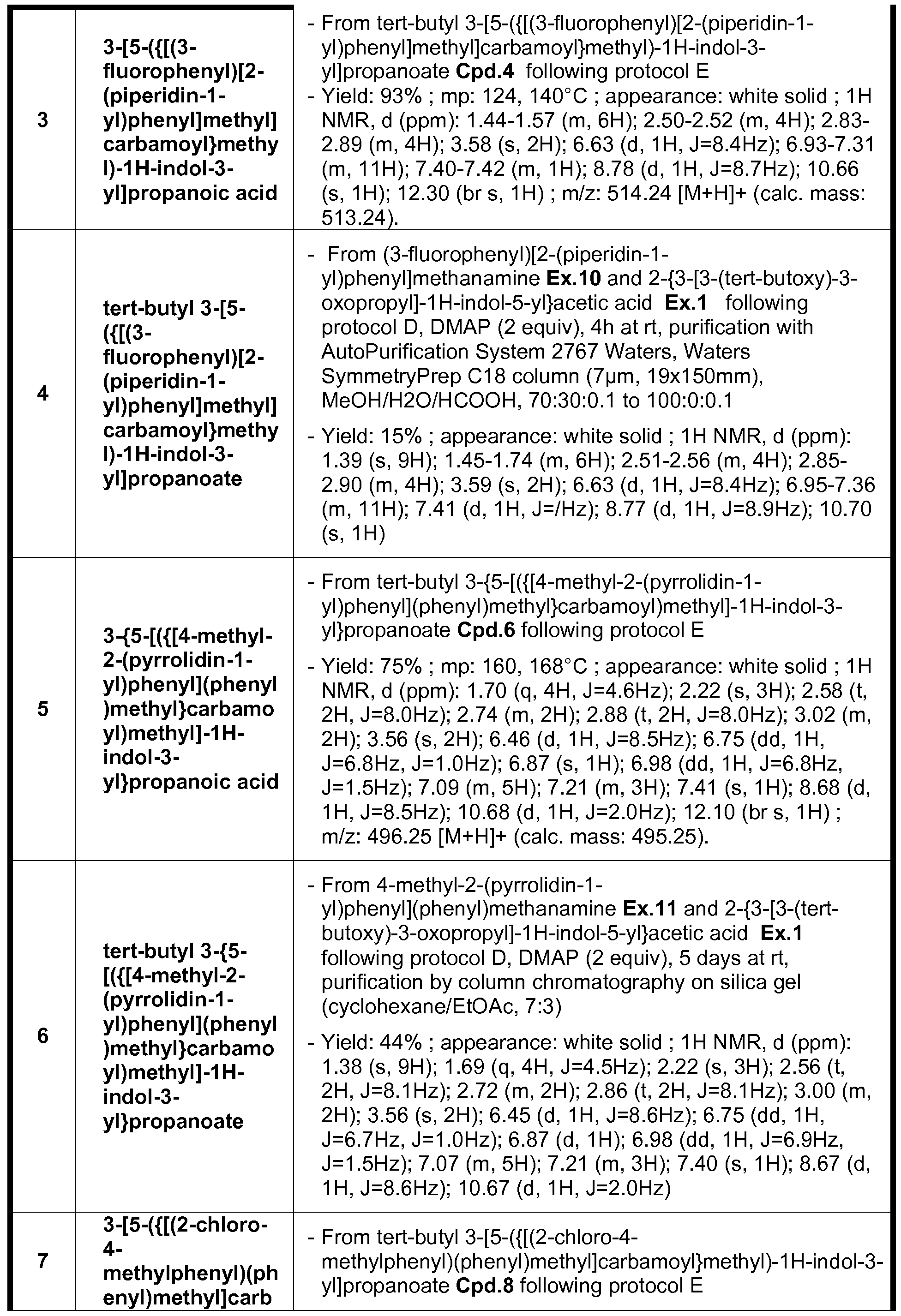
1 H, J=8.4Hz, J=1.5Hz); 7.06 (d, 1 H, J=2.1 Hz); 7.13-7.40 (m, 10H); 8.95 (d, 1 H, J=8.4Hz); 10.68 (s, 1 H); 12.10 (s, 1 H) ; m/z: 461 .15 [M+H]+ (calc. mass: 460.15)
- From (2-chloro-4-methylphenyl)(phenyl)methanaminium chloride Ex.12 and 2-{3-[3-(tert-butoxy)-3-oxopropyl]-1 H- tert-butyl 3-[5- indol-5-yl}acetic acid Ex.1 following protocol D, DMAP (2
({[(2-chloro-4- equiv), 4h at rt, purification by column chromatography on methylphenyl)(ph silica gel (CH2CI2/EtOAc, 95:5)
enyl)methyl]carb
amoyl}methyl)- - Yield: 48% ; appearance: white solid ; 1 H NMR, d (ppm):
1 H-indol-3- 1 .38 (s, 9H); 2.26 (s, 3H); 2.54 (t, 2H, J=8.1 Hz); 2.87 (t, 2H, yl]propanoate J=7.5Hz); 3.55 (s, 2H); 6.36 (d, 1 H, J=8.4Hz); 6.97 (dd, 1 H,
J=8.4Hz, J=1.5Hz); 7.07 (d, 1 H, J=2.1 Hz); 7.13-7.34 (m, 9H); 7.40 (m, 1 H); 8.94 (d, 1 H, J=8.4Hz); 10.69 (s, 1 H)
- From tert-butyl 3-[5-({[(2-bromo-4-
3-[5-({[(2-bromo- methylphenyl)(phenyl)methyl]carbamoyl}methyl)-1 H-indol-3- 4- yl]propanoate Cpd.10 following protocol E
methylphenyl)(ph - Yield: 69% ; mp: 102-126°C ; appearance: white solid ; 1 H enyl)methyl]carb NMR, d (ppm): 2.26 (s, 3H); 2.56 (t, 2H, J=6.3Hz); 2.88 (t, amoyl}methyl)- 2H, J=7.5Hz); 3.55 (s, 2H); 6.33 (d, 1 H, J=8.4Hz); 6.97 (dd, 1 H-indol-3- 1 H, J=8.1 Hz, J=1.5Hz); 7.06 (d, 1 H, J=2.4Hz); 7.12-7.42 yl]propanoic acid (m, 10H); 8.96 (d, 1 H, J=8.4Hz); 10.68 (s, 1 H); 12.13 (s,
1 H) ; m/z: 505.1 [M+H]+ (calc. mass: 504.1 ).
- From (2-bromo-4-methylphenyl)(phenyl)methanamine
Ex.13 and 2-{3-[3-(tert-butoxy)-3-oxopropyl]-1 H-indol-5- tert-butyl 3-[5- yl}acetic acid Ex.1 following protocol D, DMAP (3 equiv),
({[(2-bromo-4- 48h at rt, purification by column chromatography on silica methylphenyl)(ph gel (Cyclohexane/EtOAc, 7:3)
enyl)methyl]carb
amoyl}methyl)- - Yield: 53% ; appearance: white solid ; 1 H NMR, d (ppm):
1 H-indol-3- 1 .38 (s, 9H); 2.26 (s, 3H); 2.54 (t, 2H, J=8.1 Hz); 2.87 (t, 2H, yl]propanoate J=7.5Hz); 3.55 (s, 2H); 6.33 (d, 1 H, J=8.4Hz); 6.97 (dd, 1 H,
J=8.4Hz, J=1.5Hz); 7.06 (d, 1 H, J=2.4Hz); 7.12-7.34 (m, 8H); 7.40-7.42 (m, 2H); 8.95 (d, 1 H, J=8.4Hz); 10.68 (s, 1 H)
- From tert-butyl 3-[5-({[(2,4- dimethylphenyl)(phenyl)methyl]carbamoyl}methyl)-1 H-indol-
3-[5-({[(2,4- 3-yl]propanoate Cpd.12 following protocol E
dimethylphenyl)(
phenyl)methyl]ca - Yield: 76% ; mp: 92-1 18°C ; appearance: white solid ; 1 H rbamoyl}methyl)- NMR, d (ppm): 2.14 (s, 3H); 2.21 (s, 3H); 2.56 (t, 2H,
1 H-indol-3- J=6.9Hz); 2.87 (t, 2H, J=7.5Hz); 3.54 (s, 2H); 6.19 (d, 1 H, yl]propanoic acid J=8.4Hz); 7.07 (m, 5H); 7.16-7.32 (m, 6H); 7.39-7.41 (m,
1 H); 8.82 (d, 1 H, J=8.7Hz); 10.67 (s, 1 H); 12.10 (s, 1 H) ; m/z: 441.2 [M+H]+ (calc. mass: 440.21 )
tert-butyl 3-[5- - From (2,4-dimethylphenyl)(phenyl)methanaminium chloride ({[(2,4- Ex.14 and 2-{3-[3-(tert-butoxy)-3-oxopropyl]-1 H-indol-5- dimethylphenyl)( yl}acetic acid Ex.1 following protocol D, DMAP (3 equiv),
phenyl)methyl]ca 16h at rt, purification by column chromatography on silica rbamoyl}methyl)- gel (CH2CI2/EtOAc, 95:5)
1 H-indol-3-
- Yield: 60% ; appearance: white solid ; 1 H NMR, d (ppm): yl]propanoate
1 .39 (s, 9H); 2.15 (s, 3H); 2.22 (s, 3H); 2.54 (t, 2H,
J=7.5Hz); 2.87 (t, 2H, J=7.5Hz); 3.54 (s, 2H); 6.20 (d, 1 H, J=8.4Hz);6.96-7.07 (m, 5H); 7.16-7.32 (m, 6H); 7.38-7.40 (m, 1 H); 8.81 (d, 1 H, J=8.7Hz); 10.68 (s, 1 H)
- From tert-butyl 3-[5-({[(2,5- dimethylphenyl)(phenyl)methyl]carbamoyl}methyl)-1 H-indol-
3-[5-({[(2,5- 3-yl]propanoate Cpd.14 following protocol E
dimethylphenyl)(
phenyl)methyl]ca - Yield: 26% ; mp: 103-108°C ; appearance: white solid ; 1 H rbamoyl}methyl)- NMR, d (ppm): 2.12 (s, 3H); 2.14 (s, 3H); 2.56 (t, 2H,
1 H-indol-3- J=7.2Hz); 2.88 (t, 2H, J=7.4Hz); 3.50-3.61 (m, 2H); 6.19 (d, yl]propanoic acid 1 H, J=8.4Hz); 6.93-7.07 (m, 5H); 7.16-7.34 (m, 6H); 7.42 (s,
1 H); 8.82 (d, 1 H, J=8.4Hz); 10.69 (d, 1 H, J=1 .9Hz), 12.19 (br s, 1 H) ; m/z: 441 .2 [M+H]+ (calc. mass: 440.21 )
- From (2,5-dimethylphenyl)(phenyl)methanaminium chloride Ex.15 and 2-{3-[3-(tert-butoxy)-3-oxopropyl]-1 H-indol-5- tert-butyl 3-[5- yl}acetic acid Ex.1 following protocol D, DMAP (3 equiv), ({[(2,5- 16h at rt, purification by column chromatography on silica dimethylphenyl)( gel (CH2CI2/MeOH, 98:2)
phenyl)methyl]ca
rbamoyl}methyl)- - Yield: 51 % ; appearance: colorless oil ; 1 H NMR, d (ppm):
1 H-indol-3- 1 .38 (s, 9H); 2.13 (s, 3H); 2.14 (s, 3H); 2.54 (t, 2H,
yl]propanoate J=7.4Hz); 2.87 (t, 2H, J=7.3Hz); 3.54-3.57 (m, 2H); 6.19 (d,
1 H, J=8.3Hz); 6.93-7.09 (m, 5H); 7.16-7.31 (m, 6H); 7.41 (s, 1 H); 8.81 (d, 1 H, J=8.4Hz); 10.69 (s, 1 H)
- From tert-butyl 3-{5-[({[6-methyl-2-(pyrrolidin-1 -yl)pyridin-3- yl](phenyl)methyl}carbamoyl)methyl]-1 H-indol-3-
3-{5-[({[6-methyl- yl}propanoate Cpd.16 following protocol E
2-(pyrrolidin-1 - yl)pyridin-3- - Yield: 67% ; mp: 1 15°C ; appearance: white solid ; 1 H yl](phenyl)methyl NMR, d (ppm): 1 .69-1 .74 (m, 4H); 2.27 (s, 3H); 2.57 (t, 2H,
}carbamoyl)meth J=7.2Hz); 2.89 (t, 2H, J=7.4Hz); 3.34-3.45 (m, 4H); 3.49- yl]-1 H-indol-3- 3.59 (m, 2H); 6.37 (d, 1 H, J=8.0Hz); 6.56 (d, 1 H, J=7.7Hz); yl}propanoic acid 6.98 (dd, 1 H, J=8.4Hz, J=1 .5Hz); 7.07-7.31 (m, 8H); 7.39
(s, 1 H); 8.85 (d, 1 H, J=8.0Hz); 10.69 (d, 1 H, J=1 .9Hz); 12.12 (s, 1 H) ; m/z: 497.24 [M+H]+ (calc. mass: 496.24)
- From [6-methyl-2-(pyrrolidin-1 -yl)pyridin-3- yl](phenyl)methanamine Ex.16 and 2-{3-[3-(tert-butoxy)-3- tert-butyl 3-{5- oxopropyl]-1 H-indol-5-yl}acetic acid Ex.1 following protocol
[({[6-methyl-2- D, DMAP (2 equiv), 16h at rt, purification by column
(pyrrolidin-1 - chromatography on silica gel (CH2CI2/MeOH, 98:2;
yl)pyridin-3- CH2CI2/EtOAc, 5:5)
yl](phenyl)methyl
}carbamoyl)meth - Yield: 60% ; appearance: colorless oil ; 1 H NMR, d (ppm): yl]-1 H-indol-3- 1 .38 (s, 9H); 1 .63-1 .75 (m, 4H); 2.27 (s, 3H); 2.54 (t, 2H, yl}propanoate J=7.3Hz); 2.87 (t, 2H, J=7.4Hz); 3.33-3.46 (m, 4H); 3.48- 3.59 (m, 2H); 6.36 (d, 1 H, J=8.0Hz); 6.55 (d, 1 H, J=7.7Hz); 6.98 (dd, 1 H, J=8.3Hz, J=1.5Hz); 7.07 (d, 1 H, J=2.3Hz);
7.12-7.15 (m, 2H); 7.18-7.31 (m, 5H); 7.39 (s, 1 H); 8.83 (d, 1 H, J=8.1 Hz); 10.69 (d, 1 H, J=1 .9Hz)
- From tert-butyl 3-[5-({[(2-fluoro-4- methylphenyl)(phenyl)methyl]carbamoyl}methyl)-1 H-indol-3-
3-[5-({[(2-fluoro-4- yl]propanoate Cpd.18 following protocol E
methylphenyl)(ph
enyl)methyl]carb - Yield: 88% ; mp: 79-84°C ; appearance: white solid ; 1 H amoyl}methyl)- NMR, d (ppm): 2.27 (s, 3H); 2.56 (t, 2H, J=9.0Hz); 2.88 (t,
1 H-indol-3- 2H, J=9.0Hz); 3.56 (s, 2H); 6.30 (d, 1 H, J=9.0Hz); 6.96-7.00 yl]propanoic acid (m, 3H); 7.07 (d, 1 H, J=2.2Hz); 7.19-7.34 (m, 7H); 7.41 (s,
1 H); 8.95 (d, 1 H, J=9.0Hz); 10.69 (d, 1 H, J=1.8Hz); 12.04 (br s, 1 H) ; m/z: 445.18 [M+H]+ (calc. mass: 444.18)
- From (2-fluoro-4-methylphenyl)(phenyl)methanaminium chloride Ex.17 and 2-{3-[3-(tert-butoxy)-3-oxopropyl]-1 H- tert-butyl 3-[5- indol-5-yl}acetic acid Ex.1 following protocol D, DMAP (3
({[(2-fluoro-4- equiv), 6h at rt, purification by column chromatography on methylphenyl)(ph silica gel (CH2CI2/MeOH, 85:15)
enyl)methyl]carb
amoyl}methyl)- - Yield: 50% ; appearance: yellow oil ; 1 H NMR, d (ppm):
1 H-indol-3- 1 .38 (s, 9H); 2.27 (s, 3H); 2.54 (t, 2H, J=7.2Hz); 2.87 (t, 2H, yl]propanoate J=7.5Hz); 3.56 (s, 2H); 6.29 (d, 1 H, J=8.6Hz); 6.96-7.00 (m,
3H); 7.07 (d, 1 H, J=2.2Hz); 7.19-7.34 (m, 7H); 7.40 (s, 1 H); 8.93 (d, 1 H, J=8.6Hz); 10.69 (d, 1 H, J=1 .9Hz)
- From tert-butyl 3-[5-({[(2-fluoro-5- methylphenyl)(phenyl)methyl]carbamoyl}methyl)-1 H-indol-3-
3-[5-({[(2-fluoro-5- yl]propanoate Cpd.20 following protocol E
methylphenyl)(ph
enyl)methyl]carb - Yeld 87% ; mp: 80-85°C ; appearance: white solid ; 1 H amoyl}methyl)- NMR, d (ppm): 2.18 (s, 3H); 2.56 (t, 2H, J=7.1 Hz); 2.88 (t,
1 H-indol-3- 2H, J=7.4Hz); 3.52-3.62 (m, 2H); 6.28 (d, 1 H, J=8.5Hz); yl]propanoic acid 6.98-7.08 (m, 4H); 7.12-7.15 (m, 1 H); 7.20-7.34 (m, 6H);
7.44 (s, 1 H); 8.93 (d, 1 H, J=8.5Hz); 10.69 (d, 1 H, J=1 .8Hz); 12.13 (br s, 1 H) ; m/z: 445.18 [M+H]+ (calc. mass: 444.18).
- From (2-fluoro-5-methylphenyl)(phenyl)methanaminium chloride Ex.18 and 2-{3-[3-(tert-butoxy)-3-oxopropyl]-1 H- tert-butyl 3-[5- indol-5-yl}acetic acid Ex.1 following protocol D, DMAP (3
({[(2-fluoro-5- equiv), 6h at rt, purification by column chromatography on methylphenyl)(ph silica gel (CH2CI2/MeOH, 9:1 )
enyl)methyl]carb
amoyl}methyl)- - Yield: 61 % ; appearance: yellow oil ; -1 H NMR, d (ppm):
1 H-indol-3- 1 .38 (s, 9H); 2.18 (s, 3H); 2.54 (t, 2H, J=7.2Hz); 2.87 (t, 2H, yl]propanoate J=7.4Hz); 3.52-3.62 (m, 2H); 6.28 (d, 1 H, J=8.5Hz); 6.98- 7.34 (m, 1 1 H); 7.43 (s, 1 H); 8.91 (d, 1 H, J=8.5Hz); 10.69 (d, 1 H, J=1 .7Hz)
3-[5-({[(2,4-
- From tert-butyl 3-[5-({[(2,4-dimethylphenyl)(pyridin-2- dimethylphenyl)(
yl)methyl]carbamoyl}methyl)-1 H-indol-3-yl]propanoate pyridin-2- Cpd.22 following protocol E
yl)methyl]carbam
oyl}methyl)-1 H- - Yield: 63% ; mp: 130-143°C ; appearance: white solid ; 1 H indol-3- NMR, d (ppm): 2.22 (s, 3H); 2.24 (s, 3H); 2.53 (t, 2H,
yl]propanoic acid J=8.0Hz); 2.86 (t, 2H, J=8.0Hz); 3.56 (s, 2H); 6.23 (d, 1 H, J=8.3Hz); 6.95 (m, 4H); 7.06 (d, 1 H, J=2.2Hz); 7.23 (m, 2H); 7.33 (d, 1 H); 7.40 (s, 1 H); 7.74 (m, 1 H); 8.48 (m, 1 H); 7.79 (d, 1 H, J=8.4Hz); 10.67 (d, 1 H, J=1.6Hz); 12.13 (br s, 1 H) ; m/z: 442.2 [M+H]+ (calc. mass: 441 .2).
- From (2,4-dimethylphenyl)(pyridin-2-yl)methanamine Ex.19 and 2-{3-[3-(tert-butoxy)-3-oxopropyl]-1 H-indol-5-yl}acetic tert-butyl 3-[5- acid Ex.1 following protocol D, DMAP (2 equiv), 5 days at rt, ({[(2,4- purification by column chromatography on silica gel dimethylphenyl)( (cyclohexane/EtOAc, 6:4)
pyridin-2- - Yield: 32% ; appearance: yellow oil ; 1 H NMR, d (ppm): yl)methyl]carbam 1 .38 (s, 9H); 2.20 (s, 3H); 2.24 (s, 3H); 2.54 (t, 2H,
oyl}methyl)-1 H- J=7.9Hz); 2.87 (t, 2H, J=7.9Hz); 3.56 (s, 2H); 6.23 (d, 1 H, indol-3- J=8.2Hz); 6.87-7.00 (m, 4H); 7.05-7.09 (m, 1 H); 7.20-7.24 yl]propanoate (m, 2H); 7.33 (d, 1 H, J=7.8Hz); 7.39 (br s, 1 H); 7.74 (dt, 1 H,
J=7.7Hz, J=1.8Hz); 8.48 (m, 1 H); 8.79 (d, 1 H, J=8.2Hz); 10.68 (d, 1 H, J=1 .6Hz)
- From tert-butyl 3-[5-({[phenyl({2-[2-(trifluoromethyl)piperidin- 1 -yl]phenyl})methyl]carbamoyl}methyl)-1 H-indol-3-
3-[5-({[phenyl({2- yl]propanoate Cpd.24 following protocol E
[2-
(trifluoromethyl)p - Yield 89% ; mp: 99-120°C ; appearance: white solid ; 1 H iperidin-1 - NMR, d (ppm): 1 .22-1 .51 (m, 2H); 1 .65-1.69 (m, 1 H); 1 .86- yl]phenyl})methyl 1 .90 (m, 1 H); 2.53-2.59 (m, 4H); 2.66-2.73 (m, 2H); 2.88 (t,
]carbamoyl}meth 2H, J=7.8Hz); 3.14-3.16 (m, 1 H); 3.48-3.62 (m, 2H); 6.60 yl)-1 H-indol-3- (d, 1 H, J=8.6Hz); 6.98 (dd, 1 H, J=8.3Hz, J=1.5Hz); 7.06- yljpropanoic acid 7.31 (m, 1 1 H); 7.40-7.42 (m, 1 H); 8.68 (d, 1 H, J=8.6Hz);
10.68 (s, 1 H); 12.04 (s, 1 H) ; m/z: 564[M+H]+ (calc. mass: 563.24).
- From phenyl({2-[2-(trifluoromethyl)piperidin-1 - yl]phenyl})methanaminium chloride Ex.20 and 2-{3-[3-(tert- butoxy)-3-oxopropyl]-1 H-indol-5-yl}acetic acid Ex.1
3-[5-({[phenyl({2- following protocol D, DMAP (3 equiv), 16h at rt, purification
[2- by column chromatography on silica gel (CH2CI2/EtOAc,
(trifluoromethyl)p 95:5)
iperidin-1 - yl]phenyl})methyl - Yield 39% ; appearance: white solid ; 1 H NMR, d (ppm):
]carbamoyl}meth 1 .20-1.55 (m, 1 1 H); 1 .59-1 .69 (m, 1 H); 1 .85-1.90 (m, 1 H); yl)-1 H-indol-3- 2.53-2.55 (m, 4H); 2.69-2.27 (m, 2H); 2.87 (t, 2H, J=7.5Hz); yljpropanoate 3.14-3.17 (m, 1 H); 3.48-3.55 (m, 2H); 6.60 (d, 1 H,
J=8.4Hz); 6.98 (dd, 1 H, J=8.4Hz, J=1.5Hz); 7.06-7.30 (m, 1 1 H); 7.40-7.42 (m, 1 H); 8.68 (d, 1 H, J=8.7Hz); 10.68 (s, 1 H)
3-{5-[({[2-(3,5-
- From tert-butyl 3-{5-[({[2-(3,5-dimethylpiperidin-1 - dimethylpiperidin
yl)phenyl](phenyl)methyl}carbamoyl)methyl]-1 H-indol-3-
-1 - yl}propanoate Cpd.26 following protocol E, 40 min
yl)phenyl](phenyl
)methyl}carbamo - Yield 85% ; mp: 96-1 16°C ; appearance: white solid ; 1 H yl)methyl]-1 H- NMR, d (ppm): 0.51 (q, 1 H, J=1 1.9Hz); 0.67 (d, 3H, indol-3- J=6.4Hz); 0.72 (d, 3H, J=6.5Hz); 1 .56-1 .72 (m, 3H); 1 .91 (t, yl}propanoic acid 1 H, J=10.9Hz); 2.17 (t, 1 H, J=10.7Hz); 2.55-2.58 (m, 3H);
2.87 (t, 2H, J=7.9Hz); 2.94-2.98 (m, 1H); 3.57 (s, 2H); 6.57 (d, 1H, J=8.7Hz); 6.98 (dd, 1H, J=8.4Hz, J=1.5Hz); 7.03- 7.27 (m, 10H); 7.32 (dd, 1H, J=7.6Hz, J=1.5Hz); 7.40-7.42 (m, 1H); 8.73 (d, 1H, J=8.9Hz); 10.67 (s, 1H); 12.04 (s, 1H) ; m/z: 524[M+H]+ (calc. mass: 523.28).
- From [2-(3,5-dimethylpiperidin-1- yl)phenyl](phenyl)methanamine Ex.21 and 2-{3-[3-(tert- butoxy)-3-oxopropyl]-1 H-indol-5-yl}acetic acid
tert-butyl 3-{5- Ex.lfollowing protocol D, DMAP (3 equiv), 16h at rt,
[({[2-(3,5- purification by column chromatography on silica gel dimethylpiperidin (CH2CI2/EtOAc, 9:1)
-1- yl)phenyl](phenyl - Yield 30% ; appearance: white solid ; 1H NMR, d (ppm):
)methyl}carbamo 0.54 (q, 1H, J=12.1Hz); 0.67 (d, 3H, J=6.6Hz); 0.72 (d, 3H, yl)methyl]-1H- J=6.6Hz); 1.38 (s, 9H); 1.54-1.72 (m, 4H); 1.90 (t, 1H, indol-3- J=10.8Hz); 2.17 (t, 1H, J=10.7Hz); 2.52-2.57 (m, 2H); 2.86 yl}propanoate (t, 2H, J=7.3Hz); 2.94-2.97 (m, 1H); 3.57 (s, 2H); 6.58 (d,
1H, J=8.7Hz); 6.98 (dd, 1H, J=8.4Hz, J=1.5Hz); 7.06-27 (m, 10H); 7.32 (dd, 1H, J=7.5Hz, J=1.5Hz); 7.39-7.41 (m, 1H); 8.73 (d, 1H, J=8.7Hz); 10.67 (s, 1H)
- From tert-butyl 3-[5-({[(2,4-dimethylphenyl)(pyridin-3- yl)methyl]carbamoyl}methyl)-1 H-indol-3-yl]propanoate
3-[5-({[(2,4- Cpd.28 following protocol E
dimethylphenyl)( - Yield: 84% ; mp: 108, 152°C ; appearance: white solid ; 1H pyridin-3- NMR, d (ppm): 2.17 (s, 3H); 2.22 (s, 3H); 2.56 (t, 2H, yl)methyl]carbam J=7.2Hz); 2.88 (t, 2H, J=6.8Hz); 3.55 (s, 2H); 6.24 (d, 1H, oyl}methyl)-1 H- J=8.2Hz); 6.97-6.99 (m, 4H); 7.07 (d, 1H, J=2.3Hz); 7.22 (d, indol-3- 1H, J=8.5Hz); 7.31-7.35 (m, 1H); 7.40 (s, 1H); 7.56 (dt, 1H, yl]propanoic acid J=7.9Hz, J=2.1Hz); 8.41 (d, 1H, J=2.3Hz); 8.44 (dd, 1H,
J=4.7Hz, J=1.6Hz); 8.90 (d, 1H, J=8.3Hz); 10.69 (s, 1H); 12.06 (s, 1H) ; m/z: 442.2 [M+H]+ (calc. mass: 441.2).
- From (2,4-dimethylphenyl)(pyridin-3-yl)methanamine Ex.22 and 2-{3-[3-(tert-butoxy)-3-oxopropyl]-1 H-indol-5-yl}acetic tert-butyl 3-[5- acid Ex.1 following protocol D, DMAP (4 equiv), 16h at rt, ({[(2,4- purification by column chromatography on silica gel dimethylphenyl)( (CH2CI2/EtOAc, 9:1)
pyridin-3- - Yield: 68% ; appearance: colorless oil ; 1H NMR, d (ppm): yl)methyl]carbam 1.38 (s, 9H); 2.17 (s, 3H); 2.22 (s, 3H); 2.56 (t, 2H,
oyl}methyl)-1 H- J=8.0Hz); 2.87 (t, 2H, J=7.9Hz); 3.55 (s, 2H); 6.24 (d, 1H, indol-3- J=8.2Hz); 6.97-6.99 (m, 4H); 7.07 (d, 1H, J=2.3Hz); 7.22 (d, yl]propanoate 1H, J=8.5Hz); 7.31-7.35 (m, 1H); 7.39 (s, 1H); 7.54-7.57 (m,
1H); 8.41 (d, 1H, J=2.3Hz); 8.44 (dd, 1H, J=4.7Hz,
J=1.6Hz); 8.89 (d, 1H, J=8.4Hz); 10.69 (s, 1H)
3-{5-[({3-methyl- - From tert-butyl 3-{5-[({3-methyl-1-[2-(piperidin-1-
1-[2-(piperidin-1- yl)phenyl]butyl}carbamoyl)methyl]-1 H-indol-3-yl}propanoate yl)phenyl]butyl}c Cpd.30 following protocol E
arbamoyl)methyl]
- Yield: 82% ; mp: 80, 134°C ; appearance: white solid ; 1H
-1H-indol-3- NMR, d (ppm): 0.88 (d, 3H, J=6.4Hz); 0.90 (d, 3H,
yl}propanoic acid
J=6.4Hz); 1.22-1.34 (m, 2H); 1.38-1.90 (m, 8H); 2.55-2.58
(m, 3H); 2.88 (t, 2H, J=7.5Hz); 3.08 (m, 2H); 3.42-3.52 (m, 2H); 5.31 -5.38 (m, 1 H); 6.94 (dd, 1 H, J=8.3Hz, J=1 .5Hz); 7.02-7.15 (m, 4H); 7.21 (d, 1 H, J=8.3Hz); 7.31 (dd, 1 H, J=7.5Hz, J=1.5Hz); 7.38 (s, 1 H); 8.33 (d, 1 H, J=8.4Hz); 10.67 (s, 1 H); 12.06 (br s, 1 H) ; m/z: 476.28 [M+H]+ (calc. mass: 475.28).
- From 3-methyl-1 -[2-(piperidin-1 -yl)phenyl]butan-1 -aminium chloride and 2-{3-[3-(tert-butoxy)-3-oxopropyl]-1 H-indol-5- yl}acetic acid Ex.1 following protocol D, DMAP (3 equiv), tert-butyl 3-{5- 16h at rt, purification by column chromatography on silica
[({3-methyl-1 -[2- gel (CH2CI2/EtOAc, 9:1 ; Cyclohexane/EtOAc, 8:2)
(piperidin-1 - yl)phenyl]butyl}c - Yield: 38% ; appearance: colorless oil ; 1 H NMR, d (ppm): arbamoyl)methyl] 0.88 (d, 3H, J=6.4Hz); 0.90 (d, 3H, J=6.4Hz); 1 .23-1 .64 (m,
-1 H-indol-3- 21 H); 2.53 (t, 2H, J=8.2Hz); 2.87 (t, 2H, J=7.7Hz); 3.08 (br yl}propanoate s, 2H); 3.44 (d, 1 H, J=13.6Hz); 3.48 (d, 1 H, J=13.6Hz);
5.33-5.35 (m, 1 H); 6.95 (dd, 1 H, J=8.3Hz, J=1.4Hz); 6.99- 7.16 (m, 4H); 7.20 (d, 1 H, J=8.1 Hz); 7.31 (dd, 1 H, J=7.5Hz, J=1.5Hz); 7.37 (s, 1 H); 8.31 (d, 1 H)
- From tert-butyl 3-[5-({[(5-methylquinolin-8- yl)(phenyl)methyl]carbamoyl}methyl)-1 H-indol-3- yljpropanoate Cpd.32 following protocol E
3-[5-({[(5- - Yield: 90% ; mp: 101 , 136°C ; appearance: light grey solid ; methylquinolin-8- 1 H NMR, d (ppm): 2.56 (t, 2H, J=7.7Hz); 2.62 (s, 3H); 2.87 yl)(phenyl)methyl (t, 2H, J=7.6Hz); 3.59 (d, 2H, J=2.3Hz); 6.99 (dd, 1 H,
]carbamoyl}meth J=8.3Hz, J=1.5Hz); 7.08-7.15 (m, 2H); 7.20-7.25 (m, 6H); yl)-1 H-indol-3- 7.41 -7.46 (m, 2H); 7.47-7.52 (m, 1 H); 7.75 (d, 1 H,
yljpropanoic acid J=7.3Hz); 8.42 (dd, 1 H, J=8.5Hz, J=1.7Hz); 8.68 (dd, 1 H,
J=4.1 Hz, J=1.7Hz); 9.00 (d, 1 H, J=9.0Hz); 10.70 (d, 1 H, J=1.9Hz); 1 1 .92 (br s, 1 H) ; m/z: 478.2 [M+H]+ (calc. mass: 477.2)
- From (5-methylquinolin-8-yl)(phenyl)methanamine Ex.24 and 2-{3-[3-(tert-butoxy)-3-oxopropyl]-1 H-indol-5-yl}acetic acid Ex.1 following protocol D, DMAP (2 equiv), 6h at rt, tert-butyl 3-[5- purification by column chromatography on silica gel
({[(5- (CH2CI2/EtOAc, 8:2)
methylquinolin-8- yl)(phenyl)methyl - Yield: 45% ; appearance: colorless oil ; 1 H NMR, d (ppm):
]carbamoyl}meth 1 .37 (s, 9H); 2.53 (t, 2H, J=7.6Hz); 2.62 (s, 3H); 2.85 (t, 2H, yl)-1 H-indol-3- J=7.7Hz); 3.54-3.64 (m, 2H); 6.98 (dd, 1 H, J=8.3Hz, yljpropanoate J=1.5Hz); 7.08-7.24 (m, 8H); 7.41 -7.44 (m, 2H); 7.49 (dd,
1 H, J=8.5Hz, J=4.1 Hz); 7.74 (d, 1 H, J=7.3Hz); 8.42 (dd, 1 H, J=8.5Hz, J=1.7Hz); 8.67 (dd, 1 H, J=4.1 Hz, J=1 .6Hz); 8.99 (d, 1 H, J=8.9Hz); 10.70 (d, 1 H, J=1 .9Hz)
3-[5-({[(4-chloro-
- From tert-butyl 3-[5-({[(4-chloro-2- 2- methylphenyl)(phenyl)methyl]carbamoyl}methyl)-1 H-indol-3- methylphenyl)(ph
yl]propanoate Cpd.34 following protocol E
enyl)methyl]carb
amoyl}methyl)- - Yield: 87% ; mp: 88, 140°C ; appearance: white solid ; 1 H 1 H-indol-3- NMR, d (ppm): 2.19 (s, 3H); 2.56 (t, 2H, J=7.2Hz); 2.88 (t, yl]propanoic acid 2H, J=7.5Hz); 3.55 (s, 2H); 6.20 (d, 1 H, J=8.3Hz); 6.97 (dd,
1 H, J=8.3Hz, J=1.5Hz); 7.07 (d, 1 H, J=2.2Hz); 7.13-7.35 (m, 9H); 7.40 (s, 1 H); 8.92 (d, 1 H, J=8.4Hz); 10.70 (d, 1 H, J=1.9Hz); 1 1 .99 (br s, 1 H) ; m/z: 461 .15, 463.15[M+H]+ (calc. mass: 460.15).
- From (4-chloro-2-methylphenyl)(phenyl)methanaminium tert-butyl 3-[5- chloride Ex.25 and 2-{3-[3-(tert-butoxy)-3-oxopropyl]-1 H-
({[(4-chloro-2- indol-5-yl}acetic acid Ex.1 following protocol D, DMAP (3 methylphenyl)(ph equiv), 6h at rt, purification by column chromatography on enyl)methyl]carb silica gel (CH2CI2/EtOAc, 85:15)
amoyl}methyl)- - Yield: 62% ; appearance: colorless oil ; 1 H NMR, d (ppm):
1 H-indol-3- 1 .38 (s, 9H); 2.18 (s, 3H); 2.54 (t, 2H, J=7.3Hz); 2.87 (t, 2H, yl]propanoate J=7.4Hz); 3.54 (s, 2H); 6.20 (d, 1 H, J=8.3Hz); 6.84 (dd, 1 H, following J=8.2Hz, J=1.4Hz); 7.07 (d, 1 H, J=3.8Hz); 7.13-7.35 (m, protocol E 9H); 7.39 (s, 1 H); 8.90 (d, 1 H, J=8.3Hz); 10.69 (d, 1 H,
J=1.8Hz)
- From tert-butyl 3-{5-[({[2-(azepan-1 - yl)phenyl](phenyl)methyl}carbamoyl)methyl]-1 H-indol-3-
3-{5-[({[2-(azepan- yl}propanoate Cpd.36 following protocol E
1 - yl)phenyl](phenyl - Yield: 86% ; mp: 85, 122°C ; appearance: white solid ; 1 H )methyl}carbamo NMR, d (ppm): 1 .36-1 .66 (m, 8H); 2.57 (t, 2H, J=7.3Hz); yl)methyl]-1 H- 2.75-2.82 (m, 2H); 2.88 (t, 2H, J=7.2Hz); 2.96-3.03 (m, 2H); indol-3- 3.55 (s, 2H); 6.71 (d, 1 H, J=8.5Hz); 6.98 (dd, 1 H, J=8.3Hz, yl}propanoic acid J=1.5Hz); 7.03-7.09 (m, 2H); 7.12-7.31 (m, 9H); 7.41 (s,
1 H); 8.73 (d, 1 H, J=8.6Hz); 10.68 (d, 1 H, J=1.8Hz); 12.04 (br s, 1 H) ; m/z: 510.26 [M+H]+ (calc. mass: 509.26)
- From [2-(azepan-1 -yl)phenyl](phenyl)methanamine Ex.26 and 2-{3-[3-(tert-butoxy)-3-oxopropyl]-1 H-indol-5-yl}acetic acid Ex.1 following protocol D, DMAP (2 equiv), 6h at rt, tert-butyl 3-{5- purification by column chromatography on silica gel
[({[2-(azepan-1 - (CH2CI2/EtOAc, 85:15)
yl)phenyl](phenyl
)methyl}carbamo - Yield: 69% ; appearance: colorless oil ; 1 H NMR, d (ppm): yl)methyl]-1 H- 1 .38 (s, 9H); 1 .40-1 .48 (m, 2H); 1 .51 -1 .65 (m, 6H); 2.54 (t, indol-3- 2H, J=7.5Hz); 2.75-2.82 (m, 2H); 2.87 (t, 2H, J=7.5Hz); yl}propanoat 2.95-3.03 (m, 2H); 3.55 (s, 2H); 6.71 (d, 1 H, J=8.6Hz); 6.98
(dd, 1 H, J=8.3Hz, J=1.5Hz); 7.03-7.08 (m, 2H); 7.12-7.30 (m, 9H); 7.40 (s, 1 H); 8.72 (d, 1 H, J=8.6Hz); 10.68 (d, 1 H, J=2.0Hz)
- From tert-butyl-3-[5-({[(4-methylnaphthalen-1 - yl)(phenyl)methyl]carbamoyl}methyl)-1 H-indol-3-
3-[5-({[(4- yljpropanoate Cpd.38 following protocol E
methylnaphthale
n-1 - - Yield: 31 % ; mp: 198°C ; appearance: white solid ; 1 H yl)(phenyl)methyl NMR, d (ppm): 2.57 (t, 2H, J=7.1 Hz); 2.62 (s, 3H); 2.87 (t, ]carbamoyl}meth 2H, J=7.4Hz); 3.57 (s, 2H); 6.82 (d, 1 H, J=8.5Hz); 6.98 (dd, yl)-1 H-indol-3- 1 H, J=8.3Hz, J=1.4Hz); 7.07 (d, 1 H, J=2.0Hz); 7.17-7.34 yljpropanoic acid (m, 8H); 7.40 (s, 1 H); 7.43-7.56 (m, 2H); 7.99 (d, 1 H,
J=8.3Hz); 8.03 (d, 1 H, J=7.7Hz); 9.04 (d, 1 H, J=8.4Hz); 10.68 (s, 1 H); 12.08 (s, 1 H) ; m/z: 477.2 [M+H]+ (calc.
mass: 477.2)
- From (4-methylnaphthalen-1 -yl)(phenyl)methanaminium chloride Ex.27 and 2-{3-[3-(tert-butoxy)-3-oxopropyl]-1 H- tert-butyl 3-[5- indol-5-yl}acetic acid Ex.1 following protocol D, DMAP (3 ({[(4- equiv), 16h at rt, purification by column chromatography on methylnaphthale silica gel (CH2CI2/EtOAc, 85:15)
n-1 - - Yield: 65% ; appearance: colorless oil ; 1 H NMR, d (ppm): yl)(phenyl)methyl 1 .38 (s, 9H); 2.54 (t, 2H, J=7.5Hz); 2.62 (s, 3H); 2.86 (t, 2H, ]carbamoyl}meth J=7.4Hz); 3.57 (s, 2H); 6.82 (d, 1 H, J=8.4Hz); 6.98 (dd, 1 H, yl)-1 H-indol-3- J=8.3Hz, J=1.5Hz); 7.07 (d, 1 H, J=2.2Hz); 7.16-7.34 (m, yljpropanoate 8H); 7.39-7.56 (m, 3H); 7.98 (d, 1 H, J=8.0Hz); 8.04 (dd, 1 H,
J=8.4Hz, J=1.0Hz); 9.03 (d, 1 H, J=8.4Hz); 10.69 (d, 1 H, J=1.9Hz)
- From methyl 2-{5-[({phenyl[2-(piperidin-1 -
2-{5-[({phenyl[2- yl)phenyl]methyl}carbamoyl)methyl]-1 H-indol-3-yl}acetate
(piperidin-1 - Cpd.40 following protocol E
yl)phenyl]methyl} - Yield: 91 % ; mp: 131 , 136°C ; appearance: white solid ; 1 H carbamoyl)methy NMR, d (ppm) (DMSO-d6) : 1 .40-1.65 (m, 6H); 2.48 (m, l]-1 H-indol-3- 2H); 2.87 (m, 4H); 3.58 (m, 4H); 6.62 (d, 1 H, J=8.7Hz); yl}acetic acid 6.95-7.45 (m, 13H); 8.76 (d, 1 H); 10.82 (br s, 1 H); 12.05 (br s, 1 H) ; m/z: 482.23 [M+H]+ (calc. mass: 481.23) methyl 2-{5- - From phenyl[2-(piperidin-1 -yl)phenyl]methanamine Ex.9
[({phenyl[2- and 2-[3-(2-methoxy-2-oxoethyl)-1 H-indol-5-yl]acetic acid
(piperidin-1 - Ex.5 following protocol D
yl)phenyl]methyl} - Yield: 24% ; appearance : white solid ; 1 H NMR, d (ppm): carbamoyl)methy 1 .40-1 .65 (m, 6H); 2.48 (m, 2H); 2.88 (m, 2H); 3.59 (s, 5H); l]-1 H-indol-3- 3.69 (s, 2H); 6.62 (d, 1 H, J=8.4Hz); 7.0-7.4 (m, 12H); 8.77 yl}acetate (m, 1 H); 10.88 (br s, 1 H)
- From (2-chloro-5-methylphenyl)(phenyl)methanamine Ex.28 tert-butyl 3-[5- and 2-{3-[3-(tert-butoxy)-3-oxopropyl]-1 H-indol-5-yl}acetic
({[(2-chloro-5- acid Ex.1 following protocol D
methylphenyl)(ph - Yield: 53% ; mp: 71 , 77°C ; appearance: white solid ; 1 H enyl)methyl]carb NMR, d (ppm) : 2.19 (s, 3H); 2.56 (t, 2H, J=7.2Hz); 2.88 (t, amoyl}methyl)- 2H, J=7.5Hz); 3.55 (s, 2H); 6.20 (d, 1 H, J=8.3Hz); 6.97 (dd,
1 H-indol-3- 1 H, J=8.3Hz, J=1.5Hz); 7.07 (d, 1 H, J=2.2Hz); 7.13-7.35 yl]propanoate (m, 9H); 7.40 (s, 1 H); 8.92 (d, 1 H, J=8.4Hz); 10.70 (d, 1 H,
J=1.9Hz) ; m/z: 517.21 [M+H]+ (calc. mass: 516.21 )
- From tert-butyl 3-[5-({[(2-chloro-5-
3-[5-({[(2-chloro- methylphenyl)(phenyl)methyl]carbamoyl}methyl)-1 H-indol-3- 5- yl]propanoate Cpd.41 following protocol E
methylphenyl)(ph
enyl)methyl]carb - Yield: 100% ; mp: 84, 1 16°C ; appearance: white solid ; 1 H amoyl}methyl)- NMR, d (ppm) : 1 .38 (s, 9H); 2.17 (s, 3H); 2.54 (t, 2H,
1 H-indol-3- J=7.4Hz); 2.87 (t, 2H, J=7.5Hz); 3.50-3.62 (m, 2H); 6.34 (d, yl]propanoic acid 1 H, J=8.3Hz); 7.01 (dd, 1 H, J=8.3Hz, J=1.5Hz); 7.06-7.34
(m, 10H); 7.42 (s, 1 H); 8.92 (d, 1 H, J=8.3Hz); 10.69 (d, 1 H,
J=1.8Hz) ; m/z: 461.15 [M+H]+ (calc. mass: 460.15).
- From (4-bromo-2-methylphenyl)(phenyl)methanamine tert-butyl 3-[5- Ex.31 and 2-{3-[3-(tert-butoxy)-3-oxopropyl]-1 H-indol-5-
({[(4-bromo-2- yl}acetic acid Ex.1 following protocol D
methylphenyl)(ph - Yield: 67% ; mp: 68, 75°C ; appearance: white solid ; 1 H enyl)methyl]carb NMR, d (ppm) : 1 .38 (s, 9H); 2.18 (s, 3H); 2.54 (t, 2H, amoyl}methyl)- J=7.3Hz); 2.87 (t, 2H, J=7.5Hz); 3.54 (s, 2H); 6.18 (d, 1 H,
1 H-indol-3- J=8.2Hz); 6.97 (dd, 1 H, J=8.3Hz, J=1.5Hz); 7.07-7.09 (m, yl]propanoate 2H); 7.17-7.39 (m, 9H); 8.90 (d, 1 H, J=8.4Hz); 10.69 (d, 1 H,
J=1.9Hz) ; m/z: 561.16 [M+H]+ (calc. mass: 560.16).
- From tert-butyl 3-[5-({[(4-bromo-2-
3-[5-({[(4-bromo- methylphenyl)(phenyl)methyl]carbamoyl}methyl)-1 H-indol-3- 2- yl]propanoate Cpd.43 following protocol E
methylphenyl)(ph - Yield: 89% ; mp: 90, 108°C ; appearance: white solid ; 1 H enyl)methyl]carb NMR, d (ppm) : 1 .38 (s, 9H); 2.20 (s, 3H); 2.54 (t, 2H, amoyl}methyl)- J=7.2Hz); 2.87 (t, 2H, J=7.5Hz); 3.55 (s, 2H); 6.21 (d, 1 H, 1 H-indol-3- J=8.4Hz); 6.94-7.35 (m, 1 1 H); 7.40 (s, 1 H); 8.88 (d, 1 H, yl]propanoic acid J=8.5Hz); 10.69 (d, 1 H, J=2.0Hz) ; m/z: 505.1 [M+H]+ (calc.
mass: 504.1 ).
- From (4-fluoro-2-methylphenyl)(phenyl)methanamine tert-butyl 3-[5- Ex.29 and 2-{3-[3-(tert-butoxy)-3-oxopropyl]-1 H-indol-5-
({[(4-fluoro-2- yl}acetic acid Ex.1 following protocol D
methylphenyl)(ph - Yield: 74% ; mp: 58, 66°C ; appearance: white solid ; 1 H enyl)methyl]carb NMR, d (ppm) : 2.18 (s, 3H); 2.57 (t, 2H, J=7.1 Hz); 2.88 (t, amoyl}methyl)- 2H, J=7.5Hz); 3.55 (s, 2H); 6.18 (d, 1 H, J=8.3Hz); 6.97 (dd,
1 H-indol-3- 1 H, J=8.3Hz, J=1.5Hz); 7.07-7.10 (m, 2H); 7.17-7.40 (m, 9H); yl]propanoate 8.91 (d, 1 H, J=8.4Hz); 10.70 (d, 1 H, J=1.9Hz); 12.04 (s, 1 H) ;
m/z: 501.24 [M+H]+ (calc. mass: 500.24).
- From tert-butyl 3-[5-({[(4-fluoro-2- methylphenyl)(phenyl)methyl]carbamoyl}methyl)-1 H-indol-3-
3-[5-({[(4-fluoro-2- yl]propanoate Cpd.45 following protocol E
methylphenyl)(ph
enyl)methyl]carb - Yield: 35% ; mp: 148, 177°C ; appearance: white solid ; 1 H amoyl}methyl)- NMR, d (ppm) : 2.57 (t, 2H, J=7.1 Hz); 2.89 (t, 2H, J=7.4Hz);
1 H-indol-3- 3.54 (s, 2H); 6.14 (d, 1 H, J=8.1 Hz); 6.91 -6.94 (m, 2H); 6.98 yl]propanoic acid (dd, 1 H, J=8.3Hz, J=1.5Hz); 7.07 (d, 1 H, J=2.2Hz); 7.13-7.26
(m, 7H); 7.29-7.45 (m, 7H); 8.91 (d, 1 H, J=8.1 Hz); 10.69 (d, 1 H, J=2.0Hz); 12.06 (s, 1 H) ; m/z: 445.18 [M+H]+ (calc.
mass: 444.18).
tert-butyl 3-{5-
- From phenyl[2-(pyrrolidin-1 -yl)-4- [({phenyl[2-
(trifluoromethyl)phenyl]methanamine Ex.37 and 2-{3-[3-(tert- (pyrrolidin-1 -yl)- butoxy)-3-oxopropyl]-1 H-indol-5-yl}acetic acid Ex.1 following 4- protocol D
(trifluoromethyl)p
henyl]methyl}car - Yield: 30% ; mp: 76, 80°C ; appearance: white solid ; 1 H bamoyl)methyl]- NMR, d (ppm) : 1 .36 (s, 9H); 1 .72-1 .76 (m, 4H); 2.53 (t, 2H,
1 H-indol-3- J=8.1 Hz); 2.87 (t, 2H, J=7.2Hz); 2.95-2.99 (m, 2H); 3.13-3.18 yl}propanoate (m, 2H); 3.56 (s, 2H); 6.53 (d, 1 H, J=8.2Hz); 6.98 (dd, 1 H,
J=8.1Hz, J=1.1Hz); 7.07 (d, 1H, J=2.3Hz); 7.12-7.14 (m, 2H); 7.21-7.31 (m, 6H); 7.39-7.41 (m, 2H); 8.91 (d, 1H, J=8.6Hz); 10.69 (s, 1H) ; m/z: 606.28 [M+H]+ (calc. mass: 605.28).
- From tert-butyl 3-{5-[({phenyl[2-(pyrrolidin-1-yl)-4- (trifluoromethyl)phenyl]methyl}-carbamoyl)methyl]-1 H-indol-
3-{5-[({phenyl[2- 3-yl}propanoate Cpd.47 following protocol E
(pyrrolidin-1-yl)- 4- - Yield: 86% ; mp: 123, 128°C ; appearance: white solid ; 1H
(trifluoromethyl)p NMR, d (ppm) : 1.73-1.78 (m, 4H); 2.56 (t, 2H, J=8.3Hz); henyl]methyl}car 2.88 (t, 2H, J=7.9Hz); 2.95-2.98 (m, 2H); 3.13-3.18 (m, 2H); bamoyl)methyl]- 3.56 (s, 2H); 6.53 (d, 1H, J=8.6Hz); 6.97 (dd, 1H, J=8.4Hz, 1H-indol-3- J=1.5Hz); 7.06 (d, 1H, J=2.3Hz); 7.12-7.14 (m, 2H); 7.18- yl}propanoic acid 7.35 (m, 6H); 7.39-7.41 (m, 2H); 8.92 (d, 1H, J=8.1Hz); 10.69
(s, 1H); 12.04 (br s, 1H) ; m/z: 550.22 [M+H]+ (calc. mass: 549.22).
- From [4-bromo-2-(pyrrolidin-1- yl)phenyl](phenyl)methanamine Ex.38 and 2-{3-[3-(tert- tert-butyl 3-{5- butoxy)-3-oxopropyl]-1 H-indol-5-yl}acetic acid Ex.1 following
[({[4-bromo-2- protocol D
(pyrrolidin-1- yl)phenyl](phenyl - Yield: 34% ; mp: 78, 82°C ; appearance: white solid ; 1 H
)methyl}carbamo NMR, d (ppm) : 1.38 (s, 9H); 1.69-1.74 (m, 4H); 2.54 (t, 2H, yl)methyl]-1H- J=7.9Hz); 2.86 (t, 2H, J=8.0Hz); 2.87-2.91 (m, 2H); 3.07-3.12 indol-3- (m, 2H); 3.55 (s, 2H); 6.43 (d, 1H, J=8.4Hz); 6.98 (dd, 1H, yl}propanoate J=8.2Hz, J=1.5Hz); 7.05-7.12 (m, 6H); 7.16-7.29 (m, 4H);
7.40 (s, 1H); 8.82 (d, 1H, J=8.2Hz); 10.69 (s, 1H) ; m/z: 616.2 [M+H]+ (calc. mass: 615.2).
- From tert-butyl 3-{5-[({[4-bromo-2-(pyrrolidin-1-
3-{5-[({[4-bromo- yl)phenyl](phenyl)methyl}carbamoyl)methyl]-1 H-indol-3-
2-(pyrrolidin-1- yl propanoate Cpd.49 following protocol E
yl)phenyl](phenyl - Yield: 98% ; mp: 117, 120°C ; appearance: white solid ; 1H
)methyl}carbamo NMR, d (ppm) : 1.71-1.75 (m, 4H); 2.55 (t, 2H, J=8.3Hz); yl)methyl]-1H- 2.85-2.91 (m, 4H); 3.07-3.14 (m, 2H); 3.55 (s, 2H); 6.43 (d, indol-3- 1H, J=8.3Hz); 6.97 (dd, 1H, J=8.3Hz, J=1.3Hz); 7.05-7.28 yl}propanoic acid (m, 10H); 7.41 (s, 1H); 8.83 (d, 1H, J=8.3Hz); 10.68 (s, 1H);
12.15 (brs, 1H) ; m/z: 560.14 [M+H]+ (calc. mass: 559.14).
- From 2-[amino(phenyl)methyl]aniline Ex.48 and 2-{3-[3- (tert-butoxy)-3-oxopropyl]-1 H-indol-5-yl}acetic acid Ex.1 following protocol D
tert-butyl 3-[5- ({[(2- - Yield: 84% ; mp: 71 , 73°C ; appearance: white solid ; 1 H aminophenyl)(ph NMR, d (ppm) : 1.38 (s, 9H); 2.54 (t, 2H, J=8.1Hz); 2.87 (t, enyl)methyl]carb 2H, J=7.6Hz); 3.51-3.61 (m, 2H); 4.83 (br s, 2H); 6.14 (d, 1H, amoyl}methyl)- J=8.8Hz); 6.47 (dt, 1H, J=7.4Hz , J=1.1Hz); 6.64 (dd, 1H,
1H-indol-3- J=7.9Hz , J=1.1Hz); 6.77 (dd, 1H, J=8.6Hz , J=1.4Hz); 6.91- yl]propanoate 6.96 (m, 1H); 6.98 (dd, 1H, J=8.4Hz , J=1.5Hz); 7.06 (d, 1H,
J=2.3Hz); 7.20-7.34 (m, 6H); 7.42 (s, 1H); 8.86 (d, 1H, J=8.9Hz); 10.68 (s, 1H) ; m/z: 484.25 [M+H]+ (calc. mass: 483.25).
- From tert-butyl 3-[5-({[(2- aminophenyl)(phenyl)methyl]carbamoyl}methyl)-1 H-indol-3-
3-[5-({[(2- yl]propanoate Cpd.51 following protocol E
aminophenyl)(ph - Yield: 42% ; mp: 173, 175°C ; appearance: white solid ; 1 H enyl)methyl]carb NMR, d (ppm) : 2.29 (t, 2H, J=7.6Hz); 2.84 (t, 2H, J=7.9Hz); amoyl}methyl)- 3.56 (s, 2H); 5.02 (br s , 2H); 6.14 (d, 1 H, J=8.8Hz); 6.44 (dt,
1 H-indol-3- 1 H, J=8.6Hz , J=1.3Hz); 6.67-6.71 (m, 2H); 6.90-6.96 (m, yl]propanoic acid 2H); 7.02 (d, 1 H, J=2.2Hz); 7.20 (d, 1 H, J=8.3Hz); 7.23-7.36
(m, 5H); 7.44 (s, 1 H); 8.91 (d, 1 H, J=8.7Hz); 10.58 (s, 1 H) ; m/z: 428.18 [M+H]+ (calc. mass: 427.18).
- From 2-[amino(phenyl)methyl]-N,N-dimethylaniline Ex.35 and 2-{3-[3-(tert-butoxy)-3-oxopropyl]-1 H-indol-5-yl}acetic tert-butyl 3-{5- acid Ex.1 following protocol D
[({[2-
(dimethylamino)p - Yield: 58% ; mp: 56°C ; appearance: white solid ; 1 H NMR, henyl](phenyl)me d (ppm) : 0.96-1 .07 (m, 3H); 1 .15-1.29 (m, 3H); 1 .41 (s, 9H); thyl}carbamoyl)m 1 .48-1.73 (m, 10H); 1 .82-1 .90 (m, 1 H); 2.49-2.60 (m, 4H); ethyl]-1 H-indol-3- 2.97 (t, 2H, J=7.7Hz); 3.01 -3.14 (m, 2H); 3.58 (s, 2H); 5.24 (t, yl}propanoate 1 H, J=9.0Hz); 6.99-7.06 (m, 2H); 7.1 1 -7.20 (m, 5H); 7.28 (d,
1 H, J=8.2Hz); 7.48 (d, 1 H, J=0.6Hz); 9.91 (br s, 1 H) ; m/z: 512.28 [M+H]+ (calc. mass: 51 1.28).
- From tert-butyl 3-{5-[({[2-
(dimethylamino)phenyl](phenyl)methyl}carbamoyl)methyl]-
3-{5-[({[2- 1 H-indol-3-yl}propanoate Cpd.53 following protocol E
(dimethylamino)p
henyl](phenyl)me - Yield: 72% ; mp: 85, 107°C ; appearance: white solid ; 1 H thyl}carbamoyl)m NMR, d (ppm) : 1 .38 (s, 9H); 2.50 (s, 6H); 2.53 (t, 2H, ethyl]-1 H-indol-3- J=7.3Hz); 2.87 (t, 2H, J=7.5Hz); 3.57 (s, 2H); 6.64 (d, 1 H, yl}propanoic acid J=8.8Hz); 6.99 (dd, 1 H, J=8.2Hz, J=1.5Hz); 7.04-7.32 (m,
1 1 H); 7.41 (s, 1 H); 8.80 (d, 1 H, J=8.8Hz); 10.69 (d, 1 H, J=1.8Hz) ; m/z: 456.22 [M+H]+ (calc. mass: 455.22).
- From phenyl[2-(piperidin-1 -yl)phenyl]methanamine Ex.9 and tert-butyl 3-(5-amino-1 H-indol-3-yl)propanoate Ex.133 tert-butyl 3-{5- following protocol G
[({phenyl[2-
(piperidin-1 - - Yield: 50% ; mp: 102, 250°C ; appearance: white solid ; 1 H yl)phenyl]methyl} NMR, d (ppm) : 1 .36 (s, 9H); 1 .42-1 .70 (m, 6H); 2.53 (t, 2H, carbamoyl)amino J=7.8Hz); 2.83 (t, 2H, J=7.8Hz); 2.88-2.97 (m, 2H); 6.47 (d,
]-1 H-indol-3- 1 H, J=8.1 Hz); 6.83 (d, 1 H, J=8.4Hz); 6.94 (dd, 1 H, J=8.7Hz, yl}propanoate J=1.8Hz); 7.03 (d, 1 H, J=2.4Hz); 7.08-7.33 (m, 10H); 7.56 (d,
1 H, J=1 .8Hz); 8.23 (br s, 1 H); 10.58 (br s, 1 H) ; m/z: 553.31 [M+H]+ (calc. mass: 552.31 ).
- From tert-butyl 3-{5-[({phenyl[2-(piperidin-1 -
3-{5-[({phenyl[2- yl)phenyl]methyl}carbamoyl)amino]-1 H-indol-3-yl}propanoate
(piperidin-1 - Cpd.53 following protocol E
yl)phenyl]methyl}
- Yield: 39% ; mp: 223, 228°C ; appearance: white solid ; 1 H carbamoyl)amino
NMR, d (ppm) : 1 .50-1.63 (m, 6H); 2.49-2.52 (m, 2H); 2.53 (t,
]-1 H-indol-3- 2H, J=7.2Hz); 2.84 (t, 2H, J=7.2Hz); 2.87-2.94 (m, 2H); 6.47 yl}propanoic acid
(d, 1 H, J=8.1 Hz); 6.84 (d, 1 H, J=8.4Hz); 6.96 (dd, 1 H, J=8.4Hz, J=1.5Hz); 7.03 (s, 1 H); 7.09-7.33 (m, 10H); 7.56 (s,
1 H); 8.47 (br s, 1 H); 10.58 (br s, 1 H) ; m/z: 497.24 [M+H]+ (calc. mass: 496.24).
- From 3-methyl-1 -[2-(morpholin-4-yl)phenyl]butan-1 -amine Ex.39 and 2-{3-[3-(tert-butoxy)-3-oxopropyl]-1 H-indol-5- tert-butyl 3-{5- yl}acetic acid Ex.1 following protocol D
[({3-methyl-1 -[2- - Yield: 80% ; mp: 67°C ; appearance: white solid ; 1 H NMR,
(morpholin-4- d (ppm) : 0.88 (s, 3H); 0.90 (s, 3H); 1 .24-1.34 (m, 1 H); 1.38 yl)phenyl]butyl}c (s, 9H); 1 .43-1 .64 (m, 2H); 2.51 -2.57 (m, 4H); 2.86 (t, 2H, arbamoyl)methyl] J=7.5Hz); 3.14-3.21 (m, 2H); 3.40-3.51 (m, 2H); 3.59-3.63
-1 H-indol-3- (m, 2H); 3.68-3.77 (m, 2H); 5.35-5.43 (m, 1 H); 6.94 (dd, 1 H, yl}propanoate J=1.5Hz, J=8.3Hz); 7.05-7.36 (m, 7H); 8.40 (d, 1 H, J=8.5Hz);
10.68 (d, 1 H, J=1.8Hz) ; m/z: 534.32 [M+H]+ (calc. mass: 533.32).
- From tert-butyl 3-{5-[({3-methyl-1 -[2-(morpholin-4- yl)phenyl]butyl}carbamoyl)methyl]-1 H-indol-3-yl}propanoate
3-{5-[({3-methyl- Cpd.57 following protocol E
1 -[2-(morpholin- 4- Yield: 50% ; mp: 104, 130°C ; appearance: white solid ; 1 H yl)phenyl]butyl}c NMR, d (ppm) : 0.88 (s, 3H); 0.90 (s, 3H); 1 .28-1.34 (m, 1 H); arbamoyl)methyl] 1 .47-1 .65 (m, 2H); 2.53-2.60 (m, 4H); 2.88 (t, 2H, J=7.6Hz); -1 H-indol-3- 3.14-3.22 (m, 2H); 3.41 -3.51 (m, 2H); 3.68-3.77 (m, 4H); yl}propanoic acid 5.37-5.43 (m, 1 H); 6.94 (d, 1 H, J=8.9Hz); 7.06-7.22 (m, 5H);
7.34-7.37 (m, 2H); 8.40 (d, 1 H, J=8.4Hz); 10.67 (s, 1 H); 12.09 (s, 1 H) ; m/z: 478.26 [M+H]+ (calc. mass: 477.26).
- From 4-[amino(phenyl)methyl]-3-(pyrrolidin-1 -yl)benzonitrile tert-butyl 3-{5- Ex.47 and 2-{3-[3-(tert-butoxy)-3-oxopropyl]-1 H-indol-5-
[({[4-cyano-2- yl}acetic acid Ex.1 following protocol D
(pyrrolidin-1 - - Yield: 83% ; mp: 85, 88°C ; appearance: white solid ; 1 H yl)phenyl](phenyl NMR, d (ppm) : 1.38 (s, 9H); 1 .71 -1 .76 (m, 4H); 2.53 (t, 2H,
)methyl}carbamo J=8.1 Hz); 2.87 (t, 2H, J=7.5Hz); 2.93-2.98 (m, 2H); 3.12-3.19 yl)methyl]-1 H- (m, 2H); 3.56 (s, 2H); 6.51 (d, 1 H, J=8.3Hz); 6.97 (dd, 1 H, indol-3- J=8.3Hz, J=1.5Hz); 7.07 (d, 1 H, J=2.2Hz); 7.10-7.13 (m, 2H); yl}propanoate 7.18-7.39 (m, 8H); 8.94 (d, 1 H, J=8.3Hz); 10.69 (s, 1 H) ; m/z:
563.29 [M+H]+ (calc. mass: 562.29).
- From tert-butyl 3-{5-[({[4-cyano-2-(pyrrolidin-1 - yl)phenyl](phenyl)methyl}carbamoyl)methyl]-1 H-indol-3-
3-{5-[({[4-cyano- yl}propanoate Cpd.59 following protocol E
2-(pyrrolidin-1 - yl)phenyl](phenyl - Yield: 10% ; mp: 122, 128°C ; appearance: white solid ; 1 H
)methyl}carbamo NMR, d (ppm) : 1 .71 -1 .77 (m, 4H); 2.56 (t, 2H, J=8.1 Hz); yl)methyl]-1 H- 2.88 (t, 2H, J=7.7Hz); 2.95-2.98 (m, 2H); 3.12-3.19 (m, 2H); indol-3- 3.56 (s, 2H); 6.51 (d, 1 H, J=8.1 Hz); 6.97 (dd, 1 H, J=8.3Hz, yl}propanoic acid J=1.4Hz); 7.07 (d, 1 H, J=2.0Hz); 7.1 1 (d, 2H, J=7.2Hz); 7.18- 7.38 (m, 7H); 7.40 (s, 1 H); 8.94 (d, 1 H, J=8.4Hz); 10.69 (s, 1 H); 12.40 (s, 1 H) ; m/z: 507.23 [M+H]+ (calc. mass: 506.23).
- From [5-chloro-2-(piperidin-1- yl)phenyl](phenyl)methanamine Ex.36 and 2-{3-[3-(tert- butoxy)-3-oxopropyl]-1 H-indol-5-yl}acetic acid Ex.1 following tert-butyl 3-{5-[({[5- protocol D
chloro-2-(piperidin- 1- - Yield: 41% ; mp: 85°C ; appearance: white speck solide ; yl)phenyl](phenyl) 1H NMR, d (ppm) : 1.37 (s, 9H); 1.40-1.63 (m, 6H); 2.40-2.47 methyl}carbamoyl) (m, 2H); 2.51-2.56 (m, 2H); 2.82-2.90 (m, 4H); 3.56 (s, 2H); methyl]-1H-indol-3- 6.57 (d, 1H, J=8.6Hz); 6.99 (dd, 1H, J=1.5Hz, J=8.3Hz); 7.07 yl}propanoate (d, 1H, J=2.2Hz); 7.13-7.33 (m, 9H); 7.40 (s, 1H); 8.82 (d,
1H, J=8.7Hz); 10.69 (d, 1H, J=2.0Hz) ; m/z: 586.27 [M+H]+ (calc. mass: 585.27).
- From tert-butyl 3-{5-[({[5-chloro-2-(piperidin-1- yl)phenyl](phenyl)methyl}carbamoyl)methyl]-1 H-indol-3-
3-{5-[({[5-chloro- yl}propanoate Cpd.61 following protocol E
2-(piperidin-1- yl)phenyl](phenyl - Yield: 94% ; mp: 108, 126°C ; appearance: white solid ; 1H
)methyl}carbamo NMR, d (ppm) : 1.39-1.57 (m, 6H); 2.42-2.46 (m, 2H); 2.55 (t, yl)methyl]-1H- 2H, J=8.3Hz); 2.82-2.90 (m, 4H); 3.57 (s, 2H); 6.58 (d, 1H, indol-3- J=8.7Hz); 6.99 (dd, 1H, J=1.5Hz, J=8.3Hz); 7.07 (d, 1H, yl}propanoic acid J=2.2Hz); 7.13-7.34 (m, 9H); 7.40 (s, 1H); 8.83 (d, 1H,
J=8.7Hz); 10.69 (d, 1H, J=1.9Hz); 11.98 (s, 1H);m/z: 530.21 [M+H]+ (calc. mass: 529.21).
3-{5-[({[4-
- From tert-butyl 3-{5-[({[4-cyano-2-(pyrrolidin-1- carbamoyl-2- yl)phenyl](phenyl)methyl}carbamoyl)methyl]-1 H-indol-3-
(pyrrolidin-1- yl}propanoate Cpd.59 following protocol E.
yl)phenyl](phenyl
)methyl}carbamo Yield: 34% ; mp: 140, 143°C ; appearance: white solid ; 1H yl)methyl]-1H- NMR, d (ppm) : 2.56 (t, 2H, J=8.3Hz); 2.88 (t, 2H, J=8.0Hz); indol-3- 3.51-3.61 (m, 2H); 4.83 (br s, 2H); 6.14 (d, 1 H, J=8.8Hz); yl}propanoic acid 6.47 (dt, 1H, J=7.4Hz, J=1.1Hz); 6.64 (dd, 1H, J=8.0Hz, By-product J=1.1Hz); 6.78 (dd, 1H, J=7.7Hz, J=1.5Hz); 6.92-6.96 (m, isolated from the 1H); 6.99 (dd, 1H, J=1.7Hz); 7.07 (d, 1H, J=2.2Hz); 7.20-7.34 synthesis of (m, 6H); 7.42 (s, 1H); 8.87 (d, 1H, J=9.1Hz); 10.69 (s, 1H); Cpd.60 12.02 (brs, 1H) ; m/z: 525.24 [M+H]+ (calc. mass: 524.24).
- From [4-methyl-2-(pyrrolidin-1- yl)phenyl](phenyl)methanamine Ex.11 and 2-[3-(2-methoxy- methyl 2-{5-[({[4- 2-oxoethyl)-1 H-indol-5-yl]acetic acid Ex.5 following protocol methyl-2- D
(pyrrolidin-1- - Yield: 41% ; mp: 78, 80°C ; appearance: yellow solid ; 1H yl)phenyl](phenyl NMR, d (ppm) : 1.67-1.72 (m, 4H); 2.21 (s, 3H); 2.72-2.79
)methyl}carbamo (m, 2H); 3.00-3.05 (m, 2H); 3.55 (s, 2H); 3.57 (s, 3H); 3.68 (s, yl)methyl]-1H- 2H); 6.45 (d, 1H, J=8.5Hz); 6.75 (d, 1H, J=6.8Hz); 6.87 (s, indol-3-yl}acetate 1H); 7.01 (dd, 1H, J=8.3Hz, J=1.5Hz); 7.06 (d, 1H, J=7.8Hz);
7.09-7.26 (m, 7H); 7.34-7.36 (m, 1H); 6.68 (d, 1H, J=8.5Hz); 10.85 (brs, 1H) ; m/z: 496.25 [M+H]+ (calc. mass: 495.25).
2-{5-[({[4-methyl-
- From methyl 2-{5-[({[4-methyl-2-(pyrrolidin-1- 2-(pyrrolidin-1- yl)phenyl](phenyl)methyl}carbamoyl)methyl]-1 H-indol-3- yl)phenyl](phenyl
yl}acetate Cpd.64 following protocol F
)methyl}carbamo
yl)methyl]-1 H- - Yield: 97% ; mp: 101 , 134°C ; appearance: white solid ; 1 H indol-3-yl}acetic NMR, d (ppm) : 1 .67-1 .73 (m, 4H); 2.22 (s, 3H); 2.73-2.80 acid (m, 2H); 3.01 -3.08 (m, 2H); 3.55 (s, 2H); 3.58 (s, 2H); 6.45
(d, 1 H, J=8.5Hz); 6.77 (d, 1 H, J=6.8Hz); 6.87 (br s, 1 H); 7.00 (dd, 1 H, J=8.3Hz, J=1.5Hz); 7.05-7.26 (m, 8H); 7.37 (br s, 1 H); 8.68 (d, 1 H, J=8.5Hz); 10.82 (br s, 1 H); 12.09 (br s, 1 H) m/z: 482.23 [M+H]+ (calc. mass: 481 .23).
- From [4-bromo-2-(pyrrolidin-1 - yl)phenyl](phenyl)methanamine Ex.38 and 2-[3-(2-methoxy- methyl 2-{5-[({[4- 2-oxoethyl)-1 H-indol-5-yl]acetic acid Ex.5 following protocol bromo-2- D
(pyrrolidin-1 - yl)phenyl](phenyl Yield: 27% ; mp: 79, 81 °C ; appearance: yellow solid ; 1 H
)methyl}carbamo NMR, d (ppm) : 1 .68-1 .74 (m, 6H); 2.87-2.91 (m, 2H); 3.05- yl)methyl]-1 H- 3.08 (m, 2H); 3.55 (s, 2H); 3.58 (s, 3H); 3.69 (s, 2H); 6.42 (d, indol-3-yl}acetate 1 H, J=8.2Hz); 7.00 (dd, 1 H, J=8.3Hz, J=1.5Hz); 7.04-7.35
(m, 9H); 8.82 (d, 1 H, J=8.3Hz); 10.86 (br s, 1 H) ; m/z: 560.14 [M+H]+ (calc. mass: 559.14).
- From methyl 2-{5-[({[4-bromo-2-(pyrrolidin-1 -
2-{5-[({[4-bromo- yl)phenyl](phenyl)methyl}carbamoyl)methyl]-1 H-indol-3-
2-(pyrrolidin-1 - yl acetate Cpd.66 following protocol F
yl)phenyl](phenyl - Yield: 88% ; mp: 1 14, 136°C ; appearance: yellow solid ; 1 H
)methyl}carbamo NMR, d (ppm) : 1 .69-1 .74 (m, 4H); 2.88-2.91 (m, 2H); 3.07- yl)methyl]-1 H- 312 (m, 2H); 3.55 (s, 2H); 3.58 (s, 2H); 6.42 (d, 1 H, J=8.2Hz); indol-3-yl}acetic 7.00 (dd, 1 H, J=8.3Hz, J=1.5Hz); 7.07-7.29 (m, 10H); 7.36 acid (br s, 1 H); 8.83 (d, 1 H, J=8.2Hz); 10.82 (br s, 1 H); 12.07 (br s, 1 H) ; m/z: 546.13 [M+H]+ (calc. mass: 545.13).
- Step 1 : From phenyl[2-(piperidin-1 -yl)phenyl]methanamine Ex.9 and tert-butyl 3-((methoxycarbonyl)methyl)-5-amino-1 H- indole-1 -carboxylate Ex.140 following protocol G to afford tert-butyl 3-((methoxycarbonyl)methyl)-5-(3-(phenyl(2- (piperidin-1 -yl)phenyl)methyl)ureido)-1 H-indole-1 -carboxylate
- Yield: 46% ; appearance: pale brown solid ; 1 H NMR, d (ppm) : 1 .44-1.72 (m, 15H); 2.53-2.57 (m, 2H); 2.90-3.00 (m, methyl 2-{5- 2H); 3.61 (s, 3H); 3.72 (s, 2H); 6.48 (d, 1 H, J=8.1 Hz); 6.95 (d,
[({phenyl[2- 1 H, J=8.1 Hz); 7.09-7.33 (m, 10H); 7.55 (s, 1 H); 7.60 (d, 1 H,
(piperidin-1 - J=1.8Hz); 7.87 (d, 1 H, J=9.0Hz); 8.52 (s, 1 H)
yl)phenyl]methyl} - Step 2: a mixture of urea previously obtained (60 mg, 0.10 carbamoyl)amino mmol) and TFA (39 ml_, 0.50 mmol) in CH2CI2 was stirred at
]-1 H-indol-3- rt. After 2h TLC showed only starting material, TFA (39 ml_, yl}acetate 0.50 mmol) was added and the mixture was heated at 70°C in a sealed tube. After 2h at 70°C TLC showed a new product with still some starting material. CH2CI2 was removed under reduced pressure and TFA (1 mL) was added. The mixture was then heated at 70°C for 1 h. The reaction mixture was cooled down, diluted with CH2CI2 and washed with sat. NaHC03. The two phases were separated. The organic layer was dried over MgS04, filtered and the solution was concentrated under reduced pressure. The crude oil was
purified on silica gel column chromatography using
CH2CI2/MeOH/Et3N (94:6:0.1 ) as eluent. The solid obtained was triturated in Et20, filtered and dried until constant weight.
- Yield: 32% ; mp: 172, 175°C ; appearance: white solid ; 1 H NMR, d (ppm) : 1 .48-1 .64 (m, 6H); 2.53-2.56 (m, 2H); 2.92- 2.97 (m, 2H); 3.58 (s, 3H); 3.65 (s, 2H); 6.47 (d, 1 H,
J=8.4Hz); 6.82 (d, 1 H, J=8.4Hz); 7.03 (dd, 1 H, J=8.7Hz, J=1.8Hz); 7.08-7.33 (m, 1 1 H); 7.48 (d, 1 H, J=1.8Hz); 8.25 (s, 1 H); 10.76 (br s, 1 H) ; m/z: 497.24 [M+H]+ (calc. mass:
496.24).
- From methyl 2-{5-[({phenyl[2-(piperidin-1 - yl)phenyl]methyl}carbamoyl)amino]-1 H-indol-3-yl}acetate
2-{5-[({phenyl[2- Cpd.68 following protocol F
(piperidin-1 - - Yield: 31 % ; mp: 186, 190°C ; appearance: white solid ; 1 H yl)phenyl]methyl} NMR, d (ppm) : 1 .48-1.64 (m, 6H); 2.53-2.56 (m, 2H); 2.93- carbamoyl)amino 2.96 (m, 2H); 3.54 (s, 2H); 6.46 (d, 1 H, J=8.2Hz); 6.81 (d, 1 H,
]-1 H-indol-3- J=8.2Hz); 7.03 (dd, 1 H, J=8.7Hz, J=1.8Hz); 7.09-7.33 (m, yl}acetic acid 10H); 7.49 (d, 1 H, J=1 .8Hz); 8.25 (s, 1 H); 10.70 (d, 1 H,
J=1.8Hz); 12.07 (br s, 1 H) ; m/z: 483.23 [M+H]+ (calc. mass: 482.23).
- From 2-[amino(phenyl)methyl]-N,N-dimethylaniline Ex.35 methyl 2-{5-[({[2- and 2-[3-(2-methoxy-2-oxoethyl)-1 H-indol-5-yl]acetic acid
(dimethylamino)p Ex.5 following protocol D
henyl](phenyl)me - Yield: 42% ; mp: 60, 63°C ; appearance: white solid ; 1 H thyl}carbamoyl)m NMR, d (ppm) : 2.50 (s, 6H); 3.57-3.58 (m, 5H); 3.68 (s, 2H); ethyl]-1 H-indol-3- 6.63 (d, 1 H, J=8.7Hz); 7.01 (dd, 1 H, J=8.4Hz, J=1 .5Hz); yl}acetate 7.04-7.31 (m, 1 1 H); 7.36 (br s, 1 H); 8.79 (d, 1 H, J=8.8Hz);
10.85 (br s, 1 H) ; m/z: 456.22 [M+H]+ (calc. mass: 455.22).
- From methyl 2-{5-[({[2-
2-{5-[({[2- (dimethylamino)phenyl](phenyl)methyl}carbamoyl)methyl]-
(dimethylamino)p 1 H-indol-3-yl}acetate Cpd.70 following protocol F
henyl](phenyl)me - Yield: 80% ; mp: 91 , 123°C ; appearance: white solid ; 1 H thyl}carbamoyl)m NMR, d (ppm) : 2.49 (s, 6H); 3.58-3.59 (m, 4H); 6.62 (d, 1 H, ethyl]-1 H-indol-3- J=8.6Hz); 7.00 (dd, 1 H, J=8.3Hz, J=1.5Hz); 7.05-7.30 (m, yl}acetic acid 1 1 H); 7.37 (br s, 1 H); 8.82 (d, 1 H, J=8.2Hz); 70.82 (br s, 1 H);
12.09 (br s, 1 H) ; m/z: 442.2 [M+H]+ (calc. mass: 441 .2).
- From phenyl[2-(pyrrolidin-1 -yl)phenyl]methanamine Ex.51 methyl 2-{5- and 2-[3-(2-methoxy-2-oxoethyl)-1 H-indol-5-yl]acetic acid
[({phenyl[2- Ex.5 following protocol D
(pyrrolidin-1 - - Yield: 57% ; mp: 65, 67°C ; appearance: white solid ; 1 H yl)phenyl]methyl} NMR, d (ppm) : 1 .681 .74 (m, 4H); 2.75-2.78 (m, 2H); 3.02- carbamoyl)methy 3.07 (m, 2H); 3.56 (s, 2H); 3.57 (s, 3H); 3.68 (s, 2H); 6.50 (d, l]-1 H-indol-3- 1 H, J=8.5Hz); 6.92-7.27 (m, 12H); 7.36 (br s, 1 H); 8.75 (d, yl}acetate 1 H, J=8.5Hz); 10.86 (br s, 1 H) ; m/z: 482.23 [M+H]+ (calc.
mass: 481 .23).
- From methyl 2-{5-[({phenyl[2-(pyrrolidin-1- yl)phenyl]methyl}carbamoyl)methyl]-1 H-indol-3-yl}acetate
2-{5-[({phenyl[2- Cpd.72 following protocol F
(pyrrolidin-1- yl)phenyl]methyl} - Yield: 88% ; mp: 97, 123°C ; appearance: white solid ; 1H
73
carbamoyl)methy NMR, d (ppm) : 1.67-1.76 (m, 4H); 2.74-2.81 (m, 2H); 3.05- l]-1H-indol-3- 3.09 (m, 2H); 3.56 (s, 2H); 3.58 (s, 2H); 6.50 (d, 1H,
yl}acetic acid J=8.5Hz); 6.92-7.27 (m, 12H); 7.37 (brs, 1H); 8.75 (d, 1H,
J=8.5Hz); 10.81 (brs, 1H); 12.09 (brs, 1H) ; m/z: 468.22 [M+H]+ (calc. mass: 467.22).
- From [2-(azepan-1-yl)phenyl](phenyl)methanamine Ex.26 and 2-[3-(2-methoxy-2-oxoethyl)-1 H-indol-5-yl]acetic acid methyl 2-{5-[({[2- Ex.5 following protocol D
(azepan-1- yl)phenyl](phenyl - Yield: 33% ; mp: 58, 61 °C ; appearance: white solid ; 1H
74
)methyl}carbamo NMR, d (ppm) : 1.42-1.55 (m, 8H); 2.76-2.81 (m, 2H); 2.95- yl)methyl]-1H- 3.01 (m, 2H); 3.55 (s, 2H); 3.58 (s, 3H); 3.68 (s, 2H); 6.70 (d, indol-3-yl}acetate 1H, J=8.5Hz); 7.00 (dd, 1H, J=8.3Hz, J=1.5Hz); 7.03-730 (m,
11H); 7.35 (brs, 1H); 8.72 (d, 1H, J=8.5Hz); 10.85 (brs, 1H)
; m/z: 510.26 [M+H]+ (calc. mass: 509.26).
- From methyl 2-{5-[({[2-(azepan-1-
2-{5-[({[2-(azepan- yl)phenyl](phenyl)methyl}carbamoyl)methyl]-1 H-indol-3- 1- yl}acetate Cpd.74 following protocol F
yl)phenyl](phenyl - Yield: 85% ; mp: 91, 113°C ; appearance: white solid ; 1H
75 )methyl}carbamo NMR, d (ppm) : 1.43-1.55 (m, 8H); 2.75-2.81 (m, 2H); 2.95- yl)methyl]-1H- 303 (m, 2H); 3.54 (s, 2H); 3.58 (s, 2H); 6.69-6.71 (d, 1H, indol-3-yl}acetic J=8.4Hz); 7.00 (dd, 1H, J=8.3Hz, J=1.5Hz); 7.03-7.29 (m, acid 11H); 7.36 (brs, 1H);8.72 (d, 1H, J=8.4Hz); 10.81 (brs, 1H);
12.08 (brs, 1H) ; m/z: 496.25 [M+H]+ (calc. mass: 495.25).
- From [4-methyl-2-(piperidin-1- yl)phenyl](phenyl)methanamine Ex.53 and 2-{3-[3-(tert- tert-butyl 3-{5- butoxy)-3-oxopropyl]-1 H-indol-5-yl}acetic acid Ex.1 following
[({[4-methyl-2- protocol D
(piperidin-1- yl)phenyl](phenyl - Yield: 57% ; mp: 74 °C ; appearance: yellow solid ; 1 H
76
)methyl}carbamo NMR, d (ppm) : 1.38 (s, 9H); 1.42-1.59 (m, 6H); 2.22 (s, 3H); yl)methyl]-1H- 2.44-2.55 (m, 4H); 2.83-2.89 (m, 4H); 3.56 (s, 2H); 6.56 (d, indol-3- 1H, J=8.7Hz); 6.86 (d, 1H, J=7.9Hz); 6.92 (s, 1H); 6.98 (dd, yl}propanoate 1H, J=1.5Hz, J=8.3Hz); 7.06 (d, 1H, J=2.3Hz); 7.12-7.27 (m,
7H); 7.39 (s, 1H); 8.65 (d, 1H, J=8.7Hz); 10.68 (d, 1H, J=2.1Hz) ; m/z: 566.33 [M+H]+ (calc. mass: 565.33).
- From tert-butyl 3-{5-[({[4-methyl-2-(piperidin-1-
3-{5-[({[4-methyl- yl)phenyl](phenyl)methyl}carbamoyl)methyl]-1 H-indol-3-
2-(piperidin-1- yl propanoate Cpd.76 following protocol E
yl)phenyl](phenyl
- Yield: 87% ; mp: 99, 115°C ; appearance: light yellow solid ;
77 )methyl}carbamo
1H NMR, d (ppm) : 1.43-1.56 (m, 6H); 2.22 (s, 3H); 2.47- yl)methyl]-1H- 2.58 (m, 4H); 2.83-2.90 (m, 4H); 3.56 (s, 2H); 6.56 (d, 1H, indol-3- J=8.3Hz); 6.86 (d, 1H, J=7.6Hz); 6.93 (s, 1H); 6.98 (d, 1H, yl}propanoic acid
J=8.1Hz); 7.07 (s, 1H); 7.12-7.27 (m, 7H); 7.40 (s, 1H); 8.66 (d, 1H, J=8.7Hz); 10.68 (s, 1H); 11.96 (brs, 1 H) ; m/z: 510.26
[M+H]+ (calc. mass: 509.26).
- From phenyl[2-(pyrrolidin-1 -yl)phenyl]methanamine Ex.51 and 2-{3-[3-(tert-butoxy)-3-oxopropyl]-1 H-indol-5-yl}acetic tert-butyl 3-{5- acid Ex.1 following protocol D
[({phenyl[2-
(pyrrolidin-1 - - Yield: 68% ; mp: 70°C ; appearance: white solid ; 1 H NMR,
78 yl)phenyl]methyl} d (ppm) : 1 .38 (s, 9H); 1 .68-1 .74 (m, 4H); 2.54 (t, 2H,
carbamoyl)methy J=8.0Hz); 2.76-2.80 (m, 2H); 2.87 (t, 2H, J=7.8Hz); 3.02-3.07 l]-1 H-indol-3- (m, 2H); 3.57 (s, 2H); 6.52 (d, 1 H, J=8.5Hz); 6.92-7.00 (m, yl}propanoate 2H); 7.05-7.08 (m, 2H); 7.1 1 -7.27 (m, 8H); 7.41 (s, 1 H); 8.75
(d, 1 H, J=8.6Hz); 10.68 (s, 1 H) ; m/z: 538.29 [M+H]+ (calc. mass: 537.29).
- From tert-butyl 3-{5-[({phenyl[2-(pyrrolidin-1 - yl)phenyl]methyl}carbamoyl)methyl]-1 H-indol-3-yl}propanoate
3-{5-[({phenyl[2- Cpd.78 following protocol E
(pyrrolidin-1 - - Yield: 85% ; mp: 95, 1 12°C ; appearance: white solid ; 1 H yl)phenyl]methyl}
79 NMR, d (ppm) : 1 .68-1 .74 (m, 4H); 2.56 (t, 2H, J=7.1 Hz);
carbamoyl)methy 2.74-2.81 (m, 2H); 2.88 (t, 2H, J=7.4Hz); 3.02-3.07 (m, 2H); l]-1 H-indol-3- 3.57 (s, 2H); 6.52 (d, 1 H, J=8.5Hz); 6.95-7.00 (m, 2H); 7.07- yl}propanoic acid 7.25 (m, 10H); 7.41 (s, 1 H); 7.75 (d, 1 H, J=8.6Hz); 10.69 (d,
1 H, J=1 .8Hz); 12.06 (s, 1 H) ; m/z: 482.23 [M+H]+ (calc. mass: 481 .23).
- From [4-methyl-2-(morpholin-4- tert-butyl 3-{5- yl)phenyl](phenyl)methanamine Ex.57 and 2-{3-[3-(tert-
[({[4-methyl-2- butoxy)-3-oxopropyl]-1 H-indol-5-yl}acetic acid Ex.1 following
(morpholin-4- protocol D
yl)phenyl](phenyl
80
)methyl}carbamo Yield: 63% ; mp: 95, 100°C ; appearance: white solid ; 1 H yl)methyl]-1 H- NMR, d (ppm) : 1 .41 (s, 9H); 2.30 (s, 3H); 2.54-2.59 (m, 6H); indol-3- 2.95 (t, 2H, J=7.6Hz); 3.68-3.72 (m, 4H); 6.63 (s, 1 H); 6.93- yl}propanoate 6.96 (m, 1 H); 7.01 -7.30 (m, 12H); 7.48 (s, 1 H) ; m/z: 568.3
[M+H]+ (calc. mass: 567.3).
- From tert-butyl 3-{5-[({[4-methyl-2-(morpholin-4- yl)phenyl](phenyl)methyl}carbamoyl)methyl]-1 H-indol-3-
3-{5-[({[4-methyl- yl}propanoate Cpd.80 following protocol E
2-(morpholin-4- yl)phenyl](phenyl - Yield: 75% ; mp: 141 , 147°C ; appearance: white solid ; 1 H
81 )methyl}carbamo NMR, d (ppm) : 2.24 (s, 3H); 2.48-2.49 (m, 2H); 2.53-2.56 yl)methyl]-1 H- (m, 2H); 2.84 (q, 4H, J=8.1 Hz); 3.42-3.48 (m, 2H); 3.55-3.59 indol-3- (m, 4H); 6.59 (d, 1 H, J=8.6Hz); 6.90 (d, 1 H, J=7.9Hz); 6.96- yl}propanoic acid 6.99 (m, 2H); 7.06 (d, 1 H, J=2.2Hz); 7.14-7.28 (m, 7H); 7.40
(s, 1 H); 8.70 (d, 1 H, J=8.9Hz); 10.68 (d, 1 H, J=1 .7Hz) ; m/z: 512.24 [M+H]+ (calc. mass: 51 1.24).
tert-butyl 3-[5- - From (4-methoxy-2-methylphenyl)(phenyl)methanamine
({[(4-methoxy-2- Ex.55 and 2-{3-[3-(tert-butoxy)-3-oxopropyl]-1 H-indol-5- methylphenyl)(ph yl}acetic acid Ex.1 following protocol D
82 enyl)methyl]carb
- Yield: 40% ; mp: 71 , 72°C ; appearance: white solid ; 1 H amoyl}methyl)- NMR, d (ppm) : 1 .40 (s, 9H); 2.19 (s, 3H); 2.59 (t, 2H,
1 H-indol-3- J=6.8Hz); 3.01 (t, 2H, J=7.6Hz); 3.67 (s, 2H); 3.73-3.75 (m, yl]propanoate
3H); 6.28 (s, 1 H); 6.65 (dd, 1 H, J=8.3Hz, J=2.8Hz); 6.73-6.74
(m, 1H); 6.94 (d, 1H, J=8.5Hz); 7.03 (s, 1H); 7.06 (dd, 1H,
J=8.5Hz, J=1.6Hz); 7.14-7.16 (m, 2H); 7.22-7.31 (m, 4H); 7.48 (s, 1H) ; m/z: 513.26 [M+H]+ (calc. mass: 512.26).
- From tert-butyl 3-[5-({[(4-methoxy-2- methylphenyl)(phenyl)methyl]carbamoyl}methyl)-1H-indol-3-
3-[5-({[(4- yl]propanoate Cpd.82 following protocol E
methoxy-2- methylphenyl)(ph - Yield: 72% ; mp: 116, 143°C ; appearance: white solid ; 1H
83 enyl)methyl]carb NMR, d (ppm) : 2.17 (s, 3H); 2.55 (t, 2H, J=7.1Hz); 2.88 (t, amoyl}methyl)- 2H, J=7.1Hz); 3.54 (s, 2H); 3.69 (s, 3H); 6.17 (d, 1H,
1H-indol-3- J=8.5Hz); 6.69-6.74 (m, 2H); 6.96-7.01 (m, 2H); 7.06 (d, 1H, yl]propanoic acid J=2.0Hz); 7.16-7.33 (m, 6H); 7.41 (s, 1H); 10.68 (d, 1H,
J=2.0Hz); 12.10 (br s, 1H) ; m/z: 457.2 [M+H]+ (calc. mass: 456.2).
- From [4-chloro-2-(pyrrolidin-1- yl)phenyl](phenyl)methanamine Ex.60 and 2-[3-(2-methoxy- methyl 2-{5-[({[4- 2-oxoethyl)-1 H-indol-5-yl]acetic acid Ex.5 following protocol chloro-2- D
(pyrrolidin-1-
84 yl)phenyl](phenyl - Yield: 51% ; mp: 68, 83°C ; appearance: white solid ; 1H
)methyl}carbamo NMR, d (ppm) : 1.67-1.76 (m, 4H); 2.87-2.91 (m, 2H); 2.87- yl)methyl]-1H- 2.91 (m, 2H); 3.55 (s, 2H); 3.58 (s, 3H); 3.68 (s, 2H); 6.44 (d, indol-3-yl}acetate 1H, J=8.3Hz); 6.91-7.02 (m, 3H); 7.09-7.29 (m, 8H); 7.35 (br s, 1H);8.82 (d, 1H, J=8.4Hz); 10.86 (br s, 1H); m/z: 516.19 [M+H]+ (calc. mass: 515.19).
- From methyl 2-{5-[({[4-chloro-2-(pyrrolidin-1- yl)phenyl](phenyl)methyl}carbamoyl) methyl]-1 H-indol-3-
2-{5-[({[4-chloro- yl}acetate Cpd.84 following protocol F
2-(pyrrolidin-1- yl)phenyl](phenyl - Yield: 86% ; mp: 101, 119°C ; appearance: white solid ; 1H
85 )methyl}carbamo NMR, d (ppm) : 1.68-1.75 (m, 4H); 2.87-2.92 (m, 2H); 308- yl)methyl]-1H- 3.13 (m, 2H); 3.54 (s, 2H); 3.58 (s, 2H); 6.44 (d, 1H,
indol-3-yl}acetic J=8.3Hz); 6.91-6.97 (m, 2H); 7.00 (dd, 1H, J=8.3Hz,
acid J=1.5Hz); 7.09-7.29 (m, 8H); 7.36 (br s, 1H); 8.83 (d, 1H,
J=8.3Hz); 10.82 (br s, 1H); 12.10 (brs, 1H) ; m/z: 502.18 [M+H]+ (calc. mass: 501.18).
- From [4-methyl-2-(piperidin-1- yl)phenyl](phenyl)methanamine Ex.53 and 2-[3-(2-methoxy- methyl 2-{5-[({[4- 2-oxoethyl)-1 H-indol-5-yl]acetic acid Ex.5 following protocol methyl-2- D
(piperidin-1- yl)phenyl](phenyl - Yield: 45% ; mp: 66, 81°C ; appearance: white solid ; 1H
86
)methyl}carbamo NMR, d (ppm) : 1.42-1.53 (m, 6H); 2.22 (s, 3H); 2.48-2.50 yl)methyl]-1H- (m, 2H); 2.81-2.83 (m, 2H); 3.55 (s, 2H); 3.59 (s, 3H); 3.68 (s, indol-3-yl}acetate 2H); 6.54 (d, 1H, J=8.7Hz); 6.85-6.87 (m, 1H); 6.92 (brs,
1H); 7.00 (dd, 1H, J=8.3Hz, J=1.4Hz); 7.12-7.26 (m, 8H); 7.34 (brs, 1H);8.66 (d, 1H, J=8.7Hz); 10.85 (brs, 1H); m/z: 510.26 [M+H]+ (calc. mass: 509.26).
2-{5-[({[4-methyl-
87 2-(piperidin-1- - From methyl 2-{5-[({[4-methyl-2-(piperidin-1- yl)phenyl](phenyl yl)phenyl](phenyl)methyl}carbamoyl)methyl]-1 H-indol-3-
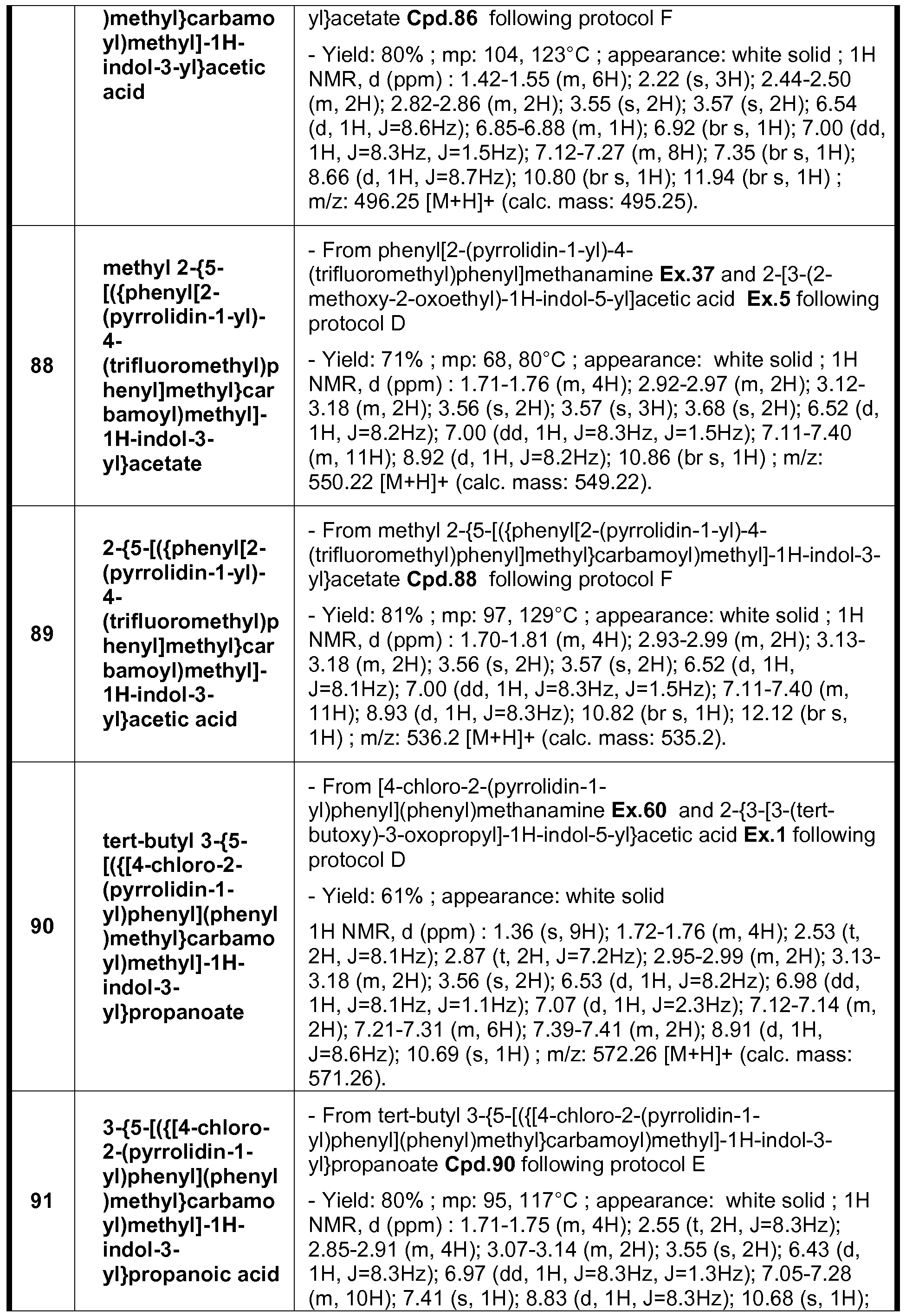 12.15 (br s, 1 H) ; m/z: 516.19 [M+H]+ (calc. mass: 515.19).
- From [4-fluoro-2-(pyrrolidin-1 - yl)phenyl](phenyl)methanamine Ex.66 and 2-{3-[3-(tert- tert-butyl 3-{5- butoxy)-3-oxopropyl]-1 H-indol-5-yl}acetic acid Ex.1 following
[({[4-fluoro-2- protocol D
(pyrrolidin-1 - yl)phenyl](phenyl - Yield: 27% ; appearance: white solid ; 1 H NMR, d (ppm) :
92
)methyl}carbamo 1 .36 (s, 9H); 1 .72-1.76 (m, 4H); 2.53 (t, 2H, J=8.1 Hz); 2.87 (t, yl)methyl]-1 H- 2H, J=7.2Hz); 2.95-2.99 (m, 2H); 3.13-3.18 (m, 2H); 3.56 (s, indol-3- 2H); 6.53 (d, 1 H, J=8.2Hz); 6.98 (dd, 1 H, J=8.1 Hz, J=1.1 Hz); yl}propanoate 7.07 (d, 1 H, J=2.3Hz); 7.12-7.14 (m, 2H); 7.21 -7.31 (m, 6H);
7.39-7.41 (m, 2H); 8.91 (d, 1 H, J=8.6Hz); 10.69 (s, 1 H) ; m/z: 556.28 [M+H]+ (calc. mass: 555.28).
- From tert-butyl 3-{5-[({[4-fluoro-2-(pyrrolidin-1 -
3-{5-[({[4-fluoro-2- yl)phenyl](phenyl)methyl}carbamoyl)methyl]-1 H-indol-3-
(pyrrolidin-1 - yl propanoate Cpd.92 following protocol E
yl)phenyl](phenyl - Yield: 98% ; mp: 95, 1 14°C ; appearance: white solid ; 1 H
93 )methyl}carbamo NMR, d (ppm) : 1 .71 -1 .75 (m, 4H); 2.55 (t, 2H, J=8.3Hz);
yl)methyl]-1 H- 2.85-2.91 (m, 4H); 3.07-3.14 (m, 2H); 3.55 (s, 2H); 6.43 (d, indol-3- 1 H, J=8.3Hz); 6.97 (dd, 1 H, J=8.3Hz, J=1.3Hz); 7.05-7.28 yl}propanoic acid (m, 10H); 7.41 (s, 1 H); 8.83 (d, 1 H, J=8.3Hz); 10.68 (s, 1 H);
12.15 (br s, 1 H) ; m/z: 500.22 [M+H]+ (calc. mass: 499.22).
- From phenyl[2-(piperidin-1 -yl)phenyl]methanamine Ex.9 tert-butyl 3-{5- and tert-butyl 3-(5-amino-1 H-pyrrolo[2,3-b]pyridin-3-
[({phenyl[2- yl)propanoate Ex.136 following protocol G
(piperidin-1 - yl)phenyl]methyl} - Yield: 27% ; mp: 247, 249°C ; appearance: white solid
94
carbamoyl)amino 1 H NMR, d (ppm) : 1 .34 (s, 9H); 1 .47-1.63 (m, 6H); 2.50-2.57
]-1 H-pyrrolo[2,3- (m, 4H); 2.84 (t, 2H, J=7.5Hz); 2.89-2.97 (m, 2H); 6.49 (d, b]pyridin-3- 1 H, J=8.2Hz); 7.01 (d, 1 H, J=8.2Hz); 7.09-7.33 (m, 10H); yl}propanoate 8.00-8.03 (m, 2H); 8.38 (s, 1 H); 1 1 .13 (br s, 1 H)
m/z: 554.3 [M+H]+ (calc. mass: 553.3).
- From tert-butyl 3-{5-[({phenyl[2-(piperidin-1 -
3-{5-[({phenyl[2- yl)phenyl]methyl}carbamoyl)amino]-1 H-pyrrolo[2,3-b]pyridin-
(piperidin-1 - 3-yl}propanoate Cpd.94 following protocol E
yl)phenyl]methyl} - Yield: 44% ; mp: 231 , 233°C ; appearance: white solid ; 1 H
95 carbamoyl)amino NMR, d (ppm) : 1 .50-1 .62 (m, 6H); 2.50-2.56 (m, 4H); 2.85 (t,
]-1 H-pyrrolo[2,3- 2H, J=7.5Hz); 2.86-2.92 (m, 2H); 6.49 (d, 1 H, J=8.1 Hz); 7.02 b]pyridin-3- (d, 1 H, J=8.4Hz); 7.09-7.33 (m, 10H); 8.01 -8.03 (m, 2H); 8.39 yl}propanoic acid (br s, 1 H); 1 1.13 (br s, 1 H) ; m/z: 498.24 [M+H]+ (calc. mass:
497.24).
- From [4-methyl-2-(morpholin-4- methyl 2-{5-[({[4- yl)phenyl](phenyl)methanamine Ex.57 and 2-[3-(2-methoxy- methyl-2- 2-oxoethyl)-1 H-indol-5-yl]acetic acid Ex.5 following protocol
(morpholin-4-
96 D
yl)phenyl](phenyl
)methyl}carbamo - Yield: 58% ; mp: 79, 97°C ; appearance: white solid ; 1 H yl)methyl]-1 H- NMR, d (ppm) : 2.24 (s, 3H); 2.49-2.51 (m, 2H); 2.82-2.88 indol-3-yl}acetate (m, 2H); 3.41 -3.48 (m, 2H); 3.54 (s, 2H); 3.57-3.60 (m, 5H);
3.67 (s, 2H); 6.58 (d, 1 H, J=8.7Hz); 6.89-6.92 (m, 1 H); 6.97
(br s, 1 H); 7.00 (dd, 1 H, J=8.3Hz, J=1.5Hz); 7.13-7.27 (m, 8H); 7.34 (br s, 1 H); 8.68 (d, 1 H, J=8.7Hz); 10.86 (br s, 1 H) ; m/z: 512.24 [M+H]+ (calc. mass: 51 1 .24).
- From methyl 2-{5-[({[4-methyl-2-(morpholin-4- yl)phenyl](phenyl)methyl}carbamoyl)methyl]-1 H-indol-3-
2-{5-[({[4-methyl- yl}acetate Cpd.96 following protocol F
2-(morpholin-4- yl)phenyl](phenyl - Yield: 83% ; mp: 1 13, 141 °C ; appearance: white solid ; 1 H
97 )methyl}carbamo NMR, d (ppm) : 2.24 (s, 3H); 2.44-2.50 (m, 2H); 2.83-2.88 yl)methyl]-1 H- (m, 2H); 3.43-3.48 (m, 2H); 3.54 (s, 2H); 3.56-3.60 (m, 4H); indol-3-yl}acetic 6.58 (d, 1 H, J=8.7Hz); 6.89-6.92 (m, 1 H); 6.97-7.01 (m, acid 2H); 7.13-7.28 (m, 8H); 7.35 (br s, 1 H); 8.68 (d, 1 H,
J=8.7Hz); 10.81 (br s, 1 H); 12.09 (br s, 1 H) ; m/z: 498.23 [M+H]+ (calc. mass: 497.23).
- From (2-methoxy-4-methylphenyl)(phenyl)methanamine Ex.56 and 2-{3-[3-(tert-butoxy)-3-oxopropyl]-1 H-indol-5- tert-butyl 3-[5- yl}acetic acid Ex.1 following protocol D
({[(2-methoxy-4- methylphenyl)(ph - Yield: 78% ; mp: 74 °C ; appearance: white solid ; 1 H NMR,
98 enyl)methyl]carb d (ppm) : 1 .38 (s, 9H); 2.26 (s, 3H); 2.54 (t, 2H, J=7.4Hz);
amoyl}methyl)- 2.87 (t, 2H, J=7.7Hz); 3.55 (s, 2H); 3.62 (s, 3H); 4.82 (d,
1 H-indol-3- 1 H, J=8.8Hz); 6.71 -6.76 (m, 2H); 6.98 (dd, 1 H, J=1 .5Hz, yl]propanoate J=8.3Hz); 7.07 (d, 1 H, J=2.3Hz); 7.13-7.28 (m, 7H); 7.41 (s,
1 H); 8.63 (d, 1 H, J=8.8Hz); 10.69 (d, 1 H, J=1 .7Hz) ; m/z: 513.26 [M+H]+ (calc. mass: 512.26).
- From tert-butyl 3-[5-({[(2-methoxy-4-
3-[5-({[(2- methylphenyl)(phenyl)methyl]carbamoyl}methyl)-1 H-indol-3- methoxy-4- yl]propanoate Cpd.98 following protocol E
methylphenyl)(ph - Yield: 92% ; mp: 97, 1 15°C ; appearance: white solid ; 1 H enyl)methyl]carb
99 NMR, d (ppm) : 2.26 (s, 3H); 2.56 (t, 2H, J=7.0Hz); 2.88 (t, amoyl}methyl)- 2H, J=7.3Hz); 3.55 (s, 2H); 3.62 (s, 3H); 6.33 (d, 1 H,
1 H-indol-3- J=8.8Hz); 6.72-6.76 (m, 2H); 6.98 (dd, 1 H, J=1 .6Hz, yl]propanoic acid J=8.3Hz); 7.07 (d, 1 H, J=2.3Hz); 7.13-7.27 (m, 7H); 7.41 (s,
1 H); 8.64 (d, 1 H, J=9.0Hz); 10.69 (d, 1 H, J=2.0Hz); 12.08 (br s, 1 H) ; m/z: 457.2 [M+H]+ (calc. mass: 456.2).
- From (2,4-dimethylphenyl)(5-methylthiophen-2- tert-butyl 3-[5- yl)methanamine Ex.63 and 2-{3-[3-(tert-butoxy)-3- ({[(2,4- oxopropyl]-1 H-indol-5-yl}acetic acid Ex.1 following protocol dimethylphenyl)( D
5- - Yield: 86% ; mp: 69, 77°C ; appearance: white foam ; 1 H methylthiophen-00 NMR, d (ppm) : 1 .38 (s, 9H); 2.17 (s, 3H); 2.23 (s, 3H); 2.35
2- (s, 3H); 2.52 (t, 2H, J=8.1 Hz); 2.87 (t, 2H, J=8.1 Hz); 3.52 (s, yl)methyl]carbam 2H); 6.26 (d, 1 H, J=8.4Hz); 6.44 (d, 1 H, J=3.4Hz); 6.58 (dd, oyl}methyl)-1 H- 1 H, J=3.4Hz, J=1.1 Hz); 6.95-6.99 (m, 3H); 7.06 (d, 1 H, indol-3- J=2.2Hz); 7.22 (t, 2H, J=7.2Hz); 7.40 (s, 1 H); 8.98 (d, 1 H, yl]propanoate J=8.6Hz); 10.68 (br s, 1 H) ; m/z: 517.24 [M+H]+ (calc.
mass: 516.24).
- From tert-butyl 3-[5-({[(2,4-dimethylphenyl)(5-
3-[5-({[(2,4- methylthiophen-2-yl)methyl]carbamoyl}methyl)-1 H-indol-3- dimethylphenyl)( yl]propanoate Cpd.100 following protocol E
5- methylthiophen- - Yield: 59% ; mp: 100, 122°C ; appearance: yellow solid ; 2- 1 H NMR, d (ppm) : 2.17 (s, 3H); 2.23 (s, 3H); 2.35 (s, 3H); yl)methyl]carbam 2.57 (t, 2H, J=7.4Hz); 2.89 (t, 2H, J=7.4Hz); 3.32 (s, 2H); oyl}methyl)-1 H- 6.26 (d, 1 H, J=8.4Hz); 6.44 (dd, 1 H, J=3.4Hz, J=0.9Hz); indol-3- 6.58 (dd, 1 H, J=3.4Hz, J=1.1 Hz); 6.95-7.00 (m, 3H); 7.06 yl]propanoic acid (d, 1 H, J=2.2Hz); 7.23 (t, 2H, J=7.3Hz); 7.41 (s, 1 H); 9.00
(d, 1 H, J=8.4Hz); 10.68 (d, 1 H, J=2.0Hz); 12.15 (br s, 1 H) ; m/z: 461.18 [M+H]+ (calc. mass: 460.18).
- From [4-methyl-2-(4-methylpiperazin-1 - tert-butyl 3-{5- yl)phenyl](phenyl)methanamine Ex.62 and 2-{3-[3-(tert- [({[4-methyl-2-(4- butoxy)-3-oxopropyl]-1 H-indol-5-yl}acetic acid Ex.1 methylpiperazin- following protocol D
1 - - Yield: 64% ; mp: 102, 1 10°C ; appearance: white foam ; 1 H yl)phenyl](phenyl NMR, d (ppm) : 1.38 (s, 9H); 2.15 (s, 3H); 2.23 (s, 3H); 2.38
)methyl}carbamo (br s, 2H); 2.51 (t, 2H, J=7.1 Hz); 2.87 (t, 4H, J=7.1 Hz); 3.55 yl)methyl]-1 H- (s, 2H); 6.55 (d, 1 H, J=8.7Hz); 6.88 (d, 1 H, J=7.8Hz); 6.94- indol-3- 6.99 (m, 2H); 7.07 (d, 1 H, J=2.2Hz); 7.14-7.27 (m, 7H); 7.40 yl}propanoate (s, 1 H); 8.66 (d, 1 H, J=8.7Hz); 10.68 (d, 1 H, J=1 .7Hz) ; m/z:
581 .34 [M+H]+ (calc. mass: 580.34).
- From tert-butyl 3-{5-[({[4-methyl-2-(4-methylpiperazin-1 -
3-{5-[({[4-methyl- yl)phenyl](phenyl)methyl}carbamoyl)methyl]-1 H-indol-3- 2-(4- yl}propanoate Cpd.102 following protocol E
methylpiperazin- 1 - - Yield: 55% ; mp: 182, 192°C ; appearance: white solid ; 1 H yl)phenyl](phenyl NMR, d (ppm) : 2.21 (s, 3H); 2.23 (s, 3H); 2.38 (br s, 2H); )methyl}carbamo 2.51 (t, 2H, J=7.3Hz); 2.87 (t, 4H, J=7.3Hz); 3.55 (s, 2H); yl)methyl]-1 H- 6.55 (d, 1 H, J=8.7Hz); 6.88 (d, 1 H, J=8.1 Hz); 6.95-6.99 (m, indol-3- 2H); 7.07 (d, 1 H, J=2.2Hz); 7.15-7.27 (m, 7H); 7.41 (s, 1 H); yl}propanoic acid 8.68 (d, 1 H, J=8.7Hz); 10.68 (br s, 1 H) ; m/z: 525.27
[M+H]+ (calc. mass: 524.27).
- From 3-methyl-1 -(naphthalen-1 -yl)butan-1 -amine Ex.32 and 2-{3-[3-(tert-butoxy)-3-oxopropyl]-1 H-indol-5-yl}acetic acid Ex.1 following protocol D
tert-butyl 3-[5-
({[3-methyl-1 - - Yield: 43% ; mp: 138, 140°C ; appearance: white solid ; 1 H
(naphthalen-1 - NMR, d (ppm) : 0.88 (d, 3H, J=6.3Hz); 0.99 (d, 3H,
yl)butyl]carbamo J=6.3Hz); 1 .52-1 .59 (m, 1 H); 1 .72-1.79 (m, 2H); 2.53 (t, 2H, yl}methyl)-1 H- J=7.4Hz); 2.86 (t, 2H, J=7.4Hz); 3.46-3.57 (m, 2H); 6.95 indol-3- (dd, 1 H, J=8.3Hz, J=1 .4Hz); 7.06 (d, 1 H, J=2.3Hz); 7.20 (d, yl]propanoate 1 H, J=8.2Hz); 7.38 (s, 1 H); 7.43-7.56 (m, 4H); 7.78 (d, 1 H,
J=8.2Hz); 7.92 (dd, 1 H, J=7.8Hz, J=1.6Hz); 8.10 (d, 1 H, J=8.3Hz); 8.62 (d, 1 H, J=8.5Hz); 10.67 (s, 1 H) ; m/z: 499.28 [M+H]+ (calc. mass: 498.28).
3-[5-({[3-methyl-1 -
- From tert-butyl 3-[5-({[3-methyl-1 -(naphthalen-1 - (naphthalen-1 - yl)butyl]carbamoyl}methyl)-1 H-indol-3-yl]propanoate yl)butyl]carbamo
Cpd.104 following protocol E
yl}methyl)-1 H-
indol-3- - Yield: 87% ; mp: 154, 174°C ; appearance: white solid ; 1H yl]propanoic acid NMR, d (ppm) : 0.88 (d, 3H, J=6.3Hz); 0.99 (d, 3H,
J=6.3Hz); 1.56-1.79 (m, 3H); 2.55 (t, 2H, J=7.5Hz); 2.87 (t, 2H, J=7.3Hz); 3.46-3.56 (m, 2H); 5.67-5.73 (m, 1H); 6.95 (d, 1H, J=8.1Hz); 7.06 (s, 1H); 7.20 (d, 1H, J=8.2Hz); 7.39 (s, 1H); 7.43-7.57 (m, 4H); 7.78 (d, 1H, J=8.1Hz); 7.91 (d, 1H, J=7.7Hz); 8.10 (d, 1H, J=8.1Hz); 8.63 (d, 1H, J=8.3Hz); 10.67 (s, 1H); 12.20 (br s, 1H) ; m/z: 443.22 [M+H]+ (calc. mass: 442.22).
- From phenyl[2-(1 H-pyrrol-1-yl)phenyl]methanamine Ex.54 and 2-{3-[3-(tert-butoxy)-3-oxopropyl]-1 H-indol-5-yl}acetic tert-butyl 3-{5- acid Ex.1 following protocol D
[({phenyl[2-(1H- pyrrol-1- - Yield: 61% ; mp: 76 °C ; appearance: white solid ; 1H
106 yl)phenyl]methyl} NMR, d (ppm) : 1.38 (s, 9H); 2.54 (t, 2H, J=7.3Hz); 2.88 (t, carbamoyl)methy 2H, J=7.5Hz); 3.55 (s, 2H); 6.11 (d, 1 H, J=8.0Hz); 6.15 (t, l]-1H-indol-3- 2H, J=2.1Hz); 6.79 (t, 2H, J=2.1Hz); 6.94-6.99 (m, 3H); 7.07 yl}propanoate (d, 1H, J=2.2Hz); 7.18-7.27 (m, 5H); 7.33-7.45 (m, 3H); 7.55
(dd, 1H, J=1.6Hz, J=7.7Hz); 8.99 (d, 1H, J=8.0Hz); 10.69 (d, 1H, J=2.0Hz) ; m/z: 534.26 [M+H]+ (calc. mass: 533.26).
- From tert-butyl 3-{5-[({phenyl[2-(1 H-pyrrol-1- yl)phenyl]methyl}carbamoyl)methyl]-1 H-indol-3- yl propanoate Cpd.106 following protocol E
3-{5-[({phenyl[2-
(1H-pyrrol-1- - Yield: 93% ; mp: 115, 124°C ; appearance: white solid ; 1H yl)phenyl]methyl} NMR, d (ppm) : 2.53 (t, 2H, J=7.1Hz); 2.88 (t, 2H, J=7.3Hz);
107
carbamoyl)methy 3.55 (s, 2H); 6.12 (d, 1H, J=8.0Hz); 6.15 (t, 2H, J=2.1Hz); l]-1H-indol-3- 6.79 (t, 2H, J=2.1Hz); 6.94-6.99 (m, 3H); 7.06 (d, 1H, yl}propanoic acid J=2.2Hz); 7.15-7.27 (m, 5H); 7.35 (td, 1H, J=1.7Hz,
J=7.7Hz); 7.40-7.46 (m, 2H); 7.57 (dd, 1H, J=1.5Hz, J=7.7Hz); 9.03 (d, 1H, J=8.1Hz); 10.68 (d, 1H, J=2.0Hz) ; m/z: 478.2 [M+H]+ (calc. mass: 477.2).
- From [4-methoxy-2-(pyrrolidin-1- yl)phenyl](phenyl)methanamine Ex.68 and 2-{3-[3-(tert- tert-butyl 3-{5- butoxy)-3-oxopropyl]-1 H-indol-5-yl}acetic acid Ex.1
[({[4-methoxy-2- following protocol D
(pyrrolidin-1- yl)phenyl](phenyl - Yield: 64% ; mp: 71 °C ; appearance: white solid ; 1H NMR,
108
)methyl}carbamo d (ppm) : 1.38 (s, 9H); 1.67-1.73 (m, 4H); 2.54 (t, 2H, yl)methyl]-1H- J=7.1Hz); 2.78-2.90 (m, 4H); 3.03-3.10 (m, 2H); 3.56 (s, indol-3- 2H); 3.69 (s, 3H); 6.41 (d, 1H, J=8.4Hz); 6.49-6.55 (m, 2H); yl}propanoate 6.99 (dd, 1H, J=1.5Hz, J=8.3Hz); 7.04-7.26 (m, 8H); 7.40
(s, 1H); 8.69 (d, 1H, J=8.5Hz); 10.68 (d, 1H, J=1.9Hz) ; m/z: 568.3 [M+H]+ (calc. mass: 567.3).
3-{5-[({[4-
- From tert-butyl 3-{5-[({[4-methoxy-2-(pyrrolidin-1- methoxy-2- yl)phenyl](phenyl)methyl}carbamoyl)methyl]-1 H-indol-3-
(pyrrolidin-1- yl propanoate Cpd.108 following protocol E
yl)phenyl](phenyl
109
)methyl}carbamo -Yield: 91% ;mp: 94, 116°C ; appearance: white solid ; 1H yl)methyl]-1H- NMR, d (ppm) : 1.68-1.73 (m, 4H); 2.56 (t, 2H, J=7.1Hz); indol-3- 2.78-2.83 (m, 2H); 2.89 (t, 2H, J=7.4Hz); 3.03-3.08 (m, 2H); yl}propanoic acid 3.56 (s, 2H); 3.69 (s, 3H); 6.41 (d, 1H, J=8.4Hz); 6.49-6.54
(m, 2H); 6.99 (dd, 1 H, J=1.5Hz, J=8.3Hz); 7.04-7.27 (m, 8H); 7.41 (s, 1 H); 8.68 (d, 1 H, J=8.5Hz); 10.69 (d, 1 H, J=1.9Hz); 12.07 (br s, 1 H) ; m/z: 512.24 [M+H]+ (calc. mass: 51 1 .24).
- From [4-methoxy-2-(piperidin-1 - yl)phenyl](phenyl)methanamine Ex.73 and 2-{3-[3-(tert- tert-butyl 3-{5- butoxy)-3-oxopropyl]-1 H-indol-5-yl}acetic acid Ex.1
[({[4-methoxy-2- following protocol D
(piperidin-1 - yl)phenyl](phenyl - Yield: 38% ; mp: 79 °C ; appearance: white solid ; 1 H
)methyl}carbamo NMR, d (ppm) : 1 .38 (s, 9H); 1 .43-1 .59 (m, 6H); 2.45-2.56 yl)methyl]-1 H- (m, 4H); 2.79-2.89 (m, 4H); 3.56 (s, 2H); 3.69 (s, 3H); 6.51 indol-3- (d, 1 H); 6.62-6.66 (m, 2H); 6.97 (dd, 1 H, J=1 .5Hz,
yl}propanoate J=8.3Hz); 7.06 (d, 1 H, J=2.3Hz); 7.15-7.27 (m, 7H); 7.39 (s,
1 H); 8.65d (d, 1 H, J=8.7Hz); 10.68 (d, 1 H, J=1 .9Hz) ; m/z: 582.32 [M+H]+ (calc. mass: 581.32).
- From tert-butyl 3-{5-[({[4-methoxy-2-(piperidin-1 -
3-{5-[({[4- yl)phenyl](phenyl)methyl}carbamoyl)methyl]-1 H-indol-3- methoxy-2- yl}propanoate Cpd.110 following protocol E
(piperidin-1 - - Yield: 88% ; mp: 101 , 1 13°C ; appearance: white solid ; 1 H yl)phenyl](phenyl NMR, d (ppm) : 1 .43-1 .56 (m, 6H); 2.48-2.59 (m, 4H); 2.80-
)methyl}carbamo 2.91 (m, 4H); 3.56 (s, 2H); 3.69 (s, 3H); 6.51 (d, 1 H, yl)methyl]-1 H- J=8.7Hz); 6.63-6.66 (m, 2H); 6.98 (dd, 1 H, J=1 .4Hz, indol-3- J=8.3Hz); 7.07 (d, 1 H, J=2.2Hz); 7.12-7.27 (m, 7H); 7.41 (s, yl}propanoic acid 1 H); 8.65 (d, 1 H, J=8.6Hz); 10.68 (d, 1 H, J=1.9Hz); 12.05
(br s, 1 H) ; m/z: 526.26 [M+H]+ (calc. mass: 525.26).
- From 2-{5-[({[4-methyl-2-(morpholin-4-
N, N -dimethyl -2- yl)phenyl](phenyl)methyl}carbamoyl)methyl]-1 H-indol-3-
{5-[({[4-methyl-2- yl}acetic acid Cpd.97 following protocol D
(morpholin-4- - Yield: 68% ; mp: 109, 120°C ; appearance: white solid ; 1 H yl)phenyl](phenyl NMR, d (ppm) : 2.24 (s, 3H); 2.42-2.44 (m, 2H); 2.80 (s,
)methyl}carbamo 3H); 2.83-2.86 (m, 2H); 2.98 (s, 3H); 3.41 -3.47 (m, 2H); yl)methyl]-1 H- 3.54 (s, 2H); 3.56-3.58 (m, 2H); 3.60 (s, 2H); 6.57 (d, 1 H, indol-3- J=8.7Hz); 6.89-6.92 (m, 1 H); 6.97-7.01 (m, 2H); 7.13-7.28 yl}acetamide (m, 8H); 7.40 (m, 1 H); 8.66 (d, 1 H, J=8.7Hz); 10.79 (s, 1 H) ;
m/z: 525.27 [M+H]+ (calc. mass: 524.27).
- From [5-methyl-2-(piperidin-1 - yl)phenyl](phenyl)methanamine Ex.112 and 2-{3-[3-(tert- tert-butyl 3-{5- butoxy)-3-oxopropyl]-1 H-indol-5-yl}acetic acid Ex.1
[({[5-methyl-2- following protocol D
(piperidin-1 - yl)phenyl](phenyl - Yield: 55% ; mp: 83, 87°C ; appearance: white solid ; 1 H
)methyl}carbamo NMR, d (ppm) : 1 .37 (s, 9H); 1 .40-1 .58 (m, 6H); 2.17 (s, yl)methyl]-1 H- 3H); 2.40-2.48 (m, 2H); 2.53 (t, 2H, J=8.1 Hz); 2.79-2.89 (m, indol-3- 4H); 3.56 (s, 2H); 6.57 (d, 1 H, J=8.6Hz); 6.98-7.04 (m, 3H); yl}propanoate 7.07 (s, 2H); 7.13-7.27 (m, 6H); 7.41 (s, 1 H); 8.64 (d, 1 H,
J=8.8Hz); 10.68 (s, 1 H) ; m/z: 566.33 [M+H]+ (calc. mass: 565.33).
- From tert-butyl 3-{5-[({[5-methyl-2-(piperidin-1 -
3-{5-[({[5-methyl- yl)phenyl](phenyl)methyl}carbamoyl)methyl]-1 H-indol-3-
2-(piperidin-1 - yl}propanoate following Cpd.113 protocol E
yl)phenyl](phenyl - Yield: 88% ; mp: 1 15, 131 °C ; appearance: white solid ; 1 H
)methyl}carbamo
114 NMR, d (ppm) : 1 .41 -1 .54 (m, 6H); 2.16 (s, 3H); 2.39-2.50 yl)methyl]-1 H- (m, 2H); 2.55 (t, 2H, J=8.2Hz); 2.72-2.80 (m, 2H); 2.88 (t, indol-3- 2H, J=8.1 Hz); 3.52-3.62 (m, 2H); 6.57 (d, 1 H, J=8.6Hz); yl}propanoic acid 6.97-7.04 (m, 3H); 7.05-7.08 (m, 2H); 7.13-7.28 (m, 6H);
7.42 (s, 1 H); 8.66 (d, 1 H, J=8.7Hz); 10.68 (s, 1 H); 12.07 (br s, 1 H) ; m/z: 510.26 [M+H]+ (calc. mass: 509.26).
- From 3-{5-[({phenyl[2-(piperidin-1 -
N-methyl-3-{5- yl)phenyl]methyl}carbamoyl)methyl]-1 H-indol-3-yl}propanoic
[({phenyl[2- acid Cpd.1 and methylamine following protocol D
(piperidin-1 - - Yield: 88% ; mp: 99, 109°C ; appearance: white solid ; 1 H
115 yl)phenyl]methyl} NMR, d (ppm) : 1 .40-1 .65 (m, 6H); 2.45-2.5 (m, 4H); 2.57 carbamoyl)methy (d, 3H, J=0.3Hz); 2.8-2.9 (m, 4H); 3.56 (s, 2H); 6.60 (d, 1 H, l]-1 H-indol-3- J=8.7Hz); 6.95-7.35 (m, 12H); 7.39 (s, 1 H); 7.75 (d, 1 H, yl}propanamide J=0.3Hz); 8.72 (d, 1 H, J=8.7Hz); 10.63 (br s, 1 H) ; m/z:
509.28 [M+H]+ (calc. mass: 508.28).
- From [5-bromo-2-(pyrrolidin-1 - yl)phenyl](phenyl)methanamine Ex.74 and 2-{3-[3-(tert- tert-butyl 3-{5- butoxy)-3-oxopropyl]-1 H-indol-5-yl}acetic acid Ex.1
[({[5-bromo-2- following protocol D
(pyrrolidin-1 - yl)phenyl](phenyl - Yield: 70% ; mp: 91 , 100°C ; appearance: white foam ; 1 H
116
)methyl}carbamo NMR, d (ppm) : 1 .38 (s, 9H); 1 .72 (q, 4H, J=6.4Hz); 2.54 (t, yl)methyl]-1 H- 2H, J=7.2Hz); 2.82-2.90 (m, 4H); 3.07-3.10 (m, 2H); 3.56 (s, indol-3- 2H); 6.48 (d, 1 H, J=8.5Hz); 6.97-7.01 (m, 2H); 7.07 (d, 1 H, yl}propanoate J=2.3Hz); 7.1 1 -7.13 (m, 2H); 7.19-7.34 (m, 7H); 7.40 (s,
1 H); 8.86 (d, 1 H, J=8.6Hz); 10.70 (br s, 1 H) ; m/z: 616.2 [M+H]+ (calc. mass: 615.2).
- From tert-butyl 3-{5-[({[5-bromo-2-(pyrrolidin-1 - yl)phenyl](phenyl)methyl}carbamoyl)methyl]-1 H-indol-3-
3-{5-[({[5-bromo- yl propanoate Cpd.116 following protocol E
2-(pyrrolidin-1 - yl)phenyl](phenyl - Yield: 93% ; mp: 155, 161 °C ; appearance: white powder ;
117 )methyl}carbamo 1 H NMR, d (ppm) : 1.72 (q, 4H, J=6.4Hz); 2.54 (t, 2H,
yl)methyl]-1 H- J=7.2Hz); 2.82-2.91 (m, 4H); 3.07-3.1 1 (m, 2H); 3.56 (s, indol-3- 2H); 6.48 (d, 1 H, J=8.5Hz); 6.97-7.01 (m, 2H); 7.07 (d, 1 H, yl}propanoic acid J=2.3Hz); 7.1 1 -7.13 (m, 2H); 7.19-7.34 (m, 7H); 7.41 (s,
1 H); 8.87 (d, 1 H, J=8.6Hz); 10.69 (br s, 1 H); 12.03 (br s, 1 H) ; m/z: 560.14 [M+H]+ (calc. mass: 559.14).
3-{5-[({phenyl[2- - From 3-{5-[({phenyl[2-(piperidin-1 -
(piperidin-1 - yl)phenyl]methyl}carbamoyl)methyl]-1 H-indol-3-yl}propanoic yl)phenyl]methyl} acid Cpd.1 and isopropylamine following protocol D
118 carbamoyl)methy
- Yield: 55% ; mp: 92, 1 10°C ; appearance: white solid ; 1 H l]-1 H-indol-3-yl}- NMR, d (ppm) : 1 .02 (d, 6H, J=6.6Hz); 1 .40-1 .65 (m, 6H);
N-(propan-2- 2.34 (t, 2H, J=7.3Hz); 2.45-2.5 (m, 2H); 2.82-2.88 (m, 4H); yl)propanamide
3.57 (s, 2H); 3.83 (m, 1 H); 6.60 (d, 1 H, J=8.7Hz); 6.95-7.35
(m, 12H); 7.40 (s, 1 H); 7.66 (d, 1 H, J=8.7Hz); 8.72 (d, 1 H,
J=8.7Hz); 10.64 (br s, 1 H) ; m/z: 537.31 [M+H]+ (calc. mass: 536.31 ).
- From 2-[amino(phenyl)methyl]-N-ethyl-5-methylaniline
Ex.76 and 2-{3-[3-(tert-butoxy)-3-oxopropyl]-1 H-indol-5- tert-butyl 3-{5- yl}acetic acid Ex.1 following protocol D
[({[2- - Yield: 68% ; mp: 130 °C ; appearance: white solid ; 1 H
(ethylamino)-4- NMR, d (ppm) : 0.96 (t, 3H, J=7.0Hz); 1 .38 (s, 9H); 2.18 (s, methylphenyl](ph
119 3H); 2.53 (t, 2H, J=7.5Hz); 2.86 (t, 2H, J=7.4Hz); 2.90-3.02 enyl)methyl}carb (m, 2H); 3.55 (s, 2H); 4.50 (t, 1 H, J=5.1 Hz); 6.13 (d, 1 H, amoyl)methyl]- J=9.1 Hz); 6.30 (d, 1 H, J=7.7Hz); 6.37 (s, 1 H); 6.54 (d, 1 H,
1 H-indol-3- J=7.7Hz); 6.98 (dd, 1 H, J=1 .5Hz , J=8.3Hz); 7.07 (d, 1 H, yl}propanoate J=2.2Hz); 7.20-7.35 (m, 6H); 7.40 (s, 1 H); 8.87 (d, 1 H,
J=9.1 Hz); 10.68 (d, 1 H, J=1 .7Hz) ; m/z: 526.29 [M+H]+ (calc. mass: 525.29).
- From tert-butyl 3-{5-[({[2-(ethylamino)-4- methylphenyl](phenyl)methyl}carbamoyl)methyl]-1 H-indol-3- yl}propanoate Cpd.119 following protocol E
3-{5-[({[2-
(ethylamino)-4- - Yield: 77% ; mp: 125 °C ; appearance: white solid ; 1 H methylphenyl](ph NMR, d (ppm) : 0.97 (t, 3H, J=7.0Hz); 2.18 (s, 3H); 2.55 (t,
120 enyl)methyl}carb 2H, J=7.1 Hz); 2.87 (t, 2H, J=7.5Hz); 2.94-2.98 (m, 2H); 3.55 amoyl)methyl]- (s, 2H); 4.50 (m, 1 H); 6.13 (d, 1 H, J=9.1 Hz); 6.30 (d, 1 H,
1 H-indol-3- J=7.7Hz); 6.37 (s, 1 H); 6.55 (d, 1 H, J=7.7Hz); 6.98 (dd, 1 H, yl}propanoic acid J=1.4Hz, J=8.3Hz); 7.07 (d, 1 H, J=2.2Hz); 7.20-7.33 (m,
6H); 7.41 (s, 1 H); 8.89 (d, 1 H, J=9.1 Hz); 10.68 (d, 1 H, J=1.7Hz); 12.15 (br s, 1 H) ; m/z: 470.23 [M+H]+ (calc. mass: 469.23).
- From {2-
[(dimethylamino)methyl]phenyl}(phenyl)methanamine Ex.71 tert-butyl 3-(5- and 2-{3-[3-(tert-butoxy)-3-oxopropyl]-1 H-indol-5-yl}acetic {[({2- acid Ex.1 following protocol D
[(dimethylamino)
methyl]phenyl}(p - Yield: 46% ; mp: 80, 83°C ; appearance: white solid ; 1 H
121
henyl)methyl)car NMR, d (ppm) : 1 .38 (s, 9H); 2.00 (s, 6H); 2.53 (t, 2H, bamoyl]methyl}- J=8.0Hz); 2.84-2.89 (m, 3H); 3.42 (d, 1 H, J=12.6Hz); 3.55
1 H-indol-3- (s, 2H); 6.56 (d, 1 H, J=8.6Hz); 6.98 (dd, 1 H, J=8.3Hz, yl)propanoate J=1.5Hz); 7.07 (d, 1 H, J=2.1 Hz); 7.14-7.7.17 (m, 3H); 7.19- 7.30 (m, 7H); 7.40 (s, 1 H); 9.22 (d, 1 H, J=8.5Hz); 10.69 (s, 1 H) ; m/z: 526.29 [M+H]+ (calc. mass: 525.29).
- From tert-butyl 3-(5-{[({2- [(dimethylamino)methyl]phenyl}(phenyl)methyl)carbamoyl]m
3-(5-{[({2- ethyl}-1 H-indol-3-yl)propanoate Cpd.122 following protocol
[(dimethylamino)
E
methyl]phenyl}(p
122 henyl)methyl)car - Yield: 31 % ; mp: 1 1 1 , 121 °C ; appearance: white solid ; 1 H bamoyl]methyl}- NMR, d (ppm) : 2.00 (s, 6H); 2.53 (t, 2H, J=7.3Hz); 2.86-
1 H-indol-3- 2.90 (m, 3H); 3.41 -3.56 (m, 1 H); 3.56 (s, 2H); 6.56 (d, 1 H, yl)propanoic acid J=8.6Hz); 6.98 (dd, 1 H, J=8.4Hz, J=1.3Hz); 7.07 (d, 1 H,
J=2.1 Hz); 7.14-7.30 (m, 10H); 7.41 (s, 1 H); 8.20 (s, 1 H); 9.22 (d, 1 H, J=9.0Hz); 10.70 (s, 1 H) ; m/z: 470.23 [M+H]+
(calc. mass: 469.23).
- From 1 -{2-[amino(phenyl)methyl]phenyl}piperidin-3-ol Ex.81 and 2-{3-[3-(tert-butoxy)-3-oxopropyl]-1 H-indol-5-yl}acetic tert-butyl 3-{5- acid Ex.1 following protocol D
[({[2-(3- hydroxypiperidin- - Yield: 70% ; mp: 92, 96°C ; appearance: white solid ; 1 H 1 - NMR, d (ppm) : 1 .17-1 .38 (m, 2H); 1 .38 (s, 9H); 1 .73-1.80 yl)phenyl](phenyl (m, 3H); 2.26-2.49 (m, 2H); 2.52-2.57 (m, 2H); 2.72-3.03
)methyl}carbamo (m, 3H); 3.49-3.70 (m, 3H); 4.65 (d, 0.5H, J=4.7Hz); 4.77 yl)methyl]-1 H- (d, 0.5H, J=4.8Hz); 6.50 (d, 0.5H, J=8.8Hz); 6.60 (d, 0.5H, indol-3- J=8.9Hz); 6.99 (dt, 1 H, J=8.4Hz, J=1.5Hz); 7.04-7.28 (m, yl}propanoate 10H); 7.34 (dd, 1 H, J=7.6Hz, J=1.4Hz); 7.40 (s, .5H); 7.43
(s, .5H); 8.79 (d, 0.5H, J=8.7Hz); 8.88 (d, 0.5H, J=8.8Hz); 10.67 (s, 1 H) ; m/z: 568.3 [M+H]+ (calc. mass: 567.3).
- From tert-butyl 3-{5-[({[2-(3-hydroxypiperidin-1 - yl)phenyl](phenyl)methyl}carbamoyl)methyl]-1 H-indol-3- yl propanoate Cpd.123 following protocol E
3-{5-[({[2-(3- hydroxypiperidin- - Yield: 100% ; mp: 122, 128°C ; appearance: white solid ;
1 - 1 H NMR, d (ppm) : 1 .17-1 .38 (m, 2H); 1 .38 (s, 9H); 1 .73- yl)phenyl](phenyl 1 .80 (m, 3H); 2.26-2.49 (m, 2H); 2.52-2.57 (m, 2H); 2.72- )methyl}carbamo 3.03 (m, 3H); 3.49-3.70 (m, 3H); 4.65 (d, 0.5H, J=4.7Hz); yl)methyl]-1 H- 4.77 (d,0.5H, J=4.8Hz); 6.50 (d, 0.5H, J=8.8Hz); 6.60 (d, indol-3- 0.5H, J=8.9Hz); 6.99 (dt, 1 H, J=8.4Hz , J=1.5Hz); 7.04-7.28 yl}propanoic acid (m, 10H); 7.34 (dd, 1 H, J=7.6Hz , J=1.4Hz); 7.40 (s, .5H);
7.43 (s, .5H); 8.79 (d, 0.5H, J=8.7Hz); 8.88 (d, 0.5H, J=8.8Hz); 10.67 (s, 1 H) ; m/z: 512.24 [M+H]+ (calc. mass: 51 1 .24).
- From 2-[amino(phenyl)methyl]-5-methyl-N-(propan-2- yl)aniline Ex.77 and 2-{3-[3-(tert-butoxy)-3-oxopropyl]-1 H- tert-butyl 3-(5- indol-5-yl}acetic acid Ex.1 following protocol D
{[({4-methyl-2- - Yield: 71 % ; mp: 83, 87°C ; appearance: white solid ; 1 H
[(propan-2- NMR, d (ppm) : 0.92 (d, 3H, J=6.2Hz); 0.99 (d, 3H, yl)amino]phenyl}( J=6.2Hz); 1 .38 (s, 9H); 2.18 (s, 3H); 2.55 (t, 2H, J=7.2Hz); phenyl)methyl)ca 2.86 (t, 2H, J=7.2Hz); 3.54 (s, 2H); 4.28 (d, 1 H, J=7.5Hz); rbamoyl]methyl}- 6.09 (d, 1 H, J=9.4Hz); 6.24-6.28 (m, 1 H); 6.40 (s, 1 H); 6.48
1 H-indol-3- (d, 1 H, J=7.7Hz); 6.99 (dd, 1 H, J=8.4Hz, J=1 .4Hz); 7.06 (d, yl)propanoate 1 H, J=2.1 Hz); 7.19-7.34 (m, 5H); 7.41 (s, 1 H); 8.86 (d, 1 H,
J=9.4Hz); 10.68 (br s, 1 H) ; m/z: 540.31 [M+H]+ (calc. mass: 539.31 ).
3-(5-{[({4-methyl- - From tert-butyl 3-(5-{[({4-methyl-2-[(propan-2-
2-[(propan-2- yl)amino]phenyl}(phenyl)methyl)carbamoyl]methyl}-1 H- yl)amino]phenyl}( indol-3-yl)propanoate Cpd.125 following protocol E
phenyl)methyl)ca
- Yield: 72% ; mp: 1 14, 1 16°C ; appearance: white solid ; 1 H rbamoyl]methyl}- NMR, d (ppm) : 0.92 (d, 3H, J=6.2Hz); 0.99 (d, 3H,
1 H-indol-3- J=6.2Hz); 2.17 (s, 3H); 2.55 (t, 2H, J=7.2Hz); 2.86 (t, 2H, yl)propanoic acid
J=7.2Hz); 3.54 (s, 2H); 4.28 (br s, 1 H); 6.09 (d, 1 H, J=9.3Hz); 6.24-6.28 (m, 1 H); 6.40 (s, 1 H); 6.48 (d, 1 H,
J=7.7Hz); 6.99 (dd, 1H, J=8.3Hz, J=1.5Hz); 7.06 (d, 1H,
J=2.2Hz); 7.19-7.34 (m, 7H); 7.42 (s, 1H); 8.88 (d, 1H, J=9.3Hz); 10.68 (br s, 1H) ; m/z: 484.25 [M+H]+ (calc.
mass: 483.25).
- From phenyl[2-(1 ,2,3,6-tetrahydropyridin-1- yl)phenyl]methanamine Ex.75 and 2-{3-[3-(tert-butoxy)-3- tert-butyl 3-{5- oxopropyl]-1 H-indol-5-yl}acetic acid Ex.1 following protocol
[({phenyl[2- D
(1,2,3,6- tetrahyd ropy ri din - Yield: 35% ; mp: 75°C ; appearance: white solid ; 1H NMR,
127 -1- d (ppm) : 1.38 (s, 9H); 1.94-2.00 (m, 1H); 2.12-2.18 (m, 1H);
yl)phenyl]methyl} 2.53 (t, 2H, J=7.5Hz); 2.63-2.69 (m, 1H); 2.86 (t, 2H, carbamoyl)methy J=7.4Hz); 2.96-3.01 (m, 1H); 3.03-3.10 (m, 1H); 3.49-3.57 l]-1H-indol-3- (m, 3H); 5.66-5.76 (m, 1H); 6.60 (d, 2H, J=8.6Hz); 6.98 (dd, yl}propanoate 1H, J=1.5Hz, J=8.3Hz); 6.96-7.27 (m, 10H); 7.34 (d, 1H,
J=7.3Hz); 7.40 (s, 1H); 8.78 (d, 1H, J=8.7Hz); 10.68 (d, 1H, J=1.9Hz) ; m/z: 550.29 [M+H]+ (calc. mass: 549.29).
- From tert-butyl 3-{5-[({phenyl[2-(1 ,2,3,6-tetrahydropyridin-1- yl)phenyl]methyl}carbamoyl)methyl]-1 H-indol-3-
3-{5-[({phenyl[2- yl propanoate Cpd.127 following protocol E
(1,2,3,6- tetrahyd ropy ri din - Yield: 89% ; mp: 89, 105°C ; appearance: white solid ; 1H -1- NMR, d (ppm) : 1.95-2.00 (m, 1H); 2.13-2.19 (m, 1H); 2.56
128
yl)phenyl]methyl} (t, 2H, J=7.2Hz); 2.62-2.69 (m, 1H); 2.88 (t, 2H, J=7.3Hz); carbamoyl)methy 2.96-3.01 (m, 1H); 3.03 (m, 1H); 3.49-3.57 (m, 3H); 5.66- l]-1H-indol-3- 5.76 (m, 2H); 6.60 (d, 1H, J=8.6Hz); 6.98 (dd, 1H, J=1.5Hz, yl}propanoic acid J=8.3Hz); 7.06-7.36 (m, 11H); 7.41 (s, 1H); 8.79 (d, 1H,
J=8.7Hz); 10.68 (d, 1H, J=1.8Hz); 12.10 (br s, 1H); m/z: 494.23 [M+H]+ (calc. mass: 493.23).
- From 1-[2-(pyrrolidin-1-yl)phenyl]cyclopentan-1 -amine
Ex.115 and 2-{3-[3-(tert-butoxy)-3-oxopropyl]-1 H-indol-5- tert-butyl 3-{5- yl}acetic acid Ex.1 following protocol D
[({1-[2-(pyrrolidin- - Yield: 74% ; mp: 75, 80°C ; appearance: white solid ; 1H
1- NMR, d (ppm) : 1.45 (s, 9H); 1.55-1.90 (m, 10H); 2.61 (t,
129 yl)phenyl]cyclope 2H, J=7.2Hz); 2.68-2.72 (m, 2H); 2.80-2.85 (m, 4H); 3.03 (t, ntyl}carbamoyl)m 2H, J=7.2Hz); 3.56 (s, 2H); 6.13 (br s, 1H); 7.03-7.06 (m, ethyl]-1H-indol-3- 2H); 7.12 (td, 1H, J=7.8Hz, J=1.5Hz); 7.22 (td, 1H, J=7.8Hz, yl}propanoate J=1.5Hz); 7.26-7.32 (m, 1H); 7.41 (br s, 1H); 7.54 (dd, 1H,
J=7.8Hz, J=1.5Hz); 8.02 (br s, 1 H) ; m/z: 516.31 [M+H]+ (calc. mass: 515.31).
- From tert-butyl 3-{5-[({1-[2-(pyrrolidin-1- yl)phenyl]cyclopentyl}carbamoyl)methyl]-1 H-indol-3-
3-{5-[({1-[2- yl}propanoate Cpd.129 following protocol E
(pyrrolidin-1- yl)phenyl]cyclope - Yield: 86% ; mp: 130, 240°C ; appearance: white solid ; 1H
130
ntyl}carbamoyl)m NMR, d (ppm) : 1.62-1.92 (m, 10H); 2.68-2.72 (m, 4H); 2.78- ethyl]-1H-indol-3- 2.87 (m, 4H); 3.05 (t, 2H, J=7.2Hz); 3.56 (s, 2H); 6.31 (br s, yl}propanoic acid 1H); 6.97-7.03 (m, 2H); 7.10-7.15 (m, 1H); 7.20-7.30 (m, 2H);
7.40 (s, 1H); 7.53 (d, 1H, J=7.8Hz); 8.22 (br s, 1H) ; m/z: 460.25 [M+H]+ (calc. mass: 459.25).
- From [4-methyl-2-(piperidin-1-yl)phenyl](pyrimidin-2- yl)methanamine Ex.88 and 2-{3-[3-(tert-butoxy)-3- tert-butyl 3-{5- oxopropyl]-1 H-indol-5-yl}acetic acid Ex.1 following protocol
[({[4-methyl-2- D
(piperidin-1- - Yield: 52% ; mp: 88, 90°C ; appearance: white solid ; 1H yl)phenyl](pyrimi NMR, d (ppm) : 1.30-1.55 (m, 15H); 2.48 (s, 3H); 2.55-2.60
131 din-2- (m, 4H); 2.69-2.73 (m, 2H); 2.86 (t, 2H, J=7.5Hz); 3.48-3.64 yl)methyl}carbam (m, 2H); 6.55 (d, 1H, J=8.1Hz); 6.81 (dd, 1H, J=7.8Hz, oyl)methyl]-1H- J=1.0Hz); 6.92 (m, 1H); 6.97 (dd, 1H, J=8.3Hz, J=1.6Hz); indol-3- 7.05-7.10 (m, 2H); 7.20 (d, 1H, J=8.3Hz); 7.32 (t, 1H, yl}propanoate J=4.9Hz); 7.38 (s, 1H); 8.52 (d, 1H, J=8.1Hz); 8.71 (d, 2H,
J=4.9Hz); 10.66 (s, 1H) ; m/z: 568.32 [M+H]+ (calc. mass: 567.32).
- From tert-butyl 3-{5-[({[4-methyl-2-(piperidin-1- yl)phenyl](pyrimidin-2-yl)methyl}carbamoyl)methyl]-1 H-
3-{5-[({[4-methyl- indol-3-yl}propanoate Cpd.131 following protocol E
2-(piperidin-1- yl)phenyl](pyrimi - Yield: 88% ; mp: 115, 143°C ; appearance: white solid ; 1H din-2- NMR, d (ppm) : 1.35-1.46 (m, 6H); 2.21 (s, 3H); 2.53-2.60
132 yl)methyl}carbam (m, 4H); 2.70-2.74 (m, 2H); 2.87 (t, 2H, J=7.4Hz); 3.49-3.64 oyl)methyl]-1H- (m, 2H); 6.55 (d, 1H, J=8.1Hz); 6.80 (d, 1H, J=7.0Hz); 6.92 indol-3- (s, 1H); 6.97 (dd, 1H, J=8.3Hz, J=1.4Hz); 7.06 (d, 1H, yl}propanoic acid J=1.6Hz); 7.08 (d, 1H, J=7.9Hz); 7.20 (d, 1H, J=8.2Hz);
7.32 (t, 1H, J=4.9Hz); 7.39 (s, 1H); 8.53 (d, 1H, J=8.0Hz); 8.72 (d,2H, J=4.9Hz); 10.66 (d, 1H, J=1.6Hz); 12.08 (br s, 1H) ; m/z: 512.25 [M+H]+ (calc. mass: 511.25).
- From 2-(1-amino-3-methylbutyl)-N,N,5-trimethylaniline Ex.82 and 2-{3-[3-(tert-butoxy)-3-oxopropyl]-1 H-indol-5- tert-butyl 3-{5- yl}acetic acid Ex.1 following protocol D
[({1-[2-
(dimethylamino)- - Yield: 48% ; mp: 46, 61°C ; appearance: white solid ; 1H 4-methylphenylj- NMR, d (ppm) : 0.82 (d, 3H, J=6.3Hz); 0.85 (d, 3H,
133 3- J=6.2Hz); 1.31-.133 (m, 1H); 1.38 (s, 9H); 1.46-1.49 (m, methylbutyl}carb 2H); 2.21 (s, 3H); 2.52 (t, 2H, J=8.2Hz); 2.58 (s, 6H); 2.86 amoyl)methyl]- (t, 2H, J=7.4Hz); 3.45 (s, 2H); 5.31 (m, 1H); 6.83 (d, 1H, 1H-indol-3- J=7.8Hz); 6.88-6.90 (m, 1H); 6.93 (dd, 1H, J=8.3Hz, yl}propanoate J=1.5Hz); 7.05 (d, 1H, J=2.3Hz); 7.18-7.21 (m, 2H); 7.35- 7.37 (m, 1H); 8.23 (d, 1H, J=8.5Hz); 10.67 (s, 1H) ; m/z: 506.33 [M+H]+ (calc. mass: 505.33).
- From tert-butyl 3-{5-[({1-[2-(dimethylamino)-4-
3- {5-[({1-[2- methylphenyl]-3-methylbutyl}carbamoyl)methyl]-1H-indol-3- (dimethylamino)- yl}propanoate Cpd.133 following protocol E
4- methylphenylj- - Yield: 88% ; mp: 82, 105°C ; appearance: white solid ; 1H 3- NMR, d (ppm) : 0.82 (d, 3H, J=6.4Hz); 0.86 (d, 3H,
134 methylbutyl}carb J=6.3Hz); 1.23-1.38 (m, 1H); 1.49-1.51 (m, 2H); 2.22 (s, amoyl)methyl]- 3H); 2.53-2.60 (m, 8H); 2.87 (t, 2H, J=7.3Hz); 3.45 (s, 2H); 1H-indol-3- 5.31 (m, 1H); 6.83-6.87 (m, 2H); 6.94 (dd, 1H, J=8.2Hz, yl}propanoic acid J=1.4Hz); 7.05 (d, 1H, J=2.2Hz); 7.19-7.22 (m, 2H); 7.35- 7.37 (m, 1H); 8.25 (m, 1H); 10.68 (s, 1H); 12.08 (br s, 1H) ; m/z: 450.26 [M+H]+ (calc. mass: 449.26).
- From [5-methoxy-2-(piperidin-1- yl)phenyl](phenyl)methanamine Ex.89 and 2-{3-[3-(tert- tert-butyl 3-{5- butoxy)-3-oxopropyl]-1 H-indol-5-yl}acetic acid Ex.1
[({[5-methoxy-2- following protocol D
(piperidin-1- - Yield: 46% ; mp: 69, 81 °C ; appearance: white solid ; 1H yl)phenyl](phenyl
135 NMR, d (ppm) : 1.37 (s, 9H); 1.40-1.51 (m, 6H); 2.37-2.41
)methyl}carbamo (m, 2H); 2.52 (t, 2H, J=8.1Hz); 2.71-2.74 (m, 2H); 2.86 (t, yl)methyl]-1H- 2H, J=7.5Hz); 3.56 (s, 2H); 3.62 (s, 3H); 6.58 (d, 1H, indol-3- J=8.7Hz); 6.75 (dd, 1H, J=8.7Hz, J=3.0Hz); 6.88 (d, 1H, yl}propanoate J=3.0Hz); 6.99 (dd, 1H, J=8.4Hz, J=1.5Hz); 7.05-7.28 (m,
8H); 7.38-7.40 (m, 1H); 8.68 (d, 1H, J=8.9Hz); 10.67 (s, 1H) ; m/z: 582.32 [M+H]+ (calc. mass: 581.32).
- From tert-butyl 3-{5-[({[5-methoxy-2-(piperidin-1-
3-{5-[({[5- yl)phenyl](phenyl)methyl}carbamoyl)methyl]-1 H-indol-3- methoxy-2- yl propanoate Cpd.135 following protocol E
(piperidin-1- - Yield: 93% ; mp: 94, 116°C ; appearance: white solid ; 1 H yl)phenyl](phenyl
136 NMR, d (ppm) : 1.40-1.51 (m, 6H); 2.35-2.38 (m, 2H); 2.55
)methyl}carbamo (t, 2H, J=6.6Hz); 2.72-2.74 (m, 2H); 2.87 (t, 2H, J=7.4Hz); yl)methyl]-1H- 3.56 (s, 2H); 3.63 (s, 3H); 6.58 (d, 1H, J=8.7Hz); 6.75 (dd, indol-3- 1H, J=8.7Hz, J=3.0Hz); 6.88 (d, 1H, J=3.0Hz); 6.99 (dd, 1H, yl}propanoic acid J=8.3Hz, J=1.4Hz); 7.06-7.09 (m, 2H); 7.14-7.28 (m, 6H);
7.39-7.41 (m, 1H); 8.70 (d, 1H, J=8.6Hz); 10.68 (s, 1H); 12.06 (brs, 1H) ; m/z: 526.26 [M+H]+ (calc. mass: 525.26).
- From [4-methyl-2-(piperidin-1-yl)phenyl](5-methylthiophen- tert-butyl 3-{5- 2-yl)methanamine Ex.90 and 2-{3-[3-(tert-butoxy)-3-
[({[4-methyl-2- oxopropyl]-1 H-indol-5-yl}acetic acid Ex.1 following protocol
(piperidin-1- D
yl)phenyl](5- - Yield: 60% ; mp: 75°C ; appearance: light yellow solid ; 1 H methylthiophen-
137 NMR, d (ppm) : 1.38 (s, 9H); 1.45-1.53 (m, 6H); 2.24 (s,
2- 3H); 2.32 (s, 3H); 2.51-2.56 (m, 4H); 2.82-2.89 (m, 4H); yl)methyl}carbam 3.52 (s, 2H); 6.78 (dd, 1H, J=0.8Hz, J=3.3Hz); 6.54 (dd, 1H, oyl)methyl]-1H- J=1.1Hz, J=3.4Hz); 6.65 (d, 1H, J=8.7Hz); 6.88-6.98 (m, indol-3- 3H); 7.06 (d, 1H, J=2.2Hz); 7.21 (d, 1H, J=8.3Hz); 7.31 (d, yl}propanoate 1H, J=7.7Hz); 7.39 (s, 1H); 8.83 (d, 1H, J=8.8Hz); 10.68 (s,
1H) ; m/z: 586.3 [M+H]+ (calc. mass: 585.3).
- From tert-butyl 3-{5-[({[4-methyl-2-(piperidin-1-yl)phenyl](5- methylthiophen-2-yl)methyl}carbamoyl)methyl]-1 H-indol-3-
3-{5-[({[4-methyl- yl}propanoate Cpd.137 following protocol E
2-(piperidin-1- yl)phenyl](5- - Yield: 92% ; mp: 93, 111 °C ; appearance: beige solid ; 1 H methylthiophen- NMR, d (ppm) : 1.45-1.53 (m, 6H); 2.24 (s, 3H); 2.32 (s,
138 2- 3H); 2.53-2.58 (m, 4H); 2.85-2.90 (m, 4H); 3.52 (s, 2H);
yl)methyl}carbam 6.47 (dd, 1H, J=0.9Hz, J=3.4Hz); 6.54 (dd, 1H, J=1.1Hz, oyl)methyl]-1H- J=3.4Hz); 6.65 (d, 1H, J=8.6Hz); 6.88-6.92 (m, 2H); 6.96 indol-3- (dd, 1H, J=1.5Hz, J=8.3Hz); 7.06 (d, 1H, J=2.3Hz); 7.21 (d, yl}propanoic acid 1H, J=8.3Hz); 7.31 (d, 1H, J=7.7Hz); 7.40 (s, 1H); 8.84 (d,
1H, J=8.9Hz); 10.68 (d, 1H, J=1.9Hz); 12.17 (brs, 1H); m/z: 530.23 [M+H]+ (calc. mass: 529.23).
- From [4-methyl-2-(piperidin-1-yl)phenyl](1,3-thiazol-2- yl)methanamine Ex.91 and 2-{3-[3-(tert-butoxy)-3- tert-butyl 3-{5- oxopropyl]-1 H-indol-5-yl}acetic acid Ex.1 following protocol
[({[4-methyl-2- D
(piperidin-1- yl)phenyl](1,3- - Yield: 20% ; mp: 76°C ; appearance: brown solid ;-1H NMR,
139 thiazol-2- d (ppm) : 1.38 (s, 9H); 1.44-1.54 (m, 6H); 2.24 (s, 3H); 2.53- yl)methyl}carbam 2.63 (m, 4H); 2.84-2.89 (m, 4H); 3.58 (s, 2H); 6.78 (d, 1H, oyl)methyl]-1H- J=8.2Hz); 6.88 (d, 1H, J=8.0Hz); 6.96-7.00 (m, 2H); 7.06 (d, indol-3- 1H, J=2.2Hz); 7.17-7.23 (m, 2H); 7.41 (s, 1H); 7.55 (d, 1H, yl}propanoate J=3.3Hz); 7.67 (d, 1H, J=3.3Hz); 8.99 (d, 1H, J=8.2Hz);
10.68 (d, 1H, J=1.9Hz) ; m/z: 573.28 [M+H]+ (calc. mass: 572.28).
- From tert-butyl 3-{5-[({[4-methyl-2-(piperidin-1- yl)phenyl](1 ,3-thiazol-2-yl)methyl}carbamoyl)methyl]-1 H-
3-{5-[({[4-methyl- indol-3-yl}propanoate Cpd.139 following protocol E
2-(piperidin-1- yl)phenyl](1,3- - Yield: 54% ; mp: 101, 115°C ; appearance: beige solid ; 1 H thiazol-2- NMR, d (ppm) : 1.44-1.55 (m, 6H); 2.24 (s, 3H); 2.53-2.63
140
yl)methyl}carbam (m, 4H); 2.85-2.91 (m, 4H); 3.59 (s, 2H); 6.78 (d, 1H, oyl)methyl]-1H- J=8.2Hz); 6.88 (d, 1H, J=7.9Hz); 6.97-7.00 (m, 2H); 7.07 (d, indol-3- 1H, J=2.2Hz); 7.18 (d, 1H, J=7.9Hz); 7.22 (d, 1H, J=8.3Hz); yl}propanoic acid 7.42 (s, 1H); 7.54 (d, 1H, J=3.2Hz); 7.67 (d, 1H, J=3.2Hz);
8.99 (d, 1H, J=8.3Hz); 10.68 (d, 1H, J=1.8Hz); 10.07 (br s, 1H) ; m/z: 517.21 [M+H]+ (calc. mass: 516.21).
- From [2-(azepan-1-yl)-4- methoxyphenyl](phenyl)methanamine Ex.92 and 2-{3-[3- tert-butyl 3-{5- (tert-butoxy)-3-oxopropyl]-1 H-indol-5-yl}acetic acid Ex.1
[({[2-(azepan-1- following protocol D
yl)-4- methoxyphenyl]( - Yield: 60% ; mp: 67, 80°C ; appearance: white solid ; 1H
141
phenyl)methyl}ca NMR, d (ppm) : 1.35 (s, 9H); 1.37-1.44 (m, 2H); 1.53-1.58 rbamoyl)methyl]- (m, 6H); 5.53 (t, 2H, J=8.0Hz); 2.79-2.89 (m, 4H); 2.94-2.98
1H-indol-3- (m, 2H); 3.54 (s, 2H); 3.69 (s, 3H); 6.59-6.67 (m, 3H); 6.98 yl}propanoate (dd, 1H, J=8.3Hz, J=1.5Hz); 7.06 (d, 1H, J=2.2Hz); 7.10- 7.27 (m, 7H); 7.38-7.40 (m, 1H); 8.63 (d, 1H, J=8.5Hz); 10.67 (s, 1H) ; m/z: 596.34 [M+H]+ (calc. mass: 595.34).
- From tert-butyl 3-{5-[({[2-(azepan-1-yl)-4-
3-{5-[({[2-(azepan- methoxyphenyl](phenyl)methyl}carbamoyl)methyl]-1 H-indol- 1-yl)-4- 3-yl}propanoate Cpd.141 following protocol E
methoxyphenyl]( - Yield: 99% ; mp: 72, 125°C ; appearance: white solid ; 1H phenyl)methyl}ca
142 NMR, d (ppm) : 1.44-1.55 (m, 8H); 2.54 (t, 2H, J=8.3Hz);
rbamoyl)methyl]- 2.78-2.90 (m, 4H); 2.94-3.02 (m, 2H); 3.32 (s, 2H); 3.54 (s, 1H-indol-3- 3H); 6.59-6.67 (m, 3H); 6.97 (dd, 1H, J=8.3Hz, J=1.4Hz); yl}propanoic acid 7.05 (d, 1H, J=2.2Hz); 7.10-7.27 (m, 7H); 7.39-7.41 (m,
1H);8.65 (d, 1H, J=8.5Hz); 10.68 (s, 1H); 12.00 (br s, 1H); m/z: 540.27 [M+H]+ (calc. mass: 539.27).
tert-butyl 3-{5-
- From 1-[2-(piperidin-1-yl)phenyl]cyclohexan-1 -amine
[({1-[2-(piperidin-
143 Ex.114 and 2-{3-[3-(tert-butoxy)-3-oxopropyl]-1 H-indol-5-
1- yl}acetic acid Ex.1 following protocol D
yl)phenyl]cyclohe
xyl}carbamoyl)m Yield: 42% ; mp: 164, 166°C ; appearance: white solid ; 1 H ethyl]-1 H-indol-3- NMR, d (ppm) : 1 .27-1.80 (m, 12H); 1.37 (s, 9H); 1 .96-2.03 yl}propanoate (m, 2H); 2.37-2.45 (m, 2H); 2.53 (t, 2H, J=8.1 Hz); 2.63-2.65
(m, 4H); 2.87 (t, 2H, J=8.1 Hz); 3.53 (s, 2H); 6.99-7.06 (m, 3H); 7.14-7.35 (m, 5H); 7.44 (s, 1 H); 10.71 (br s, 1 H) ; m/z: 544.34 [M+H]+ (calc. mass: 543.34).
- From tert-butyl 3-{5-[({1 -[2-(piperidin-1 - yl)phenyl]cyclohexyl}carbamoyl)methyl]-1 H-indol-3-
3-{5-[({1 -[2- yl}propanoate Cpd.143 following protocol E
(piperidin-1 - yl)phenyl]cyclohe - Yield: 88% ; mp: 1 13, 229°C ; appearance: white solid ; 1 H xyl}carbamoyl)m NMR, d (ppm) : 1 .24-1.75 (m, 12H); 1 .97-2.04 (m, 2H); ethyl]-1 H-indol-3- 2.40-2.45 (m, 2H); 2.55 (t, 2H, J=7.8Hz); 2.63-2.65 (m, 4H); yl}propanoic acid 2.89 (t, 2H, J=7.8Hz); 3.54 (s, 2H); 7.00-7.34 (m, 7H); 7.45
(br s, 1 H); 10.68 (br s, 1 H) ; m/z: 488.28 [M+H]+ (calc. mass: 487.28).
- From [4-methyl-2-(propan-2- yloxy)phenyl](phenyl)methanamine Ex.95 and 2-{3-[3-(tert- tert-butyl 3-{5- butoxy)-3-oxopropyl]-1 H-indol-5-yl}acetic acid Ex.1
[({[4-methyl-2- following protocol D
(propan-2- - Yield: 49% ; mp: 47, 68°C ; appearance: white powder ; 1 H yloxy)phenyl](ph NMR, d (ppm) : 0.92 (d, 3H, J=6.0Hz); 1 .04 (d, 3H,
enyl)methyl}carb J=6.0Hz); 1 .38 (s, 9H); 2.23 (s, 3H); 2.73 (t, 2H, J=8.2Hz); amoyl)methyl]- 2.86 (t, 2H); 3.55 (s, 2H); 4.44-4.46 (m, 1 H); 6.26 (d, 1 H,
1 H-indol-3- J=8.9Hz); 6.67-6.73 (m, 2H); 6.98 (dd, 1 H, J=8.3Hz, yl}propanoate J=1.5Hz); 7.06 (d, 1 H, J=2.3Hz); 7.12-7.23 (m, 7H); 7.40- 7.42 (m, 1 H); 8.43 (d, 1 H, J=8.8Hz); 10.68 (s, 1 H) ; m/z: 541 .29 [M+H]+ (calc. mass: 540.29).
- From tert-butyl 3-{5-[({[4-methyl-2-(propan-2- yloxy)phenyl](phenyl)methyl}carbamoyl)methyl]-1 H-indol-3-
3-{5-[({[4-methyl- yl}propanoate Cpd.145 following protocol E
2-(propan-2- yloxy)phenyl](ph - Yield: 95% ; mp: 61 , 94°C ; appearance: white powder ; 1 H enyl)methyl}carb NMR, d (ppm) : 0.92 (d, 3H, J=6.0Hz); 1 .04 (d, 3H, J=6.0Hz); amoyl)methyl]- 2.23 (s, 3H); 2.56 (t, 2H, J=6.5Hz); 2.88 (t, 2H, J=7.8Hz);
1 H-indol-3- 3.55 (s, 2H); 4.43-4.47 (m, 1 H); 6.27 (d, 1 H, J=8.8Hz); 6.67- yl}propanoic acid 6.73 (m, 2H); 6.98 (dd, 1 H, J=8.3Hz, J=1 .5Hz); 7.06 (d, 1 H,
J=2.2Hz); 7.12-7.26 (m, 7H); 7.40-7.42 (m, 1 H); 8.46 (d, 1 H, J=9.0Hz); 10.70 (s, 1 H); 12.04 (br s, 1 H) ; m/z: 485.23
[M+H]+ (calc. mass: 484.23).
- From (5-methylfuran-2-yl)[2-(piperidin-1 - tert-butyl 3-[5- yl)phenyl]methanamine Ex.100 and 2-{3-[3-(tert-butoxy)-3- ({[(5-methylfuran- oxopropyl]-1 H-indol-5-yl}acetic acid Ex.1 following protocol 2-yl)[2-(piperidin- D
1 -
- Yield: 70% ; appearance: colorless oil; 1 H NMR, d (ppm) : yl)phenyl]methyl]
1 .37 (s, 9H); 1.4-1 .7 (m, 6H); 2.16 (s, 3H); 2.5-2.6 (m, 4H); carbamoyl}methy
2.7-2.9 (m, 4H); 3.50 (s, 2H); 5.81 (d, 1 H, J=3.0Hz); 5.93 l)-1 H-indol-3- (m, 1 H); 6.53 (d, 1 H, J=8.7Hz); 6.95 (dd, 1 H, J=8.3Hz , yl]propanoate
J=1.6Hz); 7.03-7.15 (m, 3H); 7.15-7.25 (m, 2H); 7.3-7.4 (m, 2H); 8.72 (d, 1 H, J=8.7Hz); 10.67 (s, 1 H) ; m/z: 556.3
[M+H]+ (calc. mass: 555.3).
- From tert-butyl 3-[5-({[(5-methylfuran-2-yl)[2-(piperidin-1- yl)phenyl]methyl]carbamoyl}methyl)-1 H-indol-3-
3-[5-({[(5- yljpropanoate Cpd.147 following protocol E
methylfuran-2- - Yield: 78% ; mp: 88, 98°C ; appearance: white solid ; 1H yl)[2-(piperidin-1- NMR, d (ppm) : 1.4-1.7 (m, 6H); 2.17 (s, 3H); 2.5-2.6 (m,
148 yl)phenyl]methyl] 4H); 2.70-2.8 (m, 2H); 2.87 (t, 2H, J=7.3Hz); 3.50 (s, 2H);
carbamoyl}methy 5.81 (d, 1H, J=3.0Hz); 5.92 (m, 1H); 6.53 (d, 1H, J=8.7Hz); l)-1H-indol-3- 6.95 (dd, 1H, J=8.3Hz, J=1.6Hz); 7.03-7.15 (m, 3H); 7.15- yl]propanoic acid 7.25 (m, 2H); 7.3-7.4 (m, 2H); 8.73 (d, 1H, J=8.7Hz); 10.67
(s, 1H); 12.03 (br s, 1H) ; m/z: 500.24 [M+H]+ (calc. mass: 499.24).
- From [4-ethoxy-2-(piperidin-1- yl)phenyl](phenyl)methanamine Ex.98 and 2-{3-[3-(tert- tert-butyl 3-{5- butoxy)-3-oxopropyl]-1 H-indol-5-yl}acetic acid Ex.1
[({[4-ethoxy-2- following protocol D
(piperidin-1- - Yield: 61% ; mp: 67, 70°C ; appearance: white solid ; 1H yl)phenyl](phenyl
149 NMR, d (ppm) : 1.25 (t, 3H, J=7.0Hz); 1.38 (s, 9H); 1.42-
)methyl}carbamo 1.53 (m, 6H); 2.50-2.55 (m, 4H); 2.84-2.89 (m, 4H); 3.55 (s, yl)methyl]-1H- 2H); 3.95 (q, 2H, J=7.0Hz); 6.50 (d, 1H, J=8.6Hz); 6.61- indol-3- 6.64 (m, 2H); 6.97 (dd, 1H, J=1.5Hz, J=8.3Hz); 7.06 (d, 1H, yl}propanoate J=2.3Hz); 7.12-7.16 (m, 4H); 7.20-7.26 (m, 3H); 7.39 (s,
1H); 8.64 (d, 1H, J=8.6Hz); 10.68 (d, 1H, J=1.9Hz) ; m/z: 596.34 [M+H]+ (calc. mass: 595.34).
- From tert-butyl 3-{5-[({[4-ethoxy-2-(piperidin-1- yl)phenyl](phenyl)methyl}carbamoyl)methyl]-1 H-indol-3-
3-{5-[({[4-ethoxy- yl}propanoate Cpd.149 following protocol E
2-(piperidin-1- - Yield: 45% ; mp: 96, 105°C ; appearance: white solid ; 1H yl)phenyl](phenyl NMR, d (ppm) : 1.28 (t, 3H, J=6.9Hz); 1.42-1.55 (m, 6H);
150 )methyl}carbamo 2.50-2.58 (m, 4H); 2.82-2.90 (m, 4H); 3.55 (s, 2H); 3.95 (q, yl)methyl]-1H- 2H, J=7.0Hz); 6.50 (d, 1H, J=8.6Hz); 6.61-6.64 (m, 2H); indol-3- 6.97 (dd, 1H, J=1.4Hz, J=8.3Hz); 7.06 (d, 1H, J=2.2Hz); yl}propanoic acid 7.11-7.16 (m, 4H); 7.20-7.26 (m, 3H); 7.40 (s, 1H); 8.64 (d,
1H, J=8.5Hz); 10.67 (d, 1H, J=1.8Hz); 12.05 (br s, 1H); m/z: 540.27 [M+H]+ (calc. mass: 539.27).
- From phenyl[2-(piperidin-1-yl)-4-(propan-2- yloxy)phenyl]methanamine Ex.99 and 2-{3-[3-(tert-butoxy)- tert-butyl 3-{5- 3-oxopropyl]-1 H-indol-5-yl}acetic acid Ex.1 following
[({phenyl[2- protocol D
(piperidin-1-yl)-4- - Yield: % ; appearance: pale yellow solid ; 1H NMR, d (ppm)
(propan-2-
151 : 1.22 (dd, 6H, J=0.7Hz, J=6.0Hz); 1.38 (s, 9H); 1.42-1.58 yloxy)phenyl]met (m, 6H); 2.50-2.55 (m, 4H); 2.83-2.89 (m, 4H); 3.55 (s, 2H); hyl}carbamoyl)m 4.49-4.55 (m, 1H); 6.50 (d, 1H, J=8.6Hz); 6.58-6.63 (m, ethyl]-1H-indol-3- 2H); 6.97 (dd, 1H, J=1.5Hz, J=8.3Hz); 7.06 (d, 1H,
yl}propanoate J=2.3Hz); 7.11-7.27 (m, 7H); 7.39 (s, 1H); 8.64 (d, 1H,
J=8.7Hz); 10.68 (d, 1H, J=1.9Hz) ; m/z: 610.35 [M+H]+ (calc. mass: 609.35).
- From tert-butyl 3-{5-[({phenyl[2-(piperidin-1 -yl)-4-(propan-2- yloxy)phenyl]methyl}carbamoyl)methyl]-1 H-indol-3-
3-{5-[({phenyl[2- yl}propanoate Cpd.151 following protocol E
(piperidin-1 -yl)-4- - Yield: 43% ; mp: 93, 1 1 1 °C ; appearance: white solid ; 1 H
(propan-2- NMR, d (ppm) : 1 .21 (dd, 6H, J=1.0Hz, J=6.0Hz); 1 .42-1.55 yloxy)phenyl]met (m, 6H); 2.50-2.58 (m, 4H); 2.82-2.90 (m, 4H); 3.55 (s, 2H); hyl}carbamoyl)m 4.49-4.57 (m, 1 H); 6.50 (d, 1 H, J=8.6Hz); 6.58-6.63 (m, ethyl]-1 H-indol-3- 2H); 6.98 (dd, 1 H, J=1.5Hz, J=8.3Hz); 7.06 (d, 1 H,
yl}propanoic acid J=2.2Hz); 7.12-7.17 (m, 4H); 7.20-7.27 (m, 3H); 7.41 (s,
1 H); 8.64 (d, 1 H, J=8.6Hz); 10.67 (d, 1 H, J=1.9Hz); 12.00 (br s, 1 H) ; m/z: 554.29 [M+H]+ (calc. mass: 553.29).
- From (5-methyl-1 ,3-thiazol-2-yl)[2-(piperidin-1 - tert-butyl 3-[5- yl)phenyl]methanamine Ex.106 and 2-{3-[3-(tert-butoxy)-3-
({[(5-methyl-1 ,3- oxopropyl]-1 H-indol-5-yl}acetic acid Ex.1 following protocol thiazol-2-yl)[2- D
(piperidin-1 - - Yield: 27% ; appearance: colorless oil ; 1 H NMR, d (ppm) : yl)phenyl]methyl] 1 .38 (s, 9H); 1.4-1 .7 (m, 6H); 2.34 (d, 3H, J=1.0Hz); 2.55- carbamoyl}methy 2.7 (m, 4H); 2.8-3.0 (m, 4H); 3.54 (s, 2H); 6.77 (d, 1 H, l)-1 H-indol-3- J=8.4Hz); 6.95 (dd, 1 H, J=8.3Hz, J=1.6Hz); 7.00-7.30 (m, yl]propanoate 7H); 7.41 (s, 1 H); 8.98 (d, 1 H, J=8.4Hz); 10.67 (s, 1 H) ; m/z:
573.28 [M+H]+ (calc. mass: 572.28).
- From tert-butyl 3-[5-({[(5-methyl-1 ,3-thiazol-2-yl)[2-
3-[5-({[(5-methyl- (piperidin-1 -yl)phenyl]methyl]carbamoyl}methyl)-1 H-indol-3-
1 ,3-thiazol-2-yl)[2- yl]propanoate Cpd.153 following protocol E
(piperidin-1 - - Yield: 97% ; mp: 98, 128°C ; appearance: light yellow solid ; yl)phenyl]methyl] 1 H NMR, d (ppm) : 1.4-1 .7 (m, 6H); 2.26 (d, 3H, J=1 .0Hz); carbamoyl}methy 2.5-2.65 (m, 4H); 2.8-3.0 (m, 4H); 3.58 (s, 2H); 6.77 (d, 1 H, l)-1 H-indol-3- J=8.4Hz); 6.95 (dd, 1 H, J=8.3Hz, J=1.6Hz); 7.00-7.35 (m, yl]propanoic acid 7H); 7.42 (s, 1 H); 8.98 (d, 1 H, J=8.4Hz); 10.67 (s, 1 H) ; m/z:
517.21 [M+H]+ (calc. mass: 516.21 ).
- From (2-methyl-1 ,3-thiazol-5-yl)[2-(piperidin-1 - tert-butyl 3-[5- yl)phenyl]methanamine Ex.105 and 2-{3-[3-(tert-butoxy)-3-
({[(2-methyl-1 ,3- oxopropyl]-1 H-indol-5-yl}acetic acid Ex.1 following protocol thiazol-5-yl)[2- D
(piperidin-1 - - Yield: 80%; appearance: white solid ; 1 H NMR, d (ppm) : yl)phenyl]methyl] 1 .39 (s, 9H); 1.4-1 .7 (m, 6H); 2.5-2.6 (m, 7H); 2.8-3.0 (m, carbamoyl}methy 4H); 3.54 (s, 2H); 6.77 (d, 1 H, J=8.4Hz); 6.95 (dd, 1 H, l)-1 H-indol-3- J=8.3Hz, J=1.6Hz); 7.00-7.30 (m, 6H); 7.38 (s, 1 H); 7.44 yl]propanoate (dd, 1 H, J=7.6Hz, J=1.5Hz); 9.00 (d, 1 H, J=8.4Hz); 10.67
(s, 1 H) ; m/z: 573.28 [M+H]+ (calc. mass: 572.28).
3-[5-({[(2-methyl- - From tert-butyl 3-[5-({[(2-methyl-1 ,3-thiazol-5-yl)[2-
1 ,3-thiazol-5-yl)[2- (piperidin-1 -yl)phenyl]methyl]carbamoyl}methyl)-1 H-indol-3-
(piperidin-1 - yl]propanoate Cpd.155 following protocol E
yl)phenyl]methyl]
- Yield: 92% ; mp: 100, 130°C ; appearance: light yellow solid carbamoyl}methy
; 1 H NMR, d (ppm) : 1.4-1 .7 (m, 6H); 2.5-2.6 (m, 7H); 2.8- l)-1 H-indol-3- 3.0 (m, 4H); 3.54 (s, 2H); 6.77 (d, 1 H, J=8.4Hz); 6.95 (dd, yl]propanoic acid
1 H, J=8.3Hz, J=1.6Hz); 7.05-7.30 (m, 6H); 7.40 (s, 1 H);
7.44 (dd, 1 H, J=7.6Hz, J=1.5Hz); 9.00 (d, 1 H, J=8.4Hz); 10.67 (s, 1 H); 12.00 (br s, 1 H) ; m/z: 517.21 [M+H]+ (calc. mass: 516.21 ).
- From (3-methylphenyl)[2-(piperidin-1 - yl)phenyl]methanamine Ex.108 and 2-{3-[3-(tert-butoxy)-3- tert-butyl 3-[5- oxopropyl]-1 H-indol-5-yl}acetic acid Ex.1 following protocol ({[(3- D
methylphenyl)[2-
(piperidin-1 - - Yield: 50% ; mp: 53, 71 °C ; appearance: white solid ; 1 H yl)phenyl]methyl] NMR, d (ppm) : 1 .37 (s, 9H); 1 .57-1 .58 (m, 6H); 2.18 (s, carbamoyl}methy 3H); 2.50-2.55 (m, 4H); 2.83-2.88 (m, 4H); 3.55 (s, 2H); l)-1 H-indol-3- 6.56 (d, 1 H, J=8.6Hz); 6.94-7.22 (m, 10H); 7.29 (dd, 1 H, yl]propanoate J=7.6Hz, J=1.5Hz); 7.38-7.40 (m, 1 H); 8.66 (d, 1 H,
J=8.5Hz); 10.67 (s, 1 H) ; m/z: 566.33 [M+H]+ (calc. mass: 565.33).
- From tert-butyl 3-[5-({[(3-methylphenyl)[2-(piperidin-1 - yl)phenyl]methyl]carbamoyl}methyl)-1 H-indol-3-
3-[5-({[(3- yljpropanoate Cpd.157 following protocol E
methylphenyl)[2-
(piperidin-1 - - Yield: 79% ; mp: 84, 1 10°C ; appearance: white solid ; 1 H yl)phenyl]methyl] NMR, d (ppm) : 1 .44-1.56 (m, 6H); 2.18 (s, 3H); 2.53-2.56 carbamoyl}methy (m, 4H); 2.84-2.89 (m, 4H); 3.55 (s, 2H); 6.56 (d, 1 H, l)-1 H-indol-3- J=8.6Hz); 6.94-7.22 (m, 10H); 7.29 (dd, 1 H, J=7.6Hz, yl]propanoic acid J=1.5Hz); 7.40-7.42 (m, 1 H); 8.68 (d, 1 H, J=8.7Hz); 10.67
(s, 1 H); 12.10 (br s, 1 H) ; m/z: 510.26 [M+H]+ (calc. mass: 509.26).
- Step 1 : to a solution of 2-(1 H-indazol-5-yl)acetic acid (137 mg, 0.78 mmol) in DMF (3 mL) were added DMAP (232 mg, 1 .90 mmol), EDCI.HCI (182 mg, 0.95 mmol) and [4-methyl- 2-(propan-2-yloxy)phenyl](phenyl)methanamine Ex.95 (220 mg, 0.86 mmol). The reaction mixture was stirred at rt for 2h. Sat. NH4CI was added and the aqueous layer was extracted with EtOAc. The organic layer was washed with sat. NH4CI, dried over MgS04, filtered and the solution was concentrated to dryness. The crude material was purified ethyl 3-{5-[({[4- on silica gel column chromatography using
methyl-2-(propan- Cyclohexane/EtOAc (6:4) as eluent affording 2-(1 H-indazol-
2- 5-yl)-N-((2-isopropoxy-4-methylphenyl)(phenyl)methyl) yloxy)phenyl](ph
acetamide as white solid (yield: 81 %). 1 H NMR (300MHz, enyl)methyl}carb
DMSO-d6, d en ppm): 0.93 (d, 3H, J=6.0Hz); 1.06 (d, 3H, amoyl)methyl]- J=6.0Hz); 2.23 (s, 3H); 3.60 (s, 2H); 4.43-4.51 (m, 1 H); 6.26
1 H-indazol-3- (d, 1 H, J=8.7Hz); 6.67 (d, 1 H, J=7.8Hz); 6.74 (s, 1 H); 7.12- yl}propanoate
7.16 (m, 3H); 7.17-7.28 (m, 4H); 7.44 (d, 1 H, J=8.5Hz); 7.60 (s, 1 H); 7.99 (s, 1 H); 8.56 (d, 1 H, J=8.7Hz); 12.95 (s, 1 H).
- Step 2: to a solution of 2-(1 H-indazol-5-yl)-N-((2- isopropoxy-4-methylphenyl)(phenyl)methyl)acetamide (275 mg, 0.67 mmol) and KOH (138 mg, 2.46 mmol) in DMF (3 mL) was added iodine (169 mg, 0.67 mmol). The reaction mixture was stirred at rt for 18h. Sodium thiosulfate 10% was added to quench the reaction. The precipitate formed was filtered-off, washed with water and dried under reduced
pressure until constant weight affording 2-(3-iodo-1 H- indazol-5-yl)-N-((2-isopropoxy-4- methylphenyl)(phenyl)methyl)acetamide as pale orange solid (yield: 84%). The compound was pure enough and used in the next step without further purification. 1 H NMR (300MHz, DMSO-d6, d in ppm): 0.95 (d, 3H, J=6.0Hz); 1.07 (d, 3H, J=6.0Hz); 2.24 (s, 3H); 3.64 (s, 2H); 4.44-4.52 (m, 1 H); 6.27 (d, 1 H, J=8.7Hz); 6.69 (d, 1 H, J=7.7Hz); 6.78 (s, 1 H); 7.13-7.19 (m, 4H); 7.23-7.28 (m, 2H); 7.32-7.35 (m, 2H); 7.44-7.48 (m, 1 H); 8.64 (d, 1 H, J=8.8Hz); 13.40 (br s, 1 H).
- Step 3: to a solution of 2-(3-iodo-1 H-indazol-5-yl)-N-((2- isopropoxy-4-methylphenyl)(phenyl)methyl)acetamide (290mg, 0.54 mmol) in CH2CI2 (20 mL) was added DMAP (10 mg, 0.08 mmol) followed by di-tert-butyl dicarbonate (123 mg, 0.57 mmol). The solution was stirred at rt for 2h. Water was added to quench the reaction. The two phases were partitionated. The aqueous layer was extracted once more with CH2CI2. The combined organic layers were dried over MgS04, filtered and the solution was concentrated under reduced pressure. The crude material was triturated in Et20 and filtered-off to afford tert-butyl 5-(((2-isopropoxy- 4-methylphenyl)(phenyl)methylcarbamoyl)methyl)-3-iodo-
1 H-indazole-1 -carboxylate as yellow solid (yield: 94%). The compound was pure enough and used in the next step without further purification. 1 H NMR (300MHz, DMSO-d6, d in ppm): 0.97 (d, 3H, J=6.0Hz); 1 .10 (d, 3H, J=6.0Hz); 1.63 (s, 9H); 2.24 (s, 3H); 3.70 (s, 2H); 4.45-4.54 (m, 1 H); 6.27 (d, 1 H, J=8.6Hz); 6.69 (d, 1 H, J=7.6Hz); 7.76 (s, 1 H); 7.1 1 - 7.2 (m, 4H); 7.24-7.29 (m, 2H); 7.48 (s, 1 H); 7.58 (dd, 1 H, J=8.6Hz, J=1 .5Hz); 7.97 (d, 1 H, J=8.6Hz); 7.73 (d, 1 H, J=8.6Hz).
- Step 4: to a solution of tert-butyl 5-(((2-isopropoxy-4- methylphenyl)(phenyl)methylcarbamoyl) methyl)-3-iodo-1 H- indazole-1 -carboxylate (310 mg, 0.48 mmol), Pd(OAc)2 (3 mg, 0.012 mmol), triphenylphosphine (6 mg, 0.024 mmol) and triethylamine (390 mg, 3.9 mmol) in dry dioxane (3 mL) was added ethyl acrylate (390 mg, 3.9 mmol) under N2 atmosphere. The reaction mixture was stirred at 80°C and under N2 atmosphere overnight. The solution was concentrated to dryness. The crude material was purified on silica gel column chromatography using
Cyclohexane/EtOAc (9:1 ) as eluent affording tert-butyl 5- (((2-isopropoxy-4-methylphenyl)(phenyl)methylcarbamoyl) methyl)-3-(2-(ethoxycarbonyl)vinyl)-1 H-indazole-1 - carboxylate as yellow solid (yield: 95%). 1 H NMR (300MHz, DMSO-d6, d in ppm): 0.99 (d, 3H, J=5.9Hz); 1 .09 (d, 3H, J=6.0Hz); 1 .31 (t, 3H, J=7.1 Hz); 1.66 (s, 9H); 2.24 (s, 3H); 3.73 (s, 2H); 4.27 (q, 2H, J=7.1 Hz); 4.45-4.54 (m, 1 H); 6.29 (d, 1 H, J=8.5Hz); 6.67 (d, 1 H, J=7.9Hz); 6.79 (s, 1 H); 6.94 (d, 1 H, J=16.4Hz); 7.1 1 -7.28 (m, 6H); 7.58 (d, 1 H); 7.83 (d, 1 H, J=16.4Hz); 8.06 (d, 1 H, J=8.7Hz); 8.15 (s, 1 H); 8.70 (d,
1 H, J=8.7Hz).
Step 5: tert-butyl 5-(((2-isopropoxy-4- methylphenyl)(phenyl)methylcarbamoyl)methyl)-3-(2- (ethoxycarbonyl)vinyl)-1 H-indazole-1 -carboxylate (190 mg, 0.31 mmol) was dissolved in EtOH/THF (7 mL + 7 mL) with small amount of Pd/C 10%. The reaction mixture was stirred under H2 atmosphere at rt for 18h. The reaction mixture was filtered-off on Celite. The solution was concentrated under reduced pressure and purified on silica gel column chromatography using Cyclohexane/EtOAc (95:5 to 7:3) as eluent to give tert-butyl 5-(((2-isopropoxy-4- methylphenyl)(phenyl)methylcarbamoyl)methyl)-3-(2- (ethoxycarbonyl)ethyl)-1 H-indazole-1 -carboxylate as white solid (yield: 78%). 1 H NMR (300MHz, DMSO-d6, d in ppm): 0.96 (d, 6H, J=6.0Hz); 1.1 1 (t, 3H, J=7.0Hz); 1.62 (s, 9H); 2.24 (s, 3H); 2.80 (t, 2H, J=7.5Hz); 3.15 (t, 2H, J=7.1 Hz); 3.67 (s, 2H); 4.05 (q, 2H, J=7.1 Hz); 4.45-4.53 (m, 1 H); 6.28 (d, 1 H, J=8.8Hz); 6.69 (d, 1 H, J=7.6Hz); 6.67 (s, 1 H); 7.13- 7.28 (m, 6H); 7.49 (dd, 1 H, J=8.7Hz, J=1 .5Hz); 7.73 (s, 1 H); 7.93 (d, 1 H, J=8.5Hz); 8.67 (d, 1 H, J=8.7Hz). Step 6: to a solution of tert-butyl 5-(((2-isopropoxy-4- methylphenyl)(phenyl)methylcarbamoyl)methyl)-3-(2- (ethoxycarbonyl)ethyl)-1 H-indazole-1 -carboxylate (150 mg, 0.24 mmol) in CH2CI2 (2 mL) was added TFA (94 μΙ_, 1.22 mmol). The reaction mixture was stirred at rt overnight. Additional TFA (94 μΙ_, 1 .22 mmol) was added to the reaction mixture. The reaction was monitored by TLC.
Water was added to quench the reaction. The remaining TFA was neutralized with NaHC03 10%. The aqueous layer was extracted with CH2CI2. The combined organic layers were dried over MgS04, filtered and the solution was concentrated to dryness. The crude material was purified on silica gel column chromatography using
Cyclohexane/EtOAc (7:3) as eluent affording ethyl 3-(5-(((2- isopropoxy-4-methylphenyl)(phenyl)methylcarbamoyl) methyl)- 1 H-indazol-3-yl)propanoate
Yield: 60% ; mp: 68, 70°C ; appearance: white solid ; 1 H NMR, d (ppm) : 0.94 (d, 3H, J=6.0Hz); 1 .07 (d, 3H, J=6.0Hz); 1 .14 (t, 3H, J=7.1 Hz); 2.23 (s, 3H); 2.86 (t, 2H, J=7.7Hz); 3.1 1 (t, 2H, J=7.3Hz); 3.60 (s, 2H); 4.04 (q, 2H, J=7.1 Hz); 4.44-4.50 (m, 1 H); 6.58 (d, 1 H, J=8.8Hz); 6.68 (d, 1 H, J=7.6Hz); 6.75 (s, 1 H); 7.13-7.27 (m, 7H); 7.36 (d, 1 H, J=8.5Hz); 7.58 (s, 1 H); 8.58 (d, 1 H, J=8.7Hz); 12.59 (s, 1 H); m/z: 514.26 [M+H]+ (calc. mass: 513.26).
3-{5-[({[4-methyl- - From ethyl 3-{5-[({[4-methyl-2-(propan-2-
2-(propan-2- yloxy)phenyl](phenyl)methyl}carbamoyl)methyl]-1 H-indazol- yloxy)phenyl](ph 3-yl}propanoate Cpd.159 following protocol E
enyl)methyl}carb
- Yield: 81 % ; mp: 126, 132°C ; appearance: white solid ; 1 H amoyl)methyl]- NMR, d (ppm) : 0.94 (d, 3H, J=6.0Hz); 1 .06 (d, 3H,
1 H-indazol-3- J=6.0Hz); 2.23 (s, 3H); 2.60 (t, 2H, J=7.3Hz); 3.06 (t, 2H, yl}propanoic acid
J=7.3Hz); 3.59 (s, 2H); 4.42-4.51 (m, 1 H); 6.27 (d, 1 H,
J=8.7Hz); 6.68 (d, 1H, J=7.7Hz); 6.74 (s, 1H); 7.13-7.18 (m,
4H); 7.21-7.27 (m, 3H); 7.35 (d, 1H, J=8.5Hz); 7.60 (s, 1H); 8.59 (d, 1 H, J=8.8Hz); 12.55 (br s, 1 H) ; m/z: 486.23
[M+H]+ (calc. mass: 485.23).
- From 2-cyclohexyl-1-[2-(piperidin-1-yl)phenyl]ethan-1 -amine Ex.41 and 2-{3-[3-(tert-butoxy)-3-oxopropyl]-1 H-indol-5- tert-butyl 3-{5- yl}acetic acid Ex.1 following protocol D
[({2-cyclohexyl-1-
[2-(piperidin-1- - Yield: 66% ; mp: 69 °C ; appearance: white solid ; 1 H
161 yl)phenyl]ethyl}c NMR, d (ppm) : 0.78-1.13 (m, 6H); 1.21-1.29 (m, 1H); 1.38 arbamoyl)methyl] (s, 9H); 1.42-1.76 (m, 12H); 2.47-2.57 (m, 4H); 2.88 (t, 2H,
-1H-indol-3- J=7.6Hz); 3.04-3.15 (m, 2H); 3.40-3.52 (m, 2H); 5.31-5.39 yl}propanoate (m, 1H); 6.97-7.22 (m, 6H); 7.32 (dd, 1H, J=1.4Hz,
J=7.4Hz); 7.38 (s, 1H); 8.31 (d, 1H, J=8.6Hz); 10.67 (d, 1H, J=1.9Hz) ; m/z: 572.37 [M+H]+ (calc. mass: 571.37).
- From tert-butyl 3-{5-[({2-cyclohexyl-1-[2-(piperidin-1-
3-{5-[({2- yl)phenyl]ethyl}carbamoyl)methyl]-1 H-indol-3-yl}propanoate cyclohexyl-1-[2- Cpd.161 following protocol E
(piperidin-1- - Yield: 60% ; mp: 101, 122°C ; appearance: white solid ; 1H
162 yl)phenyl]ethyl}c NMR, d (ppm) : 0.78-1.76 (m, 21 H); 2.53 (t, 2H, J=cache par arbamoyl)methyl] solventHz); 2.88 (t, 2H, J=7.3Hz); 3.03-3.15 (m, 2H); 3.40-
-1H-indol-3- 3.52 (m, 2H); 5.31-5.40 (m, 1H); 6.94-7.21 (m, 6H); 7.31-7.40 yl}propanoic acid (m, 2H); 8.33 (d, 1H, J=8.5Hz); 10.66 (d, 1H, J=1.6Hz) ; m/z:
516.31 [M+H]+ (calc. mass: 515.31).
- From cyclopropyl(4-methylnaphthalen-1-yl)methanamine Ex.34 and 2-{3-[3-(tert-butoxy)-3-oxopropyl]-1 H-indol-5- tert-butyl 3-[5- yl}acetic acid Ex.1 following protocol D
({[cyclopropyl(4- methylnaphthale - Yield: 74% ; mp: 75°C ; appearance: white solid ; 1H NMR, n-1- d (ppm) : 0.12-0.16 (m, 1H); 0.39-0.59 (m, 3H); 1.38 (s,
163
yl)methyl]carbam 10H); 2.51 (t, 2H); 2.62 (s, 3H); 2.83 (t, 2H, J=7.5Hz); 3.45 oyl}methyl)-1 H- (s, 2H); 5.28 (t, 1H, J=7.9Hz); 6.92 (dd, 1H, J=1.5Hz, indol-3- J=8.3Hz); 7.05 (d, 1H, J=2.2Hz); 7.18 (d, 1H, J=8.2Hz); yl]propanoate 7.32-7.36 (m, 2H); 7.44-7.53 (m, 2H); 7.67 (d, 1H,
J=7.3Hz); 8.00-8.08 (m, 2H); 8.45 (d, 1H, J=8.7Hz); 10.66 (d, 1H, J=1.8Hz) ; m/z: 497.27 [M+H]+ (calc. mass: 496.27).
- From tert-butyl 3-[5-({[cyclopropyl(4-methylnaphthalen-1- yl)methyl]carbamoyl}methyl)-1 H-indol-3-yl]propanoate
Cpd.163 following protocol E
3-[5-
({[cyclopropyl(4- - Yield: 89% ; mp: 100, 121 °C ; appearance: white solid ; 1H methylnaphthale NMR, d (ppm) : 0.14-0.17 (m, 1H); 0.39-0.47 (m, 2H); 0.53- n-1- 0.58 (m, 1H); 1.34-1.40 (m, 1H); 2.53 (t, 2H, J=7.7Hz); 2.81
164
yl)methyl]carbam (s, 3H); 2.83 (t, 2H, J=7.6Hz); 3.45 (s, 2H); 5.28 (t, 1H, oyl}methyl)-1 H- J=8.1Hz); 6.91 (dd, 1H, J=1.5Hz, J=8.3Hz); 7.05 (d, 1H, indol-3- J=2.2Hz); 7.18 (d, 1H, J=8.3Hz); 7.33-7.37 (m, 2H); 7.42- yl]propanoic acid 7.55 (m, 2H); 7.67 (d, 1H, J=7.3Hz); 8.01 (dd, 1H, J=1.2Hz,
J=8.4Hz); 8.07 (d, 1H, J=7.9Hz); 8.45 (d, 1H, J=8.7Hz); 10.66 (d, 1H, J=1.8Hz) ; m/z: 441.2 [M+H]+ (calc. mass: 440.2).
- From [5-chloro-2-(piperidin-1- yl)phenyl](phenyl)methanamine Ex.36 and 2-[3-(2- methyl 2-{5-[({[5- methoxy-2-oxoethyl)-1 H-indol-5-yl]acetic acid Ex.5 following chloro-2- protocol D
(piperidin-1-
165 yl)phenyl](phenyl - Yield: 37% ; mp: 71, 86°C ; appearance: white solid ; 1H
)methyl}carbamo NMR, d (ppm) : 1.43-1.57 (m, 6H); 2.42-2.50 (m, 2H); 2.85- yl)methyl]-1H- 2.88 (m, 2H); 3.56 (s, 2H); 3.57 (s, 3H); 3.69 (s, 2H); 6.57 indol-3-yl}acetate (d, 1H, J=8.7Hz); 7.02 (dd, 1H, J=8.4Hz, J=1.6Hz); 7.13- 7.33 (m, 10H);7.35 (br s, 1H); 8.83 (d, 1H, J=8.7Hz); 10.86 (brs, 1H) ; m/z: 530.21 [M+H]+ (calc. mass: 529.21).
- From methyl 2-{5-[({[5-chloro-2-(piperidin-1-
2-{5-[({[5-chloro- yl)phenyl](phenyl)methyl} carbamoyl)methyl]-1 H-indol-3-
2-(piperidin-1- yl}acetate Cpd.165 following protocol F
yl)phenyl](phenyl - Yield: 86% ; mp: 103, 141°C ; appearance: white solid ; 1H
166 )methyl}carbamo NMR, d (ppm) : 1.43-1.56 (m, 6H); 2.48-2.50 (m, 2H); 2.85- yl)methyl]-1H- 2.88 (m, 2H); 3.56 (s, 2H); 3.58 (s, 2H); 6.57 (d, 1H, indol-3-yl}acetic J=8.6Hz); 7.01 (dd, 1H, J=8.3Hz, J=1.5Hz); 7.13-7.33 (m, acid 10H); 7.36 (m, 1H); 8.83 (d, 1H, J=9.3Hz); 10.81 (brs, 1H);
12.03 (brs, 1H) ; m/z: 516.19 [M+H]+ (calc. mass: 515.19).
- From 1 H-indol-7-yl(phenyl)methanamine Ex.64 and 2-{3-[3- (tert-butoxy)-3-oxopropyl]-1 H-indol-5-yl}acetic acid Ex.1 tert-butyl 3-[5- following protocol D
({[1H-indol-7- yl(phenyl)methyl] - Yield: 83% ; mp: 91 °C ; appearance: beige solid ; 1H NMR,
167
carbamoyl}methy d (ppm) : 1.38 (s, 9H); 2.54 (t, 2H, J=7.2Hz); 2.87 (t, 2H, l)-1H-indol-3- J=7.4Hz); 3.59 (s, 2H); 6.41-6.43 (m, 1H); 6.58 (d, 1H, yl]propanoate J=8.4Hz); 6.94-7.44 (m, 13H); 9.01 (d, 1H, J=8.4Hz); 10.67
(d, 1 H, J=1.9Hz); 11.00 (s, 1 H) ; m/z: 508.25 [M+H]+ (calc. mass: 507.25).
- From tert-butyl 3-[5-({[1 H-indol-7- yl(phenyl)methyl]carbamoyl}methyl)-1 H-indol-3-
3-[5-({[1H-indol-7- yl]propanoate Cpd.167 following protocol D
yl(phenyl)methyl] - Yield: 65% ; mp: 106, 130°C ; appearance: beige solid ; 1H
168 carbamoyl}methy NMR, d (ppm) : 2.57 (t, 2H, J=7.1Hz); 2.88 (t, 2H, J=7.3Hz);
l)-1H-indol-3- 3.59 (s, 2H); 6.42-6.43 (m, 1H); 6.58 (d, 1H, J=8.5Hz); 6.95- yl]propanoic acid 7.43 (m, 13H); 9.02 (d, 1H, J=8.4Hz); 10.67 (s, 1H); 11.00
(s, 1H); 12.08 (brs, 1H) ; m/z: 452.18 [M+H]+ (calc. mass: 451.18).
- From (1-methyl-1 H-indol-7-yl)(phenyl)methanamine Ex.65 tert-butyl 3-[5- and 2-{3-[3-(tert-butoxy)-3-oxopropyl]-1 H-indol-5-yl}acetic
({[(1-methyl-1H- acid Ex.1 following protocol D
indol-7-
- Yield: 81% ; mp: 92°C ; appearance: beige solid ; 1H NMR,
169 yl)(phenyl)methyl
d (ppm) : 1.38 (s, 9H); 2.54 (t, 2H, J=7.2Hz); 2.87 (t, 2H, ]carbamoyl}meth
J=7.4Hz); 3.57-3.58 (m, 2H); 3.87 (s, 3H); 6.41 (d, 1H, yl)-1H-indol-3- J=3.1Hz); 6.81 (d, 1H, J=6.5Hz); 6.91-7.00 (m, 3H); 7.07 (d, yljpropanoate
1H, J=2.3Hz); 7.20-7.34 (m, 7H); 7.41 (s, 1H); 7.44 (dd, 1H, J=1.1Hz, J=7.7Hz); 9.08 (d, 1H, J=8.2Hz); 10.69 (d, 1H,
J=1.9Hz) ; m/z: 522.26 [M+H]+ (calc. mass: 521.26).
- From tert-butyl 3-[5-({[(1-methyl-1 H-indol-7- yl)(phenyl)methyl]carbamoyl}methyl)-1 H-indol-3-
3-[5-({[(1-methyl- yljpropanoate Cpd.169 following protocol E
1H-indol-7- yl)(phenyl)methyl - Yield: 66% ; mp: 211 °C ; appearance: white solid ; 1H
170
]carbamoyl}meth NMR, d (ppm) : 2.57 (t, 2H, J=7.2Hz); 2.88 (t, 2H, J=7.4Hz); yl)-1H-indol-3- 3.57-3.58 (m, 2H); 3.88 (s, 3H); 6.41 (d, 1H, J=3.1Hz); 6.81 yljpropanoic acid (d, 1H, J=6.6Hz); 6.91-7.00 (m, 3H); 7.07 (d, 1H, J=2.1Hz);
7.20-7.46 (m, 9H); 9.09 (d, 1H, J=8.1Hz); 10.69 (s, 1H); 12.08 (brs, 1H) ; m/z: 466.2 [M+H]+ (calc. mass: 465.2).
- From 1-[2-(piperidin-1-yl)phenyl]pentan-1 -amine Ex.110 and 2-{3-[3-(tert-butoxy)-3-oxopropyl]-1 H-indol-5-yl}acetic tert-butyl 3-{5- acid Ex.1 following protocol D
[({1-[2-(piperidin-
1- - Yield: 67%; appearance: white solid ; 1H NMR, d (ppm) :
171 yl)phenyl]pentyl} 1.36 (s, 9H); 1.72-1.76 (m, 4H); 2.53 (t, 2H, J=8.1Hz); 2.87 carbamoyl)methy (t, 2H, J=7.2Hz); 2.95-2.99 (m, 2H); 3.13-3.18 (m, 2H); 3.56 l]-1H-indol-3- (s, 2H); 6.53 (d, 1H, J=8.2Hz); 6.98 (dd, 1H, J=8.1Hz, yl}propanoate J=1.1Hz); 7.07 (d, 1H, J=2.3Hz); 7.12-7.14 (m, 2H); 7.21- 7.31 (m, 6H); 7.39-7.41 (m, 2H); 8.91 (d, 1H, J=8.6Hz); 10.69 (s, 1H) ; m/z: 532.34 [M+H]+ (calc. mass: 531.34).
- From tert-butyl 3-{5-[({1-[2-(piperidin-1- yl)phenyl]pentyl}carbamoyl)methyl]-1 H-indol-3- yl propanoate Cpd.171 following protocol E
3-{5-[({1-[2-
(piperidin-1- - Yield: 93% ; mp: 76, 94°C ; appearance: white solid ; 1H yl)phenyl]pentyl} NMR, d (ppm) : 0.88 (dd, 6H, J=6.4Hz, J=1.6Hz); 1.22-1.34
172
carbamoyl)methy (m, 2H); 1.38-4.90 (m, 8H); 2.55-2.58 (m, 3H); 2.88 (t, 2H, l]-1H-indol-3- J=7.5Hz); 3.08 (m, 2H); 3.42-3.52 (m, 2H); 5.31-5.38 (m, yl}propanoic acid 1H); 6.94 (dd, 1H, J=8.3Hz, J=1.5Hz); 7.02-7.15 (m, 4H);
7.21 (d, 1H, J=8.3Hz); 7.31 (dd, 1H, J=7.5Hz, J=1.5Hz); 7.38 (s, 1H); 8.33 (d, 1H, J=8.4Hz); 10.67 (s, 1H); 12.06 (s(l), 1H) ; m/z: 476.28 [M+H]+ (calc. mass: 475.28).
- From 2-(1-amino-3-methylbutyl)-N,N-diethylaniline Ex.43 tert-butyl 3-{5- and 2-{3-[3-(tert-butoxy)-3-oxopropyl]-1 H-indol-5-yl}acetic [({1-[2- acid Ex.1 following protocol D
(diethylamino)ph - Yield: 43% ; mp: 50, 52°C ; appearance: white solid ; 1H enyl]-3-
173 NMR, d (ppm) : 0.85-0.93 (m, 12H); 1.24-1.36 (m, 1H); 1.38 methylbutyl} (s, 9H); 1.45-1.68 (m, 2H); 2.52-2.55 (m, 4H); 2.84-3.03 (m, carbamoyl)methy 5H); 3.41-3.52 (m, 2H); 6.94 (dd, 1H, J=8.2Hz, J=1.5Hz); l]-1H-indol-3- 7.01-7.17 (m, 4H); 7.20 (d, 1H, J=8.2Hz); 7.34-7.37 (m, yl}propanoate 2H); 8.27 (d, 1H, J=8.5Hz); 10.67 (s, 1H) ; m/z: 520.34
[M+H]+ (calc. mass: 519.34).
3-{5-[({1-[2-
- From tert-butyl 3-{5-[({1-[2-(diethylamino)phenyl]-3-
(diethylamino)ph
174 methylbutyl}carbamoyl)methyl]-1 H-indol-3-yl}propanoate enyl]-3- Cpd.173 following protocol E
methylbutyl}carb
amoyl)methyl]- - Yield: 92% ; mp: 71, 88°C ; appearance: white solid ; 1H 1H-indol-3- NMR, d (ppm) : 0.85-0.93 (m, 12H); 1.24-1.35 (m, 1H); yl}propanoic acid 1.46-1.62 (m, 2H); 2.55 (t, 2H, J=8.3Hz); 2.85-3.01 (m, 6H);
3.41-3.52 (m, 2H); 5.38-5.45 (m, 1H); 6.94 (dd, 1H,
J=8.3Hz, J=1.4Hz); 7.01-7.16 (m, 4H); 7.20 (d, 1H,
J=8.1Hz); 7.34-7.38 (m, 2H); 8.27 (d, 1H, J=8.6Hz); 10.67 (s, 1H); 12.06 (br s, 1H) ; m/z: 464.28 [M+H]+ (calc. mass: 463.28).
- From 2-(3-methylphenyl)-1-[2-(piperidin-1-yl)phenyl]ethan- 1 -amine Ex.44 and 2-{3-[3-(tert-butoxy)-3-oxopropyl]-1 H- tert-butyl 3-[5- indol-5-yl}acetic acid Ex.1 following protocol D
({[2-(3- methylphenyl)-1- - Yield: 54% ; mp: 64, 66°C ; appearance: white solid ; 1H
[2-(piperidin-1- NMR, d (ppm) : 1.38 (s, 9H); 1.52-1.65 (m, 6H); 2.22 (s, yl)phenyl]ethyl]ca 3H); 2.40-2.48 (m, 2H); 2.53 (t, 2H, J=8.3Hz); 2.69-2.80 (m, rbamoyl}methyl)- 2H); 2.83 (t, 2H, J=8.6Hz); 3-3.12 (m, 2H); 3.41 (s, 2H);
1H-indol-3- 5.40-5.47 (m, 1H); 6.82 (dd, 1H, J=8.3Hz, J=1.6Hz); 6.94- yl]propanoate 6.99 (m, 2H); 7.01-7.19 (m, 7H); 7.28 (s, 1H); 7.39-7.42 (m,
1H); 8.43 (d, 1H, J=8.6Hz); 10.65 (s, 1H) ; m/z: 580.34
[M+H]+ (calc. mass: 579.34).
- From tert-butyl 3-[5-({[2-(3-methylphenyl)-1-[2-(piperidin-1- yl)phenyl]ethyl]carbamoyl}methyl)-1 H-indol-3-yl]propanoate
3-[5-({[2-(3- Cpd.175 following protocol E
methylphenyl)-1- - Yield: 92% ; mp: 95, 121°C ; appearance: white solid ; 1H
[2-(piperidin-1- NMR, d (ppm) : 1.52-1.65 (m, 6H); 2.22 (s, 3H); 2.40-2.48 yl)phenyl]ethyl]ca (m, 2H); 2.54 (t, 2H, J=7.3Hz); 2.69-2.80 (m, 2H); 2.87 (t, rbamoyl}methyl)- 2H, J=7.4Hz); 2.99-3.14 (m, 2H); 3.41 (s, 2H); 5.40-5.47 (m,
1H-indol-3- 1H); 8.81 (dd, 1H, J=8.3Hz, J=1.4Hz); 6.94-7.18 (m, 9H); yl]propanoic acid 7.30 (s, 1H); 7.39-7.43 (m, 1H); 8.45 (d, 1H, J=8.3Hz);
10.65 (s, 1H); 12.23 (br s, 1H) ; m/z: 524.28 [M+H]+ (calc. mass: 523.28).
- From 3-methyl-1-[2-(piperidin-1-yl)phenyl]butan-1 -amine tert-butyl 3-{5- Ex.23 and tert-butyl 3-(5-amino-1 H-pyrrolo[2,3-b]pyridin-3-
[({3-methyl-1-[2- yl)propanoate Ex.136 following protocol G
(piperidin-1- - Yield: 23% ; mp: 248, 250°C ; appearance: light pink solid ; yl)phenyl]butyl}c 1H NMR, d (ppm) : 0.91-0.97 (m, 6H); 1.34 (s, 9H); 1.46- arbamoyl)amino]- 1.70 (m, 9H); 2.50 (t, 2H, J=7.5Hz); 2.53-2.59 (m, 2H); 2.83
1H-pyrrolo[2,3- (t, 2H, J=7.5Hz); 3.05-3.15 (m, 2H); 5.26 (m, 1H); 6.56 (d, b]pyridin-3- 1H, J=8.4Hz); 7.05-7.20 (m, 4H); 7.28-7.31 (m, 1H); 7.97- yl}propanoate 8.00 (m, 2H); 8.23 (br s, 1 H) ; m/z: 534.33 [M+H]+ (calc.
mass: 533.33).
- From tert-butyl 3-{5-[({3-methyl-1-[2-(piperidin-1-
3-{5-[({3-methyl- yl)phenyl]butyl}carbamoyl)amino]-1 H-pyrrolo[2,3-b]pyridin-3-
1-[2-(piperidin-1- yl propanoate Cpd.177 following protocol E
yl)phenyl]butyl}c
arbamoyl)amino]- - Yield: 37% ; mp: 227, 229°C ; appearance: white solid ; 1H
1H-pyrrolo[2,3- NMR, d (ppm) : 0.94 (dd, 6H, J=12.9Hz, J=6.6Hz); 1.39-1.70 b]pyridin-3- (m, 9H); 2.51-2.60 (m, 4H); 2.84 (t, 2H, J=7.2Hz); 3.05-3.15 yl}propanoic acid (m, 2H); 5.22-5.30 (m, 1H); 6.55 (d, 1H, J=8.4Hz); 7.06-7.21
(m, 4H); 7.29 (dd, 1H, J=7.5Hz, J=1.5Hz); 7.99 (dd, 2H,
J=11.4Hz, J=2.1 Hz); 8.21 (s, 1 H); 11.11 (br s, 1 H); 11.90 (br s, 1H) ; m/z: 478.27 [M+H]+ (calc. mass: 477.27).
- From [2-(4,4-difluoropiperidin-1- yl)phenyl](phenyl)methanamine Ex.78 and 2-{3-[3-(tert- tert-butyl 3-{5- butoxy)-3-oxopropyl]-1 H-indol-5-yl}acetic acid Ex.1
[({[2-(4,4- following protocol D
difluoropiperidin- 1- - Yield: 66% ; mp: 83, 90°C ; appearance: white solid ; 1H
179 yl)phenyl](phenyl NMR, d (ppm) : 1.38 (s, 9H); 1.83-1.97 (m, 4H); 2.52 (t, 2H,
)methyl}carbamo J=8.1Hz); 2.63-2.66 (m, 2H); 2.86 (t, 2H, J=8.0Hz); 2.94- yl)methyl]-1H- 2.98 (m, 2H); 3.56 (s, 2H); 6.63 (d, 1H, J=8.7Hz); 6.98 (dd, indol-3- 1H, J=8.1Hz, J=1.2Hz); 7.07 (d, 1H, J=2.1Hz); 7.08-7.13 yl}propanoate (m, 1H); 7.16-7.30 (m, 9H); 7.40 (s, 1H); 8.76 (d, 1H,
J=8.6Hz); 10.68 (s, 1H) ; m/z: 588.29 [M+H]+ (calc. mass: 587.29).
- From tert-butyl 3-{5-[({[2-(4,4-difluoropiperidin-1-
3-{5-[({[2-(4,4- yl)phenyl](phenyl)methyl}carbamoyl)methyl]-1 H-indol-3- difluoropiperidin- yl propanoate Cpd.179 following protocol E
1- - Yield: 98% ; mp: 114, 121 °C ; appearance: white solid ; 1H yl)phenyl](phenyl
180 NMR, d (ppm) : 1.81-2.05 (m, 4H); 2.55 (t, 2H, J=7.0Hz);
)methyl}carbamo 2.62-2.67 (m, 2H); 2.87 (t, 2H, J=7.6Hz); 2.93-2.98 (m, 2H); yl)methyl]-1H- 3.56 (s, 2H); 6.62 (d, 1H, J=8.5Hz); 6.98 (dd, 1H, J=8.3Hz, indol-3- J=1.5Hz); 7.07 (d, 1H, J=2.3Hz); 7.08-7.14 (m, 2H); 7.16- yl}propanoic acid 7.31 (m, 9H); 7.41 (s, 1H); 8.77 (d, 1H, J=8.7Hz); 10.68 (br s, 1H) ; m/z: 532.23 [M+H]+ (calc. mass: 531.23).
- From 1-[4-bromo-2-(pyrrolidin-1-yl)phenyl]-3-methylbutan-1- amine Ex.122 and 2-{3-[3-(tert-butoxy)-3-oxopropyl]-1 H- tert-butyl 3-{5- indol-5-yl}acetic acid Ex.1 following protocol D
[({1-[4-bromo-2-
(pyrrolidin-1- - Yield: 53% ; mp: 65°C ; appearance: light yellow solid ; 1 H yl)phenyl]-3- NMR, d (ppm) : 0.83 (dd, 6H, J=6.4Hz, J=8.9Hz); 1.29-1.35
181
methylbutyl}carb (m, 1H); 1.38 (s, 9H); 1.46-1.59 (m, 2H); 1.75-1.86 (m, 4H); amoyl)methyl]- 2.53 (t, 2H, J=7.5Hz); 2.84-2.89 (m, 4H); 3.25-3.27 (m, 2H);
1H-indol-3- 3.46 (s, 2H); 5.23-5.31 (m, 1H); 6.94 (dd, 1H, J=1.5Hz, yl}propanoate J=8.3Hz); 7.06-7.10 (m, 3H); 7.21 (d, 1H, J=8.2Hz); 7.26 (d,
1H, J=8.5Hz); 7.36 (s, 1H); 8.37 (d, 1H, J=8.4Hz); 10.68 (s, 1H) ; m/z: 596.24 [M+H]+ (calc. mass: 595.24).
- From tert-butyl 3-{5-[({1-[4-bromo-2-(pyrrolidin-1-yl)phenyl]- 3-methylbutyl}carbamoyl)methyl]-1 H-indol-3-yl}propanoate
3-{5-[({1-[4- Cpd.181 following protocol E
bromo-2-
(pyrrolidin-1- - Yield: 85% ; mp: 87, 102°C ; appearance: white solid ; 1H yl)phenyl]-3- NMR, d (ppm) : 0.83 (dd, 6H, J=6.4Hz, J=9.1Hz); 1.23-1.38
182
methylbutyl}carb (m, 1H); 1.45-1.54 (m, 2H); 1.72-1.89 (m, 4H); 2.55 (t, 2H, amoyl)methyl]- J=7.2Hz); 2.85-2.92 (m, 4H); 3.25-3.27 (m, 2H); 3.42-3.50
1H-indol-3- (m, 2H); 5.23-5.31 (m, 1H); 6.94 (dd, 1H, J=1.5Hz,
yl}propanoic acid J=8.3Hz); 7.06-7.11 (m, 3H); 7.21 (d, 1 H, J=8.2Hz); 7.26 (d,
1H, J=8.1Hz); 7.38 (s, 1H); 8.38 (d, 1H, J=8.4Hz); 10.68 (d, 1H, J=2.1Hz); 12.16 (br s, 1H) ; m/z: 540.17 [M+H]+ (calc.
mass: 539.17).
- From 2-[amino(phenyl)methyl]-5-methylaniline Ex.123 and 2-{3-[3-(tert-butoxy)-3-oxopropyl]-1 H-indol-5-yl}acetic acid tert-butyl 3-[5- Ex.1 following protocol D
({[(2-amino-4- - Yield: 43% ; mp: 86, 88°C ; appearance: white foam ; 1 H methylphenyl)(ph NMR, d (ppm) : 1 .38 (s, 9H); 2.12 (s, 3H); 2.54 (t, 2H, enyl)methyl]carb J=7.3Hz); 2.87 (t, 2H, J=7.3Hz); 3.55 (d, 2H, J=3.9Hz); 4.74 amoyl}methyl)- (s, 2H); 6.09 (d, 1 H, J=8.9Hz); 6.29 (d, 1 H, J=7.8Hz); 6.45
1 H-indol-3- (s, 1 H); 6.65 (d, 1 H, J=7.8Hz); 6.98 (dd, 1 H, J=8.3Hz , yl]propanoate J=1.4Hz); 7.06 (d, 1 H, J=2.1 Hz); 7.20-7.30 (m, 6H); 7.41 (s,
1 H); 8.79 (d, 1 H, J=8.9Hz); 10.68 (s, 1 H) ; m/z: 498.26
[M+H]+ (calc. mass: 497.26).
- From tert-butyl 3-[5-({[(2-amino-4- methylphenyl)(phenyl)methyl]carbamoyl}methyl)-1 H-indol-3-
3-[5-({[(2-amino- yl]propanoate Cpd.183 following protocol E
4- - Yield: 39% ; mp: 212, 218°C ; appearance: white solid ; 1 H methylphenyl)(ph NMR, d (ppm) : 2.13 (s, 3H); 2.56 (t, 2H, J=7.5Hz); 2.89 (t, enyl)methyl]carb 2H, J=7.5Hz); 3.56 (d, 2H, J=2.6Hz); 4.78 (br s, 2H); 6.1 1 amoyl}methyl)- (d, 1 H, J=8.9Hz); 6.30 (d, 1 H, J=7.8Hz); 6.47 (s, 1 H); 6.65 1 H-indol-3- (d, 1 H, J=7.8Hz); 6.99 (dd, 1 H, J=6.8Hz , J=1 .6Hz); 7.07 (d, yl]propanoic acid 1 H, J=2.2Hz); 7.21 -7.32 (m, 6H); 7.43 (s, 1 H); 8.82 (d, 1 H,
J=8.9Hz); 10.69 (s, 1 H) ; m/z: 442.2 [M+H]+ (calc. mass: 441 .2).
- From 3,3-dimethyl-1 -[2-(piperidin-1 -yl)phenyl]butan-1 -amine Ex.101 and 2-{3-[3-(tert-butoxy)-3-oxopropyl]-1 H-indol-5- tert-butyl 3-{5- yl}acetic acid Ex.1 following protocol D
[({3,3-dimethyl-1 - - Yield: 49% ; mp: 50, 67°C ; appearance: white solid ; 1 H
[2-(piperidin-1 - NMR, d (ppm) : 0.84 (s, 9H); 1 .38 (s, 9H); 1 .49-1.57 (m, yl)phenyl]butyl}c 6H); 1 .66-1 .68 (m, 2H); 2.52-2.54 (m, 4H); 2.85 (t, 2H, arbamoyl)methyl] J=7.0Hz); 3.1 1 -3.15 (m, 2H); 3.44 (d, 2H, J=3.0Hz); 5.45-
-1 H-indol-3- 5.42 (m, 1 H); 6.92 (dd, 1 H, J=8.3Hz, J=1.4Hz); 7.00-7.14 yl}propanoate (m, 4H); 7.18 (d, 1 H, J=8.2Hz); 7.34-7.36 (m, 2H); 8.26 (d,
1 H, J=8.5Hz); 10.66 (s, 1 H) ; m/z: 546.36 [M+H]+ (calc. mass: 545.36).
- From tert-butyl 3-{5-[({3,3-dimethyl-1 -[2-(piperidin-1 - yl)phenyl]butyl}carbamoyl)methyl]-1 H-indol-3-yl}propanoate
3-{5-[({3,3- Cpd.185 following protocol E
dimethyl-1 -[2-
(piperidin-1 - - Yield: 86% ; mp: 77, 1 14°C ; appearance: white solid ; 1 H yl)phenyl]butyl}c NMR, d (ppm) : 0.88 (s, 9H); 1 .49-1 .60 (m, 6H); 1 .66-1.68 arbamoyl)methyl] (m, 2H); 2.52-2.57 (m, 4H); 2.86 (t, 2H, J=7.2Hz); 3.09-3.1 1
-1 H-indol-3- (m, 2H); 3.43 (s, 2H); 5.45-5.40 (m, 1 H); 6.92 (dd, 1 H, yl}propanoic acid J=8.2Hz, J=1.3Hz); 7.00-7.14 (m, 4H); 7.18 (d, 1 H,
J=8.2Hz); 7.35-7.37 (m, 2H); 8.27 (d, 1 H, J=8.4Hz); 10.66 (s, 1 H); 12.05 (br s, 1 H) ; m/z: 490.29 [M+H]+ (calc. mass: 489.29).
- From (4-methylphenyl)[2-(piperidin-1- yl)phenyl]methanamine Ex.107 and 2-{3-[3-(tert-butoxy)-3- tert-butyl 3-[5- oxopropyl]-1 H-indol-5-yl}acetic acid Ex.1 following protocol ({[(4- D
methylphenyl)[2-
(piperidin-1- - Yield: 54% ; mp: 55, 72°C ; appearance: white solid ; 1H
187
yl)phenyl]methyl] NMR, d (ppm) : 1.37 (s, 9H); 1.56-1.58 (m, 6H); 2.20 (s, carbamoyl}methy 3H); 2.50-2.55 (m, 4H); 2.88-2.83 (m, 4H); 3.54 (s, 2H); l)-1H-indol-3- 6.55 (d, 1H, J=8.6Hz); 6.97 (dd, 1H, J=8.4Hz, J=1.5Hz); yl]propanoate 7.02-7.22 (m, 9H); 7.29 (dd, 1H, J=7.6Hz, J=1.5Hz); 7.37- 7.39 (m, 1H); 8.66 (d, 1H, J=8.7Hz); 10.66 (s, 1H) ; m/z: 566.33 [M+H]+ (calc. mass: 565.33).
- From tert-butyl 3-[5-({[(4-methylphenyl)[2-(piperidin-1- yl)phenyl]methyl]carbamoyl}methyl)-1 H-indol-3-
3-[5-({[(4- yljpropanoate Cpd.187 following protocol E
methylphenyl)[2-
(piperidin-1- - Yield: 86% ; mp: 91, 120°C ; appearance: white solid ; 1H
188 yl)phenyl]methyl] NMR, d (ppm) : 1.43-1.65 (m, 6H); 2.21 (s, 3H); 2.50-2.57 carbamoyl}methy (m, 4H); 2.84-2.87 (m, 4H); 3.54 (s, 2H); 6.57 (d, 1H, l)-1H-indol-3- J=8.6Hz); 6.97 (dd, 1H, J=8.3Hz, J=1.5Hz); 7.02-7.22 (m, yl]propanoic acid 9H); 7.30 (dd, 1H, J=7.6Hz, J=1.5Hz); 7.38-7.40 (m, 1H);
8.68 (d, 1H, J=8.6Hz); 10.67 (s, 1H); 12.04 (br s, 1H); m/z: 510.26 [M+H]+ (calc. mass: 509.26).
- From 2-(oxan-4-yl)-1-[2-(piperidin-1-yl)phenyl]ethan-1- amine Ex.109 and 2-{3-[3-(tert-butoxy)-3-oxopropyl]-1 H- indol-5-yl}acetic acid Ex.1 following protocol D
tert-butyl 3-[5-
({[2-(oxan-4-yl)-1- - Yield: 37% ; mp: 58, 74°C ; appearance: white solid ; 1H
[2-(piperidin-1- NMR, d (ppm) : 0.81-0.87 (m, 1H); 1.12-1.22 (m, 3H); 1.40
189 yl)phenyl]ethyl]ca (s, 9H); 1.44-1.64 (m, 9H); 2.53-2.56 (m, 4H); 2.87 (t, 2H, rbamoyl}methyl)- J=7.4Hz); 3.05-308 (m, 4H); 3.46 (q, 2H, J=9.4Hz); 3.72 (d,
1H-indol-3- 2H, J=10.6Hz); 5.32-5.37 (m, 1H); 6.96 (dd, 1H, J=8.3Hz, yl]propanoate J=1.5Hz); 7.03-7.13 (m, 4H); 7.20 (d, 1H, J=8.3Hz); 7.33
(dd, 1H, J=7.5Hz, J=1.5Hz); 7.38-7.39 (m, 1H); 8.33 (d, 1H, J=8.4Hz); 10.67 (s, 1H) ; m/z: 574.35 [M+H]+ (calc. mass: 573.35).
- From tert-butyl 3-[5-({[2-(oxan-4-yl)-1-[2-(piperidin-1- yl)phenyl]ethyl]carbamoyl}methyl)-1 H-indol-3-yl]propanoate Cpd.189 following protocol E
3-[5-({[2-(oxan-4- yl)-1-[2-(piperidin- - Yield: 70% ; mp: 105, 123°C ; appearance: white solid ; 1H
1- NMR, d (ppm) : 1.10-1.12 (m, 2H); 1.37-1.63 (m, 11 H);
190 yl)phenyl]ethyl]ca 2.47-2.50 (m, 2H); 2.56 (t, 2H, J=8.3Hz); 2.91 (t, 2H,
rbamoyl}methyl)- J=7.5Hz); 3.04-3.11 (m, 4H); 3.45 (q, 2H, J=9.9Hz); 3.70- 1H-indol-3- 3.74 (m, 2H); 5.35-5.37 (m, 1H); 6.96 (dd, 1H, J=8.3Hz, yl]propanoic acid J=1.5Hz); 7.00-7.16 (m, 4H); 7.22 (d, 1H, J=8.3Hz); 7.34
(dd, 1H, J=7.5Hz, J=1.4Hz); 7.39-7.41 (m, 1H); 8.34 (d, 1H, J=8.6Hz); 10.67 (s, 1H); 12.09 (br s, 1H) ; m/z: 518.29
[M+H]+ (calc. mass: 517.29).
tert-butyl 3-{5- - From 2-[amino(phenyl)methyl]-N,N,5-trimethylaniline Ex.46 [({[2- and 2-{3-[3-(tert-butoxy)-3-oxopropyl]-1 H-indol-5-yl}acetic
(dimethylamino)- acid Ex.1 following protocol D
4- - Yield: 81% ; appearance: colorless oil ; 1H NMR, d (ppm) :
191 methylphenyl](ph 1.38 (s, 9H); 2.25 (s, 3H); 2.48 (s, 6H); 2.54 (t, 2H,
enyl)methyl}carb J=7.3Hz); 2.87 (t, 2H, J=7.3Hz); 3.58 (s, 2H); 6.59 (d, 1H, amoyl)methyl]- J=8.7Hz); 6.87 (dd, 1H, J=7.9Hz, J=1.1Hz); 6.95-7.00 (m,
1H-indol-3- 2H); 7.00-7.40 (m, 8H); 7.41 (s, 1H); 8.74 (d, 1H, J=8.7Hz); yl}propanoate 10.68 (brs, 1H) ; m/z: ND (calc. mass: 525.29).
- From tert-butyl 3-{5-[({[2-(dimethylamino)-4-
3-{5-[({[2- methylphenyl](phenyl)methyl}carbamoyl)methyl]-1H-indol-3-
(dimethylamino)- yl}propanoate Cpd.191 following protocol E
4- methylphenyl](ph - Yield: 85% ; mp: 198, 208°C ; appearance: white solid ; 1H
192
enyl)methyl}carb NMR, d (ppm) : 2.25 (s, 3H); 2.50 (s, 6H); 2.56 (t, 2H, amoyl)methyl]- J=7.3Hz); 2.77 (t, 2H, J=7.3Hz); 3.56 (s, 2H); 6.55 (d, 1H, 1H-indol-3- J=8.7Hz); 6.95 (dd, 1H, J=7.9Hz, J=1.1Hz); 6.95-7.00 (m, yl}propanoic acid 2H); 7.00-7.50 (m, 11 H); 9.08 (br s, 1 H); 10.71 (s, 1 H) ; m/z:
470.23 [M+H]+ (calc. mass: 469.23).
- From 3-methyl-1-[2-(piperidin-1-yl)phenyl]butan-1-aminium methyl 2-{5-[({3- chloride Ex.23 and 2-[3-(2-methoxy-2-oxoethyl)-1H-indol-5- methyl-1-[2- yl]acetic acid Ex.5 following protocol D
(piperidin-1- - Yield: 34% ; appearance: pale yellow solid ; 1H NMR, d
193 yl)phenyl]butyl}c (ppm) : 0.88 (d, 6H, J=6.5Hz); 1.22-1.43 (m, 4H); 1.62-1.69 arbamoyl)methyl] (m, 7H); 3.14-3.16 (m, 2H); 3.43-3.50 (m, 2H); 3.58 (s, 3H);
-1H-indol-3- 3.67 (s, 2H); 5.08-5.43 (m, 1H); 6.96 (d, 1H, J=8.2Hz); 7.03- yl}acetate 7.64 (m, 6H); 8.06-8.08 (m, 1H); 8.24-8.73 (m, 1H); 10.88
(brs, 1H) ; m/z: ND (calc. mass: 475.28).
- From methyl 2-{5-[({3-methyl-1-[2-(piperidin-1- yl)phenyl]butyl}carbamoyl)methyl]-1 H-indol-3-yl}acetate
2-{5-[({3-methyl- Cpd.193 following protocol F
1-[2-(piperidin-1- - Yield: 62% ; mp: 78, 100°C ; appearance: white solid ; 1H yl)phenyl]butyl}c
194 NMR, d (ppm) : 0.88 (d, 6H, J=6.5Hz); 1.16-1.29 (m, 1H);
arbamoyl)methyl] 1.49-1.64 (m, 8H); 2.49-2.51 (m, 2H); 3.08 (m, 2H); 3.46 (d,
-1H-indol-3- 2H, J=4.8Hz); 3.57 (s, 2H); 5.32 (m, 1H); 6.97 (dd, 1H, yl}acetic acid J=8.3Hz, J=1.4Hz); 7.02-7.33 (m, 7H); 8.32 (d, 1H, J=8.2Hz);
10.80 (brs, 1H); 12.00 (brs, 1H);m/z: 462.26 [M+H]+ (calc. mass: 461.26).
- From [2-(morpholin-4-yl)phenyl](phenyl)methanaminium tert-butyl 3-{5- chloride Ex.52 and 2-{3-[3-(tert-butoxy)-3-oxopropyl]-1 H-
[({[2-(morpholin- indol-5-yl}acetic acid Ex.1 following protocol D
4- yl)phenyl](phenyl - Yield: 67% ; appearance: yellow oil ; 1 H NMR, d (ppm) :
195
)methyl}carbamo 1.38 (s, 9H); 2.55 (t, 2H, J=7.1Hz); 2.86 (t, 2H, J=7.1Hz); yl)methyl]-1H- 3.31-3.47 (m, 2H); 3.56-3.58 (m, 4H); 6.65 (d, 1H,
indol-3- J=8.7Hz); 6.97 (dd, 1H, J=8.3Hz , J=1.5Hz); 7.06-7.31 (m, yl}propanoate 11H); 7.39 (s, 1H);8.75 (d, 1H, J=8.7Hz); 10.68 (d, 1H,
J=1.9Hz) ; m/z: ND (calc. mass: 553.29).
- From tert-butyl 3-{5-[({[2-(morpholin-4-
3-{5-[({[2- yl)phenyl](phenyl)methyl}carbamoyl)methyl]-1 H-indol-3-
(morpholin-4- yl}propanoate Cpd.195 following protocol E
yl)phenyl](phenyl - Yield: 73% ; mp: 146, 169°C ; appearance: white solid
196 )methyl}carbamo
yl)methyl]-1H- 1H NMR, d (ppm) : 2.49-2.50 (m, 2H); 2.87 (t, 4H, J=7.3Hz); indol-3- 3.44-3.50 (m, 2H); 3.56-3.61 (m, 4H); 6.65 (d, 1H, J=8.8Hz); yl}propanoic acid 6.97 (dd, 1H, J=8.3Hz, J=1.5Hz); 7.06-7.32 (m, 11H); 7.41 (s,
1H); 8.76 (d, 1H, J=8.7Hz); 10.68 (d, 1H, J=2.1Hz); 12.10 (br s, 1H) ; m/z: 498.23 [M+H]+ (calc. mass: 497.23).
- From 1-[2-(azepan-1-yl)phenyl]-3-methylbutan-1 -amine Ex.40 and 2-{3-[3-(tert-butoxy)-3-oxopropyl]-1 H-indol-5- tert-butyl 3-{5- yl}acetic acid Ex.1 following protocol D
[({1-[2-(azepan-1- yl)phenyl]-3- - Yield: 16% ; appearance: white solid ; 1H NMR, d (ppm) :
197 methylbutyl}carb 0.87-0.90 (m, 6H); 1.34-1.39 (m, 10H); 1.48-1.78 (m, 11H);
amoyl)methyl]- 2.53 (t, 2H, J=7.3Hz); 2.79-2.89 (m, 4H); 3.1-3.17 (m, 2H);
1H-indol-3- 3.41-3.51 (m, 2H); 6.94 (dd, 1H, J=8.3Hz , J=1.4Hz); 6.99- yl}propanoate 7.15 (m, 4H); 7.20 (d, 1H, J=8.2Hz); 7.31 (dd, 1H, J=7.4Hz ,
J=1.4Hz); 7.37 (s, 1H); 8.31 (d, 1H, J=8.5Hz); 10.67 (s, 1H)
; m/z: ND (calc. mass: 545.36).
- From tert-butyl 3-{5-[({1-[2-(azepan-1-yl)phenyl]-3- methylbutyl}carbamoyl)methyl]-1 H-indol-3-yl}propanoate
3-{5-[({1-[2- Cpd.197 following protocol E
(azepan-1- - Yield: 84% ; mp: 81, 105°C ; appearance: white solid ; 1H yl)phenyl]-3- NMR, d (ppm) : 0.87-0.90 (m, 6H); 1.22-1.37 (m, 1H); 1.48-
198 methylbutyl}carb 1.97 (m, 10H); 2.56 (t, 2H, J=8.3Hz); 2.78-2.90 (m, 4H); 3.10- amoyl)methyl]- 3.17 (m, 2H); 3.41-3.51 (m, 2H); 5.41-5.48 (m, 1H); 6.94 (dd,
1H-indol-3- 1H, J=8.4Hz, J=1.3Hz); 6.99-7.15 (m, 4H); 7.20 (d, 1H, yl}propanoic acid J=8.2Hz); 7.30-7.33 (m, 1H); 7.38 (s, 1H); 8.31 (d, 1H,
J=8.7Hz); 10.67 (s, 1H); 12.05 (br s, 1H) ; m/z: 490.29
[M+H]+ (calc. mass: 489.29).
- From [2-(2,5-dihydro-1H-pyrrol-1-yl)-4- methylphenyl](phenyl)methanaminium chloride Ex.61 and tert-butyl 3-{5- 2-{3-[3-(tert-butoxy)-3-oxopropyl]-1 H-indol-5-yl}acetic acid
[({[2-(2,5-dihydro- Ex.1 following protocol D
1H-pyrrol-1-yl)-4- methylphenyl](ph - Yield: 38% ; appearance: white solid ; 1H NMR, d (ppm) :
199
enyl)methyl}carb 1.38 (s, 9H); 2.22 (s, 3H); 2.54 (t, 2H, J=7.2Hz); 2.87 (t, 2H, amoyl)methyl]- J=7.2Hz); 3.56 (s, 2H); 3.76 (d, 2H, J=9.8Hz); 4.01 (d, 2H,
1H-indol-3- J=9.8Hz); 5.79 (s, 2H); 6.52 (d, 1H, J=8.8Hz); 6.75 (d, 1H, yl}propanoate J=8.8Hz); 6.92 (s, 1H); 6.98 (d, 1H, J=9.3Hz); 7.06-7.27 (m,
9H);7.40 (s, 1H); 8.74 (d, 1H, J=8.8Hz); 10.68 (br s, 1H); m/z: ND (calc. mass: 549.29).
3-{5-[({[2-(2,5-
- From tert-butyl 3-{5-[({[2-(2,5-dihydro-1 H-pyrrol-1-yl)-4- dihydro-1H- methylphenyl](phenyl)methyl}carbamoyl)methyl]-1H-indol-3- pyrrol-1-yl)-4- yl}propanoate Cpd.199 following protocol E
200 methylphenyl](ph
enyl)methyl}carb - Yield: 35% ; mp: 170, 180°C ; appearance: white solid ; 1H amoyl)methyl]- NMR, d (ppm) : 2.22 (s, 3H); 2.56 (t, 2H, J=7.4Hz); 2.88 (t,
1H-indol-3- 2H, J=7.4Hz); 3.56 (s, 2H); 3.74-3.79 (m, 2H); 3.98-4.03 (m,
yl}propanoic acid 2H); 5.79 (s, 2H); 6.53 (d, 1 H, J=8.5Hz); 6.75 (d, 1 H,
J=7.0Hz); 6.92 (s, 1 H); 6.98 (dd, 1 H, J=8.3Hz, J=1 .5Hz); 7.06-7.27 (m, 8H); 7.41 (s, 1 H); 8.74 (d, 1 H, J=8.5Hz); 10.69 (br s, 1 H) ; m/z: 494.23 [M+H]+ (calc. mass: 493.23).
- From [3-methyl-2-(piperidin-1 - yl)phenyl](phenyl)methanaminium chloride Ex.111 and 2- tert-butyl 3-{5- {3-[3-(tert-butoxy)-3-oxopropyl]-1 H-indol-5-yl}acetic acid
[({[3-methyl-2- Ex.1 following protocol D
(piperidin-1 - yl)phenyl](phenyl - Yield: 28% ; appearance: white solid ; 1 H NMR, d (ppm) :
201
)methyl}carbamo 1 .17-1 .20 (m, 2H); 1 .36 (s, 9H); 1 .44-1 .59 (m, 3H); 2.27 (s, yl)methyl]-1 H- 3H); 2.48-2.52 (m, 2H); 2.53 (t, 2H, J=7.3Hz); 2.87 (t, 2H, indol-3- J=7.8Hz); 2.99-3.01 (m, 2H); 3.53 (s, 3H); 6.68 (d, 1 H, yl}propanoate J=8.2Hz); 6.97 (dd, 1 H, J=8.3Hz , J=1.6Hz); 7.01 -7.29 (m,
10H); 7.39 (s, 1 H); 8.64 (d, 1 H, J=8.4Hz); 10.68 (s, 1 H) ; m/z: ND (calc. mass: 565.33).
- From tert-butyl 3-{5-[({[3-methyl-2-(piperidin-1 - yl)phenyl](phenyl)methyl}carbamoyl)methyl]-1 H-indol-3-
3-{5-[({[3-methyl- yl}propanoate Cpd.201 following protocol E
2-(piperidin-1 - - Yield: 76% ; mp: 1 14, 121 °C ; appearance: white solid ; 1 H yl)phenyl](phenyl NMR, d (ppm) : 1 .13-1 .59 (m, 6H); 2.48 (m, 1 H); 2.27 (s,
202 )methyl}carbamo 3H); 2.56 (t, 2H, J=7.6Hz); 2.88 (t, 2H, J=7.6Hz); 2.88-3.02 yl)methyl]-1 H- (m, 3H); 3.53 (s, 2H); 6.69 (d, 1 H, J=8.6Hz); 6.98 (dd, 1 H, indol-3- J=8.2Hz, J=1.4Hz); 7.01 (s, 1 H); 7.02 (d, 1 H, J=7.0Hz); yl}propanoic acid 7.06-7.13 (m, 4H); 7.15-7.29 (m, 4H); 7.40 (s, 1 H); 8.65 (d,
1 H, J=8.5Hz); 10.67 (s, 1 H); 12.18 (br s, 1 H) ; m/z: 510,26 [M+H]+ (calc. mass: 509.26).
- From [4-methyl-2- (methylamino)phenyl](phenyl)methanaminium chloride tert-butyl 3-{5- Ex.80 and 2-{3-[3-(tert-butoxy)-3-oxopropyl]-1 H-indol-5-
[({[4-methyl-2- yl}acetic acid Ex.1 following protocol D
(methylamino)ph - Yield: 71 % ; mp: 97, 100°C ; appearance: white solid ; 1 H
203 enyl](phenyl)met NMR, d (ppm) 1 H NMR (300MHz, CDCI3, d in ppm) : 1.44 hyl}carbamoyl)m (s, 9H); 2.28 (s, 3H); 2.60 (t, 2H, J=6.9Hz); 2.67 (s, 3H); ethyl]-1 H-indol-3- 3.02 (t, 2H, J=6.1 Hz); 3.76 (q, 2H, J=8.9Hz); 6.31 -6.33 (m, yl}propanoate 2H); 6.39-6.46 (m, 2H); 6.55 (d, 1 H, J=7.7Hz); 7.03-7.09
(m, 3H); 7.21 -7.34 (m, 4H); 7.47-7.49 (m, 1 H); 8.00 (s, 1 H) ; m/z: ND (calc. mass: 51 1.28).
- From tert-butyl 3-{5-[({[4-methyl-2- (methylamino)phenyl](phenyl)methyl}carbamoyl)methyl]-1 H-
3-{5-[({[4-methyl- indol-3-yl}propanoate Cpd.203 following protocol E
2-
(methylamino)ph - Yield: 51 % ; mp: 102, 132°C ; appearance: white solid ;
204 enyl](phenyl)met 1 H NMR, d (ppm) : 2.19 (s, 3H); 2.56 (t, 2H, J=7.2Hz); 2.61 hyl}carbamoyl)m (d, 3H, J=0.8Hz); 2.88 (t, 2H, J=7.4Hz); 3.54 (s, 2H); 4.84 ethyl]-1 H-indol-3- (br s, 1 H); 6.12 (d, 1 H, J=8.8Hz); 6.33-6.34 (m, 2H); 6.70 yl}propanoic acid (d, 1 H, J=8.1 Hz); 6.67 (dd, 1 H, J=8.3Hz, J=1 .5Hz); 7.07 (d,
1 H, J=2.3Hz); 7.20-7.32 (m, 6H); 7.40-7.42 (m, 1 H); 8.83 (d, 1 H, J=8.8Hz); 10.68 (s, 1 H); 12.08 (br s, 1 H) ; m/z:
456.22 [M+H]+ (calc. mass: 455.22).
- Step 1 : to a solution of phenyl[2-(piperidin-1 - yl)phenyl]methanamine Ex.9 (1 .16 g, 4.36 mmol) in CH2CI2 (13 mL) was added DCC (943 mg, 4.57 mmol), HOBt (700 mg, 4.57 mmol) followed by 2-(1 H-indol-5- yl)acetic acid (763 mg, 4.36 mmol) dissolved in DMF (2 mL). The reaction was stirred at rtand monitored by TLC. After completion, the reaction mixture was cooled down at - 30°C and filtered off. The solution was concentrated under reduced pressure. The crude material was purified on silica gel column chromatography using CH2CI2/EtOAc (96:4) as eluent. ( yield 65% ; mp: 181 °C; appearance: white solid; 1 H NMR, d (ppm) : 1.4-1 .7 (m, 6H); 2.50 (m, 2H); 2.86 (m, 2H); 3.58 (s, 2H); 6.33 (m, 1 H); 6.61 (d, 1 H, J=8.7Hz); 6.95- 7.35 (m, 13H); 7.41 (d, 1 H, J=7.6Hz); 8.71 (d, 1 H, J=8.7Hz); 10.97 (br s, 1 H); -m/z: 424.14[M+H]+ (calc. mass: 423.23))
- Step 2 : to a solution of dry DMF (3 mL) was added
dropwise phosphorus oxychloride (267 μί, 2.87 mmol) at 0°C. After addition, the ice bath was removed and the reaction was kept under stirring at rtfor 15 minutes. 2-(1 H- indol-5-yl)-N-{phenyl[2-(piperidin-1 - yl)phenyl]methyl}acetamide (405 mg, 0.96 mmol) dissolved methyl 5- in DMF (2 mL) was introduced dropwise. The reaction
[({phenyl[2- mixture was stirred at rtfor 3h. Brine was added to quench
(piperidin-1 - the reaction. The pH was adjusted to pH = 5-6 with a yl)phenyl]methyl} solution of NaOH 2N. The aqueous layer was extracted carbamoyl)methy twice with EtOAc. The combined organic layer was washed l]-1 H-indole-3- once with brine, dried over MgS04, filtered and the solution carboxylate was concentrated under reduced pressure. The crude
material was purified on silica gel column chromatography using CH2CI2/MeOH (95:5) as eluent to afford 2-(3-formyl- 1 H-indol-5-yl)-N-{phenyl[2-(piperidin-1 - yl)phenyl]methyl}acetamide ( yield 50% ; mp: 203 °C ; appearance: pale yellow solid ; 1 H NMR, d (ppm) : 1.4-1 .7 (m, 6H); 2.50 (m, 2H); 2.86 (m, 2H); 3.63 (s, 2H); 6.61 (d, 1 H, J=8.7Hz); 6.95-7.35 (m, 12H); 8.07 (s, 1 H); 8.82 (d, 1 H, J=8.7Hz); 9.91 (s, 1 H); 12.06 (br s, 1 H) ; m/z:
452.23[M+H]+ (calc. mass: 451.22))
- Step 3 : to a solution of 2-(3-formyl-1 H-indol-5-yl)-N- {phenyl[2-(piperidin-1 -yl)phenyl]methyl}acetamide (130 mg, 0.29 mmol) in methanol (7 mL) was added KCN (94 mg, 1.44 mmol). Then, activated Mn02 (500 mg, 5.76 mmol) was introduced portionwise. CH2CI2 (2 mL) was added to increase the solubility. The reaction mixture was stirred at rt for 96 h. The solution was diluted with CH2CI2 and filtered- off on Celite. The filtrate was concentrated to dryness.
Water was added to dissolve inorganic salts. The aqueous layer was extracted with EtOAc. The combined organic layers were dried over MgS04, filtered and the solution was concentrated to dryness. The crude material was purified
on silica gel column chromatography using CH2CI2/MeOH (98:2) as eluent.
- Yield: 47% ; appearance: white solid ; 1 H NMR, d (ppm) :
I .40-1 .65 (m, 6H); 2.48 (m, 2H); 2.88 (m, 2H); 3.58 (s, 2H); 3.78 (s, 3H); 6.62 (d, 1 H, J=8.7Hz); 6.88-7.40 (m, 1 1 H); 7.92 (s, 1 H); 8.02 (d, 1 H, J=3.0Hz); 8.80 (d, 1 H, J=8.7Hz);
I I .82 (br s, 1 H) ; m/z: 482.36[M+H]+ (calc. mass: 481.23).
- From methyl 5-[({phenyl[2-(piperidin-1 -
1 -(2-{[2-(3- yl)phenyl]methyl}carbamoyl)methyl]-1 H-indole-3- carboxy-1 H-indol- carboxylate Cpd.205 following protocol E
5- yl)acetamido](ph - Yield: 26% ; mp: 188, 198°C ; appearance: white solid ; 1 H enyl)methyl}phen NMR, d (ppm) : 1 .40- 1.65 (m, 6H); 2.48 (m, 2H); 2.88 (m, yl)piperidin-1 -ium 2H); 3.60 (s, 2H); 6.59 (d, 1 H, J=8.7Hz); 6.88-7.40 (m, chloride 1 1 H); 7.90-7.95 (m, 2H); 8.80 (d, 1 H, J=8.7Hz); 1 1.71 (br s,
1 H) ; m/z: 468.33[M+H]+ (calc. mass: 503.19).
- Step 1 : synthesis of N-[(2-bromo-4- methylphenyl)(phenyl)methyl]-2-(3-formyl-1 H-indol-5- yl)acetamide : (2-bromo-4- methylphenyl)(phenyl)methanamine Ex.13 and 2-(3-formyl- 1 H-indol-5-yl)acetic acid following protocol D (yield 18%; appearance: colorless oil ; 1 H NMR, d (ppm) : 2.26 (s, 3H); 3.60 (s, 2H); 6.30 (d, 1 H, J=8.2Hz); 7.24-7.33 (m, 8H); 7.39-
5-({[(2-bromo-4- 7.41 (m, 2H); 8.05 (m, 1 H); 8.24 (d, 1 H, J=3.1 Hz); 9.02 (d, methylphenyl)(ph 1 H, J=8.2Hz); 9.90 (s, 1 H); 12.04 (s, 1 H) ; m/z: ND (calc. enyl)methyl]carb mass: 460.07))
amoyl}methyl)-
- Step 2 : the titled compound was synthesized following the
1 H-indole-3- procedure described in (Showalter et al, 1997) from N-[(2- carboxylic acid
bromo-4-methylphenyl)(phenyl)methyl]-2-(3-formyl-1 H- indol-5-yl)acetamide.
- Yield: 16% ; mp: 132, 220°C ; appearance: white solid ; 1 H NMR, d (ppm) : 2.26 (s, 3H); 3.58 (s, 2H); 6.30 (d, 1 H, J=8.2Hz); 7.09-7.36 (m, 9H); 7.41 -7.42 (m, 1 H); 7.94-7.95 (m, 2H); 9.00 (d, 1 H, J=8.3Hz); 1 1 .71 (s, 1 H); 1 1.85 (br s, 1 H) ; m/z: 477.07 [M+H]+ (calc. mass: 476.07).
- From 2-[4-methyl-2-(piperidin-1 -yl)phenyl]-2-phenylacetic tert-butyl 3-[5-({2- acid Ex.128 and {3-[3-(tert-butoxy)-3-oxopropyl]-1 H-indol-5-
[4-methyl-2- yljmethanaminium chloride Ex.131 following protocol D
(piperidin-1 - yl)phenyl]-2- - Yield: 54% ; mp: 166, 176°C ; appearance: white solid ; 1 H phenylacetamido NMR, d (ppm) : 1 .38 (s, 9H); 1 .40- 1 .65 (m, 6H); 2.26 (m,
}methyl)-1 H- 3H); 2.48 (m, 2H); 2.5-2.7 (m, 4H); 2.72 (m, 2H); 4.36 (m, indol-3- 2H); 5.47 (s, 1 H); 6.8-7.35 (m, 1 1 H); 7.75 (m, 1 H); 8.51 (t, yl]propanoate 1 H); 10.80 (br s, 1 H) ; m/z: 566.33 [M+H]+ (calc. mass:
565.33).
3-[5-({2-[4-methyl-
- From tert-butyl 3-[5-({2-[4-methyl-2-(piperidin-1 -yl)phenyl]-2- 2-(piperidin-1 - phenylacetamido}methyl)-1 H-indol-3-yl]propanoate
yl)phenyl]-2- Cpd.208 following protocol E
phenylacetamido
}methyl)-1 H- - Yield: 84% ; mp: 1 15, 125°C ; appearance: white solid ; 1 H
indol-3- NMR, d (ppm) : 1 .40- 1.65 (m, 6H); 2.26 (m, 3H); 2.5-2.7 yl]propanoic acid (m, 4H); 2.72 (m, 2H); 2.84 (t, 2H, J=7.3Hz); 4.36 (d, 2H,
J=4.7Hz); 5.47 (s, 1 H); 6.8-7.35 (m, 1 1 H); 7.75 (m, 1 H); 8.51 (t, 1 H, J=4.7Hz); 10.69 (br s, 1 H); 12.00 (br s, 1 H) ; m/z: 510.26 [M+H]+ (calc. mass: 509.26).
- Aluminum chloride (35 mg, 0.26 mmol) was suspended in dry CH2CI2 (1 .5 mL) and cooled to 0°C. Ethyl-4-chloro-4- oxobutyrate (37 μΙ_, 0.26 mmol) was then slowly added to the solution. After 30 min, 2-(1 H-indol-5-yl)-N-{phenyl[2- (piperidin-1 -yl)phenyl]methyl}acetamide (see Step 1 of synthesis of Cpd.205) (100 mg, 0.24 mmol) dissolved in in dry CH2CI2 (1 .5 mL) was slowly introduced . The reaction proceeded for 2h, gradually warming to rt (4h). The TLC showed still starting material. The reaction was cooled down to 0°C and additional aluminum chloride (35 mg, 0.26 ethyl 4-oxo-4-{5- mmol) was added to the reaction mixture. The reaction
[({phenyl[2- proceeded for 2h, gradually warming to rt. The TLC showed
(piperidin-1 - the completion of the reaction after 3h. The reaction mixture yl)phenyl]methyl} was slowly quenched with sat. NH4CI. The pH was ajusted carbamoyl)methy to pH=5-6 with NaHC03 10%. The aqueous layer was l]-1 H-indol-3- extracted with CH2CI2. The combined organic layers were yl}butanoate washed with brine, dried over MgS04, the solution was concentrated to dryness. The crude material was purified on preparative HPLC.
- Yield: 46% ; mp: 80, 85°C ; appearance: white solid ; 1 H NMR, d (ppm) : 1 .17 (t, 3H, J=7.3Hz); 1 .30-1 .65 (m, 6H); 2.48 (m, 2H); 2.61 (t, 2H, J=7.3Hz); 2.82 (m, 2H); 3.15 (t, 2H, J=7.3Hz); 3.59 (s, 2H); 4.04 (q, 2H, J=7.3Hz); 6.60 (d, 1 H, J=8.7Hz); 7.0-7.40 (m, 1 1 H); 8.12 (s, 1 H); 8.30 (d, 1 H, J=3.1 Hz); 8.78 (d, 1 H, J=8.7Hz); 1 1 .84 (br s, 1 H) ; m/z: 552.27 [M+H]+ (calc. mass: 551.27).
- From ethyl 4-oxo-4-{5-[({phenyl[2-(piperidin-1 - yl)phenyl]methyl}carbamoyl)methyl]-1 H-indol-3-yl}butanoate ethyl 4-{5- Cpd.210 following protocol E
[({phenyl[2-
(piperidin-1 - - Yield: 60% ; mp: 105, 1 10°C ; appearance: white solid ; 1 H yl)phenyl]methyl} NMR, d (ppm) : 1 .16 (t, 3H, J=7.3Hz); 1 .30-1 .65 (m, 6H); carbamoyl)methy 1 .86 (st, 2H, J=7.3Hz); 2.28 (t, 2H, J=7.3Hz); 2.48 (m, 2H); l]-1 H-indol-3- 2.64 (t, 2H, J=7.3Hz); 2.84 (m, 2H); 3.56 (s, 2H); 4.01 (q, yl}butanoate 2H, J=7.3Hz); 6.59 (d, 1 H, J=8.7Hz); 7.0-7.40 (m, 12H);
7.37 (s, 1 H); 8.70 (d, 1 H, J=8.7Hz); 10.67 (br s, 1 H) ; m/z: 538.29 [M+H]+ (calc. mass: 537.29).
- From ethyl 4-{5-[({phenyl[2-(piperidin-1 -
4-{5-[({phenyl[2- yl)phenyl]methyl}carbamoyl)methyl]-1 H-indol-3-yl}butanoate
(piperidin-1 - Cpd.211 following protocol E
yl)phenyl]methyl}
- Yield: 74% ; mp: 88, 108°C ; appearance: white solid ; 1 H carbamoyl)methy
NMR, d (ppm) : 1 .30-1.65 (m, 6H); 1.86 (st, 2H, J=7.3Hz); l]-1 H-indol-3- 2.24 (t, 2H, J=7.3Hz); 2.45 (m, 2H); 2.64 (t, 2H, J=7.3Hz); yl}butanoic acid
2.84 (m, 2H); 3.56 (s, 2H); 6.59 (d, 1 H, J=8.7Hz); 7.0-7.40 (m, 12H); 7.38 (s, 1 H); 8.72 (d, 1 H, J=8.7Hz); 10.67 (br s,
1 H); 12.00 (br s, 1 H) ; m/z: 510.26 [M+H]+ (calc. mass: 509.26).
- From ethyl 4-oxo-4-{5-[({phenyl[2-(piperidin-1 -
4-oxo-4-{5- yl)phenyl]methyl}carbamoyl)methyl]-1 H-indol-3-yl}butanoate
[({phenyl[2- Cpd.210 following protocol E
(piperidin-1 - - Yield: 63% ; mp: 125, 135°C ; appearance: white solid ; 1 H yl)phenyl]methyl} NMR, d (ppm) : 1 .30-1.65 (m, 6H); 2.48 (m, 2H); 2.58 (t, 2H, carbamoyl)methy J=7.3Hz); 2.85 (m, 2H); 3.10 (t, 2H, J=7.3Hz); 3.59 (s, 2H); l]-1 H-indol-3- 6.59 (d, 1 H, J=8.7Hz); 7.0-7.40 (m, 1 1 H); 8.12 (s, 1 H); 8.30 yl}butanoic acid (d, 1 H, J=2.5Hz); 8.78 (d, 1 H, J=8.7Hz); 1 1 .82 (br s, 1 H) ;
m/z: 524.24 [M+H]+ (calc. mass: 523.24).
- Aluminum chloride (165 mg, 1 .24 mmol) was suspended in dry CH2CI2 (1 .5 mL) and cooled to 0°C. Ethyl 4- (chlorocarbonyl)butanoate (0.106 mL, 0.71 mmol) was then slowly added to the solution. After 30 min, 2-(1 H-indol-5-yl)- N-{phenyl[2-(piperidin-1 -yl)phenyl]methyl}acetamide (see Step 1 of synthesis of Cpd.205) (150 mg, 0.35 mmol) dissolved in in dry CH2CI2 (1 .5 mL) was slowly introduced . The reaction proceeded for 2h, gradually warming to rt ethyl 5-oxo-5-{5- (48h). The TLC showed the completion of the reaction after
[({phenyl[2- 3h. The reaction mixture was slowly quenched with sat.
(piperidin-1 - NH4CI. The pH was ajusted to pH=5-6 with NaHC03 10%. yl)phenyl]methyl} The aqueous layer was extracted with EtOAc. The
carbamoyl)methy combined organic layers were washed with brine, dried l]-1 H-indol-3- over MgS04, the solution was concentrated to dryness. yl}pentanoate The crude material was purified on silica gel column
chromatography using CH2CI2/MeOH (97:3) as eluent.
- Yield: 80% ; appearance: ocher solid ; 1 H NMR, d (ppm) :
1 .17 (t, 3H, J=7.3Hz); 1 .30-1 .65 (m, 6H); 1 .90 (m, 2H); 2.37 (t, 2H, J=7.3Hz); 2.48 (m, 2H); 2.86 (m, 4H); 3.60 (s, 2H); 4.04 (q, 2H, J=7.3Hz); 6.60 (d, 1 H, J=8.7Hz); 7.0-7.40 (m, 1 1 H); 8.16 (d, 1 H, J=1 .0Hz); 8.24 (s, 1 H); 8.80 (d, 1 H, J=8.7Hz); 1 1 .84 (br s, 1 H) ; m/z: 566.29 [M+H]+ (calc.
mass: 565.29).
- From ethyl 5-oxo-5-{5-[({phenyl[2-(piperidin-1 -
5-oxo-5-{5- yl)phenyl]methyl}carbamoyl)methyl]-1 H-indol-3-
[({phenyl[2- yl}pentanoate Cpd.214 following protocol E
(piperidin-1 - - Yield: 81 %; mp: 123, 130°C ; appearance: pinkish solid ; yl)phenyl]methyl} 1 H NMR, d (ppm) : 1 .30-1.65 (m, 6H); 1.87 (m, 2H); 2.26 (t, carbamoyl)methy 2H, J=7.3Hz); 2.48 (m, 2H); 2.86 (m, 4H); 3.60 (s, 2H); 6.60 l]-1 H-indol-3- (d, 1 H, J=8.7Hz); 7.0-7.40 (m, 1 1 H); 8.16 (s, 1 H); 8.24 (d, yl}pentanoic acid 1 H, J=3.1 Hz); 8.78 (d, 1 H, J=8.7Hz); 1 1.82 (d, 1 H,
J=3.1 Hz) ; m/z: 538.26 [M+H]+ (calc. mass: 537.26).
ethyl 5-{5-
[({phenyl[2- - To a solution of ethyl 5-oxo-5-{5-[({phenyl[2-(piperidin-1 -
(piperidin-1 - yl)phenyl]methyl}carbamoyl)methyl]-1 H-indol-3- yl)phenyl]methyl} yl}pentanoate Cpd.214 (140 mg, 0.25 mmol) and NaBH4 carbamoyl)methy (19 mg, 0.50 mmol) in dry THF (2 mL) was added dropwise
l]-1 H-indol-3- BF3.E2tO (70 μΙ_, 0.57 mmol) at rt. The reaction was stirred yl}pentanoate at rt for 6h. The reaction was quenched with water. The pH was adjusted tp pH=5-6 with citric acid 10% and NaHC03 10%. The aqueous layer was extracted with EtOAc. The combined organic layers were washed with brine, dried over MgS04, filtered and the solution was concentrated under reduced pressure. The crude material was purified on silica gel column chromatography using CH2CI2/MeOH (97:3) as eluent. The material was not pure enough and purified on another silica gel column chromatography using cyclohexane/EtOAc (7:3) as eluent.
- Yield: 7% ; mp: ND; appearance: white solid ; 1 H NMR, d (ppm) : 1 .15 (t, 3H); 1 .30-1.70 (m, 10H); 2.30 (t, 2H, J=7.3Hz); 2.48 (m, 2H); 2.58 (t, 2H, J=7.3Hz); 2.85 (m, 2H); 3.56 (s, 2H); 4.04 (q, 2H, J=7.3Hz); 6.61 (d, 1 H, J=8.7Hz); 6.9-7.40 (m, 13H); 8.70 (d, 1 H, J=8.7Hz); 10.62 (br s, 1 H); m/z: 552.31 [M+H]+ (calc. mass: 551.31 ).
- To a solution of ethyl 5-{5-[({phenyl[2-(piperidin-1 - yl)phenyl]methyl}carbamoyl)methyl]-1 H-indol-3- yl}pentanoate Cpd.216 (10 mg, 0.02 mmol) in MeOH/THF (1 .5 mL/1 mL) was added NaOH 5N (1 1 μΙ_, 0.05 mmol). The reaction mixture was stirred at rt overnight. Excess of
5-{5-[({phenyl[2- solvent was removed under vacuo. Water was added to the
(piperidin-1 - mixture and the solution was acidified with citric acid 10% yl)phenyl]methyl}
217 up to pH=4-5. The precipitate was collected by filtration and carbamoyl)methy dried until constant weight.
l]-1 H-indol-3- yl}pentanoic acid - Yield: 74% ; mp: 83, 103°C ; appearance: white solid ; 1 H
NMR, d (ppm) : 1 .30-1.70 (m, 10H); 2.22 (t, 2H, J=7.3Hz); 2.48 (m, 2H); 2.62 (t, 2H, J=7.3Hz); 2.85 (m, 2H); 3.56 (s, 2H); 6.61 (d, 1 H, J=8.7Hz); 6.9-7.40 (m, 13H); 8.70 (d, 1 H, J=8.7Hz); 10.62 (br s, 1 H) ; -m/z: 524.28 [M+H]+ (calc. mass: 523.28).
- From 2-(1 -aminopentyl)-N,N-diethylaniline Ex.42 and 2-{3- [3-(tert-butoxy)-3-oxopropyl]-1 H-indol-5-yl}acetic acid Ex.1 tert-butyl 3-{5- following protocol D
[({1 -[2-
(diethylamino)ph - Yield: 74% ; mp: 40°C ; appearance: white solid ; 1 H NMR,
218 enyl]pentyl}carba d (ppm) : 0.78-0.82 (m, 3H); 0.88 (t, 6H, J=7.0Hz); 1 .19- moyl)methyl]-1 H- 1 .29 (m, 4H); 1 .38 (s, 9H); 1 .53-1 .55 (m, 2H); 2.53 (t, 2H, indol-3- J=7.1 Hz); 2.84-3.01 (m, 6H); 3.47 (m, 2H); 5.27-5.35 (m, yl}propanoate 1 H); 6.95 (dd, 1 H, J=1.5Hz, J=8.3Hz); 7.01 -7.22 (m, 5H);
7.34-7.37 (m, 2H); 8.24 (d, 1 H, J=8.6Hz); 10.67 (d, 1 H, J=1.9Hz) ; m/z: 520.34 [M+H]+ (calc. mass: 519.34).
- From tert-butyl 3-{5-[({1 -[2-
3-{5-[({1 -[2- (diethylamino)phenyl]pentyl}carbamoyl)methyl]-1 H-indol-3- (diethylamino)ph
yl}propanoate Cpd.218 following protocol E
enyl]pentyl}carba
219
moyl)methyl]-1 H- - Yield: 46% ; mp: 70, 86°C ; appearance: white solid ; 1 H indol-3- NMR, d (ppm) : 0.80 (t, 3H, J=6.7Hz); 0.89 (t, 6H, J=6.9Hz); yl}propanoic acid 1 .14-1 .33 (m, 4H); 1 .49-1 .59 (m, 2H); 2.56 (t, 2H, J=7.2Hz);
2.83-3.00 (m, 6H); 3.42-3.52 (m, 2H); 5.26-5.36 (m, 1 H);
6.95 (dd, 1 H, J=1 .2Hz, J=8.2Hz); 7.00-7.23 (m, 5H); 7.33- 7.41 (m, 2H); 8.25 (d, 1 H, J=8.2Hz); 10.67 (s, 1 H); 12.07 (br s, 1 H) ; m/z: 464.28 [M+H]+ (calc. mass: 463.28).
- From (2-bromo-4-methylphenyl)(phenyl)methanamine methyl 2-[5-({[(2- Ex.13 and 2-[3-(2-methoxy-2-oxoethyl)-1 H-indol-5-yl]acetic bromo-4- acid Ex.5 following protocol D
methylphenyl)(ph
enyl)methyl]carb - Yield: 43% ; mp: 134, 136°C ; appearance: white solid ; 1 H amoyl}methyl)- NMR, d (ppm) : 2.27 (s, 3H); 3.55 (s, 2H); 3.59 (s, 3H); 3.69
1 H-indol-3- (s, 2H); 6.32 (d, 1 H, J=8.2Hz); 7.00 (dd, 1 H, J=8.3Hz, yl]acetate J=1.6Hz); 7.12-7.42 (m, 1 1 H); 8.95 (d, 1 H, J=8.3Hz); 10.86
(br s, 1 H) ; m/z: 505.1 [M+H]+ (calc. mass: 504.1 ).
- From methyl 2-[5-({[(2-bromo-4-
2-[5-({[(2-bromo- methylphenyl)(phenyl)methyl]carbamoyl}methyl)-1 H-indol-3- 4- yl]acetate Cpd.220 following protocol F
methylphenyl)(ph - Yield: 84% ; mp: 101 , 125°C ; appearance: white solid ; 1 H enyl)methyl]carb NMR, d (ppm) : 2.26 (s, 3H); 3.55 (s, 2H); 3.58 (s, 2H); 6.32 amoyl}methyl)- (d, 1 H, J=8.2Hz); 6.99 (dd, 1 H, J=8.3Hz, J=1.5Hz); 7.12- 1 H-indol-3- 7.36 (m, 10H); 7.42 (br s, 1 H); 8.96 (d, 1 H, J=8.3Hz); 10.81 yl]acetic acid (br s, 1 H); 12.12 (br s, 1 H) ; m/z: 491.08 [M+H]+ (calc.
mass: 490.08).
- From (2,4-dimethylphenyl)(5-methylthiophen-2- methyl 2-[5- yl)methanamine Ex.63 and 2-[3-(2-methoxy-2-oxoethyl)-1 H- ({[(2,4- indol-5-yl]acetic acid Ex.5 following protocol D
dimethylphenyl)(
5- - Yield: 71 % ; mp: 58, 67°C ; appearance: white solid ; 1 H methylthiophen- NMR, d (ppm) : 2.16 (s, 3H); 2.23 (s, 3H); 2.35 (s, 3H); 3.52 2- (s, 2H); 3.59 (s, 3H); 3.69 (s, 2H); 6.27 (d, 1 H, J=8.3Hz); yl)methyl]carbam 6.45 (dd, 1 H, J=3.4Hz, J=0.8Hz); 6.58 (dd, 1 H, J=3.4Hz, oyl}methyl)-1 H- J=1.1 Hz); 6.95-7.01 (m, 3H); 7.20-7.24 (m, 3H); 7.35 (br s, indol-3-yl]acetate 1 H); 8.98 (d, 1 H, J=8.4Hz); 10.81 (br s, 1 H) ; m/z: 461 .18
[M+H]+ (calc. mass: 460.18).
- From methyl 2-[5-({[(2,4-dimethylphenyl)(5-methylthiophen-
2-[5-({[(2,4- 2-yl)methyl]carbamoyl}methyl)-1 H-indol-3-yl]acetate dimethylphenyl)( Cpd.222 following protocol F
5- methylthiophen- - Yield: 81 % ; mp: 88, 107°C ; appearance: white solid ; 1 H 2- NMR, d (ppm) : 2.16 (s, 3H); 2.23 (s, 3H); 2.35 (s, 3H); 3.51 yl)methyl]carbam (s, 2H); 3.57 (s, 2H); 6.27 (d, 1 H, J=8.3Hz); 6.44 (dd, 1 H, oyl}methyl)-1 H- J=3.4Hz, J=0.9Hz); 6.58 (dd, 1 H, J=3.4Hz, J=1 .1 Hz); 6.95- indol-3-yl]acetic 7.00 (m, 3H); 7.17-7.24 (m, 3H); 7.36 (br s, 1 H); 8.97 (d, acid 1 H, J=8.4Hz); 10.80 (br s, 1 H); 12.15 (br s, 1 H) ; m/z:
447.16 [M+H]+ (calc. mass: 446.16).
methyl 2-{5-[({[2- - From [2-(morpholin-4-yl)phenyl](phenyl)methanamine Ex.52
(morpholin-4- and 2-[3-(2-methoxy-2-oxoethyl)-1 H-indol-5-yl]acetic acid yl)phenyl](phenyl Ex.5 following protocol D
)methyl}carbamo
- Yield: 48% ; mp: 74, 88°C ; appearance: white solid ; 1 H yl)methyl]-1 H- NMR, d (ppm) : 2.49-2.51 (m, 2H); 2.84-2.89 (m, 2H); 3.43- indol-3-yl}acetate
3.50 (m, 2H); 3.55 (s, 2H); 3.57-3.62 (m, 5H); 3.67 (s, 2H);
6.64 (d, 1 H, J=8.7Hz); 7.00 (dd, 1 H, J=8.3Hz, J=1 .5Hz); 7.07-7.30 (m, 1 1 H); 7.35 (br s, 1 H); 8.75 (d, 1 H, J=8.7Hz); 10.85 (br s, 1 H) ; m/z: 498.23 [M+H]+ (calc. mass: 497.23).
- From methyl 2-{5-[({[2-(morpholin-4- yl)phenyl](phenyl)methyl}carbamoyl)methyl]-1 H-indol-3-
2-{5-[({[2- yl}acetate Cpd.224 following protocol F
(morpholin-4- yl)phenyl](phenyl - Yield: 80% ; mp: 107, 130°C ; appearance: white solid ; 1 H
)methyl}carbamo NMR, d (ppm) : 2.45-2.50 (m, 2H); 2.86-2.90 (m, 2H); 3.45- yl)methyl]-1 H- 3.50 (m, 2H); 3.55 (s, 2H); 3.57-3.63 (m, 4H); 6.64 (d, 1 H, indol-3-yl}acetic J=8.7Hz); 7.00 (dd, 1 H, J=8.4Hz, J=1.6Hz); 7.08-7.30 (m, acid 1 1 H); 7.36 (br s, 1 H); 8.75 (d, 1 H, J=8.7Hz); 10.81 (br s,
1 H); 12.09 (br s, 1 H) ; -m/z: 484.21 [M+H]+ (calc. mass: 483.21 ).
- From (2-bromo-4-methylphenyl)(pyrimidin-2- yl)methanamine Ex.69 and 2-{3-[3-(tert-butoxy)-3- tert-butyl 3-[5- oxopropyl]-1 H-indol-5-yl}acetic acid Ex.1 following protocol
({[(2-bromo-4- D
methylphenyl)(py - Yield: 71 % ; mp: 78°C ; appearance: white solid ; 1 H NMR, rimidin-2- d (ppm) : 1 .38 (s, 9H); 2.25 (s, 3H); 2.54 (t, 2H, J=7.5Hz); yl)methyl]carbam 2.87 (t, 2H, J=7.3Hz); 3.52-3.64 (m, 2H); 6.47 (d, 1 H, oyl}methyl)-1 H- J=8.0Hz); 6.97 (dd, 1 H, J=1.5Hz, J=8.3Hz); 7.06 (d, 1 H, indol-3- J=2.2Hz); 7.12 (d, 1 H, J=8.2Hz); 7.20 (d, 1 H, J=4.0Hz); yl]propanoate 7.23 (d, 1 H, J=3.6Hz); 7.39-7.42 (m, 3H); 8.77 (d, 2H,
J=4.9Hz); 8.94 (d, 1 H, J=8.0Hz); 10.68 (s, 1 H) ; m/z: 563.15 [M+H]+ (calc. mass: 562.15).
- From tert-butyl 3-[5-({[(2-bromo-4-methylphenyl)(pyrimidin- 2-yl)methyl]carbamoyl}methyl)-1 H-indol-3-yl]propanoate
3-[5-({[(2-bromo- Cpd.226 following protocol E
4- - Yield: 88% ; mp: 106, 126°C ; appearance: white solid ; 1 H methylphenyl)(py NMR, d (ppm) : 2.25 (s, 3H); 2.56 (t, 2H, J=7.1 Hz); 2.88 (t, rimidin-2- 2H, J=7.4Hz); 3.58 (dd, 2H, J=13.8Hz, J=21 .9Hz); 6.47 (d, yl)methyl]carbam 1 H, J=8.0Hz); 6.98 (dd, 1 H, J=1 .5Hz, J=8.3Hz); 7.07 (d, 1 H, oyl}methyl)-1 H- J=2.2Hz); 7.12 (dd, 1 H, J=1.3Hz, J=8.1 Hz); 7.21 (d, 1 H, indol-3- j=4.4Hz); 7.13 (d, 1 H, J=4.1 Hz); 7.38-7.41 (m, 3H); 8.77 (d, yl]propanoic acid 2H, J=4.9Hz); 8.95 (d, 1 H, J=8.0Hz); 10.68 (d, 1 H,
J=1.8Hz); 12.05 (br s, 1 H) ; m/z: 507.09 [M+H]+ (calc.
mass: 506.09).
- From (4-methyl-1 H-indol-7-yl)(phenyl)methanamine Ex.97 and 2-{3-[3-(tert-butoxy)-3-oxopropyl]-1 H-indol-5-yl}acetic tert-butyl 3-[5- acid Ex.1 following protocol D
({[(4-methyl-1 H- indol-7- - Yield: 64% ; mp: 68, 88°C ; appearance: white solid ; 1 H yl)(phenyl)methyl NMR, d (ppm) : 1 .38 (s, 9H); 2.41 (s, 3H); 2.53 (t, 2H,
]carbamoyl}meth J=8.0Hz); 2.86 (t, 2H, J=7.3Hz); 3.57 (s, 2H); 6.42-6.43 (m, yl)-1 H-indol-3- 1 H); 6.53 (d, 1 H, J=8.5Hz); 6.76 (d, 1 H, J=7.4Hz); 6.94- yljpropanoate 6.99 (m, 2H); 7.06 (d, 1 H, J=2.1 Hz); 7.18-7.33 (m, 7H);
7.40-7.42 (m, 1 H); 8.94 (d, 1 H, J=8.4Hz); 10.66 (s, 1 H); 10.95 (s, 1 H) ; m/z: 522.26 [M+H]+ (calc. mass: 521 .26).
- From tert-butyl 3-[5-({[(4-methyl-1 H-indol-7- yl)(phenyl)methyl]carbamoyl}methyl)-1 H-indol-3-
3-[5-({[(4-methyl- yljpropanoate Cpd.228 following protocol E
1H-indol-7- - Yield: 94% ; mp: 80, 125°C ; appearance: white solid ; 1H yl)(phenyl)methyl
229 NMR, d (ppm) : 2.41 (s, 3H); 2.55 (t, 2H, J=8.3Hz); 2.87 (t,
]carbamoyl}meth 2H, J=7.3Hz); 3.57 (s, 2H); 6.42-6.43 (m, 1H); 6.52 (d, 1H, yl)-1H-indol-3- J=8.4Hz); 6.76 (d, 1H, J=8.0Hz); 6.95-6.99 (m, 2H); 7.05 (d, yljpropanoic acid 1H, J=2.2Hz); 7.18-7.33 (m, 7H); 7.41-7.43 (m, 1H); 9.94
(d, 1H, J=8.0Hz); 10.66 (s, 1H); 10.95 (s, 1H); 12.04 (br s, 1H) ; m/z: 466.2 [M+H]+ (calc. mass: 465.2).
- From 1-[4-methyl-2-(piperidin-1-yl)phenyl]pentan-1 -amine Ex.102 and 2-{3-[3-(tert-butoxy)-3-oxopropyl]-1 H-indol-5- tert-butyl 3-{5- yl}acetic acid Ex.1 following protocol D
[({1-[4-methyl-2- - Yield: 76% ; mp: 56-58°C ; appearance: white solid ; 1H
(piperidin-1- NMR, d (ppm) : 0.80 (t, 3H, J=7.1Hz); 1.16-1.31 (m, 5H);
230 yl)phenyl]pentyl} 1.37 (s, 9H); 1.44-1.68 (m, 9H); 2.20 (s, 3H); 2.53 (t, 2H, carbamoyl)methy J=8.3Hz); 2.86 (t, 2H, J=7.9Hz); 3-3.08 (m, 2H); 3.45 (s, l]-1H-indol-3- 2H); 5.12-5.19 (m, 1H); 6.82 (d, 1H, J=7.7Hz); 6.85 (s, 1H); yl}propanoate 6.94 (dd, 1H, J=8.1Hz, J=1.5Hz); 7.05 (d, 1H, J=2.3Hz);
7.16-7.21 (m, 2H); 7.36 (s, 1H); 8.23 (d, 1H, J=8.5Hz); 10.66 (s, 1H) ; m/z: 546.36 [M+H]+ (calc. mass: 545.36).
- From tert-butyl 3-{5-[({1-[4-methyl-2-(piperidin-1- yl)phenyl]pentyl}carbamoyl)methyl]-1 H-indol-3-
3-{5-[({1-[4- yl}propanoate Cpd.230 following protocol E
methyl-2- - Yield: 89% ; mp: 95-99°C ; appearance: light yellow solid ;
(piperidin-1- 1H NMR, d (ppm) : 0.80 (t, 3H, J=7.1Hz); 1.18-1.63 (m,
231 yl)phenyl]pentyl} 13H); 2.20 (s, 3H); 2.53 (t, 2H, J=8.2Hz); 2.86 (t, 2H,
carbamoyl)methy J=8.2Hz); 3-3.10 (m, 2H); 3.45 (s, 2H); 5.12-5.19 (m, 1H); l]-1H-indol-3- 6.82 (d, 2H, J=8.2Hz); 6.85 (s, 1H); 6.94 (dd, 1H, J=8.3Hz, yl}propanoic acid J=1.4Hz); 7.05 (d, 1H, J=2.2Hz); 7.17 (d, 1H, J=5.1Hz);
7.19 (d, 1H, J=5.6Hz); 7.38 (s, 1H); 8.24 (d, 1H, J=8.5Hz); 10.64 (s, 1H) ; m/z: 490.29 [M+H]+ (calc. mass: 489.29).
- From [2-(3,3-difluoropiperidin-1- yl)phenyl](phenyl)methanamine Ex.79 and 2-{3-[3-(tert- tert-butyl 3-{5- butoxy)-3-oxopropyl]-1 H-indol-5-yl}acetic acid Ex.1
[({[2-(3,3- following protocol D
difluoropiperidin- 1- - Yield: 75% ; mp: 77, 81 °C ; appearance: white solid ; 1H
232 yl)phenyl](phenyl NMR, d (ppm) : 1.38 (s, 9H); 1.58-1.73 (m, 2H); 1.93-2 (m,
)methyl}carbamo 2H); 2.41-2.48 (m, 1H); 2.53 (t, 2H, J=8.0Hz); 2.87 (t, 2H, yl)methyl]-1H- J=8.0Hz); 2.89-2.95 (m, 2H); 3.34-3.38 (m, 1H); 3.56 (s, indol-3- 2H); 6.56 (d, 1H, J=8.4Hz); 6.97 (dd, 1H, J=8.3Hz,
yl}propanoate J=1.5Hz); 7.06 (d, 1H, J=2.2Hz); 7.11-7.28 (m, 9H); 7.38- 7.42 (m, 2H); 8.80 (d, 1H, J=8.5Hz); 10.68 (s, 1H) ; m/z: 588.29 [M+H]+ (calc. mass: 587.29).
3-{5-[({[2-(3,3-
- From tert-butyl 3-{5-[({[2-(3,3-difluoropiperidin-1- difluoropiperidin-
233 yl)phenyl](phenyl)methyl}carbamoyl)methyl]-1 H-indol-3-
1- yl}propanoate Cpd.232 following protocol E
yl)phenyl](phenyl
)methyl}carbamo - Yield 90% ; mp: 103, 1 13°C ; appearance: white solid ; 1 H yl)methyl]-1 H- NMR, d (ppm) : 1 .53-1 .76 (m, 2H); 1 .89-2 (m, 2H); 2.39- indol-3- 2.48 (m, 2H); 2.56 (t, 2H, J=7.2Hz); 2.88 (t, 2H, J=7.4Hz); yl}propanoic acid 2.90-2.96 (m, 1 H); 3.30-3.42 (m, 1 H); 3.56 (s, 2H); 6.57 (d,
1 H, J=8.5Hz); 6.98 (dd, 1 H, J=8.3Hz, J=1 .5Hz); 7.06 (d, 1 H, J=2.3Hz); 7.1 1 -7.28 (m, 9H); 7.39-7.41 (m, 2H); 8.81 (d, 1 H, J=8.5Hz); 10.68 (d, 1 H, J=2.1 Hz); 12.06 (br s, 1 H) ; - m/z: 532.23 [M+H]+ (calc. mass: 531 .23).
- From 3-{5-[({phenyl[2-(piperidin-1 - tert-butyl N-[(3-{5- yl)phenyl]methyl}carbamoyl)methyl]-1 H-indol-3-yl}propanoic
[({phenyl[2- acid Cpd.1 and 1 -(tert-Butoxycarbonyl)guanidine following
(piperidin-1 - protocol D
yl)phenyl]methyl} - Yield: 71 % ; mp: 128-130°C ; appearance: white solid ; 1 H carbamoyl)methy NMR, d (ppm) : 1 .38 (s, 9H); 1 .40-1 .65 (m, 6H); 2.45 (m, l]-1 H-indol-3- 2H); 2.66 (t, 2H, J=7.3Hz); 2.8-3.0 (m, 4H); 3.57 (s, 2H); yl}propanamido) 6.62 (d, 1 H, J=8.7Hz); 6.95-7.35 (m, 12H); 7.40 (s, 1 H); methanimidoyl]ca 8.72 (d, 1 H, J=8.7Hz); 8.76 (br s, 1 H); 8.90 (br s, 1 H); 10.69 rbamate (s, 1 H); 10.85 (br s, 1 H) ; m/z: 637.34 [M+H]+ (calc. mass:
636.34).
- tert-butyl N-[(3-{5-[({phenyl[2-(piperidin-1 - yl)phenyl]methyl}carbamoyl)methyl]-1 H-indol-3- yl}propanamido)methanimidoyl]carbamate Cpd.234 (55 mg, 0.09 mmol) was dissolved in a minimum of CH2CI2. TFA (64 μΙ_, 0.90 mmol) was added to the mixture. The solution
1 -{2-[(2-{3-[2- was stirred at rt and monitored by TLC. After completion,
(carbamimidoylca water was added to quench the reaction and pH was rbamoyl)ethyl]- adjusted to pH=8 with NaHC03 10%. The precipitate
1 H-indol-5- formed was collected by filtration and washed with Et20. yl}acetamido)(ph Hydrochloride was performed and the salt was triturated enyl)methyl]phen with Et20 and small amount of EtOH.
yl}piperidin-1 -ium - Yield: 62% ; mp: 167, 177°C ; appearance: white solid ; 1 H chloride NMR, d (ppm) : 1 .40-1.65 (m, 6H); 2.45 (m, 2H); 2.75 (t, 2H,
J=7.3Hz); 2.85 (m, 2H); 2.87 (t, 2H, J=7.3Hz); 3.58 (s, 2H); 6.62 (d, 1 H, J=8.7Hz); 6.95-7.35 (m, 12H); 7.42 (s, 1 H); 8.22 (br s, 3H); 8.77 (br s, 1 H); 8.90 (br s, 1 H); 10.75 (s,
1 H); 10.65 (br s, 1 H) ; m/z: 537.28 [M+H]+ (calc. mass: 536.28).
- Step 1 : to a solution of 2-(1 H-indazol-5-yl)acetic acid (100 mg, 0.57 mmol) and KOH (1 18 mg, 2.10 mmol) in DMF (1 ethyl 3-{5- mL) was added iodine (144 mg, 0.57 mmol). The reaction
[({phenyl[2- mixture was stirred at rt for 4h. Sodium thiosulfate 10% was
(piperidin-1 - added to quench the reaction. The aqueous layer was yl)phenyl]methyl} extracted with EtOAc. The combined organic layers were carbamoyl)methy dried over MgS04, filtered and the solution was
l]-1 H-indazol-3- concentrated under reduced pressure to afford 2-(3-iodo- yl}propanoate 1 H-indazol-5-yl)acetic acid as white solid (yield: 79%). The compound was pure enough and used in the next step without further purification. 1 H NMR, d (ppm): 3.70 (s, 2H); 7.30-7.34 (m, 2H); 7.48 (dd, 1 H, J=8.4Hz, J=0.8Hz); 12.30
(br s, 1 H); 13.44 (s, 1 H).
Step 2: to a solution of 2-(3-iodo-1 H-indazol-5-yl)acetic acid (130 mg, 0.43 mmol) in DMF (1 mL) were added DMAP (1 16 mg, 0.95 mmol), EDCI.HCI (91 mg, 0.47 mmol) and phenyl(2-(piperidin-1 -yl)phenyl)methanamine Ex.9 (1 15 mg, 0.43 mmol). The reaction mixture was stirred at rt for 2h. Sat. NH4CI was added and the aqueous layer was extracted with EtOAc. The organic layer was washed with sat. NH4CI, dried over MgS04, filtered and the solution was concentrated to dryness. The crude material was purified on silica gel column chromatography using
Cyclohexane/EtOAc (8:2) as eluent affording 2-(3-iodo-1 H- indazol-5-yl)-N-(phenyl(2-(piperidin-1 - yl)phenyl)methyl)acetamide as white solid (yield: 70%). 1 H NMR, d (ppm): 1 .35-1 .56 (m, 6H); 2.47-2.51 (m, 2H); 2.83- 2.88 (m, 2H); 3.65 (s, 2H); 6.61 (d, 1 H, J=8.5Hz); 7.07 (dt, 1 H, J=7.5Hz, J=1.2Hz); 7.12-7.21 (m, 8H); 7.23-7.36 (m, 2H); 7.46 (d, 1 H, J=5.0Hz); 8.84 (d, 1 H, J=8.5Hz); 13.41 (s, 1 H).
Step 3: to a solution of 2-(3-iodo-1 H-indazol-5-yl)-N- (phenyl(2-(piperidin-1 -yl)phenyl)methyl)acetamide (130mg, 0.24 mmol) in CH2CI2 was added DMAP (4 mg, 0.04 mmol) followed by di-tert-butyl dicarbonate (54 mg, 0.25 mmol). The solution was stirred at rt for 2h. Water was added to quench the reaction. The two phases were partitionated. The aqueous layer was extracted once more with CH2CI2. The combined organic layers were dried over MgS04, filtered and the solution was concentrated under reduced pressure to afford tert-butyl 5-((phenyl(2-(piperidin-1 - yl)phenyl)methylcarbamoyl)methyl)-3-iodo-1 H-indazole-1 - carboxylate as white solid (yield: 98%). The compound was pure enough and used in the next step without further purification. 1 H NMR, d (ppm): 1 .40-1 .56 (m, 6H); 1 .63 (s, 9H); 2.48-2.5 (m, 2H); 2.85-2.88 (m, 2H); 3.72 (s, 2H); 6.61 (d, 1 H, J=8.4Hz); 7.06 (dt, 1 H, J=7.4Hz, J=1.3Hz); 7.12- 7.30 (m, 8H); 7.47 (s, 1 H); 7.58 (dd, 1 H, J=8.7Hz, J=1 .6Hz); 7.97 (d, 1 H, J=8.6Hz); 8.90 (d, 1 H, J=8.5Hz).
Step 4: to a solution of tert-butyl 5-((phenyl(2-(piperidin-1 - yl)phenyl)methylcarbamoyl)methyl)-3-iodo-1 H-indazole-1 - carboxylate (1 10 mg, 0.17 mmol), Pd(OAc)2 (1 mg, 0.004 mmol), triphenylphosphine (2 mg, 0.009 mmol) and triethylamine (140 mg, 1 .4 mmol) in dry dioxane (1.5 mL) was added ethyl acrylate (140 mg, 1 .4 mmol) under N2 atmosphere. The reaction mixture was stirred at 80°C and under N2 atmosphere overnight. The solution was concentrated to dryness. The crude material was purified on silica gel column chromatography using
Cyclohexane/EtOAc (7:3) as eluent affording tert-butyl 3-(2- (ethoxycarbonyl)vinyl)-5-((phenyl(2-(piperidin-1 - yl)phenyl)methylcarbamoyl)methyl)-1 H-indazole-1 - carboxylate as white solid (yield: 95%). 1 H NMR, d (ppm): 1 .30 (t, 3H, J=7.3Hz); 1 .40-1 .60 (m, 8H); 1 .65 (s, 9H); 2.84-
2.89 (m, 2H); 3.74 (s, 2H); 4.26 (q, 2H, J=7.1 Hz); 6.62 (d, 1 H, J=8.6Hz); 6.93 (d, 1 H, J=16.4Hz); 7.05 (dt, 1 H, J=8.6Hz, J=1.4Hz); 7.12-7.30 (m, 8H); 7.57 (dd, 1 H, J=8.8Hz, J=1.4Hz); 8.80 (d, 1 H, J=16.4Hz); 8.05 (d, 1 H, J=8.7Hz); 8.12 (s, 1 H); 8.88 (d, 1 H, J=8.5Hz).
- Step 5: tert-butyl 3-(2-(ethoxycarbonyl)vinyl)-5-((phenyl(2- (piperidin-1 -yl)phenyl)methylcarbamoyl)methyl)-1 H- indazole-1 -carboxylate (100mg, 0.16 mmol) was dissolved in EtOH/THF (2 mL + 1 mL) with small amount of Pd/C 10%. The reaction mixture was stirred under H2
atmosphere at rt for 18h. The reaction mixture was filtered- off on Celite. The solution was concentrated under reduced pressure and purified on silica gel column chromatography using Cyclohexane/EtOAc (8:2) as eluent to give tert-butyl 3-(2-(ethoxycarbonyl)ethyl)-5-((phenyl(2-(piperidin-1 - yl)phenyl)methylcarbamoyl)methyl)-1 H-indazole-1- carboxylate as pale yellow solid (yield: 51 %). 1 H NMR (300MHz, DMSO-d6, d in ppm): 1.16 (t, 3H, J=7.1 Hz); 1 .40- 1 .60 (m, 6H); 1 .63 (s, 9H); 2.50 (m, 2H); 2.79-2.86 (m, 4H); 3.16 (t, 2H, J=7.2Hz); 3.70 (s, 2H); 7.07 (q, 2H, J=7.1 Hz); 6.64 (d, 1 H, J=8.6Hz); 7.08 (dt, 1 H, J=7.2Hz , J=1 .4Hz); 7.14-7.22 (m, 5H); 7.26-7.32 (m, 3H); 7.50 (dd, 1 H, J=8.6Hz, J=1.4Hz); 7.73 (s, 1 H); 7.94 (d, 1 H, J=8.7Hz); 8.86 (d, 1 H, J=8.7Hz).
- Step 6: tert-butyl 3-(3-ethoxy-3-oxopropyl)-5-[({phenyl[2- (piperidin-1 -yl)phenyl]methyl}carbamoyl)methyl]-1 H- indazole-1 -carboxylate (48 mg, 0.08 mmol) was dissolved in a minimum of CH2CI2. TFA (60 μΙ_, 0.76 mmol) was added to the mixture. The solution was stirred at rt and monitored by TLC. After completion, water was added to quench the reaction and pH was adjusted to pH=8 with NaHC03 10%. The aqueous solution was extracted with CH2CI2. The combined organic layers were dried over MgS04, filtered and the solution was concentrated under reduced pressure to afford Cpd.236.
- Yield: 94% ; mp: 1 14, 178°C ; appearance: white solid ; 1 H NMR, d (ppm) : 1 .14 (t, 3H, J=7.1 Hz); 1 .40-1 .56 (m, 6H); 2.45-2.55 (m, 2H); 2.76 (t, 2H, J=7.4Hz); 2.8-2.9 (m, 2H); 3.1 1 (t, 2H, J=7.3Hz); 3.61 (s, 2H); 4.04 (q, 2H, J=7.1 Hz); 6.62 (d, 1 H, J=8.5Hz); 7.06 (td, 1 H, J=7.5Hz, J=1 .4Hz); 7.12-7.30 (m, 9H); 7.36 (d, 1 H, J=8.5Hz); 7.57 (s, 1 H); 8.79 (d, 1 H, J=8.5Hz); 12.59 (s, 1 H) ; m/z: 525.27 [M+H]+ (calc. mass: 524.27).
- From ethyl 3-{5-[({phenyl[2-(piperidin-1 -
3-{5-[({phenyl[2- yl)phenyl]methyl}carbamoyl)methyl]-1 H-indazol-3-
(piperidin-1 - yl propanoate Cpd.236 following protocol E
yl)phenyl]methyl}
- Yield: 83% ; mp: 1 1 1 , 121 °C ; appearance: white solid ; 1 H carbamoyl)methy
NMR, d (ppm) : 1 .40-1 .60 (m, 6H); 2.45-2.55 (m, 2H); 2.66 l]-1 H-indazol-3- (t, 2H, J=7.2Hz); 2.80-2.90 (m, 2H); 3.07 (t, 2H, J=7.3Hz); yl}propanoic acid
3.61 (s, 2H); 6.62 (d, 1 H, J=8.7Hz); 7.03-7.30 (m, 10H); 7.35 (d, 1 H, J=8.6Hz); 7.58 (s, 1 H); 8.79 (d, 1 H, J=8.1 Hz);
12.56 (brs, 1H) ; m/z: 497.24 [M+H]+ (calc. mass: 496.24).
- From phenyl[3-(piperidin-1-yl)phenyl]methanamine Ex.49 and and 2-[3-(2-methoxy-2-oxoethyl)-1 H-indol-5-yl]acetic methyl 2-{5- acid Ex.5 following protocol D
[({phenyl[3-
(piperidin-1- - Yield: 64% ; mp: 62, 74°C ; appearance: white solid ; 1H
238 yl)phenyl]methyl} NMR, d (ppm) : 1.50-1.52 (m, 6H); 2.49-2.51 (m, 2H); 2.99- carbamoyl)methy 2.301 (m, 2H); 3.55 (s, 2H); 3.56 (s, 3H); 3.68 (s, 2H); 6.00 l]-1H-indol-3- (d, 1H, J=8.7Hz); 6.60 (d, 1H, J=7.3Hz); 6.73-6.75 (m, 1H); yl}acetate 6.83 (brs, 1H); 7.02-7.11 (m, 2H); 7.18-7.32 (m, 7H); 7.37
(br s, 1 H); 8.88 (d, 1 H, J=8.7Hz); 10.86 (br s, 1 H) ; m/z: 496.25 [M+H]+ (calc. mass: 495.25).
- From methyl 2-{5-[({phenyl[3-(piperidin-1- yl)phenyl]methyl}carbamoyl)methyl]-1 H-indol-3-yl}acetate
2-{5-[({phenyl[3- Cpd.238 following protocol F
(piperidin-1- - Yield: 74% ; mp: 102, 129°C ; appearance: white solid ; 1H yl)phenyl]methyl}
239 NMR, d (ppm) : 1.49-1.51 (m, 6H); 2.49-2.51 (m, 2H); 3.01- carbamoyl)methy 3.03 (m, 2H); 3.50-3.58 (m, 4H); 6.00 (d, 1H, J=8.7Hz); l]-1H-indol-3- 6.62-6.85 (m, 3H); 7.03 (dd, 1H, J=8.4Hz, J=1.5Hz); 7.09- yl}acetic acid 7.11 (m, 1H); 7.18-7.33 (m, 7H); 7.39 (brs, 1H); 8.97 (d,
1H, J=8.8Hz); 10.82 (brs, 1H); 12.11 (brs, 1H) ; m/z:
482.23 [M+H]+ (calc. mass: 481.23).
- From 3-methyl-1-[2-(propan-2-yloxy)phenyl]butan-1 -amine Ex.117 and 2-{3-[3-(tert-butoxy)-3-oxopropyl]-1 H-indol-5- yl}acetic acid Ex.1 following protocol D
tert-butyl 3-{5-
[({3-methyl-1-[2- - Yield: 70% ; mp: 54, 61 °C ; appearance: white solid ; 1H
(propan-2- NMR, d (ppm) : 0.87 (dd, 6H, J=6.4Hz, J=5.3Hz), 1.21 (dd,
240 yloxy)phenyl]but 6H, J=5.9Hz, J=2.6Hz), 1.38 (m, 11 H), 1.57-1.60 (m, 1 H), yl}carbamoyl)met 2.50-2.56 (m, 2H), 2.87 (t, 2H, J=7.5Hz), 3.49 (s, 2H), 4.54- hyl]-1H-indol-3- 4.62 (m, 1H), 5.15-5.22 (m, 1H), 6.81 (m, 1H), 6.89 (d, 1H, yl}propanoate J=7.8Hz), 6.95 (dd, 1H, J=8.3Hz, J=1.5Hz), 7.06-7.13 (m,
2H), 7.22 (d, 1H, J=8.3Hz), 7.23 (dd, 1H, J=7.5Hz,
J=1.6Hz), 7.38 (s, 1H), 8.18 (d, 1H, J=8.8Hz), 10.68 (d, 1H, J=1.9Hz) ; m/z: 507.38 [M+H]+ (calc. mass: 506.31).
- From tert-butyl 3-{5-[({3-methyl-1-[2-(propan-2- yloxy)phenyl]butyl}carbamoyl)methyl]-1 H-indol-3- yl}propanoate Cpd.240 following protocol E
3-{5-[({3-methyl- - Yield: 93% ; mp: 72, 86°C ; appearance: white solid ; 1 H
1-[2-(propan-2- NMR, d (ppm) : 0.88 (dd, 6H, J=6.4Hz, J=5.3Hz), 1.23 (dd, yloxy)phenyl]but
241 6H, J=6.0Hz, J=2.6Hz), 1.32-1.51 (m, 2H), 1.58-1.62 (m, yl}carbamoyl)met 1H), 2.57 (t, 2H, J=6.9Hz), 2.90 (t, 2H), 3.51 (s, 2H), 4.57- hyl]-1H-indol-3- 4.63 (m, 1H), 5.16-5.22 (m, 1H), 6.80-6.85 (m, 1H), 6.91 (d, yl}propanoic acid 1H, J=7.7Hz), 6.97 (dd, 1H, J=8.3Hz, J=1.5Hz), 7.08-7.15
(m, 2H), 7.22-7.27 (m, 2H), 7.42 (s, 1H), 8.21 (d, 1H, J=8.9Hz), 10.69 (d, 1H, J=2.1Hz) ; m/z: 451.3 [M+H]+ (calc. mass: 450.25).
- From 1-(2-ethoxyphenyl)-3-methylbutan-1 -amine Ex.119
and 2-{3-[3-(tert-butoxy)-3-oxopropyl]-1 H-indol-5-yl}acetic acid Ex.1 following protocol D
tert-butyl 3-[5- ({[1-(2- - Yield: 82% ; mp: 42, 53°C ; appearance: white solid ; 1 H ethoxyphenyl)-3- NMR, d (ppm) : 0.87 (dd, 6H, J=6.5Hz, J=3.9Hz), 1.28 (t,
242 methylbutyljcarb 3H, J=6.9Hz), 1.38-1.46 (m, 11 H), 1.57-1.66 (m, 1 H), 2.53 amoyl}methyl)- (t, 2H, J=7.4Hz), 2.87 (t, 2H, J=7.5Hz), 3.49 (s, 2H), 3.97 (q,
1H-indol-3- 2H, J=7.0Hz), 5.16-5.24 (m, 1H), 6.81-6.89 (m, 2H), 6.96 yl]propanoate (dd, 1H, J=8.3Hz, J=1.5Hz), 7.07 (dd, 1H, J=2.3Hz), 7.09- 7.15 (m, 1H), 7.21 (d, 1H, J=8.3Hz), 7.23 (dd, 1H, J=7.4Hz, J=1.6Hz), 7.38 (s, 1H), 8.22 (d, 1H, J=8.7Hz), 10.68 (d, 1H, J=1.6Hz) ; m/z: 493.33 [M+H]+ (calc. mass: 492.29).
- From tert-butyl 3-[5-({[1-(2-ethoxyphenyl)-3- methylbutyl]carbamoyl}methyl)-1 H-indol-3-yl]propanoate Cpd.242 following protocol E
3-[5-({[1-(2- - Yield: 93% ; mp: 67, 80°C ; appearance: white solid ; 1H ethoxyphenyl)-3- NMR, d (ppm) : 0.85-0.88 (m, 6H), 1.28 (t, 3H, J=7.0Hz), methylbutyljcarb
243 1.33-1.51 (m, 2H), 1.55-1.66 (m, 1H), 2.54 (t, 2H, J=7.2Hz), amoyl}methyl)- 2.89 (t, 2H, J=7.5Hz), 3.34 (s, 2H), 3.97 (q, 2H, J=7.0Hz),
1H-indol-3- 5.16-5.24 (m, 1H), 6.81-6.89 (m, 2H), 6.95 (dd, 1H,
yl]propanoic acid J=8.3Hz, J=1.5Hz), 7.06 (d, 1H, J=2.2Hz), 7.09-7.14 (m,
1H), 7.21 (d, 1H, J=8.1Hz), 7.23 (dd, 1H, J=7.4Hz,
J=1.6Hz), 7.40 (s, 1H), 8.23 (d, 1H, J=8.9Hz), 10.67 (d, 1H, J=1.6Hz) ; m/z: 437.29 [M+H]+ (calc. mass: 436.23).
- From 4-methyl-1-[2-(piperidin-1-yl)phenyl]pentan-1 -amine Ex.120 and 2-{3-[3-(tert-butoxy)-3-oxopropyl]-1 H-indol-5- yl}acetic acid Ex.1 following protocol D
tert-butyl 3-{5-
[({4-methyl-1-[2- - Yield: 85% ; mp: 49, 58°C ; appearance: white solid ; 1 H
(piperidin-1- NMR, d (ppm) : 0.80 (dd, 6H, J=10.8Hz, J=6.6Hz), 1.05-
244 yl)phenyl]pentyl} 1.25 (m, 2H), 1.38 (s, 9H), 1.44-1.61 (m, 9H), 2.50-2.56 (m, carbamoyl)methy 4H), 2.87 (t, 2H, J=7.6Hz), 3.04-3.09 (m, 2H), 3.42-3.53 (m, l]-1H-indol-3- 2H), 5.13-5.20 (m, 1H), 6.96 (dd, 1H, J=8.3Hz, J=1.5Hz), yl}propanoate 6.99-7.07 (m, 3H), 7.10-7.16 (m, 1H), 7.21 (d, 1H,
J=8.2Hz), 7.30 (dd, 1H, J=7.5Hz, J=1.5Hz), 7.38 (s, 1H), 8.30 (d, 1H, J=8.3Hz), 10.67 (d, 1H, J=1.5Hz) ; m/z: 546.37 [M+H]+ (calc. mass: 545.36).
- From tert-butyl 3-{5-[({4-methyl-1-[2-(piperidin-1- yl)phenyl]pentyl}carbamoyl)methyl]-1 H-indol-3- yl propanoate Cpd.244 following protocol E
3-{5-[({4-methyl-
1-[2-(piperidin-1- - Yield: 91% ; mp: 75, 93°C ; appearance: white solid ; 1H yl)phenyl]pentyl} NMR, d (ppm) : 0.77-0.83 (m, 6H), 1.02-1.27 (m, 2H), 1.47-
245
carbamoyl)methy 1.61 (m, 9H), 2.50-2.58 (m, 4H), 2.88 (t, 2H, J=7.5Hz), l]-1H-indol-3- 3.05-3.07 (m, 2H), 3.42-3.52 (m, 2H), 5.13-5.20 (m, 1H), yl}propanoic acid 6.96 (dd, 1H, J=8.3Hz, J=1.5Hz), 6.99-7.06 (m, 3H), 7.10- 7.16 (m, 1H), 7.20 (d, 1H, J=8.2Hz), 7.30 (dd, 1H, J=7.5Hz, J=1.5Hz), 7.39 (s, 1H), 8.31 (d, 1H, J=8.5Hz), 10.67 (d, 1H, J=2.0Hz) ; -m/z: 490.34 [M+H]+ (calc. mass: 489.29).
- From (2,4-diethoxyphenyl)(phenyl)methanamine Ex.121
and 2-{3-[3-(tert-butoxy)-3-oxopropyl]-1 H-indol-5-yl}acetic tert-butyl 3-[5- acid Ex.1 following protocol D
({[(2,4- - Yield: 80% ; mp: 57, 67°C ; appearance: white solid ; 1 H diethoxyphenyl)( NMR, d (ppm) : 1.08 (t, 3H, J=6.9Hz), 1.28 (t, 3H, J=7.0Hz),
246 phenyl)methyl]ca 1.38 (s, 9H), 2.53 (t, 2H, J=7.6Hz), 2.87 (t, 2H, J=7.5Hz), rbamoyl}methyl)- 3.55 (s, 2H), 3.81-3.91 (m, 2H), 3.93-4.00 (m, 2H), 6.26 (d,
1H-indol-3- 1H, J=8.8Hz), 6.44-6.47 (m, 2H), 6.98 (dd, 1H, J=8.3Hz, yl]propanoate J=1.5Hz), 7.07 (d, 1H, J=2.3Hz), 7.13-7.18 (m, 4H), 7.21- 7.27 (m, 3H), 7.40 (s, 1H), 8.52 (d, 1H, J=8.8Hz), 10.69 (d, 1H, J=2.0Hz) ; m/z: 557.38 [M+H]+ (calc. mass: 556.29).
- From tert-butyl 3-[5-({[(2,4- diethoxyphenyl)(phenyl)methyl]carbamoyl}methyl)-1 H-indol- 3-yl]propanoate Cpd.246 following protocol E
3-[5-({[(2,4- diethoxyphenyl)( - Yield: 90% ; mp: 76, 97°C ; appearance: white solid ; 1 H phenyl)methyl]ca NMR, d (ppm) : 1.08 (t, 3H, J=6.9Hz), 1.28 (t, 3H, J=7.0Hz),
247
rbamoyl}methyl)- 2.55 (t, 2H, J=7.1Hz), 2.88 (t, 2H, J=7.4Hz), 3.55 (s, 2H),
1H-indol-3- 3.81-3.91 (m, 2H), 3.93-4.00 (m, 2H), 6.27 (d, 1H,
yl]propanoic acid J=8.7Hz), 6.44-6.48 (m, 2H), 6.97 (dd, 1H, J=8.3Hz,
J=1.5Hz), 7.06 (d, 1H, J=2.3Hz), 7.13-7.19 (m, 4H), 7.21- 7.27 (m, 3H), 7.42 (s, 1H), 8.54 (d, 1H, J=8.8Hz), 10.68 (d, 1H, J=1.9Hz) ; m/z: 501.32 [M+H]+ (calc. mass: 500.23).
- From 3-methyl-1-[4-methyl-2-(propan-2-yloxy)phenyl]butan- 1-amine Ex.118 and 2-{3-[3-(tert-butoxy)-3-oxopropyl]-1 H- indol-5-yl}acetic acid Ex.1 following protocol D
tert-butyl 3-{5- [({3-methyl-1-[4- - Yield: 89% ; mp: 47, 56°C ; appearance: white solid ; 1 H methyl-2-(propan- NMR, d (ppm) : 0.86 (dd, 6H, J=6.5Hz, J=3.8Hz), 1.20 (dd, 2- 6H, J=6.0Hz, J=3.5Hz), 1.31-1.44 (m, 11H), 1.51-1.59 (m,
248
yloxy)phenyl]but 1H), 2.21 (s, 3H), 2.53 (t, 2H, J=7.7Hz), 2.87 (t, 2H, yl}carbamoyl)met J=7.5Hz), 3.48 (s, 2H), 4.51-4.59 (m, 1H), 5.09-5.17 (m, hyl]-1H-indol-3- 1H), 6.62 (d, 1H, J=7.6Hz), 6.71 (s, 1H), 6.95 (dd, 1H, yl}propanoate J=8.3Hz, J=1.5Hz), 7.06 (d, 1H, J=2.3Hz), 7.09 (d, 1H,
J=7.7Hz), 7.21 (d, 1H, J=8.3Hz), 7.38 (s, 1H), 8.09 (d, 1H, J=8.9Hz), 10.68 (d, 1H, J=1.8Hz) ; m/z: 521.37 [M+H]+ (calc. mass: 520.33).
- From tert-butyl 3-{5-[({3-methyl-1-[4-methyl-2-(propan-2- yloxy)phenyl]butyl}carbamoyl)methyl]-1 H-indol-3- yl}propanoate Cpd.248 following protocol E
3-{5-[({3-methyl-
1-[4-methyl-2- - Yield: 91% ; mp: 82, 90°C ; appearance: white solid ; 1H
(propan-2- NMR, d (ppm) : 0.84-0.87 (m, 6H), 1.18-121 (m, 6H), 1.34-
249 yloxy)phenyl]but 1.42 (m, 2H), 1.53-1.57 (m, 1H), 2.21 (s, 3H), 2.55 (t, 2H, yl}carbamoyl)met J=7.1Hz), 2.88 (t, 2H, J=7.4Hz), 3.48 (s, 2H), 4.51-4.59 (m, hyl]-1H-indol-3- 1H), 5.09-5.17 (m, 1H), 6.62 (d, 1H, J=7.7Hz), 6.71 (s, 1H), yl}propanoic acid 6.95 (dd, 1H, J=8.3Hz, J=1.5Hz), 7.06 (d, 1H, J=2.2Hz),
7.09 (d, 1H, J=7.7Hz), 7.20 (d, 1H, J=8.3Hz), 7.39 (s, 1H), 8.11 (d, 1H, J=9.0Hz), 10.67 (d, 1H, J=1.9Hz) ; m/z: 465.33 [M+H]+ (calc. mass: 464.26).
- From [2-(azepan-1 -yl)-4- methylphenyl](phenyl)methanamine Ex.142 and 2-{3-[3- tert-butyl 3-{5- (tert-butoxy)-3-oxopropyl]-1 H-indol-5-yl}acetic acid Ex.1
[({[2-(azepan-1 - following protocol D
yl)-4- - Yield: 47% ; mp: 73, 76°C ; appearance: white solid ;
methylphenyl](ph 1 H NMR, d (ppm) : 1 .38 (s, 9H), 1 .39-1 .47 (m, 2H), 1 .49- enyl)methyl}carb 1 .65 (m, 6H), 2.22 (s, 3H), 2.53 (t, 2H, J=8.2Hz), 2.73-2.90 amoyl)methyl]- (m, 4H), 2.92-3.03 (m, 2H), 3.54 (s, 2H), 6.65 (d, 1 H,
1 H-indol-3- J=8.5Hz), 6.85 (d, 1 H, J=9.1 Hz), 6.92-7.01 (m, 2H), 7.06 (d, yl}propanoate 1 H, J=2.3Hz), 7.09-7.28 (m, 7H), 7.39 (s, 1 H), 8.64 (d, 1 H,
J=8.5Hz), 10.67 (d, 1 H, J=1 .7Hz) ; -m/z: 580.27 [M+H]+ (calc. mass: 579.34).
- From tert-butyl 3-{5-[({[2-(azepan-1 -yl)-4- methylphenyl](phenyl)methyl}carbamoyl)methyl]-1 H-indol-3-
3-{5-[({[2-(azepan- yl}propanoate Cpd.250 following protocol E
1 -yl)-4- methylphenyl](ph - Yield: 42% ; mp: 1 18, 123°C ; appearance: white solid ; 1 H enyl)methyl}carb NMR, d (ppm) : 1 .34-1 .48 (m, 2H), 1 .48-1 .66 (m, 6H), 2.22 amoyl)methyl]- (s, 3H), 2.50-2.53 (m, 2H), 2.73-2.90 (m, 4H), 2.91-3.03 (m, 1 H-indol-3- 2H), 3.54 (s, 2H), 6.65 (d, 1 H, J=8.5Hz), 6.85 (d, 1 H, yl}propanoic acid J=7.9Hz), 6.92-7.01 (m, 2H), 7.05 (d, 1 H, J=2.2Hz), 7.08- 7.30 (m, 7H), 7.41 (s, 1 H), 8.67 (d, 1 H, J=8.6Hz), 10.65 (d, 1 H, J=1 .9Hz) ; -m/z: 524.23 [M+H]+ (calc. mass: 523.28).
- From (4,5-dimethylfuran-2-yl)[2-(piperidin-1 - yl)phenyl]methanamine Ex.143 and 2-{3-[3-(tert-butoxy)-3- tert-butyl 3-[5- oxopropyl]-1 H-indol-5-yl}acetic acid Ex.1 following protocol ({[(4,5- D
dimethylfuran-2- - Yield: 52% ; mp: 55, 65°C ; appearance: pale yellow solid ; yl)[2-(piperidin-1 - 1 H NMR, d (ppm) : 1 .38 (s, 9H), 1 .40-1 .65 (m, 6H), 1 .80 (s, yl)phenyl]methyl] 3H), 2.07 (s, 3H), 2.50-2.60 (m, 4H), 2.75-2.80 (m, 2H), carbamoyl}methy 2.85 (t, 2H, J=8.0Hz), 3.49 (s, 2H), 5.72 (s, 1 H), 6.48 (d, l)-1 H-indol-3- 1 H, J=8.4Hz), 6.96 (dd, 1 H, J=8.3Hz, J=2.4Hz), 7.0-7.15 yl]propanoate (m, 3H), 7.15-7.25 (m, 2H), 7.3-7.4 (m, 2H), 8.67 (d, 1 H,
J=8.5Hz), 10.67 (d, 1 H, J=1.8Hz) ; m/z: 570.36 [M+H]+ (calc. mass: 569.32).
- From tert-butyl 3-[5-({[(4,5-dimethylfuran-2-yl)[2-(piperidin- 1 -yl)phenyl]methyl]carbamoyl}methyl)-1 H-indol-3-
3-[5-({[(4,5- yl]propanoate Cpd.252 following protocol E
dimethylfuran-2- - Yield: 95% ; mp: 105, 1 15°C ; appearance: white solid ; 1 H yl)[2-(piperidin-1 - NMR, d (ppm) : 1 .35-1.60 (m, 6H), 1.80 (d, 3H, J=0.5Hz), yl)phenyl]methyl] 2.07 (s, 3H), 2.5-2.6 (m, 4H), 2.75-2.80 (m, 2H), 2.87 (t, 2H, carbamoyl}methy J=8.4Hz), 3.49 (s, 2H), 5.72 (s, 1 H), 6.49 (d, 1 H, J=8.3Hz), l)-1 H-indol-3- 6.96 (dd, 1 H, J=8.3Hz, J=1.6Hz), 7.00-7.15 (m, 3H), 7.15- yl]propanoic acid 7.25 (m, 2H), 7.30-7.40 (m, 2H), 8.67 (d, 1 H, J=8.6Hz),
10.67 (d, 1 H, J=2.1 Hz) ; -m/z: 514.3 [M+H]+ (calc. mass: 513.26).
- From (5-methylfuran-2-yl)[2-(propan-2- yloxy)phenyl]methanamine Ex.141 and 2-{3-[3-(tert- butoxy)-3-oxopropyl]-1 H-indol-5-yl}acetic acid Ex.1 tert-butyl 3-[5- following protocol D
({[(5-methylfuran- - Yield: 25% ; mp: 57, 59°C ; appearance: yellow solid ; 1 H
2-yl)[2-(propan-2- NMR, d (ppm) : 1 .06 (d, 3H, J=6.0Hz), 1 .13 (d, 3H,
yloxy)phenyl]met J=6.0Hz), 1 .38 (s, 9H), 2.18 (s, 3H), 2.54 (t, 2H, J=7.5Hz), hyl]carbamoyl}m 2.87 (t, 2H, J=7.7Hz), 3.52 (d, 2H, J=2.6Hz), 4.46-4.59 (m, ethyl)-1 H-indol-3- 1 H), 5.75-5.80 (m, 1 H), 5.90-5.95 (m, 1 H), 6.32 (d, 1 H, yl]propanoate J=8.6Hz), 6.84-6.92 (m, 1 H), 6.93-7.01 (m, 2H), 7.05-7.1 (d,
1 H, J=2.3Hz), 7.16-7.24 (m, 2H), 7.29 (dd, 1 H, J=7.5Hz, J=1.7Hz), 7.39 (s, 1 H), 8.65 (d, 1 H, J=8.8Hz), 10.69 (br s, 1 H) ; m/z: 531 .36 [M+H]+ (calc. mass: 530.27).
- From tert-butyl 3-[5-({[(5-methylfuran-2-yl)[2-(propan-2- yloxy)phenyl]methyl]carbamoyl}methyl)-1 H-indol-3- yl]propanoate Cpd.254 following protocol E
3-[5-({[(5- - Yield: 79% ; mp: 90, 92°C ; appearance: yellow solid ; 1 H methylfuran-2- NMR, d (ppm) : 1 .06 (d, 3H, J=6.0Hz), 1 .14 (d, 3H,
yl)[2-(propan-2- J=6.0Hz), 2.18 (s, 3H), 2.55 (t, 2H, J=8.3Hz), 2.88 (t, 2H, yloxy)phenyl]met J=7.5Hz), 3.53 (d, 2H, J=2.1 Hz), 4.45-4.58 (m, 1 H), 5.75- hyl]carbamoyl}m 5.80 (m, 1 H), 5.89-5.95 (m, 1 H), 6.31 (d, 1 H, J=9.0Hz), ethyl)-1 H-indol-3- 6.84-6.92 (m, 1 H), 6.92-7.01 (m, 2H), 7.07 (d, 1 H,
yl]propanoic acid J=2.2Hz), 7.16-7.25 (m, 2H), 7.29 (dd, 1 H, J=7.6Hz,
J=1.6Hz), 7.40 (s, 1 H), 8.66 (d, 1 H, J=8.7Hz), 10.69 (br s, 1 H), 1 1.85 (br s, 1 H) ; m/z: 475.29 [M+H]+ (calc. mass: 474.21 ).
- From (2-bromo-4-methylphenyl)(pyrimidin-2- yl)methanamine Ex.69 and 2-[3-(2-methoxy-2-oxoethyl)-1 H- methyl 2-[5-({[(2- indol-5-yl]acetic acid Ex.5 following protocol D
bromo-4- methylphenyl)(py - Yield: 85% ; mp: 75, 89°C ; appearance: white solid ; 1 H rimidin-2- NMR, d (ppm) : 2.25 (s, 3H); 3.57 (m, 2H); 3.58 (s, 3H); yl)methyl]carbam 3.69 (s, 2H); 6.46 (d, 1 H, J=7.9Hz); 7.01 (dd, 1 H, J=8.3Hz, oyl}methyl)-1 H- J=1.6Hz); 7.1 1 1 -7.14 (m, 1 H); 7.19-7.25 (m, 3H); 7.34 (m, indol-3-yl]acetate 1 H); 7.38-7.42 (m, 2H); 8.77 (d, 2H, J=4.9Hz); 8.93 (d, 1 H,
J=8.0Hz); 10.85 (s, 1 H) ; m/z: 507.09 [M+H]+ (calc. mass: 506.09).
- From methyl 2-[5-({[(2-bromo-4-methylphenyl)(pyrimidin-2-
2-[5-({[(2-bromo- yl)methyl]carbamoyl}methyl)-1 H-indol-3-yl]acetate Cpd.256 4- following protocol F
methylphenyl)(py - Yield: 69% ; mp: 1 13, 120°C ; appearance: white solid ; 1 H rimidin-2- NMR, d (ppm) : 2.25 (s, 3H), 3.58 (d, 2H), 6.47 (d, 1 H, yl)methyl]carbam J=8.0Hz), 7.00 (dd, 1 H, J=8.3Hz, J=1.5Hz), 7.10-7.16 (m, oyl}methyl)-1 H- 1 H), 7.18 (d, 1 H, J=2.3Hz), 7.19-7.26 (m, 2H), 7.36 (s, 1 H), indol-3-yl]acetic 7.38-7.44 (m, 2H), 8.77 (d, 2H, J=4.9Hz), 8.95 (d, 1 H, acid J=8.0Hz), 10.81 (br s, 1 H), 12.13 (br s, 1 H) ; m/z: 493.32
[M+H]+ (calc. mass: 492.07).
- From 2-{5-[({phenyl[2-(piperidin-1 -
N-methoxy-N- yl)phenyl]methyl}carbamoyl)methyl]-1 H-indol-3-yl}acetic methyl-2-{5- acid Cpd.39 and Ν,Ο-dimethylhydroxylamine following
[({phenyl[2- protocol D
(piperidin-1 - - Yield: 42% ; mp: 80, 94°C ; appearance: white solid ; 1 H yl)phenyl]methyl} NMR, d (ppm) : 1 .43-1 .56 (m, 6H); 2.48-2.50 (m, 2H); 2.84- carbamoyl)methy 2.88 (m, 2H); 3.09 (s, 3H); 3.56 (s, 2H); 3.64 (s, 3H); 3.74 l]-1 H-indol-3- (s, 2H); 6.60 (d, 1 H, J=8.6Hz); 6.98-7.31 (m, 12H); 7.37- yl}acetamide 7.39 (m, 1 H); 8.70 (d, 1 H, J=8.7Hz); 10.78 (br s, 1 H) ; m/z:
525.27 [M+H]+ (calc. mass: 524.27).
- To a solution of 2-(1 H-indazol-5-yl)acetic acid (100 mg, 0.57 mmol) dissolved in acetonitrile (2 mL) was added bismuth (III) trifluomethanesulfonate (1 1 mg, 0.02 mmol) followed by but-3-en-2-one (40 mg, 0.57 mmol). The reaction mixture was stirred at rt for 18h. The excess of solvent was removed under reduced pressure and the crude material was purified on silica gel column chromatography using CH2CI2/MeOH (9:1 ) as eluent affording 2-(3-(3-oxobutyl)-
1 H-indazol-5-yl)acetic acid as white solid (yield: 40%). 1 H
2-[3-(3-oxobutyl)- NMR (300MHz, DMSO-d6, d in ppm): 1 .12 (s, 3H); 3.18 (t,
1 H-indazol-5-yl]- 2H, J=6.7Hz); 3.59 (s, 2H); 4.59 (t, 2H, J=6.7Hz); 7.12 (dd,
N-{phenyl[2- 1 H, J=9.1 Hz, J=1.5Hz); 7.50-7.53 (m, 2H); 8.28 (d, 1 H,
(piperidin-1 - J=0.7Hz); 12.33 (br s, 1 H).
yl)phenyl]methyl}
- From phenyl[2-(piperidin-1 -yl)phenyl]methanamine Ex.9 acetamide
and 2-(3-(3-oxobutyl)-1 H-indazol-5-yl)acetic acid following protocol D
- Yield: 66% ; mp: 158, 160°C ; appearance: white solid ; 1 H NMR, d (ppm) : 1 .40-1 .58 (m, 6H); 2.10 (s, 3H); 2.46-2.51 (m, 2H); 2.84-2.88 (m, 2H); 3.15 (t, 2H, J=6.7Hz); 3.56 (s, 2H); 4.57 (t, 2H, J=6.7Hz); 6.61 (d, 1 H, J=8.5Hz); 7.03 (dt, 1 H, J=7.4Hz, J=1.5Hz); 7.1 1 -7.46 (m, 9H); 7.45-7.49 (m, 2H); 8.25 (d, 1 H, J=0.7Hz); 8.76 (d, 1 H, J=8.6Hz) ; -m/z: 495.26 [M+H]+ (calc. mass: 494.26).
- From 1 -[2-(piperidin-1 -yl)phenyl]but-3-yn-1 -amine Ex.72 and 2-{3-[3-(tert-butoxy)-3-oxopropyl]-1 H-indol-5-yl}acetic tert-butyl 3-{5- acid Ex.1 following protocol D
[({1 -[2-(piperidin- - Yield: 47% ; mp: 61 °C ; appearance: light yellow solid ; 1 H 1 -yl)phenyl]but-3- NMR, d (ppm) : 1 .38 (s, 9H); 1 .44-1 .59 (m, 6H); 2.45-2.61 yn-1 - (m, 6H); 2.73 (t, 1 H, J=2.5Hz); 2.87 (t, 2H, J=7.5Hz); 2.98- yl}carbamoyl)met 3.00 (m, 2H); 3.51 (s, 2H); 5.41 (dd, 1 H, J=8.2Hz,
hyl]-1 H-indol-3- J=14.1 Hz); 6.97 (dd, 1 H, J=1 .5Hz, J=8.4Hz); 7.01 -7.1 1 (m, yl}propanoate 3H); 7.16-7.22 (m, 2H); 7.33-7.37 (m, 2H); 8.45 (d, 1 H,
J=8.3Hz); 10.67 (s, 1 H) ; m/z: 514.29 [M+H]+ (calc. mass: 513.29).
3-{5-[({1 -[2-
- From tert-butyl 3-{5-[({1 -[2-(piperidin-1 -yl)phenyl]but-3-yn-1 - (piperidin-1 - yl}carbamoyl)methyl]-1 H-indol-3-yl}propanoate Cpd.260 yl)phenyl]but-3- following protocol E
yn-1 - yl}carbamoyl)met - Yield: 25% ; mp: 104°C ; appearance: white solid ; 1 H
hyl]-1H-indol-3- NMR, d (ppm) : 1.49-1.60 (m, 6H); 2.42-2.61 (m, 6H); 2.73 yl}propanoic acid (t, 1H, J=2.5Hz); 2.88 (t, 2H, J=7.5Hz); 2.92-3.03 (m, 2H);
3.51 (s, 2H); 5.41 (dd, 1H, J=8.2Hz, J=14.1Hz); 6.97 (dd, 1H, J=1.5Hz, J=8.3Hz); 7.01-7.11 (m, 3H); 7.16-7.22 (m, 2H); 7.34 (dd, 1H, J=1.5Hz, J=7.6Hz); 7.38 (s, 1H); 8.45 (d, 1H, J=8.3Hz); 10.68 (d, 1H, J=1.8Hz); 12.02 (br s, 1H); m/z: 458.23 [M+H]+ (calc. mass: 457.23).
- From 3-methyl-1-[2-(piperidin-1-yl)phenyl]butan-1 -amine Ex.23 and tert-butyl 3-(5-amino-1 H-indol-3-yl)propanoate tert-butyl 3-{5- Ex.133 and following protocol G
[({3-methyl-1-[2- - Yield: 9% ; mp: 134, 137°C ; appearance: white solid ; 1H
(piperidin-1- NMR, d (ppm) : 0.91-0.97 (m, 6H); 1.36 (s, 9H); 1.40-1.71
262 yl)phenyl]butyl}c (m, 8H); 2.50 (t, 2H, J=7.5Hz); 2.54-2.60 (m, 2H); 2.83 (t, arbamoyl)amino]- 2H, J=7.5Hz); 3.02-3.11 (m, 2H); 5.21-5.28 (m, 1 H); 6.38
1H-indol-3- (d, 1H, J=8.4Hz); 6.94 (dd, 1H, J=8.7Hz, J=1.8Hz); 7.01- yl}propanoate 7.20 (m, 4H); 7.27 (dd, 1H, J=7.5Hz, J=1.5Hz); 7.50 (d, 1H,
J=1.5Hz); 8.06 (s, 1 H); 10.56 (br s, 1 H) ; m/z: 533.34
[M+H]+ (calc. mass: 532.34).
- From [2-(4-benzylpiperazin-1-yl)-4- tert-butyl 3-{5- methylphenyl](phenyl)methanamine Ex.70 and 2-{3-[3-(tert- [({[2-(4- butoxy)-3-oxopropyl]-1 H-indol-5-yl}acetic acid Ex.1
benzylpiperazin- following protocol D
1-yl)-4- - -Yield: 55% ; mp: 87, 90°C ; appearance: white solid
263 methylphenyl](ph -1H NMR, d (ppm) : 1.39 (s, 9H); 2.22 (s, 3H); 2.26-2.48 (m, enyl)methyl}carb 4H); 2.49-2.55 (m, 4H); 2.83-2.88 (m, 4H); 3.43 (s, 2H); amoyl)methyl]- 3.55 (s, 2H); 6.57 (d, 1H, J=8.8Hz); 6.88 (d, 1H, J=8.0Hz);
1H-indol-3- 6.95-6.98 (m, 2H); 7.06 (d, 1H, J=2.2Hz); 7.12-7.33 (m, yl}propanoate 12H); 7.39 (s, 1H); 8.66 (d, 1H, J=8.8Hz); 10.68 (d, 1H,
J=2.0Hz) ; m/z: 657.37 [M+H]+ (calc. mass: 656.37).
- From 4-[amino(phenyl)methyl]-3-(piperidin-1-yl)phenol tert-butyl 3-{5- Ex.87 and 2-{3-[3-(tert-butoxy)-3-oxopropyl]-1 H-indol-5-
[({[4-hydroxy-2- yl}acetic acid Ex.1 following protocol D
(piperidin-1- yl)phenyl](phenyl - Yield: 13% ; mp: 70, 76°C ; appearance: white solid ; 1H
264
)methyl}carbamo NMR, d (ppm) : 1.37 (s, 9H); 1.41-1.58 (m, 6H); 2.48-2.50 yl)methyl]-1H- (m, 2H); 2.53 (t, 2H, J=8.1Hz); 2.71-81 (m, 2H); 2.86 (t, 2H, indol-3- J=7.8Hz); 3.55 (s, 2H); 6.42-6.50 (m, 3H); 6.96-7.25 (m, yl}propanoate 9H); 7.38-7.40 (m, 1H); 8.57 (d, 1H, J=8.6Hz); 9.24 (s, 1H);
10.67 (s, 1H) ; m/z: 568.3 [M+H]+ (calc. mass: 567.3).
- From tert-butyl 3-{5-[({[4-hydroxy-2-(piperidin-1-
3-{5-[({[4- yl)phenyl](phenyl)methyl}carbamoyl)methyl]-1 H-indol-3- hydroxy-2- yl propanoate following protocol E
(piperidin-1- yl)phenyl](phenyl - Yield: 74% ; mp: 156, 177°C ; appereance : white solid ; 1H
265
)methyl}carbamo NMR, d (ppm) : 1.41-1.54 (m, 6H); 2.47-2.50 (m, 2H); 2.54 yl)methyl]-1H- (t, 2H, J=8.1Hz); 2.76-2.78 (m, 2H); 2.57 (t, 2H, J=7.3Hz); indol-3- 3.54 (s, 2H); 6.42-6.49 (m, 3H); 6.97 (dd, 1H, J=8.3Hz, yl}propanoic acid J=1.4Hz); 7.00 (d, 1H, J=8.4Hz); 7.05 (d, 1H, J=2.2Hz);
7.12-725 (m, 5H); 7.38-7.40 (m, 2H); 8.58 (d, 1H, J=8.7Hz);
10.66 (s, 1H); 12.00 (br s, 1H) ; m/z: 512.41 [M+H]+
3- - From 3-{5-[({phenyl[2-(piperidin-1-
(hexadecanoylox yl)phenyl]methyl}carbamoyl)methyl]-1 H-indol-3-yl}propanoic y)-2-[(3-{5- acid Cpd.1 and 1,3-dihexadecanoylglycerol following
[({phenyl[2- protocol D
(piperidin-1- - Yield: 14% ; appearance: colorless oil ; 1H NMR, d (ppm) :
266 yl)phenyl]methyl} 0.85-0.95 (m, 6H); 1.2-1.4 (m, 52H); 1.5-1.7 (m, 6H); 2.30 carbamoyl)methy (t, 4H, J=7.6Hz); 2.3-2.4 (m, 2H); 2.45-2.55 (m, 2H); 2.71 (t, l]-1H-indol-3- 2H, J=7.4Hz); 3.06 (t, 2H, J=7.4Hz); 3.80 (m, 2H); 4.1-4.3 yl}propanoyl)oxy] (m, 4H); 5.27 (qt, 1H); 6.56 (d, 1H, J=8.7Hz); 7.0-7.4 (m, propyl 13H); 7.51 (br s, 1 H); 7.97 (br s, 1 H) ; m/z: 1046.74 [M+H]+ hexadecanoate (calc. mass: 1045.74).
- From [4-methyl-2-(piperidin-1-yl)phenyl](5-methylfuran-2- yl)methanamine Ex.144a and and 2-{3-[3-(tert-butoxy)-3- tert-butyl 3-{5- oxopropyl]-1 H-indol-5-yl}acetic acid Ex.1 following protocol
[({[4-methyl-2- D
(piperidin-1- yl)phenyl](5- - Yield : 43% ; mp: 69, 71 °C ; appearance: white solid ; 1H
267 methylfuran-2- NMR, d (ppm) : 1.38 (s, 9H), 1.40-1.60 (m, 6H), 2.16 (s, a yl)methyl}carbam 3H), 2.24 (s, 3H), 2.53-2.60 (m, 4H), 2.74-2.80 (m, 2H), oyl)methyl]-1H- 2.86 (t, 2H, J=8.4Hz), 3.49 (s, 2H), 5.80-5.84 (m, 1H), 5.89- indol-3- 5.94 (m, 1H), 6.48 (d, 1H, J=8.6Hz), 6.88 (d, 1H, J=7.8Hz), yl}propanoate (R 6.92 (s, 1H), 6.96 (dd, 1H, J=8.2Hz, J=1.7Hz), 7.06 (d, 1H, or S) J=2.4Hz), 7.18-7.23 (m, 2H), 7.36 (s, 1H), 8.66 (d, 1H,
J=8.5Hz), 10.67 (brs, 1H) ; m/z: 570.86[M+H]+ (calc. mass: 569.32).
- From tert-butyl 3-{5-[({[4-methyl-2-(piperidin-1-yl)phenyl](5- methylfuran-2-yl)methyl}carbamoyl)methyl]-1 H-indol-3-
3-{5-[({[4-methyl- yl}propanoate Cpd.267a following protocol E.
2-(piperidin-1- yl)phenyl](5- - Yield : 63% (ee>96%) ; mp: 105, 110°C ; appearance: white methylfuran-2- solid; 1H NMR, d (ppm) : 1.38-1.63 (m, 6H), 2.17 (s, 3H),
268
yl)methyl}carbam 2.25 (s, 3H), 2.57 (m, 4H), 2.73-2.84 (m, 2H), 2.88 (t, 2H, a
oyl)methyl]-1H- J=7.9Hz), 3.51 (s, 2H), 5.82 (d, 1H, J=3.4Hz), 5.90-5.94 (m, indol-3- 1H), 6.49 (d, 1H, J=8.4Hz), 6.89 (d, 1H, J=7.6Hz), 6.93 (s, yl}propanoic acid 1H), 6.96 (dd, 1H, J=8.3Hz, J=1.5Hz), 7.07 (d, 1H,
(R or S) J=2.3Hz), 7.22 (m, 2H), 7.38 (s, 1H), 8.67 (d, 1H, J=8.6Hz),
10.68 (d, 1H, J=2.0Hz), 12.06 (brs, 1H);m/z:
514.75[M+H]+ (calc. mass: 513.26).
tert-butyl 3-{5-
- From [4-methyl-2-(piperidin-1-yl)phenyl](5-methylfuran-2-
[({[4-methyl-2- yl)methanamine Ex.144b and and 2-{3-[3-(tert-butoxy)-3-
(piperidin-1- oxopropyl]-1 H-indol-5-yl}acetic acid Ex.1 following protocol yl)phenyl](5- D.
267 methylfuran-2- b yl)methyl}carbam - Yield 47% ; mp: 69, 71 °C ; appearance: white solid ; 1H oyl)methyl]-1H- NMR, d (ppm) : 1.38 (s, 9H), 1.41-1.57 (m, 6H), 2.16 (s, indol-3- 3H), 2.24 (s, 3H), 2.53-2.59 (m, 4H), 2.75-2.82 (m, 2H), yl}propanoate (R 2.86 (t, 2H, J=8.1Hz), 3.50 (s, 2H), 5.80-5.83 (m, 1H), 5.89- or S) 5.93 (m, 1H), 6.48 (d, 1H, J=8.4Hz), 6.88 (d, 1H, J=8.6Hz),
6.92 (s, 1 H), 6.95 (dd, 1 H, J=9.9Hz, J=1 .5Hz), 7.06 (d, 1 H,
J=2.3Hz), 7.18-7.23 (m, 2H), 7.36 (s, 1 H), 8.66 (d, 1 H, J=8.8Hz), 10.67 (br s, 1 H) ; m/z: 571 .86[M+H]+ (calc. mass: 569.32).
- From tert-butyl 3-{5-[({[4-methyl-2-(piperidin-1 -yl)phenyl](5- methylfuran-2-yl)methyl}carbamoyl)methyl]-1 H-indol-3-
3-{5-[({[4-methyl- yl}propanoate Cpd.267b following protocol E
2-(piperidin-1 - yl)phenyl](5- - Yield : 67% (ee>96%) ; mp: 105, 1 10°C ; appearance: white methylfuran-2- solid ; 1 H NMR, d (ppm) : 1 .38-1.61 (m, 6H), 2.17 (s, 3H),
268
yl)methyl}carbam 2.25 (s, 3H), 2.53-2.61 (m, 4H), 2.72-2.84 (m, 2H), 2.88 (t, b
oyl)methyl]-1 H- 2H, J=7.8Hz), 3.51 (s, 2H), 5.83 (d, 1 H, J=3.0Hz), 5.90-5.95 indol-3- (m, 1 H), 6.49 (d, 1 H, J=8.4Hz), 6.89 (d, 1 H, J=7.9Hz), 6.93 yl}propanoic acid (s, 1 H), 6.97 (dd, 1 H, J=8.3Hz, J=1.4Hz), 7.07 (d, 1 H,
(R or S) J=2.2Hz), 7.22 (m, 2H), 7.38 (s, 1 H), 8.68 (d, 1 H, J=8.5Hz),
10.68 (d, 1 H, J=2.1 Hz), 12.07 (br s, 1 H) ; m/z:
515.75[M+H]+ (calc. mass: 513.26).
For comparative biological activities, the compound 2-(2-(hydroxy(3,5-dimethylisoxazol- 4-yl)methyl)benzofuran-5-yl)-N-((2,4-dimethylphenyl)(phenyl)methyl)acetamide (noted compound T) disclosed in (Skepner et al, 2014) was synthetized following the protocol of PCT application WO 2013/019682. (analyses were performed to ensure the structure of the compound : 1 H NMR (300MHz, CDCI3, d in ppm): 2.19 (s, 3H); 2.23 (s, 3H); 2.31 (s, 3H); 2.37 (s, 3H); 3.15 (s, 1 H); 3.68 (s, 2H); 5.83 (s large, 1 H); 6.02 (d, 1 H, J=8.1 Hz); 6.35 (d, 1 H, J=8.1 Hz); 6.53 (s, 1 H); 6.76 (d, 1 H, J=7.9Hz); 6.96 (s, 1 H); 7.04-7.07 (m, 2H); 7.16 (dd, 1 H, J=8.4Hz J=1 .8Hz); 7.20-7.27 (m, 3H); 7.35-7.45 (m, 2H) ; appearance: white solid ; M = 517 [M+Na]+)
Separation of 4 diasteroisomers was realized by Chiral Technologies.

Example 3: RORE Luciferase/RORyt transactivation Assay
It is well known that RORy binds to a conserved non-coding sequence (CNS) enhancer element in the IL-17 promoter. Accordingly, we have used in this assay a luciferase reporter gene construct that contains the human IL-17 promoter fragment with RORy-specific CNS
enhancer element and a RORyt overexpressing plasmid, to indirectly assess the effect of compounds on RORy activity. Inhibition of RORy activity by test compounds will result in a decrease in luciferase activity in COS-7 cells transfected with the reporter construct. COS-7 cell line culture
Monkey Kidney COS-7 cell line are maintained in a standard culture medium Dulbecco's modified Eagle's minimal (DMEM) medium supplemented with 10% fetal calf serum, 1 % sodium pyruvate, 1 % essential amino acids and 1 % antibiotics at 37°C in a humidified atmosphere of 5% C02 and 95% air. Culture medium was changed every 2 days.
Construct descriptions
The 4.3 Kb human IL-17 promoter containing the RORy-specific CNS enhancer element was PCR amplified from human genomic DNA and cloned into a pGL3- TKLuc2Cp reporter plasmid. To overexpress RORyt, the full-length cDNA of human RORyt (identical to published sequence NM 001001523) was cloned without any restriction into pcdna3.1 DV5- His-topo to generate the RORyt overexpression plasmid "RORyt_FL_h_pcDNA3.1 DV5-His- TOPO_1 ".
COS-7 cell transfection
The luciferase reporter plasmid and the RORyt overexpression plasmid were transfected into COS-7 cell line using 4μυβίΡΕΙΤΜ/μ9 of DNA. Briefly, 150 ng of DNA (ration 1/2 between RORE-Tk Luc2Cp and cDNA RORyt or the empty vector for the negative control) was served to transfect adherent COS-7 cells in a 225 cm3 culture flask, in complete medium (see cos-7 cell line culture). Cells were incubated for 24 hours in a humidified atmosphere of 5% C02 and 95% air
Cells were then detached (using trypsin) and washed by centrifugation at 300g for 10 minutes. Cell pellet was resuspended in serum free / phenol red free DMEM and seeded in 384 well plates at a density of 10000 cells/well and then incubated for 4h at 37°C. Assay
Compounds were dissolved in 100% DMSO to obtain 10 mM stock solutions. For each compound, test concentrations were diluted in serum free / phenol red free DMEM using the Genesis Freedom 200TM (TECAN) and added to the cells to obtain a 0.3% DMSO final concentration (in a final volume of 40 μΙ_ per well). T091317 was used as reference compound. Cells were incubated in presence of compounds for an additional 20h at 37°C in a humidified atmosphere of 5% C02 and 95% air
The luciferase activity was then measured with 40 μΙ_ / well steady-Glo Luciferase assay system (Promega, Madison, Wl) and after incubation at room temperature for 30 minutes. The luminescence was estimated using the Ultra384 reader (TECAN). Data were collected and analyzed using GraphPad Prism software (GraphPad Software V5.02, San Diego California USA). IC50 in μΜ and Emax in % were reported for each compound.
Results:
Effect of reference compound on RORyt activity: in this assay, reference compound T091317 showed on RORyt activity inhibition with IC50 of 0.2 μΜ and an Emax of 83.7%
Several compounds belonging to formula (I) inhibit the high transcriptional activity of
RORy at different levels. These compounds displayed an IC50 comprised between 1 and 10 μΜ in particular Cpds 7, 9, 1 1 , 13, 15, 23, 33, 37, and 39. Cpds 17, 19, 21 , 25, 27, and 31 displayed an IC5o superior to 10 μΜ. Best compounds (such as Cpds. 1 , 3, 5, 29, 35 and 268) displayed an IC5o inferior to 1 μΜ.
Further, the major part of compounds from this chemical series showed no cytotoxic effect at 30 μΜ as judged from the reporter signal obtained from cells transfected with the empty vector that was used as negative control in this experiment.
Example 4: FRET
General considerations
Time-resolved FRET (TR-FRET) RORyt coactivator assay was used to identify RORy modulator compounds with ligand-dependent coactivator displacement. The assay uses a d2-labeled anti-GST antibody, synthetic N-terminally biotinylated peptide which is derived from nuclear receptor coactivator protein RIP140, and a RORyt ligand-binding domain (RORyt-LBD) that is tagged with glutathione-S-transferase (GST). The influence of compounds on the RORy-peptide interaction relies on the binding dependent energy transfer from a donor to an acceptor fluorophor attached to the binding partner of interest. Because RORy is constitutively active, streptavidin- terbium conjugate labeled-coactivator peptide is recruited in the absence of ligand and the terbium d2 on the anti-GST antibody is excited at 340 nm, energy is transferred to the terbium label on the coactivator peptide and detected as emission at 665 nm. For reduction of background from compound fluorescence, TR-FRET method makes use of generic fluorophore labels and time resolved detection. Assay
The assays were done in a final volume of 20 μΙ in a 384 well plate in a CHAPS buffer (2 mM CHAPS; 1 mM DTT, 2mM EDTA; 0.1 % BSA), containing 20 nM recombinantly expressed RORv-LBD fused to GST, 30 nM N-terminally biotinylated peptide, 1 nM streptavidin- terbium conjugate and 20 nM d2 labeled-anti-GST. Test compounds were diluted using 10 mM stock solution. The range of the final compound concentrations used in this test was from 0.3 nM to 30 μΜ (logarithmic scale). DMSO content of the samples was kept at 1 %. The assay was equilibrated for 2 hours in the dark at room temperature in 384 well plates (Falcon). The signal was detected by an Ultra384 reader (TECAN). The results were visualized by plotting the ratio between the emitted light at 665 nm and 620 nm. A basal level of RORv- peptide formation is observed in the absence of added compound. Compounds that promote coactivator displacement induce a concentration-dependent decrease in time-resolved fluorescent signal. Data were collected and analyzed using GraphPad Prism software (GraphPad Software V5.02, San Diego California USA). IC50 in μΜ and Emax in % were reported for each compound.
Results:
Effect of reference compound on RORyt activity: in this assay, reference compound T091317 showed on RORyt activity inhibition with IC50 of 0.097 μΜ and an Emax of 37%
Several compounds belonging to formula (I) inhibit the ligand-dependent coactivator- RORyt binding.
These compounds displayed an IC50 comprised between 1 and 10 μΜ in particular Cpds 45, 55, and 178 displayed an IC5o comprised between 10 μΜ and 30 μΜ. Cpds 2, 17, 19, 27, 34, 39, 41 , 43, 47, 49, 51 , 52, 53, 57, 61 , 63, 68, 69, 71 , 73, 75, 78, 92, 94, 95, 97, 100, 102, 103, 104, 106, 1 13, 1 16, 121 , 123, 124, 127, 129, 133, 135, 137, 143, 149, 156, 162, 166, 168, 172, 174, 176, 180, 183, 184, 194, 196, 206, 207, 214, 218, 222, 228, 229, 230, 234, 235, 238, 248, 252, 256, 260, 262, and 264 displayed an IC50 comprised between 1 μΜ and 10 μΜ.
Best compounds (such as Cpds. 1 , 3, 5, 7, 9, 1 1 , 13, 15, 21 , 29, 31 , 33, 35, 37, 40, 42, 44, 46, 48, 50, 54, 56, 58, 59, 60, 62, 64, 65, 66, 67, 70, 72, 74, 76, 77, 79, 80, 81 , 82, 83, 84, 85, 86, 87,88, 89, 90, 91 , 93, 96, 98, 99, 101 , 105, 107, 108, 109, 1 10, 1 1 1 , 1 12, 1 14, 1 15, 1 17, 1 18, 1 19, 120, 122, 125, 126, 128, 130, 131 , 132, 134, 136, 138, 139, 140, 141 , 142, 144, 145, 146, 148, 150,152, 154, 157, 158, 159, 160, 164, 170, 182, 186, 188, 190, 192, 198, 200, 202, 204, 208, 209, 21 1 , 212, 213, 215, 216, 217, 220, 224, 226, 232, 236, 237, 240, 241 , 243, 245, 246, 247, 250, 251 , 253, 254, 255, 258, 259, 263, and 268) displayed an IC5o inferior to 1 μΜ.
Example 5: IL-17 Secretion from EL4 murine lymphoma
Murine EL-4 lymphoma cell line overexpressing human RORyt was used in this functional assay to assess compound ability to inhibit IL-17 cytokine secretion.
EL-4 cell transfection
EL-4 cells are maintained in a standard culture medium RPMI supplemented with 10% fetal calf serum, 1 % sodium pyruvate, 1 % essential amino acids and 1 % antibiotics at 37°C in a humidified atmosphere of 5% C02 and 95% air. Culture medium was changed every 2 days. EL4 cells were transfected with a plasmid encoding hRORyt (sequence identical to published sequence NM 001001523). Transfection of EL4 cells was achieved with Amaxa electroporation apparatus (Amaxa Biosystems, Germany), as per the manufacturer's protocols, for the EL4 cells (Amaxa Cell Line Nucleofector Kit L, Amaxa Biosystems). Briefly, 1 μg of DNA / 1 million cells was served to transfect EL-4 cells. Cell/DNA suspension was transferred into certified cuvette and the electroporation of RORyt plasmid was carried out using appropriate Nucleofector® program.
IL-17 secretion assay
Cells were seeded in 96 well plates at a density of 150000 cells / well then treated with compounds of this invention at indicated concentrations and incubated for 24 hours at 37°C in a humidified atmosphere of 5% C02 and 95% air. EL-4 cells were pretreated with test compounds (RORy modulators) and stimulated with PMA (10 ng/mL) and ionomycin (1 μΜ final concentration) in the presence of test compound concentrations for additional 24h at 37°C in a humidified atmosphere of 5% C02 and 95% air. Subsequently, supernatants were collected (after centrifugation at 300g for 10 minutes) to determine the concentrations of IL- 17 by HTRF (CisBio, France) or ELISA (R&D Systems Europe) according to the manufacturer's protocols.
Results:
Effect of reference compound T091317 on RORyt activity: in this experiment, the effect of the reference compound T091317 on RORyt activity showed an IC50 of Ο.δμΜ and an Emax of 93.5%
Many of the compounds listed above were evaluated for IL-17 secretion inhibition in human RORyt-transfected EL4 Tcells. Data from this assay correlate with the activity observed in RORE Tk luc/RORyt assay.
Cpds 15, 37, 43, 90, 1 17, 152, 160, and 188 displayed an IC50 comprised between 10 μΜ and 30 μΜ.
Cpd. 1 , 3, 29, 35, 47, 48, 49, 55, 59, 62, 65, 76, 78, 82, 84, 87, 88, 91 , 96, 98, 105, 109, 1 10, 1 1 1 , 1 12, 1 14, 1 15, 1 19, 120, 125, 126, 136, 138, 140, 141 , 142, 144, 145, 146, 148, 150, 158, 159, 162, 172, 174, 186, 198, 200, 202, 209, 21 1 , 212, 216, 217, 259, and 264 displayed an IC50 comprised between 1 μΜ and 10 μΜ.
Best compounds (such as Cpds.5, 50, 64, 77, 86, 108, and 192) displayed an IC5o inferior to 1 μΜ. Example 6: eADME assays
All the assays were conducted at CEREP (CEREP, France and USA). Metabolic compound stability was tested in human (CEREP, Ref 607) and mouse (CEREP, Ref: 806) microsomes. Inhibition of human drug-metabolizing cytochromes P450 was tested on the five most commonly responsible enzymes of metabolism of xenobiotics, CYP1A2 (CEREP, Ref 389), CYP2C9 (CEREP, Ref 412), CYP2C19 (CEREP, Ref 390), CYP2D6 (CEREP, Ref 1338) and CYP3A4 (CEREP, Ref 391 ).
Microsomal stability
Briefly, the standard conditions for CEREP's stability assays include incubation of test compound at 0.1 μΜ with human or mouse microsomes for 60 minutes in duplicate. The protein concentration of microsomes is 0.1 mg/mL. The parent compound is detected by HPLC-MS/MS analysis. The quantity of the parent compound that remains intact upon 60 minutes of microsome exposure (% remaining) is calculated by comparing the peak area of the parent compound at 60 minutes of exposure to the time zero.
CYPs inhibition
Briefly, CEREP's CYP inhibition assay uses traditional probe substrates, which are specific to individual CYP isoforms. 3-cyano-7-ethoxycoumarin is mainly catalyzed by CYP1A2 and CYP2C19, 3-[2-(N,N-diethyl-N-methylammonium)ethyl]-7-methoxy-4- methylcoumarin for CYP2C9 and CYP2D6 and finally, 7-benzyloxy-4-trifluoromethylcoumarin is pathway catalyzed predominantly by CYP3A4. The inhibition assays were performed with human recombinant CYP isoforms preparations. HPLC MS/MS methods are used to detect metabolites in these assays. Compounds were tested at single concentrations (typically 10μΜ) and data were expressed as percent of control inhibition.
Results

Table 4: Representative data from eADME analyses.
Compounds according to the invention showed a significantly better eADME profile compared to T-3 and T-4 compounds. In particular, Cpd.1 showed a good metabolic stability and had no or a minor effect on cytochromes P450 metabolism (except for CYP2D6, 49% inhibition) compared to T-3 and T-4 compounds.
Example 7: Inhibition of IL-17 secretion and the development of EAE in a mouse model
8-10 week old, male C57BL/6 mice were purchased from Janvier Lab (St Berthevin,
France) and housed in a specific pathogen free (SPF) animal facility for one week before the start of the studies. Peptide antigen MOG35-55 (Myelin Oligodendrocyte Glycoprotein) (MMEVGWYRSPFSRVVHLYRNG, SEQ ID NO:1 , Polypeptide group, France) was dissolved in PBS and emulsified with an equal volume of Complete Freund's Adjuvant (CFA) containing 5 mg/mL of mycobacteria and administrated by subcutaneous injection at the dorsal flanks on day 0 at 200 μg/mouse. To ensure induction of reliable EAE, 200 ng of Bordetella pertussis toxin (Sigma) was given via intraperitonial injection at day 0 and 2 (Cua, Sherlock et al. 2003; Zhang, Gran et al. 2003). Animals were treated with drug beginning 2 days before peptide injection. Animals were randomized into groups for treatment by weight, so that the average weight of each group was similar. The groups were segregated by cage. Compounds according to the invention were suspended in Carboxymethyl Cellulose (CMC)
1 % (Sigma) and Tween80 0.1 % (Sigma) by sonication and animals were dosed daily by gavage with 10 mL/kg body weight. The daily dose of Cpd. 1 was 30 mg/kg and vidofludimus (reference compound) at 60 mg/kg in protocol 1 to assess IL-17 A and IL-17F secretion from splenocytes ex vivo. In protocol 2, mice were treated with Cpd. 1 at 3 and 10 mg/Kg or T4 compound at 1 and 10 mg/kg daily by gavage to assess the clinical score. Clinical assessment of EAE was performed daily according to the following criteria: 0) no disease, 1 ) limp tail, 2) weak/partially paralyzed hind legs, 3) completely paralyzed hind legs, 4) complete hind and partial front leg paralysis, and 5) complete paralysis/death. For Cytokine quantifications, mice were euthanized 20 days after EAE induction. Spleen-isolated cells were collected and adjusted to 2 χ 10 6 cells/mL. Cells were cultured in complete RPMI medium (RPMI supplemented with 10% of fetal calf serum, 1 % glutamine, and 1 % penicillin/streptomycin). Spleen cells were stimulated with MOG (20 g/mL) (Polypeptide group, France). Cytokine levels were evaluated 48h later by ELISA (R&D Systems Europe) or HTRF (CisBio, France) in culture supernatants using IL-17A and IL-17-F according to the manufacturer's protocols. The statistical significance was based on Student's t test (p<0.05, unpaired test).
Results (IL-17 secretion ex vivo)
The example in Figures 4A and 4B shows that RORy modulator according to the invention are able to inhibit drastically the secretion of both proinflammatory forms of IL-17 cytokine in vivo.
Results (clinical score)
This example shows that Cpd.1 RORy modulator is able to delay the onset of EAE when the compound was administered p/os for 20 days. Clinical disease score improvement was apparent with compound 1 by day 15 and maintained through in vivo protocol duration. In this protocol, compound T-4 wasn't effective in decreasing EAE clinical score.
REFERENCES
Armarego WLF, Chai CLL (2009) Purification of Laboratory Chemicals (Sixth Edition): ELSEVIER.
Asada M, Obitsu T, Nagase T, Tanaka M, Yamaura Y, Takizawa H, Yoshikawa K, Sato K, Narita M, Ohuchida S, Nakai H, Toda M (2010) 3-(2-Aminocarbonylphenyl)propanoic acid analogs as potent and selective EP3 receptor antagonists. Part 1 : discovery and exploration of the carboxyamide side chain. Bioorg Med Chem 18: 80-90
Bauer M (2004) Polymorphisme et stabilite, Paris, FRANCE: Editions de sante. Crispin JC, Oukka M, Bayliss G, Cohen RA, Van Beek CA, Stillman IE, Kyttaris VC, Juang Y- T, Tsokos GC (2008) Expanded Double Negative T Cells in Patients with Systemic Lupus Erythematosus Produce IL-17 and Infiltrate the Kidneys. The Journal of Immunology 181 : 8761 -8766 Dang Eric V, Barbi J, Yang H-Y, Jinasena D, Yu H, Zheng Y, Bordman Z, Fu J, Kim Y, Yen H-R, Luo W, Zeller K, Shimoda L, Topalian Suzanne L, Semenza Gregg L, Dang Chi V, Pardoll Drew M, Pan F (201 1 ) Control of TH17/Treg Balance by Hypoxia-Inducible Factor 1. Ce// 146: 772-784 Dubrovskiy AV, Larock RC (2012) Synthesis of o-(dimethylamino)aryl ketones, acridones, acridinium salts, and 1 H-indazoles by the reaction of hydrazones and arynes. J Org Chem 77: 1 1232-1 1256
Eberl G, Marmon S, Sunshine MJ, Rennert PD, Choi Y, Littman DR (2004) An essential function for the nuclear receptor RORgamma(t) in the generation of fetal lymphoid tissue inducer cells. Nat Immunol 5: 64-73
Erdemir D, Lee AY, Myerson AS (2007) Polymorph selection: the role of nucleation, crystal growth and molecular modeling. Curr Opin Drug Discov Devel 10: 746-755
Furuzawa-Carballeda J, Vargas-Rojas Ml, Cabral AR (2007) Autoimmune inflammation from the Th17 perspective. Autoimmunity Reviews 6: 169-175
Gennaro A (2000) Remington: The Science and Practice of Pharmacy - 20th edition: Baltimore, Md. ; Lippincott Williams & Wilkins.
Grell W, Hurnaus R, Griss G, Sauter R, Rupprecht E, Mark M, Luger P, Nar H, Wittneben H, Muller P (1998) Repaglinide and related hypoglycemic benzoic acid derivatives. J Med Chem 41 : 5219-5246
He Y-W, Deftos ML, Ojala EW, Bevan MJ (1998) RORvt, a Novel Isoform of an Orphan Receptor, Negatively Regulates Fas Ligand Expression and IL-2 Production in T Cells. Immunity 9: 797-806 Hirose T, Smith RJ, Jetten AM (1994) ROR-γ: The Third Member of ROR/RZR Orphan Receptor Subfamily That Is Highly Expressed in Skeletal Muscle. Biochemical and Biophysical Research Communications 205: 1976-1983
Korn T, Bettelli E, Oukka M, Kuchroo VK (2009) IL-17 and Th17 Cells. Annual Review of Immunology 27: 485-517
Kumar L, Amin A, Bansal AK (2007) An overview of automated systems relevant in pharmaceutical salt screening. Drug Discov Today 12: 1046-1053 Lipp M, Muller G (2004) Lymphoid organogenesis: getting the green light from RORgamma(t). Nat Immunol 5: 12-14
Liu S-J, Tsai J-P, Shen C-R, Sher Y-P, Hsieh C-L, Yeh Y-C, Chou A-H, Chang S-R, Hsiao K- N, Yu F-W, Chen H-W (2007) Induction of a distinct CD8 Tnc17 subset by transforming growth factor-β and interleukin-6. Journal of Leukocyte Biology 82: 354-360
Lubberts E, Koenders Ml, Oppers-Walgreen B, van den Bersselaar L, Coenen-de Roo CJJ, Joosten LAB, van den Berg WB (2004) Treatment with a neutralizing anti-murine interleukin- 17 antibody after the onset of collagen-induced arthritis reduces joint inflammation, cartilage destruction, and bone erosion. Arthritis & Rheumatism 50: 650-659
Mahato R, Narang A (201 1 ) Pharmaceutical Dosage Forms and Drug Delivery, Second Edition: CRC Press.
Morissette SL, Almarsson O, Peterson ML, Remenar JF, Read MJ, Lemmo AV, Ellis S, Cima MJ, Gardner CR (2004) High-throughput crystallization: polymorphs, salts, co-crystals and solvates of pharmaceutical solids. Adv Drug Deliv Rev 56: 275-300
Murdoch JR, Lloyd CM (2010) Resolution of Allergic Airway Inflammation and Airway Hyperreactivity Is Mediated by IL-17-producing γδΤ Cells. American Journal of Respiratory and Critical Care Medicine 182: 464-476
Mutlib AE (2008) Application of stable isotope-labeled compounds in metabolism and in metabolism-mediated toxicity studies. Chem Res Toxicol 21 : 1672-1689 Ortiz MA, Piedrafita FJ, Pfahl M, Maki R (1995) TOR: a new orphan receptor expressed in the thymus that can modulate retinoid and thyroid hormone signals. Molecular Endocrinology 9: 1679-1691
Rachitskaya AV, Hansen AM, Horai R, Li Z, Villasmil R, Luger D, Nussenblatt RB, Caspi RR (2008) Cutting Edge: NKT Cells Constitutively Express IL-23 Receptor and RORyt and Rapidly Produce IL-17 upon Receptor Ligation in an IL-6-lndependent Fashion. Journal of immunology (Baltimore, Md : 1950) 180: 5167-5171
Reddy IK, Mehvar R (2004) Chirality in Drug Design and Development: CRC Press.
Robak MT, Herbage MA, Ellman JA (2010) Synthesis and applications of tert- butanesulfinamide. Chem Rev 110: 3600-3740
Rowe R, Sheskey P, Weller P, Rowe R, Sheskey P, Weller P (2003) Handbook of Pharmaceutical Excipients, 4th Edition.
Showalter HD, Sercel AD, Leja BM, Wolfangel CD, Ambroso LA, Elliott WL, Fry DW, Kraker AJ, Howard CT, Lu GH, Moore CW, Nelson JM, Roberts BJ, Vincent PW, Denny WA, Thompson AM (1997) Tyrosine kinase inhibitors. 6. Structure-activity relationships among N- and 3-substituted 2,2'-diselenobis(1 H-indoles) for inhibition of protein tyrosine kinases and
comparative in vitro and in vivo studies against selected sulfur congeners. J Med Chem 40: 413-426
Skepner J, Ramesh R, Trocha M, Schmidt D, Baloglu E, Lobera M, Carlson T, Hill J, Orband- Miller LA, Barnes A, Boudjelal M, Sundrud M, Ghosh S, Yang J (2014) Pharmacologic inhibition of RORgammat regulates Th17 signature gene expression and suppresses cutaneous inflammation in vivo. J Immunol 192: 2564-2575
Solt LA, Kumar N, Nuhant P, Wang Y, Lauer JL, Liu J, Istrate MA, Kamenecka TM, Roush WR, Vidovic D, Schurer SC, Xu J, Wagoner G, Drew PD, Griffin PR, Burris TP (201 1 ) Suppression of TH17 differentiation and autoimmunity by a synthetic ROR ligand. Nature 472: 491 -494
Stahl P, Wermuth C (2002) Handbook of Pharmaceutical Salts: Properties, Selection, and Use: Verlag Helvetica Chimica Acta, Zurich, Switzerland, and Wiley-VCH, Weinheim, Germany.
Stockinger B, Veldhoen M, Martin B (2007) Th17 T cells: Linking innate and adaptive immunity. Seminars in Immunology 19: 353-361
Tuskey A, Behm BW (2014) Profile of ustekinumab and its potential in patients with moderate-to-severe Crohn's disease. Clinical and Experimental Gastroenterology 7: 173-179
Wuts PGM, Greene TW (2007) Greene's Protective Groups in Organic Synthesis, Fourth Edition: John Wiley & Sons.
Yamashita T, Iwakura T, Matsui K, Kawaguchi H, Obana M, Hayama A, Maeda M, Izumi Y, Komuro I, Ohsugi Y, Fujimoto M, Naka T, Kishimoto T, Nakayama H, Fujio Y (201 1 ) IL-6- mediated Th17 differentiation through RORyt is essential for the initiation of experimental autoimmune myocarditis, Vol. 91 .
Yang XO, Pappu B, Nurieva R, Akimzhanov A, Kang HS, Chung Y, Ma L, Shah B, Panopoulos AD, Schluns K, Watowich SS, Tian Q, Jetten AM, Dong C (2008) TH 17 lineage differentiation is programmed by orphan nuclear receptors RORa and RORy. Immunity 28: 29-39
Yin SX, Grosso JA (2008) Selecting and controlling API crystal form for pharmaceutical development-strategies and processes. Curr Opin Drug Discov Devel 11 : 771 -777
Claims
1 . A compound of formula (I)

in which,
A is a C-R1 b group or a nitrogen atom;
R1 a is a hydrogen atom, a halogen atom, a nitrile group, a nitro group (N02), an alkyl group, an alkyloxy group, an alkylthio group, an amino group, an alkylamino group, a dialkylamino group or a heterocyclic group;
R1 b is a hydrogen atom, an alkyloxy group, an alkyl group or a heterocyclic group; or R1 a and R1 b can form, together with the carbon atoms to which they are attached, an aryl group or a heterocyclic group;
R1 c is a hydrogen atom, a halogen atom, an alkyl group, an alkyloxy group, an alkylthio group, a heterocyclic group, a cyano group, an amido group or a hydroxyl group;
R1 d is a hydrogen atom, a halogen atom, an alkyloxy group or an alkyl group;
R2 and R'2 are independently a hydrogen atom, an alkyl group, an alkynyl group, a cycloalkyi group, an aryl group or a heterocyclic group, with the proviso that R2 and R'2 are not simultaneously a hydrogen atom,
or R2 and R2' can form, together with the carbon atom to which they are attached, a cycloalkyi group or a heterocycloalkyl group;
L is a NR7-CO-CH2, NR7-CO-NH, NR7-CO-C(CH3)2, NR7-CS-CH2, NR7-CS-NH, NR7-CS-C(CH3)2, NR7-S02-CH2, NR7-S02-C(CH3)2, CO-NH-CH2 or CO-NH-C(CH3)2 group;
HET is a heterocyclic group selected from:

B1 and B2 are independently a nitrogen atom or a carbon atom;
R3 is a COR5 group, a CO-Alkyl-COR5 group or an alkyl group substituted by a COR5 group;
R4 is a hydrogen atom, an alkyl group or a hydroxyl group;
R5 is a hydroxyl group, an alkyloxy group, an alkyl group, a NR8R8'group or a -O-CH- (CH2-0-CO-R6)2 group;
R6 is a long chain alkyl group;
R7 is a hydrogen atom or an alkyl group;
R8 is a hydrogen atom or an alkyl group;
R8' is a hydrogen atom, an alkyl group, a C(=NH)NH2 group, a C(=NH)NHCOOtBu group or an alkoxy group; and
R9 is a hydrogen atom, an alkyl group or a halogen atom.
2. The compound according to claim 1 , wherein:
A is a C-R1 b group or a nitrogen atom;
R1 a is a hydrogen atom, a halogen atom, an alkyl group, an alkyloxy group, an amino group, an alkylamino group, a dialkylamino group or a heterocyclic group;
R1 b is hydrogen, an alkyl group or a heterocyclic group;
R1 a and R1 b can form, together with the carbon atoms to which they are attached, an aryl group or a heterocyclic group;
R1 c is a hydrogen atom, a halogen atom, an alkyl group, an alkyloxy group, a cyano group, an amido group or a hydroxyl group;
R1 d is a hydrogen atom, a halogen atom, an alkyloxy group or an alkyl group;
R2 and R'2 are independently a hydrogen atom, an alkyl group, an alkynyl group, a cycloalkyi group, an aryl group or a heterocyclic group, with the proviso that R2 and R'2 are not simultaneously a hydrogen atom,
or R2 and R2' can form, together with the carbon atom to which they are attached, a cycloalkyi group;
L is a NR7-CO-CH2, NR7-CO-NH, or CO-NH-CH2 group;
HET is a heterocyclic group selected from:

B1 and B2 are independently a nitrogen atom or a carbon atom;
R3 is a COR5 group, or a CO-Alkyl-COR5 group or an alkyl group substituted by a COR5 group;
R4 is a hydrogen atom or an alkyl group;
R5 is a hydroxyl group, an alkyloxy group, an alkyl group, a NR8R8'group or a -O-CH- (CH2-0-CO-R6)2 group;
R6 is a long chain alkyl group;
R7 is a hydrogen atom;
R8 is a hydrogen atom or an alkyl group;
R8' is a hydrogen atom, an alkyl group, a C(=NH)NH2 group or a C(=NH)NHCOOtBu group; and
R9 is a hydrogen atom.
3. The compound according to claim 1 or 2, wherein:
A is a C-R1 b group or a nitrogen atom;
R1 a is a halogen atom, a nitrile group, a nitro group (N02), an alkyl group, an alkyloxy group, an alkylthio group, an amino group, an alkylamino group, a dialkylamino group or a heterocyclic group;
R1 b is a hydrogen atom or a heterocyclic group;
wherein R1 a and R1 b can optionally form, together with the carbon atoms to which they are attached, an aryl group or a heterocyclic group;
R1 c is a hydrogen atom, a halogen atom, an alkyl group, an alkyloxy group, an alkylthio or a heterocyclic group;
R1 d is a hydrogen atom, a halogen atom or an alkyl group;
R2 and R'2 are independently a hydrogen atom, an alkyl group, a cycloalkyl group, an aryl group, or a heterocyclic group, with the proviso that R2 and R'2 are not simultaneously a hydrogen atom,
or R2 and R2' can form, together with the carbon atom to which they are attached, a cycloalkyl group or a heterocycloalkyl group;
L is a NR7-CO-CH2, NR7-CO-NH, NR7-CO-C(CH3)2, NR7-CS-CH2, NR7-CS-NH, NR7-CS-C(CH3)2, NR7-S02-CH2, NR7-S02-C(CH3)2, CO-NH-CH2 or CO-NH-C(CH3)2 group;
HET is a heterocyclic group selected from:

B1 and B2 are independently a nitrogen atom or a carbon atom;
R3 is a COR5 group or an alkyl group substituted by a COR5 group;
R4 is a hydrogen atom or a hydroxyl group;
R5 is a hydroxyl group, an alkyloxy group, a NR8R8'group or a -0-CH-(CH2-0-CO- R6)2 group;
R6 is a long chain alkyl group;
R7 is a hydrogen atom or an alkyl group;
R8 and R8' are independently a hydrogen atom or an alkyl group; and
R9 is a hydrogen atom, an alkyl group or a halogen atom.
4. The compound according to any one of claims 1 to 3, wherein:
A is a C-R1 b group;
R1 a is a halogen atom, a nitrile group, a nitro group (N02), an alkyl group, an alkyloxy group, an alkylthio group, an alkylamino group, a dialkylamino group, a 1 -pyrrolidinyl group, a 1 -azepanyl group, a 4-morpholinyl group, a 1 -piperidinyl group, a 1 -piperazinyl group, wherein said piperidinyl or piperazinyl group can be optionally substituted by one or more alkyl groups;
R1 b is hydrogen, a 1 -pyrrolidinyl group, a 1 -azepanyl group, a 4-morpholinyl group, a 1 -piperidinyl group or a 1 -piperazinyl group;
R1 c is hydrogen, a halogen atom, an alkyl group or an alkyloxy group;
R2 is an alkyl group, a cycloalkyl group, an aryl group or a heteroaryl group, and R'2 is a hydrogen atom.
5. The compound according to any one of claims 1 or 4, wherein B1 and B2 are carbon atoms.
6. The compound according to any one of claims 1 to 5, wherein L is NH-CO-CH2, NH- CO-NH, NH-S02-CH2, CO-NH-CH2, N(CH3)-CO-CH2 or NH-CO-C(CH3)2.
7. The compound according to any one of claims 1 to 6, wherein
A is a CH group,
R1 a is a heterocycloalkyl group,
R1 c is a hydrogen atom or an alkyl group,
R2 is a phenyl group or an alkyl group,
L represents a NH-CO-CH2 group or a NH-CO-NH group,
HET has the following structure

R4 is a hydrogen atom; and
R3 represents a CH2-CH2-COR5 group, wherein R5 is a hydroxyl group or an alkyloxy group
R9 is a hydrogen atom.
8. The compound according to any one of claims 1 to 7, wherein:
A is a CH group;
R1 a is a piperidinyl group;
R1 c is a hydrogen atom or an alkyl group;
R2 is a heterocyclic group, preferably a furan-2-yl group substituted or not by an alkyl group;
L represents a NH-CO-CH2 gro
HET has the following structure
 in which B1 and B2 are carbon atoms;
R9 is a hydrogen atom;
R4 is a hydrogen atom; and
R3 represents a CH2-CH2-COR5 group, wherein R5 is a hydroxyl group or an alkyloxy group.
9. The compound according to any one of the previous claims, characterized in that it is selected from:
3-{5-[({phenyl[2-(piperidin-1 -yl)phenyl]methyl}carbamoyl)methyl]-1 H-indol-3-yl}propanoic acid;
tert-butyl 3-{5-[({phenyl[2-(piperidin-1 -yl)phenyl]methyl}carbamoyl)methyl]-1 H-indol-3- yl}propanoate;
3-[5-({[(3-fluorophenyl)[2-(piperidin-1 -yl)phenyl]methyl]carbamoyl}methyl)-1 H-indol-3- yl]propanoic acid;
tert-butyl 3-[5-({[(3-fluorophenyl)[2-(piperidin-1 -yl)phenyl]methyl]carbamoyl}methyl)-1 H-indol- 3-yl]propanoate;
3-{5-[({[4-methyl-2-(pyrrolidin-1 -yl)phenyl](phenyl)methyl}carbamoyl)methyl]-1 H-indol-3- yl}propanoic acid;
tert-butyl 3-{5-[({[4-methyl-2-(pyrrolidin-1 -yl)phenyl](phenyl)methyl}carbamoyl)methyl]-1 H- indol-3-yl}propanoate;
3-[5-({[(2-chloro-4-methylphenyl)(phenyl)methyl]carbamoyl}methyl)-1 H-indol-3-yl]propanoic acid;
tert-butyl 3-[5-({[(2-chloro-4-methylphenyl)(phenyl)methyl]carbamoyl}methyl)-1 H-indol-3- yl]propanoate;
3-[5-({[(2-bromo-4-methylphenyl)(phenyl)methyl]carbamoyl}methyl)-1 H-indol-3-yl]propanoic acid;
tert-butyl 3-[5-({[(2-bromo-4-methylphenyl)(phenyl)methyl]carbamoyl}methyl)-1 H-indol-3- yl]propanoate;
3-[5-({[(2,4-dimethylphenyl)(phenyl)methyl]carbamoyl}methyl)-1 H-indol-3-yl]propanoic acid; tert-butyl 3-[5-({[(2,4-dimethylphenyl)(phenyl)methyl]carbamoyl}methyl)-1 H-indol-3- yl]propanoate;
3-[5-({[(2,5-dimethylphenyl)(phenyl)methyl]carbamoyl}methyl)-1 H-indol-3-yl]propanoic acid; tert-butyl 3-[5-({[(2,5-dimethylphenyl)(phenyl)methyl]carbamoyl}methyl)-1 H-indol-3- yl]propanoate;
3-{5-[({[6-methyl-2-(pyrrolidin-1 -yl)pyridin-3-yl](phenyl)methyl}carbamoyl)methyl]-1 H-indol-3- yl}propanoic acid;
tert-butyl 3-{5-[({[6-methyl-2-(pyrrolidin-1 -yl)pyridin-3-yl](phenyl)methyl}carbamoyl)methyl]- 1 H-indol-3-yl}propanoate;
3-[5-({[(2-fluoro-4-methylphenyl)(phenyl)methyl]carbamoyl}methyl)-1 H-indol-3-yl]propanoic acid;
tert-butyl 3-[5-({[(2-fluoro-4-methylphenyl)(phenyl)methyl]carbamoyl}methyl)-1 H-indol-3- yl]propanoate;
3-[5-({[(2-fluoro-5-methylphenyl)(phenyl)methyl]carbamoyl}methyl)-1 H-indol-3-yl]propanoic acid;
tert-butyl 3-[5-({[(2-fluoro-5-methylphenyl)(phenyl)methyl]carbamoyl}methyl)-1 H-indol-3- yl]propanoate;
3-[5-({[(2,4-dimethylphenyl)(pyridin-2-yl)methyl]carbamoyl}methyl)-1 H-indol-3-yl]propanoic acid;
tert-butyl 3-[5-({[(2,4-dimethylphenyl)(pyridin-2-yl)methyl]carbamoyl}methyl)-1 H-indol-3- yl]propanoate;
3-[5-({[p enyl({2-[2-(trifluoromethyl)piperidin-1 -yl]phenyl})methyl]carbamoyl}-methyl)-1 H- indol-3-yl]propanoic acid;
tert-butyl 3-[5-({[phenyl({2-[2-(trifluoromethyl)piperidin-1 -yl]phenyl})methyl]carbamoyl}methyl)- 1 H-indol-3-yl]propanoate;
3-{5-[({[2-(3,5-dimethylpiperidin-1 -yl)phenyl](phenyl)methyl}carbamoyl)methyl]-1 H-indol-3- yl}propanoic acid;
tert-butyl 3-{5-[({[2-(3,5-dimethylpiperidin-1 -yl)phenyl](phenyl)methyl}carbamoyl)methyl]-1 H- indol-3-yl}propanoate;
3-[5-({[(2,4-dimethylphenyl)(pyridin-3-yl)methyl]carbamoyl}methyl)-1 H-indol-3-yl]propanoic acid;
tert-butyl 3-[5-({[(2,4-dimethylphenyl)(pyridin-3-yl)methyl]carbamoyl}methyl)-1 H-indol-3- yl]propanoate;
3-{5-[({3-methyl-1 -[2-(piperidin-1 -yl)phenyl]butyl}carbamoyl)methyl]-1 H-indol-3-yl}propanoic acid;
tert-butyl 3-{5-[({3-methyl-1 -[2-(piperidin-1 -yl)phenyl]butyl}carbamoyl)methyl]-1 H-indol-3- yl}propanoate;
3-[5-({[(5-methylquinolin-8-yl)(phenyl)methyl]carbamoyl}methyl)-1 H-indol-3-yl]propanoic acid; tert-butyl 3-[5-({[(5-methylquinolin-8-yl)(phenyl)methyl]carbamoyl}methyl)-1 H-indol-3- yl]propanoate;
3-[5-({[(4-chloro-2-methylphenyl)(phenyl)methyl]carbamoyl}methyl)-1 H-indol-3-yl]propanoic acid;
tert-butyl 3-[5-({[(4-chloro-2-methylphenyl)(phenyl)methyl]carbamoyl}methyl)-1 H-indol-3- yl]propanoate;
3-{5-[({[2-(azepan-1 -yl)phenyl](phenyl)methyl}carbamoyl)methyl]-1 H-indol-3-yl}propanoic acid;
tert-butyl 3-{5-[({[2-(azepan-1 -yl)phenyl](phenyl)methyl}carbamoyl)methyl]-1 H-indol-3- yl}propanoate;
3-[5-({[(4-methylnaphthalen-1 -yl)(phenyl)methyl]carbamoyl}methyl)-1 H-indol-3-yl]propanoic acid;
tert-butyl 3-[5-({[(4-methylnaphthalen-1 -yl)(phenyl)methyl]carbamoyl}methyl)-1 H-indol-3- yl]propanoate;
2- {5-[({phenyl[2-(piperidin-1 -yl)phenyl]methyl}carbamoyl)methyl]-1 H-indol-3-yl}acetic acid; methyl 2-{5-[({phenyl[2-(piperidin-1 -yl)phenyl]methyl}carbamoyl)methyl]-1 H-indol-3- yl}acetate;
tert-butyl 3-[5-({[(2-chloro-5-methylphenyl)(phenyl)methyl]carbamoyl}methyl)-1 H-indol-3- yl]propanoate;
3- [5-({[(2-chloro-5-methylphenyl)(phenyl)methyl]carbamoyl}methyl)-1 H-indol-3-yl]propanoic acid;
tert-butyl 3-[5-({[(4-bromo-2-methylphenyl)(phenyl)methyl]carbamoyl}methyl)-1 H-indol-3- yl]propanoate;
3-[5-({[(4-bromo-2-methylphenyl)(phenyl)methyl]carbamoyl}methyl)-1 H-indol-3-yl]propanoic acid;
tert-butyl 3-[5-({[(4-fluoro-2-methylphenyl)(phenyl)methyl]carbamoyl}methyl)-1 H-indol-3- yl]propanoate;
3-[5-({[(4-fluoro-2-methylphenyl)(phenyl)methyl]carbamoyl}methyl)-1 H-indol-3-yl]propanoic acid;
tert-butyl 3-{5-[({phenyl[2-(pyrrolidin-1 -yl)-4-(trifluorom
1 H-indol-3-yl}propanoate;
3-{5-[({phenyl[2-(pyrrolidin-1 -yl)-4-(trifluoromethyl)phenyl]methyl}carbamoyl)methyl]-1 H-indol- 3-yl}propanoic acid;
tert-butyl 3-{5-[({[4-bromo-2-(pyrrolidin-1 -yl)phenyl](phenyl)methyl}carbamoyl)methyl]-1 H- indol-3-yl}propanoate;
3-{5-[({[4-bromo-2-(pyrrolidin-1 -yl)phenyl](phenyl)methyl}carbamoyl)methyl]-1 H-indol-3- yl}propanoic acid;
tert-butyl 3-[5-({[(2-aminophenyl)(phenyl)methyl]carbamoyl}methyl)-1 H-indol-3-yl]propanoate; 3-[5-({[(2-aminophenyl)(phenyl)methyl]carbamoyl}methyl)-1 H-indol-3-yl]propanoic acid;
tert-butyl 3-{5-[({[2-(dimethylamino)phenyl](phenyl)methyl}carbamoyl)methyl]-1 H-indol-3- yl}propanoate;
3-{5-[({[2-(dimethylamino)phenyl](phenyl)methyl}carbamoyl)methyl]-1 H-indol-3-yl}propanoic acid;
tert-butyl 3-{5-[({phenyl[2-(piperidin-1 -yl)phenyl]methyl}carbamoyl)amino]-1 H-indol-3- yl}propanoate;
3-{5-[({phenyl[2-(piperidin-1 -yl)phenyl]methyl}carbamoyl)amino]-1 H-indol-3-yl}propanoic acid; tert-butyl 3-{5-[({3-methyl-1 -[2-(morpholin-4-yl)phenyl]butyl}carbamoyl)methyl]-1 H-indol-3- yl}propanoate;
3-{5-[({3-methyl-1 -[2-(morpholin-4-yl)phenyl]butyl}carbamoyl)methyl]-1 H-indol-3-yl}propanoic acid;
tert-butyl 3-{5-[({[4-cyano-2-(pyrrolidin-1 -yl)phenyl](phenyl)methyl}carbamoyl)methyl]-1 H- indol-3-yl}propanoate;
3-{5-[({[4-cyano-2-(pyrrolidin-1 -yl)phenyl](phenyl)methyl}carbamoyl)methyl]-1 H-indol-3- yl}propanoic acid;
tert-butyl 3-{5-[({[5-chloro-2-(piperidin-1 -yl)phenyl](phenyl)methyl}carbamoyl)methyl]-1 H- indol-3-yl}propanoate;
3-{5-[({[5-chloro-2-(piperidin-1 -yl)phenyl](phenyl)methyl}carbamoyl)methyl]-1 H-indol-3- yl}propanoic acid;
3-{5-[({[4-carbamoyl-2-(pyrrolidin-1 -yl)phenyl](phenyl)methyl}carbamoyl)methyl]-1 H-indol-3- yl}propanoic acid;
methyl 2-{5-[({[4-methyl-2-(pyrrolidin-1 -yl)phenyl](phenyl)methyl}carbamoyl)methyl]-1 H-indol- 3-yl}acetate;
2- {5-[({[4-methyl-2-(pyrrolidin-1 -yl)phenyl](phenyl)methyl}carbamoyl)methyl]-1 H-indol-3- yl}acetic acid;
methyl 2-{5-[({[4-bromo-2-(pyrrolidin-1 -yl)phenyl](phenyl)methyl}carbamoyl)methyl]-1 H-indol-
3- yl}acetate;
2-{5-[({[4-bromo-2-(pyrrolidin-1 -yl)phenyl](phenyl)methyl}carbamoyl)methyl]-1 H-indol-3- yl}acetic acid;
methyl 2-{5-[({phenyl[2-(piperidin-1 -yl)phenyl]methyl}carbamoyl)amino]-1 H-indol-3-yl}acetate; 2-{5-[({phenyl[2-(piperidin-1 -yl)phenyl]methyl}carbamoyl)amino]-1 H-indol-3-yl}acetic acid; methyl 2-{5-[({[2-(dimethylamino)phenyl](phenyl)methyl}carbamoyl)methyl]-1 H-indol-3- yl}acetate;
2-{5-[({[2-(dimethylamino)phenyl](phenyl)methyl}carbamoyl)methyl]-1 H-indol-3-yl}acetic acid; methyl 2-{5-[({phenyl[2-(pyrrolidin-1 -yl)phenyl]methyl}carbamoyl)methyl]-1 H-indol-3- yl}acetate;
2-{5-[({phenyl[2-(pyrrolidin-1 -yl)phenyl]methyl}carbamoyl)methyl]-1 H-indol-3-yl}acetic acid; methyl 2-{5-[({[2-(azepan-1 -yl)phenyl](phenyl)methyl}carbamoyl)methyl]-1 H-indol-3- yl}acetate;
2- {5-[({[2-(azepan-1 -yl)phenyl](phenyl)methyl}carbamoyl)methyl]-1 H-indol-3-yl}acetic acid; tert-butyl 3-{5-[({[4-methyl-2-(piperidin-1 -yl)phenyl](phenyl)methyl}carbamoyl)methyl]-1 H- indol-3-yl}propanoate;
3- {5-[({[4-methyl-2-(piperidin-1 -yl)phenyl](phenyl)methyl}carbamoyl)methyl]-1 H-indol-3- yl}propanoic acid;
tert-butyl 3-{5-[({phenyl[2-(pyrrolidin-1 -yl)phenyl]methyl}carbamoyl)methyl]-1 H-indol-3- yl}propanoate;
3-{5-[({phenyl[2-(pyrrolidin-1 -yl)phenyl]methyl}carbamoyl)methyl]-1 H-indol-3-yl}propanoic acid;
tert-butyl 3-{5-[({[4-methyl-2-(morpholin-4-yl)phenyl](phenyl)methyl}carbamoyl)methyl]-1 H- indol-3-yl}propanoate;
3-{5-[({[4-methyl-2-(morpholin-4-yl)phenyl](phenyl)methyl}carbamoyl)methyl]-1 H-indol-3- yl}propanoic acid;
tert-butyl 3-[5-({[(4-methoxy-2-methylphenyl)(phenyl)methyl]carbamoyl}methyl)-1 H-indol-3- yl]propanoate;
3-[5-({[(4-methoxy-2-methylphenyl)(phenyl)methyl]carbamoyl}methyl)-1 H-indol-3-yl]propanoic acid;
methyl 2-{5-[({[4-chloro-2-(pyrrolidin-1 -yl)phenyl](phenyl)methyl}carbamoyl)methyl]-1 H-indol- 3-yl}acetate;
2- {5-[({[4-chloro-2-(pyrrolidin-1 -yl)phenyl](phenyl)methyl}carbamoyl)methyl]-1 H-indol-3- yl}acetic acid;
methyl 2-{5-[({[4-methyl-2-(piperidin-1 -yl)phenyl](phenyl)methyl}carbamoyl)methyl]-1 H-indol-
3- yl}acetate;
2-{5-[({[4-methyl-2-(piperidin-1 -yl)phenyl](phenyl)methyl}carbamoyl)methyl]-1 H-indol-3- yl}acetic acid;
methyl 2-{5-[({phenyl[2-(pyrrolidin-1 -yl)-4-(trifluoromethyl)phenyl]methyl}carbamoyl)methyl]- 1 H-indol-3-yl}acetate;
2- {5-[({phenyl[2-(pyrrolidin-1 -yl)-4-(trifluoromethyl)phenyl]methyl}carbamoyl)methyl]-1 H-indol-
3- yl}acetic acid;
tert-butyl 3-{5-[({[4-chloro-2-(pyrrolidin-1 -yl)phenyl](phenyl)methyl}carbamoyl)methyl]-1 H- indol-3-yl}propanoate;
3-{5-[({[4-chloro-2-(pyrrolidin-1 -yl)phenyl](phenyl)methyl}carbamoyl)methyl]-1 H-indol-3- yl}propanoic acid;
tert-butyl 3-{5-[({[4-fluoro-2-(pyrrolidin-1 -yl)phenyl](phenyl)methyl}carbamoyl)methyl]-1 H- indol-3-yl}propanoate;
3-{5-[({[4-fluoro-2-(pyrrolidin-1 -yl)phenyl](phenyl)methyl}carbamoyl)methyl]-1 H-indol-3- yl}propanoic acid;
tert-butyl 3-{5-[({phenyl[2-(piperidin-1 -yl)phenyl]methyl}carbamoyl)amino]-1 H-pyrrolo[2,3- b]pyridin-3-yl}propanoate;
3-{5-[({phenyl[2-(piperidin-1 -yl)phenyl]methyl}carbamoyl)amino]-1 H-pyrrolo[2,3-b]pyridin-3- yl}propanoic acid;
methyl 2-{5-[({[4-methyl-2-(morpholin-4-yl)phenyl](phenyl)methyl}carbamoyl)methyl]-1 H- indol-3-yl}acetate;
2- {5-[({[4-methyl-2-(morpholin-4-yl)phenyl](phenyl)methyl}carbamoyl)methyl]-1 H-indol-3- yl}acetic acid;
tert-butyl 3-[5-({[(2-methoxy-4-methylphenyl)(phenyl)methyl]carbamoyl}methyl)-1 H-indol-3- yl]propanoate;
3- [5-({[(2-methoxy-4-methylphenyl)(phenyl)methyl]carbamoyl}methyl)-1 H-indol-3-yl]propanoic acid;
tert-butyl 3-[5-({[(2,4-dimethylphenyl)(5-methylthiophen-2-yl)methyl]carbamoyl}methyl)-1 H- indol-3-yl]propanoate;
3-[5-({[(2,4-dimethylphenyl)(5-methylthiophen-2-yl)methyl]carbamoyl}methyl)-1 H-indol-3- yl]propanoic acid;
tert-butyl 3-{5-[({[4-methyl-2-(4-methylpiperazin-1 - yl)phenyl](phenyl)methyl}carbamoyl)methyl]-1 H-indol-3-yl}propanoate;
3-{5-[({[4-methyl-2-(4-methylpiperazin-1 -yl)phenyl](phenyl)methyl}carbamoyl)methyl]-1 H- indol-3-yl}propanoic acid;
tert-butyl 3-[5-({[3-methyl-1 -(naphthalen-1 -yl)butyl]carbamoyl}methyl)-1 H-indol-3- yl]propanoate;
3-[5-({[3-methyl-1 -(naphthalen-1 -yl)butyl]carbamoyl}methyl)-1 H-indol-3-yl]propanoic acid; tert-butyl 3-{5-[({phenyl[2-(1 H-pyrrol-1 -yl)phenyl]methyl}carbamoyl)methyl]-1 H-indol-3- yl}propanoate;
3-{5-[({phenyl[2-(1 H-pyrrol-1 -yl)phenyl]methyl}carbamoyl)methyl]-1 H-indol-3-yl}propanoic acid;
tert-butyl 3-{5-[({[4-methoxy-2-(pyrrolidin-1 -yl)phenyl](phenyl)methyl}carbamoyl)methyl]-1 H- indol-3-yl}propanoate;
3-{5-[({[4-methoxy-2-(pyrrolidin-1 -yl)phenyl](phenyl)methyl}carbamoyl)methyl]-1 H-indol-3- yl}propanoic acid;
tert-butyl 3-{5-[({[4-methoxy-2-(piperidin-1 -yl)phenyl](phenyl)methyl}carbamoyl)methyl]-1 H- indol-3-yl}propanoate;
3-{5-[({[4-methoxy-2-(piperidin-1 -yl)phenyl](phenyl)methyl}carbamoyl)methyl]-1 H-indol-3- yl}propanoic acid;
N,N-dimethyl-2-{5-[({[4-methyl-2-(morpholin-4-yl)phenyl](phenyl)methyl}carbam
1 H-indol-3-yl}acetamide;
tert-butyl 3-{5-[({[5-methyl-2-(piperidin-1 -yl)phenyl](phenyl)methyl}carbamoyl)methyl]-1 H- indol-3-yl}propanoate;
3-{5-[({[5-methyl-2-(piperidin-1 -yl)phenyl](phenyl)methyl}carbamoyl)methyl]-1 H-indol-3- yl}propanoic acid;
N-methyl-3-{5-[({phenyl[2-(piperidin-1 -yl)phenyl]methyl}carbamoyl)methyl]-1 H-indol-3- yl}propanamide;
tert-butyl 3-{5-[({[5-bromo-2-(pyrrolidin-1 -yl)phenyl](phenyl)methyl}carbamoyl)methyl]-1 H- indol-3-yl}propanoate;
3-{5-[({[5-bromo-2-(pyrrolidin-1 -yl)phenyl](phenyl)methyl}carbamoyl)methyl]-1 H-indol-3- yl}propanoic acid;
3-{5-[({phenyl[2-(piperidin-1 -yl)phenyl]methyl}carbamoyl)methyl]-1 H-indol-3-yl}-N-(propan-2- yl)propanamide;
tert-butyl 3-{5-[({[2-(ethylamino)-4-methylphenyl](phenyl)methyl}carbamoyl)methyl]-1 H-indol- 3-yl}propanoate;
3-{5-[({[2-(ethylamino)-4-methylphenyl](phenyl)methyl}carbamoyl)methyl]-1 H-indol-3- yl}propanoic acid;
tert-butyl 3-(5-{[({2-[(dimethylamino)methyl]phenyl}(phenyl)methyl)carbamoyl]methyl}-1 H- indol-3-yl)propanoate;
3-(5-{[({2-[(dimethylamino)methyl]phenyl}(phenyl)methyl)carbamoyl]methyl}-1 H-indol-3- yl)propanoic acid;
tert-butyl 3-{5-[({[2-(3-hydroxypiperidin-1 -yl)phenyl](phenyl)methyl}carbamoyl)methyl]-1 H- indol-3-yl}propanoate;
3-{5-[({[2-(3-hydroxypiperidin-1 -yl)phenyl](phenyl)methyl}carbamoyl)methyl]-1 H-indol-3- yl}propanoic acid;
tert-butyl 3-(5-{[({4-methyl-2-[(propan-2-yl)amino]phenyl}(phenyl)methyl)carbamoyl]methyl}- 1 H-indol-3-yl)propanoate;
3-(5-{[({4-methyl-2-[(propan-2-yl)amino]phenyl}(phenyl)methyl)carbamoyl]methyl}-1 H-indol-3- yl)propanoic acid;
tert-butyl 3-{5-[({phenyl[2-(1 ,2,3,6-tetrahydropyridin-1 -yl)phenyl]methyl}carbamoyl)methyl]- 1 H-indol-3-yl}propanoate;
3-{5-[({phenyl[2-(1 ,2,3,6-tetrahydropyridin-1 -yl)phenyl]methyl}carbamoyl)methyl]-1 H-indol-3- yl}propanoic acid;
tert-butyl 3-{5-[({1 -[2-(pyrrolidin-1 -yl)phenyl]cyclopentyl}carbamoyl)methyl]-1 H-indol-3- yl}propanoate;
3-{5-[({1 -[2-(pyrrolidin-1 -yl)phenyl]cyclopentyl}carbamoyl)methyl]-1 H-indol-3-yl}propanoic acid;
tert-butyl 3-{5-[({[4-methyl-2-(piperidin-1 -yl)phenyl](pyrimidin-2-yl)methyl}carbamoyl)methyl]- 1 H-indol-3-yl}propanoate;
3-{5-[({[4-methyl-2-(piperidin-1 -yl)phenyl](pyrimidin-2-yl)methyl}carbamoyl)methyl]-1 H-indol- 3-yl}propanoic acid;
tert-butyl 3-{5-[({1 -[2-(dimethylamino)-4-methylphenyl]-3-methylbutyl}carbamoyl)methyl]-1 H- indol-3-yl}propanoate;
3-{5-[({1 -[2-(dimethylamino)-4-methylphenyl]-3-methylbutyl}carbamoyl)methyl]-1 H-indol-3- yl}propanoic acid;
tert-butyl 3-{5-[({[5-methoxy-2-(piperidin-1 -yl)phenyl](phenyl)methyl}carbamoyl)methyl]-1 H- indol-3-yl}propanoate;
3-{5-[({[5-methoxy-2-(piperidin-1 -yl)phenyl](phenyl)methyl}carbamoyl)methyl]-1 H-indol-3- yl}propanoic acid;
tert-butyl 3-{5-[({[4-methyl-2-(piperidin-1 -yl)phenyl](5-methylthiophen-2- yl)methyl}carbamoyl)methyl]-1 H-indol-3-yl}propanoate;
3-{5-[({[4-methyl-2-(piperidin-1 -yl)phenyl](5-methylthiophen-2-yl)methyl}carbamo 1 H-indol-3-yl}propanoic acid;
tert-butyl 3-{5-[({[4-methyl-2-(piperidin-1 -yl)phenyl](1 ,3-thiazol-2-yl)methyl}carbamoyl)methyl]- 1 H-indol-3-yl}propanoate;
3-{5-[({[4-methyl-2-(piperidin-1 -yl)phenyl](1 ,3-thiazol-2-yl)methyl}carbamoyl)methyl]-1 H-indol- 3-yl}propanoic acid;
tert-butyl 3-{5-[({[2-(azepan-1 -yl)-4-methoxyphenyl](phenyl)methyl}carbamoyl)methyl]-1 H- indol-3-yl}propanoate;
3-{5-[({[2-(azepan-1 -yl)-4-methoxyphenyl](phenyl)methyl}carbamoyl)methyl]-1 H-indol-3- yl}propanoic acid;
tert-butyl 3-{5-[({1 -[2-(piperidin-1 -yl)phenyl]cyclohexyl}carbamoyl)methyl]-1 H-indol-3- yl}propanoate;
3-{5-[({1 -[2-(piperidin-1 -yl)phenyl]cyclohexyl}carbamoyl)methyl]-1 H-indol-3-yl}propanoic acid; tert-butyl 3-{5-[({[4-methyl-2-(propan-2-yloxy)phenyl](phenyl)methyl}carbamoyl)methyl]-1 H- indol-3-yl}propanoate;
3-{5-[({[4-methyl-2-(propan-2-yloxy)phenyl](phenyl)methyl}carbamoyl)methyl]-1 H-indol-3- yl}propanoic acid;
tert-butyl 3-[5-({[(5-methylfuran-2-yl)[2-(piperidin-1 -yl)phenyl]methyl]carbamoyl}methyl)-1 H- indol-3-yl]propanoate;
3-[5-({[(5-methylfuran-2-yl)[2-(piperidin-1 -yl)phenyl]methyl]carbamoyl}methyl)-1 H-indol-3- yl]propanoic acid;
tert-butyl 3-{5-[({[4-ethoxy-2-(piperidin-1 -yl)phenyl](phenyl)methyl}carbamoyl)methyl]-1 H- indol-3-yl}propanoate;
3-{5-[({[4-ethoxy-2-(piperidin-1 -yl)phenyl](phenyl)methyl}carbamoyl)methyl]-1 H-indol-3- yl}propanoic acid;
tert-butyl 3-{5-[({phenyl[2-(piperidin-1 -yl)-4-(propan-2- yloxy)phenyl]methyl}carbamoyl)methyl]-1 H-indol-3-yl}propanoate;
3-{5-[({phenyl[2-(piperidin-1 -yl)-4-(propan-2-yloxy)phenyl]methyl}carbamoyl)methyl]-1 H-indol- 3-yl}propanoic acid;
tert-butyl 3-[5-({[(5-methyl-1 ,3-thiazol-2-yl)[2-(piperidin-1 -yl)phenyl]methyl]carbamoyl}methyl)- 1 H-indol-3-yl]propanoate;
3-[5-({[(5-methyl-1 ,3-thiazol-2-yl)[2-(piperidin-1 -yl)phenyl]methyl]carbamoyl}methyl)-1 H-indol- 3-yl]propanoic acid;
tert-butyl 3-[5-({[(2-methyl-1 ,3-thiazol-5-yl)[2-(piperidin-1 -yl)phenyl]methyl]carbamoyl}methyl)- 1 H-indol-3-yl]propanoate;
3-[5-({[(2-methyl-1 ,3-thiazol-5-yl)[2-(piperidin-1 -yl)phenyl]methyl]carbamoyl}methyl)-1 H-indol- 3-yl]propanoic acid;
tert-butyl 3-[5-({[(3-methylphenyl)[2-(piperidin-1 -yl)phenyl]methyl]carbamoyl}methyl)-1 H- indol-3-yl]propanoate;
3-[5-({[(3-methylphenyl)[2-(piperidin-1 -yl)phenyl]methyl]carbamoyl}methyl)-1 H-indol-3- yl]propanoic acid;
ethyl 3-{5-[({[4-methyl-2-(propan-2-yloxy)phenyl](phenyl)methyl}carbamoyl)methyl]-1 H- indazol-3-yl}propanoate;
3-{5-[({[4-methyl-2-(propan-2-yloxy)phenyl](phenyl)methyl}carbamoyl)methyl]-1 H-indazol-3- yl}propanoic acid;
tert-butyl 3-{5-[({2-cyclohexyl-1 -[2-(piperidin-1 -yl)phenyl]ethyl}carbamoyl)methyl]-1 H-indol-3- yl}propanoate;
3-{5-[({2-cyclohexyl-1 -[2-(piperidin-1 -yl)phenyl]ethyl}carbamoyl)methyl]-1 H-indol-3- yl}propanoic acid;
tert-butyl 3-[5-({[cyclopropyl(4-methylnaphthalen-1 -yl)methyl]carbamoyl}methyl)-1 H-indol-3- yl]propanoate;
3-[5-({[cyclopropyl(4-methylnaphthalen-1 -yl)methyl]carbamoyl}methyl)-1 H-indol-3- yl]propanoic acid;
methyl 2-{5-[({[5-chloro-2-(piperidin-1 -yl)phenyl](phenyl)methyl}carbamoyl)methyl]-1 H-indol- 3-yl}acetate;
2- {5-[({[5-chloro-2-(piperidin-1 -yl)phenyl](phenyl)methyl}carbamoyl)methyl]-1 H-indol-3- yl}acetic acid;
tert-butyl 3-[5-({[1 H-indol-7-yl(phenyl)methyl]carbamoyl}methyl)-1 H-indol-3-yl]propanoate;
3- [5-({[1 H-indol-7-yl(phenyl)methyl]carbamoyl}methyl)-1 H-indol-3-yl]propanoic acid;
tert-butyl 3-[5-({[(1 -methyl-1 H-indol-7-yl)(phenyl)methyl]carbamoyl}methyl)-1 H-indol-3- yl]propanoate;
3-[5-({[(1 -methyl-1 H-indol-7-yl)(phenyl)methyl]carbamoyl}methyl)-1 H-indol-3-yl]propanoic acid;
tert-butyl 3-{5-[({1 -[2-(piperidin-1 -yl)phenyl]pentyl}carbamoyl)methyl]-1 H-indol-3- yl}propanoate;
3-{5-[({1 -[2-(piperidin-1 -yl)phenyl]pentyl}carbamoyl)methyl]-1 H-indol-3-yl}propanoic acid; tert-butyl 3-{5-[({1 -[2-(diethylamino)phenyl]-3-methylbutyl} carbamoyl)methyl]-1 H-indol-3- yl}propanoate;
3-{5-[({1 -[2-(diethylamino)phenyl]-3-methylbutyl}carbamoyl)methyl]-1 H-indol-3-yl}propanoic acid;
tert-butyl 3-[5-({[2-(3-methylphenyl)-1 -[2-(piperidin-1 -yl)phenyl]ethyl]carbamoyl}methyl)-1 H- indol-3-yl]propanoate;
3-[5-({[2-(3-methylphenyl)-1 -[2-(piperidin-1 -yl)phenyl]ethyl]carbamoyl}methyl)-1 H-indol-3- yl]propanoic acid;
tert-butyl 3-{5-[({3-methyl-1 -[2-(piperidin-1 -yl)phenyl]butyl}carbamoyl)amino]-1 H-pyrrolo[2,3- b]pyridin-3-yl}propanoate;
3-{5-[({3-methyl-1 -[2-(piperidin-1 -yl)phenyl]butyl}carbamoyl)amino]-1 H-pyrrolo[2,3-b]pyridin- 3-yl}propanoic acid;
tert-butyl 3-{5-[({[2-(4,4-difluoropiperidin-1 -yl)phenyl](phenyl)methyl}carbamoyl)methyl]-1 H- indol-3-yl}propanoate;
3-{5-[({[2-(4,4-difluoropiperidin-1 -yl)phenyl](phenyl)methyl}carbamoyl)methyl]-1 H-indol-3- yl}propanoic acid;
tert-butyl 3-{5-[({1 -[4-bromo-2-(pyrrolidin-1 -yl)phenyl]-3-methylbutyl}carbamoyl)methyl]-1 H- indol-3-yl}propanoate;
3-{5-[({1 -[4-bromo-2-(pyrrolidin-1 -yl)phenyl]-3-methylbutyl}carbamoyl)methyl]-1 H-indol-3- yl}propanoic acid;
tert-butyl 3-[5-({[(2-amino-4-methylphenyl)(phenyl)methyl]carbamoyl}methyl)-1 H-indol-3- yl]propanoate;
3-[5-({[(2-amino-4-methylphenyl)(phenyl)methyl]carbamoyl}methyl)-1 H-indol-3-yl]propanoic acid;
tert-butyl 3-{5-[({3,3-dimethyl-1 -[2-(piperidin-1 -yl)phenyl]butyl}carbamoyl)methyl]-1 H-indol-3- yl}propanoate;
3-{5-[({3,3-dimethyl-1 -[2-(piperidin-1 -yl)phenyl]butyl}carbamoyl)methyl]-1 H-indol-3- yl}propanoic acid;
tert-butyl 3-[5-({[(4-methylphenyl)[2-(piperidin-1 -yl)phenyl]methyl]carbamoyl}methyl)-1 H- indol-3-yl]propanoate;
3-[5-({[(4-methylphenyl)[2-(piperidin-1 -yl)phenyl]methyl]carbamoyl}methyl)-1 H-indol-3- yl]propanoic acid;
tert-butyl 3-[5-({[2-(oxan-4-yl)-1 -[2-(piperidin-1 -yl)phenyl]ethyl]carbamoyl}methyl)-1 H-indol-3- yl]propanoate;
3-[5-({[2-(oxan-4-yl)-1 -[2-(piperidin-1 -yl)phenyl]ethyl]carbamoyl}methyl)-1 H-indol-3- yl]propanoic acid;
tert-butyl 3-{5-[({[2-(dimethylamino)-4-methylphenyl](phenyl)methyl}carbamoyl)methyl]-1 H- indol-3-yl}propanoate;
3-{5-[({[2-(dimethylamino)-4-methylphenyl](phenyl)methyl}carbamoyl)methyl]-1 H-indol-3- yl}propanoic acid;
methyl 2-{5-[({3-methyl-1 -[2-(piperidin-1 -yl)phenyl]butyl}carbamoyl)methyl]-1 H-indol-3- yl}acetate ;
2- {5-[({3-methyl-1 -[2-(piperidin-1 -yl)phenyl]butyl}carbamoyl)methyl]-1 H-indol-3-yl}acetic acid; tert-butyl 3-{5-[({[2-(morpholin-4-yl)phenyl](phenyl)methyl}carbamoyl)methyl]-1 H-indol-3- yl}propanoate;
3- {5-[({[2-(morpholin-4-yl)phenyl](phenyl)methyl}carbamoyl)methyl]-1 H-indol-3-yl}propanoic acid;
tert-butyl 3-{5-[({1 -[2-(azepan-1 -yl)phenyl]-3-methylbutyl}carbamoyl)methyl]-1 H-indol-3- yl}propanoate;
3-{5-[({1 -[2-(azepan-1 -yl)phenyl]-3-methylbutyl}carbamoyl)methyl]-1 H-indol-3-yl}propanoic acid;
tert-butyl 3-{5-[({[2-(2,5-dihydro-1 H-pyrrol-1 -yl)-4- methylphenyl](phenyl)methyl}carbamoyl)methyl]-1 H-indol-3-yl}propanoate;
3-{5-[({[2-(2,5-dihydro-1 H-pyrrol-1 -yl)-4-methylphenyl](phenyl)methyl}carbamoyl)methyl]-1 H- indol-3-yl}propanoic acid;
tert-butyl 3-{5-[({[3-methyl-2-(piperidin-1 -yl)phenyl](phenyl)methyl}carbamoyl)methyl]-1 H- indol-3-yl}propanoate;
3-{5-[({[3-methyl-2-(piperidin-1 -yl)phenyl](phenyl)methyl}carbamoyl)methyl]-1 H-indol-3- yl}propanoic acid;
tert-butyl 3-{5-[({[4-methyl-2-(methylamino)phenyl](phenyl)methyl}carbamoyl)methyl]-1 H- indol-3-yl}propanoate;
3- {5-[({[4-methyl-2-(methylamino)phenyl](phenyl)methyl}carbamoyl)methyl]-1 H-indol-3- yl}propanoic acid;
methyl 5-[({phenyl[2-(piperidin-1 -yl)phenyl]methyl}carbamoyl)methyl]-1 H-indole-3- carboxylate;
1 -(2-{[2-(3-carboxy-1 H-indol-5-yl)acetamido](phenyl)methyl}phenyl)piperidin-1 -ium chloride; 5-({[(2-bromo-4-methylphenyl)(phenyl)methyl]carbamoyl}methyl)-1 H-indole-3-carboxylic acid; tert-butyl 3-[5-({2-[4-methyl-2-(piperidin-1 -yl)phenyl]-2-phenylacetamido}methyl)-1 H-indol-3- yl]propanoate;
3-[5-({2-[4-methyl-2-(piperidin-1 -yl)phenyl]-2-phenylacetamido}methyl)-1 H-indol-3- yl]propanoic acid;
ethyl 4-oxo-4-{5-[({phenyl[2-(piperidin-1 -yl)phenyl]methyl}carbamoyl)methyl]-1 H-indol-3- yl}butanoate;
ethyl 4-{5-[({phenyl[2-(piperidin-1 -yl)phenyl]methyl}carbamoyl)methyl]-1 H-indol-3- yl}butanoate;
4- {5-[({phenyl[2-(piperidin-1 -yl)phenyl]methyl}carbamoyl)methyl]-1 H-indol-3-yl}butanoic acid;
4- oxo-4-{5-[({phenyl[2-(piperidin-1 -yl)phenyl]methyl}carbamoyl)methyl]-1 H-indol-3-yl}butanoic acid;
ethyl 5-oxo-5-{5-[({phenyl[2-(piperidin-1 -yl)phenyl]methyl}carbamoyl)methyl]-1 H-indol-3- yl}pentanoate;
5-oxo-5-{5-[({phenyl[2-(piperidin-1 -yl)phenyl]methyl}carbamoyl)methyl]-1 H-indol-3- yl}pentanoic acid;
ethyl 5-{5-[({phenyl[2-(piperidin-1 -yl)phenyl]methyl}carbamoyl)methyl]-1 H-indol-3- yl}pentanoate;
5- {5-[({phenyl[2-(piperidin-1 -yl)phenyl]methyl}carbamoyl)methyl]-1 H-indol-3-yl}pentanoic acid;
tert-butyl 3-{5-[({1 -[2-(diethylamino)phenyl]pentyl}carbamoyl)methyl]-1 H-indol-3- yl}propanoate;
3-{5-[({1 -[2-(diethylamino)phenyl]pentyl}carbamoyl)methyl]-1 H-indol-3-yl}propanoic acid; methyl 2-[5-({[(2-bromo-4-methylphenyl)(phenyl)methyl]carbamoyl}methyl)-1 H-indol-3- yl]acetate;
2-[5-({[(2-bromo-4-methylphenyl)(phenyl)methyl]carbamoyl}methyl)-1 H-indol-3-yl]acetic acid; methyl 2-[5-({[(2,4-dimethylphenyl)(5-methylthiophen-2-yl)methyl]carbamoyl}methyl)-1 H- indol-3-yl]acetate;
2-[5-({[(2,4-dimethylphenyl)(5-methylthiophen-2-yl)methyl]carbamoyl}methyl)-1 H-indol-3- yl]acetic acid;
methyl 2-{5-[({[2-(morpholin-4-yl)phenyl](phenyl)methyl}carbamoyl)methyl]-1 H-indol-3- yl}acetate;
2- {5-[({[2-(morpholin-4-yl)phenyl](phenyl)methyl}carbamoyl)methyl]-1 H-indol-3-yl}acetic acid; tert-butyl 3-[5-({[(2-bromo-4-methylphenyl)(pyrimidin-2-yl)methyl]carbamoyl}methyl)-1 H-indol- 3-yl]propanoate;
3- [5-({[(2-bromo-4-methylphenyl)(pyrimidin-2-yl)methyl]carbamoyl}methyl)-1 H-indol-3- yl]propanoic acid;
tert-butyl 3-[5-({[(4-methyl-1 H-indol-7-yl)(phenyl)methyl]carbamoyl}methyl)-1 H-indol-3- yl]propanoate;
3-[5-({[(4-methyl-1 H-indol-7-yl)(phenyl)methyl]carbamoyl}methyl)-1 H-indol-3-yl]propanoic acid;
tert-butyl 3-{5-[({1 -[4-methyl-2-(piperidin-1 -yl)phenyl]pentyl}carbamoyl)methyl]-1 H-indol-3- yl}propanoate;
3-{5-[({1 -[4-methyl-2-(piperidin-1 -yl)phenyl]pentyl}carbamoyl)methyl]-1 H-indol-3-yl}propanoic acid;
tert-butyl 3-{5-[({[2-(3,3-difluoropiperidin-1 -yl)phenyl](phenyl)methyl}carbamoyl)methyl]-1 H- indol-3-yl}propanoate;
3-{5-[({[2-(3,3-difluoropiperidin-1 -yl)phenyl](phenyl)methyl}carbamoyl)methyl]-1 H-indol-3- yl}propanoic acid;
tert-butyl N-[(3-{5-[({phenyl[2-(piperidin-1 -yl)phenyl]methyl}carbamoyl)methyl]-1 H-indol-3- yl}propanamido)methanimidoyl]carbamate;
1 -{2-[(2-{3-[2-(carbamimidoylcarbamoyl)ethyl]-1 H-indol-5-yl}acetamido)(phenyl)methyl] phenyl}piperidin-1 -ium chloride;
ethyl 3-{5-[({phenyl[2-(piperidin-1 -yl)phenyl]methyl}carbamoyl)methyl]-1 H-indazol-3- yl}propanoate;
3-{5-[({phenyl[2-(piperidin-1 -yl)phenyl]methyl}carbamoyl)methyl]-1 H-indazol-3-yl}propanoic acid;
methyl 2-{5-[({phenyl[3-(piperidin-1 -yl)phenyl]methyl}carbamoyl)methyl]-1 H-indol-3- yl}acetate;
2-{5-[({phenyl[3-(piperidin-1 -yl)phenyl]methyl}carbamoyl)methyl]-1 H-indol-3-yl}acetic acid; tert-butyl 3-{5-[({3-methyl-1 -[2-(propan-2-yloxy)phenyl]butyl}carbamoyl)methyl]-1 H-indol-3- yl}propanoate;
3-{5-[({3-methyl-1 -[2-(propan-2-yloxy)phenyl]butyl}carbamoyl)methyl]-1 H-indol-3-yl}propanoic acid;
tert-butyl 3-[5-({[1 -(2-ethoxyphenyl)-3-methylbutyl]carbamoyl}methyl)-1 H-indol-3- yl]propanoate;
3-[5-({[1 -(2-ethoxyphenyl)-3-methylbutyl]carbamoyl}methyl)-1 H-indol-3-yl]propanoic acid; tert-butyl 3-{5-[({4-methyl-1 -[2-(piperidin-1 -yl)phenyl]pentyl}carbamoyl)methyl]-1 H-indol-3- yl}propanoate;
3-{5-[({4-methyl-1 -[2-(piperidin-1 -yl)phenyl]pentyl}carbamoyl)methyl]-1 H-indol-3-yl}propanoic acid;
tert-butyl 3-[5-({[(2,4-diethoxyphenyl)(phenyl)methyl]carbamoyl}methyl)-1 H-indol-3- yl]propanoate;
3-[5-({[(2,4-diethoxyphenyl)(phenyl)methyl]carbamoyl}methyl)-1 H-indol-3-yl]propanoic acid; tert-butyl 3-{5-[({3-methyl-1 -[4-methyl-2-(propan-2-yloxy)phenyl]butyl}carbamoyl)methyl]-1 H- indol-3-yl}propanoate;
3-{5-[({3-methyl-1 -[4-methyl-2-(propan-2-yloxy)phenyl]butyl}carbamoyl)methyl]-1 H-indol-3- yl}propanoic acid;
tert-butyl 3-{5-[({[2-(azepan-1 -yl)-4-methylphenyl](phenyl)methyl}carbamoyl)methyl]-1 H-indol- 3-yl}propanoate;
3-{5-[({[2-(azepan-1 -yl)-4-methylphenyl](phenyl)methyl}carbamoyl)methyl]-1 H-indol-3- yl}propanoic acid;
tert-butyl 3-[5-({[(4,5-dimethylfuran-2-yl)[2-(piperidin-1 -yl)phenyl]methyl]carbamoyl}methyl)- 1 H-indol-3-yl]propanoate;
3-[5-({[(4,5-dimethylfuran-2-yl)[2-(piperidin-1 -yl)phenyl]methyl]carbamoyl}methyl)-1 H-indol-3- yl]propanoic acid;
tert-butyl 3-[5-({[(5-methylfuran-2-yl)[2-(propan-2-yloxy)phenyl]methyl]carbamoyl}methyl)-1 H- indol-3-yl]propanoate;
3-[5-({[(5-methylfuran-2-yl)[2-(propan-2-yloxy)phenyl]methyl]carbamoyl}methyl)-1 H-indol-3- yl]propanoic acid;
methyl 2-[5-({[(2-bromo-4-methylphenyl)(pyrimidin-2-yl)methyl]carbamoyl}methyl)-1 H-indol-3- yl]acetate;
2- [5-({[(2-bromo-4-methylphenyl)(pyrimidin-2-yl)methyl]carbamoyl}methyl)-1 H-indol-3- yl]acetic acid;
N-methoxy-N-methyl-2-{5-[({phenyl[2-(piperidin-1 -yl)phenyl]methyl}carbamoyl)methyl]-1 H- indol-3-yl}acetamide;
tert-butyl 3-{5-[({[4-hydroxy-2-(piperidin-1 -yl)phenyl](phenyl)methyl}carbamoyl)methyl]-1 H- indol-3-yl}propanoate;
tert-butyl 3-{5-[({1 -[2-(piperidin-1 -yl)phenyl]but-3-yn-1 -yl}carbamoyl)methyl]-1 H-indol-3- yl}propanoate;
3- {5-[({1 -[2-(piperidin-1 -yl)phenyl]but-3-yn-1 -yl}carbamoyl)methyl]-1 H-indol-3-yl}propanoic acid;
tert-butyl 3-{5-[({3-methyl-1 -[2-(piperidin-1 -yl)phenyl]butyl}carbamoyl)amino]-1 H-indol-3- yl}propanoate;
tert-butyl 3-{5-[({[2-(4-benzylpiperazin-1 -yl)-4-methylphenyl](phenyl)methyl}carbamoyl) methyl]-1 H-indol-3-yl}propanoate;
tert-butyl 3-{5-[({[4-hydroxy-2-(piperidin-1 -yl)phenyl](phenyl)methyl}carbamoyl)methyl]-1 H- indol-3-yl}propanoate;
3-{5-[({[4-hydroxy-2-(piperidin-1 -yl)phenyl](phenyl)methyl}carbamoyl)methyl]-1 H-indol-3- yl}propanoic acid;
3-(hexadecanoyloxy)-2-[(3-{5-[({phenyl[2-(piperidin-1 -yl)phenyl]methyl} carbamoyl)methyl]- 1 H-indol-3-yl}propanoyl)oxy]propyl hexadecanoate;
tert-butyl 3-{5-[({[4-methyl-2-(piperidin-1 -yl)phenyl](5-methylfuran-2- yl)methyl}carbamoyl)methyl]-1 H-indol-3-yl}propanoate; and
3-{5-[({[4-methyl-2-(piperidin-1 -yl)phenyl](5-methylfuran-2-yl)methyl}carbamoyl)methyl]-1 H- indol-3-yl}propanoic acid.
0. The compound according to any one of claims 1 to 9, for use as a medicament.
1 . A pharmaceutical composition comprising a compound as defined in any one of claims 1 to 9, and a pharmaceutically acceptable carrier.
2. The pharmaceutical composition according to claim 1 1 , wherein said composition is formulated as an injectable suspension, a gel, an oil, a pill, a suppository, a powder, a capsule, an aerosol, an oinment, a cream, a patch, or means of galenic forms for a prolonged and/or slow release.
3. The compound according to any one of claims 1 to 9, or the pharmaceutical composition according to claim 1 1 or 12, for use in a method for the treatment of an autoimmune disease, an autoimmune-related disease, an inflammatory disease, a fibrotic disease, and a cholestatic disease
4. The compound or the pharmaceutical composition for use according to claim 13, wherein said disease is selected from arthritis, asthma, severe, glucocorticoid- nonresponsive asthma, asthma exacerbations due to ongoing and/or past pulmonary infection, Addison's disease, allergy, agammaglobulinemia, alopecia areata, ankylosing spondylitis, atherosclerosis, atopic allergy, atopic dermatitis, autoimmune cardiomyopathy, autoimmune enteropathy, autoimmune hemolytic anemia, autoimmune hepatitis, autoimmune lymphoproliferative syndrome, autoimmune pancreatitis, autoimmune peripheral neuropathy, Crohn's disease, Celiac disease, colitis, chronic inflammatory demyelinating polyneuropathy, chronic obstructive pulmonary disease (COPD), dermatomyositis, diabetes mellitus type 1 , diffuse cutaneous systemic sclerosis, eczema, gastrointestinal disorder, Goodpasture's syndrome, Graves' disease, Guillain-Barre syndrome, Hashimoto's encephalopathy, Hashimoto's thyroiditis, idiopathic thrombocytopenic purpura, inflammatory bowel disease (IBD), irritable bowel syndrome, lupus, lupus erythematosus, lupus nephritis, mixed connective tissue disease, Kawasaki disease, multiple sclerosis, neuromyelitis optica, myasthenia gravis, narcolepsy, optic neuritis, osteorathritis, pemphigus vulgaris, pernicious anaemia, polymyositis, psoriasis, psoriatic arthritis, reactive arthritis, relapsing polychondritis, respiratory disorder, rheumatoid arthritis, rheumatic fever, Sjorgen's syndrome, systemic lupus erythematosus, transverse myelitis, undifferentiated connective tissue disease, ulcerative colitis, uveitis, vasculitis,
Wegener's granulomatosis, systemic inflammatory response syndrome (SIRS), sepsis, Behcets disease, allergic contact dermatitis, cutaneous lupus erythematosus, dry eye and glomerulonephritis, myocarditis, acute liver failure (ALF), including acute-on- chronic liver failure (ACLF), pulmonary fibrosis (idiopathic pulmonary, interstitial lung, cystic and progressive massive fibrosis), liver fibrosis and cirrhosis of diverse etiologies (congenital, of autoimmune origin, induced by cardiometabolic diseases, alcohol consumption, cholestasis, drugs, infectious agents, trauma, radiation), metabolic syndrome, NonAlcoholic SteatoHepatitis (NASH) and Alcoholic SteatoHepatitis (ASH), cardiac fibrosis and heart myocardial and endomyocardial fibrosis, arterial fibrosis, atherosclerosis/restenosis, mediastinal fibrosis (soft tissue of the mediastinum), macular degeneration, retinal and vitreal retinopathy, ocular scarring, cataract, Alzheimer's disease, cancer, local, disseminated or metastatic cancer, scleroderma, glioblastoma, myelofibrosis (bone marrow), retroperitoneal fibrosis (soft tissue of the retroperitoneum), nephrogenic systemic fibrosis (skin, joints, eyes, and internal organs), keloid (skin), intestinal fibrosis (occurs for example in Crohn's disease and collagenous colitis), kidney fibrosis, scleroderma and systemic sclerosis (skin, lungs, kidneys, heart, and gastrointestinal tract), arthrofibrosis (knee, shoulder, other joints), Peyronie's disease (penis), Dupuytren's contracture (hands and fingers), some forms of adhesive capsulitis (shoulder), obesity, Primary Biliary Cirrhosis (PBC), Primary Sclerosing Cholangitis (PSC), Intarhepatic Cholestasis of Pregnancy (ICP), Progressive Familial Intrahepatic Cholestasis (PFIC), Biliary atresia, Cholelithiasis, Infectious cholangitis, Cholangitis associated with Langerhans cell histiocytosis, Alagille syndrome, Nonsyndromic ductal paucity, Hepatitis (hepatitis A, hepatitis B, hepatitis C), Alphal -antitrypsin deficiency, Inborn errors of bile acid synthesis, Drug- induced cholestasis, Total parenteral nutrition (TPN)-associated cholestasis.
Priority Applications (3)
| Application Number | Priority Date | Filing Date | Title |
|---|---|---|---|
| CA2969164A CA2969164A1 (en) | 2014-12-23 | 2015-12-22 | Heterocyclic derivatives as rorgamma modulators |
| US15/539,519 US9902725B2 (en) | 2014-12-23 | 2015-12-22 | Heterocyclic derivatives as RORgamma modulators |
| EP15816802.1A EP3237396B1 (en) | 2014-12-23 | 2015-12-22 | Heterocyclic derivatives as rorgamma modulators |
Applications Claiming Priority (2)
| Application Number | Priority Date | Filing Date | Title |
|---|---|---|---|
| EP14307168.6 | 2014-12-23 | ||
| EP14307168 | 2014-12-23 |
Publications (1)
| Publication Number | Publication Date |
|---|---|
| WO2016102633A1 true WO2016102633A1 (en) | 2016-06-30 |
Family
ID=52354729
Family Applications (1)
| Application Number | Title | Priority Date | Filing Date |
|---|---|---|---|
| PCT/EP2015/081095 Ceased WO2016102633A1 (en) | 2014-12-23 | 2015-12-22 | Heterocyclic derivatives as rorgamma modulators |
Country Status (4)
| Country | Link |
|---|---|
| US (1) | US9902725B2 (en) |
| EP (1) | EP3237396B1 (en) |
| CA (1) | CA2969164A1 (en) |
| WO (1) | WO2016102633A1 (en) |
Cited By (7)
| Publication number | Priority date | Publication date | Assignee | Title |
|---|---|---|---|---|
| WO2018138354A1 (en) | 2017-01-27 | 2018-08-02 | Genfit | Rorgamma modulators and uses thereof |
| WO2018138359A1 (en) | 2017-01-27 | 2018-08-02 | Genfit | Rorgamma modulators and uses thereof |
| WO2018138362A1 (en) | 2017-01-27 | 2018-08-02 | Genfit | N-{[2-(piperidin-1-yl)phenyl](phenyl)methyl}-2-(3-oxo-3,4-dihydro-2h-1,4-benzoxa zin-7-yl)acetamide derivatives and related compounds as ror-gamma modulators for treating autoimmune diseases |
| WO2018138356A1 (en) | 2017-01-27 | 2018-08-02 | Genfit | Rorgamma modulators and uses thereof |
| CN110117237A (en) * | 2018-02-05 | 2019-08-13 | 中国科学院上海有机化学研究所 | A kind of preparation method of aromatic nitriles or alkenyl nitrile compounds |
| WO2021092242A3 (en) * | 2019-11-05 | 2021-07-22 | Dermira, Inc. | Ror gamma t inhibitors and topical uses thereof |
| WO2024209363A1 (en) | 2023-04-06 | 2024-10-10 | Pfizer Inc. | Substituted indazole propionic acid derivative compounds and uses thereof as ampk activators |
Families Citing this family (1)
| Publication number | Priority date | Publication date | Assignee | Title |
|---|---|---|---|---|
| WO2014065860A1 (en) * | 2012-10-24 | 2014-05-01 | The General Hospital Corporation | Functionalized 1,2,4,5-tetrazine compounds for use in bioorthogonal coupling reactions |
Citations (2)
| Publication number | Priority date | Publication date | Assignee | Title |
|---|---|---|---|---|
| WO2013019682A1 (en) * | 2011-07-29 | 2013-02-07 | Tempero Pharmaceuticals, Inc. | Compounds and methods |
| WO2013019626A1 (en) * | 2011-07-29 | 2013-02-07 | Tempero Pharmaceuticals, Inc. | Compounds and methods |
Family Cites Families (2)
| Publication number | Priority date | Publication date | Assignee | Title |
|---|---|---|---|---|
| GB0330042D0 (en) * | 2003-12-24 | 2004-01-28 | Pharmacia Italia Spa | Pyrrolo [2,3-b] pyridine derivatives active as kinase inhibitors process for their preparation and pharmaceutical compositions them |
| GB0330043D0 (en) * | 2003-12-24 | 2004-01-28 | Pharmacia Italia Spa | Pyrrolo [2,3-b] pyridine derivatives active as kinase inhibitors process for their preparation and pharmaceutical compositions comprising them |
-
2015
- 2015-12-22 WO PCT/EP2015/081095 patent/WO2016102633A1/en not_active Ceased
- 2015-12-22 EP EP15816802.1A patent/EP3237396B1/en active Active
- 2015-12-22 CA CA2969164A patent/CA2969164A1/en not_active Abandoned
- 2015-12-22 US US15/539,519 patent/US9902725B2/en active Active
Patent Citations (2)
| Publication number | Priority date | Publication date | Assignee | Title |
|---|---|---|---|---|
| WO2013019682A1 (en) * | 2011-07-29 | 2013-02-07 | Tempero Pharmaceuticals, Inc. | Compounds and methods |
| WO2013019626A1 (en) * | 2011-07-29 | 2013-02-07 | Tempero Pharmaceuticals, Inc. | Compounds and methods |
Cited By (12)
| Publication number | Priority date | Publication date | Assignee | Title |
|---|---|---|---|---|
| WO2018138354A1 (en) | 2017-01-27 | 2018-08-02 | Genfit | Rorgamma modulators and uses thereof |
| WO2018138359A1 (en) | 2017-01-27 | 2018-08-02 | Genfit | Rorgamma modulators and uses thereof |
| WO2018138362A1 (en) | 2017-01-27 | 2018-08-02 | Genfit | N-{[2-(piperidin-1-yl)phenyl](phenyl)methyl}-2-(3-oxo-3,4-dihydro-2h-1,4-benzoxa zin-7-yl)acetamide derivatives and related compounds as ror-gamma modulators for treating autoimmune diseases |
| WO2018138356A1 (en) | 2017-01-27 | 2018-08-02 | Genfit | Rorgamma modulators and uses thereof |
| CN110214133A (en) * | 2017-01-27 | 2019-09-06 | 基恩菲特公司 | N-{[2-(Piperidin-1-yl)phenyl](phenyl)methyl}-2-(3-oxo-3,4-dihydro-2H-1,4-benzoxazine -7-yl)acetamide derivatives and related compounds as RORγ modulators for the treatment of autoimmune diseases |
| JP2020505414A (en) * | 2017-01-27 | 2020-02-20 | ジェンフィGenfit | N-{[2- (Piperidin-1-yl) phenyl] (phenyl) methyl} -2- (3-oxo-3,4-dihydro-2H-1 as a ROR gamma modulator for treating autoimmune diseases , 4-benzoxazin-7-yl) acetamide derivatives and related compounds |
| US11052092B2 (en) | 2017-01-27 | 2021-07-06 | Genfit | N-{[2-(piperidin-1-yl)phenyl](phenyl)methyl}-2-(3-oxo-3,4-dihydro-2H-1,4-benzoxazin-7-yl)acetamide derivatives and related compounds as ROR-gamma modulators for treating autoimmune diseases |
| JP7068322B2 (en) | 2017-01-27 | 2022-05-16 | ジェンフィ | N-{[2- (piperidine-1-yl) phenyl] (phenyl) methyl} -2- (3-oxo-3,4-dihydro-2H-1) as a ROR gamma modulator for the treatment of autoimmune diseases , 4-Benzoxazine-7-yl) Acetamide derivatives and related compounds |
| CN110117237A (en) * | 2018-02-05 | 2019-08-13 | 中国科学院上海有机化学研究所 | A kind of preparation method of aromatic nitriles or alkenyl nitrile compounds |
| CN110117237B (en) * | 2018-02-05 | 2024-02-02 | 中国科学院上海有机化学研究所 | A kind of preparation method of aromatic nitrile or alkenyl nitrile compounds |
| WO2021092242A3 (en) * | 2019-11-05 | 2021-07-22 | Dermira, Inc. | Ror gamma t inhibitors and topical uses thereof |
| WO2024209363A1 (en) | 2023-04-06 | 2024-10-10 | Pfizer Inc. | Substituted indazole propionic acid derivative compounds and uses thereof as ampk activators |
Also Published As
| Publication number | Publication date |
|---|---|
| CA2969164A1 (en) | 2016-06-30 |
| EP3237396A1 (en) | 2017-11-01 |
| EP3237396B1 (en) | 2019-07-03 |
| US9902725B2 (en) | 2018-02-27 |
| US20170349582A1 (en) | 2017-12-07 |
Similar Documents
| Publication | Publication Date | Title |
|---|---|---|
| EP3237396B1 (en) | Heterocyclic derivatives as rorgamma modulators | |
| AU2021381437B2 (en) | Novel spiropyrrolidine derived antiviral agents | |
| JP7095945B2 (en) | Polycyclic pyridone derivatives and their prodrugs | |
| JP6323860B2 (en) | A medicine for treating influenza characterized by combining a cap-dependent endonuclease inhibitor and an anti-influenza drug | |
| JP6491679B2 (en) | Imidazopyridazine derivatives as modulators of GABA A receptor activity | |
| JP2018524374A (en) | Novel tricyclic 4-pyridone-3-carboxylic acid derivatives for the treatment and prevention of hepatitis B virus infection | |
| WO2013134298A1 (en) | Raf inhibitor compounds | |
| CA2939081A1 (en) | Cyclopropylamines as lsd1 inhibitors | |
| US11974997B2 (en) | RORgamma modulators and uses thereof | |
| US11077115B2 (en) | Rorgamma modulators and uses thereof | |
| AU2008288431A1 (en) | New compounds | |
| MX2012009759A (en) | Pyrazolopyridazine derivatives for the treatment of hepatitis c. | |
| JP6454413B2 (en) | Aminosulfonyl compounds, methods for their production, and uses | |
| US10987351B2 (en) | RORgamma modulators and uses thereof | |
| UA119987C2 (en) | A TETRAHYDROPYRROLO[3,4-d][1,3]THIAZINE-DERIVATIVE AS BACE INHIBITOR | |
| ES2639940T3 (en) | 5-membered aromatic heterocyclic ring derivative that has NPY Y5 receptor antagonist activity | |
| JPWO2002024641A1 (en) | Tricyclic indole compounds with serotonin receptor affinity | |
| CN103059042B (en) | Thiophene derivants and the purposes in pharmacy thereof | |
| JP2020186182A (en) | Proteolysis targeting compound | |
| NZ717556B2 (en) | Spirocyclic compounds as tryptophan hydroxylase inhibitors | |
| NZ717556A (en) | Spirocyclic compounds as tryptophan hydroxylase inhibitors |
Legal Events
| Date | Code | Title | Description |
|---|---|---|---|
| 121 | Ep: the epo has been informed by wipo that ep was designated in this application |
Ref document number: 15816802 Country of ref document: EP Kind code of ref document: A1 |
|
| ENP | Entry into the national phase |
Ref document number: 2969164 Country of ref document: CA |
|
| NENP | Non-entry into the national phase |
Ref country code: DE |
|
| WWE | Wipo information: entry into national phase |
Ref document number: 15539519 Country of ref document: US |
|
| REEP | Request for entry into the european phase |
Ref document number: 2015816802 Country of ref document: EP |