WO2016096590A1 - Synthetic enzyme mimic based on a histidine scaffold - Google Patents
Synthetic enzyme mimic based on a histidine scaffold Download PDFInfo
- Publication number
- WO2016096590A1 WO2016096590A1 PCT/EP2015/079204 EP2015079204W WO2016096590A1 WO 2016096590 A1 WO2016096590 A1 WO 2016096590A1 EP 2015079204 W EP2015079204 W EP 2015079204W WO 2016096590 A1 WO2016096590 A1 WO 2016096590A1
- Authority
- WO
- WIPO (PCT)
- Prior art keywords
- group
- groups
- synthetic enzyme
- scaffold
- support
- Prior art date
- Legal status (The legal status is an assumption and is not a legal conclusion. Google has not performed a legal analysis and makes no representation as to the accuracy of the status listed.)
- Ceased
Links
- DJVLLMDZAMQZLD-UHFFFAOYSA-N CC(C)(C)OC(C(Cc1c[n](C(c2ccccc2)(c2ccccc2)c2ccccc2)cn1)NCC(CSC(c1ccccc1)(c1ccccc1)c1ccccc1)O)=O Chemical compound CC(C)(C)OC(C(Cc1c[n](C(c2ccccc2)(c2ccccc2)c2ccccc2)cn1)NCC(CSC(c1ccccc1)(c1ccccc1)c1ccccc1)O)=O DJVLLMDZAMQZLD-UHFFFAOYSA-N 0.000 description 2
- BXLIDDXLXQZXMR-UHFFFAOYSA-N CC(C)(C)OC(C(Cc1c[n](C(c2ccccc2)(c2ccccc2)c2ccccc2)cn1)N)=O Chemical compound CC(C)(C)OC(C(Cc1c[n](C(c2ccccc2)(c2ccccc2)c2ccccc2)cn1)N)=O BXLIDDXLXQZXMR-UHFFFAOYSA-N 0.000 description 1
- XZUNBFNBNVKKAJ-RXFWMZJNSA-N CC(C)(C)OC([C@@H](Cc1c[n](C(c2ccccc2)(c2ccccc2)c2ccccc2)cn1)NCC(CSC(c1ccccc1)(c1ccccc1)c1ccccc1)OCC#C)=O Chemical compound CC(C)(C)OC([C@@H](Cc1c[n](C(c2ccccc2)(c2ccccc2)c2ccccc2)cn1)NCC(CSC(c1ccccc1)(c1ccccc1)c1ccccc1)OCC#C)=O XZUNBFNBNVKKAJ-RXFWMZJNSA-N 0.000 description 1
- STFIZEBRSSCPKA-UHFFFAOYSA-N CC1NC=NC1 Chemical compound CC1NC=NC1 STFIZEBRSSCPKA-UHFFFAOYSA-N 0.000 description 1
- XLSZMDLNRCVEIJ-UHFFFAOYSA-N Cc1c[nH]cn1 Chemical compound Cc1c[nH]cn1 XLSZMDLNRCVEIJ-UHFFFAOYSA-N 0.000 description 1
- CXGIFAVNSNJADH-UHFFFAOYSA-N NC(C(O)=O)c1cnc[nH]1 Chemical compound NC(C(O)=O)c1cnc[nH]1 CXGIFAVNSNJADH-UHFFFAOYSA-N 0.000 description 1
- ACZFBYCNAVEFLC-YFKPBYRVSA-N O[C@@H](Cc1cnc[nH]1)C(O)=O Chemical compound O[C@@H](Cc1cnc[nH]1)C(O)=O ACZFBYCNAVEFLC-YFKPBYRVSA-N 0.000 description 1
Classifications
-
- B—PERFORMING OPERATIONS; TRANSPORTING
- B01—PHYSICAL OR CHEMICAL PROCESSES OR APPARATUS IN GENERAL
- B01J—CHEMICAL OR PHYSICAL PROCESSES, e.g. CATALYSIS OR COLLOID CHEMISTRY; THEIR RELEVANT APPARATUS
- B01J31/00—Catalysts comprising hydrides, coordination complexes or organic compounds
- B01J31/02—Catalysts comprising hydrides, coordination complexes or organic compounds containing organic compounds or metal hydrides
- B01J31/0201—Oxygen-containing compounds
- B01J31/0202—Alcohols or phenols
-
- B—PERFORMING OPERATIONS; TRANSPORTING
- B01—PHYSICAL OR CHEMICAL PROCESSES OR APPARATUS IN GENERAL
- B01J—CHEMICAL OR PHYSICAL PROCESSES, e.g. CATALYSIS OR COLLOID CHEMISTRY; THEIR RELEVANT APPARATUS
- B01J31/00—Catalysts comprising hydrides, coordination complexes or organic compounds
- B01J31/02—Catalysts comprising hydrides, coordination complexes or organic compounds containing organic compounds or metal hydrides
- B01J31/0201—Oxygen-containing compounds
- B01J31/0204—Ethers
-
- B—PERFORMING OPERATIONS; TRANSPORTING
- B01—PHYSICAL OR CHEMICAL PROCESSES OR APPARATUS IN GENERAL
- B01J—CHEMICAL OR PHYSICAL PROCESSES, e.g. CATALYSIS OR COLLOID CHEMISTRY; THEIR RELEVANT APPARATUS
- B01J31/00—Catalysts comprising hydrides, coordination complexes or organic compounds
- B01J31/02—Catalysts comprising hydrides, coordination complexes or organic compounds containing organic compounds or metal hydrides
- B01J31/0215—Sulfur-containing compounds
- B01J31/0217—Mercaptans or thiols
-
- B—PERFORMING OPERATIONS; TRANSPORTING
- B01—PHYSICAL OR CHEMICAL PROCESSES OR APPARATUS IN GENERAL
- B01J—CHEMICAL OR PHYSICAL PROCESSES, e.g. CATALYSIS OR COLLOID CHEMISTRY; THEIR RELEVANT APPARATUS
- B01J31/00—Catalysts comprising hydrides, coordination complexes or organic compounds
- B01J31/02—Catalysts comprising hydrides, coordination complexes or organic compounds containing organic compounds or metal hydrides
- B01J31/0234—Nitrogen-, phosphorus-, arsenic- or antimony-containing compounds
- B01J31/0235—Nitrogen containing compounds
- B01J31/0237—Amines
-
- B—PERFORMING OPERATIONS; TRANSPORTING
- B01—PHYSICAL OR CHEMICAL PROCESSES OR APPARATUS IN GENERAL
- B01J—CHEMICAL OR PHYSICAL PROCESSES, e.g. CATALYSIS OR COLLOID CHEMISTRY; THEIR RELEVANT APPARATUS
- B01J31/00—Catalysts comprising hydrides, coordination complexes or organic compounds
- B01J31/02—Catalysts comprising hydrides, coordination complexes or organic compounds containing organic compounds or metal hydrides
- B01J31/0234—Nitrogen-, phosphorus-, arsenic- or antimony-containing compounds
- B01J31/0235—Nitrogen containing compounds
- B01J31/0237—Amines
- B01J31/0238—Amines with a primary amino group
-
- B—PERFORMING OPERATIONS; TRANSPORTING
- B01—PHYSICAL OR CHEMICAL PROCESSES OR APPARATUS IN GENERAL
- B01J—CHEMICAL OR PHYSICAL PROCESSES, e.g. CATALYSIS OR COLLOID CHEMISTRY; THEIR RELEVANT APPARATUS
- B01J31/00—Catalysts comprising hydrides, coordination complexes or organic compounds
- B01J31/02—Catalysts comprising hydrides, coordination complexes or organic compounds containing organic compounds or metal hydrides
- B01J31/0234—Nitrogen-, phosphorus-, arsenic- or antimony-containing compounds
- B01J31/0235—Nitrogen containing compounds
- B01J31/0244—Nitrogen containing compounds with nitrogen contained as ring member in aromatic compounds or moieties, e.g. pyridine
-
- B—PERFORMING OPERATIONS; TRANSPORTING
- B01—PHYSICAL OR CHEMICAL PROCESSES OR APPARATUS IN GENERAL
- B01J—CHEMICAL OR PHYSICAL PROCESSES, e.g. CATALYSIS OR COLLOID CHEMISTRY; THEIR RELEVANT APPARATUS
- B01J31/00—Catalysts comprising hydrides, coordination complexes or organic compounds
- B01J31/02—Catalysts comprising hydrides, coordination complexes or organic compounds containing organic compounds or metal hydrides
- B01J31/0234—Nitrogen-, phosphorus-, arsenic- or antimony-containing compounds
- B01J31/0235—Nitrogen containing compounds
- B01J31/0254—Nitrogen containing compounds on mineral substrates
-
- B—PERFORMING OPERATIONS; TRANSPORTING
- B01—PHYSICAL OR CHEMICAL PROCESSES OR APPARATUS IN GENERAL
- B01J—CHEMICAL OR PHYSICAL PROCESSES, e.g. CATALYSIS OR COLLOID CHEMISTRY; THEIR RELEVANT APPARATUS
- B01J31/00—Catalysts comprising hydrides, coordination complexes or organic compounds
- B01J31/02—Catalysts comprising hydrides, coordination complexes or organic compounds containing organic compounds or metal hydrides
- B01J31/0234—Nitrogen-, phosphorus-, arsenic- or antimony-containing compounds
- B01J31/0271—Nitrogen-, phosphorus-, arsenic- or antimony-containing compounds also containing elements or functional groups covered by B01J31/0201 - B01J31/0231
-
- B—PERFORMING OPERATIONS; TRANSPORTING
- B01—PHYSICAL OR CHEMICAL PROCESSES OR APPARATUS IN GENERAL
- B01J—CHEMICAL OR PHYSICAL PROCESSES, e.g. CATALYSIS OR COLLOID CHEMISTRY; THEIR RELEVANT APPARATUS
- B01J31/00—Catalysts comprising hydrides, coordination complexes or organic compounds
- B01J31/02—Catalysts comprising hydrides, coordination complexes or organic compounds containing organic compounds or metal hydrides
- B01J31/04—Catalysts comprising hydrides, coordination complexes or organic compounds containing organic compounds or metal hydrides containing carboxylic acids or their salts
-
- B—PERFORMING OPERATIONS; TRANSPORTING
- B01—PHYSICAL OR CHEMICAL PROCESSES OR APPARATUS IN GENERAL
- B01J—CHEMICAL OR PHYSICAL PROCESSES, e.g. CATALYSIS OR COLLOID CHEMISTRY; THEIR RELEVANT APPARATUS
- B01J31/00—Catalysts comprising hydrides, coordination complexes or organic compounds
- B01J31/02—Catalysts comprising hydrides, coordination complexes or organic compounds containing organic compounds or metal hydrides
- B01J31/06—Catalysts comprising hydrides, coordination complexes or organic compounds containing organic compounds or metal hydrides containing polymers
-
- B—PERFORMING OPERATIONS; TRANSPORTING
- B01—PHYSICAL OR CHEMICAL PROCESSES OR APPARATUS IN GENERAL
- B01J—CHEMICAL OR PHYSICAL PROCESSES, e.g. CATALYSIS OR COLLOID CHEMISTRY; THEIR RELEVANT APPARATUS
- B01J31/00—Catalysts comprising hydrides, coordination complexes or organic compounds
- B01J31/02—Catalysts comprising hydrides, coordination complexes or organic compounds containing organic compounds or metal hydrides
- B01J31/06—Catalysts comprising hydrides, coordination complexes or organic compounds containing organic compounds or metal hydrides containing polymers
- B01J31/068—Polyalkylene glycols
-
- B—PERFORMING OPERATIONS; TRANSPORTING
- B01—PHYSICAL OR CHEMICAL PROCESSES OR APPARATUS IN GENERAL
- B01J—CHEMICAL OR PHYSICAL PROCESSES, e.g. CATALYSIS OR COLLOID CHEMISTRY; THEIR RELEVANT APPARATUS
- B01J2231/00—Catalytic reactions performed with catalysts classified in B01J31/00
- B01J2231/40—Substitution reactions at carbon centres, e.g. C-C or C-X, i.e. carbon-hetero atom, cross-coupling, C-H activation or ring-opening reactions
- B01J2231/49—Esterification or transesterification
-
- B—PERFORMING OPERATIONS; TRANSPORTING
- B01—PHYSICAL OR CHEMICAL PROCESSES OR APPARATUS IN GENERAL
- B01J—CHEMICAL OR PHYSICAL PROCESSES, e.g. CATALYSIS OR COLLOID CHEMISTRY; THEIR RELEVANT APPARATUS
- B01J31/00—Catalysts comprising hydrides, coordination complexes or organic compounds
- B01J31/003—Catalysts comprising hydrides, coordination complexes or organic compounds containing enzymes
-
- B—PERFORMING OPERATIONS; TRANSPORTING
- B01—PHYSICAL OR CHEMICAL PROCESSES OR APPARATUS IN GENERAL
- B01J—CHEMICAL OR PHYSICAL PROCESSES, e.g. CATALYSIS OR COLLOID CHEMISTRY; THEIR RELEVANT APPARATUS
- B01J31/00—Catalysts comprising hydrides, coordination complexes or organic compounds
- B01J31/02—Catalysts comprising hydrides, coordination complexes or organic compounds containing organic compounds or metal hydrides
- B01J31/06—Catalysts comprising hydrides, coordination complexes or organic compounds containing organic compounds or metal hydrides containing polymers
- B01J31/069—Hybrid organic-inorganic polymers, e.g. silica derivatized with organic groups
Definitions
- the present invention relates to synthetic enzyme mimics.
- Synthetic molecules that mimic enzyme reactivity have been pursued by an active field of researchers for decades with the goals of both developing synthetically useful mimics and understanding fundamental questions with regard enzyme action as well as developing more robust catalysts that would allow them to be employed in more challenging reaction conditions required for certain industrial applications.
- a long standing challenge in catalysis has been to develop synthetic mimics that can perform similar chemistry inspired by biologically evolved systems. So far, man-made catalysts seem archaic in comparison with nature's elegant design of enzymes in terms of efficiency and specificity.
- US4777250 discloses a cyclodextrin based chymotrypsin model having no amino acids but including the three functional groups (a carboxylate group, an imidazole group and a hydroxyl group) of naturally occuring chymotrpsin.
- the three functional groups a carboxylate group, an imidazole group and a hydroxyl group
- cyclodextrin itself catalyses the hydrolysis reaction faster than cyclodextrin attached to the functional groups, so the role of the functional groups in hydrolysis is not disclosed by US4777250 (Tetrahedron Letters, Vol. 30, No.33, pp 4357-4358,1989 (Zimmerman) and Tetrahedron Lett. 1989, 30, 4353 (Breslow, R.; Chung, S.).
- the objective of the present invention is to provide an improved synthetic enzyme mimic.
- the synthetic enzyme mimic of the invention comprise a carboxylate group, an imidazole group, and a nucleophilic group such as a hydroxyl group. These groups arranged in close proximity. As a result, this "triad" is able to interact with substrates in a manner akin to an enzyme (in which a triad of amino acid residues is arranged to facilitate catalytic interactions).
- the invention provides a synthetic enzyme mimic comprising a support carrying at least one scaffold, the scaffold incorporating multiple functional groups comprising:
- the invention provides a catalytic unit for a synthetic enzyme mimic, comprising a scaffold and attached thereon multiple functional groups comprising:
- nucleophilic group (Nu) is a hydroxyl group (-OH), an amine group, or a thiol group (-SH). More preferably, it is a hydroxyl group or a thiol group.
- the invention advantageously provides a synthetic enzyme mimic with at least three catalytic functional groups including, but not limited to, those of the chymotrypsin model thereby facilitating mimicry not only of serine- and cysteine-proteases, esterases, lipases and other enzymes.
- the synthetic enzyme mimic of the invention provides a catalytic triad. This are located in close proximity, thereby mimicking the catalytic site of a folded enzyme.
- the activity is not limited to hydrolytic activity since enzymes may be used to catalyse product synthesis, e.g lipases may be used in chiral synthesis, esterification (transesterification of vegetable oils for bio-diesel) and inter-esterification.
- polymer is intended to include both short and long chains and so includes oligomeric forms of scaffold, including alkyl chains.
- the term also includes copolymers, homo-polymers etc., linear, cross linked polymers, as well as various architectures such as linear, branched, hyper branched, and dendritic macromolecules.
- synthetic is intended to mean non-naturally occurring, and excludes naturally occurring enzymes. For example, it excludes multiple amino acid formations where each amino acid residue provides a single functional group as is found in naturally occurring enzymes.
- the term "scaffold” includes the structure to which the multiple functional groups are attached as specified in the claims but excludes the arrangement of e.g. naturally occurring enzymes whereby each functional group is provided by a different amino acid residue.
- the term "close proximity with each other” means such that all the functional groups are in functional proximity, e.g. so all can together access so as to act on the relevant atom /bond/s of the substrate molecule.
- the number of bonds linking each of the three groups (and forming the scaffold) may be 3 to 15.
- the number of bonds linkings is calculated as a "walk through the molecule" along the longest chain between two of the three groups, plus the number of bonds connecting the third group to that chain. In some cases, the number of bonds is 6 to 12. For example, it may be 6 to 8.
- histidine is intended to include histidine derivatives and analogues including all its stereoisomeric (and racemic) forms, and also substituted imidazole derivatives.
- the scaffold preferably comprises an amino group.
- the inclusion of an amino group is advantageous for linking mechanisms involving functional epoxides as described herein.
- the scaffold preferably comprises histidine or is histidine-based, and more preferably based on a single histidine molecule.
- the scaffold preferably comprises any one of the below structures. These structures be reacted with, for example, a epoxide via a ring opening addition to incorporate a hydroxyl functional group (nucleophile) to provide a scaffold as claimed:
- the scaffold may comprise any molecule bearing the functional groups: imidazole and a carboxylic acid group, and further an amino group.
- the support is a solid phase support.
- the support may be a bead.
- the support may have a diameter greater than 50 ⁇ , greater than 100 ⁇ , greater than 200 ⁇ or even greater than 500 ⁇ .
- Suitable beads are known in the art. This is advantageous because removal of the synthetic enzyme mimic following the reaction (as would be necessary for enzyme-catalysed synthesis of
- the support which may be natural or synthetic, preferably comprises a polymer.
- the scaffold is attached to the polymer (support) at a single repeat unit.
- the scaffold is attached to the support via a linker, more preferably an ether- based linker.
- the support comprises a non-reactive polymer, more preferably it is based on polystyrene.
- the support comprises copolymer.
- the copolymer may comprise a
- the copolymer may comprise a synthesized co-polymer of styrene and chloromethylstyrene.
- the support may comprise inorganic particles such as silica or zeolite.
- the support may comprise a micelle structure.
- the catalytic unit preferably comprises a reactive handle for attachment to a support as described herein.
- the reactive handle comprises, an alkyne, alkene, styrenic, alkyl halide, amine, thiol, carboxylic acid or carboxylic acid anhydride, etc. Most preferably it comprises an alkyne group.
- the reactive alkyne handle comprises terminal alkyne units (an acetylene group).
- a synthetic enzyme mimic having the following structure:
- a catalytic unit for an enzyme mimic having the following structure (where Ri is optional)
- Ri is preferably a reactive handle and comprises, an alkyne, alkene, styrenic, alkyl halide, amine, thiol, carboxylic acid or carboxylic acid anhydride, etc.
- the reactive handle of the catalytic unit will of course be chemically modified by the bonding of the catalytic unit to the support, such that Ri of the catalytic unit will not be identical to the associated Ri of the resultant synthetic enzyme mimic incorporating the catalytic unit by attachment using
- Ri may be a group suitable for undergoing a cycloaddition reaction.
- it may comprise an alkene or alkyne moiety or an azide.
- the group may a group primed to under nucleophile substitution (i.e. it may feature a leaving group), for example, it may be an alkyl halide.
- the group may be a group primed to undergo nucleophilic addition, for example, it may be a carboxylic acid anhydride.
- the group may be a nucleophile.
- it may comprise an amine or thiol group.
- Ri is a -C ⁇ CH group.
- Ri may be a 1 ,2,3 triazole.
- R2 preferably comprises A substituents.
- R2 may be H and/or may be linear or cyclic and may be a short or long alkyl group, e.g. methyl, ethyl, propyl, butyl, pentyl, hexyl, heptyl, octyl, hexadecyl, cyclohexane, etc.
- aryl e.g. phenyl, naphthyl, arylalky, e.g. benzyl, oxyethylene, oxypropylene, polyoxyethylene, polyoxypropylene, or any combination thereof, etc;
- R2 may be selected from H, Ci-2oalkyl, C2-2oalkenyl, C2-2oalkynyl, C3- scycloalkyl, Cs sheterocycyl, Ce-ioaryl, C 5 -ioheteroaryl, Ci-2oalkoxy, C3-2oalkenoxy, and Ci- 5 alkyl-C6-ioaryl. These groups may be unsubstituted or optionally substituted,
- R2 may be selected from H, Ci-isalkyl, C2-iealkenyl, C3-8cycloalkyl, phenyl and benzyl.
- R2 may be selected from H, Ci-i6alkyl, C2-6alkenyl,
- R2 is H.
- the imidazole moiety may be considered amphoteric.
- X is preferably a divalent atom, for example an O or S atom;
- Y preferably comprises a nucleophilic functional group, for example -OH, -SH, -IMH2 or - CO2H functional groups.
- Y comprises -OH, -SH, or -IMH2.
- Y is (CRs 4)n- u, wherein Nu is the nucleophilic functional group and n is an integer (e.g. 0,1 ,2,3,4).
- n is 0 or 1 .
- Y is -OH, -SH, -CH2OH or -CH 2 SH.
- Y may be -OH or -CH2SH; Z is preferably a cationic counterion of the carboxylate functional group.
- Z may be H, or any metal ion such as Cs, Na, K, ammonium, sulphonium or phosphonium salts, e.g. tetraalkylammonium, tetraalkylsulphonium or tertaalkylphosphonium salts;
- A is a linker group selected from linear and cyclic alkyl, aryl, arylalkyl groups which may or may not incorporate heteroatoms along the backbone, i.e. -CH2CH2O- ;
- a and X together form an ether based linker.
- X may be O
- a and Ri may together for a terminal alkyne group.
- Ri may be a -C ⁇ CH group and A may be a C1-4 alkyl.
- A is CH2 and Ri and A together form a propargyl group in the catalytic unit.
- B, C, and D and E are preferably independently selected connecting groups denoted by - (CR3R 4 )n; where R3 & R 4 may be H , halogen, a linear and cyclic alkyl, OH , alkoxy, aryl, arylalkyl groups as defined for R2 above and n is an integer e.g. 0,1 ,2,3.
- n is preferably 1 , 2 or 3.
- E n is preferably, 0, 1 , 2, or 3.
- R3 and R 4 may be independently H , OH , halogen, Ci-4alkyl or Ci -4 alkoxy.
- R3 and R 4 are both H .
- B forms part of a linker attaching the scaffold (the moiety bearing functional groups (i), (ii), and (iii) as described herein) and the support.
- B may, in some cases, be (CRsR 4 )i-6, for example (CH3H 4 )i-6, preferably (CHsH 4 )i-3.
- B is CH2.
- n is preferably selected such that the functional groups are maintained in close proximity to each other;
- both C and D are (CRsR 4 )i-6, preferably both (CH2)i- 4 .
- At least one of C and D is CH2. In some cases, both C and D are CH2.
- n is preferably selected such that the functional groups are maintained in close proximity to each other;
- n may be zero (in other words, E may be a bond) or n may be 1 (in other words, E may be CH 2 .
- F preferably comprises an amino group (-NH-) or an amino group linked by an alkyl group e.g. F may be CH-NH2 or (CH)-(CH2)n-NH2 where n is an integer 0,1 ,2,3 etc. limited such that the resultant structure has the functional groups in close proximity to each other. Accordingly, it will be understood that F may comprise a primary amine or a secondary amine.
- the alkyl group or groups may be modified.
- F is -NH- providing a histidine-based scaffold.
- F is CH-NH2 and the catalytic unit has the structure
- Suitable substituents may include halogen (F, CI, Br, I. preferably F or CI), OH, Ci-4alkoxy, or C6-ioaryl.
- the synthetic enzyme mimic may comprise a triazole (N3) group.
- the triazole group may comprise either of the isomers or any derivatives thereof.
- the triazole may be 1 ,4- substituted or 1 ,2-substituted. Preferably, it is ,4-disubstituted as shown.
- a reaction scheme showing the construction of the catalytic unit with reactive handle, and attachment to support via a triazole with de-protection step is below:
- the catalytic unit of the second and fourth aspects of the invention may be used to make the enzyme mimic of the first and third aspects of the invention.
- the support (S) may be azidified, and preferably comprises an azidified polymer.
- the support may comprise an azide group, and preferably comprises a plurality of azide groups in repeating polymer units. This advantageously facilitates the use of click chemistry azide-alkyne cycloaddition reactions for linking the scaffold to the support. It will be appreciated that when the support and catalytic unit are attached to each other, the azide group(s) suitably form triazoles, as is conventional in click chemistry methods.
- the reactive handle is a very versatile moiety that can be used to conjugate the catalytic unit of the invention with a range of supports, utilizing the highly efficient alkyne-azide (optimally copper catalyzed) cycloaddition reaction.
- the use such reaction chemistry affords quantitative addition/incorporation of the scaffold/s to the support as is described below.
- the scaffold further comprises one or more hydrophobic groups for hydrophobic tuning of the synthetic enzyme mimic.
- the or each hydrophobic group preferably includes, but is not limited to alkyl chains, said alkyl chain having a carbon chain length Cn, where n is greater than 4, more preferable greater than 8.
- the hydrophobic group may be a C4-30 alkenyl or alkenyl group, preferably a Ce-3o alkenyl or alkenyl group, for example, a Cs-2o alkenyl or alkenyl group.
- Alkyl and alknyl groups may be linear or branched.
- the or each hydrophobic group is added via a quantitative addition reaction to allow for varying the amount of catalytic units loaded onto/incorporated into the support.
- the or each hydrophobic group may be functionalised to allow for such quantitative addition reactions.
- the or each hydrophobic group may comprise n-hexadecyne where n is preferably 1.
- the catalytic unit is incorporated on the scaffold in a weight concentration of preferably in the range 0.01 -90 wt % more preferably 0.01 -80 wt%, even more preferably 1 - 60% and most preferably 20 w%.
- Hydrophobic tuning using azidified polymer With azidified supports/polymers, preferably a proportion of the azides on the polymer are bonded to the scaffold/s and a proportion (preferably the remaining proportion) of the azides are bonded to hydrophobic groups. Preferably the ratio of bonding to the azides is in the range scaffold: hydrophobic groups 80:20 - 20:80 and more preferably is 60:40.
- the or each hydrophobic group is preferably functionalized via a reactive handle (which may comprise the same structure as the reactive handle as already described for the catalytic unit, i.e. R1 ) such as an alkene group. This is preferably at a terminal position.
- the azidified support/polymer may be reacted with n-hexadecyne, where n is an integer >0 but is preferably 1.
- the or each hydrophobic group may be straight chain or branched.
- the unreacted azides i.e. those not reacted with the scaffold/s
- hydrophobic pockets are introduced throughout the mimic which improves esterolytic performance.
- the selection of a specific loading range is advantageous in increasing the hydrophobicity of the synthetic enzyme mimic.
- the catalytic unit may be attached to a support comprising an azidified Merrifield Resin.
- Merrifield resins are known in the art, and are based on a co-polymer of styrene and chloromethylstyrene.
- the invention provides a process for making a synthetic enzyme mimic of the first aspect or the third aspect (including all preferred features), the method comprising the steps of attaching a nucleophile e.g. hydroxyl group or thiol group (Y above) to a scaffold and also forming a reactive handle as described herein on the scaffold, preferably both steps being achieved by means of a ring opening reaction using a functional epoxide.
- a nucleophile e.g. hydroxyl group or thiol group (Y above)
- Y thiol group
- the ring opening reaction uses an alkyne functionalised epoxide, and more preferably the functional epoxide group comprises acetylene functionalised epoxide.
- the functionalised epoxide may be 2-(prop-2-ynoxymethyl)oxirane.
- the process may have a pre-step wherein the functional groups are first protected in a pre-step by protection of at least one of said functional groups and more preferably at least the carboxylic acid and imidazole functional groups.
- the process further comprises the final step of removal of the protection groups.
- the process comprises the step of attaching the catalytic unit to a support, said support as described herein.
- the step of attaching the catalytic unit to a support is by attachment of a reactive handle as described herein to the support to form a linker, preferably an ether linker.
- the invention provides a process for constructing catalytic species involving small organic molecules, inorganic materials such as functional silicas, zeolites, as well as soluble and insoluble cross-linked polymer and micelle formation (and combinations thereof) as supports which bear catalytic units: triads, tetrads or higher with multiple functional groups per reactive, catalytic unit.
- the process preferably involves two phases comprising:
- Example 1 Synthesis of an exemplary synthetic enzyme on polystyrene support
- Aldrich Aldrich
- Dehalogenating alkylation using trityl chloride (triphenylmethyl chloride: C19H15CI) is used to introduce a trityl protecting group, to protect the reactive imidazole group of histidine.
- Tert-butyl ester is used to protect the carboxylate group. The result is a protected histidine:
- the catalytic unit is synthesized by the reaction of protected histidine with a functional epoxide, which in this example it is an acetylene functionalised epoxide:
- the ring opening reaction is highly advantageous as it introduces the acetylene functionality for immobilizing the catalytic unit on to a support and introduces the third functional group (the hydroxyl) in one step (see Figure 1 for NM spectrum of isolated compound (3)).
- the incorporation of the acetylene functional group is highly advantageous as it allows for the efficient immobilization of this histidine-based catalytic unit onto a range of synthetic and/or natural supports by means of azide alkyne Huisgen cycloaddition click chemistry.
- the support in this example is prepared from a modified polystyrene Merrifield resin (" SC-295380" ex Santa Cruz Biotechnology, Inc., (CA)) 3mmol g " loading and 1% cross linked with divinyl benzene) and provides a hydrophobic, dispersed system exhibiting esterolysis activity.
- the Merrifield resin is azidified by reaction with sodium azide.
- the resultant azide functional resin is then reacted with the synthetic enzyme precursor molecule.
- reaction progress may be monitored by Thin Layer Chromatography (TLC) and the attenuation of the azide peak with Fourier transform infrared spectroscopy (FTI ).
- TLC Thin Layer Chromatography
- FTI Fourier transform infrared spectroscopy
- the protecting groups i-butyl and trityl as described above are then removed by trifluoroacetic acid yielding a synthetic enzyme with ca. 3mmol g "1 of unprotected enzymatic functionality.
- Esterolysis was evaluated using 4-nitrophenyl acetate. Control experiments were performed whereby the esterolysis was measured in pure buffer solutions (no particles) and with particles still containing the protecting groups.
- Figure 6 shows the evolution of absorbance at 405 nm with respect to time. Both controls showed a small, linear increase in absorbance, presumably from the inherent hydrolysis of the ester at ph 9.1 . Encouragingly, the catalytic triad functional resin shows markedly increased kinetics for the hydrolysis of the nitrophenyl ester, with an increased initial rate and asymptotic curve leveling at higher reaction times.
- the triad functional resin was further investigated to cleave the nitrophenyl acetate at varying pH.
- Figure 7 shows the effect of pH on the catalytic activity of these particles, the particles become less active at lower pH which may help elucidate some of the mechanistic aspects of the catalyst, however further study is required.
- Example 2 Immobirisation of catalytic unit on to synthesized co-polymer of methyl glycidyl ether and epichlorohydrin.
- Methyl glycidyl ether (TCI-America, Inc.) is stirred over calcium hydride, degassed by freeze-pump-thaw (3x), and allowed to stir for 20 hours at room temperature.
- the MGE is distilled to a fresh purification flask containing butyl magnesium chloride and is stirred at 0°C for 10 minutes after thawing.
- the MGE is distilled to a burette and used immediately after purification.
- Epichlorohydrin (TCI-America, inc.) is stirred over calcium hydride, degassed by freeze- pump-thaw (3x), and distilled to a burette for storage.
- Toluene is taking from a dry solvent system.
- Functional silica is prepared by grafting with (EtO)3Si(CH2)3CI and consequent azide exchange with sodium azide:
- Example 4 A synthetic enzyme with thiol as a nucleophile is prepared as described below.
- Triphenyl methane thiol 250 mg, 0.90 mmol is reacted with large excess epichlorohydrin (5 mL) in acetonitrile (1 mL) with K2CO3 (256 mg) as base for 48 hr.
- Compound 2 Compound 1 (300 mg, 0.90 mmol) and His(Trt)-OtBu (275 mg, 0.60 mmol) are reacted in MeOH at 50°C for 48 hr. The reaction is dried and the product purified via column chromatography (DCM:MeOH gradient) as a colorless wax (75 mg, 16%).
- Example 1 The enzyme mimic of Example 1 was tuned for hydrophobicity by introduction of long alkyl chain in the form of hexadecyne-1 (CAS number 629-74-3) in varying amounts.
- Esterases hydrolyse solutions of water-soluble short acyl chain esters and are inactive against water-insoluble long chain esters such as 4-nitrophenyl palmitate which, in turn, are specifically hydrolyzed by lipases.
Landscapes
- Chemical & Material Sciences (AREA)
- Organic Chemistry (AREA)
- Engineering & Computer Science (AREA)
- Materials Engineering (AREA)
- Chemical Kinetics & Catalysis (AREA)
- Preparation Of Compounds By Using Micro-Organisms (AREA)
- Immobilizing And Processing Of Enzymes And Microorganisms (AREA)
Abstract
A synthetic enzyme mimic comprising a support carrying at least one scaffold, the scaffold incorporating multiple functional groups comprising (i) a carboxylate group, (ii) an imidazole group; and (iii) a nucleophilic group such as an amino, hydroxy or thiol group; wherein the functional groups are arranged in close proximity. The invention also provides a process for making a synthetic enzyme, comprising the step of attaching a catalytic unit comprising said scaffold to a support such as a polymer by attachment of a reactive handle such as an azide group to the support and a matching reactive handle to the catalytic unit, in particular a terminal alkynyl group, to form a linker which is preferably an ether linker. Advantageously the attaching is done via click chemistry.
Description
SYNTHETIC ENZYME MIMIC BASED ON A HISTIDINE SCAFFOLD
The present application claims priority benefit of EP14198190.2 (filed 16 December 2014) which is incorporated by reference herein in its entirety.
The present invention relates to synthetic enzyme mimics.
Synthetic molecules that mimic enzyme reactivity have been pursued by an active field of researchers for decades with the goals of both developing synthetically useful mimics and understanding fundamental questions with regard enzyme action as well as developing more robust catalysts that would allow them to be employed in more challenging reaction conditions required for certain industrial applications. A long standing challenge in catalysis has been to develop synthetic mimics that can perform similar chemistry inspired by biologically evolved systems. So far, man-made catalysts seem archaic in comparison with nature's elegant design of enzymes in terms of efficiency and specificity.
Publications by Breslow et a/ (Chem. Soc. Rev. 1972, 1 , 553; Acc. Chem. Res. 1995, 28, 146; Chem. Rev. 1998, 98, 1997 and J. Biol. Chem. 2009, 284, 1337) disclose enzyme mimicry or catalysis using metal based active sties, and catalytic diads. However, no examples disclose the three functional groups of the catalytic triad, carboyxylate, imidazole and hydroxyl groups, in close proximity, as an artificial catalytic triad.
US4777250 discloses a cyclodextrin based chymotrypsin model having no amino acids but including the three functional groups (a carboxylate group, an imidazole group and a hydroxyl group) of naturally occuring chymotrpsin. However, it has since been proven that cyclodextrin itself catalyses the hydrolysis reaction faster than cyclodextrin attached to the functional groups, so the role of the functional groups in hydrolysis is not disclosed by US4777250 (Tetrahedron Letters, Vol. 30, No.33, pp 4357-4358,1989 (Zimmerman) and Tetrahedron Lett. 1989, 30, 4353 (Breslow, R.; Chung, S.).
The objective of the present invention is to provide an improved synthetic enzyme mimic.
The synthetic enzyme mimic of the invention comprise a carboxylate group, an imidazole group, and a nucleophilic group such as a hydroxyl group. These groups arranged in close proximity. As a result, this "triad" is able to interact with substrates in a manner akin
to an enzyme (in which a triad of amino acid residues is arranged to facilitate catalytic interactions).
Accordingly, in a first aspect the invention provides a synthetic enzyme mimic comprising a support carrying at least one scaffold, the scaffold incorporating multiple functional groups comprising:
(i) a carboxylate group;
(ii) an imidazole group; and
(iii) a nucleophilic group
and wherein the functional groups are arranged in close proximity with each other.
In a second aspect the invention provides a catalytic unit for a synthetic enzyme mimic, comprising a scaffold and attached thereon multiple functional groups comprising:
(i) a carboxylate group
(ii) an imidazole group; and
(iii) a nucleophilic group
wherein the multiple functional groups are in close proximity with each other.
Preferably the nucleophilic group (Nu) is a hydroxyl group (-OH), an amine group, or a thiol group (-SH). More preferably, it is a hydroxyl group or a thiol group.
The invention advantageously provides a synthetic enzyme mimic with at least three catalytic functional groups including, but not limited to, those of the chymotrypsin model thereby facilitating mimicry not only of serine- and cysteine-proteases, esterases, lipases and other enzymes. In other words, the synthetic enzyme mimic of the invention provides a catalytic triad. This are located in close proximity, thereby mimicking the catalytic site of a folded enzyme. The activity is not limited to hydrolytic activity since enzymes may be used to catalyse product synthesis, e.g lipases may be used in chiral synthesis, esterification (transesterification of vegetable oils for bio-diesel) and inter-esterification.
Furthermore the possibility of incorporating multiple 'active sites' via incorporation of multiple scaffolds as described herein allows for improved performance and greater control of the enzyme mimic (see Figure 3) as described hereinbelow.
As used herein "polymer" is intended to include both short and long chains and so includes oligomeric forms of scaffold, including alkyl chains. The term also includes copolymers, homo-polymers etc., linear, cross linked polymers, as well as various architectures such as linear, branched, hyper branched, and dendritic macromolecules.
As used herein "synthetic" is intended to mean non-naturally occurring, and excludes naturally occurring enzymes. For example, it excludes multiple amino acid formations where each amino acid residue provides a single functional group as is found in naturally occurring enzymes.
As used herein the term "scaffold" includes the structure to which the multiple functional groups are attached as specified in the claims but excludes the arrangement of e.g. naturally occurring enzymes whereby each functional group is provided by a different amino acid residue.
As used herein the term "close proximity with each other" means such that all the functional groups are in functional proximity, e.g. so all can together access so as to act on the relevant atom /bond/s of the substrate molecule. For example, the number of bonds linking each of the three groups (and forming the scaffold) may be 3 to 15. The number of bonds linkings is calculated as a "walk through the molecule" along the longest chain between two of the three groups, plus the number of bonds connecting the third group to that chain. In some cases, the number of bonds is 6 to 12. For example, it may be 6 to 8. For example, in a scaffold based on 2-amino-2-(1 H-imidazol-5-yl)acetic acid and a ring opening epoxide addition:

the three functional groups are separated by 6 bonds.
For example, in a scaffold based on 2-amino-3-(1 H-imidazol-4-yl)propanoic acid and a ring opening epoxide addition:

the three functional groups are separated by 7 bonds.
For example, in a scaffold based on 2-amino-3-(1 H-imidazol-4-yl)propanoic acid and a ring opening epoxide addition to install a thiol nucleophile (the secondary alcohol is used to link with the reactive handle):

the three functional groups are separated by 8 bonds.
As used herein "histidine" is intended to include histidine derivatives and analogues including all its stereoisomeric (and racemic) forms, and also substituted imidazole derivatives.
The scaffold preferably comprises an amino group. The inclusion of an amino group is advantageous for linking mechanisms involving functional epoxides as described herein.
The scaffold preferably comprises histidine or is histidine-based, and more preferably based on a single histidine molecule.
The scaffold preferably comprises any one of the below structures. These structures be reacted with, for example, a epoxide via a ring opening addition to incorporate a hydroxyl functional group (nucleophile) to provide a scaffold as claimed:

CA Index Name: 1 H-lmidazole-5-acetic acid, a-amino-
2-amino-2-(1 H-imidazol-5-yl)acetic acid

CA Index Name: 1 H-lmidazole-5-propanoic acid, β-amino- 3-amino-3-(1 H-imidazol-5-yl)propanoic acid

CA Index Name: 1 H-lmidazole-5-propanoic acid, α-hydroxy-, (aS)- -2-hydroxy-3-(1 H-imidazol-5-yl)propanoic acid

CA Index Name: lmidazole-4-succinic acid, α-amino-, (+)- (8CI)
2-amino-3-(1 H-imidazol-5-yl)butanedioic acid
NH 2
CH— CO 2 H

CA Index Name: Histidine, β -ethyl- (9CI)
2-amino-3-(1 H-imidazol-5-yl)pentanoic acid

CA Index Name: Glycine, N-(1 H-imidazol-5-ylmethyl)-
2-(1 H-imidazol-5-ylmethylamino)acetic acid

CA Index Name: Histidine, a-hydroxy- (9CI)
2-amino-3-hydroxy-3-(1 H-imidazol-5-yl)propanoic acid

CA Index Name: 1 H-lmidazole-5-hexanoic acid, α-amino-, (a S)-
2-amino-6-(1 H-imidazol-5-yl)hexanoic acid

CA Index Name: 1 H-lmidazole-5-heptanoic acid, α-amino-, (a S)- 2-amino-7-(1 H-imidazol-5-ylheptanoic acid

CA Index Name: 1 H-lmidazole-5-octanoic acid, α-amino-, (a
2-amino-8-(1 H-imidazol-5-yl)octanoic acid

Formula: C6 H 10 N4 02
CA Index Name: I H-lmidazole-4-propanoic acid, α-hydrazino-, (a S)- (9CI)
2-hydrazino-3-(1 H-imidazol-5-yl)propanoic acid
OH

CA Index Name: 1 H-lmidazole-5-propanoic acid, β-hydroxy-
3-hydroxy-3-(1 H-imidazol-5-yl)propanoic acid
 CA Index Name: I H-lmidazole-5-propanol, β -amino-Y-methyl-
2-amino-3-(1 H-imidazol-5-yl)butan-1-ol

CA Index Name: 1 H-lmidazole-5-butanoic acid, a-amino-
2-amino-3-(1 H-imidazol-5-yl)propan-1 -ol
OH

CA Index Name: 1 H-lmidazole-5-propanoic acid, a-hydroxy-
2-hydroxy-3-(1 H-imidazol-5-yl)propanoic acid

3-amino-4-(1 H-imidazol-5-yl)butanoic acid

CA Index Name: 1 H-lmidazole-5-pentanoic acid, α-amino-, (aS)-
2-amino-5-(1 H-imidazol-5-yl)pentanoic acid
Alternatively or additionally the scaffold may comprise any molecule bearing the functional groups: imidazole and a carboxylic acid group, and further an amino group.
Preferably the support is a solid phase support. For example, the support may be a bead. The support may have a diameter greater than 50 μηι, greater than 100 μηι,
greater than 200 μηι or even greater than 500 μηι. Suitable beads are known in the art. This is advantageous because removal of the synthetic enzyme mimic following the reaction (as would be necessary for enzyme-catalysed synthesis of
compounds/molecules for cosmetics or drugs) can then be achieved by filtration as opposed to extraction. The support which may be natural or synthetic, preferably comprises a polymer.
Preferably the scaffold is attached to the polymer (support) at a single repeat unit. Preferably the scaffold is attached to the support via a linker, more preferably an ether- based linker.
Preferably the support comprises a non-reactive polymer, more preferably it is based on polystyrene.
Preferably the support comprises copolymer. The copolymer may comprise a
synthesized co-polymer of methyl glycidyl ether and epichlorohydrin. The copolymer may comprise a synthesized co-polymer of styrene and chloromethylstyrene. The support may comprise inorganic particles such as silica or zeolite.
The support may comprise a micelle structure.
The catalytic unit preferably comprises a reactive handle for attachment to a support as described herein. Preferably the reactive handle comprises, an alkyne, alkene, styrenic, alkyl halide, amine, thiol, carboxylic acid or carboxylic acid anhydride, etc. Most preferably it comprises an alkyne group.
Preferably the reactive alkyne handle comprises terminal alkyne units (an acetylene group).
According to a third aspect of the invention, a synthetic enzyme mimic is provided, having the following structure:

According to a fourth aspect of the invention, a catalytic unit for an enzyme mimic, is provided having the following structure (where Ri is optional)

wherein both the third and the fourth aspect:
S is the support as described herein. Ri is preferably a reactive handle and comprises, an alkyne, alkene, styrenic, alkyl halide, amine, thiol, carboxylic acid or carboxylic acid anhydride, etc. The reactive handle of the catalytic unit will of course be chemically modified by the bonding of the catalytic unit to the support, such that Ri of the catalytic unit will not be identical to the associated Ri of the resultant synthetic enzyme mimic incorporating the catalytic unit by attachment using
For example, Ri may be a group suitable for undergoing a cycloaddition reaction. For example, it may comprise an alkene or alkyne moiety or an azide. The group may a group primed to under nucleophile substitution (i.e. it may feature a leaving group), for example, it may be an alkyl halide. The group may be a group primed to undergo
nucleophilic addition, for example, it may be a carboxylic acid anhydride. Alternatively, the group may be a nucleophile. For example, it may comprise an amine or thiol group.
Preferably, Ri is a -C≡CH group.
It will be appreciated that when the catalytic unit and the scaffold are attached, the nature of Ri changes. In the synthetic enzyme of the invention, for example, Ri may be a 1 ,2,3 triazole. R2 preferably comprises A substituents. For example, R2 may be H and/or may be linear or cyclic and may be a short or long alkyl group, e.g. methyl, ethyl, propyl, butyl, pentyl, hexyl, heptyl, octyl, hexadecyl, cyclohexane, etc. aryl, e.g. phenyl, naphthyl, arylalky, e.g. benzyl, oxyethylene, oxypropylene, polyoxyethylene, polyoxypropylene, or any combination thereof, etc;
For example, R2 may be selected from H, Ci-2oalkyl, C2-2oalkenyl, C2-2oalkynyl, C3- scycloalkyl, Cs sheterocycyl, Ce-ioaryl, C5-ioheteroaryl, Ci-2oalkoxy, C3-2oalkenoxy, and Ci- 5alkyl-C6-ioaryl. These groups may be unsubstituted or optionally substituted, For example, R2 may be selected from H, Ci-isalkyl, C2-iealkenyl, C3-8cycloalkyl, phenyl and benzyl. For example, R2 may be selected from H, Ci-i6alkyl, C2-6alkenyl,
C5-8cycloalkyl, phenyl and benzyl. These groups may be unsubstituted or optionally substituted Preferably, R2 is H. In these cases, the imidazole moiety may be considered amphoteric. X is preferably a divalent atom, for example an O or S atom;
Y preferably comprises a nucleophilic functional group, for example -OH, -SH, -IMH2 or - CO2H functional groups. Preferably, Y comprises -OH, -SH, or -IMH2. Preferably, Y is (CRs 4)n- u, wherein Nu is the nucleophilic functional group and n is an integer (e.g. 0,1 ,2,3,4). Preferably, n is 0 or 1 . Most preferably Y is -OH, -SH, -CH2OH or -CH2SH. For example, Y may be -OH or -CH2SH;
Z is preferably a cationic counterion of the carboxylate functional group. For example, Z may be H, or any metal ion such as Cs, Na, K, ammonium, sulphonium or phosphonium salts, e.g. tetraalkylammonium, tetraalkylsulphonium or tertaalkylphosphonium salts; Preferably A is a linker group selected from linear and cyclic alkyl, aryl, arylalkyl groups which may or may not incorporate heteroatoms along the backbone, i.e. -CH2CH2O- ;
In some cases, A and X together form an ether based linker. For example, X may be O

In some cases, A and Ri may together for a terminal alkyne group. For example, Ri may be a -C≡CH group and A may be a C1-4 alkyl. Preferably, A is CH2 and Ri and A together form a propargyl group in the catalytic unit. B, C, and D and E are preferably independently selected connecting groups denoted by - (CR3R4)n; where R3 & R4 may be H , halogen, a linear and cyclic alkyl, OH , alkoxy, aryl, arylalkyl groups as defined for R2 above and n is an integer e.g. 0,1 ,2,3. For B, C, and D, n is preferably 1 , 2 or 3. For E, n is preferably, 0, 1 , 2, or 3. For example, R3 and R4 may be independently H , OH , halogen, Ci-4alkyl or Ci-4alkoxy.
Preferably, R3 and R4 are both H .
B forms part of a linker attaching the scaffold (the moiety bearing functional groups (i), (ii), and (iii) as described herein) and the support. B may, in some cases, be (CRsR4)i-6, for example (CH3H4)i-6, preferably (CHsH4)i-3. Preferably, B is CH2.
In the case of C and D, n is preferably selected such that the functional groups are maintained in close proximity to each other;
For example, in some cases, both C and D are (CRsR4)i-6, preferably both (CH2)i-4.
Preferably, at least one of C and D is CH2. In some cases, both C and D are CH2.
In the case of E, n is preferably selected such that the functional groups are maintained in close proximity to each other;
For example, n may be zero (in other words, E may be a bond) or n may be 1 (in other words, E may be CH2. F preferably comprises an amino group (-NH-) or an amino group linked by an alkyl group e.g. F may be CH-NH2 or (CH)-(CH2)n-NH2 where n is an integer 0,1 ,2,3 etc. limited such that the resultant structure has the functional groups in close proximity to each other. Accordingly, it will be understood that F may comprise a primary amine or a secondary amine. The alkyl group or groups may be modified. In one example F is -NH- providing a histidine-based scaffold.
In another example, F is CH-NH2 and the catalytic unit has the structure

Where appropriate, groups as described herein may be optionally substituted. For example, and not by way of limitation, Suitable substituents may include halogen (F, CI, Br, I. preferably F or CI), OH,
 Ci-4alkoxy, or C6-ioaryl.
The synthetic enzyme mimic may comprise a triazole (N3) group. The triazole group may comprise either of the isomers or any derivatives thereof. The triazole may be 1 ,4- substituted or 1 ,2-substituted. Preferably, it is ,4-disubstituted as shown. A reaction scheme showing the construction of the catalytic unit with reactive handle, and attachment to support via a triazole with de-protection step is below:

Advantageously, the catalytic unit of the second and fourth aspects of the invention may be used to make the enzyme mimic of the first and third aspects of the invention.
The support (S) may be azidified, and preferably comprises an azidified polymer. In other words, the support may comprise an azide group, and preferably comprises a plurality of azide groups in repeating polymer units. This advantageously facilitates the use of click chemistry azide-alkyne cycloaddition reactions for linking the scaffold to the support. It will be appreciated that when the support and catalytic unit are attached to each other, the azide group(s) suitably form triazoles, as is conventional in click chemistry methods. The reactive handle is a very versatile moiety that can be used to conjugate the catalytic unit of the invention with a range of supports, utilizing the highly efficient alkyne-azide (optimally copper catalyzed) cycloaddition reaction. The use such reaction chemistry affords quantitative addition/incorporation of the scaffold/s to the support as is described below.
Hydrophobic tuning
Preferably the scaffold further comprises one or more hydrophobic groups for
hydrophobic tuning of the synthetic enzyme mimic. The or each hydrophobic group preferably includes, but is not limited to alkyl chains, said alkyl chain having a carbon chain length Cn, where n is greater than 4, more preferable greater than 8. For example, the hydrophobic group may be a C4-30 alkenyl or alkenyl group, preferably a Ce-3o alkenyl or alkenyl group, for example, a Cs-2o alkenyl or alkenyl group. Alkyl and alknyl groups may be linear or branched.
Preferably the or each hydrophobic group is added via a quantitative addition reaction to allow for varying the amount of catalytic units loaded onto/incorporated into the support. In this way, the or each hydrophobic group may be functionalised to allow for such quantitative addition reactions. In one example the or each hydrophobic group may comprise n-hexadecyne where n is preferably 1.
Preferably the catalytic unit is incorporated on the scaffold in a weight concentration of preferably in the range 0.01 -90 wt % more preferably 0.01 -80 wt%, even more preferably 1 - 60% and most preferably 20 w%.
Hydrophobic tuning using azidified polymer With azidified supports/polymers, preferably a proportion of the azides on the polymer are bonded to the scaffold/s and a proportion (preferably the remaining proportion) of the azides are bonded to hydrophobic groups. Preferably the ratio of bonding to the azides is in the range scaffold: hydrophobic groups 80:20 - 20:80 and more preferably is 60:40. The or each hydrophobic group is preferably functionalized via a reactive handle (which may comprise the same structure as the reactive handle as already described for the catalytic unit, i.e. R1 ) such as an alkene group. This is preferably at a terminal position. For example the azidified support/polymer may be reacted with n-hexadecyne, where n is an integer >0 but is preferably 1. In other words, the or each hydrophobic group may be straight chain or branched.
In this way the unreacted azides (i.e. those not reacted with the scaffold/s) are utilized to tune the hydrophobicity of the mimic, and hydrophobic pockets are introduced throughout the mimic which improves esterolytic performance.
The selection of a specific loading range is advantageous in increasing the hydrophobicity of the synthetic enzyme mimic.
In one example the catalytic unit may be attached to a support comprising an azidified Merrifield Resin. Merrifield resins are known in the art, and are based on a co-polymer of styrene and chloromethylstyrene.
In a fifth aspect the invention provides a process for making a synthetic enzyme mimic of the first aspect or the third aspect (including all preferred features), the method comprising the steps of attaching a nucleophile e.g. hydroxyl group or thiol group (Y above) to a scaffold and also forming a reactive handle as described herein on the scaffold, preferably both steps being achieved by means of a ring opening reaction using a functional epoxide. Preferably the ring opening reaction uses an alkyne functionalised epoxide, and more preferably the functional epoxide group comprises acetylene functionalised epoxide. For example, the functionalised epoxide may be 2-(prop-2-ynoxymethyl)oxirane.
The process may have a pre-step wherein the functional groups are first protected in a pre-step by protection of at least one of said functional groups and more preferably at least the carboxylic acid and imidazole functional groups. Preferably the process further comprises the final step of removal of the protection groups.
Preferably the process comprises the step of attaching the catalytic unit to a support, said support as described herein.
Preferably the step of attaching the catalytic unit to a support is by attachment of a reactive handle as described herein to the support to form a linker, preferably an ether linker.
In a further aspect the invention provides a process for constructing catalytic species involving small organic molecules, inorganic materials such as functional silicas, zeolites, as well as soluble and insoluble cross-linked polymer and micelle formation (and combinations thereof) as supports which bear catalytic units: triads, tetrads or higher with multiple functional groups per reactive, catalytic unit.
The process preferably involves two phases comprising:
1 ) Construction of a catalytic unit comprising one or more functional groups and
formation of a reactive handle as described herein and optionally a linker group, thereby optionally further introducing further functional group/s.
Attachment of the catalytic unit formed in (1 ) using said reactive handle and optional linker group A onto a support which can be any small molecule or organic or inorganic polymeric support S as described herein.
For the avoidance of doubt the preferred features of the first and second aspects are also preferred features of the second and third aspects and vice versa. Example of Non Limiting Embodiments of the Invention
Example 1 : Synthesis of an exemplary synthetic enzyme on polystyrene support
Protection of histidine functional groups Protective groups on the histidine (e.g. ex L-histidine H6034, H8000 ex Sigma
Aldrich) molecule protect the imidazole and carboxylate groups of histidine.
Dehalogenating alkylation using trityl chloride (triphenylmethyl chloride: C19H15CI) is used to introduce a trityl protecting group, to protect the reactive imidazole group of histidine. Tert-butyl ester is used to protect the carboxylate group. The result is a protected histidine:

Synthesis of the catalytic unit via ring opening reaction of functional epoxide
The catalytic unit is synthesized by the reaction of protected histidine with a functional epoxide, which in this example it is an acetylene functionalised epoxide:

Starting materials for the following example are the protected histidine: trityl-L-histidine t- butyl ester (BA chemicals, product no. E-3600) and gylcidyl propargyl ether (sigma Aldrich).
Glycidyl propargyl ether (1 mmol, 1 15 μΙ) and trityl-L-histidine t-butyl ester (1 mmol, 450mg) is dissolved in 800 μΙ of methanol and stirred for 48h at 40 °C. Solvent is removed under vacuum and residue purified by column chromatography (eluting with Dichloromethane/methanol, 19:1 by volume) to yield a pale yellow viscous oil (280 mg,

(i) (2) (3)
The ring opening reaction is highly advantageous as it introduces the acetylene functionality for immobilizing the catalytic unit on to a support and introduces the third functional group (the hydroxyl) in one step (see Figure 1 for NM spectrum of isolated compound (3)). This creates the synthetic enzyme precursor molecule (with imidazole and carboxylate groups protected as well as the hydroxyl group). The incorporation of the acetylene functional group is highly advantageous as it allows for the efficient immobilization of this histidine-based catalytic unit onto a range of synthetic and/or natural supports by means of azide alkyne Huisgen cycloaddition click chemistry. However, this is not limited to an acetylene functionalised molecule as there is a large range of suitable functional epoxides commercially available. For example: 3-(4- chlorobenzoyl)-N-(2-propynyl)-2-oxiranecarboxamid, 3,4-Epoxy-1-butene, Neopentyl glycol diglycidyl ether, Allyl glycidyl ether, Glycidyl acrylate, Glycidyl methacrylate,
Resorcinol diglycidyl ether, (3-Glycidyloxypropyl)trimethoxysilane, 4-Vinyl-1 -cyclohexene 1 ,2-epoxide, mixture of isomers, (+)-Limonene 1 ,2-epoxide.
Immobilization of catalytic unit onto a polystyrene support
The support in this example is prepared from a modified polystyrene Merrifield resin (" SC-295380" ex Santa Cruz Biotechnology, Inc., (CA)) 3mmol g" loading and 1% cross linked with divinyl benzene) and provides a hydrophobic, dispersed system exhibiting esterolysis activity.
The Merrifield resin is azidified by reaction with sodium azide. The resultant azide functional resin is then reacted with the synthetic enzyme precursor molecule.
The reaction progress may be monitored by Thin Layer Chromatography (TLC) and the attenuation of the azide peak with Fourier transform infrared spectroscopy (FTI ). Within 2 hours complete disappearance of the acetylene functional molecule by TLC and significantly reduced azide peak via FTIR is observed (Figure 2).
Deprotection of the functional groups.
The protecting groups (i-butyl and trityl as described above) are then removed by trifluoroacetic acid yielding a synthetic enzyme with ca. 3mmol g"1 of unprotected enzymatic functionality.

Esterolysis was evaluated using 4-nitrophenyl acetate. Control experiments were performed whereby the esterolysis was measured in pure buffer solutions (no particles) and with particles still containing the protecting groups.
Figure 6 shows the evolution of absorbance at 405 nm with respect to time. Both controls showed a small, linear increase in absorbance, presumably from the inherent hydrolysis of the ester at ph 9.1 . Encouragingly, the catalytic triad functional resin shows markedly increased kinetics for the hydrolysis of the nitrophenyl ester, with an increased initial rate and asymptotic curve leveling at higher reaction times.
The triad functional resin was further investigated to cleave the nitrophenyl acetate at varying pH. Figure 7 shows the effect of pH on the catalytic activity of these particles, the particles become less active at lower pH which may help elucidate some of the mechanistic aspects of the catalyst, however further study is required.
Example 2: Immobirisation of catalytic unit on to synthesized co-polymer of methyl glycidyl ether and epichlorohydrin.
Methyl glycidyl ether (MGE) (TCI-America, Inc.) is stirred over calcium hydride, degassed by freeze-pump-thaw (3x), and allowed to stir for 20 hours at room temperature. The
MGE is distilled to a fresh purification flask containing butyl magnesium chloride and is stirred at 0°C for 10 minutes after thawing. The MGE is distilled to a burette and used immediately after purification. Epichlorohydrin (TCI-America, inc.) is stirred over calcium hydride, degassed by freeze- pump-thaw (3x), and distilled to a burette for storage. Toluene is taking from a dry solvent system.
Preparation of Poly(epichlorohydrin)-co-poly(methyl glycidyl ether):
Tetraoctylammonium bromide (Sigma-Aldrich, Inc.) (265 mg) is added to the reactor and dried in vacuo. Monomer burets containing 1 .31 g of epichlorohydrin and 7.91 g of MGE were attached to the reactor. Toluene is added and stirred with a magnetic stir bar until the tetraoctylammonium bromide dissolved. The temperature of the reactor assembly is reduced to -30°C. The epichlorohydrin and MGE is then added to the reactor. After the temperature equilibrated, 1 mL of 1 .0M AI(iBu)3 in hexane is added via gas tight syringe. The polymerization is allowed to warm to room temperature overnight. GPC: Mn = 12000 g/mol, PDI = 1.14 relative to polystyrene standards.
Preparation of Poly(glycidyl azide)-co-poly(methyl glycidyl ether):
Poly(epichlorohydrin)-co-poly(methyl glycidyl ether) (5.0g) and Sodium azide (2.0g) is dissolved in DMF and stirred at 50 °C for 5 days. Polymer is precipitated into cold hexanes.
Example 3: Immobilisation of catalytic unit on to porous silica
Functional silica is prepared by grafting with (EtO)3Si(CH2)3CI and consequent azide exchange with sodium azide:
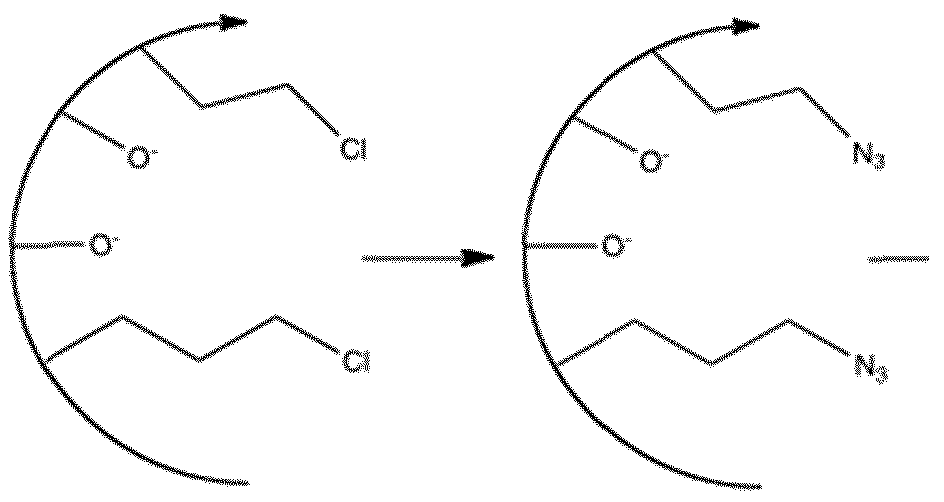
Example 4: A synthetic enzyme with thiol as a nucleophile is prepared as described below.
Compound 1. Triphenyl methane thiol (250 mg, 0.90 mmol) is reacted with large excess epichlorohydrin (5 mL) in acetonitrile (1 mL) with K2CO3 (256 mg) as base for 48 hr.
Dichloromethane (5 mL) is added to precipitate salts. The solution is filtered and dried to yield 1 as a white solid (250 mg, 84%).
Compound 2. Compound 1 (300 mg, 0.90 mmol) and His(Trt)-OtBu (275 mg, 0.60 mmol) are reacted in MeOH at 50°C for 48 hr. The reaction is dried and the product purified via column chromatography (DCM:MeOH gradient) as a colorless wax (75 mg, 16%).
Compound 3. Compound 2 (60 mg, 7.5 mmol) is reacted with excess propargyl chloride (0.75 mL) in acetonitrile (1 mL) at 50°C for 48 hr. Dichloromethane (1 mL) is added to precipitate salts. The solution is filtered and dried to yield 3 as a yellow solid (50 mg, 75%).

The enzyme mimic of Example 1 was tuned for hydrophobicity by introduction of long alkyl chain in the form of hexadecyne-1 (CAS number 629-74-3) in varying amounts.

The initial rates of esterolysis of 4-nitrophenyl acetate by varying amounts of hexadecyne incorporation are shown in Figure 4. The enzyme mimic of Example 5 and an optimized, commercially available Lipase was then evaluated over number different substrates with varying alkyl chain length and the results are shown in Figure 5. The enzyme mimic shows superior activity initially for nitrophenyl acetate. The alkyl chain of the substrate indicates esterase activity.
Esterases hydrolyse solutions of water-soluble short acyl chain esters and are inactive against water-insoluble long chain esters such as 4-nitrophenyl palmitate which, in turn, are specifically hydrolyzed by lipases.
It is of course to be understood that the invention is not intended to be restricted to the details of the above embodiment which are described by way of example only.
Claims
A synthetic enzyme mimic comprising a support carrying at least one scaffold, the scaffold incorporating multiple functional groups comprising:
(i) a carboxylate group;
(ii) an imidazole group; and
(iii) a nucleophilic group
and wherein the functional groups are arranged in close proximity to each other.
A synthetic enzyme mimic according to claim 1 wherein the scaffold is histidine- based.
A synthetic enzyme mimic according to claim 1 or 2 wherein the nucleophilic group comprises a hydroxyl group or a thiol group.
A synthetic enzyme mimic according to any preceding claim wherein the support comprises a polymer.
A synthetic enzyme mimic according to claim 4 wherein the support comprises a polymer and the scaffold is attached to the polymer at a single repeat unit of said polymer.
A synthetic enzyme mimic according to any preceding claim wherein the scaffold is attached to the support via a linker, preferably an ether linker.
A synthetic enzyme mimic according to any preceding claim wherein the support further comprises one or more hydrophobic pockets, the or each hydrophobic pocket comprising a hydrophobic group.
A synthetic enzyme mimic comprising a support and the following structure:

wherein:
S is a support selected from the group consisting of non reactive polymers, copolymers, inorganic particles such as silica or zeolite, micelle structures; i is said reactive handle and is selected from the group consisting of alkene, styrenic, halide, amine, thiol, carboxylic acid or carboxylic acid anhydride groups;
R2 is selected from the group consisting of H and/or alkyl groups methyl, ethyl, propyl, butyl, pentyl, hexyl, heptyl, octyl, hexadecyl, cyclohexane, and/or aryl groups phenyl, naphthyl, and/or arylalky groups benzyl, oxyethylene, oxypropylene, polyoxyethylene, polyoxypropylene, and/ or any combination thereof;
X is a divalent atom selected from the group consisting of O or S;
Y comprises a nucleophilic group selected from -OH, -SH, -NH2 or -C02H functional groups;
Z is a cationic counter ion selected from the group consisting of H or metal ions which are preferably Cs, Na, K or ammonium, sulphonium or phosphonium salts preferably tetraalkylammonium, tetraalkylsulphonium or tertaalkylphosphonium salts;
A is a linker group selected from the group consisting of linear and cyclic alkyl, aryl, arylalkyl groups;
B, C, D and E are independently selected connecting groups denoted by - (CR3R4)n; where R3 & R4 are independently selected from the group consisting of H, halogen, a linear and cyclic alkyl, OH, alkoxy, aryl, arylalkyi groups as defined for R2 and wherein n is an integer F comprises an amino group (-NH2) or an amino group linked by an akyl group comprising CH-NH2 or (CH)- (CH2)n - Nowhere n is an integer 0,1 ,2,3 etc. wherein the resultant structure has the functional groups in close proximity to each other.
9. A synthetic enzyme mimic according to any preceding claim having esterase
activity.
10. A synthetic enzyme mimic according to any preceding claim having lipase activity.
11. A synthetic enzyme mimic according to any preceding claim having protease
activity.
12. A catalytic unit for a synthetic enzyme according to any of claims 1 - 7, comprising a scaffold incorporating multiple functional groups, said multiple functional groups comprising:
(i) a carboxylate group;
(ii) an imidazole group; and
(iii) a nucleophilic group
wherein the multiple functional groups are in close proximity with each other 13. A catalytic unit according to claim 12 wherein the scaffold is histidine-based.
14. A catalytic unit according to claim 12 or claim 13 wherein the nucleophilic group comprises a hydroxyl group or a thiol group. 15. A catalytic unit according to any of claims 12- 14 comprising a reactive handle for attachment to a support.
16. A catalytic unit for a synthetic enzyme mimic comprising the following structure

Ri is an optional reactive handle and is selected from the group consisting of alkene, styrenic, halide, amine, thiol, carboxylic acid or carboxylic acid anhydride groups;
R2 is optional and selected from the group consisting of H and/or alkyl groups methyl, ethyl, propyl, butyl, pentyl, hexyl, heptyl, octyl, hexadecyl, cyclohexane, and/or aryl groups phenyl, naphthyl, and/or arylalky groups benzyl, oxyethylene, oxypropylene, polyoxyethylene, polyoxypropylene, and/ or any combination thereof;
X is a divalent atom selected from the group consisting of O or S;
Y is a nucleophilic group selected from the group consisting of -OH, -SH, -NH2 or - C02H functional groups;
Z is a cationic counterion selected from the group consisting of H or metal ions which are preferably Cs, Na, K or ammonium, sulphonium or phosphonium salts preferably tetraalkylammonium, tetraalkylsulphonium or tertaalkylphosphonium salts; A is a linker group selected from the group consisting of linear and cyclic alkyl, aryl, arylalkyl groups;
B, C, D and E are independently selected connecting groups denoted by - (CR3R4)n; where R3 & R4 are independently selected from the group consisting of H, a linear and cyclic alkyl, aryl, arylalkyl groups as defined for R2 and wherein n is an integer;
F comprises an amino group (-NH2) or an amino group linked by an alkyl group comprising CH-NH2 or (CH)- (CH2)n - NH2 where n is an integer 0,1 ,2,3 etc.
wherein the resultant structure has the functional groups in close proximity to each other
17. A process for making a catalytic unit according to any of claims 12-16, the method comprising the steps of attaching a nucleophilic group to the scaffold and also forming a reactive handle on the scaffold. 18. A process according to claim 17 comprising the step of a ring opening reaction using a functional epoxide.
19. A process for making a synthetic enzyme mimic of any of claims 1-1 1 comprising the step of attaching the catalytic unit of claims 1 1 -16 to a support.
20. A process according to claim 19 comprising the step of attaching a reactive handle to the support.
Applications Claiming Priority (2)
| Application Number | Priority Date | Filing Date | Title |
|---|---|---|---|
| EP14198190 | 2014-12-16 | ||
| EP14198190.2 | 2014-12-16 |
Publications (1)
| Publication Number | Publication Date |
|---|---|
| WO2016096590A1 true WO2016096590A1 (en) | 2016-06-23 |
Family
ID=52349925
Family Applications (1)
| Application Number | Title | Priority Date | Filing Date |
|---|---|---|---|
| PCT/EP2015/079204 Ceased WO2016096590A1 (en) | 2014-12-16 | 2015-12-10 | Synthetic enzyme mimic based on a histidine scaffold |
Country Status (2)
| Country | Link |
|---|---|
| AR (1) | AR103052A1 (en) |
| WO (1) | WO2016096590A1 (en) |
Citations (5)
| Publication number | Priority date | Publication date | Assignee | Title |
|---|---|---|---|---|
| US4777250A (en) | 1986-06-19 | 1988-10-11 | Northwestern University | Chymotrypsin model |
| JPH02180626A (en) * | 1988-12-29 | 1990-07-13 | Toyo Roshi Kaisha Ltd | Microporous membrane of polyamide |
| US6310199B1 (en) * | 1999-05-14 | 2001-10-30 | Promega Corporation | pH dependent ion exchange matrix and method of use in the isolation of nucleic acids |
| US20070184970A1 (en) * | 2006-01-27 | 2007-08-09 | Southern Illinois University Carbondale | Nano-reagents with cooperative catalysis and their uses in multiple phase reactions |
| WO2010071462A1 (en) * | 2008-12-19 | 2010-06-24 | Uniwersytet Humanistyczno-Przyrodniczy | Peptides mimicking urease, methods of manufacturing, application in diagnostic tests and the way of performance the test |
-
2015
- 2015-12-10 WO PCT/EP2015/079204 patent/WO2016096590A1/en not_active Ceased
- 2015-12-16 AR ARP150104111A patent/AR103052A1/en unknown
Patent Citations (5)
| Publication number | Priority date | Publication date | Assignee | Title |
|---|---|---|---|---|
| US4777250A (en) | 1986-06-19 | 1988-10-11 | Northwestern University | Chymotrypsin model |
| JPH02180626A (en) * | 1988-12-29 | 1990-07-13 | Toyo Roshi Kaisha Ltd | Microporous membrane of polyamide |
| US6310199B1 (en) * | 1999-05-14 | 2001-10-30 | Promega Corporation | pH dependent ion exchange matrix and method of use in the isolation of nucleic acids |
| US20070184970A1 (en) * | 2006-01-27 | 2007-08-09 | Southern Illinois University Carbondale | Nano-reagents with cooperative catalysis and their uses in multiple phase reactions |
| WO2010071462A1 (en) * | 2008-12-19 | 2010-06-24 | Uniwersytet Humanistyczno-Przyrodniczy | Peptides mimicking urease, methods of manufacturing, application in diagnostic tests and the way of performance the test |
Non-Patent Citations (9)
| Title |
|---|
| ACC. CHEM. RES., vol. 28, 1995, pages 146 |
| BRESLOW ET AL., CHEM. SOC. REV., vol. 1, 1972, pages 553 |
| BRESLOW, R.; CHUNG, S., TETRAHEDRON LETT., vol. 30, 1989, pages 4353 |
| CHEM. REV., vol. 98, 1998, pages 1997 |
| DATABASE CA [online] CHEMICAL ABSTRACTS SERVICE, COLUMBUS, OHIO, US; INAMI, YOSHIAKI ET AL: "Finely porous polyamide membranes in manufacture of pyrogen-free water", XP002741686, retrieved from STN Database accession no. 1991:49662 * |
| EL-KAK, A. ET AL: "Interaction of immunoglobulin G with immobilized histidine: mechanistic and kinetic aspects", JOURNAL OF CHROMATOGRAPHY, vol. 604, no. 1, 1992, pages 29 - 37, XP026549522, ISSN: 0021-9673, DOI: 10.1016/0021-9673(92)85525-X * |
| J. BIOL. CHEM., vol. 284, 2009, pages 1337 |
| RONALD BRESLOW ET AL: "A novel synthesis of substituted imidazoles, and a reexamination of a purported chymotrypsin model", TETRAHEDRON LETTERS, vol. 30, no. 33, 1 January 1989 (1989-01-01), pages 4353 - 4356, XP055124171, ISSN: 0040-4039, DOI: 10.1016/S0040-4039(00)99358-4 * |
| ZIMMERMAN, TETRAHEDRON LETTERS, vol. 30, no. 33, 1989, pages 4357 - 4358 |
Also Published As
| Publication number | Publication date |
|---|---|
| AR103052A1 (en) | 2017-04-12 |
Similar Documents
| Publication | Publication Date | Title |
|---|---|---|
| JP7196229B2 (en) | Adhesion Promoter for True Michael Addition Crosslinkable Compositions | |
| JP4866738B2 (en) | Reactive cyclic carbonates and ureas used to modify biomolecules, polymers and substrate surfaces | |
| EP0948548B1 (en) | Antimicrobial polymers comprising quaternary ammonium groups, their use for making a material with antimicrobial properties and methods for preparing them | |
| CN101528674B (en) | Iminium salts and methods of preparing electron deficient olefins using such novel iminium salts | |
| CA2773866C (en) | Water dispersible, cyclic-carbonate-functionalized vinyl copolymer system | |
| Yatvin et al. | SuFEx click: new materials from SOxF and silyl ethers | |
| JP2013518945A (en) | Novel organic modified siloxane having primary amino functional group, novel organic modified siloxane having quaternary ammonium functional group, and method for producing the same | |
| CA2544697A1 (en) | Method of preparing carboxylic acid functionalized polymers | |
| US20110077365A1 (en) | Preparation of organosilicon-containing triazoles | |
| Yang et al. | Agile construction of porous organic frameworks pending carboxylic acids and imidazolium-based ionic liquids for the efficient fixation of CO2 to cyclic carbonates | |
| EP3638417A1 (en) | Coating system | |
| JP2023109879A (en) | Chemical compounds with perfluoroaryl groups that can facilitate post-synthesis functionalization | |
| US8053589B1 (en) | Imines and methods of preparing electron deficient olefins using such novel imines | |
| Luleburgaz et al. | Modification of polyketone via chlorodimethylsilane-mediated reductive etherification reaction: A practical way for alkoxy-functional polymers | |
| JP6000442B2 (en) | Novel, easily synthesizable, spontaneously water-soluble, essentially VOC-free, environmentally protective (meth) acrylamide functional siloxanol system, process for its preparation and use of said siloxanol system | |
| JP5527432B2 (en) | Method for producing solvent-soluble reactive polysiloxane | |
| WO2016096590A1 (en) | Synthetic enzyme mimic based on a histidine scaffold | |
| Alhaffar et al. | Utilization of catecholic functionality in natural safrole and eugenol to synthesize mussel-inspired polymers | |
| Lu et al. | Protecting group-free introduction of amino acids to polymers through the aza-Michael reaction | |
| Tamami et al. | Nucleophilic substitution reactions using polyacrylamide-based phase transfer catalyst in organic and aqueous media | |
| JP2013522448A5 (en) | ||
| TW201238998A (en) | Method for manufacturing reactive polysiloxane solution | |
| Simmons et al. | Near‐monodisperse, catalytically active, imidazole‐containing homooligomers: Synthesis by group transfer polymerization and solution characterization | |
| Ali et al. | Glycidyl ether of naturally occurring sesamol in the synthesis of mussel-inspired polymers | |
| Kenawy | Polymer-supported phase-transfer catalysts: Synthesis and high catalytic activity of ammonium and phosphonium salts bound to linear and crosslinked poly (glycidyl methacrylate) |
Legal Events
| Date | Code | Title | Description |
|---|---|---|---|
| 121 | Ep: the epo has been informed by wipo that ep was designated in this application |
Ref document number: 15808158 Country of ref document: EP Kind code of ref document: A1 |
|
| NENP | Non-entry into the national phase |
Ref country code: DE |
|
| 122 | Ep: pct application non-entry in european phase |
Ref document number: 15808158 Country of ref document: EP Kind code of ref document: A1 |