WO2016093952A1 - Inhibiting toxicity of acid systems used for treating metals - Google Patents
Inhibiting toxicity of acid systems used for treating metals Download PDFInfo
- Publication number
- WO2016093952A1 WO2016093952A1 PCT/US2015/055657 US2015055657W WO2016093952A1 WO 2016093952 A1 WO2016093952 A1 WO 2016093952A1 US 2015055657 W US2015055657 W US 2015055657W WO 2016093952 A1 WO2016093952 A1 WO 2016093952A1
- Authority
- WO
- WIPO (PCT)
- Prior art keywords
- pickling
- iodide salt
- acid
- metal
- corrosion inhibiting
- Prior art date
- Legal status (The legal status is an assumption and is not a legal conclusion. Google has not performed a legal analysis and makes no representation as to the accuracy of the status listed.)
- Ceased
Links
Classifications
-
- C—CHEMISTRY; METALLURGY
- C23—COATING METALLIC MATERIAL; COATING MATERIAL WITH METALLIC MATERIAL; CHEMICAL SURFACE TREATMENT; DIFFUSION TREATMENT OF METALLIC MATERIAL; COATING BY VACUUM EVAPORATION, BY SPUTTERING, BY ION IMPLANTATION OR BY CHEMICAL VAPOUR DEPOSITION, IN GENERAL; INHIBITING CORROSION OF METALLIC MATERIAL OR INCRUSTATION IN GENERAL
- C23G—CLEANING OR DE-GREASING OF METALLIC MATERIAL BY CHEMICAL METHODS OTHER THAN ELECTROLYSIS
- C23G1/00—Cleaning or pickling metallic material with solutions or molten salts
- C23G1/02—Cleaning or pickling metallic material with solutions or molten salts with acid solutions
- C23G1/04—Cleaning or pickling metallic material with solutions or molten salts with acid solutions using inhibitors
-
- C—CHEMISTRY; METALLURGY
- C23—COATING METALLIC MATERIAL; COATING MATERIAL WITH METALLIC MATERIAL; CHEMICAL SURFACE TREATMENT; DIFFUSION TREATMENT OF METALLIC MATERIAL; COATING BY VACUUM EVAPORATION, BY SPUTTERING, BY ION IMPLANTATION OR BY CHEMICAL VAPOUR DEPOSITION, IN GENERAL; INHIBITING CORROSION OF METALLIC MATERIAL OR INCRUSTATION IN GENERAL
- C23G—CLEANING OR DE-GREASING OF METALLIC MATERIAL BY CHEMICAL METHODS OTHER THAN ELECTROLYSIS
- C23G1/00—Cleaning or pickling metallic material with solutions or molten salts
- C23G1/02—Cleaning or pickling metallic material with solutions or molten salts with acid solutions
- C23G1/08—Iron or steel
- C23G1/081—Iron or steel solutions containing H2SO4
Definitions
- This disclosure relates to inhibiting corrosivity of acid systems used for treating metals.
- an iodide salt e.g., potassium iodide
- the iodide salt can serve as an effective, yet cheaper alternative to synthesized corrosion inhibitors.
- the iodide salt exhibits less toxicity in acid pickling systems that include sulfuric acid while exhibiting substantially similar corrosion inhibiting properties.
- the techniques described here can be implemented to treat metals, e.g., carbon steel such as low carbon steel or other metals and/or to descale heat exchange tubes (or both). Such treatment can prevent degradation of steel and other negative impacts that the conditions of the environment in which the steel is implemented can have on the steel.
- Pickling is also used to remove scale and corrosion products from boiler and distillation tanks.
Landscapes
- Chemical & Material Sciences (AREA)
- Chemical Kinetics & Catalysis (AREA)
- General Chemical & Material Sciences (AREA)
- Engineering & Computer Science (AREA)
- Materials Engineering (AREA)
- Mechanical Engineering (AREA)
- Metallurgy (AREA)
- Organic Chemistry (AREA)
- Cleaning And De-Greasing Of Metallic Materials By Chemical Methods (AREA)
Abstract
In some examples of inhibiting toxicity of acid systems used for treating metals, a metal is pickled with a pickling composition that includes a first quantity of an acid and a second quantity of a corrosion inhibiting iodide salt. A mixture of the first quantity and the second quantity modify metallic properties of the pickled metal. The corrosion inhibiting iodide salt is added directly to the pickling composition independent of any other corrosion inhibitor or corrosion inhibiting polymer.
Description
INHIBITING TOXICITY OF ACID SYSTEMS USED FOR TREATING
METALS
CLAIM OF PRIORITY
[0001] This application claims priority to U.S. Patent Application No. 14/563,024 filed on December 8, 2014 the entire contents of which are hereby incorporated by reference.
TECHNICAL FIELD
[0002] This disclosure relates to treating metals, for example, to improve corrosion resistance of the metals.
BACKGROUND
[0003] Metallic components made, for example, using carbon steel, can be treated using pickling systems to improve the resistance of the metallic component against conditions of the environment in which the components are implemented. Acids, for example, hydrochloric acid (HC1) and/or sulfuric acid (H2SO4) are used in pickling treatments. However, the use of HC1 is associated with problems due to its volatility which is enhanced by increases in temperature, acid strength, and iron content in the bath. This creates problems such as atmospheric pollution, pitting attack on the pickling material, and corrosion of surrounding structures, etc., in the pickling process. As a result, H2S04 is still in use in many steel plants. However, H2S04 acid pickling system is conventionally inhabited using high toxicity synthesized corrosion inhibitors.
SUMMARY
[0004] This disclosure relates to inhibiting corrosivity of acid systems used for treating metals.
[0005] Some aspects of the subject matter described here can be implemented as a method of treating a metal. The treatment includes a pickling of the metal. The metal is pickled with a pickling composition that includes a first quantity of an acid and a second quantity of a corrosion inhibiting iodide salt. A mixture of the first
quantity of the pickling composition and the second quantity of the corrosion inhibiting iodide salt modifies metallic properties of the pickled metal.
[0006] This, and other aspects, can include one or more of the following features. The acid includes sulfuric acid. The corrosion inhibiting iodide salt includes potassium iodide. The second quantity of the corrosion inhibiting iodide salt is added directly to the first quantity of the pickling composition independent of any other corrosion inhibitor. The second quantity of the corrosion inhibiting iodide salt is mixed with the first quantity of the pickling composition at a temperature greater than room temperature. The temperature is at least about 60 °C. The temperature ranges between about 60 °C and 80 °C. The acid in the pickling composition has a molarity of either 0.5 M or 1.0 M. The metal comprises carbon steel. Pickling the metal with the pickling composition including the corrosion inhibition iodide salt includes soaking the metal in the pickling composition for a period of time. The period of time includes might be up to six hours. A ratio of the second quantity to the first quantity ranges between greater than 0 g of iodide salt per 100 mL of acid to about 0.5 g of iodide salt per 100 mL of acid. The first quantity and the second quantity are selected such that the pickling composition including the corrosion inhibiting iodide salt has a corrosion rate of less than about 0.05 Ib/sq. ft.
[0007] Some aspects of the subject matter described here can be implemented as a method of pickling a metal. A first quantity of a pickling composition including an acid is obtained. The pickling composition modifies metallic properties of the pickled metal. A second quantity of a corrosion inhibiting iodide salt is obtained. To inhibit a corrosiveness of the pickling composition, the second quantity of the corrosion inhibiting iodide salt and no other corrosion inhibitor is mixed with the first quantity of the pickling composition. The metal is pickled with the pickling composition including the corrosion inhibiting iodide salt.
[0008] This, and other aspects, can include one or more of the following features. A ratio of the second quantity to the first quantity ranges between greater than 0 g of iodide salt per 100 mL of acid to about 0.5 g of iodide salt per 100 mL of acid. The first quantity and the second quantity are selected such that the pickling composition including the corrosion inhibiting iodide salt has a corrosion rate of less
than about 0.05 Ib/sq. ft. The acid in the pickling composition has a molarity of either 0.5 M or 1.0 M.
[0009] Some aspects of the subject matter described here can be implemented as a method of pickling a metal. A first quantity of a pickling composition including an acid is mixed with a second quantity of a corrosion inhibiting iodide salt that is independent of any corrosion inhibiting polymer. The pickling composition modifies metallic properties of the pickled metal.
[0010] This, and other aspects, can include one or more of the following features. The acid includes sulfuric acid. The corrosion inhibiting iodide salt includes potassium iodide.
[0011] The details of one or more implementations of the subject matter described in this specification are set forth in the accompanying drawings and the description below. Other features, aspects, and advantages of the subject matter will become apparent from the description, the drawings, and the claims.
BRIEF DESCRIPTION OF THE DRAWINGS
[0012] FIG. 1 shows a schematic of an example system for treating a metal.
[0013] FIG. 2 is a flowchart of an example process for treating a metal.
DETAILED DESCRIPTION
[0014] This disclosure describes inhibiting corrosivity of acid systems used for treating metals. The disclosure describes utilizing an iodide salt (e.g., potassium iodide) as an inhibitor for a pickling system that includes an acid (e.g., sulfuric acid). Doing so demonstrated a high protection to low carbon steel relative to certain commercially available inhibitor systems which resulted in high toxicity. Acid systems for treating metals can include different acids. For example, sulfuric acid and hydrochloric acid have been used in pickling treatments. Hydrochloric acid can sometimes be volatile, for example, at elevated temperatures and/or acid strengths, and/or when the iron content in the pickling treatment bath is high. The increased volatility of hydrochloric acid can result in negative effects, such as, atmospheric pollution, pitting attack on the treated metal, corrosion of surrounding structures, or other negative effects, in the pickling process. Sulfuric acid offers an alternative to
hydrochloric acid. Synthesized corrosion inhibitors that, in some cases, may include nitrogen, are often used with pickling systems that include sulfuric acid. The synthesized corrosion inhibitors exhibit high toxicity. Also, manufacturing such synthesized corrosion inhibitors can be complex and expensive.
[0015] As described below, an iodide salt, e.g., potassium iodide, can serve as an effective, yet cheaper alternative to synthesized corrosion inhibitors. Relative to certain synthesized corrosion inhibitors which include polymers, the iodide salt exhibits less toxicity in acid pickling systems that include sulfuric acid while exhibiting substantially similar corrosion inhibiting properties. The techniques described here can be implemented to treat metals, e.g., carbon steel such as low carbon steel or other metals and/or to descale heat exchange tubes (or both). Such treatment can prevent degradation of steel and other negative impacts that the conditions of the environment in which the steel is implemented can have on the steel. Pickling is also used to remove scale and corrosion products from boiler and distillation tanks.
[0016] FIG. 1 shows a schematic of an example system for treating a metal. FIG. 2 is a flowchart of an example process 200 for treating a metal. In some implementations, at 202, a first quantity of a pickling composition including an acid is obtained. The pickling composition 102 can modify metallic properties of the treated metal 104. For example, the pickling composition includes a pickling composition that can modify surface properties of metal, e.g., carbon steel. The pickling composition 102 can be placed in a container 100 in which metal 104 (for example, a metallic component) is placed. At 204, a second quantity of a corrosion inhibiting iodide salt is obtained. Examples of the first quantity and second quantity are described below. The second quantity of the corrosion inhibiting iodide salt 106 is mixed with the first quantity of the pickling composition 102. For example, the iodide salt 106 in a container 108 can be added to the pickling composition 102 in the container 100. The metal 104 is then treated with the pickling composition including the corrosion inhibiting salt. The iodide salts are adsorbed to the metal surfaces thereby minimizing acid contact to the metal surfaces.
[0017] The acid in the pickling composition can include sulfuric acid. The corrosion inhibiting iodide salt can include potassium iodide. The second quantity of
the iodide salt can be added directly to the first quantity of the pickling composition independent of any other corrosion inhibitor. In other words, no corrosion inhibitor other than the second quantity of the iodide salt need be added to the pickling composition to inhibit corrosion of the treated metal.
[0018] Some example conditions for mixing the pickling composition and the corrosion inhibiting iodide salt are described here. In one example, 0.5 M sulfuric acid at about 60 °C can be mixed with potassium iodide at a concentration ranging between about 0.075 g per 100 mL to about 0.30 g per 100 mL. In another example, 0.5 M sulfuric acid at about 80 °C can be mixed with potassium iodide at a concentration ranging between about 0.10 g per 100 mL to about 0.50 g per 100 mL. In a further example, 1 M sulfuric acid at about 60 °C can be mixed with potassium iodide at a concentration ranging between about 0.10 g per 100 mL to about 0.40 g per 100 mL. In an additional example, 1 M sulfuric acid at about 80 °C can be mixed with potassium iodide at a concentration ranging between about 0.05 g per 100 mL to about 0.40 g per 100 mL. Thus, the temperature at which the pickling composition and the iodide salt are mixed might be greater than room temperature, e.g., can be about 60 °C. Further, for any concentration of acid and at any temperature, the ratio of the quantity of the iodide salt to the quantity of the acid can range between greater than 0 g of iodide salt per 100 mL of acid to about 0.5 g of iodide salt per 100 mL of acid. Also, in general, a quantity of the corrosion inhibiting salt and a quantity of the acid in the pickling composition can be selected such that the pickling composition has a corrosion rate of less than about 0.05 lb/sq. ft.
[0019] Results of corrosion tests performed on a metal, e.g., 1018 cold roll steel, are described below. An analysis of the cold roll steel revealed the composition shown in Table 1. In the experiments described below, the average weight of the metal sample was about 18 g. The metal sample was exposed to about 200 mL of pickling composition described below.
Table 1 : Analysis of Cold Roll Steel

[0020] In the experiments performed to obtain the results described below, a first quantity of a pickling solution including sulfuric acid was mixed with a second
quantity of iodide salt. To inhibit a corrosiveness of the pickling composition, no corrosion inhibitor other than the iodide salt was mixed with the first quantity. In particular, no synthesized corrosion inhibiting materials such as polymers were mixed either with the pickling composition or with the iodide salt. The cold roll steel was treated with the pickling composition, for example, by soaking the cold roll steel in the mixture of the pickling composition and the iodide salt, under experimental conditions shown in the following tables.
[0021 ] Experiment I
[0022] Potassium iodide having a concentration in a range between about 0 g to about 0.3 g was mixed with 100 mL of 0.5 M sulfuric acid at about 60 °C for about six hours. The corrosion rate and the inhibition efficiency measured for the different concentrations of potassium halide in sulfuric acid are shown in Table 2.
Table 2: Effect of iodide concentration on inhibition of 0.5 M H2SO4 acid at about 60
°C

[0023] Experiment II
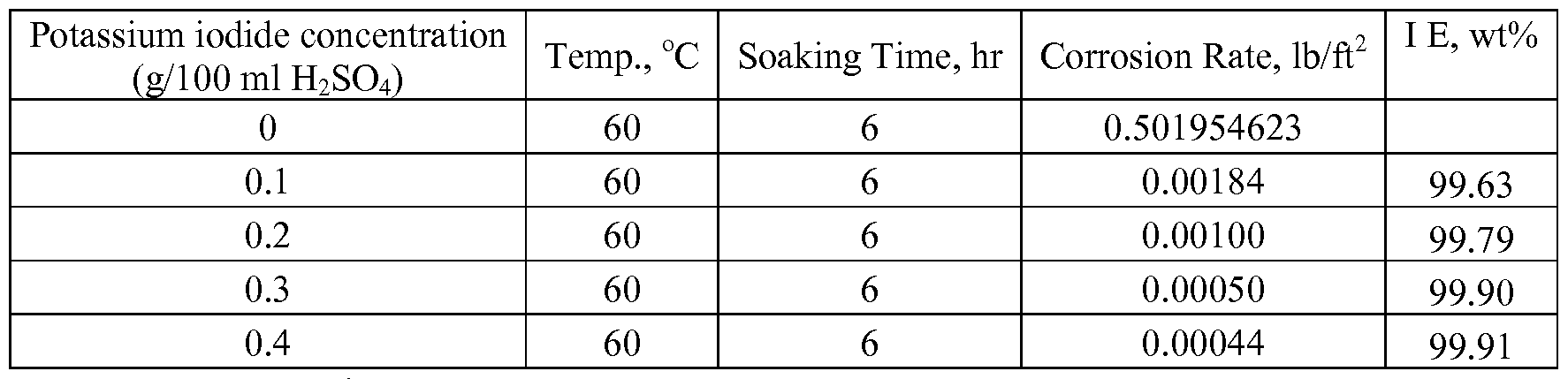
[0024] Potassium iodide having a concentration in a range between about 0 g to about 0.4 g was mixed with 100 mL of 1 M sulfuric acid at about 60 °C for about six hours. The corrosion rate and the inhibition efficiency measured for the different concentrations of potassium halide in sulfuric acid are shown in Table 3.
Table 3: Effect of iodide concentration on inhibition of 1 M H2SO4 acid at 60°C
[0025] Experiment III
[0026] Potassium iodide having a concentration in a range between about 0 g to about 0.5 g was mixed with 100 mL of 0.5 M sulfuric acid at about 80 °C for about six hours. The corrosion rate and the inhibition efficiency measured for the different concentrations of potassium halide in sulfuric acid are shown in Table 4.
Table 4: Effect of iodide concentration on inhibition of 0.5 M H2SO4 acid at 80°C

[0027] Experiment IV
[0028] Potassium iodide having a concentration in a range between about 0 g to about 0.5 g was mixed with 100 mL of 1 M sulfuric acid at about 80 °C for about six hours. The corrosion rate and the inhibition efficiency measured for the different concentrations of potassium halide in sulfuric acid are shown in Table 5.
Table 5: Effect of iodide concentration on inhibition of 1 M H2SO4 acid at 80°C

[0029] In sum, this disclosure describes mixing a first quantity of a pickling composition including an acid with a second quantity of a corrosion inhibiting iodide salt. The acid in the pickling composition can include sulfuric acid. The corrosion inhibiting iodide salt can be independent of any corrosion inhibiting polymer. A metal, e.g., carbon steel, can be treated in the mixture to modify surface properties of the metal while inhibiting corrosion. Adding the halide directly to the pickling
composition without any synthesized corrosion inhibitor can decrease a toxicity of the pickling composition.
[0030] Particular implementations of the subject matter have been described. Other implementations are within the scope of the following claims.
[0031] What is claimed is:
Claims
1. A method of pickling a metal, the method comprising:
pickling a metal with a pickling composition comprising a first quantity of an acid and a second quantity of a corrosion inhibiting iodide salt, wherein a mixture of the first quantity of the pickling composition and the second quantity of the corrosion inhibiting iodide salt modify metallic properties of the pickled metal.
2. The method of claim 1, wherein the acid comprises sulfuric acid.
3. The method of claim 1, wherein the corrosion inhibiting iodide salt comprises potassium iodide.
4. The method of claim 1, wherein the second quantity of the corrosion inhibiting iodide salt is added directly to the first quantity of the pickling composition independent of any other corrosion inhibitor.
5. The method of claim 1, wherein the second quantity of the corrosion inhibiting iodide salt is mixed with the first quantity of the pickling composition at a temperature greater than room temperature.
6. The method of claim 5, wherein the temperature is at least about 60 °C.
7. The method of claim 6, wherein the temperature ranges between about 60 °C and 80 °C.
8. The method of claim 1, wherein the acid in the pickling composition has a molarity of either 0.5 M or 1.0 M.
9. The method of claim 1, wherein the metal comprises carbon steel.
10. The method of claim 1, wherein pickling the metal with the pickling composition including the corrosion inhibiting iodide salt comprises soaking the metal in the pickling composition for a period of time.
11. The method of claim 10, wherein the period of time comprises at up to about six hours.
12. The method of claim 1, wherein a ratio of the second quantity to the first quantity ranges between greater than 0 g of iodide salt per 100 mL of acid to about 0.5 g of iodide salt per 100 mL of acid.
13. The method of claim 1, wherein the first quantity and the second quantity are selected such that the pickling composition including the corrosion inhibiting iodide salt has a corrosion rate of less than about 0.05 Ib/sq. ft.
14. A method of pickling a metal, the method comprising:
obtaining a first quantity of a pickling composition comprising an acid, the pickling composition to modify metallic properties of the pickled metal;
obtaining a second quantity of a corrosion inhibiting iodide salt;
to inhibit a corrosiveness of the pickling composition, mixing the second quantity of the corrosion inhibiting iodide salt and no other corrosion inhibitor with the first quantity of the pickling composition; and
pickling the metal with the pickling composition including the corrosion inhibiting iodide salt.
15. The method of claim 14, wherein a ratio of the second quantity to the first quantity ranges between greater than 0 g of iodide salt per 100 mL of acid to about 0.5 g of iodide salt per 100 mL of acid.
16. The method of claim 14, wherein the first quantity and the second quantity are selected such that the pickling composition including the corrosion inhibiting iodide salt has a corrosion rate of less than about 0.05 Ib/sq. ft.
17. The method of claim 14, wherein the acid in the pickling composition has a molarity of either 0.5 M or 1.0 M.
18. A method of pickling a metal, the method comprising:
mixing a first quantity of a pickling composition comprising an acid, the pickling composition to modify metallic properties of the pickled metal, with a second quantity of a corrosion inhibiting iodide salt that is independent of any corrosion inhibiting polymer; and
pickling the metal with the pickling composition including the corrosion inhibiting iodide salt.
19. The method of claim 19, wherein the acid comprises sulfuric acid.
20. The method of claim 19, wherein the corrosion inhibiting iodide salt comprises potassium iodide.
Applications Claiming Priority (2)
| Application Number | Priority Date | Filing Date | Title |
|---|---|---|---|
| US14/563,024 | 2014-12-08 | ||
| US14/563,024 US20160160361A1 (en) | 2014-12-08 | 2014-12-08 | Inhibiting Toxicity of Acid Systems Used for Treating Metals |
Publications (1)
| Publication Number | Publication Date |
|---|---|
| WO2016093952A1 true WO2016093952A1 (en) | 2016-06-16 |
Family
ID=54478958
Family Applications (1)
| Application Number | Title | Priority Date | Filing Date |
|---|---|---|---|
| PCT/US2015/055657 Ceased WO2016093952A1 (en) | 2014-12-08 | 2015-10-15 | Inhibiting toxicity of acid systems used for treating metals |
Country Status (2)
| Country | Link |
|---|---|
| US (1) | US20160160361A1 (en) |
| WO (1) | WO2016093952A1 (en) |
Citations (4)
| Publication number | Priority date | Publication date | Assignee | Title |
|---|---|---|---|---|
| US2511988A (en) * | 1945-05-09 | 1950-06-20 | Columbia Steel Company | Pickling process |
| US2708184A (en) * | 1952-03-03 | 1955-05-10 | Karl F Hager | Tincture of iodine as acid pickling inhibitor |
| US3773465A (en) * | 1970-10-28 | 1973-11-20 | Halliburton Co | Inhibited treating acid |
| CN1108703A (en) * | 1994-08-24 | 1995-09-20 | 山东省冶金科学研究院 | Pickling solution and pickling process for stainless steel and carbon steel clad plate |
-
2014
- 2014-12-08 US US14/563,024 patent/US20160160361A1/en not_active Abandoned
-
2015
- 2015-10-15 WO PCT/US2015/055657 patent/WO2016093952A1/en not_active Ceased
Patent Citations (4)
| Publication number | Priority date | Publication date | Assignee | Title |
|---|---|---|---|---|
| US2511988A (en) * | 1945-05-09 | 1950-06-20 | Columbia Steel Company | Pickling process |
| US2708184A (en) * | 1952-03-03 | 1955-05-10 | Karl F Hager | Tincture of iodine as acid pickling inhibitor |
| US3773465A (en) * | 1970-10-28 | 1973-11-20 | Halliburton Co | Inhibited treating acid |
| CN1108703A (en) * | 1994-08-24 | 1995-09-20 | 山东省冶金科学研究院 | Pickling solution and pickling process for stainless steel and carbon steel clad plate |
Non-Patent Citations (1)
| Title |
|---|
| HEUSLER K E ET AL: "THE INFLUENCE OF IODIDE IONS AND CARBON MONOXIDE ON THE ANODIC DISSOLUTION OF ACTIVE IRON", JOURNAL OF THE ELECTROCHEMICAL SOCIETY, ELECTROCHEMICAL SOCIETY, vol. 108, 1 August 1961 (1961-08-01), pages 732 - 740, XP001057483, ISSN: 0013-4651 * |
Also Published As
| Publication number | Publication date |
|---|---|
| US20160160361A1 (en) | 2016-06-09 |
Similar Documents
| Publication | Publication Date | Title |
|---|---|---|
| CN102942908B (en) | Water injected pitting-corrosion composite inhibitor and application thereof | |
| AU718150B2 (en) | Corrosion inhibitor | |
| Musa et al. | Inhibition of aluminum corrosion by phthalazinone and synergistic effect of halide ion in 1.0 M HCl | |
| Tuaweri et al. | Corrosion inhibition of heat treated mild steel with neem leave extract in a chloride medium | |
| Wachter | Sodium Nitrite as Corrosion Inhibitor for Water. | |
| CN109267068B (en) | Stress corrosion cracking inhibitor, preparation method and application thereof | |
| Fouda et al. | Lanthanides as environmentally friendly corrosion inhibitors of iron in 3.5% NaCl solution | |
| UA117131C2 (en) | Corrosion inhibitor for protection of crude oil extraction equipment, crude oil pipelines, and crude oil tanks as well as the method of its production | |
| WO2016093952A1 (en) | Inhibiting toxicity of acid systems used for treating metals | |
| EP2961809A1 (en) | Corrosion inhibitors for cooling water applications | |
| EP1817441A2 (en) | Methods of preventing corrosion | |
| EP3741826A1 (en) | Mitigating internal corrosion of crude oil transportation pipeline | |
| Kulkarni | A review on studies and research on corrosion and its prevention | |
| CN109536967B (en) | Austenitic stainless steel stress corrosion inhibitor and preparation method thereof | |
| Abiola et al. | Anti-corrosive properties of Delonix regia extract on mild steel corrosion in acid fluid for industrial operations | |
| WO2018005854A1 (en) | Composition and method for inhibiting corrosion of metals | |
| EP2971245B1 (en) | Method to control corrosion of a metal surface using alkyl sulfamic acids or salts thereof | |
| RU2202653C2 (en) | Metal corrosion inhibitor | |
| Zhou et al. | Effect of triethanolamine borate on corrosion resistance of hot-rolled mild steels in industrial laminar cooling processes | |
| JP2016089210A (en) | Composition for copper corrosion protection, and copper corrosion protection method | |
| CN108728853B (en) | Galvanized pipe pickling corrosion inhibitor and application thereof | |
| Christy et al. | Corrosion Inhibition by Amino Trimethylene Phosphonic Acid (ATMP)-Zn 2 System for Carbon Steel in Ground Water | |
| Avdeev et al. | Inhibitory protection of steels in hydrochloric and phosphoric acid mixtures containing Fe (III) salts | |
| Ali et al. | Corrosion inhibition of carbon steel in cooling system media by non-toxic linear sodium octanoate | |
| Onyeji et al. | Corrosion performance of high strength-low alloy steels in aerated and CO₂ saturated Lyman and Fleming solutions |
Legal Events
| Date | Code | Title | Description |
|---|---|---|---|
| 121 | Ep: the epo has been informed by wipo that ep was designated in this application |
Ref document number: 15791818 Country of ref document: EP Kind code of ref document: A1 |
|
| NENP | Non-entry into the national phase |
Ref country code: DE |
|
| 32PN | Ep: public notification in the ep bulletin as address of the adressee cannot be established |
Free format text: NOTING OF LOSS OF RIGHTS PURSUANT TO RULE 112(1) EPC (EPO FORM 1205A DATED 07/11/2017) |
|
| 122 | Ep: pct application non-entry in european phase |
Ref document number: 15791818 Country of ref document: EP Kind code of ref document: A1 |