WO2016089845A1 - A convergent approach to the total synthesis of telmisartan via a suzuki cross-coupling reaction - Google Patents
A convergent approach to the total synthesis of telmisartan via a suzuki cross-coupling reaction Download PDFInfo
- Publication number
- WO2016089845A1 WO2016089845A1 PCT/US2015/063152 US2015063152W WO2016089845A1 WO 2016089845 A1 WO2016089845 A1 WO 2016089845A1 US 2015063152 W US2015063152 W US 2015063152W WO 2016089845 A1 WO2016089845 A1 WO 2016089845A1
- Authority
- WO
- WIPO (PCT)
- Prior art keywords
- methyl
- catalyst
- potassium
- trifluoroborate
- bromo
- Prior art date
- Legal status (The legal status is an assumption and is not a legal conclusion. Google has not performed a legal analysis and makes no representation as to the accuracy of the status listed.)
- Ceased
Links
- HYZJCKYKOHLVJF-UHFFFAOYSA-N c1nc2ccccc2[nH]1 Chemical compound c1nc2ccccc2[nH]1 HYZJCKYKOHLVJF-UHFFFAOYSA-N 0.000 description 2
- PHPYXVIHDRDPDI-UHFFFAOYSA-N Brc1nc2ccccc2[nH]1 Chemical compound Brc1nc2ccccc2[nH]1 PHPYXVIHDRDPDI-UHFFFAOYSA-N 0.000 description 1
Classifications
-
- C—CHEMISTRY; METALLURGY
- C07—ORGANIC CHEMISTRY
- C07D—HETEROCYCLIC COMPOUNDS
- C07D235/00—Heterocyclic compounds containing 1,3-diazole or hydrogenated 1,3-diazole rings, condensed with other rings
- C07D235/02—Heterocyclic compounds containing 1,3-diazole or hydrogenated 1,3-diazole rings, condensed with other rings condensed with carbocyclic rings or ring systems
- C07D235/04—Benzimidazoles; Hydrogenated benzimidazoles
- C07D235/20—Two benzimidazolyl-2 radicals linked together directly or via a hydrocarbon or substituted hydrocarbon radical
-
- A—HUMAN NECESSITIES
- A61—MEDICAL OR VETERINARY SCIENCE; HYGIENE
- A61K—PREPARATIONS FOR MEDICAL, DENTAL OR TOILETRY PURPOSES
- A61K31/00—Medicinal preparations containing organic active ingredients
- A61K31/33—Heterocyclic compounds
- A61K31/395—Heterocyclic compounds having nitrogen as a ring hetero atom, e.g. guanethidine or rifamycins
- A61K31/41—Heterocyclic compounds having nitrogen as a ring hetero atom, e.g. guanethidine or rifamycins having five-membered rings with two or more ring hetero atoms, at least one of which being nitrogen, e.g. tetrazole
- A61K31/4164—1,3-Diazoles
- A61K31/4184—1,3-Diazoles condensed with carbocyclic rings, e.g. benzimidazoles
-
- B—PERFORMING OPERATIONS; TRANSPORTING
- B01—PHYSICAL OR CHEMICAL PROCESSES OR APPARATUS IN GENERAL
- B01J—CHEMICAL OR PHYSICAL PROCESSES, e.g. CATALYSIS OR COLLOID CHEMISTRY; THEIR RELEVANT APPARATUS
- B01J21/00—Catalysts comprising the elements, oxides, or hydroxides of magnesium, boron, aluminium, carbon, silicon, titanium, zirconium, or hafnium
- B01J21/18—Carbon
-
- B—PERFORMING OPERATIONS; TRANSPORTING
- B01—PHYSICAL OR CHEMICAL PROCESSES OR APPARATUS IN GENERAL
- B01J—CHEMICAL OR PHYSICAL PROCESSES, e.g. CATALYSIS OR COLLOID CHEMISTRY; THEIR RELEVANT APPARATUS
- B01J23/00—Catalysts comprising metals or metal oxides or hydroxides, not provided for in group B01J21/00
- B01J23/38—Catalysts comprising metals or metal oxides or hydroxides, not provided for in group B01J21/00 of noble metals
- B01J23/40—Catalysts comprising metals or metal oxides or hydroxides, not provided for in group B01J21/00 of noble metals of the platinum group metals
- B01J23/44—Palladium
-
- B—PERFORMING OPERATIONS; TRANSPORTING
- B01—PHYSICAL OR CHEMICAL PROCESSES OR APPARATUS IN GENERAL
- B01J—CHEMICAL OR PHYSICAL PROCESSES, e.g. CATALYSIS OR COLLOID CHEMISTRY; THEIR RELEVANT APPARATUS
- B01J31/00—Catalysts comprising hydrides, coordination complexes or organic compounds
- B01J31/16—Catalysts comprising hydrides, coordination complexes or organic compounds containing coordination complexes
- B01J31/22—Organic complexes
- B01J31/2282—Unsaturated compounds used as ligands
- B01J31/2295—Cyclic compounds, e.g. cyclopentadienyls
-
- B—PERFORMING OPERATIONS; TRANSPORTING
- B01—PHYSICAL OR CHEMICAL PROCESSES OR APPARATUS IN GENERAL
- B01J—CHEMICAL OR PHYSICAL PROCESSES, e.g. CATALYSIS OR COLLOID CHEMISTRY; THEIR RELEVANT APPARATUS
- B01J31/00—Catalysts comprising hydrides, coordination complexes or organic compounds
- B01J31/16—Catalysts comprising hydrides, coordination complexes or organic compounds containing coordination complexes
- B01J31/24—Phosphines, i.e. phosphorus bonded to only carbon atoms, or to both carbon and hydrogen atoms, including e.g. sp2-hybridised phosphorus compounds such as phosphabenzene, phosphole or anionic phospholide ligands
- B01J31/2404—Cyclic ligands, including e.g. non-condensed polycyclic ligands, the phosphine-P atom being a ring member or a substituent on the ring
- B01J31/2409—Cyclic ligands, including e.g. non-condensed polycyclic ligands, the phosphine-P atom being a ring member or a substituent on the ring with more than one complexing phosphine-P atom
-
- B—PERFORMING OPERATIONS; TRANSPORTING
- B01—PHYSICAL OR CHEMICAL PROCESSES OR APPARATUS IN GENERAL
- B01J—CHEMICAL OR PHYSICAL PROCESSES, e.g. CATALYSIS OR COLLOID CHEMISTRY; THEIR RELEVANT APPARATUS
- B01J35/00—Catalysts, in general, characterised by their form or physical properties
- B01J35/19—Catalysts containing parts with different compositions
-
- C—CHEMISTRY; METALLURGY
- C07—ORGANIC CHEMISTRY
- C07D—HETEROCYCLIC COMPOUNDS
- C07D403/00—Heterocyclic compounds containing two or more hetero rings, having nitrogen atoms as the only ring hetero atoms, not provided for by group C07D401/00
- C07D403/02—Heterocyclic compounds containing two or more hetero rings, having nitrogen atoms as the only ring hetero atoms, not provided for by group C07D401/00 containing two hetero rings
- C07D403/04—Heterocyclic compounds containing two or more hetero rings, having nitrogen atoms as the only ring hetero atoms, not provided for by group C07D401/00 containing two hetero rings directly linked by a ring-member-to-ring-member bond
-
- B—PERFORMING OPERATIONS; TRANSPORTING
- B01—PHYSICAL OR CHEMICAL PROCESSES OR APPARATUS IN GENERAL
- B01J—CHEMICAL OR PHYSICAL PROCESSES, e.g. CATALYSIS OR COLLOID CHEMISTRY; THEIR RELEVANT APPARATUS
- B01J2231/00—Catalytic reactions performed with catalysts classified in B01J31/00
- B01J2231/40—Substitution reactions at carbon centres, e.g. C-C or C-X, i.e. carbon-hetero atom, cross-coupling, C-H activation or ring-opening reactions
- B01J2231/42—Catalytic cross-coupling, i.e. connection of previously not connected C-atoms or C- and X-atoms without rearrangement
- B01J2231/4205—C-C cross-coupling, e.g. metal catalyzed or Friedel-Crafts type
- B01J2231/4211—Suzuki-type, i.e. RY + R'B(OR)2, in which R, R' are optionally substituted alkyl, alkenyl, aryl, acyl and Y is the leaving group
-
- B—PERFORMING OPERATIONS; TRANSPORTING
- B01—PHYSICAL OR CHEMICAL PROCESSES OR APPARATUS IN GENERAL
- B01J—CHEMICAL OR PHYSICAL PROCESSES, e.g. CATALYSIS OR COLLOID CHEMISTRY; THEIR RELEVANT APPARATUS
- B01J2531/00—Additional information regarding catalytic systems classified in B01J31/00
- B01J2531/80—Complexes comprising metals of Group VIII as the central metal
- B01J2531/82—Metals of the platinum group
- B01J2531/824—Palladium
-
- B—PERFORMING OPERATIONS; TRANSPORTING
- B01—PHYSICAL OR CHEMICAL PROCESSES OR APPARATUS IN GENERAL
- B01J—CHEMICAL OR PHYSICAL PROCESSES, e.g. CATALYSIS OR COLLOID CHEMISTRY; THEIR RELEVANT APPARATUS
- B01J2531/00—Additional information regarding catalytic systems classified in B01J31/00
- B01J2531/80—Complexes comprising metals of Group VIII as the central metal
- B01J2531/84—Metals of the iron group
- B01J2531/842—Iron
Definitions
- the invention generally relates to improved methods of synthesizing the angiotensin II receptor antagonist telmisartan.
- the invention provides methods which involve a Suzuki cross-coupling of two structurally distinct benzimidazole units, one of which may be formed using a novel method of regioselective bromination.
- Telmisartan (1) is a potent angiotensin II receptor antagonist used in the treatment of essential hypertension. 1"3 It is one of the most efficacious drugs in its class, boasting the longest half-life, a high protein binding affinity and a low daily dosage. 4 ' 5 The drug is currently marketed under the brand name of Micardis® and provides additional benefits against vascular and renal damage caused by diabetes and cardiovascular disease. 6"8
- telmisartan Previously reported syntheses of telmisartan, including the commercial process, invariably rely on the sequential formation of the two benzimidazole moieties through cyclization of appropriately substituted aniline precursors. The high temperatures and extreme pH conditions required by this strategy result in lower yields and significant byproduct formation.
- telmisartan The original synthesis of telmisartan was developed by Ries et al. in 1993 10 (Scheme 1), beginning with the stepwise construction of the central benzimidazole ring from 4-amino-3-methylbenzoic acid methyl ester (2). Saponification of the resulting substituted benzimidazole 4 was followed by condensation with N-methyl-l ,2-phenylenediamine (5) using polyphosphoric acid at elevated temperature (150 °C) to afford the flinctionalized dibenzimidazole 6.
- the invention provides a fundamentally different approach to the synthesis of high-purity telmisartan in high yields.
- the synthesis is based on a novel Pd-catalyzed coupling of two structurally distinct benzimidazole units. This synthetic scheme is more convergent and higher yielding than recently reported efforts, reaching telmisartan in an overall yield of greater than 74%, in comparison to the previously reported highest yield of 50%.
- the method comprises the step of coupling i)
- the step of coupling is carried out under Suzuki cross-coupling reaction conditions, to form the telmisartan.
- the step of coupling is carried out using microwave assisted heating.
- the method further comprises the step of forming the
- potassium(l -(2'-carboxy-[l , -biphenyl]-4-yl)- 4-methyl-2-propyl-benzimidazole-6-yl) trifluoroborate by i) pre-treating potassium(4-methyl-2-propyl-benzimidazole-6-yl) trifluoroborate with potassium /ert-butoxide; and ii) alkylating pretreated
- the method further comprises a step of forming the 2-bromo-l -methylbenzimidazole by regioselectively brominating a 2-position of
- the method further comprises the step of forming the potassium(4-methyl-2-propyl-benzimidazole-6-yI) trifluoroborate by i) performing reductive cyclization of 4-bromo-2-methyl-6-nitroaniline in the presence of w-butyraldehyde and sodium dithionite to form 6-bromo-4-methyl-2-propylbenzimidazole; and ii) converting the 6-bromo-4-methyl-2-propylbenzimidazole to a trifluoroborate salt, to form the potassium(4-methyl-2-propyl-benzimidazole-6-yl) trifluoroborate.
- the step of converting is performed by reacting the 6-bromo-4-methyl-2-propylbenzimidazole with diboron ester in the presence of a Pd catalyst to form a boronic acid pinacol ester; and converting the boronic acid pinacol ester to the
- the Pd catalyst is PdCl 2 dppf.
- the step of converting is performed by reacting the 6-bromo-4-methyl-2-propyIbenzimidazole with diboronic acid in the presence of a Pd catalyst to form 6-boronic acid-4-methyl-2-propylbenzimidazole; and contacting the 6-boronic acid-4-methyl-2-propylbenzimidazole with HF to form the
- the step of reacting is performed in the presence of a Pd catalyst; in further aspects, the Pd catalyst is PdCl 2 (PPh 3 ) 2
- the step of coupling is catalyzed by a Pd catalyst.
- the Pd catalyst is a homogenous Pd catalyst; in some aspects, the homogenous Pd catalyst is PdCl 2 dppf.
- the Pd catalyst is a heterogenous Pd catalyst; in some aspects, the heterogenous Pd catalyst is graphene supported Pd nanoparticles.
- the step of regioselectively brominating is performed by brominating a 2-position of 1 -methylbenzimidazole by, in a solution with tetrahydrofuran (THF) as solvent, contacting an imidazole ring of the 1 -methylbenzimidazole with a brominating agent, to form the 2-bromo- 1 -methylbenzimidazole.
- the brominating agent is
- the invention also provides a method of regioselectively brominating a 2-position of an imidazole.
- the method comprises: in a solution with tetrahydrofuran (THF) as solvent, contacting the imidazole with a brominating agent to form an imidazole that is brominated at the 2-position.
- the imidazole is 1 -methylbenzimidazole.
- the brominating agent is N-bromosuccinimide.
- the step of contacting is carried out using microwave assisted heating. DETAILED DESCRIPTION
- telmisartan The convergent synthesis of telmisartan provided herein entails the assembly of three major subunits: two differentially substituted benzimidazole derivatives and a biphenyl-2-carboxylic acid synthon (Scheme 2).
- This strategy provides for the use of a Suzuki cross-coupling reaction to form a new carbon-carbon bond between advanced isolated intermediates 2-bromo-l-methylbenzimidazole (8) and potassium (1 -(2'- carboxy-[l , -biphenyl]-4-yl)-4-methyl-2-propyl-benzimidazole-6-yl) trifluoroborate (16), the latter of which is formed from the reaction of potassium (4-methyl-2-propyl- benzimidazol-6-yl) trifluoroborate (9) and methyl 4'-bromomethyl-biphenyl-2-carboxylate (10), followed by hydrolysis.
- the present invention provides a novel, high yield synthetic method for preparing this intermediate, permitting its use in the present methods for synthesizing telmisartan.
- An advantage of this synthetic route to telmisartan is the use of regioselectively produced 2-bromo-l-methylbenzimidazole (8).
- Benzimidazoles are susceptible to reactions such as bromination at multiple sites. Thus, generally a mixture of mono, di- and tri-brominated by-products are formed and the particular reaction product that is wanted must be laboriously separated from the mixture. Further, the yields of such mixed reactions are generally unacceptably low.
- An aspect of the invention solves this problem by providing methods of synthesizing regio-selective benzimidazole adducts.
- regioselective bromination at a 2-position of an imidazole can be achieved by reacting the imidazole with a brominating agent in the solvent tetrahydrofuran (THF), which eliminates the formation of di- and tribromated products and other brominated products such as compound 8b below.
- THF solvent tetrahydrofuran
- the imidazole is l -methylbenzimidazole and the product is the desired reactant 2-bromo-l -methylbenzimidazole (8).
- imidazoles may also be used as the starting material for the formation of regioselectively halogenated adducts as described herein, including but not limited to other N-alkylated benzimidazoles (in which the alkyl chain or may not have additional substituents), N-alkylated benzimidazoles (including 1 -methyl) that have substituents on C4, C5, C6, or C7 of the benzene ring (e.g. substituents such as alkyl, aryl, various electron-withdrawing or electron-donating groups, etc.), and N-alkylated imidazoles with or without substitution at the 4 and 5 position.
- N-alkylated benzimidazoles in which the alkyl chain or may not have additional substituents
- N-alkylated benzimidazoles including 1 -methyl
- substituents such as alkyl, aryl, various electron-withdrawing or electron-donating groups, etc.
- bromine sources may be employed, including but not limited to molecular bromine, l ,3-dibromo-5,5-dimethylhydantoin (dibromantin), N-bromoacetamide, and N-bromosuccimide adducts (such as NBS-dimethyl formamide, NBS-dimethyl sulfide, NBS-hydrogen fluoride, NBS-sodium azide, and NBS-triphenylphospine).
- halogens other than Br may be used to form halogenated imidazole adducts described herein, including but not limited to e.g. CI, 1, etc.
- solvents may also be employed in the halogen adduct formation reaction, including but not limited to acetonitrile (ACN), diglyme, N-methylpyrrolidone (NMP), dimethyl sulfoxide (DMSO), dioxane, and water.
- ACN acetonitrile
- NMP N-methylpyrrolidone
- DMSO dimethyl sulfoxide
- the solvent that is used is not dimethylformamide (DMF), methanol (MeOH) or diethyl ether (Et 2 0).
- reaction is not necessarily a "microwave-assisted" reaction, but instead may be carried out by more conventional heating e.g. by reflux.
- the 2-bromo-l -methylbenzimidazole (8) that is formed as described above is one of two differentially substituted benzimidazole derivatives that are employed to carry out the novel convergent synthesis of telmisartan, the other being potassium(l -(2'- carboxy-[l , 1 '-biphenyl]-4-yl)-4-methyl-2-propyl-benzimidazole-6-yl) trifluoroborate (16).
- the latter reactant (16) is formed by i) pre-treating potassium (4-methyl-2-propyl- benzimidazole-6-yl) trifluoroborate (9) with potassium /eri-butoxide; and
- Step i) of this reaction is generally carried out at room temperature with e.g. a 2-5 fold molar excess of potassium /eri-butoxide in a solvent (such as DMSO, ACN, or NMP) with stirring for e.g. at least about 30 min.
- Step ii) is then performed by adding an equimolar (compared to compound (9)) amount of compound 10 to the reaction mixture with additional stirring at room temperature e.g. for at least about 1 , and typically at least about 2 hours.
- aqueous solvent such as H 2 0
- H 2 0 aqueous solvent
- the solution is then made acidic, e.g. by adjusting the pH to at least about pH 4 with a suitable acid source, and a white precipitate is produced which is filtered and rinsed with a suitable solvent (e.g. THF) and dried.
- a suitable solvent e.g. THF
- the product is potassium(l -(2'- carboxy-[l, -biphenyl]-4-yl)-4-methyl-2-propyl-benzimidazole-6-yl) trifluoroborate (16).
- reactant (9), potassium (4-methyl-2-propyl- benzimidazole-6-yl) trifluoroborate is formed by i) performing reductive cyclization of
- the step ii) is performed by: mixing, in a suitable solvent (such as DMSO, dioxane, THF, ACN, or toluene) about a 2-fold molar excess of bis(pinacolato) diboron (15) with 6-bromo-4-methyl-2-propylbenzimidazole (14) and excess KOAc in the presence of a catalyst, such as a Pd catalyst; heating (e.g. to at least about 100°C, using any suitable heating method) under nitrogen for e.g. about 3-7 hours; cooling and extracting (e.g. with EtOAc) and then concentrating the organic phase; dissolving the residue in a suitable solvent (e.g. THF) and reacting the same with potassium bifluoride (KHF 2 ) at room temperature for e.g. about 3-7 h. Removal of the solvent, precipitation and rinsing yields (9).
- a suitable solvent such as DMSO, dioxane, THF, ACN, or to
- reactant (9) is formed by reacting 6-bromo-4-methyl-2-propylbenzimidazole with diboronic acid in the presence of a Pd catalyst, and is then treated with KHF 2 to form (9).
- telmisartan (1) compound (16) is reacted with 2-bi mo- l-methylbenzimidazole (8).
- compound (8) is made using the novel regio-selective bromination reaction described above.
- other sources of (8) e.g. commercial sources, and/or 8 produced by different reactions, is not excluded.
- the final reaction step is a Suzuki cross-coupling reaction. Briefly, equimolar amounts of compounds 8 and 16 and a 2-fold molar excess of base are combined in aqueous ethanol, e.g. a 1 : 1 mixture of H 2 0 and EtOH, in the presence of a catalyst such as a Pd catalyst. The solution is heated with stirring e.g.
- the reaction is carried out rapidly by heating to 1 50°C using microwave irradiation, for example, for from about 15 to about 45 minutes, e.g. for about 30 minutes.
- the solution is then filtered, brought to a desired volume with a suitable solvent (e.g. H 2 0) and the pH was adjusted to acidity, e.g. to at least about 5 or lower, using a suitable acid.
- a suitable solvent e.g. H 2 0
- the resulting precipitate is filtered and dried, yielding telmisartan.
- Pd catalysts that may be used include but are not limited to: various homogeneous palladium catalysts such as PdCl 2 (PPh 3 ) 2 , PdCl 2 dppf, Pd(PPh 3 ) 4 , and others (e.g. see issued US patents 8889857 and 8981086), etc.; or homogeneous palladium catalysts formed in situ from precatalysts such as but not limited to Pd(OAc)?
- PdCl 2 (PPh 3 ) 2 PdCl 2 dppf
- Pd(PPh 3 ) 4 e.g. see issued US patents 8889857 and 8981086), etc.
- homogeneous palladium catalysts formed in situ from precatalysts such as but not limited to Pd(OAc)?
- an exogenous ligand source such as but not limited to trialkylphosphines such as triphenylphosphine or tri-Ze/'Z-butylphosphine, dialkylbiarylphosphines such as 2-(dicyclohexylphosphino)biphenyl or SPhos, N-heterocyclic carbene (NHC) ligands such as those formed from l ,3-bis(2,6-diisopropylphenyl)imidazolium chloride, diimines, BINAP-based ligands, bidentate phosphino ligands, etc, and others (e.g.
- trialkylphosphines such as triphenylphosphine or tri-Ze/'Z-butylphosphine
- dialkylbiarylphosphines such as 2-(dicyclohexylphosphino)biphenyl or SPhos
- heterogeneous Pd catalysts such as solid-supported catalysts, including graphene-SLipported Pd nanoparticles, Pd nanoparticles on single- or multi-walled carbon nanotubes, Pd on other solid supports such as silica-based matrices, or Pd that exists that exists in trace levels in earth abundant metals such as iron, e.g.
- the Pd catalyst is graphene-supported Pd nanoparticles.
- the Pd catalyst is PdCl 2 dppf.
- reaction time may be shortened and yield may be increased by the use of microwave-assisted heating.
- temperatures of at least 100 °C or greater (e.g. 1 10, 120, 130, 140, or 150°C) are readily achieved.
- the reactions described herein may be conducted using any of these heating methods to achieve the requisite temperatures, and/or may even be carried out at other temperatures than those listed herein, by adjusting the reaction time accordingly.
- telmisartan As well as telmisartan that is produced using the methods.
- drug formulations of telmisartan that is so-produced are encompassed.
- the formulations are generally prepared either as liquids (e.g. aqueous or oil-based suspensions or solutions) or as solid forms such as tablets, pills, powders and the like, in combination with a
- telmisartan may be mixed with excipients which are pharmaceutically acceptable e.g. pharmaceutically acceptable salts.
- the composition of the present invention may contain any such additional ingredients so as to provide the composition in a form suitable for administration.
- the final amount of telmisartan in the formulations may vary. However, in general, the amount in the formulations will be from about 1 -99%. Still other suitable formulations for use in the present invention can be found, for example in Remington's Pharmaceutical Sciences, Philadelphia, Pa., 19th ed. (1995). EXAMPLES
- EXAMPLE 1 A Convergent Approach to the Total Synthesis of Telmisartan via a Suzuki Cross-Coupling Reaction between Two Functionalized Benzimidazoles
- telmisartan A direct and efficient total synthesis has been developed for telmisartan, a widely prescribed treatment for hypertension.
- This approach brings together two functionalized benzimidazoles using a high-yielding Suzuki reaction that can be catalyzed by either a homogeneous palladium source or graphene-supported palladium nanoparticles.
- the ability to perform the cross-coupling reaction was facilitated by the regio-controlled preparation of the 2-bromo-l -methylbenzimidazole precursor.
- This convergent approach provides telmisartan in an overall yield of 72% while circumventing many issues associated with previously reported processes.
- telmisartan entails the assembly of three major subunits: two differentially substituted benzimidazole derivatives and a biphenyl-2-carboxylic acid synthon (Scheme 2).
- Scheme 2 a Suzuki cross-coupling reaction is used to form a new carbon-carbon bond between two differentially substituted benzimidazole derivatives, and the biphenyl moiety is introduced via direct N-alkylation with commercially available methyl 4'-bromomethyl-biphenyl-2-carboxylate (10), followed by a saponification to the desired carboxylic acid.
- This approach provides efficient assembly of the target molecule, while avoiding the harsh reaction conditions associated with the previous synthetic methods.
- sodium dithionite provides an effective and inexpensive alternative to the palladium catalyst typically used for reduction of the nitro group. Avoiding palladium in this case is particularly beneficial as the aryl bromide is susceptible to dehalogenation under Pd-catalyzed hydrogenation conditions. 19
- Benzimidazole 14 was then converted to the trifluoroborate salt 9 in two steps with no isolated intermediate.
- PdCl 2 dppf 5 mol%
- the yield from this two-step process is 90% from benzimidazole 14. Isolation of trifluoroborate 9 is straightforward, as it can be precipitated out of the reaction mixture in pure form.
- Pd nanoparticles supported on graphene (Pd/G) 28 demonstrate remarkable catalytic activity and recyclability in a wide range of Suzuki cross coupling reactions.
- this catalyst system for the Suzuki cross coupling step of our telmisartan synthesis.
- Preliminary experiments using just 2 mol% of Pd/G under microwave irradiation conditions led to the formation of the desired product with 76% isolated yield (Table 2, entry 4).
- the catalyst was recycled for two further reactions under the same conditions without appreciable reduction in isolated yield.
- This catalyst system can also be employed in both batch and continuous processes for the assembly of telmisartan.
- 2-Bromo-l-methylbenzimidazole (8) 1 -methylbenzimidazole (11) (5.0 g, 37.8 mmol) and N-bromosuccinimide (20.2 g, 1 13.5 mmol) in 200 mL of THF was heated under reflux for 1 h. The solvent was removed in rotary evaporator and the residue was recrystallized from EtOAc yielding 8 (7.4 g, 93%) as a white solid.
- 6-Bromo-4-methyl-2-propylbenzimidazole 14
- rc-Butyraldehyde (13) 3.1 mL, 34.6 mmol
- 4-bromo-2-methyl-6-nitroaniline (12) 4.0 g, 17.3 mmol
- sodium dithionite 18.1 g, 103.9 mmol
- the reaction was stirred at reflux for 5 h.
- the methanol was removed via rotary evaporator.
- To the remaining aqueous solution an additional 40 mL of water was added and the mixture was extracted using EtOAc (3 x 80 mL). The organic layer was dried using magnesium sulfate.
- 6-Bromo-4-methyl-2-propylbenzimidazole (14) (2.0 g, 7.9 mmol) and bis(pinacolato) diboron (15) (4.0 g, 15.8 mmol) were added to a flask along with KOAc (2.3 g, 23.7 mmol) and PdCbdppf (289 mg, 0.4 mmol).
- DMSO (20 mL) was added, the flask was evacuated and placed under nitrogen. The solution was heated at 100 °C for 5 h. The reaction mixture was cooled followed by the addition of 80 mL H 0 and extracted with EtOAc (3 x 100 mL). The organic layer was combined and concentrated by rotary evaporation.
- Pd nanoparticles supported on graphene was prepared according to the procedure developed previously. 28 Graphite oxide (100 mg) and the palladium nitrate (194 ih of 10 wt. % in 10 wt. %> HNO3, 99.999%)) were sonicated in deionized water until a yellow dispersion was obtained. The solution was placed inside a conventional microwave after adding 100 ⁇ of the reducing agent hydrazine hydrate.
- the microwave oven (Emerson MW81 19SB) was then operated at full power (1000 W), 2.45 GHz, in 30 s cycles (on for 10 s, off and stirring for 20 s) for a total irradiation time of 60 s.
- the yellow solution of Pd nitrate-graphite oxide changed to a black color indicating the completion of the chemical reduction to graphene.
- the Pd/G nanoparticles were separated by using an Eppendorf 5804 centrifuge operated at 5000 rpm for 15 min and dried overnight under vacuum.
- the reaction mixture was diluted with 2 mL of 1 0 mg/mL KOH in EtOH and centrifuged to remove the solid catalyst.
- the EtOH/KOH washing were repeated twice to ensure the complete dissolution of the product from the surface of the catalyst.
- the solution was decanted and the solvent was partially concentrated in vacuo.
- the precipitated telmisartan product was isolated by filtration and dried in the oven (76% isolated yield).
- the solid catalyst was removed by centrifiigation and added to the next reaction mixture using fresh reagents as indicated above.
- the reaction solution was heated in the microwave at 150 °C for 20 minutes and the same purification was applied, affording telmisartan with an isolated yield of 68 and 62% in the second and third reactions, respectively.
- Reactant (9) may also be synthesized by reacting
- This intermediate was converted directly to the corresponding trifluoroborate salt by treatment with potassium bifluoride.
- this boronic acid method e.g. see Molander, G. A.; Trice, S. L. J.;
- 6-bromo-4-methyl-2-propylbenzimidazole (14) (2.2 g, 8.7 mmol) was taken up in 80 mL of EtOH. The solution was added to a flask containing diboronic acid (2.3 g, 26.0 mmol), KOAc (2.5 g, 26.0 mmol), PdCl 2 (PPh 3 ) 2 ( 1 82 mg, 0.26 mmol) and triphenylphosphine (91 mg, 0.35 mmol). The flask was then evacuated and placed under nitrogen. The solution was heated at 75 °C for 10 h. The reaction mixture was cooled, filtered and then concentrated by rotary evaporator followed by the addition of 80 mL of H 2 0.
Landscapes
- Chemical & Material Sciences (AREA)
- Organic Chemistry (AREA)
- Engineering & Computer Science (AREA)
- Materials Engineering (AREA)
- Chemical Kinetics & Catalysis (AREA)
- Health & Medical Sciences (AREA)
- Inorganic Chemistry (AREA)
- Pharmacology & Pharmacy (AREA)
- Medicinal Chemistry (AREA)
- Epidemiology (AREA)
- Life Sciences & Earth Sciences (AREA)
- Animal Behavior & Ethology (AREA)
- General Health & Medical Sciences (AREA)
- Public Health (AREA)
- Veterinary Medicine (AREA)
- Low-Molecular Organic Synthesis Reactions Using Catalysts (AREA)
- Plural Heterocyclic Compounds (AREA)
- Pharmaceuticals Containing Other Organic And Inorganic Compounds (AREA)
Abstract
Methods of synthesizing the angiotensin II receptor antagonist telmisartan in high yield and purity are provided. The methods involve the coupling of two structurally distinct benzimidazole units via a Suzuki cross-coupling reaction. Methods of regioselectively synthesizing one of the benzimidazole units are also provided.
Description
A CONVERGENT APPROACH TO THE TOTAL SYNTHESIS OF TELMISARTAN VIA A SUZUKI CROSS-COUPLING REACTION
CROSS-REFERENCE TO RELATED APPLICATIONS This application claims benefit of US provisional patent applications 62/085,842, filed 12/01/2014 and 62/088, 198, filed 12/05/2014, the complete contents of both of which are hereby incorporated by reference.
BACKGROUND OF THE INVENTION
Field of the Invention
The invention generally relates to improved methods of synthesizing the angiotensin II receptor antagonist telmisartan. In particular, the invention provides methods which involve a Suzuki cross-coupling of two structurally distinct benzimidazole units, one of which may be formed using a novel method of regioselective bromination.
Background
Telmisartan (1) is a potent angiotensin II receptor antagonist used in the treatment of essential hypertension.1"3 It is one of the most efficacious drugs in its class, boasting the longest half-life, a high protein binding affinity and a low daily dosage.4'5 The drug is currently marketed under the brand name of Micardis® and provides additional benefits against vascular and renal damage caused by diabetes and cardiovascular disease.6"8
Previously reported syntheses of telmisartan, including the commercial process, invariably rely on the sequential formation of the two benzimidazole moieties through cyclization of appropriately substituted aniline precursors. The high temperatures and extreme pH conditions required by this strategy result in lower yields and significant byproduct formation.
The original synthesis of telmisartan was developed by Ries et al. in 199310 (Scheme 1), beginning with the stepwise construction of the central benzimidazole ring from 4-amino-3-methylbenzoic acid methyl ester (2). Saponification of the resulting substituted benzimidazole 4 was followed by condensation with N-methyl-l ,2-phenylenediamine (5) using polyphosphoric acid at elevated temperature (150 °C) to afford the flinctionalized
dibenzimidazole 6. Alkylation of the latter with 4'-(bromomethyl)-2-biphenylcarboxylic acid /er/-butyl ester (7) followed by hydrolysis of the resulting ester provided telmisartan in 21% overall yield over 8 linear steps. Scheme 1. Original Synthesis of Telmisartan
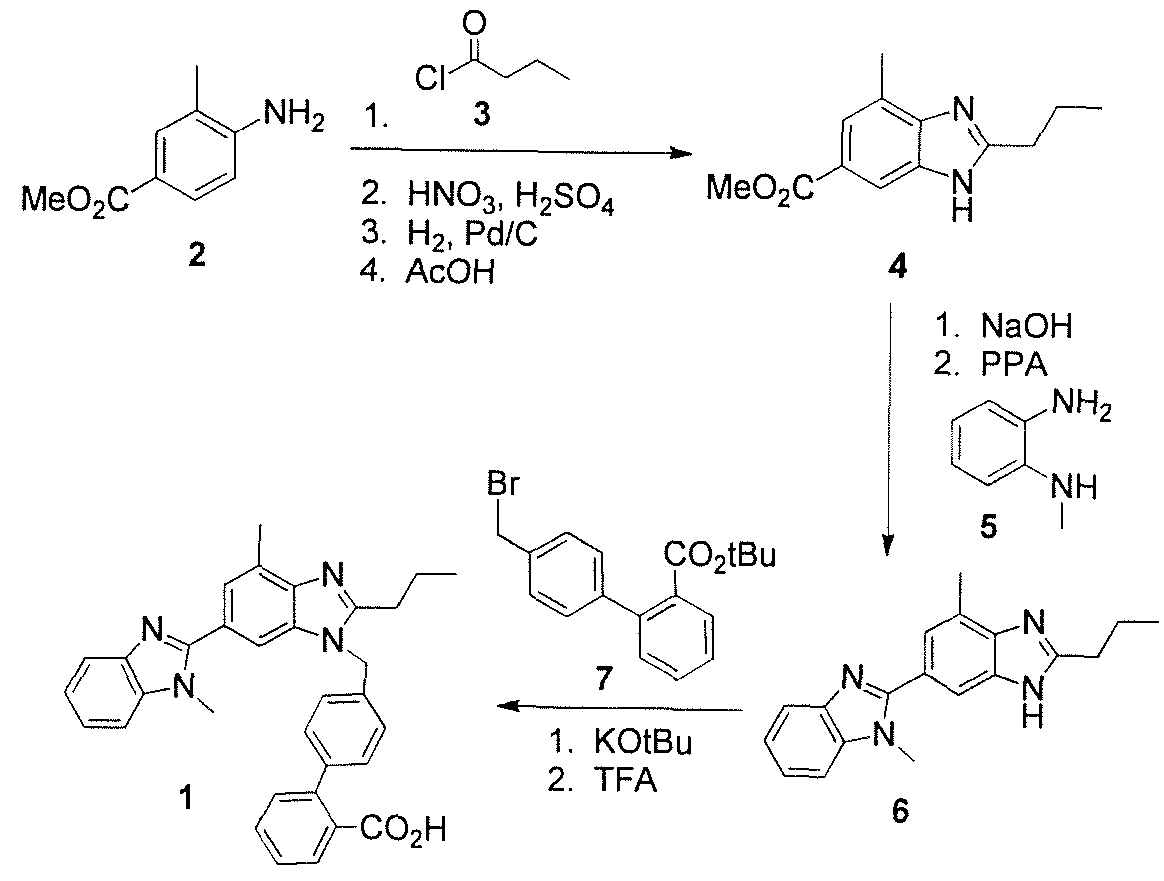
The elevated temperature and acidic conditions required during the second cyclization step adversely impact both product yield and purity - a major drawback of this original route that has not been addressed in subsequent process improvements to this basic method.9 1 1 "13 In a recent report, the cyclocondensation of an aromatic aldehyde with o-phenylenediamine was explored as an alternative path to the dibenzimidazole moiety, however this process still suffers from a rather low overall yield.14 Other groups have taken advantage of cross-coupling reactions to build a formylated biphenyl fragment, avoiding the intricate and low-yielding preparation of 7 used in the original synthesis by substituting a reductive amination approach for the alkylation step.15"17 Bypassing this alkylation reaction is no longer necessary because affordable analogs of bromide 7 are now commercially available. However, none of these modifications represent a significant departure from the original synthetic strategy nor have they remedied the major shortcomings associated with the formation of the dibenzimidazole component of the molecule.
There is a need in the art to provide a straightforward synthetic pathway for producing telmisartan of high purity in high yields.
SUMMARY OF THE INVENTION
Other features and advantages of the present invention will be set forth in the description of invention that follows, and in part will be apparent from the description or may be learned by practice of the invention. The invention will be realized and attained by the compositions and methods particularly pointed out in the written description and claims hereof.
The invention provides a fundamentally different approach to the synthesis of high-purity telmisartan in high yields. The synthesis is based on a novel Pd-catalyzed coupling of two structurally distinct benzimidazole units. This synthetic scheme is more convergent and higher yielding than recently reported efforts, reaching telmisartan in an overall yield of greater than 74%, in comparison to the previously reported highest yield of 50%.9
It is an object of this invention to provide a method of synthesizing telmisartan. The method comprises the step of coupling i)
potassium(l -(2'-carboxy-[l , 1 '-biphenyl]-4-yl)-4-methyl-2-propyl- benzimidazole-6-yl) trifluoroborate and ii) 2-bromo-l -methylbenzimidazole, wherein the step of coupling is carried out under Suzuki cross-coupling reaction conditions, to form the telmisartan. In some aspects, the step of coupling is carried out using microwave assisted heating. In other aspects, the method further comprises the step of forming the
potassium(l -(2'-carboxy-[l , -biphenyl]-4-yl)- 4-methyl-2-propyl-benzimidazole-6-yl) trifluoroborate by i) pre-treating potassium(4-methyl-2-propyl-benzimidazole-6-yl) trifluoroborate with potassium /ert-butoxide; and ii) alkylating pretreated
potassium(4-methyl-2-propyl-benzimidazole-6-yl) trifluoroborate with methyl
4'-bromomethyl-biphenyI-2-carboxylate, to form the
potassium(l-(2'-carboxy-[l , -biphenyl]-4-yl)-4- methyl-2- propyl-benzimidazole-6-yl) trifluoroborate. In yet other aspects, the method further comprises a step of forming the 2-bromo-l -methylbenzimidazole by regioselectively brominating a 2-position of
1 -methylbenzimidazole to form 2-bromo-l -methylbenzimidazole. In additional aspects, the method further comprises the step of forming
the potassium(4-methyl-2-propyl-benzimidazole-6-yI) trifluoroborate by i) performing reductive cyclization of 4-bromo-2-methyl-6-nitroaniline in the presence of w-butyraldehyde and sodium dithionite to form 6-bromo-4-methyl-2-propylbenzimidazole; and ii) converting the 6-bromo-4-methyl-2-propylbenzimidazole to a trifluoroborate salt, to form the potassium(4-methyl-2-propyl-benzimidazole-6-yl) trifluoroborate. In yet other aspects, the step of converting is performed by reacting the 6-bromo-4-methyl-2-propylbenzimidazole with diboron ester in the presence of a Pd catalyst to form a boronic acid pinacol ester; and converting the boronic acid pinacol ester to the
potassium(4-methyl-2-propyl-benzimidazole-6-yl) trifluoroborate. In some aspects, the Pd catalyst is PdCl2dppf. In some aspects, the step of converting is performed by reacting the 6-bromo-4-methyl-2-propyIbenzimidazole with diboronic acid in the presence of a Pd catalyst to form 6-boronic acid-4-methyl-2-propylbenzimidazole; and contacting the 6-boronic acid-4-methyl-2-propylbenzimidazole with HF to form the
potassium(4-methyl-2-propyl-benzimidazole-6-yl) trifluoroborate. In some aspects, the step of reacting is performed in the presence of a Pd catalyst; in further aspects, the Pd catalyst is PdCl2(PPh3)2
In some aspects of the invention, the step of coupling is catalyzed by a Pd catalyst. In further aspects, the Pd catalyst is a homogenous Pd catalyst; in some aspects, the homogenous Pd catalyst is PdCl2dppf. In further aspects, the Pd catalyst is a heterogenous Pd catalyst; in some aspects, the heterogenous Pd catalyst is graphene supported Pd nanoparticles. In yet additional aspects, the step of regioselectively brominating is performed by brominating a 2-position of 1 -methylbenzimidazole by, in a solution with tetrahydrofuran (THF) as solvent, contacting an imidazole ring of the 1 -methylbenzimidazole with a brominating agent, to form the 2-bromo- 1 -methylbenzimidazole. In some aspects, the brominating agent is
N-bromosuccinimide.
The invention also provides a method of regioselectively brominating a 2-position of an imidazole. The method comprises: in a solution with tetrahydrofuran (THF) as solvent, contacting the imidazole with a brominating agent to form an imidazole that is brominated at the 2-position. In some aspects, the imidazole is 1 -methylbenzimidazole. In further aspects, the brominating agent is N-bromosuccinimide. In additional aspects, the step of contacting is carried out using microwave assisted heating.
DETAILED DESCRIPTION
The convergent synthesis of telmisartan provided herein entails the assembly of three major subunits: two differentially substituted benzimidazole derivatives and a biphenyl-2-carboxylic acid synthon (Scheme 2). This strategy provides for the use of a Suzuki cross-coupling reaction to form a new carbon-carbon bond between advanced isolated intermediates 2-bromo-l-methylbenzimidazole (8) and potassium (1 -(2'- carboxy-[l , -biphenyl]-4-yl)-4-methyl-2-propyl-benzimidazole-6-yl) trifluoroborate (16), the latter of which is formed from the reaction of potassium (4-methyl-2-propyl- benzimidazol-6-yl) trifluoroborate (9) and methyl 4'-bromomethyl-biphenyl-2-carboxylate (10), followed by hydrolysis. The previous lack of a convenient and economical preparation protocol of one of the intermediates, 2-bromo-l -methylbenzimidazole 8, precluded development of such coupling strategies. However, as described herein, the present invention provides a novel, high yield synthetic method for preparing this intermediate, permitting its use in the present methods for synthesizing telmisartan.
Scheme 2. Retrosynthetic Analysis of Telmisartan

According to the synthetic method, which is described in detail in the Examples below, three major subunits including two differentially substituted benzimidazole derivatives [2-bromo-l-methylbenzimidazole (8) and potassium (4-methyl-2-propyl- benzimidazol-6-yl)
trifluoroborate (9)] and a biphenyl-2-carboxylic acid synthon [methyl 4'-bromomethyl-biphenyI-2-carboxylate (10)] are assembled. Briefly, the biphenyl moiety is introduced via direct N-alkylation with commercially available methyl 4'-bromomethyl-biphenyl-2-carboxylate (10), followed by a saponification to the desired carboxylic acid. A Suzuki cross-coupling reaction is then used to form a new carbon-carbon bond between the two differentially substituted benzimidazole derivatives. This approach provides efficient assembly of the target molecule, while avoiding the harsh reaction conditions associated with the previous synthetic methods.
An advantage of this synthetic route to telmisartan is the use of regioselectively produced 2-bromo-l-methylbenzimidazole (8). Benzimidazoles are susceptible to reactions such as bromination at multiple sites. Thus, generally a mixture of mono, di- and tri-brominated by-products are formed and the particular reaction product that is wanted must be laboriously separated from the mixture. Further, the yields of such mixed reactions are generally unacceptably low. An aspect of the invention solves this problem by providing methods of synthesizing regio-selective benzimidazole adducts.
Accordingly, the inventors surprisingly discovered that regioselective bromination at a 2-position of an imidazole can be achieved by reacting the imidazole with a brominating agent in the solvent tetrahydrofuran (THF), which eliminates the formation of di- and tribromated products and other brominated products such as compound 8b below. ibrominated
 products
1 1 8b
In some aspects, the imidazole is l -methylbenzimidazole and the product is the desired reactant 2-bromo-l -methylbenzimidazole (8).
For this particular exemplary synthesis, commercially available l-methylbenzimidazole (11) was reacted with the bromine source N-bromosuccinimide (NBS) in the solvent tetrahydrofuran (THF), and the reaction was carried out using microwave-assistance, as described in detail in the Examples section. However, other imidazoles may also be used as the starting material for the formation of regioselectively halogenated adducts as described herein, including but not limited to other N-alkylated benzimidazoles (in which the alkyl chain or may not have additional substituents),
N-alkylated benzimidazoles (including 1 -methyl) that have substituents on C4, C5, C6, or C7 of the benzene ring (e.g. substituents such as alkyl, aryl, various electron-withdrawing or electron-donating groups, etc.), and N-alkylated imidazoles with or without substitution at the 4 and 5 position. In addition, other bromine sources may be employed, including but not limited to molecular bromine, l ,3-dibromo-5,5-dimethylhydantoin (dibromantin), N-bromoacetamide, and N-bromosuccimide adducts (such as NBS-dimethyl formamide, NBS-dimethyl sulfide, NBS-hydrogen fluoride, NBS-sodium azide, and NBS-triphenylphospine). Further, halogens other than Br may be used to form halogenated imidazole adducts described herein, including but not limited to e.g. CI, 1, etc.
Other solvents may also be employed in the halogen adduct formation reaction, including but not limited to acetonitrile (ACN), diglyme, N-methylpyrrolidone (NMP), dimethyl sulfoxide (DMSO), dioxane, and water. In some aspects, the solvent that is used is not dimethylformamide (DMF), methanol (MeOH) or diethyl ether (Et20).
In addition, the reaction is not necessarily a "microwave-assisted" reaction, but instead may be carried out by more conventional heating e.g. by reflux.
The 2-bromo-l -methylbenzimidazole (8) that is formed as described above is one of two differentially substituted benzimidazole derivatives that are employed to carry out the novel convergent synthesis of telmisartan, the other being potassium(l -(2'- carboxy-[l , 1 '-biphenyl]-4-yl)-4-methyl-2-propyl-benzimidazole-6-yl) trifluoroborate (16).
The latter reactant (16) is formed by i) pre-treating potassium (4-methyl-2-propyl- benzimidazole-6-yl) trifluoroborate (9) with potassium /eri-butoxide; and
then ii) alkylating the pretreated potassium(4-methyl-2-propyl-benzimidazole-6-yl) trifluoroborate with methyl 4'-bromomethyl-biphenyl-2-carboxylate (10), as shown below.

Step i) of this reaction is generally carried out at room temperature with e.g. a 2-5 fold molar excess of potassium /eri-butoxide in a solvent (such as DMSO, ACN, or NMP) with stirring
for e.g. at least about 30 min. Step ii) is then performed by adding an equimolar (compared to compound (9)) amount of compound 10 to the reaction mixture with additional stirring at room temperature e.g. for at least about 1 , and typically at least about 2 hours. A solution of e.g. about 5-fold molar excess (compared to compound (9)) of a suitable base (such as KOH, NaOH, LiOH, etc. dissolved in an aqueous solvent such as H20) is then added to the reaction mixture, which is then stirred for several more hours (e.g. about 3-8) hours at room temperature. The solution is then made acidic, e.g. by adjusting the pH to at least about pH 4 with a suitable acid source, and a white precipitate is produced which is filtered and rinsed with a suitable solvent (e.g. THF) and dried. The product is potassium(l -(2'- carboxy-[l, -biphenyl]-4-yl)-4-methyl-2-propyl-benzimidazole-6-yl) trifluoroborate (16).
In some aspects, reactant (9), potassium (4-methyl-2-propyl- benzimidazole-6-yl) trifluoroborate is formed by i) performing reductive cyclization of
4-bromo-2-methyl-6-nitroaniline in the presence of «-butyraldehyde and sodium dithionite to form 6-bromo-4-methyl-2-propylbenzimidazole; and ii) converting the
6-bromo-4-methyl-2-propylbenzimidazole to a trifluoroborate salt to form reactant (9).
In some aspects, the step ii) is performed by: mixing, in a suitable solvent (such as DMSO, dioxane, THF, ACN, or toluene) about a 2-fold molar excess of bis(pinacolato) diboron (15) with 6-bromo-4-methyl-2-propylbenzimidazole (14) and excess KOAc in the presence of a catalyst, such as a Pd catalyst; heating (e.g. to at least about 100°C, using any suitable heating method) under nitrogen for e.g. about 3-7 hours; cooling and extracting (e.g. with EtOAc) and then concentrating the organic phase; dissolving the residue in a suitable solvent (e.g. THF) and reacting the same with potassium bifluoride (KHF2) at room temperature for e.g. about 3-7 h. Removal of the solvent, precipitation and rinsing yields (9).

Alternatively, and in some aspects, preferably, reactant (9) is formed by reacting 6-bromo-4-methyl-2-propylbenzimidazole with diboronic acid in the presence of a Pd catalyst, and is then treated with KHF2 to form (9).
To form the final product, telmisartan (1), compound (16) is reacted with
2-bi mo- l-methylbenzimidazole (8).

In some aspects, compound (8) is made using the novel regio-selective bromination reaction described above. However, the use of other sources of (8), e.g. commercial sources, and/or 8 produced by different reactions, is not excluded. Due to the availability of the starting material 8 in high yield and purity as described herein, and the ready synthesis of starting material 16, the final reaction step is a Suzuki cross-coupling reaction. Briefly, equimolar amounts of compounds 8 and 16 and a 2-fold molar excess of base are combined in aqueous ethanol, e.g. a 1 : 1 mixture of H20 and EtOH, in the presence of a catalyst such as a Pd catalyst. The solution is heated with stirring e.g. to greater than about 100 °C for at least 30 minutes or longer, e.g. for about 1 -2 hours. Any suitable heating method may be used. However, in some aspects, the reaction is carried out rapidly by heating to 1 50°C using microwave irradiation, for example, for from about 15 to about 45 minutes, e.g. for about 30 minutes. The solution is then filtered, brought to a desired volume with a suitable solvent (e.g. H20) and the pH was adjusted to acidity, e.g. to at least about 5 or lower, using a suitable acid. The resulting precipitate is filtered and dried, yielding telmisartan.
In some aspects, one or more of the reactions described herein is catalyzed using a Pd catalyst. Exemplary Pd catalysts that may be used include but are not limited to: various homogeneous palladium catalysts such as PdCl2(PPh3)2, PdCl2dppf, Pd(PPh3)4, and others (e.g. see issued US patents 8889857 and 8981086), etc.; or homogeneous palladium catalysts formed in situ from precatalysts such as but not limited to Pd(OAc)? or Pd2(dba)3 and an exogenous ligand source such as but not limited to trialkylphosphines such as triphenylphosphine or tri-Ze/'Z-butylphosphine, dialkylbiarylphosphines such as 2-(dicyclohexylphosphino)biphenyl or SPhos, N-heterocyclic carbene (NHC) ligands such as those formed from l ,3-bis(2,6-diisopropylphenyl)imidazolium chloride, diimines, BINAP-based ligands, bidentate phosphino ligands, etc, and others (e.g. see, for example, informational brochures located at acros.com/myBrochure/Catalysts, Maluenda et al. Molecules 2015, 20, 7528-7557 and Hanhan, Appl. Organometail Chem. 2008, 22, 270-275);
or heterogeneous Pd catalysts such as solid-supported catalysts, including graphene-SLipported Pd nanoparticles, Pd nanoparticles on single- or multi-walled carbon nanotubes, Pd on other solid supports such as silica-based matrices, or Pd that exists that exists in trace levels in earth abundant metals such as iron, e.g. FeCl3, (for example, see Handa et al., Science, 2015, 349, 1087-1091) . In preferred embodiments, the Pd catalyst is graphene-supported Pd nanoparticles. In other preferred embodiments, the Pd catalyst is PdCl2dppf.
In other aspects, one or more of the reactions described herein is catalyzed using a Ni catalyst. Exemplary Ni catalysts that may be used include but are not limited to: bis(triphenylphosphine)nickel(II)chloride; bis(triphenylphosphine)nickel(II)bromide; [l ,3-Bis(diphenylphosphino)propane]nickel(II)chloride; NiX2, where X = CI, Br, I, etc., with an exogenous ligand source such as but not limited to triphenylphosphine, tricyclohexylphosphine, dppf, BINAP, and other ligands (e.g. see Tasker et al. Nature, 2014, 509, 299-309; Ge et al., Angew. Chem. Int. Ed Eng. 2012. 51 , 12837-12841 ; and informational brochures located at acros.com/myBrochure/Catalysts), (dppf)Ni(cinnamyl)Cl; (NHQNi(Cp)X, where X = CI, Br, etc.; (NHC)Ni(O), (NHC)nN(II); as well as Ni catalysts disclosed in US patent applications 20100184977; 2012006544; 20140134101 ; 20140336429; and 20150166556 and in issued US patents 8,822,368, 8,956,428 and 9,051 ,524.
Several of the reactions described herein require or are preferably performed with heating. Any suitable method of heating may be used, e.g. conventional waterbaths, heating plates, incubators, etc. However, frequently, the reaction time may be shortened and yield may be increased by the use of microwave-assisted heating. In this case, temperatures of at least 100 °C or greater (e.g. 1 10, 120, 130, 140, or 150°C) are readily achieved. The reactions described herein may be conducted using any of these heating methods to achieve the requisite temperatures, and/or may even be carried out at other temperatures than those listed herein, by adjusting the reaction time accordingly.
Provided herein are methods comprising chemical reactions that are used to make telmisartan, as well as telmisartan that is produced using the methods. In addition, drug formulations of telmisartan that is so-produced are encompassed. The formulations are generally prepared either as liquids (e.g. aqueous or oil-based suspensions or solutions) or as solid forms such as tablets, pills, powders and the like, in combination with a
physiologically acceptable carrier. Solid forms suitable for solution in, or suspension in,
liquids prior to administration may also be prepared. The telmisartan may be mixed with excipients which are pharmaceutically acceptable e.g. pharmaceutically acceptable salts. The composition of the present invention may contain any such additional ingredients so as to provide the composition in a form suitable for administration. The final amount of telmisartan in the formulations may vary. However, in general, the amount in the formulations will be from about 1 -99%. Still other suitable formulations for use in the present invention can be found, for example in Remington's Pharmaceutical Sciences, Philadelphia, Pa., 19th ed. (1995). EXAMPLES
EXAMPLE 1. A Convergent Approach to the Total Synthesis of Telmisartan via a Suzuki Cross-Coupling Reaction between Two Functionalized Benzimidazoles
A direct and efficient total synthesis has been developed for telmisartan, a widely prescribed treatment for hypertension. This approach brings together two functionalized benzimidazoles using a high-yielding Suzuki reaction that can be catalyzed by either a homogeneous palladium source or graphene-supported palladium nanoparticles. The ability to perform the cross-coupling reaction was facilitated by the regio-controlled preparation of the 2-bromo-l -methylbenzimidazole precursor. This convergent approach provides telmisartan in an overall yield of 72% while circumventing many issues associated with previously reported processes.
As stated in the Detailed Description, the convergent synthesis of telmisartan entails the assembly of three major subunits: two differentially substituted benzimidazole derivatives and a biphenyl-2-carboxylic acid synthon (Scheme 2). In general, a Suzuki cross-coupling reaction is used to form a new carbon-carbon bond between two differentially substituted benzimidazole derivatives, and the biphenyl moiety is introduced via direct N-alkylation with commercially available methyl 4'-bromomethyl-biphenyl-2-carboxylate (10), followed by a saponification to the desired carboxylic acid. This approach provides efficient assembly of the target molecule, while avoiding the harsh reaction conditions associated with the previous synthetic methods.
Initial efforts focused on preparation of 8, a strategic element in the Suzuki coupling reaction. Starting with commercially available 1 -methylbenzimidazole (11), we were able to
identify reaction conditions to selectively brominate the imidazole ring with N-bromosuccinimide (NBS). While benzimidazoles can be susceptible to bromination at multiple sites18 resulting in the formation of a mixture of mono, di- and tri-brominated by-products, our major challenge was to identify conditions by which bromination could be achieved exclusively at the 2-position in high yield. A solvent screen of microwave-assisted reactions revealed that dichloromethane (DCM), methanol, dimethylformamide (DMF), and diethyl ether yield mainly undesired mixtures of byproducts (Table 1, entries 1 -4), but tetrahydrofuran (THF) affords essentially complete conversion to the desired product (entry 5). Similar selectivity trends were observed during solvent screening under conventional reaction conditions (not shown), and we were able to achieve an isolated yield of 93% with the THF under reflux conditions. To our knowledge, this is the first example of a selective and scalable bromination of 1-methylbenzimidazole at the 2-position and was an essential element of our convergent strategy. This procedure should find utility in the preparation of other benzimidazole adducts.
Table 1. Bromination of l-MethylbenzimidazoIea d

di- and
entry solvent 8b 8bb
tri-brominationb
1 DCM 0 0 100
2 DMF 0 8 92
3 MeOH 0 12 88
4 Et20 0 27 73
5 THF 100 0 0
6C THF 93d 0 0
a 11 (0.76 mmol), NBS (2.3 mmol), 4 mL solvent. b %
Conversions determined by GC-MS. c Reaction ran under reflux
for 1 h. d Isolated yield.
In order to establish the necessary precursors for a Suzuki-based approach to the dibenzimidazole core of telmisartan, we elected to prepare the trifluoroborate salt 9 starting from commercially available 4-bromo-2-methyl-6-nitroaniline (12). Compound 12 could be easily converted to benzimidazole 14 in a single step. This reductive cyclization, provoked by introducing «-butyraldehyde (13) in the presence of sodium dithionite,14 produced 14 in 97% isolated yield (Scheme 3). This approach represents a significant improvement over the originally reported method: benzimidazole formation can be completed in a single step, compared to the problematic three-step sequence (amidation, reduction and cyclization) of Ries et al.10 Moreover, sodium dithionite provides an effective and inexpensive alternative to the palladium catalyst typically used for reduction of the nitro group. Avoiding palladium in this case is particularly beneficial as the aryl bromide is susceptible to dehalogenation under Pd-catalyzed hydrogenation conditions.19
Scheme 3. Synthesis of Compound 9.

Benzimidazole 14 was then converted to the trifluoroborate salt 9 in two steps with no isolated intermediate. We originally chose to introduce the boron species as the pinacol ester.20 The reaction of 6-bromo-4-methyl-2-propylbenzimidazole (14) and diboron 15 (2 equiv.) at 100 °C for 5 hours in the presence of PdCl2dppf (5 mol%) led to the formation of the desired boronic acid pinacol ester. We converted this pinacol boronate directly to the corresponding trifluoroborate salt,21 as trifluoroborates tend to be significantly more reactive toward Suzuki cross-coupling reactions.22"24 The yield from this two-step process is 90% from benzimidazole 14. Isolation of trifluoroborate 9 is straightforward, as it can be precipitated out of the reaction mixture in pure form.
Most of the previous telmisartan syntheses employed a common strategy in which the dibenzimidazole moiety was prepared first, followed by the installation of the biphenyl group. However, we chose to alkylate benzimidazole 9 prior to the Suzuki reaction in order to avoid
an observed side reaction between 8 and 9. The N-alkylation of 9 with bromide 10 was carried out in DMSO under basic reaction conditions (Scheme 4). Notably, we found it necessary to pre-treat 9 with potassium /er/-butoxide to avoid the formation of unwanted Williamson ether byproducts. Furthermore, we developed reaction conditions to telescope saponification of the methyl ester with the alkylation step, achieving a 93% yield of 16 over these two chemical steps.
Scheme 4. One- ot Synthesis of Compound 16

The final coupling reaction of 16 with 8 was carried out under Suzuki cross-coupling reaction conditions26,27 using PdCl2dppf with KOH in a H20/EtOH solvent system. Under atmospheric reflux conditions, the reaction afforded telmisartan in a low to moderate yield (Table 2, entries 1 and 2). In order to achieve higher temperatures with this same solvent system, reactions were then run under elevated pressure using microwave heating. Using this strategy, reaction times were significantly reduced, and isolated yields showed some improvement. We then applied a factorial design of experiment approach in order to identify the set of reaction parameters that would maximize yield while minimizing catalyst loading (not shown). Optimized Suzuki reaction conditions (Table 2, entry 3) generated telmisartan in 89% isolated yield using only 2 mol% catalyst. We expect that similar results can be achieved under elevated pressures with conventional heating.
Pd nanoparticles supported on graphene (Pd/G)28 demonstrate remarkable catalytic activity and recyclability in a wide range of Suzuki cross coupling reactions. Thus, we were interested in evaluating this catalyst system for the Suzuki cross coupling step of our telmisartan synthesis. Preliminary experiments using just 2 mol% of Pd/G under microwave irradiation conditions led to the formation of the desired product with 76% isolated yield (Table 2, entry 4). Furthermore, the catalyst was recycled for two further reactions under the
same conditions without appreciable reduction in isolated yield. This catalyst system can also be employed in both batch and continuous processes for the assembly of telmisartan.
Table 2. Suzuki Cross-coupling to form Telmisartan"


' 8 (0. 19 mmo 1), KOH (0.57 mmol), 4 mL H20/EtOH (1 : 1
b
mixture). D Isolated yield. c Reactions were carried out under
microwave irradiation at 150 °C, generating a pressure of 18 atm
inside the microwave tube. d Pd/G catalyst was recycled an
additional 2 times affording 68 and 62% isolated yields,
respectively.
In summary, a concise and convergent synthesis of the anti-hypertensive drug telmisartan has been achieved. With an overall yield of 72%, our strategy represents a significant improvement over the highest yield reported previously9 (50%). Our approach features an efficient Pd-catalyzed Suzuki reaction between two intact benzimidazole moieties as the final reaction step, enabled by the development of a regioselective bromination of 1 -methylbenzimidazole. In addition, the harsh reaction conditions that have plagued the commercial route have been avoided. Our synthetic route also illustrates the potential of graphene-supported Pd nanoparticles (Pd/G) as an alternative catalytic source for cross-coupling reactions. Finally, our strategy has a very efficient endgame, as each step to assemble telmisartan from the key synthons is high-yielding (83% over the final 3 steps, from
trifluoroborate 9). From a broader perspective, dibenzimidazoles represent an important class of pharmacophores, and this report describes a selective and straightforward method for the preparation of these privileged structures.
EXPERIMENTAL SECTION
2-Bromo-l-methylbenzimidazole (8). 1 -methylbenzimidazole (11) (5.0 g, 37.8 mmol) and N-bromosuccinimide (20.2 g, 1 13.5 mmol) in 200 mL of THF was heated under reflux for 1 h. The solvent was removed in rotary evaporator and the residue was recrystallized from EtOAc yielding 8 (7.4 g, 93%) as a white solid. Ή NMR (DMSO-d6) δ 7.77 (d, 1 H), 7.65 (d, 1 H), 7.39 (m, 2H), 3.86 (s, 3H); ,3C NMR (DMSO-d6) δ 138.2, 135.4, 131.5, 124.8, 124.7, 1 17.0, 1 12.3, 33.0; HRMS (ESI-QTOF): m/z Calcd for C8H7N2Br + H+: 210.9871 , found: 210.991 1.
6-Bromo-4-methyl-2-propylbenzimidazole (14). rc-Butyraldehyde (13) (3.1 mL, 34.6 mmol) was added to a 250 mL flask containing 4-bromo-2-methyl-6-nitroaniline (12) (4.0 g, 17.3 mmol) and sodium dithionite (18.1 g, 103.9 mmol) in 80 mL of 50% MeOH in H20. The reaction was stirred at reflux for 5 h. The methanol was removed via rotary evaporator. To the remaining aqueous solution, an additional 40 mL of water was added and the mixture was extracted using EtOAc (3 x 80 mL). The organic layer was dried using magnesium sulfate. After filtration, the organic layer was removed via rotary evaporator and the resulting solid was dried in the oven producing 13 as a white solid (4.3 g, 97%). Ή NMR (DMSO-d6) δ 7.47 (s, 1 H), 7.08 (s, 1H), 2.77 (t, 2H), 2.47 (s, 3H), 1.79 (m, 2H), 0.95 (t, 3H); l 3C NMR (DMSO-d6) δ 155.7, 124.0, 1 13.1 , 30.5, 20.9, 16.4, 13.6; HRMS
(ESI-QTOF): m/z Calcd for CnH,3N2Br + H+: 253.0340, found: 253.0446.
Potassium (4-methyI-2-propyl-benzimidazol-6-yl) trifluoroborate (9).
6-Bromo-4-methyl-2-propylbenzimidazole (14) (2.0 g, 7.9 mmol) and bis(pinacolato) diboron (15) (4.0 g, 15.8 mmol) were added to a flask along with KOAc (2.3 g, 23.7 mmol) and PdCbdppf (289 mg, 0.4 mmol). DMSO (20 mL) was added, the flask was evacuated and placed under nitrogen. The solution was heated at 100 °C for 5 h. The reaction mixture was cooled followed by the addition of 80 mL H 0 and extracted with EtOAc (3 x 100 mL). The organic layer was combined and concentrated by rotary evaporation. The resulting residue was then taken up in THF (32 mL) and combined with a solution of potassium bifluoride (3.1 g, 39.5 mmol) in H20 (8 mL). The combined solution was stirred at room temperature for 5 h. Upon removal of the THF, the precipitate was filtered and rinsed using EtOAc,
yielding 9 as a white solid (2.0 g, 90%). Ή NMR (DMSO-d6) δ 7.36 (s, 1 H), 7.25 (s, 1 H), 3.01 (t, 2H), 2.48 (s, 3H), 1.85 (m, 2H), 0.94 (t, 3H); l 3C NMR (DMSO-d6) δ 152.5, 130.7, 129.3, 121.4, 1 13.0, 28.5, 21.0, 17.1, 14.0; HRMS (ESI-QTOF): m/z Calcd for C1 1H13N2BF3K + H+: 281.0839, found: 281.0901.
Potassium(l-(2'-carboxy-[l,l'-biphenyl]-4-yl)-4-methyl-2-propyl-benzimidazole-6-yl) trifluoroborate (16). Compound 9 (2.0 g, 7.1 mmol) was added to a solution of KO/Bu (2.4 g, 21 mmol) in DMSO (20 mL) and stirred for 30 min at room temperature. Compound 10 (2.2 g, 7.1 mmol) was then added to the reaction mixture and stirred for 2 h at room temperature. A solution of 2 g KOH (35 mmol) in H20 (80 mL) was then added to the reaction mixture and stirred for an additional 5 h at room temperature. The solution was adjusted to pH 4 using AcOH, producing a white precipitate. The precipitated material was filtered, rinsed with THF and then dried, yielding a white solid (3.2 g, 93% yield). Ή NMR (DMSO-d6) δ 7.22-7.72 (m, 10H), 5.80 (s, 2H), 3.19 (t, 2H), 2.54 (s, 3H), 1.76 (m, 2H), 0.96 (t, 3H); , 3C NMR (DMSO-ds) δ 170.2, 152.8, 141.2, 141.0, 134.8, 132.2, 131.6, 131.2, 129.8, 129.5, 129.4, 128.1 , 126.9, 122.2, 1 12.1, 47.4, 27.3, 21.5, 17.1 , 14.1 ; HRMS (ESI-QTOF): m/z Calcd for C25H23O2N2BF3K + H+: 491.1520, found: 491 .1783.
Telmisartan (1). 2-bromo-l -methyl-benzimidazole 8 (40 mg, 0.19 mmol) and 16 (97.6 mg, 0.20 mmol) were combined with KOH (31.9 mg, 0.57 mmol) and 2 mol% PdCl2dppf (2.8 mg, 0.004 mmol) in a 1 : 1 mixture of H2O and EtOH (4 mL). The solution was heated using microwave irradiation, in a sealed tube, with stirring for 30 minutes at 150°C. The solution was filtered through Celite®. To the filtrate, 10 mL of ¾0 was added and the pH was adjusted to 4 using AcOH. The resulting precipitate was filtered and dried in oven producing telmisartan (86.7mg, 89% yield). Ή NMR (CDC13) δ 8.41 (d, 1 H), 8.04 (d, 1 H), 7.00-7.52 (m, 12H), 5.43(s, 2H), 3.76 (s, 3H), 3.16 (t, 2H), 2.73 (s, 2H), 2.02 (m, 2H), 1.1 8 (t, 3H); , 3C NMR (CDCI3) δ 172.9, 158.2, 155.7, 145.2, 144.5, 143.3, 142.7, 137.2, 136.2, 135.6, 135.3, 132.1 , 131.9, 131.0, 130.6, 130.4, 129.0, 128.8, 125.2, 124.9, 124.8, 123.5, 121.4, 1 13.0, 1 1 1.0, 50.5, 33.5, 31.7, 24.1, 18.6, 15.8; HRMS (ESI-QTOF): m/z Calcd for C33H30O2N4 + H+: 515.2447, found: 515.2468.
Procedure for preparation of Pd nanoparticles supported on graphene (Pd/G). Pd nanoparticles supported on graphene (Pd/G) was prepared according to the procedure developed previously.28 Graphite oxide (100 mg) and the palladium nitrate (194 ih of 10 wt. % in 10 wt. %> HNO3, 99.999%)) were sonicated in deionized water until a yellow dispersion was obtained. The solution was placed inside a conventional microwave after
adding 100 μΐ of the reducing agent hydrazine hydrate. The microwave oven (Emerson MW81 19SB) was then operated at full power (1000 W), 2.45 GHz, in 30 s cycles (on for 10 s, off and stirring for 20 s) for a total irradiation time of 60 s. The yellow solution of Pd nitrate-graphite oxide changed to a black color indicating the completion of the chemical reduction to graphene. The Pd/G nanoparticles were separated by using an Eppendorf 5804 centrifuge operated at 5000 rpm for 15 min and dried overnight under vacuum.
Procedure for Suzuki cross coupling reaction using Pd/G and recycling the heterogeneous catalyst. 2-bromo-l -methyl-benzimidazole 8 (20 mg, 0.094 mmol) was dissolved in a mixture of 2 mL H20:EtOH (1 : 1 ) and placed in a 10 mL microwave tube. To this was added 16 (48.8 mg, 0.099 mmol), and potassium hydroxide (21 .3mg, 0.38 mmol). The palladium on graphene catalyst (Pd/G) (2.5 mg, 1.9 μιηοΐ) was then added, and the tube was sealed and heated under microwave irradiation (250 W, 2.45 MHz) at 150 °C for 20 minutes. Upon the completion of the reaction period, the reaction mixture was diluted with 2 mL of 1 0 mg/mL KOH in EtOH and centrifuged to remove the solid catalyst. The EtOH/KOH washing were repeated twice to ensure the complete dissolution of the product from the surface of the catalyst. The solution was decanted and the solvent was partially concentrated in vacuo. After adjusting the pH of the remaining solution to 4 using AcOH, the precipitated telmisartan product was isolated by filtration and dried in the oven (76% isolated yield). In case of recycling the Pd/G nanoparticles, the solid catalyst was removed by centrifiigation and added to the next reaction mixture using fresh reagents as indicated above. The reaction solution was heated in the microwave at 150 °C for 20 minutes and the same purification was applied, affording telmisartan with an isolated yield of 68 and 62% in the second and third reactions, respectively. REFERENCES for Example 1
(1) Wienen, W.; Hauel, N.; Van Meel, J. C. A.; Narr, B.; Ries, U.; Entzeroth, M. Br. J. Pharmacol. 1993, 770, 245-252.
(2) Battershill, A. J.; Scott, L. J. Drugs 2006, 66, 51 -83.
(3) McClellan, K. J.; Markham, A. Drugs 1998, 56, 1039-1044.
(4) Cernes, R.; Mashavi, M.; Zimlichman, R. Vase. Health Risk Manag. 201 1 , 7, 749-759.
(5) Burnier, M.; Brunner, H. R. Lancet 2000, 355, 637-645.
(6) Benson, S. C.; Pershadsingh, H. A.; Ho, C. I.; Chittiboyina, A.; Desai, P.; Pravenec, M.; Qi, N.; Wang, J.; Avery, M. A.; Kurtz, T. W. Hypertension 2004, 43, 993-1002.
(7) Benndorf, R. A.; Rudolph, T.; Appel, D.; Schwedhelm, E.; Maas, R.; Schulze, F.; Silberhorn, E.; Boger, R. H. Metab. Clin. Exp. 2006, 55, 1 159-1 164.
(8) Mann, J. F. E.; Schmieder, R. E.; McQueen, M.; Dyal, L.; Schumacher, H.; Pogue, J.; Wang, X.; Maggioni, A.; Budaj, A.; Chaithiraphan, S.; Dickstein, K.; Keltai, M.; Metasarinne, K.; Oto, A.; Parkhomenko, A.; Piegas, L. S.; Svendsen, T. L.; Teo, K. K.; Yusuf, S. Lancet 2008, 372, 547-553.
(9) Reddy, K. S.; Srinivasan, N.; Reddy, C. R.; Kolla, N.; Anjaneyulu, Y.; Venkatraman, S.; Bhattacharya, A.; Mathad, V. T. Org. Proc. Res. Dev. 2007, 11, 81 -85.
(10) Ries, U. J.; Mihm, G.; Narr, B.; Hasselbach, K. M.; Wittneben, H.; Entzeroth, M.; Van Meel, J. C. A.; Wienen, W.; Hauel, N. H. J. Med. Chem. 1993, 36, 4040-4051.
(1 1 ) Hauel, N.; Dach, R.; Heitger, H.; Meyer, O. U.S. Patent 2004, 02361 13A 1.
(12) Kankan, R. N.; Rao, D. R.; Srinivas, P. L.; Ravikumar, P. U.K. Patent 2005, GB2414019A.
(13) Rao, C. H.; Naresh, T.; Satyanarayana, K.; Reddy, B. R.; Reddy, G. M. Synth. Commiin. 2010, 40, 530-534.
(14) Wang, P.; Zheng, G.; Wang, Y.; Wang, X.; Wei, PL; Xiang, W. Tetrahedron. 2012, 68, 2509-2512.
(15) Goosen, L. J.; Knauben, T. J. Org. Chem. 2008, 73, 8631 -8634.
( 16) Kumar, A. S.; Ghosh, S.; Mehta, G. N.; Soundararajan, R.; Sarma, P. S. R.; Bhima, K. Synth. Commiin. 2009, 39, 4149-4157.
(17) Kumar, A. S.; Ghosh, S.; Mehta, G. N. Beilstein J. Org. Chem. 2010, 6, No. 25.
(18) Mistry, A. G.; Smith, K. Tetrahedron Lett. 1986, 27, 1051 -1054.
( 19) Alonso, F.; Beletskaya, I. P.; Yus, M. Chem. Rev. 2002, 102, 4009-4091.
(20) Velaparthi, U.; Wittman, M.; Liu, P.; Carboni, J. M.; Lee, F. Y.; Attar, R.; Balimane, P.; Clarke, W.; Sinz, M. W.; Hurlburt, W.; Patel, K.; Discenza, L.; Kim, S.; Gottardis, M.; Greer,
A.; Li, A.; Saulnier, M.; Yang, Z.; Zimmermann, K.; Trainor, G.; Vyas, D. J. Med. Chem. 2008, 51, 5897-5900.
(21 ) Murphy, J. M.; Tzschucke, C. C; Hartwig, J. F. Org Lett. 2007, 9, 757-760.
(22) Molander, G. A.; Biolatto, B. J. Org. Chem. 2003. 68, 4302-4314.
(23) Darses, S.; Genet, J.P. Eur. J. Org. Chem. 2003, 43 13-4327.
(24) Molander, G. A.; Canturk, B.; Kennedy, L. E. J. Org. Chem. 2009, 74, 973-980.
(25) Displacement of the bromide on benzimidazole 8 by the nucleophilic nitrogen of 9 was observed to compete with the desired Suzuki coupling between 8 and 9.
(26) Miyaura, N.; Suzuki, A. Chem. Rev. 1995, 95, 2457-2483.
(27) Bellina, F.; Carpita, A.; Rossi, R. Synthesis 2004, 15, 2419-2440.
(28) Siamaki, A.R.; Khder, A.E.R.S.; Abdelsayed, V.; El-Shall, M.S.; Gupton, B.F. J. Catal. 2011, 279, 1-11.
EXAMPLE 2. Synthesis of potassium (4-methyl-2-propyl-benzimidazole-6-yl)
trifluoroborate (9) using diboronic acid.
Reactant (9) may also be synthesized by reacting
6-bromo-4-methyl-2-propylbenzimidazole with diboronic acid in the presence of a Pd catalyst, followed by treatment with KHF2, as follows: The reaction of
6-bromo-4-methyl-2-propylbenzimidazole (14) and diboronic acid (3 equiv.) at 75 °C for 10 hours in the presence of PdCl2PPh3(3 mol%), triphenylphosphine (4 mol%) and potassium acetate (3 equiv.) led to the formation of the desired boronic acid. This intermediate was converted directly to the corresponding trifluoroborate salt by treatment with potassium bifluoride. Using this boronic acid method, (e.g. see Molander, G. A.; Trice, S. L. J.;
Dreher, S. D. J Am Chem Soc. 2010. 132, (50), 17701 -17703)
the yield of (9) increased to 93% over this two-step process, which results in an increased overall yield of telmisartan of 74%.
EXPERIMENTAL:
Preparation of potassium (4-methyl-2-propyl- benzimidazole-6-yI) trifluoroborate (9).
6-bromo-4-methyl-2-propylbenzimidazole (14) (2.2 g, 8.7 mmol) was taken up in 80 mL of EtOH. The solution was added to a flask containing diboronic acid (2.3 g, 26.0 mmol), KOAc (2.5 g, 26.0 mmol), PdCl2(PPh3)2 ( 1 82 mg, 0.26 mmol) and triphenylphosphine (91 mg, 0.35 mmol). The flask was then evacuated and placed under nitrogen. The solution was heated at 75 °C for 10 h. The reaction mixture was cooled, filtered and then concentrated by rotary evaporator followed by the addition of 80 mL of H20. The aqueous mixture was then extracted with EtOAc (3 x 100 mL). The organic layer was combined and concentrated to about 100 mL. The remaining solution was then combined with a solution of potassium bifluoride (3.4 g, 43.3 mmol) in H20. The biphasic mixture was stirred at room temperature for 5 hours. The precipitate was filtered, rinsed using THF and then dried, yielding 9 as a white solid (2.2 g, 90%). Ή NMR (DMSO-d6, 300 MHz) δ 7.38 (s, IH), 7.27 (s, IH), 3.03 (t, 2H), 2.50 (s, 3H), 1 .86 (m, 2H), 0.96 (t, 3H) ; 13C NMR (DMSO-d6, 300 MHz) 5 1 51 .8,
130.3, 130.0, 128.8, 120.8, 1 12.3, 27.9, 20.4, 16.6, 13.4; HRMS (ESI-QTOF): m/z Cald for C1 1 H13N2BF3K + H+ : 281 .0839, found 281.0819. While the invention has been described in terms of its several exemplary embodiments, those skilled in the art will recognize that the invention can be practiced with modification within the spirit and scope of the appended claims. Accordingly, the present invention should not be limited to the embodiments as described above, but should further include all modifications and equivalents thereof within the spirit and scope of the description provided herein.
It is to be understood that this invention is not limited to particular embodiments described, as such may, of course, vary. It is also to be understood that the terminology used herein is for the purpose of describing particular embodiments only, and is not intended to be limiting.
Where a range of values is provided, it is understood that each intervening value between the upper and lower limit of that range (to a tenth of the unit of the lower limit) is included in the range and encompassed within the invention, unless the context or description clearly dictates otherwise. In addition, smaller ranges between any two values in the range are encompassed, unless the context or description clearly indicates otherwise.
Unless defined otherwise, all technical and scientific terms used herein have the same meaning as commonly understood by one of ordinary skill in the art to which this invention belongs. Representative illustrative methods and materials are herein described; methods and materials similar or equivalent to those described herein can also be used in the practice or testing of the present invention.
All publications and patents cited in this specification are herein incorporated by reference as if each individual publication or patent were specifically and individually indicated to be incorporated by reference, and are incorporated herein by reference to disclose and describe the methods and/or materials in connection with which the publications are cited. The citation of any publication is for its disclosure prior to the filing date and should not be construed as an admission that the present invention is not entitled to antedate such publication by virtue of prior invention. Further, the dates of publication provided may be different from the actual dates of public availability and may need to be independently confirmed.
It is noted that, as used herein and in the appended claims, the singular forms "a", "an", and "the" include plural referents unless the context clearly dictates otherwise. It is further noted that the claims may be drafted to exclude any optional element. As such, this
statement is intended to serve as support for the recitation in the claims of such exclusive terminology as "solely," "only" and the like in connection with the recitation of claim elements, or use of a "negative" limitations, such as "wherein [a particular feature or element] is absent", or "except for [a particular feature or element]", or "wherein [a particular feature or element] is not present (included, etc.)...".
As will be apparent to those of skill in the art upon reading this disclosure, each of the individual embodiments described and illustrated herein has discrete components and features which may be readily separated from or combined with the features of any of the other several embodiments without departing from the scope or spirit of the present invention. Any recited method can be carried out in the order of events recited or in any other order which is logically possible.
Claims
1 . A method of synthesizing telmisartan, comprising the step of
coupling
i) potassium(l -(2'-carboxy-[l , -biphenyl]-4-yl)-4-methyl-2-propyl- benzimidazole-6-yl) trifluoroborate and
ii) 2-bromo-l -methylbenzimidazole,
wherein said step of coupling is carried out under Suzuki cross-coupling reaction conditions, to form said telmisartan.
2. The method of claim 1 , wherein said step of coupling is carried out using microwave assisted heating.
3. The method of claim 1 , further comprising the step of forming said
potassium(l -(2'-carboxy-[l , l '-biphenyl]-4-yl)- 4-methyl-2-propyl-benzimidazole-6-yl) trifluoroborate by
i) pre-treating potassium(4-methyl-2-propyl-benziinidazole-6-yl) trifluoroborate with potassium ½rt-butoxide; and
ii) alkylating pretreated potassium(4-methyl-2-propyl-benzimidazole-6-yl) trifluoroborate with methyl 4*-bromomethyl-biphenyl-2-carboxylate, to form said potassium( l -(2'-carboxy-[l , l '-biphenyl]-4-yl)-4- methyl-2- propyl-benzimidazole-6-yl) trifluoroborate.
4. The method of claim 1 , further comprising the step of forming said
2-bromo- 1 -methy lbenzim idazole by
regioselectively brominating a 2-position of 1 -methylbenzimidazole to form 2-bromo- 1 -methylbenzimidazole.
5. The method of claim 3 further comprising the step of forming
said potassium(4-methyl-2-propyI-benzimidazole-6-yl) trifluoroborate by
i) performing reductive cyclization of 4-bromo-2-methyl-6-nitroaniline in the presence of rc-butyraldehyde and sodium dithionite to form
6-bromo-4-methyl-2-propylbenzimidazole; and
ii) converting said 6-bromo-4-methyl-2-piOpylbenzimidazole to a trifluoroborate salt, to form said potassium(4-methyl-2-propyl-benzimidazole-6-yl) trifluoroborate.
6. The method of claim 5, wherein said step of converting is performed by
reacting said 6-bromo-4-methyl-2-propylbenzimidazole with diboron pinacol ester in the presence of a catalyst to form a boronic acid pinacol ester; and
converting said boronic acid pinacol ester to said
potassium(4-methyl-2-propyl-benzimidazole-6-yl) trifluoroborate.
7. The method of claim 6, wherein the catalyst is a Pd catalyst.
8. The method of claim 7, wherein the Pd catalyst is PdCl2dppf.
9. The method of claim 5, wherein said step of converting is performed by
reacting said 6-bromo-4-methyl-2-propylbenzimidazoIe with diboronic acid in the presence of a catalyst to form 6-boronic acid-4-methyl-2-propylbenzimidazole; and
contacting said 6-boronic acid-4-methyl-2-propylbenzimidazole with KHF2 to form said potassium(4-methyl-2-propyl-benzimidazole-6-yl) trifluoroborate.
10. The method of claim 9, wherein the catalyst is a Pd catalyst.
1 1 . The method of claim 10, wherein the Pd catalyst is PdCl2(PPh )2
12. The method of claim 1 , wherein said step of coupling is catalyzed by a Pd catalyst.
13. The method of claim 12, wherein said Pd catalyst is a homogenous Pd catalyst.
14. The method of claim 13, wherein said homogenous Pd catalyst is PdCl2dppf.
15. The method of claim 12, wherein said Pd catalyst is a heterogenous Pd catalyst.
16. The method of claim 15, wherein said heterogenous Pd catalyst is graphene supported Pd nanoparticles.
17. The method of claim 4, wherein said step of regioselectively brominating is performed by brominating a 2-position of 1 -methylbenzimidazole by, in a solution with tetrahydrofuran
(THF) as solvent, contacting an imidazole ring of said 1 -methylbenzimidazole with a brominating agent, to form said 2-bromo- 1 -methylbenzimidazole.
1 8. The method of claim 17 wherein said brominating agent is N-bromosuccinimide.
19. A method of regioselectively brominating a 2-position of an imidazole, comprising in a solution with tetrahydrofuran (THF) as solvent, contacting said imidazole with a brominating agent to form an imidazole that is brominated at the 2-position.
20. The method of claim 19, wherein said imidazole is 1 -methylbenzimidazole.
21. The method of claim 19, wherein said brominating agent is N-bromosuccinimide.
22. The method of claim 19, wherein said step of contacting is carried out using microwave assisted heating.
Priority Applications (1)
| Application Number | Priority Date | Filing Date | Title |
|---|---|---|---|
| US15/529,615 US10077242B2 (en) | 2014-12-01 | 2015-12-01 | Convergent approach to the total synthesis of telmisartan via a suzuki cross-coupling reaction |
Applications Claiming Priority (4)
| Application Number | Priority Date | Filing Date | Title |
|---|---|---|---|
| US201462085842P | 2014-12-01 | 2014-12-01 | |
| US62/085,842 | 2014-12-01 | ||
| US201462088198P | 2014-12-05 | 2014-12-05 | |
| US62/088,198 | 2014-12-05 |
Publications (1)
| Publication Number | Publication Date |
|---|---|
| WO2016089845A1 true WO2016089845A1 (en) | 2016-06-09 |
Family
ID=56092318
Family Applications (1)
| Application Number | Title | Priority Date | Filing Date |
|---|---|---|---|
| PCT/US2015/063152 Ceased WO2016089845A1 (en) | 2014-12-01 | 2015-12-01 | A convergent approach to the total synthesis of telmisartan via a suzuki cross-coupling reaction |
Country Status (2)
| Country | Link |
|---|---|
| US (1) | US10077242B2 (en) |
| WO (1) | WO2016089845A1 (en) |
Cited By (1)
| Publication number | Priority date | Publication date | Assignee | Title |
|---|---|---|---|---|
| CN119976754A (en) * | 2023-11-13 | 2025-05-13 | 浙江省化工研究院有限公司 | A preparation method of sodium bis(fluorosulfonyl)imide |
Citations (2)
| Publication number | Priority date | Publication date | Assignee | Title |
|---|---|---|---|---|
| US20060094883A1 (en) * | 2004-10-15 | 2006-05-04 | Nurit Perlman | Process for preparing telmisartan |
| CN102050791A (en) * | 2010-12-10 | 2011-05-11 | 江苏江神药物化学有限公司 | Key intermediate of telmisartan, synthesis method thereof and method for synthesizing telmisartan by intermediate |
Family Cites Families (1)
| Publication number | Priority date | Publication date | Assignee | Title |
|---|---|---|---|---|
| BR9810745A (en) * | 1997-06-10 | 2001-03-13 | Glaxo Group Ltd | Benzimidazole derivatives |
-
2015
- 2015-12-01 WO PCT/US2015/063152 patent/WO2016089845A1/en not_active Ceased
- 2015-12-01 US US15/529,615 patent/US10077242B2/en not_active Expired - Fee Related
Patent Citations (2)
| Publication number | Priority date | Publication date | Assignee | Title |
|---|---|---|---|---|
| US20060094883A1 (en) * | 2004-10-15 | 2006-05-04 | Nurit Perlman | Process for preparing telmisartan |
| CN102050791A (en) * | 2010-12-10 | 2011-05-11 | 江苏江神药物化学有限公司 | Key intermediate of telmisartan, synthesis method thereof and method for synthesizing telmisartan by intermediate |
Non-Patent Citations (5)
| Title |
|---|
| GOOSSEN, LJ ET AL.: "Concise Synthesis of Telmisartan via Decarboxylative Cross-Coupling", J. ORG. CHEM., vol. 73, 2008, pages 8631 - 8634, XP055000440, Retrieved from the Internet <URL:http://pubs.acs.org/doi/abs/10.1021/jo801937h> doi:10.1021/jo801937h * |
| KAPPE, CO.: "Microwave dielectric heating in synthetic organic chemistry.", CHEM. SOC. REV., vol. 37, 2008, pages 1127 - 1139, Retrieved from the Internet <URL:http://140.123.79.90/-mash1225/images/microwave%20reference/b803001b.pdf> * |
| LEWIS, LC ET AL.: "Direct Functionalization of Nitrogen Heterocycles via Rh-Catalyzed C-H Bond Activation.", ACC. CHEM. RES., vol. 41, no. 8, 8 August 2008 (2008-08-08), pages 1013 - 1025, Retrieved from the Internet <URL:http://www.ncbi.nlm.nih.gov/pmc/articles/PMC2610463/pdf/nihms79606.pdf> * |
| MARTIN, AD ET AL.: "A Convergent Approach to the Total Synthesis of Telmisartan via a Suzuki Cross-Coupling Reaction between Two Functionalized Benzimidazoles", J. ORG. CHEM., vol. 80, 18 December 2014 (2014-12-18), pages 1915 - 1919, Retrieved from the Internet <URL:http://pubs.acs.org/doi/abs/10.1021/jo5025333> * |
| NEOCHORITIS, C ET AL.: "Convenient synthesis of polybrominated imidazole building blocks", ARKIVOC, vol. xv, 2007, pages 101 - 111, Retrieved from the Internet <URL:https://www.arkat-usa.org/get-file/23056> * |
Cited By (1)
| Publication number | Priority date | Publication date | Assignee | Title |
|---|---|---|---|---|
| CN119976754A (en) * | 2023-11-13 | 2025-05-13 | 浙江省化工研究院有限公司 | A preparation method of sodium bis(fluorosulfonyl)imide |
Also Published As
| Publication number | Publication date |
|---|---|
| US10077242B2 (en) | 2018-09-18 |
| US20170260146A1 (en) | 2017-09-14 |
Similar Documents
| Publication | Publication Date | Title |
|---|---|---|
| Felpin et al. | Biaryl synthesis with arenediazonium salts: cross-coupling, CH-arylation and annulation reactions | |
| Ou et al. | Recyclable copper catalyzed nitrogenation of biphenyl halides: a direct approach to carbazoles | |
| Sagadevan et al. | Visible-light initiated copper (I)-catalysed oxidative C–N coupling of anilines with terminal alkynes: one-step synthesis of α-ketoamides | |
| Sun et al. | NHC-based coordination polymers as solid molecular catalysts for reductive amination of biomass levulinic acid | |
| Ackermann et al. | Metal-free direct arylations of indoles and pyrroles with diaryliodonium salts | |
| Guo et al. | Palladium-catalyzed, copper-mediated construction of benzene rings from the reactions of indoles with in situ generated enones | |
| Huang et al. | A recyclable Cu-catalyzed C–N coupling reaction in water and its application to synthesis of imidazo [1, 2-a] quinoxaline | |
| Deng et al. | Copper-catalyzed cross-dehydrogenative N 2-coupling of NH-1, 2, 3-triazoles with N, N-dialkylamides: N-amidoalkylation of NH-1, 2, 3-triazoles | |
| Saito et al. | Double carbonylation of aryl iodides with amines under an atmospheric pressure of carbon monoxide using sulfur-modified Au-supported palladium | |
| Martin et al. | A flow-based synthesis of telmisartan | |
| Martin et al. | A convergent approach to the total synthesis of telmisartan via a suzuki cross-coupling reaction between two functionalized benzimidazoles | |
| Zhang et al. | Cu (NO 3) 2· 3H 2 O-mediated cyanation of aryl iodides and bromides using DMF as a single surrogate of cyanide | |
| Liu et al. | Pd (II)-catalyzed oxidative alkoxycarbonylation of 2-phenoxypyridine derivatives with CO and alcohols | |
| Yu et al. | Electrochemical cobalt-catalyzed C–H or N–H oxidation: a facile route to synthesis of substituted oxindoles | |
| Adiyala et al. | Continuous-flow photo-induced decarboxylative annulative access to fused imidazole derivatives via a microreactor containing immobilized ruthenium | |
| Phillips et al. | Copper-catalyzed C–N coupling of amides and nitrogen-containing heterocycles in the presence of cesium fluoride | |
| Aichhorn et al. | Synthesis of quinoxalines or quinolin-8-amines from N-propargyl aniline derivatives employing tin and indium chlorides | |
| WO2014108671A1 (en) | Syntheses of n-heterocyclic carbenes and intermediates therefor | |
| Zeng et al. | An efficient copper-catalyzed synthesis of anilines by employing aqueous ammonia | |
| Umadevi et al. | Recent advances in C–H activation and functionalization of quinazolinones/quinazolines | |
| He et al. | A highly efficient heterogeneous copper-catalyzed cascade reaction of 2-halobenzoic acids and amidines leading to quinazolinones | |
| Li et al. | Synthesis of mono-fluorinated heterocycles with a ring-junction nitrogen atom via Rh (iii)-catalyzed CF 3-carbenoid C–H functionalization and defluorinative annulation | |
| Xie et al. | The synthesis of quinolines via denitrogenative palladium-catalyzed cascade reaction of o-aminocinnamonitriles with arylhydrazines | |
| Barbero et al. | Ligand-free copper (i)-catalysed intramolecular direct C–H functionalization of azoles | |
| Liu et al. | [3+ 3] annulation of allylic phosphoryl-stabilized carbanions/phosphorus ylides and vinyl azides: a practice strategy for synthesis of polyfunctionalized anilines |
Legal Events
| Date | Code | Title | Description |
|---|---|---|---|
| 121 | Ep: the epo has been informed by wipo that ep was designated in this application |
Ref document number: 15865295 Country of ref document: EP Kind code of ref document: A1 |
|
| WWE | Wipo information: entry into national phase |
Ref document number: 15529615 Country of ref document: US |
|
| NENP | Non-entry into the national phase |
Ref country code: DE |
|
| 122 | Ep: pct application non-entry in european phase |
Ref document number: 15865295 Country of ref document: EP Kind code of ref document: A1 |