WO2016064585A1 - Segregated fluorinated esters - Google Patents
Segregated fluorinated esters Download PDFInfo
- Publication number
- WO2016064585A1 WO2016064585A1 PCT/US2015/054580 US2015054580W WO2016064585A1 WO 2016064585 A1 WO2016064585 A1 WO 2016064585A1 US 2015054580 W US2015054580 W US 2015054580W WO 2016064585 A1 WO2016064585 A1 WO 2016064585A1
- Authority
- WO
- WIPO (PCT)
- Prior art keywords
- fluorinated ester
- grams
- heat transfer
- perfluorinated
- fluorinated
- Prior art date
- Legal status (The legal status is an assumption and is not a legal conclusion. Google has not performed a legal analysis and makes no representation as to the accuracy of the status listed.)
- Ceased
Links
- 0 *C(OCCOC(C(C(F)(F)F)(C(F)(F)F)F)=O)=O Chemical compound *C(OCCOC(C(C(F)(F)F)(C(F)(F)F)F)=O)=O 0.000 description 3
- ZSBBGWXRHQYJDO-UHFFFAOYSA-N CC(C(C(F)(F)F)(F)F)(C(F)=O)F Chemical compound CC(C(C(F)(F)F)(F)F)(C(F)=O)F ZSBBGWXRHQYJDO-UHFFFAOYSA-N 0.000 description 1
Classifications
-
- C—CHEMISTRY; METALLURGY
- C07—ORGANIC CHEMISTRY
- C07D—HETEROCYCLIC COMPOUNDS
- C07D207/00—Heterocyclic compounds containing five-membered rings not condensed with other rings, with one nitrogen atom as the only ring hetero atom
- C07D207/02—Heterocyclic compounds containing five-membered rings not condensed with other rings, with one nitrogen atom as the only ring hetero atom with only hydrogen or carbon atoms directly attached to the ring nitrogen atom
- C07D207/04—Heterocyclic compounds containing five-membered rings not condensed with other rings, with one nitrogen atom as the only ring hetero atom with only hydrogen or carbon atoms directly attached to the ring nitrogen atom having no double bonds between ring members or between ring members and non-ring members
- C07D207/10—Heterocyclic compounds containing five-membered rings not condensed with other rings, with one nitrogen atom as the only ring hetero atom with only hydrogen or carbon atoms directly attached to the ring nitrogen atom having no double bonds between ring members or between ring members and non-ring members with hetero atoms or with carbon atoms having three bonds to hetero atoms with at the most one bond to halogen, e.g. ester or nitrile radicals, directly attached to ring carbon atoms
-
- C—CHEMISTRY; METALLURGY
- C07—ORGANIC CHEMISTRY
- C07C—ACYCLIC OR CARBOCYCLIC COMPOUNDS
- C07C69/00—Esters of carboxylic acids; Esters of carbonic or haloformic acids
- C07C69/62—Halogen-containing esters
- C07C69/63—Halogen-containing esters of saturated acids
-
- C—CHEMISTRY; METALLURGY
- C07—ORGANIC CHEMISTRY
- C07D—HETEROCYCLIC COMPOUNDS
- C07D211/00—Heterocyclic compounds containing hydrogenated pyridine rings, not condensed with other rings
- C07D211/04—Heterocyclic compounds containing hydrogenated pyridine rings, not condensed with other rings with only hydrogen or carbon atoms directly attached to the ring nitrogen atom
- C07D211/06—Heterocyclic compounds containing hydrogenated pyridine rings, not condensed with other rings with only hydrogen or carbon atoms directly attached to the ring nitrogen atom having no double bonds between ring members or between ring members and non-ring members
- C07D211/36—Heterocyclic compounds containing hydrogenated pyridine rings, not condensed with other rings with only hydrogen or carbon atoms directly attached to the ring nitrogen atom having no double bonds between ring members or between ring members and non-ring members with hetero atoms or with carbon atoms having three bonds to hetero atoms with at the most one bond to halogen, e.g. ester or nitrile radicals, directly attached to ring carbon atoms
- C07D211/38—Halogen atoms or nitro radicals
-
- C—CHEMISTRY; METALLURGY
- C07—ORGANIC CHEMISTRY
- C07D—HETEROCYCLIC COMPOUNDS
- C07D265/00—Heterocyclic compounds containing six-membered rings having one nitrogen atom and one oxygen atom as the only ring hetero atoms
- C07D265/28—1,4-Oxazines; Hydrogenated 1,4-oxazines
- C07D265/30—1,4-Oxazines; Hydrogenated 1,4-oxazines not condensed with other rings
-
- C—CHEMISTRY; METALLURGY
- C09—DYES; PAINTS; POLISHES; NATURAL RESINS; ADHESIVES; COMPOSITIONS NOT OTHERWISE PROVIDED FOR; APPLICATIONS OF MATERIALS NOT OTHERWISE PROVIDED FOR
- C09K—MATERIALS FOR MISCELLANEOUS APPLICATIONS, NOT PROVIDED FOR ELSEWHERE
- C09K5/00—Heat-transfer, heat-exchange or heat-storage materials, e.g. refrigerants; Materials for the production of heat or cold by chemical reactions other than by combustion
- C09K5/08—Materials not undergoing a change of physical state when used
- C09K5/10—Liquid materials
-
- H—ELECTRICITY
- H01—ELECTRIC ELEMENTS
- H01B—CABLES; CONDUCTORS; INSULATORS; SELECTION OF MATERIALS FOR THEIR CONDUCTIVE, INSULATING OR DIELECTRIC PROPERTIES
- H01B3/00—Insulators or insulating bodies characterised by the insulating materials; Selection of materials for their insulating or dielectric properties
- H01B3/18—Insulators or insulating bodies characterised by the insulating materials; Selection of materials for their insulating or dielectric properties mainly consisting of organic substances
- H01B3/20—Insulators or insulating bodies characterised by the insulating materials; Selection of materials for their insulating or dielectric properties mainly consisting of organic substances liquids, e.g. oils
- H01B3/24—Insulators or insulating bodies characterised by the insulating materials; Selection of materials for their insulating or dielectric properties mainly consisting of organic substances liquids, e.g. oils containing halogen in the molecules, e.g. halogenated oils
Definitions
- the present disclosure relates generally to the use of dielectric fluids in electrical devices such as capacitors, switchgear, transformers and electric cables or buses.
- the present disclosure further relates to heat transfer applications.
- the present disclosure pertains to the use of certain fluorinated esters as dielectric fluids in electrical devices and as heat transfer agents.
- dielectric liquids are often used in place of air due to their low dielectric constant (K) and high dielectric strength (DS).
- Some capacitors of this type comprise alternate layers of metal foil conductors and solid dielectric sheets of paper or polymer film.
- Other capacitors are constructed by wrapping the metal foil conductor(s) and dielectric film(s) concentrically around a central core. This latter type of capacitor is referred to as a "film-wound" capacitor.
- Dielectric liquids are often used to impregnate dielectric film due to their low dielectric constant and high dielectric strength. Such dielectric liquids allow more energy to be stored within the capacitor (higher capacitance) as compared to air- or other gas-filled electrical devices.
- PCBs polychlorinated biphenyls
- the heat transfer fluid is required to be a single phase over the entire process temperature range and the heat transfer fluid properties are required to be predictable, i.e., the composition remains relatively constant so that the viscosity, boiling point, etc., can be predicted so that a precise temperature can be maintained and so that the equipment can be appropriately designed.
- the heat transfer fluid may be used to remove heat, add heat, or maintain a temperature.
- the fluorochemical ester compounds described herein comprise a class of commercially valuable chemical compounds that exhibit a wide range of properties.
- the compounds as a class are neutral and, in some cases, are surprisingly inert, thermally stable, and hydrolytically stable. Such properties have made them useful as dielectric fluids in electronic or electric equipment. Summary
- heat transfer fluids that are inert, have high dielectric strength, low electrical conductivity, chemical inertness, thermal stability, effective heat transfer, are liquid over a wide temperature range, have good heat transfer properties over a wide range of temperatures, and also have shorter atmospheric lifetimes, and therefore have a lower global warming potential, than existing heat transfer fluids.
- an apparatus for heat transfer that includes a device and a mechanism for transferring heat to or from the device, the mechanism comprising a heat transfer fluid, wherein the heat transfer fluid comprises a fluorinated ester.
- a method is provided for transferring heat that includes providing a device and providing a mechanism for transferring heat to or from the device, the mechanism comprising a heat transfer fluid, wherein the heat transfer fluid comprises a partially fluorinated carbonate.
- the fluorochemical ester compounds described herein comprise a class of commercially valuable chemical compounds that exhibit a wide range of properties.
- the compounds as a class are neutral and, in some cases, are surprisingly inert, thermally stable, and hydrolytically stable. Such properties have made them useful as dielectric fluids in electronic or electric equipment.
- this invention provides a fluorochemical ester compound comprising an a branched, perfluorinated acid portion, and a non-fluorinated alcohol portion. More particularly the present disclosure provides segregated fluorinated esters of the formula:
- each of Rf 1 and Rf 2 are independently a perfluorinated group
- the number of total perfluorinated carbon atoms is > 4 when x is 1
- the number of total perfluorinated carbon atoms is > 3when x is 2-4
- R 1 is a (hetero)hydrocarbyl group of valence x
- x is lto 4.
- ester is derived from a perfluorinated acyl fluoride (or equivalent) and a non-fluorinated alcohol.
- Each of Rf 1 and Rf 2 are independently a linear or branched, cyclic or acrylic perfluoroalkyl group, which may optionally contain one or more in-chain oxygen or nitrogen atoms.
- each of Rf 1 and Rf 2 may be selected from perfluorinated cyclobutyl, cyclopentyl, cyclohexyl or tetrahydrofuran rings as well as piperazine, piperidine, morpholine or pyrrolidine rings, each with or without attached perfluoroalkyl groups.
- Rf 1 and Rf 2 are taken together to form a perfluorinated ring, which may further contain one or more in-chain oxygen or nitrogen atoms, i.e. Rf 1 - CF(-)-Rf 2 may form a ring.
- Rf 1 and Rf 2 taken together, may be selected from linear or branched, cyclic or acyclic perfluoroalkylene.
- Rf 1 and Rf 2 taken together with the "CF" of Formula I, may form perfluorinated cyclobutyl, cyclopentyl, cyclohexyl or tetrahydrofuran rings as well as piperazine, piperidine, morpholine or pyrrolidine rings. each with or without attached alkyl groups.
- the segregated fluorinated esters as a dielectric fluids advantageously have a broad range of operating temperatures and pressures, are thermally, and chemically stable, have a higher dielectric strength and heat transfer efficiency than conventional dielectric fluids, have a lower global warming potential (GWP) than many dielectric fluids.
- the fluorinated esters generally have a dielectric strength > 30 kV at 0.1 inches.
- the dielectric fluid of the present disclosure has a high electrical strength, also described as high breakdown voltage.
- “Breakdown voltage,” as used in this application means (at a specific frequency) the highest voltage applied to a fluid that induces catastrophic failure of the fluid dielectric allowing electrical current to conduct through the gas.
- the fluid dielectric of the present invention can function under high voltages.
- the fluid dielectric can also exhibit a low loss factor, that is, the amount of electrical energy that is lost as heat from an electrical device such as a capacitor.
- the fluorochemical esters are thermally and hydrolytically stable when compared to fluorochemical esters lacking the branching alpha to the carbonyl.
- the compounds generally exhibit a liquid phase over a wide temperature range.
- the compounds are generally liquid to at least about -50°C and have boiling points > 100°C, preferably > 120°C and more preferably> 140°C.
- the viscosity of the compounds in the liquid phase is less than 10 centistokes at 25 °C.
- the hydrofluoroether compounds of the present invention additionally have low global warming potential values (GWP), calculated as between 100 and 400.
- GWP is determined using a calculated value for atmospheric lifetime and an experimentally determined infrared absorbance data integrated over the spectral region of interest, typically 500 to 2500 cm-1.
- GWP is a relative measure of the warming potential of a compound based on the structure of the compound.
- IPCC intergovernmental Panel on Climate Change
- ai is the radiative forcing per unit mass increase of a compound in the atmosphere (the change in the flux of radiation through the atmosphere due to the IR absorbance of that compound)
- C is the atmospheric concentration of a compound
- tau is the atmospheric lifetime of a compound
- t is time
- i is the compound of interest.
- the commonly accepted ITH is 100 years representing a compromise between short-term effects (20 years) and longer-term effects (500 years or longer).
- concentration of an organic compound, i, in the atmosphere is assumed to follow pseudo first order kinetics (i.e., exponential decay).
- concentration of CO2 over that same time interval incorporates a more complex model for the exchange and removal of CO2 from the atmosphere (the Bern carbon cycle model).
- a measured IR cross-section may be used to calculate the radiative forcing value for the instant fluorinated esters using the method of Pinnock, et al. (J. Geophys. Res., 100, 23227,
- the perfluoro esters of the disclosure typically have a GWP less than about 100, and preferably less than 10.
- the fluorinated esters As a result of their rapid degradation in the lower atmosphere, the fluorinated esters have short lifetimes and would not be expected to contribute significantly to global warming.
- the low GWP of the fluorinated esters in addition to the dielectric performance characteristics and stability, make them well suited for use as a dielectric fluid.
- alkyl includes straight-chained, branched, and cycloalkyl groups and includes both unsubstituted and substituted alkyl groups. Unless otherwise indicated, the alkyl groups typically contain from 1 to 20 carbon atoms. Examples of “alkyl” as used herein include, but are not limited to, methyl, ethyl, n-propyl, n-butyl, n-pentyl, isobutyl, t-butyl, isopropyl, n-octyl, n-heptyl, ethylhexyl, cyclopentyl, cyclohexyl, cycloheptyl, adamantyl, and norbornyl, and the like.
- alkyl groups may be mono- or polyvalent, i.e. monovalent alkyl or polyvalent alkylene.
- heteroalkyl includes both straight-chained, branched, and cyclic alkyl groups with one or more heteroatoms independently selected from S, O, and N with both unsubstituted and substituted alkyl groups. Unless otherwise indicated, the heteroalkyl groups typically contain from 1 to 20 carbon atoms. "Heteroalkyl" is a subset of
- heteroalkyl hydrocarbyl containing one or more S, N, O, P, or Si atoms
- heteroalkyl examples include, but are not limited to, methoxy, ethoxy, propoxy, 3,6-dioxaheptyl, 3-(trimethylsilyl)-propyl, 4-dimethylaminobutyl, and the like.
- heteroalkyl groups may be mono- or polyvalent, i.e. monovalent heteroalkyl or polyvalent heteroalkylene.
- aryl is an aromatic group containing 5-18 ring atoms and can contain optional fused rings, which may be saturated, unsaturated, or aromatic.
- aryl groups include phenyl, naphthyl, biphenyl, phenanthryl, and anthracyl.
- Heteroaryl is aryl containing 1-3 heteroatoms such as nitrogen, oxygen, or sulfur and can contain fused rings.
- Some examples of heteroaryl groups are pyridyl, furanyl, pyrrolyl, thienyl, thiazolyl, oxazolyl, imidazolyl, indolyl, benzofuranyl, and benzthiazolyl.
- aryl and heteroaryl groups may be mono- or polyvalent, i.e. monovalent aryl or polyvalent arylene.
- heterohydrocarbyl is inclusive of hydrocarbyl alkyl and aryl groups, and heterohydrocarbyl heteroalkyl and heteroaryl groups, the latter comprising one or more catenary (in-chain) oxygen heteroatoms such as ether or amino groups.
- Heterohydrocarbyl may optionally contain one or more catenary (in-chain) functional groups including ester, amide, urea, urethane, and carbonate functional groups. Unless otherwise indicated, the non-polymeric (hetero)hydrocarbyl groups typically contain from 1 to 60 carbon atoms.
- heterohydrocarbyls as used herein include, but are not limited to, methoxy, ethoxy, propoxy, 4-diphenylaminobutyl, 2-(2'- phenoxyethoxy)ethyl, 3,6-dioxaheptyl, 3,6-dioxahexyl-6-phenyl, in addition to those described for "alkyl”, “heteroalkyl”, “aryl”, and “heteroaryl” supra.
- fluorinated refers to hydrocarbon compounds that have one or more C--H bonds replaced by C--F bonds
- fluoroalkyl has essentially the meaning as “alkyl” except that one or more of the hydrogen atoms of the alkyl radical are replaced by fluorine atoms.
- fluoroalkylene has essentially the meaning as “alkylene” except that one or more of the hydrogen atoms of the alkyl radical are replaced by fluorine atoms.
- Perfluoroalkyl has essentially the meaning as “alkyl” except that all or essentially all of the hydrogen atoms of the alkyl radical are replaced by fluorine atoms, e.g.
- Perfluoroalkylene has essentially the meaning as “alkylene” except that all or essentially all of the hydrogen atoms of the alkylene radical are replaced by fluorine atoms, e.g., perfluoropropylene, perfluorobutylene, perfluorooctylene, and the like
- Perfluorinated or the prefix “perfluoro” means an organic group wherein all or essentially all of the carbon bonded hydrogen atoms are replaced with fluorine atoms, e.g. Perfluoroalkyl and the like.
- the resent disclosure provides segregated fluorinated esters of the formula:
- Rf 1 and Rf 2 are independently selected from a perfluoroalkyl or
- perfluoroheteroalkyl group having from 1 to about 12 perfluorinated carbon atoms, preferably 1 to 8 carbon atoms, more preferably having from about 1 to about 5 carbon atoms.
- the total number of perfluorinated carbon atoms, i.e. from R ⁇ -CF- Rf 2 is > 4 when x is 1
- the number of total perfluorinated carbon atoms is > 3 when x is 2-4.
- one or both of Rf 1 and Rf 2 is > 4.
- Rf 1 and Rf 2 can contain linear or branched chain, acyclic or cyclic perfluorinated alkyl groups or combinations thereof.
- Rf 1 and Rf 2 are preferably free of polymerizable olefmic unsaturation and can optionally contain one or more in-chain heteroatoms such as oxygen, divalent or hexavalent sulfur, or nitrogen.
- Rf 1 and Rf 2 can be taken together to form a perfluorinated ring, such as
- Such rings may further contain one or more in-chain heteroatoms such as oxygen, divalent or hexavalent sulfur, or nitrogen, such as perfluorinated piperazine, piperidine, morpholine or pyrrolidine rings.
- Such rings may further contain perfluorinated alkyl groups.
- R x can optionally contain one or more in-chain oxygen heteroatoms.
- R 1 may optional have one or more pendent hydroxyl group.
- the segregated ester is of the formula:
- each of Rf 3 , Rf 4 and Rf 5 are independently a perfluorinated group, y is 1-4;
- R 1 is a (hetero)hydrocarbyl group of valence y as previously described.
- Each of Rf 3 , Rf 4 and Rf 5 are independently selected from a perfluoroalkyl or perfluoroheteroalkyl group having from 1 to about 12 perfluorinated carbon atoms, preferably 1 to 8 carbon atoms, more preferably having from about 1 to about 5 carbon atoms.
- Each of Rf 3 , Rf 4 and Rf 5 can contain linear or branched chain, acyclic or cyclic perfluorinated alkyl groups or combinations thereof.
- Rf 3 , Rf 4 and Rf 5 are preferably free of polymerizable olefmic unsaturation and can optionally contain one or more in-chain heteroatoms such as oxygen, divalent or hexavalent sulfur, or nitrogen.
- each of Rf 3 , Rf 4 and Rf 5 may be selected from perfluorinated cyclobutyl, cyclopentyl, cyclohexyl or tetrahydrofuran rings as well as piperazine, piperidine , morpholine or pyrrolidine rings, each with or without attached perfluoroalkyl groups.
- Rf 4 and Rf 5 are taken together to form a perfluorinated ring, which may further contain one or more in-chain oxygen or nitrogen atoms, i.e. Rf 4 - N(-)-Rf 5 may form a ring.
- Rf 4 and Rf 5 taken together, may be selected from linear or branched, cyclic or acyclic perfluoroalkylene to produce perfluorinate piperazine, piperidine , morpholine or pyrrolidine rings, each with or without attached perfluoro alkyl groups.
- Such compounds are prepared by esterification of the perfluorinated acid fluoride as previously described.
- the perfluorinated acid fluoride may be prepared by Michael addition of a secondary amine to a substituted acrylate, such as a methacrylate and fluorinated by electrochemical fluorination.
- the segregated ester is of the formula:
- each of Rf 3 , Rf 4 and Rf 5 are independently a perfluorinated group
- y is 1-4;
- R 1 is a (hetero)hydrocarbyl group of valence y.
- each of Rf 3 , Rf 4 and Rf 5 are independently selected from represents a perfluoroalkyl or perfluoroheteroalkyl group having from 1 to about 12 perfluorinated carbon atoms, preferably 1 to 8 carbon atoms, more preferably having from about 1 to about 5 carbon atoms.
- Each of Rf 3 , Rf 4 and Rf 5 can contain linear or branched chain, acyclic or cyclic perfluorinated alkyl groups or combinations thereof.
- Rf 3 , Rf 4 and Rf 5 are preferably free of polymerizable olefmic unsaturation and can optionally contain one or more in-chain heteroatoms such as oxygen, divalent or hexavalent sulfur, or nitrogen.
- each of Rf 3 , Rf 4 and Rf 5 may be selected from perfluorinated cyclobutyl, cyclopentyl, cyclohexyl or tetrahydrofuran rings as well as piperazine, piperidine, morpholine or pyrrolidine rings, each with or without attached perfluoroalkyl groups.
- Rf 4 and Rf 5 are taken together to form a perfluorinated ring, which may further contain one or more in-chain oxygen or nitrogen atoms, i.e. Rf 4 - N(-)-Rf 5 may form a ring.
- Rf 4 and Rf 5 taken together, may be selected from linear or branched, cyclic or acyclic perfluoroalkylene to produce perfluorinate piperazine, piperidine , morpholine or pyrrolidine rings, each with or without attached perfluoro alkyl groups.
- Such compounds are prepared by the reaction of a non-fluorinated alpha-halo ester and a secondary amine, followed by electrochemical fluorination and esterification to provide the R 1 group.
- the segregated esters are desirably non-flammable.
- a useful indicator is the following formula:
- the segregated esters are non-flammable when tested according to ASTM D 7236-06.
- the hydroxy- functional compound is selected such that the above calculation is met.
- the segregated ester of Formula I may be prepared by esterification of
- perfluorinated acyl fluorides with mono- or polyfunctional alcohol, for example mono- di- tri- and tetrahydroxy compounds, using a metal fluoride ion, preferably an alkali or alkali- earth fluoride.
- the perfluorinated acyl fluorides are prepared, in turn, by electrochemical fluorination of the corresponding non-fluorinated acids or esters, as is known in the art. It will be understood that the electrochemical fluorination process can produce isomers other than that corresponding to the starting material. Such isomers, e.g. unbranched isomer, are desirably less than 10% by weight. In many instances, undesirable isomers may be removed by distillation.
- the alcohol used in the esterification of the perfluorinated acyl fluoride include aromatic and aliphatic mono- di- tri- and tetrahydroxy compounds and is of the formula R X (Z) X where R 1 is a non-polymeric aliphatic, cycloaliphatic, aromatic or alkyl-substituted aromatic moiety having from 1 to 30 carbon atoms and includes aliphatic and aromatic polyols.
- the carbon chain may include one or more in-chain heteroatoms.
- Useful alcohols of the formula R ⁇ -ZH include aliphatic and aromatic monoalcohols and polyols.
- Useful monoalcohols include methanol, ethanol, propanol, isopropanol, butanol, sec-butanol, isobutanol, allyl alcohol, 1-methoxyethanol and 3-pentanol.
- Example of useful polyols include ethylene glycol, propylene glycol, 1 ,2-propanediol, 2 methyl 1,3-propanediol, 1,2-, 1,3 and 1 ,4-butanediols, 1,32- pentane diol, glycerol, 1,5- and 2,4-pentanediol, 1,2-, 1,6 and 2,5-hexanediol, 1,2- and 1,8- octanediol. neopentyl alcohol, and meso-erythritol.
- trimethylyol ethane trimethylol propane, trimethyol aminomethane, ethylene glycol, 2-butene-l,4-diol, pentaerythritol, dipentaerythritol, 1,2-, 1,3- and 1 ,4-cyclohexane diol, and tripentaerythritol.
- the dielectric fluids of the present disclosure may be useful in a number of other applications that use dielectric fluids. Examples of such other applications are described in U.S. Pat. Nos. 4,899,249 (Reilly et al); 3,184,533 (Eiseman Jr.); UK Patent No. 1 242 180 (Siemens) and such descriptions are incorporated in their entirety herein by reference.
- the optional fluorinated, inert fluids can be one or a mixture of fluoroalkyl compounds having 5 to 18 carbon atoms or more, optionally, containing one or more catenary heteroatoms, such as divalent oxygen, hexavalent sulfur, or trivalent nitrogen and having a hydrogen content of less than 5 percent by weight or less than 1 percent by weight.
- Suitable fluorinated, inert fluids useful of the present disclosure include, for example, perfluoroalkanes or perfluorocycloalkanes, such as, perfluoropentane, perfluorohexane, perfluoroheptane, perfluorooctane, perfluoro- 1 , 2- bis(trifluoromethyl)hexafluorocyclobutane, perfluorotetradecahydrophenanthrene, and perfluorodecalin; perfluoroamines, such as, perfluorotributyl amine, perfluorotriethyl amine, perfiuorotripropyl amine, perfluorotriamyl amine, perfluoro-N-methyl morpholine, perfluoro-N-ethyl morpholine, and perfluoro-N-isopropyl morpholine; perfluoroethers, such as perfluorobutyl te
- hydrofluorocarbons such as pentadecafluorohydroheptane, 1, 1,2,2- tetrafluorocyclobutane, 1 -trifluoromethyl- 1,2,2-trifluorocyclobutane and 2-hydro-3- oxaheptadecafluorooctane.
- the dielectric constant (Ktotai) of the device is a function of the following equation, wherein (dtotai) represents the total thickness of the dielectric film(s) and of the dielectric liquid layer(s).
- the dielectric constant of the device (Ktotai) is approximately that of the component having the lowest dielectric constant.
- the dielectric constant of the device is approximately that of the dielectric fluid. It is desirable for the dielectric constant of the film and fluid to match, that is, be the same or substantially the same. Furthermore, such a dielectric liquid displays other desirable properties such as nonflammability, dielectric strength, chemical stability, or surface tension.
- Semiconductor processes can incorporate a device or a work-piece that has heat removed from it or has heat added to it.
- the heat transfer associated with either the heat removal or addition can take place over a wide temperature range.
- a heat transfer fluid is preferably used which has attributes such as low toxicity and low flammability.
- Heat transfer fluids that are presently used in semiconductor applications include perfluorocarbons (PFCs), perfluoropolyethers (PFPEs), perfluoroamines (PFAs), perfluoroethers (PFEs), water/glycol mixtures, deionized water, silicone oils and hydrocarbon oils.
- PFCs, PFPEs, PFAs and PFEs can exhibit atmospheric lifetime values of greater than 500 years, and up to 5,000 years.
- water/glycol mixtures also exhibit relatively high viscosity. The high viscosity at low temperature yields high pumping power.
- Deionized water has a low temperature limit of 0 degrees centigrade.
- Silicone oils and hydrocarbon oils are typically flammable.
- the provided apparatus comprises a device and a mechanism for transferring heat to or from the device wherein the mechanism includes a heat transfer fluid.
- Examples of the provided apparatus include, but are not limited to, a test head used in automated test equipment for testing the performance of semiconductor dice, a wafer chuck used to hold silicon wafers in ashers, steppers, etchers, PECVD tools, a constant temperature bath, and a thermal shock test bath.
- the provided apparatus comprises a device.
- the device is a component, work- piece, assembly, etc. to be cooled, heated or maintained at a selected temperature.
- Such devices include electrical components, mechanical components and optical components.
- suitable devices of the provided apparatus include, but are not limited to a microprocessor, a wafer used to manufacture semiconductor devices, a power control semiconductor, an electrochemical cell (including a lithium-ion cell), an electrical distribution switch gear, power transformer, a circuit board, a multi-chip module, a packaged or unpackaged semiconductor device, a fuel cell, and a laser.
- the apparatus includes a heat transfer mechanism.
- the heat transfer mechanism when placed in thermal contact with the device, can remove heat from the device or provide heat to the device, or maintain the device at a selected temperature by removing or providing heat as necessary.
- thermal contact it is meant that device and the thermal-transfer fluid are in close enough proximity to enable heat to flow between them.
- the direction of heat flow is determined by the relative temperature difference between the device and the heat transfer
- the heat transfer mechanism can include the whole system that is involved in heat transfer exclusive of the device.
- the system can include facilities for managing the heat transfer fluid. These facilities can include containers, pumps, conduits, thermostats, stirrers, heating means, cooling means, and all other peripheral devices excepting the heat transfer fluid that can be used to control the temperature of a device.
- the heating means and/or cooling means are well known by those of ordinary skill in the art and include, for example, heating coils or wires or cooling coils.
- the heat transfer mechanism includes the heat transfer fluid of the provided apparatus. In some embodiments, the heat transfer mechanism can maintain the device at a selected temperature by transferring heat to or from the device as needed to maintain the temperature of the device.
- the heat transfer mechanism can include facilities for managing the heat transfer fluid, including, e.g., pumps, valves, fluid containment systems, pressure control systems, condensers, heat exchangers, heat sources, heat sinks, refrigeration systems, active temperature control systems, and passive temperature control systems.
- suitable heat transfer mechanisms include, but are not limited to, a system for cooling wafer chucks in plasma-enhanced chemical vapor deposition (PECVD) tools, a system for controlling temperature in test heads for die performance testing, a system for controlling temperatures within semiconductor process equipment, a thermal management system for electrochemical cells such as lithium-ion cells, a system for thermal shock testing of an electronic device, and a system for maintaining constant temperature of an electronic device.
- PECVD plasma-enhanced chemical vapor deposition
- the apparatus includes a device, that can be an electronic device, requiring heat transfer and a mechanism for transferring heat to or from the device, the mechanism comprising a heat transfer fluid, wherein the heat transfer fluid includes a fluorinated ester of Formulas I to III.
- the fluorinated esters of Formulas I to III can be used alone or in admixture with each other or with other commonly-used solvents (for example, alcohols, ethers, alkanes, alkenes, perfluorocarbons, perfluorinated tertiary amines, perfluoroethers, cycloalkanes, esters, ketones, aromatics, siloxanes, chlorinated alkanes, chlorinated alkenes, carbonates, fluorinated ketones, fluorinated alkenes, hydrochlorocarbons, hydrochlorofluorocarbons, hydrofluorocarbons, hydrofluoroethers, hydrofluoropolyethers, ionic liquids, and the like, and mixtures thereof).
- solvents for example, alcohols, ethers, alkanes, alkenes, perfluorocarbons, perfluorinated tertiary amines, perfluoroethers, cycloalkanes
- co-solvents can be chosen to modify or enhance the properties of a composition for a particular use and can be utilized in ratios (of co- solvent(s) to hydrofluorocarbonate(s)) such that the resulting composition preferably has no flash point.
- the fluorinated esters can be used in combination with other compounds that are very similar in properties relative to a particular use to form compositions that include the provided fluorinated esters
- Useful compositions can comprise conventional additives such as, for example, surfactants, coloring agents, lubricants, stabilizers, anti-oxidants, flame retardants, and the like, and mixtures thereof.
- a method for transferring heat that includes providing a device and providing a mechanism for transferring heat to or from the device, comprising a heat transfer fluid, wherein the heat transfer fluid comprises a fluorinated ester of Formulas I to III.
- the processes described in, for example, U.S. Re. Pat. No. 37,119 E (Sherwood) and U.S. Pat. No. 6,374,907 (Tousignant et al.) can be used for heat transfer.
- heat can be transferred between a heat source (for example, a silicon wafer or a component of a flat panel display) and a heat sink through the use of a heat transfer agent comprising at least one hydrofluoroether compound of the invention.
- the device can be a heat source or a heat sink depending upon the direction of heat flow (e.g., to or from the device).
- the fluorinated esters used herein are generally monodisperse (that is, of a narrow molecular weight range). This means that their physical properties remain relatively constant over time, thereby avoiding significant heat transfer performance deterioration.
- the fluorinated esters exhibit a wide liquid range, useful viscosity over that range, and relatively high thermal stability at end use temperatures, making them well- suited for use as heat transfer fluids.
- the fluorinated esters can have high heat capacities. Additionally, heat transfer fluids made with the fluorinated esters can also have high heat capacities. Specific heat capacities (measured at 20 degrees centigrade) of the provided heat transfer fluids can be greater than 1.200 J/gK, greater than 1.225 J/gK, greater than 1.250 J/gK, or even greater than 1.260 J/gK.
- Boiling point of a test sample was measured according to ASTM Dl 120-94 "Standard Test Method for Boiling Point of Engine Coolants". The method used a 50-mL glass round-bottom flask. Vacuum was measured and controlled using a J-KEM vacuum controller (J-KEM Scientific, St. Louis, MO). The pressure transducer was calibrated on the day of measurement by comparison with full vacuum and with an electronic barometer located in the same laboratory, Analytical Instrument no. 1061. The test sample was slowly heated, then vacuum was applied until boiling occurred and a steady dropwise reflux rate was established. Pot temperature and pressure reading were recorded, then the vacuum controller was set for a higher absolute pressure and the material was heated further until a new reflux point was established. The pressure level was raised in -100 mmHg ( ⁇ 13 kPa) increments until the vapor pressure curve was obtained up to the atmospheric boiling point.
- Melting point of a test sample was measured by placing a sealed glass sample vial containing 3 mL of a test sample into a cold bath.
- the cold bath was a 250 mL Dewar flask filled with n-pentane bath fluid.
- the cold bath was pre-cooled using liquid nitrogen.
- Temperature was measured using an RTD thermometer probe immersed in the bath.
- the sample vial was attached directly to the RTD probe.
- the sample was pre-frozen in liquid nitrogen, and then placed in the cold bath. The bath was allowed to warm naturally, checking the sample every 1°C and recording the temperature when the solid just began to melt and when it was all liquid.
- the pour point of test samples was determined by placing a sealed glass vial containing 3 mL of the fluid test sample into a stirred Dewar flask containing n-pentane bath fluid. The sealed glass vial was attached directly to a thermocouple probe. The n- pentane bath fluid was chilled by placing a plastic beaker of liquid nitrogen in contact with the bath fluid, and cooling until the test sample did not pour. Temperature was then allowed to increase in 1 °C increments until the test sample poured. Pouring was defined as visible movement of the material during a five second count, according to the criterion specified in ASTM D97-12.
- Dielectric strength was determined according to ASTM D877/877M-13.
- Thermal stability at reflux was determined by placing 50 grams of material into a 125 mL distillation flask, containing a thermal well and thermocouple, and water cooled condenser connected to a gas bubbler. Heat was applied to the heating mantle using a variable autotransformer to achieve a slight reflux in the condenser. The liquid temperature, color and clarity of the solution and any off gassing were recorded daily. The material was said to have good thermal stability over the test period if the following conditions were met: temperature remained constant, appearance and clarity did not change, no off-gassing after the initial heat up, the GC of the input and final material remained the same, and > 99.5% of the starting material was recovered.
- Heptafluoroisobutyryl fluoride was prepared by electrochemical fluorination of isobutyric anhydride in a Simons ECF cell as described in U.S. Pat. No. 2,713,593 (Brice et al.) and in R.E.Banks, Preparation, Properties, and Industrial Applications of
- a clean, dry, 600 mL stainless steel Parr pressure reactor was charged with sodium fluoride (115.3 grams, 2.74 mol) and 1,3-propanediol (94.4 grams, 1.24 mol).
- the vessel was sealed, brought to a vacuum of about 20 mniHg (2.7 kPa) and isolated, cooled with a dry-ice acetone bath, charged with heptafluoroisobutyryl fluoride (670 grams, 2.5 mol), warmed to about 25 °C with high agitation and held for 16 hours.
- Methanol 32 grams, 1.0 mol
- the reactor pressure was vented and the contents was filtered using a Buchner funnel to afford 587 grams of material containing 90.5% of the desired 3-[2,3,3,3-tetrafluoro-2- (trifluoromethyl)propanoyl]oxypropyl 2,3,3,3 -tetrafluoro-2-(trifluoromethyl)propanoate, according to GC analysis.
- the material was purified by vacuum fractionation using silver coated, vacuum jacketed, distillation column (28 mm plate diameter), packed with 12 inches ( ⁇ 30 cm) of 0.16 inch ( ⁇ 4 mm) Monel distillation packing (Ace-Glass Corporation product # 6624-09) to afford material of 99.9% purity by 19F-NMR. The product was confirmed by 19F-NMR.
- a clean, dry, 600 ml stainless steel Parr pressure reactor was charged with sodium fluoride (42 grams, 1.0 mol) and ethylene glycol (31 grams, 0.50 mol). The vessel was sealed, brought to a vacuum of about 20 mmHg (2.7 kPa) and isolated, cooled with a dry- ice acetone bath, charged with heptafluoroisobutyryl fluoride (PE-1; 297 grams, 1.10 mol), warmed to about 25°C with high agitation and held for 16 hours. Methanol (32 grams, 1.0 mol) from a charge bomb was transferred to the reactor and stirred for 1 hour.
- sodium fluoride 42 grams, 1.0 mol
- ethylene glycol 31 grams, 0.50 mol
- PE-1 heptafluoroisobutyryl fluoride
- a clean, dry 600 ml stainless steel Parr pressure reactor was charged with sodium fluoride (168 grams, 4.0 mol) and 1 ,4-butanediol (90 grams, 1.00 mol).
- the vessel was sealed, brought to a vacuum of about 20 mmHg (2.7 kPa) and isolated, cooled with a dry- ice acetone bath, charged with heptafluoroisobutyryl fluoride (548 grams, 2.03 mol), heated to 50 °C with high agitation and held for 16 hours.
- the reactor was cooled to 25 C and methanol (32 grams, 1.0 mol) from a charge bomb was transferred to the reactor and stirred for 1 hour.
- the reactor pressure was vented and the contents was filtered using a Buchner funnel to afford 432 grams containing 88.3 % of the desired 3-[2,3,3,3- tetrafluoro-2-(trifluoromethyl)propanoyl]oxybutyl 2,3,3,3-tetrafluoro-2- (trifluoromethyl)propanoate.
- the material was vacuum fractionation using the same system as EX-1 to afford 99.3 % purity by GC. The product was confirmed by GC/MS.
- a clean, dry 600 ml stainless steel Parr pressure reactor was charged with sodium fluoride (23.1 grams, 0.55 mol) and 2,4-pentanediol (26 grams, 0.25 mol). The vessel was sealed, brought to a vacuum of about 20 mmHg (2.7 kPa) and isolated, cooled with a dry- ice acetone bath, charged with heptafluoroisobutyryl fluoride (148.5 grams, 0.55 mol), heated slowly to 90°C with high agitation and held for 16 hours.
- the reactor was cooled to 25 °C and the reactor pressure was vented and the contents were centrifuged for 30 minutes at 2200 rpm's to afford 82.5 grams containing 90.5% of the desired [l-methyl-3- [2,3 ,3 ,3-tetrafluoro-2-(trifluoromethyl)propanoyl]oxy-butyl] 2,3 ,3 ,3-tetrafluoro-2- (trifluoromethyl)propanoate.
- the material was combined with three other preps and purified by vacuum fractionation using the same system as described in EX-1 to afford 99.5%) purity by GC. The product was confirmed by GC/MS.
- Heptafluorobutyryl fluoride was prepared by electrochemical fluorination of isobutyric anhydride in a Simons ECF cell as described in U.S. Pat. No. 2,713,593 (Brice et al.) and in R.E.Banks, Preparation, Properties, and Industrial Applications of
- a clean, dry 2 liter stainless steel Parr pressure reactor was charged with sodium fluoride (186.7 grams, 4.44 mol) and ethylene glycol (114.7 grams, 1.85 mol).
- the vessel was sealed, brought to a vacuum of about 20 mmHg (2.7 kPa) and isolated, cooled with an internal water cooling loop, charged with perfluorobutyryl fluorides (PE-2; 1090 grams, 4.07 mol) over 4 hours and warmed to about 25 °C with high agitation and held for 64 hours.
- PE-2 perfluorobutyryl fluorides
- the reactor pressure was vented and the contents was washed five times with water (1000 grams each wash) to afford 890 grams containing 87.8% of three isomers of the desired product.
- the material was vacuum fractionation using the same system as EX-1 to afford 99.7 % purity.
- the product was confirmed by GC/MS and 19 F- NMR.
- the normalized isomer ratio of the final product was as follows (percentages were determined by 19 F-NMR):
- a clean, dry 600 ml stainless steel Parr pressure reactor was charged with sodium fluoride (96.6 grams, 2.30 mol), l,l,l-tris(hydroxymethyl)ethane (94.4 grams, 0.73 mol), and methyl tert-butyl ether (20 grams).
- the vessel was sealed, cooled with a dry-ice acetone bath, charged with heptafluoroisobutyryl fluoride (PE-1; 621 grams, 2.3 mol), warmed to about 25 °C with high agitation, and held for 16 hours.
- PE-1 heptafluoroisobutyryl fluoride
- Methanol (73.6 grams, 2.3 mol) from a charge bomb was transferred to the reactor and stirred for 1 hour.
- a clean, dry 600 ml stainless steel Parr pressure reactor was charged with sodium fluoride (96.6 grams, 2.3 mol) and glycerol (55 grams, 0.60 mol).
- the vessel was sealed, brought to a vacuum of about 20 mmHg (2.7 kPa) and isolated, cooled with a dry-ice acetone bath, charged with heptafluoroisobutyryl fluoride (PE-1 ; 600 grams, 3.83 mol), slowly heated to 70°C with high agitation and held for 64 hours.
- the reactor was cooled to 25 °C and the pressure was vented.
- the reactor contents were washed several times with one liter of water to afford 456 grams containing 13.3 % of the desired triester and 76% diesters.
- This material was added back to a clean, dry, 600 ml, stainless steel, Parr, pressure reactor along with sodium fluoride (40 grams, 1.0 mol).
- the vessel was sealed, brought to a vacuum of about 20 mmHg (2.7 kPa) and isolated, cooled with a dry-ice acetone bath, charged with heptafluoroisobutyryl fluoride (PE-1; 230 grams, 0.65 mol), and slowly heated to 70°C with high agitation and held for 16 hours.
- the reactor was cooled to 25 °C and the pressure was vented.
- the reactor contents were washed several times with one liter of water to afford 465 grams containing 80% of the desired triester.
- Example 8 (EX-8): Preparation of [3-[2,3, 3,3-tetrafluoro-2- (trifluoromethyl)propanoyl1oxy-2,2-bisrr2,3,3,3-tetrafluoro-2- (trifluoromethyDpropanoylloxymethyllpropyl] 2,3,3,3-tetrafluoro-2- (trifluoromethvDpropanoate
- a clean, dry 600 ml stainless steel Parr pressure reactor was charged with ethylene glycol dimethyl ether (62 grams) and pentaerythritol (50 grams, 0.37 mol). The vessel was sealed and cooled with a dry-ice acetone bath, charged with heptafluoroisobutyryl fluoride (PE-1; 423 grams, 1.57 mol), then slowly heated to 70 °C with high agitation and held for 64 hours. The reactor was cooled to 25 °C, pressure was vented, and the reactor contents were titrated with 45 wt.% aqueous KOH (135 ml) to bring the pH up to 6.
- PE-1 heptafluoroisobutyryl fluoride
- the mixture was phase split to remove the aqueous phase and the bottom product phase was washed one time with 500 grams of water.
- the bottom product phase was centrifuged at 2,200 rpm for one hour.
- the bottom product phase was then removed and purified by vacuum fractionation using the same system as described in EX-1 to afford 208 grams at 95.1% purity by GC.
- the desired product was confirmed by GC/MS.
- Heptafluorobutyryl fluoride was prepared by electrochemical fluorination of isobutyric anhydride in a Simons ECF cell as described in U.S. Pat. No. 2,713,593 (Brice et al.) and in R.E.Banks, Preparation, Properties, and Industrial Applications of
- a clean, dry, 600 ml, stainless steel, Parr, pressure reactor was charged with ethylene glycol dimethyl ether ( 62 grams) and pentaerythritol (50 grams, 0.37 mol).
- the vessel was sealed and cooled with a dry-ice acetone bath, charged with n-perfluorobutyryl fluoride (PE-3; 500 grams, 1.62mol), slowly heated to 65 °C with high agitation and held for 16 hours.
- the reactor was cooled to 25 °C.
- Methanol 32 grams, 1.0 mol
- the 2,3,3,4,4,4-hexafluoro-2-(l ,l,2,2,2-pentafluoroethyl)butanoyl fluoride was prepared by electrochemical fluorination of ethyl 2-ethylbutyrate (purchased from TCI America, Montgomeryville, PA) in a Simons ECF cell as described in U.S. Pat. No.
- a one liter poly-bottle was charged with anhydrous methanol (96 grams, 3.0 mol), capped, cooled with a dry-ice acetone bath, charged with perfluoro-2-ethylbutyryl fluoride (PE-4; 658 grams, 1.0 mol), in about 150 gram increments, mixed by shaking, then cooled in the dry-ice acetone batch before adding the next increment. Once the final charge had been added and the heat removed, the sample was allowed to sit for two hours. The reaction mixture was washed three times with water (500 grams per wash) to afford 649 grams at 49.1% purity (by GC) of the desired ester. The ester was purified by vacuum fractionation using silver coated, vacuum jacketed, 10 perforated plate, internal bellows, distillation column, available from Ace Glass Incorporated, Vineland, NJ. The desired product was confirmed by GC/MS.
- PE-4 perfluoro-2-ethylbutyryl fluoride
- a one liter poly-bottle was charged with 3-pentanol ( 96 grams, 3.0 mol), capped, cooled with a dry-ice acetone bath, charged with perfluoro-2-ethylbutyryl fluoride (PE-4; 658 grams, 1.0 mol), in about 150 gram increments, mixed by shaking, then cooled in the dry-ice acetone batch before adding the next increment.
- PE-4 perfluoro-2-ethylbutyryl fluoride
- the contents was transferred to a clean, dry, 600 ml, stainless steel, Parr, pressure reactor. The reactor was sealed and heated to 65°C and held for 64 hours.
- the material was phase split and the lower product phase was washed three times with water (500 grams per wash) to afford 674 grams at 54.7 % desired ester.
- the material was fractionated using the same system as EX-1 to obtain a purity of 88.3% (by GC) of the desired ester.
- the desired ester was confirmed by GC/MS.
- Morpholine (1200 grams, 13.8 mol) and methanol (604 grams) were charged to a 3 neck, 5 liter round bottom flask equipped with an overhead stirrer, thermocouple, pressure equalizing addition funnel, and cold water condenser.
- Methyl methacrylate (1379.6 grams, 13.8 mol) was added over the course of 2.5 hours with stirring at 40 °C.
- the reaction was held at 50 °C for 5 days.
- the methanol and unreacted materials were removed by single plating under reduced pressure at 50 °C to afford 2331.2 grams of product with a purity of 91.7%. This material was feed to the ECF cell without further purification.
- the 2-[difluoro-(2,2,3, 3,5, 5,6, 6-octafluoromorpholin-4-yl)methyl]-2, 3,3,3- tetrafluoro-propanoyl fluoride was prepared by electrochemical fluorination of methyl 2- methyl-3-morpholino-propanoate (PE-5) in a Simons ECF cell as described in U.S. Pat. No. 2,713,593 (Brice et al.) and in R.E.Banks, Preparation, Properties, and Industrial Applications of Organofluorine Compounds 19-43 (1982).
- the gaseous products from the cell were further purified by fractional distillation to yield about 86.9% purity (by l ⁇ F- NMR) (2-[difluoro-(2,2,3,3,5,5,6,6-octafluoromorpholin-4-yl)methyl]-2,3,3,3-tetrafluoro- propanoyl fluoride with the remainder being mostly inert materials.
- This mixture was used in subsequent reactions without further purification.
- the term "perfluoromorpholino methacrylate acyl fluoride" will refer to this mixture.
- Example 13 Preparation of methyl 2-[difluoro-(2,2, 3,3, 5, 5,6, 6- octafluoromorpholin-4-yl)methyl1-2,3,3,3-tetrafluoro-propanoate.
- a one liter poly-bottle was charged with anhydrous methanol (250 grams, 7.8 mol), capped, cooled with a dry-ice acetone bath, charged with perfluoromorpholino methacrylate acyl fluoride (PE-6; 400 grams, 0.81 mol), in about 150 gram increments, mixed by shaking, then cooled in the dry-ice acetone batch before adding the next increment. Once the final charge has been added and the heat removed, the sample is allowed to sit for two hours. The reaction mixture is washed three times with water (500 grams per wash) to afford 394 grams at 87.0 % purity (by GC) of the desired ester. Purify by fractionation using silver coated, vacuum jacketed, 20 perforated plate, internal bellows, distillation column, available from Ace Glass Incorporated. The desired product was confirmed by GC/MS.
- PE-6 perfluoromorpholino methacrylate acyl fluoride
- the 2-[difluoro-(2,2,3, 3,4,4, 5,5-octafluoropyrrolidin-l-yl)methyl]-2,3, 3,3- tetrafluoro-propanoyl fluoride was prepared by electrochemical fluorination of methyl 2- methyl-3-pyrrolidin-l-yl-propanoate (PE-7) in a Simons ECF cell as described in U.S. Pat. No. 2,713,593 (Brice et al.) and in R.E.Banks, Preparation, Properties, and Industrial Applications of Organofluorine Compounds 19-43 (1982).
- the gaseous products from the cell contained about 64%> 2-[difluoro-(2,2,3, 3,4,4,5 ,5-octafluoropyrrolidin-l-yl)methyl]- 2,3,3,3-tetrafluoro-propanoyl fluoride with about another 16%> of other acyl fluorides and the remaining 20% being mostly inert materials.
- This mixture was used in subsequent reactions without further purification.
- the term "perf uoropyrrolidino methacrylate acyl fluoride” refers to this mixture.
- a one liter poly-bottle was charged with anhydrous methanol (300 grams, 9.4 mol), capped, cooled with a dry-ice acetone bath, charged with perfluoromorpholino methacrylate acyl fluoride (PE-8; 1033 grams, 2.01 mol), in about 150 gram increments, mixed by shaking, then cooled in the dry-ice acetone batch before adding the next increment. Once the final charge has been added and the heat removed, the sample is allowed to sit for two hours. The reaction mixture is washed three times with water (500 grams per wash) to afford 1046 grams at 80.3% purity (by GC) of the desired esters. The material was purified by fractional distillation using the same column described in EX-13. The desired product was confirmed by GC/MS.
- PE-8 perfluoromorpholino methacrylate acyl fluoride
- the 2-[difluoro-[2,2, 3,3,4,5, 5,6, 6-nonafluoro-4-(trifluoromethyl)-l- piperidyl]methyl]-2,3,3,3-tetrafluoro-propanoyl fluoride was prepared by electrochemical fluorination of methyl 2-methyl-3-(4-methyl-l-piperidyl)propanoate in a Simons ECF cell as described in U.S. Pat. No. 2,713,593 (Brice et al.) and in R.E.Banks, Preparation, Properties, and Industrial Applications of Organofluorine Compounds 19-43 (1982).
- a one liter poly-bottle was charged with anhydrous methanol (102.1 grams, 3.2 mol), capped, cooled with a dry-ice acetone bath, charged with perfluoromethylpiperdino methacrylate acyl fluoride (PE-10; 813 grams, 1.38 mol), in about 150 gram increments, mixed by shaking, then cooled in the dry-ice acetone batch before adding the next increment. Once the final charge was added and the heat removed, the sample was allowed to sit for two hours. The reaction mixture was washed three times with water (500 grams per wash) to afford 803 grams with 80.6% of the material having a methyl ester functionality. The material was purified by fractional distillation using the same column described in EX-13.
- the 2-[difluoro-[2,2,3,4,4,5,6,6-octafluoro-3,5-bis(trifluoromethyl)-l- piperidyl]methyl]-2,3,3,3-tetrafluoro-propanoyl fluoride was prepared by electrochemical fluorination of methyl 2-methyl-3-(4-methyl-l-piperidyl)propanoate (PE-11) in a Simons ECF cell as described in U.S. Pat. No. 2,713,593 (Brice et al.) and in R.E.Banks,
- perfluorodimethylpiperdino methacrylate acyl fluoride (PE-12; 1059 grams, 1.42 mol), in about 150 gram increments, mixed by shaking, then cooled in the dry-ice acetone batch before adding the next increment. Once the final charge has been added and the heat removed, the sample is allowed to sit for two hours. The reaction mixture is washed three times with water (500 grams per wash) to afford 1009 grams with 79.2% of the material having a methyl ester functionality. The material was purified by fractional distillation using the same column described in EX-13.
Landscapes
- Chemical & Material Sciences (AREA)
- Organic Chemistry (AREA)
- Physics & Mathematics (AREA)
- Engineering & Computer Science (AREA)
- Oil, Petroleum & Natural Gas (AREA)
- Spectroscopy & Molecular Physics (AREA)
- Chemical Kinetics & Catalysis (AREA)
- Combustion & Propulsion (AREA)
- Thermal Sciences (AREA)
- Materials Engineering (AREA)
- Organic Low-Molecular-Weight Compounds And Preparation Thereof (AREA)
Abstract
Segregated fluorinated esters are described that are useful as dielectric fluids in electrical devices and as heat transfer agents.
Description
SEGREGATED FLUORINATED ESTERS Field of the Invention
The present disclosure relates generally to the use of dielectric fluids in electrical devices such as capacitors, switchgear, transformers and electric cables or buses. The present disclosure further relates to heat transfer applications. In particular, the present disclosure pertains to the use of certain fluorinated esters as dielectric fluids in electrical devices and as heat transfer agents.
Background
In electrical devices such as capacitors, dielectric liquids are often used in place of air due to their low dielectric constant (K) and high dielectric strength (DS). Some capacitors of this type comprise alternate layers of metal foil conductors and solid dielectric sheets of paper or polymer film. Other capacitors are constructed by wrapping the metal foil conductor(s) and dielectric film(s) concentrically around a central core. This latter type of capacitor is referred to as a "film-wound" capacitor. Dielectric liquids are often used to impregnate dielectric film due to their low dielectric constant and high dielectric strength. Such dielectric liquids allow more energy to be stored within the capacitor (higher capacitance) as compared to air- or other gas-filled electrical devices.
Conventional dielectric liquids such as petroleum mineral oils have found wide application due to their low cost and availability. However, their use has been limited in many electrical devices because of their relative low chemical stability and their flammability. Chlorinated aromatic hydrocarbons, for example, polychlorinated biphenyls (PCBs), were developed as fire-resistant insulating liquids, have excellent chemical stability, and have a much lower dielectric constant than the mineral oils. Unfortunately, certain PCB isomers have a high resistance to biological degradation and problems of toxicity are now being encountered due to PCB spillage and leakage. A. C. M. Wilson, Insulating Liquids: Their Uses, Manufacture and Properties 6 (Peter Peregrinus Ltd 1980), notes the use of PCBs are likely to be phased out as other more environmentally safe liquids become available.
Presently various fluids are used for heat transfer. The suitability of the heat transfer fluid depends upon the application process. For example, some electronic applications require a heat transfer fluid that is inert, has a high dielectric strength, has low toxicity, has good environmental properties, and has good heat transfer properties over a wide temperature range. Other applications require precise temperature control and thus the heat transfer fluid is required to be a single phase over the entire process temperature range and the heat transfer fluid properties are required to be predictable, i.e., the composition remains relatively constant so that the viscosity, boiling point, etc., can be predicted so that a precise temperature can be maintained and so that the equipment can be appropriately designed.
In the semiconductor industry, there are numerous devices or processes that require a heat transfer fluid having select properties. These include testing the
performance of semiconductor wafer chips, controlling temperature during reactive plasma etching, producing steppers, operating ashers, operating plasma enhanced chemical vapor deposition (PECVD) chambers, conducting thermal shock tests, and for constant temperature baths. The heat transfer fluid may be used to remove heat, add heat, or maintain a temperature.
Thus, Applicants recognize that there exists an ongoing need for fluorochemical esters compounds that can meet the performance requirements of a variety of different applications. For example, there is a continuing need for fluorochemical esters having a variety of different boiling ranges, thermal and/or hydrolytic stabilities, viscosity characteristics, and molecular weights.
The fluorochemical ester compounds described herein comprise a class of commercially valuable chemical compounds that exhibit a wide range of properties. The compounds as a class are neutral and, in some cases, are surprisingly inert, thermally stable, and hydrolytically stable. Such properties have made them useful as dielectric fluids in electronic or electric equipment.
Summary
Thus, we recognize that there exists an ongoing need for fluorochemical compounds that can meet the performance requirements of a variety of different applications. For example, there is a continuing need for fluorochemicals having a variety of different boiling ranges, thermal and/or hydrolytic stabilities, viscosity characteristics, and molecular weights.
A continuing need exists for heat transfer fluids that are inert, have high dielectric strength, low electrical conductivity, chemical inertness, thermal stability, effective heat transfer, are liquid over a wide temperature range, have good heat transfer properties over a wide range of temperatures, and also have shorter atmospheric lifetimes, and therefore have a lower global warming potential, than existing heat transfer fluids.
In one aspect, an apparatus is provided for heat transfer that includes a device and a mechanism for transferring heat to or from the device, the mechanism comprising a heat transfer fluid, wherein the heat transfer fluid comprises a fluorinated ester. In another aspect, a method is provided for transferring heat that includes providing a device and providing a mechanism for transferring heat to or from the device, the mechanism comprising a heat transfer fluid, wherein the heat transfer fluid comprises a partially fluorinated carbonate.
The fluorochemical ester compounds described herein comprise a class of commercially valuable chemical compounds that exhibit a wide range of properties. The compounds as a class are neutral and, in some cases, are surprisingly inert, thermally stable, and hydrolytically stable. Such properties have made them useful as dielectric fluids in electronic or electric equipment.
Briefly, in one aspect, this invention provides a fluorochemical ester compound comprising an a branched, perfluorinated acid portion, and a non-fluorinated alcohol portion. More particularly the present disclosure provides segregated fluorinated esters of the formula:

wherein,
each of Rf1 and Rf2 are independently a perfluorinated group;
the number of total perfluorinated carbon atoms is > 4 when x is 1 , and the number of total perfluorinated carbon atoms is > 3when x is 2-4,
R1 is a (hetero)hydrocarbyl group of valence x; and
x is lto 4.
By segregated, it is meant the ester is derived from a perfluorinated acyl fluoride (or equivalent) and a non-fluorinated alcohol.
Each of Rf1 and Rf2 are independently a linear or branched, cyclic or acrylic perfluoroalkyl group, which may optionally contain one or more in-chain oxygen or nitrogen atoms. When cyclic, each of Rf1 and Rf2 may be selected from perfluorinated cyclobutyl, cyclopentyl, cyclohexyl or tetrahydrofuran rings as well as piperazine, piperidine, morpholine or pyrrolidine rings, each with or without attached perfluoroalkyl groups.
In some embodiments, the Rf1 and Rf2 are taken together to form a perfluorinated ring, which may further contain one or more in-chain oxygen or nitrogen atoms, i.e. Rf1- CF(-)-Rf2 may form a ring. Rf1 and Rf2, taken together, may be selected from linear or branched, cyclic or acyclic perfluoroalkylene. For example, Rf1 and Rf2, taken together with the "CF" of Formula I, may form perfluorinated cyclobutyl, cyclopentyl, cyclohexyl or tetrahydrofuran rings as well as piperazine, piperidine, morpholine or pyrrolidine rings. each with or without attached alkyl groups.
The segregated fluorinated esters as a dielectric fluids advantageously have a broad range of operating temperatures and pressures, are thermally, and chemically stable, have a higher dielectric strength and heat transfer efficiency than conventional dielectric fluids, have a lower global warming potential (GWP) than many dielectric fluids. The fluorinated esters generally have a dielectric strength > 30 kV at 0.1 inches.
Advantageously, the dielectric fluid of the present disclosure has a high electrical strength, also described as high breakdown voltage. "Breakdown voltage," as used in this application means (at a specific frequency) the highest voltage applied to a fluid that induces catastrophic failure of the fluid dielectric allowing electrical current to conduct through the gas. Thus the fluid dielectric of the present invention can function under high voltages. The fluid dielectric can also exhibit a low loss factor, that is, the amount of electrical energy that is lost as heat from an electrical device such as a capacitor.
In addition, the fluorochemical esters are thermally and hydrolytically stable when compared to fluorochemical esters lacking the branching alpha to the carbonyl.
The compounds generally exhibit a liquid phase over a wide temperature range. For example, the compounds are generally liquid to at least about -50°C and have boiling points > 100°C, preferably > 120°C and more preferably> 140°C. Generally, the viscosity of the compounds in the liquid phase is less than 10 centistokes at 25 °C.
The hydrofluoroether compounds of the present invention additionally have low global warming potential values (GWP), calculated as between 100 and 400. GWP is determined using a calculated value for atmospheric lifetime and an experimentally determined infrared absorbance data integrated over the spectral region of interest, typically 500 to 2500 cm-1.
"GWP" is a relative measure of the warming potential of a compound based on the structure of the compound. The GWP of a compound, as defined by the
intergovernmental Panel on Climate Change (IPCC) in 1990 and updated in 2007, is calculated as the warming due to the release of 1 kilogram of a compound relative to the warming due to the release of 1 kilogram of CO2 over a specified integration time horizon (ITH).
ITH ITH
^ a{C(t)]dt \ aiCoie tlT,dt
GWPi ) = = ^
j" aco2[Cco2(t)]dt j" aco2[Cco2(t)]dt
0 0
In this equation ai is the radiative forcing per unit mass increase of a compound in the atmosphere (the change in the flux of radiation through the atmosphere due to the IR absorbance of that compound), C is the atmospheric concentration of a compound, tau is the atmospheric lifetime of a compound, t is time and i is the compound of interest.
The commonly accepted ITH is 100 years representing a compromise between short-term effects (20 years) and longer-term effects (500 years or longer). The concentration of an organic compound, i, in the atmosphere is assumed to follow pseudo first order kinetics (i.e., exponential decay). The concentration of CO2 over that same
time interval incorporates a more complex model for the exchange and removal of CO2 from the atmosphere (the Bern carbon cycle model).
The very short lifetimes of the fluorinated esters lead to very low GWPs. A measured IR cross-section may used to calculate the radiative forcing value for the instant fluorinated esters using the method of Pinnock, et al. (J. Geophys. Res., 100, 23227,
1995). The perfluoro esters of the disclosure typically have a GWP less than about 100, and preferably less than 10.
As a result of their rapid degradation in the lower atmosphere, the fluorinated esters have short lifetimes and would not be expected to contribute significantly to global warming. The low GWP of the fluorinated esters, in addition to the dielectric performance characteristics and stability, make them well suited for use as a dielectric fluid.
In the present disclosure:
"alkyl" includes straight-chained, branched, and cycloalkyl groups and includes both unsubstituted and substituted alkyl groups. Unless otherwise indicated, the alkyl groups typically contain from 1 to 20 carbon atoms. Examples of "alkyl" as used herein include, but are not limited to, methyl, ethyl, n-propyl, n-butyl, n-pentyl, isobutyl, t-butyl, isopropyl, n-octyl, n-heptyl, ethylhexyl, cyclopentyl, cyclohexyl, cycloheptyl, adamantyl, and norbornyl, and the like. Unless otherwise noted, alkyl groups may be mono- or polyvalent, i.e. monovalent alkyl or polyvalent alkylene. "heteroalkyl" includes both straight-chained, branched, and cyclic alkyl groups with one or more heteroatoms independently selected from S, O, and N with both unsubstituted and substituted alkyl groups. Unless otherwise indicated, the heteroalkyl groups typically contain from 1 to 20 carbon atoms. "Heteroalkyl" is a subset of
"hydrocarbyl containing one or more S, N, O, P, or Si atoms" described below. Examples of "heteroalkyl" as used herein include, but are not limited to, methoxy, ethoxy, propoxy, 3,6-dioxaheptyl, 3-(trimethylsilyl)-propyl, 4-dimethylaminobutyl, and the like. Unless otherwise noted, heteroalkyl groups may be mono- or polyvalent, i.e. monovalent heteroalkyl or polyvalent heteroalkylene.
"aryl" is an aromatic group containing 5-18 ring atoms and can contain optional fused rings, which may be saturated, unsaturated, or aromatic. Examples of aryl groups include phenyl, naphthyl, biphenyl, phenanthryl, and anthracyl. Heteroaryl is aryl
containing 1-3 heteroatoms such as nitrogen, oxygen, or sulfur and can contain fused rings. Some examples of heteroaryl groups are pyridyl, furanyl, pyrrolyl, thienyl, thiazolyl, oxazolyl, imidazolyl, indolyl, benzofuranyl, and benzthiazolyl. Unless otherwise noted, aryl and heteroaryl groups may be mono- or polyvalent, i.e. monovalent aryl or polyvalent arylene.
"(hetero)hydrocarbyl" is inclusive of hydrocarbyl alkyl and aryl groups, and heterohydrocarbyl heteroalkyl and heteroaryl groups, the latter comprising one or more catenary (in-chain) oxygen heteroatoms such as ether or amino groups.
Heterohydrocarbyl may optionally contain one or more catenary (in-chain) functional groups including ester, amide, urea, urethane, and carbonate functional groups. Unless otherwise indicated, the non-polymeric (hetero)hydrocarbyl groups typically contain from 1 to 60 carbon atoms. Some examples of such heterohydrocarbyls as used herein include, but are not limited to, methoxy, ethoxy, propoxy, 4-diphenylaminobutyl, 2-(2'- phenoxyethoxy)ethyl, 3,6-dioxaheptyl, 3,6-dioxahexyl-6-phenyl, in addition to those described for "alkyl", "heteroalkyl", "aryl", and "heteroaryl" supra.
"fluorinated" refers to hydrocarbon compounds that have one or more C--H bonds replaced by C--F bonds;
"fluoroalkyl has essentially the meaning as "alkyl" except that one or more of the hydrogen atoms of the alkyl radical are replaced by fluorine atoms.
"fluoroalkylene has essentially the meaning as "alkylene" except that one or more of the hydrogen atoms of the alkyl radical are replaced by fluorine atoms.
"Perfluoroalkyl" has essentially the meaning as "alkyl" except that all or essentially all of the hydrogen atoms of the alkyl radical are replaced by fluorine atoms, e.g.
perfluoropropyl, perfluorobutyl, perfluorooctyl, and the like.
"Perfluoroalkylene" has essentially the meaning as "alkylene" except that all or essentially all of the hydrogen atoms of the alkylene radical are replaced by fluorine atoms, e.g., perfluoropropylene, perfluorobutylene, perfluorooctylene, and the like
"Perfluorinated" or the prefix "perfluoro" means an organic group wherein all or essentially all of the carbon bonded hydrogen atoms are replaced with fluorine atoms, e.g. Perfluoroalkyl and the like.
Detailed Description
The resent disclosure provides segregated fluorinated esters of the formula:

Each Rf1 and Rf2 are independently selected from a perfluoroalkyl or
perfluoroheteroalkyl group having from 1 to about 12 perfluorinated carbon atoms, preferably 1 to 8 carbon atoms, more preferably having from about 1 to about 5 carbon atoms. The total number of perfluorinated carbon atoms, i.e. from R^-CF- Rf2 is > 4 when x is 1 , and the number of total perfluorinated carbon atoms is > 3 when x is 2-4. Preferably one or both of Rf1 and Rf2 is > 4.
Rf1 and Rf2 can contain linear or branched chain, acyclic or cyclic perfluorinated alkyl groups or combinations thereof. Rf1 and Rf2 are preferably free of polymerizable olefmic unsaturation and can optionally contain one or more in-chain heteroatoms such as oxygen, divalent or hexavalent sulfur, or nitrogen.
Rf1 and Rf2 can be taken together to form a perfluorinated ring, such as
perfluorocyclopentyl or perf uorocyclohexyl. Such rings may further contain one or more in-chain heteroatoms such as oxygen, divalent or hexavalent sulfur, or nitrogen, such as perfluorinated piperazine, piperidine, morpholine or pyrrolidine rings. Such rings may further contain perfluorinated alkyl groups.
The R1 group is a linear, branched or cyclic alkylene group having from 1 to about 8 carbon atoms and at least 3 hydrogen atoms for x=l and 2 to 8 carbon atoms for x = 2-4. Rxcan optionally contain one or more in-chain oxygen heteroatoms. R1 may optional have one or more pendent hydroxyl group.
In certain preferred embodiments, the segregated ester is of the formula:

wherein
each of Rf3, Rf4 and Rf5 are independently a perfluorinated group,
y is 1-4; and
R1 is a (hetero)hydrocarbyl group of valence y as previously described.
Each of Rf3, Rf4 and Rf5 are independently selected from a perfluoroalkyl or perfluoroheteroalkyl group having from 1 to about 12 perfluorinated carbon atoms, preferably 1 to 8 carbon atoms, more preferably having from about 1 to about 5 carbon atoms. Each of Rf3, Rf4 and Rf5 can contain linear or branched chain, acyclic or cyclic perfluorinated alkyl groups or combinations thereof. Rf3, Rf4 and Rf5 are preferably free of polymerizable olefmic unsaturation and can optionally contain one or more in-chain heteroatoms such as oxygen, divalent or hexavalent sulfur, or nitrogen.
When cyclic, each of Rf3, Rf4 and Rf5 may be selected from perfluorinated cyclobutyl, cyclopentyl, cyclohexyl or tetrahydrofuran rings as well as piperazine, piperidine , morpholine or pyrrolidine rings, each with or without attached perfluoroalkyl groups.
In some embodiments, the Rf4 and Rf5 are taken together to form a perfluorinated ring, which may further contain one or more in-chain oxygen or nitrogen atoms, i.e. Rf4- N(-)-Rf5 may form a ring. Rf4 and Rf5, taken together, may be selected from linear or branched, cyclic or acyclic perfluoroalkylene to produce perfluorinate piperazine, piperidine , morpholine or pyrrolidine rings, each with or without attached perfluoro alkyl groups.
Such compounds are prepared by esterification of the perfluorinated acid fluoride as previously described. The perfluorinated acid fluoride may be prepared by Michael addition of a secondary amine to a substituted acrylate, such as a methacrylate and fluorinated by electrochemical fluorination.
In another embodiment, the segregated ester is of the formula:

each of Rf3, Rf4 and Rf5 are independently a perfluorinated group,
y is 1-4; and
R1 is a (hetero)hydrocarbyl group of valence y.
Regarding Formula III, each of Rf3, Rf4 and Rf5 are independently selected from represents a perfluoroalkyl or perfluoroheteroalkyl group having from 1 to about 12 perfluorinated carbon atoms, preferably 1 to 8 carbon atoms, more preferably having from about 1 to about 5 carbon atoms. Each of Rf3, Rf4 and Rf5 can contain linear or branched chain, acyclic or cyclic perfluorinated alkyl groups or combinations thereof. Rf3, Rf4 and Rf5 are preferably free of polymerizable olefmic unsaturation and can optionally contain one or more in-chain heteroatoms such as oxygen, divalent or hexavalent sulfur, or nitrogen.
When cyclic, each of Rf3, Rf4 and Rf5 may be selected from perfluorinated cyclobutyl, cyclopentyl, cyclohexyl or tetrahydrofuran rings as well as piperazine, piperidine, morpholine or pyrrolidine rings, each with or without attached perfluoroalkyl groups.
In some embodiments, the Rf4 and Rf5 are taken together to form a perfluorinated ring, which may further contain one or more in-chain oxygen or nitrogen atoms, i.e. Rf4- N(-)-Rf5 may form a ring. Rf4 and Rf5, taken together, may be selected from linear or branched, cyclic or acyclic perfluoroalkylene to produce perfluorinate piperazine, piperidine , morpholine or pyrrolidine rings, each with or without attached perfluoro alkyl groups.
Such compounds are prepared by the reaction of a non-fluorinated alpha-halo ester and a secondary amine, followed by electrochemical fluorination and esterification to provide the R1 group.
The segregated esters are desirably non-flammable. A useful indicator is the following formula:
(# C-F + # S-F) / (#C-F + #C-H +#C-C + # C-N + # C-S) * 100 is > 40.
More particularly, the segregated esters are non-flammable when tested according to ASTM D 7236-06. For a given perfluorinated acryl fluoride, the hydroxy- functional compound is selected such that the above calculation is met.
The segregated ester of Formula I may be prepared by esterification of
perfluorinated acyl fluorides with mono- or polyfunctional alcohol, for example mono- di- tri- and tetrahydroxy compounds, using a metal fluoride ion, preferably an alkali or alkali- earth fluoride. The perfluorinated acyl fluorides are prepared, in turn, by electrochemical
fluorination of the corresponding non-fluorinated acids or esters, as is known in the art. It will be understood that the electrochemical fluorination process can produce isomers other than that corresponding to the starting material. Such isomers, e.g. unbranched isomer, are desirably less than 10% by weight. In many instances, undesirable isomers may be removed by distillation.
The alcohol used in the esterification of the perfluorinated acyl fluoride include aromatic and aliphatic mono- di- tri- and tetrahydroxy compounds and is of the formula RX(Z)X where R1 is a non-polymeric aliphatic, cycloaliphatic, aromatic or alkyl-substituted aromatic moiety having from 1 to 30 carbon atoms and includes aliphatic and aromatic polyols. The carbon chain may include one or more in-chain heteroatoms.
Useful alcohols of the formula R^-ZH include aliphatic and aromatic monoalcohols and polyols. Useful monoalcohols include methanol, ethanol, propanol, isopropanol, butanol, sec-butanol, isobutanol, allyl alcohol, 1-methoxyethanol and 3-pentanol.
Example of useful polyols (where x is 2, 3 or 4) include ethylene glycol, propylene glycol, 1 ,2-propanediol, 2 methyl 1,3-propanediol, 1,2-, 1,3 and 1 ,4-butanediols, 1,32- pentane diol, glycerol, 1,5- and 2,4-pentanediol, 1,2-, 1,6 and 2,5-hexanediol, 1,2- and 1,8- octanediol. neopentyl alcohol, and meso-erythritol. trimethylyol ethane, trimethylol propane, trimethyol aminomethane, ethylene glycol, 2-butene-l,4-diol, pentaerythritol, dipentaerythritol, 1,2-, 1,3- and 1 ,4-cyclohexane diol, and tripentaerythritol.
The dielectric fluids of the present disclosure may be useful in a number of other applications that use dielectric fluids. Examples of such other applications are described in U.S. Pat. Nos. 4,899,249 (Reilly et al); 3,184,533 (Eiseman Jr.); UK Patent No. 1 242 180 (Siemens) and such descriptions are incorporated in their entirety herein by reference.
In various embodiments, minor amounts (< 50 weight percent) of the fluorinated esters may be blended with other fluorinated fluids. The optional fluorinated, inert fluids can be one or a mixture of fluoroalkyl compounds having 5 to 18 carbon atoms or more, optionally, containing one or more catenary heteroatoms, such as divalent oxygen, hexavalent sulfur, or trivalent nitrogen and having a hydrogen content of less than 5 percent by weight or less than 1 percent by weight.
Suitable fluorinated, inert fluids useful of the present disclosure include, for example, perfluoroalkanes or perfluorocycloalkanes, such as, perfluoropentane, perfluorohexane, perfluoroheptane, perfluorooctane, perfluoro- 1 , 2-
bis(trifluoromethyl)hexafluorocyclobutane, perfluorotetradecahydrophenanthrene, and perfluorodecalin; perfluoroamines, such as, perfluorotributyl amine, perfluorotriethyl amine, perfiuorotripropyl amine, perfluorotriamyl amine, perfluoro-N-methyl morpholine, perfluoro-N-ethyl morpholine, and perfluoro-N-isopropyl morpholine; perfluoroethers, such as perfluorobutyl tetrahydrofuran, perfluorodibutyl ether, perfluorobutoxyethoxy formal, perfluorohexyl formal, and perfluorooctyl formal; perfluoropolyethers;
hydrofluorocarbons, such as pentadecafluorohydroheptane, 1, 1,2,2- tetrafluorocyclobutane, 1 -trifluoromethyl- 1,2,2-trifluorocyclobutane and 2-hydro-3- oxaheptadecafluorooctane.
In liquid- filled capacitors, it is advantageous to match the dielectric constant of the dielectric liquid with that of the dielectric film, that is, the dielectric constants of the two components should be approximately the same. In devices such as film-wound capacitors, the dielectric constant (Ktotai) of the device is a function of the following equation, wherein (dtotai) represents the total thickness of the dielectric film(s) and of the dielectric liquid layer(s).
dtotai /Ktotai = ( dfilm/Kfilm) + Kfilm) + (dfluid /Kfluid )
In view of the above equation, the dielectric constant of the device (Ktotai) is approximately that of the component having the lowest dielectric constant. For example, if the dielectric constant of the dielectric fluid is much lower than that of the dielectric film, the dielectric constant of the device is approximately that of the dielectric fluid. It is desirable for the dielectric constant of the film and fluid to match, that is, be the same or substantially the same. Furthermore, such a dielectric liquid displays other desirable properties such as nonflammability, dielectric strength, chemical stability, or surface tension.
Semiconductor processes can incorporate a device or a work-piece that has heat removed from it or has heat added to it. The heat transfer associated with either the heat removal or addition can take place over a wide temperature range. In each case a heat transfer fluid is preferably used which has attributes such as low toxicity and low flammability.
Heat transfer fluids that are presently used in semiconductor applications include perfluorocarbons (PFCs), perfluoropolyethers (PFPEs), perfluoroamines (PFAs), perfluoroethers (PFEs), water/glycol mixtures, deionized water, silicone oils and
hydrocarbon oils. PFCs, PFPEs, PFAs and PFEs can exhibit atmospheric lifetime values of greater than 500 years, and up to 5,000 years. At low temperatures water/glycol mixtures also exhibit relatively high viscosity. The high viscosity at low temperature yields high pumping power. Deionized water has a low temperature limit of 0 degrees centigrade. Silicone oils and hydrocarbon oils are typically flammable.
Provided is an apparatus and a method for heat transfer using fluorinated esters of Formulas I-III as a heat transfer fluid. The provided apparatus comprises a device and a mechanism for transferring heat to or from the device wherein the mechanism includes a heat transfer fluid.
Examples of the provided apparatus include, but are not limited to, a test head used in automated test equipment for testing the performance of semiconductor dice, a wafer chuck used to hold silicon wafers in ashers, steppers, etchers, PECVD tools, a constant temperature bath, and a thermal shock test bath.
The provided apparatus comprises a device. The device is a component, work- piece, assembly, etc. to be cooled, heated or maintained at a selected temperature. Such devices include electrical components, mechanical components and optical components. Examples of suitable devices of the provided apparatus include, but are not limited to a microprocessor, a wafer used to manufacture semiconductor devices, a power control semiconductor, an electrochemical cell (including a lithium-ion cell), an electrical distribution switch gear, power transformer, a circuit board, a multi-chip module, a packaged or unpackaged semiconductor device, a fuel cell, and a laser.
In certain embodiments, the apparatus includes a heat transfer mechanism. The heat transfer mechanism, when placed in thermal contact with the device, can remove heat from the device or provide heat to the device, or maintain the device at a selected temperature by removing or providing heat as necessary. By thermal contact it is meant that device and the thermal-transfer fluid are in close enough proximity to enable heat to flow between them. The direction of heat flow (from device or to device) is determined by the relative temperature difference between the device and the heat transfer
mechanism. The heat transfer mechanism can include the whole system that is involved in heat transfer exclusive of the device. The system can include facilities for managing the heat transfer fluid. These facilities can include containers, pumps, conduits, thermostats, stirrers, heating means, cooling means, and all other peripheral devices excepting the heat
transfer fluid that can be used to control the temperature of a device. The heating means and/or cooling means are well known by those of ordinary skill in the art and include, for example, heating coils or wires or cooling coils. The heat transfer mechanism includes the heat transfer fluid of the provided apparatus. In some embodiments, the heat transfer mechanism can maintain the device at a selected temperature by transferring heat to or from the device as needed to maintain the temperature of the device.
In some embodiments the heat transfer mechanism can include facilities for managing the heat transfer fluid, including, e.g., pumps, valves, fluid containment systems, pressure control systems, condensers, heat exchangers, heat sources, heat sinks, refrigeration systems, active temperature control systems, and passive temperature control systems. Examples of suitable heat transfer mechanisms include, but are not limited to, a system for cooling wafer chucks in plasma-enhanced chemical vapor deposition (PECVD) tools, a system for controlling temperature in test heads for die performance testing, a system for controlling temperatures within semiconductor process equipment, a thermal management system for electrochemical cells such as lithium-ion cells, a system for thermal shock testing of an electronic device, and a system for maintaining constant temperature of an electronic device.
In one aspect, the apparatus includes a device, that can be an electronic device, requiring heat transfer and a mechanism for transferring heat to or from the device, the mechanism comprising a heat transfer fluid, wherein the heat transfer fluid includes a fluorinated ester of Formulas I to III.
The fluorinated esters of Formulas I to III can be used alone or in admixture with each other or with other commonly-used solvents (for example, alcohols, ethers, alkanes, alkenes, perfluorocarbons, perfluorinated tertiary amines, perfluoroethers, cycloalkanes, esters, ketones, aromatics, siloxanes, chlorinated alkanes, chlorinated alkenes, carbonates, fluorinated ketones, fluorinated alkenes, hydrochlorocarbons, hydrochlorofluorocarbons, hydrofluorocarbons, hydrofluoroethers, hydrofluoropolyethers, ionic liquids, and the like, and mixtures thereof). Such co-solvents can be chosen to modify or enhance the properties of a composition for a particular use and can be utilized in ratios (of co- solvent(s) to hydrofluorocarbonate(s)) such that the resulting composition preferably has no flash point. If desired, the fluorinated esters can be used in combination with other
compounds that are very similar in properties relative to a particular use to form compositions that include the provided fluorinated esters
Minor amounts of optional components can be added to the compounds to impart particular desired properties for particular uses. Useful compositions can comprise conventional additives such as, for example, surfactants, coloring agents, lubricants, stabilizers, anti-oxidants, flame retardants, and the like, and mixtures thereof.
In another aspect, a method is provided for transferring heat that includes providing a device and providing a mechanism for transferring heat to or from the device, comprising a heat transfer fluid, wherein the heat transfer fluid comprises a fluorinated ester of Formulas I to III.
In certain embodiments, the processes described in, for example, U.S. Re. Pat. No. 37,119 E (Sherwood) and U.S. Pat. No. 6,374,907 (Tousignant et al.) can be used for heat transfer. In carrying out these processes, heat can be transferred between a heat source (for example, a silicon wafer or a component of a flat panel display) and a heat sink through the use of a heat transfer agent comprising at least one hydrofluoroether compound of the invention. The device can be a heat source or a heat sink depending upon the direction of heat flow (e.g., to or from the device).
The fluorinated esters used herein are generally monodisperse (that is, of a narrow molecular weight range). This means that their physical properties remain relatively constant over time, thereby avoiding significant heat transfer performance deterioration. In addition, the fluorinated esters exhibit a wide liquid range, useful viscosity over that range, and relatively high thermal stability at end use temperatures, making them well- suited for use as heat transfer fluids.
The fluorinated esters can have high heat capacities. Additionally, heat transfer fluids made with the fluorinated esters can also have high heat capacities. Specific heat capacities (measured at 20 degrees centigrade) of the provided heat transfer fluids can be greater than 1.200 J/gK, greater than 1.225 J/gK, greater than 1.250 J/gK, or even greater than 1.260 J/gK.
Objects and advantages of this disclosure are further illustrated by the following examples, but the particular materials and amounts thereof recited in these examples, as
well as other conditions and details, should not be construed to unduly limit this disclosure.
EXAMPLES
Unless otherwise noted, all solvents and reagents were available from Aldrich
Chemical Co. of Milwaukee, WI.
Test Methods Boiling Point
Boiling point of a test sample was measured according to ASTM Dl 120-94 "Standard Test Method for Boiling Point of Engine Coolants". The method used a 50-mL glass round-bottom flask. Vacuum was measured and controlled using a J-KEM vacuum controller (J-KEM Scientific, St. Louis, MO). The pressure transducer was calibrated on the day of measurement by comparison with full vacuum and with an electronic barometer located in the same laboratory, Analytical Instrument no. 1061. The test sample was slowly heated, then vacuum was applied until boiling occurred and a steady dropwise reflux rate was established. Pot temperature and pressure reading were recorded, then the vacuum controller was set for a higher absolute pressure and the material was heated further until a new reflux point was established. The pressure level was raised in -100 mmHg (~13 kPa) increments until the vapor pressure curve was obtained up to the atmospheric boiling point.
Melting Point
Melting point of a test sample was measured by placing a sealed glass sample vial containing 3 mL of a test sample into a cold bath. The cold bath was a 250 mL Dewar flask filled with n-pentane bath fluid. The cold bath was pre-cooled using liquid nitrogen. Temperature was measured using an RTD thermometer probe immersed in the bath. The sample vial was attached directly to the RTD probe. The sample was pre-frozen in liquid nitrogen, and then placed in the cold bath. The bath was allowed to warm naturally, checking the sample every 1°C and recording the temperature when the solid just began to melt and when it was all liquid.
Pour Point
The pour point of test samples was determined by placing a sealed glass vial containing 3 mL of the fluid test sample into a stirred Dewar flask containing n-pentane bath fluid. The sealed glass vial was attached directly to a thermocouple probe. The n- pentane bath fluid was chilled by placing a plastic beaker of liquid nitrogen in contact with the bath fluid, and cooling until the test sample did not pour. Temperature was then allowed to increase in 1 °C increments until the test sample poured. Pouring was defined as visible movement of the material during a five second count, according to the criterion specified in ASTM D97-12.
Dielectric Strength
Dielectric strength was determined according to ASTM D877/877M-13.
Hydrolvtic Stability
Ten grams of the ester compound to be tested and 10 grams of DI water were added to a 1 inch (~2.5 cm) ID by 3.875 inch (~9.8 cm) long Monel tube with threaded Monel caps, available from Parr Instrument Company. The test mixture was heated at
100°C for 24 hours. After cooling, the phases were separated and analyzed by l^p-NMR for likely alcohol breakdown products. The percent decomposition was then determined by 19F-NMR integration or by fluoride electrode measurement of released fluoride in ppm fluoride per gram-hour (ppm F/gh).
Thermal Stability at Reflux
Thermal stability at reflux was determined by placing 50 grams of material into a 125 mL distillation flask, containing a thermal well and thermocouple, and water cooled condenser connected to a gas bubbler. Heat was applied to the heating mantle using a variable autotransformer to achieve a slight reflux in the condenser. The liquid temperature, color and clarity of the solution and any off gassing were recorded daily. The material was said to have good thermal stability over the test period if the following conditions were met: temperature remained constant, appearance and clarity did not
change, no off-gassing after the initial heat up, the GC of the input and final material remained the same, and > 99.5% of the starting material was recovered.
Closed Cup Flammability
Closed Cup Flammability was determined according to ASTM D 7236-06
"Standard Test Method for Flash Point by Small Scale Closed Cup Tester (Ramp Method)".
Kinematic Viscosity
Kinematic viscosity was measured using a SCHOTT AVS 350 VISCOSITY
TIMER, Analytical Instrument No. 341. For temperatures below 0 °C, a LAWLER TEMPERATURE CONTROL BATH Analytical Instrument No. 320 was used. The viscometers used for all temperatures were 545-10, 20 and 23. Viscometers were also corrected using the Hagenbach correction.
Preparatory Example 1 (PE-1): Preparation of heptafluoroisobutyryl fluoride,
(CF3 2CFCOF
Heptafluoroisobutyryl fluoride was prepared by electrochemical fluorination of isobutyric anhydride in a Simons ECF cell as described in U.S. Pat. No. 2,713,593 (Brice et al.) and in R.E.Banks, Preparation, Properties, and Industrial Applications of
Organofluorine Compounds, pages 19-43 (1982). The gaseous products from the cell were further purified by fractional distillation to yield heptafluoroisobutyryl fluoride of about 80% purity by I^F.NMR with the remainder being inert materials. This mixture was used in subsequent reactions without further purification. As used in the text of subsequent examples herein, the term "heptafluoroisobutyryl fluoride" refers to this mixture.
Example 1 (EX-1): Preparation of 3-[2, 3,3, 3-tetrafluoro-2-
(trifluoromethvDpropanovHoxypropyl 2,3,3,3 -tetrafluoro-2-(trifluoromethyl)propanoate

A clean, dry, 600 mL stainless steel Parr pressure reactor was charged with sodium fluoride (115.3 grams, 2.74 mol) and 1,3-propanediol (94.4 grams, 1.24 mol). The vessel was sealed, brought to a vacuum of about 20 mniHg (2.7 kPa) and isolated, cooled with a dry-ice acetone bath, charged with heptafluoroisobutyryl fluoride (670 grams, 2.5 mol), warmed to about 25 °C with high agitation and held for 16 hours. Methanol (32 grams, 1.0 mol) from a charge bomb was transferred to the reactor and stirred for 1 hour. The reactor pressure was vented and the contents was filtered using a Buchner funnel to afford 587 grams of material containing 90.5% of the desired 3-[2,3,3,3-tetrafluoro-2- (trifluoromethyl)propanoyl]oxypropyl 2,3,3,3 -tetrafluoro-2-(trifluoromethyl)propanoate, according to GC analysis. The material was purified by vacuum fractionation using silver coated, vacuum jacketed, distillation column (28 mm plate diameter), packed with 12 inches (~30 cm) of 0.16 inch (~4 mm) Monel distillation packing (Ace-Glass Corporation product # 6624-09) to afford material of 99.9% purity by 19F-NMR. The product was confirmed by 19F-NMR.
Example 2 (EX-2): Preparation of 2-r2,3,3,3-tetrafluoro-2-
(trifluoromethyl)propanoylloxyethyl 2,3,3,3-tetrafluoro-2-(trifluoromethyl)propanoate
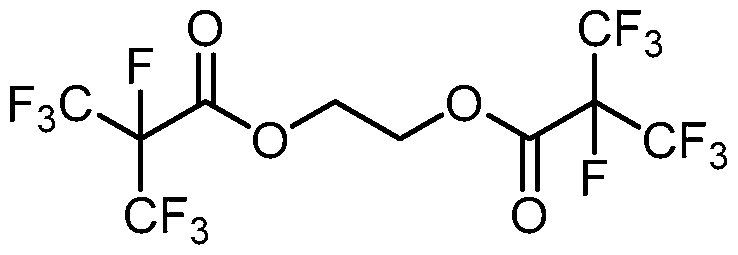
A clean, dry, 600 ml stainless steel Parr pressure reactor was charged with sodium fluoride (42 grams, 1.0 mol) and ethylene glycol (31 grams, 0.50 mol). The vessel was
sealed, brought to a vacuum of about 20 mmHg (2.7 kPa) and isolated, cooled with a dry- ice acetone bath, charged with heptafluoroisobutyryl fluoride (PE-1; 297 grams, 1.10 mol), warmed to about 25°C with high agitation and held for 16 hours. Methanol (32 grams, 1.0 mol) from a charge bomb was transferred to the reactor and stirred for 1 hour. The reactor pressure was vented and the contents was washed one time with one liter of water to afford 227.5 grams of material containing 81% of the desired 3-[2,3,3,3- tetrafluoro-2-(trifluoromethyl)propanoyl]oxyethyl 2,3,3,3-tetrafluoro-2- (trifluoromethyl)propanoate. The material was combined with three other preps and purified by vacuum fractionation using the same system as described in EX-1 to afford
99.7 % purity by 19F-NMR. Product was confirmed by 19F-NMR.
Example 3 (EX-3): Preparation of 4-[2,3,3,3-tetrafluoro-2-
(trifluoromethvDpropanovHoxybutyl 2,3,3,3-tetrafluoro-2-(trifluoromethyl)propanoate

A clean, dry 600 ml stainless steel Parr pressure reactor was charged with sodium fluoride (168 grams, 4.0 mol) and 1 ,4-butanediol (90 grams, 1.00 mol). The vessel was sealed, brought to a vacuum of about 20 mmHg (2.7 kPa) and isolated, cooled with a dry- ice acetone bath, charged with heptafluoroisobutyryl fluoride (548 grams, 2.03 mol), heated to 50 °C with high agitation and held for 16 hours. The reactor was cooled to 25 C and methanol (32 grams, 1.0 mol) from a charge bomb was transferred to the reactor and stirred for 1 hour. The reactor pressure was vented and the contents was filtered using a Buchner funnel to afford 432 grams containing 88.3 % of the desired 3-[2,3,3,3- tetrafluoro-2-(trifluoromethyl)propanoyl]oxybutyl 2,3,3,3-tetrafluoro-2- (trifluoromethyl)propanoate. The material was vacuum fractionation using the same system as EX-1 to afford 99.3 % purity by GC. The product was confirmed by GC/MS.
Example 4 (EX-4): Preparation of [l-methyl-3-[2,3,3,3-tetrafluoro-2- (trifluoromethvDpropanovHoxy-butvH 2,3,3,3-tetrafluoro-2-(trifluoromethyl)propanoate

A clean, dry 600 ml stainless steel Parr pressure reactor was charged with sodium fluoride (23.1 grams, 0.55 mol) and 2,4-pentanediol (26 grams, 0.25 mol). The vessel was sealed, brought to a vacuum of about 20 mmHg (2.7 kPa) and isolated, cooled with a dry- ice acetone bath, charged with heptafluoroisobutyryl fluoride (148.5 grams, 0.55 mol), heated slowly to 90°C with high agitation and held for 16 hours. The reactor was cooled to 25 °C and the reactor pressure was vented and the contents were centrifuged for 30 minutes at 2200 rpm's to afford 82.5 grams containing 90.5% of the desired [l-methyl-3- [2,3 ,3 ,3-tetrafluoro-2-(trifluoromethyl)propanoyl]oxy-butyl] 2,3 ,3 ,3-tetrafluoro-2- (trifluoromethyl)propanoate. The material was combined with three other preps and purified by vacuum fractionation using the same system as described in EX-1 to afford 99.5%) purity by GC. The product was confirmed by GC/MS.
Preparatory Example 2 (PE-2): Preparation of heptafluorobutyryl fluoride, C3F7COF
Heptafluorobutyryl fluoride was prepared by electrochemical fluorination of isobutyric anhydride in a Simons ECF cell as described in U.S. Pat. No. 2,713,593 (Brice et al.) and in R.E.Banks, Preparation, Properties, and Industrial Applications of
Organofluorine Compounds 19-43 (1982). The gaseous products from the cell were purified by fractional distillation to yield about 80 % purity heptafluorobutyryl fluoride with the remainder being mostly inert materials. The composition of heptafluorobutyryl fluoride consisted of 60%> 2,3,3,3-tetrafluoro-2-(trifluoromethyl)propanoyl fluoride, (CF3)2CFCOF, and 40% normal 2,2,3,3,4,4,4-heptafluorobutanoyl fluoride,
CF3CF2CF2COF, and was used in subsequent reaction without further purification. As used herein, the term "perfluorobutyryl fluorides" will refer to this mixture.
Example 5 (EX-5): Preparation of 2-(2,2,3,3,4,4,4-heptafluorobutanoyloxy)ethyl 2,3,3,3- tetrafluoro-2-(trifluoromethyl)propanoate

A clean, dry 2 liter stainless steel Parr pressure reactor was charged with sodium fluoride (186.7 grams, 4.44 mol) and ethylene glycol (114.7 grams, 1.85 mol). The vessel was sealed, brought to a vacuum of about 20 mmHg (2.7 kPa) and isolated, cooled with an internal water cooling loop, charged with perfluorobutyryl fluorides (PE-2; 1090 grams, 4.07 mol) over 4 hours and warmed to about 25 °C with high agitation and held for 64 hours. Methanol (128 grams, 4.0 mol) from a charge bomb was transferred to the reactor and stirred for 1 hour. The reactor pressure was vented and the contents was washed five times with water (1000 grams each wash) to afford 890 grams containing 87.8% of three isomers of the desired product. The material was vacuum fractionation using the same system as EX-1 to afford 99.7 % purity. The product was confirmed by GC/MS and 19F- NMR. The normalized isomer ratio of the final product was as follows (percentages were determined by 19F-NMR):
Material
Percenta e


Example 6 (EX-6): Preparation of [2-methyl-3-[2,3,3,3-tetrafluoro-2- (trifluoromethyl)propanoyl1oxy-2-rr2,3,3,3-tetrafluoro-2- (trifluoromethyl)propanoylloxymethyllpropyll 2,3,3,3-tetrafluoro-2- (trifluoromethvDpropanoate

A clean, dry 600 ml stainless steel Parr pressure reactor was charged with sodium fluoride (96.6 grams, 2.30 mol), l,l,l-tris(hydroxymethyl)ethane (94.4 grams, 0.73 mol), and methyl tert-butyl ether (20 grams). The vessel was sealed, cooled with a dry-ice acetone bath, charged with heptafluoroisobutyryl fluoride (PE-1; 621 grams, 2.3 mol), warmed to about 25 °C with high agitation, and held for 16 hours. Methanol (73.6 grams, 2.3 mol) from a charge bomb was transferred to the reactor and stirred for 1 hour. The reactor pressure was vented and the contents were washed three times water (1000 grams each wash) to afford 542 grams containing 65.2% of the desired [2-methyl-3-[2,3,3,3- tetrafluoro-2-(trifluoromethyl)propanoyl]oxy-2-[[2,3,3,3-tetrafluoro-2- (trifluoromethyl)propanoyl]oxymethyl]propyl] 2,3,3,3-tetrafluoro-2- (trifluoromethyl)propanoate, according to GC analysis. This material was combined with 2 other preps and purified by vacuum fractionation using the same system as described in EX-1 to afford material having 99.4% purity by GC. The product was confirmed by GC/MS.
Example 7 (EX-7): Preparation of 2,3-bis[[2,3,3,3-tetrafluoro-2-
(trifluoromethyl)propanoylloxylpropyl 2,3,3,3-tetrafluoro-2-(trifluoromethyl)propanoate

A clean, dry 600 ml stainless steel Parr pressure reactor was charged with sodium fluoride (96.6 grams, 2.3 mol) and glycerol (55 grams, 0.60 mol). The vessel was sealed, brought to a vacuum of about 20 mmHg (2.7 kPa) and isolated, cooled with a dry-ice acetone bath, charged with heptafluoroisobutyryl fluoride (PE-1 ; 600 grams, 3.83 mol), slowly heated to 70°C with high agitation and held for 64 hours. The reactor was cooled to 25 °C and the pressure was vented. The reactor contents were washed several times with one liter of water to afford 456 grams containing 13.3 % of the desired triester and 76% diesters. This material was added back to a clean, dry, 600 ml, stainless steel, Parr, pressure reactor along with sodium fluoride (40 grams, 1.0 mol). The vessel was sealed, brought to a vacuum of about 20 mmHg (2.7 kPa) and isolated, cooled with a dry-ice acetone bath, charged with heptafluoroisobutyryl fluoride (PE-1; 230 grams, 0.65 mol), and slowly heated to 70°C with high agitation and held for 16 hours. The reactor was cooled to 25 °C and the pressure was vented. The reactor contents were washed several times with one liter of water to afford 465 grams containing 80% of the desired triester. The material was vacuum fractionated using the same system as described in EX-1 to afford material having 97.6% purity by GC. The product was confirmed by GC/MS.
Example 8 (EX-8): Preparation of [3-[2,3, 3,3-tetrafluoro-2- (trifluoromethyl)propanoyl1oxy-2,2-bisrr2,3,3,3-tetrafluoro-2- (trifluoromethyDpropanoylloxymethyllpropyl] 2,3,3,3-tetrafluoro-2- (trifluoromethvDpropanoate

A clean, dry 600 ml stainless steel Parr pressure reactor was charged with ethylene glycol dimethyl ether (62 grams) and pentaerythritol (50 grams, 0.37 mol). The vessel was sealed and cooled with a dry-ice acetone bath, charged with heptafluoroisobutyryl fluoride (PE-1; 423 grams, 1.57 mol), then slowly heated to 70 °C with high agitation and held for 64 hours. The reactor was cooled to 25 °C, pressure was vented, and the reactor contents were titrated with 45 wt.% aqueous KOH (135 ml) to bring the pH up to 6. The mixture was phase split to remove the aqueous phase and the bottom product phase was washed one time with 500 grams of water. The bottom product phase was centrifuged at 2,200 rpm for one hour. The bottom product phase was then removed and purified by vacuum fractionation using the same system as described in EX-1 to afford 208 grams at 95.1% purity by GC. The desired product was confirmed by GC/MS.
Preparatory Example 3 (PE-3): Preparation of intermediate heptafluorobutyryl fluoride,

Heptafluorobutyryl fluoride was prepared by electrochemical fluorination of isobutyric anhydride in a Simons ECF cell as described in U.S. Pat. No. 2,713,593 (Brice et al.) and in R.E.Banks, Preparation, Properties, and Industrial Applications of
Organofluorine Compounds 19-43 (1982). The gaseous products from the cell were
further purified by fractional distillation to yield material having 65.1% CF3CF2CF2COF and 4.9% (CF3)2CFCOF (l^F-NMR purity values) with the remainder being inert materials. This mixture was used in subsequent reactions without further purification. As used herein, the term "n-perfluorobutyryl fluoride" will refer to this mixture.
Comparative Example 1 (CE-1): Preparation of [3-(2,2, 3,3,4,4,4- heptafluorobutanoyloxy)-2,2-bis(2,2,3,3,4,4,4-heptafluorobutanoyloxymethyl)propyl1
2,2,3,3,4,4,4-heptafluorobutanoate

A clean, dry, 600 ml, stainless steel, Parr, pressure reactor was charged with ethylene glycol dimethyl ether ( 62 grams) and pentaerythritol (50 grams, 0.37 mol). The vessel was sealed and cooled with a dry-ice acetone bath, charged with n-perfluorobutyryl fluoride (PE-3; 500 grams, 1.62mol), slowly heated to 65 °C with high agitation and held for 16 hours. The reactor was cooled to 25 °C. Methanol (32 grams, 1.0 mol) from a charge bomb was transferred to the reactor and stirred for 1 hour. The reactor pressure was vented and the contents were washed two times with one liter of water used for each wash to afford 339 grams at 80% purity (by 19F-NMR) of the desired tetra ester. The mixture was purified by vacuum fractionation using the same system as described in EX- 1.
Preparatory Example 4 (PE-4): Preparation of intermediate 2,3,3,4,4,4-hexafluoro-2-
(1,1 ,2,2,2-pentafluoroethvObutanoyl fluoride

The 2,3,3,4,4,4-hexafluoro-2-(l ,l,2,2,2-pentafluoroethyl)butanoyl fluoride was prepared by electrochemical fluorination of ethyl 2-ethylbutyrate (purchased from TCI America, Montgomeryville, PA) in a Simons ECF cell as described in U.S. Pat. No.
2,713,593 (Brice et al.) and in R.E.Banks, Preparation, Properties, and Industrial
Applications of Organofluorine Compounds 19-43 (1982). The gaseous products from the cell were further purified by fractional distillation to yield 2,3,3,4,4,4-hexafluoro-2-
(l,l,2,2,2-pentafluoroethyl)butanoyl fluoride having a purity of about 48% (by l^F- NMR), with the remainder being mostly inert. As used herein, the term "perfluoro-2- ethylbutyryl fluoride" will refer to this mixture.
Example 9 (EX-9): Preparation of methyl 2,3,3,4,4,4-hexafluoro-2-(l,l,2,2,2- pentafluoroethvDbutanoate

A one liter poly-bottle was charged with anhydrous methanol (96 grams, 3.0 mol), capped, cooled with a dry-ice acetone bath, charged with perfluoro-2-ethylbutyryl fluoride (PE-4; 658 grams, 1.0 mol), in about 150 gram increments, mixed by shaking, then cooled in the dry-ice acetone batch before adding the next increment. Once the final charge had been added and the heat removed, the sample was allowed to sit for two hours. The reaction mixture was washed three times with water (500 grams per wash) to afford 649 grams at 49.1% purity (by GC) of the desired ester. The ester was purified by vacuum
fractionation using silver coated, vacuum jacketed, 10 perforated plate, internal bellows, distillation column, available from Ace Glass Incorporated, Vineland, NJ. The desired product was confirmed by GC/MS.
Example 10 (EX- 10): Preparation of ethyl 2,3.3.4,4,4-hexafluoro-2-(T , 1,2,2,2- pentafluoroethvDbutanoate

The prep and purification was completed essentially the same as for EX- 10, except that instead of using anhydrous methanol, 200 proof ethanol (138 grams, 3 mol, dried over 3 A molecular sieves for 3 days) was used. This procedure recovered 657 grams containing 50.5% (by GC) of the desired ester. The product was confirmed by GC/MS.
Example 11 (EX-11): Preparation of isopropyl 2, 3,3,4,4,4-hexafluoro-2-(l, 1,2,2,2- pentafluoroethvDbutanoate

The prep and purification was completed essentially the same as EX-9, except instead of using anhydrous methanol, anhydrous 2-propanol (180 grams, 3 mol) was used. This procedure recovered 673 grams containing 50.7%> (by GC) of the desired ester. The desired product was confirmed by GC/MS.
Example 12 (EX-12): Preparation of 1-ethylpropyl 2,3,3,4,4,4-hexafluoro-2-(l,l,2,2,2- pentafluoroethvDbutanoate

A one liter poly-bottle was charged with 3-pentanol ( 96 grams, 3.0 mol), capped, cooled with a dry-ice acetone bath, charged with perfluoro-2-ethylbutyryl fluoride (PE-4; 658 grams, 1.0 mol), in about 150 gram increments, mixed by shaking, then cooled in the dry-ice acetone batch before adding the next increment. Once the final charge has been added and the heat removed, the contents was transferred to a clean, dry, 600 ml, stainless steel, Parr, pressure reactor. The reactor was sealed and heated to 65°C and held for 64 hours. The material was phase split and the lower product phase was washed three times with water (500 grams per wash) to afford 674 grams at 54.7 % desired ester. The material was fractionated using the same system as EX-1 to obtain a purity of 88.3% (by GC) of the desired ester. The desired ester was confirmed by GC/MS.
Preparative Example 5 (PE-5): Preparation of intermediate ECF cell feed methyl 2- methyl-3 -morpholino-propanoate
Morpholine (1200 grams, 13.8 mol) and methanol (604 grams) were charged to a 3 neck, 5 liter round bottom flask equipped with an overhead stirrer, thermocouple, pressure equalizing addition funnel, and cold water condenser. Methyl methacrylate (1379.6 grams, 13.8 mol) was added over the course of 2.5 hours with stirring at 40 °C. The reaction was held at 50 °C for 5 days. The methanol and unreacted materials were removed by single plating under reduced pressure at 50 °C to afford 2331.2 grams of product with a purity of 91.7%. This material was feed to the ECF cell without further purification.
Preparative Example 6 (PE-6): 2-[difluoro-(2,2, 3,3, 5,5,6, 6-octafluoromorpholin-4- yl)methyl1-2,3,3,3-tetrafluoro-propanoyl fluoride
The 2-[difluoro-(2,2,3, 3,5, 5,6, 6-octafluoromorpholin-4-yl)methyl]-2, 3,3,3- tetrafluoro-propanoyl fluoride was prepared by electrochemical fluorination of methyl 2- methyl-3-morpholino-propanoate (PE-5) in a Simons ECF cell as described in U.S. Pat. No. 2,713,593 (Brice et al.) and in R.E.Banks, Preparation, Properties, and Industrial Applications of Organofluorine Compounds 19-43 (1982). The gaseous products from the cell were further purified by fractional distillation to yield about 86.9% purity (by l^F- NMR) (2-[difluoro-(2,2,3,3,5,5,6,6-octafluoromorpholin-4-yl)methyl]-2,3,3,3-tetrafluoro- propanoyl fluoride with the remainder being mostly inert materials. This mixture was used in subsequent reactions without further purification. As used herein, the term "perfluoromorpholino methacrylate acyl fluoride" will refer to this mixture.
Example 13 (EX-13): Preparation of methyl 2-[difluoro-(2,2, 3,3, 5, 5,6, 6- octafluoromorpholin-4-yl)methyl1-2,3,3,3-tetrafluoro-propanoate.

Example 14 (EX-14): Preparation of ethyl 2-rdifluoro-(2,2,3,3,5,5,6,6- octafluoromorpholin-4-yl)methyll-2,3,3,3-tetrafluoro-propanoate

Using techniques similar to those described for EX-13, 200 proof ethanol ( 200 grams, 4.3 mol, dried over 3 Ang. molecular sieves for 3 days) was reacted with perfluoromorpholino methacrylate acyl fluoride (PE-6; 468 grams, 0.95 mol) to afford 462 grams at 86.4 % purity (by GC) of the desired material. The material was purified by fractional distillation using the same column described in EX-13. The desired product was confirmed by GC/MS.
Example 15 (EX-15): Preparation of isopropyl 2-[difluoro-(2,2,3, 3,5, 5, 6,6- octafluoromorpholin-4-yl)methyl1-2,3,3,3-tetrafluoro-propanoate
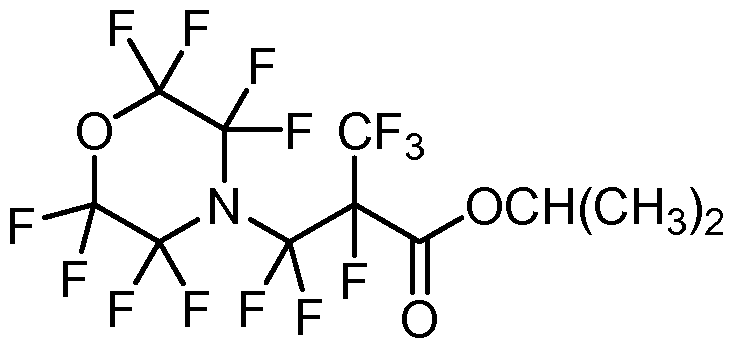
Using techniques similar to those described for EX-13, anhydrous 2-propanol (240 grams, 4.0 mol) was reacted with perfluoromorpholino methacrylate acyl fluoride (PE-6; 491 grams, 1.0 mol) to afford 515 grams at 87.6 % purity (by GC) of the desired material. The material was purified by fractional distillation using the same column described in EX-1. The desired product was confirmed by GC/MS.
Preparative Example 7 (PE-7): Preparation of intermediate ECF cell feed methyl 2- methyl-3-pyrrolidino-propanoate.
Pyrrolidine (871.3 grams, 12.25mol) and methanol (332 grams) were charged to a 3 neck, 3 liter round bottom flask equipped with an overhead stirrer, thermocouple, pressure equalizing addition funnel, and cold water condenser. Methyl methacrylate (1226.8 grams, 12.25mol) was added over the course of 2.5 hours and held at 50 °C for 24 hours. The methanol and unreacted materials were removed by single plating under reduced pressure at 45 °C to afford 2002.5 grams of product with a purity of 96.6%. This material was fed to the ECF cell without further purification.
Preparative Example 8 (PE-8): 2-rdifluoro-(2,2, 3,3,4,4, 5, 5-octafluoropyrrolidin-l- yl)methyll-2,3,3,3-tetrafluoro-propanoyl fluoride
The 2-[difluoro-(2,2,3, 3,4,4, 5,5-octafluoropyrrolidin-l-yl)methyl]-2,3, 3,3- tetrafluoro-propanoyl fluoride was prepared by electrochemical fluorination of methyl 2- methyl-3-pyrrolidin-l-yl-propanoate (PE-7) in a Simons ECF cell as described in U.S. Pat. No. 2,713,593 (Brice et al.) and in R.E.Banks, Preparation, Properties, and Industrial Applications of Organofluorine Compounds 19-43 (1982). The gaseous products from the cell contained about 64%> 2-[difluoro-(2,2,3, 3,4,4,5 ,5-octafluoropyrrolidin-l-yl)methyl]- 2,3,3,3-tetrafluoro-propanoyl fluoride with about another 16%> of other acyl fluorides and the remaining 20% being mostly inert materials. This mixture was used in subsequent reactions without further purification. As used herein, the term "perf uoropyrrolidino methacrylate acyl fluoride" refers to this mixture.
Example 16 (EX-16): Preparation of methyl 2-[difluoro-(2,2, 3,3,4,4,5, 5- octafluoropyrrolidin-l-yl)methyl1-2,3,3,3-tetrafluoro-propanoate

Example 17 (EX-17): Preparation of propyl 2-|"difluoro-(2,2, 3,3,4,4, 5,5- octafluoropyrrolidin-l-yl)methyl1-2,3,3,3-tetrafluoro-propanoate

Using techniques similar to those described for EX-16, anhydrous 1-propanol ( 300 grams, 5.0 mol) was reacted with perfluoropyrrolidino methacrylate acyl fluoride (PE-8; 1019 grams, 1.98 mol) to afford 1100 grams at 80.7%> purity (by GC) of desired material. The material was purified by fractional distillation using the same column described in EX-13. The desired product was confirmed by GC/MS.
Example 18 (EX-18V Preparation of allyl 2-rdifluoro-(2,2,3,3,4,4,5,5- octafluoropyrrolidin-l-yl)methyll-2,3,3,3-tetrafluoro-propanoate

perfluoropyrrolidino methacrylate acyl fluoride (PE-8; 978 grams, 1.90 mol) to afford 1034.7 grams at 79.4% purity (by GC) of desired material. The material was purified by vacuum distillation using the same column described in EX-1. The desired product was confirmed by GC/MS.
Example 19 (EX-19): Preparation of 2-methoxyethyl 2-rdifluoro-(2,2,3,3,4,4,5,5- octafluoropyrrolidin-l-yl)methyll-2,3,3,3-tetrafluoro-propanoate

Using techniques similar to those described for EX- 16, 2-methoxy ethanol ( 300 grams, 3.95 mol, dried over 3 A molecular sieves for 3 days) was reacted with
perfluoropyrrolidino methacrylate acyl fluoride (1030 grams, 2.00 mol) to afford 1034.7 grams at 37.4% purity (by GC) of desired material. The material was purified by vacuum distillation using the same column described in EX-1. The desired product was confirmed by GC/MS. Preparatory Example 9 (PE-9): Preparation of intermediate ECF cell feed methyl 2- methyl-3 -(4-methyl- 1 -piperidyDpropanoate.
The 4-methylpiperdine (1608.6 grams, 16.2 mol) and methanol (868 grams) were charged to a 3 neck, 5 liter round bottom flask equipped with an overhead stirrer, thermocouple, pressure equalizing addition funnel, and cold water condenser. Methyl methacrylate
(1624.0 grams, 16.2 mol) was added over the course of 2 hours and held at 50 °C for 16 hours. The methanol and unreacted materials were removed by single plating under reduced pressure at 50 °C to afford 3058.1 grams of product with a purity of 91.6%. This material was feed to the ECF cell without further purification.
Preparatory Example 10: 2-rdifluoro-r2,2,3,3,4,5,5,6,6-nonafluoro-4-(trifluoromethyl)-l- piperidyllmethyl]-2,3,3,3-tetrafluoro-propanoyl fluoride
The 2-[difluoro-[2,2, 3,3,4,5, 5,6, 6-nonafluoro-4-(trifluoromethyl)-l- piperidyl]methyl]-2,3,3,3-tetrafluoro-propanoyl fluoride was prepared by electrochemical fluorination of methyl 2-methyl-3-(4-methyl-l-piperidyl)propanoate in a Simons ECF cell as described in U.S. Pat. No. 2,713,593 (Brice et al.) and in R.E.Banks, Preparation, Properties, and Industrial Applications of Organofluorine Compounds 19-43 (1982). The gaseous products from the cell were further purified by fractional distillation to yield about 86.9 % functional acyl fluoride material with the remaining being mostly inert materials. This mixture was used in subsequent reactions without further purification. As used herein, the term "perfluoromethylpiperdino methacrylate acyl fluoride" refers to this mixture.
Example 20: Preparation of methyl 2-[difluoro-[2,2,3,3,4,5,5,6,6-nonafluoro-4-
(trifluoromethvD- 1 -piperidyllmethyll-2,3,3 ,3-tetrafluoro-propanoate

A one liter poly-bottle was charged with anhydrous methanol (102.1 grams, 3.2 mol), capped, cooled with a dry-ice acetone bath, charged with perfluoromethylpiperdino methacrylate acyl fluoride (PE-10; 813 grams, 1.38 mol), in about 150 gram increments, mixed by shaking, then cooled in the dry-ice acetone batch before adding the next increment. Once the final charge was added and the heat removed, the sample was allowed to sit for two hours. The reaction mixture was washed three times with water (500 grams per wash) to afford 803 grams with 80.6% of the material having a methyl
ester functionality. The material was purified by fractional distillation using the same column described in EX-13.
Example 21 (EX-21): Preparation of ethyl 2-rdifluoro-r2,2,3,3,4,5,5,6,6-nonafluoro-4- (trifluoromethyl)- 1 -piperidyllmethyl]-2,3,3 ,3-tetrafluoro-propanoate

Using techniques similar to those described for EX-20, 200 proof ethanol ( 147.2 grams, 3.2 mol, dried over 3 Ang. molecular sieves for 3 days) was reacted with perfluoromethylpiperdino methacrylate acyl fluoride (PE-10; 813 grams, 1.38 mol) to afford 838 grams with 86.5% of the material having an ethyl ester functionality. The material was purified by fractional distillation using the same column described in EX-13.
Example 22 (EX-22): Preparation of propyl 2-[difluoro-[2,2, 3,3,4,5, 5,6, 6-nonafluoro-4-
(trifluoromethyl)- 1 -piperidyllmethyll-2,3,3 ,3-tetrafluoro-propanoate

Using techniques similar to those described in EX-20, anhydrous 1-propanol (192.0 grams, 3.2 mol) was reacted with perfluoromethylpiperdino methacrylate acyl fluoride (PE-10; 808 grams, 1.37 mol) to afford 843 grams with 88.2% of the material having propyl ester functionality. The material was purified by vacuum distillation using the same column described in EX-1.
Example 23 (EX-23): Preparation of allyl 2-[difluoro-[2,2,3,3,4,5,5,6,6-nonafluoro-4- (trifluoromethyl)- 1 -piperidyllmethyll-2,3,3 ,3-tetrafluoro-propanoate

Using techniques similar to those described for EX-20, allyl alcohol (185.6 grams, 3.2 mol, dried over 3 A molecular sieves for 3 days) was reacted with
perfluoromethylpiperdino methacrylate acyl fluoride (PE-10; 813 grams, 1.38 mol) to afford 856.8 grams with 86.1% of the material having allyl ester functionality. The material was purified by vacuum distillation using the same column described in EX-1.
Example 24 (EX-24): Preparation of isopropyl 2-rdifluoro-r2,2,3,3,4,5,5,6,6-nonafluoro- 4-(trifluoromethyl)- 1 -piperidyllmethyl]-2, 3 ,3 ,3-tetrafluoro-propanoate

Using techniques similar to those described for EX-20, anhydrous 2-propanol (192.0 grams, 3.2 mol) was reacted with perfluoromethylpiperdino methacrylate acyl fluoride (PE-10; 813 grams, 1.38 mol) to afford 856.8 grams with 83.1% of the material having isopropyl ester functionality. The material was purified by vacuum distillation using the same column described in EX-1.
Preparatory Example 11 (PE-11): Preparation of intermediate ECF cell feed methyl 3- (3 ,5 -dimethyl- 1 -piperidvD-2-methyl-propanoate
The 3,5-dimethylpiperdine (617.6 grams, 5.4mol) and methanol (479 grams) were charged to a 3 neck, 3 liter round bottom flask equipped with an overhead stirrer, thermocouple, pressure equalizing addition funnel, and cold water condenser. Methyl methacrylate (596.4 grams, 5.96mol) was added over the course of 30 minutes and held at 50 °C for 24 hours. The methanol and unreacted materials were removed by single plating under reduced pressure at 50 °C to afford 1065.3 grams of product with a purity of 95.1%. This material was feed to the ECF cell without further purification.
Preparatory Example 12 (PE-12): 2-[difluoro-[2,2,3,4,4,5,6,6-octafluoro-3,5- bis(trifluoromethyl)- 1 -piperidvHmethyll-2,3 ,3 ,3 -tetrafluoro-propanoyl fluoride
The 2-[difluoro-[2,2,3,4,4,5,6,6-octafluoro-3,5-bis(trifluoromethyl)-l- piperidyl]methyl]-2,3,3,3-tetrafluoro-propanoyl fluoride was prepared by electrochemical fluorination of methyl 2-methyl-3-(4-methyl-l-piperidyl)propanoate (PE-11) in a Simons ECF cell as described in U.S. Pat. No. 2,713,593 (Brice et al.) and in R.E.Banks,
Preparation, Properties, and Industrial Applications of Organofluorine Compounds 19-43 (1982). The gaseous products from the cell consisted of about 75.3 % functional acyl fluoride material with the remaining being mostly inert materials. This mixture was used in subsequent reactions without further purification. As used herein, the term
"perf uorodimethylpiperdino methacrylate acyl fluoride" will refer to this mixture.
Example 25 (EX-25): Preparation of methyl 2-[difluoro-[2,2, 3,4,4,5, 6,6-octafluoro-3, 5- bis(trifluoromethyl)-l-piperidyl1methyl1-2,3,3,3-tetrafluoro-propanoate

perfluorodimethylpiperdino methacrylate acyl fluoride (PE-12; 1059 grams, 1.42 mol), in about 150 gram increments, mixed by shaking, then cooled in the dry-ice acetone batch before adding the next increment. Once the final charge has been added and the heat removed, the sample is allowed to sit for two hours. The reaction mixture is washed three times with water (500 grams per wash) to afford 1009 grams with 79.2% of the material having a methyl ester functionality. The material was purified by fractional distillation using the same column described in EX-13.
Example 26 (EX-26): Preparation of propyl 2-[difluoro-[2,2, 3,4,4,5, 6,6-octafluoro-3, 5- bis(trifluoromethyl)-l-piperidyl1methyl1-2,3,3,3-tetrafluoro-propanoate

Using techniques similar to those described for EX-26, anhydrous 1-propanol (600 grams, 10.0 mol) was reacted with perfluorodimethylpiperdino methacrylate acyl fluoride (PE-12; 1394 grams, 1.87 mol) to afford 1394 grams with 76.3% of the material having propyl ester functionality. The material was purified by vacuum distillation using the same column described in EX-1.
Test data for the compounds of EX-1 to EX-27 and CE-1 was obtained according to Test Methods described above, with results as summarized in Table 1.
TAB ,E 1

TAB ,E 1

TAB ,E 1

TAB ,E 1

Kinematic viscosity was determined for select samples, according to the method described in the Test Methods section above, with results as summarized in Table 2.
TABLE 2

Claims
What is claimed is:
1. A fluorinated ester of the formula:

wherein,
each of Rf1 and Rf2 are independently a perfluorinated group;
wherein the number of total perfluorinated carbon atoms is > 4 when x is 1 , and the number of total perfluorinated carbon atoms is > 3 when x is 2-4,
R1 is a (hetero)hydrocarbyl group of valence x; and
x is lto 4.
2. The fluorinated ester of claim 1 , where x is 1.
3. The fluorinated ester of claim 2, where x is 1 and Rl is a C1-C8 alkyl.
4. The fluorinated ester of claim 1, where x is 2-4 and Rl is a C2-C8 alkyl.
5. The fluorinated ester of claim 1 wherein Rfl and Rf2 are taken together to form a perfluorinated ring.
6. The fluorinated ester of claim 1 wherein Rfl and Rf2 are taken together to form a cyclobutyl, cyclopentyl, cyclohexyl or tetrahydrofuran rings.
7. The fluorinated ester of claim 1, wherein each of Rfl and Rf2 are perfluoroalkyl groups having from 1 to about 12 perfluorinated carbon atoms.
8. The fluorinated ester of claim 1 of the formula:

wherein
each of Rf3, Rf4 and Rf5 are independently a perfluorinated group,
y is 1-4; and
R1 is a (hetero)hydrocarbyl group of valence y.
9. The fluorinated ester of claim 8 where y is 1 and R1 is Ci-Cs alkyl.
10. The fluorinated ester of claim 8, where y is 2-4 and R1 is a C2-Cs alkylene.
1 1. The fluorinated ester of claim 8 wherein Rf4 and Rf5 are taken together to form a perfluorinated piperazine, piperidine , morpholine or pyrrolidine ring.
12. The fluorinated ester of claim 8 wherein at least one of Rf4 and Rf5 are cyclobutyl, cyclopentyl, cyclohexyl or tetrahydrofuran rings.
13. The fluorinated ester of any of the previous claims wherein x is 2-4 and R1 is an C2-C8 alkylene.
14. The fluorinated ester of claim 1 of the formula:

each of Rf3, Rf4 and Rf5 are independently a perfluorinated group,
y is 1-4; and
R1 is a (hetero)hydrocarbyl group of valence y.
The fluorinated ester of claim 14 where y is 1 and R1 is Ci-Cs alkyl.
16. The fluorinated ester of claim 14, where y is 2-4 and R1 is a C2-Cs alkyl.
17. The fluorinated ester of claim 14 wherein Rf and Rf5 are taken together to form a perfluorinated piperazine, piperidine , morpholine or pyrrolidine ring.
18. The fluorinated ester of claim 14 wherein at least one of Rf4 and Rf5 are
cyclobutyl, cyclopentyl, cyclohexyl or tetrahydrofuran rings.
19. The fluorinated ester of claim 1 wherein at least one of Rfl and Rf2 is a
perfluoroether group.
20. The fluorinated ester of claim 19 wherein at least one of Rfl and Rf2 is a
perfluoropoly ether group.
21. The fluorinated ester of any of the previous claims wherein
(# C-F bonds + # S-F bonds) / (#C-F bonds + #C-H bonds +#C-C bonds + # C-N bonds + # C-S bonds) * 100 is >40.
22. The fluorinated ester of any of the previous claims having a boiling point of > 100°C.
23. The fluorinated ester of any of the previous claims having a dielectric strength of > 30 kV at 0.1 inches.
24. The fluorinated ester of any of the previous claims being fluid at < 50°C.
25. The fluorinated ester of any of the previous claims being non-flammable when tested according to ASTM D 7236-06.
26. An electrical device containing as a component a dielectric liquid comprising the fluorinated ester of any of the previous claims.
27. The electrical device according to claim 26, wherein the electrical device is an electrical capacitor comprising metal electrodes spaced from each other, and such that the dielectric fluid fills the space between the electrodes.
28. The electrical device according to claim 27 further comprising a capacitor comprising dielectric solid sheets impregnated with the dielectric liquid.
29. An apparatus for heat transfer comprising: a device; and a mechanism for
transferring heat to or from the device, the mechanism comprising a heat transfer fluid, wherein the device is selected from a microprocessor, a semiconductor wafer used to manufacture a semiconductor device, a power control semiconductor, an electrochemical cell, electrical distribution switch gear, a power transformer, a circuit board, a multi-chip module, a packaged or unpackaged semiconductor device, a fuel cell, and a laser, and wherein the heat transfer fluid comprises a fluorinated ester of any of claims 1 to 25.
30. The apparatus according to claim 29 wherein the heat transfer fluid has a specific heat capacity of greater than 1.200 J/gK at 20°C.
31. The apparatus according to claim 29 wherein the heat transfer fluid has a specific heat capacity of greater than 1.250 J/gK at 20 °C.
32. The apparatus according to claim 29, wherein the mechanism transfers heat to the device.
33. The apparatus according to claim 29, wherein the mechanism transfers heat from the device.
34. The apparatus according to claim 29, wherein the mechanism maintains the device at a selected temperature.
35. The apparatus according to claim 29, wherein the mechanism for transferring heat is a component in a system for cooling the device, wherein the system is selected from a system for cooling wafer chucks in PECVD tools, a system for controlling temperature in test heads for die performance testing, a system for controlling temperatures within semiconductor process equipment, a thermal shock testing of an electronic device, and a system for maintaining a constant temperature of an electronic device.
36. A method for transferring heat comprising: providing a device; and providing a mechanism for transferring heat to or from the device, the mechanism comprising a heat transfer fluid, wherein the device is selected from a microprocessor, a semiconductor wafer used to manufacture a semiconductor device, a power control semiconductor, an electrochemical cell, electrical distribution switch gear, a power transformer, a circuit board, a multi-chip module, a packaged or unpackaged semiconductor device, a fuel cell, and a laser, and wherein the heat transfer fluid comprises a fluorinated ester of any of claims 1 to 25.
Applications Claiming Priority (2)
| Application Number | Priority Date | Filing Date | Title |
|---|---|---|---|
| US201462068019P | 2014-10-24 | 2014-10-24 | |
| US62/068,019 | 2014-10-24 |
Publications (1)
| Publication Number | Publication Date |
|---|---|
| WO2016064585A1 true WO2016064585A1 (en) | 2016-04-28 |
Family
ID=54478206
Family Applications (1)
| Application Number | Title | Priority Date | Filing Date |
|---|---|---|---|
| PCT/US2015/054580 Ceased WO2016064585A1 (en) | 2014-10-24 | 2015-10-08 | Segregated fluorinated esters |
Country Status (1)
| Country | Link |
|---|---|
| WO (1) | WO2016064585A1 (en) |
Cited By (10)
| Publication number | Priority date | Publication date | Assignee | Title |
|---|---|---|---|---|
| WO2018057134A1 (en) * | 2016-09-26 | 2018-03-29 | 3M Innovative Properties Company | Nitrogen and/or oxygen-containing hydrofluoroolefins and methods of making and using the same |
| JP2018524291A (en) * | 2015-06-05 | 2018-08-30 | スリーエム イノベイティブ プロパティズ カンパニー | Hydrofluoroolefin and method of using the same |
| JP2018525327A (en) * | 2015-06-05 | 2018-09-06 | スリーエム イノベイティブ プロパティズ カンパニー | Hydrofluoroolefin and method of using the same |
| GB2577315A (en) * | 2018-09-21 | 2020-03-25 | Mexichem Fluor Sa De Cv | Methods |
| CN111205197A (en) * | 2020-01-02 | 2020-05-29 | 黎明化工研究设计院有限责任公司 | Method and device for continuously preparing heptafluoroisobutyramide |
| WO2021008949A1 (en) * | 2019-07-18 | 2021-01-21 | Solvay Specialty Polymers Italy S.P.A. | Heat exchange method using fluorinated compounds having a low gwp |
| US10954184B2 (en) | 2015-12-07 | 2021-03-23 | Mexichem Fluor S.A. De C.V. | Fluorinated esters as lubricants for heat transfer fluids |
| US11739243B2 (en) | 2018-12-21 | 2023-08-29 | Honeywell International Inc. | Azeotrope or azeotrope-like compositions of 1,2,2-trifluoro-1-trifluoromethylcyclobutane (TFMCB) and applications thereof |
| CN117603661A (en) * | 2023-10-30 | 2024-02-27 | 武汉肯达科讯科技有限公司 | A kind of fluorinated liquid composition and its application |
| US12534657B2 (en) | 2022-03-23 | 2026-01-27 | Nano And Advanced Materials Institute Limited | Two-phase immersion cooling |
Citations (20)
| Publication number | Priority date | Publication date | Assignee | Title |
|---|---|---|---|---|
| US2713593A (en) | 1953-12-21 | 1955-07-19 | Minnesota Mining & Mfg | Fluorocarbon acids and derivatives |
| US3184533A (en) | 1961-08-16 | 1965-05-18 | Du Pont | Method and apparatus for preventing carbon deposits in electrical apparatus containing electronegatively substituted dielectric fluids |
| GB1242180A (en) | 1968-12-18 | 1971-08-11 | Siemens Ag | Improvements in or relating to impregnated electrical capacitors |
| JPS58109141A (en) * | 1981-12-21 | 1983-06-29 | Tokuyama Soda Co Ltd | Method for manufacturing cation exchanger |
| JPS6058417A (en) * | 1983-09-09 | 1985-04-04 | Asahi Glass Co Ltd | Production of polyurethane elastomer |
| US4899249A (en) | 1988-04-21 | 1990-02-06 | Pennwalt Corporation | Fluorine-containing dielectric media and capacitors employing such media |
| US5159527A (en) * | 1991-12-05 | 1992-10-27 | Minnesota Mining And Manufacturing Company | Dielectric liquids |
| WO1998019988A1 (en) * | 1996-11-01 | 1998-05-14 | Minnesota Mining And Manufacturing Company | Alpha-branched fluoroalkylcarbonyl fluorides and their derivatives |
| WO1999026992A1 (en) * | 1997-11-25 | 1999-06-03 | Minnesota Mining And Manufacturing Company | Room temperature curable silane terminated and stable waterborne polyurethane dispersions which contain fluorine and/or silicone and low surface energy coatings prepared therefrom |
| USRE37119E1 (en) | 1995-10-20 | 2001-04-03 | 3M Innovative Properties Company | Hydrofluoroethers as low temperature refrigerants |
| US6374907B1 (en) | 1999-10-08 | 2002-04-23 | 3M Innovative Properties Company | Hydrofluoroether as a heat-transfer fluid |
| EP1300386A1 (en) * | 2000-07-11 | 2003-04-09 | Asahi Glass Company, Limited | Method for producing fluorine-containing compound |
| JP2004346014A (en) * | 2003-05-22 | 2004-12-09 | Asahi Glass Co Ltd | Method for producing perfluorodivinyl ether |
| WO2008070606A1 (en) * | 2006-12-06 | 2008-06-12 | 3M Innovative Properties Company | Hydrofluoroethξr compounds and processes for their preparation and use |
| WO2011090992A1 (en) * | 2010-01-25 | 2011-07-28 | 3M Innovative Properties Company | Perfluoroketones as gaseous dielectrics |
| WO2011119456A1 (en) * | 2010-03-26 | 2011-09-29 | 3M Innovative Properties Company | Nitrogen-containing fluoroketones for high temperature heat transfer |
| CN102584589A (en) * | 2011-10-20 | 2012-07-18 | 湖北固润科技股份有限公司 | Ester group linked vinyl ether organic fluorine cationic polymerization monomer and synthetic method |
| WO2013151741A1 (en) * | 2012-04-04 | 2013-10-10 | 3M Innovative Properties Company | Fluorinated nitriles as dielectric gases |
| JP2015163662A (en) * | 2014-02-28 | 2015-09-10 | 三菱マテリアル電子化成株式会社 | Nonionic fluorine-containing surfactant, method for producing the same, and fluorine resin dispersant |
| WO2015152273A1 (en) * | 2014-03-31 | 2015-10-08 | 三菱マテリアル株式会社 | Fluorine-containing compound, polymer composition, and surface treatment agent |
-
2015
- 2015-10-08 WO PCT/US2015/054580 patent/WO2016064585A1/en not_active Ceased
Patent Citations (21)
| Publication number | Priority date | Publication date | Assignee | Title |
|---|---|---|---|---|
| US2713593A (en) | 1953-12-21 | 1955-07-19 | Minnesota Mining & Mfg | Fluorocarbon acids and derivatives |
| US3184533A (en) | 1961-08-16 | 1965-05-18 | Du Pont | Method and apparatus for preventing carbon deposits in electrical apparatus containing electronegatively substituted dielectric fluids |
| GB1242180A (en) | 1968-12-18 | 1971-08-11 | Siemens Ag | Improvements in or relating to impregnated electrical capacitors |
| JPS58109141A (en) * | 1981-12-21 | 1983-06-29 | Tokuyama Soda Co Ltd | Method for manufacturing cation exchanger |
| JPS6058417A (en) * | 1983-09-09 | 1985-04-04 | Asahi Glass Co Ltd | Production of polyurethane elastomer |
| US4899249A (en) | 1988-04-21 | 1990-02-06 | Pennwalt Corporation | Fluorine-containing dielectric media and capacitors employing such media |
| US5159527A (en) * | 1991-12-05 | 1992-10-27 | Minnesota Mining And Manufacturing Company | Dielectric liquids |
| USRE37119E1 (en) | 1995-10-20 | 2001-04-03 | 3M Innovative Properties Company | Hydrofluoroethers as low temperature refrigerants |
| WO1998019988A1 (en) * | 1996-11-01 | 1998-05-14 | Minnesota Mining And Manufacturing Company | Alpha-branched fluoroalkylcarbonyl fluorides and their derivatives |
| WO1999026992A1 (en) * | 1997-11-25 | 1999-06-03 | Minnesota Mining And Manufacturing Company | Room temperature curable silane terminated and stable waterborne polyurethane dispersions which contain fluorine and/or silicone and low surface energy coatings prepared therefrom |
| US6374907B1 (en) | 1999-10-08 | 2002-04-23 | 3M Innovative Properties Company | Hydrofluoroether as a heat-transfer fluid |
| EP1300386A1 (en) * | 2000-07-11 | 2003-04-09 | Asahi Glass Company, Limited | Method for producing fluorine-containing compound |
| JP2004346014A (en) * | 2003-05-22 | 2004-12-09 | Asahi Glass Co Ltd | Method for producing perfluorodivinyl ether |
| WO2008070606A1 (en) * | 2006-12-06 | 2008-06-12 | 3M Innovative Properties Company | Hydrofluoroethξr compounds and processes for their preparation and use |
| WO2011090992A1 (en) * | 2010-01-25 | 2011-07-28 | 3M Innovative Properties Company | Perfluoroketones as gaseous dielectrics |
| WO2011119456A1 (en) * | 2010-03-26 | 2011-09-29 | 3M Innovative Properties Company | Nitrogen-containing fluoroketones for high temperature heat transfer |
| US20110232870A1 (en) * | 2010-03-26 | 2011-09-29 | 3M Innovation Properties Company | Nitrogen-containing fluoroketones for high temperature heat transfer |
| CN102584589A (en) * | 2011-10-20 | 2012-07-18 | 湖北固润科技股份有限公司 | Ester group linked vinyl ether organic fluorine cationic polymerization monomer and synthetic method |
| WO2013151741A1 (en) * | 2012-04-04 | 2013-10-10 | 3M Innovative Properties Company | Fluorinated nitriles as dielectric gases |
| JP2015163662A (en) * | 2014-02-28 | 2015-09-10 | 三菱マテリアル電子化成株式会社 | Nonionic fluorine-containing surfactant, method for producing the same, and fluorine resin dispersant |
| WO2015152273A1 (en) * | 2014-03-31 | 2015-10-08 | 三菱マテリアル株式会社 | Fluorine-containing compound, polymer composition, and surface treatment agent |
Non-Patent Citations (10)
| Title |
|---|
| ABE T ET AL: "Electrochemical fluorination of 1-ethylpiperazine and 4-methyl- and/or 4-ethylpiperazinyl substituted carboxylic acid methyl esters", JOURNAL OF FLUORINE CHEMISTRY, ELSEVIER, NL, vol. 108, no. 1, March 2001 (2001-03-01), pages 21 - 35, XP004231216, ISSN: 0022-1139, DOI: 10.1016/S0022-1139(00)00397-3 * |
| ABE T ET AL: "Electrochemical fluorination of N-containing carboxylic acids Part 5. Fluorination of the methyl esters of cis-2,6-dimethylmorpholino-group substituted carboxylic acids", JOURNAL OF FLUORINE CHEMISTRY, ELSEVIER, NL, vol. 87, no. 2, 2 February 1998 (1998-02-02), pages 193 - 201, XP004111466, ISSN: 0022-1139, DOI: 10.1016/S0022-1139(97)00145-0 * |
| ABE T ET AL: "Electrochemical fluorination of several 1,4-bis[(methoxycarbonyl)alkyl] substituted piperazines", JOURNAL OF FLUORINE CHEMISTRY, ELSEVIER, NL, vol. 108, no. 2, May 2001 (2001-05-01), pages 215 - 228, XP004240012, ISSN: 0022-1139, DOI: 10.1016/S0022-1139(01)00357-8 * |
| ABE T ET AL: "Electrochemical fluorination of several esters derived from oxolane-2-yl-carboxylic acid, oxolane-2-yl-methanol and oxane-2-yl-methanol", JOURNAL OF FLUORINE CHEMISTRY, ELSEVIER, NL, vol. 126, no. 3, March 2005 (2005-03-01), pages 325 - 332, XP027851735, ISSN: 0022-1139, [retrieved on 20050301] * |
| ABE T ET AL: "Erratum to ''Electrochemical fluorination of several 1,4-bis[(methoxycarbonyl)alkyl] substituted piperazines'' [Journal of Fluorine Chemistry 108 (2001) 215-228]", JOURNAL OF FLUORINE CHEMISTRY, ELSEVIER, NL, vol. 111, no. 1, 28 September 2001 (2001-09-28), pages 101 - 104, XP004318301, ISSN: 0022-1139, DOI: 10.1016/S0022-1139(01)00428-6 * |
| ABE T ET AL: "The electrochemical fluorination of N-containing carboxylic acids (Part 4). Fluorination of methyl 3-dialkylamino-isobutyrates and methyl 3-dialkylamino-n-butyrates", JOURNAL OF FLUORINE CHEMISTRY, ELSEVIER, NL, vol. 66, no. 2, February 1994 (1994-02-01), pages 193 - 202, XP026635691, ISSN: 0022-1139, [retrieved on 19940201], DOI: 10.1016/0022-1139(93)03019-I * |
| DAVID C. ENGLAND ET AL: "Fluoroketenes VII. Synthesis and reactivity of trifluoromethylfluoroketene, perfluoroacryloyl fluoride, perfluoromethacryloyl fluoride, methyl perfluoroacrylate and methyl perfluoromethacrylate", JOURNAL OF FLUORINE CHEMISTRY, vol. 3, no. 1, July 1973 (1973-07-01), NL, pages 63 - 89, XP055234379, ISSN: 0022-1139, DOI: 10.1016/S0022-1139(00)82862-6 * |
| PINNOCK ET AL., J. GEOPHYS. RES., vol. 100, 1995, pages 23227 |
| R. N. HASZELDINE: "715. The addition of free radicals to unsaturated systems. Part IV. The direction of radical addition to hexafluoropropene.", JOURNAL OF THE CHEMICAL SOCIETY, January 1953 (1953-01-01), LETCHWORTH; GB, pages 3559, XP055233271, ISSN: 0368-1769, DOI: 10.1039/jr9530003559 * |
| R.E.BANKS, PREPARATION, PROPERTIES, AND INDUSTRIAL APPLICATIONS OF ORGANOFLUORINE COMPOUNDS, 1982, pages 19 - 43 |
Cited By (18)
| Publication number | Priority date | Publication date | Assignee | Title |
|---|---|---|---|---|
| JP2018524291A (en) * | 2015-06-05 | 2018-08-30 | スリーエム イノベイティブ プロパティズ カンパニー | Hydrofluoroolefin and method of using the same |
| JP2018525327A (en) * | 2015-06-05 | 2018-09-06 | スリーエム イノベイティブ プロパティズ カンパニー | Hydrofluoroolefin and method of using the same |
| US10954184B2 (en) | 2015-12-07 | 2021-03-23 | Mexichem Fluor S.A. De C.V. | Fluorinated esters as lubricants for heat transfer fluids |
| US11649202B2 (en) | 2015-12-07 | 2023-05-16 | Mexichem Fluor S.A. De C.V. | Fluorinated esters as lubricants for heat transfer fluids |
| US10934247B2 (en) | 2016-09-26 | 2021-03-02 | 3M Innovative Properties Company | Nitrogen and/or oxygen-containing hydrofluoroolefins and methods of making and using the same |
| JP2019536742A (en) * | 2016-09-26 | 2019-12-19 | スリーエム イノベイティブ プロパティズ カンパニー | Nitrogen and / or oxygen containing hydrofluoroolefins, and methods of making and using same |
| WO2018057134A1 (en) * | 2016-09-26 | 2018-03-29 | 3M Innovative Properties Company | Nitrogen and/or oxygen-containing hydrofluoroolefins and methods of making and using the same |
| JP7043489B2 (en) | 2016-09-26 | 2022-03-29 | スリーエム イノベイティブ プロパティズ カンパニー | Nitrogen and / or oxygen-containing hydrofluoroolefins, and methods for producing and using them. |
| US11999690B2 (en) | 2018-09-21 | 2024-06-04 | Mexichem Fluor S.A. De C.V. | Methods for preparing partially fluorinated esters |
| GB2577315A (en) * | 2018-09-21 | 2020-03-25 | Mexichem Fluor Sa De Cv | Methods |
| WO2020058725A3 (en) * | 2018-09-21 | 2020-04-30 | Mexichem Fluor S.A. De C.V. | Methods of preparing partially fluorinated esters |
| US11739243B2 (en) | 2018-12-21 | 2023-08-29 | Honeywell International Inc. | Azeotrope or azeotrope-like compositions of 1,2,2-trifluoro-1-trifluoromethylcyclobutane (TFMCB) and applications thereof |
| US20220259477A1 (en) * | 2019-07-18 | 2022-08-18 | Solvay Specialty Polymers Italy S.P.A. | Heat exchange method using fluorinated compounds having a low gwp |
| WO2021008949A1 (en) * | 2019-07-18 | 2021-01-21 | Solvay Specialty Polymers Italy S.P.A. | Heat exchange method using fluorinated compounds having a low gwp |
| US12570886B2 (en) * | 2019-07-18 | 2026-03-10 | Syensqo Specialty Polymers Italy S.p.A. | Heat exchange method using fluorinated compounds having a low GWP |
| CN111205197A (en) * | 2020-01-02 | 2020-05-29 | 黎明化工研究设计院有限责任公司 | Method and device for continuously preparing heptafluoroisobutyramide |
| US12534657B2 (en) | 2022-03-23 | 2026-01-27 | Nano And Advanced Materials Institute Limited | Two-phase immersion cooling |
| CN117603661A (en) * | 2023-10-30 | 2024-02-27 | 武汉肯达科讯科技有限公司 | A kind of fluorinated liquid composition and its application |
Similar Documents
| Publication | Publication Date | Title |
|---|---|---|
| WO2016064585A1 (en) | Segregated fluorinated esters | |
| JP6971253B2 (en) | Heat transfer fluid and how to use the fluid | |
| JP7186185B2 (en) | Immersion cooling fluid | |
| CN111479900B (en) | Perfluorinated 1-alkoxy propenes, compositions, and methods and apparatus for their use | |
| KR101128229B1 (en) | Hydrofluoroether as a heat-transfer fluid | |
| US8003004B2 (en) | Heat transfer apparatus and methods including hydrofluorocarbonates | |
| US6953082B2 (en) | Hydrofluoroether as a heat-transfer fluid | |
| US20130292614A1 (en) | Fluorinated oxiranes as dielectric fluids | |
| US7055579B2 (en) | Hydrofluoroether as a heat-transfer fluid | |
| WO2011041208A2 (en) | Apparatus including hydrofluoroether with high temperature stability and uses thereof | |
| KR20120085883A (en) | Methods of using hydrofluoroethers as heat transfer fluids | |
| EP0436669A1 (en) | Perfluoroacetal and perfluoroketal compounds and use thereof in thermal shock testing | |
| CN114981236A (en) | Hydrofluoroethers and methods of use thereof | |
| US11535579B2 (en) | Hydrofluoroolefin ethers, compositions, apparatuses and methods for using same | |
| WO2018222384A1 (en) | Fluorinated diaminoolefins and methods of using the same | |
| US11932589B2 (en) | Hydrofluoroolefins and methods of using same | |
| WO2022096995A1 (en) | Fluids for immersion cooling of electronic components | |
| KR20200077515A (en) | Hydrofluoroepoxide-containing compositions and methods of use thereof | |
| CN113966376A (en) | Fluorinated aromatic hydrocarbons and methods of using the same | |
| US5134761A (en) | Electrical insulating oil composition and capacitors prepared therewith | |
| JPS5852969B2 (en) | Di(3,3,3-trifluoropropyl)biphenyl |
Legal Events
| Date | Code | Title | Description |
|---|---|---|---|
| 121 | Ep: the epo has been informed by wipo that ep was designated in this application |
Ref document number: 15791389 Country of ref document: EP Kind code of ref document: A1 |
|
| DPE1 | Request for preliminary examination filed after expiration of 19th month from priority date (pct application filed from 20040101) | ||
| NENP | Non-entry into the national phase |
Ref country code: DE |
|
| 122 | Ep: pct application non-entry in european phase |
Ref document number: 15791389 Country of ref document: EP Kind code of ref document: A1 |