WO2016023906A1 - A crystalline form of sofosbuvir - Google Patents
A crystalline form of sofosbuvir Download PDFInfo
- Publication number
- WO2016023906A1 WO2016023906A1 PCT/EP2015/068473 EP2015068473W WO2016023906A1 WO 2016023906 A1 WO2016023906 A1 WO 2016023906A1 EP 2015068473 W EP2015068473 W EP 2015068473W WO 2016023906 A1 WO2016023906 A1 WO 2016023906A1
- Authority
- WO
- WIPO (PCT)
- Prior art keywords
- crystalline form
- sofosbuvir
- range
- temperature
- iii
- Prior art date
- Legal status (The legal status is an assumption and is not a legal conclusion. Google has not performed a legal analysis and makes no representation as to the accuracy of the status listed.)
- Ceased
Links
Classifications
-
- C—CHEMISTRY; METALLURGY
- C07—ORGANIC CHEMISTRY
- C07H—SUGARS; DERIVATIVES THEREOF; NUCLEOSIDES; NUCLEOTIDES; NUCLEIC ACIDS
- C07H19/00—Compounds containing a hetero ring sharing one ring hetero atom with a saccharide radical; Nucleosides; Mononucleotides; Anhydro-derivatives thereof
- C07H19/02—Compounds containing a hetero ring sharing one ring hetero atom with a saccharide radical; Nucleosides; Mononucleotides; Anhydro-derivatives thereof sharing nitrogen
- C07H19/04—Heterocyclic radicals containing only nitrogen atoms as ring hetero atom
- C07H19/06—Pyrimidine radicals
- C07H19/10—Pyrimidine radicals with the saccharide radical esterified by phosphoric or polyphosphoric acids
-
- A—HUMAN NECESSITIES
- A61—MEDICAL OR VETERINARY SCIENCE; HYGIENE
- A61P—SPECIFIC THERAPEUTIC ACTIVITY OF CHEMICAL COMPOUNDS OR MEDICINAL PREPARATIONS
- A61P31/00—Antiinfectives, i.e. antibiotics, antiseptics, chemotherapeutics
- A61P31/12—Antivirals
- A61P31/14—Antivirals for RNA viruses
Definitions
- the present invention relates to a novel crystalline form of sofosbuvir and to a process for its preparation. Further, the present invention relates to the use of the novel crystalline form of sofosbuvir for the preparation of crystalline form 6 of sofosbuvir. Yet further, the present invention relates to a pharmaceutical composition comprising the novel crystalline form of sofosbuvir and to the use of the pharmaceutical composition for treating hepatitis C in a human.
- WO 2010/135569 Al discloses amorphous sofosbuvir and crystalline forms 1 to 5 as well as processes for their preparation.
- crystalline form 1 is an anhydrate
- crystalline forms 2 and 3 are solvates with dichloromethane and chloroform re- spectively.
- no sufficient data could be collected to determine whether crystalline forms 4 and 5 are unsolvated, hydrated or solvated forms of sofosbuvir.
- all crystalline forms transform to crystalline form 1 on isolation and that crystalline form 1 liquefies when exposed to elevated humidity levels. Sofia et al. J. Med. Chem. 2010 Vol.
- Figure 5 discloses sofosbuvir as nucleotide prodrug in the treatment of hepatitis C virus (HCV).
- Figure 5 discloses the X-ray structure of sofosbuvir prepared according to example 51.
- the comparison of Figure 5 of Sofia et al. with Figure 12 of WO 2010/135569 and the comparison of the X-ray structure determination of compound 51 of Sofia et al. with table 9 of WO 2010/135569 revealed that the crystalline form of example 51 of Sofia et al. and the crystalline form of Figure 12 of WO 2010/135569 are the same crystalline form of sofosbuvir, namely the crystalline form 2 (i.e. crystalline solvate obtained with dichloromethane).
- WO 2011/123645 Al discloses an additional crystalline form, form 6, of sofosbuvir.
- crystalline form 6 can be prepared in two different ways. On the one hand, crystalline form 6 is obtained by exposing crystalline form 1 to atmospheric humidity for 6 to 10 weeks, whereby a solidified gum is formed which needs to be ground prior to further storage in order to obtain crystalline form 6. On the other hand, crystalline form 6 is prepared by stirring a mixture of crystalline form 1 in water.
- a gum-like material is obtained when contacting crystalline form 1 with water, which transforms to an oil upon heating, and only after further stirring form 6 crystallizes from the inhomogeneous mixture.
- sofosbuvir having crystalline form 1 there are several drawbacks related to the hygroscopic nature of sofosbuvir having crystalline form 1.
- crystalline form 1 as starting material to prepare crystalline form 6, for example, leads to the appearance of gum-like and oily material which is cumbersome to handle especially on scale.
- crystalline form 1 tends to liquefy at elevated relative humidity and therefore needs to be protected from moisture which requires precautionary measures and consequently renders formulation processes, packaging, and storage complex and costly.
- sofosbuvir with improved physicochemical properties
- non-hygroscopic crystalline forms of sofosbuvir with improved behavior upon contact with water and moisture, respectively.
- sofosbuvir with improved physicochemical properties, in particular exhibiting non-hygroscopic behavior upon contact with moisture and water can be provided, in particular by a simple crystallization process which makes use of seed crystals of a known crystalline form of sofosbuvir. Due to its excellent physicochemical properties, the novel crystalline form of sofosbuvir allows an easy process for preparing crystalline form 6 of sofosbuvir, and is also suitable for the preparation of pharmaceutical compositions.
- the present invention relates to a crystalline form of sofosbuvir of formula (I)
- the X-ray powder diffraction pattern is determined as described in detail in Reference Example 1.1 hereinunder.
- the novel crystalline form of sofosbuvir comprises reflections at 2- theta values of (8.1 + 0.2) °, (10.4 + 0.2) °, (12.4 + 0.2) °, (17.3 + 0.2) °, (19.4 + 0.2) °, when measured at a temperature in the range of from 15 to 25 °C with Cu-Kalphai 2 radiation having a wavelength of 0.15419 nm.
- the present invention relates to a process for the preparation of the novel crystalline form of sofosbuvir of formula (I), comprising
- sofosbuvir in crystalline form, pseudo-crystalline form, amorphous form, or as a mixture of two or more of these forms;
- the present invention relates to a process for preparing the novel crystalline form of sofosbuvir, preferably to a process for preparing seed crystals of the novel crystalline form of sofosbuvir, said process comprising (11.1) providing sofosbuvir in crystalline form, pseudo-crystalline form, amorphous form, or as a mixture of two or more of these forms;
- the present invention relates to the novel crystalline form of sofosbuvir which is obtainable or obtained by the novel process of the present invention comprising (i) to (iv).
- the present invention relates to the use of the novel form of sofosbuvir for treating hepatitis C in a human and for the preparation of a pharmaceutical composition for treating hepatitis C in a human.
- the present invention relates to the use of the novel crystalline form of sofosbuvir for the preparation of crystalline form 6 of sofosbuvir, having an X-ray powder diffraction pattern with reflections at 2-theta values of (6.1 + 0.2) °, (8.2 + 0.2) °, (10.4 + 0.2) °, (12.7 + 0.2) °, (20.8 + 0.2) °, when measured at a temperature in the range of from 15 to 25 °C with Cu-Kalphai 2 radiation having a wavelength of 0.15419 nm.
- the present invention relates to a process for the preparation of crystalline form 6 of sofosbuvir, having an X-ray powder diffraction pattern with reflections at 2-theta values of (6.1 + 0.2) °, (8.2 + 0.2) °, (10.4 + 0.2) °, (12.7 + 0.2) °, (20.8 + 0.2) °, when measured at a temperature in the range of from 15 to 25 °C with Cu-Kalphai 2 radiation having a wavelength of 0.15419 nm, the process comprising
- the present invention relates to a process for the preparation of crystalline form 6 of sofosbuvir, having an X-ray powder diffraction pattern with reflections at 2-theta values of (6.1 + 0.2) °, (8.2 + 0.2) °, (10.4 + 0.2) °, (12.7 + 0.2) °, (20.8 + 0.2) °, when measured at a temperature in the range of from 15 to 25 °C with radiation having a wavelength of 0.15419 nm, the process comprising preparing the novel crystalline form of sofosbuvir according to the novel process of the present invention comprising (i) to (iv), the process further comprising
- (II) preferably heating the suspension obtained in (I), preferably to a temperature in the range of from 40 to 70 °C, and keeping the heated suspension at that temperature wherein preferably (II) is carried out under stirring;
- the present invention relates to a process for the preparation of crystalline form 6 of sofosbuvir, having an X-ray powder diffraction pattern with reflections at 2-theta values of (6.1 + 0.2) °, (8.2 + 0.2) °, (10.4 + 0.2) °, (12.7 + 0.2) °, (20.8 + 0.2) °, when measured at a temperature in the range of from 15 to 25 °C with radiation having a wavelength of 0.15419 nm, the process comprising preparing the novel crystalline form of sofosbuvir by a process comprising
- sofosbuvir in crystalline form, pseudo-crystalline form, amorphous form, or as a mixture of two or more of these forms;
- (II) preferably heating the suspension obtained in (I), preferably to a temperature in the range of from 40 to 70 °C, and keeping the heated suspension at that temperature wherein preferably (II) is carried out under stirring;
- the present invention relates to crystalline form 6 of sofosbuvir which is obtainable or obtained by the novel process of the present invention comprising (I), preferably (I) to (II), more preferably (I) to (III), more preferably (I) to (IV), further preferably comprising (i) to (iv), more preferably (i) to (v).
- the present invention relates to the use of form 6 of sofosbuvir which is obtainable or obtained by the novel process of the present invention comprising (I), preferably (I) to (II), more preferably (I) to (III), more preferably (I) to (IV) , further preferably comprising (i) to (iv), more preferably (i) to (v), for treating hepatitis C in a human and for the preparation of a pharmaceutical composition for treating hepatitis C in a human.
- the novel crystalline form of sofosbuvir As mentioned above, the present invention relates to the novel crystalline form of sofosbuvir, having an X-ray powder diffraction pattern comprising no reflection at 2-theta angles in the range of from 2.0 to 7.8 0 when measured at a temperature in the range of from 15 to 25 °C with Cu-Kalphai 2 radiation having a wavelength of 0.15419 nm.
- the X-ray powder diffraction pattern is determined as described in Reference Example 1.1 hereinunder.
- the novel crystalline form of sofosbuvir is characterized by an X-ray powder diffraction pattern comprising reflections at 2-theta angles of (8.1 + 0.2) °, (10.4 + 0.2) °, (12.4 + 0.2) °, (17.3 + 0.2) °, (19.4 + 0.2) 0 when measured at a temperature in the range of from 15 to 25 °C with Cu-Kalphai 2 radiation having a wavelength of 0.15419 nm.
- the novel crystalline form of sofosbuvir is characterized by an X-ray powder diffraction pattern comprising additional reflections at 2-theta angles of (12.1 + 0.2) °, (13.5 + 0.2) °, (16.2 + 0.2) °, (16.8 + 0.2) °, (18.0 + 0.2) °, (18.7 + 0.2) °, (20.2 + 0.2) °, (20.9 + 0.2) °, (22.1 + 0.2) °, (23.4 + 0.2) °, (25.4 + 0.29 °, (28.0 + 0.2)°, when measured at a temperature in the range of from 15 to 25 °C with radiation having a wavelength of 0.15419 nm.
- the novel crystalline form of sofosbuvir is preferably characterized by an X-ray pow- der diffraction pattern comprising no reflections at 2-theta angles in the range of from 2.0 to 7.8 0 and comprising five or more peaks at 2-theta angles selected from (8.1 + 0.2) °, (10.4 + 0.2) °, (12.1 + 0.2) °, (12.4 + 0.2) °, (13.5 + 0.2) °, (16.2 + 0.2) °, (16.8 + 0.2) °, (17.3 + 0.2) °, (18.0 + 0.2) °, (18.7 + 0.2) °, (19.4 + 0.2) °, (20.2 + 0.2) °, (20.9 + 0.2) °, (22.1 + 0.2) °, (23.4 + 0.2)°, (25.4 + 0.2) °, (28.0 + 0.2) °, when measured at a temperature in the range of from 15 to 25 °C with radiation having a wavelength of 0.15419
- the novel crystalline form of sofosbuvir can be characterized by an X-ray powder diffraction pattern as shown in Figure 1 of the present invention.
- the novel crystalline form of sofosbuvir is characterized by a Fourier transform infrared spectrum comprising peaks at wavenumbers of (3252 + 2) cm “1 , (2928 + 2) cm “1 , (1718 + 2) cm “1 , (1668 + 2) cm “1 , (1456 + 2) cm “1 , when measured at a temperature in the range of from 15 to 25 °C using a ZnSe ATR cell.
- the Fourier transform infrared spectrum is determined as described in Reference Example 1.2 hereinunder.
- the novel crystalline form of sofosbuvir is characterized by a Fourier transform infrared spectrum comprising additional peaks at wavenumbers of (1494 + 2) cm “1 , (1373 + 2) cm “1 , (1265 + 2) cm “1 , (1223 + 2) cm “1 , (945 + 2) cm “1 , when measured at a temperature in the range of from 15 to 25 °C using a ZnSe ATR cell.
- the novel crystalline form of sofosbuvir can be characterized by a Fourier transform infrared spectrum as displayed in Figure 2 of the present invention.
- the novel crystalline form of sofosbuvir has the monoclinic space group symmetry P2i and the following unit cell parameters as determined by an X-ray single-crystal structure analysis at 120 K:
- beta (100.2 + 0.8) °
- the novel crystalline form of sofosbuvir has the monoclinic space group symmetry P2i and the following unit cell parameters as determined by an X-ray single-crystal structure analysis at 120 K:
- beta (100.2 + 0.4) °
- the novel crystalline form of sofosbuvir is characterized by a melting point in the range of from 122 to 126 °C when measured via differential scanning calorimetry at a heating rate of 10 K/min at a pressure in the range of from 0.95 to 1.05 bar.
- the melting point is determined as described in Reference Example 1.3 hereinunder.
- the novel crystalline form of sofosbuvir is also preferably characterized by a differential scanning calorimetry curve as determined according to Reference Example 1.3 hereinunder showing a melting endotherm with an onset temperature of about 122 °C and a peak maximum at about 126 °C.
- the novel crystalline form of sofosbuvir is also preferably characterized by a differential scanning calorimetry curve as determined according to Reference Example 1.3 hereinunder comprising an endotherm with an onset temperature of about 122 °C and a peak maximum at about 126 °C when measured at a heating rate of 10 K/min. Further, the novel crystalline form of sofosbuvir can be characterized by a differential scanning calorimetry curve as shown in Figure 4 of the present invention.
- the novel crystalline form of sofosbuvir comprises at most 0.5 weight-% of organ- ic solvent, based on the weight of the crystalline form, as determined via thermogravimetric analysis.
- the thermogravimetric analysis is carried out as described in Reference Example 1.4 herein.
- the novel crystalline form of sofosbuvir comprises at most 0.4 weight-% of organic solvent, more preferably at most 0.3 weight-% of organic solvent, more preferably at most 0.2 weight-% of organic solvent such as at most 0.1 weight-% of organic solvent or at most 0.05 weight-% of organic solvent or at most 0.01 weight-% of organic solvent, in each case based on the weight of the crystalline form. Therefore, the novel crystalline form can be characterized as a non-solvated form of sofosbuvir.
- novel crystalline form of sofosbuvir can be characterized by a thermogravimetric analysis curve as shown in Figure 5 of the present invention.
- the novel crystalline form of sofosbuvir comprises at most 0.4 weight-% of water based on the weight of the crystalline form as determined via gravimetric moisture sorption / desorption analysis at a temperature of (25.0 + 0.1) °C and a relative humidity of from 0 to 95 %.
- the gravimetric moisture sorption / desorption analysis is carried out as described in Reference Example 1.5 hereinunder.
- the novel crystalline form of sofosbuvir comprises at most 0.3 weight-% of water, more preferably at most 0.2 weight-% of water, more preferably at most 0.1 weight-% of water such as from 0.0 to 0.1 weight-% of water, in each case based on the weight of the crystalline form.
- the novel crystalline form of sofosbuvir can be characterized by a gravimetric moisture sorption / desorption isotherm as shown in Figure 6 of the present invention.
- the novel crystalline form of sofosbuvir is a non-hygroscopic anhydrate of sofosbuvir. Therefore, the novel crystalline form can be characterized as an anhydrate of sofos- buvir, preferably a non-hygroscopic anhydrate of sofosbuvir.
- the present invention preferably relates to a non-hygroscopic anhydrous, non- solvated form of sofosbuvir having an X-ray powder diffraction pattern comprising no reflection at 2-theta angles in the range of from 2.0 to 7.8 0 when measured at a temperature in the range of from 15 to 25 °C with Cu-Kalphai 2 radiation having a wavelength of 0.15419 nm, the X-ray powder diffraction pattern preferably comprising reflections at 2-theta angles of (8.1 + 0.2) °, (10.4 + 0.2) °, (12.4 + 0.2) °, (17.3 + 0.2) °, (19.4 + 0.2) 0 when measured at a temperature in the range of from 15 to 25 °C with radiation having a wavelength of 0.15419 nm.
- the present invention preferably relates to a non-hygroscopic anhydrous, non- solvated form of sofosbuvir having an X-ray powder diffraction pattern comprising no reflection at 2-theta angles in the range of from 2.0 to 7.8 0 when measured at a temperature in the range of from 15 to 25 °C with radiation having a wavelength of 0.15419 nm, the X-ray powder diffraction pattern preferably comprising reflections at 2-theta angles of (8.1 + 0.2) °, (10.4 + 0.2) °, (12.4 + 0.2) °, (17.3 + 0.2) °, (19.4 + 0.2) 0 when measured at a temperature in the range of from 15 to 25 °C with radiation having a wavelength of 0.15419 nm, the non-hygroscopic anhydrous, non-solvated form of sofosbuvir having the monoclinic space group symmetry P2i and the following unit cell parameters as determined by an X-ray single-crystal
- beta (100.2 + 0.8) °
- the present invention preferably relates to a non-hygroscopic, anhydrous, non- solvated form of sofosbuvir having an X-ray powder diffraction pattern comprising no reflection at 2-theta angles in the range of from 2.0 to 7.8 0 when measured at a temperature in the range of from 15 to 25 °C with radiation having a wavelength of 0.15419 nm, the X-ray powder diffraction pattern preferably comprising reflections at 2-theta angles of (8.1 + 0.2) °, (10.4 + 0.2) °, (12.4 + 0.2) °, (17.3 + 0.2) °, (19.4 + 0.2) 0 when measured at a temperature in the range of from 15 to 25 °C with radiation having a wavelength of 0.15419 nm, the non-hygroscopic, anhydrous, non-solvated form of sofosbuvir having a Fourier transform infrared spectrum comprising peaks at wavenumbers of (3252 + 2) cm "1
- the present invention preferably relates to a non-hygroscopic, anhydrous, non- solvated form of sofosbuvir having an X-ray powder diffraction pattern comprising no reflection at 2-theta angles in the range of from 2.0 to 7.8 0 when measured at a temperature in the range of from 15 to 25 °C with radiation having a wavelength of 0.15419 nm, the X-ray powder diffraction pattern preferably comprising reflections at 2-theta angles of (8.1 + 0.2) °, (10.4 + 0.2) °, (12.4 + 0.2) °, (17.3 + 0.2) °, (19.4 + 0.2) 0 when measured at a temperature in the range of from 15 to 25 °C with radiation having a wavelength of 0.15419 nm, the non-hygroscopic, anhydrous, non-solvated form of sofosbuvir having a Fourier transform infrared spectrum comprising peaks at wavenumbers of (3252 + 2) cm "1
- beta (100.2 + 0.8) °
- the novel crystalline form of sofosbuvir according to the present invention is the only crystal- line form of sofosbuvir showing no peak at 2-theta angles in the range of from 2 to 7.8 0 in the XRPD pattern. All other known crystalline forms according to the prior art show at least one significant peak in this range, as summarized in the following Table 1 :
- novel crystalline form of sofosbuvir according to the present invention can be, for example, further distinguished from crystalline form 1 of WO 2010/135569 Al by a characteristic XRPD peak at (12.4 + 0.2) 0 2-theta since the crystalline form 1 shows no such characteristic peak in this range when measured at room temperature with Cu-Kalphai 2 radiation having a wavelength of 0.15419 nm.
- the novel crystalline form of sofosbuvir according to the present invention can be prepared by all suitable methods.
- the new crystalline form is formed without the addition of seed crystals.
- the novel crystalline form forms when seed crystals are present exhibiting the novel crystalline form.
- these seed crystals can be prepared when seeding a solution of sofosbuvir in a C 2 - Cio alcohol or in a mixture of two or more thereof with crystalline form 6 crystals of sofosbuvir and leaving at least a portion of the seeded solution, preferably at least the portion of the seeded solution containing most of the seed crystals, more preferably at least the portion of the seeded solution containing most of the seed crystals and the novel crystalline form formed, in particular at least the bottom of the seeded solution containing most of the seed crystals, preferably essentially all seed crystals, and the novel crystalline form formed, without stirring, preferably without mechanical agitation, more preferably without agitation.
- agitation as used in this context of the present invention relates to any motion of a macroscopic constituent of the solution comprising sofosbuvir which is induced from outside, relative to another macroscopic constituent of the solution.
- mechanical agitation as used in this context of the present invention relates to any motion of a macroscopic constituent of the solution comprising sofosbuvir which is induced from outside via a device, such as shaking or stirring or sonication, relative to another macroscopic constituent of the solution.
- stir as used in this context of the present invention relates to any motion of a macroscopic constituent of the solution comprising sofosbuvir which is induced from outside via a stirring device, relative to another macroscopic constituent of the solution. Therefore, the present invention relates to a process for the preparation of the novel crystalline form of sofosbuvir, comprising
- sofosbuvir in crystalline form, pseudo-crystalline form, amorphous form, or as a mixture of two or more of these forms;
- the present invention also relates to a process for the preparation of the novel crystalline form of sofosbuvir, comprising
- sofosbuvir in crystalline form, pseudo-crystalline form, amorphous form, or as a mixture of two or more of these forms;
- Step (i) No specific restrictions exist regarding the specific crystalline form of sofosbuvir which is employed in (i).
- crystalline form 1 having an X-ray powder diffraction pattern with reflections at 2-theta values of (5.0 + 0.2) °, (7.3 + 0.2) °, (9.4 + 0.2) °, (16.6 + 0.2) °, (17.3 + 0.2) °, (18.1 + 0.2) °, (22.0 + 0.2) °, when measured at a temperature from 15 to 25 °C with Cu-Kalphai 2 radiation having a wavelength of 0.15419 nm, is employed.
- Crystalline form 1 of sofosbuvir can be prepared, for example, as described in WO 2011/123645 Al, example 10.
- step (i) an amorphous form of sofosbuvir is provided.
- sofosbuvir which is employed in (ii. l).
- crystalline form 1 having an X-ray powder diffraction pattern with reflections at 2-theta values of (5.0 + 0.2) °, (7.3 + 0.2) °, (9.4 + 0.2) °, (16.6 + 0.2) °, (17.3 + 0.2) °, (18.1 + 0.2) °, (22.0 + 0.2) °, when measured at a temperature from 15 to 25 °C with Cu-Kalphai 2 radiation having a wavelength of 0.15419 nm, is employed.
- Crystalline form 1 of sofosbuvir can be prepared, for example, as described in WO 2011/123645 Al, example 10..
- the seed crystals of crystalline form 6 of sofosbuvir having an X-ray powder diffraction pattern with reflections at 2-theta values of (6.1 + 0.2) °, (8.2 + 0.2) °, (10.4 + 0.2) °, (12.7 + 0.2) °, (20.8 + 0.2) °, when measured at a temperature in the range of from 15 to 25 °C with Cu- Kalphai i radiation having a wavelength of 0.15419 nm which are employed in (ii.2) can be prepared, for example, as described in WO 2011/123645 Al, example 21.
- sofosbuvir is provided as an amorphous form of sofosbuvir.
- the solution of the sofosbuvir provided in (ii.l) is prepared in a C 2 -C 10 alcohol or in a mixture of two or more thereof, namely in a C 2 alcohol, a C3 alcohol, a C 4 alcohol, a C 5 alcohol, a C 6 alcohol, a C 7 alcohol, a alcohol, a C 9 alcohol, a C 10 alcohol, or in a mixture of two or more thereof.
- the solution is prepared in a C 5 -C 10 alcohol or in a mixture of two or more thereof, namely in a C 5 alcohol, a C 6 alcohol, a C 7 alco- hoi, a C8 alcohol, a C 9 alcohol, a C 10 alcohol, or in a mixture of two or more thereof. More preferably, in (ii.3), the solution is prepared in a Cg alcohol. More preferably, in (ii.3), the solution is prepared in n-octanol.
- the solution prepared in (ii.3) is subjected to crystallization conditions.
- the solution from which the novel crystalline form crystallizes must not be stirred.
- said solution is not mechanically agitated, and more preferably, said solution is not agitated at all.
- the solution prepared in (ii.3) is seeded with the seed crystals provided in (ii.2) in an amount in the range of from 0.5 to 20 weight-%, based on the weight of sofosbuvir provided in (ii.
- the solution is kept at a temperature in the range of from 10 to 40 °C, at a pressure in the range of from 0.95 to 1.05 bar. More preferably, during crystallization in (ii.4), the solution is kept at a temperature in the range of from 15 to 35 °C, at a pressure in the range of from 0.95 to 1.05 bar.
- the solution is kept at a temperature in the range of from 20 to 30 °C, such as from 20 to 24 °C or from 22 to 26 °C or from 24 to 28 °C or from 26 to 30 °C, at a pressure in the range of from 0.95 to 1.05 bar.
- the separating comprises subjecting the mother liquor comprising the novel crystalline form of sofosbuvir to a solids separation process, such as centrifugation, filtration, spray drying, or a com- bination of two or more of these methods, preferably to filtration.
- a solids separation process such as centrifugation, filtration, spray drying, or a com- bination of two or more of these methods, preferably to filtration.
- the thus separated novel crystalline form of sofosbuvir can be subjected to washing.
- the thus separated novel crystalline form of sofosbuvir optionally after washing, is subjected to drying, for example to air-drying.
- separating in (ii.5) comprises
- the present invention also relates to a process for preparing the novel crystalline form of sofosbuvir, preferably to a process for preparing seed crystals of the novel crystalline form of sofosbuvir, the process comprising
- step (11.5.3) preferably drying, more preferably air-drying the novel crystalline form of sofosbuvir obtained in (ii.5.1) or (ii.5.2), preferably in (ii.5.1).
- step (ii.l) sofosbuvir in an amorphous form is provided.
- a solution of sofosbuvir provided in (i) is prepared in a C 2 -C 5 alcohol or in a mixture of two or more thereof, and in one or more anti- solvents.
- this solution is prepared in all suitable amounts of solvents and anti-solvents, and the sequence of mixing the sofosbuvir, the one or more alcohols and the one or more anti- solvents can be adapted to the specific needs.
- a solution of the sofosbuvir in the C 2 -C 5 alcohol or in the mixture of two or more thereof is prepared, and the one or more anti-solvents are added to this solution in a subsequent step.
- the respective mixture is suitably heated, preferably to a temperature in the range of from 30 to 75 °C, more preferably to a temperature in the range of from 30 to 70 °C, more preferably to a temperature in the range of from 35 to 65 °C.
- the solution is suitably cooled, preferably to a temperature in the range of from 10 to 35 °C, more preferably to a temperature in the range of from 15 to 35 °C, more preferably to a temperature in the range of from 20 to 30 °C.
- the present invention relates to the process as described above, wherein (iii) comprises (111.1) preparing a solution of the sofosbuvir provided in (i) in the C 2 -C 5 alcohol or in the mixture of two or more thereof, wherein preparing comprises heating to a temperature in the range of from 35 to 65 °C;
- the solution is prepared in a C 2 -C 5 alcohol, such as a C 2 alcohol, a C 3 alcohol, a C 4 alcohol, a C 5 alcohol, or in a mixture of two or more thereof.
- C 2 alcohols include ethanol.
- C 3 alcohols include n-propanol or isopropanol.
- C 4 alcohols include n-butanol, 2- butanol, tert-butanol.
- C 5 alcohols include 1-pentanol, 2-pentanol, 3-pentanol, 2-methyl-l- butanol.
- Preferred alcohols are C 2 alcohols, C 4 alcohols, C 5 alcohols. Ethanol, n-butanol and n-pentanol are more preferred.
- the molar ratio of the C 2 -C 5 alcohol or the mixture of two or more thereof relative to the one or more anti-solvents is in the range of from 0.1: 1 to 1: 1.1, more preferably in the range of from 0.1: 1 to 1: 1, more preferably in the range of from 0.2: 1 to 0.9: 1, more preferably in the range of from 0.3: 1 to 0.7: 1. If more than one C 2 -C 5 alcohol is employed, the molar ratio relates to the total molar amount of all C 2 -C 5 alcohols. If more than one anti- solvent is employed, the molar ratio relates to the total molar amount of all anti- solvents.
- the volume ratio of the C 2 -C 5 alcohol or the mixture of two or more thereof relative to the one or more anti-solvents is in the range of from 0.1: 1 to 1: 1.1, more preferably in the range of from 0.1: 1 to 1: 1, more preferably in the range of from 0.2: 1 to 0.9: 1, more preferably in the range of from 0.3: 1 to 0.7: 1. If more than one C 2 -C 5 alcohol is employed, the volume ratio relates to the total molar amount of all C 2 -C 5 alcohols. If more than one anti- solvent is employed, the volume ratio relates to the total molar amount of all anti- solvents.
- the one or more anti-solvents comprises an alkane, more preferably a C 5 alkane, a C 6 alkane, a C 7 alkane, a alkane, or a mixture of two or more thereof, more preferably a C 7 alkane.
- the one or more anti-solvents comprises n-heptane. More preferably, n-heptane is used as the only anti-solvent in (iii). Step (iv)
- the solution prepared in (iii) is subjected to crystallization conditions.
- the solution from which the novel crystalline form crystallizes must not be stirred.
- said solution is not mechanically agitated, and more preferably, said solution is not agitated at all.
- agitation as used in this context of the present invention relates to any motion of a macroscopic constituent of the solution comprising sofosbuvir which is induced from outside, relative to another macroscopic constituent of the solution.
- mechanical agitation as used in this context of the present invention relates to any motion of a macroscopic constituent of the solution comprising sofosbuvir which is induced from outside via a device, such as shaking or stirring or sonication, relative to another macroscopic constituent of the solution.
- stir as used in this context of the present invention relates to any motion of a macroscopic constituent of the solution comprising sofosbuvir which is induced from outside via a stirring device, relative to another macroscopic constituent of the solution.
- the solution prepared in (iii) is seeded with the seed crystals prepared in (ii) in an amount in the range of from 0.5 to 20 weight-%, based on the weight of sofosbuvir provided in (i), more preferably in the range of from 1 to 20 weight-%, based on the weight of sofosbuvir provided in (i), more preferably in the range of from 1 to 15 weight-%, based on the weight of sofosbuvir provided in (i), more preferably in the range of from 1 to 10 weight-%, based on the weight of sofosbuvir provided in (i), more preferably in the range of from 1 to 5 weight-%, based on the weight of sofosbuvir provided in (i).
- the solution is kept at a temperature in the range of from 10 to 40 °C, more preferably in the range of from 15 to 35 °C, more preferably in the range of from 17 to 32 °C, more preferably in the range of from 20 to 30 °C, at a pressure in the range of from 0.95 to 1.05 bar.
- the solid novel crystalline form of sofosbuvir is obtained in its mother liquor.
- this mother liquor optionally after concentration or dilution, or after removal of the one or more anti-solvents or the one or more C2-C5 alcohol.
- the novel crystalline form is suitably separated from its mother liquor.
- Step (v) Therefore, the present invention also relates to the process as described above, further comprising
- the separating comprises subjecting the mother liquor comprising the novel crystalline form of sofosbuvir to a solids separation process, such as centrifugation, filtration, spray drying, or a combination of two or more of these methods, preferably to filtration.
- a solids separation process such as centrifugation, filtration, spray drying, or a combination of two or more of these methods, preferably to filtration.
- the thus separated novel crystalline form of sofosbuvir can be subjected to washing.
- the thus separated novel crystalline form of sofosbuvir optionally after washing, is subjected to drying, for example to air-drying.
- the washing is carried out using one or more anti-solvents as washing agent.
- the one or more anti-solvents comprises an alkane, more preferably a C 5 alkane, a C 6 alkane, a C 7 alkane, a alkane, or a mixture of two or more thereof, more preferably a C 7 alkane.
- the one or more anti-solvents comprise n-heptane. More preferably, n-heptane is used as the washing agent in (v.2)
- drying is preferably carried out at a temperature in the range of from 10 to 40 °C, such as at a temperature in the range of from 15 to 35 °C or at a temperature in the range of from 20 to 30 °C.
- the drying is more preferably carried out at a temperature in the range of from 10 to 40 °C, such as at a temperature in the range of from 15 to 35 °C or of from 15 to 40 °C or at a temperature in the range of from 20 to 30°C or of from 20 to 40 °C.
- the present invention also relates to a process for the preparation of the novel crystalline form of sofosbuvir, comprising
- sofosbuvir in crystalline form 1 having an X-ray powder diffraction pattern with reflections at 2-theta values of (5.0 + 0.2) °, (7.3 + 0.2) °, (9.4 + 0.2) °, (16.6 + 0.2) °, (17.3 + 0.2) °, (18.1 + 0.2) °, (22.0 + 0.2) °, when measured at a temperature from 15 to 25 °C with Cu-Kalphai 2 radiation having a wavelength of 0.15419 nm;
- the solution is cooled to a temperature in the range of from 20 to 30 °C, and wherein in (iii), the molar ratio or the volume ratio, pref- erably the volume ratio, of the ethanol, the n-butanol or the n-pentanol, relative to the n- heptane, is in the range of from 0.3: 1 to 0.7: 1;
- the solution provided in (iii) to crystallization conditions, comprising seeding the solution with the seed crystals prepared in (ii), wherein in (iv), the solution is seeded with the seed crystals prepared in (ii) in an amount in the range of from 1 to 5 weight- , based on the weight of sofosbuvir provided in (i), wherein during crystallization, the solution is not agitated, obtaining the novel crystalline form of sofosbuvir in its mother liquor, wherein during crystallization in (iv), the solution is kept at a temperature in the range of from 20 to 30 °C, at a pressure in the range of from 0.95 to 1.05 bar;
- step (i) and/or (ii.2) sofosbuvir is provided in an amorphous form.
- the present invention relates to the novel crystalline form of sofosbuvir which is obtainable or obtained by the process as described above, preferably by the process comprising (i) to (iv), more preferably by the process comprising (i) to (v).
- the excellent physicochemical properties of the novel crystalline form of sofosbuvir of the present invention such as non-hygroscopicity and improved behavior upon contact with water and moisture facilitate formulation, storage of the novel crystalline form as active pharmaceutical ingredient and a final drug product and also positively impact the quality, safety and compliance of such final drug product.
- the present invention relates to the use of the novel crystalline form of sofosbuvir or the novel crystalline form of sofosbuvir obtainable or obtained by said process, for the preparation of a pharmaceutical composition; to a method of using the novel crystalline form of sofosbuvir or the novel crystalline form of sofosbuvir obtainable or obtained by said pro- cess for the preparation of a pharmaceutical composition; to a pharmaceutical composition comprising, in a pharmaceutically effective amount, the novel crystalline form of sofosbuvir or the crystalline form of sofosbuvir obtainable or obtained by said process and at least one pharmaceutically acceptable excipient; to said pharmaceutical composition for use in a method for treating hepatitis C in a human; to the use of said pharmaceutical composition for treat- ing hepatitis C in a human; to a method of treating hepatitis C in a human comprising administering said pharmaceutical composition to a human; to the use of the novel crystalline form of sofosbuvir or the novel crystalline
- the novel crystalline form is non- hygroscopic and shows no significant interaction with water vapor.
- suspending the novel crystalline form in water results in homogenous suspensions without formation of oily or gummy material. Therefore, it was found that the novel crystalline form of sofosbuvir allows an easy process for preparing crystalline form 6 production without creating gum-like or oily materials as observed when following the prior art teaching according to which crystalline form 1 is employed as starting material.
- the present invention also relates to the use of the novel crystalline form of sofos- buvir or the novel crystalline form of sofosbuvir obtainable or obtained by the novel process according to the present invention, preferably comprising (i) to (iv), more preferably (i) to (v), for the preparation of crystalline form 6 of sofosbuvir having an X-ray powder diffraction pattern with reflections at 2-theta values of (6.1 + 0.2) °, (8.2 + 0.2) °, (10.4 + 0.2) °, (12.7 + 0.2) °, (20.8 + 0.2) °, when measured at a temperature in the range of from 15 to 25 °C with Cu-Kalphai 2 radiation having a wavelength of 0.15419 nm.
- the present invention also relates to a process for the preparation of crystalline form 6 of sofosbuvir of formula (I)
- the process comprising preparing the crystalline form of sofosbuvir of formula (I) according to the novel process of the present invention comprising (i) to (iv), more preferably comprising (i) to (v), the process further comprising
- the aqueous suspension is prepared at a temperature in the range of from 10 to 40 °C, more preferably from 15 to 35 °C, more preferably from 20 to 30 °C.
- the suspension is suitably agitated, preferably stirred.
- the novel crystalline form of sofosbuvir is contained in an amount in the range of from 10 to 100 mg per mL water, more preferably from 15 to 90 mg per ml water, more preferably from 20 to 80 mg per mL water.
- the aqueous suspension obtained in (I) is heated in a subsequent step (II), prefera- bly to a temperature in the range of from 40 to 80 °C, more preferably from 40 to 70 °C, more preferably from 35 to 60 °C.
- the thus heated suspension is kept at that temperature, preferably for 0.1 to 12 h, more preferably from 0.1 to 15 h, more preferably from 0.2 to 5 h. wherein preferably (II) is carried out under stirring.
- the heated suspension kept at that temperature is then suitably cooled. Cooling to the final temperature can be carried out continuously or discontinuously in two, three or more steps, preferably in two or three steps, more preferably in two steps. More preferably, the cooling in a step (III) from which the solid crystalline form 6 is obtained in its mother liquor, comprises
- the solid crystalline form 6 is then separated from its mother liquor in a subse- quent step (IV).
- the aqueous suspension containing the solid crystalline form 6 is subjected in a step (IV.1) to a solids separation process, such as centrifugation, filtration, spray drying, preferably filtration, wherefrom the solid crystalline form 6 of sofosbuvir is obtained.
- a step (IV.2) it is preferred that the solid crystalline form 6 of sofosbuvir is subjected to washing in a step (IV.2) according to which all suitable washing agents can be employed, with water being preferred.
- said washing is carried out at a temperature of the washing agent in the range of from 0 to 10 °C, more preferably from 0 to 5 °C.
- the solid crystalline form 6 of sofosbuvir is preferably subjected to drying, preferably at a temperature in the range of from 20 to 80 °, more preferably from 25 to 70 °C, more pref- erably from 30 to 60 °C, preferably at a pressure in the range of from 10 to 250 mbar, more preferably from 10 to 100 mbar.
- the present invention also relates to a process for the preparation of crystalline form 6 of sofosbuvir of formula (I)
- sofosbuvir in crystalline form 1 having an X-ray powder diffraction pattern with reflections at 2-theta values of (5.0 + 0.2) °, (7.3 + 0.2) °, (9.4 + 0.2) °, (16.6 + 0.2) °, (17.3 + 0.2) °, (18.1 + 0.2) °, (22.0 + 0.2) °, when measured at a temperature from 15 to 25 °C with Cu-Kalphai 2 radiation having a wavelength of 0.15419 nmor providing sofosbuvir in an amorphous form;
- the solution is cooled to a temperature in the range of from 20 to 30 °C, and wherein in (iii), the molar ratio or the volume ratio preferably, the volume ratio, of the ethanol, the n-butanol or the n-pentanol, relative to the n-heptane, is in the range of from 0.3: 1 to 0.7: 1;
- the present invention also relates to the crystalline form 6 of sofosbuvir, having an X- ray powder diffraction pattern with reflections at 2-theta values of (6.1 + 0.2) °, (8.2 + 0.2) °, (10.4 + 0.2) °, (12.7 + 0.2) °, (20.8 + 0.2) °, when measured at a temperature from 15 to 25 °C with Cu-Kalphai 2 radiation having a wavelength of 0.15419 nm, which is obtainable or obtained by a process for the preparation of crystalline form 6 of sofosbuvir as described above.
- the present invention relates to the use of said crystalline form 6 of sofosbuvir for the preparation of a pharmaceutical composition; to a method of using said crystalline form 6 of sofosbuvir for the preparation of a pharmaceutical composition; to a pharmaceutical composition comprising, in an pharmaceutically effective amount, said crystalline form 6 of sofosbuvir and at least one pharmaceutically acceptable excipient; to said pharmaceutical composition for use in a method for treating hepatitis C in a human; to the use of said pharmaceutical composition for treating hepatitis C in a human; to a method of treating hepatitis C in a human comprising administering said pharmaceutical composition to a human; to the use of said crystalline form 6 of sofosbuvir for preparing a medicament for the treatment hepatitis C in a human; to the use of said crystalline form 6 of sofosbuvir for the treatment of hepatitis C in a human; to said crystalline form 6 of sofosbuvir for use in the treatment of the treatment
- beta (100.2 + 0.8) °
- sofosbuvir in crystalline form, pseudo-crystalline form, amorphous form, or as a mixture of two or more of these forms;
- sofosbuvir (11.5) separating at least a portion of the crystalline form of sofosbuvir according to any of embodiments 1 to 7 from its mother liquor; preparing a solution of sofosbuvir provided in (i) in a C 2 -C 5 alcohol or in a mixture of two or more thereof, and in one or more anti-solvents;
- sofosbuvir is provided in crystalline form 1 having an X-ray powder diffraction pattern with reflections at 2-theta values of (5.0 + 0.2) °, (7.3 + 0.2) °, (9.4 + 0.2) °, (16.6 + 0.2) °, (17.3 + 0.2) °, (18.1 + 0.2) °, (22.0 + 0.2) °, when measured at a temperature from 15 to 25 °C with Cu-Kalphai 2 radiation having a wavelength of 0.15419 nm or sofosbuvir is provided in an amorphous form.
- the one or more anti- solvents comprises a C 5 alkane, a C 6 alkane, a C 7 alkane, a Cg alkane, or a mixture of two or more thereof.
- the process of any of embodiments 8 to 49, wherein in (iii), the one or more anti- solvents comprises n-heptane.
- the process of any of embodiments 8 to 50, wherein in (iii), the one or more anti- solvents is n-heptane. 52.
- a pharmaceutical composition comprising the crystalline form of sofosbuvir according to any of embodiments 1 to 7, or the crystalline form of sofosbuvir obtainable or obtained by a process according to any of embodiments 8 to 68, and at least one pharmaceutically acceptable excipient.
- a method of treating hepatitis C in a human comprising administering the pharmaceutical composition of any of embodiments 75 to 77 to a human.
- sofosbuvir Use of the crystalline form of sofosbuvir according to any of embodiments 1 to 7, or the crystalline form of sofosbuvir obtainable or obtained by a process according to any of embodiments 8 to 68 for preparing a medicament for the treatment hepatitis C in a human.
- sofosbuvir Use of the crystalline form of sofosbuvir according to any of embodiments 1 to 7, or the crystalline form of sofosbuvir obtainable or obtained by a process according to any of embodiments 8 to 68 for the treatment of hepatitis C in a human.
- sofosbuvir according to any of embodiments 1 to 7, or the crystalline form of sofosbuvir obtainable or obtained by a process according to any of embodiments 8 to 68, for the treatment of hepatitis C in a human.
- a method of treating hepatitis C in a human comprising administering the crystalline form of sofosbuvir according to any of embodiments 1 to 7, or the crystalline form of sofosbuvir obtainable or obtained by a process according to any of embodiments 8 to 68, to a human.
- sofosbuvir Use of the crystalline form of sofosbuvir according to any of embodiments 1 to 7, or the crystalline form of sofosbuvir obtainable or obtained by a process according to any of embodiments 8 to68, for the preparation of crystalline form 6 of sofosbuvir having an X-ray powder diffraction pattern with reflections at 2-theta values of (6.1 + 0.2) °, (8.2 + 0.2) °, (10.4 + 0.2) °, (12.7 + 0.2) °, (20.8 + 0.2) °, when measured at a temperature in the range of from 15 to 25 °C with Cu-Kalphai 2 radiation having a wavelength of 0.15419 nm.
- the separating comprises (IV.1) subjecting the aqueous suspension to a solids separation process, obtaining the solid crystalline form 6 of sofosbuvir.
- XRPD patterns were obtained with an X'Pert PRO diffractometer (PANalytical, Alme- lo, The Netherlands) equipped with a theta/theta coupled goniometer in transmission geometry, programmable XYZ stage with well plate holder, radiation source (wavelength 0.15419 nm) with a focusing mirror, a 0.5 0 divergence slit, a 0.02 0 soller slit collimator and a 0.5 0 anti- scattering slit on the incident beam side, a 2 mm anti-scattering slit, a 0.02 0 soller slit collimator, a Ni-filter and a solid state PlXcel detector on the diffracted beam side.
- the diffractogram was recorded at room temperature at a tube voltage of 40 kV, tube current of 40 mA, applying a step size of 0.013 0 2-theta with 40 sec per step in the angular range of 2 0 to 40 0 2-theta.
- a typical precision of the 2-theta values is in the range of + 0.2 0 2-theta.
- a diffraction peak that appears for example at 8.1 0 2-theta can appear between 7.9 and 8.3 0 2-theta on most X-ray diffrac- tometers under standard conditions.
- FTIR Fourier transform infrared
- a typical precision of the wavenumber values is in the range of about + 2 cm -1 .
- an infrared peak that appears for example at 1668 crrf 1 can appear between 1666 and 1670 crrf 1 on most infrared spectrometers under standard conditions. Melting point
- DSC Differential scanning calorimetry
- Thermogravimetric analysis was performed using the following equipment/conditions: Thermogravimetric-system TGA-7, Pyris-Software for Windows NT, (Perkin-Elmer, Norwalk, Ct., USA), Platinum-sample holder (50 microL), nitrogen as the purge gas (sample purge: 20 mL/min, balance purge: 40 mL/min). Heating rate: 10 K/min; heating range: 25-145 °C. Water content
- the moisture sorption desorption isotherms were acquired using a SPS-11 moisture sorption analyzer (MD Messtechnik, Ulm, D). The samples were weighed into Aluminium sample holders.
- the measurement cycles for the novel crystalline form according to the present invention were started at 43 % RH, decreased to 40 % RH (relative humidi- ty), further decreased in 10 % steps to 10 % RH, decreased in 5 % steps to 0 % RH, increased in 5 % steps to 10 % RH, further increased in 10 % steps to 90 % RH and subsequently increased to 95 % RH, decreased again to 90 % RH, decreased in 10 % steps to 10 % RH, further decreased in 5 % steps to 0 % RH, again increased in 5 % steps to 10 , subsequently increased in 10 % steps to 40 % RH and finally increased to 43 %
- the measurement cycles for form 1 were started at 43 % RH, decreased to 40 % RH, further decreased in 10 % steps to 10 % RH, decreased in 5 % steps to 0 % RH, increased in 5 % steps to 10 % RH, further increased in 10 % steps to 90 % RH and subsequently increased to 91 % RH, decreased again to 90 % RH, decreased in 10 % steps to 10 % RH, further decreased in 5 % steps to 0 % RH, again increased in 5 % steps to
- Sofosbuvir of crystalline form 1 (0.135 g, prepared according to WO 2011/123645 Al, example 10) was dissolved in 1.3 mL n-butanol upon heating to a temperature of 40 °C. The hot solution was filtered and allowed to cool to room temperature. Thereafter, 3.5 mL n-heptane were added to the solution, followed by addition of seed crystals (7 mg, prepared according to example 4 herein) of sofosbuvir of the crystalline form according to the invention. The mixture was allowed to stand at room temperature without mechanical agitation for 14 h.
- the XRPD pattern is shown in Figure 1 and the corresponding peak list is provided in Table 2 below.
- Sofosbuvir of crystalline form 1 (0.116 g, prepared according to WO 2011/123645 Al, example 10) was dissolved in 0.5 mL n-pentanol upon heating to a temperature in the range of from 50 to 60 °C. The hot solution was filtered and allowed to cool to room temperature. Thereafter, 2 mL n-heptane were added to the solution, followed by addition of seed crystals (7 mg, prepared according to example 4 herein) of sofosbuvir of the crystalline form according to the invention. The mixture was allowed to stand at room temperature without mechanical agitation for 14 h.
- Sofosbuvir of crystalline form 1 (0.199 g, prepared according to WO 2011/123645 Al, exam- pie 10) was dissolved in 1.0 mL ethanol upon heating to 50 °C. Thereafter, 2.6 mL n-heptane were added to the solution. The solution was allowed to cool to room temperature, followed by addition of seed crystals (10 mg, prepared according to example 4 herein) of sofosbuvir of the crystalline form according to the invention. The mixture was allowed to stand at room temperature without mechanical agitation for 20 h.
- Sofosbuvir of crystalline form 1 (0.095 g, prepared according to WO 2011/123645 Al, exam- pie 10) was dissolved in 4 mL 2-octanol upon heating to a temperature in the range of from 50 to 60 °C. The hot solution was filtered and allowed to cool to room temperature. Thereafter, sofosbuvir form 6 seed crystals (5 mg, prepared according to WO 2011/123645 Al, example 21) were added. The mixture was allowed to stand at room temperature without mechanical agitation and after one week, crystals deposited at the solution / air boundary.
- Example 5 Use of the crystalline form of sofosbuvir according to the invention for the preparation of the crystalline form 6 of sofosbuvir
- a 50 mL reactor equipped with a pitched-blade stirrer and a temperature sensor was charged with 500 mg of sofosbuvir of crystalline form 1 (prepared according to WO 2011/123645 Al, Example 10) and 20 mL of DI water.
- form 1 liquefied and formed a gel/ oil, leading to a heterogeneous mixture.
- the mixture was heated to 50 °C under vigorous stirring to disperse the gel into the solution and remove part of the gel stuck on the temperature sensor and the stirrer.
- the mixture was vigorously stirred at 50 °C for 1 h and cooled to 20 °C in 90 min, whereupon a solid started to precipitate form the mixture, forming a thin suspension.
- the suspension was held at 20 °C for 15 h, further cooled to 2 °C in 30 min and finally held at 2 °C for 130 min.
- the solid was collected by filtration, whereat the hard lumps sticking on the stirrer and the temperature sensor were scratched with a spatula to avoid larger product losses.
- the solid was washed with 10 mL of ice-chilled water, sucked dry on the filter for 2 h and further dried under vacuum (20 to 30 mbar) at 40 to 50 °C for 24 h to obtain 448 mg of sofosbuvir of crystalline form 6. (Yield: 90 % of theory.)
- Form 1 practically shows no interaction with water vapor until 70 % RH (relative humidity) as can be seen from the isotherm in Figure 7.
- 70 % RH relative humidity
- form 1 excessively takes up water and transforms from an initial powder state to an unhandy gum-like material.
- a similar behavior was observed when form 1 was suspended in water, whereupon a hardly stirrable gum was obtained, which becomes oily upon heating (reference is made in Comparative Example 1 above).
- This behavior was already described in WO 2011/123645 Al, where it is also mentioned that upon storage at atmospheric humidity form 1 appears as solidified gum and upon contact with water form 1 becomes a stiff gum which transforms to an oil when heated.
- the novel crystalline form according to the present invention is non-hygroscopic and shows no significant interaction with water vapor as can be seen from the isotherms shown in Figure 6. Even at 95 % RH (relative humidity), the novel crystalline form shows a water content of only about 0.4 weight-% (0.3 weight-% at 90 % RH) and preserves its initial powder characteristics. In addition, suspending the novel crystalline form in water results in homogenous suspensions without formation of oily or gummy material.
- the novel crystalline form of sofosbuvir according to the present invention allows for the first time an easy process for preparing crystalline form 6 without creating gumlike or oily materials as observed when following the prior art teaching according to which crystalline form 1 is employed as starting material for the preparation of crystalline form 6 since those materials are cumbersome to handle especially on scale as they tend to stick on stirrers, probes and vessel surfaces respectively.
- Fig. 1 shows a representative X-ray powder diffraction (XRPD) pattern of the crystalline form of sofosbuvir according to the present invention, as determined according to Reference Example 1.1.
- the x-axis shows the 2-theta angle / °, with tick marks, from left to right, at 10, 20, 30 0 2-theta.
- the y-axis shows the intensity / counts, with tick marks, from bottom to top, at 500, 1000.
- Fig. 2 shows a representative Fourier transform infrared (FTIR) spectrum of the crystalline form of sofosbuvir according to the present invention, as determined according to Reference Example 1.2.
- the x-axis shows the wavenumber / cm “1 , with tick marks, from left to right, at 3000, 2000, 1000 cm “1 .
- the y-axis shows the transmittance / %, with tick marks, from bottom to top, at 40, 60, 80, 100.
- Fig. 3 shows the unit cell of the crystalline form of sofosbuvir according to the present invention, as determined according to Reference Example 1.6. At the upper left hand corner of the unit cell, the indices "a" (left) and “0" (right), at the upper right hand corner, the index "b", and at the lower left hand corner, the index "c" are shown.
- FTIR Fourier transform infrared
- Fig. 4 shows a representative differential scanning calorimetry (DSC) curve of the crystalline form of sofosbuvir according to the present invention, as determined according to Reference Example 1.3.
- the x-axis shows the temperature / °C, with tick marks, from left to right, at 25, 50, 75,100, 125, 150 °C.
- the y-axis shows the heat flow (en- do up), with tick marks, from bottom to top, at 4, 5, 6, 7, 8, 9, 10.
- Fig. 5 shows a representative thermogravimetric analysis (TGA) curve of the crystalline form of sofosbuvir according to the present invention, as determined according to Reference Example 1.4.
- the x-axis shows the temperature / °C, with tick marks, from left to right, at 15, 25, 35, 45, 55, 65, 75, 85, 95, 105, 115, 125, 135, 145, 155
- the y-axis shows the weight/ , with tick marks, from bottom to top, at 95, 96, 97, 98, 99, 100, 101 weight- .
- Fig. 6 shows a representative gravimetric moisture sorption / desorption isotherm of the crystalline form of sofosbuvir according to the present invention, as determined according to Reference Example 1.5.
- the x-axis shows the relative humidity (RH) / , with tick marks at 0, 10, 20, 30, 40, 50, 60, 70, 80, 90, 100 %.
- the left y-axis shows the net change in mass (dm) / , with tick marks at 0.0, 1.0, 2.0, 3.0, 4.0, 5.0, 6.0 %.
- the right y-axis shows the mol ratio (water), with tick marks at 0.0, 0.2, 0.4, 0.6, 0.8, 1.0, 1.2, 1.4, 1.6.
- Fig. 7 shows a representative gravimetric moisture sorption / desorption isotherm of the crystalline form 1 of sofosbuvir according to WO 2010/135569 Al, as determined according to Reference Example 1.5.
- the x-axis shows the relative humidity (RH) / %, with tick marks at 0, 10, 20, 30, 40, 50, 60, 70, 80, 90, 100 %.
- the left y-axis shows the net change in mass (dm) / , with tick marks at 0.0, 1.0, 2.0, 3.0, 4.0, 5.0, 6.0 %.
- the right y-axis shows the mol ratio (water), with tick marks at 0.0, 0.2, 0.4, 0.6, 0.8, 1.0, 1.2, 1.4, 1.6.
Landscapes
- Health & Medical Sciences (AREA)
- Life Sciences & Earth Sciences (AREA)
- Chemical & Material Sciences (AREA)
- Organic Chemistry (AREA)
- Molecular Biology (AREA)
- Virology (AREA)
- General Health & Medical Sciences (AREA)
- Nuclear Medicine, Radiotherapy & Molecular Imaging (AREA)
- Communicable Diseases (AREA)
- Medicinal Chemistry (AREA)
- Chemical Kinetics & Catalysis (AREA)
- Oncology (AREA)
- Pharmacology & Pharmacy (AREA)
- Animal Behavior & Ethology (AREA)
- General Chemical & Material Sciences (AREA)
- Public Health (AREA)
- Veterinary Medicine (AREA)
- Engineering & Computer Science (AREA)
- Biochemistry (AREA)
- Biotechnology (AREA)
- Genetics & Genomics (AREA)
- Pharmaceuticals Containing Other Organic And Inorganic Compounds (AREA)
Abstract
A crystalline form of sofosbuvir having an X-ray powder diffraction pattern comprising no reflection at 2-theta angles in the range of from 2.0 to 7.8 when measured at a temperature of 15 to 25 °C with Cu-Kalpha1,2 radiation having a wavelength of 0.15419 nm°.
Description
A Crystalline Form of Sofosbuvir
The present invention relates to a novel crystalline form of sofosbuvir and to a process for its preparation. Further, the present invention relates to the use of the novel crystalline form of sofosbuvir for the preparation of crystalline form 6 of sofosbuvir. Yet further, the present invention relates to a pharmaceutical composition comprising the novel crystalline form of sofosbuvir and to the use of the pharmaceutical composition for treating hepatitis C in a human.
Sofosbuvir according to formula (I)
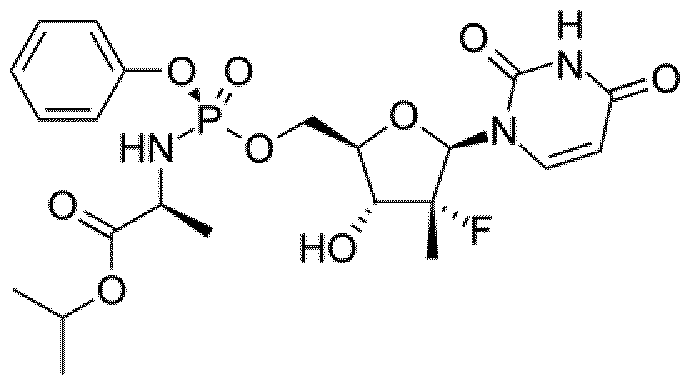
(I)
with IUPAC name(S)-isopropyl 2-(((5)-(((2R,3R,4R,5R)-5-(2,4-dioxo-3,4-dihydropyrimidin- l(2H)-yl)-4-fluoro-3-hydroxy-4-methyltetrahydrofuran-2-yl)methoxy)(phenoxy)phosphoryl)- amino)propanoate is a drug inhibiting the RNA polymerase used by the hepatitis C virus to replicate its RNA.
WO 2010/135569 Al discloses amorphous sofosbuvir and crystalline forms 1 to 5 as well as processes for their preparation. According to WO 2010/135569 Al, crystalline form 1 is an anhydrate, crystalline forms 2 and 3 are solvates with dichloromethane and chloroform re- spectively. However, no sufficient data could be collected to determine whether crystalline forms 4 and 5 are unsolvated, hydrated or solvated forms of sofosbuvir. It is further mentioned that all crystalline forms transform to crystalline form 1 on isolation and that crystalline form 1 liquefies when exposed to elevated humidity levels. Sofia et al. J. Med. Chem. 2010 Vol. 53, 7202-7218 discloses sofosbuvir as nucleotide prodrug in the treatment of hepatitis C virus (HCV). Figure 5 discloses the X-ray structure of sofosbuvir prepared according to example 51. The comparison of Figure 5 of Sofia et al. with Figure 12 of WO 2010/135569 and the comparison of the X-ray structure determination of compound 51 of Sofia et al. with table 9 of WO 2010/135569 revealed that the crystalline form of example 51 of Sofia et al. and the crystalline form of Figure 12 of WO 2010/135569 are the same crystalline form of sofosbuvir, namely the crystalline form 2 (i.e. crystalline solvate obtained with dichloromethane).
WO 2011/123645 Al discloses an additional crystalline form, form 6, of sofosbuvir. According to example 21 of WO 2011/123645 Al, crystalline form 6 can be prepared in two different ways. On the one hand, crystalline form 6 is obtained by exposing crystalline form 1 to atmospheric humidity for 6 to 10 weeks, whereby a solidified gum is formed which needs to be ground prior to further storage in order to obtain crystalline form 6. On the other hand, crystalline form 6 is prepared by stirring a mixture of crystalline form 1 in water. However, according to WO 2011/123645 Al, a gum-like material is obtained when contacting crystalline form 1 with water, which transforms to an oil upon heating, and only after further stirring form 6 crystallizes from the inhomogeneous mixture.
Apparently, there are several drawbacks related to the hygroscopic nature of sofosbuvir having crystalline form 1. Using crystalline form 1 as starting material to prepare crystalline form 6, for example, leads to the appearance of gum-like and oily material which is cumbersome to handle especially on scale. Moreover, crystalline form 1 tends to liquefy at elevated relative humidity and therefore needs to be protected from moisture which requires precautionary measures and consequently renders formulation processes, packaging, and storage complex and costly.
Hence there is a need for crystalline forms of sofosbuvir with improved physicochemical properties; there is a particular need for non-hygroscopic crystalline forms of sofosbuvir with improved behavior upon contact with water and moisture, respectively.
Surprisingly, it was found that such a novel crystalline form of sofosbuvir with improved physicochemical properties, in particular exhibiting non-hygroscopic behavior upon contact with moisture and water can be provided, in particular by a simple crystallization process which makes use of seed crystals of a known crystalline form of sofosbuvir. Due to its excellent physicochemical properties, the novel crystalline form of sofosbuvir allows an easy process for preparing crystalline form 6 of sofosbuvir, and is also suitable for the preparation of pharmaceutical compositions.
Therefore, the present invention relates to a crystalline form of sofosbuvir of formula (I)
(I)
having an X-ray powder diffraction pattern comprising no reflection at 2-theta angles in the range of from 2.0 to 7.8 0 when measured at a temperature in the range of from 15 to 25 °C with Cu-Kalphai 2 radiation having a wavelength of 0.15419 nm. In particular, the X-ray powder diffraction pattern is determined as described in detail in Reference Example 1.1 hereinunder. Preferably, the novel crystalline form of sofosbuvir comprises reflections at 2- theta values of (8.1 + 0.2) °, (10.4 + 0.2) °, (12.4 + 0.2) °, (17.3 + 0.2) °, (19.4 + 0.2) °, when measured at a temperature in the range of from 15 to 25 °C with Cu-Kalphai 2 radiation having a wavelength of 0.15419 nm.
Further, the present invention relates to a process for the preparation of the novel crystalline form of sofosbuvir of formula (I), comprising
(i) providing sofosbuvir in crystalline form, pseudo-crystalline form, amorphous form, or as a mixture of two or more of these forms;
(ii) preparing seed crystals comprising the novel crystalline form of sofosbuvir by a method comprising
(11.1) providing sofosbuvir in crystalline form, pseudo-crystalline form, amorphous form, or as a mixture of two or more of these forms;
(11.2) providing seed crystals of crystalline form 6 of sofosbuvir, having an X-ray powder diffraction pattern with reflections at 2-theta values of (6.1 + 0.2) °, (8.2 + 0.2) °, (10.4 + 0.2) °, (12.7 + 0.2) °, (20.8 + 0.2) °, when measured at a temperature in the range of from 15 to 25 °C with Cu-Kalphai 2 radiation having a wavelength of 0.15419 nm;
(11.3) preparing a solution of the sofosbuvir provided in (ii. l) in a C2-Cio alcohol or in a mixture of two or more thereof;
(11.4) subjecting the solution provided in (ii.3) to crystallization conditions, comprising seeding the solution with the seed crystals provided in (ii.2), wherein during crystallization, the solution is not stirred;
(11.5) separating at least a portion of the novel crystalline form of sofosbuvir from its mother liquor;
(iii) preparing a solution of sofosbuvir provided in (i) in a C2-C5 alcohol or in a mixture of two or more thereof, and in one or more anti- solvents;
(iv) subjecting the solution provided in (iii) to crystallization conditions, comprising seeding the solution with the seed crystals prepared in (ii), wherein during crystallization, the solution is not stirred, obtaining the novel crystalline form of sofosbuvir in its mother liquor.
Yet further, the present invention relates to a process for preparing the novel crystalline form of sofosbuvir, preferably to a process for preparing seed crystals of the novel crystalline form of sofosbuvir, said process comprising
(11.1) providing sofosbuvir in crystalline form, pseudo-crystalline form, amorphous form, or as a mixture of two or more of these forms;
(11.2) providing seed crystals of crystalline form 6 of sofosbuvir, having an X-ray powder diffraction pattern with reflections at 2-theta values of (6.1 + 0.2) °, (8.2 + 0.2) °, (10.4 + 0.2) °, (12.7 + 0.2) °, (20.8 + 0.2) °, when measured at a temperature in the range of from 15 to 25 °C with Cu-Kalphai 2 radiation having a wavelength of 0.15419 nm;
(11.3) preparing a solution of the sofosbuvir provided in (ii. l) in a C2-C10 alcohol or in a mixture of two or more thereof;
(11.4) subjecting the solution provided in (ii.3) to crystallization conditions, comprising seed- ing the solution with the seed crystals provided in (ii.2), wherein during crystallization, the solution is not stirred;
(11.5) separating at least a portion of the novel crystalline form of sofosbuvir from its mother liquor. Yet further, the present invention relates to the novel crystalline form of sofosbuvir which is obtainable or obtained by the novel process of the present invention comprising (i) to (iv).
Yet further, the present invention relates to the use of the novel form of sofosbuvir for treating hepatitis C in a human and for the preparation of a pharmaceutical composition for treating hepatitis C in a human.
Still further, the present invention relates to the use of the novel crystalline form of sofosbuvir for the preparation of crystalline form 6 of sofosbuvir, having an X-ray powder diffraction pattern with reflections at 2-theta values of (6.1 + 0.2) °, (8.2 + 0.2) °, (10.4 + 0.2) °, (12.7 + 0.2) °, (20.8 + 0.2) °, when measured at a temperature in the range of from 15 to 25 °C with Cu-Kalphai 2 radiation having a wavelength of 0.15419 nm.
Still further, the present invention relates to a process for the preparation of crystalline form 6 of sofosbuvir, having an X-ray powder diffraction pattern with reflections at 2-theta values of (6.1 + 0.2) °, (8.2 + 0.2) °, (10.4 + 0.2) °, (12.7 + 0.2) °, (20.8 + 0.2) °, when measured at a temperature in the range of from 15 to 25 °C with Cu-Kalphai 2 radiation having a wavelength of 0.15419 nm, the process comprising
(I) preparing an aqueous suspension of the novel crystalline form of sofosbuvir or the novel crystalline form of sofosbuvir obtainable or obtained by the novel process according to the process of the present invention comprising (i) to (iv);
(II) preferably heating the suspension obtained in (I), preferably to a temperature in the range of from 40 to 70 °C, and keeping the heated suspension at that temperature wherein preferably (II) is carried out under stirring;
(III) preferably cooling the heated suspension obtained in (II), obtaining solid crystalline form 6 of sofosbuvir in its mother liquor wherein preferably (III) is carried out under stirring;
(IV) preferably separating the solid crystalline form 6 of sofosbuvir from its mother liquor.
Still further, the present invention relates to a process for the preparation of crystalline form 6 of sofosbuvir, having an X-ray powder diffraction pattern with reflections at 2-theta values of (6.1 + 0.2) °, (8.2 + 0.2) °, (10.4 + 0.2) °, (12.7 + 0.2) °, (20.8 + 0.2) °, when measured at a temperature in the range of from 15 to 25 °C with
 radiation having a wavelength of 0.15419 nm, the process comprising preparing the novel crystalline form of sofosbuvir according to the novel process of the present invention comprising (i) to (iv), the process further comprising
(I) preparing an aqueous suspension of the novel crystalline form of sofosbuvir;
(II) preferably heating the suspension obtained in (I), preferably to a temperature in the range of from 40 to 70 °C, and keeping the heated suspension at that temperature wherein preferably (II) is carried out under stirring;
(III) preferably cooling the heated suspension obtained in (II), obtaining solid crystalline form 6 of sofosbuvir in its mother liquor wherein preferably (III) is carried out under stirring;
(IV) preferably separating the solid crystalline form 6 of sofosbuvir from its mother liquor.
Still further, the present invention relates to a process for the preparation of crystalline form 6 of sofosbuvir, having an X-ray powder diffraction pattern with reflections at 2-theta values of (6.1 + 0.2) °, (8.2 + 0.2) °, (10.4 + 0.2) °, (12.7 + 0.2) °, (20.8 + 0.2) °, when measured at a temperature in the range of from 15 to 25 °C with
 radiation having a wavelength of 0.15419 nm, the process comprising preparing the novel crystalline form of sofosbuvir by a process comprising
(i) providing sofosbuvir in crystalline form, pseudo-crystalline form, amorphous form, or as a mixture of two or more of these forms;
(ii) preparing seed crystals comprising the novel crystalline form of sofosbuvir by a method comprising
(11.1) providing sofosbuvir in crystalline form, pseudo-crystalline form, amorphous form, or as a mixture of two or more of these forms;
(11.2) providing seed crystals of crystalline form 6 of sofosbuvir, having an X-ray powder diffraction pattern with reflections at 2-theta values of (6.1 + 0.2) °, (8.2
+ 0.2) °, (10.4 + 0.2) °, (12.7 + 0.2) °, (20.8 + 0.2) °, when measured at a temperature in the range of from 15 to 25 °C with
 radiation having a wavelength of 0.15419 nm;
(11.3) preparing a solution of the sofosbuvir provided in (ii. l) in a C2-C10 alcohol or in a mixture of two or more thereof;
radiation having a wavelength of 0.15419 nm;
(11.3) preparing a solution of the sofosbuvir provided in (ii. l) in a C2-C10 alcohol or in a mixture of two or more thereof;
(11.4) subjecting the solution provided in (ii.3) to crystallization conditions, comprising seeding the solution with the seed crystals provided in (ii.2), wherein during crystallization, the solution is not stirred;
(11.5) separating at least a portion of the novel crystalline form of sofosbuvir from its mother liquor;
(iii) preparing a solution of sofosbuvir provided in (i) in a C2-C5 alcohol or in a mixture of two or more thereof, and in one or more anti- solvents;
(iv) subjecting the solution provided in (iii) to crystallization conditions, comprising seeding the solution with the seed crystals prepared in (ii), wherein during crystallization, the solution is not stirred, obtaining the novel crystalline form of sofosbuvir in its mother liquor;
(v) preferably separating the novel crystalline form of sofosbuvir from its mother liquor; the process for the preparation of crystalline form 6 of sofosbuvir further comprising
(I) preparing an aqueous suspension of the novel crystalline form of sofosbuvir obtained from (iv), preferably from (v);
(II) preferably heating the suspension obtained in (I), preferably to a temperature in the range of from 40 to 70 °C, and keeping the heated suspension at that temperature wherein preferably (II) is carried out under stirring;
(III) preferably cooling the heated suspension obtained in (II), obtaining solid crystalline form 6 of sofosbuvir in its mother liquor wherein preferably (III) is carried out under stirring;
(IV) preferably separating the solid crystalline form 6 of sofosbuvir from its mother liquor.
Still further, the present invention relates to crystalline form 6 of sofosbuvir which is obtainable or obtained by the novel process of the present invention comprising (I), preferably (I) to (II), more preferably (I) to (III), more preferably (I) to (IV), further preferably comprising (i) to (iv), more preferably (i) to (v).
Still further, the present invention relates to the use of form 6 of sofosbuvir which is obtainable or obtained by the novel process of the present invention comprising (I), preferably (I) to (II), more preferably (I) to (III), more preferably (I) to (IV) , further preferably comprising (i) to (iv), more preferably (i) to (v), for treating hepatitis C in a human and for the preparation of a pharmaceutical composition for treating hepatitis C in a human.
The novel crystalline form of sofosbuvir
As mentioned above, the present invention relates to the novel crystalline form of sofosbuvir, having an X-ray powder diffraction pattern comprising no reflection at 2-theta angles in the range of from 2.0 to 7.8 0 when measured at a temperature in the range of from 15 to 25 °C with Cu-Kalphai 2 radiation having a wavelength of 0.15419 nm. In particular, the X-ray powder diffraction pattern is determined as described in Reference Example 1.1 hereinunder.
Preferably, the novel crystalline form of sofosbuvir is characterized by an X-ray powder diffraction pattern comprising reflections at 2-theta angles of (8.1 + 0.2) °, (10.4 + 0.2) °, (12.4 + 0.2) °, (17.3 + 0.2) °, (19.4 + 0.2) 0 when measured at a temperature in the range of from 15 to 25 °C with Cu-Kalphai 2 radiation having a wavelength of 0.15419 nm.
More preferably, the novel crystalline form of sofosbuvir is characterized by an X-ray powder diffraction pattern comprising additional reflections at 2-theta angles of (12.1 + 0.2) °, (13.5 + 0.2) °, (16.2 + 0.2) °, (16.8 + 0.2) °, (18.0 + 0.2) °, (18.7 + 0.2) °, (20.2 + 0.2) °, (20.9 + 0.2) °, (22.1 + 0.2) °, (23.4 + 0.2) °, (25.4 + 0.29 °, (28.0 + 0.2)°, when measured at a temperature in the range of from 15 to 25 °C with
 radiation having a wavelength of 0.15419 nm.
Further, the novel crystalline form of sofosbuvir is preferably characterized by an X-ray pow- der diffraction pattern comprising no reflections at 2-theta angles in the range of from 2.0 to 7.8 0 and comprising five or more peaks at 2-theta angles selected from (8.1 + 0.2) °, (10.4 + 0.2) °, (12.1 + 0.2) °, (12.4 + 0.2) °, (13.5 + 0.2) °, (16.2 + 0.2) °, (16.8 + 0.2) °, (17.3 + 0.2) °, (18.0 + 0.2) °, (18.7 + 0.2) °, (19.4 + 0.2) °, (20.2 + 0.2) °, (20.9 + 0.2) °, (22.1 + 0.2) °, (23.4 + 0.2)°, (25.4 + 0.2) °, (28.0 + 0.2) °, when measured at a temperature in the range of from 15 to 25 °C with
 radiation having a wavelength of 0.15419 nm.
Further, the novel crystalline form of sofosbuvir can be characterized by an X-ray powder diffraction pattern as shown in Figure 1 of the present invention. Preferably, the novel crystalline form of sofosbuvir is characterized by a Fourier transform infrared spectrum comprising peaks at wavenumbers of (3252 + 2) cm"1, (2928 + 2) cm"1, (1718 + 2) cm"1, (1668 + 2) cm"1, (1456 + 2) cm"1, when measured at a temperature in the range of from 15 to 25 °C using a ZnSe ATR cell. In particular, the Fourier transform infrared spectrum is determined as described in Reference Example 1.2 hereinunder.
More preferably, the novel crystalline form of sofosbuvir is characterized by a Fourier transform infrared spectrum comprising additional peaks at wavenumbers of (1494 + 2) cm"1, (1373 + 2) cm"1, (1265 + 2) cm"1, (1223 + 2) cm"1, (945 + 2) cm"1, when measured at a temperature in the range of from 15 to 25 °C using a ZnSe ATR cell.
Further, the novel crystalline form of sofosbuvir can be characterized by a Fourier transform infrared spectrum as displayed in Figure 2 of the present invention. Preferably, the novel crystalline form of sofosbuvir has the monoclinic space group symmetry P2i and the following unit cell parameters as determined by an X-ray single-crystal structure analysis at 120 K:
a = (5.16 + 0.04) Angstrom;
b = (16.86 + 0.12) Angstrom;
c = (14.44 + 0.10) Angstrom;
alpha = 90.0 °;
beta = (100.2 + 0.8) °;
gamma = 90.0 °. More preferably, the novel crystalline form of sofosbuvir has the monoclinic space group symmetry P2i and the following unit cell parameters as determined by an X-ray single-crystal structure analysis at 120 K:
a = (5.16 + 0.02) Angstrom;
b = (16.86 + 0.06) Angstrom;
c = (14.44 + 0.05) Angstrom;
alpha = 90.0 °;
beta = (100.2 + 0.4) °;
gamma = 90.0 °. Preferably, the novel crystalline form of sofosbuvir is characterized by a melting point in the range of from 122 to 126 °C when measured via differential scanning calorimetry at a heating rate of 10 K/min at a pressure in the range of from 0.95 to 1.05 bar. In particular, the melting point is determined as described in Reference Example 1.3 hereinunder. Therefore, the novel crystalline form of sofosbuvir is also preferably characterized by a differential scanning calorimetry curve as determined according to Reference Example 1.3 hereinunder showing a melting endotherm with an onset temperature of about 122 °C and a peak maximum at about 126 °C. Therefore, the novel crystalline form of sofosbuvir is also preferably characterized by a differential scanning calorimetry curve as determined according to Reference Example 1.3 hereinunder comprising an endotherm with an onset temperature of about 122 °C and a peak maximum at about 126 °C when measured at a heating rate of 10 K/min.
Further, the novel crystalline form of sofosbuvir can be characterized by a differential scanning calorimetry curve as shown in Figure 4 of the present invention.
Preferably, the novel crystalline form of sofosbuvir comprises at most 0.5 weight-% of organ- ic solvent, based on the weight of the crystalline form, as determined via thermogravimetric analysis. In particular, the thermogravimetric analysis is carried out as described in Reference Example 1.4 herein. More preferably, the novel crystalline form of sofosbuvir comprises at most 0.4 weight-% of organic solvent, more preferably at most 0.3 weight-% of organic solvent, more preferably at most 0.2 weight-% of organic solvent such as at most 0.1 weight-% of organic solvent or at most 0.05 weight-% of organic solvent or at most 0.01 weight-% of organic solvent, in each case based on the weight of the crystalline form. Therefore, the novel crystalline form can be characterized as a non-solvated form of sofosbuvir.
Further, the novel crystalline form of sofosbuvir can be characterized by a thermogravimetric analysis curve as shown in Figure 5 of the present invention.
Preferably, the novel crystalline form of sofosbuvir comprises at most 0.4 weight-% of water based on the weight of the crystalline form as determined via gravimetric moisture sorption / desorption analysis at a temperature of (25.0 + 0.1) °C and a relative humidity of from 0 to 95 %. In particular, the gravimetric moisture sorption / desorption analysis is carried out as described in Reference Example 1.5 hereinunder. More preferably, the novel crystalline form of sofosbuvir comprises at most 0.3 weight-% of water, more preferably at most 0.2 weight-% of water, more preferably at most 0.1 weight-% of water such as from 0.0 to 0.1 weight-% of water, in each case based on the weight of the crystalline form.
Further, the novel crystalline form of sofosbuvir can be characterized by a gravimetric moisture sorption / desorption isotherm as shown in Figure 6 of the present invention. According to Figure 6, the novel crystalline form of sofosbuvir is a non-hygroscopic anhydrate of sofosbuvir. Therefore, the novel crystalline form can be characterized as an anhydrate of sofos- buvir, preferably a non-hygroscopic anhydrate of sofosbuvir.
Therefore, the present invention preferably relates to a non-hygroscopic anhydrous, non- solvated form of sofosbuvir having an X-ray powder diffraction pattern comprising no reflection at 2-theta angles in the range of from 2.0 to 7.8 0 when measured at a temperature in the range of from 15 to 25 °C with Cu-Kalphai 2 radiation having a wavelength of 0.15419 nm, the X-ray powder diffraction pattern preferably comprising reflections at 2-theta angles of (8.1 + 0.2) °, (10.4 + 0.2) °, (12.4 + 0.2) °, (17.3 + 0.2) °, (19.4 + 0.2) 0 when measured at a temperature in the range of from 15 to 25 °C with
 radiation having a wavelength of 0.15419 nm.
Therefore, the present invention preferably relates to a non-hygroscopic anhydrous, non- solvated form of sofosbuvir having an X-ray powder diffraction pattern comprising no reflection at 2-theta angles in the range of from 2.0 to 7.8 0 when measured at a temperature in the range of from 15 to 25 °C with
radiation having a wavelength of 0.15419 nm.
Therefore, the present invention preferably relates to a non-hygroscopic anhydrous, non- solvated form of sofosbuvir having an X-ray powder diffraction pattern comprising no reflection at 2-theta angles in the range of from 2.0 to 7.8 0 when measured at a temperature in the range of from 15 to 25 °C with
 radiation having a wavelength of 0.15419 nm, the X-ray powder diffraction pattern preferably comprising reflections at 2-theta angles of (8.1 + 0.2) °, (10.4 + 0.2) °, (12.4 + 0.2) °, (17.3 + 0.2) °, (19.4 + 0.2) 0 when measured at a temperature in the range of from 15 to 25 °C with
 radiation having a wavelength of 0.15419 nm, the non-hygroscopic anhydrous, non-solvated form of sofosbuvir having the monoclinic space group symmetry P2i and the following unit cell parameters as determined by an X-ray single-crystal structure analysis at 120 K:
a = (5.16 + 0.04) Angstrom;
b = (16.86 + 0.12) Angstrom;
c = (14.44 + 0.10) Angstrom;
alpha = 90.0 °;
beta = (100.2 + 0.8) °;
gamma = 90.0 °.
Therefore, the present invention preferably relates to a non-hygroscopic, anhydrous, non- solvated form of sofosbuvir having an X-ray powder diffraction pattern comprising no reflection at 2-theta angles in the range of from 2.0 to 7.8 0 when measured at a temperature in the range of from 15 to 25 °C with
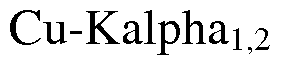 radiation having a wavelength of 0.15419 nm, the X-ray powder diffraction pattern preferably comprising reflections at 2-theta angles of (8.1 + 0.2) °, (10.4 + 0.2) °, (12.4 + 0.2) °, (17.3 + 0.2) °, (19.4 + 0.2) 0 when measured at a temperature in the range of from 15 to 25 °C with
 radiation having a wavelength of 0.15419 nm, the non-hygroscopic, anhydrous, non-solvated form of sofosbuvir having a Fourier transform infrared spectrum comprising peaks at wavenumbers of (3252 + 2) cm"1, (2928 + 2) cm"1, (1718 + 2) cm"1, (1668 + 2) cm"1, (1456 + 2) cm"1, when measured at a temperature in the range of from 15 to 25 °C using a ZnSe ATR cell, the Fourier transform infra- red spectrum preferably comprising additional peaks at wavenumbers of (1494 + 2) cm"1, (1373 + 2) cm"1, (1265 + 2) cm"1, (1223 + 2) cm"1, (945 + 2) cm"1, when measured at a temperature in the range of from 15 to 25 °C using a ZnSe ATR cell.
Therefore, the present invention preferably relates to a non-hygroscopic, anhydrous, non- solvated form of sofosbuvir having an X-ray powder diffraction pattern comprising no reflection at 2-theta angles in the range of from 2.0 to 7.8 0 when measured at a temperature in the range of from 15 to 25 °C with
 radiation having a wavelength of 0.15419 nm, the X-ray powder diffraction pattern preferably comprising reflections at 2-theta angles of (8.1 + 0.2) °, (10.4 + 0.2) °, (12.4 + 0.2) °, (17.3 + 0.2) °, (19.4 + 0.2) 0 when measured at a
temperature in the range of from 15 to 25 °C with
radiation having a wavelength of 0.15419 nm, the X-ray powder diffraction pattern preferably comprising reflections at 2-theta angles of (8.1 + 0.2) °, (10.4 + 0.2) °, (12.4 + 0.2) °, (17.3 + 0.2) °, (19.4 + 0.2) 0 when measured at a
temperature in the range of from 15 to 25 °C with
 radiation having a wavelength of 0.15419 nm, the non-hygroscopic, anhydrous, non-solvated form of sofosbuvir having a Fourier transform infrared spectrum comprising peaks at wavenumbers of (3252 + 2) cm"1, (2928 + 2) cm"1, (1718 + 2) cm"1, (1668 + 2) cm"1, (1456 + 2) cm"1, when measured at a tem- perature in the range of from 15 to 25 °C using a ZnSe ATR cell, the Fourier transform infrared spectrum preferably comprising additional peaks at wavenumbers of (1494 + 2) cm"1, (1373 + 2) cm"1, (1265 + 2) cm"1, (1223 + 2) cm"1, (945 + 2) cm"1, when measured at a temperature in the range of from 15 to 25 °C using a ZnSe ATR cell, the non-hygroscopic, anhydrous, non-solvated form of sofosbuvir having the monoclinic space group symmetry P2i and the following unit cell parameters as determined by an X-ray single-crystal structure analysis at 120 K:
a = (5.16 + 0.04) Angstrom;
b = (16.86 + 0.12) Angstrom;
c = (14.44 + 0.10) Angstrom;
alpha = 90.0 °;
beta = (100.2 + 0.8) °;
gamma = 90.0 °.
The novel crystalline form of sofosbuvir according to the present invention is the only crystal- line form of sofosbuvir showing no peak at 2-theta angles in the range of from 2 to 7.8 0 in the XRPD pattern. All other known crystalline forms according to the prior art show at least one significant peak in this range, as summarized in the following Table 1 :
Table 1
XRPD peaks of prior art crystalline forms in the range of from 2 to 7.8° 2-theta

Hence, the absence of an XRPD peak in said range is unique and therefore a characteristic property of the novel crystalline form of sofosbuvir according to the present invention.
Additionally, the novel crystalline form of sofosbuvir according to the present invention can be, for example, further distinguished from crystalline form 1 of WO 2010/135569 Al by a
characteristic XRPD peak at (12.4 + 0.2) 0 2-theta since the crystalline form 1 shows no such characteristic peak in this range when measured at room temperature with Cu-Kalphai 2 radiation having a wavelength of 0.15419 nm. Process for the preparation of the novel crystalline form of sofosbuvir
Generally, the novel crystalline form of sofosbuvir according to the present invention can be prepared by all suitable methods. For examples, it was found that the new crystalline form is formed without the addition of seed crystals. Preferably, the novel crystalline form forms when seed crystals are present exhibiting the novel crystalline form. Surprisingly, it was found that these seed crystals can be prepared when seeding a solution of sofosbuvir in a C2- Cio alcohol or in a mixture of two or more thereof with crystalline form 6 crystals of sofosbuvir and leaving at least a portion of the seeded solution, preferably at least the portion of the seeded solution containing most of the seed crystals, more preferably at least the portion of the seeded solution containing most of the seed crystals and the novel crystalline form formed, in particular at least the bottom of the seeded solution containing most of the seed crystals, preferably essentially all seed crystals, and the novel crystalline form formed, without stirring, preferably without mechanical agitation, more preferably without agitation. The term "agitation" as used in this context of the present invention relates to any motion of a macroscopic constituent of the solution comprising sofosbuvir which is induced from outside, relative to another macroscopic constituent of the solution. The term "mechanical agitation" as used in this context of the present invention relates to any motion of a macroscopic constituent of the solution comprising sofosbuvir which is induced from outside via a device, such as shaking or stirring or sonication, relative to another macroscopic constituent of the solution. The term "stirring" as used in this context of the present invention relates to any motion of a macroscopic constituent of the solution comprising sofosbuvir which is induced from outside via a stirring device, relative to another macroscopic constituent of the solution. Therefore, the present invention relates to a process for the preparation of the novel crystalline form of sofosbuvir, comprising
(i) providing sofosbuvir in crystalline form, pseudo-crystalline form, amorphous form, or as a mixture of two or more of these forms;
(ii) preparing seed crystals comprising the novel crystalline form of sofosbuvir by a method comprising
(11.1) providing sofosbuvir in crystalline form, pseudo-crystalline form, amorphous form, or as a mixture of two or more of these forms;
(11.2) providing seed crystals of crystalline form 6 of sofosbuvir, having an X-ray powder diffraction pattern with reflections at 2-theta values of (6.1 + 0.2) °, (8.2
+ 0.2) °, (10.4 + 0.2) °, (12.7 + 0.2) °, (20.8 + 0.2) °, when measured at a temperature in the range of from 15 to 25 °C with Cu-Kalphai 2 radiation having a wavelength of 0.15419 nm;
(11.3) preparing a solution of the sofosbuvir provided in (ii. l) in a C2-Cio alcohol or in a mixture of two or more thereof;
(11.4) subjecting the solution provided in (ii.3) to crystallization conditions, comprising seeding the solution with the seed crystals provided in (ii.2), wherein during crystallization, the solution is not stirred;
(11.5) separating at least a portion of the novel crystalline form of sofosbuvir from its mother liquor;
(iii) preparing a solution of sofosbuvir provided in (i) in a C2-C5 alcohol or in a mixture of two or more thereof, and in one or more anti- solvents;
(iv) subjecting the solution provided in (iii) to crystallization conditions, comprising seeding the solution with the seed crystals prepared in (ii), wherein during crystallization, at least a portion of the seeded solution, preferably at least the portion of the seeded solution containing most of the seed crystals, more preferably at least the portion of the seeded solution containing most of the seed crystals and the novel crystalline form formed, in particular at least the bottom of the seeded solution containing most of the seed crystals, preferably essentially all seed crystals, and the novel crystalline form formed, is not stirred, obtaining the novel crystalline form of sofosbuvir in its mother liquor.
Therefore, the present invention also relates to a process for the preparation of the novel crystalline form of sofosbuvir, comprising
(i) providing sofosbuvir in crystalline form, pseudo-crystalline form, amorphous form, or as a mixture of two or more of these forms;
(ii) preparing seed crystals comprising the novel crystalline form of sofosbuvir by a method comprising
(11.1) providing sofosbuvir in crystalline form, pseudo-crystalline form, amorphous form, or as a mixture of two or more of these forms;
(11.2) providing seed crystals of crystalline form 6 of sofosbuvir, having an X-ray powder diffraction pattern with reflections at 2-theta values of (6.1 + 0.2) °, (8.2 + 0.2) °, (10.4 + 0.2) °, (12.7 + 0.2) °, (20.8 + 0.2) °, when measured at a temperature in the range of from 15 to 25 °C with Cu-Kalphai 2 radiation having a wavelength of 0.15419 nm;
(11.3) preparing a solution of the sofosbuvir provided in (ii. l) in a C2-C10 alcohol or in a mixture of two or more thereof;
(11.4) subjecting the solution provided in (ii.3) to crystallization conditions, comprising seeding the solution with the seed crystals provided in (ii.2), wherein during crystallization, the solution is not stirred;
(11.5) separating at least a portion of the novel crystalline form of sofosbuvir from its mother liquor;
(iii) preparing a solution of sofosbuvir provided in (i) in a C2-C5 alcohol or in a mixture of two or more thereof, and in one or more anti- solvents;
(iv) subjecting the solution provided in (iii) to crystallization conditions, comprising seeding the solution with the seed crystals prepared in (ii), wherein during crystallization, the solution is not stirred, obtaining the novel crystalline form of sofosbuvir in its mother liquor.
Step (i) No specific restrictions exist regarding the specific crystalline form of sofosbuvir which is employed in (i). Preferably, crystalline form 1 having an X-ray powder diffraction pattern with reflections at 2-theta values of (5.0 + 0.2) °, (7.3 + 0.2) °, (9.4 + 0.2) °, (16.6 + 0.2) °, (17.3 + 0.2) °, (18.1 + 0.2) °, (22.0 + 0.2) °, when measured at a temperature from 15 to 25 °C with Cu-Kalphai 2 radiation having a wavelength of 0.15419 nm, is employed. Crystalline form 1 of sofosbuvir can be prepared, for example, as described in WO 2011/123645 Al, example 10.
As disclosed above, alternatively, in step (i) an amorphous form of sofosbuvir is provided. Step (ii)
No specific restrictions exist regarding the specific crystalline form of sofosbuvir which is employed in (ii. l). Preferably, crystalline form 1 having an X-ray powder diffraction pattern with reflections at 2-theta values of (5.0 + 0.2) °, (7.3 + 0.2) °, (9.4 + 0.2) °, (16.6 + 0.2) °, (17.3 + 0.2) °, (18.1 + 0.2) °, (22.0 + 0.2) °, when measured at a temperature from 15 to 25 °C with Cu-Kalphai 2 radiation having a wavelength of 0.15419 nm, is employed. Crystalline form 1 of sofosbuvir can be prepared, for example, as described in WO 2011/123645 Al, example 10.. The seed crystals of crystalline form 6 of sofosbuvir, having an X-ray powder diffraction pattern with reflections at 2-theta values of (6.1 + 0.2) °, (8.2 + 0.2) °, (10.4 + 0.2) °, (12.7 + 0.2) °, (20.8 + 0.2) °, when measured at a temperature in the range of from 15 to 25 °C with Cu- Kalphai i radiation having a wavelength of 0.15419 nm which are employed in (ii.2) can be prepared, for example, as described in WO 2011/123645 Al, example 21.
As disclosed above alternatively, in step (ii. l) sofosbuvir is provided as an amorphous form of sofosbuvir. According to (ii.3), the solution of the sofosbuvir provided in (ii.l) is prepared in a C2-C10 alcohol or in a mixture of two or more thereof, namely in a C2 alcohol, a C3 alcohol, a C4 alcohol, a C5 alcohol, a C6 alcohol, a C7 alcohol, a alcohol, a C9 alcohol, a C10 alcohol, or in a mixture of two or more thereof. Preferably, in (ii.3), the solution is prepared in a C5-C10 alcohol or in a mixture of two or more thereof, namely in a C5 alcohol, a C6 alcohol, a C7 alco- hoi, a C8 alcohol, a C9 alcohol, a C10 alcohol, or in a mixture of two or more thereof. More preferably, in (ii.3), the solution is prepared in a Cg alcohol. More preferably, in (ii.3), the solution is prepared in n-octanol.
According to (ii.4), the solution prepared in (ii.3) is subjected to crystallization conditions. As mentioned above, it was found that during the crystallization, the solution from which the novel crystalline form crystallizes must not be stirred. Preferably, said solution is not mechanically agitated, and more preferably, said solution is not agitated at all.
Preferably, for crystallization in (ii.4), the solution prepared in (ii.3) is seeded with the seed crystals provided in (ii.2) in an amount in the range of from 0.5 to 20 weight-%, based on the weight of sofosbuvir provided in (ii. l), more preferably in the range of from 1 to 20 weight- %, based on the weight of sofosbuvir provided in (i), more preferably in the range of from 1 to 15 weight-%, based on the weight of sofosbuvir provided in (i), more preferably in the range of from 1 to 10 weight-%, based on the weight of sofosbuvir provided in (ii.l), more preferably in the range of from 1 to 5 weight-%, based on the weight of sofosbuvir provided in (ii. l).
Regarding the temperature of the solution from which the novel crystalline form crystallizes in (ii.4), no specific restrictions exist. Preferably, during crystallization in (ii.4), the solution is kept at a temperature in the range of from 10 to 40 °C, at a pressure in the range of from 0.95 to 1.05 bar. More preferably, during crystallization in (ii.4), the solution is kept at a temperature in the range of from 15 to 35 °C, at a pressure in the range of from 0.95 to 1.05 bar. More preferably, during crystallization in (ii.4), the solution is kept at a temperature in the range of from 20 to 30 °C, such as from 20 to 24 °C or from 22 to 26 °C or from 24 to 28 °C or from 26 to 30 °C, at a pressure in the range of from 0.95 to 1.05 bar.
Regarding the separating in (ii.5), no specific restrictions exist. Preferably, in (ii.5), the separating comprises subjecting the mother liquor comprising the novel crystalline form of sofosbuvir to a solids separation process, such as centrifugation, filtration, spray drying, or a com-
bination of two or more of these methods, preferably to filtration. Optionally, the thus separated novel crystalline form of sofosbuvir can be subjected to washing. Preferably, the thus separated novel crystalline form of sofosbuvir, optionally after washing, is subjected to drying, for example to air-drying.
Therefore, the present invention relates to the process as described above, wherein separating in (ii.5) comprises
(11.5.1) subjecting the mother liquor comprising the novel crystalline form of sofosbuvir to a solids separation process, preferably to filtration, obtaining the novel crystalline form of sofosbuvir;
(11.5.2) optionally washing the novel crystalline form of sofosbuvir obtained in (ii.5.1);
(11.5.3) preferably drying the novel crystalline form of sofosbuvir obtained in (ii.5.1) or (ii.5.2), preferably in (ii.5.1).
Therefore, the present invention also relates to a process for preparing the novel crystalline form of sofosbuvir, preferably to a process for preparing seed crystals of the novel crystalline form of sofosbuvir, the process comprising
(11.1) providing sofosbuvir in crystalline form 1 having an X-ray powder diffraction pattern with reflections at 2-theta values of (5.0 + 0.2) °, (7.3 + 0.2) °, (9.4 + 0.2) °, (16.6 + 0.2) °, (17.3 + 0.2) °, (18.1 + 0.2) °, (22.0 + 0.2) °, when measured at a temperature from 15 to 25 °C with
 radiation having a wavelength of 0.15419 nm ;
(11.2) providing seed crystals of crystalline form 6 of sofosbuvir, having an X-ray powder diffraction pattern with reflections at 2-theta values of (6.1 + 0.2) °, (8.2 + 0.2) °, (10.4 + 0.2) °, (12.7 + 0.2) °, (20.8 + 0.2) °, when measured at a temperature in the range of from 15 to 25 °C with
 radiation having a wavelength of 0.15419 nm;
(11.3) preparing a solution of the sofosbuvir provided in (ii.1) in n-octanol;
(11.4) subjecting the solution provided in (ii.3) to crystallization conditions, comprising seeding the solution with the seed crystals provided in (ii.2), wherein during crystallization, the solution is not agitated, wherein during crystallization in (ii.4), the solution is kept at a temperature in the range of from 20 to 30 °C at a pressure in the range of from 0.95 to 1.05 bar;
(11.5) separating at least a portion of the novel crystalline form of sofosbuvir from its mother liquor, the separating comprising
(11.5.1) subjecting the mother liquor comprising the novel crystalline form of sofosbuvir to filtration, obtaining the novel crystalline form of sofosbuvir;
(11.5.2) optionally washing the novel crystalline form of sofosbuvir obtained in (ii.5.1);
(11.5.3) preferably drying, more preferably air-drying the novel crystalline form of sofosbuvir obtained in (ii.5.1) or (ii.5.2), preferably in (ii.5.1).
Alternatively, in step (ii.l) sofosbuvir in an amorphous form is provided.
Step (iii)
As mentioned above, in (iii), a solution of sofosbuvir provided in (i) is prepared in a C2-C5 alcohol or in a mixture of two or more thereof, and in one or more anti- solvents. Generally, no specific restrictions exist how this solution is prepared. For example, all suitable amounts of solvents and anti-solvents can be employed, and the sequence of mixing the sofosbuvir, the one or more alcohols and the one or more anti- solvents can be adapted to the specific needs. Preferably, in a first step, a solution of the sofosbuvir in the C2-C5 alcohol or in the mixture of two or more thereof is prepared, and the one or more anti-solvents are added to this solution in a subsequent step.
Therefore, the present invention relates to the process as described above, wherein (iii) comprises
(iii.l) preparing a solution of the sofosbuvir provided in (i) in the C2-C5 alcohol or in the mixture of two or more thereof.
Therefore, the present invention relates to the process as described above, wherein (iii) comprises
(iii.l) preparing a solution of the sofosbuvir provided in (i) in the C2-C5 alcohol or in the mixture of two or more thereof;
(iii.2) adding the one or more anti-solvents to the solution obtained in (iii.l).
Preferably, during the preparation of the solution in (iii), preferably during the preparation of the solution in (iii. l), the respective mixture is suitably heated, preferably to a temperature in the range of from 30 to 75 °C, more preferably to a temperature in the range of from 30 to 70 °C, more preferably to a temperature in the range of from 35 to 65 °C.
Preferably, after (iii. l) and before (iii.2), the solution is suitably cooled, preferably to a temperature in the range of from 10 to 35 °C, more preferably to a temperature in the range of from 15 to 35 °C, more preferably to a temperature in the range of from 20 to 30 °C.
Therefore, the present invention relates to the process as described above, wherein (iii) comprises
(111.1) preparing a solution of the sofosbuvir provided in (i) in the C2-C5 alcohol or in the mixture of two or more thereof, wherein preparing comprises heating to a temperature in the range of from 35 to 65 °C;
(111.2) adding the one or more anti-solvents to the solution obtained in (iii.l);
wherein after (iii.l) and before (iii.2), the solution is cooled to a temperature in the range of from 20 to 30 °C.
In case solids are contained in the solution obtained from (iii.l) such as non-dissolved sofosbuvir, it is possible to subject the solution, prior to (iii.2), to a suitable solids separation pro- cess, such as filtration or centrifugation, preferably filtration.
According to (iii), the solution is prepared in a C2-C5 alcohol, such as a C2 alcohol, a C3 alcohol, a C4 alcohol, a C5 alcohol, or in a mixture of two or more thereof. C2 alcohols include ethanol. C3 alcohols include n-propanol or isopropanol. C4 alcohols include n-butanol, 2- butanol, tert-butanol. C5 alcohols include 1-pentanol, 2-pentanol, 3-pentanol, 2-methyl-l- butanol. Preferred alcohols are C2 alcohols, C4 alcohols, C5 alcohols. Ethanol, n-butanol and n-pentanol are more preferred.
Preferably, in (iii), the molar ratio of the C2-C5 alcohol or the mixture of two or more thereof relative to the one or more anti-solvents is in the range of from 0.1: 1 to 1: 1.1, more preferably in the range of from 0.1: 1 to 1: 1, more preferably in the range of from 0.2: 1 to 0.9: 1, more preferably in the range of from 0.3: 1 to 0.7: 1. If more than one C2-C5 alcohol is employed, the molar ratio relates to the total molar amount of all C2-C5 alcohols. If more than one anti- solvent is employed, the molar ratio relates to the total molar amount of all anti- solvents.
Preferably, in (iii), the volume ratio of the C2-C5 alcohol or the mixture of two or more thereof relative to the one or more anti-solvents is in the range of from 0.1: 1 to 1: 1.1, more preferably in the range of from 0.1: 1 to 1: 1, more preferably in the range of from 0.2: 1 to 0.9: 1, more preferably in the range of from 0.3: 1 to 0.7: 1. If more than one C2-C5 alcohol is employed, the volume ratio relates to the total molar amount of all C2-C5 alcohols. If more than one anti- solvent is employed, the volume ratio relates to the total molar amount of all anti- solvents.
Regarding the one or more anti- solvents employed in (iii), no specific restrictions exist, pro- vided the novel crystalline form of sofosbuvir crystallizes in (iv). Preferably, the one or more anti-solvents comprises an alkane, more preferably a C5 alkane, a C6 alkane, a C7 alkane, a alkane, or a mixture of two or more thereof, more preferably a C7 alkane. More preferably, the one or more anti-solvents comprises n-heptane. More preferably, n-heptane is used as the only anti-solvent in (iii).
Step (iv)
According to (iv), the solution prepared in (iii) is subjected to crystallization conditions. As mentioned above, it was found that during the crystallization, the solution from which the novel crystalline form crystallizes must not be stirred. Preferably, said solution is not mechanically agitated, and more preferably, said solution is not agitated at all.
The term "agitation" as used in this context of the present invention relates to any motion of a macroscopic constituent of the solution comprising sofosbuvir which is induced from outside, relative to another macroscopic constituent of the solution. The term "mechanical agitation" as used in this context of the present invention relates to any motion of a macroscopic constituent of the solution comprising sofosbuvir which is induced from outside via a device, such as shaking or stirring or sonication, relative to another macroscopic constituent of the solution. The term "stirring" as used in this context of the present invention relates to any motion of a macroscopic constituent of the solution comprising sofosbuvir which is induced from outside via a stirring device, relative to another macroscopic constituent of the solution.
Preferably, for crystallization in (iv), the solution prepared in (iii) is seeded with the seed crystals prepared in (ii) in an amount in the range of from 0.5 to 20 weight-%, based on the weight of sofosbuvir provided in (i), more preferably in the range of from 1 to 20 weight-%, based on the weight of sofosbuvir provided in (i), more preferably in the range of from 1 to 15 weight-%, based on the weight of sofosbuvir provided in (i), more preferably in the range of from 1 to 10 weight-%, based on the weight of sofosbuvir provided in (i), more preferably in the range of from 1 to 5 weight-%, based on the weight of sofosbuvir provided in (i).
Preferably, during crystallization in (iv), the solution is kept at a temperature in the range of from 10 to 40 °C, more preferably in the range of from 15 to 35 °C, more preferably in the range of from 17 to 32 °C, more preferably in the range of from 20 to 30 °C, at a pressure in the range of from 0.95 to 1.05 bar.
From step (iv), the solid novel crystalline form of sofosbuvir is obtained in its mother liquor. Generally, it is possible to use this mother liquor, optionally after concentration or dilution, or after removal of the one or more anti-solvents or the one or more C2-C5 alcohol. Preferably, the novel crystalline form is suitably separated from its mother liquor.
Step (v)
Therefore, the present invention also relates to the process as described above, further comprising
(v) separating the novel crystalline form of sofosbuvir from its mother liquor. Regarding the separating in (v), no specific restrictions exist. Preferably, in (v), the separating comprises subjecting the mother liquor comprising the novel crystalline form of sofosbuvir to a solids separation process, such as centrifugation, filtration, spray drying, or a combination of two or more of these methods, preferably to filtration. Optionally, the thus separated novel crystalline form of sofosbuvir can be subjected to washing. Preferably, the thus separated novel crystalline form of sofosbuvir, optionally after washing, is subjected to drying, for example to air-drying.
Therefore, the present invention relates to the process as described above, wherein separating in (v) comprises
(v. l) subjecting the mother liquor comprising the novel crystalline form of sofosbuvir to a solids separation process, obtaining at least a portion of the novel crystalline form of sofosbuvir;
(v.2) optionally washing the novel crystalline form of sofosbuvir obtained in (v.l);
(v.3) preferably drying the novel crystalline form of sofosbuvir obtained in (v.l) or (v.2). All suitable washing agents can be employed in (v.2). Preferably, the washing is carried out using one or more anti-solvents as washing agent. Regarding the one or more anti-solvents employed in (v.2), no specific restrictions exist, provided the novel crystalline form of sofosbuvir can be washed. Preferably, the one or more anti-solvents comprises an alkane, more preferably a C5 alkane, a C6 alkane, a C7 alkane, a alkane, or a mixture of two or more thereof, more preferably a C7 alkane. More preferably, the one or more anti-solvents comprise n-heptane. More preferably, n-heptane is used as the washing agent in (v.2)
While there exist no specific restrictions regarding the drying in (v.3), drying is preferably carried out at a temperature in the range of from 10 to 40 °C, such as at a temperature in the range of from 15 to 35 °C or at a temperature in the range of from 20 to 30 °C. The drying is more preferably carried out at a temperature in the range of from 10 to 40 °C, such as at a temperature in the range of from 15 to 35 °C or of from 15 to 40 °C or at a temperature in the range of from 20 to 30°C or of from 20 to 40 °C.
Therefore, the present invention also relates to a process for the preparation of the novel crystalline form of sofosbuvir, comprising
(i) providing sofosbuvir in crystalline form 1 having an X-ray powder diffraction pattern with reflections at 2-theta values of (5.0 + 0.2) °, (7.3 + 0.2) °, (9.4 + 0.2) °, (16.6 + 0.2)
°, (17.3 + 0.2) °, (18.1 + 0.2) °, (22.0 + 0.2) °, when measured at a temperature from 15 to 25 °C with Cu-Kalphai 2 radiation having a wavelength of 0.15419 nm;
) preparing seed crystals comprising the novel crystalline form of sofosbuvir by a method comprising
(11.1) providing sofosbuvir in crystalline form 1 having an X-ray powder diffraction pattern with reflections at 2-theta values of (5.0 + 0.2) °, (7.3 + 0.2) °, (9.4 + 0.2) °, (16.6 + 0.2) °, (17.3 + 0.2) °, (18.1 + 0.2) °, (22.0 + 0.2) °, when measured at a temperature from 15 to 25 °C with
 radiation having a wavelength of 0.15419 nm;
(11.2) providing seed crystals of crystalline form 6 of sofosbuvir, having an X-ray powder diffraction pattern with reflections at 2-theta values of (6.1 + 0.2) °, (8.2 + 0.2) °, (10.4 + 0.2) °, (12.7 + 0.2) °, (20.8 + 0.2) °, when measured at a temperature in the range of from 15 to 25 °C with
 radiation having a wavelength of 0.15419 nm;
(11.3) preparing a solution of the sofosbuvir provided in (ii.1) in n-octanol;
(11.4) subjecting the solution provided in (ii.3) to crystallization conditions, comprising seeding the solution with the seed crystals provided in (ii.2), wherein in (ii.4), the solution is seeded with the seed crystals provided in (ii.2) in an amount in the range of from 1 to 10 weight- %, based on the weight of sofosbuvir provided in (i), wherein during crystallization, the solution is not agitated, wherein during crystallization in (ii.4), the solution is kept at a temperature in the range of from 20 to 30 °C at a pressure in the range of from 0.95 to 1.05 bar;
(11.5) separating at least a portion of the novel crystalline form of sofosbuvir from its mother liquor, the separating comprising
(11.5.1 ) subjecting the mother liquor comprising the novel crystalline form of sofosbuvir to filtration, obtaining the novel crystalline form of sofosbuvir;
(11.5.2) optionally washing the novel crystalline form of sofosbuvir obtained in (ii.5.1);
(11.5.3) preferably drying, more preferably air-drying the novel crystalline form of sofosbuvir obtained in (ii.5.1) or (ii.5.2), preferably in (ii.5.1);
i) preparing a solution of sofosbuvir provided in (i) in ethanol, n-butanol or n-pentanol, and in n-heptane as anti- solvent, wherein (iii) comprises
(111.1) preparing a solution of the sofosbuvir provided in (i) ethanol, n-butanol or n- pentanol, wherein in (iii.l), the preparation of the solution comprises heating to a temperature in the range of from 35 to 65 °C;
(111.2) adding n-heptane to the solution obtained in (iii.l);
wherein after (iii.l) and before (iii.2), the solution is cooled to a temperature in the range of from 20 to 30 °C, and wherein in (iii), the molar ratio or the volume ratio, pref-
erably the volume ratio, of the ethanol, the n-butanol or the n-pentanol, relative to the n- heptane, is in the range of from 0.3: 1 to 0.7: 1;
subjecting the solution provided in (iii) to crystallization conditions, comprising seeding the solution with the seed crystals prepared in (ii), wherein in (iv), the solution is seeded with the seed crystals prepared in (ii) in an amount in the range of from 1 to 5 weight- , based on the weight of sofosbuvir provided in (i), wherein during crystallization, the solution is not agitated, obtaining the novel crystalline form of sofosbuvir in its mother liquor, wherein during crystallization in (iv), the solution is kept at a temperature in the range of from 20 to 30 °C, at a pressure in the range of from 0.95 to 1.05 bar;
separating the novel crystalline form of sofosbuvir from its mother liquor, comprising (v. l) subjecting the mother liquor comprising the novel crystalline form of sofosbuvir to filtration, obtaining at least a portion of the novel crystalline form of sofosbuvir;
(v.2) optionally washing the novel crystalline form of sofosbuvir obtained in (v. l); (v.3) preferably drying the novel crystalline form of sofosbuvir obtained in (v.l) or (v.2), wherein drying is preferably carried out at a temperature in the range of from 10 to 40 °C, preferably in the range of from 20 to 40 °C.
Alternatively, in step (i) and/or (ii.2) sofosbuvir is provided in an amorphous form.
Further, the present invention relates to the novel crystalline form of sofosbuvir which is obtainable or obtained by the process as described above, preferably by the process comprising (i) to (iv), more preferably by the process comprising (i) to (v). The excellent physicochemical properties of the novel crystalline form of sofosbuvir of the present invention, such as non-hygroscopicity and improved behavior upon contact with water and moisture facilitate formulation, storage of the novel crystalline form as active pharmaceutical ingredient and a final drug product and also positively impact the quality, safety and compliance of such final drug product.
Therefore, the present invention relates to the use of the novel crystalline form of sofosbuvir or the novel crystalline form of sofosbuvir obtainable or obtained by said process, for the preparation of a pharmaceutical composition; to a method of using the novel crystalline form of sofosbuvir or the novel crystalline form of sofosbuvir obtainable or obtained by said pro- cess for the preparation of a pharmaceutical composition; to a pharmaceutical composition comprising, in a pharmaceutically effective amount, the novel crystalline form of sofosbuvir or the crystalline form of sofosbuvir obtainable or obtained by said process and at least one pharmaceutically acceptable excipient; to said pharmaceutical composition for use in a method for treating hepatitis C in a human; to the use of said pharmaceutical composition for treat-
ing hepatitis C in a human; to a method of treating hepatitis C in a human comprising administering said pharmaceutical composition to a human; to the use of the novel crystalline form of sofosbuvir or the novel crystalline form of sofosbuvir obtainable or obtained by said process for preparing a medicament for the treatment hepatitis C in a human; to the use of the novel crystalline form of sofosbuvir or the novel crystalline form of sofosbuvir obtainable or obtained by said process for the treatment of hepatitis C in a human; to the novel crystalline form of sofosbuvir or the novel crystalline form of sofosbuvir obtainable or obtained by said process for use in the treatment of hepatitis C in a human; to the novel crystalline form of sofosbuvir or the novel crystalline form of sofosbuvir obtainable or obtained by said process for the treatment of hepatitis C in a human; to a method of treating hepatitis C in a human comprising administering the novel crystalline form of sofosbuvir or the novel crystalline form of sofosbuvir obtainable or obtained by said process.
Novel process for the preparation of crystalline form 6 of sofosbuvir
As shown in the Examples of the present invention, the novel crystalline form is non- hygroscopic and shows no significant interaction with water vapor. In addition, suspending the novel crystalline form in water results in homogenous suspensions without formation of oily or gummy material. Therefore, it was found that the novel crystalline form of sofosbuvir allows an easy process for preparing crystalline form 6 production without creating gum-like or oily materials as observed when following the prior art teaching according to which crystalline form 1 is employed as starting material.
Therefore, the present invention also relates to the use of the novel crystalline form of sofos- buvir or the novel crystalline form of sofosbuvir obtainable or obtained by the novel process according to the present invention, preferably comprising (i) to (iv), more preferably (i) to (v), for the preparation of crystalline form 6 of sofosbuvir having an X-ray powder diffraction pattern with reflections at 2-theta values of (6.1 + 0.2) °, (8.2 + 0.2) °, (10.4 + 0.2) °, (12.7 + 0.2) °, (20.8 + 0.2) °, when measured at a temperature in the range of from 15 to 25 °C with Cu-Kalphai 2 radiation having a wavelength of 0.15419 nm.
Yet further, the present invention also relates to a process for the preparation of crystalline form 6 of sofosbuvir of formula (I)

(I)
having an X-ray powder diffraction pattern with reflections at 2-theta values of (6.1 + 0.2) °, (8.2 + 0.2) °, (10.4 + 0.2) °, (12.7 + 0.2) °, (20.8 + 0.2) °, when measured at a temperature from 15 to 25 °C with
 radiation having a wavelength of 0.15419 nm, the process comprising
(I) preparing an aqueous suspension of the novel crystalline form of sofosbuvir or the crystalline form of sofosbuvir obtainable or obtained by the novel process according to present invention, preferably comprising (i) to (iv), more preferably (i) to (v). Still further, the present invention also relates to a process for the preparation of crystalline form 6 of sofosbuvir of formula (I)

(I)
having an X-ray powder diffraction pattern with reflections at 2-theta values of (6.1 + 0.2) °, (8.2 + 0.2) °, (10.4 + 0.2) °, (12.7 + 0.2) °, (20.8 + 0.2) °, when measured at a temperature from 15 to 25 °C with
 radiation having a wavelength of 0.15419 nm, the process comprising preparing the crystalline form of sofosbuvir of formula (I) according to the novel process of the present invention comprising (i) to (iv), more preferably comprising (i) to (v), the process further comprising
(I) preparing an aqueous suspension of the novel crystalline form of sofosbuvir obtained in (iv), preferably in (v).
Preferably, the aqueous suspension is prepared at a temperature in the range of from 10 to 40 °C, more preferably from 15 to 35 °C, more preferably from 20 to 30 °C. Preferably, during the preparation, the suspension is suitably agitated, preferably stirred. Preferably, in the sus- pension, the novel crystalline form of sofosbuvir is contained in an amount in the range of
from 10 to 100 mg per mL water, more preferably from 15 to 90 mg per ml water, more preferably from 20 to 80 mg per mL water.
Preferably, the aqueous suspension obtained in (I) is heated in a subsequent step (II), prefera- bly to a temperature in the range of from 40 to 80 °C, more preferably from 40 to 70 °C, more preferably from 35 to 60 °C. After heating, in (II), the thus heated suspension is kept at that temperature, preferably for 0.1 to 12 h, more preferably from 0.1 to 15 h, more preferably from 0.2 to 5 h. wherein preferably (II) is carried out under stirring. Preferably, the heated suspension kept at that temperature is then suitably cooled. Cooling to the final temperature can be carried out continuously or discontinuously in two, three or more steps, preferably in two or three steps, more preferably in two steps. More preferably, the cooling in a step (III) from which the solid crystalline form 6 is obtained in its mother liquor, comprises
(III.1) cooling the heated suspension obtained in (II) to a temperature in the range of from 10 to 30 °C, preferably from 15 to 25 °C, and keeping the cooled suspension at that temperature, preferably for 0.1 to 15 h, more preferably for 0.2 to 5 h;
(III.2) cooling the suspension obtained in (III.1) to a temperature in the range of from 0 to 10 °C, preferably from 1 to 5 °C, and keeping the cooled suspension at that temperature, preferably for 0.1 to 5 h, more preferably for 0.5 to 3 h.
Preferably (III.1) and- (III.2) are carried out under stirring.
Preferably, the solid crystalline form 6 is then separated from its mother liquor in a subse- quent step (IV). Preferably, the aqueous suspension containing the solid crystalline form 6 is subjected in a step (IV.1) to a solids separation process, such as centrifugation, filtration, spray drying, preferably filtration, wherefrom the solid crystalline form 6 of sofosbuvir is obtained. Thereafter, it is preferred that the solid crystalline form 6 of sofosbuvir is subjected to washing in a step (IV.2) according to which all suitable washing agents can be employed, with water being preferred. More preferably, said washing is carried out at a temperature of the washing agent in the range of from 0 to 10 °C, more preferably from 0 to 5 °C. After the solids separation process according to (IV.1), preferably after the washing according to (IV.2), the solid crystalline form 6 of sofosbuvir is preferably subjected to drying, preferably at a temperature in the range of from 20 to 80 °, more preferably from 25 to 70 °C, more pref- erably from 30 to 60 °C, preferably at a pressure in the range of from 10 to 250 mbar, more preferably from 10 to 100 mbar.
Therefore, the present invention also relates to a process for the preparation of crystalline form 6 of sofosbuvir of formula (I)

(I)
having an X-ray powder diffraction pattern with reflections at 2-theta values of (6.1 + 0.2) °, (8.2 + 0.2) °, (10.4 + 0.2) °, (12.7 + 0.2) °, (20.8 + 0.2) °, when measured at a temperature from 15 to 25 °C with Cu-Kalphai ^ radiation having a wavelength of 0.15419 nm, the process comprising preparing a crystalline form of sofosbuvir of formula (I) having an X-ray powder diffraction pattern comprising no reflection at 2-theta angles in the range of from 2.0 to 7.8 °, when measured at a temperature in the range of from 15 to 25 °C with
 radiation having a wavelength of 0.15419 nm, comprising
(i) providing sofosbuvir in crystalline form 1 having an X-ray powder diffraction pattern with reflections at 2-theta values of (5.0 + 0.2) °, (7.3 + 0.2) °, (9.4 + 0.2) °, (16.6 + 0.2) °, (17.3 + 0.2) °, (18.1 + 0.2) °, (22.0 + 0.2) °, when measured at a temperature from 15 to 25 °C with Cu-Kalphai 2 radiation having a wavelength of 0.15419 nmor providing sofosbuvir in an amorphous form;
(ii) preparing seed crystals comprising the novel crystalline form of sofosbuvir by a method comprising
(11.1) providing sofosbuvir in crystalline form 1 having an X-ray powder diffraction pattern with reflections at 2-theta values of (5.0 + 0.2) °, (7.3 + 0.2) °, (9.4 + 0.2) °, (16.6 + 0.2) °, (17.3 + 0.2) °, (18.1 + 0.2) °, (22.0 + 0.2) °, when measured at a temperature from 15 to 25 °C with Cu-Kalphai ^ radiation having a wavelength of 0.15419 nm or providing sofosbuvir in an amorphous form;
(11.2) providing seed crystals of crystalline form 6 of sofosbuvir, having an X-ray powder diffraction pattern with reflections at 2-theta values of (6.1 + 0.2) °, (8.2 + 0.2) °, (10.4 + 0.2) °, (12.7 + 0.2) °, (20.8 + 0.2) °, when measured at a temperature in the range of from 15 to 25 °C with
 radiation having a wavelength of 0.15419 nm;
(11.3) preparing a solution of the sofosbuvir provided in (ii.l) in n-octanol;
(11.4) subjecting the solution provided in (ii.3) to crystallization conditions, comprising seeding the solution with the seed crystals provided in (ii.2), wherein during crystallization, the solution is not agitated, wherein during crystallization in (ii.4), the solution is kept at a temperature in the range of from 20 to 30 °C at a pressure in the range of from 0.95 to 1.05 bar;
(ii.5) separating at least a portion of the novel crystalline form of sofosbuvir from its mother liquor, the separating comprising
(11.5.1 ) subjecting the mother liquor comprising the novel crystalline form of sofosbuvir to filtration, obtaining the novel crystalline form of sofosbuvir;
(11.5.2) optionally washing the novel crystalline form of sofosbuvir obtained in (ii.5.1);
(11.5.3) preferably drying, more preferably air-drying the novel crystalline form of sofosbuvir obtained in (ii.5.1) or (ii.5.2), preferably in (ii.5.1);
(iii) preparing a solution of sofosbuvir provided in (i) in ethanol, n-butanol or n-pentanol, and in n-heptane as anti- solvent, wherein (iii) comprises
(111.1) preparing a solution of the sofosbuvir provided in (i) ethanol, n-butanol or n- pentanol, wherein in (iii.l), the preparation of the solution comprises heating to a temperature in the range of from 35 to 65 °C;
(111.2) adding n-heptane to the solution obtained in (iii.l);
wherein after (iii.l) and before (iii.2), the solution is cooled to a temperature in the range of from 20 to 30 °C, and wherein in (iii), the molar ratio or the volume ratio preferably, the volume ratio, of the ethanol, the n-butanol or the n-pentanol, relative to the n-heptane, is in the range of from 0.3: 1 to 0.7: 1;
(iv) subjecting the solution provided in (iii) to crystallization conditions, comprising seeding the solution with the seed crystals prepared in (ii), wherein in (iv), the solution is seeded with the seed crystals prepared in (ii) in an amount in the range of from 1 to 5 weight- , based on the weight of sofosbuvir provided in (i), wherein during crystallization, the solution is not agitated, obtaining the novel crystalline form of sofosbuvir in its mother liquor, wherein during crystallization in (iv), the solution is kept at a temperature in the range of from 20 to 30 °C, at a pressure in the range of from 0.95 to 1.05 bar;
(v) separating the novel crystalline form of sofosbuvir from its mother liquor, comprising (v. l) subjecting the mother liquor comprising the novel crystalline form of sofosbuvir to filtration, obtaining at least a portion of the novel crystalline form of sofosbuvir;
(v.2) optionally washing the novel crystalline form of sofosbuvir obtained in (v. l); (v.3) preferably drying the novel crystalline form of sofosbuvir obtained in (v.l) or (v.2), wherein drying is preferably carried out at a temperature in the range of from 10 to 40 °C, preferably in the range of from 20 to 40 °C;
the process for the preparation of crystalline form 6 of sofosbuvir further comprising
(I) preparing an aqueous suspension of the crystalline form of sofosbuvir obtained in (v);
(II) heating the suspension obtained in (I) to a temperature in the range of from 40 to 70 °C, and keeping the heated suspension at that temperature wherein preferably (II) is carried out under stirring;
(III) cooling the heated suspension obtained in (II), obtaining solid crystalline form 6 of sofosbuvir in its mother liquor, the cooling comprises
(III.1) cooling the heated suspension obtained in (II) to a temperature in the range of from 15 to 25 °C, and keeping the cooled suspension at that temperature 0.2 to 5 h;
(III.2) cooling the suspension obtained in (III.1) to a temperature in the range of from 1 to 5 °C, and keeping the cooled suspension at that temperature 0.5 to 3 h;
wherein preferably (III.1) and (III.2) are carried out under stirring;
(IV) separating the solid crystalline form 6 of sofosbuvir from its mother liquor, comprising (IV.1) subjecting the aqueous suspension obtained in (III.2) to filtration, obtaining the solid crystalline form 6 of sofosbuvir;
(IV.2) washing the solid crystalline form 6 of sofosbuvir obtained in (IV.1) at a temperature of the washing agent, preferably water, in the range of from 0 to 5 °C;
(IV.3) drying the solid crystalline form 6 of sofosbuvir obtained in (IV.1) or (IV.2), preferably (IV.2), at a temperature in the range of from 30 to 60 °C at a pressure in the range of from 10 to 100 mbar.
Further, the present invention also relates to the crystalline form 6 of sofosbuvir, having an X- ray powder diffraction pattern with reflections at 2-theta values of (6.1 + 0.2) °, (8.2 + 0.2) °, (10.4 + 0.2) °, (12.7 + 0.2) °, (20.8 + 0.2) °, when measured at a temperature from 15 to 25 °C with Cu-Kalphai 2 radiation having a wavelength of 0.15419 nm, which is obtainable or obtained by a process for the preparation of crystalline form 6 of sofosbuvir as described above. Still further, the present invention relates to the use of said crystalline form 6 of sofosbuvir for the preparation of a pharmaceutical composition; to a method of using said crystalline form 6 of sofosbuvir for the preparation of a pharmaceutical composition; to a pharmaceutical composition comprising, in an pharmaceutically effective amount, said crystalline form 6 of sofosbuvir and at least one pharmaceutically acceptable excipient; to said pharmaceutical composition for use in a method for treating hepatitis C in a human; to the use of said pharmaceutical composition for treating hepatitis C in a human; to a method of treating hepatitis C in a human comprising administering said pharmaceutical composition to a human; to the use of said crystalline form 6 of sofosbuvir for preparing a medicament for the treatment hepatitis C in a human; to the use of said crystalline form 6 of sofosbuvir for the treatment of hepatitis C in a human; to said crystalline form 6 of sofosbuvir for use in the treatment of hepatitis C in a human; to said crystalline form 6 of sofosbuvir for the treatment of hepatitis C in a human; to a method of treating hepatitis C in a human comprising administering said crystalline form 6 of sofosbuvir.
The present invention is further illustrated by the following embodiments and combinations of embodiments resulting from the given dependencies and back-references:
A crystalline form of sofosbuvir of formula (I)

(I)
having an X-ray powder diffraction pattern comprising no reflection at 2-theta angles in the range of from 2.0 to 7.8 °, when measured at a temperature in the range of from 15 to 25 °C with
 radiation having a wavelength of 0.15419 nm, in particular as described in Reference Example 1.1 herein.
The crystalline form of embodiment 1, having an X-ray powder diffraction pattern comprising reflections at 2-theta angles of (8.1 + 0.2) °, (10.4 + 0.2) °, (12.4 + 0.2) °, (17.3 + 0.2) °, (19.4 + 0.2) °, when measured at a temperature in the range of from 15 to 25 °C with Cu-Kalphai 2 radiation having a wavelength of 0.15419 nm, preferably comprising additional reflections at 2-theta angles of (12.1 + 0.2) °, (13.5 + 0.2) °, (16.2 + 0.2) °, (16.8 + 0.2) °, (18.0 + 0.2) °, (18.7 + 0.2) °, (20.2 + 0.2) °, (20.9 + 0.2) °, (22.1 + 0.2) °, (23.4 + 0.2) °, (25.4 + 0.29 °, (28.0 + 0.2)°, when measured at a temperature in the range of from 15 to 25 °C with
 radiation having a wavelength of 0.15419 nm, in particular as described in Reference Example 1.1 herein.
The crystalline form of embodiment 1 or 2, exhibiting a Fourier transform infrared spectrum comprising peaks at wavenumbers of (3252 + 2) cm"1, (2928 + 2) cm"1, (1718 + 2) cm"1, (1668 + 2) cm"1, (1456 + 2) cm"1, when measured at a temperature in the range of from 15 to 25 °C using a ZnSe ATR cell, preferably comprising additional peaks at wavenumbers of (1494 + 2) cm"1, (1373 + 2) cm"1, (1265 + 2) cm"1, (1223 + 2) cm"1, (945 + 2) cm"1, when measured at a temperature in the range of from 15 to 25 °C using a ZnSe ATR cell, in particular as described in Reference Example 1.2 herein.
The crystalline form of any of embodiments 1 to 3, the monoclinic space group symmetry P2i and the following unit cell parameters as determined by an X-ray single- crystal structure analysis at 120 K:
a = (5.16 + 0.04) Angstrom;
b = (16.86 + 0.12) Angstrom;
c = (14.44 + 0.10) Angstrom;
alpha = 90.0 °;
beta = (100.2 + 0.8) °;
gamma = 90.0 °.
The crystalline form of any of embodiments 1 to 4, having a melting point in the range of from 122 to 126 °C when measured via differential scanning calorimetry at a heating rate of 10 K/min at a pressure in the range of from 0.95 to 1.05 bar, in particular as described in Reference Example 1.3 herein.
The crystalline form of any of embodiments 1 to 5, comprising at most 0.5 weight-% of organic solvent, based on the weight of the crystalline form, as determined via thermo- gravimetric analysis, in particular as described in Reference Example 1.4 herein.
The crystalline form of any of embodiments 1 to 6, comprising at most 0.4 weight-% of water based on the weight of the crystalline form as determined via gravimetric moisture sorption / desorption analysis at a temperature of (25.0 + 0.1) °C and a relative humidity of from 0 to 95 %, , in particular as described in Reference Example 1.5 herein.
A process for the preparation of the crystalline form of sofosbuvir of formula (I) according to any of embodiments 1 to 7, comprising
(i) providing sofosbuvir in crystalline form, pseudo-crystalline form, amorphous form, or as a mixture of two or more of these forms;
(ii) preparing seed crystals comprising the crystalline form of sofosbuvir according to any of embodiments 1 to 7 by a method comprising
(11.1) providing sofosbuvir in crystalline form, pseudo-crystalline form, amorphous form, or as a mixture of two or more of these forms;
(11.2) providing seed crystals of crystalline form 6 of sofosbuvir, having an X- ray powder diffraction pattern with reflections at 2-theta values of (6.1 + 0.2) °, (8.2 + 0.2) °, (10.4 + 0.2) °, (12.7 + 0.2) °, (20.8 + 0.2) °, when measured at a temperature in the range of from 15 to 25 °C with Cu- Kalphai i radiation having a wavelength of 0.15419 nm;
(11.3) preparing a solution of the sofosbuvir provided in (ii.l) in a C2-C10 alcohol or in a mixture of two or more thereof;
(11.4) subjecting the solution provided in (ii.3) to crystallization conditions, comprising seeding the solution with the seed crystals provided in (ii.2), wherein during crystallization, the solution is not stirred;
(11.5) separating at least a portion of the crystalline form of sofosbuvir according to any of embodiments 1 to 7 from its mother liquor;
preparing a solution of sofosbuvir provided in (i) in a C2-C5 alcohol or in a mixture of two or more thereof, and in one or more anti-solvents;
subjecting the solution provided in (iii) to crystallization conditions, comprising seeding the solution with the seed crystals prepared in (ii), wherein during crystallization, the solution is not stirred, obtaining the crystalline form of sofosbuvir according to any of embodiments 1 to 7, in its mother liquor.
The process of embodiment 8, wherein in (i) and (ii. l), sofosbuvir is provided in crystalline form 1 having an X-ray powder diffraction pattern with reflections at 2-theta values of (5.0 + 0.2) °, (7.3 + 0.2) °, (9.4 + 0.2) °, (16.6 + 0.2) °, (17.3 + 0.2) °, (18.1 + 0.2) °, (22.0 + 0.2) °, when measured at a temperature from 15 to 25 °C with Cu-Kalphai 2 radiation having a wavelength of 0.15419 nm or sofosbuvir is provided in an amorphous form. 10. The process of embodiment 8 or 9, wherein in (ii.3), the solution of the sofosbuvir provided in (ii.l) is prepared in a C5-C10 alcohol or in a mixture of two or more thereof, more preferably in a alcohol.
11. The process of any of embodiments 8 to 10, wherein in (ii.3), the solution of the sofos- buvir provided in (ii.1) is prepared in 2-octanol.
12. The process of any of embodiments 8 to 11, wherein in (ii.4), during crystallization, the solution is not mechanically agitated. 13. The process of any of embodiments 8 to 12, wherein in (ii.4), during crystallization, the solution is not agitated.
14. The process of any of embodiments 8 to 13, wherein in (iv), during crystallization, the solution is not mechanically agitated.
15. The process of any of embodiments 8 to 14, wherein in (iv), during crystallization, the solution is not agitated.
16. The process of any of embodiments 8 to 15, wherein during crystallization in (ii.4), the solution is kept at a temperature in the range of from 15 to 35 °C, at a pressure in the range of from 0.95 to 1.05 bar.
The process of any of embodiments 8 to 16, wherein during crystallization in (ii.4), the solution is kept at a temperature in the range of from 20 to 30 °C at a pressure in the range of from 0.95 to 1.05 bar. The process of any of embodiments 8 to 17, wherein separating in (ii.5) comprises
(11.5.1) subjecting the mother liquor comprising the crystalline form of sofosbuvir according to any of embodiments 1 to 7 to a solids separation process, preferably to filtration, obtaining the crystalline form of sofosbuvir according to any of embodiments 1 to 7. The process of embodiment 18, wherein separating in (ii.5) further comprises
(11.5.2) washing the crystalline form of sofosbuvir according to any of embodiments 1 to 7 obtained in (ii.5.1). The process of embodiment 18 or 19, wherein separating in (ii.5) further comprises
(11.5.3) drying the crystalline form of sofosbuvir according to any of embodiments 1 to 7 obtained in (ii.5.1) or (ii.5.2). The process of any of embodiments 8 to 20, wherein (iii) comprises
(111.1) preparing a solution of the sofosbuvir provided in (i) the C2-C5 alcohol or in the mixture of two or more thereof,
(111.2) adding the one or more anti-solvents to the solution obtained in (iii.l). The process of embodiment 21, wherein in (iii.l), the preparation of the solution comprises heating. The process of embodiment 22, wherein in (iii.l), the preparation of the solution comprises heating to a temperature in the range of from 30 to 70 °C. The process of embodiment 21 or 22, wherein in (iii.l), the preparation of the solution comprises heating to a temperature in the range of from 35 to 65 °C. The process of any of embodiments 21 to 24, wherein after (iii.l) and before (iii.2), the solution is cooled. The process of embodiment 25, wherein after (iii. l) and before (iii.2), the solution is cooled to a temperature in the range of from 15 to 35 °C.
The process of embodiment 25 or 26, wherein after (iii.l) and before (iii.2), the solution is cooled to a temperature in the range of from 20 to 30 °C. The process of any of embodiments 21 to 27, wherein after (iii.l) and before (iii.2), the solution obtained in (iii.l) is subjected to a solids separation process. The process of embodiment 28, wherein after (iii. l) and before (iii.2), the solution obtained in (iii. l) is subjected to filtration. The process of any of embodiments 8 to 29, wherein in (iii), the solution is prepared in ethanol and in one or more anti- solvents. The process of embodiment 30, wherein in (iii), the molar ratio of ethanol relative to the one or more anti-solvents is in the range of from 0.1: 1 to 1:1. The process of embodiment 30, wherein in (iii), the volume ratio of ethanol relative to the one or more anti- solvents is in the range of from 0.1: 1 to 1: 1. The process of embodiment 31, wherein in (iii), the molar ratio of ethanol relative to the one or more anti-solvents is in the range of from 0.3: 1 to 0.7: 1. The process of embodiment 31, wherein in (iii), the volume ratio of ethanol relative to the one or more anti-solvents is in the range of from 0.3: 1 to 0.7: 1. The process of any of embodiments 8 to 29, wherein in (iii), the solution is prepared in one or more C4 alcohols and in one or more anti- solvents. The process of embodiment 35, wherein in (iii), the solution is prepared in n-butanol and in one or more anti-solvents. The process of embodiment 35 or 36, wherein in (iii), the molar ratio of the one or more C4 alcohols relative to the one or more anti-solvents is in the range of from 0.1: 1 to 1: 1. The process of embodiment 35 or 36, wherein in (iii), the volume ratio of the one or more C4 alcohols relative to the one or more anti-solvents is in the range of from 0.1: 1 to 1: 1. The process of embodiment 37, wherein in (iii), the molar ratio of the one or more C4 alcohols relative to the one or more anti-solvents is in the range of from 0.3: 1 to 0.7:1.
The process of embodiment 37, wherein in (iii), the volume ratio of the one or more C4 alcohols relative to the one or more anti-solvents is in the range of from 0.3: 1 to 0.7:1. The process of any of embodiments 8 to 29, wherein in (iii), the solution is prepared in one or more C5 alcohols and in one or more anti- solvents. The process of embodiment 41, wherein in (iii), the solution is prepared in n-pentanol and in one or more anti-solvents. The process of embodiment 41 or 42, wherein in (iii), the molar ratio of the one or more C5 alcohols relative to the one or more anti-solvents is in the range of from 0.1: 1 to 1: 1. The process of embodiment 41 or 42, wherein in (iii), the volume ratio of the one or more C5 alcohols relative to the one or more anti-solvents is in the range of from 0.1: 1 to 1: 1. The process of embodiment 43, wherein in (iii), the molar ratio of the one or more C5 alcohols relative to the one or more anti-solvents is in the range of from 0.3: 1 to 0.7:1. The process of embodiment 43, wherein in (iii), the volume ratio of the one or more C5 alcohols relative to the one or more anti-solvents is in the range of from 0.3: 1 to 0.7:1. The process of any of embodiments 8 to 46-, wherein in (iii), the one or more anti- solvents comprises an alkane. The process of any of embodiments 8 to 47, wherein in (iii), the one or more anti- solvents comprises a C5 alkane, a C6 alkane, a C7 alkane, a Cg alkane, or a mixture of two or more thereof. The process of any of embodiments 8 to 48, wherein in (iii), the one or more anti- solvents comprises a C7 alkane. The process of any of embodiments 8 to 49, wherein in (iii), the one or more anti- solvents comprises n-heptane. The process of any of embodiments 8 to 50, wherein in (iii), the one or more anti- solvents is n-heptane.
52. The process of any of embodiments 8 to 51, wherein in (iv), the solution is seeded with the seed crystals prepared in (ii) in an amount in the range of from 1 to 20 weight-%, based on the weight of sofosbuvir provided in (i). 53. The process of any of embodiments 8 to 52, wherein in (iv), the solution is seeded with the seed crystals prepared in (ii) in an amount in the range of from 1 to 5 weight-%, based on the weight of sofosbuvir provided in (i).
54. The process of any of embodiments 8 to 53, wherein during crystallization in (iv), the solution is kept at a temperature in the range of from 15 to 35 °C, at a pressure in the range of from 0.95 to 1.05 bar.
55. The process of any of embodiments 8 to 54, wherein during crystallization in (iv), the solution is kept at a temperature in the range of from 20 to 30 °C, at a pressure in the range of from 0.95 to 1.05 bar.
56. The process of any of embodiments 8 to 55, further comprising
(v) separating the crystalline form of sofosbuvir according to any of embodiments 1 to 7 from its mother liquor.
57. The process of embodiment 56, wherein separating in (v) comprises
(v. l) subjecting the mother liquor comprising the crystalline form of sofosbuvir according to any of embodiments 1 to 7 to a solids separation process, obtaining at least a portion of the crystalline form of sofosbuvir according to any of embodiments 1 to 7.
58. The process of embodiment 56 or 57, wherein separating in (v) comprises
(v. l) subjecting the mother liquor comprising the crystalline form of sofosbuvir according to any of embodiments 1 to 7 to filtration, obtaining at least a portion of the crystalline form of sofosbuvir according to any of embodiments 1 to 7.
59. The process of embodiments 57 or 58, wherein separating in (v) further comprises
(v.3) drying the crystalline form of sofosbuvir according to any of embodiments 1 to 7 obtained in (v. l).
60. The process of embodiment 57 or 58, wherein separating in (v) further comprises
(v.2) washing the crystalline form of sofosbuvir according to any of embodiments 1 to 7 obtained in (v.l).
61. The process of embodiment 60, wherein in (v.2), the washing is carried out using one or more anti- solvents as washing agent.
62. The process of embodiment 61, wherein the one or more anti-solvents comprises a C5 alkane, a C6 alkane, a C7 alkane, a alkane, or a mixture of two or more thereof.
63. The process of embodiment 62, wherein the one or more anti-solvents comprises a C7 alkane.
64. The process of embodiment 63, wherein the one or more anti-solvents comprise n- heptane.
65. The process of embodiment 64, wherein the one or more anti-solvents is n-heptane.
66. The process of any of embodiments 60 to 65, wherein separating in (v) further comprises
(v.3) drying the crystalline form of sofosbuvir according to any of embodiments 1 to 7 obtained in (v.2).
67. The process of embodiment 59 or 66, wherein in (v.3), drying is carried out at a temperature in the range of from 10 to 40 °C, preferably, in the range of from 20 to 40 °C.
68. The process of embodiment 67, wherein in (v.3), drying is carried out at a temperature in the range of from 25 to 35 °C.
69. Use of the crystalline form of sofosbuvir according to any of embodiments 1 to 7, or the crystalline form of sofosbuvir obtainable or obtained by a process according to any of embodiments 8 to 68, for the preparation of a pharmaceutical composition.
70. The use of embodiment 69, wherein the crystalline form of sofosbuvir is obtainable or obtained by a process according to any of embodiments 56 to 68.
71. The use of embodiment 69 or 70, wherein the crystalline form of sofosbuvir is obtainable or obtained by a process according to any of embodiments 66 to 68.
72. A method of using the crystalline form of sofosbuvir according to any of embodiments 1 to 7, or the crystalline form of sofosbuvir obtainable or obtained by a process according to any of embodiments 8 to 68 for the preparation of a pharmaceutical composition.
73. The method of embodiment 72, wherein the crystalline form of sofosbuvir is obtainable or obtained by a process according to any of embodiments 56 to 68.
74. The method of embodiment 72 or 73, wherein the crystalline form of sofosbuvir is obtainable or obtained by a process according to any of embodiments 66 to 68.
75. A pharmaceutical composition, comprising the crystalline form of sofosbuvir according to any of embodiments 1 to 7, or the crystalline form of sofosbuvir obtainable or obtained by a process according to any of embodiments 8 to 68, and at least one pharmaceutically acceptable excipient.
76. The pharmaceutical composition of embodiment 75, wherein the crystalline form of sofosbuvir is obtainable or obtained by a process according to any of embodiments 56 to 68.
77. The pharmaceutical composition of embodiment 75, wherein the crystalline form of sofosbuvir is obtainable or obtained by a process according to any of embodiments 66 to 68.
78. The pharmaceutical composition of any of embodiments 75 to 77 for use in a method for treating hepatitis C in a human.
79. Use of the pharmaceutical composition of any of embodiments 75 to 77 for treating hepatitis C in a human.
80. A method of treating hepatitis C in a human comprising administering the pharmaceutical composition of any of embodiments 75 to 77 to a human.
81. Use of the crystalline form of sofosbuvir according to any of embodiments 1 to 7, or the crystalline form of sofosbuvir obtainable or obtained by a process according to any of embodiments 8 to 68 for preparing a medicament for the treatment hepatitis C in a human.
82. Use of the crystalline form of sofosbuvir according to any of embodiments 1 to 7, or the crystalline form of sofosbuvir obtainable or obtained by a process according to any of embodiments 8 to 68 for the treatment of hepatitis C in a human.
83. The crystalline form of sofosbuvir according to any of embodiments 1 to 7, or the crystalline form of sofosbuvir obtainable or obtained by a process according to any of embodiments 8 to 68 for use in the treatment of hepatitis C in a human.
84. The crystalline form of sofosbuvir according to any of embodiments 1 to 7, or the crystalline form of sofosbuvir obtainable or obtained by a process according to any of embodiments 8 to 68, for the treatment of hepatitis C in a human.
85. A method of treating hepatitis C in a human comprising administering the crystalline form of sofosbuvir according to any of embodiments 1 to 7, or the crystalline form of sofosbuvir obtainable or obtained by a process according to any of embodiments 8 to 68, to a human.
86. The use, crystalline form, and method according to any of embodiments81 to 85, wherein the crystalline form of sofosbuvir is obtainable or obtained by a process according to any of embodiments 56 to 68
87. The use, crystalline form, and method according to any of embodiments 81 to 86, wherein the crystalline form of sofosbuvir is obtainable or obtained by a process according to any of embodiments 66 to 68.
88. Use of the crystalline form of sofosbuvir according to any of embodiments 1 to 7, or the crystalline form of sofosbuvir obtainable or obtained by a process according to any of embodiments 8 to68, for the preparation of crystalline form 6 of sofosbuvir having an X-ray powder diffraction pattern with reflections at 2-theta values of (6.1 + 0.2) °, (8.2 + 0.2) °, (10.4 + 0.2) °, (12.7 + 0.2) °, (20.8 + 0.2) °, when measured at a temperature in the range of from 15 to 25 °C with Cu-Kalphai 2 radiation having a wavelength of 0.15419 nm.
89. The use of embodiment 88, wherein the crystalline form of sofosbuvir is obtainable or obtained by a process according to any of embodiments 56 to 68.
90. The use of embodiment 89, wherein the crystalline form of sofosbuvir is obtainable or obtained by a process according to any of embodiments 66 to 68.
91. A process for the preparation of crystalline form 6 of sofosbuvir of formula (I)

(I)
having an X-ray powder diffraction pattern with reflections at 2-theta values of (6.1 + 0.2) °, (8.2 + 0.2) °, (10.4 + 0.2) °, (12.7 + 0.2) °, (20.8 + 0.2) °, when measured at a temperature from 15 to 25 °C with
 radiation having a wavelength of 0.15419 nm, the process comprising
(I) preparing an aqueous suspension of the crystalline form of sofosbuvir according to any of embodiments 1 to 7, or the crystalline form of sofosbuvir obtainable or obtained by a process according to any of embodiment 8 to 68.
The process of embodiment 91, wherein the crystalline form of sofosbuvir is obtainable or obtained by a process according to any of embodiments 56 to 68.
The process of embodiment 91 or 92, wherein the crystalline form of sofosbuvir is obtainable or obtained by a process according to any of embodiments 66 to 68.
A process for the preparation of crystalline form 6 of sofosbuvir of formula (I)

(I)
having an X-ray powder diffraction pattern with reflections at 2-theta values of (6.1 + 0.2) °, (8.2 + 0.2) °, (10.4 + 0.2) °, (12.7 + 0.2) °, (20.8 + 0.2) °, when measured at a temperature from 15 to 25 °C with
 radiation having a wavelength of
0.15419 nm, the process comprising preparing the crystalline form of sofosbuvir of formula (I) according to any of embodiments 1 to 7 according to the process according to any of embodiments 8 to 68, the process further comprising
(I) preparing an aqueous suspension of the crystalline form of sofosbuvir obtained from preparing the crystalline form of sofosbuvir of formula (I) according to any
of embodiments 1 to 7 according to the process according to any of embodiments 8 to 68. The process of embodiment 94, comprising preparing the crystalline form of sofosbuvir of formula (I) according to any of embodiments 1 to 7 according to the process according to any of embodiments 56 to 68. The process of embodiment 94 or 95, comprising preparing the crystalline form of sofosbuvir of formula (I) according to any of embodiments 1 to 7 according to the process according to any of embodiments 66 to 68. The process of any of embodiments91 to 96, further comprising
(II) heating the suspension obtained in (I) to a temperature in the range of from 40 to 70 °C, and keeping the heated suspension at that temperature, wherein preferably (II) is carried out under stirring;
(III) cooling the heated suspension obtained in (II), obtaining solid crystalline form 6 of sofosbuvir in its mother liquor, wherein preferably (III) is carried out under stirring. The process of embodiment 97, wherein in (II), the suspension is heated to a temperature in the range of from 45 to 60 °C. The process of embodiment 97 or 98, wherein in (II), the heated suspension is kept at that temperature for 0.1 to 15 h. The process of embodiment 99, wherein in (II), the heated suspension is kept at that temperature for 0.2 to 5 h. The process of any of embodiments 97 to 100, wherein in (III), the cooling comprises
(111.1) cooling the heated suspension obtained in (II) to a temperature in the range of from 10 to 30 °C, and keeping the cooled suspension at that temperature;
(111.2) cooling the suspension obtained in (III.l) to a temperature in the range of from 0 to 10 °C, and keeping the cooled suspension at that temperature
wherein preferably (III.l) and (III.2) are carried out under stirring. The process of embodiment 101, wherein in (III), the cooling comprises
(III. l) cooling the heated suspension obtained in (II) to a temperature in the range of from 10 to 30 °C, and keeping the cooled suspension at that temperature for 0.1 to 15 h;
(III.2) cooling the suspension obtained in (III.l) to a temperature in the range of from 0 to 10 °C, and keeping the cooled suspension at that temperature for 0.1 to 5 h wherein preferably (III.l) and (III.2) are carried out under stirring. 103. The process of embodiment 102, wherein in (III), the cooling comprises
(111.1) cooling the heated suspension obtained in (II) to a temperature in the range of from 10 to 30 °C, and keeping the cooled suspension at that temperature 0.2 to 5 h;
(111.2) cooling the suspension obtained in (III.l) to a temperature in the range of from 0 to 10 °C, and keeping the cooled suspension at that temperature 0.5 to 3 h wherein preferably (III.l) and (III.2) are carried out under stirring.
104. The process of embodiment 101, wherein in (III), the cooling comprises
(111.1) cooling the heated suspension obtained in (II) to a temperature in the range of from 15 to 25 °C, and keeping the cooled suspension at that temperature;
(111.2) cooling the suspension obtained in (III.l) to a temperature in the range of from 1 to 5 °C, and keeping the cooled suspension at that temperature
wherein preferably (III.l) and (III.2) are carried out under stirring. 105. The process of embodiment 104, wherein in (III), the cooling comprises
(111.1) cooling the heated suspension obtained in (II) to a temperature in the range of from 15 to 25 °C, and keeping the cooled suspension at that temperature 0.1 to 15 h;
(111.2) cooling the suspension obtained in (III.l) to a temperature in the range of from 1 to 5 °C, and keeping the cooled suspension at that temperature 0.1 to 5 h wherein preferably (III.l) and (III.2) are carried out under stirring.
106 The process of embodiment 105-, wherein in (III), the cooling comprises
(111.1) cooling the heated suspension obtained in (II) to a temperature in the range of from 15 to 25 °C, and keeping the cooled suspension at that temperature 0.2 to 5 h;
(111.2) cooling the suspension obtained in (III.l) to a temperature in the range of from 1 to 5 °C, and keeping the cooled suspension at that temperature 0.5 to 3 h wherein preferably (III.l) and (III.2) are carried out under stirring.
107. The process of any of embodiments 97to 106, further comprising
(IV) separating the solid crystalline form 6 of sofosbuvir from its mother liquor.
108. The process of embodiment 107, wherein in (IV), the separating comprises
(IV.1) subjecting the aqueous suspension to a solids separation process, obtaining the solid crystalline form 6 of sofosbuvir.
109. The process of embodiment 108, wherein in (IV), the separating comprises
(IV.1) subjecting the aqueous suspension obtained in (III) to a solids separation process, obtaining the solid crystalline form 6 of sofosbuvir.
110. The process of embodiment 109, wherein in (IV), the separating comprises
(IV.1) subjecting the aqueous suspension obtained in (III.2) to a solids separation process, obtaining the solid crystalline form 6 of sofosbuvir.
111. The process of any of embodiments 108 to 110, wherein in (IV.1) the solids separation process is filtration.
112. The process of any of embodiment 107 to 111, further comprising
(IV.2) washing the solid crystalline form 6 of sofosbuvir.
113. The process of embodiment 112, wherein in (IV.2), the washing is carried using a washing agent comprising water.
114. The process of embodiment 113, wherein in (IV.2), the washing is carried using water as the washing agent.
115. The process of any of embodiments 112 to 114, wherein the washing is carried out at a temperature of the washing agent in the range of from 0 to 10 °C.
116. The process of embodiment 115, wherein the washing is carried out at a temperature of the washing agent in the range of from 0 to 5 °C.
117. The process of any of embodiments 107 to 116, further comprising
(IV.3) drying the solid crystalline form 6 of sofosbuvir obtained in (IV.1) or (IV.2).
118. The process of embodiment 117, wherein in (IV.3), the drying is carried out at a temperature in the range of from 30 to 60 °C.
119. The process of embodiment 117 or 118, wherein in (IV.3), the drying is carried out at a pressure in the range of from 10 to 100 mbar.
120. Crystalline form 6 of sofosbuvir of formula (I)

(I)
having an X-ray powder diffraction pattern with reflections at 2-theta values of (6.1 + 0.2) °, (8.2 + 0.2) °, (10.4 + 0.2) °, (12.7 + 0.2) °, (20.8 + 0.2) °, when measured at a temperature from 15 to 25 °C with
 radiation having a wavelength of
0.15419 nm, obtainable or obtained by a process according to any of embodiments 91 to 119.
121. The crystalline form 6 of embodiment 120, obtainable or obtained by a process accord- ing to any of embodiments 97 to 119, preferably according to any of embodiments 107 to 120, more preferably according to any of embodiments 108 to 120, more preferably according to any of embodiments 112 to 120, more preferably according to any of embodiments 117 to 120. The present invention is further illustrated by the following reference examples and examples. Reference Example 1: Determination of physical parameters 1.1 X-ray powder diffraction (XRPD) patterns
XRPD patterns were obtained with an X'Pert PRO diffractometer (PANalytical, Alme- lo, The Netherlands) equipped with a theta/theta coupled goniometer in transmission geometry, programmable XYZ stage with well plate holder,
 radiation source (wavelength 0.15419 nm) with a focusing mirror, a 0.5 0 divergence slit, a 0.02 0 soller slit collimator and a 0.5 0 anti- scattering slit on the incident beam side, a 2 mm anti-scattering slit, a 0.02 0 soller slit collimator, a Ni-filter and a solid state PlXcel detector on the diffracted beam side. The diffractogram was recorded at room temperature at a tube voltage of 40 kV, tube current of 40 mA, applying a step size of 0.013 0 2-theta with 40 sec per step in the angular range of 2 0 to 40 0 2-theta. A typical precision of the 2-theta values is in the range of + 0.2 0 2-theta. Thus, a diffraction peak that appears for example at 8.1 0 2-theta can appear between 7.9 and 8.3 0 2-theta on most X-ray diffrac- tometers under standard conditions.
FTIR spectra
radiation source (wavelength 0.15419 nm) with a focusing mirror, a 0.5 0 divergence slit, a 0.02 0 soller slit collimator and a 0.5 0 anti- scattering slit on the incident beam side, a 2 mm anti-scattering slit, a 0.02 0 soller slit collimator, a Ni-filter and a solid state PlXcel detector on the diffracted beam side. The diffractogram was recorded at room temperature at a tube voltage of 40 kV, tube current of 40 mA, applying a step size of 0.013 0 2-theta with 40 sec per step in the angular range of 2 0 to 40 0 2-theta. A typical precision of the 2-theta values is in the range of + 0.2 0 2-theta. Thus, a diffraction peak that appears for example at 8.1 0 2-theta can appear between 7.9 and 8.3 0 2-theta on most X-ray diffrac- tometers under standard conditions.
FTIR spectra
Fourier transform infrared (FTIR) spectra were recorded with a Bruker IFS 25 spectrometer (Bruker Analytische Messtechnik GmbH, Karlsruhe, D) connected to a Bruker IR microscope I (15x-Cassegrain-objective). The samples were prepared on ZnSe-disks and measured at room temperature in transmission mode (spectral range (4000-600) cm"1, resolution 4 cm"1, 64 interferograms per spectrum). To record a spectrum a spatula tip of a sample was applied to the surface of the ZnSe in powder form. Then the sample was pressed onto the ZnSe and the spectrum was recorded. A spectrum of the clean ZnSe was used as background spectrum. A typical precision of the wavenumber values is in the range of about + 2 cm-1. Thus, an infrared peak that appears for example at 1668 crrf 1 can appear between 1666 and 1670 crrf 1 on most infrared spectrometers under standard conditions. Melting point
Differential scanning calorimetry (DSC) was performed with a DSC 7 (Perkin-Elmer, Norwalk, Ct, USA) using a Pyris 2.0 software and with a DSC 204F1 (Netzsch GmbH & Co. Holding AG, Selb, Germany). Approximately (1 to 5 + 0.005) mg sample (using a UM3 ultramicrobalance, Mettler, Greifensee, CH) was weighed into an Al-pan (30 microL), sealed with a cover, which was perforated by a needle and heated from 25 to 150 °C at a rate of 10 K/min. Dry nitrogen was used as the purge gas (purge: 20 mL/min). Organic solvent content
Thermogravimetric analysis (TGA) was performed using the following equipment/conditions: Thermogravimetric-system TGA-7, Pyris-Software for Windows NT, (Perkin-Elmer, Norwalk, Ct., USA), Platinum-sample holder (50 microL), nitrogen as the purge gas (sample purge: 20 mL/min, balance purge: 40 mL/min). Heating rate: 10 K/min; heating range: 25-145 °C. Water content
The moisture sorption desorption isotherms were acquired using a SPS-11 moisture sorption analyzer (MD Messtechnik, Ulm, D). The samples were weighed into Aluminium sample holders. The measurement cycles for the novel crystalline form according to the present invention were started at 43 % RH, decreased to 40 % RH (relative humidi-
ty), further decreased in 10 % steps to 10 % RH, decreased in 5 % steps to 0 % RH, increased in 5 % steps to 10 % RH, further increased in 10 % steps to 90 % RH and subsequently increased to 95 % RH, decreased again to 90 % RH, decreased in 10 % steps to 10 % RH, further decreased in 5 % steps to 0 % RH, again increased in 5 % steps to 10 , subsequently increased in 10 % steps to 40 % RH and finally increased to 43 %
RH. The measurement cycles for form 1 were started at 43 % RH, decreased to 40 % RH, further decreased in 10 % steps to 10 % RH, decreased in 5 % steps to 0 % RH, increased in 5 % steps to 10 % RH, further increased in 10 % steps to 90 % RH and subsequently increased to 91 % RH, decreased again to 90 % RH, decreased in 10 % steps to 10 % RH, further decreased in 5 % steps to 0 % RH, again increased in 5 % steps to
10 , subsequently increased in 10 % steps to 40 % RH and finally increased to 43 % RH. The equilibrium condition for each step was set to a mass constancy of + 0.005 % over 60 min. The temperature was (25 + 0.1) °C. The water content of the samples was determined after the moisture sorption/ desorption experiments with a TGA 7 system (Perkin Elmer, Norwalk, C , USA) using the Pyris 2.0 software. The samples were weighed into Aluminium pans (50 microL). Dry nitrogen was used as purge gas (purge rate: 20 mL/min). The samples were heated from 25 to 200 °C using a heating rate of 10 K/min. 1.6 Unit cell
Intensity data for the crystal structure were recorded at 120 K on a Rigaku AFC 12 goniometer driven by the CrystalClear-SM Expert 3.1 b27 software (Rigaku, 2012) and equipped with an enhanced sensitivity (HG) Saturn724+ detector mounted at the win- dow of an FR-E+ Super Bright Mo rotating anode generator (lambda = 0.71075 Angstrom) with HFVarimax optics. The structure was solved using the direct methods pro- cedure in SHELXS97 and refined by full-matrix least squares on F using SHELXL97. All non-hydrogen atoms were refined anisotropically. Example 1: Preparation of the crystalline form of sofosbuvir according to the invention
Sofosbuvir of crystalline form 1 (0.135 g, prepared according to WO 2011/123645 Al, example 10) was dissolved in 1.3 mL n-butanol upon heating to a temperature of 40 °C. The hot solution was filtered and allowed to cool to room temperature. Thereafter, 3.5 mL n-heptane were added to the solution, followed by addition of seed crystals (7 mg, prepared according to example 4 herein) of sofosbuvir of the crystalline form according to the invention. The mixture was allowed to stand at room temperature without mechanical agitation for 14 h. The deposited crystals were collected by filtration, washed with 2 x 3 mL n-heptane and sucked
dry on the filter to obtain 0.100 g of the crystalline form of sofosbuvir according to the invention. (Yield: 69 % of theory.)
The XRPD pattern is shown in Figure 1 and the corresponding peak list is provided in Table 2 below.
Table 2
Peak list of the XRPD pattern of the novel crystalline form of sofosbuvir of Example 1

Sofosbuvir of crystalline form 1 (0.116 g, prepared according to WO 2011/123645 Al, example 10) was dissolved in 0.5 mL n-pentanol upon heating to a temperature in the range of from 50 to 60 °C. The hot solution was filtered and allowed to cool to room temperature. Thereafter, 2 mL n-heptane were added to the solution, followed by addition of seed crystals (7 mg, prepared according to example 4 herein) of sofosbuvir of the crystalline form according to the invention. The mixture was allowed to stand at room temperature without mechanical agitation for 14 h.
The deposited crystals were collected by filtration, washed with 2 x 3 mL n-heptane and sucked dry on the filter to obtain 0.075 g of the crystalline form of sofosbuvir according to the invention. (Yield: 59 % of theory.)
Example 3: Preparation of the crystalline form of sofosbuvir according to the invention
Sofosbuvir of crystalline form 1 (0.199 g, prepared according to WO 2011/123645 Al, exam- pie 10) was dissolved in 1.0 mL ethanol upon heating to 50 °C. Thereafter, 2.6 mL n-heptane were added to the solution. The solution was allowed to cool to room temperature, followed by addition of seed crystals (10 mg, prepared according to example 4 herein) of sofosbuvir of the crystalline form according to the invention. The mixture was allowed to stand at room temperature without mechanical agitation for 20 h.
The deposited crystals were collected by filtration, washed with 2 x 3 mL n-heptane and sucked dry on the filter to obtain 0.083 g of the crystalline form of sofosbuvir according to the invention. (Yield: 37 % of theory.) The obtained XRPD pattern confirmed that sofosbuvir of the crystalline form according to the invention was obtained.
Example 4: Preparation of seed crystals of the crystalline form of sofosbuvir according to the invention
Sofosbuvir of crystalline form 1 (0.095 g, prepared according to WO 2011/123645 Al, exam- pie 10) was dissolved in 4 mL 2-octanol upon heating to a temperature in the range of from 50 to 60 °C. The hot solution was filtered and allowed to cool to room temperature. Thereafter, sofosbuvir form 6 seed crystals (5 mg, prepared according to WO 2011/123645 Al, example 21) were added. The mixture was allowed to stand at room temperature without mechanical agitation and after one week, crystals deposited at the solution / air boundary.
The crystals were collected, air dried and measured according to Reference Example 1.1. The obtained XRPD pattern confirmed that sofosbuvir of the crystalline form according to the invention was obtained. Example 5: Use of the crystalline form of sofosbuvir according to the invention for the preparation of the crystalline form 6 of sofosbuvir
In a 50 mL reactor equipped with a pitched-blade stirrer and a temperature sensor, 503 mg of sofosbuvir of the crystalline form of the present invention (prepared according to Example 1 herein) were suspended in 20 mL of DI water. The obtained homogenous suspension was heated to 50 °C, held at 50 °C for 1 h, cooled to 20 °C in 90 min, held at 20 °C for 15 h, further cooled to 2 °C in 30 min and finally held at 2 °C for 130 min under stirring conditions.
The solid was collected by filtration, washed with 10 mL of ice-chilled water and sucked dry on the filter for 2 h before further drying under vacuum (20 to 30 mbar) at 40 to 50 °C for 24 h. 470 mg crystalline form 6 of sofosbuvir were obtained. (Yield: 93 % of theory.) Comparative Example 1: Preparation of the crystalline form 6 of sofosbuvir according to example 21 of WO 2011/123645 Al
A 50 mL reactor equipped with a pitched-blade stirrer and a temperature sensor was charged with 500 mg of sofosbuvir of crystalline form 1 (prepared according to WO 2011/123645 Al, Example 10) and 20 mL of DI water. Upon contact with DI water, form 1 liquefied and formed a gel/ oil, leading to a heterogeneous mixture. The mixture was heated to 50 °C under vigorous stirring to disperse the gel into the solution and remove part of the gel stuck on the temperature sensor and the stirrer. The mixture was vigorously stirred at 50 °C for 1 h and cooled to 20 °C in 90 min, whereupon a solid started to precipitate form the mixture, forming a thin suspension. The suspension was held at 20 °C for 15 h, further cooled to 2 °C in 30 min and finally held at 2 °C for 130 min.
The solid was collected by filtration, whereat the hard lumps sticking on the stirrer and the temperature sensor were scratched with a spatula to avoid larger product losses. The solid was washed with 10 mL of ice-chilled water, sucked dry on the filter for 2 h and further dried under vacuum (20 to 30 mbar) at 40 to 50 °C for 24 h to obtain 448 mg of sofosbuvir of crystalline form 6. (Yield: 90 % of theory.)
Comparative Example 2: Gravimetric moisture sorption/ desorption experiments
Comparative gravimetric moisture sorption/ desorption experiments were conducted with crystalline form 1 according to WO 2010/135569 Al and the novel crystalline form of the present invention, as described in Reference Example 1.5 hereinabove. Reference is made to respective Figure 6 (novel crystalline form of the present invention) and Figure 7 (crystalline form 1 according to WO 2010/135569 Al) hereinunder.
Form 1 practically shows no interaction with water vapor until 70 % RH (relative humidity) as can be seen from the isotherm in Figure 7. However, above 70 % RH, form 1 excessively takes up water and transforms from an initial powder state to an unhandy gum-like material. A similar behavior was observed when form 1 was suspended in water, whereupon a hardly stirrable gum was obtained, which becomes oily upon heating (reference is made in Comparative Example 1 above). This behavior was already described in WO 2011/123645 Al, where it is also mentioned that upon storage at atmospheric humidity form 1 appears as solidified gum and upon contact with water form 1 becomes a stiff gum which transforms to an oil
when heated. In contrast thereto, the novel crystalline form according to the present invention is non-hygroscopic and shows no significant interaction with water vapor as can be seen from the isotherms shown in Figure 6. Even at 95 % RH (relative humidity), the novel crystalline form shows a water content of only about 0.4 weight-% (0.3 weight-% at 90 % RH) and preserves its initial powder characteristics. In addition, suspending the novel crystalline form in water results in homogenous suspensions without formation of oily or gummy material.
The results of the comparative experiments are summarized in the following
Table 3
Summary of the comparative testing

Consequently, the novel crystalline form of sofosbuvir according to the present invention allows for the first time an easy process for preparing crystalline form 6 without creating gumlike or oily materials as observed when following the prior art teaching according to which crystalline form 1 is employed as starting material for the preparation of crystalline form 6 since those materials are cumbersome to handle especially on scale as they tend to stick on stirrers, probes and vessel surfaces respectively.
Short Description of the Figures
Fig. 1 shows a representative X-ray powder diffraction (XRPD) pattern of the crystalline form of sofosbuvir according to the present invention, as determined according to Reference Example 1.1. The x-axis shows the 2-theta angle / °, with tick marks, from left to right, at 10, 20, 30 0 2-theta. The y-axis shows the intensity / counts, with tick marks, from bottom to top, at 500, 1000.
Fig. 2 shows a representative Fourier transform infrared (FTIR) spectrum of the crystalline form of sofosbuvir according to the present invention, as determined according to Reference Example 1.2. The x-axis shows the wavenumber / cm"1, with tick marks, from left to right, at 3000, 2000, 1000 cm"1. The y-axis shows the transmittance / %, with tick marks, from bottom to top, at 40, 60, 80, 100.
Fig. 3 shows the unit cell of the crystalline form of sofosbuvir according to the present invention, as determined according to Reference Example 1.6. At the upper left hand corner of the unit cell, the indices "a" (left) and "0" (right), at the upper right hand corner, the index "b", and at the lower left hand corner, the index "c" are shown.
Fig. 4 shows a representative differential scanning calorimetry (DSC) curve of the crystalline form of sofosbuvir according to the present invention, as determined according to Reference Example 1.3. The x-axis shows the temperature / °C, with tick marks, from left to right, at 25, 50, 75,100, 125, 150 °C. The y-axis shows the heat flow (en- do up), with tick marks, from bottom to top, at 4, 5, 6, 7, 8, 9, 10.
Fig. 5 shows a representative thermogravimetric analysis (TGA) curve of the crystalline form of sofosbuvir according to the present invention, as determined according to Reference Example 1.4. The x-axis shows the temperature / °C, with tick marks, from left to right, at 15, 25, 35, 45, 55, 65, 75, 85, 95, 105, 115, 125, 135, 145, 155
°C. The y-axis shows the weight/ , with tick marks, from bottom to top, at 95, 96, 97, 98, 99, 100, 101 weight- .
Fig. 6 shows a representative gravimetric moisture sorption / desorption isotherm of the crystalline form of sofosbuvir according to the present invention, as determined according to Reference Example 1.5. The x-axis shows the relative humidity (RH) / , with tick marks at 0, 10, 20, 30, 40, 50, 60, 70, 80, 90, 100 %. The left y-axis shows the net change in mass (dm) / , with tick marks at 0.0, 1.0, 2.0, 3.0, 4.0, 5.0, 6.0 %. The right y-axis shows the mol ratio (water), with tick marks at 0.0, 0.2, 0.4, 0.6, 0.8, 1.0, 1.2, 1.4, 1.6.
Fig. 7 shows a representative gravimetric moisture sorption / desorption isotherm of the crystalline form 1 of sofosbuvir according to WO 2010/135569 Al, as determined according to Reference Example 1.5. The x-axis shows the relative humidity (RH) / %, with tick marks at 0, 10, 20, 30, 40, 50, 60, 70, 80, 90, 100 %. The left y-axis shows the net change in mass (dm) / , with tick marks at 0.0, 1.0, 2.0, 3.0, 4.0, 5.0, 6.0 %. The right y-axis shows the mol ratio (water), with tick marks at 0.0, 0.2, 0.4, 0.6, 0.8, 1.0, 1.2, 1.4, 1.6. Cited Prior Art
WO 2010/135569 Al
WO 2011/123645 Al
WO 2008/121634 Al
- Sofia et al. J. Med. Chem. 2010 Vol. 53, 7202-7218
Claims
Claims
A crystalline form of sofosbuvir of formula (I)

(I)
having an X-ray powder diffraction pattern comprising no reflection at 2-theta angles in the range of from 2.0 to 7.8 °, when measured at a temperature in the range of from 15 to 25 °C with Cu-Kalphai 2 radiation having a wavelength of 0.15419 nm.
The crystalline form of claim 1, having an X-ray powder diffraction pattern comprising
 reflections at 2-theta values of (8.1 + 0.2) °, (10.4 + 0.2) °, (12.4 + 0.2) °, (17.3 + 0.2) °,
(19.4 + 0.2) °, when measured at a temperature in the range of from 15 to 25 °C with Cu-Kalphai 2 radiation having a wavelength of 0.15419 nm.
The crystalline form of claim 1 or 2, exhibiting a Fourier transform infrared spectrum
 comprising peaks at wavenumbers of (3252 + 2) cm"1, (2928 + 2) cm"1, (1718 + 2) cm"1,
(1668 + 2) cm"1, (1456 + 2) cm"1, when measured at a temperature in the range of from 15 to 25 °C using a ZnSe ATR cell.
The crystalline form of any of claims 1 to 3, having the monoclinic space group sym¬
 metry P2i and the following unit cell parameters as determined by an X-ray single- crystal structure analysis at 120 K:
a = (5.16 + 0.04) Angstrom;
b = (16.86 + 0.12) Angstrom;
c = (14.44 + 0.10) Angstrom;
alpha = 90.0 °;
beta = (100.2 + 0.8) °;
gamma = 90.0 °.
The crystalline form of any of claims 1 to 4, having a melting point in the range of from
 122 to 126 °C when measured via differential scanning calorimetry at a heating rate of
10 K/min at a pressure in the range of from 0.95 to 1.05 bar.
The crystalline form of any of claims 1 to 5, comprising at most 0.5 weight-% of organic solvent, based on the weight of the crystalline form, as determined via thermogravi- metric analysis.
The crystalline form of any of claims 1 to 6, comprising at most 0.4 weight-% of water based on the weight of the crystalline form as determined via gravimetric moisture sorption / desorption analysis at a temperature of (25.0 + 0.1) °C and a relative humidity of from 0 to 95 %.
A process for the preparation of the crystalline form of sofosbuvir of formula (I) according to any of claims 1 to 7, comprising
(i) providing sofosbuvir in crystalline form, pseudo-crystalline form, amorphous form, or as a mixture of two or more of these forms;
(ii) preparing seed crystals comprising the crystalline form of sofosbuvir according to any of claims 1 to 7 by a method comprising
(11.1) providing sofosbuvir in crystalline form, pseudo-crystalline form, amorphous form, or as a mixture of two or more of these forms;
(11.2) providing seed crystals of crystalline form 6 of sofosbuvir, having an X- ray powder diffraction pattern with reflections at 2-theta values of (6.1 + 0.2) °, (8.2 + 0.2) °, (10.4 + 0.2) °, (12.7 + 0.2) °, (20.8 + 0.2) °, when measured at a temperature in the range of from 15 to 25 °C with Cu- Kalphai i radiation having a wavelength of 0.15419 nm;
(11.3) preparing a solution of the sofosbuvir provided in (ii.l) in a C2-Cio alcohol or in a mixture of two or more thereof, preferably in a C5-C10 alcohol or in a mixture of two or more thereof, more preferably in a alcohol, more preferably in 2-octanol;
(11.4) subjecting the solution provided in (ii.3) to crystallization conditions, comprising seeding the solution with the seed crystals provided in (ii.2), wherein during crystallization, the solution is not stirred, preferably not mechanically agitated, more preferably not agitated, obtaining the crystalline form of sofosbuvir according to any of claims 1 to 7, in its mother liquor;
(11.5) separating at least a portion of the crystalline form of sofosbuvir according to any of claims 1 to 7 from its mother liquor;
(iii) preparing a solution of sofosbuvir provided in (i) in a C2-C5 alcohol or in a mixture of two or more thereof, and in one or more anti-solvents;
(iv) subjecting the solution provided in (iii) to crystallization conditions, comprising seeding the solution with the seed crystals prepared in (ii), wherein during crystallization, the solution is not stirred, preferably not mechanically agitated, more
preferably not agitated, obtaining the crystalline form of sofosbuvir according to any of claims 1 to 7, in its mother liquor;
(v) preferably separating the crystalline form of sofosbuvir according to any of claims 1 to 7 from its mother liquor.
9. The process of claim 8, wherein in (i) and (ii. l), sofosbuvir is provided in crystalline form 1 having an X-ray powder diffraction pattern with reflections at 2-theta values of (5.0 + 0.2) °, (7.3 + 0.2) °, (9.4 + 0.2) °, (16.6 + 0.2) °, (17.3 + 0.2) °, (18.1 + 0.2) °, (22.0 + 0.2) °, when measured at a temperature from 15 to 25 °C with
 radiation having a wavelength of 0.15419 nm or is provided in an amorphous form.
10. Use of the crystalline form of sofosbuvir according to any of claims 1 to 7, or the crystalline form of sofosbuvir obtainable or obtained by a process according to claim 8 or 9, for the preparation of a pharmaceutical composition.
11. A pharmaceutical composition, comprising the crystalline form of sofosbuvir according to any of claims 1 to 7, or the crystalline form of sofosbuvir obtainable or obtained by a process according to claim 8 or 9, and at least one pharmaceutically acceptable excipi- ent, preferably for use in a method for treating hepatitis C in a human.
12. Use of the crystalline form of sofosbuvir according to any of claims 1 to 7, or the crystalline form of sofosbuvir obtainable or obtained by a process according to claim 8 or 9, for the preparation of crystalline form 6 of sofosbuvir having an X-ray powder diffraction pattern with reflections at 2-theta values of (6.1 + 0.2) °, (8.2 + 0.2) °, (10.4 + 0.2) °, (12.7 + 0.2) °, (20.8 + 0.2) °, when measured at a temperature in the range of from 15 to 25 °C with Cu-Kalphai 2 radiation having a wavelength of 0.15419 nm.
13. A process for the preparation of crystalline form 6 of sofosbuvir of formula (I)

(I)
having an X-ray powder diffraction pattern with reflections at 2-theta values of (6.1 +
0.2) °, (8.2 + 0.2) °, (10.4 + 0.2) °, (12.7 + 0.2) °, (20.8 + 0.2) °, when measured at a
temperature in the range of from 15 to 25 °C with
 radiation having a wavelength of 0.15419 nm, the process comprising
(I) preparing an aqueous suspension of the crystalline form of sofosbuvir according to any of claims 1 to 7, or the crystalline form of sofosbuvir obtainable or obtained by a process according to claim 8 or 9,
(II) heating the suspension obtained in (I) to a temperature in the range of from 40 to 70 °C, preferably in the range of from 45 to 60 °C, and keeping the heated suspension at that temperature, preferably for 0.1 to 15 h, more preferably for 0.2 to 5 h, wherein preferably (II) is carried out under stirring;
(III) cooling the heated suspension obtained in (II), obtaining solid crystalline form 6 of sofosbuvir in its mother liquor, wherein preferably (III) is carried out under stirring;
(IV) preferably separating the solid crystalline form 6 of sofosbuvir from its mother liquor.
The process of claim 13, wherein in (III), the cooling comprises
(111.1) cooling the heated suspension obtained in (II) to a temperature in the range of from 10 to 30 °C, preferably in the range of from 15 to 25 °C, and keeping the cooled suspension at that temperature, preferably for 0.1 to 15 h, more preferably for 0.2 to 5 h;
(111.2) cooling the suspension obtained in (III.l) to a temperature in the range of from 0 to 10 °C, preferably in the range of from 1 to 5 °C, and keeping the cooled suspension at that temperature, preferably for 0.1 to 5 h, more preferably for 0.5 to 3 h,
wherein preferably (III. l) and (III.2) are carried out under stirring
The process of claim 13 or 14, comprising (IV), wherein in (IV), the separating comprises
(IV.1) subjecting the aqueous suspension, preferably the aqueous suspension obtained in (III), more preferably in (III.2), to a solids separation process, preferably to filtration, obtaining the solid crystalline form 6 of sofosbuvir having an X-ray powder diffraction pattern with reflections at 2-theta values of (6.1 + 0.2) °, (8.2 + 0.2) °, (10.4 + 0.2) °, (12.7 + 0.2) °, (20.8 + 0.2) °, when measured at a temperature of 15 to 25 °C with
 radiation having a wavelength of 0.15419 nm;
(IV.2) optionally washing the solid crystalline form 6 of sofosbuvir;
(IV.3) preferably drying the solid crystalline form 6 of sofosbuvir obtained in (IV.1) or
(IV.2), preferably at a temperature in the range of from 30 to 60 °C, preferably at a pressure in the range of from 10 to 100 mbar.
Applications Claiming Priority (2)
| Application Number | Priority Date | Filing Date | Title |
|---|---|---|---|
| EP14180885 | 2014-08-13 | ||
| EP14180885.7 | 2014-08-13 |
Publications (1)
| Publication Number | Publication Date |
|---|---|
| WO2016023906A1 true WO2016023906A1 (en) | 2016-02-18 |
Family
ID=51301224
Family Applications (1)
| Application Number | Title | Priority Date | Filing Date |
|---|---|---|---|
| PCT/EP2015/068473 Ceased WO2016023906A1 (en) | 2014-08-13 | 2015-08-11 | A crystalline form of sofosbuvir |
Country Status (1)
| Country | Link |
|---|---|
| WO (1) | WO2016023906A1 (en) |
Cited By (5)
| Publication number | Priority date | Publication date | Assignee | Title |
|---|---|---|---|---|
| RU2656228C1 (en) * | 2017-06-13 | 2018-06-04 | Олег Ростиславович Михайлов | WEAKLY CRYSTALLISED β-MODIFICATION OF (S)-ISOPROPYL 2-((S)-(((2R,3R,4R,5R)-5-(2,4-DIOXO-3,4-DIHYDROPYRIMIDIN-(2H)-YL)-4-FLUORO-3-HYDROXY-4-METHYLTETRAHYDROFURAN-2-YL)METHOXY)-(PHENOXY)PHOSPHORYLAMINO)PROPANOATE, METHOD FOR PRODUCTION THEREOF AND PHARMACEUTICAL COMPOSITION BASED THEREON |
| WO2019025600A1 (en) | 2017-08-03 | 2019-02-07 | Sandoz Ag | Sofosbuvir hydrate |
| US10214553B2 (en) | 2014-06-13 | 2019-02-26 | Teva Pharmaceuticals International Gmbh | Solid state forms of sofosbuvir |
| US10738071B2 (en) | 2016-03-17 | 2020-08-11 | Mylan Laboratories Limited | Polymorphic forms of sofosbuvir |
| CN109517018B (en) * | 2018-12-29 | 2021-05-04 | 石药集团中奇制药技术(石家庄)有限公司 | New crystal form of Sofosbuvir and preparation method thereof |
Citations (5)
| Publication number | Priority date | Publication date | Assignee | Title |
|---|---|---|---|---|
| WO2010135569A1 (en) * | 2009-05-20 | 2010-11-25 | Pharmasset, Inc. | N- [ (2 ' r) -2 ' -deoxy-2 ' -fluoro-2 ' -methyl-p-phenyl-5 ' -uridylyl] -l-alanine 1-methylethyl ester and process for its production |
| WO2011123645A2 (en) * | 2010-03-31 | 2011-10-06 | Pharmasset, Inc. | Nucleoside phosphoramidates |
| US20140212491A1 (en) * | 2013-01-31 | 2014-07-31 | Gilead Pharmasset Llc | Combination formulation of two antiviral compounds |
| CN104130302A (en) * | 2014-08-08 | 2014-11-05 | 广东东阳光药业有限公司 | Crystal form of nucleotide medicines and preparation method of crystal form |
| WO2015099989A1 (en) * | 2013-12-23 | 2015-07-02 | Gilead Pharmasset Llc | Crystalline forms of antiviral sofosbuvir analogues |
-
2015
- 2015-08-11 WO PCT/EP2015/068473 patent/WO2016023906A1/en not_active Ceased
Patent Citations (5)
| Publication number | Priority date | Publication date | Assignee | Title |
|---|---|---|---|---|
| WO2010135569A1 (en) * | 2009-05-20 | 2010-11-25 | Pharmasset, Inc. | N- [ (2 ' r) -2 ' -deoxy-2 ' -fluoro-2 ' -methyl-p-phenyl-5 ' -uridylyl] -l-alanine 1-methylethyl ester and process for its production |
| WO2011123645A2 (en) * | 2010-03-31 | 2011-10-06 | Pharmasset, Inc. | Nucleoside phosphoramidates |
| US20140212491A1 (en) * | 2013-01-31 | 2014-07-31 | Gilead Pharmasset Llc | Combination formulation of two antiviral compounds |
| WO2015099989A1 (en) * | 2013-12-23 | 2015-07-02 | Gilead Pharmasset Llc | Crystalline forms of antiviral sofosbuvir analogues |
| CN104130302A (en) * | 2014-08-08 | 2014-11-05 | 广东东阳光药业有限公司 | Crystal form of nucleotide medicines and preparation method of crystal form |
Non-Patent Citations (1)
| Title |
|---|
| MICHAEL J. SOFIA ET AL: "Discovery of a beta-D-2'-Deoxy-2'-alpha-fluoro-2'-beta-C-methyluridine Nucleotide Prodrug (PSI-7977) for the Treatment of Hepatitis C Virus", JOURNAL OF MEDICINAL CHEMISTRY, vol. 53, no. 19, 16 September 2010 (2010-09-16), pages 7202 - 7218, XP055004442, ISSN: 0022-2623, DOI: 10.1021/jm100863x * |
Cited By (6)
| Publication number | Priority date | Publication date | Assignee | Title |
|---|---|---|---|---|
| US10214553B2 (en) | 2014-06-13 | 2019-02-26 | Teva Pharmaceuticals International Gmbh | Solid state forms of sofosbuvir |
| US10738071B2 (en) | 2016-03-17 | 2020-08-11 | Mylan Laboratories Limited | Polymorphic forms of sofosbuvir |
| RU2656228C1 (en) * | 2017-06-13 | 2018-06-04 | Олег Ростиславович Михайлов | WEAKLY CRYSTALLISED β-MODIFICATION OF (S)-ISOPROPYL 2-((S)-(((2R,3R,4R,5R)-5-(2,4-DIOXO-3,4-DIHYDROPYRIMIDIN-(2H)-YL)-4-FLUORO-3-HYDROXY-4-METHYLTETRAHYDROFURAN-2-YL)METHOXY)-(PHENOXY)PHOSPHORYLAMINO)PROPANOATE, METHOD FOR PRODUCTION THEREOF AND PHARMACEUTICAL COMPOSITION BASED THEREON |
| RU2656228C9 (en) * | 2017-06-13 | 2019-04-16 | Олег Ростиславович Михайлов | WEAKLY CRYSTALLISED β-MODIFICATION OF (S)-ISOPROPYL 2-((S)-(((2R,3R,4R,5R)-5-(2,4-DIOXO-3,4-DIHYDROPYRIMIDIN-(2H)-YL)-4-FLUORO-3-HYDROXY-4-METHYLTETRAHYDROFURAN-2-YL)METHOXY)-(PHENOXY)PHOSPHORYLAMINO)PROPANOATE, METHOD FOR PRODUCTION THEREOF AND PHARMACEUTICAL COMPOSITION BASED THEREON |
| WO2019025600A1 (en) | 2017-08-03 | 2019-02-07 | Sandoz Ag | Sofosbuvir hydrate |
| CN109517018B (en) * | 2018-12-29 | 2021-05-04 | 石药集团中奇制药技术(石家庄)有限公司 | New crystal form of Sofosbuvir and preparation method thereof |
Similar Documents
| Publication | Publication Date | Title |
|---|---|---|
| JP7789850B2 (en) | Crystalline Form of LNP023 | |
| WO2016023905A1 (en) | New and efficient process for the preparation of crystalline form 6 of sofosbuvir | |
| KR101096501B1 (en) | Crystalline Form of (-)-(1R, 2R) -3- (3-dimethylamino-1-ethyl-2-methylpropyl) -phenol hydrochloride | |
| WO2016023906A1 (en) | A crystalline form of sofosbuvir | |
| SK283608B6 (en) | Anhydrous paroxetine hydrochloride, process for its preparation and use | |
| JP2025511847A (en) | Crystalline form of Lanifibranor | |
| WO2016097173A1 (en) | A process for preparing a crystalline form of sofosbuvir | |
| US20240279171A1 (en) | Methods for preparing crystalline forms of amisulpride | |
| US20170296570A1 (en) | High Drug Load Tablets Comprising Sofosbuvir | |
| WO2016156512A1 (en) | A process for preparing a crystalline form of sofosbuvir | |
| WO2010071216A1 (en) | Polymorphic crystal of donepezil and process for producing the same | |
| WO2015163724A1 (en) | Solid form antiviral agent and preparation method therefor | |
| CN110582279B (en) | 2-(6-Methyl-pyridin-2-yl)-3-yl-[6-amido-quinolin-4-yl]-5,6-dihydro-4H-pyrrolo[1,2-b ] co-crystal of pyrazole, its preparation method and pharmaceutical composition | |
| EP2085397A1 (en) | Crystalline form of abacavir | |
| US7777049B2 (en) | Crystalline forms of Rizatriptan benzoate | |
| WO2017032705A1 (en) | Crystalline form of omarigliptin | |
| JP2022501489A (en) | New crystal type of Sugamadex | |
| EP3004104A1 (en) | Crystalline form of n,n-dicyclopropyl-4-(1,5-dimethyl-1 h-pyrazol-3-ylamino)-6-ethyl-1 -methyl-1,6-dihyrdroimidazo[4,5-d]pyrrolo[2,3-b]pyridine-7-carboxamide for the treatment of myeloproliferative disorders | |
| EP1981501A2 (en) | Stable pharmaceutical compositions of desloratadine and processes for preparation of polymorphic forms of desloratadine | |
| EP3181565A1 (en) | Crystalline omarigliptin salts | |
| TW202547456A (en) | Crystal forms of bmx and preparation thereof | |
| TW202313566A (en) | Methods for preparing crystalline forms of amisulpride | |
| HK40090484A (en) | Succinate of octahydrothienoquinoline compound and crystal thereof | |
| WO2018046401A1 (en) | Crystalline salts of betrixaban |
Legal Events
| Date | Code | Title | Description |
|---|---|---|---|
| 121 | Ep: the epo has been informed by wipo that ep was designated in this application |
Ref document number: 15748054 Country of ref document: EP Kind code of ref document: A1 |
|
| NENP | Non-entry into the national phase |
Ref country code: DE |
|
| 122 | Ep: pct application non-entry in european phase |
Ref document number: 15748054 Country of ref document: EP Kind code of ref document: A1 |