WO2016020403A1 - Preparation of a benzoic acid derivative and its use for the preparation of suvorexant - Google Patents

Preparation of a benzoic acid derivative and its use for the preparation of suvorexant Download PDF

Info

Publication number
WO2016020403A1
WO2016020403A1 PCT/EP2015/067993 EP2015067993W WO2016020403A1 WO 2016020403 A1 WO2016020403 A1 WO 2016020403A1 EP 2015067993 W EP2015067993 W EP 2015067993W WO 2016020403 A1 WO2016020403 A1 WO 2016020403A1
Authority
WO
WIPO (PCT)
Prior art keywords
compound
formula
group
alkyl
ppm
Prior art date
Legal status (The legal status is an assumption and is not a legal conclusion. Google has not performed a legal analysis and makes no representation as to the accuracy of the status listed.)
Ceased
Application number
PCT/EP2015/067993
Other languages
French (fr)
Inventor
Kathrin HÖFERL-PRANTZ
Roland Barth
Frank Richter
Borut ZUPANCIC
Current Assignee (The listed assignees may be inaccurate. Google has not performed a legal analysis and makes no representation or warranty as to the accuracy of the list.)
Sandoz AG
Original Assignee
Sandoz AG
Priority date (The priority date is an assumption and is not a legal conclusion. Google has not performed a legal analysis and makes no representation as to the accuracy of the date listed.)
Filing date
Publication date
Application filed by Sandoz AG filed Critical Sandoz AG
Publication of WO2016020403A1 publication Critical patent/WO2016020403A1/en
Anticipated expiration legal-status Critical
Ceased legal-status Critical Current

Links

Classifications

    • CCHEMISTRY; METALLURGY
    • C07ORGANIC CHEMISTRY
    • C07DHETEROCYCLIC COMPOUNDS
    • C07D249/00Heterocyclic compounds containing five-membered rings having three nitrogen atoms as the only ring hetero atoms
    • C07D249/02Heterocyclic compounds containing five-membered rings having three nitrogen atoms as the only ring hetero atoms not condensed with other rings
    • C07D249/041,2,3-Triazoles; Hydrogenated 1,2,3-triazoles
    • C07D249/061,2,3-Triazoles; Hydrogenated 1,2,3-triazoles with aryl radicals directly attached to ring atoms
    • CCHEMISTRY; METALLURGY
    • C07ORGANIC CHEMISTRY
    • C07DHETEROCYCLIC COMPOUNDS
    • C07D403/00Heterocyclic compounds containing two or more hetero rings, having nitrogen atoms as the only ring hetero atoms, not provided for by group C07D401/00
    • C07D403/02Heterocyclic compounds containing two or more hetero rings, having nitrogen atoms as the only ring hetero atoms, not provided for by group C07D401/00 containing two hetero rings
    • C07D403/06Heterocyclic compounds containing two or more hetero rings, having nitrogen atoms as the only ring hetero atoms, not provided for by group C07D401/00 containing two hetero rings linked by a carbon chain containing only aliphatic carbon atoms
    • CCHEMISTRY; METALLURGY
    • C07ORGANIC CHEMISTRY
    • C07DHETEROCYCLIC COMPOUNDS
    • C07D403/00Heterocyclic compounds containing two or more hetero rings, having nitrogen atoms as the only ring hetero atoms, not provided for by group C07D401/00
    • C07D403/02Heterocyclic compounds containing two or more hetero rings, having nitrogen atoms as the only ring hetero atoms, not provided for by group C07D401/00 containing two hetero rings
    • C07D403/12Heterocyclic compounds containing two or more hetero rings, having nitrogen atoms as the only ring hetero atoms, not provided for by group C07D401/00 containing two hetero rings linked by a chain containing hetero atoms as chain links
    • CCHEMISTRY; METALLURGY
    • C07ORGANIC CHEMISTRY
    • C07DHETEROCYCLIC COMPOUNDS
    • C07D413/00Heterocyclic compounds containing two or more hetero rings, at least one ring having nitrogen and oxygen atoms as the only ring hetero atoms
    • C07D413/02Heterocyclic compounds containing two or more hetero rings, at least one ring having nitrogen and oxygen atoms as the only ring hetero atoms containing two hetero rings
    • C07D413/12Heterocyclic compounds containing two or more hetero rings, at least one ring having nitrogen and oxygen atoms as the only ring hetero atoms containing two hetero rings linked by a chain containing hetero atoms as chain links
    • CCHEMISTRY; METALLURGY
    • C07ORGANIC CHEMISTRY
    • C07DHETEROCYCLIC COMPOUNDS
    • C07D413/00Heterocyclic compounds containing two or more hetero rings, at least one ring having nitrogen and oxygen atoms as the only ring hetero atoms
    • C07D413/14Heterocyclic compounds containing two or more hetero rings, at least one ring having nitrogen and oxygen atoms as the only ring hetero atoms containing three or more hetero rings

Definitions

  • the present invention relates to a process for the preparation of a compound of formula 1)
  • the present invention relates further to a compound obtained or obtainable by said method and to a compound of formula (1) as such. Further, the present invention relates to use of the compound of formula (1) for the preparation of Suvorexant employing the compound of formula (1).
  • Orexin is a neurotransmitter that regulates wakefulness and appetite.
  • Orexins are excitatory neuropeptides that have a critical role in maintaining wakefulness.
  • Orexin receptors are found in the mammalian brain and may have numerous implications in pathologies such as depression; anxiety; addictions; obsessive compulsive disorder; affective neurosis; depressive neurosis; anxiety neurosis; dysthymic disorder; behavior disorder; mood disorder; sexual dysfunction; psychosexual dysfunction; sex disorder; schizophrenia; manic depression; delirium; dementia; severe mental retardation and dyskinesias such as Huntington's disease and Tourette syndrome; eating disorders such as anorexia, bulimia, cachexia, and obesity; addictive feeding behaviors; binge/purge feeding behaviors; cardiovascular diseases; diabetes; appetite/taste disorders; emesis, vomiting, nausea; asthma; cancer; Parkinson's disease; Cushing's syndrome/disease; basophile adenoma; prolactinoma; hyperprol
  • HIV HIV
  • post-chemotherapy pain post-stroke pain
  • post-operative pain neuralgia
  • conditions associated with visceral pain such as irritable bowel syndrome, and angina
  • migraine urinary bladder incontinence, e.g. urge incontinence
  • tolerance to narcotics or withdrawal from narcotics sleep disorders; sleep apnea; narcolepsy; insomnia; parasomnia; jet lag syndrome
  • neurodegenerative disorders including nosological entities such as disinhibition-dementia-parkinsonism- amyotrophy complex; pallido-ponto-nigral degeneration; epilepsy; seizure disorders and other diseases related to general orexin system dysfunction.
  • orexin receptor antagonists are capable of influencing at least some of the above described pathological conditions.
  • orexin receptor antagonists capable of promoting sleep in animals and humans are described in the art.
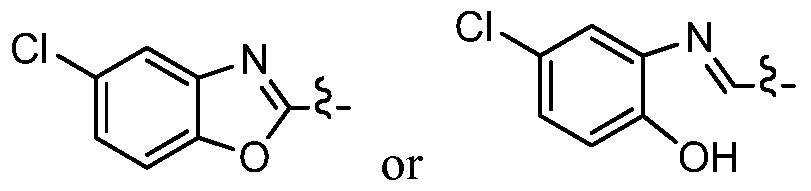
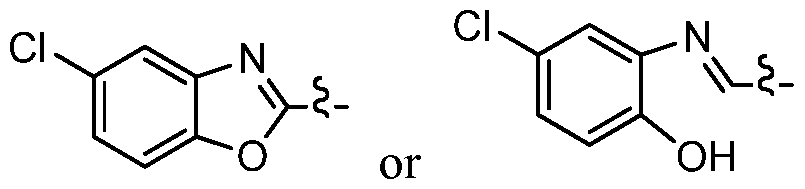
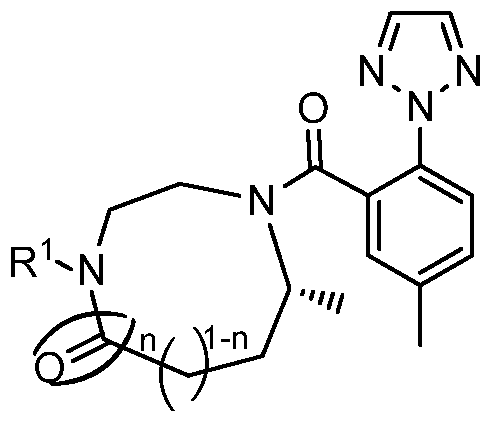
  • One example for such an orexin receptor antagonist is [(7R)-4-(5-chloro-l,3-benzoxazol-2-yl)-7-methyl-l,4- diazepan-l-yl][5-methyl-2-(2H-l ,2,3-triazole-2-yl)phenyl]methanone which has the structure according to Formula XI)
  • the synthesis of Suvorexant is based on the synthesis of the three main building blocks, i.e. the diazapane ring, the benzoxazole ring as well as the triazole building block. These building blocks are coupled to each other to give the desired product.
  • the triazole building block is usually coupled in the form of an acid or an acid chloride to the diazepane ring. Such a synthesis is e.g. described in WO2008069997 and in Cox et al, J. Med. Chem. 2010, 53: 5320.
  • 2-iodo.5.methylbenzoic acid is converted in the presence of a copper catalyst and triazole to give 5-methyl-2-(2H-l,2,3-triazole- 2yl)benzoic acid.
  • this building block is coupled as acid or acid chloride to the diazapene ring and the resulting compound is then, after a deprotection step, coupled to the oxazole ring.
  • the 2-iodo.5.methylbenzoic acid is a comparatively costly starting material which renders the process disadvantageous.
  • regioisomer may be formed since the triazole may be coupled via any one of the present NH groups. These regioisomer need to be separated via column chromatography, which is difficult, and thus renders the process disadvantageous for industrial scale.
  • R 6 and R 7 are, independently of each other, selected from the group consisting of H, alkyl, aryl, cycloalkyl, heteroalkyl, heteroaryl and heterocycloalkyl, and wherein E is an electrophilic group, and wherein the process comprises
  • halogen in the context of E is denote to mean a halogen residue, i.e. in particular -CI, -Br or -I.
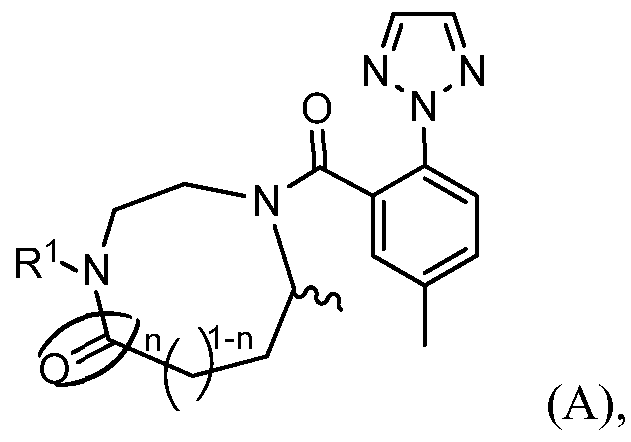
  • the present invention relates to a process for the preparation of a compound of formula A) or a pharmaceutically acceptable salt or solvate thereof
  • R 1 is selected from the group consisting of H, PG 1 and R A , with R A being
  • PG 1 is a suitable protecting group and wherein n is 0 or 1, the process comprising
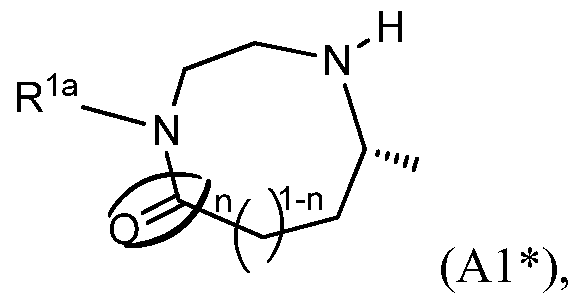
  • R la is selected from the group consisting of H, PG 1 , and R A , with R A being
  • PG 1 is a suitable protecting group and wherein R la may be the same or may differ from R 1 , and wherein in case n is 0, R la is preferably not H, (iii) optionally converting the R la into R 1 if R 1 and R la differ from each other, to give the compound of formula (A), preferably (Al *).
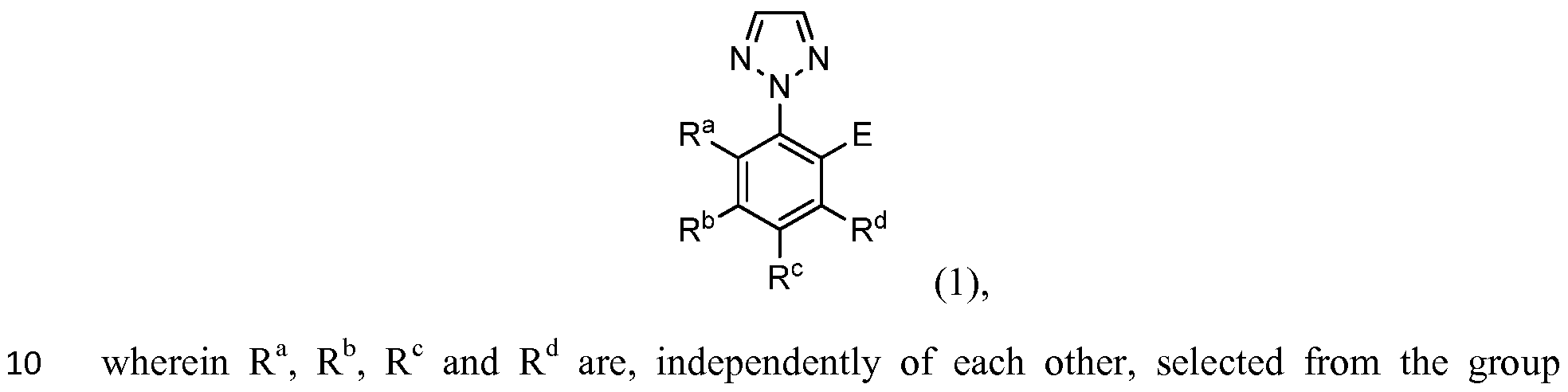
  • the present invention relates to a compound obtained or obtainable by any of the above described method, and to a com ound of formula (1)
  • R a , R b , R c and R d are, independently of each other, selected from the group consisting of H, alkyl, aryl, cycloalkyl, heteroalkyl, heteroaryl, heterocycloalkyl, halogen, carbonyl, alkoxy, hydroxyl, -NR 6 R 7 , -SR and -N0 2 , wherein R 6 and R 7 are, independently of each other, selected from the group consisting of H, alkyl, aryl, cycloalkyl, heteroalkyl, heteroaryl and heterocycloalkyl, and wherein E is an electrophilic group, with the proviso that E is not COOH.
  • the present invention also relates to a process for the preparation of a compound of formula A) or a pharmaceutically acceptable salt or solvate thereof
  • PG 1 is a suitable protecting group and wherein n is 0 or 1, the process comprising
  • the compound comprises less than 1000 ppm, more preferably less than 100 ppm, preferably less than 10 ppm, more preferably 0 ppm, of the regioisomeric side product havin the structure:
  • R la is selected from the group consisting of H, PG 1 and R A , with R A being
  • PG 1 is a suitable protecting group and wherein R la may be the same or may differ from R 1 and, wherein in case n is 0, R la is preferably not H,
  • the present invention relates to a process for the preparation of a compound of formula (1) as well as to a compound obtained or obtainable by said method and to a com ound of formula (1) as such
  • R 6 and R 7 are, independently of each other, selected from the group consisting of H, alkyl, aryl, cycloalkyl, heteroalkyl, heteroaryl and heterocycloalkyl, and wherein E is an electrophilic group
  • R 6 and R 7 are, independently of each other, selected from the group consisting of H, alkyl, aryl, cycloalkyl, heteroalkyl, heteroaryl and heterocycloalkyl, and wherein E is an electrophilic group.
  • alkyl relates to non-branched alkyl residues and branched alkyl residues.
  • the term also encompasses alkyl groups which are further substituted by one or more suitable substituents.
  • substituted alkyl as used in this context of the present invention preferably refers to alkyl groups being substituted in any position by one or more substituents, preferably by 1, 2, 3, 4, 5 or 6 substituents, more preferably by 1, 2, or 3 substituents. If two or more substituents are present, each substituent may be the same or may be different from the at least one other substituent. There are in general no limitations as to the substituent.
  • the substituents may be, for example, selected from the group consisting of aryl, alkenyl, alkynyl, halogen, hydroxyl, alkylcarbonyloxy, arylcarbonyloxy, alkoxycarbonyloxy, aryloxycarbonyloxy, carboxylate, alkylcarbonyl, arylcarbonyl, alkoxycarbonyl, aminocarbonyl, alkylaminocarbonyl, dialkylaminocarbonyl, alkylthiocarbonyl, alkoxy, phosphate, phosphonato, phosphinato, amino, acylamino, including alkylcarbonylamino, arylcarbonylamino, carbamoyl, ureido, amidino, nitro, imino, sulfhydryl, alkylthio, arylthio, thiocarboxylate, sulfates, alkylsulfinyl, sulfonate, s
  • cycloalkyl refers to alkyl groups which form a ring, such as a 5-membered, 6-membered or 7-membered ring, e.g. cyclopentyl or cyclohexyl.
  • aryl refers to, but is not limited to, optionally suitably substituted 5- and 6-membered single-ring aromatic groups as well as optionally suitably substituted multicyclic groups, for example bicyclic or tricyclic aryl groups.
  • aryl thus includes, for example, optionally substituted phenyl groups or optionally suitably substituted naphthyl groups.
  • Aryl groups can also be fused or bridged with alicyclic or heterocycloalkyl rings which are not aromatic so as to form a polycycle, e.g. benzodioxolyl or tetraline.
  • heteroaryl as used within the meaning of the present invention includes optionally suitably substituted 5- and 6-membered single-ring aromatic groups as well as substituted or unsubstituted multicyclic aryl groups, for example tricyclic or bicyclic aryl groups, comprising one or more, preferably from 1 to 4, such as 1, 2, 3 or 4, heteroatoms, wherein in case the aryl residue comprises more than 1 heteroatom, the heteroatoms may be the same or different.
  • heteroaryl groups including from 1 to 4 heteroatoms are, for example, benzodioxolyl, pyrrolyl, furanyl, thiophenyl, thiazolyl, isothiazolyl, imidazolyl, triazolyl, tetrazolyl, pyrazolyl, oxazolyl, isoxazolyl, pyridinyl, pyrazinyl, pyridazinyl, benzoxazolyl, benzodioxazolyl, benzothiazolyl, benzoimidazolyl, benzothiophenyl, methylenedioxyphenylyl, napthyridinyl, quinolinyl, isoquinolinyl, indolyl, benzofuranyl, purinyl, deazapurinyl, or indolizinyl.
  • optionally substituted aryl and the term “optionally substituted heteroaryl” as used in the context of the present invention describes moieties having substituents replacing a hydrogen on one or more atoms, e.g. C or N, of an aryl or heteroaryl moiety. Again, there are in general no limitations as to the substituent.
  • the substituents may be, for example, selected from the group consisting of alkyl, alkenyl, alkynyl, halogen, hydroxyl, alkylcarbonyloxy, arylcarbonyloxy, alkoxycarbonyloxy, aryloxycarbonyloxy, carboxylate, alkylcarbonyl, arylcarbonyl, alkoxycarbonyl, aminocarbonyl, alkylaminocarbonyl, dialkylaminocarbonyl, alkylthiocarbonyl, alkoxy, phosphate, phosphonato, phosphinato, amino, acylamino, including alkylcarbonylamino, arylcarbonylamino, carbamoyl and ureido, amidino, nitro, imino, sulfhydryl, alkylthio, arylthio, thiocarboxylate, sulfates, alkylsulfmyl, sulfonate, sul
  • compound (1) comprises less than 1000 ppm, more preferably less than 100 ppm, more preferably less than 10 ppm, more preferably 0 ppm, of a regioisomeric side product having the structure:
  • Residues R a , R b , and R d are preferably, independently of each other, H or alkyl.
  • residues R a , R b , and R d are H.
  • the present invention also relates to the preparation of a compound of formula (1), as described above, and a compound obtainable or obtained by said process as well as to the compound as such the compound having the structure
  • the present invention relates to the processes for the preparation of a compound of formula (A) and a compound of formula (A) obtained or obtainable by said processes, as described above, wherein in step (i), a com ound having the structure
  • Residue R c is preferably H or alkyl, more preferably selected from the group consisting of H, methyl, ethyl, propyl and butyl, more preferably H or methyl, most preferably methyl.
  • the present invention also relates to the preparation of a compound of formula (1), as described above, and a compound obtainable or obtained by said process as well as to the compound as such the compound havin the structure
  • the present invention relates to the processes for the preparation of a compound of formula (A) and a compound of formula (A) obtained or obtainable by said processes, as described above, wherein in step (i), a com ound having the structure
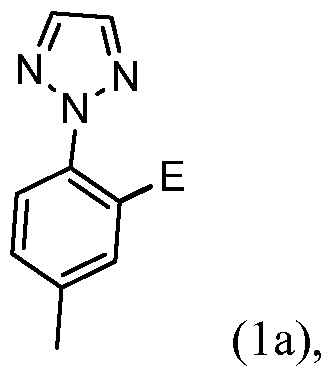
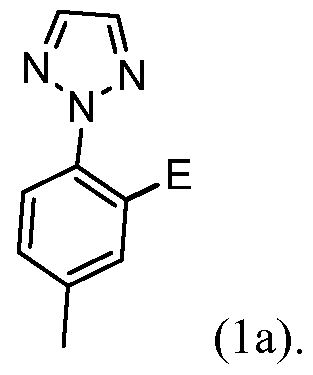
  • residues R a , R b , and R d are H and residue R c is -CH 3 , the compound of formula (1) thus having the structure (la)
  • E is an electrophilic group.
  • electrophilic group means any functional group attached to the phenyl ring that can accept a pair of electrons.
  • R 5 is not OH.
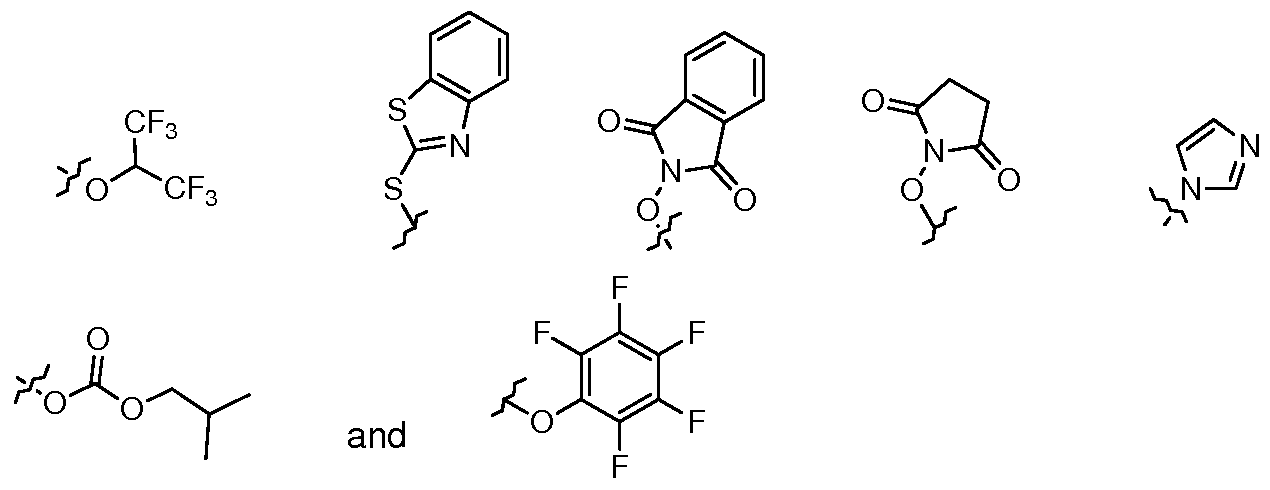
  • leaving group as used in this context of the present invention is denoted to mean a molecular fragment that departs with a pair of electrons in heterolytic bond cleavage upon reaction with a nucleophile, such as with an amine group of the diazepane building block.
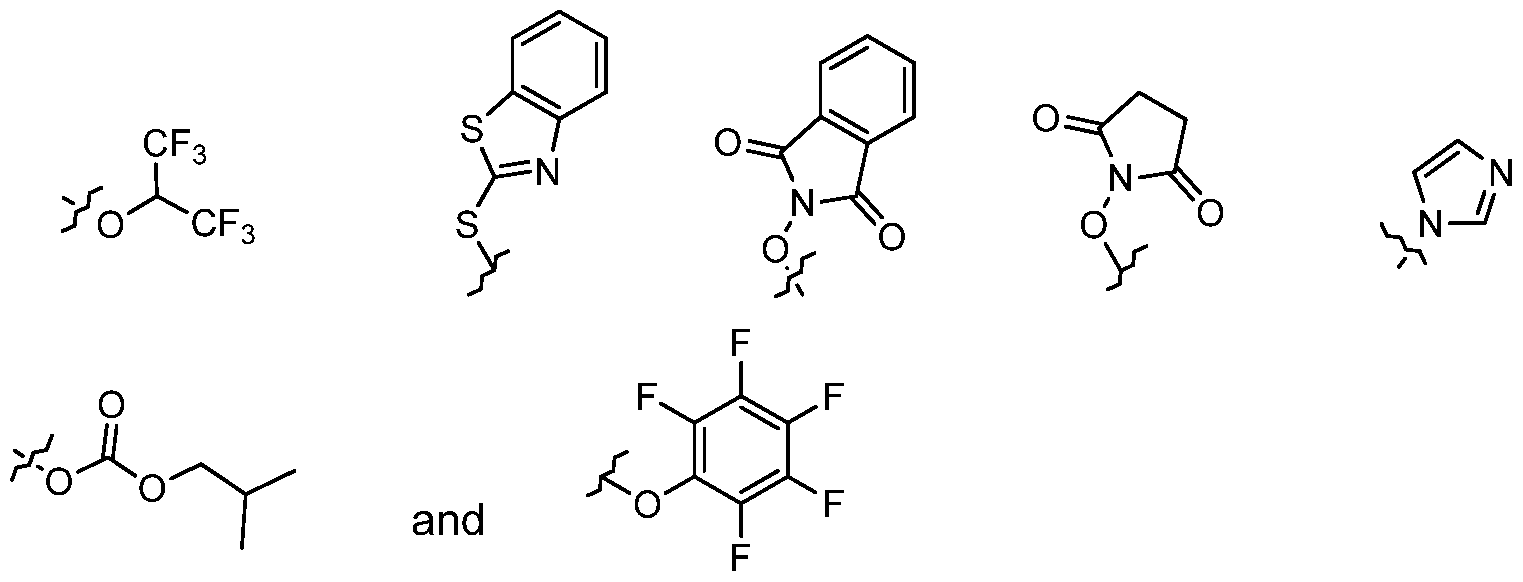
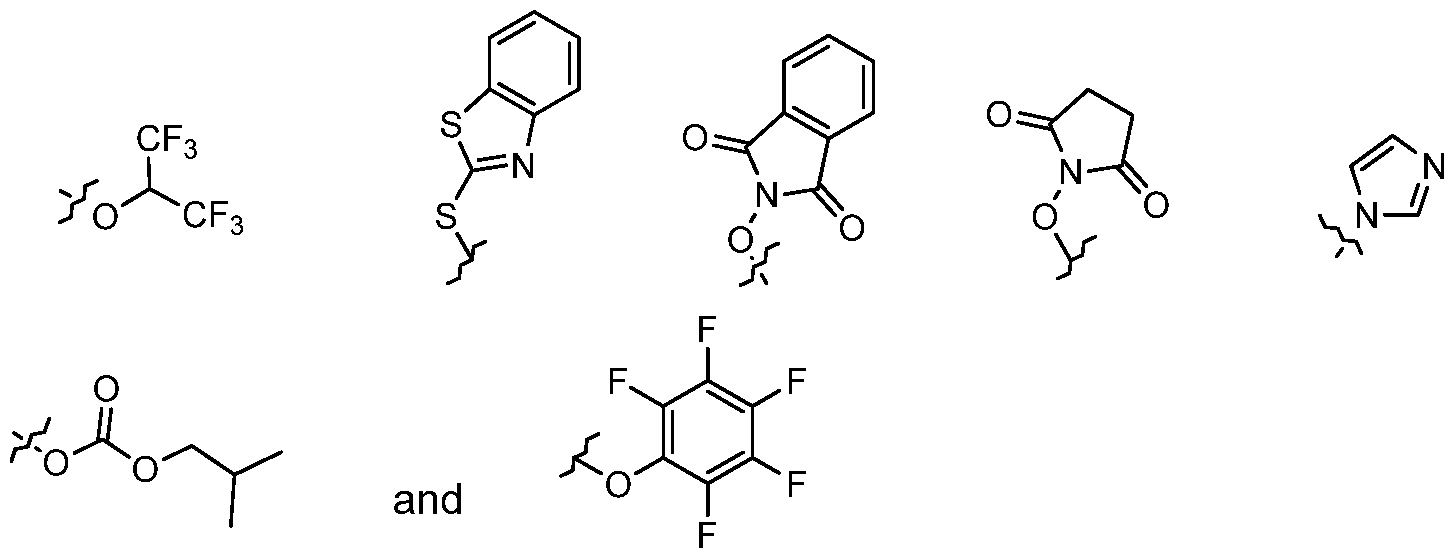
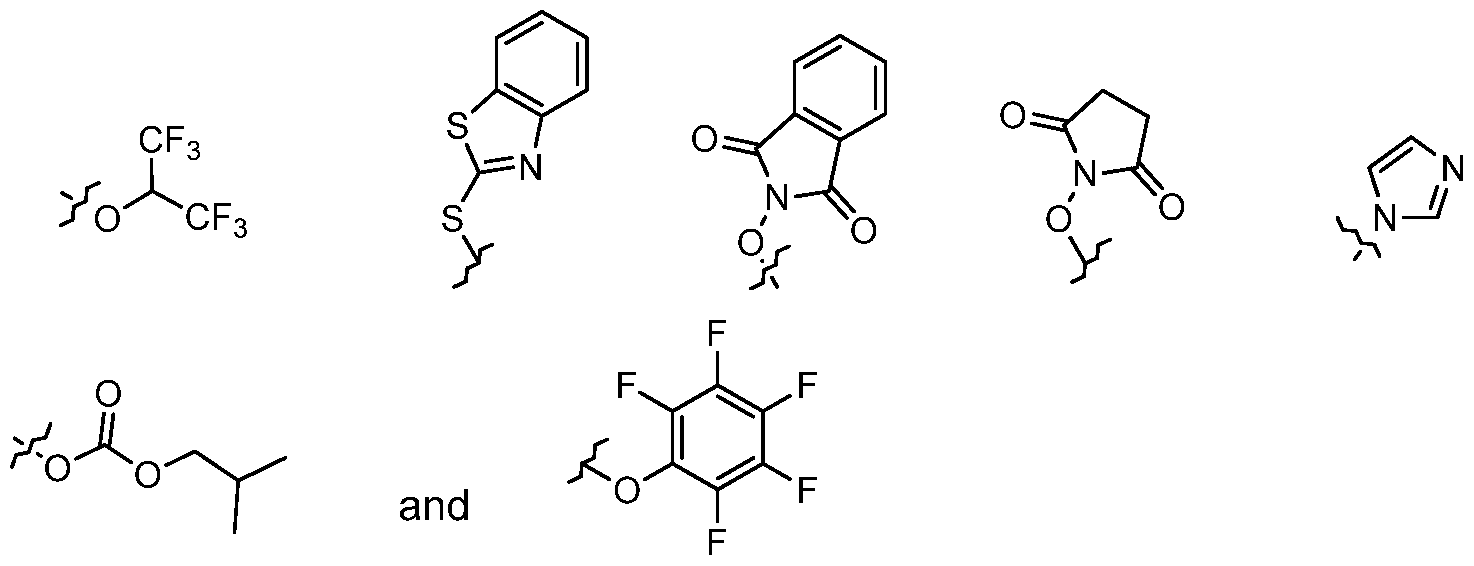
  • leaving groups are, inter alia, halogens, sulfonic esters (such as, inter alia, the mesyl and tosyl grou or any one of the following groups
  • the present invention relates to a compound obtained or obtainable by the above described method the compound havin the structure (1)
  • the present invention relates to a compound obtained or obtainable by the above described method the compound havin the structure (la)
  • the present invention relates to a compound obtained or obtainable by the above described method, wherein the com ound has the structure
  • the compound of formula (II) has the structure
  • residues R a , R b , and R d are preferably, independently of each other, H or alkyl.
  • Residue R c is preferably alkyl, more preferably methyl.
  • step (b) the compound of formula (II), preferably of formula (Ila), is reacted with an organolithium reagent in an aprotic solvent to give an intermediate compound of formula (III)
  • the reaction may be carried out in any suitable aprotic solvent known to those skilled in the art.
  • the reaction is carried out in an organic aprotic solvent selected from the group consisting of diethylether, Tetrahydrofuran, 2-methyltetrahydrofuran, hexane, pentane, cyclopentane, cyclohexane, heptane, toluene and mixtures of two or more thereof.
  • diethylether is used as solvent.
  • the organolithium reagent is preferably selected from the group consisting of n-butyllithium, sec-butyllithium, tert-butyllithium, isopropyllithium, more preferably the reagent is n-butyllithium.
  • the reaction is carried out at a temperature in the range of from -85 °C to - 20 °C, more preferably in the range of from -85 °C to -50°C more preferably in the range of from -80 °C to -60°C.
  • the temperature may be varied or held essentially constant.
  • the mol equivalents of the organolithium compound to compound of formula (II) is preferably in the range of from 0.8 to 4, more preferably in the range of from 0.9 to 2.5, more preferably 0.95 to 1.1.
  • the compound of formula (II) when providing the reaction mixture to be reacted in (b), the compound of formula (II) is first admixed with at least a portion of a suitable solvent and is preferably cooled to the temperature range mentioned above.
  • the organolithium reagent is then added which, for example, can be employed as mixture with at least a portion of the solvent or as such.
  • Compound (II) is preferably allowed to react with the organolithium reagent for a time in the range of from 10 min to 3 h, more preferably in the range of from 10 min to 2 h, more preferably in the range of from 10 min to 1 h. Compound (II) is then preferably reacted, without any intermediate purification step, in step (c).
  • Step (c) Step (c) of the invention comprises the reacting of the intermediate compound of formula (III) with an electrophile E* thereby forming, optionally after at least one further step, the compound of formula (1) comprising the electrophilic group E.
  • Electrophile is a reagent attracted to electrons. Electrophiles are positively charged or neutral species having vacant orbitals that are attracted to an electron rich centre. An electrophile participates in a chemical reaction by accepting an electron pair in order to bond to a nucleophile. Because electrophiles accept electrons, they are Lewis acids. Most electrophiles are positively charged, have an atom that carries a partial positive charge, or have an atom that does not have an octet of electrons.
  • X is X being a halogen (residue), a sulfonic ester (such as, inter alia, the mes l and tosyl group) or any one of the following groups
  • Z is preferably-N(CH 3 ) 2 , or -R 5 with R5 being preferably -O-alkyl, i.e. Z is preferably - N(CH 3 ) 2 or -O-AlkyL .
  • E* is selected from the group consisting of C0 2 , carbonates, formiates, formamides, halogens, preferably E* is an alkylformiate or an alkylcarbonate or C0 2 , more preferably E* is selected from the group consisting of C0 2 , ethylcarbonate, methylcarbonate, ethylformiate and methylformiate.
  • the reaction is carried out in the same aprotic solvent used in step (c).
  • the solvent is preferably selected from the group consisting of diethylether, Tetrahydrofuran, 2-methyltetrahydrofuran, hexane, pentane, cyclopentane, cyclohexane, heptane, toluene and mixtures of two or more thereof.
  • diethylether is used as solvent.
  • step (c) and step (b) are carried out in one pot.
  • the reaction is carried out at a temperature in the range of from -85 °C to -20 C, more preferably in the range of from -85 °C to -50 °C , more preferably in the range of from -80 °C to -60 .
  • the temperature may be varied or held essentially constant.
  • halogen in the context of E* is denoted to mean a halogen molecule, i.e. in particular Cl 2 , Br 2 or I 2 .
  • E is a halogen residue
  • E* is preferably a halogen.
  • the compound of formula (III) is preferably reacted with Cl 2 , I 2 or Br 2 , more preferably with Cl 2 or I 2 to give the compound of formula (1) with E being a halogen residue, in particular -CI or -I.
  • E* is preferably C0 2 .
  • the compound of formula (III) is preferably reacted with C0 2 to give the compound of formula (1) with E being -COOH.
  • E* is thus preferably an alkylcarbonate, more preferably methylcarbonate or ethylcarbonate.
  • This compound may further be transformed to E being -COOH via oxidation if desired.
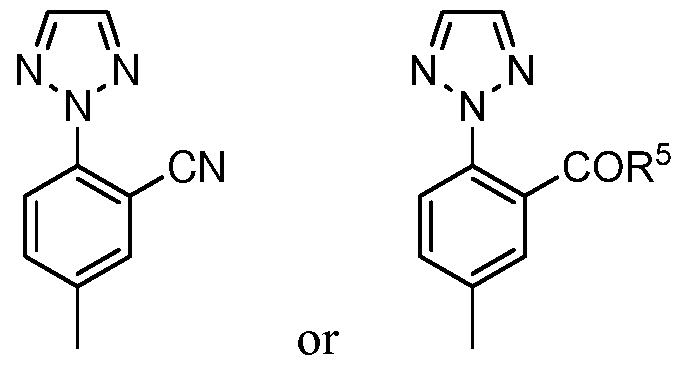
  • E is CN
  • E* is preferably C0 2 .
  • the compound of formula (III) is preferably reacted with C0 2 give an intermediate compound comprising a carboxylic acid and the carboxylic acid is then transformed in at least one further step to give the compound of formula (1).
  • the group -CO(NH 2 ) may be obtained e.g. by activation of the -COOH group and subsequent reaction with ammonia.
  • the dehydration may e.g. be carried out by reaction with cyanuric chloride.
  • compound (1) may be isolated or may be directly further processed to give the compound of formula (A). If such isolation is carried out, this may be carried out by any method known to those skilled in the art. Such isolation may comprise one or more stages wherein preferably at least one stage comprises a purification, such as an extraction and/or a precipitation and/or filtration.
  • a purification such as an extraction and/or a precipitation and/or filtration.
  • Compound (II), preferably compound (Ila), may be provided by any suitable method known to those skilled in the art.
  • step (a) comprises
  • step (a) comprises
  • compound (II) has the structure Ila)
  • step (a) compound (Ila) is provided, wherein this provision comprises providing a compound of formula (IVa) or a salt thereof
  • step (a) comprises
  • the present invention also relates to the preparation of a compound of formula (A), as described above, and a compound obtainable or obtained by said process as well as to the compound as such, wherein the provision of compound (la) in step (i) comprises
  • the compound of formula (IV) has the structure
  • the compound (IV) in (al) is provided in the form of a salt, preferably the HC1 salt.
  • the compound (IV) has the structure
  • step (a2) the compound of formula (IV), preferably (Iva) is reacted with glyoxal.
  • the reaction in step (a2) is carried out in the presence of a copper salt, preferably Cu(OTf) 2 .
  • a copper salt preferably Cu(OTf) 2 .
  • first compound (V), preferably compound (Va) is prepared which is optionally isolated and thereafter, compound (V), preferably (Va), is transformed, in the presence of Cu(OTf) 2 , to compound (II).
  • step (a2) preferably comprises
  • step (a2) of step (a) comprises
  • step (i) transforming the compound of formula (V), preferably (Va), in the presence of a copper salt, preferably Cu(OTf) 2 to give the compound of formula (II), preferably (II a).
  • a copper salt preferably Cu(OTf) 2
  • the present invention also relates to the preparation of a compound of formula (A), as described above, and a compound obtainable or obtained by said process as well as to the compound as such, wherein the provision of compound (la) in step (i) comprises
  • the present invention also relates to a compound of formula (V), preferably (Va), as such as well as to a compound of formula (V), preferably (Va), obtained by a method comprising the steps (a2.1) and (a.2.2).
  • reaction in step (a2) may be carried out in any suitable solvent known to those skilled in the art.
  • the reaction in (a2.1) is carried out in an acidic solvent, preferably in acidic acid.
  • the reaction in (a2.1) is carried out at a temperature in the range of from 25°C to 80°C, more preferably in the range of from 40°C to 60°C. During the reaction, the temperature may be varied or held essentially constant.
  • the sequence of mixing the components of the reaction mixture is not subject to specific restrictions.
  • the compound of formula (IV), preferably (IVa) is first admixed with at least a portion of the solvent and, to the resulting mixture, glyoxal is added which, for example, can be employed as mixture with at least a portion of the solvent or as such.
  • the isolation in step (a2.2) may be carried out by any method known to those skilled in the art.
  • Such isolation may comprise one or more stages wherein preferably at least one stage comprises purification, such as an extraction and/or a precipitation and/or filtration and/or chromatography or the like.
  • Preferably compound (V) is precipitated and filtered off.
  • the mol equivalents of the copper salt, preferably Cu(OTf) 2 , to compound of formula (V) is preferably in the range of from 0 to 0.1, more preferably in the range of from 0.01 to 0.03.
  • PG is a suitable protecting group and wherein n is 0 or.
  • the compound (A) has, e.g., the structure (Aa) or (Ab)
  • the present invention also relates to a method, as described above, and to a compound obtained or obtainable by said method, wherein the compound (A) has the
  • R 1 is selected from the group consisting of H, PG 1 and R A , with being
  • PG 1 is a suitable protecting group.
  • compound (A) is preferably selected from the group consisting of
  • suitable protecting group as used herein is denoted to encompass any amino protecting group.
  • protecting group refers to a chemical moiety that can be selectively attached to and removed from a particular chemically reactive functional group in a molecule to prevent it from participating in undesired chemical reactions. The protecting group will vary depending on reaction conditions to be employed and the presence of additional reactive or protecting groups in the molecule. It is understood that the term “amino protecting group” is a chemical moiety being attached to a former amino group. After removal of the protecting group, the free amine is regained.
  • Representative protecting groups for amino groups are well known to those skilled in the art and are described, for example, in T. W. Greene and G. M.
  • amino-protecting group preferably includes both acyclic as well as cyclic protecting groups.
  • a “cyclic protecting group” is a group which, together with the N to which it is bound, forms a cyclic group.
  • Preferred protecting groups for PG 1 include, but are not limited to, carbamates, such as Boc (t-butyloxycarbonyl, Cbz (carboxybenzyl), Fmoc (fluorenylmethyloxycarbonyl), Alloc (allyloxycarbonyl), methyl and ethyl carbamates; trityl, benzyl, benzylidene, tosyl and the like; cyclic imide derivatives, such as succinimide and phthalimide; amides, such as formyl, (un)substituted acetyl, and benzoyl; and trialkyl silyl groups, such as t-butyldi- methylsilyl and triisopropylsilyl.
  • carbamates such as Boc (t-butyloxycarbonyl, Cbz (carboxybenzyl), Fmoc (fluorenylmethyloxycarbonyl), Alloc (allyloxycarbonyl), methyl and
  • Particularly preferred amino-protecting groups include Boc, Cbz, Fmoc, benzyl, acetyl, benzoyl, trityl and the like. More preferably, PG 1 is selected from the group consisting of Benzyl, t-butyloxycarbonyl (Boc), Cbz, PNZ, Alloc, Trifluoroacetate and Phthalimide, more preferably PG 1 is a Boc group or a Cbz group, more preferably Boc.
  • compound (A) is preferably selected from the group consisting of
  • a bond shown as " in any one of the compounds shown herein is denoted to represent a single bond, wherein the resulting structure including the bond encompasses the isolated S isomer, the isolated R isomer, as well as mixtures of the S and R isomer.
  • the present invention also relates to methods for the preparation of a compound (A), as described above, and a compound obtained or obtainable by any of these processes, wherein the compound has a structure selected from
  • compound (A) is (A*) and is selected from the group consisting of
  • R 1 is selected from the roup consisting of H,
  • R la is selected from the group consisting of H, PG 1 and R A , with R A being
  • R la is a suitable protecting group. It is to be understood that R la may be different from R 1 or may be the same
  • R la is selected from the group consisting of H,
  • R a is H or — 0 s
  • R la is H.
  • Step (i) The compound of formula (la) may be provided by any method known to those skilled in the art.
  • the compound (la) is thus provided by a method comprising the steps (a) to (c) as mentioned above.
  • step (i) comprises
  • the compound (la) obtained or obtainable by the above described method preferably comprises less than 1000 ppm, more preferably less than 100 ppm, preferably less than 10 ppm, more preferably 0 ppm, of the regioisomeric side product
  • E is not COOH and not CI, preferably not COOH and not a halogen.
  • step (i) compound (la) is provided wherein X is not CI and E is not COOH.
  • step (i) compound (la) is provided wherein compound (la) comprises less than 1000 ppm, more preferably less than 100 ppm, preferably less than 10 ppm, more preferably 0 ppm, of the re ioisomeric side product
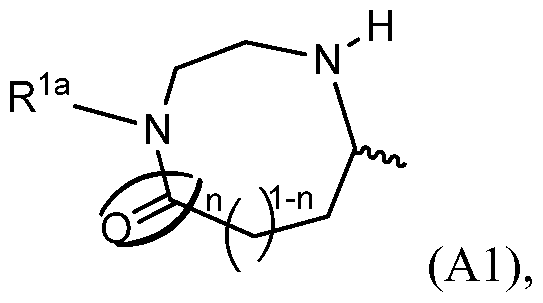
  • step (ii) the compound of formula (la) is reacted, i.e. coupled with the compound of formula (Al)
  • R la is PG 1 , and wherein n is preferably 0, wherein R la is selected from the group consisting of H, PG 1 , and R A , with R A being
  • R la may be the same or may differ from R 1 , and wherein in case n is 0, R la is preferably not H.
  • the coupling is preferably carried out in the presence of a suitable base, preferably an organic base, most preferably an amino group comprising base, most preferably a base selected from the group consisting of diisopropylamine (DIEA), triethylamine (TEA), N-methylmorpholine, N-methylimidazole, l,4-diazabicyclo[2.2.2]octane (DABCO), N- methylpiperidine, N-methylpyrrolidine, 2,6-lutidine, collidine, pyridine, 4- dimethylaminopyridine, l,8-diazabicyclo[5.4.0]undec-7-ene (DBU).
  • a suitable base preferably an organic base, most preferably an amino group comprising base, most preferably a base selected from the group consisting of diisopropylamine (DIEA), triethylamine (TEA), N-methylmorpholine, N-methylimidazole, l,4-diazabicy
  • the reaction is carried out in an organic solvent, such as N-methyl pyrrolidone (NMP), dimethyl sulfoxide (DMSO), acetonitrile, acetone, dimethyl acetamide (DMA), dimethyl formamide (DMF), formamide, tetrahydrofuran (THF), 1,4-dioxane, diethyl ether, tert.-butyl methyl ether (MTBE), dichloromethane (DCM), chloroform, tetrachloromethane and mixtures of two or more thereof. More preferably, the reaction is carried out in dichloromethane.
  • NMP N-methyl pyrrolidone
  • DMSO dimethyl sulfoxide
  • DMA dimethyl formamide
  • THF tetrahydrofuran
  • THF tetrahydrofuran
  • MTBE tert.-butyl methyl ether
  • DCM dichloromethane
  • chloroform tetrachlor
  • the temperature of the coupling reaction is preferably in the range of from 0 to 100 °C, more preferably in the range of from 5 to 50 °C, and especially preferably in the range of from 15 to 30 °C. During the course of the reaction, the temperature may be varied, preferably in the above given ranges, or held essentially constant.
  • compound (la) preferably readily reacts with the NH group of compound (Al), optionally in the presence of a suitable base as mentioned above without the need to add a catalyst or a coupling reagent.
  • activating agents such as EtMgBr or A1C1 3 may be added.
  • a coupling reagent is required in order to react compound (la) and (Al) with each other.
  • Such coupling reagents include, but are not limited to, oxalyl chloride, HATU (0-(7-azabenzotriazole-l-yl)-N,N,N',N'-tetramethyluronium hexafluorophosphate); HO At (l-hydroxy-7-azabenzotriazole), HBTU (0-benzotriazole-l-yl)-N,N,N',N'- tetramethyluronium hexafluorophosphate); TBTU (2-(lH-benzotriazole-l-yl)-l,l,3,3- tetramethyluronium hexafluorophosphate); TFFH (N,N',N",N"-tetramethyluronium-2- fluoro-hexafluorophosphate); BOP (benzotriazo
  • EDC l-ethyl-3-(3-dimethylaminopropyl) carbodiimide hydrochloride, CDC (1- cyclohexyl-3-(2-morpholinoethyl)carbodiimide), Pyclop, T3P, CDI, Mukayama's reagent, HODhbt, HAPyU, TAPipU, TPTU, TSTU, TNTU, TOTU, BroP, PyBroP, BOI, TOO, NEPIS, BBC, BDMP, BOMI, AOP, BDP, PyAOP, TDBTU, BOP-Cl, CIP, DEPBT, Dpp- Cl, EEDQ, FDPP, HOTT, TOTT, PyCloP.
  • reaction with (Al) is preferably carried out in the presence of an oxidizing agent, in particular in the presence of tBuOOH .
  • reaction with (Al) is preferably carried out in the in the presence of a basic organometallic reagent, preferably an alkylaluminum or a Grignard reagent, more preferably a Grignard reagent, in particular in the presence of EtMgBr
  • step (iii) R la is converted into R 1 if R 1 and R la differ from each other. Thus, it is to be understood that R la may be different from R 1 or may be the same. In case R 1 differs from R la , step (iii) is carried out. In case R 1 is equal to R la , step (iii) is omitted.
  • step (ii) corresponds to the compound (A), in case R la is equal to R 1 .
  • step (ii) is transformed in step (iii) to give the compound of formula (A) wherein this transformation may be carried out in one or in multiple steps.
  • (A) is (Ax)
  • R la is H, PG 1 or R A , with R A bein
  • step (ii) in case n in compound Al is 1 and n in compound Ax is 0,
  • step (iiia) removing the protecting group PG 1 in case R la is PG 1 and reacting the compound of step (ii) with
  • X* is a leaving group, preferably CI, or by (iiib) reacting the compound of step (ii) with
  • X* is a leaving group, preferably CI, in case R la is H,
  • step (iii) is omitted.
  • the process preferably comprises:
  • R la is PG 1 and wherein the compound of step (ii) is reduced in case n in Ay is 0 and n in compound Al is 1.
  • (A) is (Az)
  • the process preferably comprises:
  • R la is H, PG 1
  • step (iii) is omitted.
  • (A) has the structure
  • the process preferably comprises
  • R la is R A , with R A bein
  • the process preferably comprises
  • R la is PG 1 or H, and optionally reducing the compound of step (ii) in case n in compound Al is 1,
  • step (iiia) removing the protecting group PG 1 in case R 1 is PG 1 and reacting the compound of step (ii) with
  • X* is a leaving group, preferably CI, or by
  • X* is a leaving group, preferably CI, in case R 1 is H,
  • step (ii) the compound is reduced in case in compound (A) n is 0 and in compound (Al) n is 1.
  • reduction may also be carried out in step (iii).
  • a reduction of the carbonyl group is carried out.
  • the reduction is carried out in an organic solvent, more preferably in a solvent selected from the group consisting of methanol, ethanol, nPrOH, i-PrOH, THF, 2-MeTHF, MTBE (methyl-tert-butyl ether), DIPET (diisopropylether), toluene, acetonitrile, CH 2 CI 2 and mixtures of two or more thereof.
  • a solvent selected from the group consisting of methanol, ethanol, nPrOH, i-PrOH, THF, 2-MeTHF, MTBE (methyl-tert-butyl ether), DIPET (diisopropylether), toluene, acetonitrile, CH 2 CI 2 and mixtures of two or more thereof.
  • the reduction is carried out at a temperature in the range of from -20 °C to 110 °C.
  • the compound is reduced by reaction with a reducing agent selected from the group consisting of NaBH 4 , NaCNBH 3 , NaBH(OAc) 3 , LiAlH 4 , LiBH 4 and H 2 in the presence of transition metals, wherein the transition metal is preferably selected from the group consisting of IR, Pt, Fe, Rh, Pd, Re, Ru, Ni and Co.
  • the reducing agent is selected from the group consisting of NaBH 4 , NaCNBH 3 , NaBH(OAc) 3 , LiAlH 4 and LiBH 4 , more preferably the reducing agent is NaBH 4 , NaCNBH 3 or NaBH(OAc) 3, more preferably NaBH 4 .
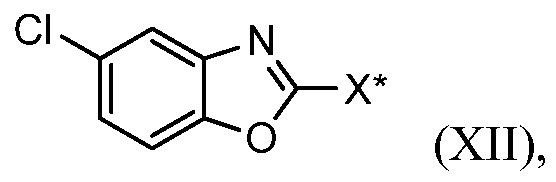
  • leaving group in the context of compound (XII) is denoted to encompass any group that departs upon reaction of compound (XII) with an amine.
  • Preferred leaving groups are -CI, -S, -SMe, -SEt or -Br, in particular -CI or -Br.
  • the reaction is carried out in an organic solvent, more preferably in a solvent selected from the group consisting of dichloromethane, DMF, DMSO, NMP (N-methyl pyrrolidone), methanol, ethanol, propanol, isopropanol, butanol, s-butanol, t-butanol, tetrahydrofuran, 2-methyltetrahydrofuran, methyltertbutylether, diethylether, diisopropylether, toluene, acetonitrile, tetrametyhlharnstoff (tetramethylurea), dimethylacetamid, EtOAc, iPrOAc, hexan, cyclohexan, heptan and mixtures of two or more thereof.
  • a solvent selected from the group consisting of dichloromethane, DMF, DMSO, NMP (N-methyl pyrrolidone), methanol, ethanol, propan
  • the reaction is carried out at a temperature in the range of from 0 to 110 ° C, more preferably in the range of from 20 to 80 °C, more preferably in the range of from 40 to 80 °C, more preferably at room temperature.
  • the temperature may be varied or held essentially constant.
  • the compounds are preferably allowed to react for a time in the range of from 10 min to 72 h, more preferably in the range of from 30 min to 24 h, more preferably in the range of from 1 h to 12 h.
  • reaction mixture obtained is subjected to a suitable work-up, such as an isolation of the respective compound.
  • working up may comprise one or more stages wherein preferably at least one stage comprises purification, such as an extraction and/or a precipitation and/or filtration and/or chromatography or the like.
  • purification such as an extraction and/or a precipitation and/or filtration and/or chromatography or the like.
  • some reactions may be carried out with the crude intermediate products or even in situ.
  • the compound of formula (Al) may be provided by any method known to those skilled in the art.
  • compound (Al) is provided by a process comprising
  • R E is selected from the group consisting of H, alkyl, aryl, alkylaryl, heteroaryl, cycloalkyl and heterocycloalkyl, more preferably wherein R E is alkyl, more preferably wherein R E is methyl, ethyl or propyl, more preferably wherein R E is methyl, and wherein R la is selected from the group consisting of H, PG 1 , and R A , with R A being
  • R a is a protecting group PG a
  • R la is selected from the roup consisting of H, and
  • R la is H or
  • R la is H.
  • PG 2a is a suitable protecting group.
  • Preferred protecting groups for PG 2a include, but are not limited to, carbamates, such as Boc (t-butyloxycarbonyl, Cbz (carboxybenzyl), Fmoc (fluorenylmethyloxycarbonyl), Alloc (allyloxycarbonyl), methyl and ethyl carbamates; trityl, benzyl, benzylidene, tosyl and the like; cyclic imide derivatives, such as succinimide and phthalimide; amides, such as formyl, (un)substituted acetyl, and benzoyl; and trialkyl silyl groups, such as t-butyldimethylsilyl and triisopropylsilyl.
  • carbamates such as Boc (t-butyloxycarbonyl, Cbz (carboxybenzyl), Fmoc (fluorenylmethyloxycarbonyl), Al
  • Particularly preferred amino-protecting groups include Boc, Cbz, Fmoc, benzyl, acetyl, benzoyl, trityl and the like.
  • PG 2a is a Boc group or a Cbz group, more preferably Cbz.
  • R E is selected from the group consisting of alkyl, aryl, alkylaryl, heteroaryl cycloalkyl and heterocycloalkyl, more preferably R E is alkyl, more preferably R E is methyl, ethyl or propyl, more preferably R E methyl.
  • step (bb) of the process of the invention the compound of formula (XX) is reacted with a base and optionally subsequently reduced to give after step (cc) the compound (A). Upon reaction with the base, the 7-membered ring is formed ("cyclization reaction").
  • the reaction may be carried out in any suitable solvent known to those skilled in the art.
  • the cyclization reaction is carried out in an organic solvent, more preferably in a solvent selected from the group consisting of R E -OH, tetrahydrofuran, 2- methyltetrahydrofuran, methyltertbutylether, diethylether, diisopropylether, toluene, acetonitrile and mixtures of two or more thereof, with R E being as described above and below, preferably wherein R E is selected from the group consisting of alkyl, aryl, alkylaryl, heteroaryl cycloalkyl and heterocycloalkyl.
  • the solvent has the structure R E -OH, with R E being as described above and below, preferably wherein R E is selected from the group consisting of alkyl, aryl, alkylaryl, heteroaryl cycloalkyl and heterocycloalkyl, more preferably wherein R E is alkyl, more preferably wherein R E is methyl, ethyl or propyl, more preferably wherein R E is methyl.
  • the cyclization is carried out at a temperature in the range of from -20 to 80 °C, more preferably in the range of from 0 to 50°C, more preferably in the range of from 20 to 30 °C. During the reaction, the temperature may be varied or held essentially constant.
  • a base selected from the group consisting of NaOR E , sodium- tert.butoxide, potassium-tert.butoxide, NaNH2, DBU (l,8-Diazabicycloundec-7-ene), Tetramethylguanidine, Na-CH 2 S(0)CH 3 and mixtures of two or more thereof is employed, with R E being selected from the group consisting of alkyl, aryl, alkylaryl, heteroaryl cycloalkyl and heterocycloalkyl, more preferably wherein R E is alkyl, more preferably wherein R E is methyl, ethyl or propyl, more preferably wherein R E is methyl.
  • the base is thus sodium methanolate.
  • the weight ratio of base to compound of formula (XX) is preferably in the range of from 0 to 8, more preferably in the range of from 1 to 5.
  • the sequence of mixing the components of the reaction mixture is not subject to specific restrictions.
  • the compound of formula (XX) is first admixed with at least a portion of a suitable solvent and, to the resulting mixture, the base is added which, for example, can be employed as mixture with at least a portion of the solvent or as such.
  • Compound (XX) is preferably allowed to react with the base for a time in the range of from 0 to 24, more preferably in the range of from 0 to 5, more preferably in the range of from 0 to 3.
  • step (bb) the compound of formula (XX) is reacted with a base to give, optionally after further steps, the compound (Al). In this case, no additional reduction step is necessary. Directly upon reaction with the base, the 7-membered ring of compound (Al) is formed ("cyclization reaction").
  • step (bb) the compound of formula (XX) is reacted with a base which is thereafter or in step (cc) reduced to give, after step (cc) and optionally after further steps, the compound (Al).
  • a reduction of the carbonyl group is thus carried out.
  • compound may be isolated or may be directly reduced in situ to give the compound of formula (XX). If such isolation is carried out, this may be carried out by any method known to those skilled in the art.
  • isolation may comprise one or more stages wherein preferably at least one stage comprises purification, such as an extraction and/or a precipitation and/or filtration.
  • the protecting group PG 2a may be removed.
  • the way of removing the protecting group PG 2a depends on the protecting group used. Suitable methods are known to those skilled in the art.
  • the removal of PG 2a is carried out under reductive conditions. More preferably, the removal is carried out with hydrogen and a metal catalyst, preferably a palladium catalyst, more preferably, the protecting group is removed with Pd/C.
  • the removal of group PG 2a may be carried out in any suitable solvent known to those skilled in the art.
  • the reaction is carried out in an organic solvent, more preferably in a solvent selected from the group consisting of methanol, ethanol, iPrOH, nPrOH, EtOAc, iPrOAc and mixtures of two or more thereof.
  • the removal of group PG 2a is carried out at a temperature in the range of from 0 °C to 100 °C, more preferably in the range of from 10 °C to 70 °C, more preferably at room temperature 20 °C to 50 °C, more preferably at room temperature.
  • the reaction is preferably carried out at a pressure in the range of from 1 to 4 bar, more preferably, 1.0 to 2.5 bar.
  • the compound is preferably allowed to react for a time in the range of from 10 min to 180 min, more preferably in the range of from 20 to 120 min, more preferably in the range of from 30 to 60 min.
  • the reduction is carried out in an organic solvent, more preferably in a solvent selected from the group consisting of methanol, ethanol, nPrOH, i-PrOH, THF, 2-MeTHF, MTBE, DIPET, toluene, acetonitrile, CH 2 CI 2 and mixtures of two or more thereof.
  • a solvent selected from the group consisting of methanol, ethanol, nPrOH, i-PrOH, THF, 2-MeTHF, MTBE, DIPET, toluene, acetonitrile, CH 2 CI 2 and mixtures of two or more thereof.
  • step (cl) is carried out at a temperature in the range of from -20 °C to 110 °C.
  • the compound is reduced by reaction with a reducing agent selected from the group consisting of NaBH 4 , NaCNBH 3 , NaBH(OAc) 3 , LiAlH 4 , LiBH 4 and H 2 in the presence of transition metals, wherein the transition metal is preferably selected from the group consisting of IR, Pt, Fe, Rh, Pd, Re, Ru, Ni and Co.
  • the reducing agent is selected from the group consisting of NaBH 4 , NaCNBH 3 , NaBH(OAc) 3 , LiAlH 4 and LiBH 4 , more preferably the reducing agent is NaBH 4 , NaCNBH 3 or NaBH(OAc) 3, more preferably NaBH 4 .
  • Compound (XX) preferably has either the structure
  • step (aa) compound (XX) is provided in the correct stereochemistr , i.e. as compound (XX*)
  • step (bb) This compound is then employed in step (bb) instead of the racemic mixture consisting of (XX*) and (XX**) shown above.
  • step (bb) in case compound (XX) consists of a racemic mixture, in step (bb), in the cyclization reaction of compound (XX), a compound (Al) consisting of a racemic mixture is obtained.
  • a chiral resolution of (Al) is carried out.
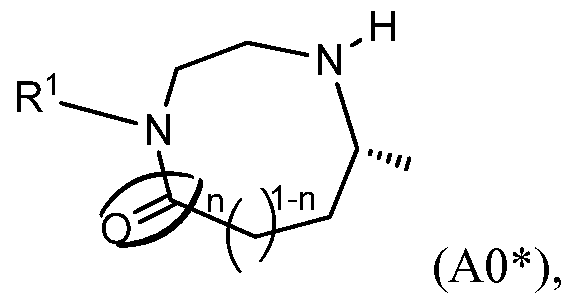
  • the racemic mixture in this case consists of the com ounds (Al *) and (Al **)
  • the compound (Al) contains from 20 to 75 % % by weight of the compound of formula (Al *) based on the total weight of the sum of (Al *) and (Al **).
  • the mixture comprising (Al *) and (Al **) is resolved by chiral resolution.
  • (II) preferably separating the precipitated, preferably crystallized, chiral acid salt (T) of the compound of formula (Al) from the mixture obtained in (I), wherein the chiral acid salt (T) contains at least than 80 % by weight of the chiral acid salt of the compound of formula (Al *) based on the total weight of the chiral acid salt of the compound of formula (Al),
  • single stereoisomer of a chiral acid in this context is denoted to mean that the chiral acid comprises less than 1 % by weight, preferably less than 0.5 % by weight, more preferably less than 0.1 % by weight, more preferably less than 0.05 % by weight, more preferably less than 0.01 % by weight, more preferably essentially no, more preferably no impurities of respective other stereoisomers of the chiral acid, based on the total weight of the chiral acid.
  • step (I) upon addition of the chiral acid in a suitable solvent, a chiral acid salt (T*) of at least part of the compound of formula (XX) is formed, and at least part of this chiral acid salt (T*) formed is precipitated, preferably crystallized, thereby obtaining a mixture comprising the precipitated, preferably crystallized, tartaric acid salt (T) and the solvent.
  • a chiral acid salt (T*) of at least part of the compound of formula (XX) is formed, and at least part of this chiral acid salt (T*) formed is precipitated, preferably crystallized, thereby obtaining a mixture comprising the precipitated, preferably crystallized, tartaric acid salt (T) and the solvent.
  • the chiral acid is preferably of a tartaric acid derivative selected from the group consisting of Ditoluoyl tartaric acid, Dibenzoyl tartaric acid, Dianisoyl tartaric acid, Dibenzoyl tartaric acid mono(dimethylamide) and a mixture of two or more thereof, preferably Dibenzoyl tartaric acid.
  • the process thus comprises
  • (II) preferably separating the precipitated, preferably crystallized, chiral acid salt (T) of the compound of formula (Al) from the mixture obtained in (I), wherein the chiral acid salt (T) of the compound of formula (Al) contains at least 80 % by weight of the chiral acid salt of the compound of formula (Al *) based on the total weight of the chiral acid salt of the compound of formula (Al),
  • the present invention also relates to a process, as described above, and a compound obtained or obtainable by the above described method the method comprising
  • a chiral acid salt preferably a tartaric acid salt, (T*) of at least part of the compound of formula (Al) by treating the compound of formula (Al) with a single stereoisomer of a chiral acid, preferably of a tartaric acid derivative selected from the group consisting of Ditoluoyl tartaric acid, Dibenzoyl tartaric acid, Dianisoyl tartaric acid, Dibenzoyl tartaric acid mono(dimethylamide) and a mixture of two or more thereof, in a suitable solvent, and precipitating, preferably crystallizing, at least part of the salt (T*) formed, thereby obtaining a mixture comprising the precipitated, preferably crystallized, salt (T) and the solvent,
  • the compound of formula (Al) employed in (I) contains of from 40 to 60 % by weight of the compound of formula (Al *) based on the total weight of the sum of (Al *) and (Al **).
  • step (b) at least part of the compound of formula (Al) obtained in the cyclization reaction is transformed into the corresponding chiral acid salt, preferably tartaric acid salt, (T*).
  • the chiral acid salt (T*) contains the chiral acid salt of the compound of formula (Al *), e.g. in an amount in the range of from 1 to 80 % by weight, such as in the range of from 10 to 70 % by weight, or in the range of from 30 to 60 % by weight, or in the range of from 45 to 55 % by weight, based on the total amount of the chiral acid salt (T*).
  • At least part of (T*) is precipitated, preferably crystallized.
  • This is preferably achieved by contacting (treating) the compound of formula (Al) in a suitable solvent with the chiral acid. Thereby, a mixture comprising the crystallized chiral acid salt (T) of the compound of formula (Al *) and the solvent is formed.
  • the precipitated, preferably crystallized, tartaric acid salt (T) of the compound of formula (Al) contains at least 80 % by weight of chiral acid salt of the compound of formula (Al *) based on the total weight of the chiral acid salt of the compound of formula (Al).
  • the mixture obtained in step (I) may comprise further compounds, in particular non crystalline forms of the compound of formula (Al) and salts thereof.
  • the mixture obtained in step (I) comprises non-crystalline forms of the compound of formula (Al **) and chiral acids salts thereof.
  • the chiral acid salt (T*) of the compound of formula (Al) is denoted to encompass all chiral acid salts of compound (Al) formed in step (I) including the chiral acid salt (T) which precipitates as well as all chiral acid salts formed which remain dissolved.
  • the chiral acid salt (T*) may comprise a mixture of chiral acid salts of compounds of formula (Al *) and (Al **).
  • step (I) and (II) thus a chiral resolution of the stereoisomers (Al *) and (Al **) is carried out.
  • any suitable organic solvent in which the compound of formula (Al) is sufficiently soluble may be used.
  • the solvent is selected from the group consisting of EtOH, i-PrOH, nPrOH, acetone, toluene, MTBE, CH 2 CI 2 , ethyl acetate, acetone, isopropanol, methanol, water, formic acid ethyl ester, isopropyl acetate, propyl acetate, butyl acetate, acetonitrile, tetrahydrofuran, dichloromethane, methylisobutylketone, toluene, hexane, cyclohexane, heptane and mixtures of two or more thereof.
  • the suitable solvent comprises acetone or methanol, more preferably the suitable solvent is acetone or methanol.
  • step (I) a further solvent may be added in order to precipitate, preferably crystallize, the chiral acid salt (T).
  • the mixture obtained in step (I) preferably additionally comprises said further solvent.
  • This further solvent may be added prior to, together with or after the addition of the chiral acid to the compound of formula (Al).
  • the compound of formula (Al) is dissolved in the suitable solvent mentioned above and a mixture, preferably a solution of the chiral acid, in a further solvent is added to the solution, wherein the further solvent and the suitable solvent may be the same or may be different.
  • the further solvent is selected from the group consisting of EtOH, i-PrOH, nPrOH, acetone, toluene, MTBE, CH 2 CI 2 , ethyl acetate, acetone, isopropanol, methanol, water, formic acid ethyl ester, isopropyl acetate, propyl acetate, butyl acetate, acetonitrile, tetrahydrofuran, dichloromethane, methylisobutylketone, toluene, hexane, cyclohexane, heptane and mixtures of two or more thereof.
  • the suitable solvent comprises acetone or methanol, more preferably the further solvent is acetone or methanol.
  • the present invention also relates to a process for the preparation of a chiral acid salt (T) of a compound of formula (Al), as described above, and a chiral acid salt (T) of the compound of formula (Al), obtained or obtainable by said process, wherein step (I) comprises dissolving the compound of formula (Al) in the suitable solvent and adding a solution of the chiral acid dissolved in a further solvent to the solution, wherein the further solvent and the suitable solvent are preferably the same, more preferably acetone or methanol.
  • the compound of formula (Al) is dissolved in the suitable solvent and the mixture is heated to a temperature in the range of from 20 to 80 °C, more preferably to a temperature in the range of from 30 to 60 °C more preferably to a temperature in the range of from 30 to 50 °C, more preferably to a temperature in the range of from 30 to 40 °C, prior to the addition of the tartaric acid.
  • the temperature may be varied, constantly or stepwise, or held essentially constant.
  • the mixture is heated until a clear solution of the compound of formula (Al) in the suitable solvent is obtained.
  • the mixture is afterwards cooled to room temperature.
  • the precipitation, preferably the crystallizing, in step (I) is preferably carried out at a temperature in the range of from 0 to 60 °C, wherein the temperature is preferably continuously or stepwise decreased.
  • the chiral acid may thus e.g. be added to a solution of the compound of formula (Al) in the suitable solvent which has been previously heated or which has been previously heated and afterwards cooled to a specific temperature, or which has not been previously heated.
  • the mixture may again be heated or alternatively be cooled, or the temperature may be held constant.
  • the mixture is cooled to a temperature in the range of from 0 to 50 °C, more preferably to a temperature in the range of from 0 to 40 °C, more preferably to a temperature in the range of from 10 to 30 °C.
  • the mixture obtained in step (I) consists of the chiral acid salt (T), optionally the unreacted chiral acid derivative, optionally the unreacted compound of formula (Al), optionally the further chiral acid salts (salt (T*) minus the amount of precipitated chiral acid salt (T)), the suitable solvent and optionally the further suitable solvent.
  • step (II) of the process of the invention the chiral acid salt (T) is separated from the mixture obtained in step (I).
  • the separation may be carried out by any suitable method known to those skilled in the art.
  • the separating in step (II) is carried out by centrifugation or filtration, preferably filtration.
  • the separated salt may be subjected to a further treatment such as an after-treatment such as a purification step and/or lyophilization.
  • the obtained chiral acid salt (T) of the compound of formula (Al) contains at least 85 % by weight, more preferably at least 95 % by weight, more preferably at least 96 % by weight, more preferably at least 97 % by weight, more preferably at least 98 % by weight, more preferably at least 99 % by weight, more preferably at least 99,5 % by weight, more preferably at least 99,9 % by weight, of the tartaric salt of the compound of formula (Al *), based on the total weight of chiral acid salt of the compound of formula (Al), i.e. based on the sum of (Al **) and (Al *). More preferably, the chiral acid salt (T) of the compound of formula (Al) consists of the chiral acid salt of the compound of formula (Al *).
  • compound (Al) is N-(2-aminoethyl)-2-aminoethyl-N-(2-aminoethyl)-2-aminoethyl-N-(2-aminoethyl)-2-aminoethyl-N-(2-aminoethyl)-2-aminoethyl-N-(2-aminoethyl)-2-aminoethyl)-2-aminoethyl-N-(2-aminoethyl)-2-aminoethyl-N-(2-aminoethyl)-2-aminoethyl)-2-aminoethyl-N-(2-aminoethyl)-2-aminoethyl-N-(2-aminoethyl)-2-aminoethyl-N-(2-aminoethyl)-2-aminoethyl-N
  • the chiral acid is preferably or a di-toluoyl tartaric acid, more preferably L-di- toluoyl tartaric acid (LTTA).
  • LTTA L-di- toluoyl tartaric acid
  • R 1 H and the chiral acid is L-di-toluoyl tartaric acid.
  • the suitable solvent is preferably methanol.
  • Al consist of a mixture of
  • the chiral acid is preferably a di-benzoyl tartaric acid, more preferably D-di- benzoyl tartaric acid (DBTA).
  • DBTA D-di- benzoyl tartaric acid
  • R 1 Cbz and the chiral acid is D-di- benzoyl tartaric acid.
  • the suitable solvent is preferably acetone.
  • the compound of formula (XX) may be provided by any suitable method known to those skilled in the art.
  • compound (XX) provided in step (a) according to the invention comprises
  • R laa is H, PG 1 , R A or PG laa and wherein R 2a is PG 2a , and wherein PG laa and PG : are, independently of each other, suitable protecting groups,
  • the resent invention is further directed to a compound of formula (1)
  • R 6 and R 7 are, independently of each other, selected from the group consisting of H, alkyl, aryl, cycloalkyl, heteroalkyl, heteroaryl and heterocycloalkyl, and wherein E is an electrophilic group, with the proviso that E is not COOH.
  • the heteroaryl is an unsubstituted heteroaryl or alternatively, regarding R 6 or R 7 being heteroaryl, it is preferred that the heteroaryl, is selected from the group consisting of benzodioxolyl, pyrrolyl, furanyl, thiophenyl, thiazolyl, isothiazolyl, imidazolyl, triazolyl, tetrazolyl, pyrazolyl, oxazolyl, isoxazolyl, pyridinyl, pyrazinyl, pyridazinyl, benzoxazolyl, benzodioxazolyl, benzothiazolyl, benzoimidazolyl, benzothiophenyl, methylenedioxyphenylyl, napthyridinyl, quinolinyl, isoquinolinyl, indolyl, benzofuranyl, purinyl, de
  • R a , R b , R c and R d are independently of each other, selected from the group consisting of H, alkyl, aryl, cycloalkyl, heteroalkyl, heteroaryl, heterocycloalkyl, carbonyl, alkoxy, hydroxyl, -NR 6 R 7 , -SR and -N0 2 , wherein R 6 and R 7 are, independently of each other, selected from the group consisting of H, alkyl, aryl, cycloalkyl and heterocycloalkyl.
  • X it is referred that X is selected from the group consisting of
  • R c it is preferred that it is alkyl, more preferably methyl.
  • R a , R b and R d it is preferred that they are H.
  • a preferred compound according to the present invention is he compound of structure (la)
  • X is selected from the group consisting of
  • the present invention relates to a com ound having the structure
  • the compound of formula (1) or of formula (la) contains less than 1000 ppm, more preferably less than 100 ppm, more preferably less than 10 ppm regioisomeric compounds as impurities.
  • the compound of formula (XX) provided in step (aa) has either the structure (XX*) or consists of a mixture of (XX*) and (XX**).
  • step (aa) the compound of formula (XX*) is provided, thus the "isolated isomer” with R configuration.
  • isolated isomer in this context is denoted to mean that the compound of formula (XX*) comprises less than 1 % by weight of compound (XX**), preferably less than 0.5 % by weight, more preferably less than 0.1 % by weight, more preferably less than 0.05 % by weight, more preferably less than 0.01 % by weight, more preferably essentially no, more preferably no compound of formula (XX**) based on the total weight of (XX*) and (XX**).
  • step (a) the provision preferably either comprises a chiral resolution step or an enantioselective reaction step, such as enantioselective reduction of the double bond present in compound (Va).
  • the chiral resolution may be carried out by any suitable method known to those skilled in the art, such as resolution by crystallization or by chiral chromatography, such as chiral HPLC.
  • the chiral resolution during step (aa) is carried out by crystallization employing an optical pure resolving agent, preferably an optical pure chiral acid.
  • the chiral acid is tartaric acid or a tartaric acid derivative selected from the group consisting of Ditoluoyl tartaric acid, Dibenzoyl tartaric acid, Dianisoyl tartaric acid, Dibenzoyl tartaric acid mono(dimethylamide) and a mixture of two or more thereof, more preferably, the chiral acid is tartaric.
  • step (aa3) may be carried out in a stereoselective or in a non- stereoselective manner.
  • the reduction may be carried out by any suitable manner known to those skilled in the art.
  • a metal catalyst and hydrogen is used.
  • the metal catalyst is preferably selected from the group consisting of a catalyst comprising Pd, Fe, Ir, Rh and mixtures of two or more thereof.
  • the metal catalyst is preferably selected from the group consisting of a catalyst comprising Pd, Fe, Ir, Rh, and mixtures of two or more thereof.
  • the catalyst comprises Fe and/or Rh.
  • the reaction is preferably carried out at a hydrogen pressure in the range of from 1 to 25 bar, more preferably, 2.5 to 10 bar. During the reaction, the pressure may be varied or held essentially constant.
  • the reaction is carried out at a temperature in the range of from 10 to 100 °C, more preferably in the range of from 20 to 60 °C, more preferably at 25 to 40 C.
  • the temperature may be varied or held essentially constant.
  • the reaction may be carried out in any suitable solvent known to those skilled in the art.
  • the reaction is carried out in an organic solvent, more preferably in a solvent selected from the group consisting of methanol, ethanol, trifluoroethanol (TFE), dichloromethane, DMF, DMSO, NMP, methanol, ethanol, propanol, isopropanol, butanol, s-butanol, t-butanol, tetrahydrofuran, 2-methyltetrahydrofuran, methyltertbutylether, diethylether, diisopropylether, toluene, acetonitrile and mixtures of two or more thereof.
  • the solvent is methanol or TFE.
  • the catalyst is a palladium catalyst, more preferably Pd/C.
  • the reaction is preferably carried out in a non- stereoselective manner.
  • non-stereoselective manner is denoted to mean that a racemic mixture of compounds (XX*) and (XX**) is obtained.
  • the present invention also relates to a process, as described above, wherein step (aa) comprises the steps (aal) to (aa4), as described above, and wherein in step (aa3), the compound is reduced with Pd/C.
  • step (aa4) is carried out.
  • step (aa4) comprises one or multiple steps, such a deprotection step and/or a protection step and/or a coupling step with a compound of formula (XII) as described above
  • the removal is preferably carried out under acidic conditions. More preferably, the removal is carried out with HC1 or TFA.
  • the removal of such protecting groups may be carried out in any suitable solvent known to those skilled in the art.
  • the reaction is carried out in an organic solvent, more preferably in a solvent selected from the group consisting of methanol, ethanol, trifluoroethanol (TFE), dichloromethane, DMF, DMSO, NMP, methanol, ethanol, propanol, isopropanol, butanol, s-butanol, t-butanol, tetrahydrofuran, 2- methyltetrahydrofuran, methyltertbutylether, diethylether, diisopropylether, toluene, acetonitrile and mixtures of two or more thereof.
  • a solvent selected from the group consisting of methanol, ethanol, trifluoroethanol (TFE), dichloromethane, DMF, DMSO, NMP, methanol, ethanol, propanol, isopropanol, butanol, s
  • the removal is carried out at a temperature in the range of from 0 to 40 °C, more preferably in the range of from 10 to 30 °C, more preferably at room temperature.
  • the temperature may be varied or held essentially constant.
  • the removal is preferably carried out under reductive conditions. More preferably, the removal is carried out with hydrogen and a metal catalyst, preferably a palladium catalyst, more preferably the protecting group is removed with Pd/C.
  • a metal catalyst preferably a palladium catalyst
  • the protecting group is removed with Pd/C.
  • the removal of such a protecting group may be carried out in any suitable solvent known to those skilled in the art.
  • the reaction is carried out in an organic solvent, more preferably in a solvent selected from the group consisting of methanol, ethanol, trifluoroethanol (TFE), dichloromethane, DMF, DMSO, NMP, methanol, ethanol, propanol, isopropanol, butanol, s-butanol, t-butanol, tetrahydrofuran, 2- methyltetrahydrofuran, methyltertbutylether, diethylether, diisopropylether, toluol, acetonitrile, EtOAc, iPrOAc, hexane, cyclohexane, heptane, dimethylacetamid and mixtures of two or more thereof.
  • a solvent selected from the group consisting of methanol, ethanol, trifluoroethanol (TFE), dichloromethane, DMF, DMSO, NMP, methanol, ethanol, propanol,
  • the removal is carried out at a temperature in the range of from 0 to 60 °C, more preferably in the range of from 10 to 50 °C, more preferably at room temperature.
  • the temperature may be varied or held essentially constant.
  • the reaction is preferably carried out at a pressure in the range of from 1 to 3 bar, more preferably, 1.5 to 2.5 bar.
  • the compound of formula (IX) obtained or obtainable by the above-described process or a pharmaceutical composition comprising this compound is useful in a method of antagonizing orexin receptor activity.
  • the present invention also describes the compound of formula (IX) obtained or obtainable by the above-described process or a pharmaceutical composition comprising this compound for use as antagonists of orexin receptor activity, in particular for use in treating, preventing, ameliorating, controlling or reducing the risk of a variety of neurological and psychiatric disorders associated with orexin receptors, in particular for enhancing the quality of sleep; augmenting sleep maintenance; increasing REM sleep; increasing stage 2 sleep; decreasing fragmentation of sleep patterns; treating insomnia; enhancing cognition; increasing memory retention; treating or controlling obesity; treating or controlling depression; treating, controlling, ameliorating or reducing the risk of epilepsy, including absence epilepsy; treating or controlling pain, including neuropathic pain; treating or controlling Parkinson's disease; treating or controlling psychosis; or treating, controlling, ameliorating or reducing the risk of schizophrenia, in a ma
  • the compound of formula (IX) obtained or obtainable by the above described process or a pharmaceutical composition comprising this compound is used for treating or preventing a sleep disorder, in particular for enhancing the quality of sleep or for treating insomnia in a mammalian patient, in particular for treating or controlling obesity in a mammalian patient.
  • treatment refers to all processes wherein there may be a slowing, interrupting, arresting, controlling, or stopping of the progression of the neurological and psychiatric disorders described herein, but does not necessarily indicate a total elimination of all disorder symptoms, as well as the prophylactic therapy of the mentioned conditions, particularly in a patient who is predisposed to such a disease or disorder.
  • R 6 and R 7 are, independently of each other, selected from the group consisting of H, alkyl, aryl, cycloalkyl, heteroalkyl, heteroaryl and heterocycloalkyl, and wherein E is an electrophilic group
  • step (a) comprises
  • step (a2) is carried out in the presence of a copper salt, preferably Cu(OTf) 2 .
  • R 1 is selected from the group consisting of H, PG 1 and R A , with R A being
  • PG 1 is a suitable protecting group and wherein n is 0 or 1, the process comprising
  • the compound comprises less than 1000 ppm, more preferably less than 100 ppm of the regioisomeric side product
  • R la may be the same or may differ from R 1 , and wherein in case n is 0, R la is preferably not H,
  • the compound comprises less than 1000 ppm, more preferably less than 100 ppm of the regioisomeric side product
  • R la may be the same or may differ from R 1 , and wherein in case n is 0, R la is preferably not H,
  • PG 1 is a suitable protecting group and wherein n is 0 or 1, the process comprising
  • R la is selected from the group consisting of H, PG 1 and R A , with R A being
  • R la may be the same or may differ from R 1 , and wherein in case n is 0, R la is preferably not H,
  • step (i) comprises
  • step (iv) reacting the com ound of step (iii) with
  • X* is a leaving group, preferably CI
  • X is referabl selected from the group consisting of
  • R 1 A with R A being preferably — ' ⁇ ,
  • step (ii) optionally reducing the compound of step (ii) in case n is 1 ,
  • step (a) of step (i) comprises (al) providing a compound of formula (IVa) or a salt thereof,
  • a compound of formula (1) obtained or obtainable by a process according to any one of embodiments 1 to 14, preferably wherein the compound contains less than 1000 ppm, more preferably less than 100 ppm, more preferably less than 10 ppm regioisomeric compounds as impurities.
  • a compound of formula (1) obtained or obtainable by a process according to any one of embodiments 1 to 14, preferably wherein the compound contains less than 1000 ppm, more preferably less than 100 ppm, more preferably less than 10 ppm regioisomeric compounds as impurities.
  • R a , R b , R c and R d are, independently of each other, selected from the group consisting of H, alkyl, aryl, cycloalkyl, heteroalkyl, heteroaryl, heterocycloalkyl, halogen, carbonyl, alkoxy, hydroxyl,— NR 6 R 7 , -SR and -N0 2 , wherein R 6 and R 7 are, independently of each other, selected from the group consisting of H, alkyl, aryl, cycloalkyl, heteroalkyl, heteroaryl and heterocycloalkyl, and wherein E is an electrophilic group, with the proviso that E is not COOH,
  • heteroaryl is preferably a unsubstituted heteroaryl or
  • heteroaryl is preferably selected from the group consisting of benzodioxolyl, pyrrolyl, furanyl, thiophenyl, thiazolyl, isothiazolyl, imidazolyl, triazolyl, tetrazolyl, pyrazolyl, oxazolyl, isoxazolyl, pyridinyl, pyrazinyl, pyridazinyl, benzoxazolyl, benzodioxazolyl, benzothiazolyl, benzoimidazolyl, benzothiophenyl, methylenedioxyphenylyl, napthyridinyl, quinolinyl, isoquinolinyl, indolyl, benzofuranyl, purinyl, deazapurinyl, or indolizinyl.
  • R a , R b , R c and R d are, independently of each other, selected from the group consisting of H, alkyl, aryl, cycloalkyl, heteroalkyl, heteroaryl, heterocycloalkyl, carbonyl, alkoxy, hydroxyl, - NR 6 R 7 , -SR and -N0 2 , wherein R 6 and R 7 are, independently of each other, selected from the group consisting of H, alkyl, aryl, cycloalkyl and heterocycloalkyl.
  • R 1 is selected from the group consisting of H, PG 1 and R A , with R ⁇ being
  • R la may be the same or may differ from R 1 , and wherein in case n is 0, R la is preferably not H,
  • R la is PG 1
  • X* is a leaving group, preferably CI
  • R 1 is R A , with R A bein
  • R 1 is selected from the group consisting of H, PG 1 and R A , with R A being
  • PG 1 is a suitable protecting group and wherein n is 0 or 1, the process comprising
  • R la is selected from the group consisting of H, PG 1 and R A , with R A being
  • R la may be the same or may differ from R 1 , and wherein in case n is 0, R la is preferably not H,
  • R la is PG 1
  • X* is a leaving group, preferably CI
  • X is preferabl selected from the group consisting of
  • R 1 is R A , with R A being
  • R 1 is selected from the group consisting of H, PG 1 and R A , with R A being preferably ⁇ — ⁇ ' ⁇ >*- ,
  • PG 1 is a suitable protecting group and wherein n is 0 or 1, the process comprising
  • R la is selected from the group consisting of H, PG 1 and R A , with R A being
  • R la may be the same or may differ from R 1 , and wherein in case n is 0, R la is preferably not H,
  • X* is a leaving group, preferably CI
  • X is referabl selected from the group consisting of
  • R 1 is R A , with R A bein
  • p-tolylhydrazine hydrochloride 80 g, 504.22 mmol was dissolved in acetic acid (700 mL, 60 %) at slightly elevated temperatures (50 °C).
  • glyoxal 27 g, 40 % in water, 186.37 mmol was diluted with acetic acid (200 mL, 60 %).
  • the warm p-tolylhydrazine hydrochloride was added slowly and the solution turned dark red. After 3 h, a suspension formed which was cooled to 10 °C and filtered. The residue was washed with ethyl acetate and dried under vacuum at 50 °C to give 47.03 g (70 %>).
  • the glyoxal imine (60 g, 225.3 mmol) and Cu(OTf) 2 (1.2 g, 3.64 mmol) were heated under reflux in toluene (500 mL) for 4h. Toluene was removed and the residue was dissolved in ethyl acetate (300 mL) and washed with a saturated K 2 CO 3 solution (2x75 mL). The organic solution was dried with Na 2 S0 4 and MsOH (14.6 mL, 225.3 mmol) was added and cooled to 0 °C to remove p-toluidine. After filtration, the organic solvent was evaporated and the residue (54 g) was purified by vacuum distillation (92 °C bp, 7 mbar) to get 30.1 g (82 %) of white crystalline product.
  • the aldehyde (50 mg, 0.267 mmol) was added to a solution of NaH 2 P0 4 (96 mg, 0.8 mmol) of tBuOH (0.5 mL) and water (0.5 mL). 2-methyl-2-butene (0.45 mL, 5.34 mmol) was added followed by NaC10 2 (72.5 mg, 0.8 mmol). After 18 h, ethyl acetate and a saturated NH 4 C1 solution were added. Layers were separated and the aqueous layer was extracted with ethyl acetate. The combined organic layer was washed with water, dried over Na 2 S0 4 and the solvent was removed under reduced pressure.
  • the bromine solution was carefully added to the organometallics solution, followed by stirring at -65° C for 1.5 h. Now, the reaction was quenched using a 5 % sodium thiosulfate solution (150 mL) and the mixture was allowed to warm to ambient temperature. The organic layer was washed with sodium thiosulfate solution (5 wt.-%) and brine and dried over anhydrous sodium sulfate.
  • KMn0 4 (96 mg, 0.607 mmol) was dissolved in a 2 : 1 CH 3 CN : water mixture (2.5 mL), then tetrabutylammonium bromide (10 mg) was added and heated to 55 °C. A solution of the imine (100 mg, 0.303 mmol) in CH 3 CN (1.5 mL) was added over 2 h and stirring was continued for 18 h. The reaction was cooled to room temperature, the solids were filtered off and the solvent was removed under reduced pressure. The residue was dissolved in a mixture of ethyl acetate and saturated NaHC0 3 solution. Layers were separated and the organic layer was extracted repeatedly with saturated NaHC0 3 solution. The organic layer was dried over Na 2 S0 4 and the solvent was removed under reduced pressure.
  • the aldehyde (lg, 5.34mmol) and Boc-ethylenediamine (873 mg, 5.34 mmol) were dissolved in toluene (60 mL) and MS 4 A was added. Toluene (50 mL) was removed by distillation and a second toluene portion (50 mL) added and azeotropically distilled again. The mixture was filtered over Celite and the solvent removed in vacuum. The product crystallized upon standing and was used without further purification.
  • a screw-cap vial equipped with magnetic stirrer bar was charged with 2-(2-iodo-4- methylphenyl)-2H-l,2,3-triazole (100 mg, 0.35 mmol, 1 equiv), Cu(OAc) 2 (12 mg, 0.07 mmol, 0.2 equiv), triphenyl phosphine oxide (39 mg, 0.14 mmol, 0.4 equiv), Ag 2 0 (81 mg, 0.35 mmol, 1.0 equiv) and acetonitrile (1.2 mL).
  • the vial was capped and the resulting mixture was stirred at 120 °C overnight.
  • the conversion to 5-methyl-2-(2H- 1,2,3- triazole-2-yl)benzonitrile was 20 % as determined by RP-HPLC.
  • reaction mixture was evaporated to dryness under reduced pressure and purified by column chromatography (Si0 2 , cyclohexane/ethyl acetate 9 : 1), yielding perfluorophenyl 5-methyl-2-(2H-l,2,3-triazole-2-yl)benzoate (2.5 g, 72 %) as a colorless powder.
  • a screw-cap vial equipped with a magnetic stirrer was charged with toluene (0.2 mL), ethyl 5-methyl-2-(2H-l,2,3-triazole-2-yl)benzoate (50 mg, 0.22 mmol, 1.0 equiv) and the respective amine (0.32 mmol, 1.5 equiv).
  • To this mixture was added powdered 4 A MS (15 mg) and A1C1 3 (43 mg, 0.32 mmol, 1.5 equiv).
  • the vial was capped, placed in a sand bath and heated to 120°C. After stirring for 7 h at 120 °C, the conversion to the corresponding amide was determined by RP-HPLC using previously isolated material as reference.
  • a screw-cap vial equipped with a magnetic stirrer bar was charged with dry acetonitrile (2.6 mL) and 5-methyl-2-(2H-l,2,3-triazole-2-yl)benzaldehyde (150 mg, 0.8 mmol, 1.0 equiv).
  • To the clear, orange solution was added the respective amine (1.04 mmol, 1.3 equiv) and a iert-butyl hydroperoxide solution (70 wt-% in H 2 0, 1.04 mmol, 1.3 equiv).
  • the reaction mixture was heated to 100 °C and the progress of the reaction was monitored by RP-HPLC using previously isolated material as reference.

Landscapes

  • Chemical & Material Sciences (AREA)
  • Organic Chemistry (AREA)
  • Organic Low-Molecular-Weight Compounds And Preparation Thereof (AREA)
  • Pharmaceuticals Containing Other Organic And Inorganic Compounds (AREA)

Abstract

The present invention relates to a process for the preparation of a compound of formula (1) wherein the process is based on the use of an organolithium reagent and wherein Ra, Rb, Rc and Rd are, independently of each other, selected from the group consisting of H, alkyl, aryl, cycloalkyl, heteroalkyl, heteroaryl, heterocycloalkyl, halogen, carbonyl, alkoxy, hydroxyl, -NR6R7, -SR and -NO2, wherein R6 and R7 are, independently of each other, selected from the group consisting of H, alkyl, aryl, cycloalkyl, heteroalkyl, heteroaryl and heterocycloalkyl, and wherein E is an electrophilic group. The present invention further relates as to a compound obtained or obtainable by said method and to a compound of formula (1) as such. Further, the present invention relates to use of the compound of formula (1) for the preparation of Suvorexant.

Description

Preparation of a Benzoic Acid Derivative and its Use for the Preparation of Suvorexant The present invention relates to a process for the preparation of a compound of formula 1),
Figure imgf000002_0001
consisting of H, alkyl, aryl, cycloalkyl, heteroalkyl, heteroaryl, heterocycloalkyl, halogen, carbonyl, alkoxy, hydroxyl, -NR6R7, -SR and -N02, wherein R6 and R7 are, independently of each other, selected from the group consisting of H, alkyl, aryl, cycloalkyl, heteroalkyl, heteroaryl and heterocycloalkyl, and wherein E is an electrophilic group. The present invention relates further to a compound obtained or obtainable by said method and to a compound of formula (1) as such. Further, the present invention relates to use of the compound of formula (1) for the preparation of Suvorexant employing the compound of formula (1).
BACKGROUND OF THE INVENTION
Orexin is a neurotransmitter that regulates wakefulness and appetite. Orexins are excitatory neuropeptides that have a critical role in maintaining wakefulness. Orexin receptors are found in the mammalian brain and may have numerous implications in pathologies such as depression; anxiety; addictions; obsessive compulsive disorder; affective neurosis; depressive neurosis; anxiety neurosis; dysthymic disorder; behavior disorder; mood disorder; sexual dysfunction; psychosexual dysfunction; sex disorder; schizophrenia; manic depression; delirium; dementia; severe mental retardation and dyskinesias such as Huntington's disease and Tourette syndrome; eating disorders such as anorexia, bulimia, cachexia, and obesity; addictive feeding behaviors; binge/purge feeding behaviors; cardiovascular diseases; diabetes; appetite/taste disorders; emesis, vomiting, nausea; asthma; cancer; Parkinson's disease; Cushing's syndrome/disease; basophile adenoma; prolactinoma; hyperprolactinemia; hypophysis tumor/adenoma; hypothalamic diseases; inflammatory bowel disease; gastric dyskinesia; gastric ulcers; Froehlich's syndrome; adenohypophysis disease; hypophysis disease; adenohypophysis hypofunction; adenohypophysis hyperfunction; hypothalamic hypogonadism; Kallman's syndrome
(anosmia, hyposmia); functional or psychogenic amenorrhea; hypopituitarism; hypothalamic hypothyroidism; hypothalamic-adrenal dysfunction; idiopathic hyperprolactinemia; hypothalamic disorders of growth hormone deficiency; idiopathic growth deficiency; dwarfism; gigantism; acromegaly; disturbed biological and circadian rhythms; sleep disturbances associated with diseases such as neurological disorders, neuropathic pain and restless leg syndrome; heart and lung diseases, acute and congestive heart failure; hypotension; hypertension; urinary retention; osteoporosis; angina pectoris; myocardial infarction; ischemic or hemorrhagic stroke; subarachnoid hemorrhage; ulcers; allergies; benign prostatic hypertrophy; chronic renal failure; renal disease; impaired glucose tolerance; migraine; hyperalgesia; pain; enhanced or exaggerated sensitivity to pain such as hyperalgesia, causalgia, and allodynia; acute pain; burn pain; atypical facial pain; neuropathic pain; back pain; complex regional pain syndrome I and II; arthritic pain; sports injury pain; pain related to infection, e.g. HIV; post-chemotherapy pain; post-stroke pain; post-operative pain; neuralgia; conditions associated with visceral pain such as irritable bowel syndrome, and angina; migraine; urinary bladder incontinence, e.g. urge incontinence; tolerance to narcotics or withdrawal from narcotics; sleep disorders; sleep apnea; narcolepsy; insomnia; parasomnia; jet lag syndrome; and neurodegenerative disorders including nosological entities such as disinhibition-dementia-parkinsonism- amyotrophy complex; pallido-ponto-nigral degeneration; epilepsy; seizure disorders and other diseases related to general orexin system dysfunction.
Some orexin receptor antagonists are capable of influencing at least some of the above described pathological conditions. In particular, orexin receptor antagonists capable of promoting sleep in animals and humans are described in the art. One example for such an orexin receptor antagonist is [(7R)-4-(5-chloro-l,3-benzoxazol-2-yl)-7-methyl-l,4- diazepan-l-yl][5-methyl-2-(2H-l ,2,3-triazole-2-yl)phenyl]methanone which has the structure according to Formula XI)
Figure imgf000003_0001
and which is, e.g., described in US 2008/0132490, WO 2008/069997 and Cox et al, Journal of Medicinal Chemistry 2010, 53(14): 5320-5332. Alternative names for this compound are 5-chloro-2- {(5R)-5-methyl-4-[5-methyl-2-(2H- 1 ,2,3-thiazol-2-yl)benzoyl]- l,4-diazepan-l-yl}-l,3-benzobenzoxazol and [(R)-4-(5-chloro-benzooxazol-2-yl)-7- methyl-[l,4]diazepan-l-yl]-(5-methyl-2-[l,2,3]triazole-2-yl-phenyl)-methanone.
The synthesis of Suvorexant is based on the synthesis of the three main building blocks, i.e. the diazapane ring, the benzoxazole ring as well as the triazole building block. These building blocks are coupled to each other to give the desired product. The triazole building block is usually coupled in the form of an acid or an acid chloride to the diazepane ring. Such a synthesis is e.g. described in WO2008069997 and in Cox et al, J. Med. Chem. 2010, 53: 5320. In this synthesis, 2-iodo.5.methylbenzoic acid is converted in the presence of a copper catalyst and triazole to give 5-methyl-2-(2H-l,2,3-triazole- 2yl)benzoic acid. After having synthesized the triazole building block, this building block is coupled as acid or acid chloride to the diazapene ring and the resulting compound is then, after a deprotection step, coupled to the oxazole ring. However, the 2-iodo.5.methylbenzoic acid is a comparatively costly starting material which renders the process disadvantageous. Further, in this synthesis, regioisomer may be formed since the triazole may be coupled via any one of the present NH groups. These regioisomer need to be separated via column chromatography, which is difficult, and thus renders the process disadvantageous for industrial scale.
A similar synthesis is described in WO2012148553 or Baxter et al, Org. Process Res. Dev. 2011, 15: 367. In this synthesis, 2-iodo.5.methylbenzoic acid is converted in the presence of a copper catalyst and triazole to give 5-methyl-2-(2H-l,2,3-triazole- 2yl)benzoic acid. The resulting triazole building block is then coupled to a benzoxazole substituted diazepane.
A further synthesis is described in CN 103012293 A. In this synthesis, a 2-hydrazinobenzoic acid is converted upon synthesis with glyoxal and hydroxyl amine in a copper catalyzed reaction to give the carboxy substituted triazole building block.
Thus, there is still the need for an improved synthesis of triazole building blocks which provides the building block in high yield with low costs and which in particular avoids the formation of regioisomeric impurities which are hard or even impossible to purify away. Further, there is the need for an improved synthesis of Suvorexant which provides Suvorexant in high yields and which overcomes the disadvantages of the processes described above, such as the use of costly starting materials.
Surprisingly, it was found that this object can be solved by a process for the preparation of a com ound of formula (1)
Figure imgf000004_0001
consisting of H, alkyl, aryl, cycloalkyl, heteroalkyl, heteroaryl, heterocycloalkyl, halogen, carbonyl, alkoxy, hydroxyl, -NR6R7, -SR and -N02, wherein R6 and R7 are, independently of each other, selected from the group consisting of H, alkyl, aryl, cycloalkyl, heteroalkyl, heteroaryl and heterocycloalkyl, and wherein E is an electrophilic group, and wherein the process comprises
(a) providing a compound of formula II)
Figure imgf000005_0001
(b) reacting the compound of formula (II) with an organolithium reagent in an aprotic solvent to give an intermediate compound of formula (III)
Figure imgf000005_0002
(c) reacting the intermediate compound of formula (III) with an electrophile E* to give the compound of formula (1).
The term halogen in the context of E is denote to mean a halogen residue, i.e. in particular -CI, -Br or -I.
Further, the present invention relates to a process for the preparation of a compound of formula A) or a pharmaceutically acceptable salt or solvate thereof
Figure imgf000005_0003
and wherein R1 is selected from the group consisting of H, PG1 and RA, with RA being
Figure imgf000006_0001
preferably
wherein PG1 is a suitable protecting group and wherein n is 0 or 1, the process comprising
(i) providing a compound of formula la)
Figure imgf000006_0002
wherein E is halogen, -CN or -C(=0)R5, wherein R5 is selected from the group consisting of -O-alkyl, -OH, -H and X with X being the leaving group of the activated ester group -C(=0) -X,
wherein the compound (la) is provided by a method as described above, reacting the com ound of formula (la) with a compound of formula (Al)
Figure imgf000006_0003
preferably (Al *)
Figure imgf000006_0004
wherein Rla is selected from the group consisting of H, PG1, and RA, with RA being
Figure imgf000006_0005
wherein PG1 is a suitable protecting group and wherein Rla may be the same or may differ from R1, and wherein in case n is 0, Rla is preferably not H, (iii) optionally converting the Rla into R1 if R1 and Rla differ from each other, to give the compound of formula (A), preferably (Al *).
Furthermore, the present invention relates to a compound obtained or obtainable by any of the above described method, and to a com ound of formula (1)
Figure imgf000007_0001
wherein Ra, Rb, Rc and Rd are, independently of each other, selected from the group consisting of H, alkyl, aryl, cycloalkyl, heteroalkyl, heteroaryl, heterocycloalkyl, halogen, carbonyl, alkoxy, hydroxyl, -NR6R7, -SR and -N02, wherein R6 and R7 are, independently of each other, selected from the group consisting of H, alkyl, aryl, cycloalkyl, heteroalkyl, heteroaryl and heterocycloalkyl, and wherein E is an electrophilic group, with the proviso that E is not COOH.
Further, the present invention also relates to a process for the preparation of a compound of formula A) or a pharmaceutically acceptable salt or solvate thereof
Figure imgf000007_0002
wherein PG1 is a suitable protecting group and wherein n is 0 or 1, the process comprising
(ia) providing a compound of formula la)
Figure imgf000008_0001
wherein R5 is selected from the group consisting of -O-alkyl, -OH, -H and X with X being the leaving group of the activated group -C(=0)-X , and wherein X is not CI and R5 is not OH, or
wherein the compound comprises less than 1000 ppm, more preferably less than 100 ppm, preferably less than 10 ppm, more preferably 0 ppm, of the regioisomeric side product havin the structure:
Figure imgf000008_0002
preferably wherein the compound (la) is obtained or obtainable by a method described above,
reacting the compound of formula la) with a compound of formula (Al)
Figure imgf000008_0003
preferably (Al *)
Figure imgf000008_0004
wherein Rla is selected from the group consisting of H, PG1 and RA, with RA being
Figure imgf000009_0001
wherein PG1 is a suitable protecting group and wherein Rla may be the same or may differ from R1 and, wherein in case n is 0, Rla is preferably not H,
(iii) optionally converting the Rla into R1 if R1 and Rla differ from each other, to give the compound of formula (A), preferably (Al *).
DETAILED DESCRIPTION
As described above, the present invention relates to a process for the preparation of a compound of formula (1) as well as to a compound obtained or obtainable by said method and to a com ound of formula (1) as such
Figure imgf000009_0002
consisting of H, alkyl, aryl, cycloalkyl, heteroalkyl, heteroaryl, heterocycloalkyl, halogen, carbonyl, alkoxy, hydroxyl, -NR6R7, -SR and -N02, wherein R6 and R7 are, independently of each other, selected from the group consisting of H, alkyl, aryl, cycloalkyl, heteroalkyl, heteroaryl and heterocycloalkyl, and wherein E is an electrophilic group,
The compound of formula ( 1 )
As described above compound (1) has the structure
Figure imgf000009_0003
consisting of H, alkyl, aryl, cycloalkyl, heteroalkyl, heteroaryl, heterocycloalkyl, halogen, carbonyl, alkoxy, hydroxyl, -NR6R7, -SR and -N02, wherein R6 and R7 are, independently of each other, selected from the group consisting of H, alkyl, aryl, cycloalkyl, heteroalkyl, heteroaryl and heterocycloalkyl, and wherein E is an electrophilic group.
Within the meaning of the present invention, the term "alkyl" relates to non-branched alkyl residues and branched alkyl residues. The term also encompasses alkyl groups which are further substituted by one or more suitable substituents. The term "substituted alkyl" as used in this context of the present invention preferably refers to alkyl groups being substituted in any position by one or more substituents, preferably by 1, 2, 3, 4, 5 or 6 substituents, more preferably by 1, 2, or 3 substituents. If two or more substituents are present, each substituent may be the same or may be different from the at least one other substituent. There are in general no limitations as to the substituent. The substituents may be, for example, selected from the group consisting of aryl, alkenyl, alkynyl, halogen, hydroxyl, alkylcarbonyloxy, arylcarbonyloxy, alkoxycarbonyloxy, aryloxycarbonyloxy, carboxylate, alkylcarbonyl, arylcarbonyl, alkoxycarbonyl, aminocarbonyl, alkylaminocarbonyl, dialkylaminocarbonyl, alkylthiocarbonyl, alkoxy, phosphate, phosphonato, phosphinato, amino, acylamino, including alkylcarbonylamino, arylcarbonylamino, carbamoyl, ureido, amidino, nitro, imino, sulfhydryl, alkylthio, arylthio, thiocarboxylate, sulfates, alkylsulfinyl, sulfonate, sulfamoyl, sulfonamido, trifluoromethyl, cyano and azido. Preferred substituents of such organic residues are, for example, halogens, such as fluorine, chlorine, bromine or iodine, amino groups, hydroxyl groups, carbonyl groups, thiol groups and carboxyl groups.
The term "heteroalkyl" refers to alkyl residues comprising one or more heteroatoms or functional groups, such as, by way of example, -0-, -S-, -NH-, -NH-C(=0)-, - C(=0)-NH- and the like.
The term "cycloalkyl" refers to alkyl groups which form a ring, such as a 5-membered, 6-membered or 7-membered ring, e.g. cyclopentyl or cyclohexyl.
The term "heterocycloalkyl" refers to cycloalkyl groups comprising one or more heteroatoms or functional groups, such as, by way of example, -0-, -S-, -NH-, -NH- C(=0)-, -C(=0)-NH-, and the like, such as, e.g., morpholino, piperazinyl or piperidinyl, alkylaryl, arylalkyl and heteroaryl.
Within the meaning of the present invention, the term "aryl" refers to, but is not limited to, optionally suitably substituted 5- and 6-membered single-ring aromatic groups as well as optionally suitably substituted multicyclic groups, for example bicyclic or tricyclic aryl groups. The term "aryl" thus includes, for example, optionally substituted phenyl groups or optionally suitably substituted naphthyl groups. Aryl groups can also be fused or bridged with alicyclic or heterocycloalkyl rings which are not aromatic so as to form a polycycle, e.g. benzodioxolyl or tetraline.
The term "heteroaryl" as used within the meaning of the present invention includes optionally suitably substituted 5- and 6-membered single-ring aromatic groups as well as substituted or unsubstituted multicyclic aryl groups, for example tricyclic or bicyclic aryl groups, comprising one or more, preferably from 1 to 4, such as 1, 2, 3 or 4, heteroatoms, wherein in case the aryl residue comprises more than 1 heteroatom, the heteroatoms may be the same or different. Such heteroaryl groups including from 1 to 4 heteroatoms are, for example, benzodioxolyl, pyrrolyl, furanyl, thiophenyl, thiazolyl, isothiazolyl, imidazolyl, triazolyl, tetrazolyl, pyrazolyl, oxazolyl, isoxazolyl, pyridinyl, pyrazinyl, pyridazinyl, benzoxazolyl, benzodioxazolyl, benzothiazolyl, benzoimidazolyl, benzothiophenyl, methylenedioxyphenylyl, napthyridinyl, quinolinyl, isoquinolinyl, indolyl, benzofuranyl, purinyl, deazapurinyl, or indolizinyl.
The term "optionally substituted aryl" and the term "optionally substituted heteroaryl" as used in the context of the present invention describes moieties having substituents replacing a hydrogen on one or more atoms, e.g. C or N, of an aryl or heteroaryl moiety. Again, there are in general no limitations as to the substituent. The substituents may be, for example, selected from the group consisting of alkyl, alkenyl, alkynyl, halogen, hydroxyl, alkylcarbonyloxy, arylcarbonyloxy, alkoxycarbonyloxy, aryloxycarbonyloxy, carboxylate, alkylcarbonyl, arylcarbonyl, alkoxycarbonyl, aminocarbonyl, alkylaminocarbonyl, dialkylaminocarbonyl, alkylthiocarbonyl, alkoxy, phosphate, phosphonato, phosphinato, amino, acylamino, including alkylcarbonylamino, arylcarbonylamino, carbamoyl and ureido, amidino, nitro, imino, sulfhydryl, alkylthio, arylthio, thiocarboxylate, sulfates, alkylsulfmyl, sulfonate, sulfamoyl, sulfonamido, trifluoromethyl, cyano, azido, cycloalkyl, such as, e.g., cyclopentyl or cyclohexyl, heterocycloalkyl, such as, e.g., morpholino, piperazinyl or piperidinyl, alkylaryl, arylalkyl and heteroaryl. Preferred substituents of such organic residues are, for example, halogens, such as fluorine, chlorine, bromine or iodine, amino groups, hydroxyl groups, carbonyl groups, thiol groups and carboxyl groups.
Preferably compound (1) comprises less than 1000 ppm, more preferably less than 100 ppm, more preferably less than 10 ppm, more preferably 0 ppm, of a regioisomeric side product having the structure:
Figure imgf000011_0001
based on the total weight of compound (1) (thus the weight including the weight of the regiosomeric side product).
Residues Ra, Rb, and Rd
Residues Ra, Rb, and Rd are preferably, independently of each other, H or alkyl.
More preferably residues Ra, Rb, and Rd are H.
Thus, the present invention also relates to the preparation of a compound of formula (1), as described above, and a compound obtainable or obtained by said process as well as to the compound as such the compound having the structure
Figure imgf000012_0001
Further, the present invention relates to the processes for the preparation of a compound of formula (A) and a compound of formula (A) obtained or obtainable by said processes, as described above, wherein in step (i), a com ound having the structure
Figure imgf000012_0002
is provided.
Residue Rc
Residue Rc is preferably H or alkyl, more preferably selected from the group consisting of H, methyl, ethyl, propyl and butyl, more preferably H or methyl, most preferably methyl.
Thus, the present invention also relates to the preparation of a compound of formula (1), as described above, and a compound obtainable or obtained by said process as well as to the compound as such the compound havin the structure
Figure imgf000012_0003
Further, the present invention relates to the processes for the preparation of a compound of formula (A) and a compound of formula (A) obtained or obtainable by said processes, as described above, wherein in step (i), a com ound having the structure
Figure imgf000012_0004
is provided. Preferably, residues Ra, Rb, and Rd are H and residue Rc is -CH3, the compound of formula (1) thus having the structure (la)
Figure imgf000013_0001
Residue E
As mentioned above, E is an electrophilic group. The term "electrophilic group" as used herein means any functional group attached to the phenyl ring that can accept a pair of electrons.
Preferably, E is selected from the group consisting of halogen, -CN and -C(=0)R5, wherein R5 is selected from the group consisting of -O-alkyl, -OH, -H and X with X being the leaving group of the activated group -C(=0)-X. In an embodiment of the invention R5 is not OH. Hence, preferably, E is selected from the group consisting of halogen, -CN and -C(=0)R5, wherein R5 is selected from the group consisting of -0-alkyl,-H and X with X being the leaving group of the activated group -C(=0)-X. The term "leaving group" as used in this context of the present invention is denoted to mean a molecular fragment that departs with a pair of electrons in heterolytic bond cleavage upon reaction with a nucleophile, such as with an amine group of the diazepane building block. Examples of leaving groups are, inter alia, halogens, sulfonic esters (such as, inter alia, the mesyl and tosyl grou or any one of the following groups
Figure imgf000013_0002
Preferably, residue E is -CN or -C(=0)R5.
Thus, the present invention also relates to the preparation of a compound of formula (1), as described above, wherein residue E is -CN or -C(=0)R5, the compound having the structure
Figure imgf000014_0001
preferably to a compound of formula (la), wherein residue E is -CN or -C(=0)R5, the compound having the structure
Figure imgf000014_0002
preferably
Figure imgf000014_0003
wherein R5 is selected from the group consisting of -O-alkyl, -OH, -H and X with X being the leaving group of the activated ester group -C(=0)-X.
Further, the present invention relates to a compound obtained or obtainable by the above described method the compound havin the structure (1)
Figure imgf000014_0004
wherein R5 is selected from the group consisting of -O-alkyl, -OH, -H and X with X being the leaving group of the activated group -C(=0)-X, preferably R5 is selected from the group consisting of 0-alkyl,-H and X, wherein the compound preferably comprises less than 1000 ppm, more preferably less than 100 ppm, preferably less than 10 ppm, more preferably 0 ppm, of a regioisomeric side product having the structure:
Figure imgf000015_0001
based on the total weight of compound (1) (thus the weight including the weight of the regiosomeric side product).
Further, the present invention relates to a compound obtained or obtainable by the above described method the compound havin the structure (la)
Figure imgf000015_0002
wherein R5 is selected from the group consisting of -O-alkyl, -OH, -H and X, preferably R5 is selected from the group consisting of 0-alkyl,-H and X, with X being the leaving group of the activated group -C(=0)-X, wherein the compound preferably comprises less than 1000 ppm, more preferably less than 100 ppm, 100 ppm, preferably less than 10 ppm, more preferably 0 ppm, of the regioisomeric side product having the structure:
Figure imgf000015_0003
based on the total weight of compound (la) (thus the weight including the weight of the regiosomeric side product)
Further, the present invention relates to a compound obtained or obtainable by the above described method, wherein the com ound has the structure
Figure imgf000015_0004
wherein R5 is selected from the group consisting of -O-Alkyl, OH, -H and X with X being the leaving group of the activated group -C(=0)-X , wherein X is not CI.
Preferably E is -CN or -C(=0)R5, wherein R5 is selected from the group consisting of -O- ethyl, -H and X, wherein X is in articular selected from the group the group consisting of
Figure imgf000016_0001
The compound of formula (II)
The compound of formula (II) has the structure
Figure imgf000016_0002
As described above, residues Ra, Rb, and Rd are preferably, independently of each other, H or alkyl. Residue Rc is preferably alkyl, more preferably methyl.
Thus, the compound of formula (II) preferabl has the structure (Ila)
Figure imgf000016_0003
Step (b)
In step (b), the compound of formula (II), preferably of formula (Ila), is reacted with an organolithium reagent in an aprotic solvent to give an intermediate compound of formula (III)
Figure imgf000017_0001
preferably (Ilia)
Figure imgf000017_0002
The reaction may be carried out in any suitable aprotic solvent known to those skilled in the art. Preferably, the reaction is carried out in an organic aprotic solvent selected from the group consisting of diethylether, Tetrahydrofuran, 2-methyltetrahydrofuran, hexane, pentane, cyclopentane, cyclohexane, heptane, toluene and mixtures of two or more thereof. Most preferably, diethylether is used as solvent.
The organolithium reagent is preferably selected from the group consisting of n-butyllithium, sec-butyllithium, tert-butyllithium, isopropyllithium, more preferably the reagent is n-butyllithium.
Preferably, the reaction is carried out at a temperature in the range of from -85 °C to - 20 °C, more preferably in the range of from -85 °C to -50°C more preferably in the range of from -80 °C to -60°C. During the reaction, the temperature may be varied or held essentially constant.
The mol equivalents of the organolithium compound to compound of formula (II) is preferably in the range of from 0.8 to 4, more preferably in the range of from 0.9 to 2.5, more preferably 0.95 to 1.1.
Preferably, when providing the reaction mixture to be reacted in (b), the compound of formula (II) is first admixed with at least a portion of a suitable solvent and is preferably cooled to the temperature range mentioned above. The organolithium reagent is then added which, for example, can be employed as mixture with at least a portion of the solvent or as such.
Compound (II) is preferably allowed to react with the organolithium reagent for a time in the range of from 10 min to 3 h, more preferably in the range of from 10 min to 2 h, more preferably in the range of from 10 min to 1 h. Compound (II) is then preferably reacted, without any intermediate purification step, in step (c).
Step (c) Step (c) of the invention comprises the reacting of the intermediate compound of formula (III) with an electrophile E* thereby forming, optionally after at least one further step, the compound of formula (1) comprising the electrophilic group E.
An electrophile is a reagent attracted to electrons. Electrophiles are positively charged or neutral species having vacant orbitals that are attracted to an electron rich centre. An electrophile participates in a chemical reaction by accepting an electron pair in order to bond to a nucleophile. Because electrophiles accept electrons, they are Lewis acids. Most electrophiles are positively charged, have an atom that carries a partial positive charge, or have an atom that does not have an octet of electrons.
The electrophile E* is preferably a halogen, a hydantoin, a N-halosuccinimide, CO, CH20, C02 or a group Z-C(=0)-Y, wherein Z is a leaving group which departs upon reaction with compound (III) and wherein Y is -OH, H or -R5, wherein R5 is, as defined above, i.e. selected from the group consisting of -O-alkyl, -OH, -H and X being a leaving group as defined above. Preferably X is X being a halogen (residue), a sulfonic ester (such as, inter alia, the mes l and tosyl group) or any one of the following groups
Figure imgf000018_0001
Z is preferably-N(CH3)2, or -R5 with R5 being preferably -O-alkyl, i.e. Z is preferably - N(CH3)2 or -O-AlkyL .
Preferably E* is selected from the group consisting of C02, carbonates, formiates, formamides, halogens, preferably E* is an alkylformiate or an alkylcarbonate or C02, more preferably E* is selected from the group consisting of C02, ethylcarbonate, methylcarbonate, ethylformiate and methylformiate.
Preferably, the reaction is carried out in the same aprotic solvent used in step (c). Thus, the solvent is preferably selected from the group consisting of diethylether, Tetrahydrofuran, 2-methyltetrahydrofuran, hexane, pentane, cyclopentane, cyclohexane, heptane, toluene and mixtures of two or more thereof. Most preferably, diethylether is used as solvent. Preferably step (c) and step (b) are carried out in one pot.
Preferably, the reaction is carried out at a temperature in the range of from -85 °C to -20 C, more preferably in the range of from -85 °C to -50 °C , more preferably in the range of from -80 °C to -60 . During the reaction, the temperature may be varied or held essentially constant. The term halogen in the context of E* is denoted to mean a halogen molecule, i.e. in particular Cl2, Br2 or I2.
In case, E is a halogen residue, E* is preferably a halogen. Thus, in this case, the compound of formula (III) is preferably reacted with Cl2, I2 or Br2, more preferably with Cl2 or I2 to give the compound of formula (1) with E being a halogen residue, in particular -CI or -I.
In case, E is -C(=0)R5 with R5 being -OH, E* is preferably C02. Thus, in this case, the compound of formula (III) is preferably reacted with C02 to give the compound of formula (1) with E being -COOH.
In case E is -C(=0)R5, with R5 being -O-alkyl or X, E* is preferably Z-C(=0)-Y or C02, with Y being _R5 with R5 being -O-alkyl or X. Thus, compound (III) is reacted with Z- C(=0)-Y with Y being _R5, such as in particular with a carbonate having the structure C(=0)( 0-alkyl)2, to directly give the compound (1). In this case, E* is thus preferably an alkylcarbonate, more preferably methylcarbonate or ethylcarbonate.
Alternatively, compound (III) is reacted with C02 to give an intermediate compound comprising a carboxylic acid and the carboxylic acid is then transformed in at least one further step, such as by esterification, to the compound (1) with E being -C(=0)R5, with R5 being -O-alkyl or X. This reaction is preferred in case E is -C(=0)R5, with R5 being X and with X being a halogen (residue), a sulfonic ester (such as, inter alia, the mesyl and tosyl group) or an one of the following groups
Figure imgf000019_0001
In case E is -C(=0)R5 with R5 being H, E* is preferably Z-C(=0)-Y, with Y being H, and with Z being a leaving group, as described above, preferably with Z being -N(CH3)2. This compound may further be transformed to E being -COOH via oxidation if desired.
In case, E is CN, E* is preferably C02. Thus, in this case, the compound of formula (III) is preferably reacted with C02 give an intermediate compound comprising a carboxylic acid and the carboxylic acid is then transformed in at least one further step to give the compound of formula (1). Preferably, the -COOH group is transformed to a group - C(=0)-NH2 and then dehydrated to give the group -CN. These steps are carried out by ways known to those skilled in the art. The group -CO(NH2) may be obtained e.g. by activation of the -COOH group and subsequent reaction with ammonia. The dehydration may e.g. be carried out by reaction with cyanuric chloride.
It is to be understood that in this case, compound (1) may be isolated or may be directly further processed to give the compound of formula (A). If such isolation is carried out, this may be carried out by any method known to those skilled in the art. Such isolation may comprise one or more stages wherein preferably at least one stage comprises a purification, such as an extraction and/or a precipitation and/or filtration.
Step (a)
Compound (II), preferably compound (Ila), may be provided by any suitable method known to those skilled in the art.
Preferably, the provision of compound (II), in step (a) comprises
(al) providing a compound of formula IV) or a salt thereof
Figure imgf000020_0001
(a2) reacting the compound of formula (IV) or the salt thereof with glyoxal
to give the compound of formula (II).
Thus, the present invention also relates to a the preparation of a compound of formula (1), as described above, and a compound obtainable or obtained by said process as well as to the compound as such, wherein step (a) comprises
(a) providing a compound of formula (II) by a method comprising
(al) providing a compound of formula (IV) or a salt thereof
Figure imgf000020_0002
(IV),
(a2) reacting the compound of formula (IV) or the salt with glyoxal to give the compound of formula II)
Figure imgf000020_0003
(II). Preferably, compound (II) has the structure Ila)
Figure imgf000021_0001
case, in step (a) compound (Ila) is provided, wherein this provision comprises providing a compound of formula (IVa) or a salt thereof
Figure imgf000021_0002
(a2) reacting the compound of formula (IVa) or the salt thereof with glyoxal
to give the compound of formula (Ila).
Thus, the present invention also relates to a the preparation of a compound of formula (la), as described above, and a compound obtainable or obtained by said process as well as to the compound as such, wherein step (a) comprises
(a) providing a compound of formula (Ila) by a method comprising
(al) providing a compound of formula (IVa) or a salt thereof
Figure imgf000021_0003
(a2) reacting the compound of formula (IVa) or the salt thereof with glyoxal to give the compound of formula (Ila).
Further, the present invention also relates to the preparation of a compound of formula (A), as described above, and a compound obtainable or obtained by said process as well as to the compound as such, wherein the provision of compound (la) in step (i) comprises
(a) providing a compound of formula (Ila) by a method comprising
(al) providing a compound of formula (IVa) or a salt thereof
Figure imgf000021_0004
(IVa), (a2) reacting the compound of formula (IVa) or the salt thereof with glyoxal to give the compound of formula (Ila), and transforming compound (Ila) to compound (la).
The transformation of compound (Ila) to (al) is preferably carried out by a method comprising the steps (b) and (c), as described above, preferably comprising the steps
(b) reacting the compound of formula (Ila) with an organolithium reagent in an aprotic solvent to give an intermediate com ound of formula (Ilia)
Figure imgf000022_0001
(c) reacting the intermediate compound of formula (Ilia) with an electrophile E* to give the compound of formula (la).
Compound of formula (IV)
The compound of formula (IV) has the structure
Figure imgf000022_0002
wherein preferably, the compound (IV) in (al) is provided in the form of a salt, preferably the HC1 salt.
Preferably, the compound (IV) has the structure
Figure imgf000022_0003
and is more preferably provided as salt, most preferably as HC1 salt.
Step (al)
In step (a2), the compound of formula (IV), preferably (Iva) is reacted with glyoxal.
Thereby, preferably as intermediate product, preferably a product having the structure (V)
Figure imgf000023_0001
preferably of (Va)
Figure imgf000023_0002
is obtained which is then, either after isolation or in situ, transformed to compound (II), preferably (Ha).
Preferably, the reaction in step (a2) is carried out in the presence of a copper salt, preferably Cu(OTf)2. More preferably, first compound (V), preferably compound (Va), is prepared which is optionally isolated and thereafter, compound (V), preferably (Va), is transformed, in the presence of Cu(OTf)2, to compound (II).
Thus, step (a2) preferably comprises
(a2.1) reacting the compound of formula (IV), preferably (IVa) with glyoxal to give a compound of formula (V), preferably (Va),
(a.2.2) optionally isolating the compound of formula (V), preferably (Va),
(a.2.3) transforming the compound of formula (V), preferably (Va), in the presence of a copper salt, preferably Cu(OTf)2 to give the compound of formula (II), preferably (II a).
Thus, the present invention also relates to the preparation of a compound of formula (1), as described above, preferably of a compound (la), and a compound obtainable or obtained by said process as well as to the compound as such, wherein step (a2) of step (a) comprises
(a2.1) reacting the compound of formula (IV), preferably (IVa) with glyoxal to give a compound of formula (V), preferably (Va),
(a.2.2) optionally isolating the compound of formula (V), preferably (Va),
(a.2.3) transforming the compound of formula (V), preferably (Va), in the presence of a copper salt, preferably Cu(OTf)2 to give the compound of formula (II), preferably (II a). Further, the present invention also relates to the preparation of a compound of formula (A), as described above, and a compound obtainable or obtained by said process as well as to the compound as such, wherein the provision of compound (la) in step (i) comprises
(a) providing a compound of formula (Ila) by a method comprising
(a 1) providing a compound of formula (IVa) or a salt thereof
Figure imgf000024_0001
(a2) reacting the compound of formula (IVa) or the salt thereof with glyoxal to give the compound of formula (Ila), wherein the reacting is carried out by a process comprising
(a.2.1) reacting the compound of formula (IVa) with glyoxal to give a compound of formula (Va)
(a.2.2) optionally isolating the compound of formula (Va),
(a.2.3) transforming the compound of formula (Va), in the presence of a
copper salt, preferably Cu(OTf)2 to give the compound of formula (Ila).
(b) reacting the compound of formula (Ila) with an organolithium reagent in an aprotic solvent to give an intermediate com ound of formula (Ilia)
Figure imgf000024_0002
(c) reacting the intermediate compound of formula (Ilia) with an electrophile E* to give the compound of formula (la).
Further, the present invention also relates to a compound of formula (V), preferably (Va), as such as well as to a compound of formula (V), preferably (Va), obtained by a method comprising the steps (a2.1) and (a.2.2).
The reaction in step (a2) may be carried out in any suitable solvent known to those skilled in the art.
Preferably, the reaction in (a2.1) is carried out in an acidic solvent, preferably in acidic acid. Preferably, the reaction in (a2.1) is carried out at a temperature in the range of from 25°C to 80°C, more preferably in the range of from 40°C to 60°C. During the reaction, the temperature may be varied or held essentially constant.
Generally, when providing the reaction mixture to be reacted in (a.2.1), the sequence of mixing the components of the reaction mixture is not subject to specific restrictions. Preferably, the compound of formula (IV), preferably (IVa), is first admixed with at least a portion of the solvent and, to the resulting mixture, glyoxal is added which, for example, can be employed as mixture with at least a portion of the solvent or as such.
The isolation in step (a2.2) may be carried out by any method known to those skilled in the art. Such isolation may comprise one or more stages wherein preferably at least one stage comprises purification, such as an extraction and/or a precipitation and/or filtration and/or chromatography or the like. Preferably compound (V) is precipitated and filtered off.
The mol equivalents of the copper salt, preferably Cu(OTf)2, to compound of formula (V) is preferably in the range of from 0 to 0.1, more preferably in the range of from 0.01 to 0.03.
Step (al)
The compound (A)
As mentioned above the compound of formula (A) has the structure
Figure imgf000025_0001
wherein PG is a suitable protecting group and wherein n is 0 or.
Thus the compound (A) has, e.g., the structure (Aa) or (Ab)
Figure imgf000026_0001
Figure imgf000026_0002
Thus, the present invention also relates to a method, as described above, and to a compound obtained or obtainable by said method, wherein the compound (A) has the
Figure imgf000026_0003
Residue R :
As descried above, R1 is selected from the group consisting of H, PG1 and RA, with being
Figure imgf000026_0004
wherein PG1 is a suitable protecting group.
Thus, compound (A) is preferably selected from the group consisting of
Figure imgf000027_0001
The term "suitable protecting group" as used herein is denoted to encompass any amino protecting group. The term "protecting group" as such refers to a chemical moiety that can be selectively attached to and removed from a particular chemically reactive functional group in a molecule to prevent it from participating in undesired chemical reactions. The protecting group will vary depending on reaction conditions to be employed and the presence of additional reactive or protecting groups in the molecule. It is understood that the term "amino protecting group" is a chemical moiety being attached to a former amino group. After removal of the protecting group, the free amine is regained. Representative protecting groups for amino groups are well known to those skilled in the art and are described, for example, in T. W. Greene and G. M. Wuts, Protecting Groups in Organic Synthesis 1999, Third Edition, Wiley, N.Y., and references cited therein. An "amino-protecting group" preferably includes both acyclic as well as cyclic protecting groups. A "cyclic protecting group" is a group which, together with the N to which it is bound, forms a cyclic group.
Preferred protecting groups for PG1 include, but are not limited to, carbamates, such as Boc (t-butyloxycarbonyl, Cbz (carboxybenzyl), Fmoc (fluorenylmethyloxycarbonyl), Alloc (allyloxycarbonyl), methyl and ethyl carbamates; trityl, benzyl, benzylidene, tosyl and the like; cyclic imide derivatives, such as succinimide and phthalimide; amides, such as formyl, (un)substituted acetyl, and benzoyl; and trialkyl silyl groups, such as t-butyldi- methylsilyl and triisopropylsilyl. Particularly preferred amino-protecting groups include Boc, Cbz, Fmoc, benzyl, acetyl, benzoyl, trityl and the like. More preferably, PG1 is selected from the group consisting of Benzyl, t-butyloxycarbonyl (Boc), Cbz, PNZ, Alloc, Trifluoroacetate and Phthalimide, more preferably PG1 is a Boc group or a Cbz group, more preferably Boc.
Thus, compound (A) is preferably selected from the group consisting of
Figure imgf000028_0001
A bond shown as " in any one of the compounds shown herein is denoted to represent a single bond, wherein the resulting structure including the bond encompasses the isolated S isomer, the isolated R isomer, as well as mixtures of the S and R isomer. Thus, the present invention also relates to methods for the preparation of a compound (A), as described above, and a compound obtained or obtainable by any of these processes, wherein the compound has a structure selected from
Figure imgf000029_0001
Preferably, compound (A) is (A*) and is selected from the group consisting of
Figure imgf000029_0002
Figure imgf000030_0001
Preferably in R1 is selected from the roup consisting of H,
more preferably, wherein
Figure imgf000030_0002
la
Residue R
As described above, Rla is selected from the group consisting of H, PG1 and RA, with RA being
Figure imgf000030_0003
wherein PG1 is a suitable protecting group. It is to be understood that Rla may be different from R1 or may be the same
Preferably in Rla is selected from the group consisting of H,
" orTfr OH
CI . more preferably, wherein R a is H or — 0 s
most preferably Rla is H.
Step (i) The compound of formula (la) may be provided by any method known to those skilled in the art.
In an embodiment, the compound (la) is thus provided by a method comprising the steps (a) to (c) as mentioned above.
Preferably, the provision in step (i) comprises
(a) providing a compound of formula (Ila) by a method comprising
(al) providing a compound of formula (IVa) or a salt thereof
Figure imgf000031_0001
(a2) reacting the compound of formula (IVa) or the salt with glyoxal to give the compound of formula (Ila
Figure imgf000031_0002
(b) reacting the compound of formula (Ila) with an organolithium reagent in an aprotic solvent to give an intermediate com ound of formula (Ilia)
Figure imgf000031_0003
(c) reacting the intermediate compound of formula (Ilia) with an electrophile E* to give the compound of formula (la).
The compound (la) obtained or obtainable by the above described method, preferably comprises less than 1000 ppm, more preferably less than 100 ppm, preferably less than 10 ppm, more preferably 0 ppm, of the regioisomeric side product
Figure imgf000032_0001
based on the total weight of compound (la) (thus the weight including the weight of the regiosomeric side product (lb)
Most preferably, in compound (la), E is not COOH and not CI, preferably not COOH and not a halogen.
In a further embodiment, in step (i), compound (la) is provided wherein X is not CI and E is not COOH.
In a further embodiment, in step (i), compound (la) is provided wherein compound (la) comprises less than 1000 ppm, more preferably less than 100 ppm, preferably less than 10 ppm, more preferably 0 ppm, of the re ioisomeric side product
Figure imgf000032_0002
Step (ii)
In step (ii), the compound of formula (la) is reacted, i.e. coupled with the compound of formula (Al)
Figure imgf000032_0003
preferably with the compound of Al *)
Figure imgf000032_0004
wherein Rla is PG1, and wherein n is preferably 0, wherein Rla is selected from the group consisting of H, PG1, and RA, with RA being
Figure imgf000033_0001
and wherein Rla may be the same or may differ from R1, and wherein in case n is 0, Rla is preferably not H.
As mentioned above, E is preferably selected from the group consisting of -CN and -C(=0)R5, wherein R5 is selected from the group consisting of -O-alkyl, -OH, -H and X with X being the leaving group of the activated group -C(=0)-X.
The coupling is preferably carried out in the presence of a suitable base, preferably an organic base, most preferably an amino group comprising base, most preferably a base selected from the group consisting of diisopropylamine (DIEA), triethylamine (TEA), N-methylmorpholine, N-methylimidazole, l,4-diazabicyclo[2.2.2]octane (DABCO), N- methylpiperidine, N-methylpyrrolidine, 2,6-lutidine, collidine, pyridine, 4- dimethylaminopyridine, l,8-diazabicyclo[5.4.0]undec-7-ene (DBU). As regards the reaction conditions used in this coupling step, preferably the reaction is carried out in an organic solvent, such as N-methyl pyrrolidone (NMP), dimethyl sulfoxide (DMSO), acetonitrile, acetone, dimethyl acetamide (DMA), dimethyl formamide (DMF), formamide, tetrahydrofuran (THF), 1,4-dioxane, diethyl ether, tert.-butyl methyl ether (MTBE), dichloromethane (DCM), chloroform, tetrachloromethane and mixtures of two or more thereof. More preferably, the reaction is carried out in dichloromethane.
The temperature of the coupling reaction is preferably in the range of from 0 to 100 °C, more preferably in the range of from 5 to 50 °C, and especially preferably in the range of from 15 to 30 °C. During the course of the reaction, the temperature may be varied, preferably in the above given ranges, or held essentially constant.
In case E is C(=0)R5 with R5 being -O-alkyl or X, compound (la) preferably readily reacts with the NH group of compound (Al), optionally in the presence of a suitable base as mentioned above without the need to add a catalyst or a coupling reagent. However, in case of R5 being alkyl, activating agents such as EtMgBr or A1C13 may be added.
If R5 is OH, a coupling reagent is required in order to react compound (la) and (Al) with each other. Such coupling reagents include, but are not limited to, oxalyl chloride, HATU (0-(7-azabenzotriazole-l-yl)-N,N,N',N'-tetramethyluronium hexafluorophosphate); HO At (l-hydroxy-7-azabenzotriazole), HBTU (0-benzotriazole-l-yl)-N,N,N',N'- tetramethyluronium hexafluorophosphate); TBTU (2-(lH-benzotriazole-l-yl)-l,l,3,3- tetramethyluronium hexafluorophosphate); TFFH (N,N',N",N"-tetramethyluronium-2- fluoro-hexafluorophosphate); BOP (benzotriazole-l-yloxytris(dimethylamino)phosphonium hexafluorophosphate); PyBOP (benzotriazole- 1 -yl-oxy-trispyrrolidino-phosphonium hexafluorophosphate; EEDQ (2-ethoxy-l-ethoxycarbonyl-l,2-dihydro-quinoline); DCC (dicyclohexylcarbodiimide); DIPCDI (diisopropylcarbodiimide); HOBt (1-hydroxybenzotriazole); NHS (N-hydroxysuccinimide); MSNT (l-(mesitylene-2- sulfonyl)-3-nitro-lH-l,2,4-triazole); aryl sulfonyl halides, e.g. triisopropylbenzenesulfonyl chloride, EDC (l-ethyl-3-(3-dimethylaminopropyl) carbodiimide hydrochloride, CDC (1- cyclohexyl-3-(2-morpholinoethyl)carbodiimide), Pyclop, T3P, CDI, Mukayama's reagent, HODhbt, HAPyU, TAPipU, TPTU, TSTU, TNTU, TOTU, BroP, PyBroP, BOI, TOO, NEPIS, BBC, BDMP, BOMI, AOP, BDP, PyAOP, TDBTU, BOP-Cl, CIP, DEPBT, Dpp- Cl, EEDQ, FDPP, HOTT, TOTT, PyCloP.
In case E is C(=0)H, the reaction with (Al) is preferably carried out in the presence of an oxidizing agent, in particular in the presence of tBuOOH .
In case E is -CN, the reaction with (Al) is preferably carried out in the in the presence of a basic organometallic reagent, preferably an alkylaluminum or a Grignard reagent, more preferably a Grignard reagent, in particular in the presence of EtMgBr
Step (iii)
In the optional step (iii), Rla is converted into R1 if R1 and Rla differ from each other. Thus, it is to be understood that Rla may be different from R1 or may be the same. In case R1 differs from Rla, step (iii) is carried out. In case R1 is equal to Rla, step (iii) is omitted.
It is thus to be understood that the compound obtained in step (ii) corresponds to the compound (A), in case Rla is equal to R1.
In case Rla is different from R1, the compound obtained in step (ii) is transformed in step (iii) to give the compound of formula (A) wherein this transformation may be carried out in one or in multiple steps.
By way of example, the following preferred embodiments are mentioned:
Preferably, (A) is (Ax)
Figure imgf000034_0001
providing a compound of formula la)
Figure imgf000035_0001
as described above according to the process of the invention,
wherein E is -CN or -C(=0)R5, wherein R5 is selected from the group consisting of -O-Alkyl, -OH, -H and X with X being the leaving group of the activated group -C(=0)-X,
reacting the compound of formula la) with a compound (Al)
Figure imgf000035_0002
preferably with the com ound of (Al *)
Figure imgf000035_0003
wherein Rla is H, PG1 or RA, with RA bein
Figure imgf000035_0004
pre era y
and optionally reducing the compound of step (ii) in case n in compound Al is 1 and n in compound Ax is 0,
converting Rla into R1 if R1 and Rla differ from each other, by
(iiia) removing the protecting group PG1 in case Rla is PG1 and reacting the compound of step (ii) with
Figure imgf000035_0005
wherein X* is a leaving group, preferably CI, or by (iiib) reacting the compound of step (ii) with
Figure imgf000036_0001
wherein X* is a leaving group, preferably CI, in case Rla is H,
It is to be understood that in case (A) is (Ax) and Rla is
Figure imgf000036_0002
step (iii) is omitted.
Further preferably, (A)
Figure imgf000036_0003
more preferably
Figure imgf000036_0004
case, the process preferably comprises:
providing a compound of formula la)
Figure imgf000036_0005
as described above according to the process of the invention, wherein E is -CN -C(=0)R5, wherein R5 is selected from the group consisting of -O-alkyl, -OH, and X with X being the leaving group of the activated group -C(=0)-X,
(ϋ) reacting the compound of formula (la) with a compound (Al)
Figure imgf000037_0001
preferably with the com ound of (Al *)
Figure imgf000037_0002
wherein Rla is PG1 and wherein the compound of step (ii) is reduced in case n in Ay is 0 and n in compound Al is 1.
Further preferably, (A) is (Az)
Figure imgf000037_0003
more preferably
Figure imgf000037_0004
case, the process preferably comprises:
providing a compound of formula la)
Figure imgf000037_0005
as described above according to the process of the invention, wherein E is -CN C(=0)R5, wherein R5 is selected from the group consisting of -O-alkyl, -OH, and X with X being the leaving group of the activated group -C(=0)-X, reacting the compound of formula la) with a compound (Al)
Figure imgf000038_0001
preferably with the com ound of (Al *)
Figure imgf000038_0002
wherein Rla is H, PG1
and wherein in case n in compound Al is 1, and n in compound Az is 0, the compound of step (ii) is reduced,
(iii) converting Rla into R1 if R1 and Rla differs from each other, by
(iiia) removing the protecting group PG1 in case Rla is H.
It is to be understood that in case (A) is (Ay) and Rla is H, step (iii) is omitted.
Preferably, (A) has the structure
Figure imgf000038_0003
case, the process preferably comprises
providing a compound of formula la)
Figure imgf000038_0004
as described above according to the process of the invention, wherein E is -CN C(=0)R5, wherein R5 is selected from the group consisting of -O-alkyl, -OH, and X with X being the leaving group of the activated group -C(=0)-X,
(ϋ) reacting the compound of formula (la) with a compound (Al)
Figure imgf000039_0001
preferably with the com ound of (Al *)
Figure imgf000039_0002
wherein Rla is RA, with RA bein
Figure imgf000039_0003
preferably
Figure imgf000039_0004
and wherein the compound is reduced in case n in compound (Al) is 1 to give the compound of formula (IX).
Or, the process preferably comprises
(i) providing a compound of formula la)
Figure imgf000039_0005
as described above according to the process of the invention, wherein E is -CN C(=0)R5, wherein R5 is selected from the group consisting of -O-alkyl, -OH, and X with X being the leaving group of the activated group -C(=0)-X, reacting the compound of formula (la) with a compound (Al)
Figure imgf000039_0006
preferably with the compound of (Al *)
Figure imgf000040_0001
wherein Rla is PG1 or H, and optionally reducing the compound of step (ii) in case n in compound Al is 1,
converting Rla into R1 by
(iiia) removing the protecting group PG1 in case R1 is PG1 and reacting the compound of step (ii) with
Figure imgf000040_0002
wherein X* is a leaving group, preferably CI, or by
(iiib) reacting the compound of step (ii) with
Figure imgf000040_0003
wherein X* is a leaving group, preferably CI, in case R1 is H,
to give the compound of formula (IX).
In step (ii), the compound is reduced in case in compound (A) n is 0 and in compound (Al) n is 1. Alternatively, such reduction may also be carried out in step (iii). In this reduction, a reduction of the carbonyl group is carried out.
Preferably, the reduction is carried out in an organic solvent, more preferably in a solvent selected from the group consisting of methanol, ethanol, nPrOH, i-PrOH, THF, 2-MeTHF, MTBE (methyl-tert-butyl ether), DIPET (diisopropylether), toluene, acetonitrile, CH2CI2 and mixtures of two or more thereof.
Preferably, the reduction is carried out at a temperature in the range of from -20 °C to 110 °C.
Preferably, the compound is reduced by reaction with a reducing agent selected from the group consisting of NaBH4, NaCNBH3, NaBH(OAc)3, LiAlH4, LiBH4 and H2 in the presence of transition metals, wherein the transition metal is preferably selected from the group consisting of IR, Pt, Fe, Rh, Pd, Re, Ru, Ni and Co. More preferably, the reducing agent is selected from the group consisting of NaBH4, NaCNBH3, NaBH(OAc)3, LiAlH4 and LiBH4, more preferably the reducing agent is NaBH4, NaCNBH3 or NaBH(OAc)3, more preferably NaBH4.
Reaction with compound (XII) As mentioned above, the compound obtained in (ii) may be reacted with a compound of formula (XII)
Figure imgf000041_0001
wherein X* is a leaving group.
The term leaving group in the context of compound (XII) is denoted to encompass any group that departs upon reaction of compound (XII) with an amine. Preferred leaving groups are -CI, -S, -SMe, -SEt or -Br, in particular -CI or -Br.
Preferably, the reaction is carried out in an organic solvent, more preferably in a solvent selected from the group consisting of dichloromethane, DMF, DMSO, NMP (N-methyl pyrrolidone), methanol, ethanol, propanol, isopropanol, butanol, s-butanol, t-butanol, tetrahydrofuran, 2-methyltetrahydrofuran, methyltertbutylether, diethylether, diisopropylether, toluene, acetonitrile, tetrametyhlharnstoff (tetramethylurea), dimethylacetamid, EtOAc, iPrOAc, hexan, cyclohexan, heptan and mixtures of two or more thereof.
Preferably, the reaction is carried out at a temperature in the range of from 0 to 110 ° C, more preferably in the range of from 20 to 80 °C, more preferably in the range of from 40 to 80 °C, more preferably at room temperature. During the reaction, the temperature may be varied or held essentially constant.
The compounds are preferably allowed to react for a time in the range of from 10 min to 72 h, more preferably in the range of from 30 min to 24 h, more preferably in the range of from 1 h to 12 h.
It is to be understood that after any one of the above-mentioned steps, it is conceivable that the reaction mixture obtained is subjected to a suitable work-up, such as an isolation of the respective compound. Such working up may comprise one or more stages wherein preferably at least one stage comprises purification, such as an extraction and/or a precipitation and/or filtration and/or chromatography or the like. Alternatively, some reactions may be carried out with the crude intermediate products or even in situ.
Preparation of the compound of formula (Al)
The compound of formula (Al) may be provided by any method known to those skilled in the art. Preferably, compound (Al) is provided by a process comprising
(aa) providing a compound of formula (XX)
Figure imgf000042_0001
wherein RE is selected from the group consisting of H, alkyl, aryl, alkylaryl, heteroaryl, cycloalkyl and heterocycloalkyl, more preferably wherein RE is alkyl, more preferably wherein RE is methyl, ethyl or propyl, more preferably wherein RE is methyl, and wherein Rla is selected from the group consisting of H, PG1, and RA, with RA being
Figure imgf000042_0002
and wherein R a is a protecting group PG a,
(bb) reacting the compound of formula (XX) with a base
(cc) removing the protecting group PG2a,
to give the compound of formula (Al), preferably (Al *), wherein in (bb) or (cc), the compound is reduced in case n in Al is 0.
Preferably in Rla is selected from the roup consisting of H, and
Figure imgf000042_0003
more preferably Rla is H or
Figure imgf000042_0004
most preferably Rla is H.
PG2a is a suitable protecting group. Preferred protecting groups for PG2a include, but are not limited to, carbamates, such as Boc (t-butyloxycarbonyl, Cbz (carboxybenzyl), Fmoc (fluorenylmethyloxycarbonyl), Alloc (allyloxycarbonyl), methyl and ethyl carbamates; trityl, benzyl, benzylidene, tosyl and the like; cyclic imide derivatives, such as succinimide and phthalimide; amides, such as formyl, (un)substituted acetyl, and benzoyl; and trialkyl silyl groups, such as t-butyldimethylsilyl and triisopropylsilyl. Particularly preferred amino-protecting groups include Boc, Cbz, Fmoc, benzyl, acetyl, benzoyl, trityl and the like. Most preferably, PG2a is a Boc group or a Cbz group, more preferably Cbz. RE is selected from the group consisting of alkyl, aryl, alkylaryl, heteroaryl cycloalkyl and heterocycloalkyl, more preferably RE is alkyl, more preferably RE is methyl, ethyl or propyl, more preferably RE methyl.
Step (bb)
In step (bb) of the process of the invention, the compound of formula (XX) is reacted with a base and optionally subsequently reduced to give after step (cc) the compound (A). Upon reaction with the base, the 7-membered ring is formed ("cyclization reaction").
The reaction may be carried out in any suitable solvent known to those skilled in the art. Preferably, the cyclization reaction is carried out in an organic solvent, more preferably in a solvent selected from the group consisting of RE-OH, tetrahydrofuran, 2- methyltetrahydrofuran, methyltertbutylether, diethylether, diisopropylether, toluene, acetonitrile and mixtures of two or more thereof, with RE being as described above and below, preferably wherein RE is selected from the group consisting of alkyl, aryl, alkylaryl, heteroaryl cycloalkyl and heterocycloalkyl. Preferably the solvent has the structure RE-OH, with RE being as described above and below, preferably wherein RE is selected from the group consisting of alkyl, aryl, alkylaryl, heteroaryl cycloalkyl and heterocycloalkyl, more preferably wherein RE is alkyl, more preferably wherein RE is methyl, ethyl or propyl, more preferably wherein RE is methyl. Preferably, the cyclization is carried out at a temperature in the range of from -20 to 80 °C, more preferably in the range of from 0 to 50°C, more preferably in the range of from 20 to 30 °C. During the reaction, the temperature may be varied or held essentially constant.
Preferably, as base, a base selected from the group consisting of NaORE, sodium- tert.butoxide, potassium-tert.butoxide, NaNH2, DBU (l,8-Diazabicycloundec-7-ene), Tetramethylguanidine, Na-CH2S(0)CH3 and mixtures of two or more thereof is employed, with RE being selected from the group consisting of alkyl, aryl, alkylaryl, heteroaryl cycloalkyl and heterocycloalkyl, more preferably wherein RE is alkyl, more preferably wherein RE is methyl, ethyl or propyl, more preferably wherein RE is methyl. Most preferably, the base is thus sodium methanolate.
The weight ratio of base to compound of formula (XX) is preferably in the range of from 0 to 8, more preferably in the range of from 1 to 5.
Generally, when providing the reaction mixture to be reacted in (bb), the sequence of mixing the components of the reaction mixture is not subject to specific restrictions. Preferably, the compound of formula (XX) is first admixed with at least a portion of a suitable solvent and, to the resulting mixture, the base is added which, for example, can be employed as mixture with at least a portion of the solvent or as such. Compound (XX) is preferably allowed to react with the base for a time in the range of from 0 to 24, more preferably in the range of from 0 to 5, more preferably in the range of from 0 to 3.
In case in compound (Al) n is 1, in step (bb) the compound of formula (XX) is reacted with a base to give, optionally after further steps, the compound (Al). In this case, no additional reduction step is necessary. Directly upon reaction with the base, the 7-membered ring of compound (Al) is formed ("cyclization reaction").
In case in compound (Al) n is 0, in step (bb) the compound of formula (XX) is reacted with a base which is thereafter or in step (cc) reduced to give, after step (cc) and optionally after further steps, the compound (Al). In this case, a reduction of the carbonyl group is thus carried out.
It is to be understood that in this case compound may be isolated or may be directly reduced in situ to give the compound of formula (XX). If such isolation is carried out, this may be carried out by any method known to those skilled in the art. Such isolation may comprise one or more stages wherein preferably at least one stage comprises purification, such as an extraction and/or a precipitation and/or filtration.
Step (cc)
As mentioned above, the protecting group PG2a may be removed. The way of removing the protecting group PG2a depends on the protecting group used. Suitable methods are known to those skilled in the art. Preferably, in case the protecting group R2 is a Cbz protecting group, the removal of PG2a is carried out under reductive conditions. More preferably, the removal is carried out with hydrogen and a metal catalyst, preferably a palladium catalyst, more preferably, the protecting group is removed with Pd/C. The removal of group PG2a may be carried out in any suitable solvent known to those skilled in the art.
Preferably, the reaction is carried out in an organic solvent, more preferably in a solvent selected from the group consisting of methanol, ethanol, iPrOH, nPrOH, EtOAc, iPrOAc and mixtures of two or more thereof. Preferably, the removal of group PG2a is carried out at a temperature in the range of from 0 °C to 100 °C, more preferably in the range of from 10 °C to 70 °C, more preferably at room temperature 20 °C to 50 °C, more preferably at room temperature. In case hydrogen is used, the reaction is preferably carried out at a pressure in the range of from 1 to 4 bar, more preferably, 1.0 to 2.5 bar.
The compound is preferably allowed to react for a time in the range of from 10 min to 180 min, more preferably in the range of from 20 to 120 min, more preferably in the range of from 30 to 60 min.
Optional reduction of the compound obtained in (bb) or (cc) As mentioned above, in case in compound (Al) n is 0, the compound obtained in (cc) or (bb) is reduced. In this case, a reduction of the carbonyl group is thus carried out.
Preferably, the reduction is carried out in an organic solvent, more preferably in a solvent selected from the group consisting of methanol, ethanol, nPrOH, i-PrOH, THF, 2-MeTHF, MTBE, DIPET, toluene, acetonitrile, CH2CI2 and mixtures of two or more thereof.
Preferably, step (cl) is carried out at a temperature in the range of from -20 °C to 110 °C.
Preferably, the compound is reduced by reaction with a reducing agent selected from the group consisting of NaBH4, NaCNBH3, NaBH(OAc)3, LiAlH4, LiBH4 and H2 in the presence of transition metals, wherein the transition metal is preferably selected from the group consisting of IR, Pt, Fe, Rh, Pd, Re, Ru, Ni and Co. More preferably, the reducing agent is selected from the group consisting of NaBH4, NaCNBH3, NaBH(OAc)3, LiAlH4 and LiBH4, more preferably the reducing agent is NaBH4, NaCNBH3 or NaBH(OAc)3, more preferably NaBH4.
Racemic mixture/isolated Stereoisomer
Compound (XX) preferably has either the structure
Figure imgf000045_0001
or consists of a mixture of
Figure imgf000045_0002
(XX*) and RECT ^O (XX**)
In case compound (Al) has the structure (Al *), preferably in step (aa), compound (XX) is provided in the correct stereochemistr , i.e. as compound (XX*)
Figure imgf000045_0003
This compound is then employed in step (bb) instead of the racemic mixture consisting of (XX*) and (XX**) shown above.
According to an alternative preferred embodiment, in case compound (XX) consists of a racemic mixture, in step (bb), in the cyclization reaction of compound (XX), a compound (Al) consisting of a racemic mixture is obtained. Preferably, in this case, a chiral resolution of (Al) is carried out.
The racemic mixture in this case consists of the com ounds (Al *) and (Al **)
Figure imgf000046_0001
wherein the compound (Al) contains from 20 to 75 % % by weight of the compound of formula (Al *) based on the total weight of the sum of (Al *) and (Al **). In case the preparation of the isolated (Al *) or (A*) is desired, preferably, the mixture comprising (Al *) and (Al **) is resolved by chiral resolution.
Preferably, this is carried out by
(I) adding a single stereoisomer of a chiral acid, preferably of tartaric acid, and precipitating, preferably crystallizing, a chiral acid salt (T) of compound (Al), thereby obtaining a mixture comprising the precipitated, preferably crystallized, chiral acid salt, preferably tartaric acid salt, (T) and the solvent,
(II) preferably separating the precipitated, preferably crystallized, chiral acid salt (T) of the compound of formula (Al) from the mixture obtained in (I), wherein the chiral acid salt (T) contains at least than 80 % by weight of the chiral acid salt of the compound of formula (Al *) based on the total weight of the chiral acid salt of the compound of formula (Al),
(III) converting the chiral acid salt (T) to the free base.
The term "single stereoisomer of a chiral acid" in this context is denoted to mean that the chiral acid comprises less than 1 % by weight, preferably less than 0.5 % by weight, more preferably less than 0.1 % by weight, more preferably less than 0.05 % by weight, more preferably less than 0.01 % by weight, more preferably essentially no, more preferably no impurities of respective other stereoisomers of the chiral acid, based on the total weight of the chiral acid.
Preferably, in step (I), upon addition of the chiral acid in a suitable solvent, a chiral acid salt (T*) of at least part of the compound of formula (XX) is formed, and at least part of this chiral acid salt (T*) formed is precipitated, preferably crystallized, thereby obtaining a mixture comprising the precipitated, preferably crystallized, tartaric acid salt (T) and the solvent.
The chiral acid is preferably of a tartaric acid derivative selected from the group consisting of Ditoluoyl tartaric acid, Dibenzoyl tartaric acid, Dianisoyl tartaric acid, Dibenzoyl tartaric acid mono(dimethylamide) and a mixture of two or more thereof, preferably Dibenzoyl tartaric acid.
Preferably, the process thus comprises
(I) forming a chiral acid salt, preferably a tartaric acid salt, (T*) of at least part of the compound of formula (Al) by treating the compound of formula (Al) with a single stereoisomer of a chiral acid, preferably of a tartaric acid derivative selected from the group consisting of Ditoluoyl tartaric acid, Dibenzoyl tartaric acid, Dianisoyl tartaric acid, Dibenzoyl tartaric acid mono(dimethylamide) and a mixture of two or more thereof, in a suitable solvent, and precipitating, preferably crystallizing, at least part of the salt (T*) formed, thereby obtaining a mixture comprising the precipitated, preferably crystallized, salt (T) and the solvent;
(II) preferably separating the precipitated, preferably crystallized, chiral acid salt (T) of the compound of formula (Al) from the mixture obtained in (I), wherein the chiral acid salt (T) of the compound of formula (Al) contains at least 80 % by weight of the chiral acid salt of the compound of formula (Al *) based on the total weight of the chiral acid salt of the compound of formula (Al),
(III) converting the chiral acid salt (T) of (Al) to the free base (Al *).
Thus, the present invention also relates to a process, as described above, and a compound obtained or obtainable by the above described method the method comprising
(aa) providing a compound of formula (XX),
(bb) reacting the compound of formula (XX) with a base and optionally reducing the compound in case n in Al is 0 and/or purifying the compound, to give a compound (Al) which consists of an enantiomeric mixture of the compounds (Al *) and (Al **
Figure imgf000047_0001
forming a chiral acid salt, preferably a tartaric acid salt, (T*) of at least part of the compound of formula (Al) by treating the compound of formula (Al) with a single stereoisomer of a chiral acid, preferably of a tartaric acid derivative selected from the group consisting of Ditoluoyl tartaric acid, Dibenzoyl tartaric acid, Dianisoyl tartaric acid, Dibenzoyl tartaric acid mono(dimethylamide) and a mixture of two or more thereof, in a suitable solvent, and precipitating, preferably crystallizing, at least part of the salt (T*) formed, thereby obtaining a mixture comprising the precipitated, preferably crystallized, salt (T) and the solvent,
(II) preferably separating the precipitated, preferably crystallized, chiral acid salt (T) of the compound of formula (Al) from the mixture obtained in (I), wherein the chiral acid salt (T) of the compound of formula (Al) contains at least
80 % by weight of the chiral acid salt of the compound of formula (Al *) based on the total weight of the chiral acid salt of the compound of formula (Al),
(III) converting the chiral acid salt (T) of (Al) to the free base (Al *), wherein (A) is (Al *).
Step (I)
Preferably, the compound of formula (Al) employed in (I) contains of from 40 to 60 % by weight of the compound of formula (Al *) based on the total weight of the sum of (Al *) and (Al **).
In step (b), at least part of the compound of formula (Al) obtained in the cyclization reaction is transformed into the corresponding chiral acid salt, preferably tartaric acid salt, (T*). The chiral acid salt (T*) contains the chiral acid salt of the compound of formula (Al *), e.g. in an amount in the range of from 1 to 80 % by weight, such as in the range of from 10 to 70 % by weight, or in the range of from 30 to 60 % by weight, or in the range of from 45 to 55 % by weight, based on the total amount of the chiral acid salt (T*).
Subsequently, at least part of (T*) is precipitated, preferably crystallized. This is preferably achieved by contacting (treating) the compound of formula (Al) in a suitable solvent with the chiral acid. Thereby, a mixture comprising the crystallized chiral acid salt (T) of the compound of formula (Al *) and the solvent is formed. As mentioned above, the precipitated, preferably crystallized, tartaric acid salt (T) of the compound of formula (Al) contains at least 80 % by weight of chiral acid salt of the compound of formula (Al *) based on the total weight of the chiral acid salt of the compound of formula (Al).
It is to be noted that the mixture obtained in step (I) may comprise further compounds, in particular non crystalline forms of the compound of formula (Al) and salts thereof. Preferably, the mixture obtained in step (I) comprises non-crystalline forms of the compound of formula (Al **) and chiral acids salts thereof.
The chiral acid salt (T*) of the compound of formula (Al) is denoted to encompass all chiral acid salts of compound (Al) formed in step (I) including the chiral acid salt (T) which precipitates as well as all chiral acid salts formed which remain dissolved. Thus, the chiral acid salt (T*) may comprise a mixture of chiral acid salts of compounds of formula (Al *) and (Al **). Preferably, in step (I) and (II), thus a chiral resolution of the stereoisomers (Al *) and (Al **) is carried out.
As to the solvent used in step (I), any suitable organic solvent in which the compound of formula (Al) is sufficiently soluble may be used. In particular, the solvent is selected from the group consisting of EtOH, i-PrOH, nPrOH, acetone, toluene, MTBE, CH2CI2, ethyl acetate, acetone, isopropanol, methanol, water, formic acid ethyl ester, isopropyl acetate, propyl acetate, butyl acetate, acetonitrile, tetrahydrofuran, dichloromethane, methylisobutylketone, toluene, hexane, cyclohexane, heptane and mixtures of two or more thereof. More preferably, the suitable solvent comprises acetone or methanol, more preferably the suitable solvent is acetone or methanol.
It is to be understood that in step (I) a further solvent may be added in order to precipitate, preferably crystallize, the chiral acid salt (T). In this case, the mixture obtained in step (I) preferably additionally comprises said further solvent.
This further solvent may be added prior to, together with or after the addition of the chiral acid to the compound of formula (Al). According to a preferred embodiment, the compound of formula (Al) is dissolved in the suitable solvent mentioned above and a mixture, preferably a solution of the chiral acid, in a further solvent is added to the solution, wherein the further solvent and the suitable solvent may be the same or may be different.
In particular, the further solvent is selected from the group consisting of EtOH, i-PrOH, nPrOH, acetone, toluene, MTBE, CH2CI2, ethyl acetate, acetone, isopropanol, methanol, water, formic acid ethyl ester, isopropyl acetate, propyl acetate, butyl acetate, acetonitrile, tetrahydrofuran, dichloromethane, methylisobutylketone, toluene, hexane, cyclohexane, heptane and mixtures of two or more thereof. More preferably, the suitable solvent comprises acetone or methanol, more preferably the further solvent is acetone or methanol.
Thus, the present invention also relates to a process for the preparation of a chiral acid salt (T) of a compound of formula (Al), as described above, and a chiral acid salt (T) of the compound of formula (Al), obtained or obtainable by said process, wherein step (I) comprises dissolving the compound of formula (Al) in the suitable solvent and adding a solution of the chiral acid dissolved in a further solvent to the solution, wherein the further solvent and the suitable solvent are preferably the same, more preferably acetone or methanol.
Preferably, the compound of formula (Al) is dissolved in the suitable solvent and the mixture is heated to a temperature in the range of from 20 to 80 °C, more preferably to a temperature in the range of from 30 to 60 °C more preferably to a temperature in the range of from 30 to 50 °C, more preferably to a temperature in the range of from 30 to 40 °C, prior to the addition of the tartaric acid. During the heating step, the temperature may be varied, constantly or stepwise, or held essentially constant. Preferably, the mixture is heated until a clear solution of the compound of formula (Al) in the suitable solvent is obtained. Optionally, the mixture is afterwards cooled to room temperature.
The precipitation, preferably the crystallizing, in step (I) is preferably carried out at a temperature in the range of from 0 to 60 °C, wherein the temperature is preferably continuously or stepwise decreased. The chiral acid may thus e.g. be added to a solution of the compound of formula (Al) in the suitable solvent which has been previously heated or which has been previously heated and afterwards cooled to a specific temperature, or which has not been previously heated.
After the addition of the chiral acid derivative, and optionally the further solvent, the mixture may again be heated or alternatively be cooled, or the temperature may be held constant. Preferably, the mixture is cooled to a temperature in the range of from 0 to 50 °C, more preferably to a temperature in the range of from 0 to 40 °C, more preferably to a temperature in the range of from 10 to 30 °C.
Preferably, the mixture obtained in step (I) consists of the chiral acid salt (T), optionally the unreacted chiral acid derivative, optionally the unreacted compound of formula (Al), optionally the further chiral acid salts (salt (T*) minus the amount of precipitated chiral acid salt (T)), the suitable solvent and optionally the further suitable solvent.
Step (II)
In the optional step (II) of the process of the invention, the chiral acid salt (T) is separated from the mixture obtained in step (I).
The separation may be carried out by any suitable method known to those skilled in the art. Preferably, the separating in step (II) is carried out by centrifugation or filtration, preferably filtration.
It is to be understood that the separated salt may be subjected to a further treatment such as an after-treatment such as a purification step and/or lyophilization.
Preferably, the obtained chiral acid salt (T) of the compound of formula (Al) contains at least 85 % by weight, more preferably at least 95 % by weight, more preferably at least 96 % by weight, more preferably at least 97 % by weight, more preferably at least 98 % by weight, more preferably at least 99 % by weight, more preferably at least 99,5 % by weight, more preferably at least 99,9 % by weight, of the tartaric salt of the compound of formula (Al *), based on the total weight of chiral acid salt of the compound of formula (Al), i.e. based on the sum of (Al **) and (Al *). More preferably, the chiral acid salt (T) of the compound of formula (Al) consists of the chiral acid salt of the compound of formula (Al *).
According to a preferred embodiment, compound (Al) is
Figure imgf000051_0001
and consists of a mixture of
Figure imgf000051_0002
and O
In this case, the chiral acid is preferably or a di-toluoyl tartaric acid, more preferably L-di- toluoyl tartaric acid (LTTA). Most preferably R1 = H and the chiral acid is L-di-toluoyl tartaric acid. In this case, the suitable solvent is preferably methanol.
According to a further preferred embodiment, Al consist of a mixture of
Figure imgf000051_0003
W'" and
wherein R2 = H.
In this case, the chiral acid is preferably a di-benzoyl tartaric acid, more preferably D-di- benzoyl tartaric acid (DBTA). Most preferably R1 = Cbz and the chiral acid is D-di- benzoyl tartaric acid. In this case, the suitable solvent is preferably acetone.
Step (aa)
The compound of formula (XX) may be provided by any suitable method known to those skilled in the art.
Preferably, compound (XX) provided in step (a) according to the invention comprises
(aal) reacting a compound of formula (Ilia) H 1 a^NH R2a (nia) with a compound of formula (IVa)
O O
X ^ORE (IVa)
to give a compound of formula V)
Figure imgf000051_0004
wherein Rlaa is H, PG1, RA or PGlaa and wherein R2a is PG2a, and wherein PGlaa and PG: are, independently of each other, suitable protecting groups,
(aa2) optionally purifying the compound of formula (Va),
(aa3) reducing the compound of formula (Va),
(aa4) optionally replacing Rlaa with Rla in case Rla and Rlaa differ from each other, to give the compound of formula (XX).
Compound (1) and (la)
The resent invention is further directed to a compound of formula (1)
Figure imgf000052_0001
consisting of H, alkyl, aryl, cycloalkyl, heteroalkyl, heteroaryl, heterocycloalkyl, halogen, carbonyl, alkoxy, hydroxyl, — NR6R7, -SR and -N02, wherein R6 and R7 are, independently of each other, selected from the group consisting of H, alkyl, aryl, cycloalkyl, heteroalkyl, heteroaryl and heterocycloalkyl, and wherein E is an electrophilic group, with the proviso that E is not COOH.
Regarding R6 or R7 being heteroaryl, it is preferred that the heteroaryl is an unsubstituted heteroaryl or alternatively, regarding R6 or R7 being heteroaryl, it is preferred that the heteroaryl, is selected from the group consisting of benzodioxolyl, pyrrolyl, furanyl, thiophenyl, thiazolyl, isothiazolyl, imidazolyl, triazolyl, tetrazolyl, pyrazolyl, oxazolyl, isoxazolyl, pyridinyl, pyrazinyl, pyridazinyl, benzoxazolyl, benzodioxazolyl, benzothiazolyl, benzoimidazolyl, benzothiophenyl, methylenedioxyphenylyl, napthyridinyl, quinolinyl, isoquinolinyl, indolyl, benzofuranyl, purinyl, deazapurinyl, or indolizinyl
Regarding Ra, Rb, Rc and Rd, it is preferred that they are independently of each other, selected from the group consisting of H, alkyl, aryl, cycloalkyl, heteroalkyl, heteroaryl, heterocycloalkyl, carbonyl, alkoxy, hydroxyl, -NR6R7, -SR and -N02, wherein R6 and R7 are, independently of each other, selected from the group consisting of H, alkyl, aryl, cycloalkyl and heterocycloalkyl.
Regarding E, it is preferred that E is selected from the group consisting of halogen, -CN and -C(=0)R5, wherein R5 is selected from the group consisting of -O- Alkyl, -H and X with X being the leaving group of the activated group -C(=0)-X. Regardin X, it is referred that X is selected from the group consisting of
Figure imgf000053_0001
Regarding Rc, it is preferred that it is alkyl, more preferably methyl.
Regarding Ra, Rb and Rd, it is preferred that they are H.
Hence, a preferred compound according to the present invention is he compound of structure (la)
Figure imgf000053_0002
wherein E is selected from the group consisting of -CN and -C(=0)R5, wherein R5 is selected from the group consisting of -O-Alkyl, -H and X with X being the leaving group of the activated roup -C(=0)-X. Preferably, X is selected from the group consisting of
Figure imgf000053_0003
Hence, preferably, the present invention relates to a com ound having the structure
Figure imgf000053_0004
wherein R5 is selected from the group consisting of -0-Alkyl,-H and X with X being the leaving group of the activated group -C(=0)-X, wherein X is not CI. Preferably E is -CN or -C(=0)R5, wherein R5 is selected from the group consisting of -O- ethyl, -H and X, wherein X is in articular selected from the group the group consisting of
Figure imgf000054_0001
Preferably the compound of formula (1) or of formula (la) contains less than 1000 ppm, more preferably less than 100 ppm, more preferably less than 10 ppm regioisomeric compounds as impurities.
Compound (XX) and Compound (XX*)
As mentioned above, the compound of formula (XX) provided in step (aa) has either the structure (XX*) or consists of a mixture of (XX*) and (XX**).
According to one preferred embodiment, in step (aa), the compound of formula (XX*) is provided, thus the "isolated isomer" with R configuration. The term "isolated isomer" in this context is denoted to mean that the compound of formula (XX*) comprises less than 1 % by weight of compound (XX**), preferably less than 0.5 % by weight, more preferably less than 0.1 % by weight, more preferably less than 0.05 % by weight, more preferably less than 0.01 % by weight, more preferably essentially no, more preferably no compound of formula (XX**) based on the total weight of (XX*) and (XX**).
In case the compound of formula (XX*) is provided in step (a), the provision preferably either comprises a chiral resolution step or an enantioselective reaction step, such as enantioselective reduction of the double bond present in compound (Va).
The chiral resolution may be carried out by any suitable method known to those skilled in the art, such as resolution by crystallization or by chiral chromatography, such as chiral HPLC. Preferably, the chiral resolution during step (aa) is carried out by crystallization employing an optical pure resolving agent, preferably an optical pure chiral acid. Preferanly the chiral acid is tartaric acid or a tartaric acid derivative selected from the group consisting of Ditoluoyl tartaric acid, Dibenzoyl tartaric acid, Dianisoyl tartaric acid, Dibenzoyl tartaric acid mono(dimethylamide) and a mixture of two or more thereof, more preferably, the chiral acid is tartaric.
As solvent in such crystallization, preferably a solvent selected from the group consisting of EtOH, i-PrOH, nPrOH, acetone, toluene, MTBE, CH2CI2, ethyl acetate, acetone, isopropanol, methanol, water, formic acid ethyl ester, isopropyl acetate, propyl acetate, butyl acetate, acetonitrile, tetrahydrofuran, dichloromethane, methylisobutylketone, toluene, hexane, cyclohexane, heptane and mixtures of two or more thereof, is employed. More preferably, the solvent comprises methylisobutylketone, preferably is methylisobutylketone .
The reduction in step (aa3) may be carried out in a stereoselective or in a non- stereoselective manner.
The reduction may be carried out by any suitable manner known to those skilled in the art. Preferably, a metal catalyst and hydrogen is used. The metal catalyst is preferably selected from the group consisting of a catalyst comprising Pd, Fe, Ir, Rh and mixtures of two or more thereof. In case of a stereoselective reduction, the metal catalyst is preferably selected from the group consisting of a catalyst comprising Pd, Fe, Ir, Rh, and mixtures of two or more thereof. Preferably, the catalyst comprises Fe and/or Rh.
The reaction is preferably carried out at a hydrogen pressure in the range of from 1 to 25 bar, more preferably, 2.5 to 10 bar. During the reaction, the pressure may be varied or held essentially constant.
Preferably, the reaction is carried out at a temperature in the range of from 10 to 100 °C, more preferably in the range of from 20 to 60 °C, more preferably at 25 to 40 C. During the reaction, the temperature may be varied or held essentially constant.
The reaction may be carried out in any suitable solvent known to those skilled in the art. Preferably, the reaction is carried out in an organic solvent, more preferably in a solvent selected from the group consisting of methanol, ethanol, trifluoroethanol (TFE), dichloromethane, DMF, DMSO, NMP, methanol, ethanol, propanol, isopropanol, butanol, s-butanol, t-butanol, tetrahydrofuran, 2-methyltetrahydrofuran, methyltertbutylether, diethylether, diisopropylether, toluene, acetonitrile and mixtures of two or more thereof. Preferably, the solvent is methanol or TFE.
According to one preferred embodiment, the catalyst is a palladium catalyst, more preferably Pd/C. In case of Pd/C, the reaction is preferably carried out in a non- stereoselective manner. The term "non-stereoselective manner" is denoted to mean that a racemic mixture of compounds (XX*) and (XX**) is obtained. Thus, the present invention also relates to a process, as described above, wherein step (aa) comprises the steps (aal) to (aa4), as described above, and wherein in step (aa3), the compound is reduced with Pd/C.
In case Rlaa differs from Rla, step (aa4) is carried out. Depending on the respective groups to be replaced, step (aa4) comprises one or multiple steps, such a deprotection step and/or a protection step and/or a coupling step with a compound of formula (XII) as described above
Figure imgf000056_0001
to give the compound of formula (XX).
Methods for attaching and removing of a protecting group are known to those skilled in the art and depend on the respective protecting group employed.
Representative protecting groups for amino groups are well known to those skilled in the art and methods for attaching them to amino groups as well as removing them are described, for example, in T. W. Greene and G. M. Wuts, Protecting Groups in Organic Synthesis 1999, Third Edition, Wiley, N.Y., and references cited therein.
In case, the protecting group is a Boc group, the removal is preferably carried out under acidic conditions. More preferably, the removal is carried out with HC1 or TFA.
The removal of such protecting groups may be carried out in any suitable solvent known to those skilled in the art. Preferably, the reaction is carried out in an organic solvent, more preferably in a solvent selected from the group consisting of methanol, ethanol, trifluoroethanol (TFE), dichloromethane, DMF, DMSO, NMP, methanol, ethanol, propanol, isopropanol, butanol, s-butanol, t-butanol, tetrahydrofuran, 2- methyltetrahydrofuran, methyltertbutylether, diethylether, diisopropylether, toluene, acetonitrile and mixtures of two or more thereof. Preferably, the removal is carried out at a temperature in the range of from 0 to 40 °C, more preferably in the range of from 10 to 30 °C, more preferably at room temperature. During the reaction, the temperature may be varied or held essentially constant.
In case, the protecting group is a Cbz group, the removal is preferably carried out under reductive conditions. More preferably, the removal is carried out with hydrogen and a metal catalyst, preferably a palladium catalyst, more preferably the protecting group is removed with Pd/C. The removal of such a protecting group may be carried out in any suitable solvent known to those skilled in the art. Preferably, the reaction is carried out in an organic solvent, more preferably in a solvent selected from the group consisting of methanol, ethanol, trifluoroethanol (TFE), dichloromethane, DMF, DMSO, NMP, methanol, ethanol, propanol, isopropanol, butanol, s-butanol, t-butanol, tetrahydrofuran, 2- methyltetrahydrofuran, methyltertbutylether, diethylether, diisopropylether, toluol, acetonitrile, EtOAc, iPrOAc, hexane, cyclohexane, heptane, dimethylacetamid and mixtures of two or more thereof. Preferably, the removal is carried out at a temperature in the range of from 0 to 60 °C, more preferably in the range of from 10 to 50 °C, more preferably at room temperature. During the reaction, the temperature may be varied or held essentially constant. In case hydrogen is used, the reaction is preferably carried out at a pressure in the range of from 1 to 3 bar, more preferably, 1.5 to 2.5 bar. Use as antagonists oforexin receptor activity
The compound of formula (IX) obtained or obtainable by the above-described process or a pharmaceutical composition comprising this compound is useful in a method of antagonizing orexin receptor activity. Thus, the present invention also describes the compound of formula (IX) obtained or obtainable by the above-described process or a pharmaceutical composition comprising this compound for use as antagonists of orexin receptor activity, in particular for use in treating, preventing, ameliorating, controlling or reducing the risk of a variety of neurological and psychiatric disorders associated with orexin receptors, in particular for enhancing the quality of sleep; augmenting sleep maintenance; increasing REM sleep; increasing stage 2 sleep; decreasing fragmentation of sleep patterns; treating insomnia; enhancing cognition; increasing memory retention; treating or controlling obesity; treating or controlling depression; treating, controlling, ameliorating or reducing the risk of epilepsy, including absence epilepsy; treating or controlling pain, including neuropathic pain; treating or controlling Parkinson's disease; treating or controlling psychosis; or treating, controlling, ameliorating or reducing the risk of schizophrenia, in a mammalian patient in need thereof.
In particular, the compound of formula (IX) obtained or obtainable by the above described process or a pharmaceutical composition comprising this compound is used for treating or preventing a sleep disorder, in particular for enhancing the quality of sleep or for treating insomnia in a mammalian patient, in particular for treating or controlling obesity in a mammalian patient.
As used herein, the terms "treatment" and "treating" refer to all processes wherein there may be a slowing, interrupting, arresting, controlling, or stopping of the progression of the neurological and psychiatric disorders described herein, but does not necessarily indicate a total elimination of all disorder symptoms, as well as the prophylactic therapy of the mentioned conditions, particularly in a patient who is predisposed to such a disease or disorder.
By way of example, the following particularly preferred embodiments of the invention are mentioned:
1. A rocess for the preparation of a compound of formula (1)
Figure imgf000057_0001
consisting of H, alkyl, aryl, cycloalkyl, heteroalkyl, heteroaryl, heterocycloalkyl, halogen, carbonyl, alkoxy, hydroxyl, -NR6R7, -SR and -N02, wherein R6 and R7 are, independently of each other, selected from the group consisting of H, alkyl, aryl, cycloalkyl, heteroalkyl, heteroaryl and heterocycloalkyl, and wherein E is an electrophilic group,
wherein the process comprises
(a) providing a compound of formula II)
Figure imgf000058_0001
(b) reacting the compound of formula (II) with an organolithium reagent in an aprotic solvent to give an intermediate compound of formula (III)
Figure imgf000058_0002
(c) reacting the intermediate compound of formula (III) with an electrophile E* to give the compound of formula (1).
The process of embodiment 1, wherein the electrophilic group is obtained upon addition of the compound of formula (III) to the electrophile E*.
The process of embodiment 1 or 2, wherein E* is selected from the group consisting of a halogen, a hydantoin, N-halosuccinimide, CO, CH20, C02 and a group Z-C(=0)-Y, wherein Z is a leaving group which departs upon reaction with compound (III) and wherein Y is -OH, H or -R5, wherein R5 is selected from the group consisting of -O-alkyl, -OH, -H with X being a leaving group, preferably with X being a halogen (residue), a sulfonic ester or any one of the following groups
Figure imgf000059_0001
The process of any of embodiments 1 to 3, wherein E is selected from the group consisting of halogen, -CN and -C(=0)R5, wherein R5 is selected from the group consisting of -O-Alkyl, -OH, -H and X with X being the leaving group of the activated group -C(=0)-X.
The process of embodiment 4, wherein E is -CN or -C(=0)R5, wherein R5 is selected from the group consisting of -O-ethyl, -H and X.
The process of embodiment 4 or 5, wherein X is selected from the group consisting of
Figure imgf000059_0002
The process of any of embodiments 1 to 6, wherein Rc is alkyl, preferably methyl.
The process of any of embodiments 1 to 7, wherein Ra, Rb and Rd are H.
The process of any of embodiments 1 to 8, wherein the compound of formula (1) has the structure (la)
Figure imgf000059_0003
The process of any of embodiments 1 to 9, wherein step (a) comprises
(al) providing a compound of formula (IV) or a salt thereof,
Figure imgf000060_0001
(a2) reacting the compound with glyoxal
to give the compound of formula (II).
The process of embodiment 10, wherein the reaction in step (a2) is carried out in the presence of a copper salt, preferably Cu(OTf)2.
The process of embodiment 10 or 11, wherein the compound of formula (IV) has the structure (IV a)
Figure imgf000060_0002
The process of any of embodiments 10 to 12, wherein the compound (II) has the structure (Ila)
Figure imgf000060_0003
The process of any of embodiments 1 to 13, wherein the compound of formula (1) contains less than 1000 ppm, more preferably less than 100 ppm, more preferably less than 10 ppm regioisomeric compounds as impurities.
A process for the preparation of a compound of formula (A) or a pharmaceutically acceptable salt or solvate thereof
Figure imgf000060_0004
wherein (A) is preferably (A*)
Figure imgf000061_0001
and wherein R1 is selected from the group consisting of H, PG1 and RA, with RA being
Figure imgf000061_0002
wherein PG1 is a suitable protecting group and wherein n is 0 or 1, the process comprising
(i) providing a compound of formula la)
Figure imgf000061_0003
wherein E is CN or -C(=0)R5 , wherein R5 is selected from the group consisting of -O-alkyl, -OH, -H and X with X being the leaving group of the activated group -C(=0)-X,
preferably
wherein the compound (la) is provided by a method according to any one of embodiments 1 to 14, and/or
wherein X is not CI and R5 is not OH, and/or
wherein the compound comprises less than 1000 ppm, more preferably less than 100 ppm of the regioisomeric side product
Figure imgf000061_0004
(ii) reacting the compound of formula (la) with a compound of formula (Al)
Figure imgf000062_0001
referably (Al *)
Figure imgf000062_0002
and wherein Rla may be the same or may differ from R1, and wherein in case n is 0, Rla is preferably not H,
(iii) optionally converting the Rla into R1 if R1 and Rla differ from each other, to give the compound of formula (A), preferably (A*).
A process for the preparation of a compound of formula (A) or a pharmaceutically acce table salt or solvate thereof
Figure imgf000062_0003
being
Figure imgf000063_0001
preferably
wherein PG is a suitable protecting group and wherein n is 0 or 1, the process comprising
(i) providing a compound of formula la)
Figure imgf000063_0002
according to the method as disclosed in any one of embodiments 1 to 14, wherein E is CN or -C(=0)R5 , wherein R5 is selected from the group consisting of -O-alkyl, -OH, -H and X with X being the leaving group of the activated group -C(=0)-X,
preferably
wherein the compound (la) is provided by a method according to any one of embodiments 1 to 14, and/or
wherein X is not CI and R5 is not OH, and/or
wherein the compound comprises less than 1000 ppm, more preferably less than 100 ppm of the regioisomeric side product
Figure imgf000063_0003
reacting the compound of formula la) with a compound of formula (Al)
Figure imgf000063_0004
preferably (Al *)
Figure imgf000064_0001
Figure imgf000064_0002
and wherein Rla may be the same or may differ from R1, and wherein in case n is 0, Rla is preferably not H,
(iii) optionally converting the Rla into R1 if R1 and Rla differ from each other, to give the compound of formula (A), preferably (A*).
A process for the preparation of a compound of formula (A) or a pharmaceutically acce table salt or solvate thereof
Figure imgf000064_0003
wherein PG1 is a suitable protecting group and wherein n is 0 or 1, the process comprising
(i) providing a compound of formula la)
Figure imgf000065_0001
according to the method as disclosed in any one of embodiments 1 to 14, wherein E is CN or -C(=0)R5 , wherein R5 is selected from the group consisting of -O-alkyl, -OH, -H and X with X being the leaving group of the activated group -C(=0)-X,
reacting the compound of formula la) with a compound of formula (Al)
Figure imgf000065_0002
preferably (Al *)
Figure imgf000065_0003
wherein Rla is selected from the group consisting of H, PG1 and RA, with RA being
Figure imgf000065_0004
and wherein Rla may be the same or may differ from R1, and wherein in case n is 0, Rla is preferably not H,
(iii) optionally converting the Rla into R1 if R1 and Rla differ from each other, to give the compound of formula (A), preferably (A*).
The process of any embodiments 15 to 17, wherein the compound (la) is provided by a method according to any one of embodiments 1 to 14 and X is not CI and R5 is not OH. The process of any of embodiments 15 to 17, wherein the compound (la) is provided by a method according to any one of embodiments 1 to 14 and wherein compound (la) comprises less than 1000 ppm, more preferably less than 100 ppm of the regioisomeric side product.
The process of any of embodiments 15 to 19, wherein X is selected from the group consistin of
Figure imgf000066_0001
The process of any of embodiments 15 to 20, wherein the compound (la) is provided by a method according to any one of embodiments 1 to 14.
The process of any of embodiments 15 to 21, wherein the provision of compound (la) in step (i) comprises
(a) providing a compound of formula (II) by a method comprising
(al) providing a com ound of formula (IVa) or a salt thereof
Figure imgf000066_0002
(a2) reacting the compound of formula (IVa) or the salt with glyoxal to give the compound of formula Ila)
Figure imgf000066_0003
reacting the compound of formula (II) with an organolithium reagent aprotic solvent to give an intermediate compound of formula (Ilia)
Figure imgf000067_0001
(Ilia),
(c) reacting the intermediate compound of formula (Ilia) with an electrophile E* to give the compound of formula (la)
The process of embodiment 22, wherein compound (la) comprises less than 1000 pm of the regioisomeric side product (lb)
Figure imgf000067_0002
The process of any of embodiments 15 to 23, wherein (A) has the structure (Aa),
Figure imgf000067_0003
preferably (Aa*)
Figure imgf000067_0004
and wherein (Al) has the structure (Ala)
Figure imgf000067_0005
preferably
Figure imgf000067_0006
The process of any of embodiments 15 to 24, wherein (A) has the structure (Ab)
Figure imgf000068_0001
preferably (Alb*)
Figure imgf000068_0002
and wherein (Al) has the structure Alb)
preferably
Figure imgf000068_0003
The rocess of any of embodiments 15 to 25, wherein (A) has the structure
Figure imgf000068_0004
according to the method as disclosed in any one of embodiments 1 to 14, wherein E is -CN or -C(=0)R5 , wherein R5 is selected from the group consisting of -O-Alkyl, -OH, -H and X with X being the leaving group of the activated group -C(=0)-X, wherein X is preferably selected from the roup consisting of
Figure imgf000069_0001
reacting the compound of formula la) with a compound (Al)
Figure imgf000069_0002
referably (Al *)
Figure imgf000069_0003
preferably (A2*)
Figure imgf000069_0004
and optionally reducing the compound in case n is 1 , (iii) removing the protecting group PG1
(iv) reacting the com ound of step (iii) with
Figure imgf000070_0001
wherein X* is a leaving group, preferably CI,
to give the compound of formula (IX).
The process of an of embodiments 15 to 26, wherein (A) has the structure
Figure imgf000070_0002
the process comprising
(i) providing a compound of formula la)
Figure imgf000070_0003
according to the method as disclosed in any one of embodiments 1 to 14, wherein E is -CN or -C(=0)R5, wherein R5 is selected from the group consisting of -O-Alkyl, -OH, -H and X with X being the leaving group of the activated group -C(=0)-X,
wherein X is referabl selected from the group consisting of
Figure imgf000070_0004
(ii) reacting the compound of formula (la) with a compound (Al), wherein the compound of formula (Al) is (AO)
Figure imgf000071_0001
preferably (AO*)
Figure imgf000071_0002
wherein R1 A, with RA being
Figure imgf000071_0003
preferably — ' Ό ,
and optionally reducing the compound of step (ii) in case n is 1 ,
to give the compound of formula (IX).
The process of any of embodiments 15 to 27, wherein step (a) of step (i) comprises (al) providing a compound of formula (IVa) or a salt thereof,
Figure imgf000071_0004
(a2) reacting the compound with glyoxal
to give the compound of formula Ila)
Figure imgf000071_0005
A compound of formula (1) obtained or obtainable by a process according to any one of embodiments 1 to 14, preferably wherein the compound contains less than 1000 ppm, more preferably less than 100 ppm, more preferably less than 10 ppm regioisomeric compounds as impurities. A compound of formula (1)
Figure imgf000072_0001
wherein Ra, Rb, Rc and Rd are, independently of each other, selected from the group consisting of H, alkyl, aryl, cycloalkyl, heteroalkyl, heteroaryl, heterocycloalkyl, halogen, carbonyl, alkoxy, hydroxyl,— NR6R7, -SR and -N02, wherein R6 and R7 are, independently of each other, selected from the group consisting of H, alkyl, aryl, cycloalkyl, heteroalkyl, heteroaryl and heterocycloalkyl, and wherein E is an electrophilic group, with the proviso that E is not COOH,
wherein the heteroaryl is preferably a unsubstituted heteroaryl or
wherein the heteroaryl is preferably selected from the group consisting of benzodioxolyl, pyrrolyl, furanyl, thiophenyl, thiazolyl, isothiazolyl, imidazolyl, triazolyl, tetrazolyl, pyrazolyl, oxazolyl, isoxazolyl, pyridinyl, pyrazinyl, pyridazinyl, benzoxazolyl, benzodioxazolyl, benzothiazolyl, benzoimidazolyl, benzothiophenyl, methylenedioxyphenylyl, napthyridinyl, quinolinyl, isoquinolinyl, indolyl, benzofuranyl, purinyl, deazapurinyl, or indolizinyl.
The compound of formula (1) of embodiment 30, wherein Ra, Rb, Rc and Rd are, independently of each other, selected from the group consisting of H, alkyl, aryl, cycloalkyl, heteroalkyl, heteroaryl, heterocycloalkyl, carbonyl, alkoxy, hydroxyl, - NR6R7, -SR and -N02, wherein R6 and R7 are, independently of each other, selected from the group consisting of H, alkyl, aryl, cycloalkyl and heterocycloalkyl.
The compound of formula (1) of embodiment 30 or 31, wherein E is selected from the group consisting of halogen, -CN and -C(=0)R5, wherein R5 is selected from the group consisting of -O-Alkyl, -H and X with X being the leaving group of the activated group -C(=0)-X.
The compound of embodiment 32, wherein X is selected from the group consisting of
Figure imgf000073_0001
The compound of any of embodiments 30 to 33, wherein Rc is alkyl, preferably methyl.
The compound of any of embodiments 30 to 34, wherein Ra, Rb and Rd are H.
The compound of structure (la
Figure imgf000073_0002
wherein E is selected from the group consisting of -CN and -C(=0)R5, wherein R5 is selected from the group consisting of -O-Alkyl, -H and X with X being the leaving group of the activated group -C(=0)-X.
The compound of embodiment 36, wherein X is selected from the group consisting of
Figure imgf000073_0003
The compound of any of embodiments 30 to 37, wherein the compound contains less than 1000 ppm, more preferably less than 100 ppm, more preferably less than 10 ppm regioisomeric compounds as impurities.
A compound of formula (IX)
Figure imgf000074_0001
obtained or obtainable by a process according to any one of embodiment 15 to 28. Use of a compound of formula la)
Figure imgf000074_0002
wherein E is -C(=0)R5, wherein R5 is sseelleeccted from the group consisting ethyl, -H and X for the reparation of a compound of formula (IX)
Figure imgf000074_0003
or a pharmaceutically acceptable salt or solvate thereof,
with X being the leaving group of the activated group -C(=0)-X, preferably with X being selected from the roup consisting of
Figure imgf000074_0004
Use of embodiment 40, wherein compound (la) is prepared according to any of embodiments 1 to 14.
A process for the preparation of a compound of formula (A) or a pharmaceutically acceptable salt or solvate thereof
Figure imgf000075_0001
wherein (A) is preferabl (A*)
Figure imgf000075_0002
and wherein R1 is selected from the group consisting of H, PG1 and RA, with R^ being
Figure imgf000075_0003
preferably
wherein PG is a suitable protecting group and wherein n is 0 or 1, the process comprising
(i) providing a compound of formula (la)
Figure imgf000075_0004
wherein E is CN or -C(=0)R5, wherein R5 is selected from the group consisting of -O-alkyl,— H and X with X being the leaving group of the activated group -C(=0)-X, wherein X is not CI
Figure imgf000076_0001
reacting the compound of formula (la) with a compound of formula Al)
Figure imgf000076_0002
and wherein Rla may be the same or may differ from R1, and wherein in case n is 0, Rla is preferably not H,
(iii) optionally converting the Rla into R1 if R1 and Rla differ from each other,
to give the compound of formula (A), preferably (A*).
43. The process of embodiment 42, wherein the compound of formula (I) is prepared according to any of embodiments 1 to 14.
44. The process of 42 or 43, wherein (A) has the structure
Figure imgf000076_0003
providing a compound o (la)
Figure imgf000077_0001
(la),
wherein E is CN or -C(=0)R5 , wherein R5 is selected from the group consisting of -O-alkyl,— H and X with X being the leaving group of the activated group -C(=0)-X, wherein X is not CI, wherein X is preferably selected from the roup consisting of
Figure imgf000077_0002
reacting the compound of formula (la) with a compound (Al)
Figure imgf000077_0003
preferably (Al *)
Figure imgf000077_0004
wherein Rla is PG1
to give a compound of formula A2)
Figure imgf000077_0005
preferably (A2*)
Figure imgf000078_0001
and optionally reducing the compound in case n is 1 ,
(iii) removing the protecting group PG1
(iv) reacting the compound of ste (iii) with
Figure imgf000078_0002
wherein X* is a leaving group, preferably CI,
to give the compound of formula (IX).
The process of any of embodiments 42 to 44, wherein n is 1.
The process of an of embodiments 42 to 45, wherein (A) has the structure
Figure imgf000078_0003
the process comprising
(i) providing a compound o (la)
Figure imgf000078_0004
(la),
wherein E is CN or -C(=0)R5 , wherein R5 is selected from the group consisting of -O-alkyl,— H and X with X being the leaving group of the activated group -C(=0)-X, wherein X is not CI, wherein X is preferably selected from the group consisting of
Figure imgf000079_0001
reacting the compound of formula (la) with a compound (Al), wherein the compound of formula Al) is (AO)
Figure imgf000079_0002
preferably (AO*)
Figure imgf000079_0003
wherein R1 is RA, with RA bein
Figure imgf000079_0004
preferably \^^o
and optionally reducing the compound of step (ii) in case n is 1 , to give the compound of formula (IX).
The process of embodiment 46, wherein n is 1.
A process for the preparation of a compound of formula (A) or a pharmaceutically acceptable salt or solvate thereof
Figure imgf000079_0005
(A), wherein (A) is preferabl (A*)
Figure imgf000080_0001
and wherein R1 is selected from the group consisting of H, PG1 and RA, with RA being
Figure imgf000080_0002
wherein PG1 is a suitable protecting group and wherein n is 0 or 1, the process comprising
(i) providing a compound of formula la)
Figure imgf000080_0003
wherein E is CN or -C(=0)R5 , wherein R5 is selected from the group consisting of -O-alkyl, -OH, -H and X with X being the leaving group of the activated group -C(=0)-X, and wherein the compound of formula (la) comprises less than 1000 ppm, more preferably less than 100 ppm of the regioisomeric side product
Figure imgf000080_0004
reacting the compound of formula (la) with a compound of formula (Al)
Figure imgf000081_0001
preferably (Al *)
Figure imgf000081_0002
wherein Rla is selected from the group consisting of H, PG1 and RA, with RA being
Figure imgf000081_0003
and wherein Rla may be the same or may differ from R1, and wherein in case n is 0, Rla is preferably not H,
(iii) optionally converting the Rla into R1 if R1 and Rla differ from each other, to give the compound of formula (A), preferably (A*).
The process of embodiment 48, wherein the compound of formula (I) is prepared according to any of embodiments 1 to 14.
The process of an of embodiments 47 to 49, wherein (A) has the structure
Figure imgf000081_0004
the process comprising
(i) providing a compound of formula (la)
Figure imgf000081_0005
(la),
wherein E is CN or -C(=0)R5 , wherein R5 is selected from the group consisting of -O-alkyl, -OH, -H and X with X being the leaving group of the activated group -C(=0)-X, and wherein the compound of formula (la) comprises less than 1000 ppm, more preferably less than 100 ppm of the regioisomeric side product, wherein X is preferably selected from the group consisting of
Figure imgf000082_0001
reacting the com ound of formula (la) with a compound (Al)
Figure imgf000082_0002
preferably (Al *)
Figure imgf000082_0003
wherein Rla is PG1
to give a compound of formula A2)
Figure imgf000082_0004
preferably (A2*)
Figure imgf000082_0005
(A2*), and optionally reducing the compound in case n is 1 ,
(iii) removing the protecting group PG
(iv) reacting the compound of step (iii) with
Figure imgf000083_0001
wherein X* is a leaving group, preferably CI,
to give the compound of formula (IX).
The process of any of embodiments 48 to 50, wherein n is 1.
The process of an of embodiments 48 to 51, wherein (A) has the structure
Figure imgf000083_0002
the process comprising
(i) providing a compound of formula (la)
Figure imgf000083_0003
wherein E is -CN or -C(=0)R5, wherein R5 is selected from the group consisting of -O-Alkyl, -OH, -H and X with X being the leaving group of the activated group -C(=0)-X, and wherein the compound of formula (la) comprises less than 1000 ppm, more preferably less than 100 ppm of the regioisomeric side product
wherein X is preferabl selected from the group consisting of
Figure imgf000083_0004
reacting the compound of formula (la) with a compound (Al), wherein the compound of formula Al) is (AO)
Figure imgf000084_0001
preferably (AO*)
Figure imgf000084_0002
wherein R1 is RA, with RA being
Figure imgf000084_0003
and optionally reducing the compound of step (ii) in case n is 1 , to give the compound of formula (IX).
The process of embodiment 52, wherein n is 1.
A process for the preparation of a compound of formula (A) or a pharmaceutically acceptable salt or solvate thereof
Figure imgf000084_0004
wherein (A) is preferabl (A*)
Figure imgf000084_0005
(A*), and wherein R1 is selected from the group consisting of H, PG1 and RA, with RA being
Figure imgf000085_0001
preferably τ—χ ' Ό>*- ,
wherein PG1 is a suitable protecting group and wherein n is 0 or 1, the process comprising
(i) providing a compound o (la)
Figure imgf000085_0002
(la)
wherein E is -C(=0)R5 , wherein R5 is selected from the group consisting of - O-alkyl,— H and X with X being the leaving group of the activated group - C(=0)-X, wherein X is not CI and wherein the compound of formula (la) comprises less than 1000 ppm, more preferably less than 100 ppm of the regioisomeric side product
Figure imgf000085_0003
reacting the compound of formula la) with a compound of formula (Al)
Figure imgf000085_0004
preferably (Al *)
Figure imgf000085_0005
wherein Rla is selected from the group consisting of H, PG1 and RA, with RA being
Figure imgf000086_0001
and wherein Rla may be the same or may differ from R1, and wherein in case n is 0, Rla is preferably not H,
(iii) optionally converting the Rla into R1 if R1 and Rla differ from each other, to give the compound of formula (A), preferably (A*).
The process of embodiment 54, wherein the compound of formula (I) is prepared according to any of embodiments 1 to 14.
The process of embodiment 54 or 55, wherein A) has the structure
Figure imgf000086_0002
the process comprising
(i) providing a compound of formula la)
Figure imgf000086_0003
wherein E is -CN or -C(=0)R5 , wherein R5 is selected from the group consisting of -O-Alkyl, -H and X with X being the leaving group of the activated group -C(=0)-X, wherein X is not CI and wherein the compound of formula (la) comprises less than 1000 ppm, more preferably less than 100 ppm of the regioisomeric side product
selected from the group consisting of
Figure imgf000087_0001
reacting the compound of formula la) with a compound (Al)
Figure imgf000087_0002
referably (Al *)
Figure imgf000087_0003
and optionally reducing the compound in case n is 1 ,
(iii) removing the protecting group PG1 reacting the compound of step (iii) with
Figure imgf000088_0001
wherein X* is a leaving group, preferably CI,
to give the compound of formula (IX).
The process of any of embodiments 54 to 56, wherein n is 1.
The process of an of embodiments 54 to 57, wherein (A) has the structure
Figure imgf000088_0002
the process comprising
(i) providing a compound o (la)
Figure imgf000088_0003
(la),
wherein E is -CN or -C(=0)R5, wherein R5 is selected from the group consisting of -O-Alkyl, -H and X with X being the leaving group of the activated group -C(=0)-X,
wherein X is referabl selected from the group consisting of
Figure imgf000088_0004
reacting the compound of formula (la) with a compound (Al), wherein the compound of formula (Al) is (AO)
Figure imgf000089_0001
preferably (AO*)
Figure imgf000089_0002
wherein R1 is RA, with RA bein
Figure imgf000089_0003
preferably
and optionally reducing the compound of step (ii) in case n is 1 , to give the compound of formula (IX).
59. The process of embodiment 58, wherein n is 1.
EXAMPLES
Example 1:
Figure imgf000089_0004
p-tolylhydrazine hydrochloride (80 g, 504.22 mmol) was dissolved in acetic acid (700 mL, 60 %) at slightly elevated temperatures (50 °C). In a second vessel, glyoxal (27 g, 40 % in water, 186.37 mmol) was diluted with acetic acid (200 mL, 60 %). Then, the warm p-tolylhydrazine hydrochloride was added slowly and the solution turned dark red. After 3 h, a suspension formed which was cooled to 10 °C and filtered. The residue was washed with ethyl acetate and dried under vacuum at 50 °C to give 47.03 g (70 %>). Further purification is possible by suspending the residue in ethanol (650 mL) and heating the suspension to reflux for 45 min. After cooling the suspension to 8 °C, the orange precipitate was filtered, washed with ethanol and dried under vacuum at room temperature to give 45.5 g (68 %) product.
1H NMR (500 MHz, d6-dmso) δ = 10.21 (s, 2H), 7.60 (s, 2H), 7.01 (d, J = 8.20 Hz, 4H), 6.88 (d, J = 8.20 Hz, 4H), 2.20 (s, 6H)
13C NMR (125 MHz, d6-dmso) δ = 142.5, 136.3, 129.5, 127.3, 111.9, 20.2
Example 2:
Figure imgf000090_0001
(2-chloro-4-methylphenyl)hydrazine hydrochloride (10 g, 51.78 mmol) was dissolved in acetic acid (70 mL, 60 %) at slightly elevated temperatures (50 °C). In a second vessel, glyoxal (2.55 g, 40 % in water, 17.61 mmol) was diluted with acetic acid (30 mL, 60 %). Then, the warm hydrazine was added slowly and a suspension formed. The suspension was filtered and the residue was washed with isopropyl alcohol and dried under vacuo .
1H NMR (500M Hz, d6-dmso) δ = 9.90 (s, 2H), 8.01 (s, 2H), 7.29 (d, J = 8.20 Hz, 2H), 7.16 (d, J = 0.85 Hz, 2H), 7.05 (dd, J = 0.95, 7.88 Hz, 2H), 2.22 (s, 6H)
13C NMR (125 MHz, d6-dmso) δ = 139.7, 138.5, 129.5, 129.1, 128.6, 116.1, 113.9, 19.7
Example 3:
Figure imgf000090_0002
The glyoxal imine (60 g, 225.3 mmol) and Cu(OTf)2 (1.2 g, 3.64 mmol) were heated under reflux in toluene (500 mL) for 4h. Toluene was removed and the residue was dissolved in ethyl acetate (300 mL) and washed with a saturated K2CO3 solution (2x75 mL). The organic solution was dried with Na2S04 and MsOH (14.6 mL, 225.3 mmol) was added and cooled to 0 °C to remove p-toluidine. After filtration, the organic solvent was evaporated and the residue (54 g) was purified by vacuum distillation (92 °C bp, 7 mbar) to get 30.1 g (82 %) of white crystalline product.
1H NMR (500 MHz, d6-dmso) δ = 8.08 (s, 2H), 7.90 (d, J = 9.14 Hz, 2H), 7.36 (d, J = 8.19 Hz, 2H), 2.36 (s, 3H)
13C NMR (125 MHz, d6-dmso) δ = 137.2, 137.1, 136.1, 130.0, 118.4, 20.5 Example 4:
Figure imgf000091_0001
The glyoxal imine (5.2 g, 15.5 mmol) and Cu(OTf)2 (120 mg, 0.36 mmol) were heated under reflux in toluene (100 mL) for 24h. Additional Cu(OTf)2 (900 mg, 2.7 mmol) was added and stirred for additional 24 h under reflux. Toluene and water were added, layers were separated and the aqueous layer extracted with ethyl acetate. The organic solution was dried with Na2S04 and the residue was purified by column chromatography (cyclohexane + ethyl acetate = 50 + 1) to give 2.40 g of the triazole.
1H NMR (500 MHz, CDC13) δ = 7.57 (s, 2H), 7.46 (d, J = 8.19 Hz, 1H), 7.38 (d, J 1.26 Hz, 1H), 7.19 (dd, J = 1.26, 8.19 Hz, 1H), 2.42 (s, 3H)
13C NMR (125 MHz, CDC13) δ = 140.9, 135.7, 135.4, 131.2, 129.2, 128.1, 127.4, 21.0
Example 5:
Figure imgf000091_0002
To p-tolyl triazole (5 g, 31.41 mmol) in diethyl ether (160 mL) at -70 °C, tBuLi (22.2 mL, 1.7 M in pentane, 37.69 mmol) was added. After 1 h, a solution of DMF (8 mL, 105 mmol) in diethyl ether (17 mL) was added over 1.5 h. The reaction mixture was allowed to reach - 35 °C over 30 min and was quenched by the addition of brine and warmed to room temperature. Layers were separated and the aqueous layer was extracted with diethyl ether. The combined organic layers were washed with water, dried over Na2S04 and the solvent was removed under reduced pressure. Purification by column chromatography (cyclohexane + ethyl acetate = 12 + 1) gave 2.05 g (35 %) of the aldehyde.
1H NMR (500 MHz, CDC13) δ = 10.27 (s, 1H), 7.90 (s, 2H), 7.82 (s, 1H), 7.79 (d, J = 8.19 Hz, 1H), 7.51 (dd, J = 1.57, 8.19Hz, 1H), 2.47 (s, 3H)
13C NMR (125 MHz, CDC13) δ = 190.3, 138.9, 136.4, 134.8, 128.9, 123.8, 21.0
Example 6:
Figure imgf000092_0001
Method 1: Pinnick oxidation of the aldehyde:
The aldehyde (50 mg, 0.267 mmol) was added to a solution of NaH2P04 (96 mg, 0.8 mmol) of tBuOH (0.5 mL) and water (0.5 mL). 2-methyl-2-butene (0.45 mL, 5.34 mmol) was added followed by NaC102 (72.5 mg, 0.8 mmol). After 18 h, ethyl acetate and a saturated NH4C1 solution were added. Layers were separated and the aqueous layer was extracted with ethyl acetate. The combined organic layer was washed with water, dried over Na2S04 and the solvent was removed under reduced pressure.
Method 2: C02 quench of lithiation:
To p-tolyl triazole (300 mg, 1.88 mmol) in diethyl ether (10 mL), tBuLi (1.33 mL, 1.7 M in pentane, 2.26 mmol) was added at -80 °C. After 1 h, C02 was slowly bubbled through the solution for 2 h. The reaction mixture was allowed to reach -50 °C and was quenched by the addition of water and warmed to room temperature. Layers were separated and the aqueous layer was extracted with ethyl acetate. The aqueous layer containing the acid was lyophilized and the acid purified by column chromatography.
1H NMR (500 MHz, d6-dmso) δ = 12.95 (bs, 1H), 8.04 (s, 2H), 7.62 (d, J = 8.19 Hz, 2H), 7.50 (d, J = 8.19 Hz, 2H), 2.42 (s, 3H)
13C NMR (125 MHz, d6-dmso) δ = 167.5, 138.7, 135.9, 132.0, 129.8, 128.2, 124.3, 20.4 Example 8:
Figure imgf000092_0002
Method 1: By I2 quench of lithiation:
To p-tolyl triazole (300 mg, 1.88 mmol) in diethyl ether (10 mL), tBuLi (1.33 mL, 1.7 M in pentane, 2.26 mmol) was added at -80 °C. After 1 h, a solution of iodine (2.39 g, 9.42 mmol) in diethyl ether (10 mL) was added slowly. The reaction mixture was allowed to reach -50 °C over 2h and was quenched by the addition of water and warmed to room temperature. Layers were separated and the aqueous layer was extracted with diethyl ether. The combined organic layers were washed with water, dried over Na2S04 and the solvent was removed under reduced pressure. Purification by column chromatography (cyclohexane + ethyl acetate = 50 + 1) gave the pure product as white crystals. Method 2: By Hundsdiecker reaction:
A solution of the acid (30 mg, 0.15 mmol), (iBu3P)AuCl (64 mg, 0.15 mmol) and Ag20 (34 mg, 0.15 mmol) in DMF (0.5 mL) was stirred for 18 h at 100 °C. Diiodo-5,5- dimethylhydantoin (52 mg, 0.15 mmol) was added and stirring was continued at 60 °C for 2 h. The reaction was quenched by the addition of a 10 % Na2S203 solution and DCM was added. The layers were separated and the aqueous layer extracted with DCM. The combined organic layer was washed with water, dried and the solvent removed.
Method 3: Photo-induced decarboxylation:
A solution of the acid (200 mg, 0.98 mmol) and diiodo-5,5-dimethylhydantoin (866 mg, 2.46 mmol) in CC14 (10 mL) was heated under reflux and irradiated with an UV-lamp (254 nm). After 18 h water was added. Layers were separated and the aqueous layer was extracted with diethyl ether. The combined organic layers were washed with water, dried over Na2S04 and the solvent was removed under reduced pressure.
1H NMR (500 MHz, CDC13) δ = 7.86 (s, 2H), 7.82 (d, J = 1.0 Hz, 1H), 7.35 (d, J = 8.2 Hz, 1H), 7.27 (dd, J = 0.9, 8.0 Hz, 1H), 2.39 (s, 3H)
13C NMR (125 MHz, CDC13) δ = 141.4, 140.9, 140.7, 135.4, 129.6, 127.3, 92.6, 20.7
Example 9:
Figure imgf000093_0001
A 3 -necked round bottom flask equipped with a nitrogen inlet and a magnetic stirrer was charged with 2-(p-tolyl)-2H-l,2,3-triazole (2.0 g, 12.56 mmol, 1.0 equiv) and dry Et20 (70 mL). The resulting clear solution was cooled to -75° C and i-BuLi (1.7 M in pentane, 8.8 mL, 1.2 equiv) was added via syringe under nitrogen. The mixture was stirred for 30 min under an atmosphere of nitrogen. An addition funnel was attached and charged with Br2 (1.3 mL, 2.0 equiv) and Et20 (10 mL). At -75° C, the bromine solution was carefully added to the organometallics solution, followed by stirring at -65° C for 1.5 h. Now, the reaction was quenched using a 5 % sodium thiosulfate solution (150 mL) and the mixture was allowed to warm to ambient temperature. The organic layer was washed with sodium thiosulfate solution (5 wt.-%) and brine and dried over anhydrous sodium sulfate. After filtration and evaporation of the solvent, the crude material was purified using column chromatography (Si02, cyclohexane : ethyl acetate 50 : 1) yielding 2-(2-bromo-4- methylphenyl)-2H-l,2,3-triazole as an orange oil.
1H NMR (500 MHz, d6-DMSO) δ = 8.11 (s, 2H), 7.71 (d, J = 0.9 Hz, 1H), 7.50 (d, J = 8.05 Hz, 1H), 7.39 dd, J = 1.05, 8.05 Hz, 1H), 2.41 (s, 3H) 13C NMR (125 MHz, d6-DMSO) δ = 141.8, 136.9, 135.9, 133.8, 129.2, 128.0, 118.1, 20.4 Example 10:
Figure imgf000094_0001
Method 1: Aryl-lithium addition to diethyl carbonate
To p-tolyl triazole (300 mg, 1.88 mmol) in diethyl ether (10 mL), tBuLi (1.33 mL, 1.7 M in pentane, 2.26 mmol) was added at -80 °C. After 1 h, a solution of diethyl carbonate (1.1 lg, 9.42 mmol) in diethyl ether (10 mL) was added slowly. The reaction mixture was allowed to reach -50 °C over 2 h and was quenched by the addition of water and warmed to room temperature. Layers were separated and the aqueous layer was extracted with diethyl ether. The combined organic layers were washed with water, dried over Na2S04 and the solvent was removed under reduced pressure.
Method 2: From the carboxylic acid by acid-catalyzed esterification
A 100 mL round-bottom flask equipped with a magnetic stirrer bar was charged with 5- methyl-2-(2H-l,2,3-triazole-2-yl)benzoic acid (5.0 g, 24.6 mmol, 1.0 equiv) and ethanol (25 mL). After addition of concentrated sulphuric acid (100 L) and powdered 4 A molecular sieves (lg), the mixture was heated to 80° C (reflux condenser) overnight. The crude reaction mixture was filtered over a pad of Celite and evaporated, yielding ethyl 5- methyl-2-(2H-l,2,3-triazole-2-yl)benzoate (2.4 g, 42%) as a brownish oil.
1H NMR (500 MHz, CDC13) δ = 7.80 (s, 2H), 7.64 (d, J = 8.2 Hz, 1H), 7.61 (d, J = 1.6 Hz, 1H), 7.40 (dd, J = 1.4, 8.0 Hz, 1H), 4.20 (q, J = 7.15Hz, 2H), 2.45 (s, 3H), 1.14 (t, J = 7.09 Hz, 3H)
13C NMR (125 MHz, CDC13) δ = 166.9, 138.9, 136.2, 135.3, 132.3, 130.5, 127.3, 124.6, 61.4, 21.0, 14.0
Example 11:
Figure imgf000094_0002
KMn04 (96 mg, 0.607 mmol) was dissolved in a 2 : 1 CH3CN : water mixture (2.5 mL), then tetrabutylammonium bromide (10 mg) was added and heated to 55 °C. A solution of the imine (100 mg, 0.303 mmol) in CH3CN (1.5 mL) was added over 2 h and stirring was continued for 18 h. The reaction was cooled to room temperature, the solids were filtered off and the solvent was removed under reduced pressure. The residue was dissolved in a mixture of ethyl acetate and saturated NaHC03 solution. Layers were separated and the organic layer was extracted repeatedly with saturated NaHC03 solution. The organic layer was dried over Na2S04 and the solvent was removed under reduced pressure.
1H NMR (500 MHz, CDC13) δ = 7.84 (s, 2H), 7.68 (d, J = 8.20 Hz, 1H), 7.40 (s, 1H),7.35 (dd, J = 1.10, 7.72 Hz, 1H), 6.18 (bs, 1H (NH)), 5.13 (bs, 1H (NH)), 3.46 (m, 2H), 3.31 (m, 2H), 2.42 (s, 3H), 1.44 (s, 9H)
13C NMR (125 MHz, CDC13) δ = 168.3, 138.9, 135.7, 135.5, 131.3, 130.7, 129.2, 124.1, 53.4, 40.4, 38.7, 21.0
Example 12:
Figure imgf000095_0001
The aldehyde (lg, 5.34mmol) and Boc-ethylenediamine (873 mg, 5.34 mmol) were dissolved in toluene (60 mL) and MS 4 A was added. Toluene (50 mL) was removed by distillation and a second toluene portion (50 mL) added and azeotropically distilled again. The mixture was filtered over Celite and the solvent removed in vacuum. The product crystallized upon standing and was used without further purification.
1H NMR (500 MHz, C6D6) δ = 8.39, (s, 1H), 8.00 (s, 1H), 7.61 (d, J = 8.83 Hz, 1H), 7.43 (s, 2H), 6.80 (dd, J = 1.58, 8.20 Hz, 1H), 4.81 (bs, 1H (NH)), 3.43-3.35 (m, 4H), 1.95 (s, 3H), 1.44 (s, 9H)
13C NMR (125 MHz, C6D6) δ = 159.2, 155.8, 138.5, 138.0, 135.7, 131.5, 129.8, 129.2, 124.5, 78.49, 61.3, 41.7, 28.5, 20.7
Example 14:
Figure imgf000095_0002
To a solution of the acid (10.4 g, 51.2 mmol) in THF (250 mL), CDI (8.7 g, 53.7 mmol) was added. After 3.5 h, aqueous NH3 solution (174.1 g, 25% in water, 2.56 mol) was added. The biphasic mixture was stirred at room temperature for 75 min. The pH was adjusted to pH 7 with 6 N HC1 and DCM were added. The layers were separated and the organic layer was washed with water, dried over Na2S04 and the solvent was removed under reduced pressure. The residue was stirred with diethyl ether for 30 min, filtered and washed with diethyl ether to give 7.9 g (76 %) of the primary amide.
1H NMR (300 MHz, d6-dmso) δ = 8.01 (s, 2H, Htriazoiyi), 7.79 (br s, 1H, NH), 7.61 (d, J = 8.1 Hz, 1H, Harom), 7.40 (d, J = 8.4 Hz, 1H, Harom), 7.38 (s, 1H, Harom), 7.32 (br s, 1H, NH), 2.40 (s, 3H, CH3).
13C NMR (75 MHz, d6-dmso) δ = 168.6, 138.0, 135.8, 134.6, 132.0, 130.5, 129.0, 123.8, 20.0.
Example 15:
Figure imgf000096_0001
Method 1: Dehydration of the primary amide
A solution of the primary amide (7.3 g, 36.1 mmol) in DMF (150 mL) was cooled to 0 °C and cyanuric chloride (13.3 g, 72.2 mmol) was added. After 1 h, water (200 mL) was added over 30 min and the suspension was stirred for 1 h at room temperature. The precipitate was filtered and washed with water. To remove the cyanuric acid, DCM/water was added to the residue and the pH was adjusted to pH 10.5 with 10 N NaOH. The solid product was filtered off and additional amounts were isolated from the organic layer. The organic layer was dried over Na2S04 and the solvent was removed under reduced pressure to give 4.4 g of the nitril in total.
Method 2: Starting from the iodo-derivative
A screw-cap vial equipped with magnetic stirrer bar was charged with 2-(2-iodo-4- methylphenyl)-2H-l,2,3-triazole (100 mg, 0.35 mmol, 1 equiv), Cu(OAc)2 (12 mg, 0.07 mmol, 0.2 equiv), triphenyl phosphine oxide (39 mg, 0.14 mmol, 0.4 equiv), Ag20 (81 mg, 0.35 mmol, 1.0 equiv) and acetonitrile (1.2 mL). The vial was capped and the resulting mixture was stirred at 120 °C overnight. The conversion to 5-methyl-2-(2H- 1,2,3- triazole-2-yl)benzonitrile was 20 % as determined by RP-HPLC.
1H NMR (300 MHz, d6-dmso) δ = 8.24 (s, 2H, Htriazoiyi), 7.93 (d, J = 8.4 Hz, 1H, Harom), 7.86 (s, 1H, H^), 7.69 (d, J = 8.3 Hz, 1H, H^), 2.40 (s, 3H CH3).
13C NMR (75 MHz, d6-dmso) δ = 139.0, 137.7, 137.3, 135.2, 122.9, 116.6, 103.8, 20.0.
Example 16: Method A: EtMgBr
Method B: Me3AI
Figure imgf000097_0001
Ci0H8N C16H20N4O
MW: 184,20 MW: 284,36
Method 1:
A solution of azepane (248 μί, 2.2 mmol) in THF (1.0 mL) was added to a solution of EtMgBr (0.67 mL of a 3.0 M solution in Et20, 2.0 mmol) in THF (6.0 mL) over a period of 30 minutes at room temperature. The reaction mixture was stirred for one hour at room temperature. A solution of the benzonitrile (110 mg, 0.6 mmol) in THF (2.0 mL) was added over a period of 30 minutes at room temperature. The reaction mixture was stirred at room temperature and the formation of the amide was monitored by HPLC. Work-up and isolation see method 2.
Method 2:
A solution of Me3Al (2.0 M in toluene, 3.75 mL, 7.5 mmol) was added to a solution of azepane (562 μΐ, 5.0 mmol) in toluene (6.0 mL) at 0 °C. The reaction mixture was stirred at room temperature for one hour. The benzonitrile (368 mg, 2.0 mmol) was added in one portion and the reaction mixture was stirred at room temperature for 1 hour and at 100 °C overnight. HPLC indicated complete conversion of the starting material. The reaction mixture was poured on a mixture of ethyl acetate (30 mL) and HC1 (2.0 M, 25 mL) and stirred for 15 minutes. Ethyl acetate was added to the aqueous phase (containing the amide product) and the pH was adjusted to pH = 10 by the addition of NaOH (10.0 M). The organic layer (containing the amide product) was dried over MgSC^, filtered and concentrated to give the amide (400 mg) as a partly solid material. An analytical sample was purified by crystallization from Et20 to give the amide as yellow crystalline material.
1H NMR (300 MHz, d6-dmso, 60 °C) δ = 9.31 (v. br. s, 1H, NH), 8.15 (s, 2H, CHtriazoi) 8.00 (d, / = 8.3 Hz, 1H, Harom), 7.63 (d, / = 8.3 Hz, 1H, Harom), 7.50 (s, 1H, H^), 3.74 (br. d ~ s, / = n.a., 2H, CH2), 3.21 (v. br. d, J = n.a., 2H, CH2), 2.50 and 2.45 (s, 1.36 + 1.64 = 3H, CH3), 1.84 (v. br. s, 2H, CH2), 1.51 - 1.59 (v. br. d ~ s, / = n.a., 6H, 3xCH2).
13C NMR (75 MHz, d6-dmso) δ = 162.7, 138.5, 137.0, 133.7, 132.9, 129.7, 122.0, 121.9, 51.4, 48.5, 27.1, 27.0, 25.5, 25.1, 20.3.
Syntheses of activated carboxylates (AC1 - AC7):
Example 17:
Perfluorophenyl 5-methyl-2-(2H-l,2,3-triazole-2-yl)benzoate (AO)
Figure imgf000098_0001
A round-bottom flask equipped with a magnetic stirrer bar was charged with CH2CI2 (70 mL) and 5-methyl-2-(2H-l,2,3-triazole-2-yl)benzoic acid (2.0g, 9.4 mmol, 1 equiv). To the clear solution, pentafluoro phenol (1.72 g, 9.4 mmol, 1 equiv) and EDC hydrochloride (1.79 g, 9.4 mmol, 1 equiv) were successively added. After addition of DMAP (0.23 g, 1.9 mmol, 0.2 equiv), the clear solution was stirred at room temperature for 2 h. The reaction mixture was evaporated to dryness under reduced pressure and purified by column chromatography (Si02, cyclohexane/ethyl acetate 9 : 1), yielding perfluorophenyl 5-methyl-2-(2H-l,2,3-triazole-2-yl)benzoate (2.5 g, 72 %) as a colorless powder.
1H NMR (500 MHz, CDC13) δ = 7.83 (s, 2H), 7.78 (d, J = 8.20 Hz, 1H), 7.76 (d, J = 1.40, 1H), 7.54 (dd, J = 1.40, 8.25 Hz, 1H), 2.51 (s, 3H)
13C NMR (125 MHz, CDC13) δ = 162.8, 139.2, 136.6, 136.1, 134.0, 131.1, 124.6, 123.6, 21.1 (C^ omitted due to low intensity)
19F NMR (470 MHz, CDC13) δ = -151.2 (m), -157.8 (t, J = 21.7 Hz), -162.3 (m)
Example 18:
(lH-imidazol-l-yl)(5-methyl-2-(2H-l,2,3-triazole-2-yl)phenyl)methanone (AC2)
Figure imgf000098_0002
A round-bottom flask equipped with a magnetic stirrer bar was charged with 5-methyl-2- (2H-l,2,3-triazole-2-yl)benzoic acid (7.0 g, 34.5 mmol, 1.0 equiv) and THF (70 mL). The resulting clear, brown solution was cooled to -0° C using an ice-bath, followed by portion wise addition of di(lH-imidazol-l-yl)methanone (6.33 g, 37.9 mmol, 1.0 equiv). The reaction mixture was stirred under nitrogen atmosphere at ambient temperature for 3 h.
Afterwards, the solution was concentrated under reduced pressure and re-dissolved in ethyl acetate. After addition of H20, the organic layer was washed with brine, dried over anhydrous sodium sulfate and concentrated under reduced pressure. Purification by column chromatography (Si02, PhMe/ethyl acetate 1 : 1) yielded (lH-imidazol-l-yl)(5-methyl-2-
(2H-l,2,3-triazole-2-yl)phenyl)methanone (7.29 g, 83 %) as a colorless powder. 1H NMR (500 MHz, CDC13) δ = 7.98 (d, J= 8.35 Hz, 1H), 7.78 (br s, 1H), 7.62 (s, 2H), 7.50 (dd, J = 1.35, 8.40 Hz, 1H), 7.40 (d, J = 1.25 Hz, 1H), 7.26 (br s overlapping with solvent signal, 1H), 6.96 (br s, 1H), 2.45 (s, 3H)
13C NMR (125 MHz, CDC13) δ = 165.0, 138.6, 137.3, 136.2, 134.8, 133.2, 130.9, 129.8, 125.3, 122.0, 116.8, 21.0
Example 19:
(Isobutyl carbonic) 5-methyl-2-(2H-l,2,3-triazole-2-yl)benzoic anhydride (AC3)
Figure imgf000099_0001
A round-bottom flask equipped with a magnetic stirrer bar was charged with 5-methyl-2- (2H-l,2,3-triazole-2-yl)benzoic acid (5.0 g, 24.6 mmol, 1.0 equiv) and THF (250 mL). The resulting solution was cooled to -0° C, followed by successive addition of triethyl amine (3.58 mL, 25.8 mmol, 1.05 equiv) and isobutyl chloroformate (3.35 mL, 25.8 mmol, 1.05 equiv). The reaction mixture was stirred at ambient temperature for 1 h. Subsequently, the precipitate was filtered off and the filtrate was concentrated under reduced pressure. The residue was taken up in ethyl acetate and washed with saturated NaHC03 solution. The organic layer was washed with H20, dried over anhydrous sodium sulfate and concentrated under reduced pressure, yielding (isobutyl carbonic) 5-methyl-2-(2H- 1,2,3- triazole-2-yl)benzoic anhydride (6.6 g, 88%) as an orange-brown oil.
1H NMR (500 MHz, CDC13) δ = 7.80 (s, 2H), 7.70 (d, J = 8.20 Hz, 1H), 7.64 (d, J = 1.45 Hz, 1H), 7.45 (dd, J = 1.45, 8.20 Hz, 1H), 3.98 (d, J = 6.60 Hz, 2H), 2.42 (s, 3H), 1.96 (sept, J = 6.71 Hz, 1H), 0.91 (d, J = 6.75 Hz, 6H)
13C NMR (125 MHz, CDC13) δ = 161.0, 148.6, 139.0, 136.4, 135.9, 133.8, 131.2, 124.3, 124.1, 75.4, 27.6, 20.9, 18.7
Example 20:
S-benzo[d]thiazol-2-yl 5-methyl-2-(2H-l,2,3-triazole-2-yl)benzothioate (AC4)
A round bottom flask equipped with a magnetic stirrer bar was charged with 2,2'- Dithiobis(benzothiazole) (12.3 g, 37.1 mmol, 1.51 equiv), DMF (150 mL), PPh3 (10.2 g, 37.1 mmol, 1.51 equiv) and 5-methyl-2-(2H-l,2,3-triazole-2-yl)benzoic acid (5.0 g, 24.6 mmol, 1 equiv). The reaction mixture was stirred overnight at ambient temperature, followed by addition of H20 and ethyl acetate. The aqueous layer was extracted with ethyl acetate after which the combined organic layers were washed twice with aqueous LiCl- solution (5 wt.-%) and once with brine. Drying over anhydrous sodium sulfate, filtration and evaporation yielded the crude product which was further purified by column chromatography (heptane/ethyl acetate/NEt3 90 :9 : 1). S-benzo[d]thiazol-2-yl 5-methyl-2- (2H-l,2,3-triazole-2-yl)benzothioate (2.67 g, 31%) was obtained as a yellow-orange oil which solidifies upon storage at 2 °C to 4 C.
Mixture of 2 rotamers, major rotamer (maj. rot.) / minor rotamer (min. rot.) = 2: 1
1H NMR (500 MHz, C6D6) δ = 8.16 (d, J = 8.35 Hz, 1H, min. rot.), 7.99 (d, J = 8.15 Hz, 2H, maj. rot.), 7.65 - 7.62 (m, 3H, maj. rot.+min. rot.), 7.49 (d, J = 1.25 Hz, 1H, min. rot.), 7.37 (d, J = 7.85 Hz, 2H, maj. rot.), 7.28 (s, 4H, maj. rot.), 7.10 - 7.06 (m, 2H, maj. rot.), 7.03, (d, J = 1.20 Hz, 2H, maj. rot.), 6.98 - 6.93 (m, 3H, maj. rot.+min. rot.), 6.87 (s, 2H, min. rot.), 6.79 (d, J = 8.23, 1.33 Hz, 1H, min. rot.), 6.74 (dt, J = 0.92, 7.66 Hz, 1H, min. rot.), 6.69 - 6.65 (m, 2H, maj. rot.), 6.44 (dd, J = 7.90, 0.95 Hz, 1H, min. rot.), 1.86 (s, 3H, min. rot.), 1.74 (s, 6H, maj. rot.)
Example 21:
l,3-dioxoisoindolin-2-yl 5-methyl-2-(2H-l,2,3-triazole-2-yl)benzoate (AC5)
Figure imgf000100_0001
A round bottom flask equipped with a magnetic stirrer bar was successively charged with 5-methyl-2-(2H-l,2,3-triazole-2-yl)benzoic acid (3.0 g, 14.8 mmol, 1 equiv), N-hydroxy phtalimide (2.60 g, 15.54 mmol, 1.05 equiv), EDC hydrochloride (3.04 g, 15.54 mmol, 1.05 equiv), and dichloromethane (74 mL). The reaction mixture was stirred overnight at ambient temperature, followed by addition of H20 (74 mL). The aqueous layer was separated and extracted twice with dichloromethane (74 mL). The combined organic layers were washed brine, dried over anhydrous sodium sulfate, filtered and concentrated under reduced pressure, yielding l,3-dioxoisoindolin-2-yl 5-methyl-2-(2H-l,2,3-triazole-2- yl)benzoate as a brownish solid.
1H NMR (500 MHz, C6D6) δ = 7.70 - 7.63 (m, 2H), 7.52 (s, 2H), 7.29 - 7.24 (m, 2H), 6.77 - 6.73 (m, 2H), 6.72 - 6.68 (m, 1H), 1.71 (s, 3H) Example 22:
2,5-dioxopyrrolidin-l-yl 5-methyl-2-(2H-l,2,3-triazole-2-yl)benzoate (AC6)
Figure imgf000101_0001
A round bottom flask equipped with a magnetic stirrer bar was successively charged with 5-methyl-2-(2H-l,2,3-triazole-2-yl)benzoic acid (3.0 g, 14.8 mmol, 1 equiv), N-hydroxysuccinimide (1.84 g, 15.54 mmol, 1.05 equiv), EDC hydrochloride (3.04 g, 15.54 mmol, 1.05 equiv), and dichloromethane (74 mL). The reaction mixture was stirred at ambient temperature for 1.5 h, followed by addition of H20 (74 mL). The aqueous layer was separated and extracted twice with dichloromethane (74 mL). The combined organic layers were washed in brine, dried over anhydrous sodium sulfate, filtered and concentrated under reduced pressure, yielding 2,5-dioxopyrrolidin-l-yl 5-methyl-2-(2H- l,2,3-triazole-2-yl)benzoate (4.4 g, 99 %) as a brownish solid.
1H NMR (500 MHz, CDC13) δ = 7.84 (s, 2H), 7.79 (d, J = 8.25 Hz, 1H), 7.77 (d, J = 1.35 Hz, 1H), 7.52 (dd, J = 1.40, 8.25 Hz, 1H), 2.85 (br s, 4H), 2.48 (s, 3H)
13C NMR (125 MHz, CDC13) δ = 168.9, 162.3, 139.0, 136.7, 136.2, 134.3, 131.2, 124.1, 121.4, 25.8, 21.1
Example 23:
l,l,l,3,3,3-hexafluoropropan-2-yl 5-methyl-2-(2H-l,2,3-triazole-2-yl)benzoate (AC7)
Figure imgf000101_0002
A round bottom flask equipped with magnetic stirrer bar was charged with 5-methyl-2- (2H-l,2,3-triazole-2-yl)benzoic acid (2.0 g, 9.4 mmol, 1 equiv), CH2C12 (94 mL) and hexafluoro /sopropanol (1.57 g, 9.4 mmol, 1.0 equiv). After addition of EDC hydrochloride (1.79 g, 9.4 mmol, 1.0 equiv) and DMAP (0.23 g, 1.87 mmol, 0.2 equiv), the reaction mixture was stirred at ambient temperature for 1 h. The solvent was evaporated under reduced pressure followed by purification of the crude product by column chromatography (Si02, cyclohexane /ethyl acetate 50: 1). l,l,l,3,3,3-hexafluoropropan-2-yl 5-methyl-2-(2H- l,2,3-triazole-2-yl)benzoate (2.5 g, 75%) was obtained as a yellowish oil, which solidifies at 2 °C to 4 °C.
1H NMR (500 MHz, d6-DMSO) δ = 8.08 (s, 2H), 7.81 (d, J = 8.25 Hz, 1H), 7.70 - 7.65 (m, 1H), 7.64 - 7.61 (m, 1H), 6.99 (sept, J = 6.28 Hz, 1H), 2.46 (s, 3H)
13C NMR (125 MHz, CDC13) δ = 163.8, 139.8, 137.2, 135.8, 134.8, 130.5, 134.6, 123.3, 120.9 (q, J = 238.3 Hz, (CF3)2), 67.1 (sept, J = 33.5 Hz, OCH(CF3)2), 20.8
Amidation reactions of carbonyl and carboxyl-derivatives: General experimental procedures
General procedure 1: Amidation of ethyl 5-methyl-2-(2H-l,2,3-triazole-2-yl)benzoate using A1C13
A screw-cap vial equipped with a magnetic stirrer was charged with toluene (0.2 mL), ethyl 5-methyl-2-(2H-l,2,3-triazole-2-yl)benzoate (50 mg, 0.22 mmol, 1.0 equiv) and the respective amine (0.32 mmol, 1.5 equiv). To this mixture was added powdered 4 A MS (15 mg) and A1C13 (43 mg, 0.32 mmol, 1.5 equiv). The vial was capped, placed in a sand bath and heated to 120°C. After stirring for 7 h at 120 °C, the conversion to the corresponding amide was determined by RP-HPLC using previously isolated material as reference.
General procedure 2: Amidation of ethyl 5-methyl-2-(2H-l,2,3-triazole-2-yl)benzoate using EtMgBr
Under nitrogen atmosphere, a flame-dried two-necked flask equipped with a magnetic stirrer and bubble counter was charged with dry THF (2 mL) and the amine (0.86 mmol, 2.0 equiv). At ambient temperature, EtMgBr solution (1M in THF, 0.87 mL, 2.0 equiv) was added via syringe. The solution was stirred at ambient temperature until the gas evolution ceased. Afterwards, a solution of ethyl 5-methyl-2-(2H-l,2,3-triazole-2- yl)benzoate (100 mg, 0.43 mmol, 1.0 equiv) in dry THF (0.5 mL) was added dropwise via syringe and the mixture was stirred at ambient temperature for 48 h. The conversion to the desired amide was determined by RP-HPLC using previously isolated material as reference.
General procedure 3: Amidation of activated carboxylates (AO, AC3 - AC7) standard conditions
A round bottom flask equipped with a magnetic stirrer bar was charged with the respective activated carboxylate (0.27 mmol, 1.0 equiv) and CH2C12 (2.7 mL) and cooled to 0°C to 5 °C with an ice bath. After addition of DIPEA (138 mL, 0.81 mmol, 3 equiv) and the corresponding amine (0.32 mmol, 1.2 equiv), the reaction mixture was stirred at ambient temperature or 40°C, respectively. The conversion to the desired amide was determined by RP-HPLC using previously isolated material as reference. General procedure 4: Oxidative amidation of 5-methyl-2-(2H-l,2,3-triazole-2- yl)benzaldehyde using tert-butyl hydroperoxide
A screw-cap vial equipped with a magnetic stirrer bar was charged with dry acetonitrile (2.6 mL) and 5-methyl-2-(2H-l,2,3-triazole-2-yl)benzaldehyde (150 mg, 0.8 mmol, 1.0 equiv). To the clear, orange solution was added the respective amine (1.04 mmol, 1.3 equiv) and a iert-butyl hydroperoxide solution (70 wt-% in H20, 1.04 mmol, 1.3 equiv). The reaction mixture was heated to 100 °C and the progress of the reaction was monitored by RP-HPLC using previously isolated material as reference.
General procedure 5: Amidation of (lH-imidazol-l-yl)(5-methyl-2-(2H-l,2,3-triazole- 2-yl)phenyl)methanone (AC2) using pyridine hydrochloride as activator
A screw-cap vial equipped with a magnetic stirrer bar was charged with (lH-imidazol-1- yl)(5-methyl-2-(2H-l,2,3-triazole-2-yl)phenyl)methanone (100 mg, 0.39 mmol, 1.0 equiv) and dichloromethane (3.9 mL). To the stirred solution were added DIPEA (201 mL, 1.2 mmol, 3.0 equiv), the corresponding secondary amine (0.47 mmol, 1.2 equiv) and pyridine hydrochloride (93 mg, 0.79 mmol, 2.0 equiv). After capping the vial, the reaction mixture was heated to 90 °C and the progress of the reaction was monitored by RP-HPLC using previously isolated material as reference.
(5-Methyl-2-(2H-l,2,3-triazole-2-yl)phenyl)(pyrrolidin-l-yl)methanone
Figure imgf000103_0001
According to general procedure 1, 2, 3 (using AC1 or AC3 - AC7 as activated carboxylate), 4 or 5
1H NMR (500 MHz, CDC13) δ = 7.84 (d, J = 8.20 Hz, 1H), 7.77 (s, 2H), 7.30 (dd, J = 1.26, 8.19 Hz, 1H), 7.24 (d, J = 1.58 Hz, 1H), 3.60 (t, J = 7.09 Hz, 2H), 2.96 (m, 2H), 2.41 (s, 3H), 1.87 (m, 2H), 1.75 (m, 2H)
13C NMR (125 MHz, CDC13) δ = 167.9, 138.5, 135.6, 133.6, 130.5, 130.4, 128.5, 122.1, 47.9, 45.6, 25.6, 24.5, 21.0
Tert-butyl 4-(5-methyl-2-(2H-l,2,3-triazole-2-yl)benzoyl)-l,4-diazepane-l-carboxylate
Figure imgf000104_0001
According to general procedure 3 (using ACl or AC3 - AC6 as activated carboxylate) or 4
1H NMR (500 MHz, CDC13) δ = 7.89 - 7.82 (m, 1H), 7.77 (s, 2H), 7.31 (br d, J = 8.30 Hz, 1H), 7.16 (br s, 1H), 4.00 - 2.98 (series of overlapping multiplets, 8H), 2.41 (s, 3H), 2.07 - 1.31 (series of overlapping multiplets, 11H)
Benzyl 5-methyl-4-(5-methyl-2-(2H-l,2,3-triazole-2-yl)benzoyl)-l,4-diazepane-l- carboxylate
Figure imgf000104_0002
According to general procedure 3 (using ACl, AC3 or AC4 as activated carboxylate)
1H NMR data is in accordance with reference spectrum for the corresponding (R)-enantiomer (Cox et al, J. Med. Chem 2010, 53: 5320).
(R)-(4-(5-chlorobenzo[d]oxazol-2-yl)-7-methyl-l,4-diazepan-l-yl)(5-methyl-2-(2H- l,2,3-triazole-2-yl)phenyl)methanone (Suvorexant)
Figure imgf000104_0003
According to general procedure 3 (using ACl, AC3 or AC4 as activated carboxylate) and 5
1H NMR data is in accordance with reference spectrum from literature (Cox et al., J. Med. Chem 2010, 53: 5320).

Claims

Claims
1. A process for the preparation of a compound of formula (1)
Figure imgf000105_0001
wherein Ra, Rb, Rc and Rd are, independently of each other, selected from the group consisting of H, alkyl, aryl, cycloalkyl, heteroalkyl, heteroaryl, heterocycloalkyl, halogen, carbonyl, alkoxy, hydroxyl, -NR6R7, -SR and -N02, wherein R6 and R7 are, independently of each other, selected from the group consisting of H, alkyl, aryl, cycloalkyl, heteroalkyl, heteroaryl and heterocycloalkyl, and wherein E is an electrophilic group,
wherein the process comprises
(a) providing a compound of formula II)
Figure imgf000105_0002
(b) reacting the compound of formula (II) with an organolithium reagent in an aprotic solvent to give an intermediate com ound of formula (III)
Figure imgf000105_0003
(c) reacting the intermediate compound of formula (III) with an electrophile E* to give the compound of formula (1).
The process of claim 1 , wherein the electrophilic group is obtained upon addition of the compound of formula (III) to an electrophile E*.
The process of claim 1 or 2, wherein E is selected from the group consisting of halogen, -CN and -C(=0)R5, wherein R5 is selected from the group consisting of - O-Alkyl, -OH, -H and X with X being the leaving group of the activated group - C(=0)-X.
4. The process of claim 3, wherein E is -CN or -C(=0)R5, wherein R5 is selected from the group consisting of-O-ethyl, -H and X.
5. The process of claim 3 or 4, wherein X is selected from the rou consisting of
Figure imgf000106_0001
6. The process of any of claims 1 to 5, wherein the compound of formula (1) has the structure (la)
Figure imgf000106_0002
The process of any of claims 1 to 6, wherein the compound of formula (1) contains less than 1000 ppm, more preferably less than 100 ppm, more preferably less than 10 ppm regioisomeric compounds as impurities.
A process for the preparation of a com ound of formula (A)
Figure imgf000106_0003
or a pharmaceutically acceptable salt or solvate thereof, wherein (A) is preferably (A*)
Figure imgf000106_0004
(A*), and wherein R1 is selected from the group consisting of H, PG1 and RA, with RA being
Figure imgf000107_0001
pre era y
wherein PG1 is a suitable protecting group and wherein n is 0 or 1, the process comprising
(i) providing a compound of formula la)
Figure imgf000107_0002
wherein E is -C(=0)R5 , wherein R5 is selected from the group consisting of
-O-alkyl, -OH, -H and X with X being the leaving group of the activated group C(=0)-X,
wherein the compound of formula (la) is provided by a method according to any one of claims 1 to 7, and/or
wherein X is not CI and R5 is not OH, and/or
wherein the compound comprises less than 1000 ppm, more preferably less than 100 ppm of the regioisomeric side product
Figure imgf000107_0003
reacting the compound of formula la) with a compound of formula (Al)
Figure imgf000107_0004
preferably (Al *)
Figure imgf000108_0001
wherein Rla is selected from the roup consisting of H, PG1 and RA, with RA being
Figure imgf000108_0002
and wherein Rla may be the same as or may differ from R1, and wherein in case n is 0, Rla is preferably not H,
(iii) optionally converting Rla into R1 if R1 and Rla differ from each other, to give the compound of formula (A), preferably (A*).
9. A process for the preparation of a com ound of formula (A)
Figure imgf000108_0003
or a pharmaceutically acceptable salt or solvate thereof, wherein (A) is preferably (A*)
Figure imgf000108_0004
and wherein R1 is selected from the group consisting of H, PG1 and RA, with RA being
Figure imgf000108_0005
pre era y
wherein PG1 is a suitable protecting group and wherein n is 0 or 1, the process comprising (i) providing a compound of formula (la)
Figure imgf000109_0001
wherein E is -C(=0)R5 , wherein R5 is selected from the group consisting of
-O-alkyl, -OH, -H and X with X being the leaving group of the activated group - C(=0)-X,
wherein the compound of formula (la) is provided by a method according to any one of claims 1 to 7,
(ii) reacting the compound of formula la) with a compound of formula (Al)
Figure imgf000109_0002
preferably (Al *)
Figure imgf000109_0003
wherein Rla is selected from the group consisting of H, PG1 and RA, with RA being
Figure imgf000109_0004
and wherein Rla may be the same as or may differ from R1, and wherein
0, Rla is preferably not H,
(iii) optionally converting Rla into R1 if R1 and Rla differ from each other, to give the compound of formula (A), preferably (A*).
10. A process for the preparation of a compound of formula (A)
Figure imgf000110_0001
or a pharmaceutically acceptable salt or solvate thereof, wherein (A) is preferably (A*)
Figure imgf000110_0002
and wherein R1 is selected from the group consisting of H, PG1 and RA, with RA being
Figure imgf000110_0003
pre era y
wherein PG1 is a suitable protecting group and wherein n is 0 or 1, the process comprising
(i) providing a compound of formula la)
Figure imgf000110_0004
wherein E is -C(=0)R5 , wherein R5 is selected from the group consisting of
-O-alkyl, -OH, -H and X with X being the leaving group of the activated group - C(=0)-X, wherein X is not CI and R5 is not OH,
(ii) reacting the compound of formula (la) with a compound of formula (Al)
Figure imgf000111_0001
preferably (Al *)
Figure imgf000111_0002
wherein Rla is selected from the roup consisting of H, PG1 and RA, with RA being
Figure imgf000111_0003
and wherein Rla may be the same as or may differ from R1, and wherein in case n is 0, Rla is preferably not H,
(iii) optionally converting Rla into R1 if R1 and Rla differ from each other, to give the compound of formula (A), preferably (A*).
11. A process for the preparation of a com ound of formula (A)
Figure imgf000111_0004
or a pharmaceutically acceptable salt or solvate thereof, wherein (A) is preferably (A*)
Figure imgf000111_0005
and wherein R1 is selected from the group consisting of H, PG1 and RA, with RA being
Figure imgf000112_0001
preferably s
wherein PG1 is a suitable protecting group and wherein n is 0 or 1, the process comprising
(i) providing a compound of formula la)
Figure imgf000112_0002
wherein E is -C(=0)R5 , wherein R5 is selected from the group consisting of
-O-alkyl, -OH, -H and X with X being the leaving group of the activated group C(=0)-X, and wherein the compound comprises less than 1000 ppm, more preferably less than 100 ppm of the regioisomeric side product
Figure imgf000112_0003
reacting the compound of formula la) with a compound of formula (Al)
Figure imgf000112_0004
preferably (Al *)
Figure imgf000112_0005
wherein Rla is selected from the group consisting of H, PG1 and RA, with RA being
Figure imgf000113_0001
and wherein Rla may be the same as or may differ from R1, and wherein in case n is
0, Rla is preferably not H,
(iii) optionally converting Rla into R1 if R1 and Rla differ from each other, to give the compound of formula (A), preferably (A*).
The process of any of claims 8 to 11, wherein X is not CI and R5 is not OH.
The process of any of claims 8 to 12, wherein the compound of formula (la) comprises less than 1000 ppm, more preferably less than 100 ppm of the regioisomeric side product.
The process of an of claims 8 to 13, wherein (A) has the structure
Figure imgf000113_0002
and wherein the process comprises
providing a compound of formula la)
Figure imgf000113_0003
according to the method as claimed in any one of claims 1 to 7, wherein E is -CN or -C(=0)R5 , wherein R5 is selected from the group consisting of
-O-alkyl, -OH, -H and X with X being the leaving group of the activated group -C =0)-X, wherein X is preferably selected from the group consisting of
Figure imgf000113_0004
reacting the compound of formula la) with a compound of formula (Al)
Figure imgf000114_0001
preferably (Al *)
Figure imgf000114_0002
wherein Rla is PG1,
to give a compound of formula A2)
Figure imgf000114_0003
preferably (A2*)
Figure imgf000114_0004
and optionally reducing the compound in case n is 1 ,
(iii) removing the protecting group PG1 ,
(iv) reacting the compound of step (iii) with
Figure imgf000114_0005
wherein X* is a leaving group, preferably CI,
to give the compound of formula (IX).
15. The process of any of claims 8 to 13, wherein (A) has the structure
Figure imgf000115_0001
Figure imgf000115_0002
according to the method as claimed in any of claims 1 to 7, wherein E is -CN or - C(=0)R5, wherein R5 is selected from the group consisting of
-O-alkyl, -OH, -H and X with X being the leaving group of the activated group - C(=0 -X, wherein X is preferably selected from the group consisting of
Figure imgf000115_0003
reacting the compound of formula (la) with a compound of formula (Al), wherein the compound of formula (Al is (AO)
Figure imgf000115_0004
preferably (AO*)
Figure imgf000115_0005
(AO*), wherein R1 is RA, with RA bein
Figure imgf000116_0001
preferably
and optionally reducing the compound of step (ii) in case n is 1 ,
to give the compound of formula (IX).
16. A compound of formula (1), obtained or obtainable by a process according to any one of claims 1 to 7, preferably wherein the compound contains less than 1000 ppm, more preferably less than 100 ppm, more preferably less than 10 ppm regioisomeric compounds as impurities.
17. A com ound of formula ( 1 )
Figure imgf000116_0002
consisting of H, alkyl, aryl, cycloalkyl, heteroalkyl, heteroaryl, heterocycloalkyl, halogen, carbonyl, alkoxy, hydroxyl, -NR6R7, -SR and -N02, wherein R6 and R7 are, independently of each other, selected from the group consisting of H, alkyl, aryl, cycloalkyl, heteroalkyl, heteroaryl and heterocycloalkyl, and wherein E is an electrophilic group, with the proviso that E is not COOH, and wherein the compound preferably has the structure la)
Figure imgf000116_0003
18. The compound of formula (1) of claim 17, wherein Ra, Rb, Rc and Rd are, independently of each other, selected from the group consisting of H, alkyl, aryl, cycloalkyl, heteroalkyl, heteroaryl, heterocycloalkyl, carbonyl, alkoxy, hydroxyl, - NR6R7, -SR and -N02, wherein R6 and R7 are, independently of each other, selected from the group consisting of H, alkyl, aryl, cycloalkyl heterocycloalkyl.
Figure imgf000117_0001
The compound of formula (1) of any of claims 16 to 18, wherein E is selected from the group consisting of halogen, -CN and -C(=0)R5, wherein R5 is selected from the group consisting of -O-alkyl, -H and X with X being the leaving group of the activated group -C(=0)-X, and wherein X is preferably selected from the group consistin of
Figure imgf000117_0002
The compound of formula (la) of any of claims 16 to 19, wherein E is selected from the group consisting of -CN and -C(=0)R5, wherein R5 is selected from the group consisting of -O-alkyl, -H and X with X being the leaving group of the activated group -C(=0)-X, wherein X is preferably selected from the group consistin of
Figure imgf000117_0003
The compound of any of claims 16 to 20, wherein the compound contains less than 1000 ppm, more preferably less than 100 ppm, more preferably less than 10 ppm regioisomeric compounds as impurities.
A compound of formula (IX)
Figure imgf000118_0001
obtained or obtainable by a process according to any of claims 8 to 15.
23. Use of a compound of formula la)
Figure imgf000118_0002
wherein E is -C(=0)R5, wherein R5 is selected from the group consisting of -O-ethyl, -H and X, for the reparation of a compound of formula (IX)
Figure imgf000118_0003
or a pharmaceutically acceptable salt or solvate thereof,
with X being the leaving group of the activated group -C(=0)-X, preferably with X being selected from the roup consisting of
Figure imgf000118_0004
The use of claim 23, wherein E is -C(=0)R5, wherein R5 is selected from the group consisting of -O-ethyl, -H and X.
Use of claim 23 or 24, wherein compound of formula (la) is prepared according to claims 1 to 7. A process for the preparation of a com ound of formula (A)
Figure imgf000119_0001
or a pharmaceutically acceptable salt or solvate thereof, wherein (A) is preferably (A*)
Figure imgf000119_0002
and wherein R1 is selected from the group consisting of H, PG1 and RA, with RA being
Figure imgf000119_0003
preferably
wherein PG1 is a suitable protecting group and wherein n is 0 or 1, the process comprising
providing a compound of formula la)
Figure imgf000119_0004
wherein the compound of formula (la) is provided by a method according to any one of claims 1 to 7
wherein E is -C(=0)R5 , wherein R5 is selected from the group consisting of
-O-alkyl, -OH, -H and X with X being the leaving group of the activated group - C(=0)-X, wherein the compound of formula (la) is provided by a method according to any one of claims 1 to 7 and/or
wherein X is not CI and R5 is not OH, and/or
wherein the compound comprises less than 1000 ppm, more preferably less than 100 ppm of the regioisomeric side product
Figure imgf000120_0001
reacting the compound of formula (la) with a compound of formula (Al)
Figure imgf000120_0002
preferably (Al *)
Figure imgf000120_0003
wherein Rla is selected from the roup consisting of H, PG1 and RA, with RA being
Figure imgf000120_0004
and wherein Rla may be the same as or may differ from R1, and wherein in case n is 0, Rla is preferably not H,
(v) optionally converting Rla into R1 if R1 and Rla differ from each other, to give the compound of formula (A), preferably (A*).
PCT/EP2015/067993 2014-08-04 2015-08-04 Preparation of a benzoic acid derivative and its use for the preparation of suvorexant Ceased WO2016020403A1 (en)

Applications Claiming Priority (2)

Application Number Priority Date Filing Date Title
EP14179729.0 2014-08-04
EP14179729 2014-08-04

Publications (1)

Publication Number Publication Date
WO2016020403A1 true WO2016020403A1 (en) 2016-02-11

Family

ID=51260779

Family Applications (1)

Application Number Title Priority Date Filing Date
PCT/EP2015/067993 Ceased WO2016020403A1 (en) 2014-08-04 2015-08-04 Preparation of a benzoic acid derivative and its use for the preparation of suvorexant

Country Status (1)

Country Link
WO (1) WO2016020403A1 (en)

Cited By (2)

* Cited by examiner, † Cited by third party
Publication number Priority date Publication date Assignee Title
CN107573294A (en) * 2017-09-19 2018-01-12 四川大学 The synthetic method of 5 methyl 2 (base of 1,2,3 triazoles of 2H 2) benzoic acid
WO2018202689A1 (en) 2017-05-03 2018-11-08 Idorsia Pharmaceuticals Ltd Preparation of 2-([1,2,3]triazol-2-yl)-benzoic acid derivatives

Citations (5)

* Cited by examiner, † Cited by third party
Publication number Priority date Publication date Assignee Title
WO2008069997A1 (en) * 2006-12-01 2008-06-12 Merck & Co., Inc. Substituted diazepan compounds as orexin receptor antagonists
US7491819B1 (en) * 2004-05-28 2009-02-17 Bristol-Myers Squibb Company N-[4-Fluorophenyl)methyl]-4,6,7,9-tetrahydro-3-hydroxy-9,9-dimethyl-4-oxo-pyrimido[2,1-c][1,4]oxazine-2-carboxamide as an HIV integrase inhibitor
WO2009136995A2 (en) * 2008-04-16 2009-11-12 Portola Pharmaceuticals, Inc. Inhibitors of syk protein kinase
WO2011050198A1 (en) * 2009-10-23 2011-04-28 Janssen Pharmaceutica Nv Disubstituted octahy - dropyrrolo [3,4-c] pyrroles as orexin receptor modulators
WO2012148553A1 (en) * 2011-03-03 2012-11-01 Merck Sharp & Dohme Corp. Process for the preparation of an orexin receptor antagonist

Patent Citations (5)

* Cited by examiner, † Cited by third party
Publication number Priority date Publication date Assignee Title
US7491819B1 (en) * 2004-05-28 2009-02-17 Bristol-Myers Squibb Company N-[4-Fluorophenyl)methyl]-4,6,7,9-tetrahydro-3-hydroxy-9,9-dimethyl-4-oxo-pyrimido[2,1-c][1,4]oxazine-2-carboxamide as an HIV integrase inhibitor
WO2008069997A1 (en) * 2006-12-01 2008-06-12 Merck & Co., Inc. Substituted diazepan compounds as orexin receptor antagonists
WO2009136995A2 (en) * 2008-04-16 2009-11-12 Portola Pharmaceuticals, Inc. Inhibitors of syk protein kinase
WO2011050198A1 (en) * 2009-10-23 2011-04-28 Janssen Pharmaceutica Nv Disubstituted octahy - dropyrrolo [3,4-c] pyrroles as orexin receptor modulators
WO2012148553A1 (en) * 2011-03-03 2012-11-01 Merck Sharp & Dohme Corp. Process for the preparation of an orexin receptor antagonist

Non-Patent Citations (4)

* Cited by examiner, † Cited by third party
Title
CARL A. BAXTER ET AL: "The First Large-Scale Synthesis of MK-4305: A Dual Orexin Receptor Antagonist for the Treatment of Sleep Disorder", ORGANIC PROCESS RESEARCH & DEVELOPMENT, vol. 15, no. 2, 18 March 2011 (2011-03-18), pages 367 - 375, XP055127210, ISSN: 1083-6160, DOI: 10.1021/op1002853 *
CHRISTOPHER D. COX ET AL.: "Conformational analysis of N,N-disubstituted-1,4-diazepane orexin receptor antagonists and implications for receptor binding", BIOORGANIC & MEDICINAL CHEMISTRY LETTERS, vol. 19, 2009, GBOXFORD, pages 2997 - 3001, XP002736230, ISSN: 0960-894X *
M.E.K. CARTOON ET AL.: "Lithiation reactions of 1-(2'-bromophenyl)pyrrole and related compounds", JOURNAL OF ORGANOMETALLIC CHEMISTRY, vol. 212, 1981, pages 1 - 9, XP002736232 *
QINGSHAN TIAN ET AL.: "Regioselective halogenation of 2-substituted-1,2,3-triazoles via sp2 C-H activation", ORGANIC & BIOMOLECULAR CHEMISTRY, vol. 11, 2013, pages 7830 - 7833, XP002736231 *

Cited By (3)

* Cited by examiner, † Cited by third party
Publication number Priority date Publication date Assignee Title
WO2018202689A1 (en) 2017-05-03 2018-11-08 Idorsia Pharmaceuticals Ltd Preparation of 2-([1,2,3]triazol-2-yl)-benzoic acid derivatives
US11124488B2 (en) 2017-05-03 2021-09-21 Idorsia Pharmaceuticals Ltd Preparation of 2-([1,2,3]triazol-2-yl)-benzoic acid derivatives
CN107573294A (en) * 2017-09-19 2018-01-12 四川大学 The synthetic method of 5 methyl 2 (base of 1,2,3 triazoles of 2H 2) benzoic acid

Similar Documents

Publication Publication Date Title
KR101379663B1 (en) Aspartic protease inhibitors
TW202227397A (en) Bicyclic-heterocycle derivatives and related uses
TW200808770A (en) Novel processes for the preparation of DPP IV inhibitors
WO2016135751A1 (en) Novel process for the preparation of sacubitril and its intermediates
EP3177616B1 (en) Novel routes of synthesis for the preparation of suvorexant
WO2017108960A1 (en) Method for producing monomethyl fumarate compounds
MX2015004764A (en) Compounds useful in the synthesis of benzamide compounds.
WO2015131773A1 (en) Piperidine derivatives as orexin receptor antagonist
US20230045450A1 (en) Process for preparing aficamten
WO2016020404A1 (en) Process for the resolution of (r,s)-diazepane and diazepanone derivatives
JP2017508775A (en) Method for preparing sodium (2S, 5R) -6- (benzyloxy) -7-oxo-1,6-diazabicyclo [3.2.1] octane-2-carboxylate
WO2016020403A1 (en) Preparation of a benzoic acid derivative and its use for the preparation of suvorexant
WO2016020406A1 (en) Novel routes of synthesis for the preparation of suvorexant
US9828340B2 (en) Asymmetric synthesis of a substituted pyrrolidine-2-carboxamide
WO2009074020A1 (en) Alpha-amino-n-substituted amides, pharmaceutical composition containing them and uses thereof
WO2013189980A1 (en) SYNTHESIS OF TELAPREVIR AND BOCEPREVIR, OR PHARMACEUTICALLY ACCEPTABLE SALTS OR SOLVATES AS WELL AS INTERMEDIATE PRODUCTS THEREOF INCLUDING ß-AMINO ACIDS PREPARED VIA MUKAIYAMA ALDOL ADDITION
TWI399374B (en) New crystalline form and preparation process and pharmaceutical composition thereof
CN104781244A (en) Process for the preparation of (1S,4S,5S)-4-bromo-6-oxabicyclo[3.2.1]octan-7-one
WO2020053795A2 (en) Process for the preparation of acalabrutinib and its intermediates
JP5017101B2 (en) Preparation of asymmetric tetrasubstituted carbon atom-containing compounds
JP5704763B2 (en) Production of trans-4-aminocyclopent-2-ene-1-carboxylic acid derivative
JP7279134B2 (en) Method for producing prolinamide compound
KR102152445B1 (en) Production method of intermediate compound for synthesizing medicament
CN101001854A (en) Highly selective novel amidation method
CN118696027A (en) Synthetic intermediates and improved methods for preparing ROCK inhibitors

Legal Events

Date Code Title Description
121 Ep: the epo has been informed by wipo that ep was designated in this application

Ref document number: 15748222

Country of ref document: EP

Kind code of ref document: A1

NENP Non-entry into the national phase

Ref country code: DE

REEP Request for entry into the european phase

Ref document number: 2015748222

Country of ref document: EP

WWE Wipo information: entry into national phase

Ref document number: 2015748222

Country of ref document: EP

122 Ep: pct application non-entry in european phase

Ref document number: 15748222

Country of ref document: EP

Kind code of ref document: A1