WO2016018294A1 - Mobility-aware frame aggregation - Google Patents
Mobility-aware frame aggregation Download PDFInfo
- Publication number
- WO2016018294A1 WO2016018294A1 PCT/US2014/048862 US2014048862W WO2016018294A1 WO 2016018294 A1 WO2016018294 A1 WO 2016018294A1 US 2014048862 W US2014048862 W US 2014048862W WO 2016018294 A1 WO2016018294 A1 WO 2016018294A1
- Authority
- WO
- WIPO (PCT)
- Prior art keywords
- channel
- wireless channel
- csi
- wireless
- mobility
- Prior art date
- Legal status (The legal status is an assumption and is not a legal conclusion. Google has not performed a legal analysis and makes no representation as to the accuracy of the status listed.)
- Ceased
Links
Classifications
-
- H—ELECTRICITY
- H04—ELECTRIC COMMUNICATION TECHNIQUE
- H04W—WIRELESS COMMUNICATION NETWORKS
- H04W28/00—Network traffic management; Network resource management
- H04W28/02—Traffic management, e.g. flow control or congestion control
- H04W28/06—Optimizing the usage of the radio link, e.g. header compression, information sizing, discarding information
- H04W28/065—Optimizing the usage of the radio link, e.g. header compression, information sizing, discarding information using assembly or disassembly of packets
-
- H—ELECTRICITY
- H04—ELECTRIC COMMUNICATION TECHNIQUE
- H04B—TRANSMISSION
- H04B7/00—Radio transmission systems, i.e. using radiation field
- H04B7/02—Diversity systems; Multi-antenna system, i.e. transmission or reception using multiple antennas
- H04B7/04—Diversity systems; Multi-antenna system, i.e. transmission or reception using multiple antennas using two or more spaced independent antennas
- H04B7/06—Diversity systems; Multi-antenna system, i.e. transmission or reception using multiple antennas using two or more spaced independent antennas at the transmitting station
- H04B7/0613—Diversity systems; Multi-antenna system, i.e. transmission or reception using multiple antennas using two or more spaced independent antennas at the transmitting station using simultaneous transmission
- H04B7/0615—Diversity systems; Multi-antenna system, i.e. transmission or reception using multiple antennas using two or more spaced independent antennas at the transmitting station using simultaneous transmission of weighted versions of same signal
- H04B7/0619—Diversity systems; Multi-antenna system, i.e. transmission or reception using multiple antennas using two or more spaced independent antennas at the transmitting station using simultaneous transmission of weighted versions of same signal using feedback from receiving side
- H04B7/0621—Feedback content
- H04B7/0626—Channel coefficients, e.g. channel state information [CSI]
-
- H—ELECTRICITY
- H04—ELECTRIC COMMUNICATION TECHNIQUE
- H04L—TRANSMISSION OF DIGITAL INFORMATION, e.g. TELEGRAPHIC COMMUNICATION
- H04L43/00—Arrangements for monitoring or testing data switching networks
- H04L43/08—Monitoring or testing based on specific metrics, e.g. QoS, energy consumption or environmental parameters
- H04L43/0852—Delays
-
- H—ELECTRICITY
- H04—ELECTRIC COMMUNICATION TECHNIQUE
- H04L—TRANSMISSION OF DIGITAL INFORMATION, e.g. TELEGRAPHIC COMMUNICATION
- H04L43/00—Arrangements for monitoring or testing data switching networks
- H04L43/08—Monitoring or testing based on specific metrics, e.g. QoS, energy consumption or environmental parameters
- H04L43/0876—Network utilisation, e.g. volume of load or congestion level
- H04L43/0894—Packet rate
-
- H—ELECTRICITY
- H04—ELECTRIC COMMUNICATION TECHNIQUE
- H04W—WIRELESS COMMUNICATION NETWORKS
- H04W28/00—Network traffic management; Network resource management
- H04W28/02—Traffic management, e.g. flow control or congestion control
- H04W28/06—Optimizing the usage of the radio link, e.g. header compression, information sizing, discarding information
Definitions
- Wireless networks typically support frame aggregation to increase throughput by sending two or more data frames in a single transmission without any inter-packet gaps.
- Every frame transmitted by a device typically includes overhead, for example, based on radio level headers, Media Access Control (MAC) frame fields, interframe spacing, and/or acknowledgment of transmitted frames.
- MAC Media Access Control
- Frame aggregation thus groups several data frames into one large frame based on attributes of a wireless channel. Since management information is typically specified once per frame, the ratio of payload data to the total volume of data is higher, and allows for higher throughput.
- the wireless channel that is used for frame transmission is typically estimated at the beginning of a frame reception.
- Figure 1 illustrates an architecture of a mobility-aware frame aggregation apparatus, according to an example of the present disclosure
- Figure 2 illustrates a graph of average channel state information (CSI) correlation coefficient values for different time lags, according to an example of the present disclosure
- Figure 3 illustrates a method for mobility-aware frame aggregation, according to an example of the present disclosure
- Figure 4 illustrates further details of the method for mobility-aware frame aggregation, according to an example of the present disclosure.
- Figure 5 illustrates a computer system, according to an example of the present disclosure.
- the terms “a” and “an” are intended to denote at least one of a particular element.
- the term “includes” means includes but not limited to, the term “including” means including but not limited to.
- the term “based on” means based at least in part on.
- aggregating more packets results in higher throughput by reducing protocol overheads.
- aggregation of packets may have a negative impact on performance. This is because mobility intensifies the time-varying nature of the wireless channel between the mobile device and the wireless AP. For example, under mobility, if relatively long aggregated frames are used, the throughput may reduce. For example, under certain conditions, the throughput may reduce by up to 25%. In mobility scenarios, the throughput of the wireless channel may actually decrease as the aggregation size is increased. This occurs because under mobility the wireless channel may change rapidly.
- the channel equalization procedure employed by typical wireless devices estimates channel parameters at the beginning of the frame reception to decode the frame.
- the channel may change by the end of the frame (i.e., before completion of frame reception), which results in packet losses.
- the longer the aggregation size the higher the probability of channel change within the aggregate frame, and the higher the probability of packet loss.
- the apparatus and method disclosed herein generally provide for dynamic adaptation of the frame aggregation size to make the frame aggregation size robust against a time-varying wireless channel (e.g., during movement of a mobile device and/or a wireless AP).
- the apparatus and method disclosed herein use the channel state information (CSI) to determine the time-varying characteristics of a wireless channel.
- the CSI may be used to determine how quickly the wireless channel is changing (e.g., during movement of a mobile device and/or a wireless AP), and thereafter determine an aggregation size that is commensurate to the rate of change of the wireless channel.
- the mobility-aware frame aggregation apparatus may include a processor, and a memory storing machine readable instructions that when executed by the processor cause the processor to determine an aggregation size for frame aggregation of data to be transmitted over a wireless channel based on changes in CSI.
- the aggregation size pertains to a maximum number of packets that may be aggregated in a frame and transmitted using the wireless channel without undergoing transmission failure.
- the CSI is used to determine a channel coherence time for the wireless channel, where the channel coherence time is a time duration during which the wireless channel changes due to movement of the mobile device and/or the wireless AP by less than a
- the wireless AP may include a WiFi, cellular, or other such technology based AP.
- the aggregation time i.e., time duration to transmit an aggregated frame
- the channel coherence time and bit-rate supported by the wireless channel may be used to determine an aggregation size for frame aggregation of packets to be transmitted over the wireless channel.
- CSI values are determined for a time period, and a maximum time lag is determined within the time period for which a similarity between the CSI values that are determined for the time period is greater than a further predetermined value (e.g., 95%).
- the maximum time lag represents the channel coherence time.
- FIG. 1 illustrates an architecture of a mobility-aware frame aggregation apparatus (hereinafter also referred to as "apparatus 100"), according to an example of the present disclosure.
- the apparatus 100 is depicted as including a channel coherence time determination module 102 to use CSI 104 to determine a channel coherence time 106 for a wireless channel 108 between a mobile device 110 and a wireless access point (AP) 112.
- the channel coherence time 106 may represent a time duration during which the wireless channel 108 changes due to movement of the mobile device and/or the wireless AP 112 by less than a predetermined value.
- the apparatus 100 is depicted as including a channel coherence time determination module 102 to use CSI 104 to determine a channel coherence time 106 for a wireless channel 108 between a mobile device 110 and a wireless access point (AP) 112.
- the channel coherence time 106 may represent a time duration during which the wireless channel 108 changes due to movement of the mobile device and/or
- the channel coherence time 106 may be defined as the time duration during which the wireless channel 108 does not change by more than approximately 5%.
- a bit-rate determination module 114 is to determine a bit-rate 116 supported by the wireless channel 108.
- the bit-rate 116 supported by the wireless channel 108 may represent a maximum number of bits that are to be transmitted, for example, every one second, using the wireless channel 108 without
- An aggregation size determination module 118 is to use the channel coherence time 106 and the bit-rate 116 supported by the wireless channel 108 to determine an aggregation size 120 for frame aggregation of packets (i.e., data frames, or data generally) to be transmitted over the wireless channel 108.
- the modules and other elements of the apparatus 100 may be machine readable instructions stored on a non-transitory computer readable medium.
- the apparatus 100 may include or be a non-transitory computer readable medium.
- the modules and other elements of the apparatus 100 may be hardware or a combination of machine readable instructions and hardware.
- the CSI 104 may represent physical (PHY) layer information that reports channel metrics for the wireless channel 108 in the frequency domain.
- the CSI 104 may capture the delay and attenuation of different signal paths traversing from the mobile device 110 to the wireless AP 112. If the mobile device 110 transmits a symbol X, the quality of the received symbol at the wireless AP 112, Y, depends on the CSI H as follows:
- H may represent the channel matrix for the wireless channel 108
- n may represent the noise vector.
- the CSI 104 may be represented as a vector which includes complex numbers representing the channel gain for every subcarrier (i.e. sub-channel) and for every transmit-receive antenna pair. For example, assuming the wireless AP 112 includes 52 subcarriers (i.e., m
- the CSI 104 may be represented as a complex vector of size 52 x 3 (i.e., m x p).
- the CSI 104 may be determined as a function of a number of subcarriers and antennas supported by the wireless AP 112.
- the channel coherence time 106 may be determined by computing the rate of change in the CSI 104.
- the channel coherence time determination module 102 may use the CSI 104 to determine the channel coherence time 106 for the wireless channel 108 between the mobile device 110 and the wireless AP 112.
- the channel coherence time determination module 102 may determine CSI values for a predetermined time period, and determine a maximum time lag within the
- the maximum time lag may represent the channel coherence time 106.
- the similarity between two CSI values may be determined using correlation.
- the correlation between CS/,- and CSIi +k may be defined as follows:
- CS/ may represent a CSI sample determined at time t, on one antenna (e.g., the first antenna p). Assuming there are m numbers (e.g., 52 numbers) in CS/, each number in CS/, is a real number representing the magnitude value on its corresponding subcarrier.
- CSI* may represent one number out of m in CS/, with index x, and CSV may represent the average value of all m numbers in CS/,-.
- CS (or CSli + k in Equation (2)) may represent a CSI sample determined at time tj + k on one antenna (e.g., the first antenna), where k is a time value in milliseconds.
- CSlf +k may represent one number out of m in CSI ⁇ with index x
- CSV may represent the average values of all m numbers in CS
- the channel coherence time 106 may be defined as the maximum time lag k such that the similarity between CS/, and CS/, +fe is more than a predetermined value (e.g., 0.95, or 95%). Beyond the channel coherence time, the similarity between the two CSI values may be less than 0.95 indicating a sufficient change in the wireless channel 108, which may result in transmission failure.
- the channel coherence time determination module 102 may use
- Equation (2) to determine the CSI correlation value/coefficient of CS/, and CS on the first antenna of the p antennas (i.e. , to determine one correlation value).
- the channel coherence time determination module 102 may use Equation (2) to determine the CSI correlation value/coefficient of CS/ ; and CSIj +k on each of the remaining p antennas (i.e., additional correlation values from the remaining antennas, where the wireless AP 112 may report one CSI sample on each antenna at each time).
- the channel coherence time determination module 102 may use Equation (2) to determine p correlation values from CSI samples at time t, and time tj+k. These p correlation values may be averaged, and the average value may be used by the channel coherence time determination module 102 to determine the channel coherence time 106.
- the wireless AP 112 may report the CSI information at time t, and tj+k, respectively.
- the channel coherence time determination module 102 may use Equation (2) to determine p CSI correlation values on p antennas, based on which an average CSI correlation value may be determined.
- Figure 2 illustrates a graph of CSI correlation values for different time lags, according to an example of the present disclosure.
- the average CSI correlation coefficient decreases as the measurement time lag increases in mobility. Therefore, the larger the measurement time lag, the lower the average CSI correlation coefficient. Similarly, the lower the average CSI correlation coefficient, the larger the measurement time lag.
- the channel coherence time 106 may indicate the maximum aggregation time that is supported by the wireless channel 108.
- the aggregation size determination module 118 may choose c as the channel coherence time 06.
- the value k may be used to determine the maximum aggregation time that the current wireless channel 108 may support. Assuming that the current bit-rate 116 for the wireless channel 108 is r, where r is a data rate value in Mbit/s, then the aggregation size determination module 118 may determine the aggregation size 120 as follows:
- the aggregation size 120 may be re-determined as needed, for example, at every y seconds (i.e., at a predetermined time interval). Alternatively or additionally, the aggregation size 120 may be re-determined as needed based on whether the mobility speed of the mobile device remains the same (thus no redetermination needed), or whether the mobility speed of the mobile device has changed by greater than a predetermined percentage (e.g., greater than 10%).
- a predetermined percentage e.g., greater than 10%
- Figures 3 and 4 respectively illustrate flowcharts of methods 300 and 400 for mobility-aware frame aggregation, corresponding to the example of the mobility-aware frame aggregation apparatus 100 whose construction is described in detail above.
- the methods 300 and 400 may be implemented on the mobility- aware frame aggregation apparatus 100 with reference to Figures 1 and 2 by way of example and not limitation.
- the methods 300 and 400 may be practiced in other apparatus.
- the method may include using CSI to determine a channel coherence time for a wireless channel between a mobile device and a wireless AP.
- the channel coherence time may represent a time duration during which the wireless channel changes due to movement of the mobile device and/or the wireless AP by less than a
- the channel coherence time determination module 102 may use the CSI 104 to determine the channel coherence time 106 for the wireless channel 108 between the mobile device 110 and the wireless AP 112.
- the predetermined value is approximately 5%.
- the method may include determining a bit-rate supported by the wireless channel. For example, referring to Figure 1 , the bit-rate
- determination module 114 may determine the bit-rate 116 supported by the wireless channel 108.
- the method may include using the channel coherence time and the bit rate supported by the wireless channel to determine an aggregation size for frame aggregation of packets to be transmitted over the wireless channel.
- the aggregation size determination module 118 may use the channel coherence time 106 and the bit-rate 116 supported by the wireless channel 108 to determine the aggregation size 120 for frame aggregation of packets (i.e., data frames, or data generally) to be transmitted over the wireless channel 108.
- using CSI to determine a channel coherence time for a wireless channel between a mobile device and a wireless AP may further include determining CSI values for a predetermined time period, and determining a maximum time lag within the predetermined time period for which a similarity between the CSI values that are determined for the predetermined time period is greater than a further predetermined value.
- the maximum time lag may represent the channel coherence time.
- the further predetermined value is approximately 95%.
- the method 300 may further include
- Equation (2) determining the similarity between the CSI values based on a correlation between the CSI values (e.g., by using Equation (2)).
- the method 300 may further include
- determining the CSI as a function of a number of subcarriers and antennas supported by the wireless AP e.g., as discussed with respect to Equation (2).
- the method 300 may further include using the determined aggregation size for frame aggregation of packets, and transmitting the packets over the wireless channel.
- the method may include using mobility information related to a transmitter and/or a receiver associated with transmission of data over a wireless channel to determine an aggregation size for frame aggregation of the data to be transmitted over the wireless channel.
- the channel coherence time determination module 102 and the aggregation size determination module 118 may use mobility information (e.g., the CSI 104) related to a transmitter and/or a receiver associated with transmission of data over the wireless channel 108 to determine an aggregation size 120 for frame aggregation of the data to be transmitted over the wireless channel 108.
- the mobility information may be based on subcarriers and antennas related to the wireless channel 108.
- the mobility information is based on changes in the subcarriers and the antennas determined from CSI (e.g., as discussed with respect to Equation (2)).
- the method 400 may further include using the mobility information to determine a channel coherence time 106 for the wireless channel 108 (e.g., by using the channel coherence time determination module 102).
- the channel coherence time 106 may represent a time duration during which the wireless channel 108 changes due to movement of the mobile device 110 and/or the wireless AP 112 by less than a user-specified value (e.g., approximately 5%).
- Figure 5 shows a computer system 500 that may be used with the examples described herein.
- the computer system 500 may represent a generic platform that includes components that may be in a server or another computer system.
- the computer system 500 may be used as a platform for the apparatus
- the computer system 500 may execute, by a processor (e.g., a single or multiple processors) or other hardware processing circuit, the methods, functions and other processes described herein. These methods, functions and other processes may be embodied as machine readable instructions stored on a computer readable medium, which may be non-transitory, such as hardware storage devices (e.g., RAM (random access memory), ROM (read only memory), EPROM (erasable, programmable ROM), EEPROM (electrically erasable, programmable ROM), hard drives, and flash memory).
- RAM random access memory
- ROM read only memory
- EPROM erasable, programmable ROM
- EEPROM electrically erasable, programmable ROM
- the computer system 500 may include a processor 502 that may implement or execute machine readable instructions performing some or all of the methods, functions and other processes described herein. Commands and data from the processor 502 may be communicated over a communication bus 504.
- the computer system may also include a main memory 506, such as a random access memory (RAM), where the machine readable instructions and data for the processor 502 may reside during runtime, and a secondary data storage 508, which may be non-volatile and stores machine readable instructions and data.
- the memory and data storage are examples of computer readable mediums.
- the memory 506 may include a mobility-aware frame aggregation module 520 including machine readable instructions residing in the memory 506 during runtime and executed by the processor 502.
- the mobility-aware frame aggregation module 520 may include the modules of the apparatus 100 shown in Figure 1.
- the computer system 500 may include an I/O device 510, such as a keyboard, a mouse, a display, etc.
- the computer system may include a network interface 512 for connecting to a network.
- Other known electronic components may be added or substituted in the computer system.
Landscapes
- Engineering & Computer Science (AREA)
- Computer Networks & Wireless Communication (AREA)
- Signal Processing (AREA)
- Environmental & Geological Engineering (AREA)
- Mobile Radio Communication Systems (AREA)
Abstract
According to an example, mobility-aware frame aggregation may include using mobility information related to a transmitter and/or a receiver associated with transmission of data over a wireless channel to determine an aggregation size for frame aggregation of the data to be transmitted over the wireless channel. The mobility information may be based on subcarriers and antennas related to the wireless channel.
Description
MOBILITY-AWARE FRAME AGGREGATION
BACKGROUND
[0001] Wireless networks typically support frame aggregation to increase throughput by sending two or more data frames in a single transmission without any inter-packet gaps. Every frame transmitted by a device typically includes overhead, for example, based on radio level headers, Media Access Control (MAC) frame fields, interframe spacing, and/or acknowledgment of transmitted frames. At certain data rates, this overhead consumes more bandwidth than the payload data frame. Frame aggregation thus groups several data frames into one large frame based on attributes of a wireless channel. Since management information is typically specified once per frame, the ratio of payload data to the total volume of data is higher, and allows for higher throughput. The wireless channel that is used for frame transmission is typically estimated at the beginning of a frame reception.
BRIEF DESCRIPTION OF DRAWINGS
[0002] Features of the present disclosure are illustrated by way of example and not limited in the following figure(s), in which like numerals indicate like elements, in which:
[0003] Figure 1 illustrates an architecture of a mobility-aware frame aggregation apparatus, according to an example of the present disclosure;
[0004] Figure 2 illustrates a graph of average channel state information (CSI) correlation coefficient values for different time lags, according to an example of the present disclosure;
[0005] Figure 3 illustrates a method for mobility-aware frame aggregation, according to an example of the present disclosure;
[0006] Figure 4 illustrates further details of the method for mobility-aware frame aggregation, according to an example of the present disclosure; and
[0007] Figure 5 illustrates a computer system, according to an example of the present disclosure.
DETAILED DESCRIPTION
[0008] For simplicity and illustrative purposes, the present disclosure is described by referring mainly to examples. In the following description, numerous specific details are set forth in order to provide a thorough understanding of the present disclosure. It will be readily apparent however, that the present disclosure may be practiced without limitation to these specific details. In other instances, some methods and structures have not been described in detail so as not to unnecessarily obscure the present disclosure.
[0009] Throughout the present disclosure, the terms "a" and "an" are intended to denote at least one of a particular element. As used herein, the term "includes" means includes but not limited to, the term "including" means including but not limited to. The term "based on" means based at least in part on.
[0010] With respect to frame aggregation, generally aggregating more packets (i.e., data frames) results in higher throughput by reducing protocol overheads. However, in mobile scenarios (e.g., during movement of a mobile device and/or a wireless access point (AP)), aggregation of packets may have a negative impact on performance. This is because mobility intensifies the time-varying nature of the wireless channel between the mobile device and the wireless AP. For example, under mobility, if relatively long aggregated frames are used, the throughput may reduce. For example, under certain conditions, the throughput may reduce by up to 25%. In mobility scenarios, the throughput of the wireless channel may actually decrease as the aggregation size is increased. This occurs because under mobility the wireless channel may change rapidly. The channel equalization procedure employed by typical wireless devices estimates channel parameters at the beginning of the frame reception to decode the frame. Under mobility, the channel may change by the end of the frame (i.e., before completion of frame reception), which results in packet losses. Thus, the longer the aggregation size, the higher the probability of channel change within the aggregate frame, and the higher the probability of packet loss.
[0011] According to examples, a mobility-aware frame aggregation apparatus and a method for mobility-aware frame aggregation are disclosed herein. The apparatus and method disclosed herein generally provide for dynamic adaptation of the frame aggregation size to make the frame aggregation size robust against a time-varying wireless channel (e.g., during movement of a mobile device and/or a wireless AP). The apparatus and method disclosed herein use the channel state information (CSI) to determine the time-varying characteristics of a wireless channel. The CSI may be used to determine how quickly the wireless channel is changing (e.g., during movement of a mobile device and/or a wireless AP), and thereafter determine an aggregation size that is commensurate to the rate of change of the wireless channel.
[0012] According to an example, the mobility-aware frame aggregation apparatus may include a processor, and a memory storing machine readable instructions that when executed by the processor cause the processor to determine an aggregation size for frame aggregation of data to be transmitted over a wireless channel based on changes in CSI. The aggregation size pertains to a maximum number of packets that may be aggregated in a frame and transmitted using the wireless channel without undergoing transmission failure. The CSI is used to determine a channel coherence time for the wireless channel, where the channel coherence time is a time duration during which the wireless channel changes due to movement of the mobile device and/or the wireless AP by less than a
predetermined value (e.g., 5%). The wireless AP may include a WiFi, cellular, or other such technology based AP. In this regard, if the aggregation time (i.e., time duration to transmit an aggregated frame) is less than the channel coherence time, the aggregated frame does not undergo losses. This is because the wireless channel is expected to remain stable during its channel coherence time, and not change within the duration of the aggregated frame. The channel coherence time and bit-rate supported by the wireless channel may be used to determine an aggregation size for frame aggregation of packets to be transmitted over the
wireless channel. In order to determine the channel coherence time, CSI values are determined for a time period, and a maximum time lag is determined within the time period for which a similarity between the CSI values that are determined for the time period is greater than a further predetermined value (e.g., 95%). The maximum time lag represents the channel coherence time.
[0013] Figure 1 illustrates an architecture of a mobility-aware frame aggregation apparatus (hereinafter also referred to as "apparatus 100"), according to an example of the present disclosure. Referring to Figure 1 , the apparatus 100 is depicted as including a channel coherence time determination module 102 to use CSI 104 to determine a channel coherence time 106 for a wireless channel 108 between a mobile device 110 and a wireless access point (AP) 112. The channel coherence time 106 may represent a time duration during which the wireless channel 108 changes due to movement of the mobile device and/or the wireless AP 112 by less than a predetermined value. According to an example, the
predetermined value is approximately 5%. Thus, according to the example, the channel coherence time 106 may be defined as the time duration during which the wireless channel 108 does not change by more than approximately 5%.
[0014] A bit-rate determination module 114 is to determine a bit-rate 116 supported by the wireless channel 108. The bit-rate 116 supported by the wireless channel 108 may represent a maximum number of bits that are to be transmitted, for example, every one second, using the wireless channel 108 without
transmission failure.
[0015] An aggregation size determination module 118 is to use the channel coherence time 106 and the bit-rate 116 supported by the wireless channel 108 to determine an aggregation size 120 for frame aggregation of packets (i.e., data frames, or data generally) to be transmitted over the wireless channel 108.
[0016] The modules and other elements of the apparatus 100 may be machine readable instructions stored on a non-transitory computer readable medium. In this regard, the apparatus 100 may include or be a non-transitory computer readable
medium. In addition, or alternatively, the modules and other elements of the apparatus 100 may be hardware or a combination of machine readable instructions and hardware.
[0017] With respect to the CSI 104, the CSI 104 may represent physical (PHY) layer information that reports channel metrics for the wireless channel 108 in the frequency domain. The CSI 104 may capture the delay and attenuation of different signal paths traversing from the mobile device 110 to the wireless AP 112. If the mobile device 110 transmits a symbol X, the quality of the received symbol at the wireless AP 112, Y, depends on the CSI H as follows:
Y = H * X + n Equation (1 )
For Equation (1), H may represent the channel matrix for the wireless channel 108, and n may represent the noise vector. The CSI 104 may be represented as a vector which includes complex numbers representing the channel gain for every subcarrier (i.e. sub-channel) and for every transmit-receive antenna pair. For example, assuming the wireless AP 112 includes 52 subcarriers (i.e., m
subcarriers) and 3 antennas (i.e., p antennas), in this example, the CSI 104 may be represented as a complex vector of size 52 x 3 (i.e., m x p). Thus, the CSI 104 may be determined as a function of a number of subcarriers and antennas supported by the wireless AP 112. The channel coherence time 106 may be determined by computing the rate of change in the CSI 104.
[0018] Referring to Figure 1 , the channel coherence time determination module 102 may use the CSI 104 to determine the channel coherence time 106 for the wireless channel 108 between the mobile device 110 and the wireless AP 112. The channel coherence time determination module 102 may determine CSI values for a predetermined time period, and determine a maximum time lag within the
predetermined time period for which a similarity between the CSI values that are determined for the predetermined time period is greater than a further
predetermined value. The maximum time lag may represent the channel coherence time 106. The predetermined time period may include a time period, for
example, from time = 0 to time = x, where x covers a range of time where the further predetermined value is less than 95% (e.g., see Figure 2, where x = 20 ms). According to an example, the further predetermined value is approximately 95%.
[0019] With respect to similarity between the CSI values that are determined for the predetermined time period, the similarity between two CSI values may be determined using correlation. The correlation between CS/,- and CSIi+k may be defined as follows:
Corr (CSli, CSli + k) - Equation (2)
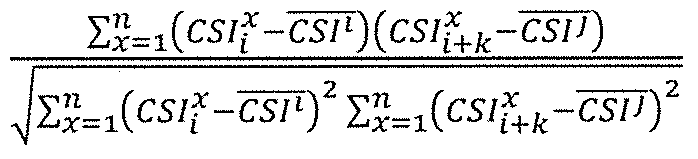
For Equation (2), CS/, may represent a CSI sample determined at time t, on one antenna (e.g., the first antenna p). Assuming there are m numbers (e.g., 52 numbers) in CS/,, each number in CS/, is a real number representing the magnitude value on its corresponding subcarrier. In Equation (2), CSI* may represent one number out of m in CS/, with index x, and CSV may represent the average value of all m numbers in CS/,-. Similarly, CS (or CSli + k in Equation (2)) may represent a CSI sample determined at time tj+k on one antenna (e.g., the first antenna), where k is a time value in milliseconds. In Equation (2), CSlf+k may represent one number out of m in CSI^ with index x, and CSV may represent the average values of all m numbers in CS
[0020] The channel coherence time 106 may be defined as the maximum time lag k such that the similarity between CS/, and CS/,+fe is more than a predetermined value (e.g., 0.95, or 95%). Beyond the channel coherence time, the similarity between the two CSI values may be less than 0.95 indicating a sufficient change in the wireless channel 108, which may result in transmission failure.
[0021] The channel coherence time determination module 102 may use
Equation (2) to determine the CSI correlation value/coefficient of CS/, and CS on the first antenna of the p antennas (i.e. , to determine one correlation value).
Similarly, the channel coherence time determination module 102 may use Equation
(2) to determine the CSI correlation value/coefficient of CS/; and CSIj+k on each of the remaining p antennas (i.e., additional correlation values from the remaining antennas, where the wireless AP 112 may report one CSI sample on each antenna at each time). Thus, the channel coherence time determination module 102 may use Equation (2) to determine p correlation values from CSI samples at time t, and time tj+k. These p correlation values may be averaged, and the average value may be used by the channel coherence time determination module 102 to determine the channel coherence time 106.
[0022] According to an example, assuming a mobile device 110 associated with a wireless AP 112 is moving, given a time lag of k ms between time t, and tj+ , the wireless AP 112 may report the CSI information at time t, and tj+k, respectively. The channel coherence time determination module 102 may use Equation (2) to determine p CSI correlation values on p antennas, based on which an average CSI correlation value may be determined.
[0023] Figure 2 illustrates a graph of CSI correlation values for different time lags, according to an example of the present disclosure. Referring to Figure 2, the average CSI correlation coefficient decreases as the measurement time lag increases in mobility. Therefore, the larger the measurement time lag, the lower the average CSI correlation coefficient. Similarly, the lower the average CSI correlation coefficient, the larger the measurement time lag. The maximum time- lag at which the correlation value is greater than, for example, 0.95, may indicate the channel coherence time 106. For example, for Figure 2, for speed = 1.5m/sec, the maximum time-lag is approximately 4 ms. The channel coherence time 106 may indicate the maximum aggregation time that is supported by the wireless channel 108.
[0024] In order to determine the aggregation size 120, based on an average CSI correlation coefficient from the time lag k, suppose k is the maximum time lag at which the average CSI correlation coefficient is still larger than the threshold 0.95, then the aggregation size determination module 118 may choose c as the
channel coherence time 06. The value k may be used to determine the maximum aggregation time that the current wireless channel 108 may support. Assuming that the current bit-rate 116 for the wireless channel 108 is r, where r is a data rate value in Mbit/s, then the aggregation size determination module 118 may determine the aggregation size 120 as follows:
Aggregation Size— r * k Equation (3)
[0025] The aggregation size 120 may be re-determined as needed, for example, at every y seconds (i.e., at a predetermined time interval). Alternatively or additionally, the aggregation size 120 may be re-determined as needed based on whether the mobility speed of the mobile device remains the same (thus no redetermination needed), or whether the mobility speed of the mobile device has changed by greater than a predetermined percentage (e.g., greater than 10%).
[0026] Figures 3 and 4 respectively illustrate flowcharts of methods 300 and 400 for mobility-aware frame aggregation, corresponding to the example of the mobility-aware frame aggregation apparatus 100 whose construction is described in detail above. The methods 300 and 400 may be implemented on the mobility- aware frame aggregation apparatus 100 with reference to Figures 1 and 2 by way of example and not limitation. The methods 300 and 400 may be practiced in other apparatus.
[0027] Referring to Figure 3, for the method 300, at block 302, the method may include using CSI to determine a channel coherence time for a wireless channel between a mobile device and a wireless AP. The channel coherence time may represent a time duration during which the wireless channel changes due to movement of the mobile device and/or the wireless AP by less than a
predetermined value. For example, referring to Figure 1 , the channel coherence time determination module 102 may use the CSI 104 to determine the channel coherence time 106 for the wireless channel 108 between the mobile device 110 and the wireless AP 112. According to an example, the predetermined value is
approximately 5%.
[0028] At block 304, the method may include determining a bit-rate supported by the wireless channel. For example, referring to Figure 1 , the bit-rate
determination module 114 may determine the bit-rate 116 supported by the wireless channel 108.
[0029] At block 306, the method may include using the channel coherence time and the bit rate supported by the wireless channel to determine an aggregation size for frame aggregation of packets to be transmitted over the wireless channel. For example, referring to Figure 1 , the aggregation size determination module 118 may use the channel coherence time 106 and the bit-rate 116 supported by the wireless channel 108 to determine the aggregation size 120 for frame aggregation of packets (i.e., data frames, or data generally) to be transmitted over the wireless channel 108.
[0030] According to an example, using CSI to determine a channel coherence time for a wireless channel between a mobile device and a wireless AP may further include determining CSI values for a predetermined time period, and determining a maximum time lag within the predetermined time period for which a similarity between the CSI values that are determined for the predetermined time period is greater than a further predetermined value. The maximum time lag may represent the channel coherence time. According to an example, the further predetermined value is approximately 95%.
[0031] According to an example, the method 300 may further include
determining the similarity between the CSI values based on a correlation between the CSI values (e.g., by using Equation (2)).
[0032] According to an example, the method 300 may further include
determining the CSI as a function of a number of subcarriers and antennas supported by the wireless AP (e.g., as discussed with respect to Equation (2)).
[0033] According to an example, the method 300 may further include using the
determined aggregation size for frame aggregation of packets, and transmitting the packets over the wireless channel.
[0034] Referring to Figure 4, for the method 400, at block 402, the method may include using mobility information related to a transmitter and/or a receiver associated with transmission of data over a wireless channel to determine an aggregation size for frame aggregation of the data to be transmitted over the wireless channel. For example, referring to Figure 1 , the channel coherence time determination module 102 and the aggregation size determination module 118 may use mobility information (e.g., the CSI 104) related to a transmitter and/or a receiver associated with transmission of data over the wireless channel 108 to determine an aggregation size 120 for frame aggregation of the data to be transmitted over the wireless channel 108. The mobility information may be based on subcarriers and antennas related to the wireless channel 108.
[0035] According to an example, the mobility information is based on changes in the subcarriers and the antennas determined from CSI (e.g., as discussed with respect to Equation (2)).
[0036] According to an example, the method 400 may further include using the mobility information to determine a channel coherence time 106 for the wireless channel 108 (e.g., by using the channel coherence time determination module 102). The channel coherence time 106 may represent a time duration during which the wireless channel 108 changes due to movement of the mobile device 110 and/or the wireless AP 112 by less than a user-specified value (e.g., approximately 5%).
[0037] Figure 5 shows a computer system 500 that may be used with the examples described herein. The computer system 500 may represent a generic platform that includes components that may be in a server or another computer system. The computer system 500 may be used as a platform for the apparatus
100. The computer system 500 may execute, by a processor (e.g., a single or multiple processors) or other hardware processing circuit, the methods, functions
and other processes described herein. These methods, functions and other processes may be embodied as machine readable instructions stored on a computer readable medium, which may be non-transitory, such as hardware storage devices (e.g., RAM (random access memory), ROM (read only memory), EPROM (erasable, programmable ROM), EEPROM (electrically erasable, programmable ROM), hard drives, and flash memory).
[0038] The computer system 500 may include a processor 502 that may implement or execute machine readable instructions performing some or all of the methods, functions and other processes described herein. Commands and data from the processor 502 may be communicated over a communication bus 504. The computer system may also include a main memory 506, such as a random access memory (RAM), where the machine readable instructions and data for the processor 502 may reside during runtime, and a secondary data storage 508, which may be non-volatile and stores machine readable instructions and data. The memory and data storage are examples of computer readable mediums. The memory 506 may include a mobility-aware frame aggregation module 520 including machine readable instructions residing in the memory 506 during runtime and executed by the processor 502. The mobility-aware frame aggregation module 520 may include the modules of the apparatus 100 shown in Figure 1.
[0039] The computer system 500 may include an I/O device 510, such as a keyboard, a mouse, a display, etc. The computer system may include a network interface 512 for connecting to a network. Other known electronic components may be added or substituted in the computer system.
[0040] What has been described and illustrated herein is an example along with some of its variations. The terms, descriptions and figures used herein are set forth by way of illustration only and are not meant as limitations. Many variations are possible within the spirit and scope of the subject matter, which is intended to be defined by the following claims - and their equivalents -- in which all terms are meant in their broadest reasonable sense unless otherwise indicated.
Claims
1. A method for mobility-aware frame aggregation, the method comprising: using channel state information (CSI) to determine, by a processor, a channel coherence time for a wireless channel between a mobile device and a wireless access point (AP), wherein the channel coherence time is a time duration during which the wireless channel changes due to movement of at least one of the mobile device and the wireless AP by less than a predetermined value; determining a bit-rate supported by the wireless channel; and using the channel coherence time and the bit rate supported by the wireless channel to determine an aggregation size for frame aggregation of packets to be transmitted over the wireless channel.
2. The method of claim 1 , wherein the predetermined value is approximately 5%.
3. The method of claim 1 , wherein using CSI to determine a channel coherence time for a wireless channel between a mobile device and a wireless AP further comprises: determining CSI values for a predetermined time period; and determining a maximum time lag within the predetermined time period for which a similarity between the CSI values that are determined for the
predetermined time period is greater than a further predetermined value, wherein the maximum time lag represents the channel coherence time.
4. The method of claim 3, wherein the further predetermined value is
approximately 95%.
5. The method of claim 3, further comprising:
determining the similarity between the CSI values based on a correlation between the CSI values.
6. The method of claim 1 , further comprising:
determining the CSI as a function of a number of subcarriers and antennas supported by the wireless AP.
7. The method of claim 1 , wherein the bit-rate supported by the wireless channel represents a maximum number of bits that are to be transmitted using the wireless channel without transmission failure.
8. The method of claim 1 , further comprising:
using the determined aggregation size for frame aggregation of packets; and transmitting the packets over the wireless channel.
9. A mobility-aware frame aggregation apparatus comprising:
a processor; and
a memory storing machine readable instructions that when executed by the processor cause the processor to:
determine an aggregation size for frame aggregation of data to be transmitted over a wireless channel based on changes in channel state information (CSI).
10. The mobility-aware frame aggregation apparatus according to claim 9,
wherein the machine readable instructions to determine an aggregation size for frame aggregation of data to be transmitted over a wireless channel based on changes in CSI, further cause the processor to: determine CSI values for a time period; and determine a maximum time lag within the time period for which a similarity between the CSI values that are determined for the time period is greater than a predetermined value.
11. The mobility-aware frame aggregation apparatus according to claim 10, wherein the similarity between the CSI values is based on a correlation between the CSI values.
12. The mobility-aware frame aggregation apparatus according to claim 10, further comprising machine readable instructions to: use the maximum time lag and a bit rate supported by the wireless channel between a mobile device and a wireless access point (AP) to determine the aggregation size for frame aggregation of data to be transmitted over the wireless channel.
13. A non-transitory computer readable medium having stored thereon machine readable instructions to provide mobility-aware frame aggregation, the machine readable instructions, when executed, cause a processor to: use mobility information related to at least one of a transmitter and a receiver associated with transmission of data over a wireless channel to determine an aggregation size for frame aggregation of the data to be transmitted over the wireless channel, wherein the mobility information is based on subcarriers and antennas related to the wireless channel.
14. The non-transitory computer readable medium of claim 13, wherein the mobility information is based on changes in the subcarriers and the antennas determined from channel state information (CSI).
15. The non-transitory computer readable medium of claim 13, wherein the machine readable instructions further cause the processor to:
use the mobility information to determine a channel coherence time for the wireless channel, wherein the channel coherence time is a time duration during which the wireless channel changes due to movement of at least one of a mobile device and a wireless access point (AP) by less than a user-specified value.
Priority Applications (2)
| Application Number | Priority Date | Filing Date | Title |
|---|---|---|---|
| PCT/US2014/048862 WO2016018294A1 (en) | 2014-07-30 | 2014-07-30 | Mobility-aware frame aggregation |
| US15/326,029 US10477433B2 (en) | 2014-07-30 | 2014-07-30 | Mobility-aware frame aggregation |
Applications Claiming Priority (1)
| Application Number | Priority Date | Filing Date | Title |
|---|---|---|---|
| PCT/US2014/048862 WO2016018294A1 (en) | 2014-07-30 | 2014-07-30 | Mobility-aware frame aggregation |
Publications (1)
| Publication Number | Publication Date |
|---|---|
| WO2016018294A1 true WO2016018294A1 (en) | 2016-02-04 |
Family
ID=55218013
Family Applications (1)
| Application Number | Title | Priority Date | Filing Date |
|---|---|---|---|
| PCT/US2014/048862 Ceased WO2016018294A1 (en) | 2014-07-30 | 2014-07-30 | Mobility-aware frame aggregation |
Country Status (2)
| Country | Link |
|---|---|
| US (1) | US10477433B2 (en) |
| WO (1) | WO2016018294A1 (en) |
Citations (4)
| Publication number | Priority date | Publication date | Assignee | Title |
|---|---|---|---|---|
| US20050122960A1 (en) * | 2003-12-07 | 2005-06-09 | Khan Farooq U. | Method of frame aggregation |
| US20060056443A1 (en) * | 2004-09-10 | 2006-03-16 | Zhifeng Tao | Frame aggregation in wireless communications networks |
| WO2008070738A1 (en) * | 2006-12-05 | 2008-06-12 | Qualcomm Incorporated | Enhanced management frame aggregation in a wireless network system |
| US20130250796A1 (en) * | 2010-11-30 | 2013-09-26 | Telefonaktiebolaget L M Ericsson (Publ) | Method for determining an aggregation scheme in a wireless network |
Family Cites Families (9)
| Publication number | Priority date | Publication date | Assignee | Title |
|---|---|---|---|---|
| US7701975B1 (en) * | 2003-11-19 | 2010-04-20 | Marvell International Ltd. | Technique for reducing physical layer (PHY) overhead in wireless LAN systems |
| US7801174B2 (en) | 2004-12-29 | 2010-09-21 | Alcatel-Lucent Usa Inc. | Techniques for efficient control of aggregating wireless voice communications |
| US8001143B1 (en) | 2006-05-31 | 2011-08-16 | Adobe Systems Incorporated | Aggregating characteristic information for digital content |
| GB2453979B (en) * | 2007-10-24 | 2010-01-06 | Motorola Inc | Scheduling of data packets over an air interface of a cellular communication system |
| US8554148B2 (en) | 2009-09-18 | 2013-10-08 | Electronics And Telecommunications Research Institute | Data transmission/reception apparatus and method for wireless communication system |
| KR101641088B1 (en) * | 2009-10-28 | 2016-07-20 | 한국전자통신연구원 | Apparatus and method for protecting opportunity of transmitting frame in a wireless lan system |
| WO2012167417A1 (en) * | 2011-06-07 | 2012-12-13 | Renesas Mobile Corporation | Method and apparatus for establishing a time-frequency reference signal pattern configuration in a carrier extension or carrier segment |
| US9160511B2 (en) * | 2012-01-30 | 2015-10-13 | Qualcomm Incorporated | Cyclic prefix in evolved multimedia broadcast multicast service with high transmit power |
| US9319898B2 (en) * | 2012-08-29 | 2016-04-19 | Samsung Electronics Co., Ltd. | Wireless communication system with rate selection mechanism and method of operation thereof |
-
2014
- 2014-07-30 US US15/326,029 patent/US10477433B2/en active Active
- 2014-07-30 WO PCT/US2014/048862 patent/WO2016018294A1/en not_active Ceased
Patent Citations (4)
| Publication number | Priority date | Publication date | Assignee | Title |
|---|---|---|---|---|
| US20050122960A1 (en) * | 2003-12-07 | 2005-06-09 | Khan Farooq U. | Method of frame aggregation |
| US20060056443A1 (en) * | 2004-09-10 | 2006-03-16 | Zhifeng Tao | Frame aggregation in wireless communications networks |
| WO2008070738A1 (en) * | 2006-12-05 | 2008-06-12 | Qualcomm Incorporated | Enhanced management frame aggregation in a wireless network system |
| US20130250796A1 (en) * | 2010-11-30 | 2013-09-26 | Telefonaktiebolaget L M Ericsson (Publ) | Method for determining an aggregation scheme in a wireless network |
Non-Patent Citations (1)
| Title |
|---|
| DIONYSIOS SKORDOULIS ET AL.: "IEEE 802.11n MAC frame aggregation mechanisms for next-generation high-throughput WLANS", WIRELESS COMMUNICATIONS, vol. 15, no. Issue: 1, February 2008 (2008-02-01), pages 40 - 47, Retrieved from the Internet <URL:http://ieeexplore.ieee.org/xpl/articleDetails.jsp?tp=&arnumber=4454703> * |
Also Published As
| Publication number | Publication date |
|---|---|
| US20170223570A1 (en) | 2017-08-03 |
| US10477433B2 (en) | 2019-11-12 |
Similar Documents
| Publication | Publication Date | Title |
|---|---|---|
| US20150110093A1 (en) | Systems, methods and devices for dynamically setting response indication deferral in wireless networks | |
| US20190140709A1 (en) | Efficient Channel Estimation for Implicit MU-MIMO | |
| US11757562B2 (en) | Remedial action based on inter-packet received power | |
| CN104348763B (en) | A kind of channel measuring method and user terminal for extensive antenna | |
| CN106464420B (en) | Method and device for estimating baseband self-interference channel response | |
| WO2016165508A1 (en) | Signal processing method, uplink resource allocation method and device thereof | |
| US9055458B2 (en) | Method and system for dynamic AMPDU duration control in a wireless communication system | |
| CN108141278B (en) | A kind of data sending, receiving method, apparatus and system | |
| CN114257347B (en) | Channel state information feedback method based on truncated channel impulse response dynamic selection | |
| US20160249398A1 (en) | Aggregation mechanism for moving vehicles | |
| CN103312469B (en) | Confirmation in multicast retransmission represents system of selection and device | |
| EP2555482A3 (en) | Method and device for decoding of precoded signal | |
| EP4580104A1 (en) | Method and apparatus used in node for radio communication | |
| WO2015149709A1 (en) | Noise power estimation method and network side device | |
| US20170047979A1 (en) | Bit rate determination and prediction | |
| US10090895B2 (en) | Adaptive sounding in wireless networks | |
| CN104158579A (en) | Method and device for antenna selection | |
| US10477433B2 (en) | Mobility-aware frame aggregation | |
| CN104301261B (en) | MIMO detection method and device | |
| CN113542215B (en) | Method and related device for improving streaming media transmission performance | |
| EP3167665B1 (en) | Mobility determination | |
| US20180123835A1 (en) | Channel sounding | |
| US10659203B2 (en) | Method and apparatus for transmitting data | |
| US20160352441A1 (en) | Method and apparatus for determining channel quality | |
| CN107733733B (en) | Method for determining throughput rate of wireless network retransmission and broadcast mechanism under transmission time limit |
Legal Events
| Date | Code | Title | Description |
|---|---|---|---|
| 121 | Ep: the epo has been informed by wipo that ep was designated in this application |
Ref document number: 14898601 Country of ref document: EP Kind code of ref document: A1 |
|
| WWE | Wipo information: entry into national phase |
Ref document number: 15326029 Country of ref document: US |
|
| NENP | Non-entry into the national phase |
Ref country code: DE |
|
| 122 | Ep: pct application non-entry in european phase |
Ref document number: 14898601 Country of ref document: EP Kind code of ref document: A1 |