WO2016016853A1 - Method of controlling carbamoyl impurity in pharmaceutical compositions of dabigatran - Google Patents
Method of controlling carbamoyl impurity in pharmaceutical compositions of dabigatran Download PDFInfo
- Publication number
- WO2016016853A1 WO2016016853A1 PCT/IB2015/055794 IB2015055794W WO2016016853A1 WO 2016016853 A1 WO2016016853 A1 WO 2016016853A1 IB 2015055794 W IB2015055794 W IB 2015055794W WO 2016016853 A1 WO2016016853 A1 WO 2016016853A1
- Authority
- WO
- WIPO (PCT)
- Prior art keywords
- desiccant
- dabigatran etexilate
- controlling
- carbamoyl
- dabigatran
- Prior art date
- Legal status (The legal status is an assumption and is not a legal conclusion. Google has not performed a legal analysis and makes no representation as to the accuracy of the status listed.)
- Ceased
Links
Classifications
-
- A—HUMAN NECESSITIES
- A61—MEDICAL OR VETERINARY SCIENCE; HYGIENE
- A61K—PREPARATIONS FOR MEDICAL, DENTAL OR TOILETRY PURPOSES
- A61K9/00—Medicinal preparations characterised by special physical form
- A61K9/14—Particulate form, e.g. powders, Processes for size reducing of pure drugs or the resulting products, Pure drug nanoparticles
- A61K9/16—Agglomerates; Granulates; Microbeadlets ; Microspheres; Pellets; Solid products obtained by spray drying, spray freeze drying, spray congealing,(multiple) emulsion solvent evaporation or extraction
- A61K9/167—Agglomerates; Granulates; Microbeadlets ; Microspheres; Pellets; Solid products obtained by spray drying, spray freeze drying, spray congealing,(multiple) emulsion solvent evaporation or extraction with an outer layer or coating comprising drug; with chemically bound drugs or non-active substances on their surface
- A61K9/1676—Agglomerates; Granulates; Microbeadlets ; Microspheres; Pellets; Solid products obtained by spray drying, spray freeze drying, spray congealing,(multiple) emulsion solvent evaporation or extraction with an outer layer or coating comprising drug; with chemically bound drugs or non-active substances on their surface having a drug-free core with discrete complete coating layer containing drug
-
- A—HUMAN NECESSITIES
- A61—MEDICAL OR VETERINARY SCIENCE; HYGIENE
- A61J—CONTAINERS SPECIALLY ADAPTED FOR MEDICAL OR PHARMACEUTICAL PURPOSES; DEVICES OR METHODS SPECIALLY ADAPTED FOR BRINGING PHARMACEUTICAL PRODUCTS INTO PARTICULAR PHYSICAL OR ADMINISTERING FORMS; DEVICES FOR ADMINISTERING FOOD OR MEDICINES ORALLY; BABY COMFORTERS; DEVICES FOR RECEIVING SPITTLE
- A61J1/00—Containers specially adapted for medical or pharmaceutical purposes
- A61J1/03—Containers specially adapted for medical or pharmaceutical purposes for pills or tablets
-
- A—HUMAN NECESSITIES
- A61—MEDICAL OR VETERINARY SCIENCE; HYGIENE
- A61J—CONTAINERS SPECIALLY ADAPTED FOR MEDICAL OR PHARMACEUTICAL PURPOSES; DEVICES OR METHODS SPECIALLY ADAPTED FOR BRINGING PHARMACEUTICAL PRODUCTS INTO PARTICULAR PHYSICAL OR ADMINISTERING FORMS; DEVICES FOR ADMINISTERING FOOD OR MEDICINES ORALLY; BABY COMFORTERS; DEVICES FOR RECEIVING SPITTLE
- A61J1/00—Containers specially adapted for medical or pharmaceutical purposes
- A61J1/03—Containers specially adapted for medical or pharmaceutical purposes for pills or tablets
- A61J1/035—Blister-type containers
-
- A—HUMAN NECESSITIES
- A61—MEDICAL OR VETERINARY SCIENCE; HYGIENE
- A61K—PREPARATIONS FOR MEDICAL, DENTAL OR TOILETRY PURPOSES
- A61K31/00—Medicinal preparations containing organic active ingredients
- A61K31/33—Heterocyclic compounds
- A61K31/395—Heterocyclic compounds having nitrogen as a ring hetero atom, e.g. guanethidine or rifamycins
- A61K31/435—Heterocyclic compounds having nitrogen as a ring hetero atom, e.g. guanethidine or rifamycins having six-membered rings with one nitrogen as the only ring hetero atom
- A61K31/44—Non condensed pyridines; Hydrogenated derivatives thereof
- A61K31/4427—Non condensed pyridines; Hydrogenated derivatives thereof containing further heterocyclic ring systems
- A61K31/4439—Non condensed pyridines; Hydrogenated derivatives thereof containing further heterocyclic ring systems containing a five-membered ring with nitrogen as a ring hetero atom, e.g. omeprazole
-
- A—HUMAN NECESSITIES
- A61—MEDICAL OR VETERINARY SCIENCE; HYGIENE
- A61J—CONTAINERS SPECIALLY ADAPTED FOR MEDICAL OR PHARMACEUTICAL PURPOSES; DEVICES OR METHODS SPECIALLY ADAPTED FOR BRINGING PHARMACEUTICAL PRODUCTS INTO PARTICULAR PHYSICAL OR ADMINISTERING FORMS; DEVICES FOR ADMINISTERING FOOD OR MEDICINES ORALLY; BABY COMFORTERS; DEVICES FOR RECEIVING SPITTLE
- A61J1/00—Containers specially adapted for medical or pharmaceutical purposes
- A61J1/14—Details; Accessories therefor
- A61J1/1468—Containers characterised by specific material properties
-
- A—HUMAN NECESSITIES
- A61—MEDICAL OR VETERINARY SCIENCE; HYGIENE
- A61K—PREPARATIONS FOR MEDICAL, DENTAL OR TOILETRY PURPOSES
- A61K9/00—Medicinal preparations characterised by special physical form
- A61K9/48—Preparations in capsules, e.g. of gelatin, of chocolate
- A61K9/4816—Wall or shell material
-
- A—HUMAN NECESSITIES
- A61—MEDICAL OR VETERINARY SCIENCE; HYGIENE
- A61K—PREPARATIONS FOR MEDICAL, DENTAL OR TOILETRY PURPOSES
- A61K9/00—Medicinal preparations characterised by special physical form
- A61K9/48—Preparations in capsules, e.g. of gelatin, of chocolate
- A61K9/4841—Filling excipients; Inactive ingredients
- A61K9/4858—Organic compounds
Definitions
- the present invention relates to a method of controlling the level of a carbamoyl analogue of dabigatran etexilate in pharmaceutical compositions comprising dabigatran etexilate or a pharmaceutically acceptable salt thereof, wherein said method comprises packing the pharmaceutical composition in a packaging system comprising a desiccant.
- Dabigatran etexilate of Formula I a direct thrombin inhibitor
- ⁇ -Alanine N-[[2-[[[4-[[[(hexyloxy)carbonyl]amino]iminomethyl]phenyl] amino]methyl]-l-methyl-lH-benzimidazol-5-yl]carbonyl]-N-2-pyridinyl-, ethyl ester.
- the structural formula is resented as:
- Dabigatran etexilate and its pharmaceutical compositions tend to have a certain amount of related substances as impurities. The level of these related substances increases with time due to further degradation.
- One such related substance is a carbamoyl analogue of dabigatran etexilate referred to herein as Formula II.
- PCT Publication No. WO 2012/152855 provides a process for the preparation and identification of the compound of Formula II.
- the present inventors have developed a method of controlling the level of Formula II in a pharmaceutical composition comprising dabigatran etexilate or pharmaceutically acceptable salts or solvates thereof, wherein the level does not exceed more than 15% of its initial value.
- the present invention relates to a method of controlling the level of a carbamoyl analogue of dabigatran etexilate of Formula II in pharmaceutical compositions comprising dabigatran etexilate or a pharmaceutically acceptable salt thereof, wherein said method comprises packing the pharmaceutical composition in a packaging system comprising a desiccant.
- Figure 1 depicts components of a blister pack.
- a first aspect of the present invention provides a method of controlling the level of Formula II in a pharmaceutical composition comprising dabigatran etexilate or pharmaceutically acceptable salts or solvates thereof, wherein the level does not exceed more than 15% of its initial value, and wherein the method comprises packing the pharmaceutical composition in a packaging system comprising a desiccant selected from the group comprising molecular sieves, silica gel, and calcium oxide.
- the packaging system is selected from a bottle pack and a blister pack.
- the packaging system is a blister pack, wherein the blister pack is a desiccant-embedded cold form blister.
- dabigatran etexilate refers to dabigatran etexilate or pharmaceutically acceptable salts thereof.
- the salt of dabigatran etexilate is mesylate.
- initial value refers to the amount of Formula II present in the final pharmaceutical composition comprising dabigatran etexilate at the time of completion of its preparation.
- the final step of the preparation of the pharmaceutical composition of the present invention is packing in a packaging system.
- the pharmaceutical composition of the present invention includes pellets or beads, wherein the pellet or bead comprises a core comprising an organic acid, the core is coated with a barrier coat, and the barrier coat is further coated with a drug layer.
- the drug layered beads or pellets may either be filled into capsules or compressed into tablets.
- the organic acid is selected from the group comprising tartaric acid, fumaric acid, succinic acid, citric acid, malic acid, glutamic acid, or aspartic acid, including the hydrates and acid salts thereof.
- the organic acid is tartaric acid.
- the barrier coat comprises one or more of water-soluble polymers, anti-foaming agents, and lubricants.
- the drug layer comprises the active substance dabigatran etexilate mesylate, binders, and anti -tacking agents.
- the barrier coat or drug layer is applied in the form of a solution or suspension of the ingredients of the barrier coat and the drug layer, dissolved or dispersed in suitable solvents.
- Water-soluble polymers are selected from the group comprising hydroxypropyl celluloses, hydroxypropylmethyl celluloses, methyl celluloses, hydroxyethyl celluloses, carboxymethyl celluloses, polyvinylpyrrolidone, the copolymers of N-vinylpyrrolidone and vinyl acetate, and combinations thereof.
- the water-soluble polymer is hydroxypropylmethyl cellulose.
- Anti-foaming agents are selected from the group comprising dimethicone, simethicone, and a combination thereof.
- the anti-foaming agent is
- Lubricants are selected from the group comprising common minerals, e.g., talc and silica; fats, e.g., vegetable stearin and hydrogenated castor oil; sucrose esters of fatty acid; sodium stearyl fumarate; waxes, e.g., microcrystalline wax, yellow beeswax, and white beeswax; and combinations thereof.
- the lubricant is talc.
- Binders are selected from the group comprising hydroxypropyl cellulose, hydroxypropylmethyl cellulose, methyl cellulose, hydroxyethyl cellulose, carboxymethyl cellulose, polyvinylpyrrolidone, copolymers of N-vinylpyrrolidone and vinyl acetate, and combinations of these polymers.
- the binder is hydroxypropyl cellulose.
- Anti-tacking agents are selected from the group comprising silicon dioxide and talc.
- Solvents used for forming a solution or suspension for coating are selected from the group comprising water, ethanol, isopropyl alcohol, methylene chloride, acetone, methanol, and combinations thereof.
- the solvent used in the barrier coat is a mixture of water and ethanol
- the solvent used in the drug layer is isopropyl alcohol.
- packaging system refers to a bottle or blister pack which includes a desiccant.
- bottle refers to a container generally used in the pharmaceutical art for dispensing the oral formulation, made up of glass or any polymeric materials, e.g., polyethylene polymers (high -density polyethylene (HDPE), low-density polyethylene (LDPE), or combination thereof), poly(vinyl chloride) (PVC), poly(ethylene terephthalate) (PET) (single layer or multilayer), any organic or inorganic, metallic or non- metallic materials.
- the bottle is a white opaque HDPE bottle with a desiccant sachet or canister.
- the bottle may comprise a push down and turn type child resistant cap (CRC).
- the cap of the bottle has an induction seal liner which protects the contents from moisture and provides tamper evidence.
- blister refers to a blister pack as generally used in the pharmaceutical art of dispensing.
- the blister is a forming film, desiccant- embedded cold form blister (DECFB).
- the blister pack is a desiccant-embedded cold form blister (DECFB) pack as shown in Figure 1.
- the blister pack comprises:
- a forming laminate formed in the shape of a capsule comprising layers of oriented polyamide (OPA), aluminum foil, and desiccant; calcium oxide in powder form, embedded with a polyethylene (PE) film; and
- OPA oriented polyamide
- PE polyethylene
- the lidding laminate contains layers of paper, polyester (poly(ethylene terephthalate)) (PET), aluminum foil, and heat seal lacquer (HSL).
- desiccant refers to a hygroscopic substance that induces or sustains a state of dryness (desiccation) in its vicinity.
- the desiccants are selected from the group comprising molecular sieves, silica gel, and calcium oxide.
- step 2 under stirring until a clear solution was formed.
- step 6 The coated cores of step 6 were sifted through a suitable sieve.
- Dabigatran etexilate and colloidal silicon dioxide were added to the solution of step 9 under stirring.
- a homogenizer was attached to the jacketed vessel.
- step 10 The dispersion of step 10 was homogenized at a temperature of 15°C to 25°C.
- step 7 The barrier-coated sieved cores of step 7 were coated with the dispersion of step 13 in a Wurster coater.
- step 14 The coated pellets of step 14 were dried in the Wurster coater.
- step 15 The pellets of step 15 were sifted through a suitable sieve.
- the remaining amount of the talc was screened through a suitable sieve.
- step 18 The sieved pellets of step 16 and the sieved talc of step 17 were transferred to a blender and were blended.
- Packaging The capsules obtained as per Example 1 were packed in two types of packaging systems:
- Example 1A Bottle pack:
- the bottle used is a white opaque high density polyethylene (HDPE) bottle with desiccant sachet/canister and push down and turn type child resistant cap (CRC).
- the desiccant is a molecular sieve.
- the cap of the bottle has an induction seal liner which protects the contents from moisture and provides tamper evidence.
- Example IB Blister pack:
- the blister pack is a desiccant-embedded cold form blister (DECFB) pack as shown in Figure 1.
- the blister pack comprises:
- a forming laminate formed in the shape of a capsule comprising layers of oriented polyamide (OPA), aluminum foil, and desiccant; calcium oxide in powder form, embedded with polyethylene (PE) film; and
- the lidding laminate contains layers of paper, polyester (poly(ethylene terephthalate)) (PET), aluminum foil, and heat seal lacquer (HSL).
- the amount of Compound II was determined by high-performance liquid chromatography (HPLC), by comparing the retention time of different components of a sample of dabigatran etexilate or pharmaceutically acceptable salts thereof with the retention time of Compound II.
- HPLC high-performance liquid chromatography
- HPLC purity was determined using a Kromasil ® C18 (250 mm x 4.6 mm), 3.5 ⁇ column with a flow rate of 0.8-1.2 mL/minute; column oven temperature 35°C; sample tray temperature 10°C; detector UV at 300 nm; injection volume 10 ⁇ ; run time: 65 minutes.
Landscapes
- Health & Medical Sciences (AREA)
- General Health & Medical Sciences (AREA)
- Bioinformatics & Cheminformatics (AREA)
- Engineering & Computer Science (AREA)
- Veterinary Medicine (AREA)
- Pharmacology & Pharmacy (AREA)
- Public Health (AREA)
- Life Sciences & Earth Sciences (AREA)
- Animal Behavior & Ethology (AREA)
- Chemical & Material Sciences (AREA)
- Epidemiology (AREA)
- Medicinal Chemistry (AREA)
- Medicinal Preparation (AREA)
- Packages (AREA)
- Medical Preparation Storing Or Oral Administration Devices (AREA)
Abstract
The present invention relates to a method of controlling the level of a carbamoyl analogue of dabigatran etexilate in pharmaceutical compositions comprising dabigatran etexilate or a pharmaceutically acceptable salt thereof, wherein said method comprises packing the pharmaceutical composition in a packaging system comprising a desiccant.
Description
METHOD OF CONTROLLING CARBAMOYL IMPURITY IN
PHARMACEUTICAL COMPOSITIONS OF DABIGATRAN
Field of the Invention
The present invention relates to a method of controlling the level of a carbamoyl analogue of dabigatran etexilate in pharmaceutical compositions comprising dabigatran etexilate or a pharmaceutically acceptable salt thereof, wherein said method comprises packing the pharmaceutical composition in a packaging system comprising a desiccant.
Background of the Invention
Dabigatran etexilate of Formula I, a direct thrombin inhibitor, is chemically designated as β-Alanine, N-[[2-[[[4-[[[(hexyloxy)carbonyl]amino]iminomethyl]phenyl] amino]methyl]-l-methyl-lH-benzimidazol-5-yl]carbonyl]-N-2-pyridinyl-, ethyl ester. The structural formula is resented as:

Formula I
Processes for the preparation of dabigatran etexilate and its salts are described in U.S. Patent No. 6,087,380.
Dabigatran etexilate and its pharmaceutical compositions tend to have a certain amount of related substances as impurities. The level of these related substances increases with time due to further degradation.
One such related substance is a carbamoyl analogue of dabigatran etexilate referred to herein as Formula II.

Formula II
PCT Publication No. WO 2012/152855 provides a process for the preparation and identification of the compound of Formula II.
There remains a need in the art to provide a method of controlling the level of the carbamoyl analogue of dabigatran etexilate of Formula II within a certain limit.
The present inventors have developed a method of controlling the level of Formula II in a pharmaceutical composition comprising dabigatran etexilate or pharmaceutically acceptable salts or solvates thereof, wherein the level does not exceed more than 15% of its initial value.
Summary of the Invention
The present invention relates to a method of controlling the level of a carbamoyl analogue of dabigatran etexilate of Formula II in pharmaceutical compositions comprising dabigatran etexilate or a pharmaceutically acceptable salt thereof, wherein said method comprises packing the pharmaceutical composition in a packaging system comprising a desiccant.
Brief description of the drawings
Figure 1 depicts components of a blister pack.
Detailed Description of the Invention
A first aspect of the present invention provides a method of controlling the level of Formula II in a pharmaceutical composition comprising dabigatran etexilate or pharmaceutically acceptable salts or solvates thereof, wherein the level does not exceed more than 15% of its initial value, and wherein the method comprises packing the pharmaceutical composition in a packaging system comprising a desiccant selected from the group comprising molecular sieves, silica gel, and calcium oxide.
According to one embodiment of this aspect, the packaging system is selected from a bottle pack and a blister pack.
According to another embodiment of this aspect, the packaging system is a blister pack, wherein the blister pack is a desiccant-embedded cold form blister.
The term "dabigatran etexilate" as used herein refers to dabigatran etexilate or pharmaceutically acceptable salts thereof. In particular, the salt of dabigatran etexilate is mesylate.
The term "initial value" as used herein refers to the amount of Formula II present in the final pharmaceutical composition comprising dabigatran etexilate at the time of completion of its preparation. The final step of the preparation of the pharmaceutical composition of the present invention is packing in a packaging system.
The pharmaceutical composition of the present invention includes pellets or beads, wherein the pellet or bead comprises a core comprising an organic acid, the core is coated with a barrier coat, and the barrier coat is further coated with a drug layer. The drug layered beads or pellets may either be filled into capsules or compressed into tablets.
The organic acid is selected from the group comprising tartaric acid, fumaric acid, succinic acid, citric acid, malic acid, glutamic acid, or aspartic acid, including the hydrates and acid salts thereof. Preferably, the organic acid is tartaric acid.
The barrier coat comprises one or more of water-soluble polymers, anti-foaming agents, and lubricants.
The drug layer comprises the active substance dabigatran etexilate mesylate, binders, and anti -tacking agents.
The barrier coat or drug layer is applied in the form of a solution or suspension of the ingredients of the barrier coat and the drug layer, dissolved or dispersed in suitable solvents.
Water-soluble polymers are selected from the group comprising hydroxypropyl celluloses, hydroxypropylmethyl celluloses, methyl celluloses, hydroxyethyl celluloses, carboxymethyl celluloses, polyvinylpyrrolidone, the copolymers of N-vinylpyrrolidone and vinyl acetate, and combinations thereof. Preferably, the water-soluble polymer is hydroxypropylmethyl cellulose.
Anti-foaming agents are selected from the group comprising dimethicone, simethicone, and a combination thereof. Preferably, the anti-foaming agent is
dimethicone.
Lubricants are selected from the group comprising common minerals, e.g., talc and silica; fats, e.g., vegetable stearin and hydrogenated castor oil; sucrose esters of fatty acid; sodium stearyl fumarate; waxes, e.g., microcrystalline wax, yellow beeswax, and white beeswax; and combinations thereof. Preferably, the lubricant is talc.
Binders are selected from the group comprising hydroxypropyl cellulose, hydroxypropylmethyl cellulose, methyl cellulose, hydroxyethyl cellulose, carboxymethyl cellulose, polyvinylpyrrolidone, copolymers of N-vinylpyrrolidone and vinyl acetate, and combinations of these polymers. Preferably, the binder is hydroxypropyl cellulose.
Anti-tacking agents are selected from the group comprising silicon dioxide and talc.
Solvents used for forming a solution or suspension for coating are selected from the group comprising water, ethanol, isopropyl alcohol, methylene chloride, acetone, methanol, and combinations thereof. Preferably, the solvent used in the barrier coat is a mixture of water and ethanol, and the solvent used in the drug layer is isopropyl alcohol.
The term "packaging system" as used herein refers to a bottle or blister pack which includes a desiccant.
The term "bottle" as used herein refers to a container generally used in the pharmaceutical art for dispensing the oral formulation, made up of glass or any polymeric materials, e.g., polyethylene polymers (high -density polyethylene (HDPE), low-density polyethylene (LDPE), or combination thereof), poly(vinyl chloride) (PVC), poly(ethylene terephthalate) (PET) (single layer or multilayer), any organic or inorganic, metallic or non- metallic materials. Preferably, the bottle is a white opaque HDPE bottle with a desiccant sachet or canister. The bottle may comprise a push down and turn type child resistant cap (CRC). The cap of the bottle has an induction seal liner which protects the contents from moisture and provides tamper evidence.
The term "blister" as used herein refers to a blister pack as generally used in the pharmaceutical art of dispensing. In particular, the blister is a forming film, desiccant- embedded cold form blister (DECFB).
The blister pack is a desiccant-embedded cold form blister (DECFB) pack as shown in Figure 1. The blister pack comprises:
(a) a forming laminate formed in the shape of a capsule, comprising layers of oriented polyamide (OPA), aluminum foil, and desiccant; calcium oxide in powder form, embedded with a polyethylene (PE) film; and
(b) a child resistant peelable lidding laminate to seal forming laminate. The lidding laminate contains layers of paper, polyester (poly(ethylene terephthalate)) (PET), aluminum foil, and heat seal lacquer (HSL).
The term "desiccant" as used herein, refers to a hygroscopic substance that induces or sustains a state of dryness (desiccation) in its vicinity. The desiccants are selected from the group comprising molecular sieves, silica gel, and calcium oxide.
The invention is further illustrated by the following example, which is for illustrative purposes only and should not be construed as limiting the scope of the invention in any way.
EXAMPLES
Example 1 :

Lost during processing
Procedure:
Barrier Coating
1. Dehydrated alcohol and water were kept in a container.
2. Dimethicone was added to the solution of step 1.
3. About 28% of the total amount of hydroxypropyl cellulose was added to the
solution of step 2 under stirring until a clear solution was formed.
4. About 55% of the total amount of talc was added to the solution of step 3 under stirring to form a uniform dispersion.
5. Tartaric acid cores were coated with the dispersion of step 4 in a Wurster coater.
6. The coated cores of Step 5 were dried in the Wurster coater.
7. The coated cores of step 6 were sifted through a suitable sieve.
Drug Layering
8. Isopropyl alcohol was kept in a jacketed vessel.
9. The remaining amount of hydroxypropyl cellulose was added to the solvent of step 8 under stirring until a clear solution was obtained.
10. Dabigatran etexilate and colloidal silicon dioxide were added to the solution of step 9 under stirring.
11. Chilled water was circulated through a jacketed vessel.
12. A homogenizer was attached to the jacketed vessel.
13. The dispersion of step 10 was homogenized at a temperature of 15°C to 25°C.
14. The barrier-coated sieved cores of step 7 were coated with the dispersion of step 13 in a Wurster coater.
15. The coated pellets of step 14 were dried in the Wurster coater.
16. The pellets of step 15 were sifted through a suitable sieve.
Lubrication
17. The remaining amount of the talc was screened through a suitable sieve.
18. The sieved pellets of step 16 and the sieved talc of step 17 were transferred to a
blender and were blended.
Capsule Filling
19. An adjusted quantity of the lubricated pellets of step 18 was filled into empty
capsule shells.
Packaging: The capsules obtained as per Example 1 were packed in two types of packaging systems:
Example 1A: Bottle pack:
The bottle used is a white opaque high density polyethylene (HDPE) bottle with desiccant sachet/canister and push down and turn type child resistant cap (CRC). The desiccant is a molecular sieve. The cap of the bottle has an induction seal liner which protects the contents from moisture and provides tamper evidence.
Example IB: Blister pack:
The blister pack is a desiccant-embedded cold form blister (DECFB) pack as shown in Figure 1. The blister pack comprises:
(a) a forming laminate formed in the shape of a capsule, comprising layers of oriented polyamide (OPA), aluminum foil, and desiccant; calcium oxide in powder form, embedded with polyethylene (PE) film; and
(b) a child resistant peelable lidding laminate to seal forming laminate. The lidding laminate contains layers of paper, polyester (poly(ethylene terephthalate)) (PET), aluminum foil, and heat seal lacquer (HSL).
Accelerated Stability Testing
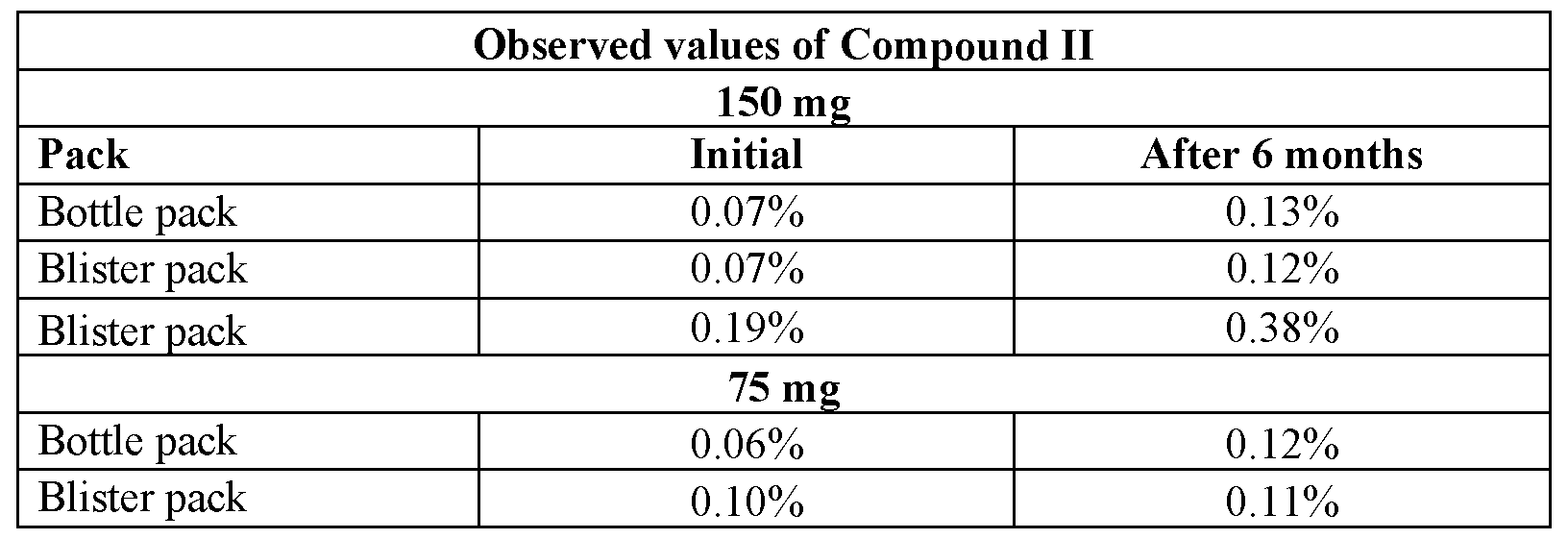
The packaging system of Examples 1A and IB containing the capsules of Example 1, and Pradaxa® capsules packed in bottles and blisters were kept for stability testing under conditions given as below:
Temperature: 40°C
Relative Humidity: 75%
Duration: 6 months
Products were tested for their amounts of Compound II at the initial stage and at the completion of 6 months.
Two batches of both strengths of capsules prepared as per Example 1 were tested for the amount of Compound II.
The amount of Compound II was determined by high-performance liquid chromatography (HPLC), by comparing the retention time of different components of a sample of dabigatran etexilate or pharmaceutically acceptable salts thereof with the retention time of Compound II.
HPLC purity was determined using a Kromasil® C18 (250 mm x 4.6 mm), 3.5 μιη column with a flow rate of 0.8-1.2 mL/minute; column oven temperature 35°C; sample tray temperature 10°C; detector UV at 300 nm; injection volume 10 μί; run time: 65 minutes.
The results of the study are represented in Tables 1 and 2.
Table 1 : Accelerated Stability Testing Results of Dabigatran Etexilate Mesylate Capsules 150 mg and 75 mg Prepared as per Example 1 and Packed as per Examples 1A and IB

Table 2: Accelerated Stability Testing Results of Pradaxa Capsules 150 mg and 75 mg
Claims
1. A method of controlling the level of Formula II in a pharmaceutical composition comprising dabigatran etexilate or pharmaceutically acceptable salts or solvates thereof, wherein the level does not exceed more than 15% of its initial value, and wherein the method comprises packing the pharmaceutical composition in a packaging system comprising a desiccant selected from the group comprising molecular sieves, silica gel, and calcium oxide.
2. The method according to claim 1, wherein the packaging system is selected from a bottle pack and a blister pack.
3. The method according to claim 1, wherein the blister pack is a desiccant-embedded cold form blister.
Applications Claiming Priority (2)
| Application Number | Priority Date | Filing Date | Title |
|---|---|---|---|
| IN2155/DEL/2014 | 2014-07-31 | ||
| IN2155DE2014 | 2014-07-31 |
Publications (1)
| Publication Number | Publication Date |
|---|---|
| WO2016016853A1 true WO2016016853A1 (en) | 2016-02-04 |
Family
ID=55216836
Family Applications (1)
| Application Number | Title | Priority Date | Filing Date |
|---|---|---|---|
| PCT/IB2015/055794 Ceased WO2016016853A1 (en) | 2014-07-31 | 2015-07-30 | Method of controlling carbamoyl impurity in pharmaceutical compositions of dabigatran |
Country Status (1)
| Country | Link |
|---|---|
| WO (1) | WO2016016853A1 (en) |
Citations (3)
| Publication number | Priority date | Publication date | Assignee | Title |
|---|---|---|---|---|
| US20130177652A1 (en) * | 2010-07-01 | 2013-07-11 | Krka, Tovarna Zdravil, D.D., Novo Mesto | Pharmaceutical oral dosage forms comprising dabigatran etexilate and its pharmaceutically acceptable salts |
| US20130303462A1 (en) * | 2012-05-14 | 2013-11-14 | Boehringer Ingelheim International Gmbh | Use of a dpp-4 inhibitor in podocytes related disorders and/or nephrotic syndrome |
| US20140076036A1 (en) * | 2011-05-11 | 2014-03-20 | Medichem S.A. | Dabigatran etexilate and related substances, processes and compositions, and use of the substances as reference standards and markers |
-
2015
- 2015-07-30 WO PCT/IB2015/055794 patent/WO2016016853A1/en not_active Ceased
Patent Citations (3)
| Publication number | Priority date | Publication date | Assignee | Title |
|---|---|---|---|---|
| US20130177652A1 (en) * | 2010-07-01 | 2013-07-11 | Krka, Tovarna Zdravil, D.D., Novo Mesto | Pharmaceutical oral dosage forms comprising dabigatran etexilate and its pharmaceutically acceptable salts |
| US20140076036A1 (en) * | 2011-05-11 | 2014-03-20 | Medichem S.A. | Dabigatran etexilate and related substances, processes and compositions, and use of the substances as reference standards and markers |
| US20130303462A1 (en) * | 2012-05-14 | 2013-11-14 | Boehringer Ingelheim International Gmbh | Use of a dpp-4 inhibitor in podocytes related disorders and/or nephrotic syndrome |
Similar Documents
| Publication | Publication Date | Title |
|---|---|---|
| CN100490790C (en) | A kind of omeprazole enteric-coated pellet capsule and preparation method thereof | |
| ES3006512T3 (en) | Process for preparing a coated hard shell capsule | |
| EP2588090B1 (en) | Pharmaceutical oral dosage forms comprising dabigatran etexilate and its pharmaceutically acceptable salts | |
| TWI474820B (en) | Compositions of stable tiacumicins | |
| RS52169B (en) | STABLE LAKVINIMOD PREPARATIONS | |
| WO2022271600A1 (en) | Stable varenicline dosage forms | |
| EP2934484A1 (en) | Supersaturated stabilized nanoparticles for poorly soluble drugs | |
| RS60686B1 (en) | Compositions comrrising amlodipine and bisoprolol | |
| KR101877868B1 (en) | Coated preparation containing azosemide as active ingredient | |
| US20120301549A1 (en) | Complex formulation comprising aspirin coated with barrier containing hydrophobic additive, and hmg-coa reductase inhibitor | |
| CN103393615B (en) | Duloxetine enteric pellet and preparation method thereof | |
| CN103079596B (en) | The coating materials of pharmaceutical solid preparation, medicine film preparation and coating medicine solid preparation | |
| CN105106168B (en) | A kind of esomeprazole magnesium intestines capsule and preparation method thereof | |
| EA038558B1 (en) | Water soluble pharmaceutical film with enhanced stability | |
| Rathore et al. | Formulation and evaluation of enteric coated tablet of Ilaprazole | |
| WO2016016853A1 (en) | Method of controlling carbamoyl impurity in pharmaceutical compositions of dabigatran | |
| Patel et al. | Formulation and characterization of sustained release dosage form of moisture sensitive drug | |
| JP5991978B2 (en) | Pharmaceutical composition containing candesartan cilexetil | |
| Zema et al. | Active packaging for topical cosmetic/drug products: A hot-melt extruded preservative delivery device | |
| RS65226B1 (en) | A modified release multiple unit oral dosage form of doxylamine succinate and pyridoxine hydrochloride and a process for its preparation | |
| CN103054835A (en) | Venlafaxine sustained-release capsule and preparation process thereof | |
| JP2007521327A (en) | Blister pack containing desmopressin and solid preparation | |
| EA013167B1 (en) | Stable solid formulation of sertindole | |
| KR102503428B1 (en) | Package for oral soft capsule formulation comprising dutasteride | |
| TWI891619B (en) | pharmaceuticals |
Legal Events
| Date | Code | Title | Description |
|---|---|---|---|
| 121 | Ep: the epo has been informed by wipo that ep was designated in this application |
Ref document number: 15827382 Country of ref document: EP Kind code of ref document: A1 |
|
| NENP | Non-entry into the national phase |
Ref country code: DE |
|
| 122 | Ep: pct application non-entry in european phase |
Ref document number: 15827382 Country of ref document: EP Kind code of ref document: A1 |