WO2016013976A1 - Method of forming a multi-substituted benzene compound - Google Patents
Method of forming a multi-substituted benzene compound Download PDFInfo
- Publication number
- WO2016013976A1 WO2016013976A1 PCT/SG2015/050223 SG2015050223W WO2016013976A1 WO 2016013976 A1 WO2016013976 A1 WO 2016013976A1 SG 2015050223 W SG2015050223 W SG 2015050223W WO 2016013976 A1 WO2016013976 A1 WO 2016013976A1
- Authority
- WO
- WIPO (PCT)
- Prior art keywords
- methyl
- substituted
- ethanone
- biphenyl
- styryl
- Prior art date
- Legal status (The legal status is an assumption and is not a legal conclusion. Google has not performed a legal analysis and makes no representation as to the accuracy of the status listed.)
- Ceased
Links
- 0 CC(C(*)=CN*)=* Chemical compound CC(C(*)=CN*)=* 0.000 description 4
- VDCWDONMCOIBBW-UHFFFAOYSA-N CC(C(c1ccccc1)=Cc1c2)c1c(C)cc2-c1ccccc1 Chemical compound CC(C(c1ccccc1)=Cc1c2)c1c(C)cc2-c1ccccc1 VDCWDONMCOIBBW-UHFFFAOYSA-N 0.000 description 1
- FNXRXOMMMFFNKM-CCEZHUSRSA-N CC(C)c1c(C(OC)=O)c(/C=C/c2ccccc2)cc(-c2ccccc2)c1 Chemical compound CC(C)c1c(C(OC)=O)c(/C=C/c2ccccc2)cc(-c2ccccc2)c1 FNXRXOMMMFFNKM-CCEZHUSRSA-N 0.000 description 1
- PLFNPUCTFILNCG-UHFFFAOYSA-N Cc1c(C(OC)=O)c(-c(cc2)ccc2OC)cc(-c2ccccc2)c1 Chemical compound Cc1c(C(OC)=O)c(-c(cc2)ccc2OC)cc(-c2ccccc2)c1 PLFNPUCTFILNCG-UHFFFAOYSA-N 0.000 description 1
Classifications
-
- C—CHEMISTRY; METALLURGY
- C07—ORGANIC CHEMISTRY
- C07C—ACYCLIC OR CARBOCYCLIC COMPOUNDS
- C07C2/00—Preparation of hydrocarbons from hydrocarbons containing a smaller number of carbon atoms
- C07C2/02—Preparation of hydrocarbons from hydrocarbons containing a smaller number of carbon atoms by addition between unsaturated hydrocarbons
- C07C2/50—Diels-Alder conversion
- C07C2/52—Catalytic processes
-
- C—CHEMISTRY; METALLURGY
- C07—ORGANIC CHEMISTRY
- C07C—ACYCLIC OR CARBOCYCLIC COMPOUNDS
- C07C201/00—Preparation of esters of nitric or nitrous acid or of compounds containing nitro or nitroso groups bound to a carbon skeleton
- C07C201/06—Preparation of nitro compounds
- C07C201/12—Preparation of nitro compounds by reactions not involving the formation of nitro groups
-
- C—CHEMISTRY; METALLURGY
- C07—ORGANIC CHEMISTRY
- C07C—ACYCLIC OR CARBOCYCLIC COMPOUNDS
- C07C45/00—Preparation of compounds having >C = O groups bound only to carbon or hydrogen atoms; Preparation of chelates of such compounds
- C07C45/61—Preparation of compounds having >C = O groups bound only to carbon or hydrogen atoms; Preparation of chelates of such compounds by reactions not involving the formation of >C = O groups
- C07C45/67—Preparation of compounds having >C = O groups bound only to carbon or hydrogen atoms; Preparation of chelates of such compounds by reactions not involving the formation of >C = O groups by isomerisation; by change of size of the carbon skeleton
- C07C45/68—Preparation of compounds having >C = O groups bound only to carbon or hydrogen atoms; Preparation of chelates of such compounds by reactions not involving the formation of >C = O groups by isomerisation; by change of size of the carbon skeleton by increase in the number of carbon atoms
- C07C45/72—Preparation of compounds having >C = O groups bound only to carbon or hydrogen atoms; Preparation of chelates of such compounds by reactions not involving the formation of >C = O groups by isomerisation; by change of size of the carbon skeleton by increase in the number of carbon atoms by reaction of compounds containing >C = O groups with the same or other compounds containing >C = O groups
-
- C—CHEMISTRY; METALLURGY
- C07—ORGANIC CHEMISTRY
- C07C—ACYCLIC OR CARBOCYCLIC COMPOUNDS
- C07C67/00—Preparation of carboxylic acid esters
- C07C67/30—Preparation of carboxylic acid esters by modifying the acid moiety of the ester, such modification not being an introduction of an ester group
- C07C67/333—Preparation of carboxylic acid esters by modifying the acid moiety of the ester, such modification not being an introduction of an ester group by isomerisation; by change of size of the carbon skeleton
- C07C67/343—Preparation of carboxylic acid esters by modifying the acid moiety of the ester, such modification not being an introduction of an ester group by isomerisation; by change of size of the carbon skeleton by increase in the number of carbon atoms
-
- C—CHEMISTRY; METALLURGY
- C07—ORGANIC CHEMISTRY
- C07D—HETEROCYCLIC COMPOUNDS
- C07D209/00—Heterocyclic compounds containing five-membered rings, condensed with other rings, with one nitrogen atom as the only ring hetero atom
- C07D209/02—Heterocyclic compounds containing five-membered rings, condensed with other rings, with one nitrogen atom as the only ring hetero atom condensed with one carbocyclic ring
- C07D209/44—Iso-indoles; Hydrogenated iso-indoles
- C07D209/46—Iso-indoles; Hydrogenated iso-indoles with an oxygen atom in position 1
-
- C—CHEMISTRY; METALLURGY
- C07—ORGANIC CHEMISTRY
- C07D—HETEROCYCLIC COMPOUNDS
- C07D307/00—Heterocyclic compounds containing five-membered rings having one oxygen atom as the only ring hetero atom
- C07D307/02—Heterocyclic compounds containing five-membered rings having one oxygen atom as the only ring hetero atom not condensed with other rings
- C07D307/34—Heterocyclic compounds containing five-membered rings having one oxygen atom as the only ring hetero atom not condensed with other rings having two or three double bonds between ring members or between ring members and non-ring members
- C07D307/38—Heterocyclic compounds containing five-membered rings having one oxygen atom as the only ring hetero atom not condensed with other rings having two or three double bonds between ring members or between ring members and non-ring members with substituted hydrocarbon radicals attached to ring carbon atoms
- C07D307/40—Radicals substituted by oxygen atoms
- C07D307/46—Doubly bound oxygen atoms, or two oxygen atoms singly bound to the same carbon atom
-
- C—CHEMISTRY; METALLURGY
- C07—ORGANIC CHEMISTRY
- C07D—HETEROCYCLIC COMPOUNDS
- C07D333/00—Heterocyclic compounds containing five-membered rings having one sulfur atom as the only ring hetero atom
- C07D333/02—Heterocyclic compounds containing five-membered rings having one sulfur atom as the only ring hetero atom not condensed with other rings
- C07D333/04—Heterocyclic compounds containing five-membered rings having one sulfur atom as the only ring hetero atom not condensed with other rings not substituted on the ring sulphur atom
- C07D333/06—Heterocyclic compounds containing five-membered rings having one sulfur atom as the only ring hetero atom not condensed with other rings not substituted on the ring sulphur atom with only hydrogen atoms, hydrocarbon or substituted hydrocarbon radicals, directly attached to the ring carbon atoms
- C07D333/22—Radicals substituted by doubly bound hetero atoms, or by two hetero atoms other than halogen singly bound to the same carbon atom
-
- C—CHEMISTRY; METALLURGY
- C07—ORGANIC CHEMISTRY
- C07C—ACYCLIC OR CARBOCYCLIC COMPOUNDS
- C07C2602/00—Systems containing two condensed rings
- C07C2602/02—Systems containing two condensed rings the rings having only two atoms in common
- C07C2602/04—One of the condensed rings being a six-membered aromatic ring
- C07C2602/08—One of the condensed rings being a six-membered aromatic ring the other ring being five-membered, e.g. indane
Definitions
- the invention relates to a method of forming a multi-substituted benzene compound.
- the method involves benzene construction via organocatalytic formal [3+3] cycloaddition reaction.
- the benzene unit in its substituted forms, is a most common scaffold in natural products, bioactive molecules and polymer materials. Nearly 80% of the 200 best selling small molecule drugs contain at least one benzene moiety. Not surprisingly, the synthesis of substituted benzenes receives constant attentions. At present, the dominated methods use preexisting benzene framework to install substituents by using conventional functional group manipulations or transition metal-catalyzed carbon-hydrogen bond activations. These otherwise spectacular approaches require multiple synthetic steps and are ineffective from both economic and environmental perspectives.
- one aspect of the invention relates to a method of forming a multi- substituted benzene compound of formula (3)
- N-heterocyclic carbene pre-catalyst
- an oxidant a base
- an organic solvent an organic solvent
- R 1 , R 2 , and R 3 are independently selected from the group consisting of a linear or branched, substituted or unsubstituted C1 -C20 alkyl ; linear or branched, substituted or unsubstituted C2-C20 alkenyl ; linear or branched, substituted or unsubstituted C2-C20 alkynyl ; linear or branched, substituted or unsubstituted C1 -C20 alkoxy; substituted or unsubstituted C3-C20 cycloalkyl ; substituted or unsubstituted C3-C20 cycloalkenyl ; substituted or unsubstituted C5-C15 aryl ; substituted or unsubstituted C3-C15 heteroaryl, - C(0)-R, -NRR', -OR, -SR, -COOR, -CN, -NO2, -C(0)-NRR', -NROR,
- R and R' are independently selected from H and linear or branched, substituted or unsubstituted C1 -C10 alkyl ;
- Ar is a substituted or unsubstituted C5-C15 aryl, or a substituted or unsubstituted C3-C15 heteroaryl.
- the method comprises:
- N-heterocyclic carbene pre-catalyst
- an oxidant a base
- an organic solvent an organic solvent
- R 1 , R 2 , and R 3 are independently selected from the group consisting of a linear or branched, substituted or unsubstituted C1 -C20 alkyl ; linear or branched, substituted or unsubstituted C2-C20 alkenyl ; linear or branched, substituted or unsubstituted C2-C20 alkynyl ; linear or branched, substituted or unsubstituted C1 -C20 alkoxy; substituted or unsubstituted C3-C20 cycloalkyl ; substituted or unsubstituted C3-C20 cycloalkenyl ; substituted or unsubstituted C5-C15 aryl ; substituted or unsubstituted C3-C15 heteroaryl, - C(0)-R, -NRR', -OR, -SR, -COOR, -CN, -NO2, -C(0)-NRR', -NROR,
- R and R' are independently selected from H and linear or branched, substituted or unsubstituted C1 -C10 alkyl ;
- Ar is a substituted or unsubstituted C5-C15 aryl, or a substituted or unsubstituted C3-C15 heteroaryl.
- aliphatic refers to a straight chain (i.e. linear) or branched chain hydrocarbon comprising at least one carbon atom .
- Aliphatics include alkyls, alkenyls, and alkynyls. In certain embodiments, aliphatics are optionally substituted, i.e. substituted or unsubstituted.
- optionally substituted or “substituted or unsubstituted” refers to a group in which none, one, or more than one of the hydrogen atoms have been replaced with one or more groups such as, but are not limited to, alkyl, heteroalkyl, haloalkyl, heteroholoalkyl, cycloalkyl, aryl , arylalkyl, heteroaryl, or non- aromatic heterocycle.
- Aliphatics include, but are not limited to, methyl, ethyl , propyl, isopropyl, butyl , isobutyl , tert-butyl, pentyl , hexyl, ethenyl, propenyl , butenyl , ethynyl , butynyl, propynyl, and the like, each of which may be optionally substituted.
- aliphatic is not intended to include cyclic groups.
- alkyl alone or in combination, refers to a fully saturated aliphatic hydrocarbon. The alkyl may be linear or branched.
- alkyls are optionally substituted.
- an alkyl comprises 1 to 20 carbon atoms, for example 1 to 1 0 carbon atoms, wherein (whenever it appears herein in any of the definitions given below) a numerical range, such as "1 to 20" or "C1 -C20", refers to each integer in the given range, e.g.
- C1 -C20 alkyl means that an alkyl group comprising only 1 carbon atom, 2 carbon atoms, 3 carbon atoms, 4 carbon atoms, 5 carbon atoms, 6 carbon atoms, 7 carbon atoms, 8 carbon atoms, 9 carbon atoms, 10 carbon atoms, 1 1 carbon atoms, 12 carbon atoms, 13 carbon atoms, 14 carbon atoms, 15 carbon atoms, 16 carbon atoms, 17 carbon atoms, 18 carbon atoms, 19 carbon atoms, or 20 carbon atoms.
- alkyl groups include, but are not limited to, methyl, ethyl, n-propyl, isopropyl, n-butyl, isobutyl, sec-butyl, tert-butyl, tert-amyl, pentyl, hexyl, heptyl, octyl and the like.
- alkoxy refers to an aliphatic hydrocarbon having an alkyl-O- moiety.
- the alkoxy may be linear or branched.
- alkoxy groups are optionally substituted.
- the alkoxy comprises 1 to 20 carbon atoms, i.e. C1 -C20 alkoxy. Examples of alkoxy groups include, but are not limited to, methoxy, ethoxy, propoxy, butoxy and the like.
- alkenyl refers to an aliphatic hydrocarbon having one or more carbon-carbon double-bonds, such as two or three carbon- carbon double-bonds.
- the alkenyl may be linear or branched.
- alkenyls are optionally substituted, i.e. substituted or unsubstituted.
- an alkenyl comprises 2 to 20 carbon atoms.
- C2-C20 alkenyl means that an alkenyl group comprising only 2 carbon atoms, 3 carbon atoms, 4 carbon atoms, 5 carbon atoms, 6 carbon atoms, 7 carbon atoms, 8 carbon atoms, 9 carbon atoms, 10 carbon atoms, 1 1 carbon atoms, 12 carbon atoms, 13 carbon atoms, 14 carbon atoms, 15 carbon atoms, 16 carbon atoms, 17 carbon atoms, 18 carbon atoms, 19 carbon atoms, or 20 carbon atoms.
- alkenyls include, but are not limited to, ethenyl, propenyl, butenyl, 1 ,4-butadienyl, pentenyl, hexenyl, 4-methylhex-1 -enyl, 4- ethyl-2-methylhex-1 -enyl and the like.
- alkynyl refers to an aliphatic hydrocarbon having one or more carbon-carbon triple-bonds, such as two or three carbon- carbon triple-bonds.
- the alkynyl may be linear or branched.
- alkynyls are optionally substituted, i.e. substituted or unsubstituted.
- an alkynyl comprises 2 to 20 carbon atoms.
- C2-C20 alkynyl means that an alkynyl group comprising only 2 carbon atoms, 3 carbon atoms, 4 carbon atoms, 5 carbon atoms, 6 carbon atoms, 7 carbon atoms, 8 carbon atoms, 9 carbon atoms, 10 carbon atoms, 1 1 carbon atoms, 12 carbon atoms, 13 carbon atoms, 14 carbon atoms, 15 carbon atoms, 16 carbon atoms, 17 carbon atoms, 18 carbon atoms, 19 carbon atoms, or 20 carbon atoms.
- alkynyls include, but are not limited to, ethynyl, propynyl, butynyl, and the like.
- non-aromatic ring refers to a group comprising a covalently closed ring that is not aromatic.
- alicyclic refers to a group comprising a non-aromatic ring wherein each of the atoms forming the ring is a carbon atom. Alicyclic groups may be formed by three, four, five, six, seven, eight, nine, or more than nine carbon atoms. In certain embodiments, alicyclics are optionally substituted, i.e. substituted or unsubstituted. In certain embodiments, an alicyclic comprises one or more unsaturated bonds, such as one or more carbon-carbon double-bonds.
- Alicyclics include cycloalkyls and cycloalkenyls.
- Examples of alicyclics include, but are not limited to, cyclopropane, cyclobutane, cyclopentane, cyclopentene, cyclopentadiene, cyclohexane, cyclohexene, 1 ,3-cyclohexadiene, 1 ,4- cyclohexadiene, cycloheptane, and cycloheptene.
- aryl refers to an aromatic ring wherein each of the atoms forming the ring is a carbon atom .
- Aryl rings may be formed by five, six, seven, eight, nine, or more than nine carbon atoms.
- Aryl groups may be optionally substituted .
- heteroaryl refers to an aromatic heterocycle. Heteroaryl rings may be formed by five, six, seven, eight, nine, or more than nine atoms. Heteroaryls may be optionally substituted.
- heteroaryl groups include, but are not limited to, aromatic C5-C15 heterocyclic groups comprising one oxygen or sulfur atom or up to four nitrogen atoms, or a combination of one oxygen or sulfur atom and up to two nitrogen atoms, and their substituted as well as benzo- and pyrido-fused derivatives, for example, connected via one of the ring-forming carbon atoms.
- the NHC pre-catalyst may be any organic compound
- the organic solvent may be selected from the group consisting of THF, CH2CI2, toluene, CH3CN, DMF, and a mixture thereof.
- the organic solvent is THF.
- the base may be selected from the group consisting of CS2CO3, Et 3 N, DBU, BuOK, K2CO3, DIEA, TBD, and a mixture thereof.
- the base is CS2CO3.
- the oxidant comprises a compound of formula (4)
- the reaction may be carried out at room temperature.
- the reaction may be carried out for a period of between 1 and 10 hours, say between 5 and 10 hours.
- the reaction is carried out for 8 hours and at room temperature.
- the reaction is carried out in an inert atmosphere, such as in a nitrogen atmosphere.
- the multi-substituted benzene compound of formula (3) formed by the presently disclosed method may include any one of the following:
- Enal 1a and enone 2a were started as the model substrates, in the presence of two equiv quinone 4 as an oxidant and CS2CO3 as a base. No formation of the proposed benzene 3a was observed in the absence of an NHC pre-catalyst (Table 1 , entry 1 ). The A/-methyl imidazolium NHC A and A/-phenyl imidazolium B could not initiate the reaction (Table 1 , entries 2-3). It was then found that with N-Mes imidazolium C as the NHC pre-catalyst, the proposed product 3 was formed in 88% isolated yield (Table 1 , entry 4).
- Triazolium-based NHCs behaved similarly as the imidazolium catalysts: triazolium D (with a N-phenyl substituent) could not catalyze the reaction; while the use of triazolium E with a N-mesityl substituent could lead the formation of 3 in 47% yield (Table 1 , entries 5-6). It was then evaluated the effects of solvents and bases. Although the combination of THF and CS2CO3 was optimal, other common organic solvents (such as CH2CI2, toluene, CH3CN, DMF) and organic/inorganic bases (such as Et3N, DBU, 'BuOK, K2CO3) could also be used (see Table 2). Further investigation showed the catalyst loading of C could be decreased to 5 mol% with acceptable 76% yield (Table 1 , entry 7).
- enone 2b bearing an alkene group was chosen as a model enone substrate to study the generality of the enal substrates (Scheme. 3A, product 3b-x). Both electron-donating (product 3c-d, 3f) and electron-withdrawing group (product 3e, 3g) at the para position (product 3c-e) or meta position (product 3f-g) of the ⁇ -phenyl group were well tolerated. Replacement of the ⁇ -phenyl substituent with a naphthyl (product 3h) or heteroaryl unit (product 3i-j) had little effect on the reaction outcome. It is worth to note that E- or Z-isomer of enal 1 gave essentially the same yields, so a mixture E-/Z-enals can directly used.
- a-Substituent (R 3 ) of the enone substrates can be electron-deficient units such as acyl (3m, 3r, 3v-3w), ester (3k-l, 3n-q), or nitro (3y) groups.
- Substituent in carbonyl group of enones 2 (R 4 ) can be different alkyl group including methyl (3k-q, 3r-s), ethyl (3t and 3w), isopropyl (3u) or trifluoromethyl (3z- z1 ) group.
- the reactions are expected to construct other type of substitution pattern of benzene and to introduce enantioselective control using chiral A/-heterocyclic carbene.
- Step 1 To a 1 00 mL round bottom flask containing NaH (20 mmol, 60% mineral dispersion) and anhydrous THF (40 mL) at 0 °C, was added triethyl phosphonoacetate (21 .5 mmol) dropwise via an addition funnel. The reaction mixture was naturally warmed to room temperature, followed by a dropwise addition of a acetophenone solution (13 mmol, in 20 mL anhydrous THF). The reaction mixture was stirred for 12 hours, and then poured into a separating funnel containing water. The organic layer was collected, and the aqueous layer was extracted with diethyl ether (2 ⁇ 50 mL).
- Step 2 To a 100 mL round bottom flask containing the unsaturated ester (20 mmol) obtained above and anhydrous THF (40 mL), was carefully added L1AIH4 (25 mmol) in a few portions at 0 °C. The reaction mixture was gradually warmed to room temperature and stirred for overnight. The reaction mixture was then cooled to 0 °C and quenched with 1 M aqueous HCI. The organic layer was separated and the aqueous layer was extracted with CH2CI2. The combined organics were dried over Na2S04, filtered, and concentrated under reduced pressure.
- Step 3 To a 100 ml_ round bottom flask containing the allylic alcohol (20 mmol) obtained above, was added activated Mn02 (1 00 mmol) and anhydrous CHC (40 ml_) at room temperature. The reaction mixture was then stirred at 60 °C. After complete consumption of the starting material (as indicated by TLC analysis), the reaction mixture was filtered through a pad of celite. The resulting filtrate was concentrated under reduced pressure. The crude residue was subjected to flash chromatography (hexanes/EtOAc: 95/5) to afford the corresponding ⁇ , ⁇ - disubstituted enal as a light yellow oil.
- Benzoate 6a (30 mg, 0.1 mmol), NBS (26.7 mg, 0.1 5 mmol) and AIBN (5 mg, 0.02 mmol) were dissolved in benzene. The mixture was heated to reflux and stirred overnight. The mixture was cooled to room temperature, quenched with NaHSCb (aq.) and extracted with EtOAc. The organic layer was dried over anhydrous Na2SC>4 and concentrated under reduced pressure to afford the crude bromination product, which was then dissolved in 1 M CH3NH2 /MeOH (1 mL), and refluxed for 12h. After complete consumption of the starting material (as indicated by TLC analysis), the mixture was concentrated under reduced pressure and purified by silica gel column chromatography to afford the isoindolone 8 (22 mg, 74% yield).
Landscapes
- Chemical & Material Sciences (AREA)
- Organic Chemistry (AREA)
- Chemical Kinetics & Catalysis (AREA)
- Organic Low-Molecular-Weight Compounds And Preparation Thereof (AREA)
Abstract
The invention relates to a method of forming a multi-substituted benzene compound. In particular, the method involves benzene construction via organocatalytic formal [3+3] cycloaddition reaction.
Description
METHOD OF FORMING A MULTI-SUBSTITUTED BENZENE COMPOUND
Cross-Reference to Related Application
[001] This application claims the benefit of priority of Singapore Patent Application No. 10201404336U, filed July 23, 2014, the contents of which being hereby incorporated by reference in its entirety for all purposes.
Technical Field
[002] The invention relates to a method of forming a multi-substituted benzene compound. In particular, the method involves benzene construction via organocatalytic formal [3+3] cycloaddition reaction.
Background
[003] The benzene unit, in its substituted forms, is a most common scaffold in natural products, bioactive molecules and polymer materials. Nearly 80% of the 200 best selling small molecule drugs contain at least one benzene moiety. Not surprisingly, the synthesis of substituted benzenes receives constant attentions. At present, the dominated methods use preexisting benzene framework to install substituents by using conventional functional group manipulations or transition metal-catalyzed carbon-hydrogen bond activations. These otherwise impressive approaches require multiple synthetic steps and are ineffective from both economic and environmental perspectives.
[004] The classic approach relies on stepwise eletrophilic substitution (such as Friedel-Crafts reaction) or eletrophilic halogenation and successive transition metal-catalyzed couplings. However, regio- selectivity and chemo-selectivity can only be achieved through rather tedious functional group (including protecting group) manipulations. For example, the classic synthesis of a 2,4,6-trisubstituted benzoate needs the introduction of a temporary amine group to ensure
selectivities in a key bromination reaction step, and the overall synthesis requires over 8 steps (Scheme 1 a).

Scheme 1 a. Classical substitution methods (e.g. about 8 steps)
[005] Another approach for access to substituted benzenes is based on transition metal- catalyzed direct C-H activations. While providing impressive shortcuts for benzene substitutions (Scheme 1 b), this C-H activation method has its own limitations. For example, the presence of directing groups (for coordination with the metal catalyst) is often necessary and the instruction of multiple substituents is difficult (in part due to steric congestion). In a different direction for substituted benzene synthesis, the benzene core is newly formed. Representative methods include transition metal-catalyzed [2+2+2] or [4+2] reactions such as acetylene trimerisations. In this cycloaddition approach, partial or complete intramolecular reaction is usually indispensable to ensure the regioselectivity.

Scheme 1 b. Transition metal-catalyzed C-H activation methods (e.g. about 5 steps)
[006] The above methods for the synthesis of multisubstituted benzene mainly rely on the installation of substituents to pre-existing benzene. These methods usually require very long synthetic steps and are ineffective from both economic and environmental perspectives (as shown in Schemes 1 a and 1 b).
[007] Therefore, there remains a need to provide for an alternative method that overcomes, or at least alleviates, the above drawbacks.
Summary
[008] It is herein described a new strategy for providing highly effective access to multi- substituted benzenes through the construction of the benzene core via a formal [3+3] cycloaddition reaction. The reactions make use of readily available enals and unsaturated ketones, thereby allowing a single-step access to tetra-substituted benzenes in high yields.
[009] Accordingly, one aspect of the invention relates to a method of forming a multi- substituted benzene compound of formula (3)

reacting an enal of formula (1 )


in the presence of a N-heterocyclic carbene (NHC) pre-catalyst, an oxidant, a base, and an organic solvent ,
wherein:
R1 , R2, and R3 are independently selected from the group consisting of a linear or branched, substituted or unsubstituted C1 -C20 alkyl ; linear or branched, substituted or unsubstituted C2-C20 alkenyl ; linear or branched, substituted or unsubstituted C2-C20 alkynyl ; linear or branched, substituted or unsubstituted C1 -C20 alkoxy; substituted or unsubstituted C3-C20 cycloalkyl ; substituted or unsubstituted C3-C20 cycloalkenyl ; substituted or unsubstituted C5-C15 aryl ; substituted or unsubstituted C3-C15 heteroaryl, - C(0)-R, -NRR', -OR, -SR, -COOR, -CN, -NO2, -C(0)-NRR', -NR'-C(0)-R, -SO2-R and - (S02)-OR;
R and R' are independently selected from H and linear or branched, substituted or unsubstituted C1 -C10 alkyl ; and
Ar is a substituted or unsubstituted C5-C15 aryl, or a substituted or unsubstituted C3-C15 heteroaryl.
Description
[010] The following detailed description refers to the accompanying drawings that show, by way of illustration, specific details and embodiments in which the invention may be practised. These embodiments are described in sufficient detail to enable those skilled in the art to practise the invention. Other embodiments may be utilized and chemical and structural changes may be made without departing from the scope of the invention. The various embodiments are not necessarily mutually exclusive, as some embodiments can be combined with one or more other embodiments to form new embodiments.
[011] Described herein is an extremely efficient one-step method for the synthesis of substituted benzene molecules. Instead of relying on pre-existing aromatic rings, the benzene core is constructed through a carbene-catalyzed formal [3+3] reaction. Given the unusual simplicity and high efficiency, it can be expected that this strategy would be of wide use especially for large scale preparation of biomedicals and functional materials.
[012] Besides affording a highly effective one-step access, the benzene product bearing four substituents with completely predictable substitution patterns in high regioselectivity can be obtained. This approach will not only simplify many organic synthesis, but also offers previously unavailable insights into the design of concise synthetic strategies for complex molecules.
[013] Thus, in accordance with one aspect of the invention, there is disclosed a method of forming a multi-substituted benzene compound of formula (3)
The method comprises:
reacting an enal of formula (1 )
with an enone of formula (2)

in the presence of a N-heterocyclic carbene (NHC) pre-catalyst, an oxidant, a base, and an organic solvent ,
wherein:
R1 , R2, and R3 are independently selected from the group consisting of a linear or branched, substituted or unsubstituted C1 -C20 alkyl ; linear or branched, substituted or unsubstituted C2-C20 alkenyl ; linear or branched, substituted or unsubstituted C2-C20 alkynyl ; linear or branched, substituted or unsubstituted C1 -C20 alkoxy; substituted or unsubstituted C3-C20 cycloalkyl ; substituted or unsubstituted C3-C20 cycloalkenyl ; substituted or unsubstituted C5-C15 aryl ; substituted or unsubstituted C3-C15 heteroaryl, - C(0)-R, -NRR', -OR, -SR, -COOR, -CN, -NO2, -C(0)-NRR', -NR'-C(0)-R, -SO2-R and - (S02)-OR;
R and R' are independently selected from H and linear or branched, substituted or unsubstituted C1 -C10 alkyl ; and
Ar is a substituted or unsubstituted C5-C15 aryl, or a substituted or unsubstituted C3-C15 heteroaryl.
[015] In present context, the term "aliphatic", alone or in combination, refers to a straight chain (i.e. linear) or branched chain hydrocarbon comprising at least one carbon atom . Aliphatics include alkyls, alkenyls, and alkynyls. In certain embodiments, aliphatics are optionally substituted, i.e. substituted or unsubstituted. The term "optionally substituted" or "substituted or unsubstituted" refers to a group in which none, one, or more than one of the hydrogen atoms have been replaced with one or more groups such as, but are not limited to, alkyl, heteroalkyl, haloalkyl, heteroholoalkyl, cycloalkyl, aryl , arylalkyl, heteroaryl, or non- aromatic heterocycle.
[016] Aliphatics include, but are not limited to, methyl, ethyl , propyl, isopropyl, butyl , isobutyl , tert-butyl, pentyl , hexyl, ethenyl, propenyl , butenyl , ethynyl , butynyl, propynyl, and the like, each of which may be optionally substituted. As used herein , aliphatic is not intended to include cyclic groups.
[017] In present context, the term "alkyl", alone or in combination, refers to a fully saturated aliphatic hydrocarbon. The alkyl may be linear or branched. In certain embodiments, alkyls are optionally substituted. In certain embodiments, an alkyl comprises 1 to 20 carbon atoms, for example 1 to 1 0 carbon atoms, wherein (whenever it appears herein in any of the definitions given below) a numerical range, such as "1 to 20" or "C1 -C20", refers to each integer in the given range, e.g. "C1 -C20 alkyl" means that an alkyl group comprising only 1 carbon atom, 2 carbon atoms, 3 carbon atoms, 4 carbon atoms, 5 carbon atoms, 6 carbon atoms, 7 carbon atoms, 8 carbon atoms, 9 carbon atoms, 10 carbon atoms, 1 1 carbon atoms, 12 carbon atoms, 13 carbon atoms, 14 carbon atoms, 15 carbon atoms, 16 carbon atoms, 17 carbon atoms, 18 carbon atoms, 19 carbon atoms, or 20 carbon atoms. Examples of alkyl groups include, but are not limited to, methyl, ethyl, n-propyl, isopropyl, n-butyl, isobutyl, sec-butyl, tert-butyl, tert-amyl, pentyl, hexyl, heptyl, octyl and the like.
[018] In present context, the term "alkoxy", alone or in combination, refers to an aliphatic hydrocarbon having an alkyl-O- moiety. The alkoxy may be linear or branched. In certain embodiments, alkoxy groups are optionally substituted. In various embodiments, the alkoxy comprises 1 to 20 carbon atoms, i.e. C1 -C20 alkoxy. Examples of alkoxy groups include, but are not limited to, methoxy, ethoxy, propoxy, butoxy and the like.
[019] In present context, the term "alkenyl", alone or in combination, refers to an aliphatic hydrocarbon having one or more carbon-carbon double-bonds, such as two or three carbon- carbon double-bonds. The alkenyl may be linear or branched. In certain embodiments, alkenyls are optionally substituted, i.e. substituted or unsubstituted. In certain embodiments, an alkenyl comprises 2 to 20 carbon atoms. "C2-C20 alkenyl" means that an alkenyl group comprising only 2 carbon atoms, 3 carbon atoms, 4 carbon atoms, 5 carbon atoms, 6 carbon atoms, 7 carbon atoms, 8 carbon atoms, 9 carbon atoms, 10 carbon atoms, 1 1 carbon atoms, 12 carbon atoms, 13 carbon atoms, 14 carbon atoms, 15 carbon atoms, 16 carbon atoms, 17 carbon atoms, 18
carbon atoms, 19 carbon atoms, or 20 carbon atoms. Examples of alkenyls include, but are not limited to, ethenyl, propenyl, butenyl, 1 ,4-butadienyl, pentenyl, hexenyl, 4-methylhex-1 -enyl, 4- ethyl-2-methylhex-1 -enyl and the like.
[020] In present context, the term "alkynyl", alone or in combination, refers to an aliphatic hydrocarbon having one or more carbon-carbon triple-bonds, such as two or three carbon- carbon triple-bonds. The alkynyl may be linear or branched. In certain embodiments, alkynyls are optionally substituted, i.e. substituted or unsubstituted. In certain embodiments, an alkynyl comprises 2 to 20 carbon atoms. "C2-C20 alkynyl" means that an alkynyl group comprising only 2 carbon atoms, 3 carbon atoms, 4 carbon atoms, 5 carbon atoms, 6 carbon atoms, 7 carbon atoms, 8 carbon atoms, 9 carbon atoms, 10 carbon atoms, 1 1 carbon atoms, 12 carbon atoms, 13 carbon atoms, 14 carbon atoms, 15 carbon atoms, 16 carbon atoms, 17 carbon atoms, 18 carbon atoms, 19 carbon atoms, or 20 carbon atoms. Examples of alkynyls include, but are not limited to, ethynyl, propynyl, butynyl, and the like.
[021] In present context, the term "non-aromatic ring" refers to a group comprising a covalently closed ring that is not aromatic. The term "alicyclic" refers to a group comprising a non-aromatic ring wherein each of the atoms forming the ring is a carbon atom. Alicyclic groups may be formed by three, four, five, six, seven, eight, nine, or more than nine carbon atoms. In certain embodiments, alicyclics are optionally substituted, i.e. substituted or unsubstituted. In certain embodiments, an alicyclic comprises one or more unsaturated bonds, such as one or more carbon-carbon double-bonds. Alicyclics include cycloalkyls and cycloalkenyls. Examples of alicyclics include, but are not limited to, cyclopropane, cyclobutane, cyclopentane, cyclopentene, cyclopentadiene, cyclohexane, cyclohexene, 1 ,3-cyclohexadiene, 1 ,4- cyclohexadiene, cycloheptane, and cycloheptene.
[022] In present context, the term "aryl" refers to an aromatic ring wherein each of the atoms forming the ring is a carbon atom . Aryl rings may be formed by five, six, seven, eight, nine, or more than nine carbon atoms. Aryl groups may be optionally substituted .
[023] In present context, the term "heteroaryl" refers to an aromatic heterocycle. Heteroaryl rings may be formed by five, six, seven, eight, nine, or more than nine atoms. Heteroaryls may be optionally substituted. Examples of heteroaryl groups include, but are not limited to, aromatic C5-C15 heterocyclic groups comprising one oxygen or sulfur atom or up to four nitrogen atoms, or a combination of one oxygen or sulfur atom and up to two nitrogen atoms, and their substituted as well as benzo- and pyrido-fused derivatives, for example, connected via one of the ring-forming carbon atoms.
[024] In various embodiments, the NHC pre-catalyst may be

[025] In various embodiments, the organic solvent may be selected from the group consisting of THF, CH2CI2, toluene, CH3CN, DMF, and a mixture thereof.
[026] Preferably, the organic solvent is THF.
[027] In various embodiments, the base may be selected from the group consisting of CS2CO3, Et3N, DBU, BuOK, K2CO3, DIEA, TBD, and a mixture thereof.
[028] Preferably, the base is CS2CO3.
[029] In various embodiments, the oxidant comprises a compound of formula (4)

[030] The reaction may be carried out at room temperature.
[031] In various embodiments, the reaction may be carried out for a period of between 1 and 10 hours, say between 5 and 10 hours.
[032] Preferably, the reaction is carried out for 8 hours and at room temperature.
[033] Preferably, the reaction is carried out in an inert atmosphere, such as in a nitrogen atmosphere.
[034] The multi-substituted benzene compound of formula (3) formed by the presently disclosed method may include any one of the following:
1 -(5'-methyl-[1 ,1 ':3',1 "-terphenyl]-4'-yl)ethanone (3a);
(£)-1 -(3-methyl-5-styryl-[1 ,1 '-biphenyl]-4-yl)ethanone (3b);
(£)-1 -(4'-methoxy-3-methyl-5-styryl-[1 ,1 '-biphenyl]-4-yl)ethanone (3c);
(£)-1 -(3,4'-dimethyl-5-styryl-[1 ,1 '-biphenyl]-4-yl)ethanone (3d);
(£)-1 -(4'-chloro-3-methyl-5-styryl-[1 ,1 '-biphenyl]-4-yl)ethanone (3e);
(£)-1 -(3'-methoxy-3-methyl-5-styryl-[1 ,1 '-biphenyl]-4-yl)ethanone (3f);
(£)-1 -(3'-bromo-3-methyl-5-styryl-[1 ,1 '-biphenyl]-4-yl)ethanone (3g);
(£)-1 -(2-methyl-4-(naphthalen-2-yl)-6-styrylphenyl)ethanone (3h);
(£)-1 -(4-(furan-2-yl)-2-methyl-6-styrylphenyl)ethanone (3i);
(£)-1 -(2-methyl-6-styryl-4-(thiophen-2-yl)phenyl)ethanone (3j);
(£)-ethyl 3-methyl-5-styryl-[1 ,1 '-biphenyl]-4-carboxylate (3k);
(£)-ethyl 3-methyl-5-(prop-1 -en-1 -yl)-[1 ,1 '-biphenyl]-4-carboxylate (3I);
(£)-1 -(3-methyl-5-(prop-1 -en-1 -yl)-[1 ,1 '-biphenyl]-4-yl)ethanone (3m);
methyl 5'-methyl-[1 ,1 ':3',1 "-terphenyl]-4'-carboxylate (3n);
methyl 4"-fluoro-5'-methyl-[1 ,1 ':3',1 "-terphenyl]-4'-carboxylate (3o);
methyl 4",5'-dimethyl-[1 ,1 ':3',1 "-terphenyl]-4'-carboxylate (3p);
methyl 4"-methoxy-5'-methyl-[1 ,1 ':3',1 "-terphenyl]-4'-carboxylate (3q);
1 -(4"-chloro-5'-methyl-[1 ,1 ':3',1 "-terphenyl]-4'-yl)ethanone (3r);
(£)-methyl 3-methyl-5-styryl-[1 ,1 '-biphenyl]-4-carboxylate (3s);
(£)-methyl 3-ethyl-5-styryl-[1 ,1 '-biphenyl]-4-carboxylate (3t);
(£)-methyl 3-isopropyl-5-styryl-[1 ,1 '-biphenyl]-4-carboxylate (3u);
1 -(4"-chloro-4-methoxy-5'-methyl-[1 ,1 ':3',1 "-terphenyl]-4'-yl)ethanone (3v);
1 -(5'-ethyl-[1 ,1 ':3',1 "-terphenyl]-4'-yl)propan-1 -one (3w);
(£)-ethyl 4'-methoxy-3-methyl-5-styryl-[1 ,1 '-biphenyl]-4-carboxylate (3x);
4-methoxy-5'-methyl-4'-nitro-1 ,1 ':3',1 "-terphenyl (3y);
1 -(4-methoxy-5'-(trifluoromethyl)-[1 ,1 ':3',1 "-terphenyl]-4'-yl)ethanone (3z); and
(4-methoxy-5'-(trifluoromethyl)-[1 ,1 ':3',1 "-terphenyl]-4'-yl)(phenyl)methanone (3z1 ).
[035] In order that the invention may be readily understood and put into practical effect, particular embodiments will now be described by way of the following non-limiting examples.
Examples
[036] In this example, the presently disclosed method is studied and optimized as follows.
[037] Enal 1a and enone 2a were started as the model substrates, in the presence of two equiv quinone 4 as an oxidant and CS2CO3 as a base. No formation of the proposed benzene 3a was observed in the absence of an NHC pre-catalyst (Table 1 , entry 1 ). The A/-methyl imidazolium NHC A and A/-phenyl imidazolium B could not initiate the reaction (Table 1 , entries 2-3). It was then found that with N-Mes imidazolium C as the NHC pre-catalyst, the proposed product 3 was formed in 88% isolated yield (Table 1 , entry 4). Triazolium-based NHCs behaved similarly as the imidazolium catalysts: triazolium D (with a N-phenyl substituent) could not
catalyze the reaction; while the use of triazolium E with a N-mesityl substituent could lead the formation of 3 in 47% yield (Table 1 , entries 5-6). It was then evaluated the effects of solvents and bases. Although the combination of THF and CS2CO3 was optimal, other common organic solvents (such as CH2CI2, toluene, CH3CN, DMF) and organic/inorganic bases (such as Et3N, DBU, 'BuOK, K2CO3) could also be used (see Table 2). Further investigation showed the catalyst loading of C could be decreased to 5 mol% with acceptable 76% yield (Table 1 , entry 7).

Table 2. Base and solvent optimization

Entry Base Solvent Yield (%

4 DBU THF 82
5 Et3N THF 68
6 DIEA THF 64

unless further mentioned , the reactions were carried out with enal 1 a (0.1 mmol), enone 2a
(0.1 mmol), oxidant 4 (0.2 mmol), catalyst D (0.03 mmol), base (0.15 mmol) in solvent (1 .0 ml_). b isolated yield. 0 0.005 mmol catalyst D was used. d 0.1 mmol base was used. e 0. 1 mmol oxidant 4 was used .
As shown in Table 2, screening of different inorganic and organic bases showed that CS2CO3 was the best base (Table 2, entries 1 -7). Employing other solvents all led to decrease of yield (Table 2, entries 8-14). THF remained the best choice. The catalyst loading could be reduced to 5 mol% without obvious yield decline (Table 2, entry 15). Reducing amount of base (Table 2, entry 16) or oxidant (Table 2, entry 17) would decrease the yield. Condition described in entry 15 was selected as the optimized condition.
[038] With an acceptable reaction condition on hand (Table 1 , entry 4), the scope of the reaction was evaluated. To demonstrate broader synthetic utility of this method, enone 2b bearing an alkene group (amenable for further transformation) was chosen as a model enone substrate to study the generality of the enal substrates (Scheme. 3A, product 3b-x). Both electron-donating (product 3c-d, 3f) and electron-withdrawing group (product 3e, 3g) at the para position (product 3c-e) or meta position (product 3f-g) of the β-phenyl group were well tolerated. Replacement of the β-phenyl substituent with a naphthyl (product 3h) or heteroaryl unit (product 3i-j) had little effect on the reaction outcome. It is worth to note that E- or Z-isomer of enal 1 gave essentially the same yields, so a mixture E-/Z-enals can directly used.


B. Example of different enones:
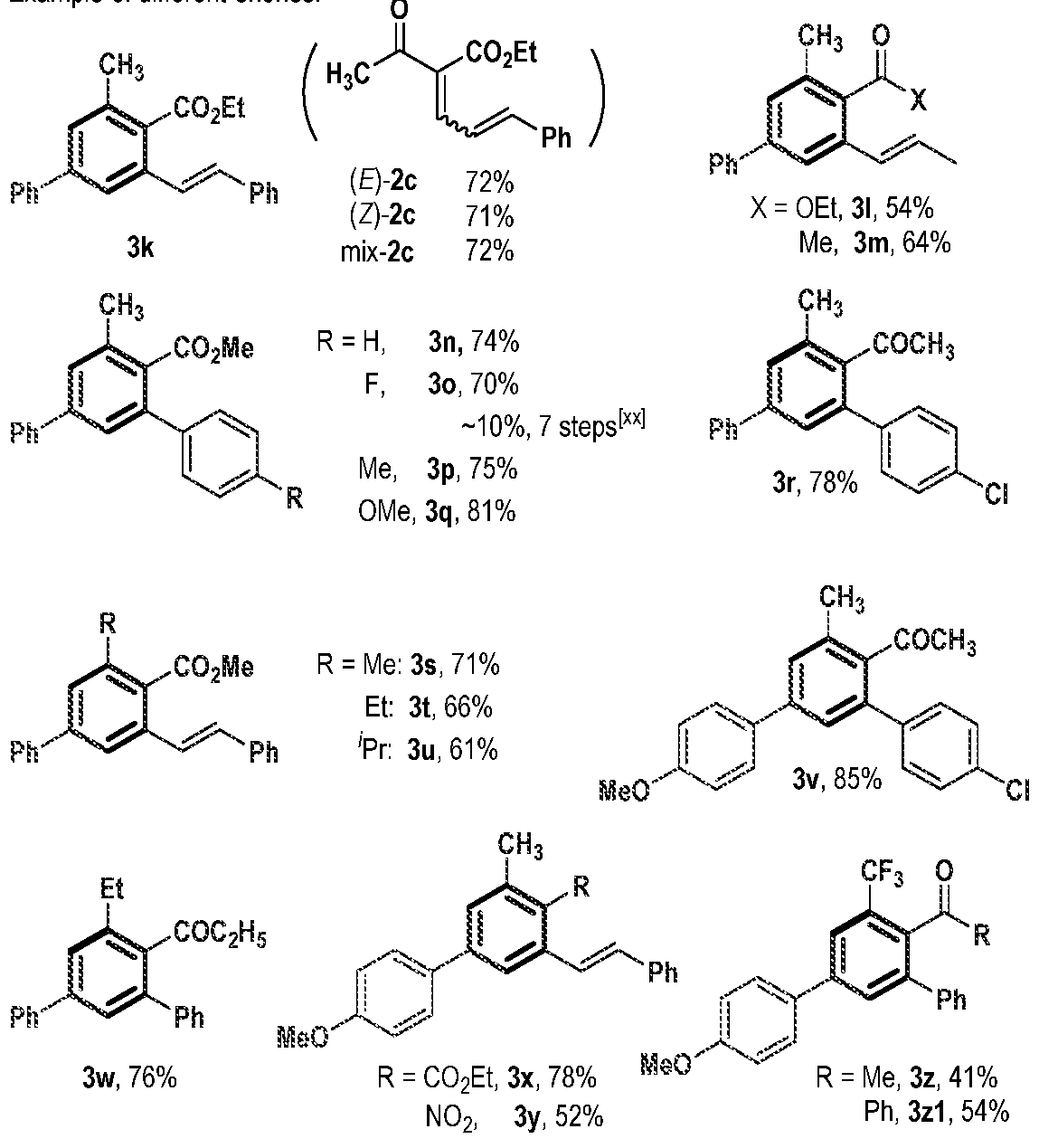
Scheme 3. Substrate scope
[039] With aldehydes 1a and 1 b (R1 = 4-OCH3-C6H4) as model nucleophile, the scope of enones was also examined. As shown in Scheme 3B, in nearly all cases, the reaction
proceeded smoothly at room temperature to give polysubstituted benzenes in moderate to good yields. Notably, the E-/Z-configuration of enone 2 did not affect the reaction outcomes either (e.g., see product 3k), which greatly simplify substrate preparation process. Both electron-rich (products 3p-q) or electron-deficient (products 3o and 3r) aromatic groups, as well as vinyl groups (product 3k-m) were all tolerated in β-substituent (R2) of enone substrates. a-Substituent (R3) of the enone substrates can be electron-deficient units such as acyl (3m, 3r, 3v-3w), ester (3k-l, 3n-q), or nitro (3y) groups. Substituent in carbonyl group of enones 2 (R4) can be different alkyl group including methyl (3k-q, 3r-s), ethyl (3t and 3w), isopropyl (3u) or trifluoromethyl (3z- z1 ) group.
[040] It is important to note that the polysubstituted benzene molecules accessed in a single step with present approach were difficult to prepare previously. For example, previous method for the synthesis of benzoate 3o required 7 steps with less than 1 0% overall yields; previous synthesis of 3p and 3q needed 3 steps reaction with 35% and 39% overall yield, respectively. Present method also provides extremely effective access to aromatic molecules with trifluoromethyl (CF3) substituent. In organic synthesis, regioselective C-H trifluoromethylation or methylation of aryl molecules still remains challenging despite the rapid development in recent years.
[041] It is next demonstrated effective transformation of present catalytic reaction products to bicyclic and multicylic aromatic molecules that are found as key scaffold in natural products and functional synthetic molecules. For example, the multi-substituted benzene adduct 3b could be transformed to indene 7 via reduction followed by Lewis acid-mediated cyclization; 2,4,6- trisubstituted benzoate 3n can be transformed to fluorenone 5 or isoindolone 6 via straightforward processes (Scheme 4).

Scheme 4. Synthetic applicability
[042] The reactions are expected to construct other type of substitution pattern of benzene and to introduce enantioselective control using chiral A/-heterocyclic carbene.
[043] Experimental details
[044] Commercially available materials purchased form Alfa Aesar or Aldrich was used as received. THF was distilled from Na and used directly. All anaerobic and moisture-sensitive manipulations were carried out with standard Schlenk techniques under predried nitrogen. Proton nuclear magnetic resonance (1 H NMR) spectra and Carbon nuclear magnetic resonance (13C NMR) were recorded on Bruker Avance 400 (400 MHz) spectrometer or Bruker Avance 500 (500 MHz) spectrometer in CDC [using 0.03% tetramethylsilane as internal standard (for 1 H NMR, δ = 0.00)]. Fluoride nuclear magnetic resonance (19F NMR) were recorded on Bruker Avance 400 (400 MHz) spectrometer (376 MHz). 1 H NMR splitting patterns are designated as singlet (s), doublet (d), triplet (t), quartet (q), dd (doublet of doublets); m (multiplets), and etc. All first-order splitting patterns were assigned on the basis of the appearance of the multiplet. Splitting patterns that could not be easily interpreted are designated as multiplet (m) or broad (br). Chemical shifts were recorded in parts per million (ppm, δ) relative to chloroform (for 1 H NMR, δ = 7.26 ppm, singlet; for 13C NMR, δ = 77.23 ppm, triplet). High resolution mass spectral analysis (HRMS) was performed on Waters Q-TOF Premier mass spectrometer. Analytical thin-
layer chromatography (TLC) was carried out on Merck 60 F254 pre-coated silica gel plate (0.2 mm thickness).
[045] General procedure for the preparation of enal substrates

[046] The enal substrates were prepared and characterized according to a known procedure, as briefed below:
[047] Step 1 : To a 1 00 mL round bottom flask containing NaH (20 mmol, 60% mineral dispersion) and anhydrous THF (40 mL) at 0 °C, was added triethyl phosphonoacetate (21 .5 mmol) dropwise via an addition funnel. The reaction mixture was naturally warmed to room temperature, followed by a dropwise addition of a acetophenone solution (13 mmol, in 20 mL anhydrous THF). The reaction mixture was stirred for 12 hours, and then poured into a separating funnel containing water. The organic layer was collected, and the aqueous layer was extracted with diethyl ether (2 χ 50 mL). The combined organic layers were dried over Na2SC>4, filtered, and concentrated under reduced pressure. The crude residue was subjected to flash chromatography (hexanes/EtOAc: 95/5) to afford the corresponding α,β-unsaturated ester as a light yellow oil.
[048] Step 2: To a 100 mL round bottom flask containing the unsaturated ester (20 mmol) obtained above and anhydrous THF (40 mL), was carefully added L1AIH4 (25 mmol) in a few portions at 0 °C. The reaction mixture was gradually warmed to room temperature and stirred for overnight. The reaction mixture was then cooled to 0 °C and quenched with 1 M aqueous HCI. The organic layer was separated and the aqueous layer was extracted with CH2CI2. The combined organics were dried over Na2S04, filtered, and concentrated under reduced pressure. The crude residue was subjected to flash chromatography (hexanes/EtOAc: 50/50) to afford the corresponding allylic alcohol as a light yellow oil.
[049] Step 3: To a 100 ml_ round bottom flask containing the allylic alcohol (20 mmol) obtained above, was added activated Mn02 (1 00 mmol) and anhydrous CHC (40 ml_) at room temperature. The reaction mixture was then stirred at 60 °C. After complete consumption of the starting material (as indicated by TLC analysis), the reaction mixture was filtered through a pad of celite. The resulting filtrate was concentrated under reduced pressure. The crude residue was subjected to flash chromatography (hexanes/EtOAc: 95/5) to afford the corresponding β,β- disubstituted enal as a light yellow oil.
[050] General procedure for the preparation of enone substrates

[051] The enal substrates were prepared and characterized according to a known procedure, as briefed below:
[052] To a 25 ml_ round bottom flask containing corresponding aldehyde (10 mmol) and ketone (10 mmol) was added L-Proline (1 15 mg, 1 mmol). If both aldehyde and ketone were solid, 1 ml_ EtOH was added as solvent. The reaction mixture was stirred at 60 °C. After complete consumption of the starting material (as indicated by TLC analysis), the reaction mixture was concentrated under reduced pressure. The crude residue was recrystallized in EtOH or subject to flash chromatography to afford the corresponding enones.
[053] General procedure for the catalytic [3+3] benzene construction from enal and enone

[055] General procedure for the synthetic applicability

[056] Benzoate 6a (30 mg, 0.1 mmol), NBS (26.7 mg, 0.1 5 mmol) and AIBN (5 mg, 0.02 mmol) were dissolved in benzene. The mixture was heated to reflux and stirred overnight. The mixture was cooled to room temperature, quenched with NaHSCb (aq.) and extracted with EtOAc. The organic layer was dried over anhydrous Na2SC>4 and concentrated under reduced pressure to afford the crude bromination product, which was then dissolved in 1 M CH3NH2 /MeOH (1 mL), and refluxed for 12h. After complete consumption of the starting material (as indicated by TLC analysis), the mixture was concentrated under reduced pressure and purified by silica gel column chromatography to afford the isoindolone 8 (22 mg, 74% yield).

[057] To a solution of acetophenone 5a in THF at 0 °C was added L1AIH4. The mixture was stirred 0 °C for 15 min. After complete consumption of the starting material (as indicated by TLC analysis), the reaction was quenched with 1 M HCI. The mixture was extracted with EtOAc. The organic layer was dried over anhydrous Na2S04 and concentrated under reduced pressure. The
crude residue was dissolved in CH2CI2 and cooled to 0 °C . BF30Et2 was slowly added to the solution. After stirring at 0 °C for further 5 min., the reaction was quenched with drops of NaHCCb (aq.). The mixture was concentrated under reduced pressure and purified by silica gel column chromatography to afford indene 9 (26 mg, 89% yield).
[058] Characterization of Products
[059] 1-(5'-methyl-[1 ,1 ':3',1 "-terphenyl]-4'-yl)ethanone (3a)
light yellow oil, 76% yield;
1 H NMR (400 MHz, CDCb) 1 .99 (s, 3H), 2.42 (s, 3H), 7.40-7.66 (m,
 10H), 7.68-7.61 (m, 2H); 13C NMR (100 MHz, CDCb) δ 1 9.8, 32.2, 126.2, 127.2, 127.8, 127.9, 128.4, 128.7, 128.8, 129.0, 134.5, 139.3, 140.24, 140.25, 140.5, 141 .8, 207.6 ppm ; HRMS (ESI) for C21 H19O [M+H]+: calcd 287.1430, found 287.1432;
[060] (£)-1-(3-methyl-5-styryl-[1 ,1 '-biphenyl]-4-yl)ethanone (3b)
light yellow powder, 68% yield;
Vmax (film, cm 1 ): 1730, 1688, 1595, 1256, 1 1 13, 968; 1 H NMR
 (400 MHz, CDCb) δ 2.36 (s, 3H), 2.53 (s, 3H), 7.08 (s, 2H), 7.32- 7.28 (m, 1 H), 7.38 (dd, J = 14.9, 7.6 Hz, 4H), 7.52-7.43 (m, 4H), 7.62 (d, J = 7.2 Hz, 2H), 7.67 (s, 1 H); 13C NMR (1 00 MHz, CDCb) δ 1 9.4, 32.9, 122.5, 125.4, 126.8, 127.2, 127.7, 128.2, 128.5, 128.8, 128.9, 132.3, 133.5, 133.9, 136.9, 140.3, 140.5, 141 .9, 208.1 ppm ; HRMS (ESI) for C24H23O2 [M+H]+: calcd 313.1587, found 313.1593;
[061] (£)-1-(4'-methoxy-3-methyl-5-styryl-[1 ,1 '-biphenyl]-4-yl)ethanone (3c)
light yellow powder, 88% yield;
Vmax (film, cm 1 ): 1712, 1682, 1595, 1516, 1254, 1 180, 952, 827; 1 H NMR (500 MHz, CDCb) δ 2.37 (s, 3H), 2.55

(s, 3H), 3.90 (s, 3H), 7.03 (d, J = 8.7 Hz, 2H), 7.10 (s, 2H), 7.35-7.29 (m, 2H), 7.40 (t, J = 7.6 Hz, 2H), 7.52 (d, J = 7.4 Hz, 2H), 7.59 (d, J = 8.7 Hz, 2H), 7.66 (s, 1 H); 13C NMR (125 MHz,
CDC ) δ 19.4, 33.0, 55.4, 114.3, 122.0, 125.5, 126.8, 128.1, 128.2, 128.8, 132.2, 132.9, 133.5, 133.9, 136.9, 139.8, 141.5, 159.5, 208.2 ppm; HRMS (ESI) for C23H21O [M+H]+: calcd 313.1587, found 313.1593; HRMS (ESI) for C24H23O2 [M+H]+: calcd 343.1693, found 343.1693;
[062] (£)-1-(3,4'-dimethyl-5-styryl-[1,1'-biphenyl]-4-yl)ethanone(3d)
light yellow oil, 72% yield;
1H NMR (400 MHz, CDCb) δ 2.36 (s, 3H), 2.42 (s, 3H), 2.54
 (s, 3H), 7.08 (s, 2H), 7.28-7.32 (m, 3H), 7.34 (s, 1H), 7.38 (t, J = 7.6 Hz, 2H), 7.49 (d, J = 7.2 Hz, 2H), 7.53 (d, J = 8.0 Hz, 2H), 7.66 (s, 1H); 13CNMR (100 MHz, CDCb) δ 19.4, 21.1, 32.9, 122.3, 124.1, 125.5, 126.8, 127.0, 128.1, 128.3, 128.8, 129.6, 132.2, 133.5, 133.9, 136.9, 137.6, 140.1, 141.8, 208.1 ppm; HRMS (ESI) for C24H23O [M+H]+: calcd 327.1743, found 327.1747;
[063] (£)-1 -(4'-chloro-3-methyl-5-styryl-[1 ,1 '-biphenyl]-4-yl)ethanone (3e)
light yellow oil, 64% yield;
1HNMR (500 MHz, CDCb) δ 2.38 (s, 3H), 2.55 (s, 3H), 7.09
 (s, 2H), 7.33 (s, 2H), 7.40 (t, J= 7.5 Hz, 2H), 7.46 (d, J= 8.4 Hz, 2H), 7.51 (d, J= 7.4 Hz, 2H), 7.58 (d, J= 8.4 Hz, 2H), 7.65 (s, 1H); 13CNMR (125 MHz, CDCb) δ 19.4, 32.9, 122.3, 125.2, 126.8, 128.3, 128.4, 128.8, 129.0, 132.5, 133.7, 133.9, 134.1, 136.8, 138.9, 140.6, 140.7, 207.9 ppm; HRMS (ESI) for C23H19CIO [M+H]+: calcd 347.1197, found 347.1205;
[064] (£)-1 -(3'-methoxy-3-methyl-5-styryl-[1 ,1 '-biphenyl]-4-yl)ethanone (3f)
light yellow powder, 84% yield;
1H NMR (500 MHz, CDCb) δ 2.35 (s, 3H), 2.53 (s, 3H),
 3.89 (s, 3H), 6.94 (dd, J = 2.0 Hz, 8.0 Hz, 1H), 7.08 (s, 2H), 7.15 (s, 1H), 7.21 (d, J= 7.5 Hz, 1H), 7.29 (t, J= 7.5 Hz, 1H), 7.34 (s, 1H), 7.36-7.41 (m, 3H), 7.49 (d, J= 7.5 Hz, 2H), 7.66 (s, 1H); 13C NMR (125 MHz, CDCb) δ 19.4, 32.9, 55.4, 113.0,
1 13.1 , 1 19.7, 122.5, 125.3, 126.8, 128.2, 128.5, 128.8, 129.9, 132.3, 133.5, 133.9, 136.9, 140.4, 141 .8, 142.0, 160.0, 208.1 ppm; HRMS (ESI) for C24H23O2 [M+H]+: calcd 343.1693, found 343.1696;
3.89 (s, 3H), 6.94 (dd, J = 2.0 Hz, 8.0 Hz, 1H), 7.08 (s, 2H), 7.15 (s, 1H), 7.21 (d, J= 7.5 Hz, 1H), 7.29 (t, J= 7.5 Hz, 1H), 7.34 (s, 1H), 7.36-7.41 (m, 3H), 7.49 (d, J= 7.5 Hz, 2H), 7.66 (s, 1H); 13C NMR (125 MHz, CDCb) δ 19.4, 32.9, 55.4, 113.0,
1 13.1 , 1 19.7, 122.5, 125.3, 126.8, 128.2, 128.5, 128.8, 129.9, 132.3, 133.5, 133.9, 136.9, 140.4, 141 .8, 142.0, 160.0, 208.1 ppm; HRMS (ESI) for C24H23O2 [M+H]+: calcd 343.1693, found 343.1696;
[065] (£)-1 -(3'-bromo-3-methyl-5-styryl-[1 ,1 '-biphenyl]-4-yl)ethanone (3g)
light yellow powder, 67% yield;
1 H NMR (400 MHz, CDCI3) δ 2.35 (s, 3H), 2.53 (s, 3H), 7.08
 (dd, J = 12.0 Hz, 19.6 Hz, 2H), 7.31 (dd, J = 4.0, 3.2 Hz, 2H), 7.33-7.41 (m, 3H), 7.46-7.57 (m, 4H), 7.63 (d, J = 0.9 Hz, 1 H), 7.76 (t, J = 1 .8 Hz, 1 H). 13C NMR (100 MHz, CDCI3) δ 19.3, 32.9, 122.4, 123.0, 125.1 , 125.8, 126.8, 128.3, 128.4, 128.8,
130.2, 130.4, 130.7, 132.6, 133.7, 134.1 , 136.8, 140.4, 140.8, 142.6, 207.8 ppm ; HRMS (ESI) for C23H2oBrO [M+H]+: calcd 391 .0692, found 391 .0699;
[066] (£)-1 -(2-methyl-4-(naphthalen-2-yl)-6-styrylphenyl)ethanone (3h)
light yellow oil, 66% yield;
1 H NMR (500 MHz, CDCI3) δ 2.40 (s, 3H), 2.56 (s, 3H),
 7.12 (dd, J = 12.8 Hz, 14.0 Hz), 7.30 (t, J = 7.3 Hz, 1 H), 7.38 (t, J = 7.6 Hz, 2H), 7.48 (s, 1 H), 7.49-7.57 (m, 4H), 7.78 (dd, J = 8.5, 1 .7 Hz, 1 H), 7.80 (s, 1 H), 7.89 (d, J = 7.4 Hz, 1 H), 7.94 (t, J = 7.5 Hz, 2H), 8.08 (s, 1 H). 13C NMR (125 MHz, CDCI3) δ 19.4, 33.0, 122.8, 125.4, 126.0, 126.2, 126.5, 126.8, 127.7, 128.2, 128.3, 128.6, 128.7, 128.8, 132.4, 132.8, 133.7, 134.0, 136.9, 137.8, 140.4, 141 .8, 208.1 ppm; HRMS (ESI) for C27H23O [M+H]+: calcd 363.1743, found 363.1747;
[067] (£)-1-(4-(furan-2-yl)-2-methyl-6-styrylphenyl)ethanone (3i)
light yellow oil, 67% yield;
1 H NMR (400 MHz, CDCI3) δ 2.35 (s, 3H), 2.53 (s, 3H), 6.54 (dd,
 J = 1 .6 Hz, 2.8 Hz, 1 H), 6.76 (d, J = 2.8 Hz, 1 H), 7.09 (dd, J = 12.8, 23.2 Hz, 2H), 7.32 (t, J = 6.0 Hz, 1 H), 7.38-7.41 (m, 2H), 7.46 (s, 1 H), 7.51 -7.54 (m, 3H),
7.80 (s, 1H); 13C NMR (100 MHz, CDCb) δ 19.4, 32.9, 105.9, 111.8, 118.9, 1248, 125.2, 126.8, 128.2, 128.8, 131.3, 132.4, 133.6, 134.0, 136.8, 140.2, 142.5, 153.2, 207.9 ppm; HRMS (ESI) for C21H18O2 [M+H]+: calcd 303.1380, found 303.1384;
J = 1 .6 Hz, 2.8 Hz, 1 H), 6.76 (d, J = 2.8 Hz, 1 H), 7.09 (dd, J = 12.8, 23.2 Hz, 2H), 7.32 (t, J = 6.0 Hz, 1 H), 7.38-7.41 (m, 2H), 7.46 (s, 1 H), 7.51 -7.54 (m, 3H),
7.80 (s, 1H); 13C NMR (100 MHz, CDCb) δ 19.4, 32.9, 105.9, 111.8, 118.9, 1248, 125.2, 126.8, 128.2, 128.8, 131.3, 132.4, 133.6, 134.0, 136.8, 140.2, 142.5, 153.2, 207.9 ppm; HRMS (ESI) for C21H18O2 [M+H]+: calcd 303.1380, found 303.1384;
[068] (£)-1-(2-methyl-6-styryl-4-(thiophen-2-yl)phenyl)ethanone (3j)
light yellow oil, 78% yield;
1H NMR (400 MHz, CDCb) δ 2.33 (s, 3H), 2.51 (s, 3H), 7.05 (d, J
 = 2.2 Hz, 2H), 7.11 (dd, J = 5.1 , 3.6 Hz, 1 H), 7.34-7.28 (m, 2H), 7.38 (dt, J= 7.8, 5.1 Hz, 4H), 7.50 (d, J= 7.2 Hz, 2H), 7.68 (s, 1H); 13C NMR (100 MHz, CDCb) δ 19.3, 32.9, 121.2, 123.7, 125.2, 125.4, 126.8, 127.1, 128.1, 128.2, 128.8, 132.6, 133.8, 134.2, 134.9, 136.8, 140.4, 143.4, 207.7 ppm; HRMS (ESI) for C21H19OS [M+H]+: calcd 319.1151, found 319.1158;
[069] (£)-ethyl 3-methyl-5-styryl-[1 ,1 '-biphenyl]-4-carboxylate (3k)
I light yellow oil, 72% yield;
Ji 1| NMR (300 MHz' CDCb) δ 1.42 (t, J = 7.1 Hz, 3H), 2.43 (s, 3H), 4.46
(q, J= 7.1 Hz, 2H), 7.11 (d, J = 16.1 Hz, 1H), 7.23 (d, J = 15.0 Hz, 2H), 7.28-7.39 (m, 4H), 7.42 (d, J = 10.4 Hz, 1 H), 7.45-7.53 (m, 3H), 7.58-7.66 (m, 2H), 7.71 (s, 1 H); 13C NMR (75 MHz, CDCb) δ 14.4, 19.9, 61.3, 122.0, 125.8, 126.7, 127.2, 127.8, 127.9, 128.3, 128.7, 128.8, 131.6, 131.9, 135.6, 135.8, 137.1, 140.5, 142.5, 169.6 ppm; HRMS (ESI) for C24H23O2 [M+H]+: calcd 343.1693, found 343.1692;
[070] (£)-ethyl 3-methyl-5-(prop-1-en-1-yl)-[1,1'-biphenyl]-4-carboxylate (3I)
light yellow oil, 54% yield;
1H NMR (500 MHz, CDCb) 01.41 (t, J= 7.1 Hz, 3H), 1.89 (d, J= 6.6 Hz,

3H), 2.38 (s, 3H), 4.39 (t, J= 7.1 Hz, 2H), 6.21-6.31 (m, 1H), 6.49 (d, J = 15.6 Hz, 1 H), 7.28 (s, 1 H), 7.33-7.40 (m, 1 H), 7.44 (t, J = 7.5 Hz, 2H), 7.53 (s, 1 H), 7.57 (d, J = 8.3 Hz, 2H); 13C NMR (125 MHz, CDCb) δ 14.3, 18.8, 19.8, 61.1, 122.0, 127.2, 127.5, 127.6,
128.1, 128.8, 128.9, 131.3, 135.4, 136.0, 140.7, 142.3, 169.9 ppm; HRMS (ESI) for C19H21O2 [M+H]+: calcd 281.1536, found 281.1539;
[071 ] (£)-1 -(3-methyl-5-(prop-1 -en-1 -yl)-[1 ,1 '-biphenyl]-4-yl)ethanone (3m)
O light yellow oil, 64% yield; 6 Hz, 3H), 2.31 (s, 15.6, 1.5 Hz, 1H),

7.28 (s, 1H), 7.33-7.39 (m, 1H), 7.44 (dd, J= 10.3, 4.8 Hz, 2H), 7.48 (s, 1H), 7.55-7.62 (m, 2H); 13C NMR (125 MHz, CDCI3) δ 18.8, 19.3, 32.8, 122.5, 127.2, 127.6,
127.7, 127.9, 128.8, 129.8, 133.2, 134.4, 139.6, 140.6, 141.6, 208.4 ppm; HRMS (ESI) for C18H19O [M+H]+: calcd 251.1430, found 251.1435;
[072] meth l 5'-methyl-[1,1':3',1"-terphenyl]-4'-carboxylate (3n) light yellow oil' 70% yield;
Ή NMR (400 MHz, CDC ) δ 2.50 (s, 3H), 3.62 (s, 3H), 7.37-7.49 (m,

10H), 7.64 (d, J= 7.2 Hz, 2H); 13C NMR (100 MHz, CDCb) δ 19.9, 51.9, 126.2, 127.3, 127.5,
127.8, 127.9, 128.2, 128.3, 128.8, 131.9, 136.2, 140.3, 140.8, 141.0, 142.4, 170.3 ppm; HRMS (ESI) for C21H19O2 [M+H]+: calcd 303.1380, found 303.1384;
[073] methyl 4"-fluoro-5'-methyl-[1,1':3',1"-terphenyl]-4'-carboxylate (3o) 263, 1088, 839, 760, 696; 1H
 7.1 Hz, 3H), 2.48 (s, 3H), 4.10 (q, J= 7.1 Hz, 2H), 7.09 (t, J= 8.7 Hz, 2H), 7.33-7.42 (m, 4H), 7.45 (t, J= 7.4 Hz, 3H), 7.57- 7.64 (m, 2H); 13C NMR (100 MHz, CDCb) δ 13.8, 19.9, 61.0, 115.1 (d, JCF = 21 Hz), 126.1,
127.2, 127.8, 128.0, 128.9, 130.1 (d, JCF = 0.9 Hz), 132.2, 136.1, 137.0, 139.7, 140.2, 142.3, 162.3 (d, JCF = 245 Hz), 169.6; 19F NMR (376 MHz, CDCb) δ -115.2 ppm; HRMS (ESI) for C22H20FO2 [M+H]+: calcd 335.1442, found 335.1454;
methyl 4",5'-dimethyl-[1 ,1 ':3',1 "-terphenyl]-4'-carboxylate (3p) (s, 3H),
 7.4 Hz, 1H), 7.45-7.49 (m, 4H), 7.63 (d, J= 8.0 Hz, 2H); 13C NMR (125 MHz, CDCb) δ 19.9, 21.2, 51.9, 126.2, 127.2, 127.7, 127.8, 128.1, 128.8, 129.1, 136.0, 137.2, 138.0, 140.3, 140.7, 142.3, 170.4 ppm; HRMS (ESI) for C22H21O2 [M+H]+: calcd 317.1536, found 317.1544;
[075] meth l 4"-methoxy-5'-methyl-[1,1':3',1"-terphenyl]-4'-carboxylate (3q)
er, 81% yield
Hz, CDCb) δ 2.49 (s, 3H), 3.67 (s, 3H), 3.88 (s,
 8.7 Hz, 2H), 7.37-7.40 (m, 3H), 7.43-7.48 (m, 4H), 7.64 (dd, J= 6.0 Hz, 8.5 Hz, 2H); 13C NMR (125 MHz, CDCb) δ 19.9, 51.9, 55.3, 113.8, 126.1, 127.2, 127.5, 127.7, 128.8, 129.4, 132.0, 133.3, 136.0, 136.1, 140.3, 142.3, 159.1, 170.5 ppm; HRMS (ESI) for C22H21O3 [M+H]+: calcd 333.1485, found 333.1486;
076] 1-(4"-chloro-5'-methyl-[1,1':3',1"-terphenyl]-4'-yl)ethanone(3r)
light yellow powder, 78% yield
1H NMR (400 MHz, CDCb) δ 2.01 (s, 3H), 2.39 (s, 3H), 7.34 (d, J =
 8.6 Hz, 2H), 7.37-7.43 (m, 4H), 7.43-7.49 (m, 3H), 7.58-7.64 (m, 2H); 13C NMR (100 MHz, CDCb) δ 19.7, 32.3, 126.1, 127.2, 127.9, 128.7, 128.9, 30.3, 134.2, 134.6, 137.9, 138.9, 140.1, 140.2, 141.9, 207.3 ppm; HRMS (ESI) for C2iHi8CIO [M+H]+: calcd 321.1041, found 321.1042;
[077] (£)-methyl 3-methyl-5-styryl-[1 ,1 '-biphenyl]-4-carboxylate (3s)
yellow oil, 71% yield
MR (400 MHz, CDCb) δ 2.42 (s, 3H), 3.97 (s, 3H), 7.12 (d, = 16.0
 Hz, 1H), 7.20 (d, J = 16.0 Hz, 1H), 7.29 (d, J= 7.2 Hz, 1H), 7.35-7.39 (m, 4H), 7.41-7.50 (m, 4H), 7.62 (d, J = 7.2 Hz, 2H), 7.72 (s, 1H); 13C NMR (100 MHz, CDC ) δ 20.0, 52.2, 122.0, 125.8, 126.8, 127.2, 127.8, 128.0, 128.3, 128.7, 128.8, 131.6, 135.7, 136.0, 137.1, 140.5, 142.6, 170.1 ppm; HRMS (ESI) for C23H21O2 [M+H]+: calcd 329.1536, found 329.1541 ;
078] (£)-methyl 3-ethyl-5-styryl-[1 ,1 '-biphenyl]-4-carboxylate (3t)
light yellow oil, 66% yield
1H NMR (400 MHz, CDCb) δ 1.31 (t, J= 7.6 Hz, 3H), 2.74 (q, J= 7.6

Hz, 2H), 4.00 (s, 3H), 7.14 (d, J = 16.0 Hz, 1H), 7.19 (d, J= 16.0 Hz, 1H), 7.31 (d, J= 7.6 Hz, 1H), 7.37-7.43 (m, 4H), 7.48-7.53 (m, 4H), 7.65 (d, J= 7.2 Hz, 2H), 7.75 (d, J= 1.2 Hz, 1H); 13C NMR (100 MHz, CDCb) δ 15.7, 27.1, 52.2, 122.1, 125.7, 126.7, 126.8, 127.3, 127.8, 128.0, 128.7, 128.9, 131.3, 131.7, 135.5, 137.1, 140.7, 142.1, 142.8, 170.3 ppm; HRMS (ESI) for C24H23O2 [M+H]+: calcd 343.1693, found 343.1697;
079] (£)-methyl 3-isopropyl-5-styryl-[1 ,1 '-biphenyl]-4-carboxylate (3u)
light yellow oil, 61% yield
1H NMR (500 MHz, CDCb) δ 1.35 (d, J

1H), 4.00 (s, 3H), 7.15 (s, 2H), 7.31 (d, J= 7.5 Hz, 1H), 7.37-7.44 (m, 3H), 7.48-7.52 (m, 5H), 7.66 (d, J= 7.5 Hz, 2H), 7.74 (s, 1H); 13C NMR (125 MHz, CDCb) δ 24.0, 31.6, 52.2, 122.1, 123.7, 125.6, 126.8, 127.3, 127.8, 128.0, 128.7, 128.8, 131.3, 131.8, 135.1, 137.1, 140.9, 142.8, 143.4, 170.6 ppm; HRMS (ESI) for C25H25O2 [M+H]+: calcd 357.1849, found 357.1853;
080] 1-(4"-chloro-4-methoxy-5'-methyl-[1,1':3',1"-terphenyl]-4'-yl)ethanone(3v)
light yellow powder, 85% yield
1H NMR (400 MHz, CDCb) δ 2.00 (s, 3H), 2.38 (s, 3H),
 3.86 (s, 3H), 6.99 (d, J = 8.8 Hz, 2H), 7.32-7.36 (m, 3H),
7.39 (s, 2H), 7.42 (d, J= 3.2 Hz, 1H), 7.55 (d, J= 8.8 Hz, 2H); 13C NMR (100 MHz, CDCb) δ
19.8, 32.3, 55.4, 114.3, 125.6, 128.2, 128.3, 128.9, 130.3, 132.5, 134.1, 134.6, 137.9, 139.0, 139.7, 141.5, 159.6, 207.4 ppm; HRMS (ESI) for C22H20CIO2 [M+H]+: calcd 351.1146, found 351.1148;
[081 ] 1 -(5'-ethyl-[1 ,1 ' :3',1 "-terphenyl]-4'-yl)propan-1 -one (3w) 02; 1H NMR (500 7.5 Hz, 3H), 2.19

(q, J= 7.2 Hz, 2H), 2.66 (q, J= 7.5 Hz, 2H), 7.39 (ddd, J= 9.9, 7.9, 3.6 Hz, 6H), 7.43-7.48 (m, 3H), 7.49 (d, J= 1.5 Hz, 1H), 7.59-7.67 (m, 2H); 13C NMR (125 MHz, CDCI3) δ 7.86, 16.1, 26.5, 38.2, 126.2, 126.7, 127.2, 127.7, 128.6, 128.8, 129.1, 139.1, 139.9, 140.5, 140.6, 141.0, 141.8, 210.5 ppm; HRMS (ESI) for C23H23O [M+H]+: calcd 315.1743, found 315.1747;
[082] (£)-ethyl 4'-methoxy-3-methyl-5-styryl-[1 ,1 '-biphenyl]-4-carboxylate (3x) 7.2 Hz, 3H), 2.42 (s,
 , 7.00 (d, J = 8.8 Hz,
2H), 7.10 (d, J = 16.0 Hz, 1H), 7.23 (d, J = 16.0 Hz, 1H), 7.28-7.32 (m, 1H), 7.36 (t, J= 7.6 Hz, 2H), 7.49 (d, J= 7.6 Hz, 2H), 7.56 (d, J= 7.2 Hz, 2H), 7.68 (s, 1H); 13C NMR (100 MHz, CDCI3) δ 14.4, 19.9, 55.4, 61.2, 114.3, 121.6, 125.9, 126.7, 127.90, 127.93, 128.3, 128.7, 131.4, 133.0, 135.6, 135.8, 137.2, 142.1, 159.6, 169.7 ppm; HRMS (ESI) for C25H25O3 [M+H]+: calcd 373.1798, found 373.1799;
[083] 4-methoxy-5'-methyl-4'-nitro-1,1':3',1"-terphenyl (3y) ) δ 2.47 (s, 3H), 3.89 (s, 3H), 7.02 (d,
 (m, 6H), 7.48 (s, 1H), 7.57 (d, J= 8.8
Hz, 2H); 13C NMR (100 MHz, CDCI3) δ 17.8, 55.4, 114.5, 123.5, 126.9, 128.0, 128.3, 128.4,
128.5, 128.8, 130.3, 131.6, 135.0, 137.0, 142.7, 160.0 ppm; HRMS (ESI) for C20H18NO3 [M+H]+: calcd 320.1281, found 320.1285;
[084] 1-(4-methoxy-5'-(trifluoromethyl)-[1,1':3',1"-terphenyl]-4'-yl)ethanone (3z)
light yellow oil, 41% yield
1H NMR (400 MHz, CDCI3) δ 2.03 (s, 3H), 3.87 (s, 3H), 7.01 (d, J = 8.8 Hz, 2H), 7.36-7.43 (m, 5H), 7.57 (d, J = 8.8 Hz, 2H),

7.71 (s, 1H), 7.86 (s, 1H); 13C NMR (100 MHz, CDCI3) δ 31.8, 55.6, 114.8, 122.1 (q, JCF = 268 Hz), 128.5, 128.6, 129.0, 129.4, 129.6, 131.4, 131.7, 139.0, 140.3, 142.0, 160.3, 204.4; 19F NMR (376 MHz, CDCI3) δ -57.91 ppm; HRMS (ESI) for C22H18F3O2 [M+H]+: calcd 371.1253, found 371.1259;
085] (4-methoxy-5'-(trifluoromethyl)-[1,1':3',1"-terphenyl]-4'-yl)(phenyl)methanone (3z1)
light yellow oil, 54% yield
1H NMR (400 MHz, CDC ) δ 3.88 (s, 3H), 7.03 (d, J = 8.4 Hz, 2H), 7.16-7.24 (m, 7H), 7.39 (t, J= 7.2 Hz, 1H), 7.55 (d, J= 7.6

Hz, 2H), 7.63 (d, J= 8.8 Hz, 2H), 7.75 (s, 1H), 7.96 (s, 1H); 13C NMR (100 MHz, CDCb) δ 55.4,
114.6, 123.4 (q, JCF = 274 Hz), 127.8, 128.1, 128.4, 128.5, 128.9, 129.1, 129.4, 131.2, 131.5, 135.2, 137.2, 138.8, 141.9, 142.0, 160.1, 196.4 ppm; 19F NMR (376 MHz, CDCb) δ -57.47 ppm; HRMS (ESI) for C27H20F3O2 [M+H]+: calcd 433.1410, found 433.1418;
[086] 2-methyl-5,7-diphenylisoindolin-1-one (6)
light yellow oil, 74% yield;
1H NMR (400 MHz, CDCb) δ 3.20 (s, 3H), 4..47 (s, 2H), 7.42-7.52 (m,
 6H), 7.52-7.64 (m, 4H), 7.68 (d, J = 7.2 Hz, 2H); 13C NMR (100 MHz, CDCb) δ 29.5, 51.3, 120.1, 127.4, 127.6, 127.8, 128.1, 128.6, 129.0, 129.8, 137.5, 140.2, 141.2, 143.0, 144.0, 167.8 ppm; HRMS (ESI) for C2iHi8NO [M+H]+: calcd 300.1383, found 300.1385;
[087] 1 ,7-dimethyl-2,5-diphenyl-1 H-indene (7)
6H), 7.52-7.64 (m, 4H), 7.68 (d, J = 7.2 Hz, 2H); 13C NMR (100 MHz, CDCb) δ 29.5, 51.3, 120.1, 127.4, 127.6, 127.8, 128.1, 128.6, 129.0, 129.8, 137.5, 140.2, 141.2, 143.0, 144.0, 167.8 ppm; HRMS (ESI) for C2iHi8NO [M+H]+: calcd 300.1383, found 300.1385;
[087] 1 ,7-dimethyl-2,5-diphenyl-1 H-indene (7)
light powder, 89% yield;
1 H NMR (500 MHz, CDC ) δ 1 .41 (d, J

(t, J = 7.0 Hz, 1 H), 7.15 (s, 1 H), 7.27 (s, 1 H), 7.35-7.39 (m, 2H), 7.44- 7.48 (m, 4H), 7.49 (s, 1 H), 7.62 (d, J = 7.0 Hz, 2H), 7.66 (d, J = 7.0 Hz, 2H); 13C NMR (100 MHz, CDCb) δ 15.8, 18.9, 43.5, 1 1 7.8, 125.7, 126.0, 126.9, 127.0, 127.3, 127.4, 128.66, 128.68, 133.1 , 135.2, 140.5, 141 .8, 144.3, 146.6, 153.2 ppm; HRMS (ESI) for C23H21 [M+H]+: calcd 297.1638, found 297.1641 .
[088] By "comprising" it is meant including, but not limited to, whatever follows the word "comprising". Thus, use of the term "comprising" indicates that the listed elements are required or mandatory, but that other elements are optional and may or may not be present.
[089] By "consisting of" is meant including, and limited to, whatever follows the phrase "consisting of". Thus, the phrase "consisting of" indicates that the listed elements are required or mandatory, and that no other elements may be present.
[090] The inventions illustratively described herein may suitably be practiced in the absence of any element or elements, limitation or limitations, not specifically disclosed herein. Thus, for example, the terms "comprising", "including", "containing", etc. shall be read expansively and without limitation. Additionally, the terms and expressions employed herein have been used as terms of description and not of limitation, and there is no intention in the use of such terms and expressions of excluding any equivalents of the features shown and described or portions thereof, but it is recognized that various modifications are possible within the scope of the invention claimed. Thus, it should be understood that although the present invention has been specifically disclosed by preferred embodiments and optional features, modification and variation of the inventions embodied therein herein disclosed may be resorted to by those
skilled in the art, and that such modifications and variations are considered to be within the scope of this invention.
[091] By "about" in relation to a given numerical value, such as for temperature and period of time, it is meant to include numerical values within 10% of the specified value.
[092] The invention has been described broadly and generically herein. Each of the narrower species and sub-generic groupings falling within the generic disclosure also form part of the invention. This includes the generic description of the invention with a proviso or negative limitation removing any subject matter from the genus, regardless of whether or not the excised material is specifically recited herein.
[093] Other embodiments are within the following claims and non- limiting examples. In addition, where features or aspects of the invention are described in terms of Markush groups, those skilled in the art will recognize that the invention is also thereby described in terms of any individual member or subgroup of members of the Markush group.
Claims
1 . A method of forming a multi-substituted benzene compound of formula (3)

reacting an enal of formula (1 )


in the presence of a N-heterocyclic carbene (NHC) pre-catalyst, an oxidant, a base, and an organic solvent ,
wherein:
R1 , R2, and R3 are independently selected from the group consisting of a linear or branched, substituted or unsubstituted C1 -C20 alkyl; linear or branched, substituted or unsubstituted C2-C20 alkenyl; linear or branched, substituted or unsubstituted C2-C20 alkynyl; linear or branched, substituted or unsubstituted C1 -C20 alkoxy; substituted or unsubstituted C3-C20 cycloalkyl; substituted or unsubstituted C3-C20 cycloalkenyl;
substituted or unsubstituted C5-C15 aryl; substituted or unsubstituted C3-C15 heteroaryl, - C(0)-R, -NRR", -OR, -SR, -COOR, -CN, -NO2, -C(0)-NRR", -NR'-C(0)-R, -SO2-R and - (S02)-OR;
R and R' are independently selected from H and linear or branched, substituted or unsubstituted C1 -C10 alkyl; and
Ar is a substituted or unsubstituted C5-C15 aryl, or a substituted or unsubstituted C3-C15 heteroaryl.
2. The method of claim 1 , wherein the NHC pre-catalyst is selected from the group consisting of:

3. The method of claim 1 or 2, wherein the organic solvent is selected from the group consisting of THF, CH2CI2, toluene, CH3CN, DMF, and a mixture thereof.
4. The method of claim 3, wherein the organic solvent is THF.
5. The method of any one of claims 1 -4, wherein the base is selected from the group consisting of CS2CO3, Et3N, DBU, BuOK, K2CO3, DIEA, TBD, and a mixture thereof.
6. The method of claim 5, wherein the base is CS2CO3.
7. The method of any one of claims 1 -6, wherein the oxidant comprises a compound of formula (4)

8. The method of any one of claims 1 -7, wherein the reaction is carried out at room temperature.
9. The method of any one of claims 1 -8, wherein the reaction is carried out for a period of between 1 and 10 hours.
10. The method of claim 9, wherein the reaction is carried out for a period of between 5 and 10 hours.
1 1 . The method of claim 10, wherein the reaction is carried out for 8 hours.
12. The method of any one of claims 1 -1 1 , wherein the reaction is carried out in an inert atmosphere.
13. The method of any one of claims 1 -12, wherein the multi-substituted benzene compound of formula (3) is selected from the group consisting of:
1 -(5'-methyl-[1 ,1 ':3',1 "-terphenyl]-4'-yl)ethanone (3a);
(£)-1 -(3-methyl-5-styryl-[1 ,1 '-biphenyl]-4-yl)ethanone (3b);
(£)-1 -(4'-methoxy-3-methyl-5-styryl-[1 ,1 '-biphenyl]-4-yl)ethanone (3c);
(£)-1 -(3,4'-dimethyl-5-styryl-[1 ,1 '-biphenyl]-4-yl)ethanone (3d);
(£)-1 -(4'-chloro-3-methyl-5-styryl-[1 ,1 '-biphenyl]-4-yl)ethanone (3e);
(£)-1 -(3'-methoxy-3-methyl-5-styryl-[1 ,1 '-biphenyl]-4-yl)ethanone (3f);
(£)-1 -(3'-bromo-3-methyl-5-styryl-[1 ,1 '-biphenyl]-4-yl)ethanone (3g);
(£)-1 -(2-methyl-4-(naphthalen-2-yl)-6-styrylphenyl)ethanone (3h);
(£)-1 -(4-(furan-2-yl)-2-methyl-6-styrylphenyl)ethanone (3i);
(£)-1 -(2-methyl-6-styryl-4-(thiophen-2-yl)phenyl)ethanone (3j);
(£)-ethyl 3-methyl-5-styryl-[1 ,1 '-biphenyl]-4-carboxylate (3k);
(£)-ethyl 3-methyl-5-(prop-1 -en-1 -yl)-[1 ,1 '-biphenyl]-4-carboxylate (3I);
(£)-1 -(3-methyl-5-(prop-1 -en-1 -yl)-[1 ,1 '-biphenyl]-4-yl)ethanone (3m);
methyl 5'-methyl-[1 ,1 ':3',1 "-terphenyl]-4'-carboxylate (3n);
methyl 4"-fluoro-5'-methyl-[1 ,1 ':3',1 "-terphenyl]-4'-carboxylate (3o);
methyl 4",5'-dimethyl-[1 ,1 ':3',1 "-terphenyl]-4'-carboxylate (3p);
methyl 4"-methoxy-5'-methyl-[1 ,1 ':3',1 "-terphenyl]-4'-carboxylate (3q);
1 -(4"-chloro-5'-methyl-[1 ,1 ':3',1 "-terphenyl]-4'-yl)ethanone (3r);
(£)-methyl 3-methyl-5-styryl-[1 ,1 '-biphenyl]-4-carboxylate (3s);
(£)-methyl 3-ethyl-5-styryl-[1 ,1 '-biphenyl]-4-carboxylate (3t);
(£)-methyl 3-isopropyl-5-styryl-[1 ,1 '-biphenyl]-4-carboxylate (3u);
1 -(4"-chloro-4-methoxy-5'-methyl-[1 ,1 ':3',1 "-terphenyl]-4'-yl)ethanone (3v);
1 -(5'-ethyl-[1 ,1 ':3',1 "-terphenyl]-4'-yl)propan-1 -one (3w);
(£)-ethyl 4'-methoxy-3-methyl-5-styryl-[1 ,1 '-biphenyl]-4-carboxylate (3x);
4-methoxy-5'-methyl-4'-nitro-1 ,1 ':3',1 "-terphenyl (3y);
1 -(4-methoxy-5'-(trifluoromethyl)-[1 ,1 ':3',1 "-terphenyl]-4'-yl)ethanone (3z); and (4-methoxy-5'-(trifluoromethyl)-[1 ,1 ':3',1 "-terphenyl]-4'-yl)(phenyl)methanone (3z1 ).
Applications Claiming Priority (2)
| Application Number | Priority Date | Filing Date | Title |
|---|---|---|---|
| SG10201404336U | 2014-07-23 | ||
| SG10201404336U | 2014-07-23 |
Publications (1)
| Publication Number | Publication Date |
|---|---|
| WO2016013976A1 true WO2016013976A1 (en) | 2016-01-28 |
Family
ID=55163392
Family Applications (1)
| Application Number | Title | Priority Date | Filing Date |
|---|---|---|---|
| PCT/SG2015/050223 Ceased WO2016013976A1 (en) | 2014-07-23 | 2015-07-22 | Method of forming a multi-substituted benzene compound |
Country Status (1)
| Country | Link |
|---|---|
| WO (1) | WO2016013976A1 (en) |
Cited By (4)
| Publication number | Priority date | Publication date | Assignee | Title |
|---|---|---|---|---|
| CN112500254A (en) * | 2019-09-16 | 2021-03-16 | 江西师范大学 | Polyene cyclization initiated by protonation of acetylenic amides |
| CN114380679A (en) * | 2020-10-19 | 2022-04-22 | 中国科学院大连化学物理研究所 | Palladium catalytic oxidation coupling method |
| WO2022115301A1 (en) * | 2020-11-24 | 2022-06-02 | Merck Sharp & Dohme Corp. | Modified isoindolinones as glucosylceramide synthase inhibitors |
| CN117185925A (en) * | 2023-04-26 | 2023-12-08 | 江西师范大学 | Preparation method of polysubstituted aryl carboxylate compound |
-
2015
- 2015-07-22 WO PCT/SG2015/050223 patent/WO2016013976A1/en not_active Ceased
Non-Patent Citations (4)
| Title |
|---|
| CHIANG, P. ET AL.: "N-mesityl substituted chiral triazolium salts: opening a new world of N-heterocyclic carbene catalysis", TCI MAIL, 2012, pages 2 - 17 * |
| NAIR, V. ET AL.: "N-heterocyclic carbene-catalyzed reaction of chalcones and enals via homoenolate: an efficient synthesis of 1,3,4- trisubstituted cyclopentenes", J. AM. CHEM. SOC., vol. 128, 2006, pages 8736 - 8737 * |
| RONG, Z. ET AL.: "Enantioselective N-heterocyclic carbene-catalyzed Michael addition to alpha,beta-unsaturated aldehydes by redox oxidation", ORGANIC LETTERS, vol. 13, no. 15, 2011, pages 4080 - 4083 * |
| ZHU, T. ET AL.: "Benzene construction via organocatalytic formal [3+3] cycloaddition reaction", NATURE COMMUNICATIONS, 2014, pages 1 - 6 * |
Cited By (7)
| Publication number | Priority date | Publication date | Assignee | Title |
|---|---|---|---|---|
| CN112500254A (en) * | 2019-09-16 | 2021-03-16 | 江西师范大学 | Polyene cyclization initiated by protonation of acetylenic amides |
| CN114380679A (en) * | 2020-10-19 | 2022-04-22 | 中国科学院大连化学物理研究所 | Palladium catalytic oxidation coupling method |
| CN114380679B (en) * | 2020-10-19 | 2022-12-20 | 中国科学院大连化学物理研究所 | Palladium catalytic oxidation coupling method |
| WO2022115301A1 (en) * | 2020-11-24 | 2022-06-02 | Merck Sharp & Dohme Corp. | Modified isoindolinones as glucosylceramide synthase inhibitors |
| US12679807B2 (en) | 2020-11-24 | 2026-07-14 | Merck Sharp & Dohme Llc | Modified isoindolinones as glucosylceramide synthase inhibitors |
| CN117185925A (en) * | 2023-04-26 | 2023-12-08 | 江西师范大学 | Preparation method of polysubstituted aryl carboxylate compound |
| CN117185925B (en) * | 2023-04-26 | 2024-04-26 | 江西师范大学 | Preparation method of polysubstituted aryl carboxylate compound |
Similar Documents
| Publication | Publication Date | Title |
|---|---|---|
| Kantevari et al. | HClO4–SiO2 and PPA–SiO2 catalyzed efficient one-pot Knoevenagel condensation, Michael addition and cyclo-dehydration of dimedone and aldehydes in acetonitrile, aqueous and solvent free conditions: Scope and limitations | |
| Choudhury et al. | Organocatalytic asymmetric direct vinylogous Michael addition of α, β-unsaturated γ-butyrolactam to nitroolefins | |
| Li et al. | Highly enantioselective Michael addition of malononitrile to α, β-unsaturated ketones | |
| Bai et al. | Structure influence of chiral 1, 1′-biscarboline-N, N′-dioxide on the enantioselective allylation of aldehydes with allyltrichlorosilanes | |
| Zhang et al. | Asymmetric conjugate addition of carbonyl compounds to nitroalkenes catalyzed by chiral bifunctional thioureas | |
| Liu et al. | Development of axially chiral bis (arylthiourea)-based organocatalysts and their application in the enantioselective Henry reaction | |
| Rafiński et al. | Highly efficient synthesis of spirocyclic (1R)-camphor-derived triazolium salts: Application in the catalytic asymmetric benzoin condensation | |
| Hu et al. | Synthesis of a novel sterically hindered chiral cyclic phosphoric acid derived from L-tartaric acid and application to the asymmetric catalytic Biginelli reaction | |
| Gupta et al. | Ionic liquid catalyzed one pot four-component coupling reaction for the synthesis of functionalized pyrroles | |
| Song et al. | Asymmetric synthesis of highly functionalized spirothiazolidinone tetrahydroquinolines via a squaramide-catalyzed cascade reaction | |
| Qiao et al. | Chiral GAP catalysts of phosphonylated imidazolidinones and their applications in asymmetric Diels–Alder and Friedel–Crafts reactions | |
| Lu et al. | Dipeptide-derived multifunctional phosphonium salt as a catalyst to synthesize highly functionalized chiral cyclopentanes | |
| Kamlar et al. | Organocatalytic enantioselective allylic alkylation of MBH carbonates with β-keto esters | |
| Su et al. | An enantioselective strategy for the total synthesis of (S)-tylophorine via catalytic asymmetric allylation and a one-pot DMAP-promoted isocyanate formation/Lewis acid catalyzed cyclization sequence | |
| Chang et al. | Synthesis and application of a new hexamethyl-1, 1′-spirobiindane-based chiral bisphosphine (HMSI-PHOS) ligand in asymmetric allylic alkylation | |
| Saha et al. | Efficient access to triarylmethanes through decarboxylation | |
| Sharma et al. | Organocatalytic enantioselective conjugate addition of pyrazolin-5-ones to arylomethylidene malonates | |
| Mino et al. | Chiral N-(tert-butyl)-N-methylaniline type ligands: synthesis and application to palladium-catalyzed asymmetric allylic alkylation | |
| CN109776610B (en) | Chiral P,N,N Ligand Compounds Based on Phenethylamine Skeleton and Preparation Methods and Applications | |
| Yuan et al. | Enantioselective intramolecular Morita–Baylis–Hillman reaction using chiral bifunctional phosphinothiourea as an organocatalyst | |
| Wang et al. | New chloramphenicol Schiff base ligands for the titanium-mediated asymmetric aldol reaction of α, β-unsaturated aldehydes with diketene: a short synthesis of atorvastatin calcium | |
| Jiaping et al. | Chiral spirocyclic phosphoric acid-catalyzed enantioselective synthesis of heterotriarylmethanes bearing an amino acid moiety | |
| Wolińska | Asymmetric Henry reactions catalyzed by copper (II) complexes of chiral 1, 2, 4-triazine-oxazoline ligands: the impact of substitution in the oxazoline ring on ligand activity | |
| Pan et al. | The preparation of novel chiral auxiliaries SAMIQ/RAMIQ and their application in the asymmetric Michael addition | |
| Zhao et al. | Ru-catalyzed asymmetric hydrogenation of δ-keto Weinreb amides: enantioselective synthesis of (+)-Centrolobine |
Legal Events
| Date | Code | Title | Description |
|---|---|---|---|
| 121 | Ep: the epo has been informed by wipo that ep was designated in this application |
Ref document number: 15824721 Country of ref document: EP Kind code of ref document: A1 |
|
| NENP | Non-entry into the national phase |
Ref country code: DE |
|
| 122 | Ep: pct application non-entry in european phase |
Ref document number: 15824721 Country of ref document: EP Kind code of ref document: A1 |