WO2016005589A2 - Novel gene panel for the diagnosis of dilated cardiomyopathy - Google Patents
Novel gene panel for the diagnosis of dilated cardiomyopathy Download PDFInfo
- Publication number
- WO2016005589A2 WO2016005589A2 PCT/EP2015/065890 EP2015065890W WO2016005589A2 WO 2016005589 A2 WO2016005589 A2 WO 2016005589A2 EP 2015065890 W EP2015065890 W EP 2015065890W WO 2016005589 A2 WO2016005589 A2 WO 2016005589A2
- Authority
- WO
- WIPO (PCT)
- Prior art keywords
- seq
- dcm
- risk
- chromosome
- sequence
- Prior art date
- Legal status (The legal status is an assumption and is not a legal conclusion. Google has not performed a legal analysis and makes no representation as to the accuracy of the status listed.)
- Ceased
Links
Classifications
-
- C—CHEMISTRY; METALLURGY
- C12—BIOCHEMISTRY; BEER; SPIRITS; WINE; VINEGAR; MICROBIOLOGY; ENZYMOLOGY; MUTATION OR GENETIC ENGINEERING
- C12Q—MEASURING OR TESTING PROCESSES INVOLVING ENZYMES, NUCLEIC ACIDS OR MICROORGANISMS; COMPOSITIONS OR TEST PAPERS THEREFOR; PROCESSES OF PREPARING SUCH COMPOSITIONS; CONDITION-RESPONSIVE CONTROL IN MICROBIOLOGICAL OR ENZYMOLOGICAL PROCESSES
- C12Q1/00—Measuring or testing processes involving enzymes, nucleic acids or microorganisms; Compositions therefor; Processes of preparing such compositions
- C12Q1/68—Measuring or testing processes involving enzymes, nucleic acids or microorganisms; Compositions therefor; Processes of preparing such compositions involving nucleic acids
- C12Q1/6876—Nucleic acid products used in the analysis of nucleic acids, e.g. primers or probes
- C12Q1/6883—Nucleic acid products used in the analysis of nucleic acids, e.g. primers or probes for diseases caused by alterations of genetic material
-
- C—CHEMISTRY; METALLURGY
- C12—BIOCHEMISTRY; BEER; SPIRITS; WINE; VINEGAR; MICROBIOLOGY; ENZYMOLOGY; MUTATION OR GENETIC ENGINEERING
- C12Q—MEASURING OR TESTING PROCESSES INVOLVING ENZYMES, NUCLEIC ACIDS OR MICROORGANISMS; COMPOSITIONS OR TEST PAPERS THEREFOR; PROCESSES OF PREPARING SUCH COMPOSITIONS; CONDITION-RESPONSIVE CONTROL IN MICROBIOLOGICAL OR ENZYMOLOGICAL PROCESSES
- C12Q2600/00—Oligonucleotides characterized by their use
- C12Q2600/118—Prognosis of disease development
-
- C—CHEMISTRY; METALLURGY
- C12—BIOCHEMISTRY; BEER; SPIRITS; WINE; VINEGAR; MICROBIOLOGY; ENZYMOLOGY; MUTATION OR GENETIC ENGINEERING
- C12Q—MEASURING OR TESTING PROCESSES INVOLVING ENZYMES, NUCLEIC ACIDS OR MICROORGANISMS; COMPOSITIONS OR TEST PAPERS THEREFOR; PROCESSES OF PREPARING SUCH COMPOSITIONS; CONDITION-RESPONSIVE CONTROL IN MICROBIOLOGICAL OR ENZYMOLOGICAL PROCESSES
- C12Q2600/00—Oligonucleotides characterized by their use
- C12Q2600/156—Polymorphic or mutational markers
Definitions
- the present invention relates to the field of medicine and molecular biology, particularly in the field of diagnosis and means for diagnosis, more particular in the filed of diagnosis and risk stratification of Dilated Cardiomyopathy (DCM).
- DCM Dilated Cardiomyopathy
- mutations in the genes of the panels are detected and attributed to the presence of DCM and/or the risk of acquiring DCM and/or the risk of heart failure in the subject to be diagnosed.
- the polymorphisms detected by the inventors lead to alterations in the sequence of the encoded protein. Even if the single polymorphism at a certain position occurred only in rare cases, the overall amount of polymorphism per gene was significant, e.g. up to a disease burden of 19.9 for PIEZOl ; see examples.
- the skilled person will be able to prepare the regions in order to determine the sequence of polymorphisms therein. He may for example amplify one or more regions using PCR based methods. Such methods may include the use of primers which can be designed by the skilled person using his common skills and the disclosure of the present invention.
- CDS Alt gives a preferred sequence at the respective position in the coding sequence of the named transcript associated and attributed with the presence of or the risk for DCM or the risk for heart failure.
- the skilled person will recognize that if the nucleotide of CDS Ref or CDS Alt is the complementary nucleotide compared to the respective "Ref or "Alt” nucleotide that the coding sequence of the gene is on the negative strand of the respective chromosome, "aa Pos” refers to the position of the amino acid corresponding to the SNP position, "aa Ref gives the amino acid coded by the control sequence of "CDS Ref.
- the one or more polymorphisms in PEEZOl are protein-altering polymorphisms, i.e. the presence of dilated cardiomyopathy or the risk of acquiring DCM or the risk of heart failure is attributed to said subject to be diagnosed if one or more of the determined sequences result in a different sequence of the encoded protein.
- the presence of a polymorphism resulting to a sequence encoding a protein differing in one or more amino acids from the sequence of SEQ ID NO:2 is attributed to the presence of dilated cardiomyopathy or the risk of acquiring DCM or the risk of heart failure.
- the one or more polymorphism in PIEZO 1 is preferably located in a region selected from the group consisting of nt 88803047 to nt 88803147 of chromosome 16, nt 88799996 to nt 88800153 of chromosome 16, nt 88798114 to nt 88798318 of chromosome 16, nt 88792955 to nt 88793051 of chromosome 16, nt 88788216 to nt 88788474 of chromosome 16, nt 88787574 to nt 88787838 of chromosome 16, nt 88787024 to 88787156 of chromosome 16, nt 88786793 to nt 88786940 of chromosome 16, nt 88786477 to 88786691 of chromosome 16, nt 88783214 to nt 88783306 of chromosome 16, nt 88782967 to
- the short alternative amino-terminal sequences encoded by the different first exons direct the targeting of the various isoforms to distinct subcellular locations (Rezniczek GA, Abrahamsberg C, Fuchs P, Spazierer D, Wiche G. Plectin 5 '-transcript diversity: short alternative sequences determine stability of gene products, initiation of translation and subcellular localization of isoforms. Hum Mol Genet. 2003 Dec 1 ; 12(23):3181 -94). As the expression of specific plectin isoforms was found to be dependent on cell type (tissue) and stage of development (Fuchs P, Zorer M, Rezniczek GA, Spazierer D, Oehler S, Castanon MJ, Hauptmann R, Wiche G.
- a further preferred polymorphism in PLEC is a SNP, preferably at a position selected from the group consisting of nt 145047578 of chromosome 8, nt 145006118 of chromosome 8, nt 145003969 of chromosome 8, nt 144999661 of chromosome 8, nt 144999622 of chromosome 8, nt 144999517 of chromosome 8, nt 144998936 of chromosome 8, nt 144998621 of chromosome 8, nt 144998416 of chromosome 8, nt 144997960 of chromosome 8, nt 144996823 of chromosome 8, nt 144996548 of chromosome 8, nt 144996061 of chromosome 8, nt 144995948 of chromosome 8, nt 144994985 of chromosome 8, nt 144994802 of chromosome 8, nt
- the presence one or more nucleotide at a position selected from said group causes the transcript to encode a different amino acid at the corresponding position, preferably a different amino acid than listed in Table 2 as "aa Ref for the for the corresponding position in SEQ ID NO: l 1 and SEQ ID NO: 12, respectively.
- the polymorphism is preferably within the coding sequence (CDS).
- the one or more polymorphism preferably is located in the CDS of NM 001146334 (SEQ ID NO: 13).
- the one or more polymorphism in NACAD is located in the sequence of SEQ ID NO: 13.
- the one or more polymorphism in NACAD is preferably located in the region of nt 68 to nt 4072 of SEQ ID NO: 13.
- the presence one or more nucleotide at a position selected from said group causes the transcript to encode a different amino acid at the corresponding position, preferably a different amino acid than listed in Table 2 as "aa Ref for the for the corresponding position in SEQ ID NO: 14.
- the present invention relates a method for diagnosing dilated cardiomyopathy (DCM) in a subject or for assessing the risk of a subject to acquire DCM or to predict the risk of a subject for heart failure comprising: (i) determining in a sample of a subject to be diagnosed the sequence of one or more polymorphisms in UNC13B (ENSG00000198722); (ii) comparing the determined sequence to the sequence of said polymorphism in a control derived from a control subject (control sequence), the control subject not suffering from dilated cardiomyopathy, (iii) attributing the presence of dilated cardiomyopathy or the risk of acquiring DCM or the risk of heart failure to said subject to be diagnosed if one or more determined sequences differ from the respective sequence in said control sequence.
- DCM dilated cardiomyopathy
- the one or more polymorphism in UNC13B is preferably located in a region selected from the group consisting of nt 35375124 to nt 35375198 of chromosome 9, nt 35376025 to nt 35376244 of chromosome 9, nt 35381097 to nt 35381212 of chromosome 9, nt 35382354 to nt 35382504 of chromosome 9, nt 35397164 to nt 35397307 of chromosome 9, nt 35397632 to nt 35397709 of chromosome 9, nt 35398879 to nt 35399031 of chromosome 9, nt 35403437 to nt 35403596 of chromosome 9, and nt 35403745 to nt 35405332 of chromosome 9.
- the sequences of the polymorphisms on chromosome 9 are as outlined herein for UNC13B refer to the positive strand of chro
- the present invention relates a method for diagnosing dilated cardiomyopathy (DCM) in a subject or for assessing the risk of a subject to acquire DCM or to predict the risk of a subject for heart failure comprising: (i) determining in a sample of a subject to be diagnosed the sequence of one or more polymorphisms in VWF (ENSG00000110799); (ii) comparing the determined sequence to the sequence of said polymorphism in a control derived from a control subject (control sequence), the control subject not suffering from dilated cardiomyopathy, (iii) attributing the presence of dilated cardiomyopathy or the risk of acquiring DCM or the risk of heart failure to said subject to be diagnosed if one or more determined sequences differ from the respective sequence in said control sequence.
- DCM dilated cardiomyopathy
- the presence one or more nucleotide at a position selected from said group causes the transcript to encode a different amino acid at the corresponding position, preferably a different amino acid than listed in Table 2 as "aa Ref for the for the corresponding position in SEQ ID NO:26.
- a further preferred polymorphism in LAMA5 is a SNP, preferably at a position selected from the group consisting of nt 60912702 of chromosome 20, nt 60911480 of chromosome 20, nt 60909672 of chromosome 20, nt 60902342 of chromosome 20, nt 60900389 of chromosome 20, nt 60898539 of chromosome 20, nt 60897722 of chromosome 20, nt 60897372 of chromosome 20, nt 60891954 of chromosome 20, nt 60890155 of chromosome 20, nt 60889715 of chromosome 20, nt 60886335 of chromosome 20, nt 60885808 of chromosome 20, and nt 60885046 of chromosome 20.
- the present invention relates a method for diagnosing dilated cardiomyopathy (DCM) in a subject or for assessing the risk of a subject to acquire DCM or to predict the risk of a subject for heart failure comprising: (i) determining in a sample of a subject to be diagnosed the sequence of one or more polymorphisms in KIAA0284 (ENSG00000099814)); (ii) comparing the determined sequence to the sequence of said polymorphism in a control derived from a control subject (control sequence), the control subject not suffering from dilated cardiomyopathy, (iii) attributing the presence of dilated cardiomyopathy or the risk of acquiring DCM or the risk of heart failure to said subject to be diagnosed if one or more determined sequences differ from the respective sequence in said control sequence.
- DCM dilated cardiomyopathy
- the one or more polymorphism in KIAA0284 is preferably located in a region selected from the group consisting of nt 105350168 to nt 105350886 of chromosome 14, and nt 105352612 to nt 105354315 of chromosome 14.
- the sequences of the polymorphisms on chromosome 14 are as outlined herein for KIAA0284 refer to the positive strand of chromosome 14 but may likewise be detected on the complementary strand.
- a further preferred polymorphism in KIAA0284 is a SNP, preferably at a position selected from the group consisting of nt 105350189 of chromosome 14, nt 105350270 of chromosome 14, nt 105350674 of chromosome 14, nt 105350800 of chromosome 14, nt 105352635 of chromosome 14, nt 105352992 of chromosome 14, nt 105353017 of chromosome 14, nt 105353074 of chromosome 14, nt 105353674 of chromosome 14, and nt 105353689 of chromosome 14.
- the presence of a different nucleotide than listed in Table 2 as "CDS Ref for one or more positions selected from the group consisting of nt 863 of SEQ ID NO:41, nt 944 of SEQ ID NO:41, nt 1348 of SEQ ID NO:41 , nt 1474 of SEQ ID NO:41 , nt 1849 of SEQ ID NO:41, nt 2206 of SEQ ID NO:41 , nt 2231 of SEQ ID NO:41 , nt 2288 of SEQ ID NO:41, nt 2888 of SEQ ID NO:41 , and nt 2903 of SEQ ID NO:41 at the respective position is attributed to the presence of DCM in the patient to be diagnosed or the risk of acquiring DCM.
- PRR14L is SNP at a position selected from the group consisting nt 385 of SEQ ID NO:43, nt 2153 of SEQ ID NO:43, nt 2351 of SEQ ID NO:43, nt 3126 of SEQ ID NO:43, nt 3191 of SEQ ID NO:43, nt 4093 of SEQ ID NO:43, nt 4181 of SEQ ID NO:43, and nt 5791 of SEQ ID NO:43.
- Table 2 summarizes preferred SNP positions according to the present invention. Therein preferred control sequences are given.
- Table 2 summarizes preferred SNP positions according to the present invention. Therein preferred control sequences are given. As outlined herein, the inventors found that a sequence differing from the respective control sequence is indicative for DCM or for the risk of a subject to acquire DCM or for the risk of a subject for heart failure.
- the EPG5 gene encodes for an ectopic P-granules autophagy protein 5 homolog (C. elegans) of unknown function.
- the present inventors however found that alterations within its sequence, in particular those altering the sequence of the encoded protein, are connected with the presence or the risk of acquiring DCM or the risk of heart failure in a patient.
- the present invention relates a method for diagnosing dilated cardiomyopathy (DCM) in a subject or for assessing the risk of a subject to acquire DCM or to predict the risk of a subject for heart failure comprising: (i) determining in a sample of a subject to be diagnosed the sequence of one or more polymorphisms in EPG5 (ENSG00000152223); (ii) comparing the determined sequence to the sequence of said polymorphism in a control derived from a control subject (control sequence), the control subject not suffering from dilated cardiomyopathy, (iii) attributing the presence of dilated cardiomyopathy or the risk of acquiring DCM or the risk of heart failure to said subject to be diagnosed if one or more determined sequences differ from the respective sequence in said control sequence.
- DCM dilated cardiomyopathy
- the polymorphism is preferably within the coding sequence (CDS).
- the one or more polymorphism preferably is located in the CDS of NM 020964 (SEQ ID NO:53).
- the one or more polymorphism in EPG5 is located in the sequence of SEQ ID NO:53.
- a further preferred polymorphism in MLL3 is a SNP, preferably at a position selected from the group consisting of nt 152055723 of chromosome 7, nt 152027687 of chromosome 7, nt 151917716 of chromosome 7, nt 151878035 of chromosome 7, nt 151874751 of chromosome 7, nt 151860796 of chromosome 7, nt 151859939 of chromosome 7, nt 151859765 of chromosome 7, nt 151856090 of chromosome 7, and nt 151853076 of chromosome 7.
- the present invention relates a method for diagnosing dilated cardiomyopathy (DCM) in a subject or for assessing the risk of a subject to acquire DCM or to predict the risk of a subject for heart failure comprising: (i) determining in a sample of a subject to be diagnosed the sequence of one or more polymorphisms in DCHS1 (ENSG00000166341); (ii) comparing the determined sequence to the sequence of said polymorphism in a control derived from a control subject (control sequence), the control subject not suffering from dilated cardiomyopathy, (iii) attributing the presence of dilated cardiomyopathy or the risk of acquiring DCM or the risk of heart failure to said subject to be diagnosed if one or more determined sequences differ from the respective sequence in said control sequence.
- DCM dilated cardiomyopathy
- Preferred control sequences (Ref) of the SNPs and preferred sequences of the SNPs attributed to the presence of dilated cardiomyopathy or the risk of acquiring DCM or the risk of heart failure are given in Table 2.
- Further preferred polymorphisms in DCHSl are SNPs at a position selected from the group consisting of nt 1457 of SEQ ID NO:57, nt 3176 of SEQ ID NO:57, nt 3185 of SEQ ID NO:57, nt 4252 of SEQ ID NO:57, nt 4448 of SEQ ID NO:57, nt 4835 of SEQ ID NO:57, nt 5972 of SEQ ID NO:57, nt 8186 of SEQ ID NO:57, and nt 8269 of SEQ ID NO:57.
- the presence one or more nucleotide at a position selected from said group causes the transcript to encode a different amino acid at the corresponding position, preferably a different amino acid than listed in Table 2 as "aa Ref for the for the corresponding position in SEQ ID NO:58.
- the polymorphism is preferably within the coding sequence (CDS).
- the one or more polymorphism preferably is located in the CDS of NM 007110 (SEQ K) NO:59).
- the one or more polymorphism in TEPl is located in the sequence of SEQ ID NO:59.
- the one or more polymorphism in TEPl is preferably located in a region selected from the group consisting of nt 17 to nt 607 of SEQ ID NO:59, nt 776 to nt 910 of SEQ ID NO:59, nt 1432 to nt 1589 of SEQ ID NO:59, nt 1969 to nt 2137 of SEQ ID NO:59, nt 3262 to nt 3379 of SEQ ID NO:59, nt 3575 to nt 3750 of SEQ ID NO:59, nt 3751 to nt 3907 of SEQ ID NO:59 nt 5168 to nt 5292 of SEQ ID NO:59, nt 5393 to nt 5548 of SEQ ID NO:59, nt 6129 to nt 6289 of SEQ ID NO:59.
- the presence one or more nucleotide at a position selected from said group causes the transcript to encode a different amino acid at the corresponding position, preferably a different amino acid than listed in Table 2 as "aa Ref for the for the corresponding position in SEQ ID NO:60.
- the one or more polymorphism in LRP4 is preferably located in a region selected from the group consisting of nt 46907642 to nt 46907723 of chromosome 11, nt 46900458 to nt 46900589 of chromosome 11, nt 46898017 to nt 46898188 of chromosome 11, nt 46894926 to nt 46895144 of chromosome 11, nt 46890151to nt 46890264 of chromosome 11, nt46889530 to nt 46889665 of chromosome 11, nt 46885999 to nt 46886086 of chromosome 11, and nt 46878268 to nt 46880866 of chromosome 11.
- the sequences of the polymorphisms on chromosome 11 are as outlined herein for LRP4 refer to the positive strand of chromosome 11 but may likewise be detected on the complementary strand.
- a further preferred polymorphism in LRP4 is a SNP, preferably at a position selected from the group consisting of nt 46907678 of chromosome 11 , nt 46900560 of chromosome 11 , nt 46898069 of chromosome 11 , nt 46894995 of chromosome 11, nt 46890202 of chromosome 11 , nt 46889554 of chromosome 11 , nt 46886060 of chromosome 11, nt 46880599 of chromosome 11.
- a further preferred polymorphism in CRIPAK is a SNP, preferably at a position selected from the group consisting of nt 1388597 of chromosome 4, nt 1388724 of chromosome 4, nt 1389180 of chromosome 4, nt 1389399 of chromosome 4, nt 1389629 of chromosome 4.
- Preferred control sequences (Ref) of the SNPs and preferred sequences of the SNPs attributed to the presence of dilated cardiomyopathy or the risk of acquiring DCM or the risk of heart failure are given in Table 2.
- the one or more polymorphism in CEP290 is preferably located in a region selected from the group consisting of nt 88486458 to nt 88486609 of chromosome 12, nt 88482809 to nt 88483264 of chromosome 12, nt 88481557 to nt 88481721 of chromosome 12, nt 88478363 nt to 88478629 of chromosome 12, nt 88472869 to nt 88473006 of chromosome 12, nt 88449353to nt 88449494 of chromosome 12.
- the sequences of the polymorphisms on chromosome 12 are as outlined herein for CEP290 refer to the positive strand of chromosome 12 but may likewise be detected on the complementary strand.
- the polymorphism is preferably within the coding sequence (CDS).
- the one or more polymorphism preferably is located in the CDS of NM 025114 (SEQ ID NO:65).
- the one or more polymorphism in CEP290 is located in the sequence of SEQ ID NO:65.
- COBW domain containing 6 gene (CBWD6) (ENSG00000204790) encodes a protein of unknown function.
- CBWD6 COBW domain containing 6 gene
- the present inventors found that alterations within its sequence, in particular those altering the sequence of the encoded protein, are connected with the presence or the risk of acquiring DCM or the risk of heart failure in a patient.
- the present invention relates a method for diagnosing dilated cardiomyopathy (DCM) in a subject or for assessing the risk of a subject to acquire DCM or to predict the risk of a subject for heart failure comprising: (i) determining in a sample of a subject to be diagnosed the sequence of one or more polymorphisms in CBWD6 (ENSG00000204790); (ii) comparing the determined sequence to the sequence of said polymorphism in a control derived from a control subject (control sequence), the control subject not suffering from dilated cardiomyopathy, (iii) attributing the presence of dilated cardiomyopathy or the risk of acquiring DCM or the risk of heart failure to said subject to be diagnosed if one or more determined sequences differ from the respective sequence in said control sequence.
- DCM dilated cardiomyopathy
- the one or more polymorphism in CBWD6 is preferably located in a region selected from the group consisting of nt 261 to nt 347 of SEQ ID NO:71 , nt 348 to nt 444 of SEQ ID NO:71 , nt 871 to nt 922 of SEQ ID NO:71 , nt 923 to nt 991 of SEQ ID NO:71 , and nt 1058 to nt 1187 of SEQ ID NO:71.
- the presence of a different nucleotide than listed in Table 2 as "CDS Ref ' for one or more positions selected from the group consisting of nt 233 of SEQ ID NO:71, nt 316 of SEQ ID NO:71, nt 799 of SEQ ID NO:71, nt 824 of SEQ ID NO:71 , and nt 1076 of SEQ ID NO:71 at the respective position is attributed to the presence of DCM in the patient to be diagnosed or the risk of acquiring DCM.
- the one or more polymorphism in SEC16A is preferably located in a region selected from the group consisting of nt 241 to nt 3876 of SEQ ID NO:73, nt 3877 to nt 4013 of SEQ ID NO:73, nt 4014 to nt 4111 of SEQ ID NO:73, nt 7007 to nt 7101 of SEQ ID NO:73, and nt 7177 to nt 7236 of SEQ ID NO:73.
- the presence of one or more nucleotide causing the respective transcript to encode for an amino acid as listed in Table 2 as "aa Alt” for the corresponding position in SEQ ID NO:74 is attributed to the presence of DCM in the patient to be diagnosed or the risk of acquiring DCM.
- the protein encoded by SCARF 1 is a scavenger receptor that is expressed in endothelial cells. It regulates the uptake of chemically modified low density lipoproteins, including acetylated low density lipoprotein (Ac-LDL), and it may be involved in atherogenesis. This gene is regulated by the transcription factors ZNF444/EZF-2 and SP1. Alternative splicing results in multiple transcript variants. The present inventors however found that alterations within its sequence, in particular those altering the sequence of the encoded protein, are connected with the presence or the risk of acquiring DCM or the risk of heart failure in a patient.
- a further preferred polymorphism in SCARF 1 is a SNP, preferably at a position selected from the group consisting of nt 1547094 of chromosome 17, nt 1546809 of chromosome 17, nt 1546743 of chromosome 17, nt 1540288 of chromosome 17, nt 1538417 of chromosome 17, and nt 1538179 of chromosome 17.
- Preferred control sequences (Ref) of the SNPs and preferred sequences of the SNPs attributed to the presence of dilated cardiomyopathy or the risk of acquiring DCM or the risk of heart failure are given in Table 2.
- the presence of one or more nucleotide causing the respective transcript to encode for an amino acid as listed in Table 2 as "aa Alt” for the corresponding position in SEQ ID NO:77 and SEQ ID NO:78, respectively, is attributed to the presence of DCM in the patient to be diagnosed or the risk of acquiring DCM.
- SNRNP200 is SNPs at a position selected from the group consisting of nt 995 of SEQ ID NO:79, nt 1936 of SEQ ID NO:79, nt 2150 of SEQ ID NO:79, nt 2879 of SEQ ID NO:79, nt 5432 of SEQ ID NO:79, nt 5894 of SEQ ID NO:79, and nt 5983 of SEQ ID NO:79.
- Table 2 summarizes preferred SNP positions according to the present invention. Therein preferred control sequences are given.
- the presence one or more nucleotide at a position selected from said group causes the transcript to encode a different amino acid at the corresponding position, preferably a different amino acid than listed in Table 2 as "aa Ref ' for the for the corresponding position in SEQ ID NO:82.
- the presence of a different nucleotide than listed in Table 2 as "CDS Ref for one or more positions selected from the group consisting of nt 142 of SEQ ID NO:83, nt 2119 of SEQ ID NO:83, nt 2267 of SEQ ID NO:83, nt 3332 of SEQ ID NO:83, nt 3422 of SEQ ID NO:83, nt 3688 of SEQ ID NO:83, and nt 4384 of SEQ ID NO:83 at the respective position is attributed to the presence of DCM in the patient to be diagnosed or the risk of acquiring DCM.
- Further preferred polymorphisms in PTPN14 are SNPs at a position selected from the group consisting of nt 664 of SEQ ID NO:85, nt 1019 of SEQ ID NO:85, nt 1586 of SEQ ID NO:85, nt 2133 of SEQ ID NO:85, nt 2325 of SEQ ID NO:85, nt 2326 of SEQ ID NO:85, and nt 2390 of SEQ ID NO:85.
- Table 2 summarizes preferred SNP positions according to the present invention. Therein preferred control sequences are given. As outlined herein, the inventors found that a sequence differing from the respective control sequence is indicative for DCM or for the risk of a subject to acquire DCM or for the risk of a subject for heart failure.
- sequences may differ due to naturally occurring polymorphisms.
- control sequence it is meant that the determined sequence does not have a sequence occurring in healthy subjects. It will moreover be acknowledged that it may be the case that also in subjects of the healthy control group a sequence occurs that is attributed to a disease.
- the inventors found that all determined sequences in DCM patients are rare variations, e.g. occurring in at most 0.04 % of all subject, i.e. in the general population
- the skilled person is aware of statistical method to determine whether a certain variation with respect to a control allows the diagnosis.
- a value of 1 indicates that a positive result is equally likely among subjects in both the "diseased” and “control” groups; a value greater than 1 indicates that a positive result is more likely in the diseased group; and a value less than 1 indicates that a positive result is more likely in the control group.
- a value of 1 indicates that a negative result is equally likely among subjects in both the "diseased” and “control” groups; a value greater than 1 indicates that a negative result is more likely in the test group; and a value less than 1 indicates that a negative result is more likely in the control group.
- Preferred confidence intervals of the invention are 90%, 95%, 97.5%, 98%, 99%, 99.5%, 99.9% and 99.99%, while preferred p values are 0.1 , 0.05, 0.025, 0.02, 0.01 , 0.005, 0.001, and 0.0001.
- Suitable threshold numbers for the diagnosis can be determined done by grouping a reference population of patients according to their number of differing polymorphisms into certain quantiles, e.g. quartiles, quintiles or even according to suitable percentiles. For each of the quantiles or groups above and below certain percentiles, hazard ratios can be calculated comparing the risk for an adverse outcome, i.e. an "DCM" or a "heart failure", e.g.
- dilated cardiomyopathy in a subject or for assessing the risk of a subject to acquire DCM or to predict the risk of a subject for heart failure comprising: (i) determining in a sample of a subject to be diagnosed the sequence of one or more polymorphisms in each of the genes of a combination selected from the group consisting of the combinations listed in Table 3; (ii) comparing the determined sequence to the sequence of said polymorphisms in a control derived from a control subject (control sequence), the control subject not suffering from dilated cardiomyopathy, (iii) attributing the presence of dilated cardiomyopathy or the risk of acquiring DCM or the risk of heart failure to said subject to be diagnosed if one or more determined sequences for each of said genes differ from the respective sequence in said control sequence.
- DCM dilated cardiomyopathy
- the present invention relates to method for diagnosing dilated cardiomyopathy (DCM) in a subject or for assessing the risk of a subject to acquire DCM or to predict the risk of a subject for heart failure comprising: (i) determining in a sample of a subject to be diagnosed the sequence of one or more polymorphisms in each of the transcripts of a combination selected from the group consisting of the combinations of transcripts listed in Table 4; (ii) comparing the determined sequence to the sequence of said polymorphisms in a control derived from a control subject (control sequence), the control subject not suffering from dilated cardiomyopathy, (iii) attributing the presence of dilated cardiomyopathy or the risk of acquiring DCM or the risk of heart failure to said subject to be diagnosed if one or more determined sequences for each of said genes differ from the respective sequence in said control sequence.
- DCM dilated cardiomyopathy
- TTN TTN
- VPS 13 A SCN5A, SYNE1, DSC2, LMNA, LAMA2, ACTN2, FKTN, RBM20, PSEN1 , TMPO, LDB3, MYH6, DMD, VCL, NEBL, MYH7, DSP, FLT1, TNNC1 , MYBPC3, MYPN, TPM1, ANKRD1 , ILK, SGCD, MURC, TCAP, DOLK, and CHRM2.
- the presence of DCM or the risk of acquiring DCM is attributed to said subject if said determined sequences of polymorphisms in two or more genes of the two panels of genes differ from the respective control sequence.
- SCN5A (ENSGOOOOO 183873) is an integral membrane protein and tetrodotoxin-resistant voltage-gated sodium channel subunit. This protein is found primarily in cardiac muscle and is responsible for the initial upstroke of the action potential in an electrocardiogram. Defects in this gene are a cause of long QT syndrome type 3 (LQT3), an autosomal dominant cardiac disease. Alternative splicing results in several transcript variants encoding different isoforms. [provided by RefSeq, Jul 2008]
- the dystrophin gene is highly complex, containing at least eight independent, tissue-specific promoters and two polyA-addition sites. Furthermore, dystrophin RNA is differentially spliced, producing a range of different transcripts, encoding a large set of protein isoforms.
- Dystrophin (as encoded by the Dp427 transcripts) is a large, rod-like cytoskeletal protein which is found at the inner surface of muscle fibers. Dystrophin is part of the dystrophin-glycoprotein complex (DGC), which bridges the inner cytoskeleton (F-actin) and the extra-cellular matrix, [provided by RefSeq, Jul 2008]
- Muscle myosin is a hexameric protein containing 2 heavy chain subunits, 2 alkali light chain subunits, and 2 regulatory light chain subunits.
- MYH7 (ENSG00000092054) encodes the beta (or slow) heavy chain subunit of cardiac myosin. It is expressed predominantly in normal human ventricle. It is also expressed in skeletal muscle tissues rich in slow-twitch type I muscle fibers. Changes in the relative abundance of this protein and the alpha (or fast) heavy subunit of cardiac myosin correlate with the contractile velocity of cardiac muscle. Its expression is also altered during thyroid hormone depletion and hemodynamic overloading. Mutations in this gene are associated with familial hypertrophic cardiomyopathy, myosin storage myopathy, dilated cardiomyopathy, and Laing early-onset distal myopathy, [provided by RefSeq, Jul 2008]
- the FLT1 gene encodes a member of the vascular endothelial growth factor receptor (VEGFR) family.
- VEGFR family members are receptor tyrosine kinases (RTKs), which contain an extracellular ligand-binding region with seven immunoglobulin (Ig)-like domains, a transmembrane segment, and a tyrosine kinase (TK) domain within the cytoplasmic domain.
- RTKs receptor tyrosine kinases
- This protein binds to VEGFR-A, VEGFR-B and placental growth factor and plays an important role in angiogenesis and vasculogenesis. Expression of this receptor is found in vascular endothelial cells, placental trophoblast cells and peripheral blood monocytes.
- Isoforms include a full-length transmembrane receptor isoform and shortened, soluble isoforms.
- the soluble isoforms are associated with the onset of pre-eclampsia. [provided by RefSeq, May 2009]
- Troponin is a central regulatory protein of striated muscle contraction, and together with tropomyosin, is located on the actin filament.
- Troponin consists of 3 subunits: Tnl, which is the inhibitor of actomyosin ATPase; TnT, which contains the binding site for tropomyosin; and TnC, the protein encoded by the TNNCl gene (ENSGOOOOOl 14854).
- Tnl which is the inhibitor of actomyosin ATPase
- TnT which contains the binding site for tropomyosin
- TnC the protein encoded by the TNNCl gene (ENSGOOOOOl 14854).
- the binding of calcium to TnC abolishes the inhibitory action of Tnl, thus allowing the interaction of actin with myosin, the hydrolysis of ATP, and the generation of tension. Mutations in this gene are associated with cardiomyopathy dilated type 1Z. [provided by RefSeq, Oct
- Striated muscle in vertebrates comprises large proteins which must be organized properly to contract efficiently.
- Z-lines in striated muscle are a sign of this organization, representing the ends of actin thin filaments, titin, nebulin or nebulette and accessory proteins required for structure and function.
- MYPN ENSGOOOOOl 38347 encodes a protein which interacts with nebulin in skeletal muscle or nebulette in cardiac muscle and alpha-actinin.
- this gene product can interact with a protein with the I-band indicating it has a regulatory as well as structural function.
- Alternative splicing results in multiple transcript variants, [provided by RefSeq, Dec 2011]
- ILK encodes a protein with a kinase-like domain and four ankyrin-like repeats.
- the encoded protein associates at the cell membrane with the cytoplasmic domain of beta integrins, where it regulates integrin-mediated signal transduction.
- Activity of this protein is important in the epithelial to mesenchymal transition, and over-expression of this gene is implicated in tumor growth and metastasis.
- Alternative splicing results in multiple transcript variants, [provided by RefSeq, Jun 2013]
Landscapes
- Chemical & Material Sciences (AREA)
- Life Sciences & Earth Sciences (AREA)
- Proteomics, Peptides & Aminoacids (AREA)
- Health & Medical Sciences (AREA)
- Organic Chemistry (AREA)
- Wood Science & Technology (AREA)
- Analytical Chemistry (AREA)
- Zoology (AREA)
- Genetics & Genomics (AREA)
- Engineering & Computer Science (AREA)
- Pathology (AREA)
- Immunology (AREA)
- Microbiology (AREA)
- Molecular Biology (AREA)
- Biotechnology (AREA)
- Biophysics (AREA)
- Physics & Mathematics (AREA)
- Biochemistry (AREA)
- Bioinformatics & Cheminformatics (AREA)
- General Engineering & Computer Science (AREA)
- General Health & Medical Sciences (AREA)
- Measuring Or Testing Involving Enzymes Or Micro-Organisms (AREA)
Abstract
The application relates to a method for diagnosing dilated cardiomyopathy (DCM) in a subject or for assessing the risk of a subject to acquire DCM or the risk of heart failure comprising: (i) determining in a sample of a subject to be diagnosed the sequence of one or more polymorphisms in a (first) panel of genes, wherein the panel of genes comprises the genes of the group consisting of PIEZO1, PLEC, HELZ2, NACAD, PKD1, IGSF10, TNRC18, UNC13B, VWF, and XIRP2; (ii) comparing the determined sequence to the sequence of said polymorphism in a control derived from a control subject (control sequence), the control subject not suffering from dilated cardiomyopathy; and (iii) attributing the presence of dilated cardiomyopathy or the risk of acquiring DCM or the risk of heart failure to said subject to be diagnosed if one or more determined sequences differ from the respective sequence in said control sequence. Furthermore, the application relates to a kit or array for diagnosing dilated cardiomyopathy (DCM) in a subject or for assessing the risk of a subject to acquire DCM comprising means for determining the sequence of one or more polymorphisms in a (first) panel of genes comprising probes for detecting a one or more SNP within each gene of the first panel of genes.
Description
NOVEL GENE PANEL FOR THE DIAGNOSIS OF DILATED CARDIOMYOPATHY
FIELD OF THE INVENTION
The present invention relates to the field of medicine and molecular biology, particularly in the field of diagnosis and means for diagnosis, more particular in the filed of diagnosis and risk stratification of Dilated Cardiomyopathy (DCM).
BACKGROUND OF THE INVENTION
Dilated Cardiomyopathy (DCM) is a severe disease of the cardiac muscle with an estimated prevalence of about 1 :500 and a leading cause for congestive heart failure, a disorder with a five-year survival rate of less than 50%. Patients suffer from a weakened and enlarged heart that is unable to pump blood efficiently. The genetic etiology of dilated cardiomyopathy (DCM) has been investigated for more than 20 years and to date more than 30 disease genes have been identified (Hershberger, R. E., Hedges, D. J. & Morales, A. Dilated cardiomyopathy: the complexity of a diverse genetic architecture. Nat. Rev. Cardiol. (2013), doi:10.1038/nrcardio.2013.105). Previous family studies revealed highly penetrant DCM- associated genetic variation that affects a rather small number of DCM patients. The overall contribution of genetics to acquired and non-acquired DCM is still unclear. Despite the genetic heterogeneity of non-acquired cardiomyopathies (Parvari, R. & Levitas, A. The mutations associated with dilated cardiomyopathy. Biochem. Res. Int. 2012, 639250 (2012); Raju, H., Alberg, C, Sagoo, G. S., Burton, H. & Behr, E. R. Inherited cardiomyopathies. N. Engl. J. Med. 343, 1643-1656 (2011)), uncommon mutations underlying the disease tend to affect the sequence of proteins involved in very specific molecular pathways (Hershberger, R. E., Hedges, D. J. & Morales, A. Dilated cardiomyopathy: the complexity of a diverse genetic architecture. Nat. Rev. Cardiol. (2013), doi: 10.1038/nrcardio.2013.105; Parvari, R. & Levitas, A. The mutations associated with dilated cardiomyopathy. Biochem. Res. Int. 2012, 639250 (2012); Raju, H., Alberg, C, Sagoo, G. S., Burton, H. & Behr, E. R. Inherited cardiomyopathies. N. Engl. J. Med. 343, 1643-1656 (2011); Kamisago, M. et al. Mutations in sarcomere protein genes as a cause of dilated cardiomyopathy. N. Engl. J. Med. 343, 1688-96 (2000); Haghighi, K. et al. A
mutation in the human phospholamban gene, deleting arginine 14, results in lethal, hereditary cardiomyopathy. Proc. Natl. Acad. Sci. U. S. A. 103, 1388-93 (2006); Arndt, A. et al. Fine Mapping of the lp36 Deletion Syndrome Identifies Mutation of PRDM16 as a Cause of Cardiomyopathy. Am. J. Hum. Genet. (2013). doi:10.1016/j.ajhg.2013.05.015; Guo, W. et al. RBM20, a gene for hereditary cardiomyopathy, regulates titin splicing. Nat. Med. 18, 766-73 (2012)).
Detection of rare variation associated with disease can diagnose and classify DCM by identifying the underlying molecular cause. However, screening for mutations in known disease genes in DCM cohorts still lacks sensitivity and specificity. Known mutation usually affect a small number of patients and are often unlikely the single genetic cause of the disease. Mutations considered pathogenic were found to be more abundant in the general population than the estimated prevalence of DCM can explain (Abecasis, G. R. et al. An integrated map of genetic variation from 1 ,092 human genomes. Nature 491 , 56-65 (2012); Tennessen, J. A. et al. Evolution and functional impact of rare coding variation from deep sequencing of human exomes. Science 337, 64-9 (2012); Bick, A. G. et al. Burden of rare sarcomere gene variants in the Framingham and Jackson Heart Study cohorts. Am. J. Hum. Genet. 91 , 513-9 (2012); Pan, S. et al. Cardiac structural and sarcomere genes associated with cardiomyopathy exhibit marked intolerance of genetic variation. Circ. Cardiovasc. Genet. 5, 602-10 (2012); Golbus, J. R. et al. Population-based variation in cardiomyopathy genes. Circ. Cardiovasc. Genet. 5, 391-9 (2012); Andreasen, C. et al. New population-based exome data are questioning the pathogenicity of previously cardiomyopathy-associated genetic variants. Eur. J. Hum. Genet. (2013). doi: 10.1038/ejhg.2012.283). Hence, there is a great need for a method for diagnosing DCM that provides both, high specificity and sensitivity. In order to elucidate the genetics of DCM more thoroughly the inventors performed genome-wide analysis. By analyzing a genome-wide inventory of rare variation present in the cardiac transcriptome of a DCM cohort, disease relevant SNPs could be identified globally without being restricted to known or potential disease genes. Genes were identified in the transcriptome of heart tissue in which a higher rate of rare variation (burden) in a DCM cohort were found as compared to the expected rate in the general population. By using this approach, as also outlined in greater detail in the enclosed examples, the inventors identified a panel of genes in which a high burden in the DCM cohort was
present and which thereby provide the basis for a method of diagnosing DCM or for assessing the risk of a subject to acquire DCM or the risk of heart failure with high sensitivity and specificity. The method of the invention is superior to every known diagnostic method in connection with DCM.
SUMMARY OF THE INVENTION
The problems in connection with a reliable diagnosis of DCM are solved by the method according to the present invention, hi general the present invention relates to a method for diagnosing dilated cardiomyopathy (DCM) in a subject, or for assessing the risk of a subject to acquire DCM or to predict the risk of a subject for heart failure, comprising the determination of the sequence of one or more polymorphisms in a gene selected from a (first) panel of genes, comparing the determined sequence to a control sequence of said polymorphism derived from a control subject, the control subject not suffering from dilated cardiomyopathy, and attributing the presence of DCM, or the risk of acquiring DCM or to sustain heart failure in/to said subject to be diagnosed if one or more determined sequences differ from the respective sequence in the control. The inventors found that method is particularly reliable in terms of sensitivity and specificity when the first panel of genes comprises the genes as set out herein below.
In one embodiment the invention relates to a method for diagnosing dilated cardiomyopathy (DCM) in a subject or for assessing the risk of a subject to acquire DCM or to predict the risk of a subject for heart failure comprising: (i) determining in a sample of a subject to be diagnosed the sequence of one or more polymorphisms in a panel of genes, wherein the panel of genes comprises the genes of the group consisting of PIEZOl, PLEC, HELZ2, NACAD, PKDl , IGSFIO, TNRC18, UNC13B, VWF, and XIRP2, preferably the group consisting of PIEZOl , PLEC, HELZ2, NACAD, PKDl , IGSFIO, TNRC18, UNC13B, VWF, XIRP2, LAMA5, CDH23, KIAA0284, PRR14L, CPAMD8, CASZ1 , SZT2, LTBP2, EPG5, MLL3, DCHS1 , TEP1, LRP4, CRTPAK, CEP290, IL16, CBWD6, SEC 16 A, SCARF1 , SNRNP200, CCDC18, DISPl, and PTPN14; (ii) comparing the determined sequence to the sequence of said polymorphism in a control derived from a control subject (control sequence), the control subject not suffering from dilated cardiomyopathy, (iii) attributing the presence of dilated cardiomyopathy or the risk of acquiring DCM or the risk of heart failure to said subject to be
diagnosed if one or more determined sequences differ from the respective sequence in said control sequence. As will be outlined herein below, a further panel of genes may be used in the present invention. Hence, in other words the panel of genes above and given in Table 1 is also a first panel of genes, while the further panel of genes is a second panel of genes as outlined herein below and listed in Table 6.
Furthermore, the inventors of the present invention found polymorphisms yet unknown. Hence in one embodiment the present invention relates to a probe specifically detecting a SNP selected from the group consisting of the SNPs as shown in Table 2. Furthermore, the invention relates to an in vitro method for detecting a SNP selected from the group consisting of the SNPs as shown in Table 2. hi a further embodiment the present invention relates to an array comprising one or more probes according to the present invention, preferably the array comprises probes for detecting one or more SNP within each gene of the first panel of genes, preferably selected form the group consisting of PIEZOl , PLEC, HELZ2, NACAD, PKDl, IGSF10, TNPvC18, UNC13B, VWF, and XIRP2.
FIGURE LEGENDS
Figure 1: Percentage of individuals affected by a certain number of risk SNPs in known DCM genes. Grey indicates the mutation frequency of the gene panel in the control population. Dashed bars indicate DCM patients with an expected level of rare variation in the gene panel, solid black bars show patients with an unprecedented amount of risk SNPs. Calculating the Population Attributable Risk (PAR) for 1 or more risk SNPs present in an individual reveals that ~ 20% of all DCM patients are affected by rare variation in the gene panel.
Figure 2: Disease burden in cardiac transcripts. For each gene the absolute number of unique, rare SNPs detected per 100 individuals was calculated for three datasets: RNA-seq of the cardiac transcriptome for DCM patients, a healthy control and the publicly available ESP dataset. These absolute numbers where then compared between the DCM cohort and ESP (y- axis) or the DCM and the RNA-seq control cohort. Genes in the upper right corner possess a higher burden in the DCM cohort when compared to both control datasets. All genes considered in further analyses are highlighted.
Figure 3: Percentage of individuals affected by a certain number of risk SNPs in the novel gene set. Grey indicates the mutation frequency of the gene panel in the control population. Dashed bars indicate DCM patients with an expected level of rare variation in the gene panel, solid black bars show patients with an unprecedented amount of risk SNPs. Calculating the Population Attributable Risk (PAR) for 2 or more risk SNPs present in an individual reveals that more than 70% of all DCM patients are affected by rare variation in the first gene panel.
DETAILED DESCRIPTION OF THE INVENTION
The inventors by performing detailed transcriptome profiling found several genes playing a role in DCM. By the analysis of this data it was possible to provide for a novel panel of genes that allows specific and sensitive diagnosis of DCM as well as prediction of the risk of a subject to acquire DCM at early stages. It was found that if one or more of these genes contain sequences that differ from sequences for said genes in healthy subjects, the subject is likely to suffer from DCM or has a risk of acquiring DCM. It will readily be acknowledged by the skilled person that the DCM may not yet be manifested clinically. However, as the genetic predisposition is present, i.e. the risk for the acquisition of DCM is there. In this context it is also acknowledged that a subject having this predisposition is more prone to or susceptible for heart failure even without a manifested DCM, e.g. if further risk factors are present.
Hence, the present invention relates to a method for diagnosing dilated cardiomyopathy (DCM) in a subject: (i) determining in a sample of a subject to be diagnosed the sequence of one or more polymorphisms in a (first) panel of genes, wherein the panel of genes comprises the genes selected from the group consisting of PIEZOl, PLEC, HELZ2, NACAD, PKD1, IGSF10, TNRC18, UNC13B, VWF, and XIRP2, preferably selected from the group consisting of PIEZOl , PLEC, HELZ2, NACAD, PKD1 , IGSF10, TNRC18, UNC13B, VWF, XIRP2, LAMA5, CDH23, KIAA0284, PRR14L, CPAMD8, CASZ1 , SZT2, LTBP2, EPG5, MLL3, DCHS1 , TEP1 , LRP4, CRIPAK, CEP290, IL16, CBWD6, SEC 16 A, SCARF1, SNRNP200, CCDC18, DISP1 , and PTPN14; (ii) comparing the determined sequence to the sequence of said polymorphism in a control derived from a control subject (control sequence), the control subject not suffering from dilated cardiomyopathy, (iii) attributing the presence of dilated cardiomyopathy or the risk of acquiring DCM or the risk of heart failure to said
subject to be diagnosed if one or more determined sequences differ from the respective sequence in said control sequence. However, in one embodiment of the method the method is a method for diagnosing DCM or for assessing the risk of a subject to acquire DCM. Hence, in this embodiment the invention relates to a method for diagnosing dilated cardiomyopathy (DCM) in a subject or for assessing the risk of a subject to acquire DCM or to predict the risk of a subject for heart failure comprising: (i) determining in a sample of a subject to be diagnosed the sequence of one or more polymorphisms in a (first) panel of genes, wherein the panel of genes comprises the genes selected from the group consisting of PIEZOl , PLEC, HELZ2, NACAD, PKDl, IGSFIO, TNRC18, UNC13B, VWF, and XIRP2, preferably selected from the group consisting of PIEZOl, PLEC, HELZ2, NACAD, PKDl , IGSFIO, TNRC18, UNC13B, VWF, XIRP2, LAMA5, CDH23, KIAA0284, PRR14L, CPAMD8, CASZ1, SZT2, LTBP2, EPG5, MLL3, DCHS1 , TEP1, LRP4, CRIPAK, CEP290, IL16, CBWD6, SEC 16 A, SCARF1 , SNRNP200, CCDC18, DISP1, and PTPN14; (ii) comparing the determined sequence to the sequence of said polymorphism in a control derived from a control subject (control sequence), the control subject not suffering from dilated cardiomyopathy, (iii) attributing the presence of dilated cardiomyopathy or the risk of acquiring DCM or the risk of heart failure to said subject to be diagnosed if one or more determined sequences differ from the respective sequence in said control sequence. In context with the present invention the first panel of genes consists of the genes as listed in Table 1. The Tables of the first and the second panel of genes also give the IDs of Ensembl (http://www.ensembl.org/) in the release of February 2014 (Paul Flicek, et al. Ensembl 2014; Nucleic Acids Research (2014) 42 Database issue:D749-D755; doi: 10.1093/nar/gktl 196). Table 1: Genes of the first gene panel according to the present invention


"Dilated cardiomyopathy" is a disorder of the heart that is characterized by systolic dysfunction and dilation of the ventricles and atria, predominantly of the left ventricle. This severe disease of the myocardium can lead to impaired ventricular function, progressive heart
failure, arrythmias, thromboembolism, abnormalities in the conduction system and can ultimately cause sudden death. (Maron, B. J. et al. Contemporary definitions and classification of the cardiomyopathies: an American Heart Association Scientific Statement from the Council on Clinical Cardiology, Heart Failure and Transplantation Committee; Quality of Care and Outcomes Research and Functio. Circulation 113, 1807-16 (2006).) Decreased heart function can affect the lungs, liver, and other body systems. DCM is considered both, a genetic and acquired cardiomyopathy where both genetic and non-genetic factors can be causal for the disease. About one third of identified DCM cases are considered familial with a predominant genetic etiology. However, this hereby described gene panel indicates a strong genetic influence in a broader spectrum of this heterogeneous disease with multiple genetic factors contributing to disease through non-Mendelian inheritance patterns and dependent on non-genetic factors.
The skilled artisan is aware of the fact that dilated cardiomyopathy, beside genetic predisposition, may be enhanced by further risk factors. Accumulation of a plurality of risk factors increases the risk of heart failure. Hence, the method of the present invention, inter alia, also relates to a method for assessing the risk of a subject for heart failure.
The skilled person will readily understand that the method diagnosing DCM or for assessing the risk of a subject for acquiring DCM or for heart failure may further comprise the determination of additional risk factors. In one embodiment the method of the present invention hence further comprises the determination of one or more additional risk factors in the subject to be diagnosed selected from the group of alcohol or cocaine abuse, smoking (tobacco), high blood pressure, metabolic disorders, hemachromatosis, metabolic disorders, exposure to metals and toxic compounds, nutritional deficiencies, tachycardia, heart valve disorders, heart attack, inflammation of the heart muscle and taking certain chemotherapy drugs, wherein the presence of one or more of the additional risk factors is indicative for an (further) increased risk of the subject to be diagnosed. It has to be understood that the presence of said further risk factors may further enhance the predictive value of the inventive method. However, as has been shown by the inventors, the presence of a genetic disposition, i.e. by differences in the genes as compared to a healthy control, can be attributed to the risk of acquiring DCM or to the risk of heart failure.
"Attributing" in context with the present invention has to be understood as regarding the presence of the variations/difference in the polymorphism as causing the presence of or the risk of acquiring DCM or the risk of heart failure. As outlined herein in greater detail, diagnostic and prognostic methods in the medical field sometimes deliver false positives or false negatives. The skilled artisan is aware of the fact that diagnostic methods, in particular when they concern genetic markers, provide a tool for diagnosis. It will be understood that the presence of differences in the sequences of the polymorphism in the subject to be diagnosed is indicative for the presence of DCM or risk of acquiring DCM and/or the risk of heart failure. Hence, differences/variations in the genes of the panel(s) according to the present invention are indicators for DCM and the risk of heart failure. In a preferred embodiment of the invention differences/variations in the genes resulting in an altered protein sequence of the encoded protein are indicators of DCM and the risk of heart failure.
"Control" in context of the present invention is understood as being connected to one or more healthy subjects. Hence, the control sequence of the respective genes is a sequence occurring in healthy subjects and preferably not in subjects suffering from DCM. The control sequence may be a sequence from a healthy subject or from a plurality of healthy subject, which is determined in parallel to the sequence in the subject to be diagnosed. The control sequence may also be a previously determined sequence which is provided for comparison of the determined sequence of the subject to be diagnosed. The control sequence according to the present invention may be a sequence of a single healthy subject. In one embodiment the control sequence is derived from a plurality of healthy subjects, and may also be a so called consensus sequence. In such consensus sequence a degenerated sequences may be used which are known to the skilled person, preferably the IUPAC-IUB code (Nomenclature for Incompletely Specified Bases in Nucleic Acid Sequences Recommendations (1984); e.g. see Biochem. J., 1985, 229, 281-286; Eur. J. Biochem., 1985, 150, 1-5; J. Biol. Chem., 1986, 261, 13-17; Mol. Biol. Evol., 1986, 3, 99-108; Nucl. Acids Res., 1985, 13, 3021-3030; Proc. Nat. Acad. Sci. (U. S.), 1986, 83, 4-8; and in Biochemical Nomenclature and Related Documents 2nd edition, Portland Press, 1992, pp 122-126). The IUPAC-IUB codes are used to define multiple nucleotide possibilities in one position. As outlined herein, the inventors found that a sequence diverging from the sequences as present in the cited database entries is predictive for the presence of or the risk for acquiring DCM. Hence, in one embodiment of the present invention the step of comparing the determined sequence to the sequence of said
polymorphism in a control derived from a control subject (control sequence), the control subject not suffering from dilated cardiomyopathy, is the comparison of the sequence with the respective sequence of the gene, or transcript as disclosed herein as the control sequence (comp. "Ref ' or "CDS Ref ' in Table 2). Preferred control sequences are referred to in the sequence listing.
"Polymorphism" in contest of the present invention relates to any sequence which shows variations in-between two subjects of the same species. In context with the present invention the term refers to sections or parts of the respective gene or panel of genes in which variations are known to occur or may occur. However, variations may occur throughout the entire gene. One may for example sequence the whole gene for determining the sequence of all possible polymorphisms within said gene. The inventors found that if a sequence within a gene of the panels of the present invention is differing from the respective sequence. The inventors where able to identify these novel DCM associated genes by screening for rare polymorphisms, i.e. polymorphisms that occur in less than 0.04 % of the total population. Hence, in one embodiment the polymorphism is a rare polymorphism, preferably a polymorphism occurring in less than 1 % of the population, preferably in less than 0.1 % of the population, more preferably in less than 0.05 % of the population, particularly preferred in 0.04 % or less of the population. The skilled person refers to rare polymorphisms also as "mutations". He will understand that the method of the present invention relates to the detection of mutations in the panels of genes are attributed to the presence of DCM and/or the risk of acquiring DCM and/or the risk of heart failure. Mutations in this regard are understood as a sequences varying from the sequence found in healthy subjects. In other words, in the method according to the present invention mutations in the genes of the panels (as compared to the control sequence(s)) are detected and attributed to the presence of DCM and/or the risk of acquiring DCM and/or the risk of heart failure in the subject to be diagnosed. The polymorphisms detected by the inventors lead to alterations in the sequence of the encoded protein. Even if the single polymorphism at a certain position occurred only in rare cases, the overall amount of polymorphism per gene was significant, e.g. up to a disease burden of 19.9 for PIEZOl ; see examples.
The inventors of the present invention found that by using a panel of genes according to the present invention it is possible to reliably diagnose DCM or to predict the risk of acquiring
DCM in a subject. It is understood by the skilled person, that in one embodiment a plurality of the genes are tested for the presence of polymorphism differing from the respective control. However, in several cases it is sufficient to determine such polymorphisms in only one of the genes to diagnose DCM or to predict the risk of acquiring DCM in subject. Preferred genes are PIEZOl , PLEC, HELZ2, NACAD, PKD1 , IGSF10, TNRC18, UNC13B, VWF, XIRP2, LAMA5, CDH23, KIAA0284, PRR14L, CPAMD8, CASZ1 , SZT2, LTBP2, EPG5, MLL3, DCHS1 , TEP1 , LRP4, CRIPAK, CEP290, IL16, CBWD6, SEC 16 A, SCARF1, SNRNP200 CCDC18, DISPl , and PTPN14. Herein below preferred regions and polymorphisms for each of the cited genes are outlined individually. Theses preferred regions and polymorphisms shall not only apply to those embodiments relying on a single gene but also apply to embodiments in which polymorphisms in a plurality of genes are determined and attributed to the presence of or the risk of acquiring DCM. Subgroups of the first panel of genes are also preferred as long as they provide a sufficient degree of specificity and sensitivity in the method according to the present invention. In one embodiment the first panel of genes comprises at least one gene selected from the group consisting of PIEZOl , PLEC, HELZ2, NACAD, PKD1 , IGSF10, TNRC18, UNC13B, VWF, and XIRP2.
In one embodiment of the present invention the one or more polymorphism is a protein- altering polymorphism. Hence, in a preferred embodiment the difference in the determined polymorphism as compared to the control alters the protein sequence of the encoded protein, i.e. the sequence of the protein encoded by the control sequence differs from the protein encoded by the determined sequence. The skilled artisan will acknowledge that it is hence a preferred embodiment of the invention that the polymorphism according to the present invention is within the coding region of a gene, also known as the coding sequence or CDS (from Coding DNA Sequence), is that portion of a gene's DNA or RNA, composed of exons, that codes for protein. The transcript as noted herein may further to the CDS contain regulatory sequences like 5' and/or 3' untranslated regions (UTR). The sequences are disclosed herein and identified with SEQ ID NOs as CDS of transcripts hence relate to the mere CDS contained in the identified transcripts.
When referring to chromosomal positions herein, reference is made to version GRCh37 (GCA 000001405.6) Ensembl (http://www.ensembl.org/) in the release of February 2012
(Paul Flicek, et al. Ensembl 2012; Nucleic Acids Research (2012) 40 Database issue:D84- D90; doi:10.1093/nar/gkr991).
"Transcript" in context with the present invention has to be understood as the mRNA resulting from transcription of pre-mRNA from which the introns are spliced so that the mRNA essentially consists of exons of the genes. However, as the mRNA as other RNAs is instable in laboratory procedures, it is often reverse transcribed into cDNA. The cDNA may than be used for further analysis, such as sequencing or probing. The sequences disclosed herein as CDS of transcripts refer to the respective cDNA sequences of the CDS. However, the skilled person will recognize that the invention can likewise be applied to the mRNA sequences without any further ado.
"Sample" in context with the present invention refers to any bodily fluid or other samples of the individual to be diagnosed, e.g. tissue samples, biopsy samples, whole blood, serum, plasma, cerebrospinal fluid, urine, saliva, sputum, and pleural effusions. "Plasma" in the context of the present invention is the virtually cell-free supernatant of blood containing anticoagulant obtained after centrifugation. Exemplary anticoagulants include calcium ion binding compounds such as EDTA or citrate and thrombin inhibitors such as heparinates or hirudin. Cell-free plasma can be obtained by centrifugation of the anticoagulated blood (e.g. citrated, EDTA or heparinized blood) for at least 15 minutes at 2000 to 3000 g. "Serum" in the context of the present invention is the undiluted, extracellular portion of blood after adequate coagulation is completed. Coagulation is usually completed after 30 min. Serum can be obtained by centrifugation of the coagulated sample for at least 10 minutes at a minimum speed of 1500 g. "Whole blood" is a venous, arterial or capillary blood sample in which the concentrations and properties of cellular and extra-cellular constituents remain relatively unaltered when compared with their in vivo state. Anticoagulation in vitro stabilizes the constituents in a whole blood sample for a certain period of time.
The skilled person knows several ways to determine the sequence of a polymorphism in anucleic acid and to determine whether such sequence differs from a control sequence. Such methods for determining include sequencing methods as well as array based methods in which probes are which hybrizide to a nucleic acid having certain sequence. The present invention is not limited to a certain method for determining sequences or SNPs. Hence, any
method of prior art which is suitable for sequence determination can be applied. In preferred embodiments the polymorphism or mutations of the present invention occur at single nucleotide positions, i.e. at so called SNPs. Hybridization-based methods, as well as enzyme based methods, PCR based methods, and other post-amplification methods based on physical properties of nucleic acids. The methods for determining a sequence include but are not limited to Dynamic allele-specific hybridization (DASH) (Howell WM, Jobs M, Gyllensten U, Brookes AJ (January 1999). "Dynamic allele-specific hybridization. A new method for scoring single nucleotide polymorphisms". Nat. Biotechnol. 17 (1): 87-8), molecular beacons (Tyagi S, Kramer FR (1996). "Molecular beacons: probes that fluoresce upon hybridization". Nat Biotechnol. 14 (3): 303-8. doi:10.1038/nbt0396-303; Tapp I, Malmberg L, Rennel E, Wik M, Syvanen AC (2000 Apr). "Homogeneous scoring of single-nucleotide polymorphisms: comparison of the 5'-nuclease TaqMan assay and Molecular Beacon probes". Biotechniques 28 (4): 732-8; Akimitsu Okamoto (2011). "ECHO probes: a concept of fluorescence control for practical nucleic acid sensing". Chem. Soc. Rev. 40: 5815-5828); SNP microarrays (Harbron S, Rapley R (2004). Molecular analysis and genome discovery. London: John Wiley & Sons Ltd. ISBN 0-471-49919-6); Restriction fragment length polymorphism (RFLP); Oligonucleotide Ligation Assay, Tetra-primer ARMS-PCR; Flap endonuclease (FEN) (Olivier M (June 2005). "The Invader assay for SNP genotyping". Mutat. Res. 573 (1-2): 103-10); Primer extension; Taq DNA polymerase's 5'-nuclease activity in the TaqMan® assay, single strand conformation polymorphism (Costabile M, Quach A, Ferrante A. Molecular approaches in the diagnosis of primary immunodeficiency diseases. Hum Mutat. 2006 Dec;27(12): 1163-73); temperature gradient gel electrophoresis (TGGE) (Harbron S, Rapley R (2004). Molecular analysis and genome discovery. London: John Wiley & Sons Ltd. ISBN 0-471-49919-6); Denaturing high performance liquid chromatography (DHPLC) (Oefner PJ, Underhill PA (1995). "Comparative DNA sequencing by denaturing high-performance liquid chromatography (DHPLC)". Am J Hum Genet 57: 103-10); High-resolution melting of the entire amplicon; Use of DNA mismatch-binding proteins (Drabovich AP, Krylov SN. Identification of base pairs in single-nucleotide polymorphisms by MutS protein-mediated capillary electrophoresis. Anal Chem. 2006 Mar 15; 78(6):2035-8); SNPlex (Applied Biosystems), as well as sequencing technolgoies like next- generation sequencing technologies such as pyrosequencing. The ability of sequencing techniques to generate results in real-time and their potential to be massively scaled up makes them a viable option for sequencing small regions to perform SNP genotyping. Compared to other SNP genotyping methods, sequencing
is in particular, suited to identifying multiple SNPs in a small region.
Polymorphisms according to the present application refer to differing sequences at certain positions or regions in the genes in-between two or more individuals. Such differences include nucleotide substitutions, insertions, deletions and inversions, preferred are substitutions. Such substitutions may be substitutions of a stretch of a plurality of nucleotides or may be single nucleotides. The inventors found that the determined polymorphism accumulate in certain regions of the respective genes, so called hot spots. Preferred polymorphisms are those occurring at a single nucleotide position, i.e. single nucleotide polymorphisms (SNP). As outlined above, preferred polymorphisms are those resulting in an altered protein sequence encoded by the gene. Hence, the SNP is preferably a protein altering SNP. Herein below preferred embodiments for polymorphisms within the genes of the first panel are outlined in detail. It will be readily understood that these embodiments of for the single genes should apply to the panel as well, i.e. to embodiments of the invention comprising the determination of two or more, three or more or even more polymorphisms. The polymorphisms predicting the presence or the risk of DCM in a patient found by the inventors all led to an altered sequence of the protein encoded by the gene. From this the skilled person may directly conclude that the encoding proteins are linked with the pathogenesis of DCM, as is outlined herein in more detail for some of the genes. As alteration of the protein sequences encoded by the genes of the panels according to the present invention are linked to the presence or risk of acquiring DCM, it is instantly credible to the skilled person that other protein altering polymorphism, e.g. mutations, in the respective genes will likewise be linked. Hence, in a preferred embodiment of the present invention, the polymorphisms to be detected are protein altering polymorphisms. In such embodiment a sequence of a polymorphism differing from the respective control sequence such that the encoded protein sequence is altered is attributed to the presence of DCM in said subject or the risk of acquiring DCM or the risk of heart failure, preferably to the presence of DCM in said subject or the risk of acquiring DCM. The inventors furthermore found specific SNPs which have a diagnostic and predictive value for DCM. In a preferred embodiment the polymorphism according to the present invention is selected from the group of SNPs consisting of those listed in table 2. The inventors for the investigated SNPs found sequences associated with the status "healthy" in a subject, i.e. the subject not suffering from DCM or having the risk of acquiring DCM. In a preferred embodiment these sequences are the control
sequences according to the present invention. Hence, the control sequence is preferably selected from the group consisting of the sequences of the transcripts as listed in table 2. In other words, in the method of the present invention the presence of DCM or the risk of acquiring DCM is attributed to a subject to be diagnosed, if the sequence of the respective polymorphism differs from the respective control sequences as listed in table 2.
When referring to a "region" it has to be understood that this region does not necessarily be determined in the context as set out in the enclosed sequences. It will be understood by the skilled person that these regions are exons in which the inventors found predictive variations/polymorphism. As for several genes differing splicing variants exist, it may be that the "region" is present in a different context, e.g. an exon directly adjacent to the "region" in the enclosed CDS sequence may be excised during splicing or another exon is introduced in- between. Hence, the regions referred to herein may be detected also in other transcripts that also contain the exon to which the "regions" refers. Furthermore, the skilled person will be able to prepare the regions in order to determine the sequence of polymorphisms therein. He may for example amplify one or more regions using PCR based methods. Such methods may include the use of primers which can be designed by the skilled person using his common skills and the disclosure of the present invention.
Table 2: Summarized information of preferred polymorphisms, and control sequences.
"Gene" gives the name of the gen of the first panel according to the present invention. "Chr" denotes the human chromosome on which the gene is located. "Position" sets out the position on which the preferred SNP is located on the chromosome. "Ref ' denotes a preferred control sequence for the identified SNP on the positive strand of the identified chromosome. "Alt" indicates a preferred sequence for the identified SNP on the positive strand of the identified chromosome associated and preferably attributed to the presence of or the risk for acquiring DCM or the risk of heart failure. "CDS of the transcripts" names in which coding sequence the mentioned SNP preferably lies; nomenclature according to Reference Sequence (RefSeq) Database of the NCBI as accessible via the internet (http://www.ncbi.nlm.nih.gov/refseq/). The sequences referred to with the SEQ ID NO: only give the sequence of the CDS of the named transcript; 3' and 5' UTR are not included. "CDS Ref refers to the nucleotide found in the control coding sequence; "CDS Pos" indicates the position of the SNP in the coding
sequence within the named transcript. "CDS Alt" gives a preferred sequence at the respective position in the coding sequence of the named transcript associated and attributed with the presence of or the risk for DCM or the risk for heart failure. The skilled person will recognize that if the nucleotide of CDS Ref or CDS Alt is the complementary nucleotide compared to the respective "Ref or "Alt" nucleotide that the coding sequence of the gene is on the negative strand of the respective chromosome, "aa Pos" refers to the position of the amino acid corresponding to the SNP position, "aa Ref gives the amino acid coded by the control sequence of "CDS Ref. "aa Ref gives the position of the amino acid affected by the identified SNP within the protein sequence coded by the transcript, "aa Alt" gives a preferred amino acid encoded by the preferred sequence of the SNP associated and attributed with the presence of or the risk for DCM or the risk for heart failure as identified as "CDS alt".


"Piezos" are large transmembrane proteins conserved among various species, all having between 24 and 36 predicted transmembrane domains. "Piezo" comes from the Greek "piesi", meaning pressure. The gene PIEZO 1 is also known as FAM38A, and KIAA0233, and encodes an ion channel protein that induces mechanically activated (MA) currents in various cell types (Coste et al., 2010 [PubMed 20813920]) PIEZOl has found to be affected in nearly 30 % of all subjects suffering from DCM. PIEZO 1 is therefore a preferred gene of the present invention. Hence, in one embodiment the present invention relates a method for diagnosing dilated cardiomyopathy (DCM) in a subject or for assessing the risk of a subject to acquire DCM or to predict the risk of a subject for heart failure comprising: (i) determining in a sample of a subject to be diagnosed the sequence of one or more polymorphisms in PIEZO 1 (ENSG00000103335); (ii) comparing the determined sequence to the sequence of said polymorphism in a control derived from a control subject (control sequence), the control subject not suffering from dilated cardiomyopathy, (iii) attributing the presence of dilated cardiomyopathy or the risk of acquiring DCM or the risk of heart failure to said subject to be diagnosed if one or more determined sequences differ from the respective sequence in said control sequence. In a preferred embodiment the one or more polymorphisms in PEEZOl are protein-altering polymorphisms, i.e. the presence of dilated cardiomyopathy or the risk of acquiring DCM or the risk of heart failure is attributed to said subject to be diagnosed if one or more of the determined sequences result in a different sequence of the encoded protein. In one embodiment the presence of a polymorphism resulting to a sequence encoding a protein differing in one or more amino acids from the sequence of SEQ ID NO:2 is attributed to the presence of dilated cardiomyopathy or the risk of acquiring DCM or the risk of heart failure.
The one or more polymorphism in PIEZO 1 is preferably located in a region selected from the group consisting of nt 88803047 to nt 88803147 of chromosome 16, nt 88799996 to nt 88800153 of chromosome 16, nt 88798114 to nt 88798318 of chromosome 16, nt 88792955 to nt 88793051 of chromosome 16, nt 88788216 to nt 88788474 of chromosome 16, nt 88787574 to nt 88787838 of chromosome 16, nt 88787024 to 88787156 of chromosome 16, nt 88786793 to nt 88786940 of chromosome 16, nt 88786477 to 88786691 of chromosome 16, nt 88783214 to nt 88783306 of chromosome 16, nt 88782967 to nt 88783139 of chromosome 16, nt 88782769 to 88782891 of chromosome 16, nt 88782341 to 88782527 of chromosome 16, and nt 88781746 to nt 88782262 of chromosome 16. The sequences of the polymorphisms on chromosome 16 as outlined herein for PIEZO 1 refer to the positive strand
of chromosome 16 but may likewise be detected on the complementary strand.
Different transcripts are known for PIEZOl . It will be understood by the skilled person, that according to the present invention, the polymorphism is preferably within the coding sequence (CDS), preferably altering the encoded protein sequence. A preferred transcript for PIEZOl is NM 001146334, which comprises the CDS of SEQ ID NO: l . Hence, in a preferred embodiment the one or more polymorphism in PIEZOl is located in SEQ ID NO:l . The one or more polymorphism in PIEZOl is preferably located in a region selected from the group consisting of nt1196 to nt 1296 of SEQ ID NO: l , nt 2330 to nt 2487 of SEQ ID NO:l, nt 2992 to nt 3196 of SEQ ID NO:l, nt 3700 to nt 3796 of SEQ ID NO:l , nt 4956 to nt 5214 of SEQ ID NO:l, nt 5404 to nt 5668 of SEQ ID NO: l , nt 5669 to 5801 of SEQ ID NO:l , nt 5802 to nt 5949 of SEQ ID NO: l, nt 5950 to 6164 of SEQ ID NO:l, nt 6661 to nt 6753 of SEQ ID NO:l, nt 6754 to nt 6926 of SEQ ID NO: l , nt 6927 to 7049 of SEQ ID NO:l, nt 7130 to 7316 of SEQ ID NO: l, and nt 7317 to nt 7833 of SEQ ID NO:l .
A further preferred polymorphism in PIEZO is a SNP, preferably at a position selected from the group consisting of nt 88803135 of chromosome 16, nt 88800139 of chromosome 16, nt 88800060 of chromosome 16, nt 88798173 of chromosome 16, nt 88792985 of chromosome 16, nt 88788461 of chromosome 16, nt 88788433 of chromosome 16, nt 88788227 of chromosome 16, nt 88787804 of chromosome 16, nt 88787612 of chromosome 16, nt 88787144 of chromosome 16, nt 88787024 of chromosome 16, nt 88786895 of chromosome 16, nt 88786678 of chromosome 16, nt 88786596 of chromosome 16, nt 88786490 of chromosome 16, nt 88783269 of chromosome 16, nt 88783112 of chromosome 16, nt 88782838 of chromosome 16, nt 88782483 of chromosome 16, nt 88782477 of chromosome 16, and nt 88782198 of chromosome 16. Preferred control sequences (Ref) of the SNPs and preferred sequences of the SNPs attributed to the presence of dilated cardiomyopathy or the risk of acquiring DCM or the risk of heart failure are given in Table 2. Further preferred polymorphisms in PLEC are SNP at a position selected from the group consisting of nt 1208 of SEQ ID NO: l, nt 2344 of SEQ ID NO: l , nt 2423 of SEQ ID NO: l , nt 3137 of SEQ ID NO: 1 , nt 3766 of SEQ ID NO: 1 , nt 4969 of SEQ ID NO: 1 , nt 4997 of SEQ ID NO: 1 , nt 5203 of SEQ ID NO: l, nt 5438 of SEQ ID NO: l , nt 5630 of SEQ ID NO: l , nt 5681 of SEQ ID NO:l, nt 5801 of SEQ ID NO: l , nt 5847 of SEQ ID NO:l, nt 5963 of SEQ ID NO:l , nt 6045 of SEQ ID NO: l, nt 6151 of SEQ ID NO:l , nt 6698 of SEQ ID NO: l, nt 6781 of SEQ ID
NO:l , nt 6980 of SEQ ID NO: l , nt 7174 of SEQ ID NO:l, nt 7180 of SEQ ID NO:l, and nt 7381 of SEQ ID NO:l . Table 2 summarizes preferred SNP positions according to the present invention. Therein preferred control sequences are given. As outlined herein, the inventors found that a sequence differing from the respective control sequence is indicative for DCM or for the risk of a subject to acquire DCM or for the risk of a subject for heart failure. Hence, in one embodiment it is preferred that the presence of a different nucleotide than listed in Table 2 as "CDS Ref for one or more positions selected from the group consisting of nt 1208 of SEQ ID NO: 1 , nt 2344 of SEQ ID NO: 1 , nt 2423 of SEQ ID NO: 1 , nt 3137 of SEQ ID NO: 1 , nt 3766 of SEQ ID NO: l, nt 4969 of SEQ ID NO: l, nt 4997 of SEQ ID NO: l , nt 5203 of SEQ ID NO: l, nt 5438 of SEQ ID NO:l, nt 5630 of SEQ ID NO:l , nt 5681 of SEQ ID NO:l , nt 5801 of SEQ ID NO: l, nt 5847 of SEQ ID NO: l, nt 5963 of SEQ ID NO: l, nt 6045 of SEQ ID NO: l, nt 6151 of SEQ ID NO:l , nt 6698 of SEQ ID NO:l, nt 6781 of SEQ ID NO:l , nt 6980 of SEQ ID NO: 1 , nt 7174 of SEQ ID NO: 1 , nt 7180 of SEQ ID NO: 1 , and nt 7381 of SEQ ID NO:l at the respective position is attributed to the presence of DCM in the patient to be diagnosed or the risk of acquiring DCM. Preferably the presence one or more nucleotide at a position selected from said group causes the transcript to encode a different amino acid at the corresponding position, preferably a different amino acid than listed in Table 2 as "aa Ref for the corresponding position in SEQ ID NO:2. Preferably the presence of one or more of the nucleotides at the respective position as listed for a position selected from the group consisting of nt 1208 of SEQ ID NO:l , nt 2344 of SEQ ID NO.i , nt 2423 of SEQ ID NO:l , nt 3137 of SEQ ID NO:l , nt 3766 of SEQ ID NO: l, nt 4969 of SEQ ID NO: l , nt 4997 of SEQ ID NO: l, nt 5203 of SEQ ID NO: l, nt 5438 of SEQ ID NO: l , nt 5630 of SEQ ID NO:l , nt 5681 of SEQ ID NO:l , nt 5801 of SEQ ID NO: l, nt 5847 of SEQ ID NO:l , nt 5963 of SEQ ID NO:l , nt 6045 of SEQ ID NO:l , nt 6151 of SEQ ID NO:l, nt 6698 of SEQ ID NO:l, nt 6781 of SEQ ID NO:l , nt 6980 of SEQ ID NO: l, nt 7174 of SEQ ID NO: l , nt 7180 of SEQ ID NO: l , and nt 7381 of SEQ ID NO: l in Table 2 as "CDS Alt" is attributed to the presence of DCM in the patient to be diagnosed or the risk of acquiring DCM. Preferably the presence of one or more nucleotide causing the respective transcript to encode for an amino acid as listed in Table 2 as "aa Alt" for the corresponding position in SEQ ID NO:2 is attributed to the presence of DCM in the patient to be diagnosed or the risk of acquiring DCM.
Plectin (PLEC) is a prominent member of an important family of structurally and in part functionally related proteins, termed plakins or cytolinkers, that are capable of interlinking
different elements of the cytoskeleton. Plakins, with their multi-domain structure and enormous size, not only play crucial roles in maintaining cell and tissue integrity and orchestrating dynamic changes in cytoarchitecture and cell shape, but also serve as scaffolding platforms for the assembly, positioning, and regulation of signaling complexes (reviewed in: Wiche G. Role of plectin in cytoskeleton organization and dynamics. J Cell Sci. 1998 Sep;l 11 (Pt 17):2477-86; Leung CL, Green KJ, Liem RK. Plakins: a family of versatile cytolinker proteins. Trends Cell Biol. 2002 Jan;12(l):37-45; and Sonnenberg A, Liem RK. Plakins in development and disease, Exp Cell Res, 2007 Jun 10;313( 10):2189-203). Plectin is expressed as several protein isoforms in a wide range of cell types and tissues from a single gene located on chromosome 8 in humans (PMID: Liu CG, Maercker C, Castanon MJ, Hauptmann R, Wiche G. Human plectin: organization of the gene, sequence analysis, and chromosome localization (8q24). Proc Natl Acad Sci U S A. 1996 Apr 30;93(9):4278-83; and McLean WH, Pulkkinen L, Smith FJ, Rugg EL, Lane EB, Bullrich F, Burgeson RE, Amano S, Hudson DL, Owaribe K, McGrath JA, McMillan JR, Eady RA, Leigh IM, Christiano AM, Uitto J. Loss of plectin causes epidermolysis bullosa with muscular dystrophy: cDNA cloning and genomic organization. Genes Dev. 1996 Jul 15;10(14):1724-35). Until 2010, this locus was named plectin 1 (symbol PLEC1 in human; Plecl in mouse and rat) and the gene product had been referred to as "hemidesmosomal protein 1" or "plectin 1, intermediate filament binding 500kDa". These names were superseded by plectin. The plectin gene locus in mouse on chromosome 15 has been analyzed in detail (Fuchs P, Zorer M, Rezniczek GA, Spazierer D, Oehler S, Castanon MJ, Hauptmann R, Wiche G. Unusual 5' transcript complexity of plectin isoforms: novel tissue-specific exons modulate actin binding activity. Hum Mol Genet. 1999 Dec;8(13):2461-72; and Rezniczek GA, Abrahamsberg C, Fuchs P, Spazierer D, Wiche G. Plectin 5 '-transcript diversity: short alternative sequences determine stability of gene products, initiation of translation and subcellular localization of isoforms. Hum Mol Genet. 2003 Dec 1 ; 12(23):3181-94), revealing a genomic exon-intron organization with well over 40 exons spanning over 62 kb and an unusual 5' transcript complexity of plectin isoforms. Eleven exons (1-lj) have been identified that alternatively splice directly into a common exon 2 which is the first exon to encode plectin's highly conserved actin binding domain (ABD). Three additional exons (-1 , 0a, and 0) splice into an alternative first coding exon (lc), and two additional exons (2alpha and 3alpha) are optionally spliced within the exons encoding the acting binding domain (exons 2-8). Analysis of the human locus has identified eight of the eleven alternative 5' exons found in mouse and rat (Zhang T, Haws P,
Wu Q. Multiple variable first exons: a mechanism for cell-and tissue-specific gene regulation. Genome Res. 2004 Jan;14(l):79-89; PubMed PMID: 14672974); exons li, lj and lh have not been confirmed in human. Furthermore, isoforms lacking the central rod domain encoded by exon 31 have been detected in mouse (Fuchs P, Zorer M, Rezniczek GA, Spazierer D, Oehler S, Castanon MJ, Hauptmann R, Wiche G. Unusual 5' transcript complexity of plectin isoforms: novel tissue-specific exons modulate actin binding activity. Hum Mol Genet. 1999 Dec;8(13):2461 -72), rat (Elliott CE, Becker B, Oehler S, Castanon MJ, Hauptmann R, Wiche G. Plectin transcript diversity: identification and tissue distribution of variants with distinct first coding exons and rodless isoforms. Genomics. 1997 May 15;42(1):115-25), and human (Brown MJ, Hallam JA, Liu Y, Yamada KM, Shaw S. Cutting edge: integration of human T lymphocyte cytoskeleton by the cytolinker plectin. J Immunol. 2001 Jul 15;167(2):641-5; Schroder R, Fiirst DO, Klasen C, Reimann J, Herrmann H, van der Ven PF. Association of plectin with Z-discs is a prerequisite for the formation of the intermyofibrillar desmin cytoskeleton. Lab Invest. 2000 Apr;80(4):455-64; Natsuga K, Nishie W, Akiyama M, Nakamura H, Shinkuma S, McMillan JR, Nagasaki A, Has C, Ouchi T, Ishiko A, Hirako Y, Owaribe K, Sawamura D, Bruckner-Tuderman L, Shimizu H. Plectin expression patterns determine two distinct subtypes of epidermolysis bullosa simplex. Hum Mutat. 2010 Mar;31(3):308-16. doi: 10.1002/humu.21189). The short alternative amino-terminal sequences encoded by the different first exons direct the targeting of the various isoforms to distinct subcellular locations (Rezniczek GA, Abrahamsberg C, Fuchs P, Spazierer D, Wiche G. Plectin 5 '-transcript diversity: short alternative sequences determine stability of gene products, initiation of translation and subcellular localization of isoforms. Hum Mol Genet. 2003 Dec 1 ; 12(23):3181 -94). As the expression of specific plectin isoforms was found to be dependent on cell type (tissue) and stage of development (Fuchs P, Zorer M, Rezniczek GA, Spazierer D, Oehler S, Castanon MJ, Hauptmann R, Wiche G. Unusual 5' transcript complexity of plectin isoforms: novel tissue-specific exons modulate actin binding activity. Hum Mol Genet. 1999 Dec;8(13):2461-72; Andra K, Kornacker I, Jorgl A, Zorer M, Spazierer D, Fuchs P, Fischer I, Wiche G. Plectin-isoform-specific rescue of hemidesmosomal defects in plectin (-/-) keratinocytes. J Invest Dermatol. 2003 Feb;120(2): 189-97; Rezniczek GA, Konieczny P, Nikolic B, Reipert S, Schneller D, Abrahamsberg C, Davies KE, Winder SJ, Wiche G. Plectin If scaffolding at the sarcolemma of dystrophic (mdx) muscle fibers through multiple interactions with beta-dystroglycan. J Cell Biol. 2007 Mar 26;176(7):965-77) it appears that each cell type (tissue) contains a unique set
(proportion and composition) of plectin isoforms, as if custom-made for specific requirements of the particular cells. Concordantly, individual isoforms were found to carry out distinct and specific functions (Rezniczek GA, et al. 2003; Andra K, et al. 2003; Winter L, Abrahamsberg C, Wiche G. Plectin isoform lb mediates mitochondrion-intermediate filament network linkage and controls organelle shape. J Cell Biol. 2008 Jun 16;181(6):903-11). In 1996, a number of groups reported that patients suffering from epidermolysis bullosa simplex with muscular dystrophy (EBS-MD) lacked plectin expression in skin and muscle tissues due to defects in the plectin gene (PMID: 8698233, 8941634, 8636409, 8894687, 8696340). Two other subtypes of plectin-related EBS have been described: EBS -pyloric atresia (PA) and EBS-Ogna. For reviews of plectin-related diseases see PMID: 15810881 , 19945614.
Hence, in one embodiment the present invention relates a method for diagnosing dilated cardiomyopathy (DCM) in a subject or for assessing the risk of a subject to acquire DCM or to predict the risk of a subject for heart failure comprising: (i) determining in a sample of a subject to be diagnosed the sequence of one or more polymorphisms in PLEC (ENSGOOOOOl 78209);; (ii) comparing the determined sequence to the sequence of said polymorphism in a control derived from a control subject (control sequence), the control subject not suffering from dilated cardiomyopathy, (iii) attributing the presence of dilated cardiomyopathy or the risk of acquiring DCM or the risk of heart failure to said subject to be diagnosed if one or more determined sequences differ from the respective sequence in said control sequence.
The one or more polymorphism in PLEC is preferably located in a region selected from the group consisting of nt 145047571 to nt 145047697 of chromosome 8, nt 145006105 to nt 145006200 of chromosome 8, nt 145003814 to nt 145003997 of chromosome 8, nt 144996672 to nt 145000052 of chromosome 8, nt 144989321 to nt 144996563 of chromosome 8, nt 145024352, to nt 145025044 of chromosome 8, and nt 145013518 to 145013758 of chromosome 8. The sequences of the polymorphisms on chromosome 8 are as outlined herein for PLEC refer to the positive strand of chromosome 8 but may likewise be detected on the complementary strand.
Different transcripts are known for PLEC. It will be understood by the skilled person, that according to the present invention, the polymorphism is preferably within the coding
sequence (CDS). The one or more polymorphism preferably is located in a CDS of a transcript of PLEC selected from the group consisting of SEQ ID NO:3, SEQ ID NO:4, and SEQ ID NO:5. Hence, in a preferred embodiment the one or more polymorphism in PLEC is located in a sequence selected from the group consisting of SEQ ID NO:3, SEQ ID NO:4, and SEQ ID NO:5. The one or more polymorphism in PLEC is preferably located in a region selected from the group consisting of nt 1 to nt 127 of SEQ ID NO:3, nt 2098 to nt 2193 of SEQ ID NO:3, nt 2755 to nt 2938 of SEQ ID NO:3, nt 4060 to 7440 of SEQ ID NO:3, nt 7441 to nt 14683 of SEQ ID NO:3, nt 1 to nt 693 of SEQ ID NO:4, and nt 1 to nt 241 of SEQ ID NO:5.
A further preferred polymorphism in PLEC is a SNP, preferably at a position selected from the group consisting of nt 145047578 of chromosome 8, nt 145006118 of chromosome 8, nt 145003969 of chromosome 8, nt 144999661 of chromosome 8, nt 144999622 of chromosome 8, nt 144999517 of chromosome 8, nt 144998936 of chromosome 8, nt 144998621 of chromosome 8, nt 144998416 of chromosome 8, nt 144997960 of chromosome 8, nt 144996823 of chromosome 8, nt 144996548 of chromosome 8, nt 144996061 of chromosome 8, nt 144995948 of chromosome 8, nt 144994985 of chromosome 8, nt 144994802 of chromosome 8, nt 144994771 of chromosome 8, nt 144994093 of chromosome 8, nt 144991382 of chromosome 8, nt 144990575 of chromosome 8, nt 144990503 of chromosome 8, nt 145024850 of chromosome 8, and nt 145013542 of chromosome 8. Preferred control sequences (Ref) of the SNPs and preferred sequences of the SNPs attributed to the presence of dilated cardiomyopathy or the risk of acquiring DCM or the risk of heart failure are given in Table 2. Further preferred polymorphisms in PLEC are SNP at a position selected from the group consisting of nt 63 of SEQ ID NO:3, nt 2123 of SEQ ID NO:3, nt 2726 of SEQ ID NO:3, nt 4394 of SEQ ID NO:3, nt 4433 of SEQ ID NO:3, nt 4538 of SEQ ID NO:3, nt 5119 of SEQ ID NO:3, nt 5434 of SEQ ID NO:3, nt 5639 of SEQ ID NO:3, nt 6095 of SEQ ID NO:3, nt 7232 of SEQ ID NO:3, nt 7399 of SEQ ID NO:3, nt 7886 of SEQ ID NO:3, nt 7999 of SEQ ID NO:3, nt 8962 of SEQ ID NO:3, nt 9145 of SEQ ID NO:3, nt 9176 of SEQ ID NO:3, nt 9854 of SEQ ID NO:3, nt 12565 of SEQ ID NO:3, nt 13372 of SEQ ID NO:3, nt 13444 of SEQ ID NO:3, nt 25 of SEQ ID NO:4SEQ ID NO:4, and nt 88 of SEQ ID NO:5. Table 2 summarizes preferred SNP positions according to the present invention. Therein preferred control sequences are given. As outlined herein, the inventors found that a sequence differing from the respective control sequence is indicative for DCM or for the risk of a
subject to acquire DCM or for the risk of a subject for heart failure. Hence, in one embodiment it is preferred that the presence of a different nucleotide than listed in Table 2 as "CDS Ref ' for one or more positions selected from the group consisting of nt 63 of SEQ ID NO:3, nt 2123 of SEQ ID NO:3, nt 2726 of SEQ ID NO:3, nt 4394 of SEQ ID NO:3, nt 4433 of SEQ ID NO:3, nt 4538 of SEQ ID NO:3, nt 5119 of SEQ ID NO:3, nt 5434 of SEQ ID NO:3, nt 5639 of SEQ ID NO:3, nt 6095 of SEQ ID NO:3, nt 7232 of SEQ ID NO:3, nt 7399 of SEQ ID NO:3, nt 7886 of SEQ ID NO:3, nt 7999 of SEQ ID NO:3, nt 8962 of SEQ ID NO:3, nt 9145 of SEQ ID NO:3, nt 9176 of SEQ ID NO:3, nt 9854 of SEQ ID NO:3, nt 12565 of SEQ ID NO:3, nt 13372 of SEQ ID NO:3, nt 13444 of SEQ ID NO:3, nt 25 of SEQ ID NO:4, and nt 88 of SEQ ID NO:5 at the respective position is attributed to the presence of DCM in the patient to be diagnosed or the risk of acquiring DCM. Preferably the presence one or more nucleotide at a position selected from said group causes the transcript to encode a different amino acid at the corresponding position, preferably a different amino acid than listed in Table 2 as "aa Ref for the for the corresponding position in SEQ ID NO:6, SEQ ID NO:7, and SEQ ID NO:8, respectively. Preferably the presence of one or more of the nucleotides at the respective position as listed for a position selected from the group consisting of nt 63 of SEQ ID NO:3, nt 2123 of SEQ ID NO:3, nt 2726 of SEQ ID NO:3, nt 4394 of SEQ ID NO:3, nt 4433 of SEQ ID NO:3, nt 4538 of SEQ ID NO:3, nt 5119 of SEQ ID NO:3, nt 5434 of SEQ ID NO:3, nt 5639 of SEQ ID NO:3, nt 6095 of SEQ ID NO:3, nt 7232 of SEQ ID NO:3, nt 7399 of SEQ ID NO:3, nt 7886 of SEQ ID NO:3, nt 7999 of SEQ ID NO:3, nt 8962 of SEQ ID NO:3, nt 9145 of SEQ ID NO:3, nt 9176 of SEQ ID NO:3, nt 9854 of SEQ ID NO:3, nt 12565 of SEQ ID NO:3, nt 13372 of SEQ ID NO:3, nt 13444 of SEQ ID NO:3, nt 25 of SEQ ID NO:4, and nt 88 of SEQ ID NO:5 in Table 2 as "CDS Alt" is attributed to the presence of DCM in the patient to be diagnosed or the risk of acquiring DCM. Preferably the presence of one or more nucleotide causing the respective transcript to encode for an amino acid as listed in Table 2 as "aa Alt" for the corresponding position in SEQ ID NO:6, SEQ ID NO:7 and SEQ ID NO:8, respectively, is attributed to the presence of DCM in the patient to be diagnosed or the risk of acquiring DCM.
The protein encoded the HELZ2 gene is a nuclear transcriptional co-activator for peroxisome proliferator activated receptor alpha. The encoded protein contains a zinc finger and is a helicase that appears to be part of the peroxisome proliferator activated receptor alpha interacting complex. This gene is a member of the DNA2/NAM7 helicase gene family.
Alternatively spliced transcript variants encoding different isoforms have been found for this gene, [provided by RefSeq, Jul 2008] It has been found by the inventors that HLEZ2 has a good predictive value in the method according to the present invention.
Hence, in a further embodiment the present invention relates a method for diagnosing dilated cardiomyopathy (DCM) in a subject or for assessing the risk of a subject to acquire DCM or to predict the risk of a subject for heart failure comprising: (i) determining in a sample of a subject to be diagnosed the sequence of one or more polymorphisms in HELZ2 (ENSG00000130589); (ii) comparing the determined sequence to the sequence of said polymorphism in a control derived from a control subject (control sequence), the control subject not suffering from dilated cardiomyopathy, (iii) attributing the presence of dilated cardiomyopathy or the risk of acquiring DCM or the risk of heart failure to said subject to be diagnosed if one or more determined sequences differ from the respective sequence in said control sequence.
The one or more polymorphism in HELZ2 is preferably located in a region selected from the group consisting of nt 62193873 to nt 62197584 of chromosome 20, nt 62193641 to nt 62193735 of chromosome 20, nt 62192703 to 62192819 of chromosome 20, nt 62202038 to nt 62202221 of chromosome 20, nt 62200501 to nt 62201018 of chromosome 20, nt 62199711 to nt 62200352 of chromosome 20. The sequences of the polymorphisms on chromosome 20 are as outlined herein for HELZ2 refer to the positive strand of chromosome 20 but may likewise be detected on the complementary strand.
Different transcripts are known for HELZ2. It will be understood by the skilled person, that according to the present invention, the polymorphism is preferably within the coding sequence (CDS). Preferably the polymorphism is located within the CDS of a transcript of HELZ2 selected from the group consisting of NM 033405 (SEQ ID NO:9) and NM_001037335 (SEQ ID NO: 10). The one or more polymorphism in HELZ2 is preferably located in a region selected from the group consisting of nt 988 to 4699 of SEQ ID NO:9, nt 4700 to 4794 of SEQ ID NO:9, nt 5234 to nt 5350 of SEQ ID NO:9, nt 1171 to nt 1354 of SEQ ID NO: 10, nt 1463 to 1980 of SEQ ID NO: 10, and nt 1981 to nt 2622 of SEQ ID NO: 10.
A further preferred polymorphism in HELZ2 is a SNP, preferably at a position selected from
the group consisting of nt 62202144 of chromosome 20, nt 62200805 of chromosome 20, nt 62200669 of chromosome 20, nt 62200645 of chromosome 20, nt 62199901 of chromosome 20, nt 62197234 of chromosome 20, nt 62197089 of chromosome 20, nt 62196958 of chromosome 20, nt 62196448 of chromosome 20, nt 62196177 of chromosome 20, nt 62196127 of chromosome 20, nt 62195416 of chromosome 20, nt 62194551 of chromosome 20, nt 62193694 of chromosome 20, and nt 62192769 of chromosome 20. Preferred control sequences (Ref) of the SNPs and preferred sequences of the SNPs attributed to the presence of dilated cardiomyopathy or the risk of acquiring DCM or the risk of heart failure are given in Table 2. Further preferred polymorphisms in HELZ2 are SNP at a position selected from the group consisting of nt 1234 of SEQ ID NO:9, nt 1379 of SEQ ID NO:9, nt 1510 of SEQ ID NO:9, nt 2020 of SEQ ID NO:9, nt 2291 of SEQ ID NO:9, nt 2341 of SEQ ID NO:9, nt 3052 of SEQ ID NO:9, nt 3917 of SEQ ID NO:9, nt 4637 of SEQ ID NO:9, nt 5180 of SEQ ID NO:9, nt 356 of SEQ ID NO: 10, nt 784 of SEQ ID NO: 10, nt, 920 of SEQ ID NO: 10, nt 944 of SEQ ID NO: 10, and nt 1540 of SEQ ID NO: 10. Table 2 summarizes preferred SNP positions according to the present invention. Therein preferred control sequences are given. As outlined herein, the inventors found that a sequence differing from the respective control sequence is indicative for DCM or for the risk of a subject to acquire DCM or for the risk of a subject for heart failure. Hence, in one embodiment it is preferred that the presence of a different nucleotide than listed in Table 2 as "CDS Ref for one or more positions selected from the group consisting of nt 1234 of SEQ ID NO:9, nt 1379 of SEQ ID NO:9, nt 1510 of SEQ ID NO:9, nt 2020 of SEQ ID NO:9, nt 2291 of SEQ ID NO:9, nt 2341 of SEQ ID NO:9, nt 3052 of SEQ ID NO:9, nt 3917 of SEQ ID NO:9, nt 4637 of SEQ ID NO:9, nt 5180 of SEQ ID NO:9, nt 356 of SEQ ID NO: 10, nt 784 of SEQ ID NO: 10, nt, 920 of SEQ ID NO: 10, nt 944 of SEQ ID NO: 10, and nt 1540 of SEQ ID NO: 10 at the respective position is attributed to the presence of DCM in the patient to be diagnosed or the risk of acquiring DCM. Preferably the presence one or more nucleotide at a position selected from said group causes the transcript to encode a different amino acid at the corresponding position, preferably a different amino acid than listed in Table 2 as "aa Ref for the for the corresponding position in SEQ ID NO: l 1 and SEQ ID NO: 12, respectively. Preferably the presence of one or more of the nucleotides at the respective position as listed for a position selected from the group consisting of nt 1234 of SEQ ID NO:9, nt 1379 of SEQ ID NO:9, nt 1510 of SEQ ID NO:9, nt 2020 of SEQ ID NO:9, nt 2291 of SEQ ID NO:9, nt 2341 of SEQ ID NO:9, nt 3052 of SEQ ID NO:9, nt 3917 of SEQ ID NO:9, nt 4637 of SEQ ID NO:9, nt 5180 of SEQ ID NO:9, nt
356 of SEQ ID NO: 10, nt 784 of SEQ ID NO: 10, nt, 920 of SEQ ID NO: 10, nt 944 of SEQ ID NO: 10, and nt 1540 of SEQ ID NO:10in Table 2 as "CDS Alt" is attributed to the presence of DCM in the patient to be diagnosed or the risk of acquiring DCM. Preferably the presence of one or more nucleotide causing the respective transcript to encode for an amino acid as listed in Table 2 as "aa Alt" for the corresponding position in SEQ ID NO:11 and SEQ ID NO: 12, respectively, is attributed to the presence of DCM in the patient to be diagnosed or the risk of acquiring DCM.
NACAD (ENSG00000136274) (NAC alpha domain containing gene) was not assigned yet to a function. The present inventors however found that alterations within its sequence, in particular those altering the sequence of the encoded protein, are connected with the presence or the risk of acquiring DCM or the risk of heart failure in a patient.
Hence, in one embodiment the present invention relates a method for diagnosing dilated cardiomyopathy (DCM) in a subject or for assessing the risk of a subject to acquire DCM or to predict the risk of a subject for heart failure comprising: (i) determining in a sample of a subject to be diagnosed the sequence of one or more polymorphisms in NACAD (ENSG00000136274); (ii) comparing the determined sequence to the sequence of said polymorphism in a control derived from a control subject (control sequence), the control subject not suffering from dilated cardiomyopathy, (iii) attributing the presence of dilated cardiomyopathy or the risk of acquiring DCM or the risk of heart failure to said subject to be diagnosed if one or more determined sequences differ from the respective sequence in said control sequence.
The one or more polymorphism in NACAD is preferably located in the region from nt 45121707 to nt 45125711 of chromosome 7. The sequences of the polymorphisms on chromosome 7 are as outlined herein for NACAD refer to the positive strand of chromosome 7 but may likewise be detected on the complementary strand.
Different transcripts are known for NACAD. It will be understood by the skilled person, that according to the present invention, the polymorphism is preferably within the coding sequence (CDS). The one or more polymorphism preferably is located in the CDS of NM 001146334 (SEQ ID NO: 13). Hence, in a preferred embodiment the one or more
polymorphism in NACAD is located in the sequence of SEQ ID NO: 13. The one or more polymorphism in NACAD is preferably located in the region of nt 68 to nt 4072 of SEQ ID NO: 13.
A further preferred polymorphism in NACAD is a SNP, preferably at a position selected from the group consisting of nt 45125468 of chromosome 7, nt 45125273 of chromosome 7, nt 45124884 of chromosome 7, nt 45123905 of chromosome 7, nt 45123857 of chromosome 7, nt 45123377 of chromosome 7, nt 45123210 of chromosome 7, and nt 45122715 of chromosome 7. Preferred control sequences (Ref) of the SNPs and preferred sequences of the SNPs attributed to the presence of dilated cardiomyopathy or the risk of acquiring DCM or the risk of heart failure are given in Table 2. Further preferred polymorphisms in NACAD are SNP at a position selected from the group consisting of nt 311 of SEQ ID NO: 13, nt 506 of SEQ ID NO: 13, nt 895 of SEQ ID NO: 13, nt 1874 of SEQ ID NO: 13, nt 1922 of SEQ ID NO: 13, nt 2402 of SEQ ID NO: 13, nt 2569 of SEQ ID NO: 13, and nt 3064 of SEQ ID NO: 13. Table 2 summarizes preferred SNP positions according to the present invention. Therein preferred control sequences are given. As outlined herein, the inventors found that a sequence differing from the respective control sequence is indicative for DCM or for the risk of a subject to acquire DCM or for the risk of a subject for heart failure. Hence, in one embodiment it is preferred that the presence of a different nucleotide than listed in Table 2 as "CDS Ref for one or more positions selected from the group consisting of nt 311 of SEQ ID NO: 13, nt 506 of SEQ ID NO: 13, nt 895 of SEQ ID NO: 13, nt 1874 of SEQ ID NO: 13, nt 1922 of SEQ ID NO: 13, nt 2402 of SEQ ID NO: 13, nt 2569 of SEQ ID NO: 13, and nt 3064 of SEQ ID NO: 13 at the respective position is attributed to the presence of DCM in the patient to be diagnosed or the risk of acquiring DCM. Preferably the presence one or more nucleotide at a position selected from said group causes the transcript to encode a different amino acid at the corresponding position, preferably a different amino acid than listed in Table 2 as "aa Ref for the for the corresponding position in SEQ ID NO: 14. Preferably the presence of one or more of the nucleotides at the respective position as listed for a position selected from the group consisting of nt 311 of SEQ ID NO: 13, nt 506 of SEQ ID NO: 13, nt 895 of SEQ ID NO: 13, nt 1874 of SEQ ID NO: 13, nt 1922 of SEQ ID NO: 13, nt 2402 of SEQ ID NO: 13, nt 2569 of SEQ ID NO: 13, and nt 3064 of SEQ ID NO: 13 in Table 2 as "CDS Alt" is attributed to the presence of DCM in the patient to be diagnosed or the risk of acquiring DCM. Preferably the presence of one or more nucleotide causing the respective
transcript to encode for an amino acid as listed in Table 2 as "aa Alt" for the corresponding position in SEQ ID NO: 14 is attributed to the presence of DCM in the patient to be diagnosed or the risk of acquiring DCM.
The PKD1 gene (ENSG00000008710) encodes a member of the polycystin protein family. The encoded glycoprotein contains a large N-terminal extracellular region, multiple transmembrane domains and a cytoplasmic C-tail. It is an integral membrane protein that functions as a regulator of calcium permeable cation channels and intracellular calcium homoeostasis. It is also involved in cell-cell/matrix interactions and may modulate G-protein- coupled signal-transduction pathways. It plays a role in renal tubular development, and mutations in this gene cause autosomal dominant polycystic kidney disease type 1 (ADPKDl). ADPKDl is characterized by the growth of fluid-filled cysts that replace normal renal tissue and result in end-stage renal failure. Splice variants encoding different isoforms have been noted for this gene. Also, six pseudogenes, closely linked in a known duplicated region on chromosome 16p, have been described, [provided by RefSeq, Oct 2008] The present inventors found that alterations within its sequence, in particular those altering the sequence of the encoded protein, are connected with the presence or the risk of acquiring DCM or the risk of heart failure in a patient.
Hence, in one embodiment the present invention relates a method for diagnosing dilated cardiomyopathy (DCM) in a subject or for assessing the risk of a subject to acquire DCM or to predict the risk of a subject for heart failure comprising: (i) determining in a sample of a subject to be diagnosed the sequence of one or more polymorphisms in PKDl (ENSG00000136274); (ii) comparing the determined sequence to the sequence of said polymorphism in a control derived from a control subject (control sequence), the control subject not suffering from dilated cardiomyopathy, (iii) attributing the presence of dilated cardiomyopathy or the risk of acquiring DCM or the risk of heart failure to said subject to be diagnosed if one or more determined sequences differ from the respective sequence in said control sequence.
The one or more polymorphism in PKDl is preferably located in a region selected from the group consisting of nt 2164171 to nt 2164926 of chromosome 16, nt 2162341 to nt 2162474 of chromosome 16, nt 2158253 to nt 2161872 of chromosome 16, nt 2156399 to nt 2156678
of chromosome 16, nt 2156092 to nt 2156305 of chromosome 16, nt 2155866 to nt 2156025 of chromosome 16, nt 2155323 to nt 2155475 of chromosome 16, nt 2153267 to nt 2153896 of chromosome 16, nt 2150397 to nt 2150567 of chromosome 16, nt 2149862 to nt 2150072 of chromosome 16, nt 2147320 to nt 2147504 of chromosome 16, nt 2140885 to nt 2141175 of chromosome 16, and nt 2140675 to 2140809 of chromosome 16. The sequences of the polymorphisms on chromosome 16 are as outlined herein for PKDl refer to the positive strand of chromosome 16 but may likewise be detected on the complementary strand.
Different transcripts are known for PKDl . It will be understood by the skilled person, that according to the present invention, the polymorphism is preferably within the coding sequence (CDS). The one or more polymorphism preferably is located in the CDS of NM 000296 (SEQ ID NO: 15). Hence, in a preferred embodiment the one or more polymorphism in PKDl is located in the sequence of SEQ ID NO: 15. The one or more polymorphism in PKDl is preferably located in a region selected from the group consisting of nt 2307 to nt 3062 of SEQ ID NO: 15, nt 3371 to nt 3504 of SEQ ID NO: 15, nt 3505 to nt 7124 of SEQ ID NO:15 nt 7419 to nt 7698 of SEQ ID NO: 15, nt 7699 to nt 7912 of SEQ ID NO:15, nt 7913 to nt 8072 of SEQ ID NO:15, nt 8073 to nt 8225 of SEQ ID NO: 15, nt 8371 to nt 9000 of SEQ ID NO: 15, nt 9607 to nt 9777 of SEQ ID NO: 15, nt 9922 to nt 10132 of SEQ ID NO: 15, nt 10427 to nt 10611 of SEQ ID NO:15, nt 11919 to nt 12209 of SEQ ID NO:15, and nt 12210 to nt 12344 of SEQ ID NO: 15.
A further preferred polymorphism in PKDl is a SNP, preferably at a position selected from the group consisting of nt 2164679 of chromosome 16, nt 2162359 of chromosome 16, nt 2162356 of chromosome 16, nt 2160916 of chromosome 16, nt, 2159568 of chromosome 16, nt 2158656 of chromosome 16, nt, 2158575 of chromosome 16, nt 2156666 of chromosome 16, nt 2156647 of chromosome 16, nt 2156278 of chromosome 16, nt 2155919 of chromosome 16, nt 2155411 of chromosome 16, nt 2153714 of chromosome 16, nt 2153438 of chromosome 16, nt 2150510 of chromosome 16, nt 2149917 of chromosome 16, nt 2147338 of chromosome 16, nt 2141126 of chromosome 16, and nt 2140760 of chromosome 16. Preferred control sequences (Ref) of the SNPs and preferred sequences of the SNPs attributed to the presence of dilated cardiomyopathy or the risk of acquiring DCM or the risk of heart failure are given in Table 2. Further preferred polymorphisms in PKDl are SNP at a position selected from the group consisting of nt 2345 of SEQ ID NO: 15, nt 3277 of SEQ ID
NO: 15, nt 3280 of SEQ ID NO: 15, nt 4252 of SEQ ID NO: 15, nt 5600 of SEQ ID NO: 15, nt 6512 of SEQ ID NO: 15, nt 6593 of SEQ ID NO: 15, nt 7222 of SEQ ID NO: 15, nt 7241 of SEQ ID NO:15, nt 7517 of SEQ ID NO: 15, nt 7810 of SEQ ID NO: 15, nt 7928 of SEQ ID NO: 15, nt 8344 of SEQ ID NO: 15, nt 8620 of SEQ ID NO: 15, nt 9455 of SEQ ID NO: 15, nt 9868 of SEQ ID NO: 15, nt 10384 of SEQ ID NO: 15, nt 11759 of SEQ ID NO: 15, and nt 12050 of SEQ ID NO: 15. Table 2 summarizes preferred SNP positions according to the present invention. Therein preferred control sequences are given. As outlined herein, the inventors found that a sequence differing from the respective control sequence is indicative for DCM or for the risk of a subject to acquire DCM or for the risk of a subject for heart failure. Hence, in one embodiment it is preferred that the presence of a different nucleotide than listed in Table 2 as "CDS Ref ' for one or more positions selected from the group consisting of nt 2345 of SEQ ID NO: 15, nt 3277 of SEQ ID NO: 15, nt 3280 of SEQ ID NO: 15, nt 4252 of SEQ ID NO: 15, nt 5600 of SEQ ID NO: 15, nt 6512 of SEQ ID NO: 15, nt 6593 of SEQ LD NO:15, nt 7222 of SEQ ID NO:15, nt 7241 of SEQ ID NO: 15, nt 7517 of SEQ ID NO: 15, nt 7810 of SEQ ID NO: 15, nt 7928 of SEQ ID NO: 15, nt 8344 of SEQ ID NO: 15, nt 8620 of SEQ ID NO: 15, nt 9455 of SEQ ID NO: 15, nt 9868 of SEQ ID NO: 15, nt 10384 of SEQ ID NO: 15, nt 11759 of SEQ ID NO: 15, and nt 12050 of SEQ ID NO:15 at the respective position is attributed to the presence of DCM in the patient to be diagnosed or the risk of acquiring DCM. Preferably the presence one or more nucleotide at a position selected from said group causes the transcript to encode a different amino acid at the corresponding position, preferably a different amino acid than listed in Table 2 as "aa Ref for the for the corresponding position in SEQ ID NO: 16. Preferably the presence of one or more of the nucleotides at the respective position as listed for a position selected from the group consisting of nt 2345 of SEQ ID NO: 15, nt 3277 of SEQ ID NO: 15, nt 3280 of SEQ ID NO: 15, nt 4252 of SEQ ID NO: 15, nt 5600 of SEQ ID NO: 15, nt 6512 of SEQ ID NO: 15, nt 6593 of SEQ ID NO: 15, nt 7222 of SEQ ID NO: 15, nt 7241 of SEQ ID NO: 15, nt 7517 of SEQ ID NO: 15, nt 7810 of SEQ ID NO: 15, nt 7928 of SEQ ID NO: 15, nt 8344 of SEQ ID NO: 15, nt 8620 of SEQ ID NO: 15, nt 9455 of SEQ ID NO: 15, nt 9868 of SEQ ID NO: 15, nt 10384 of SEQ ID NO: 15, nt 11759 of SEQ ID NO: 15, and nt 12050 of SEQ ID NO: 15 in Table 2 as "CDS Alt" is attributed to the presence of DCM in the patient to be diagnosed or the risk of acquiring DCM. Preferably the presence of one or more nucleotide causing the respective transcript to encode for an amino acid as listed in Table 2 as "aa Alt" for the corresponding position in SEQ ID NO: 16 is attributed to the presence of DCM in the patient
to be diagnosed or the risk of acquiring DCM.
The IGSFIO "immunoglobulin super family, member 10" gene is a gene encoding for a protein of unknown function. The present inventors however found that alterations within its sequence, in particular those altering the sequence of the encoded protein, are connected with the presence or the risk of acquiring DCM or the risk of heart failure in a patient.
Hence, in one embodiment the present invention relates a method for diagnosing dilated cardiomyopathy (DCM) in a subject or for assessing the risk of a subject to acquire DCM or to predict the risk of a subject for heart failure comprising: (i) determining in a sample of a subject to be diagnosed the sequence of one or more polymorphisms in IGSFI O (ENSG00000136274); (ii) comparing the determined sequence to the sequence of said polymorphism in a control derived from a control subject (control sequence), the control subject not suffering from dilated cardiomyopathy, (iii) attributing the presence of dilated cardiomyopathy or the risk of acquiring DCM or the risk of heart failure to said subject to be diagnosed if one or more determined sequences differ from the respective sequence in said control sequence.
The one or more polymorphism in IGSFIO is preferably located in a region selected from the group consisting of nt 151153778 to nt 151156385 of chromosome 3, nt 151171172 to nt 151171562 of chromosome 3, nt 151162707 to nt 151167053 of chromosome 3, and nt 151160772 to nt 151161672 of chromosome 3. The sequences of the polymorphisms on chromosome 3 are as outlined herein for IGSFIO refer to the positive strand of chromosome 3 but may likewise be detected on the complementary strand.
Different transcripts are known for IGSFIO. It will be understood by the skilled person, that according to the present invention, the polymorphism is preferably within the coding sequence (CDS). The one or more polymorphism preferably is located in a CDS of a transcript selected from the group consisting of NM 001178145 (SEQ ID NO: 17), and NM l 78822 (SEQ ID NO: 18). Hence, in a preferred embodiment the one or more polymorphism in IGSFIO is located in the sequence of SEQ ID NO:17 or SEQ ID NO: 18. The one or more polymorphism in IGSFIO is preferably located in a region selected from the group consisting of nt 217 to nt 2824 of SEQ ID NO: 17, nt 325 to nt 715 of SEQ ID NO: 18,
nt 716 to nt 5062 of SEQ ID NO: 18, and nt 5063 to nt 5963 of SEQ ID NO: 18.
A further preferred polymorphism in IGSF10 is a SNP, preferably at a position selected from the group consisting of nt 151155217 of chromosome 3, nt 151154634 of chromosome 3, nt 151171204 of chromosome 3, nt 151165085 of chromosome 3, nt 151164744 of chromosome 3, nt 151164629 of chromosome 3, nt 151164390 of chromosome 3, nt 151164291 of chromosome 3, nt 151164144 of chromosome 3, nt 151163126 of chromosome 3, nt and 151160923 of chromosome 3. Preferred control sequences (Ref) of the SNPs and preferred sequences of the SNPs attributed to the presence of dilated cardiomyopathy or the risk of acquiring DCM or the risk of heart failure are given in Table 2. Further preferred polymorphisms in IGSF10 are SNPs at a position selected from the group consisting of nt 1213 of SEQ ID NO: 17, nt 1796 of SEQ ID NO: 17, nt 683 of SEQ ID NO: 18, nt 2684 of SEQ ID NO: 18, nt 3025 of SEQ ID NO: 18, nt 3140 of SEQ ID NO: 18, nt 3379 of SEQ ID NO: 18, nt 3478 of SEQ ID NO: 18, nt 3625 of SEQ ID NO: 18, nt 4643 of SEQ ID NO: 18, and nt 5812 of SEQ ID NO: 18. Table 2 summarizes preferred SNP positions according to the present invention. Therein preferred control sequences are given. As outlined herein, the inventors found that a sequence differing from the respective control sequence is indicative for DCM or for the risk of a subject to acquire DCM or for the risk of a subject for heart failure. Hence, in one embodiment it is preferred that the presence of a different nucleotide than listed in Table 2 as "CDS Ref for one or more positions selected from the group consisting of nt 1213 of SEQ ID NO: 17, nt 1796 of SEQ ID NO: 17, nt 683 of SEQ ID NO: 18, nt 2684 of SEQ ID NO: 18, nt 3025 of SEQ ID NO: 18, nt 3140 of SEQ ID NO: 18, nt 3379 of SEQ ID NO: 18, nt 3478 of SEQ ID NO: 18, nt 3625 of SEQ ID NO: 18, nt 4643 of SEQ ID NO: 18, and nt 5812 of SEQ ID NO:18at the respective position is attributed to the presence of DCM in the patient to be diagnosed or the risk of acquiring DCM. Preferably the presence one or more nucleotide at a position selected from said group causes the transcript to encode a different amino acid at the corresponding position, preferably a different amino acid than listed in Table 2 as "aa Ref for the for the corresponding position in SEQ ID NO: 19 and SEQ ID NO:20, respectively. Preferably the presence of one or more of the nucleotides at the respective position as listed for a position selected from the group consisting of nt 1213 of SEQ ID NO: 17, nt 1796 of SEQ ID NO: 17, nt 683 of SEQ ID NO: 18, nt 2684 of SEQ ID NO: 18, nt 3025 of SEQ ID NO: 18, nt 3140 of SEQ ID NO: 18, nt 3379 of SEQ ID NO: 18, nt 3478 of SEQ ID NO: 18, nt 3625 of SEQ ID NO: 18, nt 4643 of SEQ ID NO: 18, and nt 5812
of SEQ ID NO: 18 in Table 2 as "CDS Alt" is attributed to the presence of DCM in the patient to be diagnosed or the risk of acquiring DCM. Preferably the presence of one or more nucleotide causing the respective transcript to encode for an amino acid as listed in Table 2 as "aa Alt" for the corresponding position in SEQ ID NO: 19 and SEQ ID NO:20, respectively is attributed to the presence of DCM in the patient to be diagnosed or the risk of acquiring DCM.
Trinucleotide repeat containing 18 gene (TNRC18) encodes for a protein of unknown function. The present inventors however found that alterations within its sequence, in particular those altering the sequence of the encoded protein, are connected with the presence or the risk of acquiring DCM or the risk of heart failure in a patient.
Hence, in one embodiment the present invention relates a method for diagnosing dilated cardiomyopathy (DCM) in a subject or for assessing the risk of a subject to acquire DCM or to predict the risk of a subject for heart failure comprising: (i) determining in a sample of a subject to be diagnosed the sequence of one or more polymorphisms in TNRC18 (ENSG00000182095); (ii) comparing the determined sequence to the sequence of said polymorphism in a control derived from a control subject (control sequence), the control subject not suffering from dilated cardiomyopathy, (iii) attributing the presence of dilated cardiomyopathy or the risk of acquiring DCM or the risk of heart failure to said subject to be diagnosed if one or more determined sequences differ from the respective sequence in said control sequence.
The one or more polymorphism in TNRC18 is preferably located in a region selected from the group consisting of nt 5434071 to nt 5434226 of chromosome 7, nt 5427303 to nt 5428967 of chromosome 7, nt 5416478 to nt 5416624 of chromosome 7, nt 5413686 to nt 5414115 of chromosome 7, nt 5410006 to nt 5410995 of chromosome 7, nt 5401528 to nt 5401664 of chromosome 7, nt 5401225 to nt 5401353 of chromosome 7, nt 5391450 to nt 5391725 of chromosome 7, nt 5352134 to nt 5353494 of chromosome 7, and nt 5346421 to nt 5347943 of chromosome 7. The sequences of the polymorphisms on chromosome 7 are as outlined herein for TNRC18 refer to the positive strand of chromosome 7 but may likewise be detected on the complementary strand.
Different transcripts are known for TNRC18. It will be understood by the skilled person, that according to the present invention, the polymorphism is preferably within the coding sequence (CDS). The one or more polymorphism preferably is located in the CDS of SEQ ID NO:21. Hence, in a preferred embodiment the one or more polymorphism in TNRC18 is located in SEQ ID NO:21. The one or more polymorphism in TNRC18 is preferably located in a region selected from the group of regions in consisting of nt 537 to nt 692 of SEQ ID NO:21 , nt 837 to nt 2501 of SEQ ID NO:21, nt 2811 to nt 2957 of SEQ ID NO:21 , nt 3149 to nt 3578 of SEQ ID NO:21, nt 3579 to nt 4568 of SEQ ID NO:21 , nt 4745 to nt 4881 of SEQ ID NO:21 , nt 4882 to nt 5010 of SEQ ID NO:21 , nt 5544 to nt 5819 of SEQ ID NO:21 , nt 7377 to nt 8737 of SEQ ID NO:21 and, nt 9050 to nt 10570 of SEQ ID NO:21.
A further preferred polymorphism in TNRC18 is a SNP, preferably at a position selected from the group consisting of nt 5434080 of chromosome 7, nt 5428445 of chromosome 7, nt 5427360 of chromosome 7, nt 5416532 of chromosome 7, nt 5414114 of chromosome 7, nt 5410735 of chromosome 7, nt 5401565 of chromosome 7, nt 5401241 of chromosome 7, nt 5391662 of chromosome 7, nt 5353381 of chromosome 7, nt 5352411 of chromosome 7, nt 5352390 of chromosome 7, nt and 5347827 of chromosome 7. Preferred control sequences (Ref) of the SNPs and preferred sequences of the SNPs attributed to the presence of dilated cardiomyopathy or the risk of acquiring DCM or the risk of heart failure are given in Table 2. Further preferred polymorphisms in TNRC18 are SNPs at a position selected from the group consisting of nt 334 of SEQ ID NO:21, nt 1010 of SEQ ID NO:21 , nt 2095 of SEQ ID NO:21 , nt 2554 of SEQ ID NO:21 , nt 2801 of SEQ ID NO:21 , nt 3490 of SEQ ID NO:21, nt 4495 of SEQ ID NO:21 , nt 4645 of SEQ ID NO:21, nt 5258 of SEQ H) NO:21 , nt 7141 of SEQ ID NO:21, nt 8111 of SEQ ID NO:21 , nt 8132 of SEQ ID NO:21 , and nt 8817 of SEQ ID NO:21. Table 2 summarizes preferred SNP positions according to the present invention. Therein preferred control sequences are given. As outlined herein, the inventors found that a sequence differing from the respective control sequence is indicative for DCM or for the risk of a subject to acquire DCM or for the risk of a subject for heart failure. Hence, in one embodiment it is preferred that the presence of a different nucleotide than listed in Table 2 as "CDS Ref for one or more positions selected from the group consisting of nt 334 of SEQ ID NO:21, nt 1010 of SEQ ID NO:21 , nt 2095 of SEQ ID NO:21, nt 2554 of SEQ ID NO:21 , nt 2801 of SEQ ID NO:21, nt 3490 of SEQ ID NO:21 , nt 4495 of SEQ ID NO:21, nt 4645 of SEQ ID NO:21 , nt 5258 of SEQ ID NO:21 , nt 7141 of SEQ ID NO:21, nt 8111 of SEQ ID
NO:21 , nt 8132 of SEQ ID NO:21, and nt 8817 of SEQ ID NO:21 at the respective position is attributed to the presence of DCM in the patient to be diagnosed or the risk of acquiring DCM. Preferably the presence one or more nucleotide at a position selected from said group causes the transcript to encode a different amino acid at the corresponding position, preferably a different amino acid than listed in Table 2 as "aa Ref ' for the for the corresponding position in SEQ ID NO:22. Preferably the presence of one or more of the nucleotides at the respective position as listed for a position selected from the group consisting of nt 334 of SEQ ID NO:21 , nt 1010 of SEQ ID NO:21, nt 2095 of SEQ ID NO:21 , nt 2554 of SEQ ID NO:21, nt 2801 of SEQ ID NO:21, nt 3490 of SEQ ID NO:21 , nt 4495 of SEQ ID NO:21 , nt 4645 of SEQ ID NO:21 , nt 5258 of SEQ ID NO:21 , nt 7141 of SEQ ID NO:21 , nt 8111 of SEQ ID NO:21 , nt 8132 of SEQ ID NO:21 , and nt 8817 of SEQ ID NO:21 in Table 2 as "CDS Alt" is attributed to the presence of DCM in the patient to be diagnosed or the risk of acquiring DCM. Preferably the presence of one or more nucleotide causing the respective transcript to encode for an amino acid as listed in Table 2 as "aa Alt" for the corresponding position in SEQ ID NO:22 is attributed to the presence of DCM in the patient to be diagnosed or the risk of acquiring DCM.
UNC13B (ENSG00000198722) is expressed in the kidney cortical epithelial cells and is upregulated by hyperglycemia. The encoded protein shares a high level of similarity to the rat homolog, and contains 3 C2 domains and a diacylglycerol-binding CI domain. Hyperglycemia increases the levels of diacylglycerol, which has been shown to induce apoptosis in cells transfected with this gene and thus contribute to the renal cell complications of hyperglycemia. Studies in other species also indicate a role for this protein in the priming step of synaptic vesicle exocytosis. The present inventors however found that alterations within its sequence, in particular those altering the sequence of the encoded protein, are connected with the presence or the risk of acquiring DCM or the risk of heart failure in a patient.
Hence, in one embodiment the present invention relates a method for diagnosing dilated cardiomyopathy (DCM) in a subject or for assessing the risk of a subject to acquire DCM or to predict the risk of a subject for heart failure comprising: (i) determining in a sample of a subject to be diagnosed the sequence of one or more polymorphisms in UNC13B (ENSG00000198722); (ii) comparing the determined sequence to the sequence of said
polymorphism in a control derived from a control subject (control sequence), the control subject not suffering from dilated cardiomyopathy, (iii) attributing the presence of dilated cardiomyopathy or the risk of acquiring DCM or the risk of heart failure to said subject to be diagnosed if one or more determined sequences differ from the respective sequence in said control sequence.
The one or more polymorphism in UNC13B is preferably located in a region selected from the group consisting of nt 35375124 to nt 35375198 of chromosome 9, nt 35376025 to nt 35376244 of chromosome 9, nt 35381097 to nt 35381212 of chromosome 9, nt 35382354 to nt 35382504 of chromosome 9, nt 35397164 to nt 35397307 of chromosome 9, nt 35397632 to nt 35397709 of chromosome 9, nt 35398879 to nt 35399031 of chromosome 9, nt 35403437 to nt 35403596 of chromosome 9, and nt 35403745 to nt 35405332 of chromosome 9. The sequences of the polymorphisms on chromosome 9 are as outlined herein for UNC13B refer to the positive strand of chromosome 9 but may likewise be detected on the complementary strand.
Different transcripts are known for UNC13B. It will be understood by the skilled person, that according to the present invention, the polymorphism is preferably within the coding sequence (CDS). The one or more polymorphism preferably is located in the CDS of NM 006377 (SEQ ID NO:23). Hence, in a preferred embodiment the one or more polymorphism in UNC13B is located in SEQ ID NO:23. The one or more polymorphism in UNC13B is preferably located in a region selected from the group of regions in consisting of nt 1586 to nt 1660 of SEQ ID NO:23, nt 1661 to nt 1880 of SEQ ID NO:23, nt 2421 to nt 2536 of SEQ ID NO:23, nt 2701 to nt 2851 of SEQ ID NO:23, nt 3578 to nt 3721 of SEQ ID NO:23, nt 3722 to nt 3799 of SEQ ID NO:23, nt 3967 to nt 4119 of SEQ ID NO:23, nt 4623 to nt 4782 of SEQ ID NO:23, and nt 4783 to nt 6370 of SEQ ID NO:23.
A further preferred polymorphism in UNC13B is a SNP, preferably at a position selected from the group consisting of nt 35375140 of chromosome 9, nt 35376176 of chromosome 9, nt 35381159 of chromosome 9, nt 35382382 of chromosome 9, nt 35382437 of chromosome 9, nt 35382442 of chromosome 9, nt 35397201 of chromosome 9, nt 35397228 of chromosome 9, nt 35397633 of chromosome 9, nt 35398919 of chromosome 9, nt 35403490 of chromosome 9, and nt 35403794 of chromosome 9. Preferred control sequences (Ref) of
the SNPs and preferred sequences of the SNPs attributed to the presence of dilated cardiomyopathy or the risk of acquiring DCM or the risk of heart failure are given in Table 2. Further preferred polymorphisms in UNC13B are SNPs at a position selected from the group consisting of nt 1310 of SEQ ID NO:23, nt 1520 of SEQ ID NO:23, nt 2191 of SEQ ID NO:23, nt 2437 of SEQ ID NO:23, nt 2492 of SEQ ID NO:23, nt 2497 of SEQ ID NO:23, nt 3323 of SEQ ID NO:23, nt 3350 of SEQ ID NO:23, nt 3431 of SEQ ID NO:23, nt 3715 of SEQ ID NO:23, nt 4384 of SEQ ID NO:23, and nt 4540 of SEQ ID NO:23. Table 2 summarizes preferred SNP positions according to the present invention. Therein preferred control sequences are given. As outlined herein, the inventors found that a sequence differing from the respective control sequence is indicative for DCM or for the risk of a subject to acquire DCM or for the risk of a subject for heart failure. Hence, in one embodiment it is preferred that the presence of a different nucleotide than listed in Table 2 as "CDS Ref ' for one or more positions selected from the group consisting of nt 1310 of SEQ ID NO:23, nt 1520 of SEQ ID NO:23, nt 2191 of SEQ ID NO:23, nt 2437 of SEQ ID NO:23, nt 2492 of SEQ ID NO:23, nt 2497 of SEQ ID NO:23, nt 3323 of SEQ ID NO:23, nt 3350 of SEQ ID NO:23, nt 3431 of SEQ ID NO:23, nt 3715 of SEQ ID NO:23, nt 4384 of SEQ ID NO:23, and nt 4540 of SEQ ID NO:23 at the respective position is attributed to the presence of DCM in the patient to be diagnosed or the risk of acquiring DCM. Preferably the presence one or more nucleotide at a position selected from said group causes the transcript to encode a different amino acid at the corresponding position, preferably a different amino acid than listed in Table 2 as "aa Ref for the for the corresponding position in SEQ ID NO:24. Preferably the presence of one or more of the nucleotides at the respective position as listed for a position selected from the group consisting of nt 1310 of SEQ ID NO:23, nt 1520 of SEQ ID NO:23, nt 2191 of SEQ ID NO:23, nt 2437 of SEQ ID NO:23, nt 2492 of SEQ ID NO:23, nt 2497 of SEQ ID NO:23, nt 3323 of SEQ ID NO:23, nt 3350 of SEQ ID NO:23, nt 3431 of SEQ ID NO:23, nt 3715 of SEQ ID NO:23, nt 4384 of SEQ ID NO:23, and nt 4540 of SEQ ID NO:23 in Table 2 as "CDS Alt" is attributed to the presence of DCM in the patient to be diagnosed or the risk of acquiring DCM. Preferably the presence of one or more nucleotide causing the respective transcript to encode for an amino acid as listed in Table 2 as "aa Alt" for the corresponding position in SEQ ID NO:24 is attributed to the presence of DCM in the patient to be diagnosed or the risk of acquiring DCM.
VWF (ENSG00000110799) encodes for a glycoprotein as both an antihemophilic factor
carrier and a platelet-vessel wall mediator in the blood coagulation system. It is crucial to the hemostasis process. Mutations in this gene or deficiencies in this protein result in von Willebrand's disease. An unprocessed pseudogene has been found on chromosome 22. The present inventors however found that alterations within its sequence, in particular those altering the sequence of the encoded protein, are connected with the presence or the risk of acquiring DCM or the risk of heart failure in a patient.
Hence, in one embodiment the present invention relates a method for diagnosing dilated cardiomyopathy (DCM) in a subject or for assessing the risk of a subject to acquire DCM or to predict the risk of a subject for heart failure comprising: (i) determining in a sample of a subject to be diagnosed the sequence of one or more polymorphisms in VWF (ENSG00000110799); (ii) comparing the determined sequence to the sequence of said polymorphism in a control derived from a control subject (control sequence), the control subject not suffering from dilated cardiomyopathy, (iii) attributing the presence of dilated cardiomyopathy or the risk of acquiring DCM or the risk of heart failure to said subject to be diagnosed if one or more determined sequences differ from the respective sequence in said control sequence.
The one or more polymorphism in VWF is preferably located in a region selected from the group consisting of nt 6181497 to nt 6181608 of chromosome 12, nt 6173412 to nt 6173550 of chromosome 12, nt 6135072 to nt 6135212 of chromosome 12, nt 6132797 to nt 6132953 of chromosome 12, nt 6131906 to nt 6132064 of chromosome 12, nt 6127531 to nt 6128909 of chromosome 12, nt 6120783 to nt 6120960 of chromosome 12, nt 6103581 to nt 6103773 of chromosome 12, nt 6080765 to nt 6080875 of chromosome 12, and nt 6058040 to nt 6058369 of chromosome 12. The sequences of the polymorphisms on chromosome 12 are as outlined herein for VWF refer to the positive strand of chromosome 12 but may likewise be detected on the complementary strand.
Different transcripts are known for VWF. It will be understood by the skilled person, that according to the present invention, the polymorphism is preferably within the coding sequence (CDS). The one or more polymorphism preferably is located in the CDS of NM 000552 (SEQ ID NO:25). Hence, in a preferred embodiment the one or more polymorphism in VWF is located in SEQ ID NO:25. The one or more polymorphism in VWF
B is preferably located in a region selected from the group of regions in consisting of nt 1248 to nt 1359 of SEQ ID NO:25, nt 1544 to nt 1682 of SEQ ID NO:25, nt 3218 to nt 3358 of SEQ ID NO:25, nt 3473 to nt 3629 of SEQ ID NO:25, nt 3630 to nt 3788 of SEQ ID NO:25, nt 3925 to nt 5303 of SEQ ID NO:25, nt 5915 to nt 6092 of SEQ ID NO:25, nt 6314 to nt 6506 of SEQ ID NO:25, nt 7688 to nt 7798 of SEQ ID NO:25, and nt 8504 to nt 8833 of SEQ ID NO:25.
A further preferred polymorphism in VWF is a SNP, preferably at a position selected from the group consisting of nt 6181539 of chromosome 12, nt 6173492 of chromosome 12, nt 6135157 of chromosome 12, nt 6132797 of chromosome 12, nt 6131959 of chromosome 12, nt 6128865 of chromosome 12, nt 6128787 of chromosome 12, nt 6120832 of chromosome 12, nt 6103734 of chromosome 12, nt 6080863 of chromosome 12, and nt 6058287 of chromosome 12. Preferred control sequences (Ref) of the SNPs and preferred sequences of the SNPs attributed to the presence of dilated cardiomyopathy or the risk of acquiring DCM or the risk of heart failure are given in Table 2. Further preferred polymorphisms in VWF are SNPs at a position selected from the group consisting of nt 1067 of SEQ ID NO:25, nt 1352 of SEQ ID NO:25, nt 3023 of SEQ ID NO:25, nt 3379 of SEQ ID NO:25, nt 3485 of SEQ ID NO:25, nt 3719 of SEQ ID NO:25, nt 3797 of SEQ ID NO:25, nt 5793 of SEQ ID NO:25, nt 6103 of SEQ ID NO:25, nt 7450 of SEQ ID NO:25, and nt 8336 of SEQ ID NO:25. Table 2 summarizes preferred SNP positions according to the present invention. Therein preferred control sequences are given. As outlined herein, the inventors found that a sequence differing from the respective control sequence is indicative for DCM or for the risk of a subject to acquire DCM or for the risk of a subject for heart failure. Hence, in one embodiment it is preferred that the presence of a different nucleotide than listed in Table 2 as "CDS Ref for one or more positions selected from the group consisting of nt 1067 of SEQ ID NO:25, nt 1352 of SEQ ID NO:25, nt 3023 of SEQ ID NO:25, nt 3379 of SEQ ID NO:25, nt 3485 of SEQ ID NO:25, nt 3719 of SEQ ID NO:25, nt 3797 of SEQ ID NO:25, nt 5793 of SEQ ID NO:25, nt 6103 of SEQ ID NO:25, nt 7450 of SEQ ID NO:25, and nt 8336 of SEQ ID NO:25 at the respective position is attributed to the presence of DCM in the patient to be diagnosed or the risk of acquiring DCM. Preferably the presence one or more nucleotide at a position selected from said group causes the transcript to encode a different amino acid at the corresponding position, preferably a different amino acid than listed in Table 2 as "aa Ref for the for the corresponding position in SEQ ID NO:26. Preferably the presence of one or more
of the nucleotides at the respective position as listed for a position selected from the group consisting of nt 1067 of SEQ ID NO:25, nt 1352 of SEQ ID NO:25, nt 3023 of SEQ ID NO:25, nt 3379 of SEQ ID NO:25, nt 3485 of SEQ ID NO:25, nt 3719 of SEQ ID NO:25, nt 3797 of SEQ ID NO:25, nt 5793 of SEQ ID NO:25, nt 6103 of SEQ ID NO:25, nt 7450 of SEQ ID NO:25, and nt 8336 of SEQ ID NO:25 in Table 2 as "CDS Alt" is attributed to the presence of DCM in the patient to be diagnosed or the risk of acquiring DCM. Preferably the presence of one or more nucleotide causing the respective transcript to encode for an amino acid as listed in Table 2 as "aa Alt" for the corresponding position in SEQ ID NO:26 is attributed to the presence of DCM in the patient to be diagnosed or the risk of acquiring DCM.
The gene of Xin actin-binding repeat containing protein 2 (XIRP2; ENSG00000163092) codes for a protein of unknown function. The present inventors however found that alterations within its sequence, in particular those altering the sequence of the encoded protein, are connected with the presence or the risk of acquiring DCM or the risk of heart failure in a patient.
Hence, in one embodiment the present invention relates a method for diagnosing dilated cardiomyopathy (DCM) in a subject or for assessing the risk of a subject to acquire DCM or to predict the risk of a subject for heart failure comprising: (i) determining in a sample of a subject to be diagnosed the sequence of one or more polymorphisms in XIRP2 (ENSG00000163092); (ii) comparing the determined sequence to the sequence of said polymorphism in a control derived from a control subject (control sequence), the control subject not suffering from dilated cardiomyopathy, (iii) attributing the presence of dilated cardiomyopathy or the risk of acquiring DCM or the risk of heart failure to said subject to be diagnosed if one or more determined sequences differ from the respective sequence in said control sequence.
The one or more polymorphism in XIRP2 is preferably located in a region selected from the group consisting of nt 168097174 to nt 168097246 of chromosome 2, nt 168099079 to nt 168108457 of chromosome 2, nt 168110542 to nt 168110675 of chromosome 2, and nt 168114367 to nt 168116263 of chromosome 2. The sequences of the polymorphisms on chromosome 2 are as outlined herein for XIRP2 refer to the positive strand of chromosome 2
but may likewise be detected on the complementary strand.
Different transcripts are known for XIRP2. It will be understood by the skilled person, that according to the present invention, the polymorphism is preferably within the coding sequence (CDS). The one or more polymorphism preferably is located in a CDS of a transcript selected from the group consisting of NM 001199144 (SEQ ID NO:27), and NM 001199145 (SEQ ID NO:28). Hence, in a preferred embodiment the one or more polymorphism in XIRP2 is located in SEQ ID NO:27 or SEQ ID NO:28. The one or more polymorphism in XIRP2 is preferably located in a region selected from the group of regions in consisting of nt 657 to nt 729 of SEQ ID NO:27, nt 864 to nt 10242 of SEQ ID NO:27, nt 864 to nt 997 of SEQ ID NO:28, and nt 998 to nt 2892 of SEQ ID NO:28.
A further preferred polymorphism in XIRP2 is a SNP, preferably at a position selected from the group consisting of nt 168097243 of chromosome 2, nt 168099631 of chromosome 2, nt 168100660 of chromosome 2, nt 168101987 of chromosome 2, nt 168102206 of chromosome 2, nt 168107272 of chromosome 2, nt 168107993 of chromosome 2, nt 168108081 of chromosome 2, nt 168110599 of chromosome 2, and nt 168115824 of chromosome 2. Preferred control sequences (Ref) of the SNPs and preferred sequences of the SNPs attributed to the presence of dilated cardiomyopathy or the risk of acquiring DCM or the risk of heart failure are given in Table 2. Further preferred polymorphisms in XIRP2 are SNPs at a position selected from the group consisting of nt 373 of SEQ ID NO:27, nt 1063 of SEQ ID NO:27, nt 2092 of SEQ ID NO:27, nt 3419 of SEQ ID NO:27, nt 3638 of SEQ ID NO:27, nt 8704 of SEQ ID NO:27, nt 9425 of SEQ ID NO:27, nt or 9513 of SEQ ID NO:27, nt 568 of SEQ ID NO:28, and 2102 of SEQ ID NO:28. Table 2 summarizes preferred SNP positions according to the present invention. Therein preferred control sequences are given. As outlined herein, the inventors found that a sequence differing from the respective control sequence is indicative for DCM or for the risk of a subject to acquire DCM or for the risk of a subject for heart failure. Hence, in one embodiment it is preferred that the presence of a different nucleotide than listed in Table 2 as "CDS Ref for one or more positions selected from the group consisting of nt 373 of SEQ ID NO:27, nt 1063 of SEQ ID NO:27, nt 2092 of SEQ ID NO:27, nt 3419 of SEQ ID NO:27, nt 3638 of SEQ ID NO:27, nt 8704 of SEQ ID NO:27, nt 9425 of SEQ ID NO:27, nt or 9513 of SEQ ID NO:27, nt 568 of SEQ ID NO:28, and 2102 of SEQ ID NO:28 at the respective position is attributed to the presence of DCM in the patient to
be diagnosed or the risk of acquiring DCM. Preferably the presence one or more nucleotide at a position selected from said group causes the transcript to encode a different amino acid at the corresponding position, preferably a different amino acid than listed in Table 2 as "aa Ref for the for the corresponding position in SEQ ED NO:29 and SEQ ID NO:30, respectively. Preferably the presence of one or more of the nucleotides at the respective position as listed for a position selected from the group consisting of nt 373 of SEQ ID NO:27, nt 1063 of SEQ ID NO:27, nt 2092 of SEQ ID NO:27, nt 3419 of SEQ ID NO:27, nt 3638 of SEQ ID NO:27, nt 8704 of SEQ ID NO:27, nt 9425 of SEQ ID NO:27, nt or 9513 of SEQ ID NO:27, nt 568 of SEQ ID NO:28, and 2102 of SEQ ID NO:28 in Table 2 as "CDS Alt" is attributed to the presence of DCM in the patient to be diagnosed or the risk of acquiring DCM. Preferably the presence of one or more nucleotide causing the respective transcript to encode for an amino acid as listed in Table 2 as "aa Alt" for the corresponding position in SEQ ID NO:29 and SEQ ID NO:30, respectively is attributed to the presence of DCM in the patient to be diagnosed or the risk of acquiring DCM.
The LAMA5 gene (ENSG00000130702) encodes one of the vertebrate laminin alpha chains. Laminins, a family of extracellular matrix glycoproteins, are the major noncollagenous constituent of basement membranes. They have been implicated in a wide variety of biological processes including cell adhesion, differentiation, migration, signaling, neurite outgrowth and metastasis. Laminins are composed of 3 non identical chains: laminin alpha, beta and gamma (formerly A, Bl , and B2, respectively) and they form a cruciform structure consisting of 3 short arms, each formed by a different chain, and a long arm composed of all 3 chains. Each laminin chain is a multidomain protein encoded by a distinct gene. The protein encoded by this gene is the alpha-5 subunit of of laminin- 10 (laminin-511), laminin- 11 (laminin-521) and laminin- 15 (laminin-523) (provided by RefSeq, Jun 2013). The present inventors however found that alterations within its sequence, in particular those altering the sequence of the encoded protein, are connected with the presence or the risk of acquiring DCM or the risk of heart failure in a patient.
Hence, in one embodiment the present invention relates a method for diagnosing dilated cardiomyopathy (DCM) in a subject or for assessing the risk of a subject to acquire DCM or to predict the risk of a subject for heart failure comprising: (i) determining in a sample of a subject to be diagnosed the sequence of one or more polymorphisms in LAMA5
(ENSG00000130702); (ii) comparing the determined sequence to the sequence of said polymorphism in a control derived from a control subject (control sequence), the control subject not suffering from dilated cardiomyopathy, (iii) attributing the presence of dilated cardiomyopathy or the risk of acquiring DCM or the risk of heart failure to said subject to be diagnosed if one or more determined sequences differ from the respective sequence in said control sequence.
The one or more polymorphism in LAMA5 is preferably located in a region selected from the group consisting of nt 60912646 to nt 60912783 of chromosome 20, nt 60911396 to nt 60911501 of chromosome 20, nt 60909578 to nt 60909677 of chromosome 20, nt 60902289 to nt 60902462 of chromosome 20, nt 60900372 to nt 60900602 of chromosome 20, nt 60898512 to nt 60898726 of chromosome 20, nt 60897714 to nt 60897814 of chromosome 20, nt 60897325 to nt 60897505 of of chromosome 20, nt 60891938 to nt 60892079 of chromosome 20, nt 60890084 to nt 60890263 of chromosome 20, nt 60889611, to 60889781 of chromosome 20, nt 60886218 to nt 60886363 of chromosome 20, nt 60885721 to nt 60885885 of chromosome 20, and nt 60885044 to nt 60885137 of chromosome 20. The sequences of the polymorphisms on chromosome 20 are as outlined herein for LAMA5 refer to the positive strand of chromosome 20 but may likewise be detected on the complementary strand.
Different transcripts are known for LAMA5. It will be understood by the skilled person, that according to the present invention, the polymorphism is preferably within the coding sequence (CDS). The one or more polymorphism preferably is located in the CDS of NM 005560 (SEQ ID NO:31) Hence, in a preferred embodiment the one or more polymorphism in LAMA5 is located in the sequence of SEQ ID NO:31. The one or more polymorphism in LAMA5 is preferably located in a region selected from the group consisting of nt 2094 to nt 2231 of SEQ ID NO:31 , nt 2285 to nt 2390 of SEQ ID NO:31, nt 2550 to nt 2649 of SEQ ID NO:31 , nt 5006 to nt 5179 of SEQ ID NO:31 , nt 5366 to nt 5596 of SEQ ID NO:31, nt 5917 to nt 6131 of SEQ ID NO:31, nt 6132 to nt 6232 of SEQ ID NO:31 , nt 6233 to nt 6413 of SEQ ID NO:31 , nt 7579 to nt 7720 of SEQ ID NO:31, nt 7935 to nt 8114 of SEQ ID NO:31 , nt 8264 to nt 8434 of SEQ ID NO:31 , nt 10010 to nt 10155 of SEQ ID NO:31 , nt 10349 to nt 10513 of SEQ ID NO:31 , and nt 10802 to nt 10895 of SEQ ID NO:31 ,.
A further preferred polymorphism in LAMA5 is a SNP, preferably at a position selected from the group consisting of nt 60912702 of chromosome 20, nt 60911480 of chromosome 20, nt 60909672 of chromosome 20, nt 60902342 of chromosome 20, nt 60900389 of chromosome 20, nt 60898539 of chromosome 20, nt 60897722 of chromosome 20, nt 60897372 of chromosome 20, nt 60891954 of chromosome 20, nt 60890155 of chromosome 20, nt 60889715 of chromosome 20, nt 60886335 of chromosome 20, nt 60885808 of chromosome 20, and nt 60885046 of chromosome 20. Preferred control sequences (Ref) of the SNPs and preferred sequences of the SNPs attributed to the presence of dilated cardiomyopathy or the risk of acquiring DCM or the risk of heart failure are given in Table 2. Further preferred polymorphisms in LAMA5 are SNPs at a position selected from the group consisting of nt 2108 of SEQ ID NO:31 , nt 2239 of SEQ ID NO:31 , nt 2488 of SEQ ID NO:31, nt 5059 of SEQ ID NO:31, nt 5512 of SEQ ID NO:31 , nt 6037 of SEQ ID NO:31 , nt 6157 of SEQ ID NO:31 , nt 6299 of SEQ ID NO:31 , nt 7637 of SEQ ID NO:31 , nt 7976 of SEQ ID NO:31 , nt 8263 of SEQ ID NO:31, nt 9971 of SEQ ID NO:31, nt 10359 of SEQ ID NO:31 , and nt 10826 of SEQ ID NO:31. Table 2 summarizes preferred SNP positions according to the present invention. Therein preferred control sequences are given. As outlined herein, the inventors found that a sequence differing from the respective control sequence is indicative for DCM or for the risk of a subject to acquire DCM or for the risk of a subject for heart failure. Hence, in one embodiment it is preferred that the presence of a different nucleotide than listed in Table 2 as "CDS Ref for one or more positions selected from the group consisting of nt 2108 of SEQ ID NO:31 , nt 2239 of SEQ ID NO:31 , nt 2488 of SEQ ID NO:31 , nt 5059 of SEQ ID NO:31 , nt 5512 of SEQ ID NO:31, nt 6037 of SEQ ID NO:31 , nt 6157 of SEQ ID NO:31 , nt 6299 of SEQ ID NO:31 , nt 7637 of SEQ ID NO:31 , nt 7976 of SEQ ID NO:31, nt 8263 of SEQ ID NO:31, nt 9971 of SEQ ID NO:31 , nt 10359 of SEQ ID NO:31 , and nt 10826 of SEQ ID NO:31 at the respective position is attributed to the presence of DCM in the patient to be diagnosed or the risk of acquiring DCM. Preferably the presence one or more nucleotide at a position selected from said group causes the transcript to encode a different amino acid at the corresponding position, preferably a different amino acid than listed in Table 2 as "aa Ref for the for the corresponding position in SEQ ID NO:32. Preferably the presence of one or more of the nucleotides at the respective position as listed for a position selected from the group consisting of nt 2108 of SEQ ID NO:31 , nt 2239 of SEQ ID NO:31 , nt 2488 of SEQ ID NO:31 , nt 5059 of SEQ ID NO:31, nt 5512 of SEQ ID NO:31, nt 6037 of SEQ ID NO:31, nt 6157 of SEQ ID NO:31 , nt 6299 of SEQ ID NO:31, nt 7637 of SEQ ID NO:31 , nt 7976 of
SEQ ID NO:31, nt 8263 of SEQ ID NO:31 , nt 9971 of SEQ ID NO:31, nt 10359 of SEQ ID NO:31, and nt 10826 of SEQ ID NO:31 in Table 2 as "CDS Alt" is attributed to the presence of DCM in the patient to be diagnosed or the risk of acquiring DCM. Preferably the presence of one or more nucleotide causing the respective transcript to encode for an amino acid as listed in Table 2 as "aa Alt" for the corresponding position in SEQ ID NO:32 is attributed to the presence of DCM in the patient to be diagnosed or the risk of acquiring DCM.
CDH23 (ENSG00000107736) is a member of the cadherin superfamily, whose genes encode calcium dependent cell-cell adhesion glycoproteins. The encoded protein is thought to be involved in stereocilia organization and hair bundle formation. The gene is located in a region containing the human deafness loci DFNB12 and USH1D. Usher syndrome ID and nonsyndromic autosomal recessive deafness DFNB12 are caused by allelic mutations of this cadherin-like gene. Upregulation of this gene may also be associated with breast cancer. Alternative splice variants encoding different isoforms have been described. The present inventors however found that alterations within its sequence, in particular those altering the sequence of the encoded protein, are connected with the presence or the risk of acquiring DCM or the risk of heart failure in a patient.
Hence, in a further embodiment the present invention relates a method for diagnosing dilated cardiomyopathy (DCM) in a subject or for assessing the risk of a subject to acquire DCM or to predict the risk of a subject for heart failure comprising: (i) determining in a sample of a subject to be diagnosed the sequence of one or more polymorphisms in CDH23 (ENSG00000107736); (ii) comparing the determined sequence to the sequence of said polymorphism in a control derived from a control subject (control sequence), the control subject not suffering from dilated cardiomyopathy, (iii) attributing the presence of dilated cardiomyopathy or the risk of acquiring DCM or the risk of heart failure to said subject to be diagnosed if one or more determined sequences differ from the respective sequence in said control sequence.
The one or more polymorphism in CDH23 is preferably located in a region selected from the group consisting of nt 73442202 to nt 73442329 of chromosome 10, nt 73453904 to nt 73454016 of chromosome 10, nt 73464668 to nt 73464887 of chromosome 10, nt 73468855 to nt 73468968 of chromosome 10, nt 73565563 to nt 73565754 of chromosome 10, nt
73569577 to nt 73569833 of chromosome 10, nt 73572525 to nt 73572647 of chromosome 10, nt 73544648 and nt 73544857 of chromosome 10, nt 73545388 to nt 73545495 of chromosome 10, and nt 73552939 to nt 73553397 of chromosome 10. The sequences of the polymorphisms on chromosome 10 are as outlined herein for CDH23 refer to the positive strand of chromosome 10 but may likewise be detected on the complementary strand.
Different transcripts are known for CDH23. It will be understood by the skilled person, that according to the present invention, the polymorphism is preferably within the coding sequence (CDS). Preferably the polymorphism is located within the CDS of a transcript of CDH23 selected from the group consisting of NM 001171930 (SEQ ID NO:33), NM 001171933 (SEQ ID NO:34), NM 001171935 (SEQ ID NO:35) and NM 022124 (SEQ ID NO:36). The one or more polymorphism in CDH23 is preferably located in a region selected from the group consisting of nt 2249 to nt 2376 of SEQ ID NO:33, nt 2567 to nt 2679 of SEQ ID NO:33, nt 3124 to nt 3343 of SEQ ID NO:33, nt 3497 to nt 3610 of SEQ ID NO:33, nt 1470 to nt 1661 of SEQ ID NO:34, nt 2320 to nt 2576 of SEQ ID NO:34, nt 611 to nt 733 of SEQ ID NO:35, nt 5893 to nt 6102 of SEQ ID NO:36, nt 6103 to nt 6210 of SEQ ID NO:36, and nt 6644 to nt 7102 of SEQ ID NO:36.
A further preferred polymorphism in CDH23 is a SNP, preferably at a position selected from the group consisting of nt 73442235 of chromosome 10, nt 73453922 of chromosome 10, nt 73464738 of chromosome 10, nt 73468866 of chromosome 10, nt 73565642 of chromosome 10, nt 73569768 of chromosome 10, nt 73572583 of chromosome 10, nt 73544805 of chromosome 10, nt 73544846 of chromosome 10, nt 73545472 of chromosome 10, and nt 73553322 of chromosome 10. Preferred control sequences (Ref) of the SNPs and preferred sequences of the SNPs attributed to the presence of dilated cardiomyopathy or the risk of acquiring DCM or the risk of heart failure are given in Table 2. Further preferred polymorphisms in CDH23 are SNP at a position selected from the group consisting of nt 1892 of SEQ ID NO:33, nt 2195 of SEQ ID NO:33, nt 2804 of SEQ ID NO:33, nt 3118 of SEQ ID NO:33, nt 1232 of SEQ ID NO:34, nt 2194 of SEQ ID NO:34, nt 260 of SEQ ID NO:35 nt 5660 of SEQ ID NO:36, nt 5701 of SEQ ID NO:36, nt 5797 of SEQ ID NO:36, and nt 6637 of SEQ ID NO:36. Table 2 summarizes preferred SNP positions according to the present invention. Therein preferred control sequences are given. As outlined herein, the inventors found that a sequence differing from the respective control sequence is indicative for DCM or
for the risk of a subject to acquire DCM or for the risk of a subject for heart failure. Hence, in one embodiment it is preferred that the presence of a different nucleotide than listed in Table 2 as "CDS Ref ' for one or more positions selected from the group consisting of nt 1892 of SEQ ID NO:33, nt 2195 of SEQ ID NO:33, nt 2804 of SEQ ID NO:33, nt 3118 of SEQ ID NO:33, nt 1232 of SEQ ID NO:34, nt 2194 of SEQ ID NO:34, nt 260 of SEQ ID NO:35 nt 5660 of SEQ ID NO:36, nt 5701 of SEQ ID NO:36, nt 5797 of SEQ ID NO:36, and nt 6637 of SEQ ID NO:36 at the respective position is attributed to the presence of DCM in the patient to be diagnosed or the risk of acquiring DCM. Preferably the presence one or more nucleotide at a position selected from said group causes the transcript to encode a different amino acid at the corresponding position, preferably a different amino acid than listed in Table 2 as "aa Ref for the for the corresponding position in SEQ ID NO:37, SEQ ID NO:38, SEQ ID NO:39 or SEQ ID NO:40. Preferably the presence of one or more of the nucleotides at the respective position as listed for a position selected from the group consisting of nt 1892 of SEQ ID NO:33, nt 2195 of SEQ ID NO:33, nt 2804 of SEQ ID NO:33, nt 3118 of SEQ ID NO:33, nt 1232 of SEQ ID NO:34, nt 2194 of SEQ ID NO:34, nt 260 of SEQ ID NO:35 nt 5660 of SEQ ID NO:36, nt 5701 of SEQ ID NO:36, nt 5797 of SEQ ID NO:36, and nt 6637 of SEQ ID NO:36 in Table 2 as "CDS Alt" is attributed to the presence of DCM in the patient to be diagnosed or the risk of acquiring DCM. Preferably the presence of one or more nucleotide causing the respective transcript to encode for an amino acid as listed in Table 2 as "aa Alt" for the corresponding position in SEQ ID NO:37, SEQ ID NO:38, SEQ ID NO:39 or SEQ ID NO:40 is attributed to the presence of DCM in the patient to be diagnosed or the risk of acquiring DCM.
KIAA0284 (ENSG00000099814) encodes the centrosomal protein 170B with unknown function. The present inventors however found that alterations within its sequence, in particular those altering the sequence of the encoded protein, are connected with the presence or the risk of acquiring DCM or the risk of heart failure in a patient.
Hence, in one embodiment the present invention relates a method for diagnosing dilated cardiomyopathy (DCM) in a subject or for assessing the risk of a subject to acquire DCM or to predict the risk of a subject for heart failure comprising: (i) determining in a sample of a subject to be diagnosed the sequence of one or more polymorphisms in KIAA0284 (ENSG00000099814)); (ii) comparing the determined sequence to the sequence of said
polymorphism in a control derived from a control subject (control sequence), the control subject not suffering from dilated cardiomyopathy, (iii) attributing the presence of dilated cardiomyopathy or the risk of acquiring DCM or the risk of heart failure to said subject to be diagnosed if one or more determined sequences differ from the respective sequence in said control sequence.
The one or more polymorphism in KIAA0284 is preferably located in a region selected from the group consisting of nt 105350168 to nt 105350886 of chromosome 14, and nt 105352612 to nt 105354315 of chromosome 14. The sequences of the polymorphisms on chromosome 14 are as outlined herein for KIAA0284 refer to the positive strand of chromosome 14 but may likewise be detected on the complementary strand.
Different transcripts are known for KIAA0284. It will be understood by the skilled person, that according to the present invention, the polymorphism is preferably within the coding sequence (CDS). The one or more polymorphism preferably is located in the CDS of NM 015005 (SEQ ID NO:41). Hence, in a preferred embodiment the one or more polymorphism in KIAA0284 is located in the sequence of SEQ ID NO:41. The one or more polymorphism in KIAA0284 is preferably located in a region selected from the group consisting of nt 1148 to nt 1866 of SEQ ID NO:41 and nt 2132 to nt 3835 of SEQ ID NO:41.
A further preferred polymorphism in KIAA0284 is a SNP, preferably at a position selected from the group consisting of nt 105350189 of chromosome 14, nt 105350270 of chromosome 14, nt 105350674 of chromosome 14, nt 105350800 of chromosome 14, nt 105352635 of chromosome 14, nt 105352992 of chromosome 14, nt 105353017 of chromosome 14, nt 105353074 of chromosome 14, nt 105353674 of chromosome 14, and nt 105353689 of chromosome 14. Preferred control sequences (Ref) of the SNPs and preferred sequences of the SNPs attributed to the presence of dilated cardiomyopathy or the risk of acquiring DCM or the risk of heart failure are given in Table 2. Further preferred polymorphisms in KIAA0284 are SNP at a position selected from the group consisting nt 863 of SEQ ID NO:41 , nt 944 of SEQ ID NO:41 , nt 1348 of SEQ ID NO:41 , nt 1474 of SEQ ID NO:41, nt 1849 of SEQ ID NO:41 , nt 2206 of SEQ ID NO:41 , nt 2231 of SEQ ID NO:41 , nt 2288 of SEQ ID NO:41, nt 2888 of SEQ ID NO:41 , and nt 2903 of SEQ ID NO:41. Table 2 summarizes preferred SNP positions according to the present invention. Therein preferred
control sequences are given. As outlined herein, the inventors found that a sequence differing from the respective control sequence is indicative for DCM or for the risk of a subject to acquire DCM or for the risk of a subject for heart failure. Hence, in one embodiment it is preferred that the presence of a different nucleotide than listed in Table 2 as "CDS Ref for one or more positions selected from the group consisting of nt 863 of SEQ ID NO:41, nt 944 of SEQ ID NO:41, nt 1348 of SEQ ID NO:41 , nt 1474 of SEQ ID NO:41 , nt 1849 of SEQ ID NO:41, nt 2206 of SEQ ID NO:41 , nt 2231 of SEQ ID NO:41 , nt 2288 of SEQ ID NO:41, nt 2888 of SEQ ID NO:41 , and nt 2903 of SEQ ID NO:41 at the respective position is attributed to the presence of DCM in the patient to be diagnosed or the risk of acquiring DCM. Preferably the presence one or more nucleotide at a position selected from said group causes the transcript to encode a different amino acid at the corresponding position, preferably a different amino acid than listed in Table 2 as "aa Ref for the for the corresponding position in SEQ ID NO:42. Preferably the presence of one or more of the nucleotides at the respective position as listed for a position selected from the group consisting of nt 863 of SEQ ID NO:41 , nt 944 of SEQ ID NO:41 , nt 1348 of SEQ ID NO:41, nt 1474 of SEQ ID NO:41 , nt 1849 of SEQ ID NO:41, nt 2206 of SEQ ID NO:41 , nt 2231 of SEQ ID NO:41, nt 2288 of SEQ ID NO:41 , nt 2888 of SEQ ID NO:41 , and nt 2903 of SEQ ID NO:41 in Table 2 as "CDS Alt" is attributed to the presence of DCM in the patient to be diagnosed or the risk of acquiring DCM. Preferably the presence of one or more nucleotide causing the respective transcript to encode for an amino acid as listed in Table 2 as "aa Alt" for the corresponding position in SEQ ID NO:42 is attributed to the presence of DCM in the patient to be diagnosed or the risk of acquiring DCM.
Proline rich 14-like gene (PRR14L; ENSG00000183530) encodes for a protein of unknown function. The present inventors however found that alterations within its sequence, in particular those altering the sequence of the encoded protein, are connected with the presence or the risk of acquiring DCM or the risk of heart failure in a patient.
Hence, in one embodiment the present invention relates a method for diagnosing dilated cardiomyopathy (DCM) in a subject or for assessing the risk of a subject to acquire DCM or to predict the risk of a subject for heart failure comprising: (i) determining in a sample of a subject to be diagnosed the sequence of one or more polymorphisms in PRR14L (ENSG00000183530); (ii) comparing the determined sequence to the sequence of said
polymorphism in a control derived from a control subject (control sequence), the control subject not suffering from dilated cardiomyopathy, (iii) attributing the presence of dilated cardiomyopathy or the risk of acquiring DCM or the risk of heart failure to said subject to be diagnosed if one or more determined sequences differ from the respective sequence in said control sequence.
The one or more polymorphism in PRR14L is preferably located in a region selected from the group consisting of nt 32134373 to nt 32134897 of chromosome 22, nt 32108069 to nt 32113277 of chromosome 22; and nt 32100641 to nt 32100712 of chromosome 22. The sequences of the polymorphisms on chromosome 22 are as outlined herein for PRR14L refer to the positive strand of chromosome 22 but may likewise be detected on the complementary strand.
Different transcripts are known for PRR14L. It will be understood by the skilled person, that according to the present invention, the polymorphism is preferably within the coding sequence (CDS). The one or more polymorphism preferably is located in the CDS of NM l 73566 (SEQ ID NO:43). Hence, in a preferred embodiment the one or more polymorphism in PRR14L is located in the sequence of SEQ ID NO:43. The one or more polymorphism in PRR14L is preferably located in a region selected from the group consisting of nt 143 to nt 667 of SEQ ID NO:43, nt 741 to nt 5949 of SEQ ID NO:43, and nt 5950 to nt 60211 of SEQ ID NO:43.
A further preferred polymorphism in PRR14L is a SNP, preferably at a position selected from the group consisting of nt 32134462 of chromosome 22, nt 32111672 of chromosome 22, nt 32111474 of chromosome 22, nt 32110699 of chromosome 22, nt 32110634 of chromosome 22, nt 32109732 of chromosome 22, nt 32109644 of chromosome 22, and nt 32100678 of chromosome 22. Preferred control sequences (Ref) of the SNPs and preferred sequences of the SNPs attributed to the presence of dilated cardiomyopathy or the risk of acquiring DCM or the risk of heart failure are given in Table 2. Further preferred polymorphisms in PRR14L are SNP at a position selected from the group consisting nt 385 of SEQ ID NO:43, nt 2153 of SEQ ID NO:43, nt 2351 of SEQ ID NO:43, nt 3126 of SEQ ID NO:43, nt 3191 of SEQ ID NO:43, nt 4093 of SEQ ID NO:43, nt 4181 of SEQ ID NO:43, and nt 5791 of SEQ ID NO:43. Table 2 summarizes preferred SNP positions according to the present invention. Therein
preferred control sequences are given. As outlined herein, the inventors found that a sequence differing from the respective control sequence is indicative for DCM or for the risk of a subject to acquire DCM or for the risk of a subject for heart failure. Hence, in one embodiment it is preferred that the presence of a different nucleotide than listed in Table 2 as "CDS Ref ' for one or more positions selected from the group consisting nt 385 of SEQ ID NO:43, nt 2153 of SEQ ID NO:43, nt 2351 of SEQ ID NO:43, nt 3126 of SEQ ID NO:43, nt 3191 of SEQ ID NO:43, nt 4093 of SEQ ID NO:43, nt 4181 of SEQ ID NO:43, and nt 5791 of SEQ ID NO:43at the respective position is attributed to the presence of DCM in the patient to be diagnosed or the risk of acquiring DCM. Preferably the presence one or more nucleotide at a position selected from said group causes the transcript to encode a different amino acid at the corresponding position, preferably a different amino acid than listed in Table 2 as "aa Ref for the for the corresponding position in SEQ ID NO:44. Preferably the presence of one or more of the nucleotides at the respective position as listed for a position selected from the group consisting of nt 385 of SEQ ID NO:43, nt 2153 of SEQ ID NO:43, nt 2351 of SEQ ID NO:43, nt 3126 of SEQ ID NO:43, nt 3191 of SEQ ID NO:43, nt 4093 of SEQ ID NO:43, nt 4181 of SEQ ID NO:43, and nt 5791 of SEQ ID NO:43 in Table 2 as "CDS Alt" is attributed to the presence of DCM in the patient to be diagnosed or the risk of acquiring DCM. Preferably the presence of one or more nucleotide causing the respective transcript to encode for an amino acid as listed in Table 2 as "aa Alt" for the corresponding position in SEQ ID NO:44 is attributed to the presence of DCM in the patient to be diagnosed or the risk of acquiring DCM.
The protein encoded by the CPAMD8 gene (ENSG00000160111) belongs to the complement component-3 (C3; MEM 120700)/alpha-2-macroglobulin (A2M; MIM 103950) family of proteins, which are involved in innate immunity and damage control. Complement components recognize and eliminate pathogens by direct binding or by mediating opsonization/phagocytosis and intracellular killing, and A2M is a broad-spectrum protease inhibitor (Li ZF, Wu XH, Engvall E. Identification and characterization of CPAMD8, a novel member of the complement 3/alpha2-macroglobulin family with a C-terminal Kazal domain. Genomics. 2004 Jun;83(6): 1083-93). The present inventors found that alterations within its sequence, in particular those altering the sequence of the encoded protein, are connected with the presence or the risk of acquiring DCM or the risk of heart failure in a patient.
Hence, in one embodiment the present invention relates a method for diagnosing dilated cardiomyopathy (DCM) in a subject or for assessing the risk of a subject to acquire DCM or to predict the risk of a subject for heart failure comprising: (i) determining in a sample of a subject to be diagnosed the sequence of one or more polymorphisms in CPAMD8 (ENSG00000160111); (ii) comparing the determined sequence to the sequence of said polymorphism in a control derived from a control subject (control sequence), the control subject not suffering from dilated cardiomyopathy, (iii) attributing the presence of dilated cardiomyopathy or the risk of acquiring DCM or the risk of heart failure to said subject to be diagnosed if one or more determined sequences differ from the respective sequence in said control sequence.
The one or more polymorphism in CPAMD8 is preferably located in a region selected from the group consisting of nt 17137361 to nt 17137625 of chromosome 19 , nt 17122274 to nt 17122326 of chromosome 19, nt 17085907 to nt 17086068 of chromosome 19, nt 17062779 to nt 17063010 of chromosome 19, nt 17038819 to nt 17039044 of chromosome 19, nt 17015036 to nt 17015172 of chromosome 19, nt 17014512 to nt 17014667 of chromosome 19, nt 17013459 to nt 17013673 of chromosome 19, and nt 17010286 to nt 17010360 of chromosome 19. The sequences of the polymorphisms on chromosome 19 are as outlined herein for CPAMD8 refer to the positive strand of chromosome 19 but may likewise be detected on the complementary strand.
Different transcripts are known for CPAMD8. It will be understood by the skilled person, that according to the present invention, the polymorphism is preferably within the coding sequence (CDS). The one or more polymorphism preferably is located in the CDS of NM_015692 (SEQ ID NO:45). Hence, in a preferred embodiment the one or more polymorphism in CPAMD8 is located in the sequence of SEQ ID NO:45. The one or more polymorphism in CPAMD8 is preferably located in a region selected from the group consisting of nt 1 to 265 of SEQ ID NO:45, nt 607 to nt 659 of SEQ ID NO:45, nt 2082 to nt 2243 of SEQ ID NO:45, nt 2450 to nt 2681 of SEQ ID NO:45, nt 3318 to nt 3543 of SEQ ID NO:45, nt 4288 to nt 4424 of SEQ ID NO:45, nt 4425 to nt 4580 of SEQ ID NO:45, nt 4644 to nt 4858 of SEQ K) NO:45, and nt 4947 to nt 5021 of SEQ ID NO:45.
A further preferred polymorphism in CPAMD8 is a SNP, preferably at a position selected
from the group consisting of nt 17010311 of chromosome 19, nt 17122306 of chromosome 19, nt 17085953 of chromosome 19, nt 17062953 of chromosome 19, nt 17038831 of chromosome 19, nt 17015058 of chromosome 19, nt 17014633 of chromosome 19, and nt 17013616 of chromosome 19, 17013523 of chromosome 19, and nt 17137422 of chromosome 19. Preferred control sequences (Ref) of the SNPs and preferred sequences of the SNPs attributed to the presence of dilated cardiomyopathy or the risk of acquiring DCM or the risk of heart failure are given in Table 2. Further preferred polymorphisms in CPAMD8 are SNP at a position selected from the group consisting nt 172 of SEQ ID NO:45, nt 595 of SEQ ID NO:45, nt 2165 of SEQ ID NO:45, nt 2475 of SEQ ID NO:45, nt 3499 of NM 015692 (SEQ ID NO:45nt 4370 of SEQ ID NO:45, nt 4427 of SEQ ID NO:45, nt 4669 of SEQ ID NO:45, nt 4762 of SEQ ID NO:45, and nt 4964 of SEQ ID NO:45. Table 2 summarizes preferred SNP positions according to the present invention. Therein preferred control sequences are given. As outlined herein, the inventors found that a sequence differing from the respective control sequence is indicative for DCM or for the risk of a subject to acquire DCM or for the risk of a subject for heart failure. Hence, in one embodiment it is preferred that the presence of a different nucleotide than listed in Table 2 as "CDS Ref for one or more positions selected from the group consisting of nt 172 of SEQ ID NO:45, nt 595 of SEQ ID NO:45, nt 2165 of SEQ ID NO:45, nt 2475 of SEQ ID NO:45, nt 3499 of NM 015692 (SEQ ID NO:45nt 4370 of SEQ ID NO:45, nt 4427 of SEQ ID NO:45, nt 4669 of SEQ ID NO:45, nt 4762 of SEQ ID NO:45, and nt 4964 of SEQ ID NO:45 at the respective position is attributed to the presence of DCM in the patient to be diagnosed or the risk of acquiring DCM. Preferably the presence one or more nucleotide at a position selected from said group causes the transcript to encode a different amino acid at the corresponding position, preferably a different amino acid than listed in Table 2 as "aa Ref for the for the corresponding position in SEQ ID NO:46. Preferably the presence of one or more of the nucleotides at the respective position as listed for a position selected from the group consisting of nt 172 of SEQ ID NO:45, nt 595 of SEQ ID NO:45, nt 2165 of SEQ ID NO:45, nt 2475 of SEQ ID NO:45, nt 3499 of NM 015692 (SEQ ID NO:45nt 4370 of SEQ ID NO:45, nt 4427 of SEQ ID NO:45, nt 4669 of SEQ ID NO:45, nt 4762 of SEQ ID NO:45, and nt 4964 of SEQ ID NO:45 in Table 2 as "CDS Alt" is attributed to the presence of DCM in the patient to be diagnosed or the risk of acquiring DCM. Preferably the presence of one or more nucleotide causing the respective transcript to encode for an amino acid as listed in Table 2 as "aa Alt" for the corresponding position in SEQ ID NO:46 is attributed to the presence of DCM in the patient
to be diagnosed or the risk of acquiring DCM.
The protein encoded by the CASZ1 gene (ENSG00000130940) is a zinc finger transcription factor. The encoded protein may function as a tumor suppressor, and single nucleotide polymorphisms in this gene are associated with blood pressure variation. Alternative splicing results in multiple transcript variants that encode different protein isoforms. The present inventors for the first time found that alterations within its sequence, in particular those altering the sequence of the encoded protein, are connected with the presence or the risk of acquiring DCM or the risk of heart failure in a patient.
Hence, in one embodiment the present invention relates a method for diagnosing dilated cardiomyopathy (DCM) in a subject or for assessing the risk of a subject to acquire DCM or to predict the risk of a subject for heart failure comprising: (i) determining in a sample of a subject to be diagnosed the sequence of one or more polymorphisms in CASZ1 (ENSG00000130940); (ii) comparing the determined sequence to the sequence of said polymorphism in a control derived from a control subject (control sequence), the control subject not suffering from dilated cardiomyopathy, (iii) attributing the presence of dilated cardiomyopathy or the risk of acquiring DCM or the risk of heart failure to said subject to be diagnosed if one or more determined sequences differ from the respective sequence in said control sequence.
The one or more polymorphism in CASZ1 is preferably located in a region selected from the group consisting of nt 10725140 to nt 10725628 of chromosome 1 , nt 10719759 to nt 10720593 of chromosome 1, nt 10713434 to nt 10714275 of chromosome l,nt 10709340 to nt 10709494 of chromosome 1, nt 10706185 to nt 10706383 of chromosome 1, nt 10703217 to nt 10703368 of chromosome 1, and nt 10702916 to nt 10703057 of chromosome 1. The sequences of the polymorphisms on chromosome 1 are as outlined herein for CASZ1 refer to the positive strand of chromosome 1 but may likewise be detected on the complementary strand.
Different transcripts are known for CASZ1. It will be understood by the skilled person, that according to the present invention, the polymorphism is preferably within the coding sequence (CDS). The one or more polymorphism preferably is located in the CDS of
NM 001079843 (SEQ ID NO:47). Hence, in a preferred embodiment the one or more polymorphism in CASZl is located in the sequence of SEQ ID NO:47. The one or more polymorphism in CASZl is preferably located in a region selected from the group consisting of nt 363 to nt 851 of SEQ ID NO:47, nt 852 to nt 1686 of SEQ ID NO:47, nt 2185 to nt 3026 of SEQ ID NO:47, nt 3227 to nt 3381 of SEQ ID NO:47, nt 3844 to nt 4042 of SEQ ID NO:47, nt 4215 to nt 4366 of SEQ ID NO:47, and nt 4367 to nt 4508 of SEQ ID NO:47.
A further preferred polymorphism in CASZl is a SNP, preferably at a position selected from the group consisting of nt 10725460 of chromosome 1 , nt 10720339 of chromosome 1, nt 10713782 of chromosome 1 , nt 10713710 of chromosome 19, nt 10709418 of chromosome 1, nt 10709415 of chromosome 1 , nt 10706297 of chromosome 1 , nt 10703275 of chromosome 1, 10703231 of chromosome 1 , and nt 10702940 of chromosome 1. Preferred control sequences (Ref) of the SNPs and preferred sequences of the SNPs attributed to the presence of dilated cardiomyopathy or the risk of acquiring DCM or the risk of heart failure are given in Table 2. Further preferred polymorphisms in CASZl are SNP at a position selected from the group consisting of nt 185 of SEQ ID NO:47, nt 760 of SEQ ID NO:47, nt 2332 of SEQ ID NO:47, nt 2404 of SEQ ID NO:47, nt 2957 of SEQ ID NO:47, nt 2960 of SEQ ID NO:47, nt 3584 of SEQ ID NO:47, nt 3962 of SEQ ID NO:47, nt 4006 of SEQ ID NO:47, and 4138 of SEQ ID NO:47. Table 2 summarizes preferred SNP positions according to the present invention. Therein preferred control sequences are given. As outlined herein, the inventors found that a sequence differing from the respective control sequence is indicative for DCM or for the risk of a subject to acquire DCM or for the risk of a subject for heart failure. Hence, in one embodiment it is preferred that the presence of a different nucleotide than listed in Table 2 as "CDS Ref for one or more positions selected from the group consisting of nt 185 of SEQ ID NO:47, nt 760 of SEQ ID NO:47, nt 2332 of SEQ ID NO:47, nt 2404 of SEQ ID NO:47, nt 2957 of SEQ ID NO:47, nt 2960 of SEQ ID NO:47, nt 3584 of SEQ ID NO:47, nt 3962 of SEQ ID NO:47, nt 4006 of SEQ ID NO:47, and 4138 of SEQ ID NO:47 at the respective position is attributed to the presence of DCM in the patient to be diagnosed or the risk of acquiring DCM. Preferably the presence one or more nucleotide at a position selected from said group causes the transcript to encode a different amino acid at the corresponding position, preferably a different amino acid than listed in Table 2 as "aa Ref for the for the corresponding position in SEQ ID NO:48. Preferably the presence of one or more of the nucleotides at the respective position as listed for a position selected from the group
consisting of nt 185 of SEQ ID NO:47, nt 760 of SEQ ID NO:47, nt 2332 of SEQ ID NO:47, nt 2404 of SEQ ID NO:47, nt 2957 of SEQ ID NO:47, nt 2960 of SEQ ID NO:47, nt 3584 of SEQ ID NO:47, nt 3962 of SEQ ID NO:47, nt 4006 of SEQ ID NO:47, and 4138 of SEQ ID NO:47 in Table 2 as "CDS Alt" is attributed to the presence of DCM in the patient to be diagnosed or the risk of acquiring DCM. Preferably the presence of one or more nucleotide causing the respective transcript to encode for an amino acid as listed in Table 2 as "aa Alt" for the corresponding position in SEQ ID NO:48 is attributed to the presence of DCM in the patient to be diagnosed or the risk of acquiring DCM.
The protein encoded by SZT2 (ENSG00000198198) is expressed in the brain, predominantly in the parietal and frontal cortex as well as in dorsal root ganglia. It is localized to the peroxisome, and is implicated in resistance to oxidative stress. It likely functions by increasing superoxide dismutase (SOD) activity, but itself has no direct SOD activity. Studies in mice show that this gene confers low seizure threshold, and may also enhance epileptogenesis. The present inventors for the first time found that alterations within its sequence, in particular those altering the sequence of the encoded protein, are connected with the presence or the risk of acquiring DCM or the risk of heart failure in a patient.
Hence, in one embodiment the present invention relates a method for diagnosing dilated cardiomyopathy (DCM) in a subject or for assessing the risk of a subject to acquire DCM or to predict the risk of a subject for heart failure comprising: (i) determining in a sample of a subject to be diagnosed the sequence of one or more polymorphisms in SZT2 (ENSG00000198198); (ii) comparing the determined sequence to the sequence of said polymorphism in a control derived from a control subject (control sequence), the control subject not suffering from dilated cardiomyopathy, (iii) attributing the presence of dilated cardiomyopathy or the risk of acquiring DCM or the risk of heart failure to said subject to be diagnosed if one or more determined sequences differ from the respective sequence in said control sequence.
The one or more polymorphism in SZT2 is preferably located in a region selected from the group consisting of nt 43870051 to 43870221 of chromosome 1, nt 43885405 to nt 43885615 of chromosome 1, nt 43902842 to nt 43902994 of chromosome 1, nt 43904600 to nt 43904764 of chromosome 1, nt 43907175 to nt 43907272 of chromosome 1, nt 43907357 to
nt 43907489 of chromosome 1 , nt 43908490 to nt 43908757 of chromosome 1, nt 43909268 to nt 43909467 of chromosome l ,and nt 43911850 to nt 43911930 of chromosome 1. The sequences of the polymorphisms on chromosome 1 are as outlined herein for SZT2 refer to the positive strand of chromosome 1 but may likewise be detected on the complementary strand.
Different transcripts are known for SZT2. It will be understood by the skilled person, that according to the present invention, the polymorphism is preferably within the coding sequence (CDS). The one or more polymorphism preferably is located in the CDS of NM_015284 (SEQ ID NO:49). Hence, in a preferred embodiment the one or more polymorphism in SZT2 is located in the sequence of SEQ ID NO:49. The one or more polymorphism in SZT2 is preferably located in a region selected from the group consisting of nt 412 to nt 582 of SEQ ID NO:49, nt 964 to nt 1174 of SEQ ID NO:49, nt 5948 to nt 6100 of SEQ ID NO:49, nt 6541 to nt 6705 of SEQ ID NO:49, nt 7425 to nt 7522 of SEQ ID NO:49, nt 7523 to nt 7655 of SEQ ID NO:49, nt 8065 to nt 8332 of SEQ ID NO:49, nt 8539 to nt 8738 of SEQ ID NO:49, nt 8830 to nt 8910 of SEQ ID NO:49.
A further preferred polymorphism in SZT2 is a SNP, preferably at a position selected from the group consisting of nt 43870103 of chromosome 1 , nt 43885552 of chromosome 1, nt 43902866 of chromosome 1, nt 43904697 of chromosome 19, nt 43907270 of chromosome 1, nt 43907455 of chromosome 1, nt 43908596 of chromosome 1, nt 43909460 of chromosome 1, 10703231 of chromosome 1 , and nt 43911860 of chromosome 1. Preferred control sequences (Ref) of the SNPs and preferred sequences of the SNPs attributed to the presence of dilated cardiomyopathy or the risk of acquiring DCM or the risk of heart failure are given in Table 2. Further preferred polymorphisms in SZT2 are SNPs at a position selected from the group consisting of nt 380 of SEQ ID NO:49, 1027 of SEQ ID NO:49, 5888 of SEQ ID NO:49, 6554 of SEQ ID NO:49, 7436 of SEQ ID NO:49, 7537 of SEQ ID NO:49, 8087 of SEQ ID NO:49, 8647 of SEQ ID NO:49, and 8756 of SEQ ID NO:49. Table 2 summarizes preferred SNP positions according to the present invention. Therein preferred control sequences are given. As outlined herein, the inventors found that a sequence differing from the respective control sequence is indicative for DCM or for the risk of a subject to acquire DCM or for the risk of a subject for heart failure. Hence, in one embodiment it is preferred that the presence of a different nucleotide than listed in Table 2 as "CDS Ref for one or more
positions selected from the group consisting of nt 380 of SEQ ID NO:49, 1027 of SEQ ID NO:49, 5888 of SEQ ID NO:49, 6554 of SEQ ID NO:49, 7436 of SEQ ID NO:49, 7537 of SEQ ID NO:49, 8087 of SEQ ID NO:49, 8647 of SEQ ID NO:49, and 8756 of SEQ ID NO:49 at the respective position is attributed to the presence of DCM in the patient to be diagnosed or the risk of acquiring DCM. Preferably the presence one or more nucleotide at a position selected from said group causes the transcript to encode a different amino acid at the corresponding position, preferably a different amino acid than listed in Table 2 as "aa Ref for the for the corresponding position in SEQ ID NO: 50. Preferably the presence of one or more of the nucleotides at the respective position as listed for a position selected from the group consisting of nt 380 of SEQ ID NO:49, 1027 of SEQ ID NO:49, 5888 of SEQ ID NO:49, 6554 of SEQ ID NO:49, 7436 of SEQ ID NO:49, 7537 of SEQ ID NO:49, 8087 of SEQ ID NO:49, 8647 of SEQ ID NO:49, and 8756 of SEQ ID NO:49 in Table 2 as "CDS Alt" is attributed to the presence of DCM in the patient to be diagnosed or the risk of acquiring DCM. Preferably the presence of one or more nucleotide causing the respective transcript to encode for an amino acid as listed in Table 2 as "aa Alt" for the corresponding position in SEQ ID NO:50 is attributed to the presence of DCM in the patient to be diagnosed or the risk of acquiring DCM.
The protein encoded by LTBP2 (ENSG00000119681) belongs to the family of latent transforming growth factor (TGF)-beta binding proteins (LTBP), which are extracellular matrix proteins with multi-domain structure. This protein is the largest member of the LTBP family possessing unique regions and with most similarity to the fibrillins. It has thus been suggested that it may have multiple functions: as a member of the TGF-beta latent complex, as a structural component of microfibrils, and a role in cell adhesion. The present inventors for the first time found that alterations within its sequence, in particular those altering the sequence of the encoded protein, are connected with the presence or the risk of acquiring DCM or the risk of heart failure in a patient.
Hence, in one embodiment the present invention relates a method for diagnosing dilated cardiomyopathy (DCM) in a subject or for assessing the risk of a subject to acquire DCM or to predict the risk of a subject for heart failure comprising: (i) determining in a sample of a subject to be diagnosed the sequence of one or more polymorphisms in LTBP2 (ENSG00000119681); (ii) comparing the determined sequence to the sequence of said
polymorphism in a control derived from a control subject (control sequence), the control subject not suffering from dilated cardiomyopathy, (iii) attributing the presence of dilated cardiomyopathy or the risk of acquiring DCM or the risk of heart failure to said subject to be diagnosed if one or more determined sequences differ from the respective sequence in said control sequence.
The one or more polymorphism in LTBP2 is preferably located in a region selected from the group consisting of nt 75022206 to nt 75022396 of chromosome 14, nt 75018890 to nt 75019096 of chromosome 14, nt 74977948 to nt 74978067 of chromosome 14, nt 74976437 to nt 74976562 of chromosome 14, nt 74973882 to nt 74974013 of chromosome 14, nt 74973401 to nt 74973526 of chromosome 14, nt 74968144 to nt 74968293 of chromosome 14, and nt 74964886 to nt 74967732 of chromosome 14. The sequences of the polymorphisms on chromosome 14 are as outlined herein for LTBP2 refer to the positive strand of chromosome 14 but may likewise be detected on the complementary strand.
Different transcripts are known for LTBP2. It will be understood by the skilled person, that according to the present invention, the polymorphism is preferably within the coding sequence (CDS). The one or more polymorphism preferably is located in the CDS of NM 000428 (SEQ ID NO:51). Hence, in a preferred embodiment the one or more polymorphism in LTBP2 is located in the sequence of SEQ ID NO:51. The one or more polymorphism in LTBP2 is preferably located in a region selected from the group consisting of nt 1218 to nt 1408 of SEQ ID NO:51, nt 1580 to nt 1786 of SEQ ID NO:51 , nt 3296 to nt 3415 of SEQ ID NO:51 , nt 3539 to nt 3664 of SEQ ID NO:51, nt 4163 to nt 4294 of SEQ ID NO:51 , nt 4295 to nt 4420 of SEQ ID NO:51, nt 5558 to nt 5707 of SEQ ID NO:51, and nt 5708 to nt 8554 of SEQ ID NO:51.
A further preferred polymorphism in LTBP2 is a SNP, preferably at a position selected from the group consisting of nt 75022341 of chromosome 14, nt 75019083 of chromosome 14, nt 74978044 of chromosome 14, nt 74976541 of chromosome 14, nt 74973983 of chromosome 14, nt 74973524 of chromosome 14, nt 74973443 of chromosome 14, nt 74968285 of chromosome 14, and nt 74967687 of chromosome 14. Preferred control sequences (Ref) of the SNPs and preferred sequences of the SNPs attributed to the presence of dilated cardiomyopathy or the risk of acquiring DCM or the risk of heart failure are given in Table 2.
Further preferred polymorphisms in LTBP2 are SNPs at a position selected from the group consisting of nt 886 of SEQ ID NO:51 , nt 1206 of SEQ ID NO:51, nt 2932 of SEQ ID NO:51, nt 3173 of SEQ ID NO:51 , nt 3806 of SEQ ID NO:51, nt 3910 of SEQ ID NO:51, nt 3991 of SEQ ID NO:51 , nt 5179 of SEQ ID NO:51, and nt 5366 of SEQ ID NO:51. Table 2 summarizes preferred SNP positions according to the present invention. Therein preferred control sequences are given. As outlined herein, the inventors found that a sequence differing from the respective control sequence is indicative for DCM or for the risk of a subject to acquire DCM or for the risk of a subject for heart failure. Hence, in one embodiment it is preferred that the presence of a different nucleotide than listed in Table 2 as "CDS Ref for one or more positions selected from the group consisting of nt 886 of SEQ ID NO:51 , nt 1206 of SEQ ID NO:51, nt 2932 of SEQ ID NO:51 , nt 3173 of SEQ ID NO:51 , nt 3806 of SEQ ID NO:51 , nt 3910 of SEQ ID NO:51 , nt 3991 of SEQ ID NO:51 , nt 5179 of SEQ ID NO:51 , and nt 5366 of SEQ ID NO:51 at the respective position is attributed to the presence of DCM in the patient to be diagnosed or the risk of acquiring DCM. Preferably the presence one or more nucleotide at a position selected from said group causes the transcript to encode a different amino acid at the corresponding position, preferably a different amino acid than listed in Table 2 as "aa Ref for the for the corresponding position in SEQ ID NO:52. Preferably the presence of one or more of the nucleotides at the respective position as listed for a position selected from the group consisting of nt 886 of SEQ ID NO:51 , nt 1206 of SEQ ID NO:51 , nt 2932 of SEQ ID NO:51 , nt 3173 of SEQ ID NO:51, nt 3806 of SEQ ID NO:51, nt 3910 of SEQ ID NO:51 , nt 3991 of SEQ ID NO:51, nt 5179 of SEQ ID NO:51 , and nt 5366 of SEQ ID NO:51 in Table 2 as "CDS Alt" is attributed to the presence of DCM in the patient to be diagnosed or the risk of acquiring DCM. Preferably the presence of one or more nucleotide causing the respective transcript to encode for an amino acid as listed in Table 2 as "aa Alt" for the corresponding position in SEQ ID NO:52 is attributed to the presence of DCM in the patient to be diagnosed or the risk of acquiring DCM.
The EPG5 gene (ENSG00000152223) encodes for an ectopic P-granules autophagy protein 5 homolog (C. elegans) of unknown function. The present inventors however found that alterations within its sequence, in particular those altering the sequence of the encoded protein, are connected with the presence or the risk of acquiring DCM or the risk of heart failure in a patient.
Hence, in one embodiment the present invention relates a method for diagnosing dilated cardiomyopathy (DCM) in a subject or for assessing the risk of a subject to acquire DCM or to predict the risk of a subject for heart failure comprising: (i) determining in a sample of a subject to be diagnosed the sequence of one or more polymorphisms in EPG5 (ENSG00000152223); (ii) comparing the determined sequence to the sequence of said polymorphism in a control derived from a control subject (control sequence), the control subject not suffering from dilated cardiomyopathy, (iii) attributing the presence of dilated cardiomyopathy or the risk of acquiring DCM or the risk of heart failure to said subject to be diagnosed if one or more determined sequences differ from the respective sequence in said control sequence.
The one or more polymorphism in EPG5 is preferably located in a region selected from the group consisting of 43534360 to nt 43535304 of chromosome 18, nt 43523127 to nt 43523277 of chromosome 18, nt 43496403 to nt 43496547 of chromosome 18, nt 43495974 to nt 43496171 of chromosome 18, nt 43495476 nt 43495586 of chromosome 18, nt 43490486 to nt 43490707 of chromosome 18, nt 43487923 to nt 43488046 of chromosome 18, nt 43447528 to nt 43447713 of chromosome 18, and nt 43440069 to nt 43440311 of chromosome 18. The sequences of the polymorphisms on chromosome 18 are as outlined herein for EPG5 refer to the positive strand of chromosome 18 but may likewise be detected on the complementary strand.
Different transcripts are known for EPG5. It will be understood by the skilled person, that according to the present invention, the polymorphism is preferably within the coding sequence (CDS). The one or more polymorphism preferably is located in the CDS of NM 020964 (SEQ ID NO:53). Hence, in a preferred embodiment the one or more polymorphism in EPG5 is located in the sequence of SEQ ID NO:53. The one or more polymorphism in EPG5 is preferably located in a region selected from the group consisting of nt 164 to nt 1108 of SEQ ID NO:53, nt 1893 to nt 2043 of SEQ ID NO:53, nt 3340 to nt 3484 of SEQ ID NO:53, nt 3485 to nt 3682 of SEQ ID NO:53, nt 3683 to nt 3793 of SEQ ID NO:53, nt 4084 to nt 4305 of SEQ ID NO:53, nt 4306 to nt 4429 of SEQ ID NO:53, nt 6326 to nt 6511 of SEQ ID NO:53, and nt 6867 to nt 7109. of SEQ ID NO:53.
A further preferred polymorphism in EPG5 is a SNP, preferably at a position selected from the group consisting of nt 43534778 of chromosome 18, nt 43523203 of chromosome 18, nt 43496489 of chromosome 18, nt 43496461 of chromosome 18, nt 43496079 of chromosome 18, nt 43495562 of chromosome 18, nt 43490619 of chromosome 18, nt 43487972 of chromosome 18, nt 43447616 of chromosome 18, and nt 43440240 of chromosome 18. Preferred control sequences (Ref) of the SNPs and preferred sequences of the SNPs attributed to the presence of dilated cardiomyopathy or the risk of acquiring DCM or the risk of heart failure are given in Table 2. Further preferred polymorphisms in EPG5 are SNPs at a position selected from the group consisting of nt 590 of SEQ ID NO:53, nt 1867 of SEQ ID NO:53, nt 3298 of SEQ ID NO:53, nt 3326 of SEQ ID NO:53, nt 3477 of SEQ ID NO:53, nt 3607 of SEQ ID NO:53, nt 4072 of SEQ ID NO:53, nt 4280 of SEQ ID NO:53, and nt 6323 of SEQ ID NO:53, nt 6838 of SEQ ID NO:53. Table 2 summarizes preferred SNP positions according to the present invention. Therein preferred control sequences are given. As outlined herein, the inventors found that a sequence differing from the respective control sequence is indicative for DCM or for the risk of a subject to acquire DCM or for the risk of a subject for heart failure. Hence, in one embodiment it is preferred that the presence of a different nucleotide than listed in Table 2 as "CDS Ref for one or more positions selected from the group consisting of nt 590 of SEQ ID NO:53, nt 1867 of SEQ ID NO:53, nt 3298 of SEQ ID NO:53, nt 3326 of SEQ ID NO:53, nt 3477 of SEQ ID NO:53, nt 3607 of SEQ ID NO:53, nt 4072 of SEQ ID NO:53, nt 4280 of SEQ ID NO:53, and nt 6323 of SEQ ID NO:53, nt 6838 of SEQ ID NO:53 at the respective position is attributed to the presence of DCM in the patient to be diagnosed or the risk of acquiring DCM. Preferably the presence one or more nucleotide at a position selected from said group causes the transcript to encode a different amino acid at the corresponding position, preferably a different amino acid than listed in Table 2 as "aa Ref for the for the corresponding position in SEQ ID NO:54. Preferably the presence of one or more of the nucleotides at the respective position as listed for a position selected from the group consisting of nt 590 of SEQ ID NO:53, nt 1867 of SEQ ID NO:53, nt 3298 of SEQ ID NO:53, nt 3326 of SEQ ID NO:53, nt 3477 of SEQ ID NO:53, nt 3607 of SEQ ID NO:53, nt 4072 of SEQ ID NO:53, nt 4280 of SEQ ID NO:53, and nt 6323 of SEQ ID NO:53, nt 6838 of SEQ ID NO:53 in Table 2 as "CDS Alt" is attributed to the presence of DCM in the patient to be diagnosed or the risk of acquiring DCM. Preferably the presence of one or more nucleotide causing the respective transcript to encode for an amino acid as listed in Table 2 as "aa Alt" for the corresponding position in SEQ ID NO:54 is attributed to the
presence of DCM in the patient to be diagnosed or the risk of acquiring DCM.
The MLL3 gene (ENSG00000055609) is a member of the myeloid/lymphoid or mixed- lineage leukemia (MLL) family and encodes a nuclear protein with an AT hook DNA-binding domain, a DHHC-type zinc finger, six PHD-type zinc fingers, a SET domain, a post-SET domain and a RING-type zinc finger. This protein is a member of the ASC-2/NCOA6 complex (ASCOM), which possesses histone methylation activity and is involved in transcriptional coactivation. The present inventors however found that alterations within its sequence, in particular those altering the sequence of the encoded protein, are connected with the presence or the risk of acquiring DCM or the risk of heart failure in a patient.
Hence, in one embodiment the present invention relates a method for diagnosing dilated cardiomyopathy (DCM) in a subject or for assessing the risk of a subject to acquire DCM or to predict the risk of a subject for heart failure comprising: (i) determining in a sample of a subject to be diagnosed the sequence of one or more polymorphisms in MLL3 (ENSG00000055609); (ii) comparing the determined sequence to the sequence of said polymorphism in a control derived from a control subject (control sequence), the control subject not suffering from dilated cardiomyopathy, (iii) attributing the presence of dilated cardiomyopathy or the risk of acquiring DCM or the risk of heart failure to said subject to be diagnosed if one or more determined sequences differ from the respective sequence in said control sequence.
The one or more polymorphism in MLL3 is preferably located in a region selected from the group consisting of nt 152055672 to nt 152055760 of chromosome 7, nt 152027686 to nt 152027824 of chromosome 7, nt 151917608 to nt 151917820 of chromosome 7, nt 151877796 to nt 151879679 of chromosome 7, nt 151873276 to nt 151875095 of chromosome 7, nt 151859202 to nt 151860911 of chromosome 7, nt 151855948 to nt 151856157 of chromosome 7, and nt 151852995 to nt 151853142 of chromosome 7. The sequences of the polymorphisms on chromosome 7 are as outlined herein for MLL3 refer to the positive strand of chromosome 7 but may likewise be detected on the complementary strand.
Different transcripts are known for MLL3. It will be understood by the skilled person, that
according to the present invention, the polymorphism is preferably within the coding sequence (CDS). The one or more polymorphism preferably is located in the CDS of NM l 70606 (SEQ ID NO:55). Hence, in a preferred embodiment the one or more polymorphism in MLL3 is located in the sequence of SEQ ID NO:55. The one or more polymorphism in MLL3 is preferably located in a region selected from the group consisting of nt 381 to nt 469 of SEQ ID NO:55, nt 470 to nt 608 of SEQ ID NO:55, nt 3719 to nt 3931 of SEQ ID NO:55, nt 5485 to nt 7368 of SEQ ID NO:55, nt 7662 to nt 9481 of SEQ ID NO:55, nt 9970 to nt 11679 of SEQ ID NO:55, nt 11680 to nt 11889 of SEQ ID NO:55 and nt 12032 to nt 12179 of SEQ ID NO:55.
A further preferred polymorphism in MLL3 is a SNP, preferably at a position selected from the group consisting of nt 152055723 of chromosome 7, nt 152027687 of chromosome 7, nt 151917716 of chromosome 7, nt 151878035 of chromosome 7, nt 151874751 of chromosome 7, nt 151860796 of chromosome 7, nt 151859939 of chromosome 7, nt 151859765 of chromosome 7, nt 151856090 of chromosome 7, and nt 151853076 of chromosome 7. Preferred control sequences (Ret) of the SNPs and preferred sequences of the SNPs attributed to the presence of dilated cardiomyopathy or the risk of acquiring DCM or the risk of heart failure are given in Table 2. Further preferred polymorphisms in MLL3 are SNPs at a position selected from the group consisting of nt 199 of SEQ ID NO:55, nt 388 of SEQ ID NO:55, nt 3604 of SEQ ID NO:55, nt 6910 of SEQ ID NO:55, nt 7787 of SEQ ID NO:55, nt 9866 of SEQ ID NO:55, nt 10723 of SEQ ID NO:55, nt 10897 of SEQ ID NO:55, nt 11528 of SEQ ID NO:55, and nt 11879 of SEQ ID NO:55. Table 2 summarizes preferred SNP positions according to the present invention. Therein preferred control sequences are given. As outlined herein, the inventors found that a sequence differing from the respective control sequence is indicative for DCM or for the risk of a subject to acquire DCM or for the risk of a subject for heart failure. Hence, in one embodiment it is preferred that the presence of a different nucleotide than listed in Table 2 as "CDS Ref for one or more positions selected from the group consisting of nt 199 of SEQ ID NO:55, nt 388 of SEQ ID NO:55, nt 3604 of SEQ ID NO:55, nt 6910 of SEQ ID NO:55, nt 7787 of SEQ ID NO:55, nt 9866 of SEQ ID NO:55, nt 10723 of SEQ ID NO:55, nt 10897 of SEQ ID NO:55, nt 11528 of SEQ ID NO:55, and nt 11879 of SEQ ID NO:55 at the respective position is attributed to the presence of DCM in the patient to be diagnosed or the risk of acquiring DCM. Preferably the presence one or more nucleotide at a position selected from said group causes the transcript to encode a different
amino acid at the corresponding position, preferably a different amino acid than listed in Table 2 as "aa Ref ' for the for the corresponding position in SEQ ID NO:56. Preferably the presence of one or more of the nucleotides at the respective position as listed for a position selected from the group consisting of nt 199 of SEQ ID NO:55, nt 388 of SEQ ID NO:55, nt 3604 of SEQ ID NO:55, nt 6910 of SEQ ID NO:55, nt 7787 of SEQ ID NO:55, nt 9866 of SEQ ID NO:55, nt 10723 of SEQ ID NO:55, nt 10897 of SEQ ID NO:55, nt 11528 of SEQ ID NO:55, and nt 11879 of SEQ ID NO:55 in Table 2 as "CDS Alt" is attributed to the presence of DCM in the patient to be diagnosed or the risk of acquiring DCM. Preferably the presence of one or more nucleotide causing the respective transcript to encode for an amino acid as listed in Table 2 as "aa Alt" for the corresponding position in SEQ ID NO:56 is attributed to the presence of DCM in the patient to be diagnosed or the risk of acquiring DCM.
The DCHS1 gene (ENSG00000166341) is a member of the cadherin superfamily whose members encode calcium-dependent cell-cell adhesion molecules. The encoded protein has a signal peptide, 27 cadherin repeat domains and a unique cytoplasmic region. This particular cadherin family member is expressed in fibroblasts but not in melanocytes or keratinocytes. The cell-cell adhesion of fibroblasts is thought to be necessary for wound healing. The present inventors however found that alterations within its sequence, in particular those altering the sequence of the encoded protein, are connected with the presence or the risk of acquiring DCM or the risk of heart failure in a patient.
Hence, in one embodiment the present invention relates a method for diagnosing dilated cardiomyopathy (DCM) in a subject or for assessing the risk of a subject to acquire DCM or to predict the risk of a subject for heart failure comprising: (i) determining in a sample of a subject to be diagnosed the sequence of one or more polymorphisms in DCHS1 (ENSG00000166341); (ii) comparing the determined sequence to the sequence of said polymorphism in a control derived from a control subject (control sequence), the control subject not suffering from dilated cardiomyopathy, (iii) attributing the presence of dilated cardiomyopathy or the risk of acquiring DCM or the risk of heart failure to said subject to be diagnosed if one or more determined sequences differ from the respective sequence in said control sequence.
The one or more polymorphism in DCHS 1 is preferably located in a region selected from the
group consisting of nt 6661048 to nt 6662964 of chromosome 11 , nt 6653262 to nt 6654287 of chromosome 11, nt 6651230 nt to 6652094 of chromosome 11, nt 6650903 nt to 6651142 of chromosome 11, nt 6648020 to nt 6648898 of chromosome 11, and nt 6642558 to nt 6645621 of chromosome 11. The sequences of the polymorphisms on chromosome 11 are as outlined herein for DCHSl refer to the positive strand of chromosome 11 but may likewise be detected on the complementary strand.
Different transcripts are known for DCHS 1. It will be understood by the skilled person, that according to the present invention, the polymorphism is preferably within the coding sequence (CDS). The one or more polymorphism preferably is located in the CDS of NM 003737 (SEQ ID NO:57). Hence, in a preferred embodiment the one or more polymorphism in DCHSl is located in the sequence of SEQ ID NO:57. The one or more polymorphism in DCHS 1 is preferably located in a region selected from the group consisting of nt 282 to nt 2198 of SEQ ID NO:57, nt 2857 to nt 3882 of SEQ ID NO:57, nt 4332 to nt 5196 of SEQ ID NO:57, nt 5197 to nt 5436 of SEQ ID NO:57, nt 5773 to nt 6651 of SEQ ID NO:57, and nt 7687 to nt 10750 of SEQ ID NO:57.
A further preferred polymorphism in DCHSl is a SNP, preferably at a position selected from the group consisting of nt 6661388 of chromosome 11, nt 6653567 of chromosome 11, nt 6653558 of chromosome 11 , nt 6651773 of chromosome 11 , nt 6651577 of chromosome 11, nt 6651103 of chromosome 11 , nt 6648298 of chromosome 11, nt 6644721 of chromosome 11, nt 6644638 of chromosome 11. Preferred control sequences (Ref) of the SNPs and preferred sequences of the SNPs attributed to the presence of dilated cardiomyopathy or the risk of acquiring DCM or the risk of heart failure are given in Table 2. Further preferred polymorphisms in DCHSl are SNPs at a position selected from the group consisting of nt 1457 of SEQ ID NO:57, nt 3176 of SEQ ID NO:57, nt 3185 of SEQ ID NO:57, nt 4252 of SEQ ID NO:57, nt 4448 of SEQ ID NO:57, nt 4835 of SEQ ID NO:57, nt 5972 of SEQ ID NO:57, nt 8186 of SEQ ID NO:57, and nt 8269 of SEQ ID NO:57. Table 2 summarizes preferred SNP positions according to the present invention. Therein preferred control sequences are given. As outlined herein, the inventors found that a sequence differing from the respective control sequence is indicative for DCM or for the risk of a subject to acquire DCM or for the risk of a subject for heart failure. Hence, in one embodiment it is preferred that the presence of a different nucleotide than listed in Table 2 as "CDS Ref for one or more
positions selected from the group consisting of nt 1457 of SEQ ID NO:57, nt 3176 of SEQ ID NO:57, nt 3185 of SEQ ID NO:57, nt 4252 of SEQ ID NO:57, nt 4448 of SEQ ID NO:57, nt 4835 of SEQ ID NO:57, nt 5972 of SEQ ID NO:57, nt 8186 of SEQ ID NO:57, and nt 8269 of SEQ ID NO:57 at the respective position is attributed to the presence of DCM in the patient to be diagnosed or the risk of acquiring DCM. Preferably the presence one or more nucleotide at a position selected from said group causes the transcript to encode a different amino acid at the corresponding position, preferably a different amino acid than listed in Table 2 as "aa Ref for the for the corresponding position in SEQ ID NO:58. Preferably the presence of one or more of the nucleotides at the respective position as listed for a position selected from the group consisting of nt 1457 of SEQ ID NO:57, nt 3176 of SEQ ID NO:57, nt 3185 of SEQ ID NO:57, nt 4252 of SEQ ID NO:57, nt 4448 of SEQ ID NO:57, nt 4835 of SEQ ID NO:57, nt 5972 of SEQ ID NO:57, nt 8186 of SEQ ID NO:57, and nt 8269 of SEQ ID NO:57 in Table 2 as "CDS Alt" is attributed to the presence of DCM in the patient to be diagnosed or the risk of acquiring DCM. Preferably the presence of one or more nucleotide causing the respective transcript to encode for an amino acid as listed in Table 2 as "aa Alt" for the corresponding position in SEQ ID NO:58 is attributed to the presence of DCM in the patient to be diagnosed or the risk of acquiring DCM
The TEP1 gene (ENSG00000129566) encodes for a component of the ribonucleoprotein complex responsible for telomerase activity which catalyzes the addition of new telomeres on the chromosome ends. The telomerase-associated proteins are conserved from ciliates to humans. The present inventors found that alterations within its sequence, in particular those altering the sequence of the encoded protein, are connected with the presence or the risk of acquiring DCM or the risk of heart failure in a patient.
Hence, in one embodiment the present invention relates a method for diagnosing dilated cardiomyopathy (DCM) in a subject or for assessing the risk of a subject to acquire DCM or to predict the risk of a subject for heart failure comprising: (i) determining in a sample of a subject to be diagnosed the sequence of one or more polymorphisms in TEP1 (ENSG00000129566); (ii) comparing the determined sequence to the sequence of said polymorphism in a control derived from a control subject (control sequence), the control subject not suffering from dilated cardiomyopathy, (iii) attributing the presence of dilated cardiomyopathy or the risk of acquiring DCM or the risk of heart failure to said subject to be
diagnosed if one or more determined sequences differ from the respective sequence in said control sequence.
The one or more polymorphism in TEPl is preferably located in a region selected from the group consisting of nt 20876032 to nt 20876622 of chromosome 14, nt 20873610 to nt 20873744 of chromosome 14, nt 20869143 to nt 20869300 of chromosome 14, nt 20859758 to nt 20859926 of chromosome 14, nt 20852550 to nt 20852667 of chromosome 14, nt 20851902 to nt 20852077 of chromosome 14, nt 20851647 to nt 20851803 of chromosome 14, nt 20847140 to nt 20847264 of chromosome 14, nt 20846539 to nt 20846694 of chromosome 14, and nt 20844263 to nt 20844423 of chromosome 14. The sequences of the polymorphisms on chromosome 14 are as outlined herein for TEPl refer to the positive strand of chromosome 14 but may likewise be detected on the complementary strand.
Different transcripts are known for TEPl . It will be understood by the skilled person, that according to the present invention, the polymorphism is preferably within the coding sequence (CDS). The one or more polymorphism preferably is located in the CDS of NM 007110 (SEQ K) NO:59). Hence, in a preferred embodiment the one or more polymorphism in TEPl is located in the sequence of SEQ ID NO:59. The one or more polymorphism in TEPl is preferably located in a region selected from the group consisting of nt 17 to nt 607 of SEQ ID NO:59, nt 776 to nt 910 of SEQ ID NO:59, nt 1432 to nt 1589 of SEQ ID NO:59, nt 1969 to nt 2137 of SEQ ID NO:59, nt 3262 to nt 3379 of SEQ ID NO:59, nt 3575 to nt 3750 of SEQ ID NO:59, nt 3751 to nt 3907 of SEQ ID NO:59 nt 5168 to nt 5292 of SEQ ID NO:59, nt 5393 to nt 5548 of SEQ ID NO:59, nt 6129 to nt 6289 of SEQ ID NO:59.
A further preferred polymorphism in TEPl is a SNP, preferably at a position selected from the group consisting of nt 20876385 of chromosome 14, nt 20873612 of chromosome 14, nt 20869148 of chromosome 14, nt 20859870 of chromosome 14, nt 20852653 of chromosome 14, nt 20851932 of chromosome 14, nt 20851679 of chromosome 14, nt 20847144 of chromosome 14, nt 20846678 of chromosome 14, and nt 20844318 of chromosome 14. Preferred control sequences (Ref) of the SNPs and preferred sequences of the SNPs attributed to the presence of dilated cardiomyopathy or the risk of acquiring DCM or the risk of heart failure are given in Table 2. Further preferred polymorphisms in TEPl are SNPs at a position
selected from the group consisting of nt 214 of SEQ ID NO:59, nt 868 of SEQ ID NO:59, nt 1544 of SEQ ID NO:59, nt 1985 of SEQ ID NO:59, nt 3236 of SEQ ID NO:59, nt 3680 of SEQ ID NO:59, nt 3835 of SEQ ID NO:59, nt 5248 of SEQ ID NO:59, nt 5369 of SEQ ID NO:59, and nt 6194 of SEQ ID NO:59. Table 2 summarizes preferred SNP positions according to the present invention. Therein preferred control sequences are given. As outlined herein, the inventors found that a sequence differing from the respective control sequence is indicative for DCM or for the risk of a subject to acquire DCM or for the risk of a subject for heart failure. Hence, in one embodiment it is preferred that the presence of a different nucleotide than listed in Table 2 as "CDS Ref for one or more positions selected from the group consisting of nt 214 of SEQ ID NO:59, nt 868 of SEQ ID NO:59, nt 1544 of SEQ ID NO:59, nt 1985 of SEQ ID NO:59, nt 3236 of SEQ ID NO:59, nt 3680 of SEQ ID NO:59, nt 3835 of SEQ ID NO:59, nt 5248 of SEQ ID NO:59, nt 5369 of SEQ ID NO:59, and nt 6194 of SEQ ID NO:59 at the respective position is attributed to the presence of DCM in the patient to be diagnosed or the risk of acquiring DCM. Preferably the presence one or more nucleotide at a position selected from said group causes the transcript to encode a different amino acid at the corresponding position, preferably a different amino acid than listed in Table 2 as "aa Ref for the for the corresponding position in SEQ ID NO:60. Preferably the presence of one or more of the nucleotides at the respective position as listed for a position selected from the group consisting of nt 214 of SEQ ID NO:59, nt 868 of SEQ ID NO:59, nt 1544 of SEQ ID NO:59, nt 1985 of SEQ ID NO:59, nt 3236 of SEQ ID NO:59, nt 3680 of SEQ ID NO:59, nt 3835 of SEQ ID NO:59, nt 5248 of SEQ ID NO:59, nt 5369 of SEQ ID NO:59, and nt 6194 of SEQ ID NO:59 in Table 2 as "CDS Alt" is attributed to the presence of DCM in the patient to be diagnosed or the risk of acquiring DCM. Preferably the presence of one or more nucleotide causing the respective transcript to encode for an amino acid as listed in Table 2 as "aa Alt" for the corresponding position in SEQ ID NO:60 is attributed to the presence of DCM in the patient to be diagnosed or the risk of acquiring DCM.
The LRP4 gene (ENSG00000134569) gene encodes a member of the low-density lipoprotein receptor-related protein family. The encoded protein may be a regulator of Wnt signaling. Mutations in this gene are associated with Cenani-Lenz syndrome. The present inventors found that alterations within its sequence, in particular those altering the sequence of the encoded protein, are connected with the presence or the risk of acquiring DCM or the risk of heart failure in a patient.
Hence, in one embodiment the present invention relates a method for diagnosing dilated cardiomyopathy (DCM) in a subject or for assessing the risk of a subject to acquire DCM or to predict the risk of a subject for heart failure comprising: (i) determining in a sample of a subject to be diagnosed the sequence of one or more polymorphisms in LRP4 (ENSG00000134569); (ii) comparing the determined sequence to the sequence of said polymorphism in a control derived from a control subject (control sequence), the control subject not suffering from dilated cardiomyopathy, (iii) attributing the presence of dilated cardiomyopathy or the risk of acquiring DCM or the risk of heart failure to said subject to be diagnosed if one or more determined sequences differ from the respective sequence in said control sequence.
The one or more polymorphism in LRP4 is preferably located in a region selected from the group consisting of nt 46907642 to nt 46907723 of chromosome 11, nt 46900458 to nt 46900589 of chromosome 11, nt 46898017 to nt 46898188 of chromosome 11, nt 46894926 to nt 46895144 of chromosome 11, nt 46890151to nt 46890264 of chromosome 11, nt46889530 to nt 46889665 of chromosome 11, nt 46885999 to nt 46886086 of chromosome 11, and nt 46878268 to nt 46880866 of chromosome 11. The sequences of the polymorphisms on chromosome 11 are as outlined herein for LRP4 refer to the positive strand of chromosome 11 but may likewise be detected on the complementary strand.
Different transcripts are known for LRP4. It will be understood by the skilled person, that according to the present invention, the polymorphism is preferably within the coding sequence (CDS). The one or more polymorphism preferably is located in the CDS of NM 002334 (SEQ ID NO:61). Hence, in a preferred embodiment the one or more polymorphism in LRP4 is located in the sequence of SEQ ID NO:61. The one or more polymorphism in LRP4 is preferably located in a region selected from the group consisting of nt 2668 to nt 2749 of SEQ ID NO:61, nt 3248 to nt 3379 of SEQ ID NO:61 , nt 3608 to nt 3779 of SEQ ID NO:61, nt 4473 to nt 4691 of SEQ ID NO:61 , nt 5081 to nt 5194 of SEQ ID NO:61, nt 5195 to nt 5330 of SEQ ID NO:61, nt 5399 to nt 5486 of SEQ ID NO:61, and nt 5629 to nt 8227 of SEQ ID NO:61.
A further preferred polymorphism in LRP4 is a SNP, preferably at a position selected from
the group consisting of nt 46907678 of chromosome 11 , nt 46900560 of chromosome 11 , nt 46898069 of chromosome 11 , nt 46894995 of chromosome 11, nt 46890202 of chromosome 11 , nt 46889554 of chromosome 11 , nt 46886060 of chromosome 11, nt 46880599 of chromosome 11. Preferred control sequences (Ref) of the SNPs and preferred sequences of the SNPs attributed to the presence of dilated cardiomyopathy or the risk of acquiring DCM or the risk of heart failure are given in Table 2. Further preferred polymorphisms in LRP4 are SNPs at a position selected from the group consisting of nt 2470 of SEQ ID NO:61, nt 3034 of SEQ ID NO:61, nt 3484 of SEQ ID NO:61, nt 4379 of SEQ ID NO:61 , nt 4900 of SEQ ID NO:61 , nt 5063 of SEQ ID NO:61 , nt 5182 of SEQ ID NO:61 , and nt 5653 of SEQ ID NO:61. Table 2 summarizes preferred SNP positions according to the present invention. Therein preferred control sequences are given. As outlined herein, the inventors found that a sequence differing from the respective control sequence is indicative for DCM or for the risk of a subject to acquire DCM or for the risk of a subject for heart failure. Hence, in one embodiment it is preferred that the presence of a different nucleotide than listed in Table 2 as "CDS Ref for one or more positions selected from the group consisting of nt 2470 of SEQ ID NO:61 , nt 3034 of SEQ ID NO:61 , nt 3484 of SEQ ID NO:61 , nt 4379 of SEQ ID NO:61 , nt 4900 of SEQ ID NO:61 , nt 5063 of SEQ ID NO:61, nt 5182 of SEQ ID NO:61 , and nt 5653 of SEQ ID NO:61 at the respective position is attributed to the presence of DCM in the patient to be diagnosed or the risk of acquiring DCM. Preferably the presence one or more nucleotide at a position selected from said group causes the transcript to encode a different amino acid at the corresponding position, preferably a different amino acid than listed in Table 2 as "aa Ref for the for the corresponding position in SEQ ID NO:62. Preferably the presence of one or more of the nucleotides at the respective position as listed for a position selected from the group consisting of nt 2470 of SEQ ID NO:61 , nt 3034 of SEQ ID NO:61 , nt 3484 of SEQ ID NO:61, nt 4379 of SEQ ID NO:61 , nt 4900 of SEQ ID NO:61 , nt 5063 of SEQ ID NO:61 , nt 5182 of SEQ ID NO:61, and nt 5653 of SEQ ID NO:61 in Table 2 as "CDS Alt" is attributed to the presence of DCM in the patient to be diagnosed or the risk of acquiring DCM. Preferably the presence of one or more nucleotide causing the respective transcript to encode for an amino acid as listed in Table 2 as "aa Alt" for the corresponding position in SEQ ID NO:62 is attributed to the presence of DCM in the patient to be diagnosed or the risk of acquiring DCM.
CRIPAK (ENSG00000179979) is a negative regulator of PAK1 (MIM 602590) that is
upregulated by estrogen (Talukder AH, Meng Q, Kumar R. CRIPak, a novel endogenous Pakl inhibitor; Oncogene; 2006 Mar 2; 25(9): 1311-9). The present inventors found that alterations within its sequence, in particular those altering the sequence of the encoded protein, are connected with the presence or the risk of acquiring DCM or the risk of heart failure in a patient.
Hence, in one embodiment the present invention relates a method for diagnosing dilated cardiomyopathy (DCM) in a subject or for assessing the risk of a subject to acquire DCM or to predict the risk of a subject for heart failure comprising: (i) determining in a sample of a subject to be diagnosed the sequence of one or more polymorphisms in CRIPAK (ENSG00000179979); (ii) comparing the determined sequence to the sequence of said polymorphism in a control derived from a control subject (control sequence), the control subject not suffering from dilated cardiomyopathy, (iii) attributing the presence of dilated cardiomyopathy or the risk of acquiring DCM or the risk of heart failure to said subject to be diagnosed if one or more determined sequences differ from the respective sequence in said control sequence.
The one or more polymorphism in CRIPAK is preferably located in the region of nt 1385340 to nt 1389782 of chromosome 4. The sequences of the polymorphisms on chromosome 4 are as outlined herein for CRIPAK refer to the positive strand of chromosome 4 but may likewise be detected on the complementary strand.
Different transcripts are known for CRIPAK. It will be understood by the skilled person, that according to the present invention, the polymorphism is preferably within the coding sequence (CDS). The one or more polymorphism preferably is located in the CDS of NM 175918 (SEQ ID NO:63). Hence, in a preferred embodiment the one or more polymorphism in CRJPAK is located in the sequence of SEQ ID NO:64. The one or more polymorphism in CRIPAK is preferably located in the region of nt 1 to nt 4443 of SEQ ID NO:63.
A further preferred polymorphism in CRIPAK is a SNP, preferably at a position selected from the group consisting of nt 1388597 of chromosome 4, nt 1388724 of chromosome 4, nt 1389180 of chromosome 4, nt 1389399 of chromosome 4, nt 1389629 of chromosome 4.
Preferred control sequences (Ref) of the SNPs and preferred sequences of the SNPs attributed to the presence of dilated cardiomyopathy or the risk of acquiring DCM or the risk of heart failure are given in Table 2. Further preferred polymorphisms in CRIPAK are SNPs at a position selected from the group consisting of nt 298 of SEQ ID NO:63, nt 425 of SEQ ID NO:63, nt 881 of SEQ ID NO:63, nt 1100 of SEQ ID NO:63, and nt 1330 of SEQ ID NO:63. Table 2 summarizes preferred SNP positions according to the present invention. Therein preferred control sequences are given. As outlined herein, the inventors found that a sequence differing from the respective control sequence is indicative for DCM or for the risk of a subject to acquire DCM or for the risk of a subject for heart failure. Hence, in one embodiment it is preferred that the presence of a different nucleotide than listed in Table 2 as "CDS Ref for one or more positions selected from the group consisting of nt 298 of SEQ ID NO:63, nt 425 of SEQ ID NO:63, nt 881 of SEQ ID NO:63, nt 1100 of SEQ ID NO:63, and nt 1330 of SEQ ID NO:63 at the respective position is attributed to the presence of DCM in the patient to be diagnosed or the risk of acquiring DCM. Preferably the presence one or more nucleotide at a position selected from said group causes the transcript to encode a different amino acid at the corresponding position, preferably a different amino acid than listed in Table 2 as "aa Ref for the for the corresponding position in SEQ ID NO:64. Preferably the presence of one or more of the nucleotides at the respective position as listed for a position selected from the group consisting of nt 298 of SEQ ID NO:63, nt 425 of SEQ ID NO:63, nt 881 of SEQ ID NO:63, nt 1100 of SEQ ID NO:63, and nt 1330 of SEQ ID NO:63 in Table 2 as "CDS Alt" is attributed to the presence of DCM in the patient to be diagnosed or the risk of acquiring DCM. Preferably the presence of one or more nucleotide causing the respective transcript to encode for an amino acid as listed in Table 2 as "aa Alt" for the corresponding position in SEQ ID NO:64 is attributed to the presence of DCM in the patient to be diagnosed or the risk of acquiring DCM.
The CEP290 gene (ENSG00000198707) encodes a protein with 13 putative coiled-coil domains, a region with homology to SMC chromosome segregation ATPases, six KID motifs, three tropomyosin homology domains and an ATP/GTP binding site motif A. The protein is localized to the centrosome and cilia and has sites for N-glycosylation, tyrosine sulfation, phosphorylation, N-myristoylation, and amidation. Mutations in this gene have been associated with Joubert syndrome and nephronophthisis and the presence of antibodies against this protein is associated with several forms of cancer. The present inventors found
that alterations within its sequence, in particular those altering the sequence of the encoded protein, are connected with the presence or the risk of acquiring DCM or the risk of heart failure in a patient.
Hence, in one embodiment the present invention relates a method for diagnosing dilated cardiomyopathy (DCM) in a subject or for assessing the risk of a subject to acquire DCM or to predict the risk of a subject for heart failure comprising: (i) determining in a sample of a subject to be diagnosed the sequence of one or more polymorphisms in CEP290 (ENSG00000198707); (ii) comparing the determined sequence to the sequence of said polymorphism in a control derived from a control subject (control sequence), the control subject not suffering from dilated cardiomyopathy, (iii) attributing the presence of dilated cardiomyopathy or the risk of acquiring DCM or the risk of heart failure to said subject to be diagnosed if one or more determined sequences differ from the respective sequence in said control sequence.
The one or more polymorphism in CEP290 is preferably located in a region selected from the group consisting of nt 88486458 to nt 88486609 of chromosome 12, nt 88482809 to nt 88483264 of chromosome 12, nt 88481557 to nt 88481721 of chromosome 12, nt 88478363 nt to 88478629 of chromosome 12, nt 88472869 to nt 88473006 of chromosome 12, nt 88449353to nt 88449494 of chromosome 12. The sequences of the polymorphisms on chromosome 12 are as outlined herein for CEP290 refer to the positive strand of chromosome 12 but may likewise be detected on the complementary strand.
Different transcripts are known for CEP290. It will be understood by the skilled person, that according to the present invention, the polymorphism is preferably within the coding sequence (CDS). The one or more polymorphism preferably is located in the CDS of NM 025114 (SEQ ID NO:65). Hence, in a preferred embodiment the one or more polymorphism in CEP290 is located in the sequence of SEQ ID NO:65. The one or more polymorphism in CEP290 is preferably located in a region selected from the group consisting of nt 3654 to nt 3805 of SEQ ID NO:65, nt 3918 to nt 4373 of SEQ ID NO:65, nt 4374 to nt 4538 of SEQ ID NO:65 nt 4782 to nt 5048 of SEQ ID NO:65, nt 5571 to nt 5708 of SEQ ID NO:65, and nt 7163 to nt 7304 of SEQ ID NO:65.
A further preferred polymorphism in CEP290 is a SNP, preferably at a position selected from the group consisting of nt 88486485 of chromosome 12, nt 88483204 of chromosome 12, nt 88483178 of chromosome 12, nt 88481601 of chromosome 12, nt 88478500 of chromosome 12, nt 88478385 of chromosome 12, nt 88472895 of chromosome 12, and nt 88449474 of chromosome 12. Preferred control sequences (Ref) of the SNPs and preferred sequences of the SNPs attributed to the presence of dilated cardiomyopathy or the risk of acquiring DCM or the risk of heart failure are given in Table 2. Further preferred polymorphisms in CEP290are SNPs at a position selected from the group consisting of nt 3434 of SEQ ID NO:65, nt 3634 of SEQ ID NO:65, nt 3660 of SEQ ID NO:65, nt 4150 of SEQ ID NO:65, nt 4567 of SEQ ID NO:65, nt 4682 of SEQ ID NO:65, nt 5338 of SEQ ID NO:65, and nt 6839 of SEQ ID NO:65. Table 2 summarizes preferred SNP positions according to the present invention. Therein preferred control sequences are given. As outlined herein, the inventors found that a sequence differing from the respective control sequence is indicative for DCM or for the risk of a subject to acquire DCM or for the risk of a subject for heart failure. Hence, in one embodiment it is preferred that the presence of a different nucleotide than listed in Table 2 as "CDS Ref for one or more positions selected from the group consisting of nt 3434 of SEQ ID NO:65, nt 3634 of SEQ ID NO:65, nt 3660 of SEQ ID NO:65, nt 4150 of SEQ ID NO:65, nt 4567 of SEQ ID NO:65, nt 4682 of SEQ ID NO:65, nt 5338 of SEQ ID NO:65, and nt 6839 of SEQ ID NO:65 at the respective position is attributed to the presence of DCM in the patient to be diagnosed or the risk of acquiring DCM. Preferably the presence one or more nucleotide at a position selected from said group causes the transcript to encode a different amino acid at the corresponding position, preferably a different amino acid than listed in Table 2 as "aa Ref for the for the corresponding position in SEQ ID NO:66. Preferably the presence of one or more of the nucleotides at the respective position as listed for a position selected from the group consisting of nt 3434 of SEQ ID NO:65, nt 3634 of SEQ ID NO:65, nt 3660 of SEQ ID NO:65, nt 4150 of SEQ ID NO:65, nt 4567 of SEQ ID NO:65, nt 4682 of SEQ ID NO:65, nt 5338 of SEQ ID NO:65, and nt 6839 of SEQ ID NO:65in Table 2 as "CDS Alt" is attributed to the presence of DCM in the patient to be diagnosed or the risk of acquiring DCM. Preferably the presence of one or more nucleotide causing the respective transcript to encode for an amino acid as listed in Table 2 as "aa Alt" for the corresponding position in SEQ ID NO:66 is attributed to the presence of DCM in the patient to be diagnosed or the risk of acquiring DCM.
The protein encoded by IL16 (ENSG00000172349) is a pleiotropic cytokine that functions as a chemoattractant, a modulator of T cell activation, and an inhibitor of HIV replication. The signaling process of this cytokine is mediated by CD4. The product of this gene undergoes proteolytic processing, which is found to yield two functional proteins. The cytokine function is exclusively attributed to the secreted C-terminal peptide, while the N-terminal product may play a role in cell cycle control. Caspase 3 is reported to be involved in the proteolytic processing of this protein. Alternate splicing results in multiple transcript variants. The present inventors found that alterations within its sequence, in particular those altering the sequence of the encoded protein, are connected with the presence or the risk of acquiring DCM or the risk of heart failure in a patient.
Hence, in one embodiment the present invention relates a method for diagnosing dilated cardiomyopathy (DCM) in a subject or for assessing the risk of a subject to acquire DCM or to predict the risk of a subject for heart failure comprising: (i) determining in a sample of a subject to be diagnosed the sequence of one or more polymorphisms in IL16 (ENSG00000172349); (ii) comparing the determined sequence to the sequence of said polymorphism in a control derived from a control subject (control sequence), the control subject not suffering from dilated cardiomyopathy, (iii) attributing the presence of dilated cardiomyopathy or the risk of acquiring DCM or the risk of heart failure to said subject to be diagnosed if one or more determined sequences differ from the respective sequence in said control sequence.
The one or more polymorphism in IL16 is preferably located in a region selected from the group consisting of nt 81591721 to nt 81592816 of chromosome 15, nt 81595890 to nt 81595991 of chromosome 15, nt 81574980 to nt 81575097 of chromosome 15, nt 81582794 to nt 81582881 of chromosome 15, nt 81589269 to nt 81589419 of chromosome 15, and nt 81591721 to nt 81592816 of chromosome 15. The sequences of the polymorphisms on chromosome 15 are as outlined herein for IL16 refer to the positive strand of chromosome 15 but may likewise be detected on the complementary strand.
Different transcripts are known for IL16. It will be understood by the skilled person, that according to the present invention, the polymorphism is preferably within the coding sequence (CDS). The one or more polymorphism preferably is located in the CDS of a transcript selected from the group consisting of NM 004513 (SEQ ID NO:67), and
NM 172217 (SEQ ID NO:68). Hence, in a preferred embodiment the one or more polymorphism in IL16 is located in the sequence of SEQ ID NO:67 or SEQ ID NO:68. The one or more polymorphism in IL16 is preferably located in a region selected from the group consisting of nt 167 to nt 1262 of SEQ ID NO:67, nt 1432 to nt 1533 of SEQ ID NO:67, nt 1183 to nt 1300 of SEQ ID NO:68, nt 1434 to nt 1521 of SEQ ID NO:68, nt 2004 to nt 2154 of SEQ ID NO:68, nt 2155 to nt 3250 of SEQ ID NO:68.
A further preferred polymorphism in IL 16 is a SNP, preferably at a position selected from the group consisting of nt 81591817 of chromosome 15, nt 81595899 of chromosome 15, nt 81574983 of chromosome 15, nt 81582836 of chromosome 15, nt 81589362 of chromosome 15, and nt 81591768 of chromosome 15. Preferred control sequences (Ref) of the SNPs and preferred sequences of the SNPs attributed to the presence of dilated cardiomyopathy or the risk of acquiring DCM or the risk of heart failure are given in Table 2. Further preferred polymorphisms in IL16 are SNPs at a position selected from the group consisting of nt 47 of SEQ ID NO:67, nt 1225 of SEQ ID NO:67, nt 1085 of SEQ ID NO:68, nt 1375 of SEQ ID NO:68, nt 1996 of SEQ ID NO:68, and nt 2101 of SEQ ID NO:68. Table 2 summarizes preferred SNP positions according to the present invention. Therein preferred control sequences are given. As outlined herein, the inventors found that a sequence differing from the respective control sequence is indicative for DCM or for the risk of a subject to acquire DCM or for the risk of a subject for heart failure. Hence, in one embodiment it is preferred that the presence of a different nucleotide than listed in Table 2 as "CDS Ref for one or more positions selected from the group consisting of nt 47 of SEQ ID NO:67, nt 1225 of SEQ ID NO:67, nt 1085 of SEQ ID NO:68, nt 1375 of SEQ ID NO:68, nt 1996 of SEQ ID NO:68, and nt 2101 of SEQ ID NO:68 at the respective position is attributed to the presence of DCM in the patient to be diagnosed or the risk of acquiring DCM. Preferably the presence one or more nucleotide at a position selected from said group causes the transcript to encode a different amino acid at the corresponding position, preferably a different amino acid than listed in Table 2 as "aa Ref for the for the corresponding position in SEQ ID NO:69 and SEQ ID NO: 70, respectively. Preferably the presence of one or more of the nucleotides at the respective position as listed for a position selected from the group consisting of nt 47 of SEQ ID NO:67, nt 1225 of SEQ ID NO:67, nt 1085 of SEQ ID NO:68, nt 1375 of SEQ ID NO:68, nt 1996 of SEQ ID NO:68, and nt 2101 of SEQ ID NO:68 in Table 2 as "CDS Alt" is attributed to the presence of DCM in the patient to be diagnosed or the risk of acquiring
DCM. Preferably the presence of one or more nucleotide causing the respective transcript to encode for an amino acid as listed in Table 2 as "aa Alt" for the corresponding position in SEQ ID NO:69 and SEQ ID NO:70, respectively, is attributed to the presence of DCM in the patient to be diagnosed or the risk of acquiring DCM.
COBW domain containing 6 gene (CBWD6) (ENSG00000204790) encodes a protein of unknown function. The present inventors however found that alterations within its sequence, in particular those altering the sequence of the encoded protein, are connected with the presence or the risk of acquiring DCM or the risk of heart failure in a patient.
Hence, in one embodiment the present invention relates a method for diagnosing dilated cardiomyopathy (DCM) in a subject or for assessing the risk of a subject to acquire DCM or to predict the risk of a subject for heart failure comprising: (i) determining in a sample of a subject to be diagnosed the sequence of one or more polymorphisms in CBWD6 (ENSG00000204790); (ii) comparing the determined sequence to the sequence of said polymorphism in a control derived from a control subject (control sequence), the control subject not suffering from dilated cardiomyopathy, (iii) attributing the presence of dilated cardiomyopathy or the risk of acquiring DCM or the risk of heart failure to said subject to be diagnosed if one or more determined sequences differ from the respective sequence in said control sequence.
The one or more polymorphism in CBWD6 is preferably located in a region selected from the group consisting of nt 69259222 to nt 69259308 of chromosome 9, nt 69256793 to nt 69256889 of chromosome 9, nt 69218510 to nt 69218561 of chromosome 9, nt 69206903 to nt 69206971 of chromosome 9, and nt 69205457 to nt 69205586 of chromosome 9. The sequences of the polymorphisms on chromosome 9 are as outlined herein for CBWD6 refer to the positive strand of chromosome 9 but may likewise be detected on the complementary strand.
Different transcripts are known for CBWD6. It will be understood by the skilled person, that according to the present invention, the polymorphism is preferably within the coding sequence (CDS). The one or more polymorphism preferably is located in the CDS of NM 001085457 (SEQ ID NO:71). Hence, in a preferred embodiment the one or more
polymorphism in CBWD6 is located in SEQ ID NO:71. The one or more polymorphism in CBWD6 is preferably located in a region selected from the group consisting of nt 261 to nt 347 of SEQ ID NO:71 , nt 348 to nt 444 of SEQ ID NO:71 , nt 871 to nt 922 of SEQ ID NO:71 , nt 923 to nt 991 of SEQ ID NO:71 , and nt 1058 to nt 1187 of SEQ ID NO:71.
A further preferred polymorphism in CBWD6 is a SNP, preferably at a position selected from the group consisting of nt 69259230 of chromosome 9, nt 69256815 of chromosome 9, nt 69218527 of chromosome 9, nt 69206964 of chromosome 9, and nt 69205462 of chromosome 9. Preferred control sequences (Ref) of the SNPs and preferred sequences of the SNPs attributed to the presence of dilated cardiomyopathy or the risk of acquiring DCM or the risk of heart failure are given in Table 2. Further preferred polymorphisms in CBWD6 are SNPs at a position selected from the group consisting of nt 233 of SEQ ID NO:71 , nt 316 of SEQ ID NO:71, nt 799 of SEQ ID NO:71, nt 824 of SEQ ID NO:71 , and nt 1076 of SEQ ID NO:71. Table 2 summarizes preferred SNP positions according to the present invention. Therein preferred control sequences are given. As outlined herein, the inventors found that a sequence differing from the respective control sequence is indicative for DCM or for the risk of a subject to acquire DCM or for the risk of a subject for heart failure. Hence, in one embodiment it is preferred that the presence of a different nucleotide than listed in Table 2 as "CDS Ref ' for one or more positions selected from the group consisting of nt 233 of SEQ ID NO:71, nt 316 of SEQ ID NO:71, nt 799 of SEQ ID NO:71, nt 824 of SEQ ID NO:71 , and nt 1076 of SEQ ID NO:71 at the respective position is attributed to the presence of DCM in the patient to be diagnosed or the risk of acquiring DCM. Preferably the presence one or more nucleotide at a position selected from said group causes the transcript to encode a different amino acid at the corresponding position, preferably a different amino acid than listed in Table 2 as "aa Ref for the for the corresponding position in SEQ ID NO:72. Preferably the presence of one or more of the nucleotides at the respective position as listed for a position selected from the group consisting of nt 233 of SEQ ID NO: 71, nt 316 of SEQ ID NO: 71 , nt 799 of SEQ ID NO:71 , nt 824 of SEQ ID NO:71 , and nt 1076 of SEQ ID NO:71 in Table 2 as "CDS Alt" is attributed to the presence of DCM in the patient to be diagnosed or the risk of acquiring DCM. Preferably the presence of one or more nucleotide causing the respective transcript to encode for an amino acid as listed in Table 2 as "aa Alt" for the corresponding position in SEQ ID NO:72 is attributed to the presence of DCM in the patient to be diagnosed or the risk of acquiring DCM.
SEC16A (ENSG00000148396) encodes a protein that forms part of the Secl6 complex. This protein has a role in protein transport from the endoplasmic reticulum (ER) to the Golgi and mediates COPII vesicle formation at the transitional ER. Alternative splicing results in multiple transcript variants that encode different protein isoforms. The present inventors however found that alterations within its sequence, in particular those altering the sequence of the encoded protein, are connected with the presence or the risk of acquiring DCM or the risk of heart failure in a patient.
Hence, in one embodiment the present invention relates a method for diagnosing dilated cardiomyopathy (DCM) in a subject or for assessing the risk of a subject to acquire DCM or to predict the risk of a subject for heart failure comprising: (i) determining in a sample of a subject to be diagnosed the sequence of one or more polymorphisms in SEC16A (ENSG00000148396); (ii) comparing the determined sequence to the sequence of said polymorphism in a control derived from a control subject (control sequence), the control subject not suffering from dilated cardiomyopathy, (iii) attributing the presence of dilated cardiomyopathy or the risk of acquiring DCM or the risk of heart failure to said subject to be diagnosed if one or more determined sequences differ from the respective sequence in said control sequence.
The one or more polymorphism in SEC16A is preferably located in a region selected from the group consisting of nt 139368501 to nt 139372136 of chromosome 9, nt 139366427 to nt 139366563 of chromosome 9, nt 139362867 to nt 139362964 of chromosome 9, nt 139341307 to nt 139341401 of chromosome 9, and nt 139339504 to nt 139339563 of chromosome 9. The sequences of the polymorphisms on chromosome 9 are as outlined herein for SEC16A refer to the positive strand of chromosome 9 but may likewise be detected on the complementary strand.
Different transcripts are known for SEC 16 A. It will be understood by the skilled person, that according to the present invention, the polymorphism is preferably within the coding sequence (CDS). The one or more polymorphism preferably is located in the CDS of NM 014866 (SEQ ID NO:73). Hence, in a preferred embodiment the one or more polymorphism in SEC16A is located in SEQ ID NO:73. The one or more polymorphism in
SEC16A is preferably located in a region selected from the group consisting of nt 241 to nt 3876 of SEQ ID NO:73, nt 3877 to nt 4013 of SEQ ID NO:73, nt 4014 to nt 4111 of SEQ ID NO:73, nt 7007 to nt 7101 of SEQ ID NO:73, and nt 7177 to nt 7236 of SEQ ID NO:73.
A further preferred polymorphism in SEC16A is a SNP, preferably at a position selected from the group consisting of nt 139371526 of chromosome 9, nt 139369715 of chromosome 9, nt 139369562 of chromosome 9, nt 139369234 of chromosome 9, nt 139368581 of chromosome 9, nt 139366494 of chromosome 9, nt 139362928 of chromosome 9, nt 139341359 of chromosome 9, and nt 139339560 of chromosome 9. Preferred control sequences (Ref) of the SNPs and preferred sequences of the SNPs attributed to the presence of dilated cardiomyopathy or the risk of acquiring DCM or the risk of heart failure are given in Table 2. Further preferred polymorphisms in SEC16A are SNPs at a position selected from the group consisting of nt 542 of SEQ ID NO:73, nt 2353 of SEQ ID NO:73, nt 2506 of SEQ ID NO:73, nt 2834 of SEQ ID NO:73, nt 3487 of SEQ ID NO:73, nt 3637 of SEQ ID NO:73, nt 3741 of SEQ ID NO:73, nt 6740 of SEQ ID NO:73, and nt 6871 of SEQ ID NO:73. Table 2 summarizes preferred SNP positions according to the present invention. Therein preferred control sequences are given. As outlined herein, the inventors found that a sequence differing from the respective control sequence is indicative for DCM or for the risk of a subject to acquire DCM or for the risk of a subject for heart failure. Hence, in one embodiment it is preferred that the presence of a different nucleotide than listed in Table 2 as "CDS Ref for one or more positions selected from the group consisting of nt 542 of SEQ ID NO:73, nt 2353 of SEQ ID NO:73, nt 2506 of SEQ ID NO:73, nt 2834 of SEQ ID NO:73, nt 3487 of SEQ ID NO:73, nt 3637 of SEQ ID NO:73, nt 3741 of SEQ ID NO:73, nt 6740 of SEQ ID NO:73, and nt 6871 of SEQ ID NO:73 at the respective position is attributed to the presence of DCM in the patient to be diagnosed or the risk of acquiring DCM. Preferably the presence one or more nucleotide at a position selected from said group causes the transcript to encode a different amino acid at the corresponding position, preferably a different amino acid than listed in Table 2 as "aa Ref for the for the corresponding position in SEQ ID NO:74. Preferably the presence of one or more of the nucleotides at the respective position as listed for a position selected from the group consisting of nt 542 of SEQ ID NO:73, nt 2353 of SEQ ID NO:73, nt 2506 of SEQ ID NO:73, nt 2834 of SEQ ID NO:73, nt 3487 of SEQ ID NO:73, nt 3637 of SEQ ID NO:73, nt 3741 of SEQ ID NO:73, nt 6740 of SEQ ID NO:73, and nt 6871 of SEQ ID NO:73 in Table 2 as "CDS Alt" is attributed to the presence of DCM in the patient to be
diagnosed or the risk of acquiring DCM. Preferably the presence of one or more nucleotide causing the respective transcript to encode for an amino acid as listed in Table 2 as "aa Alt" for the corresponding position in SEQ ID NO:74 is attributed to the presence of DCM in the patient to be diagnosed or the risk of acquiring DCM.
The protein encoded by SCARF 1 (ENSG00000074660) is a scavenger receptor that is expressed in endothelial cells. It regulates the uptake of chemically modified low density lipoproteins, including acetylated low density lipoprotein (Ac-LDL), and it may be involved in atherogenesis. This gene is regulated by the transcription factors ZNF444/EZF-2 and SP1. Alternative splicing results in multiple transcript variants. The present inventors however found that alterations within its sequence, in particular those altering the sequence of the encoded protein, are connected with the presence or the risk of acquiring DCM or the risk of heart failure in a patient.
Hence, in one embodiment the present invention relates a method for diagnosing dilated cardiomyopathy (DCM) in a subject or for assessing the risk of a subject to acquire DCM or to predict the risk of a subject for heart failure comprising: (i) determining in a sample of a subject to be diagnosed the sequence of one or more polymorphisms in SCARF 1 (ENSG00000074660); (ii) comparing the determined sequence to the sequence of said polymorphism in a control derived from a control subject (control sequence), the control subject not suffering from dilated cardiomyopathy, (iii) attributing the presence of dilated cardiomyopathy or the risk of acquiring DCM or the risk of heart failure to said subject to be diagnosed if one or more determined sequences differ from the respective sequence in said control sequence.
The one or more polymorphism in SCARF 1 is preferably located in a region selected from the group consisting of nt 1546736 to nt 1547261 of chromosome 17, nt 1540235 to nt 1540356 of chromosome 17, and nt 1537152 to nt 1538911 of chromosome 17. The sequences of the polymorphisms on chromosome 17 are as outlined herein for SCARF 1 refer to the positive strand of chromosome 17 but may likewise be detected on the complementary strand.
Different transcripts are known for SCARF 1. It will be understood by the skilled person, that according to the present invention, the polymorphism is preferably within the coding
sequence (CDS). The one or more polymorphism preferably is located in a CDS of a transcript selected from the group consisting of NM 003693 (SEQ ID NO:75), and NM 145352 (SEQ ID NO:76). Hence, in a preferred embodiment the one or more polymorphism in SCARF1 is located in SEQ ID NO:75 or SEQ ID NO:76. The one or more polymorphism in SCARF1 is preferably located in a region selected from the group consisting of nt 316 to nt 841 of SEQ ID NO:75, nt 1157 to nt 1278 of SEQ ID NO:76, and nt 1426 to nt 3185 of SEQ ID NO:76.
A further preferred polymorphism in SCARF 1 is a SNP, preferably at a position selected from the group consisting of nt 1547094 of chromosome 17, nt 1546809 of chromosome 17, nt 1546743 of chromosome 17, nt 1540288 of chromosome 17, nt 1538417 of chromosome 17, and nt 1538179 of chromosome 17. Preferred control sequences (Ref) of the SNPs and preferred sequences of the SNPs attributed to the presence of dilated cardiomyopathy or the risk of acquiring DCM or the risk of heart failure are given in Table 2. Further preferred polymorphisms in SCARF 1 are SNPs at a position selected from the group consisting of nt 433 of SEQ ID NO:75, nt 718 of SEQ ID NO:75, nt 784 of SEQ ID NO:75, nt 1175 of SEQ ID NO:76, nt 1870 of SEQ ID NO:76, and nt 2108. Table 2 summarizes preferred SNP positions according to the present invention. Therein preferred control sequences are given. As outlined herein, the inventors found that a sequence differing from the respective control sequence is indicative for DCM or for the risk of a subject to acquire DCM or for the risk of a subject for heart failure. Hence, in one embodiment it is preferred that the presence of a different nucleotide than listed in Table 2 as "CDS Ref for one or more positions selected from the group consisting of nt 433 of SEQ ID NO:75, nt 718 of SEQ ID NO:75, nt 784 of SEQ ID NO:75, nt 1175 of SEQ ID NO:76, nt 1870 of SEQ ID NO:76 at the respective position is attributed to the presence of DCM in the patient to be diagnosed or the risk of acquiring DCM. Preferably the presence one or more nucleotide at a position selected from said group causes the transcript to encode a different amino acid at the corresponding position, preferably a different amino acid than listed in Table 2 as "aa Ref for the for the corresponding position in SEQ ID NO:77 and SEQ ID NO:78, respectively. Preferably the presence of one or more of the nucleotides at the respective position as listed for a position selected from the group consisting of nt 433 of SEQ ID NO:75, nt 718 of SEQ ID NO:75, nt 784 of SEQ ID NO:75, nt 1175 of SEQ ID NO:76, nt 1870 of SEQ ID NO:76 in Table 2 as "CDS Alt" is attributed to the presence of DCM in the patient to be diagnosed or the risk of
acquiring DCM. Preferably the presence of one or more nucleotide causing the respective transcript to encode for an amino acid as listed in Table 2 as "aa Alt" for the corresponding position in SEQ ID NO:77 and SEQ ID NO:78, respectively, is attributed to the presence of DCM in the patient to be diagnosed or the risk of acquiring DCM.
Pre-mRNA splicing is catalyzed by the spliceosome, a complex of specialized RNA and protein subunits that removes introns from a transcribed pre-mRNA segment. The spliceosome consists of small nuclear RNA proteins (snRNPs) Ul, U2, U4, U5 and U6, together with approximately 80 conserved proteins. U5 snRNP contains nine specific proteins. SNRNP200 (ENSG00000144028) encodes one of the U5 snRNP-specific proteins. This protein belongs to the DEXH-box family of putative RNA helicases. It is a core component of U4/U6-U5 snRNPs and appears to catalyze an ATP-dependent unwinding of U4/U6 RNA duplices. Mutations in this gene cause autosomal-dominant retinitis pigmentosa. Alternatively spliced transcript variants encoding different isoforms have been found, but the full-length nature of these variants has not been determined. The present inventors however found that alterations within its sequence, in particular those altering the sequence of the encoded protein, are connected with the presence or the risk of acquiring DCM or the risk of heart failure in a patient.
Hence, in one embodiment the present invention relates a method for diagnosing dilated cardiomyopathy (DCM) in a subject or for assessing the risk of a subject to acquire DCM or to predict the risk of a subject for heart failure comprising: (i) determining in a sample of a subject to be diagnosed the sequence of one or more polymorphisms in SNRNP200 (ENSG00000144028); (ii) comparing the determined sequence to the sequence of said polymorphism in a control derived from a control subject (control sequence), the control subject not suffering from dilated cardiomyopathy, (iii) attributing the presence of dilated cardiomyopathy or the risk of acquiring DCM or the risk of heart failure to said subject to be diagnosed if one or more determined sequences differ from the respective sequence in said control sequence.
The one or more polymorphism in SNRNP200 is preferably located in a region selected from the group consisting of nt 96964022 to nt 96964158 of chromosome 2, nt 96959054 to nt 96959247 of chromosome 2, nt 96958710 to nt 96958833 of chromosome 2, nt 96955537 to
nt 96955734 of chromosome 2, nt 96944285 to nt 96944449 of chromosome 2, nt 96943277 to nt 96943453 of chromosome 2, and nt 96942819 to nt 96942979 of chromosome 2. The sequences of the polymorphisms on chromosome 2 are as outlined herein for SNRNP200 refer to the positive strand of chromosome 2 but may likewise be detected on the complementary strand.
Different transcripts are known for SNRNP200. It will be understood by the skilled person, that according to the present invention, the polymorphism is preferably within the coding sequence (CDS). The one or more polymorphism preferably is located in the CDS of NM 014014 (SEQ ID NO:79). Hence, in a preferred embodiment the one or more polymorphism in SNRNP200 is located in SEQ ID NO:79. The one or more polymorphism in SNRNP200 is preferably located in a region selected from the group consisting of nt 1115 to nt 1251 of SEQ ID NO:79, nt 1975 to nt 2168 of SEQ ID NO:79, nt 2169 to nt 2292 of SEQ ID NO:79, nt 2875 to nt 3072 of SEQ ID NO:79, nt 5456 to nt 5620 of SEQ ID NO:79, nt 5887 to nt 6063 of SEQ ID NO:79, and nt 6064 to nt 6224 of SEQ ID NO:79.
A further preferred polymorphism in SNRNP200 is a SNP, preferably at a position selected from the group consisting of nt 96964146 of chromosome 2, nt 96959154 of chromosome 2, nt 96958720 of chromosome 2, nt 96955598 of chromosome 2, nt 96944341 of chromosome 2, nt 96943314 of chromosome 2, and nt 96942928 of chromosome 2. Preferred control sequences (Ref) of the SNPs and preferred sequences of the SNPs attributed to the presence of dilated cardiomyopathy or the risk of acquiring DCM or the risk of heart failure are given in Table 2. Further preferred polymorphisms in SNRNP200 are SNPs at a position selected from the group consisting of nt 995 of SEQ ID NO:79, nt 1936 of SEQ ID NO:79, nt 2150 of SEQ ID NO:79, nt 2879 of SEQ ID NO:79, nt 5432 of SEQ ID NO:79, nt 5894 of SEQ ID NO:79, and nt 5983 of SEQ ID NO:79. Table 2 summarizes preferred SNP positions according to the present invention. Therein preferred control sequences are given. As outlined herein, the inventors found that a sequence differing from the respective control sequence is indicative for DCM or for the risk of a subject to acquire DCM or for the risk of a subject for heart failure. Hence, in one embodiment it is preferred that the presence of a different nucleotide than listed in Table 2 as "CDS Ref for one or more positions selected from the group consisting of nt 995 of SEQ ID NO:79, nt 1936 of SEQ ID NO:79, nt 2150 of SEQ ID NO:79, nt 2879 of SEQ ID NO:79, nt 5432 of SEQ ID NO:79, nt 5894 of SEQ ID NO:79, and nt
5983 of SEQ ID NO:79 at the respective position is attributed to the presence of DCM in the patient to be diagnosed or the risk of acquiring DCM. Preferably the presence one or more nucleotide at a position selected from said group causes the transcript to encode a different amino acid at the corresponding position, preferably a different amino acid than listed in Table 2 as "aa Ref ' for the for the corresponding position in SEQ ID NO: 80. Preferably the presence of one or more of the nucleotides at the respective position as listed for a position selected from the group consisting of nt 995 of SEQ ID NO:79, nt 1936 of SEQ ID NO:79, nt 2150 of SEQ ID NO:79, nt 2879 of SEQ ID NO:79, nt 5432 of SEQ ID NO:79, nt 5894 of SEQ ID NO:79, and nt 5983 of SEQ ID NO:79 in Table 2 as "CDS Alt" is attributed to the presence of DCM in the patient to be diagnosed or the risk of acquiring DCM. Preferably the presence of one or more nucleotide causing the respective transcript to encode for an amino acid as listed in Table 2 as "aa Alt" for the corresponding position in SEQ ID NO: 80 is attributed to the presence of DCM in the patient to be diagnosed or the risk of acquiring DCM.
Coiled-coil domain containing 18 gene CCDC18 (ENSGOOOOO 122483) encodes a protein of unknown function. The present inventors however found that alterations within its sequence, in particular those altering the sequence of the encoded protein, are connected with the presence or the risk of acquiring DCM or the risk of heart failure in a patient.
Hence, in one embodiment the present invention relates a method for diagnosing dilated cardiomyopathy (DCM) in a subject or for assessing the risk of a subject to acquire DCM or to predict the risk of a subject for heart failure comprising: (i) determining in a sample of a subject to be diagnosed the sequence of one or more polymorphisms in CCDC18 (ENSGOOOOO 122483); (ii) comparing the determined sequence to the sequence of said polymorphism in a control derived from a control subject (control sequence), the control subject not suffering from dilated cardiomyopathy, (iii) attributing the presence of dilated cardiomyopathy or the risk of acquiring DCM or the risk of heart failure to said subject to be diagnosed if one or more determined sequences differ from the respective sequence in said control sequence.
The one or more polymorphism in CCDC18 is preferably located in a region selected from the group consisting of nt. 93676359 to nt 93676483 of chromosome 1 , nt 93697983 to nt
93698150 of chromosome 1, nt 93701805 to nt 93701947 of chromosome 1, nt 93704867 to nt 93705030 of chromosome 1 , nt 93705240 to nt 93705453 of chromosome 1 , and nt 93730258 to nt 93730458 of chromosome 1. The sequences of the polymorphisms on chromosome 1 are as outlined herein for CCDC18 refer to the positive strand of chromosome 1 but may likewise be detected on the complementary strand.
Different transcripts are known for CCDC18. It will be understood by the skilled person, that according to the present invention, the polymorphism is preferably within the coding sequence (CDS). The one or more polymorphism preferably is located in the CDS of NM 206886 (SEQ ID NO:81). Hence, in a preferred embodiment the one or more polymorphism in CCDC18 is located in SEQ ID NO:81. The one or more polymorphism in CCDC18 is preferably located in a region selected from the group consisting of nt 1371 to nt 1495 of SEQ ID NO:81 , nt 2454 to nt 2621 of SEQ ID NO:81, nt 2622 to nt 2764 of SEQ ID NO:81, nt 2765 to nt 2928 of SEQ ID NO:81, nt 2929 to nt 3142 of SEQ ID NO:81 , and 3846 to nt 4046 of SEQ ID NO:81.
A further preferred polymorphism in CCDC18 is a SNP, preferably at a position selected from the group consisting of nt 93676435 of chromosome 1 , nt 93698005 of chromosome 1 , nt 93701825 of chromosome 1 , nt 93704903 of chromosome 1, nt 93705024 of chromosome 1, nt 93705303 of chromosome 1 , nt 93730411 of chromosome 1. Preferred control sequences (Ref) of the SNPs and preferred sequences of the SNPs attributed to the presence of dilated cardiomyopathy or the risk of acquiring DCM or the risk of heart failure are given in Table 2. Further preferred polymorphisms in CCDC18 are SNPs at a position selected from the group consisting of nt 1286 of SEQ ID NO:81 , nt 2315 of SEQ ID NO:81 , nt 2481 of SEQ ID NO:81, nt 2640 of SEQ ID NO:81 , nt 2761 of SEQ ID NO:81 , nt 2831 of SEQ ID NO:81 , and nt 3838 of SEQ ID NO:81. Table 2 summarizes preferred SNP positions according to the present invention. Therein preferred control sequences are given. As outlined herein, the inventors found that a sequence differing from the respective control sequence is indicative for DCM or for the risk of a subject to acquire DCM or for the risk of a subject for heart failure. Hence, in one embodiment it is preferred that the presence of a different nucleotide than listed in Table 2 as "CDS Ref for one or more positions selected from the group consisting of nt 1286 of SEQ ID NO:81, nt 2315 of SEQ ID NO:81 , nt 2481 of SEQ ID NO:81 , nt 2640 of SEQ ID NO:81, nt 2761 of SEQ ID NO:81 , nt 2831 of SEQ ID NO:81 , and
nt 3838 of SEQ ID NO:81 at the respective position is attributed to the presence of DCM in the patient to be diagnosed or the risk of acquiring DCM. Preferably the presence one or more nucleotide at a position selected from said group causes the transcript to encode a different amino acid at the corresponding position, preferably a different amino acid than listed in Table 2 as "aa Ref ' for the for the corresponding position in SEQ ID NO:82. Preferably the presence of one or more of the nucleotides at the respective position as listed for a position selected from the group consisting of nt 1286 of SEQ ID NO:81 , nt 2315 of SEQ ID NO:81 , nt 2481 of SEQ ID NO:81, nt 2640 of SEQ ID NO:81 , nt 2761 of SEQ ID NO:81 , nt 2831 of SEQ ID NO:81 , and nt 3838 of SEQ ID NO:81 in Table 2 as "CDS Alt" is attributed to the presence of DCM in the patient to be diagnosed or the risk of acquiring DCM. Preferably the presence of one or more nucleotide causing the respective transcript to encode for an amino acid as listed in Table 2 as "aa Alt" for the corresponding position in SEQ ID NO: 82 is attributed to the presence of DCM in the patient to be diagnosed or the risk of acquiring DCM.
The pattern of cellular proliferation and differentiation that leads to normal development of embryonic structures often depends upon the localized production of secreted protein signals. Cells surrounding the source of a particular signal respond in a graded manner according to the effective concentration of the signal, and this response produces the pattern of cell types constituting the mature structure. A novel segment-polarity gene known as dispatched has been identified in Drosophila and its protein product is required for normal Hedgehog (Hh) signaling. DISP1 (ENS G00000154309) is one of two human homologs of Drosophila dispatched and, based on sequence identity to its mouse counterpart, the encoded protein may play an essential role in Hh patterning activities in the early embryo. The present inventors however found that alterations within its sequence, in particular those altering the sequence of the encoded protein, are connected with the presence or the risk of acquiring DCM or the risk of heart failure in a patient.
Hence, in one embodiment the present invention relates a method for diagnosing dilated cardiomyopathy (DCM) in a subject or for assessing the risk of a subject to acquire DCM or to predict the risk of a subject for heart failure comprising: (i) determining in a sample of a subject to be diagnosed the sequence of one or more polymorphisms in DISP1 (ENSG00000154309); (ii) comparing the determined sequence to the sequence of said
polymorphism in a control derived from a control subject (control sequence), the control subject not suffering from dilated cardiomyopathy, (iii) attributing the presence of dilated cardiomyopathy or the risk of acquiring DCM or the risk of heart failure to said subject to be diagnosed if one or more determined sequences differ from the respective sequence in said control sequence.
The one or more polymorphism in DISP1 is preferably located in a region selected from the group consisting of nt 223116149 to nt 223116674 of chromosome 1 , nt 223175727 to nt 223179337 of chromosome 1. The sequences of the polymorphisms on chromosome 1 are as outlined herein for DISP1 refer to the positive strand of chromosome 1 but may likewise be detected on the complementary strand.
Different transcripts are known for DISP1. It will be understood by the skilled person, that according to the present invention, the polymorphism is preferably within the coding sequence (CDS). The one or more polymorphism preferably is located in the CDS of NM 032890 (SEQ ID NO:83). Hence, in a preferred embodiment the one or more polymorphism in DISP1 is located in SEQ ID NO: 83. The one or more polymorphism in DISP1 is preferably located in a region selected from the group consisting of nt 310 to nt 835 of SEQ ID NO:83, and nt 1314 to nt 4924 of SEQ ID NO:83.
A further preferred polymorphism in DISP1 is a SNP, preferably at a position selected from the group consisting of nt 223116307 of chromosome 1 , nt 223176858 of chromosome 1 , nt 223177006 of chromosome 1 , nt 223178071 of chromosome 1 , nt 223178161 of chromosome 1, nt 223178427 of chromosome 1, and nt 223179123 of chromosome 1. Preferred control sequences (Ref) of the SNPs and preferred sequences of the SNPs attributed to the presence of dilated cardiomyopathy or the risk of acquiring DCM or the risk of heart failure are given in Table 2. Further preferred polymorphisms in DISP1 are SNPs at a position selected from the group consisting of nt 142 of SEQ ID NO:83, nt 2119 of SEQ ID NO:83, nt 2267 of SEQ ID NO:83, nt 3332 of SEQ ID NO:83, nt 3422 of SEQ ID NO:83, nt 3688 of SEQ ID NO:83, and nt 4384 of SEQ ID NO:83. Table 2 summarizes preferred SNP positions according to the present invention. Therein preferred control sequences are given. As outlined herein, the inventors found that a sequence differing from the respective control sequence is indicative for DCM or for the risk of a subject to acquire DCM or for the risk of a subject for heart
failure. Hence, in one embodiment it is preferred that the presence of a different nucleotide than listed in Table 2 as "CDS Ref for one or more positions selected from the group consisting of nt 142 of SEQ ID NO:83, nt 2119 of SEQ ID NO:83, nt 2267 of SEQ ID NO:83, nt 3332 of SEQ ID NO:83, nt 3422 of SEQ ID NO:83, nt 3688 of SEQ ID NO:83, and nt 4384 of SEQ ID NO:83 at the respective position is attributed to the presence of DCM in the patient to be diagnosed or the risk of acquiring DCM. Preferably the presence one or more nucleotide at a position selected from said group causes the transcript to encode a different amino acid at the corresponding position, preferably a different amino acid than listed in Table 2 as "aa Ref for the for the corresponding position in SEQ ID NO: 84. Preferably the presence of one or more of the nucleotides at the respective position as listed for a position selected from the group consisting of nt 142 of SEQ ID NO:83, nt 2119 of SEQ ID NO:83, nt 2267 of SEQ ID NO:83, nt 3332 of SEQ ID NO:83, nt 3422 of SEQ ID NO:83, nt 3688 of SEQ ID NO:83, and nt 4384 of SEQ ID NO:83 in Table 2 as "CDS Alt" is attributed to the presence of DCM in the patient to be diagnosed or the risk of acquiring DCM. Preferably the presence of one or more nucleotide causing the respective transcript to encode for an amino acid as listed in Table 2 as "aa Alt" for the corresponding position in SEQ ID NO:84 is attributed to the presence of DCM in the patient to be diagnosed or the risk of acquiring DCM.
The protein encoded by PTPN14 (ENSG00000152104) is a member of the protein tyrosine phosphatase (PTP) family. PTPs are known to be signaling molecules that regulate a variety of cellular processes including cell growth, differentiation, mitotic cycle, and oncogenic transformation. This PTP contains an N-terminal noncatalytic domain similar to that of band 4.1 superfamily cytoskeleton-associated proteins, which suggested the membrane or cytoskeleton localization of this protein. It appears to regulate lymphatic development in mammals, and a loss of function mutation has been found in kindred with a lymphedema- choanal atresia. The present inventors however found that alterations within its sequence, in particular those altering the sequence of the encoded protein, are connected with the presence or the risk of acquiring DCM or the risk of heart failure in a patient.
Hence, in one embodiment the present invention relates a method for diagnosing dilated cardiomyopathy (DCM) in a subject or for assessing the risk of a subject to acquire DCM or to predict the risk of a subject for heart failure comprising: (i) determining in a sample of a
subject to be diagnosed the sequence of one or more polymorphisms in PTPN14 (ENSG00000152104); (ii) comparing the determined sequence to the sequence of said polymorphism in a control derived from a control subject (control sequence), the control subject not suffering from dilated cardiomyopathy, (iii) attributing the presence of dilated cardiomyopathy or the risk of acquiring DCM or the risk of heart failure to said subject to be diagnosed if one or more determined sequences differ from the respective sequence in said control sequence.
The one or more polymorphism in PTPN14 is preferably located in a region selected from the group consisting of nt 214575028 to nt 214575115 of chromosome 1, nt 214560187 to nt 214560265 of chromosome 1, and nt 214556654 to nt 214558131. The sequences of the polymorphisms on chromosome 1 are as outlined herein for PTPN14 refer to the positive strand of chromosome 1 but may likewise be detected on the complementary strand.
Different transcripts are known for PTPN14. It will be understood by the skilled person, that according to the present invention, the polymorphism is preferably within the coding sequence (CDS). The one or more polymorphism preferably is located in the CDS of NM 005401 (SEQ ID NO: 85). Hence, in a preferred embodiment the one or more polymorphism in PTPN14 is located in SEQ ID NO:85. The one or more polymorphism in PTPN14 is preferably located in a region selected from the group consisting of nt 1235 to nt 1322 of SEQ ID NO:85, nt 1641 to nt 1719 of SEQ ID NO:85, and nt 1720 to nt 3197 of SEQ ID NO:85.
A further preferred polymorphism in PTPN14 is a SNP, preferably at a position selected from the group consisting of 214575033 of chromosome 1 , nt 214560234 of chromosome 1, nt 214557612 of chromosome 1 , nt 214557065 of chromosome 1 , nt 214556873 of chromosome 1, nt 214556872 of chromosome 1, and nt 214556808 of chromosome 1. Preferred control sequences (Ref) of the SNPs and preferred sequences of the SNPs attributed to the presence of dilated cardiomyopathy or the risk of acquiring DCM or the risk of heart failure are given in Table 2. Further preferred polymorphisms in PTPN14 are SNPs at a position selected from the group consisting of nt 664 of SEQ ID NO:85, nt 1019 of SEQ ID NO:85, nt 1586 of SEQ ID NO:85, nt 2133 of SEQ ID NO:85, nt 2325 of SEQ ID NO:85, nt 2326 of SEQ ID NO:85, and nt 2390 of SEQ ID NO:85. Table 2 summarizes preferred SNP positions according to the
present invention. Therein preferred control sequences are given. As outlined herein, the inventors found that a sequence differing from the respective control sequence is indicative for DCM or for the risk of a subject to acquire DCM or for the risk of a subject for heart failure. Hence, in one embodiment it is preferred that the presence of a different nucleotide than listed in Table 2 as "CDS Ref ' for one or more positions selected from the group consisting of consisting of nt 664 of SEQ ID NO:85, nt 1019 of SEQ ID NO:85, nt 1586 of SEQ ID NO:85, nt 2133 of SEQ ID NO:85, nt 2325 of SEQ ID NO:85, nt 2326 of SEQ ID NO:85, and nt 2390 of SEQ ID NO:85 at the respective position is attributed to the presence of DCM in the patient to be diagnosed or the risk of acquiring DCM. Preferably the presence one or more nucleotide at a position selected from said group causes the transcript to encode a different amino acid at the corresponding position, preferably a different amino acid than listed in Table 2 as "aa Ref for the for the corresponding position in SEQ ID NO:86. Preferably the presence of one or more of the nucleotides at the respective position as listed for a position selected from the group consisting of consisting of nt 664 of SEQ ID NO:85, nt 1019 of SEQ ID NO:85, nt 1586 of SEQ ID NO:85, nt 2133 of SEQ ID NO:85, nt 2325 of SEQ ID NO:85, nt 2326 of SEQ ID NO:85, and nt 2390 of SEQ ID NO:85 in Table 2 as "CDS Alt" is attributed to the presence of DCM in the patient to be diagnosed or the risk of acquiring DCM. Preferably the presence of one or more nucleotide causing the respective transcript to encode for an amino acid as listed in Table 2 as "aa Alt" for the corresponding position in SEQ ID NO: 86 is attributed to the presence of DCM in the patient to be diagnosed or the risk of acquiring DCM.
It will be acknowledged by those of ordinary skill in the art that also within a healthy population sequences may differ due to naturally occurring polymorphisms. However, it will be understood that by differing to a control sequence it is meant that the determined sequence does not have a sequence occurring in healthy subjects. It will moreover be acknowledged that it may be the case that also in subjects of the healthy control group a sequence occurs that is attributed to a disease. The inventors found that all determined sequences in DCM patients are rare variations, e.g. occurring in at most 0.04 % of all subject, i.e. in the general population However, as will be outlined below, the skilled person is aware of statistical method to determine whether a certain variation with respect to a control allows the diagnosis. He is also aware that the specificity and sensitivity of a diagnostic method may be increased by including further markers, and/or in the present case more than one polymorphisms in the
panel(s) of genes according to the present invention. The sensitivity and specificity may depend on the definition of what constitutes an abnormal result. In practice, Receiver Operating Characteristic curves (ROC curves), are typically calculated by plotting the value of a variable versus its relative frequency in "normal" (i.e. apparently healthy individuals not having DCM) and "disease" populations. For any particular marker, a distribution of marker for subjects with and without a disease will likely overlap. Under such conditions, a test does not absolutely distinguish normal from disease with 100% accuracy, and the area of overlap indicates where the test cannot distinguish normal from disease. A threshold of number of variations is selected, above which the test is considered to be abnormal and below which the test is considered to be normal. The area under the ROC curve is a measure of the probability that the perceived measurement will allow correct identification of a condition. ROC curves can be used even when test results don't necessarily give an accurate number. As long as one can rank results, one can create a ROC curve. For example, results of a test on "disease" samples might be ranked according to degree (e.g. l=low, 2=normal, and 3=high). This ranking can be correlated to results in the "normal" population, and a ROC curve created. These methods are well known in the art; see, e.g., Hanley et al. 1982. Radiology 143: 29-36.
[The mutation burden in DCM can be determined by detecting rare variation in the sequences disclosed here and compare the number (burden) of rare genetic variation in disease and control cohorts. Significant enrichment of mutations in disease is often determined by performing statistical tests such as the Fisher's exact test that tests the hypothesis whether or not the mutational load is equally distributed between cohorts. The burden within a set of genes, single genes or regions within or across several genes can be considered and disease causing parts of the genome can thus be detected via burden testing. Examples of regions to consider include exons or other functionally relevant parts of genes.
The horizontal axis of the ROC curve represents (1 -specificity), which increases with the rate of false positives. The vertical axis of the curve represents sensitivity, which increases with the rate of true positives. Thus, for a particular cut-off selected, the value of (1 -specificity) may be determined, and a corresponding sensitivity may be obtained. The area under the ROC curve is a measure of the probability that the determined number of variations in polymorphisms will allow correct identification of a disease or condition. Thus, the area under the ROC curve can be used to determine the effectiveness of the test.
In other embodiments, a positive likelihood ratio, negative likelihood ratio, odds ratio, or hazard ratio is used as a measure of a test's ability to predict risk or diagnose a disease. In the case of a positive likelihood ratio, a value of 1 indicates that a positive result is equally likely among subjects in both the "diseased" and "control" groups; a value greater than 1 indicates that a positive result is more likely in the diseased group; and a value less than 1 indicates that a positive result is more likely in the control group. In the case of a negative likelihood ratio, a value of 1 indicates that a negative result is equally likely among subjects in both the "diseased" and "control" groups; a value greater than 1 indicates that a negative result is more likely in the test group; and a value less than 1 indicates that a negative result is more likely in the control group.
In the case of an odds ratio, a value of 1 indicates that a positive result is equally likely among subjects in both the "diseased" and "control" groups; a value greater than 1 indicates that a positive result is more likely in the diseased group; and a value less than 1 indicates that a positive result is more likely in the control group.
In the case of a hazard ratio, a value of 1 indicates that the relative risk of an endpoint (e.g., death) is equal in both the "diseased" and "control" groups; a value greater than 1 indicates that the risk is greater in the diseased group; and a value less than 1 indicates that the risk is greater in the control group.
The skilled artisan will understand that associating a diagnostic or prognostic indicator, with a diagnosis or with a prognostic risk of a future clinical outcome is a statistical analysis. For example, a number of variations lower than X may signal that a patient is more likely to suffer from an adverse outcome than patients with a number of more than or equal to X, as determined by a level of statistical significance. Statistical significance is often determined by comparing two or more populations, and determining a confidence interval and/or a p value. See, e.g., Dowdy and Wearden, Statistics for Research, John Wiley & Sons, New York, 1983. Preferred confidence intervals of the invention are 90%, 95%, 97.5%, 98%, 99%, 99.5%, 99.9% and 99.99%, while preferred p values are 0.1 , 0.05, 0.025, 0.02, 0.01 , 0.005, 0.001, and 0.0001.
Suitable threshold numbers for the diagnosis can be determined done by grouping a reference population of patients according to their number of differing polymorphisms into certain quantiles, e.g. quartiles, quintiles or even according to suitable percentiles. For each of the quantiles or groups above and below certain percentiles, hazard ratios can be calculated comparing the risk for an adverse outcome, i.e. an "DCM" or a "heart failure", e.g. in terms of whether a patient has or will have a heart failure, or in terms of presence and absence of DCM in patients. Furthermore, hazard ratios may be determined for stratifying if a patient will benefit from a certain treatment, e.g. treatment with drug, heart assist devices. In such a scenario, a hazard ratio (HR) above 1 indicates a higher risk for an adverse outcome for the patients who received a certain treatment than for patients who did not. A HR below 1 indicates beneficial effects of a certain treatment in the group of patients. A HR around 1 (e.g. +/- 0.1) indicates no elevated risk but also no benefit from medication for the particular group of patients. By comparison of the HR between certain quantiles of patients with each other and with the HR of the overall population of patients, it is possible to identify those quantiles of patients who have an elevated risk and those who benefit from medication and thereby stratify subjects according to the present invention.
The inventors however found that the burden of variations within the inventive set of genes is particular significant higher in the diseased group than the natural burden (i.e. the amount of variations to be expected). Hence, in a preferred embodiment of the method of the present invention two or more sequences of polymorphisms in a sample of a patient to be diagnosed are determined and compared to the respective control sequences. In this embodiment the sequence of two or more polymorphisms is determined in step (i) of the method according to the present invention and compared to said control sequence of said polymorphisms in step (ii), wherein the presence of DCM or the risk of acquiring DCM or the risk of heart failure is attributed to said subject if said determined sequences of polymorphisms in two or more genes of said panel differ from the respective control sequence. However, since in one embodiment the method according to the present invention is a method for diagnosing DCM or to assess the risk of a subject for acquiring DCM the sequence of two or more polymorphisms is determined in step (i) of the method according to the present invention and compared to said control sequence of said polymorphisms in step (ii), wherein the presence of DCM or the risk of acquiring DCM is attributed to said subject if said determined sequences of two or more polymorphisms in said panel differ from the respective control sequence. The
polymorphisms differing may be present in the same or in different genes of the panels according to the invention. Hence, in one embodiment of the invention the presence of DCM or the risk of acquiring DCM or the risk of heart failure is attributed to said subject if said determined sequences of polymorphisms in two or more genes of said panel differ from the respective control sequences. In one embodiment of the invention the presence of DCM or the risk of acquiring DCM is attributed to said subject if said determined sequences of polymorphisms in two or more genes of said panel differ from the respective control sequences.
It has been found that the specificity and sensitivity of the diagnostic method can further be increased if three or more variations are attributed to the disease or risk according to the invention. Hence, in one embodiment the invention relates to a method for diagnosing DCM or to assess the risk of a subject for acquiring DCM the sequence of three or more polymorphisms is determined in step (i) of the method according to the present invention and compared to said control sequence of said polymorphisms in step (ii), wherein the presence of DCM or the risk of acquiring DCM is attributed to said subject if said determined sequences of three or more polymorphisms in said panel differ from the respective control sequences. The polymorphisms differing may be present in the same or in different genes of the panels according to the invention. Hence, in one embodiment of the invention the presence of DCM or the risk of acquiring DCM or the risk of heart failure is attributed to said subject if said determined sequences of polymorphisms in three or more genes of said panel differ from the respective control sequences. In one embodiment of the invention the presence of DCM or the risk of acquiring DCM is attributed to said subject if said determined sequences of polymorphisms in three or more genes of said panel differ from the respective control sequences. It will be understood by those of ordinary skill that the method of the present invention may be performed also with more than three polymorphisms, e.g. four or more, five or more, or even six or more.
Furthermore, it will be recognized by the skilled person that the properties" of the SNPs may influence the risk. As outline herein, several specific SNPs have been identified that are indicative fort he presence of DCM or the risk of acquiring it. The SNPs result in an altered amino acid sequence of the encoded protein. It will be acknowledged by the skilled person that any alteration that leads to an alteration of these amino acids or neighbouring amino acids
will likewise be indicative for the presence of DCM or the risk of acquiring it. Furthermore, sequence alterations leading to missplicing and/or the introduction of a stop codon are also of great influence and hence attributed to the presence or the risk of DCM or heart failure, e.g. as shown for Titin (Herman, D. S. et al. Truncations of titin causing dilated cardiomyopathy. N. Engl. J. Med. 366, 619-28 (2012).Furthermore, non-conversative alterations of sequences in conserved regions are attributed to the presence or risk of acquiring DCM or the risk of heart failure. Tools for calculating scores of variations and thereby predicting whether an alteration is conservative or not known (e.g. Polyphen (Adzhubei IA, Schmidt S, Peshkin L, Ramensky VE, Gerasimova A, Bork P, Kondrashov AS, Sunyaev SR. Nat Methods7(4):248-249 (2010).; or SIFT (Kumar P, Henikoff S, Ng PC. Predicting the effects of coding non-synonymous variants on protein function using the SIFT algorithm. Nat Protoc. 2009;4(7): 1073-81.). Furthermore, deletions and inseration are also attritubed to the presence or risk for acquiring DCM or the risk of heart failure.
As is instantly derivable for the skilled person when considering the present disclosure, any combinations of genes and/or polymorphism showing differences to the respective control sequeneces is sufficient for the diagnosis/prediction according to the present invention. However, the inventors found that some combinations are particularly preferred. In one embodiment of the present invention relates to method for diagnosing dilated cardiomyopathy (DCM) in a subject or for assessing the risk of a subject to acquire DCM or to predict the risk of a subject for heart failure comprising: (i) determining in a sample of a subject to be diagnosed the sequence of one or more polymorphisms in each of the genes of a combination selected from the group consisting of the combinations listed in Table 3; (ii) comparing the determined sequence to the sequence of said polymorphisms in a control derived from a control subject (control sequence), the control subject not suffering from dilated cardiomyopathy, (iii) attributing the presence of dilated cardiomyopathy or the risk of acquiring DCM or the risk of heart failure to said subject to be diagnosed if one or more determined sequences for each of said genes differ from the respective sequence in said control sequence.
The above outlined embodiments for the polymorphisms in the individual genes, shall also apply for the polymorphisms within the genes of the combinations. In one embodiment the
present invention relates to method for diagnosing dilated cardiomyopathy (DCM) in a subject or for assessing the risk of a subject to acquire DCM or to predict the risk of a subject for heart failure comprising: (i) determining in a sample of a subject to be diagnosed the sequence of one or more polymorphisms in each of the transcripts of a combination selected from the group consisting of the combinations of transcripts listed in Table 4; (ii) comparing the determined sequence to the sequence of said polymorphisms in a control derived from a control subject (control sequence), the control subject not suffering from dilated cardiomyopathy, (iii) attributing the presence of dilated cardiomyopathy or the risk of acquiring DCM or the risk of heart failure to said subject to be diagnosed if one or more determined sequences for each of said genes differ from the respective sequence in said control sequence.
The skilled artisan will also acknowledge that the combination of polymorphisms of which the sequence is determined may include a plurality of polymorphisms within a single gene or transcript, e.g. two or more, three or more, or four or more. Preferred polymorphisms are SNP as outlined herein above. Preferred combinations of polymorphisms are given in Table 5. Hence, in one embodiment the of the present invention relates to method for diagnosing dilated cardiomyopathy (DCM) in a subject or for assessing the risk of a subject to acquire DCM or to predict the risk of a subject for heart failure comprising: (i) determining in a sample of a subject to be diagnosed the sequence of a combination of SNPs at position selected from the group consisting of the positions of the combinations of SNP listed in Table 5; (ii) comparing the determined sequences to the sequences of said polymorphisms in a control derived from a control subject (control sequence), the control subject not suffering from dilated cardiomyopathy, (iii) attributing the presence of dilated cardiomyopathy or the risk of acquiring DCM or the risk of heart failure to said subject to be diagnosed if one or more determined sequences for each of said SNPs of a combination differ from the respective sequence in said control sequence. The above embodiments of the SNP, in particular for the control sequences and the preferred sequences attributed to the presence of DCM or the risk of acquiring DCM as outlined in Table 2 also apply to the SNP of the combinations of SNP as listed in Table 5. The control sequences and sequences attributed to "disease" are also reflected in the nomenclature of the SNPs listed in Table 5
Table 3 Preferred combinations of genes


Table 4: Preferred combinations of transcripts


The gist of the invention is that the presence of differing polymorphisms in the first panel of genes can be attributed to the disease. The genes first panel confers a high and sufficient degree of specificity as well as a high and sufficient degree of sensitivity to the method. Hence, the person of skill in the art will acknowledge that in one embodiment the sequence of all polymorphisms of the first panel of genes is determined and compared to the respective control sequences, wherein the presence of at least one difference in the determined sequences as compared to the control sequences is attributed to the presence of DCM in said subject or the risk of acquiring DCM or the risk of heart failure.
Furthermore, to the genes of first panel further polymorphisms in additional genes may be determined in order to further increase the diagnostic and predictive value of the method. Hence, in one embodiment of the method according to the present invention, the sequence of one or more polymorphisms in a further (second) panel of genes is determined in addition, and compared to a respective control sequence of the polymorphism derived from a control subject, wherein the second panel of genes comprises TTN (ENSG00000155657), preferably the second panel of genes comprises the genes listed in table 6, i.e. TTN, VPS 13 A, SCN5A, SYNE1, DSC2, LMNA, LAMA2, ACTN2, FKTN, RBM20, PSEN1 , TMPO, LDB3, MYH6, DMD, VCL, NEBL, MYH7, DSP, FLT1, TNNC1 , MYBPC3, MYPN, TPM1, ANKRD1 , ILK, SGCD, MURC, TCAP, DOLK, and CHRM2. Preferably the presence of DCM or the risk of acquiring DCM is attributed to said subject if said determined sequences of polymorphisms in two or more genes of the two panels of genes differ from the respective control sequence.
Table 6: Genes of the second panel of genes. The sequences referred to with the SEQ ID NO: only give the sequence of the CDS of the named transcript; 3' and 5' UTR are not included. The Protein Sequence gives the sequence of the protein ecoded by the respective transcript.


The Titin gene (TTN; ENSG00000155657) encodes a large abundant protein of striated muscle. The product of this gene is divided into two regions, an N-terminal I-band and a C- terminal A-band. The I-band, which is the elastic part of the molecule, contains two regions of tandem immunoglobulin domains on either side of a PEVK region that is rich in proline, glutamate, valine and lysine. The A-band, which is thought to act as a protein-ruler, contains a mixture of immunoglobulin and fibronectin repeats, and possesses kinase activity. An N- terminal Z-disc region and a C-terminal M-line region bind to the Z-line and M-line of the sarcomere, respectively, so that a single titin molecule spans half the length of a sarcomere. Titin also contains binding sites for muscle associated proteins so it serves as an adhesion template for the assembly of contractile machinery in muscle cells. It has also been identified as a structural protein for chromosomes. Alternative splicing of this gene results in multiple transcript variants. Considerable variability exists in the I-band, the M-line and the Z-disc regions of titin. Variability in the I-band region contributes to the differences in elasticity of different titin isoforms and, therefore, to the differences in elasticity of different muscle types. Mutations in this gene are associated with familial hypertrophic cardiomyopathy 9, and
autoantibodies to titin are produced in patients with the autoimmune disease scleroderma, [provided by RefSeq, Feb 2012]
The protein encoded by VPS13A (ENSGOOOOO 197969) controls steps in the cycling of proteins through the trans-Golgi network to endosomes, lysosomes and the plasma membrane. Mutations in this gene cause the autosomal recessive disorder, chorea-acanthocytosis. Alternative splicing of this gene results in multiple transcript variants, [provided by RefSeq, Jul 2008]
The protein encoded SCN5A (ENSGOOOOO 183873) is an integral membrane protein and tetrodotoxin-resistant voltage-gated sodium channel subunit. This protein is found primarily in cardiac muscle and is responsible for the initial upstroke of the action potential in an electrocardiogram. Defects in this gene are a cause of long QT syndrome type 3 (LQT3), an autosomal dominant cardiac disease. Alternative splicing results in several transcript variants encoding different isoforms. [provided by RefSeq, Jul 2008]
SYNE1 (ENSG00000131018) encodes a spectrin repeat containing protein expressed in skeletal and smooth muscle, and peripheral blood lymphocytes that localizes to the nuclear membrane. Mutations in this gene have been associated with autosomal recessive spinocerebellar ataxia 8, also referred to as autosomal recessive cerebellar ataxia type 1 or recessive ataxia of Beauce. Alternatively spliced transcript variants encoding different isoforms have been described, [provided by RefSeq, Jul 2008]
The protein encoded by DSC2 (ENSGOOOOO 134755) is a calcium-dependent glycoprotein that is a member of the desmocollin subfamily of the cadherin superfamily. These desmosomal family members, along with the desmogleins, are found primarily in epithelial cells where they constitute the adhesive proteins of the desmosome cell-cell junction and are required for cell adhesion and desmosome formation. The desmosomal family members are arranged in two clusters on chromosome 18, occupying less than 650 kb combined. Mutations in this gene are associated with arrhythmogenic right ventricular dysplasia-11. Alternative splicing results in two transcript variants encoding distinct isoforms. [provided by RefSeq, Jul 2008]
The nuclear lamina consists of a two-dimensional matrix of proteins located next to the inner nuclear membrane. The lamin family of proteins make up the matrix and are highly conserved in evolution. During mitosis, the lamina matrix is reversibly disassembled as the lamin proteins are phosphorylated. Lamin proteins are thought to be involved in nuclear stability, chromatin structure and gene expression. Vertebrate lamins consist of two types, A and B. Alternative splicing results in multiple transcript variants. Mutations LMNA (ENSG00000160789) lead to several diseases: Emery-Dreifuss muscular dystrophy, familial partial lipodystrophy, limb girdle muscular dystrophy, dilated cardiomyopathy, Charcot- Marie-Tooth disease, and Hutchinson-Gilford progeria syndrome, [provided by RefSeq, Apr 2012]
Laminin, an extracellular protein, is a major component of the basement membrane. It is thought to mediate the attachment, migration, and organization of cells into tissues during embryonic development by interacting with other extracellular matrix components. It is composed of three subunits, alpha, beta, and gamma, which are bound to each other by disulfide bonds into a cross-shaped molecule. LAMA2 (ENSG00000196569) encodes the alpha 2 chain, which constitutes one of the subunits of laminin 2 (merosin) and laminin 4 (s- merosin). Mutations in this gene have been identified as the cause of congenital merosin- deficient muscular dystrophy. Two transcript variants encoding different proteins have been found for this gene, [provided by RefSeq, Jul 2008]
Alpha actinins belong to the spectrin gene superfamily which represents a diverse group of cytoskeletal proteins, including the alpha and beta spectrins and dystrophins. Alpha actinin is an actin-binding protein with multiple roles in different cell types. In nonmuscle cells, the cytoskeletal isoform is found along microfilament bundles and adherens-type junctions, where it is involved in binding actin to the membrane. In contrast, skeletal, cardiac, and smooth muscle isoforms are localized to the Z-disc and analogous dense bodies, where they help anchor the myofibrillar actin filaments. ACTN2 (ENSG00000077522) encodes a muscle- specific, alpha actinin isoform that is expressed in both skeletal and cardiac muscles. Several transcript variants encoding different isoforms have been found for this gene, [provided by RefSeq, May 2013]
The protein encoded FKTN (ENSG00000106692) is a putative transmembrane protein that is localized to the cis-Golgi compartment, where it may be involved in the glycosylation of alpha-dystroglycan in skeletal muscle. The encoded protein is thought to be a glycosyltransferase and could play a role in brain development. Defects in this gene are a cause of Fukuyama-type congenital muscular dystrophy (FCMD), Walker- Warburg syndrome (WWS), limb-girdle muscular dystrophy type 2M (LGMD2M), and dilated cardiomyopathy type IX (CMDIX). Alternatively spliced transcript variants have been found for this gene, [provided by RefSeq, Nov 2010]
RBM20 (ENSG00000203867) encodes a protein that likely binds RNA. Mutations in this gene have been associated with familial dilated cardiomyopathy, [provided by RefSeq, Mar 2010]
PSEN1 (ENSG00000080815) encodes a preselin. Presenilins are postulated to regulate APP processing through their effects on gamma-secretase, an enzyme that cleaves APP. Also, it is thought that the presenilins are involved in the cleavage of the Notch receptor, such that they either directly regulate gamma-secretase activity or themselves are protease enzymes. Several alternatively spliced transcript variants encoding different isoforms have been identified for this gene, the full-length nature of only some have been determined, [provided by RefSeq, Aug 2008]
The protein encoded by TMPO (ENSG00000120802) resides in the nucleus and may play a role in the assembly of the nuclear lamina, and thus help maintain the structural organization of the nuclear envelope. It may function as a receptor for the attachment of lamin filaments to the inner nuclear membrane. Mutations in this gene are associated with dilated cardiomyopathy. Alternatively spliced transcript variants encoding different isoforms have been noted for this gene, [provided by RefSeq, May 2010]
LDB3 (ENSG00000122367) encodes a PDZ domain-containing protein. PDZ motifs are modular protein-protein interaction domains consisting of 80-120 amino acid residues. PDZ domain-containing proteins interact with each other in cytoskeletal assembly or with other proteins involved in targeting and clustering of membrane proteins. The protein encoded by this gene interacts with alpha-actinin-2 through its N-terminal PDZ domain and with protein
kinase C via its C-terminal LEVI domains. The LIM domain is a cysteine-rich motif defined by 50-60 amino acids containing two zinc-binding modules. This protein also interacts with all three members of the myozenin family. Mutations in this gene have been associated with myofibrillar myopathy and dilated cardiomyopathy. Alternatively spliced transcript variants encoding different isoforms have been identified; all isoforms have N-terminal PDZ domains while only longer isoforms (1, 2 and 5) have C-terminal LEVI domains, [provided by RefSeq, Jan 2010]
Cardiac muscle myosin is a hexamer consisting of two heavy chain subunits, two light chain subunits, and two regulatory subunits. MYH6 (ENSG00000197616) encodes the alpha heavy chain subunit of cardiac myosin. The gene is located ~4kb downstream of the gene encoding the beta heavy chain subunit of cardiac myosin. Mutations in this gene cause familial hypertrophic cardiomyopathy and atrial septal defect 3. [provided by RefSeq, Mar 2010]
The dystrophin gene (DMD; ENSG00000198947) is the largest gene found in nature, measuring 2.4 Mb. The gene was identified through a positional cloning approach, targeted at the isolation of the gene responsible for Duchenne (DMD) and Becker (BMD) Muscular Dystrophies. DMD is a recessive, fatal, X-linked disorder occurring at a frequency of about 1 in 3,500 new-born males. BMD is a milder allelic form. In general, DMD patients carry mutations which cause premature translation termination (nonsense or frame shift mutations), while in BMD patients dystrophin is reduced either in molecular weight (derived from in- frame deletions) or in expression level. The dystrophin gene is highly complex, containing at least eight independent, tissue-specific promoters and two polyA-addition sites. Furthermore, dystrophin RNA is differentially spliced, producing a range of different transcripts, encoding a large set of protein isoforms. Dystrophin (as encoded by the Dp427 transcripts) is a large, rod-like cytoskeletal protein which is found at the inner surface of muscle fibers. Dystrophin is part of the dystrophin-glycoprotein complex (DGC), which bridges the inner cytoskeleton (F-actin) and the extra-cellular matrix, [provided by RefSeq, Jul 2008]
Vinculin, encoded by the VCL gene (ENSG00000035403); is a cytoskeletal protein associated with cell-cell and cell-matrix junctions, where it is thought to function as one of several interacting proteins involved in anchoring F-actin to the membrane. Defects in VCL are the cause of cardiomyopathy dilated type 1W. Multiple alternatively spliced transcript
variants have been found for this gene, but the biological validity of some variants has not been determined, [provided by RefSeq, Jul 2008}
NEBL (ENSG00000078114) encodes a nebulin like protein that is abundantly expressed in cardiac muscle. The encoded protein binds actin and interacts with thin filaments and Z-line associated proteins in striated muscle. This protein may be involved in cardiac myofibril assembly. A shorter isoform of this protein termed LIM nebulette is expressed in non-muscle cells and may function as a component of focal adhesion complexes. Alternate splicing results in multiple transcript variants, [provided by RefSeq, Mar 2010]
Muscle myosin is a hexameric protein containing 2 heavy chain subunits, 2 alkali light chain subunits, and 2 regulatory light chain subunits. MYH7 (ENSG00000092054) encodes the beta (or slow) heavy chain subunit of cardiac myosin. It is expressed predominantly in normal human ventricle. It is also expressed in skeletal muscle tissues rich in slow-twitch type I muscle fibers. Changes in the relative abundance of this protein and the alpha (or fast) heavy subunit of cardiac myosin correlate with the contractile velocity of cardiac muscle. Its expression is also altered during thyroid hormone depletion and hemodynamic overloading. Mutations in this gene are associated with familial hypertrophic cardiomyopathy, myosin storage myopathy, dilated cardiomyopathy, and Laing early-onset distal myopathy, [provided by RefSeq, Jul 2008]
Desmosomes are intercellular junctions that tightly link adjacent cells. Desmoplakin, encoded by the DSP gene (ENSG00000096696) is an obligate component of functional desmosomes that anchors intermediate filaments to desmosomal plaques. The N-terminus of desmoplakin is required for localization to the desmosome and interacts with the N-terminal region of plakophilin 1 and plakoglobin. The C-terminus of desmoplakin binds with intermediate filaments. In the mid-region of desmoplakin, a coiled-coiled rod domain is responsible for homodimerization. Mutations in this gene are the cause of several cardiomyopathies and keratodermas as well as the autoimmune disease paraneoplastic pemphigus, [provided by RefSeq, Jul 2008]
The FLT1 gene (ENSG00000102755) encodes a member of the vascular endothelial growth factor receptor (VEGFR) family. VEGFR family members are receptor tyrosine kinases
(RTKs), which contain an extracellular ligand-binding region with seven immunoglobulin (Ig)-like domains, a transmembrane segment, and a tyrosine kinase (TK) domain within the cytoplasmic domain. This protein binds to VEGFR-A, VEGFR-B and placental growth factor and plays an important role in angiogenesis and vasculogenesis. Expression of this receptor is found in vascular endothelial cells, placental trophoblast cells and peripheral blood monocytes. Multiple transcript variants encoding different isoforms have been found for this gene. Isoforms include a full-length transmembrane receptor isoform and shortened, soluble isoforms. The soluble isoforms are associated with the onset of pre-eclampsia. [provided by RefSeq, May 2009]
Troponin is a central regulatory protein of striated muscle contraction, and together with tropomyosin, is located on the actin filament. Troponin consists of 3 subunits: Tnl, which is the inhibitor of actomyosin ATPase; TnT, which contains the binding site for tropomyosin; and TnC, the protein encoded by the TNNCl gene (ENSGOOOOOl 14854). The binding of calcium to TnC abolishes the inhibitory action of Tnl, thus allowing the interaction of actin with myosin, the hydrolysis of ATP, and the generation of tension. Mutations in this gene are associated with cardiomyopathy dilated type 1Z. [provided by RefSeq, Oct 2008]
MYBPC3 (ENSGOOOOOl 34571) encodes the cardiac isoform of myosin-binding protein C. Myosin-binding protein C is a myosin-associated protein found in the cross-bridge-bearing zone (C region) of A bands in striated muscle. MYBPC3, the cardiac isoform, is expressed exclusively in heart muscle. Regulatory phosphorylation of the cardiac isoform in vivo by cAMP-dependent protein kinase (PKA) upon adrenergic stimulation may be linked to modulation of cardiac contraction. Mutations in MYBPC3 are one cause of familial hypertrophic cardiomyopathy, [provided by RefSeq, Jul 2008]
Striated muscle in vertebrates comprises large proteins which must be organized properly to contract efficiently. Z-lines in striated muscle are a sign of this organization, representing the ends of actin thin filaments, titin, nebulin or nebulette and accessory proteins required for structure and function. MYPN (ENSGOOOOOl 38347) encodes a protein which interacts with nebulin in skeletal muscle or nebulette in cardiac muscle and alpha-actinin. In addition, this gene product can interact with a protein with the I-band indicating it has a regulatory as well
as structural function. Alternative splicing results in multiple transcript variants, [provided by RefSeq, Dec 2011]
TPM1 (ENSGOOOOO 140416) is a member of the tropomyosin family of highly conserved, widely distributed actin-binding proteins involved in the contractile system of striated and smooth muscles and the cytoskeleton of non-muscle cells. Tropomyosin is composed of two alpha-helical chains arranged as a coiled-coil. It is polymerized end to end along the two grooves of actin filaments and provides stability to the filaments. The encoded protein is one type of alpha helical chain that forms the predominant tropomyosin of striated muscle, where it also functions in association with the troponin complex to regulate the calcium-dependent interaction of actin and myosin during muscle contraction. In smooth muscle and non-muscle cells, alternatively spliced transcript variants encoding a range of isoforms have been described. Mutations in this gene are associated with type 3 familial hypertrophic cardiomyopathy, [provided by RefSeq, Jul 2008]
The protein encoded by ANKRDl (ENSGOOOOO 148677) is localized to the nucleus of endothelial cells and is induced by IL-1 and TNF-alpha stimulation. Studies in rat cardiomyocytes suggest that this gene functions as a transcription factor. Interactions between this protein and the sarcomeric proteins myopalladin and titin suggest that it may also be involved in the myofibrillar stretch-sensor system, [provided by RefSeq, Jul 2008]
ILK (ENSG00000166333) encodes a protein with a kinase-like domain and four ankyrin-like repeats. The encoded protein associates at the cell membrane with the cytoplasmic domain of beta integrins, where it regulates integrin-mediated signal transduction. Activity of this protein is important in the epithelial to mesenchymal transition, and over-expression of this gene is implicated in tumor growth and metastasis. Alternative splicing results in multiple transcript variants, [provided by RefSeq, Jun 2013]
The protein encoded by SGCD (ENSGOOOOO 170624) is one of the four known components of the sarcoglycan complex, which is a subcomplex of the dystrophin-glycoprotein complex (DGC). DGC forms a link between the F-actin cytoskeleton and the extracellular matrix. This protein is expressed most abundantly in skeletal and cardiac muscle. Mutations in this gene have been associated with autosomal recessive limb-girdle muscular dystrophy and dilated
cardiomyopathy. Alternatively spliced transcript variants encoding distinct isoforms have been observed for this gene, [provided by RefSeq, Jul 2008]
MURC (ENSGOOOOO 170681) encodes a protein containing two coiled-coil regions. The encoded protein promotes Rho/ROCK (Rho-kinase) signaling in cardiac muscles cells, and may facilitate myofibrillar organization, [provided by RefSeq, Jun 2013]
Sarcomere assembly is regulated by the muscle protein titin. Titin is a giant elastic protein with kinase activity that extends half the length of a sarcomere. It serves as a scaffold to which myofibrils and other muscle related proteins are attached. TCAP (ENSGOOOOO 173991) encodes a protein found in striated and cardiac muscle that binds to the titin Z1-Z2 domains and is a substrate of titin kinase, interactions thought to be critical to sarcomere assembly. Mutations in this gene are associated with limb-girdle muscular dystrophy type 2G. [provided by RefSeq, Jul 2008]
The protein encoded by DOLK (ENSGOOOOO 175283) catalyzes the CTP-mediated phosphorylation of dolichol, and is involved in the synthesis of Dol-P-Man, which is an essential glycosyl carrier lipid for C- and O-mannosylation, N- and O-linked glycosylation of proteins, and for the biosynthesis of glycosyl phosphatidylinositol anchors in endoplasmic reticulum. Mutations in this gene are associated with dolichol kinase deficiency, [provided by RefSeq, Apr 2010]
The muscarinic cholinergic receptors belong to a larger family of G protein-coupled receptors. The functional diversity of these receptors is defined by the binding of acetylcholine to these receptors and includes cellular responses such as adenylate cyclase inhibition, phosphoinositide degeneration, and potassium channel mediation. Muscarinic receptors influence many effects of acetylcholine in the central and peripheral nervous system. The muscarinic cholinergic receptor 2, encoded by the CHRM2 gene (ENSG00000181072) is involved in mediation of bradycardia and a decrease in cardiac contractility. Multiple alternatively spliced transcript variants have been described for this gene, [provided by RefSeq, Jul 2008]
As outlined herein, the inventors found that a sequence diverging from the sequences as present in the cited database entries is predictive for the presence of or the risk for acquiring DCM. Hence, in one embodiment of the present invention the step of comparing the determined sequence to the sequence of said polymorphism in a control derived from a control subject (control sequence), the control subject not suffering from dilated cardiomyopathy, is the comparison of the sequence with the respective sequence of the gene, or transcript as disclosed herein as the control sequence (comp. "Ref or "CDS Ref ' in Table 7). Preferred control sequences are referred to in the sequence listing. As for the polymorphisms in the genes of the first gene panel, the polymorphisms in the genes of the second panel preferably are located in the CDS of the gene. Preferably the presence of a sequence of a polymorphism resulting in an altered sequence of encoded protein is attributed to the presence of DCM or the risk of acquiring DCM or the risk of heart failure.
The polymorphisms in said second panel of genes are preferably single nucleotide polymorphism, preferably selected from the group consisting of SNPs listed in Table 7. The polymorphisms listed in Table 7 are known to be associated or predictive for DCM. The inventors identified the first panel of genes in which polymorphisms are associated or predictive for DCM as outlined herein above. The first panel of genes allows the diagnosis and prediction of DCM and/or heart failure in a sensitive and specific manner with a high degree of certainty. However, it will be understood that the diagnostic method of the present invention may be further be improved by additionally determine the sequences of polymorphisms in the genes as listed in Table 6, preferably in TTN, preferably the presence of a sequence of a polymorphism in TTN resulting in a truncation of the encoded protein (by introducing a stop codon) is attributed to the presence of CDS or the risk of acquiring CDS or the risk of heart failure in the subject, preferably the presence of a SNP selected from the group consisting of NM_003319:C: 14446:T, NM_003319:G:24793:T, NM_003319:C:36406:T, NM_003319:C:40300:T, NM_003319:G:42781:T, NM_003319:G:45314:A, NM_003319:C:47143:T, and NM_003319:C:60429:A.
Table 7 lists preferred SNPs in the genes of the second panel. Preferably the control sequence of the respective SNP of said second panel of genes is as set out in Table 7. Hence, in one embodiment a sequence of the SNP at the respective position other than identified as "Ref or "CDS Ref is attributed to the presence of CDS or the risk of acquiring CDS or the risk of
heart failure in the subject. In a preferred embodiment oft the present invention, the sequence of a polymorphism in said second panel of genes having the sequence as set out in table 7 as "Alt" at the respective chromosomal position or as "CDS Alt" at the position within the given CDS is attributed to the presence of DCM or the risk of acquiring DCM or the risk of heart failure in said patient.
Table 7: Preferred SNP in the genes of the second panel. "Gene" gives the name of the gen of the first panel according to the present invention. "Chr" denotes the human chromosome on which the gene is located. "Position" sets out the position on which the preferred SNP is located on the chromosome. "Ref denotes a preferred control sequence for the identified SNP on the positive strand of the identified chromosome. "Alt" indicates a preferred sequence for the identified SNP on the positive strand of the identified chromosome associated and preferably attributed to the presence of or the risk for acquiring DCM or the risk of heart failure. "Transcripts" names in the coding sequence of which transcript the mentioned SNP preferably lies; nomenclature according to Reference Sequence (RefSeq) Database of the NCBI as accessible via the internet (http://www.ncbi.nlm.nih.gov/refseq/). "CDS Ref refers to the nucleotide found in the control coding sequence; "CDS Pos" indicates the position of the SNP in the coding sequence within the CDS of named transcript. The sequence of the CDS is given in Table 6. "CDS Alt" gives a preferred sequence at the respective position in the coding sequence of the named transcript associated and attributed with the presence of or the risk for DCM or the risk for heart failure, "aa Pos" refers to the position of the amino acid corresponding to the SNP position, "aa Ref gives the amino acid coded by the control sequence of "CDS Ref. The skilled person will recognize that if the nucleotide of CDS Ref or CDS Alt is the complementary nucleotide compared to the respective "Ref or "Alt" nucleotide that the coding sequence of the gene is on the negative strand of the respective chromosome, "aa Ref gives the position of the amino acid affected by the identified SNP within the protein sequence coded by the transcript, "aa Alt" gives a preferred amino acid encoded by the preferred sequence of the SNP associated and attributed with the presence of or the risk for DCM or the risk for heart failure as identified as "CDS alt". "X" in "aa Alt" refers to an introduced stop codon. "dbSNP" gives the database number of known SNPs (http://ww.ncbi.nlm.nih.gov/SNP/; Sherry ST, Ward MH, Kholodov M, Baker J, Phan L, Smigielski EM, Sirotkin K. dbSNP: the NCBI database of genetic variation. Nucleic Acids Res. 2001 Jan 1 ;29(1):308-11)


In one embodiment a combination of polymorphimsms in genes of the second panel may be combined with the one or more polymorphisms of the first panel. It will be understood that the combination may be chosen in order to further optimize the predictive values of the method according to the present invention. However, in one embodiment of the method according to the present invention in addition to the one or more polymorphism in the first panel of genes a one or more polymorphisms in a combination of genes from the second panel of genes is determined, and compared to a respective control sequence of the polymorphism derived from a control subject, the combination of genes from the second panel is selected from the group consisting of the combination as listed in Table 8. As outlined herein, the polymorphisms according to the present invention are protein altering polymorphisms and hence are preferably located in a CDS of the respective gene. Preferably in addition to the one or more polymorphisms in the first panel of genes two or more polymorphisms are detected in the second panel of genes, the polymorphisms being located in a combination of transcripts as listed in Table 9. Preferably the polymorphisms in the second panel of genes are a combination of polymorphisms as listed in Table 10. It will be understood that the combinations of the genes, transcripts and/or SNPs of the second panel may be combined with any of the polymorphisms of the first panel of genes. However, preferably the sequence of one or more polymorphisms in the genes of a combination as listed in Table 11 are determined and compared to the respective control in the method according to the present invention.


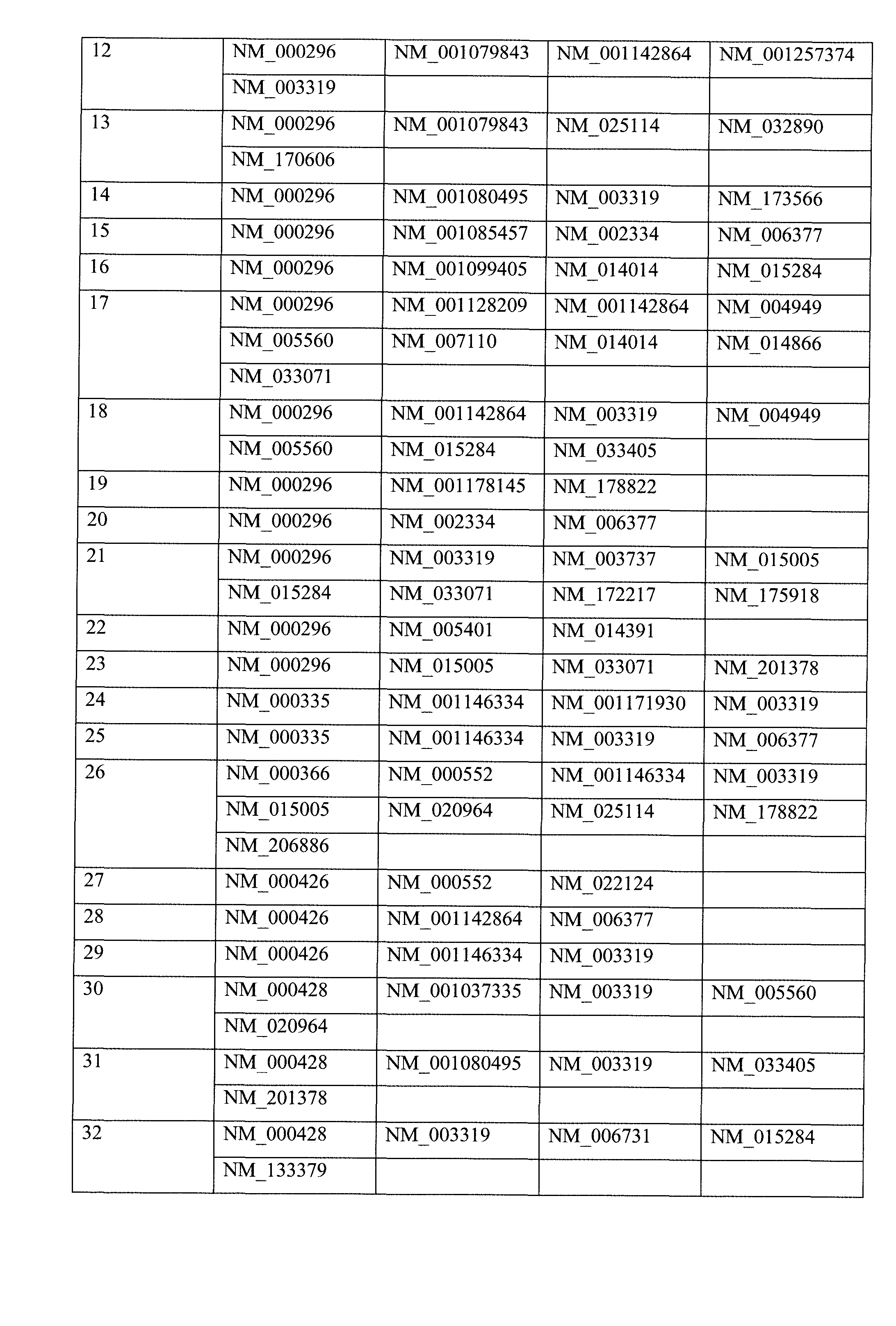


Furthermore, the inventors of the present invention found polymorphisms yet unknown. Hence, in one embodiment the present invention relates to a probe specifically detecting a SNP selected from the group consisting of the SNPs as shown in Table 2. The design of such probes is known to the skilled person and includes probes for dynamic allele-specific hybridization (DASH) (Howell WM, Jobs M, Gyllensten U, Brookes AJ (January 1999). "Dynamic allele-specific hybridization. A new method for scoring single nucleotide polymorphisms". Nat. Biotechnol. 17 (1): 87-8), molecular beacons (Tyagi S, Kramer FR (1996). "Molecular beacons: probes that fluoresce upon hybridization". Nat Biotechnol. 14 (3): 303-8. doi:10.1038/nbt0396-303; Tapp I, Malmberg L, Rennel E, Wik M, Syvanen AC (2000 Apr). "Homogeneous scoring of single-nucleotide polymorphisms: comparison of the 5'-nuclease TaqMan assay and Molecular Beacon probes". Biotechniques 28 (4): 732-8; Akimitsu Okamoto (2011). "ECHO probes: a concept of fluorescence control for practical nucleic acid sensing". Chem. Soc. Rev. 40: 5815-5828) and probes for SNP microarrays (Harbron S, Rapley R (2004). Molecular analysis and genome discovery. London: John Wiley & Sons Ltd. ISBN 0-471-49919-6). Furthermore, the invention relates to an in vitro method for detecting a SNP selected from the group consisting of the SNPs as shown in Table 2. In a further embodiment the present invention relates to an array or kit comprising one or more probes according to the present invention, preferably probes for detecting a one or more SNP within each gene of the first panel of genes, preferably the first panel comprising the genes of PIEZOl , PLEC, HELZ2, NACAD, PKDl , IGSF10, TNRC18, UNC13B, VWF, and XIRP2, preferably comprising PIEZOl , PLEC, HELZ2, NACAD, PKDl , IGSF10, TNRC18, UNC13B, VWF, XIRP2, LAMA5, CDH23, KIAA0284, PRR14L, CP AMD 8, CASZ1, SZT2, LTBP2, EPG5, MLL3, DCHS1, TEP1 , LRP4, CRIPAK, CEP290, IL16, CBWD6, SEC 16 A, SCARF1 , SNRNP200, CCDC18, DISP1, and PTPN14. In yet a further embodiment the array or kit comprises a plurality of probes for detecting one or more SNP within each of the transcripts of the group consisting of SEQ ID NO: l , SEQ ID NO:3, SEQ ID NO:4, SEQ ID NO:5, SEQ ID NO:9, SEQ ID NO: 10, SEQ ID NO: 13, SEQ ID NO: 15, SEQ ID NO:17, SEQ ID NO:18, NM 001080495 (SEQ ID N021 ), SEQ ED NO:23, SEQ ID NO:25, SEQ ID NO:27, SEQ ID NO:28, SEQ ID NO:31, SEQ ID NO:33, SEQ ID NO:34, SEQ ID NO:35, SEQ ID NO:36, SEQ ID NO:41 , SEQ ID NO:43, SEQ ID NO:45, SEQ ID NO:47, SEQ ID NO:49, SEQ ID NO:51 , SEQ ID NO:53, SEQ ID NO:55, SEQ ID NO:57, SEQ ID NO:59, SEQ ID NO:61 , NM 175918 (SEQ ID NO: 63), NM 025114 (SEQ ID NO: 65), NM 004513 (SEQ ID NO: 67), SEQ ID NO:68, SEQ ID NO:71, NM 014866 (SEQ ID NO: 73),
NM_003693 (SEQ ID NO: 75), SEQ ID NO:76, SEQ ID NO:79, NM_206886 (SEQ ID NO: 81), SEQ ID NO:83, and NM 005401 (SEQ ID NO: 85). In yet a further embodiment the array or kit comprises a plurality of probes for detecting one or more SNP within each of the transcripts of the group consisting of SEQ ID NO:l, SEQ ID NO:3, SEQ ID NO:4, SEQ ID NO:5, SEQ ID NO:9, SEQ ID NO: 10, SEQ ID NO: 13, SEQ ID NO: 15, SEQ ID NO: 17, SEQ ID NO: 18, NM_001080495 (SEQ ID N021), SEQ ID NO:23, SEQ ID NO:25, SEQ ID NO:27, and SEQ ID NO:28. In a further embodiment the kit or array comprises probes for detecting all of the SNPs as outlined in Table 2.
The kit or array of the present invention, in addition to the probes for detecting the SNPs within the genes of the first panel of genes, in one embodiment comprises one or more probe for detecting one or more SNPs within one or more of the genes as listed in Table 6, preferably within the CDS of the listed genes, more preferably the kit or array comprises one or more probes for detecting one or more SNPs at the positions as identified in Table 7. In one embodiment the kit or array comprises a combination of probes for detecting a combination of SNPs as listed in Table 10. In yet a further embodiment the kit or array comprises probes for detecting a combination of SNPs as listed in Table 13. The kit may further comprise amplification primers for amplifying one or more genes or regions as outlined for the genes of the first panel of genes, optionally in combination with amplification primers for amplifying one more genes of the second panel of genes or fragments thereof.
Furthermore, the present invention relates to the use of the probe, kit or array according to the present invention in a method for diagnosing DCM or assessing the risk of acquiring DCM or the risk of heart failure, preferably in a method according to the present invention.
The invention is further illustrated by the following Figures and Examples.
EXAMPLES
Introduction
Dilated Cardiomyopathy (DCM) is a severe disease of the cardiac muscle with an estimated prevalence of about 1 :500 and a leading cause for congestive heart failure, a disorder with a five-year survival rate of less than 50%. Patients suffer from a weakened and enlarged heart that is unable to pump blood efficiently. The genetic etiology of dilated cardiomyopathy (DCM) has been investigated for more than 20 years and to date more than 30 disease genes have been identified (Hershberger, R. E., Hedges, D. J. & Morales, A. Dilated cardiomyopathy: the complexity of a diverse genetic architecture. Nat. Rev. Cardiol. (2013). doi: 10.1038/nrcardio.2013.105). Previous family studies revealed highly penetrant DCM- associated genetic variation that affects a rather small number of DCM patients. The overall contribution of genetics to acquired and non-acquired DCM is still unclear. Despite the genetic heterogeneity of non-acquired cardiomyopathies (Parvari, R. & Levitas, A. The mutations associated with dilated cardiomyopathy. Biochem. Res. Int. 2012, 639250 (2012); Raju, H., Alberg, C, Sagoo, G. S., Burton, H. & Behr, E. R. Inherited cardiomyopathies. N. Engl. J. Med. 343, 1643-1656 (2011)), uncommon mutations underlying disease tend to affect the sequence of proteins involved in very specific molecular pathways ( amisago, M. et al. Mutations in sarcomere protein genes as a cause of dilated cardiomyopathy; N. Engl. J. Med, 343, 1688-96 (2000); Haghighi, K. et al. A mutation in the human phospholamban gene, deleting arginine 14, results in lethal, hereditary cardiomyopathy. Proc. Natl. Acad. Sci. U. S. A. 103, 1388-93 (2006); Arndt, A. et al. Fine Mapping of the lp36 Deletion Syndrome Identifies Mutation of PRDM16 as a Cause of Cardiomyopathy. Am. J. Hum. Genet. (2013). doi: 10.1016/j.ajhg.2013.05.015; Guo, W. et al. RBM20, a gene for hereditary cardiomyopathy, regulates titin splicing. Nat. Med. 18, 766-73 (2012)). Detection of rare variation associated with disease can diagnose and classify DCM by identifying the underlying molecular cause. However, screening for mutations in known disease genes in DCM cohorts still lacks sensitivity and specificity. Known mutation usually affect a small number of patients and are often unlikely the single genetic cause of the disease. Mutations considered pathogenic were found to be more abundant in the general population than the estimated prevalence of DCM can explain (Abecasis, G. R. et al. An integrated map of genetic variation from 1,092 human genomes. Nature 491 , 56-65 (2012). Tennessen, J. A. et al. Evolution and functional impact of rare coding variation from deep sequencing of human
exomes. Science 337, 64-9 (2012). Bick, A. G. et al. Burden of rare sarcomere gene variants in the Framingham and Jackson Heart Study cohorts. Am. J. Hum. Genet. 91, 513-9 (2012). Pan, S. et al. Cardiac structural and sarcomere genes associated with cardiomyopathy exhibit marked intolerance of genetic variation. Circ. Cardiovasc. Genet. 5, 602-10 (2012). Golbus, J. R. et al. Population-based variation in cardiomyopathy genes. Circ. Cardiovasc. Genet. 5, 391-9 (2012).Andreasen, C. et al. New population-based exome data are questioning the pathogenicity of previously cardiomyopathy-associated genetic variants. Eur. J. Hum. Genet. (2013). doi:10.1038/ejhg.2012.283)
Approach
High-throughput transcriptome profiling (RNA-seq) of human cardiac tissue of unrelated DCM patients (n=127) were performed to obtain all transcribed sequences in the heart with a single nucleotide resolution. All DCM patients suffered from severe dilated cardiomyopathy that was treated with heart transplantation. As a control, the cardiac transcriptome of 110 healthy subjects with a normal cardiac phenotype whose donor heart was scheduled for but did not undergo transplantation was sequenced.
Nonsense/missense Single Nucleotide Polymorphisms (SNPs) transcribed in cardiac isoforms were selected while artifacts common to next-generation sequencing approaches were eliminated using the samtools/bcftools software suite (Li H., Handsaker B., Wysoker A., Fennell T., Ruan J., Homer N., Marth G., Abecasis G., Durbin R. and 1000 Genome Project Data Processing Subgroup (2009) The Sequence alignment/map (SAM) format and SAMtools; Bioinformatics, 25, 2078-9. [PMJX>: 19505943]) and ensuring sufficient data at any given nucleotide position. The accuracy was assessed for each gene individually by comparison to a whole genome sequencing dataset generated for a subset of 57 DCM cases. Genes with a FDR > 5% were removed from the analysis. To enrich for possibly pathogenic genetic variation, we filtered detected mutations for rarity (MAF < 0.04%) and coding potential (missense or stop gains). Finally, the burden for each gene was calculated and compared to a large, publicly available dataset (ESP) (Tennessen, J. a et al. Evolution and functional impact of rare coding variation from deep sequencing of human exomes. Science 337, 64-9 (2012)) and the control RNA-seq cohort. The ESP dataset contains information about more than 6500 individuals and was used to assess the average burden of rare variation in the general population. Comparison to the control RNA-seq dataset confirmed that the
detected rare variation in the genes of Panel 1 was a specific characteristic of the disease status for the human cohort (Quinlan AR, Hall IM. BEDTools: a flexible suite of utilities for comparing genomic features. Bioinformatics. 2010 Mar 15; 26 (6):841-2.
Outcome
We detected numerous rare, protein-altering SNPs (risk SNPs) in 37 genes that were previously associated with DCM (Hershberger, R. E., Hedges, D. J. & Morales, A. Dilated cardiomyopathy: the complexity of a diverse genetic architecture. Nat. Rev. Cardiol. (2013). doi: 10.1038/nrcardio.2013.105). As expected, DCM patients were more likely to carry risk SNPs in this known set of genes (Figure 1). Mutations in Titin were found to be very prevalent in the context of disease, which confirmed the central role of this known disease gene (Herman, D. S. et al. Truncations of titin causing dilated cardiomyopathy. N. Engl. J. Med. 366, 619-28 (2012).
Most of the disease burden can be explained by the accumulation of rare variation in Titin, but overall not many people are affected through pathogenic effects in this set of genes. The contribution of at least one mutation in the known disease genes is contributing to disease in about 22% of all patients, indicated by a Population Attributable Risk (PAR) of -22%. Unexpectedly, a large number of previously unassociated genes (first panel of genes according to the invention (Table 1)) were discovered to have a higher burden than known disease genes.
It was evaluate whether the new genes identified in our approach provide for improved diagnostic value. Enrichment versus both the ESP dataset and the RNA-seq control (top right corner; figure 2) revealed genes with an elevated burden in the context of disease that cannot be explained through variation in the general population or by technical artifacts. To maximize the utility, genes contributing most to the disease in terms of PAR and with a significant disease burden compared to general population (ESP) were combined into one panel.
Table 14: Novel DCM Genes with more than 4.4 rare, protein-altering SNPs / 100 DCM patients vs. control populations

No gene listed in table 14 has been associated with DCM previously. Considering these 33 novel DCM, a total of 371 mutations with pathogenic potential were detected in the DCM cohort, significantly more than expected. Most variants are novel (75%) and/or private to one individual (85%). Nevertheless, all were protein altering showing the effect of protein alterations on DCM.
Table 15 gives the statistical evaluation for Titin and the genes of the first panel of genes according to the present invention.
Table 15: Statistical evaluation:„EnsID" gives the identifier oft he gene according to the Ensembl database (http://www.ensembl.org/). "Name" gives the name of the gen of the first panel according to the present invention. "Mut in DCM" denotes the number of rare, protein altering mutations detected in disease. "DCM Individuals" refers to the total number of diseased individuals investigated. "Mut in ESP" denotes the number of rare, protein altering mutations detected in a healthy population control. "ESP Individuals" indicates the average number of people in the control population with genotype information for each base in the investigated gene. Fisher's exact test vs ESP p-value indicates the probability of observing the here described burden of rare variation in the disease cohort by chance (Kiezun, A. et al. Exome sequencing and the genetic basis of complex traits. Nat. Genet. 44, 623-30; 2012).


A significant percentage of DCM patients are affected by risk SNPs in the novel DCM gene set (Figure 3). No healthy individual was found to carry more than 3 risk SNPs, but more than 25% of DCM patients carry at least 4 risk DCM SNPs.
Discussion
Unexpectedly, known disease genes do not explain the majority of rare, disease associated genetic variation in this cohort of individuals suffering from severe DCM. Several novel disease genes with a significant mutation skew in the context of disease were identified. A combinatory approach based on the accumulated genetic risk present in this novel DCM gene panel can be both more specific and more sensitive in evaluating the genetic predisposition to DCM when compared to previous approaches.
Considering novel and previously known pathogenic SNPs, the number of disease-associated variants present in the cohort vastly outgrows the number of individuals affected. For the first time, this data shows that DCM is a multi-gene disorder. For many DCM cases, several genetic risk factors are causing the final phenotype. Assessment of this genetic contribution is crucial to diagnose but also characterize this heterogeneous disorder. A calculated Population Attributable Risk of 72% shows that the genetic factors described here must be taken into consideration for the majority of all patients. Compared to the previous knowledge based on all disease-associated genes combined, this analysis provides molecular characteristics for > 3 times as many DCM cases.
Previously, single mutations were investigated to evaluate the contribution of genetics to the pathogenesis in a patient. The standard diagnostic approach does not identify many genetic causes of the disease, because few known pathogenic variants affected a significant number of patients.
The complexity of the disease demands a novel approach to diagnose and classify the genetic contribution to DCM, which is addressed by the present invention. The results show that an analysis of the newly identified genes is crucial to assess the risk of developing DCM in the future. Mostly private and novel variants in the genes disclosed here are contributors to the disease. Therefore, further variations in this gene are likely to be present throughout DCM patients. Also these may be rare polymorphisms but are also affecting DCM, particularly if the polymorphism is rare and causes protein alteration.
Claims
1. A method for diagnosing dilated cardiomyopathy (DCM) in a subject or for assessing the risk of a subject to acquire DCM or the risk of heart failure comprising:
(i) determining in a sample of a subject to be diagnosed the sequence of one or more polymorphisms in a panel of genes, wherein the panel of genes comprises the genes of the group consisting of PIEZOl, PLEC, HELZ2, NACAD, PKD1 , IGSF10, TNRC18, UNC13B, VWF, and XIRP2;
(ii) comparing the determined sequence to the sequence of said polymorphism in a control derived from a control subject (control sequence), the control subject not suffering from dilated cardiomyopathy; and
(iii) attributing the presence of dilated cardiomyopathy or the risk of acquiring DCM or the risk of heart failure to said subject to be diagnosed if one or more determined sequences differ from the respective sequence in said control sequence.
2. The method of claim 1, wherein the said panel of genes comprises the genes of the group consisting of PIEZOl , PLEC, HELZ2, NACAD, PKD1 , IGSF10, TNRC18, UNC13B, VWF, XIRP2, LAMA5, CDH23, KIAA0284, PRR14L, CPAMD8, CASZ1 , SZT2, LTBP2, EPG5, MLL3, DCHS1 , TEP1 , LRP4, CRIPAK, CEP290, IL16, CBWD6, SEC 16 A, SCARF 1, SNRNP200, CCDC18, DISP1, and PTPN14.
3. The method according to claim 1 or 2, wherein the sequence of one or more polymorphisms in each of the genes of said panel of genes is determined, and wherein the presence of dilated cardiomyopathy or the risk of acquiring DCM or the risk of heart failure is attributed to said subject to be diagnosed if one or more determined sequences differ from the respective sequence in said control sequence.
4. The method according to any one of claims 1 to 3, wherein the presence of dilated cardiomyopathy or the risk of acquiring DCM is attributed to said subject if said determined sequences of three polymorphisms differ from the respective control sequence.
5. The method according to any one of claims 1 to 4, wherein said polymorphisms are protein-altering polymorphisms.
6. The method according to any one of claims 1 to 5, wherein the polymorphisms are located within a transcript selected from the group consisting of SEQ ID NO:l , SEQ ID NO:3, SEQ ID NO:4, SEQ ID NO:5, SEQ ID NO:9, SEQ ID NO: 10, SEQ ID NO: 13, SEQ ID NO: 15, SEQ ID NO: 17, SEQ ID NO: 18, NM 001080495 (SEQ ID N021 ), SEQ ID NO:23, SEQ ID NO:25, SEQ ID NO:27, SEQ ID NO:28, SEQ ID NO:31 , SEQ ID NO:33, SEQ ID NO:34, SEQ ID NO:35, SEQ ID NO:36, SEQ ID NO:41 , SEQ ID NO:43, SEQ ID NO:45, SEQ ID NO:47, SEQ ID NO:49, SEQ ID NO:51, SEQ ID NO:53, SEQ ID NO:55, SEQ ID NO:57, SEQ ID NO:59, SEQ ID NO:61 , NM 175918 (SEQ ID NO: 63), NM 02 114 (SEQ ID NO: 65), NM 004513 (SEQ ID NO: 67), SEQ ID NO:68, SEQ ID NO:71 , NM 014866 (SEQ ID NO: 73), NM 003693 (SEQ ID NO: 75), SEQ ID NO:76, SEQ ID NO:79, NM_206886 (SEQ ID NO: 81), SEQ ID NO:83, and NM 005401 (SEQ ID NO: 85).
7. The method according to any one of claims 1 to 6, wherein said polymorphisms are single nucleotide polymorphisms (SNP), preferably SNPs at a position selected from the group consisting of positions as listed in Table 2.
8. The method according to claim 7, wherein the control sequences of the respective SNP are as set out in Table 2.
9. The method according to claim 7 or 8, wherein presence of DCM or the risk of acquiring DCM or the risk of heart failure is attributed to said subject to be diagnosed if the determined sequence of the SNP has the sequence as set out as "Alt" or "CDS Alt" in Table 2.
10. The method according to any one of claims 1 to 9, wherein in addition the sequence of one or more polymorphisms in a further panel of genes is determined, and compared to a respective control sequence of the polymorphism derived from a control subject, Wherein the second panel of genes comprises the genes as listed in table 6, and
Wherein the presence of DCM or the risk of acquiring DCM is attributed to said subject if said determined sequences of polymorphisms in two or more genes of the two panels of genes differ from the respective control sequence.
11. The method according to claim 10, wherein the polymorphisms in said second panel of genes is a single nucleotide polymorphism, preferably selected from the group consisting of the SNPs as listed in Table 7.
12. The method according to 11, wherein the control sequence of the respective SNP of said second panel of genes is as set out in table 7.
13. The method according to claim 11 or 12, wherein the wherein presence of DCM or the risk of acquiring DCM or the risk of heart failure is attributed to said subject to be diagnosed if the determined sequence of the SNP has the sequence as set out for the respective position as "Alt" or "CDS Alt" in Table 7.
14. The method according to any one of claims 1 to 13, wherein the sequence of the polymorphism(s) is determined on RNA or DNA, preferably on mRNA derived from a sample of said patient or cDNA reverse transcribed from said mRNA.
15. An oligonucleotide probe specifically detecting a SNP selected from the group consisting of the SNPs as shown in Table 2.
16. A kit or array for diagnosing dilated cardiomyopathy (DCM) in a subject or for assessing the risk of a subject to acquire DCM comprising means for determining the sequence of one or more polymorphisms in a panel of genes comprising probes for detecting a one or more SNP within each gene of the first panel of genes, the first panel comprising the genes of PIEZOl , PLEC, HELZ2, NACAD, PKD1 , IGSF10, TNRC18, UNC13B, VWF, and XIRP2 PIEZOl, PLEC, HELZ2, NACAD, PKD1 , IGSF10, TNRC18, UNC13B, VWF, and XIRP2; preferably the first panel comprising PIEZOl, PLEC, HELZ2, NACAD, PKD1, IGSF10, TNRC18, UNC13B, VWF, XIRP2, LAMA5, CDH23, KIAA0284, PRR14L, CPAMD8, CASZ1 , SZT2, LTBP2, EPG5, MLL3, DCHS1, TEP1, LRP4, CRIPAK, CEP290, IL16, CBWD6, SEC 16 A,
SCARF1 , SNRNP200, CCDC18, DISP1, and PTPN14.
17. The kit or array according to claim 16, wherein the kit or array further comprises one or more probe for detecting one or more SNP in a second panel of genes, wherein the second panel of genes comprises one or more of the genes as listed in Table 6.
Applications Claiming Priority (2)
| Application Number | Priority Date | Filing Date | Title |
|---|---|---|---|
| EP14176611.3 | 2014-07-10 | ||
| EP14176611 | 2014-07-10 |
Publications (2)
| Publication Number | Publication Date |
|---|---|
| WO2016005589A2 true WO2016005589A2 (en) | 2016-01-14 |
| WO2016005589A3 WO2016005589A3 (en) | 2016-03-10 |
Family
ID=51162586
Family Applications (1)
| Application Number | Title | Priority Date | Filing Date |
|---|---|---|---|
| PCT/EP2015/065890 Ceased WO2016005589A2 (en) | 2014-07-10 | 2015-07-10 | Novel gene panel for the diagnosis of dilated cardiomyopathy |
Country Status (1)
| Country | Link |
|---|---|
| WO (1) | WO2016005589A2 (en) |
Cited By (2)
| Publication number | Priority date | Publication date | Assignee | Title |
|---|---|---|---|---|
| CN106435002A (en) * | 2016-12-12 | 2017-02-22 | 北京泱深生物信息技术有限公司 | OSCC (oral squamous cell carcinoma) biomarker and application thereof |
| CN107287317A (en) * | 2017-07-10 | 2017-10-24 | 中国人民解放军第四军医大学 | MYH7 A934V mutators are used for the application for preparing Diagnosis of Hypertrophic Cardiomyopathy kit |
Family Cites Families (1)
| Publication number | Priority date | Publication date | Assignee | Title |
|---|---|---|---|---|
| WO2012107580A1 (en) * | 2011-02-10 | 2012-08-16 | INSERM (Institut National de la Santé et de la Recherche Médicale) | In vitro diagnosis method for predicting a predisposition to cardiomyopathy |
-
2015
- 2015-07-10 WO PCT/EP2015/065890 patent/WO2016005589A2/en not_active Ceased
Cited By (3)
| Publication number | Priority date | Publication date | Assignee | Title |
|---|---|---|---|---|
| CN106435002A (en) * | 2016-12-12 | 2017-02-22 | 北京泱深生物信息技术有限公司 | OSCC (oral squamous cell carcinoma) biomarker and application thereof |
| CN106435002B (en) * | 2016-12-12 | 2019-07-12 | 北京泱深生物信息技术有限公司 | Oral squamous cell carcinoma biomarker and its application |
| CN107287317A (en) * | 2017-07-10 | 2017-10-24 | 中国人民解放军第四军医大学 | MYH7 A934V mutators are used for the application for preparing Diagnosis of Hypertrophic Cardiomyopathy kit |
Also Published As
| Publication number | Publication date |
|---|---|
| WO2016005589A3 (en) | 2016-03-10 |
Similar Documents
| Publication | Publication Date | Title |
|---|---|---|
| Granados‐Riveron et al. | Combined mutation screening of NKX2‐5, GATA4, and TBX5 in congenital heart disease: Multiple heterozygosity and novel mutations | |
| Zhao et al. | Autosomal-dominant retinitis pigmentosa caused by a mutation in SNRNP200, a gene required for unwinding of U4/U6 snRNAs | |
| Obeidat et al. | GSTCD and INTS12 regulation and expression in the human lung | |
| Esposito et al. | Digenic mutational inheritance of the integrin alpha 7 and the myosin heavy chain 7B genes causes congenital myopathy with left ventricular non-compact cardiomyopathy | |
| Mehrotra | Genomic expression in non syndromic cleft lip and palate patients: A review | |
| Raine et al. | Gene expression analysis reveals HBP1 as a key target for the osteoarthritis susceptibility locus that maps to chromosome 7q22 | |
| US9040238B2 (en) | Polynucleotides for use in medicine | |
| US12331358B2 (en) | Gene and mutations thereof associated with seizure and movement disorders | |
| Núñez et al. | Somatic MYH7, MYBPC3, TPM1, TNNT2 and TNNI3 mutations in sporadic hypertrophic cardiomyopathy | |
| Niskanen et al. | Identification of novel genetic risk factors of dilated cardiomyopathy: from canine to human | |
| Wang et al. | Whole exome sequencing in unexplained recurrent miscarriage families identified novel pathogenic genetic causes of euploid miscarriage | |
| Just et al. | Tbx20 is an essential regulator of embryonic heart growth in zebrafish | |
| Tauber et al. | Different MAPT haplotypes influence expression of total MAPT in postmortem brain tissue | |
| Huang et al. | Postmortem genetic screening of SNPs in RyR2 gene in sudden unexplained nocturnal death syndrome in the southern Chinese Han population | |
| Hong et al. | Pathogenic genes and clinical prognosis in hypertrophic cardiomyopathy | |
| WO2016005589A2 (en) | Novel gene panel for the diagnosis of dilated cardiomyopathy | |
| Aerts et al. | Genetic and structural variation in the SH2B1 gene in the Belgian population | |
| Alonso-Montes et al. | New polymorphisms in human MEF2C gene as potential modifier of hypertrophic cardiomyopathy | |
| US20230054595A1 (en) | Novel druggable targets for the treatment of inflammatory diseases such as systemic lupus erythematosus (sle) and methods for diagnosis and treatment using the same | |
| AU2011227108A1 (en) | Determining susceptibility to a sudden cardiac event | |
| Han et al. | Genome-wide analysis identifies susceptibility loci for heart failure and nonischemic cardiomyopathy subtype in the East Asian populations | |
| Li et al. | Genome-wide analysis identifies novel susceptibility loci for heart failure and nonischemic cardiomyopathy subtype | |
| Thanumalayan et al. | A rare mutation in lamin A gene is associated with dilated cardiomyopathy in Indian patients | |
| Coto et al. | Mutation analysis of the myocyte enhancer factor 2A gene (MEF2A) in patients with left ventricular hypertrophy/hypertrophic cardiomyopathy | |
| Young et al. | UK, B15 2TT Users may view, print, copy, and download text and data-mine the content in such documents, for the purposes of academic research, subject always to the full Conditions of use: http://www. nature. com/authors/editorial_policies/license. html# terms Correspondence to: Robin JM Franklin; Daniel J Gaffney. Corresponding authors: Daniel J Gaffney: dg13@ sanger. ac. uk, Robin JM Franklin: rjf1000@ cam. ac. uk. |
Legal Events
| Date | Code | Title | Description |
|---|---|---|---|
| 121 | Ep: the epo has been informed by wipo that ep was designated in this application |
Ref document number: 15736281 Country of ref document: EP Kind code of ref document: A2 |
|
| NENP | Non-entry into the national phase in: |
Ref country code: DE |
|
| 122 | Ep: pct application non-entry in european phase |
Ref document number: 15736281 Country of ref document: EP Kind code of ref document: A2 |