WO2016004297A1 - Novel inhibitors of trypanosoma brucei methionyl t-rna synthetase (tb metrs) for the treatment of african trypanosomiasis - Google Patents
Novel inhibitors of trypanosoma brucei methionyl t-rna synthetase (tb metrs) for the treatment of african trypanosomiasis Download PDFInfo
- Publication number
- WO2016004297A1 WO2016004297A1 PCT/US2015/038974 US2015038974W WO2016004297A1 WO 2016004297 A1 WO2016004297 A1 WO 2016004297A1 US 2015038974 W US2015038974 W US 2015038974W WO 2016004297 A1 WO2016004297 A1 WO 2016004297A1
- Authority
- WO
- WIPO (PCT)
- Prior art keywords
- substituted
- alkyl
- groups
- heteroaryl
- compound
- Prior art date
- Legal status (The legal status is an assumption and is not a legal conclusion. Google has not performed a legal analysis and makes no representation as to the accuracy of the status listed.)
- Ceased
Links
- 0 C*Cc1ccc2OCOc2c1 Chemical compound C*Cc1ccc2OCOc2c1 0.000 description 18
- MEPPAQWVYFJYGH-XBXARRHUSA-N C/C=C/C(N(CCC(OC)OC)CCc(c1c2)c[nH]c1ccc2OCc1ccccc1)=O Chemical compound C/C=C/C(N(CCC(OC)OC)CCc(c1c2)c[nH]c1ccc2OCc1ccccc1)=O MEPPAQWVYFJYGH-XBXARRHUSA-N 0.000 description 1
- FMWHHIPANMSTGQ-UHFFFAOYSA-N CC(C(C(CCN1CCc(c2c3)c[nH]c2ccc3O)N(C)Cc2cc(Cl)cc(Cl)c2)C1=O)O Chemical compound CC(C(C(CCN1CCc(c2c3)c[nH]c2ccc3O)N(C)Cc2cc(Cl)cc(Cl)c2)C1=O)O FMWHHIPANMSTGQ-UHFFFAOYSA-N 0.000 description 1
- RPVRRPLYDRYUCT-UHFFFAOYSA-N CC(C(C(CCN1CCc(c2c3)c[nH]c2ccc3OCc2ccccc2)N(C)Cc2cc(Cl)cc(Cl)c2)C1=O)O Chemical compound CC(C(C(CCN1CCc(c2c3)c[nH]c2ccc3OCc2ccccc2)N(C)Cc2cc(Cl)cc(Cl)c2)C1=O)O RPVRRPLYDRYUCT-UHFFFAOYSA-N 0.000 description 1
- IAMDUECLMIVWMG-UHFFFAOYSA-N CC(C(C(CCN1CCc(c2c3)c[nH]c2ccc3OCc2ccccc2)NC)C1=O)O Chemical compound CC(C(C(CCN1CCc(c2c3)c[nH]c2ccc3OCc2ccccc2)NC)C1=O)O IAMDUECLMIVWMG-UHFFFAOYSA-N 0.000 description 1
- JIWOGDAEBHVGLL-UHFFFAOYSA-N CC(C(C(CCN1CCc(c2c3)c[nH]c2ccc3OCc2ccccc2)NC)C1=O)OC Chemical compound CC(C(C(CCN1CCc(c2c3)c[nH]c2ccc3OCc2ccccc2)NC)C1=O)OC JIWOGDAEBHVGLL-UHFFFAOYSA-N 0.000 description 1
- IAMDUECLMIVWMG-UHFFFAOYSA-O CC(C(C(CCN1CCc(c2c3)c[nH]c2ccc3OCc2ccccc2)[NH2+]C)C1=O)O Chemical compound CC(C(C(CCN1CCc(c2c3)c[nH]c2ccc3OCc2ccccc2)[NH2+]C)C1=O)O IAMDUECLMIVWMG-UHFFFAOYSA-O 0.000 description 1
- DBULJUZMROAUFG-BROWOHMESA-N CC(C([C@H](CCN1CCc(c2c3)c[nH]c2ccc3O)NC)C1=O)O Chemical compound CC(C([C@H](CCN1CCc(c2c3)c[nH]c2ccc3O)NC)C1=O)O DBULJUZMROAUFG-BROWOHMESA-N 0.000 description 1
- SJCMKDHESQRCEF-UHFFFAOYSA-N CC(C)c1n[nH]c2cc(C[I](C)C)ccc12 Chemical compound CC(C)c1n[nH]c2cc(C[I](C)C)ccc12 SJCMKDHESQRCEF-UHFFFAOYSA-N 0.000 description 1
- MYEIDJPOUKASEC-UHFFFAOYSA-N CCCc(cc1)cc2c1OCO2 Chemical compound CCCc(cc1)cc2c1OCO2 MYEIDJPOUKASEC-UHFFFAOYSA-N 0.000 description 1
- MJIUXUREYKEGDS-UHFFFAOYSA-N CN(Cc1cc(Cl)cc(OC)c1)C(CCN1CCc2c[nH]c3c2cccc3)CC1=O Chemical compound CN(Cc1cc(Cl)cc(OC)c1)C(CCN1CCc2c[nH]c3c2cccc3)CC1=O MJIUXUREYKEGDS-UHFFFAOYSA-N 0.000 description 1
- JTSWCBWJKXIVQD-UHFFFAOYSA-N CN(Cc1cccc(Cl)c1)C(CCN1CCc2c[nH]c3c2cccc3)CC1=O Chemical compound CN(Cc1cccc(Cl)c1)C(CCN1CCc2c[nH]c3c2cccc3)CC1=O JTSWCBWJKXIVQD-UHFFFAOYSA-N 0.000 description 1
- TWQOYNSMSUERQR-UHFFFAOYSA-N CN(Cc1ccccc1)C(CCN1CCc2c[nH]c3c2cccc3)CC1=O Chemical compound CN(Cc1ccccc1)C(CCN1CCc2c[nH]c3c2cccc3)CC1=O TWQOYNSMSUERQR-UHFFFAOYSA-N 0.000 description 1
- SLKJVNIQXNMRMP-UHFFFAOYSA-N COC(CCNC(C(c(c1c2)c[nH]c1ccc2OCc1ccccc1)=O)=O)OC Chemical compound COC(CCNC(C(c(c1c2)c[nH]c1ccc2OCc1ccccc1)=O)=O)OC SLKJVNIQXNMRMP-UHFFFAOYSA-N 0.000 description 1
- RLDQQJVFURIVMA-UHFFFAOYSA-N COC(CCNCCc(c1c2)c[nH]c1ccc2OCc1ccccc1)OC Chemical compound COC(CCNCCc(c1c2)c[nH]c1ccc2OCc1ccccc1)OC RLDQQJVFURIVMA-UHFFFAOYSA-N 0.000 description 1
- MNQCSIWCBBDTCX-DJNXLDHESA-N CSCC[C@@H](CO)NC(CCN1CCc2c[nH]c3c2cccc3)CC1=O Chemical compound CSCC[C@@H](CO)NC(CCN1CCc2c[nH]c3c2cccc3)CC1=O MNQCSIWCBBDTCX-DJNXLDHESA-N 0.000 description 1
- RPVRRPLYDRYUCT-CGXMCTKQSA-N C[C@H](C(C(CCN1CCc(c2c3)c[nH]c2ccc3OCc2ccccc2)N(C)Cc2cc(Cl)cc(Cl)c2)C1=O)O Chemical compound C[C@H](C(C(CCN1CCc(c2c3)c[nH]c2ccc3OCc2ccccc2)N(C)Cc2cc(Cl)cc(Cl)c2)C1=O)O RPVRRPLYDRYUCT-CGXMCTKQSA-N 0.000 description 1
- UYNMGJWQQBGYNZ-KOEKDOOYSA-N C[C@H](C([C@H](CCN1CCc2c[nH]c3c2cccc3)NC)C1=O)O Chemical compound C[C@H](C([C@H](CCN1CCc2c[nH]c3c2cccc3)NC)C1=O)O UYNMGJWQQBGYNZ-KOEKDOOYSA-N 0.000 description 1
- PVCWBPFVCKOUQA-UHFFFAOYSA-N Cc1cc(C=O)cc(Cl)c1 Chemical compound Cc1cc(C=O)cc(Cl)c1 PVCWBPFVCKOUQA-UHFFFAOYSA-N 0.000 description 1
- XLZYMUNRALGNSP-UHFFFAOYSA-N O=C(C(Cl)=O)c(c1c2)c[nH]c1ccc2OCc1ccccc1 Chemical compound O=C(C(Cl)=O)c(c1c2)c[nH]c1ccc2OCc1ccccc1 XLZYMUNRALGNSP-UHFFFAOYSA-N 0.000 description 1
- CASRSOJWLARCRX-UHFFFAOYSA-N O=Cc1cc(Cl)cc(Cl)c1 Chemical compound O=Cc1cc(Cl)cc(Cl)c1 CASRSOJWLARCRX-UHFFFAOYSA-N 0.000 description 1
- SMWDFEZZVXVKRB-UHFFFAOYSA-N c1cc2cccnc2cc1 Chemical compound c1cc2cccnc2cc1 SMWDFEZZVXVKRB-UHFFFAOYSA-N 0.000 description 1
- UTCSSFWDNNEEBH-UHFFFAOYSA-N c1cnc2[n]1cccc2 Chemical compound c1cnc2[n]1cccc2 UTCSSFWDNNEEBH-UHFFFAOYSA-N 0.000 description 1
Classifications
-
- A—HUMAN NECESSITIES
- A61—MEDICAL OR VETERINARY SCIENCE; HYGIENE
- A61K—PREPARATIONS FOR MEDICAL, DENTAL OR TOILETRY PURPOSES
- A61K31/00—Medicinal preparations containing organic active ingredients
- A61K31/33—Heterocyclic compounds
- A61K31/395—Heterocyclic compounds having nitrogen as a ring hetero atom, e.g. guanethidine or rifamycins
- A61K31/435—Heterocyclic compounds having nitrogen as a ring hetero atom, e.g. guanethidine or rifamycins having six-membered rings with one nitrogen as the only ring hetero atom
- A61K31/44—Non condensed pyridines; Hydrogenated derivatives thereof
- A61K31/445—Non condensed piperidines, e.g. piperocaine
- A61K31/4468—Non condensed piperidines, e.g. piperocaine having a nitrogen directly attached in position 4, e.g. clebopride, fentanyl
-
- A—HUMAN NECESSITIES
- A61—MEDICAL OR VETERINARY SCIENCE; HYGIENE
- A61K—PREPARATIONS FOR MEDICAL, DENTAL OR TOILETRY PURPOSES
- A61K31/00—Medicinal preparations containing organic active ingredients
- A61K31/13—Amines
- A61K31/155—Amidines (), e.g. guanidine (H2N—C(=NH)—NH2), isourea (N=C(OH)—NH2), isothiourea (—N=C(SH)—NH2)
-
- A—HUMAN NECESSITIES
- A61—MEDICAL OR VETERINARY SCIENCE; HYGIENE
- A61K—PREPARATIONS FOR MEDICAL, DENTAL OR TOILETRY PURPOSES
- A61K31/00—Medicinal preparations containing organic active ingredients
- A61K31/185—Acids; Anhydrides, halides or salts thereof, e.g. sulfur acids, imidic, hydrazonic or hydroximic acids
- A61K31/19—Carboxylic acids, e.g. valproic acid
- A61K31/195—Carboxylic acids, e.g. valproic acid having an amino group
- A61K31/197—Carboxylic acids, e.g. valproic acid having an amino group the amino and the carboxyl groups being attached to the same acyclic carbon chain, e.g. gamma-aminobutyric acid [GABA], beta-alanine, epsilon-aminocaproic acid or pantothenic acid
- A61K31/198—Alpha-amino acids, e.g. alanine or edetic acid [EDTA]
-
- A—HUMAN NECESSITIES
- A61—MEDICAL OR VETERINARY SCIENCE; HYGIENE
- A61K—PREPARATIONS FOR MEDICAL, DENTAL OR TOILETRY PURPOSES
- A61K31/00—Medicinal preparations containing organic active ingredients
- A61K31/33—Heterocyclic compounds
- A61K31/395—Heterocyclic compounds having nitrogen as a ring hetero atom, e.g. guanethidine or rifamycins
- A61K31/435—Heterocyclic compounds having nitrogen as a ring hetero atom, e.g. guanethidine or rifamycins having six-membered rings with one nitrogen as the only ring hetero atom
- A61K31/4353—Heterocyclic compounds having nitrogen as a ring hetero atom, e.g. guanethidine or rifamycins having six-membered rings with one nitrogen as the only ring hetero atom ortho- or peri-condensed with heterocyclic ring systems
- A61K31/4375—Heterocyclic compounds having nitrogen as a ring hetero atom, e.g. guanethidine or rifamycins having six-membered rings with one nitrogen as the only ring hetero atom ortho- or peri-condensed with heterocyclic ring systems the heterocyclic ring system containing a six-membered ring having nitrogen as a ring heteroatom, e.g. quinolizines, naphthyridines, berberine, vincamine
-
- A—HUMAN NECESSITIES
- A61—MEDICAL OR VETERINARY SCIENCE; HYGIENE
- A61K—PREPARATIONS FOR MEDICAL, DENTAL OR TOILETRY PURPOSES
- A61K31/00—Medicinal preparations containing organic active ingredients
- A61K31/33—Heterocyclic compounds
- A61K31/395—Heterocyclic compounds having nitrogen as a ring hetero atom, e.g. guanethidine or rifamycins
- A61K31/435—Heterocyclic compounds having nitrogen as a ring hetero atom, e.g. guanethidine or rifamycins having six-membered rings with one nitrogen as the only ring hetero atom
- A61K31/44—Non condensed pyridines; Hydrogenated derivatives thereof
- A61K31/445—Non condensed piperidines, e.g. piperocaine
- A61K31/4523—Non condensed piperidines, e.g. piperocaine containing further heterocyclic ring systems
- A61K31/4525—Non condensed piperidines, e.g. piperocaine containing further heterocyclic ring systems containing a five-membered ring with oxygen as a ring hetero atom
-
- A—HUMAN NECESSITIES
- A61—MEDICAL OR VETERINARY SCIENCE; HYGIENE
- A61K—PREPARATIONS FOR MEDICAL, DENTAL OR TOILETRY PURPOSES
- A61K31/00—Medicinal preparations containing organic active ingredients
- A61K31/33—Heterocyclic compounds
- A61K31/395—Heterocyclic compounds having nitrogen as a ring hetero atom, e.g. guanethidine or rifamycins
- A61K31/435—Heterocyclic compounds having nitrogen as a ring hetero atom, e.g. guanethidine or rifamycins having six-membered rings with one nitrogen as the only ring hetero atom
- A61K31/44—Non condensed pyridines; Hydrogenated derivatives thereof
- A61K31/445—Non condensed piperidines, e.g. piperocaine
- A61K31/4523—Non condensed piperidines, e.g. piperocaine containing further heterocyclic ring systems
- A61K31/454—Non condensed piperidines, e.g. piperocaine containing further heterocyclic ring systems containing a five-membered ring with nitrogen as a ring hetero atom, e.g. pimozide, domperidone
-
- A—HUMAN NECESSITIES
- A61—MEDICAL OR VETERINARY SCIENCE; HYGIENE
- A61K—PREPARATIONS FOR MEDICAL, DENTAL OR TOILETRY PURPOSES
- A61K31/00—Medicinal preparations containing organic active ingredients
- A61K31/33—Heterocyclic compounds
- A61K31/395—Heterocyclic compounds having nitrogen as a ring hetero atom, e.g. guanethidine or rifamycins
- A61K31/54—Heterocyclic compounds having nitrogen as a ring hetero atom, e.g. guanethidine or rifamycins having six-membered rings with at least one nitrogen and one sulfur as the ring hetero atoms, e.g. sulthiame
- A61K31/541—Non-condensed thiazines containing further heterocyclic rings
-
- A—HUMAN NECESSITIES
- A61—MEDICAL OR VETERINARY SCIENCE; HYGIENE
- A61K—PREPARATIONS FOR MEDICAL, DENTAL OR TOILETRY PURPOSES
- A61K31/00—Medicinal preparations containing organic active ingredients
- A61K31/33—Heterocyclic compounds
- A61K31/555—Heterocyclic compounds containing heavy metals, e.g. hemin, hematin, melarsoprol
-
- A—HUMAN NECESSITIES
- A61—MEDICAL OR VETERINARY SCIENCE; HYGIENE
- A61K—PREPARATIONS FOR MEDICAL, DENTAL OR TOILETRY PURPOSES
- A61K31/00—Medicinal preparations containing organic active ingredients
- A61K31/63—Compounds containing para-N-benzenesulfonyl-N-groups, e.g. sulfanilamide, p-nitrobenzenesulfonyl hydrazide
-
- A—HUMAN NECESSITIES
- A61—MEDICAL OR VETERINARY SCIENCE; HYGIENE
- A61K—PREPARATIONS FOR MEDICAL, DENTAL OR TOILETRY PURPOSES
- A61K45/00—Medicinal preparations containing active ingredients not provided for in groups A61K31/00 - A61K41/00
- A61K45/06—Mixtures of active ingredients without chemical characterisation, e.g. antiphlogistics and cardiaca
-
- C—CHEMISTRY; METALLURGY
- C07—ORGANIC CHEMISTRY
- C07D—HETEROCYCLIC COMPOUNDS
- C07D211/00—Heterocyclic compounds containing hydrogenated pyridine rings, not condensed with other rings
- C07D211/04—Heterocyclic compounds containing hydrogenated pyridine rings, not condensed with other rings with only hydrogen or carbon atoms directly attached to the ring nitrogen atom
- C07D211/06—Heterocyclic compounds containing hydrogenated pyridine rings, not condensed with other rings with only hydrogen or carbon atoms directly attached to the ring nitrogen atom having no double bonds between ring members or between ring members and non-ring members
- C07D211/36—Heterocyclic compounds containing hydrogenated pyridine rings, not condensed with other rings with only hydrogen or carbon atoms directly attached to the ring nitrogen atom having no double bonds between ring members or between ring members and non-ring members with hetero atoms or with carbon atoms having three bonds to hetero atoms with at the most one bond to halogen, e.g. ester or nitrile radicals, directly attached to ring carbon atoms
- C07D211/56—Nitrogen atoms
- C07D211/58—Nitrogen atoms attached in position 4
-
- C—CHEMISTRY; METALLURGY
- C07—ORGANIC CHEMISTRY
- C07D—HETEROCYCLIC COMPOUNDS
- C07D401/00—Heterocyclic compounds containing two or more hetero rings, having nitrogen atoms as the only ring hetero atoms, at least one ring being a six-membered ring with only one nitrogen atom
- C07D401/02—Heterocyclic compounds containing two or more hetero rings, having nitrogen atoms as the only ring hetero atoms, at least one ring being a six-membered ring with only one nitrogen atom containing two hetero rings
- C07D401/06—Heterocyclic compounds containing two or more hetero rings, having nitrogen atoms as the only ring hetero atoms, at least one ring being a six-membered ring with only one nitrogen atom containing two hetero rings linked by a carbon chain containing only aliphatic carbon atoms
-
- C—CHEMISTRY; METALLURGY
- C07—ORGANIC CHEMISTRY
- C07D—HETEROCYCLIC COMPOUNDS
- C07D405/00—Heterocyclic compounds containing both one or more hetero rings having oxygen atoms as the only ring hetero atoms, and one or more rings having nitrogen as the only ring hetero atom
- C07D405/02—Heterocyclic compounds containing both one or more hetero rings having oxygen atoms as the only ring hetero atoms, and one or more rings having nitrogen as the only ring hetero atom containing two hetero rings
- C07D405/12—Heterocyclic compounds containing both one or more hetero rings having oxygen atoms as the only ring hetero atoms, and one or more rings having nitrogen as the only ring hetero atom containing two hetero rings linked by a chain containing hetero atoms as chain links
-
- C—CHEMISTRY; METALLURGY
- C07—ORGANIC CHEMISTRY
- C07D—HETEROCYCLIC COMPOUNDS
- C07D405/00—Heterocyclic compounds containing both one or more hetero rings having oxygen atoms as the only ring hetero atoms, and one or more rings having nitrogen as the only ring hetero atom
- C07D405/14—Heterocyclic compounds containing both one or more hetero rings having oxygen atoms as the only ring hetero atoms, and one or more rings having nitrogen as the only ring hetero atom containing three or more hetero rings
-
- C—CHEMISTRY; METALLURGY
- C07—ORGANIC CHEMISTRY
- C07D—HETEROCYCLIC COMPOUNDS
- C07D471/00—Heterocyclic compounds containing nitrogen atoms as the only ring hetero atoms in the condensed system, at least one ring being a six-membered ring with one nitrogen atom, not provided for by groups C07D451/00 - C07D463/00
- C07D471/12—Heterocyclic compounds containing nitrogen atoms as the only ring hetero atoms in the condensed system, at least one ring being a six-membered ring with one nitrogen atom, not provided for by groups C07D451/00 - C07D463/00 in which the condensed system contains three hetero rings
- C07D471/14—Ortho-condensed systems
-
- Y—GENERAL TAGGING OF NEW TECHNOLOGICAL DEVELOPMENTS; GENERAL TAGGING OF CROSS-SECTIONAL TECHNOLOGIES SPANNING OVER SEVERAL SECTIONS OF THE IPC; TECHNICAL SUBJECTS COVERED BY FORMER USPC CROSS-REFERENCE ART COLLECTIONS [XRACs] AND DIGESTS
- Y02—TECHNOLOGIES OR APPLICATIONS FOR MITIGATION OR ADAPTATION AGAINST CLIMATE CHANGE
- Y02A—TECHNOLOGIES FOR ADAPTATION TO CLIMATE CHANGE
- Y02A50/00—TECHNOLOGIES FOR ADAPTATION TO CLIMATE CHANGE in human health protection, e.g. against extreme weather
- Y02A50/30—Against vector-borne diseases, e.g. mosquito-borne, fly-borne, tick-borne or waterborne diseases whose impact is exacerbated by climate change
Definitions
- the present invention relates generally to the fields of medicine, pharmaceutical agents, and antimicrobial agents. More particularly, it relates to compounds which can be used to treat human African trypanosomiasis.
- the present invention rovides compounds of the formula:
- R5 is hydrogen, alkyl(c ⁇ i2), acyl(c ⁇ i2), substituted alkyl(c ⁇ i2), or substituted acyl(c ⁇ i2), or is taken together with R 2 as described below;
- R6 is alkyl( C ⁇ i2), cycloalkyl( C ⁇ i2), alkanediyl(c ⁇ 8) ⁇ cycloalkyl(c ⁇ i2), aryl(c ⁇ i2), heteroaryl ( c ⁇ i2), aralkyl ( c ⁇ i2), heterocycloalkyl(c ⁇ i2), acyl(c ⁇ i2), -alkanediyl(c ⁇ 8) _ heterocycloalkyl( C ⁇ i2), or a substituted version of any of these groups, or is taken together with R 5 as described below; R5 and R6 are taken together and are alkanediyl(c ⁇ 8), alkoxydiyl(c ⁇ 8), alkyla
- X 4 is hydrogen, alkyl(c ⁇ 8), or substituted alkyl(c ⁇ 8); and Ri 4 is hydroxy or alkoxy(c ⁇ i2), aryloxy(c ⁇ i2), aralkoxy(c ⁇ i2), or a substituted version of any of these groups; provided that when Rs is pyridylmethyl, then R5 and R6 are not taken together as alkylaminodiyl(c ⁇ i2) or R ⁇ is not methyl; or a compound of the formula:
- Ri is hydrogen, hydroxy, amino, halo, nitro, carboxy, cyano, sulfate, or alkyl( C ⁇ i8), aryl(c ⁇ i8), aralkyl (c ⁇ i8), heteroaryl (c ⁇ i8), heteroaralkyl (c ⁇ i8), alkylamino (c ⁇ i2), dialkylamino (c ⁇ i2), arylaminO(c ⁇ i2), heteroarylaminO(c ⁇ i2), aralkylaminO(c ⁇ i2), or a substituted version of any of these groups or alkyl( C ⁇ i8), aryl( C ⁇ i8), aralkyl( C ⁇ i8), and heteroaryl( C ⁇ i8) are also substituted with amino, alkylamino, or dialkylamino provided that the total number of carbons is not greater than the carbon limit; y is 1, 2, 3, or 4; R 2 is hydrogen, or alkylamino, or dial
- R 9 is aryl( C ⁇ i2), substituted aryl( C ⁇ i2), heteroaryl( C ⁇ i2), or substituted heteroaryl( C ⁇ i2); Rio is heterocycloalkyl( C ⁇ i8), heteroaryl( C ⁇ i8), or a substituted version of either of these groups, or either of these groups wherein the group is substituted with alkyl( C ⁇ i2), aryl( C ⁇ i2), aralkyl( C ⁇ i2), heteroaryl( C ⁇ i2) wherein any one of these groups have been substituted with amino, alkylaminO(c ⁇ 6), or dialkylaminO(c ⁇ 6), alkylaminO(c ⁇ i2), dialkylaminO(c ⁇ i2), arylaminO(c ⁇ i2), heteroarylaminO(c ⁇ i2); and y2 is 0, 1, 2, 3, or 4; or
- Ri 2 is aryl( C ⁇ i2), substituted aryl( C ⁇ i2), heteroaryl( C ⁇ i2), or substituted heteroaryl( C ⁇ i2); Ri3 is heterocycloalkyl( C ⁇ i8), heteroaryl( C ⁇ i8), or a substituted version of either of these groups, or either of these groups wherein the group is substituted with alkyl( C ⁇ i2), aryl( C ⁇ i2), aralkyl( C ⁇ i2), heteroaryl( C ⁇ i2) wherein any one of these groups have been substituted with amino; alkylaminO(c ⁇ 6); or dialkylaminO(c ⁇ 6), alkylaminO(c ⁇ i2), dialkylaminO(c ⁇ i2), arylaminO(c ⁇ i2), heteroarylaminO(c ⁇ i2); and y3 is 0, 1, 2, 3, or 4; or a pharmaceutically acceptable salt, optical isomer, or tautomer thereof.
- the compounds are further defined as:
- R5 is hydrogen, alkyl(c ⁇ i2), acyl(c ⁇ i2), substituted alkyl(c ⁇ i2), or substituted acyl(c ⁇ i2), or is taken together with R 2 as described below;
- R6 is alkyl( C ⁇ i2), cycloalkyl( C ⁇ i2), -alkanediyl(c ⁇ 8)-cycloalkyl ( c ⁇ i2), aryl (c ⁇ i 2 ), heteroaryl (c ⁇ i 2 ), aralkyl (c ⁇ i 2 ), heterocycloalkyl(c ⁇ i2), acyl(c ⁇ i2), -alkanediyl(c ⁇ 8) _ heterocycloalkyl( C ⁇ i2), or a substituted version of any of these groups, or is taken together with R 5 as described below; R5 and R6 are taken together and are alkanediyl(c ⁇ 8), alkoxydiyl(c ⁇ 8), alky
- Ri is hydrogen, hydroxy, amino, halo, nitro, carboxy, cyano, sulfate, or alkyl( C ⁇ i8), aryl(c ⁇ i8), aralkyl (c ⁇ i8), heteroaryl (c ⁇ i8), heteroaralkyl (c ⁇ i8), alkylamino (c ⁇ i2), dialkylamino (c ⁇ i2), arylaminO(c ⁇ i2), heteroarylaminO(c ⁇ i2), aralkylaminO(c ⁇ i2), or a substituted version of any of these groups or alkyl( C ⁇ i8), aryl( C ⁇ i8), aralkyl( C ⁇ i8), and heteroaryl( C ⁇ i8) are also substituted with amino, alkylamino, or dialkylamino provided that the total number of carbons is not greater than the carbon limit; y is 1, 2, 3, or 4; R 2 is hydrogen, or alkyl( C ⁇ i
- R 9 is aryl( C ⁇ i2), substituted aryl( C ⁇ i2), heteroaryl( C ⁇ i2), or substituted heteroaryl( C ⁇ i2); Rio is heterocycloalkyl(c ⁇ i8), heteroaryl(c ⁇ i8), or a substituted version of either of these groups, or either of these groups wherein the group is substituted with alkyl( C ⁇ i2), aryl( C ⁇ i2), aralkyl(c ⁇ i2), heteroaryl( C ⁇ i2) wherein any one of these groups have been substituted with amino, alkylaminO(c ⁇ 6), or dialkylaminO(c ⁇ 6), alkylaminO(c ⁇ i2), dialkylaminO(c ⁇ i2), arylaminO(c ⁇ i2), heteroarylaminO(c ⁇ i2); and y2 is 0, 1, 2, 3, or 4; or a compound of the formula:
- Ri 2 is aryl( C ⁇ i2), substituted aryl( C ⁇ i2), heteroaryl( C ⁇ i2), or substituted heteroaryl( C ⁇ i2); Ri3 is heterocycloalkyl( C ⁇ i8), heteroaryl( C ⁇ i8), or a substituted version of either of these groups, or either of these groups wherein the group is substituted with alkyl( C ⁇ i2), aryl( C ⁇ i2), aralkyl( C ⁇ i2), heteroaryl( C ⁇ i2) wherein any one of these groups have been substituted with amino; alkylaminO(c ⁇ 6); or dialkylaminO(c ⁇ 6), alkylaminO(c ⁇ i2), dialkylaminO(c ⁇ i2), arylamino(c ⁇ i2), heteroarylamino(c ⁇ i2); and y3 is 0, 1, 2, 3, or 4; or a pharmaceutically acceptable salt, optical isomer, or tautomer thereof.
- the compounds are further defined as:
- Ri is hydrogen, hydroxy, amino, halo, nitro, carboxy, cyano, sulfate, or alkyl( C ⁇ i8), aryl(c ⁇ i8), aralkyl( C ⁇ i8), heteroaryl( C ⁇ i8), heteroaralkyl( C ⁇ i8), alkylaminO( C ⁇ i2), dialkylaminO( C ⁇ i2), arylaminO(c ⁇ i2), heteroarylaminO(c ⁇ i2), aralkylaminO(c ⁇ i2), or a substituted version of any of these groups or alkyl( C ⁇ i8), aryl( C ⁇ i8), aralkyl( C ⁇ i8), and heteroaryl( C ⁇ i8) are also substituted with amino, alkylamino, or dialkylamino provided that the total number of carbons is not greater than the carbon limit; y is 1, 2, 3, or 4; R 2 is aryl( C ⁇ i2)
- the compounds are further defined as:
- Ri is hydrogen, hydroxy, amino, halo, nitro, carboxy, cyano, sulfate, or alkyl( C ⁇ i8), aryl(c ⁇ i8), aralkyl (c ⁇ i8), heteroaryl (c ⁇ i8), heteroaralkyl (c ⁇ i8), alkylamino (c ⁇ i2), dialkylamino (c ⁇ i2), arylaminO(c ⁇ i2), heteroarylaminO(c ⁇ i2), aralkylaminO(c ⁇ i2), or a substituted version of any of these groups or alkyl( C ⁇ i8), aryl( C ⁇ i8), aralkyl( C ⁇ i8), and heteroaryl( C ⁇ i8) are also substituted with amino, alkylamino, or dialkylamino provided that the total number of carbons is not greater than the carbon limit; y is 1, 2, 3, or 4; R 2 is aryl( C ⁇ i2)
- R 2 is not , when R4 is hydroxy.
- the compounds are further defined
- Ri is hydrogen, hydroxy, amino, halo, nitro, carboxy, cyano, sulfate, or alkyl( C ⁇ i8), aryl(c ⁇ i8), aralkyl (c ⁇ i8), heteroaryl (c ⁇ i8), heteroaralkyl (c ⁇ i8), alkylamino (c ⁇ i2), dialkylamino (c ⁇ i2), arylaminO(c ⁇ i2), heteroarylaminO(c ⁇ i2), aralkylaminO(c ⁇ i2), or a substituted version of any of these groups or alkyl( C ⁇ i8), aryl( C ⁇ i8), aralkyl( C ⁇ i8), and heteroaryl( C ⁇ i8) are also substituted with amino, alkylamino, or dialkylamino provided that the total number of carbons is not greater than the carbon limit; y is 1, 2, 3, or 4; R 2 is aryl( C ⁇ i2)
- R 5 is hydrogen, alkyl( C ⁇ i2), acyl(c ⁇ i2), substituted alkyl( C ⁇ i2), or substituted acyl(c ⁇ i2);
- Re is alkyl ( c ⁇ i2), cycloalkyl (c ⁇ i2), -alkanediyl ( c ⁇ 8)-cycloalkyl (c ⁇ i2), aryl (c ⁇ i 2 ), heteroaryl (c ⁇ i 2 ), aralkyl( C ⁇ i2), heterocycloalkyl( C ⁇ i2), acyl(c ⁇ i2), -alkanediyl(c ⁇ 8) ⁇ heterocycloalkyl( C ⁇ i2), or a substituted version of any of these groups;
- R7 is hydrogen, alkyl( C ⁇ i2), or substituted alkyl(c ⁇ i2);
- X2 is -C(O)-, alkanediyl(c ⁇ 8),
- R 8 is a group of the formula:
- X 4 is hydrogen, alkyl( C ⁇ 8), or substituted alkyl( C ⁇ 8); and Ri 4 is hydroxy or alkoxy(c ⁇ i2), aryloxy(c ⁇ i2), aralkoxy(c ⁇ i2), or a substituted version of any of these groups; or a pharmaceutically acceptable salt, optical isomer, or tautomer thereof.
- the compounds are further defined as:
- R5 is hydrogen, alkyl(c ⁇ i2), or substituted alkyl(c ⁇ i2);
- Re is alkyl(c ⁇ i2), cycloalkyl(c ⁇ i2), -alkanediyl(c ⁇ 8)-cycloalkyl ( c ⁇ i2), aryl (c ⁇ i 2 ), heteroaryl (c ⁇ i 2 ), aralkyl (c ⁇ i 2 ), heterocycloalkyl(c ⁇ i2), acyl(c ⁇ i2), -alkanediyl(c ⁇ 8) _ heterocycloalkyl( C ⁇ i2), or a substituted version of any of these groups;
- R7 is hydrogen, alkyl( C ⁇ i2), or substituted alkyl( C ⁇ i2);
- 2 is alkanediyl(c ⁇ 8), cycloalkanediyl(c ⁇ 8), alkoxydiyl(c ⁇ 8), alkylaminodiy
- X 4 is hydrogen, alkyl( C ⁇ 8), or substituted alkyl( C ⁇ 8); and Ri 4 is hydroxy or alkoxy(c ⁇ i2), aryloxy(c ⁇ i2), aralkoxy(c ⁇ i2), or a substituted version of any of these groups; or a pharmaceutically acceptable salt, optical isomer, or tautomer thereof.
- the compounds are further defined as:
- R 5 is hydrogen, alkyl( C ⁇ i2), or substituted alkyl( C ⁇ i2);
- R6 is -alkanediyl(c ⁇ 8)-cycloalkyl ( c ⁇ i2), aryl (c ⁇ i 2 ), heteroaryl (c ⁇ i 2 ), aralkyl (c ⁇ i 2 ), heterocycloalkyl(c ⁇ i2), -alkanediyl(c ⁇ 8) _ heterocycloalkyl( C ⁇ i2), or a substituted version of any of these groups;
- R7 is hydrogen, alkyl( C ⁇ i2), or substituted alkyl( C ⁇ i2);
- X2 is alkanediyl(c ⁇ 8), cycloalkanediyl(c ⁇ 8), alkoxydiyl(c ⁇ 8), alkylaminodiyl(c ⁇ 8), or a substituted version of any of these groups;
- R 8 is alky
- X 4 is hydrogen, alkyl( C ⁇ 8), or substituted alkyl( C ⁇ 8); and Ri 4 is hydroxy or alkoxy(c ⁇ i2), aryloxy(c ⁇ i2), aralkoxy(c ⁇ i2), or a substituted version of any of these groups; or a pharmaceutically acceptable salt, optical isomer, or tautomer thereof.
- the compound is further defined as:
- R 5 is hydrogen, alkyl( C ⁇ i2), or substituted alkyl( C ⁇ i2)
- R6 is -alkanediyl(c ⁇ 8)-cycloalkyl ( c ⁇ i2), aryl (c ⁇ i 2 ), heteroaryl (c ⁇ i 2 ), aralkyl (c ⁇ i 2 ), heterocycloalkyl(c ⁇ i2), -alkanediyl(c ⁇ 8) _ heterocycloalkyl( C ⁇ i2), or a substituted version of any of these groups
- R7 is hydrogen, alkyl( C ⁇ i2), or substituted alkyl( C ⁇ i2)
- X2 is alkanediyl(c ⁇ 8), cycloalkanediyl(c ⁇ 8), alkoxydiyl(c ⁇ 8), alkylaminodiyl(c ⁇ 8), or a substituted version of any of these groups
- Rs is aryl(
- X 4 is hydrogen, alkyl( C ⁇ 8), or substituted alkyl( C ⁇ 8); and Ri 4 is hydroxy or alkoxy(c ⁇ i2), aryloxy(c ⁇ i2), aralkoxy(c ⁇ i2), or a substituted version of any of these groups; or a pharmaceutically acceptable salt, optical isomer, or tautomer thereof.
- the compounds are further defined as: wherein: R 9 is substituted aryl( C ⁇ i2) or substituted heteroaryl( C ⁇ i2); Rio is heterocycloalkyl( C ⁇ i8), heteroaryl( C ⁇ i8), or a substituted version of either of these groups, or either of these groups wherein the group is substituted with alkyl(c ⁇ i2), aryl(c ⁇ i2), aralkyl(c ⁇ i2), heteroaryl(c ⁇ i2) wherein any one of these groups have been substituted with amino; alkylaminO(c ⁇ 6); or dialkylamino(c ⁇ 6), alkylamino(c ⁇ i2), dialkylamino(c ⁇ i2), arylamino(c ⁇ i2), heteroarylamino(c ⁇ i2); and y2 is 0, 1 , 2, 3, or 4.
- the compounds are further defined as:
- R 9 is substituted aryl( C ⁇ i2) or substituted heteroaryl( C ⁇ i2); Rio is heterocycloalkyl( C ⁇ i8), heteroaryl( C ⁇ i8), or substituted heteroaryl( C ⁇ i 8); and y2 is 0, 1 , 2, 3, or 4.
- the compounds are further defined as:
- Ri 2 is substituted aryl( C ⁇ i2) or substituted heteroaryl( C ⁇ i2); Ri3 is heterocycloalkyl(c ⁇ i8), heteroaryl( C ⁇ i8), or a substituted version of either of these groups, or either of these groups wherein the group is substituted with alkyl( C ⁇ i2), aryl( C ⁇ i2), aralkyl( C ⁇ i2), heteroaryl( C ⁇ i2) wherein any one of these groups have been substituted with amino; alkylamino(c ⁇ 6); or dialkylamino(c ⁇ 6), alkylamino(c ⁇ i2), dialkylamino(c ⁇ i2), arylamino(c ⁇ i2), heteroarylaminO(c ⁇ i2); and y3 is 0, 1, 2, 3, or 4.
- the compounds are further defined as :
- Ri 2 is substituted aryl( C ⁇ i2) or substituted heteroaryl( C ⁇ i2);
- R-13 is heterocycloalkyl( C ⁇ i8), heteroaryl( C ⁇ i8), or substituted heteroaryl( C ⁇ i8); and
- y3 is 0, 1, 2, 3, or 4.
- the compound is of formula I. In other embodiments, the compound is of formula II. In other embodiments, the compound is of formula III. In other embodiments, the compound is of formula IV.
- Ri is fluoro, chloro, bromo, or iodo.
- Ri is aryl(c ⁇ i2), heteroaryl(c ⁇ i2), alkylamino(c ⁇ i2), arylamino(c ⁇ i2), heteroarylamino(c ⁇ i2), aralkylaminO(c ⁇ i2), or a substituted version of any of these groups.
- Ri is alkyl(c ⁇ i8), aryl( C ⁇ i8), aralkyl( C ⁇ i8), and heteroaryl( C ⁇ i8) are substituted with amino, alkylamino, or dialkylamino provided that the total number of carbons is not greater than the carbon limit.
- R2 is aralkyl(c ⁇ i8). In some embodiments, R2 is benzyl or phenethyl. In other embodiments, R2 is heteroaryl(c ⁇ i2) or heteroaralkyl(c ⁇ i8). In some embodiments, R3 is alkyl( C ⁇ i2). In some embodiments, R3 is methyl. In some embodiments, R4 is hydroxy. In some embodiments, Xi is hydrogen.
- R5 is hydrogen, alkyl( C ⁇ i2), or substituted alkyl( C ⁇ i2). In some embodiments, R5 is hydrogen. In other embodiments, R5 is alkyl( C ⁇ i2). In some embodiments, R5 is methyl. In some embodiments, R6 is alkyl( C ⁇ i2) or substituted alkyl( C ⁇ i2). In some embodiments, Rs is -CH(C02H)CH 2 CH 2 SCH3 or -CH(CH 2 OH)CH2CH 2 SCH3.
- R6 is -alkanediyl(c ⁇ 8) ⁇ cycloalkyl( C ⁇ i2) or substituted -alkanediyl(c ⁇ 8) ⁇ cycloalkyl(c ⁇ i2).
- Re is -CH2C6H11.
- R6 is aralkyl( C ⁇ i2) or substituted aralkyl( C ⁇ i2).
- R6 is aralkyl(c ⁇ i2).
- R6 is benzyl or phenethyl.
- R6 is substituted aralkyl( C ⁇ i2).
- R6 is 3-chlorobenzyl, 3-methoxybenzyl, 3- thiomethylbenzyl, 5-methoxybenzyl, 3-chloro-5-methoxybenzyl, 3,5-dichlorobenzyl, 3,5- dimethoxybenzyl, 3,4,5-trimethoxybenzyl, or a group of the formula:
- R7 is hydrogen. In other embodiments, R7 is alkyl( C ⁇ i2) or substituted alkyl( C ⁇ i2 ) . In some embodiments, R7 is hydroxymethyl, 1 -hydroxy ethyl, or 1- methoxyethyl. In some embodiments, the bond between the carbon atoms 1 and 2 of formula II is a single bond. In some embodiments, the bond between the carbon atoms 1 and 2 of formula II is a double bond. In some embodiments, X2 is alkanediyl(c ⁇ 8). In some embodiments, X2 is -CH 2 - -CH 2 CH 2 -, or -CH2CH2CH2-. In other embodiments, X2 is alkoxydiyl(c ⁇ 8). In some embodiments, X2 is -CH 2 CH 2 0-.
- Rs is aryl( C ⁇ is) or substituted aryl( C ⁇ is). In some embodiments, Rs is phenyl. In other embodiments, Rs is substituted aryl( C ⁇ is). In some embodiments, Rs is 2-hydroxyphenyl. In other embodiments, Rs is heteroaryl( C ⁇ is) or substituted heteroaryl( C ⁇ is). In some embodiments, Rs is heteroaryl( C ⁇ is). In some embodiments, Rs is 3-indolyl. In other embodiments, Rs is substituted heteroaryl( C ⁇ is). In some embodiments, Rs is 4-hydroxy-3- indolyl, 5-hydroxy-3-indolyl, and 5-methoxy-3-indolyl. In some embodiments, Rs is heterocycloalkyl(c ⁇ i2). In other embodiments, Rs is further defined as:
- X 4 is hydrogen, alkyl( C ⁇ s), or substituted alkyl( C ⁇ 8); and Ri 4 is hydroxy or alkoxy(c ⁇ i2), aryloxy(c ⁇ i2), aralkoxy(c ⁇ i2), or a substituted version of any of these groups.
- X 4 is hydrogen.
- X 4 is methyl.
- Ri 4 is aralkoxy(c ⁇ i2) or substituted aralkoxy(c ⁇ i2).
- Ri 4 is benzyloxy.
- X2 and Rs when taken together are selected from:
- R 5 is hydrogen, alkyl( C ⁇ i2), acyl(c ⁇ i 2 ), substituted alkyl( C ⁇ i2), or substituted acyl(c ⁇ i 2 ), or is taken with R 2 as described below;
- R6 is alkyl( C ⁇ i2), aryl( C ⁇ i2), heteroaryl( C ⁇ i2), aralkyl( C ⁇ i2), acyl(c ⁇ i2), or a substituted version of any of these groups;
- R5 and R6 are taken together and are alkanediyl(c ⁇ 8), alkoxyldiyl(c ⁇ 8), alkylaminodiyl(c ⁇ 8), or a substituted version of any of these groups; provided that when the compound contains a pyridylmethyl, then R 5 and R6 are not taken together as alkylaminodiyl(c ⁇ i2) or R ⁇ is not methyl; or a pharmaceutically acceptable salt, optical isomer, or
- y2 is 1, 2, 3, or 4.
- R9 is 3,5-dichlorophenyl, 3,5-difluorophenyl, 3,4-methylenedixoyphenyl, 4- chlorophenyl, 4-fluorophenyl, or 3,5-dichloro-3-pyridine.
- 50 The compound according to any one of claims 1, 9-10, 15, and 48, wherein R 10 is
- y 4 is equal to 0 to the number of hydrogen atoms on the ring system
- Rn is hydrogen, halo, or alkyl( C ⁇ i2), aryl( C ⁇ i2), aralkyl( C ⁇ i2), heteroaryl( C ⁇ i2) wherein any one of these groups have been substituted with amino; alkylaminO(c ⁇ 6); or dialkylaminO(c ⁇ 6), alkylaminO(c ⁇ i2), dialkylaminO(c ⁇ i2), arylaminO(c ⁇ i2), heteroarylaminO(c ⁇ i2), or a substituted version of any of these groups; and Ri 4 and R15 are each individually hydrogen, amino, or alkyl(c ⁇ i2), alkoxy(c ⁇ i2), or a substituted version of either of these groups.
- Rio is
- y 4 is equal to 0 to the number of hydrogen atoms on the ring system;
- Rn is hydrogen, halo, or alkyl( C ⁇ i2), alkylaminO(c ⁇ i2), dialkylaminO(c ⁇ i2), arylaminO(c ⁇ i2), heteroarylaminO(c ⁇ i2), or a substituted version of any of these groups; and
- R14 and R15 are each individually hydrogen, amino, or alkyl( C ⁇ i2), alkoxy(c ⁇ i2), or a substituted version of either of these groups.
- y 4 is 0, 1, 2, 3, or 5.
- y 4 is 0, 1, or 2.
- y 4 is 0 or 1.
- y 4 is 0. In other embodiments, y 4 is 1. In some embodiments, wherein y 3 is 1, 2, 3, or 4.
- R12 is 3,5-dichlorophenyl, 3,5-difluorophenyl, 3,4-methylenedixoyphenyl, 4- chlorophenyl, 4-fluorophenyl, or 3,5-dichloro-3-pyridine. In some embodiments, R13 is
- y 4 is equal to 0 to the number of hydrogen atoms on the ring system
- Rn is hydrogen, halo, or alkyl( C ⁇ i2), aryl( C ⁇ i2), aralkyl( C ⁇ i2), heteroaryl( C ⁇ i2) wherein any one of these groups have been substituted with amino; alkylaminO(c ⁇ 6); or dialkylaminO(c ⁇ 6), alkylaminO(c ⁇ i2), dialkylaminO(c ⁇ i2), arylaminO(c ⁇ i2), heteroarylaminO(c ⁇ i2), or a substituted version of any of these groups; and Ri 4 and R15 are each individually hydrogen, amino, or alkyl( C ⁇ i2), alkoxy(c ⁇ i2), or a substituted version of either of these groups.
- R13 is
- y 4 is equal to 0 to the number of hydrogen atoms on the ring system;
- Rn is hydrogen, halo, or alkyl(c ⁇ i2), alkylamino(c ⁇ i2), dialkylamino(c ⁇ i2), arylamino(c ⁇ i2), heteroarylaminO(c ⁇ i2), or a substituted version of any of these groups; and
- R14 and R15 are each individually hydrogen, amino, or alkyl( C ⁇ i2), alkoxy(c ⁇ i2), or a substituted version of either of these groups.
- y 4 is 0, 1, 2, 3, or 5.
- y 4 is 0, 1, or 2.
- y 4 is 0 or 1.
- y 4 is 0.
- y 4 is 1.
- the compounds are further defined as:
- the present disclosure relates to pharmaceutical compositions comprising a compound of the instant disclosure and an excipient.
- the present disclosure provides methods of treating or preventing a disease or disorder comprising administering a pharmaceutically effective amount of a compound or composition of the instant disclosure.
- the disease or disorder is human African trypanosomiasis.
- the compound is administered with a second therapeutic agent.
- the second therapeutic agent is pentamidine, suramin, eflornithine, nifurtimox, or melarsoprol.
- the present disclosure provides methods of inhibiting Trypanosoma brucei methionyl t-RNA synthetase comprising administering an effective amount of a compound or composition of the instant disclosure.
- the effective amount of the compound leads to greater than 50% inhibition of Trypanosoma brucei methionyl t-RNA synthetase.
- the effective amount of the compound leads to greater than 80% inhibition of Trypanosoma brucei methionyl t-RNA synthetase.
- the effective amount of the compound leads to greater than 95% inhibition of Trypanosoma brucei methionyl t-RNA synthetase. It is contemplated that any method or composition described herein can be implemented with respect to any other method or composition described herein.
- a method, composition, kit, or system that "comprises,” “has,” “contains,” or “includes” one or more recited steps or elements possesses those recited steps or elements, but is not limited to possessing only those steps or elements; it may possess (i.e., cover) elements or steps that are not recited.
- an element of a method, composition, kit, or system that "comprises,” “has,” “contains,” or “includes” one or more recited features possesses those features, but is not limited to possessing only those features; it may possess features that are not recited.
- any embodiment of any of the present methods, composition, kit, and systems may consist of or consist essentially of— rather than comprise/include/contain/have— the described steps and/or features.
- the term “consisting of or “consisting essentially of may be substituted for any of the open-ended linking verbs recited above, in order to change the scope of a given claim from what it would otherwise be using the open-ended linking verb.
- FIGs. 1A-C Cell density of T. brucei treated with 1 ⁇ (A) or 10 ⁇ (B) of drug compounds for 48 hours in vitro. Percentage of growth inhibition as determined by comparing the final cell density of drug treated samples to the DMSO control (C).
- FIGs. 2A-B Cell density of T. brucei treated with 1 ⁇ (A) or 10 ⁇ (B) of drug compounds 1313-1317 and 213 for 48 hours in vitro.
- the present disclosure describes new compounds which can be used to treat human African trypanosomiasis (i.e. sleeping sickness).
- the compounds of the present invention comprise two major classes of compounds including a 4-amino-2-piperidone and a tetracyclic tetrahydro-beta-carboline.
- the compounds are useful in that the compound selectively inhibits the methionyl t-RNA synthetase of Trypanosoma brucei. Screening has shown that one of the tetracyclic compounds exhibits no off-target activity when screened against a panel of 45 CNS proteins.
- the symbol “-” means a single bond
- “ ⁇ ” means triple bond.
- the symbol " " represents an optional bond, which if present is either single or double.
- the formula includes and And it is understood that no one such ring atom forms part of more than one double bond.
- the covalent bond symbol when connecting one or two stereogenic atoms does not indicate any preferred stereochemistry. Instead, it covers all stereoisomers as well as mixtures thereof.
- the symbol “ » ⁇ " when drawn perpendicularly across a bond (e.g. , j— CH 3 for methyl) indicates a point of attachment of the group.
- the point of attachment is typically only identified in this manner for larger groups in order to assist the reader in unambiguously identifying a point of attachment.
- the symbol "- ⁇ ⁇ " means a single bond where the group attached to the thick end of the wedge is “out of the page.”
- the symbol “"HI " means a single bond where the group attached to the thick end of the wedge is “into the page”.
- the symbol " ⁇ ⁇ . " means a single bond where the geometry around a double bond (e.g., either E or Z) is undefined. Both options, as well as combinations thereof are therefore intended. Any undefined valency on an atom of a structure shown in this application implicitly represents a hydrogen atom bonded to that atom. A bold dot on a carbon atom indicates that the hydrogen attached to that carbon is oriented out of the plane of the paper.
- R may replace any hydrogen atom attached to any of the ring atoms, including a depicted, implied, or expressly defined hydrogen, so long as a stable structure is formed.
- R may replace any hydrogen atom attached to any of the ring atoms, including a depicted, implied, or expressly defined hydrogen, so long as a stable structure is formed.
- R may replace any hydrogen atom attached to any of the ring atoms of either of the fused rings unless specified otherwise.
- Replaceable hydrogen atoms include depicted hydrogens (e.g., the hydrogen atom attached to the nitrogen atom in the formula above), implied hydrogens (e.g., a hydrogen atom of the formula above that is not shown but understood to be present), expressly defined hydrogen atoms, and optional hydrogen atoms whose presence depends on the identity of a ring atom (e.g., a hydrogen atom attached to group X, when X equals -CH-), so long as a stable structure is formed.
- R may reside on either the 5-membered or the 6-membered ring of the fused ring system.
- (Cn) defines the exact number (n) of carbon atoms in the group/class.
- (C ⁇ n) defines the maximum number (n) of carbon atoms that can be in the group/class, with the minimum number as small as possible for the group in question, e.g., it is understood that the minimum number of carbon atoms in the group “alkenyl(c ⁇ 8) " or the class “alkene(c ⁇ 8)” is two.
- alkoxy(c ⁇ io) designates those alkoxy groups having from 1 to 10 carbon atoms.
- (Cn-n') defines both the minimum (n) and maximum number ( ⁇ ') of carbon atoms in the group.
- alkyl (C2-1 o ) designates those alkyl groups having from 2 to 10 carbon atoms.
- saturated means the compound or group so modified has no carbon-carbon double and no carbon-carbon triple bonds, except as noted below.
- one or more carbon oxygen double bond or a carbon nitrogen double bond may be present. And when such a bond is present, then carbon- carbon double bonds that may occur as part of keto-enol tautomerism or imine/enamine tautomerism are not precluded.
- aliphatic when used without the "substituted” modifier signifies that the compound/group so modified is an acyclic or cyclic, but non-aromatic hydrocarbon compound or group.
- the carbon atoms can be joined together in straight chains, branched chains, or non-aromatic rings (alicyclic).
- Aliphatic compounds/groups can be saturated, that is joined by single bonds (alkanes/alkyl), or unsaturated, with one or more double bonds (alkenes/alkenyl) or with one or more triple bonds (alkynes/alkynyl).
- alkyl when used without the “substituted” modifier refers to a monovalent saturated aliphatic group with a carbon atom as the point of attachment, a linear or branched acyclic structure, and no atoms other than carbon and hydrogen.
- alkanediyl when used without the "substituted” modifier refers to a divalent saturated aliphatic group, with one or two saturated carbon atom(s) as the point(s) of attachment, a linear or branched acyclic structure, no carbon-carbon double or triple bonds, and no atoms other than carbon and hydrogen.
- the groups, -CH 2 - (methylene), -CH 2 CH 2 - -CH 2 C(CH 3 ) 2 CH 2 - and -CH 2 CH 2 CH 2 - are non-limiting examples of alkanediyl groups.
- An “alkane” refers to the compound H-R, wherein R is alkyl as this term is defined above.
- haloalkyl is a subset of substituted alkyl, in which one or more hydrogen atoms has been substituted with a halo group and no other atoms aside from carbon, hydrogen and halogen are present.
- the group, -CH 2 C1 is a non-limiting example of a haloalkyl.
- fluoroalkyl is a subset of substituted alkyl, in which one or more hydrogen has been substituted with a fluoro group and no other atoms aside from carbon, hydrogen and fluorine are present.
- the groups, -CH 2 F, -CF 3 , and -CH 2 CF 3 are non-limiting examples of fluoroalkyl groups.
- aryl when used without the "substituted” modifier refers to a monovalent unsaturated aromatic group with an aromatic carbon atom as the point of attachment, said carbon atom forming part of a one or more six-membered aromatic ring structure, wherein the ring atoms are all carbon, and wherein the group consists of no atoms other than carbon and hydrogen. If more than one ring is present, the rings may be fused or unfused. As used herein, the term does not preclude the presence of one or more alkyl or aralkyl groups (carbon number limitation permitting) attached to the first aromatic ring or any additional aromatic ring present.
- Non-limiting examples of aryl groups include phenyl (Ph), methylphenyl, (dimethyl)phenyl, -C 6 H 4 CH 2 CH 3 (ethylphenyl), naphthyl, and a monovalent group derived from biphenyl.
- the term "arenediyl” when used without the “substituted” modifier refers to a divalent aromatic group with two aromatic carbon atoms as points of attachment, said carbon atoms forming part of one or more six-membered aromatic ring structure(s) wherein the ring atoms are all carbon, and wherein the monovalent group consists of no atoms other than carbon and hydrogen.
- the term does not preclude the presence of one or more alkyl, aryl or aralkyl groups (carbon number limitation permitting) attached to the first aromatic ring or any additional aromatic ring present. If more than one ring is present, the rings may be fused or unfused. Unfused rings may be connected via one or more of the following: a covalent bond, alkanediyl, or alkenediyl groups (carbon number limitation permitting).
- arenediyl groups include:
- an “arene” refers to the compound H-R, wherein R is aryl as that term is defined above. Benzene and toluene are non-limiting examples of arenes. When any of these terms are used with the "substituted" modifier one or more hydrogen atom has been independently replaced by -OH, -F, -CI, -Br, -I, -NH 2 , -N0 2 , "C0 2 H, -C0 2 CH 3 , -CN, -SH, -OCH 3 , -SCH 3 , -OCH 2 CH 3 , -C(0)CH 3 , -NHCH 3 , -NHCH 2 CH 3 , -N(CH 3 ) 2 , -C(0) H 2 , -OC(0)CH 3 , -S(0) 2 NH 2 , or is substituted twice with a group of the formula -OCH 2 0- or -OCH 2 CH 2 0-.
- aralkyl when used without the “substituted” modifier refers to the monovalent group -alkanediyl-aryl, in which the terms alkanediyl and aryl are each used in a manner consistent with the definitions provided above.
- Non-limiting examples of aralkyls are: phenylmethyl (benzyl, Bn) and 2-phenyl-ethyl.
- aralkyl When the term aralkyl is used with the "substituted" modifier one or more hydrogen atom from the alkanediyl and/or the aryl group has been independently replaced by -OH, -F, -CI, -Br, -I, - H 2 , -N0 2 , -C0 2 H, -C0 2 CH 3 , -CN, -SH, -OCH 3 , -SCH 3 , -OCH 2 CH 3 , -C(0)CH 3 , -NHCH 3 , -NHCH 2 CH 3 , -N(CH 3 ) 2 , -C(0)NH 2 , -OC(0)CH 3 , -S(0) 2 NH 2 , or is substituted twice with a group of the formula -OCH 2 0- or -OCH 2 CH 2 0-
- substituted aralkyls are: (3-chlorophenyl)-methyl, and 2-chloro-2-
- heteroaryl when used without the "substituted” modifier refers to a monovalent aromatic group with an aromatic carbon atom or nitrogen atom as the point of attachment, said carbon atom or nitrogen atom forming part of one or more aromatic ring structures wherein at least one of the ring atoms is nitrogen, oxygen or sulfur, and wherein the heteroaryl group consists of no atoms other than carbon, hydrogen, oxygen, aromatic nitrogen, aromatic oxygen, and aromatic sulfur. If more than one ring is present, the rings may be fused or unfused. As used herein, the term does not preclude the presence of one or more alkyl, aryl, and/or aralkyl groups (carbon number limitation permitting) attached to the aromatic ring or aromatic ring system.
- heteroaryl groups include furanyl, imidazolyl, indolyl, indazolyl (Im), isoxazolyl, methylpyridinyl, oxazolyl, phenylpyridinyl, pyridinyl, pyrrolyl, pyrimidinyl, pyrazinyl, quinolyl, quinazolyl, quinoxalinyl, triazinyl, tetrazolyl, thiazolyl, thienyl, and triazolyl.
- N-heteroaryl refers to a heteroaryl group with a nitrogen atom as the point of attachment.
- heteroaryl when used without the "substituted” modifier refers to an divalent aromatic group, with two aromatic carbon atoms, two aromatic nitrogen atoms, or one aromatic carbon atom and one aromatic nitrogen atom as the two points of attachment, said atoms forming part of one or more aromatic ring structure(s) wherein at least one of the ring atoms is nitrogen, oxygen or sulfur, and wherein the divalent group consists of no atoms other than carbon, hydrogen, oxygen, aromatic nitrogen, aromatic oxygen and aromatic sulfur. If more than one ring is present, the rings may be fused or unfused.
- Unfused rings may be connected via one or more of the following: a covalent bond, alkanediyl, or alkenediyl groups (carbon number limitation permitting). Additionally, the ring may contain one or more carbonyl groups (-C(O)-) on a carbon of the ring system so long as the overall ring system is still aromatic. As used herein, the term does not preclude the presence of one or more alkyl, aryl, and/or aralkyl groups (carbon number limitation permitting) attached to the aromatic ring or aromatic ring system.
- heteroarenediyl groups include:
- a “heteroarene” refers to the compound H-R, wherein R is heteroaryl. Pyridine and quinoline are non-limiting examples of heteroarenes. When these terms are used with the "substituted" modifier one or more hydrogen atom has been independently replaced by -OH, -F, -CI, -Br, -I, -NH 2 , -N0 2 , "C0 2 H, -C0 2 CH 3 , -CN, -SH, -OCH 3 , -SCH 3 , -OCH 2 CH 3 , -C(0)CH 3 , -NHCH 3 , -NHCH 2 CH 3 , -N(CH 3 ) 2 , -C(0)NH 2 , -OC(0)CH 3 , -S(0) 2 NH 2 , or is substituted twice with a group of the formula -OCH 2 0- or -OCH 2 CH 2 0-.
- heteroaralkyl when used without the “substituted” modifier refers to the monovalent group -alkanediyl-heteroaryl, in which the terms alkanediyl and heteroaryl are each used in a manner consistent with the definitions provided above.
- Non-limiting examples of heteroaralkyls are: pyridinylmethyl and 2-furanyl-propyl.
- heteroaralkyl When the term heteroaralkyl is used with the "substituted" modifier one or more hydrogen atom from the alkanediyl and/or the heteroaryl group has been independently replaced by -OH, -F, -CI, -Br, -I, -NH 2 , -N0 2 , -C0 2 H, -C0 2 CH 3 , -CN, -SH, -OCH 3 , -SCH 3 , -OCH 2 CH 3 , -C(0)CH 3 , -NHCH 3 , -NHCH 2 CH 3 , -N(CH 3 ) 2 , -C(0)NH 2 , -OC(0)CH 3 , -S(0) 2 NH 2 , or is substituted twice with a group of the formula -OCH 2 0 ⁇ or -OCH 2 CH 2 0-
- substituted heteroaralkyls are: (3-chloropyridinyl)-methyl, and 2-ch
- heterocycloalkyl when used without the "substituted” modifier refers to a monovalent non-aromatic group with a carbon atom or nitrogen atom as the point of attachment, said carbon atom or nitrogen atom forming part of one or more non-aromatic ring structures wherein at least one of the ring atoms is nitrogen, oxygen or sulfur, and wherein the heterocycloalkyl group consists of no atoms other than carbon, hydrogen, nitrogen, oxygen and sulfur. If more than one ring is present, the rings may be fused or unfused. As used herein, the term does not preclude the presence of one or more alkyl groups (carbon number limitation permitting) attached to the ring or ring system.
- heterocycloalkyl groups include aziridinyl, azetidinyl, pyrrolidinyl, piperidinyl, piperazinyl, morpholinyl, thiomorpholinyl, tetrahydrofuranyl, tetrahydrothiofuranyl, tetrahydropyranyl, pyranyl, oxiranyl, and oxetanyl.
- N-heterocycloalkyl refers to a heterocycloalkyl group with a nitrogen atom as the point of attachment.
- heterocycloalkanediyl when used without the “substituted” modifier refers to an divalent cyclic group, with two carbon atoms, two nitrogen atoms, or one carbon atom and one nitrogen atom as the two points of attachment, said atoms forming part of one or more ring structure(s) wherein at least one of the ring atoms is nitrogen, oxygen or sulfur, and wherein the divalent group consists of no atoms other than carbon, hydrogen, nitrogen, oxygen and sulfur. If more than one ring is present, the rings may be fused or unfused.
- Unfused rings may be connected via one or more of the following: a covalent bond, alkanediyl, or alkenediyl groups (carbon number limitation permitting).
- alkanediyl or alkenediyl groups (carbon number limitation permitting).
- the term does not preclude the presence of one or more alkyl groups (carbon number limitation permitting) attached to the ring or ring system.
- the term does not preclude the presence of one or more double bonds in the ring or ring system, provided that the resulting group remains non-aromatic.
- heterocycloalkanediyl groups include:
- one or more hydrogen atom has been independently replaced by -OH, -F, -CI, -Br, -I, -NH 2 , -N0 2 , "C0 2 H, -C0 2 CH 3 , -CN, -SH, -OCH3, -SCH3, -OCH 2 CH 3 , -C(0)CH 3 , -NHCH3, -NHCH 2 CH 3 , -N(CH 3 ) 2 , -C(0)NH 2 , -OC(0)CH 3 , -S(0) 2 NH 2 , or -C(0)OC(CH 3 ) 3 (tert-butyloxycarbonyl, BOC).
- acyl when used without the “substituted” modifier refers to the group -C(0)R, in which R is a hydrogen, alkyl, aryl, aralkyl or heteroaryl, as those terms are defined above.
- the groups, -CHO, -C(0)CH 3 (acetyl, Ac), -C(0)CH 2 CH 3 , -C(0)CH 2 CH 2 CH 3 , -C(0)CH(CH 3 ) 2 , -C(0)CH(CH 2 ) 2 , -C(0)C 6 H 5 , -C(0)C 6 H 4 CH 3 , -C(0)CH 2 C 6 H 5 , -C(0)(imidazolyl) are non-limiting examples of acyl groups.
- a “thioacyl” is defined in an analogous manner, except that the oxygen atom of the group -C(0)R has been replaced with a sulfur atom, -C(S)R.
- aldehyde corresponds to an alkane, as defined above, wherein at least one of the hydrogen atoms has been replaced with a -CHO group.
- one or more hydrogen atom (including a hydrogen atom directly attached the carbonyl or thiocarbonyl group, if any) has been independently replaced by -OH, -F, -CI, -Br, -I, -NH 2 , -N0 2 , -C0 2 H, -C0 2 CH 3 , -CN, -SH, -OCH 3 , -SCH 3 , -OCH 2 CH 3 , -C(0)CH 3 , -NHCH 3 , -NHCH 2 CH 3 , -N(CH 3 ) 2 , -C(0)NH 2 , -OC(0)CH 3 , or -S(0) 2 NH 2 .
- the groups, -C(0)CH 2 CF 3 , -C0 2 H (carboxyl), -C0 2 CH 3 (methylcarboxyl), -C0 2 CH 2 CH 3 , -C(0)NH 2 (carbamoyl), and -CON(CH 3 ) 2 are non-limiting examples of substituted acyl groups.
- alkoxy when used without the "substituted” modifier refers to the group -OR, in which R is an alkyl, as that term is defined above.
- alkoxy groups include: -OCH 3 (methoxy), -OCH 2 CH 3 (ethoxy), -OCH 2 CH 2 CH 3 , -OCH(CH 3 ) 2 (isopropoxy), -OC(CH 3 ) 3 (tert-butoxy), -OCH(CH 2 ) 2 , -O-cyclopentyl, and -O-cyclohexyl.
- alkenyloxy when used without the “substituted” modifier, refers to groups, defined as -OR, in which R is alkenyl, alkynyl, aryl, aralkyl, heteroaryl, heterocycloalkyl, and acyl, respectively.
- alkoxydiyl refers to the divalent group -O-alkanediyl-, -O-alkanediyl-0-, or -alkanediyl-O-alkanediyl-.
- alkylthio and acylthio when used without the “substituted” modifier refers to the group -SR, in which R is an alkyl and acyl, respectively.
- alcohol corresponds to an alkane, as defined above, wherein at least one of the hydrogen atoms has been replaced with a hydroxy group.
- ether corresponds to an alkane, as defined above, wherein at least one of the hydrogen atoms has been replaced with an alkoxy group.
- one or more hydrogen atom has been independently replaced by -OH, -F, -CI, -Br, -I, -NH 2 , -N0 2 , -C0 2 H, -C0 2 CH 3 , -CN, -SH, -OCH 3 , -SCH 3 , -OCH 2 CH 3 , -C(0)CH 3 , -NHCH 3 , -NHCH 2 CH 3 , -N(CH 3 ) 2 , -C(0)NH 2 , -OC(0)CH 3 , or -S(0) 2 NH 2 .
- alkylamino when used without the "substituted” modifier refers to the group -NHR, in which R is an alkyl, as that term is defined above.
- alkylamino groups include: -NHCH 3 and -NHCH 2 CH 3 .
- dialkylamino when used without the “substituted” modifier refers to the group -NRR', in which R and R' can be the same or different alkyl groups, or R and R' can be taken together to represent an alkanediyl.
- dialkylamino groups include: -N(CH 3 ) , -N(CH 3 )(CH 2 CH 3 ), and N-pyrrolidinyl.
- alkoxyamino refers to groups, defined as -NHR, in which R is alkoxy, alkenyl, alkynyl, aryl, aralkyl, heteroaryl, heterocycloalkyl, and alkylsulfonyl, respectively.
- R is alkoxy, alkenyl, alkynyl, aryl, aralkyl, heteroaryl, heterocycloalkyl, and alkylsulfonyl, respectively.
- a non-limiting example of an arylamino group is -NHC63 ⁇ 4.
- amido (acylamino), when used without the “substituted” modifier, refers to the group -NHR, in which R is acyl, as that term is defined above.
- a non- limiting example of an amido group is -NHC(0)CH 3 .
- alkylaminodiyl refers to the divalent group -NH-alkanediyl-, -NH-alkanediyl-NH-, or -alkanediyl-NH-alkanediyl- When any of these terms is used with the "substituted" modifier one or more hydrogen atom has been independently replaced by -OH, -F, -CI, -Br, -I, -NH 2 , -N0 2 , "C0 2 H, -C0 2 CH 3 , -CN, -SH, -OCH3, -SCH3, -OCH 2 CH 3 , -C(0)CH 3 , -NHCH3, -NHCH 2 CH 3 , -N(CH 3 ) 2 , -C(0)NH 2 , -OC(0)CH 3 , or -S(0) 2 NH 2 .
- the groups -NHC(0)OCH 3 and -NHC(0)NHCH 3 are non-limiting
- IC5 0 refers to an inhibitory dose which is 50% of the maximum response obtained. This quantitative measure indicates how much of a particular drug or other substance (inhibitor) is needed to inhibit a given biological, biochemical or chemical process (or component of a process, i.e. an enzyme, cell, cell receptor or microorganism) by half.
- pharmaceutically acceptable refers to those compounds, materials, compositions, and/or dosage forms which are, within the scope of sound medical judgment, suitable for use in contact with the tissues, organs, and/or bodily fluids of human beings and animals without excessive toxicity, irritation, allergic response, or other problems or complications commensurate with a reasonable benefit/risk ratio.
- “Pharmaceutically acceptable salts” means salts of compounds of the present invention which are pharmaceutically acceptable, as defined above, and which possess the desired pharmacological activity. Such salts include acid addition salts formed with inorganic acids such as hydrochloric acid, hydrobromic acid, sulfuric acid, nitric acid, phosphoric acid, and the like; or with organic acids such as 1,2-ethanedisulfonic acid, 2 -hydroxy ethanesulfonic acid, 2-naphthalenesulfonic acid, 3-phenylpropionic acid, 4,4'-methylenebis(3-hydroxy-2-ene-l-carboxylic acid), 4-methylbicyclo[2.2.2]oct-2-ene- 1 -carboxylic acid, acetic acid, aliphatic mono- and dicarboxylic acids, aliphatic sulfuric acids, aromatic sulfuric acids, benzenesulfonic acid, benzoic acid, camphorsulfonic acid, carbonic acid, cinnamic
- Pharmaceutically acceptable salts also include base addition salts which may be formed when acidic protons present are capable of reacting with inorganic or organic bases.
- Acceptable inorganic bases include sodium hydroxide, sodium carbonate, potassium hydroxide, aluminum hydroxide and calcium hydroxide.
- Acceptable organic bases include ethanolamine, diethanolamine, triethanolamine, tromethamine, N-methylglucamine and the like. It should be recognized that the particular anion or cation forming a part of any salt of this invention is not critical, so long as the salt, as a whole, is pharmacologically acceptable. Additional examples of pharmaceutically acceptable salts and their methods of preparation and use are presented in Handbook of Pharmaceutical Salts: Properties, and Use (P. H. Stahl & C. G. Wermuth eds., Verlag Helvetica Chimica Acta, 2002).
- Prevention includes: (1) inhibiting the onset of a disease in a subject or patient which may be at risk and/or predisposed to the disease but does not yet experience or display any or all of the pathology or symptomatology of the disease, and/or (2) slowing the onset of the pathology or symptomatology of a disease in a subject or patient which may be at risk and/or predisposed to the disease but does not yet experience or display any or all of the pathology or symptomatology of the disease.
- Prodrug means a compound that is convertible in vivo metabolically into an inhibitor according to the present invention.
- the prodrug itself may or may not also have activity with respect to a given target protein.
- a compound comprising a hydroxy group may be administered as an ester that is converted by hydrolysis in vivo to the hydroxy compound.
- esters that may be converted in vivo into hydroxy compounds include acetates, citrates, lactates, phosphates, tartrates, malonates, oxalates, salicylates, propionates, succinates, fumarates, maleates, methylene-bis-P-hydroxynaphthoate, gentisates, isethionates, di-p-toluoyltartrates, methanesulfonates, ethanesulfonates, benzenesulfonates, -toluenesulfonates, cyclohexylsulfamates, quinates, esters of amino acids, and the like.
- a compound comprising an amine group may be administered as an amide that is converted by hydrolysis in vivo to the amine compound.
- a “stereoisomer” or “optical isomer” is an isomer of a given compound in which the same atoms are bonded to the same other atoms, but where the configuration of those atoms in three dimensions differs.
- “Enantiomers” are stereoisomers of a given compound that are mirror images of each other, like left and right hands.
- “Diastereomers” are stereoisomers of a given compound that are not enantiomers.
- Chiral molecules contain a chiral center, also referred to as a stereocenter or stereogenic center, which is any point, though not necessarily an atom, in a molecule bearing groups such that an interchanging of any two groups leads to a stereoisomer.
- the chiral center is typically a carbon, phosphorus or sulfur atom, though it is also possible for other atoms to be stereocenters in organic and inorganic compounds.
- a molecule can have multiple stereocenters, giving it many stereoisomers.
- the total number of hypothetically possible stereoisomers will not exceed 2 n , where n is the number of tetrahedral stereocenters.
- Molecules with symmetry frequently have fewer than the maximum possible number of stereoisomers.
- a 50:50 mixture of enantiomers is referred to as a racemic mixture.
- a mixture of enantiomers can be enantiomerically enriched so that one enantiomer is present in an amount greater than 50%.
- enantiomers and/or diastereomers can be resolved or separated using techniques known in the art. It is contemplated that that for any stereocenter or axis of chirality for which stereochemistry has not been defined, that for tetrahedral stereogenic centers the stereocenter or axis of chirality can be present in its R form, 5 * form, or as a mixture of the R and S forms, including racemic and non-racemic mixtures.
- the phrase "substantially free from other stereoisomers" means that the composition contains ⁇ 15%, more preferably ⁇ 10%, even more preferably ⁇ 5%, or most preferably ⁇ 1% of another stereoisomer(s).
- Treatment includes (1) inhibiting a disease in a subject or patient experiencing or displaying the pathology or symptomatology of the disease (e.g., arresting further development of the pathology and/or symptomatology), (2) ameliorating a disease in a subject or patient that is experiencing or displaying the pathology or symptomatology of the disease (e.g., reversing the pathology and/or symptomatology), and/or (3) effecting any measurable decrease in a disease in a subject or patient that is experiencing or displaying the pathology or symptomatology of the disease.
- the present invention relates to compounds of the formula:
- R5 is hydrogen, alkyl( C ⁇ i2), acyl(c ⁇ i2), substituted alkyl( C ⁇ i2), or substituted acyl(c ⁇ i2), or is taken together with R 2 as described below;
- R 6 is alkyl ( c ⁇ i2), cycloalkyl (c ⁇ i2), -alkanediyl ( c ⁇ 8)-cycloalkyl (c ⁇ i2), aryl (c ⁇ i 2 ), heteroaryl(c ⁇ i2), aralkyl (c ⁇ i2), heterocycloalkyl (c ⁇ i2), acyl (c ⁇ i2),
- R5 and R6 are taken together and are alkanediyl(c ⁇ 8), alkoxydiyl(c ⁇ 8), alkylaminodiyl(c ⁇ 8), or a substituted version of any of these groups;
- R7 is hydrogen, alkyl( C ⁇ i2), or substituted alkyl( C ⁇ i2);
- X 2 is -C(O)-
- R 8 is alkyl ( c ⁇ i2), aryl (c ⁇ i8), heteroaryl (c ⁇ i8), aralkyl (c ⁇ i8), heteroaralkyl (c ⁇ i8), heterocycloalkyl(c ⁇ i2), acyl(c ⁇ i2), -alkanediyl(c ⁇ 8) ⁇ heterocycloalkyl( C ⁇ i2), or a substituted version of any of these groups; or
- Re is a group of the formula
- X 4 is hydrogen, alkyl(c ⁇ 8), or substituted alkyl(c ⁇ 8);
- Ri4 is hydroxy or alkoxy(c ⁇ i2), aryloxy(c ⁇ i2), aralkoxy(c ⁇ i2), or a substituted version of any of these groups;
- R5 and R6 are not taken together as alkylaminodiyl(c ⁇ i2) or R6 is not methyl;
- Ri is hydrogen, hydroxy, amino, halo, nitro, carboxy, cyano, sulfate, or
- R-2 is hydrogen, or
- R3 is hydrogen, alkyl( C ⁇ i2), or substituted alkyl( C ⁇ i2);
- R4 is hydrogen or hydroxy
- Xi is hydrogen, or
- R 2 is not 5 ; or ; when R4 is hydroxy; or
- R9 is aryl( C ⁇ i2), substituted aryl( C ⁇ i2), heteroaryl( C ⁇ i2), or substituted heteroaryl( C ⁇ i2);
- Rio is heterocycloalkyl(c ⁇ i8), heteroaryl(c ⁇ i8), or a substituted version of either of these groups, or either of these groups wherein the group is substituted with alkyl( C ⁇ i2), aryl( C ⁇ i2), aralkyl( C ⁇ i2), heteroaryl( C ⁇ i2) wherein any one of these groups have been substituted with amino, alkylaminO(c ⁇ 6), or dialkylaminO(c ⁇ 6), alkylaminO(c ⁇ i2), dialkylaminO(c ⁇ i2), arylaminO(c ⁇ i2), heteroarylaminO(c ⁇ i2); and y 2 is 0, 1, 2, 3, or 4; or a compound of the formula:
- Ri2 is aryl( C ⁇ i2), substituted aryl( C ⁇ i2), heteroaryl( C ⁇ i2), or substituted heteroaryl( C ⁇ i2);
- Ri3 is heterocycloalkyl( C ⁇ i8), heteroaryl( C ⁇ i8), or a substituted version of either of these groups, or either of these groups wherein the group is substituted with alkyl( C ⁇ i2), aryl( C ⁇ i2), aralkyl( C ⁇ i2), heteroaryl( C ⁇ i2) wherein any one of these groups have been substituted with amino; alkylaminO(c ⁇ 6); or dialkylaminO(c ⁇ 6), alkylaminO(c ⁇ i2), dialkylaminO(c ⁇ i2), arylaminO(c ⁇ i2), heteroarylaminO(c ⁇ i2); and y 3 is 0, 1, 2, 3, or 4;
- Compounds of the invention may contain one or more asymmetrically-substituted carbon or nitrogen atoms, and may be isolated in optically active or racemic form. Thus, all chiral, diastereomeric, racemic form, epimeric form, and all geometric isomeric forms of a chemical formula are intended, unless the specific stereochemistry or isomeric form is specifically indicated. Compounds may occur as racemates and racemic mixtures, single enantiomers, diastereomeric mixtures and individual diastereomers. In some embodiments, a single diastereomer is obtained.
- the stereogenic centers in the compounds involving a tetrahedral atom of the present invention can have the S or the R configuration.
- Chemical formulas used to represent compounds of the invention will typically only show one of possibly several different tautomers. For example, many types of ketone groups are known to exist in equilibrium with corresponding enol groups. Similarly, many types of imine groups exist in equilibrium with enamine groups. Regardless of which tautomer is depicted for a given compound, and regardless of which one is most prevalent, all tautomers of a given chemical formula are intended.
- Compounds of the invention may also have the advantage that they may be more efficacious than, be less toxic than, be longer acting than, be more potent than, produce fewer side effects than, be more easily absorbed than, and/or have a better pharmacokinetic profile (e.g., higher oral bioavailability and/or lower clearance) than, and/or have other useful pharmacological, physical, or chemical properties over, compounds known in the prior art, whether for use in the indications stated herein or otherwise.
- a better pharmacokinetic profile e.g., higher oral bioavailability and/or lower clearance
- atoms making up the compounds of the present invention are intended to include all isotopic forms of such atoms.
- Isotopes include those atoms having the same atomic number but different mass numbers.
- isotopes of hydrogen include tritium and deuterium
- isotopes of carbon include 13 C and 14 C.
- Compounds of the present invention may also exist in prodrug form. Since prodrugs are known to enhance numerous desirable qualities of pharmaceuticals (e.g., solubility, bioavailability, manufacturing, etc.), the compounds employed in some methods of the invention may, if desired, be delivered in prodrug form. Thus, the invention contemplates prodrugs of compounds of the present invention as well as methods of delivering prodrugs. Prodrugs of the compounds employed in the invention may be prepared by modifying functional groups present in the compound in such a way that the modifications are cleaved, either in routine manipulation or in vivo, to the parent compound.
- prodrugs include, for example, compounds described herein in which a hydroxy, amino, or carboxy group is bonded to any group that, when the prodrug is administered to a subject, cleaves to form a hydroxy, amino, or carboxylic acid, respectively.
- African trypanosomiasis is a disease caused by the Trypanosoma brucei parasite and generally spread by the tsetse fly. Also known as sleeping sickness, the disease is endemic to rural parts of Africa and other locations in which the tsetse fly thrives. The disease is transmitted when a person is bitten by the fly and is infected by one of two different subspecies of Trypanosoma brucei: a Trypanosoma brucei rhodesiense infection or a Trypanosoma brucei gambiense infection.
- the rhodesiense infection is typically an acute infection which last for a few weeks to several months while the gambiense infection is typically chronic and can last several years including long periods of time when the patient is asymptomatic.
- Typical symptoms of the disease include headaches, fever, weakness, itchiness, pain in the joints, and stiffness. After time, the disease can spread to the brain and cause damage to the central nervous system leading to such complications as psychiatric disorders, trouble sleeping, tremor, paralysis, seizures, and coma before finally leading causing death. If untreated, the disease is fatal.
- the compounds of the present invention are ordinarily combined with one or more excipients appropriate to the indicated route of administration.
- the compounds of the present invention may be admixed with lactose, sucrose, starch powder, cellulose esters of alkanoic acids, cellulose alkyl esters, talc, stearic acid, magnesium stearate, magnesium oxide, sodium and calcium salts of phosphoric and sulfuric acids, gelatin, acacia, sodium alginate, polyvinylpyrrolidone, and/or polyvinyl alcohol, and tableted or encapsulated for convenient administration.
- the conjugates may be dissolved in water, polyethylene glycol, propylene glycol, ethanol, corn oil, cottonseed oil, peanut oil, sesame oil, benzyl alcohol, sodium chloride, and/or various buffers.
- Other excipients and modes of administration are well and widely known in the pharmaceutical art.
- the pharmaceutical compositions useful in the present invention may be subjected to conventional pharmaceutical operations such as sterilization and/or may contain conventional pharmaceutical carriers and excipients such as preservatives, stabilizers, wetting agents, emulsifiers, buffers, etc.
- the compounds of the present invention may be administered by a variety of methods, e.g., orally or by injection (e.g. subcutaneous, intravenous, intraperitoneal, etc.).
- the novel conjugates may be coated in a material to protect the compound from the action of acids and other natural conditions which may inactivate the compound. They may also be administered by continuous perfusion/infusion of a disease or wound site.
- the therapeutic compound may be administered to a patient in an appropriate carrier, for example, liposomes, or a diluent.
- suitable diluents include saline and aqueous buffer solutions.
- Liposomes include water- in-oil-in-water CGF emulsions as well as conventional liposomes. Additionally, Trapasol®, Travasol®, cyclodextrin, and other drug carrier molecules may be used in combination with the present invention.
- the compounds of the present invention may also be administered parenterally, intraperitoneally, intraspinally, or intracerebrally.
- Dispersions can be prepared in glycerol, liquid polyethylene glycols, and mixtures thereof and in oils. Under ordinary conditions of storage and use, these preparations may contain a preservative to prevent the growth of microorganisms.
- compositions suitable for injectable use include sterile aqueous solutions (where water soluble) or dispersions and sterile powders for the extemporaneous preparation of sterile injectable solutions or dispersion are also envisioned.
- the composition must be sterile and must be fluid to the extent that easy syringability exists. It must be stable under the conditions of manufacture and storage and must be preserved against the contaminating action of microorganisms such as bacteria and fungi.
- the carrier can be a solvent or dispersion medium containing, for example, water, ethanol, polyol (such as, glycerol, propylene glycol, and liquid polyethylene glycol, and the like), suitable mixtures thereof, and vegetable oils.
- the proper fluidity can be maintained, for example, by the use of a coating such as lecithin, by the maintenance of the required particle size in the case of dispersion and by the use of surfactants.
- Prevention of the action of microorganisms can be achieved by various antibacterial and antifungal agents, for example, parabens, chlorobutanol, phenol, ascorbic acid, thimerosal, and the like.
- isotonic agents for example, sugars, sodium chloride, or polyalcohols such as mannitol and sorbitol, in the composition.
- Prolonged absorption of the injectable compositions can be brought about by including in the composition an agent which delays absorption, for example, aluminum monostearate or gelatin.
- Sterile injectable solutions can be prepared by incorporating the compounds of the present invention in the required amount in an appropriate solvent with one or a combination of ingredients enumerated above, as required, followed by filtered sterilization.
- dispersions are prepared by incorporating the therapeutic compound into a sterile carrier which contains a basic dispersion medium and the required other ingredients from those enumerated above.
- the preferred methods of preparation are vacuum drying and freeze-drying which yields a powder of the active ingredient (i.e., the therapeutic compound) plus any additional desired ingredient from a previously sterile-filtered solution thereof.
- the compounds of the present invention can be orally administered, for example, with an inert diluent or an assimilable edible carrier.
- the therapeutic compound and other ingredients may also be enclosed in a hard or soft shell gelatin capsule, compressed into tablets, or incorporated directly into the subject's diet.
- the conjugates may be incorporated with excipients and used in the form of ingestible tablets, buccal tablets, troches, capsules, elixirs, suspensions, syrups, wafers, and the like.
- the percentage of the therapeutic compound in the compositions and preparations may, of course, be varied.
- the amount of the compounds of the present invention in such therapeutically useful compositions is such that a suitable dosage will be obtained.
- Dosage unit form refers to physically discrete units suited as unitary dosages for the subjects to be treated; each unit containing a predetermined quantity of the compounds of the present invention calculated to produce the desired therapeutic effect in association with the required pharmaceutical carrier.
- the specification for the dosage unit forms of the invention are dictated by and directly dependent on (a) the unique characteristics of the compounds of the present invention and the particular therapeutic effect to be achieved, and (b) the limitations inherent in the art of compounding such a therapeutic compound for the treatment of a selected condition in a patient.
- the therapeutic compound may also be administered topically to the skin, eye, or mucosa. Alternatively, if local delivery to the lungs is desired the therapeutic compound may be administered by inhalation in a dry-powder or aerosol formulation.
- the compound of the present invention describe in this disclosure are administered at a therapeutically effective dosage sufficient to treat a condition associated with a condition in a patient.
- the efficacy of the compound of the present invention can be evaluated in an animal model system that may be predictive of efficacy in treating the disease in humans, such as the model systems shown in the examples and drawings.
- the actual dosage amount of the compound of the present disclosure or composition comprising the conjugates of the present disclosure administered to a subject may be determined by physical and physiological factors such as age, sex, body weight, severity of condition, the type of disease being treated, previous or concurrent therapeutic interventions, idiopathy of the subject and on the route of administration. These factors may be determined by a skilled artisan. The practitioner responsible for administration will typically determine the concentration of active ingredient(s) in a composition and appropriate dose(s) for the individual subject. The dosage may be adjusted by the individual physician in the event of any complication.
- An effective amount typically will vary from about 1 mg/kg to about 50 mg/kg, in one or more dose administrations daily, for one or several days (depending of course of the mode of administration and the factors discussed above). In some particular embodiments, the amount is less than 5,000 mg per day with a range of 10 mg to 4500 mg per day.
- the effective amount may be less than 10 mg/kg/day, less than 50 mg kg/day, less than 100 mg/kg/day, less than 250 mg/kg/day. It may alternatively be in the range of 1 mg/kg/day to 250 mg/kg/day.
- a dose may also comprise from about 0.1 mg/kg/body weight, about 1 mg/kg/body weight, about 10 g/kg/body weight, about 50 g/kg/body weight, or more per administration, and any range derivable therein.
- a derivable range from the numbers listed herein, a range of about 1 mg/kg/body weight to about 50 mg/kg/body weight, about 5 g/kg/body weight to about 10 g/kg/body weight, etc., can be administered, based on the numbers described above.
- a pharmaceutical composition of the present disclosure may comprise, for example, at least about 0.1% of a conjugate described in the present disclosure.
- the compound of the present disclosure may comprise between about 0.25% to about 75% of the weight of the unit, or between about 25% to about 60%, or between about 1% to about 10%, for example, and any range derivable therein.
- Desired time intervals for delivery of multiple doses can be determined by one of ordinary skill in the art employing no more than routine experimentation. As an example, subjects may be administered two doses daily at approximately 12 hour intervals. In some embodiments, the agent is administered once a day.
- the compounds may be administered on a routine schedule.
- a routine schedule refers to a predetermined designated period of time.
- the routine schedule may encompass periods of time which are identical or which differ in length, as long as the schedule is predetermined.
- the routine schedule may involve administration twice a day, every day, every two days, every three days, every four days, every five days, every six days, a weekly basis, a monthly basis or any set number of days or weeks there- between.
- the predetermined routine schedule may involve administration on a twice daily basis for the first week, followed by a daily basis for several months, etc.
- the invention provides that the agent(s) may taken orally and that the timing of which is or is not dependent upon food intake. Thus, for example, the agent can be taken every morning and/or every evening, regardless of when the subject has eaten or will eat.
- the compound of the present invention may also find use in combination therapies.
- Effective combination therapy may be achieved with a single composition or pharmacological formulation that includes both agents, or with two distinct compositions or formulations, administered at the same time, wherein one composition includes a compound, and the other includes the second agent(s).
- the other therapeutic modality may be administered before, concurrently with, or following administration of the compound of the present invention.
- the therapy using the compound of the present invention may precede or follow administration of the other agent(s) by intervals ranging from minutes to weeks.
- the other agent and the compounds of the present disclosure are administered separately, one would generally ensure that a significant period of time did not expire between the time of each delivery, such that each agent would still be able to exert an advantageously combined effect.
- Non-limiting examples of pharmacological agents that may be used in the present invention include any pharmacological agent known to be of benefit in the treatment of a sleeping sickness or other microbial or parasitic infections.
- the second therapeutic agent could include pentamidine, suramin, eflornithine, nifurtimox, or melarsoprol.
- Crotonoyl chloride (317 mg, 3.03 mmol) was added dropwise over 5 min to a stirred solution of N-(2-(lH-Indol-3-yl)ethyl)-3,3-dimethoxypropan-l-amine (664 mg, 2.53 mmol) and Hunig's base (785 mg, 6.07 mmol) in (3 ⁇ 4(3 ⁇ 4 (25 mL) at -78 °C. The solution was stirred at -78 °C for 2 h, then partitioned between a saturated aqueous aHC0 3 solution (20 mL) and CH2CI2 (30 mL).
- the reaction was partitioned between a saturated aqueous aHC0 3 solution (6.5 niL), ethyl acetate (6.5 mL), and methanol (0.5 mL). The two phases were separated and the aqueous phase extracted with ethyl acetate (2 x 6.5 mL). The combined organic fractions were washed with brine (6.5 mL) and dried ( a 2 S04). The solution was filtered and concentrated in vacuo to give crude the title compound as an opaque viscous oil.
- Enzyme activity was quantified by the attachment of [ 3 H]methionine to tRNA in the presence of the T. brucei MetRS enzyme. Reactions were performed in 96-well filter plates with Durapore membranes (MSHV 4B 10; Millipore) in volumes of 75 mL. The reaction was performed with 25 mM HEPES (pH 7.9), 10 mM MgCl 2 , 50 mM KC1, 0.2 mM spermine, 0.1 mg/mL bovine serum albumin, 2.5 mM dithiothreitol, 1% DMSO, and 1 U/mL pyrophosphatase (11643; Sigma).
- Recombinant enzyme (10 nM) and compound inhibitors starting concentration varied depending on potency and included 12 serial 2-fold dilutions
- a concentration of compound inhibitors 100 ⁇ g/mL
- 0.1 mM ATP 0.1 mM
- 250 nM [ 3 H]methionine 80 Ci/mmol
- the plate was incubated without shaking at room temperature for 120 min.
- the reactions were stopped by the addition of 100 ⁇ ⁇ cold 10% trichloroacetic acid.
- the reaction components were separated from tRNA by filtration through a vacuum manifold and washed three times with cold 10% trichloroacetic acid.
- T. brucei brucei (bloodstream form strain 427) were cultured in HMI-9 medium containing 10% fetal bovine serum, penicillin, and streptomycin at 37 °C with 5% CO 2 and T. brucei rhodesiense (bloodstream form STIB900) were grown in HMI-18 containing 20% fetal bovine serum, penicillin, and streptomycin (Hirumi and Hirumi, 1989). Drug sensitivity of the T. brucei strain was determined in 24-well or 96-well microtiter plates in triplicate with an initial inoculum of 5 x 10 4 trypomastigotes per well.
- Table I Percent growth inhibition for compounds with designated 3 ⁇ 4 and R3 ⁇ 4 at 10 ⁇ treatment for 48 hours
- Table 3 EC 50 and IC ⁇ e values for T. brucei cell growth inhibition following treatment by specific compounds.
- JJS-4- 150-1 > 20000.0 > 10000.0
- JJS-4- 150-2 > 20000.0 > 10000.0
- compositions and methods disclosed and claimed herein can be made and executed without undue experimentation in light of the present disclosure. While the compositions and methods of this invention have been described in terms of certain embodiments, it will be apparent to those of skill in the art that variations may be applied to the compositions and methods and in the steps or in the sequence of steps of the methods described herein without departing from the concept, spirit and scope of the invention. More specifically, it will be apparent that certain agents which are both chemically and physiologically related may be substituted for the agents described herein while the same or similar results would be achieved. All such similar substitutes and modifications apparent to those skilled in the art are deemed to be within the spirit, scope and concept of the invention as defined by the appended claims.
Landscapes
- Health & Medical Sciences (AREA)
- Chemical & Material Sciences (AREA)
- Organic Chemistry (AREA)
- Medicinal Chemistry (AREA)
- Pharmacology & Pharmacy (AREA)
- Epidemiology (AREA)
- Life Sciences & Earth Sciences (AREA)
- Animal Behavior & Ethology (AREA)
- General Health & Medical Sciences (AREA)
- Public Health (AREA)
- Veterinary Medicine (AREA)
- Pharmaceuticals Containing Other Organic And Inorganic Compounds (AREA)
Abstract
The present disclosure relates to compounds which can be used to treat sleeping sickness and infections of Trypanosoma brucei. The present disclosure also provides pharmaceutical compositions and methods of using the disclosed compounds. In some aspects, the present invention provides compounds of the formula: wherein: Rs is hydrogen, alkylcc-<:12), acylcc-s12J, substituted alkylcc-<:12), or substituted acylcc-s12J, or is taken together with R2 as described below; Rt, is alkylcc-<:12), cycloalkylcc-s12J, -alkanediylcc-s8)-cycloalkylcc-s12J, arylcc-<:12), heteroarylcc-<:12), aralkylcc-<:12), heterocycloalkylcc-s12J, acylcc-<:12), -alkanediylcc-s8)-heterocycloalkylcc-s12J.
Description
DESCRIPTION
NOVEL INHIBITORS OF TRYPANOSOMA BRUCEI METHIONYL t-RNA
SYNTHETASE (Tb MetRS) FOR THE TREATMENT OF AFRICAN
TRYPANOSOMIASIS
This application claims the benefit of priority to United States Provisional Application Serial No. 62/020,241, filed on July 2, 2014, the entire contents are incorporated herein by reference.
This invention was made with government support under Grant Number GM086192 awarded by the National Institutes of Health. The government has certain rights in the invention.
BACKGROUND OF THE INVENTION
1. Field of the Invention
The present invention relates generally to the fields of medicine, pharmaceutical agents, and antimicrobial agents. More particularly, it relates to compounds which can be used to treat human African trypanosomiasis.
2. Description of Related Art
Human African trypanosomiasis, also known as sleeping sickness, is a disease caused by the protozoan Trypanosoma brucei and is common in rural sub-Saharan Africa. There are approximately 70 million people who are at risk for contracting the disease. In 2010, the disease caused around 10,000 deaths worldwide (WHO, 2014). Currently, there are only a few drugs which are approved for treatment of the disease and most of these drugs are of only marginal efficacy once neurological symptoms are exhibited by the patient. Many of the compounds which are approved for treatment of sleeping sickness also have significant side effects as the compounds do not differentiate between human and Trypanosoma brucei targets. New compounds which could target a new therapeutic pathway and are more selective for the desired targets are of great need in the treatment of sleeping sickness.
SUMMARY OF THE INVENTION
In some aspects, the present invention rovides compounds of the formula:


wherein: X4 is hydrogen, alkyl(c<8), or substituted alkyl(c<8); and Ri4 is hydroxy or alkoxy(c<i2), aryloxy(c<i2), aralkoxy(c<i2), or a substituted version of any of these groups; provided that when Rs is pyridylmethyl, then R5 and R6 are not taken together as alkylaminodiyl(c<i2) or R^ is not methyl; or a compound of the formula:


wherein: R9 is aryl(C<i2), substituted aryl(C<i2), heteroaryl(C<i2), or substituted heteroaryl(C<i2); Rio is heterocycloalkyl(C<i8), heteroaryl(C<i8), or a substituted version of either of these groups, or either of these groups wherein the group is substituted with alkyl(C<i2), aryl(C<i2), aralkyl(C<i2), heteroaryl(C<i2) wherein any one of these groups have been substituted with amino, alkylaminO(c<6), or dialkylaminO(c<6), alkylaminO(c<i2), dialkylaminO(c<i2), arylaminO(c<i2), heteroarylaminO(c<i2); and y2 is 0, 1, 2, 3, or 4; or
a compound of the formula:

wherein: Ri2 is aryl(C<i2), substituted aryl(C<i2), heteroaryl(C<i2), or substituted heteroaryl(C<i2); Ri3 is heterocycloalkyl(C<i8), heteroaryl(C<i8), or a substituted version of either of these groups, or either of these groups wherein the group is substituted with alkyl(C<i2), aryl(C<i2), aralkyl(C<i2), heteroaryl(C<i2) wherein any one of these groups have been substituted with amino; alkylaminO(c<6); or dialkylaminO(c<6), alkylaminO(c<i2), dialkylaminO(c<i2), arylaminO(c<i2), heteroarylaminO(c<i2); and y3 is 0, 1, 2, 3, or 4; or a pharmaceutically acceptable salt, optical isomer, or tautomer thereof.
In some embodiments, the compounds are further defined as:

wherein: R5 is hydrogen, alkyl(c<i2), acyl(c<i2), substituted alkyl(c<i2), or substituted acyl(c<i2), or is taken together with R2 as described below; R6 is alkyl(C<i2), cycloalkyl(C<i2), -alkanediyl(c<8)-cycloalkyl(c<i2), aryl(c<i2), heteroaryl(c<i2), aralkyl(c<i2), heterocycloalkyl(c<i2), acyl(c<i2), -alkanediyl(c<8)_heterocycloalkyl(C<i2), or a substituted version of any of these groups, or is taken together with R5 as described below; R5 and R6 are taken together and are alkanediyl(c<8), alkoxydiyl(c<8), alkylaminodiyl(c<8), or a substituted version of any of these groups; R7 is hydrogen, alkyl(C<i2), or substituted alkyl(C<i2); 2 is -C(O)-, alkanediyl(c<8), cycloalkanediyl(c<8), alkoxydiyl(c<8), alkylaminodiyl(c<8), -C(0)-alkanediyl(c<8), -C(0)-alkoxydiyl(c<8), -C(0)-alkylaminodiyl(c<8), alkanediyl(c<8)~C(0)-, alkoxydiyl(c<8)~C(0)-, alkylaminodiyl(c<8)~C(0)-, or a substituted version of any of these groups; R8 is alkyl(C<i2), aryl(c<i8), heteroaryl(c<i8), aralkyl(C<i8), heteroaralkyl(c<i8), heterocycloalkyl(C<i2), acyl(c<i2), -alkanediyl(c<8)~heterocycloalkyl(C<i2),
or a substituted version of any of these groups; provided that when R8 is pyridylmethyl, then R5 and R6 are not taken together as alkylaminodiyl(c<i2) or R^ is not methyl; or a compound of the formula:

wherein: Ri is hydrogen, hydroxy, amino, halo, nitro, carboxy, cyano, sulfate, or alkyl(C<i8), aryl(c<i8), aralkyl(c<i8), heteroaryl(c<i8), heteroaralkyl(c<i8), alkylamino(c<i2), dialkylamino(c<i2), arylaminO(c<i2), heteroarylaminO(c<i2), aralkylaminO(c<i2), or a substituted version of any of these groups or alkyl(C<i8), aryl(C<i8), aralkyl(C<i8), and heteroaryl(C<i8) are also substituted with amino, alkylamino, or dialkylamino provided that the total number of carbons is not greater than the carbon limit; y is 1, 2, 3, or 4; R2 is hydrogen, or alkyl(C<i2), aryl(C<i2), heteroaryl(C<i2), aralkyl(C<i8), heteroaralkyl(C<i8), -alkanediyl(c<8)_heterocycloalkyl(C<i2), or a substituted version of any of these groups; R3 is hydrogen, alkyl(C<i2), or substituted alkyl(C<i2); R4 is hydrogen or hydroxy; and Xi is hydrogen, or alkyl(c<i2), aryl(c<i2), aralkyl(c<i2), heteroaryl(c<i2), or a substituted version of any of these groups; provided that R2 is not
 , when R4 is hydroxy; or a compound of the formula:

wherein: R9 is aryl(C<i2), substituted aryl(C<i2), heteroaryl(C<i2), or substituted heteroaryl(C<i2); Rio is heterocycloalkyl(c<i8), heteroaryl(c<i8), or a substituted version of either of these groups, or either of these groups wherein the group is substituted with alkyl(C<i2), aryl(C<i2), aralkyl(c<i2), heteroaryl(C<i2) wherein any one of these groups have been substituted with
amino, alkylaminO(c<6), or dialkylaminO(c<6), alkylaminO(c<i2), dialkylaminO(c<i2), arylaminO(c<i2), heteroarylaminO(c<i2); and y2 is 0, 1, 2, 3, or 4; or a compound of the formula:

wherein: Ri2 is aryl(C<i2), substituted aryl(C<i2), heteroaryl(C<i2), or substituted heteroaryl(C<i2); Ri3 is heterocycloalkyl(C<i8), heteroaryl(C<i8), or a substituted version of either of these groups, or either of these groups wherein the group is substituted with alkyl(C<i2), aryl(C<i2), aralkyl(C<i2), heteroaryl(C<i2) wherein any one of these groups have been substituted with amino; alkylaminO(c<6); or dialkylaminO(c<6), alkylaminO(c<i2), dialkylaminO(c<i2), arylamino(c<i2), heteroarylamino(c<i2); and y3 is 0, 1, 2, 3, or 4; or a pharmaceutically acceptable salt, optical isomer, or tautomer thereof.
In some embodiments, the compounds are further defined as:

wherein: Ri is hydrogen, hydroxy, amino, halo, nitro, carboxy, cyano, sulfate, or alkyl(C<i8), aryl(c<i8), aralkyl(C<i8), heteroaryl(C<i8), heteroaralkyl(C<i8), alkylaminO(C<i2), dialkylaminO(C<i2), arylaminO(c<i2), heteroarylaminO(c<i2), aralkylaminO(c<i2), or a substituted version of any of these groups or alkyl(C<i8), aryl(C<i8), aralkyl(C<i8), and heteroaryl(C<i8) are also substituted with amino, alkylamino, or dialkylamino provided that the total number of carbons is not greater than the carbon limit; y is 1, 2, 3, or 4; R2 is aryl(C<i2), heteroaryl(C<i2), aralkyl(C<i2), heteroaralkyl(c<i2), -alkanediyl(c<8)_heterocycloalkyl(C<i2), or a substituted version of any of these groups; R3 is hydrogen, alkyl(C<i2), or substituted alkyl(C<i2); R4 is hydrogen or hydroxy; and Xi is hydrogen, or alkyl(C<i2), aryl(C<i2), aralkyl(C<i2), heteroaryl(C<i2), or a substituted
version of any of these groups; provided that R2 is not
 , or
, or
 , when R4 is hydroxy; or a pharmaceutically acceptable salt, optical tautomer thereof.
In some embodiments, the compounds are further defined as:

wherein: Ri is hydrogen, hydroxy, amino, halo, nitro, carboxy, cyano, sulfate, or alkyl(C<i8), aryl(c<i8), aralkyl(c<i8), heteroaryl(c<i8), heteroaralkyl(c<i8), alkylamino(c<i2), dialkylamino(c<i2), arylaminO(c<i2), heteroarylaminO(c<i2), aralkylaminO(c<i2), or a substituted version of any of these groups or alkyl(C<i8), aryl(C<i8), aralkyl(C<i8), and heteroaryl(C<i8) are also substituted with amino, alkylamino, or dialkylamino provided that the total number of carbons is not greater than the carbon limit; y is 1, 2, 3, or 4; R2 is aryl(C<i2), heteroaryl(C<i2), aralkyl(C<i2), heteroaralkyl(c<i2), or a substituted version of any of these groups; R3 is hydrogen, alkyl(C<i2), or substituted alkyl(C<i2); R4 is hydrogen or hydroxy; and Xi is hydrogen, or alkyl(C<i2), aryl(C<i2), aralkyl(C<i2), heteroaryl(C<i2), or a substituted version of any of these groups;
provided that R2 is not
 , when R4 is hydroxy. In some embodiments, the compounds are further defined

wherein: Ri is hydrogen, hydroxy, amino, halo, nitro, carboxy, cyano, sulfate, or alkyl(C<i8), aryl(c<i8), aralkyl(c<i8), heteroaryl(c<i8), heteroaralkyl(c<i8), alkylamino(c<i2), dialkylamino(c<i2),
arylaminO(c<i2), heteroarylaminO(c<i2), aralkylaminO(c<i2), or a substituted version of any of these groups or alkyl(C<i8), aryl(C<i8), aralkyl(C<i8), and heteroaryl(C<i8) are also substituted with amino, alkylamino, or dialkylamino provided that the total number of carbons is not greater than the carbon limit; y is 1, 2, 3, or 4; R2 is aryl(C<i2), heteroaryl(C<i2), aralkyl(C<i2), heteroaralkyl(c<i2), or a substituted version of any of these groups; R3 is alkyl(C<i2), or substituted alkyl(C<i2); R4 is hydroxy; and Xi is hydrogen, or alkyl(C<i2), aryl(C<i2), aralkyl(C<i2), heteroaryl(C<i2), or a substituted version of any of these groups; provided that R2 is not
 , s or s when R4 is hydroxy. In other embodiments, the compounds are further defined as:

wherein: R5 is hydrogen, alkyl(C<i2), acyl(c<i2), substituted alkyl(C<i2), or substituted acyl(c<i2); Re is alkyl(c<i2), cycloalkyl(c<i2), -alkanediyl(c<8)-cycloalkyl(c<i2), aryl(c<i2), heteroaryl(c<i2), aralkyl(C<i2), heterocycloalkyl(C<i2), acyl(c<i2), -alkanediyl(c<8)~heterocycloalkyl(C<i2), or a substituted version of any of these groups; R7 is hydrogen, alkyl(C<i2), or substituted alkyl(c<i2); X2 is -C(O)-, alkanediyl(c<8), cycloalkanediyl(c<8), alkoxydiyl(c<8), alkylaminodiyl(c<8), -C(0)-alkanediyl(c<8), -C(0)-alkoxydiyl(c<8),
-C(0)-alkylaminodiyl(c<8), alkanediyl(c<8)~C(0)-, alkoxydiyl(c<8)~C(0)-, alkylaminodiyl(c<8) ~C(0)-, or a substituted version of any of these groups; and Rs is alkyl(c<i2), aryl(c<i8), heteroaryl(c<i8), aralkyl(c<i8), heteroaralkyl(c<i8), heterocycloalkyl(c<i2), acyl(c<i2), -alkanediyl(c<8)_heterocycloalkyl(C<i2), or a substituted version of any of these groups; or R8 is a group of the formula:

wherein: X4 is hydrogen, alkyl(C<8), or substituted alkyl(C<8); and Ri4 is hydroxy or alkoxy(c<i2), aryloxy(c<i2), aralkoxy(c<i2), or a substituted version of any of these groups; or a
pharmaceutically acceptable salt, optical isomer, or tautomer thereof. In other embodiments, the compounds are further defined as:


wherein: X4 is hydrogen, alkyl(C<8), or substituted alkyl(C<8); and Ri4 is hydroxy or alkoxy(c<i2), aryloxy(c<i2), aralkoxy(c<i2), or a substituted version of any of these groups; or a pharmaceutically acceptable salt, optical isomer, or tautomer thereof. In other embodiments, the compounds are further defined as:

wherein: R5 is hydrogen, alkyl(C<i2), or substituted alkyl(C<i2); R6 is -alkanediyl(c<8)-cycloalkyl(c<i2), aryl(c<i2), heteroaryl(c<i2), aralkyl(c<i2), heterocycloalkyl(c<i2), -alkanediyl(c<8)_heterocycloalkyl(C<i2), or a substituted version of any of these groups; R7 is hydrogen, alkyl(C<i2), or substituted alkyl(C<i2); X2 is alkanediyl(c<8), cycloalkanediyl(c<8), alkoxydiyl(c<8), alkylaminodiyl(c<8), or a substituted version of any of
these groups; and R8 is alkyl(c<i2), aryl(c<i8), heteroaryl(c<i8), aralkyl(c<i8), heteroaralkyl(c<i8), heterocycloalkyl(C<i2), acyl(c<i2), -alkanediyl(c<8)~heterocycloalkyl(C<i2), or a substituted version of any of these groups; or R8 is a group of the formula:

wherein: X4 is hydrogen, alkyl(C<8), or substituted alkyl(C<8); and Ri4 is hydroxy or alkoxy(c<i2), aryloxy(c<i2), aralkoxy(c<i2), or a substituted version of any of these groups; or a pharmaceutically acceptable salt, optical isomer, or tautomer thereof. In other embodiments, the compound is further defined as:


wherein: X4 is hydrogen, alkyl(C<8), or substituted alkyl(C<8); and Ri4 is hydroxy or alkoxy(c<i2), aryloxy(c<i2), aralkoxy(c<i2), or a substituted version of any of these groups; or a pharmaceutically acceptable salt, optical isomer, or tautomer thereof. In other embodiments, the compounds are further defined as:
 wherein: R9 is substituted aryl(C<i2) or substituted heteroaryl(C<i2); Rio is heterocycloalkyl(C<i8), heteroaryl(C<i8), or a substituted version of either of these groups, or either of these groups wherein the group is substituted with alkyl(c<i2), aryl(c<i2), aralkyl(c<i2), heteroaryl(c<i2) wherein any one of these groups have been substituted with amino; alkylaminO(c<6); or dialkylamino(c<6), alkylamino(c<i2), dialkylamino(c<i2), arylamino(c<i2), heteroarylamino(c<i2); and y2 is 0, 1 , 2, 3, or 4. In other embodiments, the compounds are further defined as:

wherein: R9 is substituted aryl(C<i2) or substituted heteroaryl(C<i2); Rio is heterocycloalkyl(C<i8), heteroaryl(C<i8), or substituted heteroaryl(C<i 8); and y2 is 0, 1 , 2, 3, or 4. In other embodiments, the compounds are further defined as:

wherein: Ri2 is substituted aryl(C<i2) or substituted heteroaryl(C<i2); Ri3 is heterocycloalkyl(c<i8), heteroaryl(C<i8), or a substituted version of either of these groups, or either of these groups wherein the group is substituted with alkyl(C<i2), aryl(C<i2), aralkyl(C<i2), heteroaryl(C<i2) wherein any one of these groups have been substituted with amino; alkylamino(c<6); or dialkylamino(c<6), alkylamino(c<i2), dialkylamino(c<i2), arylamino(c<i2),
heteroarylaminO(c<i2); and y3 is 0, 1, 2, 3, or 4. In other embodiments, the compounds are further defined as :

wherein: Ri2 is substituted aryl(C<i2) or substituted heteroaryl(C<i2); R-13 is heterocycloalkyl(C<i8), heteroaryl(C<i8), or substituted heteroaryl(C<i8); and y3 is 0, 1, 2, 3, or 4.
In some embodiments, the compound is of formula I. In other embodiments, the compound is of formula II. In other embodiments, the compound is of formula III. In other embodiments, the compound is of formula IV.
In some embodiments, Ri is fluoro, chloro, bromo, or iodo. In other embodiments, Ri is aryl(c<i2), heteroaryl(c<i2), alkylamino(c<i2), arylamino(c<i2), heteroarylamino(c<i2), aralkylaminO(c<i2), or a substituted version of any of these groups. In other embodiments, Ri is alkyl(c<i8), aryl(C<i8), aralkyl(C<i8), and heteroaryl(C<i8) are substituted with amino, alkylamino, or dialkylamino provided that the total number of carbons is not greater than the carbon limit. In some embodiments, R2 is aralkyl(c<i8). In some embodiments, R2 is benzyl or phenethyl. In other embodiments, R2 is heteroaryl(c<i2) or heteroaralkyl(c<i8). In some embodiments, R3 is alkyl(C<i2). In some embodiments, R3 is methyl. In some embodiments, R4 is hydroxy. In some embodiments, Xi is hydrogen.
In some embodiments, R5 is hydrogen, alkyl(C<i2), or substituted alkyl(C<i2). In some embodiments, R5 is hydrogen. In other embodiments, R5 is alkyl(C<i2). In some embodiments, R5 is methyl. In some embodiments, R6 is alkyl(C<i2) or substituted alkyl(C<i2). In some embodiments, Rs is -CH(C02H)CH2CH2SCH3 or -CH(CH2OH)CH2CH2SCH3. In other embodiments, R6 is -alkanediyl(c<8)~cycloalkyl(C<i2) or substituted -alkanediyl(c<8)~cycloalkyl(c<i2). In some embodiments, Re is -CH2C6H11. In other embodiments, R6 is aralkyl(C<i2) or substituted aralkyl(C<i2). In some embodiments, R6 is aralkyl(c<i2). In some embodiments, R6 is benzyl or phenethyl. In other embodiments, R6 is substituted aralkyl(C<i2). In some embodiments, R6 is 3-chlorobenzyl, 3-methoxybenzyl, 3-
thiomethylbenzyl, 5-methoxybenzyl, 3-chloro-5-methoxybenzyl, 3,5-dichlorobenzyl, 3,5- dimethoxybenzyl, 3,4,5-trimethoxybenzyl, or a group of the formula:

In some embodiments, R7 is hydrogen. In other embodiments, R7 is alkyl(C<i2) or substituted alkyl(C<i2). In some embodiments, R7 is hydroxymethyl, 1 -hydroxy ethyl, or 1- methoxyethyl. In some embodiments, the bond between the carbon atoms 1 and 2 of formula II is a single bond. In some embodiments, the bond between the carbon atoms 1 and 2 of formula II is a double bond. In some embodiments, X2 is alkanediyl(c<8). In some embodiments, X2 is -CH2- -CH2CH2-, or -CH2CH2CH2-. In other embodiments, X2 is alkoxydiyl(c<8). In some embodiments, X2 is -CH2CH20-.
In some embodiments, Rs is aryl(C<is) or substituted aryl(C<is). In some embodiments, Rs is phenyl. In other embodiments, Rs is substituted aryl(C<is). In some embodiments, Rs is 2-hydroxyphenyl. In other embodiments, Rs is heteroaryl(C<is) or substituted heteroaryl(C<is). In some embodiments, Rs is heteroaryl(C<is). In some embodiments, Rs is 3-indolyl. In other embodiments, Rs is substituted heteroaryl(C<is). In some embodiments, Rs is 4-hydroxy-3- indolyl, 5-hydroxy-3-indolyl, and 5-methoxy-3-indolyl. In some embodiments, Rs is heterocycloalkyl(c<i2). In other embodiments, Rs is further defined as:

wherein: X4 is hydrogen, alkyl(C<s), or substituted alkyl(C<8); and Ri4 is hydroxy or alkoxy(c<i2), aryloxy(c<i2), aralkoxy(c<i2), or a substituted version of any of these groups. In some embodiments, X4 is hydrogen. In other embodiments, X4 is methyl. In some embodiments, Ri4 is aralkoxy(c<i2) or substituted aralkoxy(c<i2). In some embodiments, Ri4 is benzyloxy.
In some embodiments, X2 and Rs when taken together are selected from:

- 14-


wherein: y4 is equal to 0 to the number of hydrogen atoms on the ring system; Rn is hydrogen, halo, or alkyl(C<i2), alkylaminO(c<i2), dialkylaminO(c<i2), arylaminO(c<i2), heteroarylaminO(c<i2), or a substituted version of any of these groups; and R14 and R15 are each individually hydrogen, amino, or alkyl(C<i2), alkoxy(c<i2), or a substituted version of either of these groups. In some embodiments, y4 is 0, 1, 2, 3, or 5. In some embodiments, y4 is 0, 1, or 2. In some embodiments, y4 is 0 or 1. In some embodiments, y4 is 0. In other embodiments, y4 is 1. In some embodiments, wherein y3 is 1, 2, 3, or 4. In some embodiments, R12 is 3,5-dichlorophenyl, 3,5-difluorophenyl, 3,4-methylenedixoyphenyl, 4- chlorophenyl, 4-fluorophenyl, or 3,5-dichloro-3-pyridine. In some embodiments, R13 is


wherein: y4 is equal to 0 to the number of hydrogen atoms on the ring system; Rn is hydrogen, halo, or alkyl(c<i2), alkylamino(c<i2), dialkylamino(c<i2), arylamino(c<i2), heteroarylaminO(c<i2), or a substituted version of any of these groups; and R14 and R15 are each individually hydrogen, amino, or alkyl(C<i2), alkoxy(c<i2), or a substituted version of either of these groups. In some embodiments, y4 is 0, 1, 2, 3, or 5. In some embodiments, y4 is 0, 1, or 2. In some embodiments, y4 is 0 or 1. In some embodiments, y4 is 0. In other embodiments, y4 is 1. In some embodiments, the compounds are further defined as:

- 18 -

-19-
 In yet another aspect, the present disclosure provides compound of the formula:

or a pharmaceutically acceptable salt, optical isomer, or tautomer thereof.
In another aspect, the present disclosure relates to pharmaceutical compositions comprising a compound of the instant disclosure and an excipient.
In yet another aspect, the present disclosure provides methods of treating or preventing a disease or disorder comprising administering a pharmaceutically effective amount of a compound or composition of the instant disclosure. In some embodiments, the disease or disorder is human African trypanosomiasis. In some embodiments, the compound is administered with a second therapeutic agent. In some embodiments, the second therapeutic agent is pentamidine, suramin, eflornithine, nifurtimox, or melarsoprol.
In another aspect, the present disclosure provides methods of inhibiting Trypanosoma brucei methionyl t-RNA synthetase comprising administering an effective amount of a compound or composition of the instant disclosure. In some embodiments, the effective amount of the compound leads to greater than 50% inhibition of Trypanosoma brucei methionyl t-RNA synthetase. In some embodiments, the effective amount of the compound leads to greater than 80% inhibition of Trypanosoma brucei methionyl t-RNA synthetase. In some embodiments, the effective amount of the compound leads to greater than 95% inhibition of Trypanosoma brucei methionyl t-RNA synthetase. It is contemplated that any method or composition described herein can be implemented with respect to any other method or composition described herein.
The terms "comprise" (and any form of comprise, such as "comprises" and "comprising"), "have" (and any form of have, such as "has" and "having"), "contain" (and any form of contain, such as "contains" and "containing"), and "include" (and any form of include, such as "includes" and "including") are open-ended linking verbs. As a result, a method, composition, kit, or system that "comprises," "has," "contains," or "includes" one or
more recited steps or elements possesses those recited steps or elements, but is not limited to possessing only those steps or elements; it may possess (i.e., cover) elements or steps that are not recited. Likewise, an element of a method, composition, kit, or system that "comprises," "has," "contains," or "includes" one or more recited features possesses those features, but is not limited to possessing only those features; it may possess features that are not recited.
Any embodiment of any of the present methods, composition, kit, and systems may consist of or consist essentially of— rather than comprise/include/contain/have— the described steps and/or features. Thus, in any of the claims, the term "consisting of or "consisting essentially of may be substituted for any of the open-ended linking verbs recited above, in order to change the scope of a given claim from what it would otherwise be using the open-ended linking verb.
The use of the term "or" in the claims is used to mean "and/or" unless explicitly indicated to refer to alternatives only or the alternatives are mutually exclusive, although the disclosure supports a definition that refers to only alternatives and "and/or." Throughout this application, the term "about" is used to indicate that a value includes the standard deviation of error for the device or method being employed to determine the value.
Following long-standing patent law, the words "a" and "an," when used in conjunction with the word "comprising" in the claims or specification, denotes one or more, unless specifically noted.
Other objects, features and advantages of the present invention will become apparent from the following detailed description. It should be understood, however, that the detailed description and the specific examples, while indicating specific embodiments of the invention, are given by way of illustration only, since various changes and modifications within the spirit and scope of the invention will become apparent to those skilled in the art from this detailed description.
BRIEF DESCRIPTION OF THE DRAWINGS
The following drawings form part of the present specification and are included to further demonstrate certain aspects of the present invention. The invention may be better understood by reference to one or more of these drawings in combination with the detailed description of specific embodiments presented herein.
FIGs. 1A-C: Cell density of T. brucei treated with 1 μΜ (A) or 10 μΜ (B) of drug compounds for 48 hours in vitro. Percentage of growth inhibition as determined by comparing the final cell density of drug treated samples to the DMSO control (C).
FIGs. 2A-B: Cell density of T. brucei treated with 1 μΜ (A) or 10 μΜ (B) of drug compounds 1313-1317 and 213 for 48 hours in vitro.
DESCRIPTION OF ILLUSTRATIVE EMBODIMENTS
The present disclosure describes new compounds which can be used to treat human African trypanosomiasis (i.e. sleeping sickness). The compounds of the present invention comprise two major classes of compounds including a 4-amino-2-piperidone and a tetracyclic tetrahydro-beta-carboline. In some aspects, the compounds are useful in that the compound selectively inhibits the methionyl t-RNA synthetase of Trypanosoma brucei. Screening has shown that one of the tetracyclic compounds exhibits no off-target activity when screened against a panel of 45 CNS proteins.
A. CHEMICAL DETENTIONS When used in the context of a chemical group: "hydrogen" means -H; "hydroxy" means -OH; "oxo" means =0; "carbonyl" means -C(=0)-; "carboxy" means -C(=0)OH (also written as -COOH or -C02H); "halo" means independently -F, -CI, -Br or -I; "amino" means -NH2; "hydroxyamino" means -NHOH; "nitro" means -NO2; imino means =NH; "cyano" means -CN; "isocyanate" means -N=C=0; "azido" means -N3; in a monovalent context "phosphate" means -OP(0)(OH)2 or a deprotonated form thereof; in a divalent context "phosphate" means -OP(0)(OH)0- or a deprotonated form thereof; "mercapto" means -SH; and "thio" means =S; "sulfate" means -S(0)2OH-; "sulfonyl" means -S(0)2-; and "sulfinyl" means -S(O)-.
In the context of chemical formulas, the symbol "-" means a single bond, "=" means a double bond, and "≡" means triple bond. The symbol " " represents an optional bond, which if present is either single or double. The symbol "==" ingle bond or a double bond. Thus, for example, the formula
 includes and
 And it is understood that no one such ring atom forms part of more than one double bond. Furthermore, it is noted that the covalent bond symbol when connecting one or two stereogenic atoms, does not indicate any preferred stereochemistry. Instead, it covers all stereoisomers as well as mixtures thereof. The symbol " »ΛΛΛ "; when drawn perpendicularly across a bond (e.g. , j— CH3 for methyl) indicates a point of attachment of the group. It is noted that the point of attachment is typically only identified in this manner for larger groups in order to assist the reader in unambiguously identifying a point of attachment. The symbol "-^β " means a single bond where the group attached to the thick end of the
wedge is "out of the page." The symbol " ""HI " means a single bond where the group attached to the thick end of the wedge is "into the page". The symbol " ^ Λ . " means a single bond where the geometry around a double bond (e.g., either E or Z) is undefined. Both options, as well as combinations thereof are therefore intended. Any undefined valency on an atom of a structure shown in this application implicitly represents a hydrogen atom bonded to that atom. A bold dot on a carbon atom indicates that the hydrogen attached to that carbon is oriented out of the plane of the paper.
And it is understood that no one such ring atom forms part of more than one double bond. Furthermore, it is noted that the covalent bond symbol when connecting one or two stereogenic atoms, does not indicate any preferred stereochemistry. Instead, it covers all stereoisomers as well as mixtures thereof. The symbol " »ΛΛΛ "; when drawn perpendicularly across a bond (e.g. , j— CH3 for methyl) indicates a point of attachment of the group. It is noted that the point of attachment is typically only identified in this manner for larger groups in order to assist the reader in unambiguously identifying a point of attachment. The symbol "-^β " means a single bond where the group attached to the thick end of the
wedge is "out of the page." The symbol " ""HI " means a single bond where the group attached to the thick end of the wedge is "into the page". The symbol " ^ Λ . " means a single bond where the geometry around a double bond (e.g., either E or Z) is undefined. Both options, as well as combinations thereof are therefore intended. Any undefined valency on an atom of a structure shown in this application implicitly represents a hydrogen atom bonded to that atom. A bold dot on a carbon atom indicates that the hydrogen attached to that carbon is oriented out of the plane of the paper.
When a group "R" is depicted as a "floating group" on a ring system, for example, in the formula:
 then R may replace any hydrogen atom attached to any of the ring atoms, including a depicted, implied, or expressly defined hydrogen, so long as a stable structure is formed. When a group "R" is depicted as a "floating group" on a fused ring system, as for example in the formula:

then R may replace any hydrogen atom attached to any of the ring atoms of either of the fused rings unless specified otherwise. Replaceable hydrogen atoms include depicted hydrogens (e.g., the hydrogen atom attached to the nitrogen atom in the formula above), implied hydrogens (e.g., a hydrogen atom of the formula above that is not shown but understood to be present), expressly defined hydrogen atoms, and optional hydrogen atoms whose presence depends on the identity of a ring atom (e.g., a hydrogen atom attached to group X, when X equals -CH-), so long as a stable structure is formed. In the example depicted, R may reside on either the 5-membered or the 6-membered ring of the fused ring system. In the formula above, the subscript letter "y" immediately following the group "R" enclosed in parentheses, represents a numeric variable. Unless specified otherwise, this variable can be 0, 1, 2, or any integer greater than 2, only limited by the maximum number of replaceable hydrogen atoms of the ring or ring system.
For the groups and classes below, the following parenthetical subscripts further define the group/class as follows: "(Cn)" defines the exact number (n) of carbon atoms in the
group/class. "(C<n)" defines the maximum number (n) of carbon atoms that can be in the group/class, with the minimum number as small as possible for the group in question, e.g., it is understood that the minimum number of carbon atoms in the group "alkenyl(c<8)" or the class "alkene(c<8)" is two. For example, "alkoxy(c≤io)" designates those alkoxy groups having from 1 to 10 carbon atoms. (Cn-n') defines both the minimum (n) and maximum number (η') of carbon atoms in the group. Similarly, "alkyl(C2-1o)" designates those alkyl groups having from 2 to 10 carbon atoms.
The term "saturated" as used herein means the compound or group so modified has no carbon-carbon double and no carbon-carbon triple bonds, except as noted below. In the case of substituted versions of saturated groups, one or more carbon oxygen double bond or a carbon nitrogen double bond may be present. And when such a bond is present, then carbon- carbon double bonds that may occur as part of keto-enol tautomerism or imine/enamine tautomerism are not precluded.
The term "aliphatic" when used without the "substituted" modifier signifies that the compound/group so modified is an acyclic or cyclic, but non-aromatic hydrocarbon compound or group. In aliphatic compounds/groups, the carbon atoms can be joined together in straight chains, branched chains, or non-aromatic rings (alicyclic). Aliphatic compounds/groups can be saturated, that is joined by single bonds (alkanes/alkyl), or unsaturated, with one or more double bonds (alkenes/alkenyl) or with one or more triple bonds (alkynes/alkynyl).
The term "alkyl" when used without the "substituted" modifier refers to a monovalent saturated aliphatic group with a carbon atom as the point of attachment, a linear or branched acyclic structure, and no atoms other than carbon and hydrogen. The groups -CH3 (Me), -CH2CH3 (Et), -CH2CH2CH3 («-Pr or propyl), -CH(CH3)2 (Ϊ-ΡΓ, 'ΡΓ or isopropyl), -CH2CH2CH2CH3 (w-Bu), -CH(CH3)CH2CH3 (sec-butyl), -CH2CH(CH3)2 (isobutyl), -C(CH3)3 (tert-butyl, /-butyl, /-Bu or feu), and -CH2C(CH3)3 (weo-pentyl) are non-limiting examples of alkyl groups. The term "alkanediyl" when used without the "substituted" modifier refers to a divalent saturated aliphatic group, with one or two saturated carbon atom(s) as the point(s) of attachment, a linear or branched acyclic structure, no carbon-carbon double or triple bonds, and no atoms other than carbon and hydrogen. The groups, -CH2- (methylene), -CH2CH2- -CH2C(CH3)2CH2- and -CH2CH2CH2- are non-limiting examples of alkanediyl groups. An "alkane" refers to the compound H-R, wherein R is alkyl as this term is defined above. When any of these terms is used with the "substituted"
modifier one or more hydrogen atom has been independently replaced by -OH, -F, -CI, -Br, -I, -NH2, -NO2, -CO2H, -CO2CH3, -CN, -SH, -OCH3, -SCH3, -OCH2CH3, -C(0)CH3, -NHCH3, -NHCH2CH3, -N(CH3)2, -C(0) H2, -OC(0)CH3, or -S(0)2NH2. The following groups are non-limiting examples of substituted alkyl groups: -CH2OH, -CH2C1, -CF3, -CH2CN, -CH2C(0)OH, -CH2C(0)OCH3, -CH2C(0)NH2, -CH2C(0)CH3, -CH2OCH3, -CH2OC(0)CH3, -CH2NH2, -CH2N(CH3)2, and -CH2CH2C1. The term "haloalkyl" is a subset of substituted alkyl, in which one or more hydrogen atoms has been substituted with a halo group and no other atoms aside from carbon, hydrogen and halogen are present. The group, -CH2C1 is a non-limiting example of a haloalkyl. The term "fluoroalkyl" is a subset of substituted alkyl, in which one or more hydrogen has been substituted with a fluoro group and no other atoms aside from carbon, hydrogen and fluorine are present. The groups, -CH2F, -CF3, and -CH2CF3 are non-limiting examples of fluoroalkyl groups.
The term "aryl" when used without the "substituted" modifier refers to a monovalent unsaturated aromatic group with an aromatic carbon atom as the point of attachment, said carbon atom forming part of a one or more six-membered aromatic ring structure, wherein the ring atoms are all carbon, and wherein the group consists of no atoms other than carbon and hydrogen. If more than one ring is present, the rings may be fused or unfused. As used herein, the term does not preclude the presence of one or more alkyl or aralkyl groups (carbon number limitation permitting) attached to the first aromatic ring or any additional aromatic ring present. Non-limiting examples of aryl groups include phenyl (Ph), methylphenyl, (dimethyl)phenyl, -C6H4CH2CH3 (ethylphenyl), naphthyl, and a monovalent group derived from biphenyl. The term "arenediyl" when used without the "substituted" modifier refers to a divalent aromatic group with two aromatic carbon atoms as points of attachment, said carbon atoms forming part of one or more six-membered aromatic ring structure(s) wherein the ring atoms are all carbon, and wherein the monovalent group consists of no atoms other than carbon and hydrogen. As used herein, the term does not preclude the presence of one or more alkyl, aryl or aralkyl groups (carbon number limitation permitting) attached to the first aromatic ring or any additional aromatic ring present. If more than one ring is present, the rings may be fused or unfused. Unfused rings may be connected via one or more of the following: a covalent bond, alkanediyl, or alkenediyl groups (carbon number limitation permitting). Non-limiting examples of arenediyl groups include:

An "arene" refers to the compound H-R, wherein R is aryl as that term is defined above. Benzene and toluene are non-limiting examples of arenes. When any of these terms are used with the "substituted" modifier one or more hydrogen atom has been independently replaced by -OH, -F, -CI, -Br, -I, -NH2, -N02, "C02H, -C02CH3, -CN, -SH, -OCH3, -SCH3, -OCH2CH3, -C(0)CH3, -NHCH3, -NHCH2CH3, -N(CH3)2, -C(0) H2, -OC(0)CH3, -S(0)2NH2, or is substituted twice with a group of the formula -OCH20- or -OCH2CH20-.
The term "aralkyl" when used without the "substituted" modifier refers to the monovalent group -alkanediyl-aryl, in which the terms alkanediyl and aryl are each used in a manner consistent with the definitions provided above. Non-limiting examples of aralkyls are: phenylmethyl (benzyl, Bn) and 2-phenyl-ethyl. When the term aralkyl is used with the "substituted" modifier one or more hydrogen atom from the alkanediyl and/or the aryl group has been independently replaced by -OH, -F, -CI, -Br, -I, - H2, -N02, -C02H, -C02CH3, -CN, -SH, -OCH3, -SCH3, -OCH2CH3, -C(0)CH3, -NHCH3, -NHCH2CH3, -N(CH3)2, -C(0)NH2, -OC(0)CH3, -S(0)2NH2, or is substituted twice with a group of the formula -OCH20- or -OCH2CH20- Non-limiting examples of substituted aralkyls are: (3-chlorophenyl)-methyl, and 2-chloro-2-phenyl-eth-l-yl.
The term "heteroaryl" when used without the "substituted" modifier refers to a monovalent aromatic group with an aromatic carbon atom or nitrogen atom as the point of attachment, said carbon atom or nitrogen atom forming part of one or more aromatic ring structures wherein at least one of the ring atoms is nitrogen, oxygen or sulfur, and wherein the heteroaryl group consists of no atoms other than carbon, hydrogen, oxygen, aromatic nitrogen, aromatic oxygen, and aromatic sulfur. If more than one ring is present, the rings may be fused or unfused. As used herein, the term does not preclude the presence of one or more alkyl, aryl, and/or aralkyl groups (carbon number limitation permitting) attached to the aromatic ring or aromatic ring system. Non-limiting examples of heteroaryl groups include furanyl, imidazolyl, indolyl, indazolyl (Im), isoxazolyl, methylpyridinyl, oxazolyl, phenylpyridinyl, pyridinyl, pyrrolyl, pyrimidinyl, pyrazinyl, quinolyl, quinazolyl, quinoxalinyl, triazinyl, tetrazolyl, thiazolyl, thienyl, and triazolyl. The term "N-heteroaryl"
refers to a heteroaryl group with a nitrogen atom as the point of attachment. The term "heteroarenediyl" when used without the "substituted" modifier refers to an divalent aromatic group, with two aromatic carbon atoms, two aromatic nitrogen atoms, or one aromatic carbon atom and one aromatic nitrogen atom as the two points of attachment, said atoms forming part of one or more aromatic ring structure(s) wherein at least one of the ring atoms is nitrogen, oxygen or sulfur, and wherein the divalent group consists of no atoms other than carbon, hydrogen, oxygen, aromatic nitrogen, aromatic oxygen and aromatic sulfur. If more than one ring is present, the rings may be fused or unfused. Unfused rings may be connected via one or more of the following: a covalent bond, alkanediyl, or alkenediyl groups (carbon number limitation permitting). Additionally, the ring may contain one or more carbonyl groups (-C(O)-) on a carbon of the ring system so long as the overall ring system is still aromatic. As used herein, the term does not preclude the presence of one or more alkyl, aryl, and/or aralkyl groups (carbon number limitation permitting) attached to the aromatic ring or aromatic ring system. Non-limiting examples of heteroarenediyl groups include:

A "heteroarene" refers to the compound H-R, wherein R is heteroaryl. Pyridine and quinoline are non-limiting examples of heteroarenes. When these terms are used with the "substituted" modifier one or more hydrogen atom has been independently replaced by -OH, -F, -CI, -Br, -I, -NH2, -N02, "C02H, -C02CH3, -CN, -SH, -OCH3, -SCH3, -OCH2CH3, -C(0)CH3, -NHCH3, -NHCH2CH3, -N(CH3)2, -C(0)NH2, -OC(0)CH3, -S(0)2NH2, or is substituted twice with a group of the formula -OCH20- or -OCH2CH20-.
The term "heteroaralkyl" when used without the "substituted" modifier refers to the monovalent group -alkanediyl-heteroaryl, in which the terms alkanediyl and heteroaryl are each used in a manner consistent with the definitions provided above. Non-limiting examples of heteroaralkyls are: pyridinylmethyl and 2-furanyl-propyl. When the term heteroaralkyl is used with the "substituted" modifier one or more hydrogen atom from the alkanediyl and/or the heteroaryl group has been independently replaced by -OH, -F, -CI, -Br, -I, -NH2, -N02, -C02H, -C02CH3, -CN, -SH, -OCH3, -SCH3, -OCH2CH3, -C(0)CH3, -NHCH3, -NHCH2CH3, -N(CH3)2, -C(0)NH2, -OC(0)CH3, -S(0)2NH2, or is substituted twice with a group of the formula -OCH20~ or -OCH2CH20- Non-limiting examples of substituted heteroaralkyls are: (3-chloropyridinyl)-methyl, and 2-chloro-2-imidazolyl-but-l-yl.
The term "heterocycloalkyl" when used without the "substituted" modifier refers to a monovalent non-aromatic group with a carbon atom or nitrogen atom as the point of attachment, said carbon atom or nitrogen atom forming part of one or more non-aromatic ring structures wherein at least one of the ring atoms is nitrogen, oxygen or sulfur, and wherein the heterocycloalkyl group consists of no atoms other than carbon, hydrogen, nitrogen, oxygen and sulfur. If more than one ring is present, the rings may be fused or unfused. As used herein, the term does not preclude the presence of one or more alkyl groups (carbon number limitation permitting) attached to the ring or ring system. Also, the term does not preclude the presence of one or more double bonds in the ring or ring system, provided that the resulting group remains non-aromatic. Non-limiting examples of heterocycloalkyl groups include aziridinyl, azetidinyl, pyrrolidinyl, piperidinyl, piperazinyl, morpholinyl, thiomorpholinyl, tetrahydrofuranyl, tetrahydrothiofuranyl, tetrahydropyranyl, pyranyl, oxiranyl, and oxetanyl. The term "N-heterocycloalkyl" refers to a heterocycloalkyl group with a nitrogen atom as the point of attachment. The term "heterocycloalkanediyl" when used without the "substituted" modifier refers to an divalent cyclic group, with two carbon atoms, two nitrogen atoms, or one carbon atom and one nitrogen atom as the two points of attachment, said atoms forming part of one or more ring structure(s) wherein at least one of the ring atoms is nitrogen, oxygen or sulfur, and wherein the divalent group consists of no atoms other than carbon, hydrogen, nitrogen, oxygen and sulfur. If more than one ring is present, the rings may be fused or unfused. Unfused rings may be connected via one or more of the following: a covalent bond, alkanediyl, or alkenediyl groups (carbon number limitation permitting). As used herein, the term does not preclude the presence of one or more alkyl groups (carbon number limitation permitting) attached to the ring or ring system. Also, the term does not preclude the presence of one or more double bonds in the ring or ring system, provided that the resulting group remains non-aromatic. Non-limiting examples of heterocycloalkanediyl groups include:

When these terms are used with the "substituted" modifier one or more hydrogen atom has been independently replaced by -OH, -F, -CI, -Br, -I, -NH2, -N02, "C02H, -C02CH3, -CN, -SH, -OCH3, -SCH3, -OCH2CH3, -C(0)CH3, -NHCH3, -NHCH2CH3, -N(CH3)2, -C(0)NH2, -OC(0)CH3, -S(0)2NH2, or -C(0)OC(CH3)3 (tert-butyloxycarbonyl, BOC).
The term "acyl" when used without the "substituted" modifier refers to the group -C(0)R, in which R is a hydrogen, alkyl, aryl, aralkyl or heteroaryl, as those terms are defined above. The groups, -CHO, -C(0)CH3 (acetyl, Ac), -C(0)CH2CH3, -C(0)CH2CH2CH3, -C(0)CH(CH3)2, -C(0)CH(CH2)2, -C(0)C6H5, -C(0)C6H4CH3, -C(0)CH2C6H5, -C(0)(imidazolyl) are non-limiting examples of acyl groups. A "thioacyl" is defined in an analogous manner, except that the oxygen atom of the group -C(0)R has been replaced with a sulfur atom, -C(S)R. The term "aldehyde" corresponds to an alkane, as defined above, wherein at least one of the hydrogen atoms has been replaced with a -CHO group. When any of these terms are used with the "substituted" modifier one or more hydrogen atom (including a hydrogen atom directly attached the carbonyl or thiocarbonyl group, if any) has been independently replaced by -OH, -F, -CI, -Br, -I, -NH2, -N02, -C02H, -C02CH3, -CN, -SH, -OCH3, -SCH3, -OCH2CH3, -C(0)CH3, -NHCH3, -NHCH2CH3, -N(CH3)2, -C(0)NH2, -OC(0)CH3, or -S(0)2NH2. The groups, -C(0)CH2CF3, -C02H (carboxyl), -C02CH3 (methylcarboxyl), -C02CH2CH3, -C(0)NH2 (carbamoyl), and -CON(CH3)2, are non-limiting examples of substituted acyl groups.
The term "alkoxy" when used without the "substituted" modifier refers to the group -OR, in which R is an alkyl, as that term is defined above. Non-limiting examples of alkoxy groups include: -OCH3 (methoxy), -OCH2CH3 (ethoxy), -OCH2CH2CH3, -OCH(CH3)2 (isopropoxy), -OC(CH3)3 (tert-butoxy), -OCH(CH2)2, -O-cyclopentyl, and -O-cyclohexyl. The terms "alkenyloxy", "alkynyloxy", "aryloxy", "aralkoxy", "heteroaryloxy", "heterocycloalkoxy", and "acyloxy", when used without the "substituted" modifier, refers to groups, defined as -OR, in which R is alkenyl, alkynyl, aryl, aralkyl, heteroaryl, heterocycloalkyl, and acyl, respectively. The term "alkoxydiyl" refers to the divalent group -O-alkanediyl-, -O-alkanediyl-0-, or -alkanediyl-O-alkanediyl-. The term "alkylthio" and "acylthio" when used without the "substituted" modifier refers to the group -SR, in which R is an alkyl and acyl, respectively. The term "alcohol" corresponds to an alkane, as defined above, wherein at least one of the hydrogen atoms has been replaced with a hydroxy group. The term "ether" corresponds to an alkane, as defined above, wherein at least one of the hydrogen atoms has been replaced with an alkoxy group. When any of these terms is used with the "substituted" modifier one or more hydrogen atom has been independently replaced by -OH, -F, -CI, -Br, -I, -NH2, -N02, -C02H, -C02CH3, -CN, -SH, -OCH3, -SCH3, -OCH2CH3, -C(0)CH3, -NHCH3, -NHCH2CH3, -N(CH3)2, -C(0)NH2, -OC(0)CH3, or -S(0)2NH2.
The term "alkylamino" when used without the "substituted" modifier refers to the group -NHR, in which R is an alkyl, as that term is defined above. Non-limiting examples of alkylamino groups include: -NHCH3 and -NHCH2CH3. The term "dialkylamino" when used without the "substituted" modifier refers to the group -NRR', in which R and R' can be the same or different alkyl groups, or R and R' can be taken together to represent an alkanediyl. Non-limiting examples of dialkylamino groups include: -N(CH3) , -N(CH3)(CH2CH3), and N-pyrrolidinyl. The terms "alkoxyamino", "alkenylamino", "alkynylamino", "arylamino", "aralkylamino", "heteroarylamino", "heterocycloalkylamino" and "alkylsulfonylamino" when used without the "substituted" modifier, refers to groups, defined as -NHR, in which R is alkoxy, alkenyl, alkynyl, aryl, aralkyl, heteroaryl, heterocycloalkyl, and alkylsulfonyl, respectively. A non-limiting example of an arylamino group is -NHC6¾. The term "amido" (acylamino), when used without the "substituted" modifier, refers to the group -NHR, in which R is acyl, as that term is defined above. A non- limiting example of an amido group is -NHC(0)CH3. The term "alkylimino" when used without the "substituted" modifier refers to the divalent group =NR, in which R is an alkyl, as that term is defined above. The term "alkylaminodiyl" refers to the divalent group -NH-alkanediyl-, -NH-alkanediyl-NH-, or -alkanediyl-NH-alkanediyl- When any of these terms is used with the "substituted" modifier one or more hydrogen atom has been independently replaced by -OH, -F, -CI, -Br, -I, -NH2, -N02, "C02H, -C02CH3, -CN, -SH, -OCH3, -SCH3, -OCH2CH3, -C(0)CH3, -NHCH3, -NHCH2CH3, -N(CH3)2, -C(0)NH2, -OC(0)CH3, or -S(0)2NH2. The groups -NHC(0)OCH3 and -NHC(0)NHCH3 are non-limiting examples of substituted amido groups.
The term "effective," as that term is used in the specification and/or claims, means adequate to accomplish a desired, expected, or intended result. "Effective amount," "Therapeutically effective amount" or "pharmaceutically effective amount" when used in the context of treating a patient or subject with a compound means that amount of the compound which, when administered to a subject or patient for treating a disease, is sufficient to effect such treatment for the disease.
As used herein, the term "IC50" refers to an inhibitory dose which is 50% of the maximum response obtained. This quantitative measure indicates how much of a particular drug or other substance (inhibitor) is needed to inhibit a given biological, biochemical or chemical process (or component of a process, i.e. an enzyme, cell, cell receptor or microorganism) by half.
As generally used herein "pharmaceutically acceptable" refers to those compounds, materials, compositions, and/or dosage forms which are, within the scope of sound medical judgment, suitable for use in contact with the tissues, organs, and/or bodily fluids of human beings and animals without excessive toxicity, irritation, allergic response, or other problems or complications commensurate with a reasonable benefit/risk ratio.
"Pharmaceutically acceptable salts" means salts of compounds of the present invention which are pharmaceutically acceptable, as defined above, and which possess the desired pharmacological activity. Such salts include acid addition salts formed with inorganic acids such as hydrochloric acid, hydrobromic acid, sulfuric acid, nitric acid, phosphoric acid, and the like; or with organic acids such as 1,2-ethanedisulfonic acid, 2 -hydroxy ethanesulfonic acid, 2-naphthalenesulfonic acid, 3-phenylpropionic acid, 4,4'-methylenebis(3-hydroxy-2-ene-l-carboxylic acid), 4-methylbicyclo[2.2.2]oct-2-ene- 1 -carboxylic acid, acetic acid, aliphatic mono- and dicarboxylic acids, aliphatic sulfuric acids, aromatic sulfuric acids, benzenesulfonic acid, benzoic acid, camphorsulfonic acid, carbonic acid, cinnamic acid, citric acid, cyclopentanepropionic acid, ethanesulfonic acid, fumaric acid, glucoheptonic acid, gluconic acid, glutamic acid, glycolic acid, heptanoic acid, hexanoic acid, hydroxynaphthoic acid, lactic acid, laurylsulfuric acid, maleic acid, malic acid, malonic acid, mandelic acid, methanesulfonic acid, muconic acid, o-(4-hydroxybenzoyl)benzoic acid, oxalic acid, -chlorobenzenesulfonic acid, phenyl-substituted alkanoic acids, propionic acid, -toluenesulfonic acid, pyruvic acid, salicylic acid, stearic acid, succinic acid, tartaric acid, tertiarybutylacetic acid, trimethylacetic acid, and the like. Pharmaceutically acceptable salts also include base addition salts which may be formed when acidic protons present are capable of reacting with inorganic or organic bases. Acceptable inorganic bases include sodium hydroxide, sodium carbonate, potassium hydroxide, aluminum hydroxide and calcium hydroxide. Acceptable organic bases include ethanolamine, diethanolamine, triethanolamine, tromethamine, N-methylglucamine and the like. It should be recognized that the particular anion or cation forming a part of any salt of this invention is not critical, so long as the salt, as a whole, is pharmacologically acceptable. Additional examples of pharmaceutically acceptable salts and their methods of preparation and use are presented in Handbook of Pharmaceutical Salts: Properties, and Use (P. H. Stahl & C. G. Wermuth eds., Verlag Helvetica Chimica Acta, 2002).
"Prevention" or "preventing" includes: (1) inhibiting the onset of a disease in a subject or patient which may be at risk and/or predisposed to the disease but does not yet experience or display any or all of the pathology or symptomatology of the disease, and/or (2)
slowing the onset of the pathology or symptomatology of a disease in a subject or patient which may be at risk and/or predisposed to the disease but does not yet experience or display any or all of the pathology or symptomatology of the disease.
"Prodrug" means a compound that is convertible in vivo metabolically into an inhibitor according to the present invention. The prodrug itself may or may not also have activity with respect to a given target protein. For example, a compound comprising a hydroxy group may be administered as an ester that is converted by hydrolysis in vivo to the hydroxy compound. Suitable esters that may be converted in vivo into hydroxy compounds include acetates, citrates, lactates, phosphates, tartrates, malonates, oxalates, salicylates, propionates, succinates, fumarates, maleates, methylene-bis-P-hydroxynaphthoate, gentisates, isethionates, di-p-toluoyltartrates, methanesulfonates, ethanesulfonates, benzenesulfonates, -toluenesulfonates, cyclohexylsulfamates, quinates, esters of amino acids, and the like. Similarly, a compound comprising an amine group may be administered as an amide that is converted by hydrolysis in vivo to the amine compound.
A "stereoisomer" or "optical isomer" is an isomer of a given compound in which the same atoms are bonded to the same other atoms, but where the configuration of those atoms in three dimensions differs. "Enantiomers" are stereoisomers of a given compound that are mirror images of each other, like left and right hands. "Diastereomers" are stereoisomers of a given compound that are not enantiomers. Chiral molecules contain a chiral center, also referred to as a stereocenter or stereogenic center, which is any point, though not necessarily an atom, in a molecule bearing groups such that an interchanging of any two groups leads to a stereoisomer. In organic compounds, the chiral center is typically a carbon, phosphorus or sulfur atom, though it is also possible for other atoms to be stereocenters in organic and inorganic compounds. A molecule can have multiple stereocenters, giving it many stereoisomers. In compounds whose stereoisomerism is due to tetrahedral stereogenic centers (e.g., tetrahedral carbon), the total number of hypothetically possible stereoisomers will not exceed 2n, where n is the number of tetrahedral stereocenters. Molecules with symmetry frequently have fewer than the maximum possible number of stereoisomers. A 50:50 mixture of enantiomers is referred to as a racemic mixture. Alternatively, a mixture of enantiomers can be enantiomerically enriched so that one enantiomer is present in an amount greater than 50%. Typically, enantiomers and/or diastereomers can be resolved or separated using techniques known in the art. It is contemplated that that for any stereocenter or axis of chirality for which stereochemistry has not been defined, that for tetrahedral stereogenic
centers the stereocenter or axis of chirality can be present in its R form, 5* form, or as a mixture of the R and S forms, including racemic and non-racemic mixtures. As used herein, the phrase "substantially free from other stereoisomers" means that the composition contains < 15%, more preferably < 10%, even more preferably < 5%, or most preferably < 1% of another stereoisomer(s).
"Treatment" or "treating" includes (1) inhibiting a disease in a subject or patient experiencing or displaying the pathology or symptomatology of the disease (e.g., arresting further development of the pathology and/or symptomatology), (2) ameliorating a disease in a subject or patient that is experiencing or displaying the pathology or symptomatology of the disease (e.g., reversing the pathology and/or symptomatology), and/or (3) effecting any measurable decrease in a disease in a subject or patient that is experiencing or displaying the pathology or symptomatology of the disease.
The above definitions supersede any conflicting definition in any reference that is incorporated by reference herein. The fact that certain terms are defined, however, should not be considered as indicative that any term that is undefined is indefinite. Rather, all terms used are believed to describe the invention in terms such that one of ordinary skill can appreciate the scope and practice the present invention.
B. COMPOUNDS OF THE PRESENT INVENTION
In some aspects, the present invention relates to compounds of the formula:

wherein:
R5 is hydrogen, alkyl(C<i2), acyl(c<i2), substituted alkyl(C<i2), or substituted acyl(c<i2), or is taken together with R2 as described below;
R6 is alkyl(c<i2), cycloalkyl(c<i2), -alkanediyl(c<8)-cycloalkyl(c<i2), aryl(c<i2), heteroaryl(c<i2), aralkyl(c<i2), heterocycloalkyl(c<i2), acyl(c<i2),
-alkanediyl(c<8)~heterocycloalkyl(c<i2), or a substituted version of any of these groups, or is taken together with R5 as described below;
R5 and R6 are taken together and are alkanediyl(c<8), alkoxydiyl(c<8), alkylaminodiyl(c<8), or a substituted version of any of these groups;
R7 is hydrogen, alkyl(C<i2), or substituted alkyl(C<i2);
X2 is -C(O)-,
alkanediyl(c<8), cycloalkanediyl(c<8), alkoxydiyl(c<8), alkylaminodiyl(c<8), -C(0)-alkanediyl(c<8), -C(0)-alkoxydiyl(c<8), -C(0)-alkylaminodiyl(c<8), alkanediyl(c<8) ~C(0)-, alkoxydiyl(c<8) ~C(0)-, alkylaminodiyl(c<8) _C(0)-, or a substituted version of any of these groups; and
R8 is alkyl(c<i2), aryl(c<i8), heteroaryl(c<i8), aralkyl(c<i8), heteroaralkyl(c<i8), heterocycloalkyl(c<i2), acyl(c<i2), -alkanediyl(c<8)~heterocycloalkyl(C<i2), or a substituted version of any of these groups; or
Re is a group of the formula

wherein:
X4 is hydrogen, alkyl(c<8), or substituted alkyl(c<8); and
Ri4 is hydroxy or alkoxy(c<i2), aryloxy(c<i2), aralkoxy(c<i2), or a substituted version of any of these groups;
provided that when Rs is pyridylmethyl, then R5 and R6 are not taken together as alkylaminodiyl(c<i2) or R6 is not methyl; or
a compound of the formula:

wherein:
Ri is hydrogen, hydroxy, amino, halo, nitro, carboxy, cyano, sulfate, or
alkyl(c<i8), aryl(c<i8), aralkyl(c<i8), heteroaryl(c<i8), heteroaralkyl(c<i8), alkylamino(c<i2), dialkylamino(c<i2), arylamino(c<i2), heteroarylamino(c<i2), aralkylamino(c<i2), or a substituted version of any of these groups or alkyl(C<i8), aryl(C<i8), aralkyl(c<i8), and heteroaryl(C<i8) are also substituted with amino, alkylamino, or dialkylamino provided that the total number of carbons is not greater than the carbon limit;
y is 1, 2, 3, or 4;
R-2 is hydrogen, or
alkyl(c<i2), aryl(c<i2), heteroaryl(c<i2), aralkyl(c<i8), heteroaralkyl(c<i8), -alkanediyl(c<8)~heterocycloalkyl(c<i2), or a substituted version of any of these groups;
R3 is hydrogen, alkyl(C<i2), or substituted alkyl(C<i2);
R4 is hydrogen or hydroxy; and
Xi is hydrogen, or
alkyl(c<i2), aryl(C<i2), aralkyl(C<i2), heteroaryl(C<i2), or a substituted version of any of these groups;
provided that R2 is not
 5 ; or ; when R4 is hydroxy; or
a compound of the formula:

wherein:
R9 is aryl(C<i2), substituted aryl(C<i2), heteroaryl(C<i2), or substituted heteroaryl(C<i2);
Rio is heterocycloalkyl(c<i8), heteroaryl(c<i8), or a substituted version of either of these groups, or either of these groups wherein the group is substituted with alkyl(C<i2), aryl(C<i2), aralkyl(C<i2), heteroaryl(C<i2) wherein any one of these groups have been substituted with amino, alkylaminO(c<6), or dialkylaminO(c<6), alkylaminO(c<i2), dialkylaminO(c<i2), arylaminO(c<i2), heteroarylaminO(c<i2); and y2 is 0, 1, 2, 3, or 4; or
a compound of the formula:

wherein:
Ri2 is aryl(C<i2), substituted aryl(C<i2), heteroaryl(C<i2), or substituted heteroaryl(C<i2);
Ri3 is heterocycloalkyl(C<i8), heteroaryl(C<i8), or a substituted version of either of these groups, or either of these groups wherein the group is substituted with alkyl(C<i2), aryl(C<i2), aralkyl(C<i2), heteroaryl(C<i2) wherein any one of these groups have been substituted with amino; alkylaminO(c<6); or dialkylaminO(c<6), alkylaminO(c<i2), dialkylaminO(c<i2), arylaminO(c<i2), heteroarylaminO(c<i2); and y3 is 0, 1, 2, 3, or 4;
or a pharmaceutically acceptable salt, optical isomer, or tautomer thereof.
The compounds provided by the present disclosure are shown, for example, above in the summary of the invention section and in the claims below. They may be made using the methods outlined in the Examples section. These methods can be further modified and optimized using the principles and techniques of organic chemistry as applied by a person skilled in the art. Such principles and techniques are taught, for example, in March 's Advanced Organic Chemistry: Reactions, Mechanisms, and Structure (2007), which is incorporated by reference herein.
Compounds of the invention may contain one or more asymmetrically-substituted carbon or nitrogen atoms, and may be isolated in optically active or racemic form. Thus, all chiral, diastereomeric, racemic form, epimeric form, and all geometric isomeric forms of a chemical formula are intended, unless the specific stereochemistry or isomeric form is specifically indicated. Compounds may occur as racemates and racemic mixtures, single enantiomers, diastereomeric mixtures and individual diastereomers. In some embodiments, a single diastereomer is obtained. The stereogenic centers in the compounds involving a tetrahedral atom of the present invention can have the S or the R configuration.
Chemical formulas used to represent compounds of the invention will typically only show one of possibly several different tautomers. For example, many types of ketone groups
are known to exist in equilibrium with corresponding enol groups. Similarly, many types of imine groups exist in equilibrium with enamine groups. Regardless of which tautomer is depicted for a given compound, and regardless of which one is most prevalent, all tautomers of a given chemical formula are intended.
Compounds of the invention may also have the advantage that they may be more efficacious than, be less toxic than, be longer acting than, be more potent than, produce fewer side effects than, be more easily absorbed than, and/or have a better pharmacokinetic profile (e.g., higher oral bioavailability and/or lower clearance) than, and/or have other useful pharmacological, physical, or chemical properties over, compounds known in the prior art, whether for use in the indications stated herein or otherwise.
In addition, atoms making up the compounds of the present invention are intended to include all isotopic forms of such atoms. Isotopes, as used herein, include those atoms having the same atomic number but different mass numbers. By way of general example and without limitation, isotopes of hydrogen include tritium and deuterium, and isotopes of carbon include 13C and 14C.
Compounds of the present invention may also exist in prodrug form. Since prodrugs are known to enhance numerous desirable qualities of pharmaceuticals (e.g., solubility, bioavailability, manufacturing, etc.), the compounds employed in some methods of the invention may, if desired, be delivered in prodrug form. Thus, the invention contemplates prodrugs of compounds of the present invention as well as methods of delivering prodrugs. Prodrugs of the compounds employed in the invention may be prepared by modifying functional groups present in the compound in such a way that the modifications are cleaved, either in routine manipulation or in vivo, to the parent compound. Accordingly, prodrugs include, for example, compounds described herein in which a hydroxy, amino, or carboxy group is bonded to any group that, when the prodrug is administered to a subject, cleaves to form a hydroxy, amino, or carboxylic acid, respectively.
It should be recognized that the particular anion or cation forming a part of any salt form of a compound provided herein is not critical, so long as the salt, as a whole, is pharmacologically acceptable. Additional examples of pharmaceutically acceptable salts and their methods of preparation and use are presented in Handbook of Pharmaceutical Salts: Properties, and Use (2002), which is incorporated herein by reference.
Those skilled in the art of organic chemistry will appreciate that many organic compounds can form complexes with solvents in which they are reacted or from which they are precipitated or crystallized. These complexes are known as "solvates." For example, a
complex with water is known as a "hydrate." Solvates of the compounds provided herein are within the scope of the invention. It will also be appreciated by those skilled in organic chemistry that many organic compounds can exist in more than one crystalline form. For example, crystalline form may vary from solvate to solvate. Thus, all crystalline forms of the compounds provided herein or the pharmaceutically acceptable solvates thereof are within the scope of the present invention.
C. Sleeping Sickness
African trypanosomiasis is a disease caused by the Trypanosoma brucei parasite and generally spread by the tsetse fly. Also known as sleeping sickness, the disease is endemic to rural parts of Africa and other locations in which the tsetse fly thrives. The disease is transmitted when a person is bitten by the fly and is infected by one of two different subspecies of Trypanosoma brucei: a Trypanosoma brucei rhodesiense infection or a Trypanosoma brucei gambiense infection. The rhodesiense infection is typically an acute infection which last for a few weeks to several months while the gambiense infection is typically chronic and can last several years including long periods of time when the patient is asymptomatic. Typical symptoms of the disease include headaches, fever, weakness, itchiness, pain in the joints, and stiffness. After time, the disease can spread to the brain and cause damage to the central nervous system leading to such complications as psychiatric disorders, trouble sleeping, tremor, paralysis, seizures, and coma before finally leading causing death. If untreated, the disease is fatal.
D. Pharmaceutical Formulations and Routes of Administration
For administration to a mammal in need of such treatment, the compounds of the present invention are ordinarily combined with one or more excipients appropriate to the indicated route of administration. The compounds of the present invention may be admixed with lactose, sucrose, starch powder, cellulose esters of alkanoic acids, cellulose alkyl esters, talc, stearic acid, magnesium stearate, magnesium oxide, sodium and calcium salts of phosphoric and sulfuric acids, gelatin, acacia, sodium alginate, polyvinylpyrrolidone, and/or polyvinyl alcohol, and tableted or encapsulated for convenient administration. Alternatively, the conjugates may be dissolved in water, polyethylene glycol, propylene glycol, ethanol, corn oil, cottonseed oil, peanut oil, sesame oil, benzyl alcohol, sodium chloride, and/or various buffers. Other excipients and modes of administration are well and widely known in the pharmaceutical art.
The pharmaceutical compositions useful in the present invention may be subjected to conventional pharmaceutical operations such as sterilization and/or may contain conventional pharmaceutical carriers and excipients such as preservatives, stabilizers, wetting agents, emulsifiers, buffers, etc.
The compounds of the present invention may be administered by a variety of methods, e.g., orally or by injection (e.g. subcutaneous, intravenous, intraperitoneal, etc.). Depending on the route of administration, the novel conjugates may be coated in a material to protect the compound from the action of acids and other natural conditions which may inactivate the compound. They may also be administered by continuous perfusion/infusion of a disease or wound site.
To administer the therapeutic compound by other than parenteral administration, it may be necessary to coat the compounds of the present invention with, or co-administer the compounds of the present invention with, a material to prevent its inactivation. For example, the therapeutic compound may be administered to a patient in an appropriate carrier, for example, liposomes, or a diluent. Pharmaceutically acceptable diluents include saline and aqueous buffer solutions. Liposomes include water- in-oil-in-water CGF emulsions as well as conventional liposomes. Additionally, Trapasol®, Travasol®, cyclodextrin, and other drug carrier molecules may be used in combination with the present invention.
The compounds of the present invention may also be administered parenterally, intraperitoneally, intraspinally, or intracerebrally. Dispersions can be prepared in glycerol, liquid polyethylene glycols, and mixtures thereof and in oils. Under ordinary conditions of storage and use, these preparations may contain a preservative to prevent the growth of microorganisms.
Pharmaceutical compositions suitable for injectable use include sterile aqueous solutions (where water soluble) or dispersions and sterile powders for the extemporaneous preparation of sterile injectable solutions or dispersion are also envisioned. In all cases, the composition must be sterile and must be fluid to the extent that easy syringability exists. It must be stable under the conditions of manufacture and storage and must be preserved against the contaminating action of microorganisms such as bacteria and fungi. The carrier can be a solvent or dispersion medium containing, for example, water, ethanol, polyol (such as, glycerol, propylene glycol, and liquid polyethylene glycol, and the like), suitable mixtures thereof, and vegetable oils. The proper fluidity can be maintained, for example, by the use of
a coating such as lecithin, by the maintenance of the required particle size in the case of dispersion and by the use of surfactants. Prevention of the action of microorganisms can be achieved by various antibacterial and antifungal agents, for example, parabens, chlorobutanol, phenol, ascorbic acid, thimerosal, and the like. In many cases, it will be preferable to include isotonic agents, for example, sugars, sodium chloride, or polyalcohols such as mannitol and sorbitol, in the composition. Prolonged absorption of the injectable compositions can be brought about by including in the composition an agent which delays absorption, for example, aluminum monostearate or gelatin.
Sterile injectable solutions can be prepared by incorporating the compounds of the present invention in the required amount in an appropriate solvent with one or a combination of ingredients enumerated above, as required, followed by filtered sterilization. Generally, dispersions are prepared by incorporating the therapeutic compound into a sterile carrier which contains a basic dispersion medium and the required other ingredients from those enumerated above. In the case of sterile powders for the preparation of sterile injectable solutions, the preferred methods of preparation are vacuum drying and freeze-drying which yields a powder of the active ingredient (i.e., the therapeutic compound) plus any additional desired ingredient from a previously sterile-filtered solution thereof.
The compounds of the present invention can be orally administered, for example, with an inert diluent or an assimilable edible carrier. The therapeutic compound and other ingredients may also be enclosed in a hard or soft shell gelatin capsule, compressed into tablets, or incorporated directly into the subject's diet. For oral therapeutic administration, the conjugates may be incorporated with excipients and used in the form of ingestible tablets, buccal tablets, troches, capsules, elixirs, suspensions, syrups, wafers, and the like. The percentage of the therapeutic compound in the compositions and preparations may, of course, be varied. The amount of the compounds of the present invention in such therapeutically useful compositions is such that a suitable dosage will be obtained.
It is especially advantageous to formulate parenteral compositions in dosage unit form for ease of administration and uniformity of dosage. Dosage unit form as used herein refers to physically discrete units suited as unitary dosages for the subjects to be treated; each unit containing a predetermined quantity of the compounds of the present invention calculated to produce the desired therapeutic effect in association with the required pharmaceutical carrier. The specification for the dosage unit forms of the invention are dictated by and directly dependent on (a) the unique characteristics of the compounds of the present invention and the particular therapeutic effect to be achieved, and (b) the limitations inherent in the art of
compounding such a therapeutic compound for the treatment of a selected condition in a patient.
The therapeutic compound may also be administered topically to the skin, eye, or mucosa. Alternatively, if local delivery to the lungs is desired the therapeutic compound may be administered by inhalation in a dry-powder or aerosol formulation.
The compound of the present invention describe in this disclosure are administered at a therapeutically effective dosage sufficient to treat a condition associated with a condition in a patient. For example, the efficacy of the compound of the present invention can be evaluated in an animal model system that may be predictive of efficacy in treating the disease in humans, such as the model systems shown in the examples and drawings.
The actual dosage amount of the compound of the present disclosure or composition comprising the conjugates of the present disclosure administered to a subject may be determined by physical and physiological factors such as age, sex, body weight, severity of condition, the type of disease being treated, previous or concurrent therapeutic interventions, idiopathy of the subject and on the route of administration. These factors may be determined by a skilled artisan. The practitioner responsible for administration will typically determine the concentration of active ingredient(s) in a composition and appropriate dose(s) for the individual subject. The dosage may be adjusted by the individual physician in the event of any complication.
An effective amount typically will vary from about 1 mg/kg to about 50 mg/kg, in one or more dose administrations daily, for one or several days (depending of course of the mode of administration and the factors discussed above). In some particular embodiments, the amount is less than 5,000 mg per day with a range of 10 mg to 4500 mg per day.
The effective amount may be less than 10 mg/kg/day, less than 50 mg kg/day, less than 100 mg/kg/day, less than 250 mg/kg/day. It may alternatively be in the range of 1 mg/kg/day to 250 mg/kg/day.
In other non-limiting examples, a dose may also comprise from about 0.1 mg/kg/body weight, about 1 mg/kg/body weight, about 10 g/kg/body weight, about 50 g/kg/body weight, or more per administration, and any range derivable therein. In non-limiting examples of a derivable range from the numbers listed herein, a range of about 1 mg/kg/body weight to about 50 mg/kg/body weight, about 5 g/kg/body weight to about 10 g/kg/body weight, etc., can be administered, based on the numbers described above.
In certain embodiments, a pharmaceutical composition of the present disclosure may comprise, for example, at least about 0.1% of a conjugate described in the present disclosure.
In other embodiments, the compound of the present disclosure may comprise between about 0.25% to about 75% of the weight of the unit, or between about 25% to about 60%, or between about 1% to about 10%, for example, and any range derivable therein.
Single or multiple doses of the agents are contemplated. Desired time intervals for delivery of multiple doses can be determined by one of ordinary skill in the art employing no more than routine experimentation. As an example, subjects may be administered two doses daily at approximately 12 hour intervals. In some embodiments, the agent is administered once a day.
The compounds may be administered on a routine schedule. As used herein a routine schedule refers to a predetermined designated period of time. The routine schedule may encompass periods of time which are identical or which differ in length, as long as the schedule is predetermined. For instance, the routine schedule may involve administration twice a day, every day, every two days, every three days, every four days, every five days, every six days, a weekly basis, a monthly basis or any set number of days or weeks there- between. Alternatively, the predetermined routine schedule may involve administration on a twice daily basis for the first week, followed by a daily basis for several months, etc. In other embodiments, the invention provides that the agent(s) may taken orally and that the timing of which is or is not dependent upon food intake. Thus, for example, the agent can be taken every morning and/or every evening, regardless of when the subject has eaten or will eat. E. Combination Therapy
In addition to being used as a monotherapy, the compound of the present invention may also find use in combination therapies. Effective combination therapy may be achieved with a single composition or pharmacological formulation that includes both agents, or with two distinct compositions or formulations, administered at the same time, wherein one composition includes a compound, and the other includes the second agent(s). The other therapeutic modality may be administered before, concurrently with, or following administration of the compound of the present invention. The therapy using the compound of the present invention may precede or follow administration of the other agent(s) by intervals ranging from minutes to weeks. In embodiments where the other agent and the compounds of the present disclosure are administered separately, one would generally ensure that a significant period of time did not expire between the time of each delivery, such that each agent would still be able to exert an advantageously combined effect. In such instances, it is contemplated that one would typically administer the compound of the present invention and
the other therapeutic agent within about 12-24 hours of each other and, more preferably, within about 6-12 hours of each other, with a delay time of only about 12 hours being most preferred. In some situations, it may be desirable to extend the time period for treatment significantly, however, where several days (2, 3, 4, 5, 6 or 7) to several weeks (1, 2, 3, 4, 5, 6, 7 or 8) lapse between the respective administrations.
It also is conceivable that more than one administration of a compound of the present invention, or the other agent will be desired. In this regard, various combinations may be employed. By way of illustration, where the compounds of the present disclosure are "A" and the other agent is "B", the following permutations based on 3 and 4 total administrations are exemplary:
A/B/A B/A/B B/B/A A/A/B B/A/A A/B/B B/B/B/A B/B/A/B
A/A/B/B A/B/A/B A/B/B/A B/B/A/A B/A/B/A B/A/A/B B/B/B/A
A/A/A/B B/A/A/A A/B/A/A A/A/B/A A/B/B/B B/A/B/B B/B/A/B
Other combinations are likewise contemplated. Non-limiting examples of pharmacological agents that may be used in the present invention include any pharmacological agent known to be of benefit in the treatment of a sleeping sickness or other microbial or parasitic infections. In some aspects, the second therapeutic agent could include pentamidine, suramin, eflornithine, nifurtimox, or melarsoprol.
F. EXAMPLES
The following examples are included to demonstrate preferred embodiments of the invention. It should be appreciated by those of skill in the art that the techniques disclosed in the examples which follow represent techniques discovered by the inventor to function well in the practice of the invention, and thus can be considered to constitute preferred modes for its practice. However, those of skill in the art should, in light of the present disclosure, appreciate that many changes can be made in the specific embodiments which are disclosed and still obtain a like or similar result without departing from the spirit and scope of the invention.
mple 1 : Compounds and Synthesis
. Synthesis Schemes

Scheme L Representative Syntheses of 1 ,4-Tris5ibstituted-2-Fiperidones.


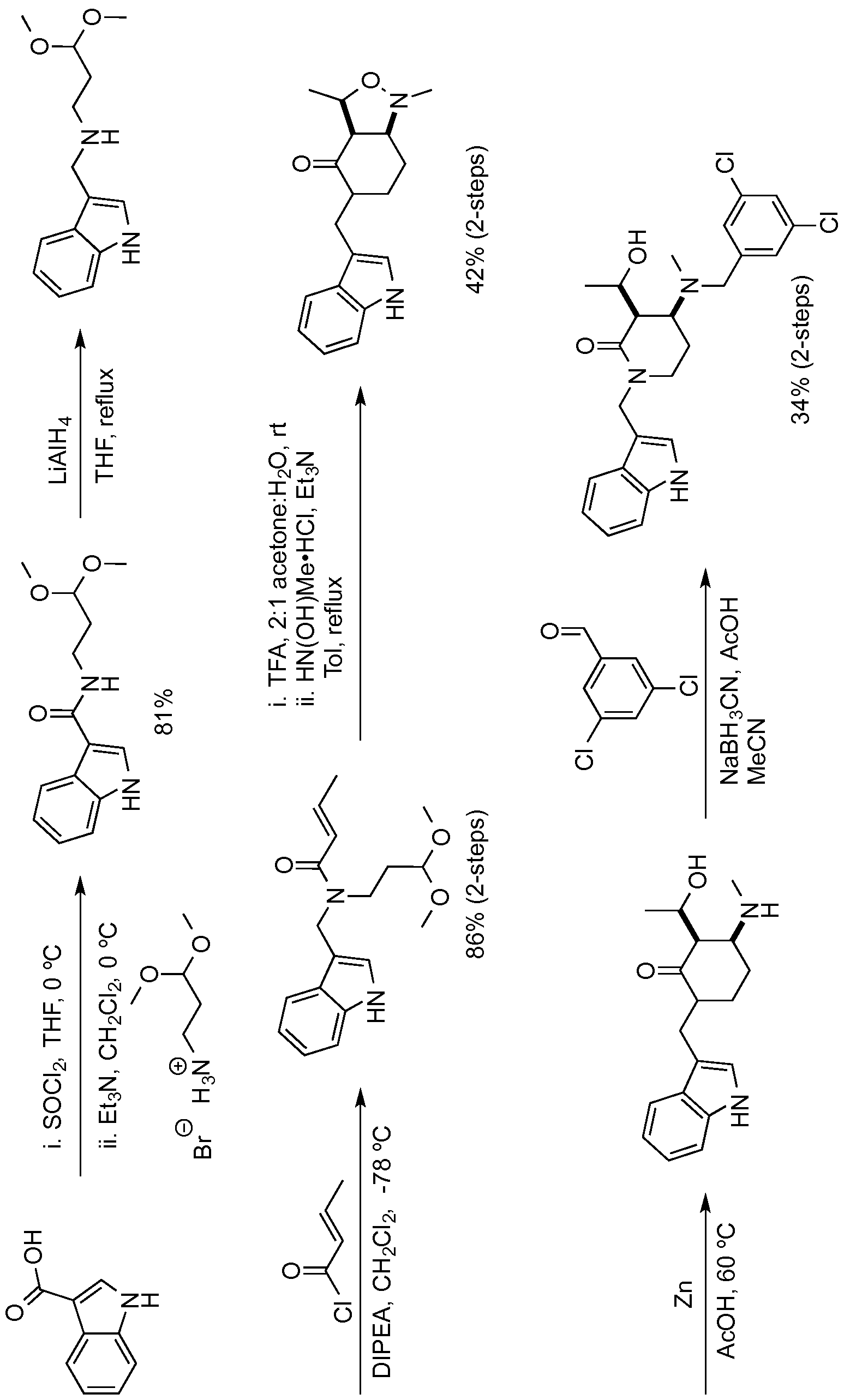
Scheme 4. Representative Synthesis of l,3,4~Trisubslituted~2~Piperidenes with One Carbon Li ker.


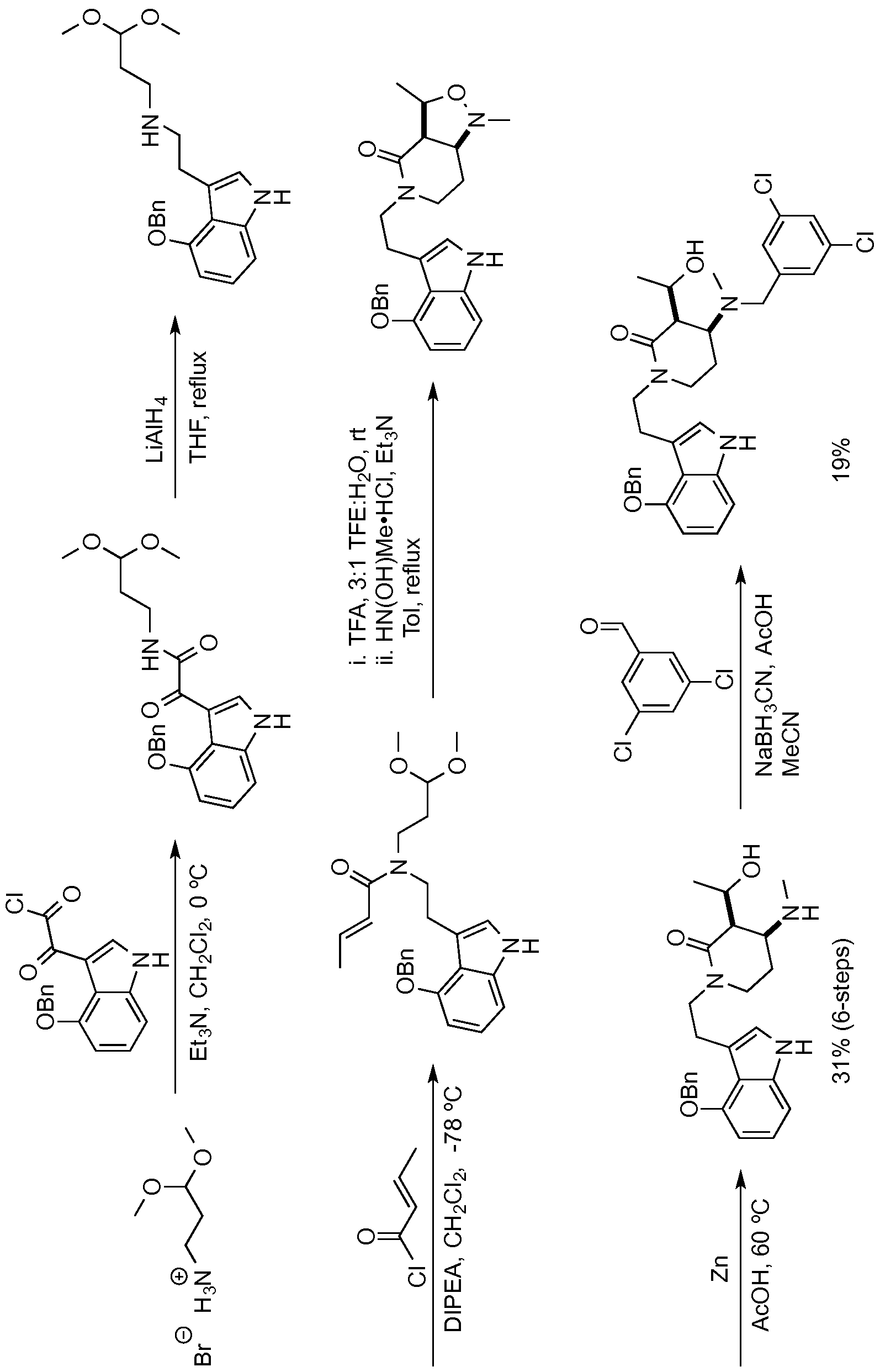
Scheme 7. Representative Synthesis of Ben¾yioxy issdole Analogs.

HO OEt

5. TFA, reflux

Scheme 9. Representative Synthesis of (1-N alkyiaryl)-i,4-Disubstituied 2-Piperidones.
Compound Characterization

7V-(2-(lH-Indol-3-yl)ethyl)-3,3-dimethoxypropan-l- amine(ARMV130/ARMV131)
A solution of indole-3-glyoxyl chloride (716 mg, 3.29 mmol) in CH2Ci2 (5 mL) was added dropwise over 5 min to a solution of 3,3 -dimethoxypropan-1 -ammonium bromide (507 mg, 2.53 mmol) and triethylamine (666 mg, 6.58 mmol) in (¾(¾ (20 mL) at 0 °C. The solution was stirred at 0 °C for 1 h, after which the ice bath was removed and the solution was allowed to stir at room temperature for 1.5 h. A saturated aqueous aHC03 solution (20 mL) was added and the mixture was transferred to a separatory funnel. The two phases were separated and the aqueous phase was extracted with (¾(¾ (3 x 40 mL). The combined organic extracts were washed with water (1 x 20 mL), dried (Na2S04), filtered, and concentrated in vacuo. The crude mixture was dissolved in THF (15 mL) and added dropwise over 15 min to a stirred suspension of lithium aluminum hydride (0.95 g, 25 mmol) in THF (45 mL) at 0 °C. After the addition was complete, the reaction was placed in an oil bath at 65 °C and stirred overnight (14 h). The reaction was then placed in an ice bath and the Pfizer work-up was carefully performed by successive addition of water (1 mL), aqueous sodium hydroxide (15%, 1 mL), and water (3 mL). Once quenched, the suspension was returned to room temperature and MgS04 was added, the solution was filtered through a fritted funnel, and the solids were washed with copious amounts of ether. The filtrate was concentrated in vacuo to give crude title compound as an opaque viscous oil. The crude material was carried on to the next step without further purification. Samples for spectroscopic analysis were purified via flash column chromatography eluting with CH2Cl2/methanol (99 : 1→ 19 : 1 along a gradient). XH NMR (400 MHz, CD3C1) δ 8.61 (br s, 1 H), 7.57 (d, J = 7.2 Hz, 1 H), 7.42 (dt, J= 8.0, 1.2 Hz, 1 H), 7.21-7.23 (m, 1 H), 7.17 (dd, J = 8.0, 1.2 Hz, 1 H), 7.14 (ddd, J= 8.0, 7.2, 1.2 Hz, 1 H), 4.25 (t, J= 4.0 Hz, 1 H), 3.20-3.18 (comp, 4 H), 3.03 (t, J= 5.6 Hz, 2 H), 3.00 (s, 6 H), 1.88 (tt, J = 7.2, 4.0 Hz, 2 H); 13C NMR (100 MHz, CD3C1) δ 134.0, 123.8, 121.5, 120.0, 1 17.4, 1 15.6, 109.2, 105.8, 101.3, 52.3, 45.6, 41.1, 25.8, 19.6; HRMS (CI) m/z calcd for C15H23N202 (M+1)+, 263.1760; found, 263.1760.

(£)-7V-(2-(lH-Indol-3-yl)ethyl)-iV-(3,3-dimethoxypropyl)but-2-enamide (ARMV151)
Crotonoyl chloride (317 mg, 3.03 mmol) was added dropwise over 5 min to a stirred solution of N-(2-(lH-Indol-3-yl)ethyl)-3,3-dimethoxypropan-l-amine (664 mg, 2.53 mmol) and Hunig's base (785 mg, 6.07 mmol) in (¾(¾ (25 mL) at -78 °C. The solution was stirred at -78 °C for 2 h, then partitioned between a saturated aqueous aHC03 solution (20 mL) and CH2CI2 (30 mL). The two phases were separated and the aqueous phase was extracted with CH2CI2 (3 x 30 mL). The combined organic fractions were successively washed with water (1 x 20 mL), brine (1 x 20 mL), dried ( a2S04), filtered, and concentrated in vacuo to give the crude title compound as a colorless oil. The crude material was carried on to the next step without further purification. Samples for spectroscopic analysis were purified via flash column chromatography eluting with CELCymethanol (99 : 1→ 97 : 1 along a gradient): lH
NMR (1 : 1 rotamer mixture) (400 MHz, CD3C1) δ 9.24 (br s, 0.5 H), 9.20 (br s, 0.5 H), 7.65 (d, J= 8.0 Hz, 0.5 H), 7.58 (d, J= 8.0 Hz, 0.5 H), 7.42 (d, J= 3.6 Hz, 0.5 H), 7.40 (d, J= 3.6 Hz, 0.5 H), 7.17 - 7.14 (m, 1 H), 7.10 - 7.06 (comp, 2 H), 6.87 (dq, J = 14.8, 7.2 Hz, 0.5 H), 6.64 (dq, J = 14.8, 7.2 Hz, 0.5 H), 6.40 (dd, J = 14.8, 1.6 Hz, 0.5 H), 6.16 (dd, J = 14.8, 1.6 Hz, 0.5 H), 4.38 - 4.34 (comp, 1 H), 3.63 (t, J= 6.4 Hz, 1 H), 3.61 (t, J= 6.4 Hz, 1 H), 3.39 - 3.35 (comp, 2 H), 3.27 (s, 6 H), 3.00 (t, J= 8.0 Hz, 1 H), 2.98 (t, J= 8.0 Hz, 1 H), 1.99 (dd, J = 6.8, 1.6 Hz, 1.5 H), 1.83 - 1.79 (comp, 2 H), 1.69 (dd, J = 6.8, 1.6 Hz, 1.5 H); 13C NMR (1 : 1 rotamer mixture) (100 MHz, acetonitrile-i/3) δ 166.2, 166.0, 140.9, 140.1, 136.8, 127.8, 127.7, 123.4, 122.7, 122.6, 122.6, 121.8, 121.7, 119.1, 1 19.0, 118.9, 118.5, 1 12.9, 1 11.9, 1 11.7, 1 11.6, 103.1, 102.6, 52.8, 52.5, 48.8, 47.5, 44.0, 42.5, 32.7, 31.1, 25.3, 23.7, 17.5, 17.3; HRMS (ESI) m/z calcd for C 9H26N2O3 (M+Na)+, 353.1836; found, 353.1836.

(3S,3a ?^aS)-5-(2-(lH-Indol-3-yl)ethyl)-l,3-dimethylhexahydroisoxazolo[4,3-c]pyridin-
4(lH)-one (ARMV151/ARMV152)
Trifluoroacetic acid (75 mg, 0.65 mmol) and (£ N-(2-(lH-Indol-3-yl)ethyl)-N-(3,3- dimethoxypropyl)but-2-enamide (835 mg, 2.53 mmol) were dissolved in 3 : 1 trifluoroethanol : water (50 mL) and stirred for 5 h at room temperature. At which time trifluoroacetic acid (0.19 mL, 2.48 mmol) was added and the reaction stirred for an additional 1 h at room temperature. Whereupon the reaction was quenched with saturated aqueous aHC03 (40 mL) and the aqueous layer extracted with (¾(¾ (3 x 80 mL). The organic fractions were dried (Na2S04) and filtered. Solvent was removed in vacuo. The crude mixture was dissolved in toluene (75 mL). N-methylhydroxylamine hydrochloride (317 mg, 3.80 mmol) and triethylamine (563 mg, 5.57 mmol) were added to the reaction mixture. The reaction was heated to reflux for 3 h. After allowing the flask to return to room temperature the reaction was partitioned between saturated aqueous aHC03 (60 mL), ethyl acetate (120 mL), and methanol (2 mL). The layers were separated and the aqueous layer extracted with ethyl acetate (3 x 60 mL). The organic fractions were washed with water (1 x 60 mL), brine (1 x 60mL), dried ( a2S04), filtered, and concentrated in vacuo. The crude mixture was purified via flash column chromatography eluting with CH^CVmethanol (97:3) to give 532 mg (67% 5-steps) of the title compound as a colorless oil: XH NMR (500 MHz, CD3C1) δ 8.26 (br s, 1 H), 6.62 (d, J = 8.1 Hz, 1 H), 7.32 (d, J = 8.1 Hz, 1 H), 7.16 (t, J = 7.1 Hz, 1 H), 7.09 (t, J = 7.1 Hz, 1 H), 6.99 (d, J = 1.7 Hz, 1 H), 3.89 (pent, J = 6.1 Hz, 1 H), 3.78-3.72 (m, 1 H), 3.64-3.69 (m, 1 H), 3.53 (td, J = 12.0, 2.9 Hz, 1 H), 2.99 - 2.95 (comp, 3 H), 2.81 - 2.76 (comp, 2 H), 2.63 (s, 3 H), 1.75 (ddt, J= 14.5, 1 1.2, 4.1 Hz, 1 H) 1.59 (dq, J= 14.5, 3.2 Hz, 1 H), 1.44 (d, J = 5.9 Hz, 3 H); 13C NMR (125 MHz, CD3C1) δ 169.0, 136.3, 127.4, 122.0, 121.9, 1 19.3, 1 18.7, 1 12.8, 11 1.2, 77.4, 66.1, 55.3, 48.5, 44.0, 43.1, 25.2, 23.4, 19.2; HRMS (CI) m/z calcd for Ci8H23 302 (M+l)+, 314.1869; found, 314.1867.

(±)-(3JR,4S)-l-(2-(lH-Indol-3-yl)ethyl)-3-(( ?)-l-hydroxyethyl)-4- (methylamino)piperidin-2-one (ARMV158)
To a suspension of zinc dust (3.80 g, 58.0 mmol) in acetic acid (aq 80%, 50 mL) was added a solution of (±)-(35,3aR,7a5)-5-(2-(lH-Indol-3-yl)ethyl)-l,3- dimethylhexahydroisoxazolo[4,3-c]pyridin-4(lH)-one (305 mg, 0.97 mmol) in acetic acid (aq 80%, 10 mL) over 5 min. The reaction was stirred in an oil bath at 65 °C for 2 h. After
allowing the reaction to return to room temperature the excess zinc was filtered off and washed with excess ethyl acetate. To the filtrate was added ethyl acetate (200 mL) upon which zinc acetate immediately precipitated out of solution as a fluffy white solid. The zinc acetate was filtered and washed with ethyl acetate. The solvent was removed in vacuo and the resulting residue taken up in HCl (aq 1 M, 100 mL). The resulting solution was washed with ether (2 x 100 mL), the organic fractions discarded, and the aqueous fraction was basified to pH -14 with KOH (solid). The resulting solution was extracted with CH2C12 (4 x 150 mL). The organic fractions were washed with brine (1 x 200 mL), dried (Na2S04), filtered, and concentrated in vacuo. The crude mixture was purified via flash column chromatography eluting with CELCymethanol (9: 1) to give 268 mg (87%) of the title compound as a yellow oil: XH NMR (500 MHz, methanol-^) δ 7.58 (dt, J = 7.8, 0.7 Hz, 1 H), 7.32 (dt, J = 7.8, 0.7 Hz, 1 H), 7.09 - 7.05 (comp, 2 H), 7.00 (td, J = 7.1, 1.0 Hz, 1 H), 4.37 (pent, J = 6.3 Hz, 1 H), 3.64-3.69 (m, 1 H), 3.52-3.58 (m, 1 H), 3.33 - 3.17 (comp, 1 H), 3.15 (pent, J= 3.9 Hz, 1 H), 3.11 - 3.04 (comp, 3 H), 2.40 (dd, J = 6.1, 4.2 Hz, 1 H), 2.34 (s, 3 H), 1.97 (app sex, J = 7.8 Hz, 1 H), 1.74 (dtd, J = 13.9, 7.1, 3.2 Hz, 1 H), 1.23 (d, J = 6.4 Hz, 3 H); 13C NMR (125 MHz, methanol-i/4) δ 171.0, 138.1, 128.9, 123.6, 122.4, 1 19.7, 119.3, 113.1, 1 12.3, 67.5, 56.1, 51.4, 45.7, 33.5, 30.8, 24.8, 23.7, 22.5; HRMS (ESI) m/z calcd for CisH^ sOz (M+l)+, 316.2020; found, 316.2024.

(±)-(3JR,4S)-l-(2-(lH-Indol-3-yl)ethyl)-4-((3,5-dichlorobenzyl)(methyl)amino)-3-((JR)-l- hydroxyethyl)piperidin-2-one (ARMV171)
A solution of (±)-(3R,45)-l-(2-(lH-indol-3-yl)ethyl)-3-((R)-l-hydroxyethyl)-4- (methylamino)piperidin-2-one (50 mg, 0.16 mmol) and 3,5-dichlorobenzaldehyde (45 mg, 0.26 mmol) in acetonitrile (1 mL) was heated to reflux for 2 h. The flask was allowed to return to room temperature, at which time NaBH3CN (22 mg, 0.35 mmol) and acetic acid (53 μί, 0.89 mmol) were added to the flask. The reaction was allowed to stir at room temperature for 20 h. The reaction was partitioned between a saturated aqueous aHC03 solution (6.5
niL), ethyl acetate (6.5 mL), and methanol (0.5 mL). The two phases were separated and the aqueous phase extracted with ethyl acetate (2 x 6.5 mL). The combined organic fractions were washed with brine (6.5 mL) and dried ( a2S04). The solution was filtered and concentrated in vacuo to give crude the title compound as an opaque viscous oil. The crude material was purified via flash column chromatography eluting along a gradient with hexanes : ethyl acetate (1 : 1)→ ethyl acetate : methanol (20 : 1). To give the title compound (36 mg, 48 %) as a white solid: XH NMR (600 MHz, CDC13) δ 8.15 (d, J = 1.9 Hz, 1H), 7.55 (d, J = 8.2 Hz, 1H), 7.34 (dt, J = 8.1, 0.8 Hz, 1H), 7.27 (t, J = 1.9 Hz, 1H), 7.18 (ddd, J = 8.1, 7.1, 1.1 Hz, 1H), 7.12 - 7.08 (comp, 3H), 7.02 (d, J = 1.9 Hz, 1H), 4.35 (dq, J = 6.5, 6.2 Hz, 1H), 3.74 - 3.78 (m, 1H), 3.64 - 3.69 (m, 1H), 3.41 - 3.26 (comp, 3H), 3.24 (dt, J = 13.4, 5.4 Hz, 1H), 3.12 (dt, J = 16.9, 9.2 Hz, 1H), 3.04 - 2.99 (m, 1H), 2.97 - 2.92 (m, 1H), 2.31 (t, J = 5.2 Hz, 1H), 2.03 (s, 3H), 1.83-1.87 (comp, 3H), 1.15 (d, J = 6.5 Hz, 3H); 13C NMR (150 MHz, CDC13) δ 171.7, 140.6, 136.3, 135.2, 128.1, 127.6, 127.3, 122.4, 122.1, 119.4, 1 18.4, 1 12.3, 1 11.5, 66.2, 58.9, 48.0, 47.4, 44.9, 37.3, 29.7, 23.2, 21.7, 20.1 ; HRMS (ESI) m/z calcd for C25H29CI2N3O2 (M+l)+, 474.1710 and 476.1686; found, 474.1712 and 476.1690.

(±)-(3JR,4S)-l-(2-(lH-Indol-3-yl)ethyl)-4-(benzyl(methyl)amino)-3-((JR)-l- hydroxyethyl)piperidin-2-one (ARMV174)
XH NMR (500 MHz, CDC13) δ 8.13 (brs, 1H), 7.58 (d, J = 7.9 Hz, 1H), 7.35 (d, J = 7.9 Hz, 1H), 7.33 - 7.26 (comp, 3H), 7.21 (d, J = 6.6 Hz, 2H), 7.19 (t, J = 1.1 Hz, 1H), 7.11 (t, J = 1.1 Hz, 1H), 7.03 (d, J = 2.2 Hz, 1H), 4.34 (p, J = 6.1 Hz, 1H), 3.76 (p, J = 7.6 Hz, 1H), 3.64 (p, J = 6.4 Hz, 1H), 3.52, 3.47 (ABq, JAB = 12.7 Hz, 2H), 3.42 (q, J = 7.6 Hz, 1H), 3.26 (ddd, J= 13.7, 6.6, 3.4 Hz, 1H), 3.16 - 3.10 (m, 1H), 3.04 - 2.93 (comp, 2H), 2.35 (t, J = 5.6 Hz, 1H), 2.06 (s, 3H), 1.96 - 1.90 (comp, 2H), 1.16 (d, J = 6.4 Hz, 3H); 13C NMR (125 MHz, CDCI3) δ 171.7, 136.7, 136.3, 129.3, 128.7, 127.9, 127.3, 122.3, 122.1, 1 19.4, 118.4, 1 12.4, 11 1.4, 66.4, 60.0, 48.3, 47.4, 45.1, 37.2, 29.7, 23.2, 21.9, 20.1 ; HRMS (ESI) m/z calcd for C25H31N3O2 (M+l)+, 406.2489; found, 406.2490.

(±)-(3 ?,4S)-l-(2-(lH-Indol-3-yl)ethyl)-4-((3-chloro-5-methoxybenzyl)(methyl)amino)-3- (Cff)-l-hydroxyethyl)piperidin-2-one (ARMV175)
XH NMR (400 MHz, CDC13) δ 8.24 (s, 1H), 7.57 (d, J = 7.6 Hz, 1H), 7.33 (d, J = 7.6 Hz, 1H), 7.18 (td, J = 7.2, 1.2 Hz, 1H), 7.10 (td, J = 8.0, 1.2 Hz, 1H), 7.01 (d, J = 2.4 Hz, 1H), 6.80 (t, J = 1.6 Hz, 1H), 6.78 (t, J = 1.6 Hz, 1H), 6.67 (t, J = 1.6 Hz, 1H), 4.33 (p, J = 6.4 Hz, 1H), 3.79 - 3.72 (comp, 4H), 3.61 (p, J = 6.4 Hz, 1H), 3.47 - 3.30 (comp, 3H), 3.23 (dt, J= 12.4, 4.8 Hz, 1H), 3.10 (dt, J= 12.4, 9.2 Hz, 1H), 3.02 - 2.90 (comp, 2H), 2.38 (t, J = 6.0 Hz, 1H), 2.06 (s, 3H), 1.91 - 1.85 (comp, 2H), 1.18 (d, J = 6.4 Hz, 3H); 13C NMR (100 MHz, CDCI3) δ 170.9, 160.5, 139.6, 136.2, 135.0, 127.3, 122.3, 122.1, 121.4, 1 19.3, 118.4, 1 13.6, 113.4, 112.4, 1 11.4, 66.3, 59.0, 58.0, 55.6, 48.5, 47.4, 45.0, 37.5, 23.1, 22.1, 20.5; HRMS (ESI) m/z calcd for C26H32CI 3O3 (M+l)+, 470.2205; found, 470.2207.

(±)-(3 ?,4S)-l-(2-(lH-Indol-3-yl)ethyl)-4-((benzo [d\ [1,3] dioxol-5- ylmethyl)(methyl)amino)-3-(( ?)-l-hydroxyethyl)piperidin-2-one (ARMV184)
XH NMR (400 MHz, CDC13) δ 8.35 (s, 1H), 7.63 (d, J = 7.6 Hz, 1H), 7.35 (d, J = 8.0 Hz, 1H), 7.19 (t, J = 7.2 Hz, 1H), 7.12 (t, J = 7.6 Hz, 1H), 7.02 (d, J = 2.0 Hz, 1H), 6.74 - 6.72 (comp, 2H), 6.67 (d, J= 8.0 Hz, 1H), 4.28 (dq J = 6.4, 6.0 Hz, 1H), 3.81 (p, J = 7.6 Hz, 1H), 3.54 (p, J= 6.4 Hz, 1H), 3.48, 3.37 (ABq, JAB = 12.4 Hz, 2H), 3.28 - 3.23 (m, 1H), 3.16 - 3.10 (comp, 2H), 3.07 - 2.98 (comp, 2H), 2.65 (dd, J= 8.8, 5.2 Hz, 1H), 2.10 (s, 3H), 1.99 - 1.96 (comp, 2H), 1.32 (d, J = 6.0 Hz, 3H); 13C NMR (100 MHz, CDC13) δ 170.1, 148.0, 147.1, 136.4, 131.2, 127.5, 122.4, 122.2, 122.1, 119.4, 1 18.7, 1 12.8, 1 11.4, 109.4, 108.3,
101.1, 66.8, 59.8, 58.6, 50.1, 47.6, 45.6, 38.0, 23.3, 22.8, 21.6; HRMS (ESI) m/z calcd for C26H31 3O4 (M+l)+, 450.2387

(±)-(3JR,4S)-l-(2-(lH-Indol-3-yl)ethyl)-3-((JR)-l-hydroxyethyl)-4-((3- methoxybenzyl)(methyl)amino)piperidin-2-one (ARMV198)
XH NMR (400 MHz, CDC13) δ 8.19 (s, 1H), 7.58 (d, J= 8.0 Hz, 1H), 7.34 (d, J= 8.0 Hz, 1H), 7.24 - 7.16 (comp, 2H), 7.10 (td, J= 8.0, 1.2 Hz, 1H), 7.03 (d, J= 2.4 Hz, 1H), 6.82 (d, J = 2.0 Hz, 1H), 6.80 (d, J = 2.0 Hz, 1H), 6.77 (t, J = 2.0 Hz, 1H), 4.33 (p, J = 6.4 Hz, 1H), 3.81 - 3.74 (comp, 4H), 3.60 (p, J = 6.4 Hz, 1H), 3.50, 3.43 (ABq, JAB = 12.8 Hz, 2H), 3.37 - 3.32 (m, 1H), 3.24 (dt, J = 12.0, 4.4 Hz, 1H), 3.11 (dt, J = 12.0, 8.0 Hz, 1H), 3.04 - 2.92 (comp, 2H), 2.41 (t, J = 7.2 Hz, 1H), 2.07 (s, 3H), 1.95 - 1.89 (comp, 2H), 1.19 (d, J = 6.4 Hz, 3H); 13C NMR (100 MHz, CD3OD) δ 171.8, 161.4, 140.3, 137.6, 130.6, 128.9, 123.7, 122.4, 122.3, 119.7, 119.3, 115.5, 114.2, 112.8, 112.3, 68.0, 61.2, 59.6, 55.6, 50.9, 46.6, 38.3, 24.0, 22.9, 22.3; HRMS (ESI) (M+l)+, 436.2595; found, 436.2599.

(±)(3JR,4S)-l-(2-(lH-Indol-3-yl)ethyl)-4-((3-chlorobenzyl)(methyl)amino)-3-(( ?)-l- hydroxyethyl)piperidin-2-one (ARMV199)
XH NMR (400 MHz, CD3OD) δ 7.58 (d, J = 7.6 Hz, 1H), 7.33 (d, J = 1.4 Hz, 1H), 7.31 - 7.26 (comp, 3H), 7.18 (dt, J= 6.8, 1.6 Hz, 1H), 7.11 - 7.07 (comp, 2H), 7.02 (ddd, J = 7.6, 6.8, 0.8 Hz, 1H), 4.22 (dq, J = 8.8, 6.0 Hz, 1H), 3.77 (dt, J = 13.2, 7.2 Hz, 1H), 3.57 - 3.51 (comp, 2H), 3.44 (d, J= 12.8 Hz, 1H), 3.35 - 3.32 (m, 1H), 3.18 - 2.90 (comp, 4H), 2.59 (dd, J= 8.4, 5.2 Hz, 1H), 2.07 (s, 3H), 2.04 - 1.98 (m, 1H), 1.94 - 1.87 (m, 1H), 1.20 (d, J = 6.4 Hz, 3H); 13C NMR (100 MHz, CD3OD) δ 171.8, 141.6, 138.1, 135.5, 131.1, 130.0, 128.9,
128.5, 123.7, 122.4, 119.7, 119.3, 112.8, 112.3, 67.9, 61.2, 58.9, 51.0, 46.6, 38.3, 24.0, 22.8, 22.4; HRMS (ESI) m/z calcd for C25H30CIN3O2 (M+l)+, 440.2099; found, 440.2105.
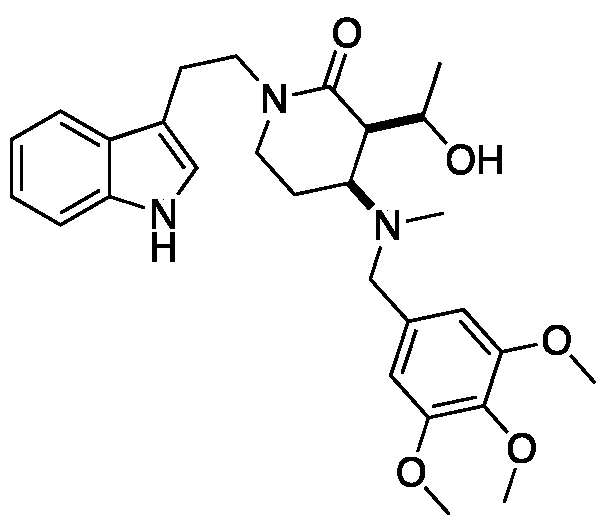
(±)-(3JR,4S)-l-(2-(lH-Indol-3-yl)ethyl)-3-(( ?)-l-hydroxyethyl)-4-(methyl(3,4,5- trimethoxybenzyl)amino)piperidin-2-one (ARMV202)
XH NMR (400 MHz, CD3OD) δ 7.59 (dt, J = 8.0, 1.2 Hz, 1H), 7.33 (dt, J = 8.4, 1.2 Hz, 1H), 7.11 - 7.07 (comp, 2H), 7.02 (ddd, J= 8.0, 7.2, 1.2 Hz, 1H), 6.58 (s, 2H), 4.23 (dq, J = 9.2, 6.4 Hz, 1H), 3.82 (s, 6H), 3.81 - 3.76 (m, 1H), 3.75 (s, 3H), 3.64 - 3.45 (comp, 3H), 3.59 - 3.49 (m, 1H), 3.22 - 3.14 (comp, 2H), 3.10 - 2.92 (comp, 2H), 2.61 (dd, J = 9.2, 5.6 Hz, 1H), 2.16 (s, 3H), 2.10 - 2.04 (m, 1H), 2.00 - 1.93 (m, 1H), 1.20 (d, J = 6.0 Hz); 13C NMR (125 MHz, CD3OD) δ 169.8, 152.7, 136.7, 136.2, 127.0, 121.8, 120.5, 117.8, 117.3, 110.9, 110.4, 105.4, 66.0, 59.2, 59.1, 57.9, 54.7, 48.9, 44.6, 36.4, 22.0, 21.0, 20.3; HRMS (ESI) m/z calcd for
 (M+l)+, 496.2806; found, 496.2803

(±)-(3JR,4S)-l-(2-(lH-Indol-3-yl)ethyl)-4-((3,5-dimethoxybenzyl)(methyl)amino)-3-(( ?)-l- hydroxyethyl)piperidin-2-one (ARMV203)
XH NMR (400 MHz, CD3OD) δ 7.58 (dt, J = 8.0, 0.8 Hz, 1H), 7.33 (dt, J = 8.0, 0.8 Hz, 1H), 7.11 - 7.07 (comp, 2H), 7.01 (td, J= 8.0, 6.8, 1.2 Hz, 1H), 6.42 (d, J= 2.4 Hz, 2H), 6.38 (t, J= 2.4 Hz, 1H), 4.23 (dq, J= 14.0, 6.0 Hz, 1H), 3.81 - 3.71 (comp, 7H), 3.57 - 3.51 (m, 1H), 3.47, 3.41 (ABq, JAB = 12.8 Hz, 2H), 3.34 - 3.30 (m, 1H), 3.17 - 2.93 (comp, 4H), 2.58 (dd, J= 8.8, 5.6 Hz, 1H), 2.09 (s, 3H), 2.04 - 1.98 (m, 1H), 1.95 - 1.85 (m, 1H), 1.19 (d, J = 6.0 Hz, 3H); 13C NMR (100 MHz, CD3OD) δ 171.9, 162.5, 141.4, 138.1, 128.9, 123.7,
122.4, 119.7, 119.3, 112.8, 112.3, 107.8, 100.3, 68.0, 61.0, 59.8, 55.7, 50.9, 46.7, 38.4, 24.0, 22.8, 22.3; HRMS (ESI) m/z calcd for C27H35N3O4 (M+l)+, 466.2700; found, 466.2701.

(±)-(3JR,4S)-l-(2-(lH-Indol-3-yl)ethyl)-3-((JR)-l-hydroxyethyl)-4-(methyl(3- (methylthio)benzyl)amino)piperidin-2-one (ARMV214)
XH NMR (400 MHz, CD3OD) δ 7.58 (d, J = 7.6 Hz, 1H), 7.33 (d, J = 8.0 Hz, 1H), 7.26 (td, J = 7.6, 0.8 Hz, 1H), 7.17 - 7.15 (comp, 2H), 7.09 (ddd, J = 8.0, 7.6, 0.8 Hz, 1H), 7.07 (s, 1H), 7.03 - 6.99 (comp, 2H), 4.22 (dq, J= 8.8, 6.0 Hz, 1H), 3.77 (dt, J= 13.2, 7.6 Hz, 1H), 3.56 - 3.49 (comp, 2H), 3.43 (d, J = 12.8, 1H), 3.34 - 3.28 (m, 1H), 3.17 - 2.92 (comp, 4H), 2.58 (dd, J = 8.8, 5.6 Hz, 1H), 2.45 (s, 3H), 2.07 (s, 3H), 2.02 - 1.86 (comp, 2H), 1.19 (d, J= 6.4 Hz, 3H); 13C NMR (100 MHz, CD3OD) δ 171.8, 140.6, 139.7, 138.1, 130.0, 128.8, 127.8, 126.7, 125.4, 123.7, 122.4, 119.7, 119.3, 112.8, 112.3, 67.9, 61.1, 59.4, 50.9, 46.5, 38.3, 24.0, 22.9, 22.3, 15.5; HRMS (ESI) m/z calcd for C26H33 3O2S (M+Na)+, 474.2186; found, 474.2187.

(±)-(3JR,4S)-l-(2-(lH-Indol-3-yl)ethyl)-4-((3,5-dichlorobenzyl)(methyl)amino)-3- (hydroxymethyl)piperidin-2-one (ARMV250)
XH NMR (500 MHz, CD3OD) δ 7.57 (d, J = 7.8 Hz, 1H), 7.32 (dt, J = 8.3, 0.7 Hz, 1H), 7.28 (t, J= 2.0 Hz, 1H), 7.23 (s, 2H), 7.09 - 7.06 (comp, 2H), 6.99 (ddd, J= 8.1, 7.1, 1.0 Hz, 1H), 3.98 (d, J= 5.9 Hz, 2H), 3.68 - 3.64 (comp, 2H), 3.46 (d, J= 14.2 Hz, 1H), 3.40 (d, J = 14.2 Hz, 1H), 3.23 - 3.02 (comp, 3H), 2.98 (p, J = 1.1 Hz, 2H), 2.74 (brs, 1H), 2.04 (s, 3H), 1.86 - 1.81 (m, 2H); 13C NMR (125 MHz, CD3OD) δ 173.5, 145.0, 138.1, 136.0, 128.8, 128.0, 128.0, 123.7, 122.4, 119.7, 119.3, 112.9, 112.4, 61.3, 60.4, 58.4, 47.5, 38.7, 24.0, 23.2;
HRMS (ESI) m/z calcd for C24H27Cl2 302 (M+Na)+, 482.1373 and 484.1348; found, 482.1379 and 484.1354.

(±)-(3JR,45)-4-((3,5-Dichlorobenzyl)(methyl)amino)-3-(( ?)-l-hydroxyethyl)-l-(2-(5- methoxy-lH-indol-3-yl)ethyl)piperidin-2-one (ARMV253)
XH NMR (600 MHz, CD3OD) δ 7.34 (t, J= 1.9 Hz, 1H), 7.22 - 7.21 (comp, 3H), 7.07 (d, J= 2.1 Hz), 7.04 (s, 1H), 6.76 (ddd, J = 8.7, 2.4, 0.3 Hz, 1H), 4.22 (dq, J = 8.7, 6.1, 1H), 3.82 (s, 3H), 3.76 (dt, J= 13.3, 7.6 Hz, 1H), 3.55 (ddd, J= 13.4, 7.7, 5.8 Hz, 1H), 3.50 (d, J= 13.4 Hz, 1H), 3.41 (d, J= 13.4 Hz, 1H), 3.36 - 3.32 (m, 1H), 3.17 - 3.08 (comp, 2H), 3.02 (p, J= 7.2 Hz, 1H), 2.93 (ddd, J= 13.7, 7.8, 5.9 Hz, 1H), 2.58 (dd, J= 8.4, 5.7 Hz, 1H), 2.07 (s, 3H), 1.99 (dt, J= 12.3, 5.7 Hz, 1H), 1.96 - 1.91 (m, 1H), 1.21 (d, J= 6.1 Hz, 3H); 13C MR (150 MHz, CD3OD) δ 172.0, 155.0, 143.7, 136.2, 133.4, 129.2, 128.5, 128.5, 124.5, 113.0, 112.6, 112.6, 101.5, 67.7, 61.2, 58.4, 56.4, 51.2, 48.8, 46.6, 38.5, 24.0, 22.8, 22.5; HRMS (ESI) m/z calcd for C26H31CI2 3O3 (M+H)+, 504.1815 and 506.1792; found, 504.1815 and 506.1795.

(±)-(3JR,4S)-l-((lH-Indol-3-yl)methyl)-4-((3,5-dichlorobenzyl)(methyl)amino)-3-((JR)-l- hydroxyethyl)piperidin-2-one (ARMVI41)
XH NMR (400 MHz, CDC13) δ 8.54 (brs, 1H), 7.68 (d, J = 8.0 Hz, 1H), 7.38 (d, J = 8.4 Hz, 1H), 7.25 - 7.18 (comp, 3H), 7.09 (ddd, J= 8.0, 7.2, 0.8 Hz, 1H), 7.06 (d, J= 2.0 Hz, 2H), 4.96 (d, J= 14.4 Hz, 1H), 4.51 (d, J= 14.4 Hz, 1H), 4.36 (dq, J= 8.4, 5.6 Hz, 1H), 3.42 - 3.35 (comp, 3H), 3.23 - 3.11 (comp, 2H), 2.75 (dd, J= 8.8, 6.0 Hz, 1H), 2.06 (s, 3H), 1.99 - 1.92 (m, 1H), 1.86 - 1.78 (m, 1H), 1.41 (d, J = 6.0 Hz, 3H); 13C NMR (100 MHz, CDC13) δ 169.7, 141.2, 136.3, 135.1, 127.7, 127.0, 126.8, 124.3, 122.4, 119.9, 119.3, 111.5, 111.3,
66.5, 60.4, 57.5, 50.3, 43.5, 40.8, 38.6, 22.6, 21.6; HRMS (ESI) m/z calcd for C26H31CI2 3O3 (M+Na)+, 482.1373 and 484.1348; found, 482.1373 and 484.1349.

(±)-(3JR,4S)-l-(3-(lH-Indol-3-yl)propyl)-4-((3,5-dichlorobenzyl)(methyl)amino)-3-((JR)-l- hydroxyethyl)piperidin-2-one (ARMVI56)
XH NMR (400 MHz, CDC13) δ 8.10 (brs, 1H), 7.57 (d, J = 7.6 Hz, 1H), 7.36 (dt, J = 8.4, 0.8 Hz, 1H), 7.27 (t, J= 2.0 Hz, 1H), 7.21 - 7.17 (m, 1H), 7.14 (d, J= 2.0 Hz, 2H), 7.11 (ddd, J= 8.0, 7.2, 0.8 Hz, 1H), 7.04 (d, J= 2.0 Hz, 1H), 7.33 (dq, J= 8.8, 6.4 Hz, 1H), 3.62 - 3.55 (comp, 2H), 3.45 (d, J = 13.2 Hz, 1H), 3.39 - 3.24 (comp, 3H), 3.14 (dt, J = 10.4, 5.6 Hz, 1H), 2.77 (t, J = 7.2 Hz, 2H), 2.70 (dd, J = 8.4, 5.6 Hz, 1H), 2.16 (s, 3H), 2.13 - 2.05 (comp, 2H), 1.99 - 1.92 (comp, 2H), 1.34 (d, J= 6.0 Hz, 3H); 13C NMR (100 MHz, CDCI3) δ 169.9, 141.2, 136.3, 135.2, 127.8, 127.3, 127.1, 121.9, 121.4, 119.2, 118.7, 115.4, 111.2, 66.5, 60.3, 57.9, 50.2, 46.6, 44.9, 39.5, 27.5, 22.5, 22.5, 21.8; HRMS (ESI) m/z calcd for C26H31CI2 3O2 (M+Na)+, 510.1686 and 512.1662; found, 510.1690 and 512.1695.

(±)-(3JR,4S)-4-((3,5-Dichlorobenzyl)(methyl)amino)-l-(2-(5-hydroxy-lH-indol-3- yl)ethyl)-3-(( ?)-l-hydroxyethyl)piperidin-2-one (ARMVI60)
XH NMR (600 MHz, CD3OD) δ 7.32 (t, J= 1.9 Hz, 1H), 7.20 (d, J= 1.9 Hz, 1H), 7.15 (dd, J = 8.6, 0.4 Hz, 1H), 7.00 (s, 1H), 6.94 (d, J = 2.0 Hz, 1H), 6.67 (dd, J = 8.6, 2.3 Hz, 1H), 4.20 (dq, J = 8.6, 6.1 Hz, 1H), 3.67 (dt, J = 13.2, 7.6 Hz, 1H), 3.52 (ddd, J= 13.3, 7.6, 5.8 Hz, 1H), 3.46 (d, J= 13.4 Hz, 1H), 3.36 (d, J= 13.4 Hz, 1H), 3.28 - 3.25 (m, 1H), 3.09 - 3.01 (comp, 2H), 2.96 (p, J= 7.1 Hz, 1H), 2.88 - 2.84 (m, 1H), 2.57 (dd, J= 8.0, 5.2 Hz, 1H), 2.03 (s, 3H), 1.94 - 1.91 (m, 1H), 1.86 - 1.80 (m, 1H), 1.21 (d, J = 6.1 Hz, 3H); 13C NMR (150 MHz, CD3OD) δ 171.9, 151.3, 143.7, 136.2, 133.0, 129.6, 128.5, 128.4, 124.5, 112.8,
112.5, 112.1, 103.5, 67.7, 61.2, 58.4, 51.1, 49.8, 46.6, 38.5, 24.0, 22.8, 22.5; HRMS (ESI) m/z calcd for C25H29CI2N3O3 (M+H)+, 512.1478 and 514.1455; found, 512.1483 and 514.1459.

(±)-(3JR,4S)-l-(2-(5-(Benzyloxy)-lH-indol-3-yl)ethyl)-4-((3,5- dichlorobenzyl)(methyl)amino)-3-(( ?)-l-hydroxyethyl)piperidin-2-one (ARMVI98)
XH NMR (600 MHz, CDC13) δ 8.07 (brs, 1H), 7.47 (d, J = 7.5 Hz, 2H), 7.38 - 7.35 (comp, 2H), 7.31 - 7.28 (m, 1H), 7.25 - 7.23 (comp, 2H), 7.13 (d, J= 2.4 Hz, 1H), 7.08 (d, J = 1.9 Hz, 2H), 6.99 (d, J= 2.3 Hz, 1H), 6.93 (dd, J= 8.7, 2.3 Hz, 1H), 5.11 (s, 2H), 4.26 (dq, J= 8.8, 6.1 Hz, 1H), 3.77 (dt, J= 13.4, 7.7 Hz, 1H), 3.49 (dq, J= 7.8, 6.1 Hz, 1H), 3.42 (d, J = 13.3, 1H), 3.34 (d, J= 13.3, 1H), 3.21 (ddd, J = 12.8, 6.7, 2.3 Hz, 1H), 3.12 - 3.03 (comp, 2H), 2.99 (p, J= 7.3 Hz, 1H), 2.91 (p, J= 7.3 Hz, 1H) 2.65 (dd, J= 8.7, 5.8 Hz, 1H), 2.07 (s, 3H), 1.96 - 1.84 (comp, 2H), 1.31 (d, J= 6.1 Hz, 3H); 13C NMR (150 MHz, CDC13) δ 169.8, 153.1, 141.2, 137.6, 135.1, 131.6, 128.5, 127.8, 127.8, 127.7, 127.6, 127.1, 123.0, 112.7, 112.5, 111.9, 102.4, 71.0, 66.5, 60.3, 57.6, 50.1, 47.2, 45.3, 38.6, 23.1, 22.5, 21.8; HRMS (ESI) m/z calcd for C32H35CI2N3O3 (M+Na)+, 602.1948 and 604.1927; found, 602.1950 and 604.1931.

(±)-(3JR,4S)-l-(2-(4-(Benzyloxy)-lH-indol-3-yl)ethyl)-4-((3,5- dichlorobenzyl)(methyl)amino)-3-(( ?)-l-hydroxyethyl)piperidin-2-one (ARMVI112)
XH NMR (400 MHz, CDC13) δ 9.14 (brs, 1H), 7.38 (dd, J = 8.4, 1.6 Hz, 2H), 7.30 - 7.28 (comp, 2H), 7.23 (d, J= 7.2 Hz, 1H), 7.13 (s, 1H), 7.01 (s, 2H), 6.94 - 6.87 (comp, 2H), 6.77 (d, J = 2.4 Hz, 1H), 6.44 (dd, J = 7.2, 0.8 Hz, 1H), 5.01 (s, 2H), 4.09 (dq, J = 9.2, 6.8
Hz, 1H), 3.55 - 3.48 (m, 1H), 3.36 (d, J = 12 A Hz, 1H), 3.28 - 3.1 (comp, 2H), 2.90 - 2.84 (comp, 3H), 2.59 - 2.54 (m, 1H), 1.97 (s, 3H), 1.55 - 1.50 (comp, 2H), 1.22 (d, J = 6.0 Hz, 3H); HRMS (ESI) m/z calcd for C32H35CI2N3O3 (M+Na)+, 602.1948 and 604.1945; found, 602.1927 and 604.1954.

(±)-(3 ?,4S)-4-((3,5-Dichlorobenzyl)(methyl)amino)-l-(2-(5-methoxy-l-methyl-lH-indol- 3-yl)ethyl)-3-(( ?)-l-methoxyethyl)piperidin-2-one (ARMVI113)
XH NMR (400 MHz, CDCI3) 7.24 (t, J = 2.0 Hz, 1H), 7.19 (d, J = 2.0 Hz, 2H), 7.17 (d, J = 8.8 Hz, 1H), 7.08 (d, J = 2.4 Hz, 1H), 6.89 - 6.86 (comp, 2H), 3.88 (s, 3H), 3.70 (s, 3H), 3.67 - 3.56 (comp, 3H), 3.40 (d, J = 14.0 Hz, 1H), 3.28 (s, 3H), 3.20 (td, J = 12.4, 3.2 Hz, 2H), 3.10 (dt, J = 11.6, 4.4 Hz, 1H), 2.98 - 2.91 (comp, 3H), 2.48 (dd, J = 8.4, 2.0 Hz, 1H), 2.17 (s, 3H), 1.84 (dd, J = 13.2, 4.4 Hz, 1H), 1.50 (q, J = 6.4 Hz, 1H), 1.42 (d, J = 6.8 Hz, 3H).

Ethyl 3-((2-(lH-indol-3-yl)ethyl)(3-ethoxy-3-oxopropyl)amino)-3-oxopropanoate (LTL-
11-150)
Ethyl 3-((2-(lH-indol-3-yl)ethyl)amino)propanoate (3.0 g, 1 1.5 mmol) and ethyl malonic acid (1.68 g, 12.6 mmol) were dissolved in (¾(¾ (250 ml), and the solution was cooled to 0 °C. EDCI'HCl (2.43 g, 12.6 mmol) was dissolved in the chilled solution, and DIPEA (3.3 g, 25.2 mmol, 4.38 mL) was added dropwise. The reaction was stirred for 40 h and allowed to come to room temperature gradually. The reaction was then diluted with CH2CI2 (250 mL) and washed with aqueous HC1 (1 M, 500 mL). The aqueous layer was extracted with CH2CI2 (250 ml). The combined organic phases were washed with brine (500 mL), dried (Na2S04) and concentrated under reduced pressure to yield crude title compound as an amber oil (4.3 g, 99%) which was judged to be >90% pure by XH NMR and carried
forward without further purification. For characterization, the crude product was purified via column chromatography eluting with hexanes/EtOAc (3 : 1 → 1 : 1) to provide the title compound as an off-white solid. XH NMR (3:2 rotamer mixture) (400 MHz, CDC13) δ 8.24 (s, 0.5 H), 8.15 (s, 0.3 H), 7.71 (d, J = 7 Hz, 0.3 H), 7.59 (d, J = 7 Hz, 0.5 H), 7.40 (t, J = 7 Hz, 0.9 H), 7.24 (m, 1 H), 7.17 (m, 0.9 H), 7.06 (d, J = 2 Hz, 0.3 H), 7.00 (d, J = 2 Hz, 0.6 H), 4.26 (q, J = 7 Hz, 0.7 H), 4.18 (m, 3.1 H), 3.70 (t, J = 7 Hz, 1.2 H), 3.64 (m, 1.9 H), 3.58 (s, 0.7 H), 3.55 (t, J = 7 Hz, 0.7 H), 3.16 (s, 1.2 H), 3.08 (m, 1.9 H), 2.69 (t, J = 7 Hz, 1.2 H), 2.57 (t, J = 7 Hz, 0.7 H), 1.32 (t, J = 7 Hz, 1.2 H), 1.28 (m, 4.7 H); 13C NMR (100 MHz, CDC13) (3 :2 rotamer mixture) δ 172.1, 170.1 , 167.8, 167.6, 166.4, 166.1 , 136.3, 127.3, 126.9, 122.4, 122.3, 122.1 , 122.0, 1 19.7, 119.4, 1 18.8, 118.1 , 112.9, 1 1 1.7, 11 1.4, 11 1.1 , 61.4, 61.3, 61.0, 60.6, 49.9, 46,9, 44.5, 42.4, 41.2, 40.9, 36.6, 32.6, 29.7, 24.8, 23.2, 14.2, 14.1 , 14.0; IR (film, NaCl) 3417, 2983, 2920, 2361, 2255, 2128, 1731 , 1642, 1458, 1370, 1319, 1260, 1 190, 1 159, 1097, 1027, 1007, 824, 746, 61 8 cm ; HRMS (ESI) m/z calcd for C ,„i l..,.\.0« (M+Na)+ 397.17340; found, 397.

l-(2-(lH-Indol-3-yl)ethyl)piperidine-2,4-dione (LTL-II-139)
A suspension of NaH (60% w/w in mineral oil, 135 mg, 3.8 mmol) in cyclohexane (20 ml) was heated to reflux and a solution of ethyl 3-((2-(lH-indol-3-yl)ethyl)(3-ethoxy-3- oxopropyl)amino)-3-oxopropanoate (700 mg, 1.9 mmol) in toluene (3 mL) was added dropwise to the refluxing solution. Reaction was stirred at reflux for 6 h during which time a tan precipitate was formed. After starting material was consumed as determined by TLC, the reaction was cooled to room temperature. The solvent was removed under reduced pressure. The flask was then cooled to 0 °C, EtOH (20 mL) was added to quench residual NaH and stirred for 2 h. The solution was then diluted with H20 (200 mL) and HC1 (1 M) to pH 1. The aqueous solution was then extracted with CH2CI2 (3 x 100 mL). The combined organic extracts were washed with brine, dried (MgS04) and concentrated under reduced pressure to yield a tan solid which was then resuspended in AcOH (2 mL) which was then diluted to 10% with H2O (18 mL). The solution was heated to reflux until all starting material was consumed, as judged by LC-MS. The solution was cooled to room temperature, neutralized with saturated aqueous NaHCC solution (100 mL), and extracted with CH2CI2 (3 x 100 mL). The combined organic extracts were then washed with brine (200 mL), dried (MgS04) and concentrated under reduced pressure to yield the crude product as an amber oil. The crude
mixture was purified by column chromatography eluting with hexanes/EtOAc (3 : 1→ 2:3) to yield the title compound as an off-white solid (313 mg, 64 %) XH NMR (400 MHz, CDC13) δ 8.04 (br s, 0.5 H), 7.65 (d, J = 7.8 Hz, 1 H), 7.39 (d, J = 8.0 Hz, 1.05 H), 7.23 (t, J = 7.2 Hz, 1 H), 7.16 (t, J = 7.2 Hz, 1 H), 7.07 (s, 1 H), 3.85 (t, J = 6.9 Hz, 2 H), 3.34 (comp, 4 H), 3.11 it, ,/ 7.0 Hz, 2 H), 2.34 (t, J = 6.1 Hz, 2 H); 13C NMR (100 MHz, CDC13) δ 203.8, 168.1, 136.3, 127.3, 122.3, 122.1 , 1 19.6, 11 8.5, 1 12.9, 1 1 1.4, 49.0, 44.4, 38.5, 23.7; I (film, Nad) 3283, 2924, 2854, 2362, 1726, 1644, 1489, 1644, 1489, 1457, 1350, 1227, 1095, 1011, 745 cm" 1; H MS (ESI) m/z calcd for C15H16N2O2 (M+Na)+ 279.1 1040; found, 279.1 1000.

l-(2-(lH-Indol-3-yl)ethyl)-4-(methylamino)piperidin-2-one (LTL-II-184) l-(2-(lH-Indol-3-yl)ethyl)piperidine-2,4-dione (100 mg, 0.39 mmol) was dissolved in anhydrous methanol (4 mL). Methylamine (120 mg, 3.9 mmol, 33% wt. soln. in EtOH) and 3A molecular sieves were added to the solution, which was then titrated to pH 7 with glacial acetic acid. Sodium cyanoborohydride was added (40 mg, 0.63 mmol) and the resulting mixture was stirred for 16 hours at room temperature. Once all starting material was consumed, as determined by TLC, the reaction was diluted in aqueous HCl (1 M, 50 mL) and washed with Et20 (50 mL). NaOH (1 M) was added to the aqueous layer until the solution turned cloudy (pH > 10), followed by the addition of brine (20 ml). The resulting suspension was then extracted with CH2CI2 (3 x 50 ml), and the combined organic extracts were dried (Na2S04) and concentrated under reduced pressure to yield the title compound (75 mg, 71%) as a white foam. ¾ NMR (500 MHz, CDC13) δ 8.31 (s, 1 H), 7.65 (d, ./ 8.0 Hz, 1 H), 7.36 (d, J = 8.0 Hz, 1 H), 7.20 (t, J= 7.0 Hz, 1 H), 7.13 (t, J = 7.1 Hz, 1 H), 7.03 (s, 1 H), 3.67 (t, J = 7.0 Hz, 2 H), 3.22 (m, 1 I n. 3.13 (m, 1 H), 3.05 (t, ./ 7.0 Hz, 2 H), 2.84 (m, 1 H), 2.70 (dd, J ----- 17, 3.0 Hz, 1 H), 2.40 (s, 3 H), 2.26 (m, 2 H), 1.92 (m, 1 H), 1.57 (m, 1 H); 13C NMR (500 MHz, CDC13) 6 168.3, 136.3, 127.5, 122.001 , 121.968, 1 19.3, 1 1 8.7, 1 13.1 , 1 11.2, 53.2, 48.12, 45.7, 43.42, 38.8, 33.3, 28.4, 22.9; IR (film, NaCl) 3252, 3053, 2926, 2856, 2799, 2361, 1624, 1498, 1456, 1344, 1302, 1264, 1233, 1158, 1102, 101 1 cm"1; HRMS (ESI) m/z calcd for QeH^O (M+
 l-(2-(lH-Indol-3-yl)ethyl)-4-((3-methoxybenzyl)(methyl)amino)piperidin-2-one (LTL-
11-153)
l-(2-(lH-Indol-3-yl)ethyl)-4-(methylamino)piperidin-2-one (30 mg, 0.11 mmol) and 3- methoxybenzaldehyde (45 mg, 0.33 mmol) were dissolved in 1,2-dichloroethane (1 ml). Sodium triacetoxyborohydride (70 mg, 0.33 mmol) was added to the solution, which was then stirred for 4 h at room temperature. The reaction was diluted with (¾(¾ (50 ml), and then washed with a saturated aqueous aHCC solution (50 ml) and brine (50 ml). The organic layer was dried ( a2S04) and concentrated under reduced pressure. The crude product was purified by column chromatography, eluting with 99 : 1 EtOAc : TEA to furnish the title compound as a white solid (26 mg, 60%). XH NMR (400 MHz, CDC13) δ 8.32 (s, 1 H), 7.69 (d, J = 8.0 Hz, 1 H), 7.40 (d, J = 8.0 Hz, 1 H), 7.30 (m, 2 H), 7.24 (t, J = 7.0 Hz, 1 S I ). 7.17 (t, J= 7.0 Hz, 1 IT), 7.04 (d, ,/ - 2.0 Hz, ί IT), 6.93 (m, 2 H) 6.86 (dd, 1 H), 3.85 (s, 3 H), 3.70 (m, 2 H), 3.57 (s, 2 H), 3.12 (comp, 4 H), 2.86 (m, 1 H), 2.71 (m, 1 H), 2.53 (m, 1 H), 2.23 (s, 23 H), 1.97 (d, J= 12 Hz, 1 H), 1.68 (comp, 1 H); 5 3C NMR (100 MHz, CDC13) δ 169.2, 159.7, 136.3, 129.3, 127.5, 122.02, 121.97, 121.0, 1 19.3, 118.7, 114.2, 1 13.1, 1 12.5, 1 1 1.2, 58.0, 56.5, 55.2, 48.1 , 46.7, 37.3, 34.9, 26.2, 23.0; IR (film, NaCl) 3261 , 3055, 2935, 2852, 2791 , 2360, 2242, 1624, 1491, 1456, 1344, 1304, 1268, 1 152, 101 1 , 1043, 978, 910, 784, 743, 695 cm"1; HRMS (ESI) m/z caic'd for C. i \ =0 > ( +H)+ 392.23330; found, 392.23290.

i-(2-(l//-Indol-3-yl)ethyl)-4-((3,5-dichlorobenzyl)(methyl)amino)piperW (LTL-
11-97)
¾ NMR (400 MHz, CDC13) δ 8.10 (s, 0.83 H), 7.66 (d, J = 8 Hz, 1.01 H), 7.37 (d, J- ---- 8 Hz, 0.99 H), 7.24 (s, 0.93 H), 7.21 (comp, 2.90 H), 7.13 (t, J ----- 7 Hz, 1.04 H), 7.05 (d, J - 2 Hz, 0.98 IT), 3.71 (m, 2.03 H), 3.48 (s, 2.06 IT), 3.20 (comp, 4.01 H), 2.81 (m, 0.96 H), 2.65 (dd, J = 3 Hz, 17 Hz, 0.96 H), 2.45 (m, 0.99 H), 2.16 (s, 3.00 H), 1.91 (m, 1.01 H), 1.63 (m, 1.15 H); 13C NMR (100 MHz, CDCk) δ 144.0, 137.0, 135.6, 128.2, 127.9, 127.4, 122.7, 122.5, 120.0, 119.4, 113.9, 1 1 1.8, 57.31 , 57.29, 48.4, 46.9, 37.6, 35.0, 26.6, 23.7; IR (film, NaCl) 3624, 2509, 2929, 2855, 2793, 2242, 1623, 1569, 1499, 1456, 1433, 1345, 1303, 1231 ,
1209, 1158, 1 125, 1098, 1074, 1036 cm"1; HRMS (ESI) m/z calc'd for ( . >i l > : ( !;\ ,() (M+H)-h 430.14470; found, 430.14480.

l-(2-(i//-Indol~3~yl)ethyl)-4-((benzo^
(LTL-II-100)
"Ή NMR (400 MHz, CDC13) δ 8.24 (s, 0.78 H), 7.65 (d, J = 8 Hz, 0.88 H), 7.37 (d, ,/ = 8 Hz, 0.96 H), 7.21 (t, ,/ = 7 Hz, 1.00 H), 7.13 (t, J = 7 Hz, 0.97 H), 7.04 (d, ./ 2 Hz, 0.92 H), 6.87 (s, 0.88 S I ). 6.80 (t, J - 8 Hz, 1.99 H), 5.95 (s, 2.15 H), 3.26 (comp, 4.10 H), 3.19 (comp, 4.18 H), 3.00 (m, 1.05 H), 2.74 (dd, J = 3 Hz, 17 Hz, 0.95 H), 2.39 (m, 0.96 H), 1.94 (m, 0.86 H), 1.68 (m, 1.03 H), 0.89 (m, 1.1 1 H); 'C NMR (100 MHz, CDC13) δ 186.1, 147.8, 146.9, 136.2, 127.4, 122.04, 121.95, 121.5, 119.3, 1 18.7, 1 13.1, 1 1 1.2, 108.8, 108.2, 101.0, 50.4, 50.3, 48.1 , 45.7, 38.8, 28.5, 23.0; IR (film, NaCl) 3264, 2925, 1622, 1502, 1490, 1444, 1244, 1302, 1249, 1100, 1038, 928, 810, 743 em4; HRMS (ESI) ) m z calc'd for C23H25N3O3 (M+H)+ 392.19690; found 392.19690.
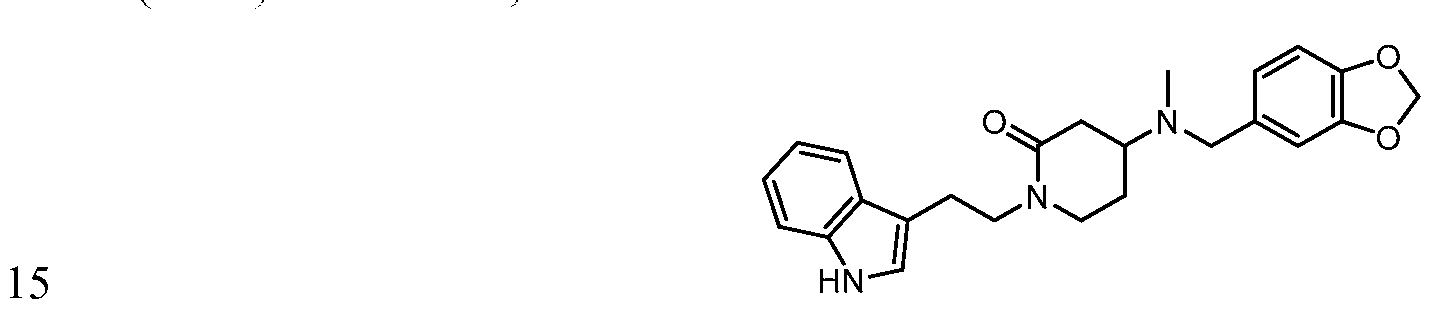
l-(2-(lH-Indol-3-yl)ethyl)-4-((benzo[d] [l,33di
2-one (LTL-II-103)
XH NMR (400 MHz, CDC13) δ 8.17 (s, 0.90 H), 7.67 (d, J = 8 Hz, 0.98 H), 7.38 (d, J - 8 Hz, 1.00 H), 7.22 (t, J = 7 Hz, 1.04 H), 7.14 (t, J= 7 Hz, 1.02 H), 7.04 (d, J = 2 Hz, 0.99 H), 6.83 (s, 0.98 H), 6.76 (m, 2.01 H), 5.95 (s, 2.00 H), 3.71 (m, 2.06 H), 3.46 (s, 1.96 H), 3.17 (comp, 4.11 H), 2.82 (m, 1.01 H), 2.66 (dd, J = 3 Hz, 17 Hz, 1.02 H), 2.48 (m, 1.02 S I ). 2.17 (s, 3.07 H), 1.93 (s, 1.00 H), 1.69 (m, 1.06 H); i 3C NMR (100 MHz, CDCI3) δ 169.4, 148.0, 146.9, 136.5, 127.8, 122.3, 122.2, 122.0, 1 19.6, 1 19.0, 113.5, 11 1.5, 109.3, 108.2, 101.2, 58.0, 56.7, 48.4, 47.0, 37.4, 35.1 , 26.6, 2.3.3 ; IR (film, NaCl) 3260, 2927, 1625, 1489, 1442, 1343, 1302, 1240, 1096, 1038, 929, 807, 741 cm"1; HRMS (ESI) m/z calc'd for C24H27N3O3 (M+Na)+ 428.19450; found, 428.19390.

l-(2-(lH-Indol-3-yl)ethyl)-4-(methylamino)piperidin-2-one (LTL-II-184)
XH NMR (500 MHz, CDC13) δ 8.31 (s, 0.87 H), 7.65 (d, ./ 8 Hz, 1.06 H), 7.36 (d, J - 8 Hz, 1.04 H), 7.20 (t, .7 - 7 Hz, 1.09 H), 7.13 (t, .7 - 7.13 Hz, 1 .10 H), 7.03 (s, 1.00 H), 3.67 (t, J= 7 Hz, 1.99 H), 3.22 (m, 1.03 H), 3.13 (m, 1.17 H), 3.05 (t, /= 7 Hz, 2.15 H), 2.84 (m, 1.05 H), 2.70 (dd, J ----- 3 Hz, 17 Hz, 1.03 H), 2.40 (s, 2.83 H), 2.26 (m, 1.62 H), 1.92 (m, 1 .03 H), 1 .57 (m, 1.13 H) ppm; i C NMR (500 MHz, CDCi3) δ 168.3, 136.3, 127.5, 122.001 , 121.968, 1 19.3, 1 18.7, 1 13.1, 1 1 1.2, 53.2, 48.12, 45.7, 43.42, 38.8, 33.3, 28.4, 22.9 ppm; IR (film, Nad) 3252, 3053, 2926, 2856, 2799, 2361, 1624, 1498, 1456, 1344, 1302, 1264, 1233, 1 158, 1102, 1011 cm 1; HRMS (ESI) m/z calcd for C ;,j ! N :() (M+Na)+ 294.15770; found, 294.15740.

l-(2-(lH-Indol-3-yl)ethyl)-4-(benzyl(methyl)amino)piperidin-2-one (LTL-II-144)
"Ή NMR (400 MHz, CDCI3) δ 8.04 (s, 0.79 H), 7.67 (d, J = 8 Hz, 0.98 H), 7.38 (d, ,/ = 8 Hz, 1.27 H), 7.33 (m, 4.46 H), 7.22 (t, ,/ 7 Hz, 1.05 H), 7.14 (t, J ------- 7 Hz, 1.03 H), 7.03
(s, 0.97 H), 3.70 (m, 2.01 H), 3.57 (s, 1.90 H), 3.17 (comp, 4.07 H), 2.83 (m, 0.91 H), 2.68 (dd, J - 3 Hz, 17 Hz, 0.95 H), 2.51 (m, 0.94 H), 2.20 (s, 3.00 H), 1.96 id. 12 Hz, 0.92 H), 1.68 (m, 1.23 H); l3C NMR (100 MHz, CDCI3) δ 136.2, 128.9, 128.4, 127.5, 122.05, 121.91, 1 19.4, 118.8, 113.2, 1 11.2, 57.9, 56.6, 48.1 , 46.7, 26.3, 23.0; IR (film, NaCI) 2923, 2851, 2793, 2242, 1625, 1496, 1456, 1343, 1302, 1260, 1233, 1 159, 1 101 , 1074, 1025, 909, 813, 741, 700 cm"1 : I I MS (ESI) m/z calc'd for C23H27N3O (M+Na)+ 384.20460; found, 384.20390.

l-(2-(lH-Indol-3-yl)ethyl)-4-((3-chlorobenzyl)(methyl)amino)piperidin-2-one (LTL-II-
151)
XH NMR (400 MHz, CDC13) δ 8.15 (s, 0.89 H), 7.65 (d, J - ----- 8 Hz, 1.24 H), 7.27 (m,
4.76 H), 7.21 (t, J= 7 Hz, 1.59 H), 7.13 (t, J= 7 Hz, 1.37 H), 7.05 (d, J= 2 Hz, 1.31 H), 3.74 (comp, 3.96 H), 3.12 (comp, 5.07 H), 2.69 (d, J = 18 Hz, 0.99 H), 2.53 (m, 0.83 H), 2.25 (s, 2.93 H), 2.10 (m, 1.21 H), 1.69 (m, 1.49 H); 13C NMR (100 MHz, CDC13) δ 135.2, 133.3, 128.6, 127.6, 126.4, 123.8, 121.0, 120.9, 118.3, 1 17.7, 1 12.2, 110.2, 56.4, 55.8, 47.1, 45.6, 36.2, 33.7, 25.3, 22.0; IR (film, NaCl) 3251, 3055, 2925, 2853, 1742, 1626, 1575, 1497, 1456, 1433, 1344, 1303, 1260, 1231, 1161, 1097, 1075, 1030, 784, 742, 684 cm" ; HRMS (ESI) m/z calc'd for C' . «l i .,.( 'l\ «0 (M+Na)+ 418.16570; found, 418.16490.

l-(2-(lH-Indol-3-yl)ethyl)-4-((3-methoxybenzyl)(methyl)amino)piperidin-2-one (LTL-
11-153)
XH NMR (400 MHz, CDC13) δ 8.32 (s, 0.88 H), 7.69 (d, J = 8 Hz, 1.01 H), 7.40 (d, ,/ = 8 Hz, 1.04 H), 7.30 (m, 1.72 H), 7.24 (t, J= 7 Hz, 1.34 H), 7.17 (t, J = 7 Hz, 1.03 H), 7.04 (d, J = 2 Hz, 1.00 H), 6.93 (m, 1.95 H) 6.86 (dd, 0.99 H), 3.85 (s, 3.02 H), 3.70 (m, 2.06 H), 3.57 (s, 1 .94 H), 3.12 (comp, 4.03 H), 2.86 (m, 0.96 H), 2.71 (m, 0.97 H), 2.53 (m, 0.96 H), 2.23 (s, 2.97 H), 1.97 (d, J = 12 Hz, 0.95 H), 1.68 (comp, 0.98 H); i3C NMR (100 MHz, CDCI3) δ 169.2, 159.7, 136.3, 129.3, 127.5, 122.02, 121.97, 121.0, 119.3, 1 18.7, 1 14.2, 1 13.1, 112.5, 1 11.2, 58.0, 56.5, 55.2, 48.1, 46.7, 37.3, 34.9, 26.2, 23.0; IR (film, NaCl) 3261 , 3055, 2935, 2852, 2791, 2360, 2242, 1624, 1491 , 1456, 1344, 1304, 1268, 1 152, 101 1 , 1043, 978, 910, 784, 743, 695 cm '; HRMS (ESI) m/z calc'd for C24H29N3O2 (M+H)+ 392.23330; found, 392.23290.

l-(2-(lH-Indol-3-yl)ethyl)-4-((3,5-di^
(LTL-I1-154)
Ή NMR (400 MHz, CDC13) δ 8.32 (s, 0.97 H), 7.66 (d, J - ----- 8 Hz, 1.05 H), 7.37 id, J
- 8 Hz, 1.04 H), 7.21 (t, J = 7 Hz, 1.08 H, 7.13 (t, .7 - 7 Hz, 1.05 H), 7.00 (d, J = 2 Hz, 1.02 H), 6.50 (d, J = 2 Hz, 1.99 H), 6.39 (m, 0.99 H), 3.80 (s, 6.24 H), 3.67 (t, J = 6 Hz, 2.00 H), 3.50 (s, 2.00 H), 3.19 (comp, 4.20 H), 2.83 (m, 1.00 H), 2.66 (m, 1.02 H), 2.50 (m, 1.00 H),
2.21 (s, 3.02 H), 1.93 (m, 1.01 H), 1.64 (m, 1.01 H); C NMR ( 100 MHz, CDC13) δ 170.1 , 161.6, 137.0, 128.1 , 122.64, 122.58, 1 19.9, 1 19.3, 113.7, 11 1.8, 107.0, 99.5, 58.5, 56.7, 55.6, 48.3, 46.9, 37.6, 35.1, 26.2, 23.1; IR (film, NaCl) 3261, 3057, 2936, 2840, 2792, 2243, 1613, 1498, 1457, 1430, 1344, 1299, 1234, 1204, 1 154, 1 101, 1065, 983, 910, 836, 739 cm"1; HRMS (ESI) m/z caic'd for found, 444.22520.

l-(2-(lH-Indol-3-yl)ethyl)-4-(methyl(3-(methylthio)benzyl)amino)piperidin-2-one (LTL-
11-157)
ln NMR (400 MHz, CDC13) δ 8.31 (s, 0.89 H), 7.69 (d, J = 8 Hz, 1.00 H), 7.40 (d, J = 8 Hz, 1.03 H), 7.30-7.09 (comp, 6.30 H), 7.03 (d, J= 2 Hz, 0.96 H), 3.71 (t, J = 6 Hz, 2.07 H), 3.55 (s, 2.00 H), 3.22 (comp, 4.12 H), 2.85 (ni, 1.01 H), 2.70 (m, 1.03 H), 2.52-2.45 (comp, 3.98 H), 2.21 (s, 2.98 H), 1.95 (m, 0.97 H), 1.67 (m, 0.99 H); i 3C NMR (100 MHz, CDC13) δ 169.2, 140.0, 138.4, 136.3, 128.8, 127.4, 126.6, 125.4, 125.1, 121.96, 1 19.26, 1 18.7, 1 13.1, 1 11.2, 57.8, 56.5, 48.1, 46.7, 37.3, 34.9, 26.3, 23.0, 15.8; IR (film, NaCl) 3261 , 3054, 2922, 2854, 1622, 1498, 1456, 1344, 1303, 1232, 1 158, 1 100, 1030, 780, 743, 686 cm '; HRMS (ESI) m/z caic'd for C24H29N3OS (M+Na)+ 430.19240; found, 430.19200.

I-(2-(iH-indo!-3-yl)eihy!)-4-((3-eh!ero-5-met^
(LTL-II-185)
¾ NMR (400 MHz, CDC13) δ 8.16 (s, 0.90 H), 7.66 (d, J = 8 Hz, 0.99 H), 7.37 (d, ,/
= 8 Hz, 1.00 H), 7.21 (t, J = 7 Hz, 1.05 H), 7.13 (t, J = 7 Hz, 1.04 H), 7.03 (d, J = 2 Hz, 0.98 H), 6.90 (8, 1.00 i n. 6.79 (s, 0.93 H), 6.76 (s, 0.90 H), 3.79 (s, 3.00 H), 3.70 (m, 2.1 1 H), 3.47 is, 1.79 H), 3.20 (m, 2.03 H), 3.06 (m, 2.05 H), 2.82 (m, 1.00 H), 2.65 (m, 0.98 H), 2.47 (m, 0.98 H), 2.17 (s, 2.99 H), 1.91 (m, 0.99 H), 1.64 (m, 1.13 H); C NMR (100 MHz, CDCI3) δ 169.1 , 160.3, 142.6, 136.2, 134.7, 127.5, 122.03, 121.94 120.8, 1 19.3, 118.8, 113.2, 1 12.73, 1 12.69, 1 1 1.2, 57.6, 56.7, 55.5, 48.1, 46.7, 37.4, 34.9, 26.3, 23.0; IR (film, NaCl) 3262, 3056, 2933, 2853, 2361, 1623, 1576, 1498, 1459, 1431 , 1344, 1312, 1271, 1233, 1150, 1097, 1053,
980, 845, 743, 679, 621 cm"1 ; HRMS (ESI) m/z calc'd for C24H28C1]N302 (M+Na f 448.17620: found, 448.17580.

(l-(2-(lH-Indol-3-yl)ethyl)-2-oxopiperidin-4-yl)-L-methionine (LTL-II-225)
¾ NMR (400 MHz, CDC13) δ 8.10 (bs, 0.78 H), 7.68 (d, J= 7.8, 1.03 H), 7.39 (d, J = 7.8), 7.21 (m, 1.14 H), 7.13 (m, 1.10 IT), 7.07 (s, 1.01 S I ). 4.12 (bs, 1.00 H), 3.70-3.67 (m, 2.01 H), 3.36-3.32 (m, 1.1 1 H), 3.12-3.05 (m, 3.1 1 H), 2.78-2.68 (comp, 6.51 H), 2.45-2.39 (m, 0.97 H), 1.88 (bs, 1.07 H), 1.78-1.70 (m, 1.06 H), 1.16 (t, J = 7.2, 8.87 H).

l-(2-(lH-Indol-3-yl)ethyl)-4-(((S)-l-hydroxy-4-(methylthio)butan-2-yl)amino)piperidin-
2-one (LTL-II- 228)
lll NMR (400 MHz, CDCI3) δ 8.37 (bs, 0.5 IT), 7.64 (dd, J = 7.4 Hz, j - 2.3 Hz, 0.8 H), 7.36 i d. ,/ - 8.2 Hz, 0.79 H), 7.19 (m, 0.82 H), 7.12 (m, 0.97 H), 7.05 (s, 0.95 H), 3.74- 3.56 (m, 2.55 IT) 3.45-3.36 (m, 1.15 IT), 3.20-2.98 (comp, 5.01 H), 2.92 (m, 1.1 1 H), 2.76- 2.71 (m, 2.19 H), 2.59-2.44 (comp, 3.1 1 H), 2.40-2.27 (0.97 H), 2.09 (s, 3.00 H), 1 .97-1.92 (m, 0.96 H), 1.77-1.74 (m, 1.97 H), 1.69- 1.57 (m, 0.74 H), 1.41-1.37 (t, J= 7.3 Hz, 1.15 H).

4-((3,5-Dichlorobenzyl)(methyl)amino)-l-(3-(2-hydroxyphenyl)propyl)piperidin-2-one
(LTL-II-241)
XH NMR (400 MHz, CDC13) δ 7.25 (s, 1.08 H), 7.21 (s, 2.00 H), 7.11-7.06 (comp,
2.32 H), 6.86-6.83 (comp, 2.14 H) 4.32 (dd, 0.75 H), 4.17-4.13 (m, 0.76 H), 3.51 (s, 3.19 H), 3.40-3.32 (m, 2.23 H), 3.29-3.22 (m, 1.05 H), 3.16-3.06 (m, 1.14 H), 2.99-2.81 (m, 3.14 H), 2.68-2.59 (m, 3.13 H), 2.46-2.39 (m, 1.08 H), 2.34-2.30 (m, 2.47 H), 2.19 (s, 3.36 H), 2.06- 2.03 (m, 1.35 H), 1.95-1.87 (m, 1.83 H), 1.81-1.67 (m, 3.3 H); MS (ESI + APCI) m/z calc'd for C22H27Ci2 202 (M+H)+ 421.14; found 421.2.
 l-Benzyl-4-((3,5-dichlorobenzyl)(methyl)amino)piperidin-2-one (JJS-4-137)
A solution of JJS-4-134 (14 mg, 0.064 mmol) and 3,5-dichlorobenzaldehyde (17 mg, 0.10 mmol) in 1 ,2-dichloroethane (1.0 mL) was stirred for 2 hours, after which time sodium triacetoxyborohydride (27 mg, 0.13 mmol) was added. The reaction mixture was stirred for 12 hours then quenched with 15% aqueous sodium bicarbonate solution (2 mL). The layers were separated and the aqueous solution was extracted with (¾(¾ (3 x 7 mL). The combined organic layers were dried (Na2S04), filtered, and concentrated under reduced pressure to give a light yellow oil that was purified via S1O2 chromatography, eluting with triethylamine, hexanes, diethyl ether (1 :49:50)— > triethylamine/diethyl ether (1 :99) to give 7 mg of JJS-4-137 (29%) as a colorless oil: XH NMR (400 MHz, CD3CN) δ 7.38-7.25 (comp, 8 H), 4.67 (d, J = 14.8 Hz, 1 H), 4.43 (d, J = 14.8 Hz, 1 H), 3.63-3.53 (m, 2 H), 3.32-3.25 (m, 1 H), 3.23-3.15 (m, 1 H), 2.98-2.90 (m, 1 H), 2.60-2.43 (comp, 2 H), 2.2 (s, 3 H), 2.08-2.0 (m, 1H), 1.82-1.72 (m, 1 H); low resolution mass spectrum (ESI) m/z = 377.2 (M+l). Example 2: Biological Activity
. Ammoacylation Assay
Enzyme activity was quantified by the attachment of [3H]methionine to tRNA in the presence of the T. brucei MetRS enzyme. Reactions were performed in 96-well filter plates with Durapore membranes (MSHV 4B 10; Millipore) in volumes of 75 mL. The reaction was performed with 25 mM HEPES (pH 7.9), 10 mM MgCl2, 50 mM KC1, 0.2 mM spermine, 0.1 mg/mL bovine serum albumin, 2.5 mM dithiothreitol, 1% DMSO, and 1 U/mL pyrophosphatase (11643; Sigma). Recombinant enzyme (10 nM) and compound inhibitors (starting concentration varied depending on potency and included 12 serial 2-fold dilutions) were mixed with the buffer and preincubated for 15 min. To start the reaction, 400 μg/mL bulk Escherichia coli tRNA (R4251 ; Sigma), 0.1 mM ATP, and 250 nM [3H]methionine (80 Ci/mmol) were added. The plate was incubated without shaking at room temperature for 120 min. The reactions were stopped by the addition of 100 μϊ^ cold 10% trichloroacetic acid. The reaction components were separated from tRNA by filtration through a vacuum manifold and
washed three times with cold 10% trichloroacetic acid. The filter plates were dried overnight, scintillation fluid was added, and the counts on the plates were determined in a scintillation plate counter. Samples were run in quadruplicate and percent inhibition was calculated using two different controls (no enzyme and no test compound) with the following formula:
% Inhibition = 100 x (Mnd -Dtd)
(Mnd -Mne) where Mnd is the average no drug control, Dtd is each test drug value, and Mne is the average no enzyme control. IC50 values were then calculated by nonlinear regression (sigmoidal dose response) in Prism 3.0.
2. Growth Inhibition Assay
T. brucei brucei (bloodstream form strain 427) were cultured in HMI-9 medium containing 10% fetal bovine serum, penicillin, and streptomycin at 37 °C with 5% CO2 and T. brucei rhodesiense (bloodstream form STIB900) were grown in HMI-18 containing 20% fetal bovine serum, penicillin, and streptomycin (Hirumi and Hirumi, 1989). Drug sensitivity of the T. brucei strain was determined in 24-well or 96-well microtiter plates in triplicate with an initial inoculum of 5 x 10⁴ trypomastigotes per well. Compound stock solutions were prepared in DMSO at 20 mM and added in serial dilutions for a final volume of 200 nL/well. Final compound concentrations tested were 1 μΜ and 10 μΜ. Parasite growth was quantified at 48 h by the addition of Alamar Blue (Alamar Biosciences, Sacramento, CA) (Raz, et ah, 1997). Pentamidine isethionate (Sigma- Aldrich) was included in each assay as a positive control. Standard errors within assays were consistently less than 15% and all samples were performed in duplicate.
■gicai Data
Activity of Example Compounds:
ID: ay for 927/4
dentify 927/4

ID: dentify 927/4


Table I : Percent growth inhibition for compounds with designated ¾ and R¾ at 10 μΜ treatment for 48 hours,


No growth inhibition was observed following 1 μΜ treatment of T. brucei for 48 hours for any compound in Table 1 as determined by cell density measurements (FIG. 1A). However, some compounds did significantly inhibit proliferation of T. brucei in vitro following 10 μΜ treatment for 48 hours (FIG. IB). Percentage of cell growth inhibition was determined by comparing the final cell density of the drug treated samples to DMSO control (FIG. 1C), and negative growth inhibition indicated that drug treatment resulted in cell density higher than the DMSO control (Table 1). Thus, ten of the eighteen compounds tested were successful at inhibiting cell growth. The top compounds had an estimated GI50 (amount of drug that inhibits population growth 50%) between 1 μΜ - 10 μΜ. Other compounds tested showed also significant growth inhibition following 10 μΜ treatment (Table 2 and FIG. 2B).
Table 2, Other compounds tested for Γ. brucei cell growth inhibition following treatment at 1 μΜ or 10 μΜ for 48 hours.


Table 3. EC50 and IC§e values for T. brucei cell growth inhibition following treatment by specific compounds.

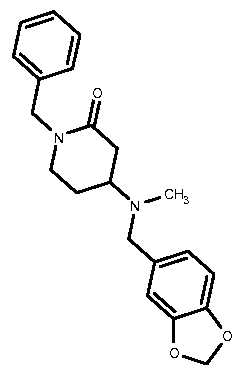
JJS-4- 150-2 > 20000.0 > 10000.0
All of the compositions and methods disclosed and claimed herein can be made and executed without undue experimentation in light of the present disclosure. While the compositions and methods of this invention have been described in terms of certain embodiments, it will be apparent to those of skill in the art that variations may be applied to the compositions and methods and in the steps or in the sequence of steps of the methods described herein without departing from the concept, spirit and scope of the invention. More specifically, it will be apparent that certain agents which are both chemically and physiologically related may be substituted for the agents described herein while the same or similar results would be achieved. All such similar substitutes and modifications apparent to those skilled in the art are deemed to be within the spirit, scope and concept of the invention as defined by the appended claims.
REFERENCES
The following references, to the extent that they provide exemplary procedural or other details supplementary to those set forth herein, are specifically incorporated herein by reference.
Handbook of Pharmaceutical Salts: Properties, and Use (P. H. Stahl & C. G.
Wermuth eds., Verlag Helvetica Chimica Acta, 2002).
Hirumi and Hirumi, J. Parasitol, 75:985-989, 1989.
March 's Advanced Organic Chemistry: Reactions, Mechanisms, and Structure (2007)
Raz, et al., Acta Trop., 68: 139-147, 1997.
WHO Media Centre, "Fact Sheet No. 259. Trypanosomiasis, Human African (sleeping sickness), " March 2014.
Claims
WHAT IS CLAIMED IS:
1. A compound of the formula:

R-5 is hydrogen, alkyl(C<i2), acyl(c<i2), substituted alkyl(C<i2), or substituted acyl(c<i2), or is taken together with I¾ as described below;
R6 is alkyl(C<i2), cycloalkyl(C<i2), -alkanediyl(c<8)-cycloalkyl(c<i2), aryl(c<i2), heteroaryl(c<i2), aralkyl(C<i2), heterocycloalkyl(C<i2), acyl(C<i2), -alkanediyl(c<8)~heterocycloalkyl(c<i2), or a substituted version of any of these groups, or is taken together with 5 as described below;
R5 and R6 are taken together and are alkanediyl(c<8), alkoxydiyl(c<8), alkylaminodiyl(c<8), or a substituted version of any of these groups;
R7 is hydrogen, alkyl(c<i2), or substituted alkyl(c<i2);
X2 is -C(O)- alkanediyl(c<8), cycloalkanediyl(c<8), alkoxydiyl(c<8), alkylaminodiyl(c<8), -C(0)-alkanediyl(c<8), -C(0)-alkoxydiyl(C<8), -C(0)-alkylaminodiyl(c<8), alkanediyl(C<8)~C(0)-, alkoxydiyl(c<8)-C(0)-, alkylaminodiyl(c<8)_C(0)-, or a substituted version of any of these groups; and
R8 is alkyl(c<i2), aryl(C<i8), heteroaryl( <i 8), aralkyl(C<i8), heteroaralkyl( <i 8), heterocycloalkyl(c<i2), acyl(c<i2), -alkanediyl(c<8)~heterocycloalkyl(c<i2), or a substituted version of any of these groups; or
Rs is a group of the formula:
 wherein:
X4 is hydrogen, alkyl(C<8), or substituted alkyl(C<8); and
Ri4 is hydroxy or alkoxy(c<i2), aryloxy(c<i2), aralkoxy(c<i2), or a substituted version of any of these groups; provided that when Rs is pyridylmethyl, then R5 and R6 are not taken together as alkylaminodiyl(c<i2) or R6 is not methyl; or a compound of the formula:

Ri is hydrogen, hydroxy, amino, halo, nitro, carboxy, cyano, sulfate, or alkyl(c<i8), aryl(c<i8), aralkyl(c<i8), heteroaryl(c<i8), heteroaralkyl(c<i8), alkylamino(c<i2), dialkylamino(c<i2), arylamino(c<i2), heteroarylaminO(c<i2), aralkylaminO(c<i2), or a substituted version of any of these groups or alkyl(C<i8), aryl(c<i8), aralkyl(C<i8), and heteroaryl(C<i8) are also substituted with amino, alkylamino, or dialkylamino provided that the total number of carbons is not greater than the carbon limit; y is 1, 2, 3, or 4;
R2 is hydrogen, or
alkyl(c<i2), aryl(c<i2), heteroaryl(c<i2), aralkyl(c<i8), heteroaralkyl(c<i8), -alkanediyl(c<8)~heterocycloalkyl(c<i2), or a substituted version of any of these groups;
R3 is hydrogen, alkyl(C<i2), or substituted alkyl(C<i2);
R4 is hydrogen or hydroxy; and
Xi is hydrogen, or alkyl(C<i2), aryl(C<i2), aralkyl(C<i2), heteroaryl(C<i2), or a substituted version of any of these groups;
provided that R2 is not

when R4 is hydroxy; or compound of the formula:
1
 (III) wherein:
R9 is aryl(c<i2), substituted aryl(c<i2), heteroaryl(c<i2), or substituted heteroaryl(c<i2);
Rio is heterocycloalkyl(c<i8), heteroaryl(C<i8), or a substituted version of either of these groups, or either of these groups wherein the group is substituted with alkyl(C<i2), aryl(C<i2), aralkyl(C<i2), heteroaryl(C<i2) wherein any one of these groups have been substituted with amino, alkylaminO(c<6), or dialkylaminO(c<6), alkylaminO(c<i2), dialkylamino(c<i2), arylamino(c<i2), heteroarylamino(c<i2); and
2 is 0, 1, 2, 3, or 4; or a compound of the formula:

Ri2 is aryl(c<i2), substituted aryl(c<i2), heteroaryl(c<i2), or substituted heteroaryl(c<i2);
Ri3 is heterocycloalkyl(C<i8), heteroaryl(C<i8), or a substituted version of either of these groups, or either of these groups wherein the group is substituted with alkyl(C<i2), aryl(C<i2), aralkyl(C<i2), heteroaryl(C<i2) wherein any one of these groups have been substituted with amino; alkylaminO(c<6); or dialkylaminO(c<6), alkylaminO(c<i2), dialkylaminO(c<i2), arylaminO(c<i2), heteroarylaminO(c<i2); and y3 is 0, 1, 2, 3, or 4; or a pharmaceutically acceptable salt, optical isomer, or tautomer thereof.
2. The compound of claim 1 further defined as:

R6 is alkyl(c<i2), cycloalkyl(c<i2), -alkanediyl(c<8)-cycloalkyl(c<i2), aryl(c<i2), heteroaryl(c<i2), aralkyl(c<i2), heterocycloalkyl(c<i2), acyl(c<i2), -alkanediyl(c<8)~heterocycloalkyl(c<i2), or a substituted version of any of these groups, or is taken together with R5 as described below;
R5 and R6 are taken together and are alkanediyl(c<8), alkoxydiyl(c<8), alkylaminodiyl(c<8), or a substituted version of any of these groups;
R7 is hydrogen, alkyl(C<i2), or substituted alkyl(C<i2);
X2 is -C(O)- alkanediyl(c<8), cycloalkanediyl(c<8), alkoxydiyl(c<8), alkylaminodiyl(c<8), -C(0)-alkanediyl(c<8), -C(0)-alkoxydiyl(C<8), -C(0)-alkylaminodiyl(c<8), alkanediyl(c<8)~C(0)-, alkoxydiyl(c<8) ~C(0)-, alkylaminodiyl(c<8) ~C(0)-, or a substituted version of any of these groups;
R8 is alkyl(c<i2), aryl(c<i8), heteroaryl(c<i8), aralkyl(c<i8), heteroaralkyl(c<i8), heterocycloalkyl(c<i2), acyl(c<i2), -alkanediyl(c<8)~heterocycloalkyl(c<i2), or a substituted version of any of these groups; provided that when R8 is pyridylmethyl, then R5 and R6 are not taken together as alkylaminodiyl(c<i2) or R6 is not methyl; or a compound of the formula:

R2 is hydrogen, or alkyl(c<i2), aryl(c<i2), heteroaryl(c<i2), aralkyl(C<i8), heteroaralkyl(c<i8), -alkanediyl(c<8)~heterocycloalkyl(c<i2), or a substituted version of any of these groups;
R3 is hydrogen, alkyl(C<i2), or substituted alkyl(C<i2);
R4 is hydrogen or hydroxy; and
Xi is hydrogen, or alkyl(C<i2), aryl(c<i2), aralkyl(c<i2), heteroaryl(c<i2), or a substituted version of any of these groups;

when R4 is hydroxy; or
a compound of the formula:

Rg is aryl(C<i2), substituted aryl(C<i2), heteroaryl(C<i2), or substituted heteroaryl(c<i2);
Rio is heterocycloalkyl(c<i8), heteroaryl(c<i8), or a substituted version of either of these groups, or either of these groups wherein the group is substituted with alkyl(C<i2), aryl(C<i2), aralkyl(C<i2), heteroaryl(C<i2) wherein any one of these groups have been substituted with amino, alkylaminO(c<6), or dialkylaminO(c<6), alkylaminO(c<i2), dialkylaminO(c<i2), arylaminO(c<i2), heteroarylaminO(c<i2); and y2 is 0, 1, 2, 3, or 4; or a compound of the formula:

Ri2 is aryl(C<i2), substituted aryl(C<i2), heteroaryl(C<i2), or substituted heteroaryl(c<i2);
Ri3 is heterocycloalkyl(c<i8), heteroaryl(C<i8), or a substituted version of either of these groups, or either of these groups wherein the group is substituted with alkyl(C<i2), aryl(C<i2), aralkyl(C<i2), heteroaryl(C<i2) wherein any one of these groups have been substituted with amino; alkylaminO(c<6); or dialkylaminO(c<6), alkylaminO(c<i2), dialkylaminO(c<i2), arylaminO(c<i2), heteroarylaminO(c<i2); and y3 is 0, 1, 2, 3, or 4; or a pharmaceutically acceptable salt, optical isomer, or tautomer thereof.
3. The compound of either claim 1 or claim 2, wherein the compound is further defined as:

Ri is hydrogen, hydroxy, amino, halo, nitro, carboxy, cyano, sulfate, or alkyl(c<i8), aryl(c<i8), aralkyl(c<i8), heteroaryl(c<i8), heteroaralkyl(c<i8), alkylaminO(c<i2), dialkylaminO(c<i2), arylaminO(c<i2), heteroarylaminO(c<i2), aralkylaminO(c<i2), or a substituted version of any of these groups or alkyl(C<i8), aryl(C<i8), aralkyl(C<i8), and heteroaryl(C<i8) are also substituted with amino, alkylamino, or dialkylamino provided that the total number of carbons is not greater than the carbon limit; y is 1, 2, 3, or 4;
R2 is aryl(c<i2), heteroaryl(c<i2), aralkyl(c<i2), heteroaralkyl(c<i2), -alkanediyl(c<8)~heterocycloalkyl(c<i2), or a substituted version of any of these groups;
R3 is hydrogen, alkyl(C<i2), or substituted alkyl(C<i2);
R4 is hydrogen or hydroxy; and Xi is hydrogen, or alkyl(C<i2), aryl(C<i2), aralkyl(C<i2), heteroaryl(C<i2), or a substituted version of any of these groups;

when R4 is hydroxy.
4. The compound according to any one of claims 1-3, wherein the compound is further defined as:

Ri is hydrogen, hydroxy, amino, halo, nitro, carboxy, cyano, sulfate, or alkyl(c<i8), aryl(c<i8), aralkyl(c<i8), heteroaryl(c<i8), heteroaralkyl(c<i8), alkylaminO(c<i2), dialkylaminO(c<i2), arylaminO(c<i2), heteroarylaminO(c<i2), aralkylaminO(c<i2), or a substituted version of any of these groups or alkyl(C<i8), aryl(C<i8), aralkyl(C<i8), and heteroaryl(C<i8) are also substituted with amino, alkylamino, or dialkylamino provided that the total number of carbons is not greater than the carbon limit; y is 1, 2, 3, or 4;
R2 is aryl(c<i2), heteroaryl(c<i2), aralkyl(c<i2), heteroaralkyl(c<i2), or a substituted version of any of these groups;
R3 is hydrogen, alkyl(C<i2), or substituted alkyl(C<i2);
R4 is hydrogen or hydroxy; and Xi is hydrogen, or alkyl(C<i2), aryl(C<i2), aralkyl(C<i2), heteroaryl(C<i2), or a substituted version of any of these groups;

when R4 is hydroxy.
5. The compound according to any one of claims 1-4, wherein the compound is further defined as:

Ri is hydrogen, hydroxy, amino, halo, nitro, carboxy, cyano, sulfate, or alkyl(c<i8), aryl(c<i8), aralkyl(c<i8), heteroaryl(c<i8), heteroaralkyl(c<i8), alkylaminO(c<i2), dialkylaminO(c<i2), arylaminO(c<i2), heteroarylaminO(c<i2), aralkylaminO(c<i2), or a substituted version of any of these groups or alkyl(C<i8), aryl(C<i8), aralkyl(C<i8), and heteroaryl(C<i8) are also substituted with amino, alkylamino, or dialkylamino provided that the total number of carbons is not greater than the carbon limit; y is 1, 2, 3, or 4;
R2 is aryl(c<i2), heteroaryl(c<i2), aralkyl(c<i2), heteroaralkyl(c<i2), or a substituted version of any of these groups;
R3 is alkyl(c<i2), or substituted alkyl(C<i2);
R4 is hydroxy; and Xi is hydrogen, or alkyl(C<i2), aryl(C<i2), aralkyl(C<i2), heteroaryl(C<i2), or a substituted version of any of these groups;
when R4 is hydroxy; or a pharmaceutically acceptable salt, optical isomer, or tautomer thereof. 6. The compound of either claim 1 or claim 2, further defined as:

R5 is hydrogen, alkyl(c<i2), acyl(c<i2), substituted alkyl(C<i2), or substituted

R6 is alkyl(c<i2), cycloalkyl(c<i2), -alkanediyl(c<8)-cycloalkyl(c<i2), aryl(c<i2), heteroaryl(c<i2), aralkyl(C<i2), heterocycloalkyl(c<i2), acyl(c<i2), -alkanediyl(c<8)~heterocycloalkyl(c<i2), or a substituted version of any of these groups;
R7 is hydrogen, alkyl(c<i2 or substituted alkyl(c<i2);
X2 is -C(O)- alkanediyl(c<8), cycloalkanediyl(c<8), alkoxydiyl(c<8), alkylaminodiyl(c<8), -C(0)-alkanediyl(C<8), -C(0)-alkoxydiyl(c<8), -C(0)-alkylaminodiyl(c<8), alkanediyl(C<8)~C(0)-,
alkoxydiyl(c<8) ~C(0)-, alkylaminodiyl(c<8) ~C(0)-, or a substituted version of any of these groups; and
R8 is alkyl(c<i2), aryl(c<i8), heteroaryl(c<i8), aralkyl(c<i8), heteroaralkyl(c<i8), heterocycloalkyl(c<i2), acyl(c<i2), -alkanediyl(c<8)~heterocycloalkyl(c<i2), or a substituted version of any of these groups; or
Rs is a group of the formula:
 wherein:
X4 is hydrogen, alkyl(C<8), or substituted alkyl(C<8); and
Ri4 is hydroxy or alkoxy(c<i2), aryloxy(c<i2), aralkoxy(c<i2), or a substituted version of any of these groups; or a pharmaceutically acceptable salt, optical isomer, or tautomer thereof.
7. The compound according to any one of claims 1, claim 2 or 6, further defined as:

Rs is hydrogen, alkyl(C<i2), or substituted alkyl(C<i2);
R6 is alkyl(c<i2), cycloalkyl(c<i2), -alkanediyl(C<8)-cycloalkyl(C<i2), aryl(c<i2), heteroaryl(c<i2), aralkyl(c<i2), heterocycloalkyl(c<i2), acyl(c<i2), -alkanediyl(c<8)~heterocycloalkyl(c<i2), or a substituted version of any of these groups;
R7 is hydrogen, alkyl(C<i2), or substituted alkyl(C<i2);
X2 is alkanediyl(c<8), cycloalkanediyl(c<8), alkoxydiyl(c<8), alkylaminodiyl(c<8), or a substituted version of any of these groups; and
R8 is alkyl(c<i2), aryl(c<i8), heteroaryl(c<i8), aralkyl(c<i8), heteroaralkyl(c<i8), heterocycloalkyl(c<i2), acyl(c<i2), -alkanediyl(c<8)~heterocycloalkyl(c<i2), or a substituted version of any of these groups; or
Rs is a group of the formula:
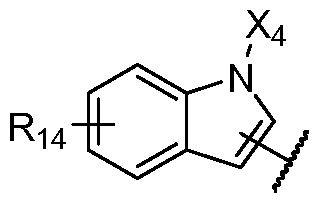 wherein:
X4 is hydrogen, alkyl(C<8), or substituted alkyl(C<8); and
Ri4 is hydroxy or alkoxy(c<i2), aryloxy(c<i2), aralkoxy(c<i2), or a substituted version of any of these groups; or a pharmaceutically acceptable salt, optical isomer, or tautomer thereof.
8. The compound according to any one of claims 1, 2, 6, and 7, further defined as:

R5 is hydrogen, alkyl(c<i2), or substituted alkyl(c<i2);
R6 is -alkanediyl(c<8)-cycloalkyl(C<i2), aryl(C<i2), heteroaryl(c<i2), aralkyl(C<i2), heterocycloalkyl(c<i2), -alkanediyl(c<8)~heterocycloalkyl(c<i2), 0r a substituted version of any of these groups;
R7 is hydrogen, alkyl(c<i2), or substituted alkyl(c<i2);
X2 is alkanediyl(c<8), cycloalkanediyl(c<8), alkoxydiyl(c<8), alkylaminodiyl(c<8), or a substituted version of any of these groups; and
R8 is alkyl(c<i2), aryl(c<i8), heteroaryl(c<is), aralkyl(C<i8), heteroaralkyl(C<i8), heterocycloalkyl(c<i2), acyl(C<i2), -alkanediyl(c<8)~heterocycloalkyl(c<i2), or a substituted version of any of these groups; or
Re is a group of the formula:
 wherein:
X4 is hydrogen, alkyl(C<8), or substituted alkyl(c<s); and
Ri4 is hydroxy or alkoxy(c<i2), aryloxy(c<i2), aralkoxy(c <i2), or a substituted version of any of these groups; or a pharmaceutically acceptable salt, optical isomer, or tautomer thereof.
9. The compound according to any one of claims 1, 2, and 6-8, further defined as:

R6 is -alkanediyl(c<8)-cycloalkyl(c<i2), aryl(c<i2), heteroaryl(c<i2), aralkyl(c<i2), heterocycloalkyl(c<i2), -alkanediyl(c<8)_heterocycloalkyl(C<i2), or a substituted version of any of these groups;
R7 is hydrogen, alkyl(c<i2), or substituted alkyl(c<i2);
X2 is alkanediyl(c<8), cycloalkanediyl(c<8), alkoxydiyl(c<8), alkylaminodiyl(c<8), or a substituted version of any of these groups; and
Rs is aryl(C<i8), heteroaryl(C<i8), heterocycloalkyl(C<i2), or a substituted version of any of these groups; or
Rs is a group of the formula:
 wherein: hydrogen, alkyl(C<8), or substituted alkyl(C<8); and is hydroxy or alkoxy(C<i2), aryloxy(C<i2), aralkoxy(C<i2), substituted version of any of these groups; or a pharmaceutically acceptable salt, optical isomer, or tautomer thereof. The compound of either claim 1 or claim 2, further defined as:
R1
 (III) wherein:
Rg is substituted aryl(C<i2) or substituted heteroaryl(C<i2);
(III) wherein:
Rg is substituted aryl(C<i2) or substituted heteroaryl(C<i2);
Rio is heterocycloalkyl(c<i8), heteroaryl(C<i8), or a substituted version of either of these groups, or either of these groups wherein the group is substituted with alkyl(C<i2), aryl(C<i2), aralkyl(C<i2), heteroaryl(C<i2) wherein any one of these groups have been substituted with amino; alkylaminO(c<6); or dialkylaminO(c<6), alkylaminO(c<i2), dialkylaminO(c<i2), arylaminO(c<i2), heteroarylaminO(c<i2); and y2 is 0, 1, 2, 3, or 4.
11. The compound according to any one of claims 1, 2, and 11, further defined as:
R1
 (III) wherein:
R9 is substituted aryl(c<i2) or substituted heteroaryl(c<i2);
Rio is heterocycloalkyl(C<i8), heteroaryl(C<i8), or substituted heteroaryl(C<i8); and y2 is 0, 1, 2, 3, or 4.
12. The compound of either claim 1 or claim 2, further defined as:

Ri3 is heterocycloalkyl(c<i8), heteroaryl(C<i8), or a substituted version of either of these groups, or either of these groups wherein the group is substituted with alkyl(C<i2), aryl(C<i2), aralkyl(C<i2), heteroaryl(C<i2) wherein any one of these groups have been substituted with amino; alkylaminO(c<6); or dialkylaminO(c<6), alkylaminO(c<i2), dialkylaminO(c<i2), arylaminO(c<i2), heteroarylaminO(c<i2); and y3 is 0, 1, 2, 3, or 4.
The compound according to any one of claim 1, claim 2, and claim 12, further defined

Ri2 is substituted aryl(c<i2) or substituted heteroaryl(c<i2);
Ri3 is heterocycloalkyl(C<i8), heteroaryl(C<i8), or substituted heteroaryl(C<i8);
and y3 is 0, 1, 2, 3, or 4.
The compound according to any one of claims 1-5, wherein the compound is of formula II.
The compound according to any one of claims 1, 2, and 6-9, wherein the compound is of formula I.
The compound according to any one of claims 1, 2, and 10-11, wherein the compound is of formula III.
17. The compound according to any one of claims 1, 2, and 12-13, wherein the compound is of formula IV.
18. The compound according to any one of claims 1-4 and 14, wherein Ri is fluoro, chloro, bromo, or iodo.
19. The compound according to any one of claims 1-4 and 14, wherein Ri is aryl(c<i2), heteroaryl(C<i2), alkylaminO(c<i2), arylaminO(c<i2), heteroarylaminO(c<i2), aralkylaminO(c<i2), or a substituted version of any of these groups.
20. The compound according to any one of claims 1-4 and 14, wherein Ri is alkyl(C<i8), aryl(C<i8), aralkyl(C<i8), and heteroaryl(C<i8) are substituted with amino, alkylamino, or dialkylamino provided that the total number of carbons is not greater than the carbon limit.
21. The compound according to any one of claims 1, 14, and 18-20, wherein R2 is aralkyl(c<i8).
22. The compound according to any one of claims 1, 14, and 18-20, wherein R2 is benzyl or phenethyl.
23. The compound according to any one of claims 1, 14, and 18-20, wherein R2 is heteroaryl(C<i2) or heteroaralkyl(C<i8).
24. The compound according to any one of claims 1, 14, and 18-23, wherein R3 is alkyl(c<i2).
25. The compound of claim 24, wherein R3 is methyl.
26. The compound according to any one of claims 1, 14, or 18-25, wherein R4 is hydroxy.
27. The compound according to any one of claims 1, 14, or 18-26, wherein Xi is hydrogen.
28. The compound according to any one of claims 1, 6-9, 15, wherein R5 is hydrogen, alkyl(c<i2), or substituted alkyl(C<i2).
29. The compound of claim 28, wherein R5 is hydrogen.
30. The compound of claim 28, wherein R5 is alkyl(C<i2).
31. The compound of claim 30, wherein R5 is methyl.
32. The compound according to any one of claims 1, 6-9, 15, and 28-31, wherein R6 is alkyl(C<i2) or substituted alkyl(C<i2).
33. The compound of claim 32, wherein Re is -CH(C02H)CH2CH2SCH3 or -CH(CH2OH)CH2CH2SCH3.
34. The compound according to any one of claims 1, 6-9, 15, and 28-31, wherein R6 is -alkanediyl(c<8)~cycloalkyl(c<i2) or substituted -alkanediyl(c<8)~cycloalkyl(C<i2).
35. The compound of claim 34, wherein R6 is -CH2C6Hn.
36. The compound according to any one of claims 1, 6-9, 15, and 28-31, wherein R6 is aralkyl(c<i2) or substituted aralkyl(c<i2).
37. The compound of claim 36, wherein R6 is aralkyl(C<i2).
38. The compound of claim 37, wherein R6 is benzyl or phenethyl.
39. The compound of claim 36, wherein R6 is substituted aralkyl(C<i2).
40. The compound of claim 39, wherein R^ is 3-chlorobenzyl, 3-methoxybenzyl, 3- thiomethylbenzyl, 5-methoxybenzyl, 3-chloro-5-methoxybenzyl, 3,5-dichlorobenzyl, 3,5-dimethoxybenzyl, 3,4,5-trimethoxybenzyl, or a group of the formula:

41. The compound according to any one of claims 1, 6-9, 15, or 28-38, wherein R7 is hydrogen.
42. The compound according to any one of claims 1, 6-9, 15, and 28-38, wherein R7 is alkyl(c<i2) or substituted alkyl(c<i2).
43. The compound of claim 42, wherein R7 is hydroxymethyl, 1 -hydroxy ethyl, or 1- methoxyethyl.
44. The compound according to any one of claims 1, 6-9, 15, and 28-43, wherein the bond between the carbon atoms 1 and 2 of formula II is a single bond.
45. The compound according to any one of claims 1, 6-9, 15, and 28-43, wherein the bond between the carbon atoms 1 and 2 of formula II is a double bond.
46. The compound according to any one of claims 1, 6-9, 15, and 28-45, wherein X2 is alkanediyl(c<8).
47. The compound of claim 46, wherein X2 is -CH2- -CH2CH2- or -CH2CH2CH2-
48. The compound according to any one of claims 1, 6-9, 15, and 28-45, wherein X2 is alkoxydiyl(c<8).
49. The compound of claim 48, wherein X2 is -CH2CH20-
50. The compound according to any one of claims 1, 6-9, 15, and 28-46, wherein R8 is aryl(C<i8) or substituted aryl(C<i8).
51. The compound of claim 50, wherein R8 is phenyl.
52. The compound of claim 50, wherein R8 is substituted aryl(C<i8).
53. The compound of claim 52, wherein R8 is 2-hydroxyphenyl.
54. The compound according to any one of claims 1, 6-9, 15, and 28-46, wherein R8 is heteroaryl(C<i8) or substituted heteroaryl(C<i8).
55. The compound of claim 54, wherein R8 is heteroaryl(C<i8).
56. The compound of claim 55, wherein R8 is 3-indolyl.
57. The compound of claim 54, wherein R8 is substituted heteroaryl(C<i8).
58. The compound of claim 57, wherein R8 is 4-hydroxy-3-indolyl, 5-hydroxy-3-indolyl, and 5-methoxy-3-indolyl.
59. The compound according to any one of claims 1, 6-9, 15, and 28-46, wherein R8 is heterocycloalkyl(c<i2).
The compound according to any one of claims 1, 6-9, 15, and 28-46, wherein R8 further defined as:
 wherein:
X4 is hydrogen, alkyl(C<8), or substituted alkyl(C<8); and
Ri4 is hydroxy or alkoxy(c<i2), aryloxy(c<i2), aralkoxy(c<i2), or a substituted version of any of these groups.
61. The compound of claim 60, wherein X4 is hydrogen.
62. The compound of claim 60, wherein X4 is methyl.
63. The compound according to any one of claims 60-62, wherein Ri4 is aralkoxy(c<i2) or substituted aralkoxy(c<i2).
64. The compound of claim 63, wherein Ri4 is benzyloxy.
65. The compound according to any one of claims 1, 6-9, 15, and 28-46, wherein X2 and Re when taken together are selected from:

X3 is hydrogen, alkyl(C<i2), or substituted alkyl(C<i2).
The compound according to any one of claims 1, 6-9, 15, 41, and 46-65, wherein the compound is further defined as:

R6 is alkyl(c<i2), aryl(c<i2), heteroaryl(c<i2), aralkyl(c<i2), acyl(c<i2), or a substituted version of any of these groups; and
R5 and R6 are taken together and are alkanediyl(c<8), alkoxyldiyl(c<8), alkylaminodiyl(c<8), or a substituted version of any of these groups; provided that when the compound contains a pyridylmethyl, then R5 and R6 are not taken together as alkylaminodiyl(c<i2) or R^ is not methyl; or a pharmaceutically acceptable salt, optical isomer, or tautomer thereof.
67. The compound according to any one of claims 1, 10-1 1, and 16, wherein y2 is 1, 2, 3, or 4.
68. The compound according to any one of claims 1, 10-11, 16, and 67, wherein R9 is 3,5- dichlorophenyl, 3,5-difluorophenyl, 3,4-methylenedixoyphenyl, 4-chlorophenyl, 4- fluorophenyl, or 3,5-dichloro-3-pyridine.
69. The compound according to any one of claims 1, 10-11, 16, and 67, wherein Rio is

Ri4 and R15 are each individually hydrogen, amino, or alkyl(C<i2), alkoxy(c<i2), or a substituted version of either of these groups. The compound according to any one of claims 1, 10-11, 16, and 67, wherein Rio is

Ri4 and R15 are each individually hydrogen, amino, or alkyl(C<i2), alkoxy(c<i2), or a substituted version of either of these groups.
71. The compound according to any one of claims 1, 12-13, and 17, wherein y3 is 1, 2, 3, or 4.
72. The compound according to any one of claims 1, 12-13, 17, and 71, wherein Ri2 is 3,5-dichlorophenyl, 3,5-difluorophenyl, 3,4-methylenedixoyphenyl, 4-chlorophenyl, 4-fluorophenyl, or 3,5-dichloro-3-pyridine.
73. The compound according to any one of claims 1, 12-13, 17, and 71, wherein R13 is

Ri4 and R15 are each individually hydrogen, amino, or alkyl(c<i2), alkoxy(c<i2), or a substituted version of either of these groups.
74. The compound according to any one of claims 1, 12-13, 17, and 71-73, wherein R 3 is

R 4 and Ri5 are each individually hydrogen, amino, or alkyl(c<i2), alkoxy(c<i2), or a substituted version of either of these groups.
75. The compound according to any one of claims 1-66 further defined as:

- Ill -

.112-
 A compound of the formula:

77. A pharmaceutical composition comprising a compound according to any one of claims 1-76 and an excipient.
78. A method of treating or preventing a disease or disorder in a patient comprising administering to the patient in need thereof a pharmaceutically effective amount of a compound or composition according to any one of claims 1-77.
79. The method of claim 78, wherein the disease or disorder is human African trypanosomiasis.
80. The method of either claim 78 or claim 79, wherein the compound is administered with a second therapeutic agent.
81. The method of claim 80, wherein the second therapeutic agent is pentamidine, suramin, eflornithine, nifurtimox, or melarsoprol.
82. A method of inhibiting Trypanosoma brucei methionyl t-RNA synthetase comprising administering an effective amount of a compound or composition according to any one of claims 1-77.
83. The method of claim 82, wherein the effective amount of the compound leads to greater than 50% inhibition of Trypanosoma brucei methionyl t-RNA synthetase.
84. The method of claim 83, wherein the effective amount of the compound leads to greater than 80% inhibition of Trypanosoma brucei methionyl t-RNA synthetase.
85. The method of claim 84, wherein the effective amount of the compound leads to greater than 95% inhibition of Trypanosoma brucei methionyl t-RNA synthetase.
86. The method according to any one of claims 82-85, wherein the method is in vitro.
87. The method according to any one of claims 82-85, wherein the method is in vivo.
Applications Claiming Priority (2)
| Application Number | Priority Date | Filing Date | Title |
|---|---|---|---|
| US201462020241P | 2014-07-02 | 2014-07-02 | |
| US62/020,241 | 2014-07-02 |
Publications (1)
| Publication Number | Publication Date |
|---|---|
| WO2016004297A1 true WO2016004297A1 (en) | 2016-01-07 |
Family
ID=55019995
Family Applications (1)
| Application Number | Title | Priority Date | Filing Date |
|---|---|---|---|
| PCT/US2015/038974 Ceased WO2016004297A1 (en) | 2014-07-02 | 2015-07-02 | Novel inhibitors of trypanosoma brucei methionyl t-rna synthetase (tb metrs) for the treatment of african trypanosomiasis |
Country Status (1)
| Country | Link |
|---|---|
| WO (1) | WO2016004297A1 (en) |
Cited By (2)
| Publication number | Priority date | Publication date | Assignee | Title |
|---|---|---|---|---|
| WO2018115275A1 (en) | 2016-12-23 | 2018-06-28 | Irbm Science Park S.P.A. | Compounds for use in the treatment of kinetoplastid infection |
| WO2019106368A1 (en) * | 2017-12-01 | 2019-06-06 | The University Court Of The University Of Edinburgh | Pyrrolo[3,2-c]pyridin-4-one derivatives as pfk inhibitors useful for the treatment of protozoal infections |
Citations (1)
| Publication number | Priority date | Publication date | Assignee | Title |
|---|---|---|---|---|
| US20050159411A1 (en) * | 2002-01-29 | 2005-07-21 | Daines Robert A. | Aminopiperidine derivatives |
-
2015
- 2015-07-02 WO PCT/US2015/038974 patent/WO2016004297A1/en not_active Ceased
Patent Citations (1)
| Publication number | Priority date | Publication date | Assignee | Title |
|---|---|---|---|---|
| US20050159411A1 (en) * | 2002-01-29 | 2005-07-21 | Daines Robert A. | Aminopiperidine derivatives |
Non-Patent Citations (2)
| Title |
|---|
| DATABASE PUBCHEM [o] 18 September 2013 (2013-09-18), Database accession no. 164037099 * |
| DATABASE PUBCHEM [O] 24 January 2012 (2012-01-24), XP055251325, Database accession no. 132646613 * |
Cited By (3)
| Publication number | Priority date | Publication date | Assignee | Title |
|---|---|---|---|---|
| WO2018115275A1 (en) | 2016-12-23 | 2018-06-28 | Irbm Science Park S.P.A. | Compounds for use in the treatment of kinetoplastid infection |
| US10815222B2 (en) | 2016-12-23 | 2020-10-27 | C.N.C.C.S. S.C.A.R.L. Collezione Nazionale Dei Composti Chimici E Centro Screening | Compounds for use in the treatment of kinetoplastid infection |
| WO2019106368A1 (en) * | 2017-12-01 | 2019-06-06 | The University Court Of The University Of Edinburgh | Pyrrolo[3,2-c]pyridin-4-one derivatives as pfk inhibitors useful for the treatment of protozoal infections |
Similar Documents
| Publication | Publication Date | Title |
|---|---|---|
| US10377745B2 (en) | Heterocyclic compounds as NaV channel inhibitors and uses thereof | |
| CA2997382C (en) | Substituted amino triazoles useful as human chitinase inhibitors | |
| EP3487856B1 (en) | Substituted diazahetero-bicyclic compounds and their use | |
| ES2315483T3 (en) | CYCLIC AMIDAS. | |
| US20100120764A1 (en) | Di-substituted amides for enhancing glutamatergic synaptic responses | |
| JP2025508812A (en) | Compounds as GLP-1R agonists | |
| MXPA06012831A (en) | Novel compounds of proline and morpholine derivatives. | |
| IL322686A (en) | Heterocyclic glp-1 agonists | |
| WO2001044200A2 (en) | Selective neurokinin antagonists | |
| CA3075892A1 (en) | Heterocyclic compounds for the treatment and/or prevention of inflammatory diseases | |
| CA3113081A1 (en) | Azaindole inhibitors of wild-type and mutant forms of lrrk2 | |
| EP3619200B1 (en) | Heterocyclic p2x7 antagonists | |
| US8629165B2 (en) | Methods for treating cognitive disorders | |
| US20230278995A1 (en) | 1,3,4-oxadiazole derivative compounds as histone deacetylase 6 inhibitor, and the pharmaceutical composition comprising the same | |
| WO2016004297A1 (en) | Novel inhibitors of trypanosoma brucei methionyl t-rna synthetase (tb metrs) for the treatment of african trypanosomiasis | |
| WO2017204318A1 (en) | 1,2,4-triazine derivative | |
| JP2022501366A (en) | Isoxazole carboxamide compounds and their use | |
| CA3207069A1 (en) | Compounds and methods for modulating fxr | |
| WO2022130352A1 (en) | Novel compounds suitable for the treatment of dyslipidemia | |
| CA3174319C (en) | 1,3,4-oxadiazole derivative compounds as histone deacetylase 6 inhibitor, and the pharmaceutical composition comprising the same | |
| RU2810081C1 (en) | 1,3,4-oxadiazole derivatives as histone deacetylase 6 inhibitor and pharmaceutical composition containing them | |
| US11613532B2 (en) | Compounds active towards nuclear receptors | |
| US20240327385A1 (en) | Substituted piperidine compounds as renin inhibitors | |
| WO2024158862A1 (en) | Thiourea antioxcompounds with neuroprotective activity | |
| WO2021165927A1 (en) | 2-cyanopyrroldines, -piperidines or -dazepines as hyperglycemic agents |
Legal Events
| Date | Code | Title | Description |
|---|---|---|---|
| 121 | Ep: the epo has been informed by wipo that ep was designated in this application |
Ref document number: 15814330 Country of ref document: EP Kind code of ref document: A1 |
|
| NENP | Non-entry into the national phase |
Ref country code: DE |
|
| 122 | Ep: pct application non-entry in european phase |
Ref document number: 15814330 Country of ref document: EP Kind code of ref document: A1 |