WO2016001121A1 - Method for improved utilization of the production potential of transgenic plants - Google Patents
Method for improved utilization of the production potential of transgenic plants Download PDFInfo
- Publication number
- WO2016001121A1 WO2016001121A1 PCT/EP2015/064665 EP2015064665W WO2016001121A1 WO 2016001121 A1 WO2016001121 A1 WO 2016001121A1 EP 2015064665 W EP2015064665 W EP 2015064665W WO 2016001121 A1 WO2016001121 A1 WO 2016001121A1
- Authority
- WO
- WIPO (PCT)
- Prior art keywords
- spp
- plant
- event
- plants
- gene
- Prior art date
- Legal status (The legal status is an assumption and is not a legal conclusion. Google has not performed a legal analysis and makes no representation as to the accuracy of the status listed.)
- Ceased
Links
- DHQKLWKZSFCKTA-YBFXNURJSA-N O=C(C(F)(F)F)/N=C1/N(Cc(cc2)cnc2Cl)C=CC=C1 Chemical compound O=C(C(F)(F)F)/N=C1/N(Cc(cc2)cnc2Cl)C=CC=C1 DHQKLWKZSFCKTA-YBFXNURJSA-N 0.000 description 1
Classifications
-
- C—CHEMISTRY; METALLURGY
- C12—BIOCHEMISTRY; BEER; SPIRITS; WINE; VINEGAR; MICROBIOLOGY; ENZYMOLOGY; MUTATION OR GENETIC ENGINEERING
- C12N—MICROORGANISMS OR ENZYMES; COMPOSITIONS THEREOF; PROPAGATING, PRESERVING, OR MAINTAINING MICROORGANISMS; MUTATION OR GENETIC ENGINEERING; CULTURE MEDIA
- C12N15/00—Mutation or genetic engineering; DNA or RNA concerning genetic engineering, vectors, e.g. plasmids, or their isolation, preparation or purification; Use of hosts therefor
- C12N15/09—Recombinant DNA-technology
- C12N15/63—Introduction of foreign genetic material using vectors; Vectors; Use of hosts therefor; Regulation of expression
- C12N15/79—Vectors or expression systems specially adapted for eukaryotic hosts
- C12N15/82—Vectors or expression systems specially adapted for eukaryotic hosts for plant cells, e.g. plant artificial chromosomes (PACs)
- C12N15/8241—Phenotypically and genetically modified plants via recombinant DNA technology
- C12N15/8261—Phenotypically and genetically modified plants via recombinant DNA technology with agronomic (input) traits, e.g. crop yield
- C12N15/8271—Phenotypically and genetically modified plants via recombinant DNA technology with agronomic (input) traits, e.g. crop yield for stress resistance, e.g. heavy metal resistance
- C12N15/8279—Phenotypically and genetically modified plants via recombinant DNA technology with agronomic (input) traits, e.g. crop yield for stress resistance, e.g. heavy metal resistance for biotic stress resistance, pathogen resistance, disease resistance
-
- A—HUMAN NECESSITIES
- A01—AGRICULTURE; FORESTRY; ANIMAL HUSBANDRY; HUNTING; TRAPPING; FISHING
- A01N—PRESERVATION OF BODIES OF HUMANS OR ANIMALS OR PLANTS OR PARTS THEREOF; BIOCIDES, e.g. AS DISINFECTANTS, AS PESTICIDES OR AS HERBICIDES; PEST REPELLANTS OR ATTRACTANTS; PLANT GROWTH REGULATORS
- A01N43/00—Biocides, pest repellants or attractants, or plant growth regulators containing heterocyclic compounds
- A01N43/34—Biocides, pest repellants or attractants, or plant growth regulators containing heterocyclic compounds having rings with one nitrogen atom as the only ring hetero atom
- A01N43/40—Biocides, pest repellants or attractants, or plant growth regulators containing heterocyclic compounds having rings with one nitrogen atom as the only ring hetero atom six-membered rings
-
- C—CHEMISTRY; METALLURGY
- C07—ORGANIC CHEMISTRY
- C07D—HETEROCYCLIC COMPOUNDS
- C07D213/00—Heterocyclic compounds containing six-membered rings, not condensed with other rings, with one nitrogen atom as the only ring hetero atom and three or more double bonds between ring members or between ring members and non-ring members
- C07D213/02—Heterocyclic compounds containing six-membered rings, not condensed with other rings, with one nitrogen atom as the only ring hetero atom and three or more double bonds between ring members or between ring members and non-ring members having three double bonds between ring members or between ring members and non-ring members
- C07D213/04—Heterocyclic compounds containing six-membered rings, not condensed with other rings, with one nitrogen atom as the only ring hetero atom and three or more double bonds between ring members or between ring members and non-ring members having three double bonds between ring members or between ring members and non-ring members having no bond between the ring nitrogen atom and a non-ring member or having only hydrogen or carbon atoms directly attached to the ring nitrogen atom
- C07D213/60—Heterocyclic compounds containing six-membered rings, not condensed with other rings, with one nitrogen atom as the only ring hetero atom and three or more double bonds between ring members or between ring members and non-ring members having three double bonds between ring members or between ring members and non-ring members having no bond between the ring nitrogen atom and a non-ring member or having only hydrogen or carbon atoms directly attached to the ring nitrogen atom with hetero atoms or with carbon atoms having three bonds to hetero atoms with at the most one bond to halogen, e.g. ester or nitrile radicals, directly attached to ring carbon atoms
- C07D213/72—Nitrogen atoms
- C07D213/75—Amino or imino radicals, acylated by carboxylic or carbonic acids, or by sulfur or nitrogen analogues thereof, e.g. carbamates
-
- C—CHEMISTRY; METALLURGY
- C07—ORGANIC CHEMISTRY
- C07K—PEPTIDES
- C07K14/00—Peptides having more than 20 amino acids; Gastrins; Somatostatins; Melanotropins; Derivatives thereof
- C07K14/195—Peptides having more than 20 amino acids; Gastrins; Somatostatins; Melanotropins; Derivatives thereof from bacteria
- C07K14/32—Peptides having more than 20 amino acids; Gastrins; Somatostatins; Melanotropins; Derivatives thereof from bacteria from Bacillus (G)
- C07K14/325—Bacillus thuringiensis crystal peptides, i.e. delta-endotoxins
Definitions
- the invention relates to a method for improving the utilization of the production potential of transgenic plants and for controlling pests such as insects and/or nematodes.
- Transgenic plants are employed mainly to utilize the production potential of respective plant varieties in the most favourable manner, at the lowest possible input of production means.
- the aim of the genetic modification of the plants is in particular the generation of resistance in the plants to certain pests or harmful organisms or else herbicides and also to abiotic stress (for example drought, heat or elevated salt levels). It is also possible to modify a plant genetically to increase certain quality or product features, such as, for example, the content of selected vitamins or oils, or to improve certain fibre properties.
- Herbicide resistance or tolerance can be achieved, for example, by incorporating genes into the useful plant for expressing enzymes to detoxify certain herbicides, so that a relatively unimpeded growth of these plants is possible even in the presence of these herbicides for controlling broad-leaved weeds and weed grasses.
- Examples which may be mentioned are cotton varieties or maize varieties which tolerate the herbicidally active compound glyphosate (Roundup ® ), (Roundup Ready ® , Monsanto) or the herbicides glufosinate or ioxynil/bromoxynil.
- Plant parts are to be understood as meaning all above-ground and below-ground parts and organs of plants, such as shoot, leaf, flower and root, by way of example leaves, needles, stalks, stems, flowers, fruit bodies, fruits and seed, and also roots, tubers and rhizomes.
- the plant parts also include harvested material and also vegetative and generative propagation material, for example cuttings, tubers, rhizomes, slips and seed. Summary of the invention
- One aspect refers to a method for improving the utilization of the production potential of a transgenic plant and/or for controlling/combating/treating pests, characterized in that the plant is treated with an effective amount of the compound of formula (I)
- transgenic plant contains at least one cry-gene or a cry-gene fragment coding for a Bt toxin.
- transgenic plant is a vegetable plant, maize plant, soybean plant, cotton plant, tobacco plant, rice plant, sugar beet plant, oilseed rape plant or potato plant.
- One preferred embodiment refers to the method described above, characterized in that the use form of the compound of formula (I) is present in a mixture with at least one mixing partner.
- One preferred embodiment refers to the method described above, characterized in that the Bt toxin of a Bt-plant is encoded by a Bt-gene or fragment thereof comprising event MON87701.
- Another aspect refers to a synergistic composition
- a synergistic composition comprising a Bt toxin and the compound of formula (I) as described above.
- One preferred embodiment refers to said synergistic composition, characterized in that the Bt toxin is encoded by a cry gene or a cry-gene fragment selected from the group consisting of cryl, cry2, cry3, cry 5 and cry 9.
- One preferred embodiment refers to said synergistic composition, characterized in that the Bt toxin is encoded by a cry gene or a cry-gene fragment selected from the group consisting of especially preferred are crylAb, crylAc, cry3A, cry3B and cry9C.
- One preferred embodiment refers to said synergistic composition, characterized in that the Bt toxin is encoded by a cry gene or a cry-gene fragment selected from the subgroup crylA, preferably cryl Aa, cryl Ab, cryl Ac or a hybrid thereof (e.g., a hybrid of cryl Ac and cryl Ab).
- One preferred embodiment refers to said synergistic composition, characterized in that the Bt toxin is encoded by a Bt-gene or fragment thereof comprising event MON87701.
- a Bt-plant preferably a Bt-soybean plant comprising event MON87701 or a Bt-soybean plant comprising event MON87701 and MON89788, characterized in that at least 0.00001 g of the compound of formula (I) is attached to it.
- Production potential refers to the yield of a transgenic plant under specific conditions. "Improving the utilization of the production potential of transgenic plants” thus refers to an increase of yield under unfavorable environmental conditions such as use of herbicides, drought stress, cold stress, stress induced by insects, nematodes, or fungis etc. compared to the yield of such plants under the same conditions without the use of the compound of formula (I) as described herein.
- the method can also be used for an increased control of pests such as insects and/or nematodes.
- a transgenic plant such as a Bt-plant and the compound of formula (I) can show better /control of insects and/or nematodes compared to the expected effect.
- transgenic plants in particular useful plants, are treated with the compound of formula (I) to increase agricultural productivity and/or to control pests, especially nematodes and insects.
- the invention refers to a method for combating pests by treating transgenic plants, preferably insect-resistant transgenic plant such as Bt-plants or Vip-plants with the compound of formula (I).
- GMOs genetically modified organisms
- plants e.g. plants or seeds
- transgenic plants are plants of which a heterologous gene has been stably integrated into the genome.
- heterologous gene essentially means a gene which is provided or assembled outside the plant and when introduced in the nuclear, chloroplastic or mitochondrial genome gives the transformed plant new or improved agronomic or other properties by expressing a protein or polypeptide of interest or by downregulating or silencing other gene(s) which are present in the plant (using for example, antisense technology, cosuppression technology, RNA interference - RNAi - technology or microRNA - miRNA - technology).
- a heterologous gene that is located in the genome is also called a transgene.
- a transgene that is defined by its particular location in the plant genome is called a transformation or transgenic event.
- the treatment according to the invention may also result in superadditive (“synergistic") effects.
- superadditive for example, reduced application rates and/or a widening of the activity spectrum and/or an increase in the activity of the active compounds and compositions which can be used according to the invention, better plant growth, increased tolerance to high or low temperatures, increased tolerance to drought or to water or soil salt content, increased flowering performance, easier harvesting, accelerated maturation, higher harvest yields, bigger fruits, larger plant height, greener leaf color, earlier flowering, higher quality and/or a higher nutritional value of the harvested products, higher sugar concentration within the fruits, better storage stability, increased combating of pests, especially nematodes and insects and/or processability of the harvested products are possible, which exceed the effects which were actually to be expected.
- the active compound combinations according to the invention may also have a strengthening effect in plants. Accordingly, they are also suitable for mobilizing the defense system of the plant against attack by unwanted microorganisms. This may, if appropriate, be one of the reasons of the enhanced activity of the combinations according to the invention, for example against fungi.
- Plant-strengthening (resistance-inducing) substances are to be understood as meaning, in the present context, those substances or combinations of substances which are capable of stimulating the defense system of plants in such a way that, when subsequently inoculated with unwanted microorganisms, the treated plants display a substantial degree of resistance to these microorganisms.
- unwanted microorganisms are to be understood as meaning phytopathogenic fungi, bacteria and viruses.
- the substances according to the invention can be employed for protecting plants against attack by the abovementioned pathogens within a certain period of time after the treatment.
- the period of time within which protection is effected generally extends from 1 to 10 days, preferably 1 to 7 days, after the treatment of the plants with the active compounds.
- Plants and plant cultivars which are preferably to be treated according to the invention include all plants which have genetically modified material which impart particularly advantageous, useful traits to these plants (whether obtained by breeding and/or biotechnological means).
- Plants and plant cultivars which are also preferably to be treated according to the invention are resistant against one or more biotic stresses, i.e. said plants show a better defense against animal and microbial pests, such as against nematodes, insects, mites, phytopathogenic fungi, bacteria, viruses and/or viroids.
- nematode or insect resistant plants are described in e.g. U.S. Patent Applications 11/765,491, 11/765,494, 10/926,819, 10/782,020, 12/032,479, 10/783,417, 10/782,096, 11/657,964, 12/192,904, 11/396,808, 12/166,253, 12/166,239, 12/166,124, 12/166,209, 11/762,886, 12/364,335, 11/763,947, 12/252,453, 12/209,354, 12/491,396, 12/497,221, 12/644,632, 12/646,004, 12/701,058, 12/718,059, 12/721,595, 12/638,591, and in WO 11/002992, WO 11/014749, WO 11/103247, WO 11/103248, WO 12/135436, WO 12/135501.
- Plants and plant cultivars which may also be treated according to the invention are those plants which are resistant to one or more abiotic stresses.
- Abiotic stress conditions may include, for example, drought, cold temperature exposure, heat exposure, osmotic stress, flooding, increased soil salinity, increased mineral exposure, ozone exposure, high light exposure, limited availability of nitrogen nutrients, limited availability of phosphorus nutrients, shade avoidance.
- Plants and plant cultivars which may also be treated according to the invention are those plants characterized by enhanced yield characteristics. Increased yield in said plants can be the result of, for example, improved plant physiology, growth and development, such as water use efficiency, water retention efficiency, improved nitrogen use, enhanced carbon assimilation, improved photosynthesis, increased germination efficiency, inproved combating of insects and accelerated maturation.
- Yield can furthermore be affected by improved plant architecture (under stress and non-stress conditions), including but not limited to, early flowering, flowering control for hybrid seed production, seedling vigor, plant size, internode number and distance, root growth, seed size, fruit size, pod size, pod or ear number, seed number per pod or ear, seed mass, enhanced seed filling, reduced seed dispersal, reduced pod dehiscence and lodging resistance.
- Further yield traits include seed composition, such as carbohydrate content, protein content, oil content and composition, nutritional value, reduction in anti-nutritional compounds, improved processability and better storage stability.
- ASR36 Scotts stolonifera US 2006- phosphate synthase (EPSPS) encoding gene
- EPSPS Internation synthase
- NPTII encoding gene from E. coli was L. (Tobacco)
- PLRV virus virus
- Aventis Brassica viridochromogenes an aerobic soil bacteria.
- PPT normally acts to inhibit glutamine
- Acetylated PPT is inactive.
- AHAS acetohydroxyacid synthase
- MIR604 (OECD unique identifier: SYN- IR605-5) and GA21 (OECD unique
- MIR60 Syngenta (Liberty) is derived from BT11, which Zea mays
- 4 x Seeds, Inc. contains the crylAb gene from Bacillus L. (Maize)
- PAT phosphinothricin N-acetyltransferase
- Corn rootworm-resistance is derived from
- MIR604 which contains the mcry3A gene
- glyphosate herbcicide is derived from GA21
- PAT phosphinothricin acetyltransferase
- NK603 OECD unique identifier
- MON89034 (OECD identifier: MON- 89034-3) and MON88017 (OECD
- cry genes and glyphosate tolerance is
- EPSPS 5-enolpyruvylshikimate-3- phosphate synthase
- insects is derived from two crygenes present
- herbcicide is derived from NK603.
- MON- Company lines NK603 (OECD identifier: MON- L. (Maize)
- PPT normally acts to inhibit glutamine
- Acetylated PPT is inactive.
- HCR-1 (Aventis napus line T45. This trait is mediated by the rapa (Polish
- EPSPS Achromobacter sp Brassica
- AMP A aminomethylphosphonic acid
- Canola Canola
- EPSPS phosphate synthase
- Zaden BV 074492 RM3-6 the bar gene from S. hygroscopicus, which ory
- SAM S- adenosylmethionine
- CMV Cucumber mosiac virus
- WMV mosaic virus 2 resistant squash
- ALS acetolactate synthase
- herbicides was via the introduction of a (Carnation) chlorsulfuron tolerant version of the
- ALS acetolactate synthase
- A2704- soybean produced by inserting a modified
- PPT normally acts to inhibit glutamine (sugar beet) 2006/108674
- Acetylated PPT is inactive.
- DP3560 Hi-Bred genes glyphosate N-acetlytransferase, Glycine max WO 43 Internation which detoxifies glyphosate, and a modified L. (Soybean) 2008/054747 al Inc. acetolactate synthase (A
- GU262 (Aventis phosphinothricin acetyltransferase (PAT)
- MON8 Monsanto altered fatty acid levels (mid-oleic and low Glycine max WO 7705 Company saturate); WO 2010037016 L. (Soybean) 2009064652
- MON8 Monsanto stearidonic acid comprising oil; WO Glycine max
- MON8 inserting a modified 5- 9788, Monsanto enolpyruvylshikimate-3 -phosphate synthase Glycine max WO MON1 Company (EPSPS) encoding aroA (epsps) gene from L. (Soybean) 2009102873 9788 Agrobacterium tumefaciens CP4;
- EPSPS Monsanto enolpyruvylshikimate-3 -phosphate synthase Glycine max WO MON1 Company
- cry IF gene from Bacillus
- cry 1 Ac gene from Bacillus thuringiensis and hirsutum
- VIP3A Insect resistance
- US2009181399 hirsutum WO200403998 2 Seeds, Inc.
- Calgene (Umbellularia californica).
- MON- with MON1445 (OECD identifier: MON-
- BIOSCIE Glyphosate tolerance WO 2007/017186 hirsutum
- BIOSCIE Insect resistance (cry2Ae); WO2008151780 hirsutum
- GBH61 produced by inserting 2mepsps gene into WO
- MON88913 MON- 88913-8
- 15985 OECD identifier:
- EPSPS EPSPS synthase
- MON- Company (OECD identifier: MON- 15985-7)
- JOPLI disease (fungal) resistance (trichothecene 3- WO201007621 Participati Wheat
- CHINA Transgenic rice Kefeng 6 is a transformation
- Kefeng NAT event containing two insect-resistant genes Oryza
- MS45 anther-specific 5126 (Zea mays)
- ZM-AAl polygalacturonase 47 (Zea mays)
- DSRED2 35S (Cauliflower Mosaic Virus)
- the aad-1 gene confers tolerance
- CRY3A metallotionin-like gene
- coding sequence modified to include a
- MON 87427 comprises the promoter
- P-e35S operably linked to
- CP4 EPSPS protein operably linked to a
- T-NOS nopaline synthase
- Ph4a748 ABBC sequence including the
- Ph4a748 sequence
- h3At first intron of gene II of the histone
- pDAB4468-0416 herbicide tolerance in soybean plants - referred to herein as pDAB4468-0416.
- the invention provides DNA compositions
Landscapes
- Health & Medical Sciences (AREA)
- Life Sciences & Earth Sciences (AREA)
- Genetics & Genomics (AREA)
- Chemical & Material Sciences (AREA)
- Organic Chemistry (AREA)
- Engineering & Computer Science (AREA)
- Molecular Biology (AREA)
- Zoology (AREA)
- Wood Science & Technology (AREA)
- Biotechnology (AREA)
- General Engineering & Computer Science (AREA)
- Biomedical Technology (AREA)
- General Health & Medical Sciences (AREA)
- Bioinformatics & Cheminformatics (AREA)
- Biophysics (AREA)
- Biochemistry (AREA)
- Plant Pathology (AREA)
- Cell Biology (AREA)
- Physics & Mathematics (AREA)
- Microbiology (AREA)
- Dentistry (AREA)
- Pest Control & Pesticides (AREA)
- Environmental Sciences (AREA)
- Agronomy & Crop Science (AREA)
- Proteomics, Peptides & Aminoacids (AREA)
- Medicinal Chemistry (AREA)
- Gastroenterology & Hepatology (AREA)
- Crystallography & Structural Chemistry (AREA)
- Agricultural Chemicals And Associated Chemicals (AREA)
- Breeding Of Plants And Reproduction By Means Of Culturing (AREA)
Abstract
The invention relates to a method for improving the utilization of the production potential of transgenic plants by treating the plant with an effective amount of the compound of formula (I) as described herein.
Description
Method for improved utilization of the production potential of transgenic plants
[0001] The invention relates to a method for improving the utilization of the production potential of transgenic plants and for controlling pests such as insects and/or nematodes.
[0002] In recent years, there has been a marked increase in the proportion of transgenic plants in agriculture.
[0003] Transgenic plants are employed mainly to utilize the production potential of respective plant varieties in the most favourable manner, at the lowest possible input of production means. The aim of the genetic modification of the plants is in particular the generation of resistance in the plants to certain pests or harmful organisms or else herbicides and also to abiotic stress (for example drought, heat or elevated salt levels). It is also possible to modify a plant genetically to increase certain quality or product features, such as, for example, the content of selected vitamins or oils, or to improve certain fibre properties.
[0004] Herbicide resistance or tolerance can be achieved, for example, by incorporating genes into the useful plant for expressing enzymes to detoxify certain herbicides, so that a relatively unimpeded growth of these plants is possible even in the presence of these herbicides for controlling broad-leaved weeds and weed grasses. Examples which may be mentioned are cotton varieties or maize varieties which tolerate the herbicidally active compound glyphosate (Roundup®), (Roundup Ready®, Monsanto) or the herbicides glufosinate or ioxynil/bromoxynil.
[0005] There has also been the development of useful plants comprising two or more genetic modifications ("stacked transgenic plants" or multiple transgenic crops). Thus, for example, Monsanto has developed multiple transgenic maize varieties which are resistant to the European corn borer (Ostrinia nubilalis) and the Western corn rootworm (Diabrotica virgifera). Also known are maize and cotton crops which are both resistant to the Western corn rootworm and the cotton bollworm and tolerant to the herbicide Roundup®.
[0006] It has now been found that the utilization of the production potential of transgenic useful plants can be improved even more by treating the plants with the compound of formula (I) defined below. Here, the term "treatment" includes all measures resulting in a contact between this active compound and at least one plant part. "Plant parts" are to be understood as meaning all above-ground and below-ground parts and organs of plants, such as shoot, leaf, flower and root, by way of example leaves, needles, stalks, stems, flowers, fruit bodies, fruits and seed, and also roots, tubers and rhizomes. The plant parts also include harvested material and also vegetative and generative propagation material, for example cuttings, tubers, rhizomes, slips and seed.
Summary of the invention
[0007] One aspect refers to a method for improving the utilization of the production potential of a transgenic plant and/or for controlling/combating/treating pests, characterized in that the plant is treated with an effective amount of the compound of formula (I)

[0008] Further preferred embodiments refer to the method described above, characterized in that the plant has at least one genetically modified structure or a tolerance according to Table A or Table B or Table C.
[0009] Further preferred embodiments refer to the method described above, characterized in that the transgenic plant contains at least one cry-gene or a cry-gene fragment coding for a Bt toxin.
[0010] One preferred embodiment refers to the method described above, characterized in that the transgenic plant is a vegetable plant, maize plant, soybean plant, cotton plant, tobacco plant, rice plant, sugar beet plant, oilseed rape plant or potato plant.
[0011] One preferred embodiment refers to the method described above, characterized in that the use form of the compound of formula (I) is present in a mixture with at least one mixing partner.
[0012] One preferred embodiment refers to the method described above, characterized in that the Bt toxin of a Bt-plant is encoded by a Bt-gene or fragment thereof comprising event MON87701.
[0013] Another aspect refers to a synergistic composition comprising a Bt toxin and the compound of formula (I) as described above. [0014] One preferred embodiment refers to said synergistic composition, characterized in that the Bt toxin is encoded by a cry gene or a cry-gene fragment selected from the group consisting of cryl, cry2, cry3, cry 5 and cry 9.
[0015] One preferred embodiment refers to said synergistic composition, characterized in that the Bt toxin is encoded by a cry gene or a cry-gene fragment selected from the group consisting of especially preferred are crylAb, crylAc, cry3A, cry3B and cry9C.
[0016] One preferred embodiment refers to said synergistic composition, characterized in that the Bt toxin is encoded by a cry gene or a cry-gene fragment selected from the subgroup crylA, preferably cryl Aa, cryl Ab, cryl Ac or a hybrid thereof (e.g., a hybrid of cryl Ac and cryl Ab).
[0017] One preferred embodiment refers to said synergistic composition, characterized in that the Bt toxin is encoded by a Bt-gene or fragment thereof comprising event MON87701.
[0018] A Bt-plant, preferably a Bt-soybean plant comprising event MON87701 or a Bt-soybean plant comprising event MON87701 and MON89788, characterized in that at least 0.00001 g of the compound of formula (I) is attached to it.
[0019] The preferred embodiments may be combined as long as such a combination would not contravene existing natural laws.
Detailed description
[0020] The compound

(I)
and its insecticidal action are known from the prior art (see, e.g., EP 0 268 915 A2, JP1003078323 A, WO 2013/029672 Al).
[0021] From these documents, the person skilled in the art will be familiar with processes for preparing and methods for using the compound of formula (I) and with the action of the compound of formula (I).
[0022] "Production potential" as used herein refers to the yield of a transgenic plant under specific conditions. "Improving the utilization of the production potential of transgenic plants" thus refers to an increase of yield under unfavorable environmental conditions such as use of herbicides, drought stress, cold stress, stress induced by insects, nematodes, or fungis etc. compared to the yield of such plants under the same conditions without the use of the compound of formula (I) as described herein.
[0023] The method can also be used for an increased control of pests such as insects and/or nematodes. Thus, the combination of a transgenic plant such as a Bt-plant and the compound of formula (I) can show better /control of insects and/or nematodes compared to the expected effect.
[0024] According to the method proposed in the invention, transgenic plants, in particular useful plants, are treated with the compound of formula (I) to increase agricultural productivity and/or to control pests, especially nematodes and insects. Preferably, the invention refers to a method for combating pests by treating transgenic plants, preferably insect-resistant transgenic plant such as Bt-plants or Vip-plants with the compound of formula (I).
[0025] For the purpose of the invention, genetically modified organisms (GMOs), e.g. plants or seeds, are genetically modified plants (or transgenic plants) are plants of which a heterologous gene has been stably integrated into the genome. The expression "heterologous gene" essentially means a gene which is provided or assembled outside the plant and when introduced in the nuclear, chloroplastic or mitochondrial genome gives the transformed plant new or improved agronomic or other properties by expressing a protein or polypeptide of interest or by downregulating or silencing other gene(s) which are present in the plant (using for example, antisense technology, cosuppression technology, RNA interference - RNAi - technology or microRNA - miRNA - technology). A heterologous gene that is located in the genome is also called a transgene. A transgene that is defined by its particular location in the plant genome is called a transformation or transgenic event.
[0026] Depending on the plant species or plant cultivars, their location and growth conditions (soils, climate, vegetation period, diet), the treatment according to the invention may also result in superadditive ("synergistic") effects. Thus, for example, reduced application rates and/or a widening of the activity spectrum and/or an increase in the activity of the active compounds and compositions which can be used according to the invention, better plant growth, increased tolerance to high or low temperatures, increased tolerance to drought or to water or soil salt content, increased flowering performance, easier harvesting, accelerated maturation, higher harvest yields, bigger fruits, larger plant height, greener leaf color, earlier flowering, higher quality and/or a higher nutritional value of the harvested products, higher sugar concentration within the fruits, better storage stability, increased combating of pests, especially nematodes and insects and/or processability of the harvested products are possible, which exceed the effects which were actually to be expected.
[0027] At certain application rates, the active compound combinations according to the invention may also have a strengthening effect in plants. Accordingly, they are also suitable for mobilizing the defense system of the plant against attack by unwanted microorganisms. This may, if appropriate, be one of the reasons of the enhanced activity of the combinations according to the invention, for example against fungi. Plant-strengthening (resistance-inducing) substances are to be understood as meaning, in the present context, those substances or combinations of substances which are capable of stimulating the defense system of plants in such a way that, when subsequently inoculated with unwanted microorganisms, the treated plants display a substantial degree of resistance to these microorganisms. In the present case, unwanted microorganisms are to be understood as meaning phytopathogenic fungi,
bacteria and viruses. Thus, the substances according to the invention can be employed for protecting plants against attack by the abovementioned pathogens within a certain period of time after the treatment. The period of time within which protection is effected generally extends from 1 to 10 days, preferably 1 to 7 days, after the treatment of the plants with the active compounds. [0028] Plants and plant cultivars which are preferably to be treated according to the invention include all plants which have genetically modified material which impart particularly advantageous, useful traits to these plants (whether obtained by breeding and/or biotechnological means).
[0029] Plants and plant cultivars which are also preferably to be treated according to the invention are resistant against one or more biotic stresses, i.e. said plants show a better defense against animal and microbial pests, such as against nematodes, insects, mites, phytopathogenic fungi, bacteria, viruses and/or viroids.
[0030] Examples of nematode or insect resistant plants are described in e.g. U.S. Patent Applications 11/765,491, 11/765,494, 10/926,819, 10/782,020, 12/032,479, 10/783,417, 10/782,096, 11/657,964, 12/192,904, 11/396,808, 12/166,253, 12/166,239, 12/166,124, 12/166,209, 11/762,886, 12/364,335, 11/763,947, 12/252,453, 12/209,354, 12/491,396, 12/497,221, 12/644,632, 12/646,004, 12/701,058, 12/718,059, 12/721,595, 12/638,591, and in WO 11/002992, WO 11/014749, WO 11/103247, WO 11/103248, WO 12/135436, WO 12/135501.
[0031] Examples of plants resistant to other types of pathogens are described in e.g. WO13/050410.
[0032] Plants and plant cultivars which may also be treated according to the invention are those plants which are resistant to one or more abiotic stresses. Abiotic stress conditions may include, for example, drought, cold temperature exposure, heat exposure, osmotic stress, flooding, increased soil salinity, increased mineral exposure, ozone exposure, high light exposure, limited availability of nitrogen nutrients, limited availability of phosphorus nutrients, shade avoidance.
[0033] Plants and plant cultivars which may also be treated according to the invention, are those plants characterized by enhanced yield characteristics. Increased yield in said plants can be the result of, for example, improved plant physiology, growth and development, such as water use efficiency, water retention efficiency, improved nitrogen use, enhanced carbon assimilation, improved photosynthesis, increased germination efficiency, inproved combating of insects and accelerated maturation. Yield can furthermore be affected by improved plant architecture (under stress and non-stress conditions), including but not limited to, early flowering, flowering control for hybrid seed production, seedling vigor, plant size, internode number and distance, root growth, seed size, fruit size, pod size, pod or ear number, seed number per pod or ear, seed mass, enhanced seed filling, reduced seed dispersal, reduced pod dehiscence and lodging resistance. Further yield traits include seed composition, such as carbohydrate content,
protein content, oil content and composition, nutritional value, reduction in anti-nutritional compounds, improved processability and better storage stability.
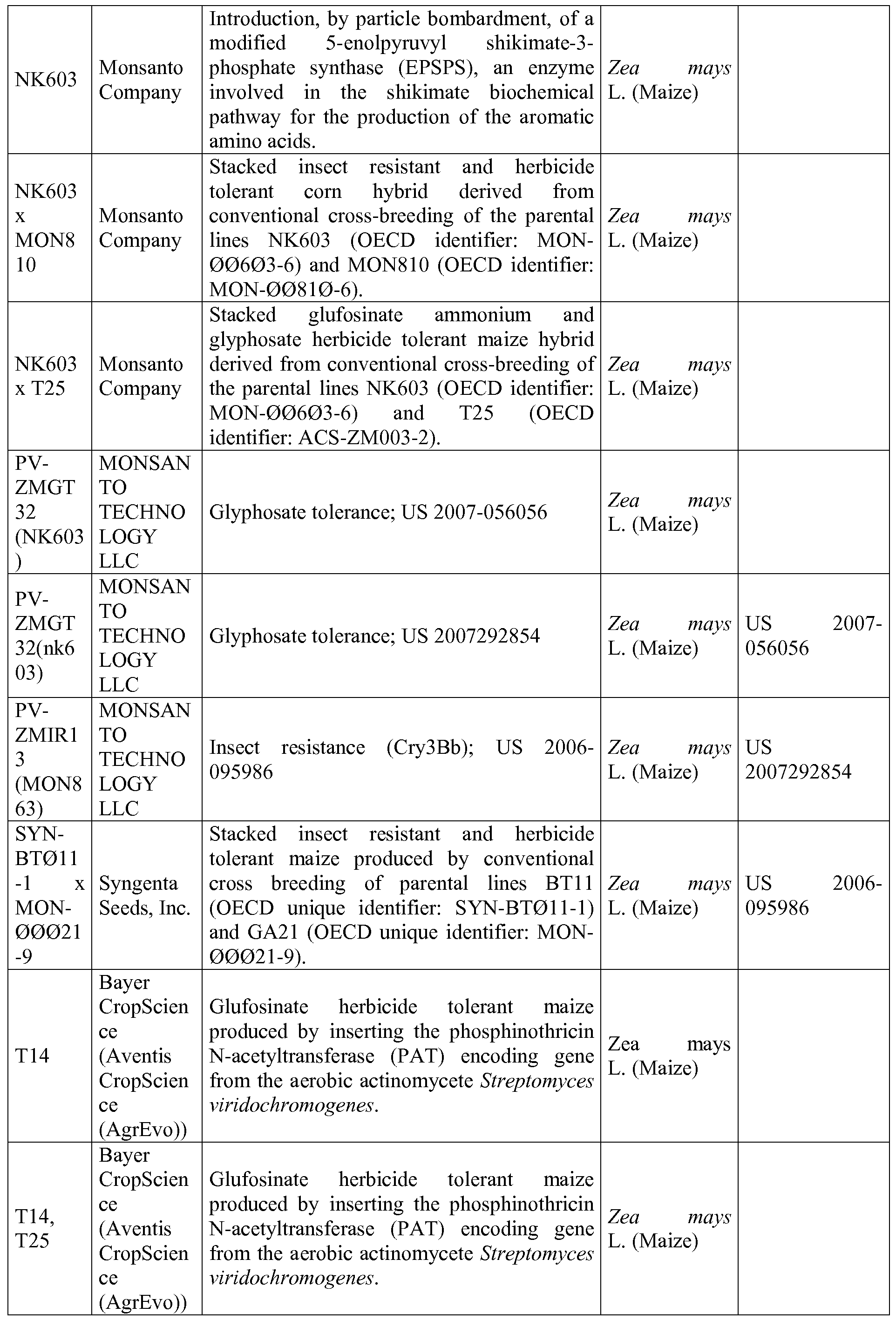
[0034] Examples of plants with the above-mentioned traits are non-exhaustively listed in Table A.
Table A:
Event Company Description Crop Patent Ref
Glyphosate tolerance derived by inserting a
Agrostis
modified 5-enolpyruvylshikimate-3-
ASR36 Scotts stolonifera US 2006- phosphate synthase (EPSPS) encoding gene
Seeds Creeping 162007
from Agrobacterium tumefaciens , parent line
Bentgrass
B99061
Glyphosate herbicide tolerant canola
produced by inserting genes encoding the
enzymes 5-enolypyruvylshikimate-3- Brassica
Monsanto
GT200 phosphate synthase (EPSPS) from the CP4 napus (Argent
Company
strain of Agrobacterium tumefaciens and ine Canola) glyphosate oxidase from Ochrobactrum
anthropi.
Delayed softening tomatoes produced by
inserting a truncated version of the
Lycopersicon
B, Da, Zeneca polygalacturonase (PG) encoding gene in the
esculentum (T
F Seeds sense or anti-sense orientation in order to
omato)
reduce expression of the endogenous PG
gene, and thus reduce pectin degradation.
Delayed softening tomatoes produced by
inserting an additional copy of the
Lycopersicon
FLAVR Calgene polygalacturonase (PG) encoding gene in the
esculentum (T
SAVR Inc. anti-sense orientation in order to reduce
omato)
expression of the endogenous PG gene and
thus reduce pectin degradation.
Monsanto Glyphosate herbicide tolerant alfalfa
Company (lucerne) produced by inserting a gene
Medicago
J101, and Forage encoding the enzyme 5- sativa
J163 Genetics enolypyruvylshikimate-3 -phosphate
(Alfalfa)
Internation synthase (EPSPS) from the CP4 strain of
al Agrobacterium tumefaciens.
Societe
National
Tolerance to the herbicides bromoxynil and Nicotiana
C/F/93/ d'Exploitat
ioxynil by incorporation of the nitrilase gene tabacum
08-02 ion des
from Klebsiella pneumoniae. L. (Tobacco)
Tabacs et
Allumettes
Reduced nicotine content through
introduction of a second copy of the tobacco
Vector quinolinic acid phosphoribosyltransferase Nicotiana
Vector
Tobacco (QTPase) in the antisense orientation. The tabacum
21-41
Inc. NPTII encoding gene from E. coli was L. (Tobacco)
introduced as a selectable marker to identify
transformants.
 United
States
Departmen
t of Plum pox virus (PPV) resistant plum tree
Prunus
Agricultur produced through Agrobacterium-mediated
C5 domestica e transformation with a coat protein (CP) gene
(Plum)
Agricultur from the virus.
al
Research
Service
ATBTO
4-6,
ATBTO
4-27,
ATBTO
4-30,
Colorado potato beetle resistant potatoes Solanum
ATBTO Monsanto
produced by inserting the cry3A gene from tuberosum
4-31, Company
Bacillus thuringiensis (subsp. Tenebrionis). L. (Potato)
ATBTO
4-36,
SPBTO
2-5,
SPBTO
2-7
BT6,
BTIO,
BT12, Colorado potato beetle resistant potatoes Solanum
Monsanto
BT16, produced by inserting the cry3A gene from tuberosum
Company
BT17, Bacillus thuringiensis (subsp. Tenebrionis). L. (Potato)
BT18,
BT23
RBMT
Colorado potato beetle and potato virus Y
15-101,
(PVY) resistant potatoes produced by Solanum
SEMT1 Monsanto
inserting the cry3A gene from Bacillus tuberosum
5-02, Company
thuringiensis (subsp. Tenebrionis) and the L. (Potato)
SEMT1
coat protein encoding gene from PVY.
5-15
RBMT
Colorado potato beetle and potato leafroll
21-129,
virus (PLRV) resistant potatoes produced by Solanum RBMT Monsanto
inserting the cry3A gene from Bacillus tuberosum
21- 350, Company
thuringiensis (subsp. Tenebrionis) and the L. (Potato) RBMT
replicase encoding gene from PLRV.
22- 082
Introduction of the PPT-acetyltransferase
(PAT) encoding gene from Streptomyces
Aventis Brassica viridochromogenes, an aerobic soil bacteria.
HCN10 CropScien napus (Argent
PPT normally acts to inhibit glutamine
ce ine Canola) synthetase, causing a fatal accumulation of
ammonia. Acetylated PPT is inactive.
Selection for a mutagenized version of the
Triticum
AP205 enzyme acetohydroxyacid synthase (AHAS),
BASF Inc. aestivum (Wh CL also known as acetolactate synthase (ALS)
eat) or acetolactate pyruvate- lyase.


Stacked insect resistant and herbicide
tolerant maize produced by conventional
cross breeding of parental lines BT11
(OECD unique identifier: SYN-BT011-1),
MIR604 (OECD unique identifier: SYN- IR605-5) and GA21 (OECD unique
identifier: MON-00021-9). Resistance to
the European Corn Borer and tolerance to
BT11 x the herbicide glufosinate ammonium
MIR60 Syngenta (Liberty) is derived from BT11, which Zea mays
4 x Seeds, Inc. contains the crylAb gene from Bacillus L. (Maize)
GA21 thuringiensis subsp. kurstaki, and the
phosphinothricin N-acetyltransferase (PAT)
encoding gene from S. viridochromogenes.
Corn rootworm-resistance is derived from
MIR604 which contains the mcry3A gene
from Bacillus thuringiensis. Tolerance to
glyphosate herbcicide is derived from GA21
which contains a a modified EPSPS gene
from maize.
Insect-resistant and glufosinate ammonium
herbicide tolerant maize developed by
Aventis
CBH- inserting genes encoding Cry9C protein Zea mays
CropScien
351 from Bacillus thuringiensis subsp tolworthi L. (Maize)
ce
and phosphinothricin acetyltransferase
(PAT) from Streptomyces hygroscopicus.
Lepidopteran insect resistant and glufosinate
ammonium herbicide-tolerant maize variety
DAS- DOW
produced by inserting the crylF gene from Zea mays
06275- AgroScien
Bacillus thuringiensis var aizawai and the L. (Maize)
8 ces LLC
phosphinothricin acetyltransferase (PAT)
from Streptomyces hygroscopicus.
DOW
AgroScien Corn rootworm-resistant maize produced by
ces LLC inserting the cry34Abl and cry35Abl genes
DAS- US 2006- and from Bacillus thuringiensis strain PS149B1. Zea mays
59122- 070139, US
Pioneer The PAT encoding gene from Streptomyces L. (Maize)
7 2011030086 Hi-Bred viridochromogenes was introduced as a
Internation selectable marker; US 2006-070139
al Inc.
Stacked insect resistant and herbicide
tolerant maize produced by conventional
DOW
cross breeding of parental lines DAS-59122- AgroScien
7 (OECD unique identifier: DAS-59122-7)
DAS- ces LLC
with NK603 (OECD unique identifier:
59122- and Zea mays
MON-00603-6). Corn rootworm-resistance
7 x Pioneer L. (Maize)
is derived from DAS-59122-7 which
NK603 Hi-Bred
contains the cry34Abl and cry35Abl genes
Internation
from Bacillus thuringiensis strain PS149B1.
al Inc.
Tolerance to glyphosate herbcicide is
derived from NK603.


inserting the cry3Bbl gene from Bacillus
thuringiensis subspecies kumamotoensis
MON8 Monsanto strain EG4691. Glyphosate tolerance derived Zea mays WO
8017 Company by inserting a 5-enolpyruvylshikimate-3- L. (Maize) 2009111263 phosphate synthase (EPSPS) encoding gene
from Agrobacterium tumefaciens strain CP4;
WO2005059103
Maize event expressing two different
insecticidal proteins from Bacillus
MON8 Monsanto thuringiensis providing resistance to number Zea mays WO
9034 Company of lepidopteran pests; nsect resistance L. (Maize) 2005/059103
(Lepidoptera -CrylA.105- Cry2Ab); WO
2007140256
Stacked insect resistant and glyphosate
tolerant maize derived from conventional
cross-breeding of the parental lines
MON89034 (OECD identifier: MON- 89034-3) and MON88017 (OECD
MON8 identifier:MON-88017-3). Resistance to
9034 x Monsanto Lepiopteran insects is derived from two Zea mays WO
MON8 Company crygenes present in MON89043. Corn L. (Maize) 2007140256 8017 rootworm resistance is derived from a single
cry genes and glyphosate tolerance is
derived from the 5-enolpyruvylshikimate-3- phosphate synthase (EPSPS) encoding gene
from Agrobacterium tumefaciens present in
MON88017.
MS- AVENTIS Brassica
BN1/R CROPSCI Male sterility/restoration; WO 01/41558 napus (Argent
F-BN1 ENCE NV ine Canola)
Stacked insect resistant and herbicide
tolerant maize produced by conventional
cross breeding of parental lines MON89034
MON8 (OECD identifier: MON-89034-3) with
Monsanto Zea mays
9034 x NK603 (OECD unique identifier: MON- WO 01/41558 Company L. (Maize)
NK603 00603-6). Resistance to Lepiopteran
insects is derived from two crygenes present
in MON89043. Tolerance to glyphosate
herbcicide is derived from NK603.
MON8
Stacked insect resistant and herbicide
9034 x
tolerant maize produced by conventional
TC1507
cross breeding of parental lines:
X
Monsanto MON89034, TC1507, MON88017, and Zea mays
MON8
Company DAS-59122. Resistance to the above-ground L. (Maize)
8017 x
and below-ground insect pests and tolerance
DAS- to glyphosate and glufosinate-ammonium
59122- containing herbicides.
7
MON- Stacked insect resistant and herbicide
00603 tolerant corn hybrid derived from
-6 x Monsanto conventional cross-breeding of the parental Zea mays
MON- Company lines NK603 (OECD identifier: MON- L. (Maize)
00810 00603-6) and MON810 (OECD identifier:
-6 MON-00810-6).


Male sterility was via insertion of the
CropScien
barnase ribonuclease gene from Bacillus
ce Brassica
amyloliquefaciens; fertility restoration by
PHY36 (formerly napus (Argent
insertion of the barstar RNase inhibitor; PPT
Plant ine Canola)
resistance was via PPT-acetyltransferase
Genetic
(PAT) from Streptomyces hygroscopicus.
Systems)
MONSAN TO Brassica
RT73 TECHNO Glyphosate resistance; WO 02/36831 napus (Argent
LOGY ine Canola)
LLC
Bayer
Introduction of the PPT-acetyltransferase
CropScien
(PAT) encoding gene from Streptomyces
T45 ce Brassica
viridochromogenes, an aerobic soil bacteria.
(HCN2 (Aventis napus (Argent WO 02/36831
PPT normally acts to inhibit glutamine
8) CropScien ine Canola)
synthetase, causing a fatal accumulation of
ce
ammonia. Acetylated PPT is inactive.
(AgrEvo))
Bayer
CropScien Introduction of the glufosinate ammonium
ce herbicide tolerance trait from transgenic B. Brassica
HCR-1 (Aventis napus line T45. This trait is mediated by the rapa (Polish
CropScien phosphinothricin acetyltransferase (PAT) Canola)
ce encoding gene from S. viridochromogenes.
(AgrEvo))
Introduction of a modified 5-enol- pyruvylshikimate-3 -phosphate synthase
(EPSPS) and a gene from Achromobacter sp Brassica
ZSR50 Monsanto
that degrades glyphosate by conversion to rapa (Polish
0/502 Company
aminomethylphosphonic acid (AMP A) and Canola) glyoxylate by interspecific crossing with
GT73.
MAHARA
SHTRA
Insect resistance (CrylAc); WO
EE-1 HYBRID Brinjal
2007/091277
SEEDS COMPA
Papaya ringspot virus (PRSV) resistant
Carica
55- Cornell papaya produced by inserting the coat WO
papaya (Papa
1/63-1 University protein (CP) encoding sequences from this 2007/091277 ya)
plant potyvirus.
Papaya ringspot virus (PRSV) resistant
papaya produced by inserting the coat
protein (CP) encoding sequences from Carica
University
XI 7-2 PRSV isolate H1K with a thymidine inserted papaya (Papa
of Florida
after the initiation codon to yield a ya)
frameshift. Also contains nptll as a
selectable marker.
Glyphosate herbicide tolerant sugar beet
produced by inserting a gene encoding the
Monsanto enzyme 5-enolypyruvylshikimate-3- Beta vulgaris
H7-1
Company phosphate synthase (EPSPS) from the CP4 (sugar beet)
strain of Agrobacterium tumefaciens, WO
2004-074492
Male sterility was via insertion of the
RM3-3, barnase ribonuclease gene from Bacillus Cichorium
Bejo WO 2004- RM3-4, amyloliquefaciens; PPT resistance was via intybus (Chic
Zaden BV 074492 RM3-6 the bar gene from S. hygroscopicus, which ory)
encodes the PAT enzyme.
PIONEER
HI-BRED
INTERNA
TIONAL
DP- INC, E.I
Glyphosate tolerance / ALS inhibitor Zea mays
098140 DU PONT
tolerance L. (Maize)
-6 DE
NEMOUR S AND COMPAN Y
Reduced accumulation of S- adenosylmethionine (SAM), and WO
Agritope Cucumis
A, B consequently reduced ethylene synthesis, by 2008/112019,
Inc. melo (Melon)
introduction of the gene encoding S- US2010240059 adenosylmethionine hydrolase.
Cucumber mosiac virus (CMV), zucchini
As grow
yellows mosaic (ZYMV) and watermelon
(USA);
mosaic virus (WMV) 2 resistant squash (
Seminis Cucurbita
CZW-3 Curcurbita pepo) produced by inserting the
Vegetable pepo (Squash)
coat protein (CP) encoding sequences from
Inc.
each of these plant viruses into the host
(Canada)
genome.
Upjohn Zucchini yellows mosaic (ZYMV) and
(USA); watermelon mosaic virus (WMV) 2 resistant
Seminis squash (Curcurbita pepo) produced by Cucurbita
ZW20
Vegetable inserting the coat protein (CP) encoding pepo (Squash)
Inc. sequences from each of these plant
(Canada) potyviruses into the host genome.
Delayed senescence and sulfonylurea
herbicide tolerant carnations produced by
inserting a truncated copy of the carnation
aminocyclopropane cyclase (ACC) synthase
encoding gene in order to suppress
Dianthus
Florigene expression of the endogenous unmodified
66 caryophyllus
Pty Ltd. gene, which is required for normal ethylene
(Carnation)
biosynthesis. Tolerance to sulfonyl urea
herbicides was via the introduction of a
chlorsulfuron tolerant version of the
acetolactate synthase (ALS) encoding gene
from tobacco.
Modified colour and sulfonylurea herbicide
tolerant carnations produced by inserting
two anthocyanin biosynthetic genes whose
expression results in a violet/mauve Dianthus
4, 11, Florigene
colouration.Tolerance to sulfonyl urea caryophyllus
15, 16 Pty Ltd.
herbicides was via the introduction of a (Carnation) chlorsulfuron tolerant version of the
acetolactate synthase (ALS) encoding gene
from tobacco.
959A,
988A, Introduction of two anthocyanin
Dianthus
1226A, Florigene biosynthetic genes to result in a
caryophyllus
1351A, Pty Ltd. violet/mauve colouration; Introduction of a
(Carnation)
1363A, variant form of acetolactate synthase (ALS).
1400A
Pioneer
3560.4. Hi-Bred Glyphosate/ALS inhibitor-tolerance; WO Glycine max
3.5 alternation 2008002872 L. (Soybean)
al Inc.
Bayer
Glufosinate ammonium herbicide tolerant
CropScien
A2704- soybean produced by inserting a modified
ce
12, phosphinothricin acetyltransferase (PAT) Glycine max WO
(Aventis
A2704- encoding gene from the soil bacterium L. (Soybean) 2008002872
CropScien
21 Streptomyces viridochromogenes; WO
ce
2006/108674
(AgrEvo))
Bayer
Introduction of the PPT-acetyltransferase
CropScien
(PAT) encoding gene from Streptomyces
ce
viridochromogenes, an aerobic soil bacteria. Beta vulgaris WO
T120-7 (Aventis
PPT normally acts to inhibit glutamine (sugar beet) 2006/108674
CropScien
synthetase, causing a fatal accumulation of
ce
ammonia. Acetylated PPT is inactive.
(AgrEvo))
Bayer
CropScien Glufosinate ammonium herbicide tolerant
ce soybean produced by inserting a modified
A5547- Glycine max
(Aventis phosphinothricin acetyltransferase (PAT)
127 L. (Soybean)
CropScien encoding gene from the soil bacterium
ce Streptomyces viridochromogenes.
(AgrEvo))
Bayer
CropScien
ce
A5547- Glycine max
(Aventis Glufosinate tolerance; WO 2006/108675
35 L. (Soybean)
CropScien
ce
(AgrEvo))
Pioneer
DP- Hi-Bred High oleic acid / ALS inhibitor tolerance; Glycine max WO
305423
Internation WO 2008/054747 L. (Soybean) 2006/108675
-1
al Inc.
Pioneer Soybean event with two herbicide tolerance
DP3560 Hi-Bred genes: glyphosate N-acetlytransferase, Glycine max WO 43 Internation which detoxifies glyphosate, and a modified L. (Soybean) 2008/054747 al Inc. acetolactate synthase (A
High oleic acid soybean produced by
G94-1, DuPont
inserting a second copy of the fatty acid
G94- Canada Glycine max
desaturase (GmFad2-l) encoding gene from
19, Agricultur L. (Soybean)
soybean, which resulted in "silencing" of the
G168 al Products
endogenous host gene.
Glyphosate tolerant soybean variety
produced by inserting a modified 5-
GTS Monsanto Glycine max
enolpyruvylshikimate-3 -phosphate synthase
40-3-2 Company L. (Soybean)
(EPSPS) encoding gene from the soil
bacterium Agrobacterium tumefaciens .
Bayer
CropScien Glufosinate ammonium herbicide tolerant
ce soybean produced by inserting a modified
Glycine max
GU262 (Aventis phosphinothricin acetyltransferase (PAT)
L. (Soybean)
CropScien encoding gene from the soil bacterium
ce Streptomyces viridochromogenes .
(AgrEvo))
MON8 Monsanto Glycine max
insect resistance (Crylac); WO 2009064652
7701 Company L. (Soybean)
MON8 Monsanto altered fatty acid levels (mid-oleic and low Glycine max WO 7705 Company saturate); WO 2010037016 L. (Soybean) 2009064652
MON8 Monsanto Glycine max WO
increased oil content; WO 2010024976
7754 Company L. (Soybean) 2010037016
Glyphosate herbicide tolerant sugar beet
Novartis
produced by inserting a gene encoding the
GTSB7 Seeds; Beta vulgaris WO
enzyme 5-enolypyruvylshikimate-3- 7 Monsanto (sugar beet) 2010024976 phosphate synthase (EPSPS) from the CP4
Company
strain of Agrobacterium tumefaciens.
MON8 Monsanto stearidonic acid (SDA) comprising oil; WO Glycine max
7769 Company 2009102873 L. (Soybean)
Glyphosate-tolerant soybean produced by
MON8 inserting a modified 5- 9788, Monsanto enolpyruvylshikimate-3 -phosphate synthase Glycine max WO MON1 Company (EPSPS) encoding aroA (epsps) gene from L. (Soybean) 2009102873 9788 Agrobacterium tumefaciens CP4;
WO2006130436
Low linolenic acid soybean produced
Agricultur
through traditional cross-breeding to
e & Agri- Glycine max
incorporate the novel trait from a naturally
15 Food L. (Soybean)
occurring fanl gene mutant that was selected
Canada
for low linolenic acid.
Bayer
CropScien Glufosinate ammonium herbicide tolerant
ce soybean produced by inserting a modified
W62, Glycine max
(Aventis phosphinothricin acetyltransferase (PAT)
W98 L. (Soybean)
CropScien encoding gene from the soil bacterium
ce Streptomyces hygroscopicus .
(AgrEvo))
Insect resistant cotton derived by
transformation of the DP50B parent variety,
Gossypium
Monsanto which contained event 531 (expressing
15985 hirsutum
Company CrylAc protein), with purified plasmid
L. (Cotton)
DNA containing the cry2Ab gene from B.
thuringiensis subsp. kurstaki.
Syngenta Gossypium
1143- Insect resistance (CrylAb); WO
Participati hirsutum
14A 2006/128569
ons AG L. (Cotton)
Syngenta Gossypium
1143- Insect resistance (CrylAb); WO WO
Participati hirsutum
51B 2006/128570 2006/128569 ons AG L. (Cotton)
DuPont
Gossypium
Canada Introduction of a variant form of acetolactate WO
19-51A hirsutum
Agricultur synthase (ALS). 2006/128570
L. (Cotton)
al Products
Insect-resistant cotton produced by inserting
the cry IF gene from Bacillus
DOW Gossypium
281-24- thuringiensisvar. aizawai. The PAT
AgroScien hirsutum
236 encoding gene from Streptomyces
ces LLC L. (Cotton)
viridochromogenes was introduced as a
selectable marker.
SES
Beta vulgaris
T227-1 EUROPE Glyphosate tolerance; US 2004-117870
(sugar beet)
N.V./S.A
Insect-resistant cotton produced by inserting
DOW the cry 1 Ac gene from Bacillus thuringiensis Gossypium
3006- US 2004- AgroScien subsp. kurstaki. The PAT encoding gene hirsutum
210-23 117870
ces LLC from Streptomyces viridochromogenes was L. (Cotton)
introduced as a selectable marker.
Insect-resistant and bromoxynil herbicide
tolerant cotton produced by inserting the Gossypium
31807/3 Calgene
cry 1 Ac gene from Bacillus thuringiensis and hirsutum
1808 Inc.
a nitrilase encoding gene from Klebsiella L. (Cotton) pneumoniae.
Bromoxynil herbicide tolerant cotton Gossypium
Calgene
BXN produced by inserting a nitrilase encoding hirsutum
Inc.
gene from Klebsiella pneumoniae. L. (Cotton)
Syngenta Gossypium
CE43- Insect resistance (CrylAb); WO
Participati hirsutum
67B 2006/128573
ons AG L. (Cotton)
WO
Syngenta Gossypium
CE44- Insect resistance (CrylAb); WO 2006/128573, Participati hirsutum
69D 2006/128571 US
ons AG L. (Cotton)
2011020828
Syngenta Gossypium
CE46- Insect resistance (CrylAb); WO WO
Participati hirsutum
02A 2006/128572 2006/128571 ons AG L. (Cotton)
Insect-resistant cotton produced by inserting
the vip3A(a) gene from Bacillus Gossypium
Syngenta WO
Cotl02 thuringiensis AB88. The APH4 encoding hirsutum
Seeds, Inc. 2006/128572 gene from E. coli was introduced as a L. (Cotton) selectable marker.; US 2006-130175
US 2006-
Gossypium 130175,
COT20 Syngenta
Insect resistance (VIP3A); US2009181399 hirsutum WO200403998 2 Seeds, Inc.
L. (Cotton) 6, US
2010298553
Insect-resistant cotton produced by inserting
a full-length crylAb gene from Bacillus Gossypium
Syngenta
Cot67B thuringiensis. The APH4 encoding gene hirsutum - Seeds, Inc.
from E. coli was introduced as a selectable L. (Cotton) marker.
Monsanto High laurate (12:0) and myristate (14:0)
23-18- Brassica
Company canola produced by inserting a thioesterase
17, 23- napus (Argent
(formerly encoding gene from the California bay laurel
198 ine Canola)
Calgene) (Umbellularia californica).
DAS-
WideStrike™, a stacked insect-resistant
21023-
DOW cotton derived from conventional crossGossypium
5 x
AgroScien breeding of parental lines 3006-210-23 hirsutum
DAS- ces LLC (OECD identifier: DAS-21023-5) and 281- L. (Cotton)
24236- 24-236 (OECD identifier: DAS-24236-5).
5
DAS- DOW
21023- AgroScien Stacked insect-resistant and glyphosate- 5 x ces LLC tolerant cotton derived from conventional
Gossypium
DAS- and cross-breeding of WideStrike cotton (OECD
hirsutum
24236- Pioneer identifier: DAS-21023-5 x DAS-24236-5)
L. (Cotton)
5 x Hi-Bred with MON88913, known as RoundupReady
MON8 Internation Flex (OECD identifier: MON-88913-8).
8913 al Inc.
DAS-
21023- WideStrike™/Roundup Ready® cotton, a
5 x stacked insect-resistant and glyphosate-
DAS- DOW tolerant cotton derived from conventional Gossypium
24236- AgroScien cross-breeding of WideStrike cotton (OECD hirsutum
5 x ces LLC identifier: DAS-21023-5 x DAS-24236-5) L. (Cotton)
MON- with MON1445 (OECD identifier: MON-
01445- 01445-2).
2
BAYER Gossypium
EE-
BIOSCIE Glyphosate tolerance; WO 2007/017186 hirsutum
GH3
NCE NV L. (Cotton)
BAYER Gossypium
EE- Insect resistance (CrylAb); WO WO
BIOSCIE hirsutum
GH5 2008/122406 2007/017186
NCE NV L. (Cotton)
BAYER Gossypium
EE- WO
BIOSCIE Insect resistance (cry2Ae); WO2008151780 hirsutum
GH6 2008/122406
NCE NV L. (Cotton)
event DOW Gossypium WO200815178
281-24- AgroScien Insect resistance (CrylF); WO 2005/103266 hirsutum o,
236 ces LLC L. (Cotton) US2010218281
JK Agri Insect-resistant cotton produced by inserting Gossypium
WO
Event- 1 Genetics the cry 1 Ac gene from Bacillus thuringiensis hirsutum
2005/103266 Ltd (India) subsp. kurstaki HD-73 (B.t.k.). L. (Cotton)
event30 DOW Gossypium
Insect resistance (CrylAc); WO
06-210- AgroScien hirsutum
2005/103266
23 ces LLC L. (Cotton)
Bayer
CropScien
Glyphosate herbicide tolerant cotton
ce Gossypium
GBH61 produced by inserting 2mepsps gene into WO
(Aventis hirsutum
4 variety Coker312 by Agrobacterium under 2005/103266
CropScien L. (Cotton)
the control of Ph4a748At and TPotpC
ce
(AgrEvo))
High oleic acid and low linolenic acid
Pioneer canola produced through a combination of
Brassica
45A37, Hi-Bred chemical mutagenesis to select for a fatty
napus (Argent
46A40 Internation acid desaturase mutant with elevated oleic
ine Canola)
al Inc. acid, and traditional back-crossing to
introduce the low linolenic acid trait.
Bayer
Glufosinate ammonium herbicide tolerant
CropScien
cotton produced by inserting a modified
ce Gossypium
LLCott phosphinothricin acetyltransferase (PAT)
(Aventis hirsutum
on25 encoding gene from the soil bacterium
CropScien L. (Cotton)
Streptomyces hygroscopicus; WO
ce
2003013224, WO 2007/017186
(AgrEvo))
Bayer Stacked herbicide tolerant and insect
CropScien resistant cotton combining tolerance to
LLCott WO
ce glufosinate ammonium herbicide from Gossypium
on25 x 2003013224,
(Aventis LLCotton25 (OECD identifier: ACS- hirsutum
MONl WO
CropScien GH001-3) with resistance to insects from L. (Cotton)
5985 2007/017186 ce MONl 5985 (OECD identifier: MON-
(AgrEvo)) 15985-7)
MONSAN TO Gossypium
MON Insect resistance (CrylA/Cry2Ab); US
TECHNO hirsutum
15985 2004-250317
LOGY L. (Cotton)
LLC
Glyphosate herbicide tolerant cotton
MONl produced by inserting a naturally glyphosate Gossypium
Monsanto US 2004-
445/169 tolerant form of the enzyme 5-enolpyruvyl hirsutum
Company 250317
8 shikimate-3 -phosphate synthase (EPSPS) L. (Cotton)
from A. tumefaciens strain CP4.
Stacked insect resistant and glyphosate
tolerant cotton produced by conventional
cross-breeding of the parental lines
MON88913 (OECD identifier: MON- 88913-8) and 15985 (OECD identifier:
MON- 15985-7). Glyphosate tolerance is
derived from MON88913 which contains
MONl
two genes encoding the enzyme 5- Gossypium 5985 x Monsanto
enolypyruvylshikimate-3 -phosphate hirsutum
MON8 Company
synthase (EPSPS) from the CP4 strain of L. (Cotton) 8913
Agrobacterium tumefaciens. Insect
resistance is derived MONl 5985 which was
produced by transformation of the DP50B
parent variety, which contained event 531
(expressing CrylAc protein), with purified
plasmid DNA containing the cry2Ab gene
from B. thuringiensis subsp. kurstaki.
MON- Stacked insect resistant and herbicide
15985- tolerant cotton derived from conventional
Gossypium
7 x Monsanto cross-breeding of the parental lines 15985
hirsutum
MON- Company (OECD identifier: MON- 15985-7) and
L. (Cotton)
01445- MONl 445 (OECD identifier: MON-01445-
2 2)·

DNA Plant inserting an additional copy of a truncated
Technolog gene encoding 1-aminocyclopropane-l- Lycopersicon
1345-4 y carboxyllic acid (ACC) synthase, which esculentum (T
Corporatio resulted in downregulation of the omato)
n endogenous ACC synthase and reduced
ethylene accumulation.
Introduction of a gene sequence encoding
Lycopersicon
Agritope the enzyme S-adenosylmethionine hydrolase
35 1 N esculentum (T
Inc. that metabolizes the precursor of the fruit
omato)
ripening hormone ethylene
BASF AGROCH
Glycine max
127 EMICAL ALS/AHAS inhibitor-tolerance
L. (Soybean)
PRODUC TS B.V.
Syngenta
Zea mays WO201008082
5307 Participati Insect (corn rootworm) resistance (FR8a)
L. (Maize) 9
ons AG
MONSAN
TO
Oryza WO201007781
17053 TECHNO Glyphosate tolerance
sativa (Rice) 6
LOGY
LLC
BAYER
Oryza WO201011773
17314 BIOSCIE Glyphosate tolerance
sativa (Rice) 7
NCE NV
Pioneer
3560.4. Hi-Bred Glycine max WO201011773
Glyphosate/ALS inhibitor-tolerance
3.5 Internation L. (Soybean) 5
al Inc.
BAYER WO
A2704- Glycine max
BIOSCIE Glufosinate tolerance 2008002872, 12 L. (Soybean)
NCE NV US2010184079
BAYER
A5547- Glycine max WO
BIOSCIE Glufosinate tolerance
35 L. (Soybean) 2006/108674
NCE NV
Syngenta
GM Beet Necrotic Yellow Vein Virus (BNYW) Beta vulgaris WO
Participati
RZ13 resistance (sugar beet) 2006/108675 ons AG
Syngenta
JOPLI disease (fungal) resistance (trichothecene 3- WO201007621 Participati Wheat
Nl O-acetyltransferase) 2
ons AG
BAYER Gossypium
LLcotto US
BIOSCIE Glufosinate resistance hirsutum
n25 2008064032
NCE NV L. (Cotton)
AVENTIS CROPSCl Brassica (A WO
MS-B2 Male sterility
ENCE genome) 2003013224 N.V.
AVENTIS
MS- CROPSCl Brassica
BN1/R Male sterility/restoration WO 01/31042 ENCE (napus)
F-BN1
N.V.
MONSAN
TO
Brassica
RT73 TECHNO Glyphosate resistance WO 01/41558
(napus)
LOGY
LLC
CHINA Transgenic rice Kefeng 6 is a transformation
Kefeng NAT event containing two insect-resistant genes, Oryza
WO 02/36831 No. 6 RICE RES crylAc and SCK (modified CpTI gene) in sativa (Rice)
INST China.
1) MS45: anther-specific 5126 (Zea mays)
promoter > fertility restoration Ms45 (Zea
mays) coding sequence > fertility restoration
Ms45 (Zea mays) 3 '-untranslated region 2)
ZM-AAl : polygalacturonase 47 (Zea mays)
E6611.
promoter > brittle- 1 (Zea mays) chloroplast
32.1.38 Pioneer
transit peptide > alpha-amylase-1 (Zea
/ DP- Hi-Bred Zea mays
mays) truncated coding sequence > >In2-l CN 101824411 32138- Internation L. (Maize)
(Zea mays) 3 '-untranslated region 3)
1 / al Inc.
DSRED2: 35S (Cauliflower Mosaic Virus)
32138
enhancer > lipid transfer protein-2
(Hordeum vulgare) promoter > red
fluorescent protein (Dicosoma sp.) variant
coding sequence > protein inhibitor II
(Solarium tuberosum) 3 '-untranslated region
RB7 MARv3>zmUbiquitin 1
promoter>aadl>zmPER5 3'UTR>RB 7
WO
DAS- DOW MARv4. The aad-1 gene confers tolerance
Zea mays 2009103049,
40278- AgroScien to 2,4- dichlorophenoxyacetic acid and
L. (Maize) MX
9 ces LLC aryloxyphenoxypropionate (commonly
2010008977 referred to as "fop" herbicides such as
quizalofop) herbicides
1) CRY3A: metallotionin-like gene (Zea
mays) promoter > delta- endotoxin cry3a
(Bacillus thuringiensis subsp. tenebrionis )
coding sequence, modified to include a
cathepsin-G protease recognition site and
Syngenta maize codon optimized > nopaline synthase
MIR60 Zea mays WO 201102246 Participati (Agrobacterium tumefaciens) 3 '-untranslated
4 L. (Maize) 9
ons AG region 2) PMI: polyubiquitin (Zea mays)
promoter (incl. first intron) > mannose-6- phosphate isomerase (Escherichia coli)
coding sequence > nopaline synthase
(Agrobacterium tumefaciens) 3 '-untranslated
region
Dicamba herbicide tolerance, transformation
vector PV- GMHT4355 1) DMO: full length
transcript (Peanut Chlorotic Streak Virus)
promoter > tobacco Etch Virus leader >
ribulose 1,5-biphosphate carboxylase small US
MONSAN
subunit {Pisum sativum) chloroplast transit 2005216970, TO
MON peptide > dicamba mono-oxygenase Glycine max US
TECHNO
87708 (Stenotrophomonas maltophilia) coding L. (Soybean) 2008167456,
LOGY
sequence > ribulose- 1,5-bisphosphate US
LLC
carboxylase small subunit E9 {Pisum 2011111420 sativum) 3 '-untranslated region. A CP4
epsps chimeric gene contained within a
second T-DNA on the transformation vector
used was segregated away.
The transgene insert and expression cassette
of MON 87427 comprises the promoter and
leader from the cauliflower mosaic virus
(CaMV) 35 S containing a duplicated
enhancer region (P-e35S); operably linked to
a DNA leader derived from the first intron
from the maize heat shock protein 70 gene
MONSAN
(I- HSP70); operably linked to a DNA
TO
MON molecule encoding an N-terminal Zea mays WO 201103470
TECHNO
87427 chloroplast transit peptide from the shkG L. (Maize) 4
LOGY
gene from Arabidopsis thaliana EPSPS (Ts-
LLC CTP2); operably linked to a DNA molecule
derived from the aroA gene from the
Agrobacterium sp. strain CP4 and encoding
the CP4 EPSPS protein; operably linked to a
3' UTR DNA molecule derived from the
nopaline synthase (T-NOS) gene from
Agrobacterium tumefaciens.
1) Ph4a748 ABBC: sequence including the
promoter region of the histone H4 gene of
Arabidopsis thaliana, containing an internal
duplication>5'tev: sequence including the
leader sequence of the tobacco etch
virus>TPotp Y: coding sequence of an
optimized transit peptide derivative (position
55 changed into Tyrosine), containing
sequence of the RuBisCO small subunit
genes of Zea mays (corn) and Helianthus
annuus (sunflower)>hppdPf W336: the
coding sequence of the 4- hydroxyphenylpyruvate dioxygenase of
Pseudomonas fluorescens strain A32
BAYER
modified by the replacement of the amino
BIOSCIE
acid Glycine 336 with a Tryptophane>3 'nos:
EE- NCE NV
sequence including the 3' untranslated Glycine max WO
GM3 / [BE]; MS
region of the nopaline synthase gene from L. (Soybean) 2011062904 FG72 TECHNO
the T-DNA of pTiT37 of Agrobacterium
LOGIES
tumefaciens. 2) Ph4a748: sequence
LLC [US]
including the promoter regi
H4 gene of Arabidopsis

h3At: first intron of gene II of the histone
H3.III variant of Arabidopsis thaliana
>TPotp C: coding sequence of the optimized
transit peptide, containing sequence of the
RuBisCO small subunit genes of Zea mays
(corn) and Helianthus annuus
(sunflower)>2mepsps: the coding sequence
of the double-mutant 5-enol- pyruvylshikimate-3 -phosphate synthase
gene of Zea mays>3 'histonAt: sequence
including the 3 ' untranslated region of the
histone H4 gene of Arabidopsis thaliana
A novel aad-12 transformation event for
herbicide tolerance in soybean plants - referred to herein as pDAB4468-0416. The
aad-12 gene (originally from Delftia
416 / DOW acidovorans) encodes the aryloxyalkanoate
pDAB4 AGROSCI dioxygenase (AAD-12) protein. The trait Glycine max WO 201106341 468- ENCES confers tolerance to 2,4- L. (Soybean) 1
0416 LLC dichlorophenoxyacetic acid, for example,
and to pyridyloxyacetate herbicides. The
aad-12 gene, itself, for herbicide tolerance in
plants was first disclosed in WO
2007/053482.
Pioneer crylF, cry34Abl, cry35Abl, and pat:
DP- Hi-Bred resistance to certain lepidopteran and Zea mays WO
004114
Internation coleopteran pests, as well as tolerance to L. (Maize) 2011066384
-3
al Inc. phosphinothricin.
Pioneer CrylF, cry34Abl, cry35Abl, pat: resistance
DP- Hi-Bred to certain lepidopteran and coleopteran Zea mays US 201115452
032316
Internation pests, as well as tolerance to L. (Maize) 3
-8
al Inc. phosphinothricin
Pioneer CrylF, cry34Abl, cry35Abl, pat: resistance
DP- Hi-Bred to certain lepidopteran and coleopteran Zea mays US 201115452 040416
alternation pests, as well as tolerance to L. (Maize) 4
-8 a
al Inc. phosphinothricin
Pioneer CrylF, cry34Abl, cry35Abl, pat: resistance US2011015452
DP- Hi-Bred to certain lepidopteran and coleopteran Zea mays 5
043A47
Internation pests, as well as tolerance to L. (Maize) US2011015452
-3
al Inc. phosphinothricin 6
PIONEER
The invention provides DNA compositions
HI-BRED
that relate to transgenic insect resistant
INTERNA
maize plants. Also provided are assays for
TIONAL,
detecting the presence of the maize DP-
DP- INC. / E.I.
004114-3 event based on the DNA sequence WO2011/08462
004114 DU PONT maize
of the recombinant construct inserted into 1A1
-3 DE
the maize genome and the DNA sequences
NEMOUR
flanking the insertion site. Kits and
S AND
conditions useful in conducting the assays
COMPAN
are provided.
Y
PIONEER
The invention provides DNA compositions
HI-BRED
that relate to transgenic insect resistant
INTERNA
maize plants. Also provided are assays for
TIONAL,
detecting the presence of the maize DP-
DP- INC. / E.I.
032316-8 event based on the DNA sequence WO2011/08463
032316 DU PONT maize
of the recombinant construct inserted into 2
-8 DE
the maize genome and the DNA sequences
NEMOUR
flanking the insertion site. Kits and
S AND
conditions useful in conducting the assays
COMPAN
are provided.
Y
The invention provides plants comprising
transgenic event MON 88302 that exhibit
tolerance to glyphosate herbicide. The
MONSAN
invention also provides seeds, plant parts,
MON- TO
cells, commodity products, and methods WO2011/15318 88302- TECHNO brassica
related to the event. The invention also 6
9 LOGY
provides DNA molecules that are unique to
LLC
the event and were created by the insertion
of transgenic DNA into the genome of a
Brassica napus plant.
SYNGEN Soybean plants comprising event
SYN- TA SYHT0H2, methods of detecting and using
WO2012/08254
000H2- PARTICIP the same, and soybean plants comprising a soybean
8A2
5 ATIONS heterologous insert at the same site as
AG SYHT0H2.
This invention relates to soybean event
pDAB8291.45.36.2, which includes a novel
expression cassette comprising multiple
traits conferring resistance to glyphosate,
aryloxyalkanoate, and glufosinate
herbicides. This invention also relates in part
to methods of controlling resistant weeds,
plant breeding, and herbicide tolerant plants.
In some embodiments, the event sequence
DOW
can be "stacked" with other traits, including,
AGROSCl
for example, other herbicide tolerance
DAS- ENCES
gene(s) and/or insect-inhibitory proteins. WO2012/07542
14536- LLC; MS soybean
This invention further relates in part to 9A1
7 TECHNO
detection methods, including endpoint
LOGIES
TaqMan PCR assays, for the detection of
LLC
Event pDAB8291.45.36.2 in soybeans and
related plant material. Some embodiments
can perform high throughput zygosity
analysis of plant material and other
embodiments can be used to uniquely
identify the zygosity of and breed soybean
lines comprising the event of the subject
invention. Kits and conditions useful in
conducting these assays are also provided.
This invention relates in part to soybean
event pDAB8264.44.06.1 and includes a
novel expression cassettes and transgenic
inserts comprising multiple traits conferring
resistance to glyphosate, aryloxyalkanoate,
and glufosinate herbicides. This invention
also relates in part to methods of controlling
resistant weeds, plant breeding and herbicide
tolerant plants. In some embodiments, the
DOW
event sequence can be "stacked" with other
AGROSCl
traits, including, for example, other
DAS- ENCES
herbicide tolerance gene(s) and/or insect- WO2012/07542
44406- LLC; MS soybean
inhibitory proteins. This invention further 6A1
6 TECHNO
relates in part to endpoint TaqMan PCR
LOGIES
assays for the detection of Event
LLC
pDAB8264.44.06.1 in soybeans and related
plant material. Some embodiments can
perform high throughput zygosity analysis
of plant material and other embodiments can
be used to uniquely identify the zygosity of
and breed soybean lines comprising the
event of the subject invention. Kits and
conditions useful in conducting these assays
are also provided.
The present invention provides a transgenic
soybean comprising event MON87712 that
exhibits increased yield. The invention also
provides cells, plant parts, seeds, plants,
commodity products related to the event,
MONSAN and DNA molecules that are unique to the
MON- TO event and were created by the insertion of
WO2012/05119 87712- TECHNO transgenic DNA into the genome of a soybean
9A2
4 LOGY soybean plant. The invention further
LLC provides methods for detecting the presence
of said soybean event nucleotide sequences
in a sample, probes and primers for use in
detecting nucleotide sequences that are
diagnostic for the presence of said soybean
event.
This invention relates to soybean event
pDAB4472-1606 (Event 1606). This
invention includes a novel aad-12
transformation event in soybean plants
comprising a polynucleotide sequence, as
DOW described herein, inserted into a specific site
DAS- AGROSCI within the genome of a soybean cell. This WO2012/03379
21606- soybean
ENCES invention also relates in part to plant 4A2
3
LLC breeding and herbicide tolerant plants. In
some embodiments, said event /
polynucleotide sequence can be "stacked"
with other traits, including, for example,
other herbicide tolerance gene(s) and/or
insect-inhibitory proteins.
Compositions and methods related to
transgenic glyphosate tolerant Brassica
plants are provided. Specifically, the present
invention provides Brassica plants having a
DP-061061-7 event which imparts tolerance
to glyphosate. The Brassica plant harboring
the DP-061061-7 event at the recited
chromosomal location comprises
PIONEER
genomic/transgene junctions within SEQ ID
DP- HI-BRED
NO: 2 or with genomic/transgene junctions WO201204926
061061 INTERNA Brassica
as set forth in SEQ ID NO: 12 and/or 13. 8A1
-7 TIONAL
The characterization of the genomic
INC.
insertion site of events provides for an
enhanced breeding efficiency and enables
the use of molecular markers to track the
transgene insert in the breeding populations
and progeny thereof. Various methods and
compositions for the identification,
detection, and use of the events are
provided.
Compositions and methods related to
transgenic glyphosate tolerant Brassica
plants are provided. Specifically, the present
invention provides Brassica plants having a
DP-073496-4 event which imparts tolerance
to glyphosate. The Brassica plant harboring
the DP-073496-4 event at the recited
PIONEER chromosomal location comprises
DP- HI-BRED genomic/transgene junctions within SEQ ID
WO201204966
073496 INTERNA NO: 2 or with genomic/transgene junctions Brassica
1A1
-4 TIONAL as set forth in SEQ ID NO: 12 and/or 13.
INC. The characterization of the genomic
insertion site of the event provides for an
enhanced breeding efficiency and enables
the use of molecular markers to track the
transgene insert in the breeding populations
and progeny thereof. Various methods and
compositions for the identification,
detection, and use of the event are provided.
This invention relates in part to soybean
event pDAB8264.44.06.1 and includes a
novel expression cassettes and transgenic
inserts comprising multiple traits conferring
resistance to glyphosate, aryloxyalkanoate,
and glufosinate herbicides. This invention
also relates in part to methods of controlling
resistant weeds, plant breeding and herbicide
tolerant plants. In some embodiments, the
DOW
event sequence can be "stacked" with other
AGROSCl
traits, including, for example, other
ENCES
8264.44 herbicide tolerance gene(s) and/or insect- WO201205246
LLC; MS Soybean
.06.1 inhibitory proteins. This invention further 8A2
TECHNO
relates in part to endpoint TaqMan PCR
LOGIES
assays for the detection of Event
LLC
pDAB8264.44.06.1 in soybeans and related
plant material. Some embodiments can
perform high throughput zygosity analysis
of plant material and other embodiments can
be used to uniquely identify the zygosity of
and breed soybean lines comprising the
event of the subject invention. Kits and
conditions useful in conducting these assays
are also provided.
This invention relates to soybean event
pDAB8291.45.36.2, which includes a novel
expression cassette comprising multiple
traits conferring resistance to glyphosate,
aryloxyalkanoate, and glufosinate
herbicides. This invention also relates in part
to methods of controlling resistant weeds,
plant breeding, and herbicide tolerant plants.
In some embodiments, the event sequence
DOW
can be "stacked" with other traits, including,
AGROSCI
for example, other herbicide tolerance
ENCES
8291.45 gene(s) and/or insect-inhibitory proteins. WO201205598
LLC; MS Soybean
.36.2 This invention further relates in part to 2A2
TECHNO
detection methods, including endpoint
LOGIES
TaqMan PCR assays, for the detection of
LLC
Event pDAB8291.45.36.2 in soybeans and
related plant material. Some embodiments
can perform high throughput zygosity
analysis of plant material and other
embodiments can be used to uniquely
identify the zygosity of and breed soybean
lines comprising the event of the subject
invention. Kits and conditions useful in
conducting these assays are also provided.
SYHTO SYNGEN Soybean plants comprising event soybean WO2012/08254 H2 TA SYHT0H2, methods of detecting and using 8A2
PARTICIP the same, and soybean plants comprising a
ATIONS heterologous insert at the same site as
AG SYHT0H2.
MON8 MONSAN The invention provides cotton event MON cotton WO2012/13480 8701 TO 88701, and plants, plant cells, seeds, plant 8A1
TECHNO parts, and commodity products comprising
LOGY event MON 88701. The invention also
LLC provides polynucleotides specific for event
MON 88701 and plants, plant cells, seeds,
plant parts, and commodity products
comprising polynucleotides specific for
event MON 88701. The invention also
provides methods related to event MON
88701.
KK179- MONSAN The present invention provides a transgenic alfalfa WO201300355 2 TO alfalfa event KK179-2. The invention also 8A1
TECHNO provides cells, plant parts, seeds, plants,
LOGY commodity products related to the event,
LLC ; and DNA molecules that are unique to the
FORAGE event and were created by the insertion of
GENETIC transgenic DNA into the genome of a alfalfa
S plant. The invention further provides
INTERNA methods for detecting the presence of said
TIONAL alfalfa event nucleotide sequences in a
LLC sample, probes and primers for use in
detecting nucleotide sequences that are
diagnostic for the presence of said alfalfa
event.
pDAB8 DOW This invention relates to soybean event soybean WO201301009 264.42. AGROSCl pDAB8264.42.32.1 and includes novel 4A1
32.1 ENCES expression cassettes and transgenic inserts
LLC ; MS comprising multiple traits conferring
TECHNO resistance to glyphosate, aryloxyalkanoate,
LOGIES and glufosinate herbicides. This invention
LLC also relates in part to methods of controlling
resistant weeds, plant breeding and herbicide
tolerant plants. In some embodiments, the
event sequence can be "stacked" with other
traits, including, for example, other
herbicide tolerance gene(s) and/or insect- inhibitory proteins. This invention further
relates in part to endpoint TAQMAN PCR
assays for the detection of Event
pDAB8264.42.32.1 in soybeans and related
plant material. Some embodiments can
perform high throughput zygosity analysis
of plant material and other embodiments can
be used to uniquely identify the zygosity of
and breed soybean lines comprising the
event of the subject invention. Kits and
conditions useful in conducting these assays
are also provided.
MZDT SYNGNE A transgenic corn event designated maize WO201301277 09Y TA MZDT09Y is disclosed. The invention 5A1
PARTICIP relates to nucleic acids that are unique to
ATIONS event MZDT09Y and to methods of
AG detecting the presence of event MZDT09Y
based on DNA sequences of the recombinant
constructs inserted into the corn genome that
resulted in the MZDT09Y event and of
genomic sequences flanking the insertion
site. The invention further relates to corn
plants comprising the transgenic genotype of
event MZDT09Y and to methods for
producing a corn plant by cross-1 ing a corn
plant comprising the MZDT09Y genotype
with itself or another corn variety. Seeds of
corn plants comprising the MZDT09Y
genotype are also objects of the invention.
[0035] Plants that may be treated according to the invention are hybrid plants that already express the characteristic of heterosis or hybrid vigor which results in generally higher yield, vigor, health and resistance towards biotic and abiotic stresses. Such plants are typically made by crossing an inbred male- sterile parent line (the female parent) with another inbred male-fertile parent line (the male parent). Hybrid seed is typically harvested from the male sterile plants and sold to growers. Male sterile plants can sometimes (e.g. in corn) be produced by detasseling, i.e. the mechanical removal of the male reproductive organs (or males flowers) but, more typically, male sterility is the result of genetic determinants in the plant genome. In that case, and especially when seed is the desired product to be harvested from the
hybrid plants it is typically useful to ensure that male fertility in the hybrid plants is fully restored. This can be accomplished by ensuring that the male parents have appropriate fertility restorer genes which are capable of restoring the male fertility in hybrid plants that contain the genetic determinants responsible for male-sterility. Genetic determinants for male sterility may be located in the cytoplasm. Examples of cytoplasmic male sterility (CMS) were for instance described in Brassica species (WO 92/05251, WO 95/09910, WO 98/27806, WO 05/002324, WO 06/021972 and US 6,229,072). However, genetic determinants for male sterility can also be located in the nuclear genome. Male sterile plants can also be obtained by plant biotechnology methods such as genetic engineering. A particularly useful mean of obtaining male-sterile plants is described in WO 89/10396 in which, for example, a ribonuclease such as barnase is selectively expressed in the tapetum cells in the stamens. Fertility can then be restored by expression in the tapetum cells of a ribonuclease inhibitor such as barstar (e.g. WO 91/02069).
[0036] Plants or plant cultivars (obtained by plant biotechnology methods such as genetic engineering) which may be treated according to the invention are herbicide-tolerant plants, i.e. plants made tolerant to one or more given herbicides. Such plants can be obtained either by genetic transformation, or by selection of plants containing a mutation imparting such herbicide tolerance.
[0037] Herbicide-resistant plants are for example glyphosate-tolerant plants, i.e. plants made tolerant to the herbicide glyphosate or salts thereof. Plants can be made tolerant to glyphosate through different means. For example, glyphosate-tolerant plants can be obtained by transforming the plant with a gene encoding the enzyme 5-enolpyruvylshikimate-3-phosphate synthase (EPSPS). Examples of such EPSPS genes are the AroA gene (mutant CT7) of the bacterium Salmonella typhimurium {Science 1983, 221, 370-371), the CP4 gene of the bacterium Agrobacterium sp. (Curr. Topics Plant Physiol. 1992, 7, 139- 145), the genes encoding a Petunia EPSPS (Science 1986, 233, 478-481), a Tomato EPSPS (J. Biol. Chem. 1988, 263, 4280-4289), or an Eleusine EPSPS (WO 01/66704). It can also be a mutated EPSPS as described in for example EP 0837944, WO 00/66746, WO 00/66747 or WO 02/26995, WO 11/000498. Glyphosate-tolerant plants can also be obtained by expressing a gene that encodes a glyphosate oxido- reductase enzyme as described in US 5,776,760 and US 5,463,175. Glyphosate-tolerant plants can also be obtained by expressing a gene that encodes a glyphosate acetyl transferase enzyme as described in for example WO 02/036782, WO 03/092360, WO 05/012515 and WO 07/024782. Glyphosate-tolerant plants can also be obtained by selecting plants containing naturally- occurring mutations of the above-mentioned genes, as described in for example WO 01/024615 or WO 03/013226. Plants expressing EPSPS genes that confer glyphosate tolerance are described in e.g. U.S. Patent Applications 11/517,991, 10/739,610, 12/139,408, 12/352,532, 11/312,866, 11/315,678, 12/421,292, 11/400,598, 11/651,752, 11/681,285, 11/605,824, 12/468,205, 11/760,570, 11/762,526, 11/769,327, 11/769,255, 11/943801 or 12/362,774. Plants comprising other genes that confer glyphosate tolerance, such as decarboxylase genes, are described in e.g. U.S. Patent Applications 11/588,811, 11/185,342, 12/364,724, 11/185,560 or 12/423,926.
[0038] Other herbicide resistant plants are for example plants that are made tolerant to herbicides inhibiting the enzyme glutamine synthase, such as bialaphos, phosphinothricin or glufosinate. Such plants can be obtained by expressing an enzyme detoxifying the herbicide or a mutant glutamine synthase enzyme that is resistant to inhibition, e.g. described in U.S. Patent Application 11/760,602. One such efficient detoxifying enzyme is an enzyme encoding a phosphinothricin acetyltransferase (such as the bar or pat protein from Streptomyces species). Plants expressing an exogenous phosphinothricin acetyltransferase are for example described in U.S. Patents 5,561,236; 5,648,477; 5,646,024; 5,273,894; 5,637,489; 5,276,268; 5,739,082; 5,908,810 and 7,112,665.
[0039] Further herbicide-tolerant plants are also plants that are made tolerant to the herbicides inhibiting the enzyme hydroxyphenylpyruvatedioxygenase (HPPD). HPPD is an enzyme that catalyze the reaction in which /jara-hydroxyphenylpyruvate (HPP) is transformed into homogentisate. Plants tolerant to HPPD-inhibitors can be transformed with a gene encoding a naturally- occurring resistant HPPD enzyme, or a gene encoding a mutated or chimeric HPPD enzyme as described in WO 96/38567, WO 99/24585, WO 99/24586, WO 09/144079, WO 02/046387, US 6,768,044, WO 11/076877, WO 11/076882, WO 11/076885, WO 11/076889. WO 11/076892. WO13/026740, WO13/092552, WO13/092551 or WO12/092555. Tolerance to HPPD-inhibitors can also be obtained by transforming plants with genes encoding certain enzymes enabling the formation of homogentisate despite the inhibition of the native HPPD enzyme by the HPPD-inhibitor. Such plants and genes are described in WO 99/34008 and WO 02/36787. Tolerance of plants to HPPD inhibitors can also be improved by transforming plants with a gene encoding an enzyme having prephenate deshydrogenase (PDH) activity in addition to a gene encoding an HPPD-tolerant enzyme, as described in WO 04/024928. Further, plants can be made more tolerant to HPPD-inhibitor herbicides by adding into their genome a gene encoding an enzyme capable of metabolizing or degrading HPPD inhibitors, such as the CYP450 enzymes shown in WO 07/103567 and WO 08/150473. [0040] Still further herbicide resistant plants are plants that are made tolerant to acetolactate synthase (ALS) inhibitors. Known ALS -inhibitors include, for example, sulfonylurea, imidazolinone, triazolo- pyrimidines, pyrimidinyoxy(thio)benzoates, and/or sulfonylaminocarbonyltriazolinone herbicides. Different mutations in the ALS enzyme (also known as acetohydroxyacid synthase, AHAS) are known to confer tolerance to different herbicides and groups of herbicides, as described for example in Tranel and Wright (Weed Science 2002, 50, 700-712), but also, in U.S. Patents 5,605,011, 5,378,824, 5,141,870, and 5,013,659. The production of sulfonylurea-tolerant plants and imidazolinone-tolerant plants is described in U.S. Patents 5,605,011 ; 5,013,659; 5,141,870; 5,767,361 ; 5,731,180; 5,304,732; 4,761,373; 5,331,107; 5,928,937; and 5,378,824; and WO 96/33270. Other imidazolinone-tolerant plants are also described in for example WO 04/040012, WO 04/106529, WO 05/020673, WO 05/093093, WO 06/007373, WO 06/015376, WO 06/024351, and WO 06/060634. Further sulfonylurea- and imidazolinone-tolerant
plants are also described in for example WO 07/024782, WO 2011/076345, WO 2012058223, WO 2012150335 and U.S. Patent Application 61/288958.
[0041] Other plants tolerant to imidazolinone and/or sulfonylurea can be obtained by induced mutagenesis, selection in cell cultures in the presence of the herbicide or mutation breeding as described for example for soybeans in US 5,084,082, for rice in WO 97/41218, for sugar beet in US 5,773,702 and WO 99/057965, for lettuce in US 5,198,599, or for sunflower in WO 01/065922.
[0042] Plants tolerant to 2,4 D or dicamba are for example described in US6153401.
[0043] Plants or plant cultivars (obtained by plant biotechnology methods such as genetic engineering) which may also be treated according to the invention are insect-resistant transgenic plants, i.e. plants made resistant to attack by certain target insects. Such plants can be obtained by genetic transformation, or by selection of plants containing a mutation imparting such insect resistance.
[0044] An "insect-resistant transgenic plant", as used herein, includes any plant containing at least one transgene comprising a coding sequence encoding:
1) an insecticidal crystal protein from Bacillus thuringiensis or an insecticidal portion thereof, such as the insecticidal crystal proteins listed by Crickmore et al. (Microbiology and Molecular Biology Reviews
1998, 62, 807-813), updated by Crickmore et al. (2005) at the Bacillus thuringiensis toxin nomenclature, online at: http://www.lifesci.sussex.ac.uk/Home/Neil_Crickmore/Bt/), or insecticidal portions thereof, e.g., proteins of the Cry protein classes CrylAb, CrylAc, CrylB, CrylC, CrylD, CrylF, Cry2Ab, Cry3Aa, or Cry3Bb or insecticidal portions thereof (e.g. EP-A 1 999 141 and WO 07/107302), or such proteins encoded by synthetic genes as e.g. described in and U.S. Patent
Application 12/249,016; or
2) a crystal protein from Bacillus thuringiensis or a portion thereof which is insecticidal in the presence of a second other crystal protein from Bacillus thuringiensis or a portion thereof, such as the binary toxin made up of the Cry34 and Cry35 crystal proteins {Nat. Biotechnol. 2001, 19, 668-72; Applied Environm. Microbiol. 2006, 71, 1765-1774) or the binary toxin made up of the CrylA or CrylF proteins and the Cry2Aa or Cry2Ab or Cry2Ae proteins (U.S. Patent Application 12/214,022 and EP- A 2 300 618); or
3) a hybrid insecticidal protein comprising parts of different insecticidal crystal proteins from Bacillus thuringiensis, such as a hybrid of the proteins of 1) above or a hybrid of the proteins of 2) above, e.g., the CrylA.105 protein produced by corn event MON89034 (WO 07/027777); or
4) a protein of any one of 1) to 3) above wherein some, particularly 1 to 10, amino acids have been replaced by another amino acid to obtain a higher insecticidal activity to a target insect species, and/or
to expand the range of target insect species affected, and/or because of changes introduced into the encoding DNA during cloning or transformation, such as the Cry3Bbl protein in corn events MON863 or MON88017, or the Cry3A protein in corn event MIR604; or
5) an insecticidal secreted protein from Bacillus thuringiensis or Bacillus cereus, or an insecticidal portion thereof, such as the vegetative insecticidal (VIP) proteins listed at: http://www.lifesci.sussex.ac.ul^ome/Neil_Crickmore/Bt/vip.html, e.g., proteins from the VIP3Aa protein class; or
6) a secreted protein from Bacillus thuringiensis or Bacillus cereus which is insecticidal in the presence of a second secreted protein from Bacillus thuringiensis or B. cereus, such as the binary toxin made up of the VIP1A and VIP2A proteins (WO 94/21795); or
7) a hybrid insecticidal protein comprising parts from different secreted proteins from Bacillus thuringiensis or Bacillus cereus, such as a hybrid of the proteins in 1) above or a hybrid of the proteins in 2) above; or
8) a protein of any one of 5) to 7) above wherein some, particularly 1 to 10, amino acids have been replaced by another amino acid to obtain a higher insecticidal activity to a target insect species, and/or to expand the range of target insect species affected, and/or because of changes introduced into the encoding DNA during cloning or transformation (while still encoding an insecticidal protein), such as the VIP3Aa protein in cotton event COT102; or
9) a secreted protein from Bacillus thuringiensis or Bacillus cereus which is insecticidal in the presence of a crystal protein from Bacillus thuringiensis, such as the binary toxin made up of VIP3 and Cryl A or CrylF (U.S. Patent Applications 61/126083 and 61/195019), or the binary toxin made up of the VIP3 protein and the Cry2Aa or Cry2Ab or Cry2Ae proteins (U.S. Patent Application 12/214,022 and EP-A 2 300 618).
10) a protein of 9) above wherein some, particularly 1 to 10, amino acids have been replaced by another amino acid to obtain a higher insecticidal activity to a target insect species, and/or to expand the range of target insect species affected, and/or because of changes introduced into the encoding DNA during cloning or transformation (while still encoding an insecticidal protein)
[0045] Of course, an insect-resistant transgenic plant, as used herein, also includes any plant comprising a combination of genes encoding the proteins of any one of the above classes 1 to 10. In one embodiment, an insect-resistant plant contains more than one transgene encoding a protein of any one of the above classes 1 to 10, to expand the range of target insect species affected when using different proteins directed at different target insect species, or to delay insect resistance development to the plants by using different
proteins insecticidal to the same target insect species but having a different mode of action, such as binding to different receptor binding sites in the insect.
[0046] An "insect-resistant transgenic plant", as used herein, further includes any plant containing at least one transgene comprising a sequence producing upon expression a double-stranded RNA which upon ingestion by a plant insect pest inhibits the growth of this insect pest, as described e.g. in WO 07/080126, WO 06/129204, WO 07/074405, WO 07/080127 and WO 07/035650.
[0047] Plants or plant cultivars (obtained by plant biotechnology methods such as genetic engineering) which may also be treated according to the invention are tolerant to abiotic stresses. Such plants can be obtained by genetic transformation, or by selection of plants containing a mutation imparting such stress resistance. Particularly useful stress tolerance plants include:
1) plants which contain a transgene capable of reducing the expression and/or the activity of poly(ADP- ribose) polymerase (PARP) gene in the plant cells or plants as described in WO 00/04173, WO 06/045633, EP-A 1 807 519, or EP-A 2 018 431.
2) plants which contain a stress tolerance enhancing transgene capable of reducing the expression and/or the activity of the PARG encoding genes of the plants or plants cells, as described e.g. in WO 04/090140.
3) plants which contain a stress tolerance enhancing transgene coding for a plant-functional enzyme of the nicotinamide adenine dinucleotide salvage synthesis pathway including nicotinamidase, nicotinate phosphoribosyltransferase, nicotinic acid mononucleotide adenyl transferase, nicotinamide adenine dinucleotide synthetase or nicotine amide phosphorybosyltransferase as described e.g. in EP- A 1 794 306, WO 06/133827, WO 07/107326, EP-A 1 999 263, or WO 07/107326.
[0048] Plants or plant cultivars (obtained by plant biotechnology methods such as genetic engineering) which may also be treated according to the invention show altered quantity, quality and/or storage- stability of the harvested product and/or altered properties of specific ingredients of the harvested product such as:
1) transgenic plants which synthesize a modified starch, which in its physical-chemical characteristics, in particular the amylose content or the amylose/amylopectin ratio, the degree of branching, the average chain length, the side chain distribution, the viscosity behaviour, the gelling strength, the starch grain size and/or the starch grain morphology, is changed in comparison with the synthesised starch in wild type plant cells or plants, so that this is better suited for special applications. Said transgenic plants synthesizing a modified starch are disclosed, for example, in EP-A 0 571 427, WO 95/04826, EP-A 0 719 338, WO 96/15248, WO 96/19581, WO 96/27674, WO 97/11188, WO
97/26362, WO 97/32985, WO 97/42328, WO 97/44472, WO 97/45545, WO 98/27212, WO 98/40503, WO 99/58688, WO 99/58690, WO 99/58654, WO 00/08184, WO 00/08185, WO 00/08175, WO 00/28052, WO 00/77229, WO 01/12782, WO 01/12826, WO 02/101059, WO 03/071860, WO 04/056999, WO 05/030942, WO 05/030941, WO 05/095632, WO 05/095617, WO 05/095619, WO 2005/095618, WO 05/123927, WO 06/018319, WO 06/103107, WO 06/108702, WO 07/009823, WO 00/22140, WO 06/063862, WO 06/072603, WO 02/034923, WO 08/017518, WO 08/080630, WO 08/080631, WO 08/090008, WO 01/14569, WO 02/79410, WO 03/33540, WO 04/078983, WO 01/19975, WO 95/26407, WO 96/34968, WO 98/20145, WO 99/12950, WO 99/66050, WO 99/53072, US 6,734,341, WO 00/11192, WO 98/22604, WO 98/32326, WO 01/98509, WO 01/98509, WO 05/002359, US 5,824,790, US 6,013,861, WO 94/04693, WO 94/09144, WO 94/11520, WO 95/35026, WO 97/20936, WO 10/012796, WO 10/003701, WO 13/053729, WO 13/053730, transgenic plants which synthesize non starch carbohydrate polymers or which synthesize non starch carbohydrate polymers with altered properties in comparison to wild type plants without genetic modification. Examples are plants producing polyfructose, especially of the inulin and levan-type, as disclosed in EP-A 0 663 956, WO 96/01904, WO 96/21023, WO 98/39460, and WO 99/24593, plants producing alpha- 1,4-glucans as disclosed in WO 95/31553, US 2002031826, US 6,284,479, US 5,712,107, WO 97/47806, WO 97/47807, WO 97/47808 and WO 00/14249, plants producing alpha-1,6 branched alpha- 1,4-glucans, as disclosed in WO 00/73422, plants producing alternan, as disclosed in e.g. WO 00/47727, WO 00/73422, US 5,908,975 and EP-A 0 728 213, transgenic plants which produce hyaluronan, as for example disclosed in WO 06/032538, WO 07/039314, WO 07/039315, WO 07/039316, JP-A 2006-304779, and WO 05/012529. transgenic plants or hybrid plants, such as onions with characteristics such as 'high soluble solids content', 'low pungency' (LP) and/or 'long storage' (LS), as described in U.S. Patent Applications 12/020,360.
Transgenic plants displaying an increase yield as for example disclosed in WO 11/095528
[0049] Plants or plant cultivars (that can be obtained by plant biotechnology methods such as genetic engineering) which may also be treated according to the invention are plants, such as cotton plants, with altered fiber characteristics. Such plants can be obtained by genetic transformation, or by selection of plants contain a mutation imparting such altered fiber characteristics and include:
Plants, such as cotton plants, containing an altered form of cellulose synthase genes as described in WO 98/00549.
b) Plants, such as cotton plants, containing an altered form of rsw2 or rsw3 homologous nucleic acids as described in WO 04/053219. c) Plants, such as cotton plants, with increased expression of sucrose phosphate synthase as described in WO 01/17333. d) Plants, such as cotton plants, with increased expression of sucrose synthase as described in WO 02/45485. e) Plants, such as cotton plants, wherein the timing of the plasmodesmatal gating at the basis of the fiber cell is altered, e.g. through downregulation of fiber-selective -l,3-glucanase as described in WO 05/017157, or as described in WO 09/143995. f) Plants, such as cotton plants, having fibers with altered reactivity, e.g. through the expression of N- acetylglucosaminetransferase gene including nodC and chitin synthase genes as described in WO 06/136351, WO 11/089021, WO 11/089021, WO 12/074868.
[0050] Plants or plant cultivars (that can be obtained by plant biotechnology methods such as genetic engineering) which may also be treated according to the invention are plants, such as oilseed rape or related Brassica plants, with altered oil profile characteristics. Such plants can be obtained by genetic transformation, or by selection of plants contain a mutation imparting such altered oil profile characteristics and include: a) Plants, such as oilseed rape plants, producing oil having a high oleic acid content as described e.g. in US 5,969,169, US 5,840,946 or US 6,323,392 or US 6,063,947 b) Plants such as oilseed rape plants, producing oil having a low linolenic acid content as described in US 6,270,828, US 6,169,190, US 5,965,755 or WO 11/060946 c) Plant such as oilseed rape plants, producing oil having a low level of saturated fatty acids as described e.g. in US 5,434,283 or U.S. Patent Application 12/668303 d) Plants such as oilseed rape plants, producing oil having an alter glucosinolate content as described in WO 2012075426.
[0051] Plants or plant cultivars (that can be obtained by plant biotechnology methods such as genetic engineering) which may also be treated according to the invention are plants, such as oilseed rape or related Brassica plants, with altered seed shattering characteristics. Such plants can be obtained by genetic transformation, or by selection of plants contain a mutation imparting such altered seed shattering characteristics and include plants such as oilseed rape plants with delayed or reduced seed shattering as described in WO 2009/068313 and WO 2010/006732, WO 2012090499.
[0052] Plants or plant cultivars (that can be obtained by plant biotechnology methods such as genetic engineering) which may also be treated according to the invention are plants, such as Tobacco plants, with altered post-translational protein modification patterns, for example as described in WO 10/121818 and WO 10/145846. [0053] Particularly useful transgenic plants which may be treated according to the invention are plants containing transformation events, or combination of transformation events, that are the subject of petitions for non-regulated status, in the United States of America, to the Animal and Plant Health Inspection Service (APHIS) of the United States Department of Agriculture (USDA) whether such petitions are granted or are still pending. At any time this information is readily available from APHIS (4700 River Road, River dale, MD 20737, USA), for instance on its internet site (URL http://www.aphis.usda.gov/brs/not_reg.html). On the filing date of this application the petitions for nonregulated status that were pending with APHIS or granted by APHIS were those listed in Table B which contains the following information:
- Petition: the identification number of the petition. Technical descriptions of the transformation events can be found in the individual petition documents which are obtainable from APHIS, for example on the APHIS website, by reference to this petition number. These descriptions are herein incorporated by reference.
- Extension of Petition: reference to a previous petition for which an extension is requested.
- Institution: the name of the entity submitting the petition. - Regulated article: the plant species concerned.
- Transgenic phenotype: the trait conferred to the plants by the transformation event.
- Transformation event or line: the name of the event or events (sometimes also designated as lines or lines) for which nonregulated status is requested.
- APHIS documents: various documents published by APHIS in relation to the Petition and which can be requested with APHIS.
Table B
Petition No. Applicant Crop Phenotype/Event
11-342-Olp Genective Corn Glyphosate Tolerant/ VCO-01981-5
11-234-Olp Dow Soybean 2, 4-D, Glyphosate and Glufosinate Tolerant/ DAS- 44406-6
11-202-Olp Monsanto Soybean Increased Yield/ MON 87712
11-188-Olp Monsanto Canola Glyphosate Tolerant/ MON 88302
11-063-Olp Pioneer Canola Glyphosate Tolerant/73496
10-281-Olp Monsanto Corn Male Sterile/ MON 87427
10-188-Olp Monsanto Soybean Dicamba Tolerant/ MON 87708
10-161-Olp Okanagan Apple Non-Browning/ GD743, GS784
09-015-01p BASF Soybean Imadazolinone Tolerant/ BPS-CV127-9
The following pending petitions will proceed with the previous process for soliciting public input (simultaneous notice of availability of the petition and decisionmaking documents).
Petition No. Applicant Crop Phenotype/Event
12-033-01p Bayer Cotton Glufosinate Tolerant, Lepidopteran Resistant/
Extension of T303-3
08-340-01p
11-244-Olp Pioneer Corn Insect Resistant and Glufosinate Tolerant/
DP-004114-3
10-336-Olp Syngenta Corn Rootworm Resistant/
5307
09-349-01p Dow Soybean 2,4-D and Glufosinate Tolerant/
DAS-68416-4
09-328-01p Bayer Soybean Glyphosate and Isoxaflutole Tolerant/ FG72
09-233-01p Dow Corn 2,4-D and ACCase-lnhibitor Tolerant/ DAS-40278-9
03-104-01p Scotts Creeping Glyphosate Tolerant/
Bentgrass ASR368
Determinations of Nonregulated
Status
Petition No. Applicant Crop Phenotype/Event
09-201-01p Monsanto Soybean Improved Fatty Acid Profile/
MON 87705
09-183-01p Monsanto Soybean Stearidonic Acid Produced/
MON 87769
09-082-01p Monsanto Soybean Insect Resistant/
MON 87701
09-055-01p Monsanto Corn Drought Tolerant/
MON 87460
08-340-01p Bayer Cotton Glufosinate Tolerant, Lepidopteran Resistant/ T304-40 x GHB119
08-338-01p Pioneer Corn Male Sterile, Fertility Restored, Visual
Marker/
DP-32138-1
08-315-01p Florigene Rose Altered Flower Color/
IFD-52401-4,
IFD-52901-9
07-253-01p Syngenta Corn Lepidopteran Resistant/
MIR 162
07-152-01p Pioneer Corn Glyphosate & Imidazolinone Tolerant/ 98140
07-108-01p Syngenta Cotton Lepidopteran Resistant/
COT67B
06-354-01p Pioneer Soybean High Oleic Acid/
Event 305423
06-332-01p Bayer Crop Science Cotton Glyphosate Tolerant/
GHB614
06-298-01p Monsanto Corn European Corn Borer Resistant/ MON 89034
06-271-01p Pioneer Soybean Glyphosate & Acetolactate Synthase Tolerant/ DP-356043-5
06-234-01p Bayer Crop Science Rice Phosphinothricin Tolerant/
LLRICE601
Extension of
98-329-01p
06-178-01p Monsanto Soybean Glyphosate Tolerant/
MON 89788
05-280-01p Syngenta Corn Thermostable Alpha-amylase/ 3272
04-362-01p Syngenta Corn Corn Rootworm Protected/
MIR604
04-337-01p University of Papaya Papaya Ringspot Virus Resistant/
Florida
XI 7-2
04-264-01p ARS Plum Plum Pox Virus Resistant/
C5
04-229-01p Monsanto Corn High Lysine/
LY038
04-125-01p Monsanto Corn Corn Rootworm Resistant/
MON 88017
04-110- Monsanto & Forage Alfalfa Glyphosate Tolerant/
Olp al Genetics
J101, J103
04-110-Olp
04-086-01p Monsanto Cotton Glyphosate Tolerant/
MON 88913
03-353-01p Dow Corn Corn Rootworm Resistant/
59122
03-323- Monsanto and Sugar Beet Glyphosate Tolerant/
Olp al KWS SAAT AG
H7-1
03-323-01p
03-181-01p Dow Corn Lepidopteran Resistant & Phosphinothricin
Tolerant/
6275
Extension of
00-136-Olp
03-155-01p Syngenta Cotton Lepidopteran Resistant/
COT102
03-036-02p Mycogen/Dow Cotton Lepidopteran Resistant/
3006-210-23
03-036-01p Mycogen/Dow Cotton Lepidopteran Resistant/
281-24-236
02-042-01p Aventis Cotton Phosphinothericin Tolerant/
LLCotton25
01-324-Olp Monsanto Rapeseed Glyphosate tolerant/
GT200
Extension of
98-216-01p
01-206-02p Aventis Rapeseed Phosphinothricin Tolerant & Pollination
Control/
Topas 19/2
Extension of
97-205-01p
01-206-Olp Aventis Rapeseed Phosphinothricin Tolerant/
MSI
Extension of
98-278-01p
01-137-Olp Monsanto Corn Corn Rootworm Resistant/
MON 863
01-121-Olp Vector Tobacco Reduced Nicotine/
Vector 21-41
00-342-Olp Monsanto Cotton Lepidopteran Resistant/
15985
00-136-Olp Mycogen c/o Dow Corn Lepidopteran Resistant Phosphinothricin
& Pioneer Tolerant/
1507
00-011-Olp Monsanto Corn Glyphosate Tolerant/
NK603
Extension of
97-099-01p
 97-265-01p AgrEvo Corn Phosphinothricin Tolerant and Lepidopteran
Resistant/
CBH-351
97-205-01p AgrEvo Rapeseed Phosphinothricin Tolerant/
T45
97-204-01p Monsanto Potato Potato Leafroll Virus & Colorado Potato
Beetle Resistant/
RBMT21-129, RBMT21-152, RBMT21-350, RBMT22-82, RBMT22-186, RBMT22-238, RBMT22-262
97-148-01p Bejo Cichorium Male Sterile/
intybus RM3-3, RM3-4, RM3-6
97-099-01p Monsanto Corn Glyphosate Tolerant/
GA21
97-013-01p Calgene Cotton Bromoxynil Tolerant and Lepidopteran
Resistant/
31807, 31808
97-008-01p Du Pont Soybean High Oleic Acid Oil/
G94-1, G94-19, G-168
96-317-01p Monsanto Corn Glyphosate Tolerant and European Corn Borer
Resistant/
MON 802
96-291-01p DeKalb Corn European Corn Borer Resistant/
DBT418
96-248-01p Calgene Tomato Fruit Ripening Altered/
532A 4109a 5166
Extension of
92-196-01p
96-068-01p AgrEvo Soybean Glufosinate Tolerant/
W62, W98, A2704-12, A2704-21, A5547-35
96-051-01p Cornell U Papaya Papaya Ringspot Virus Resistant/ 55-1, 63-1
96-017-01p Monsanto Corn European Corn Borer Resistant/ MON 809, MON 810
Extension of
95-093-01p
95-352-01p As grow Squash Cucumber Mosaic Virus, Watermelon Mosaic
Virus 2, and Zucchini Yellow Mosaic Virus Resistant/
CZW-3
95-338-01p Monsanto Potato Colorado Potato Beetle Resistant/
SPBT02-5, SPBT02-7, ATBT04-6, ATBT04- 27, ATBT04-30, ATBT04-31, ATBT04-36
95-324-01p Agritope Tomato Fruit Ripening Altered/
35-1-N
95-256-01p Du Pont Cotton Sulfonylurea Tolerant/
19-51A
95-228-01p Plant Genetic Corn Male Sterile/MS3
Systems
95-195-01p Northrup King Corn European Corn Borer Resistant/
Btl l
95-179-01p Calgene Tomato Fruit Ripening Altered/
519a 4109a-4645,
Extension of 540a 4109a-1823
92-196-01p
95-145-01p DeKalb Corn Glufosinate Tolerant/
B16
95-093-01p Monsanto Corn Lepidopteran Resistant/
MON 80100
95-053-01p Monsanto Tomato Fruit Ripening Altered/
8338
95-045-01p Monsanto Cotton Glyphosate Tolerant/
1445, 1698
 93-258-01p Monsanto Soybean Glyphosate Tolerant/
4-30-2
93-196-01p Calgene Cotton Bromoxynil Tolerant/
BXN
92-204-01p Upjohn Squash Watermelon Mosaic Virus and Zucchini
Yellow Mosaic Virus Resistant/
ZW-20
92-196-01p Calgene Tomato Fruit Ripening Altered/
pCGN1547, pCGN1548, pCGN1557, pCGN1559, pCGN1578
[0054] Additional particularly useful plants containing single transformation events or combinations of transformation events are listed for example in the databases from various national or regional regulatory agencies (see for example http://gmoinfo.jrc.it/gmp_browse.aspx and http://www.cera- gmc.org/?action=gm_crop_database).
[0055] Further particularly transgenic plants include plants containing a transgene in an agronomically neutral or beneficial position as described in any of the patent publications listed in Table C.
Table C
Trait Reference Remarks
WO 2000/073475
WO2009/150541
Water use efficiency WO2009/150541
WO2012075429
WO2012077020
WO2012158594
Nitrogen use efficiency WO 1995/009911
WO 1997/030163
WO 2007/092704
WO 2007/076115
WO 2005/103270
WO 2002/002776
WO2008/051608
WO2008/112613
WO2009/015096
WO2009/061776
WO2009/105612
WO2009/117853
WO2010/006010
WO2009/117853
WO2009/061776
WO2009/015096
WO2009/105492
WO2009/105612
WO 2010/053621
WO 2010/053867
WO2010/077890
WO 2010/086220
WO 2010/111568
WO 2010/140388
WO2010/007496
WO2011/022597
WO2011/022608
WO2012087140
Improved photosynthesis WO 2008/056915
WO 2004/101751
Nematode resistance WO 1995/020669
WO 2001/051627
WO 2008/139334
WO 2008/095972
WO 2006/085966
WO 2003/033651
WO 1999/060141
WO 1998/012335
WO 1996/030517
WO 1993/018170
WO2008/095886
WO2008/095887
WO2008/095888
WO2008/095889
WO2008/095910
WO2008/095911
WO2008/095916
WO2008/095919
WO2008/095969
WO2008/095970
WO2008/110522
WO2008/139334
WO2008/152008 -
W02010/077858
WO 2010/091230 -
WO 2010/102172 -
WO 2010/106163
WO2011/003783
WO2011/082217
WO2011/104153
WO2012007916
WO2012007919
WO2012009551
WO2012011034
WO2012012403
WO2012153274
WO2012156902
WO 2006/009649
Reduced pod dehiscence WO 2004/113542
WO 1999/015680
WO 1999/000502
WO 1997/013865
WO 1996/030529
WO 1994/023043
WO 2006/125065
Aphid resistance
WO 1997/046080
WO 2008/067043
WO 2004/072109
WO2009/091860
WO2010036764
WO 2006/135717
Sclerotinia resistance
WO 2006/055851
WO 2005/090578
WO 2005/000007
WO 2002/099385
WO 2002/061043
Botrytis resistance WO 2006/046861
WO 2002/085105
US 20070022496
Bremia resistance
WO 2000/063432
WO 2004/049786
WO2009/111627
WO2009/111627
Erwinia resistance WO 2004/049786
Closterovirus resistance WO 2007/073167
WO 2007/053015
WO 2002/022836
Stress tolerance (including WO 2010/019838 drought tolerance)
WO 2009/049110
WO2008/002480
WO2005/033318
WO2008/002480
WO2008/005210
WO2008/006033
WO2008/008779
WO2008/022486
WO2008/025097
WO2008/027534
WO2008/027540
WO2008/037902
WO2008/046069
WO2008/053487
WO2008/057642
WO2008/061240
WO2008/064222
WO2008/064341
WO2008/073617
WO2008/074025
WO2008/076844
WO2008/096138
WO2008/110848
WO2008/116829
WO2008/117537
WO2008/121320
WO2008/125245
WO2008/142034
WO2008/142036
WO2008/150165
WO2008/145675
WO2009/010460
WO2009/016240
WO2009/031664
WO2009/038581
WO2009/049110
WO2009/053511
WO2009/054735
WO2009/067580
WO2009/073605
WO2009/077611
WO2009/079508
Also yield
WO2009/079529
WO2009/083958
WO2009/086229 Also yield
Also yield
WO2009/092009
WO2009/094401
WO2009/094527
WO2009/102965 Also biomass/starch/oil
WO2009/114733
WO2009/117448
WO2009/126359
WO2009/126462 Also grain yield
WO2009/129162
WO2009/132057
WO2009/141824
WO2009/148330
WO 2010/055024
WO 2010/058428
WO 2010/064934
WO2010/076756
WO 2010/083178
WO 2010/086221
WO 2010/086277
WO 2010/101818
WO 2010/104848
WO 2010/118338
WO 2010/120017
WO 2010/120054
WO 2010/121316
WO 2010/134654
WO 2010/139993
WO2010/039750
WO2011/034968
WO2011/001286
WO2011/017492
WO2011/018662
WO2011/024065
WO2011/038389
WO2011/46772
WO2011/053897
WO2011/052169
WO2011/063706
WO2011/067745
WO2011/079277
WO2011/080674
WO2011/083290
WO2011/083298
WO2011/091764
WO2011/052169
WO2011/053897
WO2011/056769
WO2011/063706
WO2011/067745
WO2011/083290
WO2011/083298
WO2011/091764
WO2011/096609
WO2011/122761
WO2012176167
WO2012139532
WO2012159196
WO2012162193
WO2012167023
WO2012172556
WO2012116396
Tobamovirus resistance WO 2006/038794
WO2009086850
Yield WO 2010/046221 NUE
WO 2010/046471
WO 2010/055837
WO 2010/065867 ABST
WO2010/069847
WO2010/075143
WO2010/075243
WO 2010/100595
WO 2010/102220
NUE
WO 2010/104092
WO 2010/108836
WO 2010/120862
ABST
WO 2010/123667
WO 2010/124953
WO 2010/125036
WO 2010/127969
WO 2010/129501
WO 2010/140388
WO 2010/140672
WO2011/011273
WO2011/000466
WO2011/003800
WO2011/006717
WO2011/008510
WO2011/009801
WO2011/011412
WO2011/015985
WO2011/020746
WO2011/021190
WO2011/025514
WO2011/025515
WO2011/025516
WO2011/025840
WO2011/031680
WO2011/036160
WO2011/036232
WO2011/041796
WO2011/044254
WO2011/048009
WO2011/053898
WO2011/051120
WO2011/058029
WO2011/085062 WO2011/088065 WO2011/053898 WO2011/058029 WO2011/061656 WO2011/085062 WO2011/088065 WO2011/095958 WO2011/097215 WO2011/099006 WO2011/104128 WO2011/104141 WO2011/104143 WO2011/104155 WO2011/106734 WO2011/106794 WO2011/109661 WO2011/114279 WO2011/114305 WO2011/114312 WO2011/114313 WO2011/117800 WO2011/135527 WO2011/136909 WO2011/139431 WO2011/140329 WO2011/146754 WO2011/147826 WO2011/157976 WO2011/161617 WO2011/161620 WO2011/109618 WO2011/159452 WO2012078949 WO2012083219 WO2012084742 WO2012084756 WO2012087903 WO2012087940 WO2012090500
WO2012092106
WO2012092327
WO2012092573
WO2012092580
WO2012092596
WO2012093032
WO2012093833
WO2012097720
WO2012098517
WO2012102999
WO2012106321
WO2012158630
WO2012165678
WO2012112518
WO2012117324
WO2012117330
WO2012117368
WO2012119152
WO2012142106
WO2012142116
WO2012143830
WO2012143865
WO2012145269
WO2012148121
WO2012148122
WO2012148835
WO2012150598
WO2012153267
WO2012153277
WO2012156865
WO2012158926
Oil content/composition WO 2010/045324
WO 2010/053541
WO 2010/130725
WO 2010/140682
WO2011/006948
WO2011/049627
WO2011/060946
W02011/062748
WO2011/064181
WO2011/075716
WO2011/079005
WO2011/049627
W02011/062748
WO2011/064181
WO2011/064183
WO2011/079005
WO2011/146524
WO2011/161093
WO2011/163557
WO2011/163632
WO2011/163632
WO2012074385
WO2012074386
WO2012103452
WO2012117256
Biopharmaceutical WO 2010/121818
production
WO2011/119115
Improved recombination WO2010/071418
WO 2010/133616
Plant appearance WO 2010/069004
WO2011/060552
Disease control (other) WO 2010/059558 fungi
WO2010/075352 Insects/non-Bt
WO2010/075498 insects/Bt
WO 2010/085289 insects/Bt
WO 2010/085295 insects/Bt
WO 2010/085373 insects/Bt
WO2009/000736 fungi
WO2009/065863 fungi
WO2009/112505 fungi
WO 2010/089374 bacteria
WO 2010/120452 insects/Bt
WO 2010/123904 virus
WO 2010/135782 fungi
WO2011/025860 fungi
WO2011/041256 Insects
WO2011/031006 Insects / Bt
WO2011/031922 Insects / Bt
WO2011/075584 Insects / Bt
WO2011/075585 Insects / Bt
WO2011/075586 Insects / Bt
WO2011/075587 Insects / Bt
WO2011/075588 Insects / Bt
WO2011/084622 Insects / Bt
WO2011/084626 Insects / Bt
WO2011/084627 Insects / Bt
WO2011/084629 Insects / Bt
WO2011/084630 Insects / Bt
WO2011/084631 Insects / Bt
WO2011/084314 Insects / Bt
WO2011/084324 Insects / Bt
WO2011/023571 Insects / Bt
WO2011/040880
WO2011/082304
WO2011/003783
WO2011/020797
WO2011/069953 Fungi
WO2011/075584 Insects/Bt
WO2011/075585 Insects/Bt
WO2011/075586 Insects/Bt
WO2011/075587 Insects/Bt
WO2011/075588 Insects/Bt
WO2011/084314 Insects/Bt
WO2011/084324 Insects/Bt
WO2011/084622 Insects/Bt
WO2011/084626 Insects/Bt
WO2011/084627 Insects/Bt
WO2011/084629 Insects/Bt
WO2011/084630 Insects/Bt
WO2011/084631 Insects/Bt
WO2011/133892 Insects/Bt
WO2011/133895 Insects/Bt
WO2011/133896 Insects/Bt
WO2011/082304
WO2011/100650
WO2011/158242
WO2012003207 Bacteria
WO2012004013 Fungi
WO2012004401 Fungi
WO2012006426 Fungi
WO2012006439 Fungi
WO2012006443 Fungi
WO2012006622 General
WO2012015039
WO2012058266 Insects/ Coleoptera
WO2012058458 Insects/ Coleoptera
WO2012058528 Insects/Lepidoptera
WO2012058730 Insects/Lepidoptera
WO2012061513 Insects/Lepidoptera
WO2012063200 Insects/Lepidoptera
WO2012065166 Insects/Lepidoptera
WO2012065219 Insects/Lepidoptera
WO2012066008 Insects/non-Bt
WO2012067127 Insects/non-Bt
WO2012068966 Insects/non-Bt
WO2012071039 Insects/non-Bt
WO2012071040 Insects/non-Bt
WO2012117406 Bacteria
WO2012116938 Fungi
WO2012147635 Fungi
WO2012160528 Fungi
WO2012172498 Fung
WO2012178154 Fungi
WO2012149316 Fungi
WO2012175420 -
WO2012109515A1 Insects/ Coleoptera
WO2012109430A2 Insects and nematodes
WO2012122369A1 Insects/Lepidoptera
WO2012131619A1 Insects/Lepidoptera
WO2012139004A2 Insects/Lepidoptera
WO2012143542A1 Insects/Non-Bt
WO2012165961A1 Insects/Non-Bt
Herbicide tolerance US 4761373 imidazolinone
US 5304732 Imidazolinone
US 5331107 Imidazolinone
US 5718079 Imidazolinone
US 6211438 Imidazolinone
US 6211439 Imidazolinone
US 6222100 Imidazolinone
US 2003/0217381 Imidazolinone
US 2003/0217381 Imidazolinone
WO2004/106529 Imidazolinone
WO2000/27182 Imidazolinone
WO2005/20673 imidazolinone
WO 2001/85970 Imidazolinone
US 5545822 Imidazolinone
US 5736629 Imidazolinone
US 5773703, Imidazolinone
US 5773704 Imidazolinone
US 5952553 Imidazolinone
US 6274796 Imidazolinone
WO 2004/106529 Imidazolinone
WO2004/16073 Imidazolinone
WO 2003/14357 Imidazolinone
WO 2003/13225 imidazolinone
WO 2003/14356 imidazolinone
US 5188642 glyphosate
US 4940835 glyphosate
US 5633435 glyphosate
US 5804425 glyphosate
US 5627061. glyphosate
US 5646024 glufosinate
US 5561236 glufosinate
US 6333449 glufosinate
US 6933111 glufosinate
US 6468747. glufosinate
US 6376754 glufosinate
US 7105724 dicamba
US 7105724 dicamba
WO 2008/051633 dicamba
US 7105724 dicamba
US 5670454 dicamba
US 7105724 dicamba
US 7105724 dicamba
US 7105724 dicamba
US 7105724 dicamba
US 5670454 dicamba
US 7105724 dicamba
US 7105724 dicamba
US 7105724 dicamba
US 5670454 dicamba
US 7105724 dicamba
US 7105724 dicamba
US 7105724 dicamba
US 7105724 dicamba
US 6153401 2,4-D
US 6100446 2,4-D
WO 2005/107437 2,4-D
US 5670454 2,4-D
US 5608147 2,4-D
US 5670454 2,4-D
WO 2004/055191 HPPD-inhibitor
WO 199638567 HPPD-inhibitor
US 6791014 HPPD-inhibitor
US 2002/0073443, Protox-inhibitor
US 20080052798 Protox-inhibitor
WO2011/022470
WO2011/034936
WO2011/028832
WO2011/028833
WO2011/028836
WO2011/068567 HPPD-inhibitor
WO2011/076345 HPPD-inhibitor
WO2011/085221 HPPD-inhibitor
WO2011/094199
WO2011/094205 HPPD-inhibitor
WO2011/068567 HPPD-inhibitor
WO2011/085221 saflufenacil
WO2011/094199 HPPD-inhibitor
WO2011/094205 HPPD-inhibitor
WO2011/145015 HPPD-inhibitor
WO2012047595 2,4-D
WO2012048124 ACCase-inhibotor
WO2012048136 Glyphosate
WO2012048807 Glyphosate
WO2012049663 Glyphosate
WO2012050962 Glyphosate
WO2012056401 HPPD-inhibitor
WO2012057466 PPX
WO2012057465 Protox-inhibitor
WO2012058223 ALS/SU
WO2012148818 2,4-D
WO2012148820 2,4-D
WO2012106321 ACC-ase
WO2012124808 Dicamba
WO2012148275 Glyphosate
Plant metabolism WO2011/060920
WO2011/119115
WO2011/102394
Reproduction/pollination WO2011/113839
control
WO2012142311
WO2012163389
Biofuels WO2012073493
Fruit ripening WO2012073494
Fiber quality WO2012074386
WO2012115697
Carbohydrates
WO2012132348
WO2012134906
WO2012174462
[0056] Additional particularly useful plants containing single transformation events or combinations of transformation events are listed for example in the databases from various national or regional regulatory agencies (see for example http://gmoinfo.jrc.it/gmp_browse.aspx and http://www.cera- gmc.org/?action=gm_crop_database).
[0057] Particularly useful transgenic plants which may be treated according to the invention are plants containing transformation events, or a combination of transformation events, and that are listed for example in the databases for various national or regional regulatory agencies including Event 531/ PV- GHBK04 (cotton, insect control, described in WO 2002/040677), Event 1143-14A (cotton, insect control, not deposited, described in WO 06/128569); Event 1143-51B (cotton, insect control, not deposited, described in WO 06/128570); Event 1445 (cotton, herbicide tolerance, not deposited, described in US-A 2002-120964 or WO 02/034946Event 17053 (rice, herbicide tolerance, deposited as PTA-9843, described in WO 10/117737); Event 17314 (rice, herbicide tolerance, deposited as PTA-9844, described in WO 10/117735); Event 281-24-236 (cotton, insect control - herbicide tolerance, deposited as PTA-6233, described in WO 05/103266 or US-A 2005-216969); Event 3006-210-23 (cotton, insect control - herbicide tolerance, deposited as PTA-6233, described in US-A 2007-143876 or WO 05/103266); Event 3272 (corn, quality trait, deposited as PTA-9972, described in WO 06/098952 or US-A 2006-230473); Event 33391 (wheat, herbicide tolerance, deposited as PTA-2347, described in WO 2002/027004), Event 40416 (corn, insect control - herbicide tolerance, deposited as ATCC PTA- 11508, described in WO
11/075593); Event 43A47 (corn, insect control - herbicide tolerance, deposited as ATCC PTA-11509, described in WO 11/075595); Event 5307 (corn, insect control, deposited as ATCC PTA-9561, described in WO 10/077816); Event ASR-368 (bent grass, herbicide tolerance, deposited as ATCC PTA-4816, described in US-A 2006-162007 or WO 04/053062); Event B16 (corn, herbicide tolerance, not deposited, described in US-A 2003-126634); Event BPS-CV127-9 (soybean, herbicide tolerance, deposited as NCIMB No. 41603, described in WO 10/080829); Event BLRl (oilseed rape, restoration of male sterility, deposited as NCIMB 41193, described in WO 2005/074671), Event CE43-67B (cotton, insect control, deposited as DSM ACC2724, described in US-A 2009-217423 or WO 06/128573); Event CE44-69D (cotton, insect control, not deposited, described in US-A 2010-0024077); Event CE44-69D (cotton, insect control, not deposited, described in WO 06/128571); Event CE46-02A (cotton, insect control, not deposited, described in WO 06/128572); Event COT102 (cotton, insect control, not deposited, described in US-A 2006-130175 or WO 04/039986); Event COT202 (cotton, insect control, not deposited, described in US-A 2007-067868 or WO 05/054479); Event COT203 (cotton, insect control, not deposited, described in WO 05/054480)); Event DAS21606-3 / 1606 (soybean, herbicide tolerance, deposited as PTA-11028, described in WO 012/033794), Event DAS40278 (corn, herbicide tolerance, deposited as ATCC PTA-10244, described in WO 11/022469); Event DAS-44406-6 / pDAB8264.44.06.1 (soybean, herbicide tolerance, deposited as PTA-11336, described in WO 2012/075426), Event DAS- 14536-7 /pDAB8291.45.36.2 (soybean, herbicide tolerance, deposited as PTA-11335, described in WO 2012/075429), Event DAS-59122-7 (corn, insect control - herbicide tolerance, deposited as ATCC PTA 11384 , described in US-A 2006-070139); Event DAS-59132 (corn, insect control - herbicide tolerance, not deposited, described in WO 09/100188); Event DAS68416 (soybean, herbicide tolerance, deposited as ATCC PTA-10442, described in WO 11/066384 or WO 11/066360); Event DP-098140-6 (corn, herbicide tolerance, deposited as ATCC PTA-8296, described in US-A 2009-137395 or WO 08/112019); Event DP-305423-1 (soybean, quality trait, not deposited, described in US-A 2008-312082 or WO 08/054747); Event DP-32138-1 (corn, hybridization system, deposited as ATCC PTA-9158, described in US-A 2009- 0210970 or WO 09/103049); Event DP-356043-5 (soybean, herbicide tolerance, deposited as ATCC PTA-8287, described in US-A 2010-0184079 or WO 08/002872); Event EE-1 (brinjal, insect control, not deposited, described in WO 07/091277); Event FI117 (corn, herbicide tolerance, deposited as ATCC 209031, described in US-A 2006-059581 or WO 98/044140); Event FG72 (soybean, herbicide tolerance, deposited as PTA-11041, described in WO 2011/063413), Event GA21 (corn, herbicide tolerance, deposited as ATCC 209033, described in US-A 2005-086719 or WO 98/044140); Event GG25 (corn, herbicide tolerance, deposited as ATCC 209032, described in US-A 2005-188434 or WO 98/044140); Event GHB119 (cotton, insect control - herbicide tolerance, deposited as ATCC PTA-8398, described in WO 08/151780); Event GHB614 (cotton, herbicide tolerance, deposited as ATCC PTA-6878, described in US-A 2010-050282 or WO 07/017186); Event GJ11 (corn, herbicide tolerance, deposited as ATCC 209030, described in US-A 2005-188434 or WO 98/044140); Event GM RZ13 (sugar beet, virus resistance , deposited as NCIMB-41601, described in WO 10/076212); Event H7-1 (sugar beet, herbicide
tolerance, deposited as NCIMB 41158 or NCIMB 41159, described in US-A 2004-172669 or WO 04/074492); Event JOPLIN1 (wheat, disease tolerance, not deposited, described in US-A 2008-064032); Event LL27 (soybean, herbicide tolerance, deposited as NCIMB41658, described in WO 06/108674 or US-A 2008-320616); Event LL55 (soybean, herbicide tolerance, deposited as NCIMB 41660, described in WO 06/108675 or US-A 2008-196127); Event LLcotton25 (cotton, herbicide tolerance, deposited as ATCC PTA-3343, described in WO 03/013224 or US-A 2003-097687); Event LLRICE06 (rice, herbicide tolerance, deposited as ATCC 203353, described in US 6,468,747 or WO 00/026345); Event LLRice62 ( rice, herbicide tolerance, deposited as ATCC 203352, described in WO 2000/026345), Event LLRICE601 (rice, herbicide tolerance, deposited as ATCC PTA-2600, described in US-A 2008-2289060 or WO 00/026356); Event LY038 (corn, quality trait, deposited as ATCC PTA-5623, described in US-A 2007- 028322 or WO 05/061720); Event MIR162 (corn, insect control, deposited as PTA-8166, described in US-A 2009-300784 or WO 07/142840); Event MIR604 (corn, insect control, not deposited, described in US-A 2008-167456 or WO 05/103301); Event MON15985 (cotton, insect control, deposited as ATCC PTA-2516, described in US-A 2004-250317 or WO 02/100163); Event MON810 (corn, insect control, not deposited, described in US-A 2002-102582); Event MON863 (corn, insect control, deposited as ATCC PTA-2605, described in WO 04/011601 or US-A 2006-095986); Event MON87427 (corn, pollination control, deposited as ATCC PTA-7899, described in WO 11/062904); Event MON87460 (corn, stress tolerance, deposited as ATCC PTA-8910, described in WO 09/111263 or US-A 2011- 0138504); Event MON87701 (soybean, insect control, deposited as ATCC PTA-8194, described in US-A 2009-130071 or WO 09/064652); Event MON87705 (soybean, quality trait - herbicide tolerance, deposited as ATCC PTA-9241, described in US-A 2010-0080887 or WO 10/037016); Event MON87708 (soybean, herbicide tolerance, deposited as ATCC PTA-9670, described in WO 11/034704); Event MON87712 (soybean, yield, deposited as PTA-10296, described in WO 2012/051199), Event MON87754 (soybean, quality trait, deposited as ATCC PTA-9385, described in WO 10/024976); Event MON87769 (soybean, quality trait, deposited as ATCC PTA-8911, described in US-A 2011-0067141 or WO 09/102873); Event MON88017 (corn, insect control - herbicide tolerance, deposited as ATCC PTA- 5582, described in US-A 2008-028482 or WO 05/059103); Event MON88913 (cotton, herbicide tolerance, deposited as ATCC PTA-4854, described in WO 04/072235 or US-A 2006-059590); Event MON88302 (oilseed rape, herbicide tolerance, deposited as PTA-10955, described in WO 2011/153186), Event MON88701 (cotton, herbicide tolerance, deposited as PTA-11754, described in WO 2012/134808), Event MON89034 (corn, insect control, deposited as ATCC PTA-7455, described in WO 07/140256 or US-A 2008-260932); Event MON89788 (soybean, herbicide tolerance, deposited as ATCC PTA-6708, described in US-A 2006-282915 or WO 06/130436); Event MS11 (oilseed rape, pollination control - herbicide tolerance, deposited as ATCC PTA-850 or PTA-2485, described in WO 01/031042); Event MS 8 (oilseed rape, pollination control - herbicide tolerance, deposited as ATCC PTA-730, described in WO 01/041558 or US-A 2003-188347); Event NK603 (corn, herbicide tolerance, deposited as ATCC PTA-2478, described in US-A 2007-292854); Event PE-7 (rice, insect control, not deposited, described in
WO 08/114282); Event RF3 (oilseed rape, pollination control - herbicide tolerance, deposited as ATCC PTA-730, described in WO 01/041558 or US-A 2003-188347); Event RT73 (oilseed rape, herbicide tolerance, not deposited, described in WO 02/036831 or US-A 2008-070260); Event SYHT0H2 / SYN- 000H2-5 (soybean, herbicide tolerance, deposited as PTA-11226, described in WO 2012/082548), Event T227-1 (sugar beet, herbicide tolerance, not deposited, described in WO 02/44407 or US-A 2009- 265817); Event T25 (corn, herbicide tolerance, not deposited, described in US-A 2001-029014 or WO 01/051654); Event T304-40 (cotton, insect control - herbicide tolerance, deposited as ATCC PTA-8171, described in US-A 2010-077501 or WO 08/122406); Event T342-142 (cotton, insect control, not deposited, described in WO 06/128568); Event TC1507 (corn, insect control - herbicide tolerance, not deposited, described in US-A 2005-039226 or WO 04/099447); Event VIP1034 (corn, insect control - herbicide tolerance, deposited as ATCC PTA-3925., described in WO 03/052073), Event 32316 (corn, insect control-herbicide tolerance, deposited as PTA-11507, described in WO 11/084632), Event 4114 (corn, insect control-herbicide tolerance, deposited as PTA-11506, described in WO 11/084621), EE- GM3 / FG72 (soybean, herbicide tolerance, ATCC Accession N° PTA-11041, WO 2011/063413A2), event DAS-68416-4 (soybean, herbicide tolerance, ATCC Accession N° PTA- 10442, W02 011/066360A1), event DAS-68416-4 (soybean, herbicide tolerance, ATCC Accession N° PTA-10442, WO 2011/066384A1), event DP-040416-8 (corn, insect control, ATCC Accession N° PTA-11508, WO 2011/075593A1), event DP-043A47-3 (corn, insect control, ATCC Accession N° PTA-11509, WO 2011/075595A1), event DP-004114-3 (corn, insect control, ATCC Accession N° PTA-11506, WO 2011/084621A1), event DP-032316-8 (corn, insect control, ATCC Accession N° PTA-11507, WO 2011/084632A1), event MON-88302-9 (oilseed rape, herbicide tolerance, ATCC Accession N° PTA- 10955, WO 2011/153186A1), event DAS-21606-3 (soybean, herbicide tolerance, ATCC Accession No. PTA-11028, WO 2012/033794A2), event MON-87712-4 (soybean, quality trait, ATCC Accession N°. PTA-10296, WO 2012/051199A2), event DAS-44406-6 (soybean, stacked herbicide tolerance, ATCC Accession N°. PTA-11336, WO 2012/075426A1), event DAS-14536-7 (soybean, stacked herbicide tolerance, ATCC Accession N°. PTA-11335, WO 2012/075429A1), event SYN-000H2-5 (soybean, herbicide tolerance, ATCC Accession N°. PTA-11226, WO 2012/082548A2), event DP-061061-7 (oilseed rape, herbicide tolerance, no deposit N° available, WO 2012071039A1), event DP-073496-4 (oilseed rape, herbicide tolerance, no deposit N° available, US2012131692), event 8264.44.06.1 (soybean, stacked herbicide tolerance, Accession N° PTA-11336, WO 2012075426A2), event 8291.45.36.2 (soybean, stacked herbicide tolerance, Accession N°. PTA-11335, WO 2012075429A2), event SYHT0H2 (soybean, ATCC Accession N°. PTA-11226, WO 2012/082548A2), event MON88701 (cotton, ATCC Accession N° PTA-11754, WO 2012/134808A1), event KK179-2 (alfalfa, ATCC Accession N° PTA-11833, WO2013003558A1), event pDAB8264.42.32.1 (soybean, stacked herbicide tolerance, ATCC Accession N° PTA-11993, WO 2013010094A1), event MZDT09Y (corn, ATCC Accession N° PTA-13025, WO 2013012775A1), event KK179-2 (alfalfa, ATCC Accession N° PTA- 11833), WO2013003558A1, event pDAB8264.42.32.1 (soybean, stacked herbicide tolerance, ATCC
Accession N° PTA-1 1993), WO2013010094A1, event MZDT09Y (corn, ATCC Accession N° PTA- 13025), WO2013012775A1, event VCO-01981-5 (corn, herbicide tolerance, NCIMB Accession N° 41842), WO2013014241A1, event DAS-81419-2 X DAS-68416-4 (soybean stacked insect resistance and herbicide tolerance, ATCC Accession N° PTA- 10442), WO2013016516A1, event DAS-81419-2 (soybean stacked insect resistance and herbicide tolerance, ATCC Accession N° PTA- 12006), WO2013016527A1, event HCEM485 (corn, herbicide tolerance, ATCC Accession N° PTA-12014), WO2013025400A1, event pDAB4468.18.07.1 (cotton, herbicide tolerance, ATCC Accession N° PTA- 12456), WO2013112525A2, event pDAB4468.19.10.3 (cotton, herbicide tolerance, ATCC Accession N° PTA- 12457), WO2013112527A1. [0058] In an advantageous embodiment, the compound of formula (I) is used for treating transgenic plants comprising at least one gene or gene fragment coding for a Bt toxin or Vip-related toxin.
[0059] Preferably, the compound of formula (I) is used for treating transgenic plants comprising at least one gene or gene fragment coding for a Bt toxin. A Bt toxin is a protein originating from or derived from the soil bacterium Bacillus thuringiensis which either belongs to the group of the crystal toxins (Cry) or the cytolytic toxins (Cyt). In the bacterium, they are originally formed as protoxins and are only metabolized in alkaline medium - for example in the digestive tract of certain feed insects - to their active form. There, the active toxin then binds to certain hydrocarbon structures at cell surfaces causing pores to be formed which destroy the osmotic potential of the cell, which may effect cell lysis. The result is the death of the insects. Bt toxins are active in particular against certain harmful species from the orders of the Lepidoptera (butterflies), Homoptera, Diptera and Coleoptera (beetles) in all their development stages; i.e. from the egg larvae via their juvenile forms to their adult forms.
[0060] It has been known for a long time that gene sequences coding for Bt toxins, parts thereof or else peptides or proteins derived from Bt toxins can be cloned with the aid of genetic engineering into agriculturally useful plants to generate transgenic plants having endogenous resistance to pests sensitive to Bt toxins. For the purpose of the invention, the transgenic plants coding for at least one Bt toxin or proteins derived therefrom are defined as "Bt plants".
[0061] The "first generation" of such Bt plants generally only comprises the genes enabling the formation of a certain toxin, thus only providing resistance to one group of pathogens. An example of a commercially available maize variety comprising the gene for forming the CrylAb toxin is "YieldGard®" from Monsanto which is resistant to the European corn borer. In contrast, in the Bt cotton variety (Bollgard®), resistance to other pathogens from the family of the Lepidoptera is generated by introduction by cloning of the genes for forming the CrylAc toxin. Other transgenic crop plants, in turn, express genes for forming Bt toxins with activity against pathogens from the order of the Coleoptera. Examples that may be mentioned are the Bt potato variety "NewLeaf8" (Monsanto) capable of forming the Cry3A toxin,
which is thus resistant to the Colorado potato beetle, and the transgenic maize variety "YieldGard " (Monsanto) which is capable of forming the Cry 3Bbl toxin and is thus protected against various species of the Western corn rootworm.
[0062] In a "second generation", the multiply transgenic plants, already described above, expressing or comprising at least two foreign genes were generated.
[0063] Preference according to the invention is given to transgenic plants with Bt toxins from the group of the Cry family (see, for example, http://www.lifesci.susx.ac.uk/home/Neil_Crickmore/Bt/.
[0064] Preferred are transgenic plants with Bt toxins from the group of the


[0065] Particular preference is given to the genes or gene sections of the subfamilies cryl, cry2, cry3, cry5 and cry9; especially preferred are members of the subfamily crylA such as crylAa, crylAc, cry2Ab.
[0066] Furthermore, it is preferred to use plants which, in addition to the genes for one or more Bt toxins, express or contain, if appropriate, also genes for expressing, for example, a protease or peptidase inhibitor (such as in WO-A 95/35031), of herbicide resistances (for example to glufosinate or glyphosate by
expression of the pat gene or bar gene) or for becoming resistant to nematodes, fungi or viruses (for example by expressing a gluconase, chitinase). However, they may also be genetically modified in their metabolic properties, so that they show a qualitative and/or quantitative change of ingredients (for example by modification of the energy, carbohydrate, fatty acid or nitrogen metabolism or by metabolite currents influencing these (see above).
[0067] In one preferred embodiment, a Bt-plant, preferably a Bt-soybean, comprises event MON87701 which is described in, e.g., WO2009/064652. Thus, in one preferred embodiment, Bt-soybean seeds comprising said event of which a representative sample was deposited at the ATCC under Accession No. PTA-8194 are treated with a ryanodine receptor modulator according to the present invention. [0068] In another preferred embodiment, a Bt-soybean comprises event pDAB9582.814.19.1 and/or event pDAB4468.04.16.1 which are described in, e.g., WO 2013/016516. This breeding stacks comprise crylF, crylAc and pat and aad-12 and pat, as described in WO 2012/075426. Thus, in one preferred embodiment, a Bt-soybean seeds of which comprising said events were deposited at the ATCC under Accession No. PTA-10442 (pDAB4468.04.16.1) are treated with a ryanodine receptor modulator according to the present invention.
[0069] In one preferred embodiment, the method of the invention is characterized in that the Bt-plant, preferably a Bt-soybean plant, comprises at least one cry-gene or a cry-gene fragment coding for a Bt toxin.
[0070] In one preferred embodiment, said method is characterized in that the Bt-plant, preferably Bt- soybean plant, comprises at least one cryl A-gene or cryl A-gene fragment coding for a Bt toxin.
[0071] In one preferred embodiment, said method is characterized in that said Bt-plant, preferably Bt- soybean plant, further comprising a cryF gene or cryF-gene fragment coding for a Bt toxin.
[0072] In another preferred embodiment, said method is characterized in that said plant, preferably said soybean plant, comprises event MON87701. [0073] In a more preferred embodiment, said soybean plant comprises event MON87701 and event MON89788, e.g. Intacta™ Roundup Ready™ 2 Pro.
[0074] In another preferred embodiment, said method is characterized in that said soybean plant comprising DNA that comprises a first sequence selected from the group consisting of bp 1385-1415 of SEQ ID NO: 1; bp 1350-1450 of SEQ ID NO: l ; bp 1300-1500 of SEQ ID NO: l ; bp 1200-1600 of SEQ ID NO: 1; bp 137- 168 of SEQ ID NO:2; bp 103-203 of SEQ ID NO:2; and bp 3-303 of SEQ ID NO:2; and a second sequence selected from the group consisting bp 2680-2780 of SEQ ID NO: 3; bp 2630-2830 of SEQ ID NO: 15; bp 2530-2930 of SEQ ID NO: 15; bp 9071-9171 of SEQ ID NO : 15 ; bp 9021 -9221
of SEQ ID NO : 15 ; and, bp 8921 -9321 of SEQ ID NO : 15 said first and second sequences being diagnostic for the presence of soybean event pDAB9582.814.19.1 :: pDAB4468.04.16.1. pDAB9582.814.19.1 :: pDAB4468.04.16.1 are disclosed in WO 2013/016516.
[0075] In one preferred embodiment, said method is characterized in that said soybean plant comprising a nucleotide sequence of SEQ ID NO: 4, SEQ ID NO:5, or complement thereof.
[0076] In one preferred embodiment, said method is characterized in that said soybean plant comprising a nucleotide sequence of SEQ ID NO: 6, SEQ ID NO: 7, SEQ ID NO: 9 or complement thereof.
[0077] In one preferred embodiment, said method is characterized in that said soybean plant comprising a nucleotide sequence of SEQ ID NO:6 from positions 1 to 5757, the nucleotide sequence of SEQ ID NO:8 from positions 1 to 6426, and the nucleotide sequence of SEQ ID NO:7 from positions 379 to 2611, or complement thereof.
[0078] In one preferred embodiment, said method is characterized in that said soybean plant comprising a nucleotide sequence essentially of the nucleotide sequence of SEQ ID NO: 9 or complement thereof.
[0079] In another preferred embodiment, said method is characterized in that said pest is selected from the group consisting of Pseudoplusia includens (soybean looper), Anticarsia gemmatalis (velvet bean caterpillar) and Spodoptera frugiperda (fall armyworm).
[0080] In another preferred embodiment, said method is characterized in that the use form of the ryanodine receptor modulator is present in a mixture with at least one mixing partner.
[0081] A second aspect refers to a method for improving the utilization of the production potential of transgenic soybean plants in the absent of a pest. Preferred embodiments of this aspect are identical to the preferred embodiments disclosed for the first aspect of the present invention.
[0082] A third aspect refers to a synergistic composition comprising Bt toxins encoded by a nucleotide sequence that comprises a first sequence selected from the group consisting of bp 1385-1415 of SEQ ID NO: 1; bp 1350- 1450 of SEQ ID NO: 1 ; bp 1300-1500 of SEQ ID NO: 1 ; bp 1200-1600 of SEQ ID NO: 1; bp 137- 168 of SEQ ID NO:2; bp 103-203 of SEQ ID NO:2; and bp 3-303 of SEQ ID NO:2; and a second sequence selected from the group consisting bp 2680-2780 of SEQ ID NO: 3; bp 2630- 2830 of SEQ ID NO: 15; bp 2530-2930 of SEQ ID NO: 15; bp 9071-9171 of SEQ ID NO : 15 ; bp 9021 -9221 of SEQ ID NO : 15 ; and, bp 8921 -9321 of SEQ ID NO : 15 or a nucleotide sequence of SEQ ID NO: 4, SEQ ID NO:5, or complement thereof
and a ryanodine receptor modulator as described herein.
[0083] A fourth aspect refers to a Bt-soybean plant, characterized in that at least 0.00001 g of a ryanodine receptor modulator as described herein is attached to it.
[0084] SEQ ID No: l(disclosed in WO 2013/016516) is the 5' DNA flanking border sequence for soybean event pDAB9582.814.19.1. Nucleotides 1-1400 are genomic sequence. Nucleotides 1401-1535 are a rearranged sequence from pDAB9582. Nucleotides 1536-1836 are insert sequence.
[0085] SEQ ID No: 2 (disclosed in WO 2013/016516) is the 3' DNA flanking border sequence for soybean event pDAB9582.814.19.1. Nucleotides 1 -152 are insert sequence. Nucleotides 153-1550 are genomic sequence. [0086] SEQ ID No: 3(disclosed in WO 2013/016516) is the confirmed sequence of soybean event pDAB4468.04.16.1. Including the 5' genomic flanking sequence, pDAB4468 T-strand insert, and 3' genomic flanking sequence.
[0087] SEQ ID No:4 (disclosed in WO 2009/064652) is a A 20 nucleotide sequence representing the junction between the soybean genomic DNA and an integrated expression cassette. This sequence corresponds to positions 5748 to 5767 of SEQ ID NO:9. In addition, SEQ ID NO: 1 is a nucleotide sequence corresponding to positions 5748 through 5757 of SEQ ID NO:6 and the integrated right border of the TIC 107 expression cassette corresponding to positions 1 through 10 of SEQ ID NO:8. SEQ ID NO: l also corresponds to positions 5748 to 5767 of the 5' flanking sequence, SEQ ID NO:6.
[0088] SEQ ID No: 5 (disclosed in WO 2009/064652) is a 20 nucleotide sequence representing the junction between an integrated expression cassette and the soybean genomic DNA. This sequence corresponds to positions 12174 to 12193 of SEQ ID NO:9. In addition, SEQ ID NO:2 is a nucleotide sequence corresponding positions 6417 through 6426 of SEQ ID NO:8 and the 3' flanking sequence corresponding to positions 379 through 388 of SEQ ED NO:7.
[0089] SEQ ID No: 6 (disclosed in WO 2009/064652) is the 5' sequence flanking the inserted DNA of MON87701 up to and including a region of transformation DNA (T-DNA) insertion.
[0090] SEQ ID No: 7 (disclosed in WO 2009/064652) is the 3' sequence flanking the inserted DNA of MON87701 up to and including a region of T-DNA insertion.
[0091] SEQ ID No: 8 (disclosed in WO 2009/064652) is the sequence of the integrated TIC 107 expression cassette, including right and left border sequence after integration. [0092] SEQ ID No: 9 (disclosed in WO 2009/064652) is a 14,416 bp nucleotide sequence representing the contig of the 5' sequence flanking the inserted DNA of MON87701 (SEQ ID NO:6), the sequence of
the integrated expression cassette (SEQ ID NO:8) and the 3' sequence flanking the inserted DNA of MON87701 (SEQ ID NO: 7).
[0093] A nucleic acid molecule is said to be the "complement" of another nucleic acid molecule if they exhibit complete complementarity. As used herein, molecules are said to exhibit "complete complementarity" when every nucleotide of one of the molecules is complementary to a nucleotide of the other. Two molecules are said to be "minimally complementary" if they can hybridize to one another with sufficient stability to permit them to remain annealed to one another under at least conventional "low- stringency" conditions. Similarly, the molecules are said to be "complementary" if they can hybridize to one another with sufficient stability to permit them to remain annealed to one another under conventional "high-stringency" conditions. Conventional stringency conditions are described by Sambrook et al, 1989, and by Haymes et al, In: Nucleic Acid Hybridization, A Practical Approach, IRL Press, Washington, DC (1985), Departures from complete complementarity are therefore permissible, as long as such departures do not completely preclude the capacity of the molecules to form a double-stranded structure. In order for a nucleic acid molecule to serve as a primer or probe it need only be sufficiently complementary in sequence to be able to form a stable double-stranded structure under the particular solvent and salt concentrations employed.
[0094] As used herein, a "substantially homologous sequence" is a nucleic acid sequence that will specifically hybridize to the complement of the nucleic acid sequence to which it is being compared under high stringency conditions. Appropriate stringency conditions which promote DNA hybridization, for example, 6.0 x sodium chloride/sodium citrate (SSC) at about 45<0>C, followed by a wash of 2.0 x SSC at 50<0>C, are known to those skilled in the art or can be found in Current Protocols in Molecular Biology, John Wiley & Sons, N.Y. (1989), 6.3.1-6.3.6. For example, the salt concentration in the wash step can be selected from a low stringency of about 2.0 x SSC at 50<0>C to a high stringency of about 0.2 x SSC at 5O<0>C. In addition, the temperature in the wash step can be increased from low stringency conditions at room temperature, about 22<0>C, to high stringency conditions at about 65<0>C. Both temperature and salt may be varied, or either the temperature or the salt concentration may be held constant while the other variable is changed. In a preferred embodiment, a nucleic acid of the present invention will specifically hybridize to one or more of the nucleic acid molecules set forth in SEQ ID NO: 1 and 2 or complements thereof or fragments of either under moderately stringent conditions, for example at about 2.0 x SSC and about 65<0>C. In a particularly preferred embodiment, a nucleic acid of the present invention will specifically hybridize to one or more of the nucleic acid molecules set forth in SEQ ID NO: 1 and SEQ ID NO:2 or complements or fragments of either under high stringency conditions. In one aspect of the present invention, a preferred marker nucleic acid molecule of the present invention has the nucleic acid sequence set forth in SEQ ID NO: l and SEQ ID NO:2 or complements thereof or fragments of either. In another aspect of the present invention, a preferred marker nucleic acid molecule of the present invention shares 80%, 81%, 82%, 83%, 84%, 85%, 86%, 87%, 88%, 89%, 90%, 91%,
92%, 93%, 94%, 95%, 96%, 97%, 98%, 99% and 100% sequence identity with the nucleic acid sequence set forth in SEQ ID NO:l and SEQ ID NO:2 or complement thereof or fragments of either. In a further aspect of the present invention, a preferred marker nucleic acid molecule of the present invention shares 95% 96%, 97%, 98%, 99% and 100% sequence identity with the sequence set forth in SEQ ID NO: l and SEQ ID NO: 2 or complement thereof or fragments of either. SEQ ID NO:l and SEQ ID NO:2 may be used as markers in plant breeding methods to identify the progeny of genetic crosses similar to the methods described for simple sequence repeat DNA marker analysis, in "DNA markers: Protocols, applications, and overviews: (1997) 173-185, Cregan, et al., eds., Wiley-Liss NY"; all of which is herein incorporated by reference. The hybridization of the probe to the target DNA molecule can be detected by any number of methods known to those skilled in the art, these can include, but are not limited to, fluorescent tags, radioactive tags, antibody based tags, and chemilluminescent tags.
[0064] Regarding the amplification of a target nucleic acid sequence (e.g., by PCR) using a particular amplification primer pair, "stringent conditions" are conditions that permit the primer pair to hybridize only to the target nucleic-acid sequence to which a primer having the corresponding wild-type sequence (or its complement) would bind and preferably to produce a unique amplification product, the amplicon, in a DNA thermal amplification reaction. [0065] The term "specific for (a target sequence)" indicates that a probe or primer hybridizes under stringent hybridization conditions only to the target sequence in a sample comprising the target sequence.
[0095] In a particularly preferred variant, the process according to the invention is used for treating transgenic vegetable, maize, soybean, cotton, tobacco, rice, potato and sugar beet varieties. These are preferably Bt plants.
[0096] The vegetable plants or varieties are, for example, the following useful plants: o potatoes: preferably starch potatoes, sweet potatoes and table potatoes; o root vegetables: preferably carrots, turnips (swedes, stubble turnips (Brassica rapa var. rapa), spring turnips, autumn turnips {Brassica campestris ssp. rapifera), Brassica rapa L. ssp. rapa f. teltowiensis), scorzonera, Jerusalem artichoke, turnip-rooted parsley, parsnip, radish and horseradish; o tuber vegetables: preferably kohlrabi, beetroot, celeriac, garden radish; o bulb crops: preferably scallion, leek and onions (planting onions and seed onions); o brassica vegetables: preferably headed cabbage (white cabbage, red cabbage, kale, savoy cabbage), cauliflowers, broccoli, curly kale, marrow-stem kale, seakale and Brussels sprouts;
o fruiting vegetables: preferably tomatoes (outdoor tomatoes, vine-ripened tomatoes, beef tomatoes, greenhouse tomatoes, cocktail tomatoes, industrial and fresh market tomatoes), melons, eggplants, aubergines, pepper (sweet pepper and hot pepper, Spanish pepper), chilli pepper, pumpkins, courgettes and cucumbers (outdoor cucumbers, greenhouse cucumbers snake gourds and gherkins); o vegetable pulses: preferably bush beans (as sword beans, string beans, flageolet beans, wax beans, beans of green- and yellow-podded cultivars), pole beans (as sword beans, string beans, flageolet beans, wax beans of green-, blue- and yellow-podded cultivars), broadbeans (field beans, Windsor beans, cultivars having white- and black-spotted flowers), peas (chickling vetch, chickpeas, marrow peas, shelling peas, sugar-peas, smooth peas, cultivars having light- and dark-green fresh fruits) and lentils; o green vegetables and stem vegetables: preferably Chinese cabbage, round-headed garden lettuce, curled lettuce, lamb's-lettuce, iceberg lettuce, romaine lettuce, oakleaf lettuce, endives, radicchio, lollo rosso, ruccola lettuce, chicory, spinach, chard (leaf chard and stem chard) and parsley; o other vegetables: preferably asparagus, rhubarb, chives, artichokes, mint varieties, sunflowers, Florence fennel, dill, garden cress, mustard, poppy seed, peanuts, sesame and salad chicory.
[0097] Bt vegetables including exemplary methods for preparing them are described in detail, for example, in Barton et al., 1987, Plant Physiol. 85 : 1103-1109; Vaeck et al., 1987, Nature 328 : 33-37 ; Fischhoff et al., 1987, Bio/Technology 5 : 807-813. In addition, Bt vegetable plants are already known as commercial varieties, for example the potato cultivar NewLeaf® (Monsanto). The preparation of Bt vegetables is also described in US 6,072,105.
[0098] Likewise, Bt cotton is already known in principle, for example from US-A-5, 322,938. In the context of the present invention, particular preference is given to Bt cotton with the trade names NuCOTN33® and NuCOTN33B®.
[0099] The use and preparation of Bt maize has likewise already been known for a long time, for example from Ishida, Y., Saito, H., Ohta, S., Hiei, Y., Komari, T., and Kumashiro, T. (1996). High efficiency transformation of maize (Zea mayz L.) mediated by Agrobacterium tumefaciens, Nature Biotechnology 4: 745-750. EP-B-0485506, too, describes the preparation of Bt maize plants. Furthermore, different varieties of Bt maize are commercially available, for example under the following names (company/companies is/are in each case given in brackets): KnockOut® (Novartis Seeds), NaturGard® (Mycogen Seeds), Yieldgard® (Novartis Seeds, Monsanto, Cargill, Golden Harvest, Pioneer,
DeKalb inter alia), Bt-Xtra (DeKalb) and StarLink (Aventis CropScience, Garst inter alia). For the purpose of the present invention, particular preference is given especially to the following maize cultivars: KnockOut®, NaturGard®, Yieldgard®, Bt-Xtra® and StarLink®.
[0100] For soybeans, too, Roundup®Ready cultivar or cultivars resistant to the herbicide Liberty Link® are available and can be treated according to the invention. In the case of rice, a large number of "Golden Rice" lines are available which are likewise characterized in that, by virtue of a transgenic modification, they have an increased content of provitamin A. They, too, are examples of plants which can be treated by the method according to the invention, with the advantages described.
[0101] The method according to the invention is suitable for controlling a large number of harmful organisms which occur in particular in vegetables, maize and cotton, in particular insects and arachnids, very particularly preferably insects. The pests mentioned include: o From the class of the Arachnida, for example, Acarus spp., Acarus siro, Aceria kuko, Aceria sheldoni, Aculops spp., Aculus spp., Amblyomma spp., Amphitetranychus viennensis, Argas spp., Boophilus spp., Brevipalpus spp., Bryobia graminum, Bryobia praetiosa, Centruroides spp., Chorioptes spp., Dermanyssus gallinae, Dermatophagoides pteronyssius, Dermatophagoides farinae, Dermacentor spp., Eotetranychus spp., Epitrimerus pyri, Eutetranychus spp., Eriophyes spp., Halotydeus destructor, Hemitarsonemus spp., Hyalomma spp., Ixodes spp., Latrodectus mactans, Loxosceles spp., Metatetranychus spp., Nuphersa spp., Oligonychus spp., Ornithodoros spp., Ornithonyssus spp., Panonychus spp., Phyllocoptruta oleivora, Platytetranychus multidigituli, Polyphagotarsonemus latus, Psoroptes spp., Rhipicephalus spp., Rhizoglyphus spp., Sarcoptes spp., Scorpio maurus, Stenotarsonemus spp., Tarsonemus spp., Tetranychus spp., Vaejovis spp., Vasates lycopersici. o From the class of the Chilopoda, for example, Geophilus spp., Scutigera spp.. o From the order or class of the Collembola, for example, Onychiurus armatus, Sminthurus viridis. o From the class of the Diplopoda, for example, Blaniulus guttulatus. o From the class of the Insecta, for example from the order of the Blattodea, for example Blattella asahinai, Blattella germanica, Blatta orientalis, Leucophaea maderae (Rhypaobia maderae), Panchlora spp., Parcoblatta spp., Periplaneta spp., Supella longipalpa, Loboptera decipiens, Neostylopyga rhombifolia, Pycnoscelus surinamensis. o From the order of the Coleoptera, for example, Acalymma vittatum, Acanthoscelides
obtectus, Adoretus spp., Aethina tumida, Agelastica alni, Agriotes spp., Alphitobius diaperinus, Amphimallon solstitialis, Anobium punctatum, Anoplophora spp., Anthonomus spp., Anthrenus spp., Apogonia spp., Atomaria spp., Attagenus spp., Baris caerulescens, Bruchidius obtectus, Bruchus spp., Cassida spp., Cerotoma trifurcata, Ceuthorrhynchus spp., Chaetocnema spp., Cleonus mendicus, Conoderus spp., Cosmopolites spp., Costelytra zealandica, Ctenicera spp., Curculio spp., Cryptolestes ferrugineus, Cryptorhynchus lapathi, Cylindrocopturas spp., Dermestes spp., Diabrotica spp., Dichocrocis spp., Dicladispa armigera, Diloboderus spp., Epicaeras spp., Epilachna spp., Epitrix spp., Faustinus cubae, Gibbium psylloides, Gnathoceras comutus, Hellula undalis, Heteronychus arator, Heteronyx spp., Hylamorpha elegans, Hylotrapes bajulus, Hypera postica, Hypomeces squamosus, Hypothenemus spp., Lachnostema consanguinea, Lasioderma serricorne, Latheticus oryzae, Lathridius spp., Lema spp., Leptinotarsa decemlineata, Leucoptera spp., Lissorhoptrus oryzophilus, Listronotus (= Hyperodes) spp., Lixus spp., Luperodes spp., Luperomorpha xanthodera, Lyctus spp., Megascelis spp., Melanotus spp., Meligethes aeneus, Melolontha spp., Melolontha melolontha, Migdolus spp., Monochamus spp., Naupactus xanthographus, Necrobia spp., Neogalerucella spp., Niptus hololeucus, Oryctes rhinoceros, Oryzaephilus surinamensis, Oryzaphagus oryzae, Otiorrhynchus spp., Otiorrhynchus sulcatus, Oulema spp., Oulema melanopus, Oulema oryzae, Oxycetonia jucunda, Phaedon cochleariae, Phyllophaga spp., Phyllophaga helleri, Phyllotreta spp., Popillia japonica, Premnotrypes spp., Prostephanus truncatus, Psylliodes spp., Psylliodes chrysocephala, Ptinus spp., Rhizobius ventralis, Rhizopertha dominica, Rhynchophorus spp., Rhynchophorus ferrugineus, Rhynchophorus palmarum, Sinoxylon perforans, Sitophilus spp., Sitophilus oryzae, Sphenophorus spp., Stegobium paniceum, Sternechus spp., Symphyletes spp., Tanymecus spp., Tenebrio molitor, Tribolium spp., Trogoderma spp., Tychius spp., Xylotrechus spp., Zabrus spp..
From the order of the Dermaptera, for example, Anisolabis maritime, Forficula auricularia, Labidura riparia.
From the order of the Diptera, for example, Aedes spp., Agromyza spp., Anastrepha spp., Anopheles spp., Asphondylia spp., Bactrocera spp., Bibio hortulanus, Calliphora erythrocephala, Calliphora vicina, Ceratitis spp., Ceratitis capitata, Chironomus spp., Chrysomyia spp., Chrysops spp., Chrysozona pluvialis, Cochliomyia spp., Contarinia spp., Cordylobia anthropophaga, Cricotopus sylvestris, Culex spp., Culicoides spp., Culiseta spp., Cuterebra spp., Dacus oleae, Dasineura spp., Delia spp., Dermatobia hominis, Drosophila spp., Drosophila suzukii, Echinocnemus spp., Euleia heraclei, Fannia spp., Gastrophilus spp., Glossina spp., Haematopota spp., Hydrellia spp., Hydrellia griseola, Hylemyia spp., Hyppobosca spp., Hypoderma spp., Liriomyza spp.. Lucilia spp.,
Lutzomyia spp., Mansonia spp., Musca spp., Oestrus spp., Oscinella frit, Paratanytarsus spp., Paralauterborniella subcincta, Pegomyia spp., Pegomyia hyoscyami, Phlebotomus spp., Phorbia spp., Phormia spp., Piophila casei, Platyparea poeciloptera, Prodiplosis spp., Psila rosae, Rhagoletis spp., Sarcophaga spp., Simulium spp, Stomoxys spp., Tabanus spp., Tetanops spp., Tipula spp., Tipula paludosa, Toxotrypana curvicauda, Wohlfahrtia spp..
From the suborder of the Heteroptera, for example, Aelia spp., Anasa tristis, Antestiopsis spp., Boisea spp., Blissus spp., Calocoris spp., Campylomma livida, Cavelerius spp., Cimex spp., Collaria spp., Creontiades dilutus, Dasynus piperis, Dichelops furcatus, Diconocoris hewetti, Dysdercus spp., Euschistus spp., Eurydema spp., Eurygaster spp., Halyomorpha halys, Heliopeltis spp., Horcias nobilellus, Leptocorisa spp., Leptocorisa varicornis, Leptoglossus occidentalis, Leptoglossus phyllopus, Lygocoris spp., Lygus spp., Macropes excavatus, Megacopta cribraria, Miridae, Monalonion atratum, Nezara spp., Nysius spp., Oebalus spp., Pentomidae, Piesma quadrata, Piezodoras spp., Psallus spp., Psallus seriatus, Pseudacysta persea, Rhodnius spp., Sahlbergella singularis, Scaptocoris castanea, Scotinophora spp., Stephanitis nashi, Tibraca spp., Triatoma spp..
From the order of the Hemiptera, for example, , Acizzia acaciaebaileyanae, Acizzia dodonaeae, Acizzia uncatoides, Acrida turrita, Acyrthosipon spp., Acrogonia spp., Aeneolamia spp., Agonoscena spp., Aleurocanthus spp., Aleyrodes spp., Aleyrodes proletella, Aleurolobus barodensis, Aleurothrixus spp., Aleurothrixus floccosus, Allocaridara malayensis, Amrasca spp., Anuraphis cardui, Aonidiella spp., Aphanostigma piri, Aphis spp., Arboridia apicalis, Arytainilla spp., Aspidiella spp., Aspidiotus spp., Atanus spp., Aulacorthum solani, Bemisia spp., Bemisia tabaci, Blastopsylla occidentalis, Boreioglycaspis melaleucae, Brachycaudus helichrysii, Brachycolus spp., Brevicoryne brassicae, Cacopsylla spp., Calligypona marginata, Capulinia spp., Carneocephala fulgida, Ceratovacuna lanigera, Cercopidae, Ceroplastes spp., Chaetosiphon fragaefolii, Chionaspis tegalensis, Chlorita onukii, , Chondracris rosea, Chromaphis juglandicola, Chrysomphalus aonidum, Chrysomphalus ficus, Cicadulina mbila, Coccomytilus halli, Coccus spp., Cryptomyzus ribis, Cryptoneossa spp., Ctenarytaina spp., Dalbulus spp., Dialeurodes spp., Dialeurodes chittendeni, Dialeurodes citri, Diaphorina spp., Diaphorina cirri, Diaspis spp., Diuraphis spp., Doralis spp., Drosicha spp., Dysaphis spp., Dysmicoccus spp., Empoasca spp., Eriosoma spp., Erythroneura spp., Eucalyptolyma spp., Euphyllura spp., Euscelis bilobatus, Ferrisia spp., Fiorinia spp., Furcaspis oceanica, Geococcus coffeae, Glycaspis spp., Heteropsylla cubana, Heteropsylla spinulosa, Homalodisca coagulata, Hyalopteras arundinis, Hyalopteras prani, Icerya spp., Idioceras spp., Idioscopus spp., Laodelphax striatellus, Lecanium spp., Lepidosaphes spp., Lipaphis erysimi, Lopholeucaspis japonica, Lycorma delicatula, Macrosiphum spp., Macrosteles facifrons, Mahanarva spp.,
Mahanarva fimbriolata, Melanaphis sacchari, Metcalfiella spp., Metopolophium dirhodum, Monellia costalis, Monelliopsis pecanis, Myzus spp., Nasonovia ribisnigri, Neomaskellia spp., Nephotettix spp., Nettigoniclla spectra, Nilaparvata lugens, Oncometopia spp., Orthezia praelonga, Oxya chinensis, Pachypsylla spp., Parabemisia myricae, Paratrioza spp., Parlatoria spp., Pemphigus spp., Peregrinus maidis, Perkinsiella spp., Phenacoccus spp., Phloeomyzus passerinii, Phorodon humuli, Phylloxera spp., Pinnaspis aspidistrae, Planococcus spp., Prosopidopsylla flava, Protopulvinaria pyriformis, Pseudaulacaspis pentagona, Pseudococcus spp., Psyllopsis spp., Psylla spp., Pteromalus spp., Pulvinaria spp., Pyrilla spp., Quadraspidiotus spp., Quesada gigas, Rastrococcus spp., Rhopalosiphum spp., Saissetia spp., Scaphoides titanus, Schizaphis graminum, Selenaspidus articulatus, Sitobion avenae, Sogata spp., Sogatella furcifera, Sogatodes spp., Stictocephala festina, Siphoninus phillyreae, Tenalaphara malayensis, Tetragonocephela spp., Tinocallis caryaefoliae, Tomaspis spp., Toxoptera spp., Trialeurodes vaporariorum, Trioza spp., Typhlocyba spp., Unaspis spp., Viteus vitifolii, Zygina spp..
From the order of the Hymenoptera, for example, Acromyrmex spp., Athalia spp., Atta spp., Camponotus spp., Dolichovespula spp., Diprion spp., Hoplocampa spp., Lasius spp., Linepithema (Iridiomyrmex) humile, Monomorium pharaonis, Paratrechina spp., Paravespula spp., Plagiolepis spp., Sirex spp., Solenopsis invicta, Tapinoma spp., Technomyrmex albipes, Urocerus spp., Vespa spp., Wasmannia auropunctata, Xeris spp..
From the order of the Isopoda, for example, Armadillidium vulgare, Oniscus asellus, Por- cellio scaber.
From the order of the Isoptera, for example, Coptotermes spp., Cornitermes cumulans, Cryptotermes spp., Incisitermes spp., Kalotermes spp., Microtermes obesi, Nasutitermes spp., Odontotermes spp., Porotermes spp., Reticulitermes spp.,.
From the order of the Lepidoptera, for example, Achroia grisella, Acronicta major, Adoxophyes spp., Aedia leucomelas, Agrotis spp., Alabama spp., Alabama argillacea, Amyelois transitella, Anarsia spp., Anticarsia spp., Argyroploce spp., Autographa spp., Barathra brassicae, Blastodacna atra, Borbo cinnara, Bucculatrix thurberiella, Bupalus piniarius, Busseola spp., Cacoecia spp., Cacoecia podana, Caloptilia theivora, Capua reticulana, Carpocapsa pomonella, Carposina niponensis, Cheimatobia brumata, Chilo spp., Choreutis pariana, Choristoneura spp., Choristoneura fumiferana, Chrysodeixis chalcites, Clysia ambiguella, Cnaphalocerus spp., Cnaphalocrocis medinalis, Cnephasia spp., Conopomorpha spp., Conotrachelus spp., Copitarsia spp., Cydia spp., Dalaca noctuides, Diaphania spp., Diparopsis spp., Diatraea saccharalis, Earias spp., Earias insulana,
Ecdytolopha aurantium, Elasmopalpus lignosellus, Eldana saccharina, Ephestia spp., Ephestia kuehniella, Epinotia spp., Epiphyas postvittana, Erannis spp., Erschoviella musculana, Etiella spp., Eudocima spp., Eulia spp., Eupoecilia ambiguella, Euproctis spp., Euproctis chrysorrhoea, Euxoa spp., Feltia spp., Galleria mellonella, Gracillaria spp., Grapholitha spp., Hedylepta spp., Helicoverpa spp., Heliothis spp., Hofmannophila pseudospretella, Homoeosoma spp., Homona spp., Homona magnanima, Hyponomeuta padella, Kakivoria flavofasciata, Lampides spp., Laphygma spp., Laspeyresia molesta, Leucinodes orbonalis, Leucoptera spp., Lithocolletis spp., Lithocolletis blancardella, Lithophane antennata, Lobesia spp., Loxagrotis albicosta, Lymantria spp., Lyonetia spp., Malacosoma neustria, Maruca testulalis, Mamestra brassicae, Melanitis leda, Mocis spp.,
Mocis repanda, Monopis obviella, Mythimna separata, Nemapogon cloacellus, Nymphula spp., Oiketicus spp., Omphisa spp., Operophtera spp., Oria spp., Orthaga spp., Ostrinia spp., Panolis flammea, Parnara spp., Pectinophora spp., Pectinophora gossypiella, Perileucoptera spp., Phthorimaea spp., Phyllocnistis citrella, Phyllonorycter spp., Pieris spp., Platynota stultana, Plodia interpunctella, Plusia spp., Plutella xylostella, Prays spp.,
Prodenia spp., Protoparce spp., Pseudaletia spp., Pseudaletia unipuncta, Pseudoplusia includens, Pyrausta nubilalis, Rachiplusia nu, Schoenobius spp., Scirpophaga spp., Scirpophaga innotata, Scotia segetum, Sesamia spp., Sesamia inferens, Sparganothis spp., Spodoptera spp., ., Spodoptera praefica, Stathmopoda spp., Stenoma spp., Stomopteryx subsecivella, Synanthedon spp., Tecia solanivora, Thaumetopoea spp., Thermesia gemmatalis, Tinea cloacella, Tinea pellionella, Tineola bisselliella, Tortrix spp., Tortrix viridana, Trichophaga tapetzella, Trichoplusia spp., Tryporyza incertulas, Tuta absoluta, Virachola spp.. o From the order of the Orthoptera or Saltatoria, for example, Acheta domesticus, Dichroplus spp., Gryllotalpa spp., Hieroglyphus spp., Locusta spp., Melanoplus spp., Paratlanticus ussuriensis, Schistocerca gregaria. o From the order of the Phthiraptera, for example Damalinia spp., Haematopinus spp., Linognathus spp., Pediculus spp., Phylloxera vastatrix, Phtirus pubis, Trichodectes spp. o From the order of the Psocoptera, for example Lepinotus spp., Liposcelis spp.. o From the order of the Siphonaptera, for example, Ceratophyllus spp., Ctenocephalides spp.,
Pulex irritans, Tunga penetrans, Xenopsylla cheopis. o From the order of the Symphyla, for example, Scutigerella spp., Scutigerella immaculata. o From the order of the Thysanoptera, for example, Anaphothrips obscurus, Baliothrips
biformis, Chaetanaphothrips leeuweni, Drepanothrips reuteri, Enneothrips flavens, Frankliniella spp., Haplothrips spp., Heliothrips spp., Hercinothrips femoralis, Kakothrips spp., Rhipiphorothrips cruentatus, Scirtothrips spp., Taeniothrips cardamoni, Thrips spp.. o From the order of the Zygentoma (= Thysanura), for example, Ctenolepisma spp., Lepisma saccharina, Lepismodes inquilinus, Thermobia domestica. o From the phylum of the Mollusca: the class of the Bivalva, for example, Dreissena spp. o From the class of the Gastropoda, for example, Arion spp., Biomphalaria spp., Bulinus spp., Deroceras spp., Galba spp., Lymnaea spp., Oncomelania spp., Pomacea spp., Succinea spp.. o Animal pests from the phyla of the Plathelminthes and Nematoda, for example,
Aelurostrongylus spp., Amidostomum spp., Ancylostoma duodenale, Ancylostoma ceylanicum, Acylostoma braziliensis, Ancylostoma spp., Angiostrongylus spp., Anisakis spp., Anoplocephala spp., Ascaris spp., Ascaridia spp., Baylisascaris spp., Brugia malayi, Brugia timori, Bunostomum spp., Capillaria spp., Chabertia spp., Clonorchis spp., Cooperia spp., Crenosoma spp., Cyathostoma spp., Dicrocoelium spp., Dictyocaulus filaria, Diphyllobothrium latum, Dipylidium spp., Dirofilaria spp., Dracunculus medinensis, Echinococcus granulosus, Echinococcus multilocularis, Enterobius vermicularis, Eucoleus spp., Fasciola spp., Fascioloides spp., Fasciolopsis spp., Filaroides spp., Gongylonema spp., Gyrodactylus spp., Habronema spp., Haemonchus spp., Heligmosomoides spp., Heterakis spp., Hymenolepis nana, Hyostrongulus spp.,
Litomosoides spp., Loa Loa, Metastrongylus spp., Metorchis spp., Mesocestoides spp., Moniezia spp., Muellerius spp., Necator spp., Nematodirus spp., Nippostrongylus spp., Oesophagostomum spp., Ollulanus spp., Onchocerca volvulus, Opisthorchis spp., Oslerus spp., Ostertagia spp., Oxyuris spp., Paracapillaria spp., Parafilaria spp., Paragonimus spp Paramphistomum spp., Paranoplocephala spp., Parascaris spp., Passalurus spp
Protostrongylus spp., Schistosoma spp., Setaria spp., Spirocerca spp., Stephanofilaria spp Stephanurus spp., Strongyloides fuelleborni, Strongyloides stercoralis,., Strongylus spp Syngamus spp., Taenia saginata, Taenia solium, Teladorsagia spp., Thelazia spp Toxascaris spp., Toxocara spp., Trichinella spiralis, Trichinella nativa, Trichinella britovi, Trichinella nelsoni, Trichinella pseudopsiralis, Trichobilharzia spp., Trichostrongylus spp.,
Trichuris trichuria, Uncinaria spp., Wuchereria bancrofti. o The phytoparasitic pests from the phylum Nematoda include, for example, Aglenchus spp., Anguina spp., Aphelenchoides spp., Belonoaimus spp., Bursaphelenchus spp., Cacopaurus spp., Criconemella spp., Criconemoides spp., Ditylenchus spp., Ditylenchus dipsaci,
Dolichodorus spp., Globodera spp., Heliocotylenchus spp., Hemicriconemoides spp., Hemicycliophora spp., Heterodera spp., Hoplolaimus spp., Longidorus spp., Meloidogyne spp., Meloinema spp., Nacobbus spp., Neotylenchus spp., Paralongidorus spp., Paraphelenchus spp., Paratrichodorus spp., Pratylenchus spp., Pseudohalenchus spp., Psilenchus spp., Punctodera spp., Quinisulcius spp., Radopholus spp., Radopholus similis,
Rotylenchulus spp., Rotylenchus spp., Scutellonema spp., Subanguina spp., Trichodorus spp., Tylenchorhynchus spp., Tylenchulus spp., Tylenchulus semipenetrans, Tylenchorhynchus spp., Xiphinema spp.. o It is furthermore possible to control Protozoa, such as Eimeria. [0102] The method according to the invention for the treatment of Bt vegetables, Bt maize, Bt cotton, Bt soybeans, Bt tobacco and also Bt rice, Bt sugar beets or Bt potatoes is particularly suitable for controlling aphids (Aphidina), whiteflies (Trialeurodes), thrips (Thysanoptera), spider mites (Arachnida), soft scale insects or mealy bugs (Coccoidae and Pseudococcoidae, respectively).
[0103] The active compounds which can be used according to the invention can be employed in customary formulations, such as solutions, emulsions, wettable powders, water- and oil-based suspensions, powders, dusts, pastes, soluble powders, soluble granules, granules for broadcasting, suspoemulsion concentrates, natural compounds impregnated with active compound, synthetic substances impregnated with active compound, fertilizers and also microencapsulations in polymeric substances.
[0104] These formulations are prepared in a known manner, for example by mixing the active compounds with extenders, i.e. liquid solvents and/or solid carriers, if appropriate using surfactants, i.e. emulsifiers and/or dispersants and/or foam-formers. The formulations are prepared either in suitable plants or else before or during application.
[0105] Wettable powders are preparations which can be dispersed homogeneously in water and which, in addition to the active compound and beside a diluent or inert substance, also comprise wetting agents, for example polyethoxylated alkylphenols, polyethoxylated fatty alcohols, alkylsulphonates or alkylphenylsulphonates and dispersants, for example sodium lignosulphonate, sodium 2,2'- dinaphthylmethane-6,6'-disulphonate.
[0106] Dusts are obtained by grinding the active compound with finely distributed solid substances, for example talc, natural clays, such as kaolin, bentonite, pyrophillite or diatomaceous earth. Granules can be prepared either by spraying the active compound onto granular inert material capable of adsorption or by applying active compound concentrates to the surface of carrier substances, such as sand, kaolinites or granular inert material, by means of adhesives, for example polyvinyl alcohol, sodium polyacrylate or
mineral oils. Suitable active compounds can also be granulated in the manner customary for the preparation of fertilizer granules - if desired as a mixture with fertilizers.
[0107] Suitable for use as auxiliaries are substances which are suitable for imparting to the composition itself and/or to preparations derived therefrom (for example spray liquors, seed dressings) particular properties such as certain technical properties and/or also particular biological properties. Typical suitable auxiliaries are: extenders, solvents and carriers.
[0108] Suitable extenders are, for example, water, polar and nonpolar organic chemical liquids, for example from the classes of the aromatic and non-aromatic hydrocarbons (such as paraffins, alkylbenzenes, alkylnaphthalenes, chlorobenzenes), the alcohols and polyols (which, if appropriate, may also be substituted, etherified and/or esterified), the ketones (such as acetone, cyclohexanone), esters (including fats and oils) and (poly)ethers, the unsubstituted and substituted amines, amides, lactams (such as N-alkylpyrrolidones) and lactones, the sulphones and sulphoxides (such as dimethyl sulphoxide).
[0109] If the extender used is water, it is also possible to employ, for example, organic solvents as auxiliary solvents. Essentially, suitable liquid solvents are: aromatics such as xylene, toluene or alkylnaphthalenes, chlorinated aromatics and chlorinated aliphatic hydrocarbons such as chlorobenzenes, chloroethylenes or methylene chloride, aliphatic hydrocarbons such as cyclohexane or paraffins, for example petroleum fractions, mineral and vegetable oils, alcohols such as butanol or glycol and also their ethers and esters, ketones such as acetone, methyl ethyl ketone, methyl isobutyl ketone or cyclohexanone, strongly polar solvents such as dimethyl sulphoxide, and also water. [0110] Suitable solid carriers are for example, ammonium salts and ground natural minerals such as kaolins, clays, talc, chalk, quartz, attapulgite, montmorillonite or diatomaceous earth, and ground synthetic minerals, such as finely divided silica, alumina and silicates; suitable solid carriers for granules are: for example, crushed and fractionated natural rocks such as calcite, marble, pumice, sepiolite and dolomite, and also synthetic granules of inorganic and organic meals, and granules of organic material such as paper, sawdust, coconut shells, maize cobs and tobacco stalks; suitable emulsifiers and/or foam- formers are: for example, nonionic and anionic emulsifiers, such as polyoxyethylene fatty acid esters, polyoxyethylene fatty alcohol ethers, for example alkylaryl polyglycol ethers, alkylsulphonates, alkyl sulphates, arylsulphonates and also protein hydro lysates; suitable dispersants are nonionic and/or ionic substances, for example from the classes of the alcohol-POE and/or -POP ethers, acid and/or POP POE esters, alkylaryl and/or POP POE ethers, fat and/or POP POE adducts, POE- and/or POP-polyol derivatives, POE- and/or POP-sorbitan or -sugar adducts, alkyl or aryl sulphates, alkyl- or arylsulphonates and alkyl or aryl phosphates or the corresponding PO-ether adducts. Furthermore, suitable oligo- or polymers, for example those derived from vinylic monomers, from acrylic acid, from EO and/or PO alone or in combination with, for example, (poly)alcohols or (poly)amines. It is also possible to employ lignin
and its sulphonic acid derivatives, unmodified and modified celluloses, aromatic and/or aliphatic sulphonic acids and their adducts with formaldehyde.
[0111] Tackifiers such as carboxymethylcellulose and natural and synthetic polymers in the form of powders, granules or latices, such as gum arabic, polyvinyl alcohol and polyvinyl acetate, as well as natural phospholipids such as cephalins and lecithins, and synthetic phospholipids, can be used in the formulations.
[0112] It is possible to use colorants such as inorganic pigments, for example iron oxide, titanium oxide and Prussian Blue, and organic dyestuffs, such as alizarin dyestuffs, azo dyestuffs and metal phthalocyanine dyestuffs, and trace nutrients such as salts of iron, manganese, boron, copper, cobalt, molybdenum and zinc.
[0113] Other possible additives are perfumes, mineral or vegetable, optionally modified oils, waxes and nutrients (including trace nutrients), such as salts of iron, manganese, boron, copper, cobalt, molybdenum and zinc.
[0114] Stabilizers, such as low-temperature stabilizers, preservatives, antioxidants, light stabilizers or other agents which improve chemical and/or physical stability may also be present.
[0115] These individual types of formulation are known in principle and are described, for example, in: "Pesticides Formulations", 2nd Ed., Marcel Dekker N.Y.; Martens, 1979, "Spray Drying Handbook", 3rd Ed., G. Goodwin Ltd. London.
[0116] Based on his general expert knowledge, the person skilled in the art is able to choose suitable formulation auxiliaries (in this context, see, for example, Watkins, "Handbook of Insecticide Dust Diluents and Carriers", 2nd Ed., Darland Books, Caldwell N.J.).
[0117] In a preferred embodiment, the plants or plant parts are treated according to the invention with an oil-based suspension concentrate. An advantageous suspension concentrate is known from WO 2005/084435 (EP 1 725 104 A2). It consists of at least one room-temperature-solid active agrochemical substance, at least one "closed" penetrant, at least one vegetable oil or mineral oil, at least one nonionic surfactant and/or at least one anionic surfactant, and optionally one or more additives from the groups of the emulsifiers, foam inhibitors, preservatives, antioxidants, colorants and/or inert filler materials. Preferred embodiments of the suspension concentrate are described in the above-mentioned WO 2005/084435. For the purpose of the disclosure, both documents are incorporated herein in their entirety by way of reference.
[0118] In a further preferred embodiment, the plants or plant parts are treated according to the invention with compositions comprising ammonium or phosphonium salts and, if appropriate, penetrants.
Advantageous compositions are known from WO2007/068355 and from the not prior-published EP 07109732.3. They consist of the compound of formula (I) and at least one ammonium or phosphonium salt and, if appropriate, penetrants. Preferred embodiments are described in WO2007/068355 and the not prior-published EP 07109732.3. For the purpose of the disclosure, these documents are incorporated herein in their entirety by way of reference.
[0119] In general, the formulations comprise from 0.01 to 98% by weight of active compound, preferably from 0.5 to 90%>. In wettable powders, the active compound concentration is, for example, from about 10 to 90%> by weight, the remainder to 100%> by weight consisting of customary formulation components. In the case of emulsifiable concentrates, the active compound concentration can be from about 5 to 80% by weight. In most cases, formulations in the form of dusts comprise from 5 to 20% by weight of active compound, sprayable solutions comprise about 2 to 20% by weight. In the case of granules, the active compound content depends partially on whether the active compound is present in liquid or solid form and on which granulation auxiliaries, fillers, etc., are used.
[0120] The required application rate may also vary with external conditions such as, inter alia, temperature and humidity. It may vary within wide limits, for example between 0.1 g/h and 5.0 kg/ha or more of active substance. However, they are preferably between 0.1 g/ha and 1.0 kg/ha. Owing to the synergistic effects between Bt vegetables and the insecticide, particular preference is given to application rates of from 0.1 to 500 g/ha.
[0121] For the compound of formula (I), preference is given to application rates of from 10 to 500 g/ha; particularly preferred are from 10 to 200 g/ha.
[0122] In a particular embodiment of the method according to the invention, the compound of the formula (I) is employed in an application rate of from 0.1 g/ha to 5.0 kg/ha, preferably from 0.1 to 500 g/ha and particularly preferably from 50 to 500 g/ha and especially preferably from 50 to 200 g/ha.
[0123] In their commercial formulations and in the use forms prepared from these formulations, the active compounds according to the invention may be present as mixtures with other active compounds, such as insecticides, attractants, sterilants, acaricides, nematicides, fungicides, growth-regulating substances or herbicides.
[0124] A mixture with other known compounds, such as herbicides, fertilizers, growth regulators, safeners, semiochemicals, or else with agents for improving plant properties is also possible. [0125] The active compound content of the use forms prepared from the commercial formulations can be from 0.00000001 to 95% by weight, preferably between 0.00001 and 1% by weight, of active compound.
Examples
Formula for the efficacy of the combination of a compound and a transgenic plant
The expected efficacy of a given combination of two compounds is calculated as follows (see Colby, S.R., „Calculating Synergistic and antagonistic Responses of Herbicide Combinations", Weeds 15, pp. 20-22, 1967): if
X is the efficacy expressed in % mortality of the control plants treated with compound A at a concentration of m ppm or m g/ha,
Y is the efficacy expressed in % mortality of the untreated transgenic plant expressing one or more transgenes
E is the efficacy expressed in % mortality of the transgenic plant expressing one or more
transgenes and being treated with compound A
X Y
then is E-X + Y 1 0Q
If the observed insecticidal efficacy of the combination is higher than the one calculated as„E", then the combination of the two compounds is more than additive, i.e., there is a synergistic effect.
Example A
Spodoptera frugiperda - spray application on transgenic cotton
Solvent: 7 parts by weight of dimethylformamide
Emulsifier: alkylaryl polyglycol ether
To produce a suitable preparation of active compound, 1 part by weight of active compound is mixed with the stated amount of solvent and is diluted with water, containing an emulsifier concentration of lOOOppm, to the desired concentration. Further test concentrations are prepared by dilution with emulsifier containing water. Ammonium salt and/or penetration enhancer in a dosage of lOOOppm are added to the desired concentration if necessary.
Single potted non-transgenic or transgenic cotton plants (Gossypium hirsutum) containing herbicidal and insecticidal resistance genes are treated in 2 replicates by being sprayed with the preparation of the active
compound of the desired concentration and are infested with caterpillars of the fall army worm (Spodoptera frugiperda).
After the specified period of time mortality in % is determined. 100 % means all the caterpillars have been killed and 0 % means none of the caterpillars have been killed. The mortality values determined thus are recalculated using the Colby-formula (see sheet 1).
According to the present application in this test e.g. the following combination of transgenic plant and compound shows a superior effect compared to the treated, non-transgenic plant respectively the non- treated, transgenic plant:
Table A: Spodoptera frugiperda on cotton

* obs. = observed insecticidal efficacy, ** cal. = efficacy calculated with Colby- formula
Example B
Heliothis armigera - spray application on transgenic cotton
Solvent: 7 parts by weight of dimethylformamide
Emulsifier: alkylaryl polyglycol ether
To produce a suitable preparation of active compound, 1 part by weight of active compound is mixed with the stated amount of solvent and is diluted with water, containing an emulsifier concentration of lOOOppm, to the desired concentration. Further test concentrations are prepared by dilution with emulsifier containing water. Ammonium salt and/or penetration enhancer in a dosage of lOOOppm are added to the desired concentration if necessary.
Single potted non-transgenic or transgenic cotton plants (Gossypium hirsutum) containing herbicidal and insecticidal resistance genes are treated in 2 replicates by being sprayed with the preparation of the active compound of the desired concentration and are infested with larvae of the cotton boll worm (Heliothis armigera).
After the specified period of time mortality in % is determined. 100 % means all the caterpillars have been killed and 0 % means none of the caterpillars have been killed. The mortality values determined thus are recalculated using the Colby-formula (see sheet 1).
According to the present application in this test e.g. the following combination of transgenic plant and compound shows a superior effect compared to the treated, non-transgenic plant respectively the non- treated, transgenic plant:
Table B: Heliothis armigera on cotton

* obs. = observed insecticidal efficacy, ** cal. = efficacy calculated with Colby-formula
Claims
Claims:
Method for improving the utilization of the production potential of a transgenic plant and/or for controlling/combating/treating insect or nematode pests, characterized in that the plant is treated with an effective

Method according to claim 1 , characterized in that the transgenic plant contains at least one cry- gene or a cry-gene fragment coding for a Bt toxin.
3. Method according to claim 2, characterized in that the Bt toxin is encoded by a cry gene or a cry- gene fragment selected from the subgroup cryl A, Cry2A and 2mEPSPS. 4. Method according to claim 3, characterized in that the Bt toxin is encoded by a cry gene or a cry- gene fragment selected from the subgroups crylAa, crylAb and crylAc or a hybrid thereof or Cry2Ae or 2mEPSPS.
Method according to any one of claims 1 to 4, characterized in that the Bt toxin is encoded by a bt-gene or fragment thereof comprising event MON87701 (CrylAc). 6. Method according to any one of claims 1 to 4, characterized in that the transgenic plant is a vegetable plant, maize plant, soybean plant, cotton plant, tobacco plant, rice plant, sugar beet plant, oilseed rape plant or potato plant.
7. Method according to any of Claims 1 to 6, characterized in that the use form of the compound of formula (I) is present in a mixture with at least one mixing partner. 8. Synergistic composition comprising a Bt toxin, preferably a Bt toxin encoded by a bt-gene or fragment thereof comprising event MON87701, and the compound of formula (I) as described in claim 1.
9. Synergistic composition according to claim 8, characterized in that the Bt toxin is encoded by a cry gene or a cry-gene fragment selected from the group consisting of cryl, cry2, cry3, cry5 and cry 9.
10. Synergistic composition according to claim 9, characterized in that the Bt toxin is encoded by a
- I l l - cry gene or a cry-gene fragment selected from the subgroup crylA, especially preferred crylAa, crylAb and crylAc.
11. Synergistic composition according to claim 10, characterized in that the Bt toxin is encoded by a bt-gene or fragment thereof comprising event MON87701. 12. A Bt plant, charcterized in that at least 0.00001 g of the compound of formula (I) is attached to it.
Applications Claiming Priority (2)
| Application Number | Priority Date | Filing Date | Title |
|---|---|---|---|
| EP14175134 | 2014-07-01 | ||
| EP14175134.7 | 2014-07-01 |
Publications (1)
| Publication Number | Publication Date |
|---|---|
| WO2016001121A1 true WO2016001121A1 (en) | 2016-01-07 |
Family
ID=51033028
Family Applications (1)
| Application Number | Title | Priority Date | Filing Date |
|---|---|---|---|
| PCT/EP2015/064665 Ceased WO2016001121A1 (en) | 2014-07-01 | 2015-06-29 | Method for improved utilization of the production potential of transgenic plants |
Country Status (1)
| Country | Link |
|---|---|
| WO (1) | WO2016001121A1 (en) |
Cited By (2)
| Publication number | Priority date | Publication date | Assignee | Title |
|---|---|---|---|---|
| WO2017198451A1 (en) * | 2016-05-17 | 2017-11-23 | Bayer Cropscience Nv | Method for increasing yield in small grain cereals such as wheat and rice |
| US10227492B2 (en) | 2015-11-16 | 2019-03-12 | StoreDot Ltd. | Modifications of the sol-gel films and production processes thereof |
Citations (4)
| Publication number | Priority date | Publication date | Assignee | Title |
|---|---|---|---|---|
| WO2009064652A1 (en) * | 2007-11-15 | 2009-05-22 | Monsanto Technology Llc | Soybean plant and seed corresponding to transgenic event mon87701 and methods for detection thereof |
| EP2631235A2 (en) * | 2010-08-31 | 2013-08-28 | Meiji Seika Pharma Co., Ltd. | Pest control agent |
| EP2634174A2 (en) * | 2012-02-29 | 2013-09-04 | Meiji Seika Pharma Co., Ltd. | Nitrogen-containing hetercyclic derivate having 2-imino group and pest control agent including the same |
| EP2633756A1 (en) * | 2012-02-29 | 2013-09-04 | Meiji Seika Pharma Co., Ltd. | Pest control composition including novel iminopyridine derivate |
-
2015
- 2015-06-29 WO PCT/EP2015/064665 patent/WO2016001121A1/en not_active Ceased
Patent Citations (4)
| Publication number | Priority date | Publication date | Assignee | Title |
|---|---|---|---|---|
| WO2009064652A1 (en) * | 2007-11-15 | 2009-05-22 | Monsanto Technology Llc | Soybean plant and seed corresponding to transgenic event mon87701 and methods for detection thereof |
| EP2631235A2 (en) * | 2010-08-31 | 2013-08-28 | Meiji Seika Pharma Co., Ltd. | Pest control agent |
| EP2634174A2 (en) * | 2012-02-29 | 2013-09-04 | Meiji Seika Pharma Co., Ltd. | Nitrogen-containing hetercyclic derivate having 2-imino group and pest control agent including the same |
| EP2633756A1 (en) * | 2012-02-29 | 2013-09-04 | Meiji Seika Pharma Co., Ltd. | Pest control composition including novel iminopyridine derivate |
Cited By (2)
| Publication number | Priority date | Publication date | Assignee | Title |
|---|---|---|---|---|
| US10227492B2 (en) | 2015-11-16 | 2019-03-12 | StoreDot Ltd. | Modifications of the sol-gel films and production processes thereof |
| WO2017198451A1 (en) * | 2016-05-17 | 2017-11-23 | Bayer Cropscience Nv | Method for increasing yield in small grain cereals such as wheat and rice |
Similar Documents
| Publication | Publication Date | Title |
|---|---|---|
| ES2667851T3 (en) | Combinations of active ingredients comprising fluopiram and imiciafos | |
| US11044916B2 (en) | Compositions comprising recombinant Bacillus cells and an insecticide | |
| JP7535037B2 (en) | Method for controlling animal pests using Paenibacillus terrae | |
| US20160058001A1 (en) | Method for improved utilization of the production potential of transgenic plants | |
| WO2019007889A1 (en) | Method for improved utilization of the production potential of transgenic plants | |
| BR122018003161B1 (en) | Synergistic combinations comprising fluopyran and Paecilomyces lilacinus and Paecilomyces lilacinus strain 251 and their use for the control of animal pests in plants or their parts and/or seeds, soil and artificial substrates. |
Legal Events
| Date | Code | Title | Description |
|---|---|---|---|
| 121 | Ep: the epo has been informed by wipo that ep was designated in this application |
Ref document number: 15731370 Country of ref document: EP Kind code of ref document: A1 |
|
| NENP | Non-entry into the national phase |
Ref country code: DE |
|
| 122 | Ep: pct application non-entry in european phase |
Ref document number: 15731370 Country of ref document: EP Kind code of ref document: A1 |