WO2015197028A1 - Compounds as hepatitis c virus (hcv) inhibitors and uses thereof in medicine - Google Patents
Compounds as hepatitis c virus (hcv) inhibitors and uses thereof in medicine Download PDFInfo
- Publication number
- WO2015197028A1 WO2015197028A1 PCT/CN2015/082545 CN2015082545W WO2015197028A1 WO 2015197028 A1 WO2015197028 A1 WO 2015197028A1 CN 2015082545 W CN2015082545 W CN 2015082545W WO 2015197028 A1 WO2015197028 A1 WO 2015197028A1
- Authority
- WO
- WIPO (PCT)
- Prior art keywords
- hcv
- alkyl
- heterocyclyl
- butyl
- tert
- Prior art date
- Legal status (The legal status is an assumption and is not a legal conclusion. Google has not performed a legal analysis and makes no representation as to the accuracy of the status listed.)
- Ceased
Links
- 0 CC(C(*)N(c1c(*)c(I*)c(*)c(*)c1)C(N1*)=O)C1=O Chemical compound CC(C(*)N(c1c(*)c(I*)c(*)c(*)c1)C(N1*)=O)C1=O 0.000 description 7
- NZCYILYJNUXHBZ-DHZHZOJOSA-N CC(C)(C)c(c(OC)c1/C=C/c(cc2)ccc2NS(C)(=O)=O)cc(N(C=CC(N2)=O)C2=O)c1F Chemical compound CC(C)(C)c(c(OC)c1/C=C/c(cc2)ccc2NS(C)(=O)=O)cc(N(C=CC(N2)=O)C2=O)c1F NZCYILYJNUXHBZ-DHZHZOJOSA-N 0.000 description 1
- RQDVDUHHHVMHIB-UHFFFAOYSA-N CC(C)(C)c(cc(c(F)c1-c2nc(cc(cc3)NS(C)(=O)=O)c3[o]2)N(CCC(N2)=O)C2=O)c1OC Chemical compound CC(C)(C)c(cc(c(F)c1-c2nc(cc(cc3)NS(C)(=O)=O)c3[o]2)N(CCC(N2)=O)C2=O)c1OC RQDVDUHHHVMHIB-UHFFFAOYSA-N 0.000 description 1
- JYDDYHZMLRIAEQ-FNORWQNLSA-N CC/C(/CF)=C\C=C Chemical compound CC/C(/CF)=C\C=C JYDDYHZMLRIAEQ-FNORWQNLSA-N 0.000 description 1
- CDKWKYPZLAALHF-UHFFFAOYSA-N NCC(CCc1c2)(c1ccc2Br)F Chemical compound NCC(CCc1c2)(c1ccc2Br)F CDKWKYPZLAALHF-UHFFFAOYSA-N 0.000 description 1
- KSONICAHAPRCMV-UHFFFAOYSA-N O=C(CCc1c2)c1ccc2Br Chemical compound O=C(CCc1c2)c1ccc2Br KSONICAHAPRCMV-UHFFFAOYSA-N 0.000 description 1
- QEBZAMSFGQOMEF-UHFFFAOYSA-N [O-][N+](CC(CCc1c2)(c1ccc2Br)O)=O Chemical compound [O-][N+](CC(CCc1c2)(c1ccc2Br)O)=O QEBZAMSFGQOMEF-UHFFFAOYSA-N 0.000 description 1
- JUJWROOIHBZHMG-UHFFFAOYSA-N c1ccncc1 Chemical compound c1ccncc1 JUJWROOIHBZHMG-UHFFFAOYSA-N 0.000 description 1
Classifications
-
- C—CHEMISTRY; METALLURGY
- C07—ORGANIC CHEMISTRY
- C07D—HETEROCYCLIC COMPOUNDS
- C07D239/00—Heterocyclic compounds containing 1,3-diazine or hydrogenated 1,3-diazine rings
- C07D239/02—Heterocyclic compounds containing 1,3-diazine or hydrogenated 1,3-diazine rings not condensed with other rings
- C07D239/24—Heterocyclic compounds containing 1,3-diazine or hydrogenated 1,3-diazine rings not condensed with other rings having three or more double bonds between ring members or between ring members and non-ring members
- C07D239/28—Heterocyclic compounds containing 1,3-diazine or hydrogenated 1,3-diazine rings not condensed with other rings having three or more double bonds between ring members or between ring members and non-ring members with hetero atoms or with carbon atoms having three bonds to hetero atoms with at the most one bond to halogen, directly attached to ring carbon atoms
- C07D239/46—Two or more oxygen, sulphur or nitrogen atoms
- C07D239/52—Two oxygen atoms
- C07D239/54—Two oxygen atoms as doubly bound oxygen atoms or as unsubstituted hydroxy radicals
-
- A—HUMAN NECESSITIES
- A61—MEDICAL OR VETERINARY SCIENCE; HYGIENE
- A61K—PREPARATIONS FOR MEDICAL, DENTAL OR TOILETRY PURPOSES
- A61K31/00—Medicinal preparations containing organic active ingredients
- A61K31/33—Heterocyclic compounds
- A61K31/395—Heterocyclic compounds having nitrogen as a ring hetero atom, e.g. guanethidine or rifamycins
- A61K31/495—Heterocyclic compounds having nitrogen as a ring hetero atom, e.g. guanethidine or rifamycins having six-membered rings with two or more nitrogen atoms as the only ring heteroatoms, e.g. piperazine or tetrazines
- A61K31/505—Pyrimidines; Hydrogenated pyrimidines, e.g. trimethoprim
- A61K31/513—Pyrimidines; Hydrogenated pyrimidines, e.g. trimethoprim having oxo groups directly attached to the heterocyclic ring, e.g. cytosine
-
- A—HUMAN NECESSITIES
- A61—MEDICAL OR VETERINARY SCIENCE; HYGIENE
- A61K—PREPARATIONS FOR MEDICAL, DENTAL OR TOILETRY PURPOSES
- A61K45/00—Medicinal preparations containing active ingredients not provided for in groups A61K31/00 - A61K41/00
- A61K45/06—Mixtures of active ingredients without chemical characterisation, e.g. antiphlogistics and cardiaca
-
- A—HUMAN NECESSITIES
- A61—MEDICAL OR VETERINARY SCIENCE; HYGIENE
- A61P—SPECIFIC THERAPEUTIC ACTIVITY OF CHEMICAL COMPOUNDS OR MEDICINAL PREPARATIONS
- A61P31/00—Antiinfectives, i.e. antibiotics, antiseptics, chemotherapeutics
- A61P31/12—Antivirals
-
- A—HUMAN NECESSITIES
- A61—MEDICAL OR VETERINARY SCIENCE; HYGIENE
- A61P—SPECIFIC THERAPEUTIC ACTIVITY OF CHEMICAL COMPOUNDS OR MEDICINAL PREPARATIONS
- A61P31/00—Antiinfectives, i.e. antibiotics, antiseptics, chemotherapeutics
- A61P31/12—Antivirals
- A61P31/14—Antivirals for RNA viruses
-
- C—CHEMISTRY; METALLURGY
- C07—ORGANIC CHEMISTRY
- C07D—HETEROCYCLIC COMPOUNDS
- C07D239/00—Heterocyclic compounds containing 1,3-diazine or hydrogenated 1,3-diazine rings
- C07D239/02—Heterocyclic compounds containing 1,3-diazine or hydrogenated 1,3-diazine rings not condensed with other rings
- C07D239/20—Heterocyclic compounds containing 1,3-diazine or hydrogenated 1,3-diazine rings not condensed with other rings having two double bonds between ring members or between ring members and non-ring members
- C07D239/22—Heterocyclic compounds containing 1,3-diazine or hydrogenated 1,3-diazine rings not condensed with other rings having two double bonds between ring members or between ring members and non-ring members with hetero atoms directly attached to ring carbon atoms
-
- C—CHEMISTRY; METALLURGY
- C07—ORGANIC CHEMISTRY
- C07D—HETEROCYCLIC COMPOUNDS
- C07D239/00—Heterocyclic compounds containing 1,3-diazine or hydrogenated 1,3-diazine rings
- C07D239/02—Heterocyclic compounds containing 1,3-diazine or hydrogenated 1,3-diazine rings not condensed with other rings
- C07D239/24—Heterocyclic compounds containing 1,3-diazine or hydrogenated 1,3-diazine rings not condensed with other rings having three or more double bonds between ring members or between ring members and non-ring members
- C07D239/28—Heterocyclic compounds containing 1,3-diazine or hydrogenated 1,3-diazine rings not condensed with other rings having three or more double bonds between ring members or between ring members and non-ring members with hetero atoms or with carbon atoms having three bonds to hetero atoms with at the most one bond to halogen, directly attached to ring carbon atoms
- C07D239/46—Two or more oxygen, sulphur or nitrogen atoms
- C07D239/52—Two oxygen atoms
- C07D239/54—Two oxygen atoms as doubly bound oxygen atoms or as unsubstituted hydroxy radicals
- C07D239/545—Two oxygen atoms as doubly bound oxygen atoms or as unsubstituted hydroxy radicals with other hetero atoms or with carbon atoms having three bonds to hetero atoms with at the most one bond to halogen, directly attached to ring carbon atoms
- C07D239/553—Two oxygen atoms as doubly bound oxygen atoms or as unsubstituted hydroxy radicals with other hetero atoms or with carbon atoms having three bonds to hetero atoms with at the most one bond to halogen, directly attached to ring carbon atoms with halogen atoms or nitro radicals directly attached to ring carbon atoms, e.g. fluorouracil
-
- C—CHEMISTRY; METALLURGY
- C07—ORGANIC CHEMISTRY
- C07D—HETEROCYCLIC COMPOUNDS
- C07D401/00—Heterocyclic compounds containing two or more hetero rings, having nitrogen atoms as the only ring hetero atoms, at least one ring being a six-membered ring with only one nitrogen atom
- C07D401/02—Heterocyclic compounds containing two or more hetero rings, having nitrogen atoms as the only ring hetero atoms, at least one ring being a six-membered ring with only one nitrogen atom containing two hetero rings
- C07D401/10—Heterocyclic compounds containing two or more hetero rings, having nitrogen atoms as the only ring hetero atoms, at least one ring being a six-membered ring with only one nitrogen atom containing two hetero rings linked by a carbon chain containing aromatic rings
-
- C—CHEMISTRY; METALLURGY
- C07—ORGANIC CHEMISTRY
- C07D—HETEROCYCLIC COMPOUNDS
- C07D403/00—Heterocyclic compounds containing two or more hetero rings, having nitrogen atoms as the only ring hetero atoms, not provided for by group C07D401/00
- C07D403/02—Heterocyclic compounds containing two or more hetero rings, having nitrogen atoms as the only ring hetero atoms, not provided for by group C07D401/00 containing two hetero rings
- C07D403/10—Heterocyclic compounds containing two or more hetero rings, having nitrogen atoms as the only ring hetero atoms, not provided for by group C07D401/00 containing two hetero rings linked by a carbon chain containing aromatic rings
-
- C—CHEMISTRY; METALLURGY
- C07—ORGANIC CHEMISTRY
- C07D—HETEROCYCLIC COMPOUNDS
- C07D405/00—Heterocyclic compounds containing both one or more hetero rings having oxygen atoms as the only ring hetero atoms, and one or more rings having nitrogen as the only ring hetero atom
- C07D405/02—Heterocyclic compounds containing both one or more hetero rings having oxygen atoms as the only ring hetero atoms, and one or more rings having nitrogen as the only ring hetero atom containing two hetero rings
- C07D405/10—Heterocyclic compounds containing both one or more hetero rings having oxygen atoms as the only ring hetero atoms, and one or more rings having nitrogen as the only ring hetero atom containing two hetero rings linked by a carbon chain containing aromatic rings
-
- C—CHEMISTRY; METALLURGY
- C07—ORGANIC CHEMISTRY
- C07D—HETEROCYCLIC COMPOUNDS
- C07D409/00—Heterocyclic compounds containing two or more hetero rings, at least one ring having sulfur atoms as the only ring hetero atoms
- C07D409/02—Heterocyclic compounds containing two or more hetero rings, at least one ring having sulfur atoms as the only ring hetero atoms containing two hetero rings
- C07D409/10—Heterocyclic compounds containing two or more hetero rings, at least one ring having sulfur atoms as the only ring hetero atoms containing two hetero rings linked by a carbon chain containing aromatic rings
-
- C—CHEMISTRY; METALLURGY
- C07—ORGANIC CHEMISTRY
- C07D—HETEROCYCLIC COMPOUNDS
- C07D409/00—Heterocyclic compounds containing two or more hetero rings, at least one ring having sulfur atoms as the only ring hetero atoms
- C07D409/02—Heterocyclic compounds containing two or more hetero rings, at least one ring having sulfur atoms as the only ring hetero atoms containing two hetero rings
- C07D409/12—Heterocyclic compounds containing two or more hetero rings, at least one ring having sulfur atoms as the only ring hetero atoms containing two hetero rings linked by a chain containing hetero atoms as chain links
-
- C—CHEMISTRY; METALLURGY
- C07—ORGANIC CHEMISTRY
- C07D—HETEROCYCLIC COMPOUNDS
- C07D413/00—Heterocyclic compounds containing two or more hetero rings, at least one ring having nitrogen and oxygen atoms as the only ring hetero atoms
- C07D413/02—Heterocyclic compounds containing two or more hetero rings, at least one ring having nitrogen and oxygen atoms as the only ring hetero atoms containing two hetero rings
- C07D413/10—Heterocyclic compounds containing two or more hetero rings, at least one ring having nitrogen and oxygen atoms as the only ring hetero atoms containing two hetero rings linked by a carbon chain containing aromatic rings
-
- C—CHEMISTRY; METALLURGY
- C07—ORGANIC CHEMISTRY
- C07D—HETEROCYCLIC COMPOUNDS
- C07D417/00—Heterocyclic compounds containing two or more hetero rings, at least one ring having nitrogen and sulfur atoms as the only ring hetero atoms, not provided for by group C07D415/00
- C07D417/02—Heterocyclic compounds containing two or more hetero rings, at least one ring having nitrogen and sulfur atoms as the only ring hetero atoms, not provided for by group C07D415/00 containing two hetero rings
- C07D417/10—Heterocyclic compounds containing two or more hetero rings, at least one ring having nitrogen and sulfur atoms as the only ring hetero atoms, not provided for by group C07D415/00 containing two hetero rings linked by a carbon chain containing aromatic rings
-
- C—CHEMISTRY; METALLURGY
- C07—ORGANIC CHEMISTRY
- C07D—HETEROCYCLIC COMPOUNDS
- C07D417/00—Heterocyclic compounds containing two or more hetero rings, at least one ring having nitrogen and sulfur atoms as the only ring hetero atoms, not provided for by group C07D415/00
- C07D417/14—Heterocyclic compounds containing two or more hetero rings, at least one ring having nitrogen and sulfur atoms as the only ring hetero atoms, not provided for by group C07D415/00 containing three or more hetero rings
-
- C—CHEMISTRY; METALLURGY
- C07—ORGANIC CHEMISTRY
- C07F—ACYCLIC, CARBOCYCLIC OR HETEROCYCLIC COMPOUNDS CONTAINING ELEMENTS OTHER THAN CARBON, HYDROGEN, HALOGEN, OXYGEN, NITROGEN, SULFUR, SELENIUM OR TELLURIUM
- C07F7/00—Compounds containing elements of Groups 4 or 14 of the Periodic Table
- C07F7/02—Silicon compounds
- C07F7/08—Compounds having one or more C—Si linkages
Definitions
- the present invention pertains to the field of medicine, and relates to compounds used for the treatment of Hepatitis C virus (HCV) infection, compositions containing such compounds, and uses and methods thereof.
- HCV Hepatitis C virus
- HCV is a major human pathogen, infecting an estimated 170 million persons worldwide —roughly five times the number infected by human immunodeficiency virus type I. A substantial fraction of these HCV infected individuals develop serious progressive liver disease, including cirrhosis and hepatocellular carcinoma. Chronic HCV infection is thus a major worldwide cause of liver-related premature mortality.
- HCV is a positive-stranded RNA virus. Based on a comparison of the deduced amino acid sequence and the extensive similarity in the 5’ untranslated region, HCV has been classified as a separate genus in the Flaviviridae family. All members of the Flaviviridae family have enveloped virions that contain a positive stranded RNA genome encoding all known virus-specific proteins via translation of a single, uninterrupted, open reading frame (ORF) .
- ORF open reading frame
- HCV infected cells viral RNA is translated into a polyprotein and cleaved into ten individual proteins. Structural proteins are at the amino terminus, followed by E1 and E2. Additionally, there are six non-structural proteins, NS2, NS3, NS4A, NS4B, NS5A and NS5B, which play a function role in the HCV lifecycle (see, for example, Lindenbach et al., Nature, 2005, 436, 933-938, incorporated herein by reference. ) .
- HCV human immunodeficiency virus
- the single strand HCV RNA genome is approximately 9500 nucleotides in length and has a single open reading frame (ORF) encoding a single large polyprotein of about 3000 amino acids. In infected cells, this polyprotein is cleaved at multiple sites by cellular and viral proteases to produce the structural and non-structural (NS) proteins. In the case of HCV, the generation of mature non-structural proteins (NS2, NS3, NS4A, NS4B, NS5A and NS5B) is effected by two viral proteases.
- ORF open reading frame
- the first one is deemed to be a metalloprotease and cleaves at the NS2-NS3 junction; the second one is a serine protease within the N-terminal region of NS3 (also referred herein as NS3 protease) and mediates all the subsequent cleavages in downstream of NS3, with the NS3-NS4A cleavage site by cis-cleavage and the remaining NS4A-NS4B, NS4B-NS5A, NS5A-NS5B sites by trans-cleavage.
- the NS4A protein appears to serve multiple functions, acting as a cofactor for the NS3 protease and possibly assisting in the membrane localization of NS3 and other viral replicase components.
- NS5B (also referred to herein as HCV polymerase) is a RNA-dependent RNA polymerase involved in the replication of HCV.
- novel compounds used for the treatment of HCV and methods of treating HCV infection are effective as inhibitors of HCV infection, especially the non-structural 5B (NS5B) protein of HCV.
- NS5B non-structural 5B
- a compound having Formula (I) or a stereoisomer a geometric isomer, an enantiomer, a tautomer, an N-oxide, a hydrate, a solvate, a metabolite, a pharmaceutically acceptable salt or a prodrug thereof,
- R 2 is H, deuterium, F, Cl, Br, I, OH, alkyl or cycloalkyl;
- R 6 is cycloalkyl, heterocyclyl, aryl or heteroaryl, and R 6 is optionally substituted with 1, 2, 3 or 4 R 12 ;
- each R 8 and R 9 is independently H, OH, amino, alkyl, alkenyl, alkynyl, haloalkyl, hydroxyalkyl, heterocyclylalkyl, alkoxy, alkenoxy, alkynoxy, cycloalkyl, heterocyclyl, aryl or heteroaryl;
- each R 10 and R 11 is independently H, deuterium, alkyl, alkenyl, alkynyl, haloalkyl, hydroxyalkyl, cycloalkyl, heterocyclyl, heterocyclylalkyl, aryl or heteroaryl; or
- R 10 and R 11 together with the nitrogen atom to which they are attached, form a 4-7 membered heterocyclic ring, wherein the 4-7 membered heterocyclic ring is optionally substituted with 1, 2, 3 or 4 R 13 ;
- each L, R 8 , R 9 , R 10 , R 11 and R 12 is independently substituted with 1, 2, 3 or 4 R 13 ;
- R 2 is H, deuterium, F, Cl, Br, I, OH, C 1-6 alkyl or C 3-8 cycloalkyl;
- R 2 is H, deuterium, F, Cl, Br, I, OH, methyl, ethyl, cyclopropyl, cyclobutyl or cyclopentyl;
- each R 8 and R 9 is independently H, OH, amino, C 1-6 alkyl, C 2-6 alkenyl, C 2-6 alkynyl, C 1-6 haloalkyl, C 1-6 hydroxyalkyl, C 2-9 heterocyclyl-C 1-6 -alkyl, C 1-6 alkoxy, C 2-6 alkenoxy, C 2-6 alkynoxy, C 3-8 cycloalkyl, C 2-9 heterocyclyl, C 6-10 aryl or C 1-9 heteroaryl;
- each R 10 and R 11 is independently H, C 1-6 alkyl, C 2-6 alkenyl, C 2-6 alkynyl, C 1-6 haloalkyl, C 1-6 hydroxyalkyl, C 2-9 heterocyclyl-C 1-6 -alkyl, C 3-8 cycloalkyl, C 2-9 heterocyclyl, C 6-10 aryl or C 1-9 heteroaryl; or
- R 10 and R 11 together with the nitrogen atom to which they are attached, form a 4-7 membered heterocyclic ring, wherein the 4-7 membered heterocyclic ring is optionally substituted independently with 1, 2, 3 or 4 R 13 ;
- each R 8 , R 9 , R 10 and R 11 is optionally substituted with 1, 2, 3 or 4 R 13 ;
- each R 8 and R 9 is independently H, OH, amino, methyl, ethyl, methoxy, ethoxy, trifluoromethoxy, CHF 2 , CH 2 F, CF 3 , cyclopropyl, cyclobutyl, cyclopentyl or phenyl.
- R 5 is H, OH, F, Cl, Br, I, CN, deuterium, methoxy or ethoxy.
- R 6 is C 3-8 cycloalkyl, C 2-9 heterocyclyl, C 6-10 aryl or C 1-9 heteroaryl, and R 6 is optionally substituted with 1, 2, 3 or 4 R 12 ;
- each R 8 and R 9 is independently H, OH, amino, C 1-6 alkyl, C 2-6 alkenyl, C 2-6 alkynyl, C 1-6 haloalkyl, C 1-6 hydroxyalkyl, C 2-9 heterocyclyl-C 1-6 -alkyl, C 1-6 alkoxy, C 2-6 alkenoxy, C 2-6 alkynoxy, C 3-8 cycloalkyl, C 2-9 heterocyclyl, C 6-10 aryl or C 1-9 heteroaryl;
- each R 10 and R 11 is independently H, C 1-6 alkyl, C 2-6 alkenyl, C 2-6 alkynyl, C 1-6 haloalkyl, C 1-6 hydroxyalkyl, C 2-9 heterocyclyl-C 1-6 -alkyl, C 3-8 cycloalkyl, C 2-9 heterocyclyl, C 6-10 aryl or C 1-9 heteroaryl; or
- R 10 and R 11 together with the nitrogen atom to which they are attached, form a 4-7 membered heterocyclic ring, wherein the 4-7 membered heterocyclic ring is optionally substituted with 1, 2, 3 or 4 R 13 ;
- each L, R 8 , R 9 , R 10 , R 11 and R 12 is independently substituted with 1, 2, 3 or 4 R 13 ;
- L is a bond, C 1-3 alkylene, C 2-3 alkenylene, C 2-3 alkynylene, C 3-6 cycloalkylene or C 2-9 heterocyclylene.
- L is a bond, ethylene, ethenylene, ethynylene, cyclopropylene, cyclobutylene or cyclopentylene;
- R 6 is phenyl, pyridyl, thienyl, furyl, thiazolyl, oxazolyl, piperazinyl, imidazolyl, pyrrolyl, pyrazinyl, pyridazinyl, morpholinyl, tetrahydropyridyl, piperidinyl, pyrrolidinyl, tetrahydrofuranyl, tetrahydrothienyl, pyrimidyl, cyclopropyl, cyclobutyl, cyclopentyl, or R 6 is
- R 6 is optionally substituted with 1, 2, 3 or 4 R 12 ;
- each R 8 and R 9 is independently H, OH, amino, methyl, ethyl, propyl, isopropyl, tert-butyl, ethenyl, ethynyl, CF 3 , CHF 2 , CH 2 F, methoxy, ethoxy, pyrrolidinylmethyl, cyclopropyl, cyclobutyl, cyclopentyl, pyrrolidinyl, tetrahydrofuranyl, tetrahydrothienyl, morpholinyl, piperidinyl, phenyl, pyridyl, thienyl, furyl, thiazolyl, oxazolyl, piperazinyl, imidazolyl, pyrrolyl, pyrazinyl, pyridazinyl or pyrimidinyl;
- each R 10 and R 11 is independently H, methyl, ethyl, propyl, isopropyl, tert-butyl, ethenyl, ethynyl, CF 3 , CHF 2 , CH 2 F, methoxy, ethoxy, pyrrolidinylmethyl, cyclopropyl, cyclobutyl, cyclopentyl, pyrrolidinyl, tetrahydrofuranyl, tetrahydrothienyl, morpholinyl, piperidinyl, phenyl, pyridyl, thienyl, furyl, thiazolyl, oxazolyl, piperazinyl, imidazolyl, pyrrolyl, pyrazinyl, pyridazinyl or pyrimidinyl; or
- R 10 and R 11 together with the nitrogen atom to which they are attached, form a 4-7 membered heterocyclic ring, wherein the 4-7 membered heterocyclic ring is optionally substituted with 1, 2, 3 or 4 R 13 ;
- each L, R 8 , R 9 , R 10 , R 11 and R 12 is optionally substituted with 1, 2, 3 or 4 R 13 ;
- R 9 is C 1-6 alkyl or C 1-6 alkoxy.
- composition comprising a compound disclosed herein.
- the pharmaceutical composition further comprises a pharmaceutically acceptable carrier, excipient, diluent, adjuvant, vehicle or a combination thereof.
- the pharmaceutical composition disclosed herein further comprises an anti-HCV agent.
- the anti-HCV agent is interferon, ribavirin, IL-2, IL-6, IL-12, a compound that enhances the development of a type 1 helper T cell response, interfering RNA, anti-sense RNA, imiquimod, an inosine 5’ -monophosphate dehydrogenase inhibitor, amantadine, rimantadine, bavituximab, human hepatitis C immune globulin (Civacir TM ) , boceprevir, telaprevir, sofosbuvir, ledipasvir, daclatasvir, danoprevir, ciluprevir, narlaprevir, deleobuvir (BI-207127) , dasabuvir (ABT-333) , beclabuvir (BMS-791325) , elbasvir (MK-8742) , ombitasvir (ABT-267) , neceprevir (ACH
- the interferon is interferon ⁇ -2b, pegylated interferon ⁇ , interferon ⁇ -2a, pegylated interferon ⁇ -2a, consensus interferon- ⁇ , interferon ⁇ or a combination thereof.
- the pharmaceutical composition further comprises at least one HCV inhibitor for inhibiting HCV replication process and/or HCV viral protein function, wherein the HCV replication process is HCV entry, HCV uncoating, HCV translation, HCV replication, HCV assembly or HCV egress.
- the HCV viral protein is metalloproteinase, NS2, NS3, NS4A, NS4B, NS5A or NS5B, an internal ribosome entry site (IRES) or inosine 5’ -monophosphate dehydrogenase (IMPDH) required in HCV viral replication.
- the compound or the pharmaceutical composition disclosed herein for use in inhibiting at least one of HCV replication process and HCV viral protein function, wherein the HCV replication process is HCV entry, HCV uncoating, HCV translation, HCV replication, HCV assembly or HCV egress.; and wherein the HCV viral protein is metalloproteinase, NS2, NS3, NS4A, NS4B, NS5A, NS5B, or an internal ribosome entry site (IRES) and inosine 5’ -monophosphate dehydrogenase (IMPDH) required in HCV viral replication.
- HCV replication process is HCV entry, HCV uncoating, HCV translation, HCV replication, HCV assembly or HCV egress.
- the HCV viral protein is metalloproteinase, NS2, NS3, NS4A, NS4B, NS5A, NS5B, or an internal ribosome entry site (IRES) and inosine 5’ -monophosphat
- a method of inhibiting at least one of HCV replication process and HCV viral protein function with the compound or the pharmaceutical composition disclosed herein wherein the HCV replication process is HCV entry, HCV uncoating, HCV translation, HCV replication, HCV assembly or HCV egress; and wherein the HCV viral protein is metalloproteinase, NS2, NS3, NS4A, NS4B, NS5A, NS5B, or an internal ribosome entry site (IRES) and inosine 5’ -monophosphate dehydrogenase (IMPDH) required in HCV viral replication.
- the HCV replication process is HCV entry, HCV uncoating, HCV translation, HCV replication, HCV assembly or HCV egress
- the HCV viral protein is metalloproteinase, NS2, NS3, NS4A, NS4B, NS5A, NS5B, or an internal ribosome entry site (IRES) and inosine 5’ -monophosphat
- HCV replication process is HCV entry, HCV uncoating, HCV translation, HCV replication, HCV assembly or HCV egress; and wherein the HCV viral protein is metalloproteinase, NS2, NS3, NS4A, NS4B, NS5A, NS5B, or an internal ribosome entry site (IRES) and inosine 5’ -monophosphate dehydrogenase (IMPDH) required in HCV viral replication.
- IVS internal ribosome entry site
- IMPDH inosine 5’ -monophosphate dehydrogenase
- provided herein is the compound or the pharmaceutical composition disclosed herein for use in preventing, managing, treating or lessening the severity of HCV infection or a HCV disorder in a patient.
- provided herein is a method of preventing, managing, treating or lessening the severity of HCV infection or a HCV disorder in a patient comprising administering to the patient a therapeutically effective amount of the compound or the pharmaceutical composition disclosed herein.
- provided herein is use of the compound or the pharmaceutical composition disclosed herein in the manufacture of a medicament for preventing, managing, treating or lessening the severity of HCV infection or a HCV disorder in a patient.
- provided herein include methods of preparing, methods of separating, and methods of purifying compounds of Formula (I) .
- grammatical articles “one” , “a” , “an” and “the” are intended to include “at least one” or “one or more” unless otherwise indicated herein or clearly contradicted by the context.
- the articles are used herein to refer to one or more than one (i.e., to at least one) of the grammatical objects of the article.
- a component means one or more components, and thus, possibly, more than one component is contemplated and may be employed or used in an implementation of the described embodiments.
- the term “subject” refers to an animal. Typically the animal is a mammal. A subject also refers to for example, primates (e.g., humans, male or female) , cows, sheep, goats, horses, dogs, cats, rabbits, rats, mice, fish, birds and the like. In certain embodiments, the subject is a primate. In another embodiment, the subject is a human.
- primates e.g., humans, male or female
- the subject is a primate.
- the subject is a human.
- patient refers to a human (including adults and children) or other animal. In one embodiment, “patient” refers to a human.
- Stereoisomers refers to compounds which have identical chemical constitution, but differ with regard to the arrangement of the atoms or groups in space. Stereoisomers include enantiomers, diastereomers, conformers (rotamers) , geometric (cis/trans) isomers, atropisomers, and the like.
- Chiral refers to molecules which have the property of non-superimposability of the mirror image partner, while the term “achiral” refers to molecules which are superimposable on their mirror image partner.
- Enantiomers refer to two stereoisomers of a compound which are non-superimposable mirror images of one another.
- Diastereomer refers to a stereoisomer with two or more centers of chirality and whose molecules are not mirror images of one another. Diastereomers have different physical properties, e.g., melting points, boiling points, spectral properties or biological activities. Mixture of diastereomers may separate under high resolution analytical procedures such as electrophoresis and chromatography such as HPLC.
- optically active compounds i.e., they have the ability to rotate the plane of plane-polarized light.
- the prefixes D and L, or R and S are used to denote the absolute configuration of the molecule about its chiral center (s) .
- the prefixes d and l or (+) and (-) are employed to designate the sign of rotation of plane-polarized light by the compound, with (-) or l meaning that the compound is levorotatory.
- a compound prefixed with (+) or d is dextrorotatory.
- a specific stereoisomer may be referred to as an enantiomer, and a mixture of such isomers is called an enantiomeric mixture.
- a 50: 50 mixture of enantiomers is referred to as a racemic mixture or a racemate, which may occur where there has been no stereoselection or stereospecificity in a chemical reaction or process.
- any asymmetric atom (e.g., carbon or the like) of the compound (s) disclosed herein can be present in racemic or enantiomerically enriched, for example the (R) -, (S) -or (R, S) -configuration.
- each asymmetric atom has at least 50%enantiomeric excess, at least 60%enantiomeric excess, at least 70%enantiomeric excess, at least 80%enantiomeric excess, at least 90%enantiomeric excess, at least 95%enantiomeric excess, or at least 99%enantiomeric excess in the (R) -or (S) -configuration.
- the compounds can be present in the form of one of the possible isomers or as mixtures thereof, such as racemates and diastereoisomer mixtures, depending on the number of asymmetric carbon atoms.
- Optically active (R) -and (S) -isomers may be prepared using chiral synthons or chiral reagents, or resolved using conventional techniques. If the compound contains a double bond, the substituent may be E or Z configuration. If the compound contains a disubstituted cycloalkyl, the cycloalkyl substituent may have a cis-or trans-configuration.
- Any resulting mixtures of isomers can be separated on the basis of the physicochemical differences of the constituents, into the pure or substantially pure geometric isomers, enantiomers, diastereomers, for example, by chromatography and/or fractional crystallization.
- racemates of final products or intermediates can be resolved into the optical antipodes by methods known to those skilled in the art, e.g., by separation of the diastereomeric salts thereof.
- Racemic products can also be resolved by chiral chromatography, e.g., high performance liquid chromatography (HPLC) using a chiral adsorbent.
- HPLC high performance liquid chromatography
- Preferred enantiomers can also be prepared by asymmetric syntheses. See, for example, Jacques, et al., Enantiomers, Racemates and Resolutions (Wiley Interscience, New York, 1981) ; Principles of Asymmetric Synthesis (2 nd Ed.
- tautomer or “tautomeric form” refers to structural isomers of different energies which are interconvertible via a low energy barrier. Where tautomerization is possible (e.g. in solution) , a chemical equilibrium of tautomers can be reached.
- proton tautomers also known as prototropic tautomers
- Valence tautomers include interconversions by reorganization of some of the bonding electrons.
- keto-enol tautomerization is the interconversion of pentane-2, 4-dione and 4-hydroxypent-3-en-2-one tautomers.
- tautomerization is phenol-keto tautomerization.
- a specific example of phenol-keto tautomerization is the interconversion of pyridin-4-ol and pyridin-4 (lH) -one tautomers. Unless otherwise stated, all tautomeric forms of the compounds disclosed herein are within the scope of the invention.
- compounds may optionally be substituted with one or more substituents, such as those illustrated above, or as exemplified by particular classes, subclasses, and species disclosed herein.
- substituents such as those illustrated above, or as exemplified by particular classes, subclasses, and species disclosed herein.
- the phrase “optionally substituted” is used interchangeably with the phrase “substituted or unsubstituted” .
- substituted refers to the replacement of one or more hydrogen radicals in a given structure with the radical of a specified substituent.
- an optionally substituted group may have a substituent at each substitutable position of the group. When more than one position in a given structure can be substituted with more than one substituent selected from a specified group, the substituent may be either the same or different at each position.
- each substitutent is independently selected, therefor each substituent may be either the same or different.
- substituents of the compounds disclosed herein are disclosed in groups or in ranges. It is specifically intended that the invention include each and every individual subcombination of the members of such groups and ranges.
- C 1-6 alkyl is specifically intended to individually disclose methyl, ethyl, C3 alkyl, C 4 alkyl, C 5 alkyl and C 6 alkyl.
- linking substituents are described. Where the structure clearly requires a linking group, the Markush variables listed for that group are understood to be linking groups. For example, if the structure requires a linking group and the Markush group definition for that variable lists “alkyl” or “aryl” then it is understood that the “alkyl” or “aryl” represents a linking alkylene group or arylene group, respectively.
- alkyl refers to a saturated linear or branched-chain monovalent hydrocarbon group of 1-20 carbon atoms. Unless otherwise specified, the alkyl group contains 1-20 carbon atoms. In one embodiment, the alkyl group contains 1-12 carbon atoms. In another embodiment, the alkyl group contains 1-6 carbon atoms. In still another embodiment, the alkyl group contains 1-4 carbon atoms. In yet another embodiment, the alkyl group contains 1-3 carbon atoms.
- alkyl group examples include methyl (Me, -CH 3 ) , ethyl (Et, -CH 2 CH 3 ) , n-propyl (n-Pr, -CH 2 CH 2 CH 3 ) , isopropyl (i-Pr, -CH (CH 3 ) 2 ) , n-butyl (n-Bu, -CH 2 CH 2 CH 2 CH 3 ) , isobutyl (i-Bu, -CH 2 CH (CH 3 ) 2 ) , sec-butyl (s-Bu, -CH (CH 3 ) CH 2 CH 3 ) , tert-butyl (t-Bu, -C (CH 3 ) 3 ) , n-pentyl (-CH 2 CH 2 CH 2 CH 3 ) , 2-pentyl (-CH (CH 3 ) CH 2 CH 2 CH 3 ) , 3-pentyl (-CH (CH 2 CH 3 )
- heteroalkyl refers to an alkyl chain inserted with one or more heteroatoms, wherein the alkyl and heteroatom are as defined herein. Unless otherwise specified, the heteroalkyl group contains 2-10 carbon atoms. In other embodiments, the heteroalkyl group contains 2-8 carbon atoms. In still other embodiments, the heteroalkyl group contains 2-6 carbon atoms, and in yet other embodiments, the heteroalkyl group contains 2-4 carbon atoms. In other embodiments, the heteroalkyl group contains 2-3 carbon atoms.
- heteroalkyl group examples include CH 3 OCH 2 -, CH 3 CH 2 OCH 2 -, CH 3 SCH 2 -, (CH 3 ) 2 NCH 2 -, (CH 3 ) 2 CH 2 OCH 2 -, CH 3 OCH 2 CH 2 -, CH 3 CH 2 OCH 2 CH 2 -, and the like.
- alkenyl refers to a linear or branched chain monovalent hydrocarbon group of 2-12 carbon atoms with at least one site of unsaturation, i.e., a carbon-carbon, sp 2 double bond, wherein the alkenyl group is optionally substituted independently with one or more substituents described herein, and includes groups having “cis” and “trans” orientations, or alternatively, “E” and “Z” orientations.
- the alkenyl group contains 2-8 carbon atoms.
- the alkenyl group contains 2-6 carbon atoms.
- the alkenyl group contains 2-4 carbon atoms.
- alkynyl refers to a linear or branched-chain monovalent hydrocarbon group of 2-12 carbon atoms with at least one site of unsaturation, i.e., a carbon-carbon, sp triple bond, wherein the alkynyl radical is optionally substituted independently with one or more substituents described herein.
- the alkynyl group contains 2-8 carbon atoms.
- the alkynyl group contains 2-6 carbon atoms.
- the alkynyl group contains 2-4 carbon atoms.
- alkynyl group examples include ethynyl (-C ⁇ CH) , propargyl (-CH 2 C ⁇ CH) , 1-propynyl (-C ⁇ C-CH 3 ) , and the like.
- cycloalkyl refers to a monovalent or multivalent saturated ring having 3 to 12 carbon atoms as a monocyclic, bicyclic or tricyclic ring system. In one embodiment, the cycloalkyl contains 3-12 carbon atoms. In another embodiment, the cycloalkyl contains 3-8 carbon atoms. In still another embodiment, the cycloalkyl contains 3-6 carbon atoms. The cycloalkyl group is optionally substituted with one or more substituents described herein.
- Ring sulfur atoms may be optionally oxidized to form S-oxides.
- Ring nitrogen atoms may be optionally oxidized to form N-oxides.
- heterocyclyl group examples include, but are not limited to, oxiranyl, azetidinyl, oxetanyl, thietanyl, pyrrolidinyl, 2-pyrrolinyl, 3-pyrrolinyl, pyrazolinyl, pyrazolidinyl, imidazolinyl, imidazolidinyl, tetrahydrofuranyl, dihydrofuranyl, tetrahydrothienyl, dihydrothienyl, 1, 3-dioxolanyl, dithiolanyl, tetrahydropyranyl, dihydropyranyl, tetrahydrothiopyranyl, piperidinyl, morpholinyl, thiomorpholinyl, piperazinyl, dioxanyl, dithianyl, thioxanyl, homopiperazinyl, homopiperidinyl, oxepanyl, thiepanyl
- heterocyclyl group wherein the ring sulfur atom is oxidized are sulfolanyl and 1, 1-dioxo-thiomorpholinyl.
- the heterocyclyl group is optionally substituted with one or more substituents described herein.
- Ring sulfur atoms may be optionally oxidized to form S-oxides.
- Ring nitrogen atoms may be optionally oxidized to form N-oxides.
- 4-7 membered heterocyclyl examples include, but are not limited to, azetidinyl, oxetanyl, thietanyl, pyrrolidinyl, 2-pyrrolinyl, 3-pyrrolinyl, pyrazolinyl, pyrazolidinyl, imidazolinyl, imidazolidinyl, tetrahydrofuranyl, dihydrofuranyl, tetrahydrothienyl, dihydrothienyl, 1, 3-dioxolanyl, dithiolanyl, tetrahydropyranyl, dihydropyranyl, tetrahydrothiopyranyl, piperidinyl, morpholinyl, thiomorpholinyl, piperazinyl, dioxanyl, dithianyl, thioxanyl, homopiperazinyl, homopiperidinyl, oxepanyl, thiepanyl, o
- heterocyclyl group wherein the ring sulfur atom is oxidized are sulfolanyl and 1, 1-dioxo-thiomorpholinyl.
- the 4-7 membered heterocyclyl group is optionally substituted with one or more substituents described herein.
- Ring sulfur atoms may be optionally oxidized to form S-oxides.
- Ring nitrogen atoms may be optionally oxidized to form N-oxides.
- Examples of 4 membered heterocyclyl include, but are not limited to, azetidinyl, oxetanyl and thietanyl.
- the 4 membered heterocyclyl group is optionally substituted with one or more substituents described herein.
- Ring sulfur atoms may be optionally oxidized to form S-oxides.
- Ring nitrogen atoms may be optionally oxidized to form N-oxides.
- Examples of 5 membered heterocyclyl include, but are not limited to, pyrrolidinyl, 2-pyrrolinyl, 3-pyrrolinyl, pyrazolinyl, pyrazolidinyl, imidazolinyl, imidazolidinyl, tetrahydrofuranyl, dihydrofuranyl, tetrahydrothienyl, dihydrothienyl, 1, 3-dioxolanyl and dithiolanyl.
- Some non-limiting examples of the heterocyclyl group wherein the ring sulfur atom is oxidized are sulfolanyl.
- the 5 membered heterocyclyl group is optionally substituted with one or more substituents described herein.
- Ring sulfur atoms may be optionally oxidized to form S-oxides.
- Ring nitrogen atoms may be optionally oxidized to form N-oxides.
- 6 membered heterocyclyl examples include, but are not limited to, tetrahydropyranyl, dihydropyranyl, tetrahydrothiopyranyl, piperidinyl, morpholinyl, thiomorpholinyl, piperazinyl, dioxanyl, dithianyl and thioxanyl.
- heterocyclyl group wherein the ring sulfur atom is oxidized are 1, 1-dioxo-thiomorpholinyl.
- the 6 membered heterocyclyl group is optionally substituted with one or more substituents described herein.
- Ring sulfur atoms may be optionally oxidized to form S-oxides.
- Ring nitrogen atoms maybe optionally oxidized to form N-oxides.
- 7-12 membered heterocyclyl examples include, but are not limited to, indolinyl, 1,2, 3, 4-tetrahydroisoquinolinyl, 1, 3-benzodioxolyl and 2-oxa-5-azabicyclo [2.2.1] hept-5-yl.
- the 7-12 membered heterocyclyl group is optionally substituted with one or more substituents described herein.
- heterocyclylalkyl refers to an alkyl group substituted with one or more heterocyclyl groups
- heterocyclylalkoxy refers to an alkoxy group substituted with one or more heterocyclyl groups, wherein the heterocyclylalkoxy group connect to the rest of the molecular through the oxygen atom
- heterocyclylalkylamino refers to an alkylamino group substituted with one or more heterocyclyl groups, wherein the heterocyclylalkylamino group connect to the rest molecular through the nitrogen atom.
- the heterocyclyl, alkyl, alkoxy and alkylamino group are as defined herein.
- Some non-limiting examples include pyrrol-2-yl-methyl, morpholin-4-yl-ethyl, morpholin-4-yl-ethoxy, piperazin-4-yl-ethoxy, piperidin-4-yl-ethylamino, and the like.
- n membered where n is an integer typically describes the number of ring-forming atoms in a moiety where the number of ring-forming atoms is n.
- piperidinyl is an example of a 6 membered heterocycloalkyl
- 1, 2, 3, 4-tetrahydro-naphthalene is an example of a 10 membered cycloalkyl group.
- unsaturated refers to a moiety having one or more units of unsaturation.
- heteroatom refers to one or more of oxygen, sulfur, nitrogen, phosphorus or silicon, including any oxidized form of nitrogen, sulfur or phosphorus; the quaternized form of any basic nitrogen; or a substitutable nitrogen of a heterocyclic ring, for example N (as in 3, 4-dihydro-2H-pyrrolyl) , NH (as in pyrrolidinyl) or NR (as in N-substituted pyrrolidinyl) .
- halogen refers to Fluoro (F) , Chloro (Cl) , Bromo (Br) , or Iodo (I) .
- aryl refers to a monocyclic, bicyclic or tricyclic carbocyclic ring system having a total of 6 to 14 ring members, preferably, 6 to 12 ring members, and more preferably 6 to 10 ring members, wherein at least one ring in the system is aromatic, wherein each ring in the system contains 3 to 7 ring members and that has one or more points of attachment to the rest of the molecule.
- aryl may be used interchangeably with the term “aryl ring” or "aromatic ring” .
- Some non-limiting examples of the aryl group would include phenyl, naphthyl and anthracene.
- the aryl group is optionally substituted with one or more substituents described herein.
- heteroaryl refers to a monocyclic, bicyclic or tricyclic ring system having a total of 5 to 12 ring members, preferably, 5 to 10 ring members, and more preferably 5 to 6 ring members, wherein at least one ring in the system is aromatic, at least one ring in the system contains one or more heteroatoms, wherein each ring in the system contains 5 to 7 ring members and that has one or more points of attachment to the rest of the molecule.
- heteroaryl may be used interchangeably with the term “heteroaryl ring” or the term “heteroaromatic ring” .
- the heteroaryl group is optionally substituted independently with one or more independent substituents described herein.
- a 5-10 membered heteroaryl group comprises 1, 2, 3 or 4 heteroatoms independently selected from O, S and N.
- heteroaryl group examples include 2-furanyl, 3-furanyl, N-imidazolyl, 2-imidazolyl, 4-imidazolyl, 5-imidazolyl, 3-isoxazolyl, 4-isoxazolyl, 5-isoxazolyl, 2-oxazolyl, 4-oxazolyl, 5-oxazolyl, N-pyrrolyl, 2-pyrrolyl, 3-pyrrolyl, 2-pyridyl, 3-pyridyl, 4-pyridyl, 2-pyrimidinyl, 4-pyrimidinyl, 5-pyrimidinyl, pyridazinyl (e.g., 3-pyridazinyl) , 2-thiazolyl, 4-thiazolyl, 5-thiazolyl, tetrazolyl (e.g., 5-tetrazolyl) , triazolyl (e.g., 2-triazolyl and 5-triazolyl) , 2-thienyl, 3-thi
- Carboxy or “carboxyl” refers to -CO 2 H, which can be used alone or with other terms, such as “carboxyalkyl” , refers to -alkyl-CO 2 H.
- alkylamino embraces “N-alkylamino” and "N, N-dialkylamino” , wherein the amino group is independently substituted with one or two alkyl groups, respectively.
- the alkylamino group is a lower alkylamino group having one or two alkyl groups attached to the nitrogen atom, each alkyl group contains 1 to 6 carbon atoms.
- the alkylamino group is a lower alkylamino group having one or two alkyl groups attached to the nitrogen atom, each alkyl group contains 1 to 3 carbon atoms.
- suitable alkylamino group include monoalkylamino or dialkylamino such as N-methylamino, N-ethylamino, N, N-dimethylamino, N, N-diethylamino, and the like.
- arylamino refers to an amino group substituted with one or two aryl groups, some non-limiting examples of the arylamino group include N-phenylamino, and the like.
- the arylamino group may be further substituted on the aryl ring portion of the group.
- aminoalkyl refers to a linear or branched alkyl group having 1 to 10 carbon atoms which is substituted with one or more amino groups.
- the aminoalkyl group is “lower aminoalkyl” group having 1 to 6 carbon atoms and one or more amino groups.
- Some non-limiting examples of the aminoalkyl group include aminomethyl, aminoethyl, aminopropyl, aminobutyl and aminohexyl.
- alkylene refers to a saturated divalent hydrocarbon group derived from a straight or branched chain saturated hydrocarbon by the removal of two hydrogen atoms. Unless otherwise specified, the alkylene group contains 1-12 carbon atoms. In one embodiment, the alkylene group contains 1-6 carbon atoms. In another embodiment, the alkylene group contains 1-4 carbon atoms. In still another embodiment, the alkylene group contains 1-3 carbon atoms, and in yet another embodiment, the alkylene group contains 1-2 carbon atoms. The alkylene group is optionally substituted with one or more substituents.
- the substituents include, but are not limited to, deuterium, hydroxy, amino, halo, cyano, aryl, heteroaryl, alkoxy, alkyl, alkenyl, alkynyl, heterocyclyl, mercapto, nitro or aryloxy.
- the alkylene group is exemplified by methylene (-CH 2 -) , ethylene (-CH 2 CH 2 -) , isopropylene (-CH (CH 3 ) CH 2 -) , ethane-1, 1-di-yl, 2-methoxypropane-1, 1-di-yl, 2-hydroxypropane-1, 1-di-yl, 2-methyl-2-hydroxypropane-1, 1-di-yl, and the like.
- alkenylene refers to a divalent alkene group derived from a straight or branched alkene chain by the removal of two hydrogen atoms.
- the alkenylene group is optionally substituted with one or more substituents.
- the substituents include, but are not limited to, deuterium, hydroxy, amino, halo, cyano, aryl, heteroaryl, alkoxy, alkyl, alkenyl, alkynyl, heterocyclyl, mercapto, nitro or aryloxy.
- alkynylene refers to a divalent alkene group derived from a straight or branched alkyne chain by the removal of two hydrogen atoms.
- the alkynylene group is optionally substituted with one or more substituents.
- the substituents include, but are not limited to, deuterium, hydroxy, amino, halo, cyano, aryl, heteroaryl, alkoxy, alkyl, alkenyl, alkynyl, heterocyclyl, mercapto, nitro or aryloxy.
- Some non-limiting examples of the alkenylene group include propinylene (-CH 2 C ⁇ C-) , and the like.
- Carbocyclylene or “cycloalkylene” refers to a saturated divalent hydrocarbon ring derived from a monocyclic ring having 3 to 12 carbon atoms or a bicyclic ring having 7 to 12 carbon atoms by the removal of two hydrogen atoms, wherein the carbocyclyl group or the cycloalkyl group is as defined herein.
- Some non-limiting examples include cyclopropylene, cyclobutylene, cyclopentylene, 1-cyclopent-1-enylene, 1-cyclopent-2-enylene, and the like.
- heterocyclylene refers to a monocyclic, bicyclic or tricyclic ring system, in which one or more ring members are independently selected from heteroatoms, and that is saturated or contains one or more units of unsaturation, but which is not aromatic and has two points of attachment to the rest of the molecule, wherein the heterocyclyl group is as defined herein.
- Some non-limiting examples of the heterocyclylene group include piperidin-1, 4-ylene, piperazin-1, 4-ylene, tetrahydrofuran-2, 4-ylene, tetrahydrofuran-3, 4-ylene, azetidin-1, 3-ylene, pyrrolidin-1, 3-ylene, and the like.
- alkoxy refers to an alkyl group, as previously defined, attached to the principal carbon atom through an oxygen atom. Unless otherwise specified, the alkoxy group contains 1-12 carbon atoms. In one embodiment, the alkoxy group contains 1-6 carbon atoms. In another embodiment, the alkoxy group contains 1-4 carbon atoms. In still another embodiment, the alkoxy group contains 1-3 carbon atoms. The alkoxy group is optionally substituted with one or more substituents described herein.
- alkoxy group examples include methoxy (MeO, -OCH 3 ) , ethoxy (EtO, -OCH 2 CH 3 ) , 1-propoxy (n-PrO, n-propoxy, -OCH 2 CH 2 CH 3 ) , 2-propoxy (i-PrO, i-propoxy, -OCH (CH 3 ) 2 ) , 1-butoxy (n-BuO, n-butoxy, OCH 2 CH 2 CH 2 CH 3 ) , 2-methyl-l-propoxy (i-BuO, i-butoxy, -OCH 2 CH (CH 3 ) 2 ) , 2-butoxy (s-BuO, s-butoxy, -OCH (CH 3 ) CH 2 CH 3 ) , 2-methyl-2-propoxy (t-BuO, t-butoxy, -OC (CH 3 ) 3 ) , 1-pentoxy (n-pentoxy, -OCH 2 CH 2 CH 2 CH 3 ) ,
- alkenyloxy and alkynyloxy respectively refers to an alkenyl group and an alkynyl group connects to the rest of the molecular through an oxygen atom, wherein the alkenyl and alkynyl groups are as defined herein.
- alkenylamino and alkynylamino respectively refers to an alkenyl group and an alkynyl group connects to the rest of the molecular through a nitrogen atom, wherein the alkenyl and alkynyl groups are as defined herein.
- alkylthio refers to an alkyl group connects to the rest of the molecular through a sulphur atom, wherein the alkyl group is as defined herein.
- haloalkyl refers to an alkyl, an alkenyl or an alkoxy group respectively, as the case may be, substituted with one or more halogen atoms.
- haloalkenyl refers to an alkyl, an alkenyl or an alkoxy group respectively, as the case may be, substituted with one or more halogen atoms.
- Some non-limiting examples include trifluoroethyl, trifluoromethoxy, and the like.
- hydroxyalkyl or “hydroxy-substituted alkyl” refers to an alkyl group substituted with one or more hydroxy groups, wherein the alkyl group is as defined herein.
- Some non-limiting examples of hydroxyalkyl group include hydroxymethyl, hydroxyethyl, 1, 2-dihydroxyethyl, and the like.
- amino refers to -NH 2 .
- silyl refers to a group having Formula wherein each of R 21 , R 22 and R 23 is independently alkyl, haloalkyl or aryl.
- Some non-limiting examples of the silyl group include tert-butyldimethylsilyl, trimethylsilyl, tert-butyldiphenylsilyl, triethylsilyl, triisopropylsilyl, and the like.
- protecting group refers to a substituent that is commonly employed to block or protect a particular functionality while reacting with other functional groups on the compound.
- an “amino-protecting group” is a substituent attached to an amino group that blocks or protects the amino functionality in the compound.
- suitable amino-protecting groups include acetyl, trifluoroacetyl, t-butoxycarbonyl (BOC, Boc) , benzyloxycarbonyl (CBZ, Cbz) and 9-fluorenylmethylenoxycarbonyl (Fmoc) .
- a “hydroxy-protecting group” refers to a substituent of a hydroxy group that blocks or protects the hydroxy functionality.
- Suitable hydroxy-protecting groups include acetyl and silyl.
- a “carboxy-protecting group” refers to a substituent of the carboxy group that blocks or protects the carboxy functionality.
- Examples of common carboxy-protecting groups include -CH 2 CH 2 SO 2 Ph, cyanoethyl, 2- (trimethylsilyl) ethyl, 2- (trimethylsilyl) ethoxymethyl, 2- (p-toluenesulfonyl) ethyl, 2- (p-nitrophenylsulfonyl) ethyl, 2- (diphenylphosphino) ethyl, nitroethyl, and the like.
- prodrug refers to a compound that is transformed in vivo into a compound of Formula (I) . Such a transformation can be affected, for example, by hydrolysis of the prodrug form in blood or enzymatic transformation of the prodrug form in blood or tissue to the parent form in blood or tissue.
- Prodrugs of the compounds disclosed herein may be, for example, esters. Some common esters which have been utilized as prodrugs are phenyl esters, aliphatic (C 1-24 ) esters, acyloxymethyl esters, carbonates, carbamates and amino acid esters. For example, a compound disclosed herein that contains an OH group may be acylated at this position in its prodrug form.
- prodrug forms include phosphates such as those phosphates compounds derived from the phosphonation of an OH group on the parent compound.
- phosphates such as those phosphates compounds derived from the phosphonation of an OH group on the parent compound.
- a thorough discussion of prodrugs is provided in Higuchi et al., Pro-drugs as Novel Delivery Systems, Vol. 14, A.C.S. Symposium Series; Roche et al., ed., Bioreversible Carriers in Drug Design, American Pharmaceutical Association and Pergamon Press, 1987; Rautio et al, Prodrugs: Design and Clinical Applications, Nature Reviews Drug Discovery, 2008, 7, 255-270, and Hecker et al., Prodrugs of Phosphates and Phosphonates, J Med. Chem., 2008, 51, 2328-2345, all of which are incorporated herein by reference in their entireties.
- a “metabolite” is a product produced through metabolism in the body of a specified compound or salt thereof.
- the metabolite of a compound may be identified using routine techniques known in the art and their activities determined using tests such as those described herein. Such products may result for example from the oxidation, reduction, hydrolysis, amidation, deamidation, esterification, deesterification, enzymatic cleavage, and the like, of the administered compound.
- the invention includes metabolites of compounds disclosed herein, including metabolites produced by a process comprising contacting a compound disclosed herein with a mammal for a sufficient time period.
- a “pharmaceutically acceptable salt” disclosed herein refers to organic or inorganic salts of a compound disclosed herein.
- the pharmaceutically acceptable salts are well known in the art. For example, Berge et al., describe pharmaceutically acceptable salts in detail in J. Pharm. Sci., 1977, 66, 1-19, which is incorporated herein by reference.
- the pharmaceutically acceptable salt include salts of an amino group formed with inorganic acids such as hydrochloric acid, hydrobromic acid, phosphoric acid, sulfuric acid and perchloric acid or with organic acids such as acetic acid, oxalic acid, maleic acid, tartaric acid, citric acid, succinic acid and malonic acid, or by using other methods used in the art such as ion exchange.
- inorganic acids such as hydrochloric acid, hydrobromic acid, phosphoric acid, sulfuric acid and perchloric acid
- organic acids such as acetic acid, oxalic acid, maleic acid, tartaric acid, citric acid, succinic acid and malonic acid, or by using other methods used in the art such as ion exchange.
- the pharmaceutically acceptable salt include adipate, alginate, ascorbate, aspartate, benzenesulfonate, benzoate, bisulfate, borate, butyrate, camphorate, camphorsulfonate, cyclopentanepropionate, digluconate, dodecylsulfate, ethanesulfonate, formate, fumarate, glucoheptonate, glycerophosphate, gluconate, hemisulfate, heptanoate, hexanoate, hydroiodide, 2-hydroxy-ethanesulfonate, lactobionate, lactate, laurate, lauryl sulfate, malate, malonate, methanesulfonate, 2-naphthalenesulfonate, nicotinate, nitrate, oleate, palmitate, pamoate, pectinate, persulfate, 3-phenyl
- compositions derived from appropriate bases include alkali metal, alkaline earth metal, ammonium and N + (C 1-4 alkyl) 4 salts.
- This invention also envisions the quaternization of any basic nitrogen-containing groups of the compounds disclosed herein. Water or oil-soluble or dispersible products may be obtained by such quaternization.
- Representative alkali or alkaline earth metal salts include sodium, lithium, potassium, calcium, magnesium, and the like.
- compositions include, when appropriate, nontoxic ammonium, quaternary ammonium, and amine cations formed using counterions such as halide, hydroxide, carboxylate, sulfate, phosphate, nitrate, C 1-8 sulfonate and aryl sulfonate.
- counterions such as halide, hydroxide, carboxylate, sulfate, phosphate, nitrate, C 1-8 sulfonate and aryl sulfonate.
- a “solvate” refers to an association or complex of one or more solvent molecules and a compound disclosed herein.
- solvents that form the solvate include water, isopropanol, ethanol, methanol, dimethylsulfoxide (DMSO) , ethyl acetate, acetic acid and ethanolamine.
- DMSO dimethylsulfoxide
- hydrate refers to the complex where the solvent molecule is water.
- the term “treat” , “treating” or “treatment” of any disease or disorder refers in one embodiment, to ameliorating the disease or disorder (i.e., slowing or arresting or reducing the development of the disease or at least one of the clinical symptoms thereof) .
- “treat” , “treating” or “treatment” refers to alleviating or ameliorating at least one physical parameter including those which may not be discernible by the patient.
- “treat” , “treating” or “treatment” refers to modulating the disease or disorder, either physically, (e.g., stabilization of a discernible symptom) , physiologically, (e.g., stabilization of a physical parameter) , or both.
- “treat” , “treating” or “treatment” refers to preventing or delaying the onset or development or progression of the disease or disorder.
- Pharmaceutically acceptable acid addition salts can be formed with inorganic acids and organic acids, e.g., acetate, aspartate, benzoate, besylate, bromide/hydrobromide, bicarbonate/carbonate, bisulfate/sulfate, camphorsulfonate, chloride/hydrochloride, chlortheophyllonate, citrate, ethandisulfonate, fumarate, gluceptate, gluconate, glucuronate, hippurate, hydroiodide/iodide, isethionate, lactate, lactobionate, laurylsulfate, malate, maleate, malonate, mandelate, mesylate, methylsulphate, naphthoate, napsylate, nicotinate, nitrate, octadecanoate, oleate, oxalate, palmitate, pamoate, phosphate/hydrogen phosphate/dihydrogen
- Inorganic acids from which salts can be derived include, for example, hydrochloric acid, hydrobromic acid, sulfuric acid, nitric acid, phosphoric acid, and the like.
- Organic acids from which salts can be derived include, for example, acetic acid, propionic acid, glycolic acid, oxalic acid, maleic acid, malonic acid, succinic acid, fumaric acid, tartaric acid, citric acid, benzoic acid, mandelic acid, methanesulfonic acid, ethanesulfonic acid, toluenesulfonic acid, sulfosalicylic acid, and the like.
- Pharmaceutically acceptable base addition salts can be formed with inorganic and organic bases.
- Inorganic bases from which salts can be derived include, for example, ammonium salts and metals from columns I to XII of the periodic table.
- the salts are derived from sodium, potassium, ammonium, calcium, magnesium, iron, silver, zinc and copper; particularly suitable salts include ammonium, potassium, sodium, calcium and magnesium salts.
- Organic bases from which salts can be derived include, for example, primary, secondary and tertiary amines, substituted amines including naturally occurring substituted amines, cyclic amines, basic ion exchange resins, and the like.
- Certain organic amines include isopropylamine, benzathine, cholinate, diethanolamine, diethylamine, lysine, meglumine, piperazine and tromethamine.
- the pharmaceutically acceptable salts of the present invention can be synthesized from a parent compound, a basic or acidic moiety, by conventional chemical methods.
- such salts can be prepared by reacting free acid forms of these compounds with a stoichiometric amount of the appropriate base (such as Na, Ca, Mg or K hydroxide, carbonate, bicarbonate or the like) , or by reacting free base forms of these compounds with a stoichiometric amount of the appropriate acid.
- a stoichiometric amount of the appropriate base such as Na, Ca, Mg or K hydroxide, carbonate, bicarbonate or the like
- Such reactions are typically carried out in water or in an organic solvent, or in a mixture of the two.
- use of non-aqueous media like ether, ethyl acetate, ethanol, isopropanol or acetonitrile is desirable, where practicable.
- the compounds disclosed herein, including their salts can also be obtained in the form of their hydrates, or include other solvents such as ethanol, DMSO, and the like, used for their crystallization.
- the compounds of the present invention may inherently or by design form solvates with pharmaceutically acceptable solvents (including water) ; therefore, it is intended that the invention embrace both solvated and unsolvated forms.
- any formula given herein is also intended to represent isotopically unenriched forms as well as isotopically enriched forms of the compounds.
- Isotopically enriched compounds have structures depicted by the formulas given herein except that one or more atoms are replaced by an atom having a selected atomic mass or mass number.
- isotopes that can be incorporated into compounds of the invention include isotopes of hydrogen, carbon, nitrogen, oxygen, phosphorous, fluorine and chlorine, such as 2 H (deuterium, D) , 3 H, 11 C, 13 C, 14 C, 15 N, 17 O, 18 O, 18 F, 31 P, 32 P, 35 S, 36 Cl, 125 I, respectively.
- the compounds of the invention include isotopically enriched compounds as defined herein, for example those into which radioactive isotopes, such as 3 H, 14 C and 18 F, or those into which non-radioactive isotopes, such as 2 H and 13 C are present.
- isotopically enriched compounds are useful in metabolic studies (with 14 C) , reaction kinetic studies (with, for example 2 H or 3 H) , detection or imaging techniques, such as positron emission tomography (PET) or single-photon emission computed tomography (SPECT) including drug or substrate tissue distribution assays, or in radioactive treatment of patients.
- PET positron emission tomography
- SPECT single-photon emission computed tomography
- an 18 F-enriched compound may be particularly desirable for PET or SPECT studies.
- Isotopically-enriched compounds of Formula (I) can generally be prepared by conventional techniques known to those skilled in the art or by processes analogous to those described in the accompanying Examples and Preparations using an appropriate isotopically-labeled reagent in place of the non-labeled reagent previously employed.
- isotopic enrichment factor means the ratio between the isotopic abundance and the natural abundance of a specified isotope.
- a substituent in a compound of this invention is denoted deuterium
- such compound has an isotopic enrichment factor for each designated deuterium atom of at least 3500 (52.5% deuterium incorporation at each designated deuterium atom) , at least 4000 (60% deuterium incorporation) , at least 4500 (67.5% deuterium incorporation) , at least 5000 (75% deuterium incorporation) , at least 5500 (82.5% deuterium incorporation) , at least 6000 (90% deuterium incorporation) , at least 6333.3 (95% deuterium incorporation) , at least 6466.7 (97% deuterium incorporation) , at least 6600 (99% deuterium incorporation) , or at least 6633.3 (99.5% deuterium incorporation) .
- Pharmaceutically acceptable solvates in accordance with the invention include those wherein the solvent of crystallization may be isotopically substituted, e.g. D 2 O, d 6 -acetone, DMSO-d
- provided herein are methods of preparing, methods of separating, and methods of purifying the compounds disclosed herein.
- a pharmaceutical composition comprising the compound disclosed herein.
- the pharmaceutical composition further comprises a pharmaceutically acceptable carrier, excipient, diluent, adjuvant, vehicle or a combination thereof.
- the pharmaceutical composition is a liquid, solid, semi-solid, gel or an aerosol form.
- ком ⁇ онент there is meant either a fixed combination in one dosage unit form, or a kit of parts for the combined administration where a compound disclosed herein and a combination partner may be administered independently at the same time or separately within time intervals that especially allow that the combination partners show a cooperative, e.g., synergistic, effect or any combination thereof.
- coadministration or “combined administration” or the like as utilized herein are meant to encompass administration of the selected combination partner to a single subject in need thereof (e.g. a patient) , and are intended to include treatment regimens in which the agents are not necessarily administered by the same route of administration or at the same time.
- pharmaceutical combination means a product that results from the mixing or combining of more than one active ingredient and includes both fixed and non-fixed combinations of the active ingredients.
- fixed combination means that the active ingredients, e.g. a compound disclosed herein and a combination partner, are both administered to a patient simultaneously in the form of a single entity or dosage.
- non-fixed combination means that the active ingredients, e.g. a compound disclosed herein and a combination partner, are both administered to a patient as separate entities either simultaneously, concurrently or sequentially with no specific time limits, wherein such administration provides therapeutically effective levels of the two compounds in the body of the patient.
- cocktail therapy e.g. the administration of three or more active ingredients.
- inhibiting HCV viral protein should be understood broadly, which comprises inhibiting the expression level of HCV viral protein, inhibiting activity level of HCV viral protein, viral assembly and egress level.
- the expression level of HCV protein includes, but is not limited to, translation level of the viral protein, posttranslational modification level of the viral protein, replication level of genetic material in offsprings, and so on.
- novel compounds used for the treatment of HCV and methods of treating HCV infection are effective as inhibitors of HCV infection, especially the non-structural 5B (NS5B) protein of HCV.
- NS5B non-structural 5B
- a compound having Formula (I) or a stereoisomer a geometric isomer, an enantiomer, a tautomer, an N-oxide, a hydrate, a solvate, a metabolite, a pharmaceutically acceptable salt or a prodrug thereof,
- R 2 is H, deuterium, F, Cl, Br, I, OH, alkyl or cycloalkyl;
- R 6 is cycloalkyl, heterocyclyl, aryl or heteroaryl, and R 6 is optionally substituted with 1, 2, 3 or 4 R 12 ;
- each R 8 and R 9 is independently H, OH, amino, alkyl, alkenyl, alkynyl, haloalkyl, hydroxyalkyl, heterocyclylalkyl, alkoxy, alkenoxy, alkynoxy, cycloalkyl, heterocyclyl, aryl or heteroaryl;
- each R 10 and R 11 is independently H, deuterium, alkyl, alkenyl, alkynyl, haloalkyl, hydroxyalkyl, cycloalkyl, heterocyclyl, heterocyclylalkyl, aryl or heteroaryl; or
- R 10 and R 11 together with the nitrogen atom to which they are attached, form a 4-7 membered heterocyclic ring, wherein the 4-7 membered heterocyclic ring is optionally substituted with 1, 2, 3 or 4 R 13 ;
- each L, R 8 , R 9 , R 10 , R 11 and R 12 is independently substituted with 1, 2, 3 or 4 R 13 ;
- R 2 is H, deuterium, F, Cl, Br, I, OH, C 1-6 alkyl or C 3-8 cycloalkyl;
- R 2 is H, deuterium, F, Cl, Br, I, OH, methyl, ethyl, cyclopropyl, cyclobutyl or cyclopentyl;
- each R 8 and R 9 is independently H, OH, amino, C 1-6 alkyl, C 2-6 alkenyl, C 2-6 alkynyl, C 1-6 haloalkyl, C 1-6 hydroxyalkyl, C 2-9 heterocyclyl-C 1-6 -alkyl, C 1-6 alkoxy, C 2-6 alkenoxy, C 2-6 alkynoxy, C 3-8 cycloalkyl, C 2-9 heterocyclyl, C 6-10 aryl or C 1-9 heteroaryl;
- each R 10 and R 11 is independently H, C 1-6 alkyl, C 2-6 alkenyl, C 2-6 alkynyl, C 1-6 haloalkyl, C 1-6 hydroxyalkyl, C 2-9 heterocyclyl-C 1-6 -alkyl, C 3-8 cycloalkyl, C 2-9 heterocyclyl, C 6-10 aryl or C 1-9 heteroaryl; or
- R 10 and R 11 together with the nitrogen atom to which they are attached, form a 4-7 membered heterocyclic ring, wherein the 4-7 membered heterocyclic ring is optionally substituted independently with 1, 2, 3 or 4 R 13 ;
- each R 8 , R 9 , R 10 and R 11 is optionally substituted with 1, 2, 3 or 4 R 13 ;
- each R 8 and R 9 is independently H, OH, amino, methyl, ethyl, methoxy, ethoxy, trifluoromethoxy, CHF 2 , CH 2 F, CF 3 , cyclopropyl, cyclobutyl, cyclopentyl or phenyl.
- R 5 is H, OH, F, Cl, Br, I, CN, deuterium, methoxy or ethoxy.
- R 6 is C 3-8 cycloalkyl, C 2-9 heterocyclyl, C 6-10 aryl or C 1-9 heteroaryl, and R 6 is optionally substituted with 1, 2, 3 or 4 R 12 ;
- each R 8 and R 9 is independently H, OH, amino, C 1-6 alkyl, C 2-6 alkenyl, C 2-6 alkynyl, C 1-6 haloalkyl, C 1-6 hydroxyalkyl, C 2-9 heterocyclyl-C 1-6 -alkyl, C 1-6 alkoxy, C 2-6 alkenoxy, C 2-6 alkynoxy, C 3-8 cycloalkyl, C 2-9 heterocyclyl, C 6-10 aryl or C 1-9 heteroaryl;
- each R 10 and R 11 is independently H, C 1-6 alkyl, C 2-6 alkenyl, C 2-6 alkynyl, C 1-6 haloalkyl, C 1-6 hydroxyalkyl, C 2-9 heterocyclyl-C 1-6 -alkyl, C 3-8 cycloalkyl, C 2-9 heterocyclyl, C 6-10 aryl or C 1-9 heteroaryl; or
- R 10 and R 11 together with the nitrogen atom to which they are attached, form a 4-7 membered heterocyclic ring, wherein the 4-7 membered heterocyclic ring is optionally substituted with 1, 2, 3 or 4 R 13 ;
- each L, R 8 , R 9 , R 10 , R 11 and R 12 is independently substituted with 1, 2, 3 or 4 R 13 ;
- L is a bond, C 1-3 alkylene, C 2-3 alkenylene, C 2-3 alkynylene, C 3-6 cycloalkylene or C 2-9 heterocyclylene.
- L is a bond, ethylene, ethenylene, ethynylene, cyclopropylene, cyclobutylene or cyclopentylene;
- R 6 is phenyl, pyridyl, thienyl, furyl, thiazolyl, oxazolyl, piperazinyl, imidazolyl, pyrrolyl, pyrazinyl, pyridazinyl, morpholinyl, tetrahydropyridyl, piperidinyl, pyrrolidinyl, tetrahydrofuranyl, tetrahydrothienyl, pyrimidyl, cyclopropyl, cyclobutyl, cyclopentyl, or R 6 is
- R 6 is optionally substituted with 1, 2, 3 or 4 R 12 ;
- each R 8 and R 9 is independently H, OH, amino, methyl, ethyl, propyl, isopropyl, tert-butyl, ethenyl, ethynyl, CF 3 , CHF 2 , CH 2 F, methoxy, ethoxy, pyrrolidinylmethyl, cyclopropyl, cyclobutyl, cyclopentyl, pyrrolidinyl, tetrahydrofuranyl, tetrahydrothienyl, morpholinyl, piperidinyl, phenyl, pyridyl, thienyl, furyl, thiazolyl, oxazolyl, piperazinyl, imidazolyl, pyrrolyl, pyrazinyl, pyridazinyl or pyrimidinyl;
- each R 10 and R 11 is independently H, methyl, ethyl, propyl, isopropyl, tert-butyl, ethenyl, ethynyl, CF 3 , CHF 2 , CH 2 F, methoxy, ethoxy, pyrrolidinylmethyl, cyclopropyl, cyclobutyl, cyclopentyl, pyrrolidinyl, tetrahydrofuranyl, tetrahydrothienyl, morpholinyl, piperidinyl, phenyl, pyridyl, thienyl, furyl, thiazolyl, oxazolyl, piperazinyl, imidazolyl, pyrrolyl, pyrazinyl, pyridazinyl or pyrimidinyl; or
- R 10 and R 11 together with the nitrogen atom to which they are attached, form a 4-7 membered heterocyclic ring, wherein the 4-7 membered heterocyclic ring is optionally substituted with 1, 2, 3 or 4 R 13 ;
- each L, R 8 , R 9 , R 10 , R 11 and R 12 is optionally substituted with 1, 2, 3 or 4 R 13 ;
- R 9 is C 1-6 alkyl or C 1-6 alkoxy.
- a compound disclosed herein comprises a compound of formula (I) , a stereoisomer, a geometric isomer, a tautomer, an N-oxide, a hydrate, a solvate, a pharmaceutically acceptable salt or a prodrug thereof.
- a compound disclosed herein comprises a compound of formula (I) , a stereoisomer, a geometric isomer, a tautomer, an N-oxide, a hydrate, a solvate, a pharmaceutically acceptable salt or a prodrug thereof.
- the salt is a pharmaceutically acceptable salt.
- pharmaceutically acceptable refers to that the substance or composition must be compatible chemically and/or toxicologically, with the other ingredients comprising a Formulation and/or the mammal being treated therewith. Persons skilled in the art can choose the “pharmaceutically acceptable” substance or composition specifically according to other components and the object being treated with (such as man) .
- the compounds disclosed herein also include salts of such compounds which are not necessarily pharmaceutically acceptable salts, and which may be useful as intermediates for preparing and/or purifying compounds of formula (I) and/or for separating enantiomers of compounds of formula (I) .
- the desired salt may be prepared by any suitable method available in the art, for example, treatment of the free base with an inorganic acid, such as hydrochloric acid, hydrobromic acid, sulfuric acid, nitric acid, phosphoric acid, and the like.
- an inorganic acid such as hydrochloric acid, hydrobromic acid, sulfuric acid, nitric acid, phosphoric acid, and the like.
- an organic acid such as acetic acid, maleic acid, succinic acid, mandelic acid, fumaric acid, malonic acid, pyruvic acid, oxalic acid, glycolic acid and salicylic acid; a pyranosidyl acid, such as glucuronic acid and galacturonic acid; an alpha hydroxy acid, such as citric acid and tartaric acid; an amino acid, such as aspartic acid and glutamic acid; an aromatic acid, such as benzoic acid and cinnamic acid; a sulfonic acid, such as p-toluenesulfonic acid and ethanesulfonic acid, and the like.
- an organic acid such as acetic acid, maleic acid, succinic acid, mandelic acid, fumaric acid, malonic acid, pyruvic acid, oxalic acid, glycolic acid and salicylic acid
- a pyranosidyl acid such as glucuronic acid and galacturonic
- the desired salt may be prepared by any suitable method, for example, treatment of the free acid with an inorganic or organic base, such as an amine (primary, secondary or tertiary) , an alkali metal hydroxide or alkaline earth metal hydroxide, and the like.
- suitable salts include organic salts derived from amino acids such as glycine and arginine, ammonia such as primary, secondary and tertiary amines, and cyclic amines such as piperidine, morpholine and piperazine, and inorganic salts derived from sodium, calcium, potassium, magnesium, manganese, iron, copper, zinc, aluminum, lithium, and the like.
- the pharmaceutical composition disclosed herein comprises any one of the compounds in the present disclosure.
- the pharmaceutical composition further comprises a pharmaceutically acceptable carrier, excipient, diluent, adjuvant, vehicle or a combination thereof.
- the pharmaceutical composition can be used for treating HCV infection or a HCV disorder, especially it is effective as inhibitor of the non-structural 5B (NS5B) protein of HCV.
- NS5B non-structural 5B
- the pharmaceutical composition disclosed herein further comprises an additional anti-HCV agent.
- the anti-HCV agent refers to any known agents for anti-HCV and they are different from the compounds disclosed herein.
- the anti-HCV agent is interferon, ribavirin, IL-2, IL-6, IL-12, a compound that enhances the development of a type 1 helper T cell response, interfering RNA, anti-sense RNA, imiquimod, an inosine 5’ -monophosphate dehydrogenase inhibitor, amantadine, rimantadine, bavituximab, human hepatitis C immune globulin (CIVACIR TM ) , boceprevir, telaprevir, sofosbuvir, ledipasvir, daclatasvir, danoprevir, ciluprevir, narlaprevir, deleobuvir (BI-207127) , dasabuvir (ABT-333) , becla
- the interferon is interferon ⁇ -2b, pegylated interferon ⁇ , interferon ⁇ -2a, pegylated interferon ⁇ -2a, consensus interferon- ⁇ , interferon ⁇ or a combination thereof.
- the pharmaceutical composition disclosed herein further comprises at least one HCV inhibitor, and the HCV inhibitor inhibits at least one of HCV replication process and HCV viral protein function, wherein the HCV replication process is a whole viral cycle consisting of HCV entry, uncoating, translation, replication, assembly and egress; and wherein the HCV viral protein is metalloproteinase, NS2, NS3, NS4A, NS4B, NS5A, NS5B, or an internal ribosome entry site (IRES) and inosine 5’ -monophosphate dehydrogenase (IMPDH) required in HCV viral replication.
- HCV replication process is a whole viral cycle consisting of HCV entry, uncoating, translation, replication, assembly and egress
- therapeutically effective amounts of a compound of formula (I) may be administered as the raw chemical
- therapeutically effective amount refers to the total amount of each active component that is sufficient to show a meaningful patient benefit (e.g., a reduction in viral load) .
- a meaningful patient benefit e.g., a reduction in viral load
- the term refers to combined amounts of the active ingredients that result in the therapeutic effect, whether administered in combination, serially or simultaneously.
- the compounds of formula (I) and pharmaceutically acceptable salts thereof are as described above.
- the carrier (s) , diluents (s) or excipient (s) must be acceptable in the sense of being compatible with the other ingredients of the formulation and not deleterious to recipient thereof.
- a process for the preparation of a pharmaceutical formulation including admixing a compound of formula (I) or a pharmaceutically acceptable salt thereof, with one or more pharmaceutically acceptable carriers, diluents or excipients.
- pharmaceutically acceptable refers to those compounds, materials, composition and/or dosage forms which are, within the scope of sound medical judgment, suitable for use in contact with the tissues of patients without excessive toxicity, irritation, allergic response, or other problem or complication commensurate with a reasonable benefit/risk ratio, and are effective for their intended use.
- compositions may be presented in unit dose forms containing a predetermined amount of active ingredient per unit dose. Dosage levels of between about 0.01 and about 250 milligram per kilogram ( “mg/kg” ) body weight per day, preferably between about 0.05 and about 100 mg/kg body weight per day of the compounds of the present disclosure are typical in a monotherapy for the prevention and treatment of HCV mediated disease. Typically, the pharmaceutical compositions of this disclosure will be administered from about 1 to about 5 times per day or alternatively, as a continuous infusion. Such administration can be used as a chronic or acute therapy.
- mg/kg milligram per kilogram
- the amount of active ingredient that may be combined with the carrier materials to produce a single dosage form will vary depending on the condition being treated, the severity of the condition, the time of administration, the route of administration, the rate of excretion of the compound employed, the duration of treatment, and the age, gender, weight and condition of the patient.
- Preferred unit dosage formulations are those containing a daily dose or sub-dose, as herein above recited, or an appropriate fraction thereof, of an active ingredient. Treatment may be initiated with small dosages substantially less than the optimum dose of the compound. Thereafter, the dosage is increased by small increments until the optimum effect under the circumstances is reached.
- the compound is most desirably administered at a concentration level that will generally afford antivirally effective results without causing any harmful or deleterious side effects.
- compositions of this disclosure comprise a combination of a compound of the present disclosure and one or more additional therapeutic or prophylactic agent
- both the compound and the additional agent are usually present at dosage levels of between about 10 to 150%, and more preferably between about 10 to 80%of the dosage normally administered in a monotherapy regimen.
- Pharmaceutical formulations may be adapted for administration by any appropriate route, for example by the oral (including buccal or sublingual) , rectal, nasal, topical (including buccal, sublingual or transdermal) , vaginal or parenteral (including subcutaneous, intracutaneous, intramuscular, intra-articular, intrasynovial, intrasternal, intrathecal, intralesional, intravenous, or intradermal injections or infusions) route.
- Such formulations may be prepared by any method known in the art of pharmacy, for example by bringing into association the active ingredient with the carrier (s) or excipient (s) . Oral administration or administration by injection is preferred.
- compositions adapted for oral administration may be presented as discrete units such as capsules or tablets; powders or granules; solution or suspensions in aqueous or non-aqueous liquids; edible foams or whips; or oil-in-water liquid emulsions or water-in-oil emulsions.
- the active drug component can be combined with an oral, non-toxic pharmaceutically acceptable inert carrier such as ethanol, glycerol, water, and the like.
- an oral, non-toxic pharmaceutically acceptable inert carrier such as ethanol, glycerol, water, and the like.
- Powders are prepared by comminuting the compound to a suitable fine size and mixing with a similarly comminuted pharmaceutical carrier such as an edible carbohydrate, for example, starch or mannitol. Flavoring, preservative, dispersing and coloring agent can also be present.
- Capsules are made by preparing a powder mixture, as described above, and filling formed gelatin sheaths.
- Glidants and lubricants such as colloidal silica, talc, magnesium stearate, calcium stearate or solid polyethylene glycol can be added to the powder mixture before the filling operation.
- a disintegrating or solubilizing agent such as agar-agar, calcium carbonate or sodium carbonate can also be added to improve the availability of the medicament when the capsule is ingested.
- suitable binders include starch, gelatin, natural sugars such as glucose or ⁇ -lactose, corn sweetener, natural gum and synthetic resin such as Arabic gum, tragacanth or sodium alginate, carboxymethylcellulose, polyethylene glycol, and the like.
- Lubricants used in these dosage forms include sodium oleate, sodium chloride, and the like.
- Disintegrators include, without limitation, starch, methyl cellulose, agar, betonite, xanthan gum, and the like.
- Tablets are formulated, for example, by preparing a powder mixture, granulating or slugging, adding a lubricant and disintegrant, and pressing into tablets.
- a powder mixture is prepared by mixing the compound, suitable comminuted, with a diluents or base as described above, and optionally, with a binder such as carboxymethylcellulose, an alginate, gelatin or polyvinyl pyrrolidone, a solution retardant such as paraffin, a resorption accelerator such as a quaternary salt and/or and absorption agent such as betonite, kaolin or dicalcium phosphate.
- a binder such as carboxymethylcellulose, an alginate, gelatin or polyvinyl pyrrolidone
- a solution retardant such as paraffin
- a resorption accelerator such as a quaternary salt and/or
- absorption agent such as betonite, kaolin or dicalcium phosphate.
- the powder mixture can be granulated by wetting with a binder such as syrup, starch paste, acadiamucilage or solution of cellulosic or polymeric materials and forcing through a screen.
- a binder such as syrup, starch paste, acadiamucilage or solution of cellulosic or polymeric materials and forcing through a screen.
- the powder mixture can be run through the tablet machine and the result is imperfectly formed slugs broken into granules.
- the granules can be lubricated to prevent sticking to the tablet forming dies by means of the addition of stearic acid, a stearate salt, talc or mineral oil.
- the lubricated mixture is then compressed into tablets.
- the compounds of the present disclosure can also be combined with a free flowing inert carrier and compressed into tablets directly without going through the granulating or slugging steps.
- a clear or opaque protective coating consisting of a sealing coat of shellac, a coating of sugar or
- Oral fluids such as solution, syrups and elixirs can be prepared in dosage unit form so that a given quantity contains a predetermined amount of the compound.
- Syrups can be prepared by dissolving the compound in a suitably flavored aqueous solution, while elixirs are prepared through the use of a non-toxic vehicle.
- Solubilizers and emulsifiers such as ethoxylated isostearyl alcohols and polyoxyethylene sorbitol ethers, preservatives, flavor additives such as peppermint oil, natural sweeteners, saccharin or other artificial sweeteners, and the like can also be added.
- dosage unit formulations for oral administration can be microencapsulated.
- the formulation can also be prepared to prolong or sustain the release as for example by coating or embedding particulate material in polymers, wax, or the like.
- the compounds of formula (I) can also be administered in the form of liposome delivery systems, such as small unilamellar vesicles, large unilamellar vesicles and multilamellar vesicles.
- liposomes can be formed from a variety of phospholipids, such as cholesterol, stearylamine or phosphatidylcholines.
- the compounds of formula (I) and pharmaceutically acceptable salts thereof may also be delivered by the use of monoclonal antibodies as individual carrier to which the compound molecules are coupled.
- the compounds may also be coupled with soluble polymers as targetable drug carriers.
- Such polymers can include polyvinylpyrrolidone, pyran copolymer, polyhydroxypropylmethacrylamidephenol, polyhydroxyethylaspartamidephenol or polyethyleneoxidepolylysine substituted with palmitoyl residues.
- the compounds may be coupled to a class of biodegradable polymers useful in achieving controlled release of a drug, for example, polylactic acid, poly ( ⁇ -caprolactone) , polyhydroxy butyric acid, polyorthoesters, polyacetals, polydihydropyrans, polycyanoacrylates, and cross-linked or amphipathic block copolymers of hydrogels.
- a class of biodegradable polymers useful in achieving controlled release of a drug, for example, polylactic acid, poly ( ⁇ -caprolactone) , polyhydroxy butyric acid, polyorthoesters, polyacetals, polydihydropyrans, polycyanoacrylates, and cross-linked or amphipathic block copolymers of hydrogels.
- compositions adapted for transdermal administration may be presented as discrete patches intended to remain in intimate contact with the epidermis of the recipient for a prolonged period of time.
- the active ingredient may be delivered from the patch by iontophoresis as generally described in Pharmaceutical Research, 1986, 3 (6) , 318.
- compositions adapted for topical administration may be formulated as ointments, creams, suspensions, lotions, powders, solutions, pastes, gels, sprays, aerosols, oils or transdermal patch.
- compositions adapted for rectal administration may be presented as suppositories or as enemas.
- compositions adapted for nasal administration wherein the carrier is a solid include a course powder having a particle size for example in the range 20 to 500 microns which is administered in the manner in which snuff is taken, i.e., by rapid inhalation through the nasal passage from a container of the powder held close up to the nose.
- suitable formulations wherein the carrier is a liquid, for administration as a nasal spray or nasal drops, include aqueous or oil solutions of the active ingredient.
- Fine particle dusts or mists which may be generated by means of various types of metered, dose pressurized aerosols, nebulizers, insufflators or other suitable device.
- compositions adapted for vaginal administration may be presented as pessaries, tampons, creams, gels, pastes, foams, or spray formulations.
- compositions adapted for parenteral administration include aqueous and non-aqueous sterile injection solutions which may contain anti oxidants, buffers, bacteriostats, and solutes which render the formulation isotonic with the blood of the intended recipient; and aqueous and non-aqueous sterile suspensions which may include suspending agents and thickening agents.
- the formulations may be presented in unit-dose or multi-dose containers, for example sealed ampoules and vials, and may be stored in freeze-dried (lyophilized) condition requiring only the addition of the sterile liquid carrier, for example water for injections, immediately prior to use.
- Extemporaneous injection solutions and suspensions may be prepared from sterile powders, granules and tablets.
- formulations may include other agents conventional in the art having regard to the type of formulation in question, for example those suitable for oral administration may include flavoring agents.
- the compound or the pharmaceutical composition in the manufacture of a medicament for inhibiting HCV replication process and/or HCV viral protein function, wherein the HCV replication process is a whole viral cycle consisting of HCV entry, HCV uncoating, HCV translation, HCV replication, HCV assembly and HCV egress; and wherein the HCV viral protein is metalloproteinase, NS2, NS3, NS4A, NS4B, NS5A, NS5B, or an internal ribosome entry site (IRES) and inosine 5’ -monophosphate dehydrogenase (IMPDH) required in HCV viral replication.
- any one of the compounds or the pharmaceutical compositions disclosed herein can be used for treating HCV infection or a HCV disorder, especially it is effective as inhibitor of the non-structural 5B (NS5B) protein of HCV.
- a method which comprises administering the compound or the pharmaceutical composition disclosed herein, further comprises administering to the patient additional anti-HCV agents for a combination therapy, wherein the anti-HCV agent is interferon, ribavirin, IL-2, IL-6, IL-12, a compound that enhances the development of a type 1 helper T cell response, interfering RNA, anti-sense RNA, imiquimod, an inosine 5’ -monophosphate dehydrogenase inhibitor, amantadine, rimantadine, bavituximab, human hepatitis C immune globulin (CIVACIR TM ) , boceprevir, telaprevir, sofosbuvir, ledipasvir, daclatasvir, danoprevir, ciluprevir, narlaprevir, deleobuvir (BI-207127) , dasabuvir (ABT-333) , beclabuvir (BMS
- the treatment method that includes administering a compound or composition disclosed herein can further include administering to the patient an additional anti-HCV agent, wherein the additional anti-HCV drug can be administered together with the compound or composition disclosed herein in which the compound or composition is as a single dosage form or as part of a multiple dosage form separately.
- the additional anti-HCV agent may be administered at the same time with the compound disclosed herein or at a different time. In the latter case, administration may be staggered by, for example, 6 hours, 12 hours, 1 day, 2 days, 3 days, 1 week, 2 weeks, 3 weeks, 1 month or 2 months.
- an “effective amount” or “effective dose” of the compound or pharmaceutically acceptable composition is that amount effective for treating or lessening the severity of one or more of the aforementioned disorders.
- the compounds and compositions, according to the method disclosed herein, may be administered using any amount and any route of administration effective for treating or lessening the severity of the disorder or disease. The exact amount required will vary from subject to subject, depending on the species, age, and general condition of the subject, the severity of the infection, the particular agent, its mode of administration, and the like.
- the compound or composition can also be administered with one or more other therapeutic agents, as discussed above.
- the compounds disclosed herein may be prepared by methods described herein, wherein the substituents are as defined for formula (I) , above, except where further noted.
- the following non-limiting schemes and examples are presented to further exemplify the invention.
- Anhydrous THF, dioxane, toluene and ether were obtained by refluxing the solvent with sodium.
- Anhydrous CH 2 Cl 2 and CHCl 3 were obtained by refluxing the solvent with CaH 2 .
- EtOAc, PE, hexane, N, N-dimethylacetylamine (DMAC) and N, N-dimethylformamide (DMF) were treated with anhydrous Na 2 SO 4 prior to use.
- reaction flasks were typically fitted with rubber septa for the introduction of substrates and reagents via syringe. Glassware was oven dried and/or heat dried.
- MS data were determined by an Agilent 6320 series LC-MS spectrometer equipped with a G1312A binary pump and a G1316A TCC (column was operated at 30 °C) .
- G1329A autosampler and G1315D DAD detector were applied in the analysis, and an ESI source was used on the LC-MS spectrometer.
- MS data were also determined by an Agilent 6120 series LC-MS spectrometer equipped with a G1311A Quaternary pump and a G1316A TCC (column was operated at 30 °C) .
- G1329A autosampler and G1315D DAD detector were applied in the analysis, and an ESI source was used on the LC-MS spectrometer.
- Dess-Martin (Dess-Martin periodinane) (1, 1, 1-triacetoxy) -1, 1-dihydro-1, 2-benziodoxol-3 (1H) -one
- Lawesson s Reagent 2, 4-bis (4-methoxyphenyl) -1, 3-dithia-2, 4-diphosphetane 2, 4-disulfide
- Compound 3 can be prepared by the process illustrated in Scheme 1, wherein each R 2 , R 4 , R 5 and R 7 is as defined herein, and R 15 is H, Br, I or -CO 2 Me.
- Compound 1 can react with acrylic acid to form compound 2 in an organic solvent such as toluene under a refluxing condition.
- Compound 2 can convert to compound 3 by reacting with urea in a suitable solvent under a heating condition.
- Compound 5 can be prepared by the process illustrated in Scheme 2, wherein each R 4 , R 5 and R 7 is as defined herein, and R 15 is H, Br, I or -CO 2 Me.
- Compound 4 can be prepared by adding a solution of (E) -3-methoxyacryloyl isocyanate in benzene to a solution of compound 1 in a solvent such as dimethylformamide or dimethylacetamide at a temperature from -40 °C to -15 °C under an inert atmosphere and stirring the mixture at rt for 0.5 to 4 h.
- Compound 4 can convert to compound 5 in the presence of an acid in a mixture of water and ethanol at a temperature from about 90 °C to about 110 °C, or compound 4 can undergo cyclization to afford the objective compound 5 in the presence of a base desclosed in Ueno, Y. eatl., J. Org. Chem. 70: 7925-7935 (2005) .
- Compound 9 can be prepared by the process illustrated in Scheme 3. Compound 6 can undergo Curtius rearrangement and hydrolysis to form compound 8, and then compound 8 can convert to the objective compound 9 through diazotization.
- Compound 14 can be prepared by the process illustrated in Scheme 4, wherein each of R 4 and R 7 is as defined herein, and each of X 1 and X 2 is independently Br or I.
- Compound 10 can react with an electrophilic halide source such as iodine chloride to form a dihalide compound 11.
- Compound 11 can react with an alkylating agent such as methyl sulfate to afford compound 12 in the presence of a base such as potassium carbonate in acetone under a refluxing condition.
- the objective compound 14 can be prepared by reacting compound 12 with uracil, compound 13, cuprous iodide and potassium phosphate in dimethylsulfoxide at a temperature from about 40 °Cto 100 °C.
- Compound 15 can be prepared by the process illustrated in Scheme 5.
- the objective compound 15 can be prepared by reacting compound 9 with uracil, compound 13, cuprous iodide and potassium phosphate in dimethylsulfoxide at a temperature from about 40 °C to about 100 °C.
- Compound 18 can be prepared by the process illustrated in Scheme 6, wherein each R 2 , R 3 , R 4 , R 5 and R 7 is as defined herein, each Z is independently CH or N, and X 1 is Cl, Br, I or OTf.
- Compound 16 can undergo Suzuki coupling reaction with compound 17 to form the objective compound 18.
- Compound 20 can be prepared by the process illustrated in Scheme 7, wherein each R 2 , R 3 , R 4 , R 5 , R 6 and R 7 is as defined herein, and X 1 is Cl, Br, I or OTf.
- Suzuki reaction of compound 17 with compound 19 can afford the objective compound 20 in the presence of a base (such as potassium carbonate, potassium phosphate, potassium tert-butoxide, sodium carbonate, cesium carbonate or cesium fluoride, and the like) , and a catalyst (such as tris (dibenzylideneacetone) dipalladium (0) , palladium acetate, bis(triphenylphosphine) palladium (II) dichloride, tetrakis (triphenylphosphine) palladium, dichloro [1, 1'-bis (di-tert-butylphosphino) ferrocene] palladium (II) or dichloro [1, 1'-bis (di-tert-
- Compound 20 can also be prepared by the process illustrated in Scheme 8, wherein each R 2 , R 3 , R 4 , R 5 , R 6 and R 7 is as defined herein, and X 1 is Cl, Br, I or OTf.
- Sonogashira coupling reaction of compound 21 with trimethylsilylacetylene can afford compound 22 in the presence of cuprous (I) iodide and palladium; the group TMS of compound 22 can be removed in the present of a base (such as triethylamine, diethylamine, N-di (isopropyl) ethylamine, tetrabutylammonium bromide, potassium fluoride, potassium carbonate or potassium bicarbonate and the like) to afford compound 23; compound 17 can react with compound 23 in the present of copper and palladium by Sonogashira coupling reaction to afford compound 24; the acetylenic bond of compound 24 in the present of a reductive agent to form a double bond to afford compound 20.
- Compound 29 can also be prepared by the process illustrated in Scheme 9, wherein R 2 , R 4 , R 5 , R 7 are as defined herein, Z is NH, O or S.
- Compound 25 can react with compound 26 in the present of activied carbon under a refluxing condition to afford compound 27 by cyclization; reduction reaction of the nitro group of compound 27 can afford compound 28; compound 28 can react with methylsulfonyl chloride to afford compound 29.
- Compound 32 can also be prepared by the process illustrated in Scheme 10, wherein R 2 , R 3 , R 4 , R 5 and R 7 are as defined herein; Z 1 is CH 2 , NH, O or S; Z 2 is CH or N; X 1 is Cl, Br, I or OTf.
- Compound 30 can react with compound 31 by Suzuki coupling reaction to afford compound 32.
- Compound 41 can also be prepared by the process illustrated in Scheme 11, wherein R 2 , R 4 , R 5 , R 6 and R 7 are as defined herein.
- Compound 33 can react with compound 34 in an organic solvent to afford compound 35; compound 35 can react with urea in a solvent such as acetic acid under a heating condition to afford compound 36; hydrolyzation of compound 36 in the present of a base and then through acidification to afford compound 37; a mixture of compound 37 and sulfoxide chloride can be refluxed to afford compound 38; reduction reaction of compound 38 in the present of lithium tri-tert-butoxyaluminum hydride at -78 °C to afford aldehyde compound 39; compound 39 can react with compound 40 in the present of potassium tert-butoxide to afford compound 41.
- Step 8) 1- (3-bromo-5- (tert-butyl) -2-fluoro-4-methoxyphenyl) pyrimidine-2, 4 (1H, 3H) -dione
- Step 1) 1- (3-bromo-5- (tert-butyl) -2-fluoro-4-methoxyphenyl) dihydropyrimidine-2, 4 (1H, 3H) -dione
- Step 2) N- (6- (4, 4, 5, 5-tetramethyl-1, 3, 2-dioxaborolan-2-yl) naphthalen-2-yl) methanesulfonamide
- Step 2) 1- (tert-butyl) -4-fluoro-3-iodo-2-methoxy-5-nitrobenzene
- Step 5 1- (5- (tert-butyl) -2-fluoro-3-iodo-4-methoxyphenyl) -pyrimidine-2, 4 (1H, 3H) -dione
- Step 2) 1- (tert-butyl) -5-iodo-2-methoxy-4-methylbenzene
- Step 4) 1- (3-bromo-5- (tert-butyl) -4-methoxy-2-methylphenyl) pyrimidine-2, 4 (1H, 3H) -dione
- reaction mixture was cooled to rt and diluted with EtOAc (40 mL) , and then washed with water (15 mL ⁇ 2) and saturated aqueous NaCl solution (15 mL) , dried over anhydrous Na 2 SO 4 .
- the mixture was concentrated in vacuo.
- Step 9) 1- (3-bromo-5- (tert-butyl) -2-fluoro-4-methoxyphenyl) pyrimidine-2, 4 (1H, 3H) -dione
- the reaction mixture was filtered.
- the filtrate was diluted with EtOAc (80 mL) , and then washed with water (20 mL ⁇ 2) and saturated aqueous NaCl solution (20 mL) , dried over anhydrous Na 2 SO 4 .
- the mixture was concentrated in vacuo.
- reaction mixture was diluted with DCM (100 mL) , and then washed with water (30 mL ⁇ 2) and saturated aqueous NaCl solution (30 mL) , dried over anhydrous Na 2 SO 4 and concentrated in vacuo.
- the reaction mixture was cooled to rt and diluted with EtOAc (80 mL) , and then washed with water (25 mL ⁇ 2) and saturated aqueous NaCl solution (25 mL) , dried over anhydrous Na 2 SO 4 , and filtered through a Celite pad. The mixture was concentrated in vacuo.
- Step 2) 1- (3-bromo-5- (tert-butyl) -4-methoxy-2-methylphenyl) -5-fluoropyrimidine-2, 4 (1H, 3H) -dione
- Step 1) 3'- (tert-butyl) -5'- (2, 4-dioxotetrahydropyrimidin-1 (2H) -yl) -6'-fluoro-2'-methoxy- [1, 1'-biphenyl] -4-carbaldehyde
- reaction mixture was diluted with EtOAc (40 mL) , and then washed with water (15 mL ⁇ 2) and saturated aqueous NaCl solution (15 mL) , dried over anhydrous Na 2 SO 4 . The mixture was concentrated in vacuo.
- Step 2) (E) -N'- ( (3'- (tert-butyl) -5'- (2, 4-dioxotetrahydropyrimidin-1 (2H) -yl) -6'-fluoro-2'-methoxy- [1, 1'-biphenyl] -4-yl) methylene) methanesulfonohydrazide
- the reaction mixture was diluted with EtOAc (80 mL) , and then washed with water (30 mL ⁇ 2) and saturated aqueous NaCl solution (30 mL) , dried over anhydrous Na 2 SO 4 . The mixture was concentrated in vacuo.
- Step 2 N- ( (3-fluoro-4- (4, 4, 5, 5-tetramethyl-1, 3, 2-dioxaborolan-2-yl) phenyl) carbamoyl) methanesulfonamide
- reaction mixture was diluted with EtOAc (40 mL) , and then washed with water (15 mL ⁇ 2) and saturated aqueous NaCl solution (15 mL) , dried over anhydrous Na 2 SO 4 . The mixture was concentrated in vacuo.
- the up layer was diluted with MTBE (400 mL) , and then washed with water (100 mL ⁇ 2) and saturated aqueous NaCl (100 mL) , dried over anhydrous Na 2 SO 4 .
- the mixture was concentrated in vacuo.
- Step 8) 1- (5- (tert-butyl) -2-fluoro-4-methoxy-3- (5-nitrobenzo [d] oxazol-2-yl) phenyl) dihydropyrimidine-2, 4 (1H, 3H) -dione
- Step 1) N- (6- (3- (tert-butyl) -5- (2, 4-dioxotetrahydropyrimidin-1 (2H) -yl) -6-fluoro-2- methoxyphenyl) naphthalen-2-yl) methanesulfonamide
- Step 8) 1- (3-bromo-5- (tert-butyl) -4-chloro-2-fluorophenyl) pyrimidine-2, 4 (1H, 3H) -dione
- reaction mixture was diluted with EtOAc (40 mL) , and then washed with water (15 mL ⁇ 2) and saturated aqueous NaCl solution (15 mL) , dried over anhydrous Na 2 SO 4 . The mixture was concentrated in vacuo.
- Step 4) 1- (3-bromo-2-fluoro-4-methoxy-5- (trifluoromethyl) phenyl) pyrimidine-2, 4 (1H, 3H) -dione
- reaction mixture was diluted with EtOAc (40 mL) , and then washed with water (15 mL ⁇ 2) and saturated aqueous NaCl solution (15 mL) , dried over anhydrous Na 2 SO 4 . The mixture was concentrated in vacuo.
- Step 6) 1- (5-bromo-2-fluoro-3-iodo-4-methoxyphenyl) pyrimidine-2, 4 (1H, 3H) -dione
- Step 2) (2- (benzyloxy) -4-fluorophenyl) methanol
- Step 16 N- (6- (3-amino-5- (1- ( (tert-butyldimethylsilyl) oxy) -2-methylpropan-2-yl) -2-fluoro-6-methoxyphenyl) naphthalen-2-yl) methanesulfonamide
- Step 7) 1- (3-bromo-5- (tert-pentyl) -2-fluoro-4-methoxyphenyl) pyrimidine-2, 4 (1H, 3H) -dione
Landscapes
- Chemical & Material Sciences (AREA)
- Organic Chemistry (AREA)
- Health & Medical Sciences (AREA)
- Life Sciences & Earth Sciences (AREA)
- Veterinary Medicine (AREA)
- Public Health (AREA)
- General Health & Medical Sciences (AREA)
- Animal Behavior & Ethology (AREA)
- Medicinal Chemistry (AREA)
- Pharmacology & Pharmacy (AREA)
- Virology (AREA)
- Oncology (AREA)
- Nuclear Medicine, Radiotherapy & Molecular Imaging (AREA)
- General Chemical & Material Sciences (AREA)
- Chemical Kinetics & Catalysis (AREA)
- Communicable Diseases (AREA)
- Epidemiology (AREA)
- Molecular Biology (AREA)
- Pharmaceuticals Containing Other Organic And Inorganic Compounds (AREA)
- Medicines That Contain Protein Lipid Enzymes And Other Medicines (AREA)
Abstract
Provided herein are compounds of Formula (I), or a stereoisomer, a geometric isomer, an enantiomer, a tautomer, an N-oxide, a hydrate, a solvate, a metabolite, a pharmaceutically acceptable salt or a prodrug thereof, which are used in the treatment of HCV infection or hepatitis C. Provided herein also are pharmaceutical compositions containing such compounds and methods of using the compound of the present invention or pharmaceutical compositions thereof to treat HCV infection or hepatitis C.
Description
CROSS-REFERENCE TO RELATED APPLICATION
This application claims the priority and benefits of Chinese Patent Application No. 201410302039.9, filed with the State Intellectual Property Office of china on June 28, 2014, which is incorporated herein by reference in its entirety.
The present invention pertains to the field of medicine, and relates to compounds used for the treatment of Hepatitis C virus (HCV) infection, compositions containing such compounds, and uses and methods thereof.
HCV is a major human pathogen, infecting an estimated 170 million persons worldwide —roughly five times the number infected by human immunodeficiency virus type I. A substantial fraction of these HCV infected individuals develop serious progressive liver disease, including cirrhosis and hepatocellular carcinoma. Chronic HCV infection is thus a major worldwide cause of liver-related premature mortality.
Presently, the most of effective HCV therapy is adopted with a combination of alpha-interferon and ribavirin, leading to sustained efficacy in 40%of patients. Recent clinical results demonstrate that pegylated alpha-interferon is superior to unmodified alpha-interferon as monotherapy. However, even with experimental therapeutic regimens combining pegylated alpha-interferon and ribavirin, a substantial fraction of patients do not have a sustained reduction in viral load, and many patients can’ t endure the experimental therapeutic regimens for long because of side effect of the experimental therapeutic regimens. Thus, new and effective methods of treating HCV infection are urgently needed.
HCV is a positive-stranded RNA virus. Based on a comparison of the deduced amino acid sequence and the extensive similarity in the 5’ untranslated region, HCV has been classified as a separate genus in the Flaviviridae family. All members of the Flaviviridae family have enveloped virions that contain a positive stranded RNA genome encoding all known virus-specific proteins via translation of a single, uninterrupted, open reading frame (ORF) .
Considerable heterogeneity is found within nucleotide and encoded amino acid sequence throughout the HCV genome. At least seven major genotypes have been characterized, and more than 50 subtypes have been described. In HCV infected cells, viral RNA is translated into a polyprotein and cleaved into ten individual proteins. Structural proteins are at the amino terminus, followed by E1 and E2. Additionally, there are six non-structural proteins, NS2, NS3, NS4A, NS4B, NS5A and NS5B, which play a function role in the HCV lifecycle (see, for example, Lindenbach et al., Nature, 2005, 436, 933-938, incorporated herein by reference. ) .
The major genotypes of HCV differ in their distribution worldwide, and the clinical significance of the genetic heterogeneity of HCV remains elusive despite numerous studies of the possible effect of genotypes on pathogenesis and therapy.
The single strand HCV RNA genome is approximately 9500 nucleotides in length and has a single open reading frame (ORF) encoding a single large polyprotein of about 3000 amino acids. In infected cells, this polyprotein is cleaved at multiple sites by cellular and viral proteases to produce the structural and non-structural (NS) proteins. In the case of HCV, the generation of mature non-structural proteins (NS2, NS3, NS4A, NS4B, NS5A and NS5B) is effected by two viral proteases. The first one is deemed to be a metalloprotease and cleaves at the NS2-NS3 junction; the second one is a serine protease within the N-terminal region of NS3 (also referred herein as NS3 protease) and mediates all the subsequent cleavages in downstream of NS3, with the NS3-NS4A cleavage site by cis-cleavage and the remaining NS4A-NS4B, NS4B-NS5A, NS5A-NS5B sites by trans-cleavage. The NS4A protein appears to serve multiple functions, acting as a cofactor for the NS3 protease and possibly assisting in the membrane localization of NS3 and other viral replicase components. The complex formation of the NS3 protein with NS4A seems necessary to the processing events, enhancing the proteolytic efficiency at all of the sites. The NS3 protein also exhibits nucleoside triphosphatase and RNA helicase activities. NS5B (also referred to herein as HCV polymerase) is a RNA-dependent RNA polymerase involved in the replication of HCV.
SUMMARY OF THE INVENTION
Compounds of the invention used for the treatment of HCV-infected patients are desired which selectively inhibit HCV viral replication. In particular, compounds of the invention which
are effective to inhibit the function of the NS5A protein are desired.
Provided herein are novel compounds used for the treatment of HCV and methods of treating HCV infection. It has been found that the compounds disclosed herein, and compositions thereof, are effective as inhibitors of HCV infection, especially the non-structural 5B (NS5B) protein of HCV.
In one aspect, provided herein is a compound having Formula (I) or a stereoisomer, a geometric isomer, an enantiomer, a tautomer, an N-oxide, a hydrate, a solvate, a metabolite, a pharmaceutically acceptable salt or a prodrug thereof,

wherein

R1 is H, deuterium, alkyl, acetyl, trifluoroacetyl, t-BuOC (=O) -, 9-fluorenylmethoxycarbonyl, phenyl-CH2-or phenyl-CH2OC (=O) -;
R2 is H, deuterium, F, Cl, Br, I, OH, alkyl or cycloalkyl;
R3 is H, deuterium, F, Cl, Br, I, oxo (=O) or alkyl;
R4 is F, Cl, Br, I, N3, CN, NO2, -SR8, -S (=O) R8, -S (=O) 2R8, -C (=O) R9, -N (R10) S (=O) 2R8, -N (R10) S (=O) 2NR10R11, -S (=O) 2NR10R11, -C (=O) NR10R11, -N (R10) C (=O) R9, -NR10R11, alkyl, alkenyl, alkynyl, alkoxy, alkenoxy, alkynoxy, alkoxyalkyl, hydroxyalkyl, haloalkyl, haloalkoxy, alkylthio, cycloalkyl, heterocyclyl, heterocyclylalkyl, aryl or heteroaryl, wherein each of alkyl, alkenyl, alkynyl, alkoxy, alkenoxy, alkynoxy, alkoxyalkyl, hydroxyalkyl, haloalkyl, haloalkoxy, alkylthio, cycloalkyl, heterocyclyl, heterocyclylalkyl, aryl and heteroaryl is independently and optionally substituted with 1, 2, 3 or 4 substituents independently selected from H, deuterium, F, Cl, Br, I, N3, NO2, OH, -NR10R11, alkyl, silyl, -C (=O) R9, oxo (=O) , alkenyl, alkynyl, alkoxy, hydroxyalkyl, haloalkyl, cycloalkyl, heterocyclyl, aryl or heteroaryl;
R5 is H, OH, F, Cl, Br, I, deuterium, -OS (=O) 2R8, -S (=O) 2R8, alkenyl, alkynyl, alkoxy, alkynoxy, heterocyclyl, aryl or heteroaryl;
L is a bond, alkylene, alkenylene, alkynylene, cycloalkylene, heterocyclylene, -C (=O) -, -OC (=O) -, -OC (=O) N (R10) -, -N (R10) C (=O) -, -C (=O) N (R10) -, -C (R9) 2O-, -OC (R9) 2-, alkylene-C (=O) -, -C (=O) -alkylene, alkylene-N (R10) -or -N (R10) -alkylene;
R6 is cycloalkyl, heterocyclyl, aryl or heteroaryl, and R6 is optionally substituted with 1, 2, 3 or 4 R12;
each R12 is independently H, deuterium, OH, F, Cl, Br, I, N3, CN, NO2, CF3, =NN (R10) SO2R8, -C (R9) =NN (R10) S (=O) 2R8, -N (R10) S (=O) 2R8, -N (R10) N (R11) S (=O) 2R8, -S (=O) 2R8, -C (=O) R9, -N (R10) S (=O) 2NR10R11, -S (=O) 2NR10R11, -C (=O) NR10R11, -N (R10) C (=O) R9, -N (R10) C (=O) NR10, -OS (=O) 2R8, -C (=O) N (R10) S (=O) 2R8, -N (R10) C (=O) N (R10) S (=O) 2R8, -NR10R11, alkyl, alkenyl, alkynyl, alkylamino, alkenylamino, alkynylamino, alkoxy, alkenoxy, alkynoxy, imino, R8S (=O) 2N (R10) -imino, R9C (=O) N (R10) -imino, R8S (=O) 2N (R10) -alkyl, oxo (=O) , cycloalkyl, heterocyclyl, heterocyclylalkyl, aryl or heteroaryl;
R7 is deuterium, F, Cl, Br, I, CN, NO2, alkyl, haloalkyl or -C (=O) R9;
each R8 and R9 is independently H, OH, amino, alkyl, alkenyl, alkynyl, haloalkyl, hydroxyalkyl, heterocyclylalkyl, alkoxy, alkenoxy, alkynoxy, cycloalkyl, heterocyclyl, aryl or heteroaryl;
each R10 and R11 is independently H, deuterium, alkyl, alkenyl, alkynyl, haloalkyl, hydroxyalkyl, cycloalkyl, heterocyclyl, heterocyclylalkyl, aryl or heteroaryl; or
R10 and R11, together with the nitrogen atom to which they are attached, form a 4-7 membered heterocyclic ring, wherein the 4-7 membered heterocyclic ring is optionally substituted with 1, 2, 3 or 4 R13;
each L, R8, R9, R10, R11 and R12 is independently substituted with 1, 2, 3 or 4 R13; and
each R13 is independently H, deuterium, OH, F, Cl, Br, I, N3, CN, NO2, amino, imino, oxo (=O) , =NN (H) SO2Me, -C (H) =NN (H) S (=O) 2Me, -N (H) S (=O) 2Me, -S (=O) 2Me, -C (=O) OMe, -N (H) C (=O) OMe, -N (H) C (=O) NHS (=O) 2Me, alkyl, alkenyl, alkynyl, alkylamino, alkenylamino, alkynylamino, alkoxy, alkenoxy, alkynoxy, carboxyl, cycloalkyl, heterocyclyl, aryl or heteroaryl.
In some embodiments, R1 is H, deuterium, C1-6 alkyl, acetyl, trifluoroacetyl, t-BuOC (=O) -, 9-fluorenylmethoxycarbonyl, phenyl-CH2-or phenyl-CH2OC (=O) -;
R2 is H, deuterium, F, Cl, Br, I, OH, C1-6 alkyl or C3-8 cycloalkyl; and
R3 is H, deuterium, F, Cl, Br, I, oxo (=O) or C1-6 alkyl.
In other embodiments, R1 is H, deuterium, methyl, ethyl, propyl, isopropyl, butyl, tert-butyl, acetyl, trifluoroacetyl, t-BuOC (=O) -, 9-fluorenylmethoxycarbonyl, phenyl-CH2-or phenyl-CH2OC (=O) -;
R2 is H, deuterium, F, Cl, Br, I, OH, methyl, ethyl, cyclopropyl, cyclobutyl or cyclopentyl; and
R3 is H, deuterium, F, Cl, Br, I, oxo (=O) methyl or ethyl.
In some embodiments, R4 is F, Cl, Br, I, N3, CN, NO2, SR8, -S (=O) R8, -S (=O) 2R8, -C (=O) R9, -N (R10) S (=O) 2R8, -N (R10) S (=O) 2NR10R11, -S (=O) 2NR10R11, -C (=O) NR10R11, -N (R10) C (=O) R9, -NR10R11, C1-6 alkyl, C2-6 alkenyl, C2-6 alkynyl, C1-6 alkoxy, C2-6 alkenoxy, C2-6 alkynoxy, C1-6 alkoxy-C1-6-alkyl, C1-6 hydroxyalkyl, C1-6 haloalkyl, C1-6 haloalkoxy, C1-6 alkylthio, C3-8 cycloalkyl, C2-9 heterocyclyl, C2-9 heterocyclyl-C1-6-alkyl, C6-10 aryl or C1-9 heteroaryl, wherein each of C1-6 alkyl, C2-6 alkenyl, C2-6 alkynyl, C1-6 alkoxy, C2-6 alkenoxy, C2-6 alkynoxy, C1-6 alkoxy-C1-6-alkyl, C1-6 hydroxyalkyl, C1-6 haloalkyl, C1-6 haloalkoxy, C1-6 alkylthio, C3-8 cycloalkyl, C2-9 heterocyclyl, C2-9 heterocyclyl-C1-6-alkyl, C6-10 aryl and C1-9 heteroaryl is independently and optionally substituted with 1, 2, 3 or 4 substituents independently selected from H, deuterium, F, Cl, Br, I, N3, NO2, OH, amino, C1-6 alkyl, C1-12 silyl, -C (=O) R9, oxo (=O) , C2-6 alkenyl, C2-6 alkynyl, C1-6 alkoxy, C1-6 hydroxyalkyl, C1-6 haloalkyl, C3-8 cycloalkyl, C2-9 heterocyclyl, C2-9 heterocyclyl-C1-6-alkyl, C6-10 aryl and C1-9 heteroaryl;
each R8 and R9 is independently H, OH, amino, C1-6 alkyl, C2-6 alkenyl, C2-6 alkynyl, C1-6 haloalkyl, C1-6 hydroxyalkyl, C2-9 heterocyclyl-C1-6-alkyl, C1-6 alkoxy, C2-6 alkenoxy, C2-6 alkynoxy, C3-8 cycloalkyl, C2-9 heterocyclyl, C6-10 aryl or C1-9 heteroaryl;
each R10 and R11 is independently H, C1-6 alkyl, C2-6 alkenyl, C2-6 alkynyl, C1-6 haloalkyl, C1-6 hydroxyalkyl, C2-9 heterocyclyl-C1-6-alkyl, C3-8 cycloalkyl, C2-9 heterocyclyl, C6-10 aryl or C1-9 heteroaryl; or
R10 and R11, together with the nitrogen atom to which they are attached, form a 4-7 membered heterocyclic ring, wherein the 4-7 membered heterocyclic ring is optionally substituted independently with 1, 2, 3 or 4 R13;
each R8, R9, R10 and R11 is optionally substituted with 1, 2, 3 or 4 R13; and
each R13 is independently H, deuterium, OH, F, Cl, Br, I, N3, CN, NO2, amino, imino, oxo
(=O) , -N (H) S (=O) 2Me, -S (=O) 2Me, -C (=O) OMe, C1-6 alkyl, C2-6 alkenyl, C2-6 alkynyl, C1-6 alkylamino, C2-6 alkenylamino, C2-6 alkynylamino, C1-6 alkoxy, C2-6 alkenoxy, C2-6 alkynoxy, carboxyl, C3-8 cycloalkyl, C2-9 heterocyclyl, C6-10 aryl or C1-9 heteroaryl.
In other embodiments, R4 is F, Cl, Br, I, N3, CN, NO2, CF3, amino, methyl, ethyl, propyl, isopropyl, n-butyl, tert-butyl, ethenyl, -S (=O) 2R8, ethynyl, phenyl, furyl, thienyl, pyrrolyl, pyridyl, thiazolyl, imidazolyl, oxazolyl, pyrimidinyl, pyrazinyl, pyridazinyl, cyclopropyl, cyclobutyl or cyclopentyl;
wherein each of amino, methyl, ethyl, propyl, isopropyl, n-butyl, tert-butyl, ethenyl, -S (=O) 2R8, ethynyl, phenyl, furyl, thienyl, pyrrolyl, pyridyl, thiazolyl, imidazolyl, oxazolyl, pyrimidinyl, pyrazinyl, pyridazinyl, cyclopropyl, cyclobutyl and cyclopentyl is independently and optionally substituted with 1, 2, 3 or 4 substituents independently selected from H, deuterium, F, Cl, Br, I, N3, NO2, OH, Me3Si, Et3Si, i-Pr3Si, t-BuMe2Si, -C (=O) R9, oxo (=O) , amino, methyl, ethyl, propyl, isopropyl, tert-butyl, ethenyl, ethynyl, methoxy, ethoxy, tert-butoxy, cyclopropyl, cyclobutyl, cyclopentyl, phenyl, furyl, thienyl, pyridyl, thiazolyl, imidazolyl, oxazolyl and pyrrolyl; and
each R8 and R9 is independently H, OH, amino, methyl, ethyl, methoxy, ethoxy, trifluoromethoxy, CHF2, CH2F, CF3, cyclopropyl, cyclobutyl, cyclopentyl or phenyl.
In some embodiments, R5 is H, OH, F, Cl, Br, I, CN, deuterium, -OS (=O) 2R8, -S (=O) 2R8, C2-6 alkenyl, C2-6 alkynyl, C1-6 alkoxy, C2-6 alkynoxy, C2-9 heterocyclyl, C6-10 aryl or C1-9 heteroaryl.
In other embodiments, R5 is H, OH, F, Cl, Br, I, CN, deuterium, methoxy or ethoxy.
In some embodiments, L is a bond, C1-6 alkylene, C2-6 alkenylene, C2-6 alkynylene, C3-8 cycloalkylene, C2-9 heterocyclylene, -C (=O) -, -OC (=O) -, -OC (=O) N (R10) -, -N (R10) C (=O) -, -C (=O) N (R10) -, -C (R9) 2O-, -OC (R9) 2-, C1-6 alkylene-C (=O) -, -C (=O) -C1-6-alkylene-, C1-6 alkylene-N (R10) -or -N (R10) -C1-6-alkylene-;
R6 is C3-8 cycloalkyl, C2-9 heterocyclyl, C6-10 aryl or C1-9 heteroaryl, and R6 is optionally substituted with 1, 2, 3 or 4 R12;
each R12 is independently H, deuterium, OH, F, Cl, Br, I, N3, CN, NO2, CF3, =NN (R10) SO2R8, -C (R9) =NN (R10) S (=O) 2R8, -N (R10) S (=O) 2R8, -N (R10) N (R11) S (=O) 2R8, -S (=O) 2R8, -C (=O) R9, -N (R10) S (=O) 2NR10R11, -S (=O) 2NR10R11, -C (=O) NR10R11,
-N (R10) C (=O) R9, -N (R10) C (=O) NR10, -OS (=O) 2R8, -C (=O) N (R10) S (=O) 2R8, -N (R10) C (=O) N (R10) S (=O) 2R8, -NR10R11, C1-6 alkyl, C2-6 alkenyl, C2-6 alkynyl, C1-6 alkylamino, C2-6 alkenylamino, C2-6 alkynylamino, C1-6 alkoxy, C2-6 alkenoxy, C2-6 alkynoxy, imino, R8S (=O) 2N (R10) -imino, R9C (=O) N (R10) -imino, R8S (=O) 2N (R10) -C1-6-alkyl, oxo (=O) , C3-8 cycloalkyl, C2-9 heterocyclyl, C2-9 heterocyclyl-C1-6-alkyl, C6-10 aryl or C1-9 heteroaryl;
each R8 and R9 is independently H, OH, amino, C1-6 alkyl, C2-6 alkenyl, C2-6 alkynyl, C1-6 haloalkyl, C1-6 hydroxyalkyl, C2-9 heterocyclyl-C1-6-alkyl, C1-6 alkoxy, C2-6 alkenoxy, C2-6 alkynoxy, C3-8 cycloalkyl, C2-9 heterocyclyl, C6-10 aryl or C1-9 heteroaryl;
each R10 and R11 is independently H, C1-6 alkyl, C2-6 alkenyl, C2-6 alkynyl, C1-6 haloalkyl, C1-6 hydroxyalkyl, C2-9 heterocyclyl-C1-6-alkyl, C3-8 cycloalkyl, C2-9 heterocyclyl, C6-10 aryl or C1-9 heteroaryl; or
R10 and R11, together with the nitrogen atom to which they are attached, form a 4-7 membered heterocyclic ring, wherein the 4-7 membered heterocyclic ring is optionally substituted with 1, 2, 3 or 4 R13;
each L, R8, R9, R10, R11 and R12 is independently substituted with 1, 2, 3 or 4 R13; and
each R13 is independently H, deuterium, OH, F, Cl, Br, I, N3, CN, NO2, amino, imino, oxo (=O) , -N (H) S (=O) 2Me, -S (=O) 2Me, -C (=O) OMe, =NN (H) SO2Me, -C (H) =NN (H) S (=O) 2Me, -N (H) C (=O) NHS (=O) 2Me, -N (H) C (=O) OMe, C1-6 alkyl, C2-6 alkenyl, C2-6 alkynyl, C1-6 alkylamino, C2-6 alkenylamino, C2-6 alkynylamino, C1-6 alkoxy, C2-6 alkenoxy, C2-6 alkynoxy, carboxyl, C3-8 cycloalkyl, C2-9 heterocyclyl, C6-10 aryl or C1-9 heteroaryl.
In other embodiments, L is a bond, C1-3 alkylene, C2-3 alkenylene, C2-3 alkynylene, C3-6 cycloalkylene or C2-9 heterocyclylene.
In other embodiments, L is a bond, ethylene, ethenylene, ethynylene, cyclopropylene, cyclobutylene or cyclopentylene;
R6 is phenyl, pyridyl, thienyl, furyl, thiazolyl, oxazolyl, piperazinyl, imidazolyl, pyrrolyl, pyrazinyl, pyridazinyl, morpholinyl, tetrahydropyridyl, piperidinyl, pyrrolidinyl, tetrahydrofuranyl, tetrahydrothienyl, pyrimidyl, cyclopropyl, cyclobutyl, cyclopentyl, or R6 is 

R6 is optionally substituted with 1, 2, 3 or 4 R12;
each R12 is independently H, deuterium, OH, F, Cl, Br, I, N3, CN, NO2, CF3, =NN (R10) SO2R8, -C (R9) =NN (H) S (=O) 2R8, -N (H) S (=O) 2R8, -N (R10) N (R11) S (=O) 2R8, -S (=O) 2R8, -C (=O) R9, -N (R10) S (=O) 2NR10R11, -S (=O) 2NR10R11, -C (=O) NR10R11, -N (R10) C (=O) R9, -N (R10) C (=O) NR10, -OS (=O) 2R8, -C (=O) N (R10) S (=O) 2R8, -N (R10) C (=O) N (R10) S (=O) 2R8, -NR10R11, methyl, ethyl, propyl, isopropyl, tert-butyl, ethenyl, ethynyl, methylamino, ethylamino, methoxy, ethoxy, imino, R8S (=O) 2N (R10) -imino, R9C (=O) N (R10) -imino, R8S (=O) 2N (R10) -C1-4-alkyl, oxo (=O) , cyclopropyl, cyclobutyl, cyclopentyl, pyrrolidinyl, tetrahydrofuranyl, tetrahydrothienyl, morpholinyl, piperidinyl, pyrrolidinylmethyl, phenyl, pyridyl, thienyl, furyl, thiazolyl, oxazolyl, piperazinyl, imidazolyl, pyrrolyl, pyrazinyl, pyridazinyl or pyrimidinyl;
each R8 and R9 is independently H, OH, amino, methyl, ethyl, propyl, isopropyl, tert-butyl, ethenyl, ethynyl, CF3, CHF2, CH2F, methoxy, ethoxy, pyrrolidinylmethyl, cyclopropyl, cyclobutyl, cyclopentyl, pyrrolidinyl, tetrahydrofuranyl, tetrahydrothienyl, morpholinyl, piperidinyl, phenyl, pyridyl, thienyl, furyl, thiazolyl, oxazolyl, piperazinyl, imidazolyl, pyrrolyl, pyrazinyl, pyridazinyl or pyrimidinyl;
each R10 and R11 is independently H, methyl, ethyl, propyl, isopropyl, tert-butyl, ethenyl,
ethynyl, CF3, CHF2, CH2F, methoxy, ethoxy, pyrrolidinylmethyl, cyclopropyl, cyclobutyl, cyclopentyl, pyrrolidinyl, tetrahydrofuranyl, tetrahydrothienyl, morpholinyl, piperidinyl, phenyl, pyridyl, thienyl, furyl, thiazolyl, oxazolyl, piperazinyl, imidazolyl, pyrrolyl, pyrazinyl, pyridazinyl or pyrimidinyl; or
R10 and R11, together with the nitrogen atom to which they are attached, form a 4-7 membered heterocyclic ring, wherein the 4-7 membered heterocyclic ring is optionally substituted with 1, 2, 3 or 4 R13;
each L, R8, R9, R10, R11 and R12 is optionally substituted with 1, 2, 3 or 4 R13; and
each R13 is independently H, deuterium, F, Cl, Br, I, CN, NO2, N3, methyl, ethyl, propyl, isopropyl, n-butyl, tert-butyl, oxo (=O) , ethenyl, ethynyl or phenyl.
In some embodiments, R7 is deuterium, F, Cl, Br, I, CN, NO2, C1-6 alkyl, C1-6 haloalkyl or -C (=O) R9; and
R9 is C1-6 alkyl or C1-6 alkoxy.
In other embodiments, R7 is deuterium, F, Cl, Br, I, CN, NO2, methyl, ethyl, propyl, isopropyl, CHF2, CH2F, CF3, -C (=O) Me, -C (=O) OMe or -C (=O) OEt.
In other embodiments, each R12 is independently F, Cl, Br, I, N3, CN, NO2, CF3, =NN (R10) SO2R8, -C (R9) =NN (H) S (=O) 2R8, -N (H) S (=O) 2R8, -S (=O) 2R8, -C (=O) R9, -C (=O) NR10R11, -N (R10) C (=O) N (R10) S (=O) 2R8, alkyl, alkoxy, R8S (=O) 2N (R10) -alkyl, heterocyclyl, heterocyclylalkyl or heteroaryl.
In other aspect, provided herein is a pharmaceutical composition comprising a compound disclosed herein.
In some embodiments, the pharmaceutical composition further comprises a pharmaceutically acceptable carrier, excipient, diluent, adjuvant, vehicle or a combination thereof.
In certain embodiments, the pharmaceutical composition disclosed herein further comprises an anti-HCV agent.
In other embodiments, the anti-HCV agent is interferon, ribavirin, IL-2, IL-6, IL-12, a compound that enhances the development of a type 1 helper T cell response, interfering RNA, anti-sense RNA, imiquimod, an inosine 5’ -monophosphate dehydrogenase inhibitor, amantadine, rimantadine, bavituximab, human hepatitis C immune globulin (CivacirTM) , boceprevir,
telaprevir, sofosbuvir, ledipasvir, daclatasvir, danoprevir, ciluprevir, narlaprevir, deleobuvir (BI-207127) , dasabuvir (ABT-333) , beclabuvir (BMS-791325) , elbasvir (MK-8742) , ombitasvir (ABT-267) , neceprevir (ACH-2684) , tegobuvir (GS-9190) , grazoprevir (MK-5172) , sovaprevir (ACH-1625) , samatasvir (IDX-719) , setrobuvir, veruprevir (ABT-450) , erlotinib, simeprevir (TMC-435) , asunaprevir (BMS-650032) , vaniprevir (MK-7009) , faldaprevir (BI-2013335) , VX-135, CIGB-230, TG-2349, ABT-530, ABT-493, IDX-21437, GS-9669, JHJ-56914845, vedroprevir (GS-9451) , BZF-961, GS-9256, ANA975, EDP239, PPI-668, GS-5816, MK-8325, GSK-2336805, PPI-461, ACH-1095, VX-985, IDX-375, VX-500, VX-813, PHX-1766, PHX-2054, IDX-136, IDX-316, EP-013420, VBY-376, TMC-649128, R-7128, PSI-7977, INX-189, IDX-184, IDX102, R1479, UNX-08189, PSI-6130, PSI-938, PSI-879, HCV-796, HCV-371, VCH-916, VCH-222, ANA-598, MK-3281, ABT-072, PF-00868554, BI-207127, A-837093, JKT-109, Gl-59728, GL-60667, AZD-2795, TMC-647055 or a combination thereof.
In other embodiments, the interferon is interferon α-2b, pegylated interferon α, interferon α-2a, pegylated interferon α-2a, consensus interferon-α, interferon γ or a combination thereof.
In some embodiments, the pharmaceutical composition further comprises at least one HCV inhibitor for inhibiting HCV replication process and/or HCV viral protein function, wherein the HCV replication process is HCV entry, HCV uncoating, HCV translation, HCV replication, HCV assembly or HCV egress. The HCV viral protein is metalloproteinase, NS2, NS3, NS4A, NS4B, NS5A or NS5B, an internal ribosome entry site (IRES) or inosine 5’ -monophosphate dehydrogenase (IMPDH) required in HCV viral replication.
In other aspect, provided herein is the compound or the pharmaceutical composition disclosed herein for use in inhibiting at least one of HCV replication process and HCV viral protein function, wherein the HCV replication process is HCV entry, HCV uncoating, HCV translation, HCV replication, HCV assembly or HCV egress.; and wherein the HCV viral protein is metalloproteinase, NS2, NS3, NS4A, NS4B, NS5A, NS5B, or an internal ribosome entry site (IRES) and inosine 5’ -monophosphate dehydrogenase (IMPDH) required in HCV viral replication.
In another aspect, provided herein is a method of inhibiting at least one of HCV replication process and HCV viral protein function with the compound or the pharmaceutical
composition disclosed herein, wherein the HCV replication process is HCV entry, HCV uncoating, HCV translation, HCV replication, HCV assembly or HCV egress; and wherein the HCV viral protein is metalloproteinase, NS2, NS3, NS4A, NS4B, NS5A, NS5B, or an internal ribosome entry site (IRES) and inosine 5’ -monophosphate dehydrogenase (IMPDH) required in HCV viral replication.
In another aspect, provided herein is use of the compound or the pharmaceutical composition disclosed herein in the manufacture of a medicament for inhibiting at least one of HCV replication process and HCV viral protein function, wherein the HCV replication process is HCV entry, HCV uncoating, HCV translation, HCV replication, HCV assembly or HCV egress; and wherein the HCV viral protein is metalloproteinase, NS2, NS3, NS4A, NS4B, NS5A, NS5B, or an internal ribosome entry site (IRES) and inosine 5’ -monophosphate dehydrogenase (IMPDH) required in HCV viral replication.
In another aspect, provided herein is the compound or the pharmaceutical composition disclosed herein for use in preventing, managing, treating or lessening the severity of HCV infection or a HCV disorder in a patient.
In another aspect, provided herein is a method of preventing, managing, treating or lessening the severity of HCV infection or a HCV disorder in a patient comprising administering to the patient a therapeutically effective amount of the compound or the pharmaceutical composition disclosed herein.
In another aspect, provided herein is use of the compound or the pharmaceutical composition disclosed herein in the manufacture of a medicament for preventing, managing, treating or lessening the severity of HCV infection or a HCV disorder in a patient.
In another aspect, provided herein include methods of preparing, methods of separating, and methods of purifying compounds of Formula (I) .
The foregoing merely summarizes certain aspects disclosed herein and is not intended to be limiting in nature. These aspects and other aspects and embodiments are described more fully below.
DEFINITIONS AND GENERAL TERMINOLOGY
Reference will now be made in detail to certain embodiments of the invention, examples
of which are illustrated in the accompanying structures and formulas. The invention is intended to cover all alternatives, modifications and equivalents which may be included within the scope of the present invention as defined by the claims. One skilled in the art will recognize many methods and materials similar or equivalent to those described herein, which could be used in the practice of the present invention. The present invention is in no way limited to the methods and materials described herein. In the event that one or more of the incorporated literature, patents and similar materials differs from or contradicts this application, including but not limited to defined terms, term usage, described techniques, or the like, this application controls.
It is further appreciated that certain features of the invention, which are, for clarity, described in the context of separate embodiments, can also be provided in combination in a single embodiment. Conversely, various features of the invention which are, for brevity, described in the context of a single embodiment, can also be provided separately or in any suitable sub-combination.
Unless defined otherwise, all technical and scientific terms used herein have the same meaning as is commonly understood by one skilled in the art to which this invention belongs. All patents and publications referred to herein are incorporated by reference in their entirety.
As used herein, the following definitions shall apply unless otherwise indicated. For purposes of this invention, the chemical elements are identified in accordance with the Periodic Table of the Elements, CAS version, and the Handbook of Chemistry and Physics, 75th Ed. 1994. Additionally, general principles of organic chemistry are described in “Organic Chemistry” , Thomas Sorrell, University Science Books, Sausalito: 1999, and “March's Advanced Organic Chemistry” by Michael B. Smith and Jerry March, John Wiley &Sons, New York: 2007, all of which are incorporated herein by reference in their entireties.
The grammatical articles “one” , “a” , “an” and “the” , as used herein, are intended to include “at least one” or “one or more” unless otherwise indicated herein or clearly contradicted by the context. Thus, the articles are used herein to refer to one or more than one (i.e., to at least one) of the grammatical objects of the article. By way of example, “a component” means one or more components, and thus, possibly, more than one component is contemplated and may be employed or used in an implementation of the described embodiments.
As used herein, the term “subject” refers to an animal. Typically the animal is a
mammal. A subject also refers to for example, primates (e.g., humans, male or female) , cows, sheep, goats, horses, dogs, cats, rabbits, rats, mice, fish, birds and the like. In certain embodiments, the subject is a primate. In another embodiment, the subject is a human.
As used herein, “patient” refers to a human (including adults and children) or other animal. In one embodiment, “patient” refers to a human.
The term “comprising” or “comprise (s) ” is meant to be open ended, including the indicated component but not excluding other elements.
“Stereoisomers” refers to compounds which have identical chemical constitution, but differ with regard to the arrangement of the atoms or groups in space. Stereoisomers include enantiomers, diastereomers, conformers (rotamers) , geometric (cis/trans) isomers, atropisomers, and the like.
“Chiral” refers to molecules which have the property of non-superimposability of the mirror image partner, while the term “achiral” refers to molecules which are superimposable on their mirror image partner.
“Enantiomers” refer to two stereoisomers of a compound which are non-superimposable mirror images of one another.
“Diastereomer” refers to a stereoisomer with two or more centers of chirality and whose molecules are not mirror images of one another. Diastereomers have different physical properties, e.g., melting points, boiling points, spectral properties or biological activities. Mixture of diastereomers may separate under high resolution analytical procedures such as electrophoresis and chromatography such as HPLC.
Stereochemical definitions and conventions used herein generally follow Parker et al., McGraw-Hill Dictionary of Chemical Terms (1984) McGraw-Hill Book Company, New York and Eliel et al., “Stereochemistry of Organic Compounds” , John Wiley &Sons, Inc., New York, 1994.
Many organic compounds exist in optically active forms, i.e., they have the ability to rotate the plane of plane-polarized light. In describing an optically active compound, the prefixes D and L, or R and S, are used to denote the absolute configuration of the molecule about its chiral center (s) . The prefixes d and l or (+) and (-) are employed to designate the sign of rotation of plane-polarized light by the compound, with (-) or l meaning that the compound is levorotatory.
A compound prefixed with (+) or d is dextrorotatory. A specific stereoisomer may be referred to as an enantiomer, and a mixture of such isomers is called an enantiomeric mixture. A 50: 50 mixture of enantiomers is referred to as a racemic mixture or a racemate, which may occur where there has been no stereoselection or stereospecificity in a chemical reaction or process.
Any asymmetric atom (e.g., carbon or the like) of the compound (s) disclosed herein can be present in racemic or enantiomerically enriched, for example the (R) -, (S) -or (R, S) -configuration. In certain embodiments, each asymmetric atom has at least 50%enantiomeric excess, at least 60%enantiomeric excess, at least 70%enantiomeric excess, at least 80%enantiomeric excess, at least 90%enantiomeric excess, at least 95%enantiomeric excess, or at least 99%enantiomeric excess in the (R) -or (S) -configuration.
Depending on the choice of the starting materials and procedures, the compounds can be present in the form of one of the possible isomers or as mixtures thereof, such as racemates and diastereoisomer mixtures, depending on the number of asymmetric carbon atoms. Optically active (R) -and (S) -isomers may be prepared using chiral synthons or chiral reagents, or resolved using conventional techniques. If the compound contains a double bond, the substituent may be E or Z configuration. If the compound contains a disubstituted cycloalkyl, the cycloalkyl substituent may have a cis-or trans-configuration.
Any resulting mixtures of isomers can be separated on the basis of the physicochemical differences of the constituents, into the pure or substantially pure geometric isomers, enantiomers, diastereomers, for example, by chromatography and/or fractional crystallization.
Any resulting racemates of final products or intermediates can be resolved into the optical antipodes by methods known to those skilled in the art, e.g., by separation of the diastereomeric salts thereof. Racemic products can also be resolved by chiral chromatography, e.g., high performance liquid chromatography (HPLC) using a chiral adsorbent. Preferred enantiomers can also be prepared by asymmetric syntheses. See, for example, Jacques, et al., Enantiomers, Racemates and Resolutions (Wiley Interscience, New York, 1981) ; Principles of Asymmetric Synthesis (2nd Ed. Robert et al., Elsevier, Oxford, UK, 2012) ; Eliel et al., Stereochemistry of Carbon Compounds (McGraw-Hill, NY, 1962) ; and Wilen et al., Tables of Resolving Agents and Optical Resolutions p. 268 (E.L. Eliel, Ed., Univ. of Notre Dame Press, Notre Dame, IN, 1972) . Chiral Separation Techniques: A Practical Approach (Subramanian, G.
Ed., Wiley-VCH Verlag GmbH &Co. KGaA, Weinheim, Germany, 2007) .
The term “tautomer” or “tautomeric form” refers to structural isomers of different energies which are interconvertible via a low energy barrier. Where tautomerization is possible (e.g. in solution) , a chemical equilibrium of tautomers can be reached. For example, proton tautomers (also known as prototropic tautomers) include interconversions via migration of a proton, such as keto-enol and imine-enamine isomerizations. Valence tautomers include interconversions by reorganization of some of the bonding electrons. A specific example of keto-enol tautomerization is the interconversion of pentane-2, 4-dione and 4-hydroxypent-3-en-2-one tautomers. Another example of tautomerization is phenol-keto tautomerization. A specific example of phenol-keto tautomerization is the interconversion of pyridin-4-ol and pyridin-4 (lH) -one tautomers. Unless otherwise stated, all tautomeric forms of the compounds disclosed herein are within the scope of the invention.
As described herein, compounds may optionally be substituted with one or more substituents, such as those illustrated above, or as exemplified by particular classes, subclasses, and species disclosed herein. It will be appreciated that the phrase “optionally substituted” is used interchangeably with the phrase “substituted or unsubstituted” . In general, the term “substituted” refers to the replacement of one or more hydrogen radicals in a given structure with the radical of a specified substituent. Unless otherwise indicated, an optionally substituted group may have a substituent at each substitutable position of the group. When more than one position in a given structure can be substituted with more than one substituent selected from a specified group, the substituent may be either the same or different at each position. When a subsitutent is described as a group which is “independently selected” , each substitutent is independently selected, therefor each substituent may be either the same or different.
In addition, the description of “each…is independently” , “each (of) …and…is independently” and “…is independently” in the invention can be used interchangeably herein, unless otherwise specified. It should have a general understanding that it can be expressed both in different groups in which same symbols expressed specific options do not affect each other and the same groups in which same symbols expressed specific options do not affect each other.
At various places in the present specification, substituents of the compounds disclosed herein are disclosed in groups or in ranges. It is specifically intended that the invention include
each and every individual subcombination of the members of such groups and ranges. For example, the term “C1-6 alkyl” is specifically intended to individually disclose methyl, ethyl, C3 alkyl, C4 alkyl, C5 alkyl and C6 alkyl.
At various places in the present specification, linking substituents are described. Where the structure clearly requires a linking group, the Markush variables listed for that group are understood to be linking groups. For example, if the structure requires a linking group and the Markush group definition for that variable lists “alkyl” or “aryl” then it is understood that the “alkyl” or “aryl” represents a linking alkylene group or arylene group, respectively.
The term “alkyl” or “alkyl group” refers to a saturated linear or branched-chain monovalent hydrocarbon group of 1-20 carbon atoms. Unless otherwise specified, the alkyl group contains 1-20 carbon atoms. In one embodiment, the alkyl group contains 1-12 carbon atoms. In another embodiment, the alkyl group contains 1-6 carbon atoms. In still another embodiment, the alkyl group contains 1-4 carbon atoms. In yet another embodiment, the alkyl group contains 1-3 carbon atoms.
Some non-limiting examples of the alkyl group include methyl (Me, -CH3) , ethyl (Et, -CH2CH3) , n-propyl (n-Pr, -CH2CH2CH3) , isopropyl (i-Pr, -CH (CH3) 2) , n-butyl (n-Bu, -CH2CH2CH2CH3) , isobutyl (i-Bu, -CH2CH (CH3) 2) , sec-butyl (s-Bu, -CH (CH3) CH2CH3) , tert-butyl (t-Bu, -C (CH3) 3) , n-pentyl (-CH2CH2CH2CH2CH3) , 2-pentyl (-CH (CH3) CH2CH2CH3) , 3-pentyl (-CH (CH2CH3) 2) , 2-methyl-2-butyl (-C (CH3) 2CH2CH3) , 3-methyl-2-butyl (-CH (CH3) CH (CH3) 2) , 3-methyl-1-butyl (-CH2CH2CH (CH3) 2) , 2-methyl-1-butyl (-CH2CH (CH3) CH2CH3) , n-hexyl (-CH2CH2CH2CH2CH2CH3) , 2-hexyl (-CH (CH3) CH2CH2CH2CH3) , 3-hexyl (-CH (CH2CH3) (CH2CH2CH3) ) , 2-methyl-2-pentyl (-C (CH3) 2CH2CH2CH3) , 3-methyl-2-pentyl (-CH (CH3) CH (CH3) CH2CH3) , 4-methyl-2-pentyl (-CH (CH3) CH2CH (CH3) 2) , 3-methyl-3-pentyl (-C (CH3) (CH2CH3) 2) , 2-methyl-3-pentyl (-CH (CH2CH3) CH (CH3) 2) , 2, 3-dimethyl-2-butyl (-C (CH3) 2CH (CH3) 2) , 3, 3-dimethyl-2-butyl (-CH (CH3) C (CH3) 3) , n-heptyl, n-octyl, and the like.
The term “heteroalkyl” refers to an alkyl chain inserted with one or more heteroatoms, wherein the alkyl and heteroatom are as defined herein. Unless otherwise specified, the heteroalkyl group contains 2-10 carbon atoms. In other embodiments, the heteroalkyl group contains 2-8 carbon atoms. In still other embodiments, the heteroalkyl group contains 2-6 carbon
atoms, and in yet other embodiments, the heteroalkyl group contains 2-4 carbon atoms. In other embodiments, the heteroalkyl group contains 2-3 carbon atoms. Some non-limiting examples of the heteroalkyl group include CH3OCH2-, CH3CH2OCH2-, CH3SCH2-, (CH3) 2NCH2-, (CH3) 2CH2OCH2-, CH3OCH2CH2-, CH3CH2OCH2CH2-, and the like.
The term “alkenyl” refers to a linear or branched chain monovalent hydrocarbon group of 2-12 carbon atoms with at least one site of unsaturation, i.e., a carbon-carbon, sp2 double bond, wherein the alkenyl group is optionally substituted independently with one or more substituents described herein, and includes groups having “cis” and “trans” orientations, or alternatively, “E” and “Z” orientations. In one embodiment, the alkenyl group contains 2-8 carbon atoms. In another embodiment, the alkenyl group contains 2-6 carbon atoms. In still another embodiment, the alkenyl group contains 2-4 carbon atoms. Some non-limiting examples of the alkenyl group include ethenyl or vinyl (-CH=CH2) , allyl (-CH2CH=CH2) , and the like.
The term “alkynyl” refers to a linear or branched-chain monovalent hydrocarbon group of 2-12 carbon atoms with at least one site of unsaturation, i.e., a carbon-carbon, sp triple bond, wherein the alkynyl radical is optionally substituted independently with one or more substituents described herein. In one embodiment, the alkynyl group contains 2-8 carbon atoms. In another embodiment, the alkynyl group contains 2-6 carbon atoms. In still another embodiment, the alkynyl group contains 2-4 carbon atoms. Some non-limiting examples of the alkynyl group include ethynyl (-C≡CH) , propargyl (-CH2C≡CH) , 1-propynyl (-C≡C-CH3) , and the like.
The term “cycloalkyl” refers to a monovalent or multivalent saturated ring having 3 to 12 carbon atoms as a monocyclic, bicyclic or tricyclic ring system. In one embodiment, the cycloalkyl contains 3-12 carbon atoms. In another embodiment, the cycloalkyl contains 3-8 carbon atoms. In still another embodiment, the cycloalkyl contains 3-6 carbon atoms. The cycloalkyl group is optionally substituted with one or more substituents described herein.
The term “heterocycle” , “heterocyclyl” or “heterocyclic ring” as used interchangeably herein refers to a saturated or partially unsaturated monocyclic, bicyclic or tricyclic ring containing 3-12 ring atoms of which at least one ring atom is selected from nitrogen, sulfur and oxygen, but of which at least one ring is not aromatic; and which may, unless otherwise specified, be carbon or nitrogen linked, and of which a -CH2-group can optionally be replaced by a -C (=O) -group. Ring sulfur atoms may be optionally oxidized to form S-oxides. Ring nitrogen
atoms may be optionally oxidized to form N-oxides. Examples of the heterocyclyl group include, but are not limited to, oxiranyl, azetidinyl, oxetanyl, thietanyl, pyrrolidinyl, 2-pyrrolinyl, 3-pyrrolinyl, pyrazolinyl, pyrazolidinyl, imidazolinyl, imidazolidinyl, tetrahydrofuranyl, dihydrofuranyl, tetrahydrothienyl, dihydrothienyl, 1, 3-dioxolanyl, dithiolanyl, tetrahydropyranyl, dihydropyranyl, tetrahydrothiopyranyl, piperidinyl, morpholinyl, thiomorpholinyl, piperazinyl, dioxanyl, dithianyl, thioxanyl, homopiperazinyl, homopiperidinyl, oxepanyl, thiepanyl, oxazepinyl, diazepinyl, thiazepinyl, indolinyl, 1, 2, 3, 4-tetrahydroisoquinolinyl, 1, 3-benzodioxolyl and 2-oxa-5-azabicyclo [2.2.1] hept-5-yl. Some non-limiting examples of the heterocyclyl group wherein the -CH2- group is replaced by -C (=O) - moiety are 2-oxopyrrolidinyl, oxo-1, 3-thiazolidinyl, 2-piperidinonyl, 3, 5-dioxopiperidinyl and pyrimidindionyl. Some non-limiting examples of the heterocyclyl group wherein the ring sulfur atom is oxidized are sulfolanyl and 1, 1-dioxo-thiomorpholinyl. The heterocyclyl group is optionally substituted with one or more substituents described herein.
In one embodiment, the heterocyclyl group may be 4-7 membered heterocyclyl, which refers to a saturated or partially unsaturated monocyclic ring containing 4-7 ring atoms, of which at least one ring atom is selected from nitrogen, sulfur and oxygen, and which may, unless otherwise specified, be carbon or nitrogen linked, and of which a -CH2- group can optionally be replaced by a -C (=O) - group. Ring sulfur atoms may be optionally oxidized to form S-oxides. Ring nitrogen atoms may be optionally oxidized to form N-oxides. Examples of 4-7 membered heterocyclyl include, but are not limited to, azetidinyl, oxetanyl, thietanyl, pyrrolidinyl, 2-pyrrolinyl, 3-pyrrolinyl, pyrazolinyl, pyrazolidinyl, imidazolinyl, imidazolidinyl, tetrahydrofuranyl, dihydrofuranyl, tetrahydrothienyl, dihydrothienyl, 1, 3-dioxolanyl, dithiolanyl, tetrahydropyranyl, dihydropyranyl, tetrahydrothiopyranyl, piperidinyl, morpholinyl, thiomorpholinyl, piperazinyl, dioxanyl, dithianyl, thioxanyl, homopiperazinyl, homopiperidinyl, oxepanyl, thiepanyl, oxazepinyl, diazepinyl and thiazepinyl. Some non-limiting examples of the heterocyclyl group wherein the -CH2- group is replaced by -C (=O) -moiety are 2-oxopyrrolidinyl, oxo-1, 3-thiazolidinyl, 2-piperidinonyl, 3, 5-dioxopiperidinyl and pyrimidindionyl. Some non-limiting examples of the heterocyclyl group wherein the ring sulfur atom is oxidized are sulfolanyl and 1, 1-dioxo-thiomorpholinyl. The 4-7 membered heterocyclyl group is optionally substituted with one or more substituents described herein.
In another embodiment, the heterocyclyl group may be 4 membered heterocyclyl, which refers to a saturated or partially unsaturated monocyclic ring containing 4 ring atoms, of which at least one ring atom is selected from nitrogen, sulfur and oxygen, and which may, unless otherwise specified, be carbon or nitrogen linked, and of which a -CH2- group can optionally be replaced by a -C (=O) - group. Ring sulfur atoms may be optionally oxidized to form S-oxides. Ring nitrogen atoms may be optionally oxidized to form N-oxides. Examples of 4 membered heterocyclyl include, but are not limited to, azetidinyl, oxetanyl and thietanyl. The 4 membered heterocyclyl group is optionally substituted with one or more substituents described herein.
In another embodiment, the heterocyclyl group may be 5 membered heterocyclyl, which refers to a saturated or partially unsaturated monocyclic ring containing 5 ring atoms, of which at least one ring atom is selected from nitrogen, sulfur and oxygen, and which may, unless otherwise specified, be carbon or nitrogen linked, and of which a -CH2-group can optionally be replaced by a -C (=O) - group. Ring sulfur atoms may be optionally oxidized to form S-oxides. Ring nitrogen atoms may be optionally oxidized to form N-oxides. Examples of 5 membered heterocyclyl include, but are not limited to, pyrrolidinyl, 2-pyrrolinyl, 3-pyrrolinyl, pyrazolinyl, pyrazolidinyl, imidazolinyl, imidazolidinyl, tetrahydrofuranyl, dihydrofuranyl, tetrahydrothienyl, dihydrothienyl, 1, 3-dioxolanyl and dithiolanyl. Some non-limiting examples of the heterocyclyl group wherein the -CH2- group is replaced by -C (=O) - moiety are 2-oxopyrrolidinyl and oxo-1, 3-thiazolidinyl. Some non-limiting examples of the heterocyclyl group wherein the ring sulfur atom is oxidized are sulfolanyl. The 5 membered heterocyclyl group is optionally substituted with one or more substituents described herein.
In another embodiment, the heterocyclyl group may be 6 membered heterocyclyl, which refers to a saturated or partially unsaturated monocyclic ring containing 6 ring atoms, of which at least one ring atom is selected from nitrogen, sulfur and oxygen, and which may, unless otherwise specified, be carbon or nitrogen linked, and of which a -CH2- group can optionally be replaced by a -C (=O) - group. Ring sulfur atoms may be optionally oxidized to form S-oxides. Ring nitrogen atoms may be optionally oxidized to form N-oxides. Examples of 6 membered heterocyclyl include, but are not limited to, tetrahydropyranyl, dihydropyranyl, tetrahydrothiopyranyl, piperidinyl, morpholinyl, thiomorpholinyl, piperazinyl, dioxanyl, dithianyl and thioxanyl. Some non-limiting examples of the heterocyclyl group wherein the
-CH2- group is replaced by -C (=O) - moiety are 2-piperidinonyl, 3, 5-dioxopiperidinyl and pyrimidindionyl. Some non-limiting examples of the heterocyclyl group wherein the ring sulfur atom is oxidized are 1, 1-dioxo-thiomorpholinyl. The 6 membered heterocyclyl group is optionally substituted with one or more substituents described herein.
In still another embodiment, the heterocyclyl group refers to a 7-12 membered heterocyclyl, which refers to a saturated or partially unsaturated spiro or fused bicyclyl ring containing 7-12 ring atoms, of which at least one ring atom is selected from nitrogen, sulfur and oxygen, and which may, unless otherwise specified, be carbon or nitrogen linked, and of which a -CH2- group can optionally be replaced by a -C (=O) - group. Ring sulfur atoms may be optionally oxidized to form S-oxides. Ring nitrogen atoms maybe optionally oxidized to form N-oxides. Examples of 7-12 membered heterocyclyl include, but are not limited to, indolinyl, 1,2, 3, 4-tetrahydroisoquinolinyl, 1, 3-benzodioxolyl and 2-oxa-5-azabicyclo [2.2.1] hept-5-yl. The 7-12 membered heterocyclyl group is optionally substituted with one or more substituents described herein.
The term "heterocyclylalkyl" refers to an alkyl group substituted with one or more heterocyclyl groups; the term “heterocyclylalkoxy” refers to an alkoxy group substituted with one or more heterocyclyl groups, wherein the heterocyclylalkoxy group connect to the rest of the molecular through the oxygen atom; the term “heterocyclylalkylamino” refers to an alkylamino group substituted with one or more heterocyclyl groups, wherein the heterocyclylalkylamino group connect to the rest molecular through the nitrogen atom. Wherein the heterocyclyl, alkyl, alkoxy and alkylamino group are as defined herein. Some non-limiting examples include pyrrol-2-yl-methyl, morpholin-4-yl-ethyl, morpholin-4-yl-ethoxy, piperazin-4-yl-ethoxy, piperidin-4-yl-ethylamino, and the like.
The term "n membered" where n is an integer typically describes the number of ring-forming atoms in a moiety where the number of ring-forming atoms is n. For example, piperidinyl is an example of a 6 membered heterocycloalkyl and 1, 2, 3, 4-tetrahydro-naphthalene is an example of a 10 membered cycloalkyl group.
The term "unsaturated" refers to a moiety having one or more units of unsaturation.
The term "heteroatom" refers to one or more of oxygen, sulfur, nitrogen, phosphorus or silicon, including any oxidized form of nitrogen, sulfur or phosphorus; the quaternized form of
any basic nitrogen; or a substitutable nitrogen of a heterocyclic ring, for example N (as in 3, 4-dihydro-2H-pyrrolyl) , NH (as in pyrrolidinyl) or NR (as in N-substituted pyrrolidinyl) .
The term "halogen" refers to Fluoro (F) , Chloro (Cl) , Bromo (Br) , or Iodo (I) .
The term "aryl" refers to a monocyclic, bicyclic or tricyclic carbocyclic ring system having a total of 6 to 14 ring members, preferably, 6 to 12 ring members, and more preferably 6 to 10 ring members, wherein at least one ring in the system is aromatic, wherein each ring in the system contains 3 to 7 ring members and that has one or more points of attachment to the rest of the molecule. The term "aryl" may be used interchangeably with the term "aryl ring" or "aromatic ring" . Some non-limiting examples of the aryl group would include phenyl, naphthyl and anthracene. The aryl group is optionally substituted with one or more substituents described herein.
The term "heteroaryl" refers to a monocyclic, bicyclic or tricyclic ring system having a total of 5 to 12 ring members, preferably, 5 to 10 ring members, and more preferably 5 to 6 ring members, wherein at least one ring in the system is aromatic, at least one ring in the system contains one or more heteroatoms, wherein each ring in the system contains 5 to 7 ring members and that has one or more points of attachment to the rest of the molecule. The term "heteroaryl" may be used interchangeably with the term "heteroaryl ring" or the term "heteroaromatic ring" . The heteroaryl group is optionally substituted independently with one or more independent substituents described herein. In one embodiment, a 5-10 membered heteroaryl group comprises 1, 2, 3 or 4 heteroatoms independently selected from O, S and N.
Some non-limiting examples of the heteroaryl group include 2-furanyl, 3-furanyl, N-imidazolyl, 2-imidazolyl, 4-imidazolyl, 5-imidazolyl, 3-isoxazolyl, 4-isoxazolyl, 5-isoxazolyl, 2-oxazolyl, 4-oxazolyl, 5-oxazolyl, N-pyrrolyl, 2-pyrrolyl, 3-pyrrolyl, 2-pyridyl, 3-pyridyl, 4-pyridyl, 2-pyrimidinyl, 4-pyrimidinyl, 5-pyrimidinyl, pyridazinyl (e.g., 3-pyridazinyl) , 2-thiazolyl, 4-thiazolyl, 5-thiazolyl, tetrazolyl (e.g., 5-tetrazolyl) , triazolyl (e.g., 2-triazolyl and 5-triazolyl) , 2-thienyl, 3-thienyl, pyrazolyl (e.g., 2-pyrazolyl) , isothiazolyl, 1, 2, 3-oxadiazolyl, 1, 2, 5-oxadiazolyl, 1, 2, 4-oxadiazolyl, 1, 2, 3-triazolyl, 1, 2, 3-thiadiazolyl, 1, 3, 4-thiadiazolyl, 1, 2, 5-thiadiazolyl, pyrazinyl, 1, 3, 5-triazinyl, and the following bicycles: benzimidazolyl, benzofuryl, benzothiophenyl, indolyl (e.g., 2-indolyl) , purinyl, quinolinyl (e.g., 2-quinolinyl, 3-quinolinyl, and 4-quinolinyl) , isoquinolinyl (e.g., 1-isoquinolinyl, 3-isoquinolinyl and
4-isoquinolinyl) , imidazo [1, 2-a] pyridyl, pyrazolo [1, 5-a] pyridyl, pyrazolo [1, 5-a] pyrimidyl, imidazo [1, 2-b] pyridazinyl, [1, 2, 4] triazolo [4, 3-b] pyridazinyl, [1, 2, 4] triazolo [1, 5-a] pyrimidinyl, [1, 2, 4] triazolo [1, 5-a] pyridyl, and the like.
The term "carboxy" or "carboxyl" refers to -CO2H, which can be used alone or with other terms, such as "carboxyalkyl" , refers to -alkyl-CO2H. The term "carbonyl" refers to - (C=O) -, which can be used alone or with other terms, such as “aminocarbonyl” or "carbonyloxy" , denotes amino- (C=O) - or - (C=O) -O- respectively.
The term "alkylamino" embraces "N-alkylamino" and "N, N-dialkylamino" , wherein the amino group is independently substituted with one or two alkyl groups, respectively. In some embodiments, the alkylamino group is a lower alkylamino group having one or two alkyl groups attached to the nitrogen atom, each alkyl group contains 1 to 6 carbon atoms. In other embodiments, the alkylamino group is a lower alkylamino group having one or two alkyl groups attached to the nitrogen atom, each alkyl group contains 1 to 3 carbon atoms. Some non-limiting examples of suitable alkylamino group include monoalkylamino or dialkylamino such as N-methylamino, N-ethylamino, N, N-dimethylamino, N, N-diethylamino, and the like.
The term "arylamino" refers to an amino group substituted with one or two aryl groups, some non-limiting examples of the arylamino group include N-phenylamino, and the like. The arylamino group may be further substituted on the aryl ring portion of the group.
The term “aminoalkyl” refers to a linear or branched alkyl group having 1 to 10 carbon atoms which is substituted with one or more amino groups. In some embodiments, the aminoalkyl group is “lower aminoalkyl” group having 1 to 6 carbon atoms and one or more amino groups. Some non-limiting examples of the aminoalkyl group include aminomethyl, aminoethyl, aminopropyl, aminobutyl and aminohexyl.
The term “alkylene” refers to a saturated divalent hydrocarbon group derived from a straight or branched chain saturated hydrocarbon by the removal of two hydrogen atoms. Unless otherwise specified, the alkylene group contains 1-12 carbon atoms. In one embodiment, the alkylene group contains 1-6 carbon atoms. In another embodiment, the alkylene group contains 1-4 carbon atoms. In still another embodiment, the alkylene group contains 1-3 carbon atoms, and in yet another embodiment, the alkylene group contains 1-2 carbon atoms. The alkylene group is optionally substituted with one or more substituents. The substituents include, but are
not limited to, deuterium, hydroxy, amino, halo, cyano, aryl, heteroaryl, alkoxy, alkyl, alkenyl, alkynyl, heterocyclyl, mercapto, nitro or aryloxy. The alkylene group is exemplified by methylene (-CH2-) , ethylene (-CH2CH2-) , isopropylene (-CH (CH3) CH2-) , ethane-1, 1-di-yl, 2-methoxypropane-1, 1-di-yl, 2-hydroxypropane-1, 1-di-yl, 2-methyl-2-hydroxypropane-1, 1-di-yl, and the like.
The term “alkenylene” refers to a divalent alkene group derived from a straight or branched alkene chain by the removal of two hydrogen atoms. The alkenylene group is optionally substituted with one or more substituents. The substituents include, but are not limited to, deuterium, hydroxy, amino, halo, cyano, aryl, heteroaryl, alkoxy, alkyl, alkenyl, alkynyl, heterocyclyl, mercapto, nitro or aryloxy. Some non-limiting examples of the alkenylene group include ethenylene (-CH=CH-) , chloroethenylene (-CCl=CH-) , isopropenylene (-C (CH3) =CH-) , and the like.
The term “alkynylene” refers to a divalent alkene group derived from a straight or branched alkyne chain by the removal of two hydrogen atoms. The alkynylene group is optionally substituted with one or more substituents. The substituents include, but are not limited to, deuterium, hydroxy, amino, halo, cyano, aryl, heteroaryl, alkoxy, alkyl, alkenyl, alkynyl, heterocyclyl, mercapto, nitro or aryloxy. Some non-limiting examples of the alkenylene group include propinylene (-CH2C≡C-) , and the like.
The term “carbocyclylene” or “cycloalkylene” refers to a saturated divalent hydrocarbon ring derived from a monocyclic ring having 3 to 12 carbon atoms or a bicyclic ring having 7 to 12 carbon atoms by the removal of two hydrogen atoms, wherein the carbocyclyl group or the cycloalkyl group is as defined herein. Some non-limiting examples include cyclopropylene, cyclobutylene, cyclopentylene, 1-cyclopent-1-enylene, 1-cyclopent-2-enylene, and the like.
The term “heterocyclylene” refers to a monocyclic, bicyclic or tricyclic ring system, in which one or more ring members are independently selected from heteroatoms, and that is saturated or contains one or more units of unsaturation, but which is not aromatic and has two points of attachment to the rest of the molecule, wherein the heterocyclyl group is as defined herein. Some non-limiting examples of the heterocyclylene group include piperidin-1, 4-ylene, piperazin-1, 4-ylene, tetrahydrofuran-2, 4-ylene, tetrahydrofuran-3, 4-ylene, azetidin-1, 3-ylene,
pyrrolidin-1, 3-ylene, and the like.
The term “alkoxy” refers to an alkyl group, as previously defined, attached to the principal carbon atom through an oxygen atom. Unless otherwise specified, the alkoxy group contains 1-12 carbon atoms. In one embodiment, the alkoxy group contains 1-6 carbon atoms. In another embodiment, the alkoxy group contains 1-4 carbon atoms. In still another embodiment, the alkoxy group contains 1-3 carbon atoms. The alkoxy group is optionally substituted with one or more substituents described herein.
Some non-limiting examples of the alkoxy group include methoxy (MeO, -OCH3) , ethoxy (EtO, -OCH2CH3) , 1-propoxy (n-PrO, n-propoxy, -OCH2CH2CH3) , 2-propoxy (i-PrO, i-propoxy, -OCH (CH3) 2) , 1-butoxy (n-BuO, n-butoxy, OCH2CH2CH2CH3) , 2-methyl-l-propoxy (i-BuO, i-butoxy, -OCH2CH (CH3) 2) , 2-butoxy (s-BuO, s-butoxy, -OCH (CH3) CH2CH3) , 2-methyl-2-propoxy (t-BuO, t-butoxy, -OC (CH3) 3) , 1-pentoxy (n-pentoxy, -OCH2CH2CH2CH2CH3) , 2-pentoxy (-OCH (CH3) CH2CH2CH3) , 3-pentoxy (-OCH (CH2CH3) 2) , 2-methyl-2-butoxy (-OC (CH3) 2CH2CH3) , 3-methyl-2-butoxy (-OCH (CH3) CH (CH3) 2) , 3-methyl-l-butoxy (-OCH2CH2CH (CH3) 2) , 2-methyl-l-butoxy (-OCH2CH (CH3) CH2CH3) , and the like.
The term “alkenyloxy” and “alkynyloxy” respectively refers to an alkenyl group and an alkynyl group connects to the rest of the molecular through an oxygen atom, wherein the alkenyl and alkynyl groups are as defined herein.
The term “alkenylamino” and “alkynylamino” respectively refers to an alkenyl group and an alkynyl group connects to the rest of the molecular through a nitrogen atom, wherein the alkenyl and alkynyl groups are as defined herein.
The term “alkylthio” refers to an alkyl group connects to the rest of the molecular through a sulphur atom, wherein the alkyl group is as defined herein.
The term “haloalkyl” , “haloalkenyl” or “haloalkoxy” refers to an alkyl, an alkenyl or an alkoxy group respectively, as the case may be, substituted with one or more halogen atoms. Some non-limiting examples include trifluoroethyl, trifluoromethoxy, and the like.
The term “hydroxyalkyl” or “hydroxy-substituted alkyl” refers to an alkyl group substituted with one or more hydroxy groups, wherein the alkyl group is as defined herein. Some non-limiting examples of hydroxyalkyl group include hydroxymethyl, hydroxyethyl,
1, 2-dihydroxyethyl, and the like.
The term “amino” (used alone or in combination with another term (s) ) refers to -NH2.
The term “imino” (used alone or in combination with another term (s) ) refers to =NH.
The term “aminoimino” (used alone or in combination with another term (s) ) refers to =NNH2.
The term “silyl” refers to a group having Formula  wherein each of R21, R22 and R23 is independently alkyl, haloalkyl or aryl. Some non-limiting examples of the silyl group include tert-butyldimethylsilyl, trimethylsilyl, tert-butyldiphenylsilyl, triethylsilyl, triisopropylsilyl, and the like.
The term “protecting group” or “PG” refers to a substituent that is commonly employed to block or protect a particular functionality while reacting with other functional groups on the compound. For example, an “amino-protecting group” is a substituent attached to an amino group that blocks or protects the amino functionality in the compound. Examples of suitable amino-protecting groups include acetyl, trifluoroacetyl, t-butoxycarbonyl (BOC, Boc) , benzyloxycarbonyl (CBZ, Cbz) and 9-fluorenylmethylenoxycarbonyl (Fmoc) . Similarly, a “hydroxy-protecting group” refers to a substituent of a hydroxy group that blocks or protects the hydroxy functionality. Examples of suitable hydroxy-protecting groups include acetyl and silyl. A “carboxy-protecting group” refers to a substituent of the carboxy group that blocks or protects the carboxy functionality. Examples of common carboxy-protecting groups include -CH2CH2SO2Ph, cyanoethyl, 2- (trimethylsilyl) ethyl, 2- (trimethylsilyl) ethoxymethyl, 2- (p-toluenesulfonyl) ethyl, 2- (p-nitrophenylsulfonyl) ethyl, 2- (diphenylphosphino) ethyl, nitroethyl, and the like. For a general description of protecting groups and their use, see Greene et al., Protective Groups in Organic Synthesis, John Wiley & Sons, New York, 1991 and Kocienski et al., Protecting Groups, Thieme, Stuttgart, 2005.
The term “prodrug” refers to a compound that is transformed in vivo into a compound of Formula (I) . Such a transformation can be affected, for example, by hydrolysis of the prodrug form in blood or enzymatic transformation of the prodrug form in blood or tissue to the parent form in blood or tissue. Prodrugs of the compounds disclosed herein may be, for example, esters.
Some common esters which have been utilized as prodrugs are phenyl esters, aliphatic (C1-24) esters, acyloxymethyl esters, carbonates, carbamates and amino acid esters. For example, a compound disclosed herein that contains an OH group may be acylated at this position in its prodrug form. Other prodrug forms include phosphates such as those phosphates compounds derived from the phosphonation of an OH group on the parent compound. A thorough discussion of prodrugs is provided in Higuchi et al., Pro-drugs as Novel Delivery Systems, Vol. 14, A.C.S. Symposium Series; Roche et al., ed., Bioreversible Carriers in Drug Design, American Pharmaceutical Association and Pergamon Press, 1987; Rautio et al, Prodrugs: Design and Clinical Applications, Nature Reviews Drug Discovery, 2008, 7, 255-270, and Hecker et al., Prodrugs of Phosphates and Phosphonates, J Med. Chem., 2008, 51, 2328-2345, all of which are incorporated herein by reference in their entireties.
A “metabolite” is a product produced through metabolism in the body of a specified compound or salt thereof. The metabolite of a compound may be identified using routine techniques known in the art and their activities determined using tests such as those described herein. Such products may result for example from the oxidation, reduction, hydrolysis, amidation, deamidation, esterification, deesterification, enzymatic cleavage, and the like, of the administered compound. Accordingly, the invention includes metabolites of compounds disclosed herein, including metabolites produced by a process comprising contacting a compound disclosed herein with a mammal for a sufficient time period.
A “pharmaceutically acceptable salt” disclosed herein refers to organic or inorganic salts of a compound disclosed herein. The pharmaceutically acceptable salts are well known in the art. For example, Berge et al., describe pharmaceutically acceptable salts in detail in J. Pharm. Sci., 1977, 66, 1-19, which is incorporated herein by reference. Some non-limiting examples of the pharmaceutically acceptable salt include salts of an amino group formed with inorganic acids such as hydrochloric acid, hydrobromic acid, phosphoric acid, sulfuric acid and perchloric acid or with organic acids such as acetic acid, oxalic acid, maleic acid, tartaric acid, citric acid, succinic acid and malonic acid, or by using other methods used in the art such as ion exchange. Other examples of the pharmaceutically acceptable salt include adipate, alginate, ascorbate, aspartate, benzenesulfonate, benzoate, bisulfate, borate, butyrate, camphorate, camphorsulfonate, cyclopentanepropionate, digluconate, dodecylsulfate, ethanesulfonate, formate, fumarate,
glucoheptonate, glycerophosphate, gluconate, hemisulfate, heptanoate, hexanoate, hydroiodide, 2-hydroxy-ethanesulfonate, lactobionate, lactate, laurate, lauryl sulfate, malate, malonate, methanesulfonate, 2-naphthalenesulfonate, nicotinate, nitrate, oleate, palmitate, pamoate, pectinate, persulfate, 3-phenylpropionate, picrate, pivalate, propionate, stearate, thiocyanate, p-toluenesulfonate, undecanoate, valerate salts, and the like. Pharmaceutically acceptable salts derived from appropriate bases include alkali metal, alkaline earth metal, ammonium and N+ (C1-4 alkyl) 4 salts. This invention also envisions the quaternization of any basic nitrogen-containing groups of the compounds disclosed herein. Water or oil-soluble or dispersible products may be obtained by such quaternization. Representative alkali or alkaline earth metal salts include sodium, lithium, potassium, calcium, magnesium, and the like. Further examples of the pharmaceutically acceptable salt include, when appropriate, nontoxic ammonium, quaternary ammonium, and amine cations formed using counterions such as halide, hydroxide, carboxylate, sulfate, phosphate, nitrate, C1-8 sulfonate and aryl sulfonate.
A “solvate” refers to an association or complex of one or more solvent molecules and a compound disclosed herein. Some non-limiting examples of solvents that form the solvate include water, isopropanol, ethanol, methanol, dimethylsulfoxide (DMSO) , ethyl acetate, acetic acid and ethanolamine. The term “hydrate” refers to the complex where the solvent molecule is water.
As used herein, the term “treat” , “treating” or “treatment” of any disease or disorder refers in one embodiment, to ameliorating the disease or disorder (i.e., slowing or arresting or reducing the development of the disease or at least one of the clinical symptoms thereof) . In another embodiment “treat” , “treating” or “treatment” refers to alleviating or ameliorating at least one physical parameter including those which may not be discernible by the patient. In yet another embodiment, “treat” , “treating” or “treatment” refers to modulating the disease or disorder, either physically, (e.g., stabilization of a discernible symptom) , physiologically, (e.g., stabilization of a physical parameter) , or both. In yet another embodiment, “treat” , “treating” or “treatment” refers to preventing or delaying the onset or development or progression of the disease or disorder.
Pharmaceutically acceptable acid addition salts can be formed with inorganic acids and organic acids, e.g., acetate, aspartate, benzoate, besylate, bromide/hydrobromide,
bicarbonate/carbonate, bisulfate/sulfate, camphorsulfonate, chloride/hydrochloride, chlortheophyllonate, citrate, ethandisulfonate, fumarate, gluceptate, gluconate, glucuronate, hippurate, hydroiodide/iodide, isethionate, lactate, lactobionate, laurylsulfate, malate, maleate, malonate, mandelate, mesylate, methylsulphate, naphthoate, napsylate, nicotinate, nitrate, octadecanoate, oleate, oxalate, palmitate, pamoate, phosphate/hydrogen phosphate/dihydrogen phosphate, polygalacturonate, propionate, stearate, succinate, sulfosalicylate, tartrate, tosylate and trifluoroacetate salts.
Inorganic acids from which salts can be derived include, for example, hydrochloric acid, hydrobromic acid, sulfuric acid, nitric acid, phosphoric acid, and the like.
Organic acids from which salts can be derived include, for example, acetic acid, propionic acid, glycolic acid, oxalic acid, maleic acid, malonic acid, succinic acid, fumaric acid, tartaric acid, citric acid, benzoic acid, mandelic acid, methanesulfonic acid, ethanesulfonic acid, toluenesulfonic acid, sulfosalicylic acid, and the like.
Pharmaceutically acceptable base addition salts can be formed with inorganic and organic bases.
Inorganic bases from which salts can be derived include, for example, ammonium salts and metals from columns I to XII of the periodic table. In certain embodiments, the salts are derived from sodium, potassium, ammonium, calcium, magnesium, iron, silver, zinc and copper; particularly suitable salts include ammonium, potassium, sodium, calcium and magnesium salts.
Organic bases from which salts can be derived include, for example, primary, secondary and tertiary amines, substituted amines including naturally occurring substituted amines, cyclic amines, basic ion exchange resins, and the like. Certain organic amines include isopropylamine, benzathine, cholinate, diethanolamine, diethylamine, lysine, meglumine, piperazine and tromethamine.
The pharmaceutically acceptable salts of the present invention can be synthesized from a parent compound, a basic or acidic moiety, by conventional chemical methods. Generally, such salts can be prepared by reacting free acid forms of these compounds with a stoichiometric amount of the appropriate base (such as Na, Ca, Mg or K hydroxide, carbonate, bicarbonate or the like) , or by reacting free base forms of these compounds with a stoichiometric amount of the appropriate acid. Such reactions are typically carried out in water or in an organic solvent, or in a
mixture of the two. Generally, use of non-aqueous media like ether, ethyl acetate, ethanol, isopropanol or acetonitrile is desirable, where practicable. Lists of additional suitable salts can be found, e.g., in “Remington's Pharmaceutical Sciences” , 20th ed., Mack Publishing Company, Easton, Pa., (1985) ; and in “Handbook of Pharmaceutical Salts: Properties, Selection, and Use” by Stahl and Wermuth (Wiley-VCH, Weinheim, Germany, 2002) .
Furthermore, the compounds disclosed herein, including their salts, can also be obtained in the form of their hydrates, or include other solvents such as ethanol, DMSO, and the like, used for their crystallization. The compounds of the present invention may inherently or by design form solvates with pharmaceutically acceptable solvents (including water) ; therefore, it is intended that the invention embrace both solvated and unsolvated forms.
Any formula given herein is also intended to represent isotopically unenriched forms as well as isotopically enriched forms of the compounds. Isotopically enriched compounds have structures depicted by the formulas given herein except that one or more atoms are replaced by an atom having a selected atomic mass or mass number. Examples of isotopes that can be incorporated into compounds of the invention include isotopes of hydrogen, carbon, nitrogen, oxygen, phosphorous, fluorine and chlorine, such as 2H (deuterium, D) , 3H, 11C, 13C, 14C, 15N, 17O, 18O, 18F, 31P, 32P, 35S, 36Cl, 125I, respectively.
In another aspect, the compounds of the invention include isotopically enriched compounds as defined herein, for example those into which radioactive isotopes, such as 3H, 14C and 18F, or those into which non-radioactive isotopes, such as 2H and 13C are present. Such isotopically enriched compounds are useful in metabolic studies (with 14C) , reaction kinetic studies (with, for example 2H or 3H) , detection or imaging techniques, such as positron emission tomography (PET) or single-photon emission computed tomography (SPECT) including drug or substrate tissue distribution assays, or in radioactive treatment of patients. In particular, an 18F-enriched compound may be particularly desirable for PET or SPECT studies. Isotopically-enriched compounds of Formula (I) can generally be prepared by conventional techniques known to those skilled in the art or by processes analogous to those described in the accompanying Examples and Preparations using an appropriate isotopically-labeled reagent in place of the non-labeled reagent previously employed.
Further, substitution with heavier isotopes, particularly deuterium (i.e., 2H or D) may
afford certain therapeutic advantages resulting from greater metabolic stability, for example increased in vivo half-life or reduced dosage requirements or an improvement in therapeutic index. It is understood that deuterium in this context is regarded as a substituent of a compound of Formula (I) . The concentration of such a heavier isotope, specifically deuterium, may be defined by the isotopic enrichment factor. The term “isotopic enrichment factor” as used herein means the ratio between the isotopic abundance and the natural abundance of a specified isotope. If a substituent in a compound of this invention is denoted deuterium, such compound has an isotopic enrichment factor for each designated deuterium atom of at least 3500 (52.5% deuterium incorporation at each designated deuterium atom) , at least 4000 (60% deuterium incorporation) , at least 4500 (67.5% deuterium incorporation) , at least 5000 (75% deuterium incorporation) , at least 5500 (82.5% deuterium incorporation) , at least 6000 (90% deuterium incorporation) , at least 6333.3 (95% deuterium incorporation) , at least 6466.7 (97% deuterium incorporation) , at least 6600 (99% deuterium incorporation) , or at least 6633.3 (99.5% deuterium incorporation) . Pharmaceutically acceptable solvates in accordance with the invention include those wherein the solvent of crystallization may be isotopically substituted, e.g. D2O, d6-acetone, DMSO-d6.
In another aspect, provided herein are intermediates for preparing the compounds disclosed herein.
In another aspect, provided herein are methods of preparing, methods of separating, and methods of purifying the compounds disclosed herein.
In another aspect, provided herein is a pharmaceutical composition comprising the compound disclosed herein. In some embodiments, the pharmaceutical composition further comprises a pharmaceutically acceptable carrier, excipient, diluent, adjuvant, vehicle or a combination thereof. In other embodiments, the pharmaceutical composition is a liquid, solid, semi-solid, gel or an aerosol form.
By “combination” , there is meant either a fixed combination in one dosage unit form, or a kit of parts for the combined administration where a compound disclosed herein and a combination partner may be administered independently at the same time or separately within time intervals that especially allow that the combination partners show a cooperative, e.g., synergistic, effect or any combination thereof. The terms “coadministration” or “combined administration” or the like as utilized herein are meant to encompass administration of the
selected combination partner to a single subject in need thereof (e.g. a patient) , and are intended to include treatment regimens in which the agents are not necessarily administered by the same route of administration or at the same time. The term “pharmaceutical combination” as used herein means a product that results from the mixing or combining of more than one active ingredient and includes both fixed and non-fixed combinations of the active ingredients. The term “fixed combination” means that the active ingredients, e.g. a compound disclosed herein and a combination partner, are both administered to a patient simultaneously in the form of a single entity or dosage. The term “non-fixed combination” means that the active ingredients, e.g. a compound disclosed herein and a combination partner, are both administered to a patient as separate entities either simultaneously, concurrently or sequentially with no specific time limits, wherein such administration provides therapeutically effective levels of the two compounds in the body of the patient. The latter also applies to cocktail therapy, e.g. the administration of three or more active ingredients.
It should be noted that the term of “inhibiting HCV viral protein” should be understood broadly, which comprises inhibiting the expression level of HCV viral protein, inhibiting activity level of HCV viral protein, viral assembly and egress level. The expression level of HCV protein includes, but is not limited to, translation level of the viral protein, posttranslational modification level of the viral protein, replication level of genetic material in offsprings, and so on.
DESCRIPTION OF COMPOUNDS OF THE INVENTION
Provided herein are novel compounds used for the treatment of HCV and methods of treating HCV infection. It has been found that the compounds disclosed herein, and compositions thereof, are effective as inhibitors of HCV infection, especially the non-structural 5B (NS5B) protein of HCV.
In one aspect, provided herein is a compound having Formula (I) or a stereoisomer, a geometric isomer, an enantiomer, a tautomer, an N-oxide, a hydrate, a solvate, a metabolite, a pharmaceutically acceptable salt or a prodrug thereof,

wherein

R1 is H, deuterium, alkyl, acetyl, trifluoroacetyl, t-BuOC (=O) -, 9-fluorenylmethoxycarbonyl, phenyl-CH2- or phenyl-CH2OC (=O) -;
R2 is H, deuterium, F, Cl, Br, I, OH, alkyl or cycloalkyl;
R3 is H, deuterium, F, Cl, Br, I, oxo (=O) or alkyl;
R4 is F, Cl, Br, I, N3, CN, NO2, -SR8, -S (=O) R8, -S (=O) 2R8, -C (=O) R9, -N (R10) S (=O) 2R8, -N (R10) S (=O) 2NR10R11, -S (=O) 2NR10R11, -C (=O) NR10R11, -N (R10) C (=O) R9, -NR10R11, alkyl, alkenyl, alkynyl, alkoxy, alkenoxy, alkynoxy, alkoxyalkyl, hydroxyalkyl, haloalkyl, haloalkoxy, alkylthio, cycloalkyl, heterocyclyl, heterocyclylalkyl, aryl or heteroaryl, wherein each of alkyl, alkenyl, alkynyl, alkoxy, alkenoxy, alkynoxy, alkoxyalkyl, hydroxyalkyl, haloalkyl, haloalkoxy, alkylthio, cycloalkyl, heterocyclyl, heterocyclylalkyl, aryl and heteroaryl is independently and optionally substituted with 1, 2, 3 or 4 substituents independently selected from H, deuterium, F, Cl, Br, I, N3, NO2, OH, -NR10R11, alkyl, silyl, -C (=O) R9, oxo (=O) , alkenyl, alkynyl, alkoxy, hydroxyalkyl, haloalkyl, cycloalkyl, heterocyclyl, aryl or heteroaryl;
R5 is H, OH, F, Cl, Br, I, deuterium, -OS (=O) 2R8, -S (=O) 2R8, alkenyl, alkynyl, alkoxy, alkynoxy, heterocyclyl, aryl or heteroaryl;
L is a bond, alkylene, alkenylene, alkynylene, cycloalkylene, heterocyclylene, -C (=O) -, -OC (=O) -, -OC (=O) N (R10) -, -N (R10) C (=O) -, -C (=O) N (R10) -, -C (R9) 2O-, -OC (R9) 2-, alkylene-C (=O) -, -C (=O) -alkylene-, alkylene-N (R10) -or -N (R10) -alkylene-;
R6 is cycloalkyl, heterocyclyl, aryl or heteroaryl, and R6 is optionally substituted with 1, 2, 3 or 4 R12;
each R12 is independently H, deuterium, OH, F, Cl, Br, I, N3, CN, NO2, CF3, =NN (R10) SO2R8, -C (R9) =NN (R10) S (=O) 2R8, -N (R10) S (=O) 2R8, -N (R10) N (R11) S (=O) 2R8, -S (=O) 2R8, -C (=O) R9, -N (R10) S (=O) 2NR10R11, -S (=O) 2NR10R11, -C (=O) NR10R11,
-N (R10) C (=O) R9, -N (R10) C (=O) NR10, -OS (=O) 2R8, -C (=O) N (R10) S (=O) 2R8, -N (R10) C (=O) N (R10) S (=O) 2R8, -NR10R11, alkyl, alkenyl, alkynyl, alkylamino, alkenylamino, alkynylamino, alkoxy, alkenoxy, alkynoxy, imino, R8S (=O) 2N (R10) -imino, R9C (=O) N (R10) -imino, R8S (=O) 2N (R10) -alkyl, oxo (=O) , cycloalkyl, heterocyclyl, heterocyclylalkyl, aryl or heteroaryl;
R7 is deuterium, F, Cl, Br, I, CN, NO2, alkyl, haloalkyl or -C (=O) R9;
each R8 and R9 is independently H, OH, amino, alkyl, alkenyl, alkynyl, haloalkyl, hydroxyalkyl, heterocyclylalkyl, alkoxy, alkenoxy, alkynoxy, cycloalkyl, heterocyclyl, aryl or heteroaryl;
each R10 and R11 is independently H, deuterium, alkyl, alkenyl, alkynyl, haloalkyl, hydroxyalkyl, cycloalkyl, heterocyclyl, heterocyclylalkyl, aryl or heteroaryl; or
R10 and R11, together with the nitrogen atom to which they are attached, form a 4-7 membered heterocyclic ring, wherein the 4-7 membered heterocyclic ring is optionally substituted with 1, 2, 3 or 4 R13;
each L, R8, R9, R10, R11 and R12 is independently substituted with 1, 2, 3 or 4 R13; and
each R13 is independently H, deuterium, OH, F, Cl, Br, I, N3, CN, NO2, amino, imino, oxo (=O) , =NN (H) SO2Me, -C (H) =NN (H) S (=O) 2Me, -N (H) S (=O) 2Me, -S (=O) 2Me, -C (=O) OMe, -N (H) C (=O) OMe, -N (H) C (=O) NHS (=O) 2Me, alkyl, alkenyl, alkynyl, alkylamino, alkenylamino, alkynylamino, alkoxy, alkenoxy, alkynoxy, carboxyl, cycloalkyl, heterocyclyl, aryl or heteroaryl.
In some embodiments, R1 is H, deuterium, C1-6 alkyl, acetyl, trifluoroacetyl, t-BuOC (=O) -, 9-fluorenylmethoxycarbonyl, phenyl-CH2-or phenyl-CH2OC (=O) -;
R2 is H, deuterium, F, Cl, Br, I, OH, C1-6 alkyl or C3-8 cycloalkyl; and
R3 is H, deuterium, F, Cl, Br, I, oxo (=O) or C1-6 alkyl.
In other embodiments, R1 is H, deuterium, methyl, ethyl, propyl, isopropyl, butyl, tert-butyl, acetyl, trifluoroacetyl, t-BuOC (=O) -, 9-fluorenylmethoxycarbonyl, phenyl-CH2- or phenyl-CH2OC (=O) -;
R2 is H, deuterium, F, Cl, Br, I, OH, methyl, ethyl, cyclopropyl, cyclobutyl or cyclopentyl; and
R3 is H, deuterium, F, Cl, Br, I, oxo (=O) methyl or ethyl.
In some embodiments, R4 is F, Cl, Br, I, N3, CN, NO2, SR8, -S (=O) R8, -S (=O) 2R8,
-C (=O) R9, -N (R10) S (=O) 2R8, -N (R10) S (=O) 2NR10R11, -S (=O) 2NR10R11, -C (=O) NR10R11, -N (R10) C (=O) R9, -NR10R11, C1-6 alkyl, C2-6 alkenyl, C2-6 alkynyl, C1-6 alkoxy, C2-6 alkenoxy, C2-6 alkynoxy, C1-6 alkoxy-C1-6-alkyl, C1-6 hydroxyalkyl, C1-6 haloalkyl, C1-6 haloalkoxy, C1-6 alkylthio, C3-8 cycloalkyl, C2-9 heterocyclyl, C2-9 heterocyclyl-C1-6-alkyl, C6-10 aryl or C1-9 heteroaryl, wherein each of C1-6 alkyl, C2-6 alkenyl, C2-6 alkynyl, C1-6 alkoxy, C2-6 alkenoxy, C2-6 alkynoxy, C1-6 alkoxy-C1-6-alkyl, C1-6 hydroxyalkyl, C1-6 haloalkyl, C1-6 haloalkoxy, C1-6 alkylthio, C3-8 cycloalkyl, C2-9 heterocyclyl, C2-9 heterocyclyl-C1-6-alkyl, C6-10 aryl and C1-9 heteroaryl is independently and optionally substituted with 1, 2, 3 or 4 substituents independently selected from H, deuterium, F, Cl, Br, I, N3, NO2, OH, amino, C1-6 alkyl, C1-12 silyl, -C (=O) R9, oxo (=O) , C2-6 alkenyl, C2-6 alkynyl, C1-6 alkoxy, C1-6 hydroxyalkyl, C1-6 haloalkyl, C3-8 cycloalkyl, C2-9 heterocyclyl, C2-9 heterocyclyl-C1-6-alkyl, C6-10 aryl and C1-9 heteroaryl;
each R8 and R9 is independently H, OH, amino, C1-6 alkyl, C2-6 alkenyl, C2-6 alkynyl, C1-6 haloalkyl, C1-6 hydroxyalkyl, C2-9 heterocyclyl-C1-6-alkyl, C1-6 alkoxy, C2-6 alkenoxy, C2-6 alkynoxy, C3-8 cycloalkyl, C2-9 heterocyclyl, C6-10 aryl or C1-9 heteroaryl;
each R10 and R11 is independently H, C1-6 alkyl, C2-6 alkenyl, C2-6 alkynyl, C1-6 haloalkyl, C1-6 hydroxyalkyl, C2-9 heterocyclyl-C1-6-alkyl, C3-8 cycloalkyl, C2-9 heterocyclyl, C6-10 aryl or C1-9 heteroaryl; or
R10 and R11, together with the nitrogen atom to which they are attached, form a 4-7 membered heterocyclic ring, wherein the 4-7 membered heterocyclic ring is optionally substituted independently with 1, 2, 3 or 4 R13;
each R8, R9, R10 and R11 is optionally substituted with 1, 2, 3 or 4 R13; and
each R13 is independently H, deuterium, OH, F, Cl, Br, I, N3, CN, NO2, amino, imino, oxo (=O) , -N (H) S (=O) 2Me, -S (=O) 2Me, -C (=O) OMe, C1-6 alkyl, C2-6 alkenyl, C2-6 alkynyl, C1-6 alkylamino, C2-6 alkenylamino, C2-6 alkynylamino, C1-6 alkoxy, C2-6 alkenoxy, C2-6 alkynoxy, carboxyl, C3-8 cycloalkyl, C2-9 heterocyclyl, C6-10 aryl or C1-9 heteroaryl.
In other embodiments, R4 is F, Cl, Br, I, N3, CN, NO2, CF3, amino, methyl, ethyl, propyl, isopropyl, n-butyl, tert-butyl, ethenyl, -S (=O) 2R8, ethynyl, phenyl, furyl, thienyl, pyrrolyl, pyridyl, thiazolyl, imidazolyl, oxazolyl, pyrimidinyl, pyrazinyl, pyridazinyl, cyclopropyl, cyclobutyl or cyclopentyl;
wherein each of amino, methyl, ethyl, propyl, isopropyl, n-butyl, tert-butyl, ethenyl,
-S (=O) 2R8, ethynyl, phenyl, furyl, thienyl, pyrrolyl, pyridyl, thiazolyl, imidazolyl, oxazolyl, pyrimidinyl, pyrazinyl, pyridazinyl, cyclopropyl, cyclobutyl and cyclopentyl is independently and optionally substituted with 1, 2, 3 or 4 substituents independently selected from H, deuterium, F, Cl, Br, I, N3, NO2, OH, Me3Si, Et3Si, i-Pr3Si, t-BuMe2Si, -C (=O) R9, oxo (=O) , amino, methyl, ethyl, propyl, isopropyl, tert-butyl, ethenyl, ethynyl, methoxy, ethoxy, tert-butoxy, cyclopropyl, cyclobutyl, cyclopentyl, phenyl, furyl, thienyl, pyridyl, thiazolyl, imidazolyl, oxazolyl and pyrrolyl; and
each R8 and R9 is independently H, OH, amino, methyl, ethyl, methoxy, ethoxy, trifluoromethoxy, CHF2, CH2F, CF3, cyclopropyl, cyclobutyl, cyclopentyl or phenyl.
In some embodiments, R5 is H, OH, F, Cl, Br, I, CN, deuterium, -OS (=O) 2R8, -S (=O) 2R8, C2-6 alkenyl, C2-6 alkynyl, C1-6 alkoxy, C2-6 alkynoxy, C2-9 heterocyclyl, C6-10 aryl or C1-9 heteroaryl.
In other embodiments, R5 is H, OH, F, Cl, Br, I, CN, deuterium, methoxy or ethoxy.
In some embodiments, L is a bond, C1-6 alkylene, C2-6 alkenylene, C2-6 alkynylene, C3-8 cycloalkylene, C2-9 heterocyclylene, -C (=O) -, -OC (=O) -, -OC (=O) N (R10) -, -N (R10) C (=O) -, -C (=O) N (R10) -, -C (R9) 2O-, -OC (R9) 2-, C1-6 alkylene-C (=O) -, -C (=O) -C1-6-alkylene-, C1-6 alkylene-N (R10) -or -N (R10) -C1-6-alkylene-;
R6 is C3-8 cycloalkyl, C2-9 heterocyclyl, C6-10 aryl or C1-9 heteroaryl, and R6 is optionally substituted with 1, 2, 3 or 4 R12;
each R12 is independently H, deuterium, OH, F, Cl, Br, I, N3, CN, NO2, CF3, =NN (R10) SO2R8, -C (R9) =NN (R10) S (=O) 2R8, -N (R10) S (=O) 2R8, -N (R10) N (R11) S (=O) 2R8, -S (=O) 2R8, -C (=O) R9, -N (R10) S (=O) 2NR10R11, -S (=O) 2NR10R11, -C (=O) NR10R11, -N (R10) C (=O) R9, -N (R10) C (=O) NR10, -OS (=O) 2R8, -C (=O) N (R10) S (=O) 2R8, -N (R10) C (=O) N (R10) S (=O) 2R8, -NR10R11, C1-6 alkyl, C2-6 alkenyl, C2-6 alkynyl, C1-6 alkylamino, C2-6 alkenylamino, C2-6 alkynylamino, C1-6 alkoxy, C2-6 alkenoxy, C2-6 alkynoxy, imino, R8S (=O) 2N (R10) -imino, R9C (=O) N (R10) -imino, R8S (=O) 2N (R10) -C1-6-alkyl, oxo (=O) , C3-8 cycloalkyl, C2-9 heterocyclyl, C2-9 heterocyclyl-C1-6-alkyl, C6-10 aryl or C1-9 heteroaryl;
each R8 and R9 is independently H, OH, amino, C1-6 alkyl, C2-6 alkenyl, C2-6 alkynyl, C1-6 haloalkyl, C1-6 hydroxyalkyl, C2-9 heterocyclyl-C1-6-alkyl, C1-6 alkoxy, C2-6 alkenoxy, C2-6 alkynoxy, C3-8 cycloalkyl, C2-9 heterocyclyl, C6-10 aryl or C1-9 heteroaryl;
each R10 and R11 is independently H, C1-6 alkyl, C2-6 alkenyl, C2-6 alkynyl, C1-6 haloalkyl, C1-6 hydroxyalkyl, C2-9 heterocyclyl-C1-6-alkyl, C3-8 cycloalkyl, C2-9 heterocyclyl, C6-10 aryl or C1-9 heteroaryl; or
R10 and R11, together with the nitrogen atom to which they are attached, form a 4-7 membered heterocyclic ring, wherein the 4-7 membered heterocyclic ring is optionally substituted with 1, 2, 3 or 4 R13;
each L, R8, R9, R10, R11 and R12 is independently substituted with 1, 2, 3 or 4 R13; and
each R13 is independently H, deuterium, OH, F, Cl, Br, I, N3, CN, NO2, amino, imino, oxo (=O) , -N (H) S (=O) 2Me, -S (=O) 2Me, -C (=O) OMe, =NN (H) SO2Me, -C (H) =NN (H) S (=O) 2Me, -N (H) C (=O) NHS (=O) 2Me, -N (H) C (=O) OMe, C1-6 alkyl, C2-6 alkenyl, C2-6 alkynyl, C1-6 alkylamino, C2-6 alkenylamino, C2-6 alkynylamino, C1-6 alkoxy, C2-6 alkenoxy, C2-6 alkynoxy, carboxyl, C3-8 cycloalkyl, C2-9 heterocyclyl, C6-10 aryl or C1-9 heteroaryl.
In other embodiments, L is a bond, C1-3 alkylene, C2-3 alkenylene, C2-3 alkynylene, C3-6 cycloalkylene or C2-9 heterocyclylene.
In other embodiments, L is a bond, ethylene, ethenylene, ethynylene, cyclopropylene, cyclobutylene or cyclopentylene;
R6 is phenyl, pyridyl, thienyl, furyl, thiazolyl, oxazolyl, piperazinyl, imidazolyl, pyrrolyl, pyrazinyl, pyridazinyl, morpholinyl, tetrahydropyridyl, piperidinyl, pyrrolidinyl, tetrahydrofuranyl, tetrahydrothienyl, pyrimidyl, cyclopropyl, cyclobutyl, cyclopentyl, or R6 is


R6 is optionally substituted with 1, 2, 3 or 4 R12;
each R12 is independently H, deuterium, OH, F, Cl, Br, I, N3, CN, NO2, CF3, =NN (R10) SO2R8, -C (R9) =NN (H) S (=O) 2R8, -N (H) S (=O) 2R8, -N (R10) N (R11) S (=O) 2R8, -S (=O) 2R8, -C (=O) R9, -N (R10) S (=O) 2NR10R11, -S (=O) 2NR10R11, -C (=O) NR10R11, -N (R10) C (=O) R9, -N (R10) C (=O) NR10, -OS (=O) 2R8, -C (=O) N (R10) S (=O) 2R8, -N (R10) C (=O) N (R10) S (=O) 2R8, -NR10R11, methyl, ethyl, propyl, isopropyl, tert-butyl, ethenyl, ethynyl, methylamino, ethylamino, methoxy, ethoxy, imino, R8S (=O) 2N (R10) -imino, R9C (=O) N (R10) -imino, R8S (=O) 2N (R10) -C1-4-alkyl, oxo (=O) , cyclopropyl, cyclobutyl, cyclopentyl, pyrrolidinyl, tetrahydrofuranyl, tetrahydrothienyl, morpholinyl, piperidinyl, pyrrolidinylmethyl, phenyl, pyridyl, thienyl, furyl, thiazolyl, oxazolyl, piperazinyl, imidazolyl, pyrrolyl, pyrazinyl, pyridazinyl or pyrimidinyl;
each R8 and R9 is independently H, OH, amino, methyl, ethyl, propyl, isopropyl, tert-butyl, ethenyl, ethynyl, CF3, CHF2, CH2F, methoxy, ethoxy, pyrrolidinylmethyl, cyclopropyl, cyclobutyl, cyclopentyl, pyrrolidinyl, tetrahydrofuranyl, tetrahydrothienyl, morpholinyl, piperidinyl, phenyl, pyridyl, thienyl, furyl, thiazolyl, oxazolyl, piperazinyl, imidazolyl, pyrrolyl, pyrazinyl, pyridazinyl or pyrimidinyl;
each R10 and R11 is independently H, methyl, ethyl, propyl, isopropyl, tert-butyl, ethenyl, ethynyl, CF3, CHF2, CH2F, methoxy, ethoxy, pyrrolidinylmethyl, cyclopropyl, cyclobutyl, cyclopentyl, pyrrolidinyl, tetrahydrofuranyl, tetrahydrothienyl, morpholinyl, piperidinyl, phenyl, pyridyl, thienyl, furyl, thiazolyl, oxazolyl, piperazinyl, imidazolyl, pyrrolyl, pyrazinyl, pyridazinyl or pyrimidinyl; or
R10 and R11, together with the nitrogen atom to which they are attached, form a 4-7 membered heterocyclic ring, wherein the 4-7 membered heterocyclic ring is optionally substituted with 1, 2, 3 or 4 R13;
each L, R8, R9, R10, R11 and R12 is optionally substituted with 1, 2, 3 or 4 R13; and
each R13 is independently H, deuterium, F, Cl, Br, I, CN, NO2, N3, methyl, ethyl, propyl,
isopropyl, n-butyl, tert-butyl, oxo (=O) , ethenyl, ethynyl or phenyl.
In other embodiments, R7 is deuterium, F, Cl, Br, I, CN, NO2, C1-6 alkyl, C1-6 haloalkyl or -C (=O) R9; and
R9 is C1-6 alkyl or C1-6 alkoxy.
In other embodiments, R7 is deuterium, F, Cl, Br, I, CN, NO2, methyl, ethyl, propyl, isopropyl, CHF2, CH2F, CF3, -C (=O) Me, -C (=O) OMe or -C (=O) OEt.
In other embodiments, each R12 is independently F, Cl, Br, I, N3, CN, NO2, CF3, =NN (R10) SO2R8, -C (R9) =NN (H) S (=O) 2R8, -N (H) S (=O) 2R8, -S (=O) 2R8, -C (=O) R9, -C (=O) NR10R11, -N (R10) C (=O) N (R10) S (=O) 2R8, alkyl, alkoxy, R8S (=O) 2N (R10) -alkyl, heterocyclyl, heterocyclylalkyl or heteroaryl.
In some embodiments, provided herein is a compound having one of the following structures or a stereoisomer, a geometric isomer, an enantiomer, a tautomer, an N-oxide, a hydrate, a solvate, a metabolite, a pharmaceutically acceptable salt or a prodrug thereof:


Provided herein includes the use of a compound disclosed herein (In present disclosure, “a compound disclosed herein” comprises a compound of formula (I) , a stereoisomer, a geometric isomer, a tautomer, an N-oxide, a hydrate, a solvate, a pharmaceutically acceptable salt or a prodrug thereof. ) , in the manufacture of a medicament for the treatment of acute or chronic HCV infection in a patient, including those described herein. Also provided herein is the use of the compound in the manufacture of an anti-HCV medicament. Thus the compound disclosed
herein can be used in the manufacture of a medicament for preventing, managing, treating or lessening the severity of a HCV-mediated disease, especially NS5A-mediated disease. And provided herein is also a pharmaceutical composition comprising a therapeutically effective amount of a compound of formula (I) in association with at least one pharmaceutically acceptable carrier, adjuvant or diluent.
In certain embodiments, the salt is a pharmaceutically acceptable salt. The phrase “pharmaceutically acceptable” refers to that the substance or composition must be compatible chemically and/or toxicologically, with the other ingredients comprising a Formulation and/or the mammal being treated therewith. Persons skilled in the art can choose the “pharmaceutically acceptable” substance or composition specifically according to other components and the object being treated with (such as man) .
The compounds disclosed herein also include salts of such compounds which are not necessarily pharmaceutically acceptable salts, and which may be useful as intermediates for preparing and/or purifying compounds of formula (I) and/or for separating enantiomers of compounds of formula (I) .
If the compound disclosed herein is a base, the desired salt may be prepared by any suitable method available in the art, for example, treatment of the free base with an inorganic acid, such as hydrochloric acid, hydrobromic acid, sulfuric acid, nitric acid, phosphoric acid, and the like. Or with an organic acid, such as acetic acid, maleic acid, succinic acid, mandelic acid, fumaric acid, malonic acid, pyruvic acid, oxalic acid, glycolic acid and salicylic acid; a pyranosidyl acid, such as glucuronic acid and galacturonic acid; an alpha hydroxy acid, such as citric acid and tartaric acid; an amino acid, such as aspartic acid and glutamic acid; an aromatic acid, such as benzoic acid and cinnamic acid; a sulfonic acid, such as p-toluenesulfonic acid and ethanesulfonic acid, and the like.
If the compound disclosed herein is an acid, the desired salt may be prepared by any suitable method, for example, treatment of the free acid with an inorganic or organic base, such as an amine (primary, secondary or tertiary) , an alkali metal hydroxide or alkaline earth metal hydroxide, and the like. Some non-limiting examples of suitable salts include organic salts derived from amino acids such as glycine and arginine, ammonia such as primary, secondary and tertiary amines, and cyclic amines such as piperidine, morpholine and piperazine, and inorganic
salts derived from sodium, calcium, potassium, magnesium, manganese, iron, copper, zinc, aluminum, lithium, and the like.
COMPOSITION, FORMULATIONS AND ADMINSTRATION OF COMPOUNDS OF THE INVENTION
The pharmaceutical composition disclosed herein comprises any one of the compounds in the present disclosure. The pharmaceutical composition further comprises a pharmaceutically acceptable carrier, excipient, diluent, adjuvant, vehicle or a combination thereof. And the pharmaceutical composition can be used for treating HCV infection or a HCV disorder, especially it is effective as inhibitor of the non-structural 5B (NS5B) protein of HCV.
The pharmaceutical composition disclosed herein further comprises an additional anti-HCV agent. The anti-HCV agent refers to any known agents for anti-HCV and they are different from the compounds disclosed herein. For example, the anti-HCV agent is interferon, ribavirin, IL-2, IL-6, IL-12, a compound that enhances the development of a type 1 helper T cell response, interfering RNA, anti-sense RNA, imiquimod, an inosine 5’ -monophosphate dehydrogenase inhibitor, amantadine, rimantadine, bavituximab, human hepatitis C immune globulin (CIVACIRTM) , boceprevir, telaprevir, sofosbuvir, ledipasvir, daclatasvir, danoprevir, ciluprevir, narlaprevir, deleobuvir (BI-207127) , dasabuvir (ABT-333) , beclabuvir (BMS-791325) , elbasvir (MK-8742) , ombitasvir (ABT-267) , neceprevir (ACH-2684) , tegobuvir (GS-9190) , grazoprevir (MK-5172) , sovaprevir (ACH-1625) , samatasvir (IDX-719) , setrobuvir, veruprevir (ABT-450) , erlotinib, simeprevir (TMC-435) , asunaprevir (BMS-650032) , vaniprevir (MK-7009) , faldaprevir (BI-2013335) , VX-135, CIGB-230, TG-2349, ABT-530, ABT-493, IDX-21437, GS-9669, JHJ-56914845, vedroprevir, BZF-961, GS-9256, ANA975, EDP239, PPI-668, GS-5816MK-8325, GSK-2336805, PPI-461, ACH-1095, VX-985, IDX-375, VX-500, VX-813, PHX-1766, PHX-2054, IDX-136, IDX-316, EP-013420, VBY-376, TMC-649128, R-7128, PSI-7977, INX-189, IDX-184, IDX102, R1479, UNX-08189, PSI-6130, PSI-938, PSI-879, HCV-796, HCV-371, VCH-916, VCH-222, ANA-598, MK-3281, ABT-072, PF-00868554, BI-207127, A-837093, JKT-109, Gl-59728, GL-60667, AZD-2795, TMC647055 or a combination thereof. The interferon is interferon α-2b, pegylated interferon α, interferon α-2a, pegylated interferon α-2a, consensus interferon-α, interferon γ or a combination thereof. The pharmaceutical composition disclosed herein further comprises at least one HCV inhibitor, and
the HCV inhibitor inhibits at least one of HCV replication process and HCV viral protein function, wherein the HCV replication process is a whole viral cycle consisting of HCV entry, uncoating, translation, replication, assembly and egress; and wherein the HCV viral protein is metalloproteinase, NS2, NS3, NS4A, NS4B, NS5A, NS5B, or an internal ribosome entry site (IRES) and inosine 5’ -monophosphate dehydrogenase (IMPDH) required in HCV viral replication.
When it is possible that, for use in therapy, therapeutically effective amounts of a compound of formula (I) , as well as pharmaceutically acceptable salts thereof, may be administered as the raw chemical, it is possible to present the active ingredient as a pharmaceutical composition, which includes therapeutically effective amounts of compounds of formula (I) or pharmaceutically acceptable salts thereof, and one or more pharmaceutically acceptable carriers, diluents or excipients. The term “therapeutically effective amount” refers to the total amount of each active component that is sufficient to show a meaningful patient benefit (e.g., a reduction in viral load) . When applied to individual active ingredient, administered alone, the term refers to that ingredient alone. When applied to a combination, the term refers to combined amounts of the active ingredients that result in the therapeutic effect, whether administered in combination, serially or simultaneously. The compounds of formula (I) and pharmaceutically acceptable salts thereof, are as described above. The carrier (s) , diluents (s) or excipient (s) must be acceptable in the sense of being compatible with the other ingredients of the formulation and not deleterious to recipient thereof. In accordance with another aspect of the present disclosure there is also provided a process for the preparation of a pharmaceutical formulation including admixing a compound of formula (I) or a pharmaceutically acceptable salt thereof, with one or more pharmaceutically acceptable carriers, diluents or excipients. The term “pharmaceutically acceptable” refers to those compounds, materials, composition and/or dosage forms which are, within the scope of sound medical judgment, suitable for use in contact with the tissues of patients without excessive toxicity, irritation, allergic response, or other problem or complication commensurate with a reasonable benefit/risk ratio, and are effective for their intended use.
Pharmaceutical formulations may be presented in unit dose forms containing a predetermined amount of active ingredient per unit dose. Dosage levels of between about 0.01
and about 250 milligram per kilogram ( “mg/kg” ) body weight per day, preferably between about 0.05 and about 100 mg/kg body weight per day of the compounds of the present disclosure are typical in a monotherapy for the prevention and treatment of HCV mediated disease. Typically, the pharmaceutical compositions of this disclosure will be administered from about 1 to about 5 times per day or alternatively, as a continuous infusion. Such administration can be used as a chronic or acute therapy. The amount of active ingredient that may be combined with the carrier materials to produce a single dosage form will vary depending on the condition being treated, the severity of the condition, the time of administration, the route of administration, the rate of excretion of the compound employed, the duration of treatment, and the age, gender, weight and condition of the patient. Preferred unit dosage formulations are those containing a daily dose or sub-dose, as herein above recited, or an appropriate fraction thereof, of an active ingredient. Treatment may be initiated with small dosages substantially less than the optimum dose of the compound. Thereafter, the dosage is increased by small increments until the optimum effect under the circumstances is reached. In general, the compound is most desirably administered at a concentration level that will generally afford antivirally effective results without causing any harmful or deleterious side effects.
When the compositions of this disclosure comprise a combination of a compound of the present disclosure and one or more additional therapeutic or prophylactic agent, both the compound and the additional agent are usually present at dosage levels of between about 10 to 150%, and more preferably between about 10 to 80%of the dosage normally administered in a monotherapy regimen. Pharmaceutical formulations may be adapted for administration by any appropriate route, for example by the oral (including buccal or sublingual) , rectal, nasal, topical (including buccal, sublingual or transdermal) , vaginal or parenteral (including subcutaneous, intracutaneous, intramuscular, intra-articular, intrasynovial, intrasternal, intrathecal, intralesional, intravenous, or intradermal injections or infusions) route. Such formulations may be prepared by any method known in the art of pharmacy, for example by bringing into association the active ingredient with the carrier (s) or excipient (s) . Oral administration or administration by injection is preferred.
Pharmaceutical formulations adapted for oral administration may be presented as discrete units such as capsules or tablets; powders or granules; solution or suspensions in
aqueous or non-aqueous liquids; edible foams or whips; or oil-in-water liquid emulsions or water-in-oil emulsions.
For instance, for oral administration in the form of a tablet or capsule, the active drug component can be combined with an oral, non-toxic pharmaceutically acceptable inert carrier such as ethanol, glycerol, water, and the like. Powders are prepared by comminuting the compound to a suitable fine size and mixing with a similarly comminuted pharmaceutical carrier such as an edible carbohydrate, for example, starch or mannitol. Flavoring, preservative, dispersing and coloring agent can also be present.
Capsules are made by preparing a powder mixture, as described above, and filling formed gelatin sheaths. Glidants and lubricants such as colloidal silica, talc, magnesium stearate, calcium stearate or solid polyethylene glycol can be added to the powder mixture before the filling operation. A disintegrating or solubilizing agent such as agar-agar, calcium carbonate or sodium carbonate can also be added to improve the availability of the medicament when the capsule is ingested.
Moreover, when desired or necessary, suitable binders, lubricants, disintegrating agents and coloring agents can also be incorporated into the mixture. Suitable binders include starch, gelatin, natural sugars such as glucose or β-lactose, corn sweetener, natural gum and synthetic resin such as Arabic gum, tragacanth or sodium alginate, carboxymethylcellulose, polyethylene glycol, and the like. Lubricants used in these dosage forms include sodium oleate, sodium chloride, and the like. Disintegrators include, without limitation, starch, methyl cellulose, agar, betonite, xanthan gum, and the like. Tablets are formulated, for example, by preparing a powder mixture, granulating or slugging, adding a lubricant and disintegrant, and pressing into tablets. A powder mixture is prepared by mixing the compound, suitable comminuted, with a diluents or base as described above, and optionally, with a binder such as carboxymethylcellulose, an alginate, gelatin or polyvinyl pyrrolidone, a solution retardant such as paraffin, a resorption accelerator such as a quaternary salt and/or and absorption agent such as betonite, kaolin or dicalcium phosphate. The powder mixture can be granulated by wetting with a binder such as syrup, starch paste, acadiamucilage or solution of cellulosic or polymeric materials and forcing through a screen. As an alternative to granulation, the powder mixture can be run through the tablet machine and the result is imperfectly formed slugs broken into granules. The granules can
be lubricated to prevent sticking to the tablet forming dies by means of the addition of stearic acid, a stearate salt, talc or mineral oil. The lubricated mixture is then compressed into tablets. The compounds of the present disclosure can also be combined with a free flowing inert carrier and compressed into tablets directly without going through the granulating or slugging steps. A clear or opaque protective coating consisting of a sealing coat of shellac, a coating of sugar or polymeric material, and a polish coating of wax can be provided. Dyestuffs can be added to these coatings to distinguish different unit dosages.
Oral fluids such as solution, syrups and elixirs can be prepared in dosage unit form so that a given quantity contains a predetermined amount of the compound. Syrups can be prepared by dissolving the compound in a suitably flavored aqueous solution, while elixirs are prepared through the use of a non-toxic vehicle. Solubilizers and emulsifiers such as ethoxylated isostearyl alcohols and polyoxyethylene sorbitol ethers, preservatives, flavor additives such as peppermint oil, natural sweeteners, saccharin or other artificial sweeteners, and the like can also be added.
Where appropriate, dosage unit formulations for oral administration can be microencapsulated. The formulation can also be prepared to prolong or sustain the release as for example by coating or embedding particulate material in polymers, wax, or the like.
The compounds of formula (I) , and pharmaceutically acceptable salts thereof, can also be administered in the form of liposome delivery systems, such as small unilamellar vesicles, large unilamellar vesicles and multilamellar vesicles. Liposomes can be formed from a variety of phospholipids, such as cholesterol, stearylamine or phosphatidylcholines.
The compounds of formula (I) and pharmaceutically acceptable salts thereof may also be delivered by the use of monoclonal antibodies as individual carrier to which the compound molecules are coupled. The compounds may also be coupled with soluble polymers as targetable drug carriers. Such polymers can include polyvinylpyrrolidone, pyran copolymer, polyhydroxypropylmethacrylamidephenol, polyhydroxyethylaspartamidephenol or polyethyleneoxidepolylysine substituted with palmitoyl residues. Furthermore, the compounds may be coupled to a class of biodegradable polymers useful in achieving controlled release of a drug, for example, polylactic acid, poly (ε-caprolactone) , polyhydroxy butyric acid, polyorthoesters, polyacetals, polydihydropyrans, polycyanoacrylates, and cross-linked or
amphipathic block copolymers of hydrogels.
Pharmaceutical formulations adapted for transdermal administration may be presented as discrete patches intended to remain in intimate contact with the epidermis of the recipient for a prolonged period of time. For example, the active ingredient may be delivered from the patch by iontophoresis as generally described in Pharmaceutical Research, 1986, 3 (6) , 318.
Pharmaceutical formulations adapted for topical administration may be formulated as ointments, creams, suspensions, lotions, powders, solutions, pastes, gels, sprays, aerosols, oils or transdermal patch.
Pharmaceutical formulations adapted for rectal administration may be presented as suppositories or as enemas.
Pharmaceutical formulations adapted for nasal administration wherein the carrier is a solid include a course powder having a particle size for example in the range 20 to 500 microns which is administered in the manner in which snuff is taken, i.e., by rapid inhalation through the nasal passage from a container of the powder held close up to the nose. Suitable formulations wherein the carrier is a liquid, for administration as a nasal spray or nasal drops, include aqueous or oil solutions of the active ingredient.
Pharmaceutical formulations adapted for administration by inhalation include fine particle dusts or mists, which may be generated by means of various types of metered, dose pressurized aerosols, nebulizers, insufflators or other suitable device.
Pharmaceutical formulations adapted for vaginal administration may be presented as pessaries, tampons, creams, gels, pastes, foams, or spray formulations.
Pharmaceutical formulations adapted for parenteral administration include aqueous and non-aqueous sterile injection solutions which may contain anti oxidants, buffers, bacteriostats, and solutes which render the formulation isotonic with the blood of the intended recipient; and aqueous and non-aqueous sterile suspensions which may include suspending agents and thickening agents. The formulations may be presented in unit-dose or multi-dose containers, for example sealed ampoules and vials, and may be stored in freeze-dried (lyophilized) condition requiring only the addition of the sterile liquid carrier, for example water for injections, immediately prior to use. Extemporaneous injection solutions and suspensions may be prepared from sterile powders, granules and tablets.
It should be understood that in addition to ingredients particularly mentioned above, the formulations may include other agents conventional in the art having regard to the type of formulation in question, for example those suitable for oral administration may include flavoring agents.
USE OF THE COMPOUNDS AND COMPOSITIONS OF THE INVENTION
Provided herein is use of the compound or the pharmaceutical composition in the manufacture of a medicament for inhibiting HCV replication process and/or HCV viral protein function, wherein the HCV replication process is a whole viral cycle consisting of HCV entry, HCV uncoating, HCV translation, HCV replication, HCV assembly and HCV egress; and wherein the HCV viral protein is metalloproteinase, NS2, NS3, NS4A, NS4B, NS5A, NS5B, or an internal ribosome entry site (IRES) and inosine 5’ -monophosphate dehydrogenase (IMPDH) required in HCV viral replication. And any one of the compounds or the pharmaceutical compositions disclosed herein can be used for treating HCV infection or a HCV disorder, especially it is effective as inhibitor of the non-structural 5B (NS5B) protein of HCV.
Also provided herein is a method, which comprises administering the compound or the pharmaceutical composition disclosed herein, further comprises administering to the patient additional anti-HCV agents for a combination therapy, wherein the anti-HCV agent is interferon, ribavirin, IL-2, IL-6, IL-12, a compound that enhances the development of a type 1 helper T cell response, interfering RNA, anti-sense RNA, imiquimod, an inosine 5’ -monophosphate dehydrogenase inhibitor, amantadine, rimantadine, bavituximab, human hepatitis C immune globulin (CIVACIRTM) , boceprevir, telaprevir, sofosbuvir, ledipasvir, daclatasvir, danoprevir, ciluprevir, narlaprevir, deleobuvir (BI-207127) , dasabuvir (ABT-333) , beclabuvir (BMS-791325) , elbasvir (MK-8742) , ombitasvir (ABT-267) , neceprevir (ACH-2684) , tegobuvir (GS-9190) , grazoprevir (MK-5172) , sovaprevir (ACH-1625) , samatasvir (IDX-719) , setrobuvir, veruprevir (ABT-450) , erlotinib, simeprevir (TMC-435) , asunaprevir (BMS-650032) , vaniprevir (MK-7009) , faldaprevir (BI-2013335) , VX-135, CIGB-230, TG-2349, ABT-530, ABT-493, IDX-21437, GS-9669, JHJ-56914845, vedroprevir, BZF-961, GS-9256, ANA975, EDP239, PPI-668, GS-5816, MK-8325, GSK-2336805, PPI-461, ACH-1095, VX-985, IDX-375, VX-500, VX-813, PHX-1766, PHX-2054, IDX-136, IDX-316, EP-013420, VBY-376, TMC-649128, R-7128, PSI-7977, INX-189, IDX-184, IDX102, R1479, UNX-08189, PSI-6130, PSI-938, PSI-879,
HCV-796, HCV-371, VCH-916, VCH-222, ANA-598, MK-3281, ABT-072, PF-00868554, BI-207127, A-837093, JKT-109, Gl-59728, GL-60667, AZD-2795, TMC647055 or a combination thereof.
The treatment method that includes administering a compound or composition disclosed herein can further include administering to the patient an additional anti-HCV agent, wherein the additional anti-HCV drug can be administered together with the compound or composition disclosed herein in which the compound or composition is as a single dosage form or as part of a multiple dosage form separately. The additional anti-HCV agent may be administered at the same time with the compound disclosed herein or at a different time. In the latter case, administration may be staggered by, for example, 6 hours, 12 hours, 1 day, 2 days, 3 days, 1 week, 2 weeks, 3 weeks, 1 month or 2 months.
An “effective amount” or “effective dose” of the compound or pharmaceutically acceptable composition is that amount effective for treating or lessening the severity of one or more of the aforementioned disorders. The compounds and compositions, according to the method disclosed herein, may be administered using any amount and any route of administration effective for treating or lessening the severity of the disorder or disease. The exact amount required will vary from subject to subject, depending on the species, age, and general condition of the subject, the severity of the infection, the particular agent, its mode of administration, and the like. The compound or composition can also be administered with one or more other therapeutic agents, as discussed above.
GENERAL SYNTHETIC PROCEDURES
Generally, the compounds disclosed herein may be prepared by methods described herein, wherein the substituents are as defined for formula (I) , above, except where further noted. The following non-limiting schemes and examples are presented to further exemplify the invention.
Persons skilled in the art will recognize that the chemical reactions described herein may be readily adapted to prepare a number of other compounds disclosed herein, and alternative methods for preparing the compounds disclosed herein are deemed to be within the scope disclosed herein. For example, the synthesis of non-exemplified compounds according to the invention may be successfully performed by modifications apparent to those skilled in the art,
e.g., by appropriately protecting interfering groups, by utilizing other suitable reagents known in the art other than those described, and/or by making routine modifications of reaction conditions. Alternatively, other reactions disclosed herein or known in the art will be recognized as having applicability for preparing other compounds disclosed herein.
In the examples described below, unless otherwise indicated all temperatures are set forth in degrees Celsius. Reagents were purchased from commercial suppliers such as Aldrich Chemical Company, Arco Chemical Company and Alfa Chemical Company, and were used without further purification unless otherwise indicated. Common solvents were purchased from commercial suppliers such as Shantou XiLong Chemical Factory, Guangdong Guanghua Reagent Chemical Factory Co. Ltd., Guangzhou Reagent Chemical Factory, Tianjin YuYu Fine Chemical Ltd., Qingdao Tenglong Reagent Chemical Ltd., and Qingdao Ocean Chemical Factory.
Anhydrous THF, dioxane, toluene and ether were obtained by refluxing the solvent with sodium. Anhydrous CH2Cl2 and CHCl3 were obtained by refluxing the solvent with CaH2. EtOAc, PE, hexane, N, N-dimethylacetylamine (DMAC) and N, N-dimethylformamide (DMF) were treated with anhydrous Na2SO4 prior to use.
The reactions set forth below were done generally under a positive pressure of nitrogen or argon or with a drying tube (unless otherwise stated) in anhydrous solvents, and the reaction flasks were typically fitted with rubber septa for the introduction of substrates and reagents via syringe. Glassware was oven dried and/or heat dried.
Column chromatography was conducted using a silica gel column. Silica gel (300 –400 mesh) was purchased from Qingdao Ocean Chemical Factory. 1H NMR spectra were obtained as CDCl3, d6-DMSO, CD3OD or d6-acetone solutions (reported in ppm) , using TMS (0 ppm) or chloroform (7.25 ppm) as the reference standard. When peak multiplicities are reported, the following abbreviations are used: s (singlet) , d (doublet) , t (triplet) , q (quartet) , m (multiplet) , br (broadened) , dd (doublet of doublets) , and dt (doublet of triplets) . Coupling constants, when given, are reported in Hertz (Hz) .
Low-resolution mass spectral (MS) data were determined by an Agilent 6320 series LC-MS spectrometer equipped with a G1312A binary pump and a G1316A TCC (column was operated at 30 ℃) . G1329A autosampler and G1315D DAD detector were applied in the
analysis, and an ESI source was used on the LC-MS spectrometer.
Low-resolution mass spectral (MS) data were also determined by an Agilent 6120 series LC-MS spectrometer equipped with a G1311A Quaternary pump and a G1316A TCC (column was operated at 30 ℃) . G1329A autosampler and G1315D DAD detector were applied in the analysis, and an ESI source was used on the LC-MS spectrometer.
Both LC-MS spectrometers described above were equipped with Agilent Zorbax SB-C18 (2.1 × 30 mm, 5 μ m column) . Injection volume was decided by the sample concentration. The flow rate was 0.6 mL/min. The HPLC peaks were recorded by UV-Vis wavelength at 210 nm and 254 nm. The mobile phase was 0.1%formic acid in acetonitrile (phase A) and 0.1%formic acid in ultrapure water (phase B) . The gradient elution conditions were shown in Table 1:
Table 1

Purities of compounds were assessed by Agilent 1100 Series high performance liquid chromatography (HPLC) with UV detection at 210 nm and 254 nm (Zorbax SB-C18, 2.1 × 30 mm, 4 micron) . The run time was 10 min. The flow rate was 0.6 mL/min. The elution was performed with a gradient of 5 to 95%phase A (0.1%formic acid in CH3CN) in phase B (0.1%formic acid in H2O) . Column was operated at 40 ℃.
The following abbreviations are used throughout the specification:
AIBN azobisisobutyronitrile
BBr3 boron tribromide
BSA bovine serum albumin
Br2 bromine
BOC, Boc tert-butyloxycarbonyl
BAST bis (2-methoxyethyl) aminosulphurtrifluoride
Cs2CO3 cesium carbonate
CHCl3 chloroform
CDC13 deuterated chloroform
Cu copper
CuI copper (I) iodide, cuprous iodide
CH2Cl2, DCM dichloromethane
CDI N, N’ -carbonyldiimidazole
DBU 1, 8-diazabicyclo [5.4.0] undec-7-ene
DCE 1, 2-dichloroethane
DMF N, N-dimethylformamide
DMAP 4-dimethylaminopyridine
DMSO dimethylsulfoxide
DMAC N, N-dimethylacetylamine
DMI 1, 3-dimethyl-2-imidazolidinone
DPPA, Dppa diphenylphosphoryl azide
DIPEA N, N-diisopropylethylamine
DME 1, 2-dimethoxyethane
DAST diethylaminosulfur trifluoride
Dess-Martin (Dess-Martin periodinane) (1, 1, 1-triacetoxy) -1, 1-dihydro-1, 2-benziodoxol-3 (1H) -one
EDC, EDCI 1- (3-dimethylaminopropyl) -3-ethylcarbodiimide hydrochloride
EtOAc, EA ethyl acetate
Et2O diethyl ether
Et2NSF3 diethylaminosulfur trifluoride
Et3N, TEA triethylamine
Fe iron
HCl. EA a solution of HCl in ethyl acetate
HATU 2- (7-aza-1H-benzotriazole-1-yl) -1, 1, 3, 3-tetramethyluroniumhexafluorophosphate
HBr hydrobromic acid
HCl hydrochloric acid
HMPA hexamethylphosphoramide
HOAt, HOAT 1-hydroxy-7-azabenzotriazole
HOBT 1-hydroxybenzotriazole
H2 hydrogen
H2O2 hydrogen peroxide
H2O water
HOAc acetic acid
I2 iodine
IPA isopropanol
IMPDH inosine monophosphate dehydrogenase
IRES internal ribosome entry site
K2CO3 potassium carbonate
KOH potassium hydroxide
LDA lithium diisopropylamide
LiHMDS lithium hexamethyldisilazide
LiN (SiMe3) 2 lithium bis (trimethylsilyl) amide
Lawesson’s Reagent 2, 4-bis (4-methoxyphenyl) -1, 3-dithia-2, 4-diphosphetane 2, 4-disulfide
MTBE methyl tert-butyl ether
MCPBA meta-chloroperbenzoic acid
MgSO4 magnesium sulfate
MeOH, CH3OH methanol
MeI methyl iodide
MeCN, CH3CN acetonitrile
mL milliliter
NH3 ammonia
NH4C1 ammonium chloride
NMP N-methylpyrrolidinone
NIS N-iodosuccinimide
N2 nitrogen
NaHCO3 sodium bicarbonate
NaBH4 sodium borohydride
NaBH3CN sodium cyanoborohydride
NaOtBu sodium tert-butoxide
NaOH sodium hydroxide
NaClO2 sodium chlorite
NaCl sodium chloride
NaH2PO4 sodium dihydric phosphate
NaH sodium hydride
NaI sodium iodide
Na2SO4 sodium sulfate
NBS N-bromosuccinimide
PPh3MeBr methyltriphenylphosphonium bromide
P(t-bu) 3 tri (tert-butyl) phosphine
Pd/C palladium on carbon
PE petroleum ether (60-90 ℃)
PBS phosphate buffered saline
POC13 phosphorous oxychloride
PPA polyphosphoric acid
Pd(PPh3) 4 palladium tetrakis triphenylphosphine
Pd(dppf) Cl2 l, l-bis (diphenylphosphino) ferrocene palladium chloride
PhNTf2 N, N-bis (trifluoromethylsulfonyl) aniline
RT, rt room temperature
rf reflux
Rt retention time
SEMCl 2- (trimethylsilyl) ethoxymethyl chloride
SbCl3 antimony trichloride
SmCl3 samarium chloride
TBTU O-benzotriazol-1-yl-N, N, N', N'-tetramethyluronium tetrafluoroborate
THF tetrahydrofuran
TFA trifluoroacetic acid
TBAI tetrabutylammonium iodide
TEAF formic acid triethylamine complex 5: 2
Tf2O trifluoromethanesulfonic anhydride
TFAA trifluoroaceticanhydride
TsOH p-toluenesulfonic acid
TMSA trimethyl silyl acetylene
TMSCl trimethyl chlorosilane
TBSCl tert-butyldimethylsilyl chloride
TBDMSOTf tert-butyldimethylsilyl triflate
TCCA trichloroisocyanuric acid
TEMPO 2, 2, 6, 6-tetramethylpiperidinooxy
TEBAC benzyltriethylammonium chloride
Meldrum's acid 2, 2-dimethyl-1, 3-dioxane-4, 6-dione
Scheme 1

Compound 3 can be prepared by the process illustrated in Scheme 1, wherein each R2, R4, R5 and R7 is as defined herein, and R15 is H, Br, I or -CO2Me. Compound 1 can react with acrylic acid to form compound 2 in an organic solvent such as toluene under a refluxing condition. Compound 2 can convert to compound 3 by reacting with urea in a suitable solvent under a heating condition.
Scheme 2

Compound 5 can be prepared by the process illustrated in Scheme 2, wherein each R4, R5 and R7 is as defined herein, and R15 is H, Br, I or -CO2Me. Compound 4 can be prepared by adding a solution of (E) -3-methoxyacryloyl isocyanate in benzene to a solution of compound 1 in a solvent such as dimethylformamide or dimethylacetamide at a temperature from -40 ℃ to -15 ℃ under an inert atmosphere and stirring the mixture at rt for 0.5 to 4 h. Compound 4 can convert to compound 5 in the presence of an acid in a mixture of water and ethanol at a temperature from about 90 ℃ to about 110 ℃, or compound 4 can undergo cyclization to afford the objective compound 5 in the presence of a base desclosed in Ueno, Y. eatl., J. Org. Chem. 70: 7925-7935 (2005) .
Scheme 3

Compound 9 can be prepared by the process illustrated in Scheme 3. Compound 6 can undergo Curtius rearrangement and hydrolysis to form compound 8, and then compound 8 can convert to the objective compound 9 through diazotization.
Scheme 4

Compound 14 can be prepared by the process illustrated in Scheme 4, wherein each of R4 and R7 is as defined herein, and each of X1 and X2 is independently Br or I. Compound 10 can react with an electrophilic halide source such as iodine chloride to form a dihalide compound 11. Compound 11 can react with an alkylating agent such as methyl sulfate to afford compound 12 in the presence of a base such as potassium carbonate in acetone under a refluxing condition. The objective compound 14 can be prepared by reacting compound 12 with uracil, compound 13, cuprous iodide and potassium phosphate in dimethylsulfoxide at a temperature from about 40 ℃to 100 ℃.
Scheme 5

Compound 15 can be prepared by the process illustrated in Scheme 5. The objective compound 15 can be prepared by reacting compound 9 with uracil, compound 13, cuprous iodide and potassium phosphate in dimethylsulfoxide at a temperature from about 40 ℃ to about 100 ℃.
Scheme 6

Compound 18 can be prepared by the process illustrated in Scheme 6, wherein each R2, R3, R4, R5 and R7 is as defined herein, each Z is independently CH or N, and X1 is Cl, Br, I or OTf. Compound 16 can undergo Suzuki coupling reaction with compound 17 to form the objective compound 18.
Scheme 7

Compound 20 can be prepared by the process illustrated in Scheme 7, wherein each R2, R3, R4, R5, R6 and R7 is as defined herein, and X1 is Cl, Br, I or OTf. Suzuki reaction of compound 17 with compound 19 can afford the objective compound 20 in the presence of a base (such as potassium carbonate, potassium phosphate, potassium tert-butoxide, sodium carbonate, cesium carbonate or cesium fluoride, and the like) , and a catalyst (such as tris (dibenzylideneacetone) dipalladium (0) , palladium acetate, bis(triphenylphosphine) palladium (II) dichloride, tetrakis (triphenylphosphine) palladium, dichloro [1, 1'-bis (di-tert-butylphosphino) ferrocene] palladium (II) or dichloro [1, 1'-bis (di-tert-butylphosphino) ferrocene] palladium (II) dichloromethane complex, and the like) .
Scheme 8

Compound 20 can also be prepared by the process illustrated in Scheme 8, wherein each R2, R3, R4, R5, R6 and R7 is as defined herein, and X1 is Cl, Br, I or OTf. Sonogashira coupling reaction of compound 21 with trimethylsilylacetylene can afford compound 22 in the presence of cuprous (I) iodide and palladium; the group TMS of compound 22 can be removed in the present of a base (such as triethylamine, diethylamine, N-di (isopropyl) ethylamine, tetrabutylammonium bromide, potassium fluoride, potassium carbonate or potassium bicarbonate and the like) to afford compound 23; compound 17 can react with compound 23 in the present of copper and palladium by Sonogashira coupling reaction to afford compound 24; the acetylenic bond of compound 24 in the present of a reductive agent to form a double bond to afford compound 20.
Scheme 9

Compound 29 can also be prepared by the process illustrated in Scheme 9, wherein R2, R4, R5, R7 are as defined herein, Z is NH, O or S. Compound 25 can react with compound 26 in the present of activied carbon under a refluxing condition to afford compound 27 by cyclization; reduction reaction of the nitro group of compound 27 can afford compound 28; compound 28 can react with methylsulfonyl chloride to afford compound 29.
Scheme 10

Compound 32 can also be prepared by the process illustrated in Scheme 10, wherein R2, R3, R4, R5 and R7 are as defined herein; Z1 is CH2, NH, O or S; Z2 is CH or N; X1 is Cl, Br, I or OTf. Compound 30 can react with compound 31 by Suzuki coupling reaction to afford compound 32.
Scheme 11

Compound 41 can also be prepared by the process illustrated in Scheme 11, wherein R2, R4, R5, R6 and R7 are as defined herein. Compound 33 can react with compound 34 in an organic solvent to afford compound 35; compound 35 can react with urea in a solvent such as acetic acid under a heating condition to afford compound 36; hydrolyzation of compound 36 in the present of a base and then through acidification to afford compound 37; a mixture of compound 37 and sulfoxide chloride can be refluxed to afford compound 38; reduction reaction of compound 38 in
the present of lithium tri-tert-butoxyaluminum hydride at -78 ℃ to afford aldehyde compound 39; compound 39 can react with compound 40 in the present of potassium tert-butoxide to afford compound 41.
EXAMPLE
Intermediate 1
1- (3-Bromo-5- (tert-butyl) -2-fluoro-4-methoxyphenyl) pyrimidine-2, 4 (1H, 3H) -dione

Synthesis route:

Synthesis steps:
Step 1) 2- (tert-butyl) -4-chloro-5-fluorophenol
To a solution of 4-chloro-3-fluorophenol (14.7 g, 100 mmol) in dichloromethane (25 mL) was added concentrated sulfuric acid (24.5 g, 250 mmol) at -5 ℃ followed by t-butanol (18.5 g, 250 mmol) dropwise over 2 hours. After the addition, the mixture was stirred at -5 ℃ for 1 hour. The mixture was quenched with water (100 mL) and stirred for 10 min, and then diluted with MTBE (250 mL) . The organic layer was washed with water (50 mL × 2) and saturated
aqueous NaCl (25 mL) , dried over anhydrous Na2SO4, and then concentrated in vacuo. The residue was purified by silica gel column chromatography eluted with PE:EtOAc (V:V) = 100:1) to give 2- (tert-butyl) -4-chloro-5-fluorophenol as tawny oil (18.8 g, 93%) .
MS (ESI, neg. ion) m/z: 201.0 [M-H] -.
Step 2) 2- (tert-butyl) -5-fluorophenol
A mixture of 2- (tert-butyl) -4-chloro-5-fluorophenol (20.3 g, 100 mmol) , Pd/C (2.0 g) and sodium formate (20.4 g, 300 mmol) in methanol (150 mL) under N2 was heated to 50 ℃ and stirred for 20 h. After the reaction was completed, the mixture was filtered through a Celite pad and the filtrate was concentrated in vacuo, the residue was diluted with MTBE (250 mL) . The resulting mixture was washed with water (50 mL × 2) and saturated aqueous NaCl (50 mL) , dried over anhydrous Na2SO4. The mixture was concentrated in vacuoto give 2- (tert-butyl) -5-fluorophenol as light yellow oil (17.0 g, 101%) .
MS (ESI, neg. ion) m/z: 167.1 [M-H] -.
Step 3) 2- (tert-butyl) -5-fluoro-4-nitrophenol
A solution of 2- (tert-butyl) -5-fluorophenol (16.8 g, 100 mmol) in DCM (35 mL) was cooled to -10 ℃, a mixed acid of concentrated nitric acid (6.6 g, 105 mmol) and concentrated sulfuric acid (17 mL) was added dropwise. After the addition, the mixture was stirred for 2 hours. The reaction mixture was poured into ice (50 g) , the resulting mixture was diluted with MTBE (250 mL) , and then washed with water (50 mL × 2) and saturated aqueous NaCl (50 mL) , dried over anhydrous Na2SO4. The mixture was concentrated in vacuo. The residue was was purified by silica gel column chromatography eluted with PE:EtOAc (V:V) = 20:1) to give 2- (tert-butyl) -5-fluoro-4-nitrophenol as tawny oil (11.3 g, 53%) .
MS (ESI, neg. ion) m/z: 212.1 [M-H] -.
Step 4) 2-bromo-6- (tert-butyl) -3-fluoro-4-nitrophenol
To a solution of 2- (tert-butyl) -5-fluoro-4-nitrophenol (6.4 g, 30 mmol) in glacial acetic acid (64 mL) was added pyridinium tribromide (12.5 g, 39 mmol) . After the addition, the mixture was heated at 45 ℃ and stirred for 5 hours. The mixture was concentrated in vacuo, the residue was diluted with MTBE (250 mL) , and then washed with water (50 mL × 2) and saturated aqueous NaCl (50 mL) , dried over anhydrous Na2SO4. The mixture was concentrated in vacuo. The residue was purified by silica gel column chromatography eluted with PE:EtOAc (V:V) =
20:1) to give 2-bromo-6- (tert-butyl) -3-fluoro-4-nitrophenol as a yellow solid (6.8 g, 78%) .
MS (ESI, neg. ion) m/z: 292.0 [M-H] -.
Step 5) 3-bromo-1- (tert-butyl) -4-fluoro-2-methoxy-5-nitrobenzene
To a solution of 2-bromo-6- (tert-butyl) -3-fluoro-4-nitrophenol (25.7 g, 88.0 mmol) in acetone (200 mL) were added potassium carbonate (25.5 g, 185.0 mmol) and dimethyl sulfate (11.1 g, 88.0 mmol) . After the addition, the mixture was heated at 60 ℃ and stirred overnight. The mixture was concentrated in vacuo, the residue was diluted with water (300 mL) . The resulting mixture was extracted with PE (400 mL × 2) . The combined organic layers were washed with water (250 mL × 2) and saturated aqueous NaCl (250 mL) , dried over anhydrous Na2SO4. The mixture was concentrated in vacuo. The residue was purified by silica gel column chromatography eluted with PE to give 3-bromo-1- (tert-butyl) -4-fluoro-2-methoxy-5-nitrobenzene as a light yellow solid (25.3 g, 94%) .
Step 6) 3-bromo-5- (tert-butyl) -2-fluoro-4-methoxyaniline
To a solution of 3-bromo-1- (tert-butyl) -4-chloro-2-methoxy-5-nitrobenzene (66 g, 216 mmol) in a mixed solvent of ethanol (330 mL) , water (200 mL) and glacial acetic acid (130 mL) was added iron powder (60 g, 1078 mmol) . After the addition, the mixture was heated and refluxed. The reaction mixture was diluted with EtOAc (200 mL) , after stirring fully mixed, the mixture was filtered through a Celite pad. The filtrated was concentrated in vacuo. To the residue was added water (300 mL) , the mixture was extracted with EtOAc (400 mL × 2) . The combined organic layers were washed with saturated aqueous NaCl (50 mL) , dried over anhydrous Na2SO4. The mixture was concentrated in vacuo. The residue was was purified by silica gel column chromatography eluted with PE:EtOAc (V:V) = 10:1) to give 3-bromo-5- (tert-butyl) -2-fluoro-4-methoxyaniline as an earthy yellow solid (53 g, 89%)
MS (ESI, pos. ion) m/z: 276.0 [M+H] +.
Step 7) (E) -N- ( (3-bromo-5- (tert-butyl) -2-fluoro-4-methoxyphenyl) carbamoyl) -3-methoxyacrylamide
(E) -3-methoxyacryloyl isocyanate (38.1 g, 300 mmol) prepared before (referred by Santana, L. et al: J. HeterocyclicChem. 1999, 36, 293-295. similarly hereinafter) was cooled to -20 ℃. To the above system was added a solution of 3-bromo-5- (tert-butyl) -2-fluoro-4-methoxyaniline (25.0 g, 90.5 mmol) in DMF (60 mL)
dropwise slowly. After the addition, the mixture was stirred at rt for 1 hour. The mixture was concentrated in vacuo as dry as possible. The residue was triturated with water (800 mL) and filtered through a vacuum filter, and sucked dry to give (E) -N- ( (3-bromo-5- (tert-butyl) -2-fluoro-4-methoxyphenyl) carbamoyl) -3-methoxyacrylamide as an earthy yellow solid, which was used in the next step without further purification.
Step 8) 1- (3-bromo-5- (tert-butyl) -2-fluoro-4-methoxyphenyl) pyrimidine-2, 4 (1H, 3H) -dione
To a solution of (E) -N- ( (3-bromo-5- (tert-butyl) -2-fluoro-4-methoxyphenyl) carbamoyl) -3-methoxyacrylamide (33 g, 81.9 mmol) in a mixed solvent of THF (180 mL) and ethanol (180 mL) was added a solution of sulfuric acid (75 g) in water (200 mL) . The mixture was heated to 90 ℃ and stirred. The most THF and ethanol was removed in vacuo. The residue was triturated with water (800 mL) for 3 hours and filtered through a vacuum filter. The solid was washed with a large amount of water and sucked dry, and then dried to give 1- (3-bromo-5- (tert-butyl) -2-fluoro-4-methoxyphenyl) -pyrimidine-2, 4 (1H, 3H) -dione as a grayish yellow solid (28 g, 92%) .
MS (ESI, neg. ion) m/z: 369.1 [M-H] -; and
1H NMR (400 MHz, DMSO-d6) δ 11.57 (s, 1H) , 7.71 (d, J = 7.9 Hz, 1H) , 7.49 (d, J = 8.8 Hz, 1H) , 5.71 (dd, J = 7.9, 1.7 Hz, 1H) , 3.95 (s, 3H) , 1.36 (s, 9H) ppm.
Intermediate 2
1- (3-Bromo-5- (tert-butyl) -2-fluoro-4-methoxyphenyl) dihydropyrimidine-2, 4 (1H, 3H) -dione

Synthesis route:

Synthesis steps:
Step 1) 1- (3-bromo-5- (tert-butyl) -2-fluoro-4-methoxyphenyl) dihydropyrimidine-2, 4 (1H, 3H) -dione
To a solution of 3-bromo-5- (tert-butyl) -2-fluoro-4-methoxyaniline (7.3 g, 26.4 mmol) in toluene (50 mL) was added acrylic acid (5.7 g, 79.3 mmol) , and the resulting mixture was heated at 100 ℃ overnight. The reaction mixture was concentrated in vacuo to give red oil. The red oil was dissolved in glacial acetic acid (60 mL) , to the solution was added urea (5.2 g, 87.2 mmol) . The mixture was heated to 120 ℃ and refluxed for 6 hours. The reaction mixture was concentrated in vacuo. The residue was diluted with DCM (200 mL) , and then washed with water (50 mL × 2) and saturated aqueous NaCl solution (50 mL) , dried over anhydrous Na2SO4 and concentrated in vacuo. The residue was purified by silica gel column chromatography eluted with PE:EtOAc (V:V) = 2:1 to give 1- (3-bromo-5- (tert-butyl) -2-fluoro-4-methoxyphenyl) dihydropyrimidine-2, 4 (1H, 3H) -dione as a white solid (7.1 g, 72%) .
MS (ESI, pos. ion) m/z: 371.9 [M+H] +; and
1H NMR (400 MHz, DMSO-d6) δ 10.51 (s, 1H) , 7.38 (d, J = 8.9 Hz, 1H) , 3.92 (s, 3H) , 3.72 (t, J = 6.7 Hz, 2H) , 2.72 (t, J = 6.7 Hz, 2H) , 1.35 (s, 9H) ppm.
Intermediate 3
N- (6- (4, 4, 5, 5-Tetramethyl-1, 3, 2-dioxaborolan-2-yl) naphthalen-2-yl) methanesulfonamide

Synthesis route:

Synthesis steps:
Step 1) N- (6-bromonaphthalen-2-yl) methanesulfonamide
To a solution of 6-bromonaphthalen-2-amine hydrochloride (2.58 g, 10.0 mmol) in DCM (20 mL) was added pyridine (2.41 mL, 30.0 mmol) . The mixture was cooled to 5 ℃, and then methylsulfonyl chloride (1.16 mL, 15.0 mmol) was added dropwise slowly. After the addition, the mixture was stirred at 5 ℃ for 3 hours. The reaction mixture was diluted with DCM to 100 mL, and then washed with water (30 mL × 2) and saturated aqueous NaCl (30 mL) , dried over anhydrous Na2SO4. The mixture was concentrated in vacuo. The residue was purified by silica gel column chromatography eluted with PE:EtOAc (V:V) = 3:1) to give N- (6-bromonaphthalen-2-yl) methanesulfonamide as an earthy yellow solid (2.81 g, 94%)
MS (ESI, pos. ion) m/z: 300.0 [M+H] +; and
1H NMR (600 MHz, CDCl3) δ 8.00 (s, 1H) , 7.89-7.81 (m, 1H) , 7.77 (d, J = 8.8 Hz, 1H) , 7.70 (m, 2H) , 7.59 (dd, J = 8.7, 1.5 Hz, 1H) , 7.36 (m, 1H) , 3.09 (s, 3H) ppm.
Step 2) N- (6- (4, 4, 5, 5-tetramethyl-1, 3, 2-dioxaborolan-2-yl) naphthalen-2-yl) methanesulfonamide
A mixture of N- (6-bromonaphthalen-2-yl) methanesulfonamide (600 mg, 2.00 mmol) , bis (pinacolato) diboron (559 mg, 2.2 mmol) , KOAc (393 mg, 4.0 mmol) and Pd2 (PPh3) 2Cl2 (42 mg, 0.06 mmol) in DME (8 mL) was heated to 90 ℃ and stirred for 5 hours under N2. The reaction mixture was diluted with EtOAc (40 mL) , and then washed with water (15 mL × 2) and saturated aqueous NaCl solution (15 mL) , dried over anhydrous Na2SO4. The mixture was concentrated in vacuo. The residue was purified by silica gel column chromatography eluted with PE:EtOAc (V:V) = 3:1 to give N- (6- (4, 4, 5, 5-tetramethyl-1, 3, 2-dioxaborolan-2-yl) naphthalen-2-yl) methanesulfonamide as a white solid (705 mg, 100%) .
MS (ESI, pos. ion) m/z: 348.1 [M+H] +; and
1H NMR (600 MHz, CDCl3) δ 8.35 (s, 1H) , 7.91-7.85 (m, 2H) , 7.79 (d, J = 8.3 Hz, 1H) , 7.71 (d, J = 1.8 Hz, 1H) , 7.35 (dd, J = 8.8, 2.2 Hz, 1H) , 7.24 (s, 1H) , 3.09 (s, 3H) , 1.41 (s, 12H) ppm.
Intermediate 4
1- (5- (tert-Butyl) -2-fluoro-3-iodo-4-methoxyphenyl) pyrimidine-2, 4 (1H, 3H) -dione

Synthesis route:

Synthesis steps:
Step 1) 6- (tert-butyl) -3-fluoro-2-iodo-4-nitrophenol
To a solution of 2- (tert-butyl) -5-fluoro-4-nitrophenol (6.4 g, 30 mmol) in a mixed solvent of glacial acetic acid (50 mL) and acetonitrile (10 mL) was added NIS (7.4 g, 33 mmol) at 0 ℃ porshwise. After the addition, the mixture was stirred at 0 ℃ for 5 hours. The mixture was concentrated in vacuo, the residue was diluted with MTBE (250 mL) , and then washed with water (50 mL × 2) and saturated aqueous NaCl (50 mL) , dried over anhydrous Na2SO4. The mixture was concentrated in vacuo. The residue was purified by silica gel column chromatography eluted with PE:EtOAc (V:V) = 20:1) to give 6- (tert-butyl) -3-fluoro-2-iodo-4-nitrophenol as a light yellow solid (9.3 g, 91%) .
MS (ESI, neg. ion) m/z: 338.0 [M-H] -.
Step 2) 1- (tert-butyl) -4-fluoro-3-iodo-2-methoxy-5-nitrobenzene
To a solution of 6- (tert-butyl) -3-fluoro-2-iodo-4-nitrophenol (29.8 g, 88.0 mmol) in acetone (200 mL) were added potassium carbonate (25.5 g, 185.0 mmol) and dimethyl sulfate (11.1 g, 88.0 mmol) . After the addition, the mixture was heated at 60 ℃ overnight. The mixture was concentrated in vacuo, the residue was diluted with water (300 mL) . The resulting mixture was extracted with PE (400 mL × 2) . The combined organic layers were washed with water (250 mL × 2) and saturated aqueous NaCl (250 mL) , dried over anhydrous Na2SO4. The mixture was concentrated in vacuo. The residue was purified by silica gel column chromatography eluted with PE to give 1- (tert-butyl) -4-fluoro-3-iodo-2-methoxy-5-nitrobenzene as a light yellow solid (28.6 g, 92%) .
Step 3) 5- (tert-butyl) -2-fluoro-3-iodo-4-methoxybenzene
To a solution of 1- (tert-butyl) -4-fluoro-3-iodo-2-methoxy-5-nitrobenzene (76.3 g, 216 mmol) in a mixed solvent of ethanol (330 mL) , water (200 mL) and glacial acetic acid (130 mL) was added iron powder (60 g, 1078 mmol) . After the addition, the mixture was heated and refluxed. The reaction mixture was diluted with EtOAc (200 mL) , after stirring fully, the mixture was filtered through a Celite pad. The filtrated was concentrated in vacuo. To the residue was added water (300 mL) , the mixture was extracted with EtOAc (400 mL × 2) . The combined organic layers were washed with saturated aqueous NaCl (50 mL) , dried over anhydrous Na2SO4. The mixture was concentrated in vacuo. The residue was purified by silica gel column chromatography eluted with PE:EtOAc (V:V) = 10:1) to give 5- (tert-butyl) -2-fluoro-3-iodo-4-methoxybenzene as a earthy yellow solid (60.7 g, 87%)
MS (ESI, pos. ion ) m/z: 324.0 [M+H] +.
Step 4) (E) -N- ( (5- (tert-butyl) -2-fluoro-3-iodo-4-methoxyphenyl) carbamoyl) -3-methoxyacrylamide
(E) -3-Methoxyacryloyl isocyanate (38.1 g, 300 mmol) prepared before (referred by Santana, L. et al: J. HeterocyclicChem. 1999, 36, 293-295. Similarly hereinafter) was cooled to -20 ℃. To the above system was added a solution of 5- (tert-butyl) -2-fluoro-3-iodo-4-methoxyaniline (29.2 g, 90.5 mmol) in DMF (60 mL) dropwise slowly. After the addition, the mixture was stirred at rt for 1 hour. The mixture was concentrated in vacuo as dry as possible. The residue was triturated with water (800 mL) and filtered through
a vacuum filter, and sucked dry to give (E) -N- ( (5- (tert-butyl) -2-fluoro-3-iodo-4-methoxyphenyl) carbamoyl) -3-methoxyacrylamide as an earthy yellow solid, which was used in the next step without further purification.
Step 5) 1- (5- (tert-butyl) -2-fluoro-3-iodo-4-methoxyphenyl) -pyrimidine-2, 4 (1H, 3H) -dione
To a solution of (E) -N- ( (5- (tert-butyl) -2-fluoro-3-iodo-4-methoxyphenyl) carbamoyl) -3-methoxyacrylamide (36.9 g, 81.9 mmol) in a mixed solvent of THF (180 mL) and ethanol (180 mL) was added a solution of sulfuric acid (75 g) in water (200 mL) . The mixture was heated to 90 ℃ and stirred. The most THF and ethanol was removed in vacuo. The residue was triturated with water (800 mL) for 3 hours and filtered through a vacuum filter. The solid was washed with a large amount of water and sucked dry, and then dried to give 1- (5- (tert-butyl) -2-fluoro-3-iodo-4-methoxyphenyl) -pyrimidine-2, 4 (1H, 3H) -dione as a white solid (27 g, 79%) .
MS (ESI, neg. ion) m/z: 417.0 [M-H] -.
Intermediate 5
1- (5- (tert-Butyl) -2-fluoro-3-iodo-4-methoxyphenyl) dihydropyrimidine-2, 4 (1H, 3H) -dione

Synthesis route:

Synthesis step:
To a solution of 5- (tert-butyl) -2-fluoro-3-iodo-4-methoxyaniline (8.5 g, 26.4 mmol) in toluene (50 mL) . To the solution was added acrylic acid (5.7 g, 79.3 mmol) , and the resulting mixture was heated at 100 ℃ overnight. The reaction mixture was concentrated in vacuo to give red oil. The red oil was dissolved in glacial acetic acid (60 mL) , to the solution was added urea (5.2 g, 87.2 mmol) . The mixture was heated to 120 ℃ and refluxed for 6 hours. The reaction mixture was filtered. The filtrate was diluted with DCM (200 mL) , and then washed with water (50 mL × 2) and saturated aqueous NaCl solution (50 mL) , dried over anhydrous Na2SO4. The EtOAc sollution was concentrated in vacuo. The residue was purified by silica gel column chromatography eluted with PE:EtOAc (V:V) = 2:1 to give 1- (5- (tert-butyl) -2-fluoro-3-iodo-4-methoxyphenyl) dihydropyrimidine-2, 4 (1H, 3H) -dione as a white solid (7.3 g, 66%) .
MS (ESI, pos. ion ) m/z: 421.0 [M+H] +.
Example 1
N- (6- (3- (tert-Butyl) -5- (2, 4-dioxo-3, 4-dihydropyrimidin-1 (2H) -yl) -2-methoxy-6-methylpheny l) naphthalen-2-yl) methanesulfonamide

Synthesis route:

Synthesis steps:
Step 1) 2- (tert-butyl) -4-iodo-5-methylphenol
To a sultion of 2- (tert-butyl) -5-methylphenol (821 mg, 5.00 mmol) in methanol (10 mL) was added NaOH (240 mg, 6.00 mmol) . The mixture was stirred until dissolved completely and then cooled to 0 ℃ . NaI (696 mg, 4.64 mmol) and aqueous sodium hypochlorite solution (7.68 mL, 4.64 mmol, 4.5% available chlorine) each were divided equally to two parts, one part of NaI was added to the mixture at first, and then one part of aqueous sodium hypochlorite solution was added dropwise slowly, repeating the above adding process until all are added completely, the inner temperature was maintained below 0 ℃ during the adding process. After the addition, the mixture was stirred at -2 ℃ for 6 hours. To the reaction mixture was added 20% (w/w) aqueous Na2S2O3 solution dropwise slowly. After the addition, the mixture was adjusted pH to 2-3 with concentrated hydrochloric acid. The resulting mixture was extracted with EtOAc (80 mL) . The EtOAc layer was washed with saturated aqueous NaCl (30 mL) , dried over anhydrous Na2SO4 and concentrated in vacuo. The residue was purified by silica gel column chromatography eluted with PE: EtOAc (V : V) = 100: 1 to give 2- (tert-butyl) -4-iodo-5-methylphenol as yellow oil (1.20 g, 83%) .
1H NMR (600 MHz, CDCl3) δ 7.63 (s, 1H) , 6.61 (s, 1H) , 2.35 (s, 3H) , 1.40 (s, 9H) ppm。
Step 2) 1- (tert-butyl) -5-iodo-2-methoxy-4-methylbenzene
To a solution of 2- (tert-butyl) -4-iodo-5-methylphenol (1.18 g, 4.07 mmol) in acetone (10 mL) were added K2CO3 (1.12 g, 8.13 mmol) and iodomethane (380 uL, 6.10 mmol) . The mixture was refluxed overnight. The reaction mixture was filtered. The filtrate was diluted with EtOAc (80 mL) , and then washed with water (20 mL × 2) and saturated aqueous NaCl solution (20 mL) , dried over anhydrous Na2SO4. The filtrate was concentrated in vacuo. The residue was purified by silica gel column chromatography eluted with PE to give 1- (tert-butyl) -5-iodo-2-methoxy-4-methylbenzene as a white solid (966 mg, 78%) .
1H NMR (400 MHz, CDCl3) δ 7.63 (s, 1H) , 6.79 (s, 1H) , 3.84 (s, 3H) , 2.42 (s, 3H) , 1.37 (s, 9H) ppm.
Step 3) 3-bromo-1- (tert-butyl) -5-iodo-2-methoxy-4-methylbenzene
To a solution of 1- (tert-butyl) -5-iodo-2-methoxy-4-methylbenzene (6.08 g, 20.0 mmol) in DMF (40 mL) was added NBS (6.40 g, 36.0 mmol) . The mixture was heated at 50 ℃ for 2 days
under nitrogen. The reaction mixture was diluted with EtOAc (400 mL) , and then washed with water (100 mL×3) and saturated aqueous NaCl solution (100 mL) , dried over anhydrous Na2SO4. The mixture was concentrated in vacuo. The residue was purified by silica gel column chromatography eluted with PE to give 3-bromo-1- (tert-butyl) -5-iodo-2-methoxy-4-methylbenzene as tawny oil (1.15 g, 15%) .
1H NMR (400 MHz, CDCl3) δ 7.76 (s, 1H) , 3.93 (s, 9H) , 2.68 (s, 3H) , 1.40 (s, 9H) ppm。
Step 4) 1- (3-bromo-5- (tert-butyl) -4-methoxy-2-methylphenyl) pyrimidine-2, 4 (1H, 3H) -dione
A mixture of 3-bromo-1- (tert-butyl) -5-iodo-2-methoxy-4-methylbenzene (1.15 g, 3.0 mmol) , uracil (3.6 g, 32.1 mmol) , CuI (611 mg, 3.2 mmol) , N- (2-cyanophenyl) picolinamide (717 mg, 3.2 mmol) and K3PO4 (8.5 g, 40.1 mmol) in DMSO (50 mL) was stirred at 120 ℃ for 20 hours under N2. The reaction was not completely carried out monitored by TLC, and then which was stoped. The reaction mixture was diluted with EtOAc (400 mL) . The resulting mixture was washed with water (100 mL×2) and saturated aqueous NaCl solution (100 mL) , dried over anhydrous Na2SO4. The mixture was concentrated in vacuo. The residue was purified by silica gel column chromatography eluted with PE:EtOAc (V:V) = 2:1 to give 1- (3-bromo-5- (tert-butyl) -4-methoxy-2-methylphenyl) pyrimidine-2, 4 (1H, 3H) -dione as a white solid (930 mg, 16%) .
MS (ESI, pos. ion) m/z: 369.1 [M+H] +;
1H NMR (400 MHz, CDCl3) : δ 9.17 (s, 1H) , 7.17 (d, J = 7.9 Hz, 1H) , 7.12 (s, 1H) , 5.84 (d, J = 7.9 Hz, 1H) , 3.97 (s, 3H) , 2.27 (s, 3H) , 1.40 (s, 9H) ppm.
Step 5) N- (6- (3- (tert-butyl) -5- (2, 4-dioxo-3, 4-dihydropyrimidin-1 (2H) -yl) -2-methoxy-6-methyl phenyl) naphthalen-2-yl) methanesulfonamide
A mixture of 1- (3-bromo-5- (tert-butyl) -4-methoxy-2-methylphenyl) pyrimidine-2,4 (1H, 3H) -dione (184 mg, 0.50 mmol) , N- (6- (4, 4, 5, 5-tetramethyl-1, 3, 2-dioxaborolan-2-yl) naphthalen-2-yl) methanesulfonamide (208 mg, 0.60 mmol) , potassium phosphate (265 mg, 1.25 mmol) and 1, 1'-Bis (di-t-butylphosphino) ferrocene palladium dichloride (16 mg, 0.025 mmol) in a mixed solvent of THF and water (5 mL, 4 : 1) was heated and refluxed under N2 overnight. The reaction mixture was cooled to rt and diluted with EtOAc (40 mL) , and then washed with water (15 mL×2) and saturated aqueous NaCl solution (15 mL) , dried over anhydrous Na2SO4. The mixture was concentrated in vacuo. The residue was purified by silica gel column
chromatography eluted with PE:EtOAc (V:V) = 1:2 to give N- (6- (3- (tert-butyl) -5- (2, 4-dioxo-3, 4-dihydropyrimidin-1 (2H) -yl) -2-methoxy-6-methylphenyl) na phthalen-2-yl) methanesulfonamide as a light yellow solid (87 mg, 34%) . HPLC purity: 99.28% (240 nm)
MS (ESI, pos. ion ) m/z: 508.2 [M+H] +;
1H NMR (400 MHz, DMSO-d6) : δ 11.44 (s, 1H) , 10.04 (s, 1H) , 7.97 (s, 2H) , 7.79 (d, J = 22.6 Hz, 2H) , 7.66 (s, 1H) , 7.43 (s, 2H) , 7.27 (s, 1H) , 5.76 (s, 1H) , 5.66 (d, J = 7.2 Hz, 1H) , 3.09 (d, J = 5.4 Hz, 6H) , 1.81 (s, 3H) , 1.39 (s, 9H) ppm.
Example 2
N- (6- (3- (tert-Butyl) -5- (2, 4-dioxo-3, 4-dihydropyrimidin-1 (2H) -yl) -6-fluoro-2-methoxy-6-met hylphenyl) naphthalen-2-yl) methanesulfonamide

Synthesis route:


Synthesis steps:
Step 1) 5- (tert-butyl) -2-fluoro-4-hydroxybenzoic acid
To a mixture of 2-fluoro-4-hydroxybenzoic acid (5.2 g, 33.3 mmol) and glacial acetic acid (20 mL) was added t-BuOH (20 mL) . The mixture was cooled in an ice-bath, and concentrated sulfuric acid (10 mL) was added dropwise slowly. After the addition, the mixture was heated to 100 ℃ and stirred for 14 hours. The reaction mixture was concentrated in vacuo. The residue was diluted with EtOAc (400 mL) , and then washed with water (100 mL × 2) and saturated aqueous NaCl solution (100 mL) , dried over anhydrous Na2SO4 and concentrated in vacuo. The residue was purified by silica gel column chromatography eluted with PE:EtOAc (V:V) = 3:1 to give 5- (tert-butyl) -2-fluoro-4-hydroxybenzoic acid as brown oil (3.57 g, 51%) .
MS (ESI, neg. ion) m/z: 211.2 [M-H] -; and
1H NMR (600 MHz, CDCl3) : δ 7.91 (d, J = 8.5 Hz, 1H) , 6.59 (d, J = 11.8 Hz, 1H) , 1.38 (s, 9H) ppm.
Step 2) methyl 5- (tert-butyl) -2-fluoro-4-hydroxybenzoate
To a solution of 5- (tert-butyl) -2-fluoro-4-hydroxybenzoic acid (1.06 g, 5.0 mmol) in methanol (10 mL) was added concentrated sulfuric acid (100 μL) . After the addition, the mixture was heated and refluxed for 6 hours. The reaction mixture was diluted with EtOAc (80 mL) , and then washed with water (20 mL × 2) and saturated aqueous NaCl solution (20 mL) , dried over anhydrous Na2SO4 and concentrated in vacuo. The residue was purified by column chromatography eluted with PE:EtOAc (V:V) = 10:1 to give methyl 5- (tert-butyl) -2-fluoro-4-hydroxybenzoate as a white solid (483 mg, 43%) .
MS (ESI, pos. ion) m/z: 227.2 [M+H] +; and
1H NMR (400 MHz, CDCl3) : δ 7.86 (d, J = 8.5 Hz, 1H) , 6.62 (d, J = 11.9 Hz, 1H) , 3.94 (s, 3H) , 1.40 (s, 9H) ppm.
Step 3) methyl 3-bromo-5- (tert-butyl) -2-fluoro-4-hydroxybenzoate
To a solution of methyl 5- (tert-butyl) -2-fluoro-4-hydroxybenzoate (345 mg, 1.52 mmol) in glacial acetic acid (10 mL) was added pyridinium tribromide (634 mg, 1.98 mmol) . After the addition, the mixture was heated at 45 ℃ for 3 hours. The reaction mixture was concentrated in vacuo. The residue was diluted with EtOAc (80 mL) , and then washed with water (20 mL × 2) and saturated aqueous NaCl solution (20 mL) , dried over anhydrous Na2SO4. The mixture was concentrated in vacuo. The residue was purified by silica gel column chromatography eluted with PE : EtOAc (V : V) = 50 : 1 to give methyl 3-bromo-5- (tert-butyl) -2-fluoro-4-hydroxybenzoate as yellow oil (353 mg, 76%) .
MS (ESI, neg. ion) m/z: 304.1 [M-H] -; and
1H NMR (400 MHz, CDCl3) : δ 7.88 (d, J = 8.2 Hz, 1H) , 6.34 (s, 1H) , 3.94 (s, 3H) , 1.42 (s, 9H) ppm.
Step 4) methyl 3-bromo-5- (tert-butyl) -2-fluoro-4-methoxybenzoate
To a solution of methyl 3-bromo-5- (tert-butyl) -2-fluoro-4-hydroxybenzoate (440 mg, 1.44 mmol) in acetone (10 mL) were added potassium carbonate (399 mg, 2.88 mmol) and dimethyl sulfate (218 mg, 1.73 mmol) . After the addition, the mixture was heated at 40 ℃ for 2 hours. The reaction mixture was filtered. The filtrate was diluted with EtOAc (80 mL) , and then washed with water (20 mL × 2) and saturated aqueous NaCl solution (20 mL) , dried over anhydrous Na2SO4. The mixture was concentrated in vacuo to give methyl 3-bromo-5- (tert-butyl) -2-fluoro-4-methoxybenzoate as light yellow oil (460 mg, 100%) .
MS (ESI, pos. ion) m/z: 320.1 [M+H] +.
Step 5) 3-bromo-5- (tert-butyl) -2-fluoro-4-methoxybenzoic acid
To a solution of methyl 3-bromo-5- (tert-butyl) -2-fluoro-4-methoxybenzoate (460 mg, 1.44 mmol) in methanol (10 mL) was added aqueous NaOH solution (50%, 0.5 mL) . After the addition, the mixture was heated and refluxed for 3 hours. The reaction mixture was adjusted to pH 3 with HCl (6 N) , and then diluted with water (10 mL) , extracted with EtOAc (80 mL) . The oganic layer was washed with saturated aqueous NaCl solution (20 mL) , dried over anhydrous Na2SO4. The mixture was concentrated in vacuo to give 3-bromo-5- (tert-butyl) -2-fluoro-4-methoxybenzoic acid as a white solid (440 mg, 100%) .
MS (ESI, neg. ion) m/z: 304.1 [M-H] -.
Step 6) ethyl (3-bromo-5- (tert-butyl) -2-fluoro-4-methoxyphenyl) carbamate
To a solution of 3-bromo-5- (tert-butyl) -2-fluoro-4-methoxybenzoic acid (440 mg, 1.44 mmol) in THF (8 mL) were added triethylamine (241 μL, 1.73 mmol) , DPPA (417 mg, 1.51 mmol) and ethanol (1 mL) . After the addition, the mixture was heated and refluxed overnight. The reaction mixture was diluted with EtOAc (80 mL) , and then washed with water (20 mL × 2) and saturated aqueous NaCl solution (20 mL) , dried over anhydrous Na2SO4. The mixture was concentrated in vacuo. The residue was purified by column chromatography eluted with PE : EtOAc (V : V) = 50 : 1 to give ethyl (3-bromo-5- (tert-butyl) -2-fluoro-4-methoxyphenyl) carbamate as a white solid (449 mg, 89%) .
MS (ESI, pos. ion) m/z: 349.2 [M+H] +; and
1H NMR (400 MHz, CDCl3) : δ 7.24 (d, J = 8.5 Hz, 1H) , 6.54 (d, J = 2.5 Hz, 1H) , 6.48 (dd, J = 8.5, 2.6 Hz, 1H) , 3.88 (s, 3H) , 3.85 (s, 3H) , 1.42 (s, 9H) ppm.
Step 7) 3-bromo-5- (tert-butyl) -2-fluoro-4-methoxyaniline
To a solution of ethyl (3-bromo-5- (tert-butyl) -2-fluoro-4-methoxyphenyl) carbamate (449 mg, 1.03 mmol) in ethanol (4 mL) was added a solution of potassium hydroxide (796 mg, 14.18 mmol) in ethanol (6 mL) dropwise. After the addition, the mixture was refluxed overnight. The reaction mixture was diluted with EtOAc (80 mL) , and then washed with water (20 mL × 2) and saturated aqueous NaCl solution (20 mL) , dried over anhydrous Na2SO4. The mixture was concentrated in vacuo. The residue was purified by silica gel column chromatography eluted with PE : EtOAc (V : V) = 50 : 1 to give 3-bromo-5- (tert-butyl) -2-fluoro-4-methoxyaniline as yellow oil (285 mg, 80%) .
MS (ESI, pos. ion) m/z: 276.0 [M+H] +.
Step 8) 3-bromo-1- (tert-butyl) -4-fluoro-5-iodo-2-methoxybenzene
A mixture of 3-bromo-5- (tert-butyl) -2-fluoro-4-methoxyaniline (285 mg, 1.03 mmol) in water (1 mL) was cooled in an ice-bath. To the mixture was added concentrated hydrochloric acid (1 mL) dropwise slowly, and then there was earthy yellow solid precipitated out slowly. To the above reaction mixture was added a solution of sodium nitrite (71 mg, 1.03 mmol) in water (1 mL) dropwise slowly. After the addition, the mixture was stirred in the ice-bath for 30 min. To the above system was added a solution of potassium iodide (428 mg, 2.58 mmol) in water (1 mL) dropwise slowly. After the addition, the mixture was stirred in the ice-bath for 30 min. The
reaction mixture was diluted with EtOAc (80 mL) , and then washed with water (20 mL × 2) , aqueous sodium thiosulfate solution and saturated aqueous NaCl solution (20 mL) , dried over anhydrous Na2SO4. The mixture was concentrated in vacuo. The residue was purified by silica gel column chromatography eluted with PE to give 3-bromo-1- (tert-butyl) -4-fluoro-5-iodo-2-methoxybenzene as colorless oil (319 mg, 80%) .
1H NMR (400 MHz, CDCl3) : δ 7.63 (d, J = 7.2 Hz, 1H) , 3.97 (s, 3H) , 1.38 (s, 9H) ppm.
Step 9) 1- (3-bromo-5- (tert-butyl) -2-fluoro-4-methoxyphenyl) pyrimidine-2, 4 (1H, 3H) -dione
A mixture of 3-bromo-1- (tert-butyl) -4-fluoro-5-iodo-2-methoxybenzene (1.15 g, 3.10 mmol) , uracil (695 mg, 6.20 mmol) , N- (2-cyanophenyl) picolinamide (138 mg, 0.62 mmol) , CuI (295 mg, 1.55 mmol) and K3PO4 (1.65 g, 7.75 mmol) in DMSO (15 mL) was stirred at 100 ℃for 24 hours under N2. The reaction mixture was diluted with EtOAc (200 mL) , and then washed with water (50 mL × 3) and saturated aqueous NaCl solution (50 mL) , dried over anhydrous Na2SO4. The mixture was concentrated in vacuo. The residue was purified by silica gel column chromatography eluted with PE : EtOAc (V : V) = 2 : 1 to give 1- (3-bromo-5- (tert-butyl) -2-fluoro-4-methoxyphenyl) pyrimidine-2, 4 (1H, 3H) -dione as a white solid (62 mg, 5%) .
MS (ESI, pos. ion) m/z: 369.1 [M-H] -; and
1H NMR (400 MHz, DMSO-d6) : δ 11.57 (s, 1H) , 7.71 (d, J = 7.9 Hz, 1H) , 7.49 (d, J = 8.8 Hz, 1H) , 5.71 (dd, J = 7.9, 1.7 Hz, 1H) , 3.95 (s, 3H) , 1.36 (s, 9H) ppm.
Step 10) N- (6- (3- (tert-butyl) -5- (2, 4-dioxo-3, 4-dihydropyrimidin-1 (2H) -yl) -6-fluoro-2-methoxyphenyl) naphthalen-2-yl) methanesulfonamide
A mixture of 1- (3-bromo-5- (tert-butyl) -2-fluoro-4-methoxyphenyl) pyrimidine-2, 4(1H, 3H) -dione (96 mg, 0.50 mmol) , N- (6- (4, 4, 5, 5-tetramethyl-1, 3, 2-dioxaborolan-2-yl) naphthalen-2-yl) methanesulfonamide (94 mg, 0.27 mmol) , potassium phosphate (137 mg, 0.65 mmol) and 1, 1'-Bis (di-t-butylphosphino) ferrocene palladium dichloride (18 mg, 0.026 mmol) in a mixture of DME and water (5 mL, 4 : 1) was heated and refluxed under N2 for 3 hours. The reaction mixture was filtered. The filtrate was diluted with EtOAc (80 mL) , and then washed with water (20 mL × 2) and saturated aqueous NaCl solution (20 mL) , dried over anhydrous Na2SO4. The mixture was concentrated in vacuo. The residue was purified by silica gel column chromatography eluted with PE : EtOAc (V : V) = 1 : 1 to give N- (6- (3- (tert-butyl) -5- (2, 4-dioxo-3, 4-dihydropyrimidin-1 (2H) -yl) -6-fluoro-2-methoxyphenyl) na
phthalen-2-yl) methanesulfonamide as a white solid (70 mg, 53%) . HPLC purity: 95.01% (240 nm)
MS (ESI, neg. ion) m/z: 510.3 [M-H] -; and
1H NMR (600 MHz, DMSO-d6) : δ 11.53 (s, 1H) , 10.07 (s, 1H) , 7.99 (t, J = 7.9 Hz, 2H) , 7.95 (s, 1H) , 7.76 (dd, J = 7.0, 4.9 Hz, 2H) , 7.55 (d, J = 8.5 Hz, 1H) , 7.48–7.40 (m, 2H) , 5.70 (d, J = 7.9 Hz, 1H) , 3.20 (s, 3H) , 3.10 (s, 3H) , 1.40 (s, 9H) ppm.
Example 3
N- (6- (3- (tert-Butyl) -5- (2, 4-dioxo-tetrahydropyrimidin-1 (2H) -yl) -2-methoxy-6-methylphenyl ) naphthalen-2-yl) methanesulfonamide

Synthesis route:

Synthesis steps:
Step 1) 2- (tert-butyl) -5-methyl-4-nitrophenol
A solution of 2- (tert-butyl) -5-methylphenol (2.5 g, 15.0 mmol) in cyclohexane (20 mL) was cooled in an ice-bath, and to which was added a mixture of nitric acid (1 mL, 15.0 mmol) and glacial acetic acid (1 mL) dropwise slowly. After the addition, the resulting mixture was stirred at rt for 1 hour. The reaction mixture was filtered under vacuum, and the solid washed with PE and sucked dry to give 2- (tert-butyl) -5-methyl-4-nitrophenol as a light yellow solid (1.0 g, 32%) .
MS (ESI, neg. ion) m/z: 208.2 [M-H] -; and
1H NMR (600 MHz, CDCl3) : δ 8.09 (s, 1H) , 6.61 (s, 1H) , 2.58 (s, 3H) , 1.43 (s, 9H) ppm.
Step 2) 2-bromo-6- (tert-butyl) -3-methyl-4-nitrophenol
To a solution of 2- (tert-butyl) -5-methyl-4-nitrophenol (209 mg, 1.0 mmol) in glacial acetic acid (5 mL) was added pyridinium tribromide (416 mg, 1.3 mmol) . The mixture was stirred at rt for 2 hours. The reaction mixture was diluted with EtOAc (40 mL) , and then washed with water (15 mL × 2) and saturated aqueous NaCl solution (15 mL) , dried over anhydrous Na2SO4. The mixture was concentrated in vacuo. The residue was purified by column chromatography eluted with PE to give 2-bromo-6- (tert-butyl) -3-methyl-4-nitrophenol as a white solid (130 mg, 45%) .
MS (ESI, neg. ion) m/z: 286.1 [M-H] -; and
1H NMR (400 MHz, CDCl3) : δ 7.91 (s, 1H) , 6.51 (s, 1H) , 2.67 (s, 3H) , 1.44 (s, 9H) ppm.
Step 3) 3-bromo-1- (tert-butyl) -2-methoxy-4-methyl-5-nitrobenzene
To a solution of 2-bromo-6- (tert-butyl) -3-methyl-4-nitrophenol (700 mg, 2.43 mmol) in acetone (20 mL) were added K2CO3 (672 mg, 4.86 mmol) and iodomethane (243 μL, 3.65 mmol) . The mixture was refluxed overnight. The reaction mixture was filtered. The filtrate was diluted with EtOAc (80 mL) , and then washed with water (20 mL × 2) and saturated aqueous NaCl solution (20 mL) , dried over anhydrous Na2SO4. The filtrate was concentrated in vacuo. The residue was purified by column chromatography eluted with PE to give 3-bromo-1- (tert-butyl) -2-methoxy-4-methyl-5-nitrobenzene as a white solid (530 mg, 72%) .
1H NMR (400 MHz, CDCl3) : δ 7.80 (s, 1H) , 3.98 (s, 3H) , 2.60 (s, 3H) , 1.42 (s, 9H) ppm.
Step 4) 3-bromo-5- (tert-butyl) -4-methoxy-2-methylaniline
To a solution of 3-bromo-1- (tert-butyl) -2-methoxy-4-methyl-5-nitrobenzene (153 mg, 0.5 mmol) in ethanol (4 mL) were added activated carbon (15 mg) and ferric chloride
hexahydrate (5 mg) . The mixture was heated to refux. To the above reaction mixture was added a solution of hydrazine hydrate (63 μL, 1.0 mmol) in ethanol (1 mL) dropwise slowly. After the addition, the mixture was stirred at rt overnight. The reaction mixture was diluted with EtOAc (40 mL) , and then washed with water (15 mL × 2) and saturated aqueous NaCl solution (15 mL) , dried over anhydrous Na2SO4. The mixture was concentrated in vacuo to give 3-bromo-5- (tert-butyl) -4-methoxy-2-methylaniline as colorless oil, which was used directly in the next step without purification.
Step 5) 1- (3-bromo-5- (tert-butyl) -4-methoxy-2-methylphenyl) dihydropyrimidine-2, 4 (1H, 3H) -dione
To a solution of 3-bromo-5- (tert-butyl) -4-methoxy-2-methylaniline (1.75 g, 6.43 mmol) in toluene (15 mL) was added acrylic acid (661 μL, 9.64 mmol) , and the resulting mixture was heated at 100 ℃ overnight. The reaction mixture was concentrated in vacuo to give red oil. The red oil was dissolved in glacial acetic acid (15 mL) , and to the solution was added urea (1.27 g, 21.2 mmol) . The mixture was heated to 120 ℃ and refluxed for 6 hours. The reaction mixture was diluted with DCM (100 mL) , and then washed with water (30 mL × 2) and saturated aqueous NaCl solution (30 mL) , dried over anhydrous Na2SO4 and concentrated in vacuo. The residue was purified by silica gel column chromatography eluted with PE : MeOH (V : V) = 100 : 1 to give 1- (3-bromo-5- (tert-butyl) -4-methoxy-2-methylphenyl) dihydropyrimidine-2, 4(1H, 3H) -dione as a white solid (1.40 g, 59%) .
MS (ESI, pos. ion) m/z: 369.1 [M+H] +; and
1H NMR (400 MHz, CDCl3) : δ 8.51 (s, 1H) , 7.10 (s, 1H) , 3.94 (s, 3H) , 3.80 (dt, J = 12.8, 7.3 Hz, 1H) , 3.64 (dt, J = 12.7, 6.3 Hz, 1H) , 2.86 (t, J = 6.8 Hz, 2H) , 2.32 (s, 3H) , 1.39 (s, 10H) ppm.
Step 6) N- (6- (3- (tert-butyl) -5- (2, 4-dioxo-tetrahydropyrimidin-1 (2H) -yl) -2-methoxy-6-methylphenyl) naphthalen-2-yl) methanesulfonamide
A mixture of 1- (3-bromo-5- (tert-butyl) -4-methoxy-2-methylphenyl) dihydropyrimidine-2, 4(1H, 3H) -dione (369 mg, 1.0 mmol) , N- (6- (4, 4, 5, 5-tetramethyl-1, 3, 2-dioxaborolan-2-yl) naphthalen-2-yl) methanesulfonamide (417 mg, 1.2 mmol) , potassium phosphate (531 mg, 2.5 mmol) and 1, 1'-Bis (di-t-butylphosphino) ferrocene palladium dichloride (33 mg, 0.05 mmol) in a mixture of DME and water (10 mL, 4 : 1) was heated and refluxed under N2 overnight.
The reaction mixture was cooled to rt and diluted with EtOAc (80 mL) , and then washed with water (25 mL × 2) and saturated aqueous NaCl solution (25 mL) , dried over anhydrous Na2SO4, and filtered through a Celite pad. The mixture was concentrated in vacuo. The residue was purified by silica gel column chromatography eluted with DCM : MeOH (V : V) = 50 : 1 to give N- (6- (3- (tert-butyl) -5- (2, 4-dioxo-tetrahydropyrimidin-1 (2H) -yl) -2-methoxy-6-methylphenyl) naphthalen-2-yl) methanesulfonamide as a white solid (202 mg, 40%) . HPLC purity: 97.72% (240 nm) .
MS (ESI, neg. ion) m/z: 508.3 [M-H] -; and
1H NMR (600 MHz, DMSO-d6) : δ 10.32 (s, 1H) , 10.02 (s, 1H) , 7.99–7.92 (m, 2H) , 7.79–7.74 (m, 2H) , 7.42 (d, J = 8.6 Hz, 2H) , 7.23 (s, 1H) , 3.86–3.75 (m, 1H) , 3.60–3.50 (m, 1H) , 3.10 (s, 3H) , 3.05 (s, 3H) , 2.73 (t, J = 6.8 Hz, 2H) , 1.88 (s, 3H) , 1.38 (s, 9H) ppm.
Example 4
N- (6- (3- (tert-Butyl) -5- (5-fluoro-2, 4-dioxo-3, 4-dihydropyrimidin-1 (2H) -yl) -2-methoxy-6-met hylphenyl) naphthalen-2-yl) methanesulfonamide

Synthesis route:

Synthesis steps:
Step 1) 3-bromo-1- (tert-butyl) -5-iodo-2-methoxy-4-methylbenzene
A solution of 3-bromo-5- (tert-butyl) -4-methoxy-2-methylaniline (343 mg, 1.3 mmol) in aqueous HCl (4 mL) was cooled to 0 ℃, and then NaNO2 solution (105 mg, 1.5 mmol) was added. After the addition, the mixture was stirred for 1 hour, and KI (418 mg, 2.5 mmol) was added. The resulting mixture was stirred at rt overnight. The mixture was diluted with EtOAc (100 mL) , and washed with saturated aqueous Na2S2O3 solution (50 mL) and saturated aqueous NaCl solution (20 mL) , dried over anhydrous Na2SO4 and concentrated in vacuo. The residue was purified by silica gel column chromatography eluted with PE to give 3-bromo-1- (tert-butyl) -5-iodo-2-methoxy-4-methylbenzene (350 mg, 73%) .
1H NMR (400 MHz, CDCl3) : δ 7.74 (s, 1H) , 3.92 (s, 3H) , 2.67 (s, 3H) , 1.39 (s, 9H) ppm.
Step 2) 1- (3-bromo-5- (tert-butyl) -4-methoxy-2-methylphenyl) -5-fluoropyrimidine-2, 4 (1H, 3H) -dione
A mixture of 3-bromo-1- (tert-butyl) -5-iodo-2-methoxy-4-methylbenzene (1.92 g, 5 mmol) , 5-fluoro-uracil (1.3 g, 10 mmol) , K3PO4 (2.7 g, 12.5 mmol) , CuI (190 mg, 1 mmol) and N- (2-cyanophenyl) picolinamide (223 mg, 1 mmol) in DMSO (20 mL) was stirred at 120 ℃overnight under N2. The mixture was cooled to rt and diluted with EtOAc (80 mL) . The resulting mixture was washed with water (30 mL × 2) and saturated aqueous NaCl (30 mL) , dried over
anhydrous Na2SO4 and concentrated in vacuo. The residue was purified by silica gel column chromatography eluted with PE : EtOAc (V : V) = 3 : 1 to give 1- (3-bromo-5- (tert-butyl) -4-methoxy-2-methylphenyl) -5-fluoropyrimidine-2, 4 (1H, 3H) -dione as a green solid (365 mg, 19%) .
MS (ESI, pos. ion) m/z: 385.2 [M+H] +; and
1H NMR (400 MHz, DMSO) : δ 11.95 (s, 1H) , 8.10 (d, J = 6.5 Hz, 1H) , 7.36 (s, 1H) , 3.89 (s, 3H) , 2.18 (s, 3H) , 1.36 (s, 9H) ppm.
Step 3) N- (6- (3- (tert-butyl) -5- (5-fluoro-2, 4-dioxo-3, 4-dihydropyrimidin-1 (2H) -yl) -2-methoxy-6-methylphenyl) naphthalen-2-yl) methanesulfonamide
A mixture of 1- (3-bromo-5- (tert-butyl) -4-methoxy-2-methylphenyl) -5-fluoropyrimidine-2, 4 (1H, 3H) -dione (365 mg, 1.0 mmol) , N- (6- (4, 4, 5, 5-tetramethyl-1, 3, 2-dioxaborolan-2-yl) naphthalen-2-yl) methanesulfonamide (362 mg, 1.05 mmol) , potassium phosphate (403 mg, 1.9 mmol) and 1, 1'-Bis (di-t-butylphosphino) ferrocene palladium dichloride (30 mg, 0.05 mmol) in a mixture of DME and H2O (10 mL, 4 : 1) was heated at 90 ℃ under N2 overnight. The mixture was cooled to rt and concentrated in vacuo, the residue was diluted with EtOAc (50 mL) . The resulting mixture was washed with water (20 mL × 2) and saturated aqueous NaCl (20 mL) , dried over anhydrous Na2SO4 and concentrated in vacuo. The residue was purified by silica gel column chromatography eluted with PE : EtOAc (V : V) = 1 : 1 to give N- (6- (3- (tert-butyl) -5- (5-fluoro-2, 4-dioxo-3, 4-dihydropyrimidin-1 (2H) -yl) -2-methoxy-6-methylphenyl) naphthalen-2-yl) methanesulfonamide as a white solid (73 mg, 15%) . HPLC purity: 94.09% (240 nm) .
MS (ESI, pos. ion) m/z: 526.2 [M+H] +; and
1H NMR (400 MHz, DMSO-d6) : δ 11.93 (s, 1H) , 10.03 (s, 1H) , 8.16 (dd, J = 6.4, 3.7 Hz, 1H) , 8.03–7.90 (m, 2H) , 7.86–7.63 (m, 3H) , 7.48–7.37 (m, 2H) , 7.34 (s, 1H) , 3.09 (d, J = 7.1 Hz, 6H) , 1.87–1.79 (m, 3H) , 1.40 (s, J = 5.5 Hz, 9H) ppm.
Example 5
(E) -N'- ( (3'- (tert-Butyl) -5'- (2, 4-dioxotetrahydropyrimidin-1 (2H) -yl) -6'-fluoro-2'-methoxy- [1, 1'-biphenyl] -4-yl) methylene) methanesulfonohydrazide

Synthesis route:

Synthesis steps:
Step 1) 3'- (tert-butyl) -5'- (2, 4-dioxotetrahydropyrimidin-1 (2H) -yl) -6'-fluoro-2'-methoxy- [1, 1'-biphenyl] -4-carbaldehyde
A mixture of 1- (3-bromo-5- (tert-butyl) -2-fluoro-4-methoxyphenyl) dihydropyrimidine-2, 4 (1H, 3H) -dione (560 mg, 1.50 mmol) , 4-formylphenylboronic acid pinacol cyclic ester (522 mg, 2.26 mmol) , potassium phosphate (638 mg, 3.00 mmol) and 1, 1'-Bis (di-t-butylphosphino) ferrocene palladium dichloride (49 mg, 0.075 mmol, CAS: 95408-45-0) in a mixture of DME and water (20 mL, 4 : 1) was heated and refluxed under N2 overnight. The reaction mixture was diluted with EtOAc (40 mL) , and then washed with water (15 mL × 2) and saturated aqueous NaCl solution (15 mL) , dried over anhydrous Na2SO4. The mixture was concentrated in vacuo. The residue was purified by silica gel column chromatography eluted with PE : EtOAc (V : V) = 1 : 1 to give
3'- (tert-butyl) -5'- (2, 4-dioxotetrahydropyrimidin-1 (2H) -yl) -6'-fluoro-2'-methoxy- [1, 1'-biphenyl] -4 -carbaldehyde as a light yellow solid (460 mg, 77%) .
MS (ESI, neg. ion) m/z: 397.3 [M-H] -.
Step 2) (E) -N'- ( (3'- (tert-butyl) -5'- (2, 4-dioxotetrahydropyrimidin-1 (2H) -yl) -6'-fluoro-2'-methoxy- [1, 1'-biphenyl] -4-yl) methylene) methanesulfonohydrazide
To a solution of 3'- (tert-butyl) -5'- (2, 4-dioxotetrahydropyrimidin-1 (2H) -yl) -6'-fluoro-2'-methoxy- [1, 1'-biphenyl] -4-carbaldehyde (398 mg, 1.0 mmol) in methanol (10 mL) was added methanesulfonyl hydrazine hydrochloride (176 mg, 1.20 mmol) . The mixture was refluxed for 3 hours. The reaction mixture was diluted with EtOAc (80 mL) , and then washed with water (30 mL × 2) and saturated aqueous NaCl solution (30 mL) , dried over anhydrous Na2SO4. The mixture was concentrated in vacuo. The residue was purified by silica gel column chromatography eluted with DCM : EtOAc (V : V) = 30 : 1 to give (E) -N'- ( (3'- (tert-butyl) -5'- (2, 4-dioxotetrahydropyrimidin-1 (2H) -yl) -6'-fluoro-2'-methoxy- [1, 1'-biphenyl] -4-yl) methylene) m ethanesulfonohydrazide as a white solid (358 mg, 73%) .
MS (ESI, pos. ion) m/z: 491.3 [M+H] +; and
1H NMR (400 MHz, CDCl3) δ 11.12 (s, 1H) , 10.46 (s, 1H) , 8.05 (s, 1H) , 7.78 (d, J = 8.5 Hz, 2H) , 7.59 (d, J = 8.5 Hz, 2H) , 7.39 (d, J = 8.9 Hz, 1H) , 3.80 (t, J = 6.7 Hz, 2H) , 3.24 (s, 3H) , 3.10 (s, 3H) , 2.72 (t, J = 6.7 Hz, 2H) , 1.40 (s, 9H) ppm.
Example 6
N- ( (3'- (tert-Butyl) -5'- (2, 4-dioxo-3, 4-dihydropyrimidin-1 (2H) -yl) -2, 6'-difluoro-2'-methoxy- [1 , 1'-biphenyl] -4-yl) carbamoyl) methanesulfonamide-

Synthesis route:

Synthesis steps:
Step 1) N- ( (4-bromo-3-fluorophenyl) carbamoyl) methanesulfonamide
To a mixture of 4-bromo-3-fluorobenzoic acid (1.10 g, 5.0 mmol) , methanesulfonamide (523 mg, 5.5 mmol) and DIPEA (1.29 g, 10.0 mmol) in benzene (20 mL) was added DPPA (1.65 g, 6.0 mmol) slowly under N2. The mixture was heated to 85 ℃ and refluxed for 3 hours. The reaction mixture was diluted with EtOAc (80 mL) , and then washed with water (20 mL × 2) and saturated aqueous NaCl solution (20 mL) , dried over anhydrous Na2SO4. The mixture was concentrated in vacuo. The residue was purified by silica gel column chromatography eluted with PE : EtOAc (V : V) = 1 : 1 to give N- ( (4-bromo-3-fluorophenyl) carbamoyl) methanesulfonamide as a white solid (1.21 g, 78%) .
MS (ESI, pos. ion) m/z: 311.0 [M+H] +.
Step 2) N- ( (3-fluoro-4- (4, 4, 5, 5-tetramethyl-1, 3, 2-dioxaborolan-2-yl) phenyl) carbamoyl) methanesulfonamide
A mixture of N- ( (4-bromo-3-fluorophenyl) carbamoyl) methanesulfonamide (1.21 g, 3.89 mmol) , bis (pinacolato) diboron (1.19 g, 4.67 mmol) , bis (triphenylphosphine) palladium (II) chloride (136 mg, 0.19 mmol) and potassium acetate (954 mg, 9.72 mmol) in DME (20 mL) was heated to 90 ℃ under N2 and stirred for 3 hours. The reaction mixture was diluted with EtOAc (100 mL) , and then washed with water (40 mL × 2) and saturated aqueous NaCl (40 mL) , dried over anhydrous Na2SO4. The mixture was concentrated in vacuo. The residue was purified by silica gel column chromatography eluted with PE : EtOAc (V : V) = 1 : 1) to give
N- ( (3-fluoro-4- (4, 4, 5, 5-tetramethyl-1, 3, 2-dioxaborolan-2-yl) phenyl) carbamoyl) methanesulfona mide as a light yellow solid (1.16 g, 84%)
MS (ESI, pos. ion) m/z: 359.2 [M+H] +.
Step 3) N- ( (3'- (tert-butyl) -5'- (2, 4-dioxo-3, 4-dihydropyrimidin-1 (2H) -yl) -2, 6'-difluoro-2'-methoxy- [1, 1'-biphenyl] -4-yl) carbamoyl) methanesulfonamide
A mixture of 1- (3-bromo-5- (tert-butyl) -2-fluoro-4-methoxyphenyl) pyrimidine-2, 4 (1H, 3H) -dione (371 mg, 1.00 mmol) , N- ( (3-fluoro-4- (4, 4, 5, 5-tetramethyl-1, 3, 2-dioxaborolan-2-yl) phenyl) carbamoyl) methanesulfonamide (358 mg, 1.00 mmol) , potassium phosphate (425 mg, 2.00 mmol) and 1, 1'-Bis (di-t-butylphosphino) ferrocene palladium dichloride (33 mg, 0.05 mmol, CAS: 95408-45-0) in a mixture of DME and water (10 mL, 4 : 1) was heated and refluxed under N2 overnight. The reaction mixture was diluted with EtOAc (40 mL) , and then washed with water (15 mL × 2) and saturated aqueous NaCl solution (15 mL) , dried over anhydrous Na2SO4. The mixture was concentrated in vacuo. The residue was purified by silica gel column chromatography eluted with DCM : EtOAc (V : V) = 50 : 1 to give N- ( (3'- (tert-butyl) -5'- (2, 4-dioxo-3, 4-dihydropyrimidin-1 (2H) -yl) -2, 6'-difluoro-2'-methoxy- [1, 1'-b iphenyl] -4-yl) carbamoyl) methanesulfonamide as a light yellow solid (272 mg, 52%) .
MS (ESI, pos. ion) m/z: 523.3 [M+H] +; and
1H NMR (400 MHz, DMSO-d6) δ 11.39 (d, J=2.19 Hz, 1H) , 10.44 (s, 1H) , 8.95 (s, 1H) , 7.99 (t, J = 7.6 Hz, 1H) , 7.76 (d, J = 8.09 Hz, 1H) , 7.63-7.38 (m, 2H) , 7.23 (d, J = 8.0 Hz, 1H) , 5.86 (d, J = 7.9 Hz, 1H) , 3.35 (s, 3H) , 2.56 (s, 3H) , 1.43 (s, 9H) ppm.
Example 7
N- (2- (3- (tert-butyl) -5- (2, 4-dioxotetrahydropyrimidin-1 (2H) -yl) -6-fluoro-2-methoxyphenyl) b enzo [d] oxazol-5-yl) methanesulfonamide

Synthesis route:

Synthesis steps:
Step 1) methyl 3- (tert-butyl) -6-fluoro-2-hydroxybenzoate
To a solution of methyl 2-fluoro-6-hydroxybenzoate (17.0 g, 100 mmol) in dichloromethane (25 mL) was added concentrated sulfuric acid (24.5 g, 250 mmol) at -5 ℃, followed by the dropwise addition of t-butanol (18.5 g, 250 mmol) slowly. After the addition, the mixture was stirred at -5 ℃ for 2 hours. After the reaction was completed, the reaction was quenched with ice water (40 mL) . The resulting mixture was stirred for 5 min under a low temperature condition. The reaction mixture was added to a separating funnel, and which stood for a while, the under layer, i.e. colorless water layer, was abandoned. The up layer was diluted with MTBE (400 mL) , and then washed with water (100 mL × 2) and saturated aqueous NaCl (100 mL) , dried over anhydrous Na2SO4. The mixture was concentrated in vacuo. The residue was purified by silica gel column chromatography eluted with PE : EtOAc (V : V) = 10 : 1) to give methyl 3- (tert-butyl) -6-fluoro-2-hydroxybenzoate as a light yellow solid (9.7 g, 43%)
MS (ESI, neg. ion) m/z : 225.0 [M-H] -.
Step 2) methyl 3- (tert-butyl) -6-fluoro-2-hydroxy-5-nitrobenzoate
A solution of methyl 3- (tert-butyl) -6-fluoro-2-hydroxybenzoate (9.7 g, 42.9 mmol) in DCM (15 mL) was cooled to -10 ℃, then a mixed acid of nitric acid (2.8 g, 45.0 mmol) and concentrated sulfuric acid (10 mL) was added dropwise. After the addition, the mixture was
stirred for 2 hours. The reaction mixture was poured into ice (50 g) , the resulting mixture was diluted with MTBE (250 mL) , and then washed with water (50 mL × 2) and saturated aqueous NaCl (50 mL) , dried over anhydrous Na2SO4. The mixture was concentrated in vacuo. The residue was purified by silica gel column chromatography eluted with PE : EtOAc (V : V) = 10 : 1) to give methyl 3- (tert-butyl) -6-fluoro-2-hydroxy-5-nitrobenzoate as a light yellow solid (9.9 g, 85%) .
MS (ESI, neg. ion) m/z : 270.0 [M-H] -.
Step 3) methyl 3- (tert-butyl) -6-fluoro-2-methoxy-5-nitrobenzoate
To a solution of methyl 3- (tert-butyl) -6-fluoro-2-hydroxy-5-nitrobenzoate (9.9 g, 36.5 mmol) in acetone (80 mL) were added potassium carbonate (10.6 g, 76.6 mmol) and dimethyl sulfate (4.8 g, 38.3 mmol) . After the addition, the mixture was heated at 60 ℃ overnight. The mixture was concentrated in vacuo, the residue was diluted with MTBE (250 mL) , and then washed with water (50 mL × 2) and saturated aqueous NaCl (50 mL) , dried over anhydrous Na2SO4. The mixture was concentrated in vacuo. The residue was purified by silica gel column chromatography eluted with PE : EtOAc (V : V) = 50 : 1) to give methyl 3- (tert-butyl) -6-fluoro-2-methoxy-5-nitrobenzoate as a light yellow solid (9.8 g, 94%)
MS (ESI, pos. ion) m/z: 286.0 [M+H] +.
Step 4) methyl 3-amino-5- (tert-butyl) -2-fluoro-6-methoxybenzoate
To a solution of methyl 3- (tert-butyl) -6-fluoro-2-methoxy-5-nitrobenzoate (9.8 g, 34.4 mmol) in a mixture of ethanol (100 mL) , water (65 mL) and glacial acetic acid (35 mL) was added iron powder (9.6 g, 171.8 mmol) . After the addition, the mixture was heated and refluxed for 5 hours. The reaction mixture was diluted with EtOAc (100 mL) , after stirring fully, the mixture was filtered through a Celite pad. The filtrate was concentrated in vacuo. To the residue was added water (100 mL) , the mixture was extracted with EtOAc (200 mL × 2) . The combined organic layers were washed with saturated aqueous NaCl, dried over anhydrous Na2SO4. The mixture was concentrated in vacuo. The residue was purified by silica gel column chromatography eluted with PE : EtOAc (V : V) = 8 : 1) to give methyl 3-amino-5- (tert-butyl) -2-fluoro-6-methoxybenzoate as an earthy yellow solid (7.3 g, 83%) .
MS (ESI, pos. ion) m/z: 256.0 [M+H] +.
Step 5) methyl 3- (tert-butyl) -5- (2, 4-dioxotetrahydropyrimidin-1 (2H) -yl) -6-fluoro-2-
methoxybenzoate
To a solution of methyl 3-amino-5- (tert-butyl) -2-fluoro-6-methoxybenzoate (7.3 g, 28.6 mmol) in toluene (50 mL) was added acrylic acid (6.2 g, 85.8 mmol) , and the resulting mixture was heated at 100 ℃ overnight. The reaction mixture was concentrated in vacuo to give red oil. The red oil was dissolved in glacial acetic acid (60 mL) . To the solution was added urea (5.7 g, 94.4 mmol) . The mixture was heated to 120 ℃ and refluxed for 6 hours. The reaction mixture was filtered. The filtrate was diluted with DCM (400 mL) , and then washed with water (100 mL × 2) and saturated aqueous NaCl solution (100 mL) , dried over anhydrous Na2SO4. The mixture was concentrated in vacuo. The residue was purified by silica gel column chromatography eluted with DCM : EtOAc (V : V) = 100 : 1 to give methyl 3- (tert-butyl) -5- (2, 4-dioxotetrahydropyrimidin-1 (2H) -yl) -6-fluoro-2-methoxybenzoate as a white yellow solid (5.6 g, 56%) .
MS (ESI, pos. ion) m/z: 353.1 [M+H] +.
Step 6) 3- (tert-butyl) -5- (2, 4-dioxotetrahydropyrimidin-1 (2H) -yl) -6-fluoro-2-methoxybenzoic acid
To a solution of methyl 3- (tert-butyl) -5- (2, 4-dioxotetrahydropyrimidin-1 (2H) -yl) -6-fluoro-2-methoxybenzoate (5.6 g, 15.9 mmol) in methanol (80 mL) was added aqueous NaOH solution (1 M, 40 mL) . After the addition, the mixture was heated and refluxed for 3 hours. After the reaction was completed, the mixture was concentrated in vacuo, and the residue was dissolved in water (50 mL) . The resulting mixture was adjusted to pH 2-3 with hydrochloric acid and filtered under vacuum. The solid washed with water and dried to give 3- (tert-butyl) -5- (2, 4-dioxotetrahydropyrimidin-1 (2H) -yl) -6-fluoro-2-methoxybenzoic acid as a light yellow solid (4.7 g, 88%) .
MS (ESI, pos. ion) m/z: 339.1 [M+H] +.
Step 7) 3- (tert-butyl) -5- (2, 4-dioxotetrahydropyrimidin-1 (2H) -yl) -6-fluoro-2-methoxybenzaldehyde
A mixture of 3- (tert-butyl) -5- (2, 4-dioxotetrahydropyrimidin-1 (2H) -yl) -6-fluoro-2-methoxybenzoic acid (4.7 g, 13.9 mmol) and thionyl chloride (21 mL) was heated to 80 ℃ and stirred for 1 hour. After the reaction was completed, the mixture was concentrated in vacuo. To the residue was added anhydrous THF (40 mL) under N2. The mixture was cooled to -78 ℃, and
a THF solution of lithium tri-tert-butoxyaluminum hydride (1 M, 15.3 mL, 15.3 mmol) was added dropwise slowly. After the addition, the mixture was stirred for 1 hour. The reaction mixture was quenched with anhydrous HCl (1 M, 25 mL) at -78 ℃. The resulting mixture was extracted with EtOAc (250 mL) . The organic layer was washed with water (50 mL × 2) and saturated aqueous NaCl solution (50 mL) , dried over anhydrous Na2SO4 and concentrated in vacuo. The residue was purified by silica gel column chromatography eluted with DCM : MeOH (V : V) = 100 : 1) to give 3- (tert-butyl) -5- (2, 4-dioxotetrahydropyrimidin-1 (2H) -yl) -6-fluoro-2-methoxybenzaldehyde as a white solid (3.3 g, 74%)
MS (ESI, pos. ion) m/z: 323.1 [M+H] +.
Step 8) 1- (5- (tert-butyl) -2-fluoro-4-methoxy-3- (5-nitrobenzo [d] oxazol-2-yl) phenyl) dihydropyrimidine-2, 4 (1H, 3H) -dione
A mixture of 3- (tert-butyl) -5- (2, 4-dioxotetrahydropyrimidin-1 (2H) -yl) -6-fluoro-2-methoxybenzaldehyde (3.3 g, 10.2 mmol) , 2-amino-4-nitrophenol (1.6 g, 10.2 mmol) and activated carbon (1.5 g, 122.9 mmol, Darco KB) in toluene (400 mL) was heated to 120 ℃ and stirred for 48 hours. After the reaction was completed, the mixture was filtered through a Celite pad. The filtrate was concentrated in vacuo. The residue was purified by silica gel column chromatography eluted with DCM : MeOH (V : V) = 50 : 1) to give 1- (5- (tert-butyl) -2-fluoro-4-methoxy-3- (5-nitrobenzo [d] oxazol-2-yl) phenyl) dihydropyrimidine-2 , 4 (1H, 3H) -dione as a light yellow solid (2.6 g, 56%) .
MS (ESI, pos. ion) m/z: 457.2 [M+H] +.
Step 9) N- (2- (3- (tert-butyl) -5- (2, 4-dioxotetrahydropyrimidin-1 (2H) -yl) -6-fluoro-2-methoxyphenyl) benzo [d] oxazol-5-yl) methanesulfonamide
To a solution of 1- (5- (tert-butyl) -2-fluoro-4-methoxy-3- (5-nitrobenzo [d] oxazol-2-yl) phenyl) dihydropyrimidine-2, 4 (1H, 3H) -dione (456 mg, 1.00 mmol) in a mixture of ethanol (3 mL) , water (2 mL) and glacial acetic acid (1 mL) was added iron powder (280 g, 5.00 mmol) . After the addition, the mixture was heated and refluxed for 4 hours. The reaction mixture was diluted with EtOAc (20 mL) , after stirring fully, the mixture was filtered through a Celite pad. The filtrate was concentrated in vacuo. To the residue was added water (10 mL) , the mixture was extracted with EtOAc (20 mL × 2) . The combined organic layers were washed with saturated aqueous NaCl, dried over anhydrous Na2SO4. The mixture was concentrated in vacuo. The
residue was used in the next step without further purification.
The above residue (426 mg, 1.00 mmol) was dissolved in DCM (10 mL) , and to the sollution was added pyridine (158 mg, 2.00 mmol) . The resulting mixture was cooled to 0 ℃, and methylsulfonyl chloride (81 ul, 1.05 mmol) was added dropwise slowly. After the addition, the mixture was stirred at rt for 3 hours. The reaction mixture was diluted with DCM to 40 mL, and then washed with water (15 mL × 2) and saturated aqueous NaCl solution (15 mL) , dried over anhydrous Na2SO4. The mixture was concentrated in vacuo, the residue was purified by silica gel column chromatography eluted with DCM : MeOH (V : V) = 20 : 1) to give N- (2- (3- (tert-butyl) -5- (2, 4-dioxotetrahydropyrimidin-1 (2H) -yl) -6-fluoro-2-methoxyphenyl) benz o [d] oxazol-5-yl) methanesulfonamide as a white solid (126 mg, 25%) .
MS (ESI, neg. ion) m/z : 503.3 [M-H] -; and
1H NMR (400 MHz, DMSO-d6) δ 10.42 (s, 1H) , 10.03 (s, 1H) , 7.95 (d, J = 8.9 Hz, 1H) , 7.66 (d, J = 1.8 Hz, 1H) , 7.50 (d, J = 2.8 Hz, 1H) , 7.29 (d, J = 8.6 Hz, 1H) , 3.85 (t, J = 6.8 Hz, 2H) , 3.66 (s, 3H) , 3.07 (s, 3H) , 2.74 (t, J = 6.8 Hz, 2H) , 1.40 (s, 9H) ppm.
Example 8
N- (6- (3- (tert-Butyl) -5- (2, 4-dioxotetrahydropyrimidin-1 (2H) -yl) -6-fluoro-2-methoxyphenyl) naphthalen-2-yl) methanesulfonamide

Synthesis route:

Synthesis steps:
Step 1) N- (6- (3- (tert-butyl) -5- (2, 4-dioxotetrahydropyrimidin-1 (2H) -yl) -6-fluoro-2-
methoxyphenyl) naphthalen-2-yl) methanesulfonamide
A mixture of 1- (3-bromo-5- (tert-butyl) -2-fluoro-4-methoxyphenyl) dihydropyrimidine-2, 4 (1H, 3H) -dione (224 mg, 0.50 mmol) , N- (6- (4, 4, 5, 5-tetramethyl-1, 3, 2-dioxaborolan-2-yl) naphthalen-2-yl) methanesulfonamide (219 mg, 0.63 mmol) , 1, 1'-Bis (di-t-butylphosphino) ferrocene palladium dichloride (41 mg, 0.06 mmol, CAS: 95408-45-0) and potassium phosphate (319 mg, 1.50 mmol) in a mixture of DME and water (5 mL, 4 : 1) was heated and refluxed under N2. The reaction mixture was diluted with EtOAc (80 mL) , and then washed with water (20 mL × 2) and saturated aqueous NaCl solution (20 mL) , dried over anhydrous Na2SO4. The mixture was concentrated in vacuo, the residue was purified by silica gel column chromatography eluted with PE : EtOAc (V : V) = 1 : 2) to give N- (6- (3- (tert-butyl) -5- (2, 4-dioxotetrahydropyrimidin-1 (2H) -yl) -6-fluoro-2-methoxyphenyl) napht halen-2-yl) methanesulfonamide as a white solid (206 mg, 67%) .
MS (ESI, pos. ion) m/z: 513.9 [M+H] +; and
1H NMR (600 MHz, DMSO-d6) δ 10.45 (s, 1H) , 10.06 (s, 1H) , 8.01–7.95 (m, 2H) , 7.93 (s, 1H) , 7.75 (s, 1H) , 7.54 (d, J = 8.4 Hz, 1H) , 7.43 (d, J = 8.8 Hz, 1H) , 7.36 (d, J = 8.8 Hz, 1H) , 3.74 (t, J = 6.6 Hz, 2H) , 3.17 (s, 3H) , 3.10 (s, 3H) , 2.73 (t, J = 6.6 Hz, 2H) , 1.40 (s, 9H) ppm.
Example 9
N- (6- (3- (tert-Butyl) -2-chloro-5- (2, 4-dioxo-3, 4-dihydropyrimidin-1 (2H) -yl) -6-fluorophenyl) n aphthalen-2-yl) methanesulfonamide

Synthesis route:

Synthesis steps:
Step 1) N- (2- (tert-butyl) -5-fluorophenyl) acetamide
2- (tert-Butyl) -5-fluoroaniline (16.7 g, 100 mmol) was dissolved in DCM (200 mL) , and to the sollution was added triethylamine (12.1g, 120 mmol) . The resulting mixture was cooled to -5 ℃, and acetyl chloride (7.5 mL, 105 mmol) was added dropwise slowly. After the addition, the mixture was stirred at rt for 1 hours. The reaction mixture was diluted with DCM (400 mL) , and then washed with water (100 mL × 2) and saturated aqueous NaCl solution (100 mL) , dried over anhydrous Na2SO4. The mixture was concentrated in vacuo to give N- (2- (tert-butyl) -5-fluorophenyl) acetamide as a light yellow solid (21.3 g, 102%) .
MS (ESI, pos. ion) m/z: 210.0 [M+H] +.
Step 2) N- (2- (tert-butyl) -5-fluoro-4-nitrophenyl) acetamide
A solution of N- (2- (tert-butyl) -5-fluorophenyl) acetamide (20.9 g, 100 mmol) in DCM (40 mL) was cooled to -10 ℃, and a mixed acid of concentrated nitric acid (6.6 g, 105 mmol) and concentrated sulfuric acid (20 mL) was added dropwise. After the addition, the mixture was stirred for 2 hours. The reaction mixture was poured into ice (100 g) , and the resulting mixture was diluted with MTBE (400 mL) , and then washed with water (100 mL × 2) and saturated aqueous NaCl (100 mL) , dried over anhydrous Na2SO4. The mixture was concentrated in vacuo. The residue was purified by silica gel column chromatography eluted with PE : EtOAc (V : V) =
10 : 1) to give N- (2- (tert-butyl) -5-fluoro-4-nitrophenyl) acetamide as a light yellow solid (21.4 g, 85%) .
MS (ESI, pos. ion) m/z: 255.0 [M+H] +.
Step 3) 2- (tert-butyl) -5-fluoro-4-nitroaniline
A mixture of N- (2- (tert-butyl) -5-fluoro-4-nitrophenyl) acetamide (21.4 g, 85.0 mmol) and aqueous HBr (48%, 400 mL) was heated to 110 ℃ and stirred for 3 hours. After the reaction was completed, the mixture was cooled to rt and poured slowly into saturated aqueous NaHCO3. The resulting mixture was extracted with EtOAc (400 mL × 2) . The combined organic layers were washed with (200 mL × 2) and saturated aqueous NaCl (200 mL) , dried over anhydrous Na2SO4 and concentrated in vacuo to give 2- (tert-butyl) -5-fluoro-4-nitroaniline as yellow oil (18.6 g, 100%) .
MS (ESI, pos. ion) m/z: 213.0 [M+H] +.
Step 4) 2-bromo-6- (tert-butyl) -3-fluoro-4-nitroaniline
To a solution of 2- (tert-butyl) -5-fluoro-4-nitroaniline (18.0 g, 85.0 mmol) in glacial acetic acid (180 mL) was added pyridinium tribromide (35.3 g, 110.5 mmol) . After the addition, the mixture was heated at 45 ℃ for 5 hours. The reaction mixture was concentrated in vacuo. The residue was diluted with EtOAc (400 mL) , and then washed with water (100 mL × 2) and saturated aqueous NaCl solution (100 mL) , dried over anhydrous Na2SO4. The mixture was concentrated in vacuo. The residue was purified by silica gel column chromatography eluted with PE : EtOAc (V : V) = 10 : 1 to give 2-bromo-6- (tert-butyl) -3-fluoro-4-nitroaniline as a yellow solid (18.8 g, 76%) .
MS (ESI, pos. ion) m/z: 291.0 [M+H] +.
Step 5) 3-bromo-1- (tert-butyl) -2-chloro-4-fluoro-5-nitrobenzene
A mixture of 2-bromo-6- (tert-butyl) -3-fluoro-4-nitroaniline (8.7 g, 30.0 mmol) in water (30 mL) was cooled in an ice-bath. To the mixture was added concentrated hydrochloric acid (30 mL) dropwise slowly, and then there was earthy yellow solid precipitated out slowly. To the above reaction mixture was added a solution of sodium nitrite (2.1 g, 30.0 mmol) in water (30 mL) dropwise slowly. After the addition, the mixture was stirred in the ice-bath for 30 min. To the above system was added a solution of copper chloride dihydrate (10.2 g, 60.0 mmol) in water (30 mL) dropwise slowly. After the addition, the mixture was stirred at 50 ℃ for 30 min. After
the reaction was completed, the mixture was cooled to rt and diluted with EtOAc (200 mL) , and the organic layer was washed with water (50 mL) and saturated aqueous NaCl solution (50 mL) , dried over anhydrous Na2SO4. The mixture was concentrated in vacuo. The residue was purified by column chromatography eluted with PE to give 3-bromo-1- (tert-butyl) -2-chloro-4-fluoro-5-nitrobenzene as colorless oil (6.8 g, 73%) .
Step 6) 3-bromo-5- (tert-butyl) -4-chloro-2-fluoroaniline
To a solution of 3-bromo-1- (tert-butyl) -2-chloro-4-fluoro-5-nitrobenzene (6.8 g, 21.9 mmol) in a mixture of ethanol (50 mL) , water (30 mL) and glacial acetic acid (20 mL) was added iron powder (6.1 g, 109.5 mmol) . After the addition, the mixture was heated and refluxed overnight. The reaction mixture was diluted with EtOAc (50 mL) , after stirring fully, the mixture was filtered through a Celite pad. The filtrate was concentrated in vacuo. To the residue was added water (50 mL) , the mixture was extracted with EtOAc (100 mL × 2) . The combined organic layers were washed with saturated aqueous NaCl (50 mL) , dried over anhydrous Na2SO4. The mixture was concentrated in vacuo. The residue was purified by silica gel column chromatography eluted with PE : EtOAc (V : V) = 10 : 1) to give 3-bromo-5- (tert-butyl) -4-chloro-2-fluoroaniline as a earthy yellow solid (5.7 g, 93%) .
MS (ESI, pos. ion) m/z: 280.0 [M+H] +.
Step 7) (E) -N- ( (3-bromo-5- (tert-butyl) -4-chloro-2-fluorophenyl) carbamoyl) -3-methoxyacrylamide
(E) -3-Methoxyacryloyl isocyanate (8.5 g, 67.0 mmol) was cooled to -20 ℃. To the above system was added a solution of 3-bromo-5- (tert-butyl) -4-chloro-2-fluoroaniline (5.7 g, 20.3 mmol) in DMF (20 mL) dropwise slowly. After the addition, the mixture was stirred at rt for 1 hour. The mixture was concentrated in vacuo as dry as possible. The residue was triturated with water (200 mL) and filtered under vacuum. The solid was dried to give (E) -N- ( (3-bromo-5- (tert-butyl) -4-chloro-2-fluorophenyl) carbamoyl) -3-methoxyacrylamide as an earthy yellow solid (8.0 g) , which was used in the next step without further purification.
MS (ESI, pos. ion) m/z: 407.0 [M+H] +.
Step 8) 1- (3-bromo-5- (tert-butyl) -4-chloro-2-fluorophenyl) pyrimidine-2, 4 (1H, 3H) -dione
To a solution of (E) -N- ( (3-bromo-5- (tert-butyl) -4-chloro-2-fluorophenyl) carbamoyl) -3-methoxyacrylamide (8.0 g) in a mixture of THF (40 mL) and ethanol (40 mL) was added a
solution of sulfuric acid (16 g) in water (40 mL) . The mixture was heated to 90 ℃ and refluxed. The most of THF and ethanol was removed in vacuo. The residue was triturated with water (200 mL) for 3 hours and filtered under vacuum. The solid was washed with a large amount of water and sucked dry, and then dissolved in DCM (200 mL) . The solution washed with saturated aqueous NaCl (50 mL) , dried over anhydrous Na2SO4 and concentrated in vacuo. The residue was purified by silica gel column chromatography eluted with DCM : MeOH (V : V) = 100 : 1 to give 1- (3-bromo-5- (tert-butyl) -4-chloro-2-fluorophenyl) pyrimidine-2, 4 (1H, 3H) -dione as a white solid (4.9 g, 64%) .
MS (ESI, pos. ion) m/z: 374.0 [M+H] +.
Step 9) N- (6- (3- (tert-butyl) -2-chloro-5- (2, 4-dioxo-3, 4-dihydropyrimidin-1 (2H) -yl) -6-fluorophenyl) naphthalen-2-yl) methanesulfonamide
A mixture of 1- (3-bromo-5- (tert-butyl) -4-chloro-2-fluorophenyl) pyrimidine-2, 4 (1H, 3H) -dione (376 mg, 1.00 mmol) , N- (6- (4, 4, 5, 5-tetramethyl-1, 3, 2-dioxaborolan-2-yl) naphthalen-2-yl) methanesulfonamide (520 mg, 1.50 mmol) , potassium phosphate (425 mg, 2.00 mmol) and 1, 1'-Bis (di-t-butylphosphino) ferrocene palladium dichloride (33 mg, 0.05 mmol, CAS: 95408-45-0) in a mixture of DME and water (20 mL, 4 : 1) was heated and refluxed under N2 overnight. The reaction mixture was diluted with EtOAc (40 mL) , and then washed with water (15 mL × 2) and saturated aqueous NaCl solution (15 mL) , dried over anhydrous Na2SO4. The mixture was concentrated in vacuo. The residue was purified by silica gel column chromatography eluted with DCM : MeOH (V : V) = 50 : 1 to give N- (6- (3- (tert-butyl) -2-chloro-5- (2, 4-dioxo-3, 4-dihydropyrimidin-1 (2H) -yl) -6-fluorophenyl) napht halen-2-yl) methanesulfonamide as a light yellow solid (232 mg, 45%) .
MS (ESI, neg. ion) m/z: 514.2 [M-H] -; and
1H NMR (400 MHz, DMSO-d6) δ 11.51 (s, 1H) , 10.06 (s, 1H) , 8.02-7.98 (m, 2H) , 7.96 (s, 1H) , 7.77 (dd, J = 7.0, 4.9 Hz, 2H) , 7.58 (d, J = 8.5 Hz, 1H) , 7.47-7.38 (m, 2H) , 5.72 (d, J = 7.9 Hz, 1H) , 3.10 (s, 3H) , 1.35 (s, 9H) ppm.
Example 10
N- (6- (3- (2, 4-Dioxo-3, 4-dihydropyrimidin-1 (2H) -yl) -2-fluoro-6-methoxy-5- (trifluoromethyl) phenyl) naphthalen-2-yl) methanesulfonamide

Synthesis route:

Synthesis steps:
Step 1) 5-fluoro-4-iodo-2- (trifluoromethyl) phenol
To a solution of 5-fluoro-2- (trifluoromethyl) phenol (3.6 g, 20.0 mmol) in methanol (40 mL) was added NaOH (1.0 g, 24.0 mmol) . The mixture was stirred until dissolved completely and then cooled to -5 ℃. NaI (11.2 g, 60.0 mmol) and aqueous sodium hypochlorite solution (68 mL, 42.0 mmol, 4.5%available chlorine) each were divided equally to four parts. One part of NaI was added to the mixture at first, and then one part of aqueous sodium hypochlorite solution was added dropwise slowly, repeating the above adding process until all were added completely. The inner temperature was maintained below 0 ℃ during the adding process. After the addition, the mixture was stirred at -2 ℃ for 6 hours. To the reaction mixture was added 20% (w/w) aqueous Na2S2O3 solution (3 g Na2S2O3 was dissolved in 12 mL of water) dropwise slowly. After the addition, the mixture was adjusted to pH 2-3 with concentrated hydrochloric acid. The resulting mixture was extracted with EtOAc (400 mL) . The EtOAc layer was washed with saturated aqueous NaCl (100 mL) , dried over anhydrous Na2SO4 and concentrated in vacuo. The
residue was purified by silica gel column chromatography eluted with PE : EtOAc (V : V) = 10 : 1 to give 5-fluoro-4-iodo-2- (trifluoromethyl) phenol as a light yellow solid (4.8 g, 78%) .
MS (ESI, neg. ion) m/z: 305.0 [M-H] -.
Step 2) 2-bromo-3-fluoro-4-iodo-6- (trifluoromethyl) phenol
To a solution of 5-fluoro-4-iodo-2- (trifluoromethyl) phenol (4.8 g, 15.7 mmol) in a mixture of glacial acetic acid (20 mL) and acetonitrile (4 mL) was added NBS (3.4 g, 18.8 mmol) at 0 ℃ portionwise. After the addition, the mixture was stirred at 0 ℃ overnigh. The mixture was concentrated in vacuo, and the residue was diluted with EtOAc (80 mL) , and then washed with water (25 mL × 2) and saturated aqueous NaCl (25 mL) , dried over anhydrous Na2SO4. The mixture was concentrated in vacuo. The residue was purified by silica gel column chromatography eluted with PE : EtOAc (V : V) = 20 : 1) to give 2-bromo-3-fluoro-4-iodo-6- (trifluoromethyl) phenol as a yellow solid (4.5 g, 74%) .
MS (ESI, neg. ion) m/z: 382.9 [M-H] -.
Step 3) 3-bromo-2-fluoro-1-iodo-4-methoxy-5- (trifluoromethyl) benzene
To a solution of 2-bromo-3-fluoro-4-iodo-6- (trifluoromethyl) phenol (4.5 g, 11.7 mmol) in acetone (20 mL) were added potassium carbonate (3.4 g, 24.6 mmol) and dimethyl sulfate (1.6 g, 12.9 mmol) . After the addition, the mixture was heated at 60 ℃ overnight. The mixture was concentrated in vacuo, and the residue was diluted with MTBE (80 mL) , and then washed with water (25 mL × 2) and saturated aqueous NaCl (25 mL) , dried over anhydrous Na2SO4. The mixture was concentrated in vacuo. The residue was purified by silica gel column chromatography eluted with PE to give 3-bromo-2-fluoro-1-iodo-4-methoxy-5- (trifluoromethyl) benzene as a light yellow solid (4.3 g, 92%) .
Step 4) 1- (3-bromo-2-fluoro-4-methoxy-5- (trifluoromethyl) phenyl) pyrimidine-2, 4 (1H, 3H) -dione
A mixture of 3-bromo-2-fluoro-1-iodo-4-methoxy-5- (trifluoromethyl) benzene (4.3 g, 10.8 mmol) , uracil (1.4 g, 12.9 mmol) , CuI (205 mg, 1.1 mmol) , N- (2-cyanophenyl) picolinamide (479 mg, 2.2 mmol) and K3PO4 (4.8 g, 22.6 mmol) in DMSO (50 mL) was stirred at 60 ℃ in a sealed tube for 40 hours under N2. The reaction mixture was diluted with EtOAc (400 mL) , and then washed with water (100 mL × 2) and saturated aqueous NaCl solution (100 mL) , dried over anhydrous Na2SO4. The EtOAc sollution was concentrated in vacuo. The residue was purified by
silica gel column chromatography eluted with PE : EtOAc (V : V) = 2 : 1 to give 1- (3-bromo-2-fluoro-4-methoxy-5- (trifluoromethyl) phenyl) pyrimidine-2, 4 (1H, 3H) -dione as a white solid (289 mg, 7%) .
MS (ESI, pos. ion) m/z: 383.0 [M+H] +.
Step 5) N- (6- (3- (2, 4-dioxo-3, 4-dihydropyrimidin-1 (2H) -yl) -2-fluoro-6-methoxy-5- (trifluoromethyl) phenyl) naphthalen-2-yl) methanesulfonamide
A mixture of 1- (3-bromo-2-fluoro-4-methoxy-5- (trifluoromethyl) phenyl) pyrimidine-2, 4 (1H, 3H) -dione (268 mg, 0.7 mmol) , N- (6- (4, 4, 5, 5-tetramethyl-1, 3, 2-dioxaborolan-2-yl) naphthalen-2-yl) methanesulfonamide (267 mg, 0.77 mmol) , potassium phosphate (297 mg, 1.4 mmol) and 1, 1'-Bis (di-t-butylphosphino) ferrocene palladium dichloride (23 mg, 0.035 mmol, CAS: 95408-45-0) in a mixture of DME and water (10 mL, 4 : 1) was heated and refluxed under N2 overnight. The reaction mixture was diluted with EtOAc (40 mL) , and then washed with water (15 mL × 2) and saturated aqueous NaCl solution (15 mL) , dried over anhydrous Na2SO4. The mixture was concentrated in vacuo. The residue was purified by using reversed-phase column chromatographic eluted with a gradient of water and acetonitrile (water from 40%to 100%, 0.1% TFA in acetonitrile) to give N- (6- (3- (2, 4-dioxo-3, 4-dihydropyrimidin-1 (2H) -yl) -2-fluoro-6-methoxy-5- (trifluoromethyl) phenyl) naphthalen-2-yl) methanesulfonamide as a white solid (158 mg, 43%) .
MS (ESI, neg. ion) m/z: 522.2 [M-H] -; and
1H NMR (600 MHz, DMSO-d6) δ 11.54 (s, 1H) , 10.10 (s, 1H) , 8.03 (t, J = 7.9 Hz, 2H) , 8.00 (m, 1H) , 7.90-7.80 (m, 3H) , 7.55-7.45 (m, 2H) , 5.72 (d, J = 7.9 Hz, 1H) , 3.38 (s, 3H) , 3.10 (s, 3H) ppm.
Example 11
N- (6- (3- (2, 4-Dioxo-3, 4-dihydropyrimidin-1 (2H) -yl) -2-fluoro-6-methoxy-5- (thiophen-3-yl) ph enyl) naphthalen-2-yl) methanesulfonamide

Synthesis route:

Synthesis steps:
Step 1) 2-bromo-5-fluoro-4-nitrophenol
A solution of 2-bromo-5-fluorophenol (19.1 g, 100 mmol) in DCM (35 mL) was cooled to -10 ℃, and a mixed acid of concentrated nitric acid (6.6 g, 105 mmol) and concentrated sulfuric acid (17 mL) was added dropwise. After the addition, the mixture was stirred for 2 hours. The reaction mixture was poured into ice (50 g) , and the resulting mixture was diluted with MTBE (250 mL) , and then washed with water (50 mL × 2) and saturated aqueous NaCl (50 mL) , dried over anhydrous Na2SO4. The mixture was concentrated in vacuo. The residue was purified by silica gel column chromatography eluted with PE : EtOAc (V : V) = 20 : 1 to give
2-bromo-5-fluoro-4-nitrophenol as yellow oil (15.8 g, 67%) .
MS (ESI, neg. ion) m/z: 234.0 [M-H] -.
Step 2) 6-bromo-3-fluoro-2-iodo-4-nitrophenol
To a solution of 2-bromo-5-fluoro-4-nitrophenol (15.8 g, 67 mmol) in a mixture of glacial acetic acid (80 mL) and acetonitrile (16 mL) was added NBS (18.1 g, 80.3 mmol) at 0 ℃ portionwise. After the addition, the mixture was stirred at 0 ℃ for 4 hours. The mixture was concentrated in vacuo, and the residue was diluted with MTBE (250 mL) . The resulting mixture was washed with water (50 mL × 2) and saturated aqueous NaCl (50 mL) , dried over anhydrous Na2SO4. The mixture was concentrated in vacuo. The residue was purified by silica gel column chromatography eluted with PE : EtOAc (V : V) = 20 : 1) to give 6-bromo-3-fluoro-2-iodo-4-nitrophenol as a light yellow solid (20.1 g, 83%) .
MS (ESI, neg. ion) m/z: 359.9 [M-H] -.
Step 3) 1-bromo-4-fluoro-3-iodo-2-methoxy-5-nitrobenzene
To a solution of 6-bromo-3-fluoro-2-iodo-4-nitrophenol (20.1 g, 55.5 mmol) in acetone (100 mL) were added potassium carbonate (16.1 g, 116.6 mmol) and dimethyl sulfate (7.4 g, 58.3 mmol) . After the addition, the mixture was heated at 60 ℃ overnight. The mixture was concentrated in vacuo, and the residue was diluted with water (300 mL) . The resulting mixture was extrated with PE (300 mL × 2) . The combined organic layers were washed with water (150 mL × 2) and saturated aqueous NaCl (150 mL) , dried over anhydrous Na2SO4. The mixture was concentrated in vacuo. The residue was purified by silica gel column chromatography eluted with PE to give 1-bromo-4-fluoro-3-iodo-2-methoxy-5-nitrobenzene as light yellow oil (20.0 g, 96%) .
Step 4) 5-bromo-2-fluoro-3-iodo-4-methoxyaniline
To a solution of 1-bromo-4-fluoro-3-iodo-2-methoxy-5-nitrobenzene (18.8 g, 50.0 mmol) in a mixture of ethanol (100 mL) , water (65 mL) and glacial acetic acid (35 mL) was added iron powder (14.0 g, 250.0 mmol) . After the addition, the mixture was heated and refluxed. The reaction mixture was diluted with EtOAc (100 mL) , after stirring fully, the mixture was filtered through a Celite pad. The filtrate was concentrated in vacuo. To the residue was added water (100 mL) , the mixture was extracted with EtOAc (200 mL × 2) . The combined organic layers were washed with saturated aqueous NaCl, dried over anhydrous Na2SO4. The mixture was
concentrated in vacuo. The residue was purified by silica gel column chromatography eluted with PE : EtOAc (V : V) = 10 : 1) to give 5-bromo-2-fluoro-3-iodo-4-methoxyaniline as red brown oil (15.7 g, 91%) .
MS (ESI, pos. ion) m/z: 346.0 [M+H] +.
Step 5) (E) -N- ( (5-bromo-2-fluoro-3-iodo-4-methoxyphenyl) carbamoyl) -3-methoxyacrylamide
(E) -3-methoxyacryloyl isocyanate (19.0 g, 150 mmol) prepared before was cooled to -20 ℃. To the above system was added a solution of 5-bromo-2-fluoro-3-iodo-4-methoxyaniline (15.7 g, 45.4 mmol) in DMF (30 mL) dropwise slowly. After the addition, the mixture was stirred at rt for 1 hour. The mixture was concentrated in vacuo as dry as possible. The residue was triturated with water (400 mL) and filtered under vacuum. The solid was dried to give (E) -N- ( (5-bromo-2-fluoro-3-iodo-4-methoxyphenyl) carbamoyl) -3-methoxyacrylamide as an earthy yellow solid (20.7 g) , which was used in the next step without further purification.
MS (ESI, pos. ion) m/z: 473.0 [M+H] +.
Step 6) 1- (5-bromo-2-fluoro-3-iodo-4-methoxyphenyl) pyrimidine-2, 4 (1H, 3H) -dione
To a solution of (E) -N- ( (5-bromo-2-fluoro-3-iodo-4-methoxyphenyl) carbamoyl) -3-methoxyacrylamide (20.7 g) in a mixture of THF (100 mL) and ethanol (100 mL) was added a solution of sulfuric acid (40 g) in water (100 mL) . The mixture was heated to 90 ℃ and refluxed. The most of THF and ethanol was removed in vacuo. The residue was triturated with water (500 mL) for 3 hours and filtered under vacuum. The solid was washed with a large amount of water and sucked dry, and then dissolved in DCM (400 mL) . The solution was washed with saturated aqueous NaCl (100 mL) , dried over anhydrous Na2SO4 and concentrated in vacuo. The residue was purified by silica gel column chromatography eluted with DCM : MeOH (V : V) = 100 : 1 to give 1- (5-bromo-2-fluoro-3-iodo-4-methoxyphenyl) pyrimidine-2, 4 (1H, 3H) -dione as a white solid (13.2 g, 66%) .
MS (ESI, neg. ion) m/z: 439.0 [M-H] -.
Step 7) N- (6- (3-bromo-5- (2, 4-dioxo-3, 4-dihydropyrimidin-1 (2H) -yl) -6-fluoro-2-methoxyphenyl) naphthalen-2-yl) methanesulfonamide
A mixture of 1- (5-bromo-2-fluoro-3-iodo-4-methoxyphenyl) pyrimidine-2, 4 (1H, 3H) -dione (1.32 g, 3.0 mmol) , N- (6- (4, 4, 5, 5-tetramethyl-1, 3, 2-dioxaborolan-2-yl) naphthalen-2-yl) methanesulfonamide (1.04 g, 3.0 mmol) , potassium phosphate (1.28 g, 6.00 mmol) and 1, 1'-Bis
(di-t-butylphosphino) ferrocene palladium dichloride (100 mg, 0.15 mmol, CAS: 95408-45-0) in a mixture of DME and water (40 mL, 4 : 1) was heated and refluxed under N2 overnight. The reaction mixture was diluted with EtOAc (80 mL) , and then washed with water (30 mL × 2) and saturated aqueous NaCl solution (30 mL) , dried over anhydrous Na2SO4. The mixture was concentrated in vacuo, and the residue was purified by silica gel column chromatography eluted with DCM : MeOH (V : V) = 50 : 1) to give N- (6- (3-bromo-5-(2, 4-dioxo-3, 4-dihydropyrimidin-1 (2H) -yl) -6-fluoro-2-methoxyphenyl) naphthalen-2-yl) methane sulfonamide as a white solid (914 mg, 57%) .
MS (ESI, pos. ion) m/z: 534.1 [M+H] +.
Step 8) N- (6- (3- (2, 4-dioxo-3, 4-dihydropyrimidin-1 (2H) -yl) -2-fluoro-6-methoxy-5- (thiophen-3-yl) phenyl) naphthalen-2-yl) methanesulfonamide
A mixture of N- (6- (3-bromo-5- (2, 4-dioxo-3, 4-dihydropyrimidin-1 (2H) -yl) -6-fluoro-2-methoxyphenyl) naphthalen-2-yl) methanesulfonamide (855 mg, 1.60 mmol) , 4, 4, 5, 5-tetramethyl-2- (thiophen-3-yl) -1, 3, 2-dioxaborolane (403 mg, 1.92 mmol) , potassium phosphate (679 mg, 3.20 mmol) and 1, 1'-Bis (di-t-butylphosphino) ferrocene palladium dichloride (52 mg, 0.08 mmol, CAS: 95408-45-0) in a mixture of DME and water (20 mL, 4 : 1) was heated and refluxed under N2 overnight. The reaction mixture was diluted with EtOAc (40 mL) , and then washed with water (15 mL × 2) and saturated aqueous NaCl solution (15 mL) , dried over anhydrous Na2SO4. The mixture was concentrated in vacuo, and the residue was purified by silica gel column chromatography eluted with DCM : MeOH (V : V) = 30 : 1) to give N- (6- (3- (2, 4-dioxo-3, 4-dihydropyrimidin-1 (2H) -yl) -2-fluoro-6-methoxy-5- (thiophen-3-yl) phenyl) naphthalen-2-yl) metha nesulfonamide as a white solid (542 mg, 63%) .
MS (ESI, pos. ion) m/z: 538.2 [M+H] +; and
1H NMR (400 MHz, DMSO-d6) δ 11.50 (s, 1H) , 10.06 (s, 1H) , 8.03 (d, J = 7.9 Hz, 1H) , 7.94-7.84 (m, 3H) , 7.80-7.74 (m, 1H) , 7.69-7.64 (m, 3H) , 7.56 (d, J = 8.5 Hz, 1H) , 7.49-7.40 (m, 2H) , 5.70 (d, J = 7.8 Hz, 1H) , 3.22 (s, 3H) , 3.07 (s, 3H) ppm.
Example 12
N- (6- (3- (2, 4-Dioxo-3, 4-dihydropyrimidin-1 (2H) -yl) -2-fluoro-5- (1-hydroxy-2-methylpropan-2-yl) -6-methoxyphenyl) naphthalen-2-yl) methanesulfonamide

Synthesis route:

Synthesis steps:
Step 1) 2- (benzyloxy) -4-fluorobenzaldehyde
To a solution of 4-fluoro-2-hydroxybenzaldehyde (10 g, 71.42 mmol) in DMF (60 mL) was added potassium carbonate (24 g, 174 mmol) and benzyl bromide (15 g, 88 mmol) . The mixture was stirred at 80 ℃ for 4 hours. The reaction mixture was concentrated in vacuo. The residue was diluted with water (50 mL) . The resulting mixture was extracted with EtOAc (200 mL) . The organic layer was washed with saturated aqueous NaCl (50 mL) , dried over anhydrous Na2SO4 and concentrated in vacuo to give 2- (benzyloxy) -4-fluorobenzaldehyde as colorless oil (14.8 g, 97%) .
MS (ESI, pos. ion) m/z: 231.2 [M+H] +.
Step 2) (2- (benzyloxy) -4-fluorophenyl) methanol
To a solution of 2- (benzyloxy) -4-fluorobenzaldehyde (13 g, 56.5 mmol) in methanol (100 mL) at 0 ℃ was added NaBH4 (2.56 g, 67.8 mmol) portionwise. After the addition, the mixture was stirred at 20 ℃ for 4 hours. The reaction mixture was concentrated in vacuo. To the residue was added hydrochloric acid (10 M, 10 mL) . The resulting mixture was extracted with EtOAc (260 mL) . The organic layer was washed with saturated aqueous NaCl (50 mL) , dried over anhydrous Na2SO4 and concentrated in vacuo to give (2- (benzyloxy) -4-fluorophenyl) methanol as colorless oil (12 g, 92%) .
MS (ESI, pos. ion) m/z: 233.3 [M+H] +.
Step 3) 2- (benzyloxy) -1- (chloromethyl) -4-fluorobenzene
To a solution of (2- (benzyloxy) -4-fluorophenyl) methanol (12 g, 51.7 mmol) in anhydrous dichloromethane (100 mL) at 0 ℃ was added thionyl chloride (7.38 g, 62 mmol) . After the addition, the mixture was stirred at 20 ℃ for 2 hours. The reaction mixture was concentrated in vacuo. The residue was diluted with EtOAc (200 mL) . The resulting mixture was washed with water (60 mL) and saturated aqueous NaCl (60 mL) , dried over anhydrous Na2SO4 and concentrated in vacuo to give 2- (benzyloxy) -1- (chloromethyl) -4-fluorobenzene as colorless oil (12 g, 93%) .
MS (ESI, pos. ion) m/z: 251.4 [M+H] +.
Step 4) 2- (2- (benzyloxy) -4-fluorophenyl) acetonitrile
A mixture of 2- (benzyloxy) -1- (chloromethyl) -4-fluorobenzene (12 g, 48 mmol) , tetrabutylammonium cyanide (12.88 g, 48 mmol) and sodium iodide (7.2 g, 48 mmol) in a
mixture of dichloromethane (150 mL) and water (50 mL) was stirred at rt overnight. The reaction mixture was concentrated in vacuo. To the residue was added DCM (200 mL) . The resulting mixture was washed with water (50 mL) and saturated aqueous NaCl (50 mL) , dried over anhydrous Na2SO4 and concentrated in vacuo. The residue was purified by silica gel column chromatography eluted with PE : EtOAc (V : V) = 20 1 to give 2- (2- (benzyloxy) -4-fluorophenyl) acetonitrile as light yellow oil (10 g, 87%) .
MS (ESI, pos. ion) m/z: 242.3 [M+H] +.
Step 5) 2- (2- (benzyloxy) -4-fluorophenyl) -2-methylpropanenitrile
To a solution of 2- (2- (benzyloxy) -4-fluorophenyl) acetonitrile (10 g, 41.5 mmol) in DMF (50 mL) was added NaH (2.77 g, 60%) . After half an hour, iodomethane (35 g, 246 mmol) was added dropwise slowly. After the addition, the mixture was stirred at rt for 2 hours. The reaction mixture was concentrated in vacuo. To the residue was added EtOAc (200 mL) . The resulting mixture was washed with water (80 mL) and saturated aqueous NaCl (80 mL) , dried over anhydrous Na2SO4 and concentrated in vacuo. The residue was purified by silica gel column chromatography eluted with PE : EtOAc (V : V) = 15 : 1 to give 2- (2- (benzyloxy) -4-fluorophenyl) -2-methylpropanenitrile as colorless oil (8 g, 72%) .
MS (ESI, pos. ion) m/z: 270.2 [M+H] +.
Step 6) 2- (2- (benzyloxy) -4-fluorophenyl) -2-methylpropanal
To a solution of 2- (2- (benzyloxy) -4-fluorophenyl) -2-methylpropanenitrile (8 g, 29.7 mmol) in toluene (80 mL) at -50 ℃ was adde diisobutylaluminium hydride (30 mL, 1 M) dropwise slowly. The mixture was stirred at -50 ℃ for 2 hours. The reaction mixture was concentrated in vacuo. To the residue was added EtOAc (200 mL) . The resulting mixture was washed with water (50 mL) and saturated aqueous NaCl (50 mL) , dried over anhydrous Na2SO4 and concentrated in vacuo. The residue was purified by silica gel column chromatography eluted with PE : EtOAc (V : V) = 10 : 1 to give 2- (2- (benzyloxy) -4-fluorophenyl) -2-methylpropanal as colorless oil (7.2 g, 90%) .
MS (ESI, pos. ion) m/z: 373.3 [M+H] +.
Step 7) 2- (2- (benzyloxy) -4-fluorophenyl) -2-methylpropan-1-ol
To a solution of 2- (2- (benzyloxy) -4-fluorophenyl) -2-methylpropanal (7.2 g, 26.4 mmol) in methanol (80 mL) was added sodium borohydride (1.2 g, 31.7 mmol) dropwise slowly at 0 ℃.
The mixture was stirred at 0 ℃ for 2 hours. The reaction mixture was concentrated in vacuo. To the residue was added EtOAc (200 mL) . The resulting mixture was washed with water (50 mL) and saturated aqueous NaCl (50 mL) , dried over anhydrous Na2SO4 and concentrated in vacuo. The residue was purified by silica gel column chromatography eluted with PE : EtOAc (V : V) =10 : 1 to give 2- (2- (benzyloxy) -4-fluorophenyl) -2-methylpropan-1-ol as colorless oil (6.5 g, 90.2%) .
MS (ESI, pos. ion) m/z: 275.2 [M+H] +.
Step 8) 5-fluoro-2- (1-hydroxy-2-methylpropan-2-yl) phenol
To a solution of 2- (2- (benzyloxy) -4-fluorophenyl) -2-methylpropan-1-ol (6.5 g, 23.7 mmol) in methanol (50 mL) was added Palladium hydroxide (300 mg) . The system was pumped and flushed with H2, and then stirred in autoclave overnight. The reaction mixture was concentrated in vacuo. To the residue was added EtOAc (200 mL) . The resulting mixture was washed with water (50 mL) and saturated aqueous NaCl (50 mL) , dried over anhydrous Na2SO4 and concentrated in vacuo. The residue was purified by silica gel column chromatography eluted with PE : EtOAc (V : V) = 18 : 1 to give 5-fluoro-2- (1-hydroxy-2-methylpropan-2-yl) phenol as colorless oil (4 g, 92%) .
MS (ESI, pos. ion) m/z: 185.2 [M+H] +.
Step 9) ethyl (5-fluoro-2- (1-ethoxycarbonyl-oxy-2-methylpropan-2-yl) benzyl) carbonate
To a solution of 5-fluoro-2- (1-hydroxy-2-methylpropan-2-yl) phenol (4 g, 21.7 mmol) in ethyl actate (50 mL) was added triethylamine (2.2 g, 21.7 mmol) , and then ethyl chloroformate (3 g, 28 mmol) was added at 0 ℃. The mixture was stirred at 0 ℃ for 2 hours. The reaction mixture was concentrated in vacuo. To the residue was added EtOAc (200 mL) . The resulting mixture was washed with water (50 mL) and saturated aqueous NaCl (50 mL) , dried over anhydrous Na2SO4 and concentrated in vacuo. The residue was purified by silica gel column chromatography eluted with PE : EtOAc (V : V) = 20 : 1 to give ethyl (5-fluoro-2- (1-ethoxycarbonyl-oxy-2-methylpropan-2-yl) benzyl) carbonate as colorless oil (6 g, 93.7%) .
MS (ESI, pos. ion) m/z: 297.2 [M+H] +.
Step 10) ethyl (4-nitro-5-fluoro-2- (1-ethoxycarbonyl-oxy-2-methylpropan-2-yl) benzyl) carbonate
To a solution of ethyl (5-fluoro-2- (1-ethoxycarbonyl-oxy-2-methylpropan2-yl)
benzyl) carbonate (6 g, 20.2 mmol) in dichloromethane (20 mL) at 0 ℃ were added concentrated nitric acid (1.38 g, 21.2 mmol) and concentrated sulfuric acid (5 mL) . The mixture was stirred at 0 ℃ for 2 hours. The reaction mixture was quenched with water and extracted with EtOAc (200 mL) . The organic layer was washed with water (50 mL) and saturated aqueous NaCl (50 mL) , dried over anhydrous Na2SO4 and concentrated in vacuo. The residue was purified by silica gel column chromatography eluted with PE : EtOAc (V : V) = 10 : 1 to give ethyl (4-nitro-5-fluoro-2- (1-ethoxycarbonyl-oxy-2-methylpropan-2-yl) benzyl) carbonate as colorless oil (6.4 g, 93%) .
MS (ESI, pos. ion) m/z: 342.2 [M+H] +.
Step 11) 5-fluoro-2- (1-hydroxy-2-methylpropan-2-yl) -4-nitrophenol
To a solution of ethyl (4-nitro-5-fluoro-2- (1-ethoxycarbonyl-oxy-2-methylpropan-2-yl) benzyl) carbonate (6 g, 17.6 mmol) in methanol (50 mL) were added water (10 mL) and sodium hydroxide (5 mL) . The mixture was stirred at rt for 4 hours. The reaction mixture was concentrated in vacuo. The residue was neutralized. The resulting mixture was extracted with EtOAc (200 mL) . The organic layer was washed with water (50 mL) and saturated aqueous NaCl (50 mL) , dried over anhydrous Na2SO4 and concentrated in vacuo. The residue was purified by silica gel column chromatography eluted with PE : EtOAc (V : V) = 10 : 1 to give 5-fluoro-2- (1-hydroxy-2-methylpropan-2-yl) -4-nitrophenol as colorless oil (3.8 g, 94%) .
MS (ESI, pos. ion) m/z: 230.1 [M+H] +.
Step 12) 2-bromo-3-fluoro-6- (1-hydroxy-2-methylpropan-2-yl) -4-nitrophenol
To a solution of 5-fluoro-2- (1-hydroxy-2-methylpropan-2-yl) -4-nitrophenol (3.5 g, 15.2 mmol) in glacial acetic acid (30 mL) was added pyridinium tribromide (6.32 g, 19.7 mmol) . After the addition, the mixture was heated at 60 ℃ for 4 hours. The reaction mixture was concentrated in vacuo. To the residue was added EtOAc (100 mL) . The resulting mixture was washed with water (30 mL) and saturated aqueous NaCl (30 mL) , dried over anhydrous Na2SO4 and concentrated in vacuo. The residue was purified by silica gel column chromatography eluted with PE : EtOAc (V : V) = 5 : 1 to give 2-bromo-3-fluoro-6- (1-hydroxy-2-methylpropan-2-yl) -4-nitrophenol as colorless oil (3.97 g, 85%) .
MS (ESI, pos. ion) m/z: 308.2 [M+H] +.
Step 13) 2- (3-bromo-4-fluoro-2-methoxy-5-nitrophenyl) -2-methylpropan-1-ol
To a solution of 2-bromo-3-fluoro-6- (1-hydroxy-2-methylpropan-2-yl) -4-nitrophenol (3.08 g, 10 mmol) in acetone (30 mL) was added iodomethane (1.56 g, 11 mmol) . After the addition, the mixture was refluxed for 4 hours. The reaction mixture was concentrated in vacuo. To the residue was added EtOAc (100 mL) . The resulting mixture was washed with water (30 mL) and saturated aqueous NaCl (30 mL) , dried over anhydrous Na2SO4 and concentrated in vacuo. The residue was purified by silica gel column chromatography eluted with PE : EtOAc (V : V) = 6 : 1 to give 2- (3-bromo-4-fluoro-2-methoxy-5-nitrophenyl) -2-methylpropan-1-ol as colorless oil (3.0 g, 93%) .
MS (ESI, pos. ion) m/z: 322.1 [M+H] +.
Step 14) (2- (3-bromo-4-fluoro-2-methoxy-5-nitrophenyl) -2-methylpropoxy) (tert-butyl) dimethylsilane
To a solution of 2- (3-bromo-4-fluoro-2-methoxy-5-nitrophenyl) -2-methylpropan-1-ol (2.8 g, 8.7 mmol) in DMF (30 mL) were added tert-butyldimethylsilyl chloride (2.0 g, 17.4 mmol) and imidazole (1.8 g, 26 mmol) . The mixutre was stirred at rt for 4 hours. The reaction mixture was extracted with EtOAc (100 mL) . The organic layer was washed with water (30 mL) and saturated aqueous NaHCO3 (30 mL) , dried over anhydrous Na2SO4 and concentrated in vacuo. The residue was purified by silica gel column chromatography eluted with PE : EtOAc (V : V) = 5 : 1 to give (2- (3-bromo-4-fluoro-2-methoxy-5-nitrophenyl) -2-methylpropoxy) (tert-butyl) dimethylsilane as colorless oil (3.2 g, 84%) .
MS (ESI, pos. ion) m/z: 438.2 [M+H] +.
Step 15) N- (6- (3- (1- ( (tert-butyldimethylsilyl) oxy) -2-methylpropan-2-yl) -6-fluoro-2-methoxy-5-nitrophenyl) naphthalen-2-yl) methanesulfonamide
To a solution of (2- (3-bromo-4-fluoro-2-methoxy-5-nitrophenyl) -2-methylpropoxy) (tert-butyl) dimethylsilane (3.0 g, 6.8 mmol) in DME (40 mL) were added water (10 mL) , potassium carbonate (3.5 g) , N- (6- (4, 4, 5, 5-tetramethyl-1, 3, 2-dioxaborolan-2-yl) naphthalen-2-yl) methanesulfonamide (2.3 g, 6.8 mmol) and tetrakis (triphenylphosphine) palladium (0.5 g) . The system was pumped and flushed with N2 and stirred at 90 ℃ for 8 hours. The reaction mixture was concentrated in vacuo. To the residue was added EtOAc (150 mL) . The resulting mixture was washed with saturated aqueous NaCl (30 mL) , dried over anhydrous Na2SO4 and concentrated in vacuo. The residue was purified by silica gel column chromatography eluted
with PE : EtOAc (V : V) = 4 : 1 to give N- (6- (3- (1- ( (tert-butyldimethylsilyl) oxy) -2-methylpropan-2-yl) -6-fluoro-2-methoxy-5-nitrophenyl) naphthalen-2-yl) methanesulfonamide as a light yellow solid (3.2 g, 82%) .
MS (ESI, pos. ion) m/z: 576.3 [M+H] +.
Step 16) N- (6- (3-amino-5- (1- ( (tert-butyldimethylsilyl) oxy) -2-methylpropan-2-yl) -2-fluoro-6-methoxyphenyl) naphthalen-2-yl) methanesulfonamide
To a solution of N- (6- (3- (1- ( (tert-butyldimethylsilyl) oxy) -2-methylpropan-2-yl) -6-fluoro-2-methoxy-5-nitrophenyl) naphthalen-2-yl) methanesulfonamide (3.0 g, 5.2 mmol) in methanol (40 mL) was added Pd/C (0.3 g, 10%) . The system was pumped and flushed with N2. The mixture was stirred at rt for 8 hours. The reaction mixture was concentrated in vacuo. To the residue was added EtOAc (150 mL) . The resulting mixture was washed with saturated aqueous NaCl (30 mL) , dried over anhydrous Na2SO4 and concentrated in vacuo. The residue was purified by silica gel column chromatography eluted with PE : EtOAc (V : V) = 4 : 1 to give N- (6- (3-amino-5- (1- ( (tert-butyldimethylsilyl) oxy) -2-methylpropan-2-yl) -2-fluoro-6-methoxyphe nyl) naphthalen-2-yl) methanesulfonamide as a lihgt yellow solid (2.6 g, 92%) .
MS (ESI, pos. ion) m/z: 546.4 [M+H] +.
Step 17) (E) -N- ( (5- (1- ( (tert-butyldimethylsilyl) oxy) -2-methylpropan-2-yl) -2-fluoro-4-methoxy-3- (6- (methylsulfonamido) naphthalen-2-yl) phenyl) carbamoyl) -3-methoxyacrylamide
To a solution of N- (6- (3-amino-5- (1- ( (tert-butyldimethylsilyl) oxy) -2-methylpropan-2-yl) -2-fluoro-6-methoxyphenyl) naphthalen-2-yl) methanesulfonamide (2.5 g, 4.57 mmol) in anhydrous DMF (15 mL) was added isocyanate (6.3 g, 5 mmol) dropwise slowly under N2 at -20 ℃.After the addition, the mixture was stirred at rt for 4 hours. The reaction mixture was quenched with water (50 mL) and extracted with EtOAc (100 mL) . The organic layer was washed with saturated aqueous NaCl (30 mL) , dried over anhydrous Na2SO4 and concentrated in vacuo. The residue was purified by silica gel column chromatography eluted with PE : EtOAc (V : V) = 4 : 1 to give (E) -N- ( (5- (1- ( (tert-butyldimethylsilyl) oxy) -2-methylpropan-2-yl) -2-fluoro-4-methoxy-3- (6- (methylsulfonamido) naphthalen-2-yl) phenyl) carbamoyl) -3-methox yacrylamide as a gray solid (1.9 g, 62%) .
MS (ESI, pos. ion) m/z: 674.5 [M+H] +.
Step 18) N- (6- (3- (2, 4-dioxo-3, 4-dihydropyrimidin-1 (2H) -yl) -2-fluoro-5- (1-hydroxy-2-
methylpropan-2-yl) -6-methoxyphenyl) naphthalen-2-yl) methanesulfonamide
To a solution of (E) -N- ( (5- (1- ( (tert-butyldimethylsilyl) oxy) -2-methylpropan-2-yl) -2-fluoro-4-methoxy-3- (6- (methylsulfonamido) naphthalen-2-yl) phenyl) carbamoyl) -3-methoxyacryl amide (1.5 g, 2.2 mmol) in a mixture of THF, H2O and EtOH (15 mL, V: V: V = 2: 1: 2) was added sulfuric acid (1 M, 10 mL) . The mixture was stirred at rt for 4 hours. The reaction mixture was extracted with EtOAc (100 mL) . The organic layer was washed wtih saturated aqueous NaCl (30 mL) , dried over anhydrous Na2SO4 and concentrated in vacuo. The residue was purified by using reverse phase HPLC to give N- (6- (3- (2, 4-dioxo-3, 4-dihydropyrimidin-1 (2H) -yl) -2-fluoro-5- (1-hydroxy-2-methylpropan-2-yl) -6-methoxyphenyl) naphthalen-2-yl) methanesulfonamide as a gray solid (0.67 g, 58%) .
MS (ESI, pos. ion) m/z: 527.2 [M+H] +; and
1H NMR (600 MHz, DMSO-d6) δ 11.54 (s, 1H) , 10.08 (s, 1H) , 7.98 (t, J = 7.9 Hz, 2H) , 7.96 (s, 1H) , 7.78 (dd, J = 7.0, 4.9 Hz, 2H) , 7.56 (d, J = 8.5 Hz, 1H) , 7.48–7.40 (m, 2H) , 5.73 (d, J = 7.9 Hz, 1H) , 3.84 (s, 2H) , 3.22 (s, 3H) , 3.13 (s, 3H) , 1.42 (s, 6H) ppm.
Example 13
N- (6- (3- (2, 4-Dioxo-3, 4-dihydropyrimidin-1 (2H) -yl) -2-fluoro-6-methoxy-5- (tert-pentyl) phen yl) naphthalen-2-yl) methanesulfonamide

Synthesis route:

Synthesis steps:
Step 1) 5-fluoro-2- (tert-pentyl) phenol
To a -5 ℃ solution of 3-fluorophenol (8.4 g, 75 mmol) in DCM (15 mL) was added sulfuric acid (22 g, 225 mmol) followed by the dropwise addition of tert-amyl alcohol (20 g, 225 mmol) . After the addition, the mixture was continued to stir. The reaction mixture was quenched with water (100 mL) , and the resulting mixture was stirred for 10 min. The mixture was diluted with MTBE (150 mL) , and the organic layer was washed with water (50 mL × 2) and saturated aqueous NaCl, dried over anhydrous Na2SO4. The mixture was concentrated in vacuo. The residue was purified by silica gel column chromatography eluted with PE : EtOAc (V : V) = 100 : 1) to give 5-fluoro-2- (tert-pentyl) phenol as puce liquid (4.6 g, 34%) .
MS (ESI, neg. ion) m/z: 181.1 [M+H] +.
Step 2) 5-fluoro-4-nitro-2- (tert-pentyl) phenol
A solution of 5-fluoro-2- (tert-pentyl) phenol (8.2 g, 45.2 mmol) in DCM (25 mL) was cooled to -10 ℃, and a mixed acid of concentrated nitric acid (2.9 g, 45.2 mmol) and concentrated sulfuric acid (12 mL) was added dropwise. After the addition, the mixture was continued to stir. The reaction mixture was poured into ice (50 g) , and the resulting mixture was diluted with MTBE (200 mL) , and then washed with water (80 mL × 2) and saturated aqueous NaCl, dried over anhydrous Na2SO4. The mixture was concentrated in vacuo. The residue was
purified by silica gel column chromatography eluted with PE : EtOAc (V : V) = 50 : 1) to give 5-fluoro-4-nitro-2- (tert-pentyl) phenol as yellow oil (6.5 g, 63%) .
MS (ESI, neg. ion) m/z: 226.1 [M-H] -.
Step 3) 2-bromo-3-fluoro-4-nitro-6- (tert-pentyl) phenol
To a solution of 5-fluoro-4-nitro-2- (tert-pentyl) phenol (6.5 g, 30 mmol) in glacial acetic acid (65 mL) was added pyridinium tribromide (13 g, 40 mmol) . The mixture was heated at 45 ℃ and stirred. The reaction mixture was concentrated in vacuo. The residue was diluted with MTBE (200 mL) . The resulting mixture was washed with water (80 mL) , sodium thiosulfate solution (6 g in 30 mL water) and saturated aqueous NaCl, dried over anhydrous Na2SO4 and concentrated in vacuo to give 2-bromo-3-fluoro-4-nitro-6- (tert-pentyl) phenol as red oil (8.1 g, 92%) .
MS (ESI, neg. ion) m/z: 304.1 [M-H] -.
Step 4) 3-bromo-2-fluoro-4-methoxy-1-nitro-5- (tert-pentyl) benzene
To a solution of 2-bromo-3-fluoro-4-nitro-6- (tert-pentyl) phenol (8.1 g, 26 mmol) and potassium carbonate (9.1 g, 66 mmol) in acetone (80 mL) was added dimethyl sulfate (6.7 g, 53 mmol) . The mixture was heated and stirred at 60 ℃. The reaction mixture was quenched with water (100 mL) and stirred for 20 min and cooled to rt. The mixture was concentrated in vacuo. The residue was diluted with MTBE (150 mL) . The resulting mixture was washed with water (80 mL × 2) and saturated aqueous NaCl, dried over anhydrous Na2SO4 and concentrated in vacuo to give 3-bromo-2-fluoro-4-methoxy-1-nitro-5- (tert-pentyl) benzene as yellow oil (8.1 g, 96%) .
Step 5) 3-bromo-2-fluoro-4-methoxy-5- (tert-pentyl) aniline
A mixture of 3-bromo-2-fluoro-4-methoxy-1-nitro-5- (tert-pentyl) benzene (4.9 g, 15.2 mmol) and iron powder (3.4 g, 60.8 mmol) in a mixture of EtOH (70 mL) and AcOH (70 mL) was heated and stirred at 80 ℃. The reaction mixture was concentrated in vacuo. The residue was diluted with EtOAc (250 mL) . The resulting mixture was washed with water (100 mL × 2) and saturated aqueous NaCl, dried over anhydrous Na2SO4 and concentrated in vacuo to give 3-bromo-2-fluoro-4-methoxy-5- (tert-pentyl) aniline as puce oil (8.1 g, 96%) , which was used in the next step without further purification.
MS (ESI, pos. ion) m/z: 290.0 [M+H] +.
Step 6) 3-bromo-1- (tert-pentyl) -4-fluoro-5-iodo-2-methoxybenzene
A mixture of 3-bromo-5- (tert-pentyl) -2-fluoro-4-methoxyaniline (580 mg, 2.0 mmol) in water (2 mL) was cooled in an ice-bath. To the mixture was added concentrated hydrochloric acid (1 mL) dropwise slowly, and then there was earthy yellow solid precipitated out slowly. To the above reaction mixture was added a solution of sodium nitrite (138 mg, 2.0 mmol) in water (2 mL) dropwise slowly. After the addition, the mixture was stirred in the ice-bath for 30 min. To the above system was added a solution of potassium iodide (830 mg, 5.0 mmol) in water (2 mL) dropwise slowly. After the addition, the mixture was stirred in the ice-bath for 30 min. The reaction mixture was filtered. The filtrate was diluted with EtOAc (80 mL) , and then washed with water (20 mL × 2) and saturated aqueous NaCl solution (20 mL) , dried over anhydrous Na2SO4. The filtrate was concentrated in vacuo. The residue was purified by column chromatography eluted with PE to give 3-bromo-1- (tert-pentyl) -4-fluoro-5-iodo-2-methoxybenzene as colorless oil (658 mg, 82%) .
Step 7) 1- (3-bromo-5- (tert-pentyl) -2-fluoro-4-methoxyphenyl) pyrimidine-2, 4 (1H, 3H) -dione
A mixture of 3-bromo-1- (tert-pentyl) -4-fluoro-5-iodo-2-methoxybenzene (1.24 g, 3.10 mmol) , uracil (695 mg, 6.20 mmol) , N- (2-cyanophenyl) picolinamide (138 mg, 0.62 mmol) , CuI (295 mg, 1.55 mmol) and K3PO4 (1.65 g, 7.75 mmol) in DMSO (15 mL) was stirred at 100 ℃ for 24 hours under N2. The reaction mixture was diluted with EtOAc (200 mL) , and then the resulting mixture was washed with water (50 mL × 3) and saturated aqueous NaCl solution (50 mL) , dried over anhydrous Na2SO4. The mixture was concentrated in vacuo. The residue was purified by silica gel column chromatography eluted with PE : EtOAc (V : V) = 2 : 1 to give 1- (3-bromo-5- (tert-pentyl) -2-fluoro-4-methoxyphenyl) pyrimidine-2, 4 (1H, 3H) -dione as a white solid (131 mg, 11%) .
MS (ESI, pos. ion) m/z: 385.0 [M+H] +.
Step 8) N- (6- (3- (2, 4-dioxo-3, 4-dihydropyrimidin-1 (2H) -yl) -2-fluoro-6-methoxy-5- (tert-pentyl) phenyl) naphthalen-2-yl) methanesulfonamide
A mixture of 1- (3-bromo-5- (tert-pentyl) -2-fluoro-4-methoxyphenyl) pyrimidine-2,4 (1H, 3H) -dione (100 mg, 0.26 mmol) , N- (6- (4, 4, 5, 5-tetramethyl-1, 3, 2-dioxaborolan-2-yl) naphthalen-2-yl) methanesulfonamide (94 mg, 0.27 mmol) , potassium phosphate (137 mg, 0.65 mmol) and 1, 1'-Bis (di-t-butylphosphino) ferrocene palladium dichloride (18 mg, 0.026 mmol, CAS: 95408-45-0) in a mixture of DME and water (5 mL, 4 : 1) was heated and refluxed
under N2 for 3 hours. The reaction mixture was cooled to rt and diluted with EtOAc (80 mL) , and then washed with water (20 mL × 2) and saturated aqueous NaCl solution (20 mL) , dried over anhydrous Na2SO4. The mixture was concentrated in vacuo. The residue was purified by using reversed-phase HPLC to give N- (6- (3- (2, 4-dioxo-3, 4-dihydropyrimidin-1 (2H) -yl) -2-fluoro-6-methoxy-5- (tert-pentyl) phenyl) naphthalen-2-yl) methanesulfonamide as a white solid (78 mg, 57%) .
MS (ESI, pos. ion) m/z: 562.3 [M+H] +; and
1H NMR (400 MHz, CDCl3) δ 8.65 (s, 1H) , 7.89 (s, 1H) , 7.85 (d, J = 8.5 Hz, 1H) , 7.78 (d, J = 9.9 Hz, 2H) , 7.58 (d, J = 8.4 Hz, 1H) , 7.35 (dd, J = 8.8, 2.0 Hz, 1H) , 7.31 (d, J = 7.7 Hz, 2H) , 7.23 (d, J = 8.6 Hz, 1H) , 5.88 (dd, J = 8.0, 1.9 Hz, 1H) , 3.24 (s, 3H) , 3.09 (s, 3H) , 1.87 (q, J = 7.5 Hz, 2H) , 1.41 (s, 6H) , 0.78 (t, J = 7.4 Hz, 3H) .
Example 14
N- (6- (3- (2, 4-Dioxo-3, 4-dihydropyrimidin-1 (2H) -yl) -2-fluoro-6-methoxy-5- (methylsulfonyl) p henyl) naphthalen-2-yl) methanesulfonamide

Synthesis route:

Synthesis steps:
Step 1) 2-amino-5-fluoro-4-nitrophenol
A solution of 2-amino-5-fluorophenol (5.5 g, 42.9 mmol) in DCM (15 mL) was cooled to -10 ℃, and a mixed acid of concentrated nitric acid (2.8 g, 45.0 mmol) and concentrated sulfuric acid (10 mL) was added dropwise. After the addition, the mixture was stirred for 2 hours. The reaction mixture was poured into ice (50 g) , and the resulting mixture was adjusted to pH 6-7 with aqueous NaOH (1 M) and diluted with EtOAc (250 mL) . The mixture was separated. The organic layer was washed with water (50 mL × 2) and saturated aqueous NaCl (50 mL) , dried over anhydrous Na2SO4. The mixture was concentrated in vacuo. The residue was purified by silica gel column chromatography eluted with PE : EtOAc (V : V) = 5 : 1) to give 2-amino-5-fluoro-4-nitrophenol as a light yellow solid (6.0 g, 81%) .
MS (ESI, pos. ion) m/z: 173.0 [M+H] +.
Step 2) 5-fluoro-2- (methylthio) -4-nitrophenol
To a 0 ℃ solution of 2-amino-5-fluoro-4-nitrophenol (5.2 g, 30.0 mmol) in 48%tetrafluoroboric acid solution (15 mL) was added a solution of sodium nitrite (2.1 g, 30.0 mmol) in water (5 mL) . After the addition, the mixture was stirred at rt for 1 hour and poured into water (100 mL) . The resulting mixture was filtered under vacuum. The solid washed with water and triturated with acetone (40 mL) . After filtering, the filter cake was dried to give brown solid (3.5 g, 63%) , which was used in the next step without further purification.
To a 0 ℃ solution of the above solid (3.5 g) in water (250 mL) was added cooper powder (0.6 g, 9.4 mmol) followed by the dropwise addition of a solution of sodium methyl mercaptide (2.6 g, 37.8 mmol) in water (50 mL) . After the addition, the mixture was stirred at rt for 24 hours. The reaction mixture was filtered through a Celite pad. The filtrate was adjusted to pH 1-2 with 1 M HCl. There was a large amount of solid precipitated out. The resulting mixture was filter under vacuum. The solid washed with water and dried to give 5-fluoro-2- (methylthio) -4-nitrophenol (3.0 g, 79%) as an earthy yellow solid.
MS (ESI, neg. ion) m/z: 202.0 [M-H] -.
Step 3) 5-fluoro-2- (methylsulfonyl) -4-nitrophenol
A solution of 5-fluoro-2- (methylthio) -4-nitrophenol (2.43 g, 12.0 mmol) in methanol (40 mL) was cooled to 0 ℃, and a solution of potassium peroxomonosulfate (15.5 g, 25.2 mmol) in water (40 mL) was added dropwise. After the addition, the mixture was stirred at rt for 2 hours. The reaction mixture was adjusted to pH 1-2 with 1 M HCl and diluted with EtOAc (200 mL) . The mixture was partitioned. The organic layer was washed with water (50 mL × 2) and saturated aqueous NaCl (50 mL) , dried over anhydrous Na2SO4. The mixture was concentrated in vacuo. The residue was purified by silica gel column chromatography eluted with DCM : MeOH (V : V) = 100 : 1) to give 5-fluoro-2- (methylsulfonyl) -4-nitrophenol as a light yellow solid (1.16 g, 41%) .
MS (ESI, neg. ion) m/z: 234.0 [M-H] -.
Step 4) 2-bromo-3-fluoro-6- (methylsulfonyl) -4-nitrophenol
To a solution of 5-fluoro-2- (methylsulfonyl) -4-nitrophenol (1.16 g, 4.93 mmol) in glacial acetic acid (12 mL) was added pyridinium tribromide (2.05 g, 6.41 mmol) . After the addition, the mixture was heated at 45 ℃ overnight. The reaction mixture was concentrated in vacuo. The residue was diluted with EtOAc (80 mL) , and then washed with water (20 mL × 2) and saturated aqueous NaCl solution (20 mL) , dried over anhydrous Na2SO4. The mixture was concentrated in vacuo. The residue was purified by silica gel column chromatography eluted with DCM : MeOH (V : V) = 100 : 1 to give 2-bromo-3-fluoro-6- (methylsulfonyl) -4-nitrophenol as a yellow solid (1.32 g, 85%) .
MS (ESI, neg. ion) m/z: 311.9 [M-H] -.
Step 5) 3-bromo-2-fluoro-4-methoxy-5- (methylsulfonyl) -1-nitrobenzene
To a solution of 2-bromo-3-fluoro-6- (methylsulfonyl) -4-nitrophenol (1.32 g, 4.20 mmol) in acetone (15 mL) were added potassium carbonate (1.22 g, 8.82 mmol) and dimethyl sulfate (0.58 g, 4.62 mmol) . After the addition, the mixture was heated at 60 ℃ overnight. The mixture was concentrated in vacuo, and the residue was diluted with EtOAc (80 mL) , and then washed with water (20 mL × 2) and saturated aqueous NaCl (20 mL) , dried over anhydrous Na2SO4. The mixture was concentrated in vacuo. The residue was purified by silica gel column chromatography eluted with PE : EtOAc (V : V) = 10 : 1) to give 3-bromo-2-fluoro-4-methoxy-5- (methylsulfonyl) -1-nitrobenzene as a light yellow solid (1.24 g, 90%) .
MS (ESI, pos. ion) m/z: 328.0 [M+H] +.
Step 6) 3-bromo-2-fluoro-4-methoxy-5- (methylsulfonyl) aniline
To a solution of 3-bromo-2-fluoro-4-methoxy-5- (methylsulfonyl) -1-nitrobenzene (1.24 g, 3.78 mmol) in a mixture of ethanol (10 mL) , water (6 mL) and glacial acetic acid (4 mL) was added iron powder (1.06 g, 18.90 mmol) . After the addition, the mixture was heated and refluxed overnight. The mixture was filtered through a Celite pad and the filtrate was concentrated in vacuo. The residue was diluted with EtOAc (80 mL) , and then washed with water (20 mL × 2) and saturated aqueous NaCl (20 mL) , dried over anhydrous Na2SO4. The mixture was concentrated in vacuo. The residue was purified by silica gel column chromatography eluted with PE : EtOAc (V : V) = 6 : 1) to give 3-bromo-2-fluoro-4-methoxy-5- (methylsulfonyl) aniline as a brown solid (1.06 g, 94%) .
MS (ESI, pos. ion) m/z: 298.0 [M+H] +.
Step 7) (E) -N- ( (3-bromo-2-fluoro-4-methoxy-5- (methylsulfonyl) phenyl) carbamoyl) -3-methoxyacrylamide
(E) -3-Methoxyacryloyl isocyanate (1.49 g, 11.73 mmol) prepared before was cooled to -20 ℃. To the above system was added a solution of 3-bromo-2-fluoro-4-methoxy-5-(methylsulfonyl) aniline (1.06 g, 3.56 mmol) in DMF (8 mL) dropwise slowly. After the addition, the mixture was stirred at rt for 1 hour. The mixture was concentrated in vacuo as dry as possible. The residue was triturated with water (30 mL) and filtered under vacuum. The solid was dried to give (E) -N- ( (3-bromo-2-fluoro-4-methoxy-5- (methylsulfonyl) phenyl) carbamoyl) -3-methoxyacrylamide as a tawny solid (1.5 g) , which was used in the next step without further
purification.
MS (ESI, pos. ion) m/z: 424.0 [M+H] +.
Step 8) 1- (3-bromo-2-fluoro-4-methoxy-5- (methylsulfonyl) phenyl) pyrimidine-2, 4 (1H, 3H) -dione
To a solution of (E) -N- ( (3-bromo-2-fluoro-4-methoxy-5- (methylsulfonyl) phenyl) carbamoyl) -3-methoxyacrylamide (1.5 g) in a mixture of THF (8 mL) and ethanol (8 mL) was added a solution of sulfuric acid (3 g) in water (8 mL) . The mixture was heated to 90 ℃ and stirred. The most of THF and ethanol was removed in vacuo. The residue was triturated with water (30 mL) for 3 hours and filtered under vacuum. The solid was washed with a large amount of water and sucked dry, and then dissolved in DCM (200 mL) . The solution was washed with saturated aqueous NaCl (50 mL) , dried over anhydrous Na2SO4 and concentrated in vacuo. The residue was purified by silica gel column chromatography eluted with DCM : MeOH (V : V) = 50 : 1 to give 1- (3-bromo-2-fluoro-4-methoxy-5- (methylsulfonyl) phenyl) pyrimidine-2,4 (1H, 3H) -dione as a white solid (0.99 g, 71%) .
MS (ESI, pos. ion) m/z: 393.0 [M+H] +.
Step 9) N- (6- (3- (2, 4-dioxo-3, 4-dihydropyrimidin-1 (2H) -yl) -2-fluoro-6-methoxy-5-(methylsulfonyl) phenyl) naphthalen-2-yl) methanesulfonamide
A mixture of 1- (3-bromo-2-fluoro-4-methoxy-5- (methylsulfonyl) phenyl) pyrimidine-2, 4 (1H, 3H) -dione (393 mg, 1.00 mmol) , N- (6- (4, 4, 5, 5-tetramethyl-1, 3, 2-dioxaborolan-2-yl) naphthalen-2-yl) methanesulfonamide (520 mg, 1.50 mmol) , potassium phosphate (425 mg, 2.00 mmol) and 1, 1'-Bis (di-t-butylphosphino) ferrocene palladium dichloride (33 mg, 0.05 mmol, CAS: 95408-45-0) in a mixture of DME and water (20 mL, 4 : 1) was heated and refluxed under N2 overnight. The reaction mixture was diluted with EtOAc (40 mL) , and then washed with water (15 mL × 2) and saturated aqueous NaCl solution (15 mL) , dried over anhydrous Na2SO4. The mixture was concentrated in vacuo. The residue was purified by silica gel column chromatography eluted with DCM : MeOH (V : V) = 20 : 1 to give N- (6- (3- (2, 4-dioxo-3, 4-dihydropyrimidin-1 (2H) -yl) -2-fluoro-6-methoxy-5- (methylsulfonyl) phen yl) naphthalen-2-yl) methanesulfonamide as a light yellow solid (197 mg, 37%) .
MS (ESI, pos. ion) m/z: 534.2 [M+H] +; and
1H NMR (400 MHz, DMSO-d6) δ 11.57 (s, 1H) , 10.12 (s, 1H) , 8.17-8.03 (m, 2H) , 8.01 (s, 1H) , 7.91 (dd, J = 7.0, 4.9 Hz, 2H) , 7.73 (d, J = 8.5 Hz, 1H) , 7.66-7.57 (m, 2H) , 5.75 (d, J = 7.9
Hz, 1H) , 3.47 (s, 3H) , 3.45 (s, 3H) , 3.12 (s, 3H) ppm.
Example 15
N- (6- (3- (2, 4-Dioxo-3, 4-dihydropyrimidin-1 (2H) -yl) -2-fluoro-6-methoxy-5- ( (trimethylsilyl) et hynyl) phenyl) naphthalen-2-yl) methanesulfonamide

Synthesis route:

Synthesis steps:
Step 1) 3-fluoro-2, 6-diiodo-4-nitrophenol
To a solution of 3-fluoro-4-nitrophenol (7.9 g, 50 mmol) in a mixture of glacial acetic acid (40 mL) and acetonitrile (10 mL) was added NBS (23.6 g, 105 mmol) portionwise at 0 ℃. After the addition, the mixture was stirred at 0 ℃ for 4 hours. The mixture was concentrated in vacuo, the residue was diluted with MTBE (200 mL) , and then washed with water (50 mL × 2) and saturated aqueous NaCl (50 mL) , dried over anhydrous Na2SO4. The mixture was
concentrated in vacuo. The residue was purified by silica gel column chromatography eluted with PE : EtOAc (V : V) = 20 : 1) to give 3-fluoro-2, 6-diiodo-4-nitrophenol as a light yellow solid (18.0 g, 88%) .
MS (ESI, neg. ion) m/z: 407.7 [M-H] -.
Step 2) 2-fluoro-3, 5-diiodo-4-methoxy-1-nitrobenzene
To a solution of 3-fluoro-2, 6-diiodo-4-nitrophenol (18.0 g, 44.0 mmol) in acetone (50 mL) were added potassium carbonate (12.8 g, 92.4 mmol) and dimethyl sulfate (5.8 g, 46.2 mmol) . After the addition, the mixture was heated at 60 ℃ overnight. The mixture was concentrated in vacuo, and the residue was diluted with water (100 mL) . The resulting mixture was extrated with PE (200 mL × 2) . The combined organic layers were washed with water (100 mL) and saturated aqueous NaCl (100 mL) , dried over anhydrous Na2SO4. The mixture was concentrated in vacuo. The residue was purified by silica gel column chromatography eluted with PE to give 2-fluoro-3, 5-diiodo-4-methoxy-1-nitrobenzene as light yellow oil (16.9 g, 91%) . Step 3) 2-fluoro-3, 5-diiodo-4-methoxyaniline
To a solution of 2-fluoro-3, 5-diiodo-4-methoxy-1-nitrobenzene (16.9 g, 40.0 mmol) in a mixture of ethanol (100 mL) , water (65 mL) and glacial acetic acid (35 mL) was added iron powder (11.2 g, 20.0 mmol) . After the addition, the mixture was heated and refluxed. The reaction mixture was diluted with EtOAc (100 mL) , after stirring fully, the mixture was filtered through a Celite pad. The filtrate was concentrated in vacuo. To the residue was added water (100 mL) , and the mixture was extracted with EtOAc (200 mL × 2) . The combined organic layers were washed with saturated aqueous NaCl, dried over anhydrous Na2SO4. The mixture was concentrated in vacuo. The residue was purified by silica gel column chromatography eluted with PE : EtOAc (V : V) = 10 : 1) to give 2-fluoro-3, 5-diiodo-4-methoxyaniline as red brown oil (14.1 g, 90%) .
MS (ESI, pos. ion) m/z: 393.7 [M+H] +.
Step 4) (E) -N- ( (2-fluoro-3, 5-diiodo-4-methoxyphenyl) carbamoyl) -3-methoxyacrylamide
(E) -3-Methoxyacryloyl isocyanate (15.1 g, 118.4 mmol) prepared before was cooled to -20 ℃. To the above system was added a solution of 2-fluoro-3, 5-diiodo-4-methoxyaniline (14.1 g, 35.9 mmol) in DMF (30 mL) dropwise slowly. After the addition, the mixture was stirred at rt for 1 hour. The mixture was concentrated in vacuo as dry as possible. The residue was triturated
with water (400 mL) and filtered under vacuum. The solid was dried to give (E) -N- ( (2-fluoro-3, 5-diiodo-4-methoxyphenyl) carbamoyl) -3-methoxyacrylamide as an earthy yellow solid (18.3 g) , which was used in the next step without further purification.
MS (ESI, pos. ion) m/z: 520.8 [M+H] +.
Step 5) 1- (2-fluoro-3, 5-diiodo-4-methoxyphenyl) pyrimidine-2, 4 (1H, 3H) -dione
To a solution of (E) -N- ( (2-fluoro-3, 5-diiodo-4-methoxyphenyl) carbamoyl) -3-methoxyacrylamide (18.3 g) in a mixture of THF (100 mL) and ethanol (100 mL) was added a solution of sulfuric acid (40 g) in water (100 mL) . The mixture was heated to 90 ℃ and stirred. The most of THF and ethanol was removed in vacuo. The residue was triturated with water (500 mL) for 3 hours and filtered under vacuum. The solid was washed with a large amount of water and sucked dry, and then dissolved in DCM (400 mL) . The solution was washed with saturated aqueous NaCl (100 mL) , dried over anhydrous Na2SO4 and concentrated in vacuo. The residue was purified by silica gel column chromatography eluted with DCM : MeOH (V : V) = 100 : 1 to give 1- (2-fluoro-3, 5-diiodo-4-methoxyphenyl) pyrimidine-2, 4 (1H, 3H) -dione as a white solid (12.6 g, 72%) .
MS (ESI, neg. ion) m/z: 486.7 [M-H] -.
Step 6) N- (6- (3- (2, 4-dioxo-3, 4-dihydropyrimidin-1 (2H) -yl) -2-fluoro-5-iodo-6-methoxyphenyl) naphthalen-2-yl) methanesulfonamide
A mixture of 1- (2-fluoro-3, 5-diiodo-4-methoxyphenyl) pyrimidine-2, 4 (1H, 3H) -dione (2.44 g, 5.0 mmol) , N- (6- (4, 4, 5, 5-tetramethyl-1, 3, 2-dioxaborolan-2-yl) naphthalen-2-yl) methanesulfonamide (1.74 g, 5.0 mmol) , potassium phosphate (2.12 g, 10.0 mmol) and 1, 1'-Bis (di-t-butylphosphino) ferrocene palladium dichloride (163 mg, 0.25 mmol, CAS: 95408-45-0) in a mixture of DME and water (50 mL, 4 : 1) was heated and refluxed under N2 overnight. The reaction mixture was diluted with EtOAc (120 mL) , and then washed with water (40 mL × 2) and saturated aqueous NaCl solution (40 mL) , dried over anhydrous Na2SO4. The mixture was concentrated in vacuo. The residue was purified by silica gel column chromatography eluted with DCM : MeOH (V : V) = 50 : 1 to give N- (6- (3- (2, 4-dioxo-3, 4-dihydropyrimidin-1 (2H) -yl) -2-fluoro-5-iodo-6-methoxyphenyl) naphthalen-2-yl) methanesulfonamide as a white solid (1.83 g, 63%) .
MS (ESI, pos. ion) m/z: 581.9 [M+H] +.
Step 7) N- (6- (3- (2, 4-dioxo-3, 4-dihydropyrimidin-1 (2H) -yl) -2-fluoro-6-methoxy-5-( (trimethylsilyl) ethynyl) phenyl) naphthalen-2-yl) methanesulfonamide
To a mixture of N- (6- (3- (2, 4-dioxo-3, 4-dihydropyrimidin-1 (2H) -yl) -2-fluoro-5-iodo-6-methoxyphenyl) naphthalen-2-yl) methanesulfonamide (581 mg, 1.00 mmol) , CuI (19 mg, 0.1 mmol) and PdCl2 (PPh3) 2 (35 mg, 0.05 mmol) in THF (10 mL) was added triethylamine (2 mL) under N2, followed by the dropwise addition of trimethylsilylacetylene (565 μL, 4.00 mmol) . After the addition, the mixture was heated at 50 ℃ overnight. The reaction mixture was diluted with EtOAc (40 mL) , and then washed with water (15 mL × 2) and saturated aqueous NaCl solution (15 mL) , dried over anhydrous Na2SO4. The mixture was concentrated in vacuo. The residue was purified by using reversed-phase pre-HPLC to give N- (6- (3- (2, 4-dioxo-3, 4-dihydropyrimidin-1 (2H) -yl) -2-fluoro-6-methoxy-5- ( (trimethylsilyl) ethynyl) phenyl) naphthalen-2-yl) methanesulfon amide as a white solid (237 mg, 43%) .
MS (ESI, pos. ion) m/z: 552.2 [M+H] +; and
1H NMR (400 MHz, DMSO-d6) δ 11.53 (s, 1H) , 10.07 (s, 1H) , 8.00-7.96 (m, 2H) , 7.94 (s, 1H) , 7.75 (dd, J = 7.7, 5.0 Hz, 2H) , 7.54 (d, J = 8.6 Hz, 1H) , 7.47-7.39 (m, 2H) , 5.70 (d, J = 7.9 Hz, 1H) , 3.66 (s, 3H) , 3.10 (s, 3H) , 0.26 (s, 9H) ppm.
Example 16
Methyl 2- (5- (2, 4-dioxo-3, 4-dihydropyrimidin-1 (2H) -yl) -4-fluoro-2-methoxy-3- (6-(methylsulfonamido) naphthalen-2-yl) phenyl) -2-methylpropanoate

Synthesis route:

Synthesis steps:
Step 1) 2- (2- ( (ethoxycarbonyl) oxy) -4-fluorophenyl) acetic (ethyl carbonic) anhydride
To a -5 ℃ solution of 2- (4-fluoro-2-hydroxyphenyl) acetic acid (170 mg, 1.0 mmol) in MTBE (5 mL) was added triethylamine (243 mg, 2.4 mmol) followed by the dropwise addition of ethyl chloroformate (239 mg, 2.2 mmol) . After the addition, the mixture was stirred at rt for 2 hours. To the mixture was added water (10 mL) and MTBE (20 mL) , and the resulting mixture was seperated. The orgainc layer was washed with water (10 mL) , saturated aqueous NaCl in turn, dried over anhydrous Na2SO4 and concentrated in vacuo to give 2- (2- ( (ethoxycarbonyl) oxy) -4-fluorophenyl) acetic (ethyl carbonic) anhydride as yellow oil (304 mg, 97%) .
MS (ESI, pos. ion) m/z: 315.1 [M+H] +.
Step 2) 2- (2- ( (ethoxycarbonyl) oxy) -4-fluoro-5-nitrophenyl) acetic (ethyl carbonic) anhydride
To a -10 ℃ solution of 2- (2- ( (ethoxycarbonyl) oxy) -4-fluorophenyl) acetic (ethyl carbonic) anhydride (314 mg, 1.0 mmol) in DCM (10 mL) was added a mixed acid of concentrated nitric acid (66 mg, 1.05 mmol) and concentrated sulfuric acid (392 mg, 4.0 mmol) dropwise slowly. After the addition, the mixture was continued to stir for 1 hour and poured into ice. The resulting mixture was diluted with EtOAc (50 mL) and stirred for 20 min, then seperated. The orgainc layer was washed with water (20 mL × 2) , saturated aqueous NaCl in turn, dried over anhydrous Na2SO4 and concentrated in vacuo to give 2- (2- ( (ethoxycarbonyl) oxy) -4-fluoro-5-nitrophenyl) acetic (ethyl carbonic) anhydride as yellow oil (359 mg, 100%) .
MS (ESI, pos. ion) m/z: 360.1 [M+H] +.
Step 3) 2- (4-fluoro-2-hydroxy-5-nitrophenyl) acetic acid
To a solution of NaOH (96 mg, 2.4 mmol) in water (30 mL) was added 2- (2- ( (ethoxycarbonyl) oxy) -4-fluoro-5-nitrophenyl) acetic (ethyl carbonic) anhydride (359 mg, 1.0 mmol) . After the addition, the mixture was stirred at rt for 5 hours and adjusted to pH 3 with concentrated hydrochloric acid, and then extracted with EtOAc (50 mL) . The organic layer was washed with water (10 mL) and saturated aqueous NaCl, dried over anhydrous Na2SO4 and concentrated in vacuo. The residue was purified by silica gel column chromatography eluted with PE : EtOAc (V : V) = 5 : 1 to give 2- (4-fluoro-2-hydroxy-5-nitrophenyl) acetic acid as a yellow solid (163 mg, 76%) .
MS (ESI, pos. ion) m/z: 216.0 [M+H] +.
Step 4) 2- (3-bromo-4-fluoro-2-hydroxy-5-nitrophenyl) acetic acid
To a solution of 2- (4-fluoro-2-hydroxy-5-nitrophenyl) acetic acid (215 mg, 1.0 mmol) in glacial acetic acid (5 mL) was added pyridinium tribromide (415 mg, 1.3 mmol) . After the addition, the mixture was heated at 55 ℃ for 5 hours. The mixture was concentrated in vacuo, and the residue was diluted with EtOAc (30 mL) , and then washed with water (10 mL) and saturated aqueous NaCl, dried over anhydrous Na2SO4. The mixture was concentrated in vacuo. The residue was purified by silica gel column chromatography eluted with PE : EtOAc (V : V) = 5 : 1) to give 2- (3-bromo-4-fluoro-2-hydroxy-5-nitrophenyl) acetic acid as a light yellow solid
(247 mg, 84%) .
MS (ESI, pos. ion) m/z: 294.0 [M+H] +.
Step 5) methyl 2- (3-bromo-4-fluoro-2-methoxy-5-nitrophenyl) acetate
To a mixture of 2- (3-bromo-4-fluoro-2-hydroxy-5-nitrophenyl) acetic acid (294 mg, 1.0 mmol) and potassium carbonate (690 mg, 5.0 mmol) in acetone (15 mL) was added dimethyl sulfate (277 mg, 2.2 mmol) . The mixture was stirred at 60 ℃ for 5 hours. The mixture was cooled to rt, and water (5 mL) was added. The most of acetone was removed, and the residue was diluted with EtOAc (30 mL) , and then washed with water (10 mL) and saturated aqueous NaCl, dried over anhydrous Na2SO4. The mixture was concentrated in vacuo. The residue was purified by silica gel column chromatography eluted with PE to give methyl 2- (3-bromo-4-fluoro-2-methoxy-5-nitrophenyl) acetate as a yellow solid (293 mg, 91%) .
MS (ESI, pos. ion) m/z: 322.0 [M+H] +.
Step 6) methyl 2- (3-bromo-4-fluoro-2-methoxy-5-nitrophenyl) -2-methylpropanoate
To a solution of methyl 2- (3-bromo-4-fluoro-2-methoxy-5-nitrophenyl) acetate (322 mg, 1.0 mmol) in a mixture of anhydrous THF (20 mL) and HMPA (2 mL) under N2 was added iodomethane (710 mg, 5 mmol) . The mixture was cooled to -40 ℃, and potassium tert-butoxide (336 mg, 3.0 mmol) was added, and the resulting mixture was stirred for 0.5 hour. The reaction mixture was adjusted to pH 1 with 1 M HCl. The resulting mixture was extracted wiht EtOAc (20 mLx3) . The combined organic layers were washed with saturated aqueous NaCl, dried over anhydrous Na2SO4 and concentrated in vacuo. The residue was purified by silica gel column chromatography eluted with PE : EtOAc (V : V) = 9 : 1) to give methyl 2- (3-bromo-4-fluoro-2-methoxy-5-nitrophenyl) -2-methylpropanoate as yellow oil (311 mg, 89%) .
MS (ESI, pos. ion) m/z: 350.0 [M+H] +.
Step 7) methyl 2- (4-fluoro-2-methoxy-3- (6- (methylsulfonamido) naphthalen-2-yl) -5-nitrophenyl) -2-methylpropanoate
A mixture of methyl 2- (3-bromo-4-fluoro-2-methoxy-5-nitrophenyl) -2-methylpropanoate (350 mg, 1.0 mmol) , N- (6- (4, 4, 5, 5-tetramethyl-1, 3, 2-dioxaborolan-2-yl) naphthalen-2-yl) methanesulfonamide (364 mg, 1.05 mmol) , tetrakis (triphenylphosphine) -palladium (28 mg, 0.025 mmol) , potassium carbonate (345 mg, 2.5 mmol) in a mixture of DME
(20 mL) and water (5 mL) was stirred at 90 ℃ for 7 hours under N2. The mixture was cooled to rt. The DME was removed in vacuo. The residure was extracted with EtOAc (50 mL) . The organic layer was washed with water (10 mL) and saturated aqueous NaCl in turn, dried over anhydrous Na2SO4 and concentrated in vecuo. The residue was purified by silica gel column chromatography eluted with DCM : MeOH (V : V) = 100 : 1) to give a gray solid (406 mg, 83%) .
MS (ESI, pos. ion) m/z: 491.1 [M+H] +.
Step 8) methyl 2- (5-amino-4-fluoro-2-methoxy-3- (6- (methylsulfonamido) naphthalen-2-yl) phenyl) -2-methylpropanoate
A mixture of methyl 2- (4-fluoro-2-methoxy-3- (6- (methylsulfonamido) naphthalen-2-yl) -5-nitrophenyl) -2-methylpropanoate (490 mg, 1.0 mmol) , Fe (280 mg, 5.0 mmol) and glacial acetic acid (20 mL) in ehtanol (20 mL) was heated to 80 ℃ and stirred for 6 hours. The mixture was cooled to rt and filtered. The filtrate was concentrated in vacuo. The residure was diluted with EtOAc (50 mL) . The resulting mixture was washed with water (10 mL) and saturated aqueous NaCl in turn, dried over anhydrous Na2SO4 and concentrated in vacuo give methyl 2- (5-amino-4-fluoro-2-methoxy-3- (6- (methylsulfonamido) naphthalen-2-yl) phenyl) -2-methylpro panoate as a gray solid (370 mg, 81%) .
MS (ESI, pos. ion) m/z: 461.2 [M+H] +.
Step 9) (E) -methyl 2- (4-fluoro-2-methoxy-5- (3- (3-methoxyacryloyl) ureido) -3- (6-(methylsulfonamido) naphthalen-2-yl) phenyl) -2-methylpropanoate
(E) -3-Methoxyacryloyl isocyanate (419 mg, 3.3 mmol) prepared before was cooled to -20 ℃. To the above system was added a solution of methyl 2- (5-amino-4-fluoro-2-methoxy-3- (6- (methylsulfonamido) naphthalen-2-yl) phenyl) -2-methylpro panoate (460 mg, 1.0 mmol) in anhydrous DMF (3 mL) dropwise slowly under N2. After the addition, the mixture was stirred for 30 min at -20 ℃ and then warmed to rt. The reaction mixture was concentrated as dry as possible, and the residue was diluted with DCM (40 mL) . The resulting mixture was washed with water (15 mL × 3) and saturated aqueous NaCl in turn, dried over anhydrous Na2SO4 and concentrated in vacuo. The residue was purified by silica gel column chromatography eluted with DCM : MeOH (V : V) = 100 : 1) to give (E) -methyl 2- (4-fluoro-2-methoxy-5- (3- (3-methoxyacryloyl) ureido) -3- (6- (methylsulfonamido) naphthalen-2-
yl) phenyl) -2-methylpropanoate as a gray solid (481 mg, 82%)
MS (ESI, pos. ion) m/z: 588.2 [M+H] +.
Step 10) methyl 2- (5- (2, 4-dioxo-3, 4-dihydropyrimidin-1 (2H) -yl) -4-fluoro-2-methoxy-3- (6-(methylsulfonamido) naphthalen-2-yl) phenyl) -2-methylpropanoate
To a solution of (E) -methyl 2- (4-fluoro-2-methoxy-5- (3- (3-methoxyacryloyl) ureido) -3- (6- (methylsulfonamido) naphthalen-2-yl) phenyl) -2-methylpropanoate (587 mg, 1.0 mmol) in a mixture of THF (60 mL) and ethanol (60 mL) was added a solution of sulfuric acid (1.5 g) in water (60 mL) . The mixture was heated to 90 ℃ and stirred. The most of THF and ethanol was removed in vacuo. The residure was diluted with DCM (50 mL) . The resulting mixture was washed with water (20 mL × 2) and saturated aqueous NaCl in turn, dried over anhydrous Na2SO-4 and concentrated in vacuo. The residue was purified by silica gel column chromatography eluted with DCM : MeOH (V : V) = 100 : 1) to give methyl 2- (5- (2, 4-dioxo-3, 4-dihydropyrimidin-1 (2H) -yl) -4-fluoro-2-methoxy-3- (6- (methylsulfonamido) n aphthalen-2-yl) phenyl) -2-methylpropanoate as a white solid (500 mg, 90%) .
MS (ESI, pos. ion) m/z: 556.2 [M+H] +; and
1H NMR (600 MHz, DMSO-d6) δ 11.53 (s, 1H) , 10.07 (s, 1H) , 7.99 (t, J = 7.9 Hz, 2H) , 7.95 (s, 1H) , 7.76 (dd, J = 7.0, 4.9 Hz, 2H) , 7.55 (d, J = 8.5 Hz, 1H) , 7.48–7.40 (m, 2H) , 5.70 (dd, J =7.9 Hz, 1H) , 3.51 (s, 3H) , 3.16 (s, 3H) , 2.93 (s, 3H) , 1.56 (s, 6H) ppm.
Example 17
(E) -N'- (5- (3- (tert-Butyl) -5- (2, 4-dioxo-3, 4-dihydropyrimidin-1 (2H) -yl) -6-fluoro-2-methoxyph enyl) -2, 3-dihydro-1H-inden-1-ylidene) methanesulfonohydrazide

Synthesis route:

Synthesis steps:
Step 1) 1- (5- (tert-butyl) -2-fluoro-4-methoxy-3- (1-oxo-2, 3-dihydro-1H-inden-5-yl) phenyl) pyrimidine-2, 4 (1H, 3H) -dione
A mixture of 1- (3-bromo-5- (tert-butyl) -2-fluoro-4-methoxyphenyl) pyrimidine-2,4 (1H, 3H) -dione (530 mg, 1.43 mmol) , 5- (4, 4, 5, 5-tetramethyl-1, 3, 2-dioxaborolan-2-yl) -2, 3-dihydro-1H-inden-1-one (464 mg, 1.71 mmol) , potassium phosphate (637 mg, 2.86 mmol) and 1, 1'-Bis (di-t-butylphosphino) ferrocene palladium dichloride (49 mg, 0.07 mmol, CAS: 95408-45-0) in a mixture of THF and water (20 mL, 4 : 1) was heated and refluxed under N2 overnight. The reaction mixture was diluted with EtOAc (40 mL) , and then washed with water (15 mL × 2) and saturated aqueous NaCl solution (15 mL) , dried over anhydrous Na2SO4. The EtOAc sollution was concentrated in vacuo. The residue was purified by silica gel column chromatography eluted with DCM : MeOH (V : V) = 50 : 1 to give 1- (5- (tert-butyl) -2-fluoro-4-methoxy-3- (1-oxo-2, 3-dihydro-1H-inden-5-yl) phenyl) pyrimidine-2, 4 (1H, 3H) -dione as a light yellow solid (206 mg, 34%) .
MS (ESI, neg. ion) m/z: 419.7 [M-H] -; and
1H NMR (400 MHz, DMSO-d6) δ 11.53 (s, 1H) , 7.77 (dd, J = 11.1, 7.9 Hz, 2H) , 7.67 (s, 1H) , 7.54-7.45 (m, 2H) , 5.70 (d, J = 7.9 Hz, 1H) , 3.24 (s, 3H) , 3.23-3.15 (m, 2H) , 2.75-2.67 (m, 2H) , 1.39 (s, 9H) ppm.
Step 2) (E) -N'- (5- (3- (tert-butyl) -5- (2, 4-dioxo-3, 4-dihydropyrimidin-1 (2H) -yl) -6-fluoro-2-methoxyphenyl) -2, 3-dihydro-1H-inden-1-ylidene) methanesulfonohydrazide
To a solution of 1- (5- (tert-butyl) -2-fluoro-4-methoxy-3- (1-oxo-2, 3-dihydro-1H-inden-5-yl) phenyl) pyrimidine-2, 4 (1H, 3H) -dione (140 mg, 0.33 mmol) in methanol (10 mL) was added methanesulfonyl hydrazine hydrochloride (73 mg, 0.50 mmol) . After the addition, the mixture was refluxed. The reaction mixture was diluted with DCM (80 mL) , and then washed
with water (30 mL × 2) and saturated aqueous NaCl solution (30 mL) , dried over anhydrous Na2SO4. The mixture was concentrated in vacuo. The residue was purified by silica gel column chromatography eluted with DCM : MeOH (V : V) = 30 : 1 to give (E) -N'- (5- (3- (tert-butyl) -5- (2, 4-dioxo-3, 4-dihydropyrimidin-1 (2H) -yl) -6-fluoro-2-methoxypheny l) -2, 3-dihydro-1H-inden-1-ylidene) methanesulfonohydrazide as a white solid (159 mg, 93%) .
MS (ESI, pos. ion) m/z: 515.2 [M+H] +; and
1H NMR (400 MHz, DMSO-d6) δ 11.52 (s, 1H) , 9.98 (s, 1H) , 7.76 (dd, J = 11.7, 8.0 Hz, 2H) , 7.50–7.41 (m, 2H) , 7.39 (d, J = 7.9 Hz, 1H) , 5.73–5.66 (m, 1H) , 3.24 (s, 3H) , 3.18–3.02 (m, 5H) , 2.87 (d, J = 5.8 Hz, 2H) , 1.39 (s, 9H) ppm.
Example 18
N- ( (5- (3- (tert-Butyl) -5- (2, 4-dioxo-3, 4-dihydropyrimidin-1 (2H) -yl) -6-fluoro-2-methoxypheny l) -1-fluoro-2, 3-dihydro-1H-inden-1-yl) methyl) methanesulfonamide

Synthesis route:


Synthesis steps:
Step 1) 5-bromo-1- (nitromethyl) -2, 3-dihydro-1H-inden-1-ol
To a mixture of 5-bromo-2, 3-dihydro-1H-inden-1-one (211 mg, 1.0 mmol) and NaI (225 mg, 1.5 mmol) in MeOH (5 mL) was added nitromethane (0.1 mL, 1.05 mmol) dropwise slowly in an ice-bath. After the addition, the mixture was stirred at rt for 1 hour. The mixture was diluted with EtOAc (80 mL) , and then washed with water (20 mL) , saturated aqueous sodium thiosulfate and saturated aqueous NaCl, dried over anhydrous Na2SO4. The mixture was concentrated in vacuo. The residue was purified by silica gel column chromatography eluted with PE : EtOAc (V : V) = 4 : 1) to give 5-bromo-1- (nitromethyl) -2, 3-dihydro-1H-inden-1-ol as light red oil (200 mg, 74%) .
MS (ESI, pos. ion) m/z: 272.0 [M+H] +.
Step 2) 5-bromo-1-fluoro-1- (nitromethyl) -2, 3-dihydro-1H-indene
To a solution of 5-bromo-1- (nitromethyl) -2, 3-dihydro-1H-inden-1-ol (200 mg, 0.74 mmol) in DCM (10 mL) at 0 ℃ was added BAST (180 mg, 0.8 mmol) . After the addition, the mixture was continued to stir overnight. The mixture was diluted with EtOAc (80 mL) , and then washed with water (25 mL × 2) and saturated aqueous NaCl (25 mL) , dried over anhydrous Na2SO4. The mixture was concentrated in vacuo. The residue was purified by silica gel column chromatography eluted with PE : EtOAc (V : V) = 10 : 1) to give 5-bromo-1-fluoro-1- (nitromethyl) -2, 3-dihydro-1H-indene as light yellow oil (130 mg, 65%) .
MS (ESI, pos. ion) m/z: 274.0 [M+H] +.
Step 3) (5-bromo-1-fluoro-2, 3-dihydro-1H-inden-1-yl) methanamine
A mixture of 5-bromo-1-fluoro-1- (nitromethyl) -2, 3-dihydro-1H-indene (130 mg, 0.47 mmol) and iron powder (105 mg, 1.9 mmol) in a mixture of EtOH (2 mL) and AcOH (2 mL) was
heated at 80 ℃ for 5 hours. The reaction mixture was concentrated in vacuo. The residue was diluted with EtOAc (20 mL) . The resulting mixture was washed with water (10 mL × 2) and saturated aqueous NaCl, dried over anhydrous Na2SO4 and concentrated in vacuo to give (5-bromo-1-fluoro-2, 3-dihydro-1H-inden-1-yl) methanamine (8.1 g, 96%) as puce oil.
MS (ESI, pos. ion) m/z: 244.0 [M+H] +.
Step 4) N- ( (5-bromo-1-fluoro-2, 3-dihydro-1H-inden-1-yl) methyl) methanesulfonamide
To a mixture of (5-bromo-1-fluoro-2, 3-dihydro-1H-inden-1-yl) methanamine (104 mg, 0.43 mol) and pyridine (75 mg, 0.95 mol) in DCM (5 mL) at 0 ℃ was added methylsulfonyl chloride (59 mg, 0.52 mmol) . After the addition, the mixture was stirred at a low temperature for 2 hours. The reaction mixture was quenched with water (10 mL) and diluted with EtOAc (20 mL) . The organic layer was washed with water and saturated aqueous NaCl, dried over anhydrous Na2SO4 and concentrated in vacuo to give N- ( (5-bromo-1-fluoro-2, 3-dihydro-1H-inden-1-yl) methyl) methanesulfonamide as a yellow solid (132 mg, 96%) .
MS (ESI, pos. ion) m/z: 322.0 [M+H] +.
Step 5) N- ( (1-fluoro-5- (4, 4, 5, 5-tetramethyl-1, 3, 2-dioxaborolan-2-yl) -2, 3-dihydro-1H-inden-1-yl) methyl) methanesulfonamide
A mixture of N- ( (5-bromo-1-fluoro-2, 3-dihydro-1H-inden-1-yl) methyl) methanesulfonamide (132 mg, 0.41 mmol) , bis (pinacolato) diboron (109 mg, 0.43 mmol) , potassium acetate (100 mg, 1.03 mmol) and bis (triphenylphosphine) palladium (II) chloride (7 mg, 0.01 mmol) in glycol dimethyl ether (5 mL) was heated to 90 ℃ and stirred for 6 hours under N2. The mixture was concentrated in vacuo and diluted with EtOAc (30 mL) . The resulting mixture was washed with water (10 mL) and saturated aqueous NaCl, dried over anhydrous Na2SO4 and concentrated in vacuo. The residue was purified by silica gel column chromatography eluted with PE : EtOAc (V : V) = 3 : 1) to give N- ( (1-fluoro-5- (4, 4, 5, 5-tetramethyl-1, 3, 2-dioxaborolan-2-yl) -2, 3-dihydro-1H-inden-1-yl) methyl) methanesulfonamide as a yellow solid (128 mg, 85%) .
MS (ESI, neg. ion) m/z: 368.2 [M-H] -.
Step 6) N- ( (5- (3- (tert-butyl) -5- (2, 4-dioxo-3, 4-dihydropyrimidin-1 (2H) -yl) -6-fluoro-2-methoxyphenyl) -1-fluoro-2, 3-dihydro-1H-inden-1-yl) methyl) methanesulfonamide
A mixture of N- ( (1-fluoro-5- (4, 4, 5, 5-tetramethyl-1, 3, 2-dioxaborolan-2-yl) -2, 3-dihydro-1H-inden-1-yl) methyl) methanesulfonamide (365 mg, 0.95 mmol) , 1- (3-bromo-5- (tert-butyl) -2-fluoro-4-methoxyphenyl) pyrimidine-2, 4 (1H, 3H) -dione (362 mg, 1.05 mmol) , K3PO4 (403 mg, 1.9 mmol) and 1, 1'-Bis (di-t-butylphosphino) ferrocene palladium dichloride (30 mg, 0.05 mmol, CAS: 95408-45-0) in a mixted solvent of DME and H2O (10 mL, 4 : 1) under N2 was heated to 90 ℃ and stirred ovenight. The mixture was cooled to rt and concentrated in vacuo, the residue was diluted with EtOAc (50 mL) . The resulting mixture was washed with water (20 mL × 2) and saturated aqueous NaCl (20 mL) , dried over anhydrous Na2SO4 and concentrated in vacuo. The residue was purified by silica gel column chromatography eluted with PE : EtOAc (V : V) = 1 : 1 to give N- ( (5- (3- (tert-butyl) -5- (2, 4-dioxo-3, 4-dihydropyrimidin-1 (2H) -yl) -6-fluoro-2-methoxyphenyl) -1-fluoro-2, 3-dihydro-1H-inden-1-yl) methyl) methanesulfonamide as a white solid (225 mg, 43%) .
MS (ESI, neg. ion) m/z: 532.2 [M-H] -; and
1H NMR (600 MHz, DMSO-d6) δ 9.47 (d, J = 21.8 Hz, 1H) , 9.24 (s, 1H) , 7.83 (d, J = 9.9 Hz, 1H) , 7.78 (dd, J = 15.0, 2.9 Hz, 1H) , 7.54 (d, J = 2.9 Hz, 1H) , 7.41 (d, J = 14.8 Hz, 1H) , 5.80 (d, J = 21.8 Hz, 1H) , 4.79 (s, 1H) , 4.39 (dd, J = 50.4, 24.7 Hz, 1H) , 4.04–3.82 (m, 4H) , 3.16 (qt, J = 24.8, 14.0 Hz, 2H) , 2.90 (s, 3H) , 2.17 (dddt, J = 127.5, 50.4, 24.7, 14.0 Hz, 2H) , 1.40 (s, 9H) ppm.
Example 19
N- ( (6- (3- (tert-Butyl) -2-chloro-5- (2, 4-dioxo-3, 4-dihydropyrimidin-1 (2H) -yl) -6-fluorophenyl) benzo [b] thiophen-3-yl) methyl) -N-methylmethanesulfonamide

Synthesis route:

Synthesis steps:
Step 1) 6-bromo-3- (chloromethyl) benzo [b] thiophene
To a solution of 6-bromobenzo [b] thiophene (484 mg, 2.27 mmol) in benzene (0.2 mL) were added aqueous formaldehyde (1 mL) and concentrated hydrochloric acid (1 mL) . The mixture was purged with HCl gas and heated at 70 ℃ for 1 hour. The mixture was diluted with EtOAc (40 mL) , and then washed with water (20 mL) and saturated aqueous NaCl, dried over anhydrous Na2SO4. The mixture was concentrated in vacuo. The residue was purified by silica gel column chromatography eluted with DCM to give 6-bromo-3- (chloromethyl) benzo [b] thiophene as a white solid (490 mg, 82%) .
MS (ESI, pos. ion) m/z: 260.9 [M+H] +.
Step 2) N- ( (6-bromobenzo [b] thiophen-3-yl) methyl) -N-methylmethanesulfonamide
A mixture of 6-bromo-3- (chloromethyl) benzo [b] thiophene (100 mg, 0.382 mmol) , N-methylmethanesulfonamide (45.9 mg, 0.421 mmol) and potassium carbonate (127 mg, 0.918 mmol) in DMAC (5 mL) was heated to 80 ℃ and stirred for 11 hours. The mixture was diluted with EtOAc (40 mL) . The resulting mixture was washed with water (25 mL × 2) and saturated aqueous NaCl (25 mL) , dried over anhydrous Na2SO4 and concentrated in vacuo to give N- ( (6-bromobenzo [b] thiophen-3-yl) methyl) -N-methylmethanesulfonamide as a colorless solid (128 mg, 100%) .
MS (ESI, pos. ion) m/z: 334.0 [M+H] +.
Step 3) N-methyl-N- ( (6- (4, 4, 5, 5-tetramethyl-1, 3, 2-dioxaborolan-2-yl) benzo [b] thiophen-3-yl)
methyl) methanesulfonamide
A mixture of N- ( (6-bromobenzo [b] thiophen-3-yl) methyl) -N-methylmethanesulfonamide (132 mg, 0.4 mmol) , bis (pinacolato) diboron (105 mg, 0.41 mmol) , potassium acetate (98 mg, 1.0 mmol) and bis (triphenylphosphine) palladium (II) chloride (7 mg, 0.01 mmol) in glycol dimethyl ether (5 mL) was heated to 90 ℃ and stirred for 6 hours under N2. The mixture was concentrated in vacuo and diluted with EtOAc (30 mL) . The resulting mixture was washed with water (10 mL) and saturated aqueous NaCl, dried over anhydrous Na2SO4 and concentrated in vacuo. The residue was purified by silica gel column chromatography eluted with PE : EtOAc (V : V) = 3 : 1) to give N-methyl-N- ( (6- (4, 4, 5, 5-tetramethyl-1, 3, 2-dioxaborolan-2-yl) benzo [b] thiophen-3-yl) methyl) methanesulfonamide as a yellow solid (128 mg, 88%) .
MS (ESI, pos. ion) m/z: 382.1 [M+H] +;
Step 4) N- ( (6- (3- (tert-butyl) -2-chloro-5- (2, 4-dioxo-3, 4-dihydropyrimidin-1 (2H) -yl) -6-fluorophenyl) benzo [b] thiophen-3-yl) methyl) -N-methylmethanesulfonamide
A mixture of N-methyl-N- ( (6- (4, 4, 5, 5-tetramethyl-1, 3, 2-dioxaborolan-2-yl) benzo [b] thiophen-3-yl) methyl) methanesulfonamide (365 mg, 0.97 mmol) , 1- (3-bromo-5- (tert-butyl) -4-chloro-2-fluorophenyl) pyrimidine-2, 4 (1H, 3H) -dione (389 mg, 1.02 mmol) , K3PO4 (411 mg, 1.94 mmol) and 1, 1'-Bis (di-t-butylphosphino) ferrocene palladium dichloride (65 mg, 0.1 mmol, CAS: 95408-45-0) in a mixted solvent of DME and H2O (10 mL, 4 : 1) under N2 was heated to 90 ℃ and stirred ovenihgt. The mixture was cooled to rt and concentrated in vacuo, and the residue was diluted with EtOAc (50 mL) . The resulting mixture was washed with water (20 mL × 2) and saturated aqueous NaCl (20 mL) , dried over anhydrous Na2SO4 and concentrated in vacuo. The residue was purified by silica gel column chromatography eluted with PE : EtOAc (V : V) = 1 : 1 to give N- ( (6- (3- (tert-butyl) -2-chloro-5- (2, 4-dioxo-3, 4-dihydropyrimidin-1 (2H) -yl) -6-fluorophenyl) benzo [b] thiophen-3-yl) m ethyl) -N-methylmethanesulfonamide as a white solid (160 mg, 30%) .
MS (ESI, pos. ion) m/z: 550.1 [M+H] +; and
1H NMR (600 MHz, DMSO-d6) δ 9.47 (d, J = 21.8 Hz, 1H) , 9.25 (s, 1H) , 8.27 (d, J = 3.1 Hz, 1H) , 8.16 (d, J = 2.9 Hz, 1H) , 7.97 (d, J = 15.0 Hz, 1H) , 7.77 (d, J = 10.1 Hz, 1H) , 7.35 (s, 1H) , 5.81 (d, J = 21.8 Hz, 1H) , 4.92 (d, J = 133.9 Hz, 2H) , 2.95 (s, 3H) , 2.87 (s, 3H) , 1.35 (s, 9H) ppm.
Example 20
N- ( (6- (3- (tert-Butyl) -5- (2, 4-dioxo-3, 4-dihydropyrimidin-1 (2H) -yl) -6-fluoro-2-methoxypheny l) benzofuran-3-yl) methyl) methanesulfonamide

Synthesis route:

Synthesis steps:
Step 1) 6-bromo-3- (chloromethyl) benzofuran
To a solution of 6-bromobenzofuran (484 mg, 2.27 mmol) in benzene (0.2 mL) were added aqueous formaldehyde (1 mL) and concentrated hydrochloric acid (1 mL) . The mixture was purged with HCl gas and heated at 70 ℃ for 1 hour. The mixture was diluted with EtOAc (40 mL) , and then washed with water (20 mL) and saturated aqueous NaCl, dried over anhydrous Na2SO4. The mixture was concentrated in vacuo. The residue was purified by silica gel column chromatography eluted with DCM to give 6-bromo-3- (chloromethyl) benzofuran as a white solid (490 mg, 82%) .
MS (ESI, pos. ion) m/z: 244.9 [M+H] +.
Step 2) N- ( (6-bromobenzofuran-3-yl) methyl) methanesulfonamide
A mixture of 6-bromo-3- (chloromethyl) benzofuran (245 mg, 1 mmol) , methanesulfonamide (99 mg, 1.05 mmol) and potassium carbonate (276 mg, 2 mmol) in DMAC (10 mL) was heated to 80 ℃ and stirred for 11 hours. The mixture was diluted with EtOAc (50 mL) . The resulting mixture was washed with water (25 mL × 2) and saturated aqueous NaCl (25 mL) , dried over anhydrous Na2SO4 and concentrated in vacuo to give N- ( (6-bromobenzofuran-3-yl) methyl) methanesulfonamide as a colorless solid (305 mg, quantitative reaction) .
MS (ESI, pos. ion) m/z: 304.0 [M+H] +.
Step 3) N- ( (6- (4, 4, 5, 5-tetramethyl-1, 3, 2-dioxaborolan-2-yl) benzofuran-3-yl) methyl) methanesulfonamide
A mixture of N- ( (6-bromobenzofuran-3-yl) methyl) methanesulfonamide (304 mg, 1 mmol) , bis (pinacolato) diboron (266 mg, 1.05 mmol) , potassium acetate (245 mg, 2.5 mmol) and bis (triphenylphosphine) palladium (II) chloride (17 mg, 0.025 mmol) in glycol dimethyl ether (10 mL) was heated to 90 ℃ and stirred for 6 hours under N2. The mixture was concentrated in vacuo and diluted with EtOAc (50 mL) . The resulting mixture was washed with water (10 mL) and saturated aqueous NaCl, dried over anhydrous Na2SO4 and concentrated in vacuo. The residue was purified by silica gel column chromatography eluted with PE : EtOAc (V : V) = 3 : 1) to give N- ( (6- (4, 4, 5, 5-tetramethyl-1, 3, 2-dioxaborolan-2-yl) benzofuran-3-yl) methyl) methanesulfonamide as a yellow solid (315 mg, 90%) .
MS (ESI, neg. ion) m/z: 350.1 [M-H] -.
Step 4) N- ( (6- (3- (tert-butyl) -5- (2, 4-dioxo-3, 4-dihydropyrimidin-1 (2H) -yl) -6-fluoro-2-methoxyphenyl) benzofuran-3-yl) methyl) methanesulfonamide
A mixture of 1- (3-bromo-5- (tert-butyl) -2-fluoro-4-methoxyphenyl) pyrimidine-2, 4 (1H, 3H) -dione (371 mg, 1 mmol) , N- ( (6- (4, 4, 5, 5-tetramethyl-1, 3, 2-dioxaborolan-2-yl) benzofuran-3-yl) methyl) methanesulfonamide (369 mg, 1.05 mmol) , potassium phosphate (530 mg, 2.5 mmol) and 1, 1'-Bis (di-t-butylphosphino) ferrocene palladium dichloride (65 mg, 0.1 mmol) in a mixture of DME and H2O (20 mL, 4 : 1) was heated at 90 ℃ under N2 overnight. The mixture was cooled to rt and concentrated in vacuo, the residue was diluted with EtOAc (100 mL) . The resulting mixture was washed with water (40 mL × 2) and saturated aqueous NaCl (40 mL) , dried over anhydrous Na2SO4 and concentrated in vacuo. The residue was purified by silica
gel column chromatography eluted with PE : EtOAc (V : V) = 1 : 1 to give N- ( (6- (3- (tert-butyl) -5- (2, 4-dioxo-3, 4-dihydropyrimidin-1 (2H) -yl) -6-fluoro-2-methoxyphenyl) be nzofuran-3-yl) methyl) methanesulfonamide as a white solid (237 mg, 46%) .
MS (ESI, pos. ion) m/z: 516.1 [M+H] +; and
1H NMR (600 MHz, DMSO-d6) δ 9.44 (d, J = 21.8 Hz, 1H) , 9.23 (s, 1H) , 7.83 (t, J = 5.0 Hz, 2H) , 7.78 (dd, J = 9.0, 6.0 Hz, 2H) , 7.57 (dd, J = 15.0, 3.1 Hz, 1H) , 5.81 (d, J = 21.8 Hz, 1H) , 5.36 (s, 1H) , 3.92 (s, 3H) , 3.48 (s, 2H) , 2.90 (s, 3H) , 1.40 (s, 9H) ppm.
Example 21
N- (6- (3- (tert-Butyl) -5- (2, 4-dioxo-3, 4-dihydropyrimidin-1 (2H) -yl) -6-fluoro-2-methoxyphenyl ) quinolin-2-yl) methanesulfonamide

Synthesis route:

Synthesis steps:
Step 1) N- (6-bromoquinolin-2-yl) methanesulfonamide
To a 0 ℃ solution of 6-bromoquinolin-2-amine (223 mg, 1 mol) and pyridine (171 mg, 2.2 mol) in THF (5 mL) was added methylsulfonyl chloride (137 mg, 1.2 mol) dropwise. After the addition, the mixture was stirred for 2 hours and quenched with water (10 mL) , and then
diluted with EtOAc (20 mL) . The resulting mixture was washed with water (10 mL) and saturated aqueous NaCl (10 mL) , dried over anhydrous Na2SO4 and concentrated in vacuo to give N- (6-bromoquinolin-2-yl) methanesulfonamide as a pink solid (286 mg, 95%) .
MS (ESI, pos. ion) m/z: 301.0 [M+H] +.
Step 2) N- (6- (4, 4, 5, 5-tetramethyl-1, 3, 2-dioxaborolan-2-yl) quinolin-2-yl) methanesulfonamide
A mixture of N- (6-bromoquinolin-2-yl) methanesulfonamide (301 mg, 1 mmol) , bis(pinacolato) diboron (266 mg, 1.05 mmol) , potassium acetate (245 mg, 2.5 mmol) and bis (triphenylphosphine) palladium (II) chloride (17 mg, 0.025 mmol) in glycol dimethyl ether (10 mL) was heated to 90 ℃ and stirred for 6 hours under N2. The mixture was concentrated in vacuo and diluted with EtOAc (50 mL) . The resulting mixture was washed with water (10 mL) and saturated aqueous NaCl, dried over anhydrous Na2SO4 and concentrated in vacuo. The residue was purified by silica gel column chromatography eluted with PE : EtOAc (V : V) = 2 : 1) to give N- (6- (4, 4, 5, 5-tetramethyl-1, 3, 2-dioxaborolan-2-yl) quinolin-2-yl) methanesulfonamide as a yellow solid (292 mg, 84%) .
MS (ESI, pos. ion) m/z: 349.1 [M+H] +.
Step 3) N- (6- (3- (tert-butyl) -5- (2, 4-dioxo-3, 4-dihydropyrimidin-1 (2H) -yl) -6-fluoro-2-methoxyphenyl) quinolin-2-yl) methanesulfonamide
A mixture of 1- (3-bromo-5- (tert-butyl) -2-fluoro-4-methoxyphenyl) pyrimidine-2, 4(1H, 3H) -dione (371 mg, 1 mmol) , N- (6- (4, 4, 5, 5-tetramethyl-1, 3, 2-dioxaborolan-2-yl) quinolin-2-yl) methanesulfonamide (365 mg, 1.05 mmol) , potassium phosphate (530 mg, 2.5 mmol) and 1, 1'-Bis (di-t-butylphosphino) ferrocene palladium dichloride (65 mg, 0.1 mmol, CAS: 95408-45-0) in a mixted solvent of DME and H2O (20 mL, 4 : 1) under N2 was heated to 90 ℃ and stirred ovenight. The mixture was cooled to rt and concentrated in vacuo, the residue was diluted with EtOAc (100 mL) . The resulting mixture was washed with water (40 mL × 2) and saturated aqueous NaCl (40 mL) , dried over anhydrous Na2SO4 and concentrated in vacuo. The residue was purified by silica gel column chromatography eluted with PE : EtOAc (V : V) = 1 : 1 to give N- (6- (3- (tert-butyl) -5- (2, 4-dioxo-3, 4-dihydropyrimidin-1 (2H) -yl) -6-fluoro-2-methoxyphenyl) quinolin-2-yl) methanesulfonamide as a white solid (215 mg, 42%) .
MS (ESI, pos. ion) m/z: 513.2 [M+H] +; and
1H NMR (600 MHz, DMSO-d6) δ 9.48 (d, J = 21.8 Hz, 1H) , 9.25 (s, 1H) , 8.23 (d, J = 14.8
Hz, 1H) , 8.13 (dd, J = 15.0, 2.9 Hz, 1H) , 7.88 (t, J = 3.0 Hz, 1H) , 7.83 (d, J = 10.1 Hz, 1H) , 7.59 (d, J = 15.0 Hz, 1H) , 7.48 (dd, J = 15.0, 2.9 Hz, 1H) , 6.53 (s, 1H) , 5.81 (d, J = 21.8 Hz, 1H) , 3.92 (s, 3H) , 2.95 (s, 3H) , 1.40 (s, 9H) ppm.
Example 22
N- (2- (3- (tert-Butyl) -5- (2, 4-dioxo-3, 4-dihydropyrimidin-1 (2H) -yl) -6-fluoro-2-methoxyphenyl ) -1, 2, 3, 4-tetrahydroisoquinolin-6-yl) methanesulfonamide

Synthesis route:

Synthesis steps:
Step 1) tert-butyl 6-nitro-3, 4-dihydroisoquinoline-2 (1H) -carboxylate
To a solution of NaOH (96 mg, 2.4 mmol) in water (10 mL) at 5 ℃ was added 6-nitro-1, 2, 3, 4-tetrahydroisoquinoline (178 mg, 1.0 mmol) at 5 ℃. After the addition, the mixture was maintained at 5 ℃-10 ℃, and then (Boc) 2O (218 mg, 1.05 mmol) was added. After
the addition, the mixture was stirred at rt overnight. pH of the reaction mixture was adjusted by adding 50% sodium hydrogen sulfate solution, at first, the reaction mixture became clarification from turbidity and a large amount of gas was produced, continuing adding 50% sodium hydrogen sulfate solution, and then there was solid precipitated out, the value of pH was 2-3. The resulting mixture was concentrated in vacuo and filtered, then the solid was washed with water and dried to give tert-butyl 6-nitro-3, 4-dihydroisoquinoline-2 (1H) -carboxylate as white solid (265 mg, 96%) .
MS (ESI, pos. ion) m/z: 179.1 [M+H-Boc] +.
Step 2) tert-butyl 6-amino-3, 4-dihydroisoquinoline-2 (1H) -carboxylate
A mixture of tert-butyl 6-nitro-3, 4-dihydroisoquinoline-2 (1H) -carboxylate (278 mg, 1 mmol) and iron powder (224 mg, 4 mmol) in a mixture of EtOH (4 mL) and AcOH (4 mL) was heated at 80 ℃ for 5 hours. The reaction mixture was concentrated in vacuo. The residue was diluted with EtOAc (20 mL) . The resulting mixture was washed with water (10 mL × 2) and saturated aqueous NaCl, dried over anhydrous Na2SO4 and concentrated in vacuo to give tert-butyl 6-amino-3, 4-dihydroisoquinoline-2 (1H) -carboxylate (228 mg, 92%) as puce oil.
MS (ESI, pos. ion) m/z: 149.1 [M+H-Boc] +.
Step 3) tert-butyl 6- (methylsulfonamido) -3, 4-dihydroisoquinoline-2 (1H) -carboxylate
To a mixture of tert-butyl 6-amino-3, 4-dihydroisoquinoline-2 (1H) -carboxylate (248 mg, 1 mol) and pyridine (176 mg, 2.2 mol) in DCM (10 mL) at 0 ℃ was added methylsulfonyl chloride (138 mg, 1.2 mol) . After the addition, the mixture was stirred at a low temperature for 2 hours. The reaction mixture was quenched with water (10 mL) and diluted with EtOAc (20 mL) , then seperated. The organic layer was washed with water and saturated aqueous NaCl, dried over anhydrous Na2SO4 and concentrated in vacuo to give tert-butyl 6- (methylsulfonamido) -3, 4-dihydroisoquinoline-2 (1H) -carboxylate as a yellow solid (326 mg, 100%)
MS (ESI, pos. ion) m/z: 227.1 [M+H-Boc] +.
Step 4) N- (1, 2, 3, 4-tetrahydroisoquinolin-6-yl) methanesulfonamide
To a solution of tert-butyl 6- (methylsulfonamido) -3, 4-dihydroisoquinoline-2 (1H) -carboxylate (326 mg, 1 mmol) in DCM (4 mL) was added an EtOAc solution of HCl (3 mL) . After the addition, the mixture was stirred at rt for 8 hours. The reaction mixture was concentrated in vacuo and the residue was suspended in EtOAc. The mixture was filtered to give
light yellow solid, which was adjusted with aqueous NaHCO3 to pH 8. The resulting mixture was filtered, and the filter cake washed with water and dried to give N- (1, 2, 3, 4-tetrahydroisoquinolin-6-yl) methanesulfonamide as a white solid (187 mg, 83%) .
MS (ESI, pos. ion) m/z: 227.1 [M+H] +.
Step 5) N- (2- (3- (tert-butyl) -5- (2, 4-dioxo-3, 4-dihydropyrimidin-1 (2H) -yl) -6-fluoro-2-methoxyphenyl) -1, 2, 3, 4-tetrahydroisoquinolin-6-yl) methanesulfonamide
A mixture of 1- (5- (tert-butyl) -2-fluoro-3-iodo-4-methoxyphenyl) pyrimidine-2, 4 (1H, 3H) -dione (418 mg, 1 mmol) , N- (1, 2, 3, 4-tetrahydroisoquinolin-6-yl) methanesulfonamide (238 mg, 1.05 mmol) , KOH (140 mg, 2.5 mmol) and cadmium acetate dihydrate (13 mg, 0.05 mmol) in a mixture of ethanediol and DMSO (20 mL, 1 : 1) was heated at 85℃ under N2 overnight. The mixture was cooled to rt and concentrated in vacuo, the residue was diluted with EtOAc (50 mL) . The resulting mixture was washed with water (20 mL × 4) and saturated aqueous NaCl (20 mL) , dried over anhydrous Na2SO4 and concentrated in vacuo. The residue was purified by silica gel column chromatography eluted with PE : EtOAc (V : V) = 1 : 1 to give N- (2- (3- (tert-butyl) -5- (2, 4-dioxo-3, 4-dihydropyrimidin-1 (2H) -yl) -6-fluoro-2-methoxyphenyl) -1, 2, 3, 4-tetrahydroisoquinolin-6-yl) methanesulfonamideas a white solid (118.6 mg, 23%) .
MS (ESI, pos. ion) m/z: 517.2 [M+H] +; and
1H NMR (600 MHz, DMSO-d6) δ 9.38 (d, J = 21.8 Hz, 1H) , 9.27 (s, 1H) , 7.25 (dd, J = 15.0, 2.9 Hz, 1H) , 7.14 (d, J = 15.0 Hz, 1H) , 7.07 (d, J = 10.1 Hz, 1H) , 6.84 (d, J = 3.0 Hz, 1H) , 5.92 (s, 1H) , 5.80 (d, J = 21.8 Hz, 1H) , 4.88 (s, 1H) , 4.59 (s, 1H) , 4.01 (t, J = 11.6 Hz, 1H) , 3.92 (s, 3H) , 3.77 (t, J = 11.5 Hz, 1H) , 3.22 (s, 3H) , 3.09 (t, J = 11.5 Hz, 2H) , 1.40 (s, 9H) ppm.
Example 23
N- (3- (3- (tert-Butyl) -5- (2, 4-dioxo-3, 4-dihydropyrimidin-1 (2H) -yl) -6-fluoro-2-methoxyphenyl ) isoquinolin-7-yl) methanesulfonamide

Synthesis route:

Synthesis steps:
Step 1) ethyl 3-amino-7-nitroisoquinoline-4-carboxylate
A solution of ethyl 3-amino-3-iminopropanoate (130 mg, 1.0 mmol) in DMF (5 mL) was heated to 50 ℃ and stirred for 1 hour, and a solution of 2-fluoro-5-nitrobenzaldehyde (186 mg, 1.1 mmol) in MeCN (5 mL) was added. The reaction mixture was continued to stir for 1 hour and concentrated in vacuo. The residue was diluted with EtOAc (40 mL) , and the resulting mixture was washed with water (10 mL) and saturated aqueous NaCl, dried over anhydrous Na2SO4 and concentrated in vacuo. The residue was purified by silica gel column chromatography eluted with PE : EtOAc (V : V) = 5 : 1 to give ethyl 3-amino-7-nitroisoquinoline-4-carboxylate as colorless oil (99 mg, 38%) .
MS (ESI, pos. ion) m/z: 262.0 [M+H] +.
Step 2) 3-amino-7-nitroisoquinoline-4-carboxylic acid
To a solution of ethyl 3-amino-7-nitroisoquinoline-4-carboxylate (261 mg, 1.0 mmol) in water (10 mL) was added NaOH (120 mg, 3.0 mmol) . After the addition, the mixture was stirred at 50 ℃ and adjusted to pH 6 with concentrated hydrochloric acid (2 N) , and then extracted with
EtOAc (50 mL) . The organic layer was washed with water (20 mL) and saturated aqueous NaCl, dried over anhydrous Na2SO4 and concentrated in vacuo. The residue was purified by silica gel column chromatography eluted with PE : EtOAc (V : V) = 2 : 1 to give 3-amino-7-nitroisoquinoline-4-carboxylic acid as a yellow solid (200 mg, 86%) .
MS (ESI, pos. ion) m/z: 234.0 [M+H] +.
Step 3) 7-nitroisoquinolin-3-amine
A mixture of 3-amino-7-nitroisoquinoline-4-carboxylic acid (233 mg, 1.0 mmol) , silver oxide (6.2 mg, 0.05 mmol) and potassium acetate (15 mg, 0.15 mmol) in DME (5 mL) under N2 was heated and stirred at 130 ℃. The mixture was cooled to rt and quenched with water (20 mL) , then the resulting mixture was extracted with PE (20 mL × 3) . The combined organic layers were washed with water (20 mL × 3) and saturated aqueous NaCl, dried over anhydrous Na2SO4 and concentrated in vacuo. The residue was purified by silica gel column chromatography eluted with PE: EtOAc (V: V) = 5: 1 to give 7-nitroisoquinolin-3-amine as yellow oil (134 mg, 71%) .
MS (ESI, pos. ion) m/z: 190.0 [M+H] +.
Step 4) 3-bromo-7-nitroisoquinoline
A mixture of 7-nitroisoquinolin-3-amine (189 mg, 1.0 mmol) in water (1 mL) was cooled in an ice-bath. To the mixture was added concentrated hydrochloric acid (1 mL) dropwise slowly, and then there was earthy yellow solid precipitated out slowly. To the above reaction mixture was added a solution of sodium nitrite (69 mg, 1.0 mmol) in water (1 mL) dropwise slowly. After the addition, the mixture was stirred in the ice-bath for 30 min. To the above system was added a solution of potassium iodide (298 mg, 2.5 mmol) in water (1 mL) dropwise slowly. After the addition, the mixture was stirred in the ice-bath for 30 min. The reaction mixture was diluted with EtOAc (50 mL) , and then washed with water (20 mL × 2) , aqueous sodium thiosulfate solution and saturated aqueous NaCl solution (20 mL) , dried over anhydrous Na2SO4. The filtrate was concentrated in vacuo. The residue was purified by column chromatography eluted with PE to give 3-bromo-7-nitroisoquinoline as colorless oil (197 mg, 78%) .
MS (ESI, pos. ion) m/z: 253.0 [M+H] +.
Step 5) 3-bromoisoquinolin-7-amine
A mixture of 3-bromo-7-nitroisoquinoline (253 mg, 1.0 mmol) and Fe (280 mg, 5.0 mmol) in a mixture of EtOH (5 mL) and AcOH (5 mL) was heated to 80 ℃ and refluxed for 3
hours. The mixture was cooled to rt and concentrated in vacuo, and the residue was diluted with EtOAc (40 mL) , and then washed with water (20 mL) and saturated aqueous NaCl (20 mL) , dried over anhydrous Na2SO4. The mixture was concentrated in vacuo. The residue was purified by silica gel column chromatography eluted with PE : EtOAc (V : V) = 10 : 1) to give 3-bromoisoquinolin-7-amine as a yellow solid (209 mg, 94%) .
MS (ESI, pos. ion) m/z: 223.0 [M+H] +.
Step 6) N- (3-bromoisoquinolin-7-yl) methanesulfonamide
To a solution of 3-bromoisoquinolin-7-amine (223 mg, 1.0 mmol) in DCM (5 mL) was added pyridine (158 mg, 2.0 mmol) . The mixture was cooled to 2 ℃, and methylsufonyl chloride (126 mg, 1.1 mmol) was added dropwise. After the addition, the mixture was further stirred for 2-3 hours. The mixture was concentrated in vacuo. The residue was purified by silica gel column chromatography eluted with DCM : MeOH (V : V) = 100 : 1 to give N- (3-bromoisoquinolin-7-yl) methanesulfonamideas a white solid (262 mg, 87%) .
MS (ESI, pos. ion) m/z: 301.0 [M+H] +.
Step 7) N- (3- (4, 4, 5, 5-tetramethyl-1, 3, 2-dioxaborolan-2-yl) isoquinolin-7-yl) methanesulfonamide
A mixture of N- (3-bromoisoquinolin-7-yl) methanesulfonamide (301 mg, 1.0 mmol) , bis (pinacolato) diboron (267 mg, 1.05 mmol) , potassium acetate (245 mg, 2.5 mmol) and bis (triphenylphosphine) palladium (II) chloride (18 mg, 0.025 mmol) in glycol dimethyl ether (10 mL) was heated to 90 ℃ and stirred under N2. The mixture was cooled to rt and concentrated in vacuo, and the residue was diluted with EtOAc (50 mL) . The resulting mixture was washed with water (20 mL) and saturated aqueous NaCl, dried over anhydrous Na2SO4 and concentrated in vacuo. The residue was purified by silica gel column chromatography eluted with DCM : MeOH (V : V) = 100 : 1) to give N- (3- (4, 4, 5, 5-tetramethyl-1, 3, 2-dioxaborolan-2-yl) isoquinolin-7-yl) methanesulfonamide as a white solid (254 mg, 73%) .
MS (ESI, pos. ion) m/z: 349.1 [M+H] +.
Step 8) N- (3- (3- (tert-butyl) -5- (2, 4-dioxo-3, 4-dihydropyrimidin-1 (2H) -yl) -6-fluoro-2-methoxyphenyl) isoquinolin-7-yl) methanesulfonamide
A mixture of 1- (3-bromo-5- (tert-butyl) -2-fluoro-4-methoxyphenyl) pyrimidine-2, 4 (1H, 3H) -dione (371 mg, 0.50 mmol) , N- (3- (4, 4, 5, 5-tetramethyl-1, 3, 2-dioxaborolan-2-yl) isoquinolin-7-yl) methanesulfonamide (365 mg, 1.05 mmol) , potassium
phosphate (530 mg, 2.5 mmol) and 1, 1'-Bis (di-t-butylphosphino) ferrocene palladium dichloride (65.2 mg, 0.1 mmol) in a mixture of DME and water (10 mL, 4: 1) was heated and refluxed under N2 for 3 hours. The reaction mixture was cooled to rt and diluted with EtOAc (80 mL) , and then washed with water (20 mL × 2) and saturated aqueous NaCl solution (20 mL) , dried over anhydrous Na2SO4. The mixture was concentrated in vacuo. The residue was purified by silica gel column chromatography eluted with PE : EtOAc (V : V) = 1 : 1 to give N- (3- (3- (tert-butyl) -5- (2, 4-dioxo-3, 4-dihydropyrimidin-1 (2H) -yl) -6-fluoro-2-methoxyphenyl) iso quinolin-7-yl) methanesulfonamide as a white solid (266 mg, 53%) .
MS (ESI, pos. ion) m/z: 513.2 [M+H] +; and
1H NMR (600 MHz, DMSO-d6) δ 9.44 (d, J = 21.8 Hz, 1H) , 9.39 (d, J = 2.8 Hz, 1H) , 9.20 (s, 1H) , 7.86 (d, J = 3.0 Hz, 1H) , 7.83 (d, J = 10.1 Hz, 1H) , 7.24 (ddd, J = 10.3, 7.2, 2.9 Hz, 2H) , 7.14 (dd, J = 14.7, 3.0 Hz, 1H) , 5.80 (d, J = 21.8 Hz, 1H) , 5.62 (s, 1H) , 3.92 (s, 3H) , 3.22 (s, 3H) , 1.40 (s, 9H) ppm.
Example 24
(Z) -N- (4- (2- (3- (tert-Butyl) -5- (2, 4-dioxotetrahydropyrimidin-1 (2H) -yl) -6-fluoro-2-methoxyp henyl) -1-fluorovinyl) phenyl) methanesulfonamide

Synthesis route:

Synthesis steps:
Step 1) diethyl (hydroxy (4- (methylsulfonamido) phenyl) methyl) phosphonate
To a mixture of N- (4-formylphenyl) methanesulfonamide (2 g, 10 mmol) and diethyl phosphate (1.4 g, 10 mmol) was added a solution of sodium methoxide in methanol (0.5 mL, 0.25 mmol) . The mixture was stirred at rt for 12 hours. The reaction mixture was diluted with dichloromethane (20 mL) and washed with saturated aqueous NH4Cl (10 mL) , and dried over anhydrous Na2SO4 and concentrated in vacuo. The residue was purified by silica gel column chromatography eluted with PE : EtOAc (V : V) = 10 : 1 to give diethyl (hydroxy (4- (methylsulfonamido) phenyl) methyl) phosphonate as gray oil (2.9 g, 87%) .
MS (ESI, pos. ion) m/z: 338.3 [M+H] +.
Step 2) diethyl (fluoro (4- (methylsulfonamido) phenyl) methyl) phosphonate
To a solution of (2 g, 5.9 mmol) in dichloromethane (10 mL) was added DAST (2.5 mL, 18.9 mmol) dropwise. The mixture was stirred at rt for 18 hours. The reaction mixture was diluted with saturate aqueous sodium dihydrogen phosphate solution (10 mL) and extracted with dichloromethane (20 mL) . The organic layer was washed with saturated aqueous NaCl (10 mL) ,
and dried over anhydrous Na2SO4 and concentrated in vacuo. The residue was purified by silica gel column chromatography eluted with PE : EtOAc (V : V) = 15 : 1 to give diethyl (fluoro (4- (methylsulfonamido) phenyl) methyl) phosphonate as colorless oil (0.88 g, 44%) .
MS (ESI, pos. ion) m/z: 340.2 [M+H] +.
Step 3) methyl 3- (tert-butyl) -6-fluoro-2-hydroxybenzoate
To a solution of methyl 2-fluoro-6-hydroxybenzoate (17 g, 100 mmol) in dichloromethane (100 mL) was added concentrated sulfuric acid (30 g, 306 mmol) at -5 ℃, followed by the dropwise addition of t-butanol (22.2 g, 300 mmol) . The mixture was stirred at -5 ℃ for 4 hours. The reaction was quenched with water (100 mL) . The resulting mixture was extracted with MTBE (300 mL) . The organic layer was washed with saturated aqueous NaCl (100 mL) and dried over anhydrous Na2SO4 and concentrated in vacuo to give methyl 3- (tert-butyl) -6-fluoro-2-hydroxybenzoate as puce oil (19.2 g, 85%) .
MS (ESI, pos. ion) m/z: 227.2 [M+H] +.
Step 4) methyl 3- (tert-butyl) -6-fluoro-2-hydroxy-5-nitrobenzoate
To a solution of methyl 3- (tert-butyl) -6-fluoro-2-hydroxybenzoate (17 g, 75.2 mmol) in dichloromethane (100 mL) at -2 ℃ were added concentrated nitric acid (5.13 g, 79 mmol) and concentrated sulfuric acid (20 mL) . The mixture was stirred at -2 ℃ for 2 hours. The reaction was quenched with water (50 mL) . The resulting mixture was extracted with DCM (300 mL) . The organic layer was washed with saturated aqueous NaCl (100 mL) and dried over anhydrous Na2SO4 and concentrated in vacuo. The residue was purified by silica gel column chromatography eluted with PE : EtOAc (V : V) = 30 : 1 to give methyl 3- (tert-butyl) -6-fluoro-2-hydroxy-5-nitrobenzoate as colorless oil (16.4 g, 80.7%) .
MS (ESI, pos. ion) m/z: 272.3 [M+H] +.
Step 5) methyl 3- (tert-butyl) -6-fluoro-2-methoxy-5-nitrobenzoate
To a solution of methyl 3- (tert-butyl) -6-fluoro-2-hydroxy-5-nitrobenzoate (15 g, 55.3 mmol) in acetone (100 mL) were added potassium carbonate (22.7 g, 166 mmol) and iodomethane (8.6 g, 60.8 mmol) . After the addition, the mixture was refluxed for 2 hours. The reaction mixture was concentrated in vacuo and diluted with EtOAc (300 mL) . The organic layer was washed with saturated aqueous NaCl (100 mL) and dried over anhydrous Na2SO4 and concentrated in vacuo to give methyl 3- (tert-butyl) -6-fluoro-2-methoxy-5-nitrobenzoate as deep
yellow oil (15.2 g, 96.8%) .
MS (ESI, pos. ion) m/z: 286.2 [M+H] +.
Step 6) methyl 3-amino-5- (tert-butyl) -2-fluoro-6-methoxybenzoate
A solution of methyl 3- (tert-butyl) -6-fluoro-2-methoxy-5-nitrobenzoate (14 g, 49 mmol) and iron powder (11.2 g, 200 mmol) in a mixture of ethanol (500 mL) and glacial acetic acid (30 mL) was heated and refluxed for 10 hours. The reaction mixture was filtered through a Celite pad. The filtrate was diluted with EtOAc (500 mL) . The mixture was washed with saturated aqueous NaCl (100 mL) and dried over anhydrous Na2SO4 and concentrated in vacuo. The residue was purified by silica gel column chromatography eluted with PE : EtOAc (V : V) = 5 : 1 to give methyl 3-amino-5- (tert-butyl) -2-fluoro-6-methoxybenzoate as yellow oil (8.6 g, 68.8%) .
MS (ESI, pos. ion) m/z: 256.2 [M+H] +.
Step 7) methyl 3- (tert-butyl) -5- (2, 4-dioxotetrahydropyrimidin-1 (2H) -yl) -6-fluoro-2-methoxybenzoate
To a solution of methyl 3-amino-5- (tert-butyl) -2-fluoro-6-methoxybenzoate (8 g, 31.3 mmol) in toluene (150 mL) was added acrylic acid (0.36 g, 5 mmol) , and the resulting mixture was heated at 100 ℃ overnight. The reaction mixture was concentrated in vacuo to give red oil. The red oil was dissolved in glacial acetic acid (10 mL) , and to the solution was added urea (8.25 g, 137.2 mmol) and glacial acetic acid (200 mL) . The mixture was heated to 120 ℃ and refluxed for 6 hours. The reaction mixture was concentrated in vacuo. The residue was diluted with DCM (200 mL) , and then washed with water (30 mL × 2) and saturated aqueous NaCl solution (30 mL) , dried over anhydrous Na2SO4. The mixture was concentrated in vacuo. The residue was purified by silica gel column chromatography eluted with DCM : MeOH (V : V) = 100 : 1 to give methyl 3- (tert-butyl) -5- (2, 4-dioxotetrahydropyrimidin-1 (2H) -yl) -6-fluoro-2 -methoxybenzoate as a gray solid (8.15 g, 74%) .
MS (ESI, pos. ion) m/z: 353.4 [M+H] +.
Step 8) 3- (tert-butyl) -5- (2, 4-dioxotetrahydropyrimidin-1 (2H) -yl) -6-fluoro-2-methoxybenzoic acid
To a solution of methyl 3- (tert-butyl) -5- (2, 4-dioxotetrahydropyrimidin-1 (2H) -yl) -6-fluoro-2-methoxybenzoate (6 g, 17 mmol) in a mixture of methanol (50 mL) and THF (50 mL) was added aqueous NaOH solution (2 M, 80 mL) . After the addition, the mixture was stirred at rt
for 12 hours. The mixture was concentrated in vacuo, and hydrochloric acid (1.0 M, 100 mL) was added. The resulting mixture was concentrated in vacuo. To the residue was added hydrochloric acid (12.0 M, 100 mL) . The resulting mixture was extracted with DCM (300 mL) . The organic layer was washed with saturated aqueous NaCl (100 mL) and dried over anhydrous Na2SO4 and concentrated in vacuo. The residue was purified by silica gel column chromatography eluted with PE : EtOAc (V : V) = 2 : 1 to give 3- (tert-butyl) -5- (2, 4-dioxotetrahydropyrimidin-1 (2H) -yl) -6-fluoro-2-methoxybenzoic acid as an incanus solid (4.94 g, 86%) .
MS (ESI, pos. ion) m/z: 339.3 [M+H] +.
Step 9) 3- (tert-butyl) -5- (2, 4-dioxotetrahydropyrimidin-1 (2H) -yl) -6-fluoro-2-methoxybenzaldehyde
A mixture of 3- (tert-butyl) -5- (2, 4-dioxotetrahydropyrimidin-1 (2H) -yl) -6-fluoro-2-methoxybenzoic acid (4.26 g, 12.6 mmol) and thionyl chloride (6.07 g, 51 mmol) was heated and refluxed for 2 hours. The reaction mixture was concentrated in vacuo, and the residue was dissolved in THF (100 mL) , and at -78 ℃, LiAl (OtBu) 3 (1 M, 28 mL) was added. The mixture was stirred at -78 ℃ for 2 hours, and then quenched with hydrochloric acid (1.0 M, 20 mL) . The resulting mixture was warmed to rt and extracted with EtOAc (200 mL) . The organic layer was washed with saturated aqueous NaCl (100 mL) and dried over anhydrous Na2SO4 and concentrated in vacuo. The residue was purified by silica gel column chromatography eluted with PE: EtOAc (V: V) = 3: 1 to give 3- (tert-butyl) -5- (2, 4-dioxotetrahydropyrimidin-1 (2H) -yl) -6-fluoro-2-methoxybenzaldehyde as a light yellow solid (3.73 g, 92%) .
MS (ESI, pos. ion) m/z: 323.2 [M+H] +.
Step 10) (Z) -N- (4- (2- (3- (tert-butyl) -5- (2, 4-dioxotetrahydropyrimidin-1 (2H) -yl) -6-fluoro-2-methoxyphenyl) -1-fluorovinyl) phenyl) methanesulfonamide
To a solution of 3- (tert-butyl) -5- (2, 4-dioxotetrahydropyrimidin-1 (2H) -yl) -6-fluoro-2-methoxybenzaldehyde (0.77 g, 2.4 mmol) and (diethyl (fluoro (4- (methylsulfonamido) phenyl) methyl) phosphonate (0.68 g, 2 mmol) in dichloromethane (30 mL) was added potassium tert-butoxide (0.45 g, 4 mmol) . The mixture was stirred at rt for 2 hours. To the mixture was added hydrochloric acid (1 M, 25 mL) . The resulting mixture was stirred for 30 min and diluted with dichrolomehtane (50 mL) . The organic layer was dried over anhydrous Na2SO4 and
concentrated in vacuo. The residue was purified by silica gel column chromatography eluted with PE : EtOAc (V : V) = 4 : 1 to give (Z) -N- (4- (2- (3- (tert-butyl) -5- (2, 4-dioxotetrahydropyrimidin-
1 (2H) -yl) -6-fluoro-2-methoxyphenyl) -1-fluorovinyl) phenyl) methanesulfonamide as a white solid (0.76 g, 75%) .
MS (ESI, pos. ion) m/z: 508.2 [M+H] +; and
1H NMR (600 MHz, DMSO-d6) δ 10.37 (s, 1 H) , 10.08 (s, 1 H) , 7.76 (d, J = 8.8 Hz, 2 H) , 7.62 (d, J = 2.6 , 1 H) , 7.30 (d, J = 8.4 Hz, 1 H) , 7.18 (d, J = 2.6 Hz, 1 H) , 6.64 (d, J = 40.4 Hz, 1 H) , 3.80 (t, J = 6.8 Hz, 2 H) , 3.77 (s, 3 H) , 3.06 (s, 3 H) , 2.71 (t, J = 6.8 Hz, 2 H) , 1.41 (s, 9 H) ppm.
Example 25
(E) -N- (4- (3- (tert-Butyl) -5- (2, 4-dioxotetrahydropyrimidin-1 (2H) -yl) -6-fluoro-2-methoxystyr yl) phenyl) methanesulfonamide

Synthesis route:


Synthesis steps:
Step 1) N- (4-iodophenyl) methanesulfonamide
To a solution of paraiodoaniline (2.19 g, 10 mmol) in dichloromethane (20 mL) was added pyridine (0.87 g, 11 mmol) , followed by methylsulfonyl chloride (1.21 g, 11 mmol) at 0 ℃. After the addition, the mixture was stirred at 0 ℃ for 2 hours. The reaction was quenched with water (20 mL) . The resulting mixture was extracted with DCM (200 mL) . The organic layer was washed with saturated aqueous NaCl (60 mL × 2) and dried over anhydrous Na2SO4 and concentrated in vacuo to give N- (4-iodophenyl) methanesulfonamide as a gray solid (2.75 g, 92%) .
MS (ESI, pos. ion) m/z: 298.1 [M+H] +.
Step 2) N- (4- ( (trimethylsilyl) ethynyl) phenyl) methanesulfonamide
To a solution of N- (4-iodophenyl) methanesulfonamide (2.5 g, 8.4 mmol) , PdCl2 (PPh3) 2 (0.35 g, 0.5 mmol) and CuI (0.19 g, 0.99 mmol) in a mixture of Et3N and THF (20 mL/20 mL) under N2 at 40 ℃ was added trimethylsilylacetylene (0.872 g, 8.9 mmol) . After the addition, the mixture was stirred at 65 ℃ for 4 hours. The reaction mixture was concentrated in vacuo. To the residue was added EtOAc (200 mL) . The resulting mixture was washed with saturated aqueous NaCl (50 mL × 2) , dried over anhydrous Na2SO4 and concentrated in vacuo. The residue was purified by silica gel column chromatography eluted with PE : EtOAc (V : V) = 15 : 1 to give N- (4- ( (trimethylsilyl) ethynyl) phenyl) methanesulfonamide as a lihgt yellow solid (2.0 g, 90%) .
MS (ESI, pos. ion) m/z: 268.2 [M+H] +.
Step 3) N- (4-ethynylphenyl) methanesulfonamide
To a solution of N- (4- ( (trimethylsilyl) ethynyl) phenyl) methanesulfonamide (1.8 g, 6.7 mmol) in methanol (30 mL) was added potassium carbonate (2.7 g, 20 mmol) . The mixture was stirred at rt for 4 hours. The reaction mixture was concentrated in vacuo. To the residue was
added EtOAc (150 mL) . The resulting mixture was washed with saturated aqueous NaCl (50 mL × 2) , dried over anhydrous Na2SO4 and concentrated in vacuo. The residue was purified by silica gel column chromatography eluted with PE : EtOAc (V : V) = 20 : 1 to give N- (4-ethynylphenyl) methanesulfonamide as a gray solid (1.15 g, 88%) .
MS (ESI, pos. ion) m/z: 196.2 [M+H] +.
Step 4) N- (4- ( (3- (tert-butyl) -6-fluoro-2-methoxy-5-nitrophenyl) ethynyl) phenyl) methanesulfonamide
A mixture of 1- (tert-butyl) -4-fluoro-3-iodo-2-methoxy-5-nitrobenzene (2.36 g, 6.7 mmol) , N- (4-ethynylphenyl) methanesulfonamide (1.3 g, 6.7 mmol) , PdCl2 (PPh3) 2 (0.35 g, 0.5 mmol) and CuI (0.19 g, 0.99 mmol) in a mixture of Et3N and THF (20 mL/20 mL) under N2 was stirred at 65 ℃ for 3 hours. The reaction mixture was concentrated in vacuo. To the residue was added EtOAc (80 mL) . The resulting mixture was washed with saturated aqueous NaCl (30 mL) , dried over anhydrous Na2SO4 and concentrated in vacuo. The residue was purified by silica gel column chromatography eluted with PE : EtOAc (V : V) = 5 : 1 to give N- (4- ( (3- (tert-butyl) -6-fluoro-2-methoxy-5-nitrophenyl) ethynyl) phenyl) methanesulfonamide as a yellow solid (1.26 g, 45%) .
MS (ESI, pos. ion) m/z: 421.3 [M+H] +.
Step 5) N- (4- ( (3-amino-5- (tert-butyl) -2-fluoro-6-methoxyphenyl) ethynyl) phenyl) methanesulfonamide
A mixture of N- (4- ( (3- (tert-butyl) -6-fluoro-2-methoxy-5-nitrophenyl) ethynyl) phenyl) methanesulfonamide (0.92 g, 2.2 mmol) and iron powder (0.56 g, 10 mmol) in a mixture of ethanol (30 mL) and glacial acetic acid (10 mL) was heated and refluxed for 10 hours. The reaction mixture was cooled to rt and filtered through a Celite pad. The filtrate was concentrated in vacuo. To the residue was added EtOAc (60 mL) . The resulting mixture was washed with saturated aqueous NaCl (30 mL) , dried over anhydrous Na2SO4 and concentrated in vacuo. The residue was purified by silica gel column chromatography eluted with PE : EtOAc (V : V) = 3 : 1 to give N- (4- ( (3-amino-5- (tert-butyl) -2-fluoro-6-methoxyphenyl) ethynyl) phenyl) methanesulfonamide as a gray solid (0.71 g, 83%) .
MS (ESI, pos. ion) m/z: 391.2 [M+H] +;
Step 6) N- (4- ( (3- (tert-butyl) -5- (2, 4-dioxotetrahydropyrimidin-1 (2H) -yl) -6-fluoro-2-
methoxyphenyl) ethynyl) phenyl) methanesulfonamide
To a solution of N- (4- ( (3-amino-5- (tert-butyl) -2-fluoro-6-methoxyphenyl) ethynyl) phenyl) methanesulfonamide (0.62 g, 1.6 mmol) in toluene (20 mL) was added acrylic acid (0.36 g, 5 mmol) , and the resulting mixture was heated at 100 ℃ overnight. The reaction mixture was concentrated in vacuo to give red oil. The red oil was dissolved in glacial acetic acid (10 mL) , and to the solution was added urea (0.3 g, 5 mmol) . The mixture was heated to 120 ℃ and refluxed for 6 hours. The reaction mixture was concentrated in vacuo. The residue was diluted with DCM (50 mL) , and then washed with water (15 mL × 2) and saturated aqueous NaCl solution (15 mL) in turn, dried over anhydrous Na2SO4. The mixture was concentrated in vacuo. The residue was purified by silica gel column chromatography eluted with DCM : MeOH (V : V) = 100 : 1 to give N- (4- ( (3- (tert-butyl) -5- (2, 4-dioxotetrahydropyrimidin-1 (2H) -yl) -6-fluoro-2-methoxyphenyl) ethynyl) phenyl) methanesulfonamide as a white solid (0.41 g, 53%) .
MS (ESI, pos. ion) m/z: 488.3 [M+H] +.
Step 7) (E) -N- (4- (3- (tert-butyl) -5- (2, 4-dioxotetrahydropyrimidin-1 (2H) -yl) -6-fluoro-2-methoxystyryl) phenyl) methanesulfonamide
A mixture of N- (4- ( (3- (tert-butyl) -5- (2, 4-dioxotetrahydropyrimidin-1 (2H) -yl) -6-fluoro-2-methoxyphenyl) ethynyl) phenyl) methanesulfonamide (0.4 g, 0.82 mmol) , PdCl2 (PPh3) 2 (8.5 mg, 0.012 mmol) , DMAC (10 mL) and water (0.5 mL) was heated to 70 ℃ under N2, then a solution of Et3SiH (0.3 mL, 1.8 mmol) in DMAC (2 mL) was added dropwise over 2 hours. After the addition, the mixture was stirred at 70 ℃ overnight. The reaction mixture was diluted with EtOAc (50 mL) . The resulting mixture washed wtih saturated aqueous NaCl (15 mL) , dried over anhydrous Na2SO4 and concentrated in vacuo. The residue was purified by using reverse phase HPLC to give (E) -N- (4- (3- (tert-butyl) -5- (2, 4-dioxotetrahydropyrimidin-1 (2H) -yl) -6-fluoro-2-methoxystyryl) phenyl) methanesulfonamide as a white solid (0.18 g, 45%) .
MS (ESI, pos. ion) m/z: 490.3 [M+H] +; and
1H NMR (600 MHz, DMSO-d6) δ 10.33 (s, 1H) , 9.82 (s, 1H) , 7.61 (d, J = 8.6 Hz, 1H) , 7.51 (d, J = 2.4 Hz, 1H) , 7.25 (d, J = 16.5 Hz, 1 H) , 7.23 (d, J = 8.5 Hz, 1 H) , 7.15 (d, J = 2.4 Hz, 1 H) , 7.13 (d, J = 16.5 Hz, 1 H) , 3.79 (t, J = 6.6 Hz, 2H) , 3.75 (s, 3H) , 3.01 (s, 3H) , 2.71 (t, J = 6.9 Hz, 2H) , 1.41 (s, 9H) ppm.
Example 26
(E) -N- (4- (3- (tert-butyl) -5- (2, 4-dioxotetrahydropyrimidin-1 (2H) -yl) -6-fluoro-2-methoxystyry l) -2-methoxyphenyl) methanesulfonamide

Synthesis route:

Synthesis steps:
Step 1) N- (4-iodo-2-methoxyphenyl) methanesulfonamide
To a solution of 4-iodo-2-methoxyaniline (2.5 g, 10 mmol) in dichloromethane (20 mL) was added pyridine (0.87 g, 11 mmol) , followed by methylsulfonyl chloride (1.21 g, 11 mmol) at 0 ℃. After the addition, the mixture was stirred at 0 ℃ for 2 hours. The reaction was quenched with water (20 mL) . The resulting mixture was extracted with DCM (150 mL) . The organic layer was washed with saturated aqueous NaCl (60 mL) and dried over anhydrous Na2SO4 and concentrated in vacuo to give N- (4-iodo-2-methoxyphenyl) methanesulfonamide as a gray solid (3.0 g, 91.7%) .
MS (ESI, pos. ion) m/z: 328.2 [M+H] +.
Step 2) N- (2-methoxy-4- ( (trimethylsilyl) ethynyl) phenyl) methanesulfonamide
To a solution of N- (4-iodo-2-methoxyphenyl) methanesulfonamide (2.8 g, 8.5 mmol) , PdCl2 (PPh3) 2 (0.35 g, 0.5 mmol) and CuI (0.19 g, 0.99 mmol) in a mixture of Et3N and THF (20 mL/20 mL) was added trimethylsilylacetylene (0.872 g, 8.9 mmol) under N2 at 40 ℃. After the addition, the mixture was stirred at 65 ℃ for 4 hours. The reaction mixture was concentrated in vacuo. To the residue was added EtOAc (80 mL) . The resulting mixture was washed with saturated aqueous NaCl (30 mL) , dried over anhydrous Na2SO4 and concentrated in vacuo. The residue was purified by silica gel column chromatography eluted with PE : EtOAc (V : V) = 20 : 1 to give N- (2-methoxy-4- ( (trimethylsilyl) ethynyl) phenyl) methanesulfonamide as a yellow solid (2.6 g, 87.5%) .
MS (ESI, pos. ion) m/z: 298.3 [M+H] +.
Step 3) N- (4-ethynyl-2-methoxyphenyl) methanesulfonamide
To a solution of N- (2-methoxy-4- ( (trimethylsilyl) ethynyl) phenyl) methanesulfonamide (2.4 g, 8.08 mmol) in methanol (30 mL) was added potassium carbonate (3.32 g, 24.2 mmol) . The mixture was stirred at rt for 4 hours. The reaction mixture was concentrated in vacuo. To the residue was added EtOAc (80 mL) . The resulting mixture was washed with saturated aqueous NaCl (30 mL) , dried over anhydrous Na2SO4 and concentrated in vacuo. The residue was purified by silica gel column chromatography eluted with PE : EtOAc (V : V) = 10 : 1 to give N- (4-ethynyl-2-methoxyphenyl) methanesulfonamide as a yellow solid (1.6 g, 88%) .
MS (ESI, pos. ion) m/z: 226.2 [M+H] +.
Step 4) N- (4- ( (3- (tert-butyl) -6-fluoro-2-methoxy-5-nitrophenyl) ethynyl) -2-methoxyphenyl) methanesulfonamide
A solution of N- (4-ethynyl-2-methoxyphenyl) methanesulfonamide (2.36 g, 6.7 mmol) , 1- (tert-butyl) -4-fluoro-3-iodo-2-methoxy-5-nitrobenzene (1.5 g, 6.7 mmol) , PdCl2 (PPh3) 2 (0.35 g, 0.5 mmol) and CuI (0.19 g, 0.99 mmol) in a mixture of Et3N and THF (20 mL/20 mL) under N2 at 65 ℃ was stirred for 3 hours. The mixture was concentrated in vacuo, and the residue was diluted with EtOAc (80 mL) . The resulting mixture was washed with saturated aqueous NaCl (30 mL) , dried over anhydrous Na2SO4 and concentrated in vacuo. The residue was purified by silica gel column chromatography eluted with PE : EtOAc (V : V) = 6 : 1 to give
N- (4- ( (3- (tert-butyl) -6-fluoro-2-methoxy-5-nitrophenyl) ethynyl) -2-methoxyphenyl) methanesulfo namide as a yellow solid (1.45 g, 48%)
MS (ESI, pos. ion) m/z: 451.2 [M+H] +.
Step 5) N- (4- ( (3-amino-5- (tert-butyl) -2-fluoro-6-methoxyphenyl) ethynyl) -2-methoxyphenyl) methanesulfonamide
A mixture of N- (4- ( (3- (tert-butyl) -6-fluoro-2-methoxy-5-nitrophenyl) ethynyl) -2-methoxyphenyl) methanesulfonamide (0.99 g, 2.2 mmol) and iron powder (0.56 g, 10 mmol) in a mixture of ethanol (30 mL) and glacial acetic acid (10 mL) was heated and refluxed for 10 hours. The reaction mixture was filtered through a Celite pad. The filtrate was concentrated in vacuo. To the residue was added EtOAc (60 mL) . The resulting mixture was washed with saturated aqueous NaCl (30 mL) , dried over anhydrous Na2SO2 and concentrated in vacuo. The residue was purified by silica gel column chromatography eluted with PE : EtOAc (V : V) = 3 : 1 to give N- (4- ( (3-amino-5- (tert-butyl) -2-fluoro-6-methoxyphenyl) ethynyl) -2-methoxyphenyl) methanesul fonamide as a gray solid (0.78 g, 84%) .
MS (ESI, pos. ion) m/z: 421.3 [M+H] +.
Step 6) N- (4- ( (3- (tert-butyl) -5- (2, 4-dioxotetrahydropyrimidin-1 (2H) -yl) -6-fluoro-2-methoxyphenyl) ethynyl) -2-methoxyphenyl) methanesulfonamide
To a solution of N- (4- ( (3-amino-5- (tert-butyl) -2-fluoro-6-methoxyphenyl) ethynyl) -2-methoxyphenyl) methanesulfonamide (0.673 g, 1.6 mmol) in toluene (20 mL) was added acrylic acid (0.36 g, 5 mmol) , and the resulting mixture was heated at 100 ℃ overnight. The reaction mixture was concentrated in vacuo to give red oil. The red oil was dissolved in glacial acetic acid (10 mL) , and to the solution was added urea (0.3 g, 5 mmol) . The mixture was heated to 120 ℃ and refluxed for 6 hours. The reaction mixture was concentrated in vacuo. The residue was diluted with DCM (50 mL) , and then washed with water (15 mL × 2) and saturated aqueous NaCl solution (15 mL) , dried over anhydrous Na2SO4. The mixture was concentrated in vacuo. The residue was purified by silica gel column chromatography eluted with DCM : MeOH (V : V) = 100 : 1 to give N- (4- ( (3- (tert-butyl) -5- (2, 4-dioxotetrahydropyrimidin-1 (2H) -yl) -6-fluoro-2-methoxyphenyl) ethynyl) -2-methoxyphenyl) methanesulfonamide as a white solid (0.43 g, 52%) .
MS (ESI, pos. ion) m/z: 518.2 [M+H] +.
Step 7) (E) -N- (4- (3- (tert-butyl) -5- (2, 4-dioxotetrahydropyrimidin-1 (2H) -yl) -6-fluoro-2-methoxystyryl) -2-methoxyphenyl) methanesulfonamide
A mixture of N- (4- ( (3- (tert-butyl) -5- (2, 4-dioxotetrahydropyrimidin-1 (2H) -yl) -6-fluoro-2-methoxyphenyl) ethynyl) -2-methoxyphenyl) methanesulfonamide (0.4 g, 0.77 mmol) , PdCl2 (PPh3) 2 (8.5 mg, 0.012 mmol) , DMAC (10 mL) and water (0.5 mL) was heated to 70 ℃ under N2, and a solution of Et3SiH (0.3 mL, 1.8 mmol) in DMAC (2 mL) was added dropwise over 2 hours. After the addition, the mixture was stirred at 70 ℃ overnight. The reaction mixture was diluted with EtOAc (50 mL) . The resulting mixture washed wtih saturated aqueous NaCl (15 mL) , dried over anhydrous Na2SO-4 and concentrated in vacuo. The residue was purified by pre-HPLC to give (E) -N- (4- (3- (tert-butyl) -5- (2, 4-dioxotetrahydropyrimidin-1 (2H) -yl) -6-fluoro -2-methoxystyryl) -2-methoxyphenyl) methanesulfonamide as a white solid (0.17 g, 44%) .
MS (ESI, pos. ion) m/z: 520.3 [M+H] +; and
1H NMR (600 MHz, DMSO-d6) δ 10.35 (s, 1H) , 9.83 (s, 1H) , 7.65 (d, J = 7.9 Hz, 1H) , 7.53 (d, J = 2.4Hz, 1H) , 7.27 (d, J = 16.5 Hz, 1H) , 7.24 (d, J = 8.5 Hz, 1H) , 7.17 (d, J = 2.4 Hz, 1H) , 7.13 (d, J = 16.5 Hz, 1H) , 3.79 (t, J = 6.7 Hz, 2H) , 3.75 (s, 3H) , 3.72 (s, 3H) , 3.01 (s, 3H) , 2.71 (t, J = 6.5 Hz, 2H) , 1.37 (s, 9H) ppm.
Example 27
N- (4- ( (3- (tert-Butyl) -5- (2, 4-dioxo-3, 4-dihydropyrimidin-1 (2H) -yl) -6-fluoro-2-methoxypheny l) ethynyl) phenyl) methanesulfonamide

Synthesis route:

Synthesis steps:
Step 1) 6- (tert-butyl) -3-fluoro-2-iodo-4-nitrophenol
A mixture of 2- (tert-butyl) -5-fluoro-4-nitrophenol (11 g, 51.6 mmol) and iodine chloride (17 g, 103 mmol) in acetic acid (100 mL) was stirred at rt, and water (300 mL) was added. The mixture was stirred for 30 min and filtered. The solid was washed with water (100 mL) and dried to give 6- (tert-butyl) -3-fluoro-2-iodo-4-nitrophenol as a red solid (17 g, 97%) .
MS (ESI, pos. ion) m/z: 339.9 [M+H] +.
Step 2) 1- (tert-butyl) -4-fluoro-3-iodo-2-methoxy-5-nitrobenzene
A mixture of 6- (tert-butyl) -3-fluoro-2-iodo-4-nitrophenol (5 g, 14.7 mmol) , iodomethane (1.9 mL, 29.4 mmol) and potassium carbonate (5.1 g, 36.8 mmol) in acetone (50 mL) was heated to 60 ℃ and stirred overnight. The mixture was cooled to rt and concentrated in vacuo. The reidue was diluted with EtOAc (50 mL) , and the resulting mixture was washed with water (20 mL) and saturated aqueous NaCl, dried over anhydrous Na2SO4 and concentrated in vacuo. The residue was purified by silica gel column chromatography eluted with PE to give 1- (tert-butyl) -4-fluoro-3-iodo-2-methoxy-5-nitrobenzene as colorless oil (3.5 g, 67%) .
Step 3) N- (4- ( (3- (tert-butyl) -6-fluoro-2-methoxy-5-nitrophenyl) ethynyl) phenyl) methanesulfonamide
A mixture of 1- (tert-butyl) -4-fluoro-3-iodo-2-methoxy-5-nitrobenzene (13 g, 36.8 mmol) , N- (4-ethynylphenyl) methanesulfonamide (14.4 g, 73.6 mmol) , PdCl2 (PPh3) 2 (1.3 g, 1.84 mmol) and CuI (0.7 g, 3.68 mmol) in a mixture of Et3N and THF (200 mL/200 mL) was stirred under N2 at 65 ℃. The mixture was concentrated in vacuo, and the residue was diluted with EtOAc (300 mL) . The resulting mixture was washed with water (100 mL) and saturated aqueous NaCl, dried over anhydrous Na2SO4 and concentrated in vacuo. The residue was purified by silica gel column chromatography eluted with PE : EtOAc (V : V) = 2 : 1 to give N- (4- ( (3- (tert-butyl) -6-fluoro-2-methoxy-5-nitrophenyl) ethynyl) phenyl) methanesulfonamide as a yellow solid (10.5 g, 68%)
MS (ESI, neg. ion) m/z: 419.1 [M-H] -;
Step 4) N- (4- ( (3-amino-5- (tert-butyl) -2-fluoro-6-methoxyphenyl) ethynyl) phenyl) methanesulfonamide
A solution of N- (4- ( (3- (tert-butyl) -6-fluoro-2-methoxy-5-nitrophenyl) ethynyl) phenyl) methanesulfonamide (420 mg, 1.0 mmol) and iron powder (280 mg, 5.0 mmol) in a mixture of ethanol (5 mL) and glacial acetic acid (5 mL) was heated to 80 ℃ and refluxed for 3 hours. The mixture was cooled to rt and concentrated in vacuo, and the residue was diluted with EtOAc (50 mL) . The resulting mixture was washed with water (20 mL × 2) and saturated aqueous NaCl (20 mL) , dried over anhydrous Na2SO4 and concentrated in vacuo. The residue was purified by silica gel column chromatography eluted with PE : EtOAc (V : V) = 2 : 1 to give N- (4- ( (3-amino-5- (tert-butyl) -2-fluoro-6-methoxyphenyl) ethynyl) phenyl) methanesulfonamide as a yellow solid (366 mg, 94%) .
MS (ESI, pos. ion) m/z: 390.9 [M+H] +.
Step 5) (E) -N- ( (5- (tert-butyl) -2-fluoro-4-methoxy-3- ( (4- (methylsulfonamido) phenyl) ethynyl) phenyl) carbamoyl) -3-methoxyacrylamide
(E) -3-methoxyacryloyl isocyanate (20.2 g, 159.0 mmol) prepared before was cooled to -20 ℃. A solution of N- (4- ( (3-amino-5- (tert-butyl) -2-fluoro-6-methoxyphenyl) ethynyl) phenyl) methanesulfonamide (20 g, 48.2 mmol) in anhydrou DMF (60 mL) was added to the above system dropwsie under N2. After the addition, the mixture was stirred for 30 min and then
removed to rt. The reaction mixture was concentrated as dry as possible. The residue was triturated with water (400 mL) and filtered under vacuum and sucked dry to give yellow solid, and then triturated with ethanol (200 mL) and filtered under vacuum. The solid was washed with ethanol (30 mL) and dried to give (E) -N- ( (5- (tert-butyl) -2-fluoro-4-methoxy-3- ( (4-(methylsulfonamido) phenyl) ethynyl) phenyl) carbamoyl) -3-methoxyacrylamide as a light yellow solid (12.6 g, 48%) .
MS (ESI, pos. ion) m/z: 517.8 [M+H] +.
Step 6) N- (4- ( (3- (tert-butyl) -5- (2, 4-dioxo-3, 4-dihydropyrimidin-1 (2H) -yl) -6-fluoro-2-methoxyphenyl) ethynyl) phenyl) methanesulfonamide
To a solution of (E) -N- ( (5- (tert-butyl) -2-fluoro-4-methoxy-3- ( (4- (methylsulfonamido) phenyl) ethynyl) phenyl) carbamoyl) -3-methoxyacrylamide (12.6 g, 24.4 mmol) in a mixed solvent of THF (100 mL) and ethanol (100 mL) was added 2 N sulfuric acid (120 mL) . The mixture was heated to 90 ℃ and refluxed overnight. The reaction mixture was concentrated in vacuo and triturated with water (1000 mL) at rt. The reaction mixture was filtered, and the solid was washed with water and sucked dry to give beige solid, which was triturated with methanol (50 mL) at rt for 4 hours and filtered, and the filter cake was sucked dry to give N- (4- ( (3- (tert-butyl) -5- (2, 4-dioxo-3, 4-dihydropyrimidin-1 (2H) -yl) -6-fluoro-2-methoxyphenyl) et hynyl) phenyl) methanesulfonamide as a white solid (9.5 g, 80%) .
MS (ESI, pos. ion) m/z: 486.2 [M+H] +; and
1H NMR (400 MHz, DMSO-d6) δ 11.55 (s, 1H) , 10.14 (s, 1H) , 7.73 (d, J = 7.9 Hz, 1H) , 7.58 (d, J = 8.5 Hz, 2H) , 7.44 (d, J = 8.9 Hz, 1H) , 7.28 (d, J = 8.5 Hz, 2H) , 5.71 (dd, J = 7.8, 1.8 Hz, 1H) , 4.14 (s, 3H) , 3.07 (s, 3H) , 1.36 (s, 9H) ppm.
Example 28
(E) -N- (4- (3- (tert-Butyl) -5- (2, 4-dioxo-3, 4-dihydropyrimidin-1 (2H) -yl) -6-fluoro-2-methoxysty ryl) phenyl) methanesulfonamide

Synthesis route:

Synthesis steps:
To a mixture of N- (4- ( (3- (tert-butyl) -5- (2, 4-dioxo-3, 4-dihydropyrimidin-1 (2H) -yl) -6-fluoro-2-methoxyphenyl) ethynyl) phenyl) methanesulfonamide (280 mg, 0.6 mmol) and PdCl2 (PPh3) 2 (30 mg, 0.03 mmol) in a mixture of DMAC and H2O (10 mL/0.5 mL) was added a solution of Et3SiH (0.2 mL, 1.2 mmol) in DMAC (2 mL) dropwise under N2 at 70 ℃ over 2 hours. After the addition, the mixture was stirred at 70 ℃ overnight. The mixture was diluted with EtOAc (100 mL) . The resulting mixture was washed with water (30 mL × 2) and saturated aqueous NaCl (40 mL) , dried over anhydrous Na2SO4 and concentrated in vacuo. The residue was purified by silica gel column chromatography eluted with PE : EtOAc (V : V) = 1 : 1 to give (E) -N- (4- (3- (tert-butyl) -5- (2, 4-dioxo-3, 4-dihydropyrimidin-1 (2H) -yl) -6-fluoro-2-methoxystyryl) phenyl) methanesulfonamideas a white solid (180 mg, 64%) .
MS (ESI, pos. ion) m/z: 487.8 [M+H] +; and
1H NMR (400 MHz, DMSO-d6) δ 11.53 (s, 1H) , 9.88 (s, 1H) , 7.73 (d, J = 7.9 Hz, 1H) , 7.64 (d, J = 8.5 Hz, 2H) , 7.33 (d, J = 8.7 Hz, 1H) , 7.28-7.18 (m, 3H) , 7.06-6.98 (m, 1H) , 5.70 (d, J =7.8 Hz, 1H) , 3.81 (s, 3H) , 3.02 (s, 3H) , 1.38 (s, 9H) ppm.
Example 29
(E) -Methyl 2- (3- (tert-butyl) -5- (2, 4-dioxo-3, 4-dihydropyrimidin-1 (2H) -yl) -6-fluoro-2-methoxystyryl) -5- (methylsulfonamido) benzoate

Synthesis route:

Synthesis steps:
Step 1) methyl 2-iodo-5- (methylsulfonamido) benzoate
To a solution of methyl 5-amino-2-iodobenzoate (2.78 g, 10 mmol) in dichloromethane (20 mL) was added pyridine (0.87 g, 11 mmol) , followed by methylsulfonyl chloride (1.21 g, 11 mmol) at 0 ℃. After the addition, the mixture was stirred at 0 ℃ for 2 hours. The reaction was quenched with water (20 mL) . The resulting mixture was extracted with DCM (150 mL) . The organic layer was washed with water (50 mL) and saturated aqueous NaCl (50 mL) , dried over anhydrous Na2SO-4 and concentrated in vacuo to give methyl 2-iodo-5- (methylsulfonamido) benzoate as a gray solid (3.24 g, 92%) .
MS (ESI, pos. ion) m/z: 355.9 [M+H] +.
Step 2) methyl 5- (methylsulfonamido) -2- ( (trimethylsilyl) ethynyl) benzoate
To a mixture of methyl 2-iodo-5- (methylsulfonamido) benzoate (3 g, 8.45 mmol) , PdCl2 (PPh3) 2 (0.35 g, 0.5 mmol) and CuI (0.19 g, 0.99 mmol) in a mixture of Et3N and THF (20
mL/20 mL) under N2 at 40 ℃ was added trimethylsilylacetylene (0.872 g, 8.9 mmol) . After the addition, the mixture was stirred at 65 ℃ for 4 hours. The reaction mixture was concentrated in vacuo and diluted with EtOAc (80 mL) . The organic layer was washed with water (30 mL) and saturated aqueous NaCl (30 mL) , dried over anhydrous Na2SO4 and concentrated in vacuo to give methyl 5- (methylsulfonamido) -2- ( (trimethylsilyl) ethynyl) benzoate as a light yellow solid (2.54 g, 93%) .
MS (ESI, pos. ion) m/z: 326.2 [M+H] +.
Step 3) methyl 2-ethynyl-5- (methylsulfonamido) benzoate
To a solution of methyl 5- (methylsulfonamido) -2- ( (trimethylsilyl) ethynyl) benzoate (2.4 g, 7.38 mmol) in methanol (30 mL) was added potassium carbonate (3.32 g, 24.2 mmol) . The mixture was stirred at rt for 4 hours. The reaction mixture was concentrated in vacuo. To the residue was added EtOAc (80 mL) . The resulting mixture was washed with water (30 mL) and saturated aqueous NaCl (30 mL) , dried over anhydrous Na2SO4 and concentrated in vacuo. The residue was purified by silica gel column chromatography eluted with PE:EtOAc (V:V) = 15:1 to give methyl 2-ethynyl-5- (methylsulfonamido) benzoate as a gray solid (1.66 g, 89%) .
MS (ESI, pos. ion) m/z: 254.1 [M+H] +.
Step 4) methyl 2- ( (3- (tert-butyl) -5- (2, 4-dioxo-3, 4-dihydropyrimidin-1 (2H) -yl) -6-fluoro-2-methoxyphenyl) ethynyl) -5- (methylsulfonamido) benzoate
A mixture of 1- (5- (tert-butyl) -2-fluoro-3-iodo-4-methoxyphenyl) pyrimidine-2, 4(1H, 3H) -dione (2.36 g, 6.7 mmol) , methyl 2-ethynyl-5- (methylsulfonamido) benzoate (1.4 g, 5.5 mmol) , PdCl2 (PPh3) 2 (0.35 g, 0.5 mmol) and CuI (0.19 g, 0.99 mmol) in a mixture of Et3N and THF (20 mL/20 mL) was stirred at 65 ℃ under N2 for 3 hours. The reaction mixture was concentrated in vacuo. To the residue was added EtOAc (80 mL) . The resulting mixture was washed with water (30 mL) and saturated aqueous NaCl (30 mL) , dried over anhydrous Na2SO4 and concentrated in vacuo. The residue was purified by silica gel column chromatography eluted with PE : EtOAc (V : V) = 6 : 1 to give methyl 2- ( (3- (tert-butyl) -5- (2, 4-dioxo-3, 4-dihydropyrimidin-1 (2H) -yl) -6-fluoro-2-methoxyphenyl) ethynyl) -5- (methylsulfonamido) benz oate as a yellow solid (1.6 g, 53%) .
MS (ESI, pos. ion) m/z: 544.3 [M+H] +.
Step 5) (E) -methyl 2- (3- (tert-butyl) -5- (2, 4-dioxo-3, 4-dihydropyrimidin-1 (2H) -yl) -6-fluoro-2-
methoxystyryl) -5- (methylsulfonamido) benzoate
A mixture of methyl 2- ( (3- (tert-butyl) -5- (2, 4-dioxo-3, 4-dihydropyrimidin-1 (2H) -yl) -6-fluoro-2-methoxyphenyl) ethynyl) -5- (methylsulfonamido) benzoate (1.4 g, 2.5 mmol) , PdCl2 (PPh3) 2 (25.6 mg, 0.037 mmol) , DMAC (10 mL) and water (0.5 mL) was heated to 70 ℃ under N2, and a solution of Et3SiH (1.2 mL, 7.3 mmol) in DMAC (2 mL) was added dropwise over 2 hours. After the addition, the mixture was stirred at 70 ℃ for 8 hours. The reaction mixture was diluted with EtOAc (100 mL) . The resulting mixture washed wtih water (30 mL × 2) and saturated aqueous NaCl (30 mL) , dried over anhydrous Na2SO4 and concentrated in vacuo. The residue was purified by pre-HPLC to give (E) -methyl 2- (3- (tert-butyl) -5- (2, 4-dioxo-3, 4-dihydropyrimidin-1 (2H) -yl) -6-fluoro-2-methoxystyryl) -5- (methylsulfonamido) benzoate as a white solid (0.62 g, 44%) .
MS (ESI, pos. ion) m/z: 506.5 [M+H] +; and
1H NMR (600 MHz, DMSO-d6) δ11.43 (s, 1H) , 10.09 (s, 1H) , 7.92 (d, J = 8.82 Hz, 1H) , 7.66-7.79 (m, 2H) , 7.53 (d, J = 2.58 Hz, 1H) , 7.46 (dd, J = 8.64, 2.39 Hz, 1H) , 7.12 -7.28 (m, 2H) , 5.65 (dd, J = 7.7, 1.84 Hz, 1H) , 3.89 (s, 3 H) , 3.82 (s, 3 H) , 3.08 (s, 3H) , 1.41 (s, 9H) ppm.
Example 30
(E) -N- (4- (3- (tert-Butyl) -5- (2, 4-dioxo-3, 4-dihydropyrimidin-1 (2H) -yl) -6-fluoro-2-methoxysty ryl) -2-fluorophenyl) methanesulfonamide
Synthesis route:

Synthesis steps:
Step 1) N- (2-fluoro-4-iodophenyl) methanesulfonamide
To a solution of 2-fluoro-4-iodoaniline (2.37 g, 10 mmol) in dichloromethane (20 mL) was added pyridine (0.87 g, 11 mmol) , followed by methylsulfonyl chloride (1.21 g, 11 mmol) at 0 ℃. After the addition, the mixture was stirred at 0 ℃ for 2 hours. The reaction was quenched with water (20 mL) . The resulting mixture was extracted with DCM (80 mL) . The organic layer was washed with water (30 mL) and saturated aqueous NaCl (80 mL) , dried over anhydrous Na2SO4 and concentrated in vacuo to give N- (2-fluoro-4-iodophenyl) methanesulfonamide as a gray solid (2.9 g, 92%) .
MS (ESI, pos. ion) m/z: 315.8 [M+H] +.
Step 2) N- (2-fluoro-4- ( (trimethylsilyl) ethynyl) phenyl) methanesulfonamide
To a solution of N- (2-fluoro-4-iodophenyl) methanesulfonamide (2.8 g, 8.9 mmol) , PdCl2 (PPh3) 2 (0.35 g, 0.5 mmol) and CuI (0.19 g, 0.99 mmol) in a mixture of Et3N and THF (20 mL/20 mL) under N2 at 40 ℃ was added trimethylsilylacetylene (0.872 g, 8.9 mmol) . After the addition, the mixture was stirred at 65 ℃ for 4 hours. The reaction mixture was concentrated in vacuo. To the residue was added EtOAc (80 mL) . The resulting mixture was washed with saturated aqueous NaCl (30 mL) , dried over anhydrous Na2SO4 and concentrated in vacuo. The residue was purified by silica gel column chromatography eluted with PE : EtOAc (V : V) = 10 : 1 to give N- (2-fluoro-4- ( (trimethylsilyl) ethynyl) phenyl) methanesulfonamide as a light yellow solid (2.5 g, 87%) .
MS (ESI, pos. ion) m/z: 285.2 [M+H] +.
Step 3) N- (4-ethynyl-2-fluorophenyl) methanesulfonamide
To a solution of N- (2-fluoro-4- ( (trimethylsilyl) ethynyl) phenyl) methanesulfonamide (2.4 g, 8.4 mmol) in methanol (30 mL) was added potassium carbonate (3.4 g, 25.2 mmol) . The mixture was stirred at rt for 4 hours. The reaction mixture was concentrated in vacuo. To the residue was added EtOAc (80 mL) . The resulting mixture was washed with saturated aqueous NaCl (30 mL) , dried over anhydrous Na2SO4 and concentrated in vacuo. The residue was purified by silica gel column chromatography eluted with PE : EtOAc (V : V) = 5 : 1 to give N- (4-ethynyl-2-fluorophenyl) methanesulfonamide as a grayish yellow solid (1.6 g, 89%) .
MS (ESI, pos. ion) m/z: 214.2 [M+H] +.
Step 4) N- (4- ( (3- (tert-butyl) -5- (2, 4-dioxo-3, 4-dihydropyrimidin-1 (2H) -yl) -6-fluoro-2-methoxyphenyl) ethynyl) -2-fluorophenyl) methanesulfonamide
A mixture of 1- (5- (tert-butyl) -2-fluoro-3-iodo-4-methoxyphenyl) pyrimidine-2, 4(1H, 3H) -dione (2.94 g, 7.04 mmol) , N- (4-ethynyl-2-fluorophenyl) methanesulfonamide (1.5 g, 7.04 mmol) , PdCl2 (PPh3) 2 (0.35 g, 0.5 mmol) and CuI (0.19 g, 0.99 mmol) in a mixture of Et3N and THF (20 mL/20 mL) under N2 was stirred at 65 ℃ for 3 hours. The reaction mixture was concentrated in vacuo. To the residue was added EtOAc (80 mL) . The resulting mixture was washed with saturated aqueous NaCl (30 mL) , dried over anhydrous Na2SO4 and concentrated in vacuo. The residue was purified by silica gel column chromatography eluted with PE : EtOAc (V : V) = 3 : 1 to give N- (4- ( (3- (tert-butyl) -5- (2, 4-dioxo-3, 4-dihydropyrimidin-1 (2H) -yl) -6-fluoro-2-methoxyphenyl) ethynyl) -2-fluorophenyl) methanesulfonamide as a gray solid (3 g, 85%) .
MS (ESI, pos. ion) m/z: 504.3 [M+H] +.
Step 5) (E) -N- (4- (3- (tert-butyl) -5- (2, 4-dioxo-3, 4-dihydropyrimidin-1 (2H) -yl) -6-fluoro-2-methoxystyryl) -2-fluorophenyl) methanesulfonamide
A mixture of N- (4- ( (3- (tert-butyl) -5- (2, 4-dioxo-3, 4-dihydropyrimidin-1 (2H) -yl) -6-fluoro-2-methoxyphenyl) ethynyl) -2-fluorophenyl) methanesulfonamide (1.06 g, 2 mmol) , PdCl2 (PPh3) 2 (25.6 mg, 0.037 mmol) , DMAC (10 mL) and water (0.5 mL) was heated to 70 ℃ under N2, and a solution of Et3SiH (1.2 mL, 7.3 mmol) in DMAC (2 mL) was added dropwise over 2 hours. After the addition, the mixture was stirred at 70 ℃ for 8 hours. The reaction mixture was diluted with EtOAc (100 mL) . The resulting mixture washed wtih water (30 mL × 2)
and saturated aqueous NaCl (30 mL) , dried over anhydrous Na2SO4 and concentrated in vacuo. The residue was purified by using reverse phase HPLC to give a white solid (0.48 g, 49%) .
MS (ESI, pos. ion) m/z: 506.5 [M+H] +; and
1H NMR (400 MHz, DMSO-d6) δ 11.45 (s, 1 H) , 9.69 (s, 1 H) , 7.78 (d, J = 7.9 Hz, 1H) , 7.62 (m, 1H) , 7.44 (m, 2H) , 7.38 (m, 1 H) , 7.23 (m, 2 H) , 5.66 (dd, J = 8.0, 2.0 Hz, 1 H) , 3.86 (s, 3 H) , 3.10 (s, 3 H) , 1.41 (s, 9H) ppm.
Example 31
(E) -N- (4- (3- (2, 4-Dioxo-3, 4-dihydropyrimidin-1 (2H) -yl) -2-fluoro-5- (1-hydroxy-2-methylpro pan-2-yl) -6-methoxystyryl) phenyl) methanesulfonamide

Synthesis route:

Synthesis steps:
Step 1) N- (4-iodophenyl) methanesulfonamide
To a solution of 4-iodoaniline (4.38 g, 20 mmol) and pyridine (3.32 g, 42 mmol) in THF (50 mL) at 0 ℃ was added methylsulfonyl chloride (2.4 g, 21 mmol) dropwise. After the addition, the mixture was continued to stir for 3 hours. The reaction mixture was quenched with water (10 mL) at a low termperature, and stirred for 10 min. The THF was removed in vavuo and the resulting mixture was extracted with EtOAc (50 mL) , and the organic layer was washed with water (20 mL × 2) and saturated aqueous NaCl, dried over anhydrous Na2SO4. The mixture was concentrated in vacuo. The residue was purified by silica gel column chromatography eluted with PE : EtOAc (V : V) = 1 : 1) to give N- (4-iodophenyl) methanesulfonamide as a puce solid (5.3 g, 90%) .
MS (ESI, pos. ion) m/z: 298.4 [M+H] +.
Step 2) N- (4- ( (trimethylsilyl) ethynyl) phenyl) methanesulfonamide
To a mixture of N- (4-iodophenyl) methanesulfonamide (5.3 g, 17.8 mmol) , CuI (0.34 g, 1.78 mmol) , Pd (PPh3) 2Cl2 (625 mg, 0.89 mmol) in a mixture of THF and Et3N (25 mL/25 mL) under N2 was added trimethylsilylacetylene (4.37 g, 44.5 mmol) via syringe. The mixture was stirred at 40 ℃ for 4 hours and filtered through a Celite pad. The filtrate was concentrated in vacuo and diluted with EtOAc (50 mL) . The resulting mixture was washed with water (20 mL ×2) and saturated aqueous NaCl (20 mL) , dried over anhydrous Na2SO4 and concentrated in vacuo. The residue was purified by silica gel column chromatography eluted with PE : EtOAc (V : V) = 4 :1 to give N- (4- ( (trimethylsilyl) ethynyl) phenyl) methanesulfonamide as a yellow solid (4.0 g, 85%) .
MS (ESI, pos. ion) m/z: 268.5 [M+H] +.
Step 3) N- (4-ethynylphenyl) methanesulfonamide
A mixture of N- (4- ( (trimethylsilyl) ethynyl) phenyl) methanesulfonamide (4.0 g, 15.1 mmol) and KF (2.2 g, 37.8 mmol) in CH3OH (50 mL) was stirred at rt for 3 hours. The methanol was removed in vacuo and the residue was diluted with EtOAc (100 mL) . The resulting mixture was washed with water (50 mL × 2) and saturated aqueous NaCl (50 mL) , dried over anhydrous Na2SO4 and concentrated in vacuo. The residue was purified by silica gel column chromatography eluted with PE : EtOAc (V : V) = 3 : 1 to give N- (4-ethynylphenyl) methanesulfonamide as a yellow solid (2.66 g, 90%) .
MS (ESI, pos. ion) m/z: 196.3 [M+H] +.
Step 4) 2- (4-fluoro-2-hydroxy-3, 5-diiodophenyl) acetic acid
To a solution of 2- (4-fluoro-2-hydroxyphenyl) acetic acid (6.08 g, 40 mmol) in acetonitrile (100 mL) was added NIS (18 g, 80 mmol) portionwise over 20 min, the mixture became reddish brown transparent liquid, which was stirred for 20 hours and concentrated in vacuo. The residue was triturated in water (150 mL) and filtered. The solid was dried under vacuum. The crude product was purified by recrystallization from toluene to give 2- (4-fluoro-2-hydroxy-3, 5-diiodophenyl) acetic acid as reddish powder (13.1 g, 81%) .
MS (ESI, pos. ion) m/z: 423.1 [M+H] +.
Step 5) methyl 2- (4-fluoro-3, 5-diiodo-2-methoxyphenyl) acetate
A mixture of 2- (4-fluoro-2-hydroxy-3, 5-diiodophenyl) acetic acid (13.1 g, 32.4 mmol) ,
potassium carbonate (13.4 g, 97.2 mmol) and dimethyl sulfate (9.0 g, 71.3 mmol) was added to acetone (100 mL) to give a brown suspension. The suspension was heated and refluxed for 15 hours, which was cooled to rt and concentrated in vacuo and the residue was diluted with EtOAc (200 mL) . The resulting mixture was washed with water (80 mL) and saturated aqueous NaCl (80 mL) in turn, dried over anhydrous Na2SO4 and concentrated in vacuo to give brown oil. The brown oil was purified by silica gel column chromatography eluted with PE : EtOAc (V : V) = 3 : 1 to give methyl 2- (4-fluoro-3, 5-diiodo-2-methoxyphenyl) acetate as light yellow oil (14.6 g, 92%) .
MS (ESI, pos. ion) m/z: 451 [M+H] +.
Step 6) methyl 2- (4-fluoro-3, 5-diiodo-2-methoxyphenyl) -2-methylpropanoate
To a solution of methyl 2- (4-fluoro-3, 5-diiodo-2-methoxyphenyl) acetate (14.6 g, 29.8 mmol) in a mixture of anhydrous THF (150 mL) and HMPA (15 mL) was added CH3I (8.75 mL, 150 mmol) under N2. The mixture was cooled to -40 ℃, and potassium tert-butoxide (90 mL, 90 mmol) was added dropwise. The resulting mixture was stirred at -40 ℃ for 2 hours and quenched with 1 M HCl and adjusted to pH 1. The resulting mixture was extracted with EtOAc (150 mL ×2) . The combined organic layer was washed with saturated aqueous NaCl (100 mL) , dried over anhydrous Na2SO4 and concentrated in vacuo. The residue was purified by silica gel column chromatography eluted with EtOAc : PE (V : V) = 1 : 9 to give methyl 2- (4-fluoro-3, 5-diiodo-2-methoxyphenyl) -2-methylpropanoate as yellow oil (12.1 g, 85%) .
MS (ESI, pos. ion) m/z: 479.2 [M+H] +.
Step 7) 2- (4-fluoro-3, 5-diiodo-2-methoxyphenyl) -2-methylpropanoic acid
To a solution of methyl 2- (4-fluoro-3, 5-diiodo-2-methoxyphenyl) -2-methylpropanoate (12.1 g, 25.3 mmol) in a mixture of MeOH (150 mL) and THF (150 mL) was added 4.0 M NaOH (123.2 mL, 493 mmol) . The mixture was heated to 60 ℃ and stirred for 24 hours, and then concentrated in vacuo. The residue was acidified with 1 N HCl. There was solid precipitated out, and the mixture was filtered. The solid was washed with water and dried to give 2- (4-fluoro-3, 5-diiodo-2-methoxyphenyl) -2-methylpropanoic acid (10.6 g, 90%) .
MS (ESI, pos. ion) m/z: 465.3 [M+H] +.
Step 8) 2- (4-fluoro-3, 5-diiodo-2-methoxyphenyl) -2-methylpropan-1-ol
To a solution of 2- (4-fluoro-3, 5-diiodo-2-methoxyphenyl) -2-methylpropanoic acid (3.0
g, 6.72 mmol) in THF (120 mL) was added borane-tetrahydrofuran complex 1.0 M (60 mL, 60 mmol) . The mixture was stirred at 50 ℃ for 24 hours. The mixture was treated with methanol (60 mL) , refluxed for 1 hour and concentrated in vacuo. The residue washed with water (50 mL) and saturated aqueous NaCl (50 mL) , dried over anhydrous Na2SO4 and concentrated in vacuo. The residue was purified silica gel column chromatography eluted with PE: EtOAc (V : V) = 4 : 1 to give 2- (4-fluoro-3, 5-diiodo-2-methoxyphenyl) -2-methylpropan-1-ol as yellow oil (2.45 g, 81%) .
MS (ESI, pos. ion) m/z: 451.3 [M+H] +.
Step 9) tert-butyl (2- (4-fluoro-3, 5-diiodo-2-methoxyphenyl) -2-methylpropoxy) dimethylsilane
A mixture of 2- (4-fluoro-3, 5-diiodo-2-methoxyphenyl) -2-methylpropan-1-ol (2.45 g, 5.4 mmol) , imidazole (1.1 g, 16.2 mmol) and tert-butyldimethylsilyl chloride (1.6 g, 10.8 mmol) in DMF (30 mL) was stirred at rt for 3 hours. The mixture was partitioned between 1 M HCl and EtOAc. The organic layer was washed with saturated aqueous sodium bicarbonate (50 mL) and saturated aqueous NaCl (50 mL) in turn, dried over anhydrous Na2SO4 and concentrated in vacuo. The residue was purified by silica gel column chromatography eluted with PE : EtOAc (V : V) = 9 : 1 to give tert-butyl (2- (4-fluoro-3, 5-diiodo-2-methoxyphenyl) -2-methylpropoxy) dimethylsilane as light yellow oil (2.7 g, 88%) .
Step 10) 1- (5- (1- ( (tert-butyldimethylsilyl) oxy) -2-methylpropan-2-yl) -2-fluoro-3-iodo-4-methoxyphenyl) pyrimidine-2, 4 (1H, 3H) -dione
A mixture of tert-butyl (2- (4-fluoro-3, 5-diiodo-2-methoxyphenyl) -2-methylpropoxy) dimethylsilane (2.7 g, 4.75 mmol) , uracil (0.58 g, 5.2 mmol) , N- (2-cyanophenyl) picolinamide (212 mg, 0.948 mmol) , K3PO4 (2.11 g, 9.98 mmol) and CuI (90 mg, 0.47 mmol) in DMSO (25 mL) was stirred at 60 ℃ for 24 hours under N2. The reaction mixture was diluted with EtOAc (100 mL) , and then washed with water (50 mL × 2) and saturated aqueous NaCl solution (50 mL) , dried over anhydrous Na2SO4. The EtOAc solution was concentrated in vacuo. The residue was purified by silica gel column chromatography eluted with PE : EtOAc (V : V) = 3 : 2 to give 1- (5- (1- ( (tert-butyldimethylsilyl) oxy) -2-methylpropan -2-yl) -2-fluoro-3-iodo-4-methoxyphenyl) pyrimidine-2, 4 (1H, 3H) -dione as a white solid (1.43 g, 55%) .
MS (ESI, pos. ion) m/z: 549.6 [M+H] +.
Step 11) N- (4- ( (3- (1- ( (tert-butyldimethylsilyl) oxy) -2-methylpropan-2-yl) -5- (2, 4-dioxo-3, 4-
dihydropyrimidin-1 (2H) -yl) -6-fluoro-2-methoxyphenyl) ethynyl) phenyl) methanesulfonamide
A mixture of 1- (5- (1- ( (tert-butyldimethylsilyl) oxy) -2-methylpropan-2-yl) -2-fluoro-3-iodo-4-methoxyphenyl) pyrimidine-2, 4 (1H, 3H) -dione (1.43 g, 2.61 mmol) , N- (4-ethynylphenyl) methanesulfonamide (764 mg, 3.92 mmol) , CuI (50 mg, 0.26 mmol) and Pd (PPh3) 2Cl2 (92 mg, 0.13 mmol) in a mixture of THF and Et3N (15 mL/15 mL) under N2 was refluxed overnight. The reaction mixture was filtered through a Celite pad. The filtrate was concentrated in vacuo. The residue was diluted with DCM (50 mL) , and then washed with water (30 mL × 2) and saturated aqueous NaCl solution (30 mL) , dried over anhydrous Na2SO4. The mixture was concentrated in vacuo. The residue was purified by silica gel column chromatography eluted with DCM : MeOH (V : V) = 100 : 1 to give N- (4- ( (3- (1- ( (tert-butyldimethylsilyl) oxy) -2-methylpropan-2-yl) -5- (2, 4-dioxo-3, 4-dihydropyrimi din-1 (2H) -yl) -6-fluoro-2-methoxyphenyl) ethynyl) phenyl) methanesulfonamide as a white solid (562 mg, 35%) .
MS (ESI, pos. ion) m/z: 616.9 [M+H] +.
Step 12) (E) -N- (4- (3- (1- ( (tert-butyldimethylsilyl) oxy) -2-methylpropan-2-yl) -5- (2, 4-dioxo-3, 4-dihydropyrimidin-1 (2H) -yl) -6-fluoro-2-methoxystyryl) phenyl) methanesulfonamide
To a slution of N- (4- ( (3- (1- ( (tert-butyldimethylsilyl) oxy) -2-methylpropan-2-yl) -5-(2, 4-dioxo-3, 4-dihydropyrimidin-1 (2H) -yl) -6-fluoro-2-methoxyphenyl) ethynyl) phenyl) methanes ulfonamide (562 mg, 0.91 mmol) , Pd (PPh3) 2Cl2 (32 mg, 0.046 mmol) in a mixture of DMAC (10 mL) and water (1 mL) under N2 at 70 ℃ was added Et3SiH (0.5 mL, 2.73 mmol) over 2 hours. The mixture was stirred at 70 ℃. After the reaction was completed, the mixture was filtered through a Celite pad. The filtrate was poured into water (50 mL) , and light yellow solid precipitated out. The resulting mixture was filter under vacuum, and the solid was dired and purified by silica gel column chromatography eluted withDCM: MeOH (V : V) = 25 : 1) to give (E) -N- (4- (3- (1- ( (tert-butyldimethylsilyl) oxy) -2-methylpropan-2-yl) -5- (2, 4-dioxo-3, 4-dihydropyr imidin-1 (2H) -yl) -6-fluoro-2-methoxystyryl) phenyl) methanesulfonamide as a solid (393 mg, 70 %) .
MS (ESI, pos. ion) m/z: 618.9 [M+H] +.
Step 13) (E) -N- (4- (3- (2, 4-dioxo-3, 4-dihydropyrimidin-1 (2H) -yl) -2-fluoro-5- (1-hydroxy-2-methylpropan-2-yl) -6-methoxystyryl) phenyl) methanesulfonamide
A solution of (E) -N- (4- (3- (1- ( (tert-butyldimethylsilyl) oxy) -2-methylpropan-2-yl) -5-(2, 4-dioxo-3, 4-dihydropyrimidin-1 (2H) -yl) -6-fluoro-2-methoxystyryl) phenyl) methanesulfonami de (393 mg, 0.64 mmol) and TBAF (502 mg, 1.92 mmol) in THF (20 mL) was stirred overnight. The reaction mixture was concentrated in vacuo, and the residue was diluted with DCM (40 mL) , and then washed with water (15 mL × 2) and saturated aqueous NaCl solution (15 mL) , dried over anhydrous Na2SO4. The mixture was concentrated in vacuo. The residue was purified by silica gel column chromatography eluted with DCM : MeOH (V : V) = 30 : 1 to give (E) -N- (4- (3- (2, 4-dioxo-3, 4-dihydropyrimidin-1 (2H) -yl) -2-fluoro-5- (1-hydroxy-2-methylpro pan-2-yl) -6-methoxystyryl) phenyl) methanesulfonamide as a white solid (251 mg, 78%) .
MS (ESI, pos. ion) m/z: 618.9 [M+H] +; and
1H NMR (600 MHz, DMSO-d6) δ 11.42 (s, 1H) , 10.21 (s, 1H) , 7.69–7.54 (m, 3H) , 7.18 (d, J = 6.7 Hz, 1H) , 6.84–6.74 (m, 3H) , 6.25 (s, 1H) , 5.93 (d, J = 6.8 Hz, 1H) , 5.77 (s, 1H) , 4.20 (s, 2H) , 3.90 (s, 3H) , 3.20 (s, 3H) , 1.34 (s, 6H) ppm.
Example 32
(E) -N- (4- (3- (2, 4-Dioxo-3, 4-dihydropyrimidin-1 (2H) -yl) -2-fluoro-6-methoxy-5- (thiophen-2-y l) styryl) phenyl) methanesulfonamide

Synthesis route:


Synthesis steps:
Step 1) methyl 2-fluoro-6-hydroxy-3-nitrobenzoate
A solution of methyl 2-fluoro-6-hydroxybenzoate (7.7 g, 45.2 mmol) in DCM (25 mL) was cooled to -10 ℃, and a mixed acid of concentrated nitric acid (3.5 g, 54.3 mmol) and concentrated sulfuric acid (12 mL) was added dropwise. After the addition, the mixture was stirred for 4 hours. The reaction mixture was poured into ice, and the resulting mixture was diluted with MTBE (200 mL) and separated. The organic layer was washed with water (80 mL ×2) and saturated aqueous NaCl (80 mL) , dried over anhydrous Na2SO4, and concentrated in vacuo. The residue was purified by silica gel column chromatography eluted with PE : EtOAc (V : V) = 5 : 1) to give methyl 2-fluoro-6-hydroxy-3-nitrobenzoate as a yellow solid (5.3 g, 55%) .
MS (ESI, pos. ion) m/z: 216.2 [M+H] +.
Step 2) methyl 3-bromo-6-fluoro-2-hydroxy-5-nitrobenzoate
To a solution of methyl 2-fluoro-6-hydroxy-3-nitrobenzoate (5.3 g, 24.6 mmol) in glacial acetic acid (50 mL) was added pyridinium tribromide (10.2 g, 32 mmol) . The mixture
was heated to 45 ℃ and stirred for 5 hours. The mixture was concentrated, and the residue was diluted with MTBE (200 mL) , and then washed with water (80 mL) and saturated aqueous NaCl (80 mL) , dried over anhydrous Na2SO4. The mixture was concentrated in vacuo. The residue was purified by silica gel column chromatography eluted with PE : EtOAc (V : V) = 4 : 1) to give methyl 3-bromo-6-fluoro-2-hydroxy-5-nitrobenzoate as a yellow solid (5.5 g, 76%) .
MS (ESI, pos. ion) m/z: 295.3 [M+H] +.
Step 3) methyl 3-bromo-6-fluoro-2-methoxy-5-nitrobenzoate
To a solution of methyl 3-bromo-6-fluoro-2-hydroxy-5-nitrobenzoate (5.5 g, 18.7 mmol) and potassium carbonate (6.45 g, 46.7 mmol) in acetone (80 mL) was added dimethyl sulfate (2.8 g, 22.4 mmol) . The mixture was heat at 60 ℃ and stirred for 5 hours. The reaction mixture was quenched with water (100 mL) and stirred for 20 min and cooled to rt. The mixture was concentrated in vacuo. The residue was diluted with MTBE (150 mL) . The resulting mixture was washed with water (80 mL × 2) and saturated aqueous NaCl (80 mL) , dried over anhydrous Na2SO4 and concentrated in vacuo. The residue was purified by silica gel column chromatography eluted with PE : EtOAc (V : V) = 10 : 1) to give methyl 3-bromo-6-fluoro-2-methoxy-5-nitrobenzoate as a colorless solid (4.5 g, 78%) .
MS (ESI, pos. ion) m/z: 309 [M+H] +.
Step 4) methyl 3-amino-5-bromo-2-fluoro-6-methoxybenzoate
A mixture of methyl 3-bromo-6-fluoro-2-methoxy-5-nitrobenzoate (4.5 g, 14.6 mmol) and iron powder (4.1 g, 73 mmol) in a mixture of EtOH and AcOH (70 mL/20 mL) was heated to 80 ℃ and stirred. The mixture was filtered through a Celite pad while it was hot. The filtrate was added slowly to water (2.5 L) with stirring. There was solid precipitated out, and the resilting mixture was filtered under vacuum. The solid was dried to give methyl 3-amino-5-bromo-2-fluoro-6-methoxybenzoate as a gray solid (3.7 g, 91%) .
MS (ESI, pos. ion) m/z: 279.3 [M+H] +.
Step 5) (E) -methyl 3-bromo-6-fluoro-2-methoxy-5- (3- (3-methoxyacryloyl) ureido) benzoate
(E) -3-Methoxyacryloyl isocyanate (5.5 g, 43.9 mmol) prepared before was cooled to -20 ℃. To the above system was added a solution of methyl 3-amino-5-bromo-2-fluoro-6-methoxybenzoate (3.7 g, 13.3 mmol) in DMF (10 mL) dropwise slowly. After the addition, the mixture was stirred at rt for 1 hour. The mixture was concentrated in vacuo as dry as
possible. The residue was triturated with water (100 mL) and filtered under vacuum. The solid was dried to give (E) -methyl 3-bromo-6-fluoro-2-methoxy-5- (3- (3-methoxyacryloyl) ureido) benzoate as an earthy yellow solid (5.9 g) , which was used in the next step without further purification.
MS (ESI, pos. ion) m/z: 406.3 [M+H] +.
Step 6) methyl 3-bromo-5- (2, 4-dioxo-3, 4-dihydropyrimidin-1 (2H) -yl) -6-fluoro-2-methoxybenzoate
To a solution of (E) -methyl 3-bromo-6-fluoro-2-methoxy-5- (3- (3-methoxyacryloyl) ureido) benzoate (5.9 g) in a mixture of THF (30 mL) and ethanol (30 mL) was added a solution of sulfuric acid (12 g) in water (30 mL) . The mixture was heated to 90 ℃ and stirred. The most of THF and ethanol was removed in vacuo. The residue was triturated with water (150 mL) for 3 hours and filtered under vacuum. The solid was washed with a large amount of water and sucked dry, and then dissolved in DCM (100 mL) . The solution washed with saturated aqueous NaCl (300 mL) , dried over anhydrous Na2SO4 and concentrated in vacuo. The residue was purified by silica gel column chromatography eluted with DCM : MeOH (V : V) = 50 : 1 to give methyl 3-bromo-5- (2, 4-dioxo-3, 4-dihydropyrimidin-1 (2H) -yl) -6-fluoro-2-methoxybenzoate as a white solid (2.7 g, 55%) .
MS (ESI, pos. ion) m/z: 374.4 [M+H] +.
Step 7) 3-bromo-5- (2, 4-dioxo-3, 4-dihydropyrimidin-1 (2H) -yl) -6-fluoro-2-methoxybenzaldehyde
A mixture of methyl 3-bromo-5- (2, 4-dioxo-3, 4-dihydropyrimidin-1 (2H) -yl) -6-fluoro-2-methoxybenzoate (2.7 g, 7.3 mmol) and thionyl chloride (23.4 mL, 321 mmol) was refluxed for 2 hours and concentrated in vacuo to give yellow product. To the yellow product was added THF (100 mL) , then the mixture was cooled to -78 ℃, and LiAlH (Ot-Bu) 3 (1 M, 8 mL) was added over 10 min. The resulting mixture was stirred at -78 ℃ for 2 hours. After the reaction was completed, the reaction mixture was quenched with hydrochloric acid (1 M, 14 mL) at -78 ℃. The mixture was extracted with EtOAc (50 mL) , and the organic layer was washed with water (20 mL × 2) and saturated aqueous NaCl (20 mL) , dried over anhydrous Na2SO4 and concentrated in vacuo to give 3-bromo-5- (2, 4-dioxo-3, 4-dihydropyrimidin-1 (2H) -yl) -6-fluoro-2-methoxybenzaldehyde as a light yellow solid (2.1 g, 83%) .
MS (ESI, pos. ion) m/z: 344.3 [M+H] +.
Step 8) (E) -1- (5-bromo-2-fluoro-4-methoxy-3- (4-nitrostyryl) phenyl) pyrimidine-2, 4 (1H, 3H) -dione
To a solution of 3-bromo-5- (2, 4-dioxo-3, 4-dihydropyrimidin-1 (2H) -yl) -6-fluoro-2-methoxybenzaldehyde (2.1 g, 6.0 mmol) and diethyl 4-nitrobenzyl phosphite (1.56 g, 5.7 mmol) in DCM (100 mL) was added potassium tert-butoxide (1.35 g, 12 mmol) at rt. The mixture was stirred at rt for 3 hours. The reaction mixture was diluted with 1 M HCl (100 mL) and stirred for 1 hour. The resulting mixture was extracted with DCM (100 mL) . The organic layer was dried over anhydrous Na2SO4 and concentrated in vacuo. The residue was purified by silica gel column chromatography eluted with DCM : MeOH (V : V) = 100 : 1 to give (E) -1- (5-bromo-2-fluoro-4-methoxy-3- (4-nitrostyryl) phenyl) pyrimidine-2, 4 (1H, 3H) -dione as a gray solid (2.1 g, 76%) .
MS (ESI, pos. ion) m/z: 463.4 [M+H] +.
Step 9) (E) -1- (3- (4-aminostyryl) -5-bromo-2-fluoro-4-methoxyphenyl) pyrimidine-2, 4 (1H, 3H) -dione
To a solution of (E) -1- (5-bromo-2-fluoro-4-methoxy-3- (4-nitrostyryl) phenyl) pyrimidine-2, 4 (1H, 3H) -dione (2.1 g, 4.56 mmol) in a mixture of ethanol (3 mL) , water (50 mL) and glacial acetic acid (5 mL) was added iron powder (280 g, 5.00 mmol) . After the addition, the mixture was heated to 80 ℃ and refluxed for 3 hours. The mixture was filtered through a Celite pad, and the filtrate was poured into water (500 mL) . The resulting mixture was stirred at rt for 1 hour and filtered under vacuum. The solid was washed with a large amount of water and dried to give (E) -1- (3- (4-aminostyryl) -5-bromo-2-fluoro-4-methoxyphenyl) pyrimidine-2, 4 (1H, 3H) -dione as a white solid (1.8 g, 90%) .
MS (ESI, pos. ion) m/z: 433.2 [M+H] +.
Step 10) (E) -N- (4- (3-bromo-5- (2, 4-dioxo-3, 4-dihydropyrimidin-1 (2H) -yl) -6-fluoro-2-methoxystyryl) phenyl) methanesulfonamide
To a solution of (E) -1- (3- (4-aminostyryl) -5-bromo-2-fluoro-4-methoxyphenyl) pyrimidine-2, 4 (1H, 3H) -dione (1.8 g, 4.1mmol) in THF (50 mL) was added pyridine (1 mL, 12.3 mmol) and methylsulfonyl chloride (0.35 mL, 4.51 mmol) . The mixture was stirred at rt for 6 hours, and water (10 mL) was added. The most of THF was removed in vacuo, and to the residue
was added water (50 mL) . The mixture was stirred for 1 hour and filtered under vacuum to give (E) -N- (4- (3-bromo-5- (2, 4-dioxo-3, 4-dihydropyrimidin-1 (2H) -yl) -6-fluoro-2-methoxystyryl) phen yl) methanesulfonamide as a white solid (1.15 g, 55%) .
MS (ESI, pos. ion) m/z: 511.3 [M+H] +.
Step 11) (E) -N- (4- (3- (2, 4-dioxo-3, 4-dihydropyrimidin-1 (2H) -yl) -2-fluoro-6-methoxy-5- (thiophen-2-yl) styryl) phenyl) methanesulfonamide
A mixture of (E) -N- (4- (3-bromo-5- (2, 4-dioxo-3, 4-dihydropyrimidin-1 (2H) -yl) -6-fluoro-2-methoxystyryl) phenyl) methanesulfonamide (510 mg, 1 mmol) , thiophen-2-ylboronic acid (128 mg, 1 mmol) , potassium phosphate (445 mg, 2.1 mmol) and 1, 1'-Bis (di-t-butylphosphino) ferrocene palladium dichloride (33 mg, 0.05 mmol, CAS: 95408-45-0) in a mixture of THF (5 mL) and water (2 mL) was refluxed for 20 hours under N2. The mixture was diluted with EtOAc (50 mL) . The resulting mixture was washed with water (20 mL × 2) and saturated aqueous NaCl (20 mL) , dried over anhydrous Na2SO4 and concentrated in vacuo. The residue was purified by silica gel column chromatography eluted with DCM : MeOH (V : V) = 40 : 1 to give (E) -N- (4- (3- (2, 4-dioxo-3, 4-dihydropyrimidin-1 (2H) -yl) -2-fluoro-6-methoxy-5- (thiophen-2-yl) styryl) phenyl) methanesulfonamide as a white solid (164 mg, 32%) .
MS (ESI, pos. ion) m/z: 514.6 [M+H] +; and
1H NMR (600 MHz, DMSO-d6) : δ 11.55 (s, 1H) , 9.99 (s, 1H) , 8.05–7.93 (m, 2H) , 7.76 (dd, J = 7.0, 4.9 Hz, 2H) , 7.65–7.51 (m, 3H) , 7.48–7.40 (m, 2H) , 7.22 (s, 1H) , 7.11 (s, 1H) , 5.71 (d, J = 7.8 Hz, 1H) , 3.24 (s, 3H) , 3.10 (s, 3H) ppm.
Example 33
N- (6- (3- (tert-Butyl) -6- (difluoromethyl) -5- (2, 4-dioxo-3, 4-dihydropyrimidin-1 (2H) -yl) -2-meth oxyphenyl) naphthalen-2-yl) methanesulfonamide

Synthesis route:

Synthesis steps:
Step 1) 2- (tert-butyl) -5-methyl-4-nitrophenol
A solution of 2- (tert-butyl) -5-methylphenol (2.5 g, 15.0 mmol) in cyclohexane (20 mL) was cooled in an ice-bath, and to which was added a mixture of nitric acid (1 mL, 15.0 mmol) and glacial acetic acid (1 mL) dropwise slowly. After the addition, the mixture was stirred at rt for 1 hour. The reaction mixture was filtered under vacuum, and the solid washed with PE and dried to give 2- (tert-butyl) -5-methyl-4-nitrophenol as a light yellow solid (1.0 g, 32%) .
MS (ESI, neg. ion) m/z: 208.2 [M-H] -; and
1H NMR (600 MHz, CDCl3) δ 8.09 (s, 1H) , 6.61 (s, 1H) , 2.58 (s, 3H) , 1.43 (s, 9H) ppm.
Step 2) 2-bromo-6- (tert-butyl) -3-methyl-4-nitrophenol
To a solution of 2- (tert-butyl) -5-methyl-4-nitrophenol (209 mg, 1.0 mmol) in glacial acetic acid (5 ml) was added pyridinium tribromide (416 mg, 1.3 mmol) . The mixture was stirred at rt for 2 hours. The reaction mixture was diluted with EtOAc (40 mL) , and then washed with water (15 mL × 2) and saturated aqueous NaCl solution (15 mL) , dried over anhydrous Na2SO4.
The mixture was concentrated in vacuo. The residue was purified by column chromatography eluted with PE to give 2-bromo-6- (tert-butyl) -3-methyl-4-nitrophenol as a white solid (130 mg, 45%) .
MS (ESI, neg. ion) m/z: 286.1 [M-H] -; and
1H NMR (400 MHz, CDCl3) δ 7.91 (s, 1H) , 6.51 (s, 1H) , 2.67 (s, 3H) , 1.44 (s, 9H) ppm.
Step 3) 3-bromo-1- (tert-butyl) -2-methoxy-4-methyl-5-nitrobenzene
To a solution of 2-bromo-6- (tert-butyl) -3-methyl-4-nitrophenol (700 mg, 2.43 mmol) in acetone (10 mL) were added K2CO3 (672 mg, 4.86 mmol) and iodomethane (243 ul, 3.65 mmol) . The mixture was refluxed overnight. The reaction mixture was filtered. The filtrate was diluted with EtOAc (80 mL) , and then washed with water (20 mL × 2) and saturated aqueous NaCl solution (20 mL) , dried over anhydrous Na2SO4, and concentrated in vacuo. The residue was purified by column chromatography eluted with PE to give 3-bromo-1- (tert-butyl) -2-methoxy-4-methyl-5-nitrobenzene as colorless oil (530 mg, 72%) .
1H NMR (400 MHz, CDCl3) δ 7.80 (s, 1H) , 3.98 (s, 3H) , 2.60 (s, 3H) , 1.42 (s, 9H) ppm.
Step 4) 3-bromo-2- (bromomethyl) -5- (tert-butyl) -4-methoxy-1-nitrobenzene
A mixture of 3-bromo-1- (tert-butyl) -2-methoxy-4-methyl-5-nitrobenzene (4.53 g, 15.0 mmol) , NBS (3.47 g, 20.0 mmol) and AIBN (246 mg, 1.5 mmol) in tetrachloromethane (40 mL) under N2 was heated and refluxed for 24 hours. The reaction mixture was diluted with DCM (150 mL) , and then washed with water (50 mL × 2) and saturated aqueous NaCl solution (50 mL) , dried over anhydrous Na2SO4. The mixture was concentrated in vacuo. The residue was purified by silica gel column chromatography eluted with PE : EtOAc (V : V) = 50 : 1 to give 3-bromo-2- (bromomethyl) -5- (tert-butyl) -4-methoxy-1-nitrobenzene as a light yellow solid (5.32 g, 93%) .
Step 5) (2-bromo-4- (tert-butyl) -3-methoxy-6-nitrophenyl) methanol
To a solution of 3-bromo-2- (bromomethyl) -5- (tert-butyl) -4-methoxy-1-nitrobenzene (381 mg, 1.0 mmol) in dioxane (5 mL) was added calcium carbonate (300 mg, 3.0 mmol) and water (5 mL) . The mixture was heated to 100 ℃ and refluxed for 4 hours. The reaction mixture was filtered. The filtrate was diluted with EtOAc (80 mL) , and then washed with water (25 mL ×2) and saturated aqueous NaCl solution (25 mL) , dried over anhydrous Na2SO4. The mixture was concentrated in vacuo. The residue was purified by silica gel column chromatography eluted
with PE : EtOAc (V : V) = 20 : 1 to give (2-bromo-4- (tert-butyl) -3-methoxy-6-nitrophenyl) methanol as yellow oil (230 mg, 72%) .
MS (ESI, pos. ion) m/z: 300.0 [M–18+H] +; and
1H NMR (600 MHz, CDCl3) δ 7.52 (s, 1H) , 5.71 (s, 1H) , 5.61 (s, 1H) , 1.39 (s, 9H) ppm.
Step 6) 2-bromo-4- (tert-butyl) -3-methoxy-6-nitrobenzaldehyde
To a solution of (2-bromo-4- (tert-butyl) -3-methoxy-6-nitrophenyl) methanol (229 mg, 0.72 mmol) in DCM (8 mL) was added Deiss Martin reagent (336 mg, 0.79 mmol) . The mixture was stirred at rt for 24 hours under N2. The mixture was diluted with DCM (20 mL) and filtered. The filtrate was concentrated in vacuo. The residue was purified by silica gel column chromatography eluted with PE : EtOAc (V : V) = 15 : 1 to give 2-bromo-4- (tert-butyl) -3-methoxy-6-nitrobenzaldehyde as a light yellow solid (111 mg, 49%) .
1H NMR (400 MHz, CDCl3) δ 10.24 (s, 1H) , 8.10 (s, 1H) , 4.05 (s, 3H) , 1.46 (s, 10H) ppm.
Step 7) 3-bromo-1- (tert-butyl) -4- (difluoromethyl) -2-methoxy-5-nitrobenzene
To a solution of 2-bromo-4- (tert-butyl) -3-methoxy-6-nitrobenzaldehyde (3.1 g, 9.8 mmol) in DCM (40 mL) was added DAST (3.95g, 24.5 mmol) . The mixture was stirred at rt for 24 hours under N2. The reaction mixture was quenched with saturated aqueous sodium bicarbonate and diluted with DCM (200 mL) , and then washed with water (50 mL × 2) and saturated aqueous NaCl solution (50 mL) , dried over anhydrous Na2SO4. The mixture was concentrated in vacuo. The residue was purified by silica gel column chromatography eluted with PE : EtOAc (V : V) = 30 : 1 to give 3-bromo-1- (tert-butyl) -4- (difluoromethyl) -2-methoxy-5-nitrobenzene as a light yellow solid (3.11 g, 94%) .
1H NMR (400 MHz, CDCl3) δ 7.73 (s, 1H) , 7.10 (t, J = 53.0 Hz, 1H) , 4.02 (s, 3H) , 1.44 (s, 9H) ppm.
Step 8) 3-bromo-5- (tert-butyl) -2- (difluoromethyl) -4-methoxyaniline
To a solution of 3-bromo-1- (tert-butyl) -4- (difluoromethyl) -2-methoxy-5-nitrobenzene (338 mg, 1.0 mmol) in ethanol (5 mL) were added hydrazine hydrate (400 ul) , activated carbon (50 mg) and ferric chloride hexahydrate (20 mg) . The mixture was heated and refuxed for 4 hours, and the reaction was monitored by TLC. The reaction mixture was filtered. The filtrate was diluted with EtOAc (80 mL) , and then washed with water (25 mL × 2) and saturated aqueous NaCl solution (25 mL) , dried over anhydrous Na2SO4. The mixture was concentrated in
vacuo. The residue was purified by silica gel column chromatography eluted with PE : EtOAc (V : V) = 20 : 1 to give 3-bromo-5- (tert-butyl) -2- (difluoromethyl) -4-methoxyaniline as tawny oil (340 mg, 88%) .
MS (ESI, pos. ion) m/z: 308.0 [M+H] +.
Step 9) (E) -N- ( (3-bromo-5- (tert-butyl) -2- (difluoromethyl) -4-methoxyphenyl) carbamoyl) -3-methoxyacrylamide
(E) -3-Methoxyacryloyl isocyanate (4.2 g, 33.0 mmol) prepared before was cooled to -20℃. To the above system was added a solution of 3-bromo-5- (tert-butyl) -2- (difluoromethyl) -4-methoxyaniline (3.1 g, 10.0 mmol) in DMF (10 mL) dropwise slowly. After the addition, the mixture was stirred at rt for 1 hour. The mixture was concentrated in vacuo as dry as possible. The residue was triturated with water (200 mL) and filtered under vacuum. The solid was dried to give (E) -N- ( (3-bromo-5- (tert-butyl) -2- (difluoromethyl) -4-methoxyphenyl) carbamoyl) -3-methoxyacrylamide as an earthy yellow solid (3.8 g) , which was used in the next step without further purification.
MS (ESI, pos. ion) m/z: 435.1 [M+H] +.
Step 10) 1- (3-bromo-5- (tert-butyl) -2- (difluoromethyl) -4-methoxyphenyl) pyrimidine-2, 4 (1H, 3H) -dione
To a solution of (E) -N- ( (3-bromo-5- (tert-butyl) -2- (difluoromethyl) -4-methoxyphenyl) carbamoyl) -3-methoxyacrylamide (3.8 g) in a mixture of THF (20 mL) and ethanol (20 mL) was added a solution of sulfuric acid (8 g) in water (20 mL) . The mixture was heated to 90 ℃ and refluxed. The most of THF and ethanol was removed in vacuo. The residue was triturated with water (100 mL) for 3 hours and filtered under vacuum. The solid was washed with a large amount of water and sucked dry, and then dissolved in DCM (100 mL) . The solution washed with saturated aqueous NaCl (30 mL) , dried over anhydrous Na2SO4 and concentrated in vacuo. The residue was purified by silica gel column chromatography eluted with DCM : MeOH (V : V) = 100 : 1 to give 1- (3-bromo-5- (tert-butyl) -2- (difluoromethyl) -4-methoxyphenyl) pyrimidine-2, 4 (1H, 3H) -dione as a white solid (1.9 g, 54%) .
MS (ESI, pos. ion) m/z: 402.9 [M+H] +; and
1H NMR (400 MHz, CDCl3) δ 8.92 (s, 1H) , 7.19 (dd, J = 7.9, 2.4 Hz, 1H) , 7.13 (t, J = 53.3 Hz, 1H) , 5.82 (dd, J = 7.9, 1.8 Hz, 1H) , 4.00 (s, 3H) , 1.43 (s, 9H) ppm.
Step 11) N- (6- (3- (tert-butyl) -6- (difluoromethyl) -5- (2, 4-dioxo-3, 4-dihydropyrimidin-1 (2H) -yl) -2-methoxyphenyl) naphthalen-2-yl) methanesulfonamide
A mixture of 1- (3-bromo-5- (tert-butyl) -2- (difluoromethyl) -4-methoxyphenyl) pyrimidine-2, 4 (1H, 3H) -dione (403 mg, 1.00 mmol) , N- (6- (4, 4, 5, 5-tetramethyl-1, 3, 2-dioxaborolan-2-yl) naphthalen-2-yl) methanesulfonamide (520 mg, 1.50 mmol) , potassium phosphate (425 mg, 2.00 mmol) and 1, 1'-Bis (di-t-butylphosphino) ferrocene palladium dichloride (33 mg, 0.05 mmol, CAS: 95408-45-0) in a mixture of DME and water (20 mL, 4 : 1) was heated and refluxed under N2 overnight. The reaction mixture was diluted with EtOAc (40 mL) , and then washed with water (15 mL × 2) and saturated aqueous NaCl solution (15 mL) , dried over anhydrous Na2SO4. The mixture was concentrated in vacuo. The residue was purified by silica gel column chromatography eluted with DCM : MeOH (V : V) = 50 : 1 to give N- (6- (3- (tert-butyl) -6- (difluoromethyl) -5- (2, 4-dioxo-3, 4-dihydropyrimidin-1 (2H) -yl) -2-methoxy phenyl) naphthalen-2-yl) methanesulfonamide as a light yellow solid (96 mg, 18%) .
MS (ESI, pos. ion) m/z: 544.2 [M+H] +; and
1H NMR (400 MHz, DMSO-d6) δ 11.52 (s, 1H) , 10.07 (s, 1H) , 7.99-7.95 (m, 2H) , 7.93 (s, 1H) , 7.74 (dd, J = 7.0, 4.9 Hz, 2H) , 7.53 (d, J = 8.5 Hz, 1H) , 7.46–7.38 (m, 2H) , 7.11 (t, J = 51.6 Hz, 1H) , 5.70 (d, J = 7.9 Hz, 1H) , 3.20 (s, 3H) , 3.10 (s, 3H) , 1.40 (s, 9H) ppm.
Example 34
N- (6- (3- (tert-Butyl) -5- (2, 4-dioxo-3, 4-dihydropyrimidin-1 (2H) -yl) -2-methoxy-6- (trifluoromet hyl) phenyl) naphthalen-2-yl) methanesulfonamide

Synthesis route:

Synthesis steps:
Step 1) 2- (tert-butyl) -5- (trifluoromethyl) phenol
To a -5 ℃ solution of 3-fluorophenol (12.2 g, 75 mmol) in DCM (15 mL) was added sulfuric acid (22 g, 225 mmol) followed by tert-butyl alcohol (20 g, 225 mmol) . After the addition, the mixture was continued to stir for 5 hours. The reaction mixture was quenched with water (100 mL) at a low termperature, and stirred for 10 min. The resulting mixture was diluted with MTBE (150 mL) , then separated. The organic layer was washed with water (50 mL × 2) and saturated aqueous NaCl (50 mL) , dried over anhydrous Na2SO4. The mixture was concentrated in vacuo. The residue was purified by silica gel column chromatography eluted with PE : EtOAc (V : V) = 100 : 1) to give 2- (tert-butyl) -5- (trifluoromethyl) phenol as puce liquid (3.3 g, 20%) .
MS (ESI, neg. ion) m/z: 217.3 [M-H] -.
Step 2) 2- (tert-butyl) -5- (trifluoromethyl) phenyl ethyl carbonate
To a -5 ℃ solution of 2- (tert-butyl) -5- (trifluoromethyl) phenol (13.1 g, 60 mmol) in EtOAc (110 mL) was added Et3N (7.3 g, 72.4 mmol) followed by the dropwise addition of ethyl
chloroformate (7.2 g, 66.4 mmol) . After the addition, the mixture was continued to stir for 4hours. The reaction mixture was quenched with water (50 mL) and seperated. The organic layer was washed with water (50 mL × 2) and saturated aqueous NaCl (50 mL) , dried over anhydrous Na2SO4. The mixture was concentrated in vacuo. The residue was purified by silica gel column chromatography eluted with PE : EtOAc (V : V) = 40 : 1) to give2- (tert-butyl) -5- (trifluoromethyl) phenyl ethyl carbonate as yellow liquid (13 g, 75%) .
MS (ESI, pos.ion) m/z: 291.3 [M+H] +.
Step 3) 2- (tert-butyl) -4-nitro-5- (trifluoromethyl) phenyl ethyl carbonate
A solution of 2- (tert-butyl) -5- (trifluoromethyl) phenyl ethyl carbonate (13.1 g, 45.2mmol) in DCM (25 mL) was cooled to -10 ℃, and a mixed acid of concentrated nitric acid (3.5 g,54.3 mmol) and concentrated sulfuric acid(12 mL) was added dropwise. After the addition, the mixture was stirred for 4 hours. The reaction mixture was poured into ice, then the resulting mixture was diluted with MTBE (200 mL) and separated. The organic layer was washed with water (80 mL × 2) and saturated aqueous NaCl (80 mL) , dried over anhydrous Na2SO4. The mixture was concentrated in vacuo. The residue was purified by silica gel column chromatography eluted with PE : EtOAc (V : V) = 40 : 1) to give2- (tert-butyl) -4-nitro-5- (trifluoromethyl) phenyl ethyl carbonate as yellow oil (10.9 g, 72%) .
MS (ESI, pos.ion) m/z: 336.3 [M+H] +.
Step 4) 2- (tert-butyl) -4-nitro-5- (trifluoromethyl) phenol
To a solution of 2- (tert-butyl) -4-nitro-5- (trifluoromethyl) phenyl ethyl carbonate (15.3 g,45.6 mmol) in methanol (30 mL) was added sodium hydroxide (2.2 g, 54.7 mmol) and water (15mL) . After the addition, the mixture was stirred at rt for 3 hours. The most of methanol was concentrated in vacuo. To the residue was added water (100 mL) and the resulting mixture was adjusted with concentrated hydrochloric acid to pH 3. The resulting mixture was extracted with MTBE (200 mL) . The organic layer was washed with water (80 mL) and saturated aqueous NaCl(80 mL) , dried over anhydrous Na2SO4 and concentrated in vacuo. The residue was purified by silica gel column chromatography eluted with PE: EtOAc (V : V) = 5 : 1) to give2- (tert-butyl) -4-nitro-5- (trifluoromethyl) phenol as a yellow solid (8.4 g, 70%) .
MS (ESI, neg.ion) m/z: 262.3 [M-H] -.
Step 5) 2-bromo-6- (tert-butyl) -4-nitro-3- (trifluoromethyl) phenol
To a solution of 2- (tert-butyl) -4-nitro-5- (trifluoromethyl) phenol (7.9 g, 30 mmol) in glacial acetic acid (65 mL) was added pyridinium tribromide (13 g, 40 mmol) . The mixture was heated to 45 ℃ and stirred for 5 hours. The mixture was concentrated, and the residue was diluted with MTBE (200 mL) , and then washed with water (80 mL) and saturated aqueous NaCl (80 mL) , dried over anhydrous Na2SO4. The mixture was concentrated in vacuo. The residue was purified by silica gel column chromatography eluted with PE : EtOAc (V : V) = 4 : 1) to give 2-bromo-6- (tert-butyl) -4-nitro-3- (trifluoromethyl) phenol as a yellow solid (7.9 g, 77%) .
MS (ESI, neg. ion) m/z: 307.9 [M-H] -.
Step 6) 3-bromo-1- (tert-butyl) -2-methoxy-5-nitro-4- (trifluoromethyl) benzene
To a mixture of 2-bromo-6- (tert-butyl) -4-nitro-3- (trifluoromethyl) phenol (9.1 g, 66 mmol) and potassium carbonate (9.1 g, 66 mmol) in acetone (80 mL) was added dimethyl sulfate (6.7 g, 53 mmol) . The mixture was stirred at 60 ℃. The reaction mixture was quenched with water (100 mL) and stirred for 20 min, then cooled to rt. The mixture was concentrated in vacuo. The residue was diluted with MTBE (150 mL) . The resulting mixture was washed with water (80 mL × 2) and saturated aqueous NaCl, dried over anhydrous Na2SO4 and concentrated in vacuo. The residue was purified by silica gel column chromatography eluted with PE to give 3-bromo-1- (tert-butyl) -2-methoxy-5-nitro-4- (trifluoromethyl) benzene as yellow oil as a colorless solid (7.9 g, 85%) .
Step 7) 3-bromo-5- (tert-butyl) -4-methoxy-2- (trifluoromethyl) aniline
A mixture of 3-bromo-1- (tert-butyl) -2-methoxy-5-nitro-4- (trifluoromethyl) benzene (5.4 g, 15.2 mmol) and iron powder (3.4 g, 60.8 mmol) in a mixture of EtOH and AcOH (70 mL/20 mL) was heated to 80 ℃ and stirred. The mixture was filtered through a Celite pad while it was hot. The filtrate was added to water (2.5 L) with stirring. Solid precipitated out, and the resilting mixture was filtered under vacuum, the solid was dried to give 3-bromo-5- (tert-butyl) -4-methoxy-2- (trifluoromethyl) aniline as a white solid (4.4 g, 88%) .
MS (ESI, pos. ion) m/z: 327.2 [M+H] +.
Step 8) (E) -N- ( (3-bromo-5- (tert-butyl) -4-methoxy-2- (trifluoromethyl) phenyl) carbamoyl) -3-methoxyacrylamide
(E) -3-Methoxyacryloyl isocyanate (5.8 g, 46.2 mmol) prepared before was cooled to -20 ℃. To the above system was added a solution of 3-bromo-5- (tert-butyl) -4-methoxy-2-
(trifluoromethyl) aniline (4.6 g, 14 mmol) in DMF (10 mL) dropwise slowly. After the addition, the mixture was stirred at rt for 1 hour. The mixture was concentrated in vacuo as dry as possible. The residue was triturated with water (100 mL) and filtered under vacuum. The solid was dried to give (E) -N- ( (3-bromo-5- (tert-butyl) -4-methoxy-2- (trifluoromethyl) phenyl) carbamoyl) -3-methoxyacrylamide as an earthy yellow solid (6.8 g) , which was used in the next step without further purification.
MS (ESI, pos. ion) m/z: 454.3 [M+H] +.
Step 9) 1- (3-bromo-5- (tert-butyl) -4-methoxy-2- (trifluoromethyl) phenyl) pyrimidine-2, 4 (1H, 3H) -dione
To a solution of (E) -N- ( (3-bromo-5- (tert-butyl) -4-methoxy-2- (trifluoromethyl) phenyl) carbamoyl) -3-methoxyacrylamide (6.8 g) in a mixture of THF (30 mL) and ethanol (30 mL) was added a solution of sulfuric acid (13 g) in water (30 mL) . The mixture was heated to 90 ℃ and stirred. The most of THF and ethanol was removed in vacuo. The residue was triturated with water (150 mL) for 3 hours and filtered under vacuum. The solid was washed with a large amount of water and sucked dry, and then dissolved in DCM (100 mL) . The solution was washed with saturated aqueous NaCl (300 mL) , dried over anhydrous Na2SO4 and concentrated in vacuo. The residue was purified by silica gel column chromatography eluted with DCM : MeOH (V : V) = 100 : 1 to 1- (3-bromo-5- (tert-butyl) -4-methoxy-2- (trifluoromethyl) phenyl) pyrimidine-2, 4 (1H, 3H) -dione as a white solid (3.5 g, 59%) .
MS (ESI, pos. ion) m/z: 422.2 [M+H] +.
Step 10) N- (6- (3- (tert-butyl) -5- (2, 4-dioxo-3, 4-dihydropyrimidin-1 (2H) -yl) -2-methoxy-6- (trifluoromethyl) phenyl) naphthalen-2-yl) methanesulfonamide
A mixture of 1- (3-bromo-5- (tert-butyl) -4-methoxy-2- (trifluoromethyl) phenyl) pyrimidine-2, 4 (1H, 3H) -dione (674 mg, 1.60 mmol) , N- (6- (4, 4, 5, 5-tetramethyl-1, 3, 2-dioxaborolan-2-yl) naphthalen-2-yl) methanesulfonamide (403 mg, 1.92 mmol) , potassium phosphate (679 mg, 3.20 mmol) and 1, 1'-Bis (di-t-butylphosphino) ferrocene palladium dichloride (52 mg, 0.08 mmol, CAS: 95408-45-0) in a mixture of DME and water (20 mL, 4 : 1) was heated and refluxed under N2 overnight. The reaction mixture was diluted with EtOAc (40 mL) , and then washed with water (15 mL × 2) and saturated aqueous NaCl solution (15 mL) , dried over anhydrous Na2SO4. The mixture was concentrated in vacuo, and the residue was
purified by silica gel column chromatography eluted with DCM : MeOH (V : V) = 30: 1, to give N- (6- (3- (tert-butyl) -5- (2, 4-dioxo-3, 4-dihydropyrimidin-1 (2H) -yl) -2-methoxy-6- (trifluoromethyl) phenyl) naphthalen-2-yl) methanesulfonamide as a white solid (314 mg, 35%) .
MS (ESI, pos. ion) m/z: 562.6 [M+H] +; and
1H NMR (600 MHz, DMSO-d6) δ 11.63 (s, 1H) , 10.12 (s, 1H) , 8.09 (t, J = 7.9 Hz, 2H) , 7.91 (s, 1H) , 7.76 (dd, J = 7.0, 4.9 Hz, 2H) , 7.58 (d, J = 8.5 Hz, 1H) , 7.48–7.32 (m, 2H) , 5.74 (d, J =7.9 Hz, 1H) , 3.28 (s, 3H) , 3.11 (s, 3H) , 1.48 (s, 9H) ppm.
Example 35
N- (6- (3- (tert-Butyl) -6-fluoro-5- (5-fluoro-2, 4-dioxo-3, 4-dihydropyrimidin-1 (2H) -yl) -2-metho xyphenyl) naphthalen-2-yl) methanesulfonamide

Synthesis route:

Synthesis steps:
Step 1) 1- (5- (tert-butyl) -2-fluoro-3-iodo-4-methoxyphenyl) -5-fluoropyrimidine-2, 4 (1H, 3H) -dione
A mixture of 1- (tert-butyl) -4-fluoro-3, 5-diiodo-2-methoxybenzene (4.8 g, 11 mmol) , 5-fluoropyrimidine-2, 4 (1H, 3H) -dione (2.9 g, 22 mmol) , N- (2-cyanophenyl) picolinamide (491 mg, 2.2 mmol) , potassium phosphate (5.83 g, 27.5 mmol) , cuprous iodide (419 mg, 2.2 mmol) and sodium ascorbate (1.09 g, 5.5 mmol) in DMSO under N2 was heated to 60 ℃ and stirred. The reaction was moinitored by TLC. The mixture was cooled to rt, and EtOAc (100 mL) was added. The resulting mixture was washed with water (40 mL × 2) and saturated aqueous NaCl solution (40 mL) , dried over anhydrous Na2SO4 and concentrated in vavuo. The residue was purified by silica gel column chromatography eluted with PE : EtOAc (V : V) = 2 : 1) to give 1- (5- (tert-butyl) -2-fluoro-3-iodo-4-methoxyphenyl) -5-fluoropyrimidine-2, 4 (1H, 3H) -dione as a white solid (720 mg, 15%) .
MS (ESI, pos. ion) m/z: 437.3 [M+H] +.
Step 2) N- (6- (3- (tert-butyl) -6-fluoro-5- (5-fluoro-2, 4-dioxo-3, 4-dihydropyrimidin-1 (2H) -yl) -2-methoxyphenyl) naphthalen-2-yl) methanesulfonamide
A mixture of 1- (5- (tert-butyl) -2-fluoro-3-iodo-4-methoxyphenyl) -5-fluoropyrimidine-2,4 (1H, 3H) -dione (698 mg, 1.60 mmol) , N- (6- (4, 4, 5, 5-tetramethyl-1, 3, 2-dioxaborolan-2-yl) naphthalen-2-yl) methanesulfonamide (403 mg, 1.92 mmol) , potassium phosphate (679 mg, 3.20 mmol) and 1, 1'-Bis (di-t-butylphosphino) ferrocene palladium dichloride (52 mg, 0.08 mmol, CAS: 95408-45-0) in a mixture of DME and water (20 mL, 4 : 1) was heated and refluxed under N2 overnight. The reaction mixture was diluted with EtOAc (40 mL) , and then washed with water (15 mL×2) and saturated aqueous NaCl solution (15 mL) , dried over anhydrous Na2SO4. The mixture was concentrated in vacuo. The residue was purified by silica gel column chromatography eluted with DCM : MeOH (V : V) = 50 : 1 to give N- (6- (3- (tert-butyl) -6-fluoro-5- (5-fluoro-2, 4-dioxo-3, 4-dihydropyrimidin-1 (2H) -yl) -2-methoxyp henyl) naphthalen-2-yl) methanesulfonamide as a white solid (178 mg, 21%) .
MS (ESI, pos. ion) m/z: 530.3 [M+H] +; and
1H NMR (600 MHz, DMSO-d6) δ 11.55 (s, 1H) , 10.09 (s, 1H) , 8.05 (s, 1H) , 7.93 (t, J = 7.9 Hz, 2H) , 7.76 (d, J = 7.0, 2H) , 7.55 (d, J = 8.5 Hz, 1H) , 7.48–7.30 (m, 2H) , 3.74 (s, 3H) , 3.10 (s, 3H) , 1.42 (s, 9H) ppm.
Example 36
N- (6- (3- (tert-Butyl) -6-chloro-5- (2, 4-dioxotetrahydropyrimidin-1 (2H) -yl) -2-methoxyphenyl)
naphthalen-2-yl) methanesulfonamide

Synthesis route:

Synthesis steps:
Step 1) 2- (tert-butyl) -5-chlorophenol
To a -5 ℃ solution of 3-chlorophenol (9.6 g, 75 mmol) in DCM (15 mL) was added sulfuric acid (22 g, 225 mmol) followed by the dropwise addition of tert-butyl alcohol (20 g, 225 mmol) . After the addition, the mixture was continued to stir for 5 hours. The reaction mixture was quenched with water (100 mL) at a low termperature, and stirred for 10 min. The resulting
mixture was diluted with MTBE (150 mL) , then separated. The organic layer was washed with water (50 Ml × 2) and saturated aqueous NaCl (50 mL) , dried over anhydrous Na2SO4, and concentrated in vacuo. The residue was purified by silica gel column chromatography eluted with PE : EtOAc (V : V) = 100 : 1) to give 2- (tert-butyl) -5-chlorophenol as puce liquid (1.6 g, 12%) .
MS (ESI, neg. ion) m/z: 183.8 [M+H] +.
Step 2) 2- (tert-butyl) -5-chlorophenyl ethyl carbonate
To a -5 ℃ solution of 2- (tert-butyl) -5-chlorophenol (11 g, 60 mmol) in EtOAc (110 mL) was added Et3N (7.3 g, 72.4 mmol) followed by the dropwise addition of ethyl chloroformate (7.2 g, 66.4 mmol) . After the addition, the mixture was continued to stir for 4 hours. The reaction mixture was quenched with water (50 mL) , and the resulting mixture was seperated. The organic layer was washed with water (50 mL) and saturated aqueous NaCl (50 mL) , dried over anhydrous Na2SO4. The mixture was concentrated in vacuo. The residue was purified by silica gel column chromatography eluted with PE : EtOAc (V : V) = 40 : 1) to give 2- (tert-butyl) -5-chlorophenyl ethyl carbonate as yellow oil (10.8 g, 71%) .
MS (ESI, pos. ion) m/z: 257.8 [M+H] +.
Step 3) 2- (tert-butyl) -5-chloro-4-nitrophenyl ethyl carbonate
A solution of 2- (tert-butyl) -5-chlorophenyl ethyl carbonate (11.6 g, 45.2 mmol) in DCM (25 mL) was cooled to -10 ℃, and a mixed acid of concentrated nitric acid (3.5 g, 54.3 mmol) and concentrated sulfuric acid (12 mL) was added dropwise. After the addition, the mixture was stirred for 4 hours. The reaction mixture was poured into ice, and the resulting mixture was diluted with MTBE (200 mL) , and then seperated. The organic layer was washed with water (80 mL × 2) and saturated aqueous NaCl (80 mL) , dried over anhydrous Na2SO4. The mixture was concentrated in vacuo. The residue was purified by silica gel column chromatography eluted with PE : EtOAc (V : V) = 50 : 1) to give 2- (tert-butyl) -5-chloro-4-nitrophenyl ethyl carbonate as yellow oil (10.2 g, 75%) .
MS (ESI, pos. ion) m/z: 302.8 [M+H] +.
Step 4) 2- (tert-butyl) -5-chloro-4-nitrophenol
To a solution of 2- (tert-butyl) -5-chloro-4-nitrophenyl ethyl carbonate (13.8 g, 45.6 mmol) in methanol (30 mL) was added sodium hydroxide (2.2 g, 54.7 mmol) and water (15 mL) .
After the addition, the mixture was stirred at rt for 3 hours. The most of methanol was concentrated in vacuo. To the residue was added water (100 mL) , and the resulting mixture was adjusted with concentrated hydrochloric acid to pH 3. The resulting mixture was extracted with MTBE (200 mL) . The organic layer was washed with water (80 mL) and saturated aqueous NaCl (80 mL) , dried over anhydrous Na2SO4 and concentrated in vacuo. The residue was purified by silica gel column chromatography eluted with PE : EtOAc (V : V) = 20 : 1 to give 2- (tert-butyl) -5-chloro-4-nitrophenol as a yellow solid (7, 1 g, 68%) .
MS (ESI, neg. ion) m/z: 228.7 [M-H] -.
Step 5) 2-bromo-6- (tert-butyl) -3-chloro-4-nitrophenol
To a solution of 2- (tert-butyl) -5-chloro-4-nitrophenol (6.9 g, 30 mmol) in glacial acetic acid (65 mL) was added pyridinium tribromide (13 g, 40 mmol) . The mixture was heated to 45 ℃ and stirred for 5 hours. The mixture was concentrated and the residue was diluted with MTBE (200 mL) . The resulting mixture was washed with water (80 mL) and saturated aqueous NaCl (80 mL) , dried over anhydrous Na2SO4. The mixture was concentrated in vacuo. The residue was purified by silica gel column chromatography eluted with PE : EtOAc (V : V) = 5 : 1) to give 2-bromo-6- (tert-butyl) -3-chloro-4-nitrophenol as a yellow solid (7.0 g, 76%) .
MS (ESI, neg. ion) m/z: 307.9 [M-H] -.
Step 6) 3-bromo-1- (tert-butyl) -4-chloro-2-methoxy-5-nitrobenzene
To a mixture of 2-bromo-6- (tert-butyl) -3-chloro-4-nitrophenol (8.0 g, 26 mmol) and potassium carbonate (9.1 g, 66 mmol) in acetone (80 mL) was added dimethyl sulfate (6.7 g, 53 mmol) . The mixture was stirred at 60 ℃. The reaction mixture was quenched with water (100 mL) and stirred for 20 min, then cooled to rt. The mixture was concentrated in vacuo. The residue was diluted with MTBE (150 mL) . The resulting mixture was washed with water (80 mL × 2) and saturated aqueous NaCl (80 mL) , dried over anhydrous Na2SO4 and concentrated in vacuo. The residue was purified by silica gel column chromatography eluted with PE to give 3-bromo-1- (tert-butyl) -4-chloro-2-methoxy-5-nitrobenzene as a colorless solid (7.2 g, 82%) .
Step 7) 3-bromo-5- (tert-butyl) -2-chloro-4-methoxyaniline
A mixture of 3-bromo-1- (tert-butyl) -4-chloro-2-methoxy-5-nitrobenzene (4.9 g, 15.2 mmol) and iron powder (3.4 g, 60.8 mmol) in a mixture of EtOH and AcOH (70 mL/20 mL) was heated to 80 ℃ and stirred. The mixture was filtered through a Celite pad while it was hot. The filtrate
was added to water (2.5 L) with stirring. Solid precipitated out, and the resulting mixture was filtered under vacuum. The solid was dried to give 3-bromo-5- (tert-butyl) -2-chloro-4-methoxyaniline as a gray solid (4 g, 90%) .
MS (ESI, pos. ion) m/z: 293.7 [M+H] +.
Step 8) 1- (3-bromo-5- (tert-butyl) -2-chloro-4-methoxyphenyl) dihydropyrimidine-2, 4 (1H, 3H) -dione
To a solution of 3-bromo-5- (tert-butyl) -2-chloro-4-methoxyaniline (4 g, 13.7 mmol) in toluene (25 mL) was added acrylic acid (3.0 g, 85.8 mmol) , and the resulting mixture was heated at 100 ℃ overnight. The reaction mixture was concentrated in vacuo to give red oil. The red oil was dissolved in glacial acetic acid (30 mL) , and to the solution was added urea (2.7 g, 45.2 mmol) . The mixture was heated to 120 ℃ and refluxed for 6 hours. The reaction mixture was concentrated in vacuo. The residue was diluted with DCM (200 mL) , and then washed with water (100 mL × 2) and saturated aqueous NaCl solution (100 mL) , dried over anhydrous Na2SO4. The DCM solution was concentrated in vacuo. The residue was purified by silica gel column chromatography eluted with DCM : MeOH (V : V) = 100 : 1 to give 1- (3-bromo-5- (tert-butyl) -2-chloro-4-methoxyphenyl) dihydropyrimidine-2, 4 (1H, 3H) -dione as a white solid (2.7 g, 51%) .
MS (ESI, pos. ion) m/z: 390.7 [M+H] +.
Step 9) N- (6- (3- (tert-butyl) -6-chloro-5- (2, 4-dioxotetrahydropyrimidin-1 (2H) -yl) -2-methoxyphenyl) naphthalen-2-yl) methanesulfonamide
A mixture of 1- (3-bromo-5- (tert-butyl) -2-chloro-4-methoxyphenyl) dihydropyrimidine-2, 4 (1H, 3H) -dione (623 mg, 1.60 mmol) , N- (6- (4, 4, 5, 5-tetramethyl-1, 3, 2-dioxaborolan-2-yl) naphthalen-2-yl) methanesulfonamide (403 mg, 1.92 mmol) , potassium phosphate (679 mg, 3.20 mmol) and 1, 1'-Bis (di-t-butylphosphino) ferrocene palladium dichloride (52 mg, 0.08 mmol, CAS: 95408-45-0) in a mixture of DME and water (20 mL, 4 : 1) was heated and refluxed under N2 overnight. The reaction mixture was diluted with EtOAc (40 mL) , and then washed with water (15 mL × 2) and saturated aqueous NaCl solution (15 mL) , dried over anhydrous Na2SO4. The mixture was concentrated in vacuo. The residue was purified by silica gel column chromatography eluted with DCM : MeOH (V : V) = 50 : 1 to give N- (6- (3- (tert-butyl) -6-chloro-5- (2, 4-dioxotetrahydropyrimidin-1 (2H) -yl) -2-methoxyphenyl) naph
thalen-2-yl) methanesulfonamide as a white solid (364 mg, 43%) .
MS (ESI, pos. ion) m/z: 531.1 [M+H] +; and
1H NMR (600 MHz, DMSO-d6) δ 10.35 (s, 1H) , 10.09 (s, 1H) , 8.05 (s, 1H) , 7.93 (t, J = 7.9 Hz, 1H) , 7.83–7.70 (m, 2H) , 7.55 (d, J = 8.5 Hz, 1H) , 7.48–7.40 (m, 2H) , 3.81 (d, J = 7.5 Hz, 2H) , 3.24 (s, 3H) , 3.10 (s, 3H) , 2.71 (d, J = 7.8 Hz, 2H) , 1.42 (s, 9H) ppm.
Example 37
N- (4- ( (3- (tert-Butyl) -5- (2, 4-dioxotetrahydropyrimidin-1 (2H) -yl) -6-fluoro-2-methoxyphenyl) ethynyl) -3-chlorophenyl) methanesulfonamide

Synthesis route:
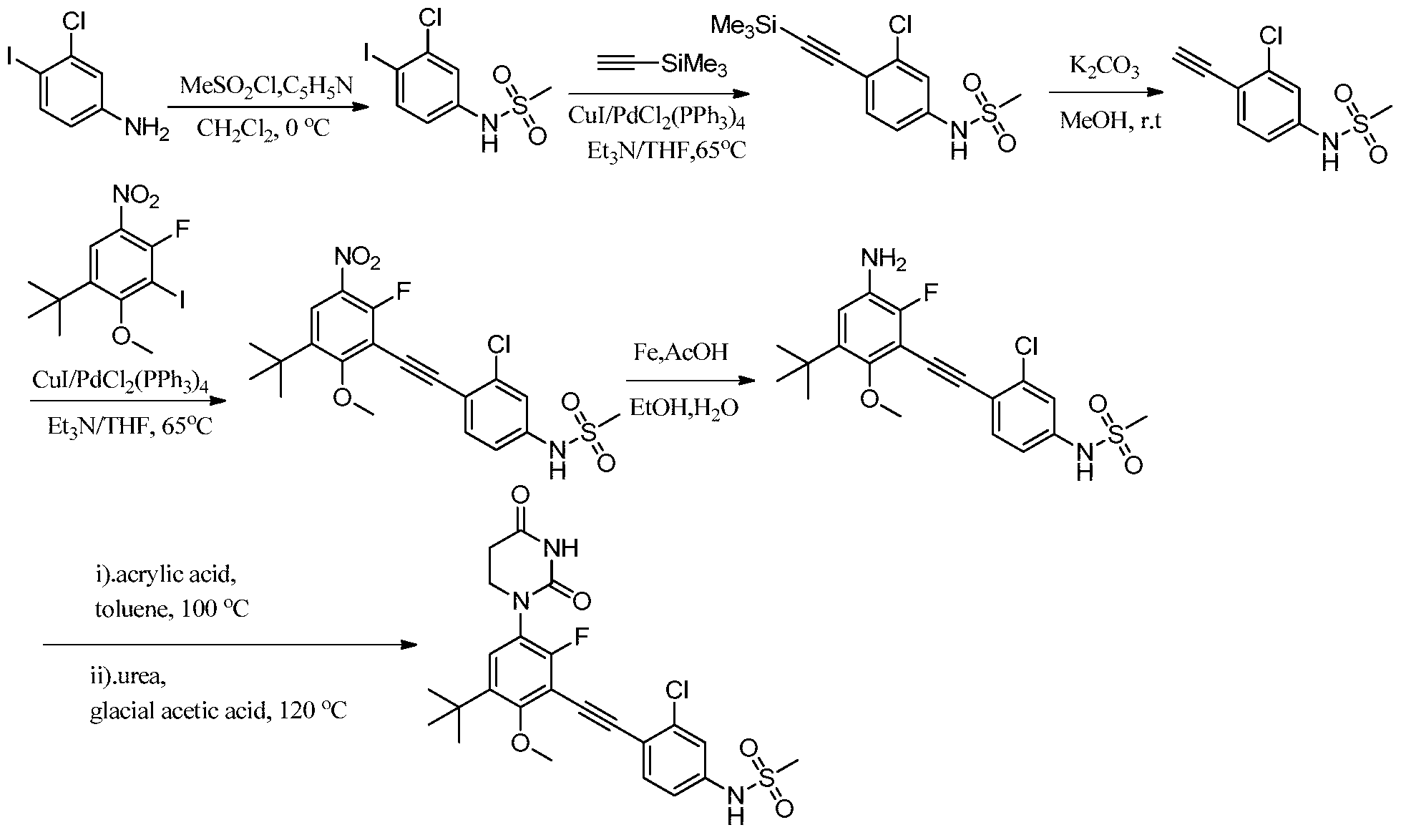
Synthesis steps:
Step 1) N- (3-chloro-4-iodophenyl) methanesulfonamide
To a solution of 3-chloro-4-iodoaniline (2.53 g, 10 mmol) in dichloromethane (20 mL) was added pyridine (0.87 g, 11 mmol) , followed by methylsulfonyl chloride (1.26 g, 11 mmol) at 0 ℃. After the addition, the mixture was stirred at 0 ℃ for 2 hours. The reaction was quenched with water (20 mL) . The resulting mixture was extracted with DCM (150 mL) . The organic layer was washed with saturated aqueous NaCl (50 mL) and dried over anhydrous Na2SO4 and concentrated in vacuo to give N- (3-chloro-4-iodophenyl) methanesulfonamide as a gray solid (3.0 g, 91%) .
MS (ESI, pos. ion) m/z: 331.8 [M+H] +.
Step 2) N- (3-chloro-4- ( (trimethylsilyl) ethynyl) phenyl) methanesulfonamide
To a solution of N- (3-chloro-4-iodophenyl) methanesulfonamide (2.5 g, 7.5 mmol) , PdCl2 (PPh3) 2 (0.35 g, 0.5 mmol) and CuI (0.19 g, 0.99 mmol) in a mixture of Et3N and THF (20 mL/20 mL) under N2 at 40 ℃ was added trimethylsilylacetylene (0.74 g, 7.5 mmol) . After the addition, the mixture was stirred at 65 ℃ for 4 hours. The reaction mixture was concentrated in vacuo. To the residue was added EtOAc (100 mL) . The resulting mixture was washed with saturated aqueous NaCl (50 mL) , dried over anhydrous Na3SO4 and concentrated in vacuo. The residue was purified by silica gel column chromatography eluted with PE : EtOAc (V : V) = 20 : 1 to give N- (3-chloro-4- ( (trimethylsilyl) ethynyl) phenyl) methanesulfonamide as a grayish yellow solid (2.0 g, 88%) .
MS (ESI, pos. ion) m/z: 302.2 [M+H] +.
Step 3) N- (3-chloro-4-ethynylphenyl) methanesulfonamide
To a solution of N- (3-chloro-4- ( (trimethylsilyl) ethynyl) phenyl) methanesulfonamide (1.8 g, 5.98 mmol) in methanol (30 mL) was added potassium carbonate (3.4 g, 25.2 mmol) . The mixture was stirred at rt for 4 hours. The reaction mixture was concentrated in vacuo. To the residue was added EtOAc (100 mL) . The resulting mixture was washed with water (30 mL) and saturated aqueous NaCl (30 mL) in turn, dried over anhydrous Na2SO4 and concentrated in vacuo. The residue was purified by silica gel column chromatography eluted with PE : EtOAc (V : V) = 10 : 1 to give N- (3-chloro-4-ethynylphenyl) methanesulfonamide as a yellow solid (1.2 g, 87.5%) .
MS (ESI, pos. ion) m/z: 230.2 [M+H] +.
Step 4) N- (3-chloro-4- ( (3- (tert-butyl) -6-fluoro-2-methoxy-5-nitrophenyl) ethynyl) phenyl)
methanesulfonamide
A mixture of 1- (tert-butyl) -4-fluoro-3-iodo-2-methoxy-5-nitrobenzene (1.53 g, 4.34 mmol) , N- (3-chloro-4-ethynylphenyl) methanesulfonamide (1.0 g, 4.34 mmol) , PdCl2 (PPh3) 2 (0.35 g, 0.5 mmol) and CuI (0.19 g, 0.99 mmol) in a mixture of Et3N and THF (20 mL/20 mL) under N2 was stirred at 65 ℃ for 3 hours. The reaction mixture was concentrated in vacuo. To the residue was added EtOAc (100 mL) . The resulting mixture was washed with water (30 mL) and saturated aqueous NaCl (30 mL) , dried over anhydrous Na2SO4 and concentrated in vacuo. The residue was purified by silica gel column chromatography eluted with PE : EtOAc (V : V) =40 : 1 to give N- (3-chloro-4- ( (3- (tert-butyl) -6-fluoro-2-methoxy-5-nitrophenyl) ethynyl) phenyl) methanesulfonamide as a yellow solid (1.04 g, 53%) .
MS (ESI, pos. ion) m/z: 455.1 [M+H] +.
Step 5) N- (3-chloro-4- ( (3-amino-5- (tert-butyl) -2-fluoro-6-methoxyphenyl) ethynyl) phenyl) methanesulfonamide
A mixture of N- (3-chloro-4- ( (3- (tert-butyl) -6-fluoro-2-methoxy-5-nitrophenyl) ethynyl) phenyl) methanesulfonamide (1 g, 2.2 mmol) and iron powder (0.56 g, 10 mmol) in a mixture of ethanol (30 mL) and glacial acetic acid (10 mL) was heated and refluxed for 10 hours. The reaction mixture was filtered through a Celite pad. The filtrate was concentrated in vacuo. To the residue was added EtOAc (60 mL) . The resulting mixture was washed with saturated aqueous NaCl (30 mL) , dried over anhydrous Na2SO4 and concentrated in vacuo. The residue was purified by silica gel column chromatography eluted with PE : EtOAc (V : V) = 2 : 1 to give N- (3-chloro-4- ( (3-amino-5- (tert-butyl) -2-fluoro-6-methoxyphenyl) ethynyl) phenyl) methanesulfo namide as a gray solid (0.8 g, 86%) .
MS (ESI, pos. ion) m/z: 425.2 [M+H] +.
Step 6) N- (3-chloro-4- ( (3- (tert-butyl) -5- (2, 4-dioxotetrahydropyrimidin-1 (2H) -yl) -6-fluoro-2-methoxyphenyl) ethynyl) phenyl) methanesulfonamide
To a solution of N- (3-chloro-4- ( (3-amino-5- (tert-butyl) -2-fluoro-6-methoxyphenyl) ethynyl) phenyl) methanesulfonamide (0.7 g, 1.6 mmol) in toluene (20 mL) was added acrylic acid (0.36 g, 5 mmol) , and the resulting mixture was heated at 100 ℃ overnight. The reaction mixture was concentrated in vacuo to give red oil. The red oil was dissolved in glacial acetic acid (10 mL) , and to the solution was added urea (0.3 g, 5 mmol) . The mixture was heated to 120 ℃
and refluxed for 6 hours. The reaction mixture was concentrated in vacuo. The residue was diluted with DCM (50 mL) , and then washed with water (15 mL × 2) and saturated aqueous NaCl solution (15 mL) , dried over anhydrous Na2SO4. The mixture was concentrated in vacuo. The residue was purified by silica gel column chromatography eluted with DCM : MeOH (V : V) = 100 : 1 to give a white solid (0.45 g, 54%) .
MS (ESI, pos. ion) m/z: 522.2 [M+H] +; and
1H NMR (600 MHz, DMSO-d6) δ 10.41 (s, 1H) , 10.35 (s, 1H) , 7.69 (d, J = 8.9 Hz, 1H) , 7.36 (d, J = 8.4 Hz, 1H) , 7.28-6.89 (m, 2H) , 4.09 (s, 3H) , 3.81 (t, J = 6.7 Hz, 2H) , 3.21 (s, 3H) , 2.83 (t, J = 6.7 Hz, 2H) , 1.42 (s, 9H) ppm.
Example 38
N- (4- ( (3- (tert-Butyl) -5- (2, 4-dioxotetrahydropyrimidin-1 (2H) -yl) -6-fluoro-2-methoxyphenyl) ethynyl) -3- (trifluoromethyl) phenyl) methanesulfonamide

Synthesis route:

Synthesis steps:
Step 1) N- (4-bromo-3- (trifluoromethyl) phenyl) methanesulfonamide
To a solution of 4-bromo-3- (trifluoromethyl) aniline (4.8 g, 20 mmol) and pyridine (3.32 g, 42 mmol) in THF (50 mL) at 0 ℃ was added methylsulfonyl chloride (2.4 g, 21 mmol) dropwise. After the addition, the mixture was continued to stir for 3 hours. The reaction mixture was quenched with water (10 mL) at a low termperature, and the mixture was stirred for 10 min. The THF was removed in vavuo and the resulting mixture was extracted with EtOAc (50 mL) . The organic layer was washed with water (20 mL × 2) and saturated aqueous NaCl (20 mL) , dried over anhydrous Na2SO4. The organic layer was concentrated in vacuo. The residue was purified by silica gel column chromatography eluted with PE : EtOAc (V : V) = 3 : 1) to give N- (4-bromo-3- (trifluoromethyl) phenyl) methanesulfonamide as a puce solid (5.6 g, 89%) .
MS (ESI, pos. ion) m/z: 319.2 [M+H] +.
Step 2) N- (3- (trifluoromethyl) -4- ( (trimethylsilyl) ethynyl) phenyl) methanesulfonamide
To a mixture of N- (4-bromo-3- (trifluoromethyl) phenyl) methanesulfonamide (5.6 g, 17.8 mmol) , CuI (0.34 g, 1.78 mmol) , Pd (PPh3) 2Cl2 (625 mg, 0.89 mmol) in a mixture of THF and Et3N (25 mL/25 mL) under N2 was added trimethylsilylacetylene (4.37 g, 44.5 mmol) via syringe. The mixture was stirred at 40 ℃ for 4 hours and filtered through a Celite pad. The filtrate was concentrated in vacuo and the residue was diluted with EtOAc (50 mL) . The resulting mixture was washed with water (20 mL × 2) and saturated aqueous NaCl (20 mL) ,
dried over anhydrous Na2SO4 and concentrated in vacuo. The residue was purified by silica gel column chromatography eluted with PE : EtOAc (V : V) = 4 : 1 to give N- (3- (trifluoromethyl) -4- ( (trimethylsilyl) ethynyl) phenyl) methanesulfonamide as yellow oil (4.8 g, 80%)
MS (ESI, pos. ion) m/z: 336.4 [M+H] +.
Step 3) N- (4-ethynyl-3- (trifluoromethyl) phenyl) methanesulfonamide
A mixture of N- (3- (trifluoromethyl) -4- ( (trimethylsilyl) ethynyl) phenyl) methanesulfonamide (4.8 g, 14.2 mmol) and KF (2.5 g, 42.7 mmol) in CH3OH (50 mL) was stirred at rt for 3 hours. The methanol was removed in vacuo and the residue was diluted with EtOAc (100 mL) . The resulting mixture was washed with water (50 mL × 2) and saturated aqueous NaCl (50 mL) , dried over anhydrous Na2SO4 and concentrated in vacuo. The residue was purified by silica gel column chromatography eluted with PE : EtOAc (V : V) = 4 : 1 to give N- (4-ethynyl-3- (trifluoromethyl) phenyl) methanesulfonamide as a yellow solid (3.1 g, 83%) .
MS (ESI, pos. ion) m/z: 264.3 [M+H] +.
Step 4) N- (4- ( (3- (tert-butyl) -5- (2, 4-dioxotetrahydropyrimidin-1 (2H) -yl) -6-fluoro-2-methoxyphenyl) ethynyl) -3- (trifluoromethyl) phenyl) methanesulfonamide
A mixture of 1- (5- (tert-butyl) -2-fluoro-3-iodo-4-methoxyphenyl) dihydropyrimidine-2,4 (1H, 3H) -dione (1.1 g, 2.61 mmol) , N- (4-ethynyl-3- (trifluoromethyl) phenyl) methanesulfonamide (1.03 g, 3.92 mmol) , CuI (50 mg, 0.26 mmol) and Pd (PPh3) 2Cl2 (92 mg, 0.13 mmol) in a mixture of THF and Et3N (15 mL/15 mL) under N2 was heated at 60 ℃ and refluxed overnight. The reaction mixture was filtered through a Celite pad. The filtrate was concentrated in vacuo. The residue was diluted with DCM (50 mL) , and the resulting mixture was washed with water (30 mL × 2) and saturated aqueous NaCl solution (30 mL) , dried over anhydrous Na2SO4. The mixture was concentrated in vacuo. The residue was purified by silica gel column chromatography eluted with DCM : MeOH (V : V) = 20 : 1 to give N- (4- ( (3- (tert-butyl) -5- (2, 4-dioxotetrahydropyrimidin-1 (2H) -yl) -6-fluoro-2-methoxyphenyl) ethy nyl) -3- (trifluoromethyl) phenyl) methanesulfonamide as a white solid (362 g, 25%) .
MS (ESI, pos. ion) m/z: 556.7 [M+H] +; and
1H NMR (600 MHz, DMSO-d6) : δ 10.55 (s, 1H) , 8.05 (s, 1H) , 7.46 (d, J = 4.9 Hz, 1H) , 7.28
(d, J = 5.5 Hz, 1H) , 7.16–6.89 (m, 2H) , 4.14 (s, 3H) , 3.81 (t, J = 6.7 Hz, 2H) , 3.21 (s, 3H) , 2.83 (t, J = 6.9 Hz, 2H) , 1.42 (s, 9H) ppm.
BIOLOGICAL ACTIVITY
RNA-dependent RNA polymerase (RdRp) assay
The RdRp primer-dependent transcription assay was performed as described in J. Virol, 2007, 81: 6909–19, which is incorporated herein by reference in its entirety. The 50%inhibitory concentration (IC50) assay in de novo transcription of the primer-independent RdRp was carried out as follows: 190 nM purified NS5BΔ21 enzyme was incubated with 86 nM 3’ non-coding region (GenBank accession no. AF011751; bases 9218 to 9558) template derived from plasmid pCV-H77, 0.5 mM ATP, 0.5 mM GTP, 0.5 mM CTP, 10 μM UTP, and 2.5 μCi of [α-33P] UTP. The 40 uL reaction mixture was incubated at room temperature for 2 h, and the reaction was stopped by the addition of 20 μL of 0.5 M EDTA containing 10 mg/mL of tRNA (Roche; ) . The mixture was transferred onto 96-well GF/B filter (Millipore; ) , and the precipitate was washed twice with 200 μL of ice-cold 10%trichloroacetic acid, twice with 200 μL of 1 M sodium phosphate–5%trichloroacetic acid, and twice with 200 μL of 95%ethanol. With the addition of 80 μL of a scintillation cocktail, the 96-well plates were subjected to counting by scintillation proximity analysis on a Packard TopCount reader. The data were analyzed by GraphPad Prism software, and IC50 value of the compound disclosed herein inhibiting HCV RdRp was calculated.
HCV subgenomic replicon assay
The activities of the compounds of the present invention can be determined using two stable cell lines containing HCV subgenomic replicon as follows: one derived from HCV genotype 1a and the other derived from HCV genotype 1b, in which the replicon constructs were described in Science, 1999, 285 (5424) : 110-3 and J. Virol., 2003, 77 (5) : 3007-19, both of which are incorporated herein by reference in their entireties. The replicon constructs are bicistronic subgenomic replicons. The first cistron has a firefly luciferase reporter and a neomycin phosphotransferase (Neo) selectable marker, and the second cistron contains HCV NS3-NS5B coding region with addition of adaptive mutations. The NS3-NS5B coding region of HCV genotype 1a replicon is derived from the H77 strain of HCV (Ia-H77) , and the adaptive mutations are E1202G, K1691R, K2040R and S2204I. The NS3-NS5B coding region of HCV genotype 1b replicon is derived from the Con1 strain of HCV (1b-Con1) , and the adaptive
mutations are E1202G, T1280I and S2204I.
The inhibitory effects of the compounds of the invention on HCV replication were determined by measuring activity of the luciferase reporter gene. Briefly, stable HCV genotype 1a (1a-H77) replicon-containing cell Huh7-H77 and stable HCV genotype 1b (1b-Con1) replicon-containing cell Huh7-Con1b were seeded into 96-well plates at a density of 8000 cells per well in 125 μL DMEM. 16-24 hours later, the compounds were diluted to desired concentration using 5-fold serial dilution protocol, 10 doses in duplicate, which were added into the 96-well plates by using PODTM 810 Plate Assembler to a final concentration of 0.5% DMSO. The cells of the 96-well plates were incubated in a CO2 incubator containing 5% CO2 for 72 hours at 37 ℃, then to each well was added 40 μl of Luciferase Assay Reagent (Promega Bright-Glo) . 5 minutes later, the luciferase activity was measured with chemiluminescence detection system (Envision) . The resulting data were analyzed by GraphPad Prism software, EC50 (concentration for 50% of maximal effect) value of each compound for inhibition of HCV was calculated. The EC50 values of representative compounds disclosed herein against HCV genotype 1a and HCV genotype 1b are showed in Table 2.
Table 2

The IC50 of the compounds inhibiting HCV polymerase and the EC50 of the compounds against HCV genotype 1a and 1b replicons combined with the results of molecular docking
simulation indicate that the compounds disclosed herein have good effects on anti-virus through specially inhibiting HCV RNA-dependent RNA polymerase.
PK Assays
1) Assay method: Male SD rats weighing 190-250 g were administered orally with the test compounds at dose of 5.0 mg/kg. After administering, blood samples were collected at designed time points. Standard curve was plotted based on concentrations of the samples in a suitable range, the concentrations of test compounds in plasma samples were determined under MRM mode using AB SCIEX API4000 type of LC-MS/MS. Pharmacokinetic parameters were calculated according to drug concentration-time curve using a noncompartmental method by WinNonLin 6.3 software. The results were listed in table 3.
Table 3

2) Assay method: Beagle dogs weighing 8-12 kg were administered orally with the test compounds at dose of 30.0 mg/kg. After administering, blood samples were collected at designed time points. Standard curve was plotted based on concentrations of the samples in a suitable range, the concentrations of test compounds in plasma samples were determined under MRM mode using AB SCIEX API4000 type of LC-MS/MS. Pharmacokinetic parameters were calculated according to drug concentration -time curve using a noncompartmental method by WinNonLin 6.3 software. The results were listed in table 4.
Table 4

Liver microsome stability assay
The compound in a certain concentration and liver microsome of various species
animals were incubated together at 37 ℃ under pH 7.4. The ratio of the peak area of sample to the peak area of interior label was obtained by analyzing through LC/MS/MS, the relative content of drug in 0 min was set as 100%, the relative content of drug in each time point was calculated. Half-life period was calculated by plotting a curve of “the relative content of drug” against “incubating time” by using a soft GraphPad Prism 5.01, and then intrinsic clearance was calculated. The results were listed in Table 5.
Table 5

N/A means can not be calculated
It will be evident to one skilled in the art that the present invention is not limited to the foregoing illustrative examples, and that it can be embodied in other specific forms without departing from the essential attributes thereof. It is therefore desired that the examples be considered in all respects as illustrative and not restrictive, reference being made to the appended claims, rather than to the foregoing examples, and all changes which come within the meaning and range of equivalency of the claims are therefore intended to be embraced therein.
The compounds disclosed herein may inhibit HCV by mechanisms in addition to or other than NS5B inhibition. In one embodiment the compounds disclosed herein inhibit HCV replicon and in another embodiment the compounds disclosed herein inhibit NS5B. The compounds disclosed herein may inhibit multiple genotypes of HCV.
In the description of the invention, the reference term "one embodiment, " "some embodiments, " "example" , "a specific example" , or "some examples" and means in connection
with the embodiment described in or example described in Example particular feature, structure, material, or characteristic be included in the present invention, at least one embodiment or example. In the present specification, the term of the above schematic representation is not necessarily referring to the same embodiment or example. Moreover, describe a particular feature, structure, material, or characteristics can be in any one or more embodiments or examples in combination in an appropriate manner.
Although embodiments of the present invention has been shown and described above, the above embodiments are illustrative embodiments that can be understood, and cannot be understood as a limit for the invention, the skills in the art without departing from the principles of the invention and purpose, can change, modify, substitute, and vary these embodiments within the scope of the present invention.
Claims (34)
- A compound having Formula (I) or a stereoisomer, a geometric isomer, an enantiomer, a tautomer, an N-oxide, a hydrate, a solvate, a metabolite, a pharmaceutically acceptable salt or a prodrug thereof,
 Wherein,represents a single bond or a double bond;
 R1 is H, deuterium, alkyl, acetyl, trifluoroacetyl, t-BuOC (=O) -, 9-fluorenylmethoxycarbonyl, phenyl-CH2-or phenyl-CH2OC (=O) -;R2 is H, deuterium, F, Cl, Br, I, OH, alkyl or cycloalkyl;R3 is H, deuterium, F, Cl, Br, I, oxo (=O) or alkyl;R4 is F, Cl, Br, I, N3, CN, NO2, -SR8, -S (=O) R8, -S (=O) 2R8, -C (=O) R9, -N (R10) S (=O) 2R8, -N (R10) S (=O) 2NR10R11, -S (=O) 2NR10R11, -C (=O) NR10R11, -N (R10) C (=O) R9, -NR10R11, alkyl, alkenyl, alkynyl, alkoxy, alkenoxy, alkynoxy, alkoxyalkyl, hydroxyalkyl, haloalkyl, haloalkoxy, alkylthio, cycloalkyl, heterocyclyl, heterocyclylalkyl, aryl or heteroaryl, wherein each of alkyl, alkenyl, alkynyl, alkoxy, alkenoxy, alkynoxy, alkoxyalkyl, hydroxyalkyl, haloalkyl, haloalkoxy, alkylthio, cycloalkyl, heterocyclyl, heterocyclylalkyl, aryl and heteroaryl is independently and optionally substituted with 1, 2, 3 or 4 substituents independently selected from H, deuterium, F, Cl, Br, I, N3, NO2, OH, -NR10R11, alkyl, silyl, -C (=O) R9, oxo (=O) , alkenyl, alkynyl, alkoxy, hydroxyalkyl, haloalkyl, cycloalkyl, heterocyclyl, aryl or heteroaryl;R5 is H, OH, F, Cl, Br, I, deuterium, -OS (=O) 2R8, -S (=O) 2R8, alkenyl, alkynyl, alkoxy, alkynoxy, heterocyclyl, aryl or heteroaryl;L is a bond, alkylene, alkenylene, alkynylene, cycloalkylene, heterocyclylene, -C (=O) -, -OC (=O) -, -OC (=O) N (R10) -, -N (R10) C (=O) -, -C (=O) N (R10) -, -C (R9) 2O-, -OC (R9) 2-, alkylene-C (=O) -, -C (=O) -alkylene, alkylene-N (R10) -or -N (R10) -alkylene;R6 is cycloalkyl, heterocyclyl, aryl or heteroaryl, and R6 is optionally substituted with 1, 2, 3 or 4 R12;each R12 is independently H, deuterium, OH, F, Cl, Br, I, N3, CN, NO2, CF3, =NN (R10) SO2R8, -C (R9) =NN (R10) S (=O) 2R8, -N (R10) S (=O) 2R8, -N (R10) N (R11) S (=O) 2R8, -S (=O) 2R8, -C (=O) R9, -N (R10) S (=O) 2NR10R11, -S (=O) 2NR10R11, -C (=O) NR10R11, -N (R10) C (=O) R9, -N (R10) C (=O) NR10, -OS (=O) 2R8, -C (=O) N (R10) S (=O) 2R8, -N (R10) C (=O) N (R10) S (=O) 2R8, -NR10R11, alkyl, alkenyl, alkynyl, alkylamino, alkenylamino, alkynylamino, alkoxy, alkenoxy, alkynoxy, imino, R8S (=O) 2N (R10) -imino, R9C (=O) N (R10) -imino, R8S (=O) 2N (R10) -alkyl, oxo (=O) , cycloalkyl, heterocyclyl, heterocyclylalkyl, aryl or heteroaryl;R7 is deuterium, F, Cl, Br, I, CN, NO2, alkyl, haloalkyl or -C (=O) R9;each R8 and R9 is independently H, OH, amino, alkyl, alkenyl, alkynyl, haloalkyl, hydroxyalkyl, heterocyclylalkyl, alkoxy, alkenoxy, alkynoxy, cycloalkyl, heterocyclyl, aryl or heteroaryl;each R10 and R11 is independently H, deuterium, alkyl, alkenyl, alkynyl, haloalkyl, hydroxyalkyl, cycloalkyl, heterocyclyl, heterocyclylalkyl, aryl or heteroaryl; orR10 and R11, together with the nitrogen atom to which they are attached, form a 4-7 membered heterocyclic ring, wherein the 4-7 membered heterocyclic ring is optionally substituted with 1, 2, 3 or 4 R13;each L, R8, R9, R10, R11 and R12 is independently substituted with 1, 2, 3 or 4 R13; andeach R13 is independently H, deuterium, OH, F, Cl, Br, I, N3, CN, NO2, amino, imino, oxo (=O) , =NN (H) SO2Me, -C (H) =NN (H) S (=O) 2Me, -N (H) S (=O) 2Me, -S (=O) 2Me, -C (=O) OMe, -N (H) C (=O) OMe, -N (H) C (=O) NHS (=O) 2Me, alkyl, alkenyl, alkynyl, alkylamino, alkenylamino, alkynylamino, alkoxy, alkenoxy, alkynoxy, carboxyl, cycloalkyl, heterocyclyl, aryl or heteroaryl.
 - The compound according to claim 1, whereinR1 is H, deuterium, C1-6 alkyl, acetyl, trifluoroacetyl, t-BuOC (=O) -, 9-fluorenylmethoxycarbonyl, phenyl-CH2-or phenyl-CH2OC (=O) -;R2 is H, deuterium, F, Cl, Br, I, OH, C1-6 alkyl or C3-8 cycloalkyl; andR3 is H, deuterium, F, Cl, Br, I, oxo (=O) or C1-6 alkyl.
- The compound according to claim 2, whereinR1 is H, deuterium, methyl, ethyl, propyl, isopropyl, butyl, tert-butyl, acetyl, trifluoroacetyl, t-BuOC (=O) -, 9-fluorenylmethoxycarbonyl, phenyl-CH2-or phenyl-CH2OC (=O) -;R2 is H, deuterium, F, Cl, Br, I, OH, methyl, ethyl, cyclopropyl, cyclobutyl or cyclopentyl; andR3 is H, deuterium, F, Cl, Br, I, oxo (=O) methyl or ethyl.
- The compound according to any one of claims 1to 3, whereinR4 is F, Cl, Br, I, N3, CN, NO2, SR8, -S (=O) R8, -S (=O) 2R8, -C (=O) R9, -N (R10) S (=O) 2R8, -N (R10) S (=O) 2NR10R11, -S (=O) 2NR10R11, -C (=O) NR10R11, -N (R10) C (=O) R9, -NR10R11, C1-6 alkyl, C2-6 alkenyl, C2-6 alkynyl, C1-6 alkoxy, C2-6 alkenoxy, C2-6 alkynoxy, C1-6 alkoxy-C1-6-alkyl, C1-6 hydroxyalkyl, C1-6 haloalkyl, C1-6 haloalkoxy, C1-6 alkylthio, C3-8 cycloalkyl, C2-9 heterocyclyl, C2-9 heterocyclyl-C1-6-alkyl, C6-10 aryl or C1-9 heteroaryl, wherein each of C1-6 alkyl, C2-6 alkenyl, C2-6 alkynyl, C1-6 alkoxy, C2-6 alkenoxy, C2-6 alkynoxy, C1-6 alkoxy-C1-6-alkyl, C1-6 hydroxyalkyl, C1-6 haloalkyl, C1-6 haloalkoxy, C1-6 alkylthio, C3-8 cycloalkyl, C2-9 heterocyclyl, C2-9 heterocyclyl-C1-6-alkyl, C6-10 aryl and C1-9 heteroaryl is independently and optionally substituted with 1, 2, 3 or 4 substituents independently selected from H, deuterium, F, Cl, Br, I, N3, NO2, OH, amino, C1-6 alkyl, C1-12 silyl, -C (=O) R9, oxo (=O) , C2-6 alkenyl, C2-6 alkynyl, C1-6 alkoxy, C1-6 hydroxyalkyl, C1-6 haloalkyl, C3-8 cycloalkyl, C2-9 heterocyclyl, C2-9 heterocyclyl-C1-6-alkyl, C6-10 aryl and C1-9 heteroaryl;each R8 and R9 is independently H, OH, amino, C1-6 alkyl, C2-6 alkenyl, C2-6 alkynyl, C1-6 haloalkyl, C1-6 hydroxyalkyl, C2-9 heterocyclyl-C1-6-alkyl, C1-6 alkoxy, C2-6 alkenoxy, C2-6 alkynoxy, C3-8 cycloalkyl, C2-9 heterocyclyl, C6-10 aryl or C1-9 heteroaryl;each R10 and R11 is independently H, C1-6 alkyl, C2-6 alkenyl, C2-6 alkynyl, C1-6 haloalkyl, C1-6 hydroxyalkyl, C2-9 heterocyclyl-C1-6-alkyl, C3-8 cycloalkyl, C2-9 heterocyclyl, C6-10 aryl or C1-9 heteroaryl; orR10 and R11, together with the nitrogen atom to which they are attached, form a 4-7 membered heterocyclic ring, wherein the 4-7 membered heterocyclic ring is optionally substituted independently with 1, 2, 3 or 4 R13;each R8, R9, R10 and R11 is optionally substituted with 1, 2, 3 or 4 R13; andeach R13 is independently H, deuterium, OH, F, Cl, Br, I, N3, CN, NO2, amino, imino, oxo (=O) , -N (H) S (=O) 2Me, -S (=O) 2Me, -C (=O) OMe, C1-6 alkyl, C2-6 alkenyl, C2-6 alkynyl, C1-6 alkylamino, C2-6 alkenylamino, C2-6 alkynylamino, C1-6 alkoxy, C2-6 alkenoxy, C2-6 alkynoxy, carboxyl, C3-8 cycloalkyl, C2-9 heterocyclyl, C6-10 aryl or C1-9 heteroaryl.
- The compound according to claim 4, whereinR4 is F, Cl, Br, I, N3, CN, NO2, CF3, amino, methyl, ethyl, propyl, isopropyl, n-butyl, tert-butyl, ethenyl, -S (=O) 2R8, ethynyl, phenyl, furyl, thienyl, pyrrolyl, pyridyl, thiazolyl, imidazolyl, oxazolyl, pyrimidinyl, pyrazinyl, pyridazinyl, cyclopropyl, cyclobutyl or cyclopentyl;wherein each of amino, methyl, ethyl, propyl, isopropyl, n-butyl, tert-butyl, ethenyl, -S (=O) 2R8, ethynyl, phenyl, furyl, thienyl, pyrrolyl, pyridyl, thiazolyl, imidazolyl, oxazolyl, pyrimidinyl, pyrazinyl, pyridazinyl, cyclopropyl, cyclobutyl and cyclopentyl is independently and optionally substituted with 1, 2, 3 or 4 substituents independently selected from H, deuterium, F, Cl, Br, I, N3, NO2, OH, Me3Si, Et3Si, i-Pr3Si, t-BuMe2Si, -C (=O) R9, oxo (=O) , amino, methyl, ethyl, propyl, isopropyl, tert-butyl, ethenyl, ethynyl, methoxy, ethoxy, tert-butoxy, cyclopropyl, cyclobutyl, cyclopentyl, phenyl, furyl, thienyl, pyridyl, thiazolyl, imidazolyl, oxazolyl and pyrrolyl; andeach R8 and R9 is independently H, OH, amino, methyl, ethyl, methoxy, ethoxy, trifluoromethoxy, CHF2, CH2F, CF3, cyclopropyl, cyclobutyl, cyclopentyl or phenyl.
- The compound according to any one of claims 1 to 5, wherein R5 is H, OH, F, Cl, Br, I, CN, deuterium, -OS (=O) 2R8, -S (=O) 2R8, C2-6 alkenyl, C2-6 alkynyl, C1-6 alkoxy, C2-6 alkynoxy, C2-9 heterocyclyl, C6-10 aryl or C1-9 heteroaryl.
- The compound according to claim 6, wherein R5 is H, OH, F, Cl, Br, I, CN, deuterium, methoxy or ethoxy.
- The compound according to any one of claims 1 to 7, whereinL is a bond, C1-6 alkylene, C2-6 alkenylene, C2-6 alkynylene, C3-8 cycloalkylene, C2-9 heterocyclylene, -C (=O) -, -OC (=O) -, -OC (=O) N (R10) -, -N (R10) C (=O) -, -C (=O) N (R10) -, -C (R9) 2O-, -OC (R9) 2-, C1-6 alkylene-C (=O) -, -C (=O) -C1-6-alkylene, C1-6 alkylene-N (R10) -or -N (R10) -C1-6-alkylene;R6 is C3-8 cycloalkyl, C2-9 heterocyclyl, C6-10 aryl or C1-9 heteroaryl, and R6 is optionally substituted with 1, 2, 3 or 4 R12;each R12 is independently H, deuterium, OH, F, Cl, Br, I, N3, CN, NO2, CF3, =NN (R10) SO2R8, -C (R9) =NN (R10) S (=O) 2R8, -N (R10) S (=O) 2R8, -N (R10) N (R11) S (=O) 2R8, -S (=O) 2R8, -C (=O) R9, -N (R10) S (=O) 2NR10R11, -S (=O) 2NR10R11, -C (=O) NR10R11, -N (R10) C (=O) R9, -N (R10) C (=O) NR10, -OS (=O) 2R8, -C (=O) N (R10) S (=O) 2R8, -N (R10) C (=O) N (R10) S (=O) 2R8, -NR10R11, C1-6 alkyl, C2-6 alkenyl, C2-6 alkynyl, C1-6 alkylamino, C2-6 alkenylamino, C2-6 alkynylamino, C1-6 alkoxy, C2-6 alkenoxy, C2-6 alkynoxy, imino, R8S (=O) 2N (R10) -imino, R9C (=O) N (R10) -imino, R8S (=O) 2N (R10) -C1-6-alkyl, oxo (=O) , C3-8 cycloalkyl, C2-9 heterocyclyl, C2-9 heterocyclyl-C1-6-alkyl, C6-10 aryl or C1-9 heteroaryl;each R8 and R9 is independently H, OH, amino, C1-6 alkyl, C2-6 alkenyl, C2-6 alkynyl, C1-6 haloalkyl, C1-6 hydroxyalkyl, C2-9 heterocyclyl-C1-6-alkyl, C1-6 alkoxy, C2-6 alkenoxy, C2-6 alkynoxy, C3-8 cycloalkyl, C2-9 heterocyclyl, C6-10 aryl or C1-9 heteroaryl;each R10 and R11 is independently H, C1-6 alkyl, C2-6 alkenyl, C2-6 alkynyl, C1-6 haloalkyl, C1-6 hydroxyalkyl, C2-9 heterocyclyl-C1-6-alkyl, C3-8 cycloalkyl, C2-9 heterocyclyl, C6-10 aryl or C1-9 heteroaryl; orR10 and R11, together with the nitrogen atom to which they are attached, form a 4-7 membered heterocyclic ring, wherein the 4-7 membered heterocyclic ring is optionally substituted with 1, 2, 3 or 4 R13;each L, R8, R9, R10, R11 and R12 is independently substituted with 1, 2, 3 or 4 R13; andeach R13 is independently H, deuterium, OH, F, Cl, Br, I, N3, CN, NO2, amino, imino, oxo (=O) , -N (H) S (=O) 2Me, -S (=O) 2Me, -C (=O) OMe, =NN (H) SO2Me, -C (H) =NN (H) S (=O) 2Me, -N (H) C (=O) NHS (=O) 2Me, -N (H) C (=O) OMe, C1-6 alkyl, C2-6 alkenyl, C2-6 alkynyl, C1-6 alkylamino, C2-6 alkenylamino, C2-6 alkynylamino, C1-6 alkoxy, C2-6 alkenoxy, C2-6 alkynoxy, carboxyl, C3-8 cycloalkyl, C2-9 heterocyclyl, C6-10 aryl or C1-9 heteroaryl.
- The compound according to claim 8, wherein L is a bond, C1-3 alkylene, C2-3 alkenylene, C2-3 alkynylene, C3-6 cycloalkylene or C2-9 heterocyclylene.
- The compound according to claim 8, whereinL is a bond, ethylene, ethenylene, ethynylene, cyclopropylene, cyclobutylene or cyclopentylene;R6 is phenyl, pyridyl, thienyl, furyl, thiazolyl, oxazolyl, piperazinyl, imidazolyl, pyrrolyl, pyrazinyl, pyridazinyl, morpholinyl, tetrahydropyridyl, piperidinyl, pyrrolidinyl, tetrahydrofuranyl, tetrahydrothienyl, pyrimidyl, cyclopropyl, cyclobutyl, cyclopentyl, or R6 is
 R6 is optionally substituted with 1, 2, 3 or 4 R12;each R12 is independently H, deuterium, OH, F, Cl, Br, I, N3, CN, NO2, CF3, =NN (R10) SO2R8, -C (R9) =NN (H) S (=O) 2R8, -N (H) S (=O) 2R8, -N (R10) N (R11) S (=O) 2R8, -S (=O) 2R8, -C (=O) R9, -N (R10) S (=O) 2NR10R11, -S (=O) 2NR10R11, -C (=O) NR10R11, -N (R10) C (=O) R9, -N (R10) C (=O) NR10, -OS (=O) 2R8, -C (=O) N (R10) S (=O) 2R8, -N (R10) C (=O) N (R10) S (=O) 2R8, -NR10R11, methyl, ethyl, propyl, isopropyl, tert-butyl, ethenyl, ethynyl, methylamino, ethylamino, methoxy, ethoxy, imino, R8S (=O) 2N (R10) -imino, R9C (=O) N (R10) -imino, R8S (=O) 2N (R10) -C1-4-alkyl, oxo (=O) , cyclopropyl, cyclobutyl, cyclopentyl, pyrrolidinyl, tetrahydrofuranyl, tetrahydrothienyl, morpholinyl, piperidinyl, pyrrolidinylmethyl, phenyl, pyridyl, thienyl, furyl, thiazolyl, oxazolyl, piperazinyl, imidazolyl, pyrrolyl, pyrazinyl, pyridazinyl or pyrimidinyl;each R8 and R9 is independently H, OH, amino, methyl, ethyl, propyl, isopropyl, tert-butyl, ethenyl, ethynyl, CF3, CHF2, CH2F, methoxy, ethoxy, pyrrolidinylmethyl, cyclopropyl, cyclobutyl, cyclopentyl, pyrrolidinyl, tetrahydrofuranyl, tetrahydrothienyl, morpholinyl, piperidinyl, phenyl, pyridyl, thienyl, furyl, thiazolyl, oxazolyl, piperazinyl, imidazolyl, pyrrolyl, pyrazinyl, pyridazinyl or pyrimidinyl;each R10 and R11 is independently H, methyl, ethyl, propyl, isopropyl, tert-butyl, ethenyl, ethynyl, CF3, CHF2, CH2F, methoxy, ethoxy, pyrrolidinylmethyl, cyclopropyl, cyclobutyl, cyclopentyl, pyrrolidinyl, tetrahydrofuranyl, tetrahydrothienyl, morpholinyl, piperidinyl, phenyl, pyridyl, thienyl, furyl, thiazolyl, oxazolyl, piperazinyl, imidazolyl, pyrrolyl, pyrazinyl, pyridazinyl or pyrimidinyl; orR10 and R11, together with the nitrogen atom to which they are attached, form a 4-7 membered heterocyclic ring, wherein the 4-7 membered heterocyclic ring is optionally substituted with 1, 2, 3 or 4 R13;each L, R8, R9, R10, R11 and R12 is optionally substituted with 1, 2, 3 or 4 R13; andeach R13 is independently H, deuterium, F, Cl, Br, I, CN, NO2, N3, methyl, ethyl, propyl, isopropyl, n-butyl, tert-butyl, oxo (=O) , ethenyl, ethynyl or phenyl.
 - The compound according to any one of claims 1 to 10, whereinR7 is deuterium, F, Cl, Br, I, CN, NO2, C1-6 alkyl, C1-6 haloalkyl or -C (=O) R9; andR9 is C1-6 alkyl or C1-6 alkoxy.
- The compound according to claim 11, wherein R7 is deuterium, F, Cl, Br, I, CN, NO2, methyl, ethyl, propyl, isopropyl, CHF2, CH2F, CF3, -C (=O) Me, -C (=O) OMe or -C (=O) OEt.
- The compound according to any one of claims 1 to 12, wherein each R12 is independently F, Cl, Br, I, N3, CN, NO2, CF3, =NN (R10) SO2R8, -C (R9) =NN (H) S (=O) 2R8, -N (H) S (=O) 2R8, -S (=O) 2R8, -C (=O) R9, -C (=O) NR10R11, -N (R10) C (=O) N (R10) S (=O) 2R8, alkyl, alkoxy, R8S (=O) 2N (R10) -alkyl, heterocyclyl, heterocyclylalkyl or heteroaryl.
- The compound according to claim 1 having one of the following structures or a stereoisomer, a geometric isomer, an enantiomer, a tautomer, an N-oxide, a hydrate, a solvate, a metabolite, a pharmaceutically acceptable salt or a prodrug thereof:


- A pharmaceutical composition comprising a compound according to any one of claims 1 to 14.
- The pharmaceutical composition according to claim 15 further comprising a pharmaceutically acceptable carrier, excipient, diluent, adjuvant, vehicle or a combination thereof.
- The pharmaceutical composition according to claim 15 further comprising an anti-HCV agent.
- The pharmaceutical composition according to claim 17, wherein the anti-HCV agent is interferon, ribavirin, IL-2, IL-6, IL-12, a compound that enhances the development of a type 1 helper T cell response, interfering RNA, anti-sense RNA, imiquimod, an inosine 5’ -monophosphate dehydrogenase inhibitor, amantadine, rimantadine, bavituximab, human hepatitis C immune globulin (CivacirTM) , boceprevir, telaprevir, sofosbuvir, ledipasvir, daclatasvir, danoprevir, ciluprevir, narlaprevir, deleobuvir (BI-207127) , dasabuvir (ABT-333) , beclabuvir (BMS-791325) , elbasvir (MK-8742) , ombitasvir (ABT-267) , neceprevir (ACH-2684) , tegobuvir (GS-9190) , grazoprevir (MK-5172) , sovaprevir (ACH-1625) , samatasvir (IDX-719) , setrobuvir, veruprevir (ABT-450) , erlotinib, simeprevir (TMC-435) , asunaprevir (BMS-650032) , vaniprevir (MK-7009) , faldaprevir (BI-2013335) , VX-135, CIGB-230, TG-2349, ABT-530, ABT-493, IDX-21437, GS-9669, JHJ-56914845, vedroprevir (GS-9451) , BZF-961, GS-9256, ANA975, EDP239, PPI-668, GS-5816, MK-8325, GSK-2336805, PPI-461, ACH-1095, VX-985, IDX-375, VX-500, VX-813, PHX-1766, PHX-2054, IDX-136, IDX-316, EP-013420, VBY-376, TMC-649128, R-7128, PSI-7977, INX-189, IDX-184, IDX102, R1479, UNX-08189, PSI-6130, PSI-938, PSI-879, HCV-796, HCV-371, VCH-916, VCH-222, ANA-598, MK-3281, ABT-072, PF-00868554, BI-207127, A-837093, JKT-109, Gl-59728, GL-60667, AZD-2795, TMC-647055 or a combination thereof.
- The pharmaceutical composition according to claim 18, wherein the interferon is interferon α-2b, pegylated interferon α, interferon α-2a, pegylated interferon α-2a, consensus interferon-α, interferon γ or a combination thereof.
- The pharmaceutical composition according to any one of claims 15 to 19 further comprising at least one HCV inhibitor for inhibiting HCV replication process and/or function of an HCV viral protein.
- The pharmaceutical composition according to claim 20, wherein the HCV replication process is HCV entry, HCV uncoating, HCV translation, HCV replication, HCV assembly or HCV egress.
- The pharmaceutical composition according to claim 20, wherein the HCV viral protein is metalloproteinase, NS2, NS3, NS4A, NS4B, NS5A or NS5B, an internal ribosome entry site (IRES) or inosine 5’ -monophosphate dehydrogenase (IMPDH) required in HCV viral replication.
- Use of the compound according to any one of claims 1 to 14 or the pharmaceutical composition according to any one of claims 15 to 22 in the manufacture of a medicament for inhibiting HCV replication process and/or function of an HCV viral protein.
- The use according to claim 23, wherein the HCV replication process is HCV entry, HCV uncoating, HCV translation, HCV replication, HCV assembly or HCV egress.
- The use according to claim 23, wherein the HCV viral protein is metalloproteinase, NS2, NS3, NS4A, NS4B, NS5A, NS5B, an internal ribosome entry site (IRES) or inosine 5’ -monophosphate dehydrogenase (IMPDH) required in HCV viral replication.
- A method of inhibiting HCV replication process and/or function of an HCV viral protein function in a patient, comprising administering to the patient a therapeutically effective amount of the compound according to any one of claims 1 to 14 or the pharmaceutical composition according to any one of claims 15 to 22.
- The method according to claim 26, wherein the HCV replication process is HCV entry, HCV uncoating, HCV translation, HCV replication, HCV assembly or HCV egress.
- The method according to claim 26, wherein the HCV viral protein is metalloproteinase, NS2, NS3, NS4A, NS4B, NS5A, NS5B, an internal ribosome entry site (IRES) or inosine 5’ -monophosphate dehydrogenase (IMPDH) required in HCV viral replication.
- The compound according to any one of claims 1 to 14 or the pharmaceutical composition according to any one of claims 15 to 22 for use in inhibiting HCV replication process and/or function of a HCV viral protein.
- The compound or the pharmaceutical composition according to claim 29, wherein the HCV replication process is HCV entry, HCV uncoating, HCV translation, HCV replication, HCV assembly or HCV egress.
- The compound or the pharmaceutical composition according to claim 29, wherein the HCV viral protein is metalloproteinase, NS2, NS3, NS4A, NS4B, NS5A, NS5B, an internal ribosome entry site (IRES) or inosine 5’ -monophosphate dehydrogenase (IMPDH) required in HCV viral replication.
- Use of the compound according to any one of claims 1 to 14 or the pharmaceutical composition according to any one of claims 15 to 22 in the manufacture of a medicament for preventing, managing, treating or lessening the severity of HCV infection or a HCV disorder in a patient.
- A method of preventing, managing, treating or lessening the severity of HCV infection or a HCV disorder in a patient comprising administering to the patient a therapeutically effective amount of the compound according to any one of claims 1 to 14 or the pharmaceutical composition according to any one of claims 15 to 22.
- The compound according to any one of claims 1 to 14 or the pharmaceutical composition according to any one of claims 15 to 22 for use in preventing, managing, treating or lessening the severity of HCV infection or a HCV disorder in a patient.
Applications Claiming Priority (2)
| Application Number | Priority Date | Filing Date | Title |
|---|---|---|---|
| CN201410302039.9 | 2014-06-28 | ||
| CN201410302039 | 2014-06-28 |
Publications (1)
| Publication Number | Publication Date |
|---|---|
| WO2015197028A1 true WO2015197028A1 (en) | 2015-12-30 |
Family
ID=54936984
Family Applications (1)
| Application Number | Title | Priority Date | Filing Date |
|---|---|---|---|
| PCT/CN2015/082545 Ceased WO2015197028A1 (en) | 2014-06-28 | 2015-06-26 | Compounds as hepatitis c virus (hcv) inhibitors and uses thereof in medicine |
Country Status (2)
| Country | Link |
|---|---|
| CN (1) | CN106065009B (en) |
| WO (1) | WO2015197028A1 (en) |
Cited By (40)
| Publication number | Priority date | Publication date | Assignee | Title |
|---|---|---|---|---|
| WO2017087777A1 (en) * | 2015-11-19 | 2017-05-26 | Incyte Corporation | Heterocyclic compounds as immunomodulators |
| CN107266373A (en) * | 2017-08-01 | 2017-10-20 | 安徽拜善晟制药有限公司 | A kind of bulk drug Da Shabuwei preparation method |
| WO2017202207A1 (en) * | 2016-05-27 | 2017-11-30 | 深圳市塔吉瑞生物医药有限公司 | Substituted naphthalene ring compound, pharmaceutical composition, and application thereof |
| US10308644B2 (en) | 2016-12-22 | 2019-06-04 | Incyte Corporation | Heterocyclic compounds as immunomodulators |
| US10618916B2 (en) | 2018-05-11 | 2020-04-14 | Incyte Corporation | Heterocyclic compounds as immunomodulators |
| US10669271B2 (en) | 2018-03-30 | 2020-06-02 | Incyte Corporation | Heterocyclic compounds as immunomodulators |
| US10793565B2 (en) | 2016-12-22 | 2020-10-06 | Incyte Corporation | Heterocyclic compounds as immunomodulators |
| US10806785B2 (en) | 2016-12-22 | 2020-10-20 | Incyte Corporation | Immunomodulator compounds and methods of use |
| CN112168826A (en) * | 2020-09-30 | 2021-01-05 | 郑州大学 | Application of daresbuvir in preparation of anti-esophageal cancer and gastric cancer tumor medicines |
| EP3774804A1 (en) * | 2018-03-26 | 2021-02-17 | Novartis AG | N-(3-(7h-pyrrolo[2,3-d]pyrimidin-4-yl)phenyl)benzamide derivatives |
| US11247987B2 (en) | 2017-10-06 | 2022-02-15 | Forma Therapeutics, Inc. | Inhibiting ubiquitin specific peptidase 30 |
| EP4031247A1 (en) * | 2019-09-16 | 2022-07-27 | Novartis AG | Bifunctional degraders and their methods of use |
| US11401279B2 (en) | 2019-09-30 | 2022-08-02 | Incyte Corporation | Pyrido[3,2-d]pyrimidine compounds as immunomodulators |
| US11407749B2 (en) | 2015-10-19 | 2022-08-09 | Incyte Corporation | Heterocyclic compounds as immunomodulators |
| US11426412B2 (en) | 2017-10-18 | 2022-08-30 | Jubilant Epipad LLC | Imidazo-pyridine compounds as PAD inhibitors |
| US11459338B2 (en) | 2017-11-24 | 2022-10-04 | Jubilant Episcribe Llc | Heterocyclic compounds as PRMT5 inhibitors |
| US11465981B2 (en) | 2016-12-22 | 2022-10-11 | Incyte Corporation | Heterocyclic compounds as immunomodulators |
| US11529341B2 (en) | 2018-03-13 | 2022-12-20 | Jubilant Prodel LLC | Bicyclic compounds as inhibitors of PD1/PD-L1 interaction/activation |
| US11535615B2 (en) | 2015-12-22 | 2022-12-27 | Incyte Corporation | Heterocyclic compounds as immunomodulators |
| US11535618B2 (en) | 2018-10-05 | 2022-12-27 | Forma Therapeutics, Inc. | Fused pyrrolines which act as ubiquitin-specific protease 30 (USP30) inhibitors |
| US11541056B2 (en) | 2018-03-26 | 2023-01-03 | Novartis Ag | 3-hydroxy-N-(3-(7H-pyrrolo[2,3-d]pyrimidin-4-yl)phenyl)pyrrolidine-1-carboxamide derivatives |
| US11608337B2 (en) | 2016-05-06 | 2023-03-21 | Incyte Corporation | Heterocyclic compounds as immunomodulators |
| US11613536B2 (en) | 2016-08-29 | 2023-03-28 | Incyte Corporation | Heterocyclic compounds as immunomodulators |
| US11629135B2 (en) | 2017-11-06 | 2023-04-18 | Jubilant Prodell Llc | Pyrimidine derivatives as inhibitors of PD1/PD-L1 activation |
| US11673883B2 (en) | 2016-05-26 | 2023-06-13 | Incyte Corporation | Heterocyclic compounds as immunomodulators |
| US11718605B2 (en) | 2016-07-14 | 2023-08-08 | Incyte Corporation | Heterocyclic compounds as immunomodulators |
| US11753406B2 (en) | 2019-08-09 | 2023-09-12 | Incyte Corporation | Salts of a PD-1/PD-L1 inhibitor |
| US11760761B2 (en) | 2020-08-17 | 2023-09-19 | Aligos Therapeutics, Inc. | Methods and compositions for targeting PD-L1 |
| US11760756B2 (en) | 2020-11-06 | 2023-09-19 | Incyte Corporation | Crystalline form of a PD-1/PD-L1 inhibitor |
| US11780836B2 (en) | 2020-11-06 | 2023-10-10 | Incyte Corporation | Process of preparing a PD-1/PD-L1 inhibitor |
| US11833156B2 (en) | 2017-09-22 | 2023-12-05 | Jubilant Epipad LLC | Heterocyclic compounds as pad inhibitors |
| US11866451B2 (en) | 2019-11-11 | 2024-01-09 | Incyte Corporation | Salts and crystalline forms of a PD-1/PD-L1 inhibitor |
| US11866434B2 (en) | 2020-11-06 | 2024-01-09 | Incyte Corporation | Process for making a PD-1/PD-L1 inhibitor and salts and crystalline forms thereof |
| US11873309B2 (en) | 2016-06-20 | 2024-01-16 | Incyte Corporation | Heterocyclic compounds as immunomodulators |
| US12049466B2 (en) | 2018-05-17 | 2024-07-30 | Forma Therapeutics, Inc. | Fused bicyclic compounds useful as ubiquitin-specific peptidase 30 inhibitors |
| US12083099B2 (en) | 2020-10-28 | 2024-09-10 | Accencio LLC | Methods of treating symptoms of coronavirus infection with viral protease inhibitors |
| US12274700B1 (en) | 2020-10-30 | 2025-04-15 | Accencio LLC | Methods of treating symptoms of coronavirus infection with RNA polymerase inhibitors |
| WO2025117682A1 (en) | 2023-12-01 | 2025-06-05 | Blueprint Medicines Corporation | Cyclin-dependent kinase 2 degraders |
| US12466822B2 (en) | 2016-12-22 | 2025-11-11 | Incyte Corporation | Heterocyclic compounds as immunomodulators |
| US12516044B2 (en) | 2015-12-17 | 2026-01-06 | Incyte Corporation | Heterocyclic compounds as immunomodulators |
Families Citing this family (8)
| Publication number | Priority date | Publication date | Assignee | Title |
|---|---|---|---|---|
| CN106539799B (en) * | 2016-11-07 | 2017-09-26 | 云天下科技股份有限公司 | A kind of medicine for treating colitis and its purposes in the medicine for preparing treatment colitis |
| CN106995380B (en) * | 2017-03-31 | 2018-12-28 | 九江善水科技股份有限公司 | A kind of synthetic method of 2- Amino-4-nitrophenol |
| CN112424172B (en) * | 2018-08-10 | 2022-08-12 | 广东东阳光药业有限公司 | Salt of HCV inhibitor and preparation method thereof |
| CN109942427B (en) * | 2019-04-17 | 2022-02-18 | 云南农业大学 | Monoterpene phenol derivative, and synthesis method and application thereof in pesticide |
| CN111635401A (en) * | 2020-06-18 | 2020-09-08 | 镇江卡博医药科技有限公司 | Copper complex promoted 7-fluoroimidazo [1,2-a ] pyridine synthesis method |
| CN112851532A (en) * | 2021-01-22 | 2021-05-28 | 九江善水科技股份有限公司 | Preparation method of 2-amino-4-nitrophenol |
| CN113200893B (en) * | 2021-04-20 | 2021-12-21 | 江苏极易新材料有限公司 | Synthesis method of 4,4' -thiobis (6-tert-butyl-3-methylphenol) |
| CN118754880B (en) * | 2024-09-05 | 2024-12-20 | 天津辰欣药物研究有限公司 | Preparation method of cyclopropyl substituted 2H-benzofuran compound intermediate |
Citations (5)
| Publication number | Priority date | Publication date | Assignee | Title |
|---|---|---|---|---|
| WO2009039135A1 (en) * | 2007-09-17 | 2009-03-26 | Abbott Laboratories | N-phenyl-dioxo-hydropyrimidines useful as hepatitis c virus (hcv) inhibitors |
| WO2009039134A1 (en) * | 2007-09-17 | 2009-03-26 | Abbott Laboratories | Anti-infective pyrimidines and uses thereof |
| WO2009039127A1 (en) * | 2007-09-17 | 2009-03-26 | Abbott Laboratories | Uracil or thymine derivative for treating hepatitis c |
| WO2011073114A1 (en) * | 2009-12-14 | 2011-06-23 | F. Hoffmann-La Roche Ag | Heterocyclic antiviral compounds |
| US20130224149A1 (en) * | 2010-07-16 | 2013-08-29 | Abbvie Inc. | Process for preparing antiviral compounds |
-
2015
- 2015-06-26 WO PCT/CN2015/082545 patent/WO2015197028A1/en not_active Ceased
- 2015-06-26 CN CN201510367551.6A patent/CN106065009B/en active Active
Patent Citations (5)
| Publication number | Priority date | Publication date | Assignee | Title |
|---|---|---|---|---|
| WO2009039135A1 (en) * | 2007-09-17 | 2009-03-26 | Abbott Laboratories | N-phenyl-dioxo-hydropyrimidines useful as hepatitis c virus (hcv) inhibitors |
| WO2009039134A1 (en) * | 2007-09-17 | 2009-03-26 | Abbott Laboratories | Anti-infective pyrimidines and uses thereof |
| WO2009039127A1 (en) * | 2007-09-17 | 2009-03-26 | Abbott Laboratories | Uracil or thymine derivative for treating hepatitis c |
| WO2011073114A1 (en) * | 2009-12-14 | 2011-06-23 | F. Hoffmann-La Roche Ag | Heterocyclic antiviral compounds |
| US20130224149A1 (en) * | 2010-07-16 | 2013-08-29 | Abbvie Inc. | Process for preparing antiviral compounds |
Cited By (65)
| Publication number | Priority date | Publication date | Assignee | Title |
|---|---|---|---|---|
| US11407749B2 (en) | 2015-10-19 | 2022-08-09 | Incyte Corporation | Heterocyclic compounds as immunomodulators |
| US11572366B2 (en) | 2015-11-19 | 2023-02-07 | Incyte Corporation | Heterocyclic compounds as immunomodulators |
| EP4141002A1 (en) * | 2015-11-19 | 2023-03-01 | Incyte Corporation | Heterocyclic compounds as immunomodulators |
| JP2018538269A (en) * | 2015-11-19 | 2018-12-27 | インサイト・コーポレイションIncyte Corporation | Heterocyclic compounds as immunomodulators |
| JP7148401B2 (en) | 2015-11-19 | 2022-10-05 | インサイト・コーポレイション | Heterocyclic compounds as immunomodulators |
| WO2017087777A1 (en) * | 2015-11-19 | 2017-05-26 | Incyte Corporation | Heterocyclic compounds as immunomodulators |
| US12516044B2 (en) | 2015-12-17 | 2026-01-06 | Incyte Corporation | Heterocyclic compounds as immunomodulators |
| US11866435B2 (en) | 2015-12-22 | 2024-01-09 | Incyte Corporation | Heterocyclic compounds as immunomodulators |
| US11535615B2 (en) | 2015-12-22 | 2022-12-27 | Incyte Corporation | Heterocyclic compounds as immunomodulators |
| US11608337B2 (en) | 2016-05-06 | 2023-03-21 | Incyte Corporation | Heterocyclic compounds as immunomodulators |
| US11673883B2 (en) | 2016-05-26 | 2023-06-13 | Incyte Corporation | Heterocyclic compounds as immunomodulators |
| CN108290844B (en) * | 2016-05-27 | 2021-04-30 | 深圳市塔吉瑞生物医药有限公司 | A kind of substituted naphthalene ring compound and pharmaceutical composition and application thereof |
| WO2017202207A1 (en) * | 2016-05-27 | 2017-11-30 | 深圳市塔吉瑞生物医药有限公司 | Substituted naphthalene ring compound, pharmaceutical composition, and application thereof |
| CN108290844A (en) * | 2016-05-27 | 2018-07-17 | 深圳市塔吉瑞生物医药有限公司 | A kind of substituted naphthalene ring compound, pharmaceutical composition and application thereof |
| US11873309B2 (en) | 2016-06-20 | 2024-01-16 | Incyte Corporation | Heterocyclic compounds as immunomodulators |
| US11718605B2 (en) | 2016-07-14 | 2023-08-08 | Incyte Corporation | Heterocyclic compounds as immunomodulators |
| US11613536B2 (en) | 2016-08-29 | 2023-03-28 | Incyte Corporation | Heterocyclic compounds as immunomodulators |
| US10800768B2 (en) | 2016-12-22 | 2020-10-13 | Incyte Corporation | Heterocyclic compounds as immunomodulators |
| US11787793B2 (en) | 2016-12-22 | 2023-10-17 | Incyte Corporation | Heterocyclic compounds as immunomodulators |
| US11339149B2 (en) | 2016-12-22 | 2022-05-24 | Incyte Corporation | Heterocyclic compounds as immunomodulators |
| US10806785B2 (en) | 2016-12-22 | 2020-10-20 | Incyte Corporation | Immunomodulator compounds and methods of use |
| US10793565B2 (en) | 2016-12-22 | 2020-10-06 | Incyte Corporation | Heterocyclic compounds as immunomodulators |
| US12466822B2 (en) | 2016-12-22 | 2025-11-11 | Incyte Corporation | Heterocyclic compounds as immunomodulators |
| US10308644B2 (en) | 2016-12-22 | 2019-06-04 | Incyte Corporation | Heterocyclic compounds as immunomodulators |
| US11465981B2 (en) | 2016-12-22 | 2022-10-11 | Incyte Corporation | Heterocyclic compounds as immunomodulators |
| US11566026B2 (en) | 2016-12-22 | 2023-01-31 | Incyte Corporation | Heterocyclic compounds as immunomodulators |
| CN107266373A (en) * | 2017-08-01 | 2017-10-20 | 安徽拜善晟制药有限公司 | A kind of bulk drug Da Shabuwei preparation method |
| US11833156B2 (en) | 2017-09-22 | 2023-12-05 | Jubilant Epipad LLC | Heterocyclic compounds as pad inhibitors |
| US12357639B2 (en) | 2017-09-22 | 2025-07-15 | Jubilant Epipad LLC | Heterocyclic compounds as pad inhibitors |
| US11247987B2 (en) | 2017-10-06 | 2022-02-15 | Forma Therapeutics, Inc. | Inhibiting ubiquitin specific peptidase 30 |
| US11426412B2 (en) | 2017-10-18 | 2022-08-30 | Jubilant Epipad LLC | Imidazo-pyridine compounds as PAD inhibitors |
| US11629135B2 (en) | 2017-11-06 | 2023-04-18 | Jubilant Prodell Llc | Pyrimidine derivatives as inhibitors of PD1/PD-L1 activation |
| US11459338B2 (en) | 2017-11-24 | 2022-10-04 | Jubilant Episcribe Llc | Heterocyclic compounds as PRMT5 inhibitors |
| US11529341B2 (en) | 2018-03-13 | 2022-12-20 | Jubilant Prodel LLC | Bicyclic compounds as inhibitors of PD1/PD-L1 interaction/activation |
| US11613543B2 (en) | 2018-03-26 | 2023-03-28 | Novartis Ag | Substituted pyrrolo[2,3-d]pyrimidines as Bruton's Tyrosine Kinase inhibitors |
| EP4166557A1 (en) * | 2018-03-26 | 2023-04-19 | Novartis AG | Intermediates of n-(3-(7h-pyrrolo[2,3-d]pyrimidin-4-yl)phenyl)benzamide derivatives |
| US11541056B2 (en) | 2018-03-26 | 2023-01-03 | Novartis Ag | 3-hydroxy-N-(3-(7H-pyrrolo[2,3-d]pyrimidin-4-yl)phenyl)pyrrolidine-1-carboxamide derivatives |
| US12441733B2 (en) | 2018-03-26 | 2025-10-14 | Novartis Ag | Substituted 2,4-dioxotetrahydropyrimidines as intermediates in the synthesis of bruton's tyrosine kinase inhibitors |
| EP3774804A1 (en) * | 2018-03-26 | 2021-02-17 | Novartis AG | N-(3-(7h-pyrrolo[2,3-d]pyrimidin-4-yl)phenyl)benzamide derivatives |
| US11124511B2 (en) | 2018-03-30 | 2021-09-21 | Incyte Corporation | Heterocyclic compounds as immunomodulators |
| US10669271B2 (en) | 2018-03-30 | 2020-06-02 | Incyte Corporation | Heterocyclic compounds as immunomodulators |
| US12247026B2 (en) | 2018-03-30 | 2025-03-11 | Incyte Corporation | Heterocyclic compounds as immunomodulators |
| US11414433B2 (en) | 2018-05-11 | 2022-08-16 | Incyte Corporation | Heterocyclic compounds as immunomodulators |
| US10906920B2 (en) | 2018-05-11 | 2021-02-02 | Incyte Corporation | Heterocyclic compounds as immunomodulators |
| US12187743B2 (en) | 2018-05-11 | 2025-01-07 | Incyte Corporation | Heterocyclic compounds as immunomodulators |
| US10618916B2 (en) | 2018-05-11 | 2020-04-14 | Incyte Corporation | Heterocyclic compounds as immunomodulators |
| US12049466B2 (en) | 2018-05-17 | 2024-07-30 | Forma Therapeutics, Inc. | Fused bicyclic compounds useful as ubiquitin-specific peptidase 30 inhibitors |
| US11814386B2 (en) | 2018-10-05 | 2023-11-14 | Forma Therapeutics, Inc. | Fused pyrrolines which act as ubiquitin-specific protease 30 (USP30) inhibitors |
| US11535618B2 (en) | 2018-10-05 | 2022-12-27 | Forma Therapeutics, Inc. | Fused pyrrolines which act as ubiquitin-specific protease 30 (USP30) inhibitors |
| US11753406B2 (en) | 2019-08-09 | 2023-09-12 | Incyte Corporation | Salts of a PD-1/PD-L1 inhibitor |
| EP4031247A1 (en) * | 2019-09-16 | 2022-07-27 | Novartis AG | Bifunctional degraders and their methods of use |
| US12247038B2 (en) | 2019-09-30 | 2025-03-11 | Incyte Corporation | Pyrido[3,2-d]pyrimidine compounds as immunomodulators |
| US11401279B2 (en) | 2019-09-30 | 2022-08-02 | Incyte Corporation | Pyrido[3,2-d]pyrimidine compounds as immunomodulators |
| US11866451B2 (en) | 2019-11-11 | 2024-01-09 | Incyte Corporation | Salts and crystalline forms of a PD-1/PD-L1 inhibitor |
| US11760761B2 (en) | 2020-08-17 | 2023-09-19 | Aligos Therapeutics, Inc. | Methods and compositions for targeting PD-L1 |
| CN112168826A (en) * | 2020-09-30 | 2021-01-05 | 郑州大学 | Application of daresbuvir in preparation of anti-esophageal cancer and gastric cancer tumor medicines |
| US12453717B1 (en) | 2020-10-28 | 2025-10-28 | Accencio LC | Methods of treating symptoms of coronavirus infection with viral protease inhibitors |
| US12083099B2 (en) | 2020-10-28 | 2024-09-10 | Accencio LLC | Methods of treating symptoms of coronavirus infection with viral protease inhibitors |
| US12274700B1 (en) | 2020-10-30 | 2025-04-15 | Accencio LLC | Methods of treating symptoms of coronavirus infection with RNA polymerase inhibitors |
| US11866434B2 (en) | 2020-11-06 | 2024-01-09 | Incyte Corporation | Process for making a PD-1/PD-L1 inhibitor and salts and crystalline forms thereof |
| US12404272B2 (en) | 2020-11-06 | 2025-09-02 | Incyte Corporation | Process for making a PD-1/PD-L1 inhibitor and salts and crystalline forms thereof |
| US12084443B2 (en) | 2020-11-06 | 2024-09-10 | Incyte Corporation | Process of preparing a PD-1/PD-L1 inhibitor |
| US11780836B2 (en) | 2020-11-06 | 2023-10-10 | Incyte Corporation | Process of preparing a PD-1/PD-L1 inhibitor |
| US11760756B2 (en) | 2020-11-06 | 2023-09-19 | Incyte Corporation | Crystalline form of a PD-1/PD-L1 inhibitor |
| WO2025117682A1 (en) | 2023-12-01 | 2025-06-05 | Blueprint Medicines Corporation | Cyclin-dependent kinase 2 degraders |
Also Published As
| Publication number | Publication date |
|---|---|
| CN106065009B (en) | 2019-03-01 |
| CN106065009A (en) | 2016-11-02 |
Similar Documents
| Publication | Publication Date | Title |
|---|---|---|
| WO2015197028A1 (en) | Compounds as hepatitis c virus (hcv) inhibitors and uses thereof in medicine | |
| CN104803989B (en) | Application as the endocyclic compound of hepatitis c inhibitor and its in medicine | |
| US11225477B2 (en) | Inhibitors of influenza virus replication, application methods and uses thereof | |
| CN108299532B (en) | A kind of antiviral nucleoside analog prodrug and its composition and use | |
| US9242988B2 (en) | 2′-cyano substituted nucleoside derivatives and methods of use thereof for the treatment of viral diseases | |
| US9549917B2 (en) | Heterocyclic-substituted benzofuran derivatives and methods of use thereof for the treatment of viral diseases | |
| US9303061B2 (en) | Spiro compounds as Hepatitis C virus inhibitors | |
| US9265773B2 (en) | Tetracyclic heterocycle compounds and methods of use thereof for the treatment of viral diseases | |
| US9416139B2 (en) | Spiro ring compound as hepatitis C virus (HCV) inhibitor and uses thereof | |
| MX2013001088A (en) | Hetero-bicyclic derivatives as hcv inhibitors. | |
| WO2016127859A1 (en) | Compounds as hepatitis c inhibitors and uses thereof in medicine | |
| US20150246902A1 (en) | Substitued benzofuran compounds and methods of use thereof for the treatment of viral diseases | |
| WO2016141890A1 (en) | Compounds as hepatitis c virus inhibitors and pharmaceutical uses thereof | |
| EP3013834A1 (en) | Substituted benzofuran compounds and methods of use thereof for the treatment of viral diseases | |
| WO2016095814A1 (en) | Bridged ring compounds as hepatitis c virus inhibitors and preparation thereof | |
| US9828365B2 (en) | Fused tetracyclic heterocyclic compounds and methods of use thereof for the treatment of viral diseases | |
| ES2601461T3 (en) | Quinazolinone derivatives as HCV inhibitors | |
| US9549921B2 (en) | Heterocyclic compounds and methods of use thereof for the treatment of hepatitis C | |
| WO2018028634A1 (en) | Salts as hcv inhibitors | |
| CN105085493A (en) | Spiro compounds as hepatitis C inhibitors and their use in medicine |
Legal Events
| Date | Code | Title | Description |
|---|---|---|---|
| 121 | Ep: the epo has been informed by wipo that ep was designated in this application |
Ref document number: 15812127 Country of ref document: EP Kind code of ref document: A1 |
|
| NENP | Non-entry into the national phase |
Ref country code: DE |
|
| 122 | Ep: pct application non-entry in european phase |
Ref document number: 15812127 Country of ref document: EP Kind code of ref document: A1 |