WO2015175941A1 - CYSTEINE ARYLATION DIRECTED BY A GENETICALLY ENCODABLE π-CLAMP - Google Patents
CYSTEINE ARYLATION DIRECTED BY A GENETICALLY ENCODABLE π-CLAMP Download PDFInfo
- Publication number
- WO2015175941A1 WO2015175941A1 PCT/US2015/031082 US2015031082W WO2015175941A1 WO 2015175941 A1 WO2015175941 A1 WO 2015175941A1 US 2015031082 W US2015031082 W US 2015031082W WO 2015175941 A1 WO2015175941 A1 WO 2015175941A1
- Authority
- WO
- WIPO (PCT)
- Prior art keywords
- peptide
- protein
- certain embodiments
- relates
- compound
- Prior art date
- Legal status (The legal status is an assumption and is not a legal conclusion. Google has not performed a legal analysis and makes no representation as to the accuracy of the status listed.)
- Ceased
Links
- 0 C=Cc(c(F)c(C(C(C*=C1)F)=C1F)c(F)c1I=C)c1SC1=CC=CC1 Chemical compound C=Cc(c(F)c(C(C(C*=C1)F)=C1F)c(F)c1I=C)c1SC1=CC=CC1 0.000 description 5
Classifications
-
- A—HUMAN NECESSITIES
- A61—MEDICAL OR VETERINARY SCIENCE; HYGIENE
- A61K—PREPARATIONS FOR MEDICAL, DENTAL OR TOILETRY PURPOSES
- A61K38/00—Medicinal preparations containing peptides
-
- C—CHEMISTRY; METALLURGY
- C07—ORGANIC CHEMISTRY
- C07K—PEPTIDES
- C07K1/00—General methods for the preparation of peptides, i.e. processes for the organic chemical preparation of peptides or proteins of any length
- C07K1/006—General methods for the preparation of peptides, i.e. processes for the organic chemical preparation of peptides or proteins of any length of peptides containing derivatised side chain amino acids
-
- C—CHEMISTRY; METALLURGY
- C07—ORGANIC CHEMISTRY
- C07K—PEPTIDES
- C07K1/00—General methods for the preparation of peptides, i.e. processes for the organic chemical preparation of peptides or proteins of any length
- C07K1/13—Labelling of peptides
-
- C—CHEMISTRY; METALLURGY
- C07—ORGANIC CHEMISTRY
- C07K—PEPTIDES
- C07K5/00—Peptides containing up to four amino acids in a fully defined sequence; Derivatives thereof
- C07K5/04—Peptides containing up to four amino acids in a fully defined sequence; Derivatives thereof containing only normal peptide links
- C07K5/08—Tripeptides
- C07K5/0802—Tripeptides with the first amino acid being neutral
- C07K5/0812—Tripeptides with the first amino acid being neutral and aromatic or cycloaliphatic
-
- C—CHEMISTRY; METALLURGY
- C07—ORGANIC CHEMISTRY
- C07K—PEPTIDES
- C07K5/00—Peptides containing up to four amino acids in a fully defined sequence; Derivatives thereof
- C07K5/04—Peptides containing up to four amino acids in a fully defined sequence; Derivatives thereof containing only normal peptide links
- C07K5/08—Tripeptides
- C07K5/0815—Tripeptides with the first amino acid being basic
- C07K5/0817—Tripeptides with the first amino acid being basic the first amino acid being Arg
Definitions
- Thiol modification is an important tool in the chemical, biological, medical, and material sciences. As the only thiol-containing amino acid, cysteine is typically used for protein modification using thiol-based reactions. Despite the ubiquity of cysteine tagging, general chemical approaches do not exist for the site-specific modification of a single cysteine in the presence of other unprotected cysteines within the same peptide/protein chain ( Figure 1A). Development of a general, robust, and highly efficient method that allows single-site-specific cysteine modification would significantly expand the ability to modify biomolecules. SUMMARY
- the invention relates to a method of making a compound accordin to Scheme 1A:
- base is a Bronsted base
- a 1 is H, an amine protecting group, a natural or unnatural alpha amino acid, a peptide, an oligopeptide, a polypeptide, or a protein;
- a 5 is OH, a carboxylate protecting group, a natural or unnatural alpha amino acid, a peptide, an oligopeptide, a polypeptide, or a protein;
- x 0, 1, 2, 3, 4, 5, or 6;
- R is H or alkyl
- R 2A is aralkyl, heteroaralkyl, alkyl, or cycloalkylalkyl;
- R 3A is aralkyl, heteroaralkyl, alkyl, or cycloalkylalkyl;
- ( S) is an aromatic group or a heteroaromatic group
- Y is -F or -CI
- y is 1, 2, 3, 4, 5, or 6;
- n 0 or 1 ;
- EWG is -F, -CI, -COR, -COOR, -COC1, -CF 3 , -CC1 3 , -CN, -S0 3 R, -NR 3 , or -N0 2 ;
- L is absent or is a linker;
- A is H or a natural or unnatural alpha amino acid, a peptide, an oligopeptide, a polypeptide, or a protein.
- the invention relates to a compound comprising substructure IA:
- a 1 is H, an amine protecting group, a natural or unnatural alpha amino acid, a peptide, an oligopeptide, a polypeptide, or a protein;
- a 5 is OH, a carboxylate protecting group, a natural or unnatural alpha amino acid, a peptide, an oligopeptide, a polypeptide, or a protein;
- ( S) is an aromatic group or a heteroaromatic group
- x 0, 1, 2, 3, 4, 5, or 6;
- R is H or alkyl
- R 2A is aralkyl, heteroaralkyl, alkyl, or cycloalkylalkyl;
- R 3A is aralkyl, heteroaralkyl, alkyl, or cycloalkylalkyl;
- y is 1, 2, 3, 4, 5, or 6;
- n 0 or 1 ;
- EWG is -F, -CI, -COR, -COOR, -COC1, -CF 3 , -CC1 3 , -CN, -S0 3 R, -NR 3 , or -N0 2 ;
- L is absent or is a linker;
- A is H or a natural or unnatural alpha amino acid, a peptide, an oligopeptide, a polypeptide, or a protein.
- the invention relates to a hybrid composition, wherein the hybrid composition comprises a linker, any one of the aforementioned compounds, and a detectable moiety; and the linker links the compound to the detectable moiety.
- the invention relates to a hybrid composition, wherein the hybrid composition comprises a linker, any one of the aforementioned compounds, and a biomolecule; and the linker links the compound to the biomolecule.
- the invention relates to a hybrid composition, wherein the hybrid composition comprises a linker, any one of the aforementioned compounds, and a polymer; and the linker links the compound to the polymer.
- the invention relates to a peptide, an oligopeptide, a polypeptide, or a protein, wherein the peptide, oligopeptide, polypeptide, or protein comprises substructure IA.
- Figure 1 depicts (A) that existing cysteine modification methods cannot selectively tag one unprotected cysteine in the presence of other unprotected cysteines. Use of these methods under these circumstances usually leads to product mixtures with heterogeneity in both regiochemistry and stoichiometry. (B) On the other hand, ⁇ -clamp directed cysteine modification is possible. The arene-perfluoroarene interaction between 4- mercaptoperfluoro-biphenyl moiety and aromatic amino acids side chains selectively directs the arylation of the cysteine within the ⁇ -clamp.
- Figure 2 depicts the ligation of two peptides by ⁇ -clamp-directed cysteine arylation. Reaction conditions: 1 mM peptide li or la, 1 mM peptide 2, 0.2 M phosphate, 20 mM TCEP'HCl, pH 8.0, 37 °C, 30min. Sequence of peptide 2: Biotin-ENL YFQGC *KKK- CONH 2 , C* represents the modified cysteine. Chromatograms shown were total ion currents (TIC) from LC-MS analysis of the crude reaction mixtures. Mass spectrum shown was taken from the highest point of the TIC peak. TCEP: tris(2-carboxyethyl)phosphine. Amino acids are shown in single-letter codes.
- Figure 3 depicts the results of screening combinations of aromatic amino acids for their ability to confer ⁇ -clamp directed cysteine arylation.
- Reaction conditions 1 mM peptide la-j, 1 mM peptide 2, 0.2 M phosphate, 20 mM TCEP'HCl, pH 8.0, 37 °C, 30 min.
- Reaction yields were calculated from UV absorption at 214 nm obtained from HPLC analysis of the crude reaction mixture.
- Figure 4 depicts the selective arylation of cysteine inside the Phe-Phe ⁇ -clamp in the presence of a competing cysteine-containing peptide.
- Reaction conditions 1 mM peptide 2j, 1 mM peptide 2a, 5 mM peptide 4, 0.2 M phosphate, 20 mM TCEP'HCl, 37 °C.
- Only the cysteine inside the ⁇ -clamp was arylated; no arylated product was observed for competing peptide 2a.
- LC-MS traces shown are total ion currents (TIC). The mass spectrum shown was acquired at the highest point of the TIC peak. Sequence of peptide 4: NH 2 -VTLPSTC*GAS-CONH 2 , wherein C* represents the modified cysteine.
- Figure 5 depicts sequential labeling of two unprotected cysteines (one within a ⁇ - clamp; another at the N-terminus) in a 55 kDa protein molecule.
- the model protein used was a fused protein of anthrax toxin lethal factor 1-263 (LF N ) and diphtheria toxin domain A (DTA). Reaction conditions: (1) 50 ⁇ protein 6, 1 mM peptide 4, 0.2 M phosphate, 20 mM TCEP # HC1, 37 °C, 2 hours. Only the cysteine inside the ⁇ -clamp was arylated; no reaction was observed on the N-terminal cysteine.
- LF N anthrax toxin lethal factor 1-263
- DTA diphtheria toxin domain A
- Figure 6 depicts schematically single-site-specific labeling of cysteine/disulfide rich proteins by ⁇ -clamp-directed cysteine arylation.
- Figure 7 has two panels (a and b) depicting ⁇ -clamp mediated cysteine conjugation on peptides.
- Panel a mutation studies show Phe-1, Pro-3, and Phe-4 are required for the observed reactivity.
- TCEP tm(2-carboxylethyl)phosphine. Yields shown are from LC-MS analysis of the crude reactions at 30 minutes.
- Panel b shows site-specific conjugation at the ⁇ -clamp in the presence of another competing cysteine peptide.
- Chromatograms shown are total ion currents (TIC) from LC-MS analysis of crude reaction mixtures at 0 minute and 30 minutes. The mass spectrum of product 2E is shown as the inset.
- Figure 8 shows that ⁇ -clamps function at distinct positions on polypeptides and are compatible with diverse perfluoroaryl-based probes.
- ⁇ -Clamps at the N-terminus, the C- terminus, and the middle of peptides were readily reacted with perfluoroaryl probes bearing peptide molecule, affinity tag (biotin), fluorescent reporter (fluorescein isothiocyanate, FITC), click chemistry handle (alkyne), and polymer (polyethylene glycol, PEG). Yields shown are from LC-MS analysis of the crude reactions at 60 minutes. ⁇ Yields at 120 minutes.
- Figure 9 has two panels (a and b) showing ⁇ -clamp mediated site-specific conjugation on proteins with multiple cysteines.
- Panel a shows protecting group-free one- pot dual labeling of a 55-kDa protein.
- the protein used was a fusion protein of the anthrax toxin lethal factor 1-263 (LF N ) and diphtheria toxin domain A (DTA).
- Reaction conditions (1) 50 ⁇ 7, 1 mM 2, 0.2 M phosphate, 20 mM TCEP, 37 °C, 2 hours.
- TEV tobacco itch virus
- EDTA ethylenediaminetetraacetic acid
- DTT dithiothreitol
- Tris 2-amino-2-hydroxylmethyl- propane-1, 3-diol.
- Panel b Left, shows quantitative and selective labeling of ⁇ -clamp SrtA (PDB entry: 1T2P); right, control shows no labeling of SrtA. Reactions conditions: 38 ⁇ 8 or 9, 1 mM 2, 0.2 M phosphate, 20 mM TCEP, 37 °C, 6 hours.
- Figure 10 has three panels (a, b, and c) showing ⁇ -clamp mediated site-specific antibody conjugation.
- Panel a shows human IgG (PDB entry: 1HZH) with the 32 native cysteines.
- Panel b shows site-specific conjugation of a peptide to ⁇ -clamp IgG.
- Panel c shows that the native IgG shows no reaction. Reaction conditions: 10 ⁇ 10 or 11, 12.5 mM 2, 0.2 M phosphate, 20 mM TCEP, room temperature, 22 hours.
- Figure 11 shows linear fitting of kinetics data for ⁇ -clamp peptides and controls to second-order rate equation.
- Figure 12 has two panels (a and b) showing the discovery of enhanced arylation reactivity of Phe-Cys-Pro-Trp sequence.
- Panel a shows that Phe-Cys-Pro-Trp sequence is reactive towards perfluoroaryl probe.
- Panel b depicts that Gly-Cys-Pro-Gly sequence showed no product formation under the same reaction conditions. Reaction conditions: 1 mM peptide 1A or 1G, 1 mM perfluoroaryl probe 3', 0.2 M phosphate and 20 mM TCEP (pH 8.0), at 37°C for 30 minutes.
- Figure 13 has four panels (a, b, c, and d) showing the synthesis of perfluoroaryl probes. Shown are LC-MS chromatograms for crude starting material and HPLC-purified products of probes (a) 3', (b) 4, (c) 5, and (d) 6. Data in (d) were acquired using LC-MS Method C.
- Figure 14 has four panels (a, b, c, and d) showing the reactions of perfluoroaryl probes with the N-terminal ⁇ -clamp peptide IE. Shown are LC-MS chromatograms for reactions of the ⁇ -clamp peptide IE with (a) biotin probe, (b) FITC probe, (c) alkyne probe, and (d) PEG probe. Reaction conditions: 1 mM peptide IE, 5 mM probe, 0.2 M phosphate and 20 mM TCEP (pH 8.0), at 37 °C for 60 minutes. Data were acquired using LC-MS Method B.
- Figure 15 shows the reactions of perfluoroaryl probes with the N-terminal ⁇ -clamp peptide IO. Reaction conditions: 1 mM peptide 10, 5 mM probe 2 - 6, 0.2 M phosphate and 20 mM TCEP (pH 8.0), at 37 °C for 60 minutes.
- Figure 16 shows the reactions of perfluoroaryl probes with ⁇ -clamp at the middle of the peptide chain. Reaction conditions: 1 mM peptide IN, 5 mM probe 2 - 6, 0.2 M phosphate and 20 mM TCEP (pH 8.0), at 37 °C for 60 minutes.
- Figure 17 shows the reactions of perfluoroaryl probes with ⁇ -clamp peptides for 2 hours. Reaction conditions: 1 mM ⁇ -clamp peptide, 5 mM probe, 0.2 M phosphate and 20 mM TCEP (pH 8.0), at 37 °C for 120 minutes.
- Figure 18 has two panels (a and b) showing the preparation of protein 7.
- Panel a depicts a scheme for synthesis of protein 7 via sortagging reaction.
- Panel b shows LC-MS chromatograms and de-convoluted protein masses for starting material (top), crude sortagging reaction before purification (center), and purified protein 7 (bottom).
- Figure 19 depicts that perfluoroaryl-labeled ⁇ -clamp SrtA (8 A) is able to catalyze the ligation of two peptides.
- Reaction conditions 1 mM 8-pep, 2 mM 7-pep, 50 mM Tris, 150 mM NaCl, 10 mM CaCl 2 , 10 mM TCEP, pH 7.5, 10 ⁇ 8A, at room temperature for 30 minutes. 10 of the reaction mixture was quenched by addition of 100 50% A: 50% B and analyzed by LC-MS. Data were acquired using LC-MS Method B.
- Figure 20 depicts selective arylation of the ⁇ -clamp cysteine in the presence of another competing cysteine across a range of pH values.
- Reaction conditions 1 mM 1A, 1 mM IE, 5 mM 2, 0.1 M buffer, 20 mM TCEP, at 37 °C for 30 minutes. 10 of each reaction was quenched by addition of 100 ⁇ , of 50%> A: 50%> B and analyzed by LC-MS.
- Figure 21 has two panels (a and b) showing LC-MS chromatograms for arylation reactions of peptide 1A (a) and IB (b) at different time points.
- Figure 22 has two panels (a and b) showing LC-MS chromatograms for arylation reactions of peptide 1C (a) and ID (b) at different time points.
- Figure 23 has two panels (a and b) showing LC-MS chromatograms for arylation reactions of peptide IE (a) and IF (b) at different time points.
- Figure 24 has two panels (a and b) showing LC-MS chromatograms for arylation reactions of peptide 1G (a) and 1H (b) at different time points.
- Figure 25 has two panels (a and b) showing LC-MS chromatograms for arylation reactions of peptide II (a) and 1 J (b) at different time points.
- Figure 26 has two panels (a and b) showing LC-MS chromatograms for arylation reactions of peptide IK (a) and 1L (b) at different time points.
- Figure 27 has two panels (a and b) showing LC-MS chromatograms for arylation reactions of peptide 1M (a) and IN (b) at different time points.
- Figure 28 depicts LC-MS chromatograms for arylation reactions of peptide lO at different time points.
- Figure 29 has three panels (a, b, and c) showing the reaction between perfluorinated electrophiles and various ⁇ -clamp derivative sequences.
- Panel a shows the reaction schematic.
- Panel b shows the yield of various reactions.
- Panel c shows the structures of the peptide electrophiles.
- Figure 30 has two panels (a and b) showing the reaction between electrophiles and various ⁇ -clamp derivative sequences.
- Panel a shows the reaction schematic.
- Panel b shows the yield of various reactions.
- Figure 31 depicts a reaction scheme for investigating the effect of the addition of salt on the reaction rate.
- Figure 32 shows the influence of substitution in the clamp on reaction rates. Top, reaction between peptide 1A-1K and electrophile El. Reaction conditions: 200 mM phosphate, 20 mM TCEP, pH 8, 37 °C; bottom, a summary of the rate constants for different peptide substrates. The dashed line indicates the rate constant for IK.
- Figure 33 shows the role of aromatic residues in the clamp. Top, reaction between peptide 2A-2M and electrophile El; bottom, a summary of the rate constants for different peptide substrates. The dashed line indicates the rate constant for the initial clamp peptide (IK).
- Figure 34 depicts (top) the reaction between phenylalanine and cyclohexylalanine containing peptide IK and 2H with El .
- Bottom depicts the competition of the two reactions.
- Figure 35 shows the results of a mutation study to understand stereo distance effect in the clamp peptide.
- Top reaction between peptide 3A-3D and electrophile El; bottom, a summary of the rate constants for different peptide substrates.
- the dashed line indicates the rate constant for the initial clamp peptide (IK).
- Peptide 3A is a mixture of three isomers due to the high propensity of racemization of phenylglycine during SPPS.
- Figure 36 depicts the results of a mutation study of the turn-forming residue. Top, reaction between peptide 4A/4B and electrophile El; bottom, a summary of the rate constants for different peptide substrates.
- Figure 37 depicts the rate constants for peptide 5A-5D. Lower case letter represents D amino acid and upper case letter represents L amino acid.
- Figure 38 depicts that N-methylation decelerates the clamp mediated arylation. Reaction between N-methylated peptide 6 A and electrophile peptide El and the rate constant.
- Figure 39 shows that the convergent effect in peptide 7A further enhances the reactivity. Reaction between peptide 7A and electrophile peptide El and the rate constant.
- Figure 40 depicts a flow chart outlining an exemplary antibody labeling procedure.
- the invention relates to a method of single-site-specific modification of the side-chain thiol of a cysteine residue in a peptide/protein molecule under physiologically relevant conditions (Figure IB).
- This process has several significant advantages over existing methods of peptide modification, such as specificity for thiols over other nucleophiles (e.g., amines, hydroxyls), specificity towards specific thiols over other thiols or disulfides, excellent functional group tolerance, mild reaction conditions, and commercial availability of the relevant perfluorinated linkers and amino acids.
- the remarkable method requires only the presence of a relatively benign base, such as phosphate or TRIS, to deprotonate the thiol moiety.
- the invention relates to modification of the cysteine in a four-residue peptide subsequence, X-Cys-Pro-X, wherein X is an aromatic amino acid (e.g., Phe, Trp, or Tyr), while other cysteines or reactive functional groups on the same peptide/protein chain remain unchanged.
- X is an aromatic amino acid (e.g., Phe, Trp, or Tyr)
- the proline in this subsequence induces a ⁇ -turn formation, thus allowing the two aromatic amino acid residues to form a local " ⁇ -clamp" around the particular cysteine thiol.
- the invention relates to site-specific arylation of a peptide comprising the substructure Phe-Cys-Pro-Phe.
- the arylation reaction is highly regioselective, thereby allowing modification of a single cysteine on various peptides and proteins, especially those with multiple disulfide bond and/or essential cysteine residues.
- the short Phe-Cys-Pro-Phe subsequence may be engineered into the C-terminus, N- terminus, or flexible loops of a protein of interest by recombinant technologies.
- the method does not employ or require a catalyst or special conditions.
- the invention is applicable to other molecules (i.e., in addition to peptides and proteins) comprising a plurality of thiols, wherein it is desirable selectively to modify a particular thiol.
- the ⁇ -clamp sequence overcomes the selectivity challenge for cysteine bioconjugation (Fig. 1). So, in certain embodiments, the invention relates to a fundamentally new mode for site-specific chemistry by fine-tuning the microenvironment of a four-residue stretch within a complex protein or peptide.
- the sequence Phe-Cys-Pro-Trp within a polypeptide exhibits enhanced reactivity for a perfluoroaryl electrophilic probe (Fig. 12) via nucleophilic aromatic substitution reaction. This observation is in stark contrast to prior efforts which showed that cysteine residues and perfluoroaryl moieties do not react in water.
- Rate constants 0.73 ⁇ "1 ⁇ S "1 , Fig. 7a, entry 5).
- ⁇ -clamp mediated conjugation is highly selective as indicated by our thiol competition experiments.
- the ⁇ -clamp peptide (IE) was found to undergo quantitative conversion with the perfluoroaryl probe (2) in the presence of a double glycine mutant peptide (1A) that served as the competing thiol species. Only the ⁇ -clamp peptide reacted quantitatively to form conjugated product in 30 minutes (Fig. 7b).
- Model protein 7 was designed to contain an N-terminal cysteine and a C-terminal ⁇ -clamp. A protease cleavage site was positioned upstream of the ⁇ -clamp thereby allowing for the unequivocal verification of the regioselectivity.
- probe 2 for 2 hours, we observed > 95% formation of the mono-labeled product (7A).
- the N- terminal free cysteine was subsequently labeled with fluorescein-5-maleimide producing the dual-labeled product (7B).
- IgG molecules modified with small molecule drugs are currently used as therapeutic agents.
- ADCs antibody-drug conjugates
- attaching small molecule agents site-specifically to cysteines in IgGs is as of yet impossible, and thus commercial ADCs are heterogeneous mixtures of conjugates.
- a ⁇ -clamp IgG could be used to overcome this specificity problem, which is notably challenging because IgGs harbor 32 native cysteine residues (Fig. 10a). Reacting the ⁇ -clamp IgG (10) with probe 2 under reducing conditions, we observed facile formation of the heavy chain mono-labeled product (10A) by LC-MS analysis (Fig. 10b). Antibodies without the ⁇ -clamp (11) showed no detectable reaction under the same conditions (Fig. 10c), highlighting the specificity of the conjugation.
- IE ⁇ -clamp peptide
- the invention relates to a method of making a com ound according to Scheme 1A:
- base is a Bronsted base
- a 1 is H, an amine protecting group, a natural or unnatural alpha amino acid, a peptide, an oligopeptide, a polypeptide, or a protein;
- a 5 is OH, a carboxylate protecting group, a natural or unnatural alpha amino acid, a peptide, an oligopeptide, a polypeptide, or a protein;
- x 0, 1, 2, 3, 4, 5, or 6;
- R is H or alkyl
- R 2A is aralkyl, heteroaralkyl, alkyl, or cycloalkylalkyl;
- R 3A is aralkyl, heteroaralkyl, alkyl, or cycloalkylalkyl;
- ( S) is an aromatic group or a heteroaromatic group
- Y is -F or -CI
- y is 1, 2, 3, 4, 5, or 6;
- n 0 or 1 ;
- EWG is -F, -CI, -COR, -COOR, -COC1, -CF 3 , -CC1 3 , -CN, -S0 3 R, -NR 3 , or -N0 2 ;
- L is absent or is a linker;
- A is H or a natural or unnatural alpha amino acid, a peptide, an oligopeptide, a polypeptide, or a protein.
- the invention relates to any one of the aforementioned methods, wherein ( ) is an aromatic group.
- the invention relates to any one of the aforementioned methods, wherein (P) is a heteroaromatic aromatic group.
- the invention relates to any one of the aforementioned methods, wherein (P S) is an aromatic group; y is 4, 5, or 6; EWG is -F; and n is 1.
- the invention relates to any one of the aforementioned methods, wherein aromatic group; y is 4, 5, or 6; EWG is -F; n is 1; and -LA is -NR-A, -O-A, -S-A, -NR-alkylene-A, -O-alkylene-A, -S-alkylene-A, -NR-perfluoroarylene- NR-A, -O-perfluoroarylene-O-A, -S-perfluoroarylene-S-A, -NR-perfluoroarylene-O-A, -S- perfluoroarylene-O-A, -NR-perfluoroarylene-S-A, -O-perfluoroarylene-S-A, -S- perfluoroarylene-O-A, or -S-perfluoroarylene-NR-A.
- the invention relates to any one of the aforementioned
- the invention relates to any one of the aforementioned
- the invention relates to any one of the aforementioned methods, wherein n is 1; and y is 1 or 2.
- the invention relates to any one of the aforementioned
- the invention relates to any one of the aforementioned methods, wherein the solvent is water, DMF, CH 3 CN, CH 3 OH, CH 3 CH 2 OH, isopropanol, DMSO, dibutyl ether, tetrahydrofuran (THF), 1,4-dioxane, DME, dichloromethane, dichloroethane, acetone, diethyl ether, hexanes, or a mixture thereof.
- the solvent is water, DMF, CH 3 CN, CH 3 OH, CH 3 CH 2 OH, isopropanol, DMSO, dibutyl ether, tetrahydrofuran (THF), 1,4-dioxane, DME, dichloromethane, dichloroethane, acetone, diethyl ether, hexanes, or a mixture thereof.
- the invention relates to any one of the aforementioned methods, wherein the base is triethylamine, Na 3 PC"4, or tris(hydroxymethyl)aminomethane (TRIS) , ethyl acetate, Na 2 C0 3 , imidazole, 3 -morpholinopropane-1 -sulfonic acid (MOPS), 2- [4-(2 -hydroxy ethyl)piperazin-l-yl]ethanesulfonic acid (HEPES), 3-[[l,3-dihydroxy-2- (hydroxymethyl)propan-2-yl]amino]propane-l -sulfonic acid (TAPS), 3-(cyclohexylamino)- 1-propanesulfonic acid (CAPS), 2-[[l,3-dihydroxy-2-(hydroxymethyl)propan-2- yl] amino] ethanesulfonic acid (TES).
- MOPS 2- [4-(2 -hydroxy ethyl)piperaz
- the invention relates to any one of the aforementioned methods, wherein R 2A is benzyl. In certain embodiments, the invention relates to any one of the aforementioned methods, wherein R 2A is indolylmethyl. In certain embodiments, the invention relates to any one of the aforementioned methods, wherein R 2A is 3- indolylmethyl. In certain embodiments, the invention relates to any one of the aforementioned methods, wherein R 2A is hydroxybenzyl. In certain embodiments, the invention relates to any one of the aforementioned methods, wherein R 2A is 4- hydroxybenzyl. In certain embodiments, the invention relates to any one of the aforementioned methods, wherein R 2A is nitrobenzyl.
- the invention relates to any one of the aforementioned methods, wherein R 2A is 4-nitrobenzyl. In certain embodiments, the invention relates to any one of the aforementioned methods, wherein R 2A is trifluoromethylbenzyl. In certain embodiments, the invention relates to any one of the aforementioned methods, wherein R 2A is 2-trifluoromethylbenzyl. In certain embodiments, the invention relates to any one of the aforementioned methods, wherein R 2A is fluorobenzyl. In certain embodiments, the invention relates to any one of the aforementioned methods, wherein R 2A is 4-fluorobenzyl.
- the invention relates to any one of the aforementioned methods, wherein R 2A is difluorobenzyl. In certain embodiments, the invention relates to any one of the aforementioned methods, wherein R 2A is 3,4-difluorobenzyl. In certain embodiments, the invention relates to any one of the aforementioned methods, wherein R 2A is trifluorobenzyl. In certain embodiments, the invention relates to any one of the aforementioned methods, wherein R 2A is 3,4,5- trifluorobenzyl. In certain embodiments, the invention relates to any one of the aforementioned methods, wherein R 2A is pentafluorobenzyl.
- the invention relates to any one of the aforementioned methods, wherein R 2A is cyanobenzyl. In certain embodiments, the invention relates to any one of the aforementioned methods, wherein R 2A is 2-cyanobenzyl. In certain embodiments, the invention relates to any one of the aforementioned methods, wherein R 2A is methoxybenzyl. In certain embodiments, the invention relates to any one of the aforementioned methods, wherein R 2A is 3- methoxybenzyl. In certain embodiments, the invention relates to any one of the aforementioned methods, wherein R 2A is dimethoxybenzyl.
- the invention relates to any one of the aforementioned methods, wherein R 2A is 3,4- dimethoxybenzyl. In certain embodiments, the invention relates to any one of the aforementioned methods, wherein R 2A is naphthylmethyl. In certain embodiments, the invention relates to any one of the aforementioned methods, wherein R 2A is 2- naphthylmethyl. In certain embodiments, the invention relates to any one of the aforementioned methods, wherein R 2A is phenylbenzyl. In certain embodiments, the invention relates to any one of the aforementioned methods, wherein R 2A is 4-phenylbenzyl. In certain embodiments, the invention relates to any one of the aforementioned methods, wherein R 2A is anthracenylmethyl.
- the invention relates to any one of the aforementioned methods, wherein R 2A is cyclohexylmethyl. In certain embodiments, the invention relates to any one of the aforementioned methods, wherein R 2A is cyclopentylmethyl.
- the invention relates to any one of the aforementioned methods, wherein R 2A is alkyl. In certain embodiments, the invention relates to any one of the aforementioned methods, wherein R 2A is pentyl, hexyl, heptyl, octyl, nonyl, or decyl.
- the invention relates to any one of the aforementioned methods, wherein R 3A is benzyl. In certain embodiments, the invention relates to any one of the aforementioned methods, wherein R 3A is indolylmethyl. In certain embodiments, the invention relates to any one of the aforementioned methods, wherein R 3A is 3- indolylmethyl. In certain embodiments, the invention relates to any one of the aforementioned methods, wherein R 3A is hydroxybenzyl. In certain embodiments, the invention relates to any one of the aforementioned methods, wherein R 3A is 4- hydroxybenzyl. In certain embodiments, the invention relates to any one of the aforementioned methods, wherein R 3A is nitrobenzyl.
- the invention relates to any one of the aforementioned methods, wherein R 3A is 4-nitrobenzyl. In certain embodiments, the invention relates to any one of the aforementioned methods, wherein R 3A is trifluoromethylbenzyl. In certain embodiments, the invention relates to any one of the aforementioned methods, wherein R 3A is 2-trifluoromethylbenzyl. In certain embodiments, the invention relates to any one of the aforementioned methods, wherein R 3A is fluorobenzyl. In certain embodiments, the invention relates to any one of the aforementioned methods, wherein R 3A is 4-fluorobenzyl.
- the invention relates to any one of the aforementioned methods, wherein R 3A is difluorobenzyl. In certain embodiments, the invention relates to any one of the aforementioned methods, wherein R 3A is 3,4-difluorobenzyl. In certain embodiments, the invention relates to any one of the aforementioned methods, wherein R 3A is trifluorobenzyl. In certain embodiments, the invention relates to any one of the aforementioned methods, wherein R 3A is 3,4,5- trifluorobenzyl. In certain embodiments, the invention relates to any one of the aforementioned methods, wherein R 3A is pentafluorobenzyl.
- the invention relates to any one of the aforementioned methods, wherein R 3A is cyanobenzyl. In certain embodiments, the invention relates to any one of the aforementioned methods, wherein R 3A is 2-cyanobenzyl. In certain embodiments, the invention relates to any one of the aforementioned methods, wherein R 3A is methoxybenzyl. In certain embodiments, the invention relates to any one of the aforementioned methods, wherein R 3A is 3- methoxybenzyl. In certain embodiments, the invention relates to any one of the aforementioned methods, wherein R 3A is dimethoxybenzyl.
- the invention relates to any one of the aforementioned methods, wherein R 3A is 3,4- dimethoxybenzyl. In certain embodiments, the invention relates to any one of the aforementioned methods, wherein R 3A is naphthylmethyl. In certain embodiments, the invention relates to any one of the aforementioned methods, wherein R 3A is 2- naphthylmethyl. In certain embodiments, the invention relates to any one of the aforementioned methods, wherein R 3A is phenylbenzyl. In certain embodiments, the invention relates to any one of the aforementioned methods, wherein R 3A is 4-phenylbenzyl. In certain embodiments, the invention relates to any one of the aforementioned methods, wherein R 3A is anthracenylmethyl.
- the invention relates to any one of the aforementioned methods, wherein R 3A is cyclohexylmethyl. In certain embodiments, the invention relates to any one of the aforementioned methods, wherein R 3A is cyclopentylmethyl.
- the invention relates to any one of the aforementioned methods, wherein R 3A is alkyl. In certain embodiments, the invention relates to any one of the aforementioned methods, wherein R 3A is pentyl, hexyl, heptyl, octyl, nonyl, or decyl.
- the invention relates to any one of the aforementioned methods, wherein A 1 is an amine protecting group selected from the group consisting of an N,0-acetal, allyloxycarbonyl (Aloe), benzyl (Bn), benzyloxycarbonyl (Cbz), benzyloxymethyl (BOM), t-butoxycarbonyl (Boc), t-butyldimethylsilyl (TBDMS), t- butyldiphenylsilyl (TBDPS), diphenylmethyl, diphenylmethylene, ethoxycarbonyl, 9- fluorenylmethoxycarbonyl (Fmoc), /?-methoxybenzyl (PMB), methoxycarbonyl, methoxymethyl (MOM), /?-methoxyphenyl (PMP), /?-nitrocinnamyloxycarbonyl (Noc), tosyl (Ts), 2-tosylethoxycarbonyl (Aloe
- the invention relates to any one of the aforementioned methods, wherein A 1 is a protein; and the protein is an antibody.
- the invention relates to any one of the aforementioned methods, wherein A 5 is a carboxylate protecting group selected from the group consisting of allyl, benzyl, benzyloxymethyl (BOM), t-Bu, t-butyldimethylsilyl (TBDMS), t- butyldiphenylsilyl (TBDPS), diphenylmethyl, 9-fluorenylmethyl (Fm), 2- methoxyethoxymethyl (MEM), methoxymethyl (MOM), /?-nitrobenzyl (PNB), an ester, a 1,3-oxazoline, pivaloyloxymethyl (Pom), 2-tosylethyl (TSE), 2,2,2-trichloroethyl (TCE), triethylsilyl (TES), trimethylsilyl (TMS), 2-(trimethylsilyl)ethoxymethyl (SEM), or 2- (trimethylsilyl)ethyl (TMSE).
- a 5 is
- the invention relates to any one of the aforementioned methods, wherein A 5 is a protein; and the protein is an antibody.
- the invention relates to any one of the aforementioned methods, wherein R is H.
- the invention relates to any one of the aforementioned methods, wherein x is 1, 2, or 3. In certain embodiments, the invention relates to any one of the aforementioned methods, wherein x is 1.
- the invention relates to any one of the aforementioned methods, wherein the temperature is between about 10°C and about 50 °C. In certain embodiments, the invention relates to any one of the aforementioned methods, wherein the temperature is about 16 °C, about 17 °C, about 18 °C, about 19 °C, about 20 °C, about 21 °C, about 22 °C, about 23 °C, about 24 °C, about 25 °C, about 26 °C, about 27 °C, about 28 °C, about 29 °C, about 30 °C, about 31 °C, about 32 °C, about 33 °C, about 34 °C, about 35 °C, about 36 °C, about 37 °C, about 38 °C, about 39 °C, or about 40 °C.
- the reactions typically proceed at mild temperatures and pressures to give high yields of the product.
- yields of desired products greater than 45%, greater than 75%, greater than 80%, greater than 85%, greater than 90%, or greater than 95% may be obtained from reactions at mild temperatures according to the invention.
- the reactions take place under an inert atmosphere of a gas such as nitrogen or argon.
- the invention relates to any one of the aforementioned methods, wherein A 1 or A 5 is cysteine or A 1 or A 5 is a peptide comprising a cysteine residue, an oligopeptide comprising a cysteine residue, a polypeptide comprising a cysteine residue, or a protein comprising a cysteine residue.
- the invention relates to any one of the aforementioned methods, wherein A 1 or A 5 is cysteine or A 1 or A 5 is a peptide comprising a cysteine residue, an oligopeptide comprising a cysteine residue, a polypeptide comprising a cysteine residue, or a protein comprising a cysteine residue; and the method further comprises the step of chemically modifying the cysteine residue of A 1 or A 5 .
- the cysteine residue of A 1 or A 5 is modified after the reaction step depicted in Scheme 1 A.
- the invention relates to any one of the aforementioned methods, further comprising a salt.
- the salt is ammonium sulfate.
- the salt is ammonium sulfate at a concentration from about 0.5 M to about 5.0 M.
- the salt is ammonium sulfate.
- the salt is ammonium sulfate at a concentration of about 0.5 M, about 1.0 M, about 1.5 M, about 2.0 M, about 2.5 M, about 3.0 M, or about 3.5 M.
- the invention relates to a method of making a compound accordin to Scheme IB:
- base is a Bronsted base
- a 1 is H, an amine protecting group, a natural or unnatural alpha amino acid, a peptide, an oligopeptide, a polypeptide, or a protein;
- a 5 is OH, a carboxylate protecting group, a natural or unnatural alpha amino acid, a peptide, an oligopeptide, a polypeptide, or a protein;
- x 0, 1, 2, 3, 4, 5, or 6;
- R is H or alkyl
- R 2B is aralkyl or heteroaralkyl
- 3 B is aralkyl or heteroaralkyl; is a perfluorinated aryl radical; and
- the invention relates to any one of the aforementioned methods, wherein the compound is a compound comprising substructure IB or substructure IIB.
- the invention relates to any one of the aforementioned methods, wherein the solvent is water, DMF, CH 3 CN, CH 3 OH, CH 3 CH 2 OH, isopropanol, DMSO, dibutyl ether, tetrahydrofuran (THF), 1,4-dioxane, DME, dichloromethane, dichloroethane, acetone, diethyl ether, hexanes, or a mixture thereof.
- the solvent is water, DMF, CH 3 CN, CH 3 OH, CH 3 CH 2 OH, isopropanol, DMSO, dibutyl ether, tetrahydrofuran (THF), 1,4-dioxane, DME, dichloromethane, dichloroethane, acetone, diethyl ether, hexanes, or a mixture thereof.
- the invention relates to any one of the aforementioned methods, wherein the base is triethylamine, Na 3 P0 4 , or tris(hydroxymethyl)aminomethane (TRIS) , ethyl acetate, Na 2 C0 3 , imidazole, 3 -morpholinopropane-1 -sulfonic acid (MOPS), 2- [4-(2 -hydroxy ethyl)piperazin-l-yl]ethanesulfonic acid (HEPES), 3-[[l,3-dihydroxy-2- (hydroxymethyl)propan-2-yl]amino]propane-l -sulfonic acid (TAPS), 3-(cyclohexylamino)- 1-propanesulfonic acid (CAPS), 2-[[l,3-dihydroxy-2-(hydroxymethyl)propan-2- yl] amino] ethanesulfonic acid (TES).
- MOPS 2- [4-(2 -hydroxy ethyl)
- the invention relates to any one of the aforementioned methods, wherein R 2B is benzyl. In certain embodiments, the invention relates to any one of the aforementioned methods, wherein R 2B is indolylmethyl. In certain embodiments, the invention relates to any one of the aforementioned methods, wherein R 2B is 3- indolylmethyl. In certain embodiments, the invention relates to any one of the aforementioned methods, wherein R 2B is hydroxybenzyl. In certain embodiments, the invention relates to any one of the aforementioned methods, wherein R is 4- hydroxybenzyl.
- the invention relates to any one of the aforementioned methods, wherein R 3B is benzyl. In certain embodiments, the invention relates to any one of the aforementioned methods, wherein R 3B is indolylmethyl. In certain embodiments, the invention relates to any one of the aforementioned methods, wherein R 3B is 3- indolylmethyl. In certain embodiments, the invention relates to any one of the aforementioned methods, wherein R 3B is hydroxybenzyl. In certain embodiments, the invention relates to any one of the aforementioned methods, wherein R 3B is 4- hydroxybenzyl.
- the invention relates to any one of the aforementioned methods, wherein A 1 is an amine protecting group selected from the group consisting of an N,O-acetal, allyloxycarbonyl (Aloe), benzyl (Bn), benzyloxycarbonyl (Cbz), benzyloxymethyl (BOM), t-butoxycarbonyl (Boc), t-butyldimethylsilyl (TBDMS), t- butyldiphenylsilyl (TBDPS), diphenylmethyl, diphenylmethylene, ethoxycarbonyl, 9- fluorenylmethoxycarbonyl (Fmoc), /?-methoxybenzyl (PMB), methoxycarbonyl, methoxymethyl (MOM), /?-methoxyphenyl (PMP), /?-nitrocinnamyloxycarbonyl (Noc), tosyl (Ts), 2-tosylethoxycarbonyl
- the invention relates to any one of the aforementioned methods, wherein A 5 is a carboxylate protecting group selected from the group consisting of allyl, benzyl, benzyloxymethyl (BOM), t-Bu, t-butyldimethylsilyl (TBDMS), t- butyldiphenylsilyl (TBDPS), diphenylmethyl, 9-fluorenylmethyl (Fm), 2- methoxyethoxymethyl (MEM), methoxymethyl (MOM), /?-nitrobenzyl (PNB), an ester, a 1,3-oxazoline, pivaloyloxymethyl (Pom), 2-tosylethyl (TSE), 2,2,2-trichloroethyl (TCE), triethylsilyl (TES), trimethylsilyl (TMS), 2-(trimethylsilyl)ethoxymethyl (SEM), or 2- (trimethylsilyl)ethyl (TMSE).
- a 5 is
- the invention relates to any one of the aforementioned methods, wherein R is H.
- the invention relates to any one of the aforementioned methods, wherein x is 1, 2, or 3. In certain embodiments, the invention relates to any one of the aforementioned methods, wherein x is 1. In certain embodiments, the invention relates to any one of the aforementioned or 4'-(2,2',3,3',4,5,5',6,6'- ⁇ nonafluoro- ⁇ , ⁇ - biphenyl).
- the invention relates to any one of the aforementioned methods, wherein the temperature is between about 10°C and about 50 °C. In certain embodiments, the invention relates to any one of the aforementioned methods, wherein the temperature is about 16 °C, about 17 °C, about 18 °C, about 19 °C, about 20 °C, about 21 °C, about 22 °C, about 23 °C, about 24 °C, about 25 °C, about 26 °C, about 27 °C, about 28 °C, about 29 °C, about 30 °C, about 31 °C, about 32 °C, about 33 °C, about 34 °C, about 35 °C, about 36 °C, about 37 °C, about 38 °C, about 39 °C, or about 40 °C.
- the reactions typically proceed at mild temperatures and pressures to give high yields of the product.
- yields of desired products greater than 45%, greater than 75%>, greater than 80%, greater than 85%, greater than 90%, or greater than 95% may be obtained from reactions at mild temperatures according to the invention.
- the reactions take place under an inert atmosphere of a gas such as nitrogen or argon.
- the invention relates to any one of the aforementioned methods, wherein A 1 or A 5 is cysteine or A 1 or A 5 is a peptide comprising a cysteine residue, an oligopeptide comprising a cysteine residue, a polypeptide comprising a cysteine residue, or a protein comprising a cysteine residue.
- the invention relates to any one of the aforementioned methods, wherein A 1 or A 5 is cysteine or A 1 or A 5 is a peptide comprising a cysteine residue, an oligopeptide comprising a cysteine residue, a polypeptide comprising a cysteine residue, or a protein comprising a cysteine residue; and the method further comprises the step of chemically modifying the cysteine residue of A 1 or A 5 .
- the cysteine residue of A 1 or A 5 is modified after the reaction step depicted in Scheme IB.
- the invention relates to any one of the aforementioned methods, further comprising a salt.
- the salt is ammonium sulfate.
- the salt is ammonium sulfate at a concentration from about 0.5 M to about 5.0 M.
- the salt is ammonium sulfate.
- the salt is ammonium sulfate at a concentration of about 0.5 M, about 1.0 M, about 1.5 M, about 2.0 M, about 2.5 M, about 3.0 M, or about 3.5 M.
- the reaction processes of the invention can be conducted in continuous, semi- continuous or batch fashion and may involve a liquid recycle operation as desired.
- the processes of this invention are preferably conducted in batch fashion.
- the manner or order of addition of the reaction ingredients, base, and solvent are not generally critical to the success of the reaction, and may be accomplished in any conventional fashion.
- the reaction can be conducted in a single reaction zone or in a plurality of reaction zones, in series or in parallel or it may be conducted batchwise or continuously in an elongated tubular zone or series of such zones.
- the materials of construction employed should be inert to the starting materials during the reaction and the fabrication of the equipment should be able to withstand the reaction temperatures and pressures.
- Means to introduce and/or adjust the quantity of starting materials or ingredients introduced batchwise or continuously into the reaction zone during the course of the reaction can be conveniently utilized in the processes especially to maintain the desired molar ratio of the starting materials.
- the reaction steps may be effected by the incremental addition of one of the starting materials to the other. When complete conversion is not desired or not obtainable, the starting materials can be separated from the product and then recycled back into the reaction zone.
- the processes may be conducted in glass lined, stainless steel, fluoropolymer coated (e.g., Teflon coated) or similar type reaction equipment.
- the reaction zone may be fitted with one or more internal and/or external heat exchanger(s) in order to control undue temperature fluctuations, or to prevent any possible "runaway" reaction temperatures.
- one or more of the reactants can be immobilized on or incorporated into a polymer or other insoluble matrix by, for example, derivatization with one or more of the substituents of the aryl group or an amino acid residue.
- the subject methods can be used as part of combinatorial synthesis schemes to yield libraries of compounds. Accordingly, another aspect of the invention relates to use of the subject method to generate variegated libraries of compounds, and to the libraries themselves.
- the libraries can be soluble or linked to insoluble supports, e.g., through a substituent of a reactant (prior to carrying out a reaction of the invention).
- the methods of the invention can be used to produce synthetic intermediates that, after being subjected to additional methods known in the art, are transformed to desired end products.
- the invention relates to a compound comprising substructure IA:
- a 1 is H, an amine protecting group, a natural or unnatural alpha amino acid, peptide, an oligopeptide, a polypeptide, or a protein;
- a 5 is OH, a carboxylate protecting group, a natural or unnatural alpha amino acid, peptide, an oligopeptide, a polypeptide, or a protein;
- ( S) is an aromatic group or a heteroaromatic group
- x 0, 1, 2, 3, 4, 5, or 6;
- R is H or alkyl
- R 2A is aralkyl, heteroaralkyl, alkyl, or cycloalkylalkyl;
- R 3A is aralkyl, heteroaralkyl, alkyl, or cycloalkylalkyl;
- y is 1, 2, 3, 4, 5, or 6;
- n 0 or 1 ;
- EWG is -F, -CI, -COR, -COOR, -COC1, -CF 3 , -CC1 3 , -CN, -S0 3 R, -NR 3 , or -N0 2 ;
- L is absent or is a linker;
- A is H or a natural or unnatural alpha amino acid, a peptide, an oligopeptide, polypeptide, or a protein.
- the invention relates to any one of the aforementioned compounds, wherein ( ) is an aromatic group.
- the invention relates to any one of the aforementioned compounds, wherein (P) is a heteroaromatic group.
- the invention relates to any one of the aforementioned compounds, wherein (P S) is an aromatic group; y is 4, 5, or 6; EWG is -F; and n is 1.
- the invention relates to any one of the aforementioned compound phenylene; y is 4; EWG is -F; and n is 1.
- the invention relates to any one of the aforementioned compound an aromatic group; y is 4, 5, or 6; EWG is -F; n is 1; and
- LA is -NR-A, -O-A, -S-A, -NR-alkylene-A, -O-alkylene-A, -S-alkylene-A, -NR- perfluoroarylene-NR-A, -O-perfluoroarylene-O-A, -S-perfluoroarylene-S-A, -NR- perfluoroarylene-O-A, -S-perfluoroarylene-O-A, -NR-perfluoroarylene-S-A, -O- perfluoroarylene-S-A, -S-perfluoroarylene-O-A, or -S-perfluoroarylene-NR-A.
- the invention relates to an one of the aforementioned e group consisting of
- the invention relates to any one of the aforementioned
- the invention relates to any one of the aforementioned compounds, wherein n is 1 ; and y is 1 or 2
- the invention relates to any one of the aforementioned
- the invention relates to any one of the aforementioned compounds, wherein R 2A is benzyl. In certain embodiments, the invention relates to any one of the aforementioned compounds, wherein R 2A is indolylmethyl. In certain embodiments, the invention relates to any one of the aforementioned compounds, wherein R 2A is 3- indolylmethyl. In certain embodiments, the invention relates to any one of the aforementioned compounds, wherein R 2A is hydroxybenzyl. In certain embodiments, the invention relates to any one of the aforementioned compounds, wherein R 2A is 4- hydroxybenzyl. In certain embodiments, the invention relates to any one of the aforementioned compounds, wherein R 2A is nitrobenzyl.
- the invention relates to any one of the aforementioned compounds, wherein R 2A is 4- nitrobenzyl. In certain embodiments, the invention relates to any one of the aforementioned compounds, wherein R 2A is trifluoromethylbenzyl. In certain embodiments, the invention relates to any one of the aforementioned compounds, wherein R 2A is 2- trifluoromethylbenzyl. In certain embodiments, the invention relates to any one of the aforementioned compounds, wherein R 2A is fluorobenzyl. In certain embodiments, the invention relates to any one of the aforementioned compounds, wherein R 2A is 4- fluorobenzyl.
- the invention relates to any one of the aforementioned compounds, wherein R 2A is difluorobenzyl. In certain embodiments, the invention relates to any one of the aforementioned compounds, wherein R 2A is 3,4- difluorobenzyl. In certain embodiments, the invention relates to any one of the aforementioned compounds, wherein R 2A is trifluorobenzyl. In certain embodiments, the invention relates to any one of the aforementioned compounds, wherein R 2A is 3,4,5- trifluorobenzyl. In certain embodiments, the invention relates to any one of the aforementioned compounds, wherein R 2A is pentafluorobenzyl.
- the invention relates to any one of the aforementioned compounds, wherein R 2A is cyanobenzyl. In certain embodiments, the invention relates to any one of the aforementioned compounds, wherein R 2A is 2-cyanobenzyl. In certain embodiments, the invention relates to any one of the aforementioned compounds, wherein R 2A is methoxybenzyl. In certain embodiments, the invention relates to any one of the aforementioned compounds, wherein R 2A is 3-methoxybenzyl. In certain embodiments, the invention relates to any one of the aforementioned compounds, wherein R 2A is dimethoxybenzyl.
- the invention relates to any one of the aforementioned compounds, wherein R 2A is 3,4-dimethoxybenzyl. In certain embodiments, the invention relates to any one of the aforementioned compounds, wherein R 2A is naphthylmethyl. In certain embodiments, the invention relates to any one of the aforementioned compounds, wherein R 2A is 2-naphthylmethyl. In certain embodiments, the invention relates to any one of the aforementioned compounds, wherein R 2A is phenylbenzyl. In certain embodiments, the invention relates to any one of the aforementioned compounds, wherein R 2A is 4-phenylbenzyl.
- the invention relates to any one of the aforementioned compounds, wherein R 2A is anthraceny lmethy 1. In certain embodiments, the invention relates to any one of the aforementioned compounds, wherein R 2A is cyclohexylmethyl. In certain embodiments, the invention relates to any one of the aforementioned compounds, wherein R 2A is cyclopentylmethyl.
- the invention relates to any one of the aforementioned compounds, wherein R 2A is alkyl. In certain embodiments, the invention relates to any one of the aforementioned compounds, wherein R 2A is pentyl, hexyl, heptyl, octyl, nonyl, or decyl.
- the invention relates to any one of the aforementioned compounds, wherein R 3A is benzyl. In certain embodiments, the invention relates to any one of the aforementioned compounds, wherein R 3A is indolylmethyl. In certain embodiments, the invention relates to any one of the aforementioned compounds, wherein R 3A is 3- indolylmethyl. In certain embodiments, the invention relates to any one of the aforementioned compounds, wherein R 3A is hydroxybenzyl. In certain embodiments, the invention relates to any one of the aforementioned compounds, wherein R 3A is 4- hydroxybenzyl. In certain embodiments, the invention relates to any one of the aforementioned compounds, wherein R 3A is nitrobenzyl.
- the invention relates to any one of the aforementioned compounds, wherein R 3A is 4- nitrobenzyl. In certain embodiments, the invention relates to any one of the aforementioned compounds, wherein R 3A is trifluoromethylbenzyl. In certain embodiments, the invention relates to any one of the aforementioned compounds, wherein R 3A is 2- trifluoromethylbenzyl. In certain embodiments, the invention relates to any one of the aforementioned compounds, wherein R 3A is fluorobenzyl. In certain embodiments, the invention relates to any one of the aforementioned compounds, wherein R 3A is 4- fluorobenzyl.
- the invention relates to any one of the aforementioned compounds, wherein R 3A is difluorobenzyl. In certain embodiments, the invention relates to any one of the aforementioned compounds, wherein R 3A is 3,4- difluorobenzyl. In certain embodiments, the invention relates to any one of the aforementioned compounds, wherein R 3A is trifluorobenzyl. In certain embodiments, the invention relates to any one of the aforementioned compounds, wherein R 3A is 3,4,5- trifluorobenzyl. In certain embodiments, the invention relates to any one of the aforementioned compounds, wherein R 3A is pentafluorobenzyl.
- the invention relates to any one of the aforementioned compounds, wherein R 3A is cyanobenzyl. In certain embodiments, the invention relates to any one of the aforementioned compounds, wherein R 3A is 2-cyanobenzyl. In certain embodiments, the invention relates to any one of the aforementioned compounds, wherein R 3A is methoxybenzyl. In certain embodiments, the invention relates to any one of the aforementioned compounds, wherein R 3A is 3-methoxybenzyl. In certain embodiments, the invention relates to any one of the aforementioned compounds, wherein R 3A is dimethoxybenzyl.
- the invention relates to any one of the aforementioned compounds, wherein R 3A is 3,4-dimethoxybenzyl. In certain embodiments, the invention relates to any one of the aforementioned compounds, wherein R 3A is naphthylmethyl. In certain embodiments, the invention relates to any one of the aforementioned compounds, wherein R 3A is 2-naphthylmethyl. In certain embodiments, the invention relates to any one of the aforementioned compounds, wherein R 3A is phenylbenzyl. In certain embodiments, the invention relates to any one of the aforementioned compounds, wherein R 3A is 4-phenylbenzyl. In certain embodiments, the invention relates to any one of the aforementioned compounds, wherein R 3A is anthraceny lmethy 1.
- the invention relates to any one of the aforementioned compounds, wherein R 3A is cy clohexy lmethy 1. In certain embodiments, the invention relates to any one of the aforementioned compounds, wherein R 3A is cyclopentylmethyl.
- the invention relates to any one of the aforementioned compounds, wherein R 3A is alkyl. In certain embodiments, the invention relates to any one of the aforementioned compounds, wherein R 3A is pentyl, hexyl, heptyl, octyl, nonyl, or decyl.
- the invention relates to any one of the aforementioned compounds, wherein A 1 is an amine protecting group selected from the group consisting of an N,O-acetal, allyloxycarbonyl (Aloe), benzyl (Bn), benzyloxycarbonyl (Cbz), benzyloxymethyl (BOM), t-butoxycarbonyl (Boc), t-butyldimethylsilyl (TBDMS), t- butyldiphenylsilyl (TBDPS), diphenylmethyl, diphenylmethylene, ethoxycarbonyl, 9- fluorenylmethoxycarbonyl (Fmoc), / ⁇ -methoxybenzyl (PMB), methoxycarbonyl, methoxymethyl (MOM), /?-methoxyphenyl (PMP), /?-nitrocinnamyloxycarbonyl (Noc), tosyl (Ts), 2-tosylethoxycarbonyl
- the invention relates to any one of the aforementioned compounds, wherein A 5 is a carboxylate protecting group selected from the group consisting of allyl, benzyl, benzyloxymethyl (BOM), t-Bu, t-butyldimethylsilyl (TBDMS), t-butyldiphenylsilyl (TBDPS), diphenylmethyl, 9-fluorenylmethyl (Fm), 2- methoxyethoxymethyl (MEM), methoxymethyl (MOM), /?-nitrobenzyl (PNB), an ester, a 1,3-oxazoline, pivaloyloxymethyl (Pom), 2-tosylethyl (TSE), 2,2,2-trichloroethyl (TCE), triethylsilyl (TES), trimethylsilyl (TMS), 2-(trimethylsilyl)ethoxymethyl (SEM), or 2- (trimethylsilyl)ethyl (TMSE).
- a 5 is
- the invention relates to any one of the aforementioned compounds, wherein A 5 is a protein; and the protein is an antibody.
- the invention relates to any one of the aforementioned compounds, wherein A 1 or A 5 is cysteine or A 1 or A 5 is a peptide comprising a cysteine residue, an oligopeptide comprising a cysteine residue, a polypeptide comprising a cysteine residue, or a protein comprising a cysteine residue.
- the invention relates to any one of the aforementioned compounds, wherein R is H.
- the invention relates to any one of the aforementioned compounds, wherein x is 1, 2, or 3. In certain embodiments, the invention relates to any one of the aforementioned compounds, wherein x is 1.
- the invention relates to a compound comprising substructure IB:
- a 1 is H, an amine protecting group, a natural or unnatural alpha amino acid, a peptide, an oligopeptide, a polypeptide, or a protein;
- a 5 is OH, a carboxylate protecting group, a natural or unnatural alpha amino acid, a peptide, an oligopeptide, a polypeptide, or a protein; para-substituted diradical;
- x 0, 1, 2, 3, 4, 5, or 6;
- R is H or alkyl
- R 1 is H, alkyl, thioalkyl, alkylthioalkyl, aralkyl, heteroaralkyl, hydroxyaralkyl, H0 2 C-alkyl, H 2 N-C(0)-alkyl, heterocycloalkyl, guanidinylalkyl, aminoalkyl, or hydroxyalkyl;
- R 2B is aralkyl or heteroaralkyl
- R 3B is aralkyl or heteroaralkyl.
- the invention relates to a compound comprising substructure IIB:
- a 1 is H, an amine protecting group, a natural or unnatural alpha amino acid, peptide, an oligopeptide, a polypeptide, or a protein;
- a 5 is OH, a carboxylate protecting group, a natural or unnatural alpha amino acid, peptide, an oligopeptide, a polypeptide, or a protein;
- 1, 2, 3, 4, 5, or 6; is a perfluorinated aryl para-substituted diradical
- R is H or alkyl; R is aralkyl or heteroaralkyl; and
- R 3B is aralkyl or heteroaralkyl.
- the invention relates to any one of the aforementioned compounds, wherein R 2B is benzyl. In certain embodiments, the invention relates to any one of the aforementioned compounds, wherein R 2B is indolylmethyl. In certain embodiments, the invention relates to any one of the aforementioned compounds, wherein R 2B is 3- indolylmethyl. In certain embodiments, the invention relates to any one of the aforementioned compounds, wherein R 2B is hydroxybenzyl. In certain embodiments, the invention relates to any one of the aforementioned compounds, wherein R 2B is 4- hydroxybenzyl.
- the invention relates to any one of the aforementioned compounds, wherein R 3B is benzyl. In certain embodiments, the invention relates to any one of the aforementioned compounds, wherein R 3B is indolylmethyl. In certain embodiments, the invention relates to any one of the aforementioned compounds, wherein R 3B is 3- indolylmethyl. In certain embodiments, the invention relates to any one of the aforementioned compounds, wherein R 3B is hydroxybenzyl. In certain embodiments, the invention relates to any one of the aforementioned compounds, wherein R 3B is 4- hydroxybenzyl.
- the invention relates to any one of the aforementioned compounds, wherein A 1 is an amine protecting group selected from the group consisting of an N,O-acetal, allyloxycarbonyl (Aloe), benzyl (Bn), benzyloxycarbonyl (Cbz), benzyloxymethyl (BOM), t-butoxycarbonyl (Boc), t-butyldimethylsilyl (TBDMS), t- butyldiphenylsilyl (TBDPS), diphenylmethyl, diphenylmethylene, ethoxycarbonyl, 9- fluorenylmethoxycarbonyl (Fmoc), /?-methoxybenzyl (PMB), methoxycarbonyl, methoxymethyl (MOM), /?-methoxyphenyl (PMP), /?-nitrocinnamyloxycarbonyl (Noc), tosyl (Ts), 2-tosylethoxycarbonyl
- the invention relates to any one of the aforementioned compounds, wherein A 5 is a carboxylate protecting group selected from the group consisting of allyl, benzyl, benzyloxymethyl (BOM), t-Bu, t-butyldimethylsilyl (TBDMS), t-butyldiphenylsilyl (TBDPS), diphenylmethyl, 9-fluorenylmethyl (Fm), 2- methoxyethoxymethyl (MEM), methoxymethyl (MOM), /?-nitrobenzyl (PNB), an ester, a 1,3-oxazoline, pivaloyloxymethyl (Pom), 2-tosylethyl (TSE), 2,2,2-trichloroethyl (TCE), triethylsilyl (TES), trimethylsilyl (TMS), 2-(trimethylsilyl)ethoxymethyl (SEM), or 2- (trimethylsilyl)ethyl (TMSE).
- a 5 is
- the invention relates to any one of the aforementioned compo ,3,5,6-tetrafluorophenylene or 2,2',3,3',5,5',6,6'- ⁇ ioctafluoro-
- the invention relates to any one of the aforementioned compounds, wherein R is H.
- the invention relates to any one of the aforementioned compounds, wherein x is 1, 2, or 3. In certain embodiments, the invention relates to any one of the aforementioned compounds, wherein x is 1.
- the invention relates to any one of the aforementioned compounds, wherein R 1 , where present, is aminoalkyl or aralkyl. In certain embodiments, the invention relates to any one of the aforementioned compounds, wherein R 1 , where present, is -(CH 2 )4-NH 2 . In certain embodiments, the invention relates to any one of the aforementioned compounds, wherein R 1 , where present, is benzyl.
- the invention relates to any one of the aforementioned compounds, wherein the compound comprises the following substructure:
- the invention relates to any one of the aforementioned compounds, wherein the compound comprises the following substructure:
- the invention relates to any one of the aforementioned compounds, wherein the compound comprises the following substructure:
- the invention relates to any one of the aforementioned compounds, wherein the compound comprises the following substructure:
- the invention relates to any one of the aforementioned compounds, wherein the compound comprises the following substructure:
- the invention relates to any one of the aforementioned compounds, wherein the com ound comprises the following substructure:
- the invention relates to any one of the aforementioned compounds, wherein at least one C-F bond has been replaced with a C-Nu bond; and -Nu is -CN, -I, -N 3 , -OR, -CCR, or -NR 2 .
- the invention relates to any one of the aforementioned compounds, wherein at least one fluorine atom has been replaced with 18 F.
- the invention relates to any one of the compounds described herein.
- the invention relates to a hybrid composition, wherein the hybrid composition comprises a linker, any one of the aforementioned compounds, and a detectable moiety; and the linker links the compound to the detectable moiety.
- the invention relates to any one of the aforementioned hybrid compositions, wherein the detectable moiety is a fluorescent moiety, a dye moiety, a radionuclide, a drug molecule, an epitope, or an MRI contrast agent.
- the invention relates to a hybrid composition, wherein the hybrid composition comprises a linker, any one of the aforementioned compounds, and a biomolecule; and the linker links the compound to the biomolecule.
- the invention relates to any one of the aforementioned hybrid compositions, wherein the biomolecule is a protein.
- the invention relates to any one of the aforementioned hybrid compositions, wherein the protein is an antibody.
- the invention relates to any one of the aforementioned hybrid compositions, wherein the biomolecule is DNA, RNA, or peptide nucleic acid (PNA).
- the biomolecule is DNA, RNA, or peptide nucleic acid (PNA).
- the invention relates to any one of the aforementioned hybrid compositions, wherein the biomolecule is siRNA.
- the invention relates to a hybrid composition, wherein the hybrid composition comprises a linker, any one of the aforementioned compounds, and a polymer; and the linker links the compound to the polymer.
- the invention relates to any one of the aforementioned hybrid compositions, wherein the polymer is polyethylene glycol.
- the invention relates to any one of the hybrid compositions described herein.
- peptides exemplary peptides, oligopeptides, polypeptides, and proteins
- the invention relates to a peptide, an oligopeptide, a polypeptide, or a protein, wherein the peptide, oligopeptide, polypeptide, or protein comprises substructure IA.
- the invention relates to a peptide, an oligopeptide, a polypeptide, or a protein, wherein the peptide, oligopeptide, polypeptide, or protein comprises substructure IB or substructure IIB.
- the invention relates to a peptide, an oligopeptide, a polypeptide, or a protein, wherein the peptide, oligopeptide, polypeptide, or protein comprises a plurality of substructures IA. In certain embodiments, the invention relates to a peptide, an oligopeptide, a polypeptide, or a protein, wherein the peptide, oligopeptide, polypeptide, or protein comprises a plurality of substructures selected from the group consisting of substructure IB and substructure IIB.
- the invention relates to any one of the peptides, oligopeptides, polypeptides, or proteins described herein.
- ADCs Antibody-drug conjugates
- Highly cytotoxic small molecule drugs are conjugated to antibodies to create a single molecular entity.
- ADCs combine the high efficacy of small molecules with the target specificity of antibodies to enable the selective delivery of drug payloads to cancerous tissues, which reduces the systematic toxicity of conventional small molecule drugs.
- ADCs are prepared by conjugating small molecule drugs to either cysteines generated from reducing an internal disulfide bond or surface-exposed lysines. Because multiple lysines and cysteines are present in antibodies, these conventional approaches usually lead to heterogeneous products with undefined drug-antibody ratio, which might cause difficulty for manufacturing and characterization. Furthermore, each individual antibody-drug conjugate may exhibit different pharmacokinetics, efficacy, and safety profiles, hindering a rational approach to optimizing ADC-based cancer treatment.
- the invention relates to an ADC with defined position of drug-attachment and defined drug to antibody ratio.
- the ADCs of the invention permit rational optimization of ADC-based therapies.
- the ADC comprises a structure of any one of the compounds described herein.
- the invention relates to any one of the ADCs mentioned herein, comprising monomethyl auristatin E (MMAE) covalently conjugated to an antibody, wherein the antibody targets a cell surface receptor that is over-expressed in a cancer cell.
- MMAE is a highly toxic antimitotic agent that inhibits cell division by blocking tubulin polymerization.
- MMAE has been successfully conjugated to antibodies targeting human CD30 to create ADCs that have been approved by FDA to treat Hodgkin lymphoma as well as anaplastic large-cell lymphoma.
- the invention relates to any one of the ADCs mentioned herein, wherein the antibody targets cell receptors CD30, CD22, CD33, human epidermal growth factor receptor 2 (HER2), or epidermal growth factor receptor (EGFR). It should be noted that by conjugating drugs to antibodies targeting different receptors, the ADCs prepared should be useful for treating different cancers.
- an element means one element or more than one element.
- heteroatom is art-recognized and refers to an atom of any element other than carbon or hydrogen.
- Illustrative heteroatoms include boron, nitrogen, oxygen, phosphorus, sulfur and selenium.
- alkoxy means an alkyl group, as defined herein, appended to the parent molecular moiety through an oxygen atom.
- Representative examples of alkoxy include, but are not limited to, methoxy, ethoxy, propoxy, 2-propoxy, butoxy, tert-butoxy, pentyloxy, and hexyloxy.
- Representative examples of alkoxycarbonyl include, but are not limited to, methoxycarbonyl, ethoxycarbonyl, and tert-butoxy carbonyl.
- alkyl means a straight or branched chain hydrocarbon containing from 1 to 10 carbon atoms.
- Representative examples of alkyl include, but are not limited to, methyl, ethyl, n-propyl, iso-propyl, n-butyl, sec-butyl, iso-butyl, tert-butyl, n-pentyl, isopentyl, neopentyl, and n-hexyl.
- alkylcarbonyl as used herein, means an alkyl group, as defined herein, appended to the parent molecular moiety through a carbonyl group, as defined herein.
- Representative examples of alkylcarbonyl include, but are not limited to, acetyl, 1- oxopropyl, 2,2-dimethyl-l-oxopropyl, 1-oxobutyl, and 1-oxopentyl.
- alkylcarbonyloxy and "arylcarbonyloxy” as used herein, means an alkylcarbonyl or arylcarbonyl group, as defined herein, appended to the parent molecular moiety through an oxygen atom.
- Representative examples of alkylcarbonyloxy include, but are not limited to, acetyloxy, ethylcarbonyloxy, and tert-butylcarbonyloxy.
- Representative examples of arylcarbonyloxy include, but are not limited to phenylcarbonyloxy.
- alkylthio as used herein, means an alkyl group, as defined herein, appended to the parent molecular moiety through a sulfur atom.
- Representative examples of alkylthio include, but are not limited, methylthio, ethylthio, tert-butylthio, and hexylthio.
- arylthio alkenylthio
- arylakylthio for example, are likewise defined.
- amino refers to radicals of both unsubstituted and substituted amines appended to the parent molecular moiety through a nitrogen atom.
- the two groups are each independently hydrogen, alkyl, alkylcarbonyl, alkylsulfonyl, arylcarbonyl, or formyl.
- Representative examples include, but are not limited to methylamino, acetylamino, and acetylmethylamino.
- aromatic refers to a planar or poly cyclic structure characterized by a cyclically conjugated molecular moiety containing 4n+2 electrons, wherein n is the absolute value of an integer.
- Aromatic molecules containing fused, or joined, rings also are referred to as bicyclic aromatic rings.
- bicyclic aromatic rings containing heteroatoms in a hydrocarbon ring structure are referred to as bicyclic heteroaryl rings.
- aryl means a phenyl group or a naphthyl group.
- the aryl groups of the invention can be optionally substituted with 1, 2, 3, 4 or 5 substituents independently selected from the group consisting of alkenyl, alkoxy, alkoxycarbonyl, alkoxysulfonyl, alkyl, alkylcarbonyl, alkylcarbonyloxy, alkylsulfonyl, alkylthio, alkynyl, amido, amino, carboxy, cyano, formyl, halo, haloalkoxy, haloalkyl, hydroxyl, hydroxyalkyl, mercapto, nitro, phosphinyl, silyl and silyloxy.
- arylene is art-recognized, and as used herein, pertains to a bidentate moiety obtained by removing two hydrogen atoms of an aryl ring, as defined above.
- arylalkyl or “aralkyl” as used herein, means an aryl group, as defined herein, appended to the parent molecular moiety through an alkyl group, as defined herein.
- Representative examples of arylalkyl include, but are not limited to, benzyl, 2-phenylethyl, 3-phenylpropyl, and 2-naphth-2-ylethyl.
- carboxy as used herein, means a -C0 2 H group.
- cyano as used herein, means a -CN group.
- halo or halogen means -CI, -Br, -I or -F.
- haloalkyl means at least one halogen, as defined herein, appended to the parent molecular moiety through an alkyl group, as defined herein.
- Representative examples of haloalkyl include, but are not limited to, chloromethyl, 2-fluoroethyl, trifluoromethyl, pentafluoroethyl, and 2-chloro-3-fluoropentyl.
- heterocyclyl include non-aromatic, ring systems, including, but not limited to, monocyclic, bicyclic and tricyclic rings, which can be completely saturated or which can contain one or more units of unsaturation, for the avoidance of doubt, the degree of unsaturation does not result in an aromatic ring system) and have 3 to 12 atoms including at least one heteroatom, such as nitrogen, oxygen, or sulfur.
- heterocyclic rings azepines, azetidinyl, morpholinyl, oxopiperidinyl, oxopyrrolidinyl, piperazinyl, piperidinyl, pyrrolidinyl, quinicludinyl, thiomorpholinyl, tetrahydropyranyl and tetrahydrofuranyl.
- heterocyclyl groups of the invention are substituted with 0, 1, 2, 3, 4 or 5 substituents independently selected from alkenyl, alkoxy, alkoxycarbonyl, alkoxysulfonyl, alkyl, alkylcarbonyl, alkylcarbonyloxy, alkylsulfonyl, alkylthio, alkynyl, amido, amino, carboxy, cyano, formyl, halo, haloalkoxy, haloalkyl, hydroxyl, hydroxyalkyl, mercapto, nitro, phosphinyl, silyl and silyloxy.
- heteroaryl as used herein, include aromatic ring systems, including, but not limited to, monocyclic, bicyclic and tricyclic rings, and have 3 to 12 atoms including at least one heteroatom, such as nitrogen, oxygen, or sulfur.
- azaindolyl benzo(b)thienyl, benzimidazolyl, benzofuranyl, benzoxazolyl, benzothiazolyl, benzothiadiazolyl, benzotriazolyl, benzoxadiazolyl, furanyl, imidazolyl, imidazopyridinyl, indolyl, indolinyl, indazolyl, isoindolinyl, isoxazolyl, isothiazolyl, isoquinolinyl, oxadiazolyl, oxazolyl, purinyl, pyranyl, pyrazinyl, pyrazolyl, pyridinyl, pyrimidinyl, pyrrolyl, pyrrolo[2,3-d]pyrimidinyl, pyrazolo[3,4-d]pyrimidinyl, quinolinyl,
- heteroaryl groups of the invention are substituted with 0, 1, 2, 3, 4 or 5 substituents independently selected from alkenyl, alkoxy, alkoxycarbonyl, alkoxysulfonyl, alkyl, alkylcarbonyl, alkylcarbonyloxy, alkylsulfonyl, alkylthio, alkynyl, amido, amino, carboxy, cyano, formyl, halo, haloalkoxy, haloalkyl, hydroxyl, hydroxyalkyl, mercapto, nitro, phosphinyl, silyl and silyloxy.
- heteroarylene is art-recognized, and as used herein, pertains to a bidentate moiety obtained by removing two hydrogen atoms of a heteroaryl ring, as defined above.
- heteroarylalkyl or “heteroaralkyl” as used herein, means a heteroaryl, as defined herein, appended to the parent molecular moiety through an alkyl group, as defined herein.
- Representative examples of heteroarylalkyl include, but are not limited to, pyridin- 3-ylmethyl and 2-(thien-2-yl)ethyl.
- hydroxy as used herein, means an -OH group.
- hydroxyalkyl as used herein, means at least one hydroxy group, as defined herein, is appended to the parent molecular moiety through an alkyl group, as defined herein.
- Representative examples of hydroxyalkyl include, but are not limited to, hydroxymethyl, 2-hydroxyethyl, 3-hydroxypropyl, 2,3-dihydroxypentyl, and 2-ethyl-4- hy droxyhepty 1.
- mercapto as used herein, means a -SH group.
- nitro as used herein, means a -N0 2 group.
- silyl as used herein includes hydrocarbyl derivatives of the silyl (H 3 Si-) group (i.e., (hydrocarbyl) 3 Si-), wherein a hydrocarbyl groups are univalent groups formed by removing a hydrogen atom from a hydrocarbon, e.g., ethyl, phenyl.
- the hydrocarbyl groups can be combinations of differing groups which can be varied in order to provide a number of silyl groups, such as trimethylsilyl (TMS), tert-butyldiphenylsilyl (TBDPS), tert- butyldimethylsilyl (TBS/TBDMS), triisopropylsilyl (TIPS), and [2- (trimethylsilyl)ethoxy]methyl (SEM) .
- TMS trimethylsilyl
- TDPS tert-butyldiphenylsilyl
- TIPS triisopropylsilyl
- SEM [2- (trimethylsilyl)ethoxy]methyl
- silyloxy as used herein means a silyl group, as defined herein, is appended to the parent molecule through an oxygen atom.
- each expression e.g., alkyl, m, n, and the like, when it occurs more than once in any structure, is intended to be independent of its definition elsewhere in the same structure.
- triflyl, tosyl, mesyl, and nonaflyl are art-recognized and refer to trifluoromethanesulfonyl, /?-toluenesulfonyl, methanesulfonyl, and nonafluorobutanesulfonyl groups, respectively.
- triflate, tosylate, mesylate, and nonaflate are art-recognized and refer to trifluoromethanesulfonate ester, /?-toluenesulfonate ester, methanesulfonate ester, and nonafluorobutanesulfonate ester functional groups and molecules that contain said groups, respectively.
- Me, Et, Ph, Tf, Nf, Ts, and Ms represent methyl, ethyl, phenyl, trifluoromethanesulfonyl, nonafluorobutanesulfonyl, /?-toluenesulfonyl and methanesulfonyl, respectively.
- a more comprehensive list of the abbreviations utilized by organic chemists of ordinary skill in the art appears in the first issue of each volume of the Journal of Organic Chemistry; this list is typically presented in a table entitled Standard List of Abbreviations.
- compositions of the invention may exist in particular geometric or stereoisomeric forms.
- polymers of the invention may also be optically active.
- the invention contemplates all such compounds, including cis- and trans-isomers, R- and S-enantiomers, diastereomers, (D)-isomers, (L)-isomers, the racemic mixtures thereof, and other mixtures thereof, as falling within the scope of the invention.
- Additional asymmetric carbon atoms may be present in a substituent such as an alkyl group. All such isomers, as well as mixtures thereof, are intended to be included in this invention.
- a particular enantiomer of compound of the invention may be prepared by asymmetric synthesis, or by derivation with a chiral auxiliary, where the resulting diastereomeric mixture is separated and the auxiliary group cleaved to provide the pure desired enantiomers.
- the molecule contains a basic functional group, such as amino, or an acidic functional group, such as carboxyl, diastereomeric salts are formed with an appropriate optically-active acid or base, followed by resolution of the diastereomers thus formed by fractional crystallization or chromatographic means well known in the art, and subsequent recovery of the pure enantiomers.
- substitution or “substituted with” includes the implicit proviso that such substitution is in accordance with permitted valence of the substituted atom and the substituent, and that the substitution results in a stable compound, e.g., which does not spontaneously undergo transformation such as by rearrangement, cyclization, elimination, or other reaction.
- substituted is also contemplated to include all permissible substituents of organic compounds.
- the permissible substituents include acyclic and cyclic, branched and unbranched, carbocyclic and heterocyclic, aromatic and nonaromatic substituents of organic compounds.
- Illustrative substituents include, for example, those described herein above.
- the permissible substituents may be one or more and the same or different for appropriate organic compounds.
- the heteroatoms such as nitrogen may have hydrogen substituents and/or any permissible substituents of organic compounds described herein which satisfy the valences of the heteroatoms. This invention is not intended to be limited in any manner by the permissible substituents of organic compounds.
- protecting group means temporary substituents which protect a potentially reactive functional group from undesired chemical transformations.
- protecting groups include esters of carboxylic acids, silyl ethers of alcohols, and acetals and ketals of aldehydes and ketones, respectively.
- the field of protecting group chemistry has been reviewed (Greene, T.W.; Wuts, P.G.M. Protective Groups in Organic Synthesis, 2 nd ed.; Wiley: New York, 1991). Protected forms of the inventive compounds are included within the scope of this invention.
- a proline may aid this process by promoting the formation of a ⁇ -turn that organizes the Phe and Trp to a more structured ⁇ -clamp around the cysteine, which may help to enhance the S ⁇ Ar reaction rate of the cysteine inside the ⁇ -clamp with the perfluoroaryl group .
- Peptide with phenylalanine or tryptophan showed superior reactivity compared to peptide containing tyrosine (peptides lb-f), and peptide lj with two phenylalanines showed the highest reactivity leading to more than 37% product formation within 30 minutes.
- a large and complex protein molecule was tested: a 55 kDa model protein 6 that had a free N-terminal cysteine and C-terminal Phe -Phe ⁇ -clamp.
- a protease cleavage site was engineered next to the ⁇ -clamp sequence.
- TSV tobacco itch virus
- EETI-II ecballium elaterium trypsin inhibitor II
- sortase Figure 6
- EETI-II is a 28- amino acid small protein of the knottin family; it contains three disulfide bonds and forms a rigid scaffold with multiple solvent-exposed loops, which have been previously engineered to generate various peptide -based binders.
- Sortase is a widely used transpeptidase that contains an essential cysteine that is responsible for its enzymatic activity.
- cysteine modification toolkit Extending the application of cysteine modification toolkit to these cysteine/disulfide rich proteins will expand the pool of cysteine tagging techniques. This technique may be useful in the production of homogenous antibody-drug conjugates for which highly site-specific protein conjugation techniques are desired.
- Decafluorobiphenyl was purchased from Oakwood Chemicals (West Columbia, SC).
- rm(2-carboxyethyl)phosphine hydrochloride (TCEP-HCl) was purchased from Hampton Research (Aliso Viejo, CA).
- HATU hexafluorophosphate
- Fmoc-Rink amide linker D-Biotin
- fluorescein isothiocyanate isomer I Fmoc-L-Propargylglycine-OH, Fmoc-L-Gly-OH, Fmoc-L-Leu-OH, Fmoc-L-Lys(Boc)-OH, Fmoc-L-Ala-OH, Fmoc-L-Cys(Trt)-OH, Fmoc- L-Gln(Trt)-OH, Fmoc-L-Asn(Trt)-OH, Fmoc-L-Glu(OtBu)-OH, Fmoc-L-Arg(Pbf)-OH, Fmoc-L-Phe
- Aminomethyl polystyrene resin was prepared in house. Peptide synthesis- grade N,N-dimethylformamide (DMF), dichloromethane (DCM), diethyl ether, HPLC- grade acetonitrile, and guanidine hydrochloride were obtained from VWR International (Philadelphia, PA). All other reagents were purchased from Sigma- Aldrich and used as received unless otherwise noted.
- DMF N,N-dimethylformamide
- DCM dichloromethane
- HPLC- grade acetonitrile HPLC- grade acetonitrile
- guanidine hydrochloride were obtained from VWR International (Philadelphia, PA). All other reagents were purchased from Sigma- Aldrich and used as received unless otherwise noted.
- All peptides were synthesized on a 0.2 mmol scale using manual Fmoc-SPPS chemistry under flow using a 3 minute cycle for each amino acid. Specifically, all reagents and solvents are delivered to a stainless steel reactor containing resins at a constant flow rate using HPLC pump; temperature of the reactor was maintained at 60 °C during the synthesis using water bath.
- Procedure for each amino acid coupling cycle included a 30 second coupling with 1 mmol Fmoc-protected amino acid, 1 mmol HBTU, and 500 of diisopropyl ethyl amine (DIEA) in 2.5 mL of DMF at a flow rate of 6 mL/min (note that for coupling of cysteine and tryptophan, 190 of DIEA was used to prevent racemization); 1 minute wash with DMF at a flow rate of 20 mL/min; 20 second deprotection with 50% (v/v) piperidine in DMF at a flow rate of 20 mL/min; and 1 minute wash with DMF at a flow rate was 20 mL/min.
- DIEA diisopropyl ethyl amine
- the resin was washed thoroughly with DCM and dried under vacuum.
- the peptide is simultaneously cleaved from the resin and side-chain deprotected by treatment with 2.5% (v/v) water, 2.5% (v/v) 1 ,2- ethanedithiol (EDT), and 1% (v/v) triisoproprylsilane in neat trifluoroacetic acid (TFA) for 2 hours at room temperature.
- TFA trifluoroacetic acid
- the resulting solution containing peptide was evaporated by blowing a stream of nitrogen gas over its surface for 15 minutes, then triturated and washed with cold diethyl ether three times.
- the obtained gummy-like solid was dissolved in 50% H 2 0: 50% acetonitrile containing 0.1% TFA and lyophilized. These same solvent compositions were used in majority of experiments and will be referred to as A: 0.1% TFA in H 2 0 and B: 0.1% TFA in acetonitrile.
- the crude peptide was dissolved in 95% A: 5% B with 6 M guanidinium hydrochloride and purified by semi-preparative RP-HPLC (Agilent Zorbax SB C 18 column: 21.2 x 250 mm, 7 ⁇ , linear gradient: 5-50% B over 90 min, flow rate: 5 mL/min). 1 of each HPLC fraction was mixed with 1 ⁇ ⁇ of alpha-cyano-4-hydroxycinnamic acid (CHCA) matrix in 75% A: 25% B, spotted with MALDI, and checked for fractions with desired molecular mass.
- CHCA alpha-cyano-4-hydroxycinnamic acid
- P D-proline
- ⁇ FITC was installed under batch conditions; ⁇ - ⁇ represents ⁇ -alanine.
- Method A LC conditions Zorbax SB C 3 column: 2.1 x 150 mm, 5 ⁇ , column temperature: 40 °C, gradient: 0-2 minutes 5% B, 2-11 minutes 5-65% B, 11-12 minutes 65% B, flow rate: 0.8 mL/min.
- ESI positive electrospray ionization
- Method B LC conditions: Zorbax SB C 3 column: 2.1 x 150 mm, 5 ⁇ , column temperature: 40 °C, gradient: 0-2 minutes 5% B, 2-21 minutes 5-65% B, 21-22 minutes 65% B, flow rate: 0.8 mL/min. MS conditions are same as Method A.
- Method C LC conditions Zorbax SB C 3 column: 2.1 x 150 mm, 5 ⁇ , column temperature: 40 °C, gradient: 0-2 minutes 5% B, 2-21 minutes 5-95% B, 21-22 minutes 95% B, flow rate: 0.8 mL/min. MS conditions are same as Method A.
- Method D LC conditions Zorbax SB C 3 column: 2.1 x 150 mm, 5 ⁇ , column temperature: 75 °C, gradient: 0-2 minutes 5%> B, 2-11 minutes 5-65%> B, 11-12 minutes 65% B, flow rate: 0.8 mL/min.
- ESI positive electrospray ionization
- Probes 4-6 To 20 ⁇ of solid sample of thiol-containing probe (4-Cys, 5-Cys, or PEG2000-thiol) dissolved in 100 mM NEt 3 in 1 mL of DMF in a plastic Eppendorf tube was added 800 ⁇ of decafluorobiphenyl. The tube was vortexed and sonicated to ensure complete reagent mixing and dissolution, the reaction mixture was left at room temperature for 30 minutes. 1 of each reaction mixture was quenched by addition of 20 ⁇ ⁇ of 50% A: 50% B and was then analyzed by LC-MS.
- Protein 7 was prepared via sortagging reaction between lC-LF N -DTA-LPSTGGHis 5 (7- pro) and G5-TEVsite-7T-clamp peptide (7-pep). The synthetic scheme and results are shown in Fig. 18. Experimental protocols are described below.
- pET-SUMO-LF N -DTA-LPSTGG-His5 plasmid was constructed as reported previously.
- the N-terminal cysteine was introduced by site-directed mutagenesis using QuickChange Lightning Single Site-directed Mutagenesis Kit (Agilent) following the manufacturer's instructions.
- the generated PET-SUMO-IC-LF N -DT A -LPSTGG-HIS S construct encodes for the following protein sequence (LF N is underlined, DT A is italicized, and N-terminal cysteine is bold):
- the cell pellet was lysed by sonication in 25 mL of 50 mM Tris and 150 mM NaCl (pH 7.5) buffer containing 15 mg lysozyme (Calbiochem), 1 mg DNase I (Sigma-Aldrich), and 0.5 tablet of protease inhibitor cocktail (Roche Diagnostics, Germany). The suspension was centrifuged at 17,000 rpm for 30 min to remove cell debris.
- the supernatant was loaded onto a 5 mL HisTrap FF crude Ni-NTA column (GE Healthcare, UK), first washed with 40 mL of 20 mM Tris and 150 mM NaCl (pH 8.5), and then washed with 40 mL of 40 mM imidazole in 20 mM Tris and 150 mM NaCl (pH 8.5).
- the protein was eluted from the column with buffer containing 500 mM imidazole in 20 mM Tris and 150 mM NaCl (pH 8.5).
- Imidazole was removed from protein using a HiPrep 26/10 Desalting column (GE Healthcare, UK), the protein was eluted into 20 mM Tris and 150 mM NaCl (pH 7.5) buffer. The protein was analyzed by LC-MS to confirm its purity and molecular weight.
- SUMO group on SUMO-lC-LF N -DTA-LPSTGG-His 5 was cleaved by incubating 1 ⁇ g of SUMO protease per mg of protein at room temperature for 60 minutes.
- the crude reaction mixture was loaded onto a 5 mL HisTrap FF crude Ni-NTA column (GE Healthcare, UK) and the flow through containing lC-LF N -DTA-LPSTGG-Hiss was collected.
- the protein was analyzed by LC-MS confirming sample purity and molecular weight.
- Sortagging reaction was performed on a 250 scale using triple mutant sortase (SrtA*) evolved by Chen, et at .
- Reaction conditions are: 100 ⁇ 7-pro, 1 mM 7-pep, 5 ⁇ SrtA*, SrtA* buffer (10 mM CaCl 2 in 50 mM Tris and 150 mM NaCl), 5 mM TCEP (pH 7.5).
- the reaction mixture was incubated at room temperature for 30 minutes, 1 ⁇ ⁇ of the reaction mixture was quenched by the addition of 20 ⁇ of 50% A: 50% B and was analyzed by LC-MS to confirm the completion of the reaction.
- Resulting protein 7 has the following sequence (LF N is underlined, DTA is italicized, N-terminal cysteine is bold, and the TEV site is bold/underlined)
- pET-21b-SrtA-His6 plasmid was constructed as reported previously.
- pET-21b-FCPF- SrtA-His6 plasmid with the ⁇ -clamp inserted between 5 Gly and 6 Gly was constructed by site-directed mutagenesis using QuickChange Lightning Single Site-directed Mutagenesis Kit (Agilent) following the manufacturer's instructions.
- Sequences of SrtA (9) ⁇ -Clamp SrtA (8) are ( ⁇ -clamp is italicized and active-site cysteine of SrtA is bold):
- the cell pellet was lysed by sonication in 25 mL of 50 mM Tris and 150 mM NaCl (pH 7.5) containing 15 mg lysozyme (Calbiochem), 1 mg DNase I (Sigma- Aldrich), and 0.5 tablet of protease inhibitor cocktail (Roche Diagnostics, Germany). The suspension was centrifuged at 17,000 rpm for 30 min to remove cell debris.
- the supernatant was loaded onto a 5 mL HisTrap FF crude Ni-NTA column (GE Healthcare, UK), first washed with 40 mL of 20 mM Tris and 150 mM NaCl (pH 8.5), and then washed with 40 mL of 40 mM imidazole in 20 mM Tris and 150 mM NaCl (pH 8.5).
- the protein was eluted from the column with buffer containing 500 mM imidazole in 20 mM Tris and 150 mM NaCl (pH 8.5).
- Imidazole was removed from the protein using a HiPrep 26/10 Desalting column (GE Healthcare, UK), protein was eluted into 20 mM Tris and 150 mM NaCl (pH 7.5). The proteins were analyzed by LC-MS to confirm their purity and molecular weight.
- the gWiz-HC-GFCPF plasmid was constructed by inserting the ⁇ -clamp at the C- terminus of the IgG following a glycine linker, using the QuickChange Lightning Single Site-directed Mutagenesis Kit (Agilent) per manufacturer's protocol.
- the light chain and heavy chain sequences for the IgG (11) and ⁇ -clamp IgG (10) are listed below (the ⁇ -clamp is italicized and the IgG cysteines are bold):
- the IgGs were expressed via transient transfections of HEK293F cells (Invitrogen), and purified using Protein A affinity chromatography (Genscript) following manufacturer's instructions. The purified IgGs were analyzed by LC-MS to confirm their molecular weight and purity, and stored in 20 mM Tris and 150 mM NaCl (pH 7.5) at -80 °C. Mass spectrometry analysis of the intact antibody indicates that the ⁇ -clamp IgG (10) is expressed with ⁇ -clamp cysteine capped by a disulfide bond with a free cysteine (data not shown).
- [peptide]o and [probe]o are the initial concentrations of the peptide and the probe; and [peptide]t and [probe] t are the concentrations of the peptide and the probe at time t.
- clamp structures have the lowest average free energy of -16.76 kcal/mol in PCM solvated model (Table S3), followed by half-clamp structures with an average free energy of -15.06 kcal/mol.
- phenyl ring of Phe-4 interacts with the perfluoroaryl group of the incoming nucleophile and the phenyl ring of Phe-1 interacts with the cysteine sulfur atom. This combination of arene-perfluoroarene and sulfur-arene interactions stabilizes products for clamp and half-clamp structures, which is the major reason for enhanced arylation reactivity of the cysteine inside the ⁇ -clamp.
- MD molecular dynamics
- DFT density functional theory
- the peptide was described by the AMBER 2003 force field. This force field was chosen because it best reproduced the Ramachandran plot of trans-proline, a key structural feature in the ⁇ -clamp sequence, when compared to CHARMM 2.7, OPLS-AA, and GROMOS96 45 A3. In addition, it has been shown to be accurate for dispersive interactions between phenylalanine and sulfur, presumably the main interaction in the ⁇ -clamp.
- clamp structures (clamp A - D), three half-clamp structures (Phe-4 interacting with perfluoroaryl group, Phe-1 interacting with sulfur, half-clamp A - C), two open structures (open A and B), and one double glycine mutant structure were optimized with DFT.
- E prod uct is the energy of the arylated product
- EHF the energy of the solvated hydrogen fluoride
- E pep tide is the energy of the cysteine peptide ( ⁇ -clamp or double glycine control)
- Eperfiuoroaromatics is the energy of perfluorobiphenyl thiol.
- Electron withdrawing groups nitro, trifluoromethyl, fluoro, difluoro, trifluoro, pentafluoro and cyano group, corresponding to peptide 1A to 1G
- electron donating groups methoxy, dimethoxy and amino group, corresponding to peptide 1H to 1J
- reaction rate between each peptide and perfluoroaromatic electrophile El was measured to evaluate the substitution effect.
- reaction mixture was firstly prepared on ice and divided into six aliquots so that the concentrations in all the aliquots are exactly the same and minimize any error due to pipetting. Reactions were quenched by addition of 50 50% water: 50%> acetonitrile: 0.5% TFA at time point 0 min, 2 min, 5 min, 10 min, 20 min and 30 min and then subjected to LC-MS analysis.
- the second-order rate constants were determined by fitting the following kinetics equation:
- the rate constants for all the peptides with substitution are summarized in figure 32.
- Strong electron withdrawing groups like nitro group (1A) and trifluoromethyl group (IB) accelerate the reaction.
- the number of fluoro substitution makes a big difference.
- the rate constant changes from 1.83 fold of k ll£ to 0.37 fold of ki k , as the number of fluoro substitution increases from one to five. This trend might be a combination of the increase in the electron withdrawing effect and decrease in the arene-perfluoroarene interaction.
- Cyano substitution (1G) is a special case where an electron withdrawing group is unfavorable to the reaction.
- Electron donating groups like methoxy group (1H and II) and amino group (1 J) make the reaction slower.
- the spatial coordination of the recognition motif is important in molecular recognition.
- the phenylalanine was firstly mutated into phenylglycine (3 A) and homophenylalanine (3B).
- the reactivity of peptide 3A is significantly lower than 'FCPF' while the reactivity of peptide 3B is not influenced a lot.
- the relative position of thiol group in the 'hydrophobic clamp' is important for the recognition between the perfluoroaromatic electrophile and the clamp peptides.
- the proline residue in the IK ' ⁇ -clamp' was thought to be very important for the clamp structure and unique S-arylation reactivity based on mutagenesis and molecular dynamics simulation study. It has been shown that the reactivity will be much lower if the L-proline is mutated to D-proline.
- a-methylproline mutation (peptide 4 A) was tested.
- the high propensity for ⁇ -turn formation of proline is further enhanced in a-methylproline.
- ⁇ -methylproline can only adopt trans conformation, which is thought to be a key structural feature in the clamp based on MD simulation.
- the arylation rate constant of 4A is about 2.5 fold that of IK, which matched with our prediction (figure 36).
- N-methylation modification on the peptide backbone facilitates the occurrence of a cis peptide bond and could block potential hydrogen bonds, which are against formation of the proposed clamp structure.
- the cysteine ⁇ ⁇ in peptide 2M is 7.95 and is very close to normal cysteine ⁇ ⁇ .
- the cysteine ⁇ ⁇ of both 2L and 2H are lowered by 0.6 pH unit compared to 2M.
- the A240 method cannot be applied to 2G because the pyrenyl group absorbs at 240 nm strongly.
- the rate constant of the S ⁇ Ar reaction between 2G and El to fit for ⁇ ⁇ , since thiolate is much more reactive than thiol in the reaction.
- the rate constants are plotted against pH and fitted with equation 2, where y is the rate constant, A and B are the upper and lower plateau for the reaction rate.
- the ⁇ ⁇ was determined to be about 0.7 pH unit lower than 2M.
- Example 16 - Promote the 'clamp' mediated arylation by salt effect
- Hydrophobic interaction is assumed to be one of the main driving forces for 'clamp' mediated S-arylation based on the systematic mutation study.
- the reactivity of the hydrophobic clamp should be enhanced if we could promote the interaction between the two reactants.
- Salt effect has been used to accelerate Diels-Alder reaction and benzoin condensation by promoting hydrophobic interaction in aqueous solution.
- the effects of different salts on hydrophobic interaction follow the Hofmeister series. Hofmeister ranked ions in order of their ability to salt out or salt in proteins. Experiments suggested that for salting-out ions, the ion- water interaction is stronger than the water- water interaction, and vice versa for the salting-in ions. So early members in the series strengthen the hydrophobic interaction and later members weaken hydrophobic interaction.
- FIG. 40 A flow chart outlining an antibody labeling protocol is depicted in Figure 40.
- the modified antibodies still retain the same ability to bind to their targets.
Landscapes
- Chemical & Material Sciences (AREA)
- Health & Medical Sciences (AREA)
- Organic Chemistry (AREA)
- Life Sciences & Earth Sciences (AREA)
- General Health & Medical Sciences (AREA)
- Medicinal Chemistry (AREA)
- Proteomics, Peptides & Aminoacids (AREA)
- Biophysics (AREA)
- Genetics & Genomics (AREA)
- Molecular Biology (AREA)
- Biochemistry (AREA)
- Analytical Chemistry (AREA)
- Bioinformatics & Cheminformatics (AREA)
- Engineering & Computer Science (AREA)
- Immunology (AREA)
- Pharmacology & Pharmacy (AREA)
- Epidemiology (AREA)
- Animal Behavior & Ethology (AREA)
- Public Health (AREA)
- Veterinary Medicine (AREA)
- Peptides Or Proteins (AREA)
Abstract
Disclosed are methods of single-site-specific cysteine modification on peptide/protein molecules under physiologically relevant conditions. This process features several significant advantages over existing methods of peptide modification, such as specificity towards thiols over other nucleophiles (e.g., amines, hydroxyls), excellent functional group tolerance, and mild reaction conditions. Especially important is the specificity observed for thiols appearing in an X-Cys-Pro-X sequence over other thiols or disulfides, where X is Phe, Trp, or Tyr; under the inventive conditions, other cysteines or reactive functional groups on the same peptide/protein chain are not functionalized.
Description
Cysteine Arylation Directed by a Genetically
Encodable π-Clamp
RELATED APPLICATIONS
This application claims the benefit of priority to United States Patent Application serial number 14/278,060, filed May 15, 2014, the contents of which are hereby incorporated by reference.
BACKGROUND
For many years researchers in the field of bioconjugate chemistry have needed well- defined ligation strategies that can be used for modification of biomolecules. Efficient bioconjugation strategies generally involve high levels of functional group tolerance, compatibility with water and other solvents, and efficient conversions (e.g., fast reaction times and high yields). Reactions that adhere to the principles of "click chemistry" are ideal candidates for bioconjugation applications. "Click" reactions are thermodynamically driven because the products have a highly favorable enthalpy of bonds. Several reactions can be classified as "click", including copper-catalyzed Huisgen's dipolar cycloadditions of azides and terminal alkynes, addition of thiols to alkenes, addition of isothiocyanates to amines, and Diels-Alder cycloadditions. Importantly, because the starting materials for these reactions are relatively stable, in principle they could be introduced to a wide range of macromolecules and hybrid materials. Furthermore, these reactions do not generate byproducts and operate on reasonable timescales, making them attractive for use in bioconjugation.
Thiol modification is an important tool in the chemical, biological, medical, and material sciences. As the only thiol-containing amino acid, cysteine is typically used for protein modification using thiol-based reactions. Despite the ubiquity of cysteine tagging, general chemical approaches do not exist for the site-specific modification of a single cysteine in the presence of other unprotected cysteines within the same peptide/protein chain (Figure 1A). Development of a general, robust, and highly efficient method that allows single-site-specific cysteine modification would significantly expand the ability to modify biomolecules.
SUMMARY
In certain embodiments, the invention relates to a method of making a compound accordin to Scheme 1A:

Scheme 1A
wherein, independently for each occurrence,
base is a Bronsted base;
A1 is H, an amine protecting group, a natural or unnatural alpha amino acid, a peptide, an oligopeptide, a polypeptide, or a protein;
A5 is OH, a carboxylate protecting group, a natural or unnatural alpha amino acid, a peptide, an oligopeptide, a polypeptide, or a protein;
x is 0, 1, 2, 3, 4, 5, or 6;
R is H or alkyl;
R2A is aralkyl, heteroaralkyl, alkyl, or cycloalkylalkyl;
R3A is aralkyl, heteroaralkyl, alkyl, or cycloalkylalkyl;
( S) is an aromatic group or a heteroaromatic group;
Y is -F or -CI;
y is 1, 2, 3, 4, 5, or 6;
n is 0 or 1 ;
EWG is -F, -CI, -COR, -COOR, -COC1, -CF3, -CC13, -CN, -S03R, -NR3, or -N02; L is absent or is a linker; and
A is H or a natural or unnatural alpha amino acid, a peptide, an oligopeptide, a polypeptide, or a protein.
In certain embodiments, the invention relates to a compound comprising substructure IA:

IA
wherein, independently for each occurrence,
A1 is H, an amine protecting group, a natural or unnatural alpha amino acid, a peptide, an oligopeptide, a polypeptide, or a protein;
A5 is OH, a carboxylate protecting group, a natural or unnatural alpha amino acid, a peptide, an oligopeptide, a polypeptide, or a protein;
( S) is an aromatic group or a heteroaromatic group;
x is 0, 1, 2, 3, 4, 5, or 6;
R is H or alkyl;
R2A is aralkyl, heteroaralkyl, alkyl, or cycloalkylalkyl;
R3A is aralkyl, heteroaralkyl, alkyl, or cycloalkylalkyl;
y is 1, 2, 3, 4, 5, or 6;
n is 0 or 1 ;
EWG is -F, -CI, -COR, -COOR, -COC1, -CF3, -CC13, -CN, -S03R, -NR3, or -N02; L is absent or is a linker; and
A is H or a natural or unnatural alpha amino acid, a peptide, an oligopeptide, a polypeptide, or a protein.
In certain embodiments, the invention relates to a hybrid composition, wherein the hybrid composition comprises a linker, any one of the aforementioned compounds, and a detectable moiety; and the linker links the compound to the detectable moiety.
In certain embodiments, the invention relates to a hybrid composition, wherein the hybrid composition comprises a linker, any one of the aforementioned compounds, and a biomolecule; and the linker links the compound to the biomolecule.
In certain embodiments, the invention relates to a hybrid composition, wherein the hybrid composition comprises a linker, any one of the aforementioned compounds, and a polymer; and the linker links the compound to the polymer.
In certain embodiments, the invention relates to a peptide, an oligopeptide, a polypeptide, or a protein, wherein the peptide, oligopeptide, polypeptide, or protein comprises substructure IA.
BRIEF DESCRIPTION OF THE FIGURES
Figure 1 depicts (A) that existing cysteine modification methods cannot selectively tag one unprotected cysteine in the presence of other unprotected cysteines. Use of these methods under these circumstances usually leads to product mixtures with heterogeneity in both regiochemistry and stoichiometry. (B) On the other hand, π-clamp directed cysteine modification is possible. The arene-perfluoroarene interaction between 4- mercaptoperfluoro-biphenyl moiety and aromatic amino acids side chains selectively directs the arylation of the cysteine within the π-clamp.
Figure 2 depicts the ligation of two peptides by π-clamp-directed cysteine arylation. Reaction conditions: 1 mM peptide li or la, 1 mM peptide 2, 0.2 M phosphate, 20 mM TCEP'HCl, pH 8.0, 37 °C, 30min. Sequence of peptide 2: Biotin-ENL YFQGC *KKK- CONH2, C* represents the modified cysteine. Chromatograms shown were total ion currents (TIC) from LC-MS analysis of the crude reaction mixtures. Mass spectrum shown was taken from the highest point of the TIC peak. TCEP: tris(2-carboxyethyl)phosphine. Amino acids are shown in single-letter codes.
Figure 3 depicts the results of screening combinations of aromatic amino acids for their ability to confer π-clamp directed cysteine arylation. Reaction conditions: 1 mM peptide la-j, 1 mM peptide 2, 0.2 M phosphate, 20 mM TCEP'HCl, pH 8.0, 37 °C, 30 min. Reaction yields were calculated from UV absorption at 214 nm obtained from HPLC analysis of the crude reaction mixture.
Figure 4 depicts the selective arylation of cysteine inside the Phe-Phe π-clamp in the presence of a competing cysteine-containing peptide. Reaction conditions: 1 mM peptide 2j, 1 mM peptide 2a, 5 mM peptide 4, 0.2 M phosphate, 20 mM TCEP'HCl, 37 °C. Only the cysteine inside the π-clamp was arylated; no arylated product was observed for
competing peptide 2a. LC-MS traces shown are total ion currents (TIC). The mass spectrum shown was acquired at the highest point of the TIC peak. Sequence of peptide 4: NH2-VTLPSTC*GAS-CONH2, wherein C* represents the modified cysteine.
Figure 5 depicts sequential labeling of two unprotected cysteines (one within a π- clamp; another at the N-terminus) in a 55 kDa protein molecule. The model protein used was a fused protein of anthrax toxin lethal factor 1-263 (LFN) and diphtheria toxin domain A (DTA). Reaction conditions: (1) 50 μΜ protein 6, 1 mM peptide 4, 0.2 M phosphate, 20 mM TCEP#HC1, 37 °C, 2 hours. Only the cysteine inside the π-clamp was arylated; no reaction was observed on the N-terminal cysteine. (2) 50 μΜ protein 7, 1 mM fluorescein- 5-maleimide 8, 0.2 M phosphate, room temperature, 10 minutes. (3) 25 μΜ protein 9, 0.1 mg/mL TEV protease, 50 mM Tris'HCl, 0.1 mM EDTA, 1 mM DTT, pH 8.0, room temperature, 15 hours. All masses shown were deconvoluted masses of whole protein TIC peaks from LC-MS analysis of the crude reaction mixtures. TEV: tobacco itch virus; EDTA: ethylenediaminetetraacetic acid; DTT: dithiothreitol; Tris: 2-amino-2- hydroxylmethyl-propane- 1 ,3 -diol.
Figure 6 depicts schematically single-site-specific labeling of cysteine/disulfide rich proteins by π-clamp-directed cysteine arylation.
Figure 7 has two panels (a and b) depicting π-clamp mediated cysteine conjugation on peptides. Panel a mutation studies show Phe-1, Pro-3, and Phe-4 are required for the observed reactivity. TCEP: tm(2-carboxylethyl)phosphine. Yields shown are from LC-MS analysis of the crude reactions at 30 minutes. Panel b shows site-specific conjugation at the π-clamp in the presence of another competing cysteine peptide. Chromatograms shown are total ion currents (TIC) from LC-MS analysis of crude reaction mixtures at 0 minute and 30 minutes. The mass spectrum of product 2E is shown as the inset.
Figure 8 shows that π-clamps function at distinct positions on polypeptides and are compatible with diverse perfluoroaryl-based probes. π-Clamps at the N-terminus, the C- terminus, and the middle of peptides were readily reacted with perfluoroaryl probes bearing peptide molecule, affinity tag (biotin), fluorescent reporter (fluorescein isothiocyanate, FITC), click chemistry handle (alkyne), and polymer (polyethylene glycol, PEG). Yields shown are from LC-MS analysis of the crude reactions at 60 minutes. ^Yields at 120 minutes.
Figure 9 has two panels (a and b) showing π-clamp mediated site-specific conjugation on proteins with multiple cysteines. Panel a shows protecting group-free one-
pot dual labeling of a 55-kDa protein. The protein used was a fusion protein of the anthrax toxin lethal factor 1-263 (LFN) and diphtheria toxin domain A (DTA). Reaction conditions: (1) 50 μΜ 7, 1 mM 2, 0.2 M phosphate, 20 mM TCEP, 37 °C, 2 hours. (2) 50 μΜ 7A, 1 mM fluorescein-5-maleimide, 0.2 M phosphate pH 7.0, room temperature, 10 minutes. (3) 25 μΜ protein 7B, 0.1 mg/mL TEV protease, 50 mM Tris, 0.1 mM EDTA, 1 mM DTT, pH 8.0, room temperature, 15 hours. TEV: tobacco itch virus; EDTA: ethylenediaminetetraacetic acid; DTT: dithiothreitol; Tris: 2-amino-2-hydroxylmethyl- propane-1, 3-diol. Panel b, Left, shows quantitative and selective labeling of π-clamp SrtA (PDB entry: 1T2P); right, control shows no labeling of SrtA. Reactions conditions: 38 μΜ 8 or 9, 1 mM 2, 0.2 M phosphate, 20 mM TCEP, 37 °C, 6 hours.
Figure 10 has three panels (a, b, and c) showing π-clamp mediated site-specific antibody conjugation. Panel a shows human IgG (PDB entry: 1HZH) with the 32 native cysteines. Panel b shows site-specific conjugation of a peptide to π-clamp IgG. Panel c shows that the native IgG shows no reaction. Reaction conditions: 10 μΜ 10 or 11, 12.5 mM 2, 0.2 M phosphate, 20 mM TCEP, room temperature, 22 hours.
Figure 11 shows linear fitting of kinetics data for π-clamp peptides and controls to second-order rate equation.
Figure 12 has two panels (a and b) showing the discovery of enhanced arylation reactivity of Phe-Cys-Pro-Trp sequence. Panel a shows that Phe-Cys-Pro-Trp sequence is reactive towards perfluoroaryl probe. Panel b depicts that Gly-Cys-Pro-Gly sequence showed no product formation under the same reaction conditions. Reaction conditions: 1 mM peptide 1A or 1G, 1 mM perfluoroaryl probe 3', 0.2 M phosphate and 20 mM TCEP (pH 8.0), at 37°C for 30 minutes.
Figure 13 has four panels (a, b, c, and d) showing the synthesis of perfluoroaryl probes. Shown are LC-MS chromatograms for crude starting material and HPLC-purified products of probes (a) 3', (b) 4, (c) 5, and (d) 6. Data in (d) were acquired using LC-MS Method C.
Figure 14 has four panels (a, b, c, and d) showing the reactions of perfluoroaryl probes with the N-terminal π-clamp peptide IE. Shown are LC-MS chromatograms for reactions of the π-clamp peptide IE with (a) biotin probe, (b) FITC probe, (c) alkyne probe, and (d) PEG probe. Reaction conditions: 1 mM peptide IE, 5 mM probe, 0.2 M phosphate and 20 mM TCEP (pH 8.0), at 37 °C for 60 minutes. Data were acquired using LC-MS Method B.
Figure 15 shows the reactions of perfluoroaryl probes with the N-terminal π-clamp peptide IO. Reaction conditions: 1 mM peptide 10, 5 mM probe 2 - 6, 0.2 M phosphate and 20 mM TCEP (pH 8.0), at 37 °C for 60 minutes.
Figure 16 shows the reactions of perfluoroaryl probes with π-clamp at the middle of the peptide chain. Reaction conditions: 1 mM peptide IN, 5 mM probe 2 - 6, 0.2 M phosphate and 20 mM TCEP (pH 8.0), at 37 °C for 60 minutes.
Figure 17 shows the reactions of perfluoroaryl probes with π-clamp peptides for 2 hours. Reaction conditions: 1 mM π-clamp peptide, 5 mM probe, 0.2 M phosphate and 20 mM TCEP (pH 8.0), at 37 °C for 120 minutes.
Figure 18 has two panels (a and b) showing the preparation of protein 7. Panel a depicts a scheme for synthesis of protein 7 via sortagging reaction. Panel b shows LC-MS chromatograms and de-convoluted protein masses for starting material (top), crude sortagging reaction before purification (center), and purified protein 7 (bottom).
Figure 19 depicts that perfluoroaryl-labeled π-clamp SrtA (8 A) is able to catalyze the ligation of two peptides. Reaction conditions: 1 mM 8-pep, 2 mM 7-pep, 50 mM Tris, 150 mM NaCl, 10 mM CaCl2, 10 mM TCEP, pH 7.5, 10 μΜ 8A, at room temperature for 30 minutes. 10 of the reaction mixture was quenched by addition of 100 50% A: 50% B and analyzed by LC-MS. Data were acquired using LC-MS Method B.
Figure 20 depicts selective arylation of the π-clamp cysteine in the presence of another competing cysteine across a range of pH values. Reaction conditions: 1 mM 1A, 1 mM IE, 5 mM 2, 0.1 M buffer, 20 mM TCEP, at 37 °C for 30 minutes. 10 of each reaction was quenched by addition of 100 μΐ, of 50%> A: 50%> B and analyzed by LC-MS.
Figure 21 has two panels (a and b) showing LC-MS chromatograms for arylation reactions of peptide 1A (a) and IB (b) at different time points.
Figure 22 has two panels (a and b) showing LC-MS chromatograms for arylation reactions of peptide 1C (a) and ID (b) at different time points.
Figure 23 has two panels (a and b) showing LC-MS chromatograms for arylation reactions of peptide IE (a) and IF (b) at different time points.
Figure 24 has two panels (a and b) showing LC-MS chromatograms for arylation reactions of peptide 1G (a) and 1H (b) at different time points.
Figure 25 has two panels (a and b) showing LC-MS chromatograms for arylation reactions of peptide II (a) and 1 J (b) at different time points.
Figure 26 has two panels (a and b) showing LC-MS chromatograms for arylation reactions of peptide IK (a) and 1L (b) at different time points.
Figure 27 has two panels (a and b) showing LC-MS chromatograms for arylation reactions of peptide 1M (a) and IN (b) at different time points.
Figure 28 depicts LC-MS chromatograms for arylation reactions of peptide lO at different time points.
Figure 29 has three panels (a, b, and c) showing the reaction between perfluorinated electrophiles and various π-clamp derivative sequences. Panel a shows the reaction schematic. Panel b shows the yield of various reactions. Panel c shows the structures of the peptide electrophiles.
Figure 30 has two panels (a and b) showing the reaction between electrophiles and various π-clamp derivative sequences. Panel a shows the reaction schematic. Panel b shows the yield of various reactions.
Figure 31 depicts a reaction scheme for investigating the effect of the addition of salt on the reaction rate.
Figure 32 shows the influence of substitution in the clamp on reaction rates. Top, reaction between peptide 1A-1K and electrophile El. Reaction conditions: 200 mM phosphate, 20 mM TCEP, pH 8, 37 °C; bottom, a summary of the rate constants for different peptide substrates. The dashed line indicates the rate constant for IK.
Figure 33 shows the role of aromatic residues in the clamp. Top, reaction between peptide 2A-2M and electrophile El; bottom, a summary of the rate constants for different peptide substrates. The dashed line indicates the rate constant for the initial clamp peptide (IK).
Figure 34 depicts (top) the reaction between phenylalanine and cyclohexylalanine containing peptide IK and 2H with El . Condition: 1 mM IK, 1 mM 2H, 1.5 mM El, 200 mM phosphate, 20 mM TCEP, pH 8.0, 37 °C, 1 hour. (Bottom) depicts the competition of the two reactions.
Figure 35 shows the results of a mutation study to understand stereo distance effect in the clamp peptide. Top, reaction between peptide 3A-3D and electrophile El; bottom, a summary of the rate constants for different peptide substrates. The dashed line indicates the rate constant for the initial clamp peptide (IK). Peptide 3A is a mixture of three isomers due to the high propensity of racemization of phenylglycine during SPPS.
Figure 36 depicts the results of a mutation study of the turn-forming residue. Top, reaction between peptide 4A/4B and electrophile El; bottom, a summary of the rate constants for different peptide substrates.
Figure 37 depicts the rate constants for peptide 5A-5D. Lower case letter represents D amino acid and upper case letter represents L amino acid.
Figure 38 depicts that N-methylation decelerates the clamp mediated arylation. Reaction between N-methylated peptide 6 A and electrophile peptide El and the rate constant.
Figure 39 shows that the convergent effect in peptide 7A further enhances the reactivity. Reaction between peptide 7A and electrophile peptide El and the rate constant.
Figure 40 depicts a flow chart outlining an exemplary antibody labeling procedure.
DETAILED DESCRIPTION
Overview
In certain embodiments, the invention relates to a method of single-site-specific modification of the side-chain thiol of a cysteine residue in a peptide/protein molecule under physiologically relevant conditions (Figure IB). This process has several significant advantages over existing methods of peptide modification, such as specificity for thiols over other nucleophiles (e.g., amines, hydroxyls), specificity towards specific thiols over other thiols or disulfides, excellent functional group tolerance, mild reaction conditions, and commercial availability of the relevant perfluorinated linkers and amino acids. The remarkable method requires only the presence of a relatively benign base, such as phosphate or TRIS, to deprotonate the thiol moiety. In certain embodiments, the invention relates to modification of the cysteine in a four-residue peptide subsequence, X-Cys-Pro-X, wherein X is an aromatic amino acid (e.g., Phe, Trp, or Tyr), while other cysteines or reactive functional groups on the same peptide/protein chain remain unchanged. The proline in this subsequence induces a β-turn formation, thus allowing the two aromatic amino acid residues to form a local "π-clamp" around the particular cysteine thiol. Unique arene-perfluoroarene interactions permit the recognition by the π-clamp of perfluoroaryl groups on biomolecules or chemical probes or reagents, which allows the site-specific arylation of the cysteine within the π-clamp.
In certain embodiments, the invention relates to site-specific arylation of a peptide comprising the substructure Phe-Cys-Pro-Phe. The arylation reaction is highly regioselective, thereby allowing modification of a single cysteine on various peptides and
proteins, especially those with multiple disulfide bond and/or essential cysteine residues. The short Phe-Cys-Pro-Phe subsequence may be engineered into the C-terminus, N- terminus, or flexible loops of a protein of interest by recombinant technologies. In certain embodiments, the method does not employ or require a catalyst or special conditions.
In certain embodiments, the invention is applicable to other molecules (i.e., in addition to peptides and proteins) comprising a plurality of thiols, wherein it is desirable selectively to modify a particular thiol.
In certain embodiments, the π-clamp sequence overcomes the selectivity challenge for cysteine bioconjugation (Fig. 1). So, in certain embodiments, the invention relates to a fundamentally new mode for site-specific chemistry by fine-tuning the microenvironment of a four-residue stretch within a complex protein or peptide. In particular, the sequence Phe-Cys-Pro-Trp within a polypeptide exhibits enhanced reactivity for a perfluoroaryl electrophilic probe (Fig. 12) via nucleophilic aromatic substitution reaction. This observation is in stark contrast to prior efforts which showed that cysteine residues and perfluoroaryl moieties do not react in water. Thus, the Phe-Cys-Pro-Trp sequence, for example, appears to radically modify the reactivity of the cysteine thiol. Further mutating the Phe and Trp to Gly eliminated the reaction. While not wishing to be bound by any particular theory, based on these findings and a molecular model of Phe-Cys-Pro-Trp, the Phe and Trp side chains may activate the cysteine thiol and interact with the incoming perfluoroaryl group by π-interactions, while the Pro serves to position the Cys, Phe, and Trp residues into a conformation that promotes the reaction. As used herein, the Xaa-Cys- Pro-Xaa (Xaa = Phe, Trp, or Tyr) distinctive amino acid sequences are referred to as "π- clamps."
To investigate π-clamp mediated conjugation, we mutated the aromatic residues. Each of 9 peptides (Xaa-Cys-Pro-Xaa-Gly-Leu-Leu-Lys-Asn-Lys, where Xaa was Phe, Trp, or Tyr) were tested for reaction with a perfluoroaryl-probe (2) in 0.2 M phosphate buffer at pH 8.0 and 37 °C with 20 mM TCEP added as the reducing agent. All 9 peptides reacted with probe 2 (rate constants = 0.05 to 0.73 Μ"1· S"1, see Table S2). In contrast, the double glycine mutant (1A) formed no product (Fig. 7a, entry 1). The Phe-Phe π-clamp peptide (IE) gave quantitative conversion in 30 minutes (rate constants = 0.73 Μ"1· S"1, Fig. 7a, entry 5). Single mutations of each Phe to Gly (IB and 1C, Fig. 7a, entries 2 and 3) or converting the L-Pro to D-Pro (ID, Fig. 7a, entry 4) significantly decreased the rate of the arylation reaction.
π-clamp mediated conjugation is highly selective as indicated by our thiol competition experiments. The π-clamp peptide (IE) was found to undergo quantitative conversion with the perfluoroaryl probe (2) in the presence of a double glycine mutant peptide (1A) that served as the competing thiol species. Only the π-clamp peptide reacted quantitatively to form conjugated product in 30 minutes (Fig. 7b).
To further investigate π-clamp mediated cysteine conjugation, we carried out additional studies relating to substrate scope. The π-clamp was efficiently modified irrespective of its position on the polypeptide chain (Fig. 8, Fig. 14 - Fig. 18). π-clamp at the N-terminus (IE), the C-terminus (IN), and the middle (lO) of the polypeptide chain were readily modified with a diverse set of perfluoroaryl-linked probes including peptide, biotin, fluorescein, alkyne, and polyethylene glycol (2 - 6).
We next investigated the regioselectivity on a 55-kDa protein substrate (Fig. 9a). Model protein 7 was designed to contain an N-terminal cysteine and a C-terminal π-clamp. A protease cleavage site was positioned upstream of the π-clamp thereby allowing for the unequivocal verification of the regioselectivity. Upon reacting the protein (7) with probe 2 for 2 hours, we observed > 95% formation of the mono-labeled product (7A). The N- terminal free cysteine was subsequently labeled with fluorescein-5-maleimide producing the dual-labeled product (7B). Upon protease cleavage, only two products were generated: a protein with maleimide-labeled N-terminal cysteine (7C) and a π-clamp arylated species, confirming the absolute regioselectivity endowed by the π-clamp.
We also site-specifically modified a cysteine-containing transpeptidase Sortase A (SrtA) (Fig. 9b). An N-terminal π-clamp SrtA variant (8) reacted with probe 2 to produce > 95% mono-labeled product (8A). The modified variant displayed full catalytic activity (Fig. 19). No reaction took place with SrtA without the π-clamp (9). In sharp contrast, when the π-clamp-Sortase (8) was reacted with bromoacetamide, a mixture of products was produced with stochastic labeling of both cysteine residues (data not shown).
IgG molecules modified with small molecule drugs (antibody-drug conjugates, ADCs) are currently used as therapeutic agents. However, attaching small molecule agents site-specifically to cysteines in IgGs is as of yet impossible, and thus commercial ADCs are heterogeneous mixtures of conjugates. In certain embodiments, a π-clamp IgG could be used to overcome this specificity problem, which is notably challenging because IgGs harbor 32 native cysteine residues (Fig. 10a). Reacting the π-clamp IgG (10) with probe 2
under reducing conditions, we observed facile formation of the heavy chain mono-labeled product (10A) by LC-MS analysis (Fig. 10b). Antibodies without the π-clamp (11) showed no detectable reaction under the same conditions (Fig. 10c), highlighting the specificity of the conjugation.
To investigate the mechanism of the π-clamp mediated reaction, we first used molecular dynamics (MD) to sample the conformational arrangements of the π-clamp peptide (IE) (data not shown). Simulations indicated that IE adopts four primary conformations: a "π-clamp" (SI) with the phenyl rings of Phe-1 and Phe-4 interacting face- on with the Cys-2 thiol; a "half-clamp" (S2) where only the Phe-4 side chain interacts with the Cys-2 thiol; S3 in which the Phe-1 and Phe-4 side chains are stacked together, leaving the Cys-2 thiol exposed; and an open configuration (S4) where all side chains are too far apart to interact.
With these four structures (SI to S4) in hand, we used density functional theory (DFT) to investigate the nucleophilic aromatic substitution energy pathway. The double glycine mutant (S5) served as our control. We found that the activation energy for formation of the Meisenheimer complex (III) was decreased by approximately 3 kcal/mol when the π-clamp (SI) was present, presumably because of the phenyl rings recognizing the perfluoroaryl group and activating the sulfur on the cysteine before conjugation. The two phenyl rings also stabilized the arylation product (IV) by approximately 7 kcal/mol compared to the double glycine mutant. Collectively, these DFT calculations indicated that the π-clamp offers both a kinetic advantage (lower activation energy) and a thermodynamic advantage (lower free energy) over the double glycine mutant for the selective reaction with the perfluoroaryl reagents.
Exemplary Methods
In certain embodiments, the invention relates to a method of making a com ound according to Scheme 1A:

Scheme 1A
wherein, independently for each occurrence,
base is a Bronsted base;
A1 is H, an amine protecting group, a natural or unnatural alpha amino acid, a peptide, an oligopeptide, a polypeptide, or a protein;
A5 is OH, a carboxylate protecting group, a natural or unnatural alpha amino acid, a peptide, an oligopeptide, a polypeptide, or a protein;
x is 0, 1, 2, 3, 4, 5, or 6;
R is H or alkyl;
R2A is aralkyl, heteroaralkyl, alkyl, or cycloalkylalkyl;
R3A is aralkyl, heteroaralkyl, alkyl, or cycloalkylalkyl;
( S) is an aromatic group or a heteroaromatic group;
Y is -F or -CI;
y is 1, 2, 3, 4, 5, or 6;
n is 0 or 1 ;
EWG is -F, -CI, -COR, -COOR, -COC1, -CF3, -CC13, -CN, -S03R, -NR3, or -N02; L is absent or is a linker; and
A is H or a natural or unnatural alpha amino acid, a peptide, an oligopeptide, a polypeptide, or a protein.
In certain embodiments, the invention relates to any one of the aforementioned methods, wherein ( ) is an aromatic group.
In certain embodiments, the invention relates to any one of the aforementioned methods, wherein (P) is a heteroaromatic aromatic group.
In certain embodiments, the invention relates to any one of the aforementioned methods, wherein (P S) is an aromatic group; y is 4, 5, or 6; EWG is -F; and n is 1.
In certain invention relates to any one of the aforementioned methods, wherein
 e; y is 4; EWG is -F; and n is 1.
In certain embodiments, the invention relates to any one of the aforementioned methods, wherein
 aromatic group; y is 4, 5, or 6; EWG is -F; n is 1; and -LA is -NR-A, -O-A, -S-A, -NR-alkylene-A, -O-alkylene-A, -S-alkylene-A, -NR-perfluoroarylene- NR-A, -O-perfluoroarylene-O-A, -S-perfluoroarylene-S-A, -NR-perfluoroarylene-O-A, -S- perfluoroarylene-O-A, -NR-perfluoroarylene-S-A, -O-perfluoroarylene-S-A, -S- perfluoroarylene-O-A, or -S-perfluoroarylene-NR-A.
In certain embodiments, the invention relates to any one of the aforementioned
m thods, wherein
 is lected from the group consisting of

In certain embodiments, the invention relates to any one of the aforementioned
methods, wherein
 is selected from the group consisting of

In certain embodiments, the invention relates to any one of the aforementioned methods, wherein n is 1; and y is 1 or 2.
In certain embodiments, the invention relates to any one of the aforementioned

cr N CI .
In certain embodiments, the invention relates to any one of the aforementioned methods, wherein the solvent is water, DMF, CH3CN, CH3OH, CH3CH2OH, isopropanol, DMSO, dibutyl ether, tetrahydrofuran (THF), 1,4-dioxane, DME, dichloromethane, dichloroethane, acetone, diethyl ether, hexanes, or a mixture thereof.
In certain embodiments, the invention relates to any one of the aforementioned methods, wherein the base is triethylamine, Na3PC"4, or tris(hydroxymethyl)aminomethane (TRIS) , ethyl acetate, Na2C03, imidazole, 3 -morpholinopropane-1 -sulfonic acid (MOPS), 2- [4-(2 -hydroxy ethyl)piperazin-l-yl]ethanesulfonic acid (HEPES), 3-[[l,3-dihydroxy-2- (hydroxymethyl)propan-2-yl]amino]propane-l -sulfonic acid (TAPS), 3-(cyclohexylamino)- 1-propanesulfonic acid (CAPS), 2-[[l,3-dihydroxy-2-(hydroxymethyl)propan-2- yl] amino] ethanesulfonic acid (TES).
In certain embodiments, the invention relates to any one of the aforementioned methods, wherein R2A is benzyl. In certain embodiments, the invention relates to any one of the aforementioned methods, wherein R2A is indolylmethyl. In certain embodiments, the invention relates to any one of the aforementioned methods, wherein R2A is 3- indolylmethyl. In certain embodiments, the invention relates to any one of the aforementioned methods, wherein R2A is hydroxybenzyl. In certain embodiments, the invention relates to any one of the aforementioned methods, wherein R2A is 4- hydroxybenzyl. In certain embodiments, the invention relates to any one of the aforementioned methods, wherein R2A is nitrobenzyl. In certain embodiments, the invention relates to any one of the aforementioned methods, wherein R2A is 4-nitrobenzyl. In certain embodiments, the invention relates to any one of the aforementioned methods, wherein R2A is trifluoromethylbenzyl. In certain embodiments, the invention relates to any one of the aforementioned methods, wherein R2A is 2-trifluoromethylbenzyl. In certain embodiments, the invention relates to any one of the aforementioned methods, wherein R2A is fluorobenzyl. In certain embodiments, the invention relates to any one of the aforementioned methods, wherein R2A is 4-fluorobenzyl. In certain embodiments, the invention relates to any one of the aforementioned methods, wherein R2A is difluorobenzyl. In certain embodiments, the invention relates to any one of the aforementioned methods, wherein R2A is 3,4-difluorobenzyl. In certain embodiments, the invention relates to any one of the aforementioned methods, wherein R2A is trifluorobenzyl. In certain embodiments, the invention relates to any one of the aforementioned methods, wherein R2A is 3,4,5- trifluorobenzyl. In certain embodiments, the invention relates to any one of the aforementioned methods, wherein R2A is pentafluorobenzyl. In certain embodiments, the invention relates to any one of the aforementioned methods, wherein R2A is cyanobenzyl. In certain embodiments, the invention relates to any one of the aforementioned methods, wherein R2A is 2-cyanobenzyl. In certain embodiments, the invention relates to any one of
the aforementioned methods, wherein R2A is methoxybenzyl. In certain embodiments, the invention relates to any one of the aforementioned methods, wherein R2A is 3- methoxybenzyl. In certain embodiments, the invention relates to any one of the aforementioned methods, wherein R2A is dimethoxybenzyl. In certain embodiments, the invention relates to any one of the aforementioned methods, wherein R2A is 3,4- dimethoxybenzyl. In certain embodiments, the invention relates to any one of the aforementioned methods, wherein R2A is naphthylmethyl. In certain embodiments, the invention relates to any one of the aforementioned methods, wherein R2A is 2- naphthylmethyl. In certain embodiments, the invention relates to any one of the aforementioned methods, wherein R2A is phenylbenzyl. In certain embodiments, the invention relates to any one of the aforementioned methods, wherein R2A is 4-phenylbenzyl. In certain embodiments, the invention relates to any one of the aforementioned methods, wherein R2A is anthracenylmethyl.
In certain embodiments, the invention relates to any one of the aforementioned methods, wherein R2A is cyclohexylmethyl. In certain embodiments, the invention relates to any one of the aforementioned methods, wherein R2A is cyclopentylmethyl.
In certain embodiments, the invention relates to any one of the aforementioned methods, wherein R2A is alkyl. In certain embodiments, the invention relates to any one of the aforementioned methods, wherein R2A is pentyl, hexyl, heptyl, octyl, nonyl, or decyl.
In certain embodiments, the invention relates to any one of the aforementioned methods, wherein R3A is benzyl. In certain embodiments, the invention relates to any one of the aforementioned methods, wherein R3A is indolylmethyl. In certain embodiments, the invention relates to any one of the aforementioned methods, wherein R3A is 3- indolylmethyl. In certain embodiments, the invention relates to any one of the aforementioned methods, wherein R3A is hydroxybenzyl. In certain embodiments, the invention relates to any one of the aforementioned methods, wherein R3A is 4- hydroxybenzyl. In certain embodiments, the invention relates to any one of the aforementioned methods, wherein R3A is nitrobenzyl. In certain embodiments, the invention relates to any one of the aforementioned methods, wherein R3A is 4-nitrobenzyl. In certain embodiments, the invention relates to any one of the aforementioned methods, wherein R3A is trifluoromethylbenzyl. In certain embodiments, the invention relates to any one of the aforementioned methods, wherein R3A is 2-trifluoromethylbenzyl. In certain embodiments, the invention relates to any one of the aforementioned methods, wherein R3A is
fluorobenzyl. In certain embodiments, the invention relates to any one of the aforementioned methods, wherein R3A is 4-fluorobenzyl. In certain embodiments, the invention relates to any one of the aforementioned methods, wherein R3A is difluorobenzyl. In certain embodiments, the invention relates to any one of the aforementioned methods, wherein R3A is 3,4-difluorobenzyl. In certain embodiments, the invention relates to any one of the aforementioned methods, wherein R3A is trifluorobenzyl. In certain embodiments, the invention relates to any one of the aforementioned methods, wherein R3A is 3,4,5- trifluorobenzyl. In certain embodiments, the invention relates to any one of the aforementioned methods, wherein R3A is pentafluorobenzyl. In certain embodiments, the invention relates to any one of the aforementioned methods, wherein R3A is cyanobenzyl. In certain embodiments, the invention relates to any one of the aforementioned methods, wherein R3A is 2-cyanobenzyl. In certain embodiments, the invention relates to any one of the aforementioned methods, wherein R3A is methoxybenzyl. In certain embodiments, the invention relates to any one of the aforementioned methods, wherein R3A is 3- methoxybenzyl. In certain embodiments, the invention relates to any one of the aforementioned methods, wherein R3A is dimethoxybenzyl. In certain embodiments, the invention relates to any one of the aforementioned methods, wherein R3A is 3,4- dimethoxybenzyl. In certain embodiments, the invention relates to any one of the aforementioned methods, wherein R3A is naphthylmethyl. In certain embodiments, the invention relates to any one of the aforementioned methods, wherein R3A is 2- naphthylmethyl. In certain embodiments, the invention relates to any one of the aforementioned methods, wherein R3A is phenylbenzyl. In certain embodiments, the invention relates to any one of the aforementioned methods, wherein R3A is 4-phenylbenzyl. In certain embodiments, the invention relates to any one of the aforementioned methods, wherein R3A is anthracenylmethyl.
In certain embodiments, the invention relates to any one of the aforementioned methods, wherein R3A is cyclohexylmethyl. In certain embodiments, the invention relates to any one of the aforementioned methods, wherein R3A is cyclopentylmethyl.
In certain embodiments, the invention relates to any one of the aforementioned methods, wherein R3A is alkyl. In certain embodiments, the invention relates to any one of the aforementioned methods, wherein R3A is pentyl, hexyl, heptyl, octyl, nonyl, or decyl.
In certain embodiments, the invention relates to any one of the aforementioned methods, wherein A1 is an amine protecting group selected from the group consisting of an
N,0-acetal, allyloxycarbonyl (Aloe), benzyl (Bn), benzyloxycarbonyl (Cbz), benzyloxymethyl (BOM), t-butoxycarbonyl (Boc), t-butyldimethylsilyl (TBDMS), t- butyldiphenylsilyl (TBDPS), diphenylmethyl, diphenylmethylene, ethoxycarbonyl, 9- fluorenylmethoxycarbonyl (Fmoc), /?-methoxybenzyl (PMB), methoxycarbonyl, methoxymethyl (MOM), /?-methoxyphenyl (PMP), /?-nitrocinnamyloxycarbonyl (Noc), tosyl (Ts), 2-tosylethoxycarbonyl (Tsoc), 2,2,2-trichloroethoxycarbonyl (Troc), trifluoroacetyl, triisopropylsilyl (TIPS), trimethylsilyl (TMS), 2- (trimethylsilyl)ethoxycarbonyl (Teoc), 2-(trimethylsilyl)ethoxymethyl (SEM), or trityl (Tr).
In certain embodiments, the invention relates to any one of the aforementioned methods, wherein A1 is a protein; and the protein is an antibody.
In certain embodiments, the invention relates to any one of the aforementioned methods, wherein A5 is a carboxylate protecting group selected from the group consisting of allyl, benzyl, benzyloxymethyl (BOM), t-Bu, t-butyldimethylsilyl (TBDMS), t- butyldiphenylsilyl (TBDPS), diphenylmethyl, 9-fluorenylmethyl (Fm), 2- methoxyethoxymethyl (MEM), methoxymethyl (MOM), /?-nitrobenzyl (PNB), an ester, a 1,3-oxazoline, pivaloyloxymethyl (Pom), 2-tosylethyl (TSE), 2,2,2-trichloroethyl (TCE), triethylsilyl (TES), trimethylsilyl (TMS), 2-(trimethylsilyl)ethoxymethyl (SEM), or 2- (trimethylsilyl)ethyl (TMSE).
In certain embodiments, the invention relates to any one of the aforementioned methods, wherein A5 is a protein; and the protein is an antibody.
In certain embodiments, the invention relates to any one of the aforementioned methods, wherein R is H.
In certain embodiments, the invention relates to any one of the aforementioned methods, wherein x is 1, 2, or 3. In certain embodiments, the invention relates to any one of the aforementioned methods, wherein x is 1.
In certain embodiments, the invention relates to any one of the aforementioned methods, wherein the temperature is between about 10°C and about 50 °C. In certain embodiments, the invention relates to any one of the aforementioned methods, wherein the temperature is about 16 °C, about 17 °C, about 18 °C, about 19 °C, about 20 °C, about 21 °C, about 22 °C, about 23 °C, about 24 °C, about 25 °C, about 26 °C, about 27 °C, about 28 °C, about 29 °C, about 30 °C, about 31 °C, about 32 °C, about 33 °C, about 34 °C, about 35 °C, about 36 °C, about 37 °C, about 38 °C, about 39 °C, or about 40 °C.
The reactions typically proceed at mild temperatures and pressures to give high yields of the product. Thus, yields of desired products greater than 45%, greater than 75%, greater than 80%, greater than 85%, greater than 90%, or greater than 95% may be obtained from reactions at mild temperatures according to the invention.
In certain embodiments, the reactions take place under an inert atmosphere of a gas such as nitrogen or argon.
In certain embodiments, the invention relates to any one of the aforementioned methods, wherein A1 or A5 is cysteine or A1 or A5 is a peptide comprising a cysteine residue, an oligopeptide comprising a cysteine residue, a polypeptide comprising a cysteine residue, or a protein comprising a cysteine residue.
In certain embodiments, the invention relates to any one of the aforementioned methods, wherein A1 or A5 is cysteine or A1 or A5 is a peptide comprising a cysteine residue, an oligopeptide comprising a cysteine residue, a polypeptide comprising a cysteine residue, or a protein comprising a cysteine residue; and the method further comprises the step of chemically modifying the cysteine residue of A1 or A5. In certain embodiments, the cysteine residue of A1 or A5 is modified after the reaction step depicted in Scheme 1 A.
In certain embodiments, the invention relates to any one of the aforementioned methods, further comprising a salt. In certain embodiments, the salt is ammonium sulfate. In certain embodiments, the salt is ammonium sulfate at a concentration from about 0.5 M to about 5.0 M. In certain embodiments, the salt is ammonium sulfate. In certain embodiments, the salt is ammonium sulfate at a concentration of about 0.5 M, about 1.0 M, about 1.5 M, about 2.0 M, about 2.5 M, about 3.0 M, or about 3.5 M.
In certain embodiments, the invention relates to a method of making a compound accordin to Scheme IB:

Scheme IB
wherein, independently for each occurrence,
base is a Bronsted base;
A1 is H, an amine protecting group, a natural or unnatural alpha amino acid, a peptide, an oligopeptide, a polypeptide, or a protein;
A5 is OH, a carboxylate protecting group, a natural or unnatural alpha amino acid, a peptide, an oligopeptide, a polypeptide, or a protein;
x is 0, 1, 2, 3, 4, 5, or 6;
R is H or alkyl;
R2B is aralkyl or heteroaralkyl;
3B is aralkyl or heteroaralkyl;
 is a perfluorinated aryl radical; and
( is a perfluorinated aryl para-substituted diradical.
In certain embodiments, the invention relates to any one of the aforementioned methods, wherein the compound is a compound comprising substructure IB or substructure IIB.
In certain embodiments, the invention relates to any one of the aforementioned methods, wherein the solvent is water, DMF, CH3CN, CH3OH, CH3CH2OH, isopropanol, DMSO, dibutyl ether, tetrahydrofuran (THF), 1,4-dioxane, DME, dichloromethane, dichloroethane, acetone, diethyl ether, hexanes, or a mixture thereof.
In certain embodiments, the invention relates to any one of the aforementioned methods, wherein the base is triethylamine, Na3P04, or tris(hydroxymethyl)aminomethane (TRIS) , ethyl acetate, Na2C03, imidazole, 3 -morpholinopropane-1 -sulfonic acid (MOPS), 2- [4-(2 -hydroxy ethyl)piperazin-l-yl]ethanesulfonic acid (HEPES), 3-[[l,3-dihydroxy-2- (hydroxymethyl)propan-2-yl]amino]propane-l -sulfonic acid (TAPS), 3-(cyclohexylamino)- 1-propanesulfonic acid (CAPS), 2-[[l,3-dihydroxy-2-(hydroxymethyl)propan-2- yl] amino] ethanesulfonic acid (TES).
In certain embodiments, the invention relates to any one of the aforementioned methods, wherein R2B is benzyl. In certain embodiments, the invention relates to any one of the aforementioned methods, wherein R2B is indolylmethyl. In certain embodiments, the invention relates to any one of the aforementioned methods, wherein R2B is 3- indolylmethyl. In certain embodiments, the invention relates to any one of the aforementioned methods, wherein R2B is hydroxybenzyl. In certain embodiments, the
invention relates to any one of the aforementioned methods, wherein R is 4- hydroxybenzyl.
In certain embodiments, the invention relates to any one of the aforementioned methods, wherein R3B is benzyl. In certain embodiments, the invention relates to any one of the aforementioned methods, wherein R3B is indolylmethyl. In certain embodiments, the invention relates to any one of the aforementioned methods, wherein R3B is 3- indolylmethyl. In certain embodiments, the invention relates to any one of the aforementioned methods, wherein R3B is hydroxybenzyl. In certain embodiments, the invention relates to any one of the aforementioned methods, wherein R3B is 4- hydroxybenzyl.
In certain embodiments, the invention relates to any one of the aforementioned methods, wherein A1 is an amine protecting group selected from the group consisting of an N,O-acetal, allyloxycarbonyl (Aloe), benzyl (Bn), benzyloxycarbonyl (Cbz), benzyloxymethyl (BOM), t-butoxycarbonyl (Boc), t-butyldimethylsilyl (TBDMS), t- butyldiphenylsilyl (TBDPS), diphenylmethyl, diphenylmethylene, ethoxycarbonyl, 9- fluorenylmethoxycarbonyl (Fmoc), /?-methoxybenzyl (PMB), methoxycarbonyl, methoxymethyl (MOM), /?-methoxyphenyl (PMP), /?-nitrocinnamyloxycarbonyl (Noc), tosyl (Ts), 2-tosylethoxycarbonyl (Tsoc), 2,2,2-trichloroethoxycarbonyl (Troc), trifluoroacetyl, triisopropylsilyl (TIPS), trimethylsilyl (TMS), 2- (trimethylsilyl)ethoxycarbonyl (Teoc), 2-(trimethylsilyl)ethoxymethyl (SEM), or trityl (Tr).
In certain embodiments, the invention relates to any one of the aforementioned methods, wherein A5 is a carboxylate protecting group selected from the group consisting of allyl, benzyl, benzyloxymethyl (BOM), t-Bu, t-butyldimethylsilyl (TBDMS), t- butyldiphenylsilyl (TBDPS), diphenylmethyl, 9-fluorenylmethyl (Fm), 2- methoxyethoxymethyl (MEM), methoxymethyl (MOM), /?-nitrobenzyl (PNB), an ester, a 1,3-oxazoline, pivaloyloxymethyl (Pom), 2-tosylethyl (TSE), 2,2,2-trichloroethyl (TCE), triethylsilyl (TES), trimethylsilyl (TMS), 2-(trimethylsilyl)ethoxymethyl (SEM), or 2- (trimethylsilyl)ethyl (TMSE).
In certain embodiments, the invention relates to any one of the aforementioned methods, wherein R is H.
In certain embodiments, the invention relates to any one of the aforementioned methods, wherein x is 1, 2, or 3. In certain embodiments, the invention relates to any one of the aforementioned methods, wherein x is 1.
In certain embodiments, the invention relates to any one of the aforementioned
 or 4'-(2,2',3,3',4,5,5',6,6'- ■nonafluoro-Ι,Γ- biphenyl).
In certain embodiments, the invention relates to any one of the aforementioned methods, wherein the temperature is between about 10°C and about 50 °C. In certain embodiments, the invention relates to any one of the aforementioned methods, wherein the temperature is about 16 °C, about 17 °C, about 18 °C, about 19 °C, about 20 °C, about 21 °C, about 22 °C, about 23 °C, about 24 °C, about 25 °C, about 26 °C, about 27 °C, about 28 °C, about 29 °C, about 30 °C, about 31 °C, about 32 °C, about 33 °C, about 34 °C, about 35 °C, about 36 °C, about 37 °C, about 38 °C, about 39 °C, or about 40 °C.
The reactions typically proceed at mild temperatures and pressures to give high yields of the product. Thus, yields of desired products greater than 45%, greater than 75%>, greater than 80%, greater than 85%, greater than 90%, or greater than 95% may be obtained from reactions at mild temperatures according to the invention.
In certain embodiments, the reactions take place under an inert atmosphere of a gas such as nitrogen or argon.
In certain embodiments, the invention relates to any one of the aforementioned methods, wherein A1 or A5 is cysteine or A1 or A5 is a peptide comprising a cysteine residue, an oligopeptide comprising a cysteine residue, a polypeptide comprising a cysteine residue, or a protein comprising a cysteine residue.
In certain embodiments, the invention relates to any one of the aforementioned methods, wherein A1 or A5 is cysteine or A1 or A5 is a peptide comprising a cysteine residue, an oligopeptide comprising a cysteine residue, a polypeptide comprising a cysteine residue, or a protein comprising a cysteine residue; and the method further comprises the step of chemically modifying the cysteine residue of A1 or A5. In certain embodiments, the cysteine residue of A1 or A5 is modified after the reaction step depicted in Scheme IB.
In certain embodiments, the invention relates to any one of the aforementioned methods, further comprising a salt. In certain embodiments, the salt is ammonium sulfate. In certain embodiments, the salt is ammonium sulfate at a concentration from about 0.5 M to about 5.0 M. In certain embodiments, the salt is ammonium sulfate. In certain embodiments, the salt is ammonium sulfate at a concentration of about 0.5 M, about 1.0 M, about 1.5 M, about 2.0 M, about 2.5 M, about 3.0 M, or about 3.5 M.
The reaction processes of the invention can be conducted in continuous, semi- continuous or batch fashion and may involve a liquid recycle operation as desired. The processes of this invention are preferably conducted in batch fashion. Likewise, the manner or order of addition of the reaction ingredients, base, and solvent are not generally critical to the success of the reaction, and may be accomplished in any conventional fashion.
The reaction can be conducted in a single reaction zone or in a plurality of reaction zones, in series or in parallel or it may be conducted batchwise or continuously in an elongated tubular zone or series of such zones. The materials of construction employed should be inert to the starting materials during the reaction and the fabrication of the equipment should be able to withstand the reaction temperatures and pressures. Means to introduce and/or adjust the quantity of starting materials or ingredients introduced batchwise or continuously into the reaction zone during the course of the reaction can be conveniently utilized in the processes especially to maintain the desired molar ratio of the starting materials. The reaction steps may be effected by the incremental addition of one of the starting materials to the other. When complete conversion is not desired or not obtainable, the starting materials can be separated from the product and then recycled back into the reaction zone.
The processes may be conducted in glass lined, stainless steel, fluoropolymer coated (e.g., Teflon coated) or similar type reaction equipment. The reaction zone may be fitted with one or more internal and/or external heat exchanger(s) in order to control undue temperature fluctuations, or to prevent any possible "runaway" reaction temperatures.
Furthermore, one or more of the reactants can be immobilized on or incorporated into a polymer or other insoluble matrix by, for example, derivatization with one or more of the substituents of the aryl group or an amino acid residue.
The ability to provide synthesis schemes for the compounds of the invention that can be carried out under mild conditions has broad application.
In addition, the subject methods can be used as part of combinatorial synthesis schemes to yield libraries of compounds. Accordingly, another aspect of the invention relates to use of the subject method to generate variegated libraries of compounds, and to the libraries themselves. The libraries can be soluble or linked to insoluble supports, e.g., through a substituent of a reactant (prior to carrying out a reaction of the invention).
Further, the methods of the invention can be used to produce synthetic intermediates that, after being subjected to additional methods known in the art, are transformed to desired end products.
Exemplary Compounds
In certain embodiments, the invention relates to a compound comprising substructure IA:

IA
wherein, independently for each occurrence,
A1 is H, an amine protecting group, a natural or unnatural alpha amino acid, peptide, an oligopeptide, a polypeptide, or a protein;
A5 is OH, a carboxylate protecting group, a natural or unnatural alpha amino acid, peptide, an oligopeptide, a polypeptide, or a protein;
( S) is an aromatic group or a heteroaromatic group;
x is 0, 1, 2, 3, 4, 5, or 6;
R is H or alkyl;
R2A is aralkyl, heteroaralkyl, alkyl, or cycloalkylalkyl;
R3A is aralkyl, heteroaralkyl, alkyl, or cycloalkylalkyl;
y is 1, 2, 3, 4, 5, or 6;
n is 0 or 1 ;
EWG is -F, -CI, -COR, -COOR, -COC1, -CF3, -CC13, -CN, -S03R, -NR3, or -N02; L is absent or is a linker; and
A is H or a natural or unnatural alpha amino acid, a peptide, an oligopeptide, polypeptide, or a protein.
In certain embodiments, the invention relates to any one of the aforementioned compounds, wherein ( ) is an aromatic group.
In certain embodiments, the invention relates to any one of the aforementioned compounds, wherein (P) is a heteroaromatic group.
In certain embodiments, the invention relates to any one of the aforementioned compounds, wherein (P S) is an aromatic group; y is 4, 5, or 6; EWG is -F; and n is 1.
In certain embodiments, the invention relates to any one of the aforementioned compound
 phenylene; y is 4; EWG is -F; and n is 1.
In certain embodiments, the invention relates to any one of the aforementioned compound
 an aromatic group; y is 4, 5, or 6; EWG is -F; n is 1; and
LA is -NR-A, -O-A, -S-A, -NR-alkylene-A, -O-alkylene-A, -S-alkylene-A, -NR- perfluoroarylene-NR-A, -O-perfluoroarylene-O-A, -S-perfluoroarylene-S-A, -NR- perfluoroarylene-O-A, -S-perfluoroarylene-O-A, -NR-perfluoroarylene-S-A, -O- perfluoroarylene-S-A, -S-perfluoroarylene-O-A, or -S-perfluoroarylene-NR-A.
In certain embodiments, the invention relates to an one of the aforementioned e group consisting of

In certain embodiments, the invention relates to any one of the aforementioned
compounds, wherein
 is selected from the group consisting of

In certain embodiments, the invention relates to any one of the aforementioned compounds, wherein n is 1 ; and y is 1 or 2
In certain embodiments, the invention relates to any one of the aforementioned
com ounds, wherein
 is selected from the group consisting of

In certain embodiments, the invention relates to any one of the aforementioned compounds, wherein R2A is benzyl. In certain embodiments, the invention relates to any one of the aforementioned compounds, wherein R2A is indolylmethyl. In certain embodiments, the invention relates to any one of the aforementioned compounds, wherein R2A is 3- indolylmethyl. In certain embodiments, the invention relates to any one of the aforementioned compounds, wherein R2A is hydroxybenzyl. In certain embodiments, the invention relates to any one of the aforementioned compounds, wherein R2A is 4- hydroxybenzyl. In certain embodiments, the invention relates to any one of the
aforementioned compounds, wherein R2A is nitrobenzyl. In certain embodiments, the invention relates to any one of the aforementioned compounds, wherein R2A is 4- nitrobenzyl. In certain embodiments, the invention relates to any one of the aforementioned compounds, wherein R2A is trifluoromethylbenzyl. In certain embodiments, the invention relates to any one of the aforementioned compounds, wherein R2A is 2- trifluoromethylbenzyl. In certain embodiments, the invention relates to any one of the aforementioned compounds, wherein R2A is fluorobenzyl. In certain embodiments, the invention relates to any one of the aforementioned compounds, wherein R2A is 4- fluorobenzyl. In certain embodiments, the invention relates to any one of the aforementioned compounds, wherein R2A is difluorobenzyl. In certain embodiments, the invention relates to any one of the aforementioned compounds, wherein R2A is 3,4- difluorobenzyl. In certain embodiments, the invention relates to any one of the aforementioned compounds, wherein R2A is trifluorobenzyl. In certain embodiments, the invention relates to any one of the aforementioned compounds, wherein R2A is 3,4,5- trifluorobenzyl. In certain embodiments, the invention relates to any one of the aforementioned compounds, wherein R2A is pentafluorobenzyl. In certain embodiments, the invention relates to any one of the aforementioned compounds, wherein R2A is cyanobenzyl. In certain embodiments, the invention relates to any one of the aforementioned compounds, wherein R2A is 2-cyanobenzyl. In certain embodiments, the invention relates to any one of the aforementioned compounds, wherein R2A is methoxybenzyl. In certain embodiments, the invention relates to any one of the aforementioned compounds, wherein R2A is 3-methoxybenzyl. In certain embodiments, the invention relates to any one of the aforementioned compounds, wherein R2A is dimethoxybenzyl. In certain embodiments, the invention relates to any one of the aforementioned compounds, wherein R2A is 3,4-dimethoxybenzyl. In certain embodiments, the invention relates to any one of the aforementioned compounds, wherein R2A is naphthylmethyl. In certain embodiments, the invention relates to any one of the aforementioned compounds, wherein R2A is 2-naphthylmethyl. In certain embodiments, the invention relates to any one of the aforementioned compounds, wherein R2A is phenylbenzyl. In certain embodiments, the invention relates to any one of the aforementioned compounds, wherein R2A is 4-phenylbenzyl. In certain embodiments, the invention relates to any one of the aforementioned compounds, wherein R2A is anthraceny lmethy 1.
In certain embodiments, the invention relates to any one of the aforementioned compounds, wherein R2A is cyclohexylmethyl. In certain embodiments, the invention relates to any one of the aforementioned compounds, wherein R2A is cyclopentylmethyl.
In certain embodiments, the invention relates to any one of the aforementioned compounds, wherein R2A is alkyl. In certain embodiments, the invention relates to any one of the aforementioned compounds, wherein R2A is pentyl, hexyl, heptyl, octyl, nonyl, or decyl.
In certain embodiments, the invention relates to any one of the aforementioned compounds, wherein R3A is benzyl. In certain embodiments, the invention relates to any one of the aforementioned compounds, wherein R3A is indolylmethyl. In certain embodiments, the invention relates to any one of the aforementioned compounds, wherein R3A is 3- indolylmethyl. In certain embodiments, the invention relates to any one of the aforementioned compounds, wherein R3A is hydroxybenzyl. In certain embodiments, the invention relates to any one of the aforementioned compounds, wherein R3A is 4- hydroxybenzyl. In certain embodiments, the invention relates to any one of the aforementioned compounds, wherein R3A is nitrobenzyl. In certain embodiments, the invention relates to any one of the aforementioned compounds, wherein R3A is 4- nitrobenzyl. In certain embodiments, the invention relates to any one of the aforementioned compounds, wherein R3A is trifluoromethylbenzyl. In certain embodiments, the invention relates to any one of the aforementioned compounds, wherein R3A is 2- trifluoromethylbenzyl. In certain embodiments, the invention relates to any one of the aforementioned compounds, wherein R3A is fluorobenzyl. In certain embodiments, the invention relates to any one of the aforementioned compounds, wherein R3A is 4- fluorobenzyl. In certain embodiments, the invention relates to any one of the aforementioned compounds, wherein R3A is difluorobenzyl. In certain embodiments, the invention relates to any one of the aforementioned compounds, wherein R3A is 3,4- difluorobenzyl. In certain embodiments, the invention relates to any one of the aforementioned compounds, wherein R3A is trifluorobenzyl. In certain embodiments, the invention relates to any one of the aforementioned compounds, wherein R3A is 3,4,5- trifluorobenzyl. In certain embodiments, the invention relates to any one of the aforementioned compounds, wherein R3A is pentafluorobenzyl. In certain embodiments, the invention relates to any one of the aforementioned compounds, wherein R3A is cyanobenzyl. In certain embodiments, the invention relates to any one of the
aforementioned compounds, wherein R3A is 2-cyanobenzyl. In certain embodiments, the invention relates to any one of the aforementioned compounds, wherein R3A is methoxybenzyl. In certain embodiments, the invention relates to any one of the aforementioned compounds, wherein R3A is 3-methoxybenzyl. In certain embodiments, the invention relates to any one of the aforementioned compounds, wherein R3A is dimethoxybenzyl. In certain embodiments, the invention relates to any one of the aforementioned compounds, wherein R3A is 3,4-dimethoxybenzyl. In certain embodiments, the invention relates to any one of the aforementioned compounds, wherein R3A is naphthylmethyl. In certain embodiments, the invention relates to any one of the aforementioned compounds, wherein R3A is 2-naphthylmethyl. In certain embodiments, the invention relates to any one of the aforementioned compounds, wherein R3A is phenylbenzyl. In certain embodiments, the invention relates to any one of the aforementioned compounds, wherein R3A is 4-phenylbenzyl. In certain embodiments, the invention relates to any one of the aforementioned compounds, wherein R3A is anthraceny lmethy 1.
In certain embodiments, the invention relates to any one of the aforementioned compounds, wherein R3A is cy clohexy lmethy 1. In certain embodiments, the invention relates to any one of the aforementioned compounds, wherein R3A is cyclopentylmethyl.
In certain embodiments, the invention relates to any one of the aforementioned compounds, wherein R3A is alkyl. In certain embodiments, the invention relates to any one of the aforementioned compounds, wherein R3A is pentyl, hexyl, heptyl, octyl, nonyl, or decyl.
In certain embodiments, the invention relates to any one of the aforementioned compounds, wherein A1 is an amine protecting group selected from the group consisting of an N,O-acetal, allyloxycarbonyl (Aloe), benzyl (Bn), benzyloxycarbonyl (Cbz), benzyloxymethyl (BOM), t-butoxycarbonyl (Boc), t-butyldimethylsilyl (TBDMS), t- butyldiphenylsilyl (TBDPS), diphenylmethyl, diphenylmethylene, ethoxycarbonyl, 9- fluorenylmethoxycarbonyl (Fmoc), /^-methoxybenzyl (PMB), methoxycarbonyl, methoxymethyl (MOM), /?-methoxyphenyl (PMP), /?-nitrocinnamyloxycarbonyl (Noc), tosyl (Ts), 2-tosylethoxycarbonyl (Tsoc), 2,2,2-trichloroethoxycarbonyl (Troc), trifluoroacetyl, triisopropylsilyl (TIPS), trimethylsilyl (TMS), 2- (trimethylsilyl)ethoxycarbonyl (Teoc), 2-(trimethylsilyl)ethoxymethyl (SEM), or trityl (Tr).
In certain embodiments, the invention relates to any one of the aforementioned compounds, wherein A1 is a protein; and the protein is an antibody.
In certain embodiments, the invention relates to any one of the aforementioned compounds, wherein A5 is a carboxylate protecting group selected from the group consisting of allyl, benzyl, benzyloxymethyl (BOM), t-Bu, t-butyldimethylsilyl (TBDMS), t-butyldiphenylsilyl (TBDPS), diphenylmethyl, 9-fluorenylmethyl (Fm), 2- methoxyethoxymethyl (MEM), methoxymethyl (MOM), /?-nitrobenzyl (PNB), an ester, a 1,3-oxazoline, pivaloyloxymethyl (Pom), 2-tosylethyl (TSE), 2,2,2-trichloroethyl (TCE), triethylsilyl (TES), trimethylsilyl (TMS), 2-(trimethylsilyl)ethoxymethyl (SEM), or 2- (trimethylsilyl)ethyl (TMSE).
In certain embodiments, the invention relates to any one of the aforementioned compounds, wherein A5 is a protein; and the protein is an antibody.
In certain embodiments, the invention relates to any one of the aforementioned compounds, wherein A1 or A5 is cysteine or A1 or A5 is a peptide comprising a cysteine residue, an oligopeptide comprising a cysteine residue, a polypeptide comprising a cysteine residue, or a protein comprising a cysteine residue.
In certain embodiments, the invention relates to any one of the aforementioned compounds, wherein R is H.
In certain embodiments, the invention relates to any one of the aforementioned compounds, wherein x is 1, 2, or 3. In certain embodiments, the invention relates to any one of the aforementioned compounds, wherein x is 1.
In certain embodiments, the invention relates to a compound comprising substructure IB:

IB
wherein, independently for each occurrence,
A1 is H, an amine protecting group, a natural or unnatural alpha amino acid, a peptide, an oligopeptide, a polypeptide, or a protein;
A5 is OH, a carboxylate protecting group, a natural or unnatural alpha amino acid, a peptide, an oligopeptide, a polypeptide, or a protein;
 para-substituted diradical;
x is 0, 1, 2, 3, 4, 5, or 6;
R is H or alkyl;
R1 is H, alkyl, thioalkyl, alkylthioalkyl, aralkyl, heteroaralkyl, hydroxyaralkyl, H02C-alkyl, H2N-C(0)-alkyl, heterocycloalkyl, guanidinylalkyl, aminoalkyl, or hydroxyalkyl;
R2B is aralkyl or heteroaralkyl; and
R3B is aralkyl or heteroaralkyl.
In certain embodiments, the invention relates to a compound comprising substructure IIB:

A1 is H, an amine protecting group, a natural or unnatural alpha amino acid, peptide, an oligopeptide, a polypeptide, or a protein;
A5 is OH, a carboxylate protecting group, a natural or unnatural alpha amino acid, peptide, an oligopeptide, a polypeptide, or a protein;
1, 2, 3, 4, 5, or 6;
 is a perfluorinated aryl para-substituted diradical;
R is H or alkyl;
R is aralkyl or heteroaralkyl; and
R3B is aralkyl or heteroaralkyl.
In certain embodiments, the invention relates to any one of the aforementioned compounds, wherein R2B is benzyl. In certain embodiments, the invention relates to any one of the aforementioned compounds, wherein R2B is indolylmethyl. In certain embodiments, the invention relates to any one of the aforementioned compounds, wherein R2B is 3- indolylmethyl. In certain embodiments, the invention relates to any one of the aforementioned compounds, wherein R2B is hydroxybenzyl. In certain embodiments, the invention relates to any one of the aforementioned compounds, wherein R2B is 4- hydroxybenzyl.
In certain embodiments, the invention relates to any one of the aforementioned compounds, wherein R3B is benzyl. In certain embodiments, the invention relates to any one of the aforementioned compounds, wherein R3B is indolylmethyl. In certain embodiments, the invention relates to any one of the aforementioned compounds, wherein R3B is 3- indolylmethyl. In certain embodiments, the invention relates to any one of the aforementioned compounds, wherein R3B is hydroxybenzyl. In certain embodiments, the invention relates to any one of the aforementioned compounds, wherein R3B is 4- hydroxybenzyl.
In certain embodiments, the invention relates to any one of the aforementioned compounds, wherein A1 is an amine protecting group selected from the group consisting of an N,O-acetal, allyloxycarbonyl (Aloe), benzyl (Bn), benzyloxycarbonyl (Cbz), benzyloxymethyl (BOM), t-butoxycarbonyl (Boc), t-butyldimethylsilyl (TBDMS), t- butyldiphenylsilyl (TBDPS), diphenylmethyl, diphenylmethylene, ethoxycarbonyl, 9- fluorenylmethoxycarbonyl (Fmoc), /?-methoxybenzyl (PMB), methoxycarbonyl, methoxymethyl (MOM), /?-methoxyphenyl (PMP), /?-nitrocinnamyloxycarbonyl (Noc), tosyl (Ts), 2-tosylethoxycarbonyl (Tsoc), 2,2,2-trichloroethoxycarbonyl (Troc), trifluoroacetyl, triisopropylsilyl (TIPS), trimethylsilyl (TMS), 2- (trimethylsilyl)ethoxycarbonyl (Teoc), 2-(trimethylsilyl)ethoxymethyl (SEM), or trityl (Tr).
In certain embodiments, the invention relates to any one of the aforementioned compounds, wherein A5 is a carboxylate protecting group selected from the group consisting of allyl, benzyl, benzyloxymethyl (BOM), t-Bu, t-butyldimethylsilyl (TBDMS), t-butyldiphenylsilyl (TBDPS), diphenylmethyl, 9-fluorenylmethyl (Fm), 2- methoxyethoxymethyl (MEM), methoxymethyl (MOM), /?-nitrobenzyl (PNB), an ester, a
1,3-oxazoline, pivaloyloxymethyl (Pom), 2-tosylethyl (TSE), 2,2,2-trichloroethyl (TCE), triethylsilyl (TES), trimethylsilyl (TMS), 2-(trimethylsilyl)ethoxymethyl (SEM), or 2- (trimethylsilyl)ethyl (TMSE).
the invention relates to any one of the aforementioned compo
 ,3,5,6-tetrafluorophenylene or 2,2',3,3',5,5',6,6'- ■ioctafluoro-
1 , 1 '-biphenyl-4,4'-ene.
In certain embodiments, the invention relates to any one of the aforementioned compounds, wherein R is H.
In certain embodiments, the invention relates to any one of the aforementioned compounds, wherein x is 1, 2, or 3. In certain embodiments, the invention relates to any one of the aforementioned compounds, wherein x is 1.
In certain embodiments, the invention relates to any one of the aforementioned compounds, wherein R1, where present, is aminoalkyl or aralkyl. In certain embodiments, the invention relates to any one of the aforementioned compounds, wherein R1, where present, is -(CH2)4-NH2. In certain embodiments, the invention relates to any one of the aforementioned compounds, wherein R1, where present, is benzyl.
In certain embodiments, the invention relates to any one of the aforementioned compounds, wherein the compound comprises the following substructure:


In certain embodiments, the invention relates to any one of the aforementioned compounds, wherein the compound comprises the following substructure:

In certain embodiments, the invention relates to any one of the aforementioned compounds, wherein the compound comprises the following substructure:


In certain embodiments, the invention relates to any one of the aforementioned compounds, wherein the com ound comprises the following substructure:

In certain embodiments, the invention relates to any one of the aforementioned compounds, wherein at least one C-F bond has been replaced with a C-Nu bond; and -Nu is -CN, -I, -N3, -OR, -CCR, or -NR2.
In certain embodiments, the invention relates to any one of the aforementioned compounds, wherein at least one fluorine atom has been replaced with 18F.
In certain embodiments, the invention relates to any one of the compounds described herein.
Exemplary Conjugated Compounds
In certain embodiments, the invention relates to a hybrid composition, wherein the hybrid composition comprises a linker, any one of the aforementioned compounds, and a detectable moiety; and the linker links the compound to the detectable moiety.
In certain embodiments, the invention relates to any one of the aforementioned hybrid compositions, wherein the detectable moiety is a fluorescent moiety, a dye moiety, a radionuclide, a drug molecule, an epitope, or an MRI contrast agent.
In certain embodiments, the invention relates to a hybrid composition, wherein the hybrid composition comprises a linker, any one of the aforementioned compounds, and a biomolecule; and the linker links the compound to the biomolecule.
In certain embodiments, the invention relates to any one of the aforementioned hybrid compositions, wherein the biomolecule is a protein.
In certain embodiments, the invention relates to any one of the aforementioned hybrid compositions, wherein the protein is an antibody.
In certain embodiments, the invention relates to any one of the aforementioned hybrid compositions, wherein the biomolecule is DNA, RNA, or peptide nucleic acid (PNA).
In certain embodiments, the invention relates to any one of the aforementioned hybrid compositions, wherein the biomolecule is siRNA.
In certain embodiments, the invention relates to a hybrid composition, wherein the hybrid composition comprises a linker, any one of the aforementioned compounds, and a polymer; and the linker links the compound to the polymer.
In certain embodiments, the invention relates to any one of the aforementioned hybrid compositions, wherein the polymer is polyethylene glycol.
In certain embodiments, the invention relates to any one of the hybrid compositions described herein.
Exemplary peptides, oligopeptides, polypeptides, and proteins
In certain embodiments, the invention relates to a peptide, an oligopeptide, a polypeptide, or a protein, wherein the peptide, oligopeptide, polypeptide, or protein comprises substructure IA.
In certain embodiments, the invention relates to a peptide, an oligopeptide, a polypeptide, or a protein, wherein the peptide, oligopeptide, polypeptide, or protein comprises substructure IB or substructure IIB.
In certain embodiments, the invention relates to a peptide, an oligopeptide, a polypeptide, or a protein, wherein the peptide, oligopeptide, polypeptide, or protein comprises a plurality of substructures IA.
In certain embodiments, the invention relates to a peptide, an oligopeptide, a polypeptide, or a protein, wherein the peptide, oligopeptide, polypeptide, or protein comprises a plurality of substructures selected from the group consisting of substructure IB and substructure IIB.
In certain embodiments, the invention relates to any one of the peptides, oligopeptides, polypeptides, or proteins described herein.
Exemplary Therapeutic Methods
Antibody-drug conjugates (ADCs) are an emerging class of anti-cancer therapeutics. Highly cytotoxic small molecule drugs are conjugated to antibodies to create a single molecular entity. ADCs combine the high efficacy of small molecules with the target specificity of antibodies to enable the selective delivery of drug payloads to cancerous tissues, which reduces the systematic toxicity of conventional small molecule drugs.
Traditionally, ADCs are prepared by conjugating small molecule drugs to either cysteines generated from reducing an internal disulfide bond or surface-exposed lysines. Because multiple lysines and cysteines are present in antibodies, these conventional approaches usually lead to heterogeneous products with undefined drug-antibody ratio, which might cause difficulty for manufacturing and characterization. Furthermore, each individual antibody-drug conjugate may exhibit different pharmacokinetics, efficacy, and safety profiles, hindering a rational approach to optimizing ADC-based cancer treatment.
Recent studies showed that ADCs prepared using site-specific conjugation techniques exhibited improved pharmacological profiles.
So, in certain embodiments, the invention relates to an ADC with defined position of drug-attachment and defined drug to antibody ratio. In certain embodiments, the ADCs of the invention permit rational optimization of ADC-based therapies. In certain embodiments, the ADC comprises a structure of any one of the compounds described herein.
In certain embodiments, the invention relates to any one of the ADCs mentioned herein, comprising monomethyl auristatin E (MMAE) covalently conjugated to an antibody, wherein the antibody targets a cell surface receptor that is over-expressed in a cancer cell. MMAE is a highly toxic antimitotic agent that inhibits cell division by blocking tubulin polymerization. MMAE has been successfully conjugated to antibodies targeting human CD30 to create ADCs that have been approved by FDA to treat Hodgkin lymphoma as well as anaplastic large-cell lymphoma.
In certain embodiments, the invention relates to any one of the ADCs mentioned herein, wherein the antibody targets cell receptors CD30, CD22, CD33, human epidermal growth factor receptor 2 (HER2), or epidermal growth factor receptor (EGFR). It should be noted that by conjugating drugs to antibodies targeting different receptors, the ADCs prepared should be useful for treating different cancers.
Definitions
For convenience, certain terms employed in the specification, examples, and appended claims are collected here.
The articles "a" and "an" are used herein to refer to one or to more than one (i.e., to at least one) of the grammatical object of the article. By way of example, "an element" means one element or more than one element.
The term "heteroatom" is art-recognized and refers to an atom of any element other than carbon or hydrogen. Illustrative heteroatoms include boron, nitrogen, oxygen, phosphorus, sulfur and selenium.
The term "alkoxy" means an alkyl group, as defined herein, appended to the parent molecular moiety through an oxygen atom. Representative examples of alkoxy include, but are not limited to, methoxy, ethoxy, propoxy, 2-propoxy, butoxy, tert-butoxy, pentyloxy, and hexyloxy.
The term "alkoxycarbonyl" means an alkoxy group, as defined herein, appended to the parent molecular moiety through a carbonyl group, represented by -C(=0)-, as defined herein. Representative examples of alkoxycarbonyl include, but are not limited to, methoxycarbonyl, ethoxycarbonyl, and tert-butoxy carbonyl.
The term "alkyl" means a straight or branched chain hydrocarbon containing from 1 to 10 carbon atoms. Representative examples of alkyl include, but are not limited to, methyl, ethyl, n-propyl, iso-propyl, n-butyl, sec-butyl, iso-butyl, tert-butyl, n-pentyl, isopentyl, neopentyl, and n-hexyl.
The term "alkylcarbonyl" as used herein, means an alkyl group, as defined herein, appended to the parent molecular moiety through a carbonyl group, as defined herein. Representative examples of alkylcarbonyl include, but are not limited to, acetyl, 1- oxopropyl, 2,2-dimethyl-l-oxopropyl, 1-oxobutyl, and 1-oxopentyl.
The term "alkylcarbonyloxy" and "arylcarbonyloxy" as used herein, means an alkylcarbonyl or arylcarbonyl group, as defined herein, appended to the parent molecular moiety through an oxygen atom. Representative examples of alkylcarbonyloxy include, but
are not limited to, acetyloxy, ethylcarbonyloxy, and tert-butylcarbonyloxy. Representative examples of arylcarbonyloxy include, but are not limited to phenylcarbonyloxy.
The term "alkylthio" as used herein, means an alkyl group, as defined herein, appended to the parent molecular moiety through a sulfur atom. Representative examples of alkylthio include, but are not limited, methylthio, ethylthio, tert-butylthio, and hexylthio. The terms "arylthio," "alkenylthio" and "arylakylthio," for example, are likewise defined.
The term "amido" as used herein, means -NHC(=0)-, wherein the amido group is bound to the parent molecular moiety through the nitrogen. Examples of amido include alkylamido such as CH3C(=0)N(H)- and CH3CH2C(=0)N(H)-.
The term "amino" as used herein, refers to radicals of both unsubstituted and substituted amines appended to the parent molecular moiety through a nitrogen atom. The two groups are each independently hydrogen, alkyl, alkylcarbonyl, alkylsulfonyl, arylcarbonyl, or formyl. Representative examples include, but are not limited to methylamino, acetylamino, and acetylmethylamino.
The term "aromatic" refers to a planar or poly cyclic structure characterized by a cyclically conjugated molecular moiety containing 4n+2 electrons, wherein n is the absolute value of an integer. Aromatic molecules containing fused, or joined, rings also are referred to as bicyclic aromatic rings. For example, bicyclic aromatic rings containing heteroatoms in a hydrocarbon ring structure are referred to as bicyclic heteroaryl rings.
The term "aryl," as used herein, means a phenyl group or a naphthyl group. The aryl groups of the invention can be optionally substituted with 1, 2, 3, 4 or 5 substituents independently selected from the group consisting of alkenyl, alkoxy, alkoxycarbonyl, alkoxysulfonyl, alkyl, alkylcarbonyl, alkylcarbonyloxy, alkylsulfonyl, alkylthio, alkynyl, amido, amino, carboxy, cyano, formyl, halo, haloalkoxy, haloalkyl, hydroxyl, hydroxyalkyl, mercapto, nitro, phosphinyl, silyl and silyloxy.
The term "arylene," is art-recognized, and as used herein, pertains to a bidentate moiety obtained by removing two hydrogen atoms of an aryl ring, as defined above.
The term "arylalkyl" or "aralkyl" as used herein, means an aryl group, as defined herein, appended to the parent molecular moiety through an alkyl group, as defined herein. Representative examples of arylalkyl include, but are not limited to, benzyl, 2-phenylethyl, 3-phenylpropyl, and 2-naphth-2-ylethyl.
The term "carbonyl" as used herein, means a -C(=0)- group.
The term "carboxy" as used herein, means a -C02H group.
The term "cyano" as used herein, means a -CN group.
The term "halo" or "halogen" means -CI, -Br, -I or -F.
The term "haloalkyl" means at least one halogen, as defined herein, appended to the parent molecular moiety through an alkyl group, as defined herein. Representative examples of haloalkyl include, but are not limited to, chloromethyl, 2-fluoroethyl, trifluoromethyl, pentafluoroethyl, and 2-chloro-3-fluoropentyl.
The term "heterocyclyl", as used herein, include non-aromatic, ring systems, including, but not limited to, monocyclic, bicyclic and tricyclic rings, which can be completely saturated or which can contain one or more units of unsaturation, for the avoidance of doubt, the degree of unsaturation does not result in an aromatic ring system) and have 3 to 12 atoms including at least one heteroatom, such as nitrogen, oxygen, or sulfur. For purposes of exemplification, which should not be construed as limiting the scope of this invention, the following are examples of heterocyclic rings: azepines, azetidinyl, morpholinyl, oxopiperidinyl, oxopyrrolidinyl, piperazinyl, piperidinyl, pyrrolidinyl, quinicludinyl, thiomorpholinyl, tetrahydropyranyl and tetrahydrofuranyl. The heterocyclyl groups of the invention are substituted with 0, 1, 2, 3, 4 or 5 substituents independently selected from alkenyl, alkoxy, alkoxycarbonyl, alkoxysulfonyl, alkyl, alkylcarbonyl, alkylcarbonyloxy, alkylsulfonyl, alkylthio, alkynyl, amido, amino, carboxy, cyano, formyl, halo, haloalkoxy, haloalkyl, hydroxyl, hydroxyalkyl, mercapto, nitro, phosphinyl, silyl and silyloxy.
The term "heteroaryl" as used herein, include aromatic ring systems, including, but not limited to, monocyclic, bicyclic and tricyclic rings, and have 3 to 12 atoms including at least one heteroatom, such as nitrogen, oxygen, or sulfur. For purposes of exemplification, which should not be construed as limiting the scope of this invention: azaindolyl, benzo(b)thienyl, benzimidazolyl, benzofuranyl, benzoxazolyl, benzothiazolyl, benzothiadiazolyl, benzotriazolyl, benzoxadiazolyl, furanyl, imidazolyl, imidazopyridinyl, indolyl, indolinyl, indazolyl, isoindolinyl, isoxazolyl, isothiazolyl, isoquinolinyl, oxadiazolyl, oxazolyl, purinyl, pyranyl, pyrazinyl, pyrazolyl, pyridinyl, pyrimidinyl, pyrrolyl, pyrrolo[2,3-d]pyrimidinyl, pyrazolo[3,4-d]pyrimidinyl, quinolinyl, quinazolinyl, triazolyl, thiazolyl, thiophenyl, tetrahydroindolyl, tetrazolyl, thiadiazolyl, thienyl, thiomorpholinyl, triazolyl or tropanyl. The heteroaryl groups of the invention are substituted with 0, 1, 2, 3, 4 or 5 substituents independently selected from alkenyl, alkoxy, alkoxycarbonyl, alkoxysulfonyl, alkyl, alkylcarbonyl, alkylcarbonyloxy, alkylsulfonyl,
alkylthio, alkynyl, amido, amino, carboxy, cyano, formyl, halo, haloalkoxy, haloalkyl, hydroxyl, hydroxyalkyl, mercapto, nitro, phosphinyl, silyl and silyloxy.
The term "heteroarylene," is art-recognized, and as used herein, pertains to a bidentate moiety obtained by removing two hydrogen atoms of a heteroaryl ring, as defined above.
The term "heteroarylalkyl" or "heteroaralkyl" as used herein, means a heteroaryl, as defined herein, appended to the parent molecular moiety through an alkyl group, as defined herein. Representative examples of heteroarylalkyl include, but are not limited to, pyridin- 3-ylmethyl and 2-(thien-2-yl)ethyl.
The term "hydroxy" as used herein, means an -OH group.
The term "hydroxyalkyl" as used herein, means at least one hydroxy group, as defined herein, is appended to the parent molecular moiety through an alkyl group, as defined herein. Representative examples of hydroxyalkyl include, but are not limited to, hydroxymethyl, 2-hydroxyethyl, 3-hydroxypropyl, 2,3-dihydroxypentyl, and 2-ethyl-4- hy droxyhepty 1.
The term "mercapto" as used herein, means a -SH group.
The term "nitro" as used herein, means a -N02 group.
The term "silyl" as used herein includes hydrocarbyl derivatives of the silyl (H3Si-) group (i.e., (hydrocarbyl)3Si-), wherein a hydrocarbyl groups are univalent groups formed by removing a hydrogen atom from a hydrocarbon, e.g., ethyl, phenyl. The hydrocarbyl groups can be combinations of differing groups which can be varied in order to provide a number of silyl groups, such as trimethylsilyl (TMS), tert-butyldiphenylsilyl (TBDPS), tert- butyldimethylsilyl (TBS/TBDMS), triisopropylsilyl (TIPS), and [2- (trimethylsilyl)ethoxy]methyl (SEM) .
The term "silyloxy" as used herein means a silyl group, as defined herein, is appended to the parent molecule through an oxygen atom.
The definition of each expression, e.g., alkyl, m, n, and the like, when it occurs more than once in any structure, is intended to be independent of its definition elsewhere in the same structure.
The terms triflyl, tosyl, mesyl, and nonaflyl are art-recognized and refer to trifluoromethanesulfonyl, /?-toluenesulfonyl, methanesulfonyl, and nonafluorobutanesulfonyl groups, respectively. The terms triflate, tosylate, mesylate, and nonaflate are art-recognized and refer to trifluoromethanesulfonate ester, /?-toluenesulfonate
ester, methanesulfonate ester, and nonafluorobutanesulfonate ester functional groups and molecules that contain said groups, respectively.
The abbreviations Me, Et, Ph, Tf, Nf, Ts, and Ms represent methyl, ethyl, phenyl, trifluoromethanesulfonyl, nonafluorobutanesulfonyl, /?-toluenesulfonyl and methanesulfonyl, respectively. A more comprehensive list of the abbreviations utilized by organic chemists of ordinary skill in the art appears in the first issue of each volume of the Journal of Organic Chemistry; this list is typically presented in a table entitled Standard List of Abbreviations.
Certain compounds contained in compositions of the invention may exist in particular geometric or stereoisomeric forms. In addition, polymers of the invention may also be optically active. The invention contemplates all such compounds, including cis- and trans-isomers, R- and S-enantiomers, diastereomers, (D)-isomers, (L)-isomers, the racemic mixtures thereof, and other mixtures thereof, as falling within the scope of the invention. Additional asymmetric carbon atoms may be present in a substituent such as an alkyl group. All such isomers, as well as mixtures thereof, are intended to be included in this invention.
If, for instance, a particular enantiomer of compound of the invention is desired, it may be prepared by asymmetric synthesis, or by derivation with a chiral auxiliary, where the resulting diastereomeric mixture is separated and the auxiliary group cleaved to provide the pure desired enantiomers. Alternatively, where the molecule contains a basic functional group, such as amino, or an acidic functional group, such as carboxyl, diastereomeric salts are formed with an appropriate optically-active acid or base, followed by resolution of the diastereomers thus formed by fractional crystallization or chromatographic means well known in the art, and subsequent recovery of the pure enantiomers.
It will be understood that "substitution" or "substituted with" includes the implicit proviso that such substitution is in accordance with permitted valence of the substituted atom and the substituent, and that the substitution results in a stable compound, e.g., which does not spontaneously undergo transformation such as by rearrangement, cyclization, elimination, or other reaction.
The term "substituted" is also contemplated to include all permissible substituents of organic compounds. In a broad aspect, the permissible substituents include acyclic and cyclic, branched and unbranched, carbocyclic and heterocyclic, aromatic and nonaromatic substituents of organic compounds. Illustrative substituents include, for example, those described herein above. The permissible substituents may be one or more and the same or
different for appropriate organic compounds. For purposes of this invention, the heteroatoms such as nitrogen may have hydrogen substituents and/or any permissible substituents of organic compounds described herein which satisfy the valences of the heteroatoms. This invention is not intended to be limited in any manner by the permissible substituents of organic compounds.
The phrase "protecting group" as used herein means temporary substituents which protect a potentially reactive functional group from undesired chemical transformations. Examples of such protecting groups include esters of carboxylic acids, silyl ethers of alcohols, and acetals and ketals of aldehydes and ketones, respectively. The field of protecting group chemistry has been reviewed (Greene, T.W.; Wuts, P.G.M. Protective Groups in Organic Synthesis, 2nd ed.; Wiley: New York, 1991). Protected forms of the inventive compounds are included within the scope of this invention.
For purposes of this invention, the chemical elements are identified in accordance with the Periodic Table of the Elements, CAS version, Handbook of Chemistry and Physics, 67th Ed., 1986-87, inside cover.
EXEMPLIFICATION
The invention now being generally described, it will be more readily understood by reference to the following examples, which are included merely for purposes of illustration of certain aspects and embodiments of the invention, and are not intended to limit the invention.
Example 1 - Model Peptides
An enzymatic "click" ligation for site-specific cysteine modification based on perfluoroaryl-cysteine ΞΝΑΓ "click" reaction and glutathione S-transferase (GST) catalysis is described in International Patent Application publication number WO 14/052650, which is hereby incorporated by reference in its entirety.
A four-residue peptide sequence, Phe-Cys-Pro-Trp, was discovered that exhibited unusually high reactivity with perf uoroaryl-modified peptide electrophiles. Two model peptides were synthesized, one containing the Phe-Cys-Pro-Trp, and another one with both phenylalanine and tryptophan mutated to glycine. Reacting 1 mM peptide li with 1 mM peptide 2 in phosphate buffer, pH 8.0 at 37 °C for 30 minutes yielded 36% of the arylated product 3i as confirmed by LC-MS analysis of the crude reaction mixture (Figure 2, left chromatogram). Mutating both the phenylalanine and tryptophan to glycine completely eliminated the reactivity and showed no product formation at same reaction conditions
(Figure 2, right chromatogram), which was consistent with previous findings that the ^Ar reaction between cysteine and perfluoroaryl group is sluggish in aqueous media. It is well- documented that arene-perfluoroarene interactions are involved in various chemical and biological recognition processes. While not wishing to be bound by any particular theory, this apparently increased S^Ar reaction rate for the Phe-Cys-Pro-Trp sequence might be the result of π-interactions between the Phe/Trp and the perfluoroarene group. In addition, the existence of a proline may aid this process by promoting the formation of a β-turn that organizes the Phe and Trp to a more structured π-clamp around the cysteine, which may help to enhance the S^Ar reaction rate of the cysteine inside the π-clamp with the perfluoroaryl group .
Example 2 - X-Cvs-Pro-X
All combinations of genetically encodable amino acids were screened for the formation of the π-clamp. In addition to peptide la and li, 8 peptides were prepared to cover all possible aromatic amino acids combinations at X positions of X-Cys-Pro-X sequence. LC-MS and HPLC analysis of crude reactions revealed that all aromatic amino acids-containing peptides lb-j were selectively arylated by the perfluoroaryl-modified peptide 2, while no product was observed with the double glycine mutant la (Figure 3). Peptide with phenylalanine or tryptophan (peptides lg-j) showed superior reactivity compared to peptide containing tyrosine (peptides lb-f), and peptide lj with two phenylalanines showed the highest reactivity leading to more than 37% product formation within 30 minutes.
Example 3 - Chemo- and Regioselectivity of the Arylation Reaction
The chemo- and regioselectivity of the arylation reaction were investigated. To a reaction where peptide lj and la were mixed together both at 1 mM concentration, excess amount of perfluoroarene-containing peptide 4 was added in phosphate buffer, pH 8.0 at 37 °C. LC-MS analysis of the crude reaction mixture at 30 minutes showed almost exclusively selective and quantitative arylation of the cysteine inside the π-clamp (Figure 4, bottom chromatro gram) .
Example 4 - Cysteine Arylation in Complex Proteins
A large and complex protein molecule was tested: a 55 kDa model protein 6 that had a free N-terminal cysteine and C-terminal Phe -Phe π-clamp. In order to confirm the regioselectivity of the labeling reaction, a protease cleavage site was engineered next to the π-clamp sequence. Thus the regioselectivity can be unequivocally determined by digestion
of the labeled product with tobacco itch virus (TEV) protease. Upon reacting protein 6 with perfluoroaryl-modified peptide 4 for 2 hours, almost quantitative formation of the mono- labeled product 7 was observed, and the N-terminal free cysteine could be further labeled with fluorescein-5-maleimide producing only the dual-labeled product 9. Subjecting protein 9 to TEV cleavage led to exclusive generation of protein 10, which confirmed the absolute regioselectivity of the π-clamp-directed cysteine arylation reaction. So, the π-clamp- directed cysteine arylation expands the scope of previous cysteine modification methods, which necessitate the use of protecting group, multiple steps, or special protein structures to differentially functionalize two or multiple cysteines.
Example 5 - Cysteine Arylation of Proteins with Multiple Essential Cysteines
The π-clamp-directed arylation chemistry will be applied to modification of proteins with multiple essential cysteines and/or disulfides. These proteins cannot be modified by conventional cysteine modification approaches. Two model proteins have been chosen: EETI-II (ecballium elaterium trypsin inhibitor II) and sortase (Figure 6). EETI-II is a 28- amino acid small protein of the knottin family; it contains three disulfide bonds and forms a rigid scaffold with multiple solvent-exposed loops, which have been previously engineered to generate various peptide -based binders. Sortase is a widely used transpeptidase that contains an essential cysteine that is responsible for its enzymatic activity. Extending the application of cysteine modification toolkit to these cysteine/disulfide rich proteins will expand the pool of cysteine tagging techniques. This technique may be useful in the production of homogenous antibody-drug conjugates for which highly site-specific protein conjugation techniques are desired.
Example 6 - General Materials and Methods for Subsequent Examples
a. Chemicals
Decafluorobiphenyl was purchased from Oakwood Chemicals (West Columbia, SC). rm(2-carboxyethyl)phosphine hydrochloride (TCEP-HCl) was purchased from Hampton Research (Aliso Viejo, CA). l-[Bis(dimethylamino)methylene]-lH-l,2,3-triazolo[4,5- b]pyridinium 3-oxid hexafluorophosphate (HATU), Fmoc-Rink amide linker, D-Biotin, fluorescein isothiocyanate isomer I, Fmoc-L-Propargylglycine-OH, Fmoc-L-Gly-OH, Fmoc-L-Leu-OH, Fmoc-L-Lys(Boc)-OH, Fmoc-L-Ala-OH, Fmoc-L-Cys(Trt)-OH, Fmoc- L-Gln(Trt)-OH, Fmoc-L-Asn(Trt)-OH, Fmoc-L-Glu(OtBu)-OH, Fmoc-L-Arg(Pbf)-OH, Fmoc-L-Phe-OH, Fmoc-L-Ser(tBu)-OH, Fmoc-L-Thr(tBu)-OH, Fmoc-L-Tyr(tBu)-OH, Fmoc-L-Pro-OH, and Fmoc-D-Pro-OH were purchased from Chem-Impex International
(Wood Dale, IL). Aminomethyl polystyrene resin was prepared in house. Peptide synthesis- grade N,N-dimethylformamide (DMF), dichloromethane (DCM), diethyl ether, HPLC- grade acetonitrile, and guanidine hydrochloride were obtained from VWR International (Philadelphia, PA). All other reagents were purchased from Sigma- Aldrich and used as received unless otherwise noted.
b. Peptide Synthesis
All peptides were synthesized on a 0.2 mmol scale using manual Fmoc-SPPS chemistry under flow using a 3 minute cycle for each amino acid. Specifically, all reagents and solvents are delivered to a stainless steel reactor containing resins at a constant flow rate using HPLC pump; temperature of the reactor was maintained at 60 °C during the synthesis using water bath. Procedure for each amino acid coupling cycle included a 30 second coupling with 1 mmol Fmoc-protected amino acid, 1 mmol HBTU, and 500 of diisopropyl ethyl amine (DIEA) in 2.5 mL of DMF at a flow rate of 6 mL/min (note that for coupling of cysteine and tryptophan, 190 of DIEA was used to prevent racemization); 1 minute wash with DMF at a flow rate of 20 mL/min; 20 second deprotection with 50% (v/v) piperidine in DMF at a flow rate of 20 mL/min; and 1 minute wash with DMF at a flow rate was 20 mL/min. After completion of the stepwise SPPS, the resin was washed thoroughly with DCM and dried under vacuum. The peptide is simultaneously cleaved from the resin and side-chain deprotected by treatment with 2.5% (v/v) water, 2.5% (v/v) 1 ,2- ethanedithiol (EDT), and 1% (v/v) triisoproprylsilane in neat trifluoroacetic acid (TFA) for 2 hours at room temperature. The resulting solution containing peptide was evaporated by blowing a stream of nitrogen gas over its surface for 15 minutes, then triturated and washed with cold diethyl ether three times. The obtained gummy-like solid was dissolved in 50% H20: 50% acetonitrile containing 0.1% TFA and lyophilized. These same solvent compositions were used in majority of experiments and will be referred to as A: 0.1% TFA in H20 and B: 0.1% TFA in acetonitrile.
c. Peptide Purification
The crude peptide was dissolved in 95% A: 5% B with 6 M guanidinium hydrochloride and purified by semi-preparative RP-HPLC (Agilent Zorbax SB C18 column: 21.2 x 250 mm, 7 μτη, linear gradient: 5-50% B over 90 min, flow rate: 5 mL/min). 1 of each HPLC fraction was mixed with 1 μΐ^ of alpha-cyano-4-hydroxycinnamic acid (CHCA) matrix in 75% A: 25% B, spotted with MALDI, and checked for fractions with desired molecular mass. The purity of fractions was confirmed by analytical RP-HPLC (Agilent
Zorbax SB C3 column: 2.1 x 150 mm, 5 μιη, gradient: 0-2 minutes 5% B, 2-11 minutes 5- 65% B, 11-12 minutes 65% B, flow rate: 0.8 mL/min). HPLC fractions containing only product materials were confirmed by LC-MS analysis, combined, and then lyophilized. Peptides synthesized using fast flow-based SPPS and purified by RP-HPLC are listed in Table SI .
Table SI. Sequences and masses for peptides synthesized by fast-flow peptide synthesizer.
Peptide Sequence Calculated mass Observed mass
1A NH2-GCPGGLLKNK-CONH2 984.55 984.55
IB NH2-FCPGGLLKNK-CONH2 1074.60 1074.60
1C NH2-GCPFGLLKNK-CONH2 1074.60 1074.60
ID* NH2-FC(DP)FGLLKNK-CONH2 1 164.65 1 164.65
IE NH2-FCPFGLLKNK-CONH2 1 164.65 1 164.65
IF NH2-FCPYGLLKNK-CONH2 1 180.64 1 180.64
1G NH2-FCPWGLLKNK-CONH2 1203.66 1203.66
1H NH2- YCPFGLLKNK- CONH2 1 180.64 1 180.64
11 NH2-YCPYGLLKNK-CONH2 1 196.64 1 196.64
1J NH2- YCP WGLLKNK- CONH2 1219.65 1219.65
IK NH2-WCPFGLLKNK-CONH2 1203.66 1203.66
1L NH2-WCPYGLLKNK-CONH2 1219.65 1219.65
1M NH2-WCPWGLLKNK-CONH2 1242.67 1242.67
IN NH2-KNKLLGFCPF-CONH2 1 164.65 1 164.65 lO NH2-KNKLLGFCPFGLLKNK-CONH2 1818.07 1818.07
2-Cys VTLPSTCGAS-CONH2 933.46 933.46
3-Cys Biotin-RRC-CONH2 658.32 658.32
3'-Cys Biotin-ENLYFQGCKKK-CONH2 1581.78 1581.78
4-Cyst FITC-^-A)-GLRLKNKC-CONH2 1389.63 1389.63
5-Cys* Pra-TLPSTCGAS-CONH2 929.43 929.43
7-Pep GGGGGNKRENLYFQGFCPF-CONH2 2045.95 2045.95
8-Pep FCPWGLPSTGG-CONH2 1 1 19.52 1 1 19.52
P represents D-proline.
*Biotin was installed as the last amino acid under flow.
†FITC was installed under batch conditions; β-Α represents β-alanine.
*Pra represents L-propargylglycine.
d. LC-MS analysis
LC-MS chromatograms and associated mass spectra were acquired using Agilent 6520 ESI-Q-TOF mass spectrometer. Following LC-MS methods were used:
Method A LC conditions: Zorbax SB C3 column: 2.1 x 150 mm, 5 μιη, column temperature: 40 °C, gradient: 0-2 minutes 5% B, 2-11 minutes 5-65% B, 11-12 minutes 65% B, flow rate: 0.8 mL/min. MS conditions: positive electrospray ionization (ESI) extended dynamic mode in mass range 300 - 3000 m/z, temperature of drying gas = 350 °C, flow rate of drying gas = 11 L/min, pressure of nebulizer gas = 60 psi, the capillary, fragmentor, and octupole rf voltages were set at 4000, 175, and 750, respectively.
Method B LC conditions: Zorbax SB C3 column: 2.1 x 150 mm, 5 μιη, column temperature: 40 °C, gradient: 0-2 minutes 5% B, 2-21 minutes 5-65% B, 21-22 minutes 65% B, flow rate: 0.8 mL/min. MS conditions are same as Method A.
Method C LC conditions: Zorbax SB C3 column: 2.1 x 150 mm, 5 μιη, column temperature: 40 °C, gradient: 0-2 minutes 5% B, 2-21 minutes 5-95% B, 21-22 minutes 95% B, flow rate: 0.8 mL/min. MS conditions are same as Method A.
Method D LC conditions: Zorbax SB C3 column: 2.1 x 150 mm, 5 μιη, column temperature: 75 °C, gradient: 0-2 minutes 5%> B, 2-11 minutes 5-65%> B, 11-12 minutes 65% B, flow rate: 0.8 mL/min. MS conditions: positive electrospray ionization (ESI) high mass mode in mass range 1000 - 7000 m/z, temperature of drying gas = 350 °C, flow rate of drying gas = 10 L/min, pressure of nebulizer gas = 20 psi, the capillary, fragmentor, and octupole rf voltages were set at 5000, 350, and 750, respectively.
Data were processed using Agilent MassHunter software package. Deconvoluted masses of proteins were obtained using maximum entropy algorithm.
LC-MS data shown were acquired using Method A unless noted. Y-axis in all chromatograms shown in supplementary figures represents total ion current (TIC) unless noted; mass spectrum insets correspond to the integration of the TIC peak unless noted. e. Determination of reaction yields
All yields reported were determined by integrating TIC spectra. First, using Agilent MassHunter software package, the peak area for all relevant peptidic species on the chromatogram were integrated. Because no side product was generated in all experiments, the conversion of the limiting reagent equals to the yield of the product. Then the yield was calculated as following: %>yield = %>conversion = 1 - St/S0 where St is the peak area of the limiting reagent at time t, and So is the peak area of the limiting reagent at time 0.
f. General Protocol for Preparation of S-Perfluoroarylated Electrophiles
Probes 2 and 3 are prepared as previously reported.
Probes 4-6: To 20 μηιοΐεβ of solid sample of thiol-containing probe (4-Cys, 5-Cys, or PEG2000-thiol) dissolved in 100 mM NEt3 in 1 mL of DMF in a plastic Eppendorf tube was added 800 μιηοΐεβ of decafluorobiphenyl. The tube was vortexed and sonicated to ensure complete reagent mixing and dissolution, the reaction mixture was left at room temperature for 30 minutes. 1 of each reaction mixture was quenched by addition of 20 μΐ^ of 50% A: 50% B and was then analyzed by LC-MS. Resulting reaction mixtures were quenched by addition of 20 mL of 95% A: 5% B, excess decafluorobiphenyl was precipitated as white solid. The resulting sample was centrifuged at 4,000 rpm for 10 minutes. The supernatant was filtered through 0.22 μιη nylon syringe filter, and purified by RP-HPLC.
LC-MS data for all starting materials and HPLC-purified products of probes 4 - 6 were shown in Fig. 13.
Example 7 - Preparation of Protein (7)
Protein 7 was prepared via sortagging reaction between lC-LFN-DTA-LPSTGGHis5 (7- pro) and G5-TEVsite-7T-clamp peptide (7-pep). The synthetic scheme and results are shown in Fig. 18. Experimental protocols are described below.
a. Expression and Purification of 1C-LFN-DTA-LPSTGG- His5 (7 -pro) in E. Coli
pET-SUMO-LFN-DTA-LPSTGG-His5 plasmid was constructed as reported previously. The N-terminal cysteine was introduced by site-directed mutagenesis using QuickChange Lightning Single Site-directed Mutagenesis Kit (Agilent) following the manufacturer's instructions. The generated PET-SUMO-IC-LFN-DTA-LPSTGG-HISS construct encodes for the following protein sequence (LFN is underlined, DTA is italicized, and N-terminal cysteine is bold):
lC-LFN-DTA-LPSTGG-His5
CGGHGDVGMHVKEKEKNKDENKRKDEERNKTQEEHLKEIMKHIVKIEVKGEEAV KKEAAEKLLEKVPSDVLEMYKAIGGKIYIVDGDITKHISLEALSEDKKKIKDIYGKD ALLHEHYVYAKEGYEPVLVIQSSEDYVENTEKALNVYYEIGKILSRDILSKINQPYQ KFLDVLNTIKNASDSDGODLLFTNOLKEHPTDFSVEFLEONSNEVQEVFAKAFAYY IEPQHRDVLQLYAPEAFNYMDKFNEQEINLSLEELKDQRSGRELEi? G^DD WDSSKS FVMENFSSYHGTKPGYVDSIQKGIQKPKSGTQGNYDDD WKGFYSTDNKYDAA GYSVDN ENPLSGKA GGVVKVTYPGLTKVLALKVDNAETIKKEL GLSL TEPLMEQ VGTEEFIKRFG
DGASRVVLSLPFAEGSSSVEYINNWEQAKALSVELEINFETRGKRGQDAMYEYMAQASA GM?LPSTGGHHHHH
E. coli BL21(DE3) cells transformed with pET-SUMO-lC-LFN-DTA-LPSTGG-His5 plasmid were grown in 1 L of LB medium containing kanamycin (30 g/mL) at 37 °C until OD6oo = 0.6. Then, expression was induced by addition of 0.5 mM IPTG overnight at 30 °C. After harvesting the cells by centrifugation (6,000 rpm for 10 min), the cell pellet was lysed by sonication in 25 mL of 50 mM Tris and 150 mM NaCl (pH 7.5) buffer containing 15 mg lysozyme (Calbiochem), 1 mg DNase I (Sigma-Aldrich), and 0.5 tablet of protease inhibitor cocktail (Roche Diagnostics, Germany). The suspension was centrifuged at 17,000 rpm for 30 min to remove cell debris. The supernatant was loaded onto a 5 mL HisTrap FF crude Ni-NTA column (GE Healthcare, UK), first washed with 40 mL of 20 mM Tris and 150 mM NaCl (pH 8.5), and then washed with 40 mL of 40 mM imidazole in 20 mM Tris and 150 mM NaCl (pH 8.5). The protein was eluted from the column with buffer containing 500 mM imidazole in 20 mM Tris and 150 mM NaCl (pH 8.5). Imidazole was removed from protein using a HiPrep 26/10 Desalting column (GE Healthcare, UK), the protein was eluted into 20 mM Tris and 150 mM NaCl (pH 7.5) buffer. The protein was analyzed by LC-MS to confirm its purity and molecular weight.
SUMO group on SUMO-lC-LFN-DTA-LPSTGG-His5 was cleaved by incubating 1 μg of SUMO protease per mg of protein at room temperature for 60 minutes. The crude reaction mixture was loaded onto a 5 mL HisTrap FF crude Ni-NTA column (GE Healthcare, UK) and the flow through containing lC-LFN-DTA-LPSTGG-Hiss was collected. The protein was analyzed by LC-MS confirming sample purity and molecular weight.
b. Sortagging Reaction with G5-TEVsite-7i-clamp peptide (7-pep)
Sortagging reaction was performed on a 250 scale using triple mutant sortase (SrtA*) evolved by Chen, et at . Reaction conditions are: 100 μΜ 7-pro, 1 mM 7-pep, 5 μΜ SrtA*, SrtA* buffer (10 mM CaCl2 in 50 mM Tris and 150 mM NaCl), 5 mM TCEP (pH 7.5). The reaction mixture was incubated at room temperature for 30 minutes, 1 μΐ^ of the reaction mixture was quenched by the addition of 20 μί of 50% A: 50% B and was analyzed by LC-MS to confirm the completion of the reaction. Then 100 μΐ^ of Ni-NTA was added, and the mixture was further incubated at room temperature for 15 minutes to remove SrtA* and G-His5 fragment. The mixture was centrifuged for 1 min at 17,000 rpm
to remove Ni-NTA beads. The supernatant was buffer exchanged for three times with 20 mM Tris and 150 mM NaCl (pH 7.5) using Amicon Ultra concentrator (EMD-Millipore) to remove excess 7-pep. The concentrated protein sample was analyzed by LC-MS to confirm its purity and molecular weight. Resulting protein 7 has the following sequence (LFN is underlined, DTA is italicized, N-terminal cysteine is bold, and the TEV site is bold/underlined)
Protein 7
CGGHGDVGMHVKEKE NKDEN RKDEERN TQEEHLKEIMKHIVKIEV GEEAV KKEAAEKLLE VPSDVLEMYKAIGGKIYIVDGDITKHISLEALSEDKKKIKDIYGKD ALLHEHYVYAKEGYEPVLVIQSSEDYVENTEKALNVYYEIGKILSRDILSKINOPYO KFLDVLNTIKNASDSDGODLLFTNOLKEHPTDFSVEFLEONSNEVQEVFAKAFAYY IEPQHRDVLQLYAPEAFNYMDKFNEQEINLSLEELKDQRSGRELEi? G^DD WDSSKS FVMENFSSYHGTKPGYVDSIQKGIQKPKSGTQGNYDDD WKGFYSTDNKYDAA GYSVDN ENPLSGKA GGVVKVTYPGLTKVLALKVDNAETIKKEL GLSL TEPLMEQ VGTEEFIKRFG DGASR VVLSLPFAEGSSSVEYINNWEQAKALSVELEINFETR GKR GQDAMYEYMA QASA
G ?LPSTGGGGGNKRENLYFQGFCPF-CONH7
Example 8 - Expression and Purification of π-Clamp SrtA (8) and SrtA (9)
pET-21b-SrtA-His6 plasmid was constructed as reported previously. pET-21b-FCPF- SrtA-His6 plasmid with the π-clamp inserted between 5Gly and 6Gly was constructed by site-directed mutagenesis using QuickChange Lightning Single Site-directed Mutagenesis Kit (Agilent) following the manufacturer's instructions. Sequences of SrtA (9) π-Clamp SrtA (8) are (π-clamp is italicized and active-site cysteine of SrtA is bold):
SrtA (9)
ASMTGGQQMGRDPNSQAKPQIPKDKSKVAGYIEIPDADIKEPVYPGPATSEQLNRG VSFAEENESLDDQNISIAGHTFIDRPNYQFTNLKAAKKGSMVYFKVGNETRKYKMT SIRNVKPTDVEVLDEQKGKDKQLTLITCDDYNEKTGVWETRKIFVATEVKLEHHH HHH ff-Clamp SrtA (8)
ASMTG C GQQMGRDPNSQAKPQIPKDKSKVAGYIEIPDADIKEPVYPGPATSEQ LNRGVSFAEENESLDDQNISIAGHTFIDRPNYQFTNLKAAKKGSMVYFKVGNETRK YKMTSIRNVKPTDVEVLDEQKGKDKQLTLITCDDYNEKTGVWETRKIFVATEVKL EHHHHHH
E. coli BL21(DE3) cells transformed with sortase plasmids were grown in 1 L of LB medium containing kanamycin (30 μg/mL) at 37 °C until OD6oo = 0.6. Then, expression was induced by addition of 0.5 mM IPTG overnight at 30 °C. After harvesting the cells by centrifugation (6,000 rpm, 10 min), the cell pellet was lysed by sonication in 25 mL of 50 mM Tris and 150 mM NaCl (pH 7.5) containing 15 mg lysozyme (Calbiochem), 1 mg DNase I (Sigma- Aldrich), and 0.5 tablet of protease inhibitor cocktail (Roche Diagnostics, Germany). The suspension was centrifuged at 17,000 rpm for 30 min to remove cell debris. The supernatant was loaded onto a 5 mL HisTrap FF crude Ni-NTA column (GE Healthcare, UK), first washed with 40 mL of 20 mM Tris and 150 mM NaCl (pH 8.5), and then washed with 40 mL of 40 mM imidazole in 20 mM Tris and 150 mM NaCl (pH 8.5). The protein was eluted from the column with buffer containing 500 mM imidazole in 20 mM Tris and 150 mM NaCl (pH 8.5). Imidazole was removed from the protein using a HiPrep 26/10 Desalting column (GE Healthcare, UK), protein was eluted into 20 mM Tris and 150 mM NaCl (pH 7.5). The proteins were analyzed by LC-MS to confirm their purity and molecular weight.
Example 9 - Expression and Purification of π-Clamp IgG (10) and IgG (11)
The gWiz-HC-GFCPF plasmid was constructed by inserting the π-clamp at the C- terminus of the IgG following a glycine linker, using the QuickChange Lightning Single Site-directed Mutagenesis Kit (Agilent) per manufacturer's protocol. The light chain and heavy chain sequences for the IgG (11) and π-clamp IgG (10) are listed below (the π-clamp is italicized and the IgG cysteines are bold):
IgG (ll)-Light Chain
DILLTQSPVILSVSPGERVSFSCRASQSIGTNIHWYQQRTNGSPRLLIKYASESISGIPS RFSGSGSGTDFTLSINSVESEDIADYYCQQNNNWPTTFGAGTKLELKRTVAAPSVFI FPPSDEQLKSGTASVVCLLNNFYPREAKVQWKVDNALQSGNSQESVTEQDSKDST YSLSSTLTLSKADYEKHKVYACEVTHQGLSSPVTKSFNRGEC
IgG (ll)-Heavy Chain
QVQLKQSGPGLVQPSQSLSITCTVSGFSLTNYGVHWVRQSPGKGLEWLGVIWSGG NTDYNTPFTSRLSINKDNSKSQVFFKMNSLQSNDTAIYYCARALTYYDYEFAYWG QGTLVTVSAASTKGPSVFPLAPSSKSTSGGTAALGCLVKDYFPEPVTVSWNSGALT SGVHTFPAVLQSSGLYSLSSVVTVPSSSLGTQTYICNVNHKPSNTKVDKKVEPKSC
DKTHTCPPCPAPELLGGPSVFLFPPKPKDTLMISRTPEVTCVVVDVSHEDPEVKFN WYVDGVEVHNAKTKPREEQYNSTYRVVSVLTVLHQDWLNGKEYKCKVSNKALP APIEKTISKAKGQPREPQVYTLPPSRDELTK QVSLTCLVKGFYPSDIAVEWESNGQ PENNYKTTPPVLDSDGSFFLYSKLTVDKSRWQQGNVFSCSVMHEALHNHYTQKSL SLSPGK
Τϋ-clamp IgG (lO)-Light Chain
DILLTQSPVILSVSPGERVSFSCRASQSIGTNIHWYQQRTNGSPRLLIKYASESISGIPS RFSGSGSGTDFTLSINSVESEDIADYYCQQ NNWPTTFGAGTKLELKRTVAAPSVFI FPPSDEQLKSGTAS VVCLL NFYPREAKVQWKVDNALQSGNSQES VTEQDSKDST YSLSSTLTLSKADYEKHKVYACEVTHQGLSSPVTKSFNRGEC
Τϋ-clamp IgG (lO)-Heavy Chain
QVQLKQSGPGLVQPSQSLSITCTVSGFSLTNYGVHWVRQSPGKGLEWLGVIWSGG NTDYNTPFTSRLSINKDNSKSQVFFKMNSLQSNDTAIYYC ARALTYYDYEFAYWG QGTLVTVSAASTKGPSVFPLAPSSKSTSGGTAALGCLVKDYFPEPVTVSWNSGALT SGVHTFPAVLQSSGLYSLSSVVTVPSSSLGTQTYICNVNHKPSNTKVDK VEPKSC DKTHTCPPCPAPELLGGPSVFLFPPKPKDTLMISRTPEVTCVVVDVSHEDPEVKFN WYVDGVEVHNAKTKPREEQYNSTYRVVSVLTVLHQDWLNGKEYKCKVSNKALP APIEKTISKAKGQPREPQVYTLPPSRDELTK QVSLTCLVKGFYPSDIAVEWESNGQ PE NYKTTPPVLDSDGSFFLYSKLTVDKSRWQQGNVFSCSVMHEALHNHYTQKSL SLSPGKG C
The IgGs were expressed via transient transfections of HEK293F cells (Invitrogen), and purified using Protein A affinity chromatography (Genscript) following manufacturer's instructions. The purified IgGs were analyzed by LC-MS to confirm their molecular weight and purity, and stored in 20 mM Tris and 150 mM NaCl (pH 7.5) at -80 °C. Mass spectrometry analysis of the intact antibody indicates that the π-clamp IgG (10) is expressed with π-clamp cysteine capped by a disulfide bond with a free cysteine (data not shown).
Example 10 - Kinetic Studies on the π-Clamp and Controls
All reactions are performed on a ΙΟ-μί scale. For each peptide, reactions are quenched by addition of 100 xL of 50% A: 50% B at time point 0 min, 2 min, 5 min, 10 min, 20 min,
and 30 min and then analyzed by LC-MS. TIC chromatograms for all reactions were shown in Fig. 21 -28.
The reaction yield at each time point was calculated as described above. The second- order rate constants ( 2) were determined by fitting the data to the following equation:

where [peptide]o and [probe]o are the initial concentrations of the peptide and the probe; and [peptide]t and [probe]t are the concentrations of the peptide and the probe at time t.
Kinetic curves were generated using OriginPro 8.0 software package. Obtained second- order rate constants are summarized in Table S2.
Table S2. Kinetic results of π- clamp peptides and controls
Slope/
Linear fitting Yield at LC-MS
Entry Peptide (niM lemin~
R2 30 min/% Data l)
1 1A N/A N/A N/A < 1 Fig. 21
2 IB N/A N/A N/A < 1 Fig. 21
0.0053 ± 0.089 ±
3 1C 0.98 50 Fig. 22
0.0004 0.007
0.0029 ± 0.048 ±
4 ID 0.99 30 Fig. 22
0.0001 0.002
0.0437 ±
5 IE 0.99 0.73 ± 0.01 > 99 Fig. 23
0.0006
0.0057 ± 0.094 ±
6 IF 0.99 55 Fig. 23
0.0001 0.002
0.0109 ± 0.181 ±
7 1G 0.99 76 Fig. 24
0.0003 0.005
0.0189 ± 0.315 ±
8 1H 0.99 92 Fig. 24
0.0005 0.008
0.0046 ± 0.076 ±
9 11 0.99 47 Fig. 25
0.0002 0.003
0.0071 ± 0.1 18 ±
10 1J 0.99 62 Fig. 25
0.0003 0.005
0.0285 ± 0.475 ±
11 IK 0.99 98 Fig. 26
0.0005 0.008
0.0061 ± 0.101 ±
12 1L 0.99 57 Fig . 26
0.0002 0.003
0.01 17 ± 0.195 ±
13 1M 0.99 79 Fig . 27
0.0001 0.002
0.0087 ± 0.145 ±
14 IN 0.99 70 Fig . 27
0.0001 0.002
15 lO 0.024 ± 0.002 0.97 0.40 ± 0.03 95 Fig . 28
Example 11 - Additional Investigations into Mechanism of π-Clamp
To determine whether the increased arylation rate of π-clamp results from the decreased ρΚΆ of cysteine inside the π-clamp sequence, we measured the ρΚΆ of cysteines in the π- clamp peptide IE and in the double glycine mutant 1A (data not shown). The π-clamp cysteine in IE has a ρΚΆ of 7.69 ± 0.09 while the cysteine in 1A has a ρΚΆ of 8.30 ± 0.05. This decreased ρΚΆ of cysteine in the π-clamp might result from the stabilization of thiolate by sulfur-π interaction with the phenyl rings.
However, the decreased pATa is not the major reason for the enhanced reactivity of π- clamp for perfluoroaryl probes. We performed competing arylation reactions for peptide 1A and IE at pH 6.0 to 10.0. All reactions showed selective arylation of π-clamp peptide 1A in the presence of competing cysteine species 1A (Fig. 20). This is in sharp contrast to the competing alkylation reactions with iodoacetamide, where all reactions showed stochastic alkylation of peptides 1A and IE at pH 6.0 to 10.0 (data not shown).
In order to understand the structure and mechanism of the π-clamp, we conducted computational studies to investigate the interactions involved in the π-clamp mediated conjugation (see below). The MD simulation samples structural landscape of the π-clamp peptide IE, representative structures were subjected to DFT calculations to obtain the free energy and the activation energy of the arylation reaction.
For the four categories of structures obtained, we found that the clamp structures have the lowest average free energy of -16.76 kcal/mol in PCM solvated model (Table S3), followed by half-clamp structures with an average free energy of -15.06 kcal/mol. The open structures have the highest average free energy of -9.57 kcal/mol, similar to that of double glycine mutant (free energy = -9.48 kcal/mol), indicating no stabilization effects by the phenyl rings in the open structures. In the optimized product structures of clamp and half- clamp, phenyl ring of Phe-4 interacts with the perfluoroaryl group of the incoming
nucleophile and the phenyl ring of Phe-1 interacts with the cysteine sulfur atom. This combination of arene-perfluoroarene and sulfur-arene interactions stabilizes products for clamp and half-clamp structures, which is the major reason for enhanced arylation reactivity of the cysteine inside the π-clamp.
Table S3. Calculated free energies of reactions with structures obtained from MD
simulation
Structure Gas Phase Δ (kcal/mol) PCM Solvated Δ (kcal/mol)
Clamp A -12.97 -15.22
Clamp B -12.60 -15.61
Clamp C -17.22 -19.61
Clamp D -13.20 -16.62
Clamp Average -14.00 -16.76
Half-Clamp A -11.89 -14.57
Half-Clamp B -11.80 -14.81
Half-Clamp C -11.32 -15.80
Half-Clamp Average -11.67 -15.06
Open A -7.16 -9.36
Open B -5.69 -9.78
Open Average -6.43 -9.57
GCPG -6.83 -9.48
Example 12 - Computational Studies
We combined molecular dynamics (MD) and density functional theory (DFT) calculations to study the structure and mechanism of the π-clamp. First, MD was used to sample the structural landscape of the π-clamp peptide IE under ambient conditions in water, as well as to generate candidate reactant structures for DFT calculations. DFT was used to calculate (1) the binding energies of perfluoroaryl probes to representative structures observed in MD sampling (Table S3) and (2) the activation energies of these structures for the formation of the Meisenheimer complex (Table S4).
Table S4. Calculated activation energies for the formation of Meisenheimer complex from
-clamp and the double glycine control
Structure Gas Phase AE (kcal/mol) PCM Solvated AE (kcal/mol) π-clamp 0.56 9.29
GCPG 5.84 12.50
Difference 5.28 3.21 a. Molecular Dynamics Simulation
Molecular dynamics simulations were performed on the π-clamp peptide IE. The double glycine mutant peptide 1A was also studied as a control.
Calculations were performed using the GROMACS 4.6.5 molecular dynamics package.
The peptide was described by the AMBER 2003 force field. This force field was chosen because it best reproduced the Ramachandran plot of trans-proline, a key structural feature in the π-clamp sequence, when compared to CHARMM 2.7, OPLS-AA, and GROMOS96 45 A3. In addition, it has been shown to be accurate for dispersive interactions between phenylalanine and sulfur, presumably the main interaction in the π-clamp. The peptide was solvated in 3382 explicit TIP3P waters. Periodic boundary conditions were employed in a (4.7 nm)3 simulation box. Simulations were performed in the NVT ensemble with temperature set to 300 K and enforced by the Nose-Hoover thermostat. Simulations were run for 500 ns with a time step of 2 fs. The linear peptide (φ = ψ = 180°) was used as the initial configuration and equilibrated for 50 ns.
Four clamp structures (clamp A - D), three half-clamp structures (Phe-4 interacting with perfluoroaryl group, Phe-1 interacting with sulfur, half-clamp A - C), two open structures (open A and B), and one double glycine mutant structure were optimized with DFT.
b. Density Functional Theory Calculation
All DFT computations were carried out using the Q-Chem 4.1 software package. To reduce the computational cost, we deleted the redundant sequence and only kept the π- clamp or Gly-Cys-Pro-Gly as the cysteine peptide part, and kept perfluorobiphenyl thiol (II) as the perfluoroaryl probe for DFT calculation. The initial geometries used were were obtained from snapshots in MD simulation. The free energy (AG) was calculated as: AG = EProduct + EHF - EPeptide - EPerfiuoroaromatics, where Eproduct is the energy of the arylated product, EHF is the energy of the solvated hydrogen fluoride, Epeptide is the energy of the cysteine peptide (π-clamp or double glycine control), and Eperfiuoroaromatics is the energy of perfluorobiphenyl thiol. We extracted 4 snapshots from MD simulations for different starting structures of peptides in DFT calculations. For the product's starting structure, we manually connected the perfluoroaryl group to the cysteine of peptide.
In each case, four gas-phase geometry optimizations were performed on structures sampled from the MD trajectory, using the B3LYP exchange-correlation functional in the 6-31G* basis set. To account for π-π interactions, we also include Grimme's DFT-D3 empirical dispersion correction for the optimization. Once a potential energy minimum was located, we refined the energy by preforming a single point energy calculation with the more accurate combination of the rPW86 exchange functional, the PBE local correlation functional, and the VV10 non-local correlation functional to accurately handle the long- range dispersions critical to the π-π interactions. For these calculations, we also employed the larger 6-31G** basis set and a large non-local integration grid (Lebedev, 75 radial points, 302 angular points). We then calculated the binding energies in both the gas phase and in water. We approximate the latter by the polarizable continuum model (PCM), using 302 PCM grid points and a dielectric constant of 78.39.
The calculated free energy results are summarized in Table S3.
We've also computed the activation energy for the formation of the Meisenheimer complex for the π-clamp (data not shown) and the double glycine control. Transition state (TS) searches were performed at the B3LYP/DFT-D3/6-31G* level of theory, using a Hessian eigenvector following method. Following the TS search, we carried out a vibration frequency calculation at the same level of theory to confirm the structure was a first-order saddle point. The activation energy (ΔΖΓ) was calculated as: AE = ETS - Epeptide - Eperfiuoroaromatics, where ETs is the energy of the transition state (the Meisenheimer complex). All single point calculations were performed using the long-range corrected version (LC- VV10) of the method we used previously for binding energy single point calculations in both gas phase and PCM water. The calculated activation energies are summarized in Table S4.
Example 13 - Additional Electrophiles
Experiments were run to investigate the ability of other electrophilic aromatic groups to react with the π-clamp.
• Reaction conditions: 1 mM π-clamp peptide, 5 mM electrophile, 0.2 M phosphate, 20 mM TCEP, pH 8.0, at 37 °C for 30 min.
· All yields shown are quantified from LC-MS analysis of the each crude reaction mixture. Each cell in the table shows the yield of a reaction of a p-clamp peptide with an electrophile.
Peptides are shown in one-letter code. Sequences of p-clamp peptides are: NH2- XiCPX2GLLK K-CONH2, where Xi and X2 are Phenylalanine, Tyrosine, or Tryptophan. For example, in the table, "FCPF" means peptide NH2-
FCPFGLLKNK-CONH2
See Figure 29.
Example 14 - Additional Electrophiles
Experiments were run to investigate the ability of electrophilic aromatic groups other than perfluorinated aromatic groups to react with the π-clamp.
• Reaction conditions: 1 mM π-clamp peptide, 4 mM electrophile, 0.2 M phosphate,
20 mM TCEP, pH 8.0, at rt for 10 min.
• All yields shown are quantified from LC-MS analysis of the each crude reaction mixture. Each cell in the table shows the yield of a reaction of a π-clamp peptide with an electrophile.
See Figure 30.
Example 15 - Systematic mutation study of π-clamp
I. Mutation study to understand the substitution effect on phenylalanine
One or more hydrogen in the phenyl ring of phenylalanine was substituted with different functional groups. Electron withdrawing groups (nitro, trifluoromethyl, fluoro, difluoro, trifluoro, pentafluoro and cyano group, corresponding to peptide 1A to 1G) and electron donating groups (methoxy, dimethoxy and amino group, corresponding to peptide 1H to 1J) were incorporated into the clamp peptide. The clamp peptide IK without substitution was prepared as control.
The reaction rate between each peptide and perfluoroaromatic electrophile El was measured to evaluate the substitution effect. To measure the second order rate constants, reaction mixture was firstly prepared on ice and divided into six
 aliquots so that the concentrations in all the aliquots are exactly the same and minimize any error due to pipetting. Reactions were quenched by addition of 50 50% water: 50%> acetonitrile: 0.5% TFA at time point 0 min, 2 min, 5 min, 10 min, 20 min and 30 min and then subjected to LC-MS analysis. The second-order rate constants were determined by fitting the following kinetics equation:

pr &i'jy— epti e] e
The initial concentration for probe and peptide were known. The conversion yield was calculated from peak area in the TIC chromatograms.
The rate constants for all the peptides with substitution are summarized in figure 32. Strong electron withdrawing groups like nitro group (1A) and trifluoromethyl group (IB) accelerate the reaction. The number of fluoro substitution makes a big difference. The rate constant changes from 1.83 fold of kll£ to 0.37 fold of kik, as the number of fluoro substitution increases from one to five. This trend might be a combination of the increase in the electron withdrawing effect and decrease in the arene-perfluoroarene interaction. Cyano substitution (1G) is a special case where an electron withdrawing group is unfavorable to the reaction. Electron donating groups like methoxy group (1H and II) and amino group (1 J) make the reaction slower.
II. Mutation of the conjugated π system: π-π interaction vs. hydrophobic interaction
In order to systematically study the role of π~π interaction in the reaction, the phenylalanine residue was firstly mutated into each of the other three genetically encoded aromatic amino acids (histidine, tyrosine and tryptophan, corresponding to peptides 2A- 2C). As shown in figure 33, they were all less reactive than peptide IK and 'FCPF' is the most reactive 'native π clamp'.
Unnatural aromatic residues were incorporated to make the π system larger. L- phenylalanine was mutated into 3-(2-naphthyl)-L-alanine, p-phenyl-L-phenylalanine, 3-(9- anthryl)-L-alanine and 3-pyrenyl-L-alanine (peptide 2D-2G). Generally larger π system promoted the reaction more, as illustrated by the increasing rate constant from peptide 2D to 2G. The rate constant for the peptide 2G with largest π system is enhanced by a factor of more than 40 compared to 'FCPF'.
To understand whether or not aromatic residue is a necessary component in the clamp recognition motif, we mutated the phenylalanine into cyclohexylalanine (peptide 2H). Surprisingly, peptide 2H is even more reactive than IK. To validate this reactivity difference, the competing reaction between peptide IK and 2H was carried out (Figure 34) and the higher reactivity for peptide 2H over IK was confirmed. Cyclopentylalanine (peptide 2H) and cyclobutylalanine (peptide 21) mutation were also reactive.
Then (i?)-2-aminononanoic acid, which has the same side chain carbon number as cyclohexylalanine, was incorporated in the place of phenylalanine to make peptide 2K. The rate constant of 2K is slightly higher than that of 2H, which indicates cyclic side chain doesn't play a role in the clamp mediated arylation reaction. Combined with the
cyclohexylalanine mutation study, hydrophobic side chain (regardless of linear or cyclic) in the PI and P4 position of the clamp was the reason for the unique reactivity. Leucine mutation was then investigated and it was reactive as predicted, with a rate constant between YCPY (peptide 2B) and WCPW (peptide 2C). As a negative control, glycine mutation (peptide 2H) was also evaluated and the reaction was not detectable in the same time scale used for all the other peptides.
To summarize the π system mutation study, aromatic residue in the 'clamp' is sufficient but not necessary for the S^Ar reaction between the clamp peptide and electrophilic probe. Hydrophobic environment seems a more general explanation for the unique reactivity of the cysteine in the clamp.
III. Influence of spatial coordination on the clamp molecular recognition
The spatial coordination of the recognition motif is important in molecular recognition. In order to elucidate the importance of side chain coordination, we changed the number of CH2 between the peptide backbone and the benzene motif or the functional thiol group (Figure 35). The phenylalanine was firstly mutated into phenylglycine (3 A) and homophenylalanine (3B). The reactivity of peptide 3A is significantly lower than 'FCPF' while the reactivity of peptide 3B is not influenced a lot. When cysteine was mutated to homocysteine, the reaction rate for both peptide 3C (a combination of homocysteine and phenylalanine) and 3D (a combination of homocysteine and homophenylalanine) decreased by at least ten folds compared to IK.
Based on the above distance mutation study, the relative position of thiol group in the 'hydrophobic clamp' is important for the recognition between the perfluoroaromatic electrophile and the clamp peptides.
IV. Mutation of the turn-forming residue
The proline residue in the IK 'π-clamp' was thought to be very important for the clamp structure and unique S-arylation reactivity based on mutagenesis and molecular dynamics simulation study. It has been shown that the reactivity will be much lower if the L-proline is mutated to D-proline.
In order to further test the assumption that proline is responsible for the turn formation in clamp structure, an a-methylproline mutation (peptide 4 A) was tested. The high propensity for β-turn formation of proline is further enhanced in a-methylproline. In addition, α-methylproline can only adopt trans conformation, which is thought to be a key
structural feature in the clamp based on MD simulation. The arylation rate constant of 4A is about 2.5 fold that of IK, which matched with our prediction (figure 36).
Peptide 4B with L-trans-4-hydroxyproline mutation exhibited slower reaction rate, presumably as a result of decreased hydrophobicity due to an additional hydroxyl group. V. The influence of configuration and residue order
We further conducted studies to test the influence of configuration of each residue and residue order in the clamp peptide IK. Peptides 5A-5C where each of Phe, Cys and Pro was mutated into its enantiomer were prepared. All of them could still react with perfluoroaryl-containing electrophile El, but the rate constant decreased. (shown in figure 37)
The position of proline and cysteine was switched in peptide 5D and the S-arylation activity was significantly lower than IK, indicating the uniqueness of the 4-residue order.
VI. N-methylation against the clamp reactivity
N-methylation modification on the peptide backbone facilitates the occurrence of a cis peptide bond and could block potential hydrogen bonds, which are against formation of the proposed clamp structure. We prepared peptide 6A in which two amides in the clamp was N-methylated. The reactivity of 6A was dramatically eliminated; with a rate constant more than 40 folds lower than IK (see Figure 38).
VII. Convergent effect to enhance the S-arylation reactivity
3-pyrenyl-L-alanine mutation (peptide 2G) and a-methylproline mutation (peptide
4A) have been shown to accelerate the S-arylation by larger interaction surface and higher turn-forming propensity. The two mutations were combined together in peptide 7A, resulting in a super reactive 'clamp' motif with a rate constant 85 fold higher than that of IK. Figure 39.
VIII. Mechanistic study - Decreased pATa of cysteine in the clamp is not the major reason for the enhanced reactivity.
It has been studied that the ρΚΆ of cysteine in peptide IK is lowered by 0.6 pH unit compared to 2M (GCPG). To test whether or not the lowered ρΚΆ is general for all the 'clamps' and how important is the cysteine pATa for the enhanced reactivity, we measured the cysteine pKa in 2M, 2L, 2H and 2G.
In order to measure the cysteine ρΚΆ of 2M, 2L and 2H, the absorbance of each peptide at 240 nm across a range of pH values were measured. Ionization of cysteine thiol to thiolate results in a large increase in its molar absorption coefficient (about 4000 M_1cm~
l), providing a convenient method to determine the cysteine pATa. The UV absorption values were then plotted against pH and the ρΚΆ was determined by fitting the following equation 2:
where y is the absorbance of peptide at 240 nm, A is the upper plateau of absorbance at high pH, and B is the lower plateau at low pH. UV absorption at 240 nm at each pH value was measured and the absorption of buffer only was subtracted as background.
The cysteine ρΚΆ in peptide 2M is 7.95 and is very close to normal cysteine ρΚΆ. The cysteine ρΚΆ of both 2L and 2H are lowered by 0.6 pH unit compared to 2M. The A240 method cannot be applied to 2G because the pyrenyl group absorbs at 240 nm strongly. We mutated the cysteine in 2G to serine and the absorbance of the mutated peptide was deducted as background. But we still fail to fit the data to equation 2. Then we used the rate constant of the S^Ar reaction between 2G and El to fit for ρΚΆ, since thiolate is much more reactive than thiol in the reaction. The rate constants are plotted against pH and fitted with equation 2, where y is the rate constant, A and B are the upper and lower plateau for the reaction rate. The ρΚΆ was determined to be about 0.7 pH unit lower than 2M.
Based on the studies above, the ρΚΆ of cysteine in the 'clamp' is decreased. 2L, 2H and 2G have a similar cysteine ρΚΆ value, but the reactivity are dramatically different, with rate constants ranging from 0.13 M'V1 to 26.8 M'V1. SO decreased pATa is not the major reason for the enhanced reactivity of 'clamp' towards perfluoroaryl probes. Data not shown.
Example 16 - Promote the 'clamp' mediated arylation by salt effect
Hydrophobic interaction is assumed to be one of the main driving forces for 'clamp' mediated S-arylation based on the systematic mutation study. The reactivity of the hydrophobic clamp should be enhanced if we could promote the interaction between the two reactants. Salt effect has been used to accelerate Diels-Alder reaction and benzoin condensation by promoting hydrophobic interaction in aqueous solution. The effects of different salts on hydrophobic interaction follow the Hofmeister series. Hofmeister ranked ions in order of their ability to salt out or salt in proteins. Experiments suggested that for salting-out ions, the ion- water interaction is stronger than the water- water interaction, and vice versa for the salting-in ions. So early members in the series strengthen the hydrophobic interaction and later members weaken hydrophobic interaction.
We selected ammonium sulfate as an early member in the series, sodium chloride in the middle and guanidine hydrochloride as late member. The three selected salts with
different concentrations were added to the arylation reaction mixture and the rate constants of the reaction between IK and El were summarized in the table below. Compared with the rate without additional salts (0.63 M'V1) the rate was dramatically enhanced by the addition of (NH4)2S04 and decreased by the addition of guanidinium hydrochloride (GuHCl). Sodium chloride accelerated the reaction a little bit. The results matched quite well with our expectation that ammonium sulfate could enhance hydrophobic interaction in water and thus accelerate the clamp mediated arylation reaction. The 100-fold rate enhancement in the presence of 3 M ammonium sulfate could greatly shorten the conjugation time in real applications. Figure 31.
Rate constants (M'V1) of arylation reaction with different salts
NaCI 1.417
Example 17 - Antibody Labeling and Binding
A flow chart outlining an antibody labeling protocol is depicted in Figure 40.
The modified antibodies still retain the same ability to bind to their targets.
INCORPORATION BY REFERENCE
All of the U.S. patents and U.S. published patent applications cited herein are hereby incorporated by reference.
EQUIVALENTS
Those skilled in the art will recognize, or be able to ascertain using no more than routine experimentation, many equivalents to the specific embodiments of the invention described herein. Such equivalents are intended to be encompassed by the following claims.
Claims
A method of making a compound accordin to Scheme 1A

Scheme 1A
wherein, independently for each occurrence,
base is a Bronsted base;
A1 is H, an amine protecting group, a natural or unnatural alpha amino acid, a peptide, an oligopeptide, a polypeptide, or a protein;
A5 is OH, a carboxylate protecting group, a natural or unnatural alpha amino acid, a peptide, an oligopeptide, a polypeptide, or a protein;
x is 0, 1, 2, 3, 4, 5, or 6;
R is H or alkyl;
R2A is aralkyl, heteroaralkyl, alkyl, or cycloalkylalkyl;
, 3A is aralkyl, heteroaralkyl, alkyl, or cycloalkylalkyl;
 is an aromatic group or a heteroaromatic group;
Y is -F or -CI;
y is 1, 2, 3, 4, 5, or 6;
n is 0 or 1 ;
EWG is -F, -CI, -COR, -COOR, -COC1, -CF3, -CC13, -CN, -S03R, -NR3, or -N02; L is absent or is a linker; and
A is H or a natural or unnatural alpha amino acid, a peptide, an oligopeptide, a polypeptide, or a protein.
2. The method of claim 1, wherein
 is an aromatic group.
3. The method of claim 1, wherein is a heteroaromatic aromatic group.
4. The method of claim 1, wherein
 is an aromatic group; y is 4, 5, or 6; EWG is -F; and n is 1.
5. The method of claim 1, wherein ( ) is phenylene; y is 4; EWG is -F; and n is 1.
6. The method of claim 1 , wherein is an aromatic group; y is 4, 5, or 6; EWG is -F; n is 1; and -LA is -NR-A, -O-A, -S-A, -NR-alkylene-A, -O-alkylene-A, -S-alkylene-A, - NR-perfluoroarylene-NR-A, -O-perfluoroarylene-O-A, -S-perfluoroarylene-S-A, -NR- perfluoroarylene-O-A, -S-perfluoroarylene-O-A, -NR-perfluoroarylene-S-A, -O- perfluoroarylene-S-A, -S-perfluoroarylene- -A, or -S-perfluoroarylene-NR-A.
The method of claim 1, wherein
 is selected from the group
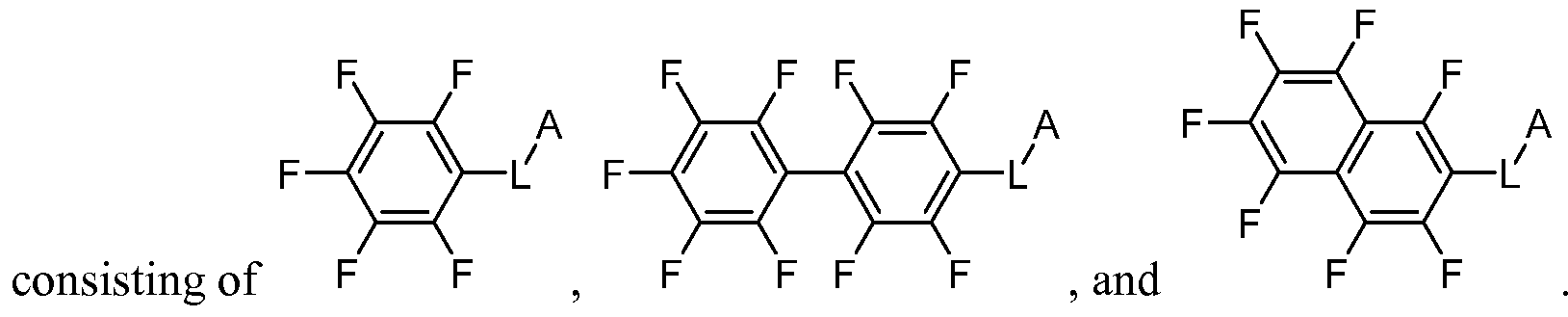
( EWG )
γ_(ί) )η
8. The method of claim 1, wherein is selected from the group

9. The method of claim 1, wherein n is 1; and y is 1 or 2.
10. The method of claim 1, wherein
 is selected from the group

11. The method of any one of claims 1-10, wherein the solvent is water, DMF, CH3CN, CH3OH, CH3CH2OH, isopropanol, DMSO, dibutyl ether, tetrahydrofuran (THF), 1,4- dioxane, DME, dichloromethane, dichloroethane, acetone, diethyl ether, hexanes, or a mixture thereof.
12. The method of any one of claims 1-11, wherein the base is triethylamine, Na3P04, or tris(hydroxymethyl)aminomethane (TRIS) , ethyl acetate, Na2C03, imidazole, 3- morpholinopropane-1 -sulfonic acid (MOPS), 2-[4-(2-hydroxyethyl)piperazin-l- yljethanesulfonic acid (HEPES), 3-[[l ,3-dihydroxy-2-(hydroxymethyl)propan-2- yl]amino]propane-l -sulfonic acid (TAPS), 3-(cyclohexylamino)-l-propanesulfonic acid (CAPS), 2-[[ 1 ,3-dihydroxy-2-(hydroxymethyl)propan-2-yl]amino]ethanesulfonic acid (TES).
13. The method of any one of claims 1-12, wherein R2A is benzyl, indolylmethyl, hydroxybenzyl, nitrobenzyl, trifluoromethylbenzyl, fluorobenzyl, difluorobenzyl, trifluorobenzyl, pentafluorobenzyl, cyanobenzyl, methoxybenzyl, dimethoxybenzyl,
naphthylmethyl, phenylbenzyl, anthracenylmethyl, cyclohexylmethyl, cyclopentylmethyl, pentyl, hexyl, heptyl, octyl, nonyl, or decyl.
14. The method of any one of claims 1-13, wherein R3A is benzyl, indolylmethyl, hydroxybenzyl, nitrobenzyl, trifluoromethylbenzyl, fluorobenzyl, difluorobenzyl, trifluorobenzyl, pentafluorobenzyl, cyanobenzyl, methoxybenzyl, dimethoxybenzyl, naphthylmethyl, phenylbenzyl, anthracenylmethyl, cyclohexylmethyl, cyclopentylmethyl, pentyl, hexyl, heptyl, octyl, nonyl, or decyl.
15. The method of any one of claims 1-14, wherein A1 is a protein; and the protein is an antibody.
16. The method of any one of claims 1-15, wherein A5 is a protein; and the protein is an antibody.
17. The method of any one of claims 1-14, wherein A1 or A5 is cysteine or A1 or A5 is a peptide comprising a cysteine residue, an oligopeptide comprising a cysteine residue, a polypeptide comprising a cysteine residue, or a protein comprising a cysteine residue; and the method further comprises the step of chemically modifying the cysteine residue of A1 or A5.
18. The method of claim 17, wherein the cysteine residue of A1 or A5 is modified after the reaction step depicted in Scheme 1A.
19. The method of any one of claims 1-18, wherein R is H.
20. The method of any one of claims 1-19, wherein x is 1, 2, or 3.
21. The method of any one of claims 1-20, further comprising a salt.
22. The method of claim 21, wherein the salt is ammonium sulfate.
23. The method of claim 21, wherein the salt is ammonium sulfate at a concentration from about 0.5 M to about 5.0 M.
A compound comprisin substructure IA:

wherein, independently for each occurrence,
A1 is H, an amine protecting group, a natural or unnatural alpha amino acid, a peptide, an oligopeptide, a polypeptide, or a protein;
A5 is OH, a carboxylate protecting group, a natural or unnatural alpha amino acid, a peptide, an oligopeptide, a polypeptide, or a protein;

is an aromatic group or a heteroaromatic group;
x is 0, 1, 2, 3, 4, 5, or 6;
R is H or alkyl;
R2A is aralkyl, heteroaralkyl, alkyl, or cycloalkylalkyl;
R3A is aralkyl, heteroaralkyl, alkyl, or cycloalkylalkyl;
y is 1, 2, 3, 4, 5, or 6;
n is O or l;
EWG is -F, -CI, -COR, -COOR, -COC1, -CF3, -CC13, -CN, -S03R, -NR3, or -N02; L is absent or is a linker; and
A is H or a natural or unnatural alpha amino acid, a peptide, an oligopeptide, a polypeptide, or a protein.
The compound of claim 24, wherein is an aromatic group.
26. The compound of claim 24, wherein
 is a heteroaromatic group.
27. The compound of claim 24, wherein
is a heteroaromatic group.
27. The compound of claim 24, wherein
 is an aromatic group; y is 4, 5, or 6; EWG is -F; and n is 1.
28. The compound of claim 24, wherein ( ) is phenylene; y is 4; EWG is -F; and n is 1.
29. The compound of claim 24, wherein
 is an aromatic group; y is 4, 5, or 6; EWG is -F; n is 1; and -LA is -NR-A, -O-A, -S-A, -NR-alkylene-A, -O-alkylene-A, -S- alkylene-A, -NR-perfluoroarylene-NR-A, -O-perfluoroarylene-O-A, -S-perfluoroarylene-S- A, -NR-perfluoroarylene-O-A, -S-perfluoroarylene-O-A, -NR-perfluoroarylene-S-A, -O- perfluoroarylene-S-A, -S-perfluoroarylene-O-A, or -S-perfluoroarylene-NR-A.
30. The com ound of claim 24, wherein
 is selected from the group
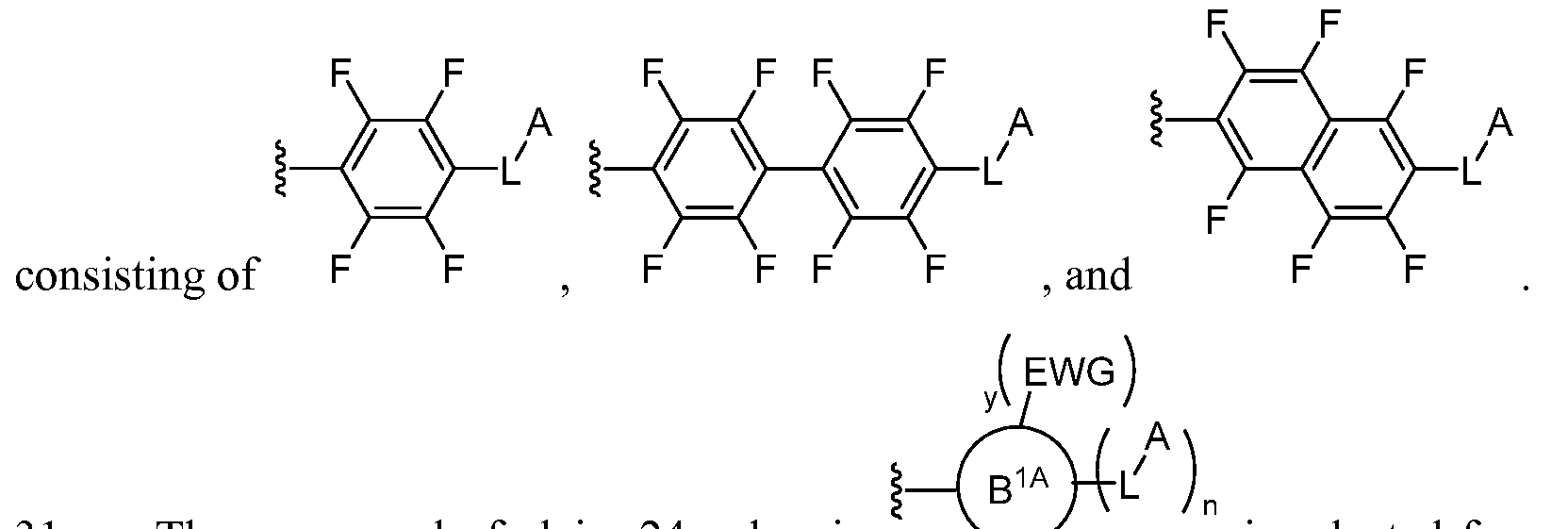
The com ound of claim 24, wherein is selected from the group


32. The compound of claim 24, wherein n is 1; and y is 1 or 2
33. The com ound of claim 24, wherein
 is selected from the group
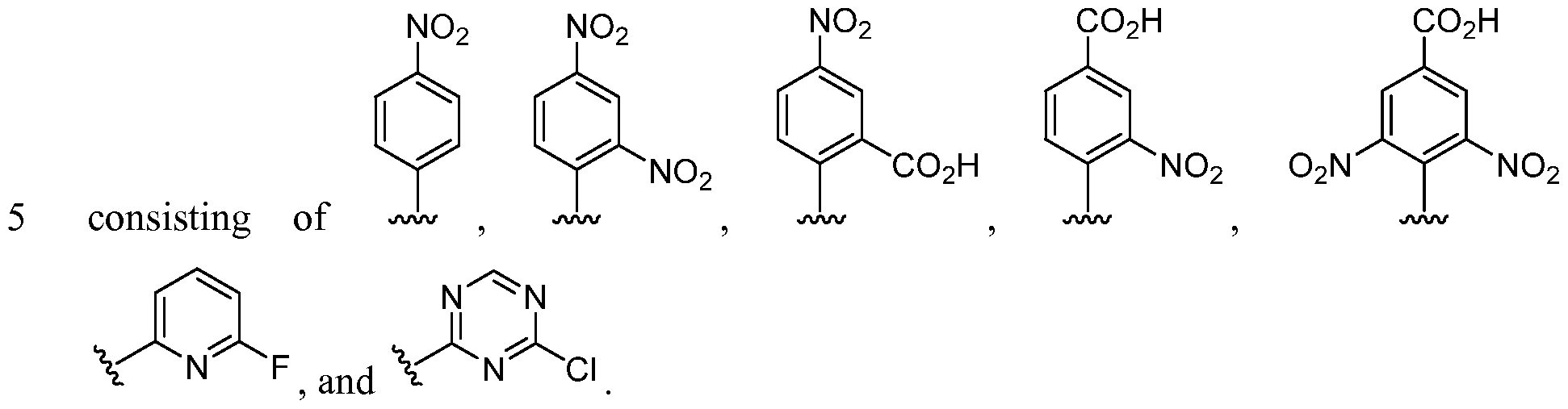
34. The compound of any one of claims 24-33, wherein R is benzyl, indolylmethyl, hydroxybenzyl, nitrobenzyl, trifluoromethylbenzyl, fluorobenzyl, difluorobenzyl, trifluorobenzyl, pentafluorobenzyl, cyanobenzyl, methoxybenzyl, dimethoxybenzyl, naphthylmethyl, phenylbenzyl, anthracenylmethyl, cyclohexylmethyl, cyclopentylmethyl, pentyl, hexyl, heptyl, octyl, nonyl, or decyl.
35. The compound of any one of claims 24-34, wherein R3A is benzyl, indolylmethyl, hydroxybenzyl, nitrobenzyl, trifluoromethylbenzyl, fluorobenzyl, difluorobenzyl, trifluorobenzyl, pentafluorobenzyl, cyanobenzyl, methoxybenzyl, dimethoxybenzyl, naphthylmethyl, phenylbenzyl, anthracenylmethyl, cyclohexylmethyl, cyclopentylmethyl, pentyl, hexyl, heptyl, octyl, nonyl, or decyl.
36. The compound of any one of claims 24-35, wherein A1 is a protein; and the protein is an antibody.
37. The compound of any one of claims 24-36, wherein A5 is a protein; and the protein is an antibody.
38. The compound of any one of claims 24-35, wherein A1 or A5 is cysteine or A1 or A5 is a peptide comprising a cysteine residue, an oligopeptide comprising a cysteine residue, a polypeptide comprising a cysteine residue, or a protein comprising a cysteine residue.
39. The compound of any one of claims 24-38, wherein R is H.
40. The compound of any one of claims 24-39, wherein x is 1, 2, or 3.
41. The compound of any one of claims 24-39, wherein x is 1.
42. A hybrid composition, wherein the hybrid composition comprises a linker, a compound of any one of claims 24-41, and a detectable moiety; and the linker links the compound to the detectable moiety.
43. The hybrid composition of claim 42, wherein the detectable moiety is a fluorescent moiety, a dye moiety, a radionuclide, a drug molecule, an epitope, or an MRI contrast agent.
44. A hybrid composition, wherein the hybrid composition comprises a linker, a compound of any one of claims 24-41, and a biomolecule; and the linker links the compound to the biomolecule .
45. The hybrid composition of claim 44, wherein the biomolecule is a protein.
46. The hybrid composition of claim 45, wherein the protein is an antibody.
47. The hybrid composition of claim 44, wherein the biomolecule is DNA, RNA, or peptide nucleic acid (PNA).
48. The hybrid composition of claim 44, wherein the biomolecule is siRNA.
49. A hybrid composition, wherein the hybrid composition comprises a linker, a compound of any one of claims 24-41 , and a polymer; and the linker links the compound to the polymer.
50. The hybrid composition of claim 49, wherein the polymer is polyethylene glycol. 51. A peptide, an oligopeptide, a polypeptide, or a protein, wherein the peptide, oligopeptide, polypeptide, or protein comprises substructure IA.
Applications Claiming Priority (2)
| Application Number | Priority Date | Filing Date | Title |
|---|---|---|---|
| US14/278,060 | 2014-05-15 | ||
| US14/278,060 US9181297B1 (en) | 2014-05-15 | 2014-05-15 | Cysteine arylation directed by a genetically encodable π-clamp |
Publications (1)
| Publication Number | Publication Date |
|---|---|
| WO2015175941A1 true WO2015175941A1 (en) | 2015-11-19 |
Family
ID=54363379
Family Applications (1)
| Application Number | Title | Priority Date | Filing Date |
|---|---|---|---|
| PCT/US2015/031082 Ceased WO2015175941A1 (en) | 2014-05-15 | 2015-05-15 | CYSTEINE ARYLATION DIRECTED BY A GENETICALLY ENCODABLE π-CLAMP |
Country Status (2)
| Country | Link |
|---|---|
| US (1) | US9181297B1 (en) |
| WO (1) | WO2015175941A1 (en) |
Cited By (2)
| Publication number | Priority date | Publication date | Assignee | Title |
|---|---|---|---|---|
| WO2017151910A3 (en) * | 2016-03-02 | 2017-10-19 | Massachusetts Institute Of Technology | Selective metal-mediated arylation of dichalcogenides in biomolecules |
| US10117948B2 (en) | 2015-06-19 | 2018-11-06 | Massachusetts Institute Of Technology | Selective arylation of dichalcogenides in biomolecules |
Families Citing this family (2)
| Publication number | Priority date | Publication date | Assignee | Title |
|---|---|---|---|---|
| US10738338B2 (en) | 2016-10-18 | 2020-08-11 | The Research Foundation for the State University | Method and composition for biocatalytic protein-oligonucleotide conjugation and protein-oligonucleotide conjugate |
| US12564636B2 (en) | 2022-03-26 | 2026-03-03 | University Of Rhode Island Board Of Trustees | Pnictogen-containing heterocyclic compounds and their use |
Citations (1)
| Publication number | Priority date | Publication date | Assignee | Title |
|---|---|---|---|---|
| US6312688B1 (en) * | 1996-03-21 | 2001-11-06 | Deutsches Krebsotorschungszentrum Stiftung Des Offentlichen Rechts, | Tyrosine-phosphatase-related protein |
Family Cites Families (5)
| Publication number | Priority date | Publication date | Assignee | Title |
|---|---|---|---|---|
| US7674881B2 (en) | 2005-10-07 | 2010-03-09 | The University Of Chicago | Convergent synthesis of proteins by kinetically controlled ligation |
| US20110144306A1 (en) | 2008-07-23 | 2011-06-16 | President And Fellows Of Harvard College | Ligation of stapled polypeptides |
| JP5574280B2 (en) | 2008-09-22 | 2014-08-20 | 宇部興産株式会社 | Method for producing poly (pentafluorosulfanyl) aromatic compound |
| CA2741967A1 (en) | 2008-10-21 | 2010-04-29 | Stephen Dimagno | Fluorination of aromatic ring systems |
| US9018172B2 (en) | 2012-09-26 | 2015-04-28 | Massachusetts Institute Of Technology | Modification of peptides via SNAr reactions of thiols with fluorinated aromatics |
-
2014
- 2014-05-15 US US14/278,060 patent/US9181297B1/en active Active
-
2015
- 2015-05-15 WO PCT/US2015/031082 patent/WO2015175941A1/en not_active Ceased
Patent Citations (1)
| Publication number | Priority date | Publication date | Assignee | Title |
|---|---|---|---|---|
| US6312688B1 (en) * | 1996-03-21 | 2001-11-06 | Deutsches Krebsotorschungszentrum Stiftung Des Offentlichen Rechts, | Tyrosine-phosphatase-related protein |
Non-Patent Citations (2)
| Title |
|---|
| GUO ET AL.: "C-H Arylation of Pyridines: High Regioselectivity as a Consequence of the Electronic Character of C-H Bonds and Heteroarene Ring", JOURNAL OF AMERICAN CHEMICAL SOCIETY, vol. 133, no. 41, 2011, pages 16338 - 16341, XP055237285 * |
| SPOKOYNY ET AL.: "A Perfluoroaryl-Cysteine SN-Ar Chemistry Approach to Unprotected Peptide Stapling", JOURNAL OF AMERICAN CHEMICAL SOCIETY, vol. 135, no. 16, 2013, pages 5946 - 5949, XP055237282 * |
Cited By (2)
| Publication number | Priority date | Publication date | Assignee | Title |
|---|---|---|---|---|
| US10117948B2 (en) | 2015-06-19 | 2018-11-06 | Massachusetts Institute Of Technology | Selective arylation of dichalcogenides in biomolecules |
| WO2017151910A3 (en) * | 2016-03-02 | 2017-10-19 | Massachusetts Institute Of Technology | Selective metal-mediated arylation of dichalcogenides in biomolecules |
Also Published As
| Publication number | Publication date |
|---|---|
| US9181297B1 (en) | 2015-11-10 |
| US20150329590A1 (en) | 2015-11-19 |
Similar Documents
| Publication | Publication Date | Title |
|---|---|---|
| US9018172B2 (en) | Modification of peptides via SNAr reactions of thiols with fluorinated aromatics | |
| EP1115739B1 (en) | Auxiliary for amide bond formation | |
| EP4269422A1 (en) | Method for producing peptide compound containing n-substituted-amino acid residue | |
| US20230295221A1 (en) | Efficient peptide condensation method for difficult sequences | |
| JP2002533299A (en) | Synthesis of cyclic peptides | |
| US20250122240A1 (en) | Versatile Peptide and Protein Macrocyclization and Multimerization with Diels-Alder Cycloadditions | |
| EP3838913A1 (en) | Oligopeptide linker intermediate and preparation method therefor | |
| WO2016038497A1 (en) | A process for the preparation of linaclotide | |
| US9181297B1 (en) | Cysteine arylation directed by a genetically encodable π-clamp | |
| US10117948B2 (en) | Selective arylation of dichalcogenides in biomolecules | |
| JP6248103B2 (en) | Synthesis of β-turn cyclic peptidomimetic compounds | |
| EP3359557A1 (en) | New methods for making barusiban and its intermediates | |
| Monsó et al. | Reverse thioether ligation route to multimeric peptide antigens | |
| WO2024110477A2 (en) | Synthesis of a cyclic peptide | |
| Abdel-Aal et al. | Synthesis of Amide Backbone-Modified Peptides | |
| CN118591551A (en) | Synthetic methods for producing modified GCC receptor agonists | |
| Sucholeiki et al. | An affinity chromatographic method for the purification of water-insoluble peptides | |
| Lam et al. | Incorporation of Fmoc-Dab (Mtt)-OH during solid-phase peptide synthesis: a word of caution | |
| Palágyi | New method of peptide separation using electrostatic binding | |
| Yang et al. | Compatibility study of Merrifield linker in Fmoc strategy peptide synthesis | |
| AU766495B2 (en) | Synthesis of cyclic peptides | |
| AU768649B2 (en) | Auxiliary for amide bond formation | |
| EP3149021A1 (en) | Cyclising peptides | |
| CA3238634A1 (en) | Synthetic process for production of modified gcc receptor agonists | |
| CN121949477A (en) | Preparation method of mu-conotoxin disulfide bond substitute |
Legal Events
| Date | Code | Title | Description |
|---|---|---|---|
| 121 | Ep: the epo has been informed by wipo that ep was designated in this application |
Ref document number: 15793572 Country of ref document: EP Kind code of ref document: A1 |
|
| NENP | Non-entry into the national phase |
Ref country code: DE |
|
| 122 | Ep: pct application non-entry in european phase |
Ref document number: 15793572 Country of ref document: EP Kind code of ref document: A1 |