WO2015170339A1 - A process for synthesis of piperidine alkaloids - Google Patents
A process for synthesis of piperidine alkaloids Download PDFInfo
- Publication number
- WO2015170339A1 WO2015170339A1 PCT/IN2015/000196 IN2015000196W WO2015170339A1 WO 2015170339 A1 WO2015170339 A1 WO 2015170339A1 IN 2015000196 W IN2015000196 W IN 2015000196W WO 2015170339 A1 WO2015170339 A1 WO 2015170339A1
- Authority
- WO
- WIPO (PCT)
- Prior art keywords
- compound
- followed
- afford
- obn
- stirring
- Prior art date
- Legal status (The legal status is an assumption and is not a legal conclusion. Google has not performed a legal analysis and makes no representation as to the accuracy of the status listed.)
- Ceased
Links
- 0 CC(C)C(C1C(*)(C(N)O)C=C(COCc2ccccc2)C1)O Chemical compound CC(C)C(C1C(*)(C(N)O)C=C(COCc2ccccc2)C1)O 0.000 description 2
Classifications
-
- C—CHEMISTRY; METALLURGY
- C07—ORGANIC CHEMISTRY
- C07D—HETEROCYCLIC COMPOUNDS
- C07D211/00—Heterocyclic compounds containing hydrogenated pyridine rings, not condensed with other rings
- C07D211/04—Heterocyclic compounds containing hydrogenated pyridine rings, not condensed with other rings with only hydrogen or carbon atoms directly attached to the ring nitrogen atom
- C07D211/68—Heterocyclic compounds containing hydrogenated pyridine rings, not condensed with other rings with only hydrogen or carbon atoms directly attached to the ring nitrogen atom having one double bond between ring members or between a ring member and a non-ring member
- C07D211/72—Heterocyclic compounds containing hydrogenated pyridine rings, not condensed with other rings with only hydrogen or carbon atoms directly attached to the ring nitrogen atom having one double bond between ring members or between a ring member and a non-ring member with hetero atoms or with carbon atoms having three bonds to hetero atoms, with at the most one bond to halogen, directly attached to ring carbon atoms
- C07D211/74—Oxygen atoms
-
- C—CHEMISTRY; METALLURGY
- C07—ORGANIC CHEMISTRY
- C07D—HETEROCYCLIC COMPOUNDS
- C07D211/00—Heterocyclic compounds containing hydrogenated pyridine rings, not condensed with other rings
- C07D211/04—Heterocyclic compounds containing hydrogenated pyridine rings, not condensed with other rings with only hydrogen or carbon atoms directly attached to the ring nitrogen atom
- C07D211/06—Heterocyclic compounds containing hydrogenated pyridine rings, not condensed with other rings with only hydrogen or carbon atoms directly attached to the ring nitrogen atom having no double bonds between ring members or between ring members and non-ring members
- C07D211/36—Heterocyclic compounds containing hydrogenated pyridine rings, not condensed with other rings with only hydrogen or carbon atoms directly attached to the ring nitrogen atom having no double bonds between ring members or between ring members and non-ring members with hetero atoms or with carbon atoms having three bonds to hetero atoms with at the most one bond to halogen, e.g. ester or nitrile radicals, directly attached to ring carbon atoms
- C07D211/40—Oxygen atoms
- C07D211/44—Oxygen atoms attached in position 4
- C07D211/46—Oxygen atoms attached in position 4 having a hydrogen atom as the second substituent in position 4
-
- C—CHEMISTRY; METALLURGY
- C07—ORGANIC CHEMISTRY
- C07H—SUGARS; DERIVATIVES THEREOF; NUCLEOSIDES; NUCLEOTIDES; NUCLEIC ACIDS
- C07H1/00—Processes for the preparation of sugar derivatives
-
- C—CHEMISTRY; METALLURGY
- C07—ORGANIC CHEMISTRY
- C07H—SUGARS; DERIVATIVES THEREOF; NUCLEOSIDES; NUCLEOTIDES; NUCLEIC ACIDS
- C07H5/00—Compounds containing saccharide radicals in which the hetero bonds to oxygen have been replaced by the same number of hetero bonds to halogen, nitrogen, sulfur, selenium, or tellurium
- C07H5/04—Compounds containing saccharide radicals in which the hetero bonds to oxygen have been replaced by the same number of hetero bonds to halogen, nitrogen, sulfur, selenium, or tellurium to nitrogen
-
- C—CHEMISTRY; METALLURGY
- C07—ORGANIC CHEMISTRY
- C07H—SUGARS; DERIVATIVES THEREOF; NUCLEOSIDES; NUCLEOTIDES; NUCLEIC ACIDS
- C07H5/00—Compounds containing saccharide radicals in which the hetero bonds to oxygen have been replaced by the same number of hetero bonds to halogen, nitrogen, sulfur, selenium, or tellurium
- C07H5/04—Compounds containing saccharide radicals in which the hetero bonds to oxygen have been replaced by the same number of hetero bonds to halogen, nitrogen, sulfur, selenium, or tellurium to nitrogen
- C07H5/06—Aminosugars
Definitions
- the present invention relates to a process for synthesis of piperidine alkaloids.
- present invention relates to a process for synthesis of piperidine alkaloids selected from fagomine, 4-e/?/-fagomine and nojirimycin.
- fagomine and 3-e ?/-fagomine have been shown to have activity against mammalian a- glucosidase and ⁇ -galactosidase. More recently fagomine was found to have a potent antihyperglycaemic effect in streptozocin-induced diabetic mice and a potentiation of glucose-induced insulin secretion.
- imino glycals might serve as precursors to various glycosyl donors which could be used to make oligosaccharides incorporating nitrogen atoms, another area of current interest.
- the main objective of the present invention is to provide a process for the synthesis of piperidine alkaloids from glucal or galactal.
- Another objective of the present invention is to provide a process for the synthesis of (+)-fagomine, 4-e ? -fagomine and 3-deoxynoj irimycin from glucal or galactal.
- Scheme 1 represents processes for the synthesis of (+)-fagomine and 4-epi- fagomine.
- Scheme 2 represents process for the synthesis of 3-deoxynojirimycin.
- Scheme 3 represents process for the synthesis of piperidine alkaloids (imino glycals).
- present invention provides a process for the preparation of piperidine alkaloids comprising the steps of:
- step (a) stirring a solution of compound 2 as obtained in step (a) in DMSO and Ac 2 0 at room temperature in the range of 20 to 35°C for period in the range of 22 to 23 h followed by addition of water to afford ⁇ -keto amide (3);
- step (b) adding formic acid and sodium cyanoborohydride to a solution of compound 3 as obtained in step (b) in acetonitrile followed by refluxing at temperature in the range of 80 to 85°C for period in the range of 4 to 4.5 h to afford glycolactam compound (5);
- step (c) adding lithium aluminium hydride to a solution of compound 5 as obtained in step (c) in tetrahydrofuran followed by stirring the reaction mixture for period in the range of 3.5 to 4h at temperature in the range of 65 to 70°C and purification to afford protected piperidine compound (6);
- step (c) a solution of glycolactam (5) as obtained in step (c) in dichloromethane followed by cooling to 0°C and further adding Boc 2 0, DMAP followed by stirring at temperature in the range of 20 to 25°C for
- the piperidine alkaloids are (+)- fagominc (7a), 4-e/?/-fagomine(7b), 3-deoxynojirimycin ( 10a).
- the steps (a), (b) and (d) are carried out under nitrogen atmosphere.
- the process may also comprises dissolving N-Boc protected lactam (8a) of step (d) in dry toluene and cooled at -76°C under inert atmosphere and adding superhydride with stirring followed by addition of TFAA, DIPEA, catalytic amount of DMAP and purification to afford Boc-iminoglycal ( 1 l a/ 1 l b).
- the Boc-iminoglycal is tert- butyl (2R,3R)-3,4-bis(benzyloxy)-2-((benzyloxy)methyl)-3,4-dihydropyridine- l (2H)- carboxylate ( 1 1 a), tert-butyl (2R,3S)-3,4-bis(benzyloxy)-2-((benzyloxy)methyl)-3,4- dihydropyridine- 1 (2H)-carboxylate( 1 1 b).
- said process may also comprise adding Boc-iminoglycal (1 l a/1 l b) to a solution of (DHQ) 2 AQN, K 3 Fe(CN) 6 , 2C0 3 , K 2 Os0 2 (OH) 4 and CH 3 S0 2 NH 2 in tert-buly ⁇ alcohol and water cooled at 0°C followed by stirring the mixture at 0°C for 60 to 66 h to afford iminogiycal compound ( 12).
- said process may also comprises adding Boc-iminoglycal ( 1 1 a) to a solution of (DHQD) 2 AQN, K 3 Fe(CN) 6 , 2C0 3 , 2 Os0 2 (OH) 4 and CH 3 S0 2 NH 2 in /eri-butyl alcohol and water cooled at 0°C followed by stirring the mixture at 0°C for 60 to 66 h to afford iminogiycal compound( 13a).
- the iminogiycal compound is /i ? r/-Butyl (2R, J/?,J7?, (5 ?)-3,4-bis(benzyloxy)-2-((benzyloxy)methyl)-5,6-dihydroxy- piperidine- 1 -carboxy late ( 12a) or / ⁇ ?r/-Butyl (2 ?,3/?,55,65 -3,4-bis(benzyloxy)-2- ((benzyloxy)methyl)-5,6-dihydroxypiperidine- l -carboxylate ( 1 3a).
- Present invention provides a process for the synthesis of piperidine alkaloids starting from glucal or galactal.
- the present invention provides a process for the synthesis of (+)- fagomine and 4-e/?/-fagomine starting from glucal or galactal.
- the present invention provides a process for the synthesis of 3- deoxynojirimycin starting from glucal or galactal.
- the present invention provides a process for the synthesis of piperidine alkaloids selected from (+)-fagomine and 4-e ⁇ -fagomine in 14% and 6% overall yields and the said process comprising the steps of:
- step (b) stirring a solution of compound of step (a) in DMSO and Ac 2 0 at room temperature in the range of 20 to 35°C for 23h under nitrogen atmosphere followed by addition of water to obtain a yellow oil precipitate of ⁇ -keto amide (3a/3b);
- step (b) adding formic acid and sodium cyanoborohydride to a solution of compound of step (b) in acetonitrile followed by refluxing the reaction mixture at 85°C for 4.5 h to afford glycolactam compound (5a/5b);
- step (a) adding 10% palladium on active charcoal to a solution of compound of step (d) in acetic acid followed by stirring the mixture for overnight at room temperature under hydrogen atmosphere to afford piperidine alkaloids selected from (+)-fagomine (7a) and 4-e -fagomine (7b).
- the compounds formed in step (a) are (3R,4R)-3,4,6-Tris(benzyloxy)-5- hydroxyhexanamide(2a) and (3R,4S)-3,4,6-tris(benzyloxy)-5-hydroxyhexanamide (2b).
- step (b) The compounds formed in step (b) are (3 ?,4S)-3,4,6-Tris(benzyloxy)-5- oxohexanamide(3a) and (3R,4R)-3,4,6-Tris(benzyloxy)-5-oxohexanamide(3b).
- glycolactam compounds formed in step (c) are(5R,6R)-4,5-Bis(benzyloxy)-6- (benzyloxymethyl)piperidin-2-one (5a),(5S,6R)-4,5-Bis(benzyloxy)-6-(benzyloxymethyl) piperidin-2-one(5b).
- the compounds formed in step (d) are (2R,3R,4R)-3,4-Bis(benzyloxy)-2- (benzyloxymethyl)piperidine(6a), (2R,3S,4R)-3,4-Bis(benzyloxy)-2-(benzyloxymethyl) piperidine(6b).
- the present invention provides a process for the synthesis of 3-deoxynojirimycin ( 10a) starting from glucal or galactal and the said process comprising the steps of:
- step (b) stirring a solution of compound of step (a) in DMSO and Ac 2 0 at room temperature in the range of 20 to 35°C for 23 h under nitrogen atmosphere followed by addition of water to obtain a yellow oil precipitate of ⁇ -keto amide (3a/3b);
- step (b) adding formic acid and sodium cyanoborohydride to a solution of compound of step (b) in acetonitrile followed by refluxing the reaction mixture at 85°C for 4.5 h to afford glycolactam compound (5a/5b);
- step (e) dissolving N-Boc protected lactam (8a/8b) of step (d) in toluene and cooling to -76°C under inert atmosphere and adding superhydride and ammonium chloride solution at -76°C followed by stirring the reaction mixture for 10 h at room temperature to afford lactamol (9a): f) stirring a mixture of compound of step (e) and HCL in methanol at 70°C for 5h followed by basifying the reaction mixture to afford 3-deoxyNoj irimycin ( 10).
- N-Boc protected lactam compound formed in step (d) are Tert-butyl (2R,3R,4S)-3,4-bis(benzyloxy)-2-((benzyloxy)methyl)-6-oxopiperidine- l - carboxylate(8a), 7er/-butyl (2R,3S,4S)-3,4-Bis(benzyloxy)-2-((benzyloxy)methyl)-6- oxopiperidine- 1 -carboxylate(8b).
- the carboxylate compound formed in step (e) is tert-butyl (2R,3R)-3,4- bis(benzyloxy)-2-((benzyloxy)methyl)-6-hydroxypiperidine- l -carboxylate(9a).
- the present invention provides a process for the synthesis of piperidine alkaloids (imino giycals) comprising the steps of:
- step (a) stirring a solution of compound of step (a) in DMSO and Ac 2 0 at room temperature for 23 h under nitrogen atmosphere followed by addition of water to obtain a yellow oil precipitate of ⁇ -keto amide (3a/3b); c) adding formic acid and sodium cyanoborohydride to a solution of compound of step (b) in acetonitrile followed by refluxing the reaction mixture for 4.5 h to afford glycolactam compound (5a/5b);
- step (c) adding Et 3 N to a solution of glycolactam (5a/5b) of step (c) in dichloromethane followed by cooling to 0°C and further adding Boc 2 0, DMAP followed by stirring at 25°C for 9 h to afford N-Boc protected lactam (8a/8b);
- step (d) dissolving N-Boc protected lactam (8a/8b) of step (d) in dry toluene and cooling under inert atmosphere, and adding superhydride with stirring followed by addition of TFAA, DIPEA, catalytic amount of DMAP and purification to afford Boc-iminoglycal ( 1 l a/1 l b).
- Boc-iminoglycai 1 1 a
- a solution of (DHQ) 2 AQN, 3 Fe(CN) 6 , 2C0 3 , 2 Os0 2 (OH) 4 and CH 3 S0 2 NH 2 in /er/-butyl alcohol and water cooled at 0°C followed by stirring the mixture at 0°C for 60 to 66 h to afford iminoglycal compound( 12a).
- Boc-iminoglycal ( 1 l a) to a solution of (DHQD) 2 AQN, K 3 Fe(CN) 6 , K 2 C0 3 , K 2 Os0 2 (OH) 4 and CH 3 S0 2 NH 2 in /er/-butyl alcohol and water cooled at 0°C followed by stirring the mixture at 0°C for 60 to 66 h to afford iminoglycal compound( 13a).
- the Boc-iminoglycal formed in step (e) is tert-butyl (2R,3R)-3,4-bis(benzyIoxy)- 2-((benzyloxy)methyl)-3,4-dihydropyridine- l (2H)-carboxylate ( 1 1 a), Tert-butyl (2R,3S)- 3,4-bis(benzyloxy)-2-((benzyloxy)methyl)-3,4-dihydropyridine- l (2H)-carboxylate( l l b).
- the iminoglycal compound is ter/-Butyl (2R,3R,5R,
- Gluconolactone la ( 1 .393 g, 2.32 mmol) was dissolved in methanolic ammonia soln. (7N, 22 mL) and was stirred at room temperature 25°C for 6h. After completion of the reaction (TLC), reaction mixture was concentrated in vacuo followed by purification by Si0 2 column chromatography (EtOAc-petroleum ether, 6:4) to afford 2a (859 mg, 82%) as colorless solid; mp 74-76°C.
- Galactonolactone lb (2.0 g, 4.65 mmol) was dissolved in methanolic ammonia soln. (7N, 25 mL) and stirred at room temperature 27°C for 1 l h under nitrogen atmosphere. After completion of the reaction (TLC), reaction mixture was concentrated in vacuo to furnish a crude which was purified by Si0 2 column chromatography (EtOAc-petroleum ether, 1 : 1 ) to afford 2b ( 1 .997 g, 96%) as yellowish gum.
- N-Boc protected lactam 8a (100 mg, 0.188 mmol) was dissolved in dry toluene (5.0 mL) and cooled to -76°C under inert atmosphere, and superhydride (1.0 M in THF) (0.21 mL, 1.12 eq) was added slowly drop wise over a period of 10 min, and stirred at -76°C for 1 h.
- Saturated NH 4 C1 soln (4.0 mL) was added and stirred further for 1.5 h at -76°C, and then temp was raised to room temperature 35°C and stirred at room temperature 35°C for 10 h.
- the reaction mixture was filtered through a celite pad and washed with MeOH (50 mL), the filtrate was concentrated in vacuo. The residue was dissolved in water (5 mL) and the solution was stirred at room temperature 25°C with Amberlite IR-120 (H + ) for 3h. The suspension was eluted with water and then 0.5 M NH 4 C1 to furnish pure 3- deoxyNojirimycin (10) ( 1 7 mg, 56%).
- N-Boc protected lactam 8a ( 136 mg, 0.26 mmol) was dissolved in dry toluene (3 mL) and cooled to -70°C under inert atmosphere, and superhydride (1.0 M in THF) was added slowly drop wise over a period of 1 0 min, and stirred at -70°C for 30 min.
- TFAA (0.31 mL, 2.2 mmol) was added followed by addition of DIPEA ( 1 .5 mmol) and catalytic amount of DMAP. Temperature is then raised from -70°C to room temperature 30°C in 8h and stirred further for 3h at 25°C.
Landscapes
- Chemical & Material Sciences (AREA)
- Organic Chemistry (AREA)
- Health & Medical Sciences (AREA)
- Life Sciences & Earth Sciences (AREA)
- Engineering & Computer Science (AREA)
- Biochemistry (AREA)
- Biotechnology (AREA)
- General Health & Medical Sciences (AREA)
- Genetics & Genomics (AREA)
- Molecular Biology (AREA)
- Hydrogenated Pyridines (AREA)
- Pharmaceuticals Containing Other Organic And Inorganic Compounds (AREA)
Abstract
The present invention discloses a process for synthesis of piperidine alkaloids selected from fagomine, 4-epi-fagomine and nojirimycin from tri-O-benzyl-D-glucal or tri-O-benzyl-D-galactal.
Description
A PROCESS FOR SYNTHESIS OF PIPERIDINE ALKALOIDS
FIELD OF THE INVENTION
|0001} The present invention relates to a process for synthesis of piperidine alkaloids. Particularly, present invention relates to a process for synthesis of piperidine alkaloids selected from fagomine, 4-e/?/-fagomine and nojirimycin.
BACKGROUND AND PRIOR ART OF THE INVENTION
[0002] Polyhydroxylated piperidines and their synthetic analogues have attracted a great deal of attention in recent years due to their ability to mimic sugars, and competitively and selectively inhibit glycosidases and glycosyltransferases, the carbohydrate processing enzymes. These attributes make hydroxylated piperidines (azasugars) likely therapeutic agents for the treatment of diseases related to metabolic disorders involving carbohydrates such as diabetes, cancer, AIDS, and viral infections, where glycoprotein processing is crucial. Recently three fagomine and some of its isomers were found from Xanthocercis zambesiaca occurring in southern Africa in dry forest. Among them, fagomine and 3-e ?/-fagomine have been shown to have activity against mammalian a- glucosidase and β-galactosidase. More recently fagomine was found to have a potent antihyperglycaemic effect in streptozocin-induced diabetic mice and a potentiation of glucose-induced insulin secretion.

Nojirimycin Adenophorine 5-Deoxyadenophorine β-1-C-butyl-deoxy- galactonojirimycin

-tr y roxyp per ne
Figure 1. Some glycosidase or galactosidase inhibitors belonging to piperidine class of alkaloid.
[0003] Glycals, carbohydrates incorporating a double bond between C- l and C-2, have emerged as powerful building blocks in synthetic chemistry especially in the context of oligosaccharide assembly. In light of this fact, it is perhaps surprising that the synthesis and chemistry of imino glycals, glycals in which the ring oxygen atom is replaced by nitrogen, has not been explored in a systematic fashion. Such compounds should participate in a diverse range of reactions (e.g. addition and cycloadditions reactions, metal catalyzed cross-couplings), and thus provide access to many potentially useful classes of imino sugars which are of interest because of their ability to influence a variety of biological processes by the inhibition of the glycosidase enzymes. Furthermore, imino glycals might serve as precursors to various glycosyl donors which could be used to make oligosaccharides incorporating nitrogen atoms, another area of current interest.
[0004] Article titled "Stereoselective synthesis and biological evaluation of D-fagomine, D-3-epi-fagomine and D-3,4-epi-fagomine analogs from D-glyceraldehyde acetonide as a common building block" by JA Diez et al. Published in Org Biomol Chem., 2012; 10(46), pp 9278-86 reports synthesis involves diastereoselective anti-vinylation of its homoallylimine, ring-closing metathesis, and stereoselective epoxidation followed by regioselective ring-opening or stereoselective dihydroxylation.
[0005] Article titled "Efficient and stereodivergent syntheses of D- and L-fagomines and their analogues" by N Kumari et al. published in European Journal of Organic Chemistry, 2009, 2009 ( 1 ), pp 160-169 reports the synthesis of d- and l-fagomines 1 , 4, 5 and 6 and their isomers from starting d-glycals. The syntheses involve elaboration of common amino alcohol precursors obtained from 2-deoxy- l -amino sugar derivatives. The key steps in the synthesis are intramolecular reductive amination and intramolecular N-heterocyclization.
[0006] Article titled "A divergent synthesis of 4-epi-fagomine, 3, 4-dihydroxypipecolic acid, and a dihydroxyindolizidine and their beta-galactosidase inhibitory and immunomodulatory activities" by KS Kumar et al. published in J Org Chem., 2013, 78(15), pp 7406- 13 reports a divergent asymmetric synthesis of the iminosugars starting from a chiral homoallyl alcohol as the versatile intermediate. The homoallyl alcohol is prepared by a highly diastereoselective Barbier reaction on a D-glucose-derived aldehyde. The protection of hydroxyl function followed by reductive ozonolysts of the
olefin and a subsequent one-pot three-step protocol involving a Staudinger reaction, reductive animation, and benzyloxy carbonyl protection yielded an important bicyclic furanopiperidine derivative.
[0007] Article titled "A synthesis of 2-epi-fagomine using gold (l)-catalyzed allene cyclisation" by Bates et al. published in a synthesis of 2-epi-fagomine via a highly stereoselective gold(I)-catalyzed allene cyclisation . A highly stereoselective Au(I)- catalyzed cyclization of allene (IV) is the key step in the synthesis of 2-epi-fagomine (VI).
[0008] Article titled "General synthesis and biological evaluation of alpha- 1 -C- substituted derivatives of fagomine (2-deoxynojirimycin-alpha-C-glycosides)" by JY Goujon et al. published in Bioorg Med Chem., 2005, 13(6), pp 2313-24 reports a general synthesis of alpha- 1 -C-substituted derivatives of fagomine (2-deoxynojirimycin-alpha-C- glycosides) by ring-opening reactions of an aziridine with various heteroatomic nucleophiles, including thiol, amine, alcohol, carboxylate and phosphate. This nine-step reaction sequence proceeded in an overall yield of 14-28% from tri-O-benzyl-D-glucal.
[0009] Article titled "Chemistry of imino glycals: preparation and application to the synthesis of (+)-fagomine" by J Desire et al. published in Synlett, 2001 , 2001 (8), 1329- 1331 reports the synthesis of imino glucal from tri-O-benzyl-D-glucal in 8 steps. This novel imino sugar building block is further converted into (+)-fagomine by a two-step hydrogenation sequence.
[0010] The prior art processes had many drawbacks such as poor yield and longer reaction sequence. Therefore there is need in the art to develop a shorter process for the preparation of piperidine alkaloids selected from (+)-fagomine, 4-e/>/-fagomine and nojirimycin with better yield.
OBJECTIVE OF INVENTION
[0011] The main objective of the present invention is to provide a process for the synthesis of piperidine alkaloids from glucal or galactal.
[0012] Another objective of the present invention is to provide a process for the synthesis of (+)-fagomine, 4-e ? -fagomine and 3-deoxynoj irimycin from glucal or galactal.
BRIEF DESCRIPTION OF THE DRAWINGS
[0013] Scheme 1 represents processes for the synthesis of (+)-fagomine and 4-epi- fagomine.
[0014] Scheme 2 represents process for the synthesis of 3-deoxynojirimycin.
[0015] Scheme 3 represents process for the synthesis of piperidine alkaloids (imino glycals).
SUMMARY OF THE INVENTION
[0016] Accordingly, present invention provides a process for the preparation of piperidine alkaloids comprising the steps of:
a) dissolving gluconolactone compound ( 1 ) in methanolic ammonia solution followed by stirring at room temperature in the range of 20 to 35°C for 1 to
1 fford 5-5-hydroxy amide 2);

1a R1=R2=H, R3= OBn, R4= H 2a R1=R2=H, R3= OBn, R4= H
1 b R1=R2=H, R3= H, R4= OBn 2b R1=R2=H, R3= H, R4= OBn
stirring a solution of compound 2 as obtained in step (a) in DMSO and Ac20 at room temperature in the range of 20 to 35°C for period in the range of 22 to 23 h followed by addition of water to afford δ-keto amide (3);

3a R1=R2=H, R3= OBn, R4= H
3b R1=R2=H, R3= H, R4= OBn
c) adding formic acid and sodium cyanoborohydride to a solution of compound 3 as obtained in step (b) in acetonitrile followed by refluxing at temperature in the range of 80 to 85°C for period in the range of 4 to 4.5 h to afford glycolactam compound (5);

5a R1 =R2=H, R3= OBn, R4= H
5b R1 =R2=H, R3= H, R4= OBn
d) adding lithium aluminium hydride to a solution of compound 5 as obtained in step (c) in tetrahydrofuran followed by stirring the reaction mixture for period in the range of 3.5 to 4h at temperature in the range of 65 to 70°C and purification to afford protected piperidine compound (6);

6a R1 =R2=H, R3= OBn, R4= H
6b R1=R2=H, R3= H, R4= OBn
e) adding palladium on active charcoal to a solution of piperidine compound 6 as obtained in step (d) in acetic acid followed by stirring the mixture for overnight for period in the range of 10 to 12 hr at room temperature in the range of 20 to 35°C under hydrogen atmosphere to afford piperidine alkaloids
(7);

7a R1=R2=H, R3= OH, R4= H, (+)-Fagomine
7b R1 =R2=R3= H, R4= OH, 4-ep/'-Fagomine
adding Et3N to a solution of glycolactam (5) as obtained in step (c) in dichloromethane followed by cooling to 0°C and further adding Boc20, DMAP followed by stirring at temperature in the range of 20 to 25°C for
8
peri in the range of 8 to 9 h to afford N-Boc protected lactam (8);

8a R1 =R2=H, R3= OBn, R4= H
8b R1=R2=H, R3= H, R4= OBn
g) dissolving N-Boc protected lactam (8a) of step (d) in toluene and cooling to - 76°C under inert atmosphere and adding superhydride and ammonium chloride solution at -76°C followed by stirring the reaction mixture for period in the ran e of 9 to 10 h at room temperature to afford lactamol compound 9a;

9a R1=R2=H, R3= OBn, R4= H
h) stirring a mixture of compound of step (e) and HCl in methanol at 70°C for 5h followed by basifying the reaction mixture to afford 3-deoxynojirimycin
( 10a).

10a R-,=R2=H, R3= OH, R4= H
dissolving N-Boc protected lactam (8a) of step (d) in dry toluene and cooled at -76°C under inert atmosphere and adding superhydride with stirring followed by addition of TFAA, DIPEA, catalytic amount of DMA P and purification to afford Boc-iminoglycal ( l l a/1 l b);
adding Boc-iminoglycal ( 1 1 a) to a solution of (DHQ)2AQN, 3Fe(CN)6, K2C03, K2Os02(OH)4 and CH3S02NH2 in r/-butyl alcohol and water cooled at 0°C fol lowed by stirring the mixture at 0°C for 60 to 66 h to afford iminoglycal compound ( 12a);
k) The process as claimed in any of the preceding claims, wherein said process may also comprises adding Boc-iminoglycal ( 1 1 a) to a solution of (DHQD)2AQN, K3Fe(CN)6, 2C03, K2Os02(OH)4 and CH3S02NH2 in tert- butyl alcohol and water cooled at 0°C followed by stirring the mixture at 0°C for 60 to 66 h to afford iminogiycal compound( 13a).
[0017] In an embodiment of the present invention, the piperidine alkaloids are (+)- fagominc (7a), 4-e/?/-fagomine(7b), 3-deoxynojirimycin ( 10a).
In another embodiment of the present invention, the steps (a), (b) and (d) are carried out under nitrogen atmosphere.
[0018] In yet another embodiment of the present invention, the process may also comprises dissolving N-Boc protected lactam (8a) of step (d) in dry toluene and cooled at -76°C under inert atmosphere and adding superhydride with stirring followed by addition of TFAA, DIPEA, catalytic amount of DMAP and purification to afford Boc-iminoglycal ( 1 l a/ 1 l b).
[0019] In yet another embodiment of the present invention, the Boc-iminoglycal is tert- butyl (2R,3R)-3,4-bis(benzyloxy)-2-((benzyloxy)methyl)-3,4-dihydropyridine- l (2H)- carboxylate ( 1 1 a), tert-butyl (2R,3S)-3,4-bis(benzyloxy)-2-((benzyloxy)methyl)-3,4- dihydropyridine- 1 (2H)-carboxylate( 1 1 b).
[0020] In yet another embodiment of the present invention, said process may also comprise adding Boc-iminoglycal (1 l a/1 l b) to a solution of (DHQ)2AQN, K3Fe(CN)6, 2C03, K2Os02(OH)4 and CH3S02NH2 in tert-buly\ alcohol and water cooled at 0°C followed by stirring the mixture at 0°C for 60 to 66 h to afford iminogiycal compound ( 12).
[0021] In yet another embodiment of the present invention, said process may also comprises adding Boc-iminoglycal ( 1 1 a) to a solution of (DHQD)2AQN, K3Fe(CN)6, 2C03, 2Os02(OH)4 and CH3S02NH2 in /eri-butyl alcohol and water cooled at 0°C followed by stirring the mixture at 0°C for 60 to 66 h to afford iminogiycal compound( 13a).
[0022] In yet another embodiment of the present invention, the iminogiycal compound is /i?r/-Butyl (2R, J/?,J7?, (5 ?)-3,4-bis(benzyloxy)-2-((benzyloxy)methyl)-5,6-dihydroxy-
piperidine- 1 -carboxy late ( 12a) or /<?r/-Butyl (2 ?,3/?,55,65 -3,4-bis(benzyloxy)-2- ((benzyloxy)methyl)-5,6-dihydroxypiperidine- l -carboxylate ( 1 3a).
DETAILED DESCRIPTION OF THE INVENTION
[0023] Present invention provides a process for the synthesis of piperidine alkaloids starting from glucal or galactal.
[0024] In an aspect, the present invention provides a process for the synthesis of (+)- fagomine and 4-e/?/-fagomine starting from glucal or galactal.
[0025] In another aspect, the present invention provides a process for the synthesis of 3- deoxynojirimycin starting from glucal or galactal.
[0026] The present invention provides a process for the synthesis of piperidine alkaloids selected from (+)-fagomine and 4-e^ -fagomine in 14% and 6% overall yields and the said process comprising the steps of:
a) dissolving gluconolactone compound(l a/l b) in methanolic ammonia solution followed by stirring at room temperature in the range of 20 to 35°C for 6h under nitrogen atmosphere to afford δ-hydroxy amide (2a/2b);
b) stirring a solution of compound of step (a) in DMSO and Ac20 at room temperature in the range of 20 to 35°C for 23h under nitrogen atmosphere followed by addition of water to obtain a yellow oil precipitate of δ-keto amide (3a/3b);
c) adding formic acid and sodium cyanoborohydride to a solution of compound of step (b) in acetonitrile followed by refluxing the reaction mixture at 85°C for 4.5 h to afford glycolactam compound (5a/5b);
d) adding lithium aluminium hydride to a solution of compound of step (c) in tetrahydrofuran followed by stirring the reaction mixture for 4h at 70 °C under nitrogen atmosphere and purification to afford protected piperidine compound (6a/6b) as a yellow syrup;
e) adding 10% palladium on active charcoal to a solution of compound of step (d) in acetic acid followed by stirring the mixture for overnight at room temperature under hydrogen atmosphere to afford piperidine alkaloids selected from (+)-fagomine (7a) and 4-e -fagomine (7b).
[0027] The compounds formed in step (a) are (3R,4R)-3,4,6-Tris(benzyloxy)-5- hydroxyhexanamide(2a) and (3R,4S)-3,4,6-tris(benzyloxy)-5-hydroxyhexanamide (2b).
[0028] The compounds formed in step (b) are (3 ?,4S)-3,4,6-Tris(benzyloxy)-5- oxohexanamide(3a) and (3R,4R)-3,4,6-Tris(benzyloxy)-5-oxohexanamide(3b).
[0029] The glycolactam compounds formed in step (c) are(5R,6R)-4,5-Bis(benzyloxy)-6- (benzyloxymethyl)piperidin-2-one (5a),(5S,6R)-4,5-Bis(benzyloxy)-6-(benzyloxymethyl) piperidin-2-one(5b).
[0030] The compounds formed in step (d) are (2R,3R,4R)-3,4-Bis(benzyloxy)-2- (benzyloxymethyl)piperidine(6a), (2R,3S,4R)-3,4-Bis(benzyloxy)-2-(benzyloxymethyl) piperidine(6b).
[0031] The present invention provides a process for the synthesis of 3-deoxynojirimycin ( 10a) starting from glucal or galactal and the said process comprising the steps of:
a) dissolving gluconolactone compound ( l a/l b) in methanolic ammonia solution followed by stirring at room temperature in the range of 20 to 35°C for 1.5h under nitrogen atmosphere to afford δ-hydroxy amide (2a/2b);
b) stirring a solution of compound of step (a) in DMSO and Ac20 at room temperature in the range of 20 to 35°C for 23 h under nitrogen atmosphere followed by addition of water to obtain a yellow oil precipitate of δ-keto amide (3a/3b);
c) adding formic acid and sodium cyanoborohydride to a solution of compound of step (b) in acetonitrile followed by refluxing the reaction mixture at 85°C for 4.5 h to afford glycolactam compound (5a/5b);
adding Et3N to a solution of glycolactam (5a/5b) of step (c) in dichloromethane followed by cooling to 0°C and further adding Boc20, DMAP followed by stirring at 25°C for 9 h to afford N-Boc protected lactam
(8a/8b);
e) dissolving N-Boc protected lactam (8a/8b) of step (d) in toluene and cooling to -76°C under inert atmosphere and adding superhydride and ammonium chloride solution at -76°C followed by stirring the reaction mixture for 10 h at room temperature to afford lactamol (9a):
f) stirring a mixture of compound of step (e) and HCL in methanol at 70°C for 5h followed by basifying the reaction mixture to afford 3-deoxyNoj irimycin ( 10).
[0032] The N-Boc protected lactam compound formed in step (d) are Tert-butyl (2R,3R,4S)-3,4-bis(benzyloxy)-2-((benzyloxy)methyl)-6-oxopiperidine- l - carboxylate(8a), 7er/-butyl (2R,3S,4S)-3,4-Bis(benzyloxy)-2-((benzyloxy)methyl)-6- oxopiperidine- 1 -carboxylate(8b).
[0033] The carboxylate compound formed in step (e) is tert-butyl (2R,3R)-3,4- bis(benzyloxy)-2-((benzyloxy)methyl)-6-hydroxypiperidine- l -carboxylate(9a).
[0034] The present invention provides a process for the synthesis of piperidine alkaloids (imino giycals) comprising the steps of:
a) dissolving gluconolactone compound (la/l b) in methanolic ammonia solution followed by stirring at room temperature for 1.5h under nitrogen atmosphere to afford δ-hydroxy amide (2a/2b);
b) stirring a solution of compound of step (a) in DMSO and Ac20 at room temperature for 23 h under nitrogen atmosphere followed by addition of water to obtain a yellow oil precipitate of δ-keto amide (3a/3b); c) adding formic acid and sodium cyanoborohydride to a solution of compound of step (b) in acetonitrile followed by refluxing the reaction mixture for 4.5 h to afford glycolactam compound (5a/5b);
d) adding Et3N to a solution of glycolactam (5a/5b) of step (c) in dichloromethane followed by cooling to 0°C and further adding Boc20, DMAP followed by stirring at 25°C for 9 h to afford N-Boc protected lactam (8a/8b);
e) dissolving N-Boc protected lactam (8a/8b) of step (d) in dry toluene and cooling under inert atmosphere, and adding superhydride with stirring followed by addition of TFAA, DIPEA, catalytic amount of DMAP and purification to afford Boc-iminoglycal ( 1 l a/1 l b).
adding Boc-iminoglycai ( 1 1 a) to a solution of (DHQ)2AQN, 3Fe(CN)6, 2C03, 2Os02(OH)4 and CH3S02NH2 in /er/-butyl alcohol and water
cooled at 0°C followed by stirring the mixture at 0°C for 60 to 66 h to afford iminoglycal compound( 12a).
g) adding Boc-iminoglycal ( 1 l a) to a solution of (DHQD)2AQN, K3Fe(CN)6, K2C03, K2Os02(OH)4 and CH3S02NH2 in /er/-butyl alcohol and water cooled at 0°C followed by stirring the mixture at 0°C for 60 to 66 h to afford iminoglycal compound( 13a).
[0035] The Boc-iminoglycal formed in step (e) is tert-butyl (2R,3R)-3,4-bis(benzyIoxy)- 2-((benzyloxy)methyl)-3,4-dihydropyridine- l (2H)-carboxylate ( 1 1 a), Tert-butyl (2R,3S)- 3,4-bis(benzyloxy)-2-((benzyloxy)methyl)-3,4-dihydropyridine- l (2H)-carboxylate( l l b).
[0036] The iminoglycal compound is ter/-Butyl (2R,3R,5R,

((benzyloxy)methyl)-5,6-dihydroxypiperidine- l -carboxylate ( 12a) or ter/-Butyl (2R, 3R,5S, (5S)-3,4-bis(benzyloxy)-2-((benzyloxy)methyl)-5, 6-dihydroxypiperidine- 1 - carboxy!ate( 13a).
Examples
[0037] Following examples are given by way of illustration and therefore should not be construed to limit the scope of the invention.
Example 1
Preparation of (+)-fagomine and 4-£/? -fagomine
Example 1 (A)
[0038] Preparation of (3R,4R)-3,4,6-Tris(benzyloxy)-5-hydroxyhexanamide (2a)
Gluconolactone la ( 1 .393 g, 2.32 mmol) was dissolved in methanolic ammonia soln. (7N, 22 mL) and was stirred at room temperature 25°C for 6h. After completion of the reaction (TLC), reaction mixture was concentrated in vacuo followed by purification by Si02 column chromatography (EtOAc-petroleum ether, 6:4) to afford 2a (859 mg, 82%) as colorless solid; mp 74-76°C.
Rf 0.26 (EtOAc-petroleum ether, 1 : 1 ); [a]20 u + 14.27 (c 1 .43, CHCI3); IR (CHC13): i>max 3374, 3201 , 3012, 2869, 1673, 1615, 1404, 1216, 1072, 1028, 908, 747, 698, 667 cm" 1 ; Ή NMR (200 MHz, CDC13, assignment by COSY, HSQC and HMBC experiments): δΗ 7.33-7.24 (m, 15H, ArH), 5.76 (bs, 1 Η, NH), 5.45 (bd, 1 Η, NH), 4.61 -4.47 (m, 6Η, Ph- CH2), 4.3 1 -4.23 (m, 1 Η, Η-3), 3.99-3.92 (m, 1 Η, Η-5), 3.67-3.62 (m, 3Η, Η-4, Η-6), 3.14 (bs, 1 Η, OH), 2.52-2.57 (m, 2Η, H-2); δΓ ( 100 MHz, CDCI3) 1 73.5 (q, C- l ) 138.0,
137.8, 137.6 (q, Ar), 128.5, 128.4, 128.3, 128.0, 127.8 (s, Ar), 78.2 (s, C-4), 76.6 (s, C-3), 73.5 (d, -OCH2Ph), 73.4 (d, 2C, C-6,-OCH2Ph), 71 .2 (d, -OCH2Ph), 70.8 (s, C-5), 37.3 (d, C-2); ES1-MS: m/z 450.2240 (M+H)+; HRMS: m/z calcd for C27H3 i 05 449.22022, found 449.20571.
Example 1 (B)
[0039] Preparation of (3/?,45)-3,4,6-tris(benzyloxy)-5-hydroxyhexanamide(2b)
Galactonolactone lb (2.0 g, 4.65 mmol) was dissolved in methanolic ammonia soln. (7N, 25 mL) and stirred at room temperature 27°C for 1 l h under nitrogen atmosphere. After completion of the reaction (TLC), reaction mixture was concentrated in vacuo to furnish a crude which was purified by Si02 column chromatography (EtOAc-petroleum ether, 1 : 1 ) to afford 2b ( 1 .997 g, 96%) as yellowish gum.
R{ 0.19 (EtOAc-petroleum ether, 1 : 1 ); [ ]20 D+2.92 (c 1 .2, CHC13); IR (CHCI3): ½ax 3660, 3372,3019, 2872, 1736, 1454, 1216, 1 101 , 1064, 908, 755, 698, 668 cm"1 ; Ή NMR (200 MHz, CDC13, assignment by COSY, HSQC and HMBC experiments, D20 exchange): δΗ 7.33-7.25 (m, 15H, ArH), 6.00 (bs, 1 H, NH), 5.51 (bs, 1Η, NH), 4.79-4.48 (m, 6Η, PhCH2), 4.18-4.10 (m, 1 Η, Η-3), 3.95 (bs, 1 Η, Η-4), 3.76-3.72 (m, 1 Η, Η-5), 3.60-3.44 (m, 2Η, Η-6), 2.83 (bs, 1 Η, OH), 2.68-2.47 (m, 2Η, H-2); 13C NMR (50 MHz, CDC13):6C 1 73.6 (q, C- l ), 137.8, 1 37.7 (q, Ar), 128.6, 128.5, 128.1 , 128.0, 127.9 (s, Ar), 78.8 (s, C- 4), 77.3 (s, C-3), 74.1 , 73.5, 73.0, 71 . 1 (d, PhCH2, C-6), 69.9 (s, C-5), 37.7 (d, C-2); ESI- MS: m/z 450.4348 (M+H)+, 472.41 1 5 (M+Na)+, 487.5341 (M+ )+; HRMS: m/z calcd for C27H3,N05449.22022, found 449.20571 .
Example 1 (C)
[0040] Preparation of (3A,4S)-3,4,6-Tris(benzyIoxy)-5-oxohexanamide (3a)
A solution of 2a (1 .105 g, 2.5 mmol) in DMSO ( 1 1 mL) and Ac20 (6.7 mL) was stirred under nitrogen atmosphere for 23 h. Water (50 mL) was added and the mixture was stirred for another 15 minutes during which a yellow oil precipitated. The water layer was then removed and the residue was washed with water (3x 50 mL). The residue was dissolved in DCM (25 mL) and extracted with brine (2x50 mL). The organic layers were dried (anhyd. Na2S04) and concentrated in vacuo to afford crude 3a (59%). The crude obtained was used as such for the next step.
Example 1 (D)
[0041] Preparation of (3/?,4/?)-3,4,6-Tris(benzyloxy)-5-oxohexanamide(3b)
A solution of 2b ( 1.105 g, 2.5 mmol) in DMSO ( 1 1 mL) and Ac20 (6.7 mL) was stirred under nitrogen atmosphere for 26 hours at room temperature 22°C. H20 (50 mL) was added and the reaction mixture was stirred for another 15 minutes during which a yellow oil precipitated. The water layer was then removed and the residue was washed with water (3x 50 mL). The residue was dissolved in DCM (25 mL) and extracted with brine (2x 50 mL). The organic fractions were dried (anhyd. Na2S04) and concentrated in vacuo to afford crude 3b (24%). The crude obtained was used as such for the next step.
Example 1 (E)
[0042] Preparation of (5R,6R)-4,5-Bis(benzyloxy)-6-(benzyloxymethyl)piperidin-2- one(5a)
Compound 3a (582 mg, 1 .302 mmol) was dissolved in MeCN (20 mL) and HCOOH (3.8 mL) was added to the reaction mixture followed by NaCNBH3 ( 1 77 mg, 2 eqs.) and the reaction mixture was refluxed at 85°C for 4.5 h. The reaction mixture was then cooled in an ice-bath and was quenched by adding aq. HC1 solution (0.1 N, 30 mL). After stirring for another 15 minutes, EtOAc (50 mL) and then saturated aq. NaHC03 solutions (50 mL) were added to it. The water layer was separated and extracted with EtOAc (2 x 25 mL), the combined organic fractions were pooled and then washed with brine ( 1 x 30 mL) and dried (anhyd. Na2S04). After concentration in vacuo, the resulting crude was purified by Si02column chromatography (EtOAc-petroleum ether, 4:6) to afford a white solid which on crystallization (EtOAc-petroleum ether) furnished 5a as colorless needles. (329 mg, 59%); mp 73-75 °C; R/0.32 (EtOAc-petroleum ether, 1 : 1 ); [ ]20 D+16.78 (el .02, CHCI3); 1R (CHCI3): Dmax 3396, 3019, 2868, 1666, 1455, 1215, 1 100, 755, 699, 669 cm 1 ; Ή NMR (200 MHz, CDC13):6H 7.39-7.21 (m, 15H, ArH), 6.16 (bs, 1 Η, NH), 4.84-4.46 (m, 6Η, PhCH2), 3.94-3.84 (m, 1Η, Η-6), 3.69-3.49 (m, 3Η, Η-6, Η-3, Η-4), 3.41 -3.32 (m, 1 Η, Η-5), 2.86-2.42 (m, 2Η, H-2); 13C NMR (50 MHz, CDC13):5C 169.6 (q, C- l , C=0), 137.7, 137.6, 137.4 (q, Ar), 128.5, 128.1 , 127.9, 127.7, 127.6 (s, CH, Ar), 75.8 (s, C-4), 75.6 (s, C-3), 73.7, 73.4, 71.7 (d, -CH2Ph), 71 .0 (d, C-6), 54.8 (s, C-5), 35.2 (d, C- 2); ESI-MS : m/z 432.7864 (M+H)+, 454.5697 (M+Na)+, 470.7429 (M+ )+; HR S:m/z calcd for C27H3oN04432.2166, found 432.2169.
Example 1 (F)
[0043] Preparation of (5S,6/f)-4,5-Bis(benzyIoxy)-6-(benzyloxymethyl)piperidin-2- one (5b)
Compound 3b (437 mg, 1 mmol) was dissolved in a mixture of MeCN ( 15 mL) and HCOOH (3.0 mL). To this mixture, NaCNBH3 ( 133 mg, 2 eqs.) was added and the reaction mixture was refluxed at 85°C for 4.5 h. The reaction mixture was then cooled in an ice-bath and the reaction was quenched by adding aq. HC1 solution (0.1 N, 30 mL). After stirring for another 15 minutes, EtOAc (50 mL) and then saturated aq. NaHC03 solutions (50 mL) were added to it. The water layer was separated and extracted with EtOAc (2 x 25 mL), the combined organic fractions were pooled and then washed with brine ( 1 x 30 mL) and dried (anhyd. Na2S04). After concentration in vacuo, the resulting crude was purified by Si02column chromatography (EtOAc-petroleum ether, 4:6) to afford a colorless semi-solid 5b (250 mg 59%).
Rf 0.21 (EtOAc-petroleum ether); [a]20 D +29.43 (cl . l , CHC13); IR (CHC13): o>max 3395, 3017, 2926, 1663, 1454, 1216, 1 1 14, 756, 698, 668 cm"1 ; Ή NMR (200 MHz, CDCi3): δΗ 7.40-7.25 (m, 15H, ArH), 6.06 (bs, 1H, NH) 4.97-4.39 (m, 6H, PhCH2), 4.00 (bs, 1 Η, Η-4), 3.89-3.79 (ddd, 1 H, J = 10.6, 6.3, 1.6 Hz, H-5), 3.59-3.48 (m, 3H, H-6, H-3 ), 2.91 - 2.63 (m, 2H, H-2); 13C NMR (50 MHz, CDCI3):5C 170.2 (q, C-l ), 138.1 , 137.7, 137.4 (q, Ar), 128.6, 128.6, 128.4, 128.0, 128.0, 127.9, 127.8, 127.5 (d, Ar), 75.6 (s, C-4), 73.9, 73.6, 71.7 (s, C- 3), 70.9, 70.6 (d, PhCH2, C-6), 54.9 (s, C-5), 33.7 (d, C-2); ES1-MS: m/z 432.3909 (M+H)+, 454.3993 (M+Na)+, 470.3436 (M+ )+; HRMS: m/z calcd for C27H29N04432.2169, found 432.2170.
Example 1 (G)
[0044] Preparation of (2fl,3i?,4/i)-3,4-Bis(benzyloxy)-2-
(benzyloxymethyl)piperidine(6a)
To a solution of 5a (256 mg, 0.594 mmol) in THF (15 mL), LAH (68 mg, 3 eqs.) was added. The reaction mixture was stirred for 4h at 70°C under nitrogen atmosphere. The mixture was then brought to room temperature 30°C and poured into a mixture of diethyl ether and ice water (1 : 1 , 100 mL). After stirring for 15 minutes, 0.5 M aq. NaOH (75 mL) was added and the mixture was stirred for another 1 0 minutes. The water layer was then separated and extracted with diethyl ether (3 x 50 mL), the organic fractions were pooled, washed with brine and finally dried (anhyd. Na2S04) and concentrated in vacuo. The
crude product was purified by SiC^column chromatography (EtOAc-petroleum ether, I : I) to afford 6a (120 mg, 49%) as a yeliow syrup;
R( 0.12(EtOAc-petroleum ether, 1:1); [a]20 D +21.76 (c 1.1, CHC13); 1R (CHCI3):i 3151, 3017, 2922, 1398, 1220, 1099, 772, 669, 615cm-'; Ή NMR (200 MHz, CDC13):5„7.38-7.21 (m, 15H, ArH), 4.98-4.47 (m, 6Η, PhCH2), 3.76-3.73 (dd, 1Η, J = 2.5, 9.0 Hz, H-6a), 3.62-3.52 (m, 2H, H-6b, H-3), 3.39-3.34 (t, 1H, J= 9.0 Hz, H-4), 3.10- 3.05 (ddd, 1I1,J= 1.8,2.3, 12.6 Hz, H-la), 2.76-2.71 (m, 1H, H-5), 2.62-2.56 (dt, 1H,J = 12.6, 2.3 Hz, H-lb), 2.34 (bs, 1H, NH), 2.20-2.14 (m, 1H, H-2a), 1.57-1.50 (m, 1H, H-2b); ,3C NMR (50 MHz, CDC13): 5C 138.8, 138.7, 138.2 (q, Ar), 128.4, 128.4, 128.4, 128.1, 127.9, 127.7, 127.7, 127.6, 127.6 (s, Ar), 82.5 (s, C-3), 80.8 (s, C-4), 75.2, 73.4, 71.5 (d, PhCH2), 70.7 (d, C-6), 60.1 (s, C-5), 43.6 (d, C-l), 32.1 (d, C-2); ES1-MS: m/z 418.4191 (M+H)+; HRMS: m/z ca!cd for C27H3iN03418.2377, found 418.2378.
Example 1 (H)
[0045] Preparation of (2/f,354/i)-3,4-Bis(benzyloxy)-2-(benzyloxymethyl)piperidine (6b)
To a solution of 5b (242 mg, 0.58 mmol) in THF (15 mL), LAH (65 mg, 3 eqs.) was added. The reaction mixture was stirred for 2h at 70°C under nitrogen atmosphere. The reaction mixture was then brought to room temperature 25°C and poured into a mixture of diethyl ether and ice water (1:1, 100 mL). After stirring for 15 minutes, aq. NaOH (0.5 M, 75 mL) was added and the reaction mixture was stirred for another 10 minutes. The water layer was then separated and extracted with diethyl ether (3 x 50 mL), the organic fractions were pooled and washed with brine (1 x 30 mL) and dried (anhyd. Na2S04). After concentration in vacuo, the reaction mixture was purified by Si02column chromatography (EtO Ac-petroleum ether, 1:1) to afford 6b (95 mg, 41%) as a yellow syrup;
Rf.\2 (EtOAc-petroleum ether); [a °D -4.07 (c 1.0, CHC13); IR (CHC13): Omax 3302, 3089, 3066, 3019, 2929, 1455, 1365, 1216, 1088, 751, 699, 669 cm"'; Ή NMR (400 MHz, CDC13): δΗ 7.40-7.28 (m, 15H, ArH), 5.01-4.46 (m, 6Η, PhCH2), 3.98 (bs, 1Η, Η- 4), 3.59-3.55 (m,lH, H-6a), 3.53-3.49 (m,lH, H-3), 3.48-3.44 (t, 1H,J= 8.5, 7.8 Hz, H- 6b), 3.32 (1H, bs, NH), 3.17-3.13 (dd, 1H,J= 13.3, 2.0 Hz, H-la), 2.85-2.81 (t, 1H,J = 6.8 Hz, H-5), 2.66-2.58 (dt, 1H,J= 12.8, 3.0, 3.0, 2.8 Hz, H-lb), 2.05-1.94 (m, 1H, H-2a),
1 .86- 1.83 (dd, 1 H, J = 12.4, 2.2 Hz, H-2h); 1 3C NMR ( 100 MHz, CDC13): 5C 139. 1 , 138.7, 138. 1 (q, Ar), 128.5, 128.2, 128.0, 127.6, 127.3 (s, Ar), 79.7 (s,C-3), 74. 1 , 73.5, 70. 1 (d, PhCH2), 73.3 (s, C-4), 70.4 (d, C-6), 58.8 (s, C-5), 44.2 (d, C- l ), 27.7 (d, C-2); ESI-MS: m/z 418.0585 (M+H)+; HRMS: m/z calcd for C27I I32NO3 418.2377, found 41 8.2377. Example 1 (I)
[0046] Preparation of (+)-Fagomine (7a)
To a solution of 6a ( 100 mg, 0.24 mmol) in AcOH (2.5 ml) was added 10% palladium on active charcoal ( 10 mg) at room temperature 27°C and the mixture stirred overnight for 12h under hydrogen gas. The reaction mixture was filtered through a celite pad and washed with MeOH (50 mL), the filtrate was concentrated in vacuo. The residue was dissolved in water (5 mL) and the solution was stirred at room temperature 25°C with Amberlite IR- 120 (H+) for 3h. The suspension was eluted with water and then 0.5 M NH4CI to furnish pure (+)-fagomine (7a) (3 1 mg, 87%), which was identified on the basis of comparison with reported spectral data.
Example 1 (J)
[0047] Preparation of 4-epi-Fagominc (7b)
Similarly, 7b (30 mg, 86%) was obtained from 6b ( 100 mg, 0.24 mmol) by following the above-mentioned procedure.
Example 2
Preparation of 3-deoxynojirimycin (10)
Example 2 (A)
[0048] Preparation of Tert-buty\ (2R,3R,4S)-3,4-bis(benzyloxy)-2-
((benzyIoxy)methyl)-6-oxopiperidine-l-carboxylate (8a)
Glycolactam 5a ( 150 mg, 0.35 mmol) was dissolved in DCM (10 mL), Et3N (48.8 μί, 0.35 mmol) was added and cooled to 0°C, Boc20 ( 152 mg, 0.70 mmol) was then added followed by DMAP (43 mg, 0.35 mmol) and stirred at 25°C for 9h. The reaction mixture was evaporated to dryness and subjected to Si02 column chromatography (EtOAC-Et3N- petroleum ether, 5:2:93) to afford 8a ( 175 mg, 82%) as an oily syrup;
R{ 0.76 (EtOAc-petroleum ether, 1 : 1 ); [a]25 D -49.53 (c 1 .12, CHCI3); 1R (CHCI3): Dmax 3021 , 2978, 2402, 2360, 1767, 1 71 8, 1 5 1 1 , 1 220, 1034, 789, 734, 670 cm" 1 ; Ή NMR (200 MHz, CDCI3): δΗ 7.33-7.25 (m, 1 5H, ArH), 4.76-4.45 (m, 7H), 4.05-4.01 (dd, 1 H,
= 5.9, 2.4Hz, 1H), 3.91-3.81 (m, 1H), 3.71-3.63 (m, 1H), 3.55-3.48 (m, 1H), 2.92-2.81 (dd, 1H, J= 16.8, 5.1 Hz), 2.70-2.57 (dd, 1H, J= 16.8, 8.7 Hz), 1.48 (s, 9H); i3C NMR (50 MHz, CDCI,): 5c 169.6, 152.2, 137.8, 128.5, 128.0, 127.9, 127.8, 127.6, 83.4, 75.5, 73.2, 72.3, 71.6, 70.4, 59.0, 37.6, 28.0; ESI-MS: m/z 554.23 (M+Na)+; HRMS: m/z calcd for C32H37N06Na 554.2513 (M+Na)+, found 554.2513.
Example 2 (B)
[0049] Preparation of Tert-bu \ (2 ,jS, S 3,4-Bis(benzyloxy)-2-
((benzyIoxy)methyl)-6-oxopiperidine-l-carboxylate (8b)
Similarly 8b was obtained from 5b by following above-mentioned procedure. The crude reaction mixture was purified by Si02 column chromatography (EtOAC-Et3N-petroleum ether, 5:2:93) to afford 8b as an oily syrup (143 mg, 79%);
Rf 0.57 (EtOAc-petroleum ether, 1:1); [a]25 D +1.16 (c 1.14, CHC13); IR (CHC13): υ1(13Χ 3014, 2362, 1741, 1707, 1657, 1516, 1265, 1033, 812, 759, 674 cm"1; Ή NMR (200 MHz, CDCI3): δΗ 7.34-7.24 (m, 15H), 4.86-4.46 (m, 6H), 4.40-4.30 (m, 1H), 4.16-4.13 (m, 1H), 3.92-3.85 (m,2H), 3.77-3.69 (m,lH), 3.02-2.89 (dd, 1H,J= 17.2, 9.2 Hz), 2.77- 2.66 (dd, 1H, J - 17.2, 5.7 Hz), 1.45 (s, 9H); l3C NMR (50 MHz, CDC13): 5C 168.6, 152.5, 138.1, 138.0, 137.8, 128.5, 128.4, 128.0, 127.7, 127.5, 83.7, 73.7, 73.5, 73.3, 73.1, 71.4, 68.9, 57.1, 37.0, 27.8; ESI-MS: m/z 554.27 (M+Na)+; HRMS: m/z calcd for C32H37N06Na 554.2513 (M+Na)+, found 554.2521.
Example 2 (C)
[0050] Preparation of 7er/-butyl (2R,5/?)-3,4-bis(benzyIoxy)-2-((benzyloxy)methyl)- 6-hydroxypiperidine-l-carboxylate (9a)
N-Boc protected lactam 8a (100 mg, 0.188 mmol) was dissolved in dry toluene (5.0 mL) and cooled to -76°C under inert atmosphere, and superhydride (1.0 M in THF) (0.21 mL, 1.12 eq) was added slowly drop wise over a period of 10 min, and stirred at -76°C for 1 h. Saturated NH4C1 soln (4.0 mL) was added and stirred further for 1.5 h at -76°C, and then temp was raised to room temperature 35°C and stirred at room temperature 35°C for 10 h. Reaction mixture was then treated with 10% Na2C03Soln (4.0 mL) and DCM (10 mL) was added to the reaction mixture. The organic layer was separated, and the aq. layer was extracted with DCM (3 x 5 mL). All the organic layers were pooled together, dried (anhyd. Na2S04), concentrated in vacuo and finally purified by Si02column
chromatography (EtOAC-El3N-petroleum ether, 5 : 1 :44) to afford 9a as a viscous oil (94 mg, 94%);
Rt 0.38 (EtOAc-petroleum ether, 3 :7); [a]25 D -47.44 (c l .21 , CHC13); 1R (CHC13): umax 3741 , 3019, 2362, 2334, 1692, 153 1 , 12 16, 757, 695, 672 cm"1; JH NMR (200 MHz, CDC13): 8H 7.30-7.25 (m, 15H), 5.64 (brs, 1 H), 4.71 -4.48 (m, 6H), 4.05-4.01 (m, 2H), 3.85-3.68 (m, 211), 3.62-3.50 (m, 1 H), 2.26-2.15 (m, 1 H), 2.04- 1 .90 (m, 1 H), 1.69 (brs, 1 H), 1 .46 (s, 9H); 13C NMR (50 MHz, CDC13): 6C 156.7, 138.2, 138. 1 , 137.5, 128.5, 128.4, 128.0, 127.7, 127.7, 127.5, 80.8, 77.3, 74.8, 73.2, 72.9, 71 .7, 71 .5, 30.9, 28.4; ESI- MS: m/z 556.27 (M+Na)+; HRMS: m/z calcd for C32H39N06Na 556.2670, found 556.2670.
Example 2 (D)
[0051] Preparation of 3-DeoxyNojirimycin (10)
A mixture of 9a ( 1 00 mg, 0. 1 9 mmol) and 10% aq. HCL (5 mL) in MeOH (5.0 ml) was stirred at 70 °C for 5h. The reaction mixture was basified with 2M NaOH at 0 °C. The resulting mixture was extracted with DCM (3 x 10 mL). The combined organic layers were pooled and dried (anhyd. Na2S04) and concentrated in vacuo. The residue was dissolved in AcOH (2.5 ml) and 10% palladium on active charcoal ( 10 mg) was added at room temperature 25°C and the mixture stirred overnight for 12h under hydrogen gas. The reaction mixture was filtered through a celite pad and washed with MeOH (50 mL), the filtrate was concentrated in vacuo. The residue was dissolved in water (5 mL) and the solution was stirred at room temperature 25°C with Amberlite IR-120 (H+) for 3h. The suspension was eluted with water and then 0.5 M NH4C1 to furnish pure 3- deoxyNojirimycin (10) ( 1 7 mg, 56%).
Example 3 (A)
[0052] Preparation of 7er/-butyl (2R,3/?)-3,4-bis(benzyloxy)-2-((benzyloxy)methyl)- 3,4-dihydropyridine-l(2H)-carboxyIate(l la)
N-Boc protected lactam 8a ( 136 mg, 0.26 mmol) was dissolved in dry toluene (3 mL) and cooled to -70°C under inert atmosphere, and superhydride (1.0 M in THF) was added slowly drop wise over a period of 1 0 min, and stirred at -70°C for 30 min. TFAA (0.31 mL, 2.2 mmol) was added followed by addition of DIPEA ( 1 .5 mmol) and catalytic amount of DMAP. Temperature is then raised from -70°C to room temperature 30°C in
8h and stirred further for 3h at 25°C. Water was added (10 mL), organic layer was separated, washed with water (2x 10 mL), dried (anhyd. Na2S04), concentrated in vacuo and purified by Si02 column chromatography (EtOAC-Et3N-petroleum ether, 3:2:95) to afford 11a as a viscous oil (119 mg, 90%);
Rf 0.57 (EtOAc-petroleum ether, 1:1); [oc]25 D -97.97 (cl.10, CHC13); IR (CHC13): i>max
3739, 3426, 2362, 2334, 1645, 1547, 1365, 924, 800, 699 cm-1; ]H NMR (500 MHz, CDC13): δΗ 7.35-7.24 (m, 15H), 7.11-6.93 (m, 1H), 5.10-4.90 (m, 1H), 4.74-4.56 (m, 3H), 4.52-4.39 (m, 4H), 4.19-4.13 (m, 1H), 3.86-3.57 (m, 3H), 1.54-1.49 (m, 9H); 13C NMR (125 MHz, CDCI3, mixture of isomers): 5C 152.3, 138.8, 138.6, 138.3, 138.0, 128.6, 128.5, 128.4, 128.2, 127.7, 127.4, 127.3, 126.9, 126.6, 101.5, 81.5, 81.4, 77.9, 77.8, 75.6, 75.1, 73.1, 72.9, 72.9, 72.8, 72.7, 71.9, 71.5, 71.2, 71.1, 70.9, 70.7, 70.4, 70.2, 68.4, 66.9, 66.8, 66.5, 66.0, 53.3, 52.7, 50.8, 28.2, 28.1, 27.9; ESI-MS: m/z 538.27 (M+Na)+; HRMS: m/z calcd for C32H37N05Na 538.2564, found 538.2564.
Example 3 (B)
[0053] Preparation of Tert-but l (2R,5S 3,4-bis(benzyloxy)-2-((benzyloxy)methyl)- 3,4-dihydropyridine-l(2H)-carboxylate(llb)
Similarly lib was obtained from 8b (283 mg, 0.533 mmol) by following the same procedure described above as a pale yellow viscous oil (238 mg, 87%) after purification by Si02 column chromatography (EtOAC-Et3N-petroleum ether, 3:2:95);
?, 0.57 (EtOAc-petroleum ether, 1:1); [a]25 D -56.21 (c 1.13, CHC13); IR (CHC13): vmax
3740, 3620, 2362, 2334, 1647, 1547, 1367, 921, 821, 678 cm"1; Ή NMR (200 MHz, CDCI3): δΗ 8.29 (m, 1H), 7.35-7.22 (m, 15H), 4.89-4.77 (m, 2H), 4.70-4.61 (m, 3H), 4.52-4.29 (m, 2H), 3.99-3.95 (m, 2H), 3.85-3.73 (m, 1H), 3.64-3.44 (m, 1H), 1.48-1.46 (m, 9H); 13C NMR (50 MHz, CDC13): 5C 150.9, 138.8, 138.3, 137.5, 128.6, 128.5, 128.2, 128.1, 128.1, 127.7, 127.7, 127.6, 127.5, 127.4, 110.5, 75.6, 75.1, 72.9, 71.6, 68.5, 67.7, 63.8, 62.8, 58.0, 27.7; ESI-MS: m/z 538.08 (M+Na)+; HRMS: m/z calcd for C32H37N05Na 538.2564, found 538.2565.
Example 4
[0054] tert-Butyl (2JR,Ji?,5S,6-S -3,4-bis(benzyloxy)-2-((benzyloxy)met yl)-5,6- dihydroxypiperidine-l-carboxylate (12a)
(DHQD)2AQN (4.16 mg, 0.00485 mmol, 5 mol% ), K3Fe(CN)6 (96 mg, 0.291 mmol, 3 eq), 2C03 (93.7 mg, 0.679 mmol, 70 eq), and 20s02(0H)4 (2 mg, 0.00543 mmol, 5.59 mol%) were dissolved in /<?r/-butyi alcohol and water (5 ml each) at room temperature 25°C. CH3S02NH2 ( 18.43 mg, 0.194 mmol, 2.0 eq) was added. The solution was cooled to 0°C and Boc-iminoglycal 11a was added (50 mg, 0.097 mmol). The mixture was stirred at 0°C for 60 h. In the work up Na2S03 (200 mg) was slowly added and the suspension was warmed to room temperature 25°C with vigorous stirring. Ethyl acetate was added and the aq. layer was further extracted with EtOAc (2x5 ml), the combined organic layers were washed with 2M NaOH (20 ml). The combined organic layers were dried over Na2S04 and concentrated in vacuo, which on preparative TLC separation (20% EtOAc-Pet ether) furnished 12a (38 mg, 30%), R{ 0.23 (EtOAc-petroleum ether, 7:3); [a]25 D - 1 8.79 (c 1. 15% , CHC13); vmm (CHCl3)/cm"' , 667; δΗ (200 MHz, CDC13) 7.39-7.24 (m, 15H), 5.69-5.56 (m, 1 H), 4.69-4.48 (m, 6H), 4. 19-4.08 (m, 1H), 3.99-3.93 (m, 1 H), 3.87-3.85 (m, 2H), 3.78-3.69 (m, 1 H), 3.63-3.55 (m, 1 H), 2.74 (brs, 1 H), 1.79 (brs, 1 H), 1.53- 1.47 (m, 9H); 6C (50 MHz, CDC13) 155.4, 138.2, 138.0, 137.7, 128.7, 128.6, 128.5, 128.4, 128.4, 128.3, 128.2, 128.1 , 128.0, 128.0, 127.9, 127.7, 127.6, 81.7, 78.3, 77.2, 77.0, 73.1 , 71.5, 70.0, 65.6, 28.3; ESI-MS: m/z 572.27 (M+Na)+; HRMS: m/z calcd for C32H39N07Na+ 572.2619, found 572.2621. Example 5
[0055] 7er/-Butyl (2R,J^5/i,6 )-3,4-bis(benzyloxy)-2-((benzyloxy)methyl)-5,6- dihydroxypiperidine-l-carboxylate (13a)
(DHQ)2AQN (5.0 mg, 0.0058 mmol, 5 mol%), 3Fe(CN)6 ( 1 18 mg, 0.358 mmol, 3 eq), 2C03 ( 1 14 mg, 0.826 mmol, 70 eq), and K2Os02(OH)4 (2.5 mg, 0.0068 mmol, 5.59 mol%) were dissolved in ier/-butyl alcohol and water (6 ml each) at room temperature 30°C. CH3S02NH2 (23 mg, 0.242 mmol, 2.0 eq) was added. The solution was cooled to 0°C and Boc-iminoglycal 11a was added (61 mg, 0. 1 18 mmol). The mixture was stirred at 0°C for 66 h. In the work up, Na2S03 (200 mg) was slowly added and the suspension was warmed to room temperature 30°C with vigorous stirring. EtOAc was added and the aq layer was further extracted with ethyl acetate (2x5 ml), the combined organic layers were washed with 2M NaOH (20 ml). The combined org layers were dried over Na2S04
and concentrated in vacuo, which on preparative TLC separation (EtOAc-petroleum ether, 7:3) furnished 13a (20 mg, 71 %), R{ 0.21 (EtOAc-petroleum ether, 7:3); [a]25 D - 13.33 (c 1 .1 %, CHC13); i (CHCl3)/cm"' 3443, 3064, 2927, 2859, 2362, 2334, 1690, 1499, 1368, 1086, 757, 699, 669; δΗ (200 MHz, CDC13) 7.35-7.26 (m, 15H), 5.65-5.52 (m, 1H), 4.70-4.41 (m, 6H), 4.24-4.04 (m, 1 H), 3.95-3.89 (m, 1 H), 3.85-3.80 (m, 1 H), 3.75-3.63 (m, 2H), 3.58-3.45 (m, 1 H), 2.68 (brs, 1 H), 1 .68 (brs, 1 H), 1 .48-1 .40 (m, 9H); 5C (50 MHz, CDCI3) 154.1 , 138.1 , 137.5, 137.4, 128.7, 128.6, 128.5, 128.5, 128.3, 128.3, 128.2, 128.1 , 128.0, 127.9, 127.8, 127.6, 81.7, 81.4, 78.6, 77.3, 75.3, 73.4, 72.5, 64.2, 61.4, 28.4; ESI-MS: m/z 572.26 (M+Na)+; HRMS: m/z calcd for C32H39N07Na+ 572.2619, found 572.2619.
[0056] ADVANTAGES OF INVENTION
• Novel route of synthesis of alkaloids
• Provides reasonable good yields
• Piperidine alkaloids are not known to be synthesized from gluconolactone
• Other methods of synthesis are known, but this process is shorter, enanti
tuning is possible depending on starting enantiomer used.
Claims
1 . A process for the preparation of piperidine alkaloids comprising the steps of: a) dissolving gluconolactone compound ( 1 ) in methanolic ammonia solution followed by stirring at room temperature in the range of 20 to 35°C for 1 to 1.5 h to afford 5-5-hydroxy amide (2);

1a R1 =R2=H , R3= OBn, R4= H 2a R1=R2=H, R3= OBn, R4= H
1 b R1 =R2=H, R3= H, R4= OBn 2b R^R^H, R3= H, R4= OBn
b) stirring a solution of compound 2 as obtained in step (a) in DMSO and Ac20 at room temperature in the range of 20 to 35°C for period in the range of 22 to 23 h followed by addition of water to afford δ-keto amide (3);

3a R1 =R2=H, R3= OBn, R4= H
3b R1 =R2=H, R3= H, R4= OBn
c) adding formic acid and sodium cyanoborohydride to a solution of compound 3 as obtained in step (b) in acetonitri le followed by refluxing at temperature in the range of 80 to 85°C for period in the range of 4 to 4.5 h to afford glycolactam compound (5);

5a R! =R2=H, R3= OBn, R4= H
5b R1 =R2=H , R3= H, R4= OBn
d) adding l ith ium alum inium hydride to a sol ution of compound 5 as obtained in step (c) in tetrahydrofuran followed by stirring the reaction mixture for period
in the range of 3.5 to 4h at temperature in the range of 65 to 70°C and purification to afford rotected piperidine compound (6);
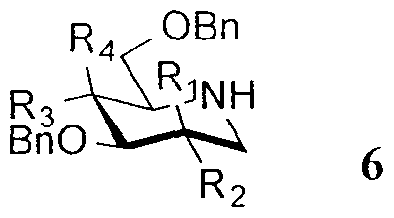
6a R1 =R2=H, R3= OBn, R4= H
6b R1 =R2=H, R3= H, R4= OBn
adding palladium on active charcoal to a solution of piperidine compound 6 as obtained in step (d) in acetic acid followed by stirring the mixture for overnight for period in the range of 10 to 12 hr at room temperature in the range of 20 to 35°C under hydrogen atmosphere to afford piperidine alkaloids
(7);

7a R1 =R2=H, R3= OH, R4= H, (+)-Fagomine
7b R1 =R2=R3= H, R4= OH, 4-ep/-Fagomine
adding Et3N to a solution of giycolactam (5) as obtained in step (c) in dichloromethane followed by cooling to 0°C and further adding Boc20, DMAP followed by stirring at temperature in the range of 20 to 25°C for period in the range of 8 to 9 h to afford TM-Boc protected lactam (8);

8a R1 =R2=H, R3= OBn, R4= H
8b R1 =R2=H, R3= H, R4= OBn
dissolving N-Boc protected lactam (8a) of step (d) in toluene and cooling to - 76°C under inert atmosphere and adding superhydride and ammonium chloride solution at -76°C followed by stirring the reaction mixture for period in the range of 9 to 10 h at room temperature to afford lactamol compound 9a;

9a R1 =R2=H, R3= OBn , R4= H
h) stirring a mixture of compound of step (e) and HCI in methanol at 70°C for 5h followed by basifying the reaction mixture to afford 3-deoxynojirimycin (10a).

10a R1 =R2=H , R3= OH , R4= H
i) dissolving N-Boc protected lactam (8a) of step (d) in dry toluene and cooled at -76°C under inert atmosphere and adding superhydride with stirring followed by addition of TFAA, DIPEA, catalytic amount of DMAP and purification to afford Boc-iminoglycal (1 l a/1 l b);
j) adding Boc-iminoglycal ( 1 1 a) to a solution of (DHQ)2AQN, K3Fe(CN)6, K2C03, 2Os02(OH)4 and CH3S02NH2 in fert-butyl alcohol and water cooled at 0°C followed by stirring the mixture at 0°C for 60 to 66 h to afford iminoglycal compound ( 12a);
k) The process as claimed in any of the preceding claims, wherein said process may also comprises adding Boc-iminoglycal ( 1 1 a) to a solution of (DHQD)2AQN, 3Fe(CN)6, 2C03, 2Os02(OH)4 and CH3S02NH2 in tert- butyl alcohol and water cooled at 0°C followed by stirring the mixture at 0°C for 60 to 66 h to afford iminoglycal compound(13a).
2. The process as claimed in claim 1 , wherein the piperidine alkaloids are (·+)- fagomine (7a), 4-<? /-fagomine(7b), 3-deoxynojirimycin ( 10a), Boc-iminoglycal ( 1 l a/1 l b), iminoglycal compound ( 12a) and iminoglycal compound( 13a).
3. The process as claimed in claim 1 , wherein the steps (a), (b) and (d) are carried out under nitrogen atmosphere.
4. The process as claimed in claim 1 , wherein the Boc-iminoglycal is tert-butyl (2R,3R)-3,4-bis(benzyloxy)-2-((benzyloxy)methyl)-3,4-dihydropyridine- l (2H)- carboxylate ( 1 1 a), tert-butyl (2R,3S)-3,4-bis(benzyloxy)-2-((benzyloxy)methyl)- 3,4-dihydropyridine- 1 (2H)-carboxylate( l i b).
5. The process as claimed in claim 9, wherein the iminoglycal compound is tert- Butyl (2/?,ii?,Ji?,(5 ?)-3,4-bis(benzyloxy)-2-((benzyloxy)methyl)-5,6-dihydroxy- piperidine- l-carboxylate (12a) or fer/-Butyl (2R,3R,5S, 6S)-3,4-b\s(benzy\oxy)-2- ((benzyloxy)methyl)-5,6-dihydroxypiperidine- 1 -carboxylate ( 13a).
Priority Applications (1)
| Application Number | Priority Date | Filing Date | Title |
|---|---|---|---|
| US15/309,873 US9834515B2 (en) | 2014-05-09 | 2015-05-05 | Process for synthesis of piperidine alkaloids |
Applications Claiming Priority (2)
| Application Number | Priority Date | Filing Date | Title |
|---|---|---|---|
| IN1250DE2014 | 2014-05-09 | ||
| IN1250/DEL/2014 | 2014-05-09 |
Publications (1)
| Publication Number | Publication Date |
|---|---|
| WO2015170339A1 true WO2015170339A1 (en) | 2015-11-12 |
Family
ID=53433227
Family Applications (1)
| Application Number | Title | Priority Date | Filing Date |
|---|---|---|---|
| PCT/IN2015/000196 Ceased WO2015170339A1 (en) | 2014-05-09 | 2015-05-05 | A process for synthesis of piperidine alkaloids |
Country Status (2)
| Country | Link |
|---|---|
| US (1) | US9834515B2 (en) |
| WO (1) | WO2015170339A1 (en) |
Cited By (2)
| Publication number | Priority date | Publication date | Assignee | Title |
|---|---|---|---|---|
| WO2017191657A1 (en) | 2016-05-06 | 2017-11-09 | Council Of Scientific & Industrial Research | Glycolactam compounds, process for preparation and uses thereof |
| US9834515B2 (en) | 2014-05-09 | 2017-12-05 | Council Of Scientific And Industrial Research | Process for synthesis of piperidine alkaloids |
Family Cites Families (2)
| Publication number | Priority date | Publication date | Assignee | Title |
|---|---|---|---|---|
| US20070088164A1 (en) * | 2005-09-02 | 2007-04-19 | Moriarity Robert M | Combinatorial library approach to iminocyclitols with biological activity |
| US9834515B2 (en) | 2014-05-09 | 2017-12-05 | Council Of Scientific And Industrial Research | Process for synthesis of piperidine alkaloids |
-
2015
- 2015-05-05 US US15/309,873 patent/US9834515B2/en active Active
- 2015-05-05 WO PCT/IN2015/000196 patent/WO2015170339A1/en not_active Ceased
Non-Patent Citations (11)
| Title |
|---|
| BATES ET AL.: "A synthesis of 2-epi-fagomine using gold (I)-catalyzed allene cyclisation", A SYNTHESIS OF 2-EPI-FAGOMINE VIA A HIGHLY STEREOSELECTIVE GOLD(I)-CATALYZED ALLENE CYCLISATION |
| GOUJON J Y ET AL: "General synthesis and biological evaluation of alpha-1-C-substituted derivatives of fagomine (2-deoxynojirimycin-alpha-C-glycosides)", BIOORGANIC & MEDICINAL CHEMISTRY, PERGAMON, GB, vol. 13, no. 6, 15 March 2005 (2005-03-15), pages 2313 - 2324, XP027637643, ISSN: 0968-0896, [retrieved on 20050315] * |
| J DESIRE ET AL.: "Chemistry of imino glycals: preparation and apptication to the synthesis of (+)-fagomine", SYNLETT, 2001, pages 1329 - 1331 |
| JA DIEZ ET AL.: "Stereoselective synthesis and biological evaluation of D-fagomine, D-3-epi-fagomine and D-3,4-epi-fagomine analogs from D-glyceraldehyde acetonide as a common building block", ORG BIOMOL CHEM., vol. 10, no. 46, 2012, pages 9278 - 86 |
| JY GOUJON ET AL.: "General synthesis and biological evaluation of alpha-1-C-substituted derivatives of fagomine (2-deoxynojirimycin-alpha-C-glycosides", BIOORG MED CHEM., vol. 13, no. 6, 2005, pages 2313 - 24 |
| KS KUMAR ET AL.: "A divergent synthesis of 4-epi-fagomine, 3, 4-dihydroxypipecolic acid, and a dihydroxyindolizidine and their beta-galactosidase inhibitory and immunomodulatory activities", J ORG CHEM., vol. 78, no. 15, 2013, pages 7406 - 13 |
| LIAN-DONG GUO ET AL: "A Concise and Divergent Approach to Hydroxylated Piperidine Alkaloids and Azasugar Lactams", EUROPEAN JOURNAL OF ORGANIC CHEMISTRY, vol. 2013, no. 11, 20 April 2013 (2013-04-20), pages 2230 - 2236, XP055206682, ISSN: 1434-193X, DOI: 10.1002/ejoc.201201618 * |
| N KUMARI ET AL.: "Efficient and stereodivergent syntheses of D- and L-fagomines and their analogues", EUROPEAN JOURNAL OF ORGANIC CHEMISTRY, 2009, pages 160 - 169, XP055206727, DOI: doi:10.1002/ejoc.200800796 |
| NITEE KUMARI ET AL: "Efficient and Stereodivergent Syntheses of D- and L-Fagomines and Their Analogues", EUROPEAN JOURNAL OF ORGANIC CHEMISTRY, vol. 2009, no. 1, 25 January 2009 (2009-01-25), pages 160 - 169, XP055206727, ISSN: 1434-193X, DOI: 10.1002/ejoc.200800796 * |
| SQUARCIA A ET AL: "Glycal-mediated syntheses of enantiomerically pure polyhydroxylated gamma- and delta-lactams", TETRAHEDRON LETTERS, PERGAMON, GB, vol. 43, no. 26, 28 May 2002 (2002-05-28), pages 4653 - 4655, XP004365845, ISSN: 0040-4039, DOI: 10.1016/S0040-4039(02)00852-3 * |
| TORU OKAKI ET AL: "Stereoselective Total Synthesis of (-)-Batzellasides A, B, and C", EUROPEAN JOURNAL OF ORGANIC CHEMISTRY, vol. 2013, no. 14, 19 March 2013 (2013-03-19), pages 2841 - 2848, XP055206692, ISSN: 1434-193X, DOI: 10.1002/ejoc.201201567 * |
Cited By (3)
| Publication number | Priority date | Publication date | Assignee | Title |
|---|---|---|---|---|
| US9834515B2 (en) | 2014-05-09 | 2017-12-05 | Council Of Scientific And Industrial Research | Process for synthesis of piperidine alkaloids |
| WO2017191657A1 (en) | 2016-05-06 | 2017-11-09 | Council Of Scientific & Industrial Research | Glycolactam compounds, process for preparation and uses thereof |
| US10774043B2 (en) | 2016-05-06 | 2020-09-15 | Council Of Scientific & Industrial Research | Glycolactam compounds, process for preparation and uses thereof |
Also Published As
| Publication number | Publication date |
|---|---|
| US9834515B2 (en) | 2017-12-05 |
| US20170267636A1 (en) | 2017-09-21 |
Similar Documents
| Publication | Publication Date | Title |
|---|---|---|
| EP2285800B1 (en) | Quinoline or isoquinoline substituted p2x7 antagonists | |
| CA3158530A1 (en) | Inhibitors of raf kinases | |
| US20100093713A1 (en) | Beta-carbolines useful for treating inflammatory disease | |
| US8163769B2 (en) | Antibacterial compounds | |
| Filichev et al. | Synthesis of an aza analogue of 2-deoxy-d-ribofuranose and its homologues | |
| Kim et al. | Recent advances in the total synthesis of indolizidine iminosugars | |
| KR20080059297A (en) | Quaternary Alpha-aminocarboxamide Derivatives as Regulators of Voltage-gated Sodium Channels | |
| WO2015170339A1 (en) | A process for synthesis of piperidine alkaloids | |
| Pandey et al. | Synthesis of polyhydroxy piperidines and their analogues: a novel approach towards selective inhibitors of α-glucosidase | |
| Malinowski et al. | Stereocontrolled synthesis of polyhydroxylated bicyclic azetidines as a new class of iminosugars | |
| US20240246961A1 (en) | Autotaxin inhibitor compounds | |
| Lundt | Aldonolactones as chiral synthons: Preparation of highly functionalized, optically active pyrrolidines, piperidines, carbocycles and tetrahydrofurans | |
| Pal et al. | Synthesis of sugar-derived spiroaminals via lactamization and metathesis reactions | |
| Oña et al. | Stereoselective syntheses of polyhydroxylated azepane derivatives from sugar-based epoxyamides. Part 1: synthesis from d-mannose | |
| Markad et al. | Polyhydroxylated homoazepanes and 1-deoxy-homonojirimycin analogues: Synthesis and glycosidase inhibition study | |
| Balo et al. | Stable d-xylose ditriflate in divergent syntheses of dihydroxy prolines, pyrrolidines, tetrahydrofuran-2-carboxylic acids, and cyclic β-amino acids | |
| CN101747259B (en) | Azasugars compounds, synthesis method and applications thereof | |
| Torres-Sánchez et al. | A short and highly stereoselective route to polyhydroxy-perhydroazaazulenes via a C-(d-galacto-pentopyranos-5-yl) isoxazolidine | |
| WO1991000724A1 (en) | Alkynyl amines that regulate cholinergic neurotransmission | |
| KAYAKIRI et al. | Synthesis 8-epi-Kifunensine | |
| Behr et al. | Addition of organometallics to aldimines, aldoximes and aldononitriles: a key step towards the synthesis of azasugars | |
| Rengasamy et al. | Stereoselective synthesis of L-deoxyaltronojirimycin from L-serine | |
| Witiak et al. | Syntheses and proton NMR conformational analyses of diastereomeric 4, 4'-(4, 5-dihydroxy-1, 2-cyclohexanediyl) bis (2, 6-piperazinedione) s and a synthetically related tricyclic octahydro-2, 2-dimethyl-6-oxo-1, 3-dioxolo [4, 5-g] quinoxaline-5, 8-diacetic acid ester | |
| Gupta et al. | (3S, 4R, 5R)-3-(2-Hydroxyethyl) piperidine-3, 4, 5-triol as an isofagomine analogue: synthesis and glycosidase inhibition study | |
| US10774043B2 (en) | Glycolactam compounds, process for preparation and uses thereof |
Legal Events
| Date | Code | Title | Description |
|---|---|---|---|
| 121 | Ep: the epo has been informed by wipo that ep was designated in this application |
Ref document number: 15729940 Country of ref document: EP Kind code of ref document: A1 |
|
| NENP | Non-entry into the national phase |
Ref country code: DE |
|
| WWE | Wipo information: entry into national phase |
Ref document number: 15309873 Country of ref document: US |
|
| 122 | Ep: pct application non-entry in european phase |
Ref document number: 15729940 Country of ref document: EP Kind code of ref document: A1 |