WO2015163848A1 - Material for phosphorescent light-emitting element - Google Patents
Material for phosphorescent light-emitting element Download PDFInfo
- Publication number
- WO2015163848A1 WO2015163848A1 PCT/US2014/034856 US2014034856W WO2015163848A1 WO 2015163848 A1 WO2015163848 A1 WO 2015163848A1 US 2014034856 W US2014034856 W US 2014034856W WO 2015163848 A1 WO2015163848 A1 WO 2015163848A1
- Authority
- WO
- WIPO (PCT)
- Prior art keywords
- compound
- carbon atoms
- group
- aromatic hydrocarbon
- hydrocarbon group
- Prior art date
- Legal status (The legal status is an assumption and is not a legal conclusion. Google has not performed a legal analysis and makes no representation as to the accuracy of the status listed.)
- Ceased
Links
- 0 *1c2ccccc2C2=C1CC(Cc1c(C3)cccc1)=C3C=C2 Chemical compound *1c2ccccc2C2=C1CC(Cc1c(C3)cccc1)=C3C=C2 0.000 description 6
- RQJAPLRJWJSEAR-UHFFFAOYSA-N C1C=CC([n](c(cccc2)c2c2c3)c2ccc3-[n]2c(c3c(cc4)c5ccccc5[n]3-c3ccccc3)c4c3c2cccc3)=CC1 Chemical compound C1C=CC([n](c(cccc2)c2c2c3)c2ccc3-[n]2c(c3c(cc4)c5ccccc5[n]3-c3ccccc3)c4c3c2cccc3)=CC1 RQJAPLRJWJSEAR-UHFFFAOYSA-N 0.000 description 3
- AKCXOKDPJYMOED-UHFFFAOYSA-N c(cc1)ccc1-c(cc1)ccc1-[n]1c(c([n](c2ccc3)-c4nc(-c5ccccc5)nc(-c5ccccc5)n4)c(cc4)c2c3-c2cccc(-c(cc3)ccc3-c3nc(-c5ccccc5)nc(-[n](c5ccccc5c5ccc6c7c8cccc7)c5c6[n]8-c5ccccc5)n3)c2)c4c2c1cccc2 Chemical compound c(cc1)ccc1-c(cc1)ccc1-[n]1c(c([n](c2ccc3)-c4nc(-c5ccccc5)nc(-c5ccccc5)n4)c(cc4)c2c3-c2cccc(-c(cc3)ccc3-c3nc(-c5ccccc5)nc(-[n](c5ccccc5c5ccc6c7c8cccc7)c5c6[n]8-c5ccccc5)n3)c2)c4c2c1cccc2 AKCXOKDPJYMOED-UHFFFAOYSA-N 0.000 description 3
- IVKLSCNSVPKPRX-UHFFFAOYSA-N c(cc1)ccc1-c(cc1)ccc1-c1nc(-[n](c(cccc2)c2c2ccc3c4ccccc44)c2c3[n]4-c2ccccc2)nc(-c(cc2)ccc2-c2ccccc2)n1 Chemical compound c(cc1)ccc1-c(cc1)ccc1-c1nc(-[n](c(cccc2)c2c2ccc3c4ccccc44)c2c3[n]4-c2ccccc2)nc(-c(cc2)ccc2-c2ccccc2)n1 IVKLSCNSVPKPRX-UHFFFAOYSA-N 0.000 description 3
- WBGVMGUHWZOIHO-UHFFFAOYSA-N c(cc1)ccc1-c(cc1c(cc2)c3c4c2c(cccc2)c2[n]4-c2ccccc2)ccc1[n]3-c1nc(-c2ccccc2)nc(-c2ccccc2)n1 Chemical compound c(cc1)ccc1-c(cc1c(cc2)c3c4c2c(cccc2)c2[n]4-c2ccccc2)ccc1[n]3-c1nc(-c2ccccc2)nc(-c2ccccc2)n1 WBGVMGUHWZOIHO-UHFFFAOYSA-N 0.000 description 3
- PMBFJWZLAVWBHF-UHFFFAOYSA-N c(cc1)ccc1-c(cc1c2c3cccc2)c(c2ccccc2[n]2-c4nc(-c5ccccc5)nc(-c5ccccc5)n4)c2c1[n]3-c1ccccc1 Chemical compound c(cc1)ccc1-c(cc1c2c3cccc2)c(c2ccccc2[n]2-c4nc(-c5ccccc5)nc(-c5ccccc5)n4)c2c1[n]3-c1ccccc1 PMBFJWZLAVWBHF-UHFFFAOYSA-N 0.000 description 3
- VCGDNELRQRRLFC-UHFFFAOYSA-N c(cc1)ccc1-c1cc(-c2nc(-c3ccccc3)nc(-[n]3c(c4c(cc5)c6ccccc6[n]4-c4ccccc4)c5c4ccccc34)n2)ccc1 Chemical compound c(cc1)ccc1-c1cc(-c2nc(-c3ccccc3)nc(-[n]3c(c4c(cc5)c6ccccc6[n]4-c4ccccc4)c5c4ccccc34)n2)ccc1 VCGDNELRQRRLFC-UHFFFAOYSA-N 0.000 description 3
- OOUHJCNIEOQYHC-UHFFFAOYSA-N I[n]1c(cccc2)c2nc1 Chemical compound I[n]1c(cccc2)c2nc1 OOUHJCNIEOQYHC-UHFFFAOYSA-N 0.000 description 1
- DGEZNRSVGBDHLK-UHFFFAOYSA-N c1cnc2c(nccc3)c3ccc2c1 Chemical compound c1cnc2c(nccc3)c3ccc2c1 DGEZNRSVGBDHLK-UHFFFAOYSA-N 0.000 description 1
- IOJUPLGTWVMSFF-UHFFFAOYSA-N c1nc(cccc2)c2[s]1 Chemical compound c1nc(cccc2)c2[s]1 IOJUPLGTWVMSFF-UHFFFAOYSA-N 0.000 description 1
- JIHQDMXYYFUGFV-UHFFFAOYSA-N c1ncncn1 Chemical compound c1ncncn1 JIHQDMXYYFUGFV-UHFFFAOYSA-N 0.000 description 1
- YAHHNSBXSDGEFB-UHFFFAOYSA-N c1nnc[n]1-c1ccccc1 Chemical compound c1nnc[n]1-c1ccccc1 YAHHNSBXSDGEFB-UHFFFAOYSA-N 0.000 description 1
Classifications
-
- C—CHEMISTRY; METALLURGY
- C09—DYES; PAINTS; POLISHES; NATURAL RESINS; ADHESIVES; COMPOSITIONS NOT OTHERWISE PROVIDED FOR; APPLICATIONS OF MATERIALS NOT OTHERWISE PROVIDED FOR
- C09K—MATERIALS FOR MISCELLANEOUS APPLICATIONS, NOT PROVIDED FOR ELSEWHERE
- C09K11/00—Luminescent materials, e.g. electroluminescent or chemiluminescent
- C09K11/06—Luminescent materials, e.g. electroluminescent or chemiluminescent containing organic luminescent materials
-
- C—CHEMISTRY; METALLURGY
- C07—ORGANIC CHEMISTRY
- C07F—ACYCLIC, CARBOCYCLIC OR HETEROCYCLIC COMPOUNDS CONTAINING ELEMENTS OTHER THAN CARBON, HYDROGEN, HALOGEN, OXYGEN, NITROGEN, SULFUR, SELENIUM OR TELLURIUM
- C07F15/00—Compounds containing elements of Groups 8, 9, 10 or 18 of the Periodic Table
- C07F15/0006—Compounds containing elements of Groups 8, 9, 10 or 18 of the Periodic Table compounds of the platinum group
- C07F15/002—Osmium compounds
-
- C—CHEMISTRY; METALLURGY
- C07—ORGANIC CHEMISTRY
- C07F—ACYCLIC, CARBOCYCLIC OR HETEROCYCLIC COMPOUNDS CONTAINING ELEMENTS OTHER THAN CARBON, HYDROGEN, HALOGEN, OXYGEN, NITROGEN, SULFUR, SELENIUM OR TELLURIUM
- C07F15/00—Compounds containing elements of Groups 8, 9, 10 or 18 of the Periodic Table
- C07F15/0006—Compounds containing elements of Groups 8, 9, 10 or 18 of the Periodic Table compounds of the platinum group
- C07F15/0033—Iridium compounds
-
- C—CHEMISTRY; METALLURGY
- C07—ORGANIC CHEMISTRY
- C07F—ACYCLIC, CARBOCYCLIC OR HETEROCYCLIC COMPOUNDS CONTAINING ELEMENTS OTHER THAN CARBON, HYDROGEN, HALOGEN, OXYGEN, NITROGEN, SULFUR, SELENIUM OR TELLURIUM
- C07F15/00—Compounds containing elements of Groups 8, 9, 10 or 18 of the Periodic Table
- C07F15/0006—Compounds containing elements of Groups 8, 9, 10 or 18 of the Periodic Table compounds of the platinum group
- C07F15/0086—Platinum compounds
-
- H—ELECTRICITY
- H05—ELECTRIC TECHNIQUES NOT OTHERWISE PROVIDED FOR
- H05B—ELECTRIC HEATING; ELECTRIC LIGHT SOURCES NOT OTHERWISE PROVIDED FOR; CIRCUIT ARRANGEMENTS FOR ELECTRIC LIGHT SOURCES, IN GENERAL
- H05B33/00—Electroluminescent light sources
- H05B33/12—Light sources with substantially two-dimensional [2D] radiating surfaces
- H05B33/14—Light sources with substantially two-dimensional [2D] radiating surfaces characterised by the chemical or physical composition or the arrangement of the electroluminescent material, or by the simultaneous addition of the electroluminescent material in or onto the light source
-
- H—ELECTRICITY
- H05—ELECTRIC TECHNIQUES NOT OTHERWISE PROVIDED FOR
- H05B—ELECTRIC HEATING; ELECTRIC LIGHT SOURCES NOT OTHERWISE PROVIDED FOR; CIRCUIT ARRANGEMENTS FOR ELECTRIC LIGHT SOURCES, IN GENERAL
- H05B33/00—Electroluminescent light sources
- H05B33/12—Light sources with substantially two-dimensional [2D] radiating surfaces
- H05B33/20—Light sources with substantially two-dimensional [2D] radiating surfaces characterised by the chemical or physical composition or the arrangement of the material in which the electroluminescent material is embedded
-
- H—ELECTRICITY
- H10—SEMICONDUCTOR DEVICES; ELECTRIC SOLID-STATE DEVICES NOT OTHERWISE PROVIDED FOR
- H10K—ORGANIC ELECTRIC SOLID-STATE DEVICES
- H10K50/00—Organic light-emitting devices
- H10K50/10—OLEDs or polymer light-emitting diodes [PLED]
- H10K50/11—OLEDs or polymer light-emitting diodes [PLED] characterised by the electroluminescent [EL] layers
-
- H—ELECTRICITY
- H10—SEMICONDUCTOR DEVICES; ELECTRIC SOLID-STATE DEVICES NOT OTHERWISE PROVIDED FOR
- H10K—ORGANIC ELECTRIC SOLID-STATE DEVICES
- H10K50/00—Organic light-emitting devices
- H10K50/10—OLEDs or polymer light-emitting diodes [PLED]
- H10K50/11—OLEDs or polymer light-emitting diodes [PLED] characterised by the electroluminescent [EL] layers
- H10K50/12—OLEDs or polymer light-emitting diodes [PLED] characterised by the electroluminescent [EL] layers comprising dopants
-
- H—ELECTRICITY
- H10—SEMICONDUCTOR DEVICES; ELECTRIC SOLID-STATE DEVICES NOT OTHERWISE PROVIDED FOR
- H10K—ORGANIC ELECTRIC SOLID-STATE DEVICES
- H10K85/00—Organic materials used in the body or electrodes of devices covered by this subclass
- H10K85/30—Coordination compounds
- H10K85/341—Transition metal complexes, e.g. Ru(II)polypyridine complexes
- H10K85/342—Transition metal complexes, e.g. Ru(II)polypyridine complexes comprising iridium
-
- H—ELECTRICITY
- H10—SEMICONDUCTOR DEVICES; ELECTRIC SOLID-STATE DEVICES NOT OTHERWISE PROVIDED FOR
- H10K—ORGANIC ELECTRIC SOLID-STATE DEVICES
- H10K85/00—Organic materials used in the body or electrodes of devices covered by this subclass
- H10K85/30—Coordination compounds
- H10K85/341—Transition metal complexes, e.g. Ru(II)polypyridine complexes
- H10K85/346—Transition metal complexes, e.g. Ru(II)polypyridine complexes comprising platinum
-
- H—ELECTRICITY
- H10—SEMICONDUCTOR DEVICES; ELECTRIC SOLID-STATE DEVICES NOT OTHERWISE PROVIDED FOR
- H10K—ORGANIC ELECTRIC SOLID-STATE DEVICES
- H10K85/00—Organic materials used in the body or electrodes of devices covered by this subclass
- H10K85/60—Organic compounds having low molecular weight
- H10K85/649—Aromatic compounds comprising a hetero atom
- H10K85/654—Aromatic compounds comprising a hetero atom comprising only nitrogen as heteroatom
-
- H—ELECTRICITY
- H10—SEMICONDUCTOR DEVICES; ELECTRIC SOLID-STATE DEVICES NOT OTHERWISE PROVIDED FOR
- H10K—ORGANIC ELECTRIC SOLID-STATE DEVICES
- H10K85/00—Organic materials used in the body or electrodes of devices covered by this subclass
- H10K85/60—Organic compounds having low molecular weight
- H10K85/649—Aromatic compounds comprising a hetero atom
- H10K85/657—Polycyclic condensed heteroaromatic hydrocarbons
-
- H—ELECTRICITY
- H10—SEMICONDUCTOR DEVICES; ELECTRIC SOLID-STATE DEVICES NOT OTHERWISE PROVIDED FOR
- H10K—ORGANIC ELECTRIC SOLID-STATE DEVICES
- H10K85/00—Organic materials used in the body or electrodes of devices covered by this subclass
- H10K85/60—Organic compounds having low molecular weight
- H10K85/649—Aromatic compounds comprising a hetero atom
- H10K85/657—Polycyclic condensed heteroaromatic hydrocarbons
- H10K85/6572—Polycyclic condensed heteroaromatic hydrocarbons comprising only nitrogen in the heteroaromatic polycondensed ring system, e.g. phenanthroline or carbazole
-
- H—ELECTRICITY
- H10—SEMICONDUCTOR DEVICES; ELECTRIC SOLID-STATE DEVICES NOT OTHERWISE PROVIDED FOR
- H10K—ORGANIC ELECTRIC SOLID-STATE DEVICES
- H10K85/00—Organic materials used in the body or electrodes of devices covered by this subclass
- H10K85/60—Organic compounds having low molecular weight
- H10K85/649—Aromatic compounds comprising a hetero atom
- H10K85/657—Polycyclic condensed heteroaromatic hydrocarbons
- H10K85/6574—Polycyclic condensed heteroaromatic hydrocarbons comprising only oxygen in the heteroaromatic polycondensed ring system, e.g. cumarine dyes
-
- H—ELECTRICITY
- H10—SEMICONDUCTOR DEVICES; ELECTRIC SOLID-STATE DEVICES NOT OTHERWISE PROVIDED FOR
- H10K—ORGANIC ELECTRIC SOLID-STATE DEVICES
- H10K85/00—Organic materials used in the body or electrodes of devices covered by this subclass
- H10K85/60—Organic compounds having low molecular weight
- H10K85/649—Aromatic compounds comprising a hetero atom
- H10K85/657—Polycyclic condensed heteroaromatic hydrocarbons
- H10K85/6576—Polycyclic condensed heteroaromatic hydrocarbons comprising only sulfur in the heteroaromatic polycondensed ring system, e.g. benzothiophene
-
- C—CHEMISTRY; METALLURGY
- C09—DYES; PAINTS; POLISHES; NATURAL RESINS; ADHESIVES; COMPOSITIONS NOT OTHERWISE PROVIDED FOR; APPLICATIONS OF MATERIALS NOT OTHERWISE PROVIDED FOR
- C09K—MATERIALS FOR MISCELLANEOUS APPLICATIONS, NOT PROVIDED FOR ELSEWHERE
- C09K2211/00—Chemical nature of organic luminescent or tenebrescent compounds
- C09K2211/10—Non-macromolecular compounds
- C09K2211/1003—Carbocyclic compounds
- C09K2211/1007—Non-condensed systems
-
- C—CHEMISTRY; METALLURGY
- C09—DYES; PAINTS; POLISHES; NATURAL RESINS; ADHESIVES; COMPOSITIONS NOT OTHERWISE PROVIDED FOR; APPLICATIONS OF MATERIALS NOT OTHERWISE PROVIDED FOR
- C09K—MATERIALS FOR MISCELLANEOUS APPLICATIONS, NOT PROVIDED FOR ELSEWHERE
- C09K2211/00—Chemical nature of organic luminescent or tenebrescent compounds
- C09K2211/10—Non-macromolecular compounds
- C09K2211/1018—Heterocyclic compounds
- C09K2211/1025—Heterocyclic compounds characterised by ligands
- C09K2211/1029—Heterocyclic compounds characterised by ligands containing one nitrogen atom as the heteroatom
-
- C—CHEMISTRY; METALLURGY
- C09—DYES; PAINTS; POLISHES; NATURAL RESINS; ADHESIVES; COMPOSITIONS NOT OTHERWISE PROVIDED FOR; APPLICATIONS OF MATERIALS NOT OTHERWISE PROVIDED FOR
- C09K—MATERIALS FOR MISCELLANEOUS APPLICATIONS, NOT PROVIDED FOR ELSEWHERE
- C09K2211/00—Chemical nature of organic luminescent or tenebrescent compounds
- C09K2211/10—Non-macromolecular compounds
- C09K2211/1018—Heterocyclic compounds
- C09K2211/1025—Heterocyclic compounds characterised by ligands
- C09K2211/1059—Heterocyclic compounds characterised by ligands containing three nitrogen atoms as heteroatoms
-
- C—CHEMISTRY; METALLURGY
- C09—DYES; PAINTS; POLISHES; NATURAL RESINS; ADHESIVES; COMPOSITIONS NOT OTHERWISE PROVIDED FOR; APPLICATIONS OF MATERIALS NOT OTHERWISE PROVIDED FOR
- C09K—MATERIALS FOR MISCELLANEOUS APPLICATIONS, NOT PROVIDED FOR ELSEWHERE
- C09K2211/00—Chemical nature of organic luminescent or tenebrescent compounds
- C09K2211/18—Metal complexes
- C09K2211/185—Metal complexes of the platinum group, i.e. Os, Ir, Pt, Ru, Rh or Pd
-
- H—ELECTRICITY
- H10—SEMICONDUCTOR DEVICES; ELECTRIC SOLID-STATE DEVICES NOT OTHERWISE PROVIDED FOR
- H10K—ORGANIC ELECTRIC SOLID-STATE DEVICES
- H10K2101/00—Properties of the organic materials covered by group H10K85/00
- H10K2101/10—Triplet emission
Definitions
- the present invention relates to an organometallic phosphorescent dopant/organic host compound material combination that may be advantageously used in organic light emitting devices, and methods for fabricating organic light emitting devices that contain the
- the invention relates to a premix comprising the organometallic phosphorescent dopant and the organic host compound evaporated to provide organic thin films with highly consistent hos dopant ratios.
- the consistency of the evaporated pre-mixed thin films allows precise optimization of material parameters and reliable performance outcomes with respect to in devices using them.
- Opto-electronic devices that make use of organic materials are becoming increasingly desirable for a number of reasons. Many of the materials used to make such devices are relatively inexpensive, so organic opto-electronic devices have the potential for cost advantages over inorganic devices. In addition, the inherent properties of organic materials, such as their flexibility, may make them well suited for particular applications such as fabrication on a flexible substrate. Examples of organic opto-electronic devices include organic light emitting devices (OLEDs), organic phototransistors, organic photovoltaic cells, and organic
- the organic materials may have performance advantages over conventional materials.
- the wavelength at which an organic emissive layer emits light may generally be readily tuned with appropriate dopants.
- OLEDs make use of thin organic films that emit light when voltage is applied across the device. OLEDs are becoming an increasingly interesting technology for use in applications such as flat panel displays, illumination, and backlighting. Several OLED materials and configurations are described in U.S. Pat. Nos. 5,844,363, 6,303,238, and 5,707,745, which are incorporated herein by reference in their entirety.
- phosphorescent emissive molecules are full color display.
- Industry standards for such a display call for pixels adapted to emit particular colors, referred to as "saturated" colors.
- these standards call for saturated red, green, and blue pixels. Color may be measured using CIE coordinates, which are well known to the art.
- One example of a green emissive molecule is tris(2-phenylpyridine) iridium, denoted Ir(ppy) 3 , which has the structure:
- organic includes polymeric materials as well as small molecule organic materials that may be used to fabricate organic opto-electronic devices.
- Small molecule refers to any organic material that is not a polymer, and "small molecules” may actually be quite large. Small molecules may include repeat units in some circumstances. For example, using a long chain alkyl group as a substituent does not remove a molecule from the "small molecule” class. Small molecules may also be incorporated into polymers, for example as a pendent group on a polymer backbone or as a part of the backbone. Small molecules may also serve as the core moiety of a dendrimer, which consists of a series of chemical shells built on the core moiety.
- the core moiety of a dendrimer may be a fluorescent or phosphorescent small molecule emitter.
- a dendrimer may be a "small molecule,” and it is believed that all dendrimers currently used in the field of OLEDs are small molecules.
- top means furthest away from the substrate, while “bottom” means closest to the substrate.
- first layer is described as “disposed over” a second layer, the first layer is disposed further away from substrate. There may be other layers between the first and second layer, unless it is specified that the first layer is "in contact with” the second layer.
- a cathode may be described as “disposed over” an anode, even though there are various organic layers in between.
- solution processible means capable of being dissolved, dispersed, or transported in and/or deposited from a liquid medium, either in solution or suspension form.
- a ligand may be referred to as "photoactive” when it is believed that the ligand directly contributes to the photoactive properties of an emissive material.
- a ligand may be referred to as "ancillary” when it is believed that the ligand does not contribute to the photoactive properties of an emissive material, although an ancillary ligand may alter the properties of a photoactive ligand.
- a first "Highest Occupied Molecular Orbital” (HOMO) or “Lowest Unoccupied Molecular Orbital” (LUMO) energy level is "greater than” or "higher than” a second HOMO or LUMO energy level if the first energy level is closer to the vacuum energy level.
- IP ionization potentials
- a higher HOMO energy level corresponds to an IP having a smaller absolute value (an IP that is less negative).
- a higher LUMO energy level corresponds to an electron affinity (EA) having a smaller absolute value (an EA that is less negative).
- the LUMO energy level of a material is higher than the HOMO energy level of the same material.
- a "higher” HOMO or LUMO energy level appears closer to the top of such a diagram than a "lower” HOMO or LUMO energy level.
- a first work function is "greater than” or “higher than” a second work function if the first work function has a higher absolute value. Because work functions are generally measured as negative numbers relative to vacuum level, this means that a "higher” work function is more negative. On a conventional energy level diagram, with the vacuum level at the top, a “higher” work function is illustrated as further away from the vacuum level in the downward direction. Thus, the definitions of HOMO and LUMO energy levels follow a different convention than work functions.
- a material combination and an organic light emitting device wherein the emissive layer thereof comprises the material combination are provided.
- the material combination comprises a pre-mixed material suitable for co-evaporation.
- the pre-mixed material comprises a physical mixture of a first compound and a second compound wherein the first compound is an organometallic phosphorescent dopant compound having the formula:
- L 2 MX, LL'MX, LL'L"M, or LMXX' wherein L, L', L", X, and X' are inequivalent, bidentate ligands and M is a metal having an atomic weight greater than 40, wherein L, L', and L" are monoanionic inequivalent bidentate ligands coordinated to M through an sp 2 hybridized carbon and wherein the organometallic phosphorescent dopant compound is selected from organometallic platinum compounds, organometallic iridium compounds and organometallic osmium compounds and wherein the organometallic platinum compounds, iridium compounds and osmium compounds optionally include an aromatic ligand and the second compound comprises an organic heteroaromatic host compound having the formula (1): wherein
- Y is a t-valent aromatic hydrocarbon group of 6 to 50 carbon atoms or a t-valent aromatic heterocyclic group of 3 to 50 carbon atoms excluding a group having more than 5 condensed rings .
- t denotes an integer of 1 to 3, such that when t is greater than 2, each Z may be the same or different
- ring A is an aromatic hydrocarbon ring represented by formula (lb)
- ring B is a heterocyclic ring represented by formula (lc)
- ring A and B are respectively condensed with the adjacent rings
- Each R is independently selected from hydrogen, an aliphatic hydrocarbon group of 1 to 10 carbon atoms, an aromatic hydrocarbon group of 6 to 18 carbon atoms, or an aromatic heterocyclic group of 3 to 17 carbon atoms.
- R is an aromatic hydrocarbon group or an aromatic heterocyclic group
- R may condense with benzene ring
- m denotes 0 or an integer of 1 to 2
- n denotes 0 or an integer of 1.
- X 1 is O or S or N-Ar 1 or N wherein Ar 1 is an aromatic hydrocarbon group of 6 to 50 carbon atoms, or an aromatic heterocyclic group of 3 to 50 carbon atoms excluding a group having more than 5 condensed rings.
- X 2 is O or S or N-Ar 2 wherein Ar 2 is an aromatic hydrocarbon group of 6 to 50 carbon atoms, or an aromatic heterocyclic group of 3 to 50 carbon atoms excluding a group having more than 5 condensed rings.
- FIG. 1 shows an organic light emitting device.
- FIG. 2 shows an inverted organic light emitting device that does not have a separate electron transport layer.
- an OLED comprises at least one organic layer disposed between and electrically connected to an anode and a cathode.
- the anode injects holes and the cathode injects electrons into the organic layer(s).
- the injected holes and electrons each migrate toward the oppositely charged electrode.
- an "exciton” which is a localized electron-hole pair having an excited energy state, is formed.
- Light is emitted when the exciton relaxes via a photoemissive mechanism.
- the exciton may be localized on an excimer or an exciplex. Non-radiative mechanisms, such as thermal relaxation, may also occur, but are generally considered undesirable.
- the initial OLEDs used emissive molecules that emitted light from their singlet states ("fluorescence") as disclosed, for example, in U.S. Pat. No. 4,769,292, which is incorporated by reference in its entirety. Fluorescent emission generally occurs in a time frame of less than 10 nanoseconds.
- FIG. 1 shows an organic light emitting device 100.
- Device 100 may include a substrate 1 10, an anode 115, a hole injection layer 120, a hole transport layer 125, an electron blocking layer 130, an emissive layer 135, a hole blocking layer 140, an electron transport layer 145, an electron injection layer 150, a protective layer 155, and a cathode 160.
- Cathode 160 is a compound cathode having a first conductive layer 162 and a second conductive layer 164.
- Device 100 may be fabricated by depositing the layers described, in order. The properties and functions of these various layers, as well as example materials, are described in more detail in US 7,279,704 at cols.
- An example of an n-doped electron transport layer is BPhen doped with Li at a molar ratio of 1 : 1, as disclosed in U.S. Patent Application Publication No. 2003/0230980, which is incorporated by reference in its entirety.
- the theory and use of blocking layers is described in more detail in U.S. Pat. No. 6,097, 147 and U.S. Patent Application Publication No.
- FIG. 2 shows an inverted OLED 200.
- the device includes a substrate 210, a cathode 215, an emissive layer 220, a hole transport layer 225, and an anode 230.
- Device 200 may be fabricated by depositing the layers described, in order. Because the most common OLED configuration has a cathode disposed over the anode, and device 200 has cathode 215 disposed under anode 230, device 200 may be referred to as an "inverted" OLED. Materials similar to those described with respect to device 100 may be used in the corresponding layers of device 200.
- FIG. 2 provides one example of how some layers may be omitted from the structure of device 100.
- FIGS. 1 and 2 The simple layered structure illustrated in FIGS. 1 and 2 is provided by way of non- limiting example, and it is understood that embodiments of the invention may be used in connection with a wide variety of other structures.
- the specific materials and structures described are exemplary in nature, and other materials and structures may be used.
- Functional OLEDs may be achieved by combining the various layers described in different ways, or layers may be omitted entirely, based on design, performance, and cost factors. Other layers not specifically described may also be included. Materials other than those specifically described may be used. Although many of the examples provided herein describe various layers as comprising a single material, it is understood that combinations of materials, such as a mixture of host and dopant, or more generally a mixture, may be used. Also, the layers may have various sublayers.
- hole transport layer 225 transports holes and injects holes into emissive layer 220, and may be described as a hole transport layer or a hole injection layer.
- an OLED may be described as having an "organic layer" disposed between a cathode and an anode. This organic layer may comprise a single layer, or may further comprise multiple layers of different organic materials as described, for example, with respect to FIGS. 1 and 2.
- OLEDs comprised of polymeric materials (PLEDs) such as disclosed in U.S. Pat. No. 5,247, 190 to Friend et al, which is incorporated by reference in its entirety.
- PLEDs polymeric materials
- OLEDs having a single organic layer may be used.
- OLEDs may be stacked, for example as described in U.S. Pat. No. 5,707,745 to Forrest et al, which is incorporated by reference in its entirety.
- the OLED structure may deviate from the simple layered structure illustrated in FIGS. 1 and 2.
- the substrate may include an angled reflective surface to improve out- coupling, such as a mesa structure as described in U.S. Pat. No. 6,091, 195 to Forrest et al, and/or a pit structure as described in U.S. Pat. No. 5,834,893 to Bulovic et al, which are incorporated by reference in their entireties.
- any of the layers of the various embodiments may be deposited by any suitable method.
- preferred methods include thermal evaporation, ink-jet, such as described in U.S. Pat. Nos. 6,013,982 and 6,087, 196, which are incorporated by reference in their entireties, organic vapor phase deposition (OVPD), such as described in U.S. Pat. No. 6,337, 102 to Forrest et al, which is incorporated by reference in its entirety, and deposition by organic vapor jet printing (OVJP), such as described in U.S. patent application Ser. No. 10/233,470, which is incorporated by reference in its entirety.
- OVPD organic vapor phase deposition
- OJP organic vapor jet printing
- Other suitable deposition methods include spin coating and other solution based processes.
- Solution based processes are preferably carried out in nitrogen or an inert atmosphere.
- preferred methods include thermal evaporation.
- Preferred patterning methods include deposition through a mask, cold welding such as described in U.S. Pat. Nos. 6,294,398 and 6,468,819, which are incorporated by reference in their entireties, and patterning associated with some of the deposition methods such as ink-jet and OVJD. Other methods may also be used.
- the materials to be deposited may be modified to make them compatible with a particular deposition method. For example, substituents such as alkyl and aryl groups, branched or unbranched, and preferably containing at least 3 carbons, may be used in small molecules to enhance their ability to undergo solution processing.
- Substituents having 20 carbons or more may be used, and 3-20 carbons is a preferred range. Materials with asymmetric structures may have better solution processibility than those having symmetric structures, because asymmetric materials may have a lower tendency to recrystallize. Dendrimer substituents may be used to enhance the ability of small molecules to undergo solution processing.
- Devices fabricated in accordance with embodiments of the invention may be incorporated into a wide variety of consumer products, including flat panel displays, computer monitors, televisions, billboards, lights for interior or exterior illumination and/or signaling, heads up displays, fully transparent displays, flexible displays, laser printers, telephones, cell phones, personal digital assistants (PDAs), laptop computers, 3-D displays, digital cameras, camcorders, viewfinders, micro-displays, vehicles, a large area wall, theater or stadium screen, or a sign.
- PDAs personal digital assistants
- 3-D displays digital cameras, camcorders, viewfinders, micro-displays, vehicles, a large area wall, theater or stadium screen, or a sign.
- Various control mechanisms may be used to control devices fabricated in accordance with the present invention, including passive matrix and active matrix. Many of the devices are intended for use in a temperature range comfortable to humans, such as 18 degrees C. to 30 degrees C, and more preferably at room temperature (20-25 degrees C).
- the materials and structures described herein may have applications in devices other than OLEDs.
- other optoelectronic devices such as organic solar cells and organic photodetectors may employ the materials and structures.
- organic devices such as organic transistors, may employ the materials and structures.
- halo halogen, alkyl, cycloalkyl, alkenyl, alkynyl, arylkyl, heterocyclic group, aryl, aromatic group, and heteroaryl are known to the art, and are defined in US
- a combination of an organometallic phosphorescent dopant and a heteroaromatic host compound may be advantageously used in organic light emitting devices to provide improved performance and improved device fabrication.
- the devices may be fabricated by co-evaporation or premix-evaporation with high consistency.
- High-performance liquid chromatography (HPLC) results in exemplary materials show consistent ratio of host compound and organometallic phosphorescent dopant from the deposited films.
- HPLC high-performance liquid chromatography
- Pre-mixing and evaporating a host material and an emissive dopant material has been previously reported in the literature. See, EP 1156536. It is also known to select two or more materials that have similar thermal properties for pre-mix evaporation. See, e.g., US 5,981,092 and PCT/US2004/002710. It is desirable to have a convenient and consistent way to evaporate dopant and host materials simultaneously.
- the emissive layer often a host: dopant layer comprising a host compound and an organometallic dopant compound employed as the emitting material. The host significantly impacts the device voltage, efficiency and lifetime. Device performance may be further enhanced by the presence of carefully selected additional materials in the emissive layer such as assisting dopants. See, for example
- the rate of evaporation no longer depends on pressure. That is, because the continuum assumptions of fluid dynamics no longer apply, mass transport is governed by molecular dynamics rather than fluid dynamics. For materials that do not melt during evaporation, direct transition from solid phase to gas phase occurs. When mixing two or more materials and evaporating them from the same source under high vacuum, a number of factors may contribute to the evaporation, such as evaporation temperature of individual materials, miscibility of different materials, and different phase transition. Without being bound by theory, it is believed that the similar evaporation temperature of first material and the second material contribute to the evaporation consistency.
- evaporation temperature is defined as the temperature at which a material can be deposited at a given rate on a substrate under high vacuum.
- the evaporation temperature is the temperature of the organic material source as measured during thermal evaporation with a rate suitable for device fabrication (in the present case ⁇ 2-3 A/s at a pressure ⁇ 10 -10 torr). Since the evaporation temperature depends on the molecular weight and intermolecular interactions of the material, derivatives with the same molecular modification will have the same molecular weight difference, and may have similar intermolecular interactions.
- first compound and a second compound can be premixed and evaporated with good consistency
- the molecular weight added to the first compound and the second compound is 77 atomic mass units (amu).
- the evaporation temperatures of the first compound with phenyl substitution and the second compound with phenyl substitution may be similar and their mixture may also be suitable for premix-evaporation.
- the first compound and the second compound may behave similarly even if the conditions in the evaporation chamber are different.
- premixing dopant and host compounds in one evaporation source provides uniform and consistent evaporation of the two or more materials to form a deposited layer consisting of the two or more materials in a similar ratio to the premixing ratio.
- a novel combination of materials in which an organic host compound is physically mixed with an organometallic phosphorescent dopant compound is provided herein that may be suitable for pre-mix evaporation or co-evaporation.
- the organic host compound is physically mixed with the organometallic phosphorescent dopant.
- the particular combination of materials disclosed herein demonstrate unexpected results by providing a highly consistent ratio of a host compound and an organometallic phosphorescent dopant in films deposited from the pre-mix. Without being bound by theory, it is believed that the oorganometallic phosphorescent dopant and
- heteroaromatic host compound have strong intermolecular interactions. Therefore, by tuning deposition temperature of each compound, consistent deposition behavior is obtained. Therefore, it is thought that a combination of a first compound selected from the organometallic phosphorescent dopant compounds disclosed herein and a second compound selected from the organic host compounds disclosed herein synergistically improve the properties of the resulting combination.
- the organometallic phosphorescent dopant component of the material combination may function as the emitting dopant or it may function as an assisting dopant.
- another organometallic phosphorescent compound present in the emissive layer may serve as the emitting dopant.
- the emissive layer may optionally contain another organometallic phosphorescent compound serving as an assisting dopant.
- the organometallic phosphorescent dopant component in the mixed material functions as an emitting dopant or as an assisting dopant
- the relative triplet energies of the materials in the emissive layer may be depicted as follows: emitting dopant ⁇ assisting dopant ⁇ host material
- the organic light emitting device comprises a first electrode, a second electrode, and a first organic layer, disposed between the first electrode and the second electrode, wherein the first organic layer comprises an organic composition.
- the organic composition comprises a first compound and a second compound, the first compound being an organometallic compound represented by the formula L 2 MX, LL'MX, LL'L"M, or LMXX', wherein L, L', L", X, and X' are inequivalent, bidentate ligands and M is a metal that forms octahedral complexes, wherein L, L', and L" are monoanionic inequivalent bidentate ligands coordinated to M through an sp 2 hybridized carbon and a heteroatom and the second compound has a heteroaromatic structure.
- the first compound being an organometallic compound represented by the formula L 2 MX, LL'MX, LL'L"M, or LMXX', wherein L, L', L", X, and X' are inequivalent, bidentate ligands and M is a metal that forms octahedral complexes, wherein L, L',
- the first compound may be a compound selected from the group consisting of phosphorescent organometallic platinum compounds, organometallic iridium compounds and organometallic osmium compounds.
- the organometallic platinum compounds, iridium compounds and osmium compounds can each include an aromatic ligand.
- the first compound comprises a phosphorescent organometallic compound having a substituted chemical structure represented by the following chemical structure:
- M is Ir, Pt or Os; each R' is independently selected from the group consisting of H, alkyl, alkenyl, alkynyl, alkylaryl, CN, CF 3 , C n F 2n+ i, trifluorovinyl, C0 2 R", C(0)R", NR" 2 , N0 2 , OR", halo, aryl, heteroaryl, substituted aryl, substituted heteroaryl or a heterocylic group and where each R" is independently H, alkyl, alkenyl, alkynyl, heteroalkyl, aryl, heteroaryl, or aralkyl;;
- Ar', Ar", Ar'" and Ar" each independently represent a substituted or unsubstituted aryl or heteroaryl unfused substituent on the phenylpyridine ligand; a is 0 or 1; b is 0 or 1 ; c is 0 or 1; d is 0 or 1 ; m is 1 or 2; n is 1 or 2; m+n is the maximum number of ligands that can be coordinated to M; and wherein at least one of a, b, c, and d is 1 and when at least one of a and b is 1 and at least one of b and c is 1, at least one of Ar' and Ar" is different from at least one of Ar'" and Ar""
- the second compound comprises an organic heteroaromatic host compound having the formula (1): wherein
- Y is a t-valent aromatic hydrocarbon group of 6 to 50 carbon atoms or a t-valent aromatic heterocyclic group of 3 to 50 carbon atoms excluding a group having more than 5 condensed rings .
- t denotes an integer of 1 to 3, such that when t is greater than 2, each Z may be the same or different
- ring A is an aromatic hydrocarbon ring represented by formula (lb)
- ring B is a heterocyclic ring represented by formula (lc)
- ring A and B are respectively condensed with the adjacent rings;
- X 1 is O or S or N-Ar 1 or N wherein Ar 1 is an aromatic hydrocarbon group of 6 to 50 carbon atoms, or an aromatic heterocyclic group of 3 to 50 carbon atoms excluding a group having more than 5 condensed rings.
- R is independently selected from hydrogen, an aliphatic hydrocarbon group of 1 to 10 carbon atoms, an aromatic hydrocarbon group of 6 to 18 carbon atoms, or an aromatic heterocyclic group of 3 to 17 carbon atoms.
- R is an aromatic hydrocarbon group or an aromatic heterocyclic group
- R may condense with benzene ring
- X 1 is O or S or N-Ar 1 or N wherein Ar 1 is an aromatic hydrocarbon group of 6 to 50 carbon atoms, or an aromatic heterocyclic group of 3 to 50 carbon atoms excluding a group having more than 5 condensed rings.
- m denotes 0 or an integer of 1 to 2
- n denotes 0 or an integer of 1.
- X 2 is O or S or N-Ar 2 wherein Ar 2 is an aromatic hydrocarbon group of 6 to 50 carbon atoms, or an aromatic heterocyclic group of 3 to 50 carbon atoms excluding a group having more than 5 condensed rings.
- X 2 is O or S or N-Ar 2 wherein Ar 2 is an aromatic hydrocarbon group of 6 to 50 carbon atoms, or an aromatic heterocyclic group of 3 to 50 carbon atoms excluding a group having more than 5 condensed rings.
- X 2 is O or S or N-Ar 2 wherein Ar 2 is an aromatic hydrocarbon group of 6 to 50 carbon atoms, or an aromatic heterocyclic group of 3 to 50 carbon atoms excluding a group having more than 5 condensed rings.
- examples of Y or Ar 1 or Ar 2 may comprise a t-valent or monovalent group leaded from benzene, naphthalene, anthracene, pyridine, pyrazine, pyrimidine, pyridajine, triazine, isoindole, indazole, purine, isoquinoline, imidazole, naphthyridine, phthalazine, quinazoline, quinoxaline, cinnoline, quinoline, pteridine, phenanthridine, acridine, perimidine, phenanthroline, phenazine, carboline, indole, benzoxazole, benzothiazole, carbazole, dibenzofuran, dibenzothiophene, and may arbitrarily connect two or more these groups.
- Y is a t-valent group
- Ar 1 and Ar 2 are a monovalent group.
- Y is a t-valent aromatic hydrocarbon group of 6 to 50 carbon atoms or a t-valent aromatic heterocyclic group of 3 to 50 carbon atoms excluding a group having more than 5 condensed rings .
- t denotes an integer of 1 to 3, such that when t is greater than 2, each Z may be the same or different
- ring A is an aromatic hydrocarbon ring represented by formula (2b)
- ring B is a heterocyclic ring represented by formula (2c)
- R is independently selected from hydrogen, an aliphatic hydrocarbon group of 1 to 10 carbon atoms, an aromatic hydrocarbon group of 6 to 18 carbon atoms, or an aromatic heterocyclic group of 3 to 17 carbon atoms.
- R is an aromatic hydrocarbon group or an aromatic heterocyclic group
- R may condense with benzene ring; m denotes 0 or an integer of 1 to 2 n denotes 0 or an integer of 1.
- X 2 is O or S or N-Ar 2 wherein Ar 2 is an aromatic hydrocarbon group of 6 to 50 carbon atoms, or an aromatic heterocyclic group of 3 to 50 carbon atoms excluding a group having more than 5 condensed rings.
- Y or Ar 2 may comprise a t-valent or monovalent group leaded from benzene, naphthalene, anthracene, pyridine, pyrazine, pyrimidine, pyridajine, triazine, isoindole, indazole, purine, isoquinoline, imidazole, naphthyridine, phthalazine, quinazoline, quinoxaline, cinnoline, quinoline, pteridine, phenanthridine, acridine, perimidine, phenanthroline, phenazine, carboline, indole, benzoxazole, benzothiazole, carbazole, dibenzofuran, dibenzothiophene, and may arbitrarily connect two or more these groups.
- Y is a t-valent group
- Ar 2 is a monovalent group.
- the second compound more preferably comprises heteroaromatic host compound represented by the following chemical formula (3) :
- Y is a t-valent aromatic hydrocarbon group of 6 to 50 carbon atoms or a t-valent aromatic heterocyclic group of 3 to 50 carbon atoms excluding a group having more than 5 condensed rings.
- t denotes an integer of 1 to 3, such that when t is greater than 2, each Z may be the same or different
- ring A is an aromatic hydrocarbon ring represented by formula (3b)
- ring B is a heterocyclic ring represented by formula (3 c)
- ring A and B are respectively condensed with the adjacent rings at arbitrary positions.
- R is independently selected from hydrogen, an aliphatic hydrocarbon group of 1 to 10 carbon atoms, an aromatic hydrocarbon group of 6 to 18 carbon atoms, or an aromatic heterocyclic group of 3 to 17 carbon atoms
- each R is independently selected from hydrogen, an aliphatic hydrocarbon group of 1 to 10 carbon atoms, an aromatic hydrocarbon group of 6 to 18 carbon atoms, or an aromatic heterocyclic group of 3 to 17 carbon atoms.
- R is an aromatic hydrocarbon group or an aromatic heterocyclic group
- R may condense with benzene ring.
- Ar 2 is an aromatic hydrocarbon group of 6 to 50 carbon atoms, or an aromatic heterocyclic group of 3 to 50 carbon atoms excluding a group that condensed more than 5 rings.
- Y or Ar 2 may comprise a t-valent or monovalent group leaded from benzene, naphthalene, anthracene, pyridine, pyrazine, pyrimidine, pyridajine, triazine, isoindole, indazole, purine, isoquinoline, imidazole, naphthyridine, phthalazine, quinazoline, quinoxaline, cinnoline, quinoline, pteridine, phenanthridine, acridine, perimidine, phenanthroline, phenazine, carboline, indole, benzoxazole, benzothiazole, carbazole, dibenzofuran, dibenzothiophene, and may arbitrarily connect two or more these groups.
- Y is a t-valent group
- Ar 2 is a monovalent group.
- the set of non-hydrogen substituents selected for each independent R' and the set of non-hydrogen substituents selected for R are the same.
- derivatives of the first compound and the second compound with the same molecular modification will have the same molecular weight difference, and may have similar intermolecular interactions. Therefore, the first compound and the second compound having the same substituents may be suitable for premixing.
- the first compound may be selected from but is not limited to the group consisting of::
- the second compound which is represented by general formulas (1) and (2) and (3) may be selected from but is not limited to the group consisting of:
- the device further comprises a second organic layer different from the first organic layer, and the second organic layer is a non-emissive layer.
- the second organic layer is a blocking layer.
- the first electrode is an anode and the second organic layer is deposited over the anode.
- the first compound has an evaporation temperature within 30 °C of the evaporation temperature of the second compound.
- the organic composition comprises about 5% to about 95% of the first compound and about 5% to about 95% the second compound.
- the device is an organic light emitting device. In another aspect, the device is a consumer product.
- a method of fabricating an organic light emitting device comprises a first electrode, a second electrode, and a first organic layer disposed between the first electrode and the second electrode.
- the first organic layer comprises an organic composition comprising a first compound and a second compound.
- the first compound and the second compound are physically mixed prior to device fabrication and evaporated from a single source.
- the method comprises providing a substrate having the first electrode disposed thereon, depositing the organic composition over the first electrode; and depositing the second electrode over the first organic layer
- the organic composition comprises a first compound and a second compound, the first compound being an organometallic compound represented by the formula L 2 MX, LL'MX, LL'L"M, or LMXX', wherein L, L', L", X, and X' are inequivalent, bidentate ligands and M is a metal that forms octahedral complexes, wherein L, L', and L" are monoanionic inequivalent bidentate ligands coordinated to M through an sp 2 hybridized carbon and a heteroatom and the second compound is a compound hhaving an heteroaromatic structure.
- the first compound being an organometallic compound represented by the formula L 2 MX, LL'MX, LL'L"M, or LMXX', wherein L, L', L", X, and X' are inequivalent, bidentate ligands and M is a metal that forms octahedral complexes, where
- the first compound may be a compound selected from the group consisting of phosphorescent organometallic platinum compounds, organometallic iridium compounds and organometallic osmium compounds.
- the organometallic platinum compounds, iridium compounds and osmium compounds can each include an aromatic ligand.
- the first compound comprises a phosphorescent organometallic compound having a substituted chemical structure represented by the following chemical structure:
- M is Ir, Pt or Os each R' is independently selected from the group consisting of H, alkyl, alkenyl, alkynyl, alkylaryl, CN, CF 3 , C n F 2n+ i, trifluorovinyl, C0 2 R", C(0)R", NR" 2 , N0 2 , OR", halo, aryl, heteroaryl, substituted aryl, substituted heteroaryl or a heterocylic group and where each R" is independently H, alkyl, alkenyl, alkynyl, heteroalkyl, aryl, heteroaryl, or aralkyl
- Ar', Ar", Ar'" and Ar" each independently represent a substituted or unsubstituted aryl or heteroaryl unfused substituent on the phenylpyridine ligand; a is 0 or 1; b is 0 or 1 ; c is 0 or 1; d is 0 or 1 ; m is 1 or 2; n is 1 or 2; m+n is the maximum number of ligands that can be coordinated to M; and wherein at least one of a, b, c, and d is 1 and when at least one of a and b is 1 and at least one of b and c is 1, at least one of Ar' and Ar" is different from at least one of Ar'" and Ar""
- the second compound comprises an organic heteroaromatic host compound having the formula (1):
- Y is a t-valent aromatic hydrocarbon group of 6 to 50 carbon atoms or a t-valent aromatic heterocyclic group of 3 to 50 carbon atoms excluding a group having more than 5 condensed rings.
- t denotes an integer of 1 to 3, such that when t is greater than 2, each Z may be the same or different
- ring A is an aromatic hydrocarbon ring represented by formula (lb)
- ring B is a heterocyclic ring represented by formula (lc)
- ring A and B are respectively condensed with the adjacent rings
- X 1 is O or S or N-Ar 1 or N wherein Ar 1 is an aromatic hydrocarbon group of 6 to 50 carbon atoms, or an aromatic heterocyclic group of 3 to 50 carbon atoms excluding a group having more than 5 condensed rings.
- R is independently selected from hydrogen, an aliphatic hydrocarbon group of 1 to 10 carbon atoms, an aromatic hydrocarbon group of 6 to 18 carbon atoms, or an aromatic heterocyclic group of 3 to 17 carbon atoms.
- R is an aromatic hydrocarbon group or an aromatic heterocyclic group
- R may condense with benzene ring
- X 1 is O or S or N-Ar 1 or N wherein Ar 1 is an aromatic hydrocarbon group of 6 to 50 carbon atoms, or an aromatic heterocyclic group of 3 to 50 carbon atoms excluding a group having more than 5 condensed rings.
- m denotes 0 or an integer of 1 to 2
- n denotes 0 or an integer of 1.
- X 2 is O or S or N-Ar 2 wherein Ar 2 is an aromatic hydrocarbon group of 6 to 50 carbon atoms, or an aromatic heterocyclic group of 3 to 50 carbon atoms excluding a group having more than 5 condensed rings.
- X 2 is O or S or N-Ar 2 wherein Ar 2 is an aromatic hydrocarbon group of 6 to 50 carbon atoms, or an aromatic heterocyclic group of 3 to 50 carbon atoms excluding a group having more than 5 condensed rings.
- X 2 is O or S or N-Ar 2 wherein Ar 2 is an aromatic hydrocarbon group of 6 to 50 carbon atoms, or an aromatic heterocyclic group of 3 to 50 carbon atoms excluding a group having more than 5 condensed rings.
- examples of Y or Ar 1 or Ar 2 may comprise a t-valent or monovalent group leaded from benzene, naphthalene, anthracene, pyridine, pyrazine, pyrimidine, pyridajine, triazine, isoindole, indazole, purine, isoquinoline, imidazole, naphthyridine, phthalazine, quinazoline, quinoxaline, cinnoline, quinoline, pteridine, phenanthridine, acridine, perimidine, phenanthroline, phenazine, carboline, indole, benzoxazole, benzothiazole, carbazole, dibenzofuran, dibenzothiophene, and may arbitrarily connect two or more these groups.
- Y is a t-valent group
- Arl and Ar2 are a monovalent group.
- the second compound preferably comprises heteroaromatic host compound represented by the following chemical formula (2) : wherein
- Y is a t-valent aromatic hydrocarbon group of 6 to 50 carbon atoms or a t-valent aromatic heterocyclic group of 3 to 50 carbon atoms excluding a group having more than 5 condensed rings .
- t denotes an integer of 1 to 3, such that when t is greater than 2, each Z may be the same or different
- ring A is an aromatic hydrocarbon ring represented by formula (2b)
- ring B is a heterocyclic ring represented by formula (2c) ring A and B are respectively condensed with the adjacent rings;
- Each R is independently selected from hydrogen, an aliphatic hydrocarbon group of 1 to 10 carbon atoms, an aromatic hydrocarbon group of 6 to 18 carbon atoms, or an aromatic heterocyclic group of 3 to 17 carbon atoms.
- R is independently selected from hydrogen, an aliphatic hydrocarbon group of 1 to 10 carbon atoms, an aromatic hydrocarbon group of 6 to 18 carbon atoms, or an aromatic heterocyclic group of 3 to 17 carbon atoms.
- R is an aromatic hydrocarbon group or an aromatic heterocyclic group
- R may condense with benzene ring; m denotes 0 or an integer of 1 to 2 n denotes 0 or an integer of 1.
- X 2 is O or S or N-Ar 2 wherein Ar 2 is an aromatic hydrocarbon group of 6 to 50 carbon atoms, or an aromatic heterocyclic group of 3 to 50 carbon atoms excluding a group having more than 5 condensed rings.
- Y or Ar 2 may comprise a t-valent or monovalent group leaded from benzene, naphthalene, anthracene, pyridine, pyrazine, pyrimidine, pyridajine, triazine, isoindole, indazole, purine, isoquinoline, imidazole, naphthyridine, phthalazine, quinazoline, quinoxaline, cinnoline, quinoline, pteridine, phenanthridine, acridine, perimidine, phenanthroline, phenazine, carboline, indole, benzoxazole, benzothiazole, carbazole, dibenzofuran, dibenzothiophene, and may arbitrarily connect two or more these groups.
- Y is a t-valent group
- Ar 2 is a monovalent group.
- the second compound more preferably comprises heteroaromatic host compound represented by the following chemical formula (3) :
- Y is a t-valent aromatic hydrocarbon group of 6 to 50 carbon atoms or a t-valent aromatic heterocyclic group of 3 to 50 carbon atoms excluding a group having more than 5 condensed rings.
- t denotes an integer of 1 to 3, such that when t is greater than 2, each Z may be the same or different
- ring A is an aromatic hydrocarbon ring represented by formula (3b)
- ring B is a heterocyclic ring represented by formula (3 c)
- W oherein ring A and B are respectively condensed with the adjacent rings at arbitrary positions.
- R is independently selected from hydrogen, an aliphatic hydrocarbon group of 1 to 10 carbon atoms, an aromatic hydrocarbon group of 6 to 18 carbon atoms, or an aromatic heterocyclic group of 3 to 17 carbon atoms
- each R is independently selected from hydrogen, an aliphatic hydrocarbon group of 1 to 10 carbon atoms, an aromatic hydrocarbon group of 6 to 18 carbon atoms, or an aromatic heterocyclic group of 3 to 17 carbon atoms.
- R is an aromatic hydrocarbon group or an aromatic heterocyclic group, R may condense with benzene ring.
- Ar 2 is an aromatic hydrocarbon group of 6 to 50 carbon atoms, or an aromatic heterocyclic group of 3 to 50 carbon atoms excluding a group that condensed more than 5 rings.
- Y or Ar 2 may comprise a t-valent or monovalent group leaded from benzene, naphthalene, anthracene, pyridine, pyrazine, pyrimidine, pyridajine, triazine, isoindole, indazole, purine, isoquinoline, imidazole, naphthyridine, phthalazine, quinazoline, quinoxaline, cinnoline, quinoline, pteridine, phenanthridine, acridine, perimidine, phenanthroline, phenazine, carboline, indole, benzoxazole, benzothiazole, carbazole, dibenzofuran, dibenzothiophene, and may arbitrarily connect two or more these groups.
- Y is a t-valent group
- Ar 2 is a monovalent group.
- the set of non-hydrogen substituents selected for each independent R' and the set of non-hydrogen substituents selected for R are the same and the method further comprises mixing the first compound and the second compound before depositing the organic composition over the first electrode.
- the first compound may be selected from but is not limited to the group consisting of:
- the first compound and the second compound are pre-mixed together and evaporated from a single source.
- the organic composition comprises about 5% to about 95% of the first compound and about 5% to about 95% the second compound.
- the first compound has an evaporation temperature within 30 °C of the evaporation temperature of the second compound. In another aspect, the first compound has a evaporation temperature within 10 °C of the evaporation temperature of the second compound.
- the first electrode is an anode and the first organic layer is deposited over the anode.
- the method further comprises depositing a second organic layer different from the first organic layer and the second organic layer is a non-emissive layer.
- the second organic layer is a blocking layer.
- the materials described herein as useful for a particular layer in an organic light emitting device may be used in combination with a wide variety of other materials present in the device.
- emissive dopants disclosed herein may be used in conjunction with a wide variety of hosts, transport layers, blocking layers, injection layers, electrodes and other layers that may be present.
- the materials described or referred to below are non-limiting examples of materials that may be useful in combination with the compounds disclosed herein, and one of skill in the art can readily consult the literature to identify other materials that may be useful in combination.
- hole injection materials hole transporting materials, host materials, dopant materials, exiton/hole blocking layer materials, electron transporting and electron injecting materials may be used in an OLED.
- a hole injecting/transporting material to be used in the present invention is not particularly limited, and any compound may be used as long as the compound is typically used as a hole injecting/transporting material.
- the material include, but are not limited to: a phthalocyanine or porphryin derivative; an aromatic amine derivative; an indolocarbazole derivative; a polymer containing fluorohydrocarbon; a polymer with conductivity dopants; a conducting polymer, such as PEDOT/PSS; a self-assembly monomer derived from compounds such as phosphonic acid and silane derivatives; a metal oxide derivative, such as MoO x ; a p-type semiconducting organic compound, such as 1,4,5,8,9, 12-Hexaazatriphenylenehexacarbonitrile; a metal complex, and a cross-linkable compounds.
- aromatic amine derivatives used in HIL or HTL include, but are not limited to the following general structures:
- Each of Ar 1 to Ar 9 is selected from the group consisting aromatic hydrocarbon cyclic compounds such as benzene, biphenyl, triphenyl, triphenylene, naphthalene, anthracene, phenalene, phenanthrene, fluorene, pyrene, chrysene, perylene, azulene; group consisting aromatic heterocyclic compounds such as dibenzothiophene, dibenzofuran, dibenzoselenophene, furan, thiophene, benzofuran, benzothiophene, benzoselenophene, carbazole, indolocarbazole, pyridylindole, pyrrolodipyridine, pyrazole, imidazole, triazole, oxazole, thiazole, oxadiazole, oxatriazole, dioxazole, thiadiazole, pyridine, pyridazine,
- benzisoxazole benzothiazole, quinoline, isoquinoline, cinnoline, quinazoline, quinoxaline, naphthyridine, phthalazine, pteridine, xanthene, acridine, phenazine, phenothiazine,
- phenoxazine benzofuropyridine, furodipyridine, benzothienopyridine, thienodipyridine, benzoselenophenopyridine, and selenophenodipyridine; and group consisting 2 to 10 cyclic structural units which are groups of the same type or different types selected from the aromatic hydrocarbon cyclic group and the aromatic heterocyclic group and are bonded to each other directly or via at least one of oxygen atom, nitrogen atom, sulfur atom, silicon atom, phosphorus atom, boron atom, chain structural unit and the aliphatic cyclic group.
- Each Ar is further substituted by a substituent selected from the group consisting of hydrogen, alkyl, alkoxy, amino, alkenyl, alkynyl, arylalkyl, heteroalkyl, aryl and heteroaryl.
- Ar 1 to Ar 9 is independently selected from the group consisting of:
- k is an integer from 1 to 20;
- X 1 to X 8 is CH or N;
- Ar 1 has the same group defined above.
- metal complexes used in HIL or HTL include, but are not limited to the following general formula:
- M' is a metal having an atomic weight greater than 40;
- (Y x -Y 2 ) is a bidentate ligand, Yl and Y 2 are independently selected from C, N, O, P, and S;
- L is an ancillary ligand;
- m is an integer value from 1 to the maximum number of ligands that may be attached to the metal; and
- m+n is the maximum number of ligands that may be attached to the metal.
- (Y x -Y 2 ) is a 2-phenylpyridine derivative.
- (Y x -Y 2 ) is a carbene ligand.
- M is selected from Ir, Pt, Os, and Zn.
- the metal complex has a smallest oxidation potential in solution vs. Fc + /Fc couple less than about 0.6 V.
- the light emitting layer of the organic EL device of the present invention preferably contains at least a metal complex as light emitting material, and a host material as disclosed herein. Additional host materials are possible and examples are not particularly limited. Any metal complexes or organic compounds may be used as long as the host triplet energy is larger than that of the dopant.
- Examples of metal complexes used as host are preferred to have the following general formula: where M' is a metal; (Y 3 -Y 4 ) is a bidentate ligand, Y 3 and Y 4 are independently selected from C, N, O, P, and S; L is an ancillary ligand; m is an integer value from 1 to the maximum number of ligands that may be attached to the metal; and m+n is the maximum number of ligands that may be attached to the metal.
- the metal complexes are:
- (O-N) is a bidentate ligand, having metal coordinated to atoms O and N.
- M is selected from Ir and Pt.
- (Y 3 -Y 4 ) is a carbene ligand.
- organic compounds used as host are selected from the group consisting aromatic hydrocarbon cyclic compounds such as benzene, biphenyl, triphenyl, triphenylene, naphthalene, anthracene, phenalene, phenanthrene, fluorene, pyrene, chrysene, perylene, azulene; group consisting aromatic heterocyclic compounds such as dibenzothiophene, dibenzofuran, dibenzoselenophene, furan, thiophene, benzofuran, benzothiophene,
- benzoselenophene carbazole, indolocarbazole, pyridylindole, pyrrolodipyridine, pyrazole, imidazole, triazole, oxazole, thiazole, oxadiazole, oxatriazole, dioxazole, thiadiazole, pyridine, pyridazine, pyrimidine, pyrazine, triazine, oxazine, oxathiazine, oxadiazine, indole, benzimidazole, indazole, indoxazine, benzoxazole, benzisoxazole, benzothiazole, quinoline, isoquinoline, cinnoline, quinazoline, quinoxaline, naphthyridine, phthalazine, pteridine, xanthene, acridine, phenazine, phenothiazine,
- host compound contains at least one of the following groups in the molecule:
- R 1 to R 7 is independently selected from the group consisting of hydrogen, alkyl, alkoxy, amino, alkenyl, alkynyl, arylalkyl, heteroalkyl, aryl and heteroaryl, when it is aryl or heteroaryl, it has the similar definition as Ar mentioned above.
- k is an integer from 0 to 20.
- X 1 to X 8 is selected from CH or N.
- a hole blocking layer may be used to reduce the number of holes and/or excitons that leave the emissive layer.
- the presence of such a blocking layer in a device may result in substantially higher efficiencies as compared to a similar device lacking a blocking layer.
- a blocking layer may be used to confine emission to a desired region of an OLED.
- compound used in HBL contains the same molecule used as host described above.
- compound used in HBL contains at least one of the following groups in the molecule:
- Electron transport layer may include a material capable of transporting electrons. Electron transport layer may be intrinsic (undoped), or doped. Doping may be used to enhance conductivity. Examples of the ETL material are not particularly limited, and any metal complexes or organic compounds may be used as long as they are typically used to transport electrons.
- compound used in ETL contains at least one of the following groups in the molecule:
- R 1 is selected from the group consisting of hydrogen, alkyl, alkoxy, amino, alkenyl, alkynyl, arylalkyl, heteroalkyl, aryl and heteroaryl, when it is aryl or heteroaryl, it has the similar definition as Ar mentioned above.
- Ar 1 to Ar 3 has the similar definition as Ar mentioned above.
- k is an integer from 0 to 20.
- X 1 to X 8 is selected from CH or N.
- the metal complexes used in ETL contains, but not limit to the following general formula:
- (O-N) or (N-N) is a bidentate ligand, having metal coordinated to atoms O, N or N, N; L is an ancillary ligand; m is an integer value from 1 to the maximum number of ligands that may be attached to the metal.
- a heteroleptic organometallic phosphorescent material i.e., the first compound, and either HI or H2, i.e., the second compound, are shown to premix evaporate with high consistency.
- the evaporation result is analyzed by high performance liquid chromatography (HPLC) of the premix-evaporation films and OLED performance and lifetime of the devices with the premix-evaporation material as the host in the EML.
- HPLC high performance liquid chromatography
- HI and Dl having the chemical structures shown above show stable premixability, which means they can be premixed and codeposited from one source without changing the composition. Uniform co-evaporation of the two materials is critical for consistency of performance in devices fabricated from this mixture.
- H2 and Dl show another example of stable premixability between these two families of materials, which means they can be premixed and codeposited from one source without changing the composition.
Landscapes
- Chemical & Material Sciences (AREA)
- Engineering & Computer Science (AREA)
- Materials Engineering (AREA)
- Organic Chemistry (AREA)
- Physics & Mathematics (AREA)
- Spectroscopy & Molecular Physics (AREA)
- Optics & Photonics (AREA)
- Crystallography & Structural Chemistry (AREA)
- Inorganic Chemistry (AREA)
- Electroluminescent Light Sources (AREA)
Abstract
A composition formed of a mixture of compounds having similar thermal evaporation properties that are pre-mixed into to an evaporation source that can be used to coevaporate the mixture of compounds into the emissive layer of a phosphorescent OLED via vacuum thermal evaporation process is disclosed.
Description
Material for Phosphorescent Light-emitting Element
FIELD OF THE INVENTION
[0001] The present invention relates to an organometallic phosphorescent dopant/organic host compound material combination that may be advantageously used in organic light emitting devices, and methods for fabricating organic light emitting devices that contain the
organometallic phosphorescent dopant/host compound material combination. More particularly, the invention relates to a premix comprising the organometallic phosphorescent dopant and the organic host compound evaporated to provide organic thin films with highly consistent hos dopant ratios. The consistency of the evaporated pre-mixed thin films allows precise optimization of material parameters and reliable performance outcomes with respect to in devices using them.
BACKGROUND
[0002] Opto-electronic devices that make use of organic materials are becoming increasingly desirable for a number of reasons. Many of the materials used to make such devices are relatively inexpensive, so organic opto-electronic devices have the potential for cost advantages over inorganic devices. In addition, the inherent properties of organic materials, such as their flexibility, may make them well suited for particular applications such as fabrication on a flexible substrate. Examples of organic opto-electronic devices include organic light emitting devices (OLEDs), organic phototransistors, organic photovoltaic cells, and organic
photodetectors. For OLEDs, the organic materials may have performance advantages over conventional materials. For example, the wavelength at which an organic emissive layer emits light may generally be readily tuned with appropriate dopants.
[0003] OLEDs make use of thin organic films that emit light when voltage is applied across the device. OLEDs are becoming an increasingly interesting technology for use in applications such as flat panel displays, illumination, and backlighting. Several OLED materials and configurations are described in U.S. Pat. Nos. 5,844,363, 6,303,238, and 5,707,745, which are incorporated herein by reference in their entirety.
[0004] One application for phosphorescent emissive molecules is a full color display. Industry standards for such a display call for pixels adapted to emit particular colors, referred to as
"saturated" colors. In particular, these standards call for saturated red, green, and blue pixels. Color may be measured using CIE coordinates, which are well known to the art.
[0005] One example of a green emissive molecule is tris(2-phenylpyridine) iridium, denoted Ir(ppy)3, which has the structure:

[0006] In this, and later figures herein, we depict the dative bond from nitrogen to metal (here, Ir) as a straight line.
[0007] As used herein, the term "organic" includes polymeric materials as well as small molecule organic materials that may be used to fabricate organic opto-electronic devices. "Small molecule" refers to any organic material that is not a polymer, and "small molecules" may actually be quite large. Small molecules may include repeat units in some circumstances. For example, using a long chain alkyl group as a substituent does not remove a molecule from the "small molecule" class. Small molecules may also be incorporated into polymers, for example as a pendent group on a polymer backbone or as a part of the backbone. Small molecules may also serve as the core moiety of a dendrimer, which consists of a series of chemical shells built on the core moiety. The core moiety of a dendrimer may be a fluorescent or phosphorescent small molecule emitter. A dendrimer may be a "small molecule," and it is believed that all dendrimers currently used in the field of OLEDs are small molecules.
[0008] As used herein, "top" means furthest away from the substrate, while "bottom" means closest to the substrate. Where a first layer is described as "disposed over" a second layer, the first layer is disposed further away from substrate. There may be other layers between the first and second layer, unless it is specified that the first layer is "in contact with" the second layer. For example, a cathode may be described as "disposed over" an anode, even though there are various organic layers in between.
[0009] As used herein, "solution processible" means capable of being dissolved, dispersed, or transported in and/or deposited from a liquid medium, either in solution or suspension form.
[0010] A ligand may be referred to as "photoactive" when it is believed that the ligand directly contributes to the photoactive properties of an emissive material. A ligand may be referred to as "ancillary" when it is believed that the ligand does not contribute to the photoactive properties of an emissive material, although an ancillary ligand may alter the properties of a photoactive ligand.
[0011] As used herein, and as would be generally understood by one skilled in the art, a first "Highest Occupied Molecular Orbital" (HOMO) or "Lowest Unoccupied Molecular Orbital" (LUMO) energy level is "greater than" or "higher than" a second HOMO or LUMO energy level if the first energy level is closer to the vacuum energy level. Since ionization potentials (IP) are measured as a negative energy relative to a vacuum level, a higher HOMO energy level corresponds to an IP having a smaller absolute value (an IP that is less negative). Similarly, a higher LUMO energy level corresponds to an electron affinity (EA) having a smaller absolute value (an EA that is less negative). On a conventional energy level diagram, with the vacuum level at the top, the LUMO energy level of a material is higher than the HOMO energy level of the same material. A "higher" HOMO or LUMO energy level appears closer to the top of such a diagram than a "lower" HOMO or LUMO energy level.
[0012] As used herein, and as would be generally understood by one skilled in the art, a first work function is "greater than" or "higher than" a second work function if the first work function has a higher absolute value. Because work functions are generally measured as negative numbers relative to vacuum level, this means that a "higher" work function is more negative. On a conventional energy level diagram, with the vacuum level at the top, a "higher" work function is illustrated as further away from the vacuum level in the downward direction. Thus, the definitions of HOMO and LUMO energy levels follow a different convention than work functions.
[0013] More details on OLEDs, and the definitions described above, can be found in US Pat. No. 7,279,704, which is incorporated herein by reference in its entirety.
SUMMARY OF THE INVENTION
[0014] A material combination and an organic light emitting device wherein the emissive layer thereof comprises the material combination are provided. The material combination
comprises a pre-mixed material suitable for co-evaporation. The pre-mixed material comprises a physical mixture of a first compound and a second compound wherein the first compound is an organometallic phosphorescent dopant compound having the formula:
L2MX, LL'MX, LL'L"M, or LMXX', wherein L, L', L", X, and X' are inequivalent, bidentate ligands and M is a metal having an atomic weight greater than 40, wherein L, L', and L" are monoanionic inequivalent bidentate ligands coordinated to M through an sp2 hybridized carbon and wherein the organometallic phosphorescent dopant compound is selected from organometallic platinum compounds, organometallic iridium compounds and organometallic osmium compounds and wherein the organometallic platinum compounds, iridium compounds and osmium compounds optionally include an aromatic ligand and the second compound comprises an organic heteroaromatic host compound having the formula (1):
 wherein
Y is a t-valent aromatic hydrocarbon group of 6 to 50 carbon atoms or a t-valent aromatic heterocyclic group of 3 to 50 carbon atoms excluding a group having more than 5 condensed rings . t denotes an integer of 1 to 3, such that when t is greater than 2, each Z may be the same or different
Z is represented by formula (la):


Each R is independently selected from hydrogen, an aliphatic hydrocarbon group of 1 to 10 carbon atoms, an aromatic hydrocarbon group of 6 to 18 carbon atoms, or an aromatic heterocyclic group of 3 to 17 carbon atoms.
In the case of R is an aromatic hydrocarbon group or an aromatic heterocyclic group, R may condense with benzene ring; m denotes 0 or an integer of 1 to 2 n denotes 0 or an integer of 1.X1 is O or S or N-Ar1 or N wherein Ar1 is an aromatic hydrocarbon group of 6 to 50 carbon atoms, or an aromatic heterocyclic group of 3 to 50 carbon atoms excluding a group having more than 5 condensed rings.
X2 is O or S or N-Ar2 wherein Ar2 is an aromatic hydrocarbon group of 6 to 50 carbon atoms, or an aromatic heterocyclic group of 3 to 50 carbon atoms excluding a group having more than 5 condensed rings.
BRIEF DESCRIPTION OF THE DRAWINGS
[0015] FIG. 1 shows an organic light emitting device.
[0016] FIG. 2 shows an inverted organic light emitting device that does not have a separate electron transport layer.
DETAILED DESCRIPTION
[0017] Generally, an OLED comprises at least one organic layer disposed between and electrically connected to an anode and a cathode. When a current is applied, the anode injects holes and the cathode injects electrons into the organic layer(s). The injected holes and electrons each migrate toward the oppositely charged electrode. When an electron and hole localize on the same molecule, an "exciton," which is a localized electron-hole pair having an excited energy state, is formed. Light is emitted when the exciton relaxes via a photoemissive mechanism. In some cases, the exciton may be localized on an excimer or an exciplex. Non-radiative mechanisms, such as thermal relaxation, may also occur, but are generally considered undesirable.
[0018] The initial OLEDs used emissive molecules that emitted light from their singlet states ("fluorescence") as disclosed, for example, in U.S. Pat. No. 4,769,292, which is incorporated by reference in its entirety. Fluorescent emission generally occurs in a time frame of less than 10 nanoseconds.
[0019] More recently, OLEDs having emissive materials that emit light from triplet states ("phosphorescence") have been demonstrated. Baldo et al, "Highly Efficient Phosphorescent Emission from Organic Electroluminescent Devices," Nature, vol. 395, 151-154, 1998; ("Baldo- I") and Baldo et al., "Very high-efficiency green organic light-emitting devices based on electrophosphorescence," Appl. Phys. Lett., vol. 75, No. 3, 4-6 (1999) ("Baldo-II"), which are incorporated by reference in their entireties. Phosphorescence is described in more detail in US Pat. No. 7,279,704 at cols. 5-6, which are incorporated by reference.
[0020] FIG. 1 shows an organic light emitting device 100. The figures are not necessarily drawn to scale. Device 100 may include a substrate 1 10, an anode 115, a hole injection layer 120, a hole transport layer 125, an electron blocking layer 130, an emissive layer 135, a hole blocking layer 140, an electron transport layer 145, an electron injection layer 150, a protective layer 155, and a cathode 160. Cathode 160 is a compound cathode having a first conductive layer 162 and a second conductive layer 164. Device 100 may be fabricated by depositing the layers described, in order. The properties and functions of these various layers, as well as example materials, are described in more detail in US 7,279,704 at cols. 6-10, which are incorporated by reference.
[0021] More examples for each of these layers are available. For example, a flexible and transparent substrate-anode combination is disclosed in U.S. Pat. No. 5,844,363, which is incorporated by reference in its entirety. An example of a p-doped hole transport layer is m- MTDATA doped with F.sub.4-TCNQ at a molar ratio of 50: 1, as disclosed in U.S. Patent Application Publication No. 2003/0230980, which is incorporated by reference in its entirety. Examples of emissive and host materials are disclosed in U.S. Pat. No. 6,303,238 to Thompson et al, which is incorporated by reference in its entirety. An example of an n-doped electron transport layer is BPhen doped with Li at a molar ratio of 1 : 1, as disclosed in U.S. Patent Application Publication No. 2003/0230980, which is incorporated by reference in its entirety. U.S. Pat. Nos. 5,703,436 and 5,707,745, which are incorporated by reference in their entireties, disclose examples of cathodes including compound cathodes having a thin layer of metal such as Mg:Ag with an overlying transparent, electrically-conductive, sputter-deposited ITO layer. The theory and use of blocking layers is described in more detail in U.S. Pat. No. 6,097, 147 and U.S. Patent Application Publication No. 2003/0230980, which are incorporated by reference in their entireties. Examples of injection layers are provided in U.S. Patent Application Publication No. 2004/0174116, which is incorporated by reference in its entirety. A description of protective layers may be found in U.S. Patent Application Publication No. 2004/01741 16, which is incorporated by reference in its entirety.
[0022] FIG. 2 shows an inverted OLED 200. The device includes a substrate 210, a cathode 215, an emissive layer 220, a hole transport layer 225, and an anode 230. Device 200 may be fabricated by depositing the layers described, in order. Because the most common OLED configuration has a cathode disposed over the anode, and device 200 has cathode 215 disposed under anode 230, device 200 may be referred to as an "inverted" OLED. Materials similar to those described with respect to device 100 may be used in the corresponding layers of device 200. FIG. 2 provides one example of how some layers may be omitted from the structure of device 100.
[0023] The simple layered structure illustrated in FIGS. 1 and 2 is provided by way of non- limiting example, and it is understood that embodiments of the invention may be used in connection with a wide variety of other structures. The specific materials and structures described are exemplary in nature, and other materials and structures may be used. Functional OLEDs may be achieved by combining the various layers described in different ways, or layers may be omitted entirely, based on design, performance, and cost factors. Other layers not
specifically described may also be included. Materials other than those specifically described may be used. Although many of the examples provided herein describe various layers as comprising a single material, it is understood that combinations of materials, such as a mixture of host and dopant, or more generally a mixture, may be used. Also, the layers may have various sublayers. The names given to the various layers herein are not intended to be strictly limiting. For example, in device 200, hole transport layer 225 transports holes and injects holes into emissive layer 220, and may be described as a hole transport layer or a hole injection layer. In one embodiment, an OLED may be described as having an "organic layer" disposed between a cathode and an anode. This organic layer may comprise a single layer, or may further comprise multiple layers of different organic materials as described, for example, with respect to FIGS. 1 and 2.
[0024] Structures and materials not specifically described may also be used, such as OLEDs comprised of polymeric materials (PLEDs) such as disclosed in U.S. Pat. No. 5,247, 190 to Friend et al, which is incorporated by reference in its entirety. By way of further example, OLEDs having a single organic layer may be used. OLEDs may be stacked, for example as described in U.S. Pat. No. 5,707,745 to Forrest et al, which is incorporated by reference in its entirety. The OLED structure may deviate from the simple layered structure illustrated in FIGS. 1 and 2. For example, the substrate may include an angled reflective surface to improve out- coupling, such as a mesa structure as described in U.S. Pat. No. 6,091, 195 to Forrest et al, and/or a pit structure as described in U.S. Pat. No. 5,834,893 to Bulovic et al, which are incorporated by reference in their entireties.
[0025] Unless otherwise specified, any of the layers of the various embodiments may be deposited by any suitable method. For the organic layers, preferred methods include thermal evaporation, ink-jet, such as described in U.S. Pat. Nos. 6,013,982 and 6,087, 196, which are incorporated by reference in their entireties, organic vapor phase deposition (OVPD), such as described in U.S. Pat. No. 6,337, 102 to Forrest et al, which is incorporated by reference in its entirety, and deposition by organic vapor jet printing (OVJP), such as described in U.S. patent application Ser. No. 10/233,470, which is incorporated by reference in its entirety. Other suitable deposition methods include spin coating and other solution based processes. Solution based processes are preferably carried out in nitrogen or an inert atmosphere. For the other layers, preferred methods include thermal evaporation. Preferred patterning methods include deposition through a mask, cold welding such as described in U.S. Pat. Nos. 6,294,398 and
6,468,819, which are incorporated by reference in their entireties, and patterning associated with some of the deposition methods such as ink-jet and OVJD. Other methods may also be used. The materials to be deposited may be modified to make them compatible with a particular deposition method. For example, substituents such as alkyl and aryl groups, branched or unbranched, and preferably containing at least 3 carbons, may be used in small molecules to enhance their ability to undergo solution processing. Substituents having 20 carbons or more may be used, and 3-20 carbons is a preferred range. Materials with asymmetric structures may have better solution processibility than those having symmetric structures, because asymmetric materials may have a lower tendency to recrystallize. Dendrimer substituents may be used to enhance the ability of small molecules to undergo solution processing.
[0026] Devices fabricated in accordance with embodiments of the invention may be incorporated into a wide variety of consumer products, including flat panel displays, computer monitors, televisions, billboards, lights for interior or exterior illumination and/or signaling, heads up displays, fully transparent displays, flexible displays, laser printers, telephones, cell phones, personal digital assistants (PDAs), laptop computers, 3-D displays, digital cameras, camcorders, viewfinders, micro-displays, vehicles, a large area wall, theater or stadium screen, or a sign. Various control mechanisms may be used to control devices fabricated in accordance with the present invention, including passive matrix and active matrix. Many of the devices are intended for use in a temperature range comfortable to humans, such as 18 degrees C. to 30 degrees C, and more preferably at room temperature (20-25 degrees C).
[0027] The materials and structures described herein may have applications in devices other than OLEDs. For example, other optoelectronic devices such as organic solar cells and organic photodetectors may employ the materials and structures. More generally, organic devices, such as organic transistors, may employ the materials and structures.
[0028] The terms halo, halogen, alkyl, cycloalkyl, alkenyl, alkynyl, arylkyl, heterocyclic group, aryl, aromatic group, and heteroaryl are known to the art, and are defined in US
7,279,704 at cols. 31-32, which are incorporated herein by reference.
[0029] Here, a combination of an organometallic phosphorescent dopant and a heteroaromatic host compound may be advantageously used in organic light emitting devices to provide improved performance and improved device fabrication. In particular, the devices may be fabricated by co-evaporation or premix-evaporation with high consistency. High-performance
liquid chromatography (HPLC) results in exemplary materials show consistent ratio of host compound and organometallic phosphorescent dopant from the deposited films. The evaporated mixed material films disclosed herein can be used in the emissive layer of a phosphorescent OLED
[0030] Pre-mixing and evaporating a host material and an emissive dopant material has been previously reported in the literature. See, EP 1156536. It is also known to select two or more materials that have similar thermal properties for pre-mix evaporation. See, e.g., US 5,981,092 and PCT/US2004/002710. It is desirable to have a convenient and consistent way to evaporate dopant and host materials simultaneously. In phosphorescent OLEDs, the emissive layer often a host: dopant layer comprising a host compound and an organometallic dopant compound employed as the emitting material. The host significantly impacts the device voltage, efficiency and lifetime. Device performance may be further enhanced by the presence of carefully selected additional materials in the emissive layer such as assisting dopants. See, for example
US20040258956 and US20070247061.
[0031] When depositing two or more materials, simultaneous evaporation of the individual materials from their own sources is the most commonly used method, which is referred to as co- evaporation hereafter. Co-evaporation control can be difficult and the deposition equipment needs to have more individually controlled and monitored sources. Therefore, it is desirable to evaporate a mixture of materials from a single source by a method known as premix- evaporation. It is desirable for the pre-mix mixture to uniformly and consistently evaporate and form a deposited film consisting of the two or more materials in a similar ratio as the mixing ratio in the source. Under high vacuum, where fluids are in the free molecular flow regime, i.e. the mean free path of molecules is much larger than the size of the equipment. The rate of evaporation no longer depends on pressure. That is, because the continuum assumptions of fluid dynamics no longer apply, mass transport is governed by molecular dynamics rather than fluid dynamics. For materials that do not melt during evaporation, direct transition from solid phase to gas phase occurs. When mixing two or more materials and evaporating them from the same source under high vacuum, a number of factors may contribute to the evaporation, such as evaporation temperature of individual materials, miscibility of different materials, and different phase transition. Without being bound by theory, it is believed that the similar evaporation temperature of first material and the second material contribute to the evaporation consistency.
[0032] For the purposes herein, evaporation temperature is defined as the temperature at which a material can be deposited at a given rate on a substrate under high vacuum. For example, as used herein, the evaporation temperature is the temperature of the organic material source as measured during thermal evaporation with a rate suitable for device fabrication (in the present case ~ 2-3 A/s at a pressure ~ 10 -10 torr). Since the evaporation temperature depends on the molecular weight and intermolecular interactions of the material, derivatives with the same molecular modification will have the same molecular weight difference, and may have similar intermolecular interactions. For example, where a first compound and a second compound can be premixed and evaporated with good consistency, if the first compound is substituted with a phenyl group and the second compound is also substituted with a phenyl group, the molecular weight added to the first compound and the second compound is 77 atomic mass units (amu). In addition, if the phenyl group induces similar molecular interactions for the first compound and the second compound, the evaporation temperatures of the first compound with phenyl substitution and the second compound with phenyl substitution may be similar and their mixture may also be suitable for premix-evaporation. Additionally, the first compound and the second compound may behave similarly even if the conditions in the evaporation chamber are different. It is also desirable that a premix-evaporation results in similar device performance and lifetime compared to co-evaporation. Therefore, premixing dopant and host compounds in one evaporation source provides uniform and consistent evaporation of the two or more materials to form a deposited layer consisting of the two or more materials in a similar ratio to the premixing ratio.
[0033] A novel combination of materials in which an organic host compound is physically mixed with an organometallic phosphorescent dopant compound is provided herein that may be suitable for pre-mix evaporation or co-evaporation. With respect to the pre-mix evaporation aspect of the present invention, the organic host compound is physically mixed with the organometallic phosphorescent dopant. The particular combination of materials disclosed herein demonstrate unexpected results by providing a highly consistent ratio of a host compound and an organometallic phosphorescent dopant in films deposited from the pre-mix. Without being bound by theory, it is believed that the oorganometallic phosphorescent dopant and
heteroaromatic host compound have strong intermolecular interactions. Therefore, by tuning deposition temperature of each compound, consistent deposition behavior is obtained. Therefore, it is thought that a combination of a first compound selected from the organometallic
phosphorescent dopant compounds disclosed herein and a second compound selected from the organic host compounds disclosed herein synergistically improve the properties of the resulting combination.
[0034] The organometallic phosphorescent dopant component of the material combination may function as the emitting dopant or it may function as an assisting dopant. In cases where the organometallic phosphorescent dopant component of the pre-mix serves as an assisting dopant, another organometallic phosphorescent compound present in the emissive layer may serve as the emitting dopant. Conversely, in cases where the organometallic phosphorescent dopant component of the pre-mix serves as the emitting dopant, the emissive layer may optionally contain another organometallic phosphorescent compound serving as an assisting dopant. In any event, whether the organometallic phosphorescent dopant component in the mixed material functions as an emitting dopant or as an assisting dopant, the relative triplet energies of the materials in the emissive layer may be depicted as follows: emitting dopant < assisting dopant < host material
[0035] An organic light emitting device and material for use in the emissive layer thereof is provided. The organic light emitting device comprises a first electrode, a second electrode, and a first organic layer, disposed between the first electrode and the second electrode, wherein the first organic layer comprises an organic composition. The organic composition comprises a first compound and a second compound, the first compound being an organometallic compound represented by the formula L2MX, LL'MX, LL'L"M, or LMXX', wherein L, L', L", X, and X' are inequivalent, bidentate ligands and M is a metal that forms octahedral complexes, wherein L, L', and L" are monoanionic inequivalent bidentate ligands coordinated to M through an sp2 hybridized carbon and a heteroatom and the second compound has a heteroaromatic structure.
[0036] In one aspect, the first compound may be a compound selected from the group consisting of phosphorescent organometallic platinum compounds, organometallic iridium compounds and organometallic osmium compounds. The organometallic platinum compounds, iridium compounds and osmium compounds can each include an aromatic ligand.
[0037] In another aspect, the first compound comprises a phosphorescent organometallic compound having a substituted chemical structure represented by the following chemical structure:
 where
where
M is Ir, Pt or Os; each R' is independently selected from the group consisting of H, alkyl, alkenyl, alkynyl, alkylaryl, CN, CF3, CnF2n+i, trifluorovinyl, C02R", C(0)R", NR"2, N02, OR", halo, aryl, heteroaryl, substituted aryl, substituted heteroaryl or a heterocylic group and where each R" is independently H, alkyl, alkenyl, alkynyl, heteroalkyl, aryl, heteroaryl, or aralkyl;;
Ar', Ar", Ar'" and Ar"" each independently represent a substituted or unsubstituted aryl or heteroaryl unfused substituent on the phenylpyridine ligand; a is 0 or 1; b is 0 or 1 ; c is 0 or 1; d is 0 or 1 ; m is 1 or 2; n is 1 or 2; m+n is the maximum number of ligands that can be coordinated to M; and wherein at least one of a, b, c, and d is 1 and when at least one of a and b is 1 and at least one of b and c is 1, at least one of Ar' and Ar" is different from at least one of Ar'" and Ar""
The second compound comprises an organic heteroaromatic host compound having the formula (1):
 wherein
Y is a t-valent aromatic hydrocarbon group of 6 to 50 carbon atoms or a t-valent aromatic heterocyclic group of 3 to 50 carbon atoms excluding a group having more than 5 condensed rings . t denotes an integer of 1 to 3, such that when t is greater than 2, each Z may be the same or different
Z is represented by formula (la):

Wherein ring A is an aromatic hydrocarbon ring represented by formula (lb)
 ring B is a heterocyclic ring represented by formula (lc)

R is independently selected from hydrogen, an aliphatic hydrocarbon group of 1 to 10 carbon atoms, an aromatic hydrocarbon group of 6 to 18 carbon atoms, or an aromatic heterocyclic group of 3 to 17 carbon atoms.
In the case of R is an aromatic hydrocarbon group or an aromatic heterocyclic group, R may condense with benzene ring,
X1 is O or S or N-Ar1 or N wherein Ar1 is an aromatic hydrocarbon group of 6 to 50 carbon atoms, or an aromatic heterocyclic group of 3 to 50 carbon atoms excluding a group having more than 5 condensed rings. m denotes 0 or an integer of 1 to 2 n denotes 0 or an integer of 1.
In formula (lc), X2 is O or S or N-Ar2 wherein Ar2 is an aromatic hydrocarbon group of 6 to 50 carbon atoms, or an aromatic heterocyclic group of 3 to 50 carbon atoms excluding a group having more than 5 condensed rings. X2 is O or S or N-Ar2 wherein Ar2 is an aromatic hydrocarbon group of 6 to 50 carbon atoms, or an aromatic heterocyclic group of 3 to 50 carbon atoms excluding a group having more than 5 condensed rings. X2 is O or S or N-Ar2 wherein Ar2 is an aromatic hydrocarbon group of 6 to 50 carbon atoms, or an aromatic heterocyclic group of 3 to 50 carbon atoms excluding a group having more than 5 condensed rings.
[0038] In the above-mentioned, examples of Y or Ar1 or Ar2 may comprise a t-valent or monovalent group leaded from benzene, naphthalene, anthracene, pyridine, pyrazine, pyrimidine, pyridajine, triazine, isoindole, indazole, purine, isoquinoline, imidazole, naphthyridine, phthalazine, quinazoline, quinoxaline, cinnoline, quinoline, pteridine, phenanthridine, acridine, perimidine, phenanthroline, phenazine, carboline, indole, benzoxazole, benzothiazole, carbazole, dibenzofuran, dibenzothiophene, and may arbitrarily connect two or more these groups. Further, Y is a t-valent group, Ar1 and Ar2 are a monovalent group.
[0039] The second compound preferably comprises heteroaromatic host compound represented by the following chemical formula (2) :
 wherein
Y is a t-valent aromatic hydrocarbon group of 6 to 50 carbon atoms or a t-valent aromatic heterocyclic group of 3 to 50 carbon atoms excluding a group having more than 5 condensed rings . t denotes an integer of 1 to 3, such that when t is greater than 2, each Z may be the same or different
Z is represented by formula (2a):

Wherein ring A is an aromatic hydrocarbon ring represented by formula (2b)

ring B is a heterocyclic ring represented by formula (2c)

In the case of R is an aromatic hydrocarbon group or an aromatic heterocyclic group, R may condense with benzene ring; m denotes 0 or an integer of 1 to 2 n denotes 0 or an integer of 1.
In formula (2c), X2 is O or S or N-Ar2 wherein Ar2 is an aromatic hydrocarbon group of 6 to 50 carbon atoms, or an aromatic heterocyclic group of 3 to 50 carbon atoms excluding a group having more than 5 condensed rings.
[0040] In examples of the above mentioned formula (2) , Y or Ar2 may comprise a t-valent or monovalent group leaded from benzene, naphthalene, anthracene, pyridine, pyrazine, pyrimidine, pyridajine, triazine, isoindole, indazole, purine, isoquinoline, imidazole, naphthyridine, phthalazine, quinazoline, quinoxaline, cinnoline, quinoline, pteridine, phenanthridine, acridine, perimidine, phenanthroline, phenazine, carboline, indole, benzoxazole, benzothiazole, carbazole, dibenzofuran, dibenzothiophene, and may arbitrarily connect two or more these groups. Further, Y is a t-valent group, Ar2 is a monovalent group.
[0041] The second compound more preferably comprises heteroaromatic host compound represented by the following chemical formula (3) :

In general formula (3), Y is a t-valent aromatic hydrocarbon group of 6 to 50 carbon atoms or a t-valent aromatic heterocyclic group of 3 to 50 carbon atoms excluding a group having more than 5 condensed rings. t denotes an integer of 1 to 3, such that when t is greater than 2, each Z may be the same or different
Z is represented by formula (3a):

Wherein ring A is an aromatic hydrocarbon ring represented by formula (3b)
 ring B is a heterocyclic ring represented by formula (3 c)
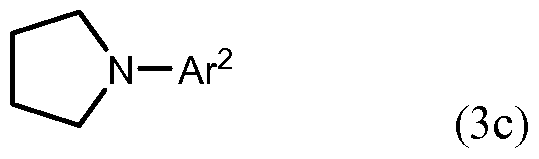
Wherein ring A and B are respectively condensed with the adjacent rings at arbitrary positions.
In formula (3 a) and (3b), R is independently selected from hydrogen, an aliphatic hydrocarbon group of 1 to 10 carbon atoms, an aromatic hydrocarbon group of 6 to 18 carbon atoms, or an aromatic heterocyclic group of 3 to 17 carbon atoms, each R is independently selected from hydrogen, an aliphatic hydrocarbon group of 1 to 10 carbon atoms, an aromatic hydrocarbon group of 6 to 18 carbon atoms, or an aromatic heterocyclic group of 3 to 17 carbon atoms.
In the case of R is an aromatic hydrocarbon group or an aromatic heterocyclic group, R may condense with benzene ring.
In formula (3c), Ar2 is an aromatic hydrocarbon group of 6 to 50 carbon atoms, or an aromatic heterocyclic group of 3 to 50 carbon atoms excluding a group that condensed more than 5 rings.
[0042] In examples of the above mentioned formula (3) , Y or Ar2 may comprise a t-valent or monovalent group leaded from benzene, naphthalene, anthracene, pyridine, pyrazine,
pyrimidine, pyridajine, triazine, isoindole, indazole, purine, isoquinoline, imidazole, naphthyridine, phthalazine, quinazoline, quinoxaline, cinnoline, quinoline, pteridine, phenanthridine, acridine, perimidine, phenanthroline, phenazine, carboline, indole, benzoxazole, benzothiazole, carbazole, dibenzofuran, dibenzothiophene, and may arbitrarily connect two or more these groups. Further, Y is a t-valent group, Ar2 is a monovalent group.
[0043] In a particular aspect, the set of non-hydrogen substituents selected for each independent R' and the set of non-hydrogen substituents selected for R are the same. As discussed above, derivatives of the first compound and the second compound with the same molecular modification will have the same molecular weight difference, and may have similar intermolecular interactions. Therefore, the first compound and the second compound having the same substituents may be suitable for premixing.
[0044] In one aspect, the first compound may be selected from but is not limited to the group consisting of::


[0045] Methods of preparing such compounds are disclosed in U.S. Patent Application Publication No. 2011/227049, which is incorporated herein by reference in its entirety
[0046] The second compound which is represented by general formulas (1) and (2) and (3) may be selected from but is not limited to the group consisting of:


[0047] Some examples of the methods of preparing such compounds are disclosed in U.S. Patent Application Publication No. 2009/0302742, No. 2010/0187977, No. 2012/0001 165, which are incorporated herein by reference in its entirety
[0048] As discussed above, derivatives of the first compound and the second compound with the same molecular modification will have the same molecular weight difference, and may have similar intermolecular interactions. Therefore, the first compound and the second compound having the same substituents may be suitable for premixing.
[0049] In another aspect, the device further comprises a second organic layer different from the first organic layer, and the second organic layer is a non-emissive layer. Preferably, the second organic layer is a blocking layer.
[0050] In one aspect, the first electrode is an anode and the second organic layer is deposited over the anode.
[0051] In one aspect, the first compound has an evaporation temperature within 30 °C of the evaporation temperature of the second compound.
[0052] In one aspect, the organic composition comprises about 5% to about 95% of the first compound and about 5% to about 95% the second compound.
[0053] In one aspect, the device is an organic light emitting device. In another aspect, the device is a consumer product.
[0054] Additionally, a method of fabricating an organic light emitting device is provided. The device comprises a first electrode, a second electrode, and a first organic layer disposed between the first electrode and the second electrode. The first organic layer comprises an organic composition comprising a first compound and a second compound. In one aspect, the first compound and the second compound are physically mixed prior to device fabrication and evaporated from a single source. The method comprises providing a substrate having the first electrode disposed thereon, depositing the organic composition over the first electrode; and depositing the second electrode over the first organic layer
[0055] The organic composition comprises a first compound and a second compound, the first compound being an organometallic compound represented by the formula L2MX, LL'MX, LL'L"M, or LMXX', wherein L, L', L", X, and X' are inequivalent, bidentate ligands and M is a metal that forms octahedral complexes, wherein L, L', and L" are monoanionic inequivalent bidentate ligands coordinated to M through an sp2 hybridized carbon and a heteroatom and the second compound is a compound hhaving an heteroaromatic structure.
[0056] In one aspect, the first compound may be a compound selected from the group consisting of phosphorescent organometallic platinum compounds, organometallic iridium compounds and organometallic osmium compounds. The organometallic platinum compounds, iridium compounds and osmium compounds can each include an aromatic ligand.
[0057] In another aspect, the first compound comprises a phosphorescent organometallic compound having a substituted chemical structure represented by the following chemical structure:

M is Ir, Pt or Os each R' is independently selected from the group consisting of H, alkyl, alkenyl, alkynyl, alkylaryl, CN, CF3, CnF2n+i, trifluorovinyl, C02R", C(0)R", NR"2, N02, OR", halo, aryl, heteroaryl, substituted aryl, substituted heteroaryl or a heterocylic group and where each R" is independently H, alkyl, alkenyl, alkynyl, heteroalkyl, aryl, heteroaryl, or aralkyl
Ar', Ar", Ar'" and Ar"" each independently represent a substituted or unsubstituted aryl or heteroaryl unfused substituent on the phenylpyridine ligand; a is 0 or 1; b is 0 or 1 ; c is 0 or 1; d is 0 or 1 ; m is 1 or 2; n is 1 or 2;
m+n is the maximum number of ligands that can be coordinated to M; and wherein at least one of a, b, c, and d is 1 and when at least one of a and b is 1 and at least one of b and c is 1, at least one of Ar' and Ar" is different from at least one of Ar'" and Ar""
The second compound comprises an organic heteroaromatic host compound having the formula (1):

Y is a t-valent aromatic hydrocarbon group of 6 to 50 carbon atoms or a t-valent aromatic heterocyclic group of 3 to 50 carbon atoms excluding a group having more than 5 condensed rings. t denotes an integer of 1 to 3, such that when t is greater than 2, each Z may be the same or different
Z is represented by formula (la):

Wherein ring A is an aromatic hydrocarbon ring represented by formula (lb)
 ring B is a heterocyclic ring represented by formula (lc)

ring A and B are respectively condensed with the adjacent rings;
In formula (la) and (lb), X1 is O or S or N-Ar1 or N wherein Ar1 is an aromatic hydrocarbon group of 6 to 50 carbon atoms, or an aromatic heterocyclic group of 3 to 50 carbon atoms excluding a group having more than 5 condensed rings.
R is independently selected from hydrogen, an aliphatic hydrocarbon group of 1 to 10 carbon atoms, an aromatic hydrocarbon group of 6 to 18 carbon atoms, or an aromatic heterocyclic group of 3 to 17 carbon atoms.
In the case of R is an aromatic hydrocarbon group or an aromatic heterocyclic group, R may condense with benzene ring,
X1 is O or S or N-Ar1 or N wherein Ar1 is an aromatic hydrocarbon group of 6 to 50 carbon atoms, or an aromatic heterocyclic group of 3 to 50 carbon atoms excluding a group having more than 5 condensed rings. m denotes 0 or an integer of 1 to 2 n denotes 0 or an integer of 1.
In formula (lc), X2 is O or S or N-Ar2 wherein Ar2 is an aromatic hydrocarbon group of 6 to 50 carbon atoms, or an aromatic heterocyclic group of 3 to 50 carbon atoms excluding a group having more than 5 condensed rings. X2 is O or S or N-Ar2 wherein Ar2 is an aromatic hydrocarbon group of 6 to 50 carbon atoms, or an aromatic heterocyclic group of 3 to 50 carbon atoms excluding a group having more than 5 condensed rings. X2 is O or S or N-Ar2 wherein Ar2 is an aromatic hydrocarbon group of 6 to 50 carbon atoms, or an aromatic heterocyclic group of 3 to 50 carbon atoms excluding a group having more than 5 condensed rings.
[0058] In the above-mentioned, examples of Y or Ar1 or Ar2 may comprise a t-valent or monovalent group leaded from benzene, naphthalene, anthracene, pyridine, pyrazine, pyrimidine, pyridajine, triazine, isoindole, indazole, purine, isoquinoline, imidazole,
naphthyridine, phthalazine, quinazoline, quinoxaline, cinnoline, quinoline, pteridine, phenanthridine, acridine, perimidine, phenanthroline, phenazine, carboline, indole, benzoxazole, benzothiazole, carbazole, dibenzofuran, dibenzothiophene, and may arbitrarily connect two or more these groups. Further, Y is a t-valent group, Arl and Ar2 are a monovalent group.
[0059] The second compound preferably comprises heteroaromatic host compound represented by the following chemical formula (2) :
 wherein
Y is a t-valent aromatic hydrocarbon group of 6 to 50 carbon atoms or a t-valent aromatic heterocyclic group of 3 to 50 carbon atoms excluding a group having more than 5 condensed rings . t denotes an integer of 1 to 3, such that when t is greater than 2, each Z may be the same or different
Z is represented by formula (2a):

Wherein ring A is an aromatic hydrocarbon ring represented by formula (2b)

ring B is a heterocyclic ring represented by formula (2c)
 ring A and B are respectively condensed with the adjacent rings;
Each R is independently selected from hydrogen, an aliphatic hydrocarbon group of 1 to 10 carbon atoms, an aromatic hydrocarbon group of 6 to 18 carbon atoms, or an aromatic heterocyclic group of 3 to 17 carbon atoms.
In formula (2a) and (2b), R is independently selected from hydrogen, an aliphatic hydrocarbon group of 1 to 10 carbon atoms, an aromatic hydrocarbon group of 6 to 18 carbon atoms, or an aromatic heterocyclic group of 3 to 17 carbon atoms.
In the case of R is an aromatic hydrocarbon group or an aromatic heterocyclic group, R may condense with benzene ring; m denotes 0 or an integer of 1 to 2 n denotes 0 or an integer of 1.
In formula (2c), X2 is O or S or N-Ar2 wherein Ar2 is an aromatic hydrocarbon group of 6 to 50 carbon atoms, or an aromatic heterocyclic group of 3 to 50 carbon atoms excluding a group having more than 5 condensed rings.
[0060] In examples of the above mentioned formula (2) , Y or Ar2 may comprise a t-valent or monovalent group leaded from benzene, naphthalene, anthracene, pyridine, pyrazine, pyrimidine, pyridajine, triazine, isoindole, indazole, purine, isoquinoline, imidazole, naphthyridine, phthalazine, quinazoline, quinoxaline, cinnoline, quinoline, pteridine, phenanthridine, acridine, perimidine, phenanthroline, phenazine, carboline, indole, benzoxazole, benzothiazole, carbazole, dibenzofuran, dibenzothiophene, and may arbitrarily connect two or more these groups. Further, Y is a t-valent group, Ar2 is a monovalent group.
[0061] The second compound more preferably comprises heteroaromatic host compound represented by the following chemical formula (3) :
 In general formula (3), Y is a t-valent aromatic hydrocarbon group of 6 to 50 carbon atoms or a t-valent aromatic heterocyclic group of 3 to 50 carbon atoms excluding a group having more than 5 condensed rings. t denotes an integer of 1 to 3, such that when t is greater than 2, each Z may be the same or different
Z is represented by formula (3a):

Wherein ring A is an aromatic hydrocarbon ring represented by formula (3b)
 ring B is a heterocyclic ring represented by formula (3 c)

W oherein ring A and B are respectively condensed with the adjacent rings at arbitrary positions.
In formula (3 a) and (3b), R is independently selected from hydrogen, an aliphatic hydrocarbon group of 1 to 10 carbon atoms, an aromatic hydrocarbon group of 6 to 18 carbon atoms, or an aromatic heterocyclic group of 3 to 17 carbon atoms, each R is independently selected from hydrogen, an aliphatic hydrocarbon group of 1 to 10 carbon atoms, an aromatic hydrocarbon group of 6 to 18 carbon atoms, or an aromatic heterocyclic group of 3 to 17 carbon atoms.
In the case of R is an aromatic hydrocarbon group or an aromatic heterocyclic group, R may condense with benzene ring.
In formula (3c), Ar2 is an aromatic hydrocarbon group of 6 to 50 carbon atoms, or an aromatic heterocyclic group of 3 to 50 carbon atoms excluding a group that condensed more than 5 rings.
[0062] In examples of the above mentioned formula (3) , Y or Ar2 may comprise a t-valent or monovalent group leaded from benzene, naphthalene, anthracene, pyridine, pyrazine, pyrimidine, pyridajine, triazine, isoindole, indazole, purine, isoquinoline, imidazole, naphthyridine, phthalazine, quinazoline, quinoxaline, cinnoline, quinoline, pteridine, phenanthridine, acridine, perimidine, phenanthroline, phenazine, carboline, indole, benzoxazole, benzothiazole, carbazole, dibenzofuran, dibenzothiophene, and may arbitrarily connect two or more these groups. Further, Y is a t-valent group, Ar2 is a monovalent group.
[0063] In a particular aspect, the set of non-hydrogen substituents selected for each independent R' and the set of non-hydrogen substituents selected for R are the same and the method further comprises mixing the first compound and the second compound before depositing the organic composition over the first electrode.
[0064] In one aspect, the first compound may be selected from but is not limited to the group consisting of:


and the second compound represented by general formula (1) and (2) and (3) may be selected from but is not limited to the group consisting of:


[0065] In one aspect, the first compound and the second compound are pre-mixed together and evaporated from a single source.
[0066] In one aspect, the organic composition comprises about 5% to about 95% of the first compound and about 5% to about 95% the second compound.
[0067] In one aspect, the first compound has an evaporation temperature within 30 °C of the evaporation temperature of the second compound. In another aspect, the first compound has a evaporation temperature within 10 °C of the evaporation temperature of the second compound.
[0068] In one aspect, the first electrode is an anode and the first organic layer is deposited over the anode.
[0069] In one aspect, the method further comprises depositing a second organic layer different from the first organic layer and the second organic layer is a non-emissive layer. In another aspect, the second organic layer is a blocking layer.
[0070] The materials described herein as useful for a particular layer in an organic light emitting device may be used in combination with a wide variety of other materials present in the device. For example, emissive dopants disclosed herein may be used in conjunction with a wide variety of hosts, transport layers, blocking layers, injection layers, electrodes and other layers that may be present. The materials described or referred to below are non-limiting examples of materials that may be useful in combination with the compounds disclosed herein, and one of skill in the art can readily consult the literature to identify other materials that may be useful in combination.
[0071] In addition to and / or in combination with the materials disclosed herein, many hole injection materials, hole transporting materials, host materials, dopant materials, exiton/hole blocking layer materials, electron transporting and electron injecting materials may be used in an OLED.
Hole injection materials/Hole transporting materials:
[0072] A hole injecting/transporting material to be used in the present invention is not particularly limited, and any compound may be used as long as the compound is typically used as a hole injecting/transporting material. Examples of the material include, but are not limited to: a phthalocyanine or porphryin derivative; an aromatic amine derivative; an indolocarbazole derivative; a polymer containing fluorohydrocarbon; a polymer with conductivity dopants; a conducting polymer, such as PEDOT/PSS; a self-assembly monomer derived from compounds such as phosphonic acid and silane derivatives; a metal oxide derivative, such as MoOx; a p-type semiconducting organic compound, such as 1,4,5,8,9, 12-Hexaazatriphenylenehexacarbonitrile; a metal complex, and a cross-linkable compounds.
[0073] Examples of aromatic amine derivatives used in HIL or HTL include, but are not limited to the following general structures:

[0074] Each of Ar1 to Ar9 is selected from the group consisting aromatic hydrocarbon cyclic compounds such as benzene, biphenyl, triphenyl, triphenylene, naphthalene, anthracene, phenalene, phenanthrene, fluorene, pyrene, chrysene, perylene, azulene; group consisting aromatic heterocyclic compounds such as dibenzothiophene, dibenzofuran, dibenzoselenophene, furan, thiophene, benzofuran, benzothiophene, benzoselenophene, carbazole, indolocarbazole, pyridylindole, pyrrolodipyridine, pyrazole, imidazole, triazole, oxazole, thiazole, oxadiazole, oxatriazole, dioxazole, thiadiazole, pyridine, pyridazine, pyrimidine, pyrazine, triazine, oxazine, oxathiazine, oxadiazine, indole, benzimidazole, indazole, indoxazine, benzoxazole,
benzisoxazole, benzothiazole, quinoline, isoquinoline, cinnoline, quinazoline, quinoxaline, naphthyridine, phthalazine, pteridine, xanthene, acridine, phenazine, phenothiazine,
phenoxazine, benzofuropyridine, furodipyridine, benzothienopyridine, thienodipyridine, benzoselenophenopyridine, and selenophenodipyridine; and group consisting 2 to 10 cyclic structural units which are groups of the same type or different types selected from the aromatic hydrocarbon cyclic group and the aromatic heterocyclic group and are bonded to each other directly or via at least one of oxygen atom, nitrogen atom, sulfur atom, silicon atom, phosphorus atom, boron atom, chain structural unit and the aliphatic cyclic group. Each Ar is further substituted by a substituent selected from the group consisting of hydrogen, alkyl, alkoxy, amino, alkenyl, alkynyl, arylalkyl, heteroalkyl, aryl and heteroaryl.
[0075] In one aspect, Ar1 to Ar9 is independently selected from the group consisting of:

Where k is an integer from 1 to 20; X1 to X8 is CH or N; Ar1 has the same group defined above.
[0076] Examples of metal complexes used in HIL or HTL include, but are not limited to the following general formula:

Where M' is a metal having an atomic weight greater than 40; (Yx-Y2) is a bidentate ligand, Yl and Y2 are independently selected from C, N, O, P, and S; L is an ancillary ligand; m is an integer value from 1 to the maximum number of ligands that may be attached to the metal; and m+n is the maximum number of ligands that may be attached to the metal.
In one aspect, (Yx-Y2) is a 2-phenylpyridine derivative.
In another aspect, (Yx-Y2) is a carbene ligand.
In another aspect, M is selected from Ir, Pt, Os, and Zn.
In a further aspect, the metal complex has a smallest oxidation potential in solution vs. Fc+/Fc couple less than about 0.6 V.
Host materials:
[0077] The light emitting layer of the organic EL device of the present invention preferably contains at least a metal complex as light emitting material, and a host material as disclosed herein. Additional host materials are possible and examples are not particularly limited. Any
metal complexes or organic compounds may be used as long as the host triplet energy is larger than that of the dopant.
[0078] Examples of metal complexes used as host are preferred to have the following general formula:
 where M' is a metal; (Y3-Y4) is a bidentate ligand, Y3 and Y4 are independently selected from C, N, O, P, and S; L is an ancillary ligand; m is an integer value from 1 to the maximum number of ligands that may be attached to the metal; and m+n is the maximum number of ligands that may be attached to the metal.
[0079] In one aspect, the metal complexes are:

(O-N) is a bidentate ligand, having metal coordinated to atoms O and N.
In another aspect, M is selected from Ir and Pt.
In a further aspect, (Y3-Y4) is a carbene ligand.
[0080] Examples of organic compounds used as host are selected from the group consisting aromatic hydrocarbon cyclic compounds such as benzene, biphenyl, triphenyl, triphenylene, naphthalene, anthracene, phenalene, phenanthrene, fluorene, pyrene, chrysene, perylene, azulene; group consisting aromatic heterocyclic compounds such as dibenzothiophene, dibenzofuran, dibenzoselenophene, furan, thiophene, benzofuran, benzothiophene,
benzoselenophene, carbazole, indolocarbazole, pyridylindole, pyrrolodipyridine, pyrazole, imidazole, triazole, oxazole, thiazole, oxadiazole, oxatriazole, dioxazole, thiadiazole, pyridine, pyridazine, pyrimidine, pyrazine, triazine, oxazine, oxathiazine, oxadiazine, indole, benzimidazole, indazole, indoxazine, benzoxazole, benzisoxazole, benzothiazole, quinoline, isoquinoline, cinnoline, quinazoline, quinoxaline, naphthyridine, phthalazine, pteridine, xanthene, acridine, phenazine, phenothiazine, phenoxazine, benzofuropyridine, furodipyridine,
benzothienopyridine, thienodipyridine, benzoselenophenopyridine, and selenophenodipyridine; and group consisting 2 to 10 cyclic structural units which are groups of the same type or different types selected from the aromatic hydrocarbon cyclic group and the aromatic heterocyclic group and are bonded to each other directly or via at least one of oxygen atom, nitrogen atom, sulfur atom, silicon atom, phosphorus atom, boron atom, chain structural unit and the aliphatic cyclic group. Wherein each group is further substituted by a substituent selected from the group consisting of hydrogen, alkyl, alkoxy, amino, alkenyl, alkynyl, arylalkyl, heteroalkyl, aryl and heteroaryl.
[0081] In one aspect, host compound contains at least one of the following groups in the molecule:

[0082] R1 to R7 is independently selected from the group consisting of hydrogen, alkyl, alkoxy, amino, alkenyl, alkynyl, arylalkyl, heteroalkyl, aryl and heteroaryl, when it is aryl or heteroaryl, it has the similar definition as Ar mentioned above.
[0083] k is an integer from 0 to 20.
[0084] X1 to X8 is selected from CH or N.
Hole blocking materials:
[0085] A hole blocking layer (HBL) may be used to reduce the number of holes and/or excitons that leave the emissive layer. The presence of such a blocking layer in a device may result in substantially higher efficiencies as compared to a similar device lacking a blocking layer. Also, a blocking layer may be used to confine emission to a desired region of an OLED.
[0086] In one aspect, compound used in HBL contains the same molecule used as host described above.
[0087] In another aspect, compound used in HBL contains at least one of the following groups in the molecule:

[0088] k is an integer from 0 to 20; L is an ancillary ligand, m is an integer from 1 to 3.
Electron transporting materials:
[0089] Electron transport layer (ETL) may include a material capable of transporting electrons. Electron transport layer may be intrinsic (undoped), or doped. Doping may be used to enhance conductivity. Examples of the ETL material are not particularly limited, and any metal complexes or organic compounds may be used as long as they are typically used to transport electrons.
[0090] In one aspect, compound used in ETL contains at least one of the following groups in the molecule:

[0091] R1 is selected from the group consisting of hydrogen, alkyl, alkoxy, amino, alkenyl, alkynyl, arylalkyl, heteroalkyl, aryl and heteroaryl, when it is aryl or heteroaryl, it has the similar definition as Ar mentioned above.
Ar1 to Ar3 has the similar definition as Ar mentioned above. k is an integer from 0 to 20.
[0092] X1 to X8 is selected from CH or N.
[0093] In another aspect, the metal complexes used in ETL contains, but not limit to the following general formula:

[0094] (O-N) or (N-N) is a bidentate ligand, having metal coordinated to atoms O, N or N, N; L is an ancillary ligand; m is an integer value from 1 to the maximum number of ligands that may be attached to the metal.
[0095] In addition to and/or in combination with the materials disclosed herein, many hole injection materials, hole transporting materials, host materials, dopant materials, exiton/hole blocking layer materials, electron transporting and electron injecting materials may be used in an OLED. Non- limiting examples of the materials that may be used in an OLED in combination with materials disclosed herein are listed in Table 1 below. Table 1 lists non- limiting classes of materials, non- limiting examples of compounds for each class, and references that disclose the materials.
TABLE 1
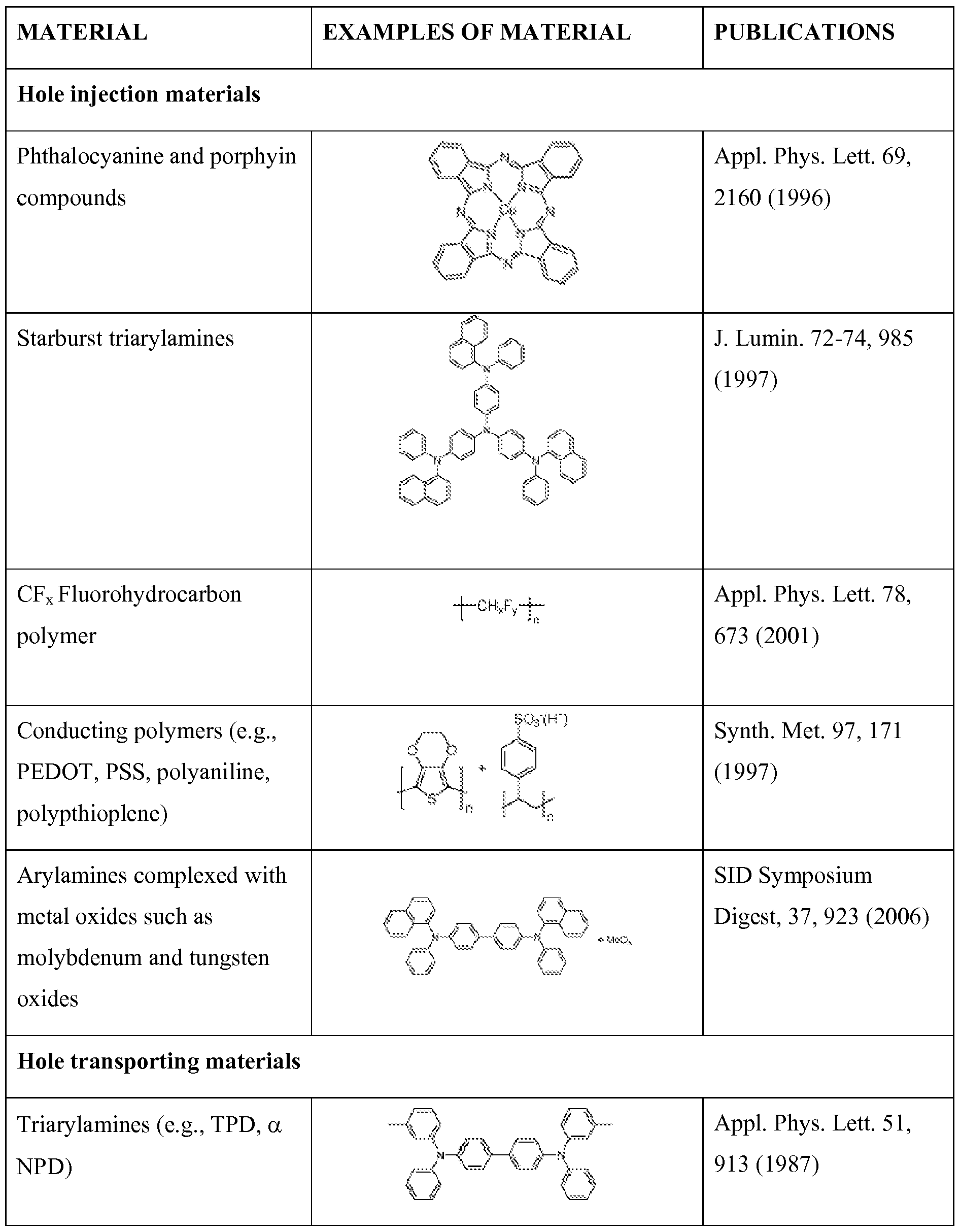


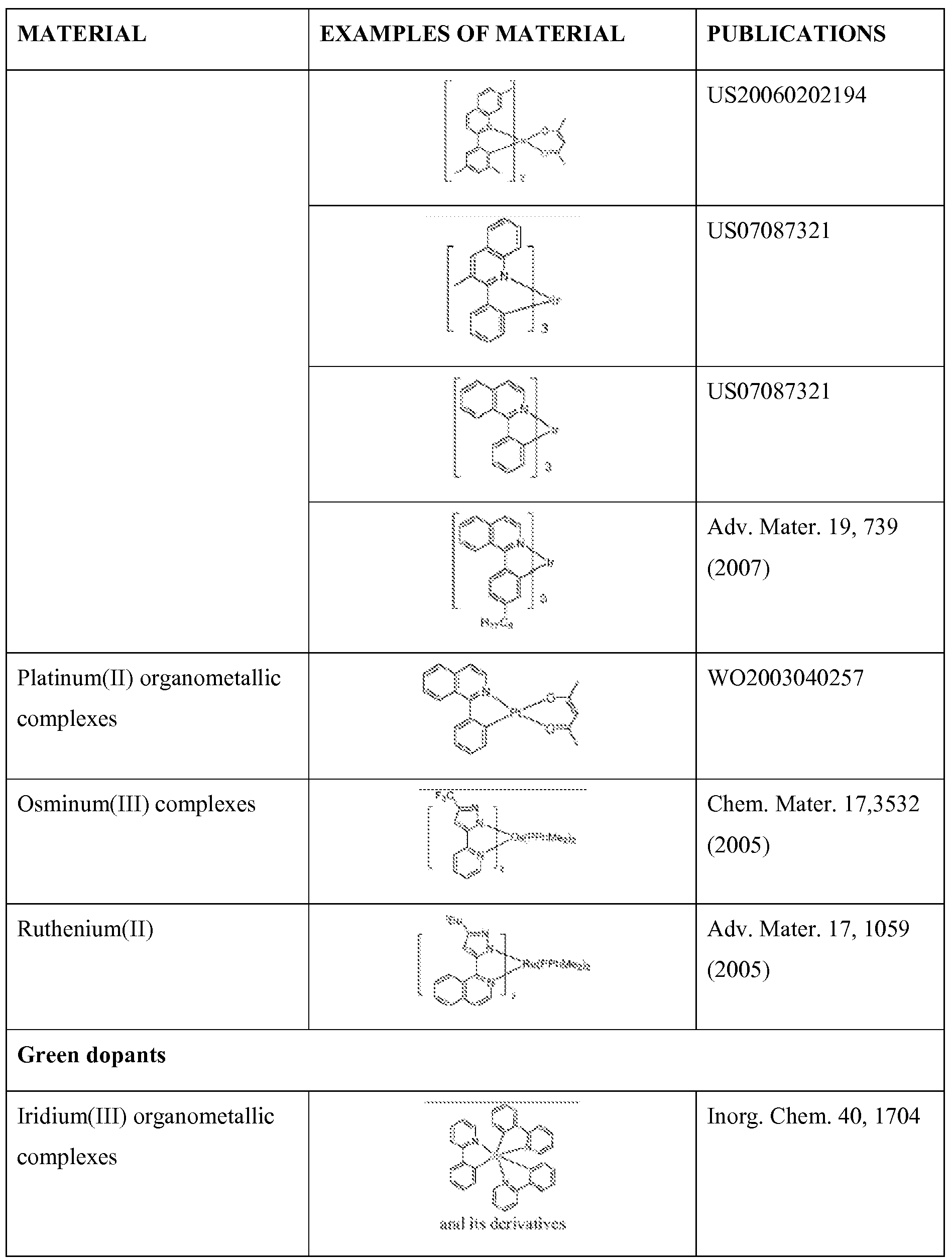


EXPERIMENTAL
Evaporation Examples
[0096] Here, a heteroleptic organometallic phosphorescent material, i.e., the first compound, and either HI or H2, i.e., the second compound, are shown to premix evaporate with high consistency. The evaporation result is analyzed by high performance liquid chromatography (HPLC) of the premix-evaporation films and OLED performance and lifetime of the devices with the premix-evaporation material as the host in the EML.
[0097] Exam le 1.

[0098] HI and Dl having the chemical structures shown above show stable premixability, which means they can be premixed and codeposited from one source without changing the
composition. Uniform co-evaporation of the two materials is critical for consistency of performance in devices fabricated from this mixture.
[0099] The premixability of these 2 compounds was tested by HPLC analysis of evaporated films. For this purpose the 0.39 g of HI and 0.1 1 g of Dl were mixed and grinded. 0.5 g of mixture was loaded into the evaporation source of the vacuum VTE chamber. The chamber was pumped down to the 10"7 torr pressure. The premixed components were deposited at rate 2 A/s onto glass substrates. The substrates were replaced continuously after deposition of 400 A of film without stopping the deposition and cooling the source.
[0100] The films were analyzed by HPLC and results are shown in the Table 2. The composition of the components HI and Dl did not change significantly from plate 1 to plate 10. Some fluctuations in the concentrations do not reveal any trend and can be explained by the accuracy of HPLC analysis. Normally, the change of the concentration before and after depositions within 5% throughout the process is considered to be good and useful for commercial OLED application.
[0101] This is the evidence than HI and Dl form a stable co-evaporation mixture.
Table 2: HPLC composition (%) of sequentially deposited films from premixed
dopant/host material combination H1:D1


HPLC Conditions C18, 80-100 40 min, Detected wavelength 254 nm [0102] Exam le 2.

[0103] H2 and Dl (chemical structures shown above) show another example of stable premixability between these two families of materials, which means they can be premixed and codeposited from one source without changing the composition.
[0104] The pre-mixability of these 2 compounds was tested by HPLC analysis of evaporated films. For this purpose, 0.84 g of H2 and 0.16 g of Dl were mixed and grinded. 1 g of mixture was loaded into the evaporation source of the vacuum VTE chamber. The chamber was pumped down to the 10"7 torr pressure. The premixed components were deposited at a rate of 2 A/s onto glass substrates. The substrates were replaced continuously after deposition of 400 A of film without stopping the deposition and cooling the source.
[0105] The films were analyzed by HPLC and results are shown in the Table 3. The composition of the components H2 and Dl did not change significantly from plate 1 to plate 4.
Some fluctuations in the concentrations do not reveal any trend and can be explained by the accuracy of HPLC analysis. Normally, the change of the concentration before and after
depositions within 5% throughout the process is considered to be good and useful for commercial OLED application.
Table 3. HPLC composition (%) of sequentially deposited films from premixed dopant/host material combination H2:D1 :

HPLC Conditions CI 8, 80-100 40 min, Detected wavelength 254 nm
[0106] It is understood that the various embodiments described herein are by way of example only, and are not intended to limit the scope of the invention. For example, many of the materials and structures described herein may be substituted with other materials and structures without deviating from the spirit of the invention. The present invention as claimed may therefore include variations from the particular examples and preferred embodiments described herein, as will be apparent to one of skill in the art. It is understood that various theories as to why the invention works are not intended to be limiting.
Claims
1. An organic light emitting device comprising
an anode layer, a cathode layer, and an emissive layer between the anode layer and the cathode layer; wherein the emissive layer comprises a material combination, wherein the material combination comprises an evaporated pre-mixed material, the pre-mixed material comprising a physical mixture of a first compound wherein the first compound is an organometallic phosphorescent dopant compound having the formulal^MX, LL'MX, LL'L"M, or LMXX', wherein L, L', L", X, and X' are inequivalent, bidentate ligands and M is a metal having an atomic weight greater than 40, wherein L, L', and L" are monoanionic inequivalent bidentate ligands coordinated to M through an sp2 hybridized carbon and wherein the organometallic phosphorescent dopant compound is selected from organometallic platinum compounds, organometallic iridium compounds and organometallic osmium compounds and wherein the organometallic platinum compounds, iridium compounds and osmium compounds optionally include an aromatic ligand. and a second compound wherein the second compound is an organic heteroaromatic host compound having the formula (1):
 wherein
Y is a t-valent aromatic hydrocarbon group of 6 to 50 carbon atoms or a t-valent aromatic heterocyclic group of 3 to 50 carbon atoms excluding a group having more than 5 condensed rings .
t denotes an integer of 1 to 3, such that when t is greater than 2, each Z may be the same or different
Z is represented by formula (la):

Wherein ring A is an aromatic hydrocarbon ring represented by formula (lb)

ring B is a heterocyclic ring represented by formula (lc)

Each R is independently selected from hydrogen, an aliphatic hydrocarbon group of 1 to 10 carbon atoms, an aromatic hydrocarbon group of 6 to 18 carbon atoms, or an aromatic heterocyclic group of 3 to 17 carbon atoms.
In the case of R is an aromatic hydrocarbon group or an aromatic heterocyclic group, R may condense with benzene ring; m denotes 0 or an integer of 1 to 2 n denotes 0 or an integer of 1.
X1 is O or S or N-Ar1 or N wherein Ar1 is an aromatic hydrocarbon group of 6 to 50 carbon atoms, or an aromatic heterocyclic group of 3 to 50 carbon atoms excluding a group having more than 5 condensed rings.
X2 is O or S or N-Ar2 wherein Ar2 is an aromatic hydrocarbon group of 6 to 50 carbon atoms, or an aromatic heterocyclic group of 3 to 50 carbon atoms excluding a group having more than 5 condensed rings.
2. The device of claim 1 further including a third compound wherein the third compound an organometallic phosphorescent dopant different from the first compound and wherein the relation of the triplet energy level of the first compound , the second compound and the third compound is:
Third Compound< First Compound < Second Compound.
3. The device of claim 1 further including a third compound wherein the third compound is an organometallic phosphorescent dopant different from the first compound and wherein the relation of the triplet energy level of the first compound , the second compound and the third compound is:
First Compound < Third Compound< Second Compound.
4. The device according to any of claims 1-3 where in the first compound is :

M is Ir, Pt or Os
each R' is independently selected from the group consisting of H, alkyl, alkenyl, alkynyl, alkylaryl, CN, CF3, CnF2n+i, trifluorovinyl, C02R", C(0)R", NR"2, N02, OR", halo, aryl, heteroaryl, substituted aryl, substituted heteroaryl or a heterocylic group and where each R" is independently H, alkyl, alkenyl, alkynyl, heteroalkyl, aryl, heteroaryl, or aralkyl;
Ar', Ar", Ar'" and Ar"" each independently represent a substituted or unsubstituted aryl or heteroaryl unfused substituent on the phenylpyridine ligand; a is 0 or 1;
b is 0 or 1 ;
c is 0 or 1;
d is 0 or 1 ;
m' is 1 or 2;
n' is 1 or 2;
m'+n' is the maximum number of ligands that can be coordinated to M; and wherein at least one of a, b, c, and d is 1 and when at least one of a and b is 1 and at least one of b and c is 1, at least one of Ar' and Ar" is different from at least one of Ar'" and Ar"" and the second compound is an organic heteroaromatic host compound having the formula (2):
 wherein
Y is a t-valent aromatic hydrocarbon group of 6 to 50 carbon atoms or a t-valent aromatic heterocyclic group of 3 to 50 carbon atoms excluding a group having more than 5 condensed rings . t denotes an integer of 1 to 3, such that when t is greater than 2, each Z may be the same or different
Z is represented by formula (2a):

Wherein ring A is an aromatic hydrocarbon ring represented by formula (2b)
 ring B is a heterocyclic ring represented by formula (2c)
 ring A and B are respectively condensed with the adjacent rings;
Each R is independently selected from hydrogen, an aliphatic hydrocarbon group of 1 to 10 carbon atoms, an aromatic hydrocarbon group of 6 to 18 carbon atoms, or an aromatic heterocyclic group of 3 to 17 carbon atoms.
In the case of R is an aromatic hydrocarbon group or an aromatic heterocyclic group, R may condense with benzene ring; m denotes 0 or an integer of 1 to 2 n denotes 0 or an integer of 1.
X2 is O or S or N-Ar2 wherein Ar2 is an aromatic hydrocarbon group of 6 to 50 carbon atoms, or an aromatic heterocyclic group of 3 to 50 carbon atoms excluding a group having more than 5 condensed rings.
5. The device according to any of claims 1-4 wherein the second compound is an organic heteroaromatic host compound having the formula (3):

wherein
Y is a t-valent aromatic hydrocarbon group of 6 to 50 carbon atoms or a t-valent aromatic heterocyclic group of 3 to 50 carbon atoms excluding a group having more than 5 condensed rings .
t denotes an integer of 1 to 3, such that when t is greater than 2, each Z may be the same or different
Z is represented by formula (3a):


Ar2 is an aromatic hydrocarbon group of 6 to 50 carbon atoms, or an aromatic heterocyclic group of 3 to 50 carbon atoms excluding a group having more than 5 condensed rings.
6. The organic light emitting device according to any of claims 1 -5 wherein each of Ar and Y comprises a group leaded from benzene, naphthalene, anthracene, pyridine, pyrazine, pyrimidine, pyridajine, triazine, isoindole, indazole, purine, isoquinoline, imidazole, naphthyridine, phthalazine, quinazoline, quinoxaline, cinnoline, quinoline, pteridine, phenanthridine, acridine, perimidine, phenanthroline, phenazine, carboline, indole, benzoxazole, benzothiazole, carbazole, dibenzofuran, dibenzothiophene, and an aromatic compound wherein a plurality of said groups are linked together.
7. The organic light emitting device of claim 1 wherein the first compound has an evaporation temperature within 30 °C of the evaporation temperature of the second compound.
8. The organic light emitting device of claim 2 or 3 wherein at least one of the first compound, the second compound and the third compound has an evaporation temperature within 30 °C of the evaporation temperature of at least one of the other of the first compound, the second compound and the third compound.
9. The organic light emitting device of claim 2 or 3 wherein at least one of the first compound, the second compound and the third compound has an evaporation temperature within 10 °C of the evaporation temperature of at least one of the other of the first compound, the second compound and the third compound.
10. The organic light emitting device of claim2 or 3 wherein each of the first compound, the second compound and the third compound each has an evaporation temperature within 30 °C of each other.
11. The organic light emitting device of claim 2 or 3 wherein the first compound has an evaporation temperature within 30 °C of the evaporation temperature of the third compound.
12. The organic light emitting device of claim 2 or 3 wherein the second compound has an evaporation temperature within 30 °C of the evaporation temperature of the third compound.
13. The organic light emitting device of claim 2 or 3 wherein the first compound has an evaporation temperature within 30 °C of the evaporation temperature of the second compound.
14. The organic light emitting device of claim 2 or 3 wherein the pre-mixed material further comprises the third compound.
15. A composition comprising an evaporated pre-mixed material, the evaporated pre-mixed material comprising a physical mixture of a first compound and a second compound wherein the first compound comprises the first compound of claim 1 and the second compound comprises the second compound of claim 1.
16. A composition comprising a pre-mixed material, the pre-mixed material comprising a physical mixture of a first compound and a second compound wherein the first compound comprises the first compound of claim 1 and the second compound comprises the second compound of claim 1.
Priority Applications (4)
| Application Number | Priority Date | Filing Date | Title |
|---|---|---|---|
| KR1020167027979A KR20160143678A (en) | 2014-04-22 | 2014-04-22 | Material for phosphorescent light-emitting element |
| KR1020207034054A KR102315298B1 (en) | 2014-04-22 | 2014-04-22 | Material for phosphorescent light-emitting element |
| PCT/US2014/034856 WO2015163848A1 (en) | 2014-04-22 | 2014-04-22 | Material for phosphorescent light-emitting element |
| TW104112753A TWI680179B (en) | 2014-04-22 | 2015-04-21 | Material for phosphorescent light-emitting element |
Applications Claiming Priority (1)
| Application Number | Priority Date | Filing Date | Title |
|---|---|---|---|
| PCT/US2014/034856 WO2015163848A1 (en) | 2014-04-22 | 2014-04-22 | Material for phosphorescent light-emitting element |
Publications (1)
| Publication Number | Publication Date |
|---|---|
| WO2015163848A1 true WO2015163848A1 (en) | 2015-10-29 |
Family
ID=54332881
Family Applications (1)
| Application Number | Title | Priority Date | Filing Date |
|---|---|---|---|
| PCT/US2014/034856 Ceased WO2015163848A1 (en) | 2014-04-22 | 2014-04-22 | Material for phosphorescent light-emitting element |
Country Status (3)
| Country | Link |
|---|---|
| KR (2) | KR102315298B1 (en) |
| TW (1) | TWI680179B (en) |
| WO (1) | WO2015163848A1 (en) |
Cited By (3)
| Publication number | Priority date | Publication date | Assignee | Title |
|---|---|---|---|---|
| CN108285459A (en) * | 2017-01-09 | 2018-07-17 | 环球展览公司 | Electroluminescent organic material and device |
| WO2020195917A1 (en) * | 2019-03-25 | 2020-10-01 | 日鉄ケミカル&マテリアル株式会社 | Melt mixture for organic electroluminescent element, and organic electroluminescent element |
| CN115667267A (en) * | 2020-05-20 | 2023-01-31 | 三星Sdi株式会社 | Composition for organic photoelectric device, organic photoelectric device and display device |
Families Citing this family (13)
| Publication number | Priority date | Publication date | Assignee | Title |
|---|---|---|---|---|
| CN106543231A (en) * | 2015-09-21 | 2017-03-29 | 上海和辉光电有限公司 | Primary pyridine coordination compound and the organic electroluminescence device using the primary pyridine coordination compound |
| CN108336237B (en) * | 2017-01-20 | 2020-01-31 | 昆山工研院新型平板显示技术中心有限公司 | An organic electroluminescent device |
| JP7390739B2 (en) * | 2019-03-07 | 2023-12-04 | オーティーアイ ルミオニクス インコーポレーテッド | Materials for forming nucleation-inhibiting coatings and devices incorporating the same |
| KR102761653B1 (en) | 2020-09-04 | 2025-01-31 | 삼성에스디아이 주식회사 | Composition for organic optoelectronic device, organic optoelectronic device and display device |
| WO2023177217A1 (en) | 2022-03-18 | 2023-09-21 | 에스에프씨 주식회사 | Novel heterocyclic compound and organic light-emitting diode comprising same |
| WO2023182775A1 (en) | 2022-03-23 | 2023-09-28 | 에스에프씨 주식회사 | Novel heterocyclic compound and organic light-emitting diode including same |
| KR20240001047A (en) | 2022-06-23 | 2024-01-03 | 에스에프씨 주식회사 | Novel Heterocyclic compounds and Organic light emitting diode including the same |
| KR20250031908A (en) | 2023-08-29 | 2025-03-07 | 에스에프씨 주식회사 | Novel Heterocyclic compounds and Organic light emitting diode including the same |
| KR20250033936A (en) | 2023-08-31 | 2025-03-10 | 에스에프씨 주식회사 | Novel Heterocyclic compounds and Organic light emitting diode including the same |
| KR20250036673A (en) | 2023-09-06 | 2025-03-14 | 에스에프씨 주식회사 | Novel Heterocyclic compounds and Organic light emitting diode including the same |
| WO2025053454A1 (en) | 2023-09-06 | 2025-03-13 | 에스에프씨 주식회사 | Novel heterocyclic compound and organic light-emitting diode including same |
| KR20250054706A (en) | 2023-10-13 | 2025-04-23 | 에스에프씨 주식회사 | Novel Polycyclic compounds and Organic light emitting diode including the same |
| KR20250074833A (en) | 2023-11-20 | 2025-05-28 | 에스에프씨 주식회사 | Novel Heterocyclic compounds and Organic light emitting diode including the same |
Citations (4)
| Publication number | Priority date | Publication date | Assignee | Title |
|---|---|---|---|---|
| US20040016907A1 (en) * | 2000-05-19 | 2004-01-29 | Eastman Kodak Company | Method of using predoped materials for making an organic light-emitting device |
| US20040258956A1 (en) * | 2003-03-31 | 2004-12-23 | Noriyuki Matsusue | Organic electroluminescent device |
| WO2009136596A1 (en) * | 2008-05-08 | 2009-11-12 | 新日鐵化学株式会社 | Organic electroluminescent element |
| WO2011136755A1 (en) * | 2010-04-28 | 2011-11-03 | Universal Display Corporation | Depositing premixed materials |
-
2014
- 2014-04-22 KR KR1020207034054A patent/KR102315298B1/en active Active
- 2014-04-22 KR KR1020167027979A patent/KR20160143678A/en not_active Ceased
- 2014-04-22 WO PCT/US2014/034856 patent/WO2015163848A1/en not_active Ceased
-
2015
- 2015-04-21 TW TW104112753A patent/TWI680179B/en active
Patent Citations (4)
| Publication number | Priority date | Publication date | Assignee | Title |
|---|---|---|---|---|
| US20040016907A1 (en) * | 2000-05-19 | 2004-01-29 | Eastman Kodak Company | Method of using predoped materials for making an organic light-emitting device |
| US20040258956A1 (en) * | 2003-03-31 | 2004-12-23 | Noriyuki Matsusue | Organic electroluminescent device |
| WO2009136596A1 (en) * | 2008-05-08 | 2009-11-12 | 新日鐵化学株式会社 | Organic electroluminescent element |
| WO2011136755A1 (en) * | 2010-04-28 | 2011-11-03 | Universal Display Corporation | Depositing premixed materials |
Cited By (7)
| Publication number | Priority date | Publication date | Assignee | Title |
|---|---|---|---|---|
| CN108285459A (en) * | 2017-01-09 | 2018-07-17 | 环球展览公司 | Electroluminescent organic material and device |
| US11780865B2 (en) | 2017-01-09 | 2023-10-10 | Universal Display Corporation | Organic electroluminescent materials and devices |
| WO2020195917A1 (en) * | 2019-03-25 | 2020-10-01 | 日鉄ケミカル&マテリアル株式会社 | Melt mixture for organic electroluminescent element, and organic electroluminescent element |
| JPWO2020195917A1 (en) * | 2019-03-25 | 2020-10-01 | ||
| EP3950880A4 (en) * | 2019-03-25 | 2022-09-28 | NIPPON STEEL Chemical & Material Co., Ltd. | MOLTEN MIXTURE FOR ORGANIC ELECTROLUMINESCENT ELEMENT AND ORGANIC ELECTROLUMINESCENT ELEMENT |
| JP7456997B2 (en) | 2019-03-25 | 2024-03-27 | 日鉄ケミカル&マテリアル株式会社 | Molten mixture for organic electroluminescent device and organic electroluminescent device |
| CN115667267A (en) * | 2020-05-20 | 2023-01-31 | 三星Sdi株式会社 | Composition for organic photoelectric device, organic photoelectric device and display device |
Also Published As
| Publication number | Publication date |
|---|---|
| TW201602308A (en) | 2016-01-16 |
| KR20200139834A (en) | 2020-12-14 |
| KR20160143678A (en) | 2016-12-14 |
| KR102315298B1 (en) | 2021-10-20 |
| TWI680179B (en) | 2019-12-21 |
Similar Documents
| Publication | Publication Date | Title |
|---|---|---|
| EP2564438B1 (en) | Depositing premixed materials | |
| KR102579120B1 (en) | Organic electroluminescent materials and devices | |
| KR102315298B1 (en) | Material for phosphorescent light-emitting element | |
| EP3425693B1 (en) | Method for producing an organic light-emitting diode | |
| KR102531522B1 (en) | Organic electroluminescent materials and devices | |
| KR102133883B1 (en) | Boron-nitron polyaromatic compounds and their use in oleds | |
| KR102147000B1 (en) | Organic luminescent compound with delayed fluorescence | |
| EP3473634B1 (en) | Heteroleptic iridium carbene complexes and light emitting device using them | |
| KR102517588B1 (en) | Organic electroluminescent materials and devices | |
| KR20230167335A (en) | Organic electroluminescent materials and devices | |
| CN103298907B (en) | Phosphor material | |
| KR20130109006A (en) | Azaborine compounds as host materials and dopants for pholeds | |
| WO2012102967A1 (en) | Aza - dibenzothiophene, aza - dibenzofuran and aza - dibenzoselenophene derivatives for use in oled ' s | |
| CN112175015A (en) | Organic electroluminescent material and device | |
| KR102557211B1 (en) | Organic electroluminescent materials and devices | |
| EP3061763B1 (en) | Organic electroluminescent materials and devices | |
| KR102655570B1 (en) | Organic electroluminescent materials and devices | |
| EP2711408B1 (en) | Organic compounds containing B-N heterocycles | |
| EP2963038B1 (en) | Organic electroluminescent materials and devices | |
| KR102512663B1 (en) | Organic electroluminescent materials and devices | |
| WO2012078453A1 (en) | Capture agents for unsaturated metal complexes |
Legal Events
| Date | Code | Title | Description |
|---|---|---|---|
| 121 | Ep: the epo has been informed by wipo that ep was designated in this application |
Ref document number: 14889844 Country of ref document: EP Kind code of ref document: A1 |
|
| ENP | Entry into the national phase |
Ref document number: 20167027979 Country of ref document: KR Kind code of ref document: A |
|
| NENP | Non-entry into the national phase |
Ref country code: DE |
|
| 122 | Ep: pct application non-entry in european phase |
Ref document number: 14889844 Country of ref document: EP Kind code of ref document: A1 |