WO2015160772A1 - Tetrahydro-benzoimidazolyl modulators of tgr5 - Google Patents
Tetrahydro-benzoimidazolyl modulators of tgr5 Download PDFInfo
- Publication number
- WO2015160772A1 WO2015160772A1 PCT/US2015/025702 US2015025702W WO2015160772A1 WO 2015160772 A1 WO2015160772 A1 WO 2015160772A1 US 2015025702 W US2015025702 W US 2015025702W WO 2015160772 A1 WO2015160772 A1 WO 2015160772A1
- Authority
- WO
- WIPO (PCT)
- Prior art keywords
- title compound
- chloro
- tetrahydro
- equiv
- mmol
- Prior art date
- Legal status (The legal status is an assumption and is not a legal conclusion. Google has not performed a legal analysis and makes no representation as to the accuracy of the status listed.)
- Ceased
Links
- 0 COCCOCCOCCOCCOc1cc(F)c(C*)c(F)c1 Chemical compound COCCOCCOCCOCCOc1cc(F)c(C*)c(F)c1 0.000 description 4
- IMRZMNPKDMFTBV-NSCUHMNNSA-N C/C=C(\C(N1)=O)/SC1=O Chemical compound C/C=C(\C(N1)=O)/SC1=O IMRZMNPKDMFTBV-NSCUHMNNSA-N 0.000 description 1
- GSBSVMYRYWBOLQ-UHFFFAOYSA-N CC(CCC1)(c([n]2-c(cc3)ccc3F)c1nc2SCc(c(Cl)ccc1)c1F)c(cc1)cc(OC)c1F Chemical compound CC(CCC1)(c([n]2-c(cc3)ccc3F)c1nc2SCc(c(Cl)ccc1)c1F)c(cc1)cc(OC)c1F GSBSVMYRYWBOLQ-UHFFFAOYSA-N 0.000 description 1
- IJOZFIBWWHHKNY-UHFFFAOYSA-N CC(CCC1)(c([n]2-c(cc3)ccc3F)c1nc2SCc(c(F)cc(-c1n[nH]nn1)c1)c1F)c(cc1OC)ccc1Cl Chemical compound CC(CCC1)(c([n]2-c(cc3)ccc3F)c1nc2SCc(c(F)cc(-c1n[nH]nn1)c1)c1F)c(cc1OC)ccc1Cl IJOZFIBWWHHKNY-UHFFFAOYSA-N 0.000 description 1
- LWYUJJKZHODUGK-UHFFFAOYSA-N CC(c(cc1)ccc1-[n](c(CCc(c([I]=C)ccc1)c1[I]1CCC1)n1)c(C(c(cc2)cc(OC)c2OC)=C)c1I)=C Chemical compound CC(c(cc1)ccc1-[n](c(CCc(c([I]=C)ccc1)c1[I]1CCC1)n1)c(C(c(cc2)cc(OC)c2OC)=C)c1I)=C LWYUJJKZHODUGK-UHFFFAOYSA-N 0.000 description 1
- QGTAFNSUDGNGRJ-UHFFFAOYSA-N CCC(C(N1)=O)SC1=O Chemical compound CCC(C(N1)=O)SC1=O QGTAFNSUDGNGRJ-UHFFFAOYSA-N 0.000 description 1
- QCFKRORGYRFCCB-UHFFFAOYSA-N CCC(CCC1)(c([n]2-c(cc3)ccc3F)c1nc2S)c(cc1)cc(OC)c1Cl Chemical compound CCC(CCC1)(c([n]2-c(cc3)ccc3F)c1nc2S)c(cc1)cc(OC)c1Cl QCFKRORGYRFCCB-UHFFFAOYSA-N 0.000 description 1
- XTCHROZVNHBOJR-UHFFFAOYSA-N CN(C)CCOCCOCCOc(ccc(F)c1CSc2nc(CCCC3c(cc4)cc(OC)c4Cl)c3[n]2-c(cc2)ccc2F)c1F Chemical compound CN(C)CCOCCOCCOc(ccc(F)c1CSc2nc(CCCC3c(cc4)cc(OC)c4Cl)c3[n]2-c(cc2)ccc2F)c1F XTCHROZVNHBOJR-UHFFFAOYSA-N 0.000 description 1
- MWUKKIBKBCASHA-UHFFFAOYSA-N COc1cc(C(CCC2)c([n]3-c(c(F)c4)cc(F)c4F)c2nc3S)ccc1Cl Chemical compound COc1cc(C(CCC2)c([n]3-c(c(F)c4)cc(F)c4F)c2nc3S)ccc1Cl MWUKKIBKBCASHA-UHFFFAOYSA-N 0.000 description 1
- IMEXZAQMWBQAAD-UHFFFAOYSA-N Cc1c(CSc2nc(CCCC3c(cc4)cc(OC)c4Cl)c3[n]2-c(cc(c(F)c2)F)c2F)c(F)ccc1 Chemical compound Cc1c(CSc2nc(CCCC3c(cc4)cc(OC)c4Cl)c3[n]2-c(cc(c(F)c2)F)c2F)c(F)ccc1 IMEXZAQMWBQAAD-UHFFFAOYSA-N 0.000 description 1
- AYTGARGOCPEHGL-UHFFFAOYSA-N Cc1ccc2OCCOc2c1 Chemical compound Cc1ccc2OCCOc2c1 AYTGARGOCPEHGL-UHFFFAOYSA-N 0.000 description 1
- VIJYHDMLYXAHEV-UHFFFAOYSA-N Cc1nc(ccc(C)c2)c2[o]1 Chemical compound Cc1nc(ccc(C)c2)c2[o]1 VIJYHDMLYXAHEV-UHFFFAOYSA-N 0.000 description 1
Classifications
-
- C—CHEMISTRY; METALLURGY
- C07—ORGANIC CHEMISTRY
- C07D—HETEROCYCLIC COMPOUNDS
- C07D235/00—Heterocyclic compounds containing 1,3-diazole or hydrogenated 1,3-diazole rings, condensed with other rings
- C07D235/02—Heterocyclic compounds containing 1,3-diazole or hydrogenated 1,3-diazole rings, condensed with other rings condensed with carbocyclic rings or ring systems
-
- A—HUMAN NECESSITIES
- A61—MEDICAL OR VETERINARY SCIENCE; HYGIENE
- A61K—PREPARATIONS FOR MEDICAL, DENTAL OR TOILETRY PURPOSES
- A61K31/00—Medicinal preparations containing organic active ingredients
- A61K31/12—Ketones
-
- A—HUMAN NECESSITIES
- A61—MEDICAL OR VETERINARY SCIENCE; HYGIENE
- A61K—PREPARATIONS FOR MEDICAL, DENTAL OR TOILETRY PURPOSES
- A61K31/00—Medicinal preparations containing organic active ingredients
- A61K31/33—Heterocyclic compounds
- A61K31/395—Heterocyclic compounds having nitrogen as a ring hetero atom, e.g. guanethidine or rifamycins
- A61K31/41—Heterocyclic compounds having nitrogen as a ring hetero atom, e.g. guanethidine or rifamycins having five-membered rings with two or more ring hetero atoms, at least one of which being nitrogen, e.g. tetrazole
- A61K31/4164—1,3-Diazoles
- A61K31/4184—1,3-Diazoles condensed with carbocyclic rings, e.g. benzimidazoles
-
- A—HUMAN NECESSITIES
- A61—MEDICAL OR VETERINARY SCIENCE; HYGIENE
- A61K—PREPARATIONS FOR MEDICAL, DENTAL OR TOILETRY PURPOSES
- A61K31/00—Medicinal preparations containing organic active ingredients
- A61K31/33—Heterocyclic compounds
- A61K31/395—Heterocyclic compounds having nitrogen as a ring hetero atom, e.g. guanethidine or rifamycins
- A61K31/41—Heterocyclic compounds having nitrogen as a ring hetero atom, e.g. guanethidine or rifamycins having five-membered rings with two or more ring hetero atoms, at least one of which being nitrogen, e.g. tetrazole
- A61K31/4164—1,3-Diazoles
- A61K31/4188—1,3-Diazoles condensed with other heterocyclic ring systems, e.g. biotin, sorbinil
-
- A—HUMAN NECESSITIES
- A61—MEDICAL OR VETERINARY SCIENCE; HYGIENE
- A61K—PREPARATIONS FOR MEDICAL, DENTAL OR TOILETRY PURPOSES
- A61K31/00—Medicinal preparations containing organic active ingredients
- A61K31/33—Heterocyclic compounds
- A61K31/395—Heterocyclic compounds having nitrogen as a ring hetero atom, e.g. guanethidine or rifamycins
- A61K31/41—Heterocyclic compounds having nitrogen as a ring hetero atom, e.g. guanethidine or rifamycins having five-membered rings with two or more ring hetero atoms, at least one of which being nitrogen, e.g. tetrazole
- A61K31/42—Oxazoles
- A61K31/423—Oxazoles condensed with carbocyclic rings
-
- A—HUMAN NECESSITIES
- A61—MEDICAL OR VETERINARY SCIENCE; HYGIENE
- A61K—PREPARATIONS FOR MEDICAL, DENTAL OR TOILETRY PURPOSES
- A61K31/00—Medicinal preparations containing organic active ingredients
- A61K31/33—Heterocyclic compounds
- A61K31/395—Heterocyclic compounds having nitrogen as a ring hetero atom, e.g. guanethidine or rifamycins
- A61K31/41—Heterocyclic compounds having nitrogen as a ring hetero atom, e.g. guanethidine or rifamycins having five-membered rings with two or more ring hetero atoms, at least one of which being nitrogen, e.g. tetrazole
- A61K31/425—Thiazoles
- A61K31/427—Thiazoles not condensed and containing further heterocyclic rings
-
- A—HUMAN NECESSITIES
- A61—MEDICAL OR VETERINARY SCIENCE; HYGIENE
- A61K—PREPARATIONS FOR MEDICAL, DENTAL OR TOILETRY PURPOSES
- A61K31/00—Medicinal preparations containing organic active ingredients
- A61K31/33—Heterocyclic compounds
- A61K31/395—Heterocyclic compounds having nitrogen as a ring hetero atom, e.g. guanethidine or rifamycins
- A61K31/535—Heterocyclic compounds having nitrogen as a ring hetero atom, e.g. guanethidine or rifamycins having six-membered rings with at least one nitrogen and one oxygen as the ring hetero atoms, e.g. 1,2-oxazines
- A61K31/5375—1,4-Oxazines, e.g. morpholine
- A61K31/5377—1,4-Oxazines, e.g. morpholine not condensed and containing further heterocyclic rings, e.g. timolol
-
- A—HUMAN NECESSITIES
- A61—MEDICAL OR VETERINARY SCIENCE; HYGIENE
- A61K—PREPARATIONS FOR MEDICAL, DENTAL OR TOILETRY PURPOSES
- A61K45/00—Medicinal preparations containing active ingredients not provided for in groups A61K31/00 - A61K41/00
- A61K45/06—Mixtures of active ingredients without chemical characterisation, e.g. antiphlogistics and cardiaca
-
- C—CHEMISTRY; METALLURGY
- C07—ORGANIC CHEMISTRY
- C07D—HETEROCYCLIC COMPOUNDS
- C07D401/00—Heterocyclic compounds containing two or more hetero rings, having nitrogen atoms as the only ring hetero atoms, at least one ring being a six-membered ring with only one nitrogen atom
- C07D401/02—Heterocyclic compounds containing two or more hetero rings, having nitrogen atoms as the only ring hetero atoms, at least one ring being a six-membered ring with only one nitrogen atom containing two hetero rings
- C07D401/12—Heterocyclic compounds containing two or more hetero rings, having nitrogen atoms as the only ring hetero atoms, at least one ring being a six-membered ring with only one nitrogen atom containing two hetero rings linked by a chain containing hetero atoms as chain links
-
- C—CHEMISTRY; METALLURGY
- C07—ORGANIC CHEMISTRY
- C07D—HETEROCYCLIC COMPOUNDS
- C07D403/00—Heterocyclic compounds containing two or more hetero rings, having nitrogen atoms as the only ring hetero atoms, not provided for by group C07D401/00
- C07D403/02—Heterocyclic compounds containing two or more hetero rings, having nitrogen atoms as the only ring hetero atoms, not provided for by group C07D401/00 containing two hetero rings
- C07D403/12—Heterocyclic compounds containing two or more hetero rings, having nitrogen atoms as the only ring hetero atoms, not provided for by group C07D401/00 containing two hetero rings linked by a chain containing hetero atoms as chain links
-
- C—CHEMISTRY; METALLURGY
- C07—ORGANIC CHEMISTRY
- C07D—HETEROCYCLIC COMPOUNDS
- C07D405/00—Heterocyclic compounds containing both one or more hetero rings having oxygen atoms as the only ring hetero atoms, and one or more rings having nitrogen as the only ring hetero atom
- C07D405/02—Heterocyclic compounds containing both one or more hetero rings having oxygen atoms as the only ring hetero atoms, and one or more rings having nitrogen as the only ring hetero atom containing two hetero rings
- C07D405/04—Heterocyclic compounds containing both one or more hetero rings having oxygen atoms as the only ring hetero atoms, and one or more rings having nitrogen as the only ring hetero atom containing two hetero rings directly linked by a ring-member-to-ring-member bond
-
- C—CHEMISTRY; METALLURGY
- C07—ORGANIC CHEMISTRY
- C07D—HETEROCYCLIC COMPOUNDS
- C07D407/00—Heterocyclic compounds containing two or more hetero rings, at least one ring having oxygen atoms as the only ring hetero atoms, not provided for by group C07D405/00
- C07D407/02—Heterocyclic compounds containing two or more hetero rings, at least one ring having oxygen atoms as the only ring hetero atoms, not provided for by group C07D405/00 containing two hetero rings
- C07D407/12—Heterocyclic compounds containing two or more hetero rings, at least one ring having oxygen atoms as the only ring hetero atoms, not provided for by group C07D405/00 containing two hetero rings linked by a chain containing hetero atoms as chain links
-
- C—CHEMISTRY; METALLURGY
- C07—ORGANIC CHEMISTRY
- C07D—HETEROCYCLIC COMPOUNDS
- C07D409/00—Heterocyclic compounds containing two or more hetero rings, at least one ring having sulfur atoms as the only ring hetero atoms
- C07D409/02—Heterocyclic compounds containing two or more hetero rings, at least one ring having sulfur atoms as the only ring hetero atoms containing two hetero rings
- C07D409/12—Heterocyclic compounds containing two or more hetero rings, at least one ring having sulfur atoms as the only ring hetero atoms containing two hetero rings linked by a chain containing hetero atoms as chain links
-
- C—CHEMISTRY; METALLURGY
- C07—ORGANIC CHEMISTRY
- C07D—HETEROCYCLIC COMPOUNDS
- C07D413/00—Heterocyclic compounds containing two or more hetero rings, at least one ring having nitrogen and oxygen atoms as the only ring hetero atoms
- C07D413/02—Heterocyclic compounds containing two or more hetero rings, at least one ring having nitrogen and oxygen atoms as the only ring hetero atoms containing two hetero rings
- C07D413/12—Heterocyclic compounds containing two or more hetero rings, at least one ring having nitrogen and oxygen atoms as the only ring hetero atoms containing two hetero rings linked by a chain containing hetero atoms as chain links
-
- C—CHEMISTRY; METALLURGY
- C07—ORGANIC CHEMISTRY
- C07D—HETEROCYCLIC COMPOUNDS
- C07D417/00—Heterocyclic compounds containing two or more hetero rings, at least one ring having nitrogen and sulfur atoms as the only ring hetero atoms, not provided for by group C07D415/00
- C07D417/02—Heterocyclic compounds containing two or more hetero rings, at least one ring having nitrogen and sulfur atoms as the only ring hetero atoms, not provided for by group C07D415/00 containing two hetero rings
- C07D417/12—Heterocyclic compounds containing two or more hetero rings, at least one ring having nitrogen and sulfur atoms as the only ring hetero atoms, not provided for by group C07D415/00 containing two hetero rings linked by a chain containing hetero atoms as chain links
-
- C—CHEMISTRY; METALLURGY
- C07—ORGANIC CHEMISTRY
- C07D—HETEROCYCLIC COMPOUNDS
- C07D491/00—Heterocyclic compounds containing in the condensed ring system both one or more rings having oxygen atoms as the only ring hetero atoms and one or more rings having nitrogen atoms as the only ring hetero atoms, not provided for by groups C07D451/00 - C07D459/00, C07D463/00, C07D477/00 or C07D489/00
- C07D491/02—Heterocyclic compounds containing in the condensed ring system both one or more rings having oxygen atoms as the only ring hetero atoms and one or more rings having nitrogen atoms as the only ring hetero atoms, not provided for by groups C07D451/00 - C07D459/00, C07D463/00, C07D477/00 or C07D489/00 in which the condensed system contains two hetero rings
- C07D491/04—Ortho-condensed systems
- C07D491/044—Ortho-condensed systems with only one oxygen atom as ring hetero atom in the oxygen-containing ring
- C07D491/052—Ortho-condensed systems with only one oxygen atom as ring hetero atom in the oxygen-containing ring the oxygen-containing ring being six-membered
Definitions
- heterocyclic compounds and compositions and their application as pharmaceuticals for the treatment of disease Disclosed herein are heterocyclic compounds and compositions and their application as pharmaceuticals for the treatment of disease. Methods of modulation of TGRS activity in a human or animal subject are also provided for the treatment of diseases mediated by TGRS.
- GPCR G-protein coupled receptor
- TGRS is expressed in intestinal enteroendocriiie cell lines from human (NCI-H716) and murine (STC-I, GLUTag) origin, but not in the intestinal epithelial cells (CaCo-2 and HT-29).
- Stimulation of TGRS by bile acids (BA) in NCI-H716 cells stimulated cAMP production.
- GLP- I glucagon- like peptide- 1
- CCK cholecystokinin
- GLP-I can exert several beneficial effects in diabetes and obesity, including 1) increased glucose disposal, 2) suppression in glucose production, 3) reduced gastric emptying, 4) reduction in food intake and 5) weight loss.
- TGR5 activation of TGR5 might be beneficial for the treatment of obesity and diabetes.
- Watanabe et al. (Nature, 439, 484-489, 2006) reported that mice fed high fat diet (HFD) containing 0.5% cholic acid gained less weight than control mice on HFD alone. There was no difference between the two groups in terms of food intake. These effects were independent of FXR-a!pha, and instead stem from the binding of bile acids to TGR5 and the subsequent induction of the cAMP-dependent thyroid hormone activating enzyme type 2 (D2) which converts the inactive T3 into active T4 , leading to stimulation of the thyroid hormone receptor and promoting energy expenditure.
- HFD high fat diet
- D2 cAMP-dependent thyroid hormone activating enzyme type 2
- mice lacking the D2 gene were resistant to cholic acid-induced weight loss.
- the most thermogenically important tissues are specifically targeted by this mechanism because they co-express D2 and TGR5.
- the BA-TGR5-cAMP-D2 signaling pathway is therefore a crucial mechanism for fine-tuning energy homeostasis that can be targeted to improve metabolic control.
- a small molecule TGR5 modulator could be sed for the treatment of obesity, diabetes and a wide range of acute and chronic inflammatory diseases. Thomas et al. Cell Metabolism 10, 167-177 2009.
- Obesity is associated with a number of diseases including insulin resistance, glucose intolerance, dyslipidemia, and hypertension, collectively known as the metabolic syndrome or syndrome X.
- Patients with metabolic syndrome have a higher risk for coronary artery disease and stroke [Grundy S. M. et al. Circulation 112:e285-e290, 2005].
- Epidemiologic studies have shown that treating diabetes/insulin resistance in these patients can reduce the risk of coronary artery disease. Indeed, in mouse models of atherosclerosis, TGR5 agonism was shown to reduce macrophage mediated atherosclerosis via. reduction of lipid loading. Pois, et al. Cell Metabolism 14, 747-757 2011.
- TGR5 TGR5-mediated diseases
- the present invention is directed in part to compounds of Formula (I).
- R a is H, F, Br, or CI:
- R b is PL F, CI, Br, CF 3 , OCH , -CN, or N0 2 ;
- R c is FI, F, OH, or (OCS !, ⁇ ⁇ > ⁇ , ( ⁇ ⁇ :
- R d is FI, -CN, Br, S0 2 NF1 2 , S0 2 NHS0 2 CH 3 , C (2 . 3) alkylOH, C 2 . 3) alkylN(CH 3 ) 2 , CH 2 CH 2 - tetrazolyl, ⁇ ⁇ ⁇ ( 0. " f 1 ⁇ ( ⁇ F.
- n 0, 1 , 2, 3, or 4;
- R 3 is H or Br:
- R 4 is H or Br
- R 5 is CI, 1 1. F, or OCH 3 ;
- R 6 is GCH 3 , or CI, or R 6 and R 5 may be taken together with their attached phenyl to form
- R 7 is phenyl, wherein said phenyl is optionally substituted with one substituent selected from the group consisting of F, CH 3 , CI, CF 3 , and OCH 3 , and further optionally substituted with up to two additional fluorine atoms;
- R s is H or CM --:
- X is O or CH 2 ;
- Z z are H, or Z ! and 7 may be taken together with their attached carbon to form a group;
- the present invention is further directed to processes for the preparation of the compounds of Formula (I). In certain embodiments, the present invention is further directed to a product prepared according to the process described herein.
- the present invention is directed to a pharmaceutical composition
- a pharmaceutical composition comprising a. pharmaceutically acceptable carrier and a compound of Formula (I) described herein.
- An illustration of an embodiment of the invention is a pharmaceutical composition made by mixing a compound of Formula (I) described herein and a
- the present invention is directed to a compound of Formula (I) for use as a medicament.
- the present invention is directed to a method of treating a TGR5 mediate syndrome, disease or disorder comprising administering to a subject in need thereof an effective amount of any of the compounds or pharmaceutical compositions described herein.
- the present, invention is directed to a m ethod of treating a syndrome, disease or disorder such as diabetes (type 1 and type II) and conditions which may be associated with diabetic diseases which include, but are not limited to, Syndrome X (also known as metabolic syndrome), hyperglycemia, hyperlipidernia, hyperinsulinernia, insulin resistance, inadequate glucose tolerance, impaired glucose metabolism, diabetic nephropathy, glomerulosclerosis, diabetic neuropathy, erectile dysfunction, macular degeneration, diabetic retinopathy, chronic microvascular complications, peripheral vascular disease, cataracts, stroke, foot ulcerations, renal failure, kidney disease, ketosis, metabolic acidosis, and related disorders, obesity, myocardial infarction, angina pectoris, coronary artery disease, atherosclerosis, cardiac hypertrophy, allergic diseases, fatty liver disease, nonalcoholic sieaiohepatltis, liver fibrosis, kidney fibrosis, anorexia nervosa,
- the present invention is directed to a method of treating a.
- Syndrome X also known as metabolic syndrome
- hypertriglyceridemia a group consisting of: (a) obesity, (b) type-II diabetes, (c) Syndrome X (also known as metabolic syndrome), (d) hypertriglyceridemia, (e) dyslipidemia, (f) hypercholesterolemia, (g) liyperlipidemia, and (h) mixed dyslipidemia, comprising administering to a subject in need thereof an effective amount of any of the compounds or pharmaceutical compositions described herein.
- the present invention is directed to compounds of Formula
- R a is H, F, Br, or CI;
- R is H, F, CL Br, CF 3 , OCH 3 , -CN, or
- R c is H, F, OH, or (OCH 2 CH 2 ) n N(CH 3 ) 2 ;
- R d is H, -CN, Br, S0 2 N3 ⁇ 4, S0 2 NHS0 2 CH 3 , C (2 _ 3) arkyiOH, C (2 _ 3) alkylN(CH 3 ) 2 , CH 2 CH 2 - tetrazolyl, CH 2 CH 2 CQ 2 CH 2 CH 3 , CH 2 CH 2 C0 2 H, OCH 2 CN, OCH 2 C0 2 H, OCH 2 -tetrazolyl, (OCH 2 CH 2 ) n N(CH 3 ) 2 , (OCH 2 CH2)n-pyrrolidinyl, (0CH 2 CH 2 )nCi, (OCH 2 CH 2 ) favorOH, (OCH 2 CH 2 ) intimateOCH 3 , CO.-H . C(0)NH 2 , C(0)NHCH 3 , C(0)N(CH ) 2 ,
- n 0, 1, 2, 3, or 4;
- R 2 is H, CH 3 , CH .nl ⁇ . CH 2 OH, CH 2 F, or Cf ! ( ):
- R J is II or Br
- R is H or Br
- R 5 is CI, H, F, or OCH 3 ;
- R 6 is OCH 3 , or CI, or R 6 and R J may be taken together with their attached phenyl to form
- the fused ring system 5 or R is phenyl, wherein said phenyl is optionally substituted with one substituent selected from the group consisting of F, C3 ⁇ 4, CI, CF 3 , and OCH 3 , and further optionally substituted with up to two additional fluorine atoms;
- R " is H or CI S ::
- X is O or CH 2 ;
- ' and Z 2 are H, or Z' and Z 2 may be taken together with their attached carbon to form a group:
- R a is i I. F, Br, or CI:
- R b is FL F, CI, Br, CF 3 , OCH 3 , -CN, or N0 2 ;
- R c is i I. F, OH, or ( ( )( ' ! S ( " I I >) n . ⁇ (( ' l I : ⁇ >:
- R d is H, -CN, Br, S0 2 NH 2 , SO . XI ISO . -C ' i S : . C, . ⁇ ⁇ ,alkviOn . ( " , . - : , !k> i . ⁇ (C! I : ⁇ >.
- n 0, L 2, 3, or 4;
- R is H or Br
- R 4 is H or Br:
- R 5 is CI, H, F, or OCH 3 :
- R 6 is OCHj, or CI, or R 6 and R J may be taken together with their attached phenyl to form
- R ' ' is phenyl, wherein said phenyl is optionally substituted with one substitueiit selected from the group consisting of F, C3 ⁇ 4, CI, CF 3 , and OCH , and further optionally substituted with up to two additional fluorine atoms;
- R 8 is H or CI S ::
- X is CPb
- R a is H, F, Br, or CI
- R b is H, F, CI, Br, CF 3 , OCH 3 , -CN, or N0 2 ;
- R c is I I. F, OH, or ⁇ ⁇ ⁇ ⁇ . ,, ⁇ ⁇ . ⁇ :
- R d is H, -CN, Br, 80 2 NH 2 , S0 2 NHS0 2 CH 3 , C (2- 3)alkylOH, C (2-3) alkylN(CH 3 ) 2 , CH 2 CH 2 - tetrazolyl, CH 2 CH C0 2 CH CH , C ' l I ⁇ . ⁇ ' ! I . -C ' O -S f.
- OCH 2 CN OCH 2 C0 2 H, OCH 2 -tetrazolyl, (0C3 ⁇ 4CH 2 ) a N(CH 3 ) 2 , (OCH 2 CH 2 ⁇ n -pyrrolidinyl, (OCH 2 CH 2 ) ti CI, (OCH 2 CH 2 ) crampOH, (OCH 2 CH 2 ) n OCH 3 , C0 2 H, C(0)NH 2 , C(0)NHCH 3 , C(0)N(CH 3 ) 2 ,
- n 0, 1 , 2, 3, or 4;
- R 3 is H or Br
- R 4 is II or Br
- R 5 is CI
- R 6 is OCH 3 ;
- R' is phenyl, wherein said phenyl is optionally substituted with one substituent selected from the group consisting of F, CH 3 , CI, CF 3 , and OCH , and further optionally substituted with up to two additional fluorine atoms;
- R s is H or CH 3 ;
- X is ( 1 1 . -:
- R is H, F, Br, or CI: R is H, F, CL Br, CF 3 , OCH 3 , -CN, or
- R c is H, F, OH, or (OCH 2 CH 2 ) n N(CH 3 ) 2 ;
- R d is H, -CN, Br, S0 2 NH 2 , S0 2 NHS0 2 CH 3 , C (2 _ 3) arkyiOH, C (2 _ 3) alkylN(CH 3 ) 2 , CH 2 CH 2 - tetrazolyl, CH 2 C3 ⁇ 4CQ 2 CH 2 CH 3 , CH 2 CH 2 C0 2 H, OCH 2 CN, OCH 2 C0 2 H, OCH 2 -tetrazolyl, (OCH 2 CH 2 ) n N(CH 3 ) 2 , (OCH 2 CH2)n-pyrrolidinyl, (0CH 2 CH 2 ) conflictC1, (OCH 2 CH 2 ) consumerOH, (OCH 2 CH 2 ) consumerOCH 3 , CO.-H . C(Q)NH 2 , C(0)NHCH 3 , C(0)N(CH ) 2 ,
- n 0, 1, 2, 3, or 4;
- R J is II or Br
- R is H or Br
- R 5 is CI
- R is H or CPI 3 : X is CH 2 ;
- R 1 , R , R J , R 4 , R 5 , R 6 , etc. are independently selected to be any individual substituent or any subset of substituents selected from the complete list as defined herein.
- the present invention is directed to a pharmaceutical composition
- a pharmaceutical composition comprising a compound of Formula (I) and a pharmaceutically acceptable carrier.
- the present invention is directed to a method for preventing or treating a TGR5 mediated syndrome, disorder or disease comprising administering to a subject in need thereof an effective amount of a compound of Formula ( ! or a form, pharmaceutical composition or medicament thereof.
- the present invention is directed to a method of treating a disorder or condition such as diabetes (type I and type II), Syndrorne X, hyperglycemia, hyperiipiderma, hyperinsulinemia, insulin resistance, inadequate glucose tolerance, impaired glucose metabolism, diabetic nephropathy, glomerulosclerosis, diabetic neuropathy, erectile dysfunction, macular degeneration, diabetic retinopathy, chronic microvascular complications, peripheral vascular disease, cataracts, stroke, foot ulcerations, renal failure, kidney disease, ketosis, metabolic acidosis, and related disorders, obesity, myocardial infarction, angina pectoris, coronary artery disease, atherosclerosis, cardiac hypertrophy, allergic diseases, fatty liver disease, nonalcoholic steatohepatitis, liver fibrosis, kidney fibrosis, anorexia nervosa, bulimia vervosa, autoimmune diseases, inflammatory diseases including rheumatoid arthritis, asthma, chronic obstructive pulmonary disease
- the present invention is directed to a method of preventing or treating a syndrome, disorder or disease, wherein said syndrome, disorder or disease is selected from the group comprising: obesity, diabetes (type 1 or type ⁇ ), metabolic diseases, cardiovascular diseases, inflammatory diseases, coronary artery disease, and atherosclerosis comprising administering to a subject in need thereof an effective amount of a compound of Formula (1) or a form, pharmaceutical composition or medicament thereof.
- the present invention is directed to a method of treating a syndrome, disorder or disease, wherein said syndrome, disorder or disease is selected from the group consisting of: obesity and type II diabetes.
- the present invention is directed to a method of treating a syndrome, disorder or disease, wherein said syndrome, disorder or disease is obesity comprising administering to a subject in need thereof an effective amount of a compound of Formula. (I) or a form, pharmaceutical composition or medicament thereof.
- the present invention is directed to a method of treating a syndrome, disorder or disease, wherein said syndrome, disorder or disease is type II diabetes comprising administering to a subject in need thereof an effective amount of a compound of Fonnula (I) or a form, pharmaceutical composition or medicament thereof.
- the present invention is directed to a method of modulating TGR5 activity in a mammal by administration of an effective amount of at least one compound of Formula ( 1) to said mammal.
- subject refers to a patient, which may be animal, typically a mammal, typically a human, which has been the object of treatment, observation or experiment and is at risk of (or susceptible to) developing a syndrome, disorder or disease that is associated with abberant TGR5 expression or TGR5 underexpression, or a patient with a condition that accompanies syndromes, disorders or diseases associated with abberant TGR5 expression or TGR5 underexpression.
- an effective amount means that amount of active compound or pharmaceutical agent that elicits the biological or medicinal response in a tissue system, animal or human, that is being sought by a researcher, veterinarian, medical doctor, or other clinician, which includes preventing or treating the symptoms of a syndrome, disorder or disease being treated.
- composition is intended to encompass a product comprising the specified ingredients in the specified amounts, as well as any product which results, directly or indirectly, from combinations of the specified ingredients in the specified amounts.
- alkyi whether used alone or as part of a substituent group, include straight and branched chains.
- a kyl radicals include methyl, ethyl, n-propyl, isopropyl, n-butyl, isobutyl, sec-butyl, iert-butyl, pentyl and the like.
- Cx.yalkyl wherein X and Y are each integers shall include straight, and branched chains containing between X and Y carbon atoms. For example, "C 1 .
- 4 alk.yl shall mean straight and branched chains between 1 and 4 carbon atoms and include methyl, ethyl, propyl, isopropyl, butyl, isobutyl, sec-butyl and t-butyl.
- -(Cj alkyl) ⁇ shall denote any C 1 . 4 alk.yl carbon chain as herein defined, wherein said C] . 4 alkyl chain is divalent and is further bound through two points of attachment, preferably through two terminal carbon atoms.
- leaving group shall mean a charged or uncharged atom or group which departs during a substitution or displacement reaction. Suitable examples include, but are not limited to, Br, CI, I, mesylate, tosylate, and the like.
- the terms “treating”, “treatment” and the like shall include the management and care of a subject or patient (preferably mammal, more preferably human) for the purpose of combating a disease, condition, or disorder and includes the administration of a compound of the present invention to prevent the onset of the symptoms or complications, alleviate the symptoms or complications, or eliminate the disease, condition, or disorder.
- prevention shall include (a) reduction in the frequency of one or more symptoms; (b) reduction in the severity of one or more symptoms; (c) the delay or a voidance of the development of additional symptoms; and / or (d) delay or avoidance of the development of the disorder or condition.
- a subject in need of thereof shall include any subject or patient (preferably a. mammal, more preferably a. human) who has experienced or exhibited at least one symptom of the disorder, disease or condition to be prevented.
- a subject in need thereof may additionally be a. subject (preferably a mammal, more preferably a human) who has not exhibited any symptoms of the disorder, disease or condition to be prevented, but, who has been deemed by a physician, clinician or other medical profession to be at risk of developing said disorder, disease or condition.
- the subject may be deemed at risk of developing a disorder, disease or condition (and therefore in need of prevention or preventive treatment) as a consequence of the subject's medical history, including, but not limited to, family history, pre-disposition, co-existing (comorbid) disorders or conditions, genetic testing, and the like.
- some of the quantitati ve expressions herein are recited as a range from about amount X to about amount Y. It is understood that wherein a range is recited, the range is not limited to the recited upper and lower bounds, but rather includes the full range from about amount X through about amount Y, or any amount or range therein.
- Pharmaceutically acceptable acidic/anionic salts suitable for use in accordance with the present invention may include, and are not limited to acetate, benzenesulfonate, benzoate, bicarbonate, bitartrate, bromide, calcium edetate, camsvlate, carbonate, chloride, citrate, dihydrochloride, edetate, edisylate, estolate, esylate, fumarate, glyceptate, gluconate, glutamate, glycoliylarsanilate, liexylresorcinate, hydrabamine, hydrobromide, hydrochloride, hydroxynaph.thoa.te, iodide, isethionate, lactate, lactobionate, malate, maleate, mandelate, mesylate, methylbromide, methy Initiate, methylsulfate, mucate, napsylate, nitrate, pamoate, pantothen
- Pharmaceutically acceptable basic/cationic salts for use in accordance with the present invention may include, and are not limited to aluminum, 2-amino-2- hydroxymethyl-propane- 1 ,3-diol (also known as tris(hydroxymethyl)aminomethane, tromethane or "TRIS”), ammonia, benzathine, /-butyl a ine, calcium, calcium gluconate, calcium hydroxide, chloroprocaine, choline, choline bicarbonate, choline chloride, eyclohexylamine, diethanolamine, ethylenediamine, lithium, LiOMe, L-lysine, magnesium, meglumine, NI3 ⁇ 4, NH 4 OH, N-methyl-D-glucamine, piperidine, potassium, potassium-t- butoxide, potassium hydroxide (aqueous), procaine, quinine, sodium, sodium carbonate, sodium-2-ethylhexanoate, sodium hydroxide, triethanolamine, or
- the pharmaceutically-acceptable salts of the compounds of Formula (I) may also include the conventional non-toxic salts or the quaternary ammonium salts which are formed from inorganic or organic acids or bases.
- acid addition salts include acetate, adipate, benzoate, henzenesulfonate, citrate, camphorate, dodecylsulfate, hydrochloride, hydrobromide, lactate, maleate, methanesulfonate, nitrate, oxalate, pivalate, propionate, succinate, sulfate and tartrate.
- Base salts include ammonium salts, alkali metal salts such as sodium and potassium salts, alkaline earth metal salts such as calcium and magnesium salts, salts with organic bases such as dicyclohexylamino salts and salts with amino acids such as arginine. Also, the basic nitrogen-containing groups may be quaternized with, for example, alkyi halides.
- the compounds of the invention may be administered in an effective amount within the dosage range of about 0.5 mg to about 10 g, preferably between about 0.5 mg to about 5 g, in single or divided daily doses.
- the dosage administered will be affected by factors such as the route of administration, the health, weight and age of the recipient, the f equency of the treatment and the presence of concurrent and unrelated treatments.
- the compounds of Formula (i) may be formulated into pharmaceutical compositions comprising any known pharmaceutically acceptable carriers.
- Exemplar ⁇ ' carriers include, but are not limited to, any suitable solvents, dispersion media, coatings, antibacterial and antifungal agents and isotonic agents.
- Exemplary excipients that may also be components of the formulation include fillers, binders, disintegrating agents and lubricants.
- the pharmaceutical compositions of the invention may be administered by any means that accomplish their intended purpose. Examples include administration by parenteral, subcutaneous, intravenous, intramuscular, intraperitoneal, transdermal, buccal or ocular routes. Alternatively or concurrently, administration may be by the oral route.
- Suitable formulations for parenteral administration include aqueous solutions of the active compounds in water-soluble form, for example, water-soluble salts, acidic solutions, alkaline solutions, dextrose-water solutions, isotonic carbohydrate solutions and eyelodextrin inclusion complexes.
- the present invention also encompasses a method of making a pharmaceutical composition comprising mixing a pharmaceutically acceptable carrier with any of the compounds of the present, invention. Additionally, the present invention includes pharmaceutical compositions made by mixing a pharmaceutically acceptable carrier with any of the compounds of the present invention.
- the compounds of the present invention may have one or more polymorph or amorphous crystalline forms and as such are intended to be included in the scope of the invention.
- the compounds may form solvates, for example with water (i.e., hydrates) or common organic solvents.
- solvate means a physical association of the compounds of the present invention with one or more solvent molecules. This physical association involves varying degrees of ionic and covalent bonding, including hydrogen bonding. In certain instances the solvate will be capable of isolation, for example when one or more solvent molecules are incorporated in the crystal lattice of the crystalline solid.
- the term "solvate" is intended to encompass both solution-phase and isoiatable solvates.
- suitable solvates include ethanolates, methanoiates, and the like.
- the present invention include within its scope polymorphs and solvates of the compounds of the present invention.
- the term "administering” shall encompass the means for treating or preventing a syndrome, disorder or disease described herein with the compounds of the present invention or a polymorph or solvate thereof, which would be included within the scope of the invention albeit not specifically discl osed.
- the present invention includes within its scope prodrugs of the compounds of this invention.
- prodrugs will be functional derivatives of the compounds which are readily convertible in vivo into the required compound.
- the term “administering” shall encompass the treatment of the various disorders described with the compound specifically disclosed or with a compound which may not be specifically disclosed, but which converts to the specified compound in vivo after administration to the patient.
- Conventional procedures for the selection and preparation of suitable prodrug derivatives are described, for example, in "Design of Prodrugs", Ed. H. Bundgaard, Elsevier, 1985.
- the compounds may, for example, be resolved into their component enantiomers by standard techniques, such as the formation of diastereomeric pairs by salt formation with an optically active acid, such as (-)-di-p- toluoyl-D-tartaric acid and/or (+)-di-p-toluoyl-L-tartaric acid followed by fractional crystallization and regeneration of the free base.
- the compounds may also be resolved by formation of diastereomeric esters or amides, followed by chromatographic separation and removal of the chiral auxiliary. Alternatively, the compounds may be resolved using a chiral HPLC column.
- any of the processes for preparation of the compounds of the present invention it may be necessary and/or desirable to protect sensitive or reactive groups on any of the molecules concerned. This may be achieved by means of conventional protecting groups, such as those described in Protective Groups in Organic Chemistry, ed. J.F.W. McOmie, Plenum Press, 1973: and T.W. Greene & P.G.M. Wuts, Protective Groups in Organic Synthesis, John Wiley & Sons, 1991.
- the protecting groups may be removed at a convenient subsequent stage using methods known from the art.
- compounds of the present invention can be used alone, in combination with other compounds of the invention, or in combination with one or more other therapeutic agent(s), e.g., an antidiabetic agent or other pharmaceutically active material.
- other therapeutic agent(s) e.g., an antidiabetic agent or other pharmaceutically active material.
- the compounds of the present invention may be employed in combination with one or more other suitable therapeutic agents useful in the treatment of the aforementioned disorders including: anti-diabetic agents, anti-hyperglyeemic agents, anti-hyperinsulinemic agents, anti-retinopathic agents, anti-neuropathic agents, anti-nephropatbic agents, anti- atherosclerotic agents, anti-ischeniic agents, anti -hypertensive agents, anti-obesity agents, anti-dyslipidemic agents, anti-dyslipidemic agents, anti-hyperlipidemic agents, anti- hypertriglyceridemic agents, anti-hypercholesterolemic agents, anti-restenotic agents, anti- pancreatic agents, lipid lowering agents, appetite suppressants, treatments for heart failure, treatments for peripheral arterial disease and anti-inflammatory agents.
- suitable therapeutic agents useful in the treatment of the aforementioned disorders including: anti-diabetic agents, anti-hyperglyeemic agents, anti-hyperinsulinemic agents
- the compounds of the present invetion can be administered in such oral dosage forms as tablets, capsules (each of which includes sustained release or timed release formulations), pills, powders, granules, elixirs, tinctures, suspensions, syrups, and emulsions. They may also be administered in intravenous (bolus or infusion),
- intraperitoneal, subcutaneous, or intramuscular form all using dosage forms well known to those of ordinary skill in the pharmaceutical arts. They can be administered alone, but generally will be administered with a pharmaceutical carrier selected on the basis of the chosen route of administration and standard pharmaceutical practice.
- compositions containing one or more of the compounds of the invention described herei as the active ingredient can be prepared by intimately mixing the compound or compounds with a pharmaceutical carrier according to conventional pharmaceutical compounding techniques.
- the carrier may take a. wide variety of forms depending upon the desired route of administration (e.g., oral, parenteral).
- suitable carriers and additives include water, glycols, oils, alcohols, flavoring agents, preservatives, stabilizers, coloring agents and the like;
- suitable carriers and additives include starches, sugars, diluents, granulating agents, lubricants, binders, disintegrating agents and the like.
- Solid oral preparations may also be coated with substances such as sugars or be enteric-coated so as to modulate major site of absorption.
- the carrier will usually consist of sterile water and other ingredients may be added to increase solubility or preservation.
- injectable suspensions or solutions may also be prepared utilizing aqueous carriers along with appropriate ad diti ves .
- the pharmaceutical compositions are in unit dosage forms from such as tablets, pills, capsules, powders, granules, sterile parenteral solutions or suspensions, metered aerosol or liquid sprays, drops, ampoules, autoinjector devices or suppositories; for oral parenteral, intranasal, sublingual or rectal administration, or for administration by inhalation or insufflation.
- the pharmaceutical compositions are administered orally.
- a compound of formula (I) as the active ingredient is intimately admixed with a pharmaceutical carrier according to conventional pharmaceutical compounding techniques, which carrier may take a wide variety of forms depending of the form of preparation desired for
- Suitable pharmaceutically acceptable carriers are well known in the art. Descriptions of some of these pharmaceutically acceptable carriers may be found in The Handbook of Pharmaceutical Excipients, published by the American Pharmaceutical Association and the Pharmaceutical Society of Great Britain.
- Compounds of this invention may be a dministered in any of the foregoing compositions and according to dosage regimens established in the art whenever treatment of TGR5 disorders is required.
- a suitably substituted compound of Formula (III) is
- a suitably substituted compound of Formula (IV) is reacted with commercially available reagent such as TMSOTf, TESOTf, TIPSOTf, and the like, in an organic base such as TEA, DIPEA, pyridine and the like, in an organic solvent such as DCM, THF, ether and the like, at a. temperature in the range from -78 °C to -40 °C, to yield the corresponding enol ether intermediate, which is then reacted with commercially available reagent NBS, Br 2 and the like, in an organic solvent such as DCM, THF, ether and the like, at, a temperature in the range from -78 °C to 0 °C, to yield the corresponding bromide (V).
- commercially available reagent such as TMSOTf, TESOTf, TIPSOTf, and the like
- organic base such as TEA, DIPEA, pyridine and the like
- organic solvent such as DCM, THF, ether and the
- Azide (VI) is reduced under 20- 50 psi of hydrogen gas in the presence of a commercially available catalyst, such as 5% Pd/C, Pt0 2 and the like, in an organic solvent such as MeOH, EtOH, AcOH and the like, in the presence of concentrated HO and the like, at a temperature in the range from 25 °C to 70 °C, to yield the corresponding amine (VII).
- a commercially available catalyst such as 5% Pd/C, Pt0 2 and the like
- organic solvent such as MeOH, EtOH, AcOH and the like
- Amine (VI I) is reacted with compound (VII 1), an isothiocyanate prepared by known methods or commercially available, in the presence of an organic base such as TEA, DIPEA, pyridine and the like, in an organic solvent such as DCM, THF and the like, at a temperature in the range from 0 °C to 25 °C, to yield the corresponding thiourea (IX).
- an organic base such as TEA, DIPEA, pyridine and the like
- organic solvent such as DCM, THF and the like
- Thiourea (IX) is heated in an acidic solvent such as AcOH, trifluoroacetic acid and the like, at a temperature in the range from 25 °C to 80 °C, to yield the corresponding imidazole (X).
- an acidic solvent such as AcOH, trifluoroacetic acid and the like
- Imidazole (X) is reacted with a commercially available compound or compound prepared by known methods of formula (XI), where Lv is a leaving group, in the presence of an inorganic base such as CS 2 CO 3 , K. 2 CO 3 , NaH and the like, in an organic solvent such as DMF, DM SO, acetone and the like, at a temperature in the range from 25 °C to 80 °C, to yield the corresponding compound of Formula (I) where X is C3 ⁇ 4 and Z 1 and Z "6 are H.
- formula (XI) where X is C3 ⁇ 4 and Z 1 and Z "6 are H.
- An imidadole of Formula (XII) (generated by reaction ⁇ R ⁇ ; ⁇ ⁇ ). ⁇ with imidazole in the presence of Cu 2 0, Cu(OAc) 2 or other appropriate catalyst, in a suitably selected organic solvent such as THF, 1 ,4-dioxane, MeOH and the like, at a temperature in the range from 25 °C to about 80 °C), is reacted with a suitably substituted commercially available compound of formula TsSCHT ' (XIII), a compound prepared by known methods, in an organic base such as n-BuLi, LDA, LiHMDS and the like, in an organic solvent such as THF, dioxane, ether and the like, at a temperature in the range from -78 °C to -40 C C, to yield the corresponding compound of Formula (XIV).
- a suitably substituted commercially available compound of formula TsSCHT ' (XIII) a compound prepared by known methods, in an organic base such as n-BuL
- a suitably substituted compound of formula (XIV) is reacted with a commercially available reagent such as NIS or NBS in an organic solvent such as DCM, THF, MeOH and the like, at a temperature in the range from 25 °C to 60 °C, to yield the corresponding compound of Formula (XV) wherein Hal is Br or I.
- a commercially available reagent such as NIS or NBS in an organic solvent such as DCM, THF, MeOH and the like
- a suitably substituted compound of formula. (XV) wherein Hal is Br or I is reacted with a suitably substituted commercially available aldehyde of formula (XVI), in an organic base such as n-BuLi, -Pr-MgBr and the like, in an organic solvent such as THF, dioxane, ether and the like, at a temperature in the range from -78 °C to 0 °C, to yield the corresponding compound of Formula (XVTI).
- an organic base such as n-BuLi, -Pr-MgBr and the like
- organic solvent such as THF, dioxane, ether and the like
- a suitably substituted compound of formula (XVII) is reacted with a commercially available reagent such as 2-(2-ethoxy inyl)-4,4,5,5-tetramethyl- 1 ,3,2-dioxaborolane or tributyl(2 ⁇ et,hoxyvinyl)stannane, in the presence or in the absence of an inorganic base such as t-Na 2 C0 3 , K 2 C0 3 , K 3 P0 , and the like, in the presence of a suitably selected Pd containing reagent such Pd(OAc) 2 , Pd(Pb 3 P) 4 , Pd 2 (dba) 3 , and the like, in the presence of a suitably selected ligand such as Ph 3 P, ⁇ , dppf, and the like, in a mixed solvent of a suitably selected organic solvent such as THF, 1 ,4-dioxane, toluene and the like, and water at a temperature
- a suitably substituted compound of formula (XVIII) is reacted in an acidic solution of HO, in a mixed solvent of a suitably selected organic solvent such as THF, 1 ,4-dioxane, MeOH and the like, and water at a temperature in the range from room temperature to about 50 °C, to yield the corresponding intermediates, which is then reacted with a commercially available reducing reagent such as NaBH 4 , LiBH 4 and the like in a suitably selected organic solvent such as THF, MeOH and the like, at a temperature in the range from 0 °C to room temperature, to yield the corresponding compound of Formula (XIX).
- a suitably selected organic solvent such as THF, 1 ,4-dioxane, MeOH and the like
- a suitably substituted compound of Formula (XIX) is reacted in an acidic solution of HC1, pTSA and the like in a mixed solvent of a suitably selected organic solvent such as THF, 1,4-dioxane, MeOH and the like, and water or a suitably selected organic solvent such as benzene, toluene and the like at a. temperature in the range from room temperature to about 80 °C, to yield the corresponding compound of Formula (I).
- a suitably selected organic solvent such as THF, 1,4-dioxane, MeOH and the like
- water or a suitably selected organic solvent such as benzene, toluene and the like
- a suitably substituted compound of Formula (XII) is reacted with a commercially available reagent such as TBSCl or TBSOTf in an organic base such as n-BuLL LiHMDS and the like, in an organic solvent such as THF, dioxane, ether and the like, at a temperature in the range from -78 °C to 0 °C, to yield the corresponding compound Formula (XX).
- a commercially available reagent such as TBSCl or TBSOTf in an organic base such as n-BuLL LiHMDS and the like
- organic solvent such as THF, dioxane, ether and the like
- an organic base such as n-BuLi, /-Pr-MgBr and the like
- organic solvent such as THF, dioxane, ether and the like
- a suitably substituted compound of formula (XXII) is reacted with a commercially available reagent such as 2-(2-ethoxy vinyl)-4,4,5,5-tetrametb.yl- 1 ,3,2-dioxaborolane or tributyl(2 ⁇ emoxyvmyl)stannane, in the presence or in the absence of an inorganic base such as t-Na 2 C0 3 , K 2 C0 3 , K 3 P0 , and the like, in the presence of a suitably selected Pd containing reagent such Pd(OAc) 2 , Pd(Ph 3 P) 4 , Pd 2 (dba) 3 , and the like, in the presence of a suitably selected ligand such as Ph 3 P, ⁇ , dppf, and the like, in a mixed solvent of a suitably selected organic solvent such as THF, 1 ,4-dioxane, toluene and the like, and water at a
- a suitably substituted compound of formula (XXIII) is reacted in an acidic solution of HO, in a mixed solvent of a suitably selected organic solvent such as THF, 1 ,4-dioxane, MeOH and the like, and water at a temperature in the range from room temperature to about 50°C, to yield the corresponding intermediates, which is then reacted with a commercially available reducing reagent such as NaBH 4 , LiBH 4 and the like in a suitably selected organic solvent such as THF, MeOH and the like, at a temperature in the range from 0 C C to room temperature, to yield the corresponding compound of Formula (XXIV).
- a suitably selected organic solvent such as THF, 1 ,4-dioxane, MeOH and the like
- a suitably substituted compound of Formula (XXIV) is reacted in an acidic solution of HC1, pTSA and the like in a mixed solvent of a suitably selected organic solvent such as THF, 1,4-dioxane, MeOH and the like, and water or a suitably selected organic solvent such as benzene, toluene and the like at a temperature in the range from room temperature to about 80 °C, to yield the corresponding compound of Formula (XXV).
- a suitably selected organic solvent such as THF, 1,4-dioxane, MeOH and the like
- water or a suitably selected organic solvent such as benzene, toluene and the like
- a suitably substituted compound of Formula (XX V) is reacted with a commercially available reagent such as TBAF, KF and the like, in an organic solvent such as THF, dioxane, ether and the like, at a temperature in the range from 0 °C to room temperature, followed by reaction with a suitably substituted commercially available compound of formula TsSCFbR 1 (XV), a compound prepared by known methods, in an organic base such as n-BuLi, LDA., LiHMDS and the like, in an organic solvent such as THF, dioxane, ether and the like, at a temperature in the range from -78 °C to - 40 °C, to yield the corresponding compo nd of Formula (I),
- a commercially available reagent such as TBAF, KF and the like
- organic solvent such as THF, dioxane, ether and the like
- a suitably substituted compound of formula ⁇ ⁇ is reacted with a commercially available reagent such as 3-iodoprop-l -ene or 3-bromoprop-l-ene, in the presence or in the absence of an inorganic base such as CS 2 CO 3 , NaH, and the like, in a suitably selected organic solvent such as THF, DMF and the like, at a temperature in the range from 0 °C to room temperature, to yield the corresponding compound of formula (XXVI).
- a commercially available reagent such as 3-iodoprop-l -ene or 3-bromoprop-l-ene
- an inorganic base such as CS 2 CO 3 , NaH, and the like
- organic solvent such as THF, DMF and the like
- a suitably substituted compound of fonnula (XXVI) is reacted in the presence of a suitably selected Pd containing reagent such Pd(OAc)?, Pd(Pb :P) i. P ⁇ b ) :. and the like, in the presence of a. suitably selected ligand such as PI13P, BINAP, dppf, and the like, in a suitably selected organic solvent such as THF, 1 ,4-dioxane, toluene and the like, at a. temperature in the range from 80 °C to about 100 °C, to yield the corresponding compound of Fonnula (I).
- Pd containing reagent such as Pd(OAc)?, Pd(Pb :P) i. P ⁇ b ) :. and the like
- a. suitably selected ligand such as PI13P, BINAP, dppf, and the like
- organic solvent such
- synthesis products are listed as having been isolated as a residue. It will be understood by one of ordinary skill in the art that the term “residue” does not limit the physical state in which the product was isolated and may include, for example, a solid, an oil, a foam, a gum, a syrup, and the like.
- Step 3 2-bromo-6-(4-cMoro-3-metIioxyplieiiyl)cyc3 ⁇ 4o!iex3 ⁇ 48i-l-oi3 ⁇ 4e
- MMaassss ssppeeccttrruumm ((EESSII,, m m/zz)):: CCaallccdd.. ffoorr :: CC ! i : THI HH CC1lNN,,QQ2 2 ::227799..11((MM ++HH)),, ffoouunndd 227799..11..
- Step 6 l-(3-(4-chloro-3-methoxyphenyl)-2-oxocvclohexYl)-3-(4-flMoropheayl)thioMrea
- Step 8 7-(4-chIoro-3-met!ioxyplie3 ⁇ 4i i v1)-2-(2-c!ijoro-6-fl3 ⁇ 4orobes3 ⁇ 4zvIt3 ⁇ 4io)-i-(4- fluoropheayl)-4,5,6,7-tetrah ro-lH-benzo[dlimidazoIe trif ioroacetic acid
- Step 9 7-(4-chloro-3-methoxyphenvI)-2-ff(2-chIoro-6-fluorophenyl)methyllsulfaav11-
- the reaction was quenched by the addition of 20 mL of water, extracted with 3x20 mL of dichloromethane, and the combined organic layers were washed with 20 mL of brine, dried over anhydrous sodium sulfate, filtered and concentrated.
- the crude product was purified by Prep-HPLC (l#Water 2767-1): Column, Sun Fire Prep HPLC C18* 5 ⁇ , 19* 100mm; mobile phase, water with 0.05% TFA(25% CH 3 CN up to 40 in 8 min, up to 100% in 2 min, down to 25% in 2 min); Detector, 254nm.
- the purified material was treated with 4.0mL H 2 0 and 4 drops of con.HCl was added, followed by evaporation of the water.
- Step 1 l-(3-(4-ChIoro-3-methoxphenyI)-2-oxocvcIohexyi)-3-(4- ienyI)thiourea
- Step 3 7-( - Moro-3-metIioxypliesiyl)-2- j j (2-chloro-6-flttorophenyl)methyl f s3 ⁇ 4Ifanyl ⁇ -
- Example 1 step 8 The title compound was prepared according to the procedure described in Example 1 step 8 by coupling 7-(4-chloro-3-methoxyphenyl)-l -(3,4-difluorophenyl)-4,5,6,7-tetrahydro-lH- 1 ,3-benzo diazole-2-thiol with l -chloro-2-(chloromethyl)-3-fluorobenzene in the presence of Cs 2 C0 3 to afford the desired product as a white solid.
- Step 1 l-(3-(4-ChIoro-3-methoxypI3 ⁇ 4esn1)-2-oxocvcIohex i)-3-(4-fg3 ⁇ 4ioro-3- methoxyphenvDthiourea
- Step 3 7 ⁇ 4 ⁇ cMoro ⁇ 3 ⁇ met3 ⁇ 4oxyDlH I) ⁇ 2 ⁇ lii2 ⁇ ri ⁇
- Example 1 step 8 The title compound was prepared according to the procedure described in Example 1 step 8 by coupling 7-(4-chloro-3-methoxyphenyl)-l -(3-methyl-4-fluorophenyl)-4,5,6,7 ⁇ tetrahydro- 1 H- 5 ,3-benzo diazole-2-thiol with 5 -chloro-2-(chloromethyi)-3-fluorobenzene in the presence of Cs 2 C0 3 to afford the desired product as a white solid.
- Example 1 step 8 The title compound was prepared according to the procedure described in Example 1 step 8 by coupling 7-(4-chloro-3-methoxypbenyl)-l -(3-tritluoromethyl ⁇ 4-fluorophenyl)- 4,5,6,7-tetrahydro- 1 H- 1 ,3-benzo diazole-2-thioI with 1 -chloro-2-(cbloromethyi)-3- iiuorobenzesne in the presence of Cs 2 C0 3 to afford the desired product as a white solid.
- Step 1 3-[3-(4-chIoro-3-inethoxyphenvI)-2-oxocvclohexyI3 ⁇ 4-l-(3-chloro-4- fl3 ⁇ 4orop3 ⁇ 4esnl)tlijo3 ⁇ 4ve
- MMaassss ssppeeccttrruumm ((EESSII,, mm//zz)):: CCaalleedd.. ffoorr (( :: >>HH ;;..;;(( '' ! TT..VOO : K.. 444411..11 ((MM++HH)),, ffoouunndd 444411..11..
- Example 1 step 6 The title compound was prepared according to the procedure described in Example 1 step 6 by coupling 2-amino-6-(4-chloro-3-methoxyphenyl)cyclohexan-l-one hydrochloride (prepared as described in Example 1, Step 5) and i,2,3- ⁇ ,rifluoro ⁇ 4 ⁇ isothiocya.na ⁇ ,obenzene to afford the desired product as a yellow solid.
- Mass spectrum ESI, m/z
- Example 1 step 8 The title compound was prepared according to the procedure described in Example 1 step 8 by coupling 7-(4-chloro-3-methoxyphenyl)- 1 -(2,3,4-trifluorophenyl)-4,5,6,7- tetrahydro- 1 H- 1 ,3-benzo diazole-2-thiol with 1 -chloro-2-(chloromethyl)-3-fluorobenzene in the presence of Cs 2 C0 3 to afford the desired product as a white solid.
- Step 1 3-f3-(4-chIoro-3-methoxyphenyr)-2-oxocvclohexyIl-l-(3,4,5- trifluorophenvPthioive
- Step 3 7-(4-chloro-3-met oxyphenyl)-2-((2-c loro-6-flMorobeMzyl)thio ' )-l-(3,4,5- trifl3 ⁇ 4ioropjiem )-4,5..6,7-tetra!3 ⁇ 4vdro-lH-be3 ⁇ 43 ⁇ 4old1imjda3 ⁇ 4oje
- Example 1 step 8 The title compound was prepared according to the procedure described in Example 1 step 8 by coupling 7-(4-chloro-3-methoxyphenyl)-l-(2,4,5-trifluorophenyl)-4,5,6,7- tetrahydro- 1 H- 1 ,3-benzo diazole-2 -thiol with 1 -chioro-2-(chloromethyi)-3-fluorobenzene in the presence of Cs 2 C0 to afford the desired product as a white solid.
- Step 4 Tert-butyl 3,5-difl3 ⁇ 4io -4-[(metIia8iesMlfosn oxy)s «etIivIjbes3 ⁇ 43 ⁇ 4oate
- Example 1 step 8 The title compound was prepared according to the procedure described in Example 1 step 8 by coupling 7-(4-chloro-3-methox , phenyl)-l-(4-f j .uorophenyl)-4,5,6,7-tetrahydro-l H-l ,3- benzo diazole-2-thiol (prepared as described in Example 1 , Step 7) with tert-butyl 3,5- difluoro-4-[(methanesuIfonyloxy)methyl]benzoate in the presence of CS 2 CO 3 to afford the desired product as a white solid.
- Step 6 4-((7-(4-chloro-3-methoxyphenyi)-l-(4-fliiorophenyn-4, 5, , 7-tetrahydro- lH-benzo[dlimidazol- -vIthio)methyI)-3,5-difliiorobeiizoic acid trifluoroacetic arid
- phase A water with 0.05% TFA
- phase B CH3CN (40% CH 3 CN up to 70% in 8 min, up to 100 % in O.lmin, hold 100% in 1.9min, down to 40% in 0.1 min, hold 40% in l ,9min); detector, UV 220 & 254 nm to give 4-((7-(4-chIoro-3-methoxyphenyl)-l-(4- fluorophenyl)-4, 5, 6, 7-tetrahydro-lH-benzo[d]imidazol-2-ylthio)methyl)-3,5- difluorobenzoic acid trifluoroacetic acid as a w hite solid.
- the cmde product (3mL) was purificated by Prep-HPLC With the following conditions: (l#waters2767-5) column, SunFire Prep C18, 19* 150mm H Prep 0001 (1)18600256819513816414 04; Mobile Phase, phase A: water with 0.05% TFA, phase B: CH3CN (20% C3 ⁇ 4CN up to 50% in 8 niin, up to 100 % in O.lmin, hold 100% in 1.9min, down to 20% in 0.1 min, hold 20% in 1.9min); Detector, UV 220 & 254 nm. This resulted in 13.6 mg (24%) of PH-ZHS-XZ1- H-125-0 as a light yellow semi-solid.
- Example I step 8 The title compound was prepared according to the procedure described in Example I step 8 by coupling 7-(4-caloro-3-metaoxyphenyl)-l-(4-f[uorophenyl)-4,5,6,7-tetrahydro- 1 H-benzo[d] imidazole-2-taiol (Prepared as described in Example 1 , Step 7) with 1-cyano- 2-(chloromethyl)-3-fluorobenzene in the presence of Cs 2 C0 3 to afford the desired product as a white solid.
- Example 1 step 8 The title compound was prepared according to the procedure described in Example 1 step 8 by coupling 7-(4-chloro-3-methoxyphenyl)-l-(4-fluoroplienyl)-4,5,6,7-tetrahydro- lH-benzo[d]imidazole-2-thiol (Prepared as described in Example 1 , Step 7) with 1- trifluoromethyl-2-(cliloromethyl)-3-fluorobenzene in the presence of CS 2 CO 3 to afford the desired product as a white solid.
- step 8 by coupling 7-(4-cbloro-3-metboxypbenyl)-l-(4-fiuorophenyl)-4,5,6,7-tetrahydro- lH-benzo[djimidazole-2-thiol (Prepared as described in Example 1, Step 7) with 1- methoxy-2-(chloromethyl)-3-fiuorobenzene in the presence of Cs 2 C0 3 to afford the desired product as a white solid.
- Example 1 step 8 The title compound was prepared according to the procedure described in Example 1 step 8 by coupling 7 ⁇ (4 ⁇ chloro-3-methoxyphenyl)-l -(4-fluorophenyl)-4,5,6,7-tetrahydro- lH-benzo[d]imidazole-2-thio! (Prepared as described in Example 1, Step 7) with 1- brorno-2-(chloromethyl)-3-iiuorobenzene in the presence of Cs 2 C0 3 to afford the desired product as a white solid.
- Example 1 step 8 The title compound was prepared according to the procedure described in Example 1 step 8 by coupling 7-(4-chloro-3-methoxyphenyl)-l-(4-fluorophenyl)-4,5,6,7-tetrahydro- lH ⁇ benzo[d]imidazole-2-thiol (Prepared as described in Example 1, Step 7) with 1-nitro- 2-(cliiorometliyl)-3-fluorobenzene in the presence of CS2CO3 to afford the desired product as a white solid.
- Example 5 step 8 The title compound was prepared according to the procedure described in Example 5 step 8 by coupling 7-(4-chloro-3-methoxyphenyl)-l -(4-fluorophenyl)-4,5,6,7-tetrahydro- lH-benzo[d]imidazole-2-thiol (Prepared as described in Example 1 , Step 7) with 1 ,4- difluoro-2-(chloromethyl)-benzene in the presence of C ⁇ > ⁇ ' (>; to afford the desired product as a white solid.
- Example 1 step 8 The title compound was prepared according to the procedure described in Example 1 step 8 by coupling 7-(4-chloro-3-methoxyphenyl)-l-(4-fluorophenyl)-4,5,6,7 etrahydro-lH ⁇ benzo[d]imidazoIe-2-thiol (Prepared as described in Example 1 , Step 7) with l -ehloro-2- (chloromethyl)-3,6-difluorobenzene in the presence of Cs 2 C0 3 to afford the desired product as a white solid.
- Example 2 1 4 ⁇ ((7 ⁇ (4-chloro-3-metho. xyphenvl)-l-(4-fl orophenvl) ⁇ 4,5,6, 7 ⁇ tetrahvdro ⁇
- Step 4 (2, 6-difluoro-4-s3 ⁇ 4tfamoy phenyI)methyI acetate
- Step 6 4-((7-(4-chloro-3-methox pheayl)-l-(4-fli.orophenyl)-4,5.,6,7-tetrahydro-lH- criz-zo
- Step 8 4-((7-(4-chIoro-3-methoxyphenvn-l-(4-fl3 ⁇ 4oropheayl)-4,5,6,7-tetrah-ydro-lH-
- Example 1 step 8 The title compound was prepared according to the procedure described in Example 1 step 8 by coupling 7-(4-chioro-3-methoxyphenyi)-l -(4-fluorophenyl)-4,5,6,7- tetrahydro- lH-benzo[d]imidazole-2-thiol (Prepared as described in Example 1 Step 7) with 2, 6- difiuoro-4-( ⁇ T -(methylsulfonyl)sulfamoyl)benz 'i methanesulfonate in the presence of Cs 2 C0 to afford the desired product as a white solid.
- Step 2 2-[2-[2-(2-[[(4-methyIbenzene)sutfonvIlox'v3 ⁇ 4ethoxy)ethoxylethoxylethaii-l-oI
- Step 6 7-( -chloro-3-mefo
- Example 1 step 8 The title compound was prepared according to the procedure described in Example 1 step 8 by coupling 7-(4-chioro-3-methoxyphenyi)-l-(4-fluorophenyl)-4,5X>,7-tetrahydro- lH-benzo[d]imidazole-2-fhiol (Prepared as described in Example 1 Step 7) and [2,6- difluoro-4-[(2,2,3,3-tetraniethyl-4,7, 10, 13-tetraoxa-3-silapentadecan- 15-yl ⁇ oxy]phenylj methyl methanesulfonate in the presence of C CO; to afford the desired product as a white oil.
- Example 1 step 8 The title compound was prepared according to the procedure described in Example 1 step 8 by coupling 7-(4-chloro-3-methoxyphenyl)-l-(4-fluorophenyl)-4,5,6,7-tetrahydro- lH-benzo[d]imidazole-2 -thiol (Prepared as described in Example 1 Step 7) and 2,6- difluoro-4-((4-methoxybenzyl)oxy)benzyl methanesulfonate in the presence of Cs?C(3 ⁇ 4 to afford the desired product as a white oil.
- Step 4 2-(4-((7-(4-c!iIoro-3-metI3 ⁇ 4oxyp3 ⁇ 4esn r l)-l-(4-fl3 ⁇ 4jorop!ie8iyl)-4, 5, 6, 7-tetrahydro- liI-bes3 ⁇ 4zoid TMdazoj-2-yjtMo)metI3 ⁇ 4yj)-3,5-difl3 ⁇ 4oropI3 ⁇ 4e .oxy)-N,N- di ni eth yleth asiamisie
- Step 5 2-(4-((7-(4-chIoro-3-methoxyphenyl)-l-(4-fluorophenyl)-4., 5» 6» 7-tetra3 ⁇ 4vdro- lH-ben3 ⁇ 4ofdlimida3 ⁇ 4o1-2-ylthio)met v])-3.5-diflMorop enoxy)-N.,N- dimethylethanamine HCl salt
- Prep-HPLC purification with the following conditions: (l#waters2767-5) column, SunFire Prep C18, 19* 150mm 5 ⁇ H Prep C ⁇ 001(T)1 8600256819513816414 04; Mobile Phase, phase A: water with 0.05% TFA, phase B: CH3CN (30% CH 3 CN up to 50% in 8 min, up to 100 % in O. lmin, hold 100% in 1.9 miri, down to 30% in O.lmin, hold 30% in 1 .9min); Detector, UV 220 & 254 ran. was followed by concentration under vacuum. Acidification by the addition of 4.0 mL H 2 0, followed by4 drops of con. HQ and subsequent evaporation was was carried out twice.
- Example 25 2-(4-((7-(4-chloro-3-meth xyphenyl)-J-(4-fl orophenyl)-4, 5. (h 7- tetrahydro-lH-benzofdjimMazol-2-ylthio)methyl)-3,5-diflu ⁇
- Step 1 2-i j(4-
- Example 24 step 4 The title compound was prepared according to the procedure described in Example 24 step 4 by coupling 4-((7-(4-chloro-3-methoxyphenyl)- 1 -(4-fluorophenyl)-4,5,6,7-tetrahydro- lH-benzo[d]imidazol-2-ylthio)methyl)-3,5-difluorophenol (Prepared as described in Example 24, Step 3) and (2-bromoethoxy)(tert-butyl) dimethylsilane in the presence of CS 2 CO 3 to afford the desired product as a white oil.
- Example 24 step 4 The title compound was prepared according to the procedure described in Example 24 step 4 by coupling 4-((7-(4-chloro-3-methoxyphenyl)-l -(4-fluorophenyl)-4,5,6,7-tetrahydro- lH enzo[d]imidazol-2-y!thio)methyl)-3,5-difluorophenol (Prepared as described in Example 24, Step 3) and methyl 2-bromoacetate in the presence of Cs 2 C0 3 to afford the desired product as a white oil.
- Mass spectrum (ESI, m/z): Calcd. for C30H20CIF3N2O4S, 603. l (M-i-H), found 603.1 .
- Step 2 2-(4-((7-(4-chtoro-3-methoxyphenyl)-l-(4-fliiorophen'vn-4, 5, , 7-
- Example 27 7 ⁇ (4 Moro ⁇ 3 ⁇ mefhoxyphenyl 2 (i2,6 ⁇ diUiwro-4 2 ⁇ (pyrrolMm ' ⁇ l ⁇ yl)ethox ⁇ >JphenvHmethyl) sulfanyl] ⁇ l ⁇ (4 ⁇ fluorophenyl)-4,5,6,7 ⁇ tetrahvdro ⁇ lH ⁇ l,3 ⁇ benzodiazole
- Step 1 7-(4-chIoro-3-methoxyphenvI)-2-( ' [[4-(2-chIoroethox'v)-2,6- difluoropheavIlmethvIlsutfanyI)-l-(4-fl3 ⁇ 4orophenvI)-4,5,6,7-tetrahvdro-lI-I-l,3- be3 ⁇ 43 ⁇ 4odiazoIe
- Example 24 step 4 The title compound was prepared according to the procedure described in Example 24 step 4 by coupling 4-((7-(4-chioro-3-methoxyphenyi)-l-(4-fluorophenyl)-4,5,6,7- tetrahydro- 1 H ienzo[d]imidazol-2-ylthio)methyl)-3,5-dif!uorophenol (Prepared as described in Example 24, Step 3) and 1 -chloro-2-iodoethane in the presence of CS 2 CO 3 to afford the desired product as a white oil.
- Step 3 f2, 6-diflHoro-4-(2,5,8,H-tetraoxatridecaii-13-yloxy)phen linethanol
- Example 1 step 8 The title compound was prepared according to the procedure described in Example 1 step 8 by coupling 7-(4-chloro-3-methoxyphenyl)-l-(4-fluorophenyl)-4,5,6,7-tetrahydro- lH-benzo[d]imidazole-2-thiol (prepared as described in Example 1 , Step 7) and [2, 6- difluoro-4-(2,5,8,l l-tetraoxa.tridecan-13-yioxy) phenyljmethyl methanesulfonate in the presence of CS2CO3 to afford the desired product as a white oil. !
- Example 24 step 4 The title compound was prepared according to the procedure described in Example 24 step 4 by coupling 4-((7-(4-chioro-3-methoxyphenyi)-l-(4-fluorophenyl)-4,5,6,7- tetrahydro- 1 Fi-benzo[d]imidazol-2-ylthio)met3iyl)-3,5-difluoropheiiol (Prepared as described in Example 24, Step 3) and 2-chioroacetonitrile in the presence of CS 2 CO 3 to afford the desired product as a white solid.
- Step 2 [2, 6-difluoro-3-f(4-niethoxypheayl)methoxylpheavIl methanol
- Step 5 3-(Ff7-(4-chloro-3-methoxypheiiyl)-l-(4-flHorophenyI)-4,5,6.,7-tetrahydro-lH- 1 ,3-benzodiazol- -yl j sulfanyl ' l methyl)-2,4-difluorophenol
- Example 24 step 4 The title compound was prepared according to the procedure described in Example 24 step 4 by coupling 3-([[7-(4-chioro-3-methoxyphenyi)-l-(4-fluorophenyl)-4,5,6,7-tetrahydro- 1 H- 1 ,3-benzodiazol-2-yl]sulfanyl]methyl)-2,4-difluorophenoi and 2-chloro-N,N- dimethyletiiananiine HC1 salt in the presence of Cs 2 C0 3 to afford the desired product as a white solid.
- Example 24 step 4 The title compound was prepared according to the procedure described in Example 24 step 4 by coupling 3-([ [7-(4-chioro-3-methoxyphenyi)-l-(4-fiuorophenyl)-4,5,6,7-tetrahydro ⁇ 1 H- 1 ,3-benzodiazol-2-yr
- Step 2 7-(4-chIoro-3-methox phenyl)-2-(i " -(2-[2-[2-(dimethylainiao) etfaoxyletfaoxy ' j ethoxy)-2,6-ffi
- Example 24 step 4 The title compound was prepared according to the procedure described in Example 24 step 4 by coupling 4-((7-(4-chloro-3-methoxyphenyl)- 1 -(4-fluorophenyl)-4,5,6,7-tetrahydro- lH-benzo[d]imidazol-2-ylthio)methyl)-3,5-difluorophenol (Prepared as described in Example 24, Step 3) and l ,2-bis(2-iodoethoxy)ethane in the presence of CS2CO3 to afford the desired product as a white solid.
- Mass spectrum (ESI, m/z): Calcd, for C33H33CIF3IN2O 4 S, 773.1 (M+H), found 773.1.
- Example 24 step 4 The title compound was prepared according to the procedure described in Example 24 step 4 by coupling 4-((7-(4-chloro-3-methoxyphenyl)- 1 -(4-fluorophenyl)-4,5,6,7- tetrahydro- 1 H-benzo[d]imidazo]-2-ylthio)m.ethyI)-3,5-difluoropheno] (Prepared as described in Example 24, Step 3) and 1 -bromo-2-(2-bromo ethoxy)ethane in the presence of CS 2 CO 3 to afford the desired product as a white solid.
- Mass spectrum (ESI, m/z): Calcd. for C 3 J i - liii v il : ⁇ .'( ) ;S. 681.1 (M+H), found 681.1.
- Ster> 2 (2-[2-[4-( , rr7-(4-chloro-3-metho3 ⁇ 4:vpheaYl ' )-1 -(4-flttorophenyl)-4,5.,6,7- tetrahvdro-lH-l,3-beazodiazoI-2-yllsuIfanvIlmethvi)-3,5- difluorophenoxylethoxylethvDdimethvIamine hydrochloride
- MMaassss ssppeeccttrruumm ((EESSII,, m m//zz)):: C Caallccdd.. ffoorr CC3ri] ⁇ H 29 BBriCffU ⁇ 3 N 2 0C 3 SS,, 668811 ,, 11 ( (MM++HH)),, ffoouunndd 668811..11..
- Example 36 4-(ff7-(4-chl ro-3-methoxyphenyl)-l-(4-fl rophenyl)-4,5,6, 7 ⁇ tetnihydro-in 3 ⁇ henzodiazol-2-ylimlfanyl]metky
- Step 2 4-([[7-(4-chIoro-3-methoxyphen'vI)-l-(4-fluorophenvI)-4,5,6,7-tetrah-vdro-i H- l ⁇ -benzodiazol- -vIlsutfanyllmethyD-S ⁇ S-diflnorobenzoni trite
- Example 1 step 8 The title compound was prepared according to the procedure described in Example 1 step 8 by coupling 7-(4-chloro-3-methoxyphenyl)-l -(4-fluorophenyl)-4,5,6,7-tetrahydro- lH-benzo[d]imidazole-2-thiol (Prepared as described in Example 1 Step 7) and 4-cyano- 2,6-difluorobenzyl methanesulfonate in the presence of CS 2 CO 3 to afford the desired product as a white solid,
- Step 1 4-([[7-(4-chloro-3-methoxypheiiyl)-l-(4-flHorophenyI)-4,5,6.,7-tetrahydro-lH- 1 ,3-benzodiazol- -yl] sulfanyl ' j methyl)-3,5-difh.orobeazaldefayde
- Step 2 (5 -5-ff4-( 7-(4-chloro-3-inethox i 3 ⁇ 4 pheiiyI)-l-(4-fluorophenyl)-4,5,6.7-
- the crude product was purified by Prep-HPLC with the following conditions (1#- Waters 2767-5): Column, SunFire Prep C18, 5 ⁇ , 19* 100mm; mobile phase, Water of 0.05% trifluoroacetic acid and CH 3 CN (20% CH 3 CN up to 55% in 8 min, up to 100% in 0.1 min, hold 100% in 1.9 min, down to 20% in 0.1 min, hold 20% in 1.9 min); Detector, UV 220&254nm. The solvent was removed under vacuum followed by the addition of 4.0 niL H?0 and 4 drops of concentrated HC1. The evaporation and acid dilution was repeated t ice followed by lyophilization to give the title compound as a white solid.
- Step 1 Ethyl (2£)-3-f3,S-difl3 ⁇ 4oro-4-(3 ⁇ 4ydroxymet!iy3 ⁇ 4)piieiiyllprop-2-esio3 ⁇ 4te
- Step 3 Ethyl 3-
- the crude product was purified by Prep-HPLC with the following conditions Waters 2767-5): Column, SunFire Prep C18, 5 ⁇ , 19* 100mm; mobile phase, mobile phase, Water of 0.05% NH 4 HCO 3 and CH 3 CN (10% CH 3 CN up to 30% in 8 min, up to 100% in 0.1 min, hold 100% in 1.9 min, down to 10% in 0.1 min, hold 10% in 1.9 min); Detector, IJV 220&254nm. Then used con.HCl to replace TFA to form HCl salt, to give the title compound as a white solid. ! H
- the resulting solution was extracted with 3x2 mL of ethyl acetate and the organic layers combined and concentrated under vacuum.
- the crude product was purified by Prep-HPLC with the following conditions: Column, SunFire Prep CI 8, 5 ⁇ , 19* 100mm; mobile phase, Water of 0.05% trifluoroacetic acid and CH ( ⁇ (20% CH 3 CN up to 90% in 10 min, up to 100% in 0.1 min, hold 100% in 1 .9 min, down to 20% in 0.1 min, hold 20% in 1.9 min); Detector, UV 22Q&254nm, to give the title compound as a white solid.
- Example 45 3 ⁇ i4 ⁇ ii7 ⁇ f4 ⁇ chloro ⁇ 3 ⁇ methoxyphenyl)-l ⁇ (4 ⁇ u rophenyl) ⁇ 4.5,6, 7 ⁇ tetrakvdro-ni-henzo[d]imidazol-2-ylthw)methyl)-3,5- trifluoroacetic acid
- the resulting mixture was concentrated under vacuum and was purified by Prep-HPLC with the following conditions: Column, SunFire Prep CI 8, 5 ⁇ , 19* 100mm; mobile phase, Water of 0.05% trifluoroaeetic acid and C3 ⁇ 4CN (20% CH 3 CN up to 90% in 10 min, up to 100% in 0.1 min, hold 100% in 1.9 mi , down to 20% in 0.1 min, hold 20% in 1.9 min); Detector, UV 220&254nm, to give the title compound as a white solid.
- Example 46 3 ⁇ (4 ⁇ ((7 ⁇ (4 ⁇ chloro ⁇ 3 ⁇ methoxyphenyl)-l-(4 ⁇ ft oroyhenyl) ⁇ 4,5,6, 7 ⁇ tetrahvdro ⁇ lH ⁇ henzoid]imidazol ⁇ 2 ⁇ ylthio)methyl ⁇ 3,5 ⁇ dW
- Step 1 3 4-([[7- i4-chloro-3-methoxyphenvl)-1 -(4-fluoroohe :nvD-4,5,6,7-tetrahvdro- lil-l-S-benzodiazoI- -vIlsulfanyllmethvn-S ⁇ S-difluorophenvtlpropaaa]
- the crude product was purified by Prep-HPLC with the following conditions : Column, SunFire Prep C18, 5 ⁇ , 19* 100mm; mobile phase, water with 0.05% trifluoroacetic acid and CH 3 CN (10% CH 3 CN up to 30% in 8 min, up to 100% in 0.1 min, hold 100% in 1 .9 min, down to 50% in 0.1 min, hold 10% in 1.9 min); Detector, UV 220&254nm. Then used con.HCl to replace TFA to form HCl salt, to give the title compound as a white solid.
- the crude product was purified by Prep-HPLC with the following conditions (1#- Waters 2767-5): Column, SunFire Prep CI 8, 5 ⁇ , 19* 100mm: mobile phase, Water of 0,05% TFA and CHjCN (20% CH 3 CN up to 50% in 8 min, up to 100% in 0.1 min, hold 100% in 1.9 min, down to 2G%> in 0.1 min, hold 20% in 1.9 min); Detector, UV 220&254nm, to give the title compound as an off-white solid. ! H NMR (300 MHz, CD 3 OD) ⁇ : 6.88-7.17 (ni, 61 1).
- the crude product (3 mL) was purified by Prep-HPLC with the following conditions (1#-Waters 2767-5): Column, SimFire Prep CI 8, 5 ⁇ , 19*100mm; mobile phase, Water of 0.05% trifluoroacetic acid and CH 3 CN (20% CH 3 CN up to 90% in 8 min, up to 100% in 0.1 min, hold 100%) in 1.9 min, down to 20% in 0.1 min, hold 20%) in 1.9 min); Detector, UV 220&254nm, to give the title compound as a white solid.
- the mixture was concentrated under vacuum and purified by Prep-HPLC with the following conditions (1#- Waters 2767-5): Column, SunFire Prep CI 8, 5 ⁇ , 19* 100mm; mobile phase, mobile phase, Water of 0.05%) trifluoroacetic acid and CH 3 CN (20%> CH 3 CN up to 80% in 8 min, up to 100% in 0.1 min, hold 100% in 1.9 min, down to 20% in 0.1 min, hold 20% in 1.9 min); Detector, UV 220&254nm. The solvent was removed under vacuum. Then 4.0mL H?0 and 4 drops of con.HCl was added. The water was removed again. This operation was repeated twice.
- Example 1 step 8 The title compound was prepared according to the procedure described in Example 1 step 8 by coupling 7-(4-chioro-3-methoxyphenyi)-l-(4-fluorophenyl)-4,5,6,7-tetrahydro- lH-benzo[d]imidazole-2-thiol (Prepared as described in Example 1 Step 7) with 4- (bromomethyl)-3-fluoropyridine in the presence of CS2CO3 to afford the desired product as a white solid.
- Example 1 step 8 The title compound was prepared according to the procedure described in Example 1 step 8 by coupling 7-(4-chioro-3-methoxyphenyi)-l-(4-fluorophenyl)-4,5,6,7-tetrahydro- lH-benzo[d]imidazole-2-fhiol (Prepared as described in Example 1 Step 7) with 2- (bromomethyl)-3-fluoropyridine in the presence of CS2CO3 to afford the desired product as a yellow solid.
- Example 1 step 8 The title compound was prepared according to the procedure described in Example 1 step 8 by coupling 7-(4-chloro-3-methoxyphenyl)-l-(4-fluorophenyl)-4,5,6,7-tetrahydro- lH ⁇ benzo[d]imidazole-2-thiol (Prepared as described in Example 1 Step 7) with 4- (bromomethyl) ⁇ 5-chloropyrmiidine in the presence of ( . ' ⁇ ( ' () ⁇ . to afford the desired product as a white solid.
- Example 1 step 8 The title compound was prepared according to the procedure described in Example 1 step 8 by coupling 7-(4-chioro-3-methoxyphenyi)-l-(4-fluorophenyl)-4,5X>,7-tetrahydro- lH-benzo[d]imidazole-2-thiol (Prepared as described in Example 1 Step 7) with 4- (bromomethyl)-3,5-dichloropyridine in the presence of Cs 2 C0 3 to afford the desired product as a white solid.
- Example 1 step 8 The title compound was prepared according to the procedure described in Example 1 step 8 by coupling 7-(4-chioro-3-methoxyphenyi)-l-(4-fluorophenyl)-4,5,6,7-tetrahydro- lH-benzo[d]imidazole-2-fhiol (Prepared as described in Example 1 Step 7) with (3- chloro-5-fluoropyridiii-4-yl)metliyl methanesulfonate in the presence of Cs CO *, to afford the desired product as a white solid.
- step 8 by coupling 7-(4-chloro-3-methoxyphenyl)-l-(4-fluoroplienyI)-4,5,6,7-tetrahydro-
- Example 1 step 8 The title compound was prepared according to the procedure described in Example 1 step 8 by coupling 7-(4-chloro-3-methoxyphenyl)- 1 -(4-fluorophenyl)-4,5 ,6,7-tetrahydro- lH-benzo[d]imidazole-2-thiol (Prepared as described in Example 1 Step 7) with 2- (bronioiiiethyl)pyrimidine in the presence of Cs 2 C0 3 to afford the desired product as a white solid.
- 3 H NMR 300MHz, CD .
- Example 1 step 8 The title compound was prepared according to the procedure described in Example 1 step 8 by coupling 7-(4-chloro-3-metiioxyphenyl)-l-(4-fluorophenyl)-4,5,6,7-tetrahydiO- l H-benzo[d]imidazole-2 -thiol (Prepared as described in Example 1 Step 7) with 3-chloro- 2-(chloromethyl)thiophene in the presence of (3 ⁇ 4 €(3 ⁇ 4 to afford the desired product as a white solid.
- Step 3 4-((7- ⁇ 4-c3 ⁇ 4Ioro-3-met3 ⁇ 4oxyp3 ⁇ 4e3 ⁇ 4yi)-l-(4-i3 ⁇ 4orop3 ⁇ 4ei3 ⁇ 4yl)-4,S,6,7-tetr3 ⁇ 4!iydro-lH- crizizojdjimid3 ⁇ 4zoI-2-yIt3 ⁇ 4io)s3 ⁇ 4etiiyI)-3,5-dif3 ⁇ 4iiOi pyriciiiie 1-oxide trifhioroacetie acid
- Example 1 step 8 The title compound was prepared according to the procedure described in Example 1 step 8 by coupling 7-(4-chloro-3-methoxyphenyr)-l-(4-fluorophenyl)-4,5,6,7-tetrahydro- lH-benzo[d]imidazole-2-thiol (Prepared as described in Example 1 Step 7) with 3, 5- difluoro-4-[(methanesulfonyloxy)inethyl]pyridin- 1 -ium- 1 -olate in the presence of CS 2 CO 3 to afford the desired product as a white solid.
- Step 2 2-((3,5-dibromop yridia-4-vI)methyIt io)-7-(4-chIoro-3-met hoxyphenvD-1 -(4- fluoropheny -4,5.,6,7-tetrahYdro-lH-ben3 ⁇ 4o[d]imidazole
- Example I step 8 The title compound was prepared according to the procedure described in Example I step 8 by coupling 7-(4-cWoro-3-methoxyphenyl)-l-(4-fiuorophenyl)-4,5,6,7-tetrahydro- l H-benzo[d]imidazole-2-thiol (Prepared as described in Example 1 Step 7) with (3, 5- dibromopyridin-4-yI)methyl methanesulfonate in the presence of Cs 2 C0 3 to afford the desired product as a white solid. !
- the title compound was prepared according to the procedure as described in Example 1 step 1 reacting cyciohexanone and 1 -bromo-3 ,4-dimethoxybenzene as a white solid.
- Step 2 2-bromo-6-(3,4-dimethox 7 phenyI)cyclohexaiione and 2-bromo-6-(2-bromo- 4 -dimethoxypheiiyI)cyclohexanone a3 ⁇ 4d 2-bromo-6-(2,3-dibromo-4,5-
- Step 3 2-a3 ⁇ 4ido-6- -dimet hoxyphenyDc yclohexaaone
- the title compound was prepared as brown solid according to the procedure as described in Example 1 step 5 by reacting 2-azido-6-(3,4- dimethoxyphenyi)cyclohexanone with 5% Pd on carbon under 50 psi hydrogen in acetic acid.
- Step S l-(3-(3,4-dimethoxy hen )-2-oxocyclohexyI)-3-(4-flHoropheayI)thiourea
- Step 6 7-(3,4-dimethoxyphenyI)-l-(4-fliiorophenyI)-4,5..6,7-tetrahvdro-lH-
- the title compound was prepared according to the procedure as described in Example 1 step 7 reacting l-(3-(3,4-dimethoxyphenyl)-2-oxocyclohexyl)-3-(4- fluorophenyl)thiourea in acetic acid as off yellow solid.
- Step 7 2-((2-ch3 ⁇ 4oro-6-fluoroben- ⁇ l)thio)-7-(3,4-dimethoxypheavI)-l-(4-fl3 ⁇ 4oropheiiv3 ⁇ 4)-
- Example 65 4-iff7-(3A-dimethoxyphenyl)-l-(4-fluorophefiyl)-4 t 5,6, 7-tetrahydro-lH- benzofdlimida ol-2-yl)thi)methyl)-3 t 5-difluorobenzoic acid
- Step 1 4-(2-cliloroethoxy)-2,6-diili8orobei3 ⁇ 4zyi methanes3 ⁇ 4Ifonate
- Example 68 4-(((7-(2-bromo-4,S-dimeihoxyphenyl)-l-(4-fluorophenyl ⁇ -4,S,6, 7- teirahydro-lH-benz idHtnidaz l-2-ylHhio)methyl)-3,S-difluoro-N-(2 t 5,8,ll- teiraoxatridecan-13-yl) henzamide (68a) and 4 ⁇ (((7-(2,3 ⁇ dibromo-4, 5-dimethoxyphen y! ⁇ I-(4-fhntrophef ⁇ yi ⁇ -4,5/h 7-temihydr -ifl ⁇ benz ⁇ »ldihnidiK ⁇ 2 ⁇ )tliU met ⁇ i ⁇ -3 f 5-
- the title compounds were prepared according to the procedure as described in Example I step 4 by reacting the mixtures of 2-brom.o-6-(3,4-dimethoxy-6-bromo- phenyDcyclohexanone and 2-bromo-6-(3,4-dimethoxy-5,6-dibromo-phenyl)cyclohexanone with NaN 3 to obtain the title compounds as a light yellow solid.
- Step 2 2-amino-6-(2-bromo-4,5-dimethoxyphenyl)cycIohexanone hydrogen chloride and 2-amino-6-(2,3-dibromo-4,5-dimethox 7 pheayI)cyclohexaiione hydrogen chloride
- the title compounds were prepared as a brown solid according to the procedure as described in Example 1 step 5 by reacting the mixtures of 2-azido-6-(2-bromo-4,5- dimethoxyphenyl)eyclohexanone and 2-azido-6-(2,3-dibromo-4,5-dimethoxyphenyl) eyclohexanone with 5% Pd on carbon under 50 psi hydrogen in acetic acid.
- the title compounds were prepared as a mixture according to the procedure as described in Example 1 step 6 by reacting 2-amino-6-(2-bromo-4,5- dimethoxyphenyi) eyclohexanone hydrogen chloride and 2-amino-6-(2,3-dibromo-4,5- dimethoxyphenyl)eyclohexanone hydrogen chloride and l-fluoro-4- isothiocyanatobenzene to obtain the title compounds as an off " yellow solid.
- the title compounds were prepared as a mixture according to the procedure as described in Example 1 step 7 by reacting l-(3-(2-broino-4,5-dimethoxyphenyl)-2- oxocyclohexyl)-3-(4-fluorophenyl)thiourea and l-(3-(2,3-dibromo-4,5-dimethoxyphenyl)- 2-oxocyclohexyl)-3-(4-fluorophenyl)tbiourea in acetic acid to obtain the title compounds as an off yellow solid.
- Example I step 8 The title compound were prepared as a mixture according to the procedure as described in Example I step 8 by reacting 7-(2-bromo-4,5-dimethoxyphenyl)- l- ⁇ 4- f3.uorophenyl)-4,5,6,7-tetrahydro-l H-benzo[d]im.idazole-2-thiol and 7-(2,3-dibromo-4,5- dimethoxyphenyl)-l -(4-fluorophen ⁇
- Step 6 4-(((7-(2-bromo-4,5-dimethoxyphenvn-l-(4-fluorophenvI)-4,5,6,7-tetrahvdro- .lI-I-beazo[dlimidazo3 ⁇ 4-2-vI)thio)inethv3 ⁇ 4)-3,5-difluoroben2:oic acid mid 4-(((7-(2,3- dibromo-4,5-dimethoxyphenvI)-l-(4-fluorophen , vn-4,5,6,7-tetrahvdro-lH- benzoidlimidazol-2-vI)thio)methyI)-3,5-diflMorobenzoic add
- Step 7 4-(((7-(2-bromo-4,5-dimethoxyphenyI)-l-(4-fliiorophenyl)-4,5,6,7-tetrahydro- lH-benzoidlimidazol-2-vI)thio)methyI)-3,5-difl3 ⁇ 4oro-N-(2,5,8,ll-tetraoxatridecan-13- yQbenzamide (68a)
- the title compound was prepared according to the procedure as described in Example 66 by coupling 4-(((7-(2-bromo-4,5-dimethoxyphenyl)-l-(4-fluorophenyl)- 4,5,6,7-tetrahydro- 1 H-benzo[d] imidazoi-2-yl)thio)methyl)-3,5-difluorobeiizoic acid (prepared through synthetic sequences in Example 1 step 4-7) with 2,5,8,11- tetraoxatridecan-13-amine using
- Step 8 4-(((7-(2 -dibromo-4,5-dimethoxypheni)-l-(4-fluorophenyl)-4,5,6.,7- tetrahydro-lH-benzo[d
- Example 27 step 2 The title compound was prepared according to the procedure described in Example 27 step 2 by coupling 2-((4-(2-ehloroethoxy)-2,6-difluorobenz ⁇ d)thio)-7-(3,4- dimethoxyphenyl)- 1 -(4-fluorophenyl)-4,5,(S,7-tetrahydro- 1 H-benzo[d]iniidazole (prepared as described in Example 67 Step 2) and pyrrolidine in the presence of CS 2 CO 3 to afford the desired product as a yellow solid,
- Example 70 2 ⁇ ((2 ⁇ cMoro-6-ftuorohenz ⁇ i)ihio) ⁇ l-(4-fliiorophe ⁇
- Step 3 2-3 ⁇ 4misio-6- ⁇ 3-met!3 ⁇ 4oxyp!ieiiyl)cyclohexaiiosie hydrogen chloride
- Example 1 step 7 The title compound was prepared according to the procedure as described Example 1 step 7 reacting l-(3-(3-methoxyphenyl)-2-oxocyclohexyl)-3-( f3.uorophenyl)thiourea in acetic acid as off yellow solid.
- Example 71 2-(((3,S-difluoropyridin-4-yl)methyl)thio)-l-(4-f!Morophenyl)-7-(3- methoxyphen i)-4,5,6, 7-tetrahydro-lH-benzofdlimidazole
- the title compound was prepared according to the procedure as described in Example 1 step 8 reacting 7-(3-methoxyphenyl)-l -(4-fluorophenyl)-4,5,6,7-tetrahydro- 1 H-benzo[d]imidazole-2-thiol and (3,5-difluoropyridin-4-yl)methy 1 methanesu!fonate to give the title compound as an off-while solid.
- Step 1 1 -(4-flnoro-3-methoxyphenvi)-7-(3-methoxyphenvi)-4,5,6 ,7-tetrah ydro-i H- -.
- Example 70 step 4 by reacting 2-amino-6-(3-methoxyphenyl)cyclohexanone hydrogen chloride salt (Prepared as described in Example 70, Step 3) with l -fluoro-2-methoxy-4- isothiocyanatobenzene, followed by further reaction with 1 -(3-(3-metlioxyphenyl)-2- oxocyclohexyl)-3-(3-m.ethoxy-4-fluorophenyl)thiourea in acetic acid according to the procedure described in Example 70, Step 5, to afford the title product as a white solid.
- ESI-MS (m/z): Calcd. For CaiH tNaOaS: 384.47; found: 385 (M+H).
- the title compound was prepared according to the procedure as described in Example 1 step 1 reacting cyclohexanone and 4-bromo- 1 -fluoro-2-methoxybenzene as a white solid.
- the title compound was prepared according to the procedure as described in Example 1 step 2-3 reacting 2-(3-methoxy-4-fluorophenyl)cyclohexanone with TMSOTf/TEA followed by NBS as light yellow solid.
- the title compound was prepared as brown solid according to the procedure as described in Example 1 step 5 by reacting 2-azido-6-(3-methoxy4 ⁇ fiuorophenyl)cyclob.exanone with 5% Pd on carbon under 50 psi hydrogen gas.
- Step 5 l-(3-(3-inethoxy-4-flMorophen.v])-2-ox.ocyclohexyl)-3-(4-fluorophenyl)thioarea
- Step 7 3,5-difluoro-4-(((7-(4-fluoro-3-methox-yphenyl)-l-(4-fluorophenvI)-4,5,6,7- tetrahvdro-lH-benzo[dlimidazoI-2-v3 ⁇ 4)thio)methyI)benzoaitrile
- Step 3 7-(3-ch1oro-4-met ox.vpheMyl)-2-(2-c loro-6-flMorobeMzylthio)-1-(4- fl3 ⁇ 4oroi !3 ⁇ 4e3 ⁇ 4iyl)-4 3 ⁇ 4 5,6 3 ⁇ 4 7-tetra3 ⁇ 4vdro-lH-be3 ⁇ 43 ⁇ 4oidlimlda3 ⁇ 4ole trifhioroacetic add
- the title compound was prepared according to the procedure as described in Example 1 step 8 by reacting 7-(3-c oro-4-methoxyphenyl)- 1 -(4-fl uorophenyl)-4,5 ,6,7-tetrahydro- lH-l ,3-benzodiazole-2-t,hiol and 2-(bromomethyl)-l -chloro-3-fSuorobenzene to afford the product as an off-white solid.
- Step 2 7 ⁇ f23 ⁇ di3 ⁇ 4ydro-1,,4 ⁇ be3 ⁇ 4;godioxm-6-yl) ⁇ l- ⁇
- Step 3 2-f f(2-chloro-6-fluoropheiiyI)methyi
- Example 78 7-(4-chloro-3-methoxyphenvi)-2-[[(2-chioro-6- flu wphen ) 'i)meth ; //.3 ⁇ 4 uifynyif- l- ⁇ 4 ⁇ ihwwp en yi ⁇ » 7-mt'lh yi-4, 5, , 7-k'ir ; ⁇ // ⁇ - !H I - henz diazole
- Step 3 6-bromo-2-(4-chlo -3-metho3 ⁇ 4:vpheaYl ' )-2-methYlcvcIo exaa-l-oae
- Step 4 6-azido-2-(4-chloro-3-methoxyphenyl)-2-methylcycIohexaii-l-one
- a solution of 6-bromo-2-(4-chloro-3-methoxyphenyl)-2-methylcyclohexan-l-one (9.8 g, 29.55 mmol, 1.00 equiv), N, -dimethylformamide (10 mL.), and NaN 3 (9.7 g, 149.21 mmol, 5.00 equiv) was stirred for 1 h at room temperature and quenched by the addition of 30 mL of water.
- Step 8 7-(4-cMoro-3-met3 ⁇ 4oxyFj!3 ⁇ 4eoyj)-2-ii(2-cMoro-6-fl3 ⁇ 4or p3 ⁇ 4e3 ⁇ 4 )met3 ⁇ 4 ls3 ⁇ 4Ifa yll- l-(4-fluoropheaYl ' )- -methYl-4,5,6,7-tetrahydro-lH-l,3-ben3 ⁇ 4odiazole
- Step 1 7-(4-chloro-3-inethoxypheav1)-2-i " ([2,6-difluoro-4-[(4- met oxyphenvDmethoxylpheayllmethyl) sttlfaflyIl-1-(4-fl3 ⁇ 4orophenyl)-7-methyl- 4, -tetrahydro-lH-l,3-benzodiazoIe
Landscapes
- Chemical & Material Sciences (AREA)
- Organic Chemistry (AREA)
- Health & Medical Sciences (AREA)
- Medicinal Chemistry (AREA)
- Pharmacology & Pharmacy (AREA)
- Epidemiology (AREA)
- Life Sciences & Earth Sciences (AREA)
- Animal Behavior & Ethology (AREA)
- General Health & Medical Sciences (AREA)
- Public Health (AREA)
- Veterinary Medicine (AREA)
- Pharmaceuticals Containing Other Organic And Inorganic Compounds (AREA)
Abstract
The present invention comprises compounds of Formula (I). wherein: R1, R2, R3, R4, R5, R6, R7, R8, X, Z1and Z2 are defined in the specification.
Description
ΊΈ TRAH YDRO-B E NZOIMID AZOL YL MODULATORS OF TGRS
CROSS REFERENCE TO RELATED APPLICATIONS
This application claims the benefit of U.S. Provisional Application 61/979,577, filed on April 15, 2014, which is incorporated by reference herein in its entirety.
FIELD OF THE INVENTION
Disclosed herein are heterocyclic compounds and compositions and their application as pharmaceuticals for the treatment of disease. Methods of modulation of TGRS activity in a human or animal subject are also provided for the treatment of diseases mediated by TGRS.
BACKGROUND OF THE INVENTION
The G-protein coupled receptor (GPCR), TGRS (aka M-BAR) was independently discovered by two groups [Kawamata Y. et al, J. Biol. Chem., 278:9435-9440, 2003; Maruyama T. et al. Biochem. Biophs. Res. Common. 298, 714-719, 2002]. TGRS is a seven transmembrane Gs-coupled GPCR and stimulation by ligand binding causes activation of adenylyl cyclase which leads to the elevation of intracellular cAMP and subsequent activation of downstream signaling pathways, Maruyama et al. [Maruyama T. et al. Biochem. Biophs. Res. Commun. 298, 714-719, 2002] showed that TGRS is expressed in intestinal enteroendocriiie cell lines from human (NCI-H716) and murine (STC-I, GLUTag) origin, but not in the intestinal epithelial cells (CaCo-2 and HT-29). Stimulation of TGRS by bile acids (BA) in NCI-H716 cells stimulated cAMP production. This suggested that bile acids may induce the secretion of glucagon- like peptide- 1 (GLP- I) or cholecystokinin (CCK) from the enteroendocrine cells through TGRS stimulation, since cAMP stimulated the secretion of GLP-I and CCK from these cells [Reimer R.A. et al. Endocrinology 142, 4522-4528, 2001 ; Chang CH. et al. Am. J. Physiol. 271 , G516-
I
G523, 1996; Bruhaker FX. et al, Endocrinology 139, 4108-4114, 1998]. Additional work by Katsuma S. et al. has demonstrated that activation of TGR5 by BA promoted release of GLP-I in STC-I cells [Katsuma S. et al. Biochem. Biophys. Res. Commun. 329, 386-390, 2005]. RNA interference experiments revealed that reduced expression of TGR5 resulted in reduced secretion of GLP-L GLP-I has been shown to stimulate insulin release in a glucose dependent manner in humans [Kreymann et al. Lancet 2 (8571) 1300-1304, 1987], and studies in experimental animals demonstrated that this ineretin hormone is necessary for normal glucose homeostasis. In addition, GLP-I can exert several beneficial effects in diabetes and obesity, including 1) increased glucose disposal, 2) suppression in glucose production, 3) reduced gastric emptying, 4) reduction in food intake and 5) weight loss.
Recently published data, suggested that activation of TGR5 might be beneficial for the treatment of obesity and diabetes. Watanabe et al. (Nature, 439, 484-489, 2006) reported that mice fed high fat diet (HFD) containing 0.5% cholic acid gained less weight than control mice on HFD alone. There was no difference between the two groups in terms of food intake. These effects were independent of FXR-a!pha, and instead stem from the binding of bile acids to TGR5 and the subsequent induction of the cAMP-dependent thyroid hormone activating enzyme type 2 (D2) which converts the inactive T3 into active T4 , leading to stimulation of the thyroid hormone receptor and promoting energy expenditure. Mice lacking the D2 gene (D2 ~ ~) were resistant to cholic acid-induced weight loss. In both rodents and humans, the most thermogenically important tissues (the brown adipose and skeletal muscle) are specifically targeted by this mechanism because they co-express D2 and TGR5. The BA-TGR5-cAMP-D2 signaling pathway is therefore a crucial mechanism for fine-tuning energy homeostasis that can be targeted to improve metabolic control. Taken together, a small molecule TGR5 modulator could be sed for the treatment of obesity, diabetes and a wide range of acute and chronic inflammatory diseases. Thomas et al. Cell Metabolism 10, 167-177 2009.
In addition, certain substituted heterocyclic compounds have been described as agonists of TGR5 for the treatment of metabolic, cardiovascular, and inflammatory diseases. (EP01/591 120A1, WO04/043468A1, WO04/067008A1 , and JP24346059A2).
Obesity is associated with a number of diseases including insulin resistance, glucose intolerance, dyslipidemia, and hypertension, collectively known as the metabolic syndrome or syndrome X. Patients with metabolic syndrome have a higher risk for coronary artery disease and stroke [Grundy S. M. et al. Circulation 112:e285-e290, 2005]. Epidemiologic studies have shown that treating diabetes/insulin resistance in these patients can reduce the risk of coronary artery disease. Indeed, in mouse models of atherosclerosis, TGR5 agonism was shown to reduce macrophage mediated atherosclerosis via. reduction of lipid loading. Pois, et al. Cell Metabolism 14, 747-757 2011. Current strategies for reducing the risk of coronary artery disease and stroke in obese patients include treatment of diabetes and insulin resistance. Marketed drugs to treat diabetes and insulin resistance include biguanides (such as metformin), peroxisome proliferator activated receptor gamma (PPARy) agonists (such as rosiglitazone and pioglitazone), sulphonyl ureas, and most recently GLP-I mimetics such as Exenatide (Byetta®). However, there remains a need for additional agents that can treat the root cause(s) of metabolic syndrome by treating obesit and diabetes. TGR5 modulators described in this invention represent such an opportunity.
Compounds and pharmaceutical compositions, certain of which have been found to modulate TGR5 are included herein, together with methods of synthesizing and using the compounds including methods for the treatment, of TGR5-mediated diseases in a patient by administering the compounds.
SUMMARY OF THE INVENTION
The present invention is directed in part to compounds of Formula (I).

Formula (I) wherein:

Ra is H, F, Br, or CI:
Rb is PL F, CI, Br, CF3, OCH , -CN, or N02;
Rc is FI, F, OH, or (OCS !,Π Ι>}, (Π Ι :
Rd is FI, -CN, Br, S02NF12, S02NHS02CH3, C(2.3)alkylOH, C2.3)alkylN(CH3)2, CH2CH2- tetrazolyl, Π Ή ·( 0. "f 1 ·( ί F. CH2CH2C02H, OCH2CN, 0CFI2C02F1, OCH2-tetrazolyl, (0CFI2CH2)aN(CH3)2, (OCH2CH2)n-pyrrolidinyl, (0CFl2CH2)nCl, (OCH2CH2)„OH, ίί)(·!! Ή·);1(Κ Π:. C02FI, C(0)NFI2, C(0)NHCF13, C(0)N(CH3)2,
C(0)NHCF12CH2N(CH3)3 +(CF3C02)'", S02NH(CFI2)3N(CFl3)3 (CF3C02)",
C(0)NFIC;H2CFI2(0CFI2CH2)n0H, C(0)NFICH2CFI2(0 C(0)-morpholinyl,
CIFCIL-snorphoiinvi. (Ί I .( ! l.-CX. ΠΚΊΙ ί :


 or tetrazolyl;
n is 0, 1 , 2, 3, or 4;
R2 is H, CH3, CH2CH3, CH2OH, CH2F, or CH=0:
R3 is H or Br:
R4 is H or Br;
R5 is CI, 1 1. F, or OCH3;
R6 is GCH3, or CI, or R6 and R5 may be taken together with their attached phenyl to form
the fused ring system
 s 0r
s 0r
R7 is phenyl, wherein said phenyl is optionally substituted with one substituent selected from the group consisting of F, CH3, CI, CF3, and OCH3, and further optionally substituted with up to two additional fluorine atoms;
Rs is H or CM --:
X is O or CH2; and
1 and Zz are H, or Z! and 7 may be taken together with their attached carbon to form a
 group;
and pharmaceutically acceptable salts thereof.
In certain embodiments, the present invention is further directed to processes for the preparation of the compounds of Formula (I). In certain embodiments, the present
invention is further directed to a product prepared according to the process described herein.
In certain embodiments, the present invention is directed to a pharmaceutical composition comprising a. pharmaceutically acceptable carrier and a compound of Formula (I) described herein. An illustration of an embodiment of the invention is a pharmaceutical composition made by mixing a compound of Formula (I) described herein and a
pharmaceutically acceptable carrier.
In an embodiment, the present invention is directed to a compound of Formula (I) for use as a medicament.
In certain embodiments, the present invention is directed to a method of treating a TGR5 mediate syndrome, disease or disorder comprising administering to a subject in need thereof an effective amount of any of the compounds or pharmaceutical compositions described herein.
In anoth er embodiment, the present, invention is directed to a m ethod of treating a syndrome, disease or disorder such as diabetes (type 1 and type II) and conditions which may be associated with diabetic diseases which include, but are not limited to, Syndrome X (also known as metabolic syndrome), hyperglycemia, hyperlipidernia, hyperinsulinernia, insulin resistance, inadequate glucose tolerance, impaired glucose metabolism, diabetic nephropathy, glomerulosclerosis, diabetic neuropathy, erectile dysfunction, macular degeneration, diabetic retinopathy, chronic microvascular complications, peripheral vascular disease, cataracts, stroke, foot ulcerations, renal failure, kidney disease, ketosis, metabolic acidosis, and related disorders, obesity, myocardial infarction, angina pectoris, coronary artery disease, atherosclerosis, cardiac hypertrophy, allergic diseases, fatty liver disease, nonalcoholic sieaiohepatltis, liver fibrosis, kidney fibrosis, anorexia nervosa, bulimia vervosa, autoimmune diseases, inflammatory diseases including rheumatoid arthritis, asthma, chronic obstructive pulmonary disease (COPD), psoriasis, ulcerative colitis, proliferative disorders, infectious diseases, angiogenic disorders,
reperfusion/ischeniia in stroke, vascular hyperplasia, organ hypoxia, cardiac hypertrophy, thrombin-mdiiced platelet aggregation, and conditions associated with prostaglandin
endoperoxidase synthetase-2 (COX--2) comprising administering to a subject in need thereof an effective amount of any of the compounds or pharmaceutical compositions described herein.
In an embodiment, the present invention is directed to a method of treating a.
syndrome, disease or disorder selected from the group consisting of: (a) obesity, (b) type-II diabetes, (c) Syndrome X (also known as metabolic syndrome), (d) hypertriglyceridemia, (e) dyslipidemia, (f) hypercholesterolemia, (g) liyperlipidemia, and (h) mixed dyslipidemia, comprising administering to a subject in need thereof an effective amount of any of the compounds or pharmaceutical compositions described herein.
DETAILED DESCRIPTION OF THE INVENTION
In certain embodiments, the present invention is directed to compounds of Formula

Ra is H, F, Br, or CI;
R is H, F, CL Br, CF3, OCH3, -CN, or
Rc is H, F, OH, or (OCH2CH2)nN(CH3)2;
Rd is H, -CN, Br, S02N¾, S02NHS02CH3, C(2_3)arkyiOH, C(2_3)alkylN(CH3)2, CH2CH2- tetrazolyl, CH2CH2CQ2CH2CH3, CH2CH2C02H, OCH2CN, OCH2C02H, OCH2-tetrazolyl, (OCH2CH2)nN(CH3)2, (OCH2CH2)n-pyrrolidinyl, (0CH2CH2)nCi, (OCH2CH2)„OH, (OCH2CH2)„OCH3, CO.-H . C(0)NH2, C(0)NHCH3, C(0)N(CH )2,
C(0)NHCH2CH2N(CH ) ÷(CF3C02)\ S02NH(CH2)3N(CH3)3 +(CF3C02)~,
C(0}\! !CI !.-('! ! :(()('! S ("I l2)n i I. C(0)NHCH2CH2(OCH2CH2)„OCH3, 0(0)·η·οΓρ!ιοϋ·η I. -morpholinyl, CH2CH2CN, CH2CH2C(0)NH2,


n is 0, 1, 2, 3, or 4;
R2 is H, CH3, CH .nl·. CH2OH, CH2F, or Cf ! ( ):
RJ is II or Br;
R is H or Br;
R5 is CI, H, F, or OCH3;
R6 is OCH3, or CI, or R6 and RJ may be taken together with their attached phenyl to form
the fused ring system
 5 or
R is phenyl, wherein said phenyl is optionally substituted with one substituent selected from the group consisting of F, C¾, CI, CF3, and OCH3, and further optionally substituted with up to two additional fluorine atoms;
5 or
R is phenyl, wherein said phenyl is optionally substituted with one substituent selected from the group consisting of F, C¾, CI, CF3, and OCH3, and further optionally substituted with up to two additional fluorine atoms;
R " is H or CI S ::
X is O or CH2; and
' and Z2 are H, or Z' and Z2 may be taken together with their attached carbon to form a
 group:
and pharmaceutically acceptable salts thereof
In another embodiment the present invention is directed to compounds of Formula (I) wherein:

Ra is i I. F, Br, or CI:
Rb is FL F, CI, Br, CF3, OCH3, -CN, or N02;
Rc is i I. F, OH, or (()('! S ("I I >)n.\(( 'l I :} >:
Rd is H, -CN, Br, S02NH2, SO. XI ISO.-C'i S : . C,.< < ,alkviOn . ( ",.- : , !k> i .\(C! I :} >. CH2CH2- tetrazolyl, CH2CH2C02CH2CH3, CH2CH2C02H, OCH2CN, OCH2C02H, OCH2-tetrazolyl, (OCH2CH2)nN(CH3)2, (OCH2CH2)n-pyrrolidinyl, (OCH2CH2)nCi, (OCi FCH..) Ol !.
ίί)(·! ! Ή ·);1(Κ Π :. C02H, C(0)NFI2, C(0)NHCH3, C(0)N(CH3)2,
C(0)NHCH2CH2N(CH3)3 +(CF3C02)'-, SO Ί 1(( i ! '} :N(( I ! (CS; :( '( ).>} ,
C(0)NHCH2CH2(OCFI2CFi2)nOH, C(0)NHCH2CFI2(0CH2CFI2)n0CH3, ( (Oi-n orpho!isn I.
-morpholinyl, CH2CH2CN, CH2CH2C(0)NH2


n is 0, L 2, 3, or 4;
R2 is H, CHj, CH■( ! ! :. CH2OH, CH2F, or CH=0;
R : is H or Br;
R4 is H or Br:
R5 is CI, H, F, or OCH3:
R6 is OCHj, or CI, or R6 and RJ may be taken together with their attached phenyl to form
the fused ring system
 ; or
; or
R'' is phenyl, wherein said phenyl is optionally substituted with one substitueiit selected from the group consisting of F, C¾, CI, CF3, and OCH , and further optionally substituted with up to two additional fluorine atoms;
R8 is H or CI S ::
X is CPb;
Z1 and 7s are H;
and pharmaceutically acceptable salts thereof.
In another embodiment the present invention is directed to compounds of Formula (I) wherein:

Ra is H, F, Br, or CI;
Rb is H, F, CI, Br, CF3, OCH3, -CN, or N02;
Rc is I I. F, OH, or { ΟΠ Κ Ή. ,,ΝίΠ Ι .·:
Rd is H, -CN, Br, 802NH2, S02NHS02CH3, C(2-3)alkylOH, C(2-3)alkylN(CH3)2, CH2CH2- tetrazolyl, CH2CH C02CH CH , C'l I ·.{ '! I.-C'O -S f. OCH2CN, OCH2C02H, OCH2-tetrazolyl, (0C¾CH2)aN(CH3)2, (OCH2CH2}n-pyrrolidinyl, (OCH2CH2)tiCI, (OCH2CH2)„OH, (OCH2CH2)nOCH3, C02H, C(0)NH2, C(0)NHCH3, C(0)N(CH3)2,
C(0)NHCH2CH2N(CH )3"(CF3C02)", S02NH(CH2)3N(CH3)3 +(CF3C02)",
C(0)NHCH2CH2(OCH2CH2)„OH, C(0)NHCH2CH2(O -morpholinyl, -morpholinyl, CFi2CH2CN, CH2CH2C(0)NH2,


n is 0, 1 , 2, 3, or 4;
R is H, (Ή : . CH2CH3, CH2OH, CH2F, or CH=0;
R3 is H or Br;
R4 is II or Br;
R5 is CI;
R6 is OCH3;
R' is phenyl, wherein said phenyl is optionally substituted with one substituent selected from the group consisting of F, CH3, CI, CF3, and OCH , and further optionally substituted with up to two additional fluorine atoms;
Rs is H or CH3;
X is ( 1 1.-:
Z ' and 7 are H;
and pharmaceutically acceptable salts thereof.
In another embodiment the present invention is directed to compounds of Formula (1) wherein:

is H, F, Br, or CI:
R is H, F, CL Br, CF3, OCH3, -CN, or
Rc is H, F, OH, or (OCH2CH2)nN(CH3)2;
Rd is H, -CN, Br, S02NH2, S02NHS02CH3, C(2_3)arkyiOH, C(2_3)alkylN(CH3)2, CH2CH2- tetrazolyl, CH2C¾CQ2CH2CH3, CH2CH2C02H, OCH2CN, OCH2C02H, OCH2-tetrazolyl, (OCH2CH2)nN(CH3)2, (OCH2CH2)n-pyrrolidinyl, (0CH2CH2)„C1, (OCH2CH2)„OH, (OCH2CH2)„OCH3, CO.-H . C(Q)NH2, C(0)NHCH3, C(0)N(CH )2,
C(0)NHCH2CH2N(CH ) ÷(CF3C02)\ SQ2NH(CH2)3N(CH3)3 +(CF3C02)\
C(0}\! 'i !.-('! ! :(()('! S ("I l2)n i I. C(0)NHCH2CH2(OCH2CH2)nOCH3, 0(0)·η·οΓρ!ιοϋ·η I. -morpholinyl, CH2CH2CN, CH2CH2C(0)NH2,


n is 0, 1, 2, 3, or 4;
R2 is PL CH3, CH2CH3, CH2OH, CH2F, or CH=0;
RJ is II or Br;
R is H or Br;
R5 is CI;
6 is

R is H or CPI3:
X is CH2;
Z : and Z2 are H:
and pharmaceutically acceptable salts thereof.
In another embodiment the present invention is directed to a compoimd selected from the group consisting of:


20


Additional embodiments of the present invention, include those wherein the substituents selected for one or more of the variables defined herein (i.e. R1, R , RJ, R4, R5, R6, etc.) are independently selected to be any individual substituent or any subset of substituents selected from the complete list as defined herein.
In another embodiment the present invention is directed to a pharmaceutical composition comprising a compound of Formula (I) and a pharmaceutically acceptable carrier.
In another embodiment, the present invention is directed to a method for preventing or treating a TGR5 mediated syndrome, disorder or disease comprising administering to a subject in need thereof an effective amount of a compound of Formula ( !) or a form, pharmaceutical composition or medicament thereof.
In another embodiment, the present invention is directed to a method of treating a disorder or condition such as diabetes (type I and type II), Syndrorne X, hyperglycemia, hyperiipiderma, hyperinsulinemia, insulin resistance, inadequate glucose tolerance, impaired glucose metabolism, diabetic nephropathy, glomerulosclerosis, diabetic neuropathy, erectile dysfunction, macular degeneration, diabetic retinopathy, chronic microvascular complications, peripheral vascular disease, cataracts, stroke, foot ulcerations, renal failure, kidney disease, ketosis, metabolic acidosis, and related disorders, obesity, myocardial infarction, angina pectoris, coronary artery disease, atherosclerosis, cardiac hypertrophy, allergic diseases, fatty liver disease, nonalcoholic steatohepatitis, liver fibrosis, kidney fibrosis, anorexia nervosa, bulimia vervosa, autoimmune diseases, inflammatory diseases including rheumatoid arthritis, asthma, chronic obstructive pulmonary disease (CQPD), psoriasis, ulcerative colitis, proliferative disorders, infectious diseases, angiogenic disorders, reperfusion/ischemia in stroke, vascular hyperplasia, organ hypoxia, cardiac hypertrophy, ihrombin-induced platelet aggregation, and conditions associated with prostaglandin endoperoxidase synthetase~2 (COX-2) comprising administering to a subject in need thereof an effective amount of a compound of Formula (I) or a form, pharmaceutical composition or medicament thereof
In another embodiment, the present invention is directed to a method of preventing or treating a syndrome, disorder or disease, wherein said syndrome, disorder or disease is selected from the group comprising: obesity, diabetes (type 1 or type Π), metabolic diseases, cardiovascular diseases, inflammatory diseases, coronary artery disease, and atherosclerosis comprising administering to a subject in need thereof an effective amount of a compound of Formula (1) or a form, pharmaceutical composition or medicament thereof.
In another embodiment, the present invention is directed to a method of treating a syndrome, disorder or disease, wherein said syndrome, disorder or disease is selected from the group consisting of: obesity and type II diabetes.
In another embodiment, the present invention is directed to a method of treating a syndrome, disorder or disease, wherein said syndrome, disorder or disease is obesity comprising administering to a subject in need thereof an effective amount of a compound of Formula. (I) or a form, pharmaceutical composition or medicament thereof.
In another embodiment, the present invention is directed to a method of treating a syndrome, disorder or disease, wherein said syndrome, disorder or disease is type II diabetes comprising administering to a subject in need thereof an effective amount of a compound of Fonnula (I) or a form, pharmaceutical composition or medicament thereof.
In another embodiment, the present invention is directed to a method of modulating TGR5 activity in a mammal by administration of an effective amount of at least one compound of Formula ( 1) to said mammal.
The term "subject" refers to a patient, which may be animal, typically a mammal, typically a human, which has been the object of treatment, observation or experiment and is at risk of (or susceptible to) developing a syndrome, disorder or disease that is associated with abberant TGR5 expression or TGR5 underexpression, or a patient with a condition that accompanies syndromes, disorders or diseases associated with abberant TGR5 expression or TGR5 underexpression.
The term "effective amount" means that amount of active compound or pharmaceutical agent that elicits the biological or medicinal response in a tissue system, animal or human, that is being sought by a researcher, veterinarian, medical doctor, or
other clinician, which includes preventing or treating the symptoms of a syndrome, disorder or disease being treated.
As used herein, the term "composition" is intended to encompass a product comprising the specified ingredients in the specified amounts, as well as any product which results, directly or indirectly, from combinations of the specified ingredients in the specified amounts.
As used herein, the term "alkyi" whether used alone or as part of a substituent group, include straight and branched chains. For example, a kyl radicals include methyl, ethyl, n-propyl, isopropyl, n-butyl, isobutyl, sec-butyl, iert-butyl, pentyl and the like. Similarly, the term "Cx.yalkyl", wherein X and Y are each integers shall include straight, and branched chains containing between X and Y carbon atoms. For example, "C1.4alk.yl" shall mean straight and branched chains between 1 and 4 carbon atoms and include methyl, ethyl, propyl, isopropyl, butyl, isobutyl, sec-butyl and t-butyl. One skilled in the art will recognize that the term "-(Cj alkyl)~" shall denote any C1.4alk.yl carbon chain as herein defined, wherein said C] .4alkyl chain is divalent and is further bound through two points of attachment, preferably through two terminal carbon atoms.
As used herein, unless otherwise noted, the term "leaving group" shall mean a charged or uncharged atom or group which departs during a substitution or displacement reaction. Suitable examples include, but are not limited to, Br, CI, I, mesylate, tosylate, and the like.
As used herein, unless otherwise noted, the terms "treating", "treatment" and the like, shall include the management and care of a subject or patient (preferably mammal, more preferably human) for the purpose of combating a disease, condition, or disorder and includes the administration of a compound of the present invention to prevent the onset of the symptoms or complications, alleviate the symptoms or complications, or eliminate the disease, condition, or disorder.
As used herein, unless otherwise noted, the term "prevention" or "preventing" shall include (a) reduction in the frequency of one or more symptoms; (b) reduction in the severity of one or more symptoms; (c) the delay or a voidance of the development of additional symptoms; and / or (d) delay or avoidance of the development of the disorder or condition.
One skilled in the art will recognize that wherein the present invention is directed to methods of prevention, a subject in need of thereof (i.e. a subject in need of prevention) shall include any subject or patient (preferably a. mammal, more preferably a. human) who has experienced or exhibited at least one symptom of the disorder, disease or condition to be prevented. Further, a subject in need thereof may additionally be a. subject (preferably a mammal, more preferably a human) who has not exhibited any symptoms of the disorder, disease or condition to be prevented, but, who has been deemed by a physician, clinician or other medical profession to be at risk of developing said disorder, disease or condition. For example, the subject may be deemed at risk of developing a disorder, disease or condition (and therefore in need of prevention or preventive treatment) as a consequence of the subject's medical history, including, but not limited to, family history, pre-disposition, co-existing (comorbid) disorders or conditions, genetic testing, and the like.
To provide a more concise description, some of the quantitative expressions given herein are not qualified with the term "about". It is understood that whether the term "about" is used explicitly or not, every quantity given herein is meant to refer to the actual given value, and it is also meant to refer to the approximation to such given value that would reasonably be inferred based on the ordinary skill in the art, including
approximations due to the experimental and/or measurement conditions for such given value.
To provide a more concise description, some of the quantitati ve expressions herein are recited as a range from about amount X to about amount Y. It is understood that wherein a range is recited, the range is not limited to the recited upper and lower bounds,
but rather includes the full range from about amount X through about amount Y, or any amount or range therein.
Pharmaceutically acceptable acidic/anionic salts suitable for use in accordance with the present invention may include, and are not limited to acetate, benzenesulfonate, benzoate, bicarbonate, bitartrate, bromide, calcium edetate, camsvlate, carbonate, chloride, citrate, dihydrochloride, edetate, edisylate, estolate, esylate, fumarate, glyceptate, gluconate, glutamate, glycoliylarsanilate, liexylresorcinate, hydrabamine, hydrobromide, hydrochloride, hydroxynaph.thoa.te, iodide, isethionate, lactate, lactobionate, malate, maleate, mandelate, mesylate, methylbromide, methy Initiate, methylsulfate, mucate, napsylate, nitrate, pamoate, pantothenate, phosphate/diphosphate, polygalacturonate, salicylate, stearate, subacetate, succinate, sulfate, tannate, tartrate, teoclate, tosylate and triethiodide. Organic or inorganic acids also include, and are not limited to, hydriodic, perchloric, sulfuric, phosphoric, propionic, glycolic, methanesulfonic,
hydro xyethanesulfonic, oxalic, 2-naphthalenesulfonic, p-toluenesulfonie,
eyclohexanesulfamic, saecharinie or trifiuoroacetic acid.
Pharmaceutically acceptable basic/cationic salts for use in accordance with the present invention may include, and are not limited to aluminum, 2-amino-2- hydroxymethyl-propane- 1 ,3-diol (also known as tris(hydroxymethyl)aminomethane, tromethane or "TRIS"), ammonia, benzathine, /-butyl a ine, calcium, calcium gluconate, calcium hydroxide, chloroprocaine, choline, choline bicarbonate, choline chloride, eyclohexylamine, diethanolamine, ethylenediamine, lithium, LiOMe, L-lysine, magnesium, meglumine, NI¾, NH4OH, N-methyl-D-glucamine, piperidine, potassium, potassium-t- butoxide, potassium hydroxide (aqueous), procaine, quinine, sodium, sodium carbonate, sodium-2-ethylhexanoate, sodium hydroxide, triethanolamine, or zinc.
The pharmaceutically-acceptable salts of the compounds of Formula (I) may also include the conventional non-toxic salts or the quaternary ammonium salts which are formed from inorganic or organic acids or bases. Examples of such acid addition salts
include acetate, adipate, benzoate, henzenesulfonate, citrate, camphorate, dodecylsulfate, hydrochloride, hydrobromide, lactate, maleate, methanesulfonate, nitrate, oxalate, pivalate, propionate, succinate, sulfate and tartrate. Base salts include ammonium salts, alkali metal salts such as sodium and potassium salts, alkaline earth metal salts such as calcium and magnesium salts, salts with organic bases such as dicyclohexylamino salts and salts with amino acids such as arginine. Also, the basic nitrogen-containing groups may be quaternized with, for example, alkyi halides.
When employed as TGR5 modulators, the compounds of the invention may be administered in an effective amount within the dosage range of about 0.5 mg to about 10 g, preferably between about 0.5 mg to about 5 g, in single or divided daily doses. The dosage administered will be affected by factors such as the route of administration, the health, weight and age of the recipient, the f equency of the treatment and the presence of concurrent and unrelated treatments.
It is also apparent to one skilled in the art that the effective dose for compounds of the present invention or a pharmaceutical composition thereof will vary according to the desired effect. Therefore, optimal dosages to be administered may be readily determined by one skilled in the art and will vary with the particular compound used, the mode of administration, the strength of the preparation, and the advancement of the disease condition. In addition, factors associated with the particular subject being treated, including subject age, weight, diet and time of administration, will result in the need to adjust the dose to an appropriate therapeutic level. The above dosages are thus exemplary of the average case. There can, of course, be individual instances where higher or lower dosage ranges are merited, and such are within the scope of this invention.
The compounds of Formula (i) may be formulated into pharmaceutical compositions comprising any known pharmaceutically acceptable carriers. Exemplar}' carriers include, but are not limited to, any suitable solvents, dispersion media, coatings, antibacterial and antifungal agents and isotonic agents. Exemplary excipients that may also be components of the formulation include fillers, binders, disintegrating agents and lubricants.
The pharmaceutical compositions of the invention may be administered by any means that accomplish their intended purpose. Examples include administration by parenteral, subcutaneous, intravenous, intramuscular, intraperitoneal, transdermal, buccal or ocular routes. Alternatively or concurrently, administration may be by the oral route. Suitable formulations for parenteral administration include aqueous solutions of the active compounds in water-soluble form, for example, water-soluble salts, acidic solutions, alkaline solutions, dextrose-water solutions, isotonic carbohydrate solutions and eyelodextrin inclusion complexes.
The present invention also encompasses a method of making a pharmaceutical composition comprising mixing a pharmaceutically acceptable carrier with any of the compounds of the present, invention. Additionally, the present invention includes pharmaceutical compositions made by mixing a pharmaceutically acceptable carrier with any of the compounds of the present invention.
Furthermore, the compounds of the present invention may have one or more polymorph or amorphous crystalline forms and as such are intended to be included in the scope of the invention. In addition, the compounds may form solvates, for example with water (i.e., hydrates) or common organic solvents. As used herein, the term "solvate" means a physical association of the compounds of the present invention with one or more solvent molecules. This physical association involves varying degrees of ionic and covalent bonding, including hydrogen bonding. In certain instances the solvate will be capable of isolation, for example when one or more solvent molecules are incorporated in the crystal lattice of the crystalline solid. The term "solvate" is intended to encompass both solution-phase and isoiatable solvates. Non-limiting examples of suitable solvates include ethanolates, methanoiates, and the like.
It is intended that the present invention include within its scope polymorphs and solvates of the compounds of the present invention. Thus, in the methods of treatment of the present invention, the term "administering" shall encompass the means for treating or preventing a syndrome, disorder or disease described herein with the compounds of the
present invention or a polymorph or solvate thereof, which would be included within the scope of the invention albeit not specifically discl osed.
The present invention includes within its scope prodrugs of the compounds of this invention. In general, such prodrugs will be functional derivatives of the compounds which are readily convertible in vivo into the required compound. Thus, in the methods of treatment of the present invention, the term "administering" shall encompass the treatment of the various disorders described with the compound specifically disclosed or with a compound which may not be specifically disclosed, but which converts to the specified compound in vivo after administration to the patient. Conventional procedures for the selection and preparation of suitable prodrug derivatives are described, for example, in "Design of Prodrugs", Ed. H. Bundgaard, Elsevier, 1985.
Where the compounds according to this invention have at least one stereo center, they may accordingly exist as enantiomers or diastereomers. It is to be understood that all such isomers and mixtures thereof are encompassed within the scope of the present invention.
Where the processes for the preparation of the compounds according to the invention give rise to mixture of stereoisomers, these isomers may be separated by conventional techniques such as preparative chromatography. The compounds may be prepared in racemic form, or individual enantiomers may he prepared either by
enantiospecific synthesis or by resolution. The compounds may, for example, be resolved into their component enantiomers by standard techniques, such as the formation of diastereomeric pairs by salt formation with an optically active acid, such as (-)-di-p- toluoyl-D-tartaric acid and/or (+)-di-p-toluoyl-L-tartaric acid followed by fractional crystallization and regeneration of the free base. The compounds may also be resolved by formation of diastereomeric esters or amides, followed by chromatographic separation and removal of the chiral auxiliary. Alternatively, the compounds may be resolved using a chiral HPLC column.
During any of the processes for preparation of the compounds of the present invention, it may be necessary and/or desirable to protect sensitive or reactive groups on
any of the molecules concerned. This may be achieved by means of conventional protecting groups, such as those described in Protective Groups in Organic Chemistry, ed. J.F.W. McOmie, Plenum Press, 1973: and T.W. Greene & P.G.M. Wuts, Protective Groups in Organic Synthesis, John Wiley & Sons, 1991. The protecting groups may be removed at a convenient subsequent stage using methods known from the art.
Optionally, compounds of the present invention can be used alone, in combination with other compounds of the invention, or in combination with one or more other therapeutic agent(s), e.g., an antidiabetic agent or other pharmaceutically active material.
The compounds of the present invention may be employed in combination with one or more other suitable therapeutic agents useful in the treatment of the aforementioned disorders including: anti-diabetic agents, anti-hyperglyeemic agents, anti-hyperinsulinemic agents, anti-retinopathic agents, anti-neuropathic agents, anti-nephropatbic agents, anti- atherosclerotic agents, anti-ischeniic agents, anti -hypertensive agents, anti-obesity agents, anti-dyslipidemic agents, anti-dyslipidemic agents, anti-hyperlipidemic agents, anti- hypertriglyceridemic agents, anti-hypercholesterolemic agents, anti-restenotic agents, anti- pancreatic agents, lipid lowering agents, appetite suppressants, treatments for heart failure, treatments for peripheral arterial disease and anti-inflammatory agents.
The above other therapeutic agents, when employed in combination with the compounds of the present invention may be used, for example, in those amounts indicated in the Physicians' Desk Reference, as in the patents set out above, or as otherwise determined by one of ordinary skill in the art.
The compounds of the present invetion can be administered in such oral dosage forms as tablets, capsules (each of which includes sustained release or timed release formulations), pills, powders, granules, elixirs, tinctures, suspensions, syrups, and emulsions. They may also be administered in intravenous (bolus or infusion),
intraperitoneal, subcutaneous, or intramuscular form, all using dosage forms well known to those of ordinary skill in the pharmaceutical arts. They can be administered alone, but generally will be administered with a pharmaceutical carrier selected on the basis of the
chosen route of administration and standard pharmaceutical practice.
Pharmaceutical compositions containing one or more of the compounds of the invention described herei as the active ingredient can be prepared by intimately mixing the compound or compounds with a pharmaceutical carrier according to conventional pharmaceutical compounding techniques. The carrier may take a. wide variety of forms depending upon the desired route of administration (e.g., oral, parenteral). Thus for liquid oral preparations such as suspensions, elixirs and solutions, suitable carriers and additives include water, glycols, oils, alcohols, flavoring agents, preservatives, stabilizers, coloring agents and the like; for solid oral preparations, such as powders, capsules and tablets, suitable carriers and additives include starches, sugars, diluents, granulating agents, lubricants, binders, disintegrating agents and the like. Solid oral preparations may also be coated with substances such as sugars or be enteric-coated so as to modulate major site of absorption. For parenteral administration, the carrier will usually consist of sterile water and other ingredients may be added to increase solubility or preservation. Injectable suspensions or solutions may also be prepared utilizing aqueous carriers along with appropriate ad diti ves .
Preferably the pharmaceutical compositions are in unit dosage forms from such as tablets, pills, capsules, powders, granules, sterile parenteral solutions or suspensions, metered aerosol or liquid sprays, drops, ampoules, autoinjector devices or suppositories; for oral parenteral, intranasal, sublingual or rectal administration, or for administration by inhalation or insufflation. Preferably the pharmaceutical compositions are administered orally.
To prepare a pharmaceutical composition of the present invention, a compound of formula (I) as the active ingredient is intimately admixed with a pharmaceutical carrier according to conventional pharmaceutical compounding techniques, which carrier may take a wide variety of forms depending of the form of preparation desired for
administration (e.g. oral or parenteral). Suitable pharmaceutically acceptable carriers are well known in the art. Descriptions of some of these pharmaceutically acceptable carriers
may be found in The Handbook of Pharmaceutical Excipients, published by the American Pharmaceutical Association and the Pharmaceutical Society of Great Britain.
Methods of formulating pharmaceutical compositions have been described in numerous publications such as Pharmaceutical Dosage Forms: Tablets, Second Edition, Revised and Expanded, Volumes 1-3, edited by Lieberman et al; Pharmaceutical Dosage Forms: Parenteral Medications, Volumes 1 -2, edited by Avis et al; and Pharmaceutical Dosage Forms: Disperse Systems, Volumes 1-2, edited by Lieberman et al; published by- Marcel Dekker, Inc.
Compounds of this invention may be a dministered in any of the foregoing compositions and according to dosage regimens established in the art whenever treatment of TGR5 disorders is required.
ABBREVIATIONS
Flerein and throughout the application, the following abbreviations may be used.
Ac acetyl
ACN acetonitrile
ADDP 1 , 5 '-(azodicarbonyl)dipiperidine
BAST bis-(2-methoxyethyl)aminosulfur rrifluoride
BI AP 2,2'-bis(diphenylpbosphino)- 1 , 1 '-binaphthyl
Boc tert-butyloxycarbonyl
br broad
Bu butyl
n-BuLi n-butyl lithium
d doublet
dba dibenzylideneacetone
DCM dichlorome thane
Dess-Martin periodinane 1 ,1 ,1 -tris(acetyloxy)- 1 , 1 -dihydro- 1 ,2-benziodoxol-3-( 1 Η)· one
DIAD diisopropyl azodicarboxyiate
DIBAL-H or D1BAL diiso butyl aluminum hydride
DIPEA or DIEA diisopropyl ethyl amine
DMA dimethyiacetamide
DMF N,Ar-dimethylformamide
DMSO dimethyl sulfoxide
dppf (dipheny lpho sphino) ferroc ene
EA ethyl acetate
EDCI N-CS-dimethylaminopropy^-jV-ethylcarbodiimide hydrochloride
ESI electrospray ionization
Et ethyl
EtOH ethyl alcohol
HATU 0-(7-azabenzotriazol-l-yI)-N,iV;N ' - tetramethyiuronium hexafluorophosphate
HOBt hydroxybenzotriazole
HPLC high pressure liquid chromatography
Hz hertz
iPr, i-Pr, /'Pr, or /-Pr isopropyl
i-PrOH isopropyl alcohol
Li HMDS lithium hexamethyldisilazane
LDA lithium diisopropyl amine
m multiplet
M molar (moles/liter)
mCPBA meta-chloroperoxybenzoic acid
Me methyl
MeOH methanol
MHz megahertz
m.in minutes
mL milliliters
MsCi mesyl chloride
nBu, n-Bii, normal butyl
nm nanometers
NBS N- br omo s uc c inimi de
NIS N-iodosuccinimide
NM nuclear magnetic resonance
OTf inflate
Pd2(dba)3 tris(dibenzylideneacetone)dipalladium(0)
PE petroleum ether
Ph phenyl
PMB para-niethoxybenzyl or 4-methoxybenzyl ppni parts per million
Pr propyl
pTSA para-toluene sulfonic acid
q quartet
s singlet
SEMC1 2-(trimethylsily])ethoxymethyl chloride
TBAF terra butyl ammonium fluoride
TBS ten-butyl dimethyl silyl
TE.A triethylamine
TES triethylsilyl
TFA trifliioroacetic acid
THF tetrahydrofuran
TIPS triisopropylsilyl
TLC thin layer chromatography
TMS trimethylsilyl
IJV ultra-violet
Xantphos 4,5-bis(diphenylphosphino)-9,9-dimethyixanthene
The compounds of the present invention can be synthesized using the methods described below, together with synthetic methods known in the art of synthetic organic chemistry, or variations thereof as appreciated by those skilled in the art. The following reaction schemes are only meant to represent examples of the invention and are in no way meant to be a limit of the invention.
GENERAL SYNTHETIC SCHEMES
Compounds of Formula (I) where X is CH2 and Z* and Z2 are H, may be prepared according to the process described in Scheme 1.


Scheme 1
A suitably substituted compound of Formula (II) wherein Flal is Br or I, a commercially available compound or compound prepared by known methods, is reacted with cyclohexanone (or 4-methyl cyclohexanone), in the presence of an inorganic base such as t-BuOK, t-BuONa, CS2CO3, and the like, in the presence of a suitably selected Pd containing reagent such Pd.(OAc)2, Pd(Pli3P)4, Pd2(d a)3, and the like, in the presence of a suitably selected ligand such as Ph3P, BINAP, dppf, and the like, in a suitably selected organic solvent such as THF, 1 ,4-dioxane, toluene and the like at a temperature in the range from 25 °C to about 80 °C, to yield the corresponding compound of formula (III),
A suitably substituted compound of Formula (III) is reacted with a suitably substituted commercially available compound R¾al wherein Hal is Br or I, and the like, in an inorganic base such as t-BuQK, t-BuGNa, NaflL and the like, in an organic solvent such as toluene, THF, dioxane and the like, at a temperature in the range from 25 °C to about 60 °C, to yield the corresponding compound of formula (IV).
A suitably substituted compound of Formula (IV) is reacted with commercially available reagent such as TMSOTf, TESOTf, TIPSOTf, and the like, in an organic base such as TEA, DIPEA, pyridine and the like, in an organic solvent such as DCM, THF, ether and the like, at a. temperature in the range from -78 °C to -40 °C, to yield the corresponding enol ether intermediate, which is then reacted with commercially available reagent NBS, Br2 and the like, in an organic solvent such as DCM, THF, ether and the like, at, a temperature in the range from -78 °C to 0 °C, to yield the corresponding bromide (V).
Bromide (V) is reacted with commercially available NaNs, in an organic solvent such as DMF, DMSO, DMA and the like, at a temperature in the range from 25 °C to 70 °C, to yield the corresponding azide (VI).
Azide (VI) is reduced under 20- 50 psi of hydrogen gas in the presence of a commercially available catalyst, such as 5% Pd/C, Pt02 and the like, in an organic solvent such as MeOH, EtOH, AcOH and the like, in the presence of concentrated HO and the like, at a temperature in the range from 25 °C to 70 °C, to yield the corresponding amine (VII).
Amine (VI I) is reacted with compound (VII 1), an isothiocyanate prepared by known methods or commercially available, in the presence of an organic base such as TEA, DIPEA, pyridine and the like, in an organic solvent such as DCM, THF and the like, at a temperature in the range from 0 °C to 25 °C, to yield the corresponding thiourea (IX).
Thiourea (IX) is heated in an acidic solvent such as AcOH, trifluoroacetic acid and the like, at a temperature in the range from 25 °C to 80 °C, to yield the corresponding imidazole (X).
Imidazole (X) is reacted with a commercially available compound or compound prepared by known methods of formula (XI), where Lv is a leaving group, in the presence
of an inorganic base such as CS2CO3, K.2CO3, NaH and the like, in an organic solvent such as DMF, DM SO, acetone and the like, at a temperature in the range from 25 °C to 80 °C, to yield the corresponding compound of Formula (I) where X is C¾ and Z1 and Z"6 are H.
Compounds of Formula (I) where X is O and Z! and Z2 are H, may be prepared as described in Scheme 2, below.

Scheme 2
An imidadole of Formula (XII) (generated by reaction οΓ R ~Β·;ΟΙ \).< with imidazole in the presence of Cu20, Cu(OAc)2 or other appropriate catalyst, in a suitably selected organic solvent such as THF, 1 ,4-dioxane, MeOH and the like, at a temperature in the range from 25 °C to about 80 °C), is reacted with a suitably substituted commercially
available compound of formula TsSCHT ' (XIII), a compound prepared by known methods, in an organic base such as n-BuLi, LDA, LiHMDS and the like, in an organic solvent such as THF, dioxane, ether and the like, at a temperature in the range from -78 °C to -40 CC, to yield the corresponding compound of Formula (XIV).
A suitably substituted compound of formula (XIV) is reacted with a commercially available reagent such as NIS or NBS in an organic solvent such as DCM, THF, MeOH and the like, at a temperature in the range from 25 °C to 60 °C, to yield the corresponding compound of Formula (XV) wherein Hal is Br or I.
A suitably substituted compound of formula. (XV) wherein Hal is Br or I is reacted with a suitably substituted commercially available aldehyde of formula (XVI), in an organic base such as n-BuLi, -Pr-MgBr and the like, in an organic solvent such as THF, dioxane, ether and the like, at a temperature in the range from -78 °C to 0 °C, to yield the corresponding compound of Formula (XVTI).
A suitably substituted compound of formula (XVII) is reacted with a commercially available reagent such as 2-(2-ethoxy inyl)-4,4,5,5-tetramethyl- 1 ,3,2-dioxaborolane or tributyl(2~et,hoxyvinyl)stannane, in the presence or in the absence of an inorganic base such as t-Na2C03, K2C03, K3P0 , and the like, in the presence of a suitably selected Pd containing reagent such Pd(OAc)2, Pd(Pb3P)4, Pd2(dba)3, and the like, in the presence of a suitably selected ligand such as Ph3P, ΒΓΝΑΡ, dppf, and the like, in a mixed solvent of a suitably selected organic solvent such as THF, 1 ,4-dioxane, toluene and the like, and water at a temperature in the range from 50 °C to about 500 °C, to yield the corresponding compound of formula (XVIII).
A suitably substituted compound of formula (XVIII) is reacted in an acidic solution of HO, in a mixed solvent of a suitably selected organic solvent such as THF, 1 ,4-dioxane, MeOH and the like, and water at a temperature in the range from room temperature to about 50 °C, to yield the corresponding intermediates, which is then reacted with a commercially available reducing reagent such as NaBH4, LiBH4 and the like in a suitably selected organic solvent such as THF, MeOH and the like, at a temperature in the range from 0 °C to room temperature, to yield the corresponding compound of Formula (XIX).
A suitably substituted compound of Formula (XIX) is reacted in an acidic solution of HC1, pTSA and the like in a mixed solvent of a suitably selected organic solvent such as THF, 1,4-dioxane, MeOH and the like, and water or a suitably selected organic solvent such as benzene, toluene and the like at a. temperature in the range from room temperature to about 80 °C, to yield the corresponding compound of Formula (I).
Alternatively, compounds of Formula (I) where X is O and Z and Z~ are H may be prepared according to the process as described in the Scheme 3, below.

(XVI)
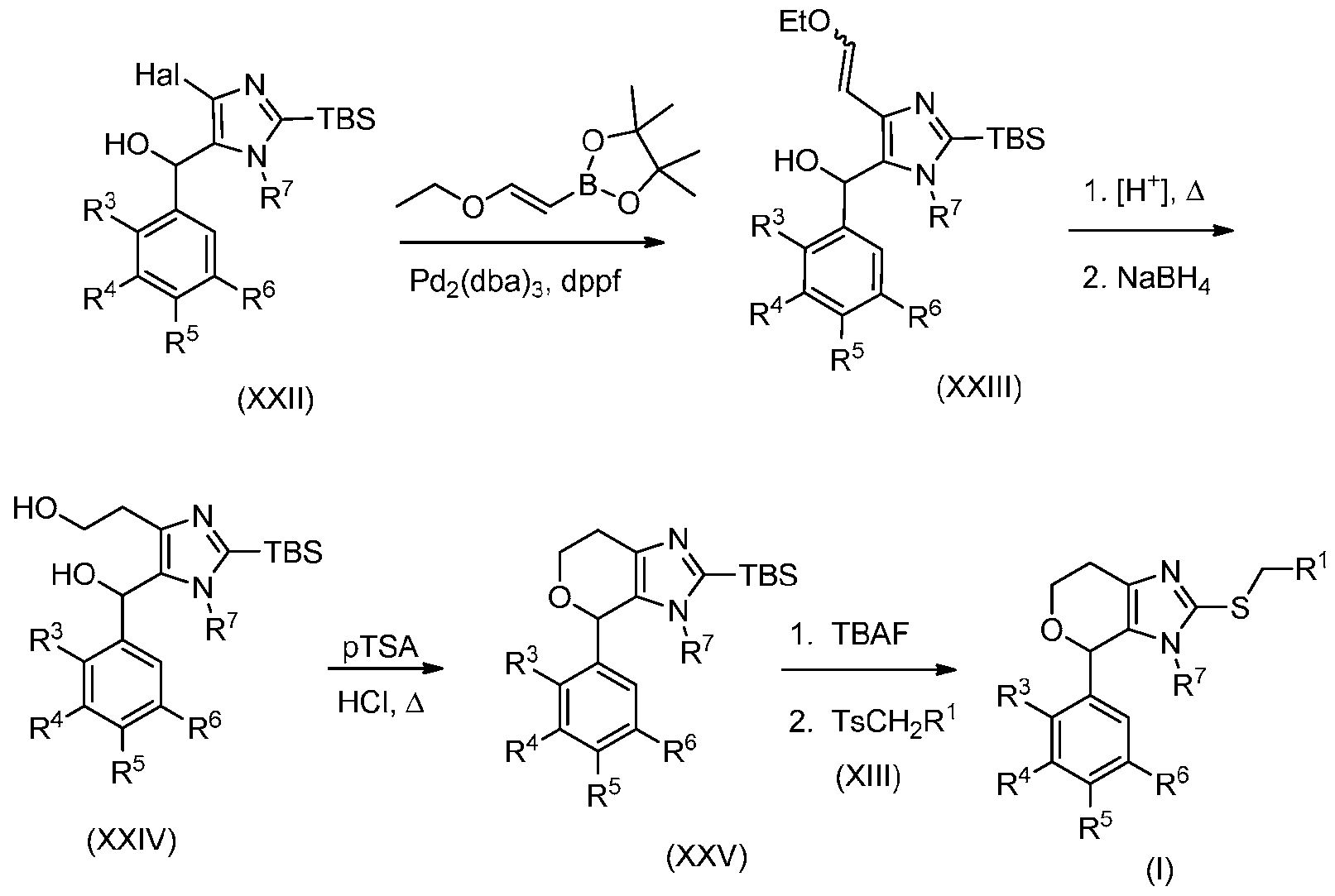
Scheme 3
A suitably substituted compound of Formula (XII) is reacted with a commercially available reagent such as TBSCl or TBSOTf in an organic base such as n-BuLL LiHMDS
and the like, in an organic solvent such as THF, dioxane, ether and the like, at a temperature in the range from -78 °C to 0 °C, to yield the corresponding compound Formula (XX).
Imidazole (XX) is reacted with a commercially a vailable reagent such as NIS or NBS in an organic solvent such as DCM, THF, MeOH and the like, in the presence of catalytic amount of an acid such as pTSA, CSA and the like, at a temperature in the range from 25 °C to (SO °C, to yield the corresponding compound of Formula (XXI) wherein Hal = Br or I.
A suitably substituted compound of Formula (XXI) wherein Hal = Br or I is reacted with a suitably substituted commercially available aldehyde (XVI), in the presence of an organic base such as n-BuLi, /-Pr-MgBr and the like, in an organic solvent such as THF, dioxane, ether and the like, at a temperature in the range from -78 °C to 0 °C, to yield the corresponding compound of Formula (X X I I ).
A suitably substituted compound of formula (XXII) is reacted with a commercially available reagent such as 2-(2-ethoxy vinyl)-4,4,5,5-tetrametb.yl- 1 ,3,2-dioxaborolane or tributyl(2~emoxyvmyl)stannane, in the presence or in the absence of an inorganic base such as t-Na2C03, K2C03, K3P0 , and the like, in the presence of a suitably selected Pd containing reagent such Pd(OAc)2, Pd(Ph3P)4, Pd2(dba)3, and the like, in the presence of a suitably selected ligand such as Ph3P, ΒΓΝΑΡ, dppf, and the like, in a mixed solvent of a suitably selected organic solvent such as THF, 1 ,4-dioxane, toluene and the like, and water at a temperature in the range from 50 °C to about 500 °C, to yield the corresponding compound of Formula (XXIII).
A suitably substituted compound of formula (XXIII) is reacted in an acidic solution of HO, in a mixed solvent of a suitably selected organic solvent such as THF, 1 ,4-dioxane, MeOH and the like, and water at a temperature in the range from room temperature to about 50°C, to yield the corresponding intermediates, which is then reacted with a commercially available reducing reagent such as NaBH4, LiBH4 and the like in a suitably selected organic solvent such as THF, MeOH and the like, at a temperature in the range from 0 CC to room temperature, to yield the corresponding compound of Formula (XXIV).
A suitably substituted compound of Formula (XXIV) is reacted in an acidic solution of HC1, pTSA and the like in a mixed solvent of a suitably selected organic solvent such as THF, 1,4-dioxane, MeOH and the like, and water or a suitably selected organic solvent such as benzene, toluene and the like at a temperature in the range from room temperature to about 80 °C, to yield the corresponding compound of Formula (XXV).
A suitably substituted compound of Formula (XX V) is reacted with a commercially available reagent such as TBAF, KF and the like, in an organic solvent such as THF, dioxane, ether and the like, at a temperature in the range from 0 °C to room temperature, followed by reaction with a suitably substituted commercially available compound of formula TsSCFbR1 (XV), a compound prepared by known methods, in an organic base such as n-BuLi, LDA., LiHMDS and the like, in an organic solvent such as THF, dioxane, ether and the like, at a temperature in the range from -78 °C to - 40 °C, to yield the corresponding compo nd of Formula (I),
Compounds of Formula (I) where X is O and Z1 and Z are taken together with their attached carbon to form a ¾ ^ group may be prepared according to the process as described in the Scheme 4, below.

Scheme 4
A suitably substituted compound of formula · ΧΥΠ} is reacted with a commercially available reagent such as 3-iodoprop-l -ene or 3-bromoprop-l-ene, in the presence or in the absence of an inorganic base such as CS2CO3, NaH, and the like, in a suitably selected organic solvent such as THF, DMF and the like, at a temperature in the range from 0 °C to room temperature, to yield the corresponding compound of formula (XXVI).
A suitably substituted compound of fonnula (XXVI) is reacted in the presence of a suitably selected Pd containing reagent such Pd(OAc)?, Pd(Pb :P) i. P ^ b ) :. and the like, in the presence of a. suitably selected ligand such as PI13P, BINAP, dppf, and the like, in a suitably selected organic solvent such as THF, 1 ,4-dioxane, toluene and the like, at a. temperature in the range from 80 °C to about 100 °C, to yield the corresponding compound of Fonnula (I).
EXAMPLES
Compounds of the present invention can be prepared by methods known to those who are skilled in the art. The following examples are only meant to represent examples of the invention and are in no way meant to be a limit of the invention.
In the Examples which follow, some synthesis products are listed as having been isolated as a residue. It will be understood by one of ordinary skill in the art that the term "residue" does not limit the physical state in which the product was isolated and may include, for example, a solid, an oil, a foam, a gum, a syrup, and the like.

A solution of 4-bromo-l -chloro-2-methoxybenzene (100 g, 451.51 mmoi, 1.00 equiv), dry THF (300 mL), cyclohexanone (44.3 g, 451.38 mmol, 1.00 equiv), Pd2(dba)3 (10.3 g, 11.25 mmol, 0.025 equiv), BINAP (14 g, 22.48 mmol, 0.05 equiv), and t-BuONa (86 g, 894.90 mmol, 2.00 equiv) was stirred overnight at 50 °C in an oil bath. The resulting mixture was concentrated under vacuum, diluted with 1 L of water, and extracted with 3x1 L of ethyl acetate. The combined organic layers were washed with 1x1 L of brine, dried over anhydrous sodium sulfate, filtered, and concentrated. The residue was applied onto a silica gel column with ethyl acetate/petroleum ether (1 :5). The crude product was applied onto a reverse phase column and eluted with MeCN/3¾Q (1 : 19 to 4: 1 in In) to give 2-(4-chloro-3-methoxyphenyl)cyclohexan-l-one as a light yellow solid. Mass spectrum (ESI, m/z): Calcd. for : Ci3H!5C102: 239.1(M+H), found 239.1.
Step 2s [[6-(4-chIoro-3-methoxyphenyl)cyclohex-l-eii-l-yIloxyltrimethylsilaiie

A solution of 2-(4-chloro-3-methoxyphenyI) cyclohexan-l-one (10 g, 41.89 mmol, 1.00 equiv), TEA (8.84 g, 87.36 mmol, 2.09 equiv), and dry dichloromethane (20 mL) was treated with TMSOTf (11.19 g, 50.4 mmol, 1.20 equiv) dropwise at 0 °C with stirring. The resulting solution was stirred for 30 min at 0 °C. The solution was concentrated under vacuum to give [ [6-(4-chloro-3-methoxyphenyl)cyclohex- 1 -en- 1 -yl] oxy jtrimethylsilane as yellow oil.
Step 3 : 2-bromo-6-(4-cMoro-3-metIioxyplieiiyl)cyc¾o!iex¾8i-l-oi¾e

A solution of [[6-(4-chloro-3-methoxyphenyl)cyclohex-l -en-l-yl]oxy]trimethylsilane (13.05 g, 41.98 mmol, 1.00 equiv), and dry THF (100 mL) was treated with NBS (7.47 g, 41.97 mmol, 1.00 equiv), added in several batches at 0 °C. The resulting solution was stirred for 30 min at 0 °C in a water/ice bath. The solution was concentrated under vacuum to give 2-bromo-6-(4-chloiO-3-niethoxyphenyl)cyclohexan-l-one as yellow oil


A room temperature suspension of 2-azido-6-(4-c oro-3-methoxyphenyl) cyclohexan- -one (8.9 g, 31.9 mmol, 1 .00 equiv), Pd''C (10%, 8.9g), methanol (60 mL), and concentrated hydrochloric acid (4 ml.) under hydrogen atmosphere was stirred for 1 h, filtered, and concentrated under vacuum to give 2-amino-6-(4-chloro-3- methoxyphenyl)cyclohexan-l-one hydrochloride as a yellow solid. Mass spectrum (ESI, m/z): Calcd. for C , : l l :,.CiNO.= . 254.1 (M-HC1+H), found 254.1.
Step 6: l-(3-(4-chloro-3-methoxyphenyl)-2-oxocvclohexYl)-3-(4-flMoropheayl)thioMrea


A solution of 3-[3-(4-chloro-3-methoxyphenyl)-2-oxocyclohexyl]-l -(4- iiuorophenyljthiourea (11.2g, 27.7 mmol, 1.00 equiv), and AcOH (80 mL) was stirred at r.t. overnight. The resulting mixture was concentrated under vacuum. Silica gel column chromatography (ethyl acetate/petroleum ether (1 : 1)) gave 7~(4-chloro-3-methoxyphenyl)- 5 -(4-fluorophenyl)-4,5,6,7 etrahydro-l FI-benzo[d]imidazo!e-2-thiol as a yellow solid. Mass spectrum (ESI, m/z): Calcd. for C ' .>UH (ΊΓΝ >OS. 389.5 ( VI · I f ), found 389.1 .
Step 8: 7-(4-chIoro-3-met!ioxyplie¾iiv1)-2-(2-c!ijoro-6-fl¾orobes¾zvIt¾io)-i-(4- fluoropheayl)-4,5,6,7-tetrah ro-lH-benzo[dlimidazoIe trif ioroacetic acid
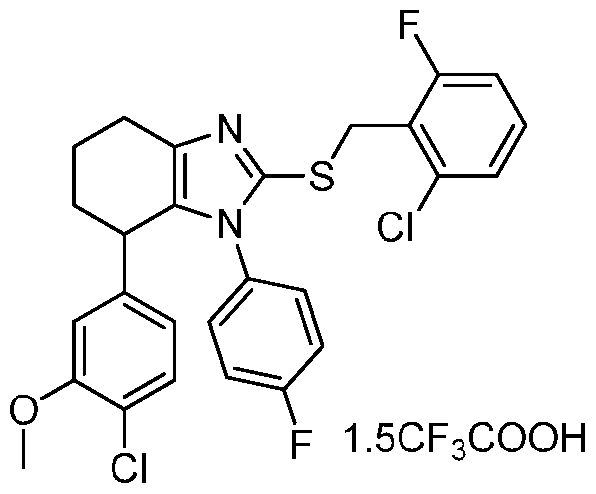
Step 9: 7-(4-chloro-3-methoxyphenvI)-2-ff(2-chIoro-6-fluorophenyl)methyllsulfaav11-

A solution of 7-(4-chloro-3-methoxyphenyi)-l -(4-fluorophenyl)-4,5,6,7-tetrahydro- lH-benzo[d]imidazole-2-thiol (100 mg, 0.26 mmol, 1 .00 equiv), acetone (2 mL), potassium carbonate ( 107 mg, 0.77 mmol, 3.00 equiv), and 1 -chloro-2-(chloromethyi)-3- fluorobenzene (303 mg, 1.69 mmol, 1.20 equiv) was stirred for 4 h at room temperature. The reaction was quenched by the addition of 20 mL of water, extracted with 3x20 mL of
dichloromethane, and the combined organic layers were washed with 20 mL of brine, dried over anhydrous sodium sulfate, filtered and concentrated. The crude product was purified by Prep-HPLC (l#Water 2767-1): Column, Sun Fire Prep HPLC C18* 5μιη, 19* 100mm; mobile phase, water with 0.05% TFA(25% CH3CN up to 40 in 8 min, up to 100% in 2 min, down to 25% in 2 min); Detector, 254nm. The purified material was treated with 4.0mL H20 and 4 drops of con.HCl was added, followed by evaporation of the water. The acidification and evaporation procedure was repeated twice, followed by lyophilization to give 7-(4-chioro-3-methoxyphenyi)-2-[[(2-chloro-6-fluorophenyl)methyl]sulfanyl]-l-(4- fluoro phenyl)-4,5 ,6,7-tetrahydro- 1 H- 1 ,3-benzodiazole hydrochloride as a white solid. Ή NMR (400MHz, CD3OD): δ 7.40-7.46 (m, 1H), 7.30-7.35 (m, 1H), 7.14-7.18 (m, 3H), 6.90(br, 2H), 6.52 (s, IH), 6.41 -6.43 (m, I H), 6.30(br, H I). 4.31(s, 2H), 4.05-4.07 (m, ! i !). 3.33(s, M il 2.80-2.96 (m, 2H), 2.29-2.34 (m, IH), 2.04-2.1 1 (m, IH), 1.80-2.0 (m, 2H). i9F NMR (400MHz, CD3OD): δ -i l l .29, -115.30. Mass spectrum (ESI, m/z): Calcd. for C27H23CI3F2N2OS, 531.1 (M-HC1+H), found 531.1.
fluorophenyl) methyl] mlfanyl]~l~( 4~methoxyyhenyl)~4, 5, 6, 7~tetrahydro~l H-1 -
Step 1: l-(3-(4-ChIoro-3-methoxphenyI)-2-oxocvcIohexyi)-3-(4- ienyI)thiourea

The title compound was prepared according to the procedure described in Example 1 step 6 by coupling 2-amino-6-(4-chloro-3-methoxyphenyl)eyclohexan-l-one hydrochloride (prepared as described in Example 1, Step 5) and l-met,hoxy-4-isothiocyanatobenzene to
afford the desired product as a yellow solid. Mass spectrum (ESI, m/z): Calcd. for C21H23CIN2O3S, 419.1 (M+H), found 419.1.
Step 2: 7-(4-ehlorq-3-metfa^

The title compound was prepared according to the procedure described in Example 1 step 7 by heating 3-[3-(4-c oro-3-methoxyphenyl)-2-oxocycIohexyl]-l-(4-methoxyphenyl) thiourea in acetic acid to afford the desired product as a white solid. Mass spectrum (ESI, m/z): Calcd. for C21H21CIN2O2S, 401.1 (M+Na), found 401.1.

The title compound was prepared according to the procedure described in Example 5 step 8 by coupling 7-(4-chloro-3-methoxyphenyl)- 1 -(4-methoxyphenyl)-4,5,6,7-tetrahydro- 1 H- 1 ,3-benzo diazole-2-thiol with l-chloro-2-(chloromethyl)-3-fluorobenzene in the presence of Cs2C03 to afford the desired product as a white solid. !H NMR (300MHz, CD3OD): δ 7.14-7.31 (m, 3H), 7.03(t, J = 8.1Hz, 1 1 1 ;·. 6.90-7.00 (m, lH), 5.90-6.53 (m, 3H), 4.04-4.18 (m, 2H), 3.87-3.90 (m, 1H), 3.73 (s, 31 1 ;·. 3.31-3.49 (m, 3H), 2.61 -2.81 (m, 21 1 ;·. 2.15-2.23
(m, 1H), 1.70-2.02 (m, 3H). Mass spectrum (ESI, m/z): Calcd. for C28H25CI2FN2O2S, 543.1 (M+H), found 543.1.
Example 3; ~~(4-chiore-3~meriioxyi>iH'fi \Ί}-2-Π( 2- !iioro~6-

The title compound was prepared according to the procedure described in Example 1 step 6 by coupling 2-a.niino-6-(4-chloro-3-met,hoxypbenyl)cyclohexan-l ~one hydrochloride (prepared as described in Example 1 , Step 5) and 1 ,2-difluoro-4-isothiocyanatobenzene to afford the desired product as a yellow solid. Mass spectrum (ESI, m/z): Calcd. for C20H19CIF2N2O2S5, 425.1 (M+H), found 425.1.

The title compound was prepared according to the procedure described in Example i step 7 by beating 3-[3-(4-chloro-3-methoxyphenyl)-2-oxocyclohexyl]-l-(3,4-
difluorophenyl) thiourea in acetic acid to afford the desired product as a white solid. Mass spectrum (ESI, m/z): Calcd. for ( J S rC 'H; -N.-OS. 407.1 (M+H), found 407.1.
Step 3 : 7-( - Moro-3-metIioxypliesiyl)-2- j j (2-chloro-6-flttorophenyl)methyl f s¾Ifanyl}-

The title compound was prepared according to the procedure described in Example 1 step 8 by coupling 7-(4-chloro-3-methoxyphenyl)-l -(3,4-difluorophenyl)-4,5,6,7-tetrahydro-lH- 1 ,3-benzo diazole-2-thiol with l -chloro-2-(chloromethyl)-3-fluorobenzene in the presence of Cs2C03 to afford the desired product as a white solid. Ή NMR (300MHz, CD3OD): δ 6.99-7.32 (m, 5H), 6.20-6.70 (m, 3H), 4.03-4.17 (m, 2H), 3.89-3.92 (m, 1H), 3.73 (s, 3H), 2.26-2.79 (m, 2H), 2.16-2.25 (m, 1 H), 1.83-2.01 (m, 3H). Mass spectrum (ESI, m/z): Calcd. for C Vf i M; Λ. OS. 549.1 (M+H), found 549.1.
Example 4; 7~( 4~chloro~3-methoxyDhenyl)-2-[[(2-chloro~6~ flu(m)phenyl)methyli df(mv ~l~(4~ihioro~3~methoxyphenv
benzodiazole
Step 1 : l-(3-(4-ChIoro-3-methoxypI¾esn1)-2-oxocvcIohex i)-3-(4-fg¾ioro-3- methoxyphenvDthiourea

The title compound was prepared according to the procedure described in Example 1 step 6 by coupling 2-amino-6-(4-chloro-3-methoxyphenyl)cyclohexan-l-one hydrochloride (prepared as described in Example 1 , Step 5) and 1 -fluoro-2-methoxy-4- isothioeyanatobenzene to afford the desired product as a yellow solid. Mass spectrum (ESI, m/z): Calcd. for C21H22CIFN2O3S, 437.1 (M+H), found 437.1.
Ste ii 2;n7-(4-chIw

The title compound was prepared according to the procedure described in Example 1 step 7 by heating 3-[3-(4-chloro-3-niethoxyphenyl)-2-oxocyclohexyl]-l-(3-methoxy-4- fluorophenyl) thiourea in acetic acid to afford the desired product as a white solid. Mass spectrum (ESI, m/z): Calcd. for C21H20CIFN2O2S, 419.1 (M+H), found 419.1.
Step 3: 7~{4~cMoro~3~met¾oxyDlH I)~2~lii2~ri^^
1-(4-fl¾i ro-3-metji xyp!¾e¾ )-4,5«6,7-tetra¾ydro-lH-l,3-bes¾¾ dia¾ole

The title compound was prepared according to the procedure described in Example 1 step 8 by coupling 7-(4-chloro-3-methox phenyl)-l-(3-methoxy-4-fluorophenyi)-4,5,6,7- tetrahydro- 1 H- 1 ,3-benzo diazole-2 -thiol with 1 -chioro-2-(chloromethyl)-3-fluorobenzene under CS2CO3 to afford the desired product as a white solid, 3H NMR (300MHz, CD3OD): δ 7.22-7.31 (in, 2H), 7.16 (d, J = 20.1 Hz, 1H), 7.04 (t, J = 14.1 Hz, 1H), 6.25- 6.85 (m, 5H), 4.00-4.15 (m, 2H), 3.83-3.85 (m, 1H), 3.70-3.72 (m, 6H), 2.50-2.85 (m, 2H), 2.04-2.22 (m, 1H), 1.7-1.99 (m, 3H). Mass spectrum (ESI, m/z): Calcd. for C28H24CI2F2N2O2S, 561.1 ( W W ), found 561.1 .

The title compound was prepared according to the procedure described in Example 1 step 6 by coupling 2-amino-6-(4-chl.oro-3-m.ethoxyphenyl.)cyclohexan-l -one hydrochloride (prepared as described in Example 1 , Step 5) and l~iiuoro~2~methyl~4~
isothiocvanato benzene to afford the desired product as a yell ow solid. Mass spectrum (ESI, m/z): Caiccl. for ('.Ί ! 1■-■CH-'VO -S. 421.1 (M+H), found 421.1.
Ste 2 : 7-(4-cfalor -3-m^^

The title compound was prepared according to the procedure described in Example 1 step 7 by heating 3-[3-(4-chloro-3-methoxyphenyl)-2-oxocyclohexyl]-l-(3-methyl-4- fluorophenyl) thiourea in acetic acid to afford the desired product as a white solid. Mass spectrum (ESI, m/z): Calcd. for C21H20CIFN2OS, 403.1 (M+H), found 403.1.
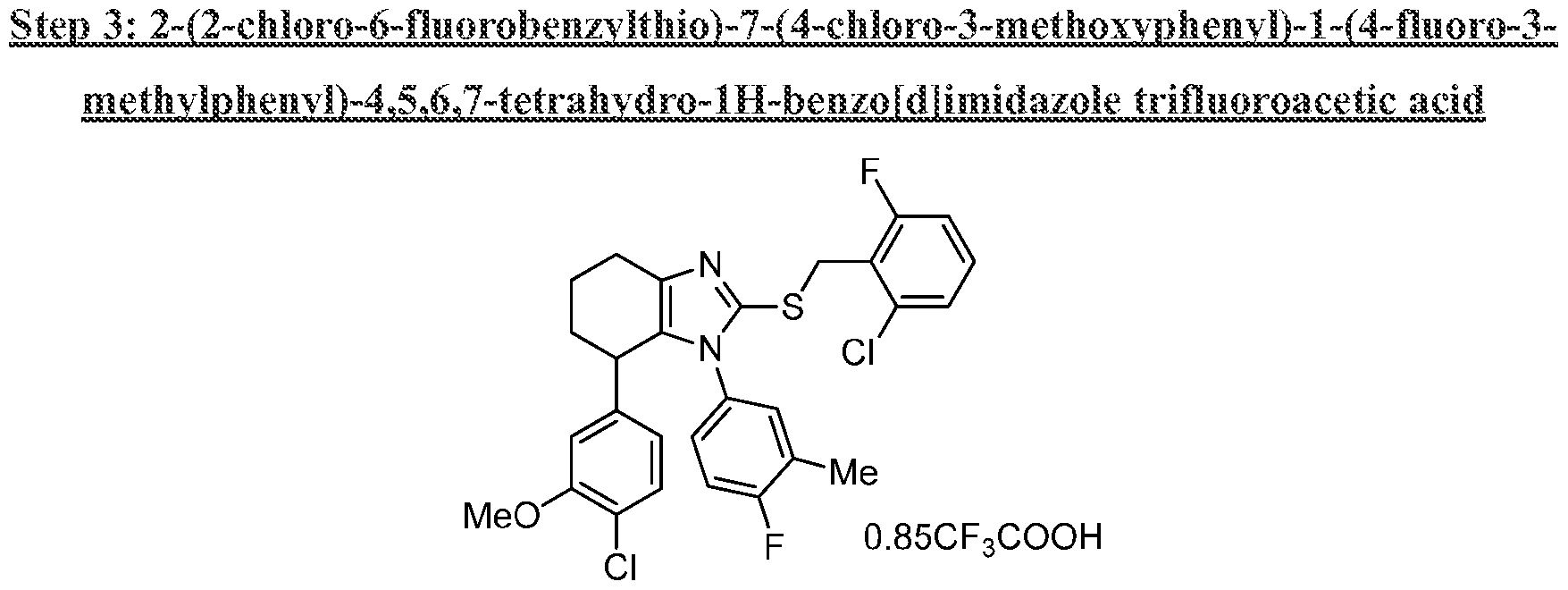
The title compound was prepared according to the procedure described in Example 1 step 8 by coupling 7-(4-chloro-3-methoxyphenyl)-l -(3-methyl-4-fluorophenyl)-4,5,6,7~ tetrahydro- 1 H- 5 ,3-benzo diazole-2-thiol with 5 -chloro-2-(chloromethyi)-3-fluorobenzene in the presence of Cs2C03 to afford the desired product as a white solid. 3H NMR (400MHz, CD3OD): δ 7.30-7.43 (m, 2H), 7.1 5-7.19 (m, 2H), 6.97 (br, 1 H), 6.41 -6.46 (m, 2H), 4.18-4.30 (m, 2H), 4.06 (s, 1H), 3.73(s, H), 2.78-2.92 (m, 2H), 1 .92-2.29 (rn, 7H),
4.15 (br, 4H), 2.71-2.87 (m, 2H). i9F NMR (400MHz, CD3OD): -77.07, -115.21 , -116.15. Mass spectrum (ESI, m/z): Calcd. for C29.7H24.85CI2F4.55N2O2.7S, 545.1 (M- 0.85CF3COOH+H), found 545.1.

The title compound was prepared according to the procedure described in Example 1 step 6 by coupling 2-aniino-6-(4~chloro-3-methoxyphenyl)cyclohexan~l-or!e hydrochloride (prepared as described in Example 1, Step 5) and 1 -fluoro-2-trifluoromethyl-4- isothiocyanatobenzene to afford the desired product as a yellow solid. Mass spectrum (ESI, m'z): Calcd. for C21H19CIF4 2O2S, 475.1(M+H), found 475.1. ro-3-mecnox^ tr uoromethvJ
teirahydro- ~U~be8izod!az le~2~tMol

The title compound was prepared according to the procedure described in Example 1 step 7 by heating 3-[3-(4-chloro-3-methoxyphenyl)-2-oxocyclohexyl]-l -(3-
trifluoromethyl-4-fluorophenyl) thiourea in acetic acid to afford the desired product as a white solid. Mass spectram (ESI, m/z): Calcd. for C21H17CIF4N2OS, 457.1(M+H), found 457.1.

The title compound was prepared according to the procedure described in Example 1 step 8 by coupling 7-(4-chloro-3-methoxypbenyl)-l -(3-tritluoromethyl~4-fluorophenyl)- 4,5,6,7-tetrahydro- 1 H- 1 ,3-benzo diazole-2-thioI with 1 -chloro-2-(cbloromethyi)-3- iiuorobenzesne in the presence of Cs2C03 to afford the desired product as a white solid. Ή NMR (400MHz, CD3OD): δ 7.23-7.29 (m, 1 H), 6.98-7.18 (m, 5H), 6.51 (s, 1H), 6.38-6.50 (m, I I I ). 4.167 (d, J = 13.2 Hz, 1 H), 4.05 (d, J = 13.2 Hz, IH), 3.72-3.87 (m, 1 H), 3.72 (s, 3H), 2.69-2.82 (m, 2H), 2.15-2,24 (m, I H), 1 .99-2.04 (m, 1 H), 1.78-1.87 (m, 2H). Mass spectrum (ESI, m/z): Calcd. for C^HaiCliFs^OS, 599.1 (M+H), found 598.9.
Example 7; 2~(2~chloro~6~fhwrohenzv!thio)~7~{4~ehioro~3~metho
4-fluorophenyl)-4,5,6, 7-tetrahvdro-lH-benzofdlimidazole trif!u roacetic acid
Step 1: 3-[3-(4-chIoro-3-inethoxyphenvI)-2-oxocvclohexyI¾-l-(3-chloro-4- fl¾orop¾esnl)tlijo¾irea

TThhee ttiittllee ccoommppoouunndd wwaass pprreeppaarreedd aaccccoorrddiinngg ttoo tthhee pprroocceedduurree ddeessccrriibbeedd iinn EExxaammppllee 11 sstteepp 66 bbyy ccoouupplliinngg 22--aammiinnoo--66--((44--cchhlloorroo--33--mmeetthhooxxyypphheennyyll))ccyycclloohheexxaann--ll--oonnee hhyyddrroocchhlloorriiddee ((pprreeppaarreedd aass ddeessccrriibbeedd iinn EExxaammppllee 11,, SStteepp 55)) aanndd ll--ffiiuuoorroo--22--cchhlloorroo--44-- iissoottfahiiooecyyaannaattoobbeennzzeennee ttoo aaffffoorrdd tthhee ddeessiirreedd pprroodduucctt aass aa yyeellllooww ssoolliidd.. MMaassss ssppeeccttrruumm ((EESSII,, mm//zz)):: CCaalleedd.. ffoorr (( ::>>HH ;;..;;((''!! TT..VOO:K.. 444411..11 ((MM++HH)),, ffoouunndd 444411..11..

lH-l,3~be!izodiazoIe-2-t oI

The title compound was prepared according to the procedure described in Example 1 step 7 by heating 3-[3-(4-chloro-3-methoxyphenyl)-2-oxocyclohexyl]-l-(3-chloro-4- fhiorophenyl) thiourea in acetic acid to afford the desired product as a white solid. Mass spectrum (ESI, m/z): Calcd. for C20H17CI2FN2OS , 423.0(M+H), found 423.0
Step 3: 2-(2-chloro-6-flttorobefl:ffylthio)^
flMorophenyl)-4,5,6.7-tetrahvdro-lH-ben¾o[dUiwtda¾oIe triffaoroaeetic acid

The title compound was prepared according to the procedure described in Example 1 step 8 by coupling 7-(4-c oro-3-methoxyphenyl)-l-(3-chloro-4-fluorophenyi)-4,5,6,7- tetrahydro- 1 H- 1 ,3-benzo diazole-2 -thiol with 1 -chioro-2-(chloromethyl)-3-fluorobenzene in the prese ce of Cs2C03 to afford the desired product as a white solid. !H NMR (400MHz, CD3OD): δ 7.40-7.45 (m, 1H), 7.31-7.33 (m, 1H), 7.13-7.20 (m, 3H), 6.52 (s, 1H), 6.41-6.43 (m, 1H), 4.27-4.29 (m, 2H), 4.02 (s, 1 H), 3.74 (s, 3H), 2.80-2.96 (m, 2H), 2.27-2.33 (m, i l l). 2.05-2.14 (m, 1H), 1.91-1.99 (m, 2H). 39F NMR (400MHz, CD3OD): - 77.27, -1 14.00, -115.25. Mass spectrum (ESI, m/z): Calcd. for CsoH^sC F^NaC^S, 565.0(M-1.5CF3COOH+H), found 565.1.
-chtoro-b-tluorol tioj-7-(4-chloro~J~methoxyphen\
dmuorophenyi)-4,s,b, /-tetrahydro-l trifluoroacetic acid
Step l;3-[3-('4-c loro-3-methox 'phenyl)-2-oxocvclohe¾:vIl-1 -('2.,4- tienvltthiourea

The title compound was prepared according to the procedure described in Example 1 6 by coupling 2-amino-6-(4-ch3.oro-3-m.ethoxypheny3.)cyclohexan-l-one hydrochloride
(prepared as described in Example 1 , Step 5) and 1 ,3-difluoro-4-isothiocyanatobenzene to afford the desired product as a yellow solid. Mass spectrum (ESI, m/z): Calcd. for

-chioro-J-metlioxYpi -ffiilnoropoeiivi

The title compound was prepared according to the procedure described in Example 1 step 7 by heating 3-[3-i4-chioro-3-methoxyphenyi)-2-oxocyclohexyl]~ l- 2,4- difluorophenyl) thiourea in acetic acid to afford the desired product as a white solid. Mass spectrum (ESI, m/z): Calcd. for C ' H;H , Ί Ι >VOS . 407.1 (M+H), found 407.1.
2-(2-chloro-6-fluorobeiizyI -chloro-3-methoxvp ei diflMorophenyl)-4.5,6,7-tetrahydro-lH-bea¾o[d]imida¾oIe triflnoroacetic acid

The title compound was prepared according to the procedure described in Example 1
8 by coupling 7-(4-chloro-3-methoxyphenyl)- l-(2,4-difluorophenyl)-4,5,6,7- tetrahydro- 1 H- 1 ,3-benzo diazole-2 -thiol with 1 -chioro-2-(chloromethyl)-3-fluorobenzene in the presence of Cs2C03 to afford the desired product as a white solid. !H NMR (400MHz, CD3OD): δ 7.27-7.39 (m, 2H), 7.10-7.19 (m, 3H), 6.39-7.07 (m, 4H), 4.16-4.35
(m, 2H), 3.93-4.08 (m, 1H), 3.74(d, J = 14.8 Hz, 1H), 2.82-2.88 (m, 2H), 2.07-2.08 (m, 1H), 1.90-1 .91 (m, 1H), 1.87-1.88 (m, 2H). hT \MR (400Υ1Π/. CD3OD): -77.19, -106.56, -114.22,-115.11,-117.83. Mass spectrum (ESI, m/z): Calcd. for C29.4H22.2Cl2Fe.6N2O3.4S, 549.1(M-1.2CF3COOH+H), found 549.1.

The title compound was prepared according to the procedure described in Example 1 step 6 by coupling 2-amino-6-(4-chloro-3-methoxyphenyl)cyclohexan-l-one hydrochloride (prepared as described in Example 1, Step 5) and i,2,3-†,rifluoro~4~isothiocya.na†,obenzene to afford the desired product as a yellow solid. Mass spectrum (ESI, m/z); Calcd. for C20H18CIF3N2O2S, 443.1 (M+H), found 443.1 .
7-(4-ch]oro-3-methoxYphenvI')-l-(2, 3» 4-trifluorop eny])-4.5,6,7-tetrahvdro-


The title compound was prepared according to the procedure described in Example 1 step 8 by coupling 7-(4-chloro-3-methoxyphenyl)- 1 -(2,3,4-trifluorophenyl)-4,5,6,7- tetrahydro- 1 H- 1 ,3-benzo diazole-2-thiol with 1 -chloro-2-(chloromethyl)-3-fluorobenzene in the presence of Cs2C03 to afford the desired product as a white solid. 3H NMR (300MHz, CD3OD): δ 6.59-7.35 (m, 6H), 6.33-6.46 (m, 2H), 3.92-4.30 (m, 3H), 3.70 (d, J = 8.7 Hz, 1H), 2.78-2.83 (m, 2H), 1.84-2.29 (m, 4H). Mass spectrum (ESI, m/z): Calcd. for C27H20CI2F4N2OS, 567.1 (M+H), found 567.2.
Example 10; 7-(4-chloro-3-methoxyphenyl)-2-((2-chloro-6-ftuorobenzyl)thio)-l- (3,4,5-trifluorophenyl)-4,5,6,7-tetrahvdro-lH-benzoidlimidaz le
Step 1 : 3-f3-(4-chIoro-3-methoxyphenyr)-2-oxocvclohexyIl-l-(3,4,5- trifluorophenvPthioiirea

The title compound was prepared according to the procedure described in Example 1 step 6 by coupling 2-amino-6-(4-chloro-3-methoxyphenyl)cyclohexan-l-one hydrochloride (prepared as described in Example 1, Step 5) and l,2,3-trifluoro-5- isothiocyanatobenzene to afford the desired product as a yellow solid. Mass spectrum (ESI, m/z): Caled. for C20H¾ 8aF,N2Q28, 443.1 (M+H), found 443.1.

The title compound was prepared according to the procedure described in Example 1 step 7 by heating 3-[3-(4-chloro-3-methoxyplienyI)-2-oxocyelohexyl]-l -(3,4,5-trifluoro- phenyl) thiourea in acetic acid to afford the desired product as a white solid. Mass spectrum (ESI, m/z): Calcd. for C2oH16CiF3N20S, 425.1 (M+H), found 425.1.
Step 3: 7-(4-chloro-3-met oxyphenyl)-2-((2-c loro-6-flMorobeMzyl)thio')-l-(3,4,5- trifl¾ioropjiem )-4,5..6,7-tetra!¾vdro-lH-be¾¾old1imjda¾oje

The title compound was prepared according to the procedure described in Example 1 step 8 by coupling 7-(4-chioro-3-methoxyphenyi)-l-(3,4,5-trifluorophenyl)-4,5,6,7- tetrahydro- 1 H- 1 ,3-benzo diazole-2 -thiol with 1 -chioro-2-(chloromethyl)-3-fluorobenzene in the presence of Cs2C03 to afford the desired product as a white solid. 3H NMR (300MHz, CD3OD): 5 6.96-7.27 (m, 41 ! ). 6.34-6.51 (m, 31 ! ). 3.89-4.13 (m, 31 S ) . 3.73 (s, 3H), 2.65-2.76 (m, 2H), 2.14-2.22 (m, 1H), 1.74-1.98 (m, 3H). Mass spectrum (ESI, m/z): Calcd. for C27H20CI2F4N2OS, 567.1 (M+H), found 567.1.

The title compound was prepared according to the procedure described in Example 1 step 6 by coupling 2-amino-6-(4-chl.oro-3-m.ethoxyphenyl.)cyclohexan-l -one hydrochloride (prepared as described in Example 1 , Step 5) and l ,2,5-trifj.uoro-4-isothiocyanatobenzene
to afford the desired product as a yellow solid. Mass spectrum (ESI, m/z): Calcd. for C , ;! [ ,,.( ·!!· :N .() -.S. 443.1(M-}-H), found 443.1.
Ste 2: 7-(4-c¾loro-3-meth xypiie8iyi -l-(2, 4, S-trifli8oropheiiyI)-4,5.,6,7-tetraIiydro-
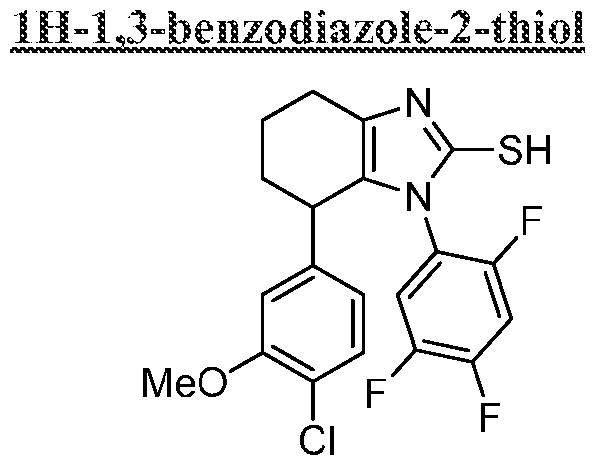
The title compound was prepared according to the procedure described in Example 1 step 7 by heating 3-[3-(4-chloro-3-methoxyphenyl)-2-oxocyclohexyl]-l-(2,4,5-trifluoro- phenyi) thiourea in acetic acid to afford the desired product as a white solid. Mass spectrum (ESI, m/z): Calcd. for C20H16CIF3N2OS, 425.1(M+H), found 425.1.

The title compound was prepared according to the procedure described in Example 1 step 8 by coupling 7-(4-chloro-3-methoxyphenyl)-l-(2,4,5-trifluorophenyl)-4,5,6,7- tetrahydro- 1 H- 1 ,3-benzo diazole-2 -thiol with 1 -chioro-2-(chloromethyi)-3-fluorobenzene in the presence of Cs2C0 to afford the desired product as a white solid. 3H NMR (300MHz, CD3OD): δ 6.99-7.15 (m, 3H), 6.59-6.90 (m, 3H), 6.31-6.42 (m, 2H), 4.28-4.33 (m, 1H), 4.08-4.14 (m, 1H), 3.70-3.79 (m, 4H), 2.72-2,78 (m, 2H), 2.16-2.31 (m, 1H),
1.72-1.89 (m, 4H). Mass spectrum (ESI, m z): Calcd. for C27H2oCi2F4N20S , 567. l(M-i-H), found 567.1.
E mple 12: 4-( ( 7-{4Η >Γθ-3-Μί·ΐ!ι χ\Ί>Ικ η·Ι)-] -(4-fhs r{)p em'h-4 5, 6, 7-

A solution of 3,5-difluorobenzoic acid (7.9 g, 49,97 mmol, 1.00 equiv), tert-butanol (5,55 g, 1.50 equiv), 4-dimethylaminopyridine (610 mg, 4.99 mmol, 0.10 equiv), was treated with TEA (7.07 g, 69.87 mmol, 1.40 equiv) during a period of 20 min at room temperature. The mixture was cooled to 0 °C in a water/ice bath, treated with Boc20 (14.27 g, 65.38 mmol, 1 .30 equiv) was added at the same temperature, warmed to room temperature, and stirred overnight. The reaction was concentrated under vacuum. Silica gel chromatography (ethyl acetate/petroleum ether (1 :30)) gave tert-butyl 3,5- difluorobenzoate as a colorless oil.

A solution of (i-Pr)2NH (4.79 g, 47.43 mmol, 1.30 equiv), tetrahydrofuran (80 mL), under nitrogen, at 0°C, was treated with 2.5 M of n-BuLi (20 mL) over a period of 30 min. The mixture was cooled to -78 CC, and tert-butyl 3, 5 -difluorobenzoate (7,8 g, 36.41 mmol, 1 ,00 equiv) in tetrahydrofuran (20 mL) was added over a. period of 30 min. The reaction
was stirred for 1 h, treated with N,N-dimethylformamide (4.0 g, 54.73 mmol, 1.50 equiv), and stirred for an additional 1 h while the temperature was maintained at -78 °C. The reaction was quenched by the addition of 50 niL of water, extracted with 3x200 niL of ethyl acetate, and the combined organic layers were dried over sodium sulfate, filtered, and concentrated under vacuum. Silica gel chromatography (ethyl acetate/petroleum ether (1 :50)) gave tert-butyl 3,5-difiuoro-4-formylbenzoate as a light yellow solid.

A solution of tert-butyl 3, 5~difmoro-4-formylbenzoate (2.6 g, 10.73 mmol, 1.00 equiv), methanol (50 itiL), at 0 °C was treated with NaBH4 (81 0 mg, 21 .45 mmol, 2.00 equiv), and the resulting solution was stirred for 2 h at 0 °C, fol lowed by concentration under vacuum. Silica gel chromatography (ethyl acetate/petroleum ether 1 : 10) gave tert- butyl 3,5-difluoro-4-(hydroxymethyl) benzoate as a off-white solid.
Step 4. Tert-butyl 3,5-difl¾io -4-[(metIia8iesMlfosn oxy)s«etIivIjbes¾¾oate

A solution of tert-butyl 3,5-difluoro-4-(hydroxymethyl)benzoate (1.2 g, 4.91 mmol, 1.00 equiv) in dichloromethane (50 mL), TEA (1.50 g, 14.82 mmol, 2.97 equiv), MsCl (1.1 g, 9.57 mmol, 1.95 equiv) was stirred for overnight at room temperature. The resulting mixture was concentrated under vacuum. Silica gel chromatography (petroleum ether/ethyl acetate -5: l)gave tert-butyl 3,5-difluoro-4-
[(methanesulfonyioxy)mefhyi]benzoate as a white solid.
Step S: tert-b¾tyl 4-([[7-(4-chloro-3-methoxyphenyl)-l-(4-fluoropheiiyI)-4, 5, 6, 7-

The title compound was prepared according to the procedure described in Example 1 step 8 by coupling 7-(4-chloro-3-methox ,phenyl)-l-(4-fj.uorophenyl)-4,5,6,7-tetrahydro-l H-l ,3- benzo diazole-2-thiol (prepared as described in Example 1 , Step 7) with tert-butyl 3,5- difluoro-4-[(methanesuIfonyloxy)methyl]benzoate in the presence of CS2CO3 to afford the desired product as a white solid.
Mass spectrum (ESI, m/z): Calcd. for : C32H30CIF3N2O3S: 614.2(M+H), found 641.2.
Step 6: 4-((7-(4-chloro-3-methoxyphenyi)-l-(4-fliiorophenyn-4, 5, , 7-tetrahydro- lH-benzo[dlimidazol- -vIthio)methyI)-3,5-difliiorobeiizoic acid trifluoroacetic arid

A solution of tert-butyl 4-([[7-(4-chloro-3-methoxyphenyl)-l-(4-fluorophenyl)- 4,5,6,7-tetrahydro- 1H- 1 ,3-benzodiazol-2-yi]suifanyl] methyl)~3,5-difluorobenzoate (150 nig, 0.24 nimoL 1.00 equiv), dichloromethane (10 niL), and trifluoroacetic acid (1 niL) was stirred for 3 h at room temperature and concentrated under vacuum. The crude product was purificated by Prep-HPLC With the following conditions (l#waters2767-5)i column.
SunFire Prep C18, 19* 150mm 5iun H Prep 0001(1)18600256819513816414 04; Mobile Phase, phase A: water with 0.05% TFA, phase B: CH3CN (40% CH3CN up to 70% in 8 min, up to 100 % in O.lmin, hold 100% in 1.9min, down to 40% in 0.1 min, hold 40% in l ,9min); detector, UV 220 & 254 nm to give 4-((7-(4-chIoro-3-methoxyphenyl)-l-(4- fluorophenyl)-4, 5, 6, 7-tetrahydro-lH-benzo[d]imidazol-2-ylthio)methyl)-3,5- difluorobenzoic acid trifluoroacetic acid as a w hite solid. Ή NMR (400MHz, CD3OD) δ 7.46-7.54 (m, 21 1 ). 7.28 (s, lH), 6.84-7.21 (m, 3H), 6.33-6.46 (m, 3H), 4.08-4.16 (m, 2H), 3.80 (s, 4H), 2.87-3.08 (m, 21 1). 2.03-2.26 (m, 1H), 1.86-1.99 (m, 3H). 19F NMR (400MHz, CDjOD) δ-75.742, -108.802, -1 14.143. Mass spectrum (ESI, m/z): Calcd. for : C29.712H22.85eCiF5.568N2O4.712S: 559.2(M-0.856CF3COOH+H), found 559.2.

A solution of 4-([[7-(4-chloro-3-methoxyphenyl)-l-(4-fluorophenyl)-4,5,6,7- tetrahydro-lH-13-benzodiazoI-2-yl]suifanyl]methyl)-3,5-difluorobenzoic acid (30 mg, 0.05 mmol, 1.00 equiv) in dichloro methane (2 rnL) was treated with (2- aminoetbyl)trimethylazanium hydrochloride chloride (11.3 mg, 0.06 mmol, 1.20 equiv), HOBt (1 1 mg, 0.08 mmol, 1 .21 equiv), EDCI (12.4 mg, 0.06 mmol, 1 .21 equiv), and triethylamine (16.3 mg, 0.16 mmol, 3.00 equiv). The resulting solution was stirred overnight at room temperature. The reaction was then quenched by the addition of 10 mL of water, extracted with 3x10 mL of dichloromethane, and the combined organic layers were dried over sodium sulfate and concentrated under vacuum. The cmde product (3mL)
was purificated by Prep-HPLC With the following conditions: (l#waters2767-5) column, SunFire Prep C18, 19* 150mm H Prep 0001 (1)18600256819513816414 04; Mobile Phase, phase A: water with 0.05% TFA, phase B: CH3CN (20% C¾CN up to 50% in 8 niin, up to 100 % in O.lmin, hold 100% in 1.9min, down to 20% in 0.1 min, hold 20% in 1.9min); Detector, UV 220 & 254 nm. This resulted in 13.6 mg (24%) of PH-ZHS-XZ1- H-125-0 as a light yellow semi-solid. 1H NMR (400MHZ, CD3OD) 57.54(d, J = 8.0 Hz, 2H), 6.95-7.18 (m, 3H), 6.52 (s, 1H), 6.39-6.42 (m, 2H), 4.22 (s, 2H), 4.05 (s, 1H), 3.85- 3.89 (m, 3H), 3.73 (s, 3H), 3.61-3.64 (m, 2H), 3.25-3.33 (m, 1 21 1). 2.93 (s, 4H), 2.78-2.88 (m, 2H), 2.26-2.33 (m, 1H), 1.90-2.08(m, 3H). 19F NMR (400MHZ, CD3OD) δ -77.08, - 111.59, -1 15.30. Mass spectrum (ESI, rn/z): Calcd. for : C40.22H37.6f CIFi3.83N4O9.22S:643.2 (M-2.61CF3COOH-CF3COO), found 643.2.
Example 14; 2~(ff7~(4~chlow-3-methoxyphenyl)~J~(4~fluorophenyl)~4, 5, 6, 7-tetr hydro-

The title compound was prepared according to the procedure described in Example I step 8 by coupling 7-(4-caloro-3-metaoxyphenyl)-l-(4-f[uorophenyl)-4,5,6,7-tetrahydro- 1 H-benzo[d] imidazole-2-taiol (Prepared as described in Example 1 , Step 7) with 1-cyano- 2-(chloromethyl)-3-fluorobenzene in the presence of Cs2C03 to afford the desired product as a white solid.
Ή NMR (400MHz, CD3OD): δ 7.50-7.54 (m, 21 1 ;·. 7.40-7.43 (m, 1 1 1 ). 7.1 l(d,■/ 8.0Hz, 1H), 6.72 (br, 2H), 6.52 (s, 1 H), 6.37-6.42 (m, 1H), 4.02-4.08 (m, 2H), 3.92-3.99 (m, 1H), 3.73 (s, 3H), 2.66-2.88 (m, 2H), 2.21-2.23 (m, 1H), 1.84-1.95(m, 1H), 1.80-1.83 (m, 2H). Mass spectrum (ESI, m/z): Calcd. for C28H22CIF2N3OS, 552.1 (M+H), found 552.0
Example IS: 7-(4-chloro-3-methoxyphenyl)-2-(ff2-fluoro-6-(trifluorontethyl)

The title compound was prepared according to the procedure described in Example 1 step 8 by coupling 7-(4-chloro-3-methoxyphenyl)-l-(4-fluoroplienyl)-4,5,6,7-tetrahydro- lH-benzo[d]imidazole-2-thiol (Prepared as described in Example 1 , Step 7) with 1- trifluoromethyl-2-(cliloromethyl)-3-fluorobenzene in the presence of CS2CO3 to afford the desired product as a white solid.
Ή NY!R (300MHz, CD3OD): 6 7.43-7.46 (m, 21 1). 7.26-7.32 (ni, 1H), 7.06-7.09 (m, I S !). 6.63-6.84(m, 3H), 6.44-6.45 (m, 1H), 6.33-6.37 (m, 1H), 4.03-4.14 (m, 2H), 3.87-3.90 (m, 1 H), 3.68(s, 3H), 2.64-2.76(m, 2H), 2.12-2.21 (m, 1 H), 1.74-1 .94 (m, 3H). Mass spectrum (ESI, m/z): Calcd. for C28H22CIF5N2OS, 565.1 (M+H), found 565.2.

The title compound was prepared according to the procedure described in Example
I step 8 by coupling 7-(4-cbloro-3-metboxypbenyl)-l-(4-fiuorophenyl)-4,5,6,7-tetrahydro-
lH-benzo[djimidazole-2-thiol (Prepared as described in Example 1, Step 7) with 1- methoxy-2-(chloromethyl)-3-fiuorobenzene in the presence of Cs2C03 to afford the desired product as a white solid.
'HNMR (300MHZ, CD3OD): δ 7.30-735 (m, 1H), 6.70-7.10 (m, 6H), 6.44-6.45 (m, 1H), 6.31-6.34 (m, 1H), 3.97-4.14 (m, 3H), 3.74 (s, 3H), 3.67 (s.3H), 2.81-2.91 (m, 2H), 2.21- 2.27(m, ill).1.88-2.06(m, 31!). ]9F NMR (300MHz, CD3OD): -77.28, -111.53, -119.42. Mass spectrum (ESI, m/z): Calcd. for C3f.2H26.6ClF6.8N2O5.2S, 527.3 (M-I.6
CF3COOH+H), found 527.3

The title compound was prepared according to the procedure described in Example 1 step 8 by coupling 7~(4~chloro-3-methoxyphenyl)-l -(4-fluorophenyl)-4,5,6,7-tetrahydro- lH-benzo[d]imidazole-2-thio! (Prepared as described in Example 1, Step 7) with 1- brorno-2-(chloromethyl)-3-iiuorobenzene in the presence of Cs2C03 to afford the desired product as a white solid.
'll NMR (300MHz, CD3OD): δ 7.21-7.33 (m, 1H), 7.01-7.19 (m, 3H), 6.81 (br, 2H), 6.43 (d, J ------- 1.8 Hz, 1H), 6.33-6.36 (m, 1H), 4.03-4.14 (m, 2H), 3.85-3.99 (m, 1H), 3.67 (s,
3H), 2.64-2.76 (m, 2H), 2.11-2.20 (m, 1H), 1.74-1.93 (m, 3H). Mass spectram (ESI, m/z): Calcd. for
 577.HM ·!!}. found 577.1.
Example 18: 7-(4-chloro-3-methoxyphen yl)-2-H(2-jluoro-6- nitrophenyl)methyl]mIfm\ ]-l-{^

The title compound was prepared according to the procedure described in Example 1 step 8 by coupling 7-(4-chloro-3-methoxyphenyl)-l-(4-fluorophenyl)-4,5,6,7-tetrahydro- lH~benzo[d]imidazole-2-thiol (Prepared as described in Example 1, Step 7) with 1-nitro- 2-(cliiorometliyl)-3-fluorobenzene in the presence of CS2CO3 to afford the desired product as a white solid. ]H NMR (300MHz, CD3OD): δ 7.53-7.76 (m, 1H), 7.38-7.51 (m, 2H), 7.04-7.07 (m, 1 H), 6.48-6.85 (m, 3H), 6.48-6.49 (m, 1H), 6.33-6.36 (m, 1H), 4.20-4.32 (m, 2H), 3.83-3.87 (m, 2H), 3.69 (s, 3H), 2.60-2.69 (m, 2H), 2.1 -2.20 (m, 1 H), 1.75-2.08 (m, 3H). Mass spectrum (ESI, m/z): Calcd. for C27H22CIF2N3O3S, 542.1 (M+H), found 542.2.

The title compound was prepared according to the procedure described in Example 5 step 8 by coupling 7-(4-chloro-3-methoxyphenyl)-l -(4-fluorophenyl)-4,5,6,7-tetrahydro- lH-benzo[d]imidazole-2-thiol (Prepared as described in Example 1 , Step 7) with 1 ,4- difluoro-2-(chloromethyl)-benzene in the presence of C\>< '(>; to afford the desired product as a white solid.
Ή NMR (300MHz, CD3OD): δ 7.09-7.28 (m, 5H), 6.87-6.98 (m, 2H), 6.33-6.47 (m, 3H), 3.96-4.15 (m, 3H), 3.68 (s, 3H), 2.73-2.91 (m, 2H), 2.22-2.28 (m, 1H), 1.91-2.20 (m, 3H). Mass spectrum (ESI, m/z): Calcd. for ( I !■ .( If-' .-N >( )S. 515.1 (M+H), found 515.1.

The title compound was prepared according to the procedure described in Example 1 step 8 by coupling 7-(4-chloro-3-methoxyphenyl)-l-(4-fluorophenyl)-4,5,6,7 etrahydro-lH~ benzo[d]imidazoIe-2-thiol (Prepared as described in Example 1 , Step 7) with l -ehloro-2- (chloromethyl)-3,6-difluorobenzene in the presence of Cs2C03 to afford the desired product as a white solid.
1H-NMR (300MHz, CD3OD): δ 6.98-7.19 (m, 3H), 6.59-6.85 (m, 3H), 6.32-6.44 (m, 2H), 3.97-4.08 (m, 2H), 3.86-3.88 (m, 1 H), 3.67 (s, 3H), 2.59-2.74 (m, 2H), 2.1 1 -2.20 (m, I H), 1.73-1.94 (m, 3H). Mass spectrum (EST, m/z): Calcd. for C27H21CI2F3N2OS, 549.1 (M+H), found 549.2.
Example 2 1: 4~((7~ (4-chloro-3-metho. xyphenvl)-l-(4-fl orophenvl)~4,5,6, 7~tetrahvdro~
IH-benzofd, Yitnldazo <l~2~ylthio)metkvl)~ 3,5-difluorobenzenesulfonamide (21a) and 4~((7~
(4-i zhloro-3- -methoxvphenvD-l ~( 4~fluoroi)hen yl)-4, 5, (h 7-tetrah ydr - III- benzoid]im, idazol-2- ■vlthio}meihvl}~3,5- -difluoro-N~(methvlsulfonvl)benzenesulfonamide
am
Step 1 : |"4-(benzyls¾Ifanyl)-2,6-difluoropheny- 1 methanol
H

A solution of (4-bromo-2,6-difluorophenyl)methanoi (22 g, 98,65 mmol, 1.00 equiv) in 1 ,4-dioxane (300 mL) was treated with phenyimethanethiol (16 g, 128.82 mmol, 1.31 equiv), Pd2(dba.)3 (2.7 g, 2.95 mmol, 0.03 equiv), Xantphos (5,8 g, 10.02 mmol, 0.10 equiv), and TEA (30 g, 297.03 mmol, 3.01 equiv). The resulting solution was stirred for 3 h at 80 "C and concentrated. Silica gel column chromatography with ethyl acetate/petroleum ether (l :5)gave the title compound as an orange solid. Mass spectrum (ESI, m/z): Calcd. for : C!4Hi 2F2OS: 267 i ( .Vi · H ). found 267.1.

A solution of [4-(benzylsulfanyl)-2,6-difluorophenyl]methanol (5000 mg, 18.78 mmol, 1.00 equiv) in dichioromethane (50 mL) and pyridine (3800 mg, 48.10 mmol, 2.56 equiv) was treated with AcCl (1800 mg, 22.93 mmol, 1.20 equiv) dropwise with stirring at 0 °C. The resulting solution was stirred for 2 h at room temperature, concentrated under vacuum, and purifiedby silica gel chromatography (ethyl acetate/petroleum ether (1 : 10)) to give the title compound as a reel oil. Mass spectrum (ESI, m/z): Calcd. for : C] 6H14F202S: 308.1 (M-i-H), found 308.1.
Step 3: [4-(chlorosulfonyl)-2, 6-difhioropfaenyll methyl acetate

A solution of [4-(benzylsulfanyl)-2,6-difluorophenyl]m.ethyl acetate (4 g, 12.97 mmol, 1.00 eqiiiv), acetic acid (3.9 g, 64.95 mmol, 4.99 equiv), water (1 .4 g, 77.78 mmol, 6.00 equiv), and MeCN (50 mL) was treated with NCS (5.2 g, 38.94 mmol, 3.00 equiv), in portions at 0 °C. The resulting solution was stirred for 2 h at room temperature, concentrated under vacuum, and diluted with 100 mL of EA. The resulting mixture was washed with 1 x50 mL of water, 1 x50 mL of brine, dried over sodium sulfate and concentrated under vacuum. Silica gel chromatography (petroleum ether/EA (.10/1)) gave the title compound as a white solid. Mass spectrum (ESI, m/z): Calcd. for : C9H7CIF2O4S: 285.0(M+H), found 285.0.
Step 4: (2, 6-difluoro-4-s¾tfamoy phenyI)methyI acetate

A solution of [4-(chiorosulfonyi)-2,6-difluorophenyl]methyl acetate (1 g, 3.51 mmol, 1.00 equiv) in tetrahydrofuran (50 mL) was treated with NH (g) and stirred for 2 h at 5-10 °C in a water/ice bath. The resulting mixture was concentrated under vacuum and purified by preporatory TLC with ethyl acetate/petroleum ether (1 :2.5) to give the title compound as a white solid. Mass spectrum (ESI, m/z): Calcd. for : C9H9F7NO4S: 266.0(M+H), found 266.0.

A solution of (2,6-difluoro-4-sulfamoylphenyl)methyl acetate (200 mg, 0.75 rarnol, 5 .00 equiv) in rnefhanol/H20 (2/2 mL) was treated with LiOH.H20 (160 mg, 3.81 mmol, 5,06 equiv) and stirred for 4 h at room temperature. The resulting mixture was concentrated under vacuum and purified by preporatory TLC with ethyl acetate/petroleum ether ( 1 : 1) to give the title compound as a white solid. Mass spectram (ESL m/z): Calcd. for : C7H7F2 O3S: 224.0(M+H), found 224.0.
Step 6: 4-((7-(4-chloro-3-methox pheayl)-l-(4-fli.orophenyl)-4,5.,6,7-tetrahydro-lH- bei-zo|dlimidazoI-2-ylthio)methyl)-3,5-dif-Horobe-izenesulfonainide (21a)

A solution of 3, 5~difluoro-4-(hydroxymethyl)benzene- l -sulfonamide (1 10 mg, 0.49 mmol, 1.10 equiv), 7-(4-chloro-3-methoxyphenyl)-l -(4-fluorophenyl)-4,5,6,7-tetrahydro- 1 H-benzo[d]imidazole-2-thiol (Prepared as described in Example 1 Step 7, 175 mg, 0.45 mmol, 1.00 equiv), η-Β¾Ρ (226 mg, 1.12 mmol, 2.50 equiv), and ADDP (237 mg, 0.95 mmol, 2.10 equiv) in toluene (5 ml,) was stirred overnight at 60 °C in an oil bath. The resulting mixture was concentrated under vacuum, purified by silica gel column with dichloromethane/rnethanol (20/1 ), followed by Prep-HPLC with the following conditions: ( l #waters2767-5) column, SunFire Prep CI 8, 19* 150mm H Prep ( 001 (T)l 8600256819513816414 04; Mobile Phase, phase A: water with 0.05% TFA, phase B: CLI3CN (35% CFI3CN up to 70% in 8 min, up to 100 % in O. lmin, hold 1 00% in 1 .9min, down to 35% in O. lmin, hold 35% in i .9min); Detector, UV 220 & 254 nm. The title
compound was obtained as a white solid. Ή NMR (400MHZ , CD3OD) 57.49 (d, J = 6.8 Hz, 2H), 6.99-7.17 (m, 4H), 6.50 (d, ./ 1.6 Hz, 1 H), 6.38-6.41 (m, 1H), 4.01 -4.16 (m, 3H), 3.73 (s, 3H), 2.73-2.88 (m, 2H), 2.24-2.30 (m, 1H), 1.87-2.05 (m, 3H). !9F NMR (400MHZ , CD3OD) δ -77.08, -81.97, -1 12.41 , -1 13.74. Mass spectrum (ESI, m/z):
Calcd. for : C29.2sH24.i4ClF6.42N3O5.28S2: 594.2(M- 1.14CF3COOH+H), found 594.2.

A solution of 3,5-difluoro-4-(hydroxymethyl)benzene-l -sulfonamide (200 mg, 0.90 mmo!, 1.00 equiv), TEA (272 mg, 2.69 mmol, 3.00 equiv), and MsCl (206 mg, 5.79 mmol, 2.00 equiv) in dichloromethane (10 mL) was stirred for 3 h at room temperature. The resulting mixture was concentrated under vacuum and purified by TLC with dichloromethane/methanol (30: 1) to give the title compouund as a light yellow solid. Mass spectrum (ESI, m/z): Calcd. for : C9H11F2NO7S3: 380.0(M+H), found 380.0.
Step 8: 4-((7-(4-chIoro-3-methoxyphenvn-l-(4-fl¾oropheayl)-4,5,6,7-tetrah-ydro-lH-

The title compound was prepared according to the procedure described in Example 1 step 8 by coupling 7-(4-chioro-3-methoxyphenyi)-l -(4-fluorophenyl)-4,5,6,7- tetrahydro-
lH-benzo[d]imidazole-2-thiol (Prepared as described in Example 1 Step 7) with 2, 6- difiuoro-4-( \T-(methylsulfonyl)sulfamoyl)benz 'i methanesulfonate in the presence of Cs2C0 to afford the desired product as a white solid.
!H NMR (400V! H., , CD3OD) 57.33 (d, J = 7.2 Hz, 2H), 6.91-7.23 (m, 5H), 6.53 (s, 1H), 6.36-6.39 (m, 1H), 4.23 (d, J = 20.0 Hz, 1H), 4.06-4.09 (m, 2H), 3.79 (s, 31 1 ). 2.87 (s, 3H), 2.68-2.75 (m, 1H), 2.12-2.18 (m, 1H), 1.72-1.91 (m, 3H). i9F NMR (400 M l ! , CD3OD) δ -74.76, - 1 1 1.00, -1 14.27. Mass spectrum (ESI, m/z): Calcd. for:
C28.o88 H25.o442CIF3.i326N305.o884S3: 672.1 (M-0.0442CF3COOH+H), found 672.1.

A solution of 4-((7-(4-chloro-3-methoxyplienyl)- 1 -(4-ff uorophenyl)-4,5 ,6,7-tetrahydro- 1H- benzo[d]imidazol~2-ylthio)niethyl)-3,5-diiluorobenzenesulfonamide (60 mg, 0.10 mmol, 1.00 equiv), potassium methaneperoxoate potassium (41 mg, 0.29 mmol, 3.00 equiv), and (3-bromopropyl)trimethy!azamum bromide (29 mg, 0.1 1 mmol, 1 .1 1 equiv) in N,N- dimethy!formamide (5 mL) was stirred overnight at room temperature, filtered and concentrated. Purification by Prep-HPLC with the following conditions: ( 1 #waters2767-5) column, SunFire Prep C I S, 19* 1 50mm H Prep C-001 (T) 1 60025681951 3816414 04; Mobile Phase, phase A: water with 0.05% TFA, phase B: CH3CN (25% CH3CN up to 60% in 8 mm, up to 100 % in O. lmin, hold 500% in 1 .9min, down to 25% in 0.1 min, hold 25% in 1.9min); Detector, UY 220 & 254 nm gave the title compound as a white solid. 1H
NMR (400V! 1 1,,. CD3OD) 57.47-7.51 (ni, 21 1 ). 6.99-7.20 (ni, 4H), 6.52 (s, 1H), 6.42 (d. J = 1 .6 Ηζ, Ι Η), 4.13 (s, 21 1 ). 4.02 (t, J = 10.8 i i/. l l l 3.74 (s, 3H), 3.46-3.50 (m, 2H), 3.18 (s, 9H), 3.01-3.04 (m, 2H), 2.75-2.85 (m, 2H), 2.24-2.30 (m, 1H), 2.02-2.09 (m, 3H), 1.87- 1.90 (m, 2H). ¾9F NMR (400MHZ, CD3OD) δ -77.14, -1 12.18, -1 13.02. Mass spectrum (ESI, m/z): Calcd. for C37.24H3sj2.ClF9.36 4O7.24S2, 693.2(M-1.12CF3COOH- CF3COO), found 693.2.

A solution of 2, 6-difluoro-4-hydroxybenzaldehyde (2,912 g, 18.42 mrnol, 1 .00 equiv) in methanol (30 mL) was treated with NaBFL (1.4 g, 37.01 mrnol, 2.01 equiv) in portions at 0 °C and stirred for 5 h at 16 °C. The reaction was quenched by the addition of 5 mL of water, extracted with 2x50 mL of ethyl acetate and the organic layers combined and concentrated under vacuum. Silica gel column chromatography with dichloromethane/methanol (10: 1) gave the title compound as a white solid.
Step 2: 2-[2-[2-(2-[[(4-methyIbenzene)sutfonvIlox'v¾ethoxy)ethoxylethoxylethaii-l-oI

A solution of 2-[2-[2-(2-hydroxyethoxy)ethoxy]ethoxy]ethan-i -o1 (38.8 g, 199.7 , 10.00 equiv), TEA (2.02 g, 19,96 mrnol, 1.00 equiv), and 4-methylbenzene-l
sulfonyl chloride (3.8 g, 19.93 mmol, 1.00 equiv) in dicliloromethane (200 mL) was stirred overnight at 30 °C. The reaction was quenched by the addition of 200 mL of water, extracted with 2x200 mL of dicliloromethane and the organic layers combined, concentrated under vacuum, and dried in an oven under reduced pressure. Silica gel column chromatography with ethyl acetate/petroleum ether (1 : 1) gave the title compound as a yellow oil.

A solution of 2-[2-[2-(2-[[(4- methylbenzene)sulfonyl]oxy]ethoxy)efhoxy]ethoxy]ethan-l~oi (3.48 g, 9.99 mmol, 1.00 equiv) in pyridine (10 mL) was treated with tert-butyldimefhyisilyl trifluoromethanesulfonate (5.28 g, 19.97 mmol, 2.00 equiv) dropwise with stirring at 0 °C. The resulting solution was stirred for 2 h at 30 °C and concentrated under vacuum. Silica gel column chromatography with ethyl acetate/petroleum ether (1 : 1) gave the title compound as a yellow oil.

2,2,3 ,3-tetramethyl-4,7, 10, 13-tetraoxa-3-silapentadecan- 15-yl 4-methylbenzene- 1 - sulfonate (690 mg, 1.49 mmol, 1.20 equiv), and potassium carbonate (517 nig, 3.74 mmol, 3,00 equiv) in N,N-dimethylformaniide (5 mL) was stirred overnight at 40 °C. The resulting mixture was concentrated under vacuum and purified by silica gel column chromatography with ethyl acetate/petroleum ether (2: 1) to give the title compound as a yellow oil.
Stepn 5;

A solution of [2,6-difluoro-4-[(2,2,3,3-tetramethyl-4,7,10,13-tetraoxa-3- silapentadecan-15-yl)oxy]phenyl]methanol (220 mg, 0.49 mmol, 1.00 equiv), TEA (99 mg, 0.98 mmol, 2.00 equiv), MsCl (67 mg, 0.59 mmol, 1.20 equiv) in dichloromethane (5 mL) was stirred for 5 h at 30 °C. The resulting mixture was concentrated under vacuum and purified by silica gel column chromatography with ethyl acetate/petroleum ether (1 :2) to give the totie compound as a yellow solid.
Step 6: 7-( -chloro-3-mefo
,7^0 J3-t -3-sil¾pm


The title compound was prepared according to the procedure described in Example 1 step 8 by coupling 7-(4-chioro-3-methoxyphenyi)-l-(4-fluorophenyl)-4,5X>,7-tetrahydro- lH-benzo[d]imidazole-2-fhiol (Prepared as described in Example 1 Step 7) and [2,6- difluoro-4-[(2,2,3,3-tetraniethyl-4,7, 10, 13-tetraoxa-3-silapentadecan- 15-yl }oxy]phenylj methyl methanesulfonate in the presence of C CO; to afford the desired product as a white oil.

tetraoxadodecasi~12~ol

A solution of 7-(4-chloro-3-methoxyphenyl)-2-[([2,6-difluoro-4-[(2,2,3,3-tetramethyl- 4,7, 10, 13-tetraoxa-3-silapentadecan - 15-yl)oxy]phenyl]methyl)sulfanyl]- 1 -(4- fl.uorophenyl)-4,5,6,7-tetrahydro-lH-l,3-benzodiazole (120 mg, 0.15 mmo , 1.00 equivjand TBAF (1M, 0.17 mL, 1.20 equiv) in tetrahydrofuran (2 mL) was stirred for 3 h at 30 °C and concentrated under vacuum. Prep-HPLC purification using (1 #Waters 2767-1 ) Column, Sun Fire Prep C18,5,uni,19* 100mrn; mobile phase, water with 0,05%NH4HCC>3 and CH3CN (45% CFI3CN up to 78% in 10 min, up to 100% in 2 min, down to 45% in
2min); Detector, 254nm gave the tide compound as a white solid. Ή NMR (400MHz,CD3OD) 57.15-7.17(d, J = 8.0 Ηζ,Ι Η), 6.89 (s, 2H), 6.51-6.57 (m, 4H), 6.37- 6.40 (ni, 1H), 4.1 1-4.15 (m, 2H), 3.98-4.02 (d. ./ 13.2 Hz, I I I). 3.85-3.89 (m,4H), 3.63- 3.74 (m, 13H), 3.56-3.58 (t, J = 4.4 Hz, 2H), 2.69-2.80 (ni, 2H), 2.16-2.20 (m, 1H),1.85- 1.94 (m, 1H), 1.79-1.83 (m, 2H). !9F NMR (400MHz,CD3OD) δ -114.59, -116.14. Mass spectrum (ESI, m/z): Calcd. for C35H3SCIF3N2O0S , 707.1(M+H), found 707.1.

The title compound was prepared according to the procedure described in Example 23 steps 4 and 5 by alkylation of 3,5-difluoro~4~(hydroxymethyl)phenol with p-methoxy- benzyl chloride followed by mesylation of the benzyl alcohol to afford the desire product, as an off white oil.


A solution of 7-(4-chloro-3-methoxyphenyl)-2-[([2,6-difluoro-4-[(4- methoxyphenyl)met,hoxy]phenyl] methyl) sulfanyl]-l-(4-fluorophenyl)-4,5,6,7~tetrahydro- l.H-l,3-benzodiazole (1.0 g, 1.54 mmo , 1.00 equiv), dichloromethane (15 mL), and trifluoroacetic acid (1.5 mL) was stirred for 2.0 h at room temperature. The resulting mixture was concentrated under vacuum, diluted with 15 mL of DCM, and washed with 3x15 mL of H20. The organic layer was dried over anhydrous sodium sulfate, filtered, and concentrated under vacuum to give the title compound as a yellow oil. Mass spectrum (ESI, m/z): Calcd. for C27H22CIF3N2O2S, 531.1 (M+H), found 531.1.
Step 4: 2-(4-((7-(4-c!iIoro-3-metI¾oxyp¾esnrl)-l-(4-fl¾jorop!ie8iyl)-4, 5, 6, 7-tetrahydro- liI-bes¾zoid ™dazoj-2-yjtMo)metI¾yj)-3,5-difl¾oropI¾e .oxy)-N,N- di ni eth yleth asiamisie

A solution of 4-((7-(4-chloro-3-methoxyphenyl)-l -(4-fluorophenyl)-4,5,6,7- tetrahydro-lH-benzo[d]imidazol-2-ylthio)methyl)-3,5-difluorophenol (53 mg, 0.10 mmol, 1.00 equiv), (2-bromoethyl)dimethylamine hydrobromide (28 mg, 0.12 mmol, 1.21 equiv), and potassium methaneperoxoate (41 mg, 0.29 mmol, 3.00 equiv) in N,N- dimethylformamide (2 niL) was stirred for 6 h at room temperature, filtered and concentrated. The crude product was purificated by Prep-HPLC With the following conditions: (l#waters2767-5) column, SunFire Prep C18, 19* 150nim H Prep C- 001(1)1860025(5819513816414 04; Mobile Phase, phase A: water with 0.05% TFA, phase B: CH3CN (18% CHjCN up to 32% in 26 min, up to 100 % in O. lmin, hold 100% in 1.9mm, down to 18% in O. lmin, hold 18% in 1.9mm); Detector, UV 220 & 254 nra to give the title compound as a light yellow oil. 3H NMR. (300MHz , CD3OD): δ 7.17-7.20 (m, 4H), 6.78-6.80 (m, 2FI), 6.54 (s, J FT), 6.44(d, 7=1.8Hz, 1H), 4,38-4.42 (m, 2H), 4.04-4.19 (m, 3H), 3.74 (s, 3FI), 3.65-3.66 (m, 2H), 3.01 (s, 6H), 2.80-2.96 (m, 2F1), 2.23-2.34 (m, IH), 2.08-2.10 (m, 3H). 39F NMR (300MFlz , CD3OD): δ -77.20, -1 1 1 .45, -1 15.62. Mass spectrum. (ESI, m/z): Calcd. for C36.2Fl33.6ClF10.sN3O7.2S, 602.3(M-2.6CF3COOH+H), found 602.3.
Step 5; 2-(4-((7-(4-chIoro-3-methoxyphenyl)-l-(4-fluorophenyl)-4., 5» 6» 7-tetra¾vdro- lH-ben¾ofdlimida¾o1-2-ylthio)met v])-3.5-diflMorop enoxy)-N.,N- dimethylethanamine HCl salt

A solution of 4-((7-(4-chioro-3-methoxyphenyi)- 1 -(4-fluorophenyl)-4,5 ,6,7-tetrahydro- 1 H- benzo[d]imidazol-2-ylthio)methyi)-3,5-difluorophenol (280 mg, 0.53 mmol, 1.00 equiv), potassium carbonate (219 mg, 1.58 mmol, 3.00 equiv), and (2-bromoethyl)dimethyiamine (146 mg, 0.63 mmol, 1.20 equiv) in N,N-dimethylformamide (5 ml.) was stirred for 6 h at room temperature and filtered. Prep-HPLC purification with the following conditions: (l#waters2767-5) column, SunFire Prep C18, 19* 150mm 5μτη H Prep C~ 001(T)1 8600256819513816414 04; Mobile Phase, phase A: water with 0.05% TFA, phase B: CH3CN (30% CH3CN up to 50% in 8 min, up to 100 % in O. lmin, hold 100% in 1.9 miri, down to 30% in O.lmin, hold 30% in 1 .9min); Detector, UV 220 & 254 ran. was followed by concentration under vacuum. Acidification by the addition of 4.0 mL H20, followed by4 drops of con. HQ and subsequent evaporation was was carried out twice. A final acidification was followed by lyophilization to give the title compound as a white solid. ' ! ! NMR (400M Hz, CD3OD): δ 7.33 (br, 1 1 1 ). 7.14 (d, .! 1 6.01 !/. IH), 7.00 (br, 1 H), 6.87-6.96 (m, 2H), 6.55 (s, IH), 6.43-6.45 (m, IH), 4.38-4.43 (m, 2H), 4.13-4.21 (m, 2H), 4.07-7.10 (m, IH), 3.75 (s, 3H), 3.62-6.67 (m, 2H), 3.02 (s, 6H), 2.82-2.98 (m, 2H), 2.28-2.33 (m, I H), 1.96-2.07 (m, I H), 1.91 -1 .95 (m, 2H). ¾9F NMR (400 VI 1 !/. CD3OD): δ - 1 1 1.16, - 1 15.27.
Example 25: 2-(4-((7-(4-chloro-3-meth xyphenyl)-J-(4-fl orophenyl)-4, 5. (h 7- tetrahydro-lH-benzofdjimMazol-2-ylthio)methyl)-3,5-diflu^
Step 1: 2-i j(4-|"2-|"(tert-butyldimethylsiIyI)oxylethoxy 1-2,6- difluoropfaenyl)metfayllsulfanyl]-7-(4-cfalor
4,5,6, -tetra¾ydro-lH-l,3-be8¾zodi¾zoIe

The title compound was prepared according to the procedure described in Example 24 step 4 by coupling 4-((7-(4-chloro-3-methoxyphenyl)- 1 -(4-fluorophenyl)-4,5,6,7-tetrahydro- lH-benzo[d]imidazol-2-ylthio)methyl)-3,5-difluorophenol (Prepared as described in Example 24, Step 3) and (2-bromoethoxy)(tert-butyl) dimethylsilane in the presence of CS2CO3 to afford the desired product as a white oil. Mass spectrum (ESI, m/z): Calcd. for C3sH4oClF3N203SSi, 575,l(M-C6Hi 5Si+2H), found 575.1.

A solution of 2-[[(4-[2-[(tert-butyldimethylsilyl)oxy]ethox.y]-2,6- difluorophenyl)methyl]sulfanyl]-7-(4-cWoro-3-metlioxyphenyl)-l-(4-fluorophenyl)- 4,5,6,7-tetrahydro- 1H- 1 ,3-benzodiazole (20 mg, 0.03 mmol, 1.00 equiv) and TBAF (9.1 mg, 0.03 mmol, 1.20 equiv) in tetrahydrofuran (2 ml.) was stirred for 3 h at, room temperature and concentrated under vacuum. Purification by Prep-HPLC with the
following conditions: (l #waters2767-5) column, SunFire Prep C18, 19* 150mm 5μηι H Prep 0001 (1)18600256819513816414 04; Mobile Phase, phase A: water with 0.05% TFA, phase B: CH3CN (35% C¾CN up to 65% in 8 min, up to 100 % in 0.1 min, hold 100% in 1.9 min, down to 35%. in 0.1 min, hold 35% in 1 ,9 min); Detector, UV 220 & 254 nm, gave the title compound as a white solid. !H NMR (400MHz , CD3OD)i δ 6.68-7.20 (m, 3H), 6.66-6.70 (m . 2H), 6.52 (d, J = 1.6 Hz, U S ). 6.40-6.42 (m, 1H), 4.01-4.14 (m, 51 1 ). 3.90-3.92 (m, 2H), 3.74 (s, 3H), 2.77-2.93 (m, 21 1 ). 2.25-2.316 (m, 1 I S . 1.90-2.08 (m, 3H). ! 9F NMR (400MHZ , CD3OD): δ -77.80, -1 1 1.82, 4 16.58. Mass spectrum (ESI, m/z): Calcd. for
 575.3(M-2.5CF3COOH+H), found575.3.

The title compound was prepared according to the procedure described in Example 24 step 4 by coupling 4-((7-(4-chloro-3-methoxyphenyl)-l -(4-fluorophenyl)-4,5,6,7-tetrahydro- lH enzo[d]imidazol-2-y!thio)methyl)-3,5-difluorophenol (Prepared as described in Example 24, Step 3) and methyl 2-bromoacetate in the presence of Cs2C03 to afford the desired product as a white oil. Mass spectrum (ESI, m/z): Calcd. for C30H20CIF3N2O4S, 603. l (M-i-H), found 603.1 .
Step 2: 2-(4-((7-(4-chtoro-3-methoxyphenyl)-l-(4-fliiorophen'vn-4, 5, , 7-


A solution of methyl 2-[4-([[7-(4-chloro-3-methoxyphenyl)-l -(4-fluorophenyl)-4,5,6,7- tetrahydro- 1 H- 1 ,3-benzodiazol-2-yl]sulfanyl] methyl) -3,5-difluorophenoxy]acetate (30 mg, 0.05 mmol, 1.00 equiv) and LiOH.H20 (11 mg, 0.26 mmol, 5.00 equiv) in methanol/H20 (3/2 niL) was stirred for 3 h at room temperature and concentrated under vacuum. The pH was adjusted to 5 with hydrogen chloride (2 mol/L). The resulting solution was extracted with 2x5 mi of ethyl acetate and the organic layers combined and concentrated under vacuum. Purification by Prep-HPLC wth the following conditions: (l#waters2767-5) column, SunFire Prep C18, 19* 150mni 5μιη H Prep C- 001(T) 18600256819513816414 04; Mobile Phase, phase A: water with 0.05% TFA, phase B: CH3CN (38% C¾CN up to 60% in 8 min, up to 100 % in O.lmin, hold 100% in 1.9 min, down to 38% in 0.1 min, hold 38% in 1.9 min); Detector, UV 220 & 254 m, to give the title compound as a white solid. JH MR (400MHZ, CD3OD) 67.17 (d, J = 8.0 Hz, 41 1). 6.66-6.68 (m, 2H), 6.50 (d, J = 1.6 Hz, 1H), 6.39-6.41 (m. I I I). 4.79 (s, 2H), 4.01- 4.17 (m, 3H), 3.73 (s, 3H), 2.85-2.91 (m, 2H), 1.90-2.31 (m, 4H). 19F NMR (400MHZ, CD3OD) δ -77.14, -1 1 1 .57, -1 16.37. Mass spectrum (ESI, rn/z): Calcd. for C31.34H25.17C1F6.51N206.34S, 589.3 (M-1.17CF3COOH+H), found 589.3.
Example 27: 7~(4 Moro~3~mefhoxyphenyl 2 (i2,6~diUiwro-4 2~(pyrrolMm' ~l~ yl)ethox\>JphenvHmethyl) sulfanyl]~l~(4~fluorophenyl)-4,5,6,7~tetrahvdro~lH~l,3~ benzodiazole
Step 1 : 7-(4-chIoro-3-methoxyphenvI)-2-('[[4-(2-chIoroethox'v)-2,6- difluoropheavIlmethvIlsutfanyI)-l-(4-fl¾orophenvI)-4,5,6,7-tetrahvdro-lI-I-l,3- be¾¾odiazoIe

The title compound was prepared according to the procedure described in Example 24 step 4 by coupling 4-((7-(4-chioro-3-methoxyphenyi)-l-(4-fluorophenyl)-4,5,6,7- tetrahydro- 1 H ienzo[d]imidazol-2-ylthio)methyl)-3,5-dif!uorophenol (Prepared as described in Example 24, Step 3) and 1 -chloro-2-iodoethane in the presence of CS2CO3 to afford the desired product as a white oil. 3H NMR (400MHZ, CD3OD) δ 7.18 (d, J = 8.0 Hz, 1H), 6.96 (s, 31 1). 6.63-6.71 (m, 21 1). 6.51 (s, H i). 6.40 (d, ./ 7.6 Hz, 1H), 4.24-4.33 (m, 2H), 4.10 (s, 1H), 3.89 -3.98 (m, 4H), 3.74 (s, 3H), 2.73-2.89 (m, 2H), 2.22-2.29 (m, 1H), 1.89-2.05 (m, 3H). i9F NMR (400MHZ, CD3OD) δ -76.95, -1 12.73, -1 16.10. Mass spectrum (ESI, m/z): Calcd. for C29H25CI2F3N2O2S, 593.2(M+H), found 593.2.

A solution of 7-(4-cWoro-3-metlioxyphenyl)-2-([[4-(2-chloroetlioxy)-2,6- difluorophenyl]inethyl]sulfanyl)-l-(4-fluoroph£nyl)-4,5,6,7 etra .ydro-lH-l ,3- benzodiazole (50 mg, 0.08 mmol, 1 .00 equiv), Nal (1.3 nig, 0.01 mmol, 0.10 equiv), and pyrrolidine (30 mg, 0.42 mmol, 5.01 equiv) in ethanol (2 ml,) was stirred for 48 h at, 80 °C
in an oil bath and concentrated under vacuum. Purification by Prep-HPLC with the following conditions: (l#waters2767-5) column, SunFire Prep C18, 19* 150mm 5μηι H Prep C-001 (T)18600256819513816414 04; Mobile Phase, phase A: water with 0.05% TFA, phase Bi CH3CN (25% CH3CN up to 40% in 8 mi , up to 100 % in O. lmin, hold 100% in 1.9 min, down to 25% in O. lmin, hold 25% in 1.9min): Detector, UV 220 & 254 run, gave the title compound as a white solid. Ή NMR (400MHZ , CD3OD) 57.01-7.12 (m, 2H), 6.96-7.01 (in, 2H), 6.69 -6.96 (m, 2H), 6.49 (s, 1H), 6.37-6.39 (m, 1H), 4.33 (s, 2H), 3.97-4.07 (m, 3H), 3.64-3.77 (m, 7H), 2.73-2.88 (m, 2H), 1.86-2.28 (br, 10H), 1.26 (s, 1H). i9F NMR (400V1H., , CD3OD) δ -77.12, -1 1 1.92, -1 15.58. Mass spectrum (ESI, m/z): Calcd. for C :::f l Mi Hy,\ :0 ,S. 628.0 T' .C 'OO! i l l ), found 628.0.

A solution 3,5-difluorophenol (2 g, 1 5.37 mmol, 1.00 equiv), , 2,5,8, 1 1- tetraoxatridecan- 13-ol (3.36 g, 16.13 mmol, 1.05 equiv), PPh3 (4.84 g, 1 8.45 mmol, 1.20 equiv), and DIAD (3.73 g, 18.45 mmol, 1 .20 equiv) in tetrahydrofuran (30 itiL) was stirred overnight at 30 °C. The resulting mixture was concentrated under vacuum, extracted with 2x30 mL of ethyl acetate, and the combined organic layers were dried over anhydrous sodium sulfate, filtered, and concentrated. Silica gel column chromatography with ethyl acetate/petroleum ether (1 :2) gave the tide compound as a yellow oil.
2, 6-diflaoro-4-(2,5.,8,ll-tetraoxatridecan-13-ylox.v)ben¾a1dehv<

A solution of (i-Pr)2NH ( 1.32 g) in tetrahydrofuran (15 mL) was treated with n-BuLi (5,4 mL) dropwise with stirring for 1 h at 0 °C, followed by the addition of l-(3, 5- difiuorophenyl)-] ,4,7, 10,13-pentaoxatetradecane (2,79 g, 8,71 mmol, 1.00 equiv). After stirring for 1 h at -78 °C, the reaction was treated with N, N-dimethylformamide (5.082 g, 54.80 mmol, 1.70 equiv) and stirred for an additional hour at -78 °C. The reaction was quenched by the addition of 5 mL of waterand extracted with 3x30 mL of ethyl acetate. The combined organic layers were dried over sodium sulfate, filtered, and concentrated. Silica gel column chromatography with ethyl acetate/petroleum ether (2: 1 ) gave the title compound as a light yellow oil.
Step 3: f2, 6-diflHoro-4-(2,5,8,H-tetraoxatridecaii-13-yloxy)phen linethanol

The title compound was preared according to the procedure described in Example 12 Step 3 by NaBH4 reduction of 2, 6-difluoro-4-(2,5,8,l l-tetraoxatridecan-13- yloxy)benzaldehyde to afford the desried product as a yellow oil.
Ste 4: j2,

The title compound was prepared according to the procedure described in Example 12 Step 4 by mesylation of [2, 6-difluoro-4-(2,5,8,l 1 -tetraoxatridecan-13- yloxy)phenyl]methanoi to afford the desried product as a light yellow solid.
5: 7-(4-chloro-3-methoxyphenyl)-2-([[2,6-difl¾oro-4-(2,5,8,ll-tetraoxatridecan- 13-yloxy)p enyl|methyI|sttlfaayI)-l-(4-fli.orophenyl)-4,5,6,7-tetrahydro-lH-l,3- beszodiazole

The title compound was prepared according to the procedure described in Example 1 step 8 by coupling 7-(4-chloro-3-methoxyphenyl)-l-(4-fluorophenyl)-4,5,6,7-tetrahydro- lH-benzo[d]imidazole-2-thiol (prepared as described in Example 1 , Step 7) and [2, 6- difluoro-4-(2,5,8,l l-tetraoxa.tridecan-13-yioxy) phenyljmethyl methanesulfonate in the presence of CS2CO3 to afford the desired product as a white oil. !H NMR (300MHz, CD3OD) δ 6.34-7.16 (m, 8H), 3.82-4.13 (m, 71 1). 3.48-3.69 (m, 14H), 3.28-3.32 (m, 4H), 2.80-2.86 (m, 2H), 1.84-2.01 (m, 4H). 19F NMR (300MHz, CD3OD) δ -75.77, -108.520, - 1 14.107. Mass spectrum (ESI, m/z): Calcd. for C39.3H41.65ClF7.95N2O9.3S , 721.2 (M- 1.65CF3COOH+l), found 721.2

The title compound was prepared according to the procedure described in Example 24 step 4 by coupling 4-((7-(4-chioro-3-methoxyphenyi)-l-(4-fluorophenyl)-4,5,6,7- tetrahydro- 1 Fi-benzo[d]imidazol-2-ylthio)met3iyl)-3,5-difluoropheiiol (Prepared as
described in Example 24, Step 3) and 2-chioroacetonitrile in the presence of CS2CO3 to afford the desired product as a white solid.
fH NMR (300 MHz, CD3OD) δ: 6.98-7.18 (m, 4H), 6.81-6.86 (m, 2H), 6.51 (s, 1H), 6.39- 6.42 (m, 2H), 5.11 (s, 2H), 4.12 (s, 2H), 4.01-4.07 (m, 1H), 3.73 (s, 3H), 2.78-2.95 (m, 2H), 2.24-2.33 (m, 1H), 2.01-2.05 (m, 1H), 1.91-1.92 (m, 2H). ¾9F NMR (300MHz, CD3OD) δ: -77.15, -1 11.43, -115.17. Mass spectrum (ESI, m/z): Calcd. for
(• ; j H . ;Cn--,,N ; ( ) ;S. 570.1 (M-CF3COOH+H), found 570.1.

A solution of 2-[4-([[7-(4-ehioro-3-methoxyphenyi)-l-(4-fluorophenyl)-4,5,6,7- tetrahydro-lH-l,3-benzodiazol-2-yl]sulfanyl]methyl)-3,5-difluorophenoxy] acetonitrile (60 mg, 0.11 mmol, 1.00 equiv), NH4C1 (8.3 mg, 0.16 mmol, 1.47 equiv), and NaN3 (10.28 mg, 0,16 mmol, 1.50 equiv), in N,N-dimethylformamide (2 mL) was stirred overnight at 80 °C in an oil hath. The reaction was then quenched by the addition of 5 mL of water and extracted with 2x5 mL of ethyl acetate. The combined organic layers were dried over sodium sulfate and concentrated. Silica gel column chromatography with ethyl acetate/petroleum ether (2: 1 ) gave the title compound as a white solid. !H NMR (300
MFIz, CD3OD) δ: 7.06-7.18 (m, H I). 6.90 (s, 2H), 6.60-6.80 (m, 4H), 6.50 (s, 1H), 6.36- 6.39 (m, 1H), 5.40-5.50 (m, 2H), 3.87-3.99 (m, 3H), 3.73 (s, 3H), 2.65-2.80 (m, 2H), 2.22- 2.27 (m, 1 H), 1.96-2.59 (m, 3H). Mass spectrum (ESI, m/z): Calcd. for C29H24CIF3N6O2S, 613.1 (M+H), found 613.1 .
Example 31; 7-(4-chloro-3-methoxyphenyi)-2-(ff3-(2-[2-[2-(difneth\iamino) ethox jethoxyl ethox^^


A solution of 2,6-difluoro-3-hydroxybenzaIdehyde (1 g, 6,33 mmol, 1.00 equiv), potassium carbonate (2.6 g, 18.81 mmol, 2.97 equiv), and 1 -(chIoromethyl)-4- metboxybenzene (1.2 g, 7.66 mmol, 1.21 equiv) in N,N-dimethylformamide (20 mL) was stirred overnight at room temperature. The reaction was then quenched by the addition of 30 mL of water and extracted with 3x30 mL of ethyl acetate. The combined organic layers were washed with 1x30 mL of brine, dried over sodium sulfate, and concentrated under vacuum. Silica gel column chromatography with ethyl acetate/petroleum ether ( 1 :5) gave the title compound as a yellow solid. Mass spectrum (ESI, m/z): Calcd. for C15H12F203, 279.1 (M+H), found 279.1 .
Step 2: [2, 6-difluoro-3-f(4-niethoxypheayl)methoxylpheavIl methanol

A solution of 2, 6-difluoro-3- (4-methoxyphenyl)methoxy]benzaldehyde (1.2 g, 4.31 mmol, 1.00 equiv) and sodium borohydride (328 mg, 8.67 mmol, 2.01 equiv) in methanol (10 mL) as stirred for 1 h at room temperature and concentrated under vacuum. The resulting solution was diluted with 50 mL of EA, washed with 20 mL. of water, 20 mL of brine, dried over anhydrous sodium sulfate, and concentrated under vacuum to give the title compound as a white solid. Mass spectrum (ESI, m/z): Calcd. for C15H14F2O3, 281.1 (M+H), found 281.1.

A solution of [2, 6-difluoro-3-[(4-methox phenyl)methoxy]phenyi]methanol (1.2 g, 4.28 nimol, 1.00 equiv) and TEA (1.3 g, 12.85 mmol, 3.00 eqiiiv) in dichlorometliane (25 niL) was treated with MsCl (986 mg) dropwise with stirring at 5 °C. The resulting solution was stirred for 3.0 h at room, temperature, concentrated under vacuum, and purified by silica gel column with ethyl acetate/petroleum ether (1 :4) to give the title compound as a white solid. Mass spectrum (ESI, m/z): Calcd, for ( Ί..Ι I , :('!!·'.>(}.■ 299.1 (M+H), found 299.1.

The title compound was prepared according to the procedure described in Example 1 step 8 by coupling 7-(4-chloro-3-methoxyphenyl)-l.-(4-fluorophenyl)-4,5,6,7 etrahydro-lH~ benzo[d]imidazole-2-thiol and 2-(chloromethyl)- 1. ,3-difluoro-4-[(4- rnethoxyphenyl)ttiefhoxy] benzene in the presence of CS2CO3 to afford the desired product as a white solid. Mass spectrum (ESI, m/z): Calcd. for C35H30CIF3N2O3S, 651.2 (M+H), found 651.2.
Step 5: 3-(Ff7-(4-chloro-3-methoxypheiiyl)-l-(4-flHorophenyI)-4,5,6.,7-tetrahydro-lH- 1 ,3-benzodiazol- -yl j sulfanyl'l methyl)-2,4-difluorophenol

title compound was prepared according to the procedure described in Example 24 step
3 by de-benzylation of 7-(4-chloro-3-methoxyphenyl)-2-[([2,6-difiuoro-3-[(4- methoxyphenyl) methoxy ]phenyl]methyl) suifanyi]- 1 -(4-fluorophenyl)-4,5,6,7-tetrahydro- lH-l,3-benzodiazole in the presence of trifluoroacetic acid to afford the desired product as a yellow solid.
Mass spectrum (ESI, m/z): Calcd. for C..-HA C!f; :N..( ) ..S. 531.1 (M+H), found 531.1.

The title compound was prepared according to the procedure described in Example 24 step 4 by coupling 3-([[7-(4-chioro-3-methoxyphenyi)-l-(4-fluorophenyl)-4,5,6,7-tetrahydro- 1 H- 1 ,3-benzodiazol-2-yl]sulfanyl]methyl)-2,4-difluorophenoi and 2-chloro-N,N- dimethyletiiananiine HC1 salt in the presence of Cs2C03 to afford the desired product as a white solid.
Ή-NMR (300MHz, CD3OD): δ 7.01-7.25 (ni, 6H), 6.36-6.49 (ni, 3H), 4.37-4.4I(m, 21 1). 4.03-4.39 (m, 31 1 ;·. 3.69 (s, 3H), 3.51 -3.62 (m, 2H), 2.80-2.98 (m, 8H), 1.86-2.27(m, 4H). 1 ··\ Μ R (300MHz, CD3OD): -115.145, -126.537, -134.694. Mass spectrum (ESI, m/z): Calcd. for C31H31 CIF3N3O2S, 602.2 (M+H), found 602.2.

The title compound was prepared according to the procedure described in Example 24 step 4 by coupling 3-([ [7-(4-chioro-3-methoxyphenyi)-l-(4-fiuorophenyl)-4,5,6,7-tetrahydro^ 1 H- 1 ,3-benzodiazol-2-yr|sulfanyl]methyl)-2,4-difluorophenoi and 1 ,2-bis(2- iodoethoxy)ethane in the presence of Cs2C03 to afford the desired product as a white solid.
Mass spectrum (ESI, m/z): Calcd. for C33H33CIF3IN2O4S, 773.1 (M+H), found 773.1.
Step 2: 7-(4-chIoro-3-methox phenyl)-2-(i" -(2-[2-[2-(dimethylainiao) etfaoxyletfaoxy'j ethoxy)-2,6-ffi
lH-l,3-ben odiazoIe hydrochloride

The title compound was prepared according to the procedure described in Example 27 step 2 by coupling 7-(4-chloro-3-methoxyphenyl)-2-[[(2,6-difluoro-3-[2-[2-(2- iodoethoxy)ethoxyj ethoxyjphenyl) methyl]suifanyi]-l-(4-fluorophenyl)-4,5,6,7- tetrahydro-lH-l,3-benzodiazole and dimethylamine HO salt in the presence of Cs2C0 to afford the desired product as a yellow solid. !H-NMR (300MHz, CI) :()!.)): δ 7.1 1-7.17 (m, 3H), 6.91-6.98 (m, 2H), 6.49 (d, J=1.8Hz, IH), 6.34-6.49 (m, IH), 4.15-4.18 (m, 4H), 3.70-4.01 (m, 12H), 2.78-3.05 (m, 8H), 1.89-2.27 (m, 4H). J9F-NMR (300MHz, CD .·()!.)): -77.811, -111.157, -128.085,-136.136. Mass spectrum (ESI, m/z): Calcd. for C,5H gClF3N,04S, 690.2 (M-HCl ! !}. found 690.3.

benzodiazole

The title compound was prepared according to the procedure described in Example 24 step 4 by coupling 4-((7-(4-chloro-3-methoxyphenyl)- 1 -(4-fluorophenyl)-4,5,6,7-tetrahydro- lH-benzo[d]imidazol-2-ylthio)methyl)-3,5-difluorophenol (Prepared as described in Example 24, Step 3) and l ,2-bis(2-iodoethoxy)ethane in the presence of CS2CO3 to afford the desired product as a white solid. Mass spectrum (ESI, m/z): Calcd, for C33H33CIF3IN2O4S, 773.1 (M+H), found 773.1.

The title compound was prepared according to the procedure described in Example 27 step 2 by co upling 7-(4-chloro-3-methoxyphenyl)-2- [[(2,6-difl uoro-4 - [2- [2-(2- iodoethoxy)ethoxy]ethoxy]phe
1 H- 1 ,3-benzodiazole and dimethylamine HQ salt in the presence of Cs2C03 to afford the desired product as a yellow solid. 1 H NM (400MHz, CD3OD): δ 7.40 (br, 1H), 7.20 (d, ./ 8.4 Hz, i l l ). 6.90 (br, 1 H), 6.69 (d . J 10.0 Hz, 2H), 6.55 (s, ! S ! ). 6.42-6.44 (m, i l l ). 6.30 (br, I I I ). 4.19-4.23 (m, 2H), 4.07-4.14 (m, 2H), 3.90-4.05 (m, 4H), 3.76-3.79 (m, 3H),
3.75 (s, 3H), 3.32-3.39 (m, 2H), 2.95 (s, 6H), 2.84-2.88 (m, 1H), 2.28-2.32 (m, 1H), 2.06- 2.17 (m, 1H), 1.97 (br, 2H). i9F MR (400MHz, CD3OD): δ -1 1 1.24, -1 16.20. Mass spectrum (ESI, m/z): Calcd. for C35H39CIF3N3G4S, 690.2 (M-HC1+H), found 690.2.

The title compound was prepared according to the procedure described in Example 24 step 4 by coupling 4-((7-(4-chloro-3-methoxyphenyl)- 1 -(4-fluorophenyl)-4,5,6,7- tetrahydro- 1 H-benzo[d]imidazo]-2-ylthio)m.ethyI)-3,5-difluoropheno] (Prepared as described in Example 24, Step 3) and 1 -bromo-2-(2-bromo ethoxy)ethane in the presence of CS2CO3 to afford the desired product as a white solid. Mass spectrum (ESI, m/z): Calcd. for C3 J i - liii v il : \.'( ) ;S. 681.1 (M+H), found 681.1.
Ster> 2: (2-[2-[4-(,rr7-(4-chloro-3-metho¾:vpheaYl')-1 -(4-flttorophenyl)-4,5.,6,7- tetrahvdro-lH-l,3-beazodiazoI-2-yllsuIfanvIlmethvi)-3,5- difluorophenoxylethoxylethvDdimethvIamine hydrochloride

The title compound was prepared according to the procedure described in Example 27 step 2 by coupling 2-[([4-[2-(2-bromoethoxy)ethoxy]-2,6- difluorophenyl]methyl)sulfanyl]-7-(4-chloro-3-methoxyphenyl)-l -(4-fluorophenyr)- 4,5,6,7-tetrahydro- 1 H- 1 ,3-benzodiazole and dimethyl amine HCl salt in the presence of Cs2C03 to afford the desired product as a yellow solid. Ή MR (300 MHz, CD3OD) δ: 7.40 (be. 1H), 7.19 (d, ,/ = 8.0 Hz, 1H), 6.90 ( or. 2H), 6.70 i d. J = 10.0 Hz, 21 1 ;·. 6.54 (s, 1H), 6.42 id. ,/ 8.4 Hz, 1H), 4.21-4.24 (m, 2H), 4.06-4.18 (m, 3H), 3.91-3.96 (m, 41 1 ;·. 3.74 (s, 3H), 3.40-3.42 (m, 2H), 2.95-2.97 (m, 7H), 2.83-2.87 (m, 1H), 2.32 (br, 1H), 2.05- 2.10 (m, 1H), 1.90 (br, 2H). i9F NMR (300 MHz, CD :()!)} δ: -11 1.21, 16.14. Mass spectrum (ESI, m/z): Calcd. for C33H36CI2F3N3O3S, 646.2 (M-HC1+H), found 646.2.


The title compound was prepared according to the procedure described in Example 27 step 2 by coupling 2~[([3-[2-(2-brQmoethoxy)ethoxy]-2,6~difi
(4-chloro-3-methoxyphenyl)- l -(4-fluorophenyl)-4,5,6 ,7-tetrahydro-l H-l ,3-benzodiazole and dimethyl amine HC1 salt, in the presence of CS2CO3 to afford the desired product as a yellow solid. lH NMR (300 MHz, CD3OD) δ: 6.90-7.32 (rn, 6H), 6.40-6,54 (m, 3H), 3.91-4.27 (m, 9H), 3.74 (s, 3H), 3.40-3.50 (m, 2H), 2.75-2.97 (m, 9H), 1 .91-2.31 (m, 4H). 19F NMR (300 MHz, CD3OD) δ: -1 1 1 .16, -128.12,-136.00. Mass spectrum (ESI, m/z): Calcd. for C33H36CI2F3N3O3S, 646.2 ( Vl-I K I · 1 1 ). found 646.3.
Example 36: 4-(ff7-(4-chl ro-3-methoxyphenyl)-l-(4-fl rophenyl)-4,5,6, 7~ tetnihydro-in 3~henzodiazol-2-ylimlfanyl]metky
Step 1: 4-cyano-2,6-difluorobenzy methanesnrtfonate

The title compound was preared according to the procedure described in Example 12 Step 3-4 by NaBH4 reduction of 3,5-difiuoro-4-formylbenzonitrile and mesvlation of 3,5- difluoro-4-(hydroxymetbyl)benzonitrile to afford the desried product as a white solid.
Step 2: 4-([[7-(4-chIoro-3-methoxyphen'vI)-l-(4-fluorophenvI)-4,5,6,7-tetrah-vdro-i H- l^-benzodiazol- -vIlsutfanyllmethyD-S^S-diflnorobenzoni trite

The title compound was prepared according to the procedure described in Example 1 step 8 by coupling 7-(4-chloro-3-methoxyphenyl)-l -(4-fluorophenyl)-4,5,6,7-tetrahydro- lH-benzo[d]imidazole-2-thiol (Prepared as described in Example 1 Step 7) and 4-cyano- 2,6-difluorobenzyl methanesulfonate in the presence of CS2CO3 to afford the desired product as a white solid,
'H NMR (300MHZ, CD3OD): δ 7.43-7.45 (m, 21 1 ). 7.08-7.10 (m, 1H), 6,60-6.99 (m, 31 1 ). 6.44 (d . 1.8 Hz, 1 I S ). 6.31-6.34 (m, I f ! ). 3.86-3.95 (m, 31 ! ). 3.68 (s, 3H), 2.57-2.72 (m, 2H), 1.75-2.20 (m, 4H). Mass spectrum (ESI, m/z): Calcd. for C ,\ ί.< Ί !· Λ :OS. 540.1 (M+H), found 540.1.


A solution of 4-([[7-(4-chloro-3-methoxyphenyl)-l -(4-fluorophenyl)-4,5,6,7- tetrahydro-lH-l ,3-benzodiazol-2-yl]sulfanyl]methyl)-3,5-difluorobenzonitrile (Prepared as described in Example 36, Step2; 600 mg, 1.1 1 mmol, 1.00 equiv) in toluene (50 mL) was treated with DIBAL-H (2.2 mL, 2.00 equiv) at 0-5 °C and stirred for 4 h at room temperature. The resulting mixture was concentrated, diluted with 50 mL of H20, and extracted with 3x50 mL of ethyl acetate. The combined organic layers were washed with 50 mL of brine, dried over anhydrous sodium sulfate, and purified by silica, gel column (P/E 5: 1) to give the title compound as a yellow foam. Mass spectrum (ESI, m/z): Calcd. for - l -C&W ).■ . 543.1 (M+H), found 543.1.
Step 2; (5 -5-ff4-( 7-(4-chloro-3-inethoxi¾ pheiiyI)-l-(4-fluorophenyl)-4,5,6.7-

A solution of 4-([[7-(4-chloro-3-methoxyphenyl)-l -(4-fiuorophenyl)-4,5,6,7- tetrahydro-lH-l,3-beazodiazol-2-yl]suifanyl]metliyl)-3,5-difluorobenzaldehyde (300 mg,
0.55 mmol, 1.00 equiv), l ,3-thiazoiidine-2,4-dione (100 mg, 0.85 mmol, 1.55 equiv), and piperidine (100 mg, 1.12 mmol, 2.03 equiv) in acetic acid (10 mL) was heated to reflux overnight. The resulting mixture was concentrated, diluted with 20 mL of FLO, and extracted with 3x20 mL of ethyl acetate. The combined organic layers were washed with 20 mL of brine, dried over sodium sulfate, and concentrated. Silica gel column chromatography with PE/EA (l : l)foliowed by recrystallization from EA/n-Hex in the ratio of 1/1 gave the title compound as an offwhite solid. fH NMR (400MHZ, CD3OD) δ 7.75 (s, 1H), 7.12-7.15 (m, 3H), 6.88(s, 2H), 6.47(d, J=2.0Hz, 1H), 6.35-6.38(m, 1 I S ). 4.07(s, 1H), 4.04 (s, 1H), 3.86-3.95(m, 1H), 3.72 (s, 3H), 2.64-2.79 (m, 2H), 2.17-2.23(m, 1H), 1.79-2.03(m, 3H). Mass spectrum (ESI, m/z): Calcd. for (" : ; Η.< :(ΊΙ :\ :( ) :S... 642.1 (M+H), found 642.3.

A solution of (5Z)-5-[[4-([[7-(4-chloro-3-methoxyphenyl)-.l -(4-fluorophenyl)-4,5,6,7- tetrahydro-lH-5 ,3-benzodiazol-2-yl]sul†½yl]methyl)-3,5-difluorophem
l ,3-thiazolidine-2,4-dione (30 mg, 0.05 mmol, 5 .00 equiv) and LiBH4 (2 mg, 0.09 mmol, 1 ,95 equiv) in tetrahydrofurari/ yridine (6/4 mL) was heated to reflux for 5 h in an oil bath and concentrated under vacuum. Purification by Prep-HPLC With the following conditions: (l#waters2767-5) column, SunFire Prep C18, 19* 150mm 5 μτη H Prep C- 001 (7)1860025681 9513816414 04; Mobile Phase, phase A: water with 0.05% TFA, phase B: CH3CN (20% CH3CN up to 38% in 10 min, up to 100 % in O. lmin, hold 100% in
1.9min, down to 20% in 0.1 min, hold 20% in 1.9min); Detector, UV 220 & 254 nm, gave the title compound as a white solid. !H NMR {400X11 1,. CD3OD) δ 7.17-7.21(m, 1 1 1 ;·. 6.99-7.01 (m, 4H), 6.52 (s, 1H), 6.42 (d, J = 8.4 Hz, 1H), 4.83-4.86 (m, 1H), 4.13-4.20 (m, 2H), 4.01 (d, J = 5.2 Hz, 1H), 3.74 is. 31 i ). 3.43-3.51 (m, 1H), 3.32-3.33 (in, U S). 2.80- 2.89 (m, 2H), 2.25-2.30 (m, 1H), 1.90-2.07(m, 3H). f 9 F NMR (400MHZ, CD3OD) δ - 77.139, -1 11.45, -116.85, -116.96 . Mass spectrum (ESI, m/z): Calcd. for C33.6H26.3ClF6.9N3O5.6S2, 644.1 (M-I .3CF3COOH+H), found 644.3.

A solution of 3-[4-([[7-(4-chioro-3-methoxyphenyi)-l-(4-fluorophenyl)-4,5,6,7- tetrahydro- 1 H- 1 ,3-benzodiazol-2-yl] sulfanyl]methyl)-3 ,5-difluorophenyi] pro yl methanesulfonate (Prepared as described i Example 43 Step 1, 200 mg, 0.31 mmol, 1.00 equiv), N,N-dimethylformamide (4 niL), potassium carbonate (127 mg, 0.92 mmol, 2.99 equiv), and 1 -methylguanidine (45 mg, 0.62 mmol, 2.00 equiv) was stirred overnight at 80 °C. The crude product was purified by Prep-HPLC with the following conditions (1#- Waters 2767-5): Column, SunFire Prep C18, 5μηι, 19* 100mm; mobile phase, Water of
0.05% trifluoroacetic acid and CH3CN (20% CH3CN up to 55% in 8 min, up to 100% in 0.1 min, hold 100% in 1.9 min, down to 20% in 0.1 min, hold 20% in 1.9 min); Detector, UV 220&254nm. The solvent was removed under vacuum followed by the addition of 4.0 niL H?0 and 4 drops of concentrated HC1. The evaporation and acid dilution was repeated t ice followed by lyophilization to give the title compound as a white solid.

Ή NMR (400MHz, CD3OD): δ 7.19-7.41 (m, 2H), 6.75-7.09 (m, 4H), 6.54 (s, IH), 6.42- 6.44 (m, I H), 4.04-4,22 (m, 3H), 3.74 (s, 3H), 3.27-3.37 (m, 2H), 3.08 (s, IH), 2.88-2.91 (m, 4H), 2.71-2.75 (m, 2H), 2.25-2.35 (m, IH), 2.08-2.15 (m, I H), 1.80-2.03 (m, 4H), 1.17- 1 .21 (m, IH). !9F NMR (400MHz, CD3OD): δ -1 1 1 .38, -1 17.61 . Mass spectrum ESI, m/z): Calcd. for C32H33CIF3N5OS, 628.2 (M-HCl · H ). found 628.3.

' ! ! NMR (400MHz, CD3OD): δ 7.19 (d, J = 8.0 Hz, I H), 6.96 i d. J = 8.4 Hz, 4H), 6.53 (d, j - 8.0 Hz, IH), 6.41 -6.44 (m, I H), 4.07-4.1 7 (m, 2H), 3.99-4.02 (m, I H), 3.74 (s, 31 1 ). 3.32-3.37 (m, I H), 3.15-3.20 (m, 2H), 2.92 (s, 6H), 2.80-2.89 (m, 2H), 2.73-2.77 (m, 2H), 2.25-2.29 (m, IH), 2.01 -2.08 (m, 3H), 1.88-1.92 (m, 2H). 59F NMR (400 Ml !/. CD3OD): δ -77.08, - 1 12.04, -1 17.23. Mass spectrum (ESI, m/z): Calcd. for C32H33CIF3N3O8, 600.2 (M-2.7CF3COOH +H), found 600.4.
Example 40; Ethyl 3-(4-((7-(4-chloro-3-methoxyphenyl)-l-(4-fiuorophenyl)-4,5,6, 7~ tet hvdro-lH-benzofdJimidazol-2-ylthio)methyl)-3,5-difluorophe
trifluoroacetic acid
Step 1; Ethyl (2£)-3-f3,S-difl¾oro-4-(¾ydroxymet!iy¾)piieiiyllprop-2-esio¾te

A solution of (4-bromo-2,6-difiuorophenyl)methanol (5 g, 22,42 mmol, 1.00 equiv), N,N~dimethylformamide (25 mL), (tolyl)3P (1.368 g, 4.50 mmol, 0.20 equiv), DIE A (8.72 g, 67.47 mmol, 3.01 equiv), PdCi2 (396 mg, 2,25 mmol, 0.10 equiv), and ethyl prop-2- enoate (1 1.26 g, 112.47 mmol, 5.02 equiv) was stirred overnight at 90 °C. The reaction was quenched by the addition of 25 mL of water, followed by extraction with 3x100 mL of ethyl acetate. The combined organic layers were concentrated under vacuum. Silica gel column chromatography with ethyl acetate/petroleum ether (1 :2) gave the title compound as an orange oil.
Step 2s Ethyl 3-J3,5-
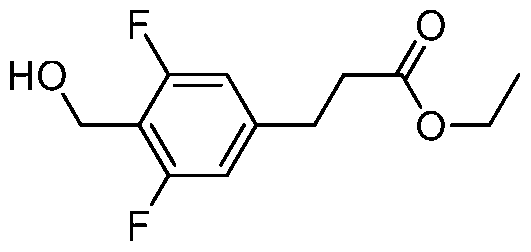
A solution of ethyl (2E)-3-[3,5-difluoro-4-(hydiOxymethyl)phenyl]prop-2-enoate (6.5 g, 26.84 mmol, 1.00 equiv) in methanol (25 mL) was treated with palladium carbon (650 mg) and H2 gas. The resulting solution was stirred overnight at room temperature, filtered, and concentrated to give the title compound as a light yellow oil.
Step 3: Ethyl 3-|"3,5-difluoro-4-|(methanes¾Ifon oxy)meth lphenyllpropanoate

A solution of ethyl 3-[3, 5-difluoro-4-(hydroxymethyl)phenyl]propanoate (900 mg, 3.68 mmol, 1.00 equiv) in dichioromethane (10 ml) was treated with TEA (1.12 g, 1 1.07 mmol, 3.00 equiv) dropwise with stirring, followed by MsCl (841 mg, 7.38 mmol, 2.00
equiv) dropwise with stirring. The resulting solution was stirred overnight at room temperature and concentrated under vacuum to give the title compound as a brown oil.

trifluoroacetic acid

TThhee ttiittllee ccoommppoouunndd wwaass pprreeppaarreedd aaccccoorrddiinngg ttoo tthhee pprroocceedduurree ddeessccrriibbeedd iinn EExxaammppllee 11 sstteepp 88 b byy ccoouupplliinngg 77--((44--cchhlloorroo--33--mmeetthhooxxyypphheennyyii))--ll --((44--fflluuoorroopphheennyyll))--44,,55,,66,,77--tteerrrraahhyyddrroo--llHH-- bbeennzzoo[[dd]]iimmiiddaazzoollee--22--tthhiiooll ((PPrreeppaarreedd aass ddeessccrriibbeedd iinn EExxaammppllee 11 SStteepp 77)) aanndd eetthhyyll 33--[[33,,55-- ddiifflluuoorroo--44--[[((mmeetthhaanneessuullffoonnyyllooxxyy))mmeetthhyyll]]pphheennyyll]] pprrooppaannooaattee iinn tthhee pprreesseennccee ooff (( "" \\··ΓΓΟΟ ..·· ttoo aaffffoorrdd tthhee ddeessiirreedd pprroodduucctt aass aa wwhhiittee ssoolliidd.. !!HH NNMMRR ((330000 MMHHzz,, C CDD33OODD)) δδ:: 77..1199 ((dd,, JJ == 88..00 HHzz,, 11HH)),, 66..9922--77..1188 ( (mm,, 33HH)),, 66..5511 ((dd,, JJ == 11..66 HHzz,, II II II )).. 66..4400--66..4422 ((mm,, 11HH)),, 44..1122--44..1177 ((mm,, 44HH)),, 44..0055 ((tt,, JJ == 3366..00 HHzz,, 11HH)),, 33..7744 ((ss,, 33HH)),, 227788--22..9999 ( (mm,, 44HH)),, 22..6677--22..7700 ( (mm,, 22HH)),, 22..2255-- 22..3311 ((mm,, HH ii )).. 11..9900--22..0099 ((mm,, 33HH)),, 11..2255 ((tt,, ..// 1144..44 HHzz,, 33HH)).. !!99FF N NMMRR ((440000HHzz,, CCDD33OODD)) 66:: --7777..0044,, --11 11 11..6600,, --11 1177..8811.. MMaassss ssppeeccttrruumm.. ((EESSII,, m m//zz)):: CCaallccdd.. foforr C C3344..33ftHsjijj55CCllFF66..4455 22OO55..33SS,, 661155..22 ( (MM--1.1 ..1155CCFF33CCOOOOHH++HH)),, ffoouunndd 661.155..11..
EExxaammppllee 4411;; 33~~((44~~((((77--((44--cchhlloorroo~~33~~mmeetthhooxxyvpyhheennvyll))~~ll~~((44~~fftluuoorroopphheennyyll))--44,,55,,66,,77~~

trifluoroacetic acid

A solution of ethyl 3-(4-((7-(4-chloro-3-methoxyphenyl)-l-(4-fluorophenyr)-4,5,6,7- tetrahydro-lH-benzo[d]imidazol-2-yllhio)methyl)-3,5-difluorophenyr)propanoate (500 mg, 0.81 mmol, 1.00 equiv) in toluene (5 mL) was treated with DIBAL-H (1 M) (2.1 mL) dropwise with stirring at 0 °C. The resulting solution was stirred for 2 h at 0 "C, quenched with 10 mL of water and filtered. The resulting solution was extracted with 3x20 mL of dichloromethane and the organic layers combined and concentrated under vacuum to give the title compound as a light yellow oil,
Ή NMR (300 MHz, CD3OD) δ: 7.19(d, ./ 8.0 Hz, H i).. 6.91-7.14 (m, 3H), 6.52 (s, 1H), 6.42 (d, J = 8.0 Hz, 1H), 6.20-6.22 (ni, 1H), 4.12-4.18 (m, 2H), 4.00 (s, 1H), 3.73 (s, 3H), 3.62 (d, J = 6.4 Hz, 2H), 2.73-2.94 (m, 4H), 2.28-2.3 l(m, 1H), 1.81-2.06 (m, 5H). !9F NMR (400Hz, CD3OD) δ: -77.07, -111.50, -118.14. Mass spectrum (ESI, m/z): Calcd. for C32.66H29.3 CiF6.99N2O4.66S, 573.1 (M-1.33CF3COOH+H), found 573.1.

mmeetthhooxx..yypphheeMMvvII))--ll--((44--flfl¾¾iioorroopphheeiiiivyll))--44,,55..66,,77--tteettrraahhvvddrroo--llHH--11..33--bbeeMMzzooddiiaa¾¾ooll--22--


A solution of 3-(4-((7-(4-chloiO-3-methoxyphenyl)-l-(4-fluoiOphenyl)-4,5,6,7- tetrahydro- 1 H-berizo[d]imidazol-2-ylthio)methyi)-3,5-difluorophenyl)propa.n- 1 -ol (200 mg, 0.35 mmol, 1.00 equiv), tert-butyl -[(lZ)-amino([[(tert-butoxy)carbonyl]amino]) niethyli dene] carbamate (110.49 mg, 0.43 mmol, 2.00 equiv), PP1¾ (137.94 mg, 0.53 mmol, 1.50 equiv), and tetrahydrofuran (5 niL) was treated with DIAL) (105.94 mg, 0.52 mmol, 1 ,50 equiv) dropwise with stirring. The resulting solutio was stirred overnight at 30 °C in an oil bath and concentrated under vacuum. Silica gel column chromatography with ethyl acetate/petroleum ether (1 : 1) gave the title compound as a brown oil. Mass spectrum (ESI, m/z): Calcd. For C41H47CIF3N5O5S, 814.3 (M+H), found 814.3.

irifhioroaeetie add

A solution of tert-butyl N-[(lZ)-[[(tert-butoxy)carbonyl]amino]([3-[4-([[7-(4-chloro-3- methoxyphenyl)- 1 -(4-fiuorophenyl)-4,5 ,6,7-tetrahydro- 1 H- 1 ,3-benzodia.zol-2- yl]sulfanyl]methyl)-3,5-difluorophenyi]propyl]a.mino)methyiidene]caTbam (280 mg,
0,34 mmol, 1.00 equiv) in dichloromethane (3 niL) was treated with CF3COOH (2 n L) dropwise with stirring. The resulting solution was stirred for 2 h at room temperature and concentrated under vacuum. Prep-HPLC purifications with the following conditions(l#-
Waters 2767-5): Column, SunFire Prep C18, 5μηι, 19* 100mm; mobile phase, Water of 0.05% trifiuoroacetic acid and CH3CN (20% CH3CN up to 50% in 8 min, up to 100% in 0.1 min, hold 100% in 1.9 min, down to 20% in 0.1 min, hold 20% in 1 ,9 min); Detector, UV 220&254nm, gave the title compound as a white solid. 1H NMR (300 MHz, CD3OD) δ: 7.19 (d, J = 8.1 Hz, IH), 6.91-7.18 (m, 4H), 6.52 (s, IH), 6.40-6.43 (m, 1H), 4.11-4.20 (m, 2H), 4.01 (t, J = 21.0 Hz, IH), 3.74 (s, 3H), 3.24 (d, J = 6.9 Hz, 2H), 2.71-2.88 (m, 4H), 1.88-2.29 (m, 6H). i9F NMR (300Hz, CD3OD): δ -77.05, -11 1.80, -117.61. Mass spectrum (ESI, m/z): Calcd. for C35.52H32.26ClF6.7sN5O3.52S, 614.2 (M-1.26CF3COOH+H), found 614.2.

The title compound was preared according to the procedure described in Example 12 Step 4 by mesylation of 3-[4-([[7-(4-chloro-3-methoxyphenyl)-l -(4-fluoropheny!)-4,5,6,7- tetrahydro- 1 H- 1 ,3-benzodiazol-2-yl] sulfanyl] methyl)-3,5-difluorophenyl]propan-l -ol to afford the desired product as a light yellow solid. Mass spectrum (ESI, m/z): Calcd, For C31H30CIF3N2O4S2, 651.1 ( M I I). found 651.1 .
Step 2: (E)-l-(3-(4-((7-(4-cfaloro-3-methoxy^
tetrafaydro-lH-benzoldlimidazoI-2-yltM
cv

A solution of 3-[4-([[7-(4-chloro-3-methoxyphenyl)-l -(4-fluorophenyl)-4,5,6,7- tetrahydiO-lH-l ,3-benzodiazol-2-yl]sulfanyl]methyl)-3,5-difluoiOphenyl] propyl methanesulfonate (550 mg, 0.23 mmol, 5.00 equiv), N,N-dimethylformamide (4 mL), sodium hydride (17 mg, 0.71 mmol, 3.07 equiv), and 2-amino-N-eyanoethanirnidamide (39 rng, 0.40 mmol, 1 .73 equiv) was stirred for 1 h at 60 C. The crude product was purified by Prep-HPLC with the following conditions Waters 2767-5): Column, SunFire Prep C18, 5μη , 19* 100mm; mobile phase, mobile phase, Water of 0.05% NH4HCO3 and CH3CN (10% CH3CN up to 30% in 8 min, up to 100% in 0.1 min, hold 100% in 1.9 min, down to 10% in 0.1 min, hold 10% in 1.9 min); Detector, IJV 220&254nm. Then used con.HCl to replace TFA to form HCl salt, to give the title compound as a white solid. !H
NMR (400MHz, CD3OD): δ 7.19-7.23 (m, 3H), 6.94-6 .99 (m, 3H), 6.53 (d, J = 2.0 Hz, IH), 6.41-6.44 (m, 1H), 4.16 (s, 2H), 4.02-4.05 (m, 1 }, 3.75 (s, 3H), 3.21-3.24 (m, 2H), 2.77-2.97 (m, 21 !). 2.69-2.73 (m, 2H), 2.26-2.32 no. IH), 2.07-2.08 (m, IH), 1.84-1.96 (nx 4H). f 9F NMR (400MHz, CD3OD): δ -1 11.1 1, -117.97. Mass spectrum (ESI, m/z): Calcd. For C32H31CI2F3N6OS, 639.2 (M-HC1+H), found 639.2.


A solution of ethyl 3-(4-((7-(4-chloro-3-methoxyphenyl)-l -(4-fiuorophenyr)-4,5,6,7- tetrahydj"0-lH-beiizo[d]imidazol-2-ylthio)methyl)-3,5-difiuorophenyl)propanoate (55 mg, 0,09 mmol, 1.00 equiv), methanol (3 mL), and LiOH (21.5 mg, 0.90 mmol, 10.04 equiv) was stirred overnight at room temperature. The pH value of the solution was adjusted to 5 with hydrogen chloride solution (2 mol/L). The resulting solution was extracted with 3x2 mL of ethyl acetate and the organic layers combined and concentrated under vacuum. The crude product was purified by Prep-HPLC with the following conditions: Column, SunFire Prep CI 8, 5 πι, 19* 100mm; mobile phase, Water of 0.05% trifluoroacetic acid and CH ( \ (20% CH3CN up to 90% in 10 min, up to 100% in 0.1 min, hold 100% in 1 .9 min, down to 20% in 0.1 min, hold 20% in 1.9 min); Detector, UV 22Q&254nm, to give the title compound as a white solid. Ή NMR (300 MHz, CD3OD) δ: 7.12-7.19 (m, 2H), 6.88-7.07 (m, 4H), 6.45-6.46 (m, 1H), 6.34-6.37 (m, 1H), 4,02-4.13 m(m, 2H), 3.94-3.98 (m, 1H), 3.68 (s, 31 1). 2.71-2.94 (m, 4H). 2.60-2.65 (m, 2H), 2.19-2.28 (m, i l l). 1.97-2.05 (m, 1H), 1.86-1.88 (m, 2H). 39F NMR (300 MHz, CD OD) 6: -76.72, -1 11.51, - 1 17.91. Mass spectrum (ESI, m/z): Calcd. for C32.4H27.2ClF6.6N2O5.4S, 587.1 (M- 5.2CF3COOH +H), found 587.3.
Example 45: 3~i4~ii7~f4~chloro~3~methoxyphenyl)-l~(4~^u rophenyl)~4.5,6, 7~ tetrakvdro-ni-henzo[d]imidazol-2-ylthw)methyl)-3,5- trifluoroacetic acid

A solution of 3-(4-((7-(4-chloro-3-methoxyphenyl)- 1 -(4-fluorophenyl)-4,5 ,6,7- tetrahydro- 1 H-benzo[d]imidazol-2-ylthio)methyl)-3,5-difluorophenyr)propanoic acid (400 nig, 0.65 nimol, 1.00 equiv), methanol (4 niL), and ammonia (10 niL) was stirred overnight at 30 "C. The resulting mixture was concentrated under vacuum and was purified by Prep-HPLC with the following conditions: Column, SunFire Prep CI 8, 5μηι, 19* 100mm; mobile phase, Water of 0.05% trifluoroaeetic acid and C¾CN (20% CH3CN up to 90% in 10 min, up to 100% in 0.1 min, hold 100% in 1.9 mi , down to 20% in 0.1 min, hold 20% in 1.9 min); Detector, UV 220&254nm, to give the title compound as a white solid. Ή NMR (300 MHz, CD3OD) δ: 7.18 (d, J= 8.0 Hz, 3H), 6.94 (d, J = 8.8 Hz, 3H), 6.52-6.52 (m, 1H), 6.40-6.43 (m, 1H), 4.09-4.17 (m, 2H), 4.03 (t, J = 5.6Hz, 1H), 3.74 (s, 3H), 2.89-2.99 (m, 3H), 2.78-2.85 (m, I I I). 2.55-2.59 (m, 2H), 2.26-2.33 (m, i l l). 2.07-2.10 (m, 1H), 1.90-1.98 (m, 2H). 19F NMR (300 MHz, CD3OD) δ:-77.31 , -1 1 1 .29, - 1 18.00.Mass spectrum (ESI, m/z): Calcd. for C32.4H2g.2ClF6.6N3O4.4S, 586.2 (M- .2CF3COOH +FI), found 586.2.
Example 46: 3~(4~((7~(4~chloro~3~methoxyphenyl)-l-(4~ft oroyhenyl)~4,5,6, 7~ tetrahvdro~lH~henzoid]imidazol~2~ylthio)methyl}~3,5~dW
trifluoroaeetic acid

A solution of 3-(4-((7-(4-chloro-3-methoxyphenyl)- 1 -(4-fluorophenyl)-4,5 ,6,7- tetrahydro-lH-beiizo[d]imidazol-2-ylthio)methyl)-3,5-difluorophenyl)propanamide (1 10 nig, 0.19 mmol, 1.00 equiv), dioxane (6 mL), and pyridine (30 mg, 0.38 mmol, 2.02 equiv) was treated with TFAA (43.4 mg, 0.21 mmol, 1.10 equiv) dropwise at 0 °C, and stirred for 4 h at room temperature. The resulting mixture was concentrated under vacuum and purified by Prep-HPLC with the following conditions ( Waters 2767-5): Column, SunFire Prep CI 8, 5μηι, 19* 100mm; mobile phase, Water of 0.05% trifluoroacetic acid and C¾CN (20% CH3CN up to 90% in 10 min, up to 100%) in 0.1 min, hold 100% in 1.9 min, down to 20% in 0.1 min, hold 20% in 1.9 min); Detector, UV 220&254nm, to give the title compound as a white solid. !H NMR (300 MHz, CD3OD) δ: 7.18 (d, J=8.4Hz, 3H), 7.03 (d, ./ 8,41 1/. IB), 6.50-6.51 (m, i l l ). 6.40-6.42 (m, i l l ). 4.15-4.20 (m, 2H), 4.01 -4.02 (m, IB), 3.73 (s, 3H), 2.82-3.02 (m, 6H), 2.25-2.31 (m, 1H), 2.01 -2.10 (m, 1 F1), 1.89-1.92 (m, 2H). 19F NMR (300 MFlz, CD3OD) δ: -77.75, - 1 1 1.29, - 1 1 8.00. Mass spectrum (ESI, rn/z): Calcd. for C32.6H26.3ClFe.9 3O3.6S, 568.1 (M- 1.3CF3COOH +H), found 568.3.
Example 47; (Έ) '■~2~(3~(4-((7-(4-chioro~3~methoxvvhenvl)~l~(' 4-fluorophewl)-4,5,6, 7- tetrahvdro-lH benzo[d]imidazol-2-vlthio)methvl)-3,5-difluo, rophenvl) pwpvlidene) hvdrazinecarboximidamide hvdrochlori de
Step 1 : 3 4-([[7- i4-chloro-3-methoxyphenvl)-1 -(4-fluoroohe :nvD-4,5,6,7-tetrahvdro- lil-l-S-benzodiazoI- -vIlsulfanyllmethvn-S^S-difluorophenvtlpropaaa]

The title compound was prepared according to the procedure described in Example 37, step 1 by DIBAL reduction of 3-(4-((7-(4-chloro-3-methoxyphenyl)-l-(4-fluorophenyl)- 4,5,6,7-tetrahydro-lH-benzo[d]imidazol-2-ylthio)methyl)-3,5- difluorophenyl)propanenitrile to afford the desired product as a white solid. Mass spectrum (ESI, m/z): Calcd. for C30H26CIF3N2O2S, 571.1 (M+H), found 571.1.

A solution of 3-[4-([[7-(4-chloro-3-methoxyphenyl)-l-(4-fluorophenyl)-4,5,6,7- tetrahydro- 1 H- 1 ,3-benzodiazol-2-yI] sulfanyljmethy l)-3 ,5-difj.uorophenyl]propanal ( 100 mg, 0.18 mmol, 1.00 equiv), ethanol (4 mL), and 1 -armnoguanidine (31 mg, 0.42 mmol, 2.39 equiv) was stirred overnight at 70 °C. The crude product was purified by Prep-HPLC with the following conditions : Column, SunFire Prep C18, 5μηι, 19* 100mm; mobile phase, water with 0.05% trifluoroacetic acid and CH3CN (10% CH3CN up to 30% in 8 min, up to 100% in 0.1 min, hold 100% in 1 .9 min, down to 50% in 0.1 min, hold 10% in 1.9 min); Detector, UV 220&254nm. Then used con.HCl to replace TFA to form HCl salt, to
give the title compound as a white solid. 3H MR (300 MHz, CD3OD) 5: 7.58-7.60 (m, 1H), 7.12-7.39 (m, 3H), 6.74-7.08 (m, 4H), 6.54 (s, 1H), 6.43-6.45 (d, J~ 7.6 Hz, 1 H), 4.13-4.22 (m, 2H), 4.05 (s, 1H), 3.74 (s, 3H), 2.83-3.00 (m, 4H), 2.66-2.78 (m, 2H), 2.24- 2.35 (m, 1H), 2.06-2.1 1 (m, 1H), 1.93-1.96 (m, 2H). !9F NMR (300 MHz, CD3OD) 5: - 1 1 1.14, - 1 17.63. Mass spectrum (ESI, m/z): Calcd. for ( ' : i l I : :\.:,()S. 627.2 (M- HCl+H found 627.0.

The title compound was prepared according to the procedure described in Example 47 step 2 by coupling 3-[4-([[7-(4-chloro-3-methoxyphenyl)-.l -(4-fluorop enyl)-4,5,6,7- tetrahydro-lH-l ,3-benzodiazol-2-y3Jsulfanyl]methyl)-3,5-difluotOphenyl]propanal
(Prepared as described in Example 47, Step 1) and (E)-N'-methylhydrazine carboximidamide to afford the desired product as a white solid.
!H NMR (400MHz, CD3OD): 6 7.58 (s, I H), 7.19-7.23 (m, 3H), 6.87-7.07 (m, 3H), 6.54 (d, J = 1.2 Hz, I H), 5.95-6.45 (m, 2H), 4.19 (q, 2H), 4.04-4.05 (m, I H), 3.75 (s, 3H), 2.72- 3.02 (m, 6H), 2.64-2.72 (m, 2H), 2.28-2.34 (m, I H), 2.07-2.1 1 (m, IH), 1 .94-1.97 (m, 2H). 19F NMR (400MHz, CD3OD): δ -1 1 1.19, -1 17.62. Mass spectrum (ESI, m/z): Calcd. for CsH6BrF03, 641.2 (M-HCKH), found 641.2.
Example 49: 2~(4~(2~(lH~ietrazol~S~yl}eihyl)~2,6-diflu ' henzv
methoxyphenv^)-l-(4-fiuorophenyl)-4,5,6, 7-tetrahydro-lH-benzofdjim^
trifluoto cetic acid

A solution of 3-(4-((7-(4-chioro-3-methoxyph^
te1rahydro-lH-benzo[d]irnidazol-2-yl&^
(Prepared as described in Example 46, 25 mg, 0.04 mmol, 1.00 equiv), toluene (2 mL), TMS-N3 (20 mg, 0.17 mmol, 3.95 equiv), and n-B¾SnO (1 1 mg, 0.04 mmol, 1.00 equiv) was stirred overnight at 110 "C. The reaction was then quenched by the addition of 5 mL of water, extracted with 2x10 mL of dichioromethane, and the combined organic layers were dried over anhydrous sodium sulfate and concentrated under vacuum. The crude product was purified by Prep-HPLC with the following conditions (1#- Waters 2767-5): Column, SunFire Prep CI 8, 5μηι, 19* 100mm: mobile phase, Water of 0,05% TFA and CHjCN (20% CH3CN up to 50% in 8 min, up to 100% in 0.1 min, hold 100% in 1.9 min, down to 2G%> in 0.1 min, hold 20% in 1.9 min); Detector, UV 220&254nm, to give the title compound as an off-white solid. !H NMR (300 MHz, CD3OD) δ: 6.88-7.17 (ni, 61 1). 6.53-6.53 (m, IH), 6.40-6.43 (m, IH), 4.01-4.15 (m, 3H), 3.74 (s, 3H), 3.13-3.19 (m, 2H), 2.77-2.93 (m, 21 1). 2.26-2.30 (m, IH), 2.04-2.06 (m, IH), 1.87-1.95 (m, 2H). 39F NMR (300 MHz, CD3OD) δ: -77.07, -1 11.75, -117.37. Mass spectrum (ESI, m/z): Calcd. for C32.8H27.4CIF7.2N6O3.8S, 611.2 (M-1.4CF3COOH +H), found 611.4.


A solution of (3,5-difluoropyridin-4-yl)methanol (100 mg, 0.69 mmol, 1.00 equiv), dichloromethane (8 mL), and TEA (209 mg, 2.07 mmol, 3.00 equiv) was treated with MsCi (157 mg, 1.38 mmol, 2.00 equiv) dropwise with stirring at 0 °C, stirred for 4 h at room temperature and concentrated under vacuum to give the title compound as a yellow oil. Mass spectrum (ESI, m/z): Calcd. for C7H7F2NO3S, 224.0 (M+H), found 224.0.
Ste 3 : 7-( -cMoro-3-metIioxyplieiiyl)-2-((3 « 5-diflHoropyri din-4-yI)methy ¾tMo)-l -(4-

solution of (3,5-difkioropyridin-4-yl)mefhyi methanesulfonate (34.3 mg, 0.15 1.00 equiv), acetone (6 mL), potassium carbonate (64 mg, 0.46 mmol, 3.01 equiv),
and 7-(4-chloro-3-methoxyphenyl)-l -(4-fluorophenyr)-4,5,6,7-tetrahydro-lH- benzo[d]imidazole-2-thiol (Prepared as described in Example 1 Step 7, 60 mg, 0.15 mmol, 1.00 equiv) was stirred overnight at room temperature. The crude product (3 mL) was purified by Prep-HPLC with the following conditions (1#-Waters 2767-5): Column, SimFire Prep CI 8, 5μηι, 19*100mm; mobile phase, Water of 0.05% trifluoroacetic acid and CH3CN (20% CH3CN up to 90% in 8 min, up to 100% in 0.1 min, hold 100%) in 1.9 min, down to 20% in 0.1 min, hold 20%) in 1.9 min); Detector, UV 220&254nm, to give the title compound as a white solid. JH NMR (300MHz, CD3OD): δ 8.35 (s, 2H), 7.11 (d, J = 8.4 Hz, 2H), 6.98 (br, 2H), 6.48 (s, 1H), 6.36 (dd, J = 8.1 , 2.1Hz, 1H), 3.99-4.13 (m, 3H), 3.83 (s, 3H), 2.77 -2.82 (m, 2H), 2.25-2.28 (m, 1H), 1.94-2.03 (m, 1H), 1.86-1 .87 (m, 2H). ]9F NMR (300MHz, CD3OD): δ -77.00, -112.98, -131.68. Mass spectrum (ESI, m/z): Calcd. for C26H2iClF3N3OS, 516.0 (M-0.4CF3COOH+H), found 516.0.

A solution of (3 ,5-difluoropyridin-4-yl)methyl methanesulfonate (86 mg, 0.39 mmol, 1 ,00 equiv), acetone (6 mL), potassium carbonate (160 mg), and 7-(4-chloro-3- m£thoxypheny3 -l-(4-fjuorophenyl)-4,5,6,7-tetrahydro-l H-benzo[d]imidazole-2 hiol (Prepared as described in Example 1 Step 7, 150 mg, 0.39 mmol, 1.00 equiv) was stirred overnight at room temperature. The mixture was concentrated under vacuum and purified by Prep-HPLC with the following conditions (1#- Waters 2767-5): Column, SunFire Prep CI 8, 5μιη, 19* 100mm; mobile phase, mobile phase, Water of 0.05%) trifluoroacetic acid and CH3CN (20%> CH3CN up to 80% in 8 min, up to 100% in 0.1 min, hold 100% in 1.9
min, down to 20% in 0.1 min, hold 20% in 1.9 min); Detector, UV 220&254nm. The solvent was removed under vacuum. Then 4.0mL H?0 and 4 drops of con.HCl was added. The water was removed again. This operation was repeated twice. Then after water and HC1 were added, it was lypophiiized, to give the title compound as a yellow solid. !H- NMR (400MHz, CD3OD): δ 8.47 (s, 2H), 7.31-7.32 (m, 1H), 7.17 (d, J = 8.0 Hz, 1H), 6,95-6.96 (s, 1H), 6.62-6.68 (m. 1 1 1). 6.54 (s, 1H), 6.43 (d, ,/ 7.6 Hz, 1H), 4.10-4.28 (m, 3H), 3.75 (s, 3H), 2.80-2.97 (m, 2H), 2.29-2.33 (m, 1H), 2.08-2.12 (m, 1H), 1.89-1.97 (m, 2H). i9F-NMR (400MHz, CD3OD): δ -110.88, -131.59. Mass spectrum (ESI, m/z): Calcd. for C26H21 CIF3 3OS, 516.1 (M-HC1+H), found 516.2.

The title compound was prepared according to the procedure described in Example 1 step 8 by coupling 7-(4-chioro-3-methoxyphenyi)-l-(4-fluorophenyl)-4,5,6,7-tetrahydro- lH-benzo[d]imidazole-2-thiol (Prepared as described in Example 1 Step 7) with 4- (bromomethyl)-3-fluoropyridine in the presence of CS2CO3 to afford the desired product as a white solid.
Ή MR (400MHz, CD3OD): δ 8.48 (s, 1H), 8.37-8.39 (m, 1H), 7.29-7.32 (m, 1H), 6.51- 7.30 (m, 4H), 6.39-6.51 (m, 2H), 4.93 (s, 1H), 4.17-4.25 (m, 1H), 4.05-4, 19 (m, 1H), 3.73(s, 3H), 2.80-3.33 (m, 2H), 2.26-2.33 (m, 1H), 1.88-2.08 (m, 2H) . !9F NMR
(400MHz, CD3OD): -77.29, -111.24, -133.74, Mass spectrum (ESI, m/z): Calcd. for C29H23.5C1F6.5N304S, 498.1 (M-1.5CF3COOH+H), found 498.2.
Example 52: 2-((3-fluoropyridin-2-yl)methylthio)-7-(4-chloro-3-methoxyphenyl)-l-(4- fluorophenyl)-4, 5, 6, -tetrahydro-lH-benzofdjimidazole trifluoroacetic add

The title compound was prepared according to the procedure described in Example 1 step 8 by coupling 7-(4-chioro-3-methoxyphenyi)-l-(4-fluorophenyl)-4,5,6,7-tetrahydro- lH-benzo[d]imidazole-2-fhiol (Prepared as described in Example 1 Step 7) with 2- (bromomethyl)-3-fluoropyridine in the presence of CS2CO3 to afford the desired product as a yellow solid.
Ή NMR (300MHz, CD3OD): δ 8.34 (d, J = 4.8 Hz, 1H), 7.63-7.68 (m, 1H), 7.47-7.50 (m, 1H), 7.28 (br, 4H), 6.44-6.54 (m, 2H), 4.22 (s, 2H), 4.03-4.07 (m, 1H), 3.73 (s, 3H), 2.76- 2.92 (m. 2H), 2.26-2.34 (m, 1H), 1.89-2.08 (m, 3H). i9F NMR (300MHz, CD3OD)i -77.09, -111.30, -125.10. Mass spectrum (ESI, mix): Calcd. for C29.2H23.6ClF6.gN3O4.2S, 498.1 (M-L6CF3COOH+H), found 498.1.

A solution of 5-cblotO-4-metbylpyrimidine (500 mg, 3.89 mmol, 1.00 equiv), AcOH (10 rnL), and (750 mg, 4.69 mmol, 1 .20 equiv) was stirred for 30 min at 80 °C in an oil bath. The resulting mixture was concentrated under vacuum, diluted with 50 mL of H20, extracted with 3x50 mL of dichloromethane, and the combined organic layers were washed
with 1x50 mL of brine, filtered, and concentrated. Chromatography on a silica gel column with ethyl acetate/petroleum ether (1 :3), to give the title compound as a light yellow oil.

flttorophenyl)-4,5.,6,7-tetrahydro-lH-beiizo|dlimidazoIe trifhioroacetie acid

The title compound was prepared according to the procedure described in Example 1 step 8 by coupling 7-(4-chloro-3-methoxyphenyl)-l-(4-fluorophenyl)-4,5,6,7-tetrahydro- lH~benzo[d]imidazole-2-thiol (Prepared as described in Example 1 Step 7) with 4- (bromomethyl)~5-chloropyrmiidine in the presence of (.' ■('()·. to afford the desired product as a white solid.
JH N.MR (400MHz, CD3OD): δ 8.87 (s, 1H), 7.51 (s, 1H), 7.18 (d, J = 9.0 Hz, 2H), 6.92- 7.14 (m, 2H), 6.53 (s, 1H), 6.44 (d, J = 1.8 Hz, 1H), 4.15 (d, J = 13.5 Hz, 2H), 4.03-4.1 1 (m, 1H), 3.73 (s, 3H), 2.73-2.92 (m, 2H), 2.25-2.35 (m, 1H), 1.87-2.06 (m, 3H). ,9F NMR (400MHz, CD3OD): 6 -77.14, -111.78. Mass spectrum (ESI, m/z): Calcd. for C26.08H2i.54Cl2F2.62N4O2.08S, 515.1 (M-O.54CF3COOH+H), found 515.1.

fluorophenyl)~4,5,6, 7~tetrahvdro~lH~benzoid]imidazole trifluoroacetic acid

The title compound was prepared according to the procedure described in Example 1 step 8 by coupling 7-(4-chioro-3-methoxyphenyi)-l-(4-fluorophenyl)-4,5X>,7-tetrahydro- lH-benzo[d]imidazole-2-thiol (Prepared as described in Example 1 Step 7) with 4- (bromomethyl)-3,5-dichloropyridine in the presence of Cs2C03 to afford the desired product as a white solid.
Ή NMR (300MHz, CD3OD): δ 7.13 (d, J= 8.1 Hz, IH), 6.91-6.9(5 (m, IH), 6.76 (d, J = 6.0 Hz, IH), 6.42-6.50 (m, IH), 4.15-4.26 (m, 2H), 3.92-4.04 (m, IH), 3.72 (s, 3H), 2,72- 2.87 (m, 21 1). 2.22-2.30 (m, IH), 2.02-2.08 (m, IH), 1.83-1.97 (m, 2H). ¾9F NMR
(300MHz, CD3OD)i δ -77.04, -113.04. Mass spectrum (ESI, m/z): Calcd. for
C28.8H22.4Cl3F5.2N3O3.sS , 548.0 (M-1.4CF3COOH+H), found 548.1.
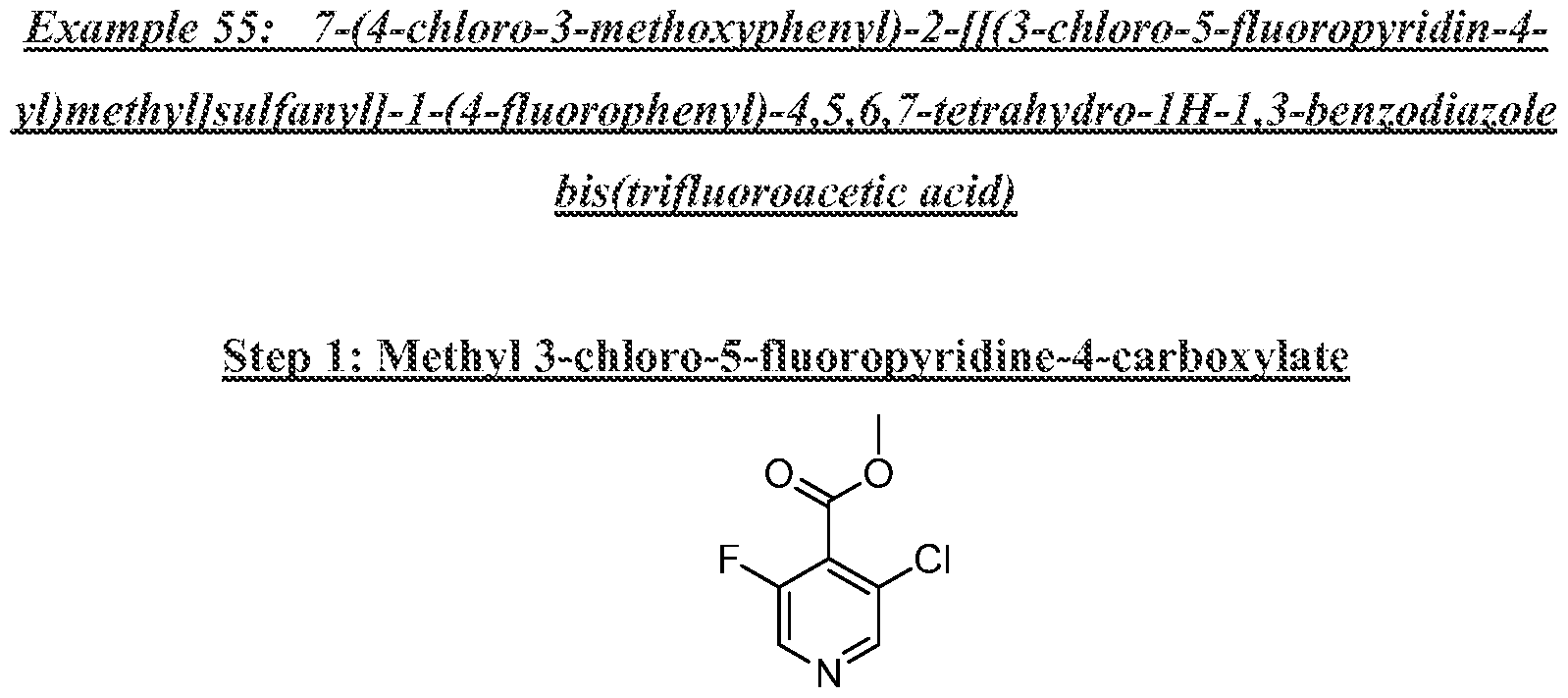
A solution of 3-chloro-5-fluoropyridine-4-carboxylic acid (100 mg, 0.57 mmo!, 1 .00 equiv) in dichloromethane (2 mL) was treated with thionyl chloride (68 mg) dropwise with stirring at 0 C. After stirring 2.0 h at 40 °C, methanol (2 mL) was added, and the resulting
solution was stirred for 10 min at room temperature, concentrated under vacuum, and quenclied by the addition of 3 mL of sodium bicarbonate/TLO. The reaction was extracted with 3x3 mL of dichloromethane and the combined organic layers combined were dried over anhydrous sodium sulfate, filtered, and concentrated to give the title compound as a yellow oil. Mass spectrum (ESI, m/z): Calcd. for C7H5CIFNG2 , 190.0 (M+H), found 190.0.

A solution of 3-chloro-5-fluoropyridine-4-carboxylate (80 mg, 0.42 mmol, 1.00 equiv) in tetrahydrofuran (2 mL) was treated with DIBAL-H (0.85 mL, 2.00 equiv) dropwise with stirring at -78 °C. The resulting solution was stirred for 3.0 h at room temperature and quenched with 2 mL of water. The reaction was extracted with 4x3 mL of ethyl acetate, and the combined organic layers were dried over anhydrous sodium sulfate, filtered, and concentrated, Preperatory chromatography with ethyl acetate/ petroleum ether (1 :5) gave the title compound as a yellow oil. Mass spectrum (ESI, m/z): Calcd. for CeH5ClFNO, 162.0 (M+H), found 162.0.

The title compound was prepared according to the procedure described in Example 50 step 2 by mesyiation of (3-chloro-5-fluoropyridin-4-yl)methanol to afford the desired product as a white solid.
Mass spectmm (ESI, m/z): Calcd. for C7H7CIFNO3S , 240.0 (M+H), found 240.0.
Step 4: 7-(4-chloro-3-methoxypheayI)-2-[[(3-chIoro-S-fluoropyridiii-4-

bis(trifluoroacetic acid)

The title compound was prepared according to the procedure described in Example 1 step 8 by coupling 7-(4-chioro-3-methoxyphenyi)-l-(4-fluorophenyl)-4,5,6,7-tetrahydro- lH-benzo[d]imidazole-2-fhiol (Prepared as described in Example 1 Step 7) with (3- chloro-5-fluoropyridiii-4-yl)metliyl methanesulfonate in the presence of Cs CO *, to afford the desired product as a white solid.
Ή NMR: (400MHz, CD3OD)i δ 8.44-8.48 (m, 2H), 7.56-7.69 (m, 2H), 7.01-7.16 (m, 4H), 6.51 (d . J 1.6Hz, 1H), 6.40-6.42 (m, i l l ). 4.04-4.23 (m . 3H), 3.73 (s, 31 1 ). 2.76-2.91 (m, 2H), 2.26-2.32 (m, 1H), 1.89-2.08 (m, 3H). 19F NMR (400V! Hz. CD3OD)i -77.12, - 1 11.98,-130.52. Mass spectrum (ESI, m/z): Calcd. for
 , 532.1 (M- 2.OCF3COOH+H), found 532.2.

Step I t (3-broino-5-fluoropyridiii-4-yl)metliaMoI


A solution of (3-bromo-5-fluoropyridin-4-yl)m.ethanol (50 mg, 0.24 mmol, 1 .00 equiv) in dichloromethane (2 mL) was treated with TEA (73.9 mg, 0.73 mmol, 3.01 equiv) dropwise with stirring at 0 °C, followed by MsCi (33.7 mg). The resulting solution was stirred for 2.0 h at room temperature and concentrated under vacuum. Silica gel column chromatography with ethyl acetate/petroleum ether (1 :5) gave the title compound as a white oil. Mass spectrum (ESI, m/z): Calcd. for C6H4BrClFN, 223.9 (M+H), found 223.9.
Ste 3 ; 2-((3-b^
l-(4-fl¾ioropIieiiy¾)-4,S,6., -tetrahydro-lH-bei¾zo [d| imidazole trifluoroacetic acid

The title compound was prepared according to the procedure described in Example
1 step 8 by coupling 7-(4-chloro-3-methoxyphenyl)-l-(4-fluoroplienyI)-4,5,6,7-tetrahydro-
1 H-benzo[d]imidazole-2-thiol (Prepared as described in Example 1 Step 7) with 3-bromo-
4-(c oromethyl)-5-fluoropyridine in the presence of CS2CO3 to afford the desired product
as a white solid. Ή NMR (300MHz, CD3OD): δ 8.60 (s, 1H), 8.46 (s, 1H), 7.04-7.16 (m, 4H), 6.40-6.52 (m, 2H), 4.07-4.28 (m, 3H), 3.73 (s, 3H), 2.79-2.96 (m, 2H), 2.27-2.35 (m, 1H), 2.03-2.13 (m, 3H). !9F NMR (300MHz, CD3OD): -77.26, -11 1.35,-128.99. Mass spectrum (ESI, m/z): Calcd. for C29.6H22.sBrClF7.4N3O4.6S, 576.0 (M-I.8CF3COOH+H), found 576.0.

The title compound was prepared according to the procedure described in Example 1 step 8 by coupling 7-(4-chloro-3-methoxyphenyl)- 1 -(4-fluorophenyl)-4,5 ,6,7-tetrahydro- lH-benzo[d]imidazole-2-thiol (Prepared as described in Example 1 Step 7) with 2- (bronioiiiethyl)pyrimidine in the presence of Cs2C03 to afford the desired product as a white solid. 3H NMR (300MHz, CD . ·()!.>): δ 8.75 (s, 2H), 7.43-7.46 (m, 1H), 6.97-7.23 (m, 3FI), 6.45-6.55 (m, 2F1), 4.32-4.48 (m, 2F1), 4.05-4.27 (m, IK), 3.74 (s, 3H), 2.77-2.93 (m, 2H), 2.27-2.35 (m, 1H), 1 .91-2.09 (m, 3H). Mass spectrum (ESI, m/z): Calcd. for ί ;Η.Μ(ΊΓ · \ :ί>.;8. 481.0 (M-2CF3COOH+H), found 48 .0.
Example 58; 2~((3~chlorothiovhen-2-yl)methylthio)~7~(4~chloro-3-metho
fluorophenyl)-4.5t6, 7-tetrahvdro-lH~benzo[d]imid zole trifluoroacetic acid

The title compound was prepared according to the procedure described in Example 1 step 8 by coupling 7-(4-chloro-3-metiioxyphenyl)-l-(4-fluorophenyl)-4,5,6,7-tetrahydiO- l H-benzo[d]imidazole-2 -thiol (Prepared as described in Example 1 Step 7) with 3-chloro- 2-(chloromethyl)thiophene in the presence of (¾€(¾ to afford the desired product as a white solid. Ή NMR (300MHz, CD3OD): 5 7.52(d, J = 5.4 Hz, IH), 6.91-7.16 (m, 4H), 6.40-6.51 (m, 2H), 4.31-4.41 (m, 2H), 4.01 -4.05 (t« . IH), 3.73 (s. 3H), 2.81-2.94 (m, 2H), 2.25-2.33 (m, IH), 2.08-2.10(m ). i9F NMR (300MHz, CD3OD): δ -77.1 1 , -1 1 1.77. Mass spectrum (ESI, m/z): Calcd. for C28.2H22.6Cl2F5.8 2O4.2S2 , 519.0 (M-I .6CF3COOH+H), found 519.0.
-cmoro-J-metnoxvi l oropnem zoia imiaazoi iinuoropvnaine i-oxiae trmiioroacenc acid

A solution of (3,5-difluoropyridin-4-yl)methanol (150 mg, 1.03 mmol, 1.00 equiv), ethylene glycol dimethyl ether (2 mL), and heptane (4 inL) was treated with mCPBA (178 mg, 1 .03 mmol, 1.00 equiv) in several batches at 0 °C. The resulting solution was stirred overnight at room temperature and filtered to give the title compound as a white solid. Mass spectrum (GC, m/z): Calcd. for (\·,! 1 · !·Ά'() 162.0 (M+l), found 162.0.
Step 2: 3, 5-difluoro~4-f(methanesuIfon>1oxy)me^

The title compound was prepared according to the procedure described in Example 50 step 2 by mesylation of 3, 5-dif3.uoro-4-(hydroxymethyl)pyridin-l-ium-l -olate to afford the desired product as a white solid. Mass spectrum (ESI, m/z): Calcd. for C7H7F2NO4S, 240.0 (M+H), found 240.0.
Step 3: 4-((7-{4-c¾Ioro-3-met¾oxyp¾e¾yi)-l-(4-i¾orop¾ei¾yl)-4,S,6,7-tetr¾!iydro-lH- beiizojdjimid¾zoI-2-yIt¾io)s¾etiiyI)-3,5-dif¾iiOi pyriciiiie 1-oxide trifhioroacetie acid

The title compound was prepared according to the procedure described in Example 1 step 8 by coupling 7-(4-chloro-3-methoxyphenyr)-l-(4-fluorophenyl)-4,5,6,7-tetrahydro- lH-benzo[d]imidazole-2-thiol (Prepared as described in Example 1 Step 7) with 3, 5- difluoro-4-[(methanesulfonyloxy)inethyl]pyridin- 1 -ium- 1 -olate in the presence of CS2CO3 to afford the desired product as a white solid. Ή NMR (400MHz, CD3OD): 8.40-8.43 (m, 2H), 7.05-7.17 (m, 5H), 6.53 (d, J = 2.0 Hz, IH), 6.41-6.43 (m, IH), 4.03-4.14 (m, 3H), 3.74 (s, 3H), 2.78-2.92 (m, 2H), 2.27-2.33 (m, IH), 2.02-2.08 (m, IH), 1.88-1.96 (m, 21 1). ,9F NMR (400MHz, CD3OD): δ -77.37, -1 11.56, -127.30. Mass spectrum (ESI, m/z): Calcd. for Γ.,,Η ^ΠΓ-.,Ν } ^. 532.1 (M+H), found 532.1.


The title compound was prepared according to the procedure described in Example 50 step 2 by mesylation of (3,5-dibromopyridin-4-yl)methanol to afford the desired product as a white solid. Mass spectrum (ESI, m/z): Calcd. for C7H7Br2N03S, 343.9 (M+H), found 343.9.
Step 2 : 2-((3,5-dibromop yridia-4-vI)methyIt io)-7-(4-chIoro-3-met hoxyphenvD-1 -(4- fluoropheny -4,5.,6,7-tetrahYdro-lH-ben¾o[d]imidazole

The title compound was prepared according to the procedure described in Example I step 8 by coupling 7-(4-cWoro-3-methoxyphenyl)-l-(4-fiuorophenyl)-4,5,6,7-tetrahydro- l H-benzo[d]imidazole-2-thiol (Prepared as described in Example 1 Step 7) with (3, 5- dibromopyridin-4-yI)methyl methanesulfonate in the presence of Cs2C03 to afford the desired product as a white solid. !H MR (400MHz, CD3OD): δ 8.65 (s, 2H), 6.97-7.27 (m, 3H), 6.51-6.64 (m, 1H), 6.43-6.45 (m, 1H), 4.25-4.37 (m, 2H), 4.11-4.13 (m, 1H), 3.73 (s, 3H ), 2.81-2,95 (in, 2H), 2.29-2.35 (m, 1H), 2.07-2.11 (m, 1H), 1.87-1.96 (m, 2H). 19FNMR (400MHz, CD3OD): δ -77.26, -1 11.55. Mass spectrum (ESI, m/z): Calcd. for C2s.6H22.3Br2ClF4.9 3O3.6S, 635.9.9 (M-1.3 CF3COOH+H), found 635.9.

henzgdiaz j
Step 1 ; 2-{4-ciiIoro-3-metiioxyp!¾es¾ )-4-met!¾ykyciohexai¾-l-Oiie

The title compound was prepared according to the procedure described in Example 1 step 1 by coupling 4-methylcyclohexanone and 4-bromo-l-chloro-2-methoxybenzene to afford the desired product as a yellow solid. Mass spectrum (ESI, m z): Calcd. for
Ci4H,7C102, 253.1 (M+H), found 253.1 ,

The title compound was prepared according to the procedure described in Example 1 step 2-7 to afford the desired product as a yellow solid. Mass spectrum (ESI, m/z): Calcd. for C21H20CIFN2OS, 403.1 (M+H), found 403.1 .


The title compound was prepared according to the procedure described in Example 1 step 8 by coupling 7-(4-chloro-3-methoxyphenyl)- l-(4-fluorophenyi)-5-methyi-4, 5, 6, 7- tetrahydro- 1 H- 1 ,3-benzodiazole-2-thiol with 2-(bromomethyl)~ 1 -c oro-3-fluorobenzene in the presence of ( CO s to afford the desired product as a w hite solid, Ή NMR (300 MHz, CD3OD) 5: 7.15-7.25 (m, 2H), 6.95-7.01 (m, 4H), 6.29-6.32 (m, 2H), 4.01 -4.02 (m, 2H), 3.85-3.95 (m, U S ). 3.62(s, 3H), 3.65-3.75 (m, 1H), 2.30-2.40 (m, 1H), 2.00-2.15 (m, 2H), 1.40-1.55 (m, 1H), 1.10 (d, J = 6.6 Hz, 3H). Mass spectrum (ESI, m/z): Calcd. for (· >! !.■ :n.'F :N <OS. 545.1 (M+H), found 545.1.


The title compound was prepared according to the procedure as described in Example 1 step 1 reacting cyciohexanone and 1 -bromo-3 ,4-dimethoxybenzene as a white solid.
Ή NMR (400 MHz, CDCI3) δ 6.85 (d, J = 8.1 Hz, 1H), 6.68 (d, J = 7.8 Hz, 1H), 6.65 (s, 1 H), 3.87 (s, 6H), 3.55 (dd, J - 8.5, 5.2 Hz, 1 1 1 ;·. 2.51 (m, 2H), 2.31 (m, I I I ). 2.15 (m, IH), 2.03 (m, 21 1 ;·. 1.82 (m, 2H).
Step 2s 2-bromo-6-(3,4-dimethox 7phenyI)cyclohexaiione and 2-bromo-6-(2-bromo- 4 -dimethoxypheiiyI)cyclohexanone a¾d 2-bromo-6-(2,3-dibromo-4,5-

The title compound was prepared according to the procedure as described in Example 1 step 2-3 reacting 2~(3,4-dimethoxyphenyl)cyc!ohexanone with T SOTf/TEA followed by NBS as mixtures of a light yellow solid.
2-bromo-6-(3,4-dimethoxyphenyl)cyclohexanone (major isomer):
' ! ! N R (400 MHz, CDCI3) δ 7.05 (s, i l l ). 6.85 (IH), 4.15 (m, 1 1 1 ). 3.89 (s, 6H), 2.82 ( m.
1H), 2.10 (m, 2H), 1.38 (m, 2H), 1.10 Cm. 2H).
2-bromo-6-(2-bromo-4,5-dimethoxyphenyl)cyciohexanone:
ESI-MS (m z): Caicd. For Ci4H] 6Br203: 392.1; found: 312 (M-Br+H).
2-bromo-6-(2,3-dibromo-4,5-dimethox.yphenyl)cyclohexanone:
ESI-MS (m/z): Caicd. For Ci4H] 5Br303: 471.0; found: 391 (M-Br+H).
Step 3 : 2-a¾ido-6- -dimet hoxyphenyDc yclohexaaone

The title compound was prepared according to the procedure as described in Example 1 step 4 reacting 2-bromo-6-(3,4~dim.ethoxyphenyl)cyclohexanor!e with NaN as light yellow solid.
ESI-MS (m/z): Caicd. For C4H17N3G3: 275.3; found: 234 (M-N3+H).
Step 4: 2-amino-6-(3,4-dimethoxyphenyl)cycIohexanone iiydrogea chloride

The title compound was prepared as brown solid according to the procedure as described in Example 1 step 5 by reacting 2-azido-6-(3,4- dimethoxyphenyi)cyclohexanone with 5% Pd on carbon under 50 psi hydrogen in acetic acid.
i SI-MS (m/z): Calcd. For (Ί ίϋ,,.ΝΟ;: 249.3; found: 250 (M+H).
Step S: l-(3-(3,4-dimethoxy hen )-2-oxocyclohexyI)-3-(4-flHoropheayI)thiourea

The title compound was prepared according to the procedure as described in Example 1 step 6 reacting 2-amino-6-(3,4-dimethoxyphenyr)cyclohexanone hydrogen chloride salt and l-fiuoro-4-isothiocyanatobenzene as off yellow solid.
Ή NMR (400 MHz, CDC13) δ 7.75 (br, s, 1H), 7.24 (d, J = 7.5 Hz, 2H), 7.16 (s, 1H), 7.05 (s, III).6.81 (s, ill .6.65 (d, J = 7.5 Hz, 211).4.15 (m, III).3.85 (s, 6H), 3.72 (m, III). 2.05 (m, 4H).
Step 6: 7-(3,4-dimethoxyphenyI)-l-(4-fliiorophenyI)-4,5..6,7-tetrahvdro-lH-

The title compound was prepared according to the procedure as described in Example 1 step 7 reacting l-(3-(3,4-dimethoxyphenyl)-2-oxocyclohexyl)-3-(4- fluorophenyl)thiourea in acetic acid as off yellow solid.
!H NMR (400 MHz, CDC13) δ 6.96 (m, 4H), 6.65 (d, J = 7.2 Hz, U S ) . 6.38 (d, J = 6.5 Hz, IH), 6.32 (s, IH), 3.82 (s, 3H), 3.75 (s, 3H), 3.65 (m, 1 H), 2.60 (m, 2H), 2.12 (m, I H), 1.87 (m, I H), 1.75 On. 21 1 }.
Step 7: 2-((2-ch¾oro-6-fluoroben-^l)thio)-7-(3,4-dimethoxypheavI)-l-(4-fl¾oropheiiv¾)-
4,5,6,7-tetrafa dro-lH-benzo[d|imidazole

The title compound was prepared according to the procedure as described in Example 1 step 8 reacting 7-(3,4-dimethoxyphenyl)-l -(4-fluorophenyl)-4,5,6,7-tetrahydro- lH-benzo[d]imidazole-2-thiol and 2-(bromomethyi)- l -chioro-3-fluorobenzene as an off- white solid.
1 H NMR (400 MHz, CDCI3) δ 7.1 1 (m, 3H), 6.90 (t, j == 6.5 Hz, I I I }. 6.78 (m, 2H), 6.61 is. IH), 6.58 (d, J = 7.5 Hz, IH), 6.35 (d, J = 4.5 Hz, 2H), 4.25 (abq, J = 10.5 Hz, 2H), 3.82 (s, 3H), 3.72 (s, 3H), 3.70 (m, 5 H), 2.85 (m, IH), 2.72 (m, I H), 2.18 (m, IH), 1.95 (m, IH), 1.77 On. 2H).
Example 63; (R *)-2-((2-chioro-6-flMorofoenzyl)thio)- 7-(3,4-dimethoxyphenyl)-l-( 4- !husn>i>heiivD~4,5, 6, 7-tetrahydro-lH-henzp[ df imidazol (63a) and {S*}~2-{{2-chioro- fl orobenz l)thio)-7-^
benzofdj imidazole i

2-((2-chloro-6-fluorobenzyl)thio)-7-(3,4-dimethoxyphenyl)-l-(4-fluorophenyl)- 4,5,6,7-tetrahydro-lH-benzo[d]imidazole as a racemate (50 mg) was purified by chiral SFC (CHIRAL-PA.K AD-H 5 μΜ 250x20 mm) using mobile phase of 80% C02 and 20% i- PrOH to yield 20 mg R* enantiomer and 21 mg S* enantiomer as white solids. Absolute stereochemistry is arbituaily assigned.
(R*)-2-((2-chloro-6-fluorobenzyl)thio)-7-(3,4-dimethoxyphenyl)-l-(4-fluorophenyl)- 4,5,6,7-tetrahydro-lH-benzo[d]imidazoie (63a):
First peak, ESI-MS (m/z): Calcd. For C^H^ClFaNaChS: 527.03; found: 527 (M+H).
(S*)-2-((2-chloro-6-fluorobenzyi)th^
4,5,6,7-tetrahydro-lH-benzo[d]imidazole (63b):
Second peak, ESI-MS (m/z): Calcd. For C28H25CIF2 2O2S: 527.03; found: 527 (M+H).
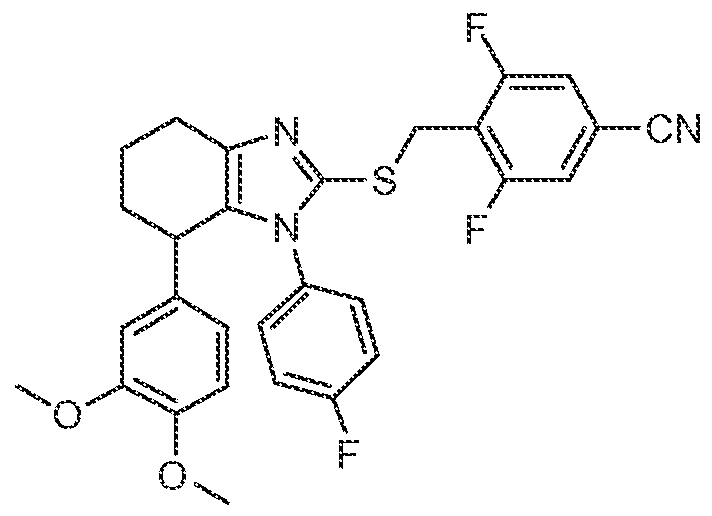
The title compound was prepared according to the procedure as described in Example 1 step 8 reacting 7-(3,4-dittiethoxyphenyl)-l-(4-f1uorophenyl)-4,5,6J-tetrahydro- lH-benzo[d]imidazole-2-thiol (Prepared as described in Example 62, Step 6) and 4-cyano- 2,6-difluorobenzyl methanesulfonate as an off-white solid.
Ή NMR (400 MHz, CDCh} δ 7.15 (d, J = 6.0 Hz, 2H), 6.85 (br, m, 2H), 6.71 (br, m, IH), 6.63 (d, J = 6.5 Hz, 2H), 6.32 (d, J = 5.5 Hz, 2H), 4.12 (abq, J = 8.8 Hz, 2H), 3.82 (s, 3H), 3.71 (s, 3H), 3.70 (m, IH), 2.80 (m, ! H), 2.72 (m, 1 H), 1.90 (m, IH), 1 .75 (m, 2H).
Example 65: 4-iff7-(3A-dimethoxyphenyl)-l-(4-fluorophefiyl)-4t5,6, 7-tetrahydro-lH- benzofdlimida ol-2-yl)thi)methyl)-3t5-difluorobenzoic acid
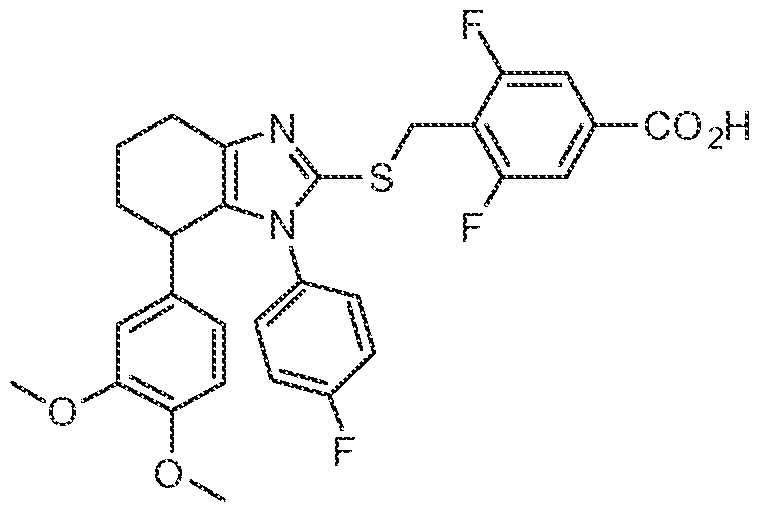
4-(((7-(3,4-dimethoxyphenyl)-l-(4-fluorophenyl)-4,5,6,7-tetrah.ydro-lH- benzo[d]imidazol-2-yl)thio)meth.yl)-3,5-difluorobenzonitrile (500 mg, 0.94 mmol) in mixed solvent of MeOH (2 mL), THF (2 mL) and IN NaOH solution (4 mL) were heated at 80 °C for 4 hours. The solvent was removed and the residue was acidified by IN HC1 to pH ~ 4. The residue was then extracted 3 times by ethyl acetate and the combined organic layer was washed with water and brine. The solvent was dried over anhydrous Na2S04,
filtered anc concentrated and purified by silica gel column chromatography system to afford the title product as a white solid (400 mg, 77% yield)
!H NMR (400 MHz, CDC13) δ 7.35 (d, J = 5.8 Hz, 2H), 6.90 (br, m, 2H), 6.81 (m, IH), 6.60 (d, J = 5.5 Hz, 2H), 6.35 (d, J = 6.0 Hz, 2H), 4.55 (abq, J = 7.5 Hz, 2H), 3.80 (s, 31 1). 3.72 (s, 31 1 ;·. 3.68 (m, IH), 2.92 (m, IH), 2.50 (m, IH), 2.15 (m, IH), 1.92 (m, IH), 1.82 (m, 21 1).
Example 66: 4~(((7~(3A-dimethoxyphenyl)-l-(4~fluoroyhenyl)~4*5,6, 7~tetr^^
benzofdHmMazol-2-yl)thio)methyl)-3,5-difluom-N-(2,5,8 l-tetraoxa
ljbenzatnide

4-(((7-(3,4-dimetlioxyphenyl)-.l -(4-fluorophenyl)-4,5,6,7-tetrahydro-lH- benzo[d]imidazol-2-yl)thio)methyl)-3,5-difiuorobenzoic acid (43 mg, 0.0775 mmol), 2,5,8,1 l -tetraoxatridecan-13-amine (32 mg, 0.155 mmol), HATU (59 mg, 0.155 mmol), DIFEA (0.04 mL, 0.233 mol) in DMF (1 mL) at room temperature were stirred overnight. The reaction was partitioned between DCM and water, washed with brine, dried and silica gel column purification with EA to EA (5% MeOH) to obtain the desired product as a colorless oil. The compound was dissolved in CH3CN and water (1 : 1) and lipholized overnight to give white solid (40 mg, 69% yield).
Ή NMR (400 MHz, CDCI3) δ 7.81 (br, s, IH), 7.42 (d, J = 7.5 Hz, 2H), 7.02 (br, s, 31 1). 6.68 (d, J = 7.2 Hz, ! H), 6.35 (d, J = 4.5 Hz, 2H), 6.32 (br, s, IH), 4.21 (abq, J = 9.8 Hz, 2H), 3.82 (s, 3H), 3.72 (s, 3H), 3.68 (m, 15H), 3.52 (s, 2H), 3.32 (s, 3H), 3.05 (m, IH), 2.85 (m, IH), 2.22 (m, I H), 1.99 (m, IH), 1.85 (m, 2H).
Example 67; 2-((4-(2-chloroethoxy)-2,&difluorohenzyi)thioj-7-(3 -dimethoxyphenyl)-l- (4-fiuorophenyl)-4,5,6, 7-tetrahydro-lH-benzo/djimidazole
Step 1 1 4-(2-cliloroethoxy)-2,6-diili8orobei¾zyi methanes¾Ifonate

The title compound was prepared according to the procedure as described in Example 23 step 1-5 starting with 3,5-difluoro-4-(hydroxymethyl)phenol and l-iodo-2- ehloroethane to afford the product as an off-white solid.

The title compound was prepared according to the procedure as described in Example 1 step 8 reacting 7-(3,4-dimethoxyphenyi)-l -(4-fluorophenyl)-4,5,6 7 etrahydro- lH-benzo[d]imidazole-2-thiol (Prepared as described in Example 62, Step 6) and 4-(2- c oroethoxy)-2,6-difluorobenzyi methanesulfonate as an off-white solid,
!H NMR (400 MHz, CDC13) δ 731 (s, 1H), 7.00 (br, s, 3H), 6.72 (d, 3= 6.5 Hz, 1H), 6.42 (d, J = 5.8 Hz, 2H), 6.31 (m, 2H), 4.25 (abq, J - 9.5 Hz, 2H), 4.18 (m, 2H), 3.88 (s, 3H), 3.85 (m, 2H), 3.78 (s, 3H), 3.70 (m, 1H), 3.05 (m, IH), 2.90 (m, 1 H), 2.20 (m, 1H), 2.02 (m, 1 H), 1.85 (m, 2H).
Example 68: 4-(((7-(2-bromo-4,S-dimeihoxyphenyl)-l-(4-fluorophenyl}-4,S,6, 7- teirahydro-lH-benz idHtnidaz l-2-ylHhio)methyl)-3,S-difluoro-N-(2t5,8,ll- teiraoxatridecan-13-yl) henzamide (68a) and 4~(((7-(2,3~dibromo-4, 5-dimethoxyphen y!}~ I-(4-fhntrophef}yi}-4,5/h 7-temihydr -ifl~benz<»ldihnidiK ~2~\^)tliU met \i}-3f5-

The title compounds were prepared according to the procedure as described in Example I step 4 by reacting the mixtures of 2-brom.o-6-(3,4-dimethoxy-6-bromo- phenyDcyclohexanone and 2-bromo-6-(3,4-dimethoxy-5,6-dibromo-phenyl)cyclohexanone with NaN3 to obtain the title compounds as a light yellow solid.
Step 2: 2-amino-6-(2-bromo-4,5-dimethoxyphenyl)cycIohexanone hydrogen chloride and 2-amino-6-(2,3-dibromo-4,5-dimethox 7pheayI)cyclohexaiione hydrogen chloride


The title compounds were prepared as a mixture according to the procedure as described in Example 1 step 6 by reacting 2-amino-6-(2-bromo-4,5- dimethoxyphenyi) eyclohexanone hydrogen chloride and 2-amino-6-(2,3-dibromo-4,5- dimethoxyphenyl)eyclohexanone hydrogen chloride and l-fluoro-4- isothiocyanatobenzene to obtain the title compounds as an off" yellow solid.


The title compound were prepared as a mixture according to the procedure as described in Example I step 8 by reacting 7-(2-bromo-4,5-dimethoxyphenyl)- l-{4- f3.uorophenyl)-4,5,6,7-tetrahydro-l H-benzo[d]im.idazole-2-thiol and 7-(2,3-dibromo-4,5- dimethoxyphenyl)-l -(4-fluorophen^
and 4-cyano-2,6-difluorobenzyl methanesiilfonate to obtain the title compounds as an off- white solid.
Step 6: 4-(((7-(2-bromo-4,5-dimethoxyphenvn-l-(4-fluorophenvI)-4,5,6,7-tetrahvdro- .lI-I-beazo[dlimidazo¾-2-vI)thio)inethv¾)-3,5-difluoroben2:oic acid mid 4-(((7-(2,3- dibromo-4,5-dimethoxyphenvI)-l-(4-fluorophen,vn-4,5,6,7-tetrahvdro-lH- benzoidlimidazol-2-vI)thio)methyI)-3,5-diflMorobenzoic add

The title compounds were prepared according to the procedure as described in Example 65 by hydrolysis of 4-(((7-(2-bromo-4,5-dimethoxyphenyl)-l-(4-fluorophenyl)- 4,5,6,7-tetrahydro-lH-beiizo[d]i^^^ and 4-
(((7-(2,3-dibromo-4,5-dimethoxyphenyi)-l-(4-fluorophenyl)-4,5,6,7-tetrahydro-lH- benzo[d]imidazol-2-yl)thio)methyi)-3,5-difluorobeiizonitrile with NaOH in water and purified by silica gel column to afford 4-(((7-(2-bromo-4,5-dimethoxyphenyl)-l-(4- fliiorophenyl)-4,5,6,7-tetTahydro-lH-benzo[d]imidazol-2-yl)thio)methyl)-3,5- difluorobenzoic acid and 4-(((7-(2,3-dibromo-4,5-dimethoxyphenyl)-l -(4-fluoropheny].)- 4,5,6 ,7-te1rahydio-lH-benzo[d]imidazol-2-y])thio)methyl)-3,5-difluorobenzoic acid as two off-white solids.
4-(((7-f2-bromo-4,,5-dimethoxyphenv])-l-(4-^
be¾¾oidlis¾ida¾oI-2-yj)t!iio)met!ivI)-3,5-difl¾jorobe¾izoic acid: ESI-MS (m/z): Calcd. For C29H24BrF3N204S: 633.48; found: 634 (M+H).
4-(((7-(2,3-dibronio-4,5-dimethoxyphenvI)-l-(4-fl¾orophenvn-4 <6,7-tetrahvdro-lH- be¾¾oid]is¾ida¾oI-2-yj)t!iio)met!iyI)-3,5-difl¾jorobe¾izoic acid: ESI-MS (m/z): Calcd. For C28H25CIF2N2O2S: 712.37; found: 753 (M+H).
Step 7: 4-(((7-(2-bromo-4,5-dimethoxyphenyI)-l-(4-fliiorophenyl)-4,5,6,7-tetrahydro- lH-benzoidlimidazol-2-vI)thio)methyI)-3,5-difl¾oro-N-(2,5,8,ll-tetraoxatridecan-13- yQbenzamide (68a)
The title compound was prepared according to the procedure as described in Example 66 by coupling 4-(((7-(2-bromo-4,5-dimethoxyphenyl)-l-(4-fluorophenyl)- 4,5,6,7-tetrahydro- 1 H-benzo[d] imidazoi-2-yl)thio)methyl)-3,5-difluorobeiizoic acid (prepared through synthetic sequences in Example 1 step 4-7) with 2,5,8,11- tetraoxatridecan-13-amine using HATU to obtain the title compound as a white solid. Ή NMR (400 MHz, CDC13) δ 7,82 (br, s, 1H), 7.42 (d, J = 7.6 Hz, 2H), 6.50 (s, ill)..6.23 (s, 111).4.21 (m, 2H), 3.81 (s, 3H), 3.75 (s, 3H), 3.65 (m, 1 11;·.3.54 (m, 1H), 3.31 (s, 311;·. 2.95 (m, 111;·.2.22 (m.1H), 2.05 (m, 111}.1.85 (m, 211).
Step 8: 4-(((7-(2 -dibromo-4,5-dimethoxypheni)-l-(4-fluorophenyl)-4,5,6.,7- tetrahydro-lH-benzo[d|imidazol-2-yl)thio)methyl)-3,5-difluoro-N-(2,5,8,ll-

The title compound was prepared according to the procedure as described in Example 66 by coupling 4-(((7-(2,3-dibromo-4,5-dimethoxyphenyl)- 1 -(4-fluorophenyl)-
4,5,6,7-tetrahydro-lH-benzo[d]imidazol-2-yl)thio)methyl)-3,5-difluorobenzoic acid
(prepared through synthetic sequences in Example 1 step 4-7) with 2,5,8,11- tetraoxatridecan-13-amine using HATU to obtain the title compound as a white solid. !H NMR (400 MHz, CDC13) δ 7.81 (br, s, HI).7.42 (d, J = 7.8 Hz, 2H), 6.38 (s, HI).4.51 (m, 111).4.25 (m, 2H), 3.81 (s.611}.3.72 (m, 1411}.3.55 (m, 211}.3.31 (s, 3H), 2.95 (m, 2H), 2.21 (m, 1H), 2.02 (m, 1H), 1.85 (m, 1H), 1.77 (m, 1H).
Example 69: 2-{{2, 6-difluoro-4-(2-(pyrrolidin-l-yl)ethoxy)benzyl)thio)-7-( 3,4- dimethoxphen i)-l-4^

Ή NMR (400 MHz, CDCI3) δ 7.55 (s, I I I). 6.86 (m, 2H), 6.72 (br, s, 1H), 6.62 (d, J = 6.5 Hz, i l l ). 6.38 (m. 4H), 4.15 (abq, J = 8.5 Hz, 2H), 4.05 (t, J = 6.5 Hz, 2H), 3.82 (s, 31 1 ;·. 3.75 (s, 3H), 3.68 (m, 1H), 2,85 (t, J = 6.5 Hz, 21 1). 2.80 (m, 1H), 2.75 (m, 1H), 2,65 (m, 4H), 2.10 (m, 1 1 1 ). 1.95 ( m. 1 H), 1.85 (m, 2H), 1.80 (m, 4H).
Example 70; 2~((2~cMoro-6-ftuorohenz\i)ihio)~l-(4-fliiorophe^
Ste 1 2-bromo- -(3-met!¾oxyp!ieiiyl)cyclohexaii one

The title compound was prepared according to the procedure as described in Example 1 step 2-3 reacting 2-(3-methoxyphenyi)cyclohexa.none (Aidrich) with TMSOTf TEA followed by NBS as light yellow solid.
ESI-MS (m/z): Calcd. For C{3H,5Br02: 283.16; found: 203 (M+H).

The title compound was prepared according to the procedure as described in Example 1 step 4 reacting 2-bromo-6-(3-methoxyphenyl)cyclohexanone with NaN3 as light yellow solid.
ES1-MS (m/z): Calcd. For ( VN i ' .·( >.«: 245.28; found: 204 (M-N3+H).
Step 3: 2-¾misio-6-{3-met!¾oxyp!ieiiyl)cyclohexaiiosie hydrogen chloride

The title compound was prepared as brown solid according to the procedure as described in Example 1 step 5 by reacting 2-azido-6-(3-methoxyphenyl)cyclohexanone with 5% Pd on carbon under 50 psi hydrogen gas,
ESI-MS (m/z): Calcd. For C!3H) 7NQ2: 219.28: found: 220 (M+H).

The title compound was prepared according to the procedure as described in Example 1 step 6 reacting 2-amino-6-(3-methoxyphenyl)cyelohexanone hydrogen chloride salt and l -fluoro-4-isothiocyanatobenzene as off yellow solid.
ESI-MS (m/z): Calcd. For ( \;H . , Ι· \ .0 =S: 372.46; found: 373 (M+H).


The title compound was prepared according to the procedure as described Example 1 step 7 reacting l-(3-(3-methoxyphenyl)-2-oxocyclohexyl)-3-( f3.uorophenyl)thiourea in acetic acid as off yellow solid.
' ! ! NMR (400 MHz, CDC13) ft 6.85 ins. 4H), 6.70 (d, J - 7.5 Hz, 1H), 6.42 (·;!. J = 7.5 I I 1H), 3.75 (s, 3H), 3.66 (m, 1H), 2.68 (m, 2H), 2.20 (m, i l l ). 1.85 (m, ! f !). 1.73 (m, 2H).

The title compound was prepared according to the procedure as described in Example 1 step 8 reacting 7-(3-methoxyphenyl)-l-(4-fluorophenyl)-4,5,6,7-tetrahydro- lH-benzo[d]imidazole-2-thiol and 2-(bromomethyl)-l -chloro-3-fluorobenzene as an off- white solid.
Ή NMR (400 MHz, CDCI3) δ 7.15 (m, 3H), 7.08 (t, J = 7.5 Hz, 1 H), 6.91 (t, J = 6.0 Hz, 1H), 6.75 (m, 2H), 6.62 (d, J = 6.5 Hz, 1H), 6.60 ins. i l l). 6.42 (d, J = 7.0 Hz, U S ). 6.35 (s, 1H), 4,25 (abq, J = 14.5 , 8.9 Hz, 2H), 3.72 (s, 3H), 2.85 (m, 1 H), 2.72 (m, 1H), 2.15 (m, 1H), 1.90 (m, 1H), 1.81 (m, 2H).
Example 71: 2-(((3,S-difluoropyridin-4-yl)methyl)thio)-l-(4-f!Morophenyl)-7-(3- methoxyphen i)-4,5,6, 7-tetrahydro-lH-benzofdlimidazole

The title compound was prepared according to the procedure as described in Example 1 step 8 reacting 7-(3-methoxyphenyl)-l -(4-fluorophenyl)-4,5,6,7-tetrahydro- 1 H-benzo[d]imidazole-2-thiol and (3,5-difluoropyridin-4-yl)methy 1 methanesu!fonate to give the title compound as an off-while solid.
ESI-MS (m/z): Calcd. For C26H22 3OS: 481.53; found: 482 < XI I f ).
Example 72:2-(((3,5-difluoropyridin-4-yl)methyl)thio)-l-(4~fluoro-3-m
(3~methoxyphenyl)~4,5,6, 7~tetrahvdro~lH~benzofdIimidazole
Step 1 : 1 -(4-flnoro-3-methoxyphenvi)-7-(3-methoxyphenvi)-4,5,6 ,7-tetrah ydro-i H- -.

The title compound was prepared according to the procedure as described in
Example 70 step 4 by reacting 2-amino-6-(3-methoxyphenyl)cyclohexanone hydrogen chloride salt (Prepared as described in Example 70, Step 3) with l -fluoro-2-methoxy-4- isothiocyanatobenzene, followed by further reaction with 1 -(3-(3-metlioxyphenyl)-2- oxocyclohexyl)-3-(3-m.ethoxy-4-fluorophenyl)thiourea in acetic acid according to the procedure described in Example 70, Step 5, to afford the title product as a white solid.
ESI-MS (m/z): Calcd. For CaiH tNaOaS: 384.47; found: 385 (M+H).
Step 2: 2-(((3,,5-dffl
methoy^

The title compound was prepared according to the procedure as described in Example 1 step 8 reacting l-{4-i]uoro-3-niethoxypheny!)~7-(3-niethoxypheny!)-4,5,6,7- tetrahydro- 3 H-benzo[d]imidazole-2-thiol and (3,5-difiuoropyridin-4-yl)methyl methanesulfonate as an off-white solid.
ESI-MS (m/z): Calcd. For C27H24F3N3O2S: 55 5.56; found: 512 (M+H).
Example 73: 3t5-difluoro-4-(((7-f4-fluoro-3-methoxyphefiyl)-l-f4-fluorophenyl)-4,5,6, 7- tetrahvdro-lH-benzofd}imUazol-2-yl)thio)methyl)benz nitrile

The title compound was prepared according to the procedure as described in Example 1 step 1 reacting cyclohexanone and 4-bromo- 1 -fluoro-2-methoxybenzene as a white solid.

The title compound was prepared according to the procedure as described in Example 1 step 2-3 reacting 2-(3-methoxy-4-fluorophenyl)cyclohexanone with TMSOTf/TEA followed by NBS as light yellow solid.
ESI-MS (m/z): Calcd. For Ci3Hj4BrF02: 301.15; found: 221 (M-Br+H).

The title compound was prepared according to the procedure as described in Example 1 step 4 reacting 2-bromo-6-(3-methoxy-4-fiuorophenyl)cyclohexanone with NaN'3 as light yellow solid.
ESI-MS (m/z): Calcd. For ί VI i , ;FN ;() ··: 263.27; found: 222 (M-N3+H).
Step 4: 2-amino-6-(3-methoxy-4-fluorophenyl)cyclohexaiione hydrogen chloride

The title compound was prepared as brown solid according to the procedure as described in Example 1 step 5 by reacting 2-azido-6-(3-methoxy4~ fiuorophenyl)cyclob.exanone with 5% Pd on carbon under 50 psi hydrogen gas.
ESI-MS (m/z): Calcd. For 013Ηι6ΡΝ02: 237.27; found: 238 (M+H).
Step 5: l-(3-(3-inethoxy-4-flMorophen.v])-2-ox.ocyclohexyl)-3-(4-fluorophenyl)thioarea

The title compound was prepared according to the procedure as described in Example 1 step 6 reacting 2-amino-6-(3-methoxy-4-fluorophenyr)cyciohexanone hydrogen chloride salt and l -fluoro-4-isothiocyanatobenzene as off yellow solid.
ES1-MS (m/z): Calcd. For C20H20F2N2O2S: 390.45; found: 391 (M+H).

The title compound was prepared as off yellow solid by reacting l-(3-(3-methoxy- 4-fluorophenyl)-2-oxocyclohexyl)-3-(4-fluorophenyl)thiourea with acetic acid according to the procedure as described in Example I step 7.
ESI-MS (m/z): Calcd. For C20H22F2N2O3S: 372.43; found: 373 (M+H).
Step 7: 3,5-difluoro-4-(((7-(4-fluoro-3-methox-yphenyl)-l-(4-fluorophenvI)-4,5,6,7- tetrahvdro-lH-benzo[dlimidazoI-2-v¾)thio)methyI)benzoaitrile

The title compound was prepared according to the procedure as described in Example 1 step 8 reacting 7-(3~methoxy-4-fluorophenyl)-l-(4-fluorophenyl)-4,5,6,7~ tetrahydro- 1 H-benzo[d]imidazole-2-thiol and 4-cyano-2,6-difluorobenzyl methanesulfonate as an off-white solid.
' ! ! NMR (400 MHz, CDC13) δ 7.15 {·;!. J = 6.8 Hz, 2H), 6.82 On. 2H), 6.80 (m. J = 8.8 Hz, 2H), 6.72 (m, U S). 6.42 (d, J = 6.5 Hz, 1H), 6.30 (ni, J = 4.0 Hz, 1H), 4.10 (s, 2H), 3.75 (s, 3H), 3.70 (m, 1H), 2.78 (m, 1H), 2.64 (ni, 1H), 2.18 (m, 1H), 1.85 (m, 1H), 1.74 (m, 2H).

The title compound was prepared according to the procedure as described in Example 65 by reacting 3,5-di£iuoro-4-(((7-(4-fiuoro-3-methox
fluorophenyl)-4,5,6,7-tetrahy&O-lH-benzo[d]imi
(Prepared as described in Example 73, Step 7) in aqueous alkaline solution to give the title compound as a white solid.
Ή NMR (400 MHz, CDC13) δ 7.28 (d, J = 7.1 Hz, 2H), 6.82 (d, J = 7.0 Hz, 3H), 6.65 (m,
1 1 1). 6.48 (d, J - 6.5 Hz, 1 1 1). 6.31 (d, J = 6.1 Hz, 1 1 1). 5.81 ins. I I I). 4.05 (abq, J = 12,5,
7.0 Hz, 2H), 3.78 (s, 3H), 3.70 (m, 1H), 2.75 (m, 2H), 2.12 (m, 1H), 1.90 (m, 1H), 1.75 (m, 2H).
E mple 75: 3,5-

The title compound was prepared according to the procedure as described in Example 66 coupling 3,5-difiuoro-4-(((7-(4-f3.uoro-3-m.ethoxyphenyl.)-l-(4-fluorophenyl)- 4,5,6,7 etrahydro-lH-benzo[d]imidazol-2-yI)thio)methyl)benzoic acid with 2,5,8,11- tetraoxatridecan- 13-amine using HATU to give the title compound as a white solid.
!H NM (400 MHz, CDC13) δ 8.05 (s, 1 H), 7.32 (d, J = 8.1 Hz, 2H), 6.98 (m, 1 H), 6.82 (t, J = 7.2 Hz, 2H), 6.67 (br, s, 1H), 6.42 (d, J = 6.8 Hz, 1H), 6.31 (m, 1H), 4.15 (m, 2H), 3.75 (s, 3H), 3.70 (s, 3H), 3.65 (m, 16H), 3.51 (m, 1H), 3.32 (s, 31 1). 2.75 (m, 2H), 2.15 (m, 1H), 1.90 (m, M l). 1.78 (m, 2H).


The title compound was prepared according to the procedure as described in Example 1 step 2-7 to afford the product as a white solid. Mass spectrum (ESI, m/z); Calcd. for C2oH18ClFN2OS, 389.1 ( VI · I f ), found 389.1 .
Step 3: 7-(3-ch1oro-4-met ox.vpheMyl)-2-(2-c loro-6-flMorobeMzylthio)-1-(4- fl¾oroi !¾e¾iyl)-4¾5,6¾7-tetra¾vdro-lH-be¾¾oidlimlda¾ole trifhioroacetic add

The title compound was prepared according to the procedure as described in Example 1 step 8 by reacting 7-(3-c oro-4-methoxyphenyl)- 1 -(4-fl uorophenyl)-4,5 ,6,7-tetrahydro- lH-l ,3-benzodiazole-2-t,hiol and 2-(bromomethyl)-l -chloro-3-fSuorobenzene to afford the product as an off-white solid.
Ή N Y!R (300 MHz, CD3OD) δ: 7.23-7.33 (m, 2H), 7.04-7.10 (m, i l l ). 6.76-6.80 (m, 4H ),
6.65-6.68 (m, 1 H), 4.07-4.23 (m, 2H), 3.83-3.8 (m, 1 H), 3.78 (s, 3H), 2.70-2.78 (m, 2H),
1.76- 1.93 (m, 4H). 19F MR (300 MHz, CD3OD) δ: -76.97, -1 12.81 , -1 15.13. Mass
spectrum (ESI, m/z): Calcd. for C29.8H23 CbF6.2N2O3.sS, 531.1 (M-1.4CF3COOH ! !). found 531.2.
E mple 77: 2-[((2-chlo^

The title compound was prepared according to the procedure as described in Example 1 step 1 reacting cyclohexanone and 6-bromo-2,3-dihydrobenzo[b] [ 1 ,4]dioxine as a white solid. Mass spectrum (ESI, m/z): Calcd. for C14H16O3, 233.1 (M+H), found 233.1.
Step 2: 7~f23~di¾ydro-1,,4~be¾;godioxm-6-yl)~l-^

The title compound was prepared according to the procedure as described in Example 1 step 2-7 to afford the product as a white solid. Mass spectrum (ESI, m/z): Calcd. for ( " >i ! ! ,,.!;N.-() -.S. 383.1 (M+H), found 383.1.
Step 3: 2-f f(2-chloro-6-fluoropheiiyI)methyi|sulfanyIl-7-(2,3-dihydro-l,4'
6-yl)-l-(4-fh-oropfaenyl) -4,5^6,7-tetra¾ydro-lH-l,3-bei¾zodi¾zoi

The title compound was prepared according to the procedure as described in Example 5 step 8 reacting 7-(2,3-dihydro-l,4-benzodioxin-6-yi)-.l -(4-fluorophenyl)-4,5,6,7- tetrahydro- 1 H- 5 ,3-benzodiazole-2-thiol and 2-(bromomethy !)- 1 -chloro-3-fluorobenzene to afford the product as an off-white solid. !H NMR (300 MHz, CD3OD) δ: 7.21 -7.35 (m, 2H), 7.01-7.19 (m, 1H), 6.85 (br, 1H), 6.66-6.69 (m, 1 H), 6.47-6.58 (m, 1 H), 6.21 -6.32 (m, 2H), 4.14-4.26 (m, 5H), 3.95-4.00 (m, 1H), 3.67-3.71 (m, 1 1 1 ;·. 2.59-2.76 (m, 2H), 2.06- 2.15 (m, 1H), 1.82-1.95 (m, 1H), 1.69-1.78 (m, 2H). Mass spectrum (ESI, m/z): Calcd. for C28H23CIF2 2O2S, 525.1 (M+H), found 525.1.
Example 78: 7-(4-chloro-3-methoxyphenvi)-2-[[(2-chioro-6- flu wphen ) 'i)meth ; //.¾ uifynyif- l-{4~ihwwp en yi}» 7-mt'lh yi-4, 5, , 7-k'ir ;γ//·<ν- !H I - henz diazole

A solution of 2-(4-chloro~3-methoxyphenyl) cyclohexan-l-one (50 g, 41.89 mrnol, 1.00 equiv), tert-butanol (40 ml,), and t-BuOK (5 g, 44.56 mmol, 1 .05 equiv) was stirred for 30 min at room temperature followed by the addition of iodomethane (12 g, 84.54 mmol, 2.00 equiv). The resulting solution was stirred for 3 h at room temperature, quenched by the addition of 300 inL of water, and concentrated under vacuum. The reaction was extracted with 3x500 mL of dichloromethane and the combined organic
layers were washed with 1x500 mL of brine, dried over Na2S04, filtered, and concentrated under vacuum. Chromatography using a CI 8 column with H20/MeCN as mobile phase (10%-90% in 45niins) gave the title compound as an off-white solid. Mass spectram (ESI, m/z): Calcd. for C14H17CIO2, 253.2 (M+H), found 253.2.

A solution of 2-(4-chloro-3-methoxyphenyl)-2-methylcyclohexan-l-one (7.5 g, 29.68 nimol, 1 .00 equiv), dichloromethane (20 mL), TEA (4.5 g, 44.47 mmol, 1 .50 equiv), and TMSOTf (7.9 g, 1.20 equiv) was stirred for 30 min at 0 °C. The resulting mixture was concentrated under vacuum to give the title compound as a light yellow solid.
Step 3: 6-bromo-2-(4-chlo -3-metho¾:vpheaYl')-2-methYlcvcIo exaa-l-oae

A solution of [ [6-(4-chloro-3-methoxyphenyl)-6-methylcyclohex- 1 -en- 1 - yl]oxy]trimethylsilane (9.6 g, 29.55 mmol, 1.00 equiv) in tetrahydrofuran (20 mL) was treated with NBS (5.3 g, 29.78 mmol, 1.00 equiv) hatchwise at 0 °C. The reaction was stirred for 30 min at 0 °C and concentrated under vacuum to give the title compound as a light yellow solid.
Step 4: 6-azido-2-(4-chloro-3-methoxyphenyl)-2-methylcycIohexaii-l-one
 A solution of 6-bromo-2-(4-chloro-3-methoxyphenyl)-2-methylcyclohexan-l-one (9.8 g, 29.55 mmol, 1.00 equiv), N, -dimethylformamide (10 mL.), and NaN3 (9.7 g, 149.21 mmol, 5.00 equiv) was stirred for 1 h at room temperature and quenched by the addition of 30 mL of water. The reaction was extracted with 3x50 mL of ethyl acetate, and the combined organic layers wrere washed with 1x50 mL of brine, dried over anhydrous sodium sulfate, filtered, and concentrated under vacuum. Silica gel column chromatography with ethyl acetate/petroleum ether (1 : 10) gave the title compound as a light yellow solid. Mass spectrum (ESI, m/z): Calcd. for C14f½ClN302, 294.1 (M+H), found 294.1.

A suspension of 6-azido-2-(4-chloro-3-methoxyphenyl)-2-methylcyclohexan-l-one (6 g, 20.43 mmol, 1.00 equiv), methanol (30 mL), hydrogen chloride (3 mL), and palladium carbon (6 g) under H2 atmosphere was stirred for 1 h at room temperature, filtered, and concentrated under vacuum to give the title compound as a light yellow solid. Mass spectrum (ESI, m/z): Calcd. for Ci4H18ClN02, 268.1 (M-HC1+H), found 268.1.

A solution of 6-amino-2-(4-chloro-3-methoxyphenyl)-2-methylcyclohexan- 1 -one hydrochloride (6 g, 19.72 mmol, 1.00 equiv), dichloromethane (20 mL), TEA (6.8 g, 67.20
mmol, 3.00 equiv), and l-fluoro-4-isothiocyanatobenzene (6.8 g, 44.39 mmol, 2.00 equiv) was stirred for 1 h at room temperature and concentrated under vacuum to give the title compound which was used in the next step directly. Mass spectrum (ESI, m/z): Calcd, for C21H72CIFN2O2S , 421.1 (M+H), found 421.1.

A solution of 3- [3-(4-c oro-3-methoxyphenyl)-3-methy 1-2-oxocyclohexyl] - 1 -(4- f3.uorophenyl)thiourea (9 g, 21.38 mmol, 1.00 equiv) and AcOH (30 rnL) was stirred overnight at, 60 °C in an oil bath and concentrated under vacuum. Silica gel column chromatography with ethyl acetate/petroleum ether (1 : 1) gave the title compound as a light yellow solid. Mass spectrum (ESI, m/z): Calcd. for C21H20CIFN2OS, 403.1 (M+H), found 403.1
Step 8: 7-(4-cMoro-3-met¾oxyFj!¾eoyj)-2-ii(2-cMoro-6-fl¾or p¾e¾ )met¾ ls¾Ifa yll- l-(4-fluoropheaYl')- -methYl-4,5,6,7-tetrahydro-lH-l,3-ben¾odiazole

A solution of 7-(4-chioro~3~methoxyphenyi)~ 1 -(4-tluorophenyl)-7-methyl-4,5,6,7- tetrahydro-l H-benzo[d]imidazole-2-thiol (100 mg, 0.25 mmol, 1.00 equiv), N,N~
dimethylformamide (3 mL), potassium carbonate (103 mg, 0.75 mmol, 3.00 equiv), and 2- (bromomethyl)-l-chloro-3-fluorobenzene (82 mg, 0.37 mmol, 1.50 equiv) was stirred overnight at room temperature. The reaction was then quenched by the addition of 30 mL of water, extracted with 3x30 mL of dichioromethaiie and the organic layers combined. The reaction was washed with 1x30 mL of brine, dried over anhydrous sodium sulfate, filtered, and concentrated under vacuum. Silica gel column chromatography with ethyl acetate/petroleum ether (1 :2) gave the title compound as a white solid. Ή NMR (400MHz, CDjOD): δ 7.22-7.32 (m, 3H), 7.00-7.07 (m, 3H), 6.68(d, J = 2.0 Hz, 1H), 6.56-6.60 (m, 2H), 5.87-5.90 (in, 1H), 4.19(d, J = 12.0 Hz, 1H), 4.00 (d, J = 12.0 Hz, 1H), 3.77 (s, 3H), 2.72-2.78 (m, 2H), 1.84-1.96 (m, 4H), 1.36 (s, 3H). Mass spectrum (ESI, m/z): Calcd. for C28H24CI2F2N2OS, 545.1 (M+H), found 545.0.

Step 1 : 7-(4-chloro-3-inethoxypheav1)-2-i"([2,6-difluoro-4-[(4- met oxyphenvDmethoxylpheayllmethyl) sttlfaflyIl-1-(4-fl¾orophenyl)-7-methyl- 4, -tetrahydro-lH-l,3-benzodiazoIe

The title compound was prepared according to the procedure as described in Example 78 step 8 reacting 7-(4-chloro-3-methoxyphenyl)-l -(4-fluorophenyl)-7-methyl-4,5,6,7- tetrahydro-lH-benzo[d]imidazole-2-thiol (Prepared as described in Example 78, Step 7) and 2,6-difluoro-4-((4-methoxybenzyr)oxy)benzyl memanesultonate to afford the product
as white solid. Mass spectrum (ESI, m/z): Calcd. for C30H32CIF3N2O3S, 665.2 (M+H), found 665.2.

The title compound was prepared according to the procedure as described in Example 24 step 3 reacting 7-(4-chloro-3-methoxyphenyl)-2-[([2,6-difluoro-4-[(4- methoxyphenyl)methoxy]phenyl]methyl) sulfanyl]-l -(4-fluorophenyl)-7-methyl-4,5,6,7- tetrahydro- 1 H- 1 ,3-benzodiazole in TFA to afford the product as white solid. !H NMR (400MHz, CD3OD): 6 7.23-7.31 (m, 3FI), 6.74-6.78 (m, HI), 6.68 (s, 1H), 6.52-6.55 (m, IK), 6.45-6.47 (m, 2H), 6.06-6.10 (m, HI), 4.18 (d, J = 13.6 I I/. 1H), 4.01 (d, J = 13.6 Hz, IB), 3.78 (s, 3H), 2.86-2.91 (ni, 21 1 ). 2.01 -2.1 1 (m, i l l ). 1.95-1.99 (m, 3FI), 1.48 (s, 3H). 19F NMR (400MHz, CD3OD): δ -77.13, - 1 1 1 .1 1 , -1 17.28. Mass spectrum (ESI, m/z): Calcd. for ( :;j l.-.,CHv,N ^O iS. 545.5 (M-CF3COOH+H), found 545.1.
Step 3: 7-(4-chloro-3-methoxyphenyl)-2-ii(2,6-difluoro-4-[2-12-(2- iodoethoxY)ethoxylethoxy|phenyl)niethyll sulfanyH-l-(4-fluorophenyl)-7-methyl

The title compound was prepared according to the procedure as described in Example 24 step 4 by coupling 4-([[7-(4-chloro-3-methoxyphenyl)-l-(4-fluorophenyl)-7- methyl-4,5,6,7-tetrahydro-lH-l ,3-be^
and 1 ,2-bis(2-idodethyox)ethane in the presence of CS2CO3 to afford the desired product as a white solid. Mass spectrum (ESI, mj'z) Calcd. for C34H35CIF3IN2O4S, 787.1 (M+H), found 787.1.

The title compound was prepared according to the procedure as described in Example 27 step 2 by coupling 7-(4-chloro-3-methoxyphenyl)-2-[[(2,6-diflxioro-4-[2-[2-(2- iodoethoxy)ethoxy]ethoxy]phenyl)methyl] sulfanyl]-l-(4-fluorophenyl)-7-methyl-4 ,5,6,7- tetrahydro- 1 H- 1 ,3-benzodiazole and dimethylamine to afford the desired product as a white solid. 3H NMR (300MHz, CD3OD): δ 7.23-7.32 (m, 3FI), 6.68-6.74 (m, 4H), 6.54- 6.57 (m, I I I ). 5.92-5.94 (m, IH), 4.18-4.25 (m, 3H), 4.00-4.1 8 (m, 1Η),3.74-3.92 (m, 52H), 3.32-3.38 ( m. 2FI), 2.88-2,93 (m, 8H), 1.95-2.09 (m, 3H), 1.45(s, 3H). 19F NMR (300MHz, CD3OD): δ -77.17, -1 1 1 .23, - 1 15.97. Mass spectrum (ESI, m/z): Calcd. for
C40H43CIF9N3O8S, 704.2(M-2.0 CF3COOH+FI), found 704.3.
Example 80; 2-(4-((7-(4-chloro-3-methoxyphenyl)-l-(4-fluorophenyl)-4, 5, 6, 7- teirahydro-7-methyl-lH-bm
dimethylethanatnine

The title compound was prepared according to the procedure as described in Example 24 step 4 by coupling 4-([ [7-(4-chloro-3-methoxyphenyl)- 1 -(4-fluorophenyl)-7-methyi- 4,5,6,7-tetrahydro-lH-l ,3-benzodiazol-2-yi]sulfanyl]methyl)-3,5-difluorophenol (Prepared as described in Example 79, Step 2) and 2-chloro-N,N-dimethylethanamine HCI salt in the presence of Cs2C03 to afford the desired product as a white solid, Ή NMR (400MHz, CD3OD): δ 7.25-7.36(m, 3H), 6.79-6.80 (m, 3H), 6.75 (s, 1 H), 6.58-6.60 (m, 1 H), 6.07- 6.1 J (m, 1H), 4.41 -4.43 (m, 2H), 4.19 (d, J= 13.6 Hz, 1 H), 4.06 (d, J = 13.6 Hz, 1 H), 3.79 (s, 3H), 3.65-3.67 (m, 2H), 3.02 (s, 6H), 2.88-2.99 (m, 2H), 1 .97-2.1 1 (m, 4H), 1.48 (s, 3H). !9F NMR (400MHz, CD3OD): δ -77.08, - 1 1 1 .02, -1 15.50. Mass spectrum. (ESI, m/z): Calcd. for C37H35.5CIF10.5N3
Example 81; 4~((7~(4~chioro~3~methoxyphenyl)-l-(4-fl orophenyl)~4,5,6, 7~tetrahydro 7-methyl H~henzofd]imidazol~2~ylthio}methyl) add trifluoroacetic acid
Step J : Tert-butyl 4-([[7-(4-chIoro-3-methoxyphenvI)-l-(4-fliiorophenyl)-7-niethyl- 4,5,6,7-tetrahvdro-lH-l,3-beazodiazoI-2-yllsuIfanyllmethyr)-3,5-difluorobeiizoate

The title compound was prepared according to the procedure as described in Example 78 step 8 by coupling 7-(4-chloro-3-metiioxyphenyl)-l-(4-fluorophenyl)-7-methyl-4,5,6,7- te1rahydro-lH-benzo[d]imidazole-2 -thiol (Prepared as described in Example 78, Step 7) and tert-butyl 3,5-difluoro-4-(((methylsulfonyi)oxy) methyl) benzoate in the presence of CS2CO3 to afford the desired product as a white solid. Mass spectrum (ESI, m/z): Caled. for C : :H ;..(1I A :();S. 629.2 (M+H), found 629.2.

The title compound was prepared according to the procedure as described in Example 12 step 6 by treatment of tert-butyl 4-([[7-(4-Λ1θΓθ-3-ιη6Λοχ>^.6ην1)-1 -(4-ΑυοΓορ1ιει^Ι.)-7- rnethyl-4,5,6,7~tetrah^
in TFA to afford the desired product as a white solid. !H NMR (400MHZ, CD3OD) δ 7.66 (d, J = 8.0 Hz, 2H), 7.21-7.33 (m, 3H), 6.66-6.73 (m, 2H), 6.54-6.57 (m, 1H), 5.90- 5.94 (m, i l l ). 4.25 (d, J ------ 13.6 Hz, i l l . 4.08 (d, J ------- 13.6 Hz, 1 H), 3.77 (s, 31 1). 2.79-2,95
(m, 2H), 1.95-2.13 (m, 4H), 1 .47 (s, 3H). 19F NMR (400MHZ, CD3OD) δ -77.1 5 , -1 1 1 .22,
-- 11 1155..6666.. MMaassss ssppeeccttrruumm ((EESSI,, m m//zz)):: C Caaiiccdd.. ffoorr C C3300..s8HH2244..99CClIFF55..77NN22OO44..88SS,, 557733..11 ( (MM++HH)),, ffoouunndd 557733..33..
EExxaammppllee 8822:: ((SS))--mmeettkkyyll 22--((44~~{{{{77--((44--vvhhfoforroo~~33~~uuiiee uuKKXX\\ii))((ii mm iihhii--{{44--iihhiioonn>>!!iihhii>>ssii\\iiff~~44,, 55,, 66..

A solution of 4-((7-(4-ch[oiO-3-methoxypheny[)-l-(4-fluoiOphenyl)-4,5,6,7- te1rahydro-7-methyl-l H-benzofd]imidazol-2-ylthio)methyl)-3,5-(iifluoiObenzoic acid (200 mg, 0.35 mmol, 1.00 equiv) in dichloroniethane (4 mL), HOBt (71 mg, 0.42 mmol, 1.21 equiv), EDCI (80 mg, 0.42 mmol, 1.20 equiv), triethylamine (141 mg, 1.39 mmol, 4.02 equiv), and methyl (2S)-2-amino-5-carbamimidamidopentanoate (109 mg, 0.42 mmol, 1 ,21 equiv) was stirred overnight at 40 °C in an oil bath. The reaction was quenched by the addition of 10 mL of 3¾Q, diluted with 10 mL of DCM, extracted with 3x10 mL of dichloromethane and the organic layers combined. The resulting mixture was washed with 1x10 mL of brine, dried over sodium sulfate and concentrated under vacuum. Silica gel chromatography with ethyl acetate/petroleum ether (1 :2), followed by Prep-HPLC with the following conditions: (l#waters2767-5) column, SunFire Prep C 18, 19* 150mm 5μηι H Prep C-001 (T) 18600256819513816414 04; Mobile Phase, phase A: water with 0.05% TFA, phase B: CFBCN (15% CPI3CN up to 60% in 8 min, up to 1 00 % in 0. lmin, hold 100% in 1.9min, down to 15% in O.lmin, hold 15% in 1 .9rnin); Detector, UV 220 & 254 nm, gave the title compound as a white solid. 3F1 NM (400MHZ, CD3OD) δ 7.57-7.60 (m, 2H), 7.22-7.31 (m, 1 1 ). 6.67-6.76 (m, 2H), 6.54-6.57 (m, 1 1 1 ). 5.90-6.02 (m, 1 1 1 ). 4.72 (t, J ------ 4.0 Hz, 1H), 4.23 (d, J ------ 3.6 Hz, I I I ). 4.06-4.10 (m, 1 H), 3.78 (s, 3H), 3.77 (s, 31 1 ).
3.26-3.29 (m, 2H), 2.84-2.89 (m, 2H), 1 .75-2.10 (rn, 8Fi), 1.46 (s, 3H). 39F NMR
(400MHz, CD3OD) δ -77.09, -11 1.45, -115.31. Mass spectrum (ESI, mix): Calcd. for C39.2H39.6ClF7.8N6O7.2S, 743.2 (M-I.6CF3COOH+H), found 743.5.
Example 83: (S)~2~(4~ (7-(4-cMo
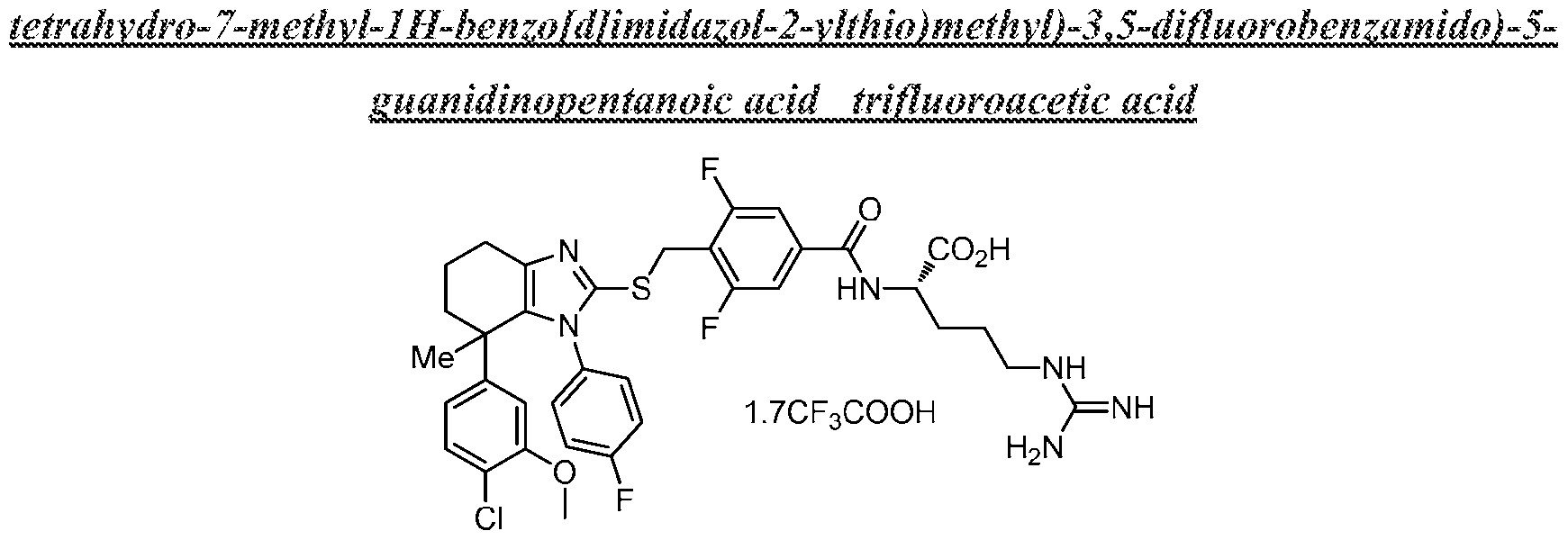
A solution of (S)-meihyl 2-(4-((7-(4-chloro-3-methoxyphenyl)- 1 -(4-fluorophenyl)-4,
5, 6, 7-tetrahydro-7-methyl~lH-benzo[dJimidazol-2-ylthio)methy})-3,5- difluorobenzamido)-5-guanidinopentanoate (80 mg, 0.1 1 mmol, 1.00 equiv) in methanol- H20 (2/1 mL), and LiOH monohydrate (21 mg, 0.50 mmol, 4.65 equiv) was stirred for 2 h at room temperature. The resulting mixture was concentrated under vacuum and purified by Prep-HPLC With the following conditions: (l#waters2767-5) column, SunFire Prep C18, 19*150mm 5μηι H Prep C-001(T)18600256819513816414 04; Mobile Phase, phase A: water with 0.05% TFA, phase B: CH3CN (15% CH3CN up to 50% in 8 min, up to 100 % in 0.1 min, hold 100% in 1.9min, down to 15% in 0.1 min, hold 15% in 1.9min); Detector, UV 220 & 254 nm, to give the title compound as a white solid. !H NMR (400M1 1,. CD3OD) 67.57-7.60(m, 2H), 7.22-7.30 (m, 3H), 6.66-6.77 (m, 2H), 6.55-6.57(m, 1H), 6.03 (1 J= 4.8 Hz, 1H), 4.68-4.71 (m, 1H), 4.21 (d, J= 13.2 Hz, H I ). 4.07 (d, J= 13.6 Hz, 1H), 3.78 (s, 3H), 3.27-3.29 (m, 2H), 2.83-2.88 (m, 2H), 1.76-2.11 (m, 8H), 1.46 (d, J = 4.8 Hz, 3H). i9F NMR (400MHz, CD3OD) δ -77.07, -11 1.58, -1 15.38. Mass spectrum (ESI, m/z): Calcd. for C38.4H 7.7ClF8.1N6O7.4S, 729.2(M-1.7CF3COOH+H), found 729.5.
hydroxyethoxy)ethoxy)eihoxy} ethyQbenzatnide trifluoroacetic add

The title compound was prepared according to the procedure as described in Example 82 by coupling 4-((7-(4-chl.oro-3-m.ethoxyphenyl.)-l-(4-fluorophenyl)-4, 5,6,7- tetrahydro~7~methy!~lH-benzo[d] acid (Prepared as described in Example 81, Step 2) and 2-(2-(2-(2- aminoethoxy)ethoxy)ethoxy)ethanol in the presence of EDCI and HOBt to afford the desired product as a white solid. Hi NMR (400MHZ, CD3OD) δ 7.57 (d, J = 8.4 Hz, 21 1 ). 7.24-7.33 (m, 3H), 6.760(t, ./ HA W/.. 1 H), 6.67 (d, ./ 2.0 Hz, 5 H), 6.53-6.56 (m, 1 H), 5.93- 5.96 (m, I I I ). 4.27 (d, J = 13.6 Hz, 1 H), 4.10 (d, J = 13.6 Hz, 1 H), 3.77 (s, 3H), 3.55-3.73 (m, 1 6H), 2.87-2.91 (m, 2H), 1.96-2.1 1 On. 4H), 5.47 (s, 3H) . i 9F NMR (400MHZ, CD3OD) δ -77.12, -1 10.95, -1 15.49. Mass spectrum (ESI, m/z): Calcd. for
C39.6H42.3ClF6.9N3Os.6S, 748.2 (M-I .3CF3COOH+H), found 748.5.
Example 85; 7~(4~chloro-3-meihoxyphenyi)~l~{4-fhioropheny
ylmethylthio)-4,5,6, 7-tetrahydro-lH-foenzo/dHmidazoie


The title compound was prepared according to the procedure as described in Example 78 step 8 by coupling 7-(4-chloro-3-methoxyphenyI)-l-(4-fluorophenyl)-7-methyl-4,5,6,7- tetrahydro- 1 H-benzo[d]imidazole-2-thiol (Prepared as described in Example 78, Step 7) and 5-chloro-4-(chloromethyl)pyrimidrae HCl salt in the presence of CS2CO3 to afford the desired product as a white solid.1! ! NMR (300MHz, CD3OD): δ 8.90 (s,l H),7.52
(s,lH),7.19-7.36 (m,3H),6.77-6.84 (m,lH), 6.69 (s,l H), 6.58-6.61 (m, 1 H), 6.35-6.36 (m, J H), 4.04-4.16 (m, 2H), 3.78 is, 3H), 2.73-2.88 (m, 2H), 1.80-2.20 (m, 4H), 1.435(s, 3H). 19F NMR (300MHz, CD3OD): δ -77.05. Mass spectrum (ESI, m/z): Calcd. for
C2s.96H74.48Cl2F5.44N4O3.96S, 529.1(M-1.48CF3COOH+H), found 529.3.
Example 87: 2-(henzyisulfanyl}-7-(4-chloro-3-methoxyphenyl)-l-(4-fl orophenyl)-7- methyl-4 -tetrahydro-lH-l,3-benzodiazole
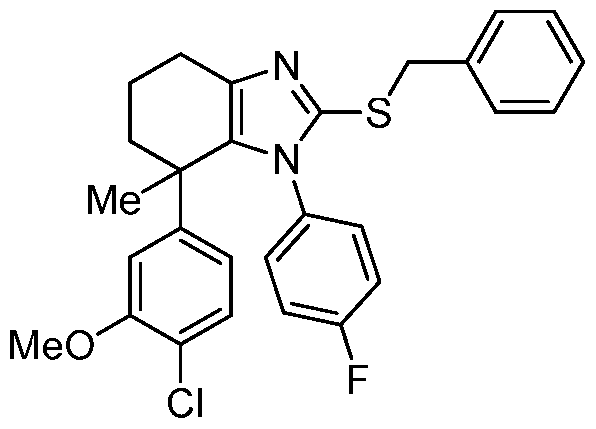
The title cortipoimd was prepared according to the procedure as described in Example 78 step 8 by coupling 7-(4-chloro-3-methoxyp enyl)- l-(4-fiuorophenyl)-7-methyl-4,5,6,7- tetrahydro-l H-benzo[d]imidazole-2-thiol (Prepared as described in Example 78, Step 7) and benzyl bromide in the presence of CS2CO3 to afford the desired product as a white solid. ] H NMR (400MHz, CD3OD): δ 7.27-7.31 (m, 3H), 7.19 (d, J = 8.4 Hz, 111), 6.99- 7.07 (m, 3H), 6.72-6.75 (m, IH), 6.57-6.61 (m, IH), 5.76-5.79 (m, I I I ). 4.09 (d, J = 12.8Hz, IH), 4.00 id. 12.8 Hz, I H), 3.71 (s, 3H), 2.75-2.81 (m, 2H), 1.84-1.94 (m, 41 1 ;·. 1.32 (s, 3H). Mass spectrum (ESI, ni/z): Calcd. for C28H26CIFN2OS, 493.1 (M +H), found 493.1.
Example 88: 2-(benzylsulfanyl)-7-(4-chloro-3-methoxyphenyl l-(4-fluorophenyl)-7- methyl-4, S, -teirahydm-lH-l,3-henz diaz ie

The title compound was prepared according to the procedure as described in Example 78 step 8 by coupling 7-(4-chloro-3-methoxyphenyl)- l-(4-†]uorophenyl)-7-methyl-4,5,6,7- tetrahydro-5 H-benzo[d]imidazole-2-thiol (Prepared as described in Example 78, Step 7) and 4-(bromomethyl)pyridine in the presence of Cs2C03 to afford the desired product as a
white solid. Ή NMR (400MHz, CD3OD): δ 8.44-8.46 (m, 2H), 7.17-7.24 (m, 311;·.7.07- 7.09 (m, 1H), 6.94-6.97 (m, 111;·.6.61-6.68 (m, 2H), 6.43-6.45 (m, 1H), 5.88-5.92 (m, 111;·. 4.14 (d, J = 13.2 Hz, ill).4.03(d,J= 13.2 Hz, 1H), 3.72 (s, 3H), 2.56-2.96 (m, 2H), 1.84- 1.93 (m, 4H), 1.34 (s, 3H). Mass spectrum (ESI, m/z): Calcd. for C27H25CIFN3OS, 494.1(M+H), found 494.2.

The title compound was prepared according to the procedure as described in Example 78 step 8 by coupling 7-(4-chloro-3-methoxyphenyl)- 1 -(4-fluorophenyl)-7-methyl-4 ,5,6,7- tetrahydro-lH-benzo[d]imidazole-2-thio] (Prepared as described in Example 78, Step 7) and 4~cyano-2,6-difluorobenzyi methanesulfonate in the presence of CS2CO3 to afford the desired product as a white solid. 3H NMR (400MHz, CD3OD): δ 7.58-7.60 (m, 2H), 7.23-7.36 (m, 3H), 6.80-6.83 (rn, 1H), 6.69 (s, 1H), 6.57-6.60 (m, 1H), 6.17-6.21 (m, 1H), 4.15 (d, J= 53.6 Hz, III).4.05 id. J= 13.6 Hz, 111).3.79 (s, 3H), 2.70-2.90 (m, 2H), 2.00- 2.09 (m, 5H), 1.95-1.99 (m, 3H), 1.48 (s, 3H). 19F NMR (400MHz, CD3OD): δ -77.13, - 111.42, -113.48. Mass spectrum (ESI, m/z): Calcd. for C30.8H23.9ClF5.7N3O2.sS, 554.1 ( - 0.9CF3COOH+H), found 554.1.
Example 90; 7~(4~chloro~3~methoxyphenyl)-2-(2,6~difluoro-4-(2H-tetrazol~5~ yl)benzylthio)-l~(4~fluorophenyl)-7-methyl-4,5,6,7~tetrahydro~lH^
trifluoro ceiic acid

The title compound was prepared according to the procedure as described in Example 30 by reacting 4-((7-(4-chloro-3-methoxyphenyl)-l-(4-fluorophenyi)-7-methyi-4,5,6,7- tetrahydro-lH-benzo[d]imidazol-2-ylthio)methyl)-3,5-difluorobenzonitri trifluoroacetie acid in the presence of NH4CI and NaNj to afford the desired product as a white solid. Ή NMR (400MHz, CD3OD): δ 7.75 (d, J = 8.0 Hz, 2H), 7.20-7.31 (m, 3H), 6.80-6.84 (m, 1H), 6.67 (s, IH), 6.35-6.65 (m, IH), 6.08 (br, IH), 4.18 (d, J = 13.2 Hz, 1H), 4.08 (d, J = 13.2 Hz, IH), 3.72 (s, 3H), 2.51-2.74 (in, 2H), 1.88-1.93 (m, 1H), 1.76-1.82 (m, 2H), 1.67- 1.69 ins. i l l). 1.31 (s, 3H). !9F NMR (400MHz, CD3OD): δ -74.25, -111.78, -112.65. Mass spectrum (EST, m/z): Calcd. for C29.sH24.4ClF4.2N6O1.8S, 597.1 (M-0.4CF3COOH+H) found 597.2.

The title compound was prepared according to the procedure as described in Example 82 by coupling 4-((7-(4-chioro~3-methoxyphenyi)~ 1 -(4-fluoropbenyl)-4,5,6,7-tetrahydro- 7-methyl-l H-benzo[d]imidazol-2-ylthio)methyl)-3,5-difiuorobenzoic acid (Prepared as
described in Example 81, Step 2) and menthlaminde THF solution in the presence of EDCI and HOBt to afford the desired product as a white solid. Ή MR (400V! II/. CD3OD) δ 7.53 (d, J= 8.4 Hz, 2H), 7.21-7.32 (m, 3H), 6.73-6.78 (m, 1H), 6.66 (d, J= 2.0 Hz, 1H), 6.52-6.55 ins. 1H), 5.86-5.90 (m, 1H), 4.26 (d, · 13.6 Hz, 1H), 4.08 (d, J = 13.2Hz, 1H), 3.77 (s, 3H), 2.99 (s, 3H), 2.81-2.92 (m, 2H), 1.95-2.11 (m, 4H), 1.47 (s, 3H). '"'!·· NMR (400V! 11..,. CD3OD) δ -77.22, -111.12, -115.49. Mass spectrum (ESI, m/z): Calcd. for C2.sH28.4ClF7.2N O4.8S, 586.2(M-1.4CF3COOH+H), found 586.3.

The title compound was prepared according to the procedure as described in Example 82 by coupling 4-((7-(4-chloro-3-meth.oxyphenyl)- 1 -(4-fluorophenyl)-4,5,6,7-tetrahydro- 7-metliyl-lH-benzo[d]imidazol-2-ylthio)methyi)-3,5-difluorobenzoic acid (Prepared as described in Example 81, Step 2) and dimethylaminde THF solution in the presence of EDCI and HOBt to afford the desired product as a white solid. 3H NMR (400X111 . CD3OD) 57.26 (d, J ----- 8.4 Hz, 1H), 7.03-7.12 (m, 4H), 6.67-6.72 (m, 2H), 6.56 (t, J= 8.4 Hz, 111).5.60-6.04 (m, 111).4.04 (d, J= 53.6 Hz, Ml).3.91 (d, J= 13.2 Hz, 1H), 3.79 (s, 3H), 3.15 (s, 3H), 3.03 (s, 3H), 2.66-2.79 (m, 2H), 1.84-1.95 (m, 4H), 1.37(s, 3H). 19F NMR (400MHz, CD3OD) δ -113.94, -115.24. Mass spectrum (ESI, m/z): Calcd. for C^i!^ar^VS.600.2 (VI -11). ibund 600.3.
Example 93; 7-(4-chloro-3-meihoxyphen yl)-2-f(f2, 6-difluoro-4-f(morp olin-4- yl)curbonyl]phenyl]methyl)$ulfanyl]-l-(4-fluorophenyl)-7-methyl-4,5,6^
-henz diaz i

The title compound was prepared according to the procedure as described in Example 82 by coupling 4-((7-(4-chloro~3-methoxyphenyl)~ 1 -(4~fSuorophenyl)-4,5,6,7-tetrahydro- 7-methyl-l H-benzo[d]imidazol-2-ylthio)methyl)-3,5-difiuorobenzoic acid (Prepared as described in Example 81 , Step 2) and morphline in the presence of EDCI and HOBt to afford the desired product as a white solid. 3H NMR (400MHZ, CD3OD) δ 7.26 (d, J = 8.4 Hz, 1 H), 7.05-7.13 (m, 4H), 6.68-6.73 (m, 2H), 6.56-6.59 ( n, 5 H), 6.04-6.07 (rn, ! H), 4.01 (d, J = 53.6 Hz, IH), 3.90 (d, J = 13.6 Hz, 1 H), 3.77 (s, 3H), 3.48-3.69 (rn, 8H), 2.68-2,75 (m, 2H), 1.84-1.96 (ni, 4H), 1.31 (s, 3H) . i 9F NMR (400MHZ, CD3OD) δ - 1 13.94, -1 15.00. Mass spectrum (ESI, m/z): Calcd. for C33H31CIF3N3O3S, 642.2i V! · I I ;·. found 642.4.
Example 94: 4-((7-(4-chloro-3-methoxyphenyl)-l-(4-fluorophenyl)-7-methyl-4,S,6, 7- ietrahvdro H-beMzofdHtnid z l-2-ylthio)methyl)-3t5-difluoro-N-(2- hydroxyethyPbenzatnide irijluoroacetic acid


The title compound was prepared according to the procedure as described in Example 78 step 8 by coupling 7-(4-chloro-3-methoxyphenyl)- 1 -(4-fiuorophenyl)-7-methyl- 4,5,6,7-tetra.hydro-lH-benzo[d]imidazole-2-thiol (Prepared as described in Example 78, Step 7) and 2-(chloromethyl)-l ,3-difluoro-4-[(4-methoxyphenyl)methoxy]nenzene in the presence of Cs2C03 to afford the desired product as a white solid. Mass spectrum (ESI, m/z): Calcd. for C36H32CIF3N2O3S, 665.2 (M+H), found 655.2.
Step 2: 3-((7-(4-c!¾loro-3-metlioxyp¾ein )-l-(4-fl¾iorop!¾es¾ )-7-met!¾ i-4, S, 6, 7- tetra¾ydro-lIl-be¾zo
acid

The title compound was prepared according to the procedure as described in Example 24 step 3 by treatment of 7-(4-chloro-3-methoxyphenyl)-2-[([2,6-difluoro-3-[(4- methoxyphenyl) methoxy]phenyl]methyl)sulfanyl]-l-(4-fluorophenyl)-7-methyl-4,5,6,7- tetrahydro-lH-l,3-benzodiazole in TFA to afford the desired product as a white solid. Ή.ΥΥΙΚ (400MHz, CD3OD): δ 7.21-7.32 (m, 3H), 6.85-7.00 (m, 2H), 6.67-6.74 (m, 2H), 6.52-6.55 (m, H i). 5.94-5.98 (m, 1H), 4.24 (d, ./ 13.6 Hz, lH), 4.06 (d, J = 13.6 Hz, 1H), 3.78 (s, 3H), 2.83-2.95 (ni, 2H), 1.95-2.12 (m, 4H), 1.468 (s, 3H). ¾9F NMR (400MHz, CD3OD): -77.14 , -1 11.15 ,-129.95, -139.97. Mass spectrum (ESI, m/z): Calcd. for
C30.4H35.2CIF6.6N2O4.4S, 545.1(M-1.2CF3COOH+H), found 545.3.


The title compound was prepared according to the procedure as described in Example 24 step 4 by coupling 3-((7-(4-chloro-3-methoxyphenyl)-l-(4-fluorophenyl)-7-methyl-4, 5, 6, 7-tetrahydro- 1 H-benzo[d]imidazol-2-ylthio)mefhyl)-2,4-difluorophenol (Prepared as described in Example 95, Step 2) and l ,2-his(2-idodethyox)ethane in the presence of CS2CO3 to afford the desired product as a white solid. Mass spectrum (ESI, m/z): Calcd. for Mi k-.ni- d .O iS. 787.1 ( M i l ), found 787.1.
Step 2: 2~(2~(2~(3-{{7-{4-cM^
teimhydro- ■benzolalimidazol no/met. ,4- ifluorop enoxy)ethoxviet oxy)
O
2.I CF3COOH
The title compound was prepared according to the procedure as described in Example 27 step 2 by coupling 7-(4-chloro-3-methoxyphenyl)-2-[[(2,6-difiuoro-3-[2-[2-(2- iodoethoxy)ethoxy]ethoxy]phenyl) methyl]sulfanyl]-l -(4-fluorophenyl)-7-methy 1-4,5,6,7- tetrahydro- 1 H- 1 ,3-benzodiazole and dimethylamine to afford the desired product as a white solid. 3H NMR (400MHz, CD3OD): δ 7.19-7.32 (m, 4H), 6.95-7.05 (m, 1H), 6.69- 6.76 (m, 2H), 6.55-6.57 (m, lH), 6.06-6.12 (m, 1H), 4.12-4.25 (m, 4H), 3.72-3.91 (m, 1 1H), 2.88-2.92(m, 7H), 1.97-1.98 (m, 4H), 1.47 (s, 3H). ] 9F NMR (400MHz, CD3OD): - 76.96, -1 10.92, -127.92,-136.07. Mass spectrum (ESI, m/z): Calcd. for C40.2H43.i ClF9.3N3O8.2S, 704.3 (M-2.1 CF3COOH+H), found 704.4.
Exampl ' 98; 2-((3,S-difl ropyridin-4-yl)m^
(4~fhiM-op ei!) i 4*5,6, 7»te!ni ydr(}- 7-mi'f yi-Ifi ii'iK idfif!ikkiZ(}k' trifhwr u-etiv add

The title compound was prepared according to the procedure as described in Example 78 step 8 by coupling 7-(4-chloro-3-methoxyphenyl)-l-(4-fluorophenyl)-7-methyl- 4,5,6,7-tetrahydro- 1 H-benzo[d]imidazole-2-thiol (Prepared as described in Example 78, Step 7) and 4-(chloromethyl)-3,5-difluoropyridine in the presence of Cs2C03 to afford the
desired product as a white solid. fH NMR (400MHz, CD3OD): δ 8.47 (s, 2H), 7.23-7.35 (m, 3H), 6.78-6.83 (m, 1H), 6.70-6.71 (m, 1H), 6.56-6.58 (m, 1H), 6.19-6.23 (m, 1H), 4.07-4.20 (m, 2H), 3.80 (s, 3H), 2.79-2.93 (m, 2H), 2.01-2.12 (m, 1H), 1.95-1.98 (m, 3H), 1.48 (s, 3H). f 9F NMR (400MHz, CD3OD): δ -77.29, -111.16, -131.62. Mass spectrum (ESI, m/z): Caicd. for C30.2H24.eClF7.8N3O4.2S, 530.1(M-1.6CF3COOH+H), found 530.2.

The title compound was prepared according to the procedure as described in Example 78 step 1 reacting 2-(3,4-dimethoxyphenyl)cyclohexanone with NaH followed by Mel as light yellow solid.
JH NMR (400 MHz, CDC13) δ 6.82 (d, J = 8.2 Hz, 1 H), 6.76 (d, J = 7.9 Hz, 1H), 6.64 (s, IH), 3.88 (s, 3H), 2.55 (d, J = 7.5 Hz, 1H), 2.38 (m, 1H), 2.31 (d, J = 7.5 Hz, lH), 1.99 (m, 1H), 1.72 (m, 41 1 ;·. 1.24 (s, 31 1 ).
Step 2: 6-bromo-2-(3,4-dimethoxyphenyl)-2-meth icycIohexanoae

The title compound was prepared according to the procedure as described in
Example 78 step 2-3 reacting 2-(3,4-dimethoxyphenyi)-2-methyicyclohexanone with
TMSOTf'TEA followed by NBS as light yellow solid.
ESI-MS (m/z): Calcd. For Ci 5H19Br03: 327.21; found: 247 (M-Br+H).
Step 3: 7-(3,4-dimet¾oxypheiiyI)-l-{4-fl¾orop¾e¾yi)-7-met¾yI-4,S,6J-tetraiiyciro-lH- beiizo djimici¾zoIe-2-t¾ioi

The title compound was prepared according to the procedure as described in Example 78 step 4-7 to afford the product as off yellow solid.

The title compound was prepared according to the procedure as described in Example 78 step 8 reacting 7-(3,4-dimethoxyphenyl)- 1 -(4-fluorophenyl)-7-methyl-4,5,6,7- tetrahydro~1 H-benzo[d]imidazole~2-thiol and benzyl bromide as an off-white solid.
!H NMR (400 MHz, CDCI3) δ 7.25 (m, 4H), 7.18 (m, 1H), 6.88 (t, J = 6.5 Hz, 1 H), 6.72 (m, 1H), 6.68 (d, J = 7.0 Hz, 1H), 6.58 (m, 1H), 6.55 (d, J = 7.1 Hz, I I I). 6.43 (d, J = 7.5 Hz, 1H), 5.98 (s, 1H), 4.18 (s, 2H), 3.88 (s, 3H), 3.72 (s, 3H), 2.80 (m, 2H), 1.82 (m, 4H), 1.25 (s, 3H).
Example 100: 2-((2-chloro-&fl orobenzyl)t io)-7-(3,4-dimethoxyphenyl)-l-(4- fluorophenyl}- 7-methyl~4, 5, 6, 7-tetrahydro-lH-benzofdlifnidazole

The title compound was prepared according to the procedure as described in Example 78 step 8 reacting 7-(3,4-dimethoxyphenyl)- l-(4-fiuorophenyl)-7-methyl-4,5,6,7- tetrahydro-l H-benzo[d]imidazole-2-thiol(prepared as described in Example 99, Step 3) and 2-(bromomefhyl)-l-chloro-3-fluorobenzene as an off-white solid.
Ή NMR (400 MHz, CDC¾) δ 7, 15 (m, 2H), 6.98 (m, 3H), 6.71 (d, J = 7.5 Hz, i l l ). 6.55 (m, 31 1 ). 6.02 (s, lH), 4.25 (abq, J = 1 1.5, 7.0 Hz, 21 1 ). 3.85 (s, M l ). 3.80 (s, 3H), 2.81 (m, 2H), 1 .82 (m, 4H).
Example 101: (R -2-((2-chloro-&fluorobenzyl)thio)-7-(3A-dimethoxyphenyl)-l-(4- fhwrophenyl)-7-methyl-4,5,6, 7-tetrahydro-lH-benzofdlimidazol (101a) and (S*)~2~((2~ chloro~6~fluorohenzyl)thio)-7-(3A~dimethoxyphenyl)~l~(4~^
-tetrahydro-lH-benzofdIimidazole (10 lb)

2-((2-chloro-6-fluoroberi2yi)thio)-7-(3,4-dimethoxyphenyl)- l-(4-fluorophenyl)-7- methyl-4,5,6,7-tetrahydro-lH-benzo[d]imidazole as a racemate (100 mg) was purified by
eliiral SFC (CHIRALPA AD-H 5 μΜ 250x20 mm) using mobile phase of 80% C02 and 20% i-PrOH to yield 45 rng R* enantiomer and 40 mg S* enantiomer as white solids. Absoulte stereochemistry is arbitually assigned.
(R*)-2-((2-ch¾oro-6-fluoroben¾^l)thio)-7-(3,4-dimethoxypheayI)-l-(4-fl¾orophenvI)-7- methyl-4,5,6,7-tetrahydro-lH-beiizoidlimidazole (101a):
First peak, ESI-MS (m/z): Calcd. For C29H27CIF2N2O2S: 541.05; found: 541 (M+H). (S*)-2-((2-chloro-6-fluorobeazyI)thio)-7-(3,4-dimethoxyphenyI)-l-(4-fliiorophenyl)-7- methyl-4,S,6,7-tetrahydro-lH-benzo[d'|iinidazole (101b):
Second peak, ESi-MS (m/z): Calcd. For C29H27CIF2N2O28: 541.05; found: 541 (M+H).
Example 102: 4-(((7-(3,4-dimethoxyphenyl)-l-(4-fiuorophenyl)-7-methyl-4,S,6, 7- i6ti'akydro~lH~henzof

The title compound was prepared according to the procedure as described in Example 78 step 8 reacting 7-(3,4-dimethoxyphenyl)-l -(4-fluorophenyl}-7-methyl-4,5,6,7- tetrahydro-lH-benzo[d]imidazole-2-thiol(Prepared as described in Example 99, Step 3) and 4-cyano-2,6-difiuorobenzyl methanesuifonate as an off-white solid.
!H NMR (400 MHz, CDC13) δ 7.18 (d, J = 6.2 Hz, 2H), 7.05 (m, 2H), 6.71 (d, J = 7.0 Hz, IH), 6.62 (m, 1 1 1 ). 6.58 (s, I H). 6.55 (d. J = 6.5 Hz, IH), 6.12 (m, 1 H), 4.10 (abq, J = 12.8, 7.6 Hz, 2H), 3.91 (s, 3H), 3.82 (s, 3H), 2.72 (m, 2H), 1 .83 (m, 4H), 1.31 (s, 3H).
Example 103; 4-iii7-f3,4-dimethoxyphenyl)-l-(4-fl orophefiyl)-7-methyl-4,5,6t 7- tetmhvdro-lH-benzofd}imUazol-2-yl)thh)methyl)-3t5-difluorobenzoic acid

The title compound was prepared according to the procedure as described in Example 65 reacting 4-(((7-(3,4-dimefhoxyphenyl)-l-(4-fluoiOphenyl)-7-methyl-4,5,6,7- te1rahydro-l H-benzo[d]imidazol-2-yl)thio)methyl)-3,5-difiuorobenzonitrile in aqueous alkaline solution as a white solid.
Ή NMR (400 MHz, CDC13) δ 7.45 (d, J ==: 7.8 Hz, 2H), 7.25 (m, 1 H), 7.16 (t, J = 6.2 Hz, 1 1 1 ). 6.75 (m. 2H), 6.68 (s. 1 H), 6.58 (d, J - 6.0 Hz, i l l ). 6.42 (m, 1 1 1 ). 3.92 (s, 31 1 ). 3.85 (s. 31 1 ). 3.50 (s, 2H), 3.21 (m, 21 1 ). 2.82 (m, 2H), 1 .85 (m. 4H), 1.32 (s, 3H).
Example 104: 4-{{{7-{3A~dimethexyphenyl)~l~(4-flu(mwheny
tetrahvdro~lH-benzoidlimidazol-2-yl)thio)methyl)~3,5-dffl

The title compound was prepared according to the procedure as described in Example 65 reacting 4-(((7-(3,4-dirnethoxyphenyl)-l-(4-fluorophenyl)-7-methyl-4,5,6,7- tetrahydro-l H-benzo[d]imidazol-2-yl)thio)methyl)-3,5-difiuorobenzonitrile (Prepared as described in Example 102) in aqueous alkaline solution as a side product as a while solid.
Ή NMR (400 MHz, CDCI3) δ 7.26 i d. J = 8.0 Hz, 2H), 7.02 (m, 2H), 6.71 (d, J - 7.8 Hz, 1H), 6.68 (s, 1H), 6.52 (d, J = 5.6 Hz, 1H), 6.45 (t, J = 6.1 Hz, 1H), 6.35 (br, s, 1H), 5.1 8
(m, 1H), 5.10 (br, s, 1H), 4.12 (abq, J = 9.5 Hz, 4.3 Hz, 2H), 3.89 (s, 3H), 3.85 (s, 3H), 2.75 (m, 2H), 1.83 (m, 4H), 1.22 (s, 31 1 ;·.
E mple 105: 4~(((7~(3,4~dimetho

The title compound was prepared according to the procedure as described in Example 66 coupling 4-(((7-(3,4-dimethoxyphenyl)-l-(4-fluorophenyl)-7-methyl-4,5,6,7- te1rahydro-l H-benzofd]imidazol-2-yl)fhio)methyl)-3,5-difiuorobenzoic acid (Prepared as described in Example 103) with 2-(2-(2-(2-aminoethoxy)ethoxy) ethoxy) ethanol using HATU as white solid.
'H NMR (400 MHz, CDC13) δ 8.38 (br, s, 1H), 7.42 (d, J = 7.0 Hz, 2H), 7.05 (m, 2H), 6.72 (d, J = 7.5 Hz, 1 1 1 ). 6.62 (m, i l l . 6.53 (s, i l l ). 6.50 (d, J = 6.2 Hz, 1 1 1 ). 6.16 (m, 1H), 3.98 (abq, J = 1 5.5, 7.0 Hz, 2H), 3.88 (s, 3H), 3.78 is, 31 1 . 3.66 (m, 16H), 2.72 (m, 2H), 1.96 (br, s, 1 H), 1.80 (m, 41 1 ;·. 1.25 (s, 3H).
Example 106: 2-(2-(2-(4-(((7-(3A-dimethoxyphenyl)-l-(4-ftuorophenyl)-7-methyl-
4,5,6 7-tetmhvdro~ni-henzofdHmidazol-2-yl)thio)methyl)-3,5- difluorophenoxy)ethoxy)ethoxy)-N,N-dimethylethanamine
Step 1: 4-(2-(2-(2-chloroethoxy)ethoxy)ethoxy)-2,6-difluorobenzyl metiiasiesisifoaate

3,5-Difluoro-4-(hydroxymethyl)phenol (2.98 g, 18.6 mmol), 2-(2-(2- chloroethoxy)ethoxy)ethyl methanesulfonate (0.6 g, 18.6 mmol) and K ·■( "( ) ; (3.85 g, 27.8 mmol) in DMF (10 mL) were heated at 70 °C for 4 hours. The reaction was partitioned between ethyl acetate and water. The organic layer was washed with brine, dried and concentrated to give the (4-(2-(2-(2-chloroethoxy)ethoxy)ethoxy)-2,6- difluorophenyl)methanol as crude material for next step,(4-(2-(2~(2~ Chloroethoxy)ethoxy)ethoxy)-2,6-difluorophenyl)metha.nol (1.28 g, 4,2 mmol) in DCM (10 mL) at 0 °C was treated with TEA (0.63 mL, 4.5 mmol) followed by MsCl (0.34 ml, 4,3 mmol) for 2 hours. The reaction was warmed up to room temperature and partitioned between DCM and saturated sodium bicarbonate. The organic layer was washed with water, brind and dried and concentrated to afford the title product as a colorless oil.
ESI-MS (m/z): Calcd. For Ci4Hi9ClF206S: 388.81 ; found: 412 (M +Na).

beozoidlimklazole

Step 3: 2-C2-(2^4-(ii7-i3,4-dimet¾exypto^

}xy)etlioxy)et!ioxy - ,N-dimet¾yIetiiasi¾mme

The title compound was prepared according to the procedure as described in Example 27 step 2 reacting 2-((4-(2-(2-(2-chloroethoxy)ethoxy)ethoxy)-2,6- dit!uorobenzyl)thio)-7-(3,4-di^
tetrahydro- 1 H-benzo[d]imidazole and dimethyl amine as an off-white solid.
JH NMR (400 MHz, CDCI3) δ 7.05 (m, 2H), 6.72 (d, J = 7.5 Hz, 1H), 6.62 (s, 1 H), 6.54 (m, 21 1 ;·. 6.42 (d, J === 7.5 Hz, 2H), 6.15 (m, 1H), 4.15 (abq, J === 10.5, 5.6 Hz, 2H), 4.08 (m, 2H), 3.92 (s, 31 S). 3.85 (m, 2H), 3.82 (s, 31 1). 3.73 (m, 21 1). 3.69 (m, 21 1). 3.61 (m, 41 1). 2.82 (in, 21 1). 2.35 (s, 6H), 1.85 (m, 4H), 1.38 (s, 3H).
Example 107; 2-((4-(2-chloroethoxy)-2,6-dif!uorobenzv0th )-7-^,4-di ethoxyphenyl)- l-(4-fluoropheny -7-methyl-4,5,6, 7-tetmhvdro-lH-benzo[dUmidazole

The title compound was prepared according to the procedure as described in Example 78 step 8 reacting 7-(3,4-dimethoxyp3ienyl)~I-(4-fluorophenyl)-7-methyl-4,5,6,7- tetrahydro-lH~benzo[d]imidazole-2-thiol (Prepared as described in Example 99, Step 3) and 4-(2-chloroethoxy)-2,6-difluoiObenzyl methanesulfonate as an off-white solid.
]H NMR (400 MHz, CDC13) δ 7.02 (m, 2H), 6.72 (d, J = 6.5 Hz, 1H), 6.65 (s. III), 6.55 (d, j = 6.8 Hz, 2H), 6.39 (d, J = 7.5 Hz, 2H), 6.08 (m, 1H), 4.18 (m, 2H), 4.10 (abq, J = 12.5, 7.5 Hz, 2H), 3.89 (s, 3H), 3.81 (s, 3H), 3.77 (m, 2H), 2.75 (m, 2H), 1.82 (m, 4H), 1.28 (s, 3H).
Ex mple 108: 2-(4-(((7-(3,4-dimetho

The title compound was prepared according to the procedure as described in Example 27 step 2 reacting 2-((4-(2-chloroethoxy)-2,6~difluorobenzyl)thio)-7-(3,4~
dimethoxyphenyi)- 1 -(4-Αιω^
and dimethyl amine as an off-white solid.
Ή NMR (400 MHz, CDC¾) δ 7.02 (m, 2H), 6.72 (d, J = 7.8 Hz, U S ) . 6.61 (d, J = 7.5 Hz, IH), 6.55 i ns. I H), 6.38 (d, J = 8.2 Hz, 21 1 ). 6.15 (m, 1 1 1 ). 4.12 (abq, J = 10.5, 6.5 Hz, 2H), 4.02 (t, J = 6.8 Hz, 2H), 3.89 (s, 3H), 3.81 (s, 3H), 2.78 (m, 2H), 2.70 (t, J - 6.8 Hz, 21 1 ;·. 2.31 (s, 6H), 1.82 (m, 41 1 ). 1.25 (s, 3H).
Example 109: 2-( { 4-bromo-2, 6-difluorobenzyl)t io)- 7-(3,4~dimethoxypkenyl)~l~(4- fluorophenyl)- 7-methyl-4, S, 6, 7-teimhvdm-lH-henz idimndaz le

The title compound was prepared according to the procedure as described in Example 78 step 8 reacting 7-(3 ,4-dimethoxyphenyl)- 1 -(4-fluorophenyI)-7-methyl- 4,5,6,7-tetrahydro-lH-benzo[dJimidazole-2-thiol (Prepared as described in Example 99, Step 3) and 4-bromo-2,6-difluorobenzyl metlianesulfonate as an off-white solid.
Ή NMR (400 MHz, CDC13) δ 7.02 (s, i l l }. 7.00 (m. 3H), 6.73 (d, J ==: 6.0 Hz, I H), 6.61 (s, I H), 6.52 (m, 2H), 6.08 (m, I H), 4.05 (abq, J - 13.1 , 8.2 Hz, 2H), 3.89 (s, 3H), 3.78 (s, 3H), 2.75 (m, 2H), 1.80 (m, 4H), 1.25 (s, 3H).
Example 110: (E)~7~(3,4-dimethoxyphenyl)~2-((4~(2~ethoxyvinyl)~2.6~ difluorobenzyl)thio)-l-(4- rophenyl)-7-methyl-4.5t6, 7-tetrahydro-lH-


2-((4-Bromo-2,6-difluorobenzyl)thio)-7-(3,4-dimethoxyphenyl)-l-(4- fluorophenyl)-7-methyl-4,5,6,7-tetrahydro-lH-benzo[d]ioiidazole (150 mg, 0.25 mniol) and (E)-2-(2-ethoxyvinyl)-4,4,5,5-tetramethyl-l ,3,2-dioxaborolane (102 mg, 0,50 mniol), Pd(PPh3)4 (28 mg, 0.025 mmol), 2M Na2C03 solution (1 mL) in toluene (2 mL) and EtOH (1 mL) were heated at 100 °C in a sealed tube for 2 hours. The reaction was filtered and washed with ethyl acetate. The reaction was partitioned between ethyl acetate and water. The organic layer was washed with brine, dried and concentrated to give the crude product which was then purified by silica gel column chromatography to give the title product as a clolorless oil (1 02 mg, 69%). JH NMR (400 MHz, CDCI3) δ 7.10 (d, J = 7.5 Hz, 2H), 6.75 (t, J = 7.0 Hz, 1H), 6.62 (d, J = 6.5 Hz, 1H), 6.58 (m, 1H), 6.52 (d, J = 6.8 Hz, 2H), 6.25 (m, IH), 6.03 in:. I I I ). 5.68 (d, J = 9.8 Hz, 1H), 5.10 (d, J = 9.5 Hz, 1H), 4.10 (abq, J = 13.0, 9.5 Hz, 2H), 3.89 (q, J = 8.5 Hz, 2H), 3.85 (s, 3H), 3.78 (s, 3H), 2,80 (m, 2H), 1.81 (m, 4H), 1.32 (s, 3H), 1.28 (t, J = 9.3 Hz, M l ).


(E)-7-(3,4-dimethoxyphenyl)-2-((4-(2-ethoxyvinyl)-2,6-(Hfluorobenz>''l)thio)-l-(4- fluofophenyl)-7-methyl-4,5,6,7-tetrahydro-lH-benzo[d]imidazole (120 mg, 0.202 mmol) in mixed solvent of co trated HC1 ( 1 mL) and THF (2 mL) was stirred at room temperature for 2 hours. The reaction was neutralized by saturated aHC03 and extracted with ethyl acetate. The organic layer was washed with brine, dried and concentrated to give the crude product: 2-(4-(((7-(3,4-dimethoxyphenyl^
1 H-benzofd]imidazol-2-yl)fhio)methyl)-3,5-difiuoiOphenyl)acetaldehyde as a yellowish oil. tep 2: 2-( -(((7-(3,

To 2-(4-(((7-(3,4-dimethoxyphenyl)- 1 -(4-ffuorophenyl)-7-methyl-4,5 ,6,7- tetrahydro-lH >enzo[d]imidazo (15 nig), 0.027 mmol) was added dimethyl amine MeOH solution (2M, 0.07 mL) and NaBH(OAe)3 (17 mg, 0.08 mmol) in DCM (2 mL). The reaction was stirred at room
temperature for 2 hours. The solution was partitioned between DCM and saturated NaHCX¾ and then washed with brine. The organic layer was then dried concentrated and purified by silica gel column chromatography to give the title product as a white solid. Ή NMR (400 MHz, CDC13) δ 6.98 (ni, 2H), 6.72 (t, J = 7.5 Hz, 3H), 6.61 (s, 21 1 ). 6.52 (d, J = 6.2 Hz, i l l ). 6.08 (m, 1 H), 4.15 (abq, J = 9.8, 4.6 Hz, 2H), 3.85 i s. 3H), 3.80 (s, 31 1 ;·. 2.80 (d, J = 6.2 Hz, 2H), 2.55 (m, 2H), 2.35 (s, 6H), 1.82 (m, 4H), 1 .25 (s, 3H).
Example 112: 4~(4~(((7~(3A~dimethoxyphenyl)-l-(4~fluoroyhenyl)~7-methv
ieirahydm-lH-benz [dJimidaz l-2-yi)ihio)meihy

The title compound was prepared according to the procedure as described in Example 1 1 1 by reductive amination of 2-(4-(((7-(3,4-dimethoxyphenyl)- l -(4- fjuorophenyl)-7-metbyl-4,5,6,7-tefrahydro^
difluorophenyljacetaklehyde (prepared as described in Example 1 1 1 , Step 1 ) with morphline to afford the product as an off-white solid.
' i ! NMR (400 MHz, CDC13) δ 7.05 (m, 2H), 6.68 (d, J = 8.5 Hz, 1H), 6.65 (d, j = 7.0 Hz, I H), 6.62 (d, J - 8.0 Hz, 2H), 6.57 (d, J - 6.5 Hz, 1H), 6.15 ( m. 1 H), 4.1 1 (abq, J = 9.5, 6.5 Hz, 2H), 3.89 (s, 31 1 ). 3.85 (s, 3H), 3.75 (t, J = 5.8 Hz, 4H), 2.76 (m, 2H), 2.58 (m, 2H), 2.52 (m, 4H), 5 .38 (s, 3H).
Example 113: 2~(4~(((7~(3A~dimethoxyphenyl)-l-(4~fluorovhenyl)~7-methyl~4^
tetrahvdro-lH~benzofdlimidazol~2~yl)thto)methyl)-3,5~difiuor^

A solution of 2-(4-(((7-(3,4-dimethoxypheny3.)- 1 -(4-fluorophenyl)-7-methyl- 4,5,6,7-tetrahydro-l H-benzo[d]imidazol-2-yl)thio)methyl)-3,5- difiuorophenyl)aeetaldehyde (prepared as described in Example 1 1 1 , Step 1) (15 mg, 0.027 mmol) in MeOH (1 mL) at room temperature was treated with sodium boroliydride (5 mg, 0.1 mmol) for 10 min. The solution was partitioned between ethyl acetate and water and then washed with brine. The organic layer was then dried concentrated and purified by silica gel column chromatography to give the title product as a white solid. !H NMR (400 MHz, CDCI ) δ 7.28 (s, 1H), 7.02 (m, 2H), 6.71 (d, J = 7.5 Hz, 2H), 6.62 (s, 1H), 6.55 (m, 2H), 6.10 (m, I I I ). 4.05 (abq, J = 12.5, 7.0 Hz, 21 1 ). 3.90 (s, 3H), 3.85 (s, 31 1 ). 3.84 (m, 2H), 2.80 (t, J = 6.5 Hz, 2H), 2.72 (m, 21 1 ). 1 .82 (m, 4H), 1.25 (s, 3H).
Example 114: 2-((2t6-dichhrobenzyl)thio)-7- ,4-dimethoxyphenv0-l-(4-fluorophenyl)-
7-methyl-4, 5. 7-tetrahydro-l H-benzo id] ^imidazole

The title compound was prepared according to the procedure as described in Example 78 step 8 reacting 7-(3,4-dimethoxyphenyl)- 1 -(4-fluorophenyl)-7-methyl-4,5,6,7-
tetrahydro-lH-benzo[d]imidazole-2-thiol (Prepared as described in Example 99, Step 3) and 2-(bromomethyl)-l ,3-dichlorobenzene as an off-white solid.
'H NMR (400 MHz, CDC13) δ 7.23 (d . J = 7.8 Hz, 2H), 7.1 1 (dd, J = 7.5. 5.2 Hz, 1H), 6.95 (m, 21 1 ). 6.72 (d, J = 6.5 Hz, 1 1 1 ). 6.59 (s, IH), 6.55 (m, III).6.50 (t, J = 6.0 Hz, IH), 6.05 (m, IH), 4.42 (abq, J - 12.5, 7.5 Hz, 2H), 3.88 (s, 3H), 3.80 (s, 3H), 2.82 (m, 2H), 1.86 (m, 4H), 1.28 (s, 3H).
Example 115: 7-(SA-dimethoxyphenyl)-2-((2-fl oro-()-nitrobenzyl)tMo)-l-(4- fluorophenyl)-7-methyl-4,5,6, 7-tetmhvdro-lH-benzo[d}imidazole
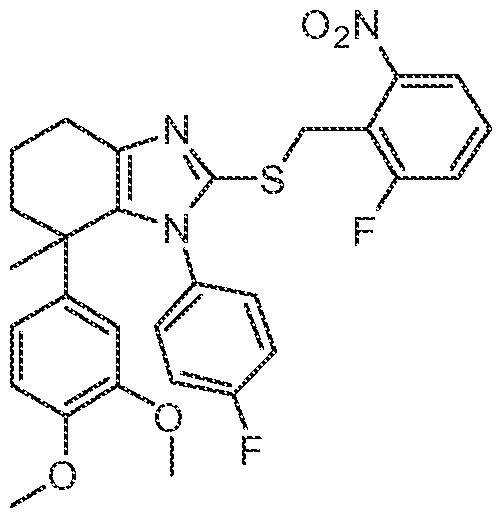
The title compound was prepared according to the procedure as described in Example 78 step 8 reacting 7-(3,4-dimethoxyphenyl)- l-(4-t]iioropheny})-7-methyl-4,5,6,7- tetrahydro- 1 H-benzo[d] imidazole-2-thiol (Prepared as described in Example 99, Step 3) and 2-(bromomethyi)-l-fluoro-3-nitrobenzene as an off-white solid.
Ή NMR (400 MHz, CDCI3) δ 7.74 (d, J = 7.5 Hz, I H), 7.36 (dd, J ==: 7.8, 4.5 Hz, I H), 7.31 (d, J = 6.9 Hz, IH), 7.02 (m, 2H), 6.68 (d, J = 7.3 Hz, I H), 6.60 (s, IH), 6.55 (m, I H), 6.12 (m, I H), 4.42 (s, I H), 3.88 (s, 3H), 3.81 (s, Mil 2.75 (m, 21 1 ). 1 .82 (m, 4H), 1.25 (s, 3H).
Example 116: 2~(ii3,5-diiluermyridin~4~yl}methylHhM
ftuoro henyl)-7-methyl-4,5,6, 7-tetrahydro-lH-benz idiimidazole

The title compound was prepared according to the procedure as described in Example 78 step 8 reacting 7-(3,4-dimethoxyphenyl)-l-(4-fiuorophenyl)-7-methyl-4,5,6,7- tetrahydro- 1 H-benzo[d]imidazole-2-thiol (Prepared as described in Example 99, Step 3) and 4-(dilorometliyl)-3,5-difluoropyridine HC1 salt as an off-white solid.
Ή NMR (400 MHz, CDC13) δ 8.25 is.2H), 7.02 id. J = 5.8 Hz, 2H), 6.71 (d, J = 7.5 Hz, 111).6.58 (s, 111.6.55 (m, !!!}.6.51 (d, J = 5.8 Hz, 111).6.10 (m, 1H), 4.50 (abq, J = 12.8 , 7.4 Hz, 2H), 3.88 (s, 3H), 3.80 (s, 311).2.75 On.2H), 1.82 (m, All).1.27 (s, 3H).
Example 1 / 7; 2~(((7~(3 -dimeth0xyphenyl)-l-(4-fl orophetiyl)~7~methyl~4,5,6, 7~ tetrahvdro-lH-ben idHmidazol-2-yl)thiojmethyl)thiazole

The title compound was prepared according to the procedure as described in Example 78 step 8 reacting 7-(3,4-dimethoxyplienyl)- 1 -(4-fluorophenyl)-7-methyl-4,5 ,6,7- tetrahydro- 1 H-benzo[d]imidazole-2-thiol (Prepared as described in Example 99, Step 3) and thiazol-2-ylmethyl methanesulfonate as an off-white solid.
'H MR (400 MHz, CDCI3) δ 7,65 (s, 1H), 7.23 (s, 1H), 6.98 (m, 11 1).. 6.72 (d, J = 6.1 Hz, IH), 6.62 (t, J = 5.5 Hz, I I I ). 6.55 (ra, 2H), 6.1 8 (m, IH), 4.57 (abq, J - 12,5 Hz, 2H), 3.87 (s, 3H), 3.76 (s, M i l 2.80 (ra, 21 1 ). 1 .82 (m, 4H), 1.28 (s, 3H).
Example 118: 3, S~difluoro~4~( ((7~(4~fluoro-3-methoxyphenyl)~l~( 4~fluorophenyl)-7- methyl-4,5,6, 7-tetrahydro-lH-benz fdlimidaz l-2-yl)thio)methv
Step 1: 2-(3-methoxy- -flMorophenyl)-2-methylcvctohexaiioae

The title compound was prepared according to the procedure as described in Example 78 step 1 reacting 2-(3-methoxy-4-fluorophenyl)cyclohexanone with NaH followed by Mel as light yellow solid. JH NMR. (400 MHz, CDC 3) δ 7.05 (dd, J = 8.0, 5.5 Hz, IH}, 6.75 (m, 2H), 3.89 (s, 6H), 2.68 (m, IH), 2.37 (m, 2H), 2.01 (m, IH), 1.72 (m, 4H), 1.28 (s, 3H),
Step 2; 7-(3-metfaoxy-4-lfa

The title compound was prepared according to the procedure as described in Example 78 step 2-7 to afford the product as a yellow solid.
Ή NMR (400 MHz, CDC! 3) δ 7.32 (m, 2H), 7.08 (d, J = 8.8 Hz, 2H), 7.02 (dd, J - 10.5, 7.5 Hz, IH), 6.83 (d, J = 7.0 Hz, H), 6.80 (m, HI), 3.82 (s, 3H), 2.81 (m, 2H), 1.85 (m, 4H).
Step 3: 2-i i(2-chloro-6-fl¾orophenyl)methyl|s¾Ifa^
l-(4-i¾orepheiiyI)^

The title compound was prepared according to the procedure as described in Example 78 step 8 reacting 7-(3-methoxy-4-fluorophenyl)-l -(4-fluorophenyl)-7-methy 1-4,5, 6,7- tetrahydro- 1 H-benzo[d]imidazole~2-thiol and 2-(bromomethyl)~ 1 -chloro-3-fluorobenzene as an off-white solid. ]H NM (400MHz,CD3OD): δ 7.22-7.3 l(m, 2H), 6.95-7.08 (m, 4H), 6.70-6.73 (m, 1H), 6.54-6.59 (m, 2H), 5.85-5.88 (m, IB), 4.19 (d, J = 13.2 Hz, 1H), 4.00 (d, J = 1 .6 Hz, 1H), 3.78 (s, 3H), 2.72-2.76 (m, 2H), 1.84-1.95 (m, 4H), 1.31 -1.35(m, 3H). Mass spectrum (ESI, m/z): Calcd. for C28H24CIE3N2OS, 529.1(M+H), found 529.3.
Example 119: 3.5~difluoro~4-( ((7-(4-fluoro-3-methoxyphenyl)-l-( 4-fluorophenyl)~7~ methyl-4,5,6.7~tetrah dro~lH~benzofdJimidazol-2~yl)thio^

The title compound was prepared accordi g to the procedure as described in Example 78 step 8 reacting 7-(3-methoxy-4-fluorophenyl)-l-(4-fluorophenyl)-7-methyl- 4,5,6,7-tetrahydro-lH-benzo[d]imidazole-2 -thiol and 4-cyano-2,6-difluorobenzyl methanesulfonate as an off-white solid.
!H NMR (400 MHz, CDC13) δ 7.18 (d, J = 7.5 Hz, 2H), 7.08 (m, 2H), 7.95 (t, J = 8.8 Hz, IH), 6.68 (ra, 2H), 5.54 (m, I E), 6.18 (m, IH), 4.08 (abq, j - 10.5, 4.2 Hz, 2H), 3.78 (s, 3H), 2.75 (m, 2H), 5.82 (m, 4H), 1 .28 (s, 3H).
Example 120: 3,5-diftuoro-4-(((7-(4-fluoro-3-methoxyphenyl)-l-(4-ftuorophenyl)-7- methyl-4,5,6, 7~tetrah dro~lH~benzofdIimidazol-2~yl)thw^ acid

The title compound was prepared according to the procedure as described in Example 65 reacting 3,5-difluoro-4~(((7~(4~fluoro~3~niethoxyphenyl)~ 1 -(4-fluorophenyl)- 7-inethy]-4,5,6,7-te1rahydro-lH-benzo[d]imidazol-2-yl thio)methyl)benzomtTile in aqueous alkaline solution as a white solid.
!H NMR (400 MHz, CDCI3) δ 7.42 (d, J = 7.2 Hz, 2H), 7.25 (m, J = 6.0 Hz, IH), 7.15 (t, J = 6.2 Hz, IH), 6.95 (t J = 8.5 Hz, IH), 6.75 (m, 2H), 6.58 (m, IH), 6.42 (m, IH), 3.85 (s, 3H), 3.54 (m, 2H), 3.15 (m, IH), 2.82 (m, IH), 1.85 (ni, 4H), 1.35 (s, 3H).

Ή NMR (400 MHz, CDCI3) δ 7.98 (br, s, 1H), 7.62 (d, J = 7.8 Hz, 2H), 7.08 (m, 2H), 6.95 (t, J = 9.8 Hz, IH), 6.64 (d, J = 5.5 Hz, 2H), 6.53 (m, 1H), 6.12 (m, IH), 3.98 (abq, J 1 0.5. 6.1 Hz, 21 1 ;·. 3.82 (s, 3H), 2.72 (m, 2H), 1.83 (m, 4H).
Example 122; (3,S-difluoro-4-(((7-(4-fluoro-3-methoxyphenyl)-l-(4-fluorophenyl)-7- m hyl-4,S,6, 7-ietmhydro-lH-benzofd}imidaz l-2-

The title compound was prepared according to the procedure as described in Example 66 coupling 3,5-difluoro-4-(((7-(4-fluoro-3-methoxyphenyl)-l -(4-fluorophenyl)- 7-methyl-4,5,6,7-tetrahydro-lH-te acid (Prepared as described in Example 120) with morpholine using HATIJ as white solid.
Ή NMR (400 MHz, CDC13) δ 7.08 (m, 2H), 6.95 (t, J = 7.5 Hz, IH), 6.88 (d, J = 6.0 Hz, 2H), 6.67 (d, J = 6.5 Hz, 2H), 6.56 (m, J = 4.0 Hz, IH), 6.18 (m, IH), 4.12 (abq, J = 9.5, 4.0 Hz, 2H), 3.80 (s, 3H), 3.68 (m, 6H), 3.50 (m, 2H), 2.72 (m, 21 1 ). 1.80 (m, 2H), 1.73 (m, 2H), 1.32 (s, M l )
Example 123; 3,S-difluoro-4-(((7-(4-fluoro-3-methoxyphenyl)-l-(4-fluorophenyl)-7- methyl-4,S,6 ~tei hydm~lB~benzoid imidaz i~2^
ln^r xyef i>xy}ei xy}et (>xy}ei yi} he/izamhie

The title compound was prepared according to the procedure as described in Example 66 coupling 3,5-difiuoro-4-(((7-(4-f3.uoro-3-m.ethoxyphenyl)-l-(4-fluorophenyl)- 7-methyl-4,5,6,7-tetrahydro-l H-benzofd]imidazol-2-yl)thio)methyr)benzoic acid (Prepared as described in Example 120) with 2-(2-(2-(2-aminoethoxy)ethoxy) ethoxy) ethanol using HATU as white solid.
Ή NMR (400 MHz, CDC13) δ 8.32 (br, s, 1H), 7.48 (d, J = 6.2 Hz, 2H), 7.12 (m, J = 5.7 Hz, 1 H), 7.02 (t, J - 6.0 Hz, 2H), 6.72 (t, J - 6.1 Hz, H I ). 6.60 (d, J = 5.8 Hz, 1H), 6.48 (s, IH), 6.02 (br, s, 1H), 4.21 (abq, J = 10.5, 6.5 Hz, 2H), 3.78 (s. 3H), 3.70 (m, 16H), 2.95 (m, 2H), 1 .92 (m, 4H), 1.35 (s, 3H).
Example 124: 3,5-difuoro-4-fff7-(4-fluoro-3-methoxyphenyl)-l-f4-fluo phenyl)-7- methyl-4,5.6, 7-tetr hvdro-lH-benz fdJimidazol-2-yl)thio)methyl)-^T-(2- methoxyethvQbenzatnide

Example 125: 2-(ll4-(2-[2-[2-(dimethylammo)ethoxy!ethoxy]ethoxy)-2,6- difluorophen yl]meth y Usui 'fan yi)~ 7-(4-fluoro-3-methoxyphen yl)-l-(4-fluorophenyl)- 7- m eth yf~4,5, 6, 7-tetrah \H <dro-lH-l,3-benzqdiazole hydrochloride
Ste 1 ; 2- ( [2,6-difluoro-4-{(4^ met!¾yI)s¾ilfaiiyll-7-(4- flttoro-3-methox phenyl)-l-(4-fluoropheiiyl)-7-methyl-4, 5, 6, 7-tetrahydro-lH-l, 3- beiizodiazole

The title compound was prepared according to the procedure as described in Example 78 step 8 reacting 7-(3-methoxy-4-fluorophenyl)-l-(4-fluorophenyl)-7-methyl-4,5,6,7- tetrahydro-lH-benzo[d]imidazole-2-thiol (Prepared as described in Example 118, Step 2) and 2,6-difluoro-4-((4-methoxybenz}'I)oxy)benzyl methanesulfonate as an off-white solid. Mass spectrum (ESI, m/z): Calcd. for C36H32F4N2O3S, 649.2 (M +H), found 649.2.
Step 2: 3, S-difluoro-4-(i"[7-(4-flttoro-3-methoxyphenyl)-l-(4-flttorophenyl)-7- methyl-4,5,6,7-tetrahydro-lH-l,3-benzodiazoI-2-yllsulfanyllmethyl)phenol

The title compound was prepared according to the procedure as described in Example 24 step 3 reacting 2~[([2,6-difluoro-4-[(4- methoxyphenyl)methoxy]pheiiyl]methyl)sulfanyl]-7-(4~fluoro-3-methoxyphenyl)-l-(4~ iiuorophenyl)-7-methy]-4, 5, 6, 7-tetrahydro- 1 H- 1 , 3-benzodiazole in TFA to afford the product as an off-white solid. !H NMR (300MHz,CD3OD): δ 6,99-7.09 (m, 2H), 6,84- 6.96 (m, 1H), 6.66-6.72 (m, 1H), 6.39-6.59 (m, 4H), 5.98-6.04 (m, 1H), 4.18-4.32 (m, 2H), 3.79 (s, 3H), 2.93-2.95 (m, 2H), 1.86-1.95 (m, 4H), 1 .25-1.35 (m, 3H). Mass spectrum (ESI, m/z): Calcd. for C28H24F4N2O2S, 529.1 (M +H), found 529.1 .
Step 3: 2-[[(2,6-difluoro-4-f2-[2-(2- iodoethoxy)ethoxylethox ']phenyl)methyl1sulfaay11-7-(4-flaoro-3-inethoxyph.eay1)-l- (4-flMoroph.ea -7-methy1-4,5,6,7-tetrahydro-lB[-l,3-ben¾odiaa!:o]e

The title compound was prepared according to the procedure as described in Example
24 step 4 by coupling 3, 5-difluoro-4-([[7-(4-fluoro-3-methoxyphenyl)-l -(4- fluorophenyl)-7-methyl-4,5,6,7-tetrahydro- 1 H- 1 ,3-benzodiazol-2-
yl]sulfanyl]methyi)phenol and 1 ,2-bis(2-idodethyox)ethane in the presence of Cs?C(¾ to afford the desired product as a white solid. Mass spectrum (ESI, m/z): Calcd. for C34H35F4IN2O4S, 771.1 (M+H), found771. L

The title compound was prepared according to the procedure as described in Example 27 step 2 by coupling 2-[[(2,6-difluoro-4-[2-[2-(2- iodoethoxy)ethoxy]ethoxy]phenyl)methyl]sulfanyl]-7-(4-fluoro-3-methoxyphenyl)- l -(4- f3.uorophenyl)-7-methyl-4,5,6,7-tetrahydro-.l H-l ,3-benzodiazole and dimethylamine to afford the desired product as a white solid. !H NMR (400MHz, CD3OD): δ 7.25-7.34 (m, 2H), 7.03-7.04 (m, 1 H), 6.71 -6.80 (m, 4H), 6.53-6.56 (m, 1 H), 5.96-5.97 (m, 1 H), 4.1 9- 4.27 (m, 3H), 4.09-4.20(m, 1 H), 3.77-3.92 (m, 1 1 H), 3.32-3.39 (m, 2H), 2.90-2.94 (m, 8H), 1.99-2.1 1 (m, 41 1 ). 1.46 (s, M l ). ¾9F NM R (400MHz, CD3OD): -1 10.89, - 1 16.00,- 138.74. Mass spectrum (ESI, m/z): Calcd. for C36H42CIF4N3O4S, 688.3(M-HC1+H), found 688.5.
Example 126; 7-(4-ftuoro-3-methoxyphen yl)-l-(4-fluorophenyl)-7-methyl-2-( (pyrimidin- 2-ylmeth yl)thio)-4, 5, 6", 7-tetrah ydro-lH-benzoldHmidazole

The title compound was prepared according to the procedure as described in Example 78 step 8 reacting 7-(3-methoxy-4-fluorophenyl)- 1 -(4-fluorophenyl)-7-methyl- 4,5,6,7-tetrahydro-lH-benzo[d]imidazole-2-thiol (Prepared as described in Example 1 18, Step 2) and pyrimidin-2-yimetliyl methanesulfonate as an off-white solid. Mass spectrum (ESL m/z): Caled. for C^H^F.^GS, 478.56, found 479 (M H).

The title compound was prepared according to the procedure as described in Example 78 step I reacting 2-(3-m.ethoxy-4-chlorophenyl)cyclohexanone with NaH followed by EtI as light yellow solid. Mass spectrum (ESI, m/z): Caled. for C15H19CIO2, 267.2 ( VI - I f ), found 267.2.
Step 2: 7-(4-chloro-3-methoxyphenvi)-7-ethvI-l-(4-fluorophenvn-4,5,6,7-tetrahvdro- lH- -benzodiazole-2-thiol

The title compound was prepared according to the procedure as described in Example 78 step 2-7 to afford the product as a yellow solid. Mass spectrum (ESI, m/z): Calcd. for ("»!!■. Cli;N>()S.417.1 iVi ·!!;·. found 417.1.
Step 3: 7- -cM^

The title compound was prepared according to the procedure as described in Example 78 step 8 reacting 7-(4-chloro-3-methoxyphenyl)-7-ethyl-l-(4-fluorophenyl)-4,5,6,7- tetrahydro- 1 H- 1 ,3-benzodiazoie-2-thiol and 2-(bromomethyl)- 1 -chioro-3-fluorobenzene as an off-white solid. !H NMR (CD3OD, 300MHz): δ 7.20-7.30 (m, 3H), 6.98-7.07 (m, 3H), 6.76 (d../ 2.1 Hz, III).6.56-6.61 (m, 2H), 5.91-6.10 (m, III).4,17-4.22 (m, 1H), 4,01 (d, J= 1.8 Hz, 1H), 3.79 (s, 3H), 2.67-2.75 (m, 2H), 2.10-2.30 (m, HI), 1.95-2.05 (m, HI), 1.79-1.82 (m, 2H), 1.62 (br, 1H), 1.27-1.29 (m, 1H), 0.74-0.79(m, 3H). Mass spectrum (ESI, m/z): Calcd. for C.v! 1 v,( 1 ·ί,\ >()S.559.1 (M+H), found 559.3.
Jbxample ~chloro~J~met, -chloro-o-tluorobenzlthio) iuorophem ~tetrahydro~3H~benzoJdJimidaz l (methanol tntluoroacettc acic
Step 1; 2-{4-ciiIoro-3-metiioxyp!¾ s¾ )-2-j |2-(trimetfayIsilyl)etfaoxylmetfaylleyclofaexaii-

The title compound was prepared according to the procedure as described in Example 78 step 1 reacting 2-(3-methoxy-4-chlorophenyi)cyclohexanone with NaH followed by SEMCl as light yellow oil. Mass spectram (ESI, m/z): Calcd. for Ct9H2 CK¼Si, 369.2 (M +H), found 369.2,
Step 2: (7^
tetraiiyciro-lH- - eiizodiazo¾-7-yllmetli¾s¾ol

The title compound was prepared according to the procedure as described in Example 78 step 2-7 to afford the product as a yellow solid. Mass spectram (ESI, m/z); Calcd. for C2iH2oClFN202S, 419.1(M+H), found 419.1.


The title compound was prepared according to the procedure as described in Example 78 step 8 reacting [7-(4-chloro-3-methoxyphenyl)-l-(4-fluorophenyl)-2-sulfanyl-4,5,6,7- tetrahydro- 1 H- 5 ,3-benzodiazol-7-y].]methanol and 2-(bromomethyl)- 1 -ch!oro-3- fluorobenzene as an off-white solid. lE NMR (400MHz,CD3OD): δ 7.44-7.16 (m, 61 1 ). 6.77-6.69 (m, 2H), 6.54-6.52 (m, 1 H), 6.12-6.14 (m, 1 H), 4.35 (d, J = 13.2 Hz, 111), 4.22(d, ./ 13.2 H/„ 1 H), 3.96 (d, J = 1 0.8 Hz, 1H), 3.79 (s, 3H), 3.37 (s, 1 H), 2.82-2.89 (m, 2H), 2.47-2,55 (m, 1 H), 1 .88-1.92 (m, 3H) . 19F NMR (300MHz, CD3OD): -77.1 1 , - 1 1 1 .06, - 1 15.02. Mass spectrum. (ESI, m/z): Calcd. for C30.4H25.2CI2F5.6N2O4.4S, 561.1 (M-I .2CF3COOH +H), found 561.1.
Example 129: 7-( 4~chk}n~3~methoxyphen yl)-2-(2-chloro-6~fluorobenzylthio)~ 7~ (fluoromethyl)-l-(4-flu.orophe-nyl)-4, 5, 6, 7-tetrahydro-lH-benzo/djimidazole
trifiuoroacetic acid

A solution of (4-(4-chloro-3-metlioxyphenyl)-2-(2-chloro-6-fluorobenzylthio)-3-(4- fluorophenyl)-4,5,6,7-tetrahydro-3H-benzo[d]imidazoi-4-yl)methanol (20 mg, 0.04 mmol, 1.00 equiv), in dichloromethane (1 mL) was treated with BAST (9.45 mg) at -78 °C and stirred for 1 .0 h at room temperature. The reaction was quenched by the addition of 1 mL
of sodium carbonate/¾0, extracted with 3x3 mL of dichloromethane, and the combined organic layers were dried over anhydrous sodium sulfate, filtered, and concentrated under vacuum. The crude product was purified by Prep-HPLC with the following conditions: (l#waters2767-5) Column, SunFire Prep CI 8, 19* 150mm 5μπι; mobile phase, Phase A: water with 0.05% TFA, Phase B: CH3CN (40% CH3CN up to 80% in 10 min, up to 100% in 0.1 min, hold 100% in 1.9min, down to 40% in 0.1 min, hold 40% in 1.9 min); Detector, UV 254nm, to give the title compound as colorless oil !H NMR (400V! Hz. CD3OD): 6 7.25-7.43 (m, 5H), 7.03-7.16 (m, 41 1 ;·. 6.81-6.91 (m, 1 H), 4.16-4.29 (m, 2H), 3.88 (s, 3H), 3.50-3.51 (m, 1H), 2.99-3.16 (m, 2H), 2.71 -2.76 (m, 1H), 2.40-2.71 (m, 2H), 2.02-2.07 (m, 2H). i9F NMR (400MHz, CD3OD): -77.1 1 , -1 10.83, -1 15.30,-156.88. Mass spectrum (ESI, m/z): Caled. for C30.8H24.4Cl2F7.2N2O3.sS, 563.1(M-1.4CF3COOH+H), found563.2.

A solution of (4-(4-chloro-3-methoxyphenyl)-2-(2-chloro-6-fluorobenzylthio)-3-(4- fluorophenyl)-4,5,6,7-tetrahydro-3H-benzo[d]imidazol-4-yl)methanol (Prepared as described in Example 128, 15 mg, 0.03 mmol, 1.00 equiv), dichloromethane (2 mL), and Dess-Martin periodinane (22.7 mg) was stirred for 2.0 h at room temperature. The reaction was quenched by the addition of 1 mL of sodium biearbonate/FLO, extracted with 3x3 mL of dichloromethane, and the combined organic layers combined were dried over anhydrous sodium sulfate, filtered, and concentrated under vacuum. The crude product (1 mL) was purified by Prep-HPLC with the following conditions: (l#waters2767-5) Column, SunFire
Frep CI 8,19* 150mm Sum; mobile phase, Phase A: water with 0.05% TFA, Phase B: (Ί ί .-CN (40% CH3CN up to 80% in 10 min, up to 100% in 0.1 min, hold 100% in 1.9min, down to 40% in 0.1 min, hold 40%> in 1.9 min); Detector, UV 254nm, to give the title compound as a yellow solid. Ή NMR (400MHz, CD3OD): δ 9.83 (s, 1 H), 7.32-7.45 (m, 2H), 7.17-7.22 (m, 2H), 7.06-7.15 (m, 1H), 6.92-6.92 (m, 1 1 1 ;·. 6.68-6.92 (m, IH), 6.46- 6.55 (m, 2H), 6.14 (s, IH), 4.21 -4.34 (m, 2H), 3.77 (s, 3H), 2.81-2.98 (m, 2H), 2.58-2.62 (m, IH), 2.27-2.47 (m, I H), 1.73-1.81 (m, I H). ¾9F NMR (400MHz, CD3OD): -77.22, - 1 1 1.68, -1 14.99. Mass spectrum (ESI, m/z): Calcd. for C30. H23.2CI2F5.6 2O4.4S, 559.1(M- 1.2CF3COOH+H), found 559.1.

Imidazole (0.29 g, 4.3 mmol), 4-F-phenylboronic acid (500 nig, 3.57 mmol), copper (I) oxide (107 nig, 0.72 mmol) in MeOH (12 niL) under air were stirred overnight. The solution was filtered and concentrated. The residue was partitioned between ethyl acetate and saturate ammonium chloride and brine. The solution was then dried and concentrated and purified by silica gel column chromatography to give the title compound as a yellow oil. ! NMR (400 MHz, CD3OD) δ 7.80 (s, IH), 7.35 (m, .:.! ! ). 7.21 (m, 41 1 ).
Step 2: 2-((2-chloro-6-fluorobeazyl)thio)-l-(4-flttorophenyl)-lH-imidazole

l-(4-Fluorophenyl)-lH- imidazole (1.4 g, 8.63 mmol) in THF (5 mL) at -78 °C was dropwiseiy treated with n-BiiLi (2.5 M, 3.45 mL, 8.63 mmol) for 30 min. Then S-2- c oro-6-fluorobenzyl 4-methylbenzenesulfoiiothioate (2.86 g, 8.63 mmol) in THF (5 mL) was slowly dropped into the reaction and stirring wras kept at -78 °C for another 2 hours. The reaction was quenched with Ni l iCi and warmed up to room tmeprature. The solvent was removed and the residue was partitioned between ethyl acetate and saturate ammonium chloride and brine. The solution was then dried and concentrated and purified by silica gel column chromatography to give the title compound as a white solid (1.6 g, 55% yield). Ή NMR (400 MHz, CDC13) δ 7.25 (s, i l l). 7.21 (m, 3H), 7.12 (m, 4H), 6.89 (t, J = 7.2 Hz, 1H1 4.32 (s, 2H).
Step 3: 2-((2-cliloro-6-fl¾orobei¾ -l-(4-fl¾orop¾e¾yi)-4 -diiodo-lH-iiaid¾zoIe

2~((2~Chloro-6-fliiorobenzyl)thio)-i-(4~fluoropheiiyl)-lH-imidazole (200 mg, 0.60 mmol) and NIS (280 mg, 1.25 mmol), pTSA (3 mg) in DCM (10 mL) were stirred at 50 °C for 6 hours. The reaction was cooled down and washed with saturated sodium thiosulfate and brine. The organic layer was then dried and concentrated and purified by silica gel column chromatography to give the title compound as a white solid (110 mg, 31%). 3F1 NMR (400 MHz, CDCI3) δ 7.20 (m, 6H), 6.95 (t, J = 7.0 Hz, 1H), 4.40 (s, 2H).
Step : (2-((2-chloro-6-fl¾orobenzyI)thio)-l -(4-fliioropliesiyl)-4-iodo-lH-iiaid¾zoI-5- y¾) -dis¾etiioxypheiiyI)iaeth¾siol

2-((2-Chloro-6-fluorobenzyl)thio)- 1 -(4-fluorophenyl)-4,5-diiodo- 1 H-imidazole (170 mg, 0.29 mmol) in THF (2 niL) at 0 °C was treated with i-PrMgBr (2.9 M, 0.1 niL, 0.29 iiimol) dropwisely. The reaction was stirred at 0 °C for 10 min and then 3,4- dimethoxybenzaldhyde in THF (2 niL) was dropwisely added into the reaction and stirring was kept for another 2 hours. . The reaction was partitioned between ethyl acetate and saturated ammonium chloride. The organic layer was washed with brine then dried and concentrated and purified by silica gel colum chromatography to give the title compound as a colorless oil (150 mg, 83% yield). !H N (400 MHz, CDCI3) δ 7.18 (m, 3H), 6.91 (t J = 6.8 Hz, 3H), 6.68 (d, J = 7.5 Hz, 2H), 6.58 (s, 1H), 6.52 (d, J = 6.0 Hz, 1H), 5.90 (s, 1H), 4.38 (s, 2H), 3.83 (s, 3H), 3.72 (s, 3H).


(Z)-(2-((2-chloro-6-fj.uorobenzyl)thio)-4-(2-ethoxy vinyl)- 1 -(4-fl.uorophenyl)- 1 H- imidazol-5-yl)(3,4-dimetboxyphenyl)methanol (90 mg, 0.15 mmol) in 1 mL concentrated HCI and 2 mL THF was stirred at room temperature for 2 hours. The reaction was neutralized with satureated NaHC(¾ and extracted with ethyl acetate. The organic layer was washed with brine then dried and concentrated and purified by silica gel column chromatography to give the title compound as a colorless oil. To this oil in MeOH (1 ml.) was added sodium borohydride (20 mg, 0.55 mmol) at 0 °C. The reaction was warmed up to room temperature for 10 min and the solvent was removed. The residue was partitioned between ethyl acetate and saturated ammonium chloride. The organic layer was washed with brine then dried and concentrated and purified by silica gel column chromatography to give the title compound as a colorless oil. Mass spectrum (ESI, m/z): Calcd. for C27H25CIF2 2O4S, 547.01, found 578 (M+H).
Step 7: 2-((2-cMoro-6-i¾orobe¾z i)tMo)-4-(3,4-dimet¾oxyp¾ei¾yl)-3-(4-fl¾orop¾e8iyi)-
3,4,6 -tetraliydropyra¾o 3,4-dlimid¾zo¾e

2-(2-((2-Chloro-6-fluorobenzyl)thio)-5-((3,4-dimethoxyphenyl)(hydroxy)methyl)-l-(4- fluorophenyl)-lH-imida.zol-4-yl)ethanol (120 mg, 0.224 mmcT) and pTSA (4 mg, 0.022 nimol) in toluene (5 mL) were heated to relux for 2 hours. The solvent was removed and the residue was purified by silica gel column chromatography to give the title compound as a white solid (54 mg, 47%).
!H MR (400 MHz, CDC13) δ 7.24 (m, J = 7.2 Hz, 2H), 7.19 (d, J = 6.5 Hz, 1H), 7.02 (t, J = 6.8 Hz, lH), 6.85 (m, 2H), 6.62 (d, J = 7.0 Hz, 2H), 6.51 (s, 1H), 6.38 (d, J = 5.8 Hz, 1H), 5.38 (s. 1H), 4.36 (abq, J = 10.5, 6.5 Hz, 2H), 4.25 (m, 1H), 3.95 (m, 1H), 3.85 (s, 3H), 3.72 (s, 3H), 3.21 (m, 1H), 3.08 (m, i l l).

Step 2: 4,5-dibromo-2-(tert-but liUmethylsiIvI)-l-(4-fluorophenvn-lH-imidazote

2-(tert-But}ddimethylsiiyl)-l-(4-fluorophenyl)-lH-imidazole (4.4 g, 16 mmol) and NBS (5.95 g, 33.4 mmol) in DCM (20 mL) were stirred at room temperature for 4 hours. The reaction was cooled down and washed with saturated sodium thiosulfate and brine. The organic layer was then dried and concentrated and purified by silica gel column chromatography to give the title compound as a white solid (4.85, 70%). 3H NMR (400 MHz, ( DC! :) δ 7.25 (in, 4H), 0.95 is. 9H), 0.02 (s, 61 1).
Step 3: (4-bromo-2-(tert-but>ldimeth>lsilvI -l-(4-fluorophen>i)-lH midazoI-5-vn(4- chIoro-3-methoxyphenyI)methanoI

4,5-Dibromo-2-(tert-butyldimethylsilyl)-l -(4- fluorophenyl')- lH-imidazole (1.5 g, 3.45 mmol)
in THF (5 mL) at -78 °C was treated with n-BuLi (2.5 M, 1 .4 mL, 3.45 mmol) dropwise for 30 min and then 3-methoxy-4-chlorobenzaldehyde (574 mg, 3.5 mmol) in THF (1 mL) was added into the reaction. The reaction was slowly warmed to room temperature for another 2 hour and que ched with saturated NH4C1. The solvent was removed and the residue was partitioned between ethyl acetate and saturated ammonium chloride. The organic layer was washed with brine then dried and concentrated and purified by silica gel column chromatography to give the title compound as a colorless oil. Mass spectrum (ESI, m/z): Calcd. for C -J i -BrC!FN. ·0 ^Si. 525.91, found 526 (M+H).

The title compound was prepared according to the procedure as described in Example 131 step 5 reacting (4-bromo-2-(tert-butyldimethylsilyl)-l-(4-fluorophenyl)-lH-imidazol- 5-yl)(4-chloro-3-methox.yphenyl)methanoi with (Z)-2-(2-ethoxyvmyl)-4,4,5,5-te1xamethyl- 1 ,3,2-dioxaborolane with Pd2(dba)3 and BINAP to give a yellow solid. Mass spectrum (ESI, m/z): Calcd. for C27H34CIFN2O3S1, 517.1 1 , found 518 (M+H).


The title compound was prepared according to the procedure as described in Example 131 step 6 reacting (Z)-(2-(tert-butyldimethylsilyl)-4-(2-ethoxyvinyl)-l-(4-fliiorophenyr)- lH-imidazol-5-yi)(4-chioro-3-methoxyphenyi)methanol in aqueous HQ solution followed by NaBH4 reduction of the corresponding aldehyde to give a yellow solid. Mass spectrum (ESI, m/z): Calcd. for f . -,f . iI'N.-(),S=. 491.07, found 492 (M+H).
Step 6: 2-(tert-batytd
3,4,6 -tetrali ropyra¾o 3,4-dlimid¾zo¾e

The title compound was prepared according to the procedure as described in Example 531 step 7 reacting 2-(2-(tert-butyldimethylsilyl)-5-((4-chloro-3- metboxyphenyl)(hydroxy)me1hyl)-l-(4-fluoropbenyl)-l H-imidazol-4-yl)ethanol in pTSA toluene solution to give an off white solid. Mass spectrum (ESI m/z): Calcd. for C25H3oClFN202Si, 473.05, found 474 (M+H).
Step 7: 4-(4-chloro-3-methoxyphenyr)-3-(4-fluorophenvn-3,4,6,7- tetrahydropyrano[3,4-dlimidazoIe

2-(tert-bxityldimethylsilyl)-4-(4-cWoro-3-methoxyphenyI)-3-(4-flxio^
tetrahydropyrano[3,4-d]imidazole (80 mg) was treated with 1 N TBAF (0.3 niL, 0.34 mmol) at room temperature for 5 min. The solvent was removed and the residue was purified by silica gel column chromatography to afford the title compound as a white solid. Mass spectrum (ESI, m/z): Calcd. for CI9HI6C1FN202, 358.79, found 359 (M+H).
8: 4-(4-ch1oro-3-methox.vphenyl)-2-('('2-chIoro-6-flMorobeMzyl)thio)-3-(4- fluorophenvn -tetrahydropyrano ^-dlimidazole

The title compound was prepared according to the procedure as described in Example 131 step 2 reacting 4-(4-chloro-3-methoxyphenyl)-3-(4-fiuorophenyl)-3,4,6,7- tetrahydropyrano[3,4-d]imidazole and S-2-chloro-6-fluorobenzyl 4- methylbenzenesulfonothioate in the presence of n-BuLi at -78 °C to afford the product off- while solid. !H NMR (400 MHz, CDCI3) δ 7.18 (d, J = 7.5 Hz, 2H), 7.1 1 (d, J = 6.5 Hz, 2H), 6.92 (t, J = 7.1 Hz, I I I). 6.81 (t, j = 7.8 Hz, 2H), 6.62 (m, 1H), 6.55 (s, i l l ). 6.44 (m, 1H), 5.42 (s, IH), 4.28 (abq, J = 10.5, 5.8 Hz, 2H), 4.20 (m, 1H), 3.95 (m, IH), 3.74 (s, 3H), 3.08 (m, IH), 2.79 (m, IH).
Example 133: 4-(4-chl-oro-3-methoxyphenyl)-2-((4-(2-(2-(2- chlomethoxy}eikoxy)6thoxy)~2 >~difluorofoe
ietrahydt pyrano{3,4-dlifnidaz l
roettiYlbenzeiiesMlfoaot oaie

4-(2-(2-(2-Chloroethoxy)ethoxy)ethoxy)-2,6-difluorobenzyl methanesulfonate (800 mg, 2.14 mmol) was added solution of p-toluenethiosulfonic acid potassium salt (500 mg, 2.14 mmol) in 10 mL of acetone at room temperature. The solution was stirred overnight. The solid was filtered off. The filtrate was concentrated. It was partitioned between ethyl acetate and water. The organic layer was washed with water and brine and dried and concentrated to give the title product as a white solid (950 mg, 92% yield), 'ϊί NMR (400 MHz, CDCI3) 5 7.85 (d, J = 7.8 Hz, 2H), 7.30 (d, J = 8.5 Hz, 2H), 6.42 (d, J = 7.2 Hz, 2H), 4.21 (s, 2H), 4.08 (m, 2H), 3.88 (d, J = 6.5 Hz, 2H), 3.75 (m, 4H), 3.62 (m, 4H). 2.48 (s, 3H).
Step 2: -cmoro- ethoxyphenYl)-2-((4-(2-(2-(2-chl' )ethoxv)etiiox
Iiiorop!iesivI)~3, tetrahydropvraiio I imidazole

The title compound was prepared according to the procedure as described in Example 131 step 2 reacting 4-(4-chloro-3-methoxyphenyl)-3-(4-fluorophenyl)-3,4,6,7- tetrahydropyrano[3,4-d]imidazole (Prepared as described in Example 132, Step 7) and S-4- (2-(2-(2-chloroethoxy)ethoxy)ethoxy)-2,6-difluorobenzyl 4-methylbenzenesulfonothioate in the presence of n-B uLi at -78 °C to afford the product off- while solid.
Ή NMR (400 MHz, CDC13) 5 7.82 (d, J - 7.8 Hz, ! ! ! ). 7.39 d, J = 7.5 Hz, 1 1 1 ). 7.18 (d, J = 7.2 Hz, 1H), 6.98 (m, 2H), 6.55 (s, U S ). 6.47 (d, J = 8.1 Hz, 2H), 6.38 (in, 1H), 5.42 (s, 1H), 4.65 (abq, J = 10.5 Hz, 2H), 4.25 (m, 2H), 4.18 (m, 2H), 3.70 (m, 10 H), 3.65 (s, 3Π ). 3.21 (m, i l l ). 3.05 (m, 1 H).

yl)(3-met ox.v-4-flaorophenyl)methaao1

The title compound was prepared according to the procedure as described in Example 131 step 4 reacting 2-((2-chloro-6-fluorobenzyl)thio)- 1 -(4-fluorophenyl)-4,5-diiodo- 1 H-
imidazole (Prepared as described in Example 131 , Step 3) with /'-Pr-MgBr followed by 4- fluoro-3-methoxybenzaldehyde to give an off-while solid. ). f H MR (400 MHz, CDC13) 0 7.25 (m, 6H), 6.91 (t, J = 6.8 Hz, 1H), 6.72 (m. 1H), 6.48 (d, J = 6.5 Hz, 1H), 6.21 (m, IH), 5.95 (s, IH), 4.39 (abq, 2H), 3.73 (s, 3H).
Step 2: (Z)-(2-((2-cIiIoro-6-fl¾orobes¾z l)t o)-4-(2-ethoxwi¾vI)-1-(4-fliiorop!ieiivI)- lH-imidazoI- -yr)(3-methoxy-4-fl¾oropheiiv¾)inethanoI

The title compound was prepared according to the procedure as described in Example 131 step 5 reacting (2-((2-chloro-6-fluorobenzyl)thio)-l-(4-fluorophenyl)-4-iodo-lH- imidazol-5-yl)(3-methoxy-4-fluorophenyI)mefhanol with (Z)-2-(2-ethoxyvinyl)-4,4,5,5- tetramethyl- 1 ,3,2-dioxaborolane with Pd2(dba)3 and BINAP to give a yellow solid. Mass spectrum (ESI, m/z): Calcd. for C28H24QF3N2O3S, 561.01 , found 562 (M+H).
Step 3 : 2-(2-((2-cMoro-6-fl¾¾orobe¾¾yl)thio)-5-((3-metlios:v4- flMoropheayl)(hvdroxY)methyI)-1-(4-fl¾orophenyl)-lH-imidazol-4-yl)ethaaol

The title compound was prepared according to the procedure as described in Example
131 step 6 reacting (Z)-(2-((2-chloro-6-fluorobenzyl)thio)-4-(2-ethoxyvinyl)-l-(4-
f flluuoorroopphheennyyll))-- 11 HH--iimmiiddaazzooll--55--yy l[))((33--mmeetthhooxxyy--44--fflluuoorroopphheennyyll))mmeetthhaannooll iinn aaqquueeoouuss H HQQ ssoolluuttiioonn ffoolllloowweedd bbyy NNaaBBHH44 rreedduuccttiioonn ooff tthhee ccoorrrreessppoonnddiinngg aallddeehhyyddee ttoo ggiivvee aa yyeellllooww ssoolliidd.. MMaassss ssppeeccttrruumm ((EESSII,, m m//zz)):: CCaallecdd.. ffoorr CC2266HH2222CCIIFF33NN22OO33SS,, 553344..9988,, ffoouunndd 553344 ((MM++HH))..

The title compound was prepared according to the procedure as described in Example 1 31 step 7 reacting 2-(2-((2-chloro-6-fluorobenzyl)thio)-5-((3-methoxy4- fiuorophenyl)(hydro in pTSA toluene solution to give an off white solid.
' H MR (400 MHz, CDCI3) δ 7.25 (t, J = 7.2 Hz, IH), 7.18 id. J = 7.0 Hz, 1H), 6.95 (t, J 7.8 Hz, IH), 6.85 (m, 2H), 6.80 (t, J = 7.8 Hz, 2H), 6.60 (d, J = 7.5 Hz, 2H), 6.38 (m, 1H), 5.38 (s, IH), 4.35 (abq, J - 12.5, 7.5 Hz, 21 1 . 4.24 (m, IH), 3.92 (m, IH), 3.75 (s, 3H), 3.20 (m, IH), 3.01 (m, IH).
Example 135: 2~{ (2~chloro~6~fluorobenzylithio)~3~(4-fl orovhenyl)~4~(2~ methylbenzoidIoxaz l-6-yl)-3A,6, 7-tetrahydr pyranof3A-dIimidazole
Step 1 : (2-((2-chIoro-6-fl¾orobenzvnthio)-l -(4-fl¾orophenyl)-4-iodo-lH-imidazoI-5- •y¾)(2-methv¾benzo[dloxazoI-6-v¾)methanoI

The title compound was prepared according to the procedure as described in Example 131 step 4 reacting 2-((2-chloro-6-f3.uorobenzyl)thio)-l-(4-fiuorophenyl)-4,5- diiodo-lH-imidazole (Prepared as described in Example 131 , Step 3) with i-Pr-MgBr followed by 2-methylbenzo[d]oxazole~6-carbaldehyde to give an off-while solid.
Ή NMR (400 MHz, CDC! : ) δ 7.45 (d, J = 7.0 Hz, 1 H), 7.25 (m. 7H), 6.91 (t, J = 6.5 Hz, 2H), 6.1 1 ( in. 1H), 4.35 (abq, 2H), 2.71 (s, 3H).
Step 2: (ZV(2-((2-ch1oro-6-fl¾oroben^l)t io)-4-(2-et oxyviav1)-l-(4-flaoropheMvI)- lH-imida¾o1-5-v])(2-met ylbea¾oi l-6-yl)methaaol

Tlie title compound was prepared according to the procedure as described in Example 131 step 5 reacting (2-((2-chloro-6-flu.orobenzyl)thio)-l -(4-fluorophenyl)-4-iodo-lH- imidazol-5-yl)(2-niethylbenzo[d]oxazoi~6~yl)methanol with (Z)-2-(2-ethoxyvinyl)-4,4,5,5- tetramethyl- 1 ,3,2-dioxaborolane with Pd2(dba)3 and BINAP to give a yellow solid. Mass spectrum (ESI, m/z): Calcd. for C29H24CIF2N3O3S, 568.03, found 564 (M+H).
Step 3; N-(4-((2-((2-cMoro-6-fli8orobe¾z^i)tM
faydroxyetfayl)-lH midazol-5-yl)(fayd^

The title compound was prepared according to the procedure as described in Example 131 step 6 reacting (Z)-(2-((2-chloro-6-fluorobenzyl)thio)-4-(2-ethoxyvinyr)-l-(4- lluorophenyl)-lH-imidazol-5-yi)(2-methyibenzo[d]oxazol-6-yl)methanol in aqueous HC1 solution followed by NaBH4 reduction of the corresponding aldehyde to give a yellow solid. Mass spectrum (ESI, m/z): Calcd. for C ·-! I jCII - -f > SS, 560.01, found 561 (M+H).

The title compound was prepared according to the procedure as described in Example 131 step 7 reacting N-(4-((2-((2-chioro-6-fluorobenzyl)thio )-l-(4-fluo rophenyl)- 4-(2-hydroxyethyl)-lH-imidazol-5-yl)(hydroxy)methyr)-2-hydroxyphenyr)acetamide in pTSA toluene solution to give an off white solid.
Ή NMR (400 MHz, CDC¾) δ 7.42 (d, J = 7.1 Hz, ill).7.18 (m, 2H), 7.10 (s. If!).6.95 (m, 2H), 6.72 id. J = 7.2 Hz, 211.6.51 (m, 211).5.61 (s, 111).4.30 (abq, J = 12.5, 7.5 Hz, 2H), 4.21 (m, 111).3.95 (m, 1H), 3.52 (m, III}.2.85 (m, IH), 2.65 (s, 3H).
Example 136: 2~((2~chloro-6-fluorobenzyl)thio)-4-(3,4-dimethoxyphen yl)-3-(4- fi orophenyl)-7-methylene-3,4,6,7-tetrahvdr pyrano/3,4-dIimidaz le
Step 1: S-((¾i¾yloxy)(3,4-dimet¾oxypheiiyI)methyi)-2-((2-chioro-6-fl¾iorobe8izy¾)t o)- l-(4-fl¾oropfaenyl)-4-iodo-lH-imidazole

A solution of (3,4-dimethoxyphenyl)(2-((2-chloro-6-fluorobenzyl)thio)-l-(4- fluorophenyl)-4-iodo-lH-imidazol-5-yl)methanoi (prepared as described in Example 131, Step 4, 50 mg, 0.08 mmol) in THE (1 mL) at 0°C was treated with NaH (60%, 0.2 nimol, 8 nig) for 10 min and then allyl iodide (34 nig, 0.2 mmol) was added and the reaction was stirred for another 2 hours at 0 °C. The reaction was warmed to room temperature and quenched with NH4CI. The solvent was removed and the residue was partitioned between ethyl acetate and water. The organic layer was washed with water and brine and dried and concentrated to give the title product as a yellow solid (37 mg, 70% yield).
Mass spectrum (ESI, m/z): Calcd. for C28H24CIF2IN2O3S, 668.92, found 669 (M+H).
Step 2: 2-((2-chloro-6-fluoroben¾yl)thio)-4-(3,4-dimethox.vpheMvI)-3-(4-fl¾ioropheiiyl)-

A solution of 5-((ailyloxy)(3,4-dimethoxyphenyl)methyl)-2-((2-chloro-6- fluorobenzyl)thio)-l-(4-fluorophenyl)-4-iodo-lH-imidazole (60 mg, 0.09 mmol), Pd?(dba)3 (4 mg, 0,005 mmol), and PiijP (2 mg, 0.005 mmol) in toluene (2 mL) in a sealed tube were heated at 80 °C for 2 hours. The solvent was removed and the residue was purified by silica gel column chromatography to give the title product as a white solid (12 mg, 24% yield).
]H NMR (400 MHz, CDCI3) δ 7.25 (m, 1H), 7.18 (m, 2H), 6.92 (t, J = 7.5 Hz, 1 H), 6.85 (m, 1H), 6.81 (t, j = 7.1 Hz, 2H), 6.70 (m, 1H), 6.61 (t, J - 7.5 Hz, IH), 6.52 (d, J - 7.1 Hz, I I I}. 5.71 (s, IH), 5.52 (s, I I I}. 4.92 (s, IH), 4.42 (abq, J = 13.5, 9.1 Hz, 2H), 4.35 (m, 1H), 4.18 (m, IH), 3.82 (s, 3H), 3.75 (s, 3H).
E mple 137: 4-(4-chioro~3-meihoxypheny^


The title compound was prepared according to the procedure as described in Example 136 step 5 reacting (4-chloro-3-methoxyphenyl)(2-((2-chloro-6- iluorobenzyl)thio)- 1 -(4-iiuoropheny !)-4-iodo- 1 H-imidazol-5-yl)methanol with ally! iodide in the presence of NaH to give a yellow solid.
Mass spectrum (ESI, m/z): Calcd. for C27H21CI2F2I 2O2S, 673.34, found 674 (M+H).
Step 3 : 4-(4-chIoro-3-methoxyphenv¾)-2-((2-chIoro-6-fluorobenzyl)thio)-3-(4- flHoropheayl)-7-methylene-3,4,6,7-tetrahydropyrano[3,4-dlimidazole

Ή NMR (400 MHz, CDC13) δ 7.32 (s, 1H), 7.21 (m, J = 6.5 Hz, 1H), 7.15 (d, J = 6.0 Hz, 2H), 6.95 (t, j = 7.0 Hz, IH), 6.84 (m, 2H), 6.58 (m, 21 1 ;·. 6.42 (d, J = 6.5 Hz, 1H), 5.85 (s, 1H), 5.50 (s, IH), 5.18 (s, 1H), 4.45 (abq, J = 12.5, 8.5 Hz, 2H), 4.42 (abq, J = 10.5, 7.6 Hz, 2H), 3.78 (s, 3H).
Example J 38; 4-(4-Fluoro-3-methoxyphenyl)-2-((2-chloro-6-fIuorohenzyl)thio)-3-f4- fluorophenyl)-7-methylene-3A,6, 7-tetrahvdropyrano[3A-dlimidazole
Step Is 5-((aIlyloxy)( -fl¾oro-3-meth^^
flaprob^

The title compound was prepared according to the procedure as described in Example 136 step 1 reacting (2-((2-chloro-6-fluorobenzy3.)thio)-l -(4-fluorophenyl)-4- iodo-lH-im.idazol-5-yl)(3-metboxy-4-fiuorophenyl)methanol (Prepared as described in Example 134, Step 1) with ally! iodide in the presence of NaH to give a yellow solid.
Mass spectrum (ESI, m/z): Calcd. for C27H21CIF3I 2O2S, 656.89, found 657 (M+H).
Step 2 : 4-(4-FI¾oro-3-methoxyphenv31)-2-((2-ch31oro-6-fluorobenzyl)thio)-3-(4- fl¾orop!ie¾vI)-7-met!ivIe¾ie-3,4,6J-teir¾hvdrop j¾¾iol3,4-djim ¾zole

The title compound was prepared according to the procedure as described in Example 136 step 2 reacting 5-((allyloxy)(4-fiuoro-3-methoxyphenyI)methyl)-2-((2- chloro-6-fluorobenzyl)thio)- 1 -(4-fluorophenyl)~4~iodo- 1 H-imidazole with Pd2(dba)3 and Ph3P to gi ve a yello solid.
' ! ! NMR (400 MHz, CDC!3) δ 7.45 (s. I H), 7.28 i ns. J = 7.5 Hz, IH), 7.30 (d, J = 6.5 Hz, 2H), 7.05 (t, J = 7.0 Hz, IH), 6.92 (m, 2H), 6.71 (m, 2H), 6.45 (d, J = 6.5 Hz, IH), 5.87 (s, H), 5.60 (s, IH), 5.15 (s, H), 4.51 (abq, J = 1 1.5, 7.5 Hz, 2H), 4.40 (abq, J = 1 1.5, 7.5 Hz, 2H), 3.82 (s, 3H).
IN VITRO BIOLOGICAL DATA
Example 139: STC1 cAM'P agonist ECsn determination
The 8TC1 cell line (Cold Spring Harbor Laboratory ) was derived from an endocrine tumor that developed in the small intestine of a double transgenic mouse expressing the rat insulin promoters linked to SV40 large T antigen and to the polyomavirus small T antigen. In house expression experiments have shown the presence of the TGR5 mRNA. Ceils were cultured in DMEM containing: 10% Horse Serum; 2.5% FBS; 1 μΜ Sodium Pyruvate; and IX Penn/Strep. Cell stocks were maintained and grown in a sub-confluent state using standard cell culture procedures. The day before the experiment, the cells were harvested with non-enzymatic cell dissociation buffer and re- suspended in complete growth media at 4E5 c/ml. A Greiner PDL coated white 384-plate was then seeded with cells ( 20 uL per well). The seeded plates were incubated overnight at 37°C.
On the day of the experiment, Assay Buffer containing: HBSS with Ca2+ and Mg2+; 5 μΜ HEPES; 0.1% BSA; and, 0.5 μΜ IBMX was prepared. The growth medium was washed from the cell plates and replaced with 20 L of Assay Buffer. Test compounds were serially dosed (1 1 doses at ½. dilution) in DMSO starting at 10 μΜ. Compound (100 nL) was added to cells using an ECHO. The plate was then incubated at, room temperature for 40 rnin. cAMP standard serial dilution was prepared in Assay Buffer (high concentration 1 μΜ, 12 doses at ½ dilution). 20 μ,Ε cAMP standard dilutions were added in duplicate to all plates. The reaction was stopped by the addition of 20 μΕ 0.1% Formic Acid to all wells. Sixty minutes later 30 μΐ, 3 μΜ deuterated AMP was added to all wells (as a control for volume addition to the mass spec). Plates were mixed on a plate shaker for 1 min and centrifugated (5 rnin 3000 RPMs no brakes).
Plates were run on a 4000 QTrap triple-quadrapole Mass spectrometer in positive ion mode coupled with a Biocius RapidFire 300is. A C8 cartridge was used, e luting with 80% ACN (250 ras Asp, 4000 ms wash, 3000 ms Elution, 1000 ras Re-equilibration, and pump speed of 1 ml/min). Two ions (cAMP and deuterated AMPwere measured using Multiple Reaction Monitoring (M M) in positive ion mode and the area under the curve (AUG) was determined for each of the ions.
The data from the Mass Spec / Rapid Plate AUC for cAMP and deuterated AMP were imported to an Excel worksheet. A Normalized signal NS) was generated for each well = (cAMP AUC for the well / deut AMP AUC for the well)* average deut AMP AUC for the plate). M cAMP was calculated for each well from the cAMP standard curves located on each plate by first calculating the slope and deriving the intercept (b).
ScAMP __ s tan dard _ curve
m = -
A[s tan dard ____ curve]
NScAMP _ s tan dard _ cruve = Ώί(ΐΐΜ cAMP 5" tail dard CU Ve) + b
ECso values were determined from a 4-point fit (Hill equation) of a single 11 -point compound dosing. A best-fit curve was determined by the minimum sum of squares method plotting cAMP produced vs compound concentration. Net Terminal Value (NTV) was calculated by using the ratio between the size of each dose response curve and the difference of high (p = 5 μΜ standard mTGR5 agonist at a dose that gives a maximal cAMP response) and low (n = vehicle) controls.
low [cmpd]

% effect was determined at one dose (2nd dose, usually 16 μΜ) using the nM cAMP of the sample well and the low and high control wells.

fviean (μ) οί the positive (p) and negative (n) controls.
Signal in the com pound treated well (S0)
The NCI-H716 cell line (ATCC CCL-251 ) was derived from cells present in ascites fluid obtained from a patient after treatment with 5-fluorouracil. The cells contain Dopa decarboxylase and, unlike other colorectal lines, contain cytoplasmic dense core granules characteristic of endocrine secretion. In house expression experiments have shown the presence of the TGR5 hRNA. Cells were cultured in suspension using RPM containing: 50% HI FBS, and I X Penn/Strep and were cryostored (1 E7 cells/vial in 5% DM SO).
On the day of the experiment, Assay Buffer containing: HB8S with Ca and Mg ' 1 ; 5 μΜ HEPES; 0.1 % BSA; and, 0.5μΜ IBMX was prepared. Cells were thawed, washed in assay buffer, resuspended at 10E5 c/'ml, and plated (20 μΐ-) in Corning Non-binding white
384 well plates. Test compounds were serially dosed (11 doses at ½ dilution) in DMSO starting at 10 μΜ. Compound (100 nL) was added to cells using an ECHO, The plate was then incubated at room temperature for 40 rnin. cAMP standard serial dilution was prepared in Assay Buffer (high concentration 5 μΜ, 12 doses at ½ dilution). 20 μΕ cAMP standard dilutions were added in duplicate to all plates. The reaction was stopped by the addition of 10 μΕ d2 -CAMP in lysis buffer (CisBio cAMP HTRF Dynamic 2 Kit) to all wells. The second component of the detection was immediately added to all wells (10 μΕ Anti-cAMP in lysis buffer). Plates were mixed on a plate shaker for 1 min and centrifugated (1 min 1000 RPMs) and incubated at room temperature for 1 hour.
The plates were read on an Envision plate reader in HTRF mode (two reads both with Excitation @ 320 nm; Emission Read 1 @ 665 nm; Emission Read 2 @ 615 nm). A Normalized signal (NS) is generated by the Envision for each well ((Read 1 / Read 2) x 10,000).
The data from the Envision were imported to an Excel worksheet. nM cAMP is calculated for each well from the cAMP standard curves located on each plate by first calculating the slope and deriving the interce t (b).

A[s tan dard ____ curve]
NScAMP s tan dard cruve = m{nM cAMP s tan dard ___ curve) + b
NS b
nM cAMP
EC50 values were determined from a 4-point fit (Hill equation) of a single 5 5 -point compound dosing. A best-fit curve was determined by the minimum sum of squares method plotting cAMP produced vs compound concentration. Net Terminal Value (NTV) was calculated by using the ratio between the size of each dose response curve and the difference of high (p :::: 16 μ.Μ standard hTGR5 agonist at a dose that gives a maximal cAMP response) and low (n = vehicle) controls.
size of CRC for compound = nM _ cAMP at high [empd] - nM cAMP at low [cmpd]

% effect was determined at one dose (2nd dose, usually 16 μΜ) using the nM cAMP of the sample well and the low and high control wells.

IV'eari (μ) οί the positive (p) arid riegative (n) controls.
Signal in the com pound treated well (S0)
IN VITRO BIOLOGICAL DATA

7.41 >50
0.51 >50a 0.69 48.39b 8.12 >50
32.59 >50
0.66 >50
3.92 >50 nt nt nt nt nt nt nt nt n nt
0.96 >50
4.10 4.44
1.38 16.90
4.90 >50
3.90 >50
3.15 9.30
1.34 >50
14.89 >50
1.25 >50a 0.36 >50 b 16,27 >50
1.36 >50
0.89 >50
0.53 >50
0.67 >50
1.39 >50
0.35 >50
0.14 >50
0.37 47.30
0.35 >50
0.94 >50
0.28 34.70
5.50 >50
0.45 >50 nt nt
4.41 >50
0.18 >50
0.13 >50
0.65 >50
1.10 >50
2.02 >50
15.49 >50
3.89 >50
0.13 12.50a 9.39 >50 b 0.07 3.41
0.15 5.34
3.75 >50
0.90 2.40
0.50 8,34a 7.39 22.00b 28.64 >50
0.85 7.97
2.78 >50
1.91 >50
0.91 35.18
1.53 47.50
1.10 >50
2.76 >50
1.51 >50
2.93 >50
0.56 >50
0.46 15.8
2.94 19.22
1.75 >50
0.18 15.23
0.13 17.23
0.34 38.70
0.12 1.88
2.22 27.07
47.80 >50
4.78 >50
2.08 >50
3.90 >50
0.23 >50
92 0.12 18.10
93 0.25 >50
94 0.41 >50
95 0.37 12.50
96 13.42 >50
97 0.68 3.73
98 0.16 24.27
99 2.39 33.13
100 0.01 0.44
101a >50 >50
101b 0.11 0.64
102 0.03 1.37
103 0.09 3.50
104 0.17 0.90
105 0.21 0.94
106 0.09 0.51
107 0.32 1.40
108 0.31 0.68
109 0.20 3.60
110 0.45 1.18
111 0.20 1.41
112 0.13 0.30
113 0.05 0.72
114 1.64 25.70
115 0.22 2.60
116 0.05 0.77
117 0.41 2.65
118 0.68 4.31
119 0.18 >50
120 1.18 >50
121 3.11 >50
122 0.09 18.78
123 0.05 17.00
124 0.80 >50
125 1.09 25.10
126 0.30 0.68
127 >50 >50
128 7.75 >50
129 9.74 >50
130 14.10 >50
131 0.33 20.53
132 0.78 >50
133 6.07 >50
134 0.21 >50
135 3.84 10.98
136 1.53 >50
137 0.88 >50
138 3.26 >50
While the foregoing specification teaches the principles of the present invention, with examples provided for the purpose of illustration, it will be understood that the practice of the invention encompasses all of the usual variations, adaptations and/or modifications as come within the scope of the following claims and their equivalents.
All documents cited herein are incorporated by reference
Claims
What is claimed is:
5 . A compound of Formula (Ϊ) wherein:

Formula (I)
wherein:

Ra is H, F, Br, or CI;
Rb is H, F, CI, Br, CF3, OCH3, -CN, or N02;
Rc is I I. F, OH, or { ΟΠ Κ Ή. ,,ΝίΠ Ι .·:
Rd is H, -CN, Br, 802NH2, S02NHS02CH3, Q^alkylOH, C(2-3)alkylN(CH3)2, CH2CH2- tetrazolyl, CH2CH C02CH CH , C'l I ·.{ '! I.-C'O -S f. OCH2CN, 0CH2C02H, OCH2-tetrazolyl, (OCH2CH2)aN(CH3)2, (OCH2CH2)n~pyiTolidinyl, (OCH2CH2)nCl, (OCH2CH2)„OH,
(OCH2CH2);,QCH3, C02H, C(0)NH2, C(0)NHCH3, C(0)N(CH3)2,
C(0)NHCH2CH2N(CH3)3 ÷(CF3C02)", S0 NH(CH2)3N(CH3)3 +(CF3C02)",
C(0)NHCH2CH2(OCH2CH2)„OH, pholinyl,
CH2CH2-morpholinyl, CH2CH2CN,
 CH2CH2C(0)NH2,

 or tetrazolyl;
n is 0, 1, 2, 3, or 4;
R2 is H, CH3, CH2CH3, CH2OH, CH2F, or CH=0:
R3 is H or Br:
R4 is H or Br;
R5 is CI, 1 1. F, or OCH3;
R6 is OCH3, or CI, or R6 and R5 may be taken together with their attached phenyl to form
the fused ring system
 , or
, or
R' is phenyl, wherein said phenyl is optionally substituted with one substituent selected from the group consisting of F, CH3, CI, CF3, and OCH3, and further optionally substituted with up to two additional fluorine atoms;
Rs is H or CH3;
X is O or CH2; and
1 and Zz are H, or Z! and 7 may be taken together with their attached carbon to form a
 group;
and pharmaceutically acceptable salts thereof.
2. A compound of claim 1 , wherein:
X is CH2;
Z! and Z2 are H;
and pharmaceutically acceptable salts thereof.
3. A compound of claim 2, wherein:
R5 is CI;
R6 is OCH3;
and pharmaceutically acceptable salts thereof.
4. A compound of claim 3, wherein:
 ;
;
and pharmaceutically acceptable salts thereof.
5. A compound of claim 1 selected from the group consisting of:


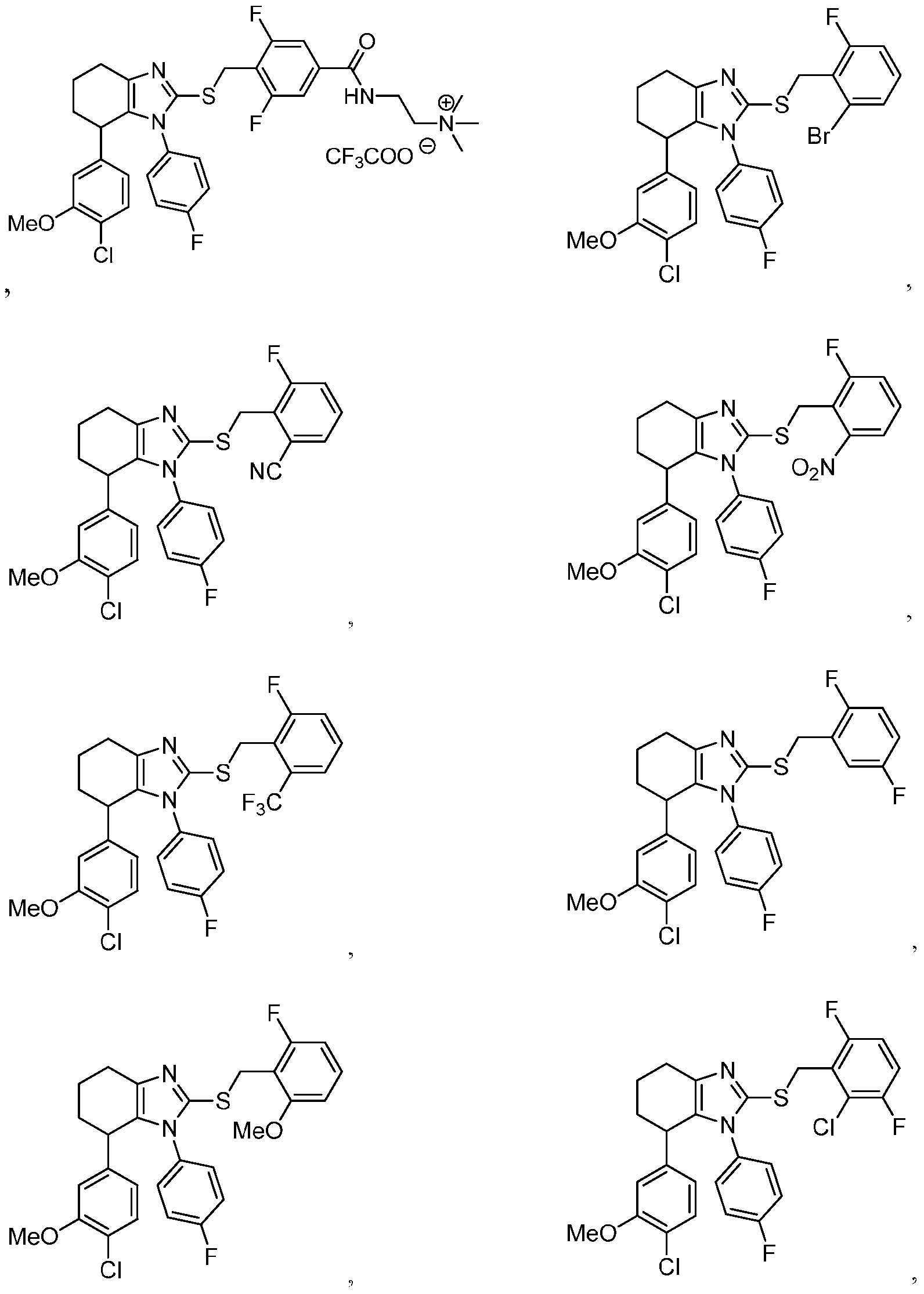

255


262


266

267


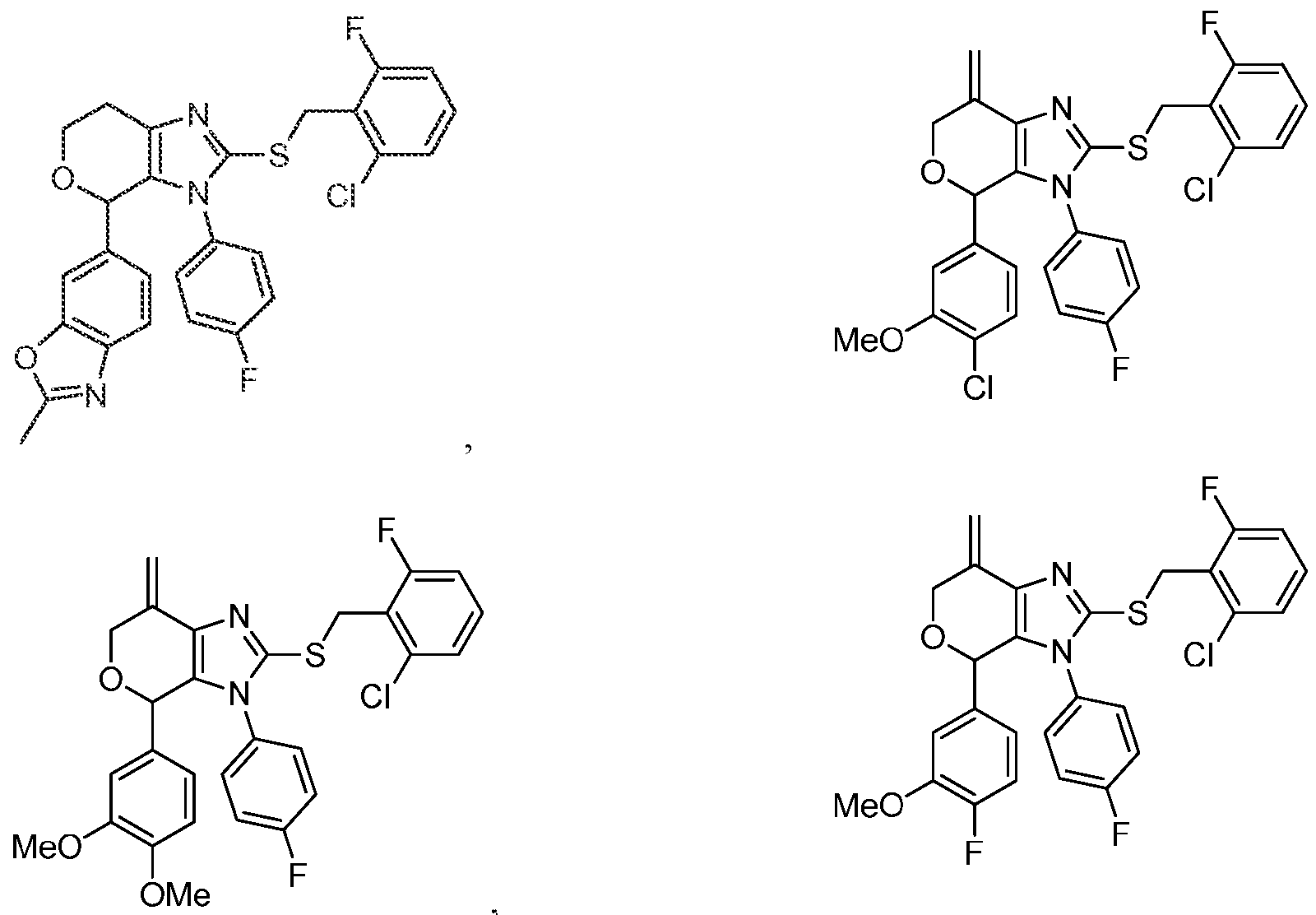
and pharmaceutically acceptable salts thereof.
6. A pharmaceutical composition, comprising a compound of claim 1 and a pharmaceutically acceptable carrier.
7. A pharmaceutical composition made by mixing a compound of claim 1 and a pharmaceutically acceptable carrier.
8. A process for making a pharmaceutical composition comprising mixing a compound of claim 1 and a pharmaceutically acceptable carrier.
9. A m ethod of treating a syndrome, d isease or disorder selected from the group consi siting of diabetes (type I and type II), Syndrome X (also known as metabolic syndrome), hyperglycemia, hyperHpidernia, hyperimu inerma, insulin resistance,
inadequate glucose tolerance, impaired glucose metabolism, diabetic nephropathy, glomerulosclerosis, diabetic neuropathy, erectile dysfunction, macular degeneration, diabetic retinopathy, chronic microvascular complications, peripheral vascular disease, cataracts, stroke, foot ulcerations, renal failure, kidney disease, ketosis, metabolic acidosis, and related disorders, obesity, myocardial infarction, angina pectoris, coronary artery disease, atherosclerosis, cardiac hypertrophy, allergic diseases, fatty liver disease, nonalcoholic steatohepatitis, liver fibrosis, kidney fibrosis, anorexia nervosa, bulimia vervosa, autoimmune diseases, inflammatory diseases including rheumatoid arthritis, asthma, chronic obstructive pulmonary disease (COFD), psoriasis, ulcerative colitis, proliferative disorders, infectious diseases, angiogenic disorders, reperfusion/ischemia in stroke, vascular hyperplasia, organ 'hypoxia, cardiac hypertrophy, thronibin-indueed platelet aggregation, and conditions associated with prostaglandin endope.roxid.ase synthetase-2 (COX- 2), comprising administering to a subject in need thereof an effective amount of a compound of claim 1 or a form, composition or medicament thereof.
10. The method of claim 9 wherein the syndrome, disease or disorder selected from the group consisting of: (a) obesity, (b) type II diabetes, (c) Syndrome X (also known as metabolic syndrome), (d) hypertriglyceridemia, (e) dyslipidemia, (f) hypercholesterolemia, (g) hyperlipidemia, and (h) mixed dyslipidemia, comprising administering to a subject in need thereof an effective amount of a compound of claim 1 or a form, composition or medicament thereof.
1 1. The method of claim 9, wherein the disease is obesity.
12. The method of claim 9, wherein the disease is type IS diabetes.
Priority Applications (1)
| Application Number | Priority Date | Filing Date | Title |
|---|---|---|---|
| US15/303,746 US10077241B2 (en) | 2014-04-15 | 2015-04-14 | Tetrahydro-benzoimidazolyl modulators of TGR5 |
Applications Claiming Priority (2)
| Application Number | Priority Date | Filing Date | Title |
|---|---|---|---|
| US201461979577P | 2014-04-15 | 2014-04-15 | |
| US61/979,577 | 2014-04-15 |
Publications (1)
| Publication Number | Publication Date |
|---|---|
| WO2015160772A1 true WO2015160772A1 (en) | 2015-10-22 |
Family
ID=53008889
Family Applications (1)
| Application Number | Title | Priority Date | Filing Date |
|---|---|---|---|
| PCT/US2015/025702 Ceased WO2015160772A1 (en) | 2014-04-15 | 2015-04-14 | Tetrahydro-benzoimidazolyl modulators of tgr5 |
Country Status (2)
| Country | Link |
|---|---|
| US (1) | US10077241B2 (en) |
| WO (1) | WO2015160772A1 (en) |
Cited By (7)
| Publication number | Priority date | Publication date | Assignee | Title |
|---|---|---|---|---|
| WO2018149212A1 (en) * | 2017-02-15 | 2018-08-23 | 惠州市大道新材料科技有限公司 | Method for preparing pyridine ring sulfonyl imide alkali metal salt |
| WO2021174048A1 (en) | 2020-02-28 | 2021-09-02 | Kallyope, Inc. | Gpr40 agonists |
| US11279702B2 (en) | 2020-05-19 | 2022-03-22 | Kallyope, Inc. | AMPK activators |
| WO2022058902A1 (en) | 2020-09-17 | 2022-03-24 | Novartis Ag | Compounds and compositions as sppl2a inhibitors |
| US11407768B2 (en) | 2020-06-26 | 2022-08-09 | Kallyope, Inc. | AMPK activators |
| US11512065B2 (en) | 2019-10-07 | 2022-11-29 | Kallyope, Inc. | GPR119 agonists |
| WO2025175102A1 (en) | 2024-02-15 | 2025-08-21 | Incyte Corporation | Sppl2a inhibitors |
Citations (6)
| Publication number | Priority date | Publication date | Assignee | Title |
|---|---|---|---|---|
| US5883110A (en) * | 1995-06-07 | 1999-03-16 | Sugen, Inc. | Pharmaceutical compositions and methods for modulating signal transduction |
| EP1167366A1 (en) * | 1999-04-07 | 2002-01-02 | Sankyo Company, Limited | Amine derivatives |
| EP1179343A1 (en) * | 2000-01-24 | 2002-02-13 | Fujimoto Brothers Co., Ltd. | Remedies for diabetes |
| EP1666067A1 (en) * | 2003-08-22 | 2006-06-07 | Teijin Pharma Limited | Drug containing chymase inhibitor as the active ingredient |
| WO2011106273A1 (en) * | 2010-02-25 | 2011-09-01 | Merck Sharp & Dohme Corp. | Novel cyclic benzimidazole derivatives useful anti-diabetic agents |
| WO2014055647A1 (en) * | 2012-10-03 | 2014-04-10 | Mei Pharma, Inc. | (sulfinyl and sulfonyl benzimidazolyl) pyrimidines and triazines, pharmaceutical compositions thereof, and their use for treating proliferative diseases |
Family Cites Families (2)
| Publication number | Priority date | Publication date | Assignee | Title |
|---|---|---|---|---|
| WO2004043468A1 (en) | 2002-11-12 | 2004-05-27 | Takeda Pharmaceutical Company Limited | Screening method |
| US7625887B2 (en) | 2003-01-28 | 2009-12-01 | Takeda Pharmaceutical Company Limited | Receptor agonists |
-
2015
- 2015-04-14 WO PCT/US2015/025702 patent/WO2015160772A1/en not_active Ceased
- 2015-04-14 US US15/303,746 patent/US10077241B2/en active Active
Patent Citations (6)
| Publication number | Priority date | Publication date | Assignee | Title |
|---|---|---|---|---|
| US5883110A (en) * | 1995-06-07 | 1999-03-16 | Sugen, Inc. | Pharmaceutical compositions and methods for modulating signal transduction |
| EP1167366A1 (en) * | 1999-04-07 | 2002-01-02 | Sankyo Company, Limited | Amine derivatives |
| EP1179343A1 (en) * | 2000-01-24 | 2002-02-13 | Fujimoto Brothers Co., Ltd. | Remedies for diabetes |
| EP1666067A1 (en) * | 2003-08-22 | 2006-06-07 | Teijin Pharma Limited | Drug containing chymase inhibitor as the active ingredient |
| WO2011106273A1 (en) * | 2010-02-25 | 2011-09-01 | Merck Sharp & Dohme Corp. | Novel cyclic benzimidazole derivatives useful anti-diabetic agents |
| WO2014055647A1 (en) * | 2012-10-03 | 2014-04-10 | Mei Pharma, Inc. | (sulfinyl and sulfonyl benzimidazolyl) pyrimidines and triazines, pharmaceutical compositions thereof, and their use for treating proliferative diseases |
Cited By (10)
| Publication number | Priority date | Publication date | Assignee | Title |
|---|---|---|---|---|
| WO2018149212A1 (en) * | 2017-02-15 | 2018-08-23 | 惠州市大道新材料科技有限公司 | Method for preparing pyridine ring sulfonyl imide alkali metal salt |
| US11512065B2 (en) | 2019-10-07 | 2022-11-29 | Kallyope, Inc. | GPR119 agonists |
| WO2021174048A1 (en) | 2020-02-28 | 2021-09-02 | Kallyope, Inc. | Gpr40 agonists |
| US12264171B2 (en) | 2020-02-28 | 2025-04-01 | Kallyope, Inc. | GPR40 agonists |
| US11279702B2 (en) | 2020-05-19 | 2022-03-22 | Kallyope, Inc. | AMPK activators |
| US11851429B2 (en) | 2020-05-19 | 2023-12-26 | Kallyope, Inc. | AMPK activators |
| US11407768B2 (en) | 2020-06-26 | 2022-08-09 | Kallyope, Inc. | AMPK activators |
| WO2022058902A1 (en) | 2020-09-17 | 2022-03-24 | Novartis Ag | Compounds and compositions as sppl2a inhibitors |
| EP4578451A2 (en) | 2020-09-17 | 2025-07-02 | Novartis AG | Compounds and compositions as sppl2a inhibitors |
| WO2025175102A1 (en) | 2024-02-15 | 2025-08-21 | Incyte Corporation | Sppl2a inhibitors |
Also Published As
| Publication number | Publication date |
|---|---|
| US20170029381A1 (en) | 2017-02-02 |
| US10077241B2 (en) | 2018-09-18 |
Similar Documents
| Publication | Publication Date | Title |
|---|---|---|
| WO2015160772A1 (en) | Tetrahydro-benzoimidazolyl modulators of tgr5 | |
| JP4931893B2 (en) | PPAR activating compound and pharmaceutical composition containing the same | |
| AU2019283837B2 (en) | Ppar agonists, compounds, pharmaceutical compositions, and methods of use thereof | |
| RU2669695C2 (en) | Cyclic amide derivatives as inhibitors of 11-beta-hydroxysteroid dehydrogenase and uses thereof | |
| JP2022513592A (en) | Biphenyl compounds, their intermediates, manufacturing methods, pharmaceutical compositions and uses | |
| CA2825172A1 (en) | Indole derivative and pharmacologically acceptable salt of same | |
| JP2013517271A (en) | Compounds that modulate the CB2 receptor | |
| WO2014003153A1 (en) | Substituted amide compound | |
| BR112017024618B1 (en) | APJ RECEPTOR TRIAZOL AGONIST COMPOUNDS, COMPOSITIONS AND RELATED USES | |
| JP2009509986A5 (en) | ||
| JP2007515484A (en) | PPAR modifiers of triazole, oxadiazole, and thiadiazole derivatives | |
| WO2015145371A1 (en) | Ror-gamma modulators and uses thereof | |
| KR20190137860A (en) | Liver X-Receptor (LXR) Modulators | |
| EP3094626A1 (en) | Substituted bicyclic heteroaryl compounds as rxr agonists | |
| WO2001090087A1 (en) | Heterocyclic compounds | |
| JPWO2013161816A1 (en) | Amine compounds and their pharmaceutical uses | |
| JP6596595B2 (en) | 5-Methyl-6-phenyl-4,5-dihydro-2H-pyridazin-3-one derivatives | |
| WO2012033195A1 (en) | Heterocyclic compound | |
| CN120752225A (en) | Tricyclic compounds | |
| JP2007522181A (en) | Substituted azetidine compounds as cyclooxygenase-1 and cyclooxygenase-2 inhibitors, and their preparation and use as pharmaceuticals | |
| KR102406246B1 (en) | 1,2,3-Triazole Derivative Compounds as HSP90 Inhibitor, and the Use Thereof | |
| JP7104588B2 (en) | A therapeutic agent for malignant tumors containing a 5-methyl-6-phenyl-4,5-dihydro-2H-pyridazine-3-one derivative | |
| TW202426461A (en) | Compounds, compositions, and methods of using thereof | |
| WO2010011147A1 (en) | Indole compounds | |
| WO2011007091A1 (en) | Derivatives of 5,6-bisaryl-2-pyridine-carboxamide, preparation thereof, and therapeutic use thereof as urotensin-ii receptor antagonists |
Legal Events
| Date | Code | Title | Description |
|---|---|---|---|
| 121 | Ep: the epo has been informed by wipo that ep was designated in this application |
Ref document number: 15719077 Country of ref document: EP Kind code of ref document: A1 |
|
| WWE | Wipo information: entry into national phase |
Ref document number: 15303746 Country of ref document: US |
|
| NENP | Non-entry into the national phase |
Ref country code: DE |
|
| 122 | Ep: pct application non-entry in european phase |
Ref document number: 15719077 Country of ref document: EP Kind code of ref document: A1 |