WO2015144832A1 - Process of production of 1-(5,5-dimethylcyclohex-1-en-1-yl)ethanone and 1-(5,5-dimethylcyclohex-6-en-1-yl)ethanone - Google Patents

Process of production of 1-(5,5-dimethylcyclohex-1-en-1-yl)ethanone and 1-(5,5-dimethylcyclohex-6-en-1-yl)ethanone Download PDF

Info

Publication number
WO2015144832A1
WO2015144832A1 PCT/EP2015/056595 EP2015056595W WO2015144832A1 WO 2015144832 A1 WO2015144832 A1 WO 2015144832A1 EP 2015056595 W EP2015056595 W EP 2015056595W WO 2015144832 A1 WO2015144832 A1 WO 2015144832A1
Authority
WO
WIPO (PCT)
Prior art keywords
formula
process according
group
anion
complex
Prior art date
Legal status (The legal status is an assumption and is not a legal conclusion. Google has not performed a legal analysis and makes no representation as to the accuracy of the status listed.)
Ceased
Application number
PCT/EP2015/056595
Other languages
French (fr)
Inventor
Werner Bonrath
Raphael Beumer
Ulla Letinois
Current Assignee (The listed assignees may be inaccurate. Google has not performed a legal analysis and makes no representation or warranty as to the accuracy of the list.)
DSM IP Assets BV
Original Assignee
DSM IP Assets BV
Priority date (The priority date is an assumption and is not a legal conclusion. Google has not performed a legal analysis and makes no representation as to the accuracy of the date listed.)
Filing date
Publication date
Application filed by DSM IP Assets BV filed Critical DSM IP Assets BV
Priority to ES15712621T priority Critical patent/ES2727344T3/en
Priority to US15/129,948 priority patent/US10005710B2/en
Priority to EP15712621.0A priority patent/EP3122713B1/en
Priority to CN201580017335.7A priority patent/CN106132916B/en
Priority to JP2016559583A priority patent/JP6535915B2/en
Publication of WO2015144832A1 publication Critical patent/WO2015144832A1/en
Anticipated expiration legal-status Critical
Ceased legal-status Critical Current

Links

Classifications

    • CCHEMISTRY; METALLURGY
    • C07ORGANIC CHEMISTRY
    • C07CACYCLIC OR CARBOCYCLIC COMPOUNDS
    • C07C45/00Preparation of compounds having >C = O groups bound only to carbon or hydrogen atoms; Preparation of chelates of such compounds
    • C07C45/51Preparation of compounds having >C = O groups bound only to carbon or hydrogen atoms; Preparation of chelates of such compounds by pyrolysis, rearrangement or decomposition
    • CCHEMISTRY; METALLURGY
    • C07ORGANIC CHEMISTRY
    • C07CACYCLIC OR CARBOCYCLIC COMPOUNDS
    • C07C45/00Preparation of compounds having >C = O groups bound only to carbon or hydrogen atoms; Preparation of chelates of such compounds
    • C07C45/51Preparation of compounds having >C = O groups bound only to carbon or hydrogen atoms; Preparation of chelates of such compounds by pyrolysis, rearrangement or decomposition
    • C07C45/511Preparation of compounds having >C = O groups bound only to carbon or hydrogen atoms; Preparation of chelates of such compounds by pyrolysis, rearrangement or decomposition involving transformation of singly bound oxygen functional groups to >C = O groups
    • C07C45/512Preparation of compounds having >C = O groups bound only to carbon or hydrogen atoms; Preparation of chelates of such compounds by pyrolysis, rearrangement or decomposition involving transformation of singly bound oxygen functional groups to >C = O groups the singly bound functional group being a free hydroxyl group
    • BPERFORMING OPERATIONS; TRANSPORTING
    • B01PHYSICAL OR CHEMICAL PROCESSES OR APPARATUS IN GENERAL
    • B01JCHEMICAL OR PHYSICAL PROCESSES, e.g. CATALYSIS OR COLLOID CHEMISTRY; THEIR RELEVANT APPARATUS
    • B01J31/00Catalysts comprising hydrides, coordination complexes or organic compounds
    • B01J31/16Catalysts comprising hydrides, coordination complexes or organic compounds containing coordination complexes
    • B01J31/24Phosphines, i.e. phosphorus bonded to only carbon atoms, or to both carbon and hydrogen atoms, including e.g. sp2-hybridised phosphorus compounds such as phosphabenzene, phosphole or anionic phospholide ligands
    • B01J31/2404Cyclic ligands, including e.g. non-condensed polycyclic ligands, the phosphine-P atom being a ring member or a substituent on the ring
    • BPERFORMING OPERATIONS; TRANSPORTING
    • B01PHYSICAL OR CHEMICAL PROCESSES OR APPARATUS IN GENERAL
    • B01JCHEMICAL OR PHYSICAL PROCESSES, e.g. CATALYSIS OR COLLOID CHEMISTRY; THEIR RELEVANT APPARATUS
    • B01J2531/00Additional information regarding catalytic systems classified in B01J31/00
    • B01J2531/10Complexes comprising metals of Group I (IA or IB) as the central metal
    • B01J2531/18Gold

Definitions

  • the present invention relates to an improved method for producing 1 -(5,5- dimethylcyclohex-1 -en-1 -yl)ethanone and 1 -(5,5-dimethylcyclohex-6-en-1 - yl)ethanone.
  • the present invention relates to a process (A) of production of the compounds of formula (I)
  • Z is an anion, which is selected from the group consisting of [BX ] “ , [ ⁇ ⁇ ] “ ,
  • Q represents a phenyl or a Ci-s-alkyl which preferably is substituted by at least one substituent chosen from the group consisting of F, CI, NO 2 and
  • X is a halogen atom, especially F and CI, and
  • Y is an organic ligand
  • process (B) which is the process (A), wherein at least one Au(l) complex of the following compound of formula (III)
  • Z is an anion, which is selected from the group consisting of [BX ] “ , [ ⁇ ] " ,
  • Q represents a phenyl or a Ci-s-alkyl group which preferably is substituted by at least one halogen atom
  • X is a halogen atom, especially F and CI, and Y is an organic ligand,
  • Y is an organic ligand selected from the group consisting of following
  • the present invention also relates to process (C), which is the process (A) or (B), wherein the organic ligand Y of Au(l) complex of formula (III) is selected from the group consisting of following ligands (Y 1 ) to (Y 10 ): ⁇
  • Z is an anion selected from the group consisting of following anions [BF 4 ] “ , [PF 6 ] “ , [SbF 6 ] “ , [CIO 4 ] ⁇ , CF3COO “ , sulfonates (such as triflate CF3SO3 “ ), tetra(3,5-bis(trifluoromethyl)phenyl)borate (BAr F ), tetraphenylborate, and the anion of formula (IV)
  • the present invention also relates to process (D), which is the process (A), (B) or (C), wherein the anion Z is selected from the group consisting of following anions [BF 4 ] “ , [PF 6 ] “ , [SbF 6 ] “ , [CIO 4 ] ⁇ , CF 3 COO " , sulfonates (such as triflate CF 3 SO 3 " ), tetra(3,5-bis(trifluoromethyl)phenyl)borate (BAr F ), tetra henylborate, and the anion of formula (IV)
  • the catalyst (the Au(l) complex) can be added to the reaction mixture in the form, which is defined by formula (I), but it is also possible that the Au(l)-complex is formed in situ in the reaction mixture (before the starting material is added or after the starting material is added).
  • the organic ligand in the form of a salt (such as for example a chloride: Y-Au(l)CI) and the anion in form of a metal salt (such for example a silver salt Ag(l)Z).
  • a salt such as for example a chloride: Y-Au(l)CI
  • a metal salt such for example a silver salt Ag(l)Z
  • the Au(l) complex is then formed in situ and the resulting metal salt (for example AgCI) does not interfere negatively.
  • the present invention relates to a process (E), which is the process (A), (B), (C) or (D), wherein the Au(l) complex is added to reaction mixture as such.
  • the present invention relates to a process (F), which is the process (A), (B), (C), (D) or (E), wherein the Au(l) complex is formed in situ in the reaction mixture.
  • Preferred Au(l) complexes of formula (III) are the following ones.
  • a preferred process relates to a process as described above wherein at least one complex of formula ( ⁇ ), (III") and/or (III'") is used.
  • the process according to the present invention is usually carried out in a solvent (or a mixture of solvents).
  • Suitable solvents are aliphatic hydrocarbons, alcohols.
  • Preferred solvents are alcohols, such as methanol, ethanol, 2-butanol and tert- butanol. Therefore the present invention also relates to a process (G), which is the process (A), (B), (C), (D), (E) or (F), wherein the process is carried out in a solvent or a mixture of solvents.
  • the present invention relates to a process (G'), which is process (G) wherein the solvent is chosen from the group consisting of methanol, ethanol, 2- butanol and tert-butanol.
  • the process according to the present invention is usually carried out at elevated temperature, usually 30°C - 120°C.
  • a preferred reaction temperature is between 40°C and 1 10°C, more preferred between 50°C and 100°C.
  • the present invention also relates to a process (H), which is the process (A), (B), (C), (D), (E), (F), (G) or (G'), wherein the process is carried out at elevated temperature.
  • the present invention also relates to a process ( ⁇ '), which is the process (H), wherein the process is carried out at a temperature from 30°C to 120°C.
  • the present invention also relates to a process (H"), which is the process (H), wherein the process is carried out at a temperature from 40°C to 1 10°C.
  • the present invention also relates to a process ( ⁇ "'), which is the process (H), wherein the process is carried out at a temperature from 50°C to 100°C.
  • the Au(l) complex is present in an amount, wherein the substrate
  • the present invention also relates to a process (I), which is the process (A), (B), (C), (D), (E), (F), (G), (G'), (H), ( ⁇ '), (H") or ( ⁇ "'), wherein the substrate (compound of formula (II)) to catalyst ratio is 2 : 1 to 10000 : 1 , preferably 10 : 1 to 3000 : 1 .
  • the reaction time of the process (to obtain the desired product in reasonable amount) according to the present invention is usually 60 minutes to 300 minutes.
  • the ligands are defined as above and the ligands are added in the chloride form and the anions in the form of the Ag(l) salt.
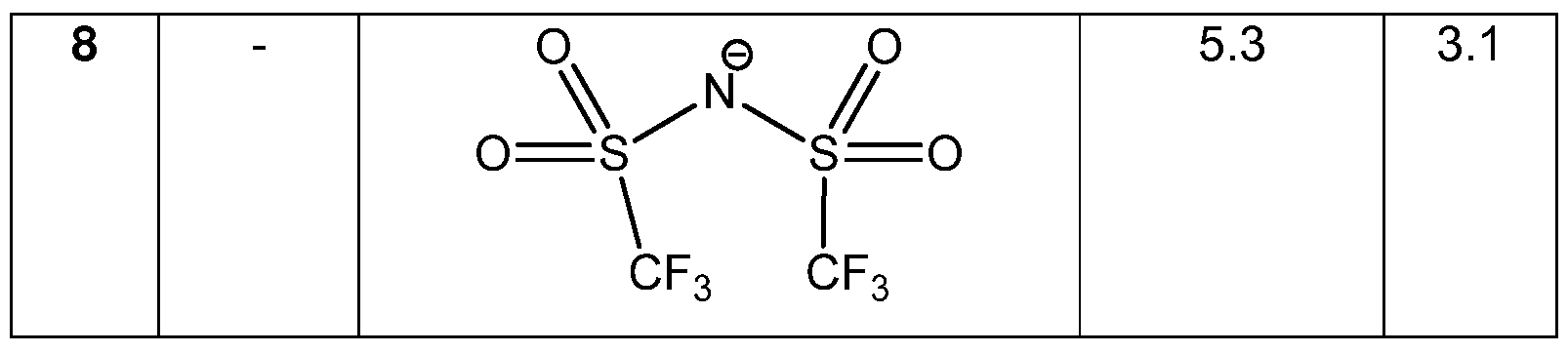
  • Example 7 and 8 are carried out without any organic ligands.
  • AuCI was used in combination with the silver salt
  • Example 9, 10 and 11 and 8 are carried out with catalysts where Au(0) is adsorbed on a carrier.

Landscapes

  • Chemical & Material Sciences (AREA)
  • Organic Chemistry (AREA)
  • Inorganic Chemistry (AREA)
  • Engineering & Computer Science (AREA)
  • Materials Engineering (AREA)
  • Chemical Kinetics & Catalysis (AREA)
  • Organic Low-Molecular-Weight Compounds And Preparation Thereof (AREA)
  • Catalysts (AREA)
  • Low-Molecular Organic Synthesis Reactions Using Catalysts (AREA)

Abstract

The present invention relates to an improved method for producing of 1-(5,5- dimethylcyclohex-1-en-1-yl)ethanone and 1-(5,5-dimethylcyclohex-6-en-1- yl)ethanone.

Description

PROCESS OF PRODUCTION OF 1-(5.5-DIMETHYLCYCLOHEX-1-EN-1- YUETHANONE AND 1-(5,5-DIMETHYLCYCLOHEX-6-EN-1-YL)ETHANONE
The present invention relates to an improved method for producing 1 -(5,5- dimethylcyclohex-1 -en-1 -yl)ethanone and 1 -(5,5-dimethylcyclohex-6-en-1 - yl)ethanone.
1 -(5,5-dimethylcyclohex-1 -en-1 -yl)ethanone (compound of formula (Γ)) and 1 - (5,5-dimethylcyclohex-6-en-1 -yl)ethanone (compound of formula (I"))
Figure imgf000002_0001
are versatile and important intermediates for the synthesis of various known fragrance compounds.
In the context of the present patent application the compounds of formula (Γ) and of formula (I") are summarized by the following formula (I)
Figure imgf000002_0002
Compounds of formula (I) (which means either the compound of formula (Γ) or the compound of formula (I") as such as well as any mixture of these two compounds) can be used to produce for example the following compounds of formulae (la) to (Ig):
Figure imgf000003_0001
Figure imgf000004_0001
Figure imgf000004_0002
All these reactions to obtain the compounds of formula (la) to (Ig) from the compound of formula (I) are well known from the prior art. The compounds of formula (I) are usually produced by using formic acid (HCOOH) as a catalyst in the rearrangement of compounds having formula (II)
Figure imgf000005_0001
This reaction is described for example in US4147672.
This method of production by using strong Bronsted acids under corrosive reaction conditions does cause some problems.
For example it is necessary to use expensive acid-resistant equipment for the production. Furthermore the handling of corrosive compounds is not easy for the production team.
Due to the importance of the compounds of formula (I), there is always a need for finding an improved method of production of the compounds of formula (I).
Surprisingly it was found that it possible to produce the compounds of formula (I) by a gold catalyzed Rupe-Kambli rearrangement.
Therefore the present invention relates to a process (A) of production of the compounds of formula (I)
Figure imgf000005_0002
by a rearrangement reaction of the compound of formula (II)
Figure imgf000006_0001
wherein the rearrangement reaction is catalyzed in the presence of at least one Au(l)-complex.
A further problem, which occurs when synthesizing the compounds of formula (I) is that there are competitive reactions occurring, such as the Meyer Schuster rearrangement :
Figure imgf000006_0002
By the use of the gold catalyst the above mentioned side reaction (which does not lead to the compounds of formula (I)) is (more or less) suppressed, which means that the yield and conversion of the new process according to the present invention are excellent.
Especially the following Au(l)-complexes are used as catalysts for the process according to the present invention:
Y Au(l) Z (III)
wherein Z is an anion, which is selected from the group consisting of [BX ]", [ΡΧΘ]",
[SbF6]", [CIO4]", CF3COO", sulfonates, tetra(3,5-bis(trifluoromethyl)phenyl)borate
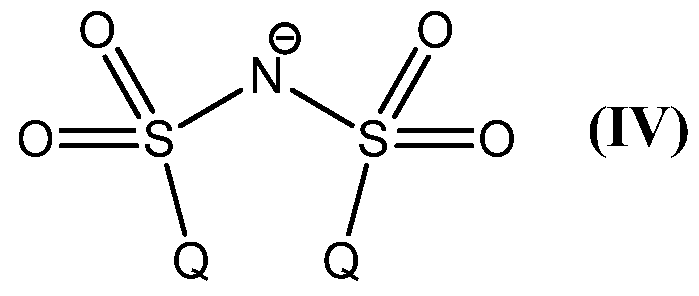
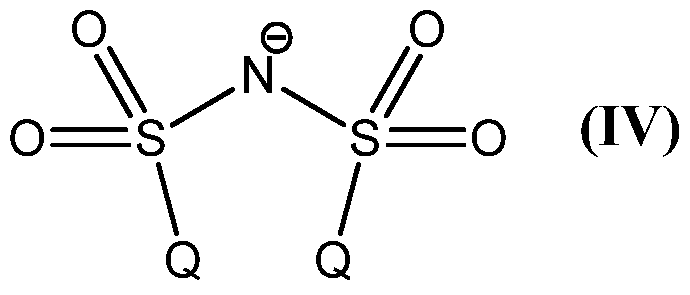
(BArF ), tetraphenylborate, and the anion of formula (IV);
Figure imgf000007_0001
wherein Q represents a phenyl or a Ci-s-alkyl which preferably is substituted by at least one substituent chosen from the group consisting of F, CI, NO2 and
X is a halogen atom, especially F and CI, and
Y is an organic ligand.
Therefore the present invention also relates to process (B), which is the process (A), wherein at least one Au(l) complex of the following compound of formula (III)
Y Au(l) Z (III) wherein
Z is an anion, which is selected from the group consisting of [BX ]", [ΡΧβ]",
[SbF6]", [CIO4]", CF3COO", sulfonates, tetra(3,5-bis(trifluoromethyl)phenyl)borate
(BArF ), tetraphenylborate and the anion of formula (IV)
Figure imgf000007_0002
wherein Q represents a phenyl or a Ci-s-alkyl group which preferably is substituted by at least one halogen atom, and
X is a halogen atom, especially F and CI, and Y is an organic ligand,
is used.
Preferably Y is an organic ligand selected from the group consisting of following
Figure imgf000008_0001
Figure imgf000009_0001
Therefore the present invention also relates to process (C), which is the process (A) or (B), wherein the organic ligand Y of Au(l) complex of formula (III) is selected from the group consisting of following ligands (Y1) to (Y10): 
Figure imgf000010_0001
Figure imgf000011_0001
Preferably Z is an anion selected from the group consisting of following anions [BF4]", [PF6]", [SbF6]", [CIO4]~, CF3COO", sulfonates (such as triflate CF3SO3"), tetra(3,5-bis(trifluoromethyl)phenyl)borate (BArF ), tetraphenylborate, and the anion of formula (IV)
Figure imgf000011_0002
Therefore the present invention also relates to process (D), which is the process (A), (B) or (C), wherein the anion Z is selected from the group consisting of following anions [BF4]", [PF6]", [SbF6]", [CIO4]~, CF3COO", sulfonates (such as triflate CF3SO3 "), tetra(3,5-bis(trifluoromethyl)phenyl)borate (BArF ), tetra henylborate, and the anion of formula (IV)
Figure imgf000012_0001
The catalyst (the Au(l) complex) can be added to the reaction mixture in the form, which is defined by formula (I), but it is also possible that the Au(l)-complex is formed in situ in the reaction mixture (before the starting material is added or after the starting material is added).
For example it is possible to add the organic ligand in the form of a salt (such as for example a chloride: Y-Au(l)CI) and the anion in form of a metal salt (such for example a silver salt Ag(l)Z). The Au(l) complex is then formed in situ and the resulting metal salt (for example AgCI) does not interfere negatively.
Therefore the present invention relates to a process (E), which is the process (A), (B), (C) or (D), wherein the Au(l) complex is added to reaction mixture as such.
Furthermore the present invention relates to a process (F), which is the process (A), (B), (C), (D) or (E), wherein the Au(l) complex is formed in situ in the reaction mixture.
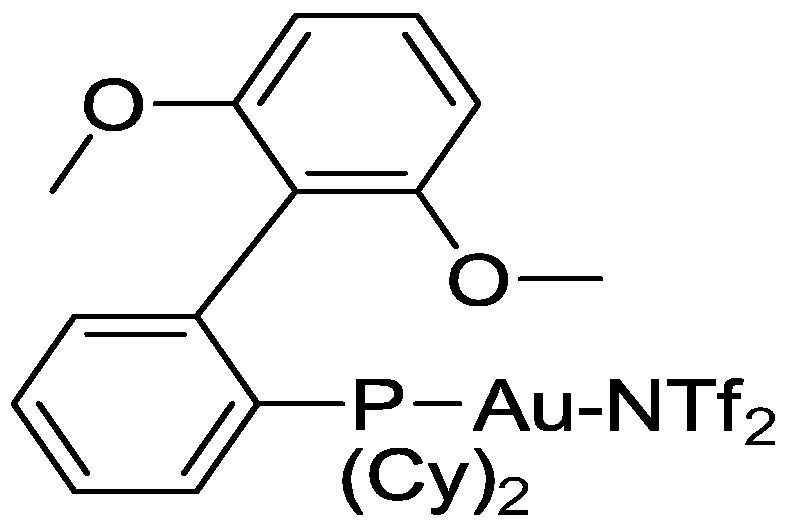
Preferred Au(l) complexes of formula (III) are the following ones.
Figure imgf000013_0001
Figure imgf000013_0002
wherein Cy is cyclohexyl, iPr is isopropyl and Tf is triflate.
Therefore a preferred process relates to a process as described above wherein at least one complex of formula (ΙΙΓ), (III") and/or (III'") is used.
The process according to the present invention is usually carried out in a solvent (or a mixture of solvents). Suitable solvents are aliphatic hydrocarbons, alcohols. Preferred solvents are alcohols, such as methanol, ethanol, 2-butanol and tert- butanol. Therefore the present invention also relates to a process (G), which is the process (A), (B), (C), (D), (E) or (F), wherein the process is carried out in a solvent or a mixture of solvents.
Furthernnore the present invention relates to a process (G'), which is process (G) wherein the solvent is chosen from the group consisting of methanol, ethanol, 2- butanol and tert-butanol.
The process according to the present invention is usually carried out at elevated temperature, usually 30°C - 120°C. A preferred reaction temperature is between 40°C and 1 10°C, more preferred between 50°C and 100°C.
Therefore the present invention also relates to a process (H), which is the process (A), (B), (C), (D), (E), (F), (G) or (G'), wherein the process is carried out at elevated temperature.
Therefore the present invention also relates to a process (Η'), which is the process (H), wherein the process is carried out at a temperature from 30°C to 120°C.
Therefore the present invention also relates to a process (H"), which is the process (H), wherein the process is carried out at a temperature from 40°C to 1 10°C.
Therefore the present invention also relates to a process (Η"'), which is the process (H), wherein the process is carried out at a temperature from 50°C to 100°C. Usually the Au(l) complex is present in an amount, wherein the substrate
(compound of formula (II)) to catalyst ratio is 2 : 1 to 10000 : 1 , preferred are 10 : 1 to 3000 : 1 .
Therefore the present invention also relates to a process (I), which is the process (A), (B), (C), (D), (E), (F), (G), (G'), (H), (Η'), (H") or (Η"'), wherein the substrate (compound of formula (II)) to catalyst ratio is 2 : 1 to 10000 : 1 , preferably 10 : 1 to 3000 : 1 .
The reaction time of the process (to obtain the desired product in reasonable amount) according to the present invention is usually 60 minutes to 300 minutes.
As stated above the compounds of formula (I) can be used as starting material to the synthesis of other organic compounds (especially the ones of formulae (la) -
(ig))-
The following examples serve to illustrate the invention. If not otherwise stated the temperature is given in degree Celsius and all parts are related to the weight.
Examples
Example 1 : Rearrangement of 1 -ethynyl-3,3-dimethylcyclohexanol
Figure imgf000016_0001
1 18.8 mg (0.2mmol, 0.1 equiv.) of dicyclohexylphosphine biphenyl gold(l)- chloride and 56.88 mg (0.2 mmol, 0.1 equiv.) of silver triflate were dissolved under argon at 23°C in 5.0 ml of tert.-butanol in a septum bottle. 362.6 μΙ (90%, 2 mmol, 1 equiv.) of 1 -ethynyl-3,3-dimethylcyclohexanol (90%, 2 mmol, 1 equiv.) were added. The reaction mixture was stirred for 105 min at 80°C. Afterwards the reaction mixture was cooled to 23°C. A sample was taken out and analyzed by GC and NMR.
The conversion of this reaction was 98.9%. The products of formulae (Γ and I") were obtained in a yield of 89.6 wt-%.
It is possible to separate the two isomers if desired.
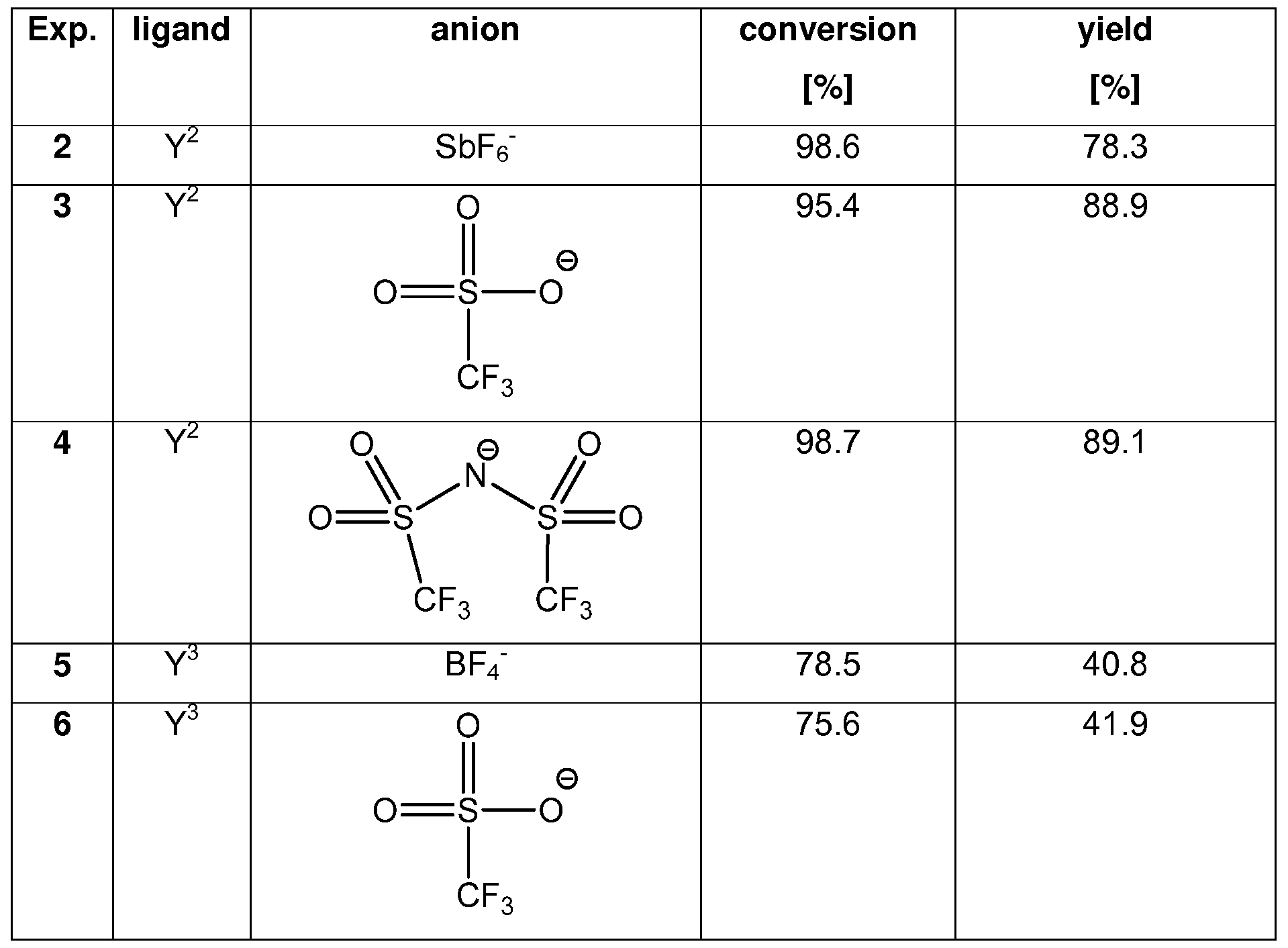
Examples 2 - 6
The following examples were carried out under the same reaction condition as in example 1 .
The ligands are defined as above and the ligands are added in the chloride form and the anions in the form of the Ag(l) salt.
Figure imgf000017_0001
Comparative examples (examples 7 - 11)
The same reaction as described in Example 1 was repeated, but Au catalysts, which do not fall under the scope of the claims were used.
Example 7 and 8 are carried out without any organic ligands. AuCI was used in combination with the silver salt
Exp. ligand anion conversion yield
[%] [%]
7 - BF4-" 16.8 0
Figure imgf000018_0001
Example 9, 10 and 11 and 8 are carried out with catalysts where Au(0) is adsorbed on a carrier.
Figure imgf000018_0002
Therefore it can be seen that the choice of the suitable (claimed) catalyst is essential.

Claims

Claims
A process of production of compounds of formula (I)
Figure imgf000019_0001
by a rearrangement reaction of the compound of formula (II)
Figure imgf000019_0002
wherein the rearrangement reaction is catalyzed by at least one Au(l)- complex.
2. Process according to claim 1 , wherein at least one Au(l) complex of the following compound of formula (III)
Y Au(l) Z (III)
wherein
Z is an anion, which is selected from the group consisting of [BX4]", [ΡΧΘ]~, [SbF6]", [CIO4]", CF3COO", sulfonates, tetra(3,5- bis(trifluoromethyl)phenyl)borate (BArF ), tetraphenylborate, and zthe anion of formula (IV)
Figure imgf000020_0001
wherein Q represents a phenyl or a Ci-s-alkyl which preferably is substituted by at least one substituent chosen from the group consisting of F, CI, NO2 and
X is a halogen atom, especially F and CI, and
Y is an organic ligand,
is used
Process according to claim 1 or claim 2, wherein the organic ligand Y of complex of formula (III) is selected from the group consisting of
Figure imgf000020_0002
20
Figure imgf000021_0001
Figure imgf000022_0001
4. Process according to any of the preceding claims, wherein the anion Z of Au(l) complex of formula (III) selected from the group consisting of following anions [BF4]", [PF6]", [SbF6]", [CIO4]", CF3COO", sulfonates (such as triflate CF3SO3"), tetra(3,5-bis(trifluoromethyl)phenyl)borate (BArF ), tetraphenylborate, and the anion of formula (IV)
Figure imgf000022_0002
5. Process according to any of the preceding claims, wherein the process is carried out in a solvent or a mixture of solvents.
6. Process according to claim 5, wherein the solvent is chosen from the group consisting of methanol, ethanol, 2-butanol and tert-butanol.
7. Process according to any of the preceding claims, wherein the process is carried out at elevated temperature.
8. Process according to claim 7, wherein the process is carried out at a temperature from 30°C to 120°C.
9. Process according to any of the preceding claims, wherein the substrate (compound of formula (II)) to catalyst ratio is 2 : 1 to 10000 : 1 , preferably 10 : 1 to 3000 : 1 .
PCT/EP2015/056595 2014-03-28 2015-03-26 Process of production of 1-(5,5-dimethylcyclohex-1-en-1-yl)ethanone and 1-(5,5-dimethylcyclohex-6-en-1-yl)ethanone Ceased WO2015144832A1 (en)

Priority Applications (5)

Application Number Priority Date Filing Date Title
ES15712621T ES2727344T3 (en) 2014-03-28 2015-03-26 Process for the production of 1- (5,5-dimethylcyclohex-1-en-1-yl) ethanone and 1- (5,5-dimethylcyclohex-6-en-1-yl) ethanone
US15/129,948 US10005710B2 (en) 2014-03-28 2015-03-26 Process of production of 1-(5,5-dimethylcyclohex-1-en-1-yl)ethanone and 1-(5,5-dimethylcyclohex-6-en-1-yl )ethanone
EP15712621.0A EP3122713B1 (en) 2014-03-28 2015-03-26 Process for the production of 1-(5,5-dimethylcyclohex-1-en-1-yl)ethanone and 1-(5,5-dimethylcyclohex-6-en-1-yl)ethanone
CN201580017335.7A CN106132916B (en) 2014-03-28 2015-03-26 The production technology of 1- (5,5- dimethyleyelohexane -1- alkene -1- bases) ethane ketone and 1- (5,5- dimethyleyelohexane -6- alkene -1- bases) ethane ketone
JP2016559583A JP6535915B2 (en) 2014-03-28 2015-03-26 Process for the formation of 1- (5,5-dimethylcyclohex-1-en-1-yl) ethanone and 1- (5,5-dimethylcyclohex-6-en-1-yl) ethanone

Applications Claiming Priority (2)

Application Number Priority Date Filing Date Title
EP14162237 2014-03-28
EP14162237.3 2014-03-28

Publications (1)

Publication Number Publication Date
WO2015144832A1 true WO2015144832A1 (en) 2015-10-01

Family

ID=50389908

Family Applications (1)

Application Number Title Priority Date Filing Date
PCT/EP2015/056595 Ceased WO2015144832A1 (en) 2014-03-28 2015-03-26 Process of production of 1-(5,5-dimethylcyclohex-1-en-1-yl)ethanone and 1-(5,5-dimethylcyclohex-6-en-1-yl)ethanone

Country Status (6)

Country Link
US (1) US10005710B2 (en)
EP (1) EP3122713B1 (en)
JP (1) JP6535915B2 (en)
CN (1) CN106132916B (en)
ES (1) ES2727344T3 (en)
WO (1) WO2015144832A1 (en)

Cited By (2)

* Cited by examiner, † Cited by third party
Publication number Priority date Publication date Assignee Title
WO2017220568A1 (en) 2016-06-22 2017-12-28 Firmenich Sa Powerful woody powdery odorant
JP2019504847A (en) * 2016-02-15 2019-02-21 ジボダン エス エー Process for preparing spirogalvanone

Citations (3)

* Cited by examiner, † Cited by third party
Publication number Priority date Publication date Assignee Title
US4147672A (en) * 1974-01-29 1979-04-03 Firmenich Sa Cyclic C6 ketones in perfumes
WO2004050602A1 (en) * 2002-11-29 2004-06-17 Givaudan Sa Esters and their use in perfumery
WO2010043522A1 (en) * 2008-10-15 2010-04-22 Dsm Ip Assets B.V. Synthesis of green ketone intermediate

Family Cites Families (4)

* Cited by examiner, † Cited by third party
Publication number Priority date Publication date Assignee Title
CH603071A5 (en) * 1975-01-31 1978-08-15 Firmenich & Cie Di:methyl-cyclohexene-alkenone cpds.
US9012391B2 (en) * 2007-06-11 2015-04-21 Givaudan Sa Organic compounds
EP2213644A1 (en) 2009-01-28 2010-08-04 Hexion Specialty Chemicals Research Belgium S.A. Process for the preparation of an allyl alkyl ether by catalyic allylation
CN102397794B (en) 2010-09-17 2013-09-11 中国科学院大连化学物理研究所 Complex catalyst system and application thereof to decomposition of naphthene hydrogen peroxide

Patent Citations (3)

* Cited by examiner, † Cited by third party
Publication number Priority date Publication date Assignee Title
US4147672A (en) * 1974-01-29 1979-04-03 Firmenich Sa Cyclic C6 ketones in perfumes
WO2004050602A1 (en) * 2002-11-29 2004-06-17 Givaudan Sa Esters and their use in perfumery
WO2010043522A1 (en) * 2008-10-15 2010-04-22 Dsm Ip Assets B.V. Synthesis of green ketone intermediate

Non-Patent Citations (4)

* Cited by examiner, † Cited by third party
Title
DOUGLAS A. ENGEL ET AL: "The Meyer-Schuster rearrangement for the synthesis of [alpha],[beta]-unsaturated carbonyl compounds", ORGANIC & BIOMOLECULAR CHEMISTRY, vol. 7, no. 20, January 2009 (2009-01-01), pages 4149, XP055118827, ISSN: 1477-0520, DOI: 10.1039/b912099h *
PHILIP KRAFT ET AL: "SYNTHESIS AND ODOR OF ALIPHATIC MUSKS: DISCOVERY OF A NEW CLASS OF ODORANTS", EUROPEAN JOURNAL OF ORGANIC CHEMISTRY, WILEY - V C H VERLAG GMBH & CO. KGAA, DE, vol. 2004, no. 2, January 2004 (2004-01-01), pages 354 - 365, XP002624902, ISSN: 1434-193X, [retrieved on 20040109], DOI: 10.1002/EJOC.200300578 *
VICTORIO CADIERNO ET AL: "Isomerization of Propargylic Alcohols into [alpha],[beta]-Unsaturated Carbonyl Compounds Catalyzed by the Sixteen-Electron Allyl-Ruthenium(II) Complex [Ru([eta]3-2-C3H4Me)(CO)(dppf)][SbF6]", ADVANCED SYNTHESIS & CATALYSIS, vol. 348, no. 1-2, January 2006 (2006-01-01), pages 101 - 110, XP055118995, ISSN: 1615-4150, DOI: 10.1002/adsc.200505294 *
YONG-JUAN CHANG ET AL: "Additive-assisted Rupe rearrangement of 1-ethynylcyclohexan-1-ol in near-critical water", CHEMICAL PAPERS, SP VERSITA, HEIDELBERG, vol. 66, no. 1, 7 October 2011 (2011-10-07), pages 33 - 38, XP019977656, ISSN: 1336-9075, DOI: 10.2478/S11696-011-0093-3 *

Cited By (3)

* Cited by examiner, † Cited by third party
Publication number Priority date Publication date Assignee Title
JP2019504847A (en) * 2016-02-15 2019-02-21 ジボダン エス エー Process for preparing spirogalvanone
WO2017220568A1 (en) 2016-06-22 2017-12-28 Firmenich Sa Powerful woody powdery odorant
US10519397B2 (en) 2016-06-22 2019-12-31 Firmenich Sa Powerful woody powdery odorant

Also Published As

Publication number Publication date
JP6535915B2 (en) 2019-07-03
ES2727344T3 (en) 2019-10-15
EP3122713B1 (en) 2019-04-24
CN106132916B (en) 2018-09-21
US20170217864A1 (en) 2017-08-03
JP2017514794A (en) 2017-06-08
EP3122713A1 (en) 2017-02-01
US10005710B2 (en) 2018-06-26
CN106132916A (en) 2016-11-16

Similar Documents

Publication Publication Date Title
Chen et al. Brønsted acid-catalysed intramolecular hydroamination of unactivated alkenes: metal triflates as an in situ source of triflic acid
EP3042889B1 (en) Method for producing fluorine-containing olefin
CN111420709B (en) Application of Azacyclic Carbene-type Mixed Nickel(II) Complexes in the Synthesis of 2-Linear Alkyl Benzothiazoles
Shakhmaev et al. Stereoselective synthesis of allylamines by iron-catalyzed cross-coupling of 3-chloroprop-2-en-1-amines with grignard reagents. Synthesis of naftifine
JP5916767B2 (en) Hydrogenation of dienal with rhodium complex under carbon monoxide free atmosphere
Liu et al. A silver-catalyzed transfer hydrogenation of aldehyde in air and water
US9840527B2 (en) Metal complex including tridentate aminodicarbene ligand and hydrogenation reduction method using same
EP3122713B1 (en) Process for the production of 1-(5,5-dimethylcyclohex-1-en-1-yl)ethanone and 1-(5,5-dimethylcyclohex-6-en-1-yl)ethanone
CN104910104A (en) Method for synthesizing dihydrofuran derivatives under catalytic action of copper
EP3099658B1 (en) Process of production of 2,3,6-trimethylphenol
Daley et al. Palladium-catalyzed salt-free double decarboxylative aryl allylation
CN108148062A (en) A kind of preparation method and applications of 2- (pyridine bromide base) benzo double imidazole compound
CN102039182B (en) Iron-based catalyst for olefin oligomerization and preparation method and application thereof
Lujan et al. The influence of N-heterocyclic carbene steric and electronic properties in Ru-catalysed cross metathesis reactions
John et al. Palladium catalyzed ring opening of azabicyclic olefins with organoindium and gallium reagents: a facile access towards benzylated cyclopentanoids
EP2240479B1 (en) Novel nitrogen-containing organic compounds that can be used as precursor of a catalytic composition
US20170313655A1 (en) Method for producing specific alpha,beta-unsaturated aldehydes by rearrangement process
KR101418829B1 (en) Catalyst for producing 1,3-diphenyl-2-butene derivatives
JP6261908B2 (en) 1-acyl-2- (substituted phenyl) naphthalene and process for producing the same
RU2556640C1 (en) Catalyst system for trimerisation of ehtylene into 1-hexene using catalysts with branched hydrocarbon skeleton
JP2004210788A (en) Method for producing arylvinyl halide or sulfonate and arylalkyne and compounds produced thereby
CN103965232B (en) A kind of method of synthesis 3-(2,5-dihydro) furan boronic acid ester
JPS5850207B2 (en) Hydrogenation method
TW201904936A (en) Process for preparing (4-halo-2,6-dialkylphenyl) malononitriles
FR2929944A1 (en) New pyridin-2-ylmethylene-quinolin-8-yl-amine compound useful as a ligand precursor in homogeneous catalysis

Legal Events

Date Code Title Description
121 Ep: the epo has been informed by wipo that ep was designated in this application

Ref document number: 15712621

Country of ref document: EP

Kind code of ref document: A1

REEP Request for entry into the european phase

Ref document number: 2015712621

Country of ref document: EP

WWE Wipo information: entry into national phase

Ref document number: 2015712621

Country of ref document: EP

ENP Entry into the national phase

Ref document number: 2016559583

Country of ref document: JP

Kind code of ref document: A

NENP Non-entry into the national phase

Ref country code: DE

WWE Wipo information: entry into national phase

Ref document number: 15129948

Country of ref document: US