WO2015140807A1 - Filter - Google Patents
Filter Download PDFInfo
- Publication number
- WO2015140807A1 WO2015140807A1 PCT/IL2015/050295 IL2015050295W WO2015140807A1 WO 2015140807 A1 WO2015140807 A1 WO 2015140807A1 IL 2015050295 W IL2015050295 W IL 2015050295W WO 2015140807 A1 WO2015140807 A1 WO 2015140807A1
- Authority
- WO
- WIPO (PCT)
- Prior art keywords
- peptoid
- skin layer
- filter
- coupling agent
- support layer
- Prior art date
- Legal status (The legal status is an assumption and is not a legal conclusion. Google has not performed a legal analysis and makes no representation as to the accuracy of the status listed.)
- Ceased
Links
Classifications
-
- B—PERFORMING OPERATIONS; TRANSPORTING
- B01—PHYSICAL OR CHEMICAL PROCESSES OR APPARATUS IN GENERAL
- B01D—SEPARATION
- B01D69/00—Semi-permeable membranes for separation processes or apparatus characterised by their form, structure or properties; Manufacturing processes specially adapted therefor
- B01D69/10—Supported membranes; Membrane supports
- B01D69/105—Support pretreatment
-
- B—PERFORMING OPERATIONS; TRANSPORTING
- B01—PHYSICAL OR CHEMICAL PROCESSES OR APPARATUS IN GENERAL
- B01D—SEPARATION
- B01D61/00—Processes of separation using semi-permeable membranes, e.g. dialysis, osmosis or ultrafiltration; Apparatus, accessories or auxiliary operations specially adapted therefor
- B01D61/02—Reverse osmosis; Hyperfiltration ; Nanofiltration
- B01D61/025—Reverse osmosis; Hyperfiltration
-
- B—PERFORMING OPERATIONS; TRANSPORTING
- B01—PHYSICAL OR CHEMICAL PROCESSES OR APPARATUS IN GENERAL
- B01D—SEPARATION
- B01D69/00—Semi-permeable membranes for separation processes or apparatus characterised by their form, structure or properties; Manufacturing processes specially adapted therefor
- B01D69/10—Supported membranes; Membrane supports
- B01D69/107—Organic support material
-
- B—PERFORMING OPERATIONS; TRANSPORTING
- B01—PHYSICAL OR CHEMICAL PROCESSES OR APPARATUS IN GENERAL
- B01D—SEPARATION
- B01D69/00—Semi-permeable membranes for separation processes or apparatus characterised by their form, structure or properties; Manufacturing processes specially adapted therefor
- B01D69/12—Composite membranes; Ultra-thin membranes
- B01D69/1213—Laminated layers
-
- B—PERFORMING OPERATIONS; TRANSPORTING
- B01—PHYSICAL OR CHEMICAL PROCESSES OR APPARATUS IN GENERAL
- B01D—SEPARATION
- B01D69/00—Semi-permeable membranes for separation processes or apparatus characterised by their form, structure or properties; Manufacturing processes specially adapted therefor
- B01D69/12—Composite membranes; Ultra-thin membranes
- B01D69/125—In situ manufacturing by polymerisation, polycondensation, cross-linking or chemical reaction
- B01D69/1251—In situ manufacturing by polymerisation, polycondensation, cross-linking or chemical reaction by interfacial polymerisation
-
- B—PERFORMING OPERATIONS; TRANSPORTING
- B01—PHYSICAL OR CHEMICAL PROCESSES OR APPARATUS IN GENERAL
- B01D—SEPARATION
- B01D69/00—Semi-permeable membranes for separation processes or apparatus characterised by their form, structure or properties; Manufacturing processes specially adapted therefor
- B01D69/14—Dynamic membranes
- B01D69/141—Heterogeneous membranes, e.g. containing dispersed material; Mixed matrix membranes
- B01D69/142—Heterogeneous membranes, e.g. containing dispersed material; Mixed matrix membranes with "carriers"
- B01D69/144—Heterogeneous membranes, e.g. containing dispersed material; Mixed matrix membranes with "carriers" containing embedded or bound biomolecules
-
- B—PERFORMING OPERATIONS; TRANSPORTING
- B01—PHYSICAL OR CHEMICAL PROCESSES OR APPARATUS IN GENERAL
- B01D—SEPARATION
- B01D71/00—Semi-permeable membranes for separation processes or apparatus characterised by the material; Manufacturing processes specially adapted therefor
- B01D71/06—Organic material
- B01D71/08—Polysaccharides
- B01D71/12—Cellulose derivatives
- B01D71/14—Esters of organic acids
- B01D71/16—Cellulose acetate
-
- B—PERFORMING OPERATIONS; TRANSPORTING
- B01—PHYSICAL OR CHEMICAL PROCESSES OR APPARATUS IN GENERAL
- B01D—SEPARATION
- B01D71/00—Semi-permeable membranes for separation processes or apparatus characterised by the material; Manufacturing processes specially adapted therefor
- B01D71/06—Organic material
- B01D71/56—Polyamides, e.g. polyester-amides
-
- B—PERFORMING OPERATIONS; TRANSPORTING
- B01—PHYSICAL OR CHEMICAL PROCESSES OR APPARATUS IN GENERAL
- B01D—SEPARATION
- B01D71/00—Semi-permeable membranes for separation processes or apparatus characterised by the material; Manufacturing processes specially adapted therefor
- B01D71/06—Organic material
- B01D71/58—Other polymers having nitrogen in the main chain, with or without oxygen or carbon only
- B01D71/62—Polycondensates having nitrogen-containing heterocyclic rings in the main chain
- B01D71/64—Polyimides; Polyamide-imides; Polyester-imides; Polyamide acids or similar polyimide precursors
-
- C—CHEMISTRY; METALLURGY
- C02—TREATMENT OF WATER, WASTE WATER, SEWAGE, OR SLUDGE
- C02F—TREATMENT OF WATER, WASTE WATER, SEWAGE, OR SLUDGE
- C02F1/00—Treatment of water, waste water, or sewage
- C02F1/44—Treatment of water, waste water, or sewage by dialysis, osmosis or reverse osmosis
- C02F1/441—Treatment of water, waste water, or sewage by dialysis, osmosis or reverse osmosis by reverse osmosis
-
- C—CHEMISTRY; METALLURGY
- C07—ORGANIC CHEMISTRY
- C07K—PEPTIDES
- C07K5/00—Peptides containing up to four amino acids in a fully defined sequence; Derivatives thereof
- C07K5/02—Peptides containing up to four amino acids in a fully defined sequence; Derivatives thereof containing at least one abnormal peptide link
- C07K5/0202—Peptides containing up to four amino acids in a fully defined sequence; Derivatives thereof containing at least one abnormal peptide link containing the structure -NH-X-X-C(=0)-, X being an optionally substituted carbon atom or a heteroatom, e.g. beta-amino acids
-
- C—CHEMISTRY; METALLURGY
- C02—TREATMENT OF WATER, WASTE WATER, SEWAGE, OR SLUDGE
- C02F—TREATMENT OF WATER, WASTE WATER, SEWAGE, OR SLUDGE
- C02F1/00—Treatment of water, waste water, or sewage
- C02F1/44—Treatment of water, waste water, or sewage by dialysis, osmosis or reverse osmosis
-
- Y—GENERAL TAGGING OF NEW TECHNOLOGICAL DEVELOPMENTS; GENERAL TAGGING OF CROSS-SECTIONAL TECHNOLOGIES SPANNING OVER SEVERAL SECTIONS OF THE IPC; TECHNICAL SUBJECTS COVERED BY FORMER USPC CROSS-REFERENCE ART COLLECTIONS [XRACs] AND DIGESTS
- Y02—TECHNOLOGIES OR APPLICATIONS FOR MITIGATION OR ADAPTATION AGAINST CLIMATE CHANGE
- Y02A—TECHNOLOGIES FOR ADAPTATION TO CLIMATE CHANGE
- Y02A20/00—Water conservation; Efficient water supply; Efficient water use
- Y02A20/124—Water desalination
- Y02A20/131—Reverse-osmosis
Definitions
- the present invention relates to reverse osmosis membrane filters that include peptoids.
- Filtration is a process that separates components from a fluid stream by passage of the fluid through porous medium (membrane).
- membrane filtration the membrane acts as a selective barrier that permits passage of some components (“permeate” stream) and retains others (“retentate” stream); splitting one feed-stream into two product streams. It is common to classify membranes and membrane separation processes due to size of the separated components, structure properties, driving force and mode of operation.
- the major membrane separation processes that are typically used in water systems are: reverse osmosis (RO), nanofiltration (NF), ultrafiltration (UF) and microfiltration (MF).
- RO reverse osmosis
- NF nanofiltration
- UF ultrafiltration
- MF microfiltration
- Water membrane filtration i.e. desalination
- desalination is an active pressure- driven process.
- pressure energy
- Polyamide TFC membranes are currently the main type of membrane used for desalination by RO.
- the dense but thin active polyamide skin of the membrane is formed on top of a microporous support which is usually made of a polysulfone.
- external pressure motivates water passage through the skin, from the high salt concentration (salty solution), to the low salt concentration area on the support side (desalted water).
- Such improvement may be performed by adding additives to the saline solution and/or to the desalted water, however such addition needs to be constantly maintained and is costly.
- a reverse-osmosis membrane filter comprising:
- At least one water binding composition predominantly bound between the skin layer and the support layer.
- the water binding composition comprises at least one peptoid.
- the water binding composition particularly consists of at least one peptoid.
- the peptoid is for example a N-substituted glycine peptoid.
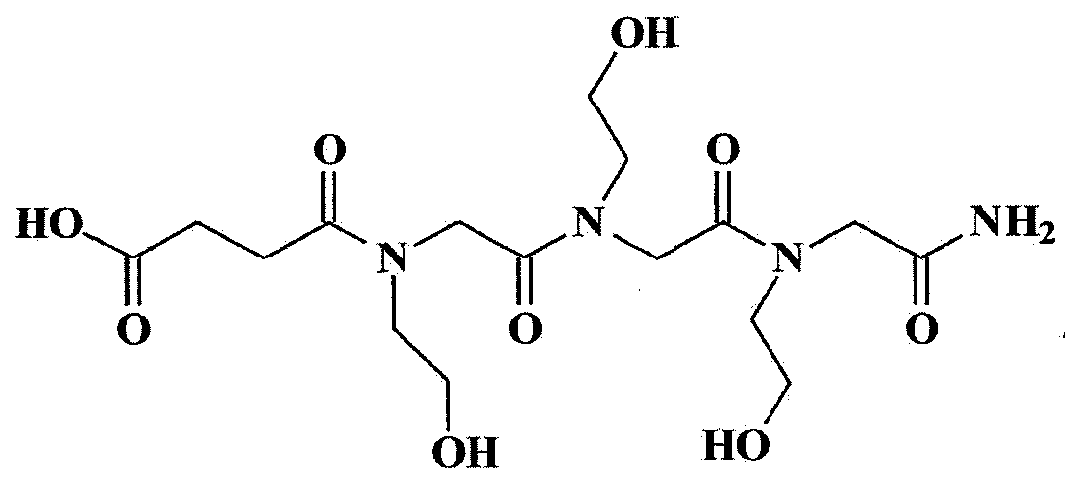
- the peptoid is selected from a peptoid group consisting of Ac(NserX Ac(Nme) 3 , and mixtures thereof.
- the skin layer is typically selected from a group consisting of:
- polyamides polyamides, cellulose acetates, polyimides, polybenzimidazole and mixtures thereof.
- the skin layer comprises polyamides and the peptoid is selected from a group consisting of Ac(Nser) Ac(Nme) 3 , and mixtures thereof, and
- the support layer in some embodiments comprises polysulfone.
- the peptoid is bound to the support layer.
- the porous skin layer is capable of rejecting and small molecules, deposited on the support layer.
- a method of producing an improved reverse osmosis filter comprising:
- the skin layer comprises a composition selected from a group consisting of: polyamides, cellulose acetates, polyimides, polybenzimidazole and mixtures thereof, and the method
- coupling agent selected from a group consisting of: a peptoid-amine coupling agent, a peptoid-cellulose acetate coupling agent, and a peptoid- imide coupling agent and mixtures thereof.
- the peptoid-amine coupling agent is a carboxyl activating agent capable of coupling primary amines to the carboxyl.
- the coupling agent is EDC.
- a reverse-osmosis membrane filter is provided, the filter comprising:
- At least one water binding composition predominantly bound between the skin layer and the support layer.
- a purification unit that is named a "forward osmosis purification unit”.
- the unit includes an inlet chamber into which an unpurified feed solution is introducible, an outlet chamber, and a dual membrane section.
- the dual membrane section includes a first semi-permeable membrane in fluid communication with the inlet chamber, a second semi-permeable membrane in fluid communication with the outlet chamber, a plurality of expandable cells interposed between the first and second membranes, and a draw solution of an osmotic pressure significantly greater than the osmotic pressure of the feed solution.
- WO2011154946 a sufficient amount of solvent is permeable through the first membrane to increase the hydraulic pressure of the draw solution within the cells, while solutes of the feed solution are substantially rejectable.
- WO2011154946 further states that the hydraulic pressure of the draw solution is sufficiently high to force the permeate to be discharged from the second membrane to the outlet chamber while the draw agent is substantially rejected.
- Modifying and/or adding solutions is the major way facilitation of filtration is achieved. The present approach creates an effect similar to forward osmosis, however no solvents are required to be added to the solutions subject to filtration (or to the filtered solution), in order to improve the filtration, which simplifies the filtration and reduces its cost.
- WBM water binding molecules
- an improved reverse-osmosis membrane filter comprising:
- porous skin layer capable of rejecting ions and small molecules, deposited on the support layer
- Peptoids are molecules that bridge synthetic polymers and biological polymers. These molecules present high chemical stability and low toxicity; thus they are suitable for a variety of applications.
- the peptoid structure is shown below, and the much more commonly known peptide structure is depicted alongside for comparison sake.
- N-substituted glycine peptoids particularly stand out as a family of peptidomimetic oligomers that may have a good affinity to water molecules.
- Peptoids can be synthesized with precise control over the sequence of highly diverse side chain functional groups, enabling a robust investigation of structure-property relationships.
- Huang et al. [PNAS Vol. 109, no. 49, pp. 19922-19927] demonstrated that specific peptoids with carboxylic end groups and side chains bearing hydroxyl (Ac(Nser)3), or ether (Ac(Nme)3), indicated below, reduce the freezing point of water much more than it is expected from their colligative effects alone.
- the reaction mixture was stirred for 18 hours, followed by evaporating to dryness, to obtain a white solid.
- the product Compoundl was used for the next step without purification.
- Step #5 Reaction of Compound4 with 2-bromoecetic acid:
- the reaction mixture was stirred for 5 hours, followed by evaporation to dryness.
- the product was extracted with ethyl acetate (100 mL), followed by washing with brine, and the organic solution was dried over anhydrous sodium sulfate.
- the ethyl acettate was evaporated to dryness to obtain a white foam solid.
- Step #9 Reaction of Compound 8 with succinic anhydride:
- Step #10 Reaction of Compound 9 with acetic acid:
- Solid-phase synthesis of peptoid oligomers was performed in fritted syringes on a Rink amide resin.
- 100 mg of resin with a loading level of 0.82 mmol-g-l was swollen in 4 mL of dichloromethane (DCM) for 40 min.
- DCM dichloromethane
- the Fmoc protecting group was removed by treatment with 2 mL of 20% piperidine in dimethylformamide (DMF) for 20 min.
- DMF dimethylformamide
- Peptoid synthesis was carried out with alternating bromoacylation and amine displacement steps.
- 20 equiv bromoacetic acid (1.2 M in DMF, 8.5 mL g-1 resin) and 24 equiv ⁇ , ⁇ '- diisopropylcarbodiimide (neat, 2 mL g -1 resin ) were added to the resin, and the mixture was agitated for 20 min.
- the cleavage mixture was concentrated by rotary evaporation under reduced pressure for large volumes or under a stream of nitrogen gas for volumes less than 1 mL.
- TFC Thin-film composite membranes with a polyamide top layer are the most common reverse osmosis membranes used today for desalination (process that remove salt and other minerals from saline water) and thus these membranes were an selected as a starting point for membrane modification.
- the polyamide layer of these membranes is usually a skin of 100- 200nm thickness, which is formed on top of a ⁇ 150 ⁇ thick microporous polysulfone support, by interfacial polymerization.
- the polyamide layer manufacture based on a polycondensation reaction between two monomers meta-phenylene diamine and trimesoyl chloride (TMC):
- Polysulfone There are no known chemical bonds between the polysulfone layer and the polyamide layer. Rather, the polyamide adheres to the polysulfone support by physical bonds.
- the WBM is attached to membrane in the polyamide-polysulfone interface.
- WBM could be inserted into a flat sheet commercial membrane from the polysulfone side and bind to the polyamide internal layer.
- the successful formation of a modified membrane by using EDC was surprising considering that other coupling agents DIC, DMF and DCM all ruined the membrane or produced esters in repeat experiments under various ratios of the reagents and various conditions.
- the preferred coupling agents are carboxyl activating agents that can couple the carboxyl to primary amines to yield amide bonds.
- the reaction was performed in special cells that contained 6 mL water, the filter, the peptoid and the linker.
- the cells allowed diffusion only to the interface between the polysulfone support and the polyamide skin, and physically prevented access of the peptoid and coupling agent to the side of the polyamide skin facing away from the polysulfone support.
- Control cells contained the same setup but without the peptoids.
- the filters were left immersed in the cells for several hours to allow diffusion of the peptoid and the EDC though the polysulfone layer to the interface between the support and the skin.
- the permeability and the salt rejection of the modified membranes prepared as described in Example 2 were measured using a cross flow filtration setup.
- the feed was deionized water.
- the Salt rejection was measured using NaCl Salt (2g/l) at a pressure of 50 bar and flow rate of around 50 lph.
- Table 1 summarizes the results from three control membranes Cl-1, Cl-2 and Cl-3.
- Table 2 summarizes results from three modified membranes Tl-1, Tl-2 and Tl-3.
- the improved membranes' performance may translate into a reduction in energy consumption of about 10-30% in the filtration process.
- the peptoid is bound to a ready-made filter and may thus modify commercial filters and filters already put in use.
- these water binding molecules are incorporated into the membrane during the manufacture process.
- the WBM is attached to the diamine groups and intrudes into the polyamide-polysulfone interface during an interfacial polymerization procedure.
- the membrane-forming system includes m-phenylendiamine (MPD) in water, and TMC in hexane or heptanes.
- the IP films are supported on microporous polysulfone films. Unsupported polyamide films are prepared by carefully adding a TMC solution within 1 to 2s to an aqueous MPD solution.
- the MPD solution comprises at least one peptoid; in other embodiments the TMC solution comprises the peptoid.
- the MPD solution comprises at least one peptoid-MPD coupling agent; in other embodiments the TMC solution comprises the coupling agent.
- Composite membranes are prepared immersing the polysulfone support in an aqueous solution of MPD. After removal of excess MPD solution from the surface of the support, the wet film is immediately covered with TMC in organic solution and then dried. The composite membrane is extracted in hot distilled water 50-60°C.
- the peptoid is a N-substituted glycine peptoid.
- peptoid is selected from a group consisting of Ac(Nser), Ac(Nme)3, and mixtures thereof.
- the peptoids comprise a short chain length and a small bonding group such as carboxyl.
- the skin layer comprises a composition selected from a group consisting of: polyamides, cellulose acetates, polyimides, polybenzimidazole and mixtures thereof.
- the peptoid is bound to the support layer.
- a method of producing an improved reverse osmosis filter comprises:
- the skin layer may comprises a composition selected from a group consisting of: polyamides, cellulose acetates, polyimides, polybenzimidazole and mixtures thereof, and may further comprise coupling the at least one peptoid to the skin layer with coupling agent selected from a group consisting of: a peptoid-amine coupling agent, a peptoid-cellulose acetate coupling agent, a peptoid-imide coupling agent, and a peptoid- benzimidazole coupling agent and mixtures thereof.
- coupling agent selected from a group consisting of: a peptoid-amine coupling agent, a peptoid-cellulose acetate coupling agent, a peptoid-imide coupling agent, and a peptoid- benzimidazole coupling agent and mixtures thereof.
Landscapes
- Chemical & Material Sciences (AREA)
- Chemical Kinetics & Catalysis (AREA)
- Water Supply & Treatment (AREA)
- Engineering & Computer Science (AREA)
- Organic Chemistry (AREA)
- Life Sciences & Earth Sciences (AREA)
- Molecular Biology (AREA)
- Biochemistry (AREA)
- Health & Medical Sciences (AREA)
- Crystallography & Structural Chemistry (AREA)
- Biophysics (AREA)
- Proteomics, Peptides & Aminoacids (AREA)
- Medicinal Chemistry (AREA)
- Genetics & Genomics (AREA)
- General Health & Medical Sciences (AREA)
- Nanotechnology (AREA)
- Hydrology & Water Resources (AREA)
- Environmental & Geological Engineering (AREA)
- Dispersion Chemistry (AREA)
- Separation Using Semi-Permeable Membranes (AREA)
Abstract
Description




Claims
Priority Applications (6)
| Application Number | Priority Date | Filing Date | Title |
|---|---|---|---|
| US15/124,575 US20170080391A1 (en) | 2014-03-19 | 2015-03-19 | Highly efficient reverse osmosis filter |
| CN201580013988.8A CN106102874A (en) | 2014-03-19 | 2015-03-19 | Filter |
| KR1020167028358A KR20160130852A (en) | 2014-03-19 | 2015-03-19 | Filter |
| EP15764575.5A EP3119501A4 (en) | 2014-03-19 | 2015-03-19 | Filter |
| JP2016557137A JP2017507778A (en) | 2014-03-19 | 2015-03-19 | filter |
| IL247693A IL247693A0 (en) | 2014-03-19 | 2016-09-08 | Highly efficient reverse osmosis filter |
Applications Claiming Priority (2)
| Application Number | Priority Date | Filing Date | Title |
|---|---|---|---|
| US201461955260P | 2014-03-19 | 2014-03-19 | |
| US61/955,260 | 2014-03-19 |
Publications (1)
| Publication Number | Publication Date |
|---|---|
| WO2015140807A1 true WO2015140807A1 (en) | 2015-09-24 |
Family
ID=54143846
Family Applications (1)
| Application Number | Title | Priority Date | Filing Date |
|---|---|---|---|
| PCT/IL2015/050295 Ceased WO2015140807A1 (en) | 2014-03-19 | 2015-03-19 | Filter |
Country Status (7)
| Country | Link |
|---|---|
| US (1) | US20170080391A1 (en) |
| EP (1) | EP3119501A4 (en) |
| JP (1) | JP2017507778A (en) |
| KR (1) | KR20160130852A (en) |
| CN (1) | CN106102874A (en) |
| IL (1) | IL247693A0 (en) |
| WO (1) | WO2015140807A1 (en) |
Cited By (5)
| Publication number | Priority date | Publication date | Assignee | Title |
|---|---|---|---|---|
| US9986733B2 (en) | 2015-10-14 | 2018-06-05 | X-Therma, Inc. | Compositions and methods for reducing ice crystal formation |
| WO2018142409A1 (en) * | 2017-02-02 | 2018-08-09 | E.W. Hydrophilic Processes Ltd. | Reverse osmosis membranes |
| CN110217924A (en) * | 2019-06-21 | 2019-09-10 | 长沙如洋环保科技有限公司 | A kind of use for laboratory water purification machine |
| WO2021125255A1 (en) | 2019-12-18 | 2021-06-24 | 持田製薬株式会社 | Novel crosslinked alginic acid |
| WO2022145419A1 (en) | 2020-12-28 | 2022-07-07 | 持田製薬株式会社 | Multilayer structure using chemically crosslinked alginic acid |
Families Citing this family (2)
| Publication number | Priority date | Publication date | Assignee | Title |
|---|---|---|---|---|
| CN108529554A (en) * | 2017-03-02 | 2018-09-14 | 中芯国际集成电路制造(上海)有限公司 | A kind of MEMS device and preparation method thereof |
| CN115845637A (en) * | 2022-11-28 | 2023-03-28 | 厦门百霖净水科技有限公司 | Low-pressure high-flux composite membrane and preparation method thereof |
Citations (2)
| Publication number | Priority date | Publication date | Assignee | Title |
|---|---|---|---|---|
| US4749488A (en) * | 1987-10-08 | 1988-06-07 | E. I. Du Pont De Nemours And Company | Multilayer reverse osmosis membrane in which one layer is poly-meta-phenylene tetrahydrofuran-2,3,4,5-tetracarboxamide |
| WO2011154946A1 (en) * | 2010-06-10 | 2011-12-15 | Odis Filtering Ltd. | Forward osmosis purification unit |
Family Cites Families (8)
| Publication number | Priority date | Publication date | Assignee | Title |
|---|---|---|---|---|
| AU2002304623A1 (en) * | 2001-05-11 | 2002-11-25 | Poly-An Gesellschaft Zur Herstellung Von Polymeren Fur Spezielle Anwendungen Und Analytik Mbh | Method for reducing an adsorption tendency of molecules or biological cells on a material surface |
| EP1814976B1 (en) * | 2004-11-16 | 2015-01-07 | Northwestern University | Peptidomimetic polymers for antifouling surfaces |
| US20110020950A1 (en) * | 2007-12-11 | 2011-01-27 | Aquaporin A/S | Scaffold for composite biomimetic membrane |
| KR20100116344A (en) * | 2009-04-22 | 2010-11-01 | 엘지전자 주식회사 | A water purification filter and method for fabricating in the same |
| WO2011070573A1 (en) * | 2009-12-07 | 2011-06-16 | Ben-Gurion University Of The Negev Research And Development Authority | Antimicrobial water treatment membranes and production thereof |
| US9120040B2 (en) * | 2011-05-26 | 2015-09-01 | The University Of Akron | Anti-fouling materials based on poly(β-peptoid)s |
| EP2758156B8 (en) * | 2011-09-21 | 2020-06-17 | Nanyang Technological University | Aquaporin based thin film composite membranes |
| US20150136690A1 (en) * | 2012-06-01 | 2015-05-21 | National Unibersity of Singapore | Method of making a membrane and a membrane for water filtration |
-
2015
- 2015-03-19 EP EP15764575.5A patent/EP3119501A4/en not_active Withdrawn
- 2015-03-19 US US15/124,575 patent/US20170080391A1/en not_active Abandoned
- 2015-03-19 KR KR1020167028358A patent/KR20160130852A/en not_active Withdrawn
- 2015-03-19 WO PCT/IL2015/050295 patent/WO2015140807A1/en not_active Ceased
- 2015-03-19 JP JP2016557137A patent/JP2017507778A/en active Pending
- 2015-03-19 CN CN201580013988.8A patent/CN106102874A/en active Pending
-
2016
- 2016-09-08 IL IL247693A patent/IL247693A0/en unknown
Patent Citations (2)
| Publication number | Priority date | Publication date | Assignee | Title |
|---|---|---|---|---|
| US4749488A (en) * | 1987-10-08 | 1988-06-07 | E. I. Du Pont De Nemours And Company | Multilayer reverse osmosis membrane in which one layer is poly-meta-phenylene tetrahydrofuran-2,3,4,5-tetracarboxamide |
| WO2011154946A1 (en) * | 2010-06-10 | 2011-12-15 | Odis Filtering Ltd. | Forward osmosis purification unit |
Non-Patent Citations (3)
| Title |
|---|
| HUANG ET AL.: "Biomimetic peptoid oligomers as dual-action antifreeze agents", PNAS, vol. 109, no. 49, 19 November 2012 (2012-11-19), pages 19922 - 19927, XP 055225052 * |
| See also references of EP3119501A4 * |
| SUSANB. REMPE, R&D 100, 2011, ENTRY SUBMISSION, XP055336063 * |
Cited By (8)
| Publication number | Priority date | Publication date | Assignee | Title |
|---|---|---|---|---|
| US9986733B2 (en) | 2015-10-14 | 2018-06-05 | X-Therma, Inc. | Compositions and methods for reducing ice crystal formation |
| US10694739B2 (en) | 2015-10-14 | 2020-06-30 | X-Therma, Inc. | Compositions and methods for reducing ice crystal formation |
| US11510407B2 (en) | 2015-10-14 | 2022-11-29 | X-Therma, Inc. | Compositions and methods for reducing ice crystal formation |
| US12137682B2 (en) | 2015-10-14 | 2024-11-12 | X-Therma, Inc. | Compositions and methods for reducing ice crystal formation |
| WO2018142409A1 (en) * | 2017-02-02 | 2018-08-09 | E.W. Hydrophilic Processes Ltd. | Reverse osmosis membranes |
| CN110217924A (en) * | 2019-06-21 | 2019-09-10 | 长沙如洋环保科技有限公司 | A kind of use for laboratory water purification machine |
| WO2021125255A1 (en) | 2019-12-18 | 2021-06-24 | 持田製薬株式会社 | Novel crosslinked alginic acid |
| WO2022145419A1 (en) | 2020-12-28 | 2022-07-07 | 持田製薬株式会社 | Multilayer structure using chemically crosslinked alginic acid |
Also Published As
| Publication number | Publication date |
|---|---|
| KR20160130852A (en) | 2016-11-14 |
| EP3119501A1 (en) | 2017-01-25 |
| CN106102874A (en) | 2016-11-09 |
| EP3119501A4 (en) | 2017-04-12 |
| JP2017507778A (en) | 2017-03-23 |
| US20170080391A1 (en) | 2017-03-23 |
| IL247693A0 (en) | 2016-11-30 |
Similar Documents
| Publication | Publication Date | Title |
|---|---|---|
| EP3119501A1 (en) | Filter | |
| US6833073B2 (en) | Composite nanofiltration and reverse osmosis membranes and method for producing the same | |
| AU2017346858B2 (en) | Osmotic membrane | |
| WO2014163589A1 (en) | Forward osmosis system using coordination complexes | |
| IL189330A (en) | Membranes and methods useful for caustic applications | |
| US8092918B2 (en) | Polyamide matrices and methods for their preparation and use | |
| AU2019204206A1 (en) | Polysulfonamide membrane by interfacial polymerisation | |
| JP2016222928A (en) | Polymer matrix formed from monomers containing protected amine groups | |
| KR20110066683A (en) | Method for producing a polyamide reverse osmosis membrane and the polyamide reverse osmosis membrane manufactured thereby | |
| CN102438734A (en) | Preparation method of enantioselective composite membrane | |
| Chen et al. | Pilot-scale fabrication of nanofiltration membranes and spiral-wound modules | |
| JP2021069989A (en) | Composite semipermeable membrane | |
| US9795928B2 (en) | Stepwise interfacial polymerization technique with different reagent solution designs to prepare hollow fiber nanofiltration membrane composites | |
| Rangarajan et al. | Thin film composite reverse osmosis membrane development and scale up at CSMCRI, Bhavnagar | |
| CN118320644B (en) | Organic solvent-resistant separation membrane and preparation method thereof | |
| CA1306826C (en) | Multilayer reverse osmosis membrane in which one layer is poly-meta-phenylene tetrahydrofuran-2,3,4,5-tetracarboxamide | |
| HK1226359A1 (en) | Filter | |
| KR20150087579A (en) | Manufacturing method for polyamide-based reverse osmosis membrane | |
| WO2002050212A2 (en) | A process for deacidifying crude oil | |
| Lihong et al. | Preparation of thin film composite nanofiltration membrane by interfacial polymerization with 3, 5-diaminobenzoylpiperazine and trimesoyl chloride | |
| KR100994668B1 (en) | Amine aqueous solution for preparing polyamide reverse osmosis composite membrane and method for preparing polyamide reverse osmosis composite membrane using same | |
| CN114259882A (en) | Lining reinforced hollow fiber solvent-resistant nanofiltration membrane and preparation method thereof | |
| WO2018142409A1 (en) | Reverse osmosis membranes | |
| EP4121392B1 (en) | Concentration of sulfuric acid | |
| KR20190048996A (en) | Method for manufacturing water treatment module and water treatment module prepared by thereof |
Legal Events
| Date | Code | Title | Description |
|---|---|---|---|
| 121 | Ep: the epo has been informed by wipo that ep was designated in this application |
Ref document number: 15764575 Country of ref document: EP Kind code of ref document: A1 |
|
| WWE | Wipo information: entry into national phase |
Ref document number: 247693 Country of ref document: IL Ref document number: 15124575 Country of ref document: US |
|
| ENP | Entry into the national phase |
Ref document number: 2016557137 Country of ref document: JP Kind code of ref document: A |
|
| NENP | Non-entry into the national phase |
Ref country code: DE |
|
| ENP | Entry into the national phase |
Ref document number: 20167028358 Country of ref document: KR Kind code of ref document: A |
|
| REEP | Request for entry into the european phase |
Ref document number: 2015764575 Country of ref document: EP |
|
| WWE | Wipo information: entry into national phase |
Ref document number: 2015764575 Country of ref document: EP |