WO2015137246A1 - 結晶構造解析用試料の作製方法、及び官能基を有する有機化合物の分子構造決定方法 - Google Patents
結晶構造解析用試料の作製方法、及び官能基を有する有機化合物の分子構造決定方法 Download PDFInfo
- Publication number
- WO2015137246A1 WO2015137246A1 PCT/JP2015/056635 JP2015056635W WO2015137246A1 WO 2015137246 A1 WO2015137246 A1 WO 2015137246A1 JP 2015056635 W JP2015056635 W JP 2015056635W WO 2015137246 A1 WO2015137246 A1 WO 2015137246A1
- Authority
- WO
- WIPO (PCT)
- Prior art keywords
- group
- functional group
- organic compound
- crystal structure
- structure analysis
- Prior art date
- Legal status (The legal status is an assumption and is not a legal conclusion. Google has not performed a legal analysis and makes no representation as to the accuracy of the status listed.)
- Ceased
Links
Images





Classifications
-
- C—CHEMISTRY; METALLURGY
- C30—CRYSTAL GROWTH
- C30B—SINGLE-CRYSTAL GROWTH; UNIDIRECTIONAL SOLIDIFICATION OF EUTECTIC MATERIAL OR UNIDIRECTIONAL DEMIXING OF EUTECTOID MATERIAL; REFINING BY ZONE-MELTING OF MATERIAL; PRODUCTION OF A HOMOGENEOUS POLYCRYSTALLINE MATERIAL WITH DEFINED STRUCTURE; SINGLE CRYSTALS OR HOMOGENEOUS POLYCRYSTALLINE MATERIAL WITH DEFINED STRUCTURE; AFTER-TREATMENT OF SINGLE CRYSTALS OR A HOMOGENEOUS POLYCRYSTALLINE MATERIAL WITH DEFINED STRUCTURE; APPARATUS THEREFOR
- C30B29/00—Single crystals or homogeneous polycrystalline material with defined structure characterised by the material or by their shape
- C30B29/54—Organic compounds
-
- C—CHEMISTRY; METALLURGY
- C30—CRYSTAL GROWTH
- C30B—SINGLE-CRYSTAL GROWTH; UNIDIRECTIONAL SOLIDIFICATION OF EUTECTIC MATERIAL OR UNIDIRECTIONAL DEMIXING OF EUTECTOID MATERIAL; REFINING BY ZONE-MELTING OF MATERIAL; PRODUCTION OF A HOMOGENEOUS POLYCRYSTALLINE MATERIAL WITH DEFINED STRUCTURE; SINGLE CRYSTALS OR HOMOGENEOUS POLYCRYSTALLINE MATERIAL WITH DEFINED STRUCTURE; AFTER-TREATMENT OF SINGLE CRYSTALS OR A HOMOGENEOUS POLYCRYSTALLINE MATERIAL WITH DEFINED STRUCTURE; APPARATUS THEREFOR
- C30B7/00—Single-crystal growth from solutions using solvents which are liquid at normal temperature, e.g. aqueous solutions
- C30B7/02—Single-crystal growth from solutions using solvents which are liquid at normal temperature, e.g. aqueous solutions by evaporation of the solvent
- C30B7/06—Single-crystal growth from solutions using solvents which are liquid at normal temperature, e.g. aqueous solutions by evaporation of the solvent using non-aqueous solvents
-
- G—PHYSICS
- G01—MEASURING; TESTING
- G01N—INVESTIGATING OR ANALYSING MATERIALS BY DETERMINING THEIR CHEMICAL OR PHYSICAL PROPERTIES
- G01N2223/00—Investigating materials by wave or particle radiation
- G01N2223/60—Specific applications or type of materials
Definitions
- the present invention relates to a method for preparing a crystal structure analysis sample useful for determining the molecular structure of an organic compound having a functional group, and a functional group having a functional group using the crystal structure analysis sample obtained by this method.
- the present invention relates to a method for determining the molecular structure of an organic compound.
- Patent Document 1 discloses a method for analyzing a drug metabolite, which combines RI (radioisotope) quantitative analysis and mass spectrometry.
- An X-ray crystal structure analysis method is known as a method for determining the molecular structure of an organic compound.
- the X-ray crystal structure analysis method is an extremely useful method because a molecular structure of an organic compound can be accurately determined if a high-quality single crystal can be produced.
- it is necessary to repeat a number of trial and error experiments until finding the optimum conditions for crystallization. It was necessary to secure a sample of several milligrams.
- the technique for efficiently determining the molecular structure of organic compounds by X-ray crystal structure analysis is not limited to determining the molecular structure of metabolites, but identifies trace amounts of impurities contained in agricultural drugs and their raw materials. It is also extremely important when developing safer agricultural pharmaceuticals, and when identifying minute amounts of impurities contained in raw materials used in the production of electronic components to produce higher performance electronic components.
- the present inventors have described the fine structure of a single crystal of a porous compound having a three-dimensional skeleton and three-dimensionally ordered pores formed by partitioning the three-dimensional skeleton.
- X-ray crystal structure analysis of a single crystal of an inclusion body obtained by including triphenylene as a guest molecule in a pore
- the state of the triphenylene molecule in the pore can be known by an X-ray crystal structure analysis method. This is reported (Non-Patent Document 1).
- Non-Patent Document 1 From the experimental results described in Non-Patent Document 1, the X-ray crystal structure analysis is performed using the measurement sample obtained by aligning the organic compound molecules in the pores of the single crystal. It is thought that the structure can be determined efficiently. However, depending on the organic compound, it may be difficult to obtain a high-quality measurement sample, or it may take a long time to prepare the measurement sample.
- the present invention has been made in view of such circumstances, and a method for efficiently producing a crystal structure analysis sample useful in determining the molecular structure of an organic compound, and the crystal structure analysis obtained by this method
- An object of the present invention is to provide a method for determining the molecular structure of an organic compound using a sample for use.
- a single crystal of a porous compound having a skeleton having a functional group (b) interacting with the functional group (a) in the pores and / or hollows is contacted with a solvent solution containing the organic compound (A).
- the interaction between the functional group (a) and the functional group (b) is an electrostatic interaction, a hydrogen bond, a hydrophobic interaction, a ⁇ - ⁇ interaction, or a CH- ⁇ interaction. )
- the functional group (a) is a group having at least one atom selected from the group consisting of a nitrogen atom, an oxygen atom, a sulfur atom and a phosphorus atom, an alkyl group optionally having a halogen atom, a halogen atom
- the functional group (b) is a group having at least one atom selected from the group consisting of a nitrogen atom, an oxygen atom, a sulfur atom and a phosphorus atom, an alkyl group optionally having a halogen atom, a halogen atom
- the porous compound is a polynuclear metal complex including a ligand having two or more coordination sites, a metal ion as a central metal, and a skeleton-forming aromatic compound having a functional group (b).
- the ligand having two or more coordination sites is represented by the following formula (1)
- Ar represents a trivalent aromatic group which may have a substituent.
- X 1 to X 3 are each independently a divalent organic group, or Ar and Y 1 to Y 3.
- Y 1 to Y 3 each independently represents a monovalent organic group having a coordination site.
- the method for producing a crystal structure analysis sample according to (6) or (7), which is a tridentate ligand represented by (9) The crystal structure analysis sample according to any one of (6) to (8), wherein the metal ion as the central metal is a metal ion of Group 8 to 12 of the periodic table Manufacturing method.
- the means for bringing the single crystal into contact with the solvent solution containing the organic compound (A) is for immersing the single crystal in the solvent solution containing the organic compound (A).
- (11) A method for determining a molecular structure of an organic compound having a functional group, wherein a crystal structure analysis sample obtained by the method according to any one of (1) to (10) And determining the molecular structure of the organic compound (A) having the functional group (a), and determining the molecular structure of the organic compound having the functional group.
- a method for efficiently producing a crystal structure analysis sample useful for determining the molecular structure of an organic compound (A) having a functional group (a), and the crystal structure obtained by this method A method for determining the molecular structure of an organic compound (A) having a functional group (a) using a sample for analysis is provided.
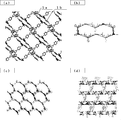
- FIG. 1 is a diagram illustrating a three-dimensional skeleton of a polynuclear metal complex 1.
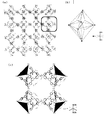
- FIG. 3 is a diagram illustrating a three-dimensional network structure of a polynuclear metal complex 3.
- FIG. 3 is a diagram illustrating a three-dimensional network structure of a polynuclear metal complex 5.
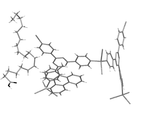
- FIG. 1 is a diagram showing a polynuclear metal complex obtained by inclusion of 4,4,4-trifluorobutyric acid obtained in Example 1.
- FIG. 3 is a view showing a polynuclear metal complex including cis-9-hexadecenoic acid obtained in Example 2.
- 4 is a diagram showing a polynuclear metal complex obtained by inclusion of petrothelic acid obtained in Example 3.
- FIG. FIG. 4 is a diagram showing the results of 4,4,4-trifluorobutyric acid uptake experiment performed in Comparative Example 2.
- the method for preparing a sample for crystal structure analysis of the present invention is as follows.
- Organic compound (A) having functional group (a)
- the organic compound (A) is a compound having a functional group (a), and its molecular structure is determined by a crystal structure analysis method using a crystal structure analysis sample obtained by the method of the present invention. .
- the functional group is an atomic group that causes a common reactivity exhibited by compounds belonging to the same group, or a bonding mode.
- Examples include hydroxyl groups (—OH) of alcohols, carbonyl groups (> C ⁇ O) of ketones, carboxyl groups (—COOH) of carboxylic acids, amides (—C ( ⁇ O) —NH—), and the like. However, it is not limited to these.
- the functional group (a) is not particularly limited as long as it is a functional group as defined above and can interact with the functional group (b).
- the interaction between the functional group (a) and the functional group (b) includes electrostatic interaction (Coulomb interaction, ion-dipole interaction, dipole interaction), hydrogen bond, hydrophobic interaction, ⁇ - Examples include ⁇ interaction, CH- ⁇ interaction, and coordination bond.
- a group having at least one atom selected from the group consisting of a nitrogen atom, an oxygen atom, a sulfur atom and a phosphorus atom hereinafter sometimes referred to as a functional group (a-1)
- a functional group (a-1) a group having at least one atom selected from the group consisting of a nitrogen atom, an oxygen atom, a sulfur atom and a phosphorus atom
- a halogen atom an alkyl group optionally having a halogen [hereinafter sometimes referred to as a functional group (a-2)] or an aryl group optionally having a halogen atom [hereinafter sometimes referred to as a functional group (a-3).
- a group containing a metal ion hereinafter sometimes referred to as functional group (a-4)).
- the functional group (a-1) is a group having at least one atom selected from the group consisting of a nitrogen atom, an oxygen atom, a sulfur atom and a phosphorus atom.
- the functional group (a-1) includes —CN, —N (R 1 ) (R 2 ), —OR 3 , —C ( ⁇ O) R 4 , —C ( ⁇ O) OR 5 , —O—C.
- R 1 to R 23 each independently represents a hydrogen atom or a hydrocarbon group having 1 to 20 carbon atoms which may have a halogen atom.
- the halogen atom include a fluorine atom, a chlorine atom, a bromine atom, and an iodine atom.
- A represents an alkylene group having 1 to 10 carbon atoms such as a methylene group, an ethylene group, a trimethylene group, or a propylene group.
- n represents an integer of 1 to 20.
- the functional group (a-1) When the functional group (a-1) is an acidic group (a group that can be deprotonated), the functional group (a-1) may be an electrically neutral group or a deprotonated anion. It may be in a state. In addition, when the functional group (a-1) is a basic group (a group that can be protonated), the functional group (a-1) may be electrically neutral or may be in a protonated cationic state. It may be. When the functional group (a) is the functional group (a-1), the functional group (a) can interact with the functional group (b) mainly by electrostatic interaction or hydrogen bonding.
- the functional group (a-2) is an alkyl group that may have a halogen atom.
- the alkyl group of the functional group (a-2) a straight chain or branched chain such as a methyl group, an ethyl group, an n-propyl group, an isopropyl group, an n-butyl group, a sec-butyl group, an isobutyl group, or a t-butyl group A chain alkyl group.
- the halogen atom of the functional group (a-2) include a fluorine atom, a chlorine atom, a bromine atom, and an iodine atom.
- the functional group (a-2) preferably has 1 to 20 carbon atoms, more preferably 2 to 15 carbon atoms, and still more preferably 3 to 10 carbon atoms.
- the functional group (a) is mainly formed by hydrophobic interaction, ion-dipole interaction, dipole interaction, hydrogen bond, It can interact with the functional group (b).
- the functional group (a-3) is an aryl group which may have a halogen atom.
- the aryl group of the functional group (a-3) include a phenyl group, a 1-naphthyl group, and a 2-naphthyl group.
- the halogen atom that the aryl group has include a fluorine atom, a chlorine atom, a bromine atom, and an iodine atom.
- the functional group (a-4) is a group containing a metal ion.
- Examples of the group containing a metal ion of the functional group (a-4) include an atomic group containing a metal ion in a mononuclear complex, an atomic group containing a metal ion in a polynuclear complex, and the like.
- metal ions of mononuclear complexes and polynuclear complexes include alkali metal ions such as lithium ions and sodium ions; beryllium ions; magnesium ions; alkaline earth metal ions such as calcium ions and strontium ions; chromium ions, manganese ions, and iron ions Transition metal ions such as aluminum ions, zinc ions of typical elements such as zinc ions, and the like.
- the functional group (a) is the functional group (a-4)
- the functional group (a) can interact with the functional group (b) mainly by electrostatic interaction or coordination bond. .
- the organic compound (A) may have one functional group (a) or a plurality of functional groups (a) in the molecule, and the bonding site of the functional group (a) is not particularly limited.
- the size of the organic compound (A) is not particularly limited as long as the organic compound (A) has a size capable of entering the pores and / or hollows of the single crystal.
- the molecular weight of the organic compound (A) is usually 20 to 3,000, preferably 100 to 2,000.
- the molecular size of the organic compound (A) is grasped to some extent by nuclear magnetic resonance spectroscopy, mass spectrometry, elemental analysis, etc., and a single crystal having appropriate pores and hollows is appropriately selected in advance. It is also preferable to use them.
- organic compound (A) since it is important as an active ingredient of agricultural pharmaceuticals, its metabolite, etc., carboxylic acids having at least one carboxyl group in the molecule are preferable, and the formula (A1): Carboxylic acids represented by RCOOH are more preferred.
- R represents an organic group having 1 to 40 carbon atoms, which may have a substituent.
- the organic group may be any organic group such as a hydrocarbon group such as an alkyl group, an alkenyl group, an alkynyl group, a cycloalkyl group, a cycloalkenyl group, and an aryl group; a heterocyclic group;
- the substituent of the organic group may be any substituent such as a halogen atom, aryl group, nitro group, cyano group, heterocyclic group, ester group, oxo group, hydroxy group, alkoxy group, amide group, amino group, etc. There may be.
- solvent of the solvent solution containing organic compound (A) is not particularly limited as long as it does not dissolve the single crystal used and dissolves organic compound (A). It is not limited. As will be described later, when the operation of concentrating the solvent solution containing the organic compound (A) by volatilizing the solvent from the solvent solution containing the organic compound (A), the solvent used is normal pressure (1 ⁇
- the boiling point at 10 5 Pa) is preferably 200 ° C. or less, more preferably from ⁇ 50 to 185 ° C., and even more preferably from 30 to 80 ° C.
- solvent used include aromatic hydrocarbons such as benzene, toluene, xylene, chlorobenzene, 1,2-dichlorobenzene and nitrobenzene; fats such as n-butane, n-pentane, n-hexane and n-heptane.
- aromatic hydrocarbons such as benzene, toluene, xylene, chlorobenzene, 1,2-dichlorobenzene and nitrobenzene
- fats such as n-butane, n-pentane, n-hexane and n-heptane.
- Aromatic hydrocarbons such as cyclopentane, cyclohexane and cycloheptane; Nitriles such as acetonitrile and benzonitrile; Sulfoxides such as dimethyl sulfoxide (DMSO); N, N-dimethylformamide and N-methyl Amides such as pyrrolidone; Ethers such as diethyl ether, tetrahydrofuran, 1,2-dimethoxyethane and 1,4-dioxane; Alcohols such as methanol, ethanol and isopropyl alcohol; Ketones such as acetone, methyl ethyl ketone and cyclohexanone; Cellosolves such as lucerosolv; halogenated hydrocarbons such as dichloromethane, chloroform, carbon tetrachloride, and 1,2-dichloroethane; esters such as methyl acetate, ethyl acetate, ethyl lactate
- the content of the organic compound (A) in the solvent solution containing the organic compound (A) is not particularly limited. For example, 5 mg or less, preferably 0.5 ⁇ g or more and 5 mg or less, more preferably 0.5 ⁇ g or more and 1 mg or less, and further preferably 1 ⁇ g or more and 0.5 mg or less.
- a sample of at least about 5 mg is required. According to the method of the present invention, even if the content of the organic compound (A) is 5 mg or less, a target crystal structure analysis sample can be efficiently produced.
- the concentration of the organic compound (A) in the solvent solution containing the organic compound (A) is not particularly limited, but is usually 0.001 to 50 ⁇ g / ⁇ L from the viewpoint of efficiently producing a high-quality crystal structure analysis sample.
- the amount is preferably 0.01 to 5 ⁇ g / ⁇ L, more preferably 0.1 to 1 ⁇ g / ⁇ L.
- the solvent solution containing the organic compound (A) may be subjected to a purification treatment by a known purification method before use in the present invention.
- the purification method include purification methods such as centrifugation, filtration, dialysis, solvent extraction, electrophoresis, and liquid chromatography. These purification methods can be used singly or in combination of two or more.
- the single crystal of the porous compound used in the present invention is a three-dimensional skeleton composed of one or more molecular chains, or one or two or more molecular chains and a skeleton-forming compound. And three-dimensionally regularly arranged pores and / or cavities formed by being partitioned by the three-dimensional skeleton, wherein the three-dimensional skeleton interacts with the functional group (a).
- the group (b) is present in the pores and / or hollows.
- the three-dimensional skeleton refers to a skeleton-like structure having a three-dimensional extension inside a single crystal.
- the three-dimensional skeleton is composed of one or more molecular chains, or one or two or more molecular chains and a skeleton-forming compound.
- “Molecular chain” refers to an organization organized by covalent bonds and / or coordinate bonds. This molecular chain may have a branched structure or a cyclic structure. Examples of the three-dimensional skeleton composed of one molecular chain include a skeleton organized in a “jungle gym” shape.
- a three-dimensional skeleton composed of two or more molecular chains
- two or more molecular chains are organized as a whole by interactions such as hydrogen bonds, ⁇ - ⁇ stacking interactions, van der Waals forces, etc.
- the skeleton For example, there is a skeleton in which two molecular chains are entangled in a “Chienowa” shape.
- Examples of such a three-dimensional skeleton include the three-dimensional skeletons of polynuclear metal complexes 1 and 2 described later.
- “Skeletogenic compounds” do not constitute part of the molecular chain, but constitute part of the three-dimensional skeleton by interactions such as hydrogen bonds, ⁇ - ⁇ stacking interactions, van der Waals forces, etc. Refers to the compound.
- the skeleton-forming aromatic compound in the polynuclear metal complex mentioned later is mentioned.
- “Three-dimensionally ordered pores and / or hollows” means pores and hollows that are regularly aligned without being disturbed to the extent that pores and hollows can be confirmed by crystal structure analysis.
- Pore and “hollow” represent an internal space in the single crystal. The internal space extending in a cylindrical shape is called “pore”, and the other internal space is called “hollow”.
- the size of the pore is defined as an inscribed circle of the pore (hereinafter simply referred to as a parallel plane) parallel to the crystal plane that is closest to the perpendicular to the direction in which the pore extends (hereinafter simply referred to as a parallel plane).
- a parallel plane parallel to the crystal plane that is closest to the perpendicular to the direction in which the pore extends
- the “direction in which the pores extend” can be determined by the following method. That is, first, a crystal plane X (A plane, B plane, C plane, or a diagonal plane of each) in an appropriate direction across the target pore is selected. Then, by expressing the atoms that exist on the crystal plane X and constitute the three-dimensional skeleton using the van der Waals radii, a cross-sectional view of the pore having the crystal plane X as a cutting plane is drawn. Similarly, a cross-sectional view of a pore having a crystal plane Y shifted from the crystal plane X by one unit cell as a cut plane is drawn.
- the centers of the cross-sectional shapes of the pores in the respective crystal planes are connected with a straight line (dashed line) in the three-dimensional view (see FIG. 1).
- the direction of the straight line obtained at this time is the direction in which the pores extend.
- the “diameter of the inscribed circle of the pore” can be obtained by the following method. That is, first, a cross-sectional view of the pore having the parallel plane as a cut plane is drawn by the same method as described above. Next, after drawing the inscribed circle of the pore in the cross-sectional view and measuring the diameter, the obtained measured value is converted into an actual scale to obtain the diameter of the inscribed circle of the actual pore. be able to. Furthermore, by measuring the diameter of the inscribed circle of the pore in each parallel surface while gradually translating the parallel surface by one unit cell, the diameter of the inscribed circle of the narrowest part and the widest The diameter of the inscribed circle of the part is obtained.
- the diameter of the inscribed circle of the single crystal pores used in the present invention is preferably 2 to 30 mm, and more preferably 3 to 10 mm.
- the major axis of the inscribed ellipse of the single crystal pores used in the present invention is preferably 2 to 30 mm, and more preferably 3 to 10 mm.
- the minor axis of the inscribed ellipse of the single crystal pores is preferably 2 to 30 mm, and more preferably 3 to 10 mm.
- the pore volume of the single crystal used in the present invention is described in the paper (A): Acta Crystallogr. A 46, 194-201 (1990). That is, it is possible to calculate using “volume of single crystal ⁇ porosity in unit cell” based on Solvent Accessible Void (void volume in a unit cell) calculated by a calculation program (PLATON SQUEEZE PROGRAM).
- Single crystals of pore volume used in the present invention (all pore volume in the grain of the single crystal) is preferably 1 ⁇ 10 -7 ⁇ 0.1mm 3, 1 ⁇ 10 -5 ⁇ 1 ⁇ 10 - 3 mm 3 is more preferable.
- the size of the hollow can also be obtained by the method described in the above paper (A), similarly to the pore volume.
- the single crystal used in the present invention preferably has a cubic or cuboid shape. One side thereof is preferably 10 to 1000 ⁇ m, more preferably 60 to 200 ⁇ m. By using a single crystal having such a shape and size, a good quality crystal structure analysis sample can be easily obtained.
- the single crystal to be used is irradiated with MoK ⁇ rays (wavelength: 0.71 ⁇ ) generated at a tube voltage of 24 kV and a tube current of 50 mA, and when diffracted X-rays are detected by a CCD detector, at least 1.5 ⁇ . Those that can determine the molecular structure with a resolution of 1 are preferred. By using a single crystal having such characteristics, a sample for crystal structure analysis of good quality can be easily obtained.
- the three-dimensional skeleton has a functional group (b) that can interact with the functional group (a).
- a functional group (b) a group having at least one atom selected from the group consisting of a nitrogen atom, an oxygen atom, a sulfur atom and a phosphorus atom (hereinafter sometimes referred to as a functional group (b-1)), a halogen atom
- a functional group (b-2) a group having a halogen [hereinafter sometimes referred to as a functional group (b-2)] or an aryl group optionally having a halogen atom [hereinafter sometimes referred to as a functional group (b-3).
- a group containing a metal ion hereinafter sometimes referred to as a functional group (b-4)].
- the size of the functional group (b) is not particularly limited as long as it does not block pores and / or hollows.
- the functional group (b) preferably has 1 to 100 carbon atoms, more preferably 2 to 60 carbon atoms, and still more preferably 3 to 20 carbon atoms.
- a crystal structure analysis can be efficiently performed by appropriately selecting a single crystal of a porous compound having an appropriate functional group (b) in accordance with the functional group (a) of the organic compound (A).
- Sample can be prepared.
- the organic compound (A) is a carboxylic acid
- a single crystal of a porous compound in which the functional group (b) is an amino group [—N (R 1 ) (R 2 )] is used.
- the combination of an organic compound (A) and a functional group (b) is not limited to the thing of the following table
- well-known techniques relating to intermolecular interactions can be used as appropriate.
- R 1 , R 2 , R 22 , A, and n each have the same meaning as described above.
- Examples of the cationic group include-[N (R 1 ) (R 2 ) H] + .
- the organic compound (A) is a carboxylic acid and the functional group (b) is an amino group [—N (R 1 ) (R 2 )] is preferable. Since the functional group (b) is an amino group, carboxylic acids important as active ingredients and metabolites of agricultural pharmaceuticals are efficiently incorporated into the pores and / or hollows of the single crystal of the porous compound, and the crystal structure An analysis sample can be obtained efficiently.
- the single crystal of the porous compound used in the present invention has the three-dimensional skeleton and three-dimensionally regularly arranged pores and / or hollows that are partitioned by the three-dimensional skeleton.
- Examples of the single crystal of the porous compound include a single crystal of a polynuclear metal complex and a urea crystal.
- a single crystal of a polynuclear metal complex is preferable because the size of the pores and hollows and the position of the functional group (b) in the pores and hollows can be easily controlled.
- the polynuclear metal complex includes a ligand having two or more coordination sites (hereinafter, sometimes referred to as “polydentate ligand”) and a metal ion as a central metal, in addition to these. Further, those containing a skeleton-forming aromatic compound can be mentioned. Among them, as described later, since a single crystal of a polynuclear metal complex rich in variations of the functional group (b) can be efficiently prepared, a polydentate ligand, a metal ion as a central metal, and a functional group ( Polynuclear metal complexes containing a skeleton-forming aromatic compound having b) are preferred. In these polynuclear metal complexes, the functional group (b) can be introduced into the three-dimensional skeleton by using a polydentate ligand having a functional group (b) or a skeleton-forming aromatic compound.
- the multidentate ligand is not particularly limited as long as it can form the three-dimensional skeleton, and a known multidentate ligand can be used.
- the “coordinating moiety” refers to an atom or atomic group in a ligand having an unshared electron pair capable of coordinating bond. Examples thereof include heteroatoms such as nitrogen atom, oxygen atom, sulfur atom and phosphorus atom; atomic groups such as nitro group, amino group, cyano group and carboxyl group; Especially, the atomic group containing a nitrogen atom or a nitrogen atom is preferable.
- a multidentate ligand with a long distance from the center of the ligand to the coordination site a single crystal of a polynuclear metal complex having relatively large pores and hollows is obtained.
- a multidentate ligand having a short distance from the center of the child to the coordination site a single crystal of a polynuclear metal complex having relatively small pores and hollows can be obtained.
- the polydentate ligand is preferably a polydentate ligand having two or more coordination sites. More preferred is a ligand having three functional sites (hereinafter sometimes referred to as a “tridentate ligand”), and the unshared electron pairs (orbitals) of the three coordinating sites exist on a quasi-coplanar surface. In addition, it is more preferable that the three coordinating sites are arranged radially at equal intervals with respect to the center portion of the tridentate ligand.
- each unshared electron pair is on the same plane or is slightly displaced from the plane, for example, 20 ° or less with respect to the reference plane. It also includes the state that exists in a plane that intersects at.
- three coordinating sites are arranged radially at equal intervals with respect to the central portion of the tridentate ligand means that on a line extending radially from the central portion of the ligand at equal intervals, It means a state in which three coordination sites are arranged at approximately the same distance from the central portion.
- tridentate ligand for example, the following formula (1)
- Ar represents a trivalent aromatic group which may have a substituent.
- X 1 to X 3 are each independently a divalent organic group, or Ar and Y 1 to Y 3.
- Y 1 to Y 3 each independently represents a monovalent organic group having a coordination site).
- Ar represents a trivalent aromatic group.
- the number of carbon atoms constituting Ar is usually 3 to 22, preferably 3 to 13, and more preferably 3 to 6.
- Ar is a trivalent aromatic group having a monocyclic structure composed of one 6-membered aromatic ring or a trivalent aromatic group having a condensed ring structure formed by condensing three 6-membered aromatic rings. Groups.
- Examples of the trivalent aromatic group having a monocyclic structure composed of one 6-membered aromatic ring include groups represented by the following formulas (2a) to (2d).
- Examples of the trivalent aromatic group having a condensed ring structure formed by condensing three 6-membered aromatic rings include groups represented by the following formula (2e).
- “*” represents a bonding position with X 1 to X 3 , respectively.
- an aromatic group represented by the formula (2a) or (2b) is preferable, and an aromatic group represented by the formula (2b) is particularly preferable.
- Ar may have a substituent at an arbitrary position of the aromatic group represented by formula (2a), formula (2c) to formula (2e).
- substituents include alkyl groups such as methyl, ethyl, isopropyl, n-propyl, and t-butyl; alkoxy groups such as methoxy, ethoxy, n-propoxy, and n-butoxy; fluorine A halogen atom such as an atom, a chlorine atom or a bromine atom;
- a group having a functional group (b) hereinafter also referred to as “functional group (b) -containing group” may be used.
- X 1 to X 3 each independently represent a divalent organic group or a single bond directly connecting Ar and Y 1 to Y 3 .
- the divalent organic group those capable of forming a ⁇ -electron conjugated system together with Ar are preferable. Since the divalent organic group represented by X 1 to X 3 forms a ⁇ -electron conjugated system, the planarity of the tridentate ligand represented by the formula (1) is improved, and a stronger three-dimensional skeleton A structure is easily formed.
- the number of carbon atoms constituting the divalent organic group is preferably 2 to 18, more preferably 2 to 12, and further preferably 2 to 6.
- divalent organic group examples include a divalent unsaturated aliphatic group having 2 to 10 carbon atoms, a divalent organic group having a monocyclic structure consisting of one 6-membered aromatic ring, and 2 to 4 6-membered aromatic rings.
- Examples of the divalent unsaturated aliphatic group having 2 to 10 carbon atoms include vinylene group and acetylene group (ethynylene group).
- Examples of the divalent organic group having a monocyclic structure composed of one 6-membered aromatic ring include a 1,4-phenylene group.
- Examples of the divalent organic group having a condensed ring structure in which 2 to 4 6-membered aromatic rings are condensed include a 1,4-naphthylene group and an anthracene-1,4-diyl group. Examples of combinations of two or more of these divalent organic groups include the following.
- the divalent organic group represented by X 1 to X 3 are preferable as the divalent organic group represented by X 1 to X 3 .
- the aromatic ring in the divalent organic group may contain a hetero atom such as a nitrogen atom, an oxygen atom, or a sulfur atom in the ring. Further, the divalent organic group may have a substituent. Examples of the substituent include the same as those described above as the substituent for Ar.
- Y 1 to Y 3 each independently represents a monovalent organic group having a coordination site.
- the organic group represented by Y 1 to Y 3 those capable of forming a ⁇ -electron conjugated system together with Ar and X 1 to X 3 are preferable.
- the organic group represented by Y 1 to Y 3 constitutes a ⁇ -electron conjugated system, the planarity of the tridentate ligand represented by the formula (1) is improved, and a strong three-dimensional skeleton structure is formed. It becomes easy.
- the number of carbon atoms constituting Y 1 to Y 3 is preferably 5 to 11, and more preferably 5 to 7.
- Examples of Y 1 to Y 3 include organic groups represented by the following formulas (3a) to (3f).
- “*” represents a bonding position with X 1 to X 3 .
- Y 1 to Y 3 are particularly preferably a group represented by the formula (3a).
- Y 1 to Y 3 may have a substituent at any position of the organic groups represented by the formulas (3a) to (3f). Examples of the substituent include the same as those exemplified above as the substituent for Ar.
- the size of the pores and hollows of the single crystal can be adjusted. it can.
- a single crystal having pores and hollows of a size capable of including the target organic compound (A) can be efficiently obtained.
- tridentate ligand represented by the formula (1) since a strong three-dimensional skeleton structure is easily formed, the planarity and symmetry are high, and the ⁇ -conjugated system spreads throughout the ligand. Those are preferred. Examples of such a tridentate ligand include ligands represented by the following formulas (4a) to (4f), or a substituent (including a substituent (b)) at any position thereof. A ligand.
- the tridentate ligand represented by the formula (1) includes 2,4,6-tris (4-pyridyl) -1,3,5-triazine (TPT) represented by the above formula (4a). Is particularly preferred.
- a commercial item can also be used as a polydentate ligand of a polynuclear metal complex.
- PCP Coordination Polymer
- MOF Metal Organic Structure
- the metal ion as the central metal of the polynuclear metal complex is not particularly limited as long as it can form a coordinate bond with the polydentate ligand to form a three-dimensional skeleton.
- ions of metals in Group 8 to 12 of the periodic table such as iron ions, cobalt ions, nickel ions, copper ions, zinc ions, silver ions, palladium ions, ruthenium ions, rhodium ions, platinum ions, etc. are preferable.
- metal ions of Groups 8 to 12 of the periodic table are more preferred.
- zinc (II) ions and cobalt (II) ions are particularly preferable because single crystals having large pores and hollows are easily obtained.
- a monodentate ligand may be coordinated with the central metal of the polynuclear metal complex.
- Such monodentate ligands include monovalent anions such as chloride ion (Cl ⁇ ), bromide ion (Br ⁇ ), iodide ion (I ⁇ ), thiocyanate ion (SCN ⁇ ); ammonia, monoalkyl Electrically neutral coordinating compounds such as amine, dialkylamine, trialkylamine, and ethylenediamine; and the like.
- the polynuclear metal complex is a reaction solvent (the solvent used for the synthesis of the polynuclear metal complex), a substitution solvent (refers to another solvent replaced with the reaction solvent, the same applies hereinafter), and a skeleton-forming aromatic described later. It may contain a compound.
- “Skelet-forming aromatic compound” means an aromatic compound that interacts with a molecular chain constituting a three-dimensional skeleton (excluding covalent bonds and coordinate bonds) and can constitute a part of the three-dimensional skeleton. Say. By including a skeleton-forming aromatic compound in the polynuclear metal complex, the three-dimensional skeleton is likely to become stronger, and the three-dimensional skeleton is further stabilized even after the molecules of the organic compound (A) are included. There is a case.
- Examples of the skeleton-forming aromatic compound include condensed polycyclic aromatic compounds. Examples thereof include those represented by the following formulas (5a) to (5i).
- These condensed polycyclic aromatic compounds may have a substituent (including the substituent (b)) at an arbitrary position.
- substituent include the same ones as those shown as the substituent of the multidentate ligand.
- a condensed polycyclic aromatic compound used for this invention what has a functional group (b) is preferable. From the viewpoint of chemical synthesis, the functional group (b) rich in variations is more effective when the functional group (b) is introduced into the skeleton-forming aromatic compound than when the functional group (b) is introduced into the polydentate ligand. This is because there are many cases where it can be easily introduced.
- the skeleton-forming aromatic compound having the functional group (b) has a functional group (b) -containing group at any position of the skeleton-forming aromatic compound represented by the formulas (5a) to (5i).
- a crystal structure analysis is performed using a single crystal of a porous compound containing triphenylene [compound represented by the above formula (5a)] as a skeleton-forming aromatic compound, and the state of the pores is sufficiently Since it has been clarified, a compound having a functional group (b) -containing group at the 1-position or 2-position of triphenylene is preferable, and a triphenylene compound having an amino group such as 1-aminotriphenylene or 2-aminotriphenylene is more preferable.
- Examples of the skeleton-forming aromatic compound having the functional group (b) and the polynuclear metal complex containing the skeleton-forming aromatic compound include WO 2007/102594, WO 2008/111665, JP 2010-18708, and JP Those described in Japanese Patent Application Laid-Open No. 2010-184899.
- the polynuclear metal complexes described in these documents can also be used.
- polynuclear metal complex examples include the following compounds. (1) A compound comprising a ligand having a substituent (b) and a metal ion [polynuclear metal complex ( ⁇ )] (2) Compound [polynuclear metal complex ( ⁇ )] comprising a skeleton-forming aromatic compound having a ligand, a metal ion, and a substituent (b) (3) Compound [polynuclear metal complex ( ⁇ )] comprising a ligand having a substituent (b), a metal ion, and a skeleton-forming aromatic compound having a substituent (b) (4) A compound in which a guest molecule such as a solvent molecule is included in the pore or hollow of any of the polynuclear metal complexes ( ⁇ ) to ( ⁇ ) [polynuclear metal complex ( ⁇ )]
- the polynuclear metal complex used in the present invention is preferably a polynuclear metal complex which does not lose crystallinity even after the organic compound (A) molecule is taken into the pores and hollows and has relatively large pores and hollows.
- the polynuclear metal complex having such characteristics can be easily obtained by using a compound having the substituent (b) which is a tridentate ligand represented by the formula (1).
- Specific examples include polynuclear metal complexes represented by the following formulas (6a) to (6c).
- M represents a divalent metal ion belonging to Groups 8 to 12 of the periodic table
- X represents a monovalent anionic monodentate ligand
- L represents The tridentate ligand represented by the formula (1) (or the tridentate ligand represented by the formula (1) and having a substituent (b)), and “solv” is a synthesis It represents a guest molecule such as a solvent molecule used sometimes
- SA represents a skeleton-forming aromatic compound (or a skeleton-forming compound having a substituent (b)), and a, b, and c are arbitrary natural numbers.
- At least one of L and SA has a functional group (b).
- the three-dimensional skeletons of the polynuclear metal complexes represented by the above formulas (6a) to (6c) can be estimated from known three-dimensional skeletons of polynuclear metal complexes similar to these. That is, although it is a polynuclear metal complex having no functional group (b), as L, the polynuclear metal complex using the TPT represented by the formula (4a) has previously incorporated guest molecules such as a solvent.
- the molecular structure is determined by single crystal X-ray structural analysis.
- the three-dimensional skeleton of the polynuclear metal complex used in the present invention is a polynuclear metal complex that does not have these functional groups (b). It is thought to be similar to a three-dimensional skeleton. Therefore, in the following, regarding TPT represented by the above formula (4a) as L and a polynuclear metal complex having no functional group (b) [polynuclear metal complex represented by the following formulas (7a) to (7d)] explain. In the following, ligands and solvent molecules may be omitted as follows.
- PhNO 2 Nitrobenzene TPH: Triphenylene PER: Perylene MeOH: Methanol DCB: 1,2-dichlorobenzene
- the three-dimensional skeleton of the polynuclear metal complex 1 is shown in FIGS. 2 (a) to 2 (d).
- the three-dimensional skeleton of the polynuclear metal complex 1 is composed of two molecular chains 1a and 1b.
- each zinc (II) ion is coordinated in a tetracoordinate tetrahedral form by two TPT pyridyl groups and two iodide ions.
- the structures containing the zinc (II) ions are three-dimensionally connected by TPT to form respective molecular chains [FIG. 2 (a)].
- Each of the molecular chains 1a and 1b has a closed cyclic chain structure composed of a TPT10 molecule and a Zn10 atom as the shortest closed cyclic chain structure [FIG. 2 (b)].
- These molecular chains 1a and 1b can be regarded as a helical hexagonal three-dimensional network structure having a pitch along the (010) axis of 15 mm [FIG. 2 (c)].
- the molecular chains 1a and 1b do not share the same zinc (II) ion and are independent of each other. Then, a three-dimensional skeleton organized as a whole is formed by interpenetrating each other in a nested manner so as to share the same space.
- the single crystal of the polynuclear metal complex 1 having a three-dimensional skeleton has one kind of regularly arranged pores [FIG. 2 (d)].
- the porosity of the single crystal of the polynuclear metal complex 1 is 50%.
- the diameter of the inscribed circle of the single crystal pore of the polynuclear metal complex 1 is 5 to 8 mm.
- Examples of the polynuclear metal complex represented by the formula (7b) include [(ZnBr 2 ) 3 (TPT) 2 (PhNO 2 ) 5 (H 2 O)] n (polynuclear metal complex 2 described in JP-A-2008-214318. And all or part of the reaction solvent molecules in the polynuclear metal complex 2 are replaced with a substitution solvent.
- the polynuclear metal complex 2 has a skeleton similar to the three-dimensional skeleton of the polynuclear metal complex 1 except that (ZnI 2 ) is replaced by (ZnBr 2 ).
- the shape and size of the pores of the single crystal of the polynuclear metal complex 2 and the porosity were almost the same as those of the single crystal of the polynuclear metal complex 1.
- the three-dimensional skeleton of the polynuclear metal complex 3 is shown in FIGS.
- the three-dimensional skeleton of the polynuclear metal complex 3 is composed of two molecular chains 1A and 1B and a triphenylene molecule that is a skeleton-forming aromatic compound.
- each zinc (II) ion has two iodide ions and two TPT pyridyl groups coordinated in a tetracoordinate tetrahedral form. Then, the molecular chains are formed by three-dimensionally connecting the structures containing zinc (II) ions with TPT.
- the molecular chains 1A and 1B do not share the same zinc (II) ion and are independent of each other. Then, a three-dimensional skeleton organized as a whole is formed by interpenetrating each other in a nested manner so as to share the same space.
- the triphenylene molecule (2) contains tris (4-pyridyl) triazine [TPT (1a)] with a molecular chain 1A and tris (4-pyridyl) triazine [TPT ( 1b)] is firmly inserted (intercalated) with the ⁇ plane [FIG. 3B].
- the triphenylene molecule is stabilized by the ⁇ - ⁇ interaction between TPT (1a) and TPT (1b) and functions as a part of the three-dimensional skeleton of the polynuclear metal complex 3.
- FIG.3 (b) is a figure when the part enclosed with the line in Fig.3 (a) is seen from the side.
- the single crystal of the polynuclear metal complex 3 has two types of regularly arranged pores (pores A and B) [FIG. 3 (c)].
- the pores A and B are regularly formed between stacked structures in which TPT and TPH are alternately stacked.
- the pore A has a substantially cylindrical shape and is substantially surrounded by hydrogen atoms present on the side edges of the infinite number of stacked TPTs and TPHs on the ⁇ plane.
- the pore B has a substantially triangular prism shape, and among the three surfaces forming the triangular prism, two are surrounded by the ⁇ plane of the TPT, and the other is an infinite number of stacked TPT and TPH.
- the pores A and B have an elongated shape that is slightly meandered.
- the porosity of the single crystal pores of the polynuclear metal complex 3 is 28%.
- the diameter of the inscribed circle of the pore A of the single crystal of the polynuclear metal complex 3 is 5 to 8 mm.
- the diameter of the inscribed circle of the single crystal pore B of the polynuclear metal complex 3 is 5 to 8 mm.
- the polynuclear metal complex 4 has a skeleton structure similar to that of the polynuclear metal complex 3 except that a perylene molecule is inserted between two TPTs instead of the triphenylene molecule of the polynuclear metal complex 3.
- the shape and size of the pores of the single crystal of the polynuclear metal complex 4 and the porosity were almost the same as those of the single crystal of the polynuclear metal complex 3.
- the three-dimensional skeleton of the polynuclear metal complex 5 is shown in FIG.
- the polynuclear metal complex 5 has a [Co 6 (TPT) 4 ] structure composed of six cobalt ions and four TPTs as structural units.
- This structural unit has an octahedral three-dimensional shape, and cobalt ions are arranged at six vertices of the octahedron [FIG. 4B].
- cobalt (II) ion four pyridyl groups of TPT and two thiocyanate ions are coordinated in a hexacoordinate octahedral form.
- FIG. 4B is an enlarged view of a portion surrounded by a line in FIG.
- the structural unit has a hollow inside.
- the porosity of the single crystal of the polynuclear metal complex 5 is 78%. This value is a value calculated by combining the pores and the hollow volume.
- the diameter of the inscribed circle of the single crystal pores of the polynuclear metal complex 5 is 10 to 18 mm.
- the polynuclear metal complex represented by the formulas (7a) to (7d) is substituted with a polydentate ligand (TPT) or a skeleton-forming aromatic compound, and has a functional group (b). It has the same three-dimensional skeleton structure as the polynuclear metal complex represented by the formulas (7a) to (7d) obtained by using a bidentate ligand or a skeleton-forming aromatic compound, and has a functional group (b)
- TPT polydentate ligand
- b skeleton-forming aromatic compound
- a single crystal of a polynuclear metal complex having the above can be used as a single crystal of a porous compound.
- the polynuclear metal complex having a polydentate ligand represented by the above formula (1)
- the polynuclear metal complex is known as a porous coordination polymer (PCP) or a metal organic structure (MOF).
- PCP porous coordination polymer
- MOF metal organic structure
- the polynuclear metal complex can also be used.
- PCP porous coordination polymer
- MOF metal organic structure
- Sigma-Aldrich pamphlet published in September 2012 (Material Science Fundamental No. 7-Porous Coordination Polymer (PCP) / Metal Organic Structure (MOF) Fundamentals) [Cu 2 (bzdc) 2 (pyz)] n (“Bzdc” represents 2,3-pyrazinedicarboxylic acid, “pyz” represents pyrazine, and n represents any number).
- a single crystal of the polynuclear metal complex obtained using the polydentate ligand into which the functional group (b) is introduced can be used as a single crystal of a porous compound.
- the method for synthesizing the polynuclear metal complex is not particularly limited, and a known method can be used.
- the Sigma-Aldrich brochure published in September 2012 includes multidentate ligands, etc.
- Hydrothermal method in which a hydrothermal reaction is carried out by heating; a microwave method in which a solvent, a polydentate ligand, a metal ion, etc. are placed in a container and microwave irradiation; a solvent, a polydentate ligand in the container , Ultrasonic methods of putting metal ions, etc., and irradiating ultrasonic waves; solid-phase synthesis methods of mechanically mixing polydentate ligands, metal ions, etc. without using a solvent; Using this method, a single crystal of a polynuclear metal complex can be obtained.
- the solution method is preferably used.
- the solvent solution of the second solvent of the metal ion-containing compound is added to the solvent solution of the first solvent of the polydentate ligand, and the polydentate ligand and the metal ion are mixed at a predetermined ratio.
- a method of standing at 0 to 70 ° C. for several hours to several days can be mentioned.
- the metal ion-containing compound is not particularly limited.
- a compound represented by the formula: MX n can be mentioned.
- M represents a metal ion
- X represents a counter ion
- n represents the valence of M.
- X include F ⁇ , Cl ⁇ , Br ⁇ , I ⁇ , SCN ⁇ , NO 3 ⁇ , ClO 4 ⁇ , BF 4 ⁇ , SbF 4 ⁇ , PF 6 ⁇ , AsF 6 ⁇ , CH 3 CO 2- and the like.
- Reaction solvents (first solvent and second solvent) used include aromatic hydrocarbons such as benzene, toluene, xylene, chlorobenzene, 1,2-dichlorobenzene, nitrobenzene; n-pentane, n-hexane, n -Aliphatic hydrocarbons such as heptane; Alicyclic hydrocarbons such as cyclopentane, cyclohexane and cycloheptane; Nitriles such as acetonitrile and benzonitrile; Sulfoxides such as dimethyl sulfoxide (DMSO); N, N-dimethyl Amides such as formamide and n-methylpyrrolidone; ethers such as diethyl ether, tetrahydrofuran, 1,2-dimethoxyethane and 1,4-dioxane; alcohols such as methanol, ethanol and isopropyl alcohol; acetone, methyl ethyl ket
- the first solvent and the second solvent that are not compatible with each other (that is, separated into two layers).
- a method using nitrobenzene, dichlorobenzene, a mixed solvent of nitrobenzene and methanol, a mixed solvent of dichlorobenzene and methanol as the first solvent, and methanol as the second solvent can be mentioned.
- the polynuclear metal complexes having the same three-dimensional skeleton structure as the polynuclear metal complexes 1 to 5 can be synthesized according to the methods described in the above documents.
- a method of bringing a single crystal of a porous compound into contact with a solvent solution containing an organic compound (A) Is not particularly limited.
- the method of immersing the single crystal of the porous compound in the solvent solution containing the organic compound (A) Is preferred.
- the A value calculated from the following formula (I) is 100 or less, preferably 0.1 to 30, more preferably It is preferable to immerse a single crystal of the porous compound in an amount of 1 to 5.
- X represents the mass of the organic compound (A) in the solvent solution
- Y fills all pores and hollows in the single crystal of the porous compound with a substance having a specific gravity of 1.
- the molecules of the organic compound (A) are sufficiently taken into the pores and hollows of the single crystal of the porous compound, and it becomes easy to obtain a good quality crystal structure analysis sample.
- the organic compound (A) is likely to be wasted.
- the number of single crystals to be immersed is not particularly limited. When the amount of the organic compound (A) is extremely small, a target crystal structure analysis sample can be obtained by immersing one single crystal. Moreover, when there is a margin in the amount of the organic compound (A), two or more single crystals of the same kind of porous compound may be immersed, or single crystals of different kinds of porous compounds may be immersed simultaneously.
- the solvent solution may be evaporated under mild conditions to concentrate the solvent solution.
- the molecules of the organic compound (A) can be efficiently taken into the pores and hollows of the single crystal of the porous compound.
- the immersion conditions (concentration conditions) at this time are not particularly limited, but the temperature of the solvent solution is preferably 0 to 180 ° C., more preferably 0 to 80 ° C., and further preferably 20 to 60 ° C.
- the immersion time (concentration time) is usually 6 hours or more, preferably 12 to 168 hours, more preferably 24 to 78 hours.
- the volatilization rate of the solvent is preferably 0.1 to 1000 ⁇ L / 24 hours, more preferably 1 to 100 ⁇ L / 24 hours, and further preferably 5 to 50 ⁇ L / 24 hours.
- the volatilization rate of the solvent is too fast, there is a possibility that a high-quality crystal structure analysis sample cannot be obtained.
- the volatilization rate of the solvent is too slow, it is not preferable from the viewpoint of working efficiency.
- the temperature at which the solvent is volatilized is usually 0 to 120 ° C., preferably 15 to 60 ° C., although it depends on the boiling point of the organic solvent used.
- the operation of immersing the porous compound single crystal in the solvent solution containing the organic compound (A) and then volatilizing the solvent to concentrate the solvent solution is carried out under normal pressure or under reduced pressure. Alternatively, it may be performed under pressure.
- the pressure during the operation of volatilizing the solvent and concentrating the solvent solution is usually 1 to 1 ⁇ 10 6 Pa, preferably 1 ⁇ 10 to 1 ⁇ 10 6 Pa.
- the volatilization rate of the solvent can be adjusted appropriately by adjusting the temperature and pressure during the operation of concentrating the solvent solution.
- the solvent of the organic compound (A) is placed in the pores and hollows of the single crystal of the porous compound.
- the solvent (reaction solvent) molecules used in the synthesis of the porous compound are removed from the pores and hollows, and the organic compound (A) can be easily replaced with the solvent. It is possible to efficiently produce a sample for crystal structure analysis of good quality.
- the single crystal to be used is previously converted into the solvent solution containing the organic compound (A).
- the method of immersing in the solvent used for preparation of this is mentioned.
- the immersion conditions at this time are not particularly limited, but the temperature of the solvent is usually 0 to 70 ° C., preferably 10 to 60 ° C., more preferably 20 to 50 ° C., and the immersion time is usually 6 hours or more. , Preferably 12 to 168 hours, more preferably 24 to 78 hours.
- the sample for crystal structure analysis obtained by the method of the present invention is such that the molecules of the organic compound (A) are regularly arranged in the pores and hollows of the single crystal of the porous compound. It has been made.
- the molecules of the organic compound (A) are regularly arranged means that the molecules of the organic compound (A) are porous without being disturbed to such an extent that the structure can be determined by crystal structure analysis. It means that the compound is regularly accommodated in the pores and hollows of the single crystal of the compound.
- the sample for crystal structure analysis obtained by the method of the present invention was irradiated with MoK ⁇ rays (wavelength: 0.71 ⁇ ) generated at a tube voltage of 24 kV and a tube current of 50 mA, and diffracted X-rays were detected by a CCD detector. Sometimes it is preferable to be able to determine the molecular structure with a resolution of at least 1.5 mm.
- the crystal structure analysis sample obtained by the method of the present invention can determine the structure of the organic compound (A), it is organic in all pores and hollows in the single crystal of the porous compound. It is not necessary that the molecule of compound (A) is incorporated.
- the solvent used in the solvent solution of the organic compound (A) may be taken into a part of the pores and hollows in the single crystal of the porous compound.
- the crystal structure analysis sample obtained by the method of the present invention preferably has an organic compound (A) molecule occupancy of 10% or more.
- the occupation ratio is a value obtained by crystal structure analysis, and actually exists in a single crystal when the amount of guest molecules (molecules of organic compound (A)) in an ideal inclusion state is 100%. It represents the amount of guest molecules.
- the sample for crystal structure analysis obtained by the method of the present invention is an organic compound (A) that can be obtained only in a trace amount or an organic compound (A) that is liquid at room temperature (20 ° C.), the crystal structure analysis method It is possible to clarify the structure.
- the target crystal structure analysis sample can be obtained by the method of the present invention because the single crystal of the porous compound used in the present invention aligns the molecules of the organic compound (A) as described below. This is probably because it functions as a “place”.
- the organic compound (A) molecules are taken into the single crystal pores and / or hollows by constructing the pores and / or hollows regularly arranged three-dimensionally in the single crystal in advance.
- the self-accumulation ability of the organic compound (A) molecules is enhanced due to the influence of the regularity of the “field”, and the orientation of the organic compound (A) molecules is naturally aligned. It is considered that a sample for use is obtained.
- the single crystal of the porous compound used in the present invention has a functional group (b) in the pores and / or hollows. Therefore, the molecule of the organic compound (A) taken into the pores and / or hollows is accommodated in a thermodynamically stabilized state by the interaction between the functional group (a) and the functional group (b). .
- this property is considered to be particularly effective when the amount of the organic compound (A) in the sample solution is very small.
- the amount of the organic compound (A) in the sample solution is small, the amount of the organic compound (A) molecules that enter the pores and / or hollows per unit time is larger than when the organic compound (A) is present in a large amount. Expected to be less. Therefore, in order to efficiently prepare a sample for crystal structure analysis when the amount of the organic compound (A) is very small, the molecules of the organic compound (A) once taken into the pores and / or hollows are exposed to the outside. It is important to prevent it from being released.
- the molecule of the organic compound (A) is thermodynamically stabilized in the pores and / or hollows, and thus is hardly released to the outside. Therefore, by using the method of the present invention, a sample for crystal structure analysis can be efficiently produced even when the amount of the organic compound (A) is very small.
- the directions of the molecules of the organic compound (A) are more easily aligned. Moreover, it can be considered that the interaction between the functional group (a) and the functional group (b) has an effect of further stabilizing the three-dimensional skeleton of the single crystal. Therefore, by using the method of the present invention, even when the amount of the organic compound (A) is small, a sample for crystal structure analysis of good quality can be prepared, and the molecular structure of the organic compound (A) can be accurately determined. Can be determined.
- the molecular structure determination method of an organic compound of the present invention has a functional group (a) by crystal structure analysis using a crystal structure analysis sample obtained by the method of the present invention. It includes the step of determining the molecular structure of the organic compound (A).
- any of X-ray diffraction and neutron diffraction can be used.
- a conventional method is used except that the sample for crystal structure analysis obtained by the above method is mounted instead of the conventional single crystal. Can be used.
- the molecular structure of the organic compound (A) having the functional group (a) can be determined efficiently. Therefore, according to the molecular structure determination method of the present invention, the cost and time required for analysis of trace amounts of impurities contained in agricultural drugs and their raw materials, trace amounts of impurities contained in raw materials of electronic components, various metabolites, etc. Can be reduced. Even if the organic compound (A) having the functional group (a) can be obtained only in a very small amount, or even when the organic compound (A) having the functional group (a) is not solid at the measurement temperature, the molecule It is possible to determine the structure.
- Example 1 A single crystal of the polynuclear metal complex obtained in Production Example 1 is placed in a microvial, to which 5 ⁇ l of a cyclohexane solution of 4,4,4-trifluorobutyric acid (1 mg / ml) having a structure represented by the following formula and 45 ⁇ l of cyclohexane are added.
- the sample for crystal structure analysis was obtained by slowly distilling off the solvent at 50 ° C. over 2 days. X-ray crystal structure analysis was performed using this crystal structure analysis sample.
- the crystallographic data is shown in Table 1 and the crystal structure is shown in FIG.
- Example 2 A single crystal of the polynuclear metal complex obtained in Production Example 1 was placed in a microvial, to which 5 ⁇ l of a cyclohexane solution of cis-9-hexadecenoic acid (1 mg / ml) having a structure represented by the following formula and 45 ⁇ l of cyclohexane were added, and 50 ° C.
- the sample for crystal structure analysis was obtained by slowly distilling off the solvent over 2 days. X-ray crystal structure analysis was performed using this crystal structure analysis sample. The crystallographic data is shown in Table 2 and the crystal structure is shown in FIG.
- Example 3 A single crystal of the polynuclear metal complex obtained in Production Example 1 is placed in a microvial, to which 5 ⁇ l of a cyclohexane solution of petrothelic acid (1 mg / ml) having a structure represented by the following formula and 45 ⁇ l of cyclohexane are added, and the mixture is taken at 50 ° C. for 2 days.
- the sample for crystal structure analysis was obtained by slowly distilling off the solvent. X-ray crystal structure analysis was performed using this crystal structure analysis sample.
- the crystallographic data is shown in Table 3, and the crystal structure is shown in FIG.
- the single crystal of the polynuclear metal complex used in Comparative Example 2 is different from those used in Examples 1 to 3, and no amino group is present in the pores of the single crystal. For this reason, 4,4,4-trifluorobutyric acid is difficult to stabilize in the pores, and a sufficient amount of 4,4,4-trifluorobutyric acid accumulates in the pores under the conditions of this inclusion experiment. It is thought that it was not done.
Landscapes
- Chemical & Material Sciences (AREA)
- Engineering & Computer Science (AREA)
- Crystallography & Structural Chemistry (AREA)
- Materials Engineering (AREA)
- Metallurgy (AREA)
- Organic Chemistry (AREA)
- Analysing Materials By The Use Of Radiation (AREA)
- Plural Heterocyclic Compounds (AREA)
Abstract
本発明は、官能基(a)を有する有機化合物(A)の分子構造を決定するための結晶構造解析用試料の作製方法であって、1若しくは2以上の分子鎖、又は、1若しくは2以上の分子鎖及び骨格形成性化合物によって構成された三次元骨格と、該三次元骨格によって仕切られて形成された、三次元的に規則正しく整列した、細孔及び/又は中空とを有し、前記三次元骨格が、前記官能基(a)と相互作用する官能基(b)を、前記細孔及び/又は中空内に有する多孔性化合物の単結晶を、前記有機化合物(A)を含む溶媒溶液と接触させることにより、前記有機化合物(A)の分子が、前記単結晶の細孔及び/又は中空内に、規則的に配列されてなる結晶構造解析用試料を作製する工程を有することを特徴とする結晶構造解析用試料の作製方法、及び、この方法によって得られた結晶構造解析用試料を用いる官能基を有する有機化合物の分子構造決定方法である。
Description
本発明は、官能基を有する有機化合物の分子構造を決定する際に有用な結晶構造解析用試料を作製する方法、及び、この方法によって得られた結晶構造解析用試料を用いる、官能基を有する有機化合物の分子構造を決定する方法に関する。
近年、代謝物等のような官能基を有する化合物を同定することが非常に重要になってきている。例えば、医薬品の開発においては、医薬品の有効性や安全性を確保するために、細胞実験、組織実験、動物実験、臨床研究等において、薬剤活性成分の代謝物の同定(分子構造の決定)が行われている。
しかしながら、通常、生体等から採取した代謝物は微量であるため、代謝物の同定には、LC-MS(液体クロマトグラフィー-質量分析法)やNMR(核磁気共鳴法)等の、試料が微量であっても分析が可能な分析法が主に用いられてきた。例えば、特許文献1には、RI(放射性同位体)定量分析と質量分析を組み合わせた、薬物代謝物の分析方法が開示されている。
しかしながら、通常、生体等から採取した代謝物は微量であるため、代謝物の同定には、LC-MS(液体クロマトグラフィー-質量分析法)やNMR(核磁気共鳴法)等の、試料が微量であっても分析が可能な分析法が主に用いられてきた。例えば、特許文献1には、RI(放射性同位体)定量分析と質量分析を組み合わせた、薬物代謝物の分析方法が開示されている。
有機化合物の分子構造を決定する方法としては、X線結晶構造解析法が知られている。X線結晶構造解析法は、良質な単結晶を作製することができれば、有機化合物の分子構造を正確に決定することができるため、極めて有用な方法である。
しかしながら、従来の方法により、単結晶を作製しようとする場合、結晶化の最適な条件を見出すまでに、数多くの試行錯誤実験を繰り返す必要があり、結晶化の条件検討をする際は、最低でも数ミリグラム量の試料を確保する必要があった。
しかしながら、従来の方法により、単結晶を作製しようとする場合、結晶化の最適な条件を見出すまでに、数多くの試行錯誤実験を繰り返す必要があり、結晶化の条件検討をする際は、最低でも数ミリグラム量の試料を確保する必要があった。
このため、薬物代謝物等の痕跡量物質の分子構造をX線結晶構造解析法により決定する場合、数ミリグラム量の試料を確保するために、動態実験を繰り返したり、別途の化学合成を行ったりする必要があり、莫大な時間と費用が費やされている。
このような理由により、従来、痕跡量でしか得られない代謝物の分子構造をX線結晶構造解析法により明らかにした例はほとんど報告されていない。
このような理由により、従来、痕跡量でしか得られない代謝物の分子構造をX線結晶構造解析法により明らかにした例はほとんど報告されていない。
したがって、X線結晶構造解析法により、有機化合物の分子構造を効率よく決定する技術は、代謝物の分子構造を決定する場合にとどまらず、農医薬品及びその原料に含まれる微量の不純物を同定し、より安全な農医薬品を開発する場合や、電子部品の製造に用いる原材料に含まれる微量の不純物を同定し、より高性能の電子部品を製造する場合においても、極めて重要である。
本発明に関連して、本発明者らは、三次元骨格と、該三次元骨格によって仕切られて形成された、三次元的に規則正しく整列した細孔を有する多孔性化合物の単結晶の前記細孔内に、ゲスト分子としてトリフェニレンを包接させて得られる包接体の単結晶のX線結晶構造解析を行うことにより、細孔内のトリフェニレン分子の状態をX線結晶構造解析法により知り得ることを報告している(非特許文献1)。
J.Am.Chem.Soc.2004,126,16292-16293
上記非特許文献1に記載の実験結果から、単結晶の細孔内に有機化合物の分子を整列させて得られた測定用試料を用いてX線結晶構造解析を行うことで、有機化合物の分子構造を効率よく決定し得ると考えられる。
しかしながら、有機化合物によっては、良質の測定用試料が得ることが困難な場合や、測定用試料の調製に長時間を要する場合があった。
しかしながら、有機化合物によっては、良質の測定用試料が得ることが困難な場合や、測定用試料の調製に長時間を要する場合があった。
本発明は、かかる実情に鑑みてなされたものであり、有機化合物の分子構造を決定する際に有用な結晶構造解析用試料を効率よく作製する方法、及び、この方法によって得られた結晶構造解析用試料を用いる、有機化合物の分子構造を決定する方法を提供することを目的とする。
本発明者らは、上記課題を解決すべく鋭意検討した。その結果、代謝物等は官能基を有するものが多く、このような官能基(以下、「官能基(a)」ということがある。)を有する有機化合物(以下、「有機化合物(A)」ということがある。)の官能基(a)と相互作用する官能基(以下、「官能基(b)」ということがある。)を、細孔及び/又は中空内に有する多孔性化合物の単結晶を、有機化合物(A)を含む溶媒溶液と接触させることにより、目的の結晶構造解析用試料を効率よく作製できることを見出し、本発明を完成するに到った。
かくして本発明によれば、下記(1)~(10)の結晶構造解析用試料の作製方法、及び、(11)の官能基を有する有機化合物の分子構造決定方法が提供される。
(1)官能基(a)を有する有機化合物(A)の分子構造を決定するための結晶構造解析用試料の作製方法であって、1若しくは2以上の分子鎖、又は、1若しくは2以上の分子鎖及び骨格形成性化合物によって構成された三次元骨格と、該三次元骨格によって仕切られて形成された、三次元的に規則正しく整列した、細孔及び/又は中空とを有し、前記三次元骨格が、前記官能基(a)と相互作用する官能基(b)を、前記細孔及び/又は中空内に有する多孔性化合物の単結晶を、前記有機化合物(A)を含む溶媒溶液と接触させることにより、前記有機化合物(A)の分子が、前記単結晶の細孔及び/又は中空内に、規則的に配列されてなる結晶構造解析用試料を作製する工程を有することを特徴とする結晶構造解析用試料の作製方法。
(2)前記官能基(a)と官能基(b)の相互作用が、静電相互作用、水素結合、疎水性相互作用、π-π相互作用、又はCH-π相互作用である、(1)に記載の結晶構造解析用試料の作製方法。
(3)前記官能基(a)が、窒素原子、酸素原子、硫黄原子及びリン原子からなる群から選ばれる少なくとも一種の原子を有する基、ハロゲン原子を有していてもよいアルキル基、ハロゲン原子を有していてもよいアリール基、又は、金属イオンを含有する基である、(1)または(2)に記載の結晶構造解析用試料の作製方法。
(4)前記官能基(b)が、窒素原子、酸素原子、硫黄原子及びリン原子からなる群から選ばれる少なくとも一種の原子を有する基、ハロゲン原子を有していてもよいアルキル基、ハロゲン原子を有していてもよいアリール基、又は、金属イオンを含有する基である、(1)~(3)のいずれかに記載の結晶構造解析用試料の作製方法。
(5)前記有機化合物(A)を含む溶媒溶液中の有機化合物(A)の含有量が、5mg以下である、(1)~(4)のいずれかに記載の結晶構造解析用試料の作製方法。
(6)前記多孔性化合物が、配位性部位を2つ以上有する配位子及び中心金属としての金属イオンを含む多核金属錯体である、(1)~(5)のいずれかに記載の結晶構造解析用試料の作製方法。
(7)前記多孔性化合物が、配位性部位を2つ以上有する配位子、中心金属としての金属イオン、及び官能基(b)を有する骨格形成性芳香族化合物を含む多核金属錯体である、(1)~(6)のいずれかに記載の結晶構造解析用試料の作製方法。
(8)前記配位性部位を2つ以上有する配位子が、下記式(1)
(2)前記官能基(a)と官能基(b)の相互作用が、静電相互作用、水素結合、疎水性相互作用、π-π相互作用、又はCH-π相互作用である、(1)に記載の結晶構造解析用試料の作製方法。
(3)前記官能基(a)が、窒素原子、酸素原子、硫黄原子及びリン原子からなる群から選ばれる少なくとも一種の原子を有する基、ハロゲン原子を有していてもよいアルキル基、ハロゲン原子を有していてもよいアリール基、又は、金属イオンを含有する基である、(1)または(2)に記載の結晶構造解析用試料の作製方法。
(4)前記官能基(b)が、窒素原子、酸素原子、硫黄原子及びリン原子からなる群から選ばれる少なくとも一種の原子を有する基、ハロゲン原子を有していてもよいアルキル基、ハロゲン原子を有していてもよいアリール基、又は、金属イオンを含有する基である、(1)~(3)のいずれかに記載の結晶構造解析用試料の作製方法。
(5)前記有機化合物(A)を含む溶媒溶液中の有機化合物(A)の含有量が、5mg以下である、(1)~(4)のいずれかに記載の結晶構造解析用試料の作製方法。
(6)前記多孔性化合物が、配位性部位を2つ以上有する配位子及び中心金属としての金属イオンを含む多核金属錯体である、(1)~(5)のいずれかに記載の結晶構造解析用試料の作製方法。
(7)前記多孔性化合物が、配位性部位を2つ以上有する配位子、中心金属としての金属イオン、及び官能基(b)を有する骨格形成性芳香族化合物を含む多核金属錯体である、(1)~(6)のいずれかに記載の結晶構造解析用試料の作製方法。
(8)前記配位性部位を2つ以上有する配位子が、下記式(1)

(式中、Arは、置換基を有していてもよい3価の芳香族基を表す。X1~X3は、それぞれ独立に、2価の有機基、またはArとY1~Y3とを直接結ぶ単結合を表す。Y1~Y3は、それぞれ独立に、配位性部位を有する1価の有機基を表す。)
で示される三座配位子である、(6)または(7)に記載の結晶構造解析用試料の作製方法。
(9)前記中心金属としての金属イオンが、周期表第8~12族の金属のイオンであることを特徴とする、(6)~(8)のいずれかに記載の結晶構造解析用試料の作製方法。
(10)前記単結晶を、前記有機化合物(A)を含む溶媒溶液と接触させる手段が、前記単結晶を、前記有機化合物(A)を含む溶媒溶液に浸漬させるものである、(1)~(9)のいずれかに記載の結晶構造解析用試料の作製方法。
(11)官能基を有する有機化合物の分子構造決定方法であって、(1)~(10)のいずれかに記載の方法により得られた結晶構造解析用試料を用いて、結晶構造解析法により、官能基(a)を有する有機化合物(A)の分子構造を決定するステップを含むことを特徴とする官能基を有する有機化合物の分子構造決定方法。
で示される三座配位子である、(6)または(7)に記載の結晶構造解析用試料の作製方法。
(9)前記中心金属としての金属イオンが、周期表第8~12族の金属のイオンであることを特徴とする、(6)~(8)のいずれかに記載の結晶構造解析用試料の作製方法。
(10)前記単結晶を、前記有機化合物(A)を含む溶媒溶液と接触させる手段が、前記単結晶を、前記有機化合物(A)を含む溶媒溶液に浸漬させるものである、(1)~(9)のいずれかに記載の結晶構造解析用試料の作製方法。
(11)官能基を有する有機化合物の分子構造決定方法であって、(1)~(10)のいずれかに記載の方法により得られた結晶構造解析用試料を用いて、結晶構造解析法により、官能基(a)を有する有機化合物(A)の分子構造を決定するステップを含むことを特徴とする官能基を有する有機化合物の分子構造決定方法。
本発明によれば、官能基(a)を有する有機化合物(A)の分子構造を決定するのに有用な結晶構造解析用試料を効率よく作製する方法、及び、この方法によって得られた結晶構造解析用試料を用いる、官能基(a)を有する有機化合物(A)の分子構造を決定する方法が提供される。
以下、本発明を、1)結晶構造解析用試料の作製方法、及び、2)官能基を有する有機化合物の分子構造決定方法、に項分けして詳細に説明する。
1)結晶構造解析用試料の作製方法
本発明の結晶構造解析用試料の作製方法は、
官能基(a)を有する有機化合物(A)の分子構造を決定するための結晶構造解析用試料の作製方法であって、
1若しくは2以上の分子鎖、又は、1若しくは2以上の分子鎖及び骨格形成性化合物によって構成された三次元骨格と、該三次元骨格によって仕切られて形成された、三次元的に規則正しく整列した、細孔及び/又は中空とを有し、
前記三次元骨格が、前記官能基(a)と相互作用する官能基(b)を、前記細孔及び/又は中空内に有する多孔性化合物の単結晶を、
前記有機化合物(A)を含む溶媒溶液と接触させることにより、
前記有機化合物(A)の分子が、前記単結晶の細孔及び/又は中空内に、規則的に配列されてなる結晶構造解析用試料を作製する工程を有することを特徴とする。
本発明の結晶構造解析用試料の作製方法は、
官能基(a)を有する有機化合物(A)の分子構造を決定するための結晶構造解析用試料の作製方法であって、
1若しくは2以上の分子鎖、又は、1若しくは2以上の分子鎖及び骨格形成性化合物によって構成された三次元骨格と、該三次元骨格によって仕切られて形成された、三次元的に規則正しく整列した、細孔及び/又は中空とを有し、
前記三次元骨格が、前記官能基(a)と相互作用する官能基(b)を、前記細孔及び/又は中空内に有する多孔性化合物の単結晶を、
前記有機化合物(A)を含む溶媒溶液と接触させることにより、
前記有機化合物(A)の分子が、前記単結晶の細孔及び/又は中空内に、規則的に配列されてなる結晶構造解析用試料を作製する工程を有することを特徴とする。
(i)官能基(a)を有する有機化合物(A)
有機化合物(A)は、官能基(a)を有する化合物であって、本発明の方法により得られた結晶構造解析用試料を用いて、結晶構造解析法によりその分子構造を決定する化合物である。
有機化合物(A)は、官能基(a)を有する化合物であって、本発明の方法により得られた結晶構造解析用試料を用いて、結晶構造解析法によりその分子構造を決定する化合物である。
官能基は、一般的には、有機化合物をその性質(反応性)によっていくつかのグループに分類したとき、同じグループに属する化合物が示す共通の反応性の原因となる原子団、または結合様式をいう。例えば、アルコール類のヒドロキシル基(-OH)、ケトン類のカルボニル基(>C=O)、カルボン酸類のカルボキシル基(-COOH)、アミド類(-C(=O)-NH-)等が挙げられるが、これらに限定されるものではない。
本発明において、官能基(a)は、上記に定義される官能基であって、官能基(b)と相互作用し得るものであれば特に限定されない。官能基(a)と官能基(b)の相互作用としては、静電相互作用(クーロン相互作用、イオン-双極子相互作用、双極子間相互作用)、水素結合、疎水性相互作用、π-π相互作用、CH-π相互作用、配位結合等が挙げられる。
官能基(a)としては、窒素原子、酸素原子、硫黄原子及びリン原子からなる群から選ばれる少なくとも一種の原子を有する基〔以下、官能基(a-1)ということがある〕、ハロゲン原子を有していてもよいアルキル基〔以下、官能基(a-2)ということがある〕、ハロゲン原子を有していてもよいアリール基〔以下、官能基(a-3)ということがある〕、金属イオンを含有する基〔以下、官能基(a-4)ということがある〕等が挙げられる。
官能基(a-1)は、窒素原子、酸素原子、硫黄原子及びリン原子からなる群から選ばれる少なくとも一種の原子を有する基である。
官能基(a-1)としては、-CN、-N(R1)(R2)、-OR3、-C(=O)R4、-C(=O)OR5、-O-C(=O)R6、-SR7、-C(=S)R8、-C(=S)SR9、-P(R10)(R11)(R12)等の、窒素原子、酸素原子、硫黄原子及びリン原子からなる群から選ばれる1種の原子を有する1価の基;
-NO2、-S(=O)R13、-SO2R14、-SO3R15、-OP(=O)(OR16)(OR17)、-O-P(=S)(OR18)(OR19)等の、窒素原子、酸素原子、硫黄原子及びリン原子からなる群から選ばれる2種以上の原子を有する1価の基;
-N=C(R20)-、>C=N(R21)、-O-、-A-(OA)n-、-C(=O)-、-C(=O)-O-、-S-等の、窒素原子、酸素原子、硫黄原子及びリン原子からなる群から選ばれる1種の原子を有する2価の基;
-N(R22)-C(=O)-、-N(R23)-C(=S)-、-SO-、-SO2-等の、窒素原子、酸素原子、硫黄原子及びリン原子からなる群から選ばれる2種以上の原子を有する2価の基;並びに、
これらの基を組み合わせてなる基;等が挙げられる。
上記式中、R1~R23は、それぞれ独立に、水素原子、又はハロゲン原子を有していてもよい炭素数1~20の炭化水素基を表す。
ハロゲン原子としては、フッ素原子、塩素原子、臭素原子、ヨウ素原子が挙げられる。Aは、メチレン基、エチレン基、トリメチレン基、プロピレン基等の、炭素数1~10のアルキレン基を表す。
nは、1~20の整数を表す。
官能基(a-1)としては、-CN、-N(R1)(R2)、-OR3、-C(=O)R4、-C(=O)OR5、-O-C(=O)R6、-SR7、-C(=S)R8、-C(=S)SR9、-P(R10)(R11)(R12)等の、窒素原子、酸素原子、硫黄原子及びリン原子からなる群から選ばれる1種の原子を有する1価の基;
-NO2、-S(=O)R13、-SO2R14、-SO3R15、-OP(=O)(OR16)(OR17)、-O-P(=S)(OR18)(OR19)等の、窒素原子、酸素原子、硫黄原子及びリン原子からなる群から選ばれる2種以上の原子を有する1価の基;
-N=C(R20)-、>C=N(R21)、-O-、-A-(OA)n-、-C(=O)-、-C(=O)-O-、-S-等の、窒素原子、酸素原子、硫黄原子及びリン原子からなる群から選ばれる1種の原子を有する2価の基;
-N(R22)-C(=O)-、-N(R23)-C(=S)-、-SO-、-SO2-等の、窒素原子、酸素原子、硫黄原子及びリン原子からなる群から選ばれる2種以上の原子を有する2価の基;並びに、
これらの基を組み合わせてなる基;等が挙げられる。
上記式中、R1~R23は、それぞれ独立に、水素原子、又はハロゲン原子を有していてもよい炭素数1~20の炭化水素基を表す。
ハロゲン原子としては、フッ素原子、塩素原子、臭素原子、ヨウ素原子が挙げられる。Aは、メチレン基、エチレン基、トリメチレン基、プロピレン基等の、炭素数1~10のアルキレン基を表す。
nは、1~20の整数を表す。
なお、官能基(a-1)が酸性基(脱プロトン化し得る基)の場合、官能基(a-1)は、電気的に中性のものであってもよいし、脱プロトン化したアニオン状態のものであってもよい。また、官能基(a-1)が塩基性基(プロトン化し得る基)の場合、官能基(a-1)は、電気的に中性のものであってもよいし、プロトン化したカチオン状態のものであってもよい。
官能基(a)が、官能基(a-1)である場合、官能基(a)は、主に、静電相互作用や水素結合により、官能基(b)と相互作用することができる。
官能基(a)が、官能基(a-1)である場合、官能基(a)は、主に、静電相互作用や水素結合により、官能基(b)と相互作用することができる。
官能基(a-2)は、ハロゲン原子を有していてもよいアルキル基である。
官能基(a-2)のアルキル基としては、メチル基、エチル基、n-プロピル基、イソプロピル基、n-ブチル基、sec-ブチル基、イソブチル基、t-ブチル基等の直鎖又は分岐鎖アルキル基が挙げられる。官能基(a-2)のハロゲン原子としては、フッ素原子、塩素原子、臭素原子、ヨウ素原子が挙げられる。
官能基(a-2)の炭素数は、1~20が好ましく、2~15がより好ましく、3~10がさらに好ましい。
官能基(a)が、官能基(a-2)である場合、官能基(a)は、主に、疎水性相互作用、イオン-双極子相互作用、双極子間相互作用、水素結合により、官能基(b)と相互作用することができる。
官能基(a-2)のアルキル基としては、メチル基、エチル基、n-プロピル基、イソプロピル基、n-ブチル基、sec-ブチル基、イソブチル基、t-ブチル基等の直鎖又は分岐鎖アルキル基が挙げられる。官能基(a-2)のハロゲン原子としては、フッ素原子、塩素原子、臭素原子、ヨウ素原子が挙げられる。
官能基(a-2)の炭素数は、1~20が好ましく、2~15がより好ましく、3~10がさらに好ましい。
官能基(a)が、官能基(a-2)である場合、官能基(a)は、主に、疎水性相互作用、イオン-双極子相互作用、双極子間相互作用、水素結合により、官能基(b)と相互作用することができる。
官能基(a-3)は、ハロゲン原子を有していてもよいアリール基である。
官能基(a-3)のアリール基としては、フェニル基、1-ナフチル基、2-ナフチル基等が挙げられる。
前記アリール基が有するハロゲン原子としては、フッ素原子、塩素原子、臭素原子、ヨウ素原子が挙げられる。
官能基(a)が、官能基(a-3)である場合、官能基(a)は、主に、π-π相互作用、CH-π相互作用により、官能基(b)と相互作用することができる。
官能基(a-3)のアリール基としては、フェニル基、1-ナフチル基、2-ナフチル基等が挙げられる。
前記アリール基が有するハロゲン原子としては、フッ素原子、塩素原子、臭素原子、ヨウ素原子が挙げられる。
官能基(a)が、官能基(a-3)である場合、官能基(a)は、主に、π-π相互作用、CH-π相互作用により、官能基(b)と相互作用することができる。
官能基(a-4)は、金属イオンを含有する基である。
官能基(a-4)の金属イオンを含有する基としては、単核錯体中の金属イオンを含有する原子団、多核錯体中の金属イオンを含有する原子団等が挙げられる。
単核錯体や多核錯体の金属イオンとしては、リチウムイオン、ナトリウムイオン等のアルカリ金属イオン;ベリリウムイオン;マグネシウムイオン;カルシウムイオン、ストロンチウムイオン等のアルカリ土類金属イオン;クロムイオン、マンガンイオン、鉄イオン等の遷移金属のイオン;アルミニウムイオン、亜鉛イオン等の典型元素の金属イオン;等が挙げられる。
官能基(a)が、官能基(a-4)である場合、官能基(a)は、主に、静電相互作用、配位結合により、官能基(b)と相互作用することができる。
官能基(a-4)の金属イオンを含有する基としては、単核錯体中の金属イオンを含有する原子団、多核錯体中の金属イオンを含有する原子団等が挙げられる。
単核錯体や多核錯体の金属イオンとしては、リチウムイオン、ナトリウムイオン等のアルカリ金属イオン;ベリリウムイオン;マグネシウムイオン;カルシウムイオン、ストロンチウムイオン等のアルカリ土類金属イオン;クロムイオン、マンガンイオン、鉄イオン等の遷移金属のイオン;アルミニウムイオン、亜鉛イオン等の典型元素の金属イオン;等が挙げられる。
官能基(a)が、官能基(a-4)である場合、官能基(a)は、主に、静電相互作用、配位結合により、官能基(b)と相互作用することができる。
有機化合物(A)は、分子内に、官能基(a)を一つ有するものであっても、複数個有するものであってもよく、官能基(a)の結合部位は特に限定されない。
有機化合物(A)の大きさは、有機化合物(A)が単結晶の細孔及び/又は中空に入り得る大きさのものである限り、特に限定されない。有機化合物(A)の分子量は、通常、20~3,000、好ましくは100~2,000である。
本発明においては、あらかじめ、核磁気共鳴分光法、質量分析法、元素分析等により、有機化合物(A)の分子の大きさをある程度把握し、適当な細孔や中空を有する単結晶を適宜選択して用いることも好ましい。
本発明においては、あらかじめ、核磁気共鳴分光法、質量分析法、元素分析等により、有機化合物(A)の分子の大きさをある程度把握し、適当な細孔や中空を有する単結晶を適宜選択して用いることも好ましい。
これらの中でも、有機化合物(A)としては、農医薬品の活性成分、その代謝物等として重要であることから、分子内に、少なくとも一つのカルボキシル基を有するカルボン酸類が好ましく、式(A1):RCOOHで表されるカルボン酸類がより好ましい。式(A1)中、Rは、置換基を有していてもよい、炭素数1~40の有機基を表す。有機基としては、アルキル基、アルケニル基、アルキニル基、シクロアルキル基、シクロアルケニル基、アリール基等の炭化水素基;複素環基;等、どのような有機基であってもよい。また、有機基の置換基も、ハロゲン原子、アリール基、ニトロ基、シアノ基、複素環基、エステル基、オキソ基、ヒドロキシ基、アルコキシ基、アミド基、アミノ基等、どのような置換基であってもよい。
(ii)有機化合物(A)を含む溶媒溶液
有機化合物(A)を含む溶媒溶液の溶媒としては、用いる単結晶を溶解せず、かつ、有機化合物(A)を溶解するものであれば、特に限定されない。
後述するように、有機化合物(A)を含む溶媒溶液から溶媒を揮発させることにより、有機化合物(A)を含む溶媒溶液を濃縮する操作を行う場合は、用いる溶媒としては、常圧(1×10⁵Pa)での沸点が、200℃以下のものが好ましく、-50~185℃のものがより好ましく、30~80℃のものがさらに好ましい。
有機化合物(A)を含む溶媒溶液の溶媒としては、用いる単結晶を溶解せず、かつ、有機化合物(A)を溶解するものであれば、特に限定されない。
後述するように、有機化合物(A)を含む溶媒溶液から溶媒を揮発させることにより、有機化合物(A)を含む溶媒溶液を濃縮する操作を行う場合は、用いる溶媒としては、常圧(1×10⁵Pa)での沸点が、200℃以下のものが好ましく、-50~185℃のものがより好ましく、30~80℃のものがさらに好ましい。
用いる溶媒の具体例としては、ベンゼン、トルエン、キシレン、クロロベンゼン、1,2-ジクロロベンゼン、ニトロベンゼン等の芳香族炭化水素類;n-ブタン、n-ペンタン、n-ヘキサン、n-ヘプタン等の脂肪族炭化水素類;シクロペンタン、シクロヘキサン、シクロヘプタン等の脂環式炭化水素類;アセトニトリル、ベンゾニトリル等のニトリル類;ジメチルスルホキシド(DMSO)等のスルホキシド類;N,N-ジメチルホルムアミド、N-メチルピロリドン等のアミド類;ジエチルエーテル、テトラヒドロフラン、1,2-ジメトキシエタン、1,4-ジオキサン等のエーテル類;メタノール、エタノール、イソプロピルアルコール等のアルコール類;アセトン、メチルエチルケトン、シクロヘキサノン等のケトン類;エチルセロソルブ等のセロソルブ類;ジクロロメタン、クロロホルム、四塩化炭素、1,2-ジクロロエタン等のハロゲン化炭化水素類;酢酸メチル、酢酸エチル、乳酸エチル、プロピオン酸エチル等のエステル類;水;等が挙げられる。これらの溶媒は一種単独で、あるいは二種以上を組み合わせて用いることができる。
有機化合物(A)を含む溶媒溶液中の有機化合物(A)の含有量は、特に限定されない。例えば、5mg以下、好ましくは0.5μg以上5mg以下、より好ましくは0.5μg以上1mg以下、さらに好ましくは1μg以上0.5mg以下である。
従来の結晶化方法では、化合物の単結晶を得るための結晶化条件を検討する場合、少なくとも5mg程度の試料が必要であった。本発明の方法によれば、有機化合物(A)の含有量が5mg以下の場合であっても、目的とする結晶構造解析用試料を効率よく作製することができる。
従来の結晶化方法では、化合物の単結晶を得るための結晶化条件を検討する場合、少なくとも5mg程度の試料が必要であった。本発明の方法によれば、有機化合物(A)の含有量が5mg以下の場合であっても、目的とする結晶構造解析用試料を効率よく作製することができる。
有機化合物(A)を含む溶媒溶液中の有機化合物(A)の濃度は、特に限定されないが、良質の結晶構造解析用試料を効率よく作製する観点から、通常、0.001~50μg/μL、好ましくは0.01~5μg/μL、より好ましくは0.1~1μg/μLである。
有機化合物(A)を含む溶媒溶液は、本発明に用いる前に、予め公知の精製方法により、精製処理を行ったものでもよい。精製方法としては、例えば、遠心分離、濾過、透析、溶媒抽出、電気泳動、液体クロマトグラフィー等の精製方法が挙げられる。これらの精製方法は、一種単独で、あるいは二種以上を組み合わせて用いることができる。
(iii)多孔性化合物の単結晶
本発明に用いる多孔性化合物の単結晶は、1若しくは2以上の分子鎖、又は、1若しくは2以上の分子鎖及び骨格形成性化合物によって構成された三次元骨格と、該三次元骨格によって仕切られて形成された、三次元的に規則正しく整列した、細孔及び/又は中空とを有し、前記三次元骨格が、前記官能基(a)と相互作用する官能基(b)を、前記細孔及び/又は中空内に有するものである。
本発明に用いる多孔性化合物の単結晶は、1若しくは2以上の分子鎖、又は、1若しくは2以上の分子鎖及び骨格形成性化合物によって構成された三次元骨格と、該三次元骨格によって仕切られて形成された、三次元的に規則正しく整列した、細孔及び/又は中空とを有し、前記三次元骨格が、前記官能基(a)と相互作用する官能基(b)を、前記細孔及び/又は中空内に有するものである。
前記三次元骨格は、単結晶内部において、三次元的な広がりを有する骨格状の構造体をいう。三次元骨格は、1若しくは2以上の分子鎖、又は、1若しくは2以上の分子鎖及び骨格形成性化合物によって構成されたものである。
「分子鎖」とは、共有結合及び/又は配位結合によって組織化された組織体をいう。この分子鎖内には、分岐構造や環状構造があってよい。
1の分子鎖によって構成された三次元骨格としては、例えば、「ジャングルジム」状に組織化された骨格が挙げられる。
2以上の分子鎖によって構成された三次元骨格としては、2以上の分子鎖が、水素結合、π-πスタッキング相互作用、ファンデルワールス力等の相互作用により、全体として一つに組織化された骨格をいう。例えば、2つの分子鎖が、「ちえのわ」状に絡みあってなる骨格が挙げられる。このような三次元骨格としては、後述する、多核金属錯体1、2の三次元骨格が挙げられる。
「分子鎖」とは、共有結合及び/又は配位結合によって組織化された組織体をいう。この分子鎖内には、分岐構造や環状構造があってよい。
1の分子鎖によって構成された三次元骨格としては、例えば、「ジャングルジム」状に組織化された骨格が挙げられる。
2以上の分子鎖によって構成された三次元骨格としては、2以上の分子鎖が、水素結合、π-πスタッキング相互作用、ファンデルワールス力等の相互作用により、全体として一つに組織化された骨格をいう。例えば、2つの分子鎖が、「ちえのわ」状に絡みあってなる骨格が挙げられる。このような三次元骨格としては、後述する、多核金属錯体1、2の三次元骨格が挙げられる。
「骨格形成性化合物」とは、分子鎖の一部を構成するものではないが、水素結合、π-πスタッキング相互作用、ファンデルワールス力等の相互作用により、三次元骨格の一部を構成する化合物をいう。例えば、後述する多核金属錯体における骨格形成性芳香族化合物が挙げられる。
「三次元的に規則正しく整列した、細孔及び/又は中空」とは、結晶構造解析によって、細孔や中空を確認することができる程度に乱れなく、規則的に整列している細孔や中空をいう。
「細孔」、「中空」は単結晶内における内部空間を表す。筒状に伸びている内部空間を「細孔」といい、それ以外の内部空間を「中空」という。
「三次元的に規則正しく整列した、細孔及び/又は中空」とは、結晶構造解析によって、細孔や中空を確認することができる程度に乱れなく、規則的に整列している細孔や中空をいう。
「細孔」、「中空」は単結晶内における内部空間を表す。筒状に伸びている内部空間を「細孔」といい、それ以外の内部空間を「中空」という。
細孔の大きさは、細孔が延在する方向に対して、最も垂直に近い結晶面と平行な面(以下、平行面ということがある。)における細孔の内接円(以下、単に「細孔の内接円」ということがある。)の直径と相関がある。内接円が大きければ、細孔も大きくなり、内接円が小さければ、細孔も小さくなる。
「細孔が延在する方向」は、以下の方法により決定することができる。
すなわち、まず、対象の細孔を横切る適当な方向の結晶面X(A面、B面、C面かそれぞれの対角面など)を選ぶ。そして、結晶面X上に存在し、かつ、三次元骨格を構成する原子を、ファンデルワールス半径を用いて表すことで、結晶面Xを切断面とする細孔の断面図を描く。同様に、当該結晶面Xと一単位胞ずれた結晶面Yを切断面とする細孔の断面図を描く。次に、それぞれの結晶面における細孔の断面形状の中心間を、立体図において直線(一点鎖線)で結ぶ(図1参照)。このとき得られる直線の方向が、細孔が延在する方向である。
すなわち、まず、対象の細孔を横切る適当な方向の結晶面X(A面、B面、C面かそれぞれの対角面など)を選ぶ。そして、結晶面X上に存在し、かつ、三次元骨格を構成する原子を、ファンデルワールス半径を用いて表すことで、結晶面Xを切断面とする細孔の断面図を描く。同様に、当該結晶面Xと一単位胞ずれた結晶面Yを切断面とする細孔の断面図を描く。次に、それぞれの結晶面における細孔の断面形状の中心間を、立体図において直線(一点鎖線)で結ぶ(図1参照)。このとき得られる直線の方向が、細孔が延在する方向である。
また、「細孔の内接円の直径」は、以下の方法により求めることができる。
すなわち、まず、上記と同様の方法により、前記平行面を切断面とする細孔の断面図を描く。次に、その断面図において細孔の内接円を描き、その直径を測定した後、得られた測定値を実際のスケールに換算することで、実際の細孔の内接円の直径を求めることができる。
さらに、前記平行面を、一単位胞分、徐々に平行移動させながら、各平行面における細孔の内接円の直径を測定することで、最も狭い部分の内接円の直径と、最も広い部分の内接円の直径が求められる。
すなわち、まず、上記と同様の方法により、前記平行面を切断面とする細孔の断面図を描く。次に、その断面図において細孔の内接円を描き、その直径を測定した後、得られた測定値を実際のスケールに換算することで、実際の細孔の内接円の直径を求めることができる。
さらに、前記平行面を、一単位胞分、徐々に平行移動させながら、各平行面における細孔の内接円の直径を測定することで、最も狭い部分の内接円の直径と、最も広い部分の内接円の直径が求められる。
本発明に用いる単結晶の細孔の内接円の直径は、2~30Åが好ましく、3~10Åがより好ましい。
また、細孔の形状が真円とは大きく異なる場合、上記平行面における細孔の内接楕円の短径及び長径から、単結晶の包接能を予測することが好ましい。
本発明に用いる単結晶の細孔の内接楕円の長径は、2~30Åが好ましく、3~10Åがより好ましい。また、単結晶の細孔の内接楕円の短径は、2~30Åが好ましく、3~10Åがより好ましい。
本発明に用いる単結晶の細孔の内接楕円の長径は、2~30Åが好ましく、3~10Åがより好ましい。また、単結晶の細孔の内接楕円の短径は、2~30Åが好ましく、3~10Åがより好ましい。
本発明に用いる単結晶の細孔容積は、論文(A):Acta Crystallogr. A 46,194-201(1990)に記載の手法により求めることができる。すなわち、計算プログラム(PLATON SQUEEZE PROGRAM)により算出したSolvent Accessible Void(単位格子内の空隙体積)をもとに「単結晶の体積×単位胞における空隙率」を用いて計算することができる。
本発明に用いる単結晶の細孔容積(一粒の単結晶中のすべての細孔の容積)は、1×10⁻⁷~0.1mm3が好ましく、1×10⁻⁵~1×10⁻³mm3がより好ましい。
本発明に用いる単結晶の細孔容積(一粒の単結晶中のすべての細孔の容積)は、1×10⁻⁷~0.1mm3が好ましく、1×10⁻⁵~1×10⁻³mm3がより好ましい。
また、単結晶が中空を有する場合、その中空の大きさも、細孔容積と同様に、前記論文(A)に記載の手法により求めることができる。
本発明に用いる単結晶は、立方体または直方体形状を有するものが好ましい。その一辺は、好ましくは10~1000μm、より好ましくは、60~200μmである。このような形状、大きさの単結晶を用いることで、良質の結晶構造解析用試料が得られ易くなる。
また、用いる単結晶は、管電圧が24kV、管電流が50mAで発生させたMoKα線(波長:0.71Å)を照射し、回折X線をCCD検出器で検出したときに、少なくとも1.5Åの分解能で分子構造を決定できるものが好ましい。かかる特性を有する単結晶を用いることで、良質の結晶構造解析用試料が得られ易くなる。
前記三次元骨格は、前記官能基(a)と相互作用し得る官能基(b)を有する。
官能基(b)としては、窒素原子、酸素原子、硫黄原子及びリン原子からなる群から選ばれる少なくとも一種の原子を有する基〔以下、官能基(b-1)ということがある〕、ハロゲン原子を有していてもよいアルキル基〔以下、官能基(b-2)ということがある〕、ハロゲン原子を有していてもよいアリール基〔以下、官能基(b-3)ということがある〕、金属イオンを含有する基〔以下、官能基(b-4)ということがある〕等が挙げられる。
官能基(b)としては、窒素原子、酸素原子、硫黄原子及びリン原子からなる群から選ばれる少なくとも一種の原子を有する基〔以下、官能基(b-1)ということがある〕、ハロゲン原子を有していてもよいアルキル基〔以下、官能基(b-2)ということがある〕、ハロゲン原子を有していてもよいアリール基〔以下、官能基(b-3)ということがある〕、金属イオンを含有する基〔以下、官能基(b-4)ということがある〕等が挙げられる。
官能基(b-1)、(b-2)、(b-3)、(b-4)の具体例としては、それぞれ、官能基(a-1)、(a-2)、(a-3)、(a-4)として示したものと同様のものが挙げられる。
官能基(b)の大きさは、細孔及び/又は中空を塞ぐものでなければ、特に限定されない。
官能基(b)の炭素数は、好ましくは1~100、より好ましくは、2~60、さらに好ましくは3~20である。
官能基(b)の炭素数は、好ましくは1~100、より好ましくは、2~60、さらに好ましくは3~20である。
本発明の方法においては、有機化合物(A)の官能基(a)に合わせて、適切な官能基(b)を有する多孔性化合物の単結晶を適宜選択することで、効率よく、結晶構造解析用試料を作製することができる。
例えば、下記表に示すように、有機化合物(A)がカルボン酸類の場合、官能基(b)がアミノ基〔-N(R1)(R2)〕である多孔性化合物の単結晶を用いて、結晶構造解析用試料を作製するのが好ましい。
なお、有機化合物(A)と官能基(b)の組み合わせは、下記表に記載のものに限定されない。本発明においては、分子間相互作用に関する周知技術を適宜利用することができる。
例えば、下記表に示すように、有機化合物(A)がカルボン酸類の場合、官能基(b)がアミノ基〔-N(R1)(R2)〕である多孔性化合物の単結晶を用いて、結晶構造解析用試料を作製するのが好ましい。
なお、有機化合物(A)と官能基(b)の組み合わせは、下記表に記載のものに限定されない。本発明においては、分子間相互作用に関する周知技術を適宜利用することができる。

表中、R1、R2、R22、A、nは、それぞれ、前記と同じ意味を表す。カチオン性基としては、-〔N(R1)(R2)H〕+等が挙げられる。
これらの中でも、有機化合物(A)がカルボン酸類であって、官能基(b)がアミノ基〔-N(R1)(R2)〕の組み合わせが好ましい。官能基(b)がアミノ基であることで、農医薬品の活性成分や代謝物等として重要なカルボン酸類を、多孔性化合物の単結晶の細孔及び/又は中空内に効率よく取り込み、結晶構造解析用試料を効率よく得ることができる。
本発明に用いる多孔性化合物の単結晶は、前記三次元骨格と、該三次元骨格によって仕切られて形成された、三次元的に規則正しく整列した、細孔及び/又は中空とを有するものである。
多孔性化合物の単結晶としては、多核金属錯体の単結晶や、尿素結晶等が挙げられる。なかでも、細孔や中空の大きさや、細孔や中空内における官能基(b)の位置を制御し易いことから、多核金属錯体の単結晶が好ましい。
多孔性化合物の単結晶としては、多核金属錯体の単結晶や、尿素結晶等が挙げられる。なかでも、細孔や中空の大きさや、細孔や中空内における官能基(b)の位置を制御し易いことから、多核金属錯体の単結晶が好ましい。
多核金属錯体としては、配位性部位を2つ以上有する配位子(以下、「多座配位子」ということがある。)及び中心金属としての金属イオンを含むものや、これらに加えて、さらに、骨格形成性芳香族化合物を含むものが挙げられる。なかでも、後述するように、官能基(b)のバリエーションに富む多核金属錯体の単結晶を効率よく調製することができることから、多座配位子、中心金属としての金属イオン、及び官能基(b)を有する骨格形成性芳香族化合物を含む多核金属錯体が好ましい。
これらの多核金属錯体においては、官能基(b)を有する多座配位子や骨格形成性芳香族化合物を用いることにより、三次元骨格に官能基(b)を導入することができる。
これらの多核金属錯体においては、官能基(b)を有する多座配位子や骨格形成性芳香族化合物を用いることにより、三次元骨格に官能基(b)を導入することができる。
多座配位子は、前記三次元骨格を形成し得るものである限り、特に限定されず、公知の多座配位子を利用することができる。
ここで、「配位性部位」とは、配位結合が可能な非共有電子対を有する、配位子中の原子又は原子団をいう。例えば、窒素原子、酸素原子、硫黄原子、リン原子等のヘテロ原子;ニトロ基、アミノ基、シアノ基、カルボキシル基等の原子団;等が挙げられる。なかでも、窒素原子又は窒素原子を含む原子団が好ましい。
なかでも、配位子の平面性が高く、強固な三次元骨格が形成され易いことから、多座配位子としては、芳香環を有するものが好ましい。
一般的に、配位子の中心から、配位性部位までの距離が長い多座配位子を用いると、相対的に細孔や中空が大きい多核金属錯体の単結晶が得られ、配位子の中心から、配位性部位までの距離が短い多座配位子を用いると、相対的に細孔や中空が小さい多核金属錯体の単結晶が得られる。
ここで、「配位性部位」とは、配位結合が可能な非共有電子対を有する、配位子中の原子又は原子団をいう。例えば、窒素原子、酸素原子、硫黄原子、リン原子等のヘテロ原子;ニトロ基、アミノ基、シアノ基、カルボキシル基等の原子団;等が挙げられる。なかでも、窒素原子又は窒素原子を含む原子団が好ましい。
なかでも、配位子の平面性が高く、強固な三次元骨格が形成され易いことから、多座配位子としては、芳香環を有するものが好ましい。
一般的に、配位子の中心から、配位性部位までの距離が長い多座配位子を用いると、相対的に細孔や中空が大きい多核金属錯体の単結晶が得られ、配位子の中心から、配位性部位までの距離が短い多座配位子を用いると、相対的に細孔や中空が小さい多核金属錯体の単結晶が得られる。
また、比較的大きな細孔や中空を有する単結晶を容易に得ることができる観点から、多座配位子としては、配位性部位を2つ以上有する多座配位子が好ましく、配位性部位を3つ有する配位子(以下、「三座配位子」ということがある。)がより好ましく、3つの配位性部位の非共有電子対(軌道)が擬同一平面上に存在し、かつ、3つの配位性部位が、三座配位子の中心部に対して等間隔放射状に配置されているものがより好ましい。
ここで、「擬同一平面上に存在する」とは、各非共有電子対が、同一平面上に存在する状態の他、若干ずれた平面、例えば、基準となる平面に対して、20°以下で交差するような平面に存在する状態も含む意味である。
また、「3つの配位性部位が、三座配位子の中心部に対して等間隔放射状に配置されている」とは、配位子の中心部から等間隔で放射状に延びる線上に、3つの配位性部位が前記中心部から略等距離に配置されている状態をいう。
また、「3つの配位性部位が、三座配位子の中心部に対して等間隔放射状に配置されている」とは、配位子の中心部から等間隔で放射状に延びる線上に、3つの配位性部位が前記中心部から略等距離に配置されている状態をいう。
三座配位子としては、例えば、下記式(1)
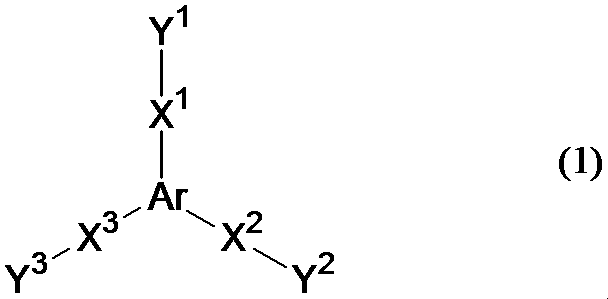
(式中、Arは、置換基を有していてもよい3価の芳香族基を表す。X1~X3は、それぞれ独立に、2価の有機基、又はArとY1~Y3とを直接結ぶ単結合を表す。Y1~Y3は、それぞれ独立に、配位性部位を有する1価の有機基を表す。)で示される配位子が挙げられる。
式(1)中、Arは3価の芳香族基を表す。
Arを構成する炭素原子の数は、通常3~22、好ましくは3~13、より好ましくは3~6である。
Arを構成する炭素原子の数は、通常3~22、好ましくは3~13、より好ましくは3~6である。
Arとしては、6員環の芳香環1つからなる単環構造を有する3価の芳香族基や、6員環の芳香環が3個縮合してなる縮合環構造を有する3価の芳香族基が挙げられる。
6員環の芳香環1つからなる単環構造を有する3価の芳香族基としては、下記式(2a)~式(2d)で示される基が挙げられる。また、6員環の芳香環が3個縮合してなる縮合環構造を有する3価の芳香族基としては、下記式(2e)で示される基が挙げられる。なお、式(2a)~式(2e)において、「*」は、それぞれ、X1~X3との結合位置を表す。


これらの中でも、式(2a)又は(2b)で示される芳香族基が好ましく、式(2b)で示される芳香族基が特に好ましい。
Arは、式(2a)、式(2c)~式(2e)で示される芳香族基の任意の位置に置換基を有するものであってもよい。かかる置換基としては、メチル基、エチル基、イソプロピル基、n-プロピル基、t-ブチル基等のアルキル基;メトキシ基、エトキシ基、n-プロポキシ基、n-ブトキシ基等のアルコキシ基;フッ素原子、塩素原子、臭素原子等のハロゲン原子;等が挙げられる。この置換基として、官能基(b)を有する基(以下、「官能基(b)含有基」ということがある。)を用いることもできる。
Arは、式(2a)、式(2c)~式(2e)で示される芳香族基の任意の位置に置換基を有するものであってもよい。かかる置換基としては、メチル基、エチル基、イソプロピル基、n-プロピル基、t-ブチル基等のアルキル基;メトキシ基、エトキシ基、n-プロポキシ基、n-ブトキシ基等のアルコキシ基;フッ素原子、塩素原子、臭素原子等のハロゲン原子;等が挙げられる。この置換基として、官能基(b)を有する基(以下、「官能基(b)含有基」ということがある。)を用いることもできる。
X1~X3は、それぞれ独立に、2価の有機基、又は、ArとY1~Y3とを直接結ぶ単結合を表す。
2価の有機基としては、Arとともに、π電子共役系を構成し得るものが好ましい。X1~X3で表される2価の有機基がπ電子共役系を構成することで、式(1)で示される三座配位子の平面性が向上し、より強固な三次元骨格構造が形成され易くなる。
2価の有機基を構成する炭素原子の数は、2~18が好ましく、2~12がより好ましく、2~6がさらに好ましい。
2価の有機基を構成する炭素原子の数は、2~18が好ましく、2~12がより好ましく、2~6がさらに好ましい。
2価の有機基としては、炭素数2~10の2価の不飽和脂肪族基、6員芳香環1つからなる単環構造を有する2価の有機基、6員芳香環が2~4個縮合してなる縮合環構造を有する2価の有機基、アミド基〔-C(=O)-NH-〕、エステル基〔-C(=O)-O-〕、これらの2価の有機基の2種以上の組み合わせ等が挙げられる。
炭素数2~10の2価の不飽和脂肪族基としては、ビニレン基、アセチレン基(エチニレン基)等が挙げられる。
6員環の芳香環1つからなる単環構造を有する2価の有機基としては、1,4-フェニレン基等が挙げられる。
6員環の芳香環が2~4個縮合してなる縮合環構造を有する2価の有機基としては、1,4-ナフチレン基、アントラセン-1,4-ジイル基等が挙げられる。
これらの2価の有機基の2種以上の組み合わせとしては、下記のものが挙げられる。
6員環の芳香環1つからなる単環構造を有する2価の有機基としては、1,4-フェニレン基等が挙げられる。
6員環の芳香環が2~4個縮合してなる縮合環構造を有する2価の有機基としては、1,4-ナフチレン基、アントラセン-1,4-ジイル基等が挙げられる。
これらの2価の有機基の2種以上の組み合わせとしては、下記のものが挙げられる。

これらの中でも、X1~X3で表される2価の有機基としては、下記のものが好ましい。

2価の有機基中の芳香環は、環内に、窒素原子、酸素原子、硫黄原子等のヘテロ原子を含んでいてもよい。
また、2価の有機基は、置換基を有するものであってもよい。かかる置換基としては、Arの置換基として先に示したものと同様のものが挙げられる。
また、2価の有機基は、置換基を有するものであってもよい。かかる置換基としては、Arの置換基として先に示したものと同様のものが挙げられる。
Y1~Y3は、それぞれ独立に、配位性部位を有する1価の有機基を表す。
Y1~Y3で表される有機基としては、Ar、X1~X3とともに、π電子共役系を構成し得るものが好ましい。
Y1~Y3で表される有機基がπ電子共役系を構成することで、式(1)で示される三座配位子の平面性が向上し、強固な三次元骨格構造が形成され易くなる。
Y1~Y3を構成する炭素原子の数は、5~11が好ましく、5~7がより好ましい。
Y1~Y3で表される有機基としては、Ar、X1~X3とともに、π電子共役系を構成し得るものが好ましい。
Y1~Y3で表される有機基がπ電子共役系を構成することで、式(1)で示される三座配位子の平面性が向上し、強固な三次元骨格構造が形成され易くなる。
Y1~Y3を構成する炭素原子の数は、5~11が好ましく、5~7がより好ましい。
Y1~Y3としては、下記式(3a)~式(3f)で示される有機基が挙げられる。なお、式(3a)~式(3f)において、「*」は、X1~X3との結合位置を表す。

これらの中でも、Y1~Y3としては、式(3a)で表される基が特に好ましい。
Y1~Y3は、式(3a)~式(3f)で示される有機基の任意の位置に、置換基を有するものであってもよい。かかる置換基としては、Arの置換基として先に例示したものと同様のものが挙げられる。
Y1~Y3は、式(3a)~式(3f)で示される有機基の任意の位置に、置換基を有するものであってもよい。かかる置換基としては、Arの置換基として先に例示したものと同様のものが挙げられる。
式(1)で示される三座配位子中の、Ar、X1~X3、Y1~Y3を適宜選択することで、単結晶の細孔や中空の大きさを調節することができる。この方法を利用することで、目的の有機化合物(A)を包接し得る大きさの細孔や中空を有する単結晶を効率よく得ることができる。
式(1)で示される三座配位子としては、強固な三次元骨格構造が形成され易いことから、平面性及び対称性が高く、かつ、π共役系が配位子全体に広がっているものが好ましい。このような三座配位子としては、下記式(4a)~式(4f)で示される配位子、又は、これらの任意の位置に置換基(置換基(b)を含む。)を有する配位子が挙げられる。
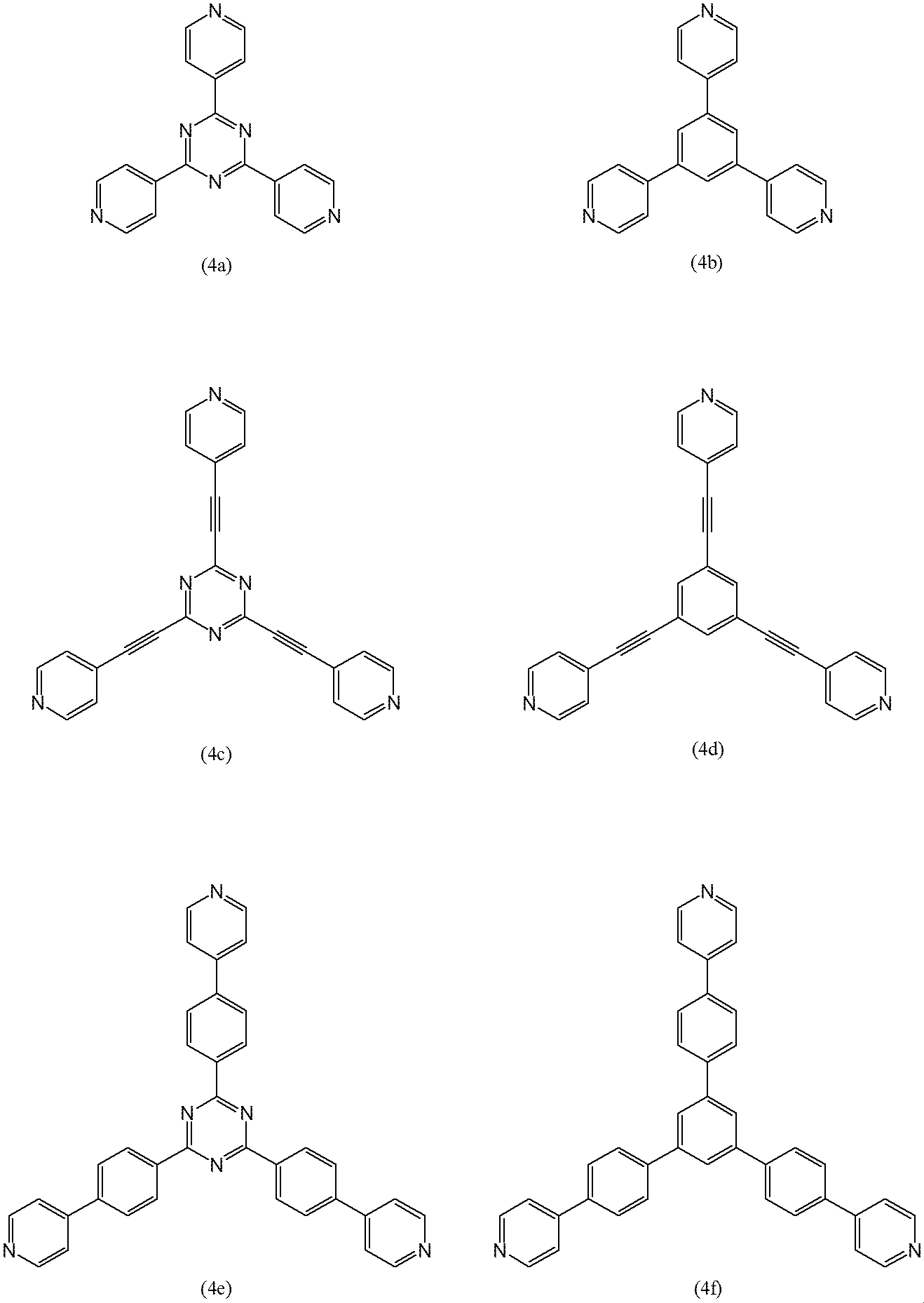
これらの中でも、式(1)で示される三座配位子としては、上記式(4a)で示される2,4,6-トリス(4-ピリジル)-1,3,5-トリアジン(TPT)が特に好ましい。
また、多核金属錯体の多座配位子として、市販品を用いることもできる。例えば、2012年9月発行のシグマアルドリッチ社パンフレット(材料科学の基礎 第7号-多孔性配位高分子(PCP)/金属有機構造体(MOF)の基礎)には、PCP/MOF用配位子およびリンカー用化合物として、ピラジン、1,4-ジアザビシクロ[2.2.2]オクタン、1,2-ジ(4-ピリジル)エチレン、4,4’-ビピリジル、4,4’-ビフェニルジカルボン酸、ベンゼン-1,3-ジカルボン酸、ピラジン-2,3-ジカルボン酸、ピラジン-3,5-ジカルボン酸等が記載されている。これらの配位子、又は、その任意の位置に、官能基(b)含有基等の置換基を有する配位子を多核金属錯体の多座配位子として用いることができる。
多核金属錯体の中心金属としての金属イオンは、前記多座配位子と配位結合を形成して、三次元骨格を形成し得るものである限り特に限定されない。なかでも、鉄イオン、コバルトイオン、ニッケルイオン、銅イオン、亜鉛イオン、銀イオン、パラジウムイオン、ルテニウムイオン、ロジウムイオン、白金イオン等の周期表第8~12族の金属のイオンが好ましく、2価の、周期表第8~12族の金属イオンがより好ましい。なかでも、大きな細孔や中空を有する単結晶が得られ易いことから、亜鉛(II)イオン、コバルト(II)イオンが特に好ましい。
多核金属錯体の中心金属には、前記多座配位子の他に、単座配位子が配位していてもよい。かかる単座配位子としては、塩化物イオン(Cl-)、臭化物イオン(Br-)、ヨウ化物イオン(I-)、チオシアン酸イオン(SCN-)等の1価の陰イオン;アンモニア、モノアルキルアミン、ジアルキルアミン、トリアルキルアミン、エチレンジアミン等の電気的に中性の配位性化合物;等が挙げられる。
また、多核金属錯体は、反応溶媒(多核金属錯体の合成に用いた溶媒)、置換溶媒(反応溶媒と置き換えられた他の溶媒をいう。以下にて同じ。)、後述する骨格形成性芳香族化合物を含むものであってもよい。
「骨格形成性芳香族化合物」とは、三次元骨格を構成する分子鎖と相互作用(ただし、共有結合、配位結合を除く。)し、三次元骨格の一部を構成し得る芳香族化合物をいう。
多核金属錯体が骨格形成性芳香族化合物を含むことで、三次元骨格がより強固になり易く、有機化合物(A)の分子を包接した後であっても、三次元骨格がより安定化する場合がある。
多核金属錯体が骨格形成性芳香族化合物を含むことで、三次元骨格がより強固になり易く、有機化合物(A)の分子を包接した後であっても、三次元骨格がより安定化する場合がある。
骨格形成性芳香族化合物としては、縮合多環芳香族化合物が挙げられる。例えば、下記式(5a)~式(5i)で示されるものが挙げられる。

これらの縮合多環芳香族化合物は、任意の位置に置換基(置換基(b)を含む。)を有するものであってもよい。かかる置換基としては、前記多座配位子の置換基として示したものと同様のものが挙げられる。
なかでも、本発明に用いる縮合多環芳香族化合物としては、官能基(b)を有するものが好ましい。化学合成の観点から、骨格形成性芳香族化合物に官能基(b)を導入する方が、多座配位子に官能基(b)を導入するよりも、バリエーションに富んだ官能基(b)を容易に導入することができる場合が多いからである。
なかでも、本発明に用いる縮合多環芳香族化合物としては、官能基(b)を有するものが好ましい。化学合成の観点から、骨格形成性芳香族化合物に官能基(b)を導入する方が、多座配位子に官能基(b)を導入するよりも、バリエーションに富んだ官能基(b)を容易に導入することができる場合が多いからである。
官能基(b)を有する骨格形成性芳香族化合物としては、前記式(5a)~(5i)で示される骨格形成性芳香族化合物の任意の位置に、官能基(b)含有基を有するものが挙げられる。なかでも、骨格形成性芳香族化合物としてトリフェニレン〔前記式(5a)で示される化合物〕を含む多孔性化合物の単結晶を用いて結晶構造解析が行われており、その細孔の状態が十分に明らかになっていることから、トリフェニレンの1位または2位に官能基(b)含有基を有する化合物が好ましく、1-アミノトリフェニレン、2-アミノトリフェニレン等のアミノ基を有するトリフェニレン化合物がより好ましい。
官能基(b)を有する骨格形成性芳香族化合物や、この骨格形成性芳香族化合物を含む多核金属錯体としては、WO2007/102594号、WO2008/111665号、特開2010-18708号公報、特開2010-184899号公報に記載のものが挙げられる。本発明においては、これらの文献に記載の多核金属錯体を用いることもできる。
多核金属錯体としては、例えば、以下の化合物が挙げられる。
(1)置換基(b)を有する配位子及び金属イオンからなる化合物〔多核金属錯体(α)〕
(2)配位子、金属イオン、及び、置換基(b)を有する骨格形成性芳香族化合物とからなる化合物〔多核金属錯体(β)〕
(3)置換基(b)を有する配位子、金属イオン、及び、置換基(b)を有する骨格形成性芳香族化合物とからなる化合物〔多核金属錯体(γ)〕
(4)前記多核金属錯体(α)~(γ)いずれかの細孔又は中空内に、溶媒分子等のゲスト分子が包接されてなる化合物〔多核金属錯体(δ)〕
(1)置換基(b)を有する配位子及び金属イオンからなる化合物〔多核金属錯体(α)〕
(2)配位子、金属イオン、及び、置換基(b)を有する骨格形成性芳香族化合物とからなる化合物〔多核金属錯体(β)〕
(3)置換基(b)を有する配位子、金属イオン、及び、置換基(b)を有する骨格形成性芳香族化合物とからなる化合物〔多核金属錯体(γ)〕
(4)前記多核金属錯体(α)~(γ)いずれかの細孔又は中空内に、溶媒分子等のゲスト分子が包接されてなる化合物〔多核金属錯体(δ)〕
本発明に用いる多核金属錯体は、有機化合物(A)の分子をその細孔や中空内に取り込んだ後においても結晶性を失わず、かつ、比較的大きな細孔や中空を有するものが好ましい。
このような特性を有する多核金属錯体は、前記式(1)で示される三座配位子であって、置換基(b)を有する化合物を用いることで、簡便に得ることができる。
具体的には、下記式(6a)~(6c)で示される多核金属錯体が挙げられる。
具体的には、下記式(6a)~(6c)で示される多核金属錯体が挙げられる。

式(6a)~式(6c)中、Mは、2価の、周期表第8~12族の金属イオンを表し、Xは、1価の陰イオン性単座配位子を表し、Lは、前記式(1)で示される三座配位子(又は前記式(1)で示される三座配位子であって、置換基(b)を有する化合物)を表し、「solv」は、合成時に用いた溶媒分子等のゲスト分子を表し、「SA」は、骨格形成性芳香族化合物(又は置換基(b)を有する骨格形成性化合物)を表し、a、b、cは任意の自然数を表す。L、SAの少なくとも一方は、官能基(b)を有している。
より具体的には、下記の多核金属錯体が挙げられる。

式(7a)~(7d)中、「solv」、「SA」、a、b、cは、前記と同じ意味を表す。ただし、TPT、SAのいずれか一方は、官能基(b)を有している。
上記式(6a)~式(6c)で示される多核金属錯体の三次元骨格は、これらに類似する多核金属錯体の公知の三次元骨格から推定することができる。
すなわち、官能基(b)を有しない多核金属錯体ではあるが、Lとして、前記式(4a)で示されるTPTを用いた多核金属錯体は、これまでに、溶媒などのゲスト分子を取り込んだ形での分子構造が単結晶X線構造解析で決定されている。
官能基(b)が、多核金属錯体の三次元骨格に影響を与えない範囲においては、本願発明に用いる多核金属錯体の三次元骨格は、これらの官能基(b)を有しない多核金属錯体の三次元骨格と同様のものであると考えられる。したがって、以下において、Lとして、前記式(4a)で示されるTPTを用い、官能基(b)を有しない多核金属錯体〔下記式(7a)~式(7d)で示される多核金属錯体〕について説明する。
なお、以下において、配位子や溶媒分子を以下のように省略することがある。
すなわち、官能基(b)を有しない多核金属錯体ではあるが、Lとして、前記式(4a)で示されるTPTを用いた多核金属錯体は、これまでに、溶媒などのゲスト分子を取り込んだ形での分子構造が単結晶X線構造解析で決定されている。
官能基(b)が、多核金属錯体の三次元骨格に影響を与えない範囲においては、本願発明に用いる多核金属錯体の三次元骨格は、これらの官能基(b)を有しない多核金属錯体の三次元骨格と同様のものであると考えられる。したがって、以下において、Lとして、前記式(4a)で示されるTPTを用い、官能基(b)を有しない多核金属錯体〔下記式(7a)~式(7d)で示される多核金属錯体〕について説明する。
なお、以下において、配位子や溶媒分子を以下のように省略することがある。
PhNO2:ニトロベンゼン
TPH:トリフェニレン
PER:ペリレン
MeOH:メタノール
DCB:1,2-ジクロロベンゼン
TPH:トリフェニレン
PER:ペリレン
MeOH:メタノール
DCB:1,2-ジクロロベンゼン
(1)[(ZnI2)3(TPT)2(solv)a]b (7a)
式(7a)で示される多核金属錯体としては、特開2008-214584号公報、J.Am.Chem.Soc.2004,v.126,pp16292-16293に記載の[(ZnI2)3(TPT)2(PhNO2)5.5]n(多核金属錯体1)や、多核金属錯体1中の反応溶媒分子の全部又は一部を置換溶媒に交換したものが挙げられる。
式(7a)で示される多核金属錯体としては、特開2008-214584号公報、J.Am.Chem.Soc.2004,v.126,pp16292-16293に記載の[(ZnI2)3(TPT)2(PhNO2)5.5]n(多核金属錯体1)や、多核金属錯体1中の反応溶媒分子の全部又は一部を置換溶媒に交換したものが挙げられる。
多核金属錯体1の三次元骨格を図2(a)~(d)に示す。
多核金属錯体1の三次元骨格は、2つの分子鎖1aと1bから構成される。分子鎖1a、1b中、各亜鉛(II)イオンには、2つのTPTのピリジル基と2つのヨウ化物イオンが四配位四面体型で配位している。そして、TPTによって、この亜鉛(II)イオンを含む構造同士が三次元的に結ばれることで、それぞれの分子鎖が形成されている〔図2(a)〕。
多核金属錯体1の三次元骨格は、2つの分子鎖1aと1bから構成される。分子鎖1a、1b中、各亜鉛(II)イオンには、2つのTPTのピリジル基と2つのヨウ化物イオンが四配位四面体型で配位している。そして、TPTによって、この亜鉛(II)イオンを含む構造同士が三次元的に結ばれることで、それぞれの分子鎖が形成されている〔図2(a)〕。
分子鎖1a、1bは、それぞれ、最も短い閉鎖環状連鎖構造として、TPT10分子とZn10原子とからなる閉鎖環状連鎖構造を有している〔図2(b)〕。
これらの分子鎖1a、1bは、(010)軸に沿ったピッチが、15Åの螺旋状のヘキサゴナル三次元ネットワーク構造とみなすことができる〔図2(c)〕。
これらの分子鎖1a、1bは、(010)軸に沿ったピッチが、15Åの螺旋状のヘキサゴナル三次元ネットワーク構造とみなすことができる〔図2(c)〕。
分子鎖1a、1bは、同じ亜鉛(II)イオンを共有することはなく、互いに独立している。そして、同一の空間を共有するように互いに入り組んだ入れ子状に相互貫通することで、全体として一つに組織化された三次元骨格を構成する。
この三次元骨格を有する多核金属錯体1の単結晶は、規則的に整列した1種類の細孔を有している〔図2(d)〕。
この三次元骨格を有する多核金属錯体1の単結晶は、規則的に整列した1種類の細孔を有している〔図2(d)〕。
多核金属錯体1の単結晶の空隙率は、50%である。
多核金属錯体1の単結晶の細孔の内接円の直径は、5~8Åである。
多核金属錯体1の単結晶の細孔の内接円の直径は、5~8Åである。
(2)[(ZnBr2)3(TPT)2(solv)a]b (7b)
式(7b)で示される多核金属錯体としては、特開2008-214318号公報に記載の[(ZnBr2)3(TPT)2(PhNO2)5(H2O)]n(多核金属錯体2)や、多核金属錯体2中の反応溶媒分子の全部又は一部を置換溶媒に交換したものが挙げられる。
式(7b)で示される多核金属錯体としては、特開2008-214318号公報に記載の[(ZnBr2)3(TPT)2(PhNO2)5(H2O)]n(多核金属錯体2)や、多核金属錯体2中の反応溶媒分子の全部又は一部を置換溶媒に交換したものが挙げられる。
多核金属錯体2は、(ZnI2)が(ZnBr2)に置き換わっている点を除き、多核金属錯体1の三次元骨格と同様の骨格を有している。
多核金属錯体2の単結晶の細孔の形状や大きさ、及び空隙率は、多核金属錯体1の単結晶のものとほぼ同じであった。
多核金属錯体2の単結晶の細孔の形状や大きさ、及び空隙率は、多核金属錯体1の単結晶のものとほぼ同じであった。
(3)[(ZnI2)3(TPT)2(SA)(solv)a)]b (7c)
式(7c)で示される多核金属錯体としては、特開2006-188560号公報に記載の[(ZnI2)3(TPT)2(TPH)(PhNO2)3.9(MeOH)1.8]n(多核金属錯体3)や、[(ZnI2)3(TPT)2(PER)(PhNO2)4]n(多核金属錯体4)や、これらの多核金属錯体中の反応溶媒分子の全部又は一部を置換溶媒に交換したものが挙げられる。
式(7c)で示される多核金属錯体としては、特開2006-188560号公報に記載の[(ZnI2)3(TPT)2(TPH)(PhNO2)3.9(MeOH)1.8]n(多核金属錯体3)や、[(ZnI2)3(TPT)2(PER)(PhNO2)4]n(多核金属錯体4)や、これらの多核金属錯体中の反応溶媒分子の全部又は一部を置換溶媒に交換したものが挙げられる。
多核金属錯体3の三次元骨格を図3(a)~(c)に示す。
多核金属錯体3の三次元骨格は、2つの分子鎖1Aと1B、及び骨格形成性芳香族化合物であるトリフェニレン分子から構成される。
分子鎖1A、1B中、各亜鉛(II)イオンには、2つのヨウ化物イオンと2つのTPTのピリジル基が四配位四面体型で配位している。そして、TPTによって、この亜鉛(II)イオンを含む構造同士が三次元的に結ばれることで、それぞれの分子鎖が形成されている。
分子鎖1A、1Bは、同じ亜鉛(II)イオンを共有することはなく、互いに独立している。そして、同一の空間を共有するように互いに入り組んだ入れ子状に相互貫通することで、全体として一つに組織化された三次元骨格を構成する。
多核金属錯体3の三次元骨格は、2つの分子鎖1Aと1B、及び骨格形成性芳香族化合物であるトリフェニレン分子から構成される。
分子鎖1A、1B中、各亜鉛(II)イオンには、2つのヨウ化物イオンと2つのTPTのピリジル基が四配位四面体型で配位している。そして、TPTによって、この亜鉛(II)イオンを含む構造同士が三次元的に結ばれることで、それぞれの分子鎖が形成されている。
分子鎖1A、1Bは、同じ亜鉛(II)イオンを共有することはなく、互いに独立している。そして、同一の空間を共有するように互いに入り組んだ入れ子状に相互貫通することで、全体として一つに組織化された三次元骨格を構成する。
多核金属錯体3中で、トリフェニレン分子(2)は、分子鎖1Aのトリス(4-ピリジル)トリアジン〔TPT(1a)〕のπ平面と、分子鎖1Bのトリス(4-ピリジル)トリアジン〔TPT(1b)〕のπ平面との間に強固に挿入(インターカレート)されている〔図3(b)〕。このとき、トリフェニレン分子は、TPT(1a)及びTPT(1b)間のπ-π相互作用によって安定化され、多核金属錯体3の三次元骨格の一部として機能している。なお、図3(b)は、図3(a)中の線で囲った部分を横から見たときの図である。
多核金属錯体3の単結晶には、規則的に配列した2種の細孔(細孔A及びB)が存在する〔図3(c)〕。細孔A及びBは、TPTとTPHが交互に積み重なった積み重ね構造の間に、それぞれ規則的に形成されている。
細孔Aは、ほぼ円筒型であり、且つ、積み重なった無数のTPT及びTPHのπ平面の側縁に存在する水素原子でほぼ取り囲まれている。
一方、細孔Bは、略三角柱型であり、且つ、その三角柱を形成する3方の面のうち、2つはTPTのπ平面に取り囲まれ、もう一つは積み重なった無数のTPT及びTPHのπ平面の側縁に存在する水素原子で取り囲まれている。
これら細孔A及びBは、若干蛇行した細長い形状を有している。
細孔Aは、ほぼ円筒型であり、且つ、積み重なった無数のTPT及びTPHのπ平面の側縁に存在する水素原子でほぼ取り囲まれている。
一方、細孔Bは、略三角柱型であり、且つ、その三角柱を形成する3方の面のうち、2つはTPTのπ平面に取り囲まれ、もう一つは積み重なった無数のTPT及びTPHのπ平面の側縁に存在する水素原子で取り囲まれている。
これら細孔A及びBは、若干蛇行した細長い形状を有している。
多核金属錯体3の単結晶の細孔の空隙率は、28%である。
多核金属錯体3の単結晶の細孔Aの内接円の直径は、5~8Åである。
多核金属錯体3の単結晶の細孔Bの内接円の直径は、5~8Åである。
多核金属錯体3の単結晶の細孔Aの内接円の直径は、5~8Åである。
多核金属錯体3の単結晶の細孔Bの内接円の直径は、5~8Åである。
多核金属錯体4は、多核金属錯体3のトリフェニレン分子の代わりに、ペリレン分子が2つのTPTの間に挿入されている点を除き、多核金属錯体3と同様の骨格構造を有する。
多核金属錯体4の単結晶の細孔の形状や大きさ、及び空隙率は、多核金属錯体3の単結晶のものとほぼ同じであった。
多核金属錯体4の単結晶の細孔の形状や大きさ、及び空隙率は、多核金属錯体3の単結晶のものとほぼ同じであった。
(4)[(Co(NCS)2)3(TPT)4(solv)a]b (7d)
式(7d)で示される多核金属錯体としては、WO2011/062260号公報に記載の[(Co(NCS)2)3(TPT)4(DCB)25(MeOH)5]n(多核金属錯体5)や、多核金属錯体5中の反応溶媒分子の全部又は一部を置換溶媒に交換したものが挙げられる。
式(7d)で示される多核金属錯体としては、WO2011/062260号公報に記載の[(Co(NCS)2)3(TPT)4(DCB)25(MeOH)5]n(多核金属錯体5)や、多核金属錯体5中の反応溶媒分子の全部又は一部を置換溶媒に交換したものが挙げられる。
多核金属錯体5の三次元骨格を図4(a)に示す。
多核金属錯体5は、構造単位として、コバルトイオン6個と、TPT4個とから構成される〔Co6(TPT)4〕構造を有する。この構造単位は八面体型の立体形状を有し、該八面体の6つの頂点にコバルトイオンが配置されている〔図4(b)〕。各コバルト(II)イオンには、4つのTPTのピリジル基と2つのチオシアン酸イオンとが六配位八面体型で配位している。なお、図4(b)は、図4(a)中の線で囲った部分を拡大した図である。
そして、この〔Co6(TPT)4〕構造の各頂点に位置するコバルトイオンを共有しながら、〔Co6(TPT)4〕構造が三次元的に連結することで、〔Co6(TPT)4〕構造間に細孔が形成される〔図4(c)〕。
また、前記構造単位は、内部に中空を有している。
多核金属錯体5は、構造単位として、コバルトイオン6個と、TPT4個とから構成される〔Co6(TPT)4〕構造を有する。この構造単位は八面体型の立体形状を有し、該八面体の6つの頂点にコバルトイオンが配置されている〔図4(b)〕。各コバルト(II)イオンには、4つのTPTのピリジル基と2つのチオシアン酸イオンとが六配位八面体型で配位している。なお、図4(b)は、図4(a)中の線で囲った部分を拡大した図である。
そして、この〔Co6(TPT)4〕構造の各頂点に位置するコバルトイオンを共有しながら、〔Co6(TPT)4〕構造が三次元的に連結することで、〔Co6(TPT)4〕構造間に細孔が形成される〔図4(c)〕。
また、前記構造単位は、内部に中空を有している。
多核金属錯体5の単結晶の空隙率は、78%である。この値は、細孔及び中空の体積をあわせて算出した値である。
多核金属錯体5の単結晶の細孔の内接円の直径は、10~18Åである。
多核金属錯体5の単結晶の細孔の内接円の直径は、10~18Åである。
本発明の方法においては、式(7a)~式(7d)で示される多核金属錯体における多座配位子(TPT)や骨格形成性芳香族化合物の代わりに、官能基(b)を有する多座配位子や骨格形成芳香族化合物を用いることで得られる、式(7a)~式(7d)で示される多核金属錯体と同様の三次元骨格構造を有し、かつ、官能基(b)を有する多核金属錯体の単結晶を、多孔性化合物の単結晶として用いることができる。
また、多核金属錯体としては、上記の式(1)で示される多座配位子を有するものの他に、多孔性配位高分子(PCP)や金属有機構造体(MOF)と称される公知の多核金属錯体を用いることもできる。例えば、2012年9月発行のシグマアルドリッチ社パンフレット(材料科学の基礎 第7号-多孔性配位高分子(PCP)/金属有機構造体(MOF)の基礎)には、
[Cu2(bzdc)2(pyz)]n
(「bzdc」は、2,3-ピラジンジカルボン酸を表し、「pyz」は、ピラジンを表す。nは任意の数を表す。)、
[Zn2(14bdc)2(dabco)]n
(「14bdc」は、1,4-ベンゼンジカルボン酸を表し、「dabco」は、1,4-ジアザビシクロ[2.2.2]オクタンを表し、nは任意の数を表す。)、
[Cu(dhbpc)2(bpy)]n
(「H3dhbpc」は、4,4’-ジヒドロキシビフェニル-3-カルボン酸を表し、「bpy」は、4,4’-ビピリジルを表し、nは任意の数を表す。)、
[Cr(btc)2」n
(「H3btc」は、1,3,5-ベンゼントリカルボン酸を表し、nは任意の数を表す。)等の多核金属錯体が記載されている。
[Cu2(bzdc)2(pyz)]n
(「bzdc」は、2,3-ピラジンジカルボン酸を表し、「pyz」は、ピラジンを表す。nは任意の数を表す。)、
[Zn2(14bdc)2(dabco)]n
(「14bdc」は、1,4-ベンゼンジカルボン酸を表し、「dabco」は、1,4-ジアザビシクロ[2.2.2]オクタンを表し、nは任意の数を表す。)、
[Cu(dhbpc)2(bpy)]n
(「H3dhbpc」は、4,4’-ジヒドロキシビフェニル-3-カルボン酸を表し、「bpy」は、4,4’-ビピリジルを表し、nは任意の数を表す。)、
[Cr(btc)2」n
(「H3btc」は、1,3,5-ベンゼントリカルボン酸を表し、nは任意の数を表す。)等の多核金属錯体が記載されている。
本発明の方法においては、これらの多核金属錯体中の多座配位子に代えて、官能基(b)を導入した多座配位子を用いて得られた多核金属錯体の単結晶を、多孔性化合物の単結晶として用いることができる。
多核金属錯体の合成方法は特に限定されず、公知の方法を利用することができる。
例えば、2012年9月発行のシグマアルドリッチ社パンフレット(材料科学の基礎 第7号-多孔性配位高分子(PCP)/金属有機構造体(MOF)の基礎)には、多座配位子等を含有する溶液と、金属イオン等を含有する溶液を混合する溶液法;耐圧容器内に、溶媒、多座配位子、金属イオン等を入れ、耐圧容器を密封した後、溶媒の沸点以上に加熱して水熱反応を行う水熱法;容器内に、溶媒、多座配位子、金属イオン等を入れ、マイクロ波を照射するマイクロ波法;容器内に、溶媒、多座配位子、金属イオン等を入れ、超音波を照射する超音波法;溶媒を用いることなく、多座配位子、金属イオン等を機械的に混合する固相合成法;等が記載されており、これらの方法を用いて、多核金属錯体の単結晶を得ることができる。
例えば、2012年9月発行のシグマアルドリッチ社パンフレット(材料科学の基礎 第7号-多孔性配位高分子(PCP)/金属有機構造体(MOF)の基礎)には、多座配位子等を含有する溶液と、金属イオン等を含有する溶液を混合する溶液法;耐圧容器内に、溶媒、多座配位子、金属イオン等を入れ、耐圧容器を密封した後、溶媒の沸点以上に加熱して水熱反応を行う水熱法;容器内に、溶媒、多座配位子、金属イオン等を入れ、マイクロ波を照射するマイクロ波法;容器内に、溶媒、多座配位子、金属イオン等を入れ、超音波を照射する超音波法;溶媒を用いることなく、多座配位子、金属イオン等を機械的に混合する固相合成法;等が記載されており、これらの方法を用いて、多核金属錯体の単結晶を得ることができる。
これらの中でも、特別の装置等を要しないことから、溶液法が好ましく用いられる。
溶液法としては、例えば、多座配位子の第1の溶媒の溶媒溶液に、金属イオン含有化合物の第2の溶媒の溶媒溶液を、多座配位子と金属イオンとを所定の割合で加え、このまま、0~70℃で、数時間から数日間、静置する方法が挙げられる。
溶液法としては、例えば、多座配位子の第1の溶媒の溶媒溶液に、金属イオン含有化合物の第2の溶媒の溶媒溶液を、多座配位子と金属イオンとを所定の割合で加え、このまま、0~70℃で、数時間から数日間、静置する方法が挙げられる。
金属イオン含有化合物は、特に制限されない。例えば、式:MXnで示される化合物が挙げられる。ここで、Mは金属イオンを表し、Xは対イオンを表し、nはMの価数を表す。
前記Xの具体例としては、F-、Cl-、Br-、I-、SCN-、NO3
-、ClO4
-、BF4
-、SbF4
-、PF6
-、AsF6
-、CH3CO2
-等が挙げられる。
用いる反応溶媒(第1の溶媒及び第2の溶媒)としては、ベンゼン、トルエン、キシレン、クロロベンゼン、1,2-ジクロロベンゼン、ニトロベンゼン等の芳香族炭化水素類;n-ペンタン、n-ヘキサン、n-ヘプタン等の脂肪族炭化水素類;シクロペンタン、シクロヘキサン、シクロヘプタン等の脂環式炭化水素類;アセトニトリル、ベンゾニトリル等のニトリル類;ジメチルスルホキシド(DMSO)等のスルホキシド類;N,N-ジメチルホルムアミド、n-メチルピロリドン等のアミド類;ジエチルエーテル、テトラヒドロフラン、1,2-ジメトキシエタン、1,4-ジオキサン等のエーテル類;メタノール、エタノール、イソプロピルアルコール等のアルコール類;アセトン、メチルエチルケトン、シクロヘキサノン等のケトン類;エチルセロソルブ等のセロソルブ類;ジクロロメタン、クロロホルム、四塩化炭素、1,2-ジクロロエタン等のハロゲン化炭化水素類;酢酸メチル、酢酸エチル、乳酸エチル、プロピオン酸エチル等のエステル類;水;等が挙げられる。これらの溶媒は一種単独で、あるいは二種以上を組み合わせて用いることができる。
比較的大きな多核金属錯体の単結晶を得たい場合には、前記第1の溶媒と第2の溶媒として、互いに相溶性を有さない(すなわち、2層分離する)ものを用いることが好ましい。例えば、第1の溶媒として、ニトロベンゼン、ジクロロベンゼン、ニトロベンゼンとメタノールの混合溶媒、ジクロロベンゼンとメタノールの混合溶媒を用い、第2の溶媒としてメタノールを用いる方法が挙げられる。
また、上記多核金属錯体1~5と同様の三次元骨格構造を有する多核金属錯体ついては、それぞれ、上記文献に記載された方法にしたがって合成することができる。
また、上記多核金属錯体1~5と同様の三次元骨格構造を有する多核金属錯体ついては、それぞれ、上記文献に記載された方法にしたがって合成することができる。
(iv)多孔性化合物の単結晶を、有機化合物(A)を含む溶媒溶液と接触させる工程
本発明において、多孔性化合物の単結晶を、前記有機化合物(A)を含む溶媒溶液と接触させる方法は特に限定されない。例えば、前記単結晶を、有機化合物(A)を含む溶媒溶液に浸漬させる方法、前記単結晶をキャピラリーの中に詰めた後、有機化合物(A)を含む溶媒溶液を、そのキャピラリー内を通過させる方法等が挙げられる。
なかでも、有機化合物(A)を含む溶媒溶液を多孔性化合物の単結晶と効率よく接触させることができることから、多孔性化合物の単結晶を、有機化合物(A)を含む溶媒溶液に浸漬させる方法が好ましい。
本発明において、多孔性化合物の単結晶を、前記有機化合物(A)を含む溶媒溶液と接触させる方法は特に限定されない。例えば、前記単結晶を、有機化合物(A)を含む溶媒溶液に浸漬させる方法、前記単結晶をキャピラリーの中に詰めた後、有機化合物(A)を含む溶媒溶液を、そのキャピラリー内を通過させる方法等が挙げられる。
なかでも、有機化合物(A)を含む溶媒溶液を多孔性化合物の単結晶と効率よく接触させることができることから、多孔性化合物の単結晶を、有機化合物(A)を含む溶媒溶液に浸漬させる方法が好ましい。
多孔性化合物の単結晶を、有機化合物(A)を含む溶媒溶液に浸漬させる際は、下記式(I)から算出されるA値が、100以下、好ましくは0.1~30、より好ましくは1~5となる量の前記多孔性化合物の単結晶を浸漬させることが好ましい。

式(I)中、Xは、溶媒溶液中の有機化合物(A)の質量を表し、Yは、前記多孔性化合物の単結晶中のすべての細孔及び中空内を、比重1の物質で満たすと仮定したときに要する前記比重1の物質の質量を表す。
A値が0.1以上のときは、多孔性化合物の単結晶の細孔や中空内に有機化合物(A)の分子が十分に取り込まれ、良質の結晶構造解析用試料が得られ易くなる。一方、A値が大きい場合であっても、目的とする結晶構造解析用試料を得ることはできるが、それに見合う効果は得られず、有機化合物(A)が無駄になり易い。
浸漬させる単結晶の数は、特に制限されない。有機化合物(A)の量が極めて少ないときは、単結晶を一粒浸漬させることで、目的の結晶構造解析用試料を得ることができる。また、有機化合物(A)の量に余裕があるときは、同種の多孔性化合物の単結晶を二粒以上浸漬させたり、異種の多孔性化合物の単結晶を同時に浸漬させたりしてもよい。
多孔性化合物の単結晶を、有機化合物(A)を含む溶媒溶液に浸漬させた後、溶媒を緩和な条件下で揮発させることで、溶媒溶液を濃縮してもよい。この処理を行うことで、多孔性化合物の単結晶中の細孔及び中空内に、有機化合物(A)の分子を効率よく取り込ませることができる。
このときの浸漬条件(濃縮条件)は、特に限定されないが、溶媒溶液の温度は、好ましくは0~180℃、より好ましくは0~80℃、さらに好ましくは20~60℃である。
浸漬時間(濃縮時間)は、通常、6時間以上、好ましくは12~168時間、より好ましくは24~78時間である。
浸漬時間(濃縮時間)は、通常、6時間以上、好ましくは12~168時間、より好ましくは24~78時間である。
溶媒の揮発速度は、好ましくは0.1~1000μL/24時間、より好ましくは1~100μL/24時間、さらに好ましくは5~50μL/24時間である。
溶媒の揮発速度があまりに速い場合には、良質の結晶構造解析用試料を得られないおそれがある。一方、溶媒の揮発速度があまりに遅いと、作業効率の観点から好ましくない。
溶媒の揮発速度があまりに速い場合には、良質の結晶構造解析用試料を得られないおそれがある。一方、溶媒の揮発速度があまりに遅いと、作業効率の観点から好ましくない。
溶媒を揮発させるときの温度は、用いる有機溶媒の沸点にもよるが、通常、0~120℃、好ましくは15~60℃である。
また、多孔性化合物の単結晶を、有機化合物(A)を含む溶媒溶液に浸漬させた後、溶媒を揮発させて、溶媒溶液を濃縮する操作は、常圧下で行っても、減圧下で行っても、加圧下で行ってもよい。
溶媒を揮発させて、溶媒溶液を濃縮する操作時の圧力は、通常、1~1×10⁶Pa、好ましくは、1×10~1×10⁶Paである。
以上のように、溶媒溶液を濃縮する操作時において、温度や圧力を調節することで、溶媒の揮発速度を適宜なものに調節することができる。
溶媒を揮発させて、溶媒溶液を濃縮する操作時の圧力は、通常、1~1×10⁶Pa、好ましくは、1×10~1×10⁶Paである。
以上のように、溶媒溶液を濃縮する操作時において、温度や圧力を調節することで、溶媒の揮発速度を適宜なものに調節することができる。
本発明においては、前記多孔性化合物の単結晶を、有機化合物(A)を含む溶媒溶液と接触させる前に、多孔性化合物の単結晶の細孔及び中空内に、有機化合物(A)の溶媒溶液に用いる溶媒の分子を取り込ませる工程を設けてもよい。この工程を設けることで、多孔性化合物の合成時に用いた溶媒(反応溶媒)分子等が細孔及び中空内から除かれ、有機化合物(A)の分子との置換が容易な溶媒に置き換えられるため、良質の結晶構造解析用試料を効率よく作製することができる。
多孔性化合物の単結晶の細孔及び中空内に、有機化合物(A)の溶媒溶液に用いる溶媒の分子を取り込ませる方法としては、あらかじめ、用いる単結晶を、有機化合物(A)を含む溶媒溶液の調製に用いる溶媒中に浸漬させる方法が挙げられる。
このときの浸漬条件は、特に限定されないが、溶媒の温度は、通常、0~70℃、好ましくは10~60℃、より好ましくは20~50℃であり、浸漬時間は、通常、6時間以上、好ましくは12~168時間、より好ましくは24~78時間である。
このときの浸漬条件は、特に限定されないが、溶媒の温度は、通常、0~70℃、好ましくは10~60℃、より好ましくは20~50℃であり、浸漬時間は、通常、6時間以上、好ましくは12~168時間、より好ましくは24~78時間である。
(v)結晶構造解析用試料
本発明の方法によって得られる結晶構造解析用試料は、有機化合物(A)の分子が、前記多孔性化合物の単結晶の細孔及び中空内に、規則的に配列されてなるものである。
ここで、「有機化合物(A)の分子が、規則的に配列される」とは、有機化合物(A)の分子が、結晶構造解析によって構造を決定することができる程度に乱れなく、多孔性化合物の単結晶の細孔及び中空内に規則正しく収容されていることをいう。
本発明の方法によって得られる結晶構造解析用試料は、有機化合物(A)の分子が、前記多孔性化合物の単結晶の細孔及び中空内に、規則的に配列されてなるものである。
ここで、「有機化合物(A)の分子が、規則的に配列される」とは、有機化合物(A)の分子が、結晶構造解析によって構造を決定することができる程度に乱れなく、多孔性化合物の単結晶の細孔及び中空内に規則正しく収容されていることをいう。
本発明の方法により得られる結晶構造解析用試料は、管電圧が24kV、管電流が50mAで発生させたMoKα線(波長:0.71Å)を照射し、回折X線をCCD検出器で検出したときに、少なくとも1.5Åの分解能で分子構造を決定できるものが好ましい。
本発明の方法によって得られる結晶構造解析用試料は、有機化合物(A)の構造を決定することができるものであれば、前記多孔性化合物の単結晶中のすべての細孔及び中空内に有機化合物(A)の分子が取り込まれている必要はない。例えば、前記多孔性化合物の単結晶中の細孔及び中空内の一部に、有機化合物(A)の溶媒溶液に用いた溶媒が取り込まれたものであっても良い。
本発明の方法により得られる結晶構造解析用試料は、有機化合物(A)の分子の占有率が10%以上のものであることが好ましい。
占有率は、結晶構造解析により得られる値であり、理想的な包接状態におけるゲスト分子〔有機化合物(A)の分子〕の量を100%としたときの、単結晶中に実際に存在するゲスト分子の量を表すものである。
占有率は、結晶構造解析により得られる値であり、理想的な包接状態におけるゲスト分子〔有機化合物(A)の分子〕の量を100%としたときの、単結晶中に実際に存在するゲスト分子の量を表すものである。
本発明の方法によって得られる結晶構造解析用試料は、微量しか入手できない有機化合物(A)や、室温(20℃)で液体状の有機化合物(A)であっても、結晶構造解析法によりその構造を明らかにすることを可能にするものである。
本発明の方法によって目的の結晶構造解析用試料が得られるのは、以下に説明するように、本発明に用いる多孔性化合物の単結晶が、有機化合物(A)の分子の向きをそろえるための「場」として機能しているためと考えられる。
まず、タンパク質分子の単結晶が得られることからも分かるように、多くの物質は自己集積能力を有すると考えられ、程度の差はあるものの、最適な結晶化条件で結晶化操作を行うことができれば、単結晶が得られる可能性は十分にあると考えられる。
しかしながら、最適な結晶化条件が見つかりにくかったり、結晶化条件を十分に検討することができる量の試料を確保できなかったりするため、単結晶が得られない物質が世の中に数多く存在するのが現状である。
本発明に用いる多孔性化合物の単結晶は、そのような物質に対して、より結晶化が促進される「場」を提供するものであると考えられる。
すなわち、予め、三次元的に規則正しく整列した、細孔及び/又は中空を単結晶内に構築しておくことで、有機化合物(A)の分子が単結晶の細孔及び/又は中空に取り込まれたときに、「場」の規則性の影響を受け、有機化合物(A)の分子が本来有する自己集積能力がより高められ、有機化合物(A)の分子の向きが自然とそろい、結晶構造解析用試料が得られると考えられる。
しかしながら、最適な結晶化条件が見つかりにくかったり、結晶化条件を十分に検討することができる量の試料を確保できなかったりするため、単結晶が得られない物質が世の中に数多く存在するのが現状である。
本発明に用いる多孔性化合物の単結晶は、そのような物質に対して、より結晶化が促進される「場」を提供するものであると考えられる。
すなわち、予め、三次元的に規則正しく整列した、細孔及び/又は中空を単結晶内に構築しておくことで、有機化合物(A)の分子が単結晶の細孔及び/又は中空に取り込まれたときに、「場」の規則性の影響を受け、有機化合物(A)の分子が本来有する自己集積能力がより高められ、有機化合物(A)の分子の向きが自然とそろい、結晶構造解析用試料が得られると考えられる。
さらに、本発明に用いる多孔性化合物の単結晶は、細孔及び/又は中空内に官能基(b)を有するものである。したがって、細孔及び/又は中空に取り込まれた有機化合物(A)の分子は、官能基(a)と官能基(b)の相互作用により、熱力学的により安定化された状態で収容される。
この性質は、以下に説明するように、試料溶液中の有機化合物(A)が微量である場合に特に生かされると考えらえる。
まず、試料溶液中の有機化合物(A)が微量のときは、大量に存在するときに比べて、細孔及び/又は中空内に入る有機化合物(A)の分子の、単位時間あたりの量が少ないことが予想される。したがって、有機化合物(A)が微量のときに効率よく結晶構造解析用試料を作製するためには、一旦、細孔及び/又は中空内に取り込まれた有機化合物(A)の分子が、外に放出されるのを防ぐことが重要になる。
本発明の方法においては、上記のように有機化合物(A)の分子は、細孔及び/又は中空内で熱力学的に安定化されるため、外に放出されにくい。
したがって、本発明の方法を用いることにより、有機化合物(A)が微量のときであっても、効率よく結晶構造解析用試料を作製することができる。
まず、試料溶液中の有機化合物(A)が微量のときは、大量に存在するときに比べて、細孔及び/又は中空内に入る有機化合物(A)の分子の、単位時間あたりの量が少ないことが予想される。したがって、有機化合物(A)が微量のときに効率よく結晶構造解析用試料を作製するためには、一旦、細孔及び/又は中空内に取り込まれた有機化合物(A)の分子が、外に放出されるのを防ぐことが重要になる。
本発明の方法においては、上記のように有機化合物(A)の分子は、細孔及び/又は中空内で熱力学的に安定化されるため、外に放出されにくい。
したがって、本発明の方法を用いることにより、有機化合物(A)が微量のときであっても、効率よく結晶構造解析用試料を作製することができる。
また、試料溶液中の有機化合物(A)が微量のときは、有機化合物(A)の分子の占有率が低い結晶構造解析用試料が得られる傾向がある(すなわち、細孔及び/又は中空内に、空間が生じたり、溶媒分子等が包接されたりし易くなる。)。
このような結晶構造解析用試料を用いて、有機化合物(A)の分子構造を精度よく決定するためには、包接された有機化合物(A)の分子は、より乱れなく整列されていることが重要になる。
また、一般的に、有機化合物(A)等のゲスト分子があまり包接されていない単結晶(三次元骨格)は、より崩壊し易いという傾向がある。
本発明の方法においては、官能基(a)と官能基(b)の相互作用があるため、有機化合物(A)の分子の向きがよりそろい易くなる。また、官能基(a)と官能基(b)の相互作用は、単結晶の三次元骨格をより安定化させる効果も有すると考えらえる。
したがって、本発明の方法を用いることにより、有機化合物(A)が微量のときであっても、良質の結晶構造解析用試料を作製することができ、有機化合物(A)の分子構造を精度よく決定することができる。
このような結晶構造解析用試料を用いて、有機化合物(A)の分子構造を精度よく決定するためには、包接された有機化合物(A)の分子は、より乱れなく整列されていることが重要になる。
また、一般的に、有機化合物(A)等のゲスト分子があまり包接されていない単結晶(三次元骨格)は、より崩壊し易いという傾向がある。
本発明の方法においては、官能基(a)と官能基(b)の相互作用があるため、有機化合物(A)の分子の向きがよりそろい易くなる。また、官能基(a)と官能基(b)の相互作用は、単結晶の三次元骨格をより安定化させる効果も有すると考えらえる。
したがって、本発明の方法を用いることにより、有機化合物(A)が微量のときであっても、良質の結晶構造解析用試料を作製することができ、有機化合物(A)の分子構造を精度よく決定することができる。
2)有機化合物の分子構造決定方法
本発明の有機化合物の分子構造決定方法は、本発明の方法で得られる結晶構造解析用試料を用いて、結晶構造解析法により、官能基(a)を有する有機化合物(A)の分子構造を決定するステップを含むことを特徴とする。
本発明の方法においては、X線回折、中性子線回折のいずれの方法も利用することができる。
本発明の方法により有機化合物(A)の分子構造を決定する際は、従来の単結晶の代わりに、上記方法で得た結晶構造解析用試料をマウントする点を除き、従来と同様の方法を用いることができる。
本発明の有機化合物の分子構造決定方法は、本発明の方法で得られる結晶構造解析用試料を用いて、結晶構造解析法により、官能基(a)を有する有機化合物(A)の分子構造を決定するステップを含むことを特徴とする。
本発明の方法においては、X線回折、中性子線回折のいずれの方法も利用することができる。
本発明の方法により有機化合物(A)の分子構造を決定する際は、従来の単結晶の代わりに、上記方法で得た結晶構造解析用試料をマウントする点を除き、従来と同様の方法を用いることができる。
本発明の分子構造決定方法によれば、官能基(a)を有する有機化合物(A)の分子構造を効率よく決定することができる。
したがって、本発明の分子構造決定方法によれば、農医薬品やその原料に含まれる微量の不純物、電子部品の原材料に含まれる微量の不純物、各種代謝物等の分析にかかる費用や時間を大幅に削減することができる。また、官能基(a)を有する有機化合物(A)が微量でしか得られない場合や、官能基(a)を有する有機化合物(A)が測定温度において固体でない場合であっても、その分子構造を決定することが可能である。
したがって、本発明の分子構造決定方法によれば、農医薬品やその原料に含まれる微量の不純物、電子部品の原材料に含まれる微量の不純物、各種代謝物等の分析にかかる費用や時間を大幅に削減することができる。また、官能基(a)を有する有機化合物(A)が微量でしか得られない場合や、官能基(a)を有する有機化合物(A)が測定温度において固体でない場合であっても、その分子構造を決定することが可能である。
以下に、実施例及び比較例を挙げて、本発明についてより具体的に説明する。ただし、本発明はこれらの実施例によりなんら限定されるものではない。
(機器類)
(1)単結晶X線構造解析
Bruker社製 APEX II/CCD diffractometer〔線源:Mo-Kα線(波長0.71Å)、出力:50mA、24kV〕を用いて行った。
(2)元素分析
YANACO社製 MT-6を用いて行った。
(1)単結晶X線構造解析
Bruker社製 APEX II/CCD diffractometer〔線源:Mo-Kα線(波長0.71Å)、出力:50mA、24kV〕を用いて行った。
(2)元素分析
YANACO社製 MT-6を用いて行った。
(製造例1)
WO2007/102594号の実施例に記載の方法により、骨格形成性芳香族化合物として1-アミノトリフェニレンを有する多核金属錯体の単結晶を得た。
(製造例2)
WO2011/062260号の実施例1に記載の方法により、コバルトを含む多核金属錯体の単結晶を得た。
(製造例3)
WO2007/102594号の実施例に記載の方法により、骨格形成性芳香族化合物としてトリフェニレンを有する多核金属錯体の単結晶を得た。
WO2007/102594号の実施例に記載の方法により、骨格形成性芳香族化合物として1-アミノトリフェニレンを有する多核金属錯体の単結晶を得た。
(製造例2)
WO2011/062260号の実施例1に記載の方法により、コバルトを含む多核金属錯体の単結晶を得た。
(製造例3)
WO2007/102594号の実施例に記載の方法により、骨格形成性芳香族化合物としてトリフェニレンを有する多核金属錯体の単結晶を得た。
(実施例1)
製造例1で得た多核金属錯体の単結晶をマイクロバイアルに入れ、そこに下記式で示される構造の4,4,4-トリフルオロ酪酸のシクロヘキサン溶液(1mg/ml)5μl及びシクロヘキサン45μlを加え、50℃で2日間かけてゆっくりと溶媒を留去することで、結晶構造解析用試料を得た。この結晶構造解析用試料を用いて、X線結晶構造解析を行った。
結晶学的データを第1表に、結晶構造を図5に示す。
製造例1で得た多核金属錯体の単結晶をマイクロバイアルに入れ、そこに下記式で示される構造の4,4,4-トリフルオロ酪酸のシクロヘキサン溶液(1mg/ml)5μl及びシクロヘキサン45μlを加え、50℃で2日間かけてゆっくりと溶媒を留去することで、結晶構造解析用試料を得た。この結晶構造解析用試料を用いて、X線結晶構造解析を行った。
結晶学的データを第1表に、結晶構造を図5に示す。
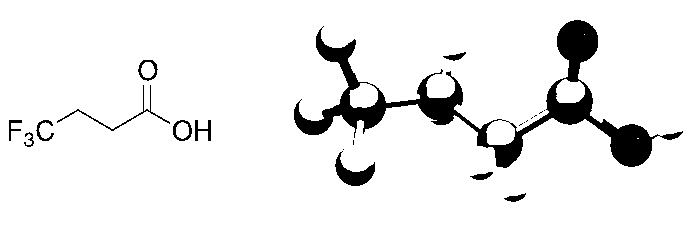
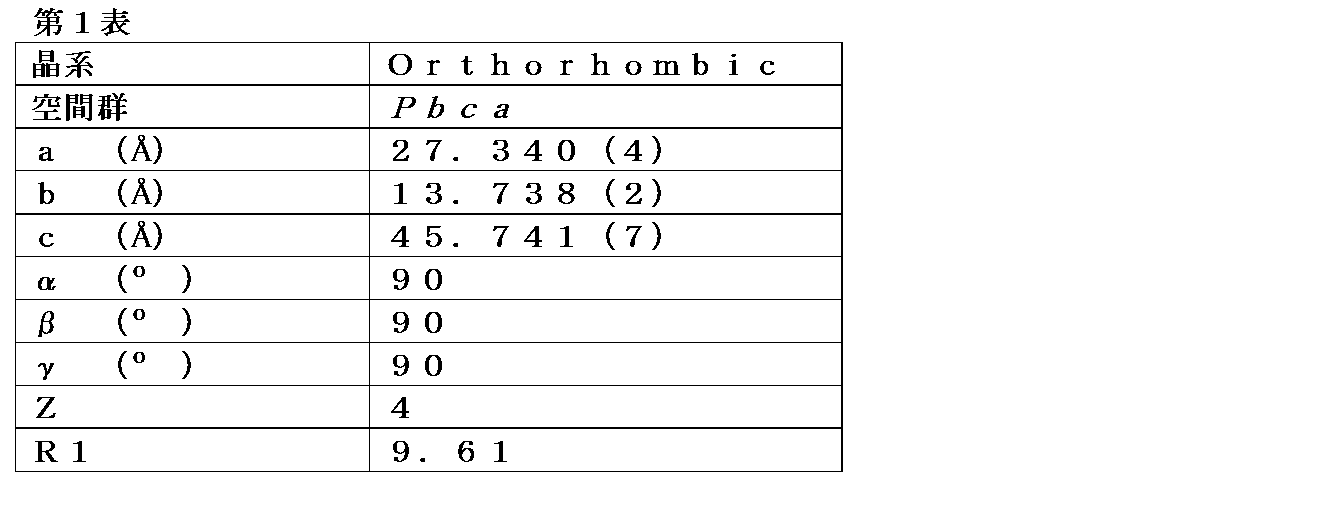
(実施例2)
製造例1で得た多核金属錯体の単結晶をマイクロバイアルに入れ、そこに下記式で示される構造のcis-9-ヘキサデセン酸のシクロヘキサン溶液(1mg/ml)5μl及びシクロヘキサン45μlを加え、50℃で2日間かけてゆっくりと溶媒を留去することで、結晶構造解析用試料を得た。この結晶構造解析用試料を用いて、X線結晶構造解析を行った。
結晶学的データを第2表に、結晶構造を図6に示す。
製造例1で得た多核金属錯体の単結晶をマイクロバイアルに入れ、そこに下記式で示される構造のcis-9-ヘキサデセン酸のシクロヘキサン溶液(1mg/ml)5μl及びシクロヘキサン45μlを加え、50℃で2日間かけてゆっくりと溶媒を留去することで、結晶構造解析用試料を得た。この結晶構造解析用試料を用いて、X線結晶構造解析を行った。
結晶学的データを第2表に、結晶構造を図6に示す。
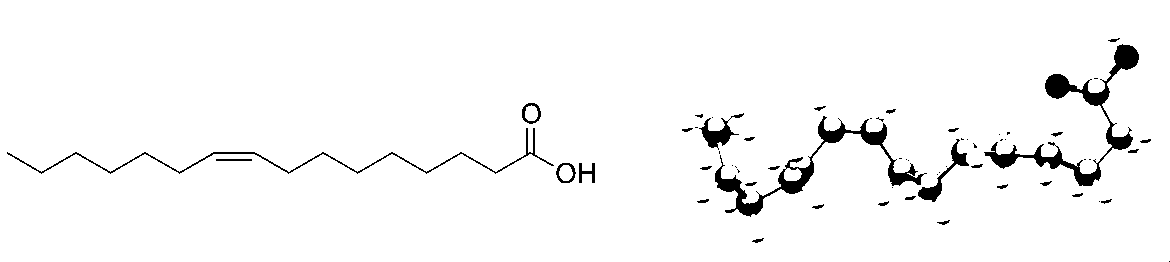
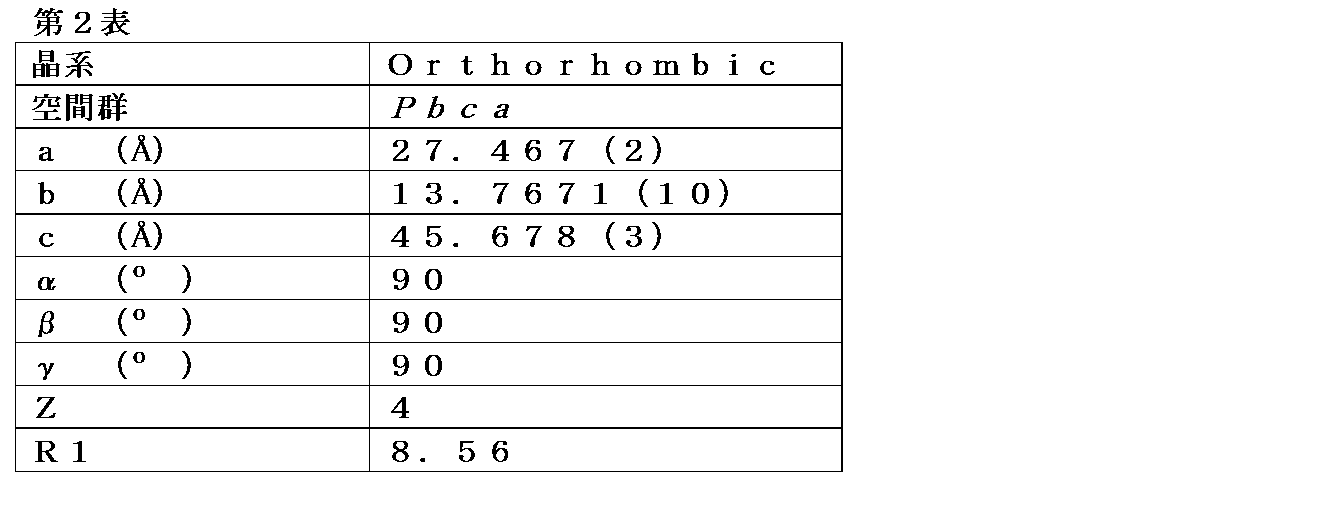
(実施例3)
製造例1で得た多核金属錯体の単結晶をマイクロバイアルに入れ、そこに下記式で示される構造のペトロセリン酸のシクロヘキサン溶液(1mg/ml)5μl及びシクロヘキサン45μlを加え、50℃で2日間かけてゆっくりと溶媒を留去することで、結晶構造解析用試料を得た。この結晶構造解析用試料を用いて、X線結晶構造解析を行った。
結晶学的データを第3表に、結晶構造を図7に示す。
製造例1で得た多核金属錯体の単結晶をマイクロバイアルに入れ、そこに下記式で示される構造のペトロセリン酸のシクロヘキサン溶液(1mg/ml)5μl及びシクロヘキサン45μlを加え、50℃で2日間かけてゆっくりと溶媒を留去することで、結晶構造解析用試料を得た。この結晶構造解析用試料を用いて、X線結晶構造解析を行った。
結晶学的データを第3表に、結晶構造を図7に示す。

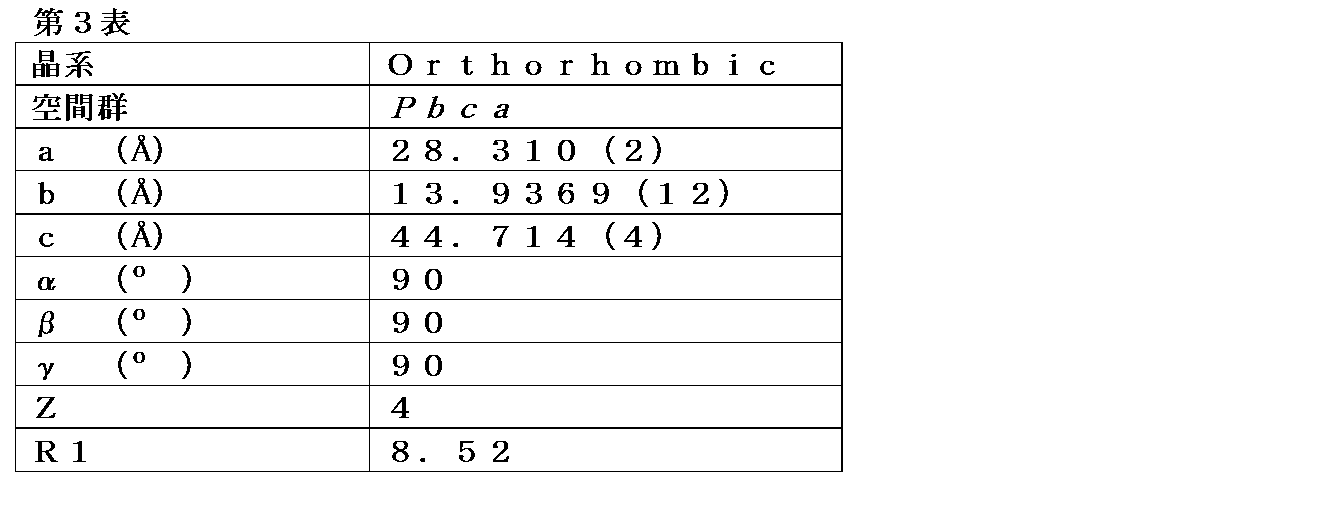
(比較例1)
製造例2で得た多核金属錯体の単結晶をマイクロバイアルに入れ、そこに4,4,4-トリフルオロ酪酸のシクロヘキサン溶液(1mg/ml)5μl及びシクロヘキサン45μlを加え、50℃で2日間かけてゆっくりと溶媒を留去した。しかしながら、単結晶が劣化したため、結晶構造解析を行うことができなかった。
トリフルオロ酢酸が細孔や中空に規則正しく取り込まれず、三次元骨格が安定化されず、結晶が劣化したと考えられる。
製造例2で得た多核金属錯体の単結晶をマイクロバイアルに入れ、そこに4,4,4-トリフルオロ酪酸のシクロヘキサン溶液(1mg/ml)5μl及びシクロヘキサン45μlを加え、50℃で2日間かけてゆっくりと溶媒を留去した。しかしながら、単結晶が劣化したため、結晶構造解析を行うことができなかった。
トリフルオロ酢酸が細孔や中空に規則正しく取り込まれず、三次元骨格が安定化されず、結晶が劣化したと考えられる。
(比較例2)
製造例3で得た多核金属錯体の単結晶をマイクロバイアルに入れ、そこに4,4,4-トリフルオロ酪酸のシクロヘキサン溶液(1mg/ml)5μl及びシクロヘキサン45μlを加え、50℃で2日間かけてゆっくりと溶媒を留去することで、結晶構造解析用試料を得た。この結晶構造解析用試料を用いて、X線結晶構造解析を行った。結晶学的データを第4表に、結晶構造を図8に示す。
X線結晶構造解析の結果、細孔内に4,4,4-トリフルオロ酪酸は観測されなかった。比較例2で用いた多核金属錯体の単結晶は、実施例1~3で用いたものとは異なり、アミノ基が単結晶の細孔内に存在しない。このため、4,4,4-トリフルオロ酪酸が細孔内で安定化されにくく、今回の包接実験の条件では、十分な量の4,4,4-トリフルオロ酪酸が細孔内に蓄積されなかったためと考えられる。
製造例3で得た多核金属錯体の単結晶をマイクロバイアルに入れ、そこに4,4,4-トリフルオロ酪酸のシクロヘキサン溶液(1mg/ml)5μl及びシクロヘキサン45μlを加え、50℃で2日間かけてゆっくりと溶媒を留去することで、結晶構造解析用試料を得た。この結晶構造解析用試料を用いて、X線結晶構造解析を行った。結晶学的データを第4表に、結晶構造を図8に示す。
X線結晶構造解析の結果、細孔内に4,4,4-トリフルオロ酪酸は観測されなかった。比較例2で用いた多核金属錯体の単結晶は、実施例1~3で用いたものとは異なり、アミノ基が単結晶の細孔内に存在しない。このため、4,4,4-トリフルオロ酪酸が細孔内で安定化されにくく、今回の包接実験の条件では、十分な量の4,4,4-トリフルオロ酪酸が細孔内に蓄積されなかったためと考えられる。

1:結晶面X
2:結晶面Y
3:細孔
4:細孔が延在する方向
2:結晶面Y
3:細孔
4:細孔が延在する方向
Claims (11)
- 官能基(a)を有する有機化合物(A)の分子構造を決定するための結晶構造解析用試料の作製方法であって、
1若しくは2以上の分子鎖、又は、1若しくは2以上の分子鎖及び骨格形成性化合物によって構成された三次元骨格と、該三次元骨格によって仕切られて形成された、三次元的に規則正しく整列した、細孔及び/又は中空とを有し、前記三次元骨格が、前記官能基(a)と相互作用する官能基(b)を、前記細孔及び/又は中空内に有する多孔性化合物の単結晶を、前記有機化合物(A)を含む溶媒溶液と接触させることにより、
前記有機化合物(A)の分子が、前記単結晶の細孔及び/又は中空内に、規則的に配列されてなる結晶構造解析用試料を作製する工程を有すること
を特徴とする結晶構造解析用試料の作製方法。 - 前記官能基(a)と官能基(b)の相互作用が、静電相互作用、水素結合、疎水性相互作用、π-π相互作用、又はCH-π相互作用である、請求項1に記載の結晶構造解析用試料の作製方法。
- 前記官能基(a)が、窒素原子、酸素原子、硫黄原子及びリン原子からなる群から選ばれる少なくとも一種の原子を有する基、ハロゲン原子を有していてもよいアルキル基、ハロゲン原子を有していてもよいアリール基、又は、金属イオンを含有する基である、請求項1または2に記載の結晶構造解析用試料の作製方法。
- 前記官能基(b)が、窒素原子、酸素原子、硫黄原子及びリン原子からなる群から選ばれる少なくとも一種の原子を有する基、ハロゲン原子を有していてもよいアルキル基、ハロゲン原子を有していてもよいアリール基、又は、金属イオンを含有する基である、請求項1~3のいずれかに記載の結晶構造解析用試料の作製方法。
- 前記有機化合物(A)を含む溶媒溶液中の有機化合物(A)の含有量が、5mg以下である、請求項1~4のいずれかに記載の結晶構造解析用試料の作製方法。
- 前記多孔性化合物が、配位性部位を2つ以上有する配位子及び中心金属としての金属イオンを含む多核金属錯体である、請求項1~5のいずれかに記載の結晶構造解析用試料の作製方法。
- 前記多孔性化合物が、配位性部位を2つ以上有する配位子、中心金属としての金属イオン、及び官能基(b)を有する骨格形成性芳香族化合物を含む多核金属錯体である、請求項1~6のいずれかに記載の結晶構造解析用試料の作製方法。
- 前記配位性部位を2つ以上有する配位子が、下記式(1)

で示される三座配位子である、請求項6または7に記載の結晶構造解析用試料の作製方法。 - 前記中心金属としての金属イオンが、周期表第8~12族の金属のイオンであることを特徴とする、請求項6~8のいずれかに記載の結晶構造解析用試料の作製方法。
- 前記単結晶を、前記有機化合物(A)を含む溶媒溶液と接触させる手段が、前記単結晶を、前記有機化合物(A)を含む溶媒溶液に浸漬させるものである、請求項1~9のいずれかに記載の結晶構造解析用試料の作製方法。
- 官能基を有する有機化合物の分子構造決定方法であって、請求項1~10のいずれかに記載の方法により得られた結晶構造解析用試料を用いて、結晶構造解析法により、官能基(a)を有する有機化合物(A)の分子構造を決定するステップを含むことを特徴とする、官能基を有する有機化合物の分子構造決定方法。
Applications Claiming Priority (2)
| Application Number | Priority Date | Filing Date | Title |
|---|---|---|---|
| JP2014046707A JP2017083172A (ja) | 2014-03-10 | 2014-03-10 | 結晶構造解析用試料の作製方法、及び官能基を有する有機化合物の分子構造決定方法 |
| JP2014-046707 | 2014-03-10 |
Publications (1)
| Publication Number | Publication Date |
|---|---|
| WO2015137246A1 true WO2015137246A1 (ja) | 2015-09-17 |
Family
ID=54071692
Family Applications (1)
| Application Number | Title | Priority Date | Filing Date |
|---|---|---|---|
| PCT/JP2015/056635 Ceased WO2015137246A1 (ja) | 2014-03-10 | 2015-03-06 | 結晶構造解析用試料の作製方法、及び官能基を有する有機化合物の分子構造決定方法 |
Country Status (2)
| Country | Link |
|---|---|
| JP (1) | JP2017083172A (ja) |
| WO (1) | WO2015137246A1 (ja) |
Cited By (3)
| Publication number | Priority date | Publication date | Assignee | Title |
|---|---|---|---|---|
| WO2018159692A1 (ja) * | 2017-03-01 | 2018-09-07 | 国立大学法人 東京大学 | 分子構造の特定方法 |
| CN115976647A (zh) * | 2022-09-06 | 2023-04-18 | 中国科学院福建物质结构研究所 | 一种晶体材料及其制备方法和应用 |
| WO2026077555A1 (en) | 2024-10-07 | 2026-04-16 | Lego A/S | Toy or educational construction system including building instructions |
Citations (4)
| Publication number | Priority date | Publication date | Assignee | Title |
|---|---|---|---|---|
| WO2007102594A1 (ja) * | 2006-03-08 | 2007-09-13 | The University Of Tokyo | 高分子錯体 |
| WO2009069561A1 (ja) * | 2007-11-26 | 2009-06-04 | Ngk Insulators, Ltd. | ガス吸着材料及びその製造方法 |
| JP2009242386A (ja) * | 2008-03-11 | 2009-10-22 | Japan Science & Technology Agency | ペンタエリトリトール誘導体を用いた配位高分子およびその製造方法 |
| WO2014038221A1 (ja) * | 2012-09-07 | 2014-03-13 | 独立行政法人 科学技術振興機構 | 結晶構造解析用試料の作製方法、有機化合物の分子構造決定方法、及び結晶構造解析用試料の作製装置 |
-
2014
- 2014-03-10 JP JP2014046707A patent/JP2017083172A/ja active Pending
-
2015
- 2015-03-06 WO PCT/JP2015/056635 patent/WO2015137246A1/ja not_active Ceased
Patent Citations (4)
| Publication number | Priority date | Publication date | Assignee | Title |
|---|---|---|---|---|
| WO2007102594A1 (ja) * | 2006-03-08 | 2007-09-13 | The University Of Tokyo | 高分子錯体 |
| WO2009069561A1 (ja) * | 2007-11-26 | 2009-06-04 | Ngk Insulators, Ltd. | ガス吸着材料及びその製造方法 |
| JP2009242386A (ja) * | 2008-03-11 | 2009-10-22 | Japan Science & Technology Agency | ペンタエリトリトール誘導体を用いた配位高分子およびその製造方法 |
| WO2014038221A1 (ja) * | 2012-09-07 | 2014-03-13 | 独立行政法人 科学技術振興機構 | 結晶構造解析用試料の作製方法、有機化合物の分子構造決定方法、及び結晶構造解析用試料の作製装置 |
Non-Patent Citations (1)
| Title |
|---|
| JAVIER MARTI-RUJAS ET AL.: "Ab Initio Powder Diffraction Structure Analysis of a Host-Guest Network: Short Contacts between Tetrathiafulvalene Molecules in a Pore", ANGEWANDTE CHEMIE INTERNATIONAL EDITION, vol. 123, no. 27, 27 June 2011 (2011-06-27), pages 6105 - 6108, XP055223712, ISSN: 0044-8249 * |
Cited By (5)
| Publication number | Priority date | Publication date | Assignee | Title |
|---|---|---|---|---|
| WO2018159692A1 (ja) * | 2017-03-01 | 2018-09-07 | 国立大学法人 東京大学 | 分子構造の特定方法 |
| JPWO2018159692A1 (ja) * | 2017-03-01 | 2020-02-20 | 国立大学法人 東京大学 | 分子構造の特定方法 |
| US11815475B2 (en) | 2017-03-01 | 2023-11-14 | The University Of Tokyo | Method for identifying molecular structure |
| CN115976647A (zh) * | 2022-09-06 | 2023-04-18 | 中国科学院福建物质结构研究所 | 一种晶体材料及其制备方法和应用 |
| WO2026077555A1 (en) | 2024-10-07 | 2026-04-16 | Lego A/S | Toy or educational construction system including building instructions |
Also Published As
| Publication number | Publication date |
|---|---|
| JP2017083172A (ja) | 2017-05-18 |
Similar Documents
| Publication | Publication Date | Title |
|---|---|---|
| JP6164626B2 (ja) | 結晶構造解析用試料の作製方法、キラル化合物の絶対配置の決定方法、及び多核金属錯体の単結晶 | |
| JP5969616B2 (ja) | ゲスト化合物内包高分子金属錯体結晶、その製造方法、結晶構造解析用試料の作製方法、及び有機化合物の分子構造決定方法 | |
| Qin et al. | Aqueous-and vapor-phase detection of nitroaromatic explosives by a water-stable fluorescent microporous MOF directed by an ionic liquid | |
| Cuerva et al. | Columnar discotic Pt (II) metallomesogens as luminescence multifunctional materials with chemo and thermosensor abilities | |
| US10487420B2 (en) | Single crystal of porous compound, method for assessing quality of single crystal, method for preparing solution including compound to be analyzed, method for producing crystal structure analysis sample, and method for determining molecular structure of compound to be analyzed | |
| Roy et al. | Two polymorphic forms of a six-coordinate mononuclear cobalt (II) complex with easy-plane anisotropy: Structural features, theoretical calculations, and field-induced slow relaxation of the magnetization | |
| CN104230996B (zh) | 四苯乙烯锰配合物及其制备方法及镉离子荧光探针的应用 | |
| Jankolovits et al. | Isolation of elusive tetranuclear and pentanuclear M (II)–hydroximate intermediates in the assembly of lanthanide [15-metallacrown-5] complexes | |
| Chakraborty et al. | Chair-shaped MnII2LnIII4 (Ln= Gd, Tb, Dy, Ho) heterometallic complexes assembled from a tricompartmental aminobenzohydrazide ligand | |
| Marcano et al. | Synthesis, characterization, and studies of coordination-Polymeres with Isomeric Pyridylcyanoximes: Route to Metal Ribbons with very short Tl··· Tl Separations | |
| Du et al. | Optical detection of small biomolecule thiamines at a micromolar level by highly luminescent lanthanide complexes with tridentate N-heterocyclic ligands | |
| Wang et al. | The conformational behavior of multivalent tris (imidazolium) cyclophanes in the hybrids with metal (pseudo) halides or polyoxometalates | |
| JP2017083172A (ja) | 結晶構造解析用試料の作製方法、及び官能基を有する有機化合物の分子構造決定方法 | |
| Adarsh et al. | One‐Dimensional Looped Chain and Two‐Dimensional Square Grid Coordination Polymers: Encapsulation of Bis (1, 2, 4‐Triazole)‐trans‐cyclohexane into the Voids | |
| JP2017036919A (ja) | 結晶構造解析用試料の作製方法、及び代謝物の分子構造決定方法 | |
| Kamebuchi et al. | Preparation of a magnetic metal–organic square and metal–organic cubes using 4, 5-bis (2-imidazolinyl) imidazolate: slow magnetization relaxation behavior in mixed-valent octamanganese (II/III) clusters | |
| van Albada et al. | Dinuclear and polynuclear Cu (II) azido-bridged compounds with 7-azaindole as a ligand. Synthesis, characterization and 3D structures | |
| Eslami et al. | Thermoanalytical study of linkage isomerism in coordination compounds. Part III: A DSC study on the effect of counterion on the solid state isomerization of nitro and nitrito linkage isomers of pentaamminecobalt (III) complexes | |
| Bezhin et al. | Impregnated type sorbents for Pb2+ recovery from neutral and acidic solutions | |
| Matveeva et al. | Structure and dynamic behaviour of lanthanide nitrate complexes with bis (diphenylphosphorylmethyl) mesitylene in solutions: The nature of unexpected 31P NMR spectra | |
| JP7764306B2 (ja) | 金属錯体ナノシート及びその製造方法 | |
| Premužić et al. | Unprecedented non-cytotoxic [CoIII4LnIII]-core complexes with a tripodal oxime ligand–synthesis, structure, properties and potential applications | |
| Manna et al. | Halo-methylphenyl substituted neutral tripodal receptors for cation-assisted encapsulation of anionic guests of varied dimensionality | |
| Užarević et al. | Anion‐Templated Supramolecular C3 Assembly for Efficient Inclusion of Charge‐Dispersed Anions into Hydrogen‐Bonded Networks | |
| WO2016140355A1 (ja) | 細孔性高分子化合物、分離対象化合物の分離方法、単結晶、結晶構造解析用試料の作製方法、解析対象化合物の分子構造決定方法、及びキラル化合物の絶対配置の決定方法 |
Legal Events
| Date | Code | Title | Description |
|---|---|---|---|
| 121 | Ep: the epo has been informed by wipo that ep was designated in this application |
Ref document number: 15760661 Country of ref document: EP Kind code of ref document: A1 |
|
| NENP | Non-entry into the national phase |
Ref country code: DE |
|
| 122 | Ep: pct application non-entry in european phase |
Ref document number: 15760661 Country of ref document: EP Kind code of ref document: A1 |
|
| NENP | Non-entry into the national phase |
Ref country code: JP |