WO2015126750A1 - BIOMARKERS PREDICTIVE OF RESPONSIVENESS TO TREATMENT WITH A CRTh2 INHIBITOR - Google Patents
BIOMARKERS PREDICTIVE OF RESPONSIVENESS TO TREATMENT WITH A CRTh2 INHIBITOR Download PDFInfo
- Publication number
- WO2015126750A1 WO2015126750A1 PCT/US2015/015806 US2015015806W WO2015126750A1 WO 2015126750 A1 WO2015126750 A1 WO 2015126750A1 US 2015015806 W US2015015806 W US 2015015806W WO 2015126750 A1 WO2015126750 A1 WO 2015126750A1
- Authority
- WO
- WIPO (PCT)
- Prior art keywords
- patient
- baseline
- sample
- arry
- level greater
- Prior art date
- Legal status (The legal status is an assumption and is not a legal conclusion. Google has not performed a legal analysis and makes no representation as to the accuracy of the status listed.)
- Ceased
Links
Classifications
-
- G—PHYSICS
- G01—MEASURING; TESTING
- G01N—INVESTIGATING OR ANALYSING MATERIALS BY DETERMINING THEIR CHEMICAL OR PHYSICAL PROPERTIES
- G01N33/00—Investigating or analysing materials by specific methods not covered by groups G01N1/00 - G01N31/00
- G01N33/48—Biological material, e.g. blood, urine; Haemocytometers
- G01N33/50—Chemical analysis of biological material, e.g. blood, urine; Testing involving biospecific ligand binding methods; Immunological testing
- G01N33/84—Chemical analysis of biological material, e.g. blood, urine; Testing involving biospecific ligand binding methods; Immunological testing involving inorganic compounds or pH
-
- A—HUMAN NECESSITIES
- A61—MEDICAL OR VETERINARY SCIENCE; HYGIENE
- A61K—PREPARATIONS FOR MEDICAL, DENTAL OR TOILETRY PURPOSES
- A61K31/00—Medicinal preparations containing organic active ingredients
- A61K31/33—Heterocyclic compounds
- A61K31/335—Heterocyclic compounds having oxygen as the only ring hetero atom, e.g. fungichromin
- A61K31/35—Heterocyclic compounds having oxygen as the only ring hetero atom, e.g. fungichromin having six-membered rings with one oxygen as the only ring hetero atom
- A61K31/352—Heterocyclic compounds having oxygen as the only ring hetero atom, e.g. fungichromin having six-membered rings with one oxygen as the only ring hetero atom condensed with carbocyclic rings, e.g. methantheline
- A61K31/353—3,4-Dihydrobenzopyrans, e.g. chroman, catechin
-
- A—HUMAN NECESSITIES
- A61—MEDICAL OR VETERINARY SCIENCE; HYGIENE
- A61K—PREPARATIONS FOR MEDICAL, DENTAL OR TOILETRY PURPOSES
- A61K31/00—Medicinal preparations containing organic active ingredients
- A61K31/33—Heterocyclic compounds
- A61K31/395—Heterocyclic compounds having nitrogen as a ring hetero atom, e.g. guanethidine or rifamycins
- A61K31/435—Heterocyclic compounds having nitrogen as a ring hetero atom, e.g. guanethidine or rifamycins having six-membered rings with one nitrogen as the only ring hetero atom
- A61K31/47—Quinolines; Isoquinolines
-
- G—PHYSICS
- G01—MEASURING; TESTING
- G01N—INVESTIGATING OR ANALYSING MATERIALS BY DETERMINING THEIR CHEMICAL OR PHYSICAL PROPERTIES
- G01N33/00—Investigating or analysing materials by specific methods not covered by groups G01N1/00 - G01N31/00
- G01N33/48—Biological material, e.g. blood, urine; Haemocytometers
- G01N33/50—Chemical analysis of biological material, e.g. blood, urine; Testing involving biospecific ligand binding methods; Immunological testing
- G01N33/53—Immunoassay; Biospecific binding assay; Materials therefor
- G01N33/564—Immunoassay; Biospecific binding assay; Materials therefor for pre-existing immune complex or autoimmune disease, i.e. systemic lupus erythematosus, rheumatoid arthritis, multiple sclerosis, rheumatoid factors or complement components C1-C9
-
- G—PHYSICS
- G01—MEASURING; TESTING
- G01N—INVESTIGATING OR ANALYSING MATERIALS BY DETERMINING THEIR CHEMICAL OR PHYSICAL PROPERTIES
- G01N2800/00—Detection or diagnosis of diseases
- G01N2800/12—Pulmonary diseases
- G01N2800/122—Chronic or obstructive airway disorders, e.g. asthma COPD
-
- G—PHYSICS
- G01—MEASURING; TESTING
- G01N—INVESTIGATING OR ANALYSING MATERIALS BY DETERMINING THEIR CHEMICAL OR PHYSICAL PROPERTIES
- G01N2800/00—Detection or diagnosis of diseases
- G01N2800/52—Predicting or monitoring the response to treatment, e.g. for selection of therapy based on assay results in personalised medicine; Prognosis
Definitions
- biomarkers that are predictive of a patient's responsiveness to a therapy comprising treatment with a CRTh2 antagonist.
- Allergic reactions may be acute or chronic, depending on the allergen or the exposure level, and range in intensity from mild to severe and life threatening (e.g., status asthmaticus).
- Current treatments vary depending on the specific therapeutic indication and severity, and include both over-the-counter and prescription medications.
- treatments for allergic asthma include inhaled and systemic corticosteroids, long-acting bronchodilators, leukotriene inhibitors, mast cell stabilizers and an antibody against immunoglobulin E (IgE) (Wechsler M. E., Mayo Clin. Proc. 2009; 84:707-17).
- IgE immunoglobulin E
- Conditions such as allergic asthma are generally characterized as T helper cell
- Th2 polarized immune responses and involve the production of antigen-specific IgE.
- Localized activation of mast cells in response to encounters with antigen leads to the recruitment of inflammatory cells including Th2 cells, eosinophils and basophils.
- Activation of mast cells by IgE/antigen complexes leads to the production of multiple inflammatory mediators including histamine, proteases, leukotrienes and prostaglandins.
- Prostaglandin D2 PGD2 is one of the major prostaglandins produced by activated mast cells.
- PGD2 generated from arachidonic acid by the action of cyclooxygenase-1 (COX-1) and cyclooxygenase-2 (COX-2), acts through two G-protein coupled receptors (GPCRs), the D prostanoid receptor 1 (DPI) and the chemoattractant receptor-homologous molecule expressed on Th2 lymphocytes (CRTh2, also known as D prostanoid receptor 2 [DP2]) (Pettipher, R., Br. J. Pharmacol. 2008; 153 (Suppl. l):S191-9).
- GPCRs G-protein coupled receptors
- DPI D prostanoid receptor 1
- CRTh2 also known as D prostanoid receptor 2 [DP2]
- CRTh2 Activation of CRTh2 mediates a number of proinflammatory effects of PGD2, including chemotaxis of eosinophils, basophils and Th2 lymphocytes (Hirai, H., et al., J. Exp. Med. 2001; 193:255- 61).
- PGD2 acting via CRTh2 leads to eosinophil degranulation and enhanced release of histamine by basophils (Gervais, F.G., et al., J. Allergy Clin. Immunol. 2001; 108:982-8; Yoshimura-Uchiyama, C, et al., Clin. Exp. Allergy 2004; 34:1283-90).
- CRTh2 In allergic asthma, especially that of worsening severity, there is emerging evidence suggesting that increased PGD2 and upregulation of CRTh2 may contribute to the persistence and presence of signs and symptoms such as coughing, difficulty breathing and lower lung function (Huang, J. L., et al., Hum. Mol. Genet. 2004; 13:2691-7; Fajt ML, Balzar S, Trudeau J et al., "CRTH2 receptor and its ligand, PGD2, are increased in severe asthma". Poster presented at: American Thoracic Society Annual Meeting; May 2011; Denver, CO). Activation of CRTh2 has been shown to result in chemotaxis and activation of inflammatory cells and stimulate the production of cytokines that are thought to drive asthma pathophysiology.
- Periostin levels in particular levels greater than 25 ng/mL, have been shown to be predictive of a Th2 signature in severe, steroid-refractory asthma, and stratification of patients based on these levels was predictive of response to anti-IL-13 in severe, steroid-refractory asthma (Jia, G. et al., J. Allergy Clin. Immunol., 2012: 130:647-54).
- 6-Chloro-7-(4-(4-chloro-2-methoxyphenethylcarbamoyl)phenoxy)chroman-4- carboxylic acid also known as "ARRY-502" has the structure:
- ARRY-502 is exemplified in International Publication No. WO 2009/158426, which is incorporated herein by reference in its entirety.
- ARRY-502 is a potent and selective small-molecule antagonist of the CRTh2 receptor with demonstrated potent inhibition of CRTh2 activation.
- ARRY-502 has been shown to be potent and highly efficacious in multiple ex vivo and in vivo nonclinical studies assessing allergic inflammation. In initial Phase 1 clinical studies in healthy subjects, ARRY-502 was well tolerated, showed excellent exposure and demonstrated good activity in pharmacodynamic (PD) assessments (receptor internalization [RJ], eosinophil shape change [ESC]) at the doses evaluated.
- PD pharmacodynamic
- ARRY-502 has also been tested in a Phase 2 Proof of Concept human clinical trial in mild-to-moderate asthma patients.
- Initial findings of this study which determined baseline levels of 8 biomarkers for the enrolled patients, have been published (see "Th2 Signature Selection Strategies for CRTh2 Antagonists: Baseline Characteristics of a Mild to Moderate Persistent Asthma Population", which can also be found at: http://www.arraybiopharma.com/documents/Publication).
- the present application is based, at least in part, on the identification of biomarkers that are predictive of a subject's responsiveness to a method of treating mild to moderate Th2-driven allergic asthma comprising administering a CRTh2 inhibitor to a patient in need thereof.
- certain biomarkers described herein are useful, for example, in identifying and/or selecting a patient or a subset of patients having mild to moderate Th2- driven allergic asthma that are more likely to benefit from treatment with a CRTH2 inhibitor.
- the methods described herein are useful, for example, in selecting appropriate treatment modalities (e.g., therapy comprising a CRTh2 inhibitor) for a patient having mild to moderate Th2-driven allergic asthma.
- patients with mild to moderate Th2-driven allergic asthma having a baseline FENO level greater than 48 ppb had an average improvement in pre- bronchodilator FEV1 of about 7.7% after 2 weeks of treatment with ARRY-502 and an average improvement in pre-bronchodilator FEV1 of about 6.8% after 4 weeks of treatment with ARRY-502.
- patients with mild to moderate Th2-driven allergic asthma having a baseline eosinophil level greater than 5% of the total lymphocyte population in peripheral blood had an average improvement in pre-bronchodilator FEV1 of about 9.2% after 2 weeks of treatment with ARRY-502 and an average improvement in pre- bronchodilator FEV1 of about 5.4% after 4 weeks of treatment with ARRY-502.
- patients with mild to moderate Th2-driven allergic asthma having a baseline eosinophil level greater than 5% of the total lymphocyte population in peripheral blood had an average decrease in eosinophil levels of about 18% from their baseline level after 4 weeks of treatment with ARRY-502.
- a method for identifying and treating mild to moderate Th2-driven allergic asthma in a patient in need thereof comprising: (a) analyzing a patient sample for baseline FE N o levels, wherein the sample is exhaled breath, wherein the patient is diagnosed with mild to moderate Th2-driven allergic asthma if the FENO levels are greater than 48 ppb; and (b) administering a CRTh2 antagonist to the diagnosed patient.
- a method for identifying and treating mild to moderate Th2-driven allergic asthma in a patient in need thereof comprising: (a) identifying the patient as having a baseline FE N o level greater than 48 ppb by assaying a biological sample from the patient, wherein the biological sample is exhaled breath; and (b) administering a therapeutically effective amount of a CRTh2 antagonist to the patient having a baseline FENO level greater than 48 ppb.
- a method for identifying and treating mild to moderate Th2-driven allergic asthma in a patient in need thereof comprising: (a) obtaining a biological sample from the patient, wherein the biological sample is exhaled breath; (b) identifying the patient as having a baseline FENO level greater than 48 ppb by assaying the biological sample; and (c) administering a therapeutically effective amount of a CRTh2 antagonist to the patient having a baseline FENO level greater than 48 ppb.
- a method for identifying and treating mild to moderate Th2-driven allergic asthma in a patient in need thereof comprising administering a CRTh2 antagonist to said patient, said method comprising: (a) identifying the patient as having a baseline FENO level greater than 48 ppb by assaying a biological sample from the patient, wherein the biological sample is exhaled breath; and (b) administering a therapeutically effective amount of the CRTh2 antagonist to the patient having a baseline FENO level greater than 48 ppb.
- a method for identifying and treating mild to moderate Th2-driven allergic asthma in a patient in need thereof comprising administering a CRTh2 antagonist to said patient, said method comprising: (a) obtaining a biological sample from the patient, wherein the biological sample is exhaled breath; (b) identifying the patient as having a baseline FENO level greater than 48 ppb by assaying the biological sample; and (c) administering a therapeutically effective amount of the CRTh2 antagonist to the patient having a baseline FENO level greater than 48 ppb.
- a method for increasing the likelihood of response in a patient having mild to moderate Th2-driven allergic asthma to therapeutic treatment with a CRTh2 antagonist comprising (a) measuring the baseline FENO level in a biological sample of the patient, wherein the biological sample is exhaled breath; (b) determining whether the sample has a baseline FENO level greater than 48 ppb; (c) classifying the patient as having an increased likelihood of a therapeutic response to treatment with a CRTh2 antagonist if the sample has a baseline FENO level greater than 48 ppb; and (d) administering a therapeutically effective amount of the CRTh2 antagonist to the patient classified as having an increased likelihood of response.
- a method for increasing the likelihood of response in a patient having mild to moderate Th2-driven allergic asthma to therapeutic treatment with a CRTh2 antagonist comprising: (a) obtaining a biological sample from the patient, wherein the biological sample is exhaled breath; (b) assaying the sample to measure the baseline FENO level; (c) determining whether the sample has a baseline FENO level greater than 48 ppb; (d) classifying the patient as having an increased likelihood of a therapeutic response to treatment with a CRTh2 antagonist if the sample has a baseline FENO level greater than 48 ppb; and (e) administering a therapeutically effective amount of the CRTh2 antagonist to the patient classified as having an increased likelihood of response.
- a method for predicting the likelihood a patient will respond therapeutically to a method of treating mild to moderate Th2-driven allergic asthma with a CRTh2 antagonist comprising: (a) measuring the baseline FENO level in a biological sample of the patient, wherein the biological sample is exhaled breath; (b) determining whether the sample has a baseline FENO level greater than 48 ppb; (c) classifying the patient as having an increased likelihood of a therapeutic response to treatment with a CRTh2 antagonist if the sample has a baseline FENO level greater than 48 ppb; and (d) administering a therapeutically effective amount of the CRTh2 antagonist to the patient classified as having an increased likelihood of response.
- a method for predicting an increased likelihood a patient will respond therapeutically to a method of treating mild to moderate Th2-driven allergic asthma with a CRTh2 antagonist comprising: (a) obtaining a biological sample from the patient, wherein the biological sample is exhaled breath; (b) measuring the baseline FENO level in the sample; (c) determining whether the sample has a baseline FENO level greater than 48 ppb; (d) classifying the patient as having an increased likelihood of responding therapeutically to the method of treating mild to moderate asthma if the sample has a baseline FENO level greater than 48 ppb; and (e) administering a therapeutically effective amount of the CRTh2 antagonist to the patient classified as having an increased likelihood of response.
- the CRTh2 antagonist is ARRY-502.
- provided herein is a method of using ARRY-502 to treat a patient with mild to moderate Th2-driven allergic asthma wherein the patient has been diagnosed as having a baseline FENO level greater than 48 ppb, comprising administering a therapeutically effective amount of ARRY-502 to said patient.
- a method of treating mild to moderate Th2 -driven allergic asthma in a patient having a baseline FENO level greater than 48 ppb comprising administering to the patient a therapeutically effective amount of ARRY-502.
- 200 mg of ARRY-502 is administered every 12 hours.
- ARRY-502 in the manufacture of a medicament for the treatment of mild to moderate Th2-driven allergic asthma in a patient having a baseline FENO level greater than 48 ppb.
- a pharmaceutical composition for treating a patient with mild to moderate Th2-driven allergic asthma having a baseline FENO level greater than 48 ppb comprising ARRY-502.
- the compound ARRY-502 for use in treating mild to moderate Th2 -driven allergic asthma in a patient having a baseline FENO level greater than 48 ppb is provided herein.
- the compound ARRY-502 for use in treating mild to moderate Th2-driven allergic asthma in a patient in need thereof having a baseline FENO level greater than 48 ppb, comprising (a) assaying a biological sample from the patient for a baseline FENO level, wherein the biological sample is exhaled breath; (b) determining whether the sample has a baseline FENO level greater than 48 ppb; and (c) administering a therapeutically effective amount of ARRY-502 to the patient if the baseline FENO level is greater than 48 ppb.
- the compound ARRY-502 for use in treating mild to moderate Th2 -driven allergic asthma in a patient in need thereof, comprising (a) obtaining a biological sample from the patient wherein the biological sample is exhaled breath; (b) assaying the biological sample for a baseline FENO level; (c) determining whether the sample has a baseline FENO level greater than 48 ppb; and (d) administering a therapeutically effective amount of ARRY-502 to the patient if the baseline FENO level is greater than 48 ppb.
- an inhaled corticosteroid is administered in combination with said CRTh2 antagonist.
- a leukotriene receptor antagonist is administered in combination with said CRTh2 antagonist.
- the leukotriene receptor antagonist is Montelukast.
- a mast cell stabilizer is administered in combination with said CRTh2 antagonist.
- an antibody against immunoglobulin E is administered in combination with said CRTh2 antagonist.
- a method for identifying and treating mild to moderate Th2 -driven allergic asthma in a patient in need thereof comprising: (a) analyzing a patient sample for baseline eosinophil levels, wherein the sample is peripheral blood, wherein the patient is diagnosed with mild to moderate Th2-driven allergic asthma if the eosinophil levels are greater than 5% of the total lymphocyte population in peripheral blood; and (b) administering a CRTh2 antagonist to the diagnosed patient.
- a method for identifying and treating mild to moderate Th2-driven allergic asthma in a patient in need thereof comprising: (a) identifying the patient as having a baseline eosinophil level greater than 5% of the total lymphocyte population in peripheral blood by assaying a peripheral blood sample from the patient; and (b) administering a therapeutically effective amount of the CRTh2 antagonist to the patient having a baseline eosinophil level greater than 5% of the total lymphocyte population in said peripheral blood.
- a method for identifying and treating mild to moderate Th2-driven allergic asthma in a patient in need thereof comprising: (a) obtaining a peripheral blood sample from the patient; (b) identifying the patient as having a baseline eosinophil level greater than 5% of the total lymphocyte population in said sample by assaying the sample; and (c) administering a therapeutically effective amount of the CRTh2 antagonist to the patient having a baseline eosinophil level greater than 5% of the total lymphocyte population in said peripheral blood.
- a method for identifying and treating mild to moderate Th2-driven allergic asthma in a patient in need thereof comprising administering a CRTh2 antagonist to said patient, said method comprising: (a) identifying the patient as having a baseline eosinophil level greater than 5% of the total lymphocyte population in peripheral blood by assaying a peripheral blood sample from the patient; and (b) administering a therapeutically effective amount of the CRTh2 antagonist to the patient identified as having a baseline eosinophil level greater than 5% of the total lymphocyte population in said peripheral blood.
- a method for identifying and treating mild to moderate Th2-driven allergic asthma in a patient in need thereof comprising administering a CRTh2 antagonist to said patient, said method comprising: (a) obtaining a peripheral blood sample from the patient; (b) identifying the patient as having a baseline eosinophil level greater than 5% of the total lymphocyte population in said peripheral blood by assaying the sample; and (c) administering a therapeutically effective amount of the CRTh2 antagonist to the patient identified as having a baseline eosinophil level greater than 5% of the total lymphocyte population in said peripheral blood.
- a method for increasing the likelihood of response in a patient having mild to moderate Th2-driven allergic asthma to therapeutic treatment with a CRTh2 antagonist comprising (a) measuring the baseline eosinophil level in a peripheral blood sample of the patient; (b) determining whether the sample has a baseline eosinophil level greater than 5% of the total lymphocyte population; (c) classifying the patient as having an increased likelihood of a therapeutic response to treatment with a CRTh2 antagonist if the sample has a baseline eosinophil level greater than 5% of the total lymphocyte population; and (d) administering a therapeutically effective amount of the CRTh2 antagonist to the patient classified as having an increased likelihood of response.
- a method for increasing the likelihood of response in a patient having mild to moderate Th2-driven allergic asthma to therapeutic treatment with a CRTh2 antagonist comprising: (a) obtaining a peripheral blood sample from the patient; (b) assaying the sample to measure the baseline eosinophil level; (c) determining whether the sample has a baseline eosinophil level greater than 5% of the total lymphocyte population; (d) classifying the patient as having an increased likelihood of a therapeutic response to treatment with a CRTh2 antagonist if the sample has a baseline eosinophil level greater than 5% of the total lymphocyte population in said peripheral blood; and (e) administering a therapeutically effective amount of the CRTh2 antagonist to the patient classified as having an increased likelihood of response.
- a method for predicting the likelihood a patient will respond therapeutically to a method of treating mild to moderate Th2-driven allergic asthma with a CRTh2 antagonist comprising: (a) measuring the baseline eosinophil level in a peripheral blood sample of the patient; (b) determining whether the sample has a baseline eosinophil level greater than 5% of the total lymphocyte population; (c) classifying the patient as having an increased likelihood of a therapeutic response to treatment with a CRTh2 antagonist if the sample has a baseline eosinophil level greater than 5% of the total lymphocyte population; and (d) administering a therapeutically effective amount of the CRTh2 antagonist to the patient classified as having an increased likelihood of response.
- a method for predicting an increased likelihood a patient will respond therapeutically to a method of treating mild to moderate Th2-driven allergic asthma with a CRTh2 antagonist comprising: (a) obtaining a peripheral blood sample from the patient; (b) measuring the baseline eosinophil level in the sample; (c) determining whether the sample has a baseline eosinophil level greater than 5% of the total lymphocyte population; (d) classifying the patient as having an increased likelihood of responding therapeutically to the method of treating mild to moderate asthma if the sample has a baseline eosinophil level greater than 5% of the total lymphocyte population; and (e) administering a therapeutically effective amount of the CRTh2 antagonist to the patient classified as having an increased likelihood of response.
- the CRTh2 antagonist in any of the above methods is ARRY-502.
- provided herein is a method of using ARRY-502 to treat a patient with mild to moderate Th2-driven allergic asthma wherein the patient has been diagnosed as having a baseline eosinophil level greater than 5% of the total lymphocyte population in the patient's peripheral blood, comprising administering a therapeutically effective amount of ARRY-502 to said patient.
- a method of treating mild to moderate Th2-driven allergic asthma in a patient having a baseline eosinophil level greater than 5% of the total lymphocyte population in the patient's peripheral blood comprising administering to the patient a therapeutically effective amount of ARRY-502.
- 200 mg of ARRY-502 is administered every 12 hours.
- ARRY-502 in the manufacture of a medicament for the treatment of mild to moderate Th2 -driven allergic asthma in a patient having a baseline eosinophil level greater than 5% of the total lymphocyte population in the patient's peripheral blood.
- a pharmaceutical composition for treating a patient with mild to moderate Th2-driven allergic asthma having a baseline eosinophil level greater than 5% of the total lymphocyte population in the patient's peripheral blood, comprising ARRY-502.
- the compound ARRY-502 for use in treating mild to moderate Th2-driven allergic asthma in a patient having a baseline eosinophil level greater than 5% of the total lymphocyte population in the patient's peripheral blood.
- the compound ARRY-502 for use in treating mild to moderate Th2-driven allergic asthma in a patient having a baseline eosinophil level greater than 5% of the total lymphocyte population in peripheral blood, comprising (a) assaying a peripheral blood sample from the patient for a baseline eosinophil level; (b) determining whether the sample has a baseline eosinophil level greater than 5% of the total lymphocyte population; and (c) administering a therapeutically effective amount of ARRY- 502 to the patient if the baseline eosinophil level is greater than 5% of the total lymphocyte population in said peripheral blood.
- the compound ARRY-502 for use in treating mild to moderate Th2-driven allergic asthma in a patient in need thereof, comprising (a) obtaining a peripheral blood sample from the patient; (b) assaying the sample for a baseline eosinophil level; (c) determining whether the sample has a baseline eosinophil level greater than 5% of the total lymphocyte population; and (d) administering a therapeutically effective amount of ARRY-502 to the patient if the baseline eosinophil level is greater than 5% of the total lymphocyte population in said peripheral blood.
- an inhaled corticosteroid is administered in combination with said CRTh2 antagonist.
- a leukotriene receptor antagonist is administered in combination with said CRTh2 antagonist.
- the leukotriene receptor antagonist is Montelukast.
- a mast cell stabilizer is administered in combination with said CRTh2 antagonist.
- an antibody against immunoglobulin E is administered in combination with said CRTh2 antagonist.
- the disease is selected from atopic dermatitis, allergic rhinitis, chronic rhinosinusitis, urticaria (for example chronic i
- atopic dermatitis for example chronic idiopathic urticarial
- Figure 1 shows the percent change in pre-bronchodilator FEV1 in patients having a baseline FE N o greater than 48 ppb receiving ARRY-502 (solid line) and in patients having a baseline FENO greater than 48 ppb receiving placebo (dashed line), measured at weeks 1, 2, 3 and 4.
- Figure 2 shows the percent change in pre-bronchodilator FEV1 in patients having a baseline FE N o less than or equal to 48 ppb receiving ARRY-502 (solid line) with patients having a baseline FENO less than or equal to 48 ppb receiving placebo (dashed line), measured at weeks 1, 2, 3 and 4.
- Figure 3 shows the percent change in pre-bronchodilator FEV1 in patients having a baseline eosinophil level greater than 5 receiving ARRY-502 (solid line) and in patients having a baseline eosinophil level greater than 5% receiving placebo (dashed line), measured at weeks 1, 2, 3 and 4.
- Figure 4 shows the percent change in pre-bronchodilator FEV1 in patients having a baseline eosinophil level less than or equal to 5% receiving ARRY-502 (solid line) and in patients having a baseline eosinophil level less than or equal to 5 receiving placebo (dashed line), measured at weeks 1, 2, 3 and 4.
- Figure 5 shows the number of SABA puffs per week in patients receiving ARRY-502 (solid line) and in patients receiving placebo (dashed line), measured at weeks 1, 2, 3 and 4.
- Figure 6 shows the number of SABA puffs per week in patients having a baseline FE N o greater than 48 ppb receiving ARRY-502 (solid line) and in patients having a baseline FE N o greater than 48 ppb receiving placebo (dashed line), measured at weeks 1, 2, 3 and 4.
- ACQ7 refers to the Asthma Control Questionnaire ⁇ , which is a validated 7- item questionnaire that measures asthma control and is one of the recommended composite scores to assess asthma control per the 2009 American Thoracic Society (ATS)/European Respiratory Society (ERS) Joint Statement. Patients were asked to recall their symptoms during the previous week and to respond to the 6 questions (nighttime waking, symptoms on waking, activity limitation, shortness of breath, wheeze, and rescue short-acting medication use) on a 7-point scale from 0 (no impairment) to 6 (maximum impairment). After completion of the spirometry assessment, the site was to complete question 7 (associated with FEVl % predicted). The items were equally weighted, with the final score being a mean of the 7 items.
- Allergic asthma is the commonest form of asthma in which the patients are atopic (as indicated by a positive skin-prick test and the presence of IgE to common inhalant allergens, such as house-dust mites) and have allergic inflammation of the airways. Asthma is classified as “mild” if a patient has an FEVi of between 60% to 79% of predicted, and is classified as “moderate” if a patient has an FEVi of between 40% to 59% of predicted.
- AQLQ refers to the Juniper Asthma Quality of Life Questionnaire ⁇ , which is a validated 32-item asthma-specific quality of life questionnaire and a recommended quality of life instrument per the 2009 ATS/ERS Joint Statement. Patients were asked to score their experiences during the previous 2 weeks on a 7-point scale from 1 (severe impairment) to 7 (no impairment). The overall AQLQ score and mean scores for the 4 domains (symptoms, activities, emotions, and environment) were calculated.
- Th2 -driven allergic asthma refers to eosinophilic-driven asthma and is a subset of allergic asthma (the other two subsets being neutrophilic- and paucigranulocytic- driven asthma). Th2-driven allergic asthma accounts for about 50% of allergic asthma.
- FEV force expiratory volume in 1 second
- Prebronchodilator FEVY' refers to an FEV measurement prior to use of an inhaled bronchodilator by the patient.
- FENO refers to the fractional NO (nitric oxide) concentration in exhalate from an FEVi measurement. NO is produced by the human lung and is present in the exhaled breath. It has been implicated in the pathophysiology of lung diseases, including asthma.
- the measurement of the FE NO is a convenient, noninvasive, point-of-service office test for airway inflammation and is useful biomarker in the diagnosis of asthma. In comparison to normal individuals, FEN O levels are elevated in subjects with asthma.
- the FE NO is expressed in parts per billion, which is equivalent to nanoliters per liter.
- Baseline FE NO level refers to a FE NO measurement taken at least 4 weeks after the last dosage taken by the patient of any type of treatment for mild to moderate Th2-driven allergic asthma, such as, but not limited to, inhaled corticosteroids, ARRY-502, and "rescue" medications.
- Baseline eosinophil levels refers to a eosinophil measurement taken at least 4 weeks after the last dosage taken by the patient of any type of treatment for mild to moderate Th2-driven allergic asthma, such as, but not limited to, inhaled corticosteroids, ARRY-502, and "rescue" medications.
- FVC Form vital capacity
- PEF refers to peak expiratory flow, that is, a person's maximum speed of expiration, which is measured with a peak flow meter.
- Pre BD PEF refers to a prebronchodilator PEF spirometry measurement.
- Pre BD FVC refers to a prebronchodilator FVC spirometry measurement.
- phrases "pharmaceutically acceptable” is used herein to refer to those compounds, materials, compositions, and/or dosage forms which are, within the scope of sound medical judgment, suitable for use in contact with the tissues of a mammal such as a human (e.g., does not produce an adverse, allergic or other unwanted reaction when administered to a mammal).
- SFD means symptom-free day.
- SABA refers to a short-acting beta ( ⁇ )-2 agonist. SABAs are typically used as "rescue” medications to provide quick relieve of asthma symptoms. Short-acting beta agonists act within minutes to temporarily relieve these symptoms. They do this by relaxing the tightening (bronchospasm) of the muscle bands around the airways, and are very effective in opening the airways. SABA therapies do not relieve the swelling or inflammation of the breathing tubes that occurs in individuals with asthma. Examples of SABAs include Albuterol, Proventil®, Ventolin®, Xopenex®, Maxair®, and ProAir.
- phrases "therapeutically effective amount” or “effective amount” mean an amount of a compound or composition described herein that, when administered to a patient in need of such treatment, is sufficient to (i) treat the particular disease, condition, or disorder, (ii) attenuate, ameliorate, or eliminate one or more symptoms of the particular disease, condition, or disorder, or (iii) delay the onset of one or more symptoms of the particular disease, condition, or disorder described herein.
- the amount of a compound that will correspond to such an amount will vary depending upon factors such as the particular compound or composition, disease condition and its severity, and the identity (e.g., weight) of the mammal in need of treatment, but can nevertheless be routinely determined by one skilled in the art.
- treat or “treatment” refer to therapeutic or palliative measures.
- Beneficial or desired clinical results include, but are not limited to, alleviation of symptoms, diminishment of extent of disease, stabilized (i.e., not worsening) state of disease, delay or slowing of disease progression, amelioration or palliation of the disease state, and remission (whether partial or total), whether detectable or undetectable.
- Treatment can also mean prolonging survival as compared to expected survival if not receiving treatment.
- patients having a baseline FENO level greater than 48 ppb had an average improvement in pre-bronchodilator FEVl of about 7.7% after 2 weeks of treatment with ARRY-502 and an average improvement in pre-bronchodilator FEVl of about 6.8% after 4 weeks of treatment with ARRY-502.
- treatment with ARRY-502 resulted in about a 30% decrease in the use of a SABA by a patient after treatment with ARRY-502, wherein the patient had mild to moderate Th2-driven allergic asthma and had a baseline FE N o level greater than 48 ppb.
- one embodiment provides ARRY-502 for use in treating Th2- driven allergic mild to moderate asthma.
- a method for identifying and treating mild to moderate Th2-driven allergic asthma in a patient in need thereof comprising: (a) analyzing a patient sample for baseline FENO levels, wherein the sample is exhaled breath, wherein the patient is diagnosed with mild to moderate Th2-driven allergic asthma if the FENO levels are greater than 48 ppb; and (b) administering a CRTh2 antagonist to the diagnosed patient.
- a method for identifying and treating mild to moderate Th2-driven allergic asthma in a patient in need thereof comprising: (a) identifying the patient as having a baseline FENO level greater than 48 ppb by assaying a biological sample from the patient, wherein the biological sample is exhaled breath; and (b) administering a therapeutically effective amount of the CRTh2 antagonist to the patient having a baseline FENO level greater than 48 ppb.
- the CRTh2 antagonist is ARRY-502.
- a method for identifying and treating mild to moderate Th2-driven allergic asthma in a patient in need thereof comprising: (a) obtaining a biological sample from the patient, wherein the biological sample is exhaled breath; (b) identifying the patient as having a baseline FENO level greater than 48 ppb by assaying the biological sample; and (c) administering a therapeutically effective amount of the CRTh2 antagonist to the patient having a baseline FENO level greater than 48 ppb.
- the CRTh2 antagonist is ARRY-502.
- a method for identifying and treating mild to moderate Th2-driven allergic asthma in a patient in need thereof comprising administering a CRTh2 antagonist to said patient, said method comprising: (a) identifying the patient as having a baseline FENO level greater than 48 ppb by assaying a biological sample from the patient, wherein the biological sample is exhaled breath; and (b) administering a therapeutically effective amount of the CRTh2 antagonist to the patient having a baseline FENO level greater than 48 ppb.
- the CRTh2 antagonist is ARRY-502.
- a method for identifying and treating mild to moderate Th2-driven allergic asthma in a patient in need thereof comprising administering ARRY-502 to said patient, said method comprising: (a) obtaining a biological sample from the patient, wherein the biological sample is exhaled breath; (b) identifying the patient as having a baseline FENO level greater than 48 ppb by assaying the biological sample; and (c) administering a therapeutically effective amount of the CRTh2 antagonist to the patient having a baseline FENO level greater than 48 ppb.
- the CRTh2 antagonist is ARRY-502.
- a method for increasing the likelihood of response in a patient having mild to moderate Th2-driven allergic asthma to therapeutic treatment with a CRTh2 antagonist comprising (a) measuring the baseline FENO level in a biological sample of the patient, wherein the biological sample is exhaled breath; (b) determining whether the sample has a baseline FENO level greater than 48 ppb; (c) classifying the patient as having an increased likelihood of a therapeutic response to treatment with a CRTh2 antagonist if the sample has a baseline FE N o level greater than 48 ppb; and (d) administering a therapeutically effective amount of the CRTh2 antagonist to the patient classified as having an increased likelihood of response.
- the CRTh2 antagonist is ARRY-502.
- a method for increasing the likelihood of response in a patient having mild to moderate Th2-driven allergic asthma to therapeutic treatment with a CRTh2 antagonist comprising: (a) obtaining a biological sample from the patient, wherein the biological sample is exhaled breath; (b) assaying the sample to measure the baseline FENO level; (c) determining whether the sample has a baseline FENO level greater than 48 ppb; (d) classifying the patient as having an increased likelihood of a therapeutic response to treatment with a CRTh2 antagonist if the patient has a baseline FENO level greater than 48 ppb; and (e) administering a therapeutically effective amount of the CRTh2 antagonist to the patient classified as having an increased likelihood of response.
- the CRTh2 antagonist is ARRY-502.
- a method for predicting the likelihood a patient will respond therapeutically to a method of treating mild to moderate Th2-driven allergic asthma with a CRTh2 antagonist comprising: (a) measuring the baseline FENO level in a biological sample of the patient, wherein the biological sample is exhaled breath; (b) determining whether the sample has a baseline FENO level greater than 48 ppb; (c) classifying the patient as having an increased likelihood of a therapeutic response to treatment with a CRTh2 antagonist if the sample has a baseline FENO level greater than 48 ppb; and (d) administering a therapeutically effective amount of the CRTh2 antagonist to the patient classified as having an increased likelihood of response.
- the CRTh2 antagonist is ARRY-502.
- a method for predicting an increased likelihood a patient will respond therapeutically to a method of treating mild to moderate Th2 -driven allergic asthma with a CRTh2 antagonist comprising: (a) obtaining a biological sample from the patient, wherein the biological sample is exhaled breath; (b) measuring the baseline FE N o level in the sample of the patient; (c) determining whether the sample has a baseline FENO level greater than 48 ppb; (d) classifying the patient as having an increased likelihood of responding therapeutically to the method of treating mild to moderate asthma if the sample has a baseline FENO level greater than 48 ppb; and (e) administering a therapeutically effective amount of the CRTh2 antagonist to the patient classified as having an increased likelihood of response.
- the CRTh2 antagonist is ARRY- 502.
- provided herein is a method of using ARRY-502 to treat a patient with mild to moderate Th2-driven allergic asthma wherein the patient has been diagnosed as having a baseline FENO level greater than 48 ppb, comprising administering a therapeutically effective amount of ARRY-502 to said patient.
- a method of treating mild to moderate Th2-driven allergic asthma in a patient having a baseline FENO level greater than 48 ppb comprising administering to the patient a therapeutically effective amount of ARRY-502.
- 200 mg of ARRY-502 is administered every 12 hours.
- ARRY-502 in the manufacture of a medicament for the treatment of mild to moderate Th2-driven allergic asthma in a patient having a baseline FENO level greater than 48 ppb.
- the compound ARRY-502 for use in treating mild to moderate Th2-driven allergic asthma in a patient having a baseline FENO level greater than 48 ppb.
- the compound ARRY-502 for use in treating mild to moderate Th2-driven allergic asthma in a patient having a baseline FENO level greater than 48 ppb, comprising (a) assaying a biological sample from the patient for a baseline FENO level, wherein the biological sample is exhaled breath; (b) determining whether the sample has a baseline FENO level greater than 48 ppb; and (c) administering a therapeutically effective amount of ARRY-502 to the patient if the baseline FENO level is greater than 48 ppb.
- the compound ARRY-502 for use in treating mild to moderate Th2 -driven allergic asthma in a patient in need thereof, comprising (a) obtaining a biological sample from the patient wherein the biological sample is exhaled breath; (b) assaying the biological sample for a baseline FE N o level; (c) determining whether the sample has a baseline FENO level greater than 48 ppb; and (d) administering a therapeutically effective amount of ARRY-502 to the patient if the baseline FENO level is greater than 48 ppb.
- patients having a baseline eosinophil level greater than 5% of the total lymphocyte population in peripheral blood had an average improvement in pre-bronchodilator FEVl of about 9.2% after 2 weeks of treatment with ARRY-502 and an average improvement in pre-bronchodilator FEVl of about 5.4% after 4 weeks of treatment with ARRY-502.
- a method for identifying and treating mild to moderate Th2-driven allergic asthma in a patient in need thereof comprising: (a) analyzing a patient sample for baseline eosinophil levels, wherein the sample is peripheral blood, wherein the patient is diagnosed with mild to moderate Th2-driven allergic asthma if the eosinophil levels are greater than 5% of the total lymphocyte population in peripheral blood; and (b) administering a CRTh2 antagonist to the diagnosed patient.
- a method for identifying and treating mild to moderate Th2-driven allergic asthma in a patient in need thereof comprising: (a) identifying the patient as having a baseline eosinophil level greater than 5% of the total lymphocyte population in peripheral blood by assaying a peripheral blood sample from the patient; and (b) administering a therapeutically effective amount of the CRTh2 antagonist to the patient having a baseline eosinophil level greater than 5% of the total lymphocyte population in said peripheral blood.
- the CRTh2 antagonist is ARRY-502.
- a method for identifying and treating mild to moderate Th2-driven allergic asthma in a patient in need thereof comprising: (a) obtaining a peripheral blood sample from the patient; (b) identifying the patient as having a baseline eosinophil level greater than 5% of the total lymphocyte population in said peripheral blood sample; and (c) administering a therapeutically effective amount of the CRTh2 antagonist to the patient having a baseline eosinophil level greater than 5% of the total lymphocyte population in said peripheral blood.
- the CRTh2 antagonist is ARRY-502.
- a method for identifying and treating mild to moderate Th2-driven allergic asthma in a patient in need thereof comprising administering a CRTh2 antagonist to said patient, said method comprising: (a) identifying the patient as having a baseline eosinophil level greater than 5% of the total lymphocyte population in said peripheral blood by assaying a peripheral blood sample from the patient; and (b) administering a therapeutically effective amount of the CRTh2 antagonist to the patient having a baseline eosinophil level greater than 5% of the total lymphocyte population in said peripheral blood.
- the CRTh2 antagonist is ARRY-502.
- a method for identifying and treating mild to moderate Th2-driven allergic asthma in a patient in need thereof comprising administering ARRY-502 to said patient, said method comprising: (a) obtaining a peripheral blood sample from the patient; (b) identifying the patient as having a baseline eosinophil level greater than 5% of the total lymphocyte population in said peripheral blood by assaying the sample; and (c) administering a therapeutically effective amount of the CRTh2 antagonist to the patient having a baseline eosinophil level greater than 5% of the total lymphocyte population in said peripheral blood.
- the CRTh2 antagonist is ARRY- 502.
- a method for increasing the likelihood of response in a patient having mild to moderate Th2-driven allergic asthma to therapeutic treatment with a CRTh2 antagonist comprising (a) measuring the baseline eosinophil level in a peripheral blood sample of the patient; (b) determining whether the sample has a baseline eosinophil level greater than 5% of the total lymphocyte population in said peripheral blood; (c) classifying the patient as having an increased likelihood of a therapeutic response to treatment with a CRTh2 antagonist if the sample has a baseline eosinophil level greater than 5% of the total lymphocyte population in said peripheral blood; and (d) administering a therapeutically effective amount of the CRTh2 antagonist to the patient classified as having an increased likelihood of response.
- the CRTh2 antagonist is ARRY- 502.
- a method for increasing the likelihood of response in a patient having mild to moderate Th2-driven allergic asthma to therapeutic treatment with a CRTh2 antagonist comprising: (a) obtaining a peripheral blood sample from the patient; (b) assaying the sample to measure the baseline eosinophil level; (c) determining whether the sample has a baseline eosinophil level greater than 5% of the total lymphocyte population in said peripheral blood; (d) classifying the patient as having an increased likelihood of a therapeutic response to treatment with a CRTh2 antagonist if the patient has a baseline eosinophil level greater than 5% of the total lymphocyte population in said peripheral blood; and (e) administering a therapeutically effective amount of the CRTh2 antagonist to the patient classified as having an increased likelihood of response.
- the CRTh2 antagonist is ARRY-502.
- a method for predicting the likelihood a patient will respond therapeutically to a method of treating mild to moderate Th2 -driven allergic asthma with a CRTh2 antagonist comprising: (a) measuring the baseline eosinophil level in a peripheral blood sample of the patient; (b) determining whether the sample has a baseline eosinophil level greater than 5% of the total lymphocyte population in said peripheral blood; (c) classifying the patient as having an increased likelihood of a therapeutic response to treatment with a CRTh2 antagonist if the sample has a baseline eosinophil level greater than 5% of the total lymphocyte population in said peripheral blood; and (d) administering a therapeutically effective amount of the CRTh2 antagonist to the patient classified as having an increased likelihood of response.
- the CRTh2 antagonist is ARRY-502.
- a method for predicting an increased likelihood a patient will respond therapeutically to a method of treating mild to moderate Th2-driven allergic asthma with a CRTh2 antagonist comprising: (a) obtaining a peripheral blood sample from the patient; (b) measuring the baseline eosinophil level in the sample of the patient; (c) determining whether the sample has a baseline eosinophil level greater than 5% of the total lymphocyte population in said peripheral blood; (d) classifying the patient as having an increased likelihood of responding therapeutically to the method of treating mild to moderate asthma if the sample has a baseline eosinophil level greater than 5% of the total lymphocyte population in said peripheral blood; and (e) administering a therapeutically effective amount of the CRTh2 antagonist to the patient classified as having an increased likelihood of response.
- the CRTh2 antagonist is ARRY- 502.
- provided herein is a method of using ARRY-502 to treat a patient with mild to moderate Th2-driven allergic asthma wherein the patient has been diagnosed as having a baseline eosinophil level greater than 5% of the total lymphocyte population in the patient's peripheral blood, comprising administering a therapeutically effective amount of ARRY-502 to said patient.
- a method of treating mild to moderate Th2-driven allergic asthma in a patient having a baseline eosinophil level greater than 5% of the total lymphocyte population in the patient's peripheral blood comprising administering to the patient a therapeutically effective amount of ARRY-502.
- 200 mg of ARRY-502 is administered every 12 hours.
- the baseline eosinophil level in a patient's peripheral blood is determined by requesting a test providing the results of an analysis to determine the baseline eosinophil level.
- the test is performed by a party other than the party requesting the test.
- ARRY-502 in the manufacture of a medicament for the treatment of mild to moderate Th2-driven allergic asthma in a patient having a baseline eosinophil level greater than 5% of the total lymphocyte population in the patient's peripheral blood.
- the compound ARRY-502 for use in treating mild to moderate Th2-driven allergic asthma in a patient having a baseline eosinophil level greater than 5% of the total lymphocyte population in the patient's peripheral blood.
- the compound ARRY-502 for use in treating mild to moderate Th2-driven allergic asthma in a patient having a baseline eosinophil level greater than 5% of the total lymphocyte population in peripheral blood, comprising (a) assaying a peripheral blood sample from the patient for a baseline eosinophil level; (b) determining whether the sample has a baseline eosinophil level greater than 5% of the total lymphocyte population in said peripheral blood; and (c) administering a therapeutically effective amount of ARRY-502 to the patient if the baseline eosinophil level is greater than 5% of the total lymphocyte population in said peripheral blood.
- the compound ARRY-502 for use in treating mild to moderate Th2-driven allergic asthma in a patient in need thereof, comprising (a) obtaining a peripheral blood sample from the patient; (b) assaying the sample for a baseline eosinophil level; (c) determining whether the sample has a baseline eosinophil level greater than 5% of the total lymphocyte population in said peripheral blood; and (d) administering a therapeutically effective amount of ARRY-502 to the patient if the baseline eosinophil level is greater than 5% of the total lymphocyte population in said peripheral blood.
- compositions described herein may be administered in any convenient administrative form, e.g., tablets, powders, capsules, dispersions, suspensions, syrups, sprays, suppositories, gels, emulsions, patches, etc.
- Pharmaceutical compositions described herein may be administered by any convenient route appropriate to the condition to be treated. Suitable routes include oral, parenteral (including subcutaneous, intramuscular, intravenous, intraarterial, intradermal, intrathecal and epidural), transdermal, rectal, nasal, topical (including buccal and sublingual), ocular, vaginal, intraperitoneal, intrapulmonary and intranasal. If parenteral administration is desired, the compositions will be sterile and in a solution or suspension form suitable for injection or infusion.
- compositions described herein are typically administered orally.
- Pharmaceutical compositions described herein for oral administration may be administered as a tablet, caplet, hard or soft gelatin capsule, hydroxypropylmethyl cellulose (HPMC) capsule, pill, granules or a suspension.
- HPMC hydroxypropylmethyl cellulose
- composition described herein comprising a CRTh2 antagonist, wherein the composition is formulated for oral administration.
- the pharmaceutical composition described herein is formulated as a hard gelatin, soft gelatin or HPMC capsule.
- a pharmaceutical composition described herein comprises ARRY-502.
- a pharmaceutical composition comprising ARRY-502 is generally provided as a tablet or capsule for oral administration use.
- the tablet or capsule comprises 100 mg of ARRY-502.
- a pharmaceutical composition for treating a patient with mild to moderate asthma having a baseline FE NO greater than 48 ppb comprising a CRTh2 antagonist.
- the CRTh2 antagonist is ARRY-502.
- a further embodiment provides a pharmaceutical composition for treating a patient with Th2- driven mild to moderate asthma having a baseline FE NO greater than 48 ppb, comprising a CRTh2 antagonist together with a pharmaceutically acceptable carrier or excipient.
- the CRTh2 antagonist is ARRY-502.
- a pharmaceutical composition for treating a patient with mild to moderate asthma having a baseline eosinophil level greater than 5% of the total lymphocyte population in peripheral blood comprising a CRTh2 antagonist.
- the CRTh2 antagonist is ARRY-502.
- a further embodiment provides a pharmaceutical composition for treating a patient with Th2-driven mild to moderate asthma having baseline eosinophil level greater than 5% of the total lymphocyte population in peripheral blood, comprising a CRTh2 antagonist together with a pharmaceutically acceptable carrier or excipient.
- the CRTh2 antagonist is ARRY-502.
- ARRY-502 is administered orally every 12 hours. In one embodiment, the dosage of ARRY-502 is 200 mg. In one embodiment, ARRY-502 is supplied as powder in capsule. In one embodiment, the capsule is a size "00" Swedish Orange opaque gelatin capsule containing 100 mg of ARRY-502. In this embodiment, a 200 mg dose of ARRY-502 is administered orally as two 100 mg capsules.
- the Th2 phenotype is not restricted to asthma.
- Several other allergic diseases such as but not limited to atopic dermatitis, allergic rhinitis, chronic rhinosinusitis, urticaria (for example chronic idiopathic urticarial), and eosinophilic disorders such as eosinophilic esophagitis, eosinophilic gastritis, eosinophilic colitis and hypereosinophilic syndrome, also express Th2 characteristics.
- a method for identifying and treating an allergic disease in a patient in need thereof wherein the disease is selected from atopic dermatitis, allergic rhinitis, chronic rhinosinusitis, urticaria (for example chronic idiopathic urticarial), and eosinophilic disorders such as eosinophilic esophagitis, eosinophilic gastritis, eosinophilic colitis and hypereosinophilic syndrome, said method comprising: (a) identifying the patient as having a baseline FE NO level greater than 48 ppb by assaying a biological sample from the patient, wherein the biological sample is exhaled breath; and (b) administering a therapeutically effective amount of the CRTh2 antagonist to the patient having a baseline FE NO level greater than 48 ppb.
- the CRTh2 antagonist is ARRY-502.
- the CRTh2 antagonist is ARRY-502.
- a method for identifying and treating an allergic disease in a patient in need thereof comprising administering a CRTh2 antagonist to said patient, wherein the disease is selected from atopic dermatitis, allergic rhinitis, chronic rhinosinusitis, urticaria (for example chronic idiopathic urticarial), and eosinophilic disorders such as eosinophilic esophagitis, eosinophilic gastritis, eosinophilic colitis and hypereosinophilic syndrome, said method comprising: (a) identifying the patient as having a baseline FENO level greater than 48 ppb by assaying a biological sample from the patient, wherein the biological sample is exhaled breath; and (b) administering a therapeutically effective amount of the CRTh2 antagonist to the patient having a baseline FENO level greater than 48 ppb.
- the CRTh2 antagonist is ARRY-502.
- Also provided herein is a method for identifying and treating an allergic disease in a patient in need thereof comprising administering ARRY-502 to said patient, wherein the disease is selected from atopic dermatitis, allergic rhinitis, chronic rhinosinusitis, urticaria (for example chronic idiopathic urticarial), and eosinophilic disorders such as eosinophilic esophagitis, eosinophilic gastritis, eosinophilic colitis and hypereosinophilic syndrome, said method comprising: (a) obtaining a biological sample from the patient, wherein the biological sample is exhaled breath; (b) identifying the patient as having a baseline FENO level greater than 48 ppb by assaying the biological sample; and (c) administering a therapeutically effective amount of the CRTh2 antagonist to the patient having a baseline FENO level greater than 48 ppb.
- the CRTh2 antagonist is ARRY-502.
- Also provided herein is a method for increasing the likelihood of response in a patient in need thereof having an allergic disease to therapeutic treatment with a CRTh2 antagonist, wherein the disease is selected from atopic dermatitis, allergic rhinitis, chronic rhinosinusitis, urticaria (for example chronic idiopathic urticarial), and eosinophilic disorders such as eosinophilic esophagitis, eosinophilic gastritis, eosinophilic colitis and hypereosinophilic syndrome, comprising (a) measuring the baseline FENO level in a biological sample of the patient, wherein the biological sample is exhaled breath; (b) determining whether the sample has a baseline FENO level greater than 48 ppb; (c) classifying the patient as having an increased likelihood of a therapeutic response to treatment with a CRTh2 antagonist if the sample has a baseline FENO level greater than 48 ppb; and (d) administering a therapeutic agent
- Also provided herein is a method of using ARRY-502 to treat a patient with an allergic disease selected from atopic dermatitis, allergic rhinitis, chronic rhinosinusitis, urticaria (for example chronic idiopathic urticarial), and eosinophilic disorders such as eosinophilic esophagitis, eosinophilic gastritis, eosinophilic colitis and hypereosinophilic syndrome, wherein the patient has been diagnosed as having a baseline FENO level greater than 48 ppb, comprising administering a therapeutically effective amount of ARRY-502 to said patient.
- an allergic disease selected from atopic dermatitis, allergic rhinitis, chronic rhinosinusitis, urticaria (for example chronic idiopathic urticarial), and eosinophilic disorders such as eosinophilic esophagitis, eosinophilic gastritis, eosin
- Also provided herein is a method of treating an allergic disease in a patient having a baseline FENO level greater than 48 ppb, wherein the disease is selected from atopic dermatitis, allergic rhinitis, chronic rhinosinusitis, urticaria (for example chronic idiopathic urticarial), and eosinophilic disorders such as eosinophilic esophagitis, eosinophilic gastritis, eosinophilic colitis and hypereosinophilic syndrome, comprising administering to the patient a therapeutically effective amount of ARRY-502.
- ARRY-502 in the manufacture of a medicament for the treatment of an allergic disease in a patient having a baseline FENO level greater than 48 ppb, wherein the disease is selected from atopic dermatitis, allergic rhinitis, chronic rhinosinusitis, urticaria (for example chronic idiopathic urticarial), and eosinophilic disorders such as eosinophilic esophagitis, eosinophilic gastritis, eosinophilic colitis and hypereosinophilic syndrome.
- a pharmaceutical composition for treating a patient with an allergic disease having a baseline FENO level greater than 48 ppb comprising ARRY- 502, wherein the disease is selected from atopic dermatitis, allergic rhinitis, chronic rhinosinusitis, urticaria (for example chronic idiopathic urticarial), and eosinophilic disorders such as eosinophilic esophagitis, eosinophilic gastritis, eosinophilic colitis and hypereosinophilic syndrome.
- the compound ARRY-502 for use in treating an allergic disease in a patient having a baseline FENO level greater than 48 ppb, wherein the disease is selected from atopic dermatitis, allergic rhinitis, chronic rhinosinusitis, urticaria (for example chronic idiopathic urticarial), and eosinophilic disorders such as eosinophilic esophagitis, eosinophilic gastritis, eosinophilic colitis and hypereosinophilic syndrome.
- the disease is selected from atopic dermatitis, allergic rhinitis, chronic rhinosinusitis, urticaria (for example chronic idiopathic urticarial), and eosinophilic disorders such as eosinophilic esophagitis, eosinophilic gastritis, eosinophilic colitis and hypereosinophilic syndrome.
- the compound ARRY-502 for use in treating an allergic disease in a patient having a baseline FENO level greater than 48 ppb, wherein the disease is selected from atopic dermatitis, allergic rhinitis, chronic rhinosinusitis, urticaria (for example chronic idiopathic urticarial), and eosinophilic disorders such as eosinophilic esophagitis, eosinophilic gastritis, eosinophilic colitis and hypereosinophilic syndrome, comprising (a) assaying a biological sample from the patient for a baseline FENO level, wherein the biological sample is exhaled breath; (b) determining whether the sample has a baseline FENO level greater than 48 ppb; and (c) administering a therapeutically effective amount of ARRY-502 to the patient if the baseline FENO level is greater than 48 ppb.
- the disease is selected from atopic dermatitis, allergic rhinitis, chronic rhino
- the compound ARRY-502 for use in treating an allergic disease in a patient in need thereof, wherein the disease is selected from atopic dermatitis, allergic rhinitis, chronic rhinosinusitis, urticaria (for example chronic idiopathic urticarial), and eosinophilic disorders such as eosinophilic esophagitis, eosinophilic gastritis, eosinophilic colitis and hypereosinophilic syndrome, comprising (a) obtaining a biological sample from the patient wherein the biological sample is exhaled breath; (b) assaying the biological sample for a baseline FENO level; (c) determining whether the sample has a baseline FENO level greater than 48 ppb; and (d) administering a therapeutically effective amount of ARRY-502 to the patient if the baseline FENO level is greater than 48 ppb.
- the disease is selected from atopic dermatitis, allergic rhinitis, chronic rhinosinus
- the CRTh2 antagonist is ARRY- 502.
- the CRTh2 antagonist is ARRY-502.
- Also provided herein is a method for identifying and treating an allergic disease in a patient in need thereof comprising administering ARRY-502 to said patient, wherein the disease is selected from atopic dermatitis, allergic rhinitis, chronic rhinosinusitis, urticaria (for example chronic idiopathic urticarial), and eosinophilic disorders such as eosinophilic esophagitis, eosinophilic gastritis, eosinophilic colitis and hypereosinophilic syndrome, said method comprising: (a) identifying the patient as having a baseline eosinophil level greater than 5% of the total lymphocyte population in said peripheral blood by assaying a peripheral blood sample from the patient; and (b) administering a therapeutically effective amount of the CRTh2 antagonist to the patient having a baseline eosinophil level greater than 5% of the total lymphocyte population in said peripheral blood.
- the CRTh2 antagonist is ARRY
- Also provided herein is a method for increasing the likelihood of response in a patient having an allergic disease to therapeutic treatment with a CRTh2 antagonist, wherein the disease is selected from atopic dermatitis, allergic rhinitis, chronic rhinosinusitis, urticaria (for example chronic idiopathic urticarial), and eosinophilic disorders such as eosinophilic esophagitis, eosinophilic gastritis, eosinophilic colitis and hypereosinophilic syndrome, said method comprising: (a) obtaining a peripheral blood sample from the patient; (b) identifying the patient as having a baseline eosinophil level greater than 5% of the total lymphocyte population in said peripheral blood by assaying the sample; and (c) administering a therapeutically effective amount of the CRTh2 antagonist to the patient identified as having a baseline eosinophil level greater than 5% of the total lymphocyte population in said peripheral blood.
- Also provided herein is a method of using ARRY-502 to treat a patient with an allergic disease selected from atopic dermatitis, allergic rhinitis, chronic rhinosinusitis, urticaria (for example chronic idiopathic urticarial), and eosinophilic disorders such as eosinophilic esophagitis, eosinophilic gastritis, eosinophilic colitis and hypereosinophilic syndrome, wherein the patient has been diagnosed as having a baseline eosinophil level greater than 5% of the total lymphocyte population in the patient's peripheral blood, comprising administering a therapeutically effective amount of ARRY-502 to said patient.
- an allergic disease selected from atopic dermatitis, allergic rhinitis, chronic rhinosinusitis, urticaria (for example chronic idiopathic urticarial), and eosinophilic disorders such as eosinophilic esophagitis, eo
- Also provided herein is a method of treating an allergic disease in a patient having a baseline eosinophil level greater than 5% of the total lymphocyte population in the patient's peripheral blood, wherein the disease is selected from atopic dermatitis, allergic rhinitis, chronic rhinosinusitis, urticaria (for example chronic idiopathic urticarial), and eosinophilic disorders such as eosinophilic esophagitis, eosinophilic gastritis, eosinophilic colitis and hypereosinophilic syndrome, comprising administering to the patient a therapeutically effective amount of ARRY-502.
- ARRY-502 in the manufacture of a medicament for the treatment of an allergic disease in a patient having a baseline eosinophil level greater than 5% of the total lymphocyte population in the patient's peripheral blood, wherein the disease is selected from atopic dermatitis, allergic rhinitis, chronic rhinosinusitis, urticaria (for example chronic idiopathic urticarial), and eosinophilic disorders such as eosinophilic esophagitis, eosinophilic gastritis, eosinophilic colitis and hypereosinophilic syndrome.
- a pharmaceutical composition for treating a patient with an allergic disease having a baseline eosinophil level greater than 5% of the total lymphocyte population in the patient's peripheral blood comprising ARRY-502, wherein the disease is selected from atopic dermatitis, allergic rhinitis, chronic rhinosinusitis, urticaria (for example chronic idiopathic urticarial), and eosinophilic disorders such as eosinophilic esophagitis, eosinophilic gastritis, eosinophilic colitis and hypereosinophilic syndrome.
- the compound ARRY-502 for use in treating an allergic disease in a patient having a baseline eosinophil level greater than 5% of the total lymphocyte population in the patient's peripheral blood, wherein the disease is selected from atopic dermatitis, allergic rhinitis, chronic rhinosinusitis, urticaria (for example chronic idiopathic urticarial), and eosinophilic disorders such as eosinophilic esophagitis, eosinophilic gastritis, eosinophilic colitis and hypereosinophilic syndrome.
- the disease is selected from atopic dermatitis, allergic rhinitis, chronic rhinosinusitis, urticaria (for example chronic idiopathic urticarial), and eosinophilic disorders such as eosinophilic esophagitis, eosinophilic gastritis, eosinophilic colitis and hypereosinophilic syndrome.
- the compound ARRY-502 for use in treating an allergic disease in a patient having a baseline eosinophil level greater than 5% of the total lymphocyte population in peripheral blood, wherein the disease is selected from atopic dermatitis, allergic rhinitis, chronic rhinosinusitis, urticaria (for example chronic idiopathic urticarial), and eosinophilic disorders such as eosinophilic esophagitis, eosinophilic gastritis, eosinophilic colitis and hypereosinophilic syndrome, comprising (a) assaying a peripheral blood sample from the patient for a baseline eosinophil level; (b) determining whether the sample has a baseline eosinophil level greater than 5% of the total lymphocyte population in said peripheral blood; and (c) administering a therapeutically effective amount of ARRY-502 to the patient if the baseline eosinophil level is greater than 5% of the
- the compound ARRY-502 for use in treating an allergic disease in a patient in need thereof, wherein the disease is selected from atopic dermatitis, allergic rhinitis, chronic rhinosinusitis, urticaria (for example chronic idiopathic urticarial), and eosinophilic disorders such as eosinophilic esophagitis, eosinophilic gastritis, eosinophilic colitis and hypereosinophilic syndrome, comprising (a) obtaining a peripheral blood sample from the patient; (b) assaying the sample for a baseline eosinophil level; (c) determining whether the sample has a baseline eosinophil level greater than 5% of the total lymphocyte population; and (d) administering a therapeutically effective amount of ARRY- 502 to the patient if the baseline eosinophil level is greater than 5% of the total lymphocyte population in said peripheral blood.
- the disease is selected from atopic dermatitis,
- the CRTh2 antagonist may be employed alone or in combination with other therapeutic agents for treatment.
- the CRTH2 antagonist is ARRY-502.
- a pharmaceutical combination for treating Th2-driven allergic asthma which comprises (a) a CRTh2 antagonist, (b) an additional therapeutic agent for treating mild to moderate Th2 -driven allergic asthma, and (c) optionally at least one pharmaceutically acceptable carrier, for simultaneous, separate or sequential use for the treatment of mild to moderate Th2-driven allergic asthma; a pharmaceutical combination comprising such a combination; the use of such a combination for the preparation of a medicament for the treatment of Th2-driven allergic asthma; a commercial package or product comprising such a combination as a combined preparation for simultaneous, separate or sequential use; and to a method of treatment of a warm-blooded animal, especially a human.
- the CRTh2 antagonist is ARRY-502.
- the term "pharmaceutical combination” as used herein means a product that results from the mixing or combining of more than one active ingredient and includes both fixed and non-fixed combinations of the active ingredients.
- the term "fixed combination” means that the active ingredients, e.g. a CRTh2 antagonist and an additional therapeutic agent, are both administered to a patient simultaneously in the form of a single entity or dosage.
- the term “non-fixed combination” means that the active ingredients, e.g. a CRTh2 antagonist and an additional therapeutic agent, are both administered to a patient as separate entities either simultaneously, concurrently or sequentially with no specific time limits, wherein such administration provides therapeutically effective levels of the two active ingredients in the body of the patient.
- Examples of additional therapeutic agents that may be used in combination with a CRTh2 antagonist as disclosed herein include steroids (including inhaled corticosteroids such as dexamethasone, cortisone and fluticasone), leukotriene receptor antagonists such as Montelukast (Singulair®), anti-inflammatory compounds, NSAIDs (e.g., ibuprofen, indomethacin and ketoprofen), antibodies against immunoglobulin E, antihistamines, aspirin, anti-bodies (such as anti-IL-4, anti-IL-13, anti-IL-5, anti-TSLP), muscarinic antagonists/anticholinergics, long acting beta agonists and ultra-long acting beta agonists.
- steroids including inhaled corticosteroids such as dexamethasone, cortisone and fluticasone
- leukotriene receptor antagonists such as Montelukast (Singulair®)
- anti-inflammatory compounds e.g.,
- an inhaled corticosteroid is administered in combination with said CRTh2 antagonist.
- the CRTh2 antagonist is ARRY-502.
- a leukotriene receptor antagonist is administered in combination with said CRTh2 antagonist.
- the leukotriene receptor antagonist is Montelukast.
- the CRTh2 antagonist is ARRY-502.
- a mast cell stabilizer is administered in combination with said CRTh2 antagonist.
- the CRTh2 antagonist is ARRY-502.
- an antibody against immunoglobulin E is administered in combination with said CRTh2 antagonist.
- the CRTh2 antagonist is ARRY-502.
- This study was a randomized, double-blind, placebo-controlled, parallel-group efficacy and safety study of ARRY-502 in adults with mild to moderate persistent asthma.
- Asthmatic patients with active disease were consented at the Prescreening Visit and initiated washout of medications as prohibited by the protocol, as necessary.
- Patients were screened for eligibility within 10 to 35 days prior to the Baseline Visit. Patients must have met washout criteria for asthma medications at the Screening Visit and were permitted to use only the protocol-specified short-acting beta ( ⁇ )-2 agonist (SABA; albuterol) for treatment of their asthma from the Prescreening Visit through the end of the study.
- SABA short-acting beta
- albuterol albuterol
- Patients were to be male or female 18 to 70 years of age inclusive with documented history of bronchial asthma which must have been diagnosed at least 6 months prior to the Screening Visit and prior to the age of 40 years. Patients must also have met the criteria of an Asthma Control Questionnaire ⁇ (ACQ) score of > 1.5 at the Screening and Baseline Visits; a mean fractional exhaled nitric oxide (FENO) level of > 26 parts per billion (ppb) at the Screening Visit; a best prebronchodilator forced expiratory volume in 1 second (FEV1) of 60% to 85% of the predicted normal value at the Screening and Baseline Visits; a change in best postbronchodilator FEV1 of > 12% and > 200 mL at the Screening Visit; and a positive Phadiatop® inhalant atopy screen at the Screening Visit or a positive skin prick test within 1 year prior to enrollment.
- ACQ Asthma Control Questionnaire ⁇
- Efficacy assessments included pulmonary function testing via spirometry (pre- and postbronchodilator, FEV1, FVC, FEV1/FVC, forced expiratory flow [FEF] 25-75% and PEF assessments); FENO measurements; patient completion of the ACQ, the Juniper Asthma Quality of Life Questionnaire ⁇ (AQLQ) and the Rhinasthma Questionnaire; and at-home patient completion of an asthma diary and PEF assessments.
- Biomarkers Venous blood samples were drawn and urine collected at specified time points for measurement of specified exploratory biomarkers of prostaglandin D2 (PGD2) biosynthesis, Th2-mediated inflammation and eosinophilic inflammation. FE O levels were measured in exhaled breath.
- PGD2 prostaglandin D2
- Venous blood for whole blood biomarker analysis was withdrawn in vacuum blood collection tubes containing K2EDTA. Whole blood samples were maintained on wet ice or in a refrigerator until same-day shipment to the Sponsor for final whole blood biomarker analysis.
- Venous blood for serum biomarker analysis was withdrawn in vacuum blood collection serum-separating tubes. The blood was allowed to clot undisturbed for 30 minutes to 60 minutes and then processed at the site within 1 hour of blood collection to isolate plasma samples. Plasma samples were frozen on dry ice or in a -20 °C or -80 °C freezer, stored at -20 °C or -80 °C until shipment on dry ice to LabConnect for sample coordination and then sent to the Sponsor for final serum biomarker analysis. A portion of the serum biomarker sample was sent by the Sponsor to Shino-Test Corporation for analysis of periostin. The remainder of the analyses were performed at the Sponsor.
- Urine for urine biomarker analysis was collected and immediately frozen on dry ice or in a -20°C freezer, stored at -20°C until shipment on dry ice to LabConnect for sample coordination and then sent to the Sponsor for final bioanalytical analysis.
- ARRY-502 ARRY-502
- ARRY-502 ARRY-502
- FITC anti-CD4 alone and the other with a cocktail of antibodies containing FITC anti-CD4 (eBioscience, San Diego, CA), APC anti-FcsRI (eBioscience) and PE anti-CRTh2 (Miltenyi Biotec) for 15 minutes at ambient temperature.
- 4 mL of pre- warmed hypotonic formaldehyde solution Phosflow Lyse/Fix buffer, BD Biosciences
- Samples were then centrifuged for 3 minutes at 1500 rpm.
- FACS buffer IX PBS with 1% BSA and 0.9% sodium azide, BD Biosciences Pharmingen
- samples were analyzed by flow cytometry on a BD FACS Canto II using pre-determined instrument settings. The sample stained with FITC anti-CD4 alone was used to determine quadrant boundaries for analysis of CRTh2 expression on CD4-positive lymphocytes.
- Eosinophils were identified according to their unique position in the light scatter plot, with a secondary histogram gate to ensure that only CRTh2-positive events were included in the analysis. Basophils were identified by their high level of expression of both FcsRI and CRTh2. The percentages of these cell types present in peripheral blood are summarized by treatment group in Table 3.
- Tetranor-PGDM Tetranor-PGDM cone. [(Median) 1.38 ng ml creatinine]
- Tetranor-PGDM Tetranor-PGDM cone. [(Median) 1.38 ng ml creatinine]
- Tetranor-PGDM Tetranor-PGDM cone. [(Median) 1.38 ng ml creatinine]
- Th2-associated biomarkers were evaluated in patient serum, whole blood, urine and exhaled breath in relation to the efficacy endpoint of percent change from Baseline in prebronchodilator FEVl .
- a statistically significant difference in response to ARRY-502 was observed with 2 biomarkers; the biomarker of Baseline FENO level and the whole blood biomarker of baseline percentage of CRTh2- expressing eosinophils present in the total leukocyte population both predicted response to ARRY-502.
- the "low eosinophil" subset i.e., patients with percentage of CRTh2-expressing eosinophils at or below the median Baseline value of 5.06% of total leukocytes) had little or no benefit from ARRY-502 (See Figure 4). These results verify that this subset analysis may also be effective for selecting responders to ARRY-502.
- the number of weekly SABA MDI actuations at Day 29 was reduced by 7.3, and within the high eosinophil subset of the ARRY-502 group, the number of weekly SABA MDI actuations at Day 29 was also reduced by 7.3.
- Th2-associated biomarkers serum periostin, SCCA1, SCCA2, serum IgE, urinary PGDM and serum TARC
- Additional key secondary endpoints for which statistically significant differences between treatment groups were observed at Day 29 included improvements in prebronchodilator FVC, number of symptom-free days (SFD) during the Treatment Period and patient questionnaires relating to asthma symptom severity and quality of life (see Table 18).
- SFD symptom-free days
- patient questionnaires relating to asthma symptom severity and quality of life (see Table 18).
- FENO levels at baseline i.e., baseline FENO levels greater than 48 ppb
- elevated blood eosinophil levels at baseline i.e., baseline eosinophil level greater than 5% of the total lymphocyte population peripheral blood
- spirometric outcomes measures of asthma control and quality of life.
- the fact that patients with elevated FENO levels at baseline or elevated blood eosinophil levels at baseline receiving ARRY-502 showed improvements relative to placebo in measures of lung function, asthma control and patient reported outcome suggests a clinically meaningful benefit to patients.
- a includes the high and low FENO and EOS groups
- C EOS eosinophils
Landscapes
- Health & Medical Sciences (AREA)
- Life Sciences & Earth Sciences (AREA)
- Chemical & Material Sciences (AREA)
- Engineering & Computer Science (AREA)
- Immunology (AREA)
- Hematology (AREA)
- Molecular Biology (AREA)
- General Health & Medical Sciences (AREA)
- Biomedical Technology (AREA)
- Medicinal Chemistry (AREA)
- Urology & Nephrology (AREA)
- Cell Biology (AREA)
- Pathology (AREA)
- Food Science & Technology (AREA)
- Biotechnology (AREA)
- Physics & Mathematics (AREA)
- Analytical Chemistry (AREA)
- Biochemistry (AREA)
- Veterinary Medicine (AREA)
- General Physics & Mathematics (AREA)
- Microbiology (AREA)
- Pharmacology & Pharmacy (AREA)
- Epidemiology (AREA)
- Animal Behavior & Ethology (AREA)
- Public Health (AREA)
- Inorganic Chemistry (AREA)
- Rehabilitation Therapy (AREA)
- Rheumatology (AREA)
- Medicines That Contain Protein Lipid Enzymes And Other Medicines (AREA)
Abstract
Provided herein is the identification of biomarkers that are predictive of a patient's responsiveness to a therapy comprising treatment with a CRTh2 antagonist, such as ARRY-502. Biomarkers identified include baseline levels of the fraction exhaled nitric oxide and the percentage of eosinophil of the total lymphocyte population in peripheral blood.
Description
BIOMARKERS PREDICTIVE OF RESPONSIVENESS TO TREATMENT WITH A
CRTh2 INHIBITOR
BACKGROUND OF THE INVENTION
FIELD OF THE INVENTION
[0001] Provided herein is the identification of biomarkers that are predictive of a patient's responsiveness to a therapy comprising treatment with a CRTh2 antagonist.
DESCRIPTION OF THE STATE OF THE ART
[0002] Inappropriate inflammatory responses to environmental allergens underlie allergic reactions such as allergic asthma, allergic rhinitis, atopic dermatitis and food allergies, which collectively affect up to 20% of the United States' population (Bloom B., Cohen R. A., Freeman G., Vital Health Stat. 2009; 10:1-80; Pleis J. R. and Lucas J. W., Vital Health Stat. 2009; 10:1-159). Allergic reactions may be acute or chronic, depending on the allergen or the exposure level, and range in intensity from mild to severe and life threatening (e.g., status asthmaticus). Current treatments vary depending on the specific therapeutic indication and severity, and include both over-the-counter and prescription medications. Specifically, treatments for allergic asthma include inhaled and systemic corticosteroids, long-acting bronchodilators, leukotriene inhibitors, mast cell stabilizers and an antibody against immunoglobulin E (IgE) (Wechsler M. E., Mayo Clin. Proc. 2009; 84:707-17). Despite the range of treatments used to treat allergic asthma, there remains a significant need for patients with severe asthma as well as for more convenient and safer therapies for those with mild to moderate asthma.
[0003] Conditions such as allergic asthma are generally characterized as T helper cell
2 (Th2)-polarized immune responses and involve the production of antigen-specific IgE. Localized activation of mast cells in response to encounters with antigen leads to the recruitment of inflammatory cells including Th2 cells, eosinophils and basophils. Activation of mast cells by IgE/antigen complexes leads to the production of multiple inflammatory mediators including histamine, proteases, leukotrienes and prostaglandins. Prostaglandin D2 (PGD2) is one of the major prostaglandins produced by activated mast cells. PGD2, generated from arachidonic acid by the action of cyclooxygenase-1 (COX-1) and cyclooxygenase-2 (COX-2), acts through two G-protein coupled receptors (GPCRs), the D prostanoid receptor 1 (DPI) and the chemoattractant receptor-homologous molecule expressed on Th2 lymphocytes (CRTh2, also known as D prostanoid receptor 2 [DP2]) (Pettipher, R., Br. J. Pharmacol. 2008; 153 (Suppl. l):S191-9). Activation of CRTh2 mediates a number of proinflammatory effects of PGD2, including chemotaxis of
eosinophils, basophils and Th2 lymphocytes (Hirai, H., et al., J. Exp. Med. 2001; 193:255- 61). In addition, PGD2, acting via CRTh2, leads to eosinophil degranulation and enhanced release of histamine by basophils (Gervais, F.G., et al., J. Allergy Clin. Immunol. 2001; 108:982-8; Yoshimura-Uchiyama, C, et al., Clin. Exp. Allergy 2004; 34:1283-90).
[0004] Based on the role of CRTh2 in mediating the actions of PGD2, selective antagonism of CRTh2 presents an attractive therapeutic approach to the treatment of allergic conditions. Experiments utilizing mice deficient in CRTh2 have demonstrated a critical role in allergic inflammatory responses (Chevalier E., et al., J. Immunol. 2005; 175:2056-60; Satoh T., et al., J. Immunol. 2006; 177:2621-9). Several selective antagonists of CRTh2 are in various stages of clinical development with compounds currently being evaluated in Phase 2 studies in allergic rhinitis, asthma and eosinophilic esophagitis. In allergic asthma, especially that of worsening severity, there is emerging evidence suggesting that increased PGD2 and upregulation of CRTh2 may contribute to the persistence and presence of signs and symptoms such as coughing, difficulty breathing and lower lung function (Huang, J. L., et al., Hum. Mol. Genet. 2004; 13:2691-7; Fajt ML, Balzar S, Trudeau J et al., "CRTH2 receptor and its ligand, PGD2, are increased in severe asthma". Poster presented at: American Thoracic Society Annual Meeting; May 2011; Denver, CO). Activation of CRTh2 has been shown to result in chemotaxis and activation of inflammatory cells and stimulate the production of cytokines that are thought to drive asthma pathophysiology.
[0005] Several small molecule antagonists of CRTh2 are currently in clinical development for the treatment of asthma but to date have shown only modest clinical activity. This is most likely due in part to the heterogeneous nature of asthma which represents a significant challenge in the development of therapeutics for asthma. It is now recognized that the traditional view of "allergic inflammation" represents only a subset of the asthma population, specifically those characterized by the local expression of a "Th2 signature" in their bronchial epithelium. It is therefore unlikely that targeting the CRTh2 pathway would provide robust clinical benefit in an unselected patient population. A number of approaches have been used to identify systemic biomarkers of this signature to enrich for patients who are responsive to Th2-targeted therapies such as antibodies to Interleukin (IL)-5 and IL-13. These markers include fraction exhaled nitric oxide (FENO) and serum concentrations of the protein periostin. However, these studies have focused on severe, steroid-resistant asthmatics and potential markers of Th2 signature have not been studied in the mild to moderate asthma population.
[0006] Barnes et al. (Clinical & Exp. Allergy, 2011, 1-11) evaluated a CRTh2 antagonist in patients with moderate persistent asthma in which eosinophilic airway inflammation was assessed by induced sputum differential eosinophil count. Periostin levels, in particular levels greater than 25 ng/mL, have been shown to be predictive of a Th2 signature in severe, steroid-refractory asthma, and stratification of patients based on these levels was predictive of response to anti-IL-13 in severe, steroid-refractory asthma (Jia, G. et al., J. Allergy Clin. Immunol., 2012: 130:647-54).
[0007] 6-Chloro-7-(4-(4-chloro-2-methoxyphenethylcarbamoyl)phenoxy)chroman-4- carboxylic acid, also known as "ARRY-502" has the structure:

[0008] ARRY-502 is exemplified in International Publication No. WO 2009/158426, which is incorporated herein by reference in its entirety. ARRY-502 is a potent and selective small-molecule antagonist of the CRTh2 receptor with demonstrated potent inhibition of CRTh2 activation. ARRY-502 has been shown to be potent and highly efficacious in multiple ex vivo and in vivo nonclinical studies assessing allergic inflammation. In initial Phase 1 clinical studies in healthy subjects, ARRY-502 was well tolerated, showed excellent exposure and demonstrated good activity in pharmacodynamic (PD) assessments (receptor internalization [RJ], eosinophil shape change [ESC]) at the doses evaluated.
[0009] ARRY-502 has also been tested in a Phase 2 Proof of Concept human clinical trial in mild-to-moderate asthma patients. Initial findings of this study, which determined baseline levels of 8 biomarkers for the enrolled patients, have been published (see "Th2 Signature Selection Strategies for CRTh2 Antagonists: Baseline Characteristics of a Mild to Moderate Persistent Asthma Population", which can also be found at: http://www.arraybiopharma.com/documents/Publication). The results of this study showed that (i) serum markers of allergic inflammation can be readily detected in subjects with mild to moderate persistent asthma; (ii) CRTh2-positive eosinophil levels were elevated in asthma subjects when compared to controls; (iii) urinary tPDGM, a metabolite of PDG2 and a marker of CRTh2-dependent signaling, was elevated in subjects when compared to controls; and (iv)
serum IgE and FENO (fraction of exhaled nitric oxide) were elevated when compared to controls. The initial results of this study, however, did not evaluate or determine whether any of the studied biomarkers could be useful in predicting the likelihood a patient having Th2- driven allergic asthma would respond to a CRTh2 antagonist such as ARRY-502.
[00010] There remains a need for a method of predicting the responsiveness of a patient to a CRTh2 antagonist.
SUMMARY OF THE INVENTION
[00011] The present application is based, at least in part, on the identification of biomarkers that are predictive of a subject's responsiveness to a method of treating mild to moderate Th2-driven allergic asthma comprising administering a CRTh2 inhibitor to a patient in need thereof. Thus, certain biomarkers described herein are useful, for example, in identifying and/or selecting a patient or a subset of patients having mild to moderate Th2- driven allergic asthma that are more likely to benefit from treatment with a CRTH2 inhibitor. In addition, the methods described herein are useful, for example, in selecting appropriate treatment modalities (e.g., therapy comprising a CRTh2 inhibitor) for a patient having mild to moderate Th2-driven allergic asthma.
[00012] It has surprisingly been found that patients respond better to treatment with a CRTh2 inhibitor when those patients have a baseline FENO level greater than 48 ppb.
[00013] In one embodiment, patients with mild to moderate Th2-driven allergic asthma having a baseline FENO level greater than 48 ppb had an average improvement in pre- bronchodilator FEV1 of about 7.7% after 2 weeks of treatment with ARRY-502 and an average improvement in pre-bronchodilator FEV1 of about 6.8% after 4 weeks of treatment with ARRY-502.
[00014] In addition, patients with mild to moderate Th2 -driven allergic asthma having a baseline FENO level greater than 48 ppb had a reduced FENO level of about 30% (from baseline) after 4 weeks of treatment with ARRY-502.
[00015] In addition, treatment with ARRY-502 resulted in about a 30% decrease in the use of a SABA by patients with mild to moderate Th2 -driven allergic asthma after treatment with ARRY-502, wherein the patients had a baseline FENO level greater than 48 ppb.
[00016] It has further surprisingly been found that patients with mild to moderate Th2- driven allergic asthma respond better to treatment with a CRTh2 inhibitor when those patients have a baseline eosinophil level blood greater than 5% of the total lymphocyte population in peripheral blood.
[00017] In one embodiment, patients with mild to moderate Th2-driven allergic asthma
having a baseline eosinophil level greater than 5% of the total lymphocyte population in peripheral blood had an average improvement in pre-bronchodilator FEV1 of about 9.2% after 2 weeks of treatment with ARRY-502 and an average improvement in pre- bronchodilator FEV1 of about 5.4% after 4 weeks of treatment with ARRY-502.
[00018] In one embodiment, patients with mild to moderate Th2-driven allergic asthma having a baseline eosinophil level greater than 5% of the total lymphocyte population in peripheral blood had an average decrease in eosinophil levels of about 18% from their baseline level after 4 weeks of treatment with ARRY-502.
[00019] In contrast, baseline levels of other biomarkers which have been associated with Th2-driven inflammation such as serum levels of TARC, SCCA1, SCCA2 and periostin, levels of CRTh2 expression on eosinophils, and levels of urinary tPGDM (a marker of CRTh2 pathway activation) were not predictive of a patient's responsiveness to CRTh2 antagonists. Accordingly, it was unexpectedly discovered that FENO levels and the percentage of peripheral blood eosinophils represent unique predictors of responsiveness to CRTh2 antagonists such as ARRY-502.
[00020] In one embodiment, provided herein is a method for identifying and treating mild to moderate Th2-driven allergic asthma in a patient in need thereof, said method comprising: (a) analyzing a patient sample for baseline FENo levels, wherein the sample is exhaled breath, wherein the patient is diagnosed with mild to moderate Th2-driven allergic asthma if the FENO levels are greater than 48 ppb; and (b) administering a CRTh2 antagonist to the diagnosed patient.
[00021] In one embodiment, provided herein is a method for identifying and treating mild to moderate Th2-driven allergic asthma in a patient in need thereof, said method comprising: (a) identifying the patient as having a baseline FENo level greater than 48 ppb by assaying a biological sample from the patient, wherein the biological sample is exhaled breath; and (b) administering a therapeutically effective amount of a CRTh2 antagonist to the patient having a baseline FENO level greater than 48 ppb.
[00022] In one embodiment, provided herein is a method for identifying and treating mild to moderate Th2-driven allergic asthma in a patient in need thereof, said method comprising: (a) obtaining a biological sample from the patient, wherein the biological sample is exhaled breath; (b) identifying the patient as having a baseline FENO level greater than 48 ppb by assaying the biological sample; and (c) administering a therapeutically effective amount of a CRTh2 antagonist to the patient having a baseline FENO level greater than 48 ppb.
[00023] In one embodiment, provided herein is a method for identifying and treating mild to moderate Th2-driven allergic asthma in a patient in need thereof comprising administering a CRTh2 antagonist to said patient, said method comprising: (a) identifying the patient as having a baseline FENO level greater than 48 ppb by assaying a biological sample from the patient, wherein the biological sample is exhaled breath; and (b) administering a therapeutically effective amount of the CRTh2 antagonist to the patient having a baseline FENO level greater than 48 ppb.
[00024] In one embodiment, provided herein is a method for identifying and treating mild to moderate Th2-driven allergic asthma in a patient in need thereof comprising administering a CRTh2 antagonist to said patient, said method comprising: (a) obtaining a biological sample from the patient, wherein the biological sample is exhaled breath; (b) identifying the patient as having a baseline FENO level greater than 48 ppb by assaying the biological sample; and (c) administering a therapeutically effective amount of the CRTh2 antagonist to the patient having a baseline FENO level greater than 48 ppb.
[00025] In one embodiment, provided herein is a method for increasing the likelihood of response in a patient having mild to moderate Th2-driven allergic asthma to therapeutic treatment with a CRTh2 antagonist, comprising (a) measuring the baseline FENO level in a biological sample of the patient, wherein the biological sample is exhaled breath; (b) determining whether the sample has a baseline FENO level greater than 48 ppb; (c) classifying the patient as having an increased likelihood of a therapeutic response to treatment with a CRTh2 antagonist if the sample has a baseline FENO level greater than 48 ppb; and (d) administering a therapeutically effective amount of the CRTh2 antagonist to the patient classified as having an increased likelihood of response.
[00026] In one embodiment, provided herein is a method for increasing the likelihood of response in a patient having mild to moderate Th2-driven allergic asthma to therapeutic treatment with a CRTh2 antagonist, comprising: (a) obtaining a biological sample from the patient, wherein the biological sample is exhaled breath; (b) assaying the sample to measure the baseline FENO level; (c) determining whether the sample has a baseline FENO level greater than 48 ppb; (d) classifying the patient as having an increased likelihood of a therapeutic response to treatment with a CRTh2 antagonist if the sample has a baseline FENO level greater than 48 ppb; and (e) administering a therapeutically effective amount of the CRTh2 antagonist to the patient classified as having an increased likelihood of response.
[00027] In one embodiment, provided herein is a method for predicting the likelihood a patient will respond therapeutically to a method of treating mild to moderate Th2-driven
allergic asthma with a CRTh2 antagonist, said method comprising: (a) measuring the baseline FENO level in a biological sample of the patient, wherein the biological sample is exhaled breath; (b) determining whether the sample has a baseline FENO level greater than 48 ppb; (c) classifying the patient as having an increased likelihood of a therapeutic response to treatment with a CRTh2 antagonist if the sample has a baseline FENO level greater than 48 ppb; and (d) administering a therapeutically effective amount of the CRTh2 antagonist to the patient classified as having an increased likelihood of response.
[00028] In one embodiment, provided herein is a method for predicting an increased likelihood a patient will respond therapeutically to a method of treating mild to moderate Th2-driven allergic asthma with a CRTh2 antagonist, the method comprising: (a) obtaining a biological sample from the patient, wherein the biological sample is exhaled breath; (b) measuring the baseline FENO level in the sample; (c) determining whether the sample has a baseline FENO level greater than 48 ppb; (d) classifying the patient as having an increased likelihood of responding therapeutically to the method of treating mild to moderate asthma if the sample has a baseline FENO level greater than 48 ppb; and (e) administering a therapeutically effective amount of the CRTh2 antagonist to the patient classified as having an increased likelihood of response.
[00029] In one embodiment of any of the above methods, the CRTh2 antagonist is ARRY-502.
[00030] In one embodiment, provided herein is a method of using ARRY-502 to treat a patient with mild to moderate Th2-driven allergic asthma wherein the patient has been diagnosed as having a baseline FENO level greater than 48 ppb, comprising administering a therapeutically effective amount of ARRY-502 to said patient.
[00031] In one embodiment, provided herein is a method of treating mild to moderate Th2 -driven allergic asthma in a patient having a baseline FENO level greater than 48 ppb, comprising administering to the patient a therapeutically effective amount of ARRY-502.
[00032] In one embodiment of any of the above methods, 200 mg of ARRY-502 is administered every 12 hours.
[00033] In one embodiment, provided herein is the use of ARRY-502 in the manufacture of a medicament for the treatment of mild to moderate Th2-driven allergic asthma in a patient having a baseline FENO level greater than 48 ppb.
[00034] In one embodiment, provided herein is a pharmaceutical composition for treating a patient with mild to moderate Th2-driven allergic asthma having a baseline FENO level greater than 48 ppb, comprising ARRY-502.
[00035] In one embodiment, provided herein is the compound ARRY-502 for use in treating mild to moderate Th2 -driven allergic asthma in a patient having a baseline FENO level greater than 48 ppb.
[00036] In one embodiment, provided herein is the compound ARRY-502 for use in treating mild to moderate Th2-driven allergic asthma in a patient in need thereof having a baseline FENO level greater than 48 ppb, comprising (a) assaying a biological sample from the patient for a baseline FENO level, wherein the biological sample is exhaled breath; (b) determining whether the sample has a baseline FENO level greater than 48 ppb; and (c) administering a therapeutically effective amount of ARRY-502 to the patient if the baseline FENO level is greater than 48 ppb.
[00037] In one embodiment, provided herein is the compound ARRY-502 for use in treating mild to moderate Th2 -driven allergic asthma in a patient in need thereof, comprising (a) obtaining a biological sample from the patient wherein the biological sample is exhaled breath; (b) assaying the biological sample for a baseline FENO level; (c) determining whether the sample has a baseline FENO level greater than 48 ppb; and (d) administering a therapeutically effective amount of ARRY-502 to the patient if the baseline FENO level is greater than 48 ppb.
[00038] In one embodiment of any of the above methods, uses, composition or compounds, an inhaled corticosteroid is administered in combination with said CRTh2 antagonist.
[00039] In one embodiment of any of the above methods, uses, composition or compounds, a leukotriene receptor antagonist is administered in combination with said CRTh2 antagonist. In one embodiment, the leukotriene receptor antagonist is Montelukast.
[00040] In one embodiment of any of the above methods, uses, composition or compounds, a mast cell stabilizer is administered in combination with said CRTh2 antagonist.
[00041] In one embodiment of any of the above methods, uses, compositions or compounds, an antibody against immunoglobulin E is administered in combination with said CRTh2 antagonist.
[00042] In one embodiment, provided herein is a method for identifying and treating mild to moderate Th2 -driven allergic asthma in a patient in need thereof, said method comprising: (a) analyzing a patient sample for baseline eosinophil levels, wherein the sample is peripheral blood, wherein the patient is diagnosed with mild to moderate Th2-driven allergic asthma if the eosinophil levels are greater than 5% of the total lymphocyte population in peripheral blood; and (b) administering a CRTh2 antagonist to the diagnosed patient.
[00043] In one embodiment, provided herein is a method for identifying and treating mild to moderate Th2-driven allergic asthma in a patient in need thereof, said method comprising: (a) identifying the patient as having a baseline eosinophil level greater than 5% of the total lymphocyte population in peripheral blood by assaying a peripheral blood sample from the patient; and (b) administering a therapeutically effective amount of the CRTh2 antagonist to the patient having a baseline eosinophil level greater than 5% of the total lymphocyte population in said peripheral blood.
[00044] In one embodiment, provided herein is a method for identifying and treating mild to moderate Th2-driven allergic asthma in a patient in need thereof, said method comprising: (a) obtaining a peripheral blood sample from the patient; (b) identifying the patient as having a baseline eosinophil level greater than 5% of the total lymphocyte population in said sample by assaying the sample; and (c) administering a therapeutically effective amount of the CRTh2 antagonist to the patient having a baseline eosinophil level greater than 5% of the total lymphocyte population in said peripheral blood.
[00045] In one embodiment, provided herein is a method for identifying and treating mild to moderate Th2-driven allergic asthma in a patient in need thereof comprising administering a CRTh2 antagonist to said patient, said method comprising: (a) identifying the patient as having a baseline eosinophil level greater than 5% of the total lymphocyte population in peripheral blood by assaying a peripheral blood sample from the patient; and (b) administering a therapeutically effective amount of the CRTh2 antagonist to the patient identified as having a baseline eosinophil level greater than 5% of the total lymphocyte population in said peripheral blood.
[00046] In one embodiment, provided herein is a method for identifying and treating mild to moderate Th2-driven allergic asthma in a patient in need thereof comprising administering a CRTh2 antagonist to said patient, said method comprising: (a) obtaining a peripheral blood sample from the patient; (b) identifying the patient as having a baseline eosinophil level greater than 5% of the total lymphocyte population in said peripheral blood by assaying the sample; and (c) administering a therapeutically effective amount of the CRTh2 antagonist to the patient identified as having a baseline eosinophil level greater than 5% of the total lymphocyte population in said peripheral blood.
[00047] In one embodiment, provided herein is a method for increasing the likelihood of response in a patient having mild to moderate Th2-driven allergic asthma to therapeutic treatment with a CRTh2 antagonist, comprising (a) measuring the baseline eosinophil level in a peripheral blood sample of the patient; (b) determining whether the sample has a baseline
eosinophil level greater than 5% of the total lymphocyte population; (c) classifying the patient as having an increased likelihood of a therapeutic response to treatment with a CRTh2 antagonist if the sample has a baseline eosinophil level greater than 5% of the total lymphocyte population; and (d) administering a therapeutically effective amount of the CRTh2 antagonist to the patient classified as having an increased likelihood of response.
[00048] In one embodiment, provided herein is a method for increasing the likelihood of response in a patient having mild to moderate Th2-driven allergic asthma to therapeutic treatment with a CRTh2 antagonist, comprising: (a) obtaining a peripheral blood sample from the patient; (b) assaying the sample to measure the baseline eosinophil level; (c) determining whether the sample has a baseline eosinophil level greater than 5% of the total lymphocyte population; (d) classifying the patient as having an increased likelihood of a therapeutic response to treatment with a CRTh2 antagonist if the sample has a baseline eosinophil level greater than 5% of the total lymphocyte population in said peripheral blood; and (e) administering a therapeutically effective amount of the CRTh2 antagonist to the patient classified as having an increased likelihood of response.
[00049] In one embodiment, provided herein is a method for predicting the likelihood a patient will respond therapeutically to a method of treating mild to moderate Th2-driven allergic asthma with a CRTh2 antagonist, said method comprising: (a) measuring the baseline eosinophil level in a peripheral blood sample of the patient; (b) determining whether the sample has a baseline eosinophil level greater than 5% of the total lymphocyte population; (c) classifying the patient as having an increased likelihood of a therapeutic response to treatment with a CRTh2 antagonist if the sample has a baseline eosinophil level greater than 5% of the total lymphocyte population; and (d) administering a therapeutically effective amount of the CRTh2 antagonist to the patient classified as having an increased likelihood of response.
[00050] In one embodiment, provided herein is a method for predicting an increased likelihood a patient will respond therapeutically to a method of treating mild to moderate Th2-driven allergic asthma with a CRTh2 antagonist, the method comprising: (a) obtaining a peripheral blood sample from the patient; (b) measuring the baseline eosinophil level in the sample; (c) determining whether the sample has a baseline eosinophil level greater than 5% of the total lymphocyte population; (d) classifying the patient as having an increased likelihood of responding therapeutically to the method of treating mild to moderate asthma if the sample has a baseline eosinophil level greater than 5% of the total lymphocyte population; and (e) administering a therapeutically effective amount of the CRTh2 antagonist
to the patient classified as having an increased likelihood of response.
[00051] In one embodiment, the CRTh2 antagonist in any of the above methods is ARRY-502.
[00052] In one embodiment, provided herein is a method of using ARRY-502 to treat a patient with mild to moderate Th2-driven allergic asthma wherein the patient has been diagnosed as having a baseline eosinophil level greater than 5% of the total lymphocyte population in the patient's peripheral blood, comprising administering a therapeutically effective amount of ARRY-502 to said patient.
[00053] In one embodiment, provided herein is a method of treating mild to moderate Th2-driven allergic asthma in a patient having a baseline eosinophil level greater than 5% of the total lymphocyte population in the patient's peripheral blood, comprising administering to the patient a therapeutically effective amount of ARRY-502.
[00054] In one embodiment of any of the above methods, 200 mg of ARRY-502 is administered every 12 hours.
[00055] In one embodiment, provided herein is the use of ARRY-502 in the manufacture of a medicament for the treatment of mild to moderate Th2 -driven allergic asthma in a patient having a baseline eosinophil level greater than 5% of the total lymphocyte population in the patient's peripheral blood.
[00056] In one embodiment, provided herein is a pharmaceutical composition for treating a patient with mild to moderate Th2-driven allergic asthma having a baseline eosinophil level greater than 5% of the total lymphocyte population in the patient's peripheral blood, comprising ARRY-502.
[00057] In one embodiment, provided herein is the compound ARRY-502 for use in treating mild to moderate Th2-driven allergic asthma in a patient having a baseline eosinophil level greater than 5% of the total lymphocyte population in the patient's peripheral blood.
[00058] In one embodiment, provided herein is the compound ARRY-502 for use in treating mild to moderate Th2-driven allergic asthma in a patient having a baseline eosinophil level greater than 5% of the total lymphocyte population in peripheral blood, comprising (a) assaying a peripheral blood sample from the patient for a baseline eosinophil level; (b) determining whether the sample has a baseline eosinophil level greater than 5% of the total lymphocyte population; and (c) administering a therapeutically effective amount of ARRY- 502 to the patient if the baseline eosinophil level is greater than 5% of the total lymphocyte population in said peripheral blood.
[00059] In one embodiment, provided herein is the compound ARRY-502 for use in
treating mild to moderate Th2-driven allergic asthma in a patient in need thereof, comprising (a) obtaining a peripheral blood sample from the patient; (b) assaying the sample for a baseline eosinophil level; (c) determining whether the sample has a baseline eosinophil level greater than 5% of the total lymphocyte population; and (d) administering a therapeutically effective amount of ARRY-502 to the patient if the baseline eosinophil level is greater than 5% of the total lymphocyte population in said peripheral blood.
[00060] In one embodiment of any of the above methods, uses, compositions or compounds, an inhaled corticosteroid is administered in combination with said CRTh2 antagonist.
[00061] In one embodiment of any of the above methods, uses, compositions or compounds, a leukotriene receptor antagonist is administered in combination with said CRTh2 antagonist. In one embodiment, the leukotriene receptor antagonist is Montelukast.
[00062] In one embodiment of any of the above methods, uses, compositions or compounds, a mast cell stabilizer is administered in combination with said CRTh2 antagonist.
[00063] In one embodiment of any of the above methods, uses, compositions or compounds, an antibody against immunoglobulin E is administered in combination with said CRTh2 antagonist.
[00064] Also provided herein is a method for identifying and treating an allergic disease in a patient in need thereof, wherein the disease is selected from atopic dermatitis, allergic rhinitis, chronic rhinosinusitis, urticaria (for example chronic idiopathic urticarial), and eosinophilic disorders such as eosinophilic esophagitis, eosinophilic gastritis, eosinophilic colitis and hypereosinophilic syndrome, said method comprising: (a) identifying the patient as having a baseline FENO level greater than 48 ppb by assaying a biological sample from the patient, wherein the biological sample is exhaled breath; and (b) administering a therapeutically effective amount of the CRTh2 antagonist to the patient having a baseline FENO level greater than 48 ppb.
[00065] Also provided herein is a method for identifying and treating an allergic disease in a patient in need thereof, wherein the disease is selected from atopic dermatitis, allergic rhinitis, chronic rhinosinusitis, urticaria (for example chronic idiopathic urticarial), and eosinophilic disorders such as eosinophilic esophagitis, eosinophilic gastritis, eosinophilic colitis and hypereosinophilic syndrome, said method comprising: (a) identifying the patient as having a baseline eosinophil level greater than 5% of the total lymphocyte population in peripheral blood by assaying a peripheral blood sample from the patient; and (b) administering a therapeutically effective amount of the CRTh2 antagonist to
the patient having a baseline eosinophil level greater than 5% of the total lymphocyte population in said peripheral blood.
BRIEF DESCRIPTION OF THE FIGURES
[00066] The accompanying drawings, which are incorporated herein and form a part of the specification, illustrate non-limiting embodiments of this invention, and together with the description, serve to explain the principles of the invention.
[00067] Figure 1 shows the percent change in pre-bronchodilator FEV1 in patients having a baseline FENo greater than 48 ppb receiving ARRY-502 (solid line) and in patients having a baseline FENO greater than 48 ppb receiving placebo (dashed line), measured at weeks 1, 2, 3 and 4.
[00068] Figure 2 shows the percent change in pre-bronchodilator FEV1 in patients having a baseline FENo less than or equal to 48 ppb receiving ARRY-502 (solid line) with patients having a baseline FENO less than or equal to 48 ppb receiving placebo (dashed line), measured at weeks 1, 2, 3 and 4.
[00069] Figure 3 shows the percent change in pre-bronchodilator FEV1 in patients having a baseline eosinophil level greater than 5 receiving ARRY-502 (solid line) and in patients having a baseline eosinophil level greater than 5% receiving placebo (dashed line), measured at weeks 1, 2, 3 and 4.
[00070] Figure 4 shows the percent change in pre-bronchodilator FEV1 in patients having a baseline eosinophil level less than or equal to 5% receiving ARRY-502 (solid line) and in patients having a baseline eosinophil level less than or equal to 5 receiving placebo (dashed line), measured at weeks 1, 2, 3 and 4.
[00071] Figure 5 shows the number of SABA puffs per week in patients receiving ARRY-502 (solid line) and in patients receiving placebo (dashed line), measured at weeks 1, 2, 3 and 4.
[00072] Figure 6 shows the number of SABA puffs per week in patients having a baseline FENo greater than 48 ppb receiving ARRY-502 (solid line) and in patients having a baseline FENo greater than 48 ppb receiving placebo (dashed line), measured at weeks 1, 2, 3 and 4.
DETAILED DESCRIPTION OF THE INVENTION
DEFINITIONS
[00073] The term "about" is used herein to mean approximately, in the region of, roughly, or around. When the term "about" is used in conjunction with a numerical range, it modifies that range by extending the boundaries above and below the numerical values set
forth. In general, the term "about" is used herein to modify a numerical value above and below the stated value by a variance of 20%.
[00074] "ACQ7" refers to the Asthma Control Questionnaire©, which is a validated 7- item questionnaire that measures asthma control and is one of the recommended composite scores to assess asthma control per the 2009 American Thoracic Society (ATS)/European Respiratory Society (ERS) Joint Statement. Patients were asked to recall their symptoms during the previous week and to respond to the 6 questions (nighttime waking, symptoms on waking, activity limitation, shortness of breath, wheeze, and rescue short-acting medication use) on a 7-point scale from 0 (no impairment) to 6 (maximum impairment). After completion of the spirometry assessment, the site was to complete question 7 (associated with FEVl % predicted). The items were equally weighted, with the final score being a mean of the 7 items.
[00075] "Allergic asthma" is the commonest form of asthma in which the patients are atopic (as indicated by a positive skin-prick test and the presence of IgE to common inhalant allergens, such as house-dust mites) and have allergic inflammation of the airways. Asthma is classified as "mild" if a patient has an FEVi of between 60% to 79% of predicted, and is classified as "moderate" if a patient has an FEVi of between 40% to 59% of predicted.
[00076] " AQLQ " refers to the Juniper Asthma Quality of Life Questionnaire©, which is a validated 32-item asthma-specific quality of life questionnaire and a recommended quality of life instrument per the 2009 ATS/ERS Joint Statement. Patients were asked to score their experiences during the previous 2 weeks on a 7-point scale from 1 (severe impairment) to 7 (no impairment). The overall AQLQ score and mean scores for the 4 domains (symptoms, activities, emotions, and environment) were calculated.
[00077] "Th2 -driven allergic asthma" refers to eosinophilic-driven asthma and is a subset of allergic asthma (the other two subsets being neutrophilic- and paucigranulocytic- driven asthma). Th2-driven allergic asthma accounts for about 50% of allergic asthma.
[00078] "FEV (forced expiratory volume in 1 second) refers to the amount of air that can be forcibly exhaled in one second, measured in liters. It is automatically calculated during spirometry or pulmonary function testing, and is used as a measurement of airway obstruction in asthma. "Prebronchodilator FEVY' refers to an FEV measurement prior to use of an inhaled bronchodilator by the patient.
[00079] "FENO" refers to the fractional NO (nitric oxide) concentration in exhalate from an FEVi measurement. NO is produced by the human lung and is present in the exhaled breath. It has been implicated in the pathophysiology of lung diseases, including asthma. The
measurement of the FENO is a convenient, noninvasive, point-of-service office test for airway inflammation and is useful biomarker in the diagnosis of asthma. In comparison to normal individuals, FENO levels are elevated in subjects with asthma. The FENO is expressed in parts per billion, which is equivalent to nanoliters per liter.
[00080] "Baseline FENO level" as used herein refers to a FENO measurement taken at least 4 weeks after the last dosage taken by the patient of any type of treatment for mild to moderate Th2-driven allergic asthma, such as, but not limited to, inhaled corticosteroids, ARRY-502, and "rescue" medications.
[00081] "Baseline eosinophil levels" as used herein refers to a eosinophil measurement taken at least 4 weeks after the last dosage taken by the patient of any type of treatment for mild to moderate Th2-driven allergic asthma, such as, but not limited to, inhaled corticosteroids, ARRY-502, and "rescue" medications.
[00082] "FVC" (Forced vital capacity) is the volume of air that can forcibly be blown out after full inspiration during an FEV spirometry test, measured in liters.
[00083] "PEF" refers to peak expiratory flow, that is, a person's maximum speed of expiration, which is measured with a peak flow meter.
[00084] "Pre BD PEF" refers to a prebronchodilator PEF spirometry measurement.
[00085] "Pre BD FVC" refers to a prebronchodilator FVC spirometry measurement.
[00086] The phrase "pharmaceutically acceptable" is used herein to refer to those compounds, materials, compositions, and/or dosage forms which are, within the scope of sound medical judgment, suitable for use in contact with the tissues of a mammal such as a human (e.g., does not produce an adverse, allergic or other unwanted reaction when administered to a mammal).
[00087] "SFD" means symptom-free day.
[00088] "SABA" refers to a short-acting beta (β)-2 agonist. SABAs are typically used as "rescue" medications to provide quick relieve of asthma symptoms. Short-acting beta agonists act within minutes to temporarily relieve these symptoms. They do this by relaxing the tightening (bronchospasm) of the muscle bands around the airways, and are very effective in opening the airways. SABA therapies do not relieve the swelling or inflammation of the breathing tubes that occurs in individuals with asthma. Examples of SABAs include Albuterol, Proventil®, Ventolin®, Xopenex®, Maxair®, and ProAir.
[00089] The phrases "therapeutically effective amount" or "effective amount" mean an amount of a compound or composition described herein that, when administered to a patient in need of such treatment, is sufficient to (i) treat the particular disease, condition, or
disorder, (ii) attenuate, ameliorate, or eliminate one or more symptoms of the particular disease, condition, or disorder, or (iii) delay the onset of one or more symptoms of the particular disease, condition, or disorder described herein. The amount of a compound that will correspond to such an amount will vary depending upon factors such as the particular compound or composition, disease condition and its severity, and the identity (e.g., weight) of the mammal in need of treatment, but can nevertheless be routinely determined by one skilled in the art.
[00090] The terms "treat" or "treatment" refer to therapeutic or palliative measures. Beneficial or desired clinical results include, but are not limited to, alleviation of symptoms, diminishment of extent of disease, stabilized (i.e., not worsening) state of disease, delay or slowing of disease progression, amelioration or palliation of the disease state, and remission (whether partial or total), whether detectable or undetectable. "Treatment" can also mean prolonging survival as compared to expected survival if not receiving treatment.
[00091] It has been surprisingly found that patients having mild to moderate Th2- driven allergic asthma have an increased likelihood of a therapeutic response to treatment with a CRTh2 antagonist such as ARRY-502 when those patients have a FENO level greater than 48 ppb.
[00092] In one embodiment, patients having a baseline FENO level greater than 48 ppb had an average improvement in pre-bronchodilator FEVl of about 7.7% after 2 weeks of treatment with ARRY-502 and an average improvement in pre-bronchodilator FEVl of about 6.8% after 4 weeks of treatment with ARRY-502.
[00093] In one embodiment, patients having a baseline FENO level greater than 48 ppb had a reduced FENO level of about 30% (from baseline) after treatment with ARRY-502.
[00094] In one embodiment, treatment with ARRY-502 resulted in about a 30% decrease in the use of a SABA by a patient after treatment with ARRY-502, wherein the patient had mild to moderate Th2-driven allergic asthma and had a baseline FENo level greater than 48 ppb.
[00095] Accordingly, one embodiment provides ARRY-502 for use in treating Th2- driven allergic mild to moderate asthma.
[00096] In one embodiment, provided herein is a method for identifying and treating mild to moderate Th2-driven allergic asthma in a patient in need thereof, said method comprising: (a) analyzing a patient sample for baseline FENO levels, wherein the sample is exhaled breath, wherein the patient is diagnosed with mild to moderate Th2-driven allergic
asthma if the FENO levels are greater than 48 ppb; and (b) administering a CRTh2 antagonist to the diagnosed patient.
[00097] In one embodiment, provided herein is a method for identifying and treating mild to moderate Th2-driven allergic asthma in a patient in need thereof, said method comprising: (a) identifying the patient as having a baseline FENO level greater than 48 ppb by assaying a biological sample from the patient, wherein the biological sample is exhaled breath; and (b) administering a therapeutically effective amount of the CRTh2 antagonist to the patient having a baseline FENO level greater than 48 ppb. In one embodiment, the CRTh2 antagonist is ARRY-502.
[00098] In one embodiment, provided herein is a method for identifying and treating mild to moderate Th2-driven allergic asthma in a patient in need thereof, said method comprising: (a) obtaining a biological sample from the patient, wherein the biological sample is exhaled breath; (b) identifying the patient as having a baseline FENO level greater than 48 ppb by assaying the biological sample; and (c) administering a therapeutically effective amount of the CRTh2 antagonist to the patient having a baseline FENO level greater than 48 ppb. In one embodiment, the CRTh2 antagonist is ARRY-502.
[00099] In one embodiment, provided herein is a method for identifying and treating mild to moderate Th2-driven allergic asthma in a patient in need thereof comprising administering a CRTh2 antagonist to said patient, said method comprising: (a) identifying the patient as having a baseline FENO level greater than 48 ppb by assaying a biological sample from the patient, wherein the biological sample is exhaled breath; and (b) administering a therapeutically effective amount of the CRTh2 antagonist to the patient having a baseline FENO level greater than 48 ppb. In one embodiment, the CRTh2 antagonist is ARRY-502.
[000100] In one embodiment, provided herein is a method for identifying and treating mild to moderate Th2-driven allergic asthma in a patient in need thereof comprising administering ARRY-502 to said patient, said method comprising: (a) obtaining a biological sample from the patient, wherein the biological sample is exhaled breath; (b) identifying the patient as having a baseline FENO level greater than 48 ppb by assaying the biological sample; and (c) administering a therapeutically effective amount of the CRTh2 antagonist to the patient having a baseline FENO level greater than 48 ppb. In one embodiment, the CRTh2 antagonist is ARRY-502.
[000101] In one embodiment, provided herein is a method for increasing the likelihood of response in a patient having mild to moderate Th2-driven allergic asthma to therapeutic
treatment with a CRTh2 antagonist, comprising (a) measuring the baseline FENO level in a biological sample of the patient, wherein the biological sample is exhaled breath; (b) determining whether the sample has a baseline FENO level greater than 48 ppb; (c) classifying the patient as having an increased likelihood of a therapeutic response to treatment with a CRTh2 antagonist if the sample has a baseline FENo level greater than 48 ppb; and (d) administering a therapeutically effective amount of the CRTh2 antagonist to the patient classified as having an increased likelihood of response. In one embodiment, the CRTh2 antagonist is ARRY-502.
[000102] In one embodiment, provided herein is a method for increasing the likelihood of response in a patient having mild to moderate Th2-driven allergic asthma to therapeutic treatment with a CRTh2 antagonist, comprising: (a) obtaining a biological sample from the patient, wherein the biological sample is exhaled breath; (b) assaying the sample to measure the baseline FENO level; (c) determining whether the sample has a baseline FENO level greater than 48 ppb; (d) classifying the patient as having an increased likelihood of a therapeutic response to treatment with a CRTh2 antagonist if the patient has a baseline FENO level greater than 48 ppb; and (e) administering a therapeutically effective amount of the CRTh2 antagonist to the patient classified as having an increased likelihood of response. In one embodiment, the CRTh2 antagonist is ARRY-502.
[000103] In one embodiment, provided herein is a method for predicting the likelihood a patient will respond therapeutically to a method of treating mild to moderate Th2-driven allergic asthma with a CRTh2 antagonist, said method comprising: (a) measuring the baseline FENO level in a biological sample of the patient, wherein the biological sample is exhaled breath; (b) determining whether the sample has a baseline FENO level greater than 48 ppb; (c) classifying the patient as having an increased likelihood of a therapeutic response to treatment with a CRTh2 antagonist if the sample has a baseline FENO level greater than 48 ppb; and (d) administering a therapeutically effective amount of the CRTh2 antagonist to the patient classified as having an increased likelihood of response. In one embodiment, the CRTh2 antagonist is ARRY-502.
[000104] In one embodiment, provided herein is a method for predicting an increased likelihood a patient will respond therapeutically to a method of treating mild to moderate Th2 -driven allergic asthma with a CRTh2 antagonist, the method comprising: (a) obtaining a biological sample from the patient, wherein the biological sample is exhaled breath; (b) measuring the baseline FENo level in the sample of the patient; (c) determining whether the sample has a baseline FENO level greater than 48 ppb; (d) classifying the patient as having an
increased likelihood of responding therapeutically to the method of treating mild to moderate asthma if the sample has a baseline FENO level greater than 48 ppb; and (e) administering a therapeutically effective amount of the CRTh2 antagonist to the patient classified as having an increased likelihood of response. In one embodiment, the CRTh2 antagonist is ARRY- 502.
[000105] In one embodiment, provided herein is a method of using ARRY-502 to treat a patient with mild to moderate Th2-driven allergic asthma wherein the patient has been diagnosed as having a baseline FENO level greater than 48 ppb, comprising administering a therapeutically effective amount of ARRY-502 to said patient.
[000106] In one embodiment, provided herein is a method of treating mild to moderate Th2-driven allergic asthma in a patient having a baseline FENO level greater than 48 ppb, comprising administering to the patient a therapeutically effective amount of ARRY-502.
[000107] In one embodiment of any of the above methods, 200 mg of ARRY-502 is administered every 12 hours.
[000108] In one embodiment, provided herein is the use of ARRY-502 in the manufacture of a medicament for the treatment of mild to moderate Th2-driven allergic asthma in a patient having a baseline FENO level greater than 48 ppb.
[000109] In one embodiment, provided herein is the compound ARRY-502 for use in treating mild to moderate Th2-driven allergic asthma in a patient having a baseline FENO level greater than 48 ppb.
[000110] In one embodiment, provided herein is the compound ARRY-502 for use in treating mild to moderate Th2-driven allergic asthma in a patient having a baseline FENO level greater than 48 ppb, comprising (a) assaying a biological sample from the patient for a baseline FENO level, wherein the biological sample is exhaled breath; (b) determining whether the sample has a baseline FENO level greater than 48 ppb; and (c) administering a therapeutically effective amount of ARRY-502 to the patient if the baseline FENO level is greater than 48 ppb.
[000111] In one embodiment, provided herein is the compound ARRY-502 for use in treating mild to moderate Th2 -driven allergic asthma in a patient in need thereof, comprising (a) obtaining a biological sample from the patient wherein the biological sample is exhaled breath; (b) assaying the biological sample for a baseline FENo level; (c) determining whether the sample has a baseline FENO level greater than 48 ppb; and (d) administering a therapeutically effective amount of ARRY-502 to the patient if the baseline FENO level is greater than 48 ppb.
[000112] It has further surprisingly been found that patients having mild to moderate Th2-driven allergic asthma have an increased likelihood of a therapeutic response to treatment with a CRTh2 inhibitor such as ARRY-502 when those patients have a baseline eosinophil level greater than 5% of the total lymphocyte population in the patient's peripheral blood.
[000113] For example, in one embodiment, patients having a baseline eosinophil level greater than 5% of the total lymphocyte population in peripheral blood had an average improvement in pre-bronchodilator FEVl of about 9.2% after 2 weeks of treatment with ARRY-502 and an average improvement in pre-bronchodilator FEVl of about 5.4% after 4 weeks of treatment with ARRY-502.
[000114] In one embodiment, provided herein is a method for identifying and treating mild to moderate Th2-driven allergic asthma in a patient in need thereof, said method comprising: (a) analyzing a patient sample for baseline eosinophil levels, wherein the sample is peripheral blood, wherein the patient is diagnosed with mild to moderate Th2-driven allergic asthma if the eosinophil levels are greater than 5% of the total lymphocyte population in peripheral blood; and (b) administering a CRTh2 antagonist to the diagnosed patient.
[000115] In one embodiment, provided herein is a method for identifying and treating mild to moderate Th2-driven allergic asthma in a patient in need thereof, said method comprising: (a) identifying the patient as having a baseline eosinophil level greater than 5% of the total lymphocyte population in peripheral blood by assaying a peripheral blood sample from the patient; and (b) administering a therapeutically effective amount of the CRTh2 antagonist to the patient having a baseline eosinophil level greater than 5% of the total lymphocyte population in said peripheral blood. In one embodiment, the CRTh2 antagonist is ARRY-502.
[000116] In one embodiment, provided herein is a method for identifying and treating mild to moderate Th2-driven allergic asthma in a patient in need thereof, said method comprising: (a) obtaining a peripheral blood sample from the patient; (b) identifying the patient as having a baseline eosinophil level greater than 5% of the total lymphocyte population in said peripheral blood sample; and (c) administering a therapeutically effective amount of the CRTh2 antagonist to the patient having a baseline eosinophil level greater than 5% of the total lymphocyte population in said peripheral blood. In one embodiment, the CRTh2 antagonist is ARRY-502.
[000117] In one embodiment, provided herein is a method for identifying and treating mild to moderate Th2-driven allergic asthma in a patient in need thereof comprising
administering a CRTh2 antagonist to said patient, said method comprising: (a) identifying the patient as having a baseline eosinophil level greater than 5% of the total lymphocyte population in said peripheral blood by assaying a peripheral blood sample from the patient; and (b) administering a therapeutically effective amount of the CRTh2 antagonist to the patient having a baseline eosinophil level greater than 5% of the total lymphocyte population in said peripheral blood. In one embodiment, the CRTh2 antagonist is ARRY-502.
[000118] In one embodiment, provided herein is a method for identifying and treating mild to moderate Th2-driven allergic asthma in a patient in need thereof comprising administering ARRY-502 to said patient, said method comprising: (a) obtaining a peripheral blood sample from the patient; (b) identifying the patient as having a baseline eosinophil level greater than 5% of the total lymphocyte population in said peripheral blood by assaying the sample; and (c) administering a therapeutically effective amount of the CRTh2 antagonist to the patient having a baseline eosinophil level greater than 5% of the total lymphocyte population in said peripheral blood. In one embodiment, the CRTh2 antagonist is ARRY- 502.
[000119] In one embodiment, provided herein is a method for increasing the likelihood of response in a patient having mild to moderate Th2-driven allergic asthma to therapeutic treatment with a CRTh2 antagonist, comprising (a) measuring the baseline eosinophil level in a peripheral blood sample of the patient; (b) determining whether the sample has a baseline eosinophil level greater than 5% of the total lymphocyte population in said peripheral blood; (c) classifying the patient as having an increased likelihood of a therapeutic response to treatment with a CRTh2 antagonist if the sample has a baseline eosinophil level greater than 5% of the total lymphocyte population in said peripheral blood; and (d) administering a therapeutically effective amount of the CRTh2 antagonist to the patient classified as having an increased likelihood of response. In one embodiment, the CRTh2 antagonist is ARRY- 502.
[000120] In one embodiment, provided herein is a method for increasing the likelihood of response in a patient having mild to moderate Th2-driven allergic asthma to therapeutic treatment with a CRTh2 antagonist, comprising: (a) obtaining a peripheral blood sample from the patient; (b) assaying the sample to measure the baseline eosinophil level; (c) determining whether the sample has a baseline eosinophil level greater than 5% of the total lymphocyte population in said peripheral blood; (d) classifying the patient as having an increased likelihood of a therapeutic response to treatment with a CRTh2 antagonist if the patient has a baseline eosinophil level greater than 5% of the total lymphocyte population in said
peripheral blood; and (e) administering a therapeutically effective amount of the CRTh2 antagonist to the patient classified as having an increased likelihood of response. In one embodiment, the CRTh2 antagonist is ARRY-502.
[000121] In one embodiment, provided herein is a method for predicting the likelihood a patient will respond therapeutically to a method of treating mild to moderate Th2 -driven allergic asthma with a CRTh2 antagonist, said method comprising: (a) measuring the baseline eosinophil level in a peripheral blood sample of the patient; (b) determining whether the sample has a baseline eosinophil level greater than 5% of the total lymphocyte population in said peripheral blood; (c) classifying the patient as having an increased likelihood of a therapeutic response to treatment with a CRTh2 antagonist if the sample has a baseline eosinophil level greater than 5% of the total lymphocyte population in said peripheral blood; and (d) administering a therapeutically effective amount of the CRTh2 antagonist to the patient classified as having an increased likelihood of response. In one embodiment, the CRTh2 antagonist is ARRY-502.
[000122] In one embodiment, provided herein is a method for predicting an increased likelihood a patient will respond therapeutically to a method of treating mild to moderate Th2-driven allergic asthma with a CRTh2 antagonist, the method comprising: (a) obtaining a peripheral blood sample from the patient; (b) measuring the baseline eosinophil level in the sample of the patient; (c) determining whether the sample has a baseline eosinophil level greater than 5% of the total lymphocyte population in said peripheral blood; (d) classifying the patient as having an increased likelihood of responding therapeutically to the method of treating mild to moderate asthma if the sample has a baseline eosinophil level greater than 5% of the total lymphocyte population in said peripheral blood; and (e) administering a therapeutically effective amount of the CRTh2 antagonist to the patient classified as having an increased likelihood of response. In one embodiment, the CRTh2 antagonist is ARRY- 502.
[000123] In one embodiment, provided herein is a method of using ARRY-502 to treat a patient with mild to moderate Th2-driven allergic asthma wherein the patient has been diagnosed as having a baseline eosinophil level greater than 5% of the total lymphocyte population in the patient's peripheral blood, comprising administering a therapeutically effective amount of ARRY-502 to said patient.
[000124] In one embodiment, provided herein is a method of treating mild to moderate Th2-driven allergic asthma in a patient having a baseline eosinophil level greater than 5% of the total lymphocyte population in the patient's peripheral blood, comprising administering to
the patient a therapeutically effective amount of ARRY-502.
[000125] In one embodiment of any of the above methods, 200 mg of ARRY-502 is administered every 12 hours.
[000126] In one embodiment, the baseline eosinophil level in a patient's peripheral blood is determined by requesting a test providing the results of an analysis to determine the baseline eosinophil level. In one embodiment, the test is performed by a party other than the party requesting the test.
[000127] In one embodiment, provided herein is the use of ARRY-502 in the manufacture of a medicament for the treatment of mild to moderate Th2-driven allergic asthma in a patient having a baseline eosinophil level greater than 5% of the total lymphocyte population in the patient's peripheral blood.
[000128] In one embodiment, provided herein is the compound ARRY-502 for use in treating mild to moderate Th2-driven allergic asthma in a patient having a baseline eosinophil level greater than 5% of the total lymphocyte population in the patient's peripheral blood.
[000129] In one embodiment, provided herein is the compound ARRY-502 for use in treating mild to moderate Th2-driven allergic asthma in a patient having a baseline eosinophil level greater than 5% of the total lymphocyte population in peripheral blood, comprising (a) assaying a peripheral blood sample from the patient for a baseline eosinophil level; (b) determining whether the sample has a baseline eosinophil level greater than 5% of the total lymphocyte population in said peripheral blood; and (c) administering a therapeutically effective amount of ARRY-502 to the patient if the baseline eosinophil level is greater than 5% of the total lymphocyte population in said peripheral blood.
[000130] In one embodiment, provided herein is the compound ARRY-502 for use in treating mild to moderate Th2-driven allergic asthma in a patient in need thereof, comprising (a) obtaining a peripheral blood sample from the patient; (b) assaying the sample for a baseline eosinophil level; (c) determining whether the sample has a baseline eosinophil level greater than 5% of the total lymphocyte population in said peripheral blood; and (d) administering a therapeutically effective amount of ARRY-502 to the patient if the baseline eosinophil level is greater than 5% of the total lymphocyte population in said peripheral blood.
[000131] Pharmaceutical compositions described herein may be administered in any convenient administrative form, e.g., tablets, powders, capsules, dispersions, suspensions, syrups, sprays, suppositories, gels, emulsions, patches, etc.
[000132] Pharmaceutical compositions described herein may be administered by any convenient route appropriate to the condition to be treated. Suitable routes include oral, parenteral (including subcutaneous, intramuscular, intravenous, intraarterial, intradermal, intrathecal and epidural), transdermal, rectal, nasal, topical (including buccal and sublingual), ocular, vaginal, intraperitoneal, intrapulmonary and intranasal. If parenteral administration is desired, the compositions will be sterile and in a solution or suspension form suitable for injection or infusion.
[000133] Pharmaceutical compositions described herein are typically administered orally. Pharmaceutical compositions described herein for oral administration may be administered as a tablet, caplet, hard or soft gelatin capsule, hydroxypropylmethyl cellulose (HPMC) capsule, pill, granules or a suspension.
[000134] Accordingly, further provided is a pharmaceutical composition described herein comprising a CRTh2 antagonist, wherein the composition is formulated for oral administration. In one embodiment, the pharmaceutical composition described herein is formulated as a hard gelatin, soft gelatin or HPMC capsule.
[000135] In one embodiment, a pharmaceutical composition described herein comprises ARRY-502. A pharmaceutical composition comprising ARRY-502 is generally provided as a tablet or capsule for oral administration use. In one embodiment, the tablet or capsule comprises 100 mg of ARRY-502.
[000136] In one embodiment, provided herein is a pharmaceutical composition for treating a patient with mild to moderate asthma having a baseline FENO greater than 48 ppb, comprising a CRTh2 antagonist. In one embodiment, the CRTh2 antagonist is ARRY-502. A further embodiment provides a pharmaceutical composition for treating a patient with Th2- driven mild to moderate asthma having a baseline FENO greater than 48 ppb, comprising a CRTh2 antagonist together with a pharmaceutically acceptable carrier or excipient. In one embodiment, the CRTh2 antagonist is ARRY-502.
[000137] In one embodiment, provided herein is a pharmaceutical composition for treating a patient with mild to moderate asthma having a baseline eosinophil level greater than 5% of the total lymphocyte population in peripheral blood, comprising a CRTh2 antagonist. In one embodiment, the CRTh2 antagonist is ARRY-502.
[000138] A further embodiment provides a pharmaceutical composition for treating a patient with Th2-driven mild to moderate asthma having baseline eosinophil level greater than 5% of the total lymphocyte population in peripheral blood, comprising a CRTh2
antagonist together with a pharmaceutically acceptable carrier or excipient. In one embodiment, the CRTh2 antagonist is ARRY-502.
[000139] In one embodiment, ARRY-502 is administered orally every 12 hours. In one embodiment, the dosage of ARRY-502 is 200 mg. In one embodiment, ARRY-502 is supplied as powder in capsule. In one embodiment, the capsule is a size "00" Swedish Orange opaque gelatin capsule containing 100 mg of ARRY-502. In this embodiment, a 200 mg dose of ARRY-502 is administered orally as two 100 mg capsules.
[000140] The Th2 phenotype is not restricted to asthma. Several other allergic diseases, such as but not limited to atopic dermatitis, allergic rhinitis, chronic rhinosinusitis, urticaria (for example chronic idiopathic urticarial), and eosinophilic disorders such as eosinophilic esophagitis, eosinophilic gastritis, eosinophilic colitis and hypereosinophilic syndrome, also express Th2 characteristics.
[000141] Accordingly, also provided herein is a method for identifying and treating an allergic disease in a patient in need thereof, wherein the disease is selected from atopic dermatitis, allergic rhinitis, chronic rhinosinusitis, urticaria (for example chronic idiopathic urticarial), and eosinophilic disorders such as eosinophilic esophagitis, eosinophilic gastritis, eosinophilic colitis and hypereosinophilic syndrome, said method comprising: (a) identifying the patient as having a baseline FENO level greater than 48 ppb by assaying a biological sample from the patient, wherein the biological sample is exhaled breath; and (b) administering a therapeutically effective amount of the CRTh2 antagonist to the patient having a baseline FENO level greater than 48 ppb. In one embodiment, the CRTh2 antagonist is ARRY-502.
[000142] Also provided herein is a method for identifying and treating an allergic disease in a patient in need thereof, wherein the disease is selected from atopic dermatitis, allergic rhinitis, chronic rhinosinusitis, urticaria (for example chronic idiopathic urticarial), and eosinophilic disorders such as eosinophilic esophagitis, eosinophilic gastritis, eosinophilic colitis and hypereosinophilic syndrome, said method comprising: (a) obtaining a biological sample from the patient, wherein the biological sample is exhaled breath; (b) identifying the patient as having a baseline FENO level greater than 48 ppb by assaying the biological sample; and (c) administering a therapeutically effective amount of the CRTh2 antagonist to the patient having a baseline FENO level greater than 48 ppb. In one embodiment, the CRTh2 antagonist is ARRY-502.
[000143] Also provided herein is a method for identifying and treating an allergic disease in a patient in need thereof comprising administering a CRTh2 antagonist to said
patient, wherein the disease is selected from atopic dermatitis, allergic rhinitis, chronic rhinosinusitis, urticaria (for example chronic idiopathic urticarial), and eosinophilic disorders such as eosinophilic esophagitis, eosinophilic gastritis, eosinophilic colitis and hypereosinophilic syndrome, said method comprising: (a) identifying the patient as having a baseline FENO level greater than 48 ppb by assaying a biological sample from the patient, wherein the biological sample is exhaled breath; and (b) administering a therapeutically effective amount of the CRTh2 antagonist to the patient having a baseline FENO level greater than 48 ppb. In one embodiment, the CRTh2 antagonist is ARRY-502.
[000144] Also provided herein is a method for identifying and treating an allergic disease in a patient in need thereof comprising administering ARRY-502 to said patient, wherein the disease is selected from atopic dermatitis, allergic rhinitis, chronic rhinosinusitis, urticaria (for example chronic idiopathic urticarial), and eosinophilic disorders such as eosinophilic esophagitis, eosinophilic gastritis, eosinophilic colitis and hypereosinophilic syndrome, said method comprising: (a) obtaining a biological sample from the patient, wherein the biological sample is exhaled breath; (b) identifying the patient as having a baseline FENO level greater than 48 ppb by assaying the biological sample; and (c) administering a therapeutically effective amount of the CRTh2 antagonist to the patient having a baseline FENO level greater than 48 ppb. In one embodiment, the CRTh2 antagonist is ARRY-502.
[000145] Also provided herein is a method for increasing the likelihood of response in a patient in need thereof having an allergic disease to therapeutic treatment with a CRTh2 antagonist, wherein the disease is selected from atopic dermatitis, allergic rhinitis, chronic rhinosinusitis, urticaria (for example chronic idiopathic urticarial), and eosinophilic disorders such as eosinophilic esophagitis, eosinophilic gastritis, eosinophilic colitis and hypereosinophilic syndrome, comprising (a) measuring the baseline FENO level in a biological sample of the patient, wherein the biological sample is exhaled breath; (b) determining whether the sample has a baseline FENO level greater than 48 ppb; (c) classifying the patient as having an increased likelihood of a therapeutic response to treatment with a CRTh2 antagonist if the sample has a baseline FENO level greater than 48 ppb; and (d) administering a therapeutically effective amount of the CRTh2 antagonist to the patient classified as having an increased likelihood of response. In one embodiment, the CRTh2 antagonist is ARRY-502.
[000146] Also provided herein is a method for increasing the likelihood of response in a patient having an allergic disease to therapeutic treatment with a CRTh2 antagonist, wherein
the disease is selected from atopic dermatitis, allergic rhinitis, chronic rhinosinusitis, urticaria (for example chronic idiopathic urticarial), and eosinophilic disorders such as eosinophilic esophagitis, eosinophilic gastritis, eosinophilic colitis and hypereosinophilic syndrome, comprising: (a) obtaining a biological sample from the patient, wherein the biological sample is exhaled breath; (b) assaying the sample to measure the baseline FENO level; (c) determining whether the sample has a baseline FENO level greater than 48 ppb; (d) classifying the patient as having an increased likelihood of a therapeutic response to treatment with a CRTh2 antagonist if the sample has a baseline FENO level greater than 48 ppb; and (e) administering a therapeutically effective amount of the CRTh2 antagonist to the patient classified as having an increased likelihood of response. In one embodiment, the CRTh2 antagonist is ARRY- 502.
[000147] Also provided herein is a method for predicting the likelihood a patient will respond therapeutically to a method of treating an allergic disease with a CRTh2 antagonist, wherein the disease is selected from atopic dermatitis, allergic rhinitis, chronic rhinosinusitis, urticaria (for example chronic idiopathic urticarial), and eosinophilic disorders such as eosinophilic esophagitis, eosinophilic gastritis, eosinophilic colitis and hypereosinophilic syndrome, said method comprising: (a) measuring the baseline FENO level in a biological sample of the patient, wherein the biological sample is exhaled breath; (b) determining whether the sample has a baseline FENO level greater than 48 ppb; (c) classifying the patient as having an increased likelihood of a therapeutic response to treatment with a CRTh2 antagonist if the sample has a baseline FENO level greater than 48 ppb; and (d) administering a therapeutically effective amount of the CRTh2 antagonist to the patient classified as having an increased likelihood of response. In one embodiment, the CRTh2 antagonist is ARRY- 502.
[000148] Also provided herein is a method for predicting an increased likelihood a patient will respond therapeutically to a method of treating an allergic disease with a CRTh2 antagonist, wherein the disease is selected from atopic dermatitis, allergic rhinitis, chronic rhinosinusitis, urticaria (for example chronic idiopathic urticarial), and eosinophilic disorders such as eosinophilic esophagitis, eosinophilic gastritis, eosinophilic colitis and hypereosinophilic syndrome, the method comprising: (a) obtaining a biological sample from the patient, wherein the biological sample is exhaled breath; (b) measuring the baseline FENO level in the sample; (c) determining whether the sample has a baseline FENO level greater than 48 ppb; (d) classifying the patient as having an increased likelihood of responding therapeutically to the method of treating mild to moderate asthma if the sample has a baseline
FENO level greater than 48 ppb; and (e) administering a therapeutically effective amount of the CRTh2 antagonist to the patient classified as having an increased likelihood of response. In one embodiment, the CRTh2 antagonist is ARRY-502.
[000149] Also provided herein is a method of using ARRY-502 to treat a patient with an allergic disease selected from atopic dermatitis, allergic rhinitis, chronic rhinosinusitis, urticaria (for example chronic idiopathic urticarial), and eosinophilic disorders such as eosinophilic esophagitis, eosinophilic gastritis, eosinophilic colitis and hypereosinophilic syndrome, wherein the patient has been diagnosed as having a baseline FENO level greater than 48 ppb, comprising administering a therapeutically effective amount of ARRY-502 to said patient.
[000150] Also provided herein is a method of treating an allergic disease in a patient having a baseline FENO level greater than 48 ppb, wherein the disease is selected from atopic dermatitis, allergic rhinitis, chronic rhinosinusitis, urticaria (for example chronic idiopathic urticarial), and eosinophilic disorders such as eosinophilic esophagitis, eosinophilic gastritis, eosinophilic colitis and hypereosinophilic syndrome, comprising administering to the patient a therapeutically effective amount of ARRY-502.
[000151] Also provided herein is the use of ARRY-502 in the manufacture of a medicament for the treatment of an allergic disease in a patient having a baseline FENO level greater than 48 ppb, wherein the disease is selected from atopic dermatitis, allergic rhinitis, chronic rhinosinusitis, urticaria (for example chronic idiopathic urticarial), and eosinophilic disorders such as eosinophilic esophagitis, eosinophilic gastritis, eosinophilic colitis and hypereosinophilic syndrome.
[000152] Also provided herein is a pharmaceutical composition for treating a patient with an allergic disease having a baseline FENO level greater than 48 ppb comprising ARRY- 502, wherein the disease is selected from atopic dermatitis, allergic rhinitis, chronic rhinosinusitis, urticaria (for example chronic idiopathic urticarial), and eosinophilic disorders such as eosinophilic esophagitis, eosinophilic gastritis, eosinophilic colitis and hypereosinophilic syndrome.
[000153] Also provided herein is the compound ARRY-502 for use in treating an allergic disease in a patient having a baseline FENO level greater than 48 ppb, wherein the disease is selected from atopic dermatitis, allergic rhinitis, chronic rhinosinusitis, urticaria (for example chronic idiopathic urticarial), and eosinophilic disorders such as eosinophilic esophagitis, eosinophilic gastritis, eosinophilic colitis and hypereosinophilic syndrome.
[000154] Also provided herein is the compound ARRY-502 for use in treating an allergic disease in a patient having a baseline FENO level greater than 48 ppb, wherein the disease is selected from atopic dermatitis, allergic rhinitis, chronic rhinosinusitis, urticaria (for example chronic idiopathic urticarial), and eosinophilic disorders such as eosinophilic esophagitis, eosinophilic gastritis, eosinophilic colitis and hypereosinophilic syndrome, comprising (a) assaying a biological sample from the patient for a baseline FENO level, wherein the biological sample is exhaled breath; (b) determining whether the sample has a baseline FENO level greater than 48 ppb; and (c) administering a therapeutically effective amount of ARRY-502 to the patient if the baseline FENO level is greater than 48 ppb.
[000155] Also provided herein is the compound ARRY-502 for use in treating an allergic disease in a patient in need thereof, wherein the disease is selected from atopic dermatitis, allergic rhinitis, chronic rhinosinusitis, urticaria (for example chronic idiopathic urticarial), and eosinophilic disorders such as eosinophilic esophagitis, eosinophilic gastritis, eosinophilic colitis and hypereosinophilic syndrome, comprising (a) obtaining a biological sample from the patient wherein the biological sample is exhaled breath; (b) assaying the biological sample for a baseline FENO level; (c) determining whether the sample has a baseline FENO level greater than 48 ppb; and (d) administering a therapeutically effective amount of ARRY-502 to the patient if the baseline FENO level is greater than 48 ppb.
[000156] Also provided herein is a method for identifying and treating an allergic disease in a patient in need thereof, wherein the disease is selected from atopic dermatitis, allergic rhinitis, chronic rhinosinusitis, urticaria (for example chronic idiopathic urticarial), and eosinophilic disorders such as eosinophilic esophagitis, eosinophilic gastritis, eosinophilic colitis and hypereosinophilic syndrome, said method comprising: (a) identifying the patient as having a baseline eosinophil level greater than 5% of the total lymphocyte population in peripheral blood by assaying a peripheral blood sample from the patient; and (b) administering a therapeutically effective amount of the CRTh2 antagonist to the patient having a baseline eosinophil level greater than 5% of the total lymphocyte population in said peripheral blood. In one embodiment, the CRTh2 antagonist is ARRY- 502.
[000157] Also provided herein is a method for identifying and treating an allergic disease in a patient in need thereof, wherein the disease is selected from atopic dermatitis, allergic rhinitis, chronic rhinosinusitis, urticaria (for example chronic idiopathic urticarial), and eosinophilic disorders such as eosinophilic esophagitis, eosinophilic gastritis, eosinophilic colitis and hypereosinophilic syndrome, said method comprising: (a) obtaining
a peripheral blood sample from the patient; (b) identifying the patient as having a baseline eosinophil level greater than 5% of the total lymphocyte population in said sample by assaying the sample; and (c) administering a therapeutically effective amount of the CRTh2 antagonist to the patient having a baseline eosinophil level greater than 5% of the total lymphocyte population in said peripheral blood. In one embodiment, the CRTh2 antagonist is ARRY-502.
[000158] Also provided herein is a method for identifying and treating an allergic disease in a patient in need thereof comprising administering ARRY-502 to said patient, wherein the disease is selected from atopic dermatitis, allergic rhinitis, chronic rhinosinusitis, urticaria (for example chronic idiopathic urticarial), and eosinophilic disorders such as eosinophilic esophagitis, eosinophilic gastritis, eosinophilic colitis and hypereosinophilic syndrome, said method comprising: (a) identifying the patient as having a baseline eosinophil level greater than 5% of the total lymphocyte population in said peripheral blood by assaying a peripheral blood sample from the patient; and (b) administering a therapeutically effective amount of the CRTh2 antagonist to the patient having a baseline eosinophil level greater than 5% of the total lymphocyte population in said peripheral blood. In one embodiment, the CRTh2 antagonist is ARRY-502.
[000159] Also provided herein is a method for increasing the likelihood of response in a patient having an allergic disease to therapeutic treatment with a CRTh2 antagonist, wherein the disease is selected from atopic dermatitis, allergic rhinitis, chronic rhinosinusitis, urticaria (for example chronic idiopathic urticarial), and eosinophilic disorders such as eosinophilic esophagitis, eosinophilic gastritis, eosinophilic colitis and hypereosinophilic syndrome, said method comprising: (a) obtaining a peripheral blood sample from the patient; (b) identifying the patient as having a baseline eosinophil level greater than 5% of the total lymphocyte population in said peripheral blood by assaying the sample; and (c) administering a therapeutically effective amount of the CRTh2 antagonist to the patient identified as having a baseline eosinophil level greater than 5% of the total lymphocyte population in said peripheral blood.
[000160] Also provided herein is a method for increasing the likelihood of response in a patient having an allergic disease to therapeutic treatment with a CRTh2 antagonist, wherein the disease is selected from atopic dermatitis, allergic rhinitis, chronic rhinosinusitis, urticaria (for example chronic idiopathic urticarial), and eosinophilic disorders such as eosinophilic esophagitis, eosinophilic gastritis, eosinophilic colitis and hypereosinophilic syndrome, comprising (a) measuring the baseline eosinophil level in a peripheral blood sample of the
patient; (b) determining whether the sample has a baseline eosinophil level greater than 5% of the total lymphocyte population; (c) classifying the patient as having an increased likelihood of a therapeutic response to treatment with a CRTh2 antagonist if the sample has a baseline eosinophil level greater than 5% of the total lymphocyte population; and (d) administering a therapeutically effective amount of the CRTh2 antagonist to the patient classified as having an increased likelihood of response. In one embodiment, the CRTh2 antagonist is ARRY- 502.
[000161] Also provided herein is a method for predicting the likelihood a patient will respond therapeutically to a method of treating an allergic disease with a CRTh2 antagonist, wherein the disease is selected from atopic dermatitis, allergic rhinitis, chronic rhinosinusitis, urticaria (for example chronic idiopathic urticarial), and eosinophilic disorders such as eosinophilic esophagitis, eosinophilic gastritis, eosinophilic colitis and hypereosinophilic syndrome, comprising: (a) obtaining a peripheral blood sample from the patient; (b) assaying the sample to measure the baseline eosinophil level; (c) determining whether the sample has a baseline eosinophil level greater than 5% of the total lymphocyte population in said peripheral blood; (d) classifying the patient as having an increased likelihood of a therapeutic response to treatment with a CRTh2 antagonist if the sample has a baseline eosinophil level greater than 5% of the total lymphocyte population in said peripheral blood; and (e) administering a therapeutically effective amount of the CRTh2 antagonist to the patient classified as having an increased likelihood of response. In one embodiment, the CRTh2 antagonist is ARRY-502.
[000162] Also provided herein is a method for predicting an increased likelihood a patient will respond therapeutically to a method of treating an allergic disease with a CRTh2 antagonist, wherein the disease is selected from atopic dermatitis, allergic rhinitis, chronic rhinosinusitis, urticaria (for example chronic idiopathic urticarial), and eosinophilic disorders such as eosinophilic esophagitis, eosinophilic gastritis, eosinophilic colitis and hypereosinophilic syndrome, said method comprising: (a) measuring the baseline eosinophil level in a peripheral blood sample of the patient; (b) determining whether the sample has a baseline eosinophil level greater than 5% of the total lymphocyte population in said peripheral blood; (c) classifying the patient as having an increased likelihood of a therapeutic response to treatment with a CRTh2 antagonist if the sample has a baseline eosinophil level greater than 5% of the total lymphocyte population in said peripheral blood; and (d) administering a therapeutically effective amount of the CRTh2 antagonist to the patient
classified as having an increased likelihood of response. In one embodiment, the CRTh2 antagonist is ARRY-502.
[000163] Also provided herein is a method for predicting an increased likelihood a patient will respond therapeutically to a method of treating an allergic disease with a CRTh2 antagonist, wherein the disease is selected from atopic dermatitis, allergic rhinitis, chronic rhinosinusitis, urticaria (for example chronic idiopathic urticarial), and eosinophilic disorders such as eosinophilic esophagitis, eosinophilic gastritis, eosinophilic colitis and hypereosinophilic syndrome, the method comprising: (a) obtaining a peripheral blood sample from the patient; (b) measuring the baseline eosinophil level in the sample; (c) determining whether the sample has a baseline eosinophil level greater than 5% of the total lymphocyte population; (d) classifying the patient as having an increased likelihood of responding therapeutically to the method of treating mild to moderate asthma if the sample has a baseline eosinophil level greater than 5% of the total lymphocyte population; and (e) administering a therapeutically effective amount of the CRTh2 antagonist to the patient classified as having an increased likelihood of response. In one embodiment, the CRTh2 antagonist is ARRY- 502.
[000164] Also provided herein is a method of using ARRY-502 to treat a patient with an allergic disease selected from atopic dermatitis, allergic rhinitis, chronic rhinosinusitis, urticaria (for example chronic idiopathic urticarial), and eosinophilic disorders such as eosinophilic esophagitis, eosinophilic gastritis, eosinophilic colitis and hypereosinophilic syndrome, wherein the patient has been diagnosed as having a baseline eosinophil level greater than 5% of the total lymphocyte population in the patient's peripheral blood, comprising administering a therapeutically effective amount of ARRY-502 to said patient.
[000165] Also provided herein is a method of treating an allergic disease in a patient having a baseline eosinophil level greater than 5% of the total lymphocyte population in the patient's peripheral blood, wherein the disease is selected from atopic dermatitis, allergic rhinitis, chronic rhinosinusitis, urticaria (for example chronic idiopathic urticarial), and eosinophilic disorders such as eosinophilic esophagitis, eosinophilic gastritis, eosinophilic colitis and hypereosinophilic syndrome, comprising administering to the patient a therapeutically effective amount of ARRY-502.
[000166] Also provided herein is the use of ARRY-502 in the manufacture of a medicament for the treatment of an allergic disease in a patient having a baseline eosinophil level greater than 5% of the total lymphocyte population in the patient's peripheral blood, wherein the disease is selected from atopic dermatitis, allergic rhinitis, chronic rhinosinusitis,
urticaria (for example chronic idiopathic urticarial), and eosinophilic disorders such as eosinophilic esophagitis, eosinophilic gastritis, eosinophilic colitis and hypereosinophilic syndrome.
[000167] Also provided herein is a pharmaceutical composition for treating a patient with an allergic disease having a baseline eosinophil level greater than 5% of the total lymphocyte population in the patient's peripheral blood, comprising ARRY-502, wherein the disease is selected from atopic dermatitis, allergic rhinitis, chronic rhinosinusitis, urticaria (for example chronic idiopathic urticarial), and eosinophilic disorders such as eosinophilic esophagitis, eosinophilic gastritis, eosinophilic colitis and hypereosinophilic syndrome.
[000168] Also provided herein is the compound ARRY-502 for use in treating an allergic disease in a patient having a baseline eosinophil level greater than 5% of the total lymphocyte population in the patient's peripheral blood, wherein the disease is selected from atopic dermatitis, allergic rhinitis, chronic rhinosinusitis, urticaria (for example chronic idiopathic urticarial), and eosinophilic disorders such as eosinophilic esophagitis, eosinophilic gastritis, eosinophilic colitis and hypereosinophilic syndrome.
[000169] Also provided herein is the compound ARRY-502 for use in treating an allergic disease in a patient having a baseline eosinophil level greater than 5% of the total lymphocyte population in peripheral blood, wherein the disease is selected from atopic dermatitis, allergic rhinitis, chronic rhinosinusitis, urticaria (for example chronic idiopathic urticarial), and eosinophilic disorders such as eosinophilic esophagitis, eosinophilic gastritis, eosinophilic colitis and hypereosinophilic syndrome, comprising (a) assaying a peripheral blood sample from the patient for a baseline eosinophil level; (b) determining whether the sample has a baseline eosinophil level greater than 5% of the total lymphocyte population in said peripheral blood; and (c) administering a therapeutically effective amount of ARRY-502 to the patient if the baseline eosinophil level is greater than 5% of the total lymphocyte population in said peripheral blood.
[000170] Also provided herein is the compound ARRY-502 for use in treating an allergic disease in a patient in need thereof, wherein the disease is selected from atopic dermatitis, allergic rhinitis, chronic rhinosinusitis, urticaria (for example chronic idiopathic urticarial), and eosinophilic disorders such as eosinophilic esophagitis, eosinophilic gastritis, eosinophilic colitis and hypereosinophilic syndrome, comprising (a) obtaining a peripheral blood sample from the patient; (b) assaying the sample for a baseline eosinophil level; (c) determining whether the sample has a baseline eosinophil level greater than 5% of the total lymphocyte population; and (d) administering a therapeutically effective amount of ARRY-
502 to the patient if the baseline eosinophil level is greater than 5% of the total lymphocyte population in said peripheral blood.
[000171] COMBINATION THERAPY
[000172] The CRTh2 antagonist may be employed alone or in combination with other therapeutic agents for treatment. In one embodiment, the CRTH2 antagonist is ARRY-502.
[000173] Accordingly, provided herein is a pharmaceutical combination for treating Th2-driven allergic asthma, which comprises (a) a CRTh2 antagonist, (b) an additional therapeutic agent for treating mild to moderate Th2 -driven allergic asthma, and (c) optionally at least one pharmaceutically acceptable carrier, for simultaneous, separate or sequential use for the treatment of mild to moderate Th2-driven allergic asthma; a pharmaceutical combination comprising such a combination; the use of such a combination for the preparation of a medicament for the treatment of Th2-driven allergic asthma; a commercial package or product comprising such a combination as a combined preparation for simultaneous, separate or sequential use; and to a method of treatment of a warm-blooded animal, especially a human. In one embodiment, the CRTh2 antagonist is ARRY-502.
[000174] The term "pharmaceutical combination" as used herein means a product that results from the mixing or combining of more than one active ingredient and includes both fixed and non-fixed combinations of the active ingredients. The term "fixed combination" means that the active ingredients, e.g. a CRTh2 antagonist and an additional therapeutic agent, are both administered to a patient simultaneously in the form of a single entity or dosage. The term "non-fixed combination" means that the active ingredients, e.g. a CRTh2 antagonist and an additional therapeutic agent, are both administered to a patient as separate entities either simultaneously, concurrently or sequentially with no specific time limits, wherein such administration provides therapeutically effective levels of the two active ingredients in the body of the patient.
[000175] Examples of additional therapeutic agents that may be used in combination with a CRTh2 antagonist as disclosed herein include steroids (including inhaled corticosteroids such as dexamethasone, cortisone and fluticasone), leukotriene receptor antagonists such as Montelukast (Singulair®), anti-inflammatory compounds, NSAIDs (e.g., ibuprofen, indomethacin and ketoprofen), antibodies against immunoglobulin E, antihistamines, aspirin, anti-bodies (such as anti-IL-4, anti-IL-13, anti-IL-5, anti-TSLP), muscarinic antagonists/anticholinergics, long acting beta agonists and ultra-long acting beta agonists.
[000176] In one embodiment of any of the methods, uses, compositions or compounds
disclosed herein, an inhaled corticosteroid is administered in combination with said CRTh2 antagonist. In one embodiment, the CRTh2 antagonist is ARRY-502.
[000177] In one embodiment of any of the methods, uses, compositions or compounds disclosed herein, a leukotriene receptor antagonist is administered in combination with said CRTh2 antagonist. In one embodiment, the leukotriene receptor antagonist is Montelukast. In one embodiment, the CRTh2 antagonist is ARRY-502.
[000178] In one embodiment of any of the methods, uses, compositions or compounds disclosed herein, a mast cell stabilizer is administered in combination with said CRTh2 antagonist. In one embodiment, the CRTh2 antagonist is ARRY-502.
[000179] In one embodiment of any of the methods, uses, compositions or compounds disclosed herein, an antibody against immunoglobulin E is administered in combination with said CRTh2 antagonist. In one embodiment, the CRTh2 antagonist is ARRY-502.
EXAMPLES
[000180] For illustrative purposes, the following Examples are included. However, it is to be understood that these Examples do not limit the invention and are only meant to suggest a method of practicing the invention.
Example 1
Efficacy and safety study of ARRY-502 in adults with mild to moderate persistent asthma
[000181] Methodology:
[000182] This study was a randomized, double-blind, placebo-controlled, parallel-group efficacy and safety study of ARRY-502 in adults with mild to moderate persistent asthma. Asthmatic patients with active disease were consented at the Prescreening Visit and initiated washout of medications as prohibited by the protocol, as necessary. Patients were screened for eligibility within 10 to 35 days prior to the Baseline Visit. Patients must have met washout criteria for asthma medications at the Screening Visit and were permitted to use only the protocol-specified short-acting beta (β)-2 agonist (SABA; albuterol) for treatment of their asthma from the Prescreening Visit through the end of the study. At the Day -7 Visit (± 2 days), patients initiated a 7-day single-blind run-in period with placebo every 12 hours (Q12h), as well as underwent training on twice daily (BID) peak expiratory flow (PEF) assessments, diary completion and proper SABA metered-dose inhaler (MDI) use. Patients were required to fast (no food or drink except water) for at least 8 hours prior to their scheduled clinic visits from the Screening Visit onwards. Patients were not permitted any SABA therapy within 6 hours prior to their scheduled clinic visits from the Screening Visit onwards.
[000183] Upon enrollment at Baseline (Day 1), eligible patients were stratified by site and by the presence of allergic rhinitis and randomized in a 1 :1 ratio to receive oral (PO) 200 mg ARRY-502 or matching placebo every 12 hours for 28 days. The dose of ARRY-502 selected for evaluation in this study (200 mg every 12 hours) was based on results of Phase 1 clinical studies of ARRY-502 in which optimal pharmacodynamics coverage (concentration resulting in 90% inhibition for eosinophil shape change (ESC)) was achieved throughout the dosing interval with 200 mg twice daily (BID). Patients were required to take their morning dose in the clinic at the visits on Days -7 (i.e., 7 days prior to start of study), Day 1 (start of study), and Days 8, 15, 22 and 29, but otherwise were discharged home with sufficient study medication until their next visit. Patients were required to take their morning dose in the clinic at the visits on Days -7, 1, 8, 15, 22 and 29, but otherwise were discharged home with sufficient study drug until their next visit. All patients were to take study drug as single-blind placebo run-in every 12 hours from Day -7 to Day -1 (i.e. the 7 days prior to the start of the study), then either placebo or ARRY-502 every 12 hours from the morning dose at Baseline (Day 1) through their evening dose on Day 28 (this portion of the study was double-blinded), and then single-blind placebo washout every 12 hours from the morning dose on Day 29 through the evening dose on Day 35. Efficacy assessments were obtained at visits on Days 1, 8, 15, 22 and 29 (± 1 day), and at the Follow-up Visit (Day 36 ± 2 days). Scheduled safety assessments occurred throughout the study. All study visits were to be in the morning and when possible, all visits were to occur at approximately the same time of day with spirometry assessments occurring ± 2 hours from the time of the initial Baseline Visit spirometry assessment. Patients were permitted to use only SABAs as rescue treatment for their asthma from the Prescreening Visit through Day 36. They were not permitted to be on any other medications for control of their asthma symptoms from the Prescreening Visit through Day 36.
[000184] A total of 184 patients were enrolled and randomized to treatment (93 on ARRY-502, 91 on placebo).
[000185] Diagnosis and Main Criteria for Inclusion:
[000186] Patients were to be male or female 18 to 70 years of age inclusive with documented history of bronchial asthma which must have been diagnosed at least 6 months prior to the Screening Visit and prior to the age of 40 years. Patients must also have met the criteria of an Asthma Control Questionnaire© (ACQ) score of > 1.5 at the Screening and Baseline Visits; a mean fractional exhaled nitric oxide (FENO) level of > 26 parts per billion (ppb) at the Screening Visit; a best prebronchodilator forced expiratory volume in 1 second
(FEV1) of 60% to 85% of the predicted normal value at the Screening and Baseline Visits; a change in best postbronchodilator FEV1 of > 12% and > 200 mL at the Screening Visit; and a positive Phadiatop® inhalant atopy screen at the Screening Visit or a positive skin prick test within 1 year prior to enrollment.
[000187] Criteria for Evaluation:
[000188] Efficacy: Efficacy assessments included pulmonary function testing via spirometry (pre- and postbronchodilator, FEV1, FVC, FEV1/FVC, forced expiratory flow [FEF] 25-75% and PEF assessments); FENO measurements; patient completion of the ACQ, the Juniper Asthma Quality of Life Questionnaire© (AQLQ) and the Rhinasthma Questionnaire; and at-home patient completion of an asthma diary and PEF assessments.
[000189] Biomarkers: Venous blood samples were drawn and urine collected at specified time points for measurement of specified exploratory biomarkers of prostaglandin D2 (PGD2) biosynthesis, Th2-mediated inflammation and eosinophilic inflammation. FE O levels were measured in exhaled breath.
[000190] Venous blood for whole blood biomarker analysis was withdrawn in vacuum blood collection tubes containing K2EDTA. Whole blood samples were maintained on wet ice or in a refrigerator until same-day shipment to the Sponsor for final whole blood biomarker analysis.
[000191] Venous blood for serum biomarker analysis was withdrawn in vacuum blood collection serum-separating tubes. The blood was allowed to clot undisturbed for 30 minutes to 60 minutes and then processed at the site within 1 hour of blood collection to isolate plasma samples. Plasma samples were frozen on dry ice or in a -20 °C or -80 °C freezer, stored at -20 °C or -80 °C until shipment on dry ice to LabConnect for sample coordination and then sent to the Sponsor for final serum biomarker analysis. A portion of the serum biomarker sample was sent by the Sponsor to Shino-Test Corporation for analysis of periostin. The remainder of the analyses were performed at the Sponsor.
[000192] Urine for urine biomarker analysis was collected and immediately frozen on dry ice or in a -20°C freezer, stored at -20°C until shipment on dry ice to LabConnect for sample coordination and then sent to the Sponsor for final bioanalytical analysis.
[000193] Fractional exhaled nitric oxide levels were measured utilizing a portable device (NIOX MINO®, Aerocrine, Solna, Sweden) in accordance with the Spirometry Manual (Am. J. Respir. Crit. Care Med. 2005; 171 :912-30). At visits where FENO and spirometry were to be obtained, the FENO was performed first. Repeated, reproducible exhalations were performed to obtain at least two FENO values that agreed within 10% of
each other. Exhaled nitric oxide was then calculated as the mean of two values. Results with decimal places were rounded to the nearest whole number.
[000194] Biomarker Analysis;
[000195] Observed value, change from Baseline and/or percentage change from Baseline of biomarkers were summarized using descriptive statistics by treatment group and week, as appropriate. The following biomarkers were evaluated in patient samples:
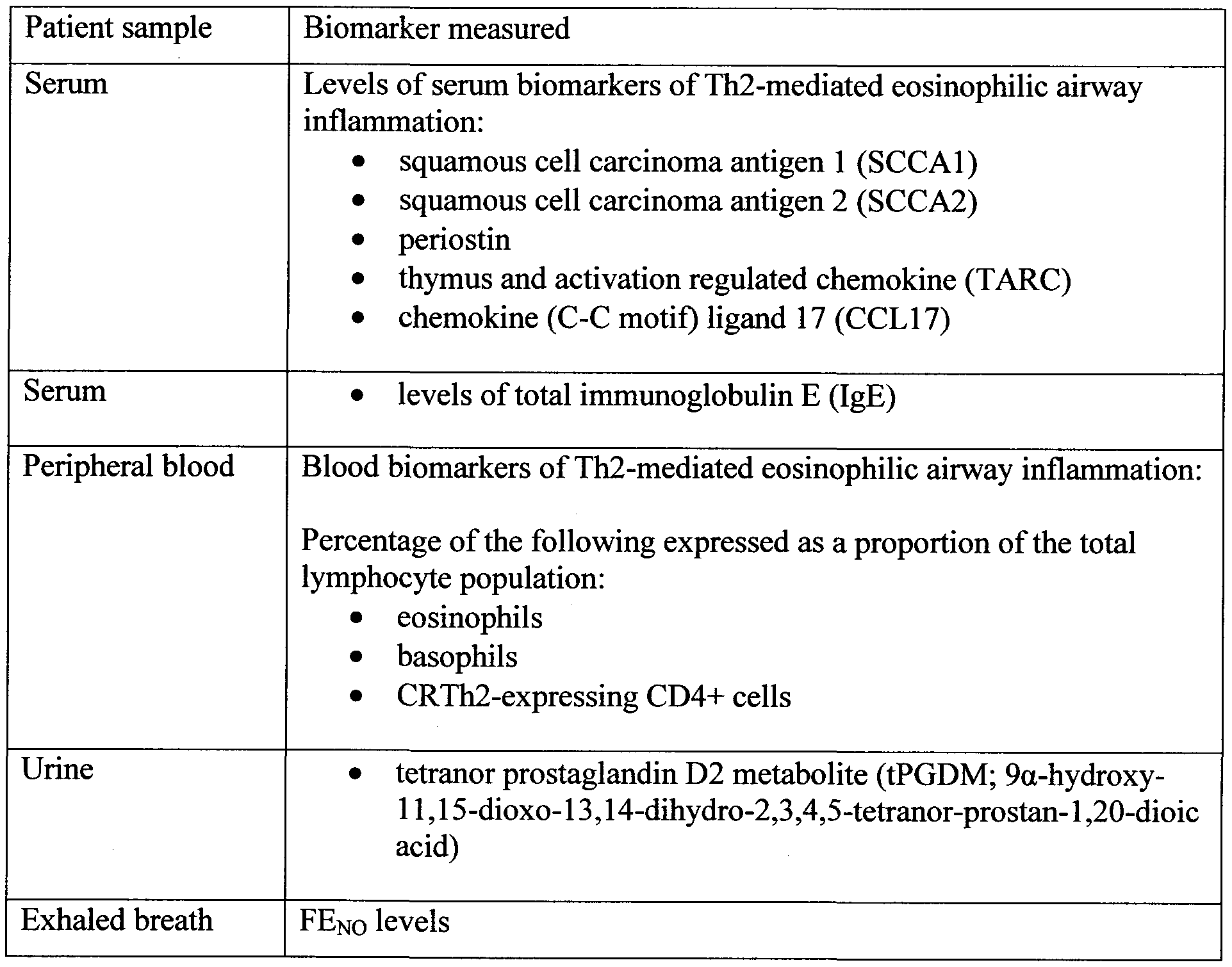
[000196] Results:
[000197] Serum levels of SCCA1, SCCA2, periostin and TARC were evaluated by ELISA as potential serum biomarkers of Th2-mediated eosinophilic airway inflammation for patients in the Serum Biomarker Population (N = 183) and are summarized by treatment group in Table 1.
Table 1
Percent of Baseline
Biomarker ARRY-502 ARRY-502
Visit Placebo 200 mg Placebo 200 mg
Statistic (N=90) ( =93) (N= 0) (N=93)
ARRY-502 Outsourced SCCAl Result
Baseline
n 90 93
Mean 0.98 1.08
SD 0.447 0.984
Median 0.90 0.90
Min, Max 0.20, 2.90 0.20, 9.30
Week 2 (Day 15)
n 82 90 82 90
Mean 1.03 1.06 111.28 101.37
SD 0.493 0.978 34.115 30.525
Median 0.90 0.80 109.31 100.00
Min, Max 0.20, 3.10 0.30, 8.90 63.64, 280.00 46.67, 262.50
Week 4 (Day 29)
n 80 90 80 90
Mean 1.04 1.06 113.15 103.41
SD 0.499 0.948 46.832 32.015
Median 1.00 0.90 100.00 100.00
Min, Max 0.20, 3.00 0.30, 8.80 54.55, 366.67 50.00, 233.33
Early Termination
n 10 4 10 4
Mean 1.92 0.90 157.23 108.48
SD 2.164 0.082 101.040 38.231
Median 1.30 0.90 137.50 101.25
Min, Max 0.80, 8.00 0.80, 1.00 58.82, 421.05 71.43, 160.00
Follow-Up (Day 36)
n 80 88 80 88
Mean 1.18 1.12 135.91 107.87
SD 0.853 1.038 149.933 61.104
Median 1.00 0.90 110.10 100.00
Min, Max 0.20, 7.00 0.30, 7.60 62.50, 1400.00 42.86, 572.73
ARRY-502 Outsourced SCCA2 Result
Baseline
n 90 93
Mean 0.82 0.91
SD 0.520 1.223
Percent of Baseline
Biomarker ARRY-502 ARRY-502
Visit Placebo 200 mg Placebo 200 mg
Statistic (N=90) (N=93) (N=90) (N=93)
Median 0.70 0.70
Min, Max 0.00, 3.20 0.10, 11.30
Week 2 (Day 15)
n 82 90 81 90
Mean 0.83 0.85 105.92 102.06
SD 0.579 1.042 40.257 41.186
Median 0.70 0.60 100.00 100.00
Min, Max 0.00, 3.40 0.20, 9.00 50.00, 350.00 27.27, 350.00
Week 4 (Day 29)
n 80 90 79 90
Mean 0.82 0.86 105.67 101.54
SD 0.544 1.033 35.413 29.267
Median 0.65 0.60 100.00 100.00
Min, Max 0.10, 3.30 0.20, 9.00 41.67, 300.00 50.00, 200.00
Early Termination
n 10 4 10 4
Mean 0.72 0.80 90.00 86.25
SD 0.278 0.356 25.005 11.893
Median 0.75 0.85 95.83 85.83
Min, Max 0.40, 1.10 0.40, 1.10 36.36, 125.00 73.33, 100.00
Follow-Up (Day 36)
n 80 88 79 88
Mean 0.87 0.88 118.27 101.50
SD 0.553 1.020 87.405 32.726
Median 0.70 0.65 100.00 100.00
Min, Max 0.00, 2.70 0.10, 8.30 57.14, 800.00 27.27, 211.11
ARRY-502 Periostin 18Axl7B Result
Baseline
n 90 93
Mean 60.34 58.26
SD 19.041 19.600
Median 56.00 55.00
Min, Max 23.00, 129.00 20.00, 121.00
Week 2 (Day 15)
n 82 90 82 90
Mean 60.15 56.78 100.76 99.03
Percent of Baseline
Biomarker ARRY-502 ARRY-502
Visit Placebo 200 mg Placebo 200 mg
Statistic (N=90) ( =93) ( =90) (N=93)
SD 18.200 18.253 13.191 19.362
Median 55.00 54.50 100.00 97.37 Min, Max 23.00, 105.00 29.00, 150.00 69.81, 148.00 63.03, 185.00 Week 4 (Day 29)
n 80 90 80 90
Mean 62.76 55.40 105.48 96.75 SD 20.497 17.062 21.203 18.537
Median 58.50 53.00 101.34 94.18 Min, Max 26.00, 127.00 27.00, 135.00 59.65, 202.08 53.23, 190.00 Early Termination
n 10 4 10 4
Mean 55.40 40.00 93.02 103.52 SD 22.441 13.491 18.045 10.827
Median 48.00 34.50 87.14 102.37 Min, Max 29.00, 108.00 31.00, 60.00 70.91, 126.32 93.94, 115.38 Follow-Up (Day 36)
n 80 88 80 88
Mean 62.34 58.20 105.36 100.61 SD 18.596 17.287 21.005 16.999
Median 59.50 55.50 101.55 98.45 Min, Max 24.00, 114.00 27.00, 125.00 66.67, 168.75 69.01, 180.00
ARRY-502 TARC Result Mean
Baseline
n 91 88
Mean 368.87 383.20
SD 242.235 271.160
Median 318.53 312.82
Min, Max 28.58, 1369.43 41.21, 1320.08
Week 2 (Day 15)
n 80 84 80 81
Mean 367.87 377.47 116.24 122.15 SD 215.981 248.624 85.609 148.642
Median 315.57 324.24 101.24 100.90 Min, Max 57.64, 1283.43 30.51, 1183.66 12.55, 708.87 11.92, 1365.68 Week 4 (Day 29)
n 77 89 77 83
Percent of Baseline
Biomarker ARRY-502 ARRY-502
Visit Placebo 200 mg Placebo 200 mg
Statistic (N=90) (N=93) ( = 0) (N=93)
Mean 389.48 379.39 121.16 115.39
SD 236.543 277.085 82.814 91.079
Median 344.52 291.56 104.77 101.97
Min, Max 57.83, 1238.17 0.00, 1665.03 16.63, 567.96 0.00, 768.23
Early Termination
n 9 4 9 3
Mean 442.55 354.93 167.25 108.17
SD 310.667 103.383 129.484 25.282
Median 295.10 332.10 123.29 98.08
Min, Max 121.87, 939.91 259.52, 496.02 90.93, 506.88 89.49, 136.94
Follow-Up (Day 36)
n 75 83 75 78
Mean 318.94 388.34 100.18 120.97
SD 239.314 280.027 90.828 111.401
Median 279.67 321.58 91.58 110.94
Min, Max 0.00, 1270.59 0.00, 1442.09 0.00, 655.57 0.00, 948.46
[000198] The serum biomarker IgE was analyzed by ELISA as a potential serum biomarker of Th2-mediated eosinophilic airway inflammation for patients in the Safety Population (N = 183) and is summarized by treatment group in Table 2.
Table 2
Change from Baseline
ARRY-502 ARRY-502
Visit Placebo 200 mg Placebo 200 mg
Statistic (N=90) (N=93) (N=90) (N=93)
Screening
n 83 90
Mean 421.3 334.6
SD 936.65 446.68
Median 138 164
Min, Max 5, 7484 5, 2360
Baseline
n 90 93
Change from Baseline
ARRY-502 ARRY-502
Visit Placebo 200 mg Placebo 200 mg Statistic ( =90) (N=93) (N=90) ( =93)
Mean 418.1 361.0
SD 953.66 505.35
Median 133 170
Min, Max 7, 8000 7, 3431
Week 2 (Day 15)
n 81 89 81 89
Mean 301.9 328.4 -20.3 -10.6
SD 433.22 503.51 183.10 92.08
Median 136 153 -1 -3
Min, Max 7, 2757 5, 4008 -1030, 1010 -303, 577
Week 4 (Day 29)
n 80 89 80 89
Mean 434.6 331.9 11.5 -6.1
SD 1060.35 484.66 159.22 77.96
Median 147 144 -1 -4
Min, Max 7, 8742 5, 3562 -534, 890 -260, 306
Early Termination
n 9 4 9 4
Mean 336.3 924.5 40.3 81.0
SD 419.48 1199.41 72.97 384.64
Median 110 542 8 5
Min, Max 10, 1094 29, 2586 -8, 220 -301, 616
Follow-Up (Day 36)
n 80 85 80 85
Mean 440.0 338.5 16.9 -5.1
SD 1067.28 447.76 168.41 98.16
Median 146 155 0 3
Min, Max 7, 8819 5, 3024 -492, 863 -470, 273
[000199] Percentage of basophils, CD4+ lymphocytes and eosinophils present in peripheral blood were determined by flow cytometry according to the following procedure. Blood was collected into 4 mL Vacutainer collection tubes containing EDTA (BD, San Jose, CA). 400 microliters of blood were transferred from the collection tube to each of two 12 X 75 mm test tubes. Fc receptor blocking solution (Miltenyi Biotec, Auburn, CA) was added to each tube, followed by a 15 minute incubation at ambient temperature. Next, one sample was stained with FITC anti-CD4 alone and the other with a cocktail of antibodies containing FITC anti-CD4 (eBioscience, San Diego, CA), APC anti-FcsRI (eBioscience) and PE anti-CRTh2 (Miltenyi Biotec) for 15 minutes at ambient temperature. 4 mL of pre- warmed hypotonic formaldehyde solution (Phosflow Lyse/Fix buffer, BD Biosciences) were then added to each sample tube and the tube was incubated for 10 minutes at 37 °C. Samples were then centrifuged for 3 minutes at 1500 rpm. After aspiration of supernatants, cell pellets were resuspended in 2 mL of FACS buffer (IX PBS with 1% BSA and 0.9% sodium azide, BD Biosciences Pharmingen) and subjected to an additional centrifugation step. After resuspension of cell pellets in 0.4 mL FACS buffer, samples were analyzed by flow cytometry on a BD FACS Canto II using pre-determined instrument settings. The sample stained with FITC anti-CD4 alone was used to determine quadrant boundaries for analysis of CRTh2 expression on CD4-positive lymphocytes. Eosinophils were identified according to their unique position in the light scatter plot, with a secondary histogram gate to ensure that only CRTh2-positive events were included in the analysis. Basophils were identified by their high level of expression of both FcsRI and CRTh2. The percentages of these cell types present in peripheral blood are summarized by treatment group in Table 3.
Table 3
Percent of Baseline
Biomarker ARRY-502 ARRY-502 Visit Placebo 200 mg Placebo 200 mg Statistic (N=50) (N=57) (N=50) ( =57)
CRTh2 Expression CRTh2+ Basophils gMFI
Baseline
n 50 57
Mean 15997.20 14066.65
SD 4190.786 3716.762
Median 15865.00 14026.00
Min, Max 7453.00, 25963.00 2724.00, 23583.00
Week 4 (Day 29)
Percent of Baseline
Biomarker ARRY-502 ARRY-502
Visit Placebo 200 mg Placebo 200 mg
Statistic (N=50) ( =57) (N=50) ( =57) n 48 55 48 55
Mean 15797.60 22733.44 102.94 173.58
SD 3770.464 6248.423 23.431 66.730
Median 15728.00 22179.00 102.57 161.89
Min, Max 5808.00, 22679.00 7867.00, 38331.00 34.72, 163.18 69.70, 441.58
Early Termination
n 1 1 1 1
Mean 18048.00 24370.00 79.76 154.15 SD
Median 18048.00 24370.00 79.76 154.15
Min, Max 18048.00, 18048.00 24370.00, 24370.00 79.76, 79.76 154.15, 154.15
CRTh2 Expression CRTh2+ Basophils, % of total
Baseline
n 50 57
Mean 0.61 0.72
SD 0.263 0.366
Median 0.58 0.63
Min, Max 0.14, 1.23 0.17, 1.98
Week 4 (Day 29)
n 48 55 48 55
Mean 0.67 0.81 123.18 113.68
SD 0.328 0.523 91.154 30.974
Median 0.60 0.61 98.91 109.62
Min, Max 0.12, 1.97 0.18, 2.85 30.00, 678.26 30.88, 200.00
Early Termination
n 1 1 1 1
Mean 0.38 0.51 102.70 70.83
SD
Median 0.38 0.51 102.70 70.83
Min, Max 0.38, 0.38 0.51, 0.51 102.70, 102.70 7Q.83, 70.83
CRTh2 Expression CRTh2+ CD4+ T cell gMFI
Baseline
n 50 57
Mean 4292.42 4118.93
SD 1276.478 1022.724
Percent of Baseline
Biomarker ARRY-502 ARRV-502 Visit Placebo 200 mg Placebo 200 mg Statistic ( =50) (N=57) ( =50) ( =57)
Median 4099.50 4150.00
Min, Max 2043.00, 9565.00 1120.00, 7041.00
Week 4 (Day 29)
n 48 55 48 55
Mean 4462.60 6089.11 107.98 150.25 SD 1466.892 1979.642 30.698 55.179
Median 4100.50 5985.00 104.69 147.79 Min, Max 2060.00, 9726.00 1071.00, 10949.00 57.32, 212.77 51.65, 428.53 Early Termination
n 1
Mean 5245.00 5716.00 93.85 203.27 SD
Median 5245.00 5716.00 93.85 203.27 Min, Max 5245.00, 5245.00 5716.00, 5716.00 93.85, 93.85 203.27, 203.27
CRTh2 Expression CRTH2+ CD4+ T cells, %of total
Baseline
n 50 57
Mean 0.29 0.32
SD 0.299 0.869
Median 0.24 0.18
Min, Max 0.06, 2.08 0.04, 6.73
Week 4 (Day 29)
n 48 55 48 55
Mean 0.26 0.31 100.84 132.19
SD 0.138 0.394 34.232 46.599
Median 0.23 0.24 99.00 123.81
Min, Max 0.06, 0.72 0.05, 3.06 26.92, 205.00 45.47, 269.23
Early Termination
n 1 1 1 1
Mean 0.08 0.32 100.00 139.13
SD
Median 0.08 0.32 100.00 139.13
Min, Max 0.08, 0.08 0.32, 0.32 100.00, 100.00 139.13, 139.13
CRTh2 Expression CRTh2+ Eosinophils gMFI
Baseline
Percent of Baseline
Biomarker ARRY-502 ARRY-502 Visit Placebo 200 mg Placebo 200 mg Statistic (N=50) (N=57) (N=50) (N=57) n 0 57
Mean 14579.88 12767.47
SD 3623.899 3395.098
Median 14049.50 12312.00
Min, Max 8148.00, 23279.00 4149.00, 21403.00
Week 4 (Day 29)
n 48 55 48 55
Mean 14236.63 21306.71 101.63 176.00 SD 3409.678 5946.948 23.594 64.397
Median 13807.00 22035.00 98.04 172.16 Min, Max 6690.00, 21662.00 5194.00, 34376.00 36.62, 161.44 69.89, 368.14 Early Termination
n 1 1 1 1
Mean 15848.00 18242.00 78.18 148.16 SD
Median 15848.00 18242.00 78.18 148.16 Min, Max 15848.00, 15848.00 18242.00, 18242.00 78.18, 78.18 148.16, 148.16
CRTh2 Expression CRTh2+ Eosinophils, % of total
Baseline
n 50 57
Mean 5.55 5.76
SD 3.493 3.128
Median 5.32 4.97
Min, Max 0.14, 13.96 1.30, 14.45
Week 4 (Day 29)
n 48 55 48 55
Mean 6.46 5.65 141.74 105.94 SD 4.156 3.149 120.117 48.007
Median 5.26 5.26 113.43 96.75 Min, Max 0.06, 18.24 1.42, 17.32 40.00, 821.31 31.79, 272.66 Early Termination
n 1 1 1 1
Mean 4.33 6.77 125.51 164.72 SD
Median 4.33 6.77 125.51 164.72
Percent of Baseline
Biomarker ARRY-502 ARRY-502
Visit Placebo 200 mg Placebo 200 mg
Statistic (N=50) (N=57) (N=50) (N=57)
Min, Max 4.33, 4.33 6.77, 6.77 125.51, 125.51 164.72, 164.72
[000200] Relationships Between Biomarkers and Clinical Efficacy Assessments
[000201] Relationships between Baseline biomarker values and clinical efficacy assessments were investigated by displaying percentage change in prebronchodilator FEV1 by treatment and Baseline level of biomarker, where the Baseline level of biomarker was categorized as either "above the median" or "at or below the median" for that biomarker. Descriptive statistics were displayed for the following 4 groups: (1) Placebo with biomarker value below the median; (2) Placebo with biomarker value above the median; (3) ARRY-502 with biomarker value below the median; and (4) ARRY-502 with biomarker value above the median.
[000202] These displays were repeated for the subset of patients with Baseline FENO > 48 ppb and for the subset of patients with Baseline FENO≤ 48 ppb.
[000203] Examination of Subgroups
[000204] Relationships between Baseline biomarker values and the efficacy endpoint of percent change from Baseline at Week 4 in prebronchodilator FEV1 are presented in Table 4 (serum biomarkers), Table 5 (whole blood biomarkers), Table 6 (urine biomarker), Table 7 (FENO) and Table 8 (IgE). These analyses were repeated in patients with a Baseline FENO level > 48 ppb, and data at Week 4 are presented in Table 9 (serum biomarkers), Table 10 (whole blood biomarkers), Table 11 (urine biomarker) and Table 12 (IgE). These analyses were also repeated in patients with a Baseline FENO level < 48 ppb, and data at Week 4 are presented in Table 13 (serum biomarkers), Table 14 (whole blood biomarkers), Table 15 (urine biomarker) and Table 16 (IgE).
Table 4
Biomarker ARRY-502 Level at Baseline [cutoff] Placebo 200 mg Statistic (N=90) ( =93)
ARRY-502 Outsourced SCCAl Result [(Median) 0.90 ng/ml]
Above Cutoff
n 36 41
Mean 2.02 3.64
SD 9.297 11.926
Median 0.52 1.14
Min, Max -11.87, 27.72 -13.89, 40.89
At or Below Cutoff
n 44 49
Mean 1.69 4.81
SD 11.939 11.889
Median 1.55 4.17
Min, Max -24.51, 30.56 -19.51, 31.58
ARRY-502 Outsourced SCCA2 Result [(Median) 0.70 ng/ml]
Above Cutoff
n 35 36
Mean 3.03 4.95
SD 9.511 12.247
Median 2.03 2.82
Min. Max -11.87, 27.72 -12.30, 40.89
At or Below Cutoff
n 45 54
Mean 0.91 3.83
SD 11.670 11.677
Median 0.43 3.35
Min, Max -24.51, 30.56 -19.51, 31.58
ARRY 502 Periostin 18Axl7B Result [(Median) 55.00 ng/ml]
Above Cutoff
n 43 45
Mean 2.61 4.85
SD 11.108 13.340
Median 2.03 2.90
Biomarker ARRY-502 Level at Baseline [cutoff] Placebo 200 mg
Statistic (N=90) (N=93)
Min, Max -24.51, 27.72 -19.51, 40.89
At or Below Cutoff
n 37 45
Mean 0.94 3.70
SD 10.433 10.273
Median 0.19 3.26
Min, Max -19.56, 30.56 -13.43, 30.90
ARRY-502 TARC Result Mean [(Median) 317.43 pg mL]
Above Cutoff
n 43 41
Mean 2.62 2.09
SD 11.627 11.769
Median 0.71 1.14
Min, Max -20.80, 30.56 -19.51, 40.89
At or Below Cutoff
n 37 43
Mean 0.93 4.98
SD 9.748 11.181
Median 2.03 3.84
Min, Max -24.51, 19.21 -12.35, 31.58
Table 5
Biomarker ARRY-502 Level at Baseline [cutoff] Placebo 200 mg Statistic (N=50) (N=57)
CRTh2 Expression CRTh2+ Basophils gMFI [(Median) 15000.00]
Above Cutoff
n 29 22
Mean 2.73 2.53 SD 11.547 10.547 Median 2.03 1.11 Min, Max -24.51, 27.72 -19.51, 26.96
Biomarker ARRY-502 Level at Baseline [cutoff] Placebo 200 mg Statistic (N=50) (N=57)
At or Below Cutoff
n 20 34
Mean 2.34 3.88
SD 10.069 11.078
Median 0.30 3.85
Min, Max -19.56, 22.45 -13.89, 30.80
CRTh2 Expression CRTh2+ Basophils, % of total [(Median) 0.62]
Above Cutoff
n 22 30
Mean 3.34 4.74
SD H.393 11.623
Median 0.32 3.85
Min, Max -19.56, 24.43 -19.51, 30.80
At or Below Cutoff
n 27 26
Mean 1.94 1.75
SD 10.582 9.732
Median 2.36 1.95
Min, Max -24.51, 27.72 -14.14, 26.96
CRTh2 Expression CRTh2+ CD4+ T cell gMFI [(Median) 4127.00]
Above Cutoff
n 23 29
Mean 1.12 2.78
SD 11.165 12.180
Median 2.36 1.61
Min, Max -24.51, 22.45 -19.51, 30.80
At or Below Cutoff
n 26 27
Mean 3.85 3.96
SD 10.636 9.276
Median 0.32 4.34
Min, Max -19.56, 27.72 -10.62, 26.96
CRTh2 Expression CRTh2+ CD4+ T cells, % of total [(Median) 0.20]
Biomarker ARRY-502 Level at Baseline [cutoff] Placebo 200 mg Statistic (N=50) (N=57)
Above Cutoff
n 27 24
Mean 1.82 0.01
SD 9.483 11.232
Median 0.37 0.50
Min, Max -19.56, 19.21 -19.51, 24.79
At or Below Cutoff
n 22 32
Mean 3.48 5.85
SD 12.516 9.905
Median 2.26 4.41
Min, Max -24.51, 27.72 -13.89, 30.80
CRTh2 Expression CRTh2+ Eosinophils gMFI [(Median) 12899.00]
Above Cutoff
n 27 25
Mean 4.31 2.67
SD 11.923 9.095
Median 4.99 2.30
Min, Max -24.51, 27.72 -14.14, 20.81
At or Below Cutoff
n 22 31
Mean 0.42 3.90
SD 9.211 12.116
Median 0.15 3.09
Min, Max -19.56, 22.45 -19.51, 30.80
CRTh2 Expression CRTh2+ Eosinophils, % of total [(Median) 5.29]
Above Cutoff
n 24 27
Mean 5.66 6.09
SD 10.473 11.285
Median 4.26 4.34
Min, Max -19.56, 27.72 -12.23, 30.80
At or Below Cutoff
Biomarkcr ARRY-502 Level at Baseline [cutoff] Placebo 200 mg Statistic (N=50) (N=57) n 25 29
Mean -0.41 0.80
SD 10.582 9.835
Median -0.62 0.56
Min, Max -24.51, 24.43 -19.51, 26.96
Table 6
Biomarker ARRY-502 Level at Baseline [cutoff] Placebo 200 mg Statistic (N=89) (N=90)
Tetranor-PGDM Tetranor-PGDM cone. [(Median) 1.38 ng ml creatinine]
Above Cutoff
n 33 47
Mean 0.52 4.61 SD 11.086 13.061 Median 0.28 3.26 Min, Max
At or Below Cutoff
n 46 40
Mean 2.16 4.48 SD 9.817 10.595 Median 0.84 3.27 Min, Max -20.80, 24.43 -14.14, 28.65
Table 7
Biomarker ARRY-502 Level at Baseline [cutoff] Placebo 200 mg Statistic (N=90) ( =93)
Fractional Exhaled Nitric Oxide[(Median) 48 ppb]
Above Cutoff
n 40 44
Mean 2.45 7.03
SD 10.779 12.008
Median 1.37 4.32
Min, Max -20.80, 30.56 -13.89, 40.89
At or Below Cutoff
n 40 46
Mean 1.22 1.64 SD 10.854 10.558 Median 0.82 1.72 Min, Max -24.51, 27.72 -19.51, 30.80
Table 8
Biomarker ARRY-502 Level at Baseline [cutoff] Placebo 200 mg Statistic (N=90) (N=93)
Immunoglobulin E[(Median) 145.00 kU L]
Above Cutoff
n 37 48
Mean 3.52 4.11
SD 11.274 12.888 Median 2.33 1.95 Min, Max -24.51, 30.56 -14.14, 40.89
At or Below Cutoff
n 43 42
Mean 0.39 4.46 SD 10.218 10.700 Median 0.28 3.54 Min, Max -20.80, 24.43 -19.51, 31.58
Table 9
Patients with a Baseline FENO level > 48 ppb
Biomarker ARRY-502 Level at Baseline [cutoff] Placebo 200 mg
Statistic (N=47) (N=44)
ARRY-502 Outsourced SCCA1 Result [(Median) 1.00 ng ml]
Above Cutoff
n 17 18
Mean 2.34 8.23
SD 9.870 14.760
Median 2.03 6.50
Min, Max -11.65, 22.45 -10.57, 40.89
At or Below Cutoff
n 23 26
Mean 2.54 6.19
SD 11.624 11.114
Median 0.71 4.32
Min, Max -20.80, 30.56 -13.89, 31.58
ARRY-502 Outsourced SCCA2 Result [(Median) 0.70 ng/ml]
Above Cutoff
n 22 18
Mean 3.02 7.31
SD 9.818 14.475
Median 2.10 2.33
Min, Max -11.65, 24.43 -10.57, 40.89
At or Below Cutoff
n 18 26
Mean 1.76 6.83
SD 12.107 11.439
Median 0.57 4.51
Min, Max -20.80, 30.56 -13.89, 31.58
ARRY-502 Penostin 18Axl7B Result [(Median) 58.00 ng/ml]
Above Cutoff
n
Biomarker ARRY-502 Level at Baseline [cutoff] Placebo 200 mg Statistic (N=47) (N=44)
Mean 2.88 7.73
SD 11.143 14.969
Median 2.28 3.54
Min, Max -20.80, 24.43 -13.89, 40.89
At or Below Cutoff
n 20 22
Mean 2.03 6.33
SD 10.675 10.020
Median 0.57 4.51
Min, Max -12.29, 30.56 -10.45, 30.90
ARRY-502 TARC Result Mean [(Median) 328.34 pg mL]
Above Cutoff
n 23 17
Mean 2.95 5.25
SD 12.457 13.144
Median 0.71 3.05
Min, Max -20.80, 30.56 -13.89, 40.89
At or Below Cutoff
n 17 22
Mean 1.77 7.03
SD 8.307 11.895
Median 2.03 6.17
Min, Max -12.29, 17.83 -10.45, 31.58
Table 10
Patients with a Baseline FENO level > 48 ppb
Biomarker ARRY-502 Level at Baseline [cutofl] Placebo 200 mg Statistic (N=24) (N=27)
CRTh2 Expression CRTh2+ Basophils gMFI [(Median) 15262.00]
Above Cutoff
n 15 10
Mean 1.89 4.94 SD 10.650 7.304 Median 2.03 4.32 Min, Max -11.65, 24.43 -4.31, 20.81
At or Below Cutoff
n 9 17
Mean 4.98 3.06 SD 8.890 11.576 Median 2.16 0.43 Min, Max -4.79, 22.45
CRTh2 Expression CRTh2+ Basophils, % of total [(Median) 0.63]
Above Cutoff
n 11 13
Mean 5.16 6.51 SD 11.850 11.693 Median 2.03 10.29 Min, Max -7.61, 24.43 -13.89, 24.79
At or Below Cutoff
n 13 14
Mean 1.26 1.20 SD 8.057 7.923 Median 2.16 1.02 Min, Max -11.65, 15.58 -10.45, 20.81
CRTh2 Expression CRTh2+ CD4+ T cell gMFI [(Median) 3983.00]
Above Cutoff
n 11 14
Mean 0.66 5.10
SD 10.661 10.582
Median 2.16 3.61
Biomarker ARRY-502 Level at Baseline [cutoff] Placebo 200 mg
Statistic (N=24) (N=27)
Min, Max -11.65, 22.45 -13.89, 24.79
At or Below Cutoff
n 13 13
Mean 5.08 2.31
SD 9.224 9.739
Median 2.03 0.43
Min, Max -4.79, 24.43 -10.45, 20.47
CRTh2 Expression CRTh2+ CD4+ T cells, %of total [(Median) 0.20]
Above Cutoff
n 13 11
Mean 2.29 1.97
SD 7.724 11.193
Median 2.03 1.61
Min, Max -7.61, 13.79 -10.45, 24.79
At or Below Cutoff
n 11 16
Mean 3.94 4.99
SD 12.417 9.430
Median 2.16 4.51
Min, Max -11.65, 24.43 -13.89, 20.81
CRTh2 Expression CRTh2+ Eosinophils gMFI [(Median) 13337.00]
Above Cutoff
n 14 11
Mean 2.86 2.27
SD 10.347 9.358
Median 3.05 1.61
Min, Max -11.59, 24.43 -13.89, 20.81
At or Below Cutoff
n 10 16
Mean 3.32 4.78
SD 9.894 10.738
Median 1.26 3.77
Min, Max -11.65, 22.45 -10.45, 24.79
Biomarker ARRY-502 Level at Baseline [cutoff] Placebo 200 mg
Statistic ( =24) (N=27)
CRTh2 Expression CRTh2+ Eosinophils, % of total [(Median) 5.81]
Above Cutoff
n 12 13
Mean 5.71 6.65
SD 8.968 12.096
Median 4.26 7.80
Min, Max -6.48, 22.45 -10.45, 24.79
At or Below Cutoff
n 12 14
Mean 0.39 1.07
SD 10.528 7.237
Median -1.82 0.50
Min, Max -11.65, 24.43 -13.89, 13.99
Table 11
Patients with a Baseline FENO level > 48 ppb
Biomarker ARRY-502
Level at Baseline [cutoff] Placebo 200 mg
Statistic ( =46) (N=41)
Tetranor-PGDM Tetranor-PGDM cone. [(Median) 1.38 ng ml creatinine]
Above Cutoff
n 17 22
Mean 0.17 8.28
SD 8.915 14.248
Median 0.23 4.51
Min, Max -11.65, 22.45 -13.89, 40.89
At or Below Cutoff
n 22 19
Mean 2.94 7.27
SD 10.638 10.827
Median 1.37 5.73
Min, Max -20.80, 24.43 -10.57, 28.65
Table 12
Patients with a Baseline FENO level > 48 ppb
Biomarker ARRY-502 Level at Baseline [cutoff] Placebo 200 mg
Statistic (N=47) (N=44)
Immunoglobulin E[(Median) 229.00 kU/L]
Above Cutoff
n 21 21
Mean 3.61 7.98
SD 10.189 15.686 Median 2.16 4.17
Min, Max -10.27, 30.56 -13.89, 40.89
At or Below Cutoff
n 19 23
Mean 1.17 6.16
SD 11.538 9.240 Median 0.71 4.48
Min, Max -20.80, 24.43 -5.99, 31.58
Table 13
Patients with a Baseline FEMO level < 48 ppb
Biomarker ARRY-502 Level at Baseline [cutoff] Placebo 200 mg Statistic ( =43) ( =49)
ARRY-502 Outsourced SCCAl Result [(Median) 0.90 ng ml]
Above Cutoff
n 15 19
Mean 2.08 0.77 SD 9.313 7.780 Median 0.28 1.14 Min, Max -11.87, 27.72 -12.35, 14.03
At or Below Cutoff
Biomarker ARRY-502 Level at Baseline [cutoff) Placebo 200 mg Statistic (N= 3) ( =49) n 25 27
Mean 0.71 2.26
SD 11.836 12.251
Median 1.96 2.30
Min,Max -24.51, 19.21 -19.51,30.80
ARRY-502 Outsourced SCCA2 Result [(Median) 0.65 ngml]
Above Cutoff
n 17 25
Mean 1.66 1.68
SD 8.794 9.153
Median 0.97 1.14
Min,Max -11.87,27.72 -13.43,26.96
At or Below Cutoff
n 23 21
Mean 0.90 1.61
SD 12.342 12.259
Median 0.19 2.30
Min,Max -24.51,19.21 -19.51,30.80
ARRY-502 Periostin 18Axl7B Result [(Median) 54.00 ng/ml]
Above Cutoff
n 22 23
Mean 2.67 1.44
SD 11.238 11.509
Median 1.06 2.30
Min,Max -24.51,27.72 -19.51,30.80
At or Below Cutoff
n 18 23
Mean -0.55 1.85
SD 10.402 9.772
Median 0.21 1.14
Min,Max -19.56,17.81 -13.43,26.96
ARRY-502 TARC Result Mean [(Median) 309.29 pg/mL]
Above Cutoff
Biomarker ARRY-502 Level at Baseline [cutoff] Placebo 200 mg Statistic (N=43) ( =49) n 20 24
Mean 2.24 -0.48
SD 10.902 10.114
Median 0.63 0.67
Min, Max -19.56, 27.72 -19.51, 26.96
At or Below Cutoff
n 20 21
Mean 0.21 3.20
SD 10.989 10.417
Median 1.50 3.64
Min, Max -24.51, 19.21 -12.35, 30.80
Table 14
Patients with a Baseline FENO level < 48 ppb
Biomarker ARRY-502 Level at Baseline [cutoff] Placebo 200 mg Statistic ( =26) (N=30)
CRTh2 Expression CRTh2+ Basophils gMFI [(Median) 14957.00]
Above Cutoff
n 13 13
Mean 3.88 0.55 SD 13.263 12.077 Median 2.36 -0.34 Min, Max -24.51, 27.72 -19.51, 26.96
At or Below Cutoff
n 12 16
Mean 0.18 4.94 SD 10.355 11.156 Median -0.28 4.43 Min, Max -19.56, 19.21 -12.30, 30.80
CRTh2 Expression CRTh2+ Basophils, % of total [(Median) 0.59]
Above Cutoff
n 11 15
Biomarker ARRY-502 Level at Baseline [cutoff] Placebo 200 mg Statistic (N=26) (N=30)
Mean 1.52 3.47 SD 11.174 12.403 Median 0.23 3.44 Min, Max -19.56, 19.21 -19.51, 30.80
At or Below Cutoff
n 14 14
Mean 2.56 2.43 SD 12.773 11.073 Median 3.04 2.69 Min, Max -24.51, 27.72 -14.14, 26.96
CRTH2 Expression CRTh2+ CD4+ T cell gMFI [(Median) 4143.00]
Above Cutoff
n 11 16
Mean 1.60 0.78
SD 12.652 13.060
Median 3.71 0.67
Min, Max -24.51, 17.30 -19.51, 30.80
At or Below Cutoff
n 14 13
Mean 2.50 5.67 SD 11.670 9.243 Median 0.25 4.53 Min, Max -19.56, 27.72 -10.62, 26.96
CRTh2 Expression CRTh2+ CD4+ T cells, % of total [(Median) 0.21]
Above Cutoff
n 14 13
Mean 1.38 -1.64
SD 11.151 11.443
Median -0.28 -0.60
Min, Max -19.56, 19.21 -19.51, 19.94
At or Below Cutoff
n 11 16
Mean 3.02 6.72
Biomarker ARRY-502
Level at Baseline [cutoff] Placebo 200 mg
Statistic (N=26) ( =30)
SD 13.203 10.593
Median 2.36 4.30
Min, Max -24.51, 27.72 -10.62, 30.80
CRTh2 Expression CRTh2+ Eosinophils gMFI [(Median) 12713.50]
Above Cutoff
n 15 12
Mean 5.12 2.24
SD 12.817 9.743
Median 4.99 1.51
Min, Max -24.51, 27.72 -14.14, 19.94
At or Below Cutoff
n 10 17
Mean -2.41 3.49
SD 9.044 12.991
Median -1.21 3.44
Min, Max -19.56, 14.79 -19.51, 30.80
CRTh2 Expression CRTh2+ Eosinophils, % of total [(Median) 4.14]
Above Cutoff
n 11 16
Mean 5.60 6.85
SD 12.682 11.363
Median 1.14 6.69
Min, Max -19.56, 27.72 -12.23, 30.80
At or Below Cutoff
n 14 13
Mean -0.64 -1.81
SD 10.841 10.333
Median -0.17 -0.34
Min, Max -24.51, 17.30 -19.51, 19.94
Table 15
Patients with a Baseline FENO le el < 48 ppb
Biomarker ARRV-502 Level at Baseline [cutofl] Placebo 200 mg Statistic (N=43) (N= 9)
Tetranor-PGDM Tetranor-PGDM cone. [(Median) 1.38 ng ml creatinine]
Above Cutoff
n 16 27
Mean 0.89 2.18 SD 13.308 11.371 Median 0.71 2.30 Min, Max -24.51, 27.72
At or Below Cutoff
n 24 19
Mean 1.44 0.89 SD 9.172 9.535 Median 0.82 1.14 Min, Max -19.56, 17.81 -14.14, 26.96
Table 16
Patients with a Baseline FENO level < 48 ppb
Biomarker ARRY-502
Level at Baseline [cutoff) Placebo 200 mg
Statistic ( =43) (N=49)
Immunoglobulin E[(Median) 113.50 kU/L]
Above Cutoff
n 18 24
Mean 3.90 0.16
SD 13.126 9.703
Median 4.35 -0.20
Min, Max -24.51, 27.72 -14.14, 19.
At or Below Cutoff
n 22 22
Mean -0.97 3.26
SD 8.253 11.425
Median 0.13 3.27
Biomarker ARRY-502
Level at Baseline [cutoff] Placebo 200 mg
Statistic (N=43) (N=49)
Min, Max -16.16, 17.30 -19.51, 30.80
[000205] Summary of results
[000206] As part of this study, a variety of Th2-associated biomarkers were evaluated in patient serum, whole blood, urine and exhaled breath in relation to the efficacy endpoint of percent change from Baseline in prebronchodilator FEVl . A statistically significant difference in response to ARRY-502 was observed with 2 biomarkers; the biomarker of Baseline FENO level and the whole blood biomarker of baseline percentage of CRTh2- expressing eosinophils present in the total leukocyte population both predicted response to ARRY-502.
[000207] Adult patients with mild to moderate persistent asthma receiving ARRY-502 administered at a dose of 200 mg (every 12 hours) for 28 days demonstrated statistically significant improvements compared with placebo in measures of lung function, asthma control and patient reported outcomes. The primary endpoint of this clinical study evaluated prebronchodilator FEVl on Day 29 as an objective spirometric measure of lung function. At Day 29, patients receiving ARRY-502 demonstrated an improvement of 4.5% in prebronchodilator FEVl, a statistically significant difference compared with the improvement observed in the placebo group (0.6%) as shown in Table 17.
Table 17

0.62 4.49 3.87 102.8 0.020
Week 4
[000208] Accordingly, it was discovered that FENO levels and the percentage of peripheral blood eosinophils represent unique predictors of responsiveness to CRTh2 antagonists such as ARRY-502.
[000209] As demonstrated herein, it was surprisingly observed that improvements in FEV1 were maintained in patients with a high FENO level at Baseline (i.e., FENO level above the median Baseline value of 48 ppb). At Day 29, patients receiving ARRY-502 with high FENO at Baseline demonstrated an improvement of 7.0% in prebronchodilator FEV1, a statistically significant difference compared with the improvement observed in the placebo group (0.2%) (See Figure 1). Conversely, the "low FENO" subset (i.e., FENO level at or below the median Baseline value of 48 ppb) had little or no benefit from ARRY-502 (See Figure 2). These results verify that this subset analysis may be effective for selecting responders to ARRY-502.
[000210] As further demonstrated herein, improvements in FEV1 were also surprisingly maintained in patients with a high percentage of CRTh2-expressing eosinophils at Baseline (i.e., percentage of CRTh2-expressing eosinophils above the median Baseline value of 5.06% of total leukocytes). Patients with a high percentage of CRTh2-expressing eosinophils at Baseline receiving ARRY-502 demonstrated an improvement of 8.5% in prebronchodilator FEV1, a statistically significant difference compared with the improvement observed in the placebo group (2.7%) (See Figure 3). Conversely, the "low eosinophil" subset (i.e., patients with percentage of CRTh2-expressing eosinophils at or below the median Baseline value of 5.06% of total leukocytes) had little or no benefit from ARRY-502 (See Figure 4). These results verify that this subset analysis may also be effective for selecting responders to ARRY-502.
[000211] A statistically significant difference was also observed in the change from Baseline in the number of weekly short-acting beta-2 antagonist metered-dose inhaler (SABA MDI) actuations at Day 29 between the ARRY-502 group and the placebo group. A mean decrease from Baseline in the number of weekly SABA MDI actuations at Day 36 of 2.48 (SD = 13.537) was observed for the ARRY-502 group (See Figure 5), compared with a mean increase of 1.00 (SD = 12.437) for the placebo group (see Figure 6). Within the high FENO subset of the ARRY-502 group, the number of weekly SABA MDI actuations at Day 29 was reduced by 7.3,
and within the high eosinophil subset of the ARRY-502 group, the number of weekly SABA MDI actuations at Day 29 was also reduced by 7.3.
[000212] Analysis of the other Th2-associated biomarkers (serum periostin, SCCA1, SCCA2, serum IgE, urinary PGDM and serum TARC) showed that levels of these markers were not associated with increased responsiveness to ARRY-502.
[000213] Taking into account all cohorts, mean FENO levels in the ARRY-502 group decreased by 12.8 ppb at Day 29. In contrast, mean FENO levels increased in the placebo group by 4.6 ppb.
[000214] Additional key secondary endpoints for which statistically significant differences between treatment groups were observed at Day 29 included improvements in prebronchodilator FVC, number of symptom-free days (SFD) during the Treatment Period and patient questionnaires relating to asthma symptom severity and quality of life (see Table 18). For example, in patients with elevated FENO levels at baseline (i.e., baseline FENO levels greater than 48 ppb) or elevated blood eosinophil levels at baseline (i.e., baseline eosinophil level greater than 5% of the total lymphocyte population peripheral blood), there were significant improvements in spirometric outcomes, measures of asthma control and quality of life. The fact that patients with elevated FENO levels at baseline or elevated blood eosinophil levels at baseline receiving ARRY-502 showed improvements relative to placebo in measures of lung function, asthma control and patient reported outcome suggests a clinically meaningful benefit to patients.
Table 18

a includes the high and low FENO and EOS groups
b ARRY-502 treated group
C EOS = eosinophils; 5% of the total lymphocyte population in peripheral blood
[000215] In addition, the low baseline FENO (≤ 48 ppb) and low baseline eosinophil (less than 5% of the total lymphocyte population in peripheral blood) groups experienced more exacerbations during treatment with ARRY-502 versus other groups (see Table 19).
Table 19

a Low FENO
b Low eosinophils
[000216] It will be understood that the enumerated embodiments are not intended to limit the invention to those embodiments. On the contrary, the invention is intended to cover all alternatives, modifications and equivalents, which may be included within the scope of the present invention as defined by the claims. Thus, the foregoing description is considered as illustrative only of the principles of the invention.
[000217] The words "comprise," "comprising," "include," "including," and "includes" when used in this specification and in the following claims are intended to specify the presence of stated features, integers, components, or steps, but they do not preclude the presence or addition of one or more other features, integers, components, steps, or groups thereof.
Claims
1. A method for identifying and treating mild to moderate Th2-driven allergic asthma in a patient in need thereof, said method comprising: (a) identifying the patient as having a baseline FENO level greater than 48 ppb by assaying a biological sample from the patient, wherein the biological sample is exhaled breath; and (b) administering a therapeutically effective amount of a CRTh2 antagonist to the patient having a baseline FENO level greater than 48 ppb.
2. A method for identifying and treating mild to moderate Th2-driven allergic asthma in a patient in need thereof, said method comprising: (a) obtaining a biological sample from the patient, wherein the biological sample is exhaled breath; (b) identifying the patient as having a baseline FENO level greater than 48 ppb by assaying the biological sample; and (c) administering a therapeutically effective amount of a CRTh2 antagonist to the patient having a baseline FENO level greater than 48 ppb.
3. A method for identifying and treating mild to moderate Th2-driven allergic asthma in a patient in need thereof comprising administering a CRTh2 antagonist to said patient, said method comprising: (a) identifying the patient as having a baseline FENO level greater than 48 ppb by assaying a biological sample from the patient, wherein the biological sample is exhaled breath; and (b) administering a therapeutically effective amount of the CRTh2 antagonist to the patient having a baseline FENO level greater than 48 ppb.
4. A method for identifying and treating mild to moderate Th2 -driven allergic asthma in a patient in need thereof comprising administering a CRTh2 antagonist to said patient, said method comprising: (a) obtaining a biological sample from the patient, wherein the biological sample is exhaled breath; (b) identifying the patient as having a baseline FENO level greater than 48 ppb by assaying the biological sample; and (c) administering a therapeutically effective amount of the CRTh2 antagonist to the patient having a baseline FENO level greater than 48 ppb.
5. A method for increasing the likelihood of response in a patient having mild to moderate Th2-driven allergic asthma to therapeutic treatment with a CRTh2 antagonist,
comprising (a) measuring the baseline FENO level in a biological sample of the patient, wherein the biological sample is exhaled breath; (b) determining whether the sample has a baseline FENO level greater than 48 ppb; (c) classifying the patient as having an increased likelihood of a therapeutic response to treatment with a CRTh2 antagonist if the sample has a baseline FENO level greater than 48 ppb; and (d) administering a therapeutically effective amount of the CRTh2 antagonist to the patient classified as having an increased likelihood of response.
6. A method for increasing the likelihood of response in a patient having mild to moderate Th2-driven allergic asthma to therapeutic treatment with a CRTh2 antagonist, comprising: (a) obtaining a biological sample from the patient, wherein the biological sample is exhaled breath; (b) assaying the sample to measure the baseline FENO level; (c) determining whether the sample has a baseline FENO level greater than 48 ppb; (d) classifying the patient as having an increased likelihood of a therapeutic response to treatment with a CRTh2 antagonist if the patient has a baseline FENO level greater than 48 ppb; and (e) administering a therapeutically effective amount of the CRTh2 antagonist to the patient classified as having an increased likelihood of response.
7. A method for predicting the likelihood a patient will respond therapeutically to a method of treating mild to moderate Th2-driven allergic asthma with a CRTh2 antagonist, said method comprising: (a) measuring the baseline FENO level in a biological sample of the patient, wherein the biological sample is exhaled breath; (b) determining whether the sample has a baseline FENO level greater than 48 ppb; (c) classifying the patient as having an increased likelihood of a therapeutic response to treatment with a CRTh2 antagonist if the sample has a baseline FENO level greater than 48 ppb; and (d) administering a therapeutically effective amount of the CRTh2 antagonist to the patient classified as having an increased likelihood of response.
8. A method for predicting an increased likelihood a patient will respond therapeutically to a method of treating mild to moderate Th2-driven allergic asthma with a CRTh2 antagonist, the method comprising: (a) obtaining a biological sample from the patient, wherein the biological sample is exhaled breath; (b) measuring the baseline FENO level in the sample; (c) determining whether the sample has a baseline FENO level greater than 48 ppb; (d) classifying the patient as having an increased likelihood of responding
therapeutically to the method of treating mild to moderate asthma if the sample has a baseline FENO level greater than 48 ppb; and (e) administering a therapeutically effective amount of the CRTh2 antagonist to the patient classified as having an increased likelihood of response.
9. The method according to any one of claims 1-8, wherein the CRTh2 antagonist is ARRY-502.
10. A method of using ARRY-502 to treat a patient with mild to moderate Th2- driven allergic asthma wherein the patient has been diagnosed as having a baseline FENO level greater than 48 ppb, comprising administering a therapeutically effective amount of ARRY-502 to said patient.
11. A method of treating mild to moderate Th2-driven allergic asthma in a patient having a baseline FENO level greater than 48 ppb, comprising administering to the patient a therapeutically effective amount of ARRY-502.
12. The method according to any one of claims 9-11, wherein 200 mg of ARRY-502 is administered every 12 hours.
13. Use of ARRY-502 in the manufacture of a medicament for the treatment of mild to moderate Th2-driven allergic asthma in a patient having a baseline FENO level greater than 48 ppb.
14. A pharmaceutical composition for treating a patient with mild to moderate Th2 -driven allergic asthma having a baseline FENO level greater than 48 ppb, comprising ARRY-502.
15. The compound ARRY-502 for use in treating mild to moderate Th2-driven allergic asthma in a patient having a baseline FENO level greater than 48 ppb.
16. The compound ARRY-502 for use in treating mild to moderate Th2-driven allergic asthma in a patient having a baseline FENO level greater than 48 ppb, comprising (a) assaying a biological sample from the patient for a baseline FENO level, wherein the
biological sample is exhaled breath; (b) determining whether the sample has a baseline FENO level greater than 48 ppb; and (c) administering a therapeutically effective amount of ARRY-502 to the patient if the baseline FENO level is greater than 48 ppb.
17. The compound ARRY-502 for use in treating mild to moderate Th2-driven allergic asthma in a patient in need thereof, comprising (a) obtaining a biological sample from the patient wherein the biological sample is exhaled breath; (b) assaying the biological sample for a baseline FENO level, (c) determining whether the sample has a baseline FENO level greater than 48 ppb, and (d) administering a therapeutically effective amount of ARRY-502 to the patient if the baseline FENO level is greater than 48 ppb.
18. The compound, method, use or composition according to any one of claims 1 to 17, wherein an inhaled corticosteroid is administered in combination with said CRTh2 antagonist.
19. The compound, method, use or composition according to any one of claims 1 to 17, wherein a leukotriene receptor antagonist is administered in combination with said CRTh2 antagonist.
20. The compound, method, use or composition according to claim 19, wherein said leukotriene receptor antagonist is Montelukast.
21. The compound, method, use or composition according to any one of claims 1 to 17, wherein a mast cell stabilizer is administered in combination with said CRTh2 antagonist.
22. The compound, method, use or composition according to any one of claims 1 to 17, wherein an antibody against immunoglobulin Ε is administered in combination with said CRTh2 antagonist.
23. A method for identifying and treating mild to moderate Th2-driven allergic asthma in a patient in need thereof, said method comprising: (a) identifying the patient as having a baseline eosinophil level greater than 5% of the total lymphocyte population in peripheral blood by assaying a peripheral blood sample from the patient; and (b)
administering a therapeutically effective amount of the CRTh2 antagonist to the patient having a baseline eosinophil level greater than 5% of the total lymphocyte population in said peripheral blood.
24. A method for identifying and treating mild to moderate Th2-driven allergic asthma in a patient in need thereof, said method comprising: (a) obtaining a peripheral blood sample from the patient; (b) identifying the patient as having a baseline eosinophil level greater than 5% of the total lymphocyte population in said sample by assaying the sample; and (c) administering a therapeutically effective amount of the CRTh2 antagonist to the patient having a baseline eosinophil level greater than 5% of the total lymphocyte population in said peripheral blood.
25. A method for identifying and treating mild to moderate Th2-driven allergic asthma in a patient in need thereof comprising administering a CRTh2 antagonist to said patient, said method comprising: (a) identifying the patient as having a baseline eosinophil level greater than 5% of the total lymphocyte population in peripheral blood by assaying a peripheral blood sample from the patient; and (b) administering a therapeutically effective amount of the CRTh2 antagonist to the patient identified as having a baseline eosinophil level greater than 5% of the total lymphocyte population in said peripheral blood.
26. A method for identifying and treating mild to moderate Th2-driven allergic asthma in a patient in need thereof comprising administering a CRTh2 antagonist to said patient, said method comprising: (a) obtaining a peripheral blood sample from the patient; (b) identifying the patient as having a baseline eosinophil level greater than 5% of the total lymphocyte population in said peripheral blood by assaying the sample; and (c) administering a therapeutically effective amount of the CRTh2 antagonist to the patient identified as having a baseline eosinophil level greater than 5% of the total lymphocyte population in said peripheral blood.
27. A method for increasing the likelihood of response in a patient having mild to moderate Th2-driven allergic asthma to therapeutic treatment with a CRTh2 antagonist, comprising (a) measuring the baseline eosinophil level in a peripheral blood sample of the patient; (b) determining whether the sample has a baseline eosinophil level greater than
5% of the total lymphocyte population; (c) classifying the patient as having an increased likelihood of a therapeutic response to treatment with a C Th2 antagonist if the sample has a baseline eosinophil level greater than 5% of the total lymphocyte population; and (d) administering a therapeutically effective amount of the CRTh2 antagonist to the patient classified as having an increased likelihood of response.
28. A method for increasing the likelihood of response in a patient having mild to moderate Th2-driven allergic asthma to therapeutic treatment with a CRTh2 antagonist, comprising: (a) obtaining a peripheral blood sample from the patient; (b) assaying the sample to measure the baseline eosinophil level; (c) determining whether the sample has a baseline eosinophil level greater than 5% of the total lymphocyte population; (d) classifying the patient as having an increased likelihood of a therapeutic response to treatment with a CRTh2 antagonist if the sample has a baseline eosinophil level greater than 5% of the total lymphocyte population in said peripheral blood; and (e) administering a therapeutically effective amount of the CRTh2 antagonist to the patient classified as having an increased likelihood of response.
29. A method for predicting the likelihood a patient will respond therapeutically to a method of treating mild to moderate Th2-driven allergic asthma with a CRTh2 antagonist, said method comprising: (a) measuring the baseline eosinophil level in a peripheral blood sample of the patient; (b) determining whether the sample has a baseline eosinophil level greater than 5% of the total lymphocyte population; (c) classifying the patient as having an increased likelihood of a therapeutic response to treatment with a CRTh2 antagonist if the sample has a baseline eosinophil level greater than 5% of the total lymphocyte population; and (d) administering a therapeutically effective amount of the CRTh2 antagonist to the patient classified as having an increased likelihood of response.
30. A method for predicting an increased likelihood a patient will respond therapeutically to a method of treating mild to moderate Th2-driven allergic asthma with a CRTh2 antagonist, the method comprising: (a) obtaining a peripheral blood sample from the patient; (b) measuring the baseline eosinophil level in the sample; (c) determining whether the sample has a baseline eosinophil level greater than 5% of the total lymphocyte population; (d) classifying the patient as having an increased likelihood of responding
therapeutically to the method of treating mild to moderate asthma if the sample has a baseline eosinophil level greater than 5% of the total lymphocyte population; and (e) administering a therapeutically effective amount of the CRTh2 antagonist to the patient classified as having an increased likelihood of response.
31. The method according to any one of claims 23-30 wherein the CRTh2 antagonist is ARRY-502.
32. A method of using ARRY-502 to treat a patient with mild to moderate Th2- driven allergic asthma wherein the patient has been diagnosed as having a baseline eosinophil level greater than 5% of the total lymphocyte population in the patient's peripheral blood, comprising administering a therapeutically effective amount of ARRY- 502 to said patient.
33. A method of treating mild to moderate Th2-driven allergic asthma in a patient having a baseline eosinophil level greater than 5% of the total lymphocyte population in the patient's peripheral blood, comprising administering to the patient a therapeutically effective amount of ARRY-502.
34. The method according to any one of claims 31-33, wherein 200 mg of ARRY-502 is administered every 12 hours.
35. Use of ARRY-502 in the manufacture of a medicament for the treatment of mild to moderate Th2-driven allergic asthma in a patient having a baseline eosinophil level greater than 5% of the total lymphocyte population in the patient's peripheral blood.
36. A pharmaceutical composition for treating a patient with mild to moderate Th2-driven allergic asthma having a baseline eosinophil level greater than 5% of the total lymphocyte population in the patient's peripheral blood, comprising ARRY-502.
37. The compound ARRY-502 for use in treating mild to moderate Th2-driven allergic asthma in a patient having a baseline eosinophil level greater than 5% of the total lymphocyte population in the patient's peripheral blood.
38. The compound ARRY-502 for use in treating mild to moderate Th2-driven allergic asthma in a patient having a baseline eosinophil level greater than 5% of the total lymphocyte population in peripheral blood, comprising (a) assaying a peripheral blood sample from the patient for a baseline eosinophil level; (b) determining whether the sample has a baseline eosinophil level greater than 5% of the total lymphocyte population; and (c) administering a therapeutically effective amount of ARRY-502 to the patient if the baseline eosinophil level is greater than 5% of the total lymphocyte population in said peripheral blood.
39. The compound ARRY-502 for use in treating mild to moderate Th2-driven allergic asthma in a patient in need thereof, comprising (a) obtaining a peripheral blood sample from the patient; (b) assaying the sample for a baseline eosinophil level; (c) determining whether the sample has a baseline eosinophil level greater than 5% of the total lymphocyte population; and (d) administering a therapeutically effective amount of ARRY-502 to the patient if the baseline eosinophil level is greater than 5% of the total lymphocyte population in said peripheral blood.
40. The method, use, composition or compound according to any one of claims 23-39, wherein an inhaled corticosteroid is administered in combination with said CRTh2 antagonist.
41. The method, use, composition or compound according to any one of claims 23-39, wherein a leukotriene receptor antagonist is administered in combination with said CRTh2 antagonist.
42. The method, use, composition or compound according to claim 41, wherein said leukotriene receptor antagonist is Montelukast.
43. The method, use, composition or compound according to any one of claims 23-39, wherein a mast cell stabilizer is administered in combination with said CRTh2 antagonist.
44. The method, use, composition or compound according to any one of claims 23-39, wherein an antibody against immunoglobulin E is administered in combination with said CRTh2 antagonist.
45. The method according to any of claims 23-39, wherein the baseline eosinophil level in a patient's peripheral blood is determined by requesting a test providing the results of an analysis to determine the baseline eosinophil level.
Applications Claiming Priority (2)
| Application Number | Priority Date | Filing Date | Title |
|---|---|---|---|
| US201461941910P | 2014-02-19 | 2014-02-19 | |
| US61/941,910 | 2014-02-19 |
Publications (2)
| Publication Number | Publication Date |
|---|---|
| WO2015126750A1 true WO2015126750A1 (en) | 2015-08-27 |
| WO2015126750A4 WO2015126750A4 (en) | 2015-10-29 |
Family
ID=52630487
Family Applications (1)
| Application Number | Title | Priority Date | Filing Date |
|---|---|---|---|
| PCT/US2015/015806 Ceased WO2015126750A1 (en) | 2014-02-19 | 2015-02-13 | BIOMARKERS PREDICTIVE OF RESPONSIVENESS TO TREATMENT WITH A CRTh2 INHIBITOR |
Country Status (1)
| Country | Link |
|---|---|
| WO (1) | WO2015126750A1 (en) |
Cited By (1)
| Publication number | Priority date | Publication date | Assignee | Title |
|---|---|---|---|---|
| WO2020226936A1 (en) * | 2019-05-03 | 2020-11-12 | Merck Sharp & Dohme Corp. | Blood biomarker and genetic markers associated with response to crth2 receptor antagonists |
Citations (4)
| Publication number | Priority date | Publication date | Assignee | Title |
|---|---|---|---|---|
| WO2009124090A1 (en) * | 2008-03-31 | 2009-10-08 | Genentech, Inc. | Compositions and methods for treating and diagnosing asthma |
| WO2009158426A1 (en) | 2008-06-25 | 2009-12-30 | Array Biopharma Inc. | 6-substituted phenoxychroman carboxylic acid derivatives |
| WO2012083132A2 (en) * | 2010-12-16 | 2012-06-21 | Genentech, Inc. | Diagnosis and treatments relating to th2 inhibition |
| WO2012158954A1 (en) * | 2011-05-18 | 2012-11-22 | Medimmune, Llc | Methods of diagnosing and treating pulmonary diseases or disorders |
-
2015
- 2015-02-13 WO PCT/US2015/015806 patent/WO2015126750A1/en not_active Ceased
Patent Citations (4)
| Publication number | Priority date | Publication date | Assignee | Title |
|---|---|---|---|---|
| WO2009124090A1 (en) * | 2008-03-31 | 2009-10-08 | Genentech, Inc. | Compositions and methods for treating and diagnosing asthma |
| WO2009158426A1 (en) | 2008-06-25 | 2009-12-30 | Array Biopharma Inc. | 6-substituted phenoxychroman carboxylic acid derivatives |
| WO2012083132A2 (en) * | 2010-12-16 | 2012-06-21 | Genentech, Inc. | Diagnosis and treatments relating to th2 inhibition |
| WO2012158954A1 (en) * | 2011-05-18 | 2012-11-22 | Medimmune, Llc | Methods of diagnosing and treating pulmonary diseases or disorders |
Non-Patent Citations (20)
| Title |
|---|
| AM. J. RESPIR. CRIT. CARE MED., vol. 171, 2005, pages 912 - 30 |
| BARNES ET AL., CLINICAL & EXP. ALLERGY, 2011, pages 1 - 11 |
| BLOOM B.; COHEN R. A.; FREEMAN G., VITAL HEALTH STAT., vol. 10, 2009, pages 1 - 80 |
| CHEVALIER E ET AL: "Cutting Edge: Chemoattractant Receptor-Homologous Molecule Expressed on TH2 Cells Play a Restricting Role on IL-5 Production and Eosinophil Recruitment", THE JOURNAL OF IMMUNOLOGY, THE AMERICAN ASSOCIATION OF IMMUNOLOGISTS, US, vol. 175, no. 4, 15 August 2005 (2005-08-15), pages 2056 - 2060, XP003008946, ISSN: 0022-1767 * |
| CHEVALIER E. ET AL., J. IMMUNOL., vol. 175, 2005, pages 2056 - 60 |
| DAVID CHANTRY ET AL: "Th2 Signature Selection Strategies for CRTh2 Antagonists: Baseline Characteristics of a Mild to Moderate Persistent Asthma Population", AVAILABLE AT WWW.ARRAYBIOPHARMA.COM, 13 May 2013 (2013-05-13), XP055188070, Retrieved from the Internet <URL:http://www.arraybiopharma.com/files/8113/9810/8031/PubAttachment567.pdf> [retrieved on 20150507] * |
| FAJT ML; BALZAR S; TRUDEAU J ET AL.: "CRTH2 receptor and its ligand, PGD2, are increased in severe asthma", AMERICAN THORACIC SOCIETY ANNUAL MEETING, May 2011 (2011-05-01) |
| GERVAIS, F.G. ET AL., J. ALLERGY CLIN. IMMUNOL., vol. 108, 2001, pages 982 - 8 |
| HIRAI H ET AL: "PROSTAGLANDIN D2 SELECTIVELY INDUCES CHEMOTAXIS IN T HELPER TYPE 2 CELLS, EOSINOPHILS, AND BASOPHILS VIA SEVEN-TRANSMEMBRANE RECEPTOR CRTH2", THE JOURNAL OF EXPERIMENTAL MEDICINE, ROCKEFELLER UNIVERSITY PRESS, US, vol. 193, no. 2, 15 January 2001 (2001-01-15), pages 255 - 261, XP008050257, ISSN: 0022-1007, DOI: 10.1084/JEM.193.2.255 * |
| HIRAI, H. ET AL., J. EXP. MED., vol. 193, 2001, pages 255 - 61 |
| HUANG, J. L. ET AL., HUM. MOL. GENET., vol. 13, 2004, pages 2691 - 7 |
| IAN E PAVORD: "Non-eosinophilic asthma and the innate immune response", THORAX, 1 March 2007 (2007-03-01), pages 193 - 194, XP055188188, Retrieved from the Internet <URL:http://www.ncbi.nlm.nih.gov/pmc/articles/PMC2117160/?report=reader> [retrieved on 20150507], DOI: 10.1136/thx.2006.065805 * |
| JIA, G. ET AL., J. ALLERGY CLIN. IMMUNOL., vol. 130, 2012, pages 647 - 54 |
| PETTIPHER, R., BR. J. PHARMACOL., vol. 153, no. 1, 2008, pages S191 - 9 |
| PLEIS J. R.; LUCAS J. W., VITAL HEALTH STAT., vol. 10, 2009, pages 1 - 159 |
| SALLY WENZEL ET AL: "Safety and Efficacy of ARRY-502, a Potent, Selective, Oral CRTh2 Antagonist, in Patients with Mild to Moderate Th2-Driven Asthma", 1 March 2014 (2014-03-01), AAAAI Meeting, March 1, 2014; Abstract # 13, XP055188225, Retrieved from the Internet <URL:http://www.arraybiopharma.com/files/8013/9810/8036/PubAttachment596.pdf> [retrieved on 20150508] * |
| SATOH T. ET AL., J. IMMUNOL., vol. 177, 2006, pages 2621 - 9 |
| ULVEN TROND ET AL: "Novel CRTH2 antagonists: a review of patents from 2006 to 2009", EXPERT OPINION ON THERAPEUTIC PATENTS, INFORMA HEALTHCARE, GB, vol. 20, no. 11, 1 November 2010 (2010-11-01), pages 1505 - 1530, XP009142666, ISSN: 1354-3776 * |
| WECHSLER M. E., MAYO CLIN. PROC., vol. 84, 2009, pages 707 - 17 |
| YOSHIMURA-UCHIYAMA, C. ET AL., CLIN. EXP. ALLERGY, vol. 34, 2004, pages 1283 - 90 |
Cited By (1)
| Publication number | Priority date | Publication date | Assignee | Title |
|---|---|---|---|---|
| WO2020226936A1 (en) * | 2019-05-03 | 2020-11-12 | Merck Sharp & Dohme Corp. | Blood biomarker and genetic markers associated with response to crth2 receptor antagonists |
Also Published As
| Publication number | Publication date |
|---|---|
| WO2015126750A4 (en) | 2015-10-29 |
Similar Documents
| Publication | Publication Date | Title |
|---|---|---|
| Liu et al. | Type 2 innate lymphoid cells: a novel biomarker of eosinophilic airway inflammation in patients with mild to moderate asthma | |
| Erpenbeck et al. | The oral CRTh2 antagonist QAW039 (fevipiprant): a phase II study in uncontrolled allergic asthma | |
| Louie et al. | The asthma–chronic obstructive pulmonary disease overlap syndrome: pharmacotherapeutic considerations | |
| de Groot et al. | Management of the patient with eosinophilic asthma: a new era begins | |
| Agarwal et al. | Guidelines for diagnosis and management of bronchial asthma: Joint ICS/NCCP (I) recommendations | |
| Chen et al. | Allergen-induced increases in sputum levels of group 2 innate lymphoid cells in subjects with asthma | |
| Barnes et al. | A randomized, double‐blind, placebo‐controlled study of the CRTH2 antagonist OC000459 in moderate persistent asthma | |
| Demarche et al. | Detailed analysis of sputum and systemic inflammation in asthma phenotypes: are paucigranulocytic asthmatics really non-inflammatory? | |
| Minoguchi et al. | Reduction of eosinophilic inflammation in the airways of patients with asthma using montelukast | |
| Chung et al. | International ERS/ATS guidelines on definition, evaluation and treatment of severe asthma | |
| Kuna et al. | Two Phase II randomized trials on the CRTh2 antagonist AZD1981 in adults with asthma | |
| de la FUENTE et al. | Safety of inducing sputum in patients with asthma of varying severity | |
| ten BRINKE et al. | Sputum induction in severe asthma by a standardized protocol: predictors of excessive bronchoconstriction | |
| D’silva et al. | Heterogeneity of bronchitis in airway diseases in tertiary care clinical practice | |
| Snell et al. | Efficacy and safety of AZD1981, a CRTH2 receptor antagonist, in patients with moderate to severe COPD | |
| Gonem et al. | Phenotyping airways disease: an A to E approach | |
| Katial et al. | The effect of aspirin desensitization on novel biomarkers in aspirin-exacerbated respiratory diseases | |
| van Huisstede et al. | Bronchial and systemic inflammation in morbidly obese subjects with asthma: a biopsy study | |
| Wood et al. | Mannitol challenge for assessment of airway responsiveness, airway inflammation and inflammatory phenotype in asthma | |
| Venema et al. | Feline asthma: what's new and where might clinical practice be heading? | |
| Mastalerz et al. | Induced sputum supernatant bioactive lipid mediators can identify subtypes of asthma | |
| Hozawa et al. | Comparison of budesonide/formoterol Turbuhaler with fluticasone/salmeterol Diskus for treatment effects on small airway impairment and airway inflammation in patients with asthma | |
| Di Lorenzo et al. | Similarity and differences in elderly patients with fixed airflow obstruction by asthma and by chronic obstructive pulmonary disease | |
| Sitkauskiene et al. | Reversibility to a β2-agonist in COPD: relationship to atopy and neutrophil activation | |
| Jung et al. | Expression levels of eosinophil granule protein mRNAs in induced sputum reflect airway hyperresponsiveness and airflow limitation |
Legal Events
| Date | Code | Title | Description |
|---|---|---|---|
| 121 | Ep: the epo has been informed by wipo that ep was designated in this application |
Ref document number: 15708632 Country of ref document: EP Kind code of ref document: A1 |
|
| NENP | Non-entry into the national phase |
Ref country code: DE |
|
| 122 | Ep: pct application non-entry in european phase |
Ref document number: 15708632 Country of ref document: EP Kind code of ref document: A1 |