WO2015103527A1 - Modulators of rev-erb - Google Patents
Modulators of rev-erb Download PDFInfo
- Publication number
- WO2015103527A1 WO2015103527A1 PCT/US2015/010133 US2015010133W WO2015103527A1 WO 2015103527 A1 WO2015103527 A1 WO 2015103527A1 US 2015010133 W US2015010133 W US 2015010133W WO 2015103527 A1 WO2015103527 A1 WO 2015103527A1
- Authority
- WO
- WIPO (PCT)
- Prior art keywords
- compound
- methyl
- esi
- title compound
- rev
- Prior art date
- Legal status (The legal status is an assumption and is not a legal conclusion. Google has not performed a legal analysis and makes no representation as to the accuracy of the status listed.)
- Ceased
Links
- OUUKJTLKSRZRSD-PGJJKLNISA-N C/C=C\C(/C(/C(N1[C@H](CNC(c2ccccc2OC)=O)Cc2ccccc2C1)=O)=C\C)=C Chemical compound C/C=C\C(/C(/C(N1[C@H](CNC(c2ccccc2OC)=O)Cc2ccccc2C1)=O)=C\C)=C OUUKJTLKSRZRSD-PGJJKLNISA-N 0.000 description 1
- JQKHQDXPIGJFBL-UHFFFAOYSA-N CC(C)(C)OC(N(Cc(c(C1)c2)ccc2OC)C1C(OC)=O)=O Chemical compound CC(C)(C)OC(N(Cc(c(C1)c2)ccc2OC)C1C(OC)=O)=O JQKHQDXPIGJFBL-UHFFFAOYSA-N 0.000 description 1
- YRKXDDSIAJWNML-UHFFFAOYSA-N CC(C)(C)Oc(cc1)ccc1OCC(Cc1cc(OC)ccc1C1)N1C(c1c(cccc2)c2ccc1)=O Chemical compound CC(C)(C)Oc(cc1)ccc1OCC(Cc1cc(OC)ccc1C1)N1C(c1c(cccc2)c2ccc1)=O YRKXDDSIAJWNML-UHFFFAOYSA-N 0.000 description 1
- DRIDLMFYWSJXEG-QHCPKHFHSA-N CC(C)(C)Oc(cc1)ccc1OC[C@H](Cc1cc(F)ccc1C1)N1C(c(cc1)ccc1OC)=O Chemical compound CC(C)(C)Oc(cc1)ccc1OC[C@H](Cc1cc(F)ccc1C1)N1C(c(cc1)ccc1OC)=O DRIDLMFYWSJXEG-QHCPKHFHSA-N 0.000 description 1
- OUKQIWIGQZSCHX-QHCPKHFHSA-N CC(C)(C)Oc(cc1)ccc1OC[C@H](Cc1cc(F)ccc1C1)N1C(c1cccc2c1cccn2)=O Chemical compound CC(C)(C)Oc(cc1)ccc1OC[C@H](Cc1cc(F)ccc1C1)N1C(c1cccc2c1cccn2)=O OUKQIWIGQZSCHX-QHCPKHFHSA-N 0.000 description 1
- LNCRYQJHOQUUDL-QHCPKHFHSA-N CC(C)(C)Oc(cc1)ccc1OC[C@H](Cc1ccccc1C1)N1C(c(cc1)ccc1OC)=O Chemical compound CC(C)(C)Oc(cc1)ccc1OC[C@H](Cc1ccccc1C1)N1C(c(cc1)ccc1OC)=O LNCRYQJHOQUUDL-QHCPKHFHSA-N 0.000 description 1
- RQALLCBGMIIUOU-DEOSSOPVSA-N CC(C)(C)Oc(cc1)ccc1OC[C@H](Cc1ccccc1C1)N1C(c1cc(C#N)ccc1)=O Chemical compound CC(C)(C)Oc(cc1)ccc1OC[C@H](Cc1ccccc1C1)N1C(c1cc(C#N)ccc1)=O RQALLCBGMIIUOU-DEOSSOPVSA-N 0.000 description 1
- IISOUOXAGDDBQS-FQEVSTJZSA-N CC(C)(C)Oc(cc1)ccc1OC[C@H](Cc1ccccc1C1)N1C(c1ccc(SC)[s]1)=O Chemical compound CC(C)(C)Oc(cc1)ccc1OC[C@H](Cc1ccccc1C1)N1C(c1ccc(SC)[s]1)=O IISOUOXAGDDBQS-FQEVSTJZSA-N 0.000 description 1
- JCTOTYAYIXZZNC-FQEVSTJZSA-N CC(C)(C)Oc(cc1)ccc1OC[C@H](Cc1ccccc1C1)N1S(c1ccc[s]1)(=O)=O Chemical compound CC(C)(C)Oc(cc1)ccc1OC[C@H](Cc1ccccc1C1)N1S(c1ccc[s]1)(=O)=O JCTOTYAYIXZZNC-FQEVSTJZSA-N 0.000 description 1
- YZYOLYZZHCZKHQ-QFIPXVFZSA-N CC(C)c1c[n](C[C@H](Cc2ccccc2C2)N2C(c2cccc3ccccc23)=O)nn1 Chemical compound CC(C)c1c[n](C[C@H](Cc2ccccc2C2)N2C(c2cccc3ccccc23)=O)nn1 YZYOLYZZHCZKHQ-QFIPXVFZSA-N 0.000 description 1
- NKSHVIJSFVSXPG-UHFFFAOYSA-N CCOC(C(Cc1ccccc1C1)N1C(Nc1cccc2c1cccc2)=O)=O Chemical compound CCOC(C(Cc1ccccc1C1)N1C(Nc1cccc2c1cccc2)=O)=O NKSHVIJSFVSXPG-UHFFFAOYSA-N 0.000 description 1
- KNZGOMMXKKDTFY-UHFFFAOYSA-N CCOC(C1N(C)Cc2ccccc2C1)=O Chemical compound CCOC(C1N(C)Cc2ccccc2C1)=O KNZGOMMXKKDTFY-UHFFFAOYSA-N 0.000 description 1
- XCLAZJBJFCKGGW-NSHDSACASA-N COC([C@H](Cc(cc1)ccc1OC)NC(OC)=O)=O Chemical compound COC([C@H](Cc(cc1)ccc1OC)NC(OC)=O)=O XCLAZJBJFCKGGW-NSHDSACASA-N 0.000 description 1
- SEHQROCWVCWGCZ-SFHVURJKSA-N COc(cc1)cnc1OC[C@H](Cc1ccccc1C1)N1C(c(cc1Cl)ccc1Cl)=O Chemical compound COc(cc1)cnc1OC[C@H](Cc1ccccc1C1)N1C(c(cc1Cl)ccc1Cl)=O SEHQROCWVCWGCZ-SFHVURJKSA-N 0.000 description 1
- GZSXGDXCHIIHNY-QMMMGPOBSA-N COc1cnc(N2[C@H](CO)CCC2)nc1 Chemical compound COc1cnc(N2[C@H](CO)CCC2)nc1 GZSXGDXCHIIHNY-QMMMGPOBSA-N 0.000 description 1
- XWVAFWBUYLQCEV-VWLOTQADSA-N C[N](C)(C)c(cc1)ccc1OC[C@H](Cc1ccccc1C1)N1C(c1c(cccc2)c2ccc1)=O Chemical compound C[N](C)(C)c(cc1)ccc1OC[C@H](Cc1ccccc1C1)N1C(c1c(cccc2)c2ccc1)=O XWVAFWBUYLQCEV-VWLOTQADSA-N 0.000 description 1
- GVMVXEFYWKPZAA-HNNXBMFYSA-N Cc(cn1)ccc1OC[C@H](C1)NCc(cc2)c1cc2F Chemical compound Cc(cn1)ccc1OC[C@H](C1)NCc(cc2)c1cc2F GVMVXEFYWKPZAA-HNNXBMFYSA-N 0.000 description 1
- VDCQIPDBXMXOIQ-QFIPXVFZSA-N Cc(cn1)ccc1OC[C@H](Cc1c2)N(Cc3ccccc3)Cc1ccc2F Chemical compound Cc(cn1)ccc1OC[C@H](Cc1c2)N(Cc3ccccc3)Cc1ccc2F VDCQIPDBXMXOIQ-QFIPXVFZSA-N 0.000 description 1
- GKKNYSCKESUFTG-FQEVSTJZSA-N N#Cc1cc(C[C@@H](C(O)=O)N(C2)C(c3c(cccc4)c4ccc3)=O)c2cc1 Chemical compound N#Cc1cc(C[C@@H](C(O)=O)N(C2)C(c3c(cccc4)c4ccc3)=O)c2cc1 GKKNYSCKESUFTG-FQEVSTJZSA-N 0.000 description 1
- JRKVXOKNONYGRP-FQEVSTJZSA-N O=C(c(cc1Cl)ccc1Cl)N(C1)[C@H](COCc2ccc3OCOc3c2)Cc2c1cccc2 Chemical compound O=C(c(cc1Cl)ccc1Cl)N(C1)[C@H](COCc2ccc3OCOc3c2)Cc2c1cccc2 JRKVXOKNONYGRP-FQEVSTJZSA-N 0.000 description 1
- VVLMJKSVCKASFZ-UHFFFAOYSA-N O=C(c1cccc2c1cccc2)N(C1)C(CNC(Nc2ccccc2)=O)Cc2c1cccc2 Chemical compound O=C(c1cccc2c1cccc2)N(C1)C(CNC(Nc2ccccc2)=O)Cc2c1cccc2 VVLMJKSVCKASFZ-UHFFFAOYSA-N 0.000 description 1
- RTTNEEYEDJQQDI-UHFFFAOYSA-N O=C(c1cccc2c1cccc2)N1C(COc2ccccc2)Cc2ccccc2C1 Chemical compound O=C(c1cccc2c1cccc2)N1C(COc2ccccc2)Cc2ccccc2C1 RTTNEEYEDJQQDI-UHFFFAOYSA-N 0.000 description 1
- LYKZZEPHQMWECK-DEOSSOPVSA-N O=C(c1cccc2c1cccc2)N1[C@H](COc(cc2)cc3c2[nH]cc3)Cc2ccccc2C1 Chemical compound O=C(c1cccc2c1cccc2)N1[C@H](COc(cc2)cc3c2[nH]cc3)Cc2ccccc2C1 LYKZZEPHQMWECK-DEOSSOPVSA-N 0.000 description 1
Classifications
-
- C—CHEMISTRY; METALLURGY
- C07—ORGANIC CHEMISTRY
- C07D—HETEROCYCLIC COMPOUNDS
- C07D211/00—Heterocyclic compounds containing hydrogenated pyridine rings, not condensed with other rings
- C07D211/04—Heterocyclic compounds containing hydrogenated pyridine rings, not condensed with other rings with only hydrogen or carbon atoms directly attached to the ring nitrogen atom
- C07D211/06—Heterocyclic compounds containing hydrogenated pyridine rings, not condensed with other rings with only hydrogen or carbon atoms directly attached to the ring nitrogen atom having no double bonds between ring members or between ring members and non-ring members
- C07D211/08—Heterocyclic compounds containing hydrogenated pyridine rings, not condensed with other rings with only hydrogen or carbon atoms directly attached to the ring nitrogen atom having no double bonds between ring members or between ring members and non-ring members with hydrocarbon or substituted hydrocarbon radicals directly attached to ring carbon atoms
- C07D211/18—Heterocyclic compounds containing hydrogenated pyridine rings, not condensed with other rings with only hydrogen or carbon atoms directly attached to the ring nitrogen atom having no double bonds between ring members or between ring members and non-ring members with hydrocarbon or substituted hydrocarbon radicals directly attached to ring carbon atoms with substituted hydrocarbon radicals attached to ring carbon atoms
- C07D211/20—Heterocyclic compounds containing hydrogenated pyridine rings, not condensed with other rings with only hydrogen or carbon atoms directly attached to the ring nitrogen atom having no double bonds between ring members or between ring members and non-ring members with hydrocarbon or substituted hydrocarbon radicals directly attached to ring carbon atoms with substituted hydrocarbon radicals attached to ring carbon atoms with hydrocarbon radicals, substituted by singly bound oxygen or sulphur atoms
- C07D211/22—Heterocyclic compounds containing hydrogenated pyridine rings, not condensed with other rings with only hydrogen or carbon atoms directly attached to the ring nitrogen atom having no double bonds between ring members or between ring members and non-ring members with hydrocarbon or substituted hydrocarbon radicals directly attached to ring carbon atoms with substituted hydrocarbon radicals attached to ring carbon atoms with hydrocarbon radicals, substituted by singly bound oxygen or sulphur atoms by oxygen atoms
-
- C—CHEMISTRY; METALLURGY
- C07—ORGANIC CHEMISTRY
- C07D—HETEROCYCLIC COMPOUNDS
- C07D207/00—Heterocyclic compounds containing five-membered rings not condensed with other rings, with one nitrogen atom as the only ring hetero atom
- C07D207/02—Heterocyclic compounds containing five-membered rings not condensed with other rings, with one nitrogen atom as the only ring hetero atom with only hydrogen or carbon atoms directly attached to the ring nitrogen atom
- C07D207/04—Heterocyclic compounds containing five-membered rings not condensed with other rings, with one nitrogen atom as the only ring hetero atom with only hydrogen or carbon atoms directly attached to the ring nitrogen atom having no double bonds between ring members or between ring members and non-ring members
- C07D207/08—Heterocyclic compounds containing five-membered rings not condensed with other rings, with one nitrogen atom as the only ring hetero atom with only hydrogen or carbon atoms directly attached to the ring nitrogen atom having no double bonds between ring members or between ring members and non-ring members with hydrocarbon radicals, substituted by hetero atoms, attached to ring carbon atoms
-
- C—CHEMISTRY; METALLURGY
- C07—ORGANIC CHEMISTRY
- C07D—HETEROCYCLIC COMPOUNDS
- C07D209/00—Heterocyclic compounds containing five-membered rings, condensed with other rings, with one nitrogen atom as the only ring hetero atom
- C07D209/02—Heterocyclic compounds containing five-membered rings, condensed with other rings, with one nitrogen atom as the only ring hetero atom condensed with one carbocyclic ring
- C07D209/04—Indoles; Hydrogenated indoles
- C07D209/10—Indoles; Hydrogenated indoles with substituted hydrocarbon radicals attached to carbon atoms of the hetero ring
- C07D209/12—Radicals substituted by oxygen atoms
-
- C—CHEMISTRY; METALLURGY
- C07—ORGANIC CHEMISTRY
- C07D—HETEROCYCLIC COMPOUNDS
- C07D209/00—Heterocyclic compounds containing five-membered rings, condensed with other rings, with one nitrogen atom as the only ring hetero atom
- C07D209/02—Heterocyclic compounds containing five-membered rings, condensed with other rings, with one nitrogen atom as the only ring hetero atom condensed with one carbocyclic ring
- C07D209/44—Iso-indoles; Hydrogenated iso-indoles
-
- C—CHEMISTRY; METALLURGY
- C07—ORGANIC CHEMISTRY
- C07D—HETEROCYCLIC COMPOUNDS
- C07D209/00—Heterocyclic compounds containing five-membered rings, condensed with other rings, with one nitrogen atom as the only ring hetero atom
- C07D209/02—Heterocyclic compounds containing five-membered rings, condensed with other rings, with one nitrogen atom as the only ring hetero atom condensed with one carbocyclic ring
- C07D209/52—Heterocyclic compounds containing five-membered rings, condensed with other rings, with one nitrogen atom as the only ring hetero atom condensed with one carbocyclic ring condensed with a ring other than six-membered
-
- C—CHEMISTRY; METALLURGY
- C07—ORGANIC CHEMISTRY
- C07D—HETEROCYCLIC COMPOUNDS
- C07D217/00—Heterocyclic compounds containing isoquinoline or hydrogenated isoquinoline ring systems
- C07D217/12—Heterocyclic compounds containing isoquinoline or hydrogenated isoquinoline ring systems with radicals, substituted by hetero atoms, attached to carbon atoms of the nitrogen-containing ring
- C07D217/14—Heterocyclic compounds containing isoquinoline or hydrogenated isoquinoline ring systems with radicals, substituted by hetero atoms, attached to carbon atoms of the nitrogen-containing ring other than aralkyl radicals
-
- C—CHEMISTRY; METALLURGY
- C07—ORGANIC CHEMISTRY
- C07D—HETEROCYCLIC COMPOUNDS
- C07D217/00—Heterocyclic compounds containing isoquinoline or hydrogenated isoquinoline ring systems
- C07D217/12—Heterocyclic compounds containing isoquinoline or hydrogenated isoquinoline ring systems with radicals, substituted by hetero atoms, attached to carbon atoms of the nitrogen-containing ring
- C07D217/14—Heterocyclic compounds containing isoquinoline or hydrogenated isoquinoline ring systems with radicals, substituted by hetero atoms, attached to carbon atoms of the nitrogen-containing ring other than aralkyl radicals
- C07D217/16—Heterocyclic compounds containing isoquinoline or hydrogenated isoquinoline ring systems with radicals, substituted by hetero atoms, attached to carbon atoms of the nitrogen-containing ring other than aralkyl radicals substituted by oxygen atoms
-
- C—CHEMISTRY; METALLURGY
- C07—ORGANIC CHEMISTRY
- C07D—HETEROCYCLIC COMPOUNDS
- C07D217/00—Heterocyclic compounds containing isoquinoline or hydrogenated isoquinoline ring systems
- C07D217/22—Heterocyclic compounds containing isoquinoline or hydrogenated isoquinoline ring systems with hetero atoms or with carbon atoms having three bonds to hetero atoms with at the most one bond to halogen, e.g. ester or nitrile radicals, directly attached to carbon atoms of the nitrogen-containing ring
- C07D217/26—Carbon atoms having three bonds to hetero atoms with at the most one bond to halogen
-
- C—CHEMISTRY; METALLURGY
- C07—ORGANIC CHEMISTRY
- C07D—HETEROCYCLIC COMPOUNDS
- C07D401/00—Heterocyclic compounds containing two or more hetero rings, having nitrogen atoms as the only ring hetero atoms, at least one ring being a six-membered ring with only one nitrogen atom
- C07D401/02—Heterocyclic compounds containing two or more hetero rings, having nitrogen atoms as the only ring hetero atoms, at least one ring being a six-membered ring with only one nitrogen atom containing two hetero rings
- C07D401/06—Heterocyclic compounds containing two or more hetero rings, having nitrogen atoms as the only ring hetero atoms, at least one ring being a six-membered ring with only one nitrogen atom containing two hetero rings linked by a carbon chain containing only aliphatic carbon atoms
-
- C—CHEMISTRY; METALLURGY
- C07—ORGANIC CHEMISTRY
- C07D—HETEROCYCLIC COMPOUNDS
- C07D401/00—Heterocyclic compounds containing two or more hetero rings, having nitrogen atoms as the only ring hetero atoms, at least one ring being a six-membered ring with only one nitrogen atom
- C07D401/02—Heterocyclic compounds containing two or more hetero rings, having nitrogen atoms as the only ring hetero atoms, at least one ring being a six-membered ring with only one nitrogen atom containing two hetero rings
- C07D401/12—Heterocyclic compounds containing two or more hetero rings, having nitrogen atoms as the only ring hetero atoms, at least one ring being a six-membered ring with only one nitrogen atom containing two hetero rings linked by a chain containing hetero atoms as chain links
-
- C—CHEMISTRY; METALLURGY
- C07—ORGANIC CHEMISTRY
- C07D—HETEROCYCLIC COMPOUNDS
- C07D401/00—Heterocyclic compounds containing two or more hetero rings, having nitrogen atoms as the only ring hetero atoms, at least one ring being a six-membered ring with only one nitrogen atom
- C07D401/14—Heterocyclic compounds containing two or more hetero rings, having nitrogen atoms as the only ring hetero atoms, at least one ring being a six-membered ring with only one nitrogen atom containing three or more hetero rings
-
- C—CHEMISTRY; METALLURGY
- C07—ORGANIC CHEMISTRY
- C07D—HETEROCYCLIC COMPOUNDS
- C07D403/00—Heterocyclic compounds containing two or more hetero rings, having nitrogen atoms as the only ring hetero atoms, not provided for by group C07D401/00
- C07D403/02—Heterocyclic compounds containing two or more hetero rings, having nitrogen atoms as the only ring hetero atoms, not provided for by group C07D401/00 containing two hetero rings
- C07D403/04—Heterocyclic compounds containing two or more hetero rings, having nitrogen atoms as the only ring hetero atoms, not provided for by group C07D401/00 containing two hetero rings directly linked by a ring-member-to-ring-member bond
-
- C—CHEMISTRY; METALLURGY
- C07—ORGANIC CHEMISTRY
- C07D—HETEROCYCLIC COMPOUNDS
- C07D403/00—Heterocyclic compounds containing two or more hetero rings, having nitrogen atoms as the only ring hetero atoms, not provided for by group C07D401/00
- C07D403/02—Heterocyclic compounds containing two or more hetero rings, having nitrogen atoms as the only ring hetero atoms, not provided for by group C07D401/00 containing two hetero rings
- C07D403/12—Heterocyclic compounds containing two or more hetero rings, having nitrogen atoms as the only ring hetero atoms, not provided for by group C07D401/00 containing two hetero rings linked by a chain containing hetero atoms as chain links
-
- C—CHEMISTRY; METALLURGY
- C07—ORGANIC CHEMISTRY
- C07D—HETEROCYCLIC COMPOUNDS
- C07D405/00—Heterocyclic compounds containing both one or more hetero rings having oxygen atoms as the only ring hetero atoms, and one or more rings having nitrogen as the only ring hetero atom
- C07D405/02—Heterocyclic compounds containing both one or more hetero rings having oxygen atoms as the only ring hetero atoms, and one or more rings having nitrogen as the only ring hetero atom containing two hetero rings
- C07D405/06—Heterocyclic compounds containing both one or more hetero rings having oxygen atoms as the only ring hetero atoms, and one or more rings having nitrogen as the only ring hetero atom containing two hetero rings linked by a carbon chain containing only aliphatic carbon atoms
-
- C—CHEMISTRY; METALLURGY
- C07—ORGANIC CHEMISTRY
- C07D—HETEROCYCLIC COMPOUNDS
- C07D405/00—Heterocyclic compounds containing both one or more hetero rings having oxygen atoms as the only ring hetero atoms, and one or more rings having nitrogen as the only ring hetero atom
- C07D405/02—Heterocyclic compounds containing both one or more hetero rings having oxygen atoms as the only ring hetero atoms, and one or more rings having nitrogen as the only ring hetero atom containing two hetero rings
- C07D405/12—Heterocyclic compounds containing both one or more hetero rings having oxygen atoms as the only ring hetero atoms, and one or more rings having nitrogen as the only ring hetero atom containing two hetero rings linked by a chain containing hetero atoms as chain links
-
- C—CHEMISTRY; METALLURGY
- C07—ORGANIC CHEMISTRY
- C07D—HETEROCYCLIC COMPOUNDS
- C07D409/00—Heterocyclic compounds containing two or more hetero rings, at least one ring having sulfur atoms as the only ring hetero atoms
- C07D409/02—Heterocyclic compounds containing two or more hetero rings, at least one ring having sulfur atoms as the only ring hetero atoms containing two hetero rings
- C07D409/06—Heterocyclic compounds containing two or more hetero rings, at least one ring having sulfur atoms as the only ring hetero atoms containing two hetero rings linked by a carbon chain containing only aliphatic carbon atoms
-
- C—CHEMISTRY; METALLURGY
- C07—ORGANIC CHEMISTRY
- C07D—HETEROCYCLIC COMPOUNDS
- C07D409/00—Heterocyclic compounds containing two or more hetero rings, at least one ring having sulfur atoms as the only ring hetero atoms
- C07D409/02—Heterocyclic compounds containing two or more hetero rings, at least one ring having sulfur atoms as the only ring hetero atoms containing two hetero rings
- C07D409/12—Heterocyclic compounds containing two or more hetero rings, at least one ring having sulfur atoms as the only ring hetero atoms containing two hetero rings linked by a chain containing hetero atoms as chain links
-
- C—CHEMISTRY; METALLURGY
- C07—ORGANIC CHEMISTRY
- C07D—HETEROCYCLIC COMPOUNDS
- C07D417/00—Heterocyclic compounds containing two or more hetero rings, at least one ring having nitrogen and sulfur atoms as the only ring hetero atoms, not provided for by group C07D415/00
- C07D417/02—Heterocyclic compounds containing two or more hetero rings, at least one ring having nitrogen and sulfur atoms as the only ring hetero atoms, not provided for by group C07D415/00 containing two hetero rings
- C07D417/06—Heterocyclic compounds containing two or more hetero rings, at least one ring having nitrogen and sulfur atoms as the only ring hetero atoms, not provided for by group C07D415/00 containing two hetero rings linked by a carbon chain containing only aliphatic carbon atoms
Definitions
- Synchronizing rhythms of behavior and metabolic processes is important for cardiovascular health and preventing metabolic diseases.
- the nuclear receptors REVERB a and REV-ERB play an integral role in regulating the expression of core clock proteins driving rhythms in activity and metabolism.
- Administration of synthetic REV-ERB ligands alters circadian behavior and the circadian pattern of core clock gene expression in the hypothalami of mice.
- the circadian pattern of expression of an array of metabolic genes in the liver, skeletal muscle, and adipose tissue was also altered resulting in increased energy expenditure.
- Treatment of diet-induced obese mice with a REV-ERB agonist decreased obesity by reducing fat mass and markedly improving dyslipidemia and hyperglycemia.
- SCN suprachiasmatic nucleus
- the regulation of clocks residing outside of the SCN in peripheral tissues is less clear.
- Optimal coordination of rhythms in metabolic processes with nutrient availability involves signals emanating from the SCN and hypothalamus, as well as autonomous inputs from nutrient-sensors responding to metabolic flux and body temperature 2 .
- the mammalian molecular clock is composed of a transcriptional feedback loop where the heterodimers of the transcription factors BMAL1 (brain and muscle ARNT-like protein 1) and CLOCK (circadian locomotor output cycles kaput) or NPAS2 (Neuronal PAS domain-containing protein 2) activate the transcription of the Period ⁇ Perl, Per2 and Peri) and Crytochrome (Cryl and Cry2) genes.
- BMAL1 brain and muscle ARNT-like protein 1
- CLOCK circadian locomotor output cycles kaput
- NPAS2 Neuroneuronal PAS domain-containing protein 2
- the PER/CRY proteins feedback to inhibit BMAL1/CLOCK activity resulting in a rhythmic, circadian pattern of expression of these genes 3 .
- Members of the REV-ERB group of nuclear receptors also have an important role in feedback regulation of the circadian oscillator. Both Bmall and Clock are direct REV-ERB target genes 4 ' 5 and loss of REV-ERBoc alters circadian behavior 4 .
- the physiological ligand for REV-ERB a and ⁇ was recently identified as heme, and the suppression of expression of REV-ERB target genes is heme-dependent 6 ' 7 . Based on observations that REV-ERB activity is regulated by a small molecule ligand, we and others have sought to identify and characterize synthetic ligands. Unfortunately, the
- Anxiety disorders are among the most common mental disorders and nearly
- GABA A ⁇ -aminobutyric acid
- SSRIs/SNRIs selective serotonin and/or norepinephrine reuptake inhibitors
- 5-HT serotonin receptor agonists
- GABA receptor agonists typically act very rapidly and exhibit very good efficacy, but are associated with dependence/tolerance and sedation.
- SSRI/SNRI antidepressants are utilized for long-term treatment of anxiety disorders and typically display broad anxiolytic activity, but their onset of anxiolytic activity takes several weeks.
- buspirone a 5-HTIA partial agonist, can take several weeks to display activity and is only effective in treatment of a subset of anxiety disorders. Given the predominance of anxiety disorders in our society, there continues to be a focus on development of novel anxiolytic agents with improved efficacy and/or side effect profiles.
- Thl7 cells have been demonstrated to be pathological mediators of several autoimmune diseases, including multiple sclerosis.
- NRs nuclear receptors
- RORa and RORgt are essential for full development and function of this cell type, with RORgt considered the "master" transcription factor.
- the RORs are ligand-dependent transcription factors and massive pharmaceutical efforts are underway to exploit this feature in order to develop RORg modulators for the treatment of Thl7-mediated autoimmune diseases.
- the REV-ERBs two other members of the NR superfamily, the REV-ERBs (REV-ERBa and REV-ERBb) are often co- expressed in the same tissues as the RORs and bind the same DNA response element.
- the REV-ERBs are transcriptional repressors, suggesting there is a mutual cross-talk between these transcription factors for the coordinate regulation of their shared target genes.
- the REV-ERBs are ligand-regulated transcription factors and we have developed synthetic REV-ERB ligands that modulate REV-ERB activity both in vitro and in vivo.
- Our data demonstrate that the REV-ERBs are differentially expressed during Thl7 cell development. Pharmacological modulation of REV-ERB activity inhibits ⁇ 17 cell development and function in vitro.
- use of a synthetic REV-ERB agonist in vivo inhibits disease course in both chronic and relapsing-remitting mouse models of multiple sclerosis.
- the NR REV-ERBa is expressed in tissues such as liver and adipose tissue, where it modulates lipid, bile acid and glucose metabolism 49 ⁇ 55 .
- REV- ERBa controls adipogenesis 56 ' 57 , and the macrophage inflammatory response 58 .
- REV-ERBa interacts with Ncorl and chromatin modifiers, such as histone deacetylase 3, to form a complex repressing target gene transcription 59 .
- REV-ERBa is a component of the circadian clock, which allows synchronization of internal rhythms to daily environmental cues 60 .
- Skeletal muscle has circadian rhythmicity of gene expression, and the clock components Clock and Bmall have been shown to participate in the maintenance of skeletal muscle function 61"63 .
- REV-ERBa is highly expressed in oxidative skeletal muscle and that its deficiency in muscle leads to reduced mitochondrial content and oxidative function, as well as upregulation of autophagy 64 . These cellular effects resulted in both impaired mitochondrial biogenesis and increased clearance of this organelle, leading to compromised exercise capacity.
- REV-ERBa was shown to play a key role in regulating the oxidative capacity of the muscle and exercise endurance.
- REV-ERBa overexpression in vitro increased the number of mitochondria and improved respiratory capacity
- muscle overexpression or pharmacological activation of REV-ERBa in vivo increased exercise capacity
- REV-ERBa is a viable pharmacological target that improves muscle oxidative function by modulating gene networks controlling mitochondrial number and function.Pharmacological activation of REV-ERBa may be a promising approach for the treatment of skeletal muscle diseases with compromised exercise capacity.
- potent synthetic REV-ERB ligands such as in vivo agonists and antagonists.
- These compounds allow for characterization of the effects of modulation of this receptor in vivo specifically on circadian behavior and metabolism, and have suitable characteristics for development of medicinal compounds useful for treatment of malconditions such as diabetes, obesity, atherosclerosis, dyslipidemia, circadian rhythm disorders, coronary artery disease, bipolar disorder, depression, cancer, sleep disorders, anxiety disorders, a bone-related disorder such osteoporosis, a skeletal muscle disease e.g., with compromised exercise capacity, and autoimmune disorders such as psoriasis, multiple sclerosis, inflammatory bowel disease, and others.
- the invention provides a modulator of a REV-ERB receptor in vitro and in vivo.
- the invention provides, in various embodiments, a compound effective as a modulator of a REV-ERB group of nuclear receptors at therapeutically useful concentrations.
- the invention also provides a pharmaceutical composition comprising a compound of the invention and a pharmaceutically excipient.
- the invention provides a method of modulating a REV-ERB receptor, comprising contacting the receptor and an effective amount or concentration of a compound of the invention. Modulation can include the effects of an agonist or an antagonist on the receptor.
- the invention provides a method of altering a circadian rhythm in a mammal comprising administering to the mammal an effective amount of a compound of the invention.
- the invention provides a method of treating a malcondition in a mammal wherein modulation of a REV-ERB is medically indicated, comprising administering to the mammal an effective dose of a compound of the invention.
- Compounds of the invention can be useful in the treatment of
- malconditions comprising diabetes, obesity, atherosclerosis, dyslipidemia, a circadian rhythm disorder, coronary artery disease, bipolar disorder, depression, cancer, a sleep disorder, an anxiety disorder, an addiction disorder, a bone-related disorder such osteoporosis, a skeletal muscle disease e.g., with compromised exercise capacity, or an autoimmune disorder such as psoriasis, multiple sclerosis, inflammatory bowel disease, and others.
- mammals include, for example, humans; non-human primates, e.g. apes and monkeys; and non-primates, e.g. dogs, cats, cattle, horses, sheep, and goats.
- Non-mammals include, for example, fish and birds.
- disease or “disorder” or “malcondition” are used interchangeably, and are used to refer to diseases or conditions wherein REV-ERB plays a role in the biochemical mechanisms involved in the disease or malcondition or symptom(s) thereof such that a therapeutically beneficial effect can be achieved by acting on
- REV-ERB "Acting on" REV-ERB or “modulating" REV-ERB, can include binding to REV-ERB and/or inhibiting the bioactivity of REV-ERB and/or allosterically regulating the bioactivity of REV-ERB in vivo.
- an effective amount when used to describe therapy to an individual suffering from a disorder, refers to the amount of a compound of the invention that is effective to inhibit or otherwise act on REV-ERB in the individual's tissues wherein REV-ERB involved in the disorder is active, wherein such inhibition or other action occurs to an extent sufficient to produce a beneficial therapeutic effect.
- REV-ERB includes REV-ERBa, REV-ERB , and other nuclear receptors of the family.
- substantially as the term is used herein means completely or almost completely; for example, a composition that is "substantially free” of a component either has none of the component or contains such a trace amount that any relevant functional property of the composition is unaffected by the presence of the trace amount, or a compound is "substantially pure” is there are only negligible traces of impurities present.
- Treating” or “treatment” within the meaning herein refers to an alleviation of symptoms associated with a disorder or disease, or inhibition of further progression or worsening of those symptoms, or prevention or prophylaxis of the disease or disorder, or curing the disease or disorder.
- an "effective amount” or a “therapeutically effective amount” of a compound of the invention refers to an amount of the compound that alleviates, in whole or in part, symptoms associated with the disorder or condition, or halts or slows further progression or worsening of those symptoms, or prevents or provides prophylaxis for the disorder or condition.
- a “therapeutically effective amount” refers to an amount effective, at dosages and for periods of time necessary, to achieve the desired therapeutic result.
- a therapeutically effective amount is also one in which any toxic or detrimental effects of compounds of the invention are outweighed by the therapeutically beneficial effects.
- phrases such as "under conditions suitable to provide” or “under conditions sufficient to yield” or the like, in the context of methods of synthesis, as used herein refers to reaction conditions, such as time, temperature, solvent, reactant
- chemically feasible is meant a bonding arrangement or a compound where the generally understood rules of organic structure are not violated; for example a structure within a definition of a claim that would contain in certain situations a pentavalent carbon atom that would not exist in nature would be understood to not be within the claim.
- the structures disclosed herein, in all of their embodiments are intended to include only “chemically feasible” structures, and any recited structures that are not chemically feasible, for example in a structure shown with variable atoms or groups, are not intended to be disclosed or claimed herein.
- an "analog" of a chemical structure refers to a chemical structure that preserves substantial similarity with the parent structure, although it may not be readily derived synthetically from the parent structure.
- a related chemical structure that is readily derived synthetically from a parent chemical structure is referred to as a "derivative.”
- stable compound and “stable structure” are meant to indicate a compound that is sufficiently robust to survive isolation to a useful degree of purity from a reaction mixture, and formulation into an efficacious therapeutic agent. Only stable compounds are contemplated herein.
- a "small molecule” refers to an organic compound, including an
- organo metallic compound of a molecular weight less than about 2 kDa, that is not a polynucleotide, a polypeptide, a polysaccharide, or a synthetic polymer composed of a plurality of repeating units.
- any of the groups described herein, which contain one or more substituents it is understood that such groups do not contain any substitution or substitution patterns which are sterically impractical and/or synthetically non- feasible.
- the compounds of this disclosed subject matter include all stereochemical isomers arising from the substitution of these compounds.
- a group e.g., an "alkyl” group
- the claim is definite and limited with respect the size of the alkyl group, both by definition; i.e., the size (the number of carbon atoms) possessed by a group such as an alkyl group is a finite number, less than the total number of carbon atoms in the universe and bounded by the understanding of the person of ordinary skill as to the size of the group as being reasonable for a molecular entity; and by functionality, i.e., the size of the group such as the alkyl group is bounded by the functional properties the group bestows on a molecule containing the group such as solubility in aqueous or organic liquid media. Therefore, a claim reciting an "alkyl” or other chemical group or moiety is definite and bounded, as the number of atoms in the group cannot be infinite.
- amino protecting group or “N-protected” as used herein refers to those groups intended to protect an amino group against undesirable reactions during synthetic procedures and which can later be removed to reveal the amine. Commonly used amino protecting groups are disclosed in Protective Groups in Organic
- Amino protecting groups include acyl groups such as formyl, acetyl, propionyl, pivaloyl, t-butylacetyl, 2-chloroacetyl, 2-bro mo acetyl, trifiuoroacetyl, trichloro acetyl, o-nitrophenoxyacetyl, a-chlorobutyryl, benzoyl, 4-chlorobenzoyl, 4- bromobenzoyl, 4-nitrobenzoyl, and the like; sulfonyl groups such as benzenesulfonyl, p-toluenesulfonyl and the like; alkoxy- or aryloxy-carbonyl groups (which form urethanes with the protected amine) such as benzyloxycarbon
- phenoxycarbonyl 4-nitrophenoxycarbonyl, fluorenyl-9-methoxycarbonyl (Fmoc), cyclopentyloxycarbonyl, adamantyloxycarbonyl, cyclohexyloxycarbonyl, phenylthiocarbonyl and the like; aralkyl groups such as benzyl, triphenylmethyl, benzyloxymethyl and the like; and silyl groups such as trimethylsilyl and the like.
- Amine protecting groups also include cyclic amino protecting groups such as phthaloyl and dithiosuccinimidyl, which incorporate the amino nitrogen into a heterocycle.
- amino protecting groups include formyl, acetyl, benzoyl, pivaloyl, t-butylacetyl, phenylsulfonyl, Alloc, Teoc, benzyl, Fmoc, Boc and Cbz. It is well within the skill of the ordinary artisan to select and use the appropriate amino protecting group for the synthetic task at hand.
- hydro xyl protecting group or "O-protected” as used herein refers to those groups intended to protect an OH group against undesirable reactions during synthetic procedures and which can later be removed to reveal the amine. Commonly used hydroxyl protecting groups are disclosed in Protective Groups in Organic Synthesis, Greene, T.W.; Wuts, P. G. M., John Wiley & Sons, New York, NY, (3rd Edition, 1999). Hydroxyl protecting groups include acyl groups such as formyl, acetyl, propionyl, pivaloyl, t-butylacetyl, 2-chloroacetyl, 2-bromoacetyl,
- phenoxycarbonyl 4-nitrophenoxycarbonyl, fluorenyl-9-methoxycarbonyl (Fmoc), cyclopentyloxycarbonyl, adamantyloxycarbonyl, cyclohexyloxycarbonyl, phenylthiocarbonyl and the like; aralkyl groups such as benzyl, triphenylmethyl, benzyloxymethyl and the like; and silyl groups such as trimethylsilyl and the like. It is well within the skill of the ordinary artisan to select and use the appropriate hydroxyl protecting group for the synthetic task at hand.
- substituted refers to an organic group as defined herein in which one or more bonds to a hydrogen atom contained therein are replaced by one or more bonds to a non-hydrogen atom such as, but not limited to, a halogen (i.e., F, CI, Br, and I); an oxygen atom in groups such as hydroxyl groups, alkoxy groups, aryloxy groups, aralkyloxy groups, oxo(carbonyl) groups, carboxyl groups including carboxylic acids, carboxylates, and carboxylate esters; a sulfur atom in groups such as thiol groups, alkyl and aryl sulfide groups, sulfoxide groups, sulfone groups, sulfonyl groups, and sulfonamide groups; a nitrogen atom in groups such as amines, hydroxylamines, nitriles, nitro groups, N-oxides, hydrazides, azides, and enamines
- Non-limiting examples of substituents J that can be bonded to a substituted carbon (or other) atom include F, CI, Br, I, OR', OC(0)N(R') 2 , CN, NO, N0 2 , ON0 2 , azido, CF 3 , OCF 3 , R', O (oxo), S (thiono), methylenedioxy, ethylenedioxy, N(R') 2 , SR', SOR', S0 2 R', S0 2 N(R') 2 , S0 3 R', C(0)R', C(0)C(0)R', C(0)CH 2 C(0)R', C(S)R', C(0)OR', OC(0)R',
- R' can be hydrogen or a carbon-based moiety, and wherein the carbon-based moiety can itself be further substituted; for example, wherein R' can be hydrogen, alkyl, acyl, cycloalkyl, aryl, aralkyl, heterocyclyl, heteroaryl, or heteroarylalkyl, wherein any alkyl, acyl, cycloalkyl, aryl, aralkyl, heterocyclyl, heteroaryl, or heteroarylalkyl, wherein any alkyl, acyl, cycloalkyl, aryl, aralkyl, heterocyclyl, heteroaryl, or heteroarylalkyl, wherein any alkyl, acyl, cycloalkyl, aryl, aralkyl, heterocyclyl, heteroaryl, or heteroarylalkyl, wherein any alkyl, acyl, cycloalkyl, aryl, aralkyl, heterocyclyl, heteroaryl
- a substituent When a substituent is monovalent, such as, for example, F or CI, it is bonded to the atom it is substituting by a single bond.
- a divalent substituent such as O or S can be connected by two single bonds to two different carbon atoms.
- O a divalent substituent
- any substituent can be bonded to a carbon or other atom by a linker, such as (01 ⁇ 4) ⁇ or (CR'2) n wherein n is 1 , 2, 3, or more, and each R' is independently selected.
- C(O) and S(0)2 groups can also be bound to one or two heteroatoms, such as nitrogen or oxygen, rather than to a carbon atom.
- a C(O) group is bound to one carbon and one nitrogen atom, the resulting group is called an "amide” or “carboxamide.”
- the functional group is termed a "urea.”
- a C(O) is bonded to one oxygen and one nitrogen atom, the resulting group is termed a "carbamate” or “urethane.”
- a S(0)2 group is bound to one carbon and one nitrogen atom, the resulting unit is termed a
- Substituted alkyl, alkenyl, alkynyl, cycloalkyl, and cycloalkenyl groups as well as other substituted groups also include groups in which one or more bonds to a hydrogen atom are replaced by one or more bonds, including double or triple bonds, to a carbon atom, or to a heteroatom such as, but not limited to, oxygen in carbonyl
- Substituted ring groups such as substituted cycloalkyl, aryl, heterocyclyl and heteroaryl groups also include rings and fused ring systems in which a bond to a hydrogen atom is replaced with a bond to a carbon atom. Therefore, substituted cycloalkyl, aryl, heterocyclyl and heteroaryl groups can also be substituted with alkyl, alkenyl, and alkynyl groups as defined herein.
- ring system as the term is used herein is meant a moiety comprising one, two, three or more rings, which can be substituted with non-ring groups or with other ring systems, or both, which can be fully saturated, partially unsaturated, fully unsaturated, or aromatic, and when the ring system includes more than a single ring, the rings can be fused, bridging, or spirocyclic.
- spirocyclic is meant the class of structures wherein two rings are fused at a single tetrahedral carbon atom, as is well known in the art.
- the heterocyclyl ring can include any of 3, 4, 5, 6, 7, 8, or 9 atoms, which can be atoms of any element capable of forming two or more bonds, e.g., carbon, nitrogen, oxygen, sulfur, and the like.
- the number of atoms in a ring is understood to necessarily be an integer.
- any of the groups described herein, which contain one or more substituents it is understood, of course, that such groups do not contain any substitution or substitution patterns which are sterically impractical and/or synthetically non-feasible.
- the compounds of this disclosed subject matter include all stereochemical isomers arising from the substitution of these compounds.
- Alkyl groups include straight chain and branched alkyl groups and cycloalkyl groups having from 1 to about 20 carbon atoms, and typically from 1 to 12 carbons or, in some embodiments, from 1 to 8 carbon atoms.
- straight chain alkyl groups include those with from 1 to 8 carbon atoms such as methyl, ethyl, n-propyl, n- butyl, n-pentyl, n-hexyl, n-heptyl, and n-octyl groups.
- branched alkyl groups include, but are not limited to, isopropyl, iso-butyl, sec-butyl, t-butyl, neopentyl, isopentyl, and 2,2-dimethylpropyl groups.
- alkyl encompasses n-alkyl, isoalkyl, and anteisoalkyl groups as well as other branched chain forms of alkyl.
- Representative substituted alkyl groups can be substituted one or more times with any of the groups listed above, for example, amino, hydroxy, cyano, carboxy, nitro, thio, alkoxy, and halogen groups.
- Cycloalkyl groups are cyclic alkyl groups such as, but not limited to, cyclopropyl, cyclobutyl, cyclopentyl, cyclohexyl, cycloheptyl, and cyclooctyl groups.
- the cycloalkyl group can have 3 to about 8-12 ring members, whereas in other embodiments the number of ring carbon atoms range from 3 to 4, 5, 6, or 7.
- Cycloalkyl groups further include polycyclic cycloalkyl groups such as, but not limited to, norbornyl, adamantyl, bornyl, camphenyl, isocamphenyl, and carenyl groups, and fused rings such as, but not limited to, decalinyl, and the like. Cycloalkyl groups also include rings that are substituted with straight or branched chain alkyl groups as defined above.
- Representative substituted cycloalkyl groups can be mono- substituted or substituted more than once, such as, but not limited to, 2,2-, 2,3-, 2,4- 2,5- or 2,6-disubstituted cyclohexyl groups or mono-, di- or tri-substituted norbornyl or cycloheptyl groups, which can be substituted with, for example, amino, hydroxy, cyano, carboxy, nitro, thio, alkoxy, and halogen groups.
- cycloalkenyl alone or in combination denotes a cyclic alkenyl group.
- Aryl groups are cyclic aromatic hydrocarbons that do not contain heteroatoms in the ring.
- aryl groups include, but are not limited to, phenyl, azulenyl, heptalenyl, biphenyl, indacenyl, fluorenyl, phenanthrenyl, triphenylenyl, pyrenyl, naphthacenyl, chrysenyl, biphenylenyl, anthracenyl, and naphthyl groups.
- aryl groups contain about 6 to about 14 carbons in the ring portions of the groups.
- Aryl groups can be unsubstituted or substituted, as defined above.
- Representative substituted aryl groups can be mono-substituted or substituted more than once, such as, but not limited to, 2-, 3-, 4-, 5-, or 6-substituted phenyl or 2-8 substituted naphthyl groups, which can be substituted with carbon or non-carbon groups such as those listed above.
- Aralkyl groups are alkyl groups as defined above in which a hydrogen or carbon bond of an alkyl group is replaced with a bond to an aryl group as defined above.
- Representative aralkyl groups include benzyl and phenylethyl groups and fused (cycloalkylaryl)alkyl groups such as 4-ethyl-indanyl.
- Aralkenyl group are alkenyl groups as defined above in which a hydrogen or carbon bond of an alkyl group is replaced with a bond to an aryl group as defined above.
- Heterocyclyl groups or the term "heterocyclyl” includes aromatic and non- aromatic ring compounds containing 3 or more ring members, of which, one or more is a heteroatom such as, but not limited to, N, O, and S.
- a heterocyclyl can be a cycloheteroalkyl, or a heteroaryl, or if polycyclic, any combination thereof.
- heterocyclyl groups include 3 to about 20 ring members, whereas other such groups have 3 to about 15 ring members.
- a heterocyclyl group designated as a C2-heterocyclyl can be a 5-ring with two carbon atoms and three heteroatoms, a 6-ring with two carbon atoms and four heteroatoms and so forth.
- a Czrheterocyclyl can be a 5-ring with one heteroatom, a 6-ring with two heteroatoms, and so forth.
- the number of carbon atoms plus the number of heteroatoms sums up to equal the total number of ring atoms.
- a heterocyclyl ring can also include one or more double bonds.
- a heteroaryl ring is an embodiment of a heterocyclyl group.
- the phrase "heterocyclyl group" includes fused ring species including those comprising fused aromatic and non-aromatic groups. For example, a dioxolanyl ring and a
- benzdioxolanyl ring system (methylenedioxyphenyl ring system) are both heterocyclyl groups within the meaning herein.
- the phrase also includes polycyclic ring systems containing a heteroatom such as, but not limited to, quinuclidyl.
- Heterocyclyl groups can be unsubstituted, or can be substituted as discussed above.
- Heterocyclyl groups include, but are not limited to, pyrrolidinyl, piperidinyl, piperazinyl, morpholinyl, pyrrolyl, pyrazolyl, triazolyl, tetrazolyl, oxazolyl, isoxazolyl, thiazolyl, pyridinyl, thiophenyl, benzothiophenyl, benzofuranyl, dihydrobenzofuranyl, indolyl, dihydroindolyl, azaindolyl, indazolyl, benzimidazolyl, azabenzimidazolyl, benzoxazolyl, benzothiazolyl, benzothiadiazolyl,
- substituted heterocyclyl groups can be mono- substituted or substituted more than once, such as, but not limited to, piperidinyl or quinolinyl groups, which are 2-, 3-, 4-, 5-, or 6-substituted, or disubstituted with groups such as those listed above.
- Heteroaryl groups are aromatic ring compounds containing 5 or more ring members, of which, one or more is a heteroatom such as, but not limited to, N, O, and S; for instance, heteroaryl rings can have 5 to about 8-12 ring members.
- a heteroaryl group is a variety of a heterocyclyl group that possesses an aromatic electronic structure.
- a heteroaryl group designated as a C2-heteroaryl can be a 5-ring with two carbon atoms and three heteroatoms, a 6-ring with two carbon atoms and four heteroatoms and so forth.
- a Czpheteroaryl can be a 5-ring with one heteroatom, a 6-ring with two heteroatoms, and so forth.
- Heteroaryl groups include, but are not limited to, groups such as pyrrolyl, pyrazolyl, triazolyl, tetrazolyl, oxazolyl, isoxazolyl, thiazolyl, pyridinyl, thiophenyl, benzothiophenyl, benzofuranyl, indolyl, azaindolyl, indazolyl, benzimidazolyl, azabenzimidazolyl, benzoxazolyl, benzothiazolyl, benzothiadiazolyl,
- heteroaryl groups can be unsubstituted, or can be substituted with groups as is discussed above. Representative substituted heteroaryl groups can be substituted one or more times with groups such as those listed above.
- aryl and heteroaryl groups include but are not limited to phenyl, biphenyl, indenyl, naphthyl (1-naphthyl, 2-naphthyl), N-hydroxytetrazolyl, N-hydroxytriazolyl, N-hydroxyimidazolyl, anthracenyl (1-anthracenyl, 2-anthracenyl, 3- anthracenyl), thiophenyl (2-thienyl, 3-thienyl), furyl (2-furyl, 3-furyl) , indolyl, oxadiazolyl, isoxazolyl, quinazolinyl, fluorenyl, xanthenyl, isoindanyl, benzhydryl, acridinyl, thiazolyl, pyrrolyl (2-pyrrolyl), pyrazolyl (3-pyrazolyl), imidazolyl (1- imidazolyl, 2-imid
- Heterocyclylalkyl groups are alkyl groups as defined above in which a hydrogen or carbon bond of an alkyl group as defined above is replaced with a bond to a heterocyclyl group as defined above.
- Representative heterocyclyl alkyl groups include, but are not limited to, furan-2-yl methyl, furan-3-yl methyl, pyridine-3-yl methyl, tetrahydrofuran-2-yl ethyl, and indol-2-yl propyl.
- Heteroarylalkyl groups are alkyl groups as defined above in which a hydrogen or carbon bond of an alkyl group is replaced with a bond to a heteroaryl group as defined above.
- alkoxy refers to an oxygen atom connected to an alkyl group, including a cycloalkyl group, as are defined above.
- linear alkoxy groups include but are not limited to methoxy, ethoxy, propoxy, butoxy, pentyloxy, hexyloxy, and the like.
- branched alkoxy include but are not limited to isopropoxy, sec-butoxy, tert-butoxy, isopentyloxy, isohexyloxy, and the like.
- cyclic alkoxy examples include but are not limited to cyclopropyloxy, cyclobutyloxy, cyclopentyloxy, cyclohexyloxy, and the like.
- An alkoxy group can include one to about 12-20 carbon atoms bonded to the oxygen atom, and can further include double or triple bonds, and can also include he tero atoms.
- an allyloxy group is an alkoxy group within the meaning herein.
- a methoxyethoxy group is also an alkoxy group within the meaning herein, as is a methylenedioxy group in a context where two adjacent atoms of a structures are substituted therewith.
- haloalkyl group includes mono-halo alkyl groups, poly-halo alkyl groups wherein all halo atoms can be the same or different, and per-halo alkyl groups, wherein all hydrogen atoms are replaced by halogen atoms, such as fluoro.
- haloalkyl include trifluoromethyl, 1,1-dichloroethyl, 1 ,2-dichloroethyl, 1,3- dibromo-3,3-difluoropropyl, perfluorobutyl, and the like.
- haloalkoxy includes mono-halo alkoxy groups, poly-halo alkoxy groups wherein all halo atoms can be the same or different, and per-halo alkoxy groups, wherein all hydrogen atoms are replaced by halogen atoms, such as fluoro.
- haloalkoxy include trifiuoromethoxy, 1 ,1-dichloroethoxy, 1 ,2- dichloroethoxy, l ,3-dibromo-3,3-difiuoropropoxy, perfiuorobutoxy, and the like.
- aryloxy and arylalkoxy refer to, respectively, an aryl group bonded to an oxygen atom and an aralkyl group bonded to the oxygen atom at the alkyl moiety. Examples include but are not limited to phenoxy, naphthyloxy, and benzyloxy.
- acyl group refers to a group containing a carbonyl moiety wherein the group is bonded via the carbonyl carbon atom.
- the carbonyl carbon atom is also bonded to another carbon atom, which can be part of an alkyl, aryl, aralkyl cycloalkyl, cycloalkylalkyl, heterocyclyl, heterocyclylalkyl, heteroaryl, heteroarylalkyl group or the like.
- the group is a "formyl” group, an acyl group as the term is defined herein.
- An acyl group can include 0 to about 12-20 additional carbon atoms bonded to the carbonyl group.
- An acyl group can include double or triple bonds within the meaning herein.
- An acryloyl group is an example of an acyl group.
- An acyl group can also include heteroatoms within the meaning here.
- a nicotinoyl group (pyridyl-3-carbonyl) group is an example of an acyl group within the meaning herein.
- Other examples include acetyl, benzoyl, phenylacetyl, pyridylacetyl, cinnamoyl, and acryloyl groups and the like.
- the group containing the carbon atom that is bonded to the carbonyl carbon atom contains a halogen, the group is termed a "haloacyl" group.
- An example is a trifluoro acetyl group.
- amine includes primary, secondary, and tertiary amines having, e.g., the formula N(group)3 wherein each group can independently be H or non-H, such as alkyl, aryl, and the like.
- Amines include but are not limited to R-NH 2 , for example, alkylamines, arylamines, alkylarylamines; R 2 NH wherein each R is independently selected, such as dialkylamines, diarylamines, aralkylamines, heterocyclylamines and the like; and R 3 N wherein each R is independently selected, such as trialkylamines, dialkylarylamines, alkyldiarylamines, triarylamines, and the like.
- the term "amine” also includes ammonium ions as used herein.
- amino group is a substituent of the form -NH 2 , -NHR, -NR2, -NR3 + , wherein each R is independently selected, and protonated forms of each, except for - NR 3 + , which cannot be protonated. Accordingly, any compound substituted with an amino group can be viewed as an amine.
- An “amino group” within the meaning herein can be a primary, secondary, tertiary or quaternary amino group.
- alkylamino includes a monoalkylamino, dialkylamino, and trialkylamino group.
- ammonium ion includes the unsubstituted ammonium ion NELf 1" , but unless otherwise specified, it also includes any protonated or quaternarized forms of amines. Thus, trimethylammonium hydrochloride and tetramethylammonium chloride are both ammonium ions, and amines, within the meaning herein.
- amide includes C- and N-amide groups, i.e., -C(0)NR 2 , and -NRC(0)R groups, respectively.
- Amide groups therefore include but are not limited to primary carboxamide groups (-C(0)NH 2 ) and formamide groups (- NHC(O)H).
- a "carboxamido” group is a group of the formula C(0)NR 2 , wherein R can be H, alkyl, aryl, etc.
- azido refers to an N 3 group.
- An “azide” can be an organic azide or can be a salt of the azide (NO anion.
- nitro refers to an NO 2 group bonded to an organic moiety.
- nitroso refers to an NO group bonded to an organic moiety.
- nitrate refers to an ONO 2 group bonded to an organic moiety or to a salt of the nitrate (NO 3 ) anion.
- urethane (“carbamoyl” or “carbamyl”) includes N- and O-urethane groups, i.e., -NRC(0)OR and -OC(0)NR 2 groups, respectively.
- sulfonamide includes S- and N-sulfonamide groups, i.e., -SO 2 NR 2 and -NRSO 2 R groups, respectively. Sulfonamide groups therefore include but are not limited to sulfamoyl groups (-SO 2 NH 2 ).
- organosulfur structure represented by the formula -S(0)(NR)- is understood to refer to a sulfoximine, wherein both the oxygen and the nitrogen atoms are bonded to the sulfur atom, which is also bonded to two carbon atoms.
- amidine or “amidino” includes groups of the formula -C(NR)NR 2 .
- an amidino group is -C(NH)NH 2 .
- guanidine or “guanidino” includes groups of the formula
- a guanidino group is -NHC(NH)NH 2 .
- a “salt” as is well known in the art includes an organic compound such as a carboxylic acid, a sulfonic acid, or an amine, in ionic form, in combination with a counterion.
- acids in their anionic form can form salts with cations such as metal cations, for example sodium, potassium, and the like; with ammonium salts such as NH 4 + or the cations of various amines, including tetraalkyl ammonium salts such as tetramethylammonium, or other cations such as trimethylsulfonium, and the like.
- a “pharmaceutically acceptable” or “pharmacologically acceptable” salt is a salt formed from an ion that has been approved for human consumption and is generally non-toxic, such as a chloride salt or a sodium salt.
- a “zwitterion” is an internal salt such as can be formed in a molecule that has at least two ionizable groups, one forming an anion and the other a cation, which serve to balance each other. For example, amino acids such as glycine can exist in a zwitterionic form.
- a “zwitterion” is a salt within the meaning herein.
- the compounds of the present invention may take the form of salts.
- the term “salts" embraces addition salts of free acids or free bases which are compounds of the invention. Salts can be “pharmaceutically-acceptable salts.
- the term “pharmaceutically-acceptable salt” refers to salts which possess toxicity profiles within a range that affords utility in pharmaceutical applications.
- compositions of the invention may nonetheless possess properties such as high crystallinity, which have utility in the practice of the present invention, such as for example utility in process of synthesis, purification or formulation of compounds of the invention.
- Suitable pharmaceutically-acceptable acid addition salts may be prepared from an inorganic acid or from an organic acid.
- inorganic acids include hydrochloric, hydrobromic, hydriodic, nitric, carbonic, sulfuric, and phosphoric acids.
- Appropriate organic acids may be selected from aliphatic, cycloaliphatic, aromatic, araliphatic, heterocyclic, carboxylic and sulfonic classes of organic acids, examples of which include formic, acetic, propionic, succinic, glycolic, gluconic, lactic, malic, tartaric, citric, ascorbic, glucuronic, maleic, fumaric, pyruvic, aspartic, glutamic, benzoic, anthranilic, 4-hydroxybenzoic, phenylacetic, mandelic, embonic (pamoic), methanesulfonic, ethanesulfonic, benzenesulfonic, pantothenic,
- Suitable pharmaceutically acceptable base addition salts of compounds of the invention include, for example, metallic salts including alkali metal, alkaline earth metal and transition metal salts such as, for example, calcium, magnesium, potassium, sodium and zinc salts.
- Pharmaceutically acceptable base addition salts also include organic salts made from basic amines such as, for example,
- pharmaceutically unacceptable base addition salts include lithium salts and cyanate salts.
- pharmaceutically unacceptable salts are not generally useful as medicaments, such salts may be useful, for example as intermediates in the synthesis of Formula (I) compounds, for example in their purification by recrystallization. All of these salts may be prepared by conventional means from the corresponding compound according to Formula (I) by reacting, for example, the appropriate acid or base with the compound according to Formula (I).
- pharmaceutically acceptable salts refers to nontoxic inorganic or organic acid and/or base addition salts, see, for example, Lit et al., Salt Selection for Basic Drugs (1986), Int J. Pharm., 33, 201-217, incorporated by reference herein.
- a "hydrate” is a compound that exists in a composition with water molecules.
- the composition can include water in stoichiometric quantities, such as a
- hydrate refers to a solid form, i.e., a compound in water solution, while it may be hydrated, is not a hydrate as the term is used herein.
- a “solvate” is a similar composition except that a solvent other that water replaces the water.
- a solvent other that water replaces the water.
- methanol or ethanol can form an “alcoholate”, which can again be stoichiometric or non-stoichiometric.
- a “solvate” refers to a solid form, i.e., a compound in solution in a solvent, while it may be solvated, is not a solvate as the term is used herein.
- prodrug as is well known in the art is a substance that can be administered to a patient where the substance is converted in vivo by the action of biochemicals within the patients body, such as enzymes, to the active pharmaceutical ingredient.
- examples of prodrugs include esters of carboxylic acid groups, which can be hydrolyzed by endogenous esterases as are found in the bloodstream of humans and other mammals. Conventional procedures for the selection and preparation of suitable prodrug derivatives are described, for example, in "Design of Prodrugs", ed. H. Bundgaard, Elsevier, 1985.
- a value of a variable that is necessarily an integer, e.g., the number of carbon atoms in an alkyl group or the number of substituents on a ring is described as a range, e.g., 0-4, what is meant is that the value can be any integer between 0 and 4 inclusive, i.e., 0, 1, 2, 3, or 4.
- the compound or set of compounds, such as are used in the inventive methods can be any one of any of the combinations and/or subcombinations of the above-listed embodiments.
- Provisos may apply to any of the disclosed categories or embodiments wherein any one or more of the other above disclosed embodiments or species may be excluded from such categories or embodiments.
- the present invention further embraces isolated compounds of the invention.
- isolated compound refers to a preparation of a compound of the invention, or a mixture of compounds the invention, wherein the isolated compound has been separated from the reagents used, and/or byproducts formed, in the synthesis of the compound or compounds. "Isolated” does not mean that the preparation is technically pure (homogeneous), but it is sufficiently pure to compound in a form in which it can be used therapeutically.
- an “isolated compound” refers to a preparation of a compound of the invention or a mixture of compounds of the invention, which contains the named compound or mixture of compounds of the invention in an amount of at least 10 percent by weight of the total weight.
- the preparation contains the named compound or mixture of compounds in an amount of at least 50 percent by weight of the total weight; more preferably at least 80 percent by weight of the total weight; and most preferably at least 90 percent, at least 95 percent or at least 98 percent by weight of the total weight of the preparation.
- the compounds of the invention and intermediates may be isolated from their reaction mixtures and purified by standard techniques such as filtration, liquid-liquid extraction, solid phase extraction, distillation, recrystallization or chromatography, including flash column chromatography, or HPLC.
- a compound of the formula (I) or a salt thereof may exhibit the phenomenon of tautomerism whereby two chemical compounds that are capable of facile interconversion by exchanging a hydrogen atom between two atoms, to either of which it forms a covalent bond. Since the tautomeric compounds exist in mobile equilibrium with each other they may be regarded as different isomeric forms of the same compound. It is to be understood that the formulae drawings within this specification can represent only one of the possible tautomeric forms. However, it is also to be understood that the invention encompasses any tautomeric form, and is not to be limited merely to any one tautomeric form utilized within the formulae drawings.
- tautomerism is amido-imido (lactam-lactim when cyclic) tautomerism, such as is seen in heterocyclic compounds bearing a ring oxygen atom adjacent to a ring nitrogen atom.
- the equilibrium is an example of tautomerism.
- a structure depicted herein as one tautomer is intended to also include the other tautomer.
- the isomers resulting from the presence of a chiral center comprise a pair of non-superimposable isomers that are called "enantiomers.”
- enantiomers Single enantiomers of a pure compound are optically active, i.e., they are capable of rotating the plane of plane polarized light.
- Single enantiomers are designated according to the
- the priority of substituents is ranked based on atomic weights, a higher atomic weight, as determined by the systematic procedure, having a higher priority ranking.
- the molecule is oriented so that the lowest ranking group is pointed away from the viewer. Then, if the descending rank order of the other groups proceeds clockwise, the molecule is designated (R) and if the descending rank of the other groups proceeds counterclockwise, the molecule is designated (S).
- the Cahn-Ingold-Prelog ranking is A > B > C > D.
- the lowest ranking atom, D is oriented away from the viewer.
- the solid wedge indicates that the atom bonded thereby projects toward the viewer out of the plane of the paper, and a dashed wedge indicates that the atom bonded thereby projects away from the viewer out of the plan of the paper, i.e., the plane "of the paper” being defined by atoms A, C, and the chiral carbon atom for the (R) configuration shown below.
- a carbon atom bearing the A-D atoms as shown above is known as a "chiral" carbon atom, and the position of such a carbon atom in a molecule is termed a “chiral center.”
- Compounds of the invention may contain more than one chiral center, and the configuration at each chiral center is described in the same fashion.
- the present invention is meant to encompass diastereomers as well as their racemic and resolved, diastereomerically and enantiomerically pure forms and salts thereof. Diastereomeric pairs may be resolved by known separation techniques including normal and reverse phase chromatography, and crystallization.
- isolated optical isomer means a compound which has been substantially purified from the corresponding optical isomer(s) of the same formula.
- the isolated isomer is at least about 80%, more preferably at least 90% pure, even more preferably at least 98% pure, most preferably at least about 99% pure, by weight.
- Isolated optical isomers may be purified from racemic mixtures by well-known chiral separation techniques. According to one such method, a racemic mixture of a compound of the invention, or a chiral intermediate thereof, is separated into 99% wt.% pure optical isomers by HPLC using a suitable chiral column, such as a member of the series of DAICEL ® CHIRALPAK ® family of columns (Daicel Chemical Industries, Ltd., Tokyo, Japan). The column is operated according to the manufacturer' s instructions.
- the compound or set of compounds such as are among the inventive compounds or are used in the inventive methods, can be any one of any of the combinations and/or sub-combinations of the above-listed embodiments.
- the present invention is directed in various embodiments to inventive compounds for modulating a REV-ERB receptor; to methods of using the compounds in treatment of various malconditions; and to methods of synthesizing the compounds.
- a dashed bond indicates that the bond is present or absent
- ring A is a cycloalkyl, saturated heterocyclyl, aryl, or heteroaryl fused to the ring comprising the nitrogen atom bonded to L ⁇ Ar 1 , wherein ring A is substituted with m substituents R A ; when ring A is aryl or heteroaryl, the double bond indicated by the dashed line is present, when ring A is cycloalkyl or saturated heterocyclyl, the double bond indicated by the dashed line is absent; or, ring A is absent; when ring A is absent, the ring comprising the nitrogen atom is substituted with hydrogen and with 0-2 R B on the two carbon atoms bonded via the dashed bond, and the double bond indicated by the dashed bond is absent;
- n 0, 1, 2, or 3 ;
- R A is independently at each occurrence halo, nitro, cyano, (Cl-C6)alkyl, (Cl- C6)alkoxy, (Cl-C6)haloalkyl, or (Cl-C6)haloalkoxy;
- R 1 is hydrogen or (Cl-C6)alkyl
- nl is 0, 1, or 2; n2 is 0, 1 or 2; provided that nl and n2 are not both 0;
- Ar is (Cl-C6)alkyl, mono-or bicyclic(C6-C10)aryl or 5- to 10-membered mono-or bicyclic heteroaryl, substituted with 0-3 J 1 ;
- J 1 is independently at each occurrence halo, nitro, cyano, (Cl-C6)alkyl, (Cl- C6)alkoxy, (Cl-C6)haloalkyl, (Cl-C6)haloalkoxy, or (Cl-C6)alkylS(0) q ;
- L 2 is a bond, (CR 2 ) P , (CR 2 ) p O, (CR 2 ) p O(CR 2 ) p , (CR 2 ) p S(0) q ,
- Ar 2 is (Cl-C6)alkyl, mono-or bicyclic (C6-C10)aryl or 5- to 10-membered mono-or bicyclic heteroaryl, substituted with 0-3 J 2 ;
- J is independently at each occurrence halo, nitro, cyano, (Cl-C6)alkyl, (Cl- C6)alkoxy, (Cl-C6)alkoxy(Cl-C6)alkyl, (Cl -C6)haloalkyl, (Cl-C6)alkylS(0) q , (Cl- C6)haloalkoxy, (C3-C10)mono- or bicyclic cycloalkyl, (C6-C10)aryl, (C3-
- C10)mono-or bicyclic heterocyclyl comprising 1 or 2 independently selected O or NR N2 , (CH 2 ) P NR 2 , or (CH 2 ) P N + R 3 ; or two J 2 groups can together be a methylenedioxy group; provided that when J 2 is (CH 2 ) P N + R 3 a counterion X " is present;
- R is independently at each occurrence H, or (Cl-C6)alkyl; or two R together with a nitrogen atom to which they are bonded form a 5- or 6-membered heterocyclyl
- R N is independently at each occurrence H, or (Cl -C6)alkyl
- the invention provides a compound wherein ring A a phenyl group, providing a tetrahydroisoquinoline or analog thereof having a ring size of the ring bonded to ring A of 5-8 atoms, wherein the compound is of formula ( ⁇ )
- ring A is absent, and the compound is of formula (III)
- ring A can be a saturated cycloalkyl, forming a bicyclic ring system, such as a bicyclo[3.3.0] or a bicyclo[3.4.0] ring sytem with the ring comprising the nitrogen atom bonded to Ar ⁇ L 1 .
- nl is 0 or 1.
- n2 can be 0 or 1. Both nl and n2 are not 0 in the same molecule.
- Ar 1 can be naphthyl or phenyl, either of which is substituted with 0-3 J 1 .
- Ar 1 can be furyl or thienyl, either of which is substituted with 0-3 J 1 .
- Ar can be phenyl, pyridyl, pyrimidinyl, pyrazinyl, or triazolyl, any of which is substituted with 0-3 J 2 .
- an anion X " is present and can be a halide, such as chloride.
- a compound of the invention can be any of the specific compounds listed below.
- biodata is provided for many in Table 1 , below.
- Compounds 101-135 are prophetic examples.
- Compound 136-170 are further examples, the syntheses of which are also included
- the compound can be any of:
- the invention provides a pharmaceutical composition comprising a compound of the invention and a pharmaceutically acceptable excipient. Accordingly, the invention provides compositions of the compounds of the invention, alone or in combination with another medicament.
- compounds of the invention include stereoisomers, tautomers, solvates, prodrugs, pharmaceutically acceptable salts and mixtures thereof.
- Compositions containing a compound of the invention can be prepared by conventional techniques, e.g. as described in
- compositions can appear in conventional forms, for example capsules, tablets, aerosols, solutions, suspensions or topical applications.
- compositions include a compound of the invention and a
- the active compound will usually be mixed with a carrier, or diluted by a carrier, or enclosed within a carrier which can be in the form of an ampoule, capsule, sachet, paper, or other container.
- a carrier or when the carrier serves as a diluent, it can be solid, semi-solid, or liquid material that acts as a vehicle, excipient, or medium for the active compound.
- the active compound can be adsorbed on a granular solid carrier, for example contained in a sachet.
- suitable carriers are water, salt solutions, alcohols, polyethylene glycols, polyhydroxyethoxylated castor oil, peanut oil, olive oil, gelatin, lactose, terra alba, sucrose, dextrin, magnesium carbonate, sugar, cyclodextrin, amylose, magnesium stearate, talc, gelatin, agar, pectin, acacia, stearic acid or lower alkyl ethers of cellulose, silicic acid, fatty acids, fatty acid amines, fatty acid monoglycerides and diglycerides, pentaerythritol fatty acid esters, polyoxyethylene, hydroxymethylcellulose and polyvinylpyrrolidone.
- the carrier or diluent can include any sustained release material known in the art, such as glyceryl monostearate or glyceryl distearate, alone or mixed with a wax.
- the formulations can be mixed with auxiliary agents which do not deleteriously react with the active compounds.
- Such additives can include wetting agents, emulsifying and suspending agents, salt for influencing osmotic pressure, buffers and/or coloring substances preserving agents, sweetening agents or flavoring agents.
- the compositions can also be sterilized if desired.
- the route of administration can be any route which effectively transports the active compound of the invention to the appropriate or desired site of action, such as oral, nasal, pulmonary, buccal, subdermal, intradermal, transdermal or parenteral, e.g., rectal, depot, subcutaneous, intravenous, intraurethral, intramuscular, intranasal, ophthalmic solution or an ointment, the oral route being preferred.
- the preparation can be tableted, placed in a hard gelatin capsule in powder or pellet form or it can be in the form of a troche or lozenge. If a liquid carrier is used, the preparation can be in the form of a syrup, emulsion, soft gelatin capsule or sterile injectable liquid such as an aqueous or non-aqueous liquid suspension or solution.
- Injectable dosage forms generally include aqueous suspensions or oil suspensions which can be prepared using a suitable dispersant or wetting agent and a suspending agent Injectable forms can be in solution phase or in the form of a suspension, which is prepared with a solvent or diluent.
- Acceptable solvents or vehicles include sterilized water, Ringer' s solution, or an isotonic aqueous saline solution.
- sterile oils can be employed as solvents or suspending agents.
- the oil or fatty acid is non- volatile, including natural or synthetic oils, fatty acids, mono-, di- or tri-glycerides.
- the formulation can also be a powder suitable for reconstitution with an appropriate solution as described above. Examples of these include, but are not limited to, freeze dried, rotary dried or spray dried powders, amorphous powders, granules, precipitates, or particulates.
- the formulations can optionally contain stabilizers, pH modifiers, surfactants, bioavailability modifiers and combinations of these.
- the compounds can be formulated for parenteral
- a unit dosage form for injection can be in ampoules or in multi-dose containers.
- the formulations of the invention can be designed to provide quick, sustained, or delayed release of the active ingredient after administration to the patient by employing procedures well known in the art.
- the formulations can also be formulated for controlled release or for slow release.
- compositions contemplated by the present invention can include, for example, micelles or liposomes, or some other encapsulated form, or can be administered in an extended release form to provide a prolonged storage and/or delivery effect.
- the formulations can be compressed into pellets or cylinders and implanted intramuscularly or subcutaneously as depot injections.
- Such implants can employ known inert materials such as silicones and biodegradable polymers, e.g., polylactide- polyglycolide.
- biodegradable polymers include poly(orthoesters) and poly(anhydrides).
- the preparation can contain a compound of the invention, dissolved or suspended in a liquid carrier, preferably an aqueous carrier, for aerosol application.
- a liquid carrier preferably an aqueous carrier
- the carrier can contain additives such as solubilizing agents, e.g., propylene glycol, surfactants, absorption enhancers such as lecithin
- phosphatidylcholine or cyclodextrin, or preservatives such as parabens.
- injectable solutions or suspensions preferably aqueous solutions with the active compound dissolved in polyhydroxylated castor oil.
- Tablets, dragees, or capsules having talc and/or a carbohydrate carrier or binder or the like are particularly suitable for oral application.
- Preferable carriers for tablets, dragees, or capsules include lactose, corn starch, and/or potato starch.
- a syrup or elixir can be used in cases where a sweetened vehicle can be employed.
- a typical tablet that can be prepared by conventional tabletting techniques can contain:
- Active compound 250 mg
- a typical capsule for oral administration contains compounds of the invention (250 mg), lactose (75 mg) and magnesium stearate (15 mg). The mixture is passed through a 60 mesh sieve and packed into a No. 1 gelatin capsule.
- a typical injectable preparation is produced by aseptically placing 250 mg of compounds of the invention into a vial, aseptically freeze-drying and sealing. For use, the contents of the vial are mixed with 2 mL of sterile physiological saline, to produce an injectable preparation.
- the compounds of the invention can be administered to a mammal, especially a human in need of such treatment, prevention, elimination, alleviation or amelioration of a malcondition.
- mammals include also animals, both domestic animals, e.g. household pets, farm animals, and non-domestic animals such as wildlife.
- the compounds of the invention are effective over a wide dosage range.
- dosages from about 0.05 to about 5000 mg, preferably from about 1 to about 2000 mg, and more preferably between about 2 and about 2000 mg per day can be used.
- a typical dosage is about 10 mg to about 1000 mg per day.
- the exact dosage will depend upon the activity of the compound, mode of administration, on the therapy desired, form in which administered, the subject to be treated and the body weight of the subject to be treated, and the preference and experience of the physician or veterinarian in charge.
- the compounds of the invention are dispensed in unit dosage form including from about 0.05 mg to about 1000 mg of active ingredient together with a pharmaceutically acceptable carrier per unit dosage.
- dosage forms suitable for oral, nasal, pulmonal or transdermal administration include from about 125 ⁇ g to about 1250 mg, preferably from about 250 ⁇ g to about 500 mg, and more preferably from about 2.5 mg to about 250 mg, of the compounds admixed with a pharmaceutically acceptable carrier or diluent.
- Dosage forms can be administered daily, or more than once a day, such as twice or thrice daily. Alternatively dosage forms can be administered less frequently than daily, such as every other day, or weekly, if found to be advisable by a prescribing physician.
- the invention provides a method of modulating a REV-ERB receptor, comprising contacting the receptor and an effective amount or concentration of a compound of the invention.
- the receptor can be REV-ERBa or REV-ERB .
- the compound can be a receptor agonist or a receptor antagonist.
- the invention provides a method of altering a circadian rhythm in a mammal comprising administering to the mammal an effective amount of a compound of the invention.
- the mammal can be a human.
- the invention provides a method of treating a malcondition in a mammal wherein modulation of a REV-ERB is medically indicated, comprising administering to the mammal an effective dose of a compound of the invention.
- the malcondition can comprise diabetes, obesity, atherosclerosis, dyslipidemia, a circadian rhythm disorder, coronary artery disease, bipolar disorder, depression, cancer, a sleep disorder, an anxiety disorder, an addiction disorder, or an autoimmune disorder.
- Table 1 ECsn / ICsn values for selected compounds of the invention
- Any compound found to be an effective modulator of REV-ERBcan likewise be tested in animal models and in human clinical studies using the skill and experience of the investigator to guide the selection of dosages and treatment regimens.
- Nuclear hormone receptors for heme REV-ERBalpha and REV-ERBbeta are ligand-regulated components of the mammalian clock.
- the orphan nuclear receptor ROR gamma t directs the differentiation program of proinflammatory IL-17(+) T helper cells.
- T helper 17 lineage differentiation is programmed by orphan nuclear receptors ROR alpha and ROR gamma. Immunity 28, 29-39.
- Step 1 Ethyl 1.2.3.4-tetrahydroisoquinoline-3-carboxylate
- Step 2 Ethyl 2-(5-(hvdroxy(methyl)- ⁇ 3 -sulfanyl)thiophene-2-carbonyl)-l , 2,3,4- tetrahydroisoquinoline-3-carboxylate
- Step 1 DL-(1.2.3.4-Tetrahydroisoquinolin-3-yl)methanol
- Step 2 (3-(Hydroxymethyl)-3,4-dihydroisoquinolin-2(lH)-yl)(naphthalen- l -
- Step 1 ( )-(3,4-Dichlorophenyl)(3-(hvdroxymethyl)-3,4-dihvdroisoquinolin-2(lH)-
- Step 2 ( )-6-((2-(3.4-Dichlorobenzoyl)-l .2.3.4-tetrahydroisoquinolin-3- yl)methoxy)nicotinonitrile
- Step 1 ( )-6-Fluoro-l ,2,3 ,4-tetrahvdroisoquinoline-3-carboxylic acid
- Step 4 ( )-(3-((4-(tert-Butoxy)phenoxy)methyl)-6-iluoro-3,4-dihydroisoquinolin- 2(lH)-yl)(naphthalen- 1 -vDmethanone
- Step 1 (S)-(2-Benzyl-6-fluoro-l ,2 ,4-tetrahydroisoquinolin-3-yl)methanol
- Step 2 ( )-2-Benzyl-3-((4-(tert-butoxy)phenoxy)methyl)-6-fluoro-l,2,3,4-
- Step 3 (5)-3-((4-(tert-Butoxy)phenoxy)methyl)-6-fluoro-l ,2,3,4-
- Step 4 ( )-(3-((4-(tert-Butoxy)phenoxy)methyl)-6-fluoro-3 ⁇ -dihydroisoquinolin- 2(lH)-yl)(3,4-dichlorophenyl)methanone
- Step 1 (S)-2-((2-(l -Naphthoyl)-l .2.3.4-tetrahvdroisoquinolin-3- yl)methyl)isoindoline- 1 ,3-dione
- Step 2 ( )-(3-(Aminomethyl)-3.4-dihydroisoquinolin-2(lH)-yl)(naphthalen- l-
- Step 3 ( S)-N-( ( 2-( 1 -Naphthoyl)- 1 ,2,3 ,4-tetrahydroisoquinolin-3-yl)methyl)- 1 -methyl- lH-pyrrole-2-carboxamide
- Step 1 (S)-(3-(Azidomethvi)-3 ,4-dihvdroisoquinolin-2(lH)-yl)(naphthalen-l - yPmethanone
- Step 2 Methyl ( )-l-((2-(l-naphthoyl)-l ,2,3,4-tetrahydroisoquinolin-3-yl)methyl)- lH-1 ,2,3-triazole-4-carboxylate
- Step 1 2-(Naphthalen-l-ylmethyl)isoindoline-l-carboxylic acid
- Step 3 1 -((4-(tert-Butoxy)phenoxy)methyl)-2-(naphfhalen- 1 - ylmethvDisoindoline
- the title compound was prepared following the same general protocol as described for compound 11 (step 3), using (2-(naphthalen- l -ylmethyl)isoindolin- l-yl)methanol and 4-(tert-butoxy)phenol; MS (ESI) 452 (M + H).
- Step 1 ( )-2-Benzyl- l ,2,3,4-tetrahvdroisoquinoline-3-carboxylic acid
- Step 5 ( )-(3-((4-(tert-Butoxy)phenoxy)methyl)-3,4-dihydroisoquinolin-2(lH)- yl)(phenyl)methanone
- Step 1 ( )-(l-(5-Methoxypyrimidin-2-yl)pyrrolidin-2-yl)methanol
- Step 2 ( )-(l-(5-Methoxypyrimidin-2-yl)pyrrolidin-2-yl)methyl 3.4-dichlorobenzoate
- the title compound was prepared following the same general protocol as described for compound 1 (step 2), using (5)-(l-(5-methoxypyrimidin-2-yl)pyrrolidin-2- yl)methanol and 3,4-dichlorobenzoic acid; MS (ESI) 382 (M + H).
- Step 1 (S)-2-benzyl-6-fluoro-3-(((5-methylpyridin-2-yl)oxy)methyl)- 1 ,2,3,4- tetrahydroisoquinoline
- Step 2 (S)-6-fluoro-3-(((5-methylpyridin-2-yl)oxy)methyl)- 1,2,3,4- tetrahydroisoquinoline
- Step 3 (S -4-(6-fluoro-3-(((5-methylpyridin-2-yl)oxy)methyl)-l ,2,3,4- tetrahydroisoquinoline-2-carbonyl)benzonitrile
- Step 1 (S)-2-benzyl-6-fluoro-3-((p-tolyloxy)methyl)-l,2,3,4-tetrahydroisoquinoline
- Step 3 (S)-(6-fluoro-3-((p-tolyloxy)methyl)-3.4-dihydroisoquinolin-2(lH)- yl)(naphthalen- 1 - yl)methanone
- Step 1 (S)-2-benzyl-3-((4-ethylphenoxy)methyl)-6-fluoro-l , 2,3,4- tetrahydroisoquinoline
- Step 3 (S)-(3-((4-ethylphenoxy)methyl)-6-fluoro-3.4-dihydroisoquinolin-2(lH)- yl)(naphthalen- 1 - yl)methanone
- Step 1 (S)-methyl 2-amino-3-(4-fluorophenyl)propanoate
- Step 2 (S)-methyl 3-(4-fluorophenyl)-2-((methoxycarbonyl)amino)propanoate
- Step 8 (S)-7-fluoro-3-(((5-methylpyridin-2-yl)oxy)methyl)-1.2.3.4- tetrahvdroisoquinoline
- the title compound was prepared following the same general protocol as described for compound 47, using (S)-2-benzyl-7-fiuoro-3-(((5-methylpyridin-2- yl)oxy)methyl)-l,2,3,4-tetrahydroisoquinoline; MS (ESI) 273 (M + H).
- Step 9 (S -4-(7-fluoro-3-(((5-methylpyridin-2-yl)oxy)methyl)-l .2.3.4- tetrahydroisoquinoline-2-carbonyl)benzonitrile
- Step 1 (S)-methyl 2-amino-3-(3.4-difluorophenyl)propanoate
- Step 2 (S)-methyl 3-(3,4-difluorophenyl)-2-((methoxycarbonyl)amino)propanoate
- Step 3 (S) methyl 6.7-difluoro-1.2.3.4-tetrahydroisoquinoline-3-carboxylate
- (S)-methyl 3-(3,4-difluorophenyl)-2-((methoxycarbonyl)amino) propanoate 2.4 g, 8.78 mmol
- AcOH AcOH
- formaldehyde 1.635 ml, 21.96 mmol
- H 2 SO 4 (2.81 ml, 52.7 mmol
- Step 4 (S) methyl 2-(l-naphthoyf)-6.7-difluoro-1.2.3.4-tetrahydroisoquinoline- 3-carboxylate
- Step 5 (S)-(6,7-difluoro-3-(hydroxymethyl)-3,4-dihydroisoquinolin-2(lH)- yl)(naphthalen- 1 -yPmethanone
- Step 6 (S)-(3-((4-(tert-butoxy)phenoxy)methyl)-6,7-difluoro-3,4-dmydroisoquinolin- 2(lH)-yl)(naphthalen- 1 -yPmethanone
- Step 1 (S)-(3-(((5-bromopyridin-2-yl)oxy)methyl)-3,4-dihydroisoquinolin-2(lH)-
- Step 1 (S)-(3,4-dichlorophenyl)(3-(((5-methylpyridin-2-yl)oxy)methyl)-3,4- dihydroisoquinolin-2(lH)-yl)methanone
- Step 1 (S)-6-cyano-l ,2,3,4-tetrahydroisoquinoline-3-carboxylic acid
- Step 2 ((S -2-(l-naphthoyl)-3-((4-(tert-butoxy)phenoxy)methvD- 1.2.3.4-
- Step 1 6-hvdroxy-l ,2,3,4-tetrahvdroisoquinoline-3-carboxylic acid
- Step 2 2-(tert-butoxycarbonyl)-6-hvdroxy- 1 ,2,3,4-tetrahvdroisoquinoline-3- carboxylic acid
- Step 4 (3-((4-(tert-butoxy)phenoxy)methyl)-6-methoxy-3,4-dihydroisoquinolin- 2(lH)-yl)(naphthalen- 1 -yPmethanone
- Step 1 (S)-methyl 2-amino-3- -methoxyphenyl)propanoate
- Step 2 (S)-methyl 2-((methoxycarbonyl)amino)-3-(4-methoxyphenyl)propanoate
- Step 4 (S)-7-methoxy-l ,2,3,4-tetrahydroisoquinoline-3-carboxylic acid
- Step 5 (S)-(3-((4-(tert-butoxy)phenoxy)methyl)-7-methoxy-3,4-dihvdroisoquinolin- 2(lH)-yl)(naphthalen- 1 -yPmethanone
- the title compound was prepared from (S)-7-mefhoxy- 1 ,2,3 ,4-tetrahydroisoquino line- 3-carboxylic acid following the same general protocol as described for Example 11.
- HEK293 cells were maintained in Dulbecco's modified Eagle's medium
- an expression vector directing the expression of the entire REV-ERBa coding sequence was utilized along with a reporter vector composed of the Bmall promoter ( ⁇ 2kb) fused to a luciferase reporter gene was used.
- a mammalian expression vector directing the expression of the Gal4 DNA binding domain - REV-ERB ligand binding domain protein was cotransfected along with a reporter vector containing 5 copies of a Gal4 upstream activating sequence upstream of a luciferase reporter was utilized.
Landscapes
- Chemical & Material Sciences (AREA)
- Organic Chemistry (AREA)
- Pharmaceuticals Containing Other Organic And Inorganic Compounds (AREA)
Abstract
The subject matter herein concerns the identification and development of potent synthetic REV-ERB ligands, such as in vivo agonists and antagonists. These compounds allow for characterization of the effects of modulation of this receptor in vivo specifically on circadian behavior and metabolism, and have suitable characteristics for development of medicinal compounds useful for treatment of malconditions such as diabetes, obesity, atherosclerosis, dyslipidemia, a circadian rhythm disorder, coronary artery disease, bipolar disorder, depression, cancer, a sleep disorder, an anxiety disorder, an addiction disorder, a bone-related disorder such osteoporosis, a skeletal muscle disease, e.g., with compromised exercise capacity, or an autoimmune disorder such as psoriasis, multiple sclerosis, inflammatory bowel disease, and others.
Description
MODULATORS OF REV-ERB
CROSS-REFERENCE TO RELATED APPLICATIONS
This application claims the priority of U.S. provisional application, Serial No. 61/924,029, filed January 6, 2014, the disclosure of which is incorporated herein by reference in its entirety.
This application makes reference to U.S. provisional application serial number 61/529,433, filed August 31 , 2011 , and to PCT application serial number
PCT/US2012/053006, filed August 30, 2012, the disclosures of which are incorporated herein by reference in their entireties.
STATEMENT OF GOVERNMENT SUPPORT
This invention was made with government support under DK080201, awarded by the National Institutes of Health. The U.S. government has certain rights in the invention.
BACKGROUND
Synchronizing rhythms of behavior and metabolic processes is important for cardiovascular health and preventing metabolic diseases. The nuclear receptors REVERB a and REV-ERB play an integral role in regulating the expression of core clock proteins driving rhythms in activity and metabolism. Administration of synthetic REV-ERB ligands alters circadian behavior and the circadian pattern of core clock gene expression in the hypothalami of mice. The circadian pattern of expression of an array of metabolic genes in the liver, skeletal muscle, and adipose tissue was also altered resulting in increased energy expenditure. Treatment of diet-induced obese mice with a REV-ERB agonist decreased obesity by reducing fat mass and markedly improving dyslipidemia and hyperglycemia. These results suggest that ligands that pharmacologically target the circadian rhythm may hold utility in the treatment of sleep disorders as well as metabolic diseases.
In mammals, most if not all tissues display a self-sustaining circadian molecular pacemaker that is responsible for aligning rhythms in various physiological functions. The suprachiasmatic nucleus (SCN) of the hypothalamus functions as the master circadian pacemaker synchronizing behavioral and physiological rhythms to the environmental light-dark cycle1. The regulation of clocks residing outside of the SCN in peripheral tissues is less clear. Optimal coordination of rhythms in metabolic
processes with nutrient availability involves signals emanating from the SCN and hypothalamus, as well as autonomous inputs from nutrient-sensors responding to metabolic flux and body temperature2.
The mammalian molecular clock is composed of a transcriptional feedback loop where the heterodimers of the transcription factors BMAL1 (brain and muscle ARNT-like protein 1) and CLOCK (circadian locomotor output cycles kaput) or NPAS2 (Neuronal PAS domain-containing protein 2) activate the transcription of the Period {Perl, Per2 and Peri) and Crytochrome (Cryl and Cry2) genes.
Subsequently the PER/CRY proteins feedback to inhibit BMAL1/CLOCK activity resulting in a rhythmic, circadian pattern of expression of these genes3. Members of the REV-ERB group of nuclear receptors also have an important role in feedback regulation of the circadian oscillator. Both Bmall and Clock are direct REV-ERB target genes4'5 and loss of REV-ERBoc alters circadian behavior4. The physiological ligand for REV-ERB a and β was recently identified as heme, and the suppression of expression of REV-ERB target genes is heme-dependent6'7. Based on observations that REV-ERB activity is regulated by a small molecule ligand, we and others have sought to identify and characterize synthetic ligands. Unfortunately, the
characteristics of the compounds identified thus far ruled out evaluating their effects on modulating REV-ERB activity in vivos~n.
Anxiety disorders are among the most common mental disorders and nearly
30% of individuals will be directly affected by an anxiety disorder at some point in their lifetime, thus these disorders significantly burden our society. Common pharmacological treatments for anxiety are γ-aminobutyric acid (GAB A) receptor agonists (e.g. benzodiazapenes), selective serotonin and/or norepinephrine reuptake inhibitors (SSRIs/SNRIs; e.g. fluoxitene, duloxitine) and serotonin (5-HT) receptor agonists (e.g. buspirone). GABA receptor agonists typically act very rapidly and exhibit very good efficacy, but are associated with dependence/tolerance and sedation. SSRI/SNRI antidepressants are utilized for long-term treatment of anxiety disorders and typically display broad anxiolytic activity, but their onset of anxiolytic activity takes several weeks. Similarly, buspirone, a 5-HTIA partial agonist, can take several weeks to display activity and is only effective in treatment of a subset of anxiety disorders. Given the predominance of anxiety disorders in our society, there continues
to be a focus on development of novel anxiolytic agents with improved efficacy and/or side effect profiles.
Thl7 cells have been demonstrated to be pathological mediators of several autoimmune diseases, including multiple sclerosis. Elegant genetic studies have demonstrated that the nuclear receptors (NRs), the RORs (RORa and RORgt), are essential for full development and function of this cell type, with RORgt considered the "master" transcription factor. As with most members of the NR superfamily, the RORs are ligand-dependent transcription factors and massive pharmaceutical efforts are underway to exploit this feature in order to develop RORg modulators for the treatment of Thl7-mediated autoimmune diseases. Interestingly, two other members of the NR superfamily, the REV-ERBs (REV-ERBa and REV-ERBb) are often co- expressed in the same tissues as the RORs and bind the same DNA response element. Unlike the RORs, which are constitutive activators of transcription, the REV-ERBs are transcriptional repressors, suggesting there is a mutual cross-talk between these transcription factors for the coordinate regulation of their shared target genes.
Similar to the RORs, the REV-ERBs are ligand-regulated transcription factors and we have developed synthetic REV-ERB ligands that modulate REV-ERB activity both in vitro and in vivo. Our data demonstrate that the REV-ERBs are differentially expressed during Thl7 cell development. Pharmacological modulation of REV-ERB activity inhibits ΤΉ17 cell development and function in vitro. Furthermore, use of a synthetic REV-ERB agonist in vivo inhibits disease course in both chronic and relapsing-remitting mouse models of multiple sclerosis. These data are proof-of- concept that the REV-ERBs can be targeted for the treatment of TH17-mediated diseases.
The NR REV-ERBa is expressed in tissues such as liver and adipose tissue, where it modulates lipid, bile acid and glucose metabolism 49~55. In addition, REV- ERBa controls adipogenesis 56'57, and the macrophage inflammatory response 58. REV-ERBa interacts with Ncorl and chromatin modifiers, such as histone deacetylase 3, to form a complex repressing target gene transcription 59. REV-ERBa is a component of the circadian clock, which allows synchronization of internal rhythms to daily environmental cues 60. Skeletal muscle has circadian rhythmicity of gene expression, and the clock components Clock and Bmall have been shown to participate in the maintenance of skeletal muscle function 61"63. REV-ERBa is highly
expressed in oxidative skeletal muscle and that its deficiency in muscle leads to reduced mitochondrial content and oxidative function, as well as upregulation of autophagy 64. These cellular effects resulted in both impaired mitochondrial biogenesis and increased clearance of this organelle, leading to compromised exercise capacity. Through loss- and gain-of-function experiments, including pharmacological activation, REV-ERBa was shown to play a key role in regulating the oxidative capacity of the muscle and exercise endurance. REV-ERBa overexpression in vitro increased the number of mitochondria and improved respiratory capacity, whereas muscle overexpression or pharmacological activation of REV-ERBa in vivo increased exercise capacity. Hence, REV-ERBa is a viable pharmacological target that improves muscle oxidative function by modulating gene networks controlling mitochondrial number and function.Pharmacological activation of REV-ERBa may be a promising approach for the treatment of skeletal muscle diseases with compromised exercise capacity.
SUMMARY
We describe the identification and development of potent synthetic REV-ERB ligands, such as in vivo agonists and antagonists. These compounds allow for characterization of the effects of modulation of this receptor in vivo specifically on circadian behavior and metabolism, and have suitable characteristics for development of medicinal compounds useful for treatment of malconditions such as diabetes, obesity, atherosclerosis, dyslipidemia, circadian rhythm disorders, coronary artery disease, bipolar disorder, depression, cancer, sleep disorders, anxiety disorders, a bone-related disorder such osteoporosis, a skeletal muscle disease e.g., with compromised exercise capacity, and autoimmune disorders such as psoriasis, multiple sclerosis, inflammatory bowel disease, and others.
In various embodiments, the invention provides a modulator of a REV-ERB receptor in vitro and in vivo.
The invention provides, in various embodiments, a compound effective as a modulator of a REV-ERB group of nuclear receptors at therapeutically useful concentrations. The invention also provides a pharmaceutical composition comprising a compound of the invention and a pharmaceutically excipient.
In various embodiments, the invention provides a method of modulating a REV-ERB receptor, comprising contacting the receptor and an effective amount or
concentration of a compound of the invention. Modulation can include the effects of an agonist or an antagonist on the receptor.
In various embodiments, the invention provides a method of altering a circadian rhythm in a mammal comprising administering to the mammal an effective amount of a compound of the invention.
In various embodiments, the invention provides a method of treating a malcondition in a mammal wherein modulation of a REV-ERB is medically indicated, comprising administering to the mammal an effective dose of a compound of the invention. Compounds of the invention can be useful in the treatment of
malconditions comprising diabetes, obesity, atherosclerosis, dyslipidemia, a circadian rhythm disorder, coronary artery disease, bipolar disorder, depression, cancer, a sleep disorder, an anxiety disorder, an addiction disorder, a bone-related disorder such osteoporosis, a skeletal muscle disease e.g., with compromised exercise capacity, or an autoimmune disorder such as psoriasis, multiple sclerosis, inflammatory bowel disease, and others.
BRIEF DESCRIPTION OF THE FIGURE
Figure 1. REV-ERB ligands suppress TH17 cell function. Naive CD4+ T cells were differentiated under TH17-polarizing conditions (TGF plus IL-6) in the presence of REV-ERB ligands (5μΜ or otherwise indicated) and FACS analyzed on Day 4. n=3.
DETAILED DESCRIPTION
Definitions
As used in the specification and the appended claims, the singular forms "a," "an" and "the" include plural referents unless the context clearly dictates otherwise.
The term "about" as used herein, when referring to a numerical value or range, allows for a degree of variability in the value or range, for example, within 10%, or within 5% of a stated value or of a stated limit of a range.
All percent compositions are given as weight-percentages, unless otherwise stated.
All average molecular weights of polymers are weight-average molecular weights, unless otherwise specified.
As used herein, "individual" (as in the subject of the treatment) or "patient" means both mammals and non-mammals. Mammals include, for example, humans;
non-human primates, e.g. apes and monkeys; and non-primates, e.g. dogs, cats, cattle, horses, sheep, and goats. Non-mammals include, for example, fish and birds.
The term "disease" or "disorder" or "malcondition" are used interchangeably, and are used to refer to diseases or conditions wherein REV-ERB plays a role in the biochemical mechanisms involved in the disease or malcondition or symptom(s) thereof such that a therapeutically beneficial effect can be achieved by acting on
REV-ERB. "Acting on" REV-ERB or "modulating" REV-ERB, can include binding to REV-ERB and/or inhibiting the bioactivity of REV-ERB and/or allosterically regulating the bioactivity of REV-ERB in vivo.
The expression "effective amount", when used to describe therapy to an individual suffering from a disorder, refers to the amount of a compound of the invention that is effective to inhibit or otherwise act on REV-ERB in the individual's tissues wherein REV-ERB involved in the disorder is active, wherein such inhibition or other action occurs to an extent sufficient to produce a beneficial therapeutic effect. REV-ERB includes REV-ERBa, REV-ERB , and other nuclear receptors of the family.
"Substantially" as the term is used herein means completely or almost completely; for example, a composition that is "substantially free" of a component either has none of the component or contains such a trace amount that any relevant functional property of the composition is unaffected by the presence of the trace amount, or a compound is "substantially pure" is there are only negligible traces of impurities present.
"Treating" or "treatment" within the meaning herein refers to an alleviation of symptoms associated with a disorder or disease, or inhibition of further progression or worsening of those symptoms, or prevention or prophylaxis of the disease or disorder, or curing the disease or disorder. Similarly, as used herein, an "effective amount" or a "therapeutically effective amount" of a compound of the invention refers to an amount of the compound that alleviates, in whole or in part, symptoms associated with the disorder or condition, or halts or slows further progression or worsening of those symptoms, or prevents or provides prophylaxis for the disorder or condition. In particular, a "therapeutically effective amount" refers to an amount effective, at dosages and for periods of time necessary, to achieve the desired therapeutic result. A therapeutically effective amount is also one in which any toxic or detrimental effects
of compounds of the invention are outweighed by the therapeutically beneficial effects.
Phrases such as "under conditions suitable to provide" or "under conditions sufficient to yield" or the like, in the context of methods of synthesis, as used herein refers to reaction conditions, such as time, temperature, solvent, reactant
concentrations, and the like, that are within ordinary skill for an experimenter to vary, that provide a useful quantity or yield of a reaction product. It is not necessary that the desired reaction product be the only reaction product or that the starting materials be entirely consumed, provided the desired reaction product can be isolated or otherwise further used.
By "chemically feasible" is meant a bonding arrangement or a compound where the generally understood rules of organic structure are not violated; for example a structure within a definition of a claim that would contain in certain situations a pentavalent carbon atom that would not exist in nature would be understood to not be within the claim. The structures disclosed herein, in all of their embodiments are intended to include only "chemically feasible" structures, and any recited structures that are not chemically feasible, for example in a structure shown with variable atoms or groups, are not intended to be disclosed or claimed herein.
An "analog" of a chemical structure, as the term is used herein, refers to a chemical structure that preserves substantial similarity with the parent structure, although it may not be readily derived synthetically from the parent structure. A related chemical structure that is readily derived synthetically from a parent chemical structure is referred to as a "derivative."
When a substituent is specified to be an atom or atoms of specified identity, "or a bond", a configuration is referred to when the substituent is "a bond" that the groups that are immediately adjacent to the specified substituent are directly connected to each other in a chemically feasible bonding configuration.
All chiral, diastereomeric, racemic forms of a structure are intended, unless a particular stereochemistry or isomeric form is specifically indicated. Compounds used in the present invention can include enriched or resolved optical isomers at any or all asymmetric atoms as are apparent from the depictions, at any degree of enrichment. Both racemic and diastereomeric mixtures, as well as the individual optical isomers can be isolated or synthesized so as to be substantially free of their
enantiomeric or diastereomeric partners, and these are all within the scope of the invention.
As used herein, the terms "stable compound" and "stable structure" are meant to indicate a compound that is sufficiently robust to survive isolation to a useful degree of purity from a reaction mixture, and formulation into an efficacious therapeutic agent. Only stable compounds are contemplated herein.
A "small molecule" refers to an organic compound, including an
organo metallic compound, of a molecular weight less than about 2 kDa, that is not a polynucleotide, a polypeptide, a polysaccharide, or a synthetic polymer composed of a plurality of repeating units.
As to any of the groups described herein, which contain one or more substituents, it is understood that such groups do not contain any substitution or substitution patterns which are sterically impractical and/or synthetically non- feasible. In addition, the compounds of this disclosed subject matter include all stereochemical isomers arising from the substitution of these compounds.
When a group, e.g., an "alkyl" group, is referred to without any limitation on the number of atoms in the group, it is understood that the claim is definite and limited with respect the size of the alkyl group, both by definition; i.e., the size (the number of carbon atoms) possessed by a group such as an alkyl group is a finite number, less than the total number of carbon atoms in the universe and bounded by the understanding of the person of ordinary skill as to the size of the group as being reasonable for a molecular entity; and by functionality, i.e., the size of the group such as the alkyl group is bounded by the functional properties the group bestows on a molecule containing the group such as solubility in aqueous or organic liquid media. Therefore, a claim reciting an "alkyl" or other chemical group or moiety is definite and bounded, as the number of atoms in the group cannot be infinite.
The term "amino protecting group" or "N-protected" as used herein refers to those groups intended to protect an amino group against undesirable reactions during synthetic procedures and which can later be removed to reveal the amine. Commonly used amino protecting groups are disclosed in Protective Groups in Organic
Synthesis, Greene, T.W.; Wuts, P. G. M., John Wiley & Sons, New York, NY, (3rd Edition, 1999). Amino protecting groups include acyl groups such as formyl, acetyl, propionyl, pivaloyl, t-butylacetyl, 2-chloroacetyl, 2-bro mo acetyl, trifiuoroacetyl,
trichloro acetyl, o-nitrophenoxyacetyl, a-chlorobutyryl, benzoyl, 4-chlorobenzoyl, 4- bromobenzoyl, 4-nitrobenzoyl, and the like; sulfonyl groups such as benzenesulfonyl, p-toluenesulfonyl and the like; alkoxy- or aryloxy-carbonyl groups (which form urethanes with the protected amine) such as benzyloxycarbonyl (Cbz), p- chlorobenzyloxycarbonyl, p-methoxybenzyloxycarbonyl, p-nitrobenzyloxycarbonyl, 2-nitrobenzyloxycarbonyl, p-bromobenzyloxycarbonyl, 3,4- dimethoxybenzyloxycarbonyl, 3,5-dimethoxybenzyloxycarbonyl, 2,4- dimethoxybenzyloxycarbonyl, 4-methoxybenzyloxycarbonyl, 2-nitro-4,5- dimethoxybenzyloxycarbonyl, 3,4,5-trimethoxybenzyloxycarbonyl, 1 -(p-biphenylyl)- 1 -methylethoxycarbonyl, a,a-dimethyl-3,5-dimethoxybenzyloxycarbonyl, benzhydryloxycarbonyl, t-butyloxycarbonyl (Boc), diisopropylmethoxycarbonyl, isopropyloxycarbonyl, ethoxycarbonyl, methoxycarbonyl, allyloxycarbonyl (Alloc), 2,2,2-trichloroethoxycarbonyl, 2-trimethylsilylethyloxycarbonyl (Teoc),
phenoxycarbonyl, 4-nitrophenoxycarbonyl, fluorenyl-9-methoxycarbonyl (Fmoc), cyclopentyloxycarbonyl, adamantyloxycarbonyl, cyclohexyloxycarbonyl, phenylthiocarbonyl and the like; aralkyl groups such as benzyl, triphenylmethyl, benzyloxymethyl and the like; and silyl groups such as trimethylsilyl and the like. Amine protecting groups also include cyclic amino protecting groups such as phthaloyl and dithiosuccinimidyl, which incorporate the amino nitrogen into a heterocycle. Typically, amino protecting groups include formyl, acetyl, benzoyl, pivaloyl, t-butylacetyl, phenylsulfonyl, Alloc, Teoc, benzyl, Fmoc, Boc and Cbz. It is well within the skill of the ordinary artisan to select and use the appropriate amino protecting group for the synthetic task at hand.
The term "hydro xyl protecting group" or "O-protected" as used herein refers to those groups intended to protect an OH group against undesirable reactions during synthetic procedures and which can later be removed to reveal the amine. Commonly used hydroxyl protecting groups are disclosed in Protective Groups in Organic Synthesis, Greene, T.W.; Wuts, P. G. M., John Wiley & Sons, New York, NY, (3rd Edition, 1999). Hydroxyl protecting groups include acyl groups such as formyl, acetyl, propionyl, pivaloyl, t-butylacetyl, 2-chloroacetyl, 2-bromoacetyl,
trifluoro acetyl, trichloroacetyl, o-nitrophenoxyacetyl, a-chlorobutyryl, benzoyl, 4- chlorobenzoyl, 4-bromobenzoyl, 4-nitrobenzoyl, and the like; sulfonyl groups such as benzenesulfonyl, p-toluenesulfonyl and the like; acyloxy groups (which form
urethanes with the protected amine) such as benzyloxycarbonyl (Cbz), p- chlorobenzyloxycarbonyl, p-methoxybenzyloxycarbonyl, p-nitrobenzyloxycarbonyl, 2-nitrobenzyloxycarbonyl, p-bromobenzyloxycarbonyl, 3,4- dimethoxybenzyloxycarbonyl, 3,5-dimethoxybenzyloxycarbonyl, 2,4- dimethoxybenzyloxycarbonyl, 4-methoxybenzyloxycarbonyl, 2-nitro-4,5- dimethoxybenzyloxycarbonyl, 3,4,5-trimethoxybenzyloxycarbonyl, 1 -(p-biphenylyl)- 1-methylethoxycarbonyl, a,a-dimethyl-3,5-dimethoxybenzyloxycarbonyl, benzhydryloxycarbonyl, t-butyloxycarbonyl (Boc), diisopropylmethoxycarbonyl, isopropyloxycarbonyl, ethoxycarbonyl, methoxycarbonyl, allyloxycarbonyl (Alloc), 2,2,2-trichloroethoxycarbonyl, 2-trimethylsilylethyloxycarbonyl (Teoc),
phenoxycarbonyl, 4-nitrophenoxycarbonyl, fluorenyl-9-methoxycarbonyl (Fmoc), cyclopentyloxycarbonyl, adamantyloxycarbonyl, cyclohexyloxycarbonyl, phenylthiocarbonyl and the like; aralkyl groups such as benzyl, triphenylmethyl, benzyloxymethyl and the like; and silyl groups such as trimethylsilyl and the like. It is well within the skill of the ordinary artisan to select and use the appropriate hydroxyl protecting group for the synthetic task at hand.
In general, "substituted" refers to an organic group as defined herein in which one or more bonds to a hydrogen atom contained therein are replaced by one or more bonds to a non-hydrogen atom such as, but not limited to, a halogen (i.e., F, CI, Br, and I); an oxygen atom in groups such as hydroxyl groups, alkoxy groups, aryloxy groups, aralkyloxy groups, oxo(carbonyl) groups, carboxyl groups including carboxylic acids, carboxylates, and carboxylate esters; a sulfur atom in groups such as thiol groups, alkyl and aryl sulfide groups, sulfoxide groups, sulfone groups, sulfonyl groups, and sulfonamide groups; a nitrogen atom in groups such as amines, hydroxylamines, nitriles, nitro groups, N-oxides, hydrazides, azides, and enamines; and other heteroatoms in various other groups. Non-limiting examples of substituents J that can be bonded to a substituted carbon (or other) atom include F, CI, Br, I, OR', OC(0)N(R')2, CN, NO, N02, ON02, azido, CF3, OCF3, R', O (oxo), S (thiono), methylenedioxy, ethylenedioxy, N(R')2, SR', SOR', S02R', S02N(R')2, S03R', C(0)R', C(0)C(0)R', C(0)CH2C(0)R', C(S)R', C(0)OR', OC(0)R',
C(0)N(R')2, OC(0)N(R')2, C(S)N(R')2, (CH2)0-2N(R')C(O)R', (CH2)0-2N(R')N(R')2, N(R')N(R')C(0)R', N(R')N(R')C(0)OR', N(R')N(R)CON(R')2, N(R')S02R',
N(R')S02N(R')2, N(R')C(0)OR', N(R')C(0)R', N(R')C(S)R', N(R')C(0)N(R')2,
N(R')C(S)N(R')2, N(COR')COR', N(OR')R', C(=NH)N(R')2, C(0)N(OR')R', or C(=NOR')R' wherein R' can be hydrogen or a carbon-based moiety, and wherein the carbon-based moiety can itself be further substituted; for example, wherein R' can be hydrogen, alkyl, acyl, cycloalkyl, aryl, aralkyl, heterocyclyl, heteroaryl, or heteroarylalkyl, wherein any alkyl, acyl, cycloalkyl, aryl, aralkyl, heterocyclyl, heteroaryl, or heteroarylalkyl; or wherein two R' groups bonded to a nitrogen atom or to adjacent nitrogen atoms can together with the nitrogen atom or atoms form a heterocyclyl.
Standard abbreviations for chemical groups such as are well known in the art are used; e.g., Me = methyl, Et = ethyl, i-Pr = isopropyl, Bu = butyl, t-Bu = tert-butyl, Ph = phenyl, Bn = benzyl, Ac = acetyl, Bz = benzoyl, and the like.
When a group is recited, wherein the group can be present in more than a single orientation within a structure resulting in more than single molecular structure, e.g., a carboxamide group C(=0)NR, it is understood that the group can be present in any possible orientation, e.g., X-C(=0)N(R)-Y or X-N(R)C(=0)-Y, unless the context clearly limits the orientation of the group within the molecular structure.
When a substituent is monovalent, such as, for example, F or CI, it is bonded to the atom it is substituting by a single bond. When a substituent is more than monovalent, such as O, which is divalent, it can be bonded to the atom it is substituting by more than one bond, i.e., a divalent substituent is bonded by a double bond; for example, a C substituted with O forms a carbonyl group, C=0, which can also be written as "CO", "C(O)", or "C(=0)", wherein the C and the O are double bonded. When a carbon atom is substituted with a double-bonded oxygen (=0) group, the oxygen substituent is termed an "oxo" group. When a divalent substituent such as NR is double-bonded to a carbon atom, the resulting C(=NR) group is termed an "imino" group. When a divalent substituent such as S is double-bonded to a carbon atom, the results C(=S) group is termed a "thiocarbonyl" or "thiono" group.
Alternatively, a divalent substituent such as O or S can be connected by two single bonds to two different carbon atoms. For example, O, a divalent substituent, can be bonded to each of two adjacent carbon atoms to provide an epoxide group, or the O can form a bridging ether group, termed an "oxy" group, between adjacent or non-adjacent carbon atoms, for example bridging the 1,4-carbons of a cyclohexyl group to form a [2.2.1]-oxabicyclo system. Further, any substituent can be bonded to
a carbon or other atom by a linker, such as (0¼)η or (CR'2)n wherein n is 1 , 2, 3, or more, and each R' is independently selected.
C(O) and S(0)2 groups can also be bound to one or two heteroatoms, such as nitrogen or oxygen, rather than to a carbon atom. For example, when a C(O) group is bound to one carbon and one nitrogen atom, the resulting group is called an "amide" or "carboxamide." When a C(O) group is bound to two nitrogen atoms, the functional group is termed a "urea." When a C(O) is bonded to one oxygen and one nitrogen atom, the resulting group is termed a "carbamate" or "urethane." When a S(0)2 group is bound to one carbon and one nitrogen atom, the resulting unit is termed a
"sulfonamide." When a S(0)2 group is bound to two nitrogen atoms, the resulting unit is termed a "sulfamate."
Substituted alkyl, alkenyl, alkynyl, cycloalkyl, and cycloalkenyl groups as well as other substituted groups also include groups in which one or more bonds to a hydrogen atom are replaced by one or more bonds, including double or triple bonds, to a carbon atom, or to a heteroatom such as, but not limited to, oxygen in carbonyl
(oxo), carboxyl, ester, amide, imide, urethane, and urea groups; and nitrogen in imines, hydroxyimines, oximes, hydrazones, amidines, guanidines, and nitriles.
Substituted ring groups such as substituted cycloalkyl, aryl, heterocyclyl and heteroaryl groups also include rings and fused ring systems in which a bond to a hydrogen atom is replaced with a bond to a carbon atom. Therefore, substituted cycloalkyl, aryl, heterocyclyl and heteroaryl groups can also be substituted with alkyl, alkenyl, and alkynyl groups as defined herein.
By a "ring system" as the term is used herein is meant a moiety comprising one, two, three or more rings, which can be substituted with non-ring groups or with other ring systems, or both, which can be fully saturated, partially unsaturated, fully unsaturated, or aromatic, and when the ring system includes more than a single ring, the rings can be fused, bridging, or spirocyclic.
By "spirocyclic" is meant the class of structures wherein two rings are fused at a single tetrahedral carbon atom, as is well known in the art.
When a number of atoms in a ring is specified, e.g., a 3- to 9-membered heterocyclyl ring, the heterocyclyl ring can include any of 3, 4, 5, 6, 7, 8, or 9 atoms, which can be atoms of any element capable of forming two or more bonds, e.g.,
carbon, nitrogen, oxygen, sulfur, and the like. The number of atoms in a ring is understood to necessarily be an integer.
As to any of the groups described herein, which contain one or more substituents, it is understood, of course, that such groups do not contain any substitution or substitution patterns which are sterically impractical and/or synthetically non-feasible. In addition, the compounds of this disclosed subject matter include all stereochemical isomers arising from the substitution of these compounds.
Alkyl groups include straight chain and branched alkyl groups and cycloalkyl groups having from 1 to about 20 carbon atoms, and typically from 1 to 12 carbons or, in some embodiments, from 1 to 8 carbon atoms. Examples of straight chain alkyl groups include those with from 1 to 8 carbon atoms such as methyl, ethyl, n-propyl, n- butyl, n-pentyl, n-hexyl, n-heptyl, and n-octyl groups. Examples of branched alkyl groups include, but are not limited to, isopropyl, iso-butyl, sec-butyl, t-butyl, neopentyl, isopentyl, and 2,2-dimethylpropyl groups. As used herein, the term "alkyl" encompasses n-alkyl, isoalkyl, and anteisoalkyl groups as well as other branched chain forms of alkyl. Representative substituted alkyl groups can be substituted one or more times with any of the groups listed above, for example, amino, hydroxy, cyano, carboxy, nitro, thio, alkoxy, and halogen groups.
Cycloalkyl groups are cyclic alkyl groups such as, but not limited to, cyclopropyl, cyclobutyl, cyclopentyl, cyclohexyl, cycloheptyl, and cyclooctyl groups. In some embodiments, the cycloalkyl group can have 3 to about 8-12 ring members, whereas in other embodiments the number of ring carbon atoms range from 3 to 4, 5, 6, or 7. Cycloalkyl groups further include polycyclic cycloalkyl groups such as, but not limited to, norbornyl, adamantyl, bornyl, camphenyl, isocamphenyl, and carenyl groups, and fused rings such as, but not limited to, decalinyl, and the like. Cycloalkyl groups also include rings that are substituted with straight or branched chain alkyl groups as defined above. Representative substituted cycloalkyl groups can be mono- substituted or substituted more than once, such as, but not limited to, 2,2-, 2,3-, 2,4- 2,5- or 2,6-disubstituted cyclohexyl groups or mono-, di- or tri-substituted norbornyl or cycloheptyl groups, which can be substituted with, for example, amino, hydroxy, cyano, carboxy, nitro, thio, alkoxy, and halogen groups. The term "cycloalkenyl" alone or in combination denotes a cyclic alkenyl group.
Aryl groups are cyclic aromatic hydrocarbons that do not contain heteroatoms in the ring. Thus aryl groups include, but are not limited to, phenyl, azulenyl, heptalenyl, biphenyl, indacenyl, fluorenyl, phenanthrenyl, triphenylenyl, pyrenyl, naphthacenyl, chrysenyl, biphenylenyl, anthracenyl, and naphthyl groups. In some embodiments, aryl groups contain about 6 to about 14 carbons in the ring portions of the groups. Aryl groups can be unsubstituted or substituted, as defined above.
Representative substituted aryl groups can be mono-substituted or substituted more than once, such as, but not limited to, 2-, 3-, 4-, 5-, or 6-substituted phenyl or 2-8 substituted naphthyl groups, which can be substituted with carbon or non-carbon groups such as those listed above.
Aralkyl groups are alkyl groups as defined above in which a hydrogen or carbon bond of an alkyl group is replaced with a bond to an aryl group as defined above. Representative aralkyl groups include benzyl and phenylethyl groups and fused (cycloalkylaryl)alkyl groups such as 4-ethyl-indanyl. Aralkenyl group are alkenyl groups as defined above in which a hydrogen or carbon bond of an alkyl group is replaced with a bond to an aryl group as defined above.
Heterocyclyl groups or the term "heterocyclyl" includes aromatic and non- aromatic ring compounds containing 3 or more ring members, of which, one or more is a heteroatom such as, but not limited to, N, O, and S. Thus a heterocyclyl can be a cycloheteroalkyl, or a heteroaryl, or if polycyclic, any combination thereof. In some embodiments, heterocyclyl groups include 3 to about 20 ring members, whereas other such groups have 3 to about 15 ring members. A heterocyclyl group designated as a C2-heterocyclyl can be a 5-ring with two carbon atoms and three heteroatoms, a 6-ring with two carbon atoms and four heteroatoms and so forth. Likewise a Czrheterocyclyl can be a 5-ring with one heteroatom, a 6-ring with two heteroatoms, and so forth. The number of carbon atoms plus the number of heteroatoms sums up to equal the total number of ring atoms. A heterocyclyl ring can also include one or more double bonds. A heteroaryl ring is an embodiment of a heterocyclyl group. The phrase "heterocyclyl group" includes fused ring species including those comprising fused aromatic and non-aromatic groups. For example, a dioxolanyl ring and a
benzdioxolanyl ring system (methylenedioxyphenyl ring system) are both heterocyclyl groups within the meaning herein. The phrase also includes polycyclic ring systems containing a heteroatom such as, but not limited to, quinuclidyl.
Heterocyclyl groups can be unsubstituted, or can be substituted as discussed above. Heterocyclyl groups include, but are not limited to, pyrrolidinyl, piperidinyl, piperazinyl, morpholinyl, pyrrolyl, pyrazolyl, triazolyl, tetrazolyl, oxazolyl, isoxazolyl, thiazolyl, pyridinyl, thiophenyl, benzothiophenyl, benzofuranyl, dihydrobenzofuranyl, indolyl, dihydroindolyl, azaindolyl, indazolyl, benzimidazolyl, azabenzimidazolyl, benzoxazolyl, benzothiazolyl, benzothiadiazolyl,
imidazopyridinyl, isoxazolopyridinyl, thianaphthalenyl, purinyl, xanthinyl, adeninyl, guaninyl, quinolinyl, isoquinolinyl, tetrahydroquinolinyl, quinoxalinyl, and quinazolinyl groups. Representative substituted heterocyclyl groups can be mono- substituted or substituted more than once, such as, but not limited to, piperidinyl or quinolinyl groups, which are 2-, 3-, 4-, 5-, or 6-substituted, or disubstituted with groups such as those listed above.
Heteroaryl groups are aromatic ring compounds containing 5 or more ring members, of which, one or more is a heteroatom such as, but not limited to, N, O, and S; for instance, heteroaryl rings can have 5 to about 8-12 ring members. A heteroaryl group is a variety of a heterocyclyl group that possesses an aromatic electronic structure. A heteroaryl group designated as a C2-heteroaryl can be a 5-ring with two carbon atoms and three heteroatoms, a 6-ring with two carbon atoms and four heteroatoms and so forth. Likewise a Czpheteroaryl can be a 5-ring with one heteroatom, a 6-ring with two heteroatoms, and so forth. The number of carbon atoms plus the number of heteroatoms sums up to equal the total number of ring atoms. Heteroaryl groups include, but are not limited to, groups such as pyrrolyl, pyrazolyl, triazolyl, tetrazolyl, oxazolyl, isoxazolyl, thiazolyl, pyridinyl, thiophenyl, benzothiophenyl, benzofuranyl, indolyl, azaindolyl, indazolyl, benzimidazolyl, azabenzimidazolyl, benzoxazolyl, benzothiazolyl, benzothiadiazolyl,
imidazopyridinyl, isoxazolopyridinyl, thianaphthalenyl, purinyl, xanthinyl, adeninyl, guaninyl, quinolinyl, isoquinolinyl, tetrahydroquinolinyl, quinoxalinyl, and quinazolinyl groups. Heteroaryl groups can be unsubstituted, or can be substituted with groups as is discussed above. Representative substituted heteroaryl groups can be substituted one or more times with groups such as those listed above.
Additional examples of aryl and heteroaryl groups include but are not limited to phenyl, biphenyl, indenyl, naphthyl (1-naphthyl, 2-naphthyl), N-hydroxytetrazolyl, N-hydroxytriazolyl, N-hydroxyimidazolyl, anthracenyl (1-anthracenyl, 2-anthracenyl,
3- anthracenyl), thiophenyl (2-thienyl, 3-thienyl), furyl (2-furyl, 3-furyl) , indolyl, oxadiazolyl, isoxazolyl, quinazolinyl, fluorenyl, xanthenyl, isoindanyl, benzhydryl, acridinyl, thiazolyl, pyrrolyl (2-pyrrolyl), pyrazolyl (3-pyrazolyl), imidazolyl (1- imidazolyl, 2-imidazolyl, 4-imidazolyl, 5 -imidazolyl), triazolyl (1,2,3-triazol-l-yl, l ,2,3-triazol-2-yl l,2,3-triazol-4-yl, l ,2,4-triazol-3-yl), oxazolyl (2-oxazolyl, 4- oxazolyl, 5-oxazolyl), thiazolyl (2-thiazolyl, 4-thiazolyl, 5-thiazolyl), pyridyl (2- pyridyl, 3-pyridyl, 4-pyridyl), pyrimidinyl (2-pyrimidinyl, 4-pyrimidinyl, 5- pyrimidinyl, 6 -pyrimidinyl), pyrazinyl, pyridazinyl (3- pyridazinyl, 4-pyridazinyl, 5- pyridazinyl), quinolyl (2-quinolyl, 3-quinolyl, 4-quinolyl, 5-quinolyl, 6-quinolyl, 7- quinolyl, 8-quinolyl), isoquinolyl (1-isoquinolyl, 3-isoquinolyl, 4-isoquinolyl, 5- isoquinolyl, 6-isoquinolyl, 7-isoquinolyl, 8 -isoquinolyl), benzo[b]fiiranyl (2- benzo[b]fiiranyl, 3-benzo[b]furanyl, 4-benzo[b]furanyl, 5-benzo[b]furanyl,
6-benzo[b]furanyl, 7-benzo[b]furanyl), 2,3-dihydro-benzo[b]furanyl (2-(2,3-dihydro- benzo[b]fiiranyl), 3-(2,3-dihydro-benzo[b]furanyl), 4-(2,3-dihydro-benzo[b]furanyl), 5-(2,3-dihydro-benzo[b]furanyl), 6-(2,3-dihydro-benzo[b]fiiranyl), 7-(2,3-dihydro- benzo[b]fiiranyl), benzo[b] thiophenyl (2-benzo[b]thiophenyl, 3-benzo[b]thiophenyl,
4- benzo[b]thiophenyl, 5-benzo[b]thiophenyl, 6-benzo[b]thiophenyl, 7- benzo[b]thiophenyl), 2,3-dihydro-benzo[b]thiophenyl, (2-(2,3-dihydro- benzo[b]thiophenyl), 3-(2,3-dihydro-benzo[b]thiophenyl), 4-(2,3-dihydro- benzo[b]thiophenyl), 5-(2,3-dihydro-benzo[b]thiophenyl), 6-(2,3-dihydro- benzo[b]thiophenyl), 7-(2,3-dihydro-benzo[b]thiophenyl), indolyl (1-indolyl,
2- indolyl, 3-indolyl, 4-indolyl, 5-indolyl, 6-indolyl, 7-indolyl), indazole (1-indazolyl,
3- indazolyl, 4-indazolyl, 5-indazolyl, 6-indazolyl, 7-indazolyl), benzimidazolyl (1 -benzimidazolyl, 2-benzimidazolyl, 4 -benzimidazolyl, 5-benzimidazolyl, 6- benzimidazolyl, 7-benzimidazolyl, 8-benzimidazolyl), benzoxazolyl (1-benzoxazolyl, 2-benzoxazolyl), benzothiazolyl (1-benzothiazolyl, 2-benzothiazolyl, 4- benzothiazolyl, 5-benzothiazolyl, 6-benzothiazolyl, 7-benzothiazolyl), carbazolyl (1- carbazolyl, 2-carbazolyl, 3-carbazolyl, 4-carbazolyl), 5H-dibenz[b,f]azepine (5H- dibenz[b,f]azepin-l-yl, 5H-dibenz[b,i]azepine-2-yl, 5H-dibenz[b,f]azepine-3-yl, 5H- dibenz[b,f]azepine-4-yl, 5H-dibenz[b,i]azepine-5-yl), 10,1 l-dihydro-5H- dibenz[b,f]azepine (10,l l-dihydro-5H-dibenz[b,f]azepine-l-yl, 10,l l-dihydro-5H- dibenz[b,f]azepine-2-yl, 10,l l-dihydro-5H-dibenz[b,i]azepine-3-yl, 10,11-dihydro- 5H-dibenz[b,f]azepine-4-yl, 10,l l-dihydro-5H-dibenz[b,f]azepine-5-yl), and the like.
Heterocyclylalkyl groups are alkyl groups as defined above in which a hydrogen or carbon bond of an alkyl group as defined above is replaced with a bond to a heterocyclyl group as defined above. Representative heterocyclyl alkyl groups include, but are not limited to, furan-2-yl methyl, furan-3-yl methyl, pyridine-3-yl methyl, tetrahydrofuran-2-yl ethyl, and indol-2-yl propyl.
Heteroarylalkyl groups are alkyl groups as defined above in which a hydrogen or carbon bond of an alkyl group is replaced with a bond to a heteroaryl group as defined above.
The term "alkoxy" refers to an oxygen atom connected to an alkyl group, including a cycloalkyl group, as are defined above. Examples of linear alkoxy groups include but are not limited to methoxy, ethoxy, propoxy, butoxy, pentyloxy, hexyloxy, and the like. Examples of branched alkoxy include but are not limited to isopropoxy, sec-butoxy, tert-butoxy, isopentyloxy, isohexyloxy, and the like.
Examples of cyclic alkoxy include but are not limited to cyclopropyloxy, cyclobutyloxy, cyclopentyloxy, cyclohexyloxy, and the like. An alkoxy group can include one to about 12-20 carbon atoms bonded to the oxygen atom, and can further include double or triple bonds, and can also include he tero atoms. For example, an allyloxy group is an alkoxy group within the meaning herein. A methoxyethoxy group is also an alkoxy group within the meaning herein, as is a methylenedioxy group in a context where two adjacent atoms of a structures are substituted therewith.
The terms "halo" or "halogen" or "halide" by themselves or as part of another substituent mean, unless otherwise stated, a fluorine, chlorine, bromine, or iodine atom, preferably, fluorine, chlorine, or bromine.
A "haloalkyl" group includes mono-halo alkyl groups, poly-halo alkyl groups wherein all halo atoms can be the same or different, and per-halo alkyl groups, wherein all hydrogen atoms are replaced by halogen atoms, such as fluoro. Examples of haloalkyl include trifluoromethyl, 1,1-dichloroethyl, 1 ,2-dichloroethyl, 1,3- dibromo-3,3-difluoropropyl, perfluorobutyl, and the like.
A "haloalkoxy" group includes mono-halo alkoxy groups, poly-halo alkoxy groups wherein all halo atoms can be the same or different, and per-halo alkoxy groups, wherein all hydrogen atoms are replaced by halogen atoms, such as fluoro. Examples of haloalkoxy include trifiuoromethoxy, 1 ,1-dichloroethoxy, 1 ,2- dichloroethoxy, l ,3-dibromo-3,3-difiuoropropoxy, perfiuorobutoxy, and the like.
The terms "aryloxy" and "arylalkoxy" refer to, respectively, an aryl group bonded to an oxygen atom and an aralkyl group bonded to the oxygen atom at the alkyl moiety. Examples include but are not limited to phenoxy, naphthyloxy, and benzyloxy.
An "acyl" group as the term is used herein refers to a group containing a carbonyl moiety wherein the group is bonded via the carbonyl carbon atom. The carbonyl carbon atom is also bonded to another carbon atom, which can be part of an alkyl, aryl, aralkyl cycloalkyl, cycloalkylalkyl, heterocyclyl, heterocyclylalkyl, heteroaryl, heteroarylalkyl group or the like. In the special case wherein the carbonyl carbon atom is bonded to a hydrogen, the group is a "formyl" group, an acyl group as the term is defined herein. An acyl group can include 0 to about 12-20 additional carbon atoms bonded to the carbonyl group. An acyl group can include double or triple bonds within the meaning herein. An acryloyl group is an example of an acyl group. An acyl group can also include heteroatoms within the meaning here. A nicotinoyl group (pyridyl-3-carbonyl) group is an example of an acyl group within the meaning herein. Other examples include acetyl, benzoyl, phenylacetyl, pyridylacetyl, cinnamoyl, and acryloyl groups and the like. When the group containing the carbon atom that is bonded to the carbonyl carbon atom contains a halogen, the group is termed a "haloacyl" group. An example is a trifluoro acetyl group.
The term "amine" includes primary, secondary, and tertiary amines having, e.g., the formula N(group)3 wherein each group can independently be H or non-H, such as alkyl, aryl, and the like. Amines include but are not limited to R-NH2, for example, alkylamines, arylamines, alkylarylamines; R2NH wherein each R is independently selected, such as dialkylamines, diarylamines, aralkylamines, heterocyclylamines and the like; and R3N wherein each R is independently selected, such as trialkylamines, dialkylarylamines, alkyldiarylamines, triarylamines, and the like. The term "amine" also includes ammonium ions as used herein.
An "amino" group is a substituent of the form -NH2, -NHR, -NR2, -NR3+, wherein each R is independently selected, and protonated forms of each, except for - NR3 +, which cannot be protonated. Accordingly, any compound substituted with an amino group can be viewed as an amine. An "amino group" within the meaning herein can be a primary, secondary, tertiary or quaternary amino group. An
"alkylamino" group includes a monoalkylamino, dialkylamino, and trialkylamino group.
An "ammonium" ion includes the unsubstituted ammonium ion NELf1", but unless otherwise specified, it also includes any protonated or quaternarized forms of amines. Thus, trimethylammonium hydrochloride and tetramethylammonium chloride are both ammonium ions, and amines, within the meaning herein.
The term "amide" (or "amido") includes C- and N-amide groups, i.e., -C(0)NR2, and -NRC(0)R groups, respectively. Amide groups therefore include but are not limited to primary carboxamide groups (-C(0)NH2) and formamide groups (- NHC(O)H). A "carboxamido" group is a group of the formula C(0)NR2, wherein R can be H, alkyl, aryl, etc.
The term "azido" refers to an N3 group. An "azide" can be an organic azide or can be a salt of the azide (NO anion. The term "nitro" refers to an NO2 group bonded to an organic moiety. The term "nitroso" refers to an NO group bonded to an organic moiety. The term nitrate refers to an ONO2 group bonded to an organic moiety or to a salt of the nitrate (NO3 ) anion.
The term "urethane" ("carbamoyl" or "carbamyl") includes N- and O-urethane groups, i.e., -NRC(0)OR and -OC(0)NR2 groups, respectively.
The term "sulfonamide" (or "sulfonamido") includes S- and N-sulfonamide groups, i.e., -SO2NR2 and -NRSO2R groups, respectively. Sulfonamide groups therefore include but are not limited to sulfamoyl groups (-SO2NH2). An
organosulfur structure represented by the formula -S(0)(NR)- is understood to refer to a sulfoximine, wherein both the oxygen and the nitrogen atoms are bonded to the sulfur atom, which is also bonded to two carbon atoms.
The term "amidine" or "amidino" includes groups of the formula -C(NR)NR2.
Typically, an amidino group is -C(NH)NH2.
The term "guanidine" or "guanidino" includes groups of the formula
-NRC(NR)NR2. Typically, a guanidino group is -NHC(NH)NH2.
Standard abbreviations for chemical groups such as are well known in the art are used; e.g., Me = methyl, Et = ethyl, i-Pr = isopropyl, Bu = butyl, t-Bu = tert-butyl, Ph = phenyl, Bn = benzyl, Ac = acetyl, Bz = benzoyl, and the like.
A "salt" as is well known in the art includes an organic compound such as a carboxylic acid, a sulfonic acid, or an amine, in ionic form, in combination with a
counterion. For example, acids in their anionic form can form salts with cations such as metal cations, for example sodium, potassium, and the like; with ammonium salts such as NH4 + or the cations of various amines, including tetraalkyl ammonium salts such as tetramethylammonium, or other cations such as trimethylsulfonium, and the like. A "pharmaceutically acceptable" or "pharmacologically acceptable" salt is a salt formed from an ion that has been approved for human consumption and is generally non-toxic, such as a chloride salt or a sodium salt. A "zwitterion" is an internal salt such as can be formed in a molecule that has at least two ionizable groups, one forming an anion and the other a cation, which serve to balance each other. For example, amino acids such as glycine can exist in a zwitterionic form. A "zwitterion" is a salt within the meaning herein. The compounds of the present invention may take the form of salts. The term "salts" embraces addition salts of free acids or free bases which are compounds of the invention. Salts can be "pharmaceutically-acceptable salts. " The term "pharmaceutically-acceptable salt" refers to salts which possess toxicity profiles within a range that affords utility in pharmaceutical applications.
Pharmaceutically unacceptable salts may nonetheless possess properties such as high crystallinity, which have utility in the practice of the present invention, such as for example utility in process of synthesis, purification or formulation of compounds of the invention.
Suitable pharmaceutically-acceptable acid addition salts may be prepared from an inorganic acid or from an organic acid. Examples of inorganic acids include hydrochloric, hydrobromic, hydriodic, nitric, carbonic, sulfuric, and phosphoric acids. Appropriate organic acids may be selected from aliphatic, cycloaliphatic, aromatic, araliphatic, heterocyclic, carboxylic and sulfonic classes of organic acids, examples of which include formic, acetic, propionic, succinic, glycolic, gluconic, lactic, malic, tartaric, citric, ascorbic, glucuronic, maleic, fumaric, pyruvic, aspartic, glutamic, benzoic, anthranilic, 4-hydroxybenzoic, phenylacetic, mandelic, embonic (pamoic), methanesulfonic, ethanesulfonic, benzenesulfonic, pantothenic,
trifluoromethanesulfonic, 2-hydroxyethanesulfonic, p-toluenesulfonic, sulfanilic, cyclohexylaminosulfonic, stearic, alginic, β-hydroxybutyric, salicylic, galactaric and galacturonic acid. Examples of pharmaceutically unacceptable acid addition salts include, for example, perchlorates and tetrafiuoroborates.
Suitable pharmaceutically acceptable base addition salts of compounds of the invention include, for example, metallic salts including alkali metal, alkaline earth metal and transition metal salts such as, for example, calcium, magnesium, potassium, sodium and zinc salts. Pharmaceutically acceptable base addition salts also include organic salts made from basic amines such as, for example,
N,N-dibenzylethylenediamine, chloroprocaine, choline, diethanolamine,
ethylenediamine, meglumine (N-methylglucamine) and procaine. Examples of pharmaceutically unacceptable base addition salts include lithium salts and cyanate salts. Although pharmaceutically unacceptable salts are not generally useful as medicaments, such salts may be useful, for example as intermediates in the synthesis of Formula (I) compounds, for example in their purification by recrystallization. All of these salts may be prepared by conventional means from the corresponding compound according to Formula (I) by reacting, for example, the appropriate acid or base with the compound according to Formula (I). The term "pharmaceutically acceptable salts" refers to nontoxic inorganic or organic acid and/or base addition salts, see, for example, Lit et al., Salt Selection for Basic Drugs (1986), Int J. Pharm., 33, 201-217, incorporated by reference herein.
A "hydrate" is a compound that exists in a composition with water molecules. The composition can include water in stoichiometric quantities, such as a
monohydrate or a dihydrate, or can include water in random amounts. As the term is used herein a "hydrate" refers to a solid form, i.e., a compound in water solution, while it may be hydrated, is not a hydrate as the term is used herein.
A "solvate" is a similar composition except that a solvent other that water replaces the water. For example, methanol or ethanol can form an "alcoholate", which can again be stoichiometric or non-stoichiometric. As the term is used herein a "solvate" refers to a solid form, i.e., a compound in solution in a solvent, while it may be solvated, is not a solvate as the term is used herein.
A "prodrug" as is well known in the art is a substance that can be administered to a patient where the substance is converted in vivo by the action of biochemicals within the patients body, such as enzymes, to the active pharmaceutical ingredient. Examples of prodrugs include esters of carboxylic acid groups, which can be hydrolyzed by endogenous esterases as are found in the bloodstream of humans and other mammals. Conventional procedures for the selection and preparation of suitable
prodrug derivatives are described, for example, in "Design of Prodrugs", ed. H. Bundgaard, Elsevier, 1985.
In addition, where features or aspects of the invention are described in terms of Markush groups, those skilled in the art will recognize that the invention is also thereby described in terms of any individual member or subgroup of members of the Markush group. For example, if X is described as selected from the group consisting of bromine, chlorine, and iodine, claims for X being bromine and claims for X being bromine and chlorine are fully described. Moreover, where features or aspects of the invention are described in terms of Markush groups, those skilled in the art will recognize that the invention is also thereby described in terms of any combination of individual members or subgroups of members of Markush groups. Thus, for example, if X is described as selected from the group consisting of bromine, chlorine, and iodine, and Y is described as selected from the group consisting of methyl, ethyl, and propyl, claims for X being bromine and Y being methyl are fully described.
If a value of a variable that is necessarily an integer, e.g., the number of carbon atoms in an alkyl group or the number of substituents on a ring, is described as a range, e.g., 0-4, what is meant is that the value can be any integer between 0 and 4 inclusive, i.e., 0, 1, 2, 3, or 4.
In various embodiments, the compound or set of compounds, such as are used in the inventive methods, can be any one of any of the combinations and/or subcombinations of the above-listed embodiments.
In various embodiments, a compound as shown in any of the Examples, or among the exemplary compounds, is provided.
Provisos may apply to any of the disclosed categories or embodiments wherein any one or more of the other above disclosed embodiments or species may be excluded from such categories or embodiments.
The present invention further embraces isolated compounds of the invention. The expression "isolated compound" refers to a preparation of a compound of the invention, or a mixture of compounds the invention, wherein the isolated compound has been separated from the reagents used, and/or byproducts formed, in the synthesis of the compound or compounds. "Isolated" does not mean that the preparation is technically pure (homogeneous), but it is sufficiently pure to compound in a form in which it can be used therapeutically. Preferably an "isolated compound" refers to a
preparation of a compound of the invention or a mixture of compounds of the invention, which contains the named compound or mixture of compounds of the invention in an amount of at least 10 percent by weight of the total weight. Preferably the preparation contains the named compound or mixture of compounds in an amount of at least 50 percent by weight of the total weight; more preferably at least 80 percent by weight of the total weight; and most preferably at least 90 percent, at least 95 percent or at least 98 percent by weight of the total weight of the preparation.
The compounds of the invention and intermediates may be isolated from their reaction mixtures and purified by standard techniques such as filtration, liquid-liquid extraction, solid phase extraction, distillation, recrystallization or chromatography, including flash column chromatography, or HPLC.
Isomerism and Tautomerism in Compounds of the Invention
Tautomerism
Within the present invention it is to be understood that a compound of the formula (I) or a salt thereof may exhibit the phenomenon of tautomerism whereby two chemical compounds that are capable of facile interconversion by exchanging a hydrogen atom between two atoms, to either of which it forms a covalent bond. Since the tautomeric compounds exist in mobile equilibrium with each other they may be regarded as different isomeric forms of the same compound. It is to be understood that the formulae drawings within this specification can represent only one of the possible tautomeric forms. However, it is also to be understood that the invention encompasses any tautomeric form, and is not to be limited merely to any one tautomeric form utilized within the formulae drawings. The formulae drawings within this specification can represent only one of the possible tautomeric forms and it is to be understood that the specification encompasses all possible tautomeric forms of the compounds drawn not just those forms which it has been convenient to show graphically herein. For example, tautomerism may be exhibited by a pyrazolyl group bonded as indicated by the wavy line. While both substituents would be termed a 4- pyrazolyl group, it is evident that a different nitrogen atom bears the hydrogen atom in each structure.
 Such tautomerism can also occur with substituted pyrazoles such as 3 -methyl, 5-methyl, or 3,5-dimethylpyrazoles, and the like. Another example of tautomerism is amido-imido (lactam-lactim when cyclic) tautomerism, such as is seen in heterocyclic compounds bearing a ring oxygen atom adjacent to a ring nitrogen atom. For example, the equilibrium:
 is an example of tautomerism. Accordingly, a structure depicted herein as one tautomer is intended to also include the other tautomer.
Optical Isomerism
It will be understood that when compounds of the present invention contain one or more chiral centers, the compounds may exist in, and may be isolated as pure enantiomeric or diastereomeric forms or as racemic mixtures. The present invention therefore includes any possible enantiomers, diastereomers, racemates or mixtures thereof of the compounds of the invention.
The isomers resulting from the presence of a chiral center comprise a pair of non-superimposable isomers that are called "enantiomers." Single enantiomers of a pure compound are optically active, i.e., they are capable of rotating the plane of plane polarized light. Single enantiomers are designated according to the
Cahn-Ingold-Prelog system. The priority of substituents is ranked based on atomic weights, a higher atomic weight, as determined by the systematic procedure, having a higher priority ranking. Once the priority ranking of the four groups is determined, the molecule is oriented so that the lowest ranking group is pointed away from the viewer. Then, if the descending rank order of the other groups proceeds clockwise, the molecule is designated (R) and if the descending rank of the other groups proceeds counterclockwise, the molecule is designated (S). In the example in Scheme 14, the Cahn-Ingold-Prelog ranking is A > B > C > D. The lowest ranking atom, D is oriented away from the viewer.The solid wedge indicates that the atom bonded thereby projects toward the viewer out of the plane of the paper, and a dashed wedge indicates that the atom bonded thereby projects away from the viewer out of the plan of the paper, i.e., the plane "of the paper" being defined by atoms A, C, and the chiral carbon atom for the (R) configuration shown below.

(R) configuration (S) configuration
A carbon atom bearing the A-D atoms as shown above is known as a "chiral" carbon atom, and the position of such a carbon atom in a molecule is termed a "chiral center." Compounds of the invention may contain more than one chiral center, and the configuration at each chiral center is described in the same fashion.
There are various conventions for depicting chiral structures using solid and dashed wedges. For example, for the (R) configuration shown above, the following two depictions are equivalent:

The present invention is meant to encompass diastereomers as well as their racemic and resolved, diastereomerically and enantiomerically pure forms and salts thereof. Diastereomeric pairs may be resolved by known separation techniques including normal and reverse phase chromatography, and crystallization.
"Isolated optical isomer" means a compound which has been substantially purified from the corresponding optical isomer(s) of the same formula. Preferably, the isolated isomer is at least about 80%, more preferably at least 90% pure, even more preferably at least 98% pure, most preferably at least about 99% pure, by weight.
Isolated optical isomers may be purified from racemic mixtures by well-known chiral separation techniques. According to one such method, a racemic mixture of a compound of the invention, or a chiral intermediate thereof, is separated into 99% wt.% pure optical isomers by HPLC using a suitable chiral column, such as a member of the series of DAICEL® CHIRALPAK® family of columns (Daicel Chemical Industries, Ltd., Tokyo, Japan). The column is operated according to the manufacturer' s instructions.
In various embodiments, the compound or set of compounds, such as are among the inventive compounds or are used in the inventive methods, can be any one of any of the combinations and/or sub-combinations of the above-listed embodiments.
Detailed Description
The present invention is directed in various embodiments to inventive compounds for modulating a REV-ERB receptor; to methods of using the compounds in treatment of various malconditions; and to methods of synthesizing the compounds.
In various e nd of formula (I)

wherein
a dashed bond indicates that the bond is present or absent;
ring A is a cycloalkyl, saturated heterocyclyl, aryl, or heteroaryl fused to the ring comprising the nitrogen atom bonded to L^Ar1, wherein ring A is substituted with m substituents RA; when ring A is aryl or heteroaryl, the double bond indicated by the dashed line is present, when ring A is cycloalkyl or saturated heterocyclyl, the double bond indicated by the dashed line is absent; or, ring A is absent; when ring A is absent, the ring comprising the nitrogen atom is substituted with hydrogen and with 0-2 RB on the two carbon atoms bonded via the dashed bond, and the double bond indicated by the dashed bond is absent;
m = 0, 1, 2, or 3 ;
RA is independently at each occurrence halo, nitro, cyano, (Cl-C6)alkyl, (Cl- C6)alkoxy, (Cl-C6)haloalkyl, or (Cl-C6)haloalkoxy;
RB is independently selected at each occurrence from the group consisting of halo, nitro, cyano, (Cl-C6)alkyl, (Cl -C6)alkoxy, (Cl-C6)haloalkyl, (Cl- C6)haloalkoxy, and (Cl-C6)alkylS(0)q; q = 0, 1, or 2;
R1 is hydrogen or (Cl-C6)alkyl;
nl is 0, 1, or 2; n2 is 0, 1 or 2; provided that nl and n2 are not both 0;
L1 is C(=0), OC(=0), N(RN)C(=0), S02, S02N(RN), or (CR2)P;
Ar is (Cl-C6)alkyl, mono-or bicyclic(C6-C10)aryl or 5- to 10-membered mono-or bicyclic heteroaryl, substituted with 0-3 J1;
J1 is independently at each occurrence halo, nitro, cyano, (Cl-C6)alkyl, (Cl- C6)alkoxy, (Cl-C6)haloalkyl, (Cl-C6)haloalkoxy, or (Cl-C6)alkylS(0)q;
L2 is a bond, (CR2)P, (CR2)pO, (CR2)pO(CR2)p, (CR2)pS(0)q,
(CR2)pS(0)q(CR2)p, (CR2)pC(=0)0, (CR2)pN(RN)C(=0), (CR2)pC(=0)N(RN), or (CR2)PN(RN)C(=0)N(RN)(CR2)P; each independently selected p = 0, 1 , or 2;
Ar2 is (Cl-C6)alkyl, mono-or bicyclic (C6-C10)aryl or 5- to 10-membered mono-or bicyclic heteroaryl, substituted with 0-3 J2;
J is independently at each occurrence halo, nitro, cyano, (Cl-C6)alkyl, (Cl- C6)alkoxy, (Cl-C6)alkoxy(Cl-C6)alkyl, (Cl -C6)haloalkyl, (Cl-C6)alkylS(0)q, (Cl- C6)haloalkoxy, (C3-C10)mono- or bicyclic cycloalkyl, (C6-C10)aryl, (C3-
C10)mono-or bicyclic heterocyclyl comprising 1 or 2 independently selected O or NRN2, (CH2)PNR2, or (CH2)PN+R3; or two J2 groups can together be a methylenedioxy group; provided that when J2 is (CH2)PN+R3 a counterion X" is present;
R is independently at each occurrence H, or (Cl-C6)alkyl; or two R together with a nitrogen atom to which they are bonded form a 5- or 6-membered heterocyclyl
N2
comprising 0-2 additional O or NR ;
RN is independently at each occurrence H, or (Cl -C6)alkyl;
RN2 is independently at each occurrence H, (Cl-C6)alkyl, or (Cl- C6)alkylOC(=0);
or a salt thereof;
provided that the compound is not any of:


In various embodiments, the invention provides a compound wherein ring A a phenyl group, providing a tetrahydroisoquinoline or analog thereof having a ring size of the ring bonded to ring A of 5-8 atoms, wherein the compound is of formula (Π)

wherein the variables are as defined above;
or a salt thereof.
In other embodiments, ring A is absent, and the compound is of formula (III)

wherein the variables are as defined above;
or a salt thereof. The two carbon atoms to which ring A is shown to be bonded in formula (I) can be substituted with 0-2 RB, as described above.
In other embodiments of formula (I), ring A can be a saturated cycloalkyl, forming a bicyclic ring system, such as a bicyclo[3.3.0] or a bicyclo[3.4.0] ring sytem with the ring comprising the nitrogen atom bonded to Ar^L1.
In various embodiments, L1 can be C(=0), C(=0)0, or SO2.
In various embodiments, L2 can be CH2, CH20, NHC(=0), 0(C=0), or NHC(=0)NH.
In various embodiments, nl is 0 or 1. Independently, n2 can be 0 or 1. Both nl and n2 are not 0 in the same molecule.
In various embodiments, Ar1 can be naphthyl or phenyl, either of which is substituted with 0-3 J1. In other embodiments, Ar1 can be furyl or thienyl, either of which is substituted with 0-3 J1.
In various embodiments, Ar can be phenyl, pyridyl, pyrimidinyl, pyrazinyl, or triazolyl, any of which is substituted with 0-3 J2.
When substituent J2 is (CH2)PN+R3 an anion X" is present and can be a halide, such as chloride.
A compound of the invention can be any of the specific compounds listed below. For compounds 1-100, biodata is provided for many in Table 1 , below.
Compounds 101-135 are prophetic examples. Compound 136-170 are further examples, the syntheses of which are also included The compound can be any of:


or a salt thereof.
Other compounds within the scope of the formulas disclosed and claimed herein will be apparent to the person of skill in the art.
Compounds of the invention can be prepared according to the synthetic procedures provided in the Examples, below, in conjunction with ordinary skill and knowledge in the art of organic synthesis. A "prophetic example" is a compound believed by the inventors herein to be a compound of the invention, but which has not
yet been specifically synthesized. Such compounds can be prepared by synthetic methods disclosed herein in combination with the knowledge of a person of ordinary skill in the art of organic synthesis, including the use of appropriately selected precursors, intermediates, reagents, and reaction mechanisms.
Pharmaceutical Compositions
In various embodiments, the invention provides a pharmaceutical composition comprising a compound of the invention and a pharmaceutically acceptable excipient. Accordingly, the invention provides compositions of the compounds of the invention, alone or in combination with another medicament. As set forth herein, compounds of the invention include stereoisomers, tautomers, solvates, prodrugs, pharmaceutically acceptable salts and mixtures thereof. Compositions containing a compound of the invention can be prepared by conventional techniques, e.g. as described in
Remington: The Science and Practice of Pharmacy, 19th Ed., 1995, or later versions thereof, incorporated by reference herein. The compositions can appear in conventional forms, for example capsules, tablets, aerosols, solutions, suspensions or topical applications.
Typical compositions include a compound of the invention and a
pharmaceutically acceptable excipient which can be a carrier or a diluent. For example, the active compound will usually be mixed with a carrier, or diluted by a carrier, or enclosed within a carrier which can be in the form of an ampoule, capsule, sachet, paper, or other container. When the active compound is mixed with a carrier, or when the carrier serves as a diluent, it can be solid, semi-solid, or liquid material that acts as a vehicle, excipient, or medium for the active compound. The active compound can be adsorbed on a granular solid carrier, for example contained in a sachet. Some examples of suitable carriers are water, salt solutions, alcohols, polyethylene glycols, polyhydroxyethoxylated castor oil, peanut oil, olive oil, gelatin, lactose, terra alba, sucrose, dextrin, magnesium carbonate, sugar, cyclodextrin, amylose, magnesium stearate, talc, gelatin, agar, pectin, acacia, stearic acid or lower alkyl ethers of cellulose, silicic acid, fatty acids, fatty acid amines, fatty acid monoglycerides and diglycerides, pentaerythritol fatty acid esters, polyoxyethylene, hydroxymethylcellulose and polyvinylpyrrolidone. Similarly, the carrier or diluent can include any sustained release material known in the art, such as glyceryl monostearate or glyceryl distearate, alone or mixed with a wax.
The formulations can be mixed with auxiliary agents which do not deleteriously react with the active compounds. Such additives can include wetting agents, emulsifying and suspending agents, salt for influencing osmotic pressure, buffers and/or coloring substances preserving agents, sweetening agents or flavoring agents. The compositions can also be sterilized if desired.
The route of administration can be any route which effectively transports the active compound of the invention to the appropriate or desired site of action, such as oral, nasal, pulmonary, buccal, subdermal, intradermal, transdermal or parenteral, e.g., rectal, depot, subcutaneous, intravenous, intraurethral, intramuscular, intranasal, ophthalmic solution or an ointment, the oral route being preferred.
If a solid carrier is used for oral administration, the preparation can be tableted, placed in a hard gelatin capsule in powder or pellet form or it can be in the form of a troche or lozenge. If a liquid carrier is used, the preparation can be in the form of a syrup, emulsion, soft gelatin capsule or sterile injectable liquid such as an aqueous or non-aqueous liquid suspension or solution.
Injectable dosage forms generally include aqueous suspensions or oil suspensions which can be prepared using a suitable dispersant or wetting agent and a suspending agent Injectable forms can be in solution phase or in the form of a suspension, which is prepared with a solvent or diluent. Acceptable solvents or vehicles include sterilized water, Ringer' s solution, or an isotonic aqueous saline solution. Alternatively, sterile oils can be employed as solvents or suspending agents. Preferably, the oil or fatty acid is non- volatile, including natural or synthetic oils, fatty acids, mono-, di- or tri-glycerides.
For injection, the formulation can also be a powder suitable for reconstitution with an appropriate solution as described above. Examples of these include, but are not limited to, freeze dried, rotary dried or spray dried powders, amorphous powders, granules, precipitates, or particulates. For injection, the formulations can optionally contain stabilizers, pH modifiers, surfactants, bioavailability modifiers and combinations of these. The compounds can be formulated for parenteral
administration by injection such as by bolus injection or continuous infusion. A unit dosage form for injection can be in ampoules or in multi-dose containers.
The formulations of the invention can be designed to provide quick, sustained, or delayed release of the active ingredient after administration to the patient by
employing procedures well known in the art. Thus, the formulations can also be formulated for controlled release or for slow release.
Compositions contemplated by the present invention can include, for example, micelles or liposomes, or some other encapsulated form, or can be administered in an extended release form to provide a prolonged storage and/or delivery effect.
Therefore, the formulations can be compressed into pellets or cylinders and implanted intramuscularly or subcutaneously as depot injections. Such implants can employ known inert materials such as silicones and biodegradable polymers, e.g., polylactide- polyglycolide. Examples of other biodegradable polymers include poly(orthoesters) and poly(anhydrides).
For nasal administration, the preparation can contain a compound of the invention, dissolved or suspended in a liquid carrier, preferably an aqueous carrier, for aerosol application. The carrier can contain additives such as solubilizing agents, e.g., propylene glycol, surfactants, absorption enhancers such as lecithin
(phosphatidylcholine) or cyclodextrin, or preservatives such as parabens.
For parenteral application, particularly suitable are injectable solutions or suspensions, preferably aqueous solutions with the active compound dissolved in polyhydroxylated castor oil.
Tablets, dragees, or capsules having talc and/or a carbohydrate carrier or binder or the like are particularly suitable for oral application. Preferable carriers for tablets, dragees, or capsules include lactose, corn starch, and/or potato starch. A syrup or elixir can be used in cases where a sweetened vehicle can be employed.
A typical tablet that can be prepared by conventional tabletting techniques can contain:
Core:
Active compound (as free compound or salt thereof) 250 mg
Colloidal silicon dioxide (Aerosil)® 1.5 mg
Cellulose, microcryst. (Avicel)® 70 mg
Modified cellulose gum (Ac-Di-Sol)® 7.5 mg
Magnesium stearate Ad.
Coating:
HPMC approx. 9 mg
Mywacett 9-40 T approx.
*Acylated monoglyceride used as plasticizer for film coating.
A typical capsule for oral administration contains compounds of the invention (250 mg), lactose (75 mg) and magnesium stearate (15 mg). The mixture is passed through a 60 mesh sieve and packed into a No. 1 gelatin capsule. A typical injectable preparation is produced by aseptically placing 250 mg of compounds of the invention into a vial, aseptically freeze-drying and sealing. For use, the contents of the vial are mixed with 2 mL of sterile physiological saline, to produce an injectable preparation.
The compounds of the invention can be administered to a mammal, especially a human in need of such treatment, prevention, elimination, alleviation or amelioration of a malcondition. Such mammals include also animals, both domestic animals, e.g. household pets, farm animals, and non-domestic animals such as wildlife.
The compounds of the invention are effective over a wide dosage range. For example, in the treatment of adult humans, dosages from about 0.05 to about 5000 mg, preferably from about 1 to about 2000 mg, and more preferably between about 2 and about 2000 mg per day can be used. A typical dosage is about 10 mg to about 1000 mg per day. In choosing a regimen for patients it can frequently be necessary to begin with a higher dosage and when the condition is under control to reduce the dosage. The exact dosage will depend upon the activity of the compound, mode of administration, on the therapy desired, form in which administered, the subject to be treated and the body weight of the subject to be treated, and the preference and experience of the physician or veterinarian in charge.
Generally, the compounds of the invention are dispensed in unit dosage form including from about 0.05 mg to about 1000 mg of active ingredient together with a pharmaceutically acceptable carrier per unit dosage.
Usually, dosage forms suitable for oral, nasal, pulmonal or transdermal administration include from about 125 μg to about 1250 mg, preferably from about 250 μg to about 500 mg, and more preferably from about 2.5 mg to about 250 mg, of the compounds admixed with a pharmaceutically acceptable carrier or diluent.
Dosage forms can be administered daily, or more than once a day, such as twice or thrice daily. Alternatively dosage forms can be administered less frequently
than daily, such as every other day, or weekly, if found to be advisable by a prescribing physician.
Biological Activity of Compounds with respect to REV-ERB
Accordingly, in various embodiments, the invention provides a method of modulating a REV-ERB receptor, comprising contacting the receptor and an effective amount or concentration of a compound of the invention. More specifically, the receptor can be REV-ERBa or REV-ERB . More specifically, the compound can be a receptor agonist or a receptor antagonist.
In various embodiments, the invention provides a method of altering a circadian rhythm in a mammal comprising administering to the mammal an effective amount of a compound of the invention. The mammal can be a human.
In various embodiments, the invention provides a method of treating a malcondition in a mammal wherein modulation of a REV-ERB is medically indicated, comprising administering to the mammal an effective dose of a compound of the invention. More specifically, the malcondition can comprise diabetes, obesity, atherosclerosis, dyslipidemia, a circadian rhythm disorder, coronary artery disease, bipolar disorder, depression, cancer, a sleep disorder, an anxiety disorder, an addiction disorder, or an autoimmune disorder.
Bioassav Results
In Table 1 , below, biodata are provided for a large proportion of the exemplary compounds 1-100. The data were obtained as described below n the Examples. The value in parentheses is the maximum repression of transcription at 10 uM drug. Rev-erb is a transcriptional repressor. Rev-erb agonists lead to recruitment of co-repressors, which leads to repression of transcription. The lower the value, the more efficacious the agonist is at repressing transcription. A value of 1.0 effectively means no repression. A value greater than 1 indicates relief of repression and is indicative of an antagonist. Compounds are considered potent if IC50 is < 10 uM, even better if < 1 μΜ, with preferred <0.3 μΜ.
Table 1 : ECsn / ICsn values for selected compounds of the invention

15 0.53 (0.4)
16 0.17 (0.4)
17 0.43 (0.3)
18 0.83 (0.50)
19 1.63 (0.4)
20 0.24 (0.4)
21 0.12 (0.4)
22 0.40 (0.5)
26 0.62 (0.4)
32 2.1 (0.75)
33 1.4 (0.5)
34 0.06 (0.3)
35 0.03 (0.4)
40 0.037 (0.4)
41 0.007 (0.4)
42 0.02 (0.4)
56 0.95 (0.8)
57 6.9 (0.5)
58 0.35 (0.5)
59 0.33 (0.45)
60 0.86 (0.5)
61 0.24 (0.2)
62 0.067 (0.4)
63 0.23 (0.2)
64 0.17 (0.3)
65 0.63 (0.3)
66 0.07 (0.25)
67 0.11 (0.4)
68 0.18 (0.4)
69 0.16 (0.4)
70 0.32 (0.4)
71 2.2 (0.8)
74 0.61 (0.8)
76 0.98 (0.7)
77 1.5 (0.75)
80 0.39 (0.7)
92 1.3 (0.75)
100 0.17 (0.4)
Results are average of two or more experiments. Value in ( ) = fold change relative to
DMSO control; NA = not active; NT = not tested.
Evaluations
It is within ordinary skill to evaluate any compound disclosed and claimed herein for effectiveness in modulation of REV-ERB and in the various cellular assays using the procedures described above or found in the scientific literature.
Accordingly, the person of ordinary skill can prepare and evaluate any of the claimed compounds without undue experimentation.
Any compound found to be an effective modulator of REV-ERBcan likewise be tested in animal models and in human clinical studies using the skill and experience of the investigator to guide the selection of dosages and treatment regimens.
Documents Cited
1 Welsh, D.K., Takahashi, J.S., & Kay, S.A., Suprachiasmatic nucleus: Cell autonomy and network properties. Annual Review of Physiology 72, 551-577 (2010).
2 Bass, J. & Takahashi, J.S., Circadian integration of metabolism and energetics. Science 330 (6009), 1349-1354 (2010).
3 Ko, C.H. & Takahashi, J.S., Molecular components of the mammalian circadian clock. Human Molecular Genetics 15, R271-R277 (2006).
4 Preitner, N. et al., The orphan nuclear receptor rev-erb alpha controls circadian transcription within the positive limb of the mammalian circadian oscillator. Cell 110 (2), 251-260 (2002).
5 Crumb ley, C. & Burris, T.P., Direct regulation of clock expression by rev-erb. PloS One 6 ( ) (2011).
Raghuram, S. et al , Identification of heme as the ligand for the orphan nuclear receptors rev-erbalpha and rev-erbbeta. Nat Struct Mol Biol 14 (12), 1207-1213 (2007).
Yin, L. et al., Rev-erb { alpha}, a heme sensor that coordinates metabolic and circadian pathways. Science 318 (5857), 1786-1789 (2007).
8 Kojetin, D., Wang, Y., Kamenecka, T.M., & Burris, T.P., Identification of sr8278, a synthetic antagonist of the nuclear heme receptor rev-erb. ACS Chemical Biology 6 (2), 131-134 (2011).
9 Kumar, N. et al, Regulation of adipogenesis by natural and synthetic rev-erb ligands. Endocrinology 151 , 3015-3025 (2010).
10 Grant, D. et al, Gsk4112, a small molecule chemical probe for the cell biology of the nuclear heme receptor rev-erbce±. ACS Chemical Biology 5 (10), 925- 932 (2010).
11 Meng, Q.J. et al , Ligand modulation of rev-erb {alpha} function resets the peripheral circadian clock in a phasic manner. J Cell Sci 121 (21), 3629-3635 (2008).
12
Kumar, N. et al, The benzenesulfonamide t0901317 is a novel ror{alpha}/{gamma} inverse agonist. Molecular Pharmacology ΊΊ , 228-236 (2010). 13 Busby, S.A. et al , Identification of a novel non-retinoid pan inverse agonist of the retinoic acid receptors. ACS Chemical Biology, null-null (2011).
14 Yoo, S.H. et al , Period2 :: Luciferase real-time reporting of circadian dynamics reveals persistent circadian oscillations in mouse peripheral tissues. Proceedings of the National Academy of Sciences of the United States of America 101 (15), 5339-5346 (2004).
15 Wang, J., Yin, L., & Lazar, M.A., The orphan nuclear receptor rev-erb alpha regulates circadian expression of plasminogen activator inhibitor type 1. Journal of
Biological Chemistry 281 (45), 33842-33848 (2006).
16 Le Martelot, G. et al , Rev-erba participates in circadian srebp signaling and bile acid homeostasis. PLoS Biol 7 (9), el000181 (2009).
17 Duez, H. et al, Regulation of bile acid synthesis by the nuclear receptor rev- erb alpha. Gastroenterology 135 (2), 689-698 (2008).
18
Green, C.B., Takahashi, J.S., & Bass, J., The meter of metabolism. Cell 134 (5), 728-742 (2008).
Ramakrishnan, S.N., Lau, P., Burke, L.J., & Muscat, G.E.O., Rev-erb beta regulates the expression of genes involved in lipid absorption in skeletal muscle cells - evidence for cross-talk between orphan nuclear receptors and myokines. Journal of Biological Chemistry 280 (10), 8651-8659 (2005).
20
Raspe, E. et al, Identification of rev-erb alpha as a physiological repressor of apoc-iii gene transcription. Journal of Lipid Research 43 (12), 2172-2179 (2002). 21 Bray, M.S. & Young, M.E., Regulation of fatty acid metabolism by cell autonomous circadian clocks: Time to fatten up on information? Journal of Biological Chemistry 286 (14) (2011).
22 Asher, G. & Schibler, U., Crosstalk between components of circadian and metabolic cycles in mammals. Cell Metabolism 13 (2), 125-137 (2011).
23 Gimble, J.M., Sutton, G.M., Bunnell, B.A., Ptitsyn, A.A., & Floyd, Z.E., Prospective influences of circadian clocks in adipose tissue and metabolism. Nature Reviews Endocrinology 7 (2), 98-107 (2011).
24 Duez, H. & Staels, B., Rev-erb-alpha: An integrator of circadian rhythms and metabolism. Journal of Applied Physiology 107 (6), 1972-1980 (2009).
25 Burris, T.P., Nuclear hormone receptors for heme: Rev-erbalpha and rev- erbbeta are ligand-regulated components of the mammalian clock. Mol Endocrinol 22 (7), 1509-1520 (2008).
26 Yin, L., Wu, N., & Lazar, M.A., Nuclear receptor rev-erbalpha: A heme receptor that coordinates circadian rhythm and metabolism. Nucl Recept Signal. 8, eOOl (2010).
27 Feng, D. et al., A circadian rhythm orchestrated by histone deacetylase 3 controls hepatic lipid metabolism. Science 331 (6022), 1315-1319 (2011).
28 Russell, D.W., Fifty years of advances in bile acid synthesis and metabolism. Journal of Lipid Research 50, S120-S125 (2009).
29
L. A. So It et al., Regulation of Circadian Behavior and Metabolism by Synthetic REV-ERB Agonists. Nature 485, 62 (2012).
30 P. B. Hedlund, S. Huitron-Resendiz, S. J. Henriksen, J. G. Sutcliffe, 5-HT7 receptor inhibition and inactivation induce antidepressantlike behavior and sleep pattern. Biological Psychiatry 58, 831 (Nov 15, 2005).
S. Huitron-Resendiz et al., Urotensin II modulates rapid eye movement sleep through activation of brainstem cholinergic neurons. J Neurosci 25, 5465 (Jun 8, 2005).
32 S. Huitron-Resendiz, M. Sanchez-Alavez, D. N. Wills, B. F. Cravatt, S. J. Henriksen, Characterization of the sleep-wake patterns in mice lacking fatty acid amide hydrolase. Sleep 27, 857 (Aug 1 , 2004).
33 P. Bourgin et al., Hypocretin-1 modulates rapid eye movement sleep through activation of locus coeruleus neurons. J Neurosci 20, 7760 (Oct 15, 2000).
34 L. A. Solt et al., Regulation of Circadian Behavior and Metabolism by Synthetic REV-ERB Agonists. Nature 485, 62 (2012).
35 A. Gray, C. Allison, J. A. Pratt, A role for AMPA/kainate receptors in conditioned place preference induced by diazepam in the rat. Neurosci Lett 268, 127 (Jun 25, 1999).
36 C. Spyraki, A. Kazandjian, D. Varonos, Diazepam-induced place preference conditioning: appetitive and antiaversive properties. Psychopharmacology (Berl) 87,
225 (1985).
37 C. Spyraki, H. C. Fibiger, A role for the mesolimbic dopamine system in the reinforcing properties of diazepam. Psychopharmacology (Berl) 94, 133 (1988).
38 G. G. Nomikos, C. Spyraki, Effects of ritanserin on the rewarding properties of d- amphetamine, morphine and diazepam revealed by conditioned place preference in rats. Pharmacol Biochem Behav 30, 853 (Aug, 1988).
39 Falcon, E., and McClung, C.A. (2009). A role for the circadian genes in drug addiction. Neuropharmacology 56, 91-96.
40 Potenza, M.N., Sofuoglu, M., Carroll, K.M., and Rounsaville, B.J. (2011). Neuroscience of behavioral and pharmacological treatments for addictions. Neuron
69, 695-712.
41 Bettelli, E., Korn, T., Oukka, M., and Kuchroo, V.K. (2008). Induction and effector functions of T(H)17 cells. Nature 453, 1051-1057.
42 Burris, T.P. (2008). Nuclear hormone receptors for heme: REV-ERBalpha and REV-ERBbeta are ligand-regulated components of the mammalian clock. Mol
Endocrinol 22, 1509-1520.
43 Ivanov, II, McKenzie, B.S., Zhou, L., Tadokoro, C.E., Lepelley, A., Lafaille, J.J., Cua, D.J., and Littman, D.R. (2006). The orphan nuclear receptor ROR gamma t
directs the differentiation program of proinflammatory IL-17(+) T helper cells. Cell 126, 1121-1133.
44 Ivanov, II, Zhou, L., and Littman, D.R. (2007). Transcriptional regulation of Thl7 cell differentiation. Seminars in Immunology 19, 409-417.
45 Littman, D.R., and Rudensky, A.Y. (2010). Thl7 and Regulatory T Cells in Mediating and Restraining Inflammation. Cell 140, 845-858.
46 Manel, N., Unutmaz, D., and Littman, D.R. (2008). The differentiation of human T-H-17 cells requires transforming growth factor-beta and induction of the nuclear receptor ROR gamma t. Nature Immunology 9, 641-649.
47 McGeachy, M.J., and Cua, D.J. (2008). Thl7 cell differentiation: The long and winding road. Immunity 28, 445-453.
48 Solt, L.A., Kumar, N., Nuhant, P., Wang, Y.J., Lauer, J.L., Liu, J., Istrate, M.A., Kamenecka, T.M., Roush, W.R., Vidovic, D., et al. (2011). Suppression of T(H)17 differentiation and autoimmunity by a synthetic ROR ligand. Nature 472, 491-494.
49 Yang, X.X.O., Pappu, B.P., Nurieva, R., Akimzhanov, A., Kang, H.S., Chung, Y., Ma, L., Shah, B., Panopoulos, A.D., Schluns, K.S., et al. (2008). T helper 17 lineage differentiation is programmed by orphan nuclear receptors ROR alpha and ROR gamma. Immunity 28, 29-39.
50. Cho, H.; Zhao, X.; Hatori, M.; Yu, R. T.; Barish, G. D.; Lam, M. T. ; Chong, L. W.; DiTacchio, L.; Atkins, A. R.; Glass, C. K.; Liddle, C; Auwerx, J.; Downes, M. ; Panda, S.; Evans, R. M., Regulation of circadian behaviour and metabolism by REV-ERB-alpha and REV-ERB-beta. Nature 2012, 485, (7396), 123-7.
51. Duez, H.; Staels, B., Nuclear receptors linking circadian rhythms and cardiometabolic control. Arterioscler Thromb Vase Biol 2010, 30, (8), 1529-34.
52. Duez, H.; van der Veen, J. N.; Duhem, C; Pourcet, B.; Touvier, T.; Fontaine, C; Derudas, B.; Bauge, E.; Havinga, R.; Bloks, V. W.; Wolters, H.; van der Sluijs, F. H.; Vennstrom, B.; Kuipers, F.; Staels, B., Regulation of bile acid synthesis by the nuclear receptor Rev-erbalpha. Gastroenterology 2008, 135, (2), 689-98.
53. Yin, L.; Wu, N.; Curtin, J. C; Qatanani, M.; Szwergold, N. R.; Reid, R. A.; Waitt, G. M.; Parks, D. J.; Pearce, K. H.; Wisely, G. B. ; Lazar, M. A., Rev-erbalpha, a heme sensor that coordinates metabolic and circadian pathways. Science 2007, 318, (5857), 1786-9.
54. Solt, L. A.; Wang, Y. ; Banerjee, S.; Hughes, T.; Kojetin, D. J. ; Lundasen, T.; Shin, Y.; Liu, J.; Cameron, M. D.; Noel, R.; Yoo, S. H.; Takahashi, J. S.; Butler, A.
A. ; Kamenecka, T. M.; Burris, T. P., Regulation of circadian behaviour and metabolism by synthetic REV-ERB agonists. Nature 2012, 485, (7396), 62-8.
55. Bugge, A. ; Feng, D.; Everett, L. J.; Briggs, E. R. ; Mullican, S. E.; Wang, F.; Jager, J.; Lazar, M. A., Rev-erbalpha and Rev-erbbeta coordinately protect the circadian clock and normal metabolic function. Genes Dev 2012, 26, (7), 657-67.
56. Fontaine, C; Dubois, G.; Duguay, Y.; Helledie, T.; Vu-Dac, N.; Gervois, P.; Soncin, F.; Mandrup, S.; Fruchart, J. C.; Fruchart-Najib, J.; Staels, B., The oφhan nuclear receptor Rev-Erbalpha is a peroxisome proliferator-activated receptor (PPAR) gamma target gene and promotes PPARgamma-induced adipocyte differentiation. J Biol Chem 2003, 278, (39), 37672-80.
57. Wang, J.; Lazar, M. A., Bifunctional role of Rev-erbalpha in adipocyte differentiation. Mol Cell Biol 2008, 28, (7), 2213-20.
58. Fontaine, C.; Rigamonti, E.; Pourcet, B.; Duez, H.; Duhem, C.; Fruchart, J. C.; Chinetti-Gbaguidi, G.; Staels, B., The nuclear receptor Rev-erbalpha is a liver X receptor (LXR) target gene driving a negative feedback loop on select LXR-induced pathways in human macrophages. Mol Endocrinol 2008, 22, (8), 1797-811.
59. Feng, D.; Liu, T.; Sun, Z.; Bugge, A. ; Mullican, S. E.; Alenghat, T.; Liu, X. S. ; Lazar, M. A., A circadian rhythm orchestrated by histone deacetylase 3 controls hepatic lipid metabolism. Science 2011, 331 , (6022), 1315-9.
60. Bass, J., Circadian topology of metabolism. Nature 2012, 491, (7424), 348-56.
61. McCarthy, J. J.; Andrews, J. L.; McDearmon, E. L.; Campbell, K. S.; Barber,
B. K.; Miller, B. H.; Walker, J. R. ; Hogenesch, J. B.; Takahashi, J. S.; Esser, K. A., Identification of the circadian transcriptome in adult mouse skeletal muscle. Physiol
Genomics 2007, 31 , (1), 86-95.
62. Miller, B. H. ; McDearmon, E. L.; Panda, S.; Hayes, K. R. ; Zhang, J.; Andrews, J. L.; Antoch, M. P.; Walker, J. R.; Esser, K. A.; Hogenesch, J. B.; Takahashi, J. S., Circadian and CLOCK-controlled regulation of the mouse transcriptome and cell proliferation. Proc Natl Acad Sci U S A 2007, 104, (9), 3342-7.
63. Andrews, J. L.; Zhang, X. ; McCarthy, J. J.; McDearmon, E. L.; Hornberger, T. A.; Russell, B.; Campbell, K. S.; Arbogast, S.; Reid, M. B.; Walker, J. R.; Hogenesch, J. B.; Takahashi, J. S.; Esser, K. A., CLOCK and BMAL1 regulate MyoD and are
necessary for maintenance of skeletal muscle phenotype and function. Proc Natl Acad Sci U S A 2010, 107, (44), 19090-5.
64. Woldt, E. ; Sebti, Y. ; Solt, L. A.; Duhem, C; Lancel, S.; Eeckhoute, J.; Hesselink, M. K.; Paquet, C; Delhaye, S.; Shin, Y.; Kamenecka, T. M.; Schaart, G.; Lefebvre, P.; Neviere, R.; Burris, T. P.; Schrauwen, P.; Staels, B.; Duez, H., Rev-erb- alpha modulates skeletal muscle oxidative capacity by regulating mitochondrial biogenesis and autophagy. Nat Med 2013, 19, (8), 1039-46.
Examples
Synthetic Procedures
Ethyl 2-(5-(hydroxy(methyl)-λ3-sulfanyl)thiophene-2-carbonyl)-l .2.3.4- tetrahydroisoquinoline-3-carboxylate (1)

Step 1 : Ethyl 1.2.3.4-tetrahydroisoquinoline-3-carboxylate

To a mixture of l,2,3,4-tetrahydroisoquinoline-3-carboxylic acid (2 g) in anhydrous ethanol (50 mL) was added H2SO4 (1 mL). The resulting solution was refluxed for 18 h, cooled to RT, and then concentrated in vacuo to remove the ethanol. The residue was dissolved in ethyl acetate and saturated aqueous NaHCC>3 solution, and the layers were separated. The organic layer was washed with satd aqueous NaHCC>3 (2x) and brine (2x), dried (MgSC ), and concentrated to afford ethyl 1,2,3,4- tetrahydroisoquinoline-3-carboxylate as a pale yellow oil, which slowly crystallized. The compound was used without further purification.
Step 2: Ethyl 2-(5-(hvdroxy(methyl)-λ3-sulfanyl)thiophene-2-carbonyl)-l , 2,3,4- tetrahydroisoquinoline-3-carboxylate
To a solution of ethyl l,2,3,4-tetrahydroisoquinoline-3-carboxylate (50 mg) in CH2CI2 (lmL) was added diisopropylethylamine (70 μΕ) followed by 5- (methylthio)thiophene-2-carbonyl chloride (56 mg) and HATU (139 mg). After
stirring at room temperature for 18h, the reaction was diluted with EtOAc and sat aq NaHCC>3, and the layers were separated. The organic layer was washed with sat aq NaHC03 (2x), 1M HCl (2x), brine (lx), dried (MgS04), and concentrated to give the title compound as a pale yellow oil. This crude residue was purified by
chromatography on silica gel (EtOAc/hexanes) to afford ethyl 2-(5-
(methylthio)thiophene-2-carbonyl)- 1 ,2,3,4-tetrahydroisoquinoline-3-carboxylate as major product and Ethyl 2-(5-(hydroxy(methyl)^3-sulfanyl)thiophene-2-carbonyl)- l ,2,3,4-tetrahydroisoquinoline-3-carboxylate (3) as minor product. MS (ESI) 361.9 (M+).
3-Ethyl 2-phenyl 3,4-dihydroisoquinoline-2,3(lH)-dicarboxylate (2)

To a solution of ethyl l,2,3,4-tetrahydroisoquinoline-3-carboxylate in CH2CI2, phenyl chloro formate (1.05 equiv), Et3N (2.5 equiv) were added. The reaction mixture was stirred at rt for 1 h. After the reaction was completed, the solvent was removed in vacuo to obtain the crude which was purified by flash chromatography to obtain the title compound; MS (ESI) 326 (M+H).
2-(4-Chlorophenyl) 3-ethyl 3,4-dihydroisoquinoline-2,3(lH)-dicarboxylate (3)

The title compound was prepared following the same general protocol as described for compound 2, using 4-chlorophenyl chloroformate instead of phenyl
chloroformate; MS (ESI) 360.1 (M + Η).
3-Ethyl 2-(3-(trifluoromefhyl)phenyl) 3,4-dihvdroisoquinoline-2,3(lH)-dicarboxylate
£41

The title compound was prepared following the same general protocol as described for compound 2, using 3-(trifluoromethyl)phenyl chloroformate instead of phenyl chloroformate; MS (ESI) 394 (M + H).
Ethyl 2-(phenylcarbamoyl)-l ,2,3,4-tetrahydroisoquinoline-3-carboxylate (5)

The title compound was prepared following the same general protocol as described for compound 2, using phenyl isocyanate instead of phenyl chloroformate; MS (ESI) 325 (M + H).
Ethyl 2-(naphthalen-l -ylcarbamoyl)- l,2,3,4-tetrahydroisoquinoline-3-carboxylate (6)

The title compound was prepared following the same general protocol as described for compound 2, using 1 -isocyanatonaphthalene instead of phenyl chloroformate; MS (ESI) 375 (M + H).
Ethyl 2-(naphthalen-l -ylsulfonyl)-l ,2,3,4-tetrahydroisoquinoline-3-carboxylate (7)

The title compound was prepared following the same general protocol as described for compound 2, using naphthalene- 1 -sulfonyl chloride instead of phenyl chloroformate; MS (ESI) 396 (M + H).
Ethyl 2-(naphthalen-l -ylmethyl)-l,2 ^-tetrahydroisoquinoline-3-carboxy (8)

To a solution of 1-naphthaldehyde (172 mg) in dichloroethane (5mL) at 0° C was added ethyl l ,2,3,4-tetrahydroisoquinoline-3-carboxylate (205 mg) followed by HOAc (0.5mL) and NaBH(OAc)3 (635 mg). The reaction was allowed to come to room temperature with stirring overnight. The reaction mixture was diluted with EtOAc, and sat aq NaHCC>3, and the layers were separated. The organic layer was washed with sat aq NaHCC (2x), brine (lx), dried (MgSC ), and concentrated to give Ethyl 2-(naphthalen-l -ylmethyl)-l,2,3,4-tetrahydroisoquinoline-3-carboxylate (8). This crude residue was purified by chromatography on silica gel (EtOAc/hexanes) to afford the title compound. MS (ESI) 346 (M + H).
Ethyl 2-((6-(trifluoromethyl)pyridin-3-yl)methyl)- l,2,3,4-tetrahydroisoquinoline-3- carboxylate (9)

The title compound was prepared following the same general protocol as described for compound 8, using 6-(trifluoromethyl)nicotinaldehyde instead of 1- naphthaldehyde; MS (ESI) 365 (M + H).
Ethyl 2-methyl-l,2,3,4-tetrahydroisoquinoline-3-carboxylate (10)

The title compound was prepared following the same general protocol as described for compound 8, using formaldehyde instead of 1-naphthaldehyde; MS (ESI) 220 (M
+ H).
(3-((Γ1.1 '-Biphenyl1-4-yloxy)methyl)-3^-dihydroisoquinolin-2(lH)-yl)(naphthalen-l - vDmethanone (11)

Step 1 : DL-(1.2.3.4-Tetrahydroisoquinolin-3-yl)methanol

DL-l ,2,3,4-Tetrahydroisoquinoline-3-carboxylic acid (3.54 g, 20 mmol) was added portion wise to a suspension of L1AIH4 (3.04 g, 80 mmol) in THF (150 mL) at 0°C under argon. The reaction mixture was heated under reflux for 16 h. It was then cooled to 0°C and water (3 mL), 15% aqueous NaOH (3 mL) and water (9 mL) were added under stirring. The precipitate was then filtered and washed with diethyl ether (3 x 100 mL). The solvent was removed under vacuum and the product obtained as brown microcrystals (76%) was used in the next step without further purification. HRMS calculated for C10H13NO (M+H)+ : 164.1069, Found: 164.1051.
Step 2: (3-(Hydroxymethyl)-3,4-dihydroisoquinolin-2(lH)-yl)(naphthalen- l -
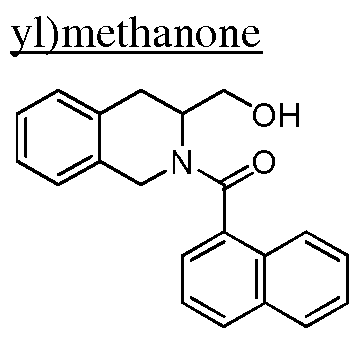
To a solution of DL-(l ,2,3,4-Tetrahydroisoquinolin-3-yl)methanol (0.816 g, 55 mmol) in DCM was added 1-naphthoyl chloride (0.908 mL, 6 mmol), and triethylamine (1.36 mL, 10 mmol) and the mixture was stirred for 12 h. The reaction mixture was washed with HQ (2 N), saturated sodium bicarbonate solution and brine. The organic phase was separated, dried over anhydrous MgSC and the solvent was removed under reduced pressure. The residue was then purified by flash chromatography on silica gel (ethyl acetate/hexanes) to give the title compound as light brown microcrystals (78.8%). HRMS calculated for C21H19NO2 (M+H)+ : 318.14885, Found: 318.1491. Step 3: (3-((|T ,r-Biphenyl1-4-yloxy)methyl)-3 ,4-dihydroisoquinolin-2(lH)- yl)(naphthalen- 1 -yPmethanone
To a solution of (3-(hydroxymethyl)-3,4-dihydroisoquinolin-2(lH)-yl)(naphthalen- l - yl)methanone (0.317 g, 1 mmol), triphenylphosphine (0.288 g, 1.1 mmol), and [Ι ,Γ-
biphenyl]-4-ol (0.170 g, 1 mmol) in dry THF (2 mL) at 0°C was added DIAD (0.216 mL, 1.1 mmol) dropwise. The mixture was stirred at ambient temperature overnight. The solvent was evaporated and the residue was then purified by preparative HPLC to give the title compound as a white microcrystals. MS (ESI) 470 (M + H).
( )-Naphthalen- l-yl(3-((4-(trimethyl-λ4-azanyl)phenoxy)methyl)-3.4-

The title compound was prepared following the same general protocol as described for compound 11, using (5)-(3-(hydroxymethyl)-3,4-dihydroisoquinolin-2(lH)- yl)(naphthalen-l-yl)methanone and 4-(trimethyl^4-azanyl)phenol; MS (ESI) 452 (M + Η).
( )-(3-((4-(tert-Butyl)phenoxy)methyl)-3 ,4-dihvdroisoquinolin-2(lH)-yl)(naphthalen-

The title compound was prepared following the same general protocol as described for compound 11, using (5)-(3-(hydroxymethyl)-3,4-dihydroisoquinolin-2(lH)- yl)(naphthalen-l-yl)methanone and 3-isopropylphenol; MS (ESI) 450 (M + Η). ( )-(3-((3-Isopropylphenoxy)methyl)-3,4-dihydroisoquinolin-2(lH)-yl)(naphthalen-l -


The title compound was prepared following the same general protocol as described for compound 11, using (5)-(3-(hydroxymethyl)-3,4-dihydroisoquinolin-2(lH)- yl)(naphthalen-l-yl)methanone and 3-fluorophenol; MS (ESI) 412 (M + Η).
( )-(3-((4-(Dimethylamino)phenoxy)methyl)-3,4-dihydroisoquinolin-2(lH)- yl)(naphthalen- 1 -yPmethanone (16)

The title compound was prepared following the same general protocol as described for compound 11, using (5)-(3-(hydroxymethyl)-3,4-dihydroisoquinolin-2(lH)- yl)(naphthalen-l-yl)methanone and 4-(dimethylamino)phenol; MS (ESI) 437 (M +
Η).
( )-(3-((4-(Diethylamino)phenoxy)methyl)-3 ,4-dihvdroisoquinolin-2(lH)- yl)(naphthalen- 1 -yPmethanone (17)


The title compound was prepared following the same general protocol as described for compound 11, using (5)-(3-(hydroxymethyl)-3,4-dihydroisoquinolin-2(lH)- yl)(naphthalen-l-yl)methanone and 4-nitrophenol; MS (ESI) 439 (M + Η).
-4-((2-(l-Naphthoyl)-l ,2,3,4-tetrahvdroisoquinolin-3-yl)methoxy)benzonitrile (19)

The title compound was prepared following the same general protocol as described for compound 11, using (5)-(3-(hydroxymethyl)-3,4-dihydroisoquinolin-2(lH)- yl)(naphthalen-l-yl)methanone and 4-hydroxybenzonitrile; MS (ESI) 419 (M + Η). ( )-Naphthalen- l-yl(3-((p-tolyloxy)methyl)-3,4-dihydroisoquinolin-2(lH)-

The title compound was prepared following the same general protocol as described for compound 11, using (5)-(3-(hydroxymethyl)-3,4-dihydroisoquinolin-2(lH)- yl)(naphthalen-l-yl)methanone and p-cresol; MS (ESI) 408 (M + Η).
(S)-(3-((4-Ethylphenoxy)methyl)-3 ,4-dihydroisoquinolin-2(lH)-yl)(naphthalen-l- yPmethanone (21)

The title compound was prepared following the same general protocol as described for compound 11, using (5)-(3-(hydroxymethyl)-3,4-dihydroisoquinolin-2(lH)- yl)(naphthalen-l-yl)methanone and 4-ethylphenol; MS (ESI) 422 (M + Η).
( )-(3-((4-Isopropylphenoxy)methyl)-3,4-dihydroisoquinolin-2(lH)-yl)(naphthalen-l - vDmethanone (22)

The title compound was prepared following the same general protocol as described for compound 11, using (5)-(3-(hydroxymethyl)-3,4-dihydroisoquinolin-2(lH)- yl)(naphthalen-l-yl)methanone and 4-isopropylphenol; MS (ESI) 436 (M + Η).
( )-(3-((4-cyclohexylphenoxy)methyl)-3,4-dmydroisoquinolin-2(lH)-yl)(naphthalen-

The title compound was prepared following the same general protocol as described for compound 11, using (5)-(3-(hydroxymethyl)-3,4-dihydroisoquinolin-2(lH)- yl)(naphthalen-l-yl)methanone and 4-cyclohexylphenol; MS (ESI) 476 (M + Η). ( SVtert-Butyl 4-(4-((2-(l-naphthoyl)- 1 ,2,3,4-tetrahydroisoquinolin-3- yl)methoxy)phenyl)piperidine- 1 -carboxylate (24)

The title compound was prepared following the same general protocol as described for compound 11, using (5)-(3-(hydroxymethyl)-3,4-dihydroisoquinolin-2(lH)- yl)(naphthalen-l-yl)methanone and tert-butyl 4-(4-hydroxyphenyl)piperidine-l - carboxylate; MS (ESI) 577 (M + Η).
(S)-(3-(((lH-Indol-6-yl)oxy)methyl)-3.4-d ^

The title compound was prepared following the same general protocol as described for compound 11, using (5)-(3-(hydroxymethyl)-3,4-dihydroisoquinolin-2(lH)- yl)(naphthalen-l-yl)methanone and lH-indol-6-ol; MS (ESI) 433 (M + Η).
( )-(3-(((lH-Indol-5-yl)oxy)methyl)-3,4-dmydroisoquinolin-2(lH)-yl)(naphthalen- l - vDmethanone (26)

The title compound was prepared following the same general protocol as described for compound 11, using (5)-(3-(hydroxymethyl)-3,4-dihydroisoquinolin-2(lH)- yl)(naphthalen-l-yl)methanone and lH-indol-5-ol; MS (ESI) 433 (M + Η).
( )-(3-((Benzofuran-5-yloxy)methyl)-3,4-dihydroisoquinolin-2(lH)-yl)(naphthalen-l - yPmethanone (27)

The title compound was prepared following the same general protocol as described for compound 11, using (5)-(3-(hydroxymethyl)-3,4-dihydroisoquinolin-2(lH)- yl)(naphthalen-l-yl)methanone and benzofuran-5-ol; MS (ESI) 434 (M + Η).
( )-Naphthalen- l-yl(3-(((5-(triiluoromethyl)pyridin-2-yl)oxy)methyl)-3,4-

To a solution of (5)-(3-(hydroxymethyl)-3,4-dihydroisoquinolin-2(lH)- yl)(naphthalen-l-yl)methanone (31.74 mg, 0.1 mmol) in DMF (1 mL) was added NaH (95%) (7.2 mg, 0.3 mmol) under argon. 2-Chloro-5-(trifluoromethyl)pyridine (19.06 mg, 0.105 mmol) was then added and the reaction mixture was heated to 40 °C for 2h.
Water was added (5 mL) and the solution was extracted with EtOAc (3 x 10 mL).
EtOAc was dried using MgS04 and the solvent was evaporated in vacue. The residue was then purified by flash column chromatography using EtOAc/Hexanes (1 :4) to give the title compound; MS (ESI) 463 (M + H).
( )-6-((2-(l-Naphthoyl)-l ,2,3,4-tetrahydroisoquinolin-3-yl)methoxy)nicotinonitrile

The title compound was prepared following the same general protocol as described for compound 28, using (5)-(3-(hydroxymethyl)-3,4-dihydroisoquinolin-2(lH)- yl)(naphthalen-l-yl)methanone and 6-chloronicotinonitrile; MS (ESI) 420 (M + Η).
( )-(3-(((5-Fluoropyridin-2-yl)oxy)methyl)-3^-dmydroisoquinolin-2(lH)- yl)(naphthalen- 1 - vDmethanone (30)

The title compound was prepared following the same general protocol as described for compound 28, using (5)-(3-(hydroxymethyl)-3,4-dihydroisoquinolin-2(lH)- yl)(naphthalen-l-yl)methanone and 2-chloro-5-iluoropyridine; MS (ESI) 413 (M +
Η).
( )-Naphthalen- l-yl(3-((pyridin-2-yloxy)methyl)-3,4-dmydroisoquinolin-2(lH)- vDmethanone (31)

The title compound was prepared following the same general protocol as described for compound 11, using (5)-(3-(hydroxymethyl)-3,4-dihydroisoquinolin-2(lH)- yl)(naphthalen-l-yl)methanone and pyridin-2-ol; MS (ESI) 395 (M + Η).
( )-Naphthalen- l-yl(3-((pyridin-4-yloxy)methyl)-3,4-dmydroisoquinolin-2(lH)-

The title compound was prepared following the same general protocol as described for compound 11, using (5)-(3-(hydroxymethyl)-3,4-dihydroisoquinolin-2(lH)- yl)(naphthalen-l-yl)methanone and pyridin-4-ol; MS (ESI) 395 (M + Η).
(S)-Naphthalen- l-yl(3-((pyridin-3-yloxy)methyl)-3,4-dmydroisoquinolin-2(lH)- yPmethanone (33)

The title compound was prepared following the same general protocol as described for compound 11, using (5)-(3-(hydroxymethyl)-3,4-dihydroisoquinolin-2(lH)- yl)(naphthalen-l-yl)methanone and pyridin-3-ol; MS (ESI) 395 (M + Η).
( )-(3-(((5-Methoxypyrimidin-2-yl)oxy)methyl)-3 ,4-dihvdroisoquinolin-2(lH)-

The title compound was prepared following the same general protocol as described for compound 28, using (5)-(3-(hydroxymethyl)-3,4-dihydroisoquinolin-2(lH)- yl)(naphthalen-l-yl)methanone and 2-chloro-5-methoxypyrimidine; MS (ESI) 426 (M + Η).
( )-(3-(((5-Isopropoxypyrimidin-2-yl)oxy)methyl)-3,4-dmydroisoquino^n-2(lΗ)-

The title compound was prepared following the same general protocol as described for compound 28, using (5)-(3-(hydroxymethyl)-3,4-dihydroisoquinolin-2(lH)- yl)(naphthalen-l -yl)methanone and 2-chloro-5-isopropoxypyrimidine; MS (ESI) 454 (M + Η).
( )-Naphthalen- l-yl(3-((phenylthio)methyl)-3.4-dmydroisoquinolin-2(lH)- yPmethanone (36)

The title compound was prepared following the same general protocol as described for compound 11, using (5)-(3-(hydroxymethyl)-3,4-dihydroisoquinolin-2(lH)- yl)(naphthalen-l-yl)methanone and benzenethiol; MS (ESI) 410 (M + Η).
( )-Naphthalen- l-yl(3-((p-tolylthio)methyl)-3,4-dmydroisoquinolin-2(lH)-

The title compound was prepared following the same general protocol as described for compound 11, using (5)-(3-(hydroxymethyl)-3,4-dihydroisoquinolin-2(lH)- yl)(naphthalen-l-yl)methanone and 4-methylbenzenethiol; MS (ESI) 424 (M + Η). ( )-6-((2-(3,4-Dichlorobenzoyl)- l ,2,3,4-tetrahydroisoquinolin-3-

Step 1 : ( )-(3,4-Dichlorophenyl)(3-(hvdroxymethyl)-3,4-dihvdroisoquinolin-2(lH)-

Step 2: ( )-6-((2-(3.4-Dichlorobenzoyl)-l .2.3.4-tetrahydroisoquinolin-3- yl)methoxy)nicotinonitrile
The title compound was prepared following the same general protocol as described for compound 28, using (S)-(3,4-dichlorophenyl)(3-(hydroxymethyl)-3,4- dihydroisoquinolin-2(lH)-yl)methanone and 6-chloronicotinonitrile; MS (ESI) 438 (M + Η).
( )-(3.4-Dichlorophenyl)(3-(((5-nitropyridin-2-yl)oxy)methyl)-3.4-

The title compound was prepared following the same general protocol as described for compound 28, using (5)-(3,4-dichlorophenyl)(3-(hydroxymethyl)-3,4- dihydroisoquinolin-2(lH)-yl)methanone and 2-chloro-5-nitropyridine; MS (ESI) 459 (M + Η).
( )-(3,4-Dichlorophenyl)(3-(((5-methoxypyrimidin-2-yl)oxy)methyl)-3,4-

The title compound was prepared following the same general protocol as described for compound 28, using (5)-(3,4-dichlorophenyl)(3-(hydroxymethyl)-3,4- dihydroisoquinolin-2(lH)-yl)methanone and 2-chloro-5-methoxypyrimidine; MS (ESI) 444 (M + Η).
(S)-(3,4-Dichlorophenyl)(3-(((5 sopropoxypyrimidm^

The title compound was prepared following the same general protocol as described for compound 28, using (S)-(3,4-dichlorophenyl)(3-(hydroxymethyl)-3,4- dihydroisoquinolin-2(lH)-yl)methanone and 2-chloro-5-isopropoxypyrimidine; MS (ESI) 472 (M + Η).
( )-(3-Chlorophenyl)(3-(((5-isopropoxypyrimidin-2-yl)oxy)methyl)-3,4-

The title compound was prepared following the same general protocol as described for compound 28, using (5)-(3-chlorophenyl)(3-(hydroxymethyl)-3,4- dihydroisoquinolin-2(lH)-yl)methanone and 2-chloro-5-isopropoxypyrimidine; MS (ESI) 438 (M + Η).
( )-Benzordlthiazol-5-yl(3-(phenoxymethyl)-3 ,4-dihydroisoquinolin-2(lH)-

The title compound was prepared following the same general protocol as described for compound 11, using (5)-benzo[d]thiazol-5-yl(3-(hydroxymethyl)-3,4- dihydroisoquinolin-2(lH)-yl)methanoneand phenol; MS (ESI) 401 (M + H).
(S)-(lH-Benzord1imidazol-5-yl)(3-(phenoxymethyl)-3 ,4^
vDmethanone (44)

The title compound was prepared following the same general protocol as described for compound 11, using (S)-(lH-benzo[d]imidazol-5-yl)(3-(hydroxymethyl)-3,4- dihydroisoquinolin-2(lH)-yl)methanoneand phenol; MS (ESI) 384 (M + Η).
( )-(3-((4-(tert-Butoxy)phenoxy)methyl)-6-fluoro-3,4-dihvdroisoquinolin-2(lH)-

Step 1 : ( )-6-Fluoro-l ,2,3 ,4-tetrahvdroisoquinoline-3-carboxylic acid

To a suspension of 3-fiuoro-L-phenylalanine (5 g) in cone. HCl (50 mL) was added aq. formaldehyde solution (37% wt.; 20 mL). The reaction mixture was heated to 90 °C and stirred for 5 h, then cooled to room temperature and filtered to give the title compound, which was used without further purification. MS (ESI) 196.1 (M + H).
-(6-Fluoro-l,2,3,4-tetrahydroisoquinolin-3-yl)methanol
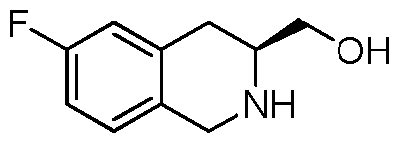
The title compound was prepared following the same general protocol as described for compound 13, step 1. MS (ESI) 182 (M + H).
Step 3: ( )-(6-Fluoro-3-(hydroxymethyl)-3 ^-dihydroisoquinolin-2(lH)- yl)(naphthalen- 1 - vDmethanone

The title compound was prepared following the same general protocol as described for compound 13, step 2. MS (ESI) 336 (M + Η).
Step 4: ( )-(3-((4-(tert-Butoxy)phenoxy)methyl)-6-iluoro-3,4-dihydroisoquinolin- 2(lH)-yl)(naphthalen- 1 -vDmethanone
The title compound was prepared following the same general protocol as described for compound 11 (step 3), using (S)-(6-fluoro-3-(hydroxymethyl)-3,4- dihydroisoquinolin-2(lH)-yl)(naphthalen-l-yl)methanone and 4-(tert-butoxy)phenol; MS (ESI) 484 (M + Η).
( )-(6-Fluoro-3-(((5-isopropoxypyrimidin-2-yl)oxy)methyl)-3,4-dmydroisoquinolin- -yl)(naphthalen- 1 -vDmethanone (46)

The title compound was prepared following the same general protocol as described for compound 28, using (5)-(6-fluoro-3-(hydroxymethyl)-3,4-dihydroisoquinolin- 2(lH)-yl)(naphthalen- l -yl)methanone and 2-chloro-5-isopropoxypyrimidine; MS (ESI) 472 (M + Η).
( )-(3-((4-(tert-Butoxy)phenoxy)methyl)-6-fluoro-3,4-dihydroisoquinolin-2(lH)-


The title compound was prepared following the same general protocol as described for compound 8, using (5)-(6-fluoro-l ,2,3,4-tetrahydroisoquinolin-3-yl)methanol and benzaldehyde; MS (ESI) 272 (M + H).
Step 2: ( )-2-Benzyl-3-((4-(tert-butoxy)phenoxy)methyl)-6-fluoro-l,2,3,4-

The title compound was prepared following the same general protocol as described for compound 11 (step 3), using (5)-(6-fluoro-3-(hydroxymethyl)-3,4- dihydroisoquinolin-2(lH)-yl)(naphthalen-l-yl)methanone and 4-(tert-butoxy)phenol; MS (ESI) 420 (M + Η).
Step 3: (5)-3-((4-(tert-Butoxy)phenoxy)methyl)-6-fluoro-l ,2,3,4-

(5)-2-Benzyl-3-((4-(tert-butoxy)phenoxy)methyl)-6-fluoro-l , 2,3,4- tetrahydroisoquinoline (0.042 g, 0.1 mmol) was dissolved in MeOH and Pd(OH)2 (5.7 mg, 0.04 mmol) was added and the reaction was stirred at room temperature under hydrogen for 2 h. The reaction mixture was filtered on a pad of celite to give the title compound; MS (ESI) 330 (M + H).
Step 4: ( )-(3-((4-(tert-Butoxy)phenoxy)methyl)-6-fluoro-3^-dihydroisoquinolin- 2(lH)-yl)(3,4-dichlorophenyl)methanone
The title compound was prepared following the same general protocol as described for compound 2, using 3,4-dichlorobenzoyl chloride instead of phenyl chloro formate; MS (ESI) 503 (M + 2).
( )-(3,4-Dichlorophenyl)(6-fluoro-3-(((5-isopropoxypyrimidin-2-yl)oxy)methyl)-3 ,4-

The title compound was prepared following the same general protocol as described for compound 28, using (5)-(3,4-dichlorophenyl)(6-fiuoro-3-(hydroxymethyl)-3,4- dihydroisoquinolin-2(lH)-yl)methanoneand 2-chloro-5-isopropoxypyrimidine; MS (ESI) 491 (M + 2).
(S)-N-((2-(l -NaphthoyD- 1 ,2,3 ,4-tetrahydroisoquinolin-3-yl)methyl)- 1 -methyl- 1H- pyrrole-2-carboxamide (49)

Step 1 : (S)-2-((2-(l -Naphthoyl)-l .2.3.4-tetrahvdroisoquinolin-3- yl)methyl)isoindoline- 1 ,3-dione

Step 2: ( )-(3-(Aminomethyl)-3.4-dihydroisoquinolin-2(lH)-yl)(naphthalen- l-

(5)-2-((2-(l-Naphthoyl)-l ,2,3,4-tetrahydroisoquinolin-3-yl)methyl)isoindoline- l ,3- dione (0.089 g, 0.2 mmol), was dissolved in methanol (5 mL) and hydrazine monhydrate (0.032 mL, 0.6 mmol) was added dropwise. After the reaction was completed, the solvent was evaporated to dryness under reduced pressure and the residue was purified by preparative HPLC to give the title compound; MS (ESI) 317 (M + H).
Step 3 : ( S)-N-( ( 2-( 1 -Naphthoyl)- 1 ,2,3 ,4-tetrahydroisoquinolin-3-yl)methyl)- 1 -methyl- lH-pyrrole-2-carboxamide
To a solution of (5)-(3-(aminomethyl)-3,4-dihydroisoquinolin-2(lH)-yl)(naphthalen- 1 -yl)methanone (15 mg) in CH2CI2 (lmL) was added diisopropylethylamine (17 μί) followed by 1 -methyl- l H-pyrrole-2-carboxylic acid (7 mg) and HATU (52 mg). After stirring at room temperature for 18h, the reaction was diluted with EtOAc and sat aq NaHCC>3, and the layers were separated. The organic layer was washed with sat aq NaHC03 (2x), 1M HC1 (2x), brine (lx), dried (MgS04), and concentrated to give the title compound. This crude residue was purified by chromatography on silica gel (EtOAc/hexanes) to afford (5)-N-((2-(l -naphthoyl)- l,2,3,4-tetrahydroisoquinolin-3- yl)methyl)-l -methyl- lH-pyrrole-2-carboxamide. MS (ESI) 424 (M+).
( )-N-((2-(l -Naphthoyl)- l ,2,3,4-tetrahydroisoquinolin-3-yl)methyl)pyrazine-2- carboxamide (50)

The title compound was prepared following the same general protocol as described for compound 49, using (5)-(3-(aminomethyl)-3,4-dihydroisoquinolin-2(lH)- yl)(naphthalen-l-yl)methanone and pyrazine-2-carboxylic acid; MS (ESI) 423 (M + Η).
(S)-N-((2-(l -Naphthoyl)- 1.2.3.4-tetrahydroisoquinolin-3-yl)methyl)-2- methoxybenzamide (51)

The title compound was prepared following the same general protocol as described for compound 49, using (5)-(3-(aminomethyl)-3,4-dihydroisoquinolin-2(lH)- yl)(naphthalen-l-yl)methanone and 2-methoxybenzoic acid; MS (ESI) 451 (M + Η). ( )-l -((2-(l-Naphthoyl)-1.2.3.4-tetrahydroisoquinolin-3-yl)methyl)-3-isopropylurea

The title compound was prepared following the same general protocol as described for compound 2, using (5)-(3-(aminomethyl)-3 ,4-dihydroisoquinolin-2(lH)- yl)(naphthalen-l-yl)methanone and 2-isocyanatopropane; MS (ESI) 402 (M + Η).
MethvU ) -((2-(l -naphthoyl) 23^-tetrahvdroisoquinolin-3-yl)methyl) H- 1.2.3-

Step 1 : (S)-(3-(Azidomethvi)-3 ,4-dihvdroisoquinolin-2(lH)-yl)(naphthalen-l - yPmethanone

To a solution of (5)-(3-(hydroxymethyl)-3,4-dihydroisoquinolin-2(lH)- yl)(naphthalen-l-yl)methanone (0.180 g, 0.567 mmol, 1 equiv.) in dry THF (0.8 mL) was added PPI13 (0.180, 0.681 mmol, 1.2 equiv.) and the reaction mixture was stirred in ice bath for 10 min. Diisopropyl azodicarboxylate (0.133 mL, 0.681 mmol, 1.2 equiv.) was added dropwise and the solution was stirred further for 10 min. in the ice bath. Diphenylphosphoryl azide (0.188 mL, 0.851 , 1.5 equiv.) was added slowly at 0 C and the reaction was warmed to room temperature and stirred overnight. The solvent was evaporated and the residue was purified by preparative HPLC to give the title compound; MS (ESI) 343 (M + H).
Step 2: Methyl ( )-l-((2-(l-naphthoyl)-l ,2,3,4-tetrahydroisoquinolin-3-yl)methyl)- lH-1 ,2,3-triazole-4-carboxylate
(S)-(3-(Azidomethyl)-3 ,4-dihydroisoquinolin-2(lH)-yl)(naphthalen-l -yl)methanone (0.036 g, 0.105 mmol), methyl propiolate (0.010 mL, 0.116 mmol), CuS04- 5H20 (1 mg, 0.005 mmol) and sodium ascorbate (2 mg, 0.01 mmol) were suspended in a mixture of t-BuOH-EkO (1 :3, 0.4 mL). The reaction mixture was stirred at r.t. for 12 h. The product was extracted with CH2CI2 (3 x 10 mL), the combined organic layers were dried over MgSC>4. The crude product was purified using flash column chromatography (hexanes-EtOAc) to provide the title compound; MS (ESI) 427 (M + H).
( )-(3-((4-Isopropyl-l H-1.2.3-triazol-l -yl)methyl)-3.4-dihvdroisoquinoUn-2(lH)-

The title compound was prepared following the same general protocol as described for compound 53, using (S)-(3-(azidomethyl)-3,4-dihydroisoquinolin-2(lH)- yl)(naphthalen-l -yDmethanone and 3-methylbut-l -yne; MS (ESI) 411 (M + Η). ( S)-( 3-( ( 4-(Methoxymethyl)- 1H- 1 ,2,3-triazol- 1 -yl)methyl)-3,4-dihvdroisoquinolin- 2(lH)-yl)(naphthalen- 1 -yDmethanone (55)

The title compound was prepared following the same general protocol as described for compound 53, using (S)-(3-(azidomethyl)-3,4-dihydroisoquinolin-2(lH)- yl)(naphthalen-l -yDmethanone and 3-methoxyprop-l-yne; MS (ESI) 413 (M + Η).

The title compound was prepared following the same general protocol as described for compound 11, using isoindoline-l -carboxylic acid instead of DL-l , 2,3,4- tetrahydroisoquinoline-3-carboxylic acid; MS (ESI) 452 (M + Η).
1 -((4-(tert-Butoxy)phenoxy)methyl)-2-(naphthalen- l-ylmethyDisoindoline (57)

Step 1 : 2-(Naphthalen-l-ylmethyl)isoindoline-l-carboxylic acid

l-(Bromomethyl)naphthalene (0.265 g, 1.2 mmol) was added to a mixture of isoindoline-l-carboxylic acid (0.163 g, 1 mmol) and KOH (0.168 g, 3 mmol) in isopropyl alcohol (50 mL). The mixture was heated to 80 °C overnight, cooled, and acidified to pH = 5-6. The product was precipitated as a white powder which was filtered and dried; MS (ESI) 304 (M + H).
-(Naphthalen-l-ylmethyl)isoindolin-l-yl)methanol
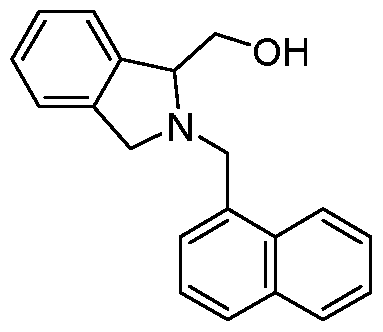
To a suspension of 2-(naphthalen-l -ylmethyl)isoindoline-l-carboxylic acid (0.303 g, 1 mmol) in THF (2 mL) at 0 °C was added borane dimethylsulfide (0.113 mL, 1.2 mmol) dropwise. The ice bath was removed and the reaction mixture was allowed to stir at room temperature overnight. The reaction mixture was cooled down to 0 °C and MeOH was added dropwise to quench the reaction. The mixture was stirred at room temperature for further 1 h, solvent was evaporated and the residue was purified by flash column chromatography using EtOAc/Hexanes (1 :2) to give the title compound in near quantitative yield, MS (ESI) 290 (M + H).
Step 3 : 1 -((4-(tert-Butoxy)phenoxy)methyl)-2-(naphfhalen- 1 - ylmethvDisoindoline
The title compound was prepared following the same general protocol as described for compound 11 (step 3), using (2-(naphthalen- l -ylmethyl)isoindolin- l-yl)methanol and 4-(tert-butoxy)phenol; MS (ESI) 452 (M + H).
( )-(3-((4-(tert-Butoxy)phenoxy)methyl)-3.4-dihydroisoquinolin-2(lH)-

Step 1 : ( )-2-Benzyl- l ,2,3,4-tetrahvdroisoquinoline-3-carboxylic acid
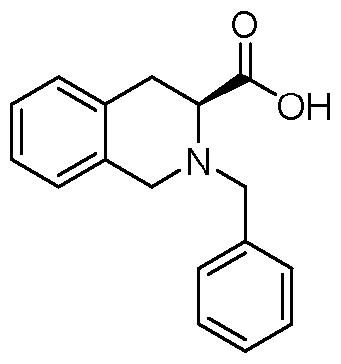
Benzyl bromide (2.05 g, 12 mmol) was added to a mixture of (5)-l , 2,3,4- tetrahydroisoquinoline-3-carboxylic acid (1.77 g, 10 mmol) and ΚΟΗ (1.68 g, 30 mmol) in isopropyl alcohol (50 mL). The mixture was heated to 80 °C overnight, cooled, and acidified to pH = 5-6. The product was precipitated as a white powder which was filtered and dried; MS (ESI) 268 (M + H).
-(2-Benzyl- 1 ,2,3,4-tetrahydroisoquinolin-3-yl)methanol

To a suspension of (5)-2-benzyl- l ,2,3,4-tetrahydroisoquinoline-3-carboxylic acid (0.80 g, 3 mmol) in THF (5 mL) at 0 °C was added borane dimethylsulfide (0.34 mL, 3.6 mmol) dropwise. The ice bath was removed and the reaction mixture was allowed to stir at room temperature overnight. The reaction mixture was cooled down to 0 °C and MeOH was added dropwise to quench the reaction. The mixture was stirred at room temperature for further 1 h, solvent was evaporated and the residue was purified by flash column chromatography using EtOAc/Hexanes (1 :2) to give the title compound in near quantitative yield, MS (ESI) 254 (M + H).
Step 3: ( )-2-Benzyl-3-((4-(tert-butoxy)phenoxy)methyl)-l , 2,3,4- tetrahydroisoquinoline

The title compound was prepared following the same general protocol as described for compound 11 (step 3), using (S)-(2-benzyl- l ,2,3,4-tetrahydroisoquinolin-3- yl)methanol and 4-(tert-butoxy)phenol; MS (ESI) 402 (M + H).
)phenoxy)methyl)- l ,2,3,4-tetrahydroisoquinoline

(5)-2-Benzyl-3-((4-(tert-butoxy)phenoxy)methyl)- l,2,3,4-tetrahydroisoquinoline (0.803 g, 2 mmol) was dissolved in MeOH and Pd(OH)2 (57 mg, 0.4 mmol) was added and the reaction was stirred at room temperature under hydrogen for 2 h. The reaction mixture was filtered on a pad of celite to give the title compound; MS (ESI) 313 (M + H).
Step 5: ( )-(3-((4-(tert-Butoxy)phenoxy)methyl)-3,4-dihydroisoquinolin-2(lH)- yl)(phenyl)methanone
Benzoyl chloride (0.026 mL, 0.12 mmol) was added dropwise to a solution of (5)-3- ((4-(tert-butoxy)phenoxy)methyl)- 1 , 2,3, 4-tetrahydroisoquino line (0.031 g, 1 mmol) and N,N-diisopropylethylamine (0.348 mL, 2 mmol) in DCM (2 mL). The reaction mixture was stirred at room temperature for 2 h, solvent was evaporated and the residue was purified by flash column chromatography using EtOAc/Hexanes (1 :3) to give the title compound; MS (ESI) 416 (M + H).
(S)-(3-((4-(tert-Butoxy)phenoxy)methyl)-3,4-dihydroisoquinolin-2(lH)-yl)(4- methoxyphenvDmethanone (59)

The title compound was prepared following the same general protocol as described for compound 58, using (S)-3-((4-(tert-Butoxy)phenoxy)methyl)- l ,2,3,4- tetrahydroisoquinoline and 4-methoxybenzoyl chloride; MS (ESI) 446 (M + H). ( )-(3-((4-(tert-Butoxy)phenoxy)methyl)-3 ,4-dihydroisoquinolin-2(lH)-yl)(2-

The title compound was prepared following the same general protocol as described for compound 58, using (S)-3-((4-(tert-Butoxy)phenoxy)methyl)- l ,2,3,4- tetrahydroisoquinoline and 2-chlorobenzoyl chloride; MS (ESI) 450 (M + Η). (S)-(3-((4-(tert-Butoxy)phenoxy)methyl)-3,4-dmydroisoquinolin-2(lH)-yl)(3-

The title compound was prepared following the same general protocol as described for compound 58, using (5)-3-((4-(tert-Butoxy)phenoxy)methyl)- l ,2,3,4- tetrahydroisoquinoline and 3-chlorobenzoyl chloride; MS (ESI) 450 (M + Η). ( )-(3-Bromophenyl)(3-((4-(tert-butoxy)phenoxy)methyl)-3,4-dihvdroisoquinolin- 2(lH)-yl)methanone (62)

The title compound was prepared following the same general protocol as described for compound 58, using (S)-3-((4-(tert-Butoxy)phenoxy)methyl)-l,2,3,4- tetrahydroisoquinoline and 3-bromobenzoyl chloride; MS (ESI) 495 (M + 2). ( )-(3-((4-(tert-Butoxy)phenoxy)methyl)-3,4-dihydroisoquinolin-2(lH)-yl)(4-

The title compound was prepared following the same general protocol as described for compound 58, using (5)-3-((4-(tert-Butoxy)phenoxy)methyl)-l,2,3,4- tetrahydroisoquinoline and 4-chlorobenzoyl chloride; MS (ESI) 450 (M + Η). ( )-(3-((4-(tert-Butoxy)phenoxy)methyl)-3,4-dihydroisoquinolin-2(lH)-yl)(3-

The title compound was prepared following the same general protocol as described for compound 58, using (5)-3-((4-(tert-Butoxy)phenoxy)methyl)-l,2,3,4- tetrahydroisoquinoline and 3-fluorobenzoyl chloride; MS (ESI) 434 (M + Η). ( )-(3-((4-(tert-Butoxy)phenoxy)methyl)-3,4-dihydroisoquinolin-2(lH)-yl)(2,3- dichlorophenyDmethanone (65)

The title compound was prepared following the same general protocol as described for compound 58, using (S)-3-((4-(tert-Butoxy)phenoxy)methyl)- l ,2,3,4- tetrahydroisoquinoline and 2,3-dichlorobenzoyl chloride; MS (ESI) 484 (M + H). ( )-(3-((4-(tert-Butoxy)phenoxy)methyl)-3 ,4-dihydroisoquinolin-2(lH)-yl)(3,4-

The title compound was prepared following the same general protocol as described for compound 58, using (S)-3-((4-(tert-Butoxy)phenoxy)methyl)- l ,2,3,4- tetrahydroisoquinoline and 3,4-dichlorobenzoyl chloride; MS (ESI) 484 (M + Η). ( )-(3-((4-(tert-Butoxy)phenoxy)methyl)-3 ,4-dihydroisoquinolin-2(lH)-yl)(3,5-

The title compound was prepared following the same general protocol as described for compound 58, using (5)-3-((4-(tert-Butoxy)phenoxy)methyl)- l ,2,3,4- tetrahydroisoquinoline and 3,5-dichlorobenzoyl chloride; MS (ESI) 484 (M + Η). ( )-(3-((4-(tert-Butoxy)phenoxy)methyl)-3 ,4-dihydroisoquinolin-2(lH)-yl)(3,4- difluorophenyDmethanone (68)

The title compound was prepared following the same general protocol as described for compound 58, using (S)-3-((4-(tert-Butoxy)phenoxy)methyl)- l ,2,3,4- tetrahydroisoquinoline and 3,4-difluorobenzoyl chloride; MS (ESI) 452 (M + H). ( )-3-(3-((4-(tert-Butoxy)phenoxy)methyl)-l ,2,3,4-tetrahydroisoquinoline-2-

The title compound was prepared following the same general protocol as described for compound 58, using (5)-3-((4-(tert-Butoxy)phenoxy)methyl)- l ,2,3,4- tetrahydroisoquinoline and 3-cyanobenzoyl chloride; MS (ESI) 441 (M + H).
( )-(3-((4-(tert-Butoxy)phenoxy)methyl)-3.4-dihydroisoquinolin-2(lH)-yl)(3-

The title compound was prepared following the same general protocol as described for compound 58, using (5)-3-((4-(tert-Butoxy)phenoxy)methyl)- l ,2,3,4- tetrahydroisoquinoline and 3-(trifluoromethoxy)benzoyl chloride; MS (ESI) 500 (M +
Η).
( )-(3-((4-(tert-Butoxy)phenoxy)methyl)-3 ,4-dihydroisoquinolin-2(lH)-yl)(furan-2- yPmethanone (71)

The title compound was prepared following the same general protocol as described for compound 58, using (S)-3-((4-(tert-Butoxy)phenoxy)methyl)-l,2,3,4- tetrahydroisoquinoline and fiiran-2-carbonyl chloride; MS (ESI) 406 (M + H). ( )-(3-((4-(tert-Butoxy)phenoxy)methyl)-3,4-dmydroisoquinolin-2(lH)-yl)(5-

The title compound was prepared following the same general protocol as described for compound 58, using (5)-3-((4-(tert-Butoxy)phenoxy)methyl)-l,2,3,4- tetrahydroisoquinoline and 5-(methylthio)thiophene-2-carbonyl chloride; MS (ESI) 468 (M + Η).
( )-(3-((4-(tert-Butoxy)phenoxy)methyl)-3.4-dihydroisoquinolin-2(lH)-yl)(5-

The title compound was prepared following the same general protocol as described for compound 58, using (5)-3-((4-(tert-Butoxy)phenoxy)methyl)-l,2,3,4- tetrahydroisoquinoline and 5-(methylsulfonyl)thiophene-2-carbonyl chloride; MS (ESI) 500 (M + Η).
( )-3-((4-(tert-Butoxy)phenoxy)methyl)-2-tosyl-1.2.3.4-tetrahydroisoquinoline (74)

The title compound was prepared following the same general protocol as described for compound 58, using (S)-3-((4-(tert-Butoxy)phenoxy)methyl)-l,2,3,4- tetrahydroisoquinoline and p-toluenesulfonyl chloride; MS (ESI) 466 (M + H). (S)-3-((4-(tert-Butoxy)phenoxy)methyl)-2-((4-(tert-butyl)phenyl)sulfonyl)-l , 2,3,4-

The title compound was prepared following the same general protocol as described for compound 58, using (5)-3-((4-(tert-Butoxy)phenoxy)methyl)-l,2,3,4- tetrahydroisoquinoline and 4-(tert-butyl)benzenesulfonyl chloride; MS (ESI) 508 (M + H).
(S)-3-((4-(tert-Butoxy)phenoxy)methyl)-2-(naphthalen- 1 -ylsulfonyl)- 1.2.3.4-

The title compound was prepared following the same general protocol as described for compound 58, using (5)-3-((4-(tert-Butoxy)phenoxy)methyl)-l,2,3,4- tetrahydroisoquinoline and naphthalene- 1-sulfonyl chloride; MS (ESI) 502 (M + H). (S)-3-((4-(tert-butoxy)phenoxy)methyl)-2-(thiophen-2-ylsulfonyl)-l,2,3,4- tetrahydroisoquinoline (77)

The title compound was prepared following the same general protocol as described for compound 58, using (S)-3-((4-(tert-Butoxy)phenoxy)methyl)-l,2,3,4- tetrahydroisoquinoline and thiophene-2-carbonyl chloride; MS (ESI) 458 (M + H).
noxy)methyl)-2-ethyl-l, 2,3, 4-tetrahydroisoquino line (78)

The title compound was prepared following the same general protocol as described for compound 8, using (5)-3-((4-(tert-Butoxy)phenoxy)methyl)- 1 ,2,3,4- tetrahydroisoquinoline and acetaldehyde; MS (ESI) 340 (M + H).
-2-Benzyl-3-((4-(tert-butoxy)phenoxy)methyl)- l,2,3,4-tetrahvdroisoquinoline (79)
The title compound was prepared following the same general protocol as described for compound 8, using (5)-3-((4-(tert-Butoxy)phenoxy)methyl)- 1 ,2,3,4- tetrahydroisoquinoline and benzaldehyde; MS (ESI) 402 (M + H).
( )-(2-((4-(fer?-Butoxy)phenoxy)methyl)pyrrolidin-l-yl)(naphthalen-l-yl)methanone £801

The title compound was prepared following the same general protocol as described for compound 11, using (S)-pyrrolidin-2-ylmethanol instead of DL-(1,2,3,4- Tetrahydroisoquinolin-3-yl)methanol (step 2); MS (ESI) 404 (M + H).
( )-(2-(((5-Methoxypyrimidin-2-yl)oxy)methyl)pyrrolidin-l-yl)(naphthalen-l-

The title compound was prepared following the same general protocol as described for compound 28, using (S)-pyrrolidin-2-ylmethanol and 2-chloro-5- methoxypyrimidine; MS (ESI) 364 (M + H).
( )-(2-((4-(tert-Butoxy)phenoxy)methyl)pyrrolidin-l-yl)(3-fluorophenyl)methanone

The title compound was prepared following the same general protocol as described for compound 11, using (S)-pyrrolidin-2-ylmethanol instead of DL-(1,2,3,4-
Tetrahydroisoquinolin-3-yl)methanol and 3-fiuorobenzoyl chloride instead of 1 - naphthoyl chloride(step 2); MS (ESI) 372 (M + H).
( )-(2-((4-(tert-Butoxy)phenoxy)methyl)pyrrolidin-l-yl)(3-

The title compound was prepared following the same general protocol as described for compound 11, using (S)-pyrrolidin-2-ylmethanol instead of DL-(1,2,3,4-
Tetrahydroisoquinolin-3-yl)methanol and 3- trifluoromethoxybenzoyl chloride instead of 1-naphthoyl chloride(step 2); MS (ESI) 438 (M + H).
( )-(3-Bromophenyl)(2-((4-(tert-butoxy)phenoxy)methyl)pyrrolidin-l -vDmethanone

The title compound was prepared following the same general protocol as described for compound 11, using (S)-pyrrolidin-2-ylmethanol instead of DL-(1,2,3,4- Tetrahydroisoquinolin-3-yl)methanol and 3- bromobenzoyl chloride instead of 1- naphthoyl chloride(step 2); MS (ESI) 433 (M + 2).
-(2-((4-(tert-Butoxy)phenoxy)methyl)pyrrolidin- 1 -yl)(p-tolyl)methanone (85)

( )-(2-((4-(tert-Butoxy)phenoxy)methyl)pyrrolidin- l-yl)(4-chlorophenyl)methanone

The title compound was prepared following the same general protocol as described for compound 11, using (S)-pyrrolidin-2-ylmethanol instead of DL-(1 ,2,3,4- Tetrahydroisoquinolin-3-yl)methanol and 4-chlorobenzoyl chloride instead of 1- naphthoyl chloride(step 2); MS (ESI) 389 (M + 2).
(R)-(2-((4-(tert-Butoxy)phenoxy)methyl)pyrrolidin- l-yl)(4-chlorophenyl)methanone
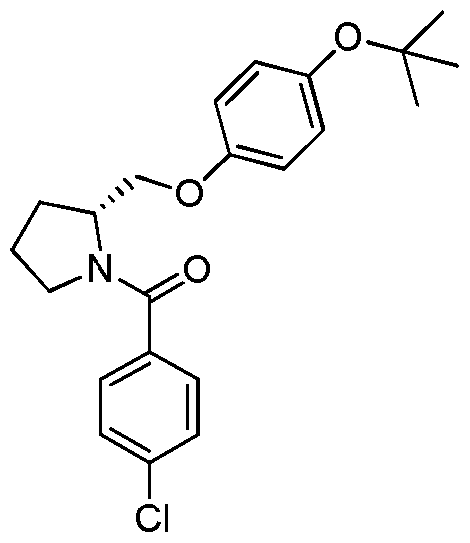
The title compound was prepared following the same general protocol as described for compound 11, using (R)-pyrrolidin-2-ylmethanol instead of DL-(1 ,2,3,4- Tetrahydroisoquinolin-3-yl)methanol and 4-chlorobenzoyl chloride instead of 1- naphthoyl chloride(step 2); MS (ESI) 389 (M + 2).
( )-(2-((4-(tert-Butoxy)phenoxy)methyl)pyrrolidin- l-yl)(3,4- dichlorophenvDmethanone (88)

The title compound was prepared following the same general protocol as described for compound 11, using (S)-pyrrolidin-2-ylmethanol instead of DL-(1,2,3,4- Tetrahydroisoquinolin-3-yl)methanol and 3,4-dichlorobenzoyl chloride instead of 1- naphthoyl chloride(step 2); MS (ESI) 421 (M + H).
( )-(3,4-Dichlorophenyl)(2-(((5-methoxypyrimidin-2-yl)oxy)methyl)pyrrolidin-l- vDmethanone (89)

The title compound was prepared following the same general protocol as described for compound 28, using (5)-(3,4-dichlorophenyl)(2-(hydroxymethyl)pyrrolidin-l - yl)methanone and 2-chloro-5-methoxypyrimidine; MS (ESI) 383 (M + 2).
enoxy)methyl)- 1 -tosylpyrrolidine (90)

The title compound was prepared following the same general protocol as described for compound 11, using (5)-pyrrolidin-2-ylmethanol instead of DL-(l , 2,3,4-
Tetrahydroisoquinolin-3-yl)methanol and p-toluenesulfonyl chloride instead of 1- naphthoyl chloride(step 2); MS (ESI) 404 (M + H).
( )-(l-(5-Methoxypyrirnidin-2-yl)pyrrolidin-2-yl)methyl 3,4-dichlorobenzoate (91)

Step 1 : ( )-(l-(5-Methoxypyrimidin-2-yl)pyrrolidin-2-yl)methanol
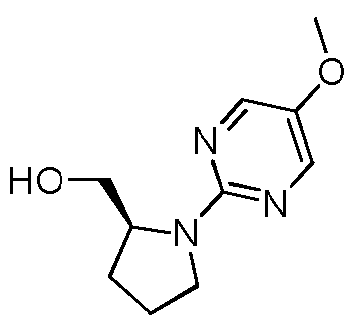
To a stirring solution of (5)-pyrrolidin-2-ylmethanol (0.202 g, 2 mmol) in THF (2 mL) was added iBuOK (1M in THF) (2 mL, 2 mmol) followed by 2-chloro-5- methoxypyrimidine (0.145 g, 1 mmol). The reaction mixture was stirred at rt for 2 h to give the title compound after purification on silica gel column; MS (ESI) 210 (M + H).
Step 2: ( )-(l-(5-Methoxypyrimidin-2-yl)pyrrolidin-2-yl)methyl 3.4-dichlorobenzoate The title compound was prepared following the same general protocol as described for compound 1 (step 2), using (5)-(l-(5-methoxypyrimidin-2-yl)pyrrolidin-2- yl)methanol and 3,4-dichlorobenzoic acid; MS (ESI) 382 (M + H).
-((4-(tert-Butoxy)phenoxy)methyl)piperidin- 1 -yl)(naphthalen- 1 -yPmethanone (92)

The title compound was prepared following the same general protocol as described for compound 11, using piperidin-2-ylmethanolinstead of DL-(l , 2,3,4- Tetrahydroisoquinolin-3-yl)methanol (step 2); MS (ESI) 418 (M + H).
( 1 -((4-(tert-buto xy)phenoxy)methyl)hexahydrocyclopentarclpyrro 1-2(1 H)-yl)(3 - chlorophenyDmethanone (93)
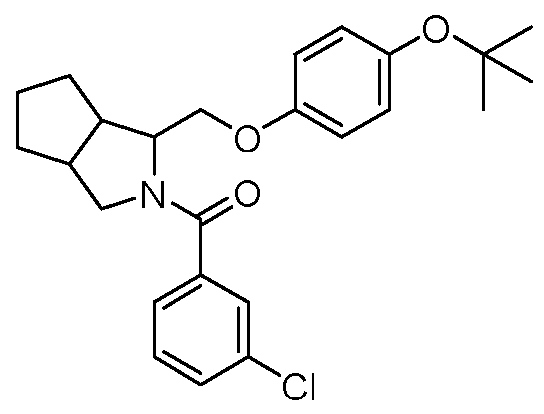
The title compound was prepared following the same general protocol as described for compound 11, using (octahydrocyclopenta[c]pyrrol-l-yl)methanol instead of DL- (l,2,3,4-Tetrahydroisoquinolin-3-yl)methanol and 3-chlorobenzoyl chloride instead of 1 -naphthoyl chloride(step 2); MS (ESI) 429 (M + 2).
(l-((4-(tert-Butoxy)phenoxy)methyl)hexahvdrocyclopentarclpyrrol-2(lH)-

The title compound was prepared following the same general protocol as described for compound 11, using (octahydrocyclopenta[c]pyrrol-l-yl)methanol instead of DL- (l,2,3,4-Tetrahydroisoquinolin-3-yl)methanol (step 2); MS (ESI) 444 (M + H).
(S)-(3-(((2-chlorobenzyl)oxy)methyl)-3.4-dihvdroisoquinolin-2(lH)-yl)(3.4-

To a solution of (S)-(3,4-dichlorophenyl)(3-(hydroxymethyl)-3,4-dihydroisoquinolin- 2(lH)-yl)methanone in DMF at 0°C was added NaH( 1.2eq). The reaction was stirred for 30min at 0°C and then quenched with 2-chlorobenzylbromide (2eq). The reaction was allowed to warm to room temperature and stirred an additional lh. The reaction was quenched by the addition of sat.aq.NH4d solution, and diluted with
EtOAc. The layers were separated, and the organic phase was washed with brine (2x), dried (MgSC ) and concentrated in vacuo. The crude residue was purified by chromatography on silica gel (EtO Ac/hex) to afford the title compound as an oil. MS (ESI) 462 (M + H).
(S)-(3.4-dicMorophenyl)(3-(((3.4-dimethoxybenzyl)oxy)methyl)-3.4-

The title compound was prepared following the same general protocol as described for Example 95 using (S)-(3,4-dichlorophenyl)(3-(hydroxymethyl)-3,4- dihydroisoquinolin-2(lH)-yl)methanone and 3, 4-dimethoxybenzyl bromide. MS (ESI) 487 (M + H).
(S)-(3-((benzordiri 1dioxol-5-ylmethoxy)methyl)-3,4-dihydroisoquinolin-2(lH)- -dichlorophenyl)methanone (97)

The title compound was prepared following the same general protocol as described for Example 95 using (S)-(3,4-dichlorophenyl)(3-(hydroxymethyl)-3,4- dihydroisoquinolin-2(lH)-yl)methanone and 5-(bromomethyl)benzo[d][l ,3]dioxole. MS (ESI) 471 (M + H).
(S)-4-(((2-(3,4-dichlorobenzoyl)-l ,2,3,4-tetrahydroisoquinolin-3- yl)methoxy)methyl)benzonitrile (98)

The title compound was prepared following the same general protocol as described for Example 95 using (S)-(3,4-dichlorophenyl)(3-(hydroxymethyl)-3,4- dihydroisoquinolin-2(lH)-yl)methanone and 4-cyanobenzyl bromide. MS (ESI) 452 (M + H).
(S)-(3,4-dichlorophenyl)(3-(((2-fluorobenzyl)oxy)methyl)-3 ,4-dihydroisoquinolin- -yl)methanone (99)

The title compound was prepared following the same general protocol as described for Example 95 using (S)-(3,4-dichlorophenyl)(3-(hydroxymethyl)-3,4- dihydroisoquinolin-2(lH)-yl)methanone and 2-fluorobenzyl bromide. MS (ESI) 445 (M + H).
(S)-(3-chlorophenyl)(3-(((5-methoxypyrimidin-2-yl)oxy)methyl)-3 ,4-

The title compound was prepared following the same general protocol as described for compound 42, (5)-(3-chlorophenyl)(3-(hydroxymethyl)-3,4-dihydroisoquinolin- 2(lH)-yl)methanone and 2-chloro-5-methoxypyrimidine; MS (ESI) 410 (M + Η).
Compounds 101-135 can be prepared by analogous procedures, in conjunction with ordinary skill and knowledge.
(S)-4-(6-fluoro-3-(((5-methylpyridin-2-yl)oxy)methyl)-1.2.3.4- tetrahvdroisoquinoline-2-carbonyl)benzonitrile (136)

Step 1 : (S)-2-benzyl-6-fluoro-3-(((5-methylpyridin-2-yl)oxy)methyl)- 1 ,2,3,4- tetrahydroisoquinoline

The title compound was prepared following the same general protocol as described for compound 28, using (S)-(2-Benzyl-6-fluoro-l,2,3,4-tetrahydroisoquinolin-3- yl)methanol and 2-fluoro-5-methylpyridine; MS (ESI) 363 (M + H).
Step 2: (S)-6-fluoro-3-(((5-methylpyridin-2-yl)oxy)methyl)- 1,2,3,4- tetrahydroisoquinoline

The title compound was prepared following the same general protocol as described for compound 47, using (S)-2-benzyl-6-fluoro-3-(((5-methylpyridin-2- yl)oxy)methyl)-l,2,3,4-tetrahydroisoquinoline; MS (ESI) 273 (M + H).
Step 3: (S -4-(6-fluoro-3-(((5-methylpyridin-2-yl)oxy)methyl)-l ,2,3,4- tetrahydroisoquinoline-2-carbonyl)benzonitrile
To a solution of (S)-6-fluoro-3-(((5-methylpyridin-2-yl)oxy)methyl)- 1 ,2,3,4- tetrahydroisoquinoline (40 mg, 0.147 mmol) in DMF ( 1 ml) was added HATU (112 mg, 0.294 mmol), DIPEA (0.064 ml, 0.367 mmol) and 4-cyanobenzoic acid (43.2 mg, 0.294 mmol). The reaction mixture was stirred at room temperature overnight. The solvent was evaporated and the residue was then purified by preparative HPLC to give the title compound as a white microcrystals. MS (ESI) 402 (M + H).
(S)-3-(6-fluoro-3-(((5-methylpyridin-2-yl)oxy)methyl)-l ,2,3,4- tetrahvdroisoquinoline-2-carbonyl)benzonitrile (137)

The title compound was prepared following the same general protocol as described for compound 136, using (S)-6-fluoro-3-(((5-methylpyridin-2-yl)oxy)methyl)-l,2,3,4- tetrahydroisoquinoline and 3-cyanobenzoic acid; MS (ESI) 402 (M + H).
(S)-(6-fluoro-3-(((5-methylpyridin-2-yl)oxy)methyl)-3,4-dmydroisoquinolin-2(lH)- yl)(pyridin-2-yl)methanone (138)

The title compound was prepared following the same general protocol as described for compound 136, using (S)-6-fluoro-3-(((5-methylpyridin-2-yl)oxy)methyl)-l,2,3,4- tetrahydroisoquinoline and picolinic acid; MS (ESI) 378 (M + H).
(S)-(6-fluoro-3-(((5-methylpyridin-2-yl)oxy)methyl)-3,4-dmydroisoquinolin-2(lH)- yl)(pyrazin-2-yl)methanone (139)

The title compound was prepared following the same general protocol as described for compound 136, using (S)-6-fluoro-3-(((5-methylpyridin-2-yl)oxy)methyl)-l,2,3,4- tetrahydroisoquinoline and pyrazine-2-carboxylic acid; MS (ESI) 379 (M + H). (S)-(4-(diethylamino)phenyl)(6-fluoro-3-(((5-methylpyridin-2-yl)oxy)methyl)-3,4- dihydroisoquinolin-2(lH)-yl)methanone (140)

The title compound was prepared following the same general protocol as described for compound 136, using (S)-6-fluoro-3-(((5-methylpyridin-2-yl)oxy)methyl)-l,2,3,4- tetrahydroisoquinoline and 4-(diethylamino)benzoic acid; MS (ESI) 448 (M + H). (S)-(6-fluoro-3-(((5-methylpyridin-2-yl)oxy)methyl)-3,4-dmydroisoquinolin-2(lH)- yl)(pyridin-3-yl)methanone (141)

The title compound was prepared following the same general protocol as described for compound 136, using (S)-6-fluoro-3-(((5-methylpyridin-2-yl)oxy)methyl)-l,2,3,4- tetrahydroisoquinoline and nicotinic acid; MS (ESI) 378 (M + H).
(S)-(6-fluoro-3-(((5-methylpyridin-2-yl)oxy)methyl)-3.4-dmydroisoquinolin-2(lH)- yl)(pyridin-4-yl)methanone (142)

The title compound was prepared following the same general protocol as described for compound 136, using (S)-6-fluoro-3-(((5-methylpyridin-2-yl)oxy)methyl)-l,2,3,4- tetrahydroisoquinoline and isonicotinic acid; MS (ESI) 378 (M + H).
(S)-(6-fluoro-3-(((5-methylpyridin-2-yl)oxy)methyl)-3.4-dmydroisoquinolin-2(lH)- yl)(lH-indol-2-yl)methanone (143)

The title compound was prepared following the same general protocol as described for compound 136, using (S)-6-fluoro-3-(((5-methylpyridin-2-yl)oxy)methyl)-l,2,3,4- tetrahydroisoquinoline and lH-indole-2-carboxylic acid; MS (ESI) 416 (M + H). (S)-(6-fluoro-3-(((5-methylpyridin-2-yl)oxy)methyl)-3,4-dmydroisoquinolin-2(lH)- yl)(lH-pyrrol-2-yl)methano

The title compound was prepared following the same general protocol as described for compound 136, using (S)-6-fluoro-3-(((5-methylpyridin-2-yl)oxy)methyl)-l,2,3,4- tetrahydroisoquinoline and lH-pyrrole-2-carboxylic acid; MS (ESI) 366 (M + H). (S)-(6-fluoro-3-(((5-methylpyridin-2-yl)oxy)methyl)-3,4-dmydroisoquinolin-2(lH)- yl)(lH-indol-3-yl)methanon

The title compound was prepared following the same general protocol as described for compound 136, using (S)-6-fluoro-3-(((5-methylpyridin-2-yl)oxy)methyl)-l,2,3,4- tetrahydroisoquinoline and lH-indole-3-carboxylic acid; MS (ESI) 416 (M + H). (S)-4-(6-fluoro-3-(((5-methylpyridin-2-yl)oxy)methyl)-1.2.3.4- tetrahvdroisoquinoline-2-carbonyl)benzoic acid (146)

The title compound was prepared following the same general protocol as described for compound 136, using (S)-6-fluoro-3-(((5-methylpyridin-2-yl)oxy)methyl)-l,2,3,4- tetrahydroisoquinoline and terephthalic acid; MS (ESI) 421 (M + H).
(S)-(6-fluoro-3-(((5-methylpyridin-2-yl)oxy)methyl)-3,4-dmydroisoquinolin-2(lH)-

To a solution of (S)-6-fluoro-3-(((5-methylpyridin-2-yl)oxy)methyl)- 1 ,2,3,4- tetrahydroisoquinoline (40 mg, 0.147 mmol) in THF ( 1 ml) was added DIPEA (0.051 ml, 0.294 mmol) and mo holine-4-carbonyl chloride (43.9 mg, 0.294 mmol). The mixture was stirred at room temperature overnight. Then the solvent was removed under reduced pressure. The residue was purified by flash chromatography on silica gel (ethyl acetate/hexanes) to give the title compound as white microcrystals. MS (ESI) 386 (M + H).
(S)-6-fluoro-3-(((5-methylpyridin-2-yl)oxy)methyl)-N-(3-(trifluoromethyl)phenyl)- 3,4-dihydroisoquinoline-2(l -carboxamide (148)

To a solution of (S)-6-fluoro-3-(((5-methylpyridin-2-yl)oxy)methyl)- 1 ,2,3,4- tetrahydroisoquinoline (40 mg, 0.147 mmol) in DCE ( 1 ml) was added with 1- isocyanato-3-(trifluoromethyl)benzene (0.025 ml, 0.176 mmol). Then the mixture was stirred at room temperature overnight. Then the solvent was removed under reduced
pressure. The residue was purified by on prep. HPLC to give the title compound as white microcrystals. MS (ESI) 460 (M + H).
(S)-(6-fluoro-3-(((5-methylpyridin-2-yl)oxy)methyl)-3,4-dmydroisoquinolin-2(lH)-

The title compound was prepared following the same general protocol as described for compound 136, using (S)-6-fluoro-3-(((5-methylpyridin-2-yl)oxy)methyl)-l,2,3,4- tetrahydroisoquinoline and 6-hydroxynicotinic acid; MS (ESI) 394 (M + H).
(S)-(5-bromopyridin-3-yl)(6-fluoro-3-(((5-methylpyridin-2-yl)oxy)methyl)-3,4- dihvdroisoquinolin-2(lH)-yl)methanone (150)

The title compound was prepared following the same general protocol as described for compound 136, using (S)-6-fluoro-3-(((5-methylpyridin-2-yl)oxy)methyl)-l,2,3,4- tetrahydroisoquinoline and 5-bromonicotinic acid; MS (ESI) 456 (M + H).
(S)-(6-fluoro-3-(((5-methylpyridin-2-yl)oxy)methyl)-3,4-dmydroisoquinolin-2(lH)- yl)(3-hydroxyphenyl)methanone (151)

The title compound was prepared following the same general protocol as described for compound 136, using (S)-6-fluoro-3-(((5-methylpyridin-2-yl)oxy)methyl)-l,2,3,4- tetrahydroisoquinoline and 3-hydroxybenzoic acid; MS (ESI) 393 (M + H).
(S)-4-(6-fluoro-3-(((5-methylpyridin-2-yl)oxy)methyl)-1.2.3.4- tetrahvdroisoquinoline-2-carbonyl)benzenesulfonamide (152)

The title compound was prepared following the same general protocol as described for compound 136, using (S)-6-fluoro-3-(((5-methylpyridin-2-yl)oxy)methyl)-l,2,3,4- tetrahydroisoquinoline and 4-sulfamoylbenzoic acid; MS (ESI) 456 (M + H).
(S)-(3-((4-(tert-butoxy)phenoxy)methyl)-6-fluoro-3.4-dmydroisoquinolin-2(lH)- yl)(4-methoxyphenyl)methanone (153)

The title compound was prepared following the same general protocol as described for compound 136, using (S)-3-((4-(tert-butoxy)phenoxy)methyl)-6-fluoro-l,2,3,4- tetrahydroisoquinoline and 4-methoxybenzoic acid; MS (ESI) 464 (M + H).
(S)-(3-((4-(tert-butoxy)phenoxy)methyl)-6-fluoro-3,4-dmydroisoquinolin-2(lH)-

The title compound was prepared following the same general protocol as described for compound 136, using (S)-3-((4-(tert-butoxy)phenoxy)methyl)-6-fluoro-l,2,3,4- tetrahydroisoquinoline and 3-chloro-4-methoxybenzoic acid; MS (ESI) 498 (M + H).
(S)-(3-((4-(tert-butoxy)phenoxy)methyl)-6-fluoro-3^-dmydroisoquinolin-2(lH)- yl) (i soquinolin- 1 - vDmethanone ( 155 )

The title compound was prepared following the same general protocol as described for compound 136, using (S)-3-((4-(tert-butoxy)phenoxy)methyl)-6-fluoro-l,2,3,4- tetrahydroisoquinoline and isoquinoline- 1 -carboxylic acid; MS (ESI) 485 (M + H).
(S)-(3-((4-(tert-butoxy)phenoxy)methyl)-6-fluoro-3,4-dmydroisoquinolin-2(lH)- yl)(quinolin-4-yl)methano

The title compound was prepared following the same general protocol as described for compound 136, using (S)-3-((4-(tert-butoxy)phenoxy)methyl)-6-fluoro-l,2,3,4- tetrahydroisoquinoline and quinoline-4-carboxylic acid; MS (ESI) 485 (M + H). (S)-(3-((4-(tert-butoxy)phenoxy)methyl)-6-fluoro-3,4-dmydroisoquinolin-2(lH)- yl)(quinolin-5-yl)methano

The title compound was prepared following the same general protocol as described for compound 136, using (S)-3-((4-(tert-butoxy)phenoxy)methyl)-6-fluoro-l,2,3,4- tetrahydroisoquinoline and quinoline-5 -carboxylic acid; MS (ESI) 485 (M + H). (S)-(3-((4-(tert-butoxy)phenoxy)methyl)-6-fluoro-3,4-dmydroisoquinolin-2(lH)-
l)(isoquinolin-5-yl)methanone (158)

The title compound was prepared following the same general protocol as described for compound 136, using (S)-3-((4-(tert-butoxy)phenoxy)methyl)-6-fluoro-l,2,3,4- tetrahydroisoquinoline and isoquinoline-5-carboxylic acid; MS (ESI) 485 (M + H).
(S)-(3-((4-(tert-butoxy)phenoxy)methyl)-6-fluoro-3,4-dihvdroisoquinolin-2(lH)- yl) (naphthalen-2- yPmethanone (159)

The title compound was prepared following the same general protocol as described for compound 136, using (S)-3-((4-(tert-butoxy)phenoxy)methyl)-6-fluoro-l,2,3,4- tetrahydroisoquinoline and 2-naphthoic acid; MS (ESI) 484 (M + H).
(S)-(6-fluoro-3-((p-tolyloxy)methyl)-3.4-dihydroisoquinolin-2(lH)-yl)(naphthalen-l- vDmethanone (160)

Step 1 : (S)-2-benzyl-6-fluoro-3-((p-tolyloxy)methyl)-l,2,3,4-tetrahydroisoquinoline

The title compound was prepared following the same general protocol as described for compound 11 (step 3), using (S)-(2-benzyl-6-fluoro-l ,2,3,4-tetrahydroisoquinolin- 3-yl)methanol and p-cresol; MS (ESI) 362 (M + H).

The title compound was prepared following the same general protocol as described for compound 47, using (S)-2-benzyl-6-fluoro-3-((p-tolyloxy)methyl)-l , 2,3,4- tetrahydroisoquinoline; MS (ESI) 272 (M + H).
Step 3: (S)-(6-fluoro-3-((p-tolyloxy)methyl)-3.4-dihydroisoquinolin-2(lH)- yl)(naphthalen- 1 - yl)methanone
The title compound was prepared following the same general protocol as described for compound 136, using (S)-6-fluoro-3-((p-tolyloxy)methyl)-l , 2,3,4- tetrahydroisoquinoline and 2-naphthoic acid; MS (ESI) 426 (M + H).
(S)-(3-((4-ethylphenoxy)methyl)-6-fluoro-3,4-dihydroisoquinolin-2(lH)- yl)(naphthalen- 1 -yPmethanone (161)

Step 1 : (S)-2-benzyl-3-((4-ethylphenoxy)methyl)-6-fluoro-l , 2,3,4- tetrahydroisoquinoline

The title compound was prepared following the same general protocol as described for compound 11 (step 3), using (S)-(2-benzyl-6-fluoro-l ,2,3,4-tetrahydroisoquinolin- 3-yl)methanol and 4-ethylphenol; MS (ESI) 376 (M + H).

The title compound was prepared following the same general protocol as described for compound 47, using (S)-2-benzyl-3-((4-ethylphenoxy)methyl)-6-fluoro-l,2,3,4- tetrahydroisoquinoline; MS (ESI) 286 (M + H)
.Step 3 : (S)-(3-((4-ethylphenoxy)methyl)-6-fluoro-3.4-dihydroisoquinolin-2(lH)- yl)(naphthalen- 1 - yl)methanone
The title compound was prepared following the same general protocol as described for compound 136, using (S)-3-((4-ethylphenoxy)methyl)-6-fluoro-l,2,3,4- tetrahydroisoquinoline and 2-naphthoic acid; MS (ESI) 440 (M + H).
(S)-4-(7-fluoro-3-(((5-methylpyridin-2-yl)oxy)methyl)-1.2.3.4-

Step 1 : (S)-methyl 2-amino-3-(4-fluorophenyl)propanoate

To a suspension of (S)-2-amino-3-(4-fluorophenyl)propanoic acid (1 g, 5.46 mmol) in
MeOH (20 ml) was added SOCl2 (1.594 ml, 21.84 mmol) at 0 oQ Then the reaction mixture was heated to reflux overnight. After cooling down, the mixture was concentrated and used for the next step without any further purification. MS (ESI) 198 (M + H).
Step 2: (S)-methyl 3-(4-fluorophenyl)-2-((methoxycarbonyl)amino)propanoate

To a solution of (S)-methyl 2-amino-3-(4-fluorophenyl)propanoate (1.08 g, 5.46 mmol) in DCM (20 ml) was added DIPEA (2.098 ml, 12.01 mmol) and methyl chloroformate (0.507 ml, 6.55 mmol) at 0 °C. Then the mixture was kept at 0 °C for 1 hour. The reaction mixture was washed with saturated sodium bicarbonate solution and brine, dried over anhydrous Na2S04. The solvent was removed under reduced pressure and used for the next step without any further purification. MS (ESI) 256 (M
+ H).
Step 3: (S)-dimethyl 7-fluoro-3,4-dihydroisoquinoline-2,3(lH)-dicarboxylate

To a suspension of (S)-methyl 3-(4-fluorophenyl)-2-((methoxycarbonyl)amino) propanoate (1.2 g, 4.70 mmol) in AcOH (5 ml) was added formaldehyde (0.311 ml, 11.28 mmol) and concentrate H2SO4 (1.5 ml, 28.1 mmol). Then the reaction mixture was stirred at room temperature overnight. The reaction mixture was diluted with water, extracted with ethyl acetate, washed with saturated sodium bicarbonate solution and brine, dried over Na2SC>4 The solvent was removed under reduced pressure and used for the next step without any further purification. MS (ESI) 268 (M
+ H).
Step 4: (S)-7-fluoro-1.2.3.4-tetrahydroisoquinoline-3-carboxylic acid

A suspension of (S)-dimethyl 7-fluoro-3,4-dihydroisoquinoline-2,3(lH)- dicarboxylate in HC1 (6N, 5 mL) was heated to reflux for 24 hours. The reaction
mixture was cooled to room temperature, filtered to give (S)-7-fluoro-l , 2,3,4- tetrahydroisoquinoline-3-carboxylic acid (640 mg, 3.28 mmol, 69.7 % yield) as brown microcrystals. MS (ESI) 196 (M + H).

The title compound was prepared following the same general protocol as described for compound 13, step 1. MS (ESI) 182 (M + H).
Step 6: (S)-(2-benzyl-7-fluoro-l,2,3,4-tetrahvdroisoquinolin-3-yl)methanol

To a solution of (S)-(7-fluoro-l ,2,3,4-tetrahydroisoquinolin-3-yl)methanol (400 mg, 2.21 mmol) in CH3CN (10 mL) was added triethylamine (0.98 mL, 6.63 mmol) and benzyl bromide (0.53 mL, 4.42 mmol). Then the reaction mixture was heated to 70 °C for 5 hours. The mixture was concentrated, dissolved in DCM, washed with saturated sodium bicarbonate solution and brine, dried over Na2SC>4 The solvent was removed under reduced pressure. The residue was purified by chromatography on silica gel (ethyl acetate/hexane) to give the title compound as thick oil. MS (ESI) 272 (M + H). Step 7: (S)-2-benzyl-7-fluoro-3-(((5-methylpyridin-2-yl)oxy)methyl)- 1 ,2,3,4- tetrahydroisoquinoline

The title compound was prepared following the same general protocol as described for compound 28, using (S)-(2-benzyl-7-fluoro-l,2,3,4-tetrahydroisoquinolin-3- yl)methanol and 2-fluoro-5-methylpyridine; MS (ESI) 363 (M + H).
Step 8: (S)-7-fluoro-3-(((5-methylpyridin-2-yl)oxy)methyl)-1.2.3.4- tetrahvdroisoquinoline
 The title compound was prepared following the same general protocol as described for compound 47, using (S)-2-benzyl-7-fiuoro-3-(((5-methylpyridin-2- yl)oxy)methyl)-l,2,3,4-tetrahydroisoquinoline; MS (ESI) 273 (M + H).
Step 9: (S -4-(7-fluoro-3-(((5-methylpyridin-2-yl)oxy)methyl)-l .2.3.4- tetrahydroisoquinoline-2-carbonyl)benzonitrile
The title compound was prepared following the same general protocol as described for compound 136, using (S)-7-fluoro-3-(((5-methylpyridin-2-yl)oxy)methyl)-l,2,3,4- Tetrahydroisoquinoline and 4-cyanobenzoic acid; MS (ESI) 402 (M + H).
(S)-(3-((4-(tert-butoxy)phenoxy)methyl)-6,7-difluoro-3,4-dmydroisoquinolin-2(lH)- yl)(naphthalen- 1 -yPmethanone (163)

Step 1 : (S)-methyl 2-amino-3-(3.4-difluorophenyl)propanoate

The title compound was prepared following the same general protocol as described for compound 162, Step 1, using (S)-2-amino-3-(3,4-difluorophenyl)propanoic acid; MS (ESI) 216 (M + H).
Step 2: (S)-methyl 3-(3,4-difluorophenyl)-2-((methoxycarbonyl)amino)propanoate

The title compound was prepared following the same general protocol as described for compound 162, Step 2, using (S)-methyl 2-amino-3-(3,4- difluorophenyl)propanoate; MS (ESI) 274 (M + H).
Step 3: (S) methyl 6.7-difluoro-1.2.3.4-tetrahydroisoquinoline-3-carboxylate
 To a suspension of (S)-methyl 3-(3,4-difluorophenyl)-2-((methoxycarbonyl)amino) propanoate (2.4 g, 8.78 mmol) in AcOH (10 ml) was added with formaldehyde (1.635 ml, 21.96 mmol) and concentrate H2SO4 (2.81 ml, 52.7 mmol). Then the reaction mixture was heated at 60 °C overnight. The mixture was added with MeOH (150 ml), and heated to reflux overnight. The solvent was removed under reduced pressure, and the residue was dissolved in ethyl acetate, washed with water, saturated sodium bicarbonate solution and brine, dried over Na2SC>4 The solvent was removed under reduced pressure. The residue was purified by chromatography on silica gel (ethyl acetate/hexane) to give the title compound (1.3 g, 5.72 mmol, 65% yield). MS (ESI) 228 (M + H).
Step 4: (S) methyl 2-(l-naphthoyf)-6.7-difluoro-1.2.3.4-tetrahydroisoquinoline- 3-carboxylate

The title compound was prepared following the same general protocol as described for compound 136, using (S) methyl 6,7-difluoro-l,2,3,4-tetrahydroisoquinoline- 3-carboxylate and 2-naphthoic acid; MS (ESI) 382 (M + H).
Step 5: (S)-(6,7-difluoro-3-(hydroxymethyl)-3,4-dihydroisoquinolin-2(lH)- yl)(naphthalen- 1 -yPmethanone

To a solution of (S)-methyl 2-(l-naphthoyl)-6,7-difluoro-l,2,3,4- tetrahydroisoquinoline-3-carboxylate (250 mg, 0.66 mmol) in THF (6 ml) was added L1BH4 (28.8 mg, 1.320 mmol) in one portion at 0 °C. Then the reaction mixture was stirred at room temperature overnight. The mixture was cooled to 0 °C, quenched with saturated NH4CI solution, extracted with ethyl acetate. The organic phase was washed with saturated sodium bicarbonate solution and brine, dried over Na2S04 The solvent was removed under reduced pressure. The residue was purified by chromatography on
silica gel (ethyl acetate/hexane) to give the title compound (140 mg, 0.40 mmol, 60% yield) as light brown microcrystals. MS (ESI) 354 (M + H).
Step 6: (S)-(3-((4-(tert-butoxy)phenoxy)methyl)-6,7-difluoro-3,4-dmydroisoquinolin- 2(lH)-yl)(naphthalen- 1 -yPmethanone
To a solultion of (S)-(6,7-difluoro-3-(hydroxymethyl)-3,4-dihydroisoquinolin-2(lH)- yl)(naphthalen-l-yl)methanone (50 mg, 0.141 mmol) in toluene (1 ml) was added 4- (tert-butoxy)phenol (25.9 mg, 0.156 mmol), tributylphosphine (31.5 mg, 0.156 mmol) and (E)-diazene-l ,2-diylbis(piperidin-l-ylmethanone) (39.3 mg, 0.156 mmol) at 0 °C. Then the reaction mixture was heated to 80 °C overnight. The mixture was diluted with ethyl acetate, washed with brine, dried over Na2S04 The solvent was removed under reduced pressure. The residue was purified by chromatography on silica gel (ethyl acetate/hexane) to give the title compound as white microcrystals. MS (ESI) 502 (M + H).
(S)-(3,4-dichlorophenyl)(3-(((5-methylpyridin-2-yl)oxy)methyl)-3,4- dihydroisoquinolin-2(lH)-yl)methanone (164)

Step 1 : (S)-(3-(((5-bromopyridin-2-yl)oxy)methyl)-3,4-dihydroisoquinolin-2(lH)-

The title compound was prepared following the same general protocol as described for compound 28, using (5)-(3,4-dichlorophenyl)(3-(hydroxymethyl)-3,4-
dihydroisoquinolin-2(lH)-yl)methanone and 5-bromo-2-iluoropyridine and K2CO3 and heating the mixture at 120°C overnight; MS (ESI) 490 (M + Η).
Step 1 : (S)-(3,4-dichlorophenyl)(3-(((5-methylpyridin-2-yl)oxy)methyl)-3,4- dihydroisoquinolin-2(lH)-yl)methanone
The mixture of (S)-(3-(((5-bromopyridin-2-yl)oxy)methyl)-3,4-dihydroisoquinolin-
2(lH)-yl)(3,4-dichlorophenyl)methanone (0.062 g, 0.126 mmol), 2,4,6-trimethyl-
1 ,3,5,2,4,6-trioxatriborinane (0.032 g, 0.252 mmol), Pd(PPh3)4 (0.015 g, 0.01 mmol),
K2CO3 (0.052 g, 0.378 mmol) and dioxane /H2O (4: 1, 5 mL) was degassed for 10 min and heated overnight at 100°C. The completion of reaction was monitored by anal. HPLC. The mixture was cooled and extracted with EtOAc. The combine organic layers were washed with saturated NaHCC>3 and dried over Na2S04. The solvent was removed in vacuo to obtain the crude, which was purified by preparative-HPLC to obtain the title compound. MS (ESI) 427 (M + H).
(S)-(3,4-dichlorophenyl)(3-(((5-methoxypyridin-2-yl)oxy)methyl)-3,4- dihvdroisoquinolin-2(lH)-yl)methanone (165)

The title compound was prepared following the same general protocol as described for compound 11, using using (5)-(3,4-dichlorophenyl)(3-(hydroxymethyl)-3 ,4- dihydroisoquinolin-2(lH)-yl)methanone and 5-methoxypyridin-2-ol; MS (ESI) 443 (M + Η).
((S)-2-(l-naphthoyl)-3-((4-(tert-butoxy)phenoxy)methyl)-l ,2,3,4- tetrahydroisoquinoline-6-carbonitrile (166)

Step 1 : (S)-6-cyano-l ,2,3,4-tetrahydroisoquinoline-3-carboxylic acid

To a suspension of (S)-2-amino-3-(3-cyanophenyl)propanoic acid (0.23 g) in cone. HC1 (3 mL) was added aq. formaldehyde solution (37% wt. ; 3 mL). The reaction mixture was heated to 90 °C and stirred for 14 h, then cooled to room temperature and filtered to give the title compound as a colorless solid, which was used without further purification. MS (ESI) 203.0 (M + H).
Step 2: ((S -2-(l-naphthoyl)-3-((4-(tert-butoxy)phenoxy)methvD- 1.2.3.4-

To a solution of the product from Step 1 in THF at 0°C was added NaHMDS
(3eq) followed by 1-naphthoylchloride (1.2 eq). The reaction was allowed to warm to room temperature overnight and was stirred for 14h. The reaction was quenched with 1M HC1, and diluted with EtOAc. The layers were separated and the organic layer was washed with 1M HC1, dried (MgSOz , and concentrated. The crude acid was used without further purification. MS (ESI) 357 (M + H).
To a solution of the crude acid in MeOH was added L1BH4. The reaction was stirred at room temperature monitoring disappearance of starting material by reverse- phase analytical HPLC. Upon consumption of starting material, the reaction was carefully quenched with 1 M HC1, and diluted with EtOAc. The layers were separated, and the organic layer was dried (MgSC ) and concentrated, and used without further purification.
The Mitsunobu reaction with 4-(tert-butoxy)phenol was performed as described for Example 11 to provide the title compound as a colorless solid. (ESI) 491.2 (M + H)
(3-((4-(tert-butoxy)phenoxy)methyl)-6-methoxy-3,4-dihydroisoquinolin-2(lH)- yl)(naphthalen- 1 -yPmethanone (167)

Step 1 : 6-hvdroxy-l ,2,3,4-tetrahvdroisoquinoline-3-carboxylic acid

The title compound was prepared following the same general protocol as described for compound 166, Step 1 , but at 60°C to give the amino acid as a colorless solid.
Step 2: 2-(tert-butoxycarbonyl)-6-hvdroxy- 1 ,2,3,4-tetrahvdroisoquinoline-3- carboxylic acid

To a solution of the product from Step 1 (0.20 g) in THF was added triethyl amine, followed by BOC-anhydride (0.25 g). The reaction was allowed to stir at room temperature for 12h, diluted with EtOAc and 1M HCl. The layers were separated, and the organic layer was washed with 1M HCl, brine, dried (MgSC ) and concentrated. The crude product was used without further purification.
Step 3: 2-tert-butyl 3-methyl 6-methoxy-3.4-dihydroisoquinoline-2.3(lH)- dicarboxylate

To a solution of the crude carbamate from Step 2 in DMF was added K2CO3, followed by Mel (excess). After stirring at room temperature for 80h, the reaction was diluted with ETOAc, and washed with 1M HCl, sat aq NaHC03, brine, dried
(MgSC ), and concentrated. The crude ester was purified by chromatography on gel to give the tile compound. (ESI) 322.2 (M + H)
Step 4: (3-((4-(tert-butoxy)phenoxy)methyl)-6-methoxy-3,4-dihydroisoquinolin- 2(lH)-yl)(naphthalen- 1 -yPmethanone
To a solution of the BOC-ester (0.25 g) from Step 3 in DCM was added TFA.
The reaction was aged at room temperature for 3h and then concentrated in vacuo to give methyl 6-methoxy-l ,2,3,4-tetrahydroisoquinoline-3-carboxylate as an oil which was used without further purification.
To a solution of this crude residue (0.17 mg) in THF was added L1BH4 (0.05 mg, 3 eq). The reaction was stirred at room temperature until starting material was consumed as judged by t.l.c. analysis. The reaction was quenched with sat aq NaHCC>3, and diluted with EtOAc. The layers were separated and the organic layer was washed with brine, dried (MgSC ) and concentrated to give the crude amino alcohol which was used without further purification.
The amino alcohol was converted to the title compound following the protocols described for Example 11. (ESI) 496.2 (M + H)
(S)-(3-((4-(tert-butoxy)phenoxy)methyl)-7-methoxy-3,4-dihvdroisoquinolin-2(lH)- yl)(naphthalen- 1 -yPmethanone (168)

Step 1 : (S)-methyl 2-amino-3- -methoxyphenyl)propanoate

To a solution of (S)-2-amino-3-(4-methoxyphenyl)propanoic acid (0.4g) in MeOH (20 mL) was added cone H2SO4 (cat.). The reaction was warmed to reflux for 14h, and then concentrated in vacuo. The crude residue was dissolved in EtOAc, and washed with sat aw NaHCC>3 (2x), brine, dried (MgSC ) and concentrated to give the title compound which was used without further purification. (ESI) 210.1 (M + H).
Step 2: (S)-methyl 2-((methoxycarbonyl)amino)-3-(4-methoxyphenyl)propanoate

To a solution of £S)-methyl 2-amino-3-(4-methoxyphenyl)propanoate (0.38g) in DCM (10 ml) was added TEA (1.0 ml) and methyl chloroformate (0.19 ml) at 0°C. Then the mixture was kept at 0°C for 1 hour and then allowed to warm to room temperature. After 4h, the reaction mixture was washed with saturated sodium bicarbonate solution and brine, dried over anhydrous Na2S04. The solvent was removed under reduced pressure and used for the next step without any further purification. MS (ESI) 281 (M
+ H).
Step 3: (S)-dimethyl 7-methoxy-3,4-dihydroisoquinoline-2,3(lH)-dicarboxylate

To a suspension of (S)-methyl 2-((methoxycarbonyl)amino)-3-(4- methoxyphenyl)propanoate (0.32g) in AcOH (3 ml) was added formaldehyde (0.37 mgl) and concentrated H2SO4 (1.0 ml). Then the reaction mixture was stirred at room temperature overnight. The reaction mixture was diluted with water, extracted with ethyl acetate, washed with saturated sodium bicarbonate solution and brine, dried over Na2SC>4 The solvent was removed under reduced pressure and used for the next step without any further purification. MS (ESI) 280.1 (M + H).
Step 4: (S)-7-methoxy-l ,2,3,4-tetrahydroisoquinoline-3-carboxylic acid

A suspension of (S)-dimethyl 7-methoxy-3,4-dihydroisoquinoline-2,3(lH)- dicarboxylate in HC1 (6N, 5 mL) was heated to reflux for 24 hours. The reaction mixture was cooled to room temperature, filtered to give the title compound as a tan solid which was used without further purification.
Step 5: (S)-(3-((4-(tert-butoxy)phenoxy)methyl)-7-methoxy-3,4-dihvdroisoquinolin- 2(lH)-yl)(naphthalen- 1 -yPmethanone
The title compound was prepared from (S)-7-mefhoxy- 1 ,2,3 ,4-tetrahydroisoquino line- 3-carboxylic acid following the same general protocol as described for Example 11. MS (ESI) 496.2 (M + H).
(S)-(3-((4-(tert-butoxy)phenoxy)methyl)-7-fluoro-3.4-dmydroisoquinolin-2(lH)-

The title compound was prepared following the same general protocol as described for compound 162, using (S)-(7-fluoro-l ,2,3,4-tetrahydroisoquinolin-3-yl)methanol, 1-naphthoyl chloride, and 4-(tert-butoxy)phenol; MS (ESI) 484.2 (M + H).
(S)-(3,4-dicMorophenyl)(7-fluoro-3-(((5-isopropoxypyrimidin-2-yl)oxy)methyl)-3,4- dihydroisoquinolin-2( 1 H)-yl)methanone ( 170)

The title compound was prepared following the same general protocol as described for compound 35, using (S)-(7-fiuoro-l ,2,3,4-tetrahydroisoquinolin-3-yl)methanol, 3, 4-dichlorobenzoyl chloride, and 2-chloro-5-isopropoxypyrimidine; MS (ESI) 490.1 (M + H).
Bioassav Methods
Cell Culture and Cotransfections
HEK293 cells were maintained in Dulbecco's modified Eagle's medium
(DMEM) supplemented with 10% fetal bovine serum at 37°C under 5% C02. HepG2 cells were maintained and routinely propagated in minimum essential medium supplemented with 10% fetal bovine serum at 37°C under 5% CO2. Twenty four hours prior to transfection, HepG2 cells were plated in 96-well plates at a density of
15 x 103 cells/well. Transfections were performed using Lipofectamine™ 2000 (Invitrogen). Sixteen hours post-transfection, the cells were treated with vehicle or compound. Twenty four hours post-treatment, the luciferase activity was measured using the Dual-GloTM luciferase assay system (Promega). The values indicated represent the means ± S.E. from four independently transfected wells. The experiments were repeated at least three times. Data were analyzed using GraphPad Prizm software, and IC50 values were determined by nonlinear regression analysis. Cotransfection assays
Cotransfection assays were performed as we have previously described in HEK293 cells (Gal4 cotransfection assay) or in HepG2 cells (full-length REV- ERBa). See:
Kojetin, D., Wang, Y., Kamenecka, T.M., & Burris, T.P., Identification of sr8278, a synthetic antagonist of the nuclear heme receptor rev-erb. ACS Chemical Biology 6 (2), 131-134 (2011).
Kumar, N. et al , Regulation of adipogenesis by natural and synthetic rev-erb ligands. Endocrinology 151, 3015-3025 (2010).
Chandra, V. et al , Structure of the intact ppar-gamma-rxr-alpha nuclear receptor complex on DNA. Nature, 350-356 (2008).
Solt, L.A. et al, Suppression of t(h)17 differentiation and autoimmunity by a synthetic ror ligand. Nature All (7344), 491-U547 (2011).
Zhang, J. et al, DNA binding alters coactivator interaction surfaces of the intact vdr- rxr complex. Nat. Struct. Mol. Biol. 18 (5), 556-U172 (2011).
For assays assessing the activity of full-length REV-ERBa an expression vector directing the expression of the entire REV-ERBa coding sequence was utilized along with a reporter vector composed of the Bmall promoter (~2kb) fused to a luciferase reporter gene was used. For assays using the Gal4-REV-ERB chimeric system, a mammalian expression vector directing the expression of the Gal4 DNA binding domain - REV-ERB ligand binding domain protein was cotransfected along with a reporter vector containing 5 copies of a Gal4 upstream activating sequence upstream of a luciferase reporter was utilized.
Statistical Analysis
All data are expressed as the mean +/- s.e.m. (n=3 or more). Statistical analysis was performed using aStudent's t-test.
OPCR Primers Utilized
Cypb Forward GCAAGTTCCATCGTGTCATCAAG SEO ID NO: 1
Reverse CCATAGATGCTCTTTCCTCCTG SEO ID NO: 2
Serpinel Forward ATGTTTAGTGCAACCCTGGC SEO ID NO: 3
Reverse TTTTGCAGTGCCTGTGCTAC SEO ID NO: 4
Cvp7al Forward ACAGAGTGCTGGCCAAGAGCTC SEO ID NO: 5
Reverse GATGCACTGGAGAGCCGCAGA SEO ID NO: 6
Srebfl Forward TCCAGTGGCAAAGGAGGCA SEO ID NO: 7
Reverse ATAGCAGGATGCCAACAGCA SEO ID NO: 8
Rev-erba Forward GGGCACAAGCAACATTACCA SEO ID NO: 9
Reverse CACGTCCCCACACACCTTAC SEO ID NO: 10
Bmall Forward CTCCAGGAGGCAAGAAGATTC SEO ID NO: 11
Reverse ATAGTCCAGTGGAAGGAATG SEO ID NO: 12
Per2 Forward ACCGACCTCCCCTCATGGGC SEO ID NO: 13
Reverse CTGGCACTGCGGTGGGGAAG SEO ID NO: 14
Clock Forward GCCTCAGCAGCAACAGCAGC SEO ID NO: 15
Reverse ACCGCATGCCAACTGAGCGA SEO ID NO: 16
Npas2 Forward TGGCCTGAGCCTCACCACGA SEO ID NO: 17
Reverse GCAACAGCCTGAGCTGCCGA SEO ID NO: 18
Cry2 Forward GCTGGAAGCAGCCGAGGAACC SEO ID NO: 19
Reverse GGGCTTTGCTCACGGAGCGA SEO ID NO: 20
Srebf2 Forward CATCTGCCGGTGGTGGACGT SEO ID NO: 21
Reverse GCGCACAGCTGCATCGTCTC SEO ID NO: 22
Ppargc-la Forward TGCAAGACCGTGGTGCCACC SEO ID NO: 23
Reverse TCCTCGGCTGAGCCCTGAGG SEO ID NO: 24
Ppargc-lb Forward AGCTGCTTCTGTCTGTGAGTTTCC SEO ID NO: 25
Reverse AAGGGGCGATGGGTGACGGA SEO ID NO: 26
Fasn Forward GTCACCACAGCCTGGACCGC SEO ID NO: 27
Reverse CTCGCCATAGGTGCCGCCTG SEO ID NO: 28
Scdl Forward CGCTGGTGCCCTGGTACTGC SEO ID NO: 29
Reverse CAGCCAGGTGGCGTTGAGCA SEO ID NO: 30
Hmgcr Forward ATGGCTGGGAGCATAGGCGG SEO ID NO: 31
Reverse CTGCATCCTGGCCACATGCG SEO ID NO: 32
Cpt-lb Forward ACCGTGAAGAGATCAAGCCGGT SEO ID NO: 33
Reverse TCTCTTTGCCTGGGATGCGTGT SEO ID NO: 34
Ucp2 Forward TTTGCCTCCGTCCGCATTGG SEO ID NO: 35
Reverse CTCCCGATGCCTGCATGCTC SEO ID NO: 36
Ucp3 Forward CTCCCCTAGGCAGGTACCGC SEO ID NO: 37
Reverse CGTTCCAAGCTCCCAGACGC SEO ID NO: 38
Fatpl Forward CGGCTCCTGCGGCTTCAACA SEO ID NO: 39
Reverse CTGGCACGGGATGCAGAGGC SEO ID NO: 40
Cycs Forward AGGGGCATGTCACCTCAAACCT SEO ID NO: 41
Reverse AGGCCAGTGAACACAAACTGAAACA SEO ID NO: 42
Hkl Forward CCAGGATCCTCCCAGCCCCC SEO ID NO: 43
Reverse CTGGGTCTCCCAGCGGAGCT SEO ID NO: 44
Pkm2 Forward TGGATGTTGGCAAGGCCCGA SEO ID NO: 45
Reverse AGGGCCATCAAGGTACAGGCACT SEO ID NO: 46
Dgatl Forward CCTGCGGATGTTCCGCCTCT SEO ID NO: 47
Reverse ACCCACACAGCTGCATTGCC SEO ID NO: 48
Dsat2 Forward CGGATGCCTGTGCTTCGCGA SEO ID NO: 49
Reverse CAGCTGCACCTCCCACCACG SEO ID NO: 50
Plinl Forward TGGCCTCTGGAGGGGCTGAT SEO ID NO: 51
Reverse GGCCTTGGGAGCCTTCTGGG SEO ID NO: 52
Hsl Forward AGGCCTCAGTGTGACCGCCA SEO ID NO: 53
Reverse GCCCCACGCAACTCTGGGTC SEO ID NO: 54
Mgatl Forward TGGGGGAGGTGCGGGTACAG SEO ID NO: 55
Reverse GCCGGCCCCGAAACTGGAAA SEO ID NO: 56
Gpat Forward CCCAGCACAACTGTCCCGTCA SEO ID NO: 57
Reverse CAGCGGACCCTCCAGAGCAC SEO ID NO: 58
Aspatl Forward GCTTCACCTCGCCTGGACGT SEO ID NO: 59
Reverse TGGTGAGCATGGAGTGCCGG SEO ID NO: 60
Agpat2 Forward GCAGATCGCCAAGCGTGAGC SEO ID NO: 61
Reverse AGTTCTGGCTTGCTGGCGGT SEO ID NO: 62
Agpat6 Forward AGGACACCAATGCCAGGCGT SEO ID NO: 63
Reverse AGAGCCCCAGCCTTTGCCAG SEO ID NO: 64
All patents and publications referred to herein are incorporated by reference herein to the same extent as if each individual publication was specifically and individually indicated to be incorporated by reference in its entirety.
The terms and expressions which have been employed are used as terms of description and not of limitation, and there is no intention that in the use of such terms and expressions of excluding any equivalents of the features shown and described or portions thereof, but it is recognized that various modifications are possible within the scope of the invention claimed. Thus, it should be understood that although the present invention has been specifically disclosed by preferred embodiments and optional features, modification and variation of the concepts herein disclosed may be resorted to by those skilled in the art, and that such modifications and variations are considered to be within the scope of this invention as defined by the appended claims.
Claims
1. A compound of formula (I)

wherein
a dashed bond indicates that the bond is present or absent;
ring A is a cycloalkyl, saturated heterocyclyl, aryl, or heteroaryl fused to the ring comprising the nitrogen atom bonded to I^-Ar1, wherein ring A is substituted with m substituents RA; when ring A is aryl or heteroaryl, the double bond indicated by the dashed line is present, when ring A is cycloalkyl or saturated heterocyclyl, the double bond indicated by the dashed line is absent; or, ring A is absent; when ring A is absent, the ring comprising the nitrogen atom is substituted with hydrogen and with 0-2 RB on the two carbon atoms bonded via the dashed bond, and the double bond indicated by the dashed bond is absent;
m = 0, 1,
2, or 3 ;
RA is independently at each occurrence halo, nitro, cyano, (Cl-C6)alkyl, (Cl- C6)alkoxy, (Cl-C6)haloalkyl, or (Cl-C6)haloalkoxy;
RB is independently selected at each occurrence from the group consisting of halo, nitro, cyano, (Cl-C6)alkyl, (Cl -C6)alkoxy, (Cl-C6)haloalkyl, (Cl- C6)haloalkoxy, and (Cl-C6)alkylS(0)q;
R1 is hydrogen or (Cl-C6)alkyl;
nl is 0, 1, or 2; n2 is 0, 1 or 2; provided that nl and n2 are not both 0;
L1 is C(=0), OC(=0), N(RN)C(=0), S02, S02N(RN), or (CR2)P;
Ar is (Cl-C6)alkyl, mono-or bicyclic(C6-C10)aryl or 5- to 10-membered mono-or bicyclic heteroaryl, substituted with 0-3 J1;
J1 is independently at each occurrence halo, nitro, cyano, (Cl-C6)alkyl, (Cl- C6)alkoxy, (Cl-C6)haloalkyl, (Cl-C6)haloalkoxy, or (Cl-C6)alkylS(0)q;
L2 is a bond, (CR2)P, (CR2)pO, (CR2)pO(CR2)p, (CR2)pS(0)q,
(CR2)pS(0)q(CR2)p, (CR2)pC(=0)0, (CR2)pN(RN)C(=0), (CR2)pC(=0)N(RN), or (CR2)PN(RN)C(=0)N(RN)(CR2)P; each independently selected p = 0, 1 , or 2;
Ar2 is (Cl-C6)alkyl, mono-or bicyclic (C6-C10)aryl or 5- to 10-membered mono-or bicyclic heteroaryl, substituted with 0-3 J2;
J is independently at each occurrence halo, nitro, cyano, (Cl-C6)alkyl, (Cl- C6)alkoxy, (Cl-C6)alkoxy(Cl-C6)alkyl, (Cl -C6)haloalkyl, (Cl-C6)alkylS(0)q, (Cl- C6)haloalkoxy, (C3-C10)mono- or bicyclic cycloalkyl, (C6-C10)aryl, (C3- C10)mono-or bicyclic heterocyclyl comprising 1 or 2 independently selected O or NRN2, (CH2)PNR2, or (CH2)PN+R3; or two J2 groups can together be a methylenedioxy group; provided that when J2 is (CH2)PN+R3 a counterion X" is present;
R is independently at each occurrence H, or (Cl-C6)alkyl; or two R together with a nitrogen atom to which they are bonded form a 5- or 6-membered heterocyclyl
N2
comprising 0-2 additional O or NR ;
RN is independently at each occurrence H, or (Cl -C6)alkyl;
RN2 is independently at each occurrence H, (Cl-C6)alkyl, or (Cl- C6)alkylOC(=0);
or a salt thereof;


129

130

wherein the variables are as defined in claim 1 ;
or a salt thereof.
3. The compound of claim I , wherein the compound is of formula (III)

wherein the variables are as defined in claim 1 ;
or a salt thereof.
4. The compound of claim 1 , wherein L1 is C(=0), C(=0)0, or SO2.
5. The compound of claim 1 , wherein L2 is CH2, CH20, NHC(=0), 0(C=0), or NHC(=0)NH.
6. The compound of claim I , wherein nl is 0 or 1.
7. The compound of claim 1 , wherein n2 is 0 or 1.
8. The compound of claim 1 , wherein Ar1 is naphthyl or phenyl, either of which is substituted with 0-3 J1.
9. The compound of claim I , wherein Ar1 is furyl or thienyl, either of which is substituted with 0-3 J1.
10. The compound of claim 1 , wherein Ar2 is phenyl, pyridyl, pyrimidinyl, pyrazinyl, or triazolyl, any of which is substituted with 0-3 J2.
11. The compound of claim 1 , wherein J2 is (0¾)ΡΝ¾3 and X" is halide.
12. The compound of claim 1 , wherein the compound is any of:


133

134


136


138

139

140

141

142

143


145

146


13. A pharmaceutical composition comprising a compound of any one of claims 1 -12 and a pharmaceutically acceptable excipient.
14. A method of modulating a REV-ERB receptor, comprising contacting the receptor and an effective amount or concentration of a compound of any of claims 1- 12.
15. The method of claim 14 wherein the receptor is REV-ERBa or REV-ERBp.
16. The method of claim 14 wherein the compound is a receptor agonist or a receptor antagonist.
17. A method of altering a circadian rhythm in a mammal comprising
administering to the mammal an effective amount of a compound of any one of claims 1-12.
18. The method of claim 17 wherein the mammal is a human.
19. A method of treating a malcondition in a mammal wherein modulation of a REV-ERB is medically indicated, comprising administering to the mammal an effective dose of a compound of any one of claims 1-12.
20. The method of claim 19 wherein the malcondition comprises diabetes, obesity, atherosclerosis, dyslipidemia, a circadian rhythm disorder, coronary artery disease, bipolar disorder, depression, cancer, a sleep disorder, an anxiety disorder, an addiction disorder, a bone -related disorder comprising osteoporosis, a skeletal muscle disease comprising compromised exercise capacity, or an autoimmune disorder comprising psoriasis, multiple sclerosis, or inflammatory bowel disease.
Applications Claiming Priority (2)
| Application Number | Priority Date | Filing Date | Title |
|---|---|---|---|
| US201461924029P | 2014-01-06 | 2014-01-06 | |
| US61/924,029 | 2014-01-06 |
Publications (1)
| Publication Number | Publication Date |
|---|---|
| WO2015103527A1 true WO2015103527A1 (en) | 2015-07-09 |
Family
ID=53494076
Family Applications (1)
| Application Number | Title | Priority Date | Filing Date |
|---|---|---|---|
| PCT/US2015/010133 Ceased WO2015103527A1 (en) | 2014-01-06 | 2015-01-05 | Modulators of rev-erb |
Country Status (1)
| Country | Link |
|---|---|
| WO (1) | WO2015103527A1 (en) |
Cited By (9)
| Publication number | Priority date | Publication date | Assignee | Title |
|---|---|---|---|---|
| CN108785308A (en) * | 2018-09-03 | 2018-11-13 | 上海交通大学医学院附属仁济医院 | Application of the antagonist of nuclear receptor Rev-erb α in the drug for preparing anti-abdominal aneurvsm |
| WO2020002911A1 (en) | 2018-06-26 | 2020-01-02 | Imperial College Of Science, Technology And Medicine | Natural killer cells |
| US10723720B2 (en) | 2017-09-13 | 2020-07-28 | Amgen Inc. | Bisamide sarcomere activating compounds and uses therof |
| WO2021263278A1 (en) * | 2020-06-23 | 2021-12-30 | The Scripps Research Institute | Rev-erb agonists for the treatment of th17-mediated inflammatory disorders |
| US11559547B2 (en) | 2017-03-03 | 2023-01-24 | Imperial College Innovations Limited | Natural killer cells |
| WO2024110758A2 (en) | 2022-11-23 | 2024-05-30 | NK:IO Ltd | Natural killer cells |
| US12071428B2 (en) | 2020-12-30 | 2024-08-27 | Tyra Biosciences, Inc. | Indazole compounds as kinase inhibitors |
| EP4228632A4 (en) * | 2020-10-16 | 2025-02-19 | Saint Louis University | REV-ERB AGONISTS |
| US12441707B2 (en) | 2019-12-30 | 2025-10-14 | Tyra Biosciences, Inc. | Indazole compounds |
Citations (1)
| Publication number | Priority date | Publication date | Assignee | Title |
|---|---|---|---|---|
| WO2013033310A1 (en) * | 2011-08-31 | 2013-03-07 | Theodore Mark Kamenecka | Modulators of rev-erb |
-
2015
- 2015-01-05 WO PCT/US2015/010133 patent/WO2015103527A1/en not_active Ceased
Patent Citations (1)
| Publication number | Priority date | Publication date | Assignee | Title |
|---|---|---|---|---|
| WO2013033310A1 (en) * | 2011-08-31 | 2013-03-07 | Theodore Mark Kamenecka | Modulators of rev-erb |
Non-Patent Citations (4)
| Title |
|---|
| BANERJEE, S ET AL.: "Pharmacological Targeting Of The Mammalian Clock Regulates Sleep Architecture And Emotional Behavior.", NATURE COMMUNICATIONS., vol. 5, 23 December 2014 (2014-12-23), pages 1 - 13 * |
| GRANT, D ET AL.: "GSK4112, A Small Molecule Chemical Probe For The Cell Biology Of The Nuclear Heme Receptor Rev-erb.", ACS CHEMICAL BIOLOGY., vol. 5, no. 10, 2 August 2010 (2010-08-02), pages 925 - 932 * |
| NOEL, R ET AL.: "et al. Synthesis And SAR Of Tetrahydroisoquinolines As Rev-erb-Alpha Agonists.", BIOORGANIC & MEDICINAL CHEMISTRY LETTERS., vol. 22, no. 11, 1 June 2012 (2012-06-01), pages 3739 - 3742 * |
| VU, VH ET AL.: "Modified Fry Cyanation Of A Chiral Pyridinium Salt: Asymmetric Syntheses Of (-)-Coniine And (-)-Solenopsin A.", EUR. J. ORG. CHEM., 2013, pages 5464 - 5474 * |
Cited By (21)
| Publication number | Priority date | Publication date | Assignee | Title |
|---|---|---|---|---|
| US12496298B2 (en) | 2017-03-03 | 2025-12-16 | Imperial College Innovations Limited | Natural killer cells |
| US11559547B2 (en) | 2017-03-03 | 2023-01-24 | Imperial College Innovations Limited | Natural killer cells |
| US11254658B2 (en) | 2017-09-13 | 2022-02-22 | Amgen Inc. | Bisamide sarcomere activating compounds and uses thereof |
| US11780826B2 (en) | 2017-09-13 | 2023-10-10 | Amgen Inc. | Bisamide sarcomere activating compounds and uses thereof |
| US10723720B2 (en) | 2017-09-13 | 2020-07-28 | Amgen Inc. | Bisamide sarcomere activating compounds and uses therof |
| US10899746B2 (en) | 2017-09-13 | 2021-01-26 | Amgen Inc. | Bisamide sarcomere activating compounds and uses thereof |
| US11299479B1 (en) | 2017-09-13 | 2022-04-12 | Cytokinetics, Inc. | Bisamide sarcomere activating compounds and uses thereof |
| JP2021528969A (en) * | 2018-06-26 | 2021-10-28 | インペリアル・カレッジ・イノベーションズ・リミテッドImperial College Innovations Limited | Natural killer cells |
| WO2020002911A1 (en) | 2018-06-26 | 2020-01-02 | Imperial College Of Science, Technology And Medicine | Natural killer cells |
| JP2024095819A (en) * | 2018-06-26 | 2024-07-10 | インペリアル・カレッジ・イノベーションズ・リミテッド | Natural killer cells |
| JP7527207B2 (en) | 2018-06-26 | 2024-08-02 | インペリアル・カレッジ・イノベーションズ・リミテッド | Natural killer cells |
| US12377119B2 (en) | 2018-06-26 | 2025-08-05 | Imperial College Innovations Limited | Natural killer cells |
| CN108785308A (en) * | 2018-09-03 | 2018-11-13 | 上海交通大学医学院附属仁济医院 | Application of the antagonist of nuclear receptor Rev-erb α in the drug for preparing anti-abdominal aneurvsm |
| CN108785308B (en) * | 2018-09-03 | 2020-05-19 | 上海交通大学医学院附属仁济医院 | Application of Antagonist of Nuclear Receptor Rev-erbα in Preparation of Drugs Against Abdominal Aortic Aneurysm |
| US12441707B2 (en) | 2019-12-30 | 2025-10-14 | Tyra Biosciences, Inc. | Indazole compounds |
| WO2021263278A1 (en) * | 2020-06-23 | 2021-12-30 | The Scripps Research Institute | Rev-erb agonists for the treatment of th17-mediated inflammatory disorders |
| EP4228632A4 (en) * | 2020-10-16 | 2025-02-19 | Saint Louis University | REV-ERB AGONISTS |
| US12264149B2 (en) | 2020-12-30 | 2025-04-01 | Tyra Biosciences, Inc. | Indazole compounds as kinase inhibitors |
| US12071428B2 (en) | 2020-12-30 | 2024-08-27 | Tyra Biosciences, Inc. | Indazole compounds as kinase inhibitors |
| WO2024110758A3 (en) * | 2022-11-23 | 2025-01-02 | NK:IO Ltd | Natural killer cells |
| WO2024110758A2 (en) | 2022-11-23 | 2024-05-30 | NK:IO Ltd | Natural killer cells |
Similar Documents
| Publication | Publication Date | Title |
|---|---|---|
| WO2013033310A1 (en) | Modulators of rev-erb | |
| US8017628B2 (en) | Pharmaceutically active sulfonyl hydrazide derivatives | |
| TWI653226B (en) | Heterocyclic derivatives and uses thereof | |
| DE60029235T2 (en) | FAB I INHIBITORS | |
| AU2015355839B2 (en) | Heterocyclic derivatives and use thereof | |
| US8957093B2 (en) | N-biphenylmethylindole modulators of PPARG | |
| CN102119152B (en) | Organic compounds | |
| ES2864800T3 (en) | 5-Aromatic Alkynyl Substituted Benzamide Compound and Method of Preparation, Pharmaceutical Composition, and Use Thereof | |
| JP6409004B2 (en) | N-substituted pentasubstituted phthalamic acids as sortilin inhibitors | |
| EA005819B1 (en) | Pharmaceutically active sulfonamide derivatives bearing both lipophilic and ionisable moieties as inhibitors of protein junkinases | |
| WO2012009258A2 (en) | Peptidomimetic galanin receptor modulators | |
| PT1711184E (en) | (3-oxo-3,4-dihydro-quinoxalin-2-yl-amino)-benzamide derivatives and related compounds as glycogen phosphorylase inhibitors for the treatment of diabetes and obesity | |
| KR20170094263A (en) | Amido thiadiazole derivatives as nadph oxidase inhibitors | |
| EP2234487A1 (en) | Anilides and analogs as rho kinase inhibitors | |
| JP2008513508A (en) | Compounds used for inflammation and immunity related applications | |
| TW200404060A (en) | Fused heterocyclic compounds | |
| Jumppanen et al. | Synthesis, identification, and structure–activity relationship analysis of GATA4 and NKX2-5 protein–protein interaction modulators | |
| AU2001287992B9 (en) | Pharmaceutically active benzsulfonamide derivatives as inhibitors of protein junkinases | |
| JP2017522277A (en) | Negative allosteric modulator (NAMS) of metabotropic glutamate receptors and use thereof | |
| JP2015531764A (en) | New kappa opioid ligand | |
| WO2009079009A1 (en) | Anilides and analogs as rho kinase inhibitors | |
| WO2012170561A1 (en) | N-benzylindole modulators of pparg | |
| EP2976077A1 (en) | Substituted benzimidazoles as nociceptin receptor modulators | |
| Yang et al. | Design, synthesis, and structure–activity relationships of 1, 2, 3-triazole benzenesulfonamides as new selective leucine-zipper and sterile-α motif Kinase (ZAK) Inhibitors | |
| US20140288090A1 (en) | N-arylylmethylindazole modulators of pparg |
Legal Events
| Date | Code | Title | Description |
|---|---|---|---|
| 121 | Ep: the epo has been informed by wipo that ep was designated in this application |
Ref document number: 15733217 Country of ref document: EP Kind code of ref document: A1 |
|
| NENP | Non-entry into the national phase |
Ref country code: DE |
|
| 122 | Ep: pct application non-entry in european phase |
Ref document number: 15733217 Country of ref document: EP Kind code of ref document: A1 |