WO2015101423A1 - Radio resource allocation method and base station for use in cellular wireless communication systems - Google Patents
Radio resource allocation method and base station for use in cellular wireless communication systems Download PDFInfo
- Publication number
- WO2015101423A1 WO2015101423A1 PCT/EP2014/061289 EP2014061289W WO2015101423A1 WO 2015101423 A1 WO2015101423 A1 WO 2015101423A1 EP 2014061289 W EP2014061289 W EP 2014061289W WO 2015101423 A1 WO2015101423 A1 WO 2015101423A1
- Authority
- WO
- WIPO (PCT)
- Prior art keywords
- base station
- cell
- user equipment
- allocated
- wireless communication
- Prior art date
- Legal status (The legal status is an assumption and is not a legal conclusion. Google has not performed a legal analysis and makes no representation as to the accuracy of the status listed.)
- Ceased
Links
Classifications
-
- H—ELECTRICITY
- H04—ELECTRIC COMMUNICATION TECHNIQUE
- H04W—WIRELESS COMMUNICATION NETWORKS
- H04W72/00—Local resource management
- H04W72/04—Wireless resource allocation
- H04W72/044—Wireless resource allocation based on the type of the allocated resource
-
- H—ELECTRICITY
- H04—ELECTRIC COMMUNICATION TECHNIQUE
- H04L—TRANSMISSION OF DIGITAL INFORMATION, e.g. TELEGRAPHIC COMMUNICATION
- H04L5/00—Arrangements affording multiple use of the transmission path
- H04L5/003—Arrangements for allocating sub-channels of the transmission path
- H04L5/0053—Allocation of signalling, i.e. of overhead other than pilot signals
- H04L5/0057—Physical resource allocation for CQI
-
- H—ELECTRICITY
- H04—ELECTRIC COMMUNICATION TECHNIQUE
- H04W—WIRELESS COMMUNICATION NETWORKS
- H04W72/00—Local resource management
- H04W72/20—Control channels or signalling for resource management
- H04W72/21—Control channels or signalling for resource management in the uplink direction of a wireless link, i.e. towards the network
-
- H—ELECTRICITY
- H04—ELECTRIC COMMUNICATION TECHNIQUE
- H04W—WIRELESS COMMUNICATION NETWORKS
- H04W72/00—Local resource management
- H04W72/50—Allocation or scheduling criteria for wireless resources
- H04W72/54—Allocation or scheduling criteria for wireless resources based on quality criteria
- H04W72/542—Allocation or scheduling criteria for wireless resources based on quality criteria using measured or perceived quality
-
- H—ELECTRICITY
- H04—ELECTRIC COMMUNICATION TECHNIQUE
- H04W—WIRELESS COMMUNICATION NETWORKS
- H04W72/00—Local resource management
- H04W72/50—Allocation or scheduling criteria for wireless resources
- H04W72/54—Allocation or scheduling criteria for wireless resources based on quality criteria
- H04W72/543—Allocation or scheduling criteria for wireless resources based on quality criteria based on requested quality, e.g. QoS
-
- H—ELECTRICITY
- H04—ELECTRIC COMMUNICATION TECHNIQUE
- H04W—WIRELESS COMMUNICATION NETWORKS
- H04W84/00—Network topologies
- H04W84/02—Hierarchically pre-organised networks, e.g. paging networks, cellular networks, WLAN [Wireless Local Area Network] or WLL [Wireless Local Loop]
- H04W84/04—Large scale networks; Deep hierarchical networks
- H04W84/042—Public Land Mobile systems, e.g. cellular systems
-
- H—ELECTRICITY
- H04—ELECTRIC COMMUNICATION TECHNIQUE
- H04W—WIRELESS COMMUNICATION NETWORKS
- H04W84/00—Network topologies
- H04W84/02—Hierarchically pre-organised networks, e.g. paging networks, cellular networks, WLAN [Wireless Local Area Network] or WLL [Wireless Local Loop]
- H04W84/04—Large scale networks; Deep hierarchical networks
- H04W84/042—Public Land Mobile systems, e.g. cellular systems
- H04W84/045—Public Land Mobile systems, e.g. cellular systems using private Base Stations, e.g. femto Base Stations, home Node B
-
- H—ELECTRICITY
- H04—ELECTRIC COMMUNICATION TECHNIQUE
- H04W—WIRELESS COMMUNICATION NETWORKS
- H04W88/00—Devices specially adapted for wireless communication networks, e.g. terminals, base stations or access point devices
- H04W88/08—Access point devices
Definitions
- the present invention relates to a radio resource allocation method and base station for use in cellular wireless communication systems, in particular an LTE/LTE-A or similar system.
- cell edge interference can limit cell edge users' data rates and overall quality of service (QoS). Improving the performance of cell edge users is therefore a key target for all cellular networks. In a group of Femto cells this target can be even more significant, as the Femto cells are usually deployed by users without planning, This can result in a higher than acceptable level of interference for the cell edge user. As it is generally intended that Femto cells are inexpensive and ubiquitous, any solution to control interference should not significantly increase the product or the deployment costs of Femto cells.
- inter cell coordinated interference control and enhanced fCIC (elCIC) have been introduced as a means for neighbouring cells to dynamically exchange information about their resource allocations and attempt to avoid scheduling the same resources for the common cell edges.
- the scheduling rate for LTE is 1 ms (the sub-frame duration)
- the information exchange rate needs to be faster than this, and for this LTE has specially designated X2 links.
- X2 links For non-planned, user- controlled small-cell deployments like Femto cells, the cost of having an X2 link can be very high and hence in practice the use of ICIC or elCIC is untenable for Femto cell deployments, where the product and deployment costs need to be kept low.
- the default allocation is FFR (Fractional Frequency Reuse), where the cell edge bands are pre-defined for each Femto cell.
- FFR Fractional Frequency Reuse
- WO2007107895A1 discloses a method for use in a peer to peer (P2P) network, in 5 which a mobile station can overhear in a particular channel other mobile stations'
- P2P peer to peer
- WO2012108605, WO2012074192 and WO2012108604 disclose a Relay Node (RN) 0 within the coverage area of multiple base stations (BS) which overhears the uplink (UL) resource grants in the PDCCH channel for each BS to the user equipments (UEs).
- the RN can decode this information to determine if a conflict is occurring in the resource grants, if there is a conflict, the RN allocates its own resources to the UEs and obtains PUSCH data from the UEs on these allocated resources.
- the RN listens to ACK/ 5 NACK transmissions from BSs in response to data forwarded by the UEs on BS allocated resources. If there is a conflict, a NACK will be the likely result and in that case the RN can forward the data it collected from the UEs directly.
- this is in effect a proactive RN system to collect pass uplink data from UE's to BS
- 0 KR2010001 1018 proposes converting a point-to point cellular network to a point-to multipoint (PMP or a mesh) network.
- the UEs can overhear the messages passed from a BS to a particular UE and then, if the signal strength is higher than a threshold, the UE can repeat the message in a PMP mode.
- a radio resource allocation method for use in a cellular wireless communication system configured to partition time/frequency resource blocks amongst a plurality of user
- the first base station carries out the steps of: determining values of one or more parameters, using data derived from uplink control information on preferred sub-bands transmitted by a first user equipment, served by the second cell, of the plurality of user equipments, which information is overheard and decoded by the first base station; and, if there is conflict between preferred sub-band requests from the said first user equipment and a second user equipment, served by the first cell, of the plurality of user equipments, allocating one or more resource blocks to the said second user equipment on the basis of the determined parameter value(s).
- uplink control signals "overheard" from another base station can be utilised to control the interference between user equipments.
- the overheard information can be used to generate parameter values on the basis of which resource blocks can be allocated.
- a group of base stations (eNBs) can coordinate their resource allocations, while allocating the best sub-bands suited to their user equipments, especially at the cell edge, so that the interference levels can be controlled.
- this can allow the achievement of near ICIC performance, but without the need for X2 links, thereby providing a solution which is cost effective, yet at the same time offers improved performance for cell edge users.
- the overheard information may comprise CQI (channel quality indicators) and HARQ (Hybrid Automatic Repeat reQuest).
- CQI channel quality indicators
- HARQ Hybrid Automatic Repeat reQuest
- Data from multiple neighbour cells may be considered in the method to generate a complete view of sub- band usage.
- a base station may take remedial action if a certain sub-band allocation increases the interference unexpectedly.
- the parameter values may comprise values for the probability that resource blocks in the respective ones of the preferred sub-bands will be allocated by the second base station to the said first user equipment.
- a resource block is allocated to the said second user equipment if, on the basis of the determined probability values, that resource block is less likely to be allocated by the second base station to the said first user equipment.
- the first base station may determine the parameter value(s) using data derived from overheard and decoded uplink control information on preferred sub-bands transmitted by a group of first user equipments served by the second cell, and allocate one or more resource blocks to the said second user equipment on the basis of the determined parameter value(s) if there is conflict between preferred sub-band requests from the first user equipments and the said second user equipment.
- the parameter values may comprise values for the probability that resource blocks in the respective ones of the preferred sub-bands will be allocated by the second base station to the said first user equipments. In this case a resource block is allocated to the said second user equipment if, on the basis of the determined probability values, that resource block is less likely to be allocated by the second base station to any of the said first user equipments.
- the second base station provides the first base station with information to enable the first base station to decode uplink control information transmitted by the said first user equipment(s), for example Cell Radio Network
- a method embodying the first aspect of the present invention may further comprise, prior to determining parameter values, allocating orthogonal Zadoff-Chu codes for the transmittal of the uplink control information by user equipments in each cell such that only a subset of a set of possible orthogonal Zadoff-Chu codes is allocated to each cell. If traffic load is spread unevenly between cells served by the plurality of base stations, then a cell with greater traffic load is preferably allocated a subset containing a greater number of Zadoff-Chu codes than a cell with a lesser traffic load.
- the uplink control information may comprise CQI information which comprises preferred sub-band requests issued by the user equipments in the second cell.
- the uplink control information may further comprise HARQ messages which are used by the first base station to ascertain whether resource blocks have been allocated to the user equipments in the second cell.
- the method further comprises, prior to determining parameter values, controlling user equipments in the cells such that each user equipment is not permitted to change a Zadoff-Chu code it is using for transmitting uplink control information throughout a single communication session with a base station.
- the data used to determine the parameter values may further comprise at least one of: a scheduling mechanism used in allocating resource blocks to the user equipments served by the second cell; cell edge quality of service - QoS - guarantees for the user equipments served by the second cell; cell hierarchy in providing QoS; and cell hierarchy for resource block allocation.
- the said second user equipment may be requested to provide alternative preferred sub-band requests.
- a method embodying the present invention may further comprise reviewing the resource block allocation for the said second user equipment if performance in an allocated resource block decreases.
- a base station for use in a cellular wireless communication system configured to partition time/frequency resource blocks amongst a plurality of user equipments of the system, which base station is configured to provide a first cell and comprises;
- parameter determining means configured to use data, derived from uplink control information on preferred sub-bands overheard and decoded from one or more first user equipment(s) located in a second cell provided by a second base station of the system, to determine one or more parameter values; and radio resource allocation means configured to allocate resource blocks to second user equipment in the first cell on the basis of the determined parameter value(s), if there is conflict between preferred sub- band requests from the first user equipment(s) and the second user equipment.
- a cellular wireless communication system comprising a plurality of base stations having a first base station providing a first cell and a second base station providing a second cell, wherein at least the first base station is a base station embodying the second aspect of the present invention, the second base station is configured to provide the own UEs.
- Information on resource block allocations is transmitted to the UEs served by the eNB F1 via a transmission unit 4,
- a base station embodying the present invention listens to (overhears) the uplink control information transmitted by users in other cells, determines the possibility a certain sub- band is used, and decides if, and if so how best, to re-use thai sub-band in its own cell.
- the uplink control information is carried on the PUCCH (Physical Uplink Control CHannel) and comprises CQI (Channel Quality Indicator), HARQ (Hybrid Automatic Repeat reQuest), and, for MI O based transmissions, Rank Indicator (Rl) and Preceding Matrix Indicator (PMI).
- This embodiment of the invention makes use of CQI and HARQ messages, especially the SNR values (or the coded differential SNR values) reported by the CQI and, after resource grant, the corresponding ACK/ NACK rates, to estimate a probability of sub-band allocation.
- the CQI messages are transmitted periodically over the PUCCH.
- the CQI transmission period can be set at selected values, between 2ms and 160ms. The period can be configurable, depending on the radio channel variability (or channel coherence time).
- the PUCCH messages bits are spread by orthogonal ZC (Zadoff-Chu) codes.
- Zadoff-Chu For a single resource block (RB) there are 12 sub-carriers, hence LTE uses length 12 ZC codes to spread a single bit across this RB. With phase shifts, there can be 12 orthogonal ZC codes.
- LTE does not make a distinction on which codes can be used, and in a conventional LTE cell these 12 codes can be simultaneously used by 12 users to report back PUCCH in a single sub-frame.
- the number of codes that a single cell can use is restricted, so that, based on the Femto cell distribution, any one cell can work out when a certain code is used, whether it is from its own user or from a user connected to a neighbour cell.
- This restriction will not usually have any significant impact on user QoS, since in the environments in which Femto cell groups are used (such as in Enterprise, where a grid of Femto cells are used in a workspace, or in a group of flats) there are generally fewer active users.
- the PUCCH information is scrambled with cell ID, hence initially the Femto cells should communicate with each other (preferably over an S1 link) and share their cell ID based scrambling information.
- Figure 1 depicts a group of three Femto cells amongst which the ZC code set ⁇ of 12 orthogonal ZC codes) has been divided into three subsets.
- the code set can be divided equally in uniform traffic load conditions or, if the traffic load is non-uniform, biased towards the cells with heavier traffic load.
- the code set is used by UEs across the cell area, but can be overheard by the neighbour cells if the UEs are in range, for example in the cell edge areas.
- the cell edge areas are those indicated by shading in Figure 1.
- each user (or UE) transmitted data is scrambled with a unique identifier called C-RNTi (Cell Radio Network Temporary Identifier ⁇ , which is issued by the serving base station. It is desirable for this C-RNTI information to be shared by the neighbour cells over the S1 link, so the overheard information can be de-scrambled and understood by the neighbour cells. In other embodiments, particularly those which are not LTE systems, the overheard information could be decoded in a different way.
- C-RNTi Cell Radio Network Temporary Identifier ⁇
- a base station embodying the present invention is configured to determine values of one or more parameters, using data derived from uplink control information on preferred sub-bands overheard and decoded from user equipment(s) served by other cells. If there is conflict between preferred sub-band requests from the user
- the base station is operable to allocate one or more resource blocks to its user equipment(s) on the basis of the determined parameter value(s).
- band allocations could allow base stations to estimate the band allocations of neighbouring cells by overhearing the band requests and comparing any collisions that occurred with their own band allocations, and may be particularly relevant to indoor office environments, for example, where radio conditions are similar every day at a certain time of day.
- a UE Under LTE standards for periodic CQ1 reporting, a UE reports decodable MCS (Modulation and Coding Scheme) values for each of a number of preferred sub-bands selected from multiple sub-bands in the band.
- MCS Modulation and Coding Scheme
- the sub-bands consist of 6 Resource Blocks (RBs) and there will be 3 bandwidth parts, indicating 3 MCS value reports for 3 bands. This arrangement will be used as an example in the explanation below of an algorithm embodying the first aspect of the present invention.
- a probability vaiue for the allocation (by the neighbour eNBs) of each CQI reported sub-band is computed by the eNB.
- the usage of these reported sub-bands in the cell edge of its own cell will depend on these probability values.
- An example of the algorithm as carried out by eNB F1 is depicted in the flow chart of Fig. 3.
- the eNB F1 records its own cell edge user sub-band requests as well as recording overheard information on neighbour cell edge UE sub-band requests. That is, eNB F1 takes note of the CQI information of its UEs (using its assigned ZC codes) via the PUCCH channel and overhears the CQI information from UEs in the neighbouring cells F2, F3.
- the decodable overheard information can all be regarded as being from cell edge users in the neighbouring cells.
- UEs reporting below a specified MCS threshold are regarded as cell edge users.
- sub-band requests with MCS (SINR) values above a specified threshold, indicating cell centre users, are marked in bold.
- eNB Ft The challenge for eNB Ft is to allocate the best possible sub-bands to its own cell edge users, while avoiding the use of sub-bands which have a high probability of allocation by the neighbour cells F2, F3.
- eNB F1 continues to listen for (overhear) any HARQ messages from the cell edge UEs of neighbouring cells. To improve the chance that this step will be successful a condition may be set that the UEs cannot change their ZC code throughout a single communication session with the eNB.
- a HARQ message from a UE can provide confirmation that a sub-band * (potentially one out of the 3 sub-bands reported by the UE) has been allocated to the UE.
- Step 3 of the algorithm comprises using a parameter calculation engine (parameter determining unit) to determine parameter values (in this case, allocation probability values) for each reported sub-band on the basis of all recorded (overheard) information about sub-band requests from UEs served by neighbouring eNBs.
- parameter calculation engine parameter determining unit
- the parameter calculations desirably also take account of one or more pieces of other data, for example: the scheduling mechanisms of the neighbouring cells; any QoS guarantees for users at the cell edge of neighbouring cells; cell hierarchy in providing QoS; and any external inputs of relevance (one example of such an external input in an Enterprise Femto cell network would be whether the network administrator has configured an energy saving measure which limits the transmit powers and thus interference levels). For example, if the scheduling of neighbouring cells is biased towards Max C/l, sub- bands reported with higher MCS should be given more weight in the parameter calculations. Alternatively, if round-robin type scheduling is carried out, each of the 3 sub-bands reported by a single user can be given equal weight.
- QoS guarantees cannot be met by allocation of certain MCS sub-bands and these sub- bands can be excluded from the calculations.
- These priorities can change over time. For example in an office network, Femto cells covering work areas will have priority in working hours, while at lunch time the cells covering eating areas may have priority.
- the Femto eNBs F1 , F2, F3 can negotiate these aspects over the S1 links and any changes in scheduling mechanism, QoS levels or cell hierarchy can be fed to the inputs of the probability calculation engine. These changes happen over a timescale of minutes or hours and the S1 link is more than capable (in terms of message delivery speed) of facilitating such updates.
- a certain sub-band is reported by multiple cell edge UEs, its allocation probability becomes high. However, within a single cell a sub-band can be allocated only once, so in subsequent reporting of a single sub-band the probability calculation should be done on the joint probability basis that the sub-band was not allocated in the first reporting.
- Step 5 involves monitoring performance after a certain sub-band allocation, especially in highly contested sub-bands. If the HARQ messages from a UE allocated a particular sub-band indicate a transition to a high error rate, and if the eNB (F1 in the example) is at a lower level of the eNB hierarchy, it can decide to change the allocation of sub- bands to its cell edge UEs or request new CQI reports from the UE affected. Alternatively, in some situations, eNB F1 can request a change of settings from the neighbour eNBs through the S1 link. The long term statistics of the process can also be shared with neighbour eNBs through the S1 link.
- Steps 1 to 5 of the algorithm will be repeated iteratively as the eNBs operate continuously, serving their UEs.
- the update rates on CQI and hence on this algorithm will be lower than for a typical Macro cell.
- the calculation load imposed by this algorithm will be manageable to Femto cells and the benefits of cell edge performance improvement will outweigh the processing complexities.
- Embodiments of the present invention may be implemented in hardware, or as software modules running on one or more processors, or on a combination thereof. That is, those skilled in the art will appreciate that a microprocessor or digital signal processor (DSP) may be used in practice to implement some or all of the functionality described above.
- DSP digital signal processor
- the invention may also be embodied as one or more device or apparatus programs (e.g.
- Such programs embodying the present invention may be stored on computer-readable media, or could, for example, be in the form of one or more signals.
- signals may be data signals downloadable from an Internet website, or provided on a carrier signal, or in any other form.
Landscapes
- Engineering & Computer Science (AREA)
- Signal Processing (AREA)
- Computer Networks & Wireless Communication (AREA)
- Quality & Reliability (AREA)
- Mobile Radio Communication Systems (AREA)
Abstract
In a radio resource allocation method, for use in a cellular wireless communication system configured to partition time/frequency resource blocks amongst a plurality of user equipments of the system and comprising a plurality of base stations (F1, F2, F3) having a first base station (F1) providing a first cell and a second base station (F2) providing a second cell, the first base station (F1) carries out the steps of: determining values of one or more parameters, using data derived from uplink control information on preferred sub-bands transmitted by a first user equipment, served by the second cell, of the plurality of user equipments, which information is overheard and decoded by the first base station; and, if there is conflict between preferred sub-band requests from the first user equipment and a second user equipment, served by the first cell, of the plurality of user equipments, allocating one or more resource blocks to the second user equipment on the basis of the determined parameter value(s).
Description
Radio Resource Allocation Method and Base Station for use in Cellular Wireless
Communication Systems
The present invention relates to a radio resource allocation method and base station for use in cellular wireless communication systems, in particular an LTE/LTE-A or similar system.
In a cellular deployment (particularly a non-planned one), cell edge interference can limit cell edge users' data rates and overall quality of service (QoS). Improving the performance of cell edge users is therefore a key target for all cellular networks. In a group of Femto cells this target can be even more significant, as the Femto cells are usually deployed by users without planning, This can result in a higher than acceptable level of interference for the cell edge user. As it is generally intended that Femto cells are inexpensive and ubiquitous, any solution to control interference should not significantly increase the product or the deployment costs of Femto cells.
For LTE and LTE-A systems, inter cell coordinated interference control (ICIC) and enhanced fCIC (elCIC) have been introduced as a means for neighbouring cells to dynamically exchange information about their resource allocations and attempt to avoid scheduling the same resources for the common cell edges. As the scheduling rate for LTE is 1 ms (the sub-frame duration), the information exchange rate needs to be faster than this, and for this LTE has specially designated X2 links. For non-planned, user- controlled small-cell deployments like Femto cells, the cost of having an X2 link can be very high and hence in practice the use of ICIC or elCIC is untenable for Femto cell deployments, where the product and deployment costs need to be kept low. In these situations, the default allocation is FFR (Fractional Frequency Reuse), where the cell edge bands are pre-defined for each Femto cell. However, this prevents a certain UE (user equipment) choosing the best band at a given location and time, and thus reduces multi-user diversity.
Accordingly it is desirable to provide an alternative method of avoiding interference at cell edges, especially for small-cell deployments like Femto cells in LTE/LTE-A and other systems, which partition time/frequency resource blocks amongst its users. In cellular wireless communication systems a base station serving a first ceil will "overhear" transmissions of user equipment which is located in a cell edge area of a
second cell which neighbours the first cell. The ' present invention proposes to make use of such overheard transmissions,
WO2007107895A1 discloses a method for use in a peer to peer (P2P) network, in 5 which a mobile station can overhear in a particular channel other mobile stations'
feedback message(s) on testing signal results and decide whether or not to use that channel for P2P communication or not,
WO2012108605, WO2012074192 and WO2012108604 disclose a Relay Node (RN) 0 within the coverage area of multiple base stations (BS) which overhears the uplink (UL) resource grants in the PDCCH channel for each BS to the user equipments (UEs). The RN can decode this information to determine if a conflict is occurring in the resource grants, if there is a conflict, the RN allocates its own resources to the UEs and obtains PUSCH data from the UEs on these allocated resources. The RN then listens to ACK/ 5 NACK transmissions from BSs in response to data forwarded by the UEs on BS allocated resources. If there is a conflict, a NACK will be the likely result and in that case the RN can forward the data it collected from the UEs directly. Thus, this is in effect a proactive RN system to collect pass uplink data from UE's to BS
0 KR2010001 1018 proposes converting a point-to point cellular network to a point-to multipoint (PMP or a mesh) network. The UEs can overhear the messages passed from a BS to a particular UE and then, if the signal strength is higher than a threshold, the UE can repeat the message in a PMP mode.
:5 in the paper Of T. Nakano, M, Kaneko, et. al.," Interference Mitigation based on Partial CSI Feedback and Overhearing in an OFDMA Heterogeneous System", IEEE VTC 2013 (spring), Dresden, Germany, a Femto-cell, placed within a larger Macro-cell, is assumed to have perfect overhearing capability. Within this assumption, the amount of interference that can be mitigated, and the resulting performance improvement, is
>0 calculated.
According to an embodiment of a first aspect of the present invention there is provided a radio resource allocation method, for use in a cellular wireless communication system configured to partition time/frequency resource blocks amongst a plurality of user
;5 equipments of the system and comprising a plurality of base stations having a first base station providing a first cell and a second base station providing a second cell, in
which method the first base station carries out the steps of: determining values of one or more parameters, using data derived from uplink control information on preferred sub-bands transmitted by a first user equipment, served by the second cell, of the plurality of user equipments, which information is overheard and decoded by the first base station; and, if there is conflict between preferred sub-band requests from the said first user equipment and a second user equipment, served by the first cell, of the plurality of user equipments, allocating one or more resource blocks to the said second user equipment on the basis of the determined parameter value(s). Thus, in an embodiment of the present invention uplink control signals "overheard" from another base station (an eNB in a LTE or LTE-A system) can be utilised to control the interference between user equipments. In particular, the overheard information can be used to generate parameter values on the basis of which resource blocks can be allocated. In this way a group of base stations (eNBs) can coordinate their resource allocations, while allocating the best sub-bands suited to their user equipments, especially at the cell edge, so that the interference levels can be controlled. In LTE/LTE-A systems this can allow the achievement of near ICIC performance, but without the need for X2 links, thereby providing a solution which is cost effective, yet at the same time offers improved performance for cell edge users.
In an LTE/LTE-A system the overheard information may comprise CQI (channel quality indicators) and HARQ (Hybrid Automatic Repeat reQuest). Data from multiple neighbour cells may be considered in the method to generate a complete view of sub- band usage. Preferably a base station may take remedial action if a certain sub-band allocation increases the interference unexpectedly.
The parameter values may comprise values for the probability that resource blocks in the respective ones of the preferred sub-bands will be allocated by the second base station to the said first user equipment. In this case a resource block is allocated to the said second user equipment if, on the basis of the determined probability values, that resource block is less likely to be allocated by the second base station to the said first user equipment.
The first base station may determine the parameter value(s) using data derived from overheard and decoded uplink control information on preferred sub-bands transmitted by a group of first user equipments served by the second cell, and allocate one or more
resource blocks to the said second user equipment on the basis of the determined parameter value(s) if there is conflict between preferred sub-band requests from the first user equipments and the said second user equipment. The parameter values may comprise values for the probability that resource blocks in the respective ones of the preferred sub-bands will be allocated by the second base station to the said first user equipments. In this case a resource block is allocated to the said second user equipment if, on the basis of the determined probability values, that resource block is less likely to be allocated by the second base station to any of the said first user equipments.
It is preferable that the second base station provides the first base station with information to enable the first base station to decode uplink control information transmitted by the said first user equipment(s), for example Cell Radio Network
Temporary Identifier - C-RNTI - scrambling information for the said first user equipment(s),
A method embodying the first aspect of the present invention, which is for use in an LTE/LTE-A cellular wireless communication system, may further comprise, prior to determining parameter values, allocating orthogonal Zadoff-Chu codes for the transmittal of the uplink control information by user equipments in each cell such that only a subset of a set of possible orthogonal Zadoff-Chu codes is allocated to each cell. If traffic load is spread unevenly between cells served by the plurality of base stations, then a cell with greater traffic load is preferably allocated a subset containing a greater number of Zadoff-Chu codes than a cell with a lesser traffic load.
In a method embodying the first aspect of the present invention, which is for use in an LTE/LTE-A cellular wireless communication system, the uplink control information may comprise CQI information which comprises preferred sub-band requests issued by the user equipments in the second cell. The uplink control information may further comprise HARQ messages which are used by the first base station to ascertain whether resource blocks have been allocated to the user equipments in the second cell. Preferably in this case the method further comprises, prior to determining parameter values, controlling user equipments in the cells such that each user equipment is not permitted to change a Zadoff-Chu code it is using for transmitting uplink control information throughout a single communication session with a base station.
It is desirable that, when allocating one or more resource blocks to the said second user equipment, a resource block in a sub-band requested by the said second user equipment is preferentially allocated to the said second user equipment. The data used to determine the parameter values may further comprise at least one of: a scheduling mechanism used in allocating resource blocks to the user equipments served by the second cell; cell edge quality of service - QoS - guarantees for the user equipments served by the second cell; cell hierarchy in providing QoS; and cell hierarchy for resource block allocation.
If the determined parameter values indicate that it is highly likely that all resource blocks in all preferred sub-bands requested by the second user equipment served by the first cell have been allocated to user equipment(s) served by the second cell, the said second user equipment may be requested to provide alternative preferred sub- band requests.
A method embodying the present invention may further comprise reviewing the resource block allocation for the said second user equipment if performance in an allocated resource block decreases.
According to an embodiment of a second aspect of the present invention there is provided a base station for use in a cellular wireless communication system configured to partition time/frequency resource blocks amongst a plurality of user equipments of the system, which base station is configured to provide a first cell and comprises;
parameter determining means configured to use data, derived from uplink control information on preferred sub-bands overheard and decoded from one or more first user equipment(s) located in a second cell provided by a second base station of the system, to determine one or more parameter values; and radio resource allocation means configured to allocate resource blocks to second user equipment in the first cell on the basis of the determined parameter value(s), if there is conflict between preferred sub- band requests from the first user equipment(s) and the second user equipment.
According to an embodiment of a third aspect of the present invention there is provided a cellular wireless communication system comprising a plurality of base stations having a first base station providing a first cell and a second base station providing a second cell, wherein at least the first base station is a base station embodying the second aspect of the present invention, the second base station is configured to provide the
 own UEs. Information on resource block allocations is transmitted to the UEs served by the eNB F1 via a transmission unit 4,
With a view to controlling downlink interference, particularly to cell edge users, a base station embodying the present invention listens to (overhears) the uplink control information transmitted by users in other cells, determines the possibility a certain sub- band is used, and decides if, and if so how best, to re-use thai sub-band in its own cell. In LTE, the uplink control information is carried on the PUCCH (Physical Uplink Control CHannel) and comprises CQI (Channel Quality Indicator), HARQ (Hybrid Automatic Repeat reQuest), and, for MI O based transmissions, Rank Indicator (Rl) and Preceding Matrix Indicator (PMI). This embodiment of the invention makes use of CQI and HARQ messages, especially the SNR values (or the coded differential SNR values) reported by the CQI and, after resource grant, the corresponding ACK/ NACK rates, to estimate a probability of sub-band allocation.
CQI messages are transmitted periodically over the PUCCH. The CQI transmission period can be set at selected values, between 2ms and 160ms. The period can be configurable, depending on the radio channel variability (or channel coherence time). In LTE, the PUCCH messages bits are spread by orthogonal ZC (Zadoff-Chu) codes. For a single resource block (RB) there are 12 sub-carriers, hence LTE uses length 12 ZC codes to spread a single bit across this RB. With phase shifts, there can be 12 orthogonal ZC codes. LTE does not make a distinction on which codes can be used, and in a conventional LTE cell these 12 codes can be simultaneously used by 12 users to report back PUCCH in a single sub-frame. However, in this embodiment the number of codes that a single cell can use is restricted, so that, based on the Femto cell distribution, any one cell can work out when a certain code is used, whether it is from its own user or from a user connected to a neighbour cell. This restriction will not usually have any significant impact on user QoS, since in the environments in which Femto cell groups are used (such as in Enterprise, where a grid of Femto cells are used in a workspace, or in a group of flats) there are generally fewer active users. The PUCCH information is scrambled with cell ID, hence initially the Femto cells should communicate with each other (preferably over an S1 link) and share their cell ID based scrambling information. It is anticipated that, for a group of Femto cells from the same source, sharing this information would not be problematic.
Figure 1 depicts a group of three Femto cells amongst which the ZC code set {of 12 orthogonal ZC codes) has been divided into three subsets. The code set can be divided equally in uniform traffic load conditions or, if the traffic load is non-uniform, biased towards the cells with heavier traffic load. The code set is used by UEs across the cell area, but can be overheard by the neighbour cells if the UEs are in range, for example in the cell edge areas. The cell edge areas are those indicated by shading in Figure 1.
Under LTE standards each user (or UE) transmitted data is scrambled with a unique identifier called C-RNTi (Cell Radio Network Temporary Identifier}, which is issued by the serving base station. It is desirable for this C-RNTI information to be shared by the neighbour cells over the S1 link, so the overheard information can be de-scrambled and understood by the neighbour cells. In other embodiments, particularly those which are not LTE systems, the overheard information could be decoded in a different way.
A base station embodying the present invention is configured to determine values of one or more parameters, using data derived from uplink control information on preferred sub-bands overheard and decoded from user equipment(s) served by other cells. If there is conflict between preferred sub-band requests from the user
equipment(s) served by the other cells a d those of the base station's user
equipment(s), the base station is operable to allocate one or more resource blocks to its user equipment(s) on the basis of the determined parameter value(s).
For example in one embodiment, which will be described in more detail below, the parameter values determined by a first base station are values for the probability that resource blocks in respective ones of the preferred sub-bands will be allocated by a second base station to one of its UEs, and the first base station is operable to allocate a resource block to one of its own UE's if, on the basis of the determined probability values, that resource block is less likely to be allocated by the second base station to its UEs. However, by way of example only and without limitation, alternative parameter values may be: past history (under repetitive conditions) of band allocations by the neighbour cells; expected transmitter and/or receiver power levels; spatial characteristics of transmitted signals, where these are relevant in determining whether a problematic collision would occur. The past history of band allocations, for example, could allow base stations to estimate the band allocations of neighbouring cells by overhearing the band requests and comparing any collisions that occurred with their
own band allocations, and may be particularly relevant to indoor office environments, for example, where radio conditions are similar every day at a certain time of day.
Under LTE standards for periodic CQ1 reporting, a UE reports decodable MCS (Modulation and Coding Scheme) values for each of a number of preferred sub-bands selected from multiple sub-bands in the band. In a 10MHz LTE channel for example, the sub-bands consist of 6 Resource Blocks (RBs) and there will be 3 bandwidth parts, indicating 3 MCS value reports for 3 bands. This arrangement will be used as an example in the explanation below of an algorithm embodying the first aspect of the present invention.
In an algorithm embodying the present invention, a probability vaiue for the allocation (by the neighbour eNBs) of each CQI reported sub-band is computed by the eNB. The usage of these reported sub-bands in the cell edge of its own cell will depend on these probability values. An example of the algorithm as carried out by eNB F1 is depicted in the flow chart of Fig. 3.
In step 1 , the eNB F1 records its own cell edge user sub-band requests as well as recording overheard information on neighbour cell edge UE sub-band requests. That is, eNB F1 takes note of the CQI information of its UEs (using its assigned ZC codes) via the PUCCH channel and overhears the CQI information from UEs in the neighbouring cells F2, F3. The decodable overheard information can all be regarded as being from cell edge users in the neighbouring cells. In its own cell, UEs reporting below a specified MCS threshold are regarded as cell edge users. In Fig. 3 sub-band requests with MCS (SINR) values above a specified threshold, indicating cell centre users, are marked in bold. Other MCS band requests are considered to be from cell edge users. The challenge for eNB Ft is to allocate the best possible sub-bands to its own cell edge users, while avoiding the use of sub-bands which have a high probability of allocation by the neighbour cells F2, F3. in step 2, eNB F1 continues to listen for (overhear) any HARQ messages from the cell edge UEs of neighbouring cells. To improve the chance that this step will be successful a condition may be set that the UEs cannot change their ZC code throughout a single communication session with the eNB. A HARQ message from a UE can provide confirmation that a sub-band* (potentially one out of the 3 sub-bands reported by the UE) has been allocated to the UE. By enforcing an additional condition that the serving
eNB should always try to allocate a cell edge user a resource block in one of the sub- bands reported (requested) by that UE, facilitates the determination of a probability value for allocation of each sub-band overheard by the eNB F1, Step 3 of the algorithm comprises using a parameter calculation engine (parameter determining unit) to determine parameter values (in this case, allocation probability values) for each reported sub-band on the basis of all recorded (overheard) information about sub-band requests from UEs served by neighbouring eNBs. The parameter calculations desirably also take account of one or more pieces of other data, for example: the scheduling mechanisms of the neighbouring cells; any QoS guarantees for users at the cell edge of neighbouring cells; cell hierarchy in providing QoS; and any external inputs of relevance (one example of such an external input in an Enterprise Femto cell network would be whether the network administrator has configured an energy saving measure which limits the transmit powers and thus interference levels). For example, if the scheduling of neighbouring cells is biased towards Max C/l, sub- bands reported with higher MCS should be given more weight in the parameter calculations. Alternatively, if round-robin type scheduling is carried out, each of the 3 sub-bands reported by a single user can be given equal weight. In some cases, QoS guarantees cannot be met by allocation of certain MCS sub-bands and these sub- bands can be excluded from the calculations. These priorities (especially cell hierarchy) can change over time. For example in an office network, Femto cells covering work areas will have priority in working hours, while at lunch time the cells covering eating areas may have priority. The Femto eNBs F1 , F2, F3 can negotiate these aspects over the S1 links and any changes in scheduling mechanism, QoS levels or cell hierarchy can be fed to the inputs of the probability calculation engine. These changes happen over a timescale of minutes or hours and the S1 link is more than capable (in terms of message delivery speed) of facilitating such updates.
If a certain sub-band is reported by multiple cell edge UEs, its allocation probability becomes high. However, within a single cell a sub-band can be allocated only once, so in subsequent reporting of a single sub-band the probability calculation should be done on the joint probability basis that the sub-band was not allocated in the first reporting. An example calculation for sub-band A, within the overheard code set 2 for cell F2 (in Fig. 3), is described below:
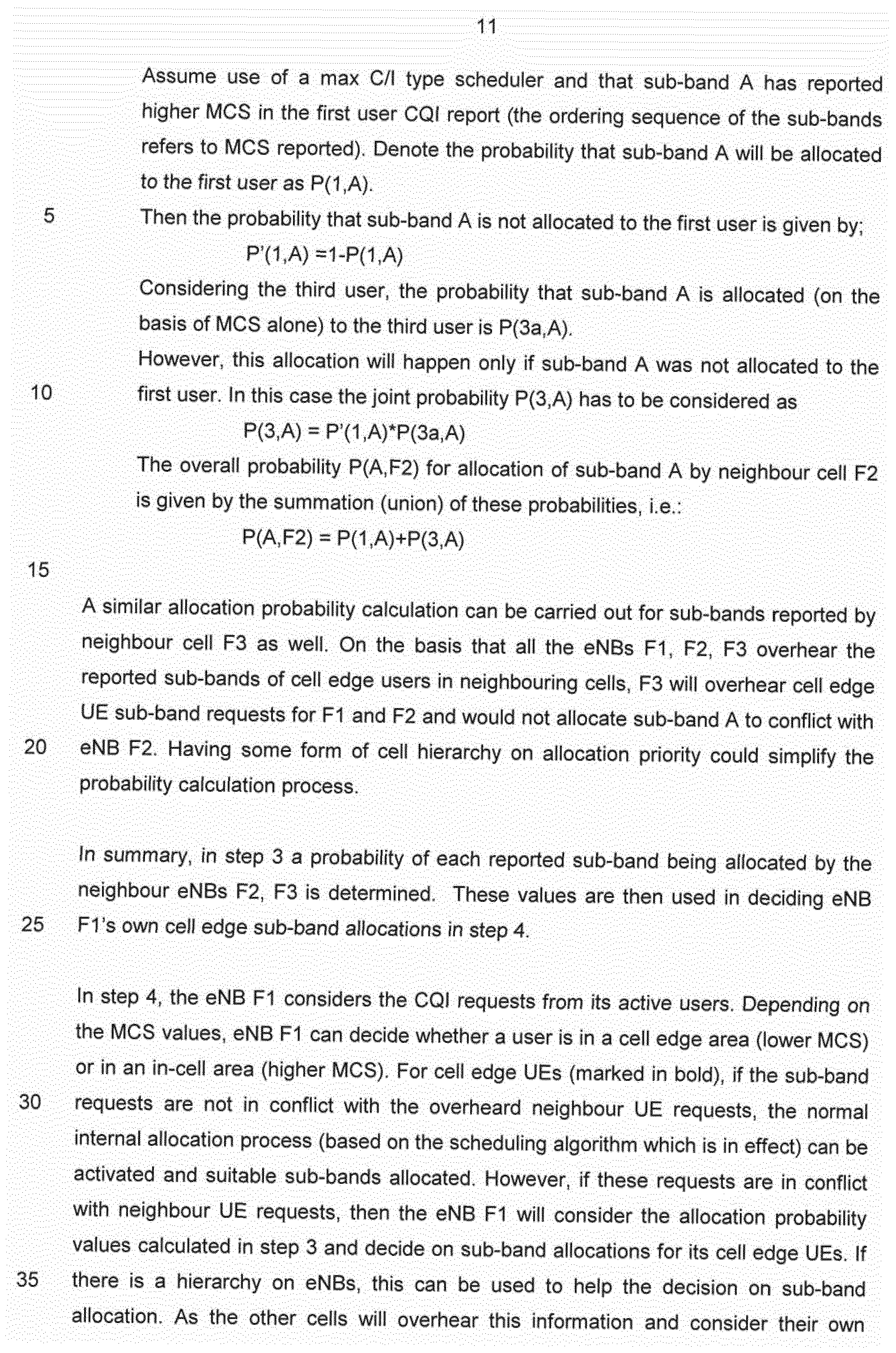 allocations, having a hierarchy (or preference) of eNBs will help to ease the decision process. If eNB F1 decides it is highly likely that all sub-bands reported have been used by the neighbour cells, it can request the UE to report CQI on other preferred sub- bands.
Step 5 involves monitoring performance after a certain sub-band allocation, especially in highly contested sub-bands. If the HARQ messages from a UE allocated a particular sub-band indicate a transition to a high error rate, and if the eNB (F1 in the example) is at a lower level of the eNB hierarchy, it can decide to change the allocation of sub- bands to its cell edge UEs or request new CQI reports from the UE affected. Alternatively, in some situations, eNB F1 can request a change of settings from the neighbour eNBs through the S1 link. The long term statistics of the process can also be shared with neighbour eNBs through the S1 link. Steps 1 to 5 of the algorithm will be repeated iteratively as the eNBs operate continuously, serving their UEs. As the coherence times are higher for indoor environments and data intensive user sessions tend to last longer, the update rates on CQI and hence on this algorithm will be lower than for a typical Macro cell. Hence the calculation load imposed by this algorithm will be manageable to Femto cells and the benefits of cell edge performance improvement will outweigh the processing complexities.
Although an embodiment of the invention has been described above with reference to Femto cells in an LTE wireless communication scheme, the present invention may be applied to other types of cells and other types of wireless communication scheme. For example, Macro base stations in rural areas would find it difficult to support the high speed X2 links. In this case, it may be advantageous to employ the present invention to control cell edge interference. Embodiments of the present invention may be implemented in hardware, or as software modules running on one or more processors, or on a combination thereof. That is, those skilled in the art will appreciate that a microprocessor or digital signal processor (DSP) may be used in practice to implement some or all of the functionality described above.
The invention may also be embodied as one or more device or apparatus programs (e.g. computer programs and computer program products) for carrying out part or all of the methods described herein. Such programs embodying the present invention may be stored on computer-readable media, or could, for example, be in the form of one or more signals. Such signals may be data signals downloadable from an Internet website, or provided on a carrier signal, or in any other form.
Claims

5. A method as claimed in any preceding claim, wherein the second base station provides the first base station with information to enable the first base station to decode uplink control information transmitted by the said first user equipment(s).
8, A method as claimed in claim 5, wherein the information provided by the second base station is Cell Radio Network Temporary Identifier - C-RNTI - scrambling information for the said first user equipment(s).
7. A method as claimed in any preceding claim for use in an LTE/LTE-A cellular wireless communication system, further comprising, prior to determining parameter values, allocating orthogonal Zadoff-Chu codes for the transmittal of the uplink control information by user equipments in each cell such that only a subset of a set of possible orthogonal Zadoff-Chu codes is allocated to each cell.
8. A method as claimed in claim 7, wherein, if traffic load is spread unevenly between cells served by the plurality of base stations, then a cell with greater traffic load is allocated a subset containing a greater number of Zadoff-Chu codes than a cell with a lesser traffic load.
9. A method as claimed in any one of claims 1 to 6 for use in an LTE/LTE-A cellular wireless communication system or as claimed in claim 7 or 8, wherein the uplink control information comprises CQI information which comprises preferred sub-band requests issued by the user equipments in the second cell.
10. A method as claimed in claim 9, wherein the uplink control information further comprises HARQ messages which are used by the first base station to ascertain whether resource blocks have been allocated to the user equipments in the second cell.
1 1. A method as claimed in claim 10, comprising, prior to determining parameter values, controlling user equipments in the cells such that each user equipment is not permitted to change a Zadoff-Chu code it is using for transmitting uplink control information throughout a single communication session with a base station.
12. A method as claimed in any preceding claim, wherein, when allocating one or more resource blocks to the said second user equipment, a resource block in a sub- band requested by the said second user equipment is preferentially allocated to the said second user equipment.
13. A method as claimed in any preceding claim, wherein the data used to determine the parameter values further comprises at least one of: a scheduling mechanism used in allocating resource blocks to the user equipments served by the second cell; cell edge quality of service - QoS - guarantees for the user equipments served by the second cell; cell hierarchy in providing QoS; and cell hierarchy for resource block allocation.
14. A method as claimed in any preceding claim, wherein, if the determined parameter values indicate that it is highly likely that all resource blocks in all preferred sub-bands requested by the second user equipment served by the first ceil have been allocated to user equipment(s) served by the second cell, the said second user equipment is requested to provide alternative preferred sub-band requests.
15. A method as claimed in any preceding claim, further comprising reviewing the resource block allocation for the said second user equipment if performance in an allocated resource block decreases.
16. A base station (F1; F2; F3) for use in a cellular wireless communication system configured to partition time/frequency resource blocks amongst a plurality of user equipments of the system, which base station is configured to provide a first cell and comprises:
parameter determining means (2) configured to use data, derived from uplink control information on preferred sub-bands overheard and decoded from one or more first user equipment(s) located in a second cell provided by a second base station of the system, to determine one or more parameter values; and
radio resource allocation means (3) configured to allocate resource blocks to second user equipment in the first cell on the basis of the determined parameter value(s), if there is conflict between preferred sub-band requests from the first user equipment(s) and the second user equipment.
17. A cellular wireless communication system comprising a plurality of base stations (f1 , F2, F3) having a first base station (F1) providing a first cell and a second base station (F2) providing a second cell, wherein at least the first base station (F1) is a base station as claimed in claim 16, the second base station (F2) is configured to provide the first base station (F1) with Cell Radio Network Temporary Identifier - C- RNTI - scrambling information for user equipments) served by the second base station (F2), and the first base station (F1) is configured to use the received C-RNTI scrambling information to decode the uplink control information overheard from user equipment(s) located in second cell.
18. A computer program which, when executed on a base station in a cellular wireless communication system, causes that base station to carry out a method in accordance with any of claims 1 to 15, or to become a base station in accordance with claim 16.
19. A non-transitory computer readable storage medium storing a computer program which, when executed on a base station in a cellular wireless communication system, causes that base station to carry out a method in accordance with claim 1 , or to become a base station in accordance with claim 16.
Priority Applications (2)
| Application Number | Priority Date | Filing Date | Title |
|---|---|---|---|
| JP2016535111A JP2017508313A (en) | 2014-01-06 | 2014-05-30 | Radio resource allocation method and base station used in cellular radio communication system |
| US15/168,920 US20160278062A1 (en) | 2014-01-06 | 2016-05-31 | Radio Resource Allocation Method and Base Station for use in Cellular Wireless Communication Systems |
Applications Claiming Priority (2)
| Application Number | Priority Date | Filing Date | Title |
|---|---|---|---|
| EP14150210.4A EP2892296B1 (en) | 2014-01-06 | 2014-01-06 | Radio resource allocation method and base station for use in cellular wireless communication systems |
| EP14150210.4 | 2014-01-06 |
Related Child Applications (1)
| Application Number | Title | Priority Date | Filing Date |
|---|---|---|---|
| US15/168,920 Continuation US20160278062A1 (en) | 2014-01-06 | 2016-05-31 | Radio Resource Allocation Method and Base Station for use in Cellular Wireless Communication Systems |
Publications (1)
| Publication Number | Publication Date |
|---|---|
| WO2015101423A1 true WO2015101423A1 (en) | 2015-07-09 |
Family
ID=49886835
Family Applications (1)
| Application Number | Title | Priority Date | Filing Date |
|---|---|---|---|
| PCT/EP2014/061289 Ceased WO2015101423A1 (en) | 2014-01-06 | 2014-05-30 | Radio resource allocation method and base station for use in cellular wireless communication systems |
Country Status (4)
| Country | Link |
|---|---|
| US (1) | US20160278062A1 (en) |
| EP (2) | EP2892296B1 (en) |
| JP (1) | JP2017508313A (en) |
| WO (1) | WO2015101423A1 (en) |
Families Citing this family (4)
| Publication number | Priority date | Publication date | Assignee | Title |
|---|---|---|---|---|
| CN106714322B (en) * | 2016-11-04 | 2019-02-15 | 展讯通信(上海)有限公司 | Cross-subband/carrier scheduling method, base station and user equipment |
| US10582529B2 (en) * | 2017-03-15 | 2020-03-03 | Nec Corporation | Speculative scheduling in mobile networks |
| US10973008B2 (en) * | 2018-03-12 | 2021-04-06 | Apple Inc. | Wireless device preferred bandwidth part configuration and duty cycle indication |
| KR102895705B1 (en) * | 2019-10-14 | 2025-12-05 | 삼성전자 주식회사 | Method and apparatus for transmitting interference information |
Citations (6)
| Publication number | Priority date | Publication date | Assignee | Title |
|---|---|---|---|---|
| WO2007107895A1 (en) | 2006-03-20 | 2007-09-27 | Koninklijke Philips Electronics N.V. | A method and apparatus of channel accessing for use in a wireless communication system |
| KR20100011018A (en) | 2008-07-24 | 2010-02-03 | 삼성전자주식회사 | Apparatus and method for operating communication mode in broadband wireless communication system |
| US20100099431A1 (en) * | 2008-10-22 | 2010-04-22 | Qualcomm Incorporated | Method and system for interference management in a spectrum shared by wan and femto cells |
| WO2012074192A2 (en) | 2010-12-02 | 2012-06-07 | (주)엘지전자 | Method for avoiding inter-cell interference in wireless access system |
| WO2012108604A1 (en) | 2011-02-09 | 2012-08-16 | (주)엘지전자 | Method and device for avoiding inter-cell interference in a wireless access system |
| WO2012108605A1 (en) | 2011-02-09 | 2012-08-16 | (주)엘지전자 | Method for avoiding inter-cell interference in a wireless access system |
Family Cites Families (11)
| Publication number | Priority date | Publication date | Assignee | Title |
|---|---|---|---|---|
| US8009721B2 (en) * | 2007-06-15 | 2011-08-30 | Panasonic Corporation | Wireless communication apparatus and response signal spreading method |
| WO2009019892A1 (en) * | 2007-08-09 | 2009-02-12 | Panasonic Corporation | Terminal device, base station device, and frequency resource allocation method |
| US8140944B2 (en) * | 2008-01-24 | 2012-03-20 | Texas Instruments Incorporated | Interleaver design with unequal error protection for control information |
| GB201012148D0 (en) | 2010-07-20 | 2010-09-01 | Palintest Ltd | Method |
| US9288691B2 (en) * | 2011-01-24 | 2016-03-15 | Lg Electronics Inc. | Method for reporting channel state information in wireless communication system and apparatus therefor |
| JPWO2013122161A1 (en) * | 2012-02-14 | 2015-05-18 | 京セラ株式会社 | Mobile communication system, base station, user terminal, and communication control method |
| WO2014007445A1 (en) * | 2012-07-02 | 2014-01-09 | 엘지전자 주식회사 | Method and apparatus for controlling inter-cellular interference in hetnet system |
| US9301183B2 (en) * | 2012-09-28 | 2016-03-29 | Intel Corporation | Transmission of uplink control information in inter-eNB carrier aggregation |
| US9078276B2 (en) * | 2012-11-13 | 2015-07-07 | Telefonaktiebolaget L M Ericsson (Publ) | Scheduling and rate control coordination accounting for interference cancellation at a mobile terminal |
| GB2514561B (en) * | 2013-05-28 | 2016-01-13 | Broadcom Corp | Overhearing |
| US20160143015A1 (en) * | 2013-06-17 | 2016-05-19 | Nokia Solutions And Networks Oy | Cell operation concept |
-
2014
- 2014-01-06 EP EP14150210.4A patent/EP2892296B1/en not_active Not-in-force
- 2014-01-06 EP EP17173425.4A patent/EP3229548A1/en not_active Withdrawn
- 2014-05-30 WO PCT/EP2014/061289 patent/WO2015101423A1/en not_active Ceased
- 2014-05-30 JP JP2016535111A patent/JP2017508313A/en active Pending
-
2016
- 2016-05-31 US US15/168,920 patent/US20160278062A1/en not_active Abandoned
Patent Citations (6)
| Publication number | Priority date | Publication date | Assignee | Title |
|---|---|---|---|---|
| WO2007107895A1 (en) | 2006-03-20 | 2007-09-27 | Koninklijke Philips Electronics N.V. | A method and apparatus of channel accessing for use in a wireless communication system |
| KR20100011018A (en) | 2008-07-24 | 2010-02-03 | 삼성전자주식회사 | Apparatus and method for operating communication mode in broadband wireless communication system |
| US20100099431A1 (en) * | 2008-10-22 | 2010-04-22 | Qualcomm Incorporated | Method and system for interference management in a spectrum shared by wan and femto cells |
| WO2012074192A2 (en) | 2010-12-02 | 2012-06-07 | (주)엘지전자 | Method for avoiding inter-cell interference in wireless access system |
| WO2012108604A1 (en) | 2011-02-09 | 2012-08-16 | (주)엘지전자 | Method and device for avoiding inter-cell interference in a wireless access system |
| WO2012108605A1 (en) | 2011-02-09 | 2012-08-16 | (주)엘지전자 | Method for avoiding inter-cell interference in a wireless access system |
Non-Patent Citations (6)
| Title |
|---|
| ELSHERIF AHMED R ET AL: "Resource Allocation in Two-Tier Heterogeneous Networks through Enhanced Shadow Chasing", IEEE TRANSACTIONS ON WIRELESS COMMUNICATIONS, IEEE SERVICE CENTER, PISCATAWAY, NJ, US, vol. 12, no. 12, 1 December 2013 (2013-12-01), pages 6439 - 6453, XP011534613, ISSN: 1536-1276, [retrieved on 20131217], DOI: 10.1109/TWC.2013.101813.130732 * |
| JAMES C F LI ET AL: "Interference Mitigation and Spectrum Sharing for Heterogeneous Networks Based on CQI Feedbacks", VEHICULAR TECHNOLOGY CONFERENCE (VTC FALL), 2012 IEEE, IEEE, 3 September 2012 (2012-09-03), pages 1 - 5, XP032294484, ISBN: 978-1-4673-1880-8, DOI: 10.1109/VTCFALL.2012.6398909 * |
| NAKANO TOSHIHIKO ET AL: "Interference Mitigation Based on Partial CSI Feedback and Overhearing in an OFDMA Heterogeneous System", 2013 IEEE 77TH VEHICULAR TECHNOLOGY CONFERENCE (VTC SPRING), IEEE, 2 June 2013 (2013-06-02), pages 1 - 5, XP032547932, ISSN: 1550-2252, [retrieved on 20131222], DOI: 10.1109/VTCSPRING.2013.6692600 * |
| T. NAKANO; M. KANEKO: "Interference Mitigation based on Partial CSI Feedback and Overhearing in an OFDMA Heterogeneous System", IEEE VTC, 2013 |
| TALHA ZAHIR ET AL: "Interference Management in Femtocells", IEEE COMMUNICATIONS SURVEYS, IEEE, NEW YORK, NY, US, vol. 15, no. 1, 1 January 2013 (2013-01-01), pages 293 - 311, XP011493339, ISSN: 1553-877X, DOI: 10.1109/SURV.2012.020212.00101 * |
| TOSHIHIKO NAKANO ET AL: "Downlink power allocation with CSI overhearing in an OFDMA macrocell/femtocell coexisting system", PERSONAL INDOOR AND MOBILE RADIO COMMUNICATIONS (PIMRC), 2012 IEEE 23RD INTERNATIONAL SYMPOSIUM ON, IEEE, 9 September 2012 (2012-09-09), pages 454 - 459, XP032273020, ISSN: 2166-9570, ISBN: 978-1-4673-2566-0, DOI: 10.1109/PIMRC.2012.6362828 * |
Also Published As
| Publication number | Publication date |
|---|---|
| JP2017508313A (en) | 2017-03-23 |
| US20160278062A1 (en) | 2016-09-22 |
| EP2892296B1 (en) | 2017-07-26 |
| EP2892296A1 (en) | 2015-07-08 |
| EP3229548A1 (en) | 2017-10-11 |
Similar Documents
| Publication | Publication Date | Title |
|---|---|---|
| US20230102355A1 (en) | Concurrent physical sidelink feedback channel transmission | |
| JP7116093B2 (en) | Method and apparatus for power control of sounding reference signals | |
| KR102264620B1 (en) | Flexible grant-free resource configuration signaling | |
| KR102772963B1 (en) | Method and device for beam directing in next generation wireless systems | |
| US10506577B2 (en) | Systems and methods for adaptive transmissions in a wireless network | |
| EP2922341B1 (en) | Carrier allocation method, user equipment and base station | |
| KR101955081B1 (en) | Methods providing benefit metrics for inter base station coordinated multipoint communications | |
| CN102474347B (en) | Apparatus and method for transmitting channel state information in a wireless communication system | |
| KR101552268B1 (en) | Antenna time offset in multiple-input-multiple-output and coordinated multipoint transmissions | |
| KR101594005B1 (en) | Incremental interference cancellation capability and signaling | |
| JP6614424B2 (en) | Communications system | |
| US9980266B2 (en) | Collaborative radio resource allocation in cellular deployments | |
| JP2020036355A (en) | Channel quality information report in protected sub-frame | |
| EP2908592B1 (en) | Radio resource allocation methods using overhearing and inter-cell communication | |
| JP6994389B2 (en) | Physical uplink control channel (PUCCH) configuration for machine type communication (MTC) | |
| EP2521409A1 (en) | Base station, interference control method and radio communication system | |
| TW201705716A (en) | Machine Type Communication (MTC) configuration, interference management, and retuning time for uplink transmission | |
| JP2021503835A (en) | Resource allocation for channel state information and hybrid automatic repeat request feedback in 5G | |
| JP2016532362A (en) | Device-to-device communication management in mobile communication networks | |
| US11949426B2 (en) | Configurable analog-to-digital conversion parameters | |
| KR20160074545A (en) | Method and apparatus for configuration of csi-rs for 3-d mimo | |
| JP5878406B2 (en) | Radio communication system, user terminal, radio base station apparatus, and radio communication method | |
| US20160278062A1 (en) | Radio Resource Allocation Method and Base Station for use in Cellular Wireless Communication Systems | |
| US11729648B2 (en) | Resource availability information reporting and utilization | |
| JP6453420B2 (en) | Device-to-device communication management in mobile communication networks |
Legal Events
| Date | Code | Title | Description |
|---|---|---|---|
| 121 | Ep: the epo has been informed by wipo that ep was designated in this application |
Ref document number: 14732098 Country of ref document: EP Kind code of ref document: A1 |
|
| ENP | Entry into the national phase |
Ref document number: 2016535111 Country of ref document: JP Kind code of ref document: A |
|
| NENP | Non-entry into the national phase |
Ref country code: DE |
|
| 122 | Ep: pct application non-entry in european phase |
Ref document number: 14732098 Country of ref document: EP Kind code of ref document: A1 |