WO2015077352A1 - Method and apparatus for water-based mud filtrate contamination monitoring in real time downhole water sampling - Google Patents
Method and apparatus for water-based mud filtrate contamination monitoring in real time downhole water sampling Download PDFInfo
- Publication number
- WO2015077352A1 WO2015077352A1 PCT/US2014/066434 US2014066434W WO2015077352A1 WO 2015077352 A1 WO2015077352 A1 WO 2015077352A1 US 2014066434 W US2014066434 W US 2014066434W WO 2015077352 A1 WO2015077352 A1 WO 2015077352A1
- Authority
- WO
- WIPO (PCT)
- Prior art keywords
- density
- resistivity
- based mud
- water based
- mud filtrate
- Prior art date
- Legal status (The legal status is an assumption and is not a legal conclusion. Google has not performed a legal analysis and makes no representation as to the accuracy of the status listed.)
- Ceased
Links
Classifications
-
- G—PHYSICS
- G01—MEASURING; TESTING
- G01N—INVESTIGATING OR ANALYSING MATERIALS BY DETERMINING THEIR CHEMICAL OR PHYSICAL PROPERTIES
- G01N9/00—Investigating density or specific gravity of materials; Analysing materials by determining density or specific gravity
-
- E—FIXED CONSTRUCTIONS
- E21—EARTH OR ROCK DRILLING; MINING
- E21B—EARTH OR ROCK DRILLING; OBTAINING OIL, GAS, WATER, SOLUBLE OR MELTABLE MATERIALS OR A SLURRY OF MINERALS FROM WELLS
- E21B49/00—Testing the nature of borehole walls; Formation testing; Methods or apparatus for obtaining samples of soil or well fluids, specially adapted to earth drilling or wells
- E21B49/08—Obtaining fluid samples or testing fluids, in boreholes or wells
-
- G—PHYSICS
- G01—MEASURING; TESTING
- G01N—INVESTIGATING OR ANALYSING MATERIALS BY DETERMINING THEIR CHEMICAL OR PHYSICAL PROPERTIES
- G01N33/00—Investigating or analysing materials by specific methods not covered by groups G01N1/00 - G01N31/00
- G01N33/26—Oils; Viscous liquids; Paints; Inks
- G01N33/28—Oils, i.e. hydrocarbon liquids
- G01N33/2823—Raw oil, drilling fluid or polyphasic mixtures
-
- G—PHYSICS
- G01—MEASURING; TESTING
- G01N—INVESTIGATING OR ANALYSING MATERIALS BY DETERMINING THEIR CHEMICAL OR PHYSICAL PROPERTIES
- G01N9/00—Investigating density or specific gravity of materials; Analysing materials by determining density or specific gravity
- G01N9/36—Analysing materials by measuring the density or specific gravity, e.g. determining quantity of moisture
Definitions
- aspects of the disclosure relate to contamination monitoring. More specifically, aspects of the disclosure relate to method and apparatus for water-based mud filtrate contamination monitoring in real time downhole water sampling.
- Dyes added should be compatible with the drilling mud and the formation and fluids for the formation that are expected to be extracted. Some dyes can be expensive and additional work is required for injection of the dye into the fluid stream.
- a method for contamination monitoring entailing measuring a water based mud filtrate density and a water based mud filtrate resistivity at surface conditions, converting the measured water based mud filtrate density and resistivity to downhole conditions, logging properties of a downhole fluid to find at least a resistivity and a density of a fluid sample at the downhole conditions, establishing a linear relationship between a water based mud filtrate conductivity at downhole conditions and the water based mud density at the downhole conditions, determining an existence of a high quality pressure gradient at the downhole conditions, fitting at least one of a density and a resistivity data using a power function and obtaining at least one of a density and a resistivity for native formation water when no high quality pressure gradient exists, estimating a density from the pressure from the high quality gradient when the high quality pressure gradient exists; estimating a resistivity for native formation water, using the linear relationship between the
- FIG. 1 is a graph of density versus conductivity for water sampling with water based mud in real time.
- FIG. 2 is a flowchart for a method of water based mud filtrate contamination modeling.
- FIG. 3 is graph of resistivity variation measurement over pumpout volume obtained.
- FIG. 4 is a graph of water based filtrate contamination monitoring versus pumpout volume obtained.
- FIG. 5 is a graph of density in the sample line versus pumpout volume obtained.
- FIG. 6 is a graph of contamination percentage water based contamination versus pumpout volume obtained.
- FIG. 7 is a graph of conductivity versus pumped volume.
- FIG. 8 is a graph of contamination percentage versus pumped volume.
- aspects described relate to a method and apparatus for water-based mud filtrate contamination monitoring in real time downhole water sampling.
- the method and system provided are used in downhole apparatus in the exploration of oil and gas in geological formations. Such techniques greatly enhance the capability of engineers and operators to economically find hydrocarbons beneath the ground surface.
- the fluid in the downhole flowline consist of two components: water based mud filtrate and native formation water.
- the following mixing rule can be used for resistivity:
- R, ⁇ , R fw are the resistivity of the mixture (water based mud filtrate and formation water - formation water contaminated by water based mud filtrate), water based mud filtrate contamination fraction, resistivity of the pure water based mud filtrate and resistivity of the native formation water.
- Equation 2 whm fw where R is measured by downhole fluid analysis during water sampling, which is a function of time (or pumpout volume).
- R W hm pure water based mud filtrate
- Rfw native formation water
- Equation 3 where V and x are the molar volume and mole fraction.
- Subscripts wbm and fw represent the pure water based mud filtrate and native formation water.
- the molar volume and mole fraction can be changed into density (p) and water based mud filtrate contamination volume fraction ( ⁇ ) at downhole conditions by:
- the value ⁇ can be related to the weight fraction of water based mud filtrate
- Equations 5 and 6 two endpoints- densities of pure water based mud filtrate (Pwbm) and native formation water (p fw ) should be known to obtain ⁇ . Density contrast between the pure water based mud filtrate and native formation water are sufficient in order to use Equations 5 and 6 for water based mud filtrate contamination monitoring.
- FIG. 1 shows the real time results of density versus conductivity. It should be noted that this linear relation is very useful for determining endpoints for native formation water and/or pure water based mud filtrate. This also constrains exponent in the power function fitting model as provided below.
- the two endpoints for pure water based mud filtrate and native formation water are determined.
- a determination of resistivity and density of pure water based mud filtrate (R W bm and p W bm) occurs.
- To obtain the endpoints for pure water based mud filtrate entails measuring the resistivity and density of the pure water based mud filtrate on the surface if pure water based mud filtrate is available before logging at different temperatures and pressure covering the entire set of reservoir conditions.
- the resistivity of pure water based mud filtrate is measured at surface conditions and converted to flowline conditions.
- the density of pure water based mud filtrates is measured at surface conditions and converted to flowline conditions.
- Pretest pressure (pressure gradient) data can be used to determine density of the native formation water-density endpoint for the native formation water, or
- live formation water density can also be fitted by the following power function:
- V w - V"Y Equation 10
- p and V are the density and pumpout volume (can be replaced by time t) measured by downhole fluid analysis; pwf, ⁇ and ⁇ are three adjustable parameters. Once good density data regression is obtained, density (pwf) for the native formation water can be extrapolated when the pumpout volume (time) approaches infinity.
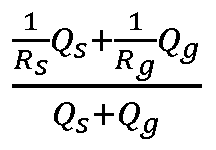
- V can be replaced by the volume in the sample line (and/or guard line) or by the total volume (summation of sample and guard line volumes). In this case, p is replaced by (subscripts s and g stand for sample and guard, Q is the flowrate):
- the resistivity of native formation water can be determined as follows:
- the resistivity of native formation water can be determined by the linear relationship between reciprocal of resistivity (conductivity) and density once density is determined by the method mentioned previously.
- the resistivity of native formation water may be estimated from Archies expression by assuming a clean sandstone formation for which m and n have the value of 2 and Equation 12 where ⁇ is the formation porosity and R t is the formation resistivity, which can be measured by conventional wireline logs.
- the resistivity of native formation water can be determined by the fitting model as done for density:
- R and V are the resistivity and pumpout volume (can be replaced by time t) measured by downhole fluid analysis; Rwf, ⁇ and ⁇ are three adjustable parameters.
- resistivity (Rwf) for the native formation water can be extrapolated when the pumpout volume (time) approaches infinity.
- V can be replaced by the volume in the sample line (and/or guard line) besides total volume (summation of sample and guard line volumes).
- R is replaced by (subscripts s and g stand for sample and guard, Q is the flow rate):
- Equation 2 Equation 2
- Equation 2 can be used to estimate water based mud filtrate contamination in water samples. The time required for sampling to reach a certain water based mud filtrate
- AV and Q pu mp are the time required to reach a specified water based mud filtrate contamination level, the pumpout volume required to reach the specified water based mud filtrate contamination level, and the pumpout volume flowrate (assuming to be constant).
- an example method 200 of performing the analysis presented above is provided.
- the water based mud filtrate density and resistivity are measured as surface conditions and then converted to downhole conditions.
- the water based mud filtrate density and resistivity conditions are measured downhole.
- downhole fluid analysis is logged and resistivity, density, pumpout volume and time are logged.
- a linear relationship is found between conductivity and density.
- a decision is made whether there is a high quality pressure gradient. If there is no high pressure gradient, the method moves to 210 where the density is fit and/or resistivity data using the power function and the density is obtained and/or resistivity for native formation water.
- the method then progresses to 214. If the high pressure quality pressure gradient is available in 208, then in 212 density is estimated from the pressure gradient for native formation water. The method then progresses to 214.
- resistivity is estimated for native formation water using the linear relation between conductivity and density or using Archie's expression.
- density is estimated for water based mud filtrate using the linear relation between conduction and density.
- water based mud filtrate contamination is estimated.
- the time required for sampling to reach a certain water based mud filtrate contamination level is estimated. [0031] Referring to FIG. 3, the density and resistivity of the pure mud filtrate are obtained from downhole measurements at the beginning of clean up due to deep invasion. The endpoints of the native formation water are determined as follows.
- Resistivity variation with pumpout volume is shown in FIG. 3.
- the power function fitting curves are illustrated in FIG. 3. The fitting is done for the sample and guard lines respectively. Therefore, the resistivity of the native formation water is obtained from the fitting curves.
- water based mud filtrate contamination is estimated where contamination percentage is on the Y axis and volume is provided on the X axis.
- the estimated water based mud filtrate contamination in the sample line based on the density mixing rule is provided in FIG. 6.
- the contamination percentage in the Y axis is compared to the volume in the X axis.
- the resistivity of the native formation water can be determined from total conductivity fitting. Referring to FIG. 7, the power function fitting for the total conductivity of the combined sample and guard lines is shown. The density and conductivity cross plot is given in FIG. 1 . Once either the density or conductivity of the native formation water, the cross plot can be used to obtain either conductivity or density of the native formation water. The Y axis of the plot provides conductivity and the X axis of the plot refers to pumped volume.
- a method for contamination monitoring comprising measuring a water based mud filtrate density and a water based mud filtrate resistivity at surface conditions, converting the measured water based mud filtrate density and resistivity to downhole conditions; logging properties of a downhole fluid to find at least a resistivity and a density of a fluid sample at the downhole conditions, establishing a linear relationship between a water based mud filtrate conductivity at downhole conditions and the water based mud density at the downhole conditions, determining an existence of a high quality pressure gradient at the downhole conditions, fitting at least one of a density and a resistivity data using a power function and obtaining at least one of a density and a resistivity for native formation water when no high quality pressure gradient exists, estimating a density from the pressure from the high quality gradient when the high quality pressure gradient exists, estimating a resistivity for native formation water, using the linear relationship between the
- the method may also be accomplished wherein the estimating the resistivity for native formation water is performed using the linear relationship between the
- the method may also be accomplished wherein the estimating the resistivity for native formation water is performed using Archie's expression.
- the method may also be accomplished wherein the method further comprises estimating a time required for sampling to reach a water based mud filtrate
- the method may also be accomplished wherein the estimating the water based mud filtrate contamination is performed through an equation:
- the method may also be accomplished, wherein the determining the existence of the high quality pressure gradient at the downhole conditions is performed through downhole pretests.
- a method for contamination monitoring comprising measuring water based mud filtrate density and resistivity at downhole conditions; logging properties of a downhole fluid to find at least a resistivity and a density of a fluid sample at the downhole conditions, establishing a linear relationship between a water based mud filtrate conductivity at downhole conditions and the water based mud density at the downhole conditions, determining an existence of a high quality pressure gradient at the downhole conditions, fitting at least one of a density and a resistivity data using a power function and obtaining at least one of a density and a resistivity for native formation water when no high quality pressure gradient exists, estimating a density from the pressure from the high quality gradient when the high quality pressure gradient exists, estimating a resistivity for native formation water, using the linear relationship between the conductivity and the density, estimating a density for water based mud filtrate using the linear relationship between conductivity and density, and estimating a water based mud filtrate contamination.
- the method is accomplished wherein the estimating the resistivity for native formation water is performed using the linear relationship between the conductivity and the density.
- the method is accomplished wherein the estimating the resistivity for native formation water is performed using Archie's expression.
- the method described above may further comprise estimating a time required for sampling to reach a water based mud filtrate contamination level.
- the method described above may be accomplished wherein the estimating the water based mud filtrate contamination is performed through an equation:
- the method described above may be accomplished wherein the determining the existence of the high quality pressure gradient at the downhole conditions is performed through downhole pretests.
Landscapes
- Life Sciences & Earth Sciences (AREA)
- Chemical & Material Sciences (AREA)
- Engineering & Computer Science (AREA)
- Physics & Mathematics (AREA)
- Health & Medical Sciences (AREA)
- General Health & Medical Sciences (AREA)
- Immunology (AREA)
- Pathology (AREA)
- General Physics & Mathematics (AREA)
- Biochemistry (AREA)
- Analytical Chemistry (AREA)
- Geology (AREA)
- Mining & Mineral Resources (AREA)
- General Life Sciences & Earth Sciences (AREA)
- Environmental & Geological Engineering (AREA)
- Fluid Mechanics (AREA)
- Geochemistry & Mineralogy (AREA)
- Oil, Petroleum & Natural Gas (AREA)
- Food Science & Technology (AREA)
- Medicinal Chemistry (AREA)
- Chemical Kinetics & Catalysis (AREA)
- General Chemical & Material Sciences (AREA)
- Investigating Or Analyzing Materials By The Use Of Electric Means (AREA)
- Developing Agents For Electrophotography (AREA)
Abstract
A method and apparatus for performing water based mud-filtrate contamination monitoring in real time through evaluation of downhole water sampling.
Description
METHOD AND APPARATUS FOR WATER-BASED MUD FILTRATE CONTAMINATION MONITORING IN REAL TIME DOWNHOLE WATER SAMPLING
CROSS-REFERENCE TO RELATED APPLICATIONS
[0001] This application claims priority from US Non-Provisional Application 14/085550, filed November 20, 2013, which is incorporated herein by reference in its entirety.
FIELD OF THE INVENTION
[0002] Aspects of the disclosure relate to contamination monitoring. More specifically, aspects of the disclosure relate to method and apparatus for water-based mud filtrate contamination monitoring in real time downhole water sampling.
BACKGROUND INFORMATION
[0003] Water based drilling mud filtrate contamination monitoring is a large challenge in downhole formation water sampling. Currently, there are no conventional downhole real time methods available for quantitative water based drilling mud filtrate contamination monitoring during water sampling with the lone exception of using special dyes mixed with the water based drilling mud.
[0004] Use of special dyes adds complexity to drilling operations. Dyes added should be compatible with the drilling mud and the formation and fluids for the formation that are expected to be extracted. Some dyes can be expensive and additional work is required for injection of the dye into the fluid stream.
[0005] Special dyes are expensive for operators in other ways as operators need time to add the dye to wellbore mud systems as rig time can be very constrained. These special dyes, because of the complexities described above, are carefully crafted such that they provide minimal harm from a technological and cost perspective.
SUMMARY
[0006] The following summary is but an example description of one embodiment described. The disclosure in the summary should not be considered limiting. A method for contamination monitoring is described entailing measuring a water based mud filtrate density and a water based mud filtrate resistivity at surface conditions, converting the measured water based mud filtrate density and resistivity to downhole conditions, logging properties of a downhole fluid to find at least a resistivity and a density of a fluid sample at the downhole conditions, establishing a linear relationship between a water based mud filtrate conductivity at downhole conditions and the water based mud density at the downhole conditions, determining an existence of a high quality pressure gradient at the downhole conditions, fitting at least one of a density and a resistivity data using a power function and obtaining at least one of a density and a resistivity for native formation water when no high quality pressure gradient exists, estimating a density from the pressure from the high quality gradient when the high quality pressure gradient exists; estimating a resistivity for native formation water, using the linear relationship between the conductivity and the density, estimating a density for water based mud filtrate using the linear relationship between conductivity and density and estimating a water based mud filtrate contamination.
BRIEF DESCRIPTION OF THE DRAWINGS
[0007] FIG. 1 is a graph of density versus conductivity for water sampling with water based mud in real time.
[0008] FIG. 2 is a flowchart for a method of water based mud filtrate contamination modeling.
[0009] FIG. 3 is graph of resistivity variation measurement over pumpout volume obtained.
[0010] FIG. 4 is a graph of water based filtrate contamination monitoring versus pumpout volume obtained.
[0011] FIG. 5 is a graph of density in the sample line versus pumpout volume obtained.
[0012] FIG. 6 is a graph of contamination percentage water based contamination versus pumpout volume obtained.
[0013] FIG. 7 is a graph of conductivity versus pumped volume.
[0014] FIG. 8 is a graph of contamination percentage versus pumped volume.
DETAILED DESCRIPTION
[0015] Aspects described relate to a method and apparatus for water-based mud filtrate contamination monitoring in real time downhole water sampling. The method and system provided are used in downhole apparatus in the exploration of oil and gas in geological formations. Such techniques greatly enhance the capability of engineers and operators to economically find hydrocarbons beneath the ground surface.
[0016] For the purposes of this detailed description, it is assumed that the fluid in the downhole flowline consist of two components: water based mud filtrate and native formation water. The following mixing rule can be used for resistivity:
1 η 1-η
= ^Γ— + - T Equation 1
where R, η, Rfw are the resistivity of the mixture (water based mud filtrate and formation water - formation water contaminated by water based mud filtrate), water based mud filtrate contamination fraction, resistivity of the pure water based mud filtrate and resistivity of the native formation water. The value n is an exponent (default n = 1 ), which may be used as an adjustable parameter.
[0017] Rearranging Equation 1 above, the result obtained is the water based mud filtrate contamination based on resistivity measured by downhole fluid analysis:
Rn R1} Rn-R?
Π= -^-^ = -^τ^τ Equation 2
~ n ~ n n nwhm Kfw
whm fw where R is measured by downhole fluid analysis during water sampling, which is a function of time (or pumpout volume). In Equation 2, two endpoints - resistivity of pure water based mud filtrate (RWhm) and native formation water (Rfw) should be known to obtain η. It should be noted that resistivity contrast between the pure water based mud filtrate and native formation water should be sufficient in order to use Equation 2.
[0018] Below is a description of using density for water based mud filtrate
contamination monitoring. The contaminated fluid is divided into two components, the pure water based mud filtrate and the native formation water. It is assumed that the mixing of the water based mud filtrate and native formation water is ideal, i.e. producing no excess volume during mixing:
 Equation 3 where V and x are the molar volume and mole fraction. Subscripts wbm and fw represent the pure water based mud filtrate and native formation water. The molar volume and mole fraction can be changed into density (p) and water based mud filtrate contamination volume fraction (η) at downhole conditions by:
P=VPwbm + (1 - )Pfi w Equation 4
[0019] Rearranging Equation 4, the water based mud filtrate contamination volume fraction is expressed as:
η = Pfw~P Equation 5
P/w Pwbm
The value η can be related to the weight fraction of water based mud filtrate
contamination at downhole conditions by:
WWBM = UEJSSSL = pw»m(Pfw-P) Equation 6
P P(Pfw-Pwbm)
[0020] In Equations 5 and 6, two endpoints- densities of pure water based mud filtrate (Pwbm) and native formation water (pfw) should be known to obtain η. Density contrast between the pure water based mud filtrate and native formation water are sufficient in order to use Equations 5 and 6 for water based mud filtrate contamination monitoring.
Equalizing Equations 2 and 5:
η = Equation 7

Kwbm Kf\
[0021 ] For specified water based mud filtrate and formation water, the resistivity (RWbm and Rfw) and density (pWbm and ptw) of the pure water based mud filtrate and native formation water are fixed. Therefore, density (p) and reciprocal of resistivity
(conductivity, 1 /R) is linear (assuming n=1 ). FIG. 1 shows the real time results of density versus conductivity. It should be noted that this linear relation is very useful for determining endpoints for native formation water and/or pure water based mud filtrate. This also constrains exponent in the power function fitting model as provided below.
[0022] The two endpoints for pure water based mud filtrate and native formation water are determined. A determination of resistivity and density of pure water based mud filtrate (RWbm and pWbm) occurs. To obtain the endpoints for pure water based mud filtrate entails measuring the resistivity and density of the pure water based mud filtrate
on the surface if pure water based mud filtrate is available before logging at different temperatures and pressure covering the entire set of reservoir conditions. Next, the measured resistivity and density of the pure water based mud filtrate are correlated with the following functions of temperature and pressure: wbm =∑i=o ∑j=0 dijPiTj Equation 8
Pwbm
 *>.;pi7 ' Equation 9 where ay's and by's are coefficients of the polynomial functions, which are regressed by matching the measured resistivity and density data on the surface for different types of water based mud filtrates.
[0023] In another embodiment, the resistivity of pure water based mud filtrate is measured at surface conditions and converted to flowline conditions. The density of pure water based mud filtrates is measured at surface conditions and converted to flowline conditions.
[0024] Next, the linear relationship between reciprocal of resistivity (conductivity) and density can be used to estimate either density or resistivity of the pure water based mud filtrate if resistivity or density of the pure water based mud filtrate is known. Downhole cleanup data may be used.
[0025] At the beginning of cleanup, 100% water based mud filtrate may be pumped in a flowline. The downhole fluid analysis measured resistivity and density at the beginning of cleanup may be considered as the resistivity and density of the pure water based mud filtrate. In particular, when multiple downhole fluid analysis stations are available or when the filtrate invasion is very deep, a reasonable value may be measured or estimated.
[0026] Resistivity and density of native formation water (Rfw and Pwf) may be determined. The density of native formation water can be determined as follows:
a) Pretest pressure (pressure gradient) data can be used to determine density of the native formation water-density endpoint for the native formation water, or
b) During cleanup, live formation water density can also be fitted by the following power function:
P = w - V"Y Equation 10 where p and V are the density and pumpout volume (can be replaced by time t) measured by downhole fluid analysis; pwf, β and γ are three adjustable parameters. Once good density data regression is obtained, density (pwf) for the native formation water can be extrapolated when the pumpout volume (time) approaches infinity. For focus sampling, V can be replaced by the volume in the sample line (and/or guard line) or by the total volume (summation of sample and guard line volumes). In this case, p is replaced by (subscripts s and g stand for sample and guard, Q is the flowrate):
Equation
Qs+Qg
[0027] The resistivity of native formation water can be determined as follows:
a) The resistivity of native formation water can be determined by the linear relationship between reciprocal of resistivity (conductivity) and density once density is determined by the method mentioned previously. b) The resistivity of native formation water may be estimated from Archies expression by assuming a clean sandstone formation for which m and n have the value of 2 and
Equation 12
 where φ is the formation porosity and Rt is the formation resistivity, which can be measured by conventional wireline logs. c) The resistivity of native formation water can be determined by the fitting model as done for density:
Equation 13
where R and V are the resistivity and pumpout volume (can be replaced by time t) measured by downhole fluid analysis; Rwf, β and γ are three adjustable parameters. Once resistivity data regression is obtained, resistivity (Rwf) for the native formation water can be extrapolated when the pumpout volume (time) approaches infinity. For the focus sampling, V can be replaced by the volume in the sample line (and/or guard line) besides total volume (summation of sample and guard line volumes). In this case R is replaced by (subscripts s and g stand for sample and guard, Q is the flow rate):
Equation 14
[0028] It should be noted that the linear relationship between reciprocal of resistivity (conductivity) and density constrains the exponent (γ) in the equations above. This means that γ is the same value.
Additionally, the resistivity of native formation water may be directly fitted by: R=Rwf - V-r' Equation 13
[0029] Once the two endpoints of resistivity and/or density are obtained, Equations 2 and 5 can be used to estimate water based mud filtrate contamination in water samples. The time required for sampling to reach a certain water based mud filtrate
contamination level can be calculated by:
At= Δν Equation 14
Qpump where At, AV and Qpump are the time required to reach a specified water based mud filtrate contamination level, the pumpout volume required to reach the specified water based mud filtrate contamination level, and the pumpout volume flowrate (assuming to be constant).
[0030] Referring to FIG. 2, an example method 200 of performing the analysis presented above is provided. In 202, if water based mud filtrate is available, the water based mud filtrate density and resistivity are measured as surface conditions and then converted to downhole conditions. In another embodiment, the water based mud filtrate density and resistivity conditions are measured downhole. In 204, downhole fluid analysis is logged and resistivity, density, pumpout volume and time are logged. In 206, a linear relationship is found between conductivity and density. In 208, a decision is made whether there is a high quality pressure gradient. If there is no high pressure gradient, the method moves to 210 where the density is fit and/or resistivity data using the power function and the density is obtained and/or resistivity for native formation water. The method then progresses to 214. If the high pressure quality pressure gradient is available in 208, then in 212 density is estimated from the pressure gradient for native formation water. The method then progresses to 214. In 214, resistivity is estimated for native formation water using the linear relation between conductivity and density or using Archie's expression. In 216, density is estimated for water based mud filtrate using the linear relation between conduction and density. In 218, water based mud filtrate contamination is estimated. In 220, the time required for sampling to reach a certain water based mud filtrate contamination level is estimated.
[0031] Referring to FIG. 3, the density and resistivity of the pure mud filtrate are obtained from downhole measurements at the beginning of clean up due to deep invasion. The endpoints of the native formation water are determined as follows.
Resistivity variation with pumpout volume is shown in FIG. 3. The power function fitting curves are illustrated in FIG. 3. The fitting is done for the sample and guard lines respectively. Therefore, the resistivity of the native formation water is obtained from the fitting curves.
[0032] Referring to FIG. 4, water based mud filtrate contamination is estimated where contamination percentage is on the Y axis and volume is provided on the X axis.
[0033] Referring to FIG. 5, density fitting in the sample line is shown. Density in the guard line is not measured. The density of the native formation water is obtained from the fitting curve. Density is provided on the Y axis and volume is described in the X axis.
[0034] The estimated water based mud filtrate contamination in the sample line based on the density mixing rule is provided in FIG. 6. The contamination percentage in the Y axis is compared to the volume in the X axis.
[0035] The resistivity of the native formation water can be determined from total conductivity fitting. Referring to FIG. 7, the power function fitting for the total conductivity of the combined sample and guard lines is shown. The density and conductivity cross plot is given in FIG. 1 . Once either the density or conductivity of the native formation water, the cross plot can be used to obtain either conductivity or density of the native formation water. The Y axis of the plot provides conductivity and the X axis of the plot refers to pumped volume.
[0036] Referring to FIG. 8, a comparison of the water based mud filtrate contamination estimated by the above described method is performed in the sample and guard lines. The curves stand for the water based mud filtrate contamination estimated by the
resistivity and density mixing rules provided above. As can be seen, the sample line cleans up faster than the guard line.
[0037] In one example embodiment, a method for contamination monitoring is provided comprising measuring a water based mud filtrate density and a water based mud filtrate resistivity at surface conditions, converting the measured water based mud filtrate density and resistivity to downhole conditions; logging properties of a downhole fluid to find at least a resistivity and a density of a fluid sample at the downhole conditions, establishing a linear relationship between a water based mud filtrate conductivity at downhole conditions and the water based mud density at the downhole conditions, determining an existence of a high quality pressure gradient at the downhole conditions, fitting at least one of a density and a resistivity data using a power function and obtaining at least one of a density and a resistivity for native formation water when no high quality pressure gradient exists, estimating a density from the pressure from the high quality gradient when the high quality pressure gradient exists, estimating a resistivity for native formation water, using the linear relationship between the
conductivity and the density, estimating a density for water based mud filtrate using the linear relationship between conductivity and density and estimating a water based mud filtrate contamination.
[0038] The method may also be accomplished wherein the estimating the resistivity for native formation water is performed using the linear relationship between the
conductivity and the density.
[0039] The method may also be accomplished wherein the estimating the resistivity for native formation water is performed using Archie's expression.
[0040] The method may also be accomplished wherein the method further comprises estimating a time required for sampling to reach a water based mud filtrate
contamination level.
[0041] The method may also be accomplished wherein the estimating the water based mud filtrate contamination is performed through an equation:
1
R'L R fw _ Pfw~P
[0042] The method may also be accomplished, wherein the determining the existence of the high quality pressure gradient at the downhole conditions is performed through downhole pretests.
[0043] In another example embodiment, a method for contamination monitoring is provided, comprising measuring water based mud filtrate density and resistivity at downhole conditions; logging properties of a downhole fluid to find at least a resistivity and a density of a fluid sample at the downhole conditions, establishing a linear relationship between a water based mud filtrate conductivity at downhole conditions and the water based mud density at the downhole conditions, determining an existence of a high quality pressure gradient at the downhole conditions, fitting at least one of a density and a resistivity data using a power function and obtaining at least one of a density and a resistivity for native formation water when no high quality pressure gradient exists, estimating a density from the pressure from the high quality gradient when the high quality pressure gradient exists, estimating a resistivity for native formation water, using the linear relationship between the conductivity and the density, estimating a density for water based mud filtrate using the linear relationship between conductivity and density, and estimating a water based mud filtrate contamination.
[0044] In another example embodiment, the method is accomplished wherein the estimating the resistivity for native formation water is performed using the linear relationship between the conductivity and the density.
[0045] In another example embodiment, the method is accomplished wherein the estimating the resistivity for native formation water is performed using Archie's expression.
[0046] In another example embodiment, the method described above may further comprise estimating a time required for sampling to reach a water based mud filtrate contamination level.
[0047] In another example embodiment, the method described above may be accomplished wherein the estimating the water based mud filtrate contamination is performed through an equation:
_________
_ R Rfw _ Pfw-P
Π— 1 1 —
- ~pT~ Pfw Pwbm
wbm fw
[0048] In another example embodiment, the method described above may be accomplished wherein the determining the existence of the high quality pressure gradient at the downhole conditions is performed through downhole pretests.
[0049] While the aspects have been described with respect to a limited number of embodiments, those skilled in the art, having benefit of the disclosure, will appreciate that other embodiments can be devised which do not depart from the scope of the disclosure herein.
Claims
1 . A method for contamination monitoring, comprising:
measuring a water based mud filtrate density and a water based mud filtrate resistivity at surface conditions;
converting the measured water based mud filtrate density and resistivity to downhole conditions;
logging properties of a downhole fluid to find at least a resistivity and a density of a fluid sample at the downhole conditions;
establishing a linear relationship between a water based mud filtrate conductivity at downhole conditions and the water based mud density at the downhole conditions;
determining an existence of a high quality pressure gradient at the downhole conditions;
fitting at least one of a density and a resistivity data using a power function and obtaining at least one of a density and a resistivity for native formation water when no high quality pressure gradient exists;
estimating a density from the pressure from the high quality gradient when the high quality pressure gradient exists;
estimating a resistivity for native formation water, using the linear relationship between the conductivity and the density;
estimating a density for water based mud filtrate using the linear relationship between conductivity and density; and
estimating a water based mud filtrate contamination.
2. The method according to claim 1 , wherein the estimating the resistivity for native formation water is performed using the linear relationship between the
conductivity and the density.
3. The method according to claim 1 , wherein the estimating the resistivity for native formation water is performed using Archie's expression.
4. The method according to claim 1 , further comprising:
estimating a time required for sampling to reach a water based mud filtrate contamination level.
5. The method according to claim 1 , wherein the estimating the water based mud filtrate contamination is performed through an equation:
_________
_ R Rfw _ Pfw-P
Π— 1 1 —
- ~pT~ Pfw Pwbm
wbm fw
6. The method according to claim 1 , wherein the determining the existence of the high quality pressure gradient at the downhole conditions is performed through a downhole pretest.
7. A method for contamination monitoring, comprising:
measuring water based mud filtrate density and resistivity at downhole conditions;
logging properties of a downhole fluid to find at least a resistivity and a density of a fluid sample at the downhole conditions;
establishing a linear relationship between a water based mud filtrate conductivity at downhole conditions and the water based mud density at the downhole conditions;
determining an existence of a high quality pressure gradient at the downhole conditions;
fitting at least one of a density and a resistivity data using a power function and obtaining at least one of a density and a resistivity for native formation water when no high quality pressure gradient exists;
estimating a density from the pressure from the high quality gradient when the high quality pressure gradient exists;
estimating a resistivity for native formation water, using the linear relationship between the conductivity and the density;
estimating a density for water based mud filtrate using the linear relationship between conductivity and density; and
estimating a water based mud filtrate contamination.
The method according to claim 7, wherein the estimating the resistivity for native formation water is performed using the linear relationship between the
conductivity and the density.
The method according to claim 7, wherein the estimating the resistivity for native formation water is performed using Archie's expression.
10. The method according to claim 7, further comprising:
estimating a time required for sampling to reach a water based mud filtrate contamination level.
1 1 . The method according to claim 7, wherein the estimating the water based mud filtrate contamination is performed through an equation:

12. The method according to claim 7, wherein the determining the existence of the high quality pressure gradient at the downhole conditions is performed through downhole pretest.
Applications Claiming Priority (2)
| Application Number | Priority Date | Filing Date | Title |
|---|---|---|---|
| US14/085,550 | 2013-11-20 | ||
| US14/085,550 US10309885B2 (en) | 2013-11-20 | 2013-11-20 | Method and apparatus for water-based mud filtrate contamination monitoring in real time downhole water sampling |
Publications (1)
| Publication Number | Publication Date |
|---|---|
| WO2015077352A1 true WO2015077352A1 (en) | 2015-05-28 |
Family
ID=53171930
Family Applications (1)
| Application Number | Title | Priority Date | Filing Date |
|---|---|---|---|
| PCT/US2014/066434 Ceased WO2015077352A1 (en) | 2013-11-20 | 2014-11-19 | Method and apparatus for water-based mud filtrate contamination monitoring in real time downhole water sampling |
Country Status (2)
| Country | Link |
|---|---|
| US (1) | US10309885B2 (en) |
| WO (1) | WO2015077352A1 (en) |
Families Citing this family (17)
| Publication number | Priority date | Publication date | Assignee | Title |
|---|---|---|---|---|
| US10577928B2 (en) | 2014-01-27 | 2020-03-03 | Schlumberger Technology Corporation | Flow regime identification with filtrate contamination monitoring |
| US10858935B2 (en) | 2014-01-27 | 2020-12-08 | Schlumberger Technology Corporation | Flow regime identification with filtrate contamination monitoring |
| US9557312B2 (en) | 2014-02-11 | 2017-01-31 | Schlumberger Technology Corporation | Determining properties of OBM filtrates |
| US10731460B2 (en) * | 2014-04-28 | 2020-08-04 | Schlumberger Technology Corporation | Determining formation fluid variation with pressure |
| US10316656B2 (en) | 2014-04-28 | 2019-06-11 | Schlumberger Technology Corporation | Downhole real-time filtrate contamination monitoring |
| US10371690B2 (en) | 2014-11-06 | 2019-08-06 | Schlumberger Technology Corporation | Methods and systems for correction of oil-based mud filtrate contamination on saturation pressure |
| US11768191B2 (en) | 2014-11-06 | 2023-09-26 | Schlumberger Technology Corporation | Methods and systems for estimation of oil formation volume factor |
| US10941655B2 (en) | 2015-09-04 | 2021-03-09 | Schlumberger Technology Corporation | Downhole filtrate contamination monitoring with corrected resistivity or conductivity |
| US10294784B2 (en) | 2015-12-01 | 2019-05-21 | Schlumberger Technology Corporation | Systems and methods for controlling flow rate in a focused downhole acquisition tool |
| US10584583B2 (en) | 2016-06-30 | 2020-03-10 | Schlumberger Technology Corporation | System and methods for pretests for downhole fluids |
| US10502009B2 (en) | 2017-02-16 | 2019-12-10 | Saudi Arabian Oil Company | Smart selective drilling fluid system |
| WO2020247390A1 (en) * | 2019-06-03 | 2020-12-10 | Baker Hughes, A Ge Company, Llc | Oil-based mud contamination estimate from physical properties |
| CN111022037B (en) * | 2019-11-20 | 2023-06-06 | 中国海洋石油集团有限公司 | Early warning method for drilling mud leakage |
| CN110905493B (en) * | 2019-11-21 | 2023-05-12 | 中国海洋石油集团有限公司 | Method for measuring pollution rate of underground stratum fluid |
| CN111810115B (en) * | 2020-06-23 | 2023-08-15 | 中国海洋石油集团有限公司 | Underground real-time monitoring method and device for stratum water pollution rate |
| CN112761631B (en) * | 2021-01-12 | 2023-08-11 | 中国海洋石油集团有限公司 | Density determination method, sampling method and pollution rate determination method for pure formation water |
| US12590940B2 (en) | 2022-03-11 | 2026-03-31 | Baker Hughes Oilfield Operations Llc | System and method for estimating reservoir fluid contamination |
Citations (5)
| Publication number | Priority date | Publication date | Assignee | Title |
|---|---|---|---|---|
| US20030145988A1 (en) * | 2001-11-28 | 2003-08-07 | Schlumberger Technology Corporation | Method for validating a downhole connate water sample |
| US20040000400A1 (en) * | 2001-11-28 | 2004-01-01 | Go Fujisawa | Assessing downhole WBM-contaminated connate water |
| US20050182566A1 (en) * | 2004-01-14 | 2005-08-18 | Baker Hughes Incorporated | Method and apparatus for determining filtrate contamination from density measurements |
| US20070238180A1 (en) * | 2006-04-10 | 2007-10-11 | Baker Hughes Incorporated | System and Method for Estimating Filtrate Contamination in Formation Fluid Samples Using Refractive Index |
| WO2012094007A2 (en) * | 2011-01-06 | 2012-07-12 | Halliburton Energy Services, Inc. | Downhole formation fluid contamination assessment |
Family Cites Families (1)
| Publication number | Priority date | Publication date | Assignee | Title |
|---|---|---|---|---|
| US9733389B2 (en) | 2012-12-20 | 2017-08-15 | Schlumberger Technology Corporation | Multi-sensor contamination monitoring |
-
2013
- 2013-11-20 US US14/085,550 patent/US10309885B2/en active Active
-
2014
- 2014-11-19 WO PCT/US2014/066434 patent/WO2015077352A1/en not_active Ceased
Patent Citations (5)
| Publication number | Priority date | Publication date | Assignee | Title |
|---|---|---|---|---|
| US20030145988A1 (en) * | 2001-11-28 | 2003-08-07 | Schlumberger Technology Corporation | Method for validating a downhole connate water sample |
| US20040000400A1 (en) * | 2001-11-28 | 2004-01-01 | Go Fujisawa | Assessing downhole WBM-contaminated connate water |
| US20050182566A1 (en) * | 2004-01-14 | 2005-08-18 | Baker Hughes Incorporated | Method and apparatus for determining filtrate contamination from density measurements |
| US20070238180A1 (en) * | 2006-04-10 | 2007-10-11 | Baker Hughes Incorporated | System and Method for Estimating Filtrate Contamination in Formation Fluid Samples Using Refractive Index |
| WO2012094007A2 (en) * | 2011-01-06 | 2012-07-12 | Halliburton Energy Services, Inc. | Downhole formation fluid contamination assessment |
Also Published As
| Publication number | Publication date |
|---|---|
| US10309885B2 (en) | 2019-06-04 |
| US20150135814A1 (en) | 2015-05-21 |
Similar Documents
| Publication | Publication Date | Title |
|---|---|---|
| WO2015077352A1 (en) | Method and apparatus for water-based mud filtrate contamination monitoring in real time downhole water sampling | |
| US10738606B2 (en) | Downhole real-time filtrate contamination monitoring | |
| US10295522B2 (en) | Determining properties of OBM filtrates | |
| US11384637B2 (en) | Systems and methods for formation fluid sampling | |
| US10316655B2 (en) | Method and apparatus for consistent and robust fitting in oil based mud filtrate contamination monitoring from multiple downhole sensors | |
| WO2014172365A1 (en) | Oil based drilling mud filtrate contamination monitoring using gas to oil ratio | |
| US10294784B2 (en) | Systems and methods for controlling flow rate in a focused downhole acquisition tool | |
| US10941655B2 (en) | Downhole filtrate contamination monitoring with corrected resistivity or conductivity | |
| EP3008287A1 (en) | System and method for estimating oil formation volume factor downhole | |
| US10577928B2 (en) | Flow regime identification with filtrate contamination monitoring | |
| US20200378249A1 (en) | Systems and Methods for Identifying Two or More Charges into Reservoir Using Downhole Fluid Analysis | |
| US10585082B2 (en) | Downhole filtrate contamination monitoring | |
| US10132164B2 (en) | Systems and methods for in-situ measurements of mixed formation fluids | |
| NO20160546A1 (en) | Determining formation gas composition during well drilling | |
| Villareal et al. | Characterization of Sampling-While-Drilling Operations | |
| WO2020081825A1 (en) | System and method for contamination monitoring | |
| EP2596388A2 (en) | Device and method to determine conductivity for high pressure-high temperature service | |
| GB2550046B (en) | Real-time fluid contamination prediction using bilinear programming | |
| CA2970767A1 (en) | Determining the hydrocarbon plus fraction of a sample separated by gas chromatography | |
| Hadibeik et al. | Sampling with new focused, oval, and conventional probe-type formation-tester in the presence of water-and oil-base mud-filtrate invasion for vertical and high-angle wells | |
| Cig et al. | Inversion of wireline formation tester data to estimate in-situ relative permeability and capillary pressure | |
| Hadibeik et al. | Wireline and while-drilling formation-tester sampling with oval, focused, and conventional probe types in the presence of water-and oil-base mud-filtrate invasion in deviated wells | |
| Tomar et al. | Novel Technology to Achieve the Fastest and Cleanest Formation Sample Data: An Introduction to Focused Sampling Probe Methodology | |
| WO2024173159A1 (en) | Estimation of dielectric properties of a downhole fluid | |
| WO2025010301A1 (en) | Fluid property estimation based on electromagnetic measurements |
Legal Events
| Date | Code | Title | Description |
|---|---|---|---|
| 121 | Ep: the epo has been informed by wipo that ep was designated in this application |
Ref document number: 14864327 Country of ref document: EP Kind code of ref document: A1 |
|
| NENP | Non-entry into the national phase |
Ref country code: DE |
|
| 122 | Ep: pct application non-entry in european phase |
Ref document number: 14864327 Country of ref document: EP Kind code of ref document: A1 |