WO2015068478A1 - 放射線の測定方法およびこれに使用する金属ナノ粒子複合体 - Google Patents
放射線の測定方法およびこれに使用する金属ナノ粒子複合体 Download PDFInfo
- Publication number
- WO2015068478A1 WO2015068478A1 PCT/JP2014/075022 JP2014075022W WO2015068478A1 WO 2015068478 A1 WO2015068478 A1 WO 2015068478A1 JP 2014075022 W JP2014075022 W JP 2014075022W WO 2015068478 A1 WO2015068478 A1 WO 2015068478A1
- Authority
- WO
- WIPO (PCT)
- Prior art keywords
- metal
- radiation
- nanoparticle composite
- metal nanoparticles
- metal nanoparticle
- Prior art date
- Legal status (The legal status is an assumption and is not a legal conclusion. Google has not performed a legal analysis and makes no representation as to the accuracy of the status listed.)
- Ceased
Links
Images


Classifications
-
- B—PERFORMING OPERATIONS; TRANSPORTING
- B82—NANOTECHNOLOGY
- B82Y—SPECIFIC USES OR APPLICATIONS OF NANOSTRUCTURES; MEASUREMENT OR ANALYSIS OF NANOSTRUCTURES; MANUFACTURE OR TREATMENT OF NANOSTRUCTURES
- B82Y15/00—Nanotechnology for interacting, sensing or actuating, e.g. quantum dots as markers in protein assays or molecular motors
-
- G—PHYSICS
- G01—MEASURING; TESTING
- G01T—MEASUREMENT OF NUCLEAR OR X-RADIATION
- G01T1/00—Measuring X-radiation, gamma radiation, corpuscular radiation, or cosmic radiation
- G01T1/02—Dosimeters
-
- G—PHYSICS
- G01—MEASURING; TESTING
- G01T—MEASUREMENT OF NUCLEAR OR X-RADIATION
- G01T1/00—Measuring X-radiation, gamma radiation, corpuscular radiation, or cosmic radiation
- G01T1/16—Measuring radiation intensity
- G01T1/20—Measuring radiation intensity with scintillation detectors
- G01T1/204—Measuring radiation intensity with scintillation detectors the detector being a liquid
Definitions
- the present invention relates to a method for measuring radiation and a metal nanoparticle composite used in the method.
- ionizing radiation is directly measured by the following procedure. First, an organic scintillator such as diphenyloxazole is dissolved in an organic solvent, and a measurement sample containing a radioactive substance is added thereto. Next, the organic scintillator and the radioactive substance are uniformly mixed so as to have a constant distance. Finally, the direct ionizing radiation emitted from the radioactive material is detected by measuring the fluorescence from the organic scintillator.
- an organic scintillator such as diphenyloxazole is dissolved in an organic solvent, and a measurement sample containing a radioactive substance is added thereto.
- the organic scintillator and the radioactive substance are uniformly mixed so as to have a constant distance.
- the direct ionizing radiation emitted from the radioactive material is detected by measuring the fluorescence from the organic scintillator.
- Patent Document 1 Japanese Patent Publication No. 8-500136
- a radioactive sample and a liquid scintillation medium made of 1,2-diphenylethane are mixed, and (b) the radioactivity of the sample is measured by liquid scintillation counting.
- a method for detecting ⁇ -ray emission comprising measuring with an apparatus is described.
- the liquid scintillation method has been difficult to use from the viewpoint of safety.
- the measurement sample is an aqueous solution
- long-time stirring is required, it is difficult to quickly measure direct ionizing radiation.
- Patent Document 2 International Publication No. 2013/027525 pamphlet describes a suspension of a silver nanoparticle composite in which a plurality of triangular tabular silver nanoparticles are adsorbed on a plane of tabular metal oxide particles. It is described that it can be applied to a ⁇ -ray sensitive sensor.
- This silver nanoparticle composite suspension shows a blue color due to plasmon absorption derived from the shape of the silver nanoparticles.
- ⁇ rays 300 Gy or more
- silver is oxidized and ionized by hydroxy radicals or hydrogen peroxide generated in water by the irradiation of ⁇ rays and dissolved in water.
- the suspension fades.
- this silver nanoparticle composite suspension has a low fading sensitivity to ⁇ rays at less than 300 Gy, and is not sufficiently satisfactory as a ⁇ ray sensitive sensor.
- direct ionizing radiation such as ⁇ -rays has a lower permeation ability in water than indirect ionizing radiation such as X-rays and ⁇ -rays
- this silver nanoparticle composite suspension is directly exposed to ⁇ -rays or the like. It was thought that the fading sensitivity was lower for ionizing radiation. From the above, the silver nanoparticle composite suspension has not been studied for application to measurement of direct ionizing radiation such as ⁇ rays.
- the present inventor has intensively studied in view of the above circumstances. As a result, when a specific metal nanoparticle composite is irradiated with direct ionizing radiation such as ⁇ -rays, the color of the metal nanoparticle composite changes by a mechanism different from indirect ionizing radiation such as X-rays or ⁇ -rays. As a result, the present invention has been completed.
- the method for measuring radiation according to the present invention is a method for measuring directly ionizing radiation emitted by an ionized radioactive substance, and is as follows. (1) First, a metal nanoparticle composite is prepared. This metal nanoparticle composite is formed by supporting metal nanoparticles whose color changes with size on the surface of metal oxide particles. (2) Next, the metal nanoparticle composite is immersed in a measurement sample aqueous solution containing an ionized radioactive substance. At this time, a diffusion electric double layer of the ionized radioactive substance is formed around the metal nanoparticle composite, and the concentration of the ionized radioactive substance around the metal nanoparticle composite is increased.
- ion pairs are generated around the metal nanoparticle composite due to the ionizing action of the direct ionizing radiation emitted from the ionized radioactive substance.
- This ion pair neutralizes the surface charge of the metal nanoparticles and raises the surface potential of the metal nanoparticles.
- the metal on the surface of the metal nanoparticles is ionized and dissolved in the aqueous solution, so that the size thereof is reduced.
- the color emitted by the metal nanoparticles changes as the size of the metal nanoparticles changes. By observing this color change, the direct ionizing radiation emitted from the ionized radioactive substance in the measurement sample aqueous solution is detected.
- the radiation measuring method of the present invention is excellent in safety because it does not substantially use an organic solvent or an organic scintillator.
- a diffusion electric double layer is formed by the ionized radioactive substance around the metal nanoparticle composite, and the concentration of the ionized radioactive substance around the metal nanoparticle composite is increased.
- releases can be detected with sufficient sensitivity.
- the color of the metal nanoparticles changes due to the action of ion pairs generated by the ionizing action of direct ionizing radiation, it is compared with indirect ionizing radiation such as X-rays and ⁇ -rays. Therefore, it is possible to selectively detect direct ionizing radiation having high ionization ability. Furthermore, in the method for measuring radiation according to the present invention, the presence or absence of ionizing radiation and the radiation dose can be easily determined by observing changes in the color of the measurement sample aqueous solution and the metal nanoparticle composite. Direct ionizing radiation can be easily measured.
- the metal nanoparticle composite used in the radiation measurement method the metal nanoparticles whose color changes as the size changes are supported on the surface of the metal oxide particles.
- a metal nanoparticle composite is provided.
- the method for measuring radiation is a method for measuring directly ionizing radiation emitted by an ionized radioactive substance, and includes the following steps.
- a step of preparing a metal nanoparticle composite formed by supporting metal nanoparticles whose color changes with size on the surface of metal oxide particles (2) A measurement sample aqueous solution containing the ionized radioactive substance By immersing the metal nanoparticle composite into the metal nanoparticle composite, a diffusion electric double layer of the ionized radioactive substance is formed around the metal nanoparticle composite, and the concentration of the ionized radioactive substance around the metal nanoparticle composite (3) By increasing the surface potential of the metal nanoparticles by neutralizing the surface charge of the metal nanoparticles by ion pairs generated by the ionizing action of the direct ionizing radiation released by the ionized radioactive substance.
- a metal nanoparticle composite 3 is prepared in which metal nanoparticles 1 whose color changes as the size changes are supported on the surface of metal oxide particles 2 (see FIG. 1).
- the metal nanoparticle composite 3 is formed by supporting metal nanoparticles 1 whose color changes as the size changes on the surface of the metal oxide particles 2.
- the metal nanoparticles 1 of the present embodiment are particles having an average particle diameter in the range of 1 nm to 150 nm, for example.
- This average particle diameter can be measured by image analysis of an electron micrograph. For example, an arbitrary particle is selected, the particle diameter is measured by circular approximation using an image processing analysis apparatus, and the measurement value is calculated. At this time, it measures about 30 or more particles.
- the metal nanoparticle 1 is not particularly limited as long as the color changes as the size changes, and a diffusion electric double layer of an ionized radioactive substance can be formed around the metal nanoparticle 1.
- silver nanoparticles, copper Examples thereof include nanoparticles.
- Such metal nanoparticles 1 develop various colors by plasmon absorption, and the color changes depending on the size. For example, in the case of silver nanoparticles, when the shape is spherical and the diameter is around 10 to 20 nm, it is colored yellow. In the case of a flat plate typified by a triangle, the plasmon absorption changes depending on the length of the side, so the color changes from blue to red.
- metal nanoparticles 1 have a negative zeta potential in water having a pH of 5 to 7, they are usually negatively charged in the aqueous solution of the measurement sample, and a diffusing electric double layer of ionized radioactive substance as a cation around the metal nanoparticle 1 Can be formed at a high concentration, and the concentration of the ionized radioactive substance around the metal nanoparticle composite 3 can be further increased.
- silver nanoparticles that develop color by plasmon absorption are particularly preferable from the viewpoint of stable color development.
- the shape of the silver nanoparticles of the present embodiment is not particularly limited, but from the viewpoint of improving the shape stability in the measurement sample aqueous solution, a flat plate shape is preferable, and the shape of the main plane is more preferably a triangle or a substantially triangle. preferable.
- the main plane refers to a flat surface having the largest area and a flat surface facing the same among the outer surfaces of one particle.
- the silver nanoparticles of the present embodiment those having the longest diameter of the main plane in the range of 20 nm or more and 120 nm or less are preferable.
- the longest diameter of the main plane means the longest diameter in the main plane, and indicates the length of the longest side when the shape of the main plane is a triangle.
- the plasmon absorption wavelength is in the visible range, so that silver nanoparticles are easily colored.
- the silver nanoparticles of the present embodiment those having a thickness in the range of 5 nm or more and less than 20 nm are preferable.
- the thickness of the silver nanoparticles refers to the average distance between the main planes described above. When the thickness is equal to or more than the above lower limit, the flat plate shape becomes more stable, and the shape stability of the silver nanoparticles can be improved. On the other hand, when the thickness is not more than the above upper limit value, the silver nanoparticles are easily colored.
- the longest diameter and thickness of the main plane of the silver nanoparticles can be determined by measuring with a scanning electron microscope (SEM) or a transmission electron microscope (TEM).
- SEM scanning electron microscope
- TEM transmission electron microscope
- the metal nanoparticle composite 3 of the present embodiment is formed by supporting a plurality of metal nanoparticles 1 on metal oxide particles 2, and improves the shape stability of the metal nanoparticles 1 in the measurement sample aqueous solution. From the viewpoint, it is preferable that a plurality of tabular metal nanoparticles 1 are adsorbed on the plane of the tabular metal oxide particles 2.
- the metal oxide particles 2 of the present embodiment are not particularly limited as long as they can support the metal nanoparticles 1, but from the viewpoint of improving the shape stability of the metal nanoparticles 1 in the measurement sample aqueous solution, the metal nanoparticles It is preferable to have at least one plane that can stably carry 1.
- the metal oxide particles 2 of the present embodiment preferably have a positive zeta potential at pH 5-7.
- the metal nanoparticles 1 having a negative zeta potential at pH 5 to 7 can be adsorbed on the surface of the metal oxide particles 2, the metal nanoparticles 1 can be stably supported.
- the metal oxide having such zeta potential include ⁇ -alumina, ⁇ -alumina, titania, zinc oxide and the like. One of these may be used alone, or two or more may be used in combination.
- metal oxide particles 2 made of ⁇ -alumina are preferable from the viewpoint of having an isoelectric point of pH 9 and tending to have a sufficiently high positive zeta potential at pH 7.
- the metal nanoparticle composite 3 of the present embodiment may be used after being suspended in an aqueous solution.
- the solvent of the aqueous solution include water subjected to purification such as ion exchange, distillation, and filtration.
- the concentration of the metal nanoparticle composite 3 is, for example, 3 to 28 mg / mL.
- concentration is not less than the above lower limit, the shape stability of the metal nanoparticles can be improved.
- cost can be reduced as a density
- the pH of the aqueous solution is preferably 5 or more.
- the metal oxidation For example, when the metal oxide particles 2 are ⁇ -alumina, the pH is preferably 9 or more, and more preferably 10 or more. Further, when the metal oxide particles 2 are ⁇ -alumina, the pH is preferably 8 or more, when the titania is titania, the pH is preferably 7 or more, and when it is zinc oxide, the pH is 7 or more. Is preferably 10 or more.
- a pH adjuster a pigment, a polymer compound, a surfactant, other metal nanoparticles, semiconductor nanoparticles, and other metals as necessary within the range not inhibiting the effect of the present invention. It may further contain oxide particles, protein particles, and the like.
- the metal nanoparticle composite 3 of the present embodiment allows the metal nanoparticles 1 and the metal oxide particles 2 to coexist in water having a pH of 5 to 7, and the metal nanoparticles 1 are adsorbed on the surface of the metal oxide particles 2. Can be obtained.
- the metal nanoparticle As a method for synthesizing the metal nanoparticle 1, a known method can be appropriately employed.
- the silver nanoparticle is obtained by irradiating light to a silver compound dissolved in a reducing solution.
- the method of synthesizing is mentioned.
- the reducing solution include an aqueous solution containing a solvent, a reducing agent, a protective agent, and, if necessary, a complexing agent.
- the solvent examples include water, supercritical water, water-soluble organic solvents (methanol, ethanol, propanol, isopropanol, butanol, acetone, acetonitrile, etc.), a mixed solvent of water and the water-soluble organic solvent, dimethyl sulfoxide, and the like. Of these, it is preferable to use water.
- the reducing agent examples include sodium borohydride (NaBH 4 ), ascorbic acid, hydroxylamine (NH 2 OH), hydrazine (N 2 H 4 ), polyol, radiation, etc. Among them, sodium borohydride is used. Is preferred.
- Examples of the protective agent include bis (p-sulfonatophenyl) phenylphosphine dipotassium, polyvinylpyrrolidone and the like. Among them, bis (p-sulfonatophenyl) phenylphosphine dipotassium is preferably used.
- Examples of the complexing agent include citric acid.
- the silver compound examples include silver hydroxide, chloride, nitrate, sulfate, acetate, sulfite, and inorganic complex salt. Among these, nitrate is preferably used.
- the concentration of such a silver compound in the reducing solution is preferably 0.1 to 1 mmol / L.
- Examples of the light source for the light irradiation include a white fluorescent lamp, an orange fluorescent lamp, an incandescent lamp, a xenon light source, and a laser. A lamp is preferred.
- the light irradiation time is preferably 50 hours or longer, more preferably 72 to 96 hours.
- the flat metal nanoparticle 1 can be obtained by centrifuging the synthesized metal nanoparticle 1.
- the centrifugation conditions are, for example, a rotational speed of 1200 to 1640 G and a time of 30 to 60 minutes.
- a plurality of silver nanoparticles containing tabular silver nanoparticles can be obtained as a precipitate fraction after centrifugation.
- the silver nanoparticles thus obtained are obtained as a blue to purple suspension, and the absorbance when measured by adding 900 ⁇ L of pure water to 40 ⁇ L of this suspension is within the range of 400 to 750 nm.
- the thickness is preferably within the range of 580 to 750 nm.
- the metal oxide particles 2 of the present embodiment can be obtained by a known method, for example, a method in which a metal compound is directly pyrolyzed, or a method in which oxygen or water vapor is reacted with a vapor of the metal compound at a high temperature. It is done.
- the metal include aluminum, titanium, and zinc. Among them, aluminum is preferable from the viewpoint that it has no photocatalytic property and does not tend to oxidize the adsorbed metal nanoparticles 1.
- the metal compound include hydroxides, chlorides, nitrates, sulfates, acetates, sulfites, and inorganic complex salts of the above metals. Conditions for the above thermal decomposition and the reaction of oxygen or water vapor can be appropriately adjusted depending on the type of metal compound.
- commercially available particles may be used as appropriate.
- water used in the production of the metal nanoparticle composite 3 examples include water subjected to purification such as ion exchange, distillation, and filtration. Moreover, as said water, you may contain gas, such as a pH adjuster and oxygen, as needed.
- the pH of water is preferably in the range of 5-7. When the pH is at least the above lower limit, the shape stability of the metal nanoparticles 1 is improved, and the adsorptivity of the metal nanoparticles 1 to the metal oxide particles 2 is improved. Further, the pH is more preferably 5 to 6 from the viewpoint that the surface of the metal oxide particles 2 tends to be sufficiently positively charged.
- the method for allowing the metal nanoparticles 1 and the metal oxide particles 2 to coexist in water is not particularly limited, and for example, a suspension obtained by mixing the metal nanoparticles 1 and the metal oxide particles 2 in water for 30 seconds. A method of stirring for ⁇ 1 minute can be mentioned.
- the mixing ratio of the metal nanoparticles 1 and the metal oxide particles 2 (the mass of the metal nanoparticles 1: the mass of the metal oxide particles 2) is preferably 1: 100 to 30: 100, and 1.5: It is more preferably 100 to 30: 100, and further preferably 5: 100 to 10: 100.
- the concentration of the suspension is preferably such that the total content of the metal nanoparticles 1 and the metal oxide particles 2 is 0.9 to 1.1 mg / mL, 0.9 to 1 More preferably, the concentration is 0.0 mg / mL.
- the metal nanoparticle composite 3 in which the metal nanoparticles 1 are adsorbed on the surface of the metal oxide particles 2 can be obtained in the suspension.
- the powder of the metal nanoparticle composite 3 can be recovered from the suspension by a method such as centrifugation, filtration, or drying.
- it can be set as a metal nanoparticle composite containing suspension by making this suspension as it is or isolate
- the metal nanoparticles 1 are adsorbed on the surface of the metal oxide particles 2 and then stored in the sealed container for 50 hours or more.
- a stabilization process in which the metal nanoparticles 1 are adsorbed on the surface of the metal oxide particles 2 and then stored in the sealed container for 50 hours or more.
- the above-mentioned sealed container is not particularly limited, and examples thereof include a glass bottle with a lid and a plastic bottle with a lid.
- the metal nanoparticle composite 3 is immersed in a measurement sample aqueous solution containing the ionized radioactive substance 4.
- the diffusion electric double layer 5 of the ionized radioactive substance 4 is formed around the metal nanoparticle composite 3, and the concentration of the ionized radioactive substance 4 around the metal nanoparticle composite 3 is increased (see FIG. 2).
- the metal nanoparticle 1 since the metal nanoparticle 1 has a negative zeta potential in water having a pH of 5 to 7, it is normally negatively charged in the aqueous solution of the measurement sample, and the diffusion electric charge of the ionized radioactive substance 4 which is a cation around the metal nanoparticle 1 is obtained.
- a multilayer 5 is formed.
- the concentration of the ionized radioactive substance 4 around the metal nanoparticle composite 3 can be increased. Therefore, the direct ionizing radiation which the ionized radioactive substance 4 in the measurement sample aqueous solution discharges can be detected with high sensitivity.
- ion pairs are generated around the metal nanoparticle composite 3 by the ionization action of the direct ionizing radiation emitted by the ionized radioactive substance 4.
- the surface charge of the metal nanoparticle 1 is neutralized, and the surface potential of the metal nanoparticle 1 is increased. Thereby, a part of metal nanoparticle 1 ionizes and the size changes.
- 90 Sr 2+ in a 90 Sr ion aqueous solution which is a water-soluble radioactive substance that emits ⁇ -rays, emits 0.546 MeV ⁇ -rays, and then becomes 90 Y 3+ and emits 2.26 MeV ⁇ -rays.
- the ⁇ -ray of 0.546 MeV is 0.2 cm and the ⁇ -ray of 2.26 MeV is about 1 cm while ionizing water to generate ion pairs.
- the thickness of the diffusion electric double layer 5 can be reduced, so that the effect is great.
- the surface potential of the metal nanoparticles 1 electrostatically adsorbed increases and approaches zero, or is positively charged by ion adsorption.
- the metal nanoparticles 1 are easily ionized.
- the color emitted by the metal nanoparticles 1 changes.
- the directly ionizing radiation emitted from the ionized radioactive substance 4 in the measurement sample aqueous solution can be detected.
- the metal nanoparticle 1 is a silver nanoparticle, if a halogen ion is added to the measurement sample aqueous solution, it becomes a hardly soluble silver halide as soon as the silver is ionized.
- the halogen ions are larger than the total amount of silver ions, the silver ion concentration in the solution can always be zero.
- the redox potential is a very large negative value
- dissolution of the silver nanoparticles continues even if the surface potential of the silver nanoparticles is somewhat negative.
- the particle size is reduced, the plasmon absorption wavelength is shifted to the short wavelength side, and if the number of moles of halogen ions is equal to or greater than the number of moles of silver, the color is finally faded.
- the color of the metal nanoparticle 1 is changed by the action of the ion pair generated by the ionization action of the direct ionizing radiation, indirect ionization such as X-rays and ⁇ -rays is performed. It is possible to selectively detect direct ionizing radiation having higher ionizing ability than radiation. Specifically, ion pairs are generated around the metal nanoparticle composite 3 by the ionizing action of the direct ionizing radiation released from the ionized radioactive substance. This ion pair neutralizes the surface charge of the metal nanoparticles 1 and increases the surface potential of the metal nanoparticles 1.
- the metal nanoparticles 1 are oxidized and dissolved, and as a result, the size changes and the color changes. Therefore, in the radiation measurement method of the present embodiment, the ionization ability is high compared to indirect ionizing radiation such as X-rays and ⁇ -rays, and ion pairs can be generated at a high concentration.
- indirect ionizing radiation such as X-rays and ⁇ -rays
- ion pairs can be generated at a high concentration.
- ⁇ -rays, ⁇ -rays, electron beams, positron beams, Direct ionizing radiation such as proton beam, deuteron beam, triple proton beam, heavy ion beam and charged meson beam can be detected.
- the metal nanoparticle composite 3 of this embodiment has low fading sensitivity to indirect ionizing radiation such as X-rays and ⁇ -rays, it can selectively detect direct ionizing radiation.
- the presence or absence of ionizing radiation and the radiation dose can be easily determined by observing changes in the color of the measurement sample aqueous solution and the metal nanoparticle composite 3, so that the measurement sample aqueous solution Direct ionizing radiation can be easily measured.
- the pH of the measurement sample aqueous solution is 6 or more and less than the pH at which the metal is not oxidized.
- a halogen ion that precipitates metal ions eluted from the metal nanoparticles 1 or a chelating agent that chelates the metal ions may be added to the measurement sample aqueous solution.
- a halogen ion or a chelating agent is added, metal ions generated by ionization of the metal nanoparticles 1 can be captured, so that the metal ion concentration in the measurement sample aqueous solution can be kept constant. As a result, ionization of the metal nanoparticles 1 can be promoted.
- the color change for directly detecting ionizing radiation can be adjusted by adjusting the halogen ion concentration and the chelating agent concentration in the measurement sample aqueous solution.
- the molar concentration of the halogen ion or the molar concentration of the chelating agent is adjusted to be equal to or lower than the molar concentration of the metal nanoparticles 1, the dissolution of the metal nanoparticles 1 is suppressed, and the color change of the metal nanoparticles 1 can be suppressed.
- the color change of the metal nanoparticle composite 3 is changed from blue to violet (small dissolution amount), blue to violet (medium dissolution amount), blue to red (high dissolution amount), blue to gray (complete dissolution of silver nanoparticles).
- halogen ion and the molar concentration of the chelating agent are adjusted to be equal to or higher than the molar concentration of the metal nanoparticles 1, the metal nanoparticles 1 are completely dissolved and the color of the metal nanoparticle composite 3 can be lost.
- the halogen ion supply source include halides such as sodium chloride, sodium iodide, and sodium bromide.
- a commercially available chelating agent can be used as the chelating agent for metal ions.
- a transparent container is used so that the halogen ion concentration and the chelating agent concentration do not change. It is preferable to be used by being enclosed in a vial bottle or the like.
- the metal nanoparticle composite 3 can be easily immersed in the measurement sample aqueous solution containing the ionized radioactive substance, and therefore, basically no organic solvent or organic scintillator is used. Therefore, it is excellent in safety.
- the amount of dissolution of the metal nanoparticles 1 varies depending on the radiation dose. Therefore, the radiation dose in the measurement sample aqueous solution is evaluated based on the color of the metal nanoparticle composite 3 immersed in the measurement sample aqueous solution. be able to.
- the standard color table showing the relationship between the radiation dose and the color of the metal nanoparticle composite 3 is prepared using a standard reagent whose radiation dose is known in advance
- the standard color table and the measurement sample aqueous solution By comparing the color of the metal nanoparticle composite 3 immersed in the sample, the radiation dose in the measurement sample aqueous solution can be easily evaluated.
- the metal nanoparticle composite 3 may be used by being supported on a sheet-like substrate 6 such as a fiber substrate or paper.
- the portion of the sheet-like substrate 6 on which the metal nanoparticle composite 3 is supported is impregnated in the measurement sample aqueous solution, and the change in the color of the portion is observed, whereby the radiation dose in the measurement sample aqueous solution can be easily obtained. Can be evaluated.
Landscapes
- Molecular Biology (AREA)
- Health & Medical Sciences (AREA)
- Life Sciences & Earth Sciences (AREA)
- Spectroscopy & Molecular Physics (AREA)
- High Energy & Nuclear Physics (AREA)
- General Physics & Mathematics (AREA)
- Physics & Mathematics (AREA)
- Chemical & Material Sciences (AREA)
- Engineering & Computer Science (AREA)
- Nanotechnology (AREA)
- General Health & Medical Sciences (AREA)
- Crystallography & Structural Chemistry (AREA)
- Analysing Materials By The Use Of Radiation (AREA)
- Measurement Of Radiation (AREA)
Abstract
本発明の放射線の測定方法は、イオン化放射性物質が放出する直接電離性放射線の測定方法であり、以下の工程を含む。 (1)サイズが変化することにより色が変化する金属ナノ粒子(1)を、金属酸化物粒子(2)の表面に担持してなる金属ナノ粒子複合体(3)を準備する工程 (2)イオン化放射性物質(4)を含む測定試料水溶液に金属ナノ粒子複合体(3)を浸漬することにより、金属ナノ粒子複合体(3)の周囲にイオン化放射性物質(4)の拡散電気二重層(5)を形成させて金属ナノ粒子複合体(3)の周囲におけるイオン化放射性物質(4)の濃度を高める工程 (3)イオン化放射性物質(4)が放出する上記直接電離性放射線の電離作用により生成したイオンペアによって、金属ナノ粒子(1)の表面電荷を中和して金属ナノ粒子(1)の表面電位を上げることにより、金属ナノ粒子(1)をイオン化させて金属ナノ粒子(1)の上記サイズを変化させる工程 (4)上記サイズの変化による金属ナノ粒子(1)が発する色の変化により、上記測定試料水溶液中のイオン化放射性物質(4)が放出する上記直接電離性放射線を検出する工程
Description
本発明は、放射線の測定方法およびこれに使用する金属ナノ粒子複合体に関する。
従来、β線等の直接電離性放射線の測定には液体シンチレーション法が使われている(例えば、特許文献1参照)。
液体シンチレーション法では、以下の手順で直接電離性放射線を測定する。
はじめに、有機溶剤にジフェニルオキサゾールなどの有機シンチレータを溶解し、そこに放射性物質を含む測定試料を加える。次いで、有機シンチレータと放射性物質が一定の距離になるように均一に混合する。最後に、有機シンチレータからの蛍光を測定することにより、放射性物質から放出された直接電離性放射線を検出する。
はじめに、有機溶剤にジフェニルオキサゾールなどの有機シンチレータを溶解し、そこに放射性物質を含む測定試料を加える。次いで、有機シンチレータと放射性物質が一定の距離になるように均一に混合する。最後に、有機シンチレータからの蛍光を測定することにより、放射性物質から放出された直接電離性放射線を検出する。
特許文献1(特表平8-500136号公報)には、(a)放射性試料と、1,2-ジフェニルエタンからなる液体シンチレーション媒体とを混合し、(b)試料の放射能を液体シンチレーション計数装置で測定することからなる、β線発光を検出する方法が記載されている。
しかし、有機溶媒や有機シンチレータは燃えやすいため、液体シンチレーション法は安全性の観点から使用しづらかった。
また、測定試料が水溶液の場合、界面活性剤を使用してシンチレータを水溶液中に分散させる必要があった。この場合、長時間の撹拌が必要になるため、直接電離性放射線を迅速に測定するのが難しかった。
また、測定試料が水溶液の場合、界面活性剤を使用してシンチレータを水溶液中に分散させる必要があった。この場合、長時間の撹拌が必要になるため、直接電離性放射線を迅速に測定するのが難しかった。
また、特許文献2(国際公開第2013/027525号パンフレット)には、平板状金属酸化物粒子の平面上に複数の三角平板状銀ナノ粒子が吸着された銀ナノ粒子複合体の懸濁液を、γ線感応センサに応用できることが記載されている。
この銀ナノ粒子複合体懸濁液は銀ナノ粒子の形状由来のプラズモン吸収により青色を示す。この青色の銀ナノ粒子複合体懸濁液にγ線を300Gy以上照射すると、γ線の照射により水中に生成したヒドロキシラジカルあるいは過酸化水素により銀が酸化してイオン化し、水中に溶解する。その結果、懸濁液は退色する。この色の変化によりγ線を検出することができる。
しかし、この銀ナノ粒子複合体懸濁液は、300Gy未満ではγ線に対して退色感度が低く、γ線感応センサとしては十分満足するものではなかった。
また、β線等の直接電離性放射線は、X線やγ線等の間接電離性放射線に比べて水中での透過能力が低いため、この銀ナノ粒子複合体懸濁液はβ線等の直接電離性放射線に対してはさらに退色感度が低いものと考えられていた。
以上から、上記銀ナノ粒子複合体懸濁液は、β線等の直接電離性放射線の測定への応用は検討されていなかった。
この銀ナノ粒子複合体懸濁液は銀ナノ粒子の形状由来のプラズモン吸収により青色を示す。この青色の銀ナノ粒子複合体懸濁液にγ線を300Gy以上照射すると、γ線の照射により水中に生成したヒドロキシラジカルあるいは過酸化水素により銀が酸化してイオン化し、水中に溶解する。その結果、懸濁液は退色する。この色の変化によりγ線を検出することができる。
しかし、この銀ナノ粒子複合体懸濁液は、300Gy未満ではγ線に対して退色感度が低く、γ線感応センサとしては十分満足するものではなかった。
また、β線等の直接電離性放射線は、X線やγ線等の間接電離性放射線に比べて水中での透過能力が低いため、この銀ナノ粒子複合体懸濁液はβ線等の直接電離性放射線に対してはさらに退色感度が低いものと考えられていた。
以上から、上記銀ナノ粒子複合体懸濁液は、β線等の直接電離性放射線の測定への応用は検討されていなかった。
本発明者は、上記事情に鑑みて鋭意検討を行った。その結果、特定の金属ナノ粒子複合体にβ線等の直接電離性放射線を照射すると、X線やγ線等の間接電離性放射線とは異なるメカニズムによって、金属ナノ粒子複合体の色が変化することを見出し、本発明を完成させた。
本発明の放射線の測定方法は、イオン化放射性物質が放出する直接電離性放射線の測定方法であり、以下の通りである。
(1)はじめに、金属ナノ粒子複合体を準備する。この金属ナノ粒子複合体は、サイズが変化することにより色が変化する金属ナノ粒子を、金属酸化物粒子の表面に担持してなるものである。
(2)次いで、イオン化放射性物質を含む測定試料水溶液に上記金属ナノ粒子複合体を浸漬する。このとき、上記金属ナノ粒子複合体の周囲に上記イオン化放射性物質の拡散電気二重層が形成され、上記金属ナノ粒子複合体の周囲における上記イオン化放射性物質の濃度が高まる。
(3)ここで、上記イオン化放射性物質が放出する直接電離性放射線の電離作用により上記金属ナノ粒子複合体の周囲にはイオンペアが生成する。このイオンペアによって上記金属ナノ粒子の表面電荷が中和されて上記金属ナノ粒子の表面電位が上がる。これにより、上記金属ナノ粒子の表面の金属がイオン化し、水溶液に溶解するため、そのサイズが小さくなる。
(4)上記金属ナノ粒子のサイズが変化することにより上記金属ナノ粒子が発する色が変化する。この色の変化を観察することにより、上記測定試料水溶液中の上記イオン化放射性物質が放出する上記直接電離性放射線を検出する。
(1)はじめに、金属ナノ粒子複合体を準備する。この金属ナノ粒子複合体は、サイズが変化することにより色が変化する金属ナノ粒子を、金属酸化物粒子の表面に担持してなるものである。
(2)次いで、イオン化放射性物質を含む測定試料水溶液に上記金属ナノ粒子複合体を浸漬する。このとき、上記金属ナノ粒子複合体の周囲に上記イオン化放射性物質の拡散電気二重層が形成され、上記金属ナノ粒子複合体の周囲における上記イオン化放射性物質の濃度が高まる。
(3)ここで、上記イオン化放射性物質が放出する直接電離性放射線の電離作用により上記金属ナノ粒子複合体の周囲にはイオンペアが生成する。このイオンペアによって上記金属ナノ粒子の表面電荷が中和されて上記金属ナノ粒子の表面電位が上がる。これにより、上記金属ナノ粒子の表面の金属がイオン化し、水溶液に溶解するため、そのサイズが小さくなる。
(4)上記金属ナノ粒子のサイズが変化することにより上記金属ナノ粒子が発する色が変化する。この色の変化を観察することにより、上記測定試料水溶液中の上記イオン化放射性物質が放出する上記直接電離性放射線を検出する。
本発明の放射線の測定方法は、有機溶媒や有機シンチレータを実質的に使用しないため、安全性に優れている。
また、本発明の放射線の測定方法では、上記金属ナノ粒子複合体の周囲にイオン化放射性物質により拡散電気二重層が形成され、上記金属ナノ粒子複合体の周囲におけるイオン化放射性物質の濃度が高まる。これにより、測定試料水溶液中のイオン化放射性物質が放出する直接電離性放射線を感度よく検出することができる。
また、本発明の放射線の測定方法では、直接電離性放射線の電離作用により生成するイオンペアの作用により上記金属ナノ粒子の色の変化が起こるため、X線やγ線等の間接電離性放射線に比べて電離能が高い直接電離性放射線を選択的に検出することができる。
さらに、本発明の放射線の測定方法では、測定試料水溶液や金属ナノ粒子複合体の色の変化を観察することにより直接電離性放射線の有無や放射線量を容易に判断できるため、測定試料水溶液中の直接電離性放射線を簡便に測定できる。
また、本発明の放射線の測定方法では、上記金属ナノ粒子複合体の周囲にイオン化放射性物質により拡散電気二重層が形成され、上記金属ナノ粒子複合体の周囲におけるイオン化放射性物質の濃度が高まる。これにより、測定試料水溶液中のイオン化放射性物質が放出する直接電離性放射線を感度よく検出することができる。
また、本発明の放射線の測定方法では、直接電離性放射線の電離作用により生成するイオンペアの作用により上記金属ナノ粒子の色の変化が起こるため、X線やγ線等の間接電離性放射線に比べて電離能が高い直接電離性放射線を選択的に検出することができる。
さらに、本発明の放射線の測定方法では、測定試料水溶液や金属ナノ粒子複合体の色の変化を観察することにより直接電離性放射線の有無や放射線量を容易に判断できるため、測定試料水溶液中の直接電離性放射線を簡便に測定できる。
また、本発明によれば、上記放射線の測定方法に使用される金属ナノ粒子複合体であって、サイズが変化することにより色が変化する金属ナノ粒子を金属酸化物粒子の表面に担持してなる、金属ナノ粒子複合体が提供される。
本発明によれば、直接電離性放射線を安全で、かつ、簡便に測定できる方法を提供できる。
上述した目的、およびその他の目的、特徴および利点は、以下に述べる好適な実施の形態、およびそれに付随する以下の図面によってさらに明らかになる。
以下に、本発明の実施形態について、図面を用いて説明する。なお、すべての図面において、同様な構成要素には同様の符号を付し、適宜説明を省略する。図は概略図であり、実際の寸法比率とは必ずしも一致していない。また、「~」はとくに断りがなければ、以上から以下を表す。
本実施形態に係る放射線の測定方法は、イオン化放射性物質が放出する直接電離性放射線の測定方法であり、以下の工程を含む。
(1)サイズが変化することにより色が変化する金属ナノ粒子を、金属酸化物粒子の表面に担持してなる金属ナノ粒子複合体を準備する工程
(2)上記イオン化放射性物質を含む測定試料水溶液に上記金属ナノ粒子複合体を浸漬することにより、上記金属ナノ粒子複合体の周囲に上記イオン化放射性物質の拡散電気二重層を形成させて上記金属ナノ粒子複合体の周囲における上記イオン化放射性物質の濃度を高める工程
(3)上記イオン化放射性物質が放出する上記直接電離性放射線の電離作用により生成したイオンペアによって、上記金属ナノ粒子の表面電荷を中和して上記金属ナノ粒子の表面電位を上げることにより、上記金属ナノ粒子をイオン化させて上記金属ナノ粒子の上記サイズを変化させる工程
(4)上記サイズの変化による上記金属ナノ粒子が発する色の変化により、上記測定試料水溶液中の上記イオン化放射性物質が放出する上記直接電離性放射線を検出する工程
(1)サイズが変化することにより色が変化する金属ナノ粒子を、金属酸化物粒子の表面に担持してなる金属ナノ粒子複合体を準備する工程
(2)上記イオン化放射性物質を含む測定試料水溶液に上記金属ナノ粒子複合体を浸漬することにより、上記金属ナノ粒子複合体の周囲に上記イオン化放射性物質の拡散電気二重層を形成させて上記金属ナノ粒子複合体の周囲における上記イオン化放射性物質の濃度を高める工程
(3)上記イオン化放射性物質が放出する上記直接電離性放射線の電離作用により生成したイオンペアによって、上記金属ナノ粒子の表面電荷を中和して上記金属ナノ粒子の表面電位を上げることにより、上記金属ナノ粒子をイオン化させて上記金属ナノ粒子の上記サイズを変化させる工程
(4)上記サイズの変化による上記金属ナノ粒子が発する色の変化により、上記測定試料水溶液中の上記イオン化放射性物質が放出する上記直接電離性放射線を検出する工程
以下、各工程について具体的に説明する。
(1)はじめに、サイズが変化することにより色が変化する金属ナノ粒子1を、金属酸化物粒子2の表面に担持してなる金属ナノ粒子複合体3を準備する(図1参照)。
以下、金属ナノ粒子複合体3について詳細に説明する。金属ナノ粒子複合体3は、サイズが変化することにより色が変化する金属ナノ粒子1を、金属酸化物粒子2の表面に担持してなる。
本実施形態の金属ナノ粒子1は、例えば、平均粒子径が1nm以上150nm以下の範囲にある粒子である。この平均粒子径は、電子顕微鏡写真の画像解析により測定できる。例えば、任意の粒子を選択し、画像処理解析装置を用いて、その粒子径を円形近似して測定し、その測定値より算出する。このとき、30個以上の粒子について測定する。
金属ナノ粒子1としては、サイズが変化することにより色が変化し、かつ、その周囲にイオン化放射性物質の拡散電気二重層を形成できるものであれば特に限定されないが、例えば、銀ナノ粒子、銅ナノ粒子等が挙げられる。
このような金属ナノ粒子1はプラズモン吸収によって様々な色を発色し、そのサイズによって色が変化する。例えば、銀ナノ粒子の場合、その形状が球状で直径10~20nm前後である場合には黄色に呈色する。三角形に代表される平板状である場合にはその辺の長さによってプラズモン吸収が変化するため、青色~赤色に色が変化する。
また、このような金属ナノ粒子1はpH5~7の水中において負のゼータ電位を有するため測定試料水溶液中では通常は負に帯電し、その周囲に陽イオンであるイオン化放射性物質の拡散電気二重層を高濃度に形成でき、金属ナノ粒子複合体3の周囲における上記イオン化放射性物質の濃度をより一層高めることができる。
金属ナノ粒子1の中でも、安定的に発色することができる観点から、プラズモン吸収により発色する銀ナノ粒子が特に好ましい。
このような金属ナノ粒子1はプラズモン吸収によって様々な色を発色し、そのサイズによって色が変化する。例えば、銀ナノ粒子の場合、その形状が球状で直径10~20nm前後である場合には黄色に呈色する。三角形に代表される平板状である場合にはその辺の長さによってプラズモン吸収が変化するため、青色~赤色に色が変化する。
また、このような金属ナノ粒子1はpH5~7の水中において負のゼータ電位を有するため測定試料水溶液中では通常は負に帯電し、その周囲に陽イオンであるイオン化放射性物質の拡散電気二重層を高濃度に形成でき、金属ナノ粒子複合体3の周囲における上記イオン化放射性物質の濃度をより一層高めることができる。
金属ナノ粒子1の中でも、安定的に発色することができる観点から、プラズモン吸収により発色する銀ナノ粒子が特に好ましい。
本実施形態の銀ナノ粒子の形状は特に限定はされないが、測定試料水溶液中での形状安定性を向上させる観点から、平板状が好ましく、主平面の形状が三角形または略三角形であることがより好ましい。本実施形態において、主平面とは、一つの粒子の外表面のうち、最大面積を有する平坦面及びそれに対向する平坦面のことをいう。
また、本実施形態の銀ナノ粒子としては、主平面の最長径が20nm以上120nm以下の範囲にあるものが好ましい。主平面の最長径とは、主平面において最も長い直径のことをいい、主平面の形状が三角形の場合にはその最長辺の長さを指す。主平面の最長径が上記範囲内である場合、プラズモン吸収波長が可視域となるため銀ナノ粒子が呈色しやすくなる。
また、本実施形態の銀ナノ粒子としては、厚さが5nm以上20nm未満の範囲にあるものが好ましい。銀ナノ粒子の厚さとは、前述した主平面間の平均距離のことを指す。厚さが上記下限値以上であると、平板形状がより一層安定となり、銀ナノ粒子の形状安定性を向上できる。一方、厚さが上記上限値以下であると、銀ナノ粒子が呈色しやすくなる。
なお、本実施形態において、銀ナノ粒子の主平面の最長径及び厚さは、走査型電子顕微鏡(SEM)または透過型電子顕微鏡(TEM)により測定することで求めることができる。
本実施形態の金属ナノ粒子複合体3は、複数の金属ナノ粒子1が金属酸化物粒子2に担持してなるものであり、測定試料水溶液中での金属ナノ粒子1の形状安定性を向上させる観点から、複数の平板状の金属ナノ粒子1が、平板状の金属酸化物粒子2の平面上に吸着してなるものが好ましい。
本実施形態の金属酸化物粒子2としては金属ナノ粒子1を担持できるものであれば特に限定されないが、測定試料水溶液中での金属ナノ粒子1の形状安定性を向上させる観点から、金属ナノ粒子1を安定的に担持できる平面を少なくとも1つ以上有しているのが好ましい。
また、本実施形態の金属酸化物粒子2は、pH5~7におけるゼータ電位が正であることが好ましい。これにより、pH5~7におけるゼータ電位が負である金属ナノ粒子1を金属酸化物粒子2の表面に吸着することができるため、金属ナノ粒子1を安定的に担持することができる。
このようなゼータ電位を有する金属酸化物としては、α-アルミナ、γ-アルミナ、チタニア、酸化亜鉛等が挙げられる。これらのうちの1種を単独で用いても2種以上を組み合わせて用いてもよい。これらの中でも、等電点がpH9であり、pH7において十分に高い正のゼータ電位を有する傾向にあるという観点から、α-アルミナからなる金属酸化物粒子2が好ましい。
このようなゼータ電位を有する金属酸化物としては、α-アルミナ、γ-アルミナ、チタニア、酸化亜鉛等が挙げられる。これらのうちの1種を単独で用いても2種以上を組み合わせて用いてもよい。これらの中でも、等電点がpH9であり、pH7において十分に高い正のゼータ電位を有する傾向にあるという観点から、α-アルミナからなる金属酸化物粒子2が好ましい。
本実施形態の金属ナノ粒子複合体3は水溶液中に懸濁させて使用してもよい。
上記水溶液の溶媒としては、イオン交換、蒸留、濾過等の精製を施された水が挙げられる。このような水溶液において、金属ナノ粒子複合体3の濃度としては、例えば、3~28mg/mLである。濃度が上記下限値以上であると、金属ナノ粒子の形状安定性を向上できる。また、濃度が上記上限値以下であると、コストを低減できる。
上記水溶液の溶媒としては、イオン交換、蒸留、濾過等の精製を施された水が挙げられる。このような水溶液において、金属ナノ粒子複合体3の濃度としては、例えば、3~28mg/mLである。濃度が上記下限値以上であると、金属ナノ粒子の形状安定性を向上できる。また、濃度が上記上限値以下であると、コストを低減できる。
上記水溶液のpHとしては、5以上であることが好ましく、金属ナノ粒子複合体3が安定化され、負電位によって金属ナノ粒子複合体3の形状の変化がより抑制されるという観点から、金属酸化物粒子2の等電点以上であることが好ましく、例えば、金属酸化物粒子2がα-アルミナである場合にはpHが9以上であることが好ましく、10以上であることがより好ましい。また、金属酸化物粒子2がγ-アルミナである場合にはpHが8以上であることが好ましく、チタニアである場合にはpHが7以上であることが好ましく、酸化亜鉛である場合にはpHが10以上であることが好ましい。
また、上記水溶液中には、本発明の効果を阻害しない範囲において、必要に応じて、pH調整剤、顔料、高分子化合物、界面活性剤、その他の金属ナノ粒子、半導体ナノ粒子、その他の金属酸化物粒子、タンパク質粒子等をさらに含有していてもよい。
次いで、金属ナノ粒子複合体3の製造方法について説明する。本実施形態の金属ナノ粒子複合体3は、金属ナノ粒子1と金属酸化物粒子2とをpH5~7の水中に共存させ、金属酸化物粒子2の表面上に金属ナノ粒子1を吸着させることにより得ることができる。
金属ナノ粒子1の合成方法としては、公知の方法を適宜採用することができ、例えば、銀ナノ粒子の場合は、還元溶液中に溶解させた銀化合物に光照射をすることにより銀ナノ粒子を合成する方法が挙げられる。
上記還元溶液としては、溶媒、還元剤、保護剤及び必要に応じて錯化剤を含有する水溶液が挙げられる。上記溶媒としては、水、超臨界水、水溶性有機溶媒(メタノール、エタノール、プロパノール、イソプロパノール、ブタノール、アセトン、アセトニトリル等)、水と上記水溶性有機溶媒との混合溶媒、ジメチルスルホキシド等が挙げられ、中でも水を用いることが好ましい。上記還元剤としては、水素化ホウ素ナトリウム(NaBH4)、アスコルビン酸、ヒドロキシルアミン(NH2OH)、ヒドラジン(N2H4)、ポリオール、放射線等が挙げられ、中でも水素化ホウ素ナトリウムを用いることが好ましい。上記保護剤としては、ビス(p-スルホナトフェニル)フェニルホスフィン二カリウム、ポリビニルピロリドン等が挙げられ、中でもビス(p-スルホナトフェニル)フェニルホスフィン二カリウムを用いることが好ましい。上記錯化剤としては、クエン酸等が挙げられる。
上記還元溶液としては、溶媒、還元剤、保護剤及び必要に応じて錯化剤を含有する水溶液が挙げられる。上記溶媒としては、水、超臨界水、水溶性有機溶媒(メタノール、エタノール、プロパノール、イソプロパノール、ブタノール、アセトン、アセトニトリル等)、水と上記水溶性有機溶媒との混合溶媒、ジメチルスルホキシド等が挙げられ、中でも水を用いることが好ましい。上記還元剤としては、水素化ホウ素ナトリウム(NaBH4)、アスコルビン酸、ヒドロキシルアミン(NH2OH)、ヒドラジン(N2H4)、ポリオール、放射線等が挙げられ、中でも水素化ホウ素ナトリウムを用いることが好ましい。上記保護剤としては、ビス(p-スルホナトフェニル)フェニルホスフィン二カリウム、ポリビニルピロリドン等が挙げられ、中でもビス(p-スルホナトフェニル)フェニルホスフィン二カリウムを用いることが好ましい。上記錯化剤としては、クエン酸等が挙げられる。
上記銀化合物としては、銀の水酸化物、塩化物、硝酸塩、硫酸塩、酢酸塩、亜硫酸塩、無機錯塩等が挙げられ、中でも硝酸塩を用いることが好ましい。このような銀化合物の上記還元溶液中における濃度としては、0.1~1mmol/Lであることが好ましい。
上記光照射の光源としては、白色系蛍光灯、橙色系蛍光灯、白熱灯、キセノン光源、レーザー等が挙げられ、中でも安価であるという観点からは、白色系蛍光灯、橙色系蛍光灯、白熱灯が好ましい。また、上記光照射の時間としては、50時間以上であることが好ましく、72~96時間であることがより好ましい。
また、合成した金属ナノ粒子1を遠心分離することによって平板状の金属ナノ粒子1を得ることができる。
上記遠心分離の条件としては、例えば、回転数が1200~1640Gであり、時間が30~60分である。
このような方法により、例えば、遠心分離後の沈殿画分として平板状の銀ナノ粒子を含有する複数の銀ナノ粒子を得ることができる。このようにして得られた複数の銀ナノ粒子は青~紫色の懸濁物として得られ、この懸濁物40μLに純水900μLを加えて測定したときの吸光度としては、400~750nmの範囲内にあることが好ましく、580~750nmの範囲内にあることがより好ましい。
上記遠心分離の条件としては、例えば、回転数が1200~1640Gであり、時間が30~60分である。
このような方法により、例えば、遠心分離後の沈殿画分として平板状の銀ナノ粒子を含有する複数の銀ナノ粒子を得ることができる。このようにして得られた複数の銀ナノ粒子は青~紫色の懸濁物として得られ、この懸濁物40μLに純水900μLを加えて測定したときの吸光度としては、400~750nmの範囲内にあることが好ましく、580~750nmの範囲内にあることがより好ましい。
本実施形態の金属酸化物粒子2は、公知の方法により得ることができ、例えば、金属化合物を直接熱分解する方法や、金属化合物の蒸気に対して酸素または水蒸気を高温で反応させる方法が挙げられる。上記金属としては、アルミニウム、チタン、亜鉛等が挙げられ、中でも、光触媒性がなく、吸着した金属ナノ粒子1を酸化しない傾向にあるという観点から、アルミニウムが好ましい。上記金属化合物としては、上記金属の水酸化物、塩化物、硝酸塩、硫酸塩、酢酸塩、亜硫酸塩、無機錯塩等が挙げられる。上記熱分解や酸素または水蒸気を反応させる条件としては、金属化合物の種類により適宜調整することができる。また、本実施形態に用いる金属酸化物粒子2としては、市販のものを適宜用いてもよい。
金属ナノ粒子複合体3の製造において用いる水としては、イオン交換、蒸留、濾過等の精製を施された水が挙げられる。また、上記水としては、必要に応じて、pH調整剤、酸素等の気体等を含有していてもよい。金属ナノ粒子複合体3の製造においては、水のpHが5~7の範囲にあることが好ましい。pHが上記下限値以上であると、金属ナノ粒子1の形状安定性が向上したり、金属酸化物粒子2への金属ナノ粒子1の吸着性が向上したりする。また、pHとしては、金属酸化物粒子2の表面が十分に正電荷を帯びる傾向にあるという観点から、5~6であることがより好ましい。
金属ナノ粒子1と金属酸化物粒子2とを水中に共存させる方法としては、特に制限されず、例えば、金属ナノ粒子1と金属酸化物粒子2とを水中において混合した懸濁液を、30秒間~1分間撹拌する方法が挙げられる。金属ナノ粒子1と金属酸化物粒子2との混合比(金属ナノ粒子1の質量:金属酸化物粒子2の質量)としては、1:100~30:100であることが好ましく、1.5:100~30:100であることがより好ましく、5:100~10:100であることがさらに好ましい。
また、上記懸濁液の濃度としては、金属ナノ粒子1と金属酸化物粒子2との合計含有量が0.9~1.1mg/mLとなるようにすることが好ましく、0.9~1.0mg/mLとなるようにすることがより好ましい。
また、上記懸濁液の濃度としては、金属ナノ粒子1と金属酸化物粒子2との合計含有量が0.9~1.1mg/mLとなるようにすることが好ましく、0.9~1.0mg/mLとなるようにすることがより好ましい。
このような方法により、懸濁液中に、金属酸化物粒子2の表面上に金属ナノ粒子1が吸着された金属ナノ粒子複合体3を得ることができる。本実施形態においては、この懸濁液から遠心分離、濾過、乾燥等の方法によって金属ナノ粒子複合体3の粉末を回収することができる。
また、本実施形態においては、この懸濁液をそのまま又は分離、濃縮等することにより金属ナノ粒子複合体含有懸濁液とすることができる。
また、本実施形態においては、この懸濁液をそのまま又は分離、濃縮等することにより金属ナノ粒子複合体含有懸濁液とすることができる。
また、金属酸化物粒子2の表面上に金属ナノ粒子1を吸着せしめた後に、密封容器内において50時間以上保存する安定化工程をさらに備えることが好ましい。このような安定化工程を備えることにより、より安定性に優れ、金属ナノ粒子1の形状変化をより抑制することができる金属ナノ粒子複合体3を得ることができる。
上記密封容器としては、特に制限されず、例えば、蓋つきのガラス瓶、蓋つきのプラスチックボトル等が挙げられる。
(2)つづいて、イオン化放射性物質4を含む測定試料水溶液に金属ナノ粒子複合体3を浸漬する。このとき、金属ナノ粒子複合体3の周囲にイオン化放射性物質4の拡散電気二重層5が形成され、金属ナノ粒子複合体3の周囲におけるイオン化放射性物質4の濃度が高まる(図2参照)。
前述したように、金属ナノ粒子1はpH5~7の水中において負のゼータ電位を有するため測定試料水溶液中では通常は負に帯電し、その周囲に陽イオンであるイオン化放射性物質4の拡散電気二重層5が形成される。そのため、金属ナノ粒子複合体3の周囲におけるイオン化放射性物質4の濃度を高めることができる。
これにより、測定試料水溶液中のイオン化放射性物質4が放出する直接電離性放射線を感度よく検出することができる。
前述したように、金属ナノ粒子1はpH5~7の水中において負のゼータ電位を有するため測定試料水溶液中では通常は負に帯電し、その周囲に陽イオンであるイオン化放射性物質4の拡散電気二重層5が形成される。そのため、金属ナノ粒子複合体3の周囲におけるイオン化放射性物質4の濃度を高めることができる。
これにより、測定試料水溶液中のイオン化放射性物質4が放出する直接電離性放射線を感度よく検出することができる。
(3)ここで、イオン化放射性物質4が放出する直接電離性放射線の電離作用により金属ナノ粒子複合体3の周囲にはイオンペアが生成する。このイオンペアによって金属ナノ粒子1の表面電荷が中和されて金属ナノ粒子1の表面電位が上がる。これにより、金属ナノ粒子1の一部がイオン化し、そのサイズが変化する。
例えば、β線を放出する水溶性放射性物質である90Srイオン水溶液中の90Sr2+は、0.546MeVのβ線を放出した後、90Y3+となり2.26MeVのβ線を放出する。
水中では、0.546MeVの上記β線は0.2cm、2.26MeVの上記β線は1cm程度飛行しながら、水を電離しイオンペアを生成する。この飛行の間発生した二次電子は、近傍の陽イオンと直ちに再結合してしまうが、ゼータ電位が負である金属ナノ粒子複合体3近傍では、90Sr2+や90Y3+によって拡散電気二重層5が形成され、もし他に陽イオンが無ければ、β線源である90Sr2+や90Y3+の電荷総和が金属ナノ粒子複合体3の表面電荷と同程度になる。
したがって、水酸基に覆われ水素により正に帯電している金属酸化物粒子2の表面近傍で二次電子数を多くすることができるので、表面電荷を部分的に中和することができる。また、金属ナノ粒子1表面の電荷も部分的に中和される。特に90Sr2+や90Y3+は二価と三価であるため、拡散電気二重層5の厚みを薄くできるので効果が大きい。中和の結果、静電的に吸着していた金属ナノ粒子1の表面電位が上昇し、ゼロに近づくか、あるいは、イオン吸着により正に帯電する。溶液中の金属イオン濃度で決まる酸化還元電位が、実際の金属ナノ粒子1の表面電位より小さい時、金属ナノ粒子1は簡単にイオン化する。
水中では、0.546MeVの上記β線は0.2cm、2.26MeVの上記β線は1cm程度飛行しながら、水を電離しイオンペアを生成する。この飛行の間発生した二次電子は、近傍の陽イオンと直ちに再結合してしまうが、ゼータ電位が負である金属ナノ粒子複合体3近傍では、90Sr2+や90Y3+によって拡散電気二重層5が形成され、もし他に陽イオンが無ければ、β線源である90Sr2+や90Y3+の電荷総和が金属ナノ粒子複合体3の表面電荷と同程度になる。
したがって、水酸基に覆われ水素により正に帯電している金属酸化物粒子2の表面近傍で二次電子数を多くすることができるので、表面電荷を部分的に中和することができる。また、金属ナノ粒子1表面の電荷も部分的に中和される。特に90Sr2+や90Y3+は二価と三価であるため、拡散電気二重層5の厚みを薄くできるので効果が大きい。中和の結果、静電的に吸着していた金属ナノ粒子1の表面電位が上昇し、ゼロに近づくか、あるいは、イオン吸着により正に帯電する。溶液中の金属イオン濃度で決まる酸化還元電位が、実際の金属ナノ粒子1の表面電位より小さい時、金属ナノ粒子1は簡単にイオン化する。
(4)次いで、金属ナノ粒子1のサイズが変化することにより金属ナノ粒子1が発する色が変化する。この色の変化を観察することにより、上記測定試料水溶液中のイオン化放射性物質4が放出する上記直接電離性放射線を検出できる。
ここで、金属ナノ粒子1が銀ナノ粒子の場合、測定試料水溶液中に、ハロゲンイオンを加えておけば、銀がイオン化するとただちに難溶のハロゲン化銀となる。ハロゲンイオンが銀イオンの総量より大きいときは、溶液中の銀イオン濃度は常にゼロにできる。
このとき、酸化還元電位は非常に大きな負の値のため、銀ナノ粒子の表面電位がある程度負であっても銀ナノ粒子の溶解が進行つづける。その結果、粒子サイズが小さくなり、プラズモン吸収波長が短波長側にシフトし、ハロゲンイオンモル数が銀モル数と同量以上であれば、最後には退色する。
ここで、金属ナノ粒子1が銀ナノ粒子の場合、測定試料水溶液中に、ハロゲンイオンを加えておけば、銀がイオン化するとただちに難溶のハロゲン化銀となる。ハロゲンイオンが銀イオンの総量より大きいときは、溶液中の銀イオン濃度は常にゼロにできる。
このとき、酸化還元電位は非常に大きな負の値のため、銀ナノ粒子の表面電位がある程度負であっても銀ナノ粒子の溶解が進行つづける。その結果、粒子サイズが小さくなり、プラズモン吸収波長が短波長側にシフトし、ハロゲンイオンモル数が銀モル数と同量以上であれば、最後には退色する。
このように、本実施形態の放射線の測定方法では、直接電離性放射線の電離作用により生成するイオンペアの作用により金属ナノ粒子1の色の変化が起こるため、X線やγ線等の間接電離性放射線に比べて電離能が高い直接電離性放射線を選択的に検出することができる。
具体的には、上記イオン化放射性物質が放出する直接電離性放射線の電離作用により、金属ナノ粒子複合体3の周囲にイオンペアが生成する。このイオンペアにより金属ナノ粒子1の表面電荷が中和されて金属ナノ粒子1の表面電位が上がる。これにより、金属ナノ粒子1が酸化溶解し、その結果、そのサイズが変化して色が変化する。
したがって、本実施形態の放射線の測定方法では、X線やγ線等の間接電離性放射線に比べて電離能が高くイオンペアを高濃度で生成できる、α線、β線、電子線、陽電子線、陽子線、重陽子線、三重陽子線、重イオン線、荷電中間子線等の直接電離性放射線を検出することができる。また、本実施形態の金属ナノ粒子複合体3はX線やγ線等の間接電離性放射線に対しては退色感度が低いため、直接電離性放射線を選択的に検出することができる。
具体的には、上記イオン化放射性物質が放出する直接電離性放射線の電離作用により、金属ナノ粒子複合体3の周囲にイオンペアが生成する。このイオンペアにより金属ナノ粒子1の表面電荷が中和されて金属ナノ粒子1の表面電位が上がる。これにより、金属ナノ粒子1が酸化溶解し、その結果、そのサイズが変化して色が変化する。
したがって、本実施形態の放射線の測定方法では、X線やγ線等の間接電離性放射線に比べて電離能が高くイオンペアを高濃度で生成できる、α線、β線、電子線、陽電子線、陽子線、重陽子線、三重陽子線、重イオン線、荷電中間子線等の直接電離性放射線を検出することができる。また、本実施形態の金属ナノ粒子複合体3はX線やγ線等の間接電離性放射線に対しては退色感度が低いため、直接電離性放射線を選択的に検出することができる。
本実施形態の放射線の測定方法では、測定試料水溶液や金属ナノ粒子複合体3の色の変化を観察することにより直接電離性放射線の有無や放射線量を容易に判断できるため、測定試料水溶液中の直接電離性放射線を簡便に測定できる。
本実施形態の放射線の測定方法では、金属ナノ粒子複合体3の安定性を向上させる観点から、測定試料水溶液のpHを6以上、金属が酸化しないpH未満の範囲に調整することが好ましい。
本実施形態の放射線の測定方法では、測定試料水溶液中に、金属ナノ粒子1から溶出する金属イオンを沈殿させるハロゲンイオンまたは上記金属イオンをキレートするキレート剤を添加してもよい。ハロゲンイオンまたはキレート剤を添加すると、金属ナノ粒子1がイオン化して生じた金属イオンを捕捉できるため、測定試料水溶液中の金属イオン濃度を一定に保つことができる。その結果、金属ナノ粒子1のイオン化を促進することができる。
また、測定試料水溶液中のハロゲンイオン濃度やキレート剤濃度を調整することにより、直接電離性放射線を検出するための発色変化を調整することができる。
例えば、ハロゲンイオンのモル濃度やキレート剤のモル濃度を金属ナノ粒子1のモル濃度以下に調整すると、金属ナノ粒子1の溶解が抑制され、金属ナノ粒子1の発色変化を抑制することができる。これにより、金属ナノ粒子複合体3の色変化を青から青紫(溶解量小)、青から紫(溶解量中)、青から赤(溶解量大)、青から灰色(銀ナノ粒子の完全溶解)などと設計できる。これにより、屋外での使用や屋内照明下での使用に対応して、視認性を設計することもできる。
また、ハロゲンイオンのモル濃度やキレート剤のモル濃度を金属ナノ粒子1のモル濃度以上に調整すると、金属ナノ粒子1は完全に溶解し、金属ナノ粒子複合体3の色を消失させることができる。
ハロゲンイオンの供給源としては、例えば、塩化ナトリウム、ヨウ化ナトリウム、臭化ナトリウム等のハロゲン化物が挙げられる。
金属イオンのキレート剤としては、市販のキレート剤を使用できる。
例えば、ハロゲンイオンのモル濃度やキレート剤のモル濃度を金属ナノ粒子1のモル濃度以下に調整すると、金属ナノ粒子1の溶解が抑制され、金属ナノ粒子1の発色変化を抑制することができる。これにより、金属ナノ粒子複合体3の色変化を青から青紫(溶解量小)、青から紫(溶解量中)、青から赤(溶解量大)、青から灰色(銀ナノ粒子の完全溶解)などと設計できる。これにより、屋外での使用や屋内照明下での使用に対応して、視認性を設計することもできる。
また、ハロゲンイオンのモル濃度やキレート剤のモル濃度を金属ナノ粒子1のモル濃度以上に調整すると、金属ナノ粒子1は完全に溶解し、金属ナノ粒子複合体3の色を消失させることができる。
ハロゲンイオンの供給源としては、例えば、塩化ナトリウム、ヨウ化ナトリウム、臭化ナトリウム等のハロゲン化物が挙げられる。
金属イオンのキレート剤としては、市販のキレート剤を使用できる。
また、本実施形態の放射線の測定方法では、ハロゲンイオン濃度やキレート剤濃度を調整した金属ナノ粒子複合体含有懸濁液を使用する場合、ハロゲンイオン濃度やキレート剤濃度が変化しないように透明容器(バイアル瓶等)に封入して使用するのが好ましい。
また、本実施形態の放射線の測定方法では、イオン化放射性物質を含む測定試料水溶液に金属ナノ粒子複合体3を容易に浸漬することができるため、基本的には有機溶媒や有機シンチレータを使用しない。そのため、安全性に優れている。
本実施形態の放射線の測定方法では、放射線量により金属ナノ粒子1の溶解量は変化するため、測定試料水溶液に浸漬した金属ナノ粒子複合体3の色により測定試料水溶液中の放射線量を評価することができる。
例えば、あらかじめ放射線量が分かっている標準試薬を用いて、放射線量と金属ナノ粒子複合体3の色との関係を示した標準色表を作成しておくと、標準色表と、測定試料水溶液に浸漬した金属ナノ粒子複合体3の色とを比較することにより、測定試料水溶液中の放射線量を容易に評価することができる。
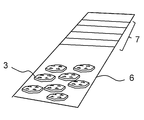
また、本実施形態の放射線の測定方法では、金属ナノ粒子複合体3を繊維基材や紙等のシート状の基材6に担持して使用してもよい。シート状の基材6中の金属ナノ粒子複合体3が担持された部位を測定試料水溶液中に含浸させ、その部位の色の変化を観察することにより、測定試料水溶液中の放射線量を容易に評価することができる。
このとき、図3に示すように、シート状の基材6の一部に前述した標準色表7を設けておくのが好ましい。こうすることで、一目で測定試料水溶液中の放射線量を判断することができる。
このとき、図3に示すように、シート状の基材6の一部に前述した標準色表7を設けておくのが好ましい。こうすることで、一目で測定試料水溶液中の放射線量を判断することができる。
以上、本発明の実施形態について述べたが、これらは本発明の例示であり、上記以外の様々な構成を採用することもできる。
また、本発明は前述の実施形態に限定されるものではなく、本発明の目的を達成できる範囲での変形、改良等は本発明に含まれるものである。
また、本発明は前述の実施形態に限定されるものではなく、本発明の目的を達成できる範囲での変形、改良等は本発明に含まれるものである。
この出願は、2013年11月7日に出願された日本出願特願2013-231491号を基礎とする優先権を主張し、その開示の全てをここに取り込む。
Claims (10)
- イオン化放射性物質が放出する直接電離性放射線の測定方法であって、
サイズが変化することにより色が変化する金属ナノ粒子を、金属酸化物粒子の表面に担持してなる金属ナノ粒子複合体を準備する工程と、
前記イオン化放射性物質を含む測定試料水溶液に前記金属ナノ粒子複合体を浸漬することにより、前記金属ナノ粒子複合体の周囲に前記イオン化放射性物質の拡散電気二重層を形成させて前記金属ナノ粒子複合体の周囲における前記イオン化放射性物質の濃度を高める工程と、
前記イオン化放射性物質が放出する前記直接電離性放射線の電離作用により生成したイオンペアによって、前記金属ナノ粒子の表面電荷を中和して前記金属ナノ粒子の表面電位を上げることにより、前記金属ナノ粒子をイオン化させて前記金属ナノ粒子の前記サイズを変化させる工程と、
前記サイズの変化による前記金属ナノ粒子が発する色の変化により、前記測定試料水溶液中の前記イオン化放射性物質が放出する前記直接電離性放射線を検出する工程と、
を含む、放射線の測定方法。 - 請求項1に記載の放射線の測定方法において、
前記測定試料水溶液中の前記イオン化放射性物質が放出する前記直接電離性放射線が、α線、β線、電子線、陽電子線、陽子線、重陽子線、三重陽子線、重イオン線、及び荷電中間子線から選択される放射線である、放射線の測定方法。 - 請求項1または2に記載の放射線の測定方法において、
前記金属ナノ粒子がpH5~7の水中において負のゼータ電位を有するものであり、
前記金属ナノ粒子の周囲に、陽イオンである前記イオン化放射性物質の前記拡散電気二重層を形成させる、放射線の測定方法。 - 請求項1乃至3いずれか一項に記載の放射線の測定方法において、
前記測定試料水溶液中に、前記金属ナノ粒子から溶出する金属イオンを沈殿させるハロゲンイオンまたは前記金属イオンをキレートするキレート剤を添加することにより、前記金属ナノ粒子の前記イオン化を促進させる、放射線の測定方法。 - 請求項1乃至4いずれか一項に記載の放射線の測定方法において、
前記金属ナノ粒子がプラズモン吸収により発色する銀ナノ粒子である、放射線の測定方法。 - 請求項5に記載の放射線の測定方法において、
前記金属ナノ粒子複合体が、平板状の前記銀ナノ粒子が平板状の前記金属酸化物粒子の平面上に吸着してなる銀ナノ粒子複合体である、放射線の測定方法。 - 請求項1乃至6いずれか一項に記載の放射線の測定方法において、
前記測定試料水溶液に浸漬した前記金属ナノ粒子複合体の色により前記測定試料水溶液中の放射線量を評価する、放射線の測定方法。 - 請求項7に記載の放射線の測定方法において、
前記放射線量と前記金属ナノ粒子複合体の色との関係を示した標準色表と、前記測定試料水溶液に浸漬した前記金属ナノ粒子複合体の色とを比較することにより、前記測定試料水溶液中の前記放射線量を評価する、放射線の測定方法。 - 請求項8に記載の放射線の測定方法において、
前記金属ナノ粒子複合体がシート状の基材に担持されており、
シート状の前記基材の一部に前記標準色表が設けられている、放射線の測定方法。 - 請求項1に記載の放射線の測定方法に使用される金属ナノ粒子複合体であって、
サイズが変化することにより色が変化する金属ナノ粒子を金属酸化物粒子の表面に担持してなる、金属ナノ粒子複合体。
Priority Applications (1)
| Application Number | Priority Date | Filing Date | Title |
|---|---|---|---|
| JP2015546333A JPWO2015068478A1 (ja) | 2013-11-07 | 2014-09-22 | 放射線の測定方法およびこれに使用する金属ナノ粒子複合体 |
Applications Claiming Priority (2)
| Application Number | Priority Date | Filing Date | Title |
|---|---|---|---|
| JP2013231491 | 2013-11-07 | ||
| JP2013-231491 | 2013-11-07 |
Publications (1)
| Publication Number | Publication Date |
|---|---|
| WO2015068478A1 true WO2015068478A1 (ja) | 2015-05-14 |
Family
ID=53041261
Family Applications (1)
| Application Number | Title | Priority Date | Filing Date |
|---|---|---|---|
| PCT/JP2014/075022 Ceased WO2015068478A1 (ja) | 2013-11-07 | 2014-09-22 | 放射線の測定方法およびこれに使用する金属ナノ粒子複合体 |
Country Status (2)
| Country | Link |
|---|---|
| JP (1) | JPWO2015068478A1 (ja) |
| WO (1) | WO2015068478A1 (ja) |
Citations (11)
| Publication number | Priority date | Publication date | Assignee | Title |
|---|---|---|---|---|
| JPS4837433Y1 (ja) * | 1968-08-22 | 1973-11-07 | ||
| JPH04184290A (ja) * | 1990-11-19 | 1992-07-01 | Aloka Co Ltd | 水中放射性物質モニタ装置 |
| JPH08151372A (ja) * | 1994-11-28 | 1996-06-11 | Mita Ind Co Ltd | ビスオキサジアゾール誘導体およびこれを用いた電子写真感光体 |
| JPH09509743A (ja) * | 1994-02-23 | 1997-09-30 | フロリダ・ステート・ユニバーシティー | 溶液中の放射性イオンを検出するための固体シンチレーター |
| JP2000131500A (ja) * | 1998-10-22 | 2000-05-12 | Konica Corp | カセッテ型放射線画像読取装置 |
| JP2003329775A (ja) * | 2002-05-14 | 2003-11-19 | Tokyo Metropolis | ラドン等の放射性核種の濃度測定方法とこの方法に用いる装置 |
| JP2006105958A (ja) * | 2004-09-13 | 2006-04-20 | Nichiyu Giken Kogyo Co Ltd | 被ばく線量検量方法 |
| JP2007121308A (ja) * | 1996-02-19 | 2007-05-17 | Yamasa Shoyu Co Ltd | 消化器疾患用抗体試薬 |
| JP2008019162A (ja) * | 2003-03-17 | 2008-01-31 | Kansai Tlo Kk | 貴金属・磁性金属酸化物複合微粒子およびその製造法 |
| JP2011190535A (ja) * | 2010-03-12 | 2011-09-29 | Bayer Materialscience Ag | 静電的に安定化された銀ナノ粒子を含有する分散体を用いる導電性表面被覆物の製造 |
| WO2013027525A1 (ja) * | 2011-08-19 | 2013-02-28 | 国立大学法人東北大学 | 銀ナノ粒子複合体、それを用いた銀ナノ粒子複合体懸濁液、γ線感応センサ形成用組成物及びγ線感応センサ、並びに銀ナノ粒子複合体の製造方法 |
-
2014
- 2014-09-22 WO PCT/JP2014/075022 patent/WO2015068478A1/ja not_active Ceased
- 2014-09-22 JP JP2015546333A patent/JPWO2015068478A1/ja active Pending
Patent Citations (11)
| Publication number | Priority date | Publication date | Assignee | Title |
|---|---|---|---|---|
| JPS4837433Y1 (ja) * | 1968-08-22 | 1973-11-07 | ||
| JPH04184290A (ja) * | 1990-11-19 | 1992-07-01 | Aloka Co Ltd | 水中放射性物質モニタ装置 |
| JPH09509743A (ja) * | 1994-02-23 | 1997-09-30 | フロリダ・ステート・ユニバーシティー | 溶液中の放射性イオンを検出するための固体シンチレーター |
| JPH08151372A (ja) * | 1994-11-28 | 1996-06-11 | Mita Ind Co Ltd | ビスオキサジアゾール誘導体およびこれを用いた電子写真感光体 |
| JP2007121308A (ja) * | 1996-02-19 | 2007-05-17 | Yamasa Shoyu Co Ltd | 消化器疾患用抗体試薬 |
| JP2000131500A (ja) * | 1998-10-22 | 2000-05-12 | Konica Corp | カセッテ型放射線画像読取装置 |
| JP2003329775A (ja) * | 2002-05-14 | 2003-11-19 | Tokyo Metropolis | ラドン等の放射性核種の濃度測定方法とこの方法に用いる装置 |
| JP2008019162A (ja) * | 2003-03-17 | 2008-01-31 | Kansai Tlo Kk | 貴金属・磁性金属酸化物複合微粒子およびその製造法 |
| JP2006105958A (ja) * | 2004-09-13 | 2006-04-20 | Nichiyu Giken Kogyo Co Ltd | 被ばく線量検量方法 |
| JP2011190535A (ja) * | 2010-03-12 | 2011-09-29 | Bayer Materialscience Ag | 静電的に安定化された銀ナノ粒子を含有する分散体を用いる導電性表面被覆物の製造 |
| WO2013027525A1 (ja) * | 2011-08-19 | 2013-02-28 | 国立大学法人東北大学 | 銀ナノ粒子複合体、それを用いた銀ナノ粒子複合体懸濁液、γ線感応センサ形成用組成物及びγ線感応センサ、並びに銀ナノ粒子複合体の製造方法 |
Non-Patent Citations (1)
| Title |
|---|
| KUNIO FURUSAWA: "Zeta(zeta)-potential Measurements", BUNSEKI, 2004 NEN, THE JAPAN SOCIETY FOR ANALYTICAL CHEMISTRY, no. 5, 5 May 2004 (2004-05-05), pages 247 - 254 * |
Also Published As
| Publication number | Publication date |
|---|---|
| JPWO2015068478A1 (ja) | 2017-03-09 |
Similar Documents
| Publication | Publication Date | Title |
|---|---|---|
| Cao et al. | Copper nanoclusters as a highly sensitive and selective fluorescence sensor for ferric ions in serum and living cells by imaging | |
| Matheson et al. | Formation of the hydrated electron in the flash photolysis of aqueous solutions1 | |
| Cai et al. | Ascorbic acid stabilised copper nanoclusters as fluorescent sensors for detection of quercetin | |
| Xiaoqing et al. | Fast synthesis of copper nanoclusters through the use of hydrogen peroxide additive and their application for the fluorescence detection of Hg 2+ in water samples | |
| Coutino-Gonzalez et al. | X-ray irradiation-induced formation of luminescent silver clusters in nanoporous matrices | |
| Lian et al. | Novel core–shell structure microspheres based on lanthanide complexes for white-light emission and fluorescence sensing | |
| Salah et al. | Luminescence properties of CaF2 nanostructure activated by different elements | |
| Maeyama et al. | Nanoclay gel-based radio-fluorogenic gel dosimeters using various fluorescence probes | |
| Zhuang et al. | Synthesis of europium (iii)-doped copper nanoclusters for electrochemiluminescence bioanalysis | |
| Hunyadi et al. | Scintillator of polycrystalline perovskites for high‐sensitivity detection of charged‐particle radiations | |
| Boxi et al. | Fluorometric selective detection of fluoride ions in aqueous media using Ag doped CdS/ZnS core/shell nanoparticles | |
| Zhang et al. | Pyrite oxidation inhibition by a cross-linked lipid coating | |
| Miyoshi et al. | Reversible radiochromic plate based on polyvinyl alcohol-iodide complex containing silica nanoparticles | |
| Guo et al. | Hemoglobin Inhibition of Superoxide Radical and Holes‐Induced Photobleaching in Zn2GeO4: Mn Long‐Afterglow Nanorods for Tracking of Bloodstains | |
| WO2015068478A1 (ja) | 放射線の測定方法およびこれに使用する金属ナノ粒子複合体 | |
| Zhang et al. | Green‐emissive copper nanocluster with aggregation‐enhanced emission for selective detection of Al3+ | |
| Cai et al. | Highly transparent and luminescent gel glass based on reabsorption-free gold nanoclusters | |
| Boxi et al. | Fluorometric sensing of ultralow As (III) concentrations using Ag doped hollow CdS/ZnS bi-layer nanoparticles | |
| Yang et al. | A dual sensor of fluorescent and colorimetric for the rapid detection of lead | |
| Netíková et al. | A new possible way of anthracycline cytostatics decontamination | |
| JP4820963B2 (ja) | 機能性シリカ粒子及びその用途 | |
| WO2023007058A1 (en) | A method for determining an amount of radiation | |
| US20170087640A1 (en) | Photoluminescent gold nanoparticles and manufacturing method thereof | |
| JP2016061675A (ja) | 放射線感知材料 | |
| Ma et al. | Contaminant degradation by irradiated semiconducting silver chloride particles: Kinetics and modelling |
Legal Events
| Date | Code | Title | Description |
|---|---|---|---|
| 121 | Ep: the epo has been informed by wipo that ep was designated in this application |
Ref document number: 14859560 Country of ref document: EP Kind code of ref document: A1 |
|
| ENP | Entry into the national phase |
Ref document number: 2015546333 Country of ref document: JP Kind code of ref document: A |
|
| NENP | Non-entry into the national phase |
Ref country code: DE |
|
| 122 | Ep: pct application non-entry in european phase |
Ref document number: 14859560 Country of ref document: EP Kind code of ref document: A1 |