WO2015067601A1 - Process for the preparation of iopamidol - Google Patents
Process for the preparation of iopamidol Download PDFInfo
- Publication number
- WO2015067601A1 WO2015067601A1 PCT/EP2014/073692 EP2014073692W WO2015067601A1 WO 2015067601 A1 WO2015067601 A1 WO 2015067601A1 EP 2014073692 W EP2014073692 W EP 2014073692W WO 2015067601 A1 WO2015067601 A1 WO 2015067601A1
- Authority
- WO
- WIPO (PCT)
- Prior art keywords
- compound
- butyl
- group
- methyl
- lopamidol
- Prior art date
- Legal status (The legal status is an assumption and is not a legal conclusion. Google has not performed a legal analysis and makes no representation as to the accuracy of the status listed.)
- Ceased
Links
- 0 Nc1cc(*C(CO)CO)cc(*C(CO)CO)c1 Chemical compound Nc1cc(*C(CO)CO)cc(*C(CO)CO)c1 0.000 description 2
Classifications
-
- C—CHEMISTRY; METALLURGY
- C07—ORGANIC CHEMISTRY
- C07C—ACYCLIC OR CARBOCYCLIC COMPOUNDS
- C07C201/00—Preparation of esters of nitric or nitrous acid or of compounds containing nitro or nitroso groups bound to a carbon skeleton
- C07C201/06—Preparation of nitro compounds
- C07C201/12—Preparation of nitro compounds by reactions not involving the formation of nitro groups
-
- C—CHEMISTRY; METALLURGY
- C07—ORGANIC CHEMISTRY
- C07C—ACYCLIC OR CARBOCYCLIC COMPOUNDS
- C07C227/00—Preparation of compounds containing amino and carboxyl groups bound to the same carbon skeleton
- C07C227/04—Formation of amino groups in compounds containing carboxyl groups
-
- C—CHEMISTRY; METALLURGY
- C07—ORGANIC CHEMISTRY
- C07C—ACYCLIC OR CARBOCYCLIC COMPOUNDS
- C07C231/00—Preparation of carboxylic acid amides
- C07C231/02—Preparation of carboxylic acid amides from carboxylic acids or from esters, anhydrides, or halides thereof by reaction with ammonia or amines
-
- C—CHEMISTRY; METALLURGY
- C07—ORGANIC CHEMISTRY
- C07C—ACYCLIC OR CARBOCYCLIC COMPOUNDS
- C07C231/00—Preparation of carboxylic acid amides
- C07C231/12—Preparation of carboxylic acid amides by reactions not involving the formation of carboxamide groups
-
- C—CHEMISTRY; METALLURGY
- C07—ORGANIC CHEMISTRY
- C07C—ACYCLIC OR CARBOCYCLIC COMPOUNDS
- C07C231/00—Preparation of carboxylic acid amides
- C07C231/14—Preparation of carboxylic acid amides by formation of carboxamide groups together with reactions not involving the carboxamide groups
-
- C—CHEMISTRY; METALLURGY
- C07—ORGANIC CHEMISTRY
- C07C—ACYCLIC OR CARBOCYCLIC COMPOUNDS
- C07C237/00—Carboxylic acid amides, the carbon skeleton of the acid part being further substituted by amino groups
- C07C237/02—Carboxylic acid amides, the carbon skeleton of the acid part being further substituted by amino groups having the carbon atoms of the carboxamide groups bound to acyclic carbon atoms of the carbon skeleton
- C07C237/04—Carboxylic acid amides, the carbon skeleton of the acid part being further substituted by amino groups having the carbon atoms of the carboxamide groups bound to acyclic carbon atoms of the carbon skeleton the carbon skeleton being acyclic and saturated
- C07C237/06—Carboxylic acid amides, the carbon skeleton of the acid part being further substituted by amino groups having the carbon atoms of the carboxamide groups bound to acyclic carbon atoms of the carbon skeleton the carbon skeleton being acyclic and saturated having the nitrogen atoms of the carboxamide groups bound to hydrogen atoms or to acyclic carbon atoms
-
- C—CHEMISTRY; METALLURGY
- C07—ORGANIC CHEMISTRY
- C07C—ACYCLIC OR CARBOCYCLIC COMPOUNDS
- C07C237/00—Carboxylic acid amides, the carbon skeleton of the acid part being further substituted by amino groups
- C07C237/28—Carboxylic acid amides, the carbon skeleton of the acid part being further substituted by amino groups having the carbon atom of at least one of the carboxamide groups bound to a carbon atom of a non-condensed six-membered aromatic ring of the carbon skeleton
- C07C237/46—Carboxylic acid amides, the carbon skeleton of the acid part being further substituted by amino groups having the carbon atom of at least one of the carboxamide groups bound to a carbon atom of a non-condensed six-membered aromatic ring of the carbon skeleton having carbon atoms of carboxamide groups, amino groups and at least three atoms of bromine or iodine, bound to carbon atoms of the same non-condensed six-membered aromatic ring
-
- C—CHEMISTRY; METALLURGY
- C07—ORGANIC CHEMISTRY
- C07F—ACYCLIC, CARBOCYCLIC OR HETEROCYCLIC COMPOUNDS CONTAINING ELEMENTS OTHER THAN CARBON, HYDROGEN, HALOGEN, OXYGEN, NITROGEN, SULFUR, SELENIUM OR TELLURIUM
- C07F5/00—Compounds containing elements of Groups 3 or 13 of the Periodic Table
- C07F5/02—Boron compounds
- C07F5/025—Boronic and borinic acid compounds
-
- C—CHEMISTRY; METALLURGY
- C07—ORGANIC CHEMISTRY
- C07F—ACYCLIC, CARBOCYCLIC OR HETEROCYCLIC COMPOUNDS CONTAINING ELEMENTS OTHER THAN CARBON, HYDROGEN, HALOGEN, OXYGEN, NITROGEN, SULFUR, SELENIUM OR TELLURIUM
- C07F5/00—Compounds containing elements of Groups 3 or 13 of the Periodic Table
- C07F5/02—Boron compounds
- C07F5/04—Esters of boric acids
-
- C—CHEMISTRY; METALLURGY
- C07—ORGANIC CHEMISTRY
- C07F—ACYCLIC, CARBOCYCLIC OR HETEROCYCLIC COMPOUNDS CONTAINING ELEMENTS OTHER THAN CARBON, HYDROGEN, HALOGEN, OXYGEN, NITROGEN, SULFUR, SELENIUM OR TELLURIUM
- C07F5/00—Compounds containing elements of Groups 3 or 13 of the Periodic Table
- C07F5/02—Boron compounds
- C07F5/05—Cyclic compounds having at least one ring containing boron but no carbon in the ring
-
- Y—GENERAL TAGGING OF NEW TECHNOLOGICAL DEVELOPMENTS; GENERAL TAGGING OF CROSS-SECTIONAL TECHNOLOGIES SPANNING OVER SEVERAL SECTIONS OF THE IPC; TECHNICAL SUBJECTS COVERED BY FORMER USPC CROSS-REFERENCE ART COLLECTIONS [XRACs] AND DIGESTS
- Y02—TECHNOLOGIES OR APPLICATIONS FOR MITIGATION OR ADAPTATION AGAINST CLIMATE CHANGE
- Y02P—CLIMATE CHANGE MITIGATION TECHNOLOGIES IN THE PRODUCTION OR PROCESSING OF GOODS
- Y02P20/00—Technologies relating to chemical industry
- Y02P20/50—Improvements relating to the production of bulk chemicals
- Y02P20/55—Design of synthesis routes, e.g. reducing the use of auxiliary or protecting groups
-
- Y—GENERAL TAGGING OF NEW TECHNOLOGICAL DEVELOPMENTS; GENERAL TAGGING OF CROSS-SECTIONAL TECHNOLOGIES SPANNING OVER SEVERAL SECTIONS OF THE IPC; TECHNICAL SUBJECTS COVERED BY FORMER USPC CROSS-REFERENCE ART COLLECTIONS [XRACs] AND DIGESTS
- Y02—TECHNOLOGIES OR APPLICATIONS FOR MITIGATION OR ADAPTATION AGAINST CLIMATE CHANGE
- Y02P—CLIMATE CHANGE MITIGATION TECHNOLOGIES IN THE PRODUCTION OR PROCESSING OF GOODS
- Y02P20/00—Technologies relating to chemical industry
- Y02P20/50—Improvements relating to the production of bulk chemicals
- Y02P20/582—Recycling of unreacted starting or intermediate materials
Definitions
- the present invention relates to the field of organic chemistry, in particular to the synthesis of iodinated contrast agents, more in particular to the use of boron oxyacids and derivatives thereof as protecting groups.
- the present invention provides also compounds useful as intermediates in the above synthesis.
- Contrast agents are substances that can alter the way in which a region is analyzed in medical imaging. In particular, they are able to change the contrast of an organ, an injury, or any other surrounding structure, to make visible such details that otherwise would be difficult to detect or appreciate.
- Contrast agents are primarily used in the radiological or in the nuclear magnetic resonance diagnostic fields. Depending on the field of application, these derivatives present structural features, such as, in the case of molecules useful as contrast agents for X-rays analysis, the presence of one or more atom with high atomic number (e.g. iodine or barium).
- molecules useful as contrast agents for X-rays analysis the presence of one or more atom with high atomic number (e.g. iodine or barium).
- lopamidol N,N'-bis[2-hydroxy-1-(hydroxymethyl)ethyl]-5-[(2S)(2-hydroxy-1-oxopropyl)amino]-2,4,6- triiodo-1 ,3-benzendicarboxamide) (II), whose structural formula is indicated below, is one of the numerous tri-iodinated diagnostic agents, commercially available and widely used for this purpose:
- 5-Amino-A/,A/-bis[2-hydroxy-1-(hydroxymethyl)ethyl]-1 ,3-benzenedicarboxamide (V) is a key intermediate in the synthesis of lopamidol. As shown in Scheme 1 below where prior art synthesis has been summarized, its iodination gives the intermediate 5-Amino-A/,A/-bis[2-hydroxy-1- (hydroxymethyl)ethyl]-2,4,6-triiodo-1 ,3-benzenedicarboxamide (IV) which may be further reacted with suitable acylating agents, such as acetic anhydride in order to protect the hydroxyl groups (as described, i.e.
- suitable acylating agents such as acetic anhydride
- Boron derivatives are known as protective agents in chemical synthesis.
- Salts and esters can also be used.
- the reaction involving diol protection by the boron oxyacid is carried out in water. After the N-alkylation reaction has come to accomplishment, diol deprotection is carried out.
- Another different use of boric oxyacids in connection with iodinated contrast media is disclosed in Journal of Hazardous Materials 205-206 (2012) 10-16 (I Rustighia, I Donatia, M Ferluga, C Campa, AE Pasqua, M Rossi, S Paoletti; Borate complexes of X-ray iodinated contrast agents: Characterization and sorption studies for their removal from aqueous media).
- the Authors show an effective use of boric oxyacids as a means for removing iodinated contrast media from wastewater. This adduct has a good stability at alkaline pH and is adsorbed on the ionic resin Dowex 1X4, from which it is desorbed by means of a number of desorbing agents, mainly salts.
- these protecting groups can be recovered and recycled in the process and this represents a significant advantage in terms of cost-effectiveness of the entire process and environmental awareness.
- X is OR 2 or R 3 , and wherein R 2 and R 3 are a Ci-C 6 linear or branched alkyl, C 3 -C 6 cycloalkyl, C 6 aryl, optionally substituted with a group selected from the group consisting of methyl, ethyl, n- propyl, /-propyl, n-butyl, sec-butyl, i-butyl and phenyl.
- X is OR 2 , wherein R 2 is as above defined and preferably selected from the group consisting of: ethyl, n-propyl and n-butyl.
- X is R 3 , wherein R 3 is as above defined and preferably selected from the group consisting of: butyl, isobutyl, isopentyl, n-pentyl, n- hexyl, ciclopentyl, ciclohexyl or phenyl, optionally substituted with methyl, ethyl, n-propyl, /-propyl, n- butyl, sec-butyl, i-butyl or phenyl.
- said reaction medium is an organic solvent, selected from the group consisting of A/,A/-dimethylformamide, A/,A/-dimethylacetamide, A/,A/-diethylacetamide, N,N- dimethylpropionamide, N-methylpyrrolidone, N-ethylpyrrolidone, tetramethylurea, ⁇ , ⁇ '- dimethylethyleneurea (DMEU), ⁇ /, ⁇ /'-dimethylpropyleneurea (DMPU), optionally in admixture with a water-immiscible organic solvent, herein defined co-solvent.
- organic solvent selected from the group consisting of A/,A/-dimethylformamide, A/,A/-dimethylacetamide, A/,A/-diethylacetamide, N,N- dimethylpropionamide, N-methylpyrrolidone, N-ethylpyrrolidone, tetramethylurea, ⁇ , ⁇ '- dimethylethyleneurea
- step b) after the hydrolysis of the boron protective groups recovery of the boron-derivative can be carried out by chromatography or by solvent extraction.
- a suitable resin specific for boron removal can be used.
- a suitable resin contains diolic groups and is designed to boric or boronic acid complexation and subsequent sequestration.
- a preferred resin is the one containing N-methyl (polyhydroxyhexyl)amine functional groups also called methylglucamine.
- a commercially available example of such a resin is Amberlite ® IRA743.
- resins can be selected among the commercially available ones, for example or equivalent or analogue columns, such as Duolite ES-371 , Diaion CRB 02, Dowex BSR 1 , Purolite S 108 and Purolite S1 10. Further details are provided in the Detailed Description below. Hydrolysis of boron-containing protecting groups is made by water addition.
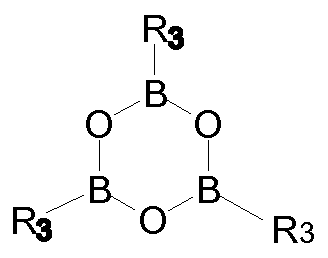
- recovery of the boron-derivatives is preferably carried out by solvent extraction, in particular when, according to Scheme 3 and reactant 3, R3 is butyl, phenyl or a methyl substituted phenyl (tolyl group), butyl or when a boroxine of Formula III is used and R3 has the same meaning as for reactant 3.
- boron derivative means the boron compounds which are used according to Scheme 3 above, with the starting Compound (IV) to give the Compound (I); as well as the compounds produced in the hydrolysis of the intermediate (I) and subsequent freeing the hydroxyls from the boron- containing protective groups.
- These boron derivatives can be optionally recovered in the above step c) and recycled in the process.
- the terms “boron derivative” or “boron derivatives” generally comprise boron oxyacids (such as boric acid and boronic acids), esters thereof and boroxine.
- the intermediate Compound (I), wherein X is OR 2 is obtained by reacting Compound (IV) with one of a boric acid in an R 2 OH alcohol or a borate ester B(OR 2 )3, wherein R 2 is as above defined.
- the intermediate Compound (I), wherein X is R 3 is obtained by reacting the Compound (IV) with a boronic acid R 3 -B(OH) 2 , wherein R 3 is as above defined.
- this second preferred embodiment, not shown in Scheme 3, but part of the present invention is achieved by reacting the Compound (IV) with a boroxine of formula (III):
- R 3 is as above defined.
- said process for the preparation of lopamidol (II) comprises:
- the boric acid ester can be restored for subsequent use.
- the boric acid, obtained in the final step is recovered, reacted with an R 2 -OH alcohol, wherein R 2 is as above defined, and recycled in a new process.
- said boric acid is treated with a suitable resin, such as a resin specific for boric acid, for example the commercially available AmberliteTM IRA743, being intended that the person skilled in the art can select the proper way to recover boric acid by resorting to the general common knowledge in this matter.
- a suitable resin such as a resin specific for boric acid, for example the commercially available AmberliteTM IRA743, being intended that the person skilled in the art can select the proper way to recover boric acid by resorting to the general common knowledge in this matter.
- said process for the preparation of lopamidol (II) comprises:
- the boric acid and the alcohol form the corresponding boric acid ester in situ, and the process can be carried out as in the case explained above using the boric acid ester.
- the boric acid ester is then restored for subsequent use as shown above.
- the process can be carried out in batch mode, or, conveniently, in continuous mode.
- X is R 3 , as above defined and is preferably a phenyl, a methyl substituted phenyl, a methyl or a butyl group.
- R 3 is preferably a phenyl, a methyl substituted phenyl, a methyl or a butyl group.
- Said process comprises:
- the boronic acid can be recovered for subsequent use.
- the boronic acid, obtained in the final step is recovered with two possible approaches: by extracting with an organic water-immiscible solvent, for example 4-methyl-2-pentanone, 2-pentanone, 3-pentanone, dibutyl ether, 2-methyl-tetrahydrofurane, ciclopentylmethyl ether, methyl isopropyl ketone, methyl isopentyl ketone, ethyl acetate, butyl acetate, pentyl acetate, isopentyl acetate, isopropyl acetate, removing the solvent and recycling the recovered boronic acid in the process, or alternatively, as described above for boric or boronic acid complexation, i.e. by treating the final reaction mixture with a resin suitable for boron removal, such as those mentioned in step c) above, among which, for example, an Amberlite ® IRA 743.
- the recovery process can be carried out in a batch mode, or, more conveniently, in a continuous mode.
- phenylboronic, p-tolyl boronic or n-butylboronic acids are used and recycled.
- X is R 3 , as above defined, preferably phenyl, a methyl substituted phenyl, methyl or butyl. More preferably in Compound of formula (I) R 3 is phenyl.
- the preparation of compound of formula (I) as an intermediate in the preparation of lopamidol (II) can also be carried out as disclosed in the previous embodiment, but using a boroxine of formula (III) is used instead of the boronic acid. Triphenylboroxine and trimethylboroxine are preferred boroxines and R 3 in compound (I) is preferably phenyl or methyl. According to this embodiment, phenylboronic acid or methylboronic acid are released upon hydrolysis of the hydroxyl groups, freed from the boron- containing protective moiety and the boronic acids can be restored for subsequent use, as disclosed above.
- an acetylation step is carried out on Compound (I) preferably in a solvent selected from the group consisting of: N,N- dimethylformamide, A/,A/-dimethylacetamide (DMAC), A/,A/-diethylacetamide, N,N- dimethylpropionamide, 1-methyl-2-pyrrolidone, 1-ethyl-2-pyrrolidone, tetramethylurea, ⁇ , ⁇ '- dimethylethyleneurea (DMEU), ⁇ /, ⁇ /'-dimethylpropyleneurea (DMPU).
- a solvent selected from the group consisting of: N,N- dimethylformamide, A/,A/-dimethylacetamide (DMAC), A/,A/-diethylacetamide, N,N- dimethylpropionamide, 1-methyl-2-pyrrolidone, 1-ethyl-2-pyrrolidone, tetramethylurea, ⁇ , ⁇ '- dimethylethyleneurea (DMEU), ⁇ /
- N,N- dimethylacetamide is used and more preferably, A/,A/-dimethylacetamide has a very low water content or is anhydrous.
- the solvent may also comprise a co-solvent which is an organic solvent immiscibile in water, selected among : 4-methyl-2-pentanone, 2-pentanone, 3-pentanone, dibutyl ether, 2-methyl- tetrahydrofurane, ciclopentylmethyl ether, methyl isopropyl ketone, methyl isopentyl ketone, ethyl acetate, butyl acetate, pentyl acetate, isopentyl acetate, isopropyl acetate.
- a co-solvent which is an organic solvent immiscibile in water, selected among : 4-methyl-2-pentanone, 2-pentanone, 3-pentanone, dibutyl ether, 2-methyl- tetrahydrofurane, cicl
- a preferred solvent/co- solvent mixture is represented by DMAC and 4-methyl-2-pentanone, 3-pentanone or 2-pentanone.
- the presence of a co-solvent in step a) is particularly preferred when the boron protective groups have to be recovered at a later time by co-solvent extraction.
- the process can be carried out starting from a suitable Compound (V).
- an object of the present invention is a process according to the following Scheme 4:
- Scheme 4 describes the synthesis of lopamidol (II) from 5-Amino-A/,A/-bis[2-hydroxy-1- (hydroxymethyl)ethyl]-1 ,3-benzenedicarboxamide (V);
- X is as defined above and in the first reaction step the numbers 1 ; 2; 3 represent reactants in single, alternative embodiments. Not shown in the scheme, but part of the present invention is also the alternative reactant boroxine.
- the Compound (V) can also be prepared as described in WO02/44125 or WO00/029372.
- the iodination of the aromatic ring is also carried out according to methods disclosed in the numerous literature on lopamidol synthesis, e.g. in WO96/037458, WO2009/103666, WO2010/121904, WO201 1/154500 and WO201 1/003894.
- Scheme 5 describes the synthesis of 5-Amino-A/,A/-bis[2-hydroxy-1-(hydroxymethyl)ethyl]-1 ,3- benzenedicarboxamide (V) from 5-Nitro-isophthalic acid (5-NIPA), wherein: i) 5-nitroisophthalic acid is treated with an R-iOH alcohol, wherein R-i is a linear or branched Ci-C 4 alkyl, to provide the corresponding diester (VI);
- Another object of the present invention is a process for the preparation of lopamidol according to the
- the present invention discloses a process for the preparation of lopamidol (II) comprising the following reaction: wherein X is OR 2 or R 3 , and wherein R 2 and R 3 are a Ci-C 6 linear or branched alkyl, C 3 -C 6 cycloalkyl, C 6 aryl, optionally substituted with a group selected from the group consisting of methyl, ethyl, n- propyl, /-propyl, n-butyl, sec-butyl, i-butyl and phenyl, more preferably phenyl, a methyl substituted phenyl, methyl and butyl,
- the reaction medium is preferably a reaction medium having the minimum water content compatible with the reaction, more preferably, an anhydrous reaction medium.
- the reaction medium is conveniently selected by the person of ordinary skill in the art, based on the common knowledge for this kind of reaction.
- the medium is typically an organic solvent capable of dissolving the Compound of formula (I) and not interfering with the acylating reagent (S)-2- (acetyloxy)propanoyl chloride.
- organic solvent usable in this step are inert dipolar aprotic solvents, such as for example A/,A/-dimethylformamide, A/,A/-dimethylacetamide, N,N- diethylacetamide, A/,A/-dimethylpropionamide, 1-methyl-2-pyrrolidone, 1-ethyl-2-pyrrolidone, tetramethylurea, ⁇ /, ⁇ /'-dimethylethyleneurea (DMEU), ⁇ /, ⁇ /'-dimethylpropyleneurea (DMPU).
- inert dipolar aprotic solvents such as for example A/,A/-dimethylformamide, A/,A/-dimethylacetamide, N,N- diethylacetamide, A/,A/-dimethylpropionamide, 1-methyl-2-pyrrolidone, 1-ethyl-2-pyrrolidone, tetramethylurea, ⁇ /, ⁇ /'-dimethylethyleneurea (
- the organic solvent used in this step can be also in admixture with a co-solvent.
- co-solvents are selected among those organic and immiscibile in water, such as: 4-methyl-2-pentanone, 2-pentanone, 3-pentanone, dibutyl ether, 2-methyl-tetrahydrofurane, ciclopentylmethyl ether, methyl isopropyl ketone, methyl isopentyl ketone, ethyl acetate, butyl acetate, pentyl acetate, isopentyl acetate, isopropyl acetate.
- a preferred solvent/co-solvent mixture is represented by DMAC and 4-methyl-2- pentanone, 3-pentanone or 2-pentanone.
- step a) the stoichiometric ratio between the Compound of formula (I) and the chiral acylating agent (S)-2-(acetyloxy)propanoyl chloride is the one usually employed in the synthesis of lopamidol (see for example GB1472050 Example 1 b). A stoichiometric excess is preferred depending on the reaction conditions.
- Humidity should be kept controlled in the reaction environment, therefore, it is preferred to carry out the reaction in an inert atmosphere, for example dry nitrogen or argon.
- the reaction temperature is typically around room temperature, even though higher or lower temperatures can be used compatibly with the stability of the reactants and the final product.
- reaction time depends on the reaction conditions: the solvent used, reactants ratio and purity, temperature.
- the person of ordinary skill in the art can find the optimal conditions by recurring to his personal knowledge and experience.
- the completion of the reaction can be detected by ordinary analytical means used in organic chemistry, for example spectrometric equipment, such as H-NMR, IR; chromatographic equipment, for example TLC, HPLC, GLC.
- spectrometric equipment such as H-NMR, IR
- chromatographic equipment for example TLC, HPLC, GLC.
- step b the reaction mixture resulting from step a) of the process of the present invention is transferred into an aqueous medium (step b).
- water or a diluted alkaline solution, such as a NaOH or a KOH solution
- acylation step a) is added in the same reaction vessel where acylation step a) has been performed.
- Transfer of the organic phase into a different vessel containing water can also be done.
- the amount of water volume or weight is at least the same of the organic phase, preferably higher, for example 2-3 times the volume of the organic phase, compatibly with the subsequent operations and not exceeding in dilution.
- Acetyl lopamidol protected hydroxyl groups are then freed from the boron-containing protecting groups by hydrolysis, adding water or diluted alkaline solutions, such as diluted NaOH or KOH to the acidic reaction mixture.
- the recovery of the boron-containing protective groups after their hydrolysis on the acetyloxy derivative of Compound of Formula (I) in step b) can be performed by treating the reaction mixture with an ion exchange resin, typically an anionic exchange one, preferably one specific for boron sequestration, such as a resin with diolic functions, more preferably with functions selected in the group consisting of: methylglucamine, diethanolaminomethyl preferably on a polystyrene matrix, glycidyl preferably on a methacrylate matrix, iminodipropylene glycol, amino-bis(propane cis 2,3 diol), hydroxyethylamino propylene glycol.
- an ion exchange resin typically an anionic exchange one,
- Some resins such as those with methylglucamine functions are also commercially available and can be selected from manufacturers' catalogues, for example Resindion of Mitsubishi Chemical, Dow Chemical, etc.
- Typical example is Duolite ES-371
- preferred example is AmberliteTM IRA743 by Dow Chemical Company or other suppliers.
- This embodiment applies preferably to boric acid derivatives: conveniently, the resin is loaded into a column and the phase is eluted through it.
- boron-containing protective groups Alternatively and according to the preferred embodiment described below when a boronic acid such as phenylboronic, p-tolylboronic or butylboronic acid or a boroxine (such as phenylboroxine or methylboroxine) are used as the boron-containing protective groups, the recovery of boron-containing protective groups is carried out by extraction with an organic solvent immiscibile in water selected from the group consisting of: 4-methyl-2-pentanone, 3-pentanone, 2-pentanone, dibutyl ether, 2-methyl- tetrahydrofurane, ciclopentylmethyl ether, methyl isopropyl ketone, methyl isopentyl ketone, ethyl acetate, butyl acetate, pentyl acetate, isopentyl acetate, isopropyl acetate.
- Preferred extraction solvents are 4-methyl-2-pentanone (MIBK),
- Compound I is preferably prepared directly in a polar solvent in admixture with the water-immiscible organic solvent (co-solvent) useful for boron-containing protective groups extraction as described below.
- a preferred solvent/co-solvent mixture is represented by DMAC and 4-methyl-2-pentanone (MIBK), 3-pentanone or 2-pentanone (i.e. in a ratio comprised from 1 : 10 to 1 :4 weight/weight).
- Compound IV The boronic acid or boroxine are added in a slight molar excess compared to the triiodobenzenecarboxamide (Compound IV).
- the suspension is admixed and heated to 90-95°C and water is preferably distilled off to complete the protection reaction. Formation of Compound I can be assessed i.e. by H-NMR.
- steps a)-c) can then be carried out in a single pot, for example as follows: (S)-2-(acetyloxy) propanoyl-chloride is added to the mixture under nitrogen atmosphere and stirred for a few hours, to achieve the acetyloxy propanoyl derivative of Compound I.
- Release of the boron protecting groups by hydrolysis of the acetyloxy propanoyl derivative of Compound I is usually obtained with (water or) a diluted alkaline solution, to neutral pH (i.e. comprised from 5-8), preferably comprised from 6-7 which allows for a good selectivity in the further recovery of the boron protective group with the water-immiscible solvent.
- the recovery of the boron protective group which is usually quantitative, can be carried out in batch or in a continuous mode. In both procedures the amount of organic water immiscible solvent is maintained in a ratio with the boronic acid compound comprised from 1 : 10 to 1 :20, preferably from 1 : 13 to 1 :16 more preferably about 1 : 15. In the batch procedure this amount can be added in one or more aliquots.
- the so obtained biphasic mixture comprises an aqueous phase with the acetyl-lopamidol, which is recovered for purification, followed by hydrolysis of the acetyl group to achieve lopamidol, while the the boronic acid is partitioned in the organic phase which is recovered, optionally preferably distilled to concentrate the boron-protective containing groups and recycled.
- Recycling of the boronic acid solution can be accomplished after addition of the reaction solvent of choice, i.e. DMAC (5-10% of the organic solution) and co-solvent distillation, preferably under vacuum and at a temperature below 40°C to achieve a boronic acid concentration of about 10%.
- the recycled solution can then be used indefinitely preferably by addition of a small quantity (i.e. corresponding to 5-20% of recycled boronic acid present in the organic solution) of fresh boronic acid.
- aqueous solution eluted from the column specific for sequestering the boronic acid or alternatively coming from the extraction by means of an organic solvent, and comprising A/,A/'-bis[2-hydroxy-1-(hydroxymethyl)ethyl]-5-[(2S)(2-acetoxy-1-oxopropyl)amino]-2,4,6- triiodo-1 ,3-benzendicarboxamide, also known as acetyl-lopamidol is then de-salted from organic and inorganic salts by means of ion exchange resins.
- step c) the neutral solution obtained is loaded onto a strong anionic resin, preferably a resin with trimethylamine functional groups bound to a polymeric matrix material such as Relite ® 3ASFB, to release raw lopamidol, essentially as described in US 5,550,287 with the exception that lopamidol is released with a diluted aqueous solution of a strong acid, such as HCI, H 2 S0 4 , being hydrochloric acid preferred.
- lopamidol release can be effected in batch, in basic conditions, as disclosed e.g in WO97/30735, Example 1 , i.e.
- Hydrolysis of acetyl-lopamidol onto a strong anionic resin is more efficient and is therefore preferred. According to this embodiment, the process is made simpler because the purification and hydrolysis are, in practice, carried out in a single step.
- the product is further purified in a conventional manner, for example as described in more details in the Experimental Part by crystallization with 2-butanol-water to a pharmaceutical grade according to the national or European Pharmacopoeias.
- the boric acid or the derivative thereof used in the above embodiments of the process are recovered as described above and are preferably recycled in the process.
- novel Compound of formula (I) can be prepared according to the different embodiments. For example starting from Compound (IV) as detailed below, or other synthetic pathways disclosed herein. Although in the process for the preparation of lopamidol (II) Compound (I) is not necessarily isolated, it can be isolated, for example after reaction with Compound (IV), as shown in the above Scheme 3 for characterization purposes, i.e by H-NMR. Isolation of Compound (I) can be done according to conventional work-up methods, well known in the art, such as for example, extraction, precipitation, chromatographic separation.
- One exemplary way to characterize the Compound (I) is dissolving it in a suitable solvent, for example dimethylacetamide, adding a precipitation solvent, for example toluene and isolating the formed precipitate. Conveniently, the precipitate can be redissolved, for example heating the precipitation solution, and subsequent cooling. The obtained white solid is isolated, for example by filtration.
- the analytical characterization can be done according to well-known methods, for example elementary analysis, melting point, spectroscopy (such as NMR, IR) as better detailed in the Experimental Part.
- lopamidol (II) is prepared by starting from the above Compound of formula (IV).
- This Compound is a well-known intermediate, as it is its preparation, in the prior art syntheses of lopamidol (II), see for example WO0244125 and the references cited therein.
- this Compound (IV) is treated with boric acid or a derivative thereof to provide the Compound of formula (I), as disclosed above.
- Boric acid and its derivatives used in the present invention are well-known compounds which are commercially available or can be prepared according to literature methods.
- boric acid esters B(OR 2 )3, wherein R 2 is as above defined boronic acids R 3 -B(OH) 2 , and boroxine of formula (III)
- R 3 has the same meaning and preferred embodiments as above defined, are described together with their preparation in the general literature, such as for example Ullmann's Encyclopedia of Industrial Chemistry, VCH, last edition; Dennis G. Hall (ed.) Boronic Acids, Wiley VCH, last ed.; March's Advanced Organic Chemistry, Wiley, last ed.; Kirk Othmer Encyclopedia of Chemical Technology, Wiley, last ed.; Lawrence Barton et al. (eds.) Boron Compounds, Springer Verlag, 1977.
- boric acid esters are prepared according to the general reaction:
- R 2 is as above defined.
- the Compound (IV) is treated with boric acid and an R 2 OH alcohol in a reaction medium.
- the reaction medium is a solvent compatible with reaction conditions, reactants and final product.
- the reaction medium is the same organic solvent used in the reaction from Compound (I) to lopamidol (II) (step a) (see Scheme 2).
- A/,A/-dimethylacetamide is the solvent.
- the reaction is carried out at a temperature comprised from 60°C to 100°C or higher, for a time sufficient to completion. Check of completion of reaction, i.e.
- the Compound (IV) is directly treated with a boric acid ester B(OR 2 )3 in a reaction medium.
- the reaction can be carried out as for the above embodiment of boric acid and alcohol.
- Compound (I) can be either isolated for subsequent reaction or used in "one- pot" process.
- Preferred borates are selected from the group consisting of ⁇ -butyl-, n-propyl and ethyl borate. Esters with different alkyl groups can also be used.
- the reaction can be carried out as for the above embodiment of boric acid and alcohol.
- Compound (I) can be either isolated for subsequent reaction or used in "one-pot" process.
- the Compound (IV) is treated with a boronic acid anhydride, or boroxine of formula (III) above.
- Preferred boroxines are tri(phenyl)boroxine and tri(methyl)boroxine.
- the reaction can be carried out as for the above embodiment of boronic acid.
- Compound (I) can be either isolated for subsequent reaction or used in "one-pot" process.
- the reaction between the Compound (IV) and the boric acid or its derivative is carried out for a certain time and before shifting to the next step of N-acylation to lopamidol (II), it is advisable to remove part of the solvent, for example by distillation, even better by vacuum-distillation, in order to control water content, preferably until the water content is at minimum or at least very low, for example ⁇ 0.5% (determined by Karl Fischer titration).
- diol protection approach by the boron derivatives used according to the present invention can be used also for the preparation of other iodinated X-ray contrast agents, beside lopamidol such as for example lomeprol, lodixanol, loversol, lohexol, lopromide, etc..
- the present invention provides a process for the preparation of lopamidol (II) as shown in the above Scheme 4.
- 5-amino-A/,N'-bis[2-hydroxy-1-(hydroxymethy)ethyl]-1 ,3- benzenedicarboxamide (Compound (V)) is a well-known compound and one of its preparations is disclosed for example in WO0244125.
- this Compound is subjected to iodination of the benzene ring with a method known in the art, for example as disclosed in the same WO0244125 and references cited therein, to obtain 5-amino-A/,N'-bis[2-hydroxy-1- (hydroxymethy)ethyl]-2,4,6-triiodo-1 ,3-benzenedicarboxamide (Compound (IV)).
- the present invention provides a process for the preparation of lopamidol (II) as shown in the above Scheme 5.
- 5-nitro-1 ,3-benzenedicarboxylic acid (5-nitroisophthalic acid or 5-NIPA)
- 5-amino-A/,A/'-bis[2-hydroxy-1-(hydroxymethy)ethyl]-1 ,3-benzenedicarboxamide (V) is prepared, for example as disclosed in WO0244125 and WO0029372.
- this Compound (V) is subjected to iodination of the benzene ring as above mentioned to obtain 5-amino-A/,A/-bis[2-hydroxy-1-(hydroxymethy)ethyl]-2,4,6-triiodo-1 ,3- benzenedicarboxamide (Compound (IV)).
- Compound (IV) is then processed according to the present invention to lopamidol (II) through the intermediate (I).
- a "one-pot" process can be performed.
- the scheme 6 represents the synthetic pathway to lopamidol (II) from 5-NIPA according to an exemplary embodiment.
- the first part of the synthesis, from NIPA to Compound (V), is a "one-pot" synthesis, without intermediate isolation. It consists of three steps (esterification, hydrogenation, amidation), carried out in a convenient solvent, for example n-butanol in case a n-butyl ester is preferred.
- the esterification is performed in presence of a well-known esterification catalyst, for example an acid catalyst such as para-toluensulfonic acid, methansulfonic acid, sulfuric acid, preferably methanesulfonic acid.
- the hydrogenation is carried out as known by the skilled man, for example as described in EP1337505 and preferably by catalytic hydrogenation in presence of 5% Pd/C or other equivalent catalyst.
- the mixture is concentrated for the next amidation step, which is carried out essentially by two alternative methods:
- a preferred embodiment is represented by the amidation in the presence of an organic solvent and a co-solvent.
- the iodination reaction is performed on an aqueous solution containing Compound (V), synthesized following one of the two approaches mentioned above.
- the iodination procedure is done according to well-known methods, see above for related references, to give the intermediate (IV). Then the process proceeds as disclosed above according to steps a)-c).
- the invention refers to a process for the recovery of boronic acids from a reaction mixture where these are used as diol protecting groups. This allows their re-use for the same purpose in a new synthesis. Even though this recovery and recycling is preferably carried out in the process for the preparation of lopamidol according to the present invention and as described above, the recovery represents a more general embodiment for boronic acids recycling, because it provides quantitative yields (usually > 90%, preferably >95% and more preferably at least 99%) of these generally expensive reagents, thus representing a great economic advantage for large scale industrialization.
- the aqueous reaction mixture obtained after hydrolysis of the diol protective groups which comprises the boronic acid used for diol protection or in which a boronic acid is formed after hydrolysis (for example when a boroxine of Formula III is used for diol protection) and which optionally comprises a polar solvent such as: A/,A/-dimethylformamide, A/,A/-dimethylacetamide (DMAC), A/,A/-diethylacetamide, A/,A/-dimethylpropionamide, N-methylpyrrolidone, N-ethylpyrrolidone, tetramethylurea, ⁇ /, ⁇ /'-dimethylethyleneurea (DMEU), ⁇ /, ⁇ /'-dimethylpropyleneurea (DMPU) is added with an organic water-immiscible solvent.
- a polar solvent such as: A/,A/-dimethylformamide, A/,A/-dimethylacetamide (DMAC), A/
- the organic water-immiscible solvent is selected among: 4-methyl-2-pentanone (MIBK), 3-pentanone, 2-pentanone, dibutyl ether, 2-methyl-tetrahydrofurane, ciclopentylmethyl ether, methyl isopropyl ketone, methyl isopentyl ketone ethyl acetate, butyl acetate, pentyl acetate, isopentyl acetate, isopropyl acetate.
- MIBK 4-methyl-2-pentanone
- 3-pentanone 2-pentanone
- 2-pentanone dibutyl ether
- 2-methyl-tetrahydrofurane ciclopentylmethyl ether
- methyl isopropyl ketone methyl isopentyl ketone ethyl acetate
- butyl acetate pentyl acetate
- isopentyl acetate isopropyl acetate.
- a preferred ratio between the boronic acid and the water-immiscibile solvent (the boronic acid extraction solvent) is comprised from 1 : 10-1 :20 (w/w) more preferably comprised from 1 : 13- 1 : 16 and even more preferably about 1 : 15.
- the boronic acid used as the boron-containing diol protective group, recovered according to this embodiment is preferably phenylboronic, p-tolyl boronic or butyl boronic acid, or when phenylboroxine or methylboroxine are used for diol protection, phenylboronic acid or methyl boronic acid can be recovered upon hydrolysis.
- the water immiscibile organic solvent can be further re-extracted with an aliquot of an aqueous solution with a pH comprised from 0-7, or preferably close to neutrality at a pH comprised from 6 to 7 when the recovery is carried out after hydrolysis of Compound I and according to the present invention to improve the selectivity of boronic acid recovery.
- Partitioning of the boronic acid into the organic phase for its recovery can be achieved either in batch or in a continuous mode, by optimization methods known to the skilled man.
- Example 1 Preparation of lopamidol (II) starting from Compound (IV) and using a boronic acid
- the Relite 3ASFB column was then sequentially eluted with 2 bed volumes of an aqueous acidic solution (diluted hydrochloric acid), and washed with 3-4 BV (bed volumes) of water, quantitatively recovering the substrate.
- the obtained solution was neutralized to pH 7, concentrated by vacuum distillation over 2 hours.
- the solution was loaded onto a column of Amberlite ® XAD 1600 (3.6 L) (Dow Chemical Company) and eluted with 4 BV of highly diluted sodium hydroxide solution.
- the solution was loaded onto two ion exchange resin columns (cationic Dowex ® C350, 4.7 L; anionic Relite ® MG1/P, 2 L, Dow Chemical Company).
- the eluate was concentrated and the solid residue was crystallized from 2- butanol to afford lopamidol (II) (904 g; 1.16 mol) as a pure white solid with a yield of 82%.
- Phenylboronic acid was recovered with a > 90% yield.
- the solution was extracted with 4-methyl-2- pentanone (3 x 4 L) and the aqueous phase was loaded onto a Relite 3ASFB column for the hydrolysis, sequentially eluted with 2 bed volumes of an aqueous acidic solution (diluted hydrochloric acid), and washed with 3-4 bed volumes of water, quantitatively recovering the substrate.
- the obtained solution was neutralized to pH 7, concentrated by vacuum distillation over 2 hours.
- the solution was loaded onto a column of Amberlite ® XAD 1600 (3.6 L) and eluted with 4 BV of highly diluted sodium hydroxide solution.
- the solution was loaded onto two ion exchange resin columns (cationic Dowex ® C350, 4.7 L; anionic Relite ® MG1/P, 2 L).
- Phenylboronic acid was also extracted with 3-pentanone with comparable results.
- the protected intermediate (12.4 g) was re-dissolved in dimethylacetamide (10 g) and toluene (100 mL) was added to form a precipitate.
- the solution was heated at 60°C over 30 minutes and the precipitate was redissolved; the solution was cooled to 5 °C over 2 h and the obtained solid was filtered off, affording a white solid.
- the analytical characterization is in agreement with the proposed structure.
- lopamidol (II) was recovered by elution with 2 BV of an aqueous acidic solution (diluted hydrochloric acid), and washed with 3-4 bed volumes of water. The obtained solution was neutralized to pH 7, concentrated by vacuum distillation over 2 hours.
- the solution was loaded onto a column of Amberlite ® XAD 1600 (3.6 L) and eluted with 4 BV of highly diluted sodium hydroxide solution.
- the solution was loaded onto two ion exchange resin columns (cationic Dowex ® C350, 4.7 L; anionic Relite ® MG1/P, 2 L). The eluate was concentrated and the solid residue was crystallized from 2-butanol to afford lopamidol (II) (992 g; 1.28 mol) as a white solid. Yield 90 %.
- Example 4 Preparation of lopamidol (II) starting from Compound (IV) and using a boronic acid
- MIBK methyl isobutyl ketone
- PBA was extracted with three portion of methyl isobutyl ketone (3x3.2 kg).
- the aqueous phase was loaded onto two ion exchange resin columns (a cationic resin, Dowex® C350, 2 L; an anionic resin Relite® MG1/P, 2.6 L).
- the columns were eluted with water.
- the solution obtained was loaded onto Relite 3ASFB column for the hydrolysis: lopamidol (II) was recovered by elution with an aqueous acidic solution (diluted hydrochloric acid), and washed with water.
- the obtained solution was loaded onto a column of Relite® MG1/P (1.8 L), Amberlite® XAD 1600 (3.6 L) and cationic Dowex® C350 (0.2 L), and eluted with 4 BV of highly diluted sodium hydroxide solution.
- the eluate was concentrated and the solid residue was crystallized from 2-butanol to afford lopamidol (II) (1003 g; 1.29 mol) as a white solid. Yield 91 %.
- the organic phase MIBK containing phenyl boronic acid
- DMAC 0.6 kg was first added to the organic mixture and the solution was distilled under vacuum at ⁇ 40 °C concentrating the PBA, to reach a suitable concentration.
- Example 6 Preparation of lopamidol (II) starting from Compound (IV) with phenylboronic acid (PBA) in DMAC and a co-solvent. Recovery of PBA.
- the organic phase (MIBK containing phenyl boronic acid), obtained from phenylboronic acid extraction and recovered from the reaction mixture, was used to perform a synthesis of a new batch of lopamidol, essentially as described in Example 5. Briefly, DMAC (0.6 kg) was first added to the organic mixture and the solution was distilled under vacuum at ⁇ 40 °C removing 2-2.3 kg of MIBK in order to have a final amount of 3.65 Kg of MIBK.
- Example 7 Preparation of lopamidol (II) starting from Compound (IV) with phenylboronic acid (PBA) in DMAC and a co-solvent. Recovery of PBA with 2-pentanone.
- Example 8 Recovery of PBA by using diluted NaOH solution and higher solvent volumes. The process was carried out substantially as described in Examples 6 and 7 but using higher volumes of a more diluted NaOH solution. In this case, the aqueous phase was re-extracted with about twice the volume of solvent to achieve the same recovery of Acetyl-lopamidol and PBA.
- intermediate (I) was complete as assessed by 1 H-NMR.
- the residue was cooled to 30-35°C and, under nitrogen atmosphere, (S)-2-(acetyloxy)propanoyl chloride (380 g; 2.52 mol) was slowly added.
- the mixture was stirred for 18 h at 30-35°C and under nitrogen atmosphere, then diluted NaOH solution was added to neutral pH.
- Another portion of methyl isobutyl ketone (4 kg) was added to the biphasic mixture and p-tolylboronic acid was extracted.
- aqueous phase was loaded onto two ion exchange resin columns (a cationic resin, Dowex® C350, 2 L; an anionic resin Relite® MG1/P, 2.6 L) and the work-up was continued as described in Example 4 to afford lopamidol (II) (992 g; 1.28 mol) as a white solid. Yield 90 %
- aqueous phase was loaded onto two ion exchange resin columns (a cationic resin, Dowex® C350, 2 L; an anionic resin Relite® MG1/P, 2.6 L) and the work-up was continued as described in Example 4 to afford lopamidol (II) (992 g; 1.28 mol) as a white solid. Yield 90 %.
- Example 11 Preparation of lopamidol (II) starting from Compound (IV) and using a boroxine
- Example 12 Preparation of lopamidol (II) starting from Compound (IV) and using a boric acid ester
- the solution was loaded onto two ion exchange resins (a cationic Amberjet ® 1200, 0.9 L; an anionic Relite MG1 , 0.8 L).
- the eluate was concentrated and the solid residue was crystallized from 2-butanol to afford lopamidol (II) (159 g; 0.205 mol) as a white solid.
- Example 13 Preparation of lopamidol (II) starting from Compound (IV) and using a boric acid and alcohol
- the solution was loaded onto two ion exchange resins (a cationic Amberjet ® 1200, 0.9 L; an anionic Relite ® MG1 , 0.8 L).
- the eluate was concentrated and the solid residue was crystallized from 2-butanol to afford lopamidol (II) (170 g; 0.218 mol) as a white solid. Yield: 77%.
- Example 14 Procedure: One pot synthesis starting from 5-nitroisophthalic acid to Compound Referring to Scheme 6, 5-nitro isophthalic acid (NIPA; 100 g; 0.47 mol) was dissolved in butanol (600 g), in the presence of a catalytic amount of monohydrated p-toluenesulphonic acid (9.01 g; 0.047 mol). The mixture was heated at 125 °C and the water was azeotropically removed by distillation. The intermediate (VI) was obtained with a quantitative conversion (>98%). The homogeneous solution was hydrogenated without isolation in presence of 5 % Pd/C (3.0 g) as a catalyst.
- the obtained suspension was maintained under mechanical stirring and purged with nitrogen washings, at the end of which the hydrogenation reaction was carried out at a temperature comprised between 50 and 70 °C.
- the reaction was complete in 4-8 hours (132.76 g; 0.453 mol).
- a nitrogen flow was passed through the reaction vessel to wash out any hydrogen gas, the catalyst was filtered off and the obtained solution transferred to a new reactor.
- the diluted solution thus obtained was loaded onto a series of two columns, the first one was a weak acidic resin (carboxylic, 700 mL) to selectively recover and recycle serinol, the second one was an anionic resin (tertiary amine, 50 mL) to purify the (V) solution.
- a weak acidic resin carboxylic, 700 mL
- an anionic resin tertiary amine, 50 mL
Landscapes
- Chemical & Material Sciences (AREA)
- Organic Chemistry (AREA)
- Chemical Kinetics & Catalysis (AREA)
- Organic Low-Molecular-Weight Compounds And Preparation Thereof (AREA)
- Acyclic And Carbocyclic Compounds In Medicinal Compositions (AREA)
- Detergent Compositions (AREA)
Abstract
Description







Claims


Priority Applications (24)
| Application Number | Priority Date | Filing Date | Title |
|---|---|---|---|
| CN201480060539.4A CN105705483B (en) | 2013-11-05 | 2014-11-04 | The preparation method of Iopamidol |
| AU2014345727A AU2014345727B2 (en) | 2013-11-05 | 2014-11-04 | Process for the preparation of Iopamidol |
| LTEP14796024.9T LT3066071T (en) | 2013-11-05 | 2014-11-04 | Process for the preparation of iopamidol |
| PL18162482T PL3369724T3 (en) | 2013-11-05 | 2014-11-04 | Process for the preparation of iopamidol |
| PL14796024T PL3066071T3 (en) | 2013-11-05 | 2014-11-04 | Process for the preparation of iopamidol |
| RU2016122022A RU2657238C2 (en) | 2013-11-05 | 2014-11-04 | Process for preparation of iopamidol |
| KR1020167014721A KR102265049B1 (en) | 2013-11-05 | 2014-11-04 | Process for the preparation of iopamidol |
| KR1020217017633A KR102382351B1 (en) | 2013-11-05 | 2014-11-04 | Process for the recovery of a boronic acid |
| DK14796024.9T DK3066071T3 (en) | 2013-11-05 | 2014-11-04 | METHOD OF PREPARING IOPAMIDOL |
| BR112016010223-1A BR112016010223B1 (en) | 2013-11-05 | 2014-11-04 | process for preparing iopamidol, compound for preparing iopamidol and related use |
| EP14796024.9A EP3066071B1 (en) | 2013-11-05 | 2014-11-04 | Process for the preparation of iopamidol |
| EP18162482.6A EP3369724B1 (en) | 2013-11-05 | 2014-11-04 | Process for the preparation of iopamidol |
| SI201430793T SI3066071T1 (en) | 2013-11-05 | 2014-11-04 | Process for the preparation of iopamidol |
| US15/033,737 US9950991B2 (en) | 2013-11-05 | 2014-11-04 | Process for the preparation of iopamidol |
| HRP20181122TT HRP20181122T1 (en) | 2013-11-05 | 2014-11-04 | PROCEDURE FOR THE PREPARATION OF JOPAMIDOLE |
| MX2016005829A MX375753B (en) | 2013-11-05 | 2014-11-04 | PROCEDURE FOR THE PREPARATION OF IOPAMIDOL. |
| MX2020010367A MX380203B (en) | 2013-11-05 | 2014-11-04 | PROCEDURE FOR THE PREPARATION OF IOPAMIDOL. |
| ES14796024.9T ES2674279T3 (en) | 2013-11-05 | 2014-11-04 | Process for the preparation of Iopamidol |
| JP2016551022A JP6454351B2 (en) | 2013-11-05 | 2014-11-04 | Method for producing iopamidol |
| CA2927706A CA2927706C (en) | 2013-11-05 | 2014-11-04 | Process for the preparation of iopamidol |
| IL245457A IL245457B (en) | 2013-11-05 | 2016-05-03 | Process for the preparation of lopamidol |
| ZA2016/02970A ZA201602970B (en) | 2013-11-05 | 2016-05-04 | Process for the preparation of iopamidol |
| US15/912,772 US10377700B2 (en) | 2013-11-05 | 2018-03-06 | Process for the recovery of a boronic acid |
| US16/052,695 US20190077745A1 (en) | 2013-11-05 | 2018-08-02 | Process for the preparation of iopamidol |
Applications Claiming Priority (2)
| Application Number | Priority Date | Filing Date | Title |
|---|---|---|---|
| EP13191551 | 2013-11-05 | ||
| EP13191551.4 | 2013-11-05 |
Related Child Applications (2)
| Application Number | Title | Priority Date | Filing Date |
|---|---|---|---|
| US15/033,737 A-371-Of-International US9950991B2 (en) | 2013-11-05 | 2014-11-04 | Process for the preparation of iopamidol |
| US15/912,772 Division US10377700B2 (en) | 2013-11-05 | 2018-03-06 | Process for the recovery of a boronic acid |
Publications (1)
| Publication Number | Publication Date |
|---|---|
| WO2015067601A1 true WO2015067601A1 (en) | 2015-05-14 |
Family
ID=49517391
Family Applications (1)
| Application Number | Title | Priority Date | Filing Date |
|---|---|---|---|
| PCT/EP2014/073692 Ceased WO2015067601A1 (en) | 2013-11-05 | 2014-11-04 | Process for the preparation of iopamidol |
Country Status (22)
| Country | Link |
|---|---|
| US (3) | US9950991B2 (en) |
| EP (2) | EP3369724B1 (en) |
| JP (1) | JP6454351B2 (en) |
| KR (2) | KR102382351B1 (en) |
| CN (1) | CN105705483B (en) |
| AU (1) | AU2014345727B2 (en) |
| BR (1) | BR112016010223B1 (en) |
| CA (2) | CA3001399C (en) |
| DK (2) | DK3369724T3 (en) |
| ES (2) | ES2674279T3 (en) |
| HR (2) | HRP20181122T1 (en) |
| HU (2) | HUE053751T2 (en) |
| IL (1) | IL245457B (en) |
| LT (2) | LT3369724T (en) |
| MX (2) | MX380203B (en) |
| PL (2) | PL3369724T3 (en) |
| PT (2) | PT3066071T (en) |
| RU (1) | RU2657238C2 (en) |
| SI (2) | SI3369724T1 (en) |
| TR (1) | TR201808527T4 (en) |
| WO (1) | WO2015067601A1 (en) |
| ZA (1) | ZA201602970B (en) |
Cited By (6)
| Publication number | Priority date | Publication date | Assignee | Title |
|---|---|---|---|---|
| CN106366016A (en) * | 2015-07-22 | 2017-02-01 | 连云港润众制药有限公司 | Preparation method and intermediates of iopromide |
| CN106366015A (en) * | 2015-07-22 | 2017-02-01 | 正大天晴药业集团股份有限公司 | Preparation method and intermediates of iopromide |
| WO2022200247A1 (en) | 2021-03-22 | 2022-09-29 | Bracco Imaging Spa | Industrial synthesis of serinol |
| CN115397802A (en) * | 2020-02-14 | 2022-11-25 | 索尔维公司 | Novel frother for mineral recovery and methods of making and using the same |
| WO2023117667A1 (en) | 2021-12-20 | 2023-06-29 | Bracco Imaging Spa | Process for the preparation of 2,4,6-triiodoisophthalic bisamides |
| EP4534526A1 (en) | 2023-10-04 | 2025-04-09 | Bracco Imaging SPA | Optimized process for the preparation of iopamidol |
Families Citing this family (5)
| Publication number | Priority date | Publication date | Assignee | Title |
|---|---|---|---|---|
| US11999757B2 (en) | 2017-11-01 | 2024-06-04 | Melinta Subsidiary Corp. | Synthesis of boronate ester derivatives and uses thereof |
| CN109293526A (en) * | 2018-10-23 | 2019-02-01 | 湖北天舒药业有限公司 | A kind of synthesis of Iopamidol and its preparation of synthetic intermediate |
| GB202009917D0 (en) * | 2020-06-29 | 2020-08-12 | Ge Healthcare As | Process for the preparation of iopamidol |
| EP4359465A1 (en) * | 2021-06-24 | 2024-05-01 | Align Technology, Inc. | Recovery of monomeric and oligomeric building blocks from polymeric materials |
| CN115010617B (en) * | 2022-07-11 | 2024-06-11 | 安徽普利药业有限公司 | Preparation method of iopamidol |
Citations (2)
| Publication number | Priority date | Publication date | Assignee | Title |
|---|---|---|---|---|
| WO2002044125A1 (en) * | 2000-12-01 | 2002-06-06 | Bracco Imaging S.P.A. | A process for the preparation of n,n'-substituted 5-amino-1,3-benzenedicarboxamides |
| WO2005019229A1 (en) * | 2003-08-26 | 2005-03-03 | Biocon Limited | Process for purification of boronic acid and its derivatives |
Family Cites Families (22)
| Publication number | Priority date | Publication date | Assignee | Title |
|---|---|---|---|---|
| CH608189A5 (en) * | 1974-12-13 | 1978-12-29 | Savac Ag | |
| IT1256162B (en) | 1992-10-27 | 1995-11-29 | Zambon Spa | PROCESS FOR THE PREPARATION OF AN INTERMEDIATE OF THE ORGANIC SYNTHESIS |
| IT1274027B (en) | 1994-03-03 | 1997-07-14 | Zambon Spa | PROCESS FOR THE PREPARATION AND PURIFICATION OF IODURATED CONTRAST MEANS |
| IT1274676B (en) * | 1994-04-14 | 1997-07-24 | Zambon Spa | PROCESS FOR THE PREPARATION OF 5-AMINO-2,2-DIALKYL-1,3-DIOXANES |
| IT1282674B1 (en) | 1996-02-23 | 1998-03-31 | Bracco Spa | PROCESS FOR THE PURIFICATION OF MATTING CONTRASTING AGENTS |
| US5763650A (en) | 1995-05-23 | 1998-06-09 | Fructamine S.P.A. | Process for the preparation of a halosubstituted aromatic acid |
| KR100269080B1 (en) | 1995-05-23 | 2000-10-16 | 안토니오 칸탈루피 | Process for the preparation of a dicarboxylic acid dichloride |
| DE69601525T2 (en) | 1995-05-23 | 1999-06-24 | Fructamine S.P.A., Mozzo | METHOD FOR PRODUCING DICARBONIC ACID CHLORIDE |
| IT1288114B1 (en) | 1996-06-13 | 1998-09-10 | Fructamine Spa | INTERMEDIATE PURIFICATION PROCESS |
| IT1286522B1 (en) | 1996-12-04 | 1998-07-15 | Dibra Spa | PROCESS FOR THE PREPARATION OF DERIVATIVES OF 5-AMINO-2,4,6- TRIIODO-1,3-BENZENEDICICARBOXYLIC ACID |
| IT1289520B1 (en) * | 1996-12-24 | 1998-10-15 | Zambon Spa | PROCESS FOR THE PREPARATION OF A USEFUL INTERMEDIATE IN THE SUMMARY OF HALIDATED CONTRAST MEANS |
| GB2331098A (en) | 1997-11-07 | 1999-05-12 | Nycomed Imaging As | An N-Alkylation process |
| IT1299202B1 (en) | 1998-05-08 | 2000-02-29 | Dibra Spa | PROCESS FOR THE PREPARATION OF S-N, N'-BIS (2-HYDROXY-1- (HYDROXIMETHYL) ETHYL) -5 - ((2-HYDROXY-1-OXOPROPYL) AMINO) -2,4,6-TRIIODE |
| GB9825095D0 (en) | 1998-11-16 | 1999-01-13 | Nycomed Imaging As | Chemical process |
| US6803485B2 (en) | 1999-02-26 | 2004-10-12 | Bracco Imaging S.P.A. | Process for the preparation of iopamidol |
| IT1319671B1 (en) * | 2000-12-01 | 2003-10-23 | Bracco Spa | PROCESS FOR THE PREPARATION OF (S) -N, N'-BIS (2-IDROSSI-1- (IDROSSIMETIL) ETIL) -5 - ((2-IDROSSI-1-OSSOPROPIL) AMINO) |
| KR101318807B1 (en) | 2005-10-21 | 2013-10-16 | 비디오 테잎드 트랜스크립츠 피티와이 엘티디 | A method of producing perforated retroreflective trim |
| EP2093206A1 (en) | 2008-02-20 | 2009-08-26 | BRACCO IMAGING S.p.A. | Process for the iodination of aromatic compounds |
| JP5536087B2 (en) * | 2008-11-18 | 2014-07-02 | ブラッコ・イメージング・ソシエタ・ペル・アチオニ | Method for producing iodinated contrast agent |
| EP2243767A1 (en) | 2009-04-21 | 2010-10-27 | Bracco Imaging S.p.A | Process for the iodination of aromatic compounds |
| WO2011003894A1 (en) | 2009-07-07 | 2011-01-13 | Bracco Imaging Spa | Process for the preparation of a iodinating agent |
| EP2394984A1 (en) | 2010-06-10 | 2011-12-14 | Bracco Imaging S.p.A | Process for the iodination of phenolic derivatives |
-
2014
- 2014-11-04 PT PT147960249T patent/PT3066071T/en unknown
- 2014-11-04 BR BR112016010223-1A patent/BR112016010223B1/en active IP Right Grant
- 2014-11-04 WO PCT/EP2014/073692 patent/WO2015067601A1/en not_active Ceased
- 2014-11-04 SI SI201431776T patent/SI3369724T1/en unknown
- 2014-11-04 LT LTEP18162482.6T patent/LT3369724T/en unknown
- 2014-11-04 PT PT181624826T patent/PT3369724T/en unknown
- 2014-11-04 CA CA3001399A patent/CA3001399C/en active Active
- 2014-11-04 KR KR1020217017633A patent/KR102382351B1/en active Active
- 2014-11-04 CN CN201480060539.4A patent/CN105705483B/en active Active
- 2014-11-04 KR KR1020167014721A patent/KR102265049B1/en active Active
- 2014-11-04 RU RU2016122022A patent/RU2657238C2/en active
- 2014-11-04 EP EP18162482.6A patent/EP3369724B1/en active Active
- 2014-11-04 PL PL18162482T patent/PL3369724T3/en unknown
- 2014-11-04 LT LTEP14796024.9T patent/LT3066071T/en unknown
- 2014-11-04 AU AU2014345727A patent/AU2014345727B2/en active Active
- 2014-11-04 DK DK18162482.6T patent/DK3369724T3/en active
- 2014-11-04 HR HRP20181122TT patent/HRP20181122T1/en unknown
- 2014-11-04 SI SI201430793T patent/SI3066071T1/en unknown
- 2014-11-04 ES ES14796024.9T patent/ES2674279T3/en active Active
- 2014-11-04 TR TR2018/08527T patent/TR201808527T4/en unknown
- 2014-11-04 PL PL14796024T patent/PL3066071T3/en unknown
- 2014-11-04 JP JP2016551022A patent/JP6454351B2/en active Active
- 2014-11-04 ES ES18162482T patent/ES2862349T3/en active Active
- 2014-11-04 MX MX2020010367A patent/MX380203B/en unknown
- 2014-11-04 US US15/033,737 patent/US9950991B2/en active Active
- 2014-11-04 CA CA2927706A patent/CA2927706C/en active Active
- 2014-11-04 HU HUE18162482A patent/HUE053751T2/en unknown
- 2014-11-04 HU HUE14796024A patent/HUE039440T2/en unknown
- 2014-11-04 EP EP14796024.9A patent/EP3066071B1/en active Active
- 2014-11-04 MX MX2016005829A patent/MX375753B/en active IP Right Grant
- 2014-11-04 DK DK14796024.9T patent/DK3066071T3/en active
-
2016
- 2016-05-03 IL IL245457A patent/IL245457B/en active IP Right Grant
- 2016-05-04 ZA ZA2016/02970A patent/ZA201602970B/en unknown
-
2018
- 2018-03-06 US US15/912,772 patent/US10377700B2/en active Active
- 2018-08-02 US US16/052,695 patent/US20190077745A1/en not_active Abandoned
-
2021
- 2021-02-25 HR HRP20210324TT patent/HRP20210324T1/en unknown
Patent Citations (2)
| Publication number | Priority date | Publication date | Assignee | Title |
|---|---|---|---|---|
| WO2002044125A1 (en) * | 2000-12-01 | 2002-06-06 | Bracco Imaging S.P.A. | A process for the preparation of n,n'-substituted 5-amino-1,3-benzenedicarboxamides |
| WO2005019229A1 (en) * | 2003-08-26 | 2005-03-03 | Biocon Limited | Process for purification of boronic acid and its derivatives |
Cited By (7)
| Publication number | Priority date | Publication date | Assignee | Title |
|---|---|---|---|---|
| CN106366016A (en) * | 2015-07-22 | 2017-02-01 | 连云港润众制药有限公司 | Preparation method and intermediates of iopromide |
| CN106366015A (en) * | 2015-07-22 | 2017-02-01 | 正大天晴药业集团股份有限公司 | Preparation method and intermediates of iopromide |
| CN115397802A (en) * | 2020-02-14 | 2022-11-25 | 索尔维公司 | Novel frother for mineral recovery and methods of making and using the same |
| WO2022200247A1 (en) | 2021-03-22 | 2022-09-29 | Bracco Imaging Spa | Industrial synthesis of serinol |
| WO2023117667A1 (en) | 2021-12-20 | 2023-06-29 | Bracco Imaging Spa | Process for the preparation of 2,4,6-triiodoisophthalic bisamides |
| EP4534526A1 (en) | 2023-10-04 | 2025-04-09 | Bracco Imaging SPA | Optimized process for the preparation of iopamidol |
| WO2025073833A1 (en) | 2023-10-04 | 2025-04-10 | Bracco Imaging Spa | Optimized process for the preparation of iopamidol |
Also Published As
Similar Documents
| Publication | Publication Date | Title |
|---|---|---|
| US10377700B2 (en) | Process for the recovery of a boronic acid | |
| JP5775524B2 (en) | Preparation and purification of iodixanol | |
| CN113816868B (en) | Synthesis method of iohexol | |
| CN102964269B (en) | Novel preparation method of iopromide | |
| CA2430339C (en) | A process for the preparation of iopamidol and the new intermediates therein | |
| EP2444390A1 (en) | Process for producing Lacosamide | |
| CZ296096B6 (en) | Process for preparing N,N'-bis[2, 3-dihydroxypropyl]-5-[(hydroxyacetyl) methylamino]-2, 4,6-triiodo-1,3-benzenedicarboxamide | |
| CN121909177A (en) | Optimized process for the preparation of iopamidol | |
| WO2012072567A1 (en) | Preparation of pet precursor | |
| WO2010067913A1 (en) | Method of removing the triphenylmethane protection group | |
| CN106748853A (en) | It is a kind of(S)The preparation method of O-chlorobenzene glycine methyl ester hydrochloride | |
| CN117088773A (en) | A synthetic method for the formation of carbon-carbon bonds catalyzed by palladium | |
| JP2001172226A (en) | Method for producing alicyclic skeleton acrylic compound |
Legal Events
| Date | Code | Title | Description |
|---|---|---|---|
| 121 | Ep: the epo has been informed by wipo that ep was designated in this application |
Ref document number: 14796024 Country of ref document: EP Kind code of ref document: A1 |
|
| ENP | Entry into the national phase |
Ref document number: 2927706 Country of ref document: CA |
|
| ENP | Entry into the national phase |
Ref document number: 2016551022 Country of ref document: JP Kind code of ref document: A |
|
| WWE | Wipo information: entry into national phase |
Ref document number: 15033737 Country of ref document: US |
|
| WWE | Wipo information: entry into national phase |
Ref document number: 245457 Country of ref document: IL |
|
| WWE | Wipo information: entry into national phase |
Ref document number: MX/A/2016/005829 Country of ref document: MX |
|
| NENP | Non-entry into the national phase |
Ref country code: DE |
|
| ENP | Entry into the national phase |
Ref document number: 2014345727 Country of ref document: AU Date of ref document: 20141104 Kind code of ref document: A |
|
| REEP | Request for entry into the european phase |
Ref document number: 2014796024 Country of ref document: EP |
|
| WWE | Wipo information: entry into national phase |
Ref document number: 2014796024 Country of ref document: EP |
|
| ENP | Entry into the national phase |
Ref document number: 20167014721 Country of ref document: KR Kind code of ref document: A |
|
| ENP | Entry into the national phase |
Ref document number: 2016122022 Country of ref document: RU Kind code of ref document: A |
|
| REG | Reference to national code |
Ref country code: BR Ref legal event code: B01A Ref document number: 112016010223 Country of ref document: BR |
|
| ENP | Entry into the national phase |
Ref document number: 112016010223 Country of ref document: BR Kind code of ref document: A2 Effective date: 20160505 |