WO2015067404A1 - Method for preparation of fluoro cyano compounds of the 15th group with a lewis acid - Google Patents
Method for preparation of fluoro cyano compounds of the 15th group with a lewis acid Download PDFInfo
- Publication number
- WO2015067404A1 WO2015067404A1 PCT/EP2014/070232 EP2014070232W WO2015067404A1 WO 2015067404 A1 WO2015067404 A1 WO 2015067404A1 EP 2014070232 W EP2014070232 W EP 2014070232W WO 2015067404 A1 WO2015067404 A1 WO 2015067404A1
- Authority
- WO
- WIPO (PCT)
- Prior art keywords
- compound
- formula
- group
- cis
- mer
- Prior art date
- Legal status (The legal status is an assumption and is not a legal conclusion. Google has not performed a legal analysis and makes no representation as to the accuracy of the status listed.)
- Ceased
Links
Classifications
-
- H—ELECTRICITY
- H01—ELECTRIC ELEMENTS
- H01M—PROCESSES OR MEANS, e.g. BATTERIES, FOR THE DIRECT CONVERSION OF CHEMICAL ENERGY INTO ELECTRICAL ENERGY
- H01M10/00—Secondary cells; Manufacture thereof
- H01M10/05—Accumulators with non-aqueous electrolyte
- H01M10/056—Accumulators with non-aqueous electrolyte characterised by the materials used as electrolytes, e.g. mixed inorganic/organic electrolytes
- H01M10/0564—Accumulators with non-aqueous electrolyte characterised by the materials used as electrolytes, e.g. mixed inorganic/organic electrolytes the electrolyte being constituted of organic materials only
- H01M10/0566—Liquid materials
-
- H—ELECTRICITY
- H01—ELECTRIC ELEMENTS
- H01M—PROCESSES OR MEANS, e.g. BATTERIES, FOR THE DIRECT CONVERSION OF CHEMICAL ENERGY INTO ELECTRICAL ENERGY
- H01M10/00—Secondary cells; Manufacture thereof
- H01M10/05—Accumulators with non-aqueous electrolyte
- H01M10/056—Accumulators with non-aqueous electrolyte characterised by the materials used as electrolytes, e.g. mixed inorganic/organic electrolytes
- H01M10/0564—Accumulators with non-aqueous electrolyte characterised by the materials used as electrolytes, e.g. mixed inorganic/organic electrolytes the electrolyte being constituted of organic materials only
- H01M10/0566—Liquid materials
- H01M10/0567—Liquid materials characterised by the additives
-
- H—ELECTRICITY
- H01—ELECTRIC ELEMENTS
- H01M—PROCESSES OR MEANS, e.g. BATTERIES, FOR THE DIRECT CONVERSION OF CHEMICAL ENERGY INTO ELECTRICAL ENERGY
- H01M10/00—Secondary cells; Manufacture thereof
- H01M10/05—Accumulators with non-aqueous electrolyte
- H01M10/056—Accumulators with non-aqueous electrolyte characterised by the materials used as electrolytes, e.g. mixed inorganic/organic electrolytes
- H01M10/0564—Accumulators with non-aqueous electrolyte characterised by the materials used as electrolytes, e.g. mixed inorganic/organic electrolytes the electrolyte being constituted of organic materials only
- H01M10/0566—Liquid materials
- H01M10/0569—Liquid materials characterised by the solvents
-
- H—ELECTRICITY
- H01—ELECTRIC ELEMENTS
- H01M—PROCESSES OR MEANS, e.g. BATTERIES, FOR THE DIRECT CONVERSION OF CHEMICAL ENERGY INTO ELECTRICAL ENERGY
- H01M6/00—Primary cells; Manufacture thereof
- H01M6/14—Cells with non-aqueous electrolyte
- H01M6/16—Cells with non-aqueous electrolyte with organic electrolyte
- H01M6/162—Cells with non-aqueous electrolyte with organic electrolyte characterised by the electrolyte
- H01M6/164—Cells with non-aqueous electrolyte with organic electrolyte characterised by the electrolyte by the solvent
-
- H—ELECTRICITY
- H01—ELECTRIC ELEMENTS
- H01M—PROCESSES OR MEANS, e.g. BATTERIES, FOR THE DIRECT CONVERSION OF CHEMICAL ENERGY INTO ELECTRICAL ENERGY
- H01M6/00—Primary cells; Manufacture thereof
- H01M6/14—Cells with non-aqueous electrolyte
- H01M6/16—Cells with non-aqueous electrolyte with organic electrolyte
- H01M6/162—Cells with non-aqueous electrolyte with organic electrolyte characterised by the electrolyte
- H01M6/168—Cells with non-aqueous electrolyte with organic electrolyte characterised by the electrolyte by additives
-
- H—ELECTRICITY
- H01—ELECTRIC ELEMENTS
- H01M—PROCESSES OR MEANS, e.g. BATTERIES, FOR THE DIRECT CONVERSION OF CHEMICAL ENERGY INTO ELECTRICAL ENERGY
- H01M14/00—Electrochemical current or voltage generators not provided for in groups H01M6/00 - H01M12/00; Manufacture thereof
- H01M14/005—Photoelectrochemical storage cells
-
- Y—GENERAL TAGGING OF NEW TECHNOLOGICAL DEVELOPMENTS; GENERAL TAGGING OF CROSS-SECTIONAL TECHNOLOGIES SPANNING OVER SEVERAL SECTIONS OF THE IPC; TECHNICAL SUBJECTS COVERED BY FORMER USPC CROSS-REFERENCE ART COLLECTIONS [XRACs] AND DIGESTS
- Y02—TECHNOLOGIES OR APPLICATIONS FOR MITIGATION OR ADAPTATION AGAINST CLIMATE CHANGE
- Y02E—REDUCTION OF GREENHOUSE GAS [GHG] EMISSIONS, RELATED TO ENERGY GENERATION, TRANSMISSION OR DISTRIBUTION
- Y02E60/00—Enabling technologies; Technologies with a potential or indirect contribution to GHG emissions mitigation
- Y02E60/10—Energy storage using batteries
Definitions
- the invention discloses a method for preparation of fluoro cyano compounds of the 15th group of the periodic table with 1 to 5 cyano residues, represented by formula (I),
- Cat is a cation
- Z is P, As, Sb or Bi
- m is an integer from 1 to 5
- n is 1, 2, 3 or 4.
- ionic liquid is usually used to refer to a salt which is liquid at temperatures below 100°C, in particular at room temperature.
- Such liquid salts typically comprise organic cations and organic or inorganic anions, and are described inter alia in P. Wasserscheid et al., Angew. Chem., 2000, 112, 3926-3945.
- Ionic liquids have a series of interesting properties: Usually, they are thermally stable, relatively non-flammable and have a low vapor pressure. They show good solvability for numerous organic and inorganic substances. In addition, ionic liquids have interesting electrochemical properties, for example electrical conductivity which is often accompanied by a high electrochemical stability.
- ionic liquids can be used foremost as solvent in synthesis, as electrolyte, as lubricant and as hydraulic fluid. Moreover they serve as phase-transfer catalyst, as extraction medium, as heat-transfer medium, as surface-active substance, as plasticizer, as conductive salt, organic salt or additive in electrochemical cells, as electrolyte, as component in electrolyte formulations, wherein such electrolyte formulation comprising an ionic liquid is preferably used in electrochemical and/or optoelectronic device such as a photovoltaic cell, a light emitting device, an electrochromic or photo-electrochromic device, an electrochemical sensor and/or biosensor, particularly preferred in a dye sensitized solar cell.
- electrochemical and/or optoelectronic device such as a photovoltaic cell, a light emitting device, an electrochromic or photo-electrochromic device, an electrochemical sensor and/or biosensor, particularly preferred in a dye sensitized solar cell.
- US 2013/0089777 Al discloses a material for use as an electrolyte comprising a lithium salt which comprises the following components (Al) and (B), or which comprises the following components (Al), (A2) and (B):
- n is an integer of 1 to 5.
- Li P(CN) 3 F 3 is the only compound disclosed as substance. Its preparation starts with AgCN and PC1 3 providing P(CN) 3 , which is converted with LiCl and gaseous Cl 2 to Li P(CN) 3 (C1) 3 , which is converted with AgBF 4 to Ag P(CN) 3 (F) 3 , which is converted with Lil to the desired Li P(CN) 3 (C1) 3 .
- the only two electrolytes disclosed comprise a Li + cation, a trifluorotricyanophosphate anion and optionally a l-ethyl-3-methylimidazolium cation.
- JP 2012 009158 A discloses an electrolyte useful in a lithium secondary battery comprising components (Al), (A2) and (B), with (Al) being a Lithium cation, (A2) being an organic cation and (B) being a cyanofluorophosphate -based anion represented by the general formula
- n is an integer of 1 to 5.
- l-ethyl-3-methylimidazolium trifluorotricyanophosphate is the only compound disclosed as substance. Its preparation is identical with the preparation disclosed in EP 2 410 601 Al and starts with PC1 5 and l-ethyl-3-methylimidazolium chloride, then reaction with AgCN providing l-ethyl-3-methylimidazolium P(CN) 3 C1 3 .
- a third step is necessary, that is reaction with AgBF 4 as fluorinating agent, then a fourth step follows, addition of l-ethyl-3-methylimidazolium chloride.
- JP 2012 248515 A discloses a metal salt useful for an electrode protective film forming agent, the metal salt comprises a component (Al) or a component (A2), and a component (B), (Al) being a monovalent metal cation (excluding a lithium cation), (A2) being a divalent metal cation and (B) being a cyanofluorophosphate type anion represented by the
- the method should require as few steps as possible.
- the method should allow also the preparation of compounds with m being 1, 2, 4 or 5 and not only of compound with m being 3.
- the method should avoid the use of Cl 2 , AgCN of AgBF 4 .
- the method should provide stable compounds of said formula which can be used as ionic liquids or as precursors of ionic liquids and can be used e.g. in electrolyte formulations and in electrochemical or optoelectronic devices. These compounds should be able to be disposed of in an
- the method should allow the preparation of the desired compounds in high yields and under mild conditions with respect to methods disclosed in the prior art.
- This object is achieved by a method using trimethylsilylcyanide as CN source and by doing the reaction in the presence of a Lewis acid. No Cl 2 , AgCN or AgBF 4 is required.
- Another advantage is that the reaction does not require an extra solvent.
- the method has a reduced number of steps compared to the methods known from the prior art. In particular the method allows to start already with a salt of a hexafluoro anion of an element the 15th group of the periodic table having as cation the desired cation of the final product. Thereby the additional step of a metathesis reaction is no longer required. This is a great advantage compared to the methods of prior art mentioned above, where always either AgBF 4 or AgCN is needed and where in some cases even an additional step of metathesis is needed to provide the desired various salts with cations other than Li or Ag .
- the conditions of the reaction are milder than those disclosed in the methods of the prior art, the reaction can be done at lower temperature or in shorter time.
- alkyl linear or branched alkyl
- Ci_ q alkyl refers to any alkyl residue which contains from 1 to q carbon atoms
- Ci_ 6 alkyl encompasses inter alia methyl, ethyl, propyl, isopropyl, n- butyl, isobutyl, sec-butyl, tert-butyl, n-pentyl, isopentyl (3-methylbutyl), neopentyl (2,2-dimethylpropyl), n-hexyl and isohexyl (4-methylpentyl);
- C 2 _ q alkenyl refers to an alkenyl residue which contains from 2 to q carbon atoms and contains at least one double bond, the carbon chain can be linear or branched; for example C 2 _ 4 alkenyl encompasses inter alia ethenyl, 1-methylethenyl, prop-l-enyl, prop-2-enyl, 2-methylprop-2-enyl and buta-l ,3-dienyl;
- C 2 _ q alkynyl refers to an alkynyl residue which contains from 2 to q carbon atoms and contains at least one triple bond, the carbon chain can be linear or branched; for example C 2 _ 4 alkynyl encompasses inter alia ethynyl, prop-l-ynyl and prop-2-ynyl;
- C 6 -io aryl refers to an aryl residue which has from 6 to 10 carbon atoms and is
- Ci_ 4 alkyl and Ci_ 4 alkoxy for example C 6-10 aryl encompasses inter alia phenyl, methylphenyl, methoxyphenyl, dimethylphenyl, ethylmethylphenyl, diethylphenyl and naphthyl;
- cyclic alkyl or cycloalkyl include cyclo and polycyclo, such as bicyclo or tricyclo,
- C 3 _ q cycloalkyl refers to a cycloalkyl group having from 3 to q carbon atoms
- C 3 -10 cycloalkyl encompasses inter alia cyclopropyl, cyclobutyl, cyclopentyl, cyclohexyl, cycloheptyl, cyclooctyl, cyclononyl and cyclodecyl;
- Ci_ q alkoxy refers to an linear or branched alkoxy group having from 1 to q carbon atoms; for example Ci_ 2 o alkoxy encompasses inter alia methoxy, ethoxy, propoxy, isopropoxy, n-butoxy, isobutoxy, sec-butoxy, tert-butoxy, pentyloxy, 1 ,4- dimethylpentyloxy, hexyloxy, heptyloxy, octyloxy, 1,5-dimethylhexyloxy, nonyloxy, decyloxy, 4-ethyl- 1,5-dimethylhexyloxy, undecyloxy, dodecyloxy, tridecyloxy, tetradecyloxy and eicosyloxy;
- alkylene means a linear or branched alkylene group; e.g. propylene, and e.g. propylene can be connected via its CI and C2 carbon atoms (a branched alkylene group), or via its CI and C3 carbon atoms (linear alkylene group);
- halide F , CI , Br or I preferably F , CI or Br , more preferably CI ;
- halogen F CI, Br or I; preferably F, CI or Br;
- TMSCN (CH 3 ) 3 SiCN i.e. trimethylsilylcyanide
- Trityl means the trityl cation, i.e. [Ph 3 C ];
- Subject of the invention is a method for the preparation of compound of formula (I); the method comprises a step (Stl);
- step (Stl) comprises a reaction (Real), wherein [(Z ⁇ ) ] is reacted with trimethylsilylcyanide n+
- CATLEWISACID is a Lewis Acid selected from the group consisting of Lewis Acid from the 1., 2., 3., 4., 5., 6., 7., 8., 9., 10., 11., 12., 13., 14., 15. and 16. group of the periodic table, zeolite, guanidinium and mixtures thereof;
- Z 1 is selected from the group consisting of P, As, Sb and Bi;
- m is 1, 2, 3, 4 or 5;
- n 1, 2, 3 or 4; n+ n+
- Cat is selected from the group consisting of inorganic cation CatlNORG and organic n+
- CatINORG n+ is a cation selected from the 1., 2., 3., 4., 5., 6., 7., 8., 9., 10., 11., 12., 13., 14.,
- CatORG is selected from the group consisting of CatORG- A , CatORG-B , CatORG- C + , [(CH 3 )3SiFSi(CH 3 )3] + , Ph 3 C + , guanidinium and (H 2 (R18)N-R16-N(R19)H 2 ) 2+ ;
- CatORG-A is (WR2R3R4R5) ,
- W is a nitrogen or phosphorus
- R2, R3, R4 and R5 are identical or different and independently from each other selected from the group consisting of H, Ci_ 2 o alkyl, Ci_ 2 o
- R2 and R3 together are a hydrocarbon chain and form together with W a 5- to
- R4 and R5 are identical or different and independently from each other selected from the group consisting of H, Ci_ 2 o alkyl, Ci_ 2 o perfluoroalkyl, C3-10 cycloalkyl and C 6 _io aryl; or
- R2 and R3 together are a hydrocarbon chain and form together with W
- R4 and R5 together are a hydrocarbon chain and form together with W, independently from each other, 5- to 7-membered saturated or
- CatORG-B is (XR6R7R8) ,
- R6 and R7 together are a hydrocarbon chain and form together with X a 5- to 7-membered unsaturated heterocyclic ring in which X is connected by a single bond and a double bond to R6 and R7 respectively,
- R8 is selected from the group consisting of H, Ci_ 2 o alkyl, C 2 _s alkenyl, Ci_ 2 o
- perfluoroalkyl C3-10 cycloalkyl or C 6 -io aryl
- CatORG-C + is (YR9R10R11) + ,
- Y is sulphur
- R9, RIO and Rl 1 are identical or different and independently from each other selected from the group consisting of H, Ci_ 2 o alkyl, Ci_ 2 o
- R9 and RIO together are a hydrocarbon chain and form together with Y a 5- to
- Rl 1 is selected from the group consisting of H, Ci_ 2 o alkyl, Ci_ 2 o perfluoroalkyl, C3-10 cycloalkyl and C 6 -io aryl; the residues R2, R3, R4, R5, R6, R7, R8, R9, RIO and Rl 1 are, independently from each other, unsubstituted or, where applicable, substituted by 1, 2, 3, 4, 5 or 6 substituents selected from the group consisting of Ci_ 4 alkyl, C3-10 cycloalkyl, C 2 _s alkenyl, phenyl, benzyl, halogen, cyano and Ci_ 4 alkoxy; any of said hydrocarbon chains formed by R2 and R3, by R4 and R5, by R6 and R7, and by R9 and RIO, 1 or 2 carbon atoms of said hydrocarbon chains can be exchanged for 1 or 2 heteroatoms respectively, said one or two heteroatoms being selected from the group consisting of O, N and S; in case
- R17 is selected from the group consisting of CH 2 -CH 2 , CH 2 -CH 2 -CH 2 , CH 2 -C(H)(CH 3 )- CH 2 , CH 2 -CH 2 -C(H)(CH 3 ) and CH 2 -CH 2 -CH 2 -CH 2 ;
- R18 and R19 are identical or different and independently from each other selected from the group consisting of H, Ci_s alkyl, C 3 _s cycloalkyl, phenyl and benzyl;
- nl is an integer from 1 to 20.
- Z 1 is P, also in connection with any of the embodiments disclosed in the
- n 2, 3, 4 or 5;
- m is 3, 4 or 5;
- m is 3 or 4;
- n is 1 or 2, also in connection with any of the embodiments disclosed in the specification.
- CATLEWISACID is selected from the group consisting of
- Ql is selected from the group consisting of B, Al and Ga;
- R27 is selected from the group consisting of C 1-10 alkoxy, halogen, C 1-10 alkyl, CN, SCN and C 6 Fs;
- R24 is Ci_io alkyl
- R25 is Ci_io alkyl
- R26 is selected from the group consisting of CN, SCN, Ph and C 1-10 alkyl
- Q2 is selected from the group consisting of Si and Ti;
- R28 and R36 are identical or different and independently from each other selected from the group consisting of C 1-10 alkoxy, halogen, C 1-10 alkyl, CN, SCN and CeF 5 ;
- Q3 is selected from the group consisting of P, Sb and Bi;
- R29 is selected from the group consisting of C 1-10 alkoxy, halogen, CN, SCN, C 1-10 alkyl and
- Q4 is selected from the group consisting of P, Sb and Nb;
- R30 is selected from the group consisting of C 1-10 alkoxy, halogen, CN, SCN, C 1-10 alkyl and
- Q5 is selected from the group consisting of Cr and Fe
- R32 is selected from the group consisting of halogen, CN and SCN;
- Q6 is selected from the group consisting of Mn, Fe, Pd and Pt;
- R33 is selected from the group consisting of halogen, CN and SCN;
- Q7 is Cu or Ag
- R31 is selected from the group consisting of halogen, CN and SCN;
- Q8 is selected from the group consisting of Cu, Zn, Cd and Hg;
- R34 is selected from the group consisting of halogen, CN, and SCN;
- R35 is selected from the group consisting of halogen, CN, and SCN; more preferably, CATLEWISACID is selected from the group consisting of
- CATLEWISACID is selected from the group consisting of
- CATLEWISACID is selected from the group consisting of
- CATLEWISACID is selected from the group consisting of
- CATLEWISACID is selected from the group consisting of
- CATLEWISACID is selected from the group consisting of
- CATLEWISACID is [(CH 3 ) 3 SiFSi(CH 3 ) 3 ] + , GaF , GaCl 3 , Ph C + , TiF 4 , TiCl 4 , PF 5 , PCI 5 , zeolite or mixtures thereof; very, very even more in particular, CATLEWISACID is GaF 3 , GaCl 3 , Ph 3 C , TiF 4 , TiCl 4 , PF 5 , PCI 5 , zeolite or mixtures thereof.
- R24 is Ci_ 4 alkyl
- R25 is Ci_ 7 alkyl
- Pv26 is selected from the group consisting of Ph and Ci_ 4 alkyl
- R27 is selected from the group consisting of Ci_ 7 alkoxy, CI, F, Br, Ci_ 7 alkyl and C 6 F 5 ; more preferably,
- R24 is Ci_ 3 alkyl
- R25 is Ci_5 alkyl
- R26 is selected from the group consisting of Ph and C 1 -2 alkyl
- R27 is selected from the group consisting of Ci_ 4 alkoxy, CI, F, Ci_ 4 alkyl and CeF 5 ; even more preferably,
- R24 is methyl or ethyl
- R25 is Ci_ 4 alkyl
- R26 is Ph or methyl
- R27 is selected from the group consisting of Ci_ 3 alkoxy, CI, F, Ci_ 3 alkyl and C 6 F 5 .
- CATLEWISACID is selected from the group consisting of [(CH 3 ) 3 SiFSi(CH 3 ) 3 ] + , Ph 3 C + , B(C 6 F 5 ) 3 , and mixtures thereof; preferably, CATLEWISACID is Ph C + .
- CATLEWISACID that catalyzes the reaction (Real)
- CATLEWISACID that catalyzes the reaction (Real)
- CATLEWISACID is used in the reaction (Real ) in form of a catalyst CAT;
- CAT is a Lewis Acid selected from the group consisting of Lewis Acids derived from, that is based on, the 1., 2., 3., 4., 5., 6., 7., 8., 9., 10., 1 1., 12., 13., 14., 15. and 16. group of the periodic table, zeolite, guanidinium[ANIO] and mixtures thereof;
- CAT is selected from the group consisting of [(CH 3 ) 3 SiFSi(CH 3 ) 3 ][ANIO], Q1(R27) 3 , guanidinium[ANIO], (R26) 3 C[ANIO], adamantyl[ANIO], [(R24) 3 0][ANIO],
- CAT is selected from the group consisting of
- CAT is selected from the group consisting of [(CH 3 ) 3 SiFSi(CH 3 ) 3 ][ANIO],
- CAT is selected from the group consisting of [(CH 3 ) 3 SiFSi(CH 3 )3][ANIO], Si(Cl)(C 6 H 5 ) 3 , BF 3 , BC1 3 , BBr 3 , B(C 1-4 alkyl) 3 , B(C 6 F 5 ) 3 , A1F 3 , A1C1 3 , Al(C 1-4 alkyl) 3 , A1(C 6 F 5 ) 3 , GaF 3 , GaCl 3 , (Ph) 3 C[ANIO], (CH 3 ) 3 C[ANIO], [(Ci_ 3 alkyl) 3 0][ANIO], [(Ci_ 4 alkyl) 3 Si][ANIO], Si(halogen) 4 , Si(Ci_i 0 alkyl) 4 , TiF 4 , TiCl 4 , P(halogen) 3 , P(CN) 3 , SbF 3 , Sbl 3 , BiF
- CAT is selected from the group consisting of
- CAT is selected from the group consisting of [(CH 3 ) 3 SiFSi(CH 3 ) 3 ][ANIO],
- CAT is selected from the group consisting of [(CH 3 ) 3 SiFSi(CH 3 ) 3 ][ANIO], Si(Cl)(C 6 H 5 ) 3 , BF 3 , BC1 3 , B(C 6 F 5 ) 3 , A1C1 3 , GaF 3 , GaCl 3 , Ph 3 C[ANIO], SiCl 4 , TiF 4 , TiCl 4 ,
- CAT is selected from the group consisting of
- CAT is selected from the group consisting of
- CAT is [(CH 3 ) 3 SiFSi(CH 3 ) 3 ][ANIO], GaF 3 , GaCl 3 ,
- CAT is GaF 3 , GaCl 3 , Ph 3 C[ANIO], TiF 4 , TiCl 4 , PF 5 ,
- PCI 5 zeolite or mixtures threof
- ANIO is selected from the group consisting of [P(R40) 6 _ m i(R41) m i] " , [B(R42) 4 _ m2 (R43) m2 ] “ , F “ , Cl “ , Br “ , f, CN “ and SCN “ ;
- R40 and R41 are identical of different in independently from each other selected from the group consisting of CN, SCN, F, CI, Br and I;
- ml 0, 1 , 2, 3, 4 or 5;
- R42 and R43 are identical of different in independently from each other selected from the group consisting of C 6 F 5 , CN, SCN, F, CI, Br and I;
- n2 0, 1 , 2 or 3;
- ANIO is selected from the group consisting of P(R40) 6 , B(R42) 4 , F , CI , Br , I , CN " and SCN “ ;
- R40 is selected from the group consisting of CN, SCN, F, CI, Br and I;
- R42 is selected from the group consisting of C 6 F5, CN, SCN, F, CI, Br and I;
- ANIO is selected from the group consisting of P(R40) 6 , B(R42) 4 , F , CI ,
- R40 selected from the group consisting of CN, SCN, F, CI and Br;
- R42 is selected from the group consisting of C 6 F 5 , CN, SCN, F, CI and Br; with Ql, R27, R24, R25, R26, Q2, R28, R36, Q3, R29, Q4, R30, Q5, R32, Q6, R33, Q7, R31, Q8, R34, Q9 and R35 as defined herein, also with all their embodiments.
- [ANIO] is [B(C 6 F 5 ) 4 ] or [PF 6 ].
- Special embodiments of CAT are [(CH 3 ) 3 SiFSi(CH 3 )3][B(C 6 F 5 ) 4 ], Si(Cl)(C 6 H 5 ) 3 , BF 3 , BC1 3 , B(C 6 F 5 ) 3 , A1C1 3 , GaF 3 , GaCl 3 , Ph 3 C[PF 6 ], SiCl 4 , TiF 4 , TiCl 4 , P(CN) 3 , SbF 3 , Bi(CN) 3 , PF 5 , PC1 5 , SbF 5 , NbCls, CrCl 3 , FeCl 3 , MnCl 2 , AgCN, CuCl, CuCl 2 , ZnF 2 , zeolite and mixtures thereof;
- CAT is selected from the group consisting of
- CAT is [Ph 3 C][PF 6 ].
- CATLEWISACID and CAT respectively can be used in immobilized form on a carrier
- CARR is a carrier conventionally used for immobilizing catalysts in heterogeneously
- CARR is seleceted from the group consisting of epoxide, polystyrene, zeolite, activated carbon and metal oxide;
- said metal oxide is preferably selected from the group consisting of Mn0 2 , Fe 2 0 3 , Co 3 0 4 ,
- Zeolite can be any zeolite, preferably montmorrilonte or bentonite, more preferably
- Cat is, more preferably Cat and [(Z F 6 ) ] are, used in the reaction (Real) in form of a compound of formula (Al);
- Cat , Z and n are defined herein, also with all their embodiments.
- compound of formula (Al) is reacted with trimethylsilylcyanide in the presence of a catalyst CAT;
- catalyst CAT is (CH 3 ) 3 SiFSi(CH 3 ) 3 [B(C 6 F 5 ) 4 ] or [Ph 3 C][PF 6 ],
- catalyst CAT is [Ph 3 C][PF 6 ];
- compound of formula (Al) is different from catalyst CAT; in another preferred embodiment, compound of formula (Al) is identical with catalyst CAT.
- Compound of formula (Al) and catalyst CAT can be one and the same compound, that means compound of formula (Al) can act simultaneously as catalyst CAT and vice versa.
- anion ] in formula (I) is preferably [(cis-PF 2 (CN) 4 ) " ].
- anion ] in formula (I) is preferably [(mer-PF 3 (CN) 3 ) " ].
- CatINORG n+ is a cation selected from the 1., 2., 3., 4., 5., 6., 7., 8., 9., 10., 11.,
- CatINORG n+ is a cation selected from the 1., 2., 4., 5., 6., 7., 8., 9., 10., 11., 12., 13., 14. or 15. group of the periodic table or is a cation from the lanthanides or NH 4 + ; even more preferably, CatINORG n+ is selected from the group consisting of Li + , Na + , K + , Rb + , Cs + , Be 2+ , Mg 2+ , Ca 2+ , Sr 2+ , Ba 2+ , Ti 4+ , Ti 3+ , Zr 4+ , Zr 3+ , Hf 4 *, Hf 3+ , V 4+ , V 3+ , V 2+ , Nb 4+ , Ta 4+ , Cr 3+ , Mo 4+ , Mo 3+ , Mo 2+ , W 4+ , W 3+ , W 2+ , Mn 4+ , Mn 3+ , Mn 2+ , Fe 4
- CatINORG n+ is selected from the group consisting of Li + , Na + , K + , Mg 2+ , Ca 2+ , Ti 4+ , Ti 3+ , Zr 4+ , Zr 3+ , V 4+ , V 3+ , V 2+ , Cr 3+ , Mo 4+ , Mo 3+ , Mo 2+ , W 4+ , W 3+ , W 2+ , Mn 4+ , Mn 3+ ,
- CatINORG n+ is selected from the group consisting of Li + , Na + , K + , Mg 2+ ,
- CatINORG n+ is selected from the group consisting of Li + , Na + , K + , 2+ ⁇ ⁇ 4+ 7 ⁇ 3+ ⁇ 3+ 4+ 3+ 2+ ⁇ 4+ ⁇ 3+ ⁇ 2+ ⁇ 4+ ⁇ 3+ ⁇ 2+ ⁇ + ⁇ +
- CatINORG n+ is selected from the group consisting of Li + , Na + , K + , NH 4 + , Ag + ,
- CatINORG n is selected from the group consisting of Li + , Na + , K + , NH 4 + ,
- CatlNORG is Li + , Na + , K + , Ag + , Mg 2+ , or Zn 2+ ; especially in particular, CatINORG n is Li + , K + , Ag + , Mg 2+ , or Zn 2+ .
- n in CatlnORG is 1 or 2.
- CatORG n contains a heteroatom selected from the group consisting of nitrogen, phosphorus, sulfur and oxygen;
- CatORG n contains a heteroatom selected from the group consisting of
- R16 is selected from the group consisting of C 2 _ 6 alkylen, C 5 -6 cycloalkylen, phenylen,
- R17 is selected from the group consisting of CH 2 -CH 2 , CH 2 -CH 2 -CH 2 and
- R18 and R19 are identical or different and independently from each other selected from the group consisting of H, Ci_ 4 alkyl, C 5 -6 cycloalkyl, phenyl and benzyl; nl is an integer from 1 to 10;
- R16 is selected from the group consisting of C 2 _ 4 alkylen, C 6 cycloalkylen, phenylen,
- R17 is selected from the group consisting of CH 2 -CH 2 and CH 2 -CH 2 -CH 2 ;
- R18 and R19 are identical and selected from the group consisting of H, Ci_ 4 alkyl,
- nl is an integer from 1 to 6;
- n is (H 2 (R18)N-R16-N(R19)H 2 ) 2+ ;
- R16 is selected from the group consisting of C 2 _ 4 alkylen, phenylen and C(H)(phenyl); R18 and R19 are identical and selected from the group consisting of H, Ci_ 4 alkyl, C 5 -6 cycloalkyl, phenyl and benzyl;
- CatORG n+ is (H 3 N-CH 2 -CH 2 -NH 3 ) 2+ .
- n in CatORG is 1.
- CatORG n is selected from the group consisting of ammonium, phosphonium, sulfonium, pyrrolidinium, pyrrolinium, pyrrolium, pyrazolium, pyrazolinium, imidazolium, imidazolinium, triazolium, oxazolium, thiazolium, piperidinium, piperazinium, morpholinium, pyridinium, pyridazinium, pyrimidinium, pyrazinium, 1 ,3-dioxolium, pyrylium, thiopyrylium, quinoxalinium, indolinium, indolium, [(CH 3 ) 3 SiFSi(CH 3 )3] + , Ph 3 C + , and mixtures thereof;
- pyrrolidinium pyrrolinium, pyrrolium, pyrazolium, imidazolium, triazolium, oxazolium, thiazolium, piperidinium, piperazinium, morpholinium, pyridinium, pyridazinium, pyrimidinium, pyrazinium, 1 ,3-dioxolium, pyrylium, thiopyrylium,
- CatORG is selected from the group consisting of
- R20, R21 , R23 are identical or different and independently from each other
- R22 is Ci_ 20 alkyl, C 3 _i 0 cycloalkyl or allyl; preferably,
- R20, R21 , R23 are identical or different and independently from each other
- R22 is Ci_i4 alkyl, C5-8 cycloalkyl or allyl; more preferably,
- R20, R21 , R23 are identical or different and independently from each other
- R22 is Ci_8 alkyl, C5-7 cycloalkyl or allyl
- CatORG is selected from the group consisting of
- CatORG is selected from the group consisting of
- Cat is a cation (Cat-Part 1); cation (Cat-Part 1) is CatINORG n+ or CatORG n+ , with CatINORG n+ selected from the group consisting of Li + , Na + , K + , NH 4 + , Ag + , Mg 2+ , Ca 2 and Zn 2+ ;
- CatORG selected from the roup consistin of
- compound of formula (I) is compound (Group-I),
- compound (Group-I) is selected from the group consisting of compound of formula (la) and compound of formula (lb);
- Cat and n are as defined above, also with all their embodiments,
- Cat-Parti preferably Cat is cation (Cat-Parti).
- (GROUP-II) is selected from the group consisting of K [(cis-PF 2 (CN) 4 ) ], Ag
- compound (GROUP -IV) is selected from the group consisting of K [cis-PF 4 (CN) 2 ], Ag + [cis-PF 4 (CN) 2 " ], Li + [(cis-PF 4 (CN) 2 ) “ ], Mg 2+ [(cis-PF 4 (CN) 2 ) " ] 2 , Zn + [(cis-PF 4 (CN) 2 ) " ] 2 , Ca 2+ [(cis-PF 4 (CN) 2 ) " ] 2 , [N(n-Pr) 4 ] + [(cis-PF 4 (CN) 2 ) " ], [N(n-Bu) 4 ] + [(cis-PF 4 (CN) 2 ) " ], [P(n-Bu) 4 ] + [(cis-PF 4 (CN) 2 ) " ], 1,3-dimethylimidazolium [(cis-PF 4 (CN) 2 ) " ], l-ethyl-3-methylimidazolium
- GROUP -V is selected from the group consisting of K [cis-PF 5 (CN) ], Ag
- GROUP -VI is selected from the group consisting of K [cis-PF(CN) 5 ], Ag
- compound (GROUP) is selected from the group consisting of compound of formula (1), compound of formula (la), compound of formula (lb), compound
- reaction (Real) from 1 to 40 mol equivalents, more preferably 4 to 35 mol equivalents, even more preferably from 6 to 25 mol equivalents, especially from 6 to 15 mol equivalents, of trimethylsilylcyanide are used in reaction (Real), the mol equivalents being based on the molar amount of the anion [(Z ⁇ ) ].
- Cat is equal to the molar amount of anion [(Z F 6 ) ].
- the combined molar amount of CATLEWISACID and Cat n+ is 1-fold to 40-fold, more preferably 1-fold to 35-fold, even more preferably 1-fold to 25-foled, especially 1-fold to 15-fold, more especially 1-fold to 10- fold, even more especially 1-fold to 5-fold, in particular 1-fold to 2-fold, of the molar amount of the anion [(Z ⁇ ) ].
- CATLEWISACID CATLEWISACID
- reaction (Real) the mol equivalents being based on the molar amount of the anion [(Z ⁇ ) ].
- from 0.01 to 40 mol%, more preferably 0.1 to 35 mol%, even more preferably 0.1 to 25 mol%, especially from 0.5 to 15 mol%, more especially from 0.5 to 10 mol%, even more especially from 0.5 to 5 mol%, of CATLEWISACID are used in reaction (Real), the mol% being based on the molar amount of the anion [(Z ⁇ ) ].
- reaction (Real) is done by reacting compound of formula (Al) with
- reaction (Real) preferably, from 1 to 40 mol equivalents, more preferably 4 to 35 mol equivalents, even more preferably from 5 to 25 mol equivalents, especially from 5 to 15 mol equivalents, more especially from 5 to 10 mol equivalents, of trimethylsilylcyanide are used in reaction (Real), the mol equivalents being based on the molar amount of compound of formula (Al); and
- catalyst CAT preferably, from 0.01 to 40 mol%, more preferably 0.1 to 35 mol%, even more preferably 0.1 to 25 mol%, especially from 0.5 to 15 mol%, more especially from 0.5 to 10 mol%, even more especially from 0.5 to 5 mol%, of catalyst CAT are used in reaction (Real), the mol% being based on the combined molar amount of compound of formula (Al) and catalyst CAT;
- reaction (Real) preferably, from 1 to 40 mol equivalents, more preferably 4 to 35 mol equivalents, even more preferably from 5 to 25 mol equivalents, especially from 5 to 15 mol equivalents, more especially from 5 to 10 mol equivalents, of trimethylsilylcyanide are used in reaction (Real), the mol equivalents being based on the combined molar amount of compound of formula (Al) and catalyst CAT.
- the reaction temperatures of reaction (Real) is preferably from -75 to 150°C, more preferably from -50 to 120°C, more preferably from -50 to 100°C, even more preferably -50 to 80°C.
- reaction temperatures of reaction is preferably from -10 to 150°C, more preferably from -10 to 120°C, more preferably from 0 to 100°C, even more preferably 10 to 80°C.
- Reaction (Real) can be done in a closed system and at the pressure caused by the chosen temperature.
- the reaction time of reaction (Real) is preferably from 15 min to 96 h, more preferably from 20 min to 85 h, even more preferably from 20 min to 48 h.
- reaction time of reaction is preferably from 30 min to 96 h, more preferably from 1 h to 85 h, even more preferably from 1 h to 48 h.
- reaction (Real) is done under inert atmosphere.
- the inert atmosphere is achieved by the use if an inert gas preferably selected from the group consisting of argon, another noble gas, lower boiling alkane, nitrogen and mixtures thereof.
- the lower boiling alkane is preferably a Q_ 3 alkane, i.e. methane, ethane or propane.
- compound of formula (I) can be isolated by standard methods such as evaporation of volatile components, extraction, washing, drying, concentration,
- the reaction product is treated with hydrogen peroxide, preferably with aqueous hydrogen peroxide. More preferably for isolation, the reaction product is mixed with aqueous hydrogen peroxide to provide a mixture (M).
- the concentration of the aqueous hydrogen peroxide is from 10 to 40 wt% hydrogen peroxide, the wt% based on the total weight of the aqueous hydrogen peroxide.
- mixture (M) is stirred for 5 min to 12 h, more preferably for 10 min to 6 h.
- mixture (M) is stirred at a temperature (M), temperature (M) is preferably from ambient temperature to 100°C. After treatment with hydrogen peroxide, mixture (M) is preferably filtrated. The residue of the filtration is preferably washed with a solvent (WASH), solvent (WASH) is preferably water or an ether such as diethylether, more preferably diethylether.
- the method comprises additionally to step (Stl) a step (St2), step (St2) is done after step (Stl);
- step (St2) comprises a reaction (Rea2), reaction (Rea2) is a metathesis reaction wherein cation n+ n+
- Cat in compound of formula (I) is exchanged for a cation different from Cat ;
- reaction (Rea2) provides for the preparation of a compound of formula (I-Cat-r);
- Cat-r is selected from the group consisting of CatlNORG and CatORG and is
- r is 1, 2, 3 or 4;
- step (Stl), Z , m, CatlNORG and CatORG as defined above, also with all their embodiments.
- Cat is exchanged for Cat-r from a compound of formula
- tl is 1 or2
- t2 is 1, 2, 3 or 4;
- AnINORG is an anion selected from the group consisting of halide, OH “ , CN , OCN , SCN ⁇ , N 3 ⁇ , sulfate, hydrogensulfate, nitrate, C0 3 2" , HC0 3 “ , BF 4 " , PF 6 “ , SbF 6 " , CF 3 S0 3 “ , (CF 3 S0 2 ) 2 N ⁇ , (FS0 2 ) 2 N ⁇ , d_ 6 alkyl-S0 3 " , d_ 6 alkyl-0-S0 3 " ,
- Cat-r , r, CatlNORG and CatORG are as defined above, also with all their
- Reaction (Rea2) is a metathesis reaction, also called a salt-exchange reaction.
- a metathesis reaction such as reaction (Rea2) a first cation in a first salt is exchanged for a second cation, said second cation coming from a second salt.
- AnINORG is an anion selected from the group consisting of halide, OH “ , CN , sulfate, hydrogensulfate, nitrate, C0 3 2 ⁇ , HC0 3 ⁇ , BF 4 " , PF 6 " , CF 3 S0 3 " , (CF 3 S0 2 ) 2 N ⁇ , (FS0 2 ) 2 N ⁇ , H 3 C-S0 3 ⁇ , H 3 C-CH 2 -S0 3 ⁇ , H 3 C-0-S0 3 ⁇ , H 3 C-CH 2 -0-S0 3 ⁇ , acetate, oleate, fumarate, maleate, oxalate, benzoate, N(CN) 2 , and mixtures thereof; more preferably, AnINORG q is an anion selected from the group consisting of Br , CI , OH " , GST, sulfate, hydrogensulfate, C0 3 2 , and mixture
- AnINORG ⁇ is an anion selected from the group consisting of halide, OH “ , CN ⁇ , OCN , SCN ⁇ , N 3 ⁇ , sulfate, hydrogensulfate, nitrate, C0 3 2" , HC0 3 “ , BF 4 " , PF 6 “ , SbF 6 " , CF 3 S0 3 “ , (CF 3 S0 2 ) 2 N ⁇ , (FS0 2 ) 2 N ⁇ , G_ 6 alkyl-S0 3 " , G_ 6 alkyl-0-S0 3 " ,
- r is 1 or 2. r+
- reaction (Rea2) preferably a compound of formula (I-Cat-r) with Cat-r being CatORG n is prepared by exchange of a Cat n being a CatINORG n in compound of formula (I) for a CatORG n+ .
- Said CatORG n is provided in reaction (Rea2) preferably in form of a compound of formula (I-CatORG)
- Cat n+ , n, CatORG n+ , CatINORG n+ , q and AnINORG q are as defined above, also with all their embodiments.
- reaction (Rea2) the cation different from Cat , that is preferably Cat-r , is n+
- compound of formula (I) and compound of formula (I-Cat-n) are present in n+
- the molar amount of compound of formula (I-Cat-n) is such, that from r+
- reaction temperatures of reaction (Rea2) is preferably from 0 to 250 °C, more preferably from 10 to 200 °C, even more preferably from 10 to 150 °C, especially from 10 to 100°C, more especially from 10 to 50°C.
- the reaction (Rea2) is preferably carried out in a solvent (Sol2)
- solvent (Sol2) is preferably selected from the group consisting of water, DCM, ethyl acetate, C5-10 alkane, and mixtures thereof.
- C 5 _io alkane is preferably pentane, hexane or heptane.
- reaction (Rea2) is done in DCM or in a biphasic solvent system of water and DCM.
- the reaction (Rea2) can also be carried out in the absence of a solvent or in a solvent in which the inorganic salt formed as side product is sparingly soluble or insoluble.
- the amount of solvent is preferably from 2 to 40 fold, more preferably from 3 to 20 fold, of the weight of compound of formula (I).
- Reaction (Rea2) can be done in a closed system and at the pressure caused by the chosen temperature.
- reaction time of reaction (Rea2) is preferably from 15 min to 96 h, more preferably from 15 min to 48 h, even more preferably from 15 min to 24 h.
- reaction (Rea2) is done under inert atmosphere.
- the inert atmosphere is achieved by the use if an inert gas preferably selected from the group consisting of argon, another noble gas, lower boiling alkane, nitrogen and mixtures thereof.
- the lower boiling alkane is preferably a Ci_ 3 alkane, i.e. methane, ethane or propane.
- reaction (Rea2) there can be a further metathesis reaction or further metathesis reactions.
- reaction (Rea2) compound of formula (I) can be isolated from the reaction mixture by standard methods such as filtration, evaporation of volatile components, extraction, washing, drying, concentration, crystallization, chromatography and any combination thereof, which are known per se to the person skilled in the art.
- reaction (Rea2) when reaction (Rea2) was done in a biphasic solvent system of water and DCM, the aqueous and organic phases are separated, the organic phase is preferably washed, preferably with water, then preferably dried, preferably with Na 2 S0 4 , K 2 CO 3 , CaCl 2 or MgS0 4 , and finally evaporated.
- reaction (Rea2) when reaction (Rea2) was done in DCM and a suspension was formed, filtration and evaporation of the solvent will isolate the product.
- step (Stl-1), step (Stl-1) is done after step (Stl);
- step (Stl-1) comprises a reaction (Real-1), wherein compound of formula (I), obtained in step (1), is reacted with trimethylsilylcyanide;
- reaction (Rea(l-l) is done in the presence of CATLEWISACID;
- IPv-spectra were recorded on a Nicolet 380 FT-IR spectrometer. Measurements were done at ambient temperature.
- RAMAN-spectra were recorded on a LabRAM HR 800 Horiba Jobin YVON. Measurements were done at ambient temperature.
- Td ec Melting points and temperature of decomposition Td ec were measured on a DSC 823e from Mettler-Toledo. The calibration was carried out with the melting points of In (156.6 ⁇ 0.3°C) and Zn (419.6 ⁇ 0.7°C) with an heating rate of 5 K per min. TGA/DSC measurements were conducted on a Setaram Labsys TGA / DSC 1600. The measurements were carried out under argon atmosphere with a heating rate of 5 K per min, corrected via a blank measurement.
- IR ATR, 32 scans, v in cm “1 ): 2966 (m), 2937 (w), 2879 (w), 1472 (m), 1404 (w), 1386 (w), 1360 (w), 1350 (w), 1319 (w), 1260 (w), 1242 (w), 1165 (w), 1109 (w), 1070 (w), 1035 (w), 931 (w), 880 (m), 829 (s), 738 (m), 555 (s)
- the product contained about 1% of compound of formula (2).
- the product was a mixture from both isomers with around 87% of compound of formula (la) and 13% of compound of formula (lb) according to 19 F and 31 P NMR.
- ⁇ P- ⁇ F 764 Hz
- IR ATR, 32 scans, v in cm-1): 2964 (m), 2937 (m), 2877 (m), 2204 (m), 1473 (m), 1383 (w), 1359 (w), 1348 (w), 1319 (w), 1242 (w), 1171 (w), 1111 (w), 1066 (w), 1036 (w), 984
- the product contains about 1% of compound of formula (1).
- the product is a mixture from both isomers with around 95% of compound of formula (2a) and 5% of compound of formula (2b) according to 19 F and 31 P NMR.
- Example 2 was repeated with the difference that EMIm[PF 6 ] (323 mg, 1.23 mmol), prepared according to Preparation Description B, [Ph 3 C][PF 6 ] (1.4 mol%, the mol% being based on the combined molar amount of EMIm[PF 6 ] and [Ph 3 C][PF 6 ], 7 mg) and (CH 3 ) 3 SiCN (1.22 g, 12.3 mmol) were stirred under argon atmosphere at ambient temperature for 10 h.
- the product contained less than 1% impurities of compound of formula (3).
- the product is a mixture from both isomers with around 89% of compound of formula (4a) and 11% of compound of formula (4b) according to 19 F and 31 P NMR.
- the product contained less than 1% impurities of compound formula (3).
- the product is a mixture from both isomers with around 88% compound of formula (4a) and 12% compound of formula (4b) according to 19 F and 31 P NMR.
- Example 9 Synthesis of compound of formula (7) [Ph 3 C][PF 6 ] (482 mg, 1.24 mmol) was dissolved in 5 ml CH 2 CI 2 . This solution was cooled to -40 °C and (CH 3 ) 3 SiCN (1.23 g, 12.4 mmol) was added dropwise via a syringe. The resulting colourless solution was warmed to -30 °C and stirred for 30 min. Then KO l Bu (144 mg, 1.28 mmol) dissolved in 4 ml THF was added. The reaction mixture was warmed to ambient temperature and all volatile compounds were removed in vacuo. The obtained white solid was washed three times with 8 ml benzene.
- the compound of formula (7) is a mixture of both isomers with around 93% of compound of formula (7b) and 7% of compound of formula (7a) according to 19 F and 31 P NMR.
- Example 2 was repeated with the difference that [(n-Pr) 4 N][PF 6 ] (0.374 g, 1.13 mmol)
- K[PF 3 (CN) 3 ] (0.858 g, 4.18 mmol), prepared according to example 11, was dissolved at ambient temperature in 15 ml H 2 0. A 10 wt% aqueous solution of AgN0 3 (0.730 g, 4.30 mmol) was added to the aqueous solution of K[PF 3 (CN) 3 ] under omission of light. A white precipitate of Ag[PF 3 (CN) 3 ] occurred. After 30 min of stirring the solid was filtered and washed three times with 15 ml of water. After drying in vacuo at 100°C 0.701 g (2.56 mmol, 61%) of compound of formula (11) were obtained.
- the compound of formula (11) is a mixture of both isomers with around 6% of compound of formula (11a) and 94% of compound of formula (l ib) according to 19 F and 31 P NMR.
- ⁇ P- ⁇ F 742 Hz
- 31 P NMR 25°C, CD 3 CN, 300.13 MHz, delta in ppm): -210.3 (dt, IP, mer-PF 3 (CN) 3 , !
- Example 15 was repeated with the difference that [(n-Pr) 4 N][PF 6 ] (0.552 g, 1.66 mmol), [Ph 3 C][PF 6 ] and (CH 3 ) 3 SiCN (1.7 g, 17 mmol) were used.
- the product is a mixture of [(n-Bu) 4 N][PF 6 ], compound of formula (18) and compound of formula (1) with around 10% of [(n-Bu) 4 N][PF 6 ], 61%> of compound of formula (18) and 29%> of compound of formula (1).
- the product is a mixture of compound of formula (1), (2a) and (18) with around 2% of compound of formula (1), 67% of compound of formula (la), 31% of compound of formula (lb) and 1% of compound of formula (2a).
- Example 19 was repeated with the differences that [Ph 3 C][PF 6 ] (0.36 g, 0.93 mmol) in 4 ml CH 2 CI 2 and (CH 3 ) 3 SiCN (0.92 g, 9.3 mmol) were used. After addition of (CH 3 ) 3 SiCN the solution was warmed to -10 °C and stirred for 30 min. Then [(n-Bu) 4 N]Cl (258 mg, 0.93 mmol) dissolved in 2 ml CH 2 CI 2 was added. The reaction mixture was warmed to ambient temperature and all volatile compounds were removed in vacuo. A 19 F NMR spectrum of the reaction mixture was measured. In accordance to 19 F NMR the product is a mixture of compound of formula (1) and (2a) with around 45% of compound of formula (la), 1% of compound of formula (lb) and 54% of compound of formula (2a).
- Example 21 [Ph 3 C][PF 6 ] (0.44 g, 1.13 mmol) was dissolved in 5 ml CH 2 CI 2 . This solution was cooled to -20 °C and (CH 3 ) 3 SiCN (1.12 g, 11.3 mmol) was added dropwise via a syringe. The resulting colorless solution was warmed to 0 °C and stirred for 30 min. Then [(n-Bu) 4 N]Cl (318 mg, 1.14 mmol) dissolved in 3 ml CH 2 C1 2 was added. The reaction mixture was warmed to ambient temperature and all volatile compounds were removed in vacuo. A 19 F NMR spectrum of the reaction mixture was measured.
- the product is a mixture of compound of formula (lb) and (2) with around 3% of compound of formula (lb), 65% of compound of formula (2a) and 32% of compound of formula (2b).
- the product is a mixture of compound of formula (6) and (2) with around 80%> of compound of formula (6) and 20%> of compound of formula (2).
- Example 28 was repeated with the difference that BC1 3 in form of a solution in hexane (0.13 ml, 1 M solution, 5 mol%, the mol% being based on the combined molar amount of [(n- Bu) 4 N][PF 6 ] and BCI3) were used instead of PCI5. After removing the solvent the obtained yellow solid substance was dried at 50°C in vacuo to yield 0.90 g (85%, 2.20 mmol) of compound of formula (2).
- the product is a mixture from both isomers with around 92% of compound of formula (2a) and 8% of compound of formula (2b) according to 19 F and 31 P NMR.
- RAMAN (3 mW, 4 scans, v in cm “1 ): 2948 (s), 2312 (w), 2282 (s), 2235 (s), 1373 (w), 932
- Example 9 was repeated with the difference that [Ph 3 C][PF 6 ] (945 mg, 2.43 mmol) was dissolved in 8 ml CH 2 C1 2 . This solution was cooled to -40 °C and (CH 3 ) 3 SiCN (2.38 g, 24 mmol) was added dropwise via a syringe. The resulting colorless solution was warmed to -30 °C and stirred for 30 min. Then LiBr (211 mg, 2.43 mmol) dissolved in 5 ml Et 2 0 was added. After removing all volatile compounds in vacuo, the remaining solid was washed two times with 6 ml of Et 2 0.
- RAMAN (65 mW, 4 scans, v in cm “1 ): 2947 (m), 2310 (m), 2282 (s), 2249 (s), 1371 (m), 933 (m), 695 (s), 509 (m), 391 (s), 223 (s), 211 (s)
- a saturated CH 3 CN solution of (13) * 2 CH3CN at 50°C was slowly cooled down to ambient temperature.
- the crystals formed were suitable for x-ray crystal structure determination.
- the x-ray crystal structure determination revealed trans-configuration of the two cyanido ligands and the elemental formula of compound of formula (13b) * 2 CH3CN.
- TiCl 4 35 mg, 7 mol%, the mol% being based on the combined molar amount of [(n-Bu) 4 N][PF 6 ] and TiCl 4 ) was used instead of PC1 5 .
- the product contained about 1.3% of compound of formula (lb) and 0.2% of compound of formula (17).
- the product contained a mixture from both isomers with around 84.4% of compound of formula (2a) and 14.1% of compound of formula (2b) according to 19 F and 31 P NMR.
- Example 28 was repeated with the differences: 1. GaCl 3 (24 mg, 5 mol%, the mol% being based on the combined molar amount of [(n-Bu) 4 N][PF 6 ] and GaCl 3 ) was used instead of PC1 5 .
- compound of formula (2) contained about 1.4% of compound of formula (lb) and 1.8% of compound of formula (17).
- the product contained a mixture from both isomers with around 67.4% of compound of formula (2a) and 29.3% of compound of formula (2b) according to 19 F and 31 P NMR.
- reaction mixture was stirred for 3 h at ambient temperature instead of 15 h.
- compound of formula (2) contained about 2.2%) of compound of formula (lb) and 1.1% compound of formula (17).
- the product contained a mixture from both isomers with around 77.7% of compound of formula (2a) and 19.0% of compound of formula (2b) according to 19 F and 31 P NMR.
- SiCl 4 (0.04 ml, 12 mol%, the mol% being based on the combined molar amount of
- reaction mixture was stirred for 135 h at ambient temperature instead of 15 h. After stirring at ambient temperature for 135 h 19 F and 31 P NMR spectra were measured.
- Example 28 was repeated with the differences: 1. P(CN) 3 (16 mg, 5 mol%, the mol% being based on the combined molar amount of [(n-Bu) 4 N][PF 6 ] and P(CN) 3 ) was used instead of PC1 5 .
- NbCls 35 mg, 5 mol%, the mol% being based on the combined molar amount of [(n-Bu) 4 N][PF 6 ] and NbCl 5 ) was used instead of PC1 5 .
- the product contained about 1% of the three compounds compound of formula (2), [(n-Bu) 4 N][PF 6 ] and compound of formula (18).
- the product contained a mixture from both isomers with around 75.7% of compound of formula (la) and 23.4% of compound of formula (lb) according to 19 F and 31 P NMR.
- A1C1 3 (21 mg, 5 mol%, the mol% being based on the combined molar amount of [(n-Bu) 4 N][PF 6 ] and A1C1 3 ) was used instead of PC1 5 .
- FeCl 3 (23 mg, 5 mol%, the mol% being based on the combined molar amount of [(n-Bu) 4 N][PF 6 ] and FeCl 3 ) was used instead of PC1 5 .
- RAMAN (6 mW, 25°C, 4 scans, cm “1 ): 2977 (s), 2945 (s), 2883 (s), 2216 (s), 1458 (m), 13287 (w), 11186 (w), 1075 (w), 912 (w), 888 (w), 691 (w), 659 (w), 451 (w), 424 (w), 270 (w), 206 (w)
- Example 28 was repeated with the differences: 1. MnCl 2 (17 mg, 5 mol%, the mol% being based on the combined molar amount of [(n-Bu) 4 N][PF 6 ] and MnCl 2 ) was used instead of PC1 5 .
- Example 40 was repeated with the difference:
- compound of formula (1) contained about 2.2%o of compound of formula (18), around 77.2% of compound of formula (la) and 20.6% of compound of formula (lb) according to 19 F and 31 P NMR.
- compound of formula (2) contained about 0.8%) of compound of formula (lb), 1.3% of compound of formula (6), 0.6% of compound of formula (19), 74.7% of compound of formula (2a) and 22.5% of compound of formula (2b) according to 19 F and 31 P NMR.
- the product contained about 11.6% of compound of formula (6), 2.2%o of compound of formula (19), 46.2% of compound of formula (2b) and 40.0%> of compound of formula (2a) according to 19 F NMR.
- compound of formula (2) contained about 1.2% of compound of formula (6) and 1.3% of compound of formula (19), 48.3% of compound of formula (2a) and 49.0% of compound of formula (2b) according to 19 F and 31 P NMR.
- Example 36 was repeated with the difference:
- reaction mixture was refluxed for 7 h instead of stirring at ambient temperature for 15 h.
- the product was a mixture of 48.0% of compound of formula (2b), 46.0% of compound of formula (2a), 3.0%> of compound of formula (6) and 2.0% of compound of formula (19) according to 19 F and 31 P NMR.
- reaction mixture was stirred at ambient temperature for 19 h instead of stirring at ambient temperature for 6 h.
- BC1 3 in form of a solution in hexane (0.13 ml, 1 M solution, 5 mol%, the mol%
- reaction mixture was refluxed for 30 h instead of stirring for 15 h at ambient temperature.
- the product contained 42% of compound of formula (2a), 49%) of compound of formula (2b), 6%> of compound of formula (6) and 2% of compound of formula (19) according to 19 F and 31 P NMR.
- reaction mixture was refluxed for 24 h instead of stirring for 15 h at ambient temperature instead.
- the product contained 0.1 % of compound of formula (18), 40.6%> of compound of formula (la) and 59.1% of compound of formula (lb) according to 19 F NMR and 31 P NMR
- Table 3 Tabel 3 gives an overview of some of the examples and their results, where the reaction has been done at ambient temperature.
- Tabel 4 gives an overview of some of the examples and their results, where the reaction has been done at reflux temperature, which was ca. 125°C.
- the product contained 54% of compound of formula (18) and 46% of compound of formula (la) according to 19 F NMR and 31 P NMR respectively.
- MCM-41 (mesostructured silica, available at Sigma Aldrich, CAS Number 7631-86-9) (0.93 g) and GaCl 3 (0.38 g) were stirred in benzene (10 ml) for 3 h at ambient temperature, then the reaction suspension was filtered, the residue was washed with benzene (10 ml), then the residue was dried in vacuo at 80°C to provide a GaCl 3 catalyst supported on MCM-41.
- the product contained 6% of compound of formula (2b), 94% of compound of formula (2a) and 1% of compound of formula (1) according to 19 F NMR and 31 P NMR respectively.
- EMIm[PF 6 ] (0.517 g, 2.02 mmol), prepared according to Preparation Description B, GaCl 3 (26 mg, 7 mol%, the mol% being based on the combined molar amount of EMIm[PF 6 ] and GaCl 3 ) and (CH 3 ) 3 SiCN (2.03 g, 20.7 mmol) were stirred under argon atmosphere at ambient temperature for 3 h.
- the product contained 0.6%> of compound of formula (3), 14% of compound of formula (4b), 85% of compound of formula (4a) and 0.4% of compound of formula (20) according to 19 F NMR and 31 P NMR respectively.
- Example 66 was repeated expect for the difference that the stirring was done under relux instead of ambient temperature.
- the obtained product (0.91 g, 2.22 mmol), GaCl 3 (75 mg, 16 mol%, the mol% being based on the combined molar amount of [(n-Bu) 4 N][PF 3 (CN) 3 ] and GaCl 3 ) and (CH 3 ) 3 SiCN (6.6 g, 66 mmol) were filled under argon atmosphere into a teflon tube of an autoclave.
- the autoclave was placed inside a muffle furnace and heated to 150°C within 30 minutes. The temperature was held for 20 h. After cooling to ambient temperature the product was isolated as described above.
- the product contained 20% of compound of formula
Landscapes
- Chemical & Material Sciences (AREA)
- Engineering & Computer Science (AREA)
- Manufacturing & Machinery (AREA)
- Chemical Kinetics & Catalysis (AREA)
- Electrochemistry (AREA)
- General Chemical & Material Sciences (AREA)
- Physics & Mathematics (AREA)
- Condensed Matter Physics & Semiconductors (AREA)
- General Physics & Mathematics (AREA)
- Inorganic Chemistry (AREA)
- Organic Low-Molecular-Weight Compounds And Preparation Thereof (AREA)
Abstract
The invention discloses a method for preparation of fluoro cyano compounds of the 15th group of the periodic table with 1 to 5 cyano residues, represented by formula (I), by a reaction of [(Z1F6)-] with trimethylsilylcyanide in the presence of a Lewis acid and in presence of the cation Catn+; Catn+ is a cation, Z1 is P, As, Sb or Bi, m is an integer from 1 to 5 and n is 1, 2, 3 or 4.
Description
METHOD FOR PREPARATION OF FLUORO CYANO COMPOUNDS OF THE
15TH GROUP WITH A LEWIS ACID
The invention discloses a method for preparation of fluoro cyano compounds of the 15th group of the periodic table with 1 to 5 cyano residues, represented by formula (I),

presence of the cation Cat ;
n+ ,
Cat is a cation, Z is P, As, Sb or Bi, m is an integer from 1 to 5 and n is 1, 2, 3 or 4.
BACKGROUND OF THE INVENTION
The term "ionic liquid" (IL) is usually used to refer to a salt which is liquid at temperatures below 100°C, in particular at room temperature. Such liquid salts typically comprise organic cations and organic or inorganic anions, and are described inter alia in P. Wasserscheid et al., Angew. Chem., 2000, 112, 3926-3945.
Ionic liquids have a series of interesting properties: Usually, they are thermally stable, relatively non-flammable and have a low vapor pressure. They show good solvability for numerous organic and inorganic substances. In addition, ionic liquids have interesting electrochemical properties, for example electrical conductivity which is often accompanied by a high electrochemical stability.
These attributes give rise to many applications of ionic liquids: They can be used foremost as solvent in synthesis, as electrolyte, as lubricant and as hydraulic fluid. Moreover they serve as phase-transfer catalyst, as extraction medium, as heat-transfer medium, as surface-active substance, as plasticizer, as conductive salt, organic salt or additive in electrochemical cells, as electrolyte, as component in electrolyte formulations, wherein such electrolyte formulation comprising an ionic liquid is preferably used in electrochemical and/or optoelectronic device such as a photovoltaic cell, a light emitting device, an electrochromic or photo-electrochromic device, an electrochemical sensor and/or biosensor, particularly preferred in a dye sensitized solar cell.
Therefore, there is a fundamental need for ionic liquids having a variety of properties which open up additional opportunities for their use.
K. B. Dillon et al., J. Chem. Soc, Chem. Commun., 1983, 1089-1090, mentions a trans- PF2(CN)4 anion, but the cation is not identified. EP 2 410 601 Al discloses ionic liquids comprising a cyan phosphate-based anion represented by the formula P(CN)nX6_n with X being halogen. Special emphasis is given to certain specific imidazolium salts of P(CN)3X3 with X being F or CI, since all exemplified substances have n = 3 and are trichloro or tri flouro tricyanophosphates. The preparation starts with imidazolium chloride and PC15, then reaction with AgCN providing the respective imidazolium P(CN)3C13. In order to obtain the respective imidazolium P(CN)3F3, a third step is necessary, that is reaction with AgBF4 as fluorinating agent. In example 4 even a fourth step follows, addition of imidazolium chloride.
US 2013/0089777 Al discloses a material for use as an electrolyte comprising a lithium salt which comprises the following components (Al) and (B), or which comprises the following components (Al), (A2) and (B):
(Al) a lithium cation;
(A2) an organic cation;
(B) a cyanofluorophosphate anion represented by the following general formula (Jl): "P(CN)nF6_n (Jl)
wherein n is an integer of 1 to 5.
Li P(CN)3F3 is the only compound disclosed as substance. Its preparation starts with AgCN and PC13 providing P(CN)3, which is converted with LiCl and gaseous Cl2 to Li P(CN)3(C1)3, which is converted with AgBF4 to Ag P(CN)3(F)3, which is converted with Lil to the desired Li P(CN)3(C1)3.
The only two electrolytes disclosed comprise a Li+ cation, a trifluorotricyanophosphate anion and optionally a l-ethyl-3-methylimidazolium cation.
JP 2012 009158 A discloses an electrolyte useful in a lithium secondary battery comprising components (Al), (A2) and (B), with (Al) being a Lithium cation, (A2) being an organic cation and (B) being a cyanofluorophosphate -based anion represented by the general formula
P(CN)nF6-n, wherein n is an integer of 1 to 5.
l-ethyl-3-methylimidazolium trifluorotricyanophosphate is the only compound disclosed as substance. Its preparation is identical with the preparation disclosed in EP 2 410 601 Al and starts with PC15 and l-ethyl-3-methylimidazolium chloride, then reaction with AgCN providing l-ethyl-3-methylimidazolium P(CN)3C13. In order to obtain the respective imidazolium P(CN)3F3, a third step is necessary, that is reaction with AgBF4 as fluorinating agent, then a fourth step follows, addition of l-ethyl-3-methylimidazolium chloride.
The only one specific electrolyte disclosed contains a Li+ cation, a l-ethyl-3- methylimidazolium cation and a trifluorotricyanophosphate anion. JP 2012 248515 A discloses a metal salt useful for an electrode protective film forming agent, the metal salt comprises a component (Al) or a component (A2), and a component (B), (Al) being a monovalent metal cation (excluding a lithium cation), (A2) being a divalent metal cation and (B) being a cyanofluorophosphate type anion represented by the
formula P(CN)nF6-n, wherein n is an integer of 1 to 5.
Only one embodiment is exemplified, which is Ag P(CN)3F3. Its preparation is identical with the initial preparation steps disclosed in US 2013/0089777 Al and starts with AgCN and PC13 providing P(CN)3, which is converted with LiCl and gaseous Cl2 to Li P(CN)3(C1)3, which is converted with AgBF4 to Ag P(CN)3(F)3. No example is disclosed for the embodiment component (A2), which is a divalent metal cation.
There was a need for a simplified method with high yield and satisfactory purity for the preparation of fluoro cyanide compounds of the 15th group of the periodic table with the anion having the general formula [(Z1F6_m(CN)m) ] with Z1 being P, As, Sb or Bi and m being
1, 2, 3, 4 or 5. The method should require as few steps as possible. The method should allow also the preparation of compounds with m being 1, 2, 4 or 5 and not only of compound with m being 3. The method should avoid the use of Cl2, AgCN of AgBF4. The method should provide stable compounds of said formula which can be used as ionic liquids or as precursors of ionic liquids and can be used e.g. in electrolyte formulations and in electrochemical or optoelectronic devices. These compounds should be able to be disposed of in an
environmentally friendly manner after use.
The method should allow the preparation of the desired compounds in high yields and under mild conditions with respect to methods disclosed in the prior art.
This object is achieved by a method using trimethylsilylcyanide as CN source and by doing the reaction in the presence of a Lewis acid. No Cl2, AgCN or AgBF4 is required. Another advantage is that the reaction does not require an extra solvent. The method has a reduced number of steps compared to the methods known from the prior art. In particular the method allows to start already with a salt of a hexafluoro anion of an element the 15th group of the periodic table having as cation the desired cation of the final product. Thereby the additional step of a metathesis reaction is no longer required. This is a great advantage compared to the methods of prior art mentioned above, where always either AgBF4 or AgCN is needed and where in some cases even an additional step of metathesis is needed to provide the desired various salts with cations other than Li or Ag .
The method allows for the preparation not only of compounds with m = 3, but also for compounds with m = 1 , 2, 4 or 5, and these compounds can be prepared specifically and individually, and not only as mixtures. The conditions of the reaction are milder than those disclosed in the methods of the prior art, the reaction can be done at lower temperature or in shorter time.
In this text, the following meanings are used, if not otherwise stated:
alkyl linear or branched alkyl;
Ci_q alkyl refers to any alkyl residue which contains from 1 to q carbon atoms; for
example Ci_6 alkyl encompasses inter alia methyl, ethyl, propyl, isopropyl, n- butyl, isobutyl, sec-butyl, tert-butyl, n-pentyl, isopentyl (3-methylbutyl), neopentyl (2,2-dimethylpropyl), n-hexyl and isohexyl (4-methylpentyl);
C2_q alkenyl refers to an alkenyl residue which contains from 2 to q carbon atoms and contains at least one double bond, the carbon chain can be linear or branched; for example C2_4 alkenyl encompasses inter alia ethenyl, 1-methylethenyl, prop-l-enyl, prop-2-enyl, 2-methylprop-2-enyl and buta-l ,3-dienyl;
C2_q alkynyl refers to an alkynyl residue which contains from 2 to q carbon atoms and contains at least one triple bond, the carbon chain can be linear or branched; for example C2_4 alkynyl encompasses inter alia ethynyl, prop-l-ynyl and prop-2-ynyl;
C6-io aryl refers to an aryl residue which has from 6 to 10 carbon atoms and is
unsubstituted or substituted by 1 , 2, 3 or 4 identical or different substituents independently from each other selected from the group consisting of Ci_4 alkyl and Ci_4 alkoxy; for example C6-10 aryl encompasses inter alia phenyl,
methylphenyl, methoxyphenyl, dimethylphenyl, ethylmethylphenyl, diethylphenyl and naphthyl;
cyclic alkyl or cycloalkyl include cyclo and polycyclo, such as bicyclo or tricyclo,
aliphatic residues;
C3_q cycloalkyl refers to a cycloalkyl group having from 3 to q carbon atoms; for
example C3-10 cycloalkyl encompasses inter alia cyclopropyl, cyclobutyl, cyclopentyl, cyclohexyl, cycloheptyl, cyclooctyl, cyclononyl and cyclodecyl;
Ci_q alkoxy refers to an linear or branched alkoxy group having from 1 to q carbon atoms; for example Ci_2o alkoxy encompasses inter alia methoxy, ethoxy, propoxy, isopropoxy, n-butoxy, isobutoxy, sec-butoxy, tert-butoxy, pentyloxy, 1 ,4- dimethylpentyloxy, hexyloxy, heptyloxy, octyloxy, 1,5-dimethylhexyloxy, nonyloxy, decyloxy, 4-ethyl- 1,5-dimethylhexyloxy, undecyloxy, dodecyloxy, tridecyloxy, tetradecyloxy and eicosyloxy;
alkylene means a linear or branched alkylene group; e.g. propylene, and e.g. propylene can be connected via its CI and C2 carbon atoms (a branched alkylene group), or via its CI and C3 carbon atoms (linear alkylene group);
BMMIm n-Butyl-2-methyl-3 -methylimidazolium

BMPy n-Butylmethylpyridinium
 .
.
BMPyrr n-Butylmethylpyrrolidinium
 C4H9.
C4H9.
BMPip n-Butylmethylpiperidinium
 DCM dichloromethane;
EMIm l-ethyl-3-methylimidazolium
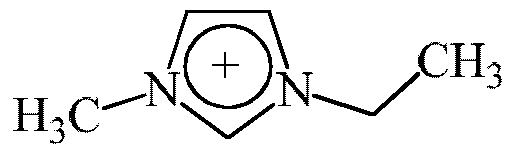
eq. molar equivalent;
halide F , CI , Br or I , preferably F , CI or Br , more preferably CI ;
halogen F, CI, Br or I; preferably F, CI or Br;
HEIm 1-ethylimidazolium
 ;
;
IL ionic liquid;
"linear" and "n-" are used synonymously with respect to the respective isomers of alkanes; RT room temperature, it is used synonymously with the expression ambient
temperature;
dec decomposition temperature;
THF tetrahydrofuran;
TMSCN (CH3)3SiCN, i.e. trimethylsilylcyanide;
Trityl means the trityl cation, i.e. [Ph3C ];
"wt%", "% by weight" and "weight-%" are used synonymously and mean percent by weight. The expressions dye sensitized solar cell and photosensitized solar cell are used
synonymously.
SUMMARY OF THE INVENTION
Subject of the invention is a method for the preparation of compound of formula (I);
 the method comprises a step (Stl);
step (Stl) comprises a reaction (Real), wherein [(Z^) ] is reacted with trimethylsilylcyanide n+
in the presence of CATLEWISACID and in the presence of Cat ;
CATLEWISACID is a Lewis Acid selected from the group consisting of Lewis Acid from the 1., 2., 3., 4., 5., 6., 7., 8., 9., 10., 11., 12., 13., 14., 15. and 16. group of the periodic table, zeolite, guanidinium and mixtures thereof; Z1 is selected from the group consisting of P, As, Sb and Bi; m is 1, 2, 3, 4 or 5;
n is 1, 2, 3 or 4; n+ n+
Cat is selected from the group consisting of inorganic cation CatlNORG and organic n+
cation CatORG ;
CatINORGn+ is a cation selected from the 1., 2., 3., 4., 5., 6., 7., 8., 9., 10., 11., 12., 13., 14.,
15. or 16. group of the periodic table, or is a cation from the lanthanides or is a cation from the actinides or is NH4 +;
CatORG is selected from the group consisting of CatORG- A , CatORG-B , CatORG- C+, [(CH3)3SiFSi(CH3)3]+, Ph3C+, guanidinium and (H2(R18)N-R16-N(R19)H2)2+;
CatORG-A is (WR2R3R4R5) ,
wherein
W is a nitrogen or phosphorus; and
(i) R2, R3, R4 and R5 are identical or different and independently from each other selected from the group consisting of H, Ci_2o alkyl, Ci_2o
perfluoroalkyl, C3-10 cycloalkyl and C6-io aryl, with the proviso, that at least one of the residues R2, R3, R4 and R5 is not H; or
(ii) R2 and R3 together are a hydrocarbon chain and form together with W a 5- to
7-membered saturated or unsaturated heterocyclic ring,
R4 and R5 are identical or different and independently from each other selected from the group consisting of H, Ci_2o alkyl, Ci_2o perfluoroalkyl, C3-10 cycloalkyl and C6_io aryl; or
(iii) R2 and R3 together are a hydrocarbon chain and form together with W, and R4 and R5 together are a hydrocarbon chain and form together with W,
independently from each other, 5- to 7-membered saturated or
unsaturated heterocyclic rings;
CatORG-B is (XR6R7R8) ,
wherein
X is nitrogen,
R6 and R7 together are a hydrocarbon chain and form together with X a 5- to 7-membered unsaturated heterocyclic ring in which X is connected by a single bond and a double bond to R6 and R7 respectively,
R8 is selected from the group consisting of H, Ci_2o alkyl, C2_s alkenyl, Ci_2o
perfluoroalkyl, C3-10 cycloalkyl or C6-io aryl;
CatORG-C+ is (YR9R10R11)+,
wherein
Y is sulphur;
(i) R9, RIO and Rl 1 are identical or different and independently from each other selected from the group consisting of H, Ci_2o alkyl, Ci_2o
perfluoroalkyl, C3-10 cycloalkyl and C6-io aryl; or
(ii) R9 and RIO together are a hydrocarbon chain and form together with Y a 5- to
7-membered saturated or unsaturated ring,
Rl 1 is selected from the group consisting of H, Ci_2o alkyl, Ci_2o perfluoroalkyl, C3-10 cycloalkyl and C6-io aryl; the residues R2, R3, R4, R5, R6, R7, R8, R9, RIO and Rl 1 are, independently from each other, unsubstituted or, where applicable, substituted by 1, 2, 3, 4, 5 or 6 substituents selected from the group consisting of Ci_4 alkyl, C3-10 cycloalkyl, C2_s alkenyl, phenyl, benzyl, halogen, cyano and Ci_4 alkoxy; any of said hydrocarbon chains formed by R2 and R3, by R4 and R5, by R6 and R7, and by R9 and RIO, 1 or 2 carbon atoms of said hydrocarbon chains can be exchanged for 1 or 2 heteroatoms respectively, said one or two heteroatoms being selected from the group consisting of O, N and S; in case of an exchange for N, this N is unsubstituted or substituted by a residue selected from the group consisting of Ci_8 alkyl, C3_i0 cycloalkyl, C2_8 alkenyl and Ci_s perfluoroalkyl;
R16 is selected from the group consisting of C2_s alkylen, C3-8 cycloalkylen, phenylen,
C(H)(phenyl), R17(-0-R17)ni;
R17 is selected from the group consisting of CH2-CH2, CH2-CH2-CH2, CH2-C(H)(CH3)- CH2, CH2-CH2-C(H)(CH3) and CH2-CH2-CH2-CH2;
R18 and R19 are identical or different and independently from each other selected from the group consisting of H, Ci_s alkyl, C3_s cycloalkyl, phenyl and benzyl;
nl is an integer from 1 to 20. DETAILED DESCRIPTION OF THE INVENTION
Preferably, Z1 is P, also in connection with any of the embodiments disclosed in the
specification.
Preferably, m is 2, 3, 4 or 5;
more preferably, m is 3, 4 or 5;
even more preferably, m is 3 or 4;
also in connection with any of the embodiments disclosed in the specification.
Preferably, n is 1 or 2, also in connection with any of the embodiments disclosed in the specification.
Preferably, CATLEWISACID is selected from the group consisting of
[(CH3)3SiFSi(CH3)3]+, Q1(R27)3, guanidinium, (R26)3C+, adamantyl cation, [(R24)30]+,
[(R25)3Si]+, Q2(R36)(R28)3, Q3(R29)3, Q4(R30)5, Q5(R32)3, Q6(R33)2, Q7(R31), Q8(R34)2, Q9(R35)3, zeolite and mixtures thereof;
Ql is selected from the group consisting of B, Al and Ga;
R27 is selected from the group consisting of C1-10 alkoxy, halogen, C1-10 alkyl, CN, SCN and C6Fs;
R24 is Ci_io alkyl;
R25 is Ci_io alkyl;
R26 is selected from the group consisting of CN, SCN, Ph and C1-10 alkyl;
Q2 is selected from the group consisting of Si and Ti;
R28 and R36 are identical or different and independently from each other selected from the group consisting of C1-10 alkoxy, halogen, C1-10 alkyl, CN, SCN and CeF5;
Q3 is selected from the group consisting of P, Sb and Bi;
R29 is selected from the group consisting of C1-10 alkoxy, halogen, CN, SCN, C1-10 alkyl and
Q4 is selected from the group consisting of P, Sb and Nb;
R30 is selected from the group consisting of C1-10 alkoxy, halogen, CN, SCN, C1-10 alkyl and
Q5 is selected from the group consisting of Cr and Fe;
R32 is selected from the group consisting of halogen, CN and SCN;
Q6 is selected from the group consisting of Mn, Fe, Pd and Pt;
R33 is selected from the group consisting of halogen, CN and SCN;
Q7 is Cu or Ag;
R31 is selected from the group consisting of halogen, CN and SCN;
Q8 is selected from the group consisting of Cu, Zn, Cd and Hg;
R34 is selected from the group consisting of halogen, CN, and SCN;
Q9 Sc or Ln;
R35 is selected from the group consisting of halogen, CN, and SCN; more preferably, CATLEWISACID is selected from the group consisting of
[(CH3)3SiFSi(CH3)3]+, Si(Cl)(C6H5)3, B(R27)3, A1(R27)3, GaF3, GaCl3, guanidinium,
(R26)3C+, [(R24)30]+, [(R25)3Si]+, Si(R28)4, TiF4, TiCl4, Q3(halogen)3, Q3(CN)3,
Q3(Ci_4 alkyl)3, Q4(halogen)5, Q4(Ci_i0 alkyl)5, Cr(Cl)3, Fe(halogen)3, Mn(Cl)2,
Fe(halogen)2, Pd(halogen)2, Pt(halogen)2, Pd(CN)2, Pt(CN)2, Pd(SCN)2, Pt(SCN)2, AgCl, AgCN, CuCl, CuCl2, CuF, CuBr, CuCN, CuF2, CuBr2, Cu(CN)2, ZnF2, ZnCl2, ZnBr2,
Zn(CN)2, ScF , ScCl3, ScBr , LnF , LnCl3, LnBr , zeolite and mixtures thereof;
even more preferably, CATLEWISACID is selected from the group consisting of
[(CH3)3SiFSi(CH3)3]+, Si(Cl)(C6H5)3, B(R27)3, A1(R27)3, GaF3, GaCl3, (R26)3C+,
[(R24)30]+, [(R25)3Si]+, Si(halogen)4, Si(Ci_i0 alkyl)4, TiF4, TiCl4, P(halogen)3, P(CN)3, Sb(halogen)3, Bi(halogen)3, Bi(CN)3, P(halogen)5, P(Ci_i0 alkyl)5, Sb(halogen)5,
Nb(halogen)5, CrCl3, FeF3, FeCl3, FeBr3, MnCl2, FeF2, FeCl2, FeBr2, PdF2, PdCl2, PdBr2, PtF2, PtCl2, PtBr2, AgCN, CuCl, CuCl2, CuF, CuBr, CuCN, CuF2, ZnF2, ZnCl2, ZnBr2, Zn(CN)2, ScF , ScCl3, LnF , LnCl3, zeolite and mixtures thereof;
especially, CATLEWISACID is selected from the group consisting of [(CH3)3SiFSi(CH3)3]+,
Si(Cl)(C6H5)3, BF3, BCI3, BBr3, B(Ci_4 alkyl)3, B(C6F5)3, A1F3, A1C13, Al(Ci_4 alkyl)3,
A1(C6F5)3, GaF3, GaCl3, (Ph)3C+, (CH3)3C+, [(C1-3 alkyl)30]+, [(C1-4 alkyl)3Si]+,
Si(halogen)4, Si(Ci_i0 alkyl)4, TiF4, TiCl4, P(halogen)3, P(CN)3, SbF3, Sbl3, BiF3, Bil3, Bi(CN)3, P(halogen)5, SbF5, NbF5, NbCl5, CrCl3, FeCl3, FeBr3, MnCl2, FeCl2, FeBr2,
PdCl2, PdBr2, PtCl2, PtBr2, AgCN, CuCl, CuCl2, CuF, CuF2, ZnF2, ZnCl2, ZnBr2, Zn(CN)2, ScF3, ScCl3, LnF3, LnCl3, zeolite and mixtures thereof;
more especially, CATLEWISACID is selected from the group consisting of
[(CH3)3SiFSi(CH3)3]+, Si(Cl)(C6H5)3, BF3, BC13, B(C1-4 alkyl)3, B(C6F5)3, A1C13, GaF3, GaCl3, (Ph)3C+, (CH3)3C+, [(Ci_4 alkyl)3Si]+, SiF4, SiCl4, Si(Ci_8 alkyl)4, TiF4, TiCl4,
PC13, PBr3, PI3, P(CN)3, SbF3, Sbl3, Bi(CN)3, PF5, PC15, PBr5, PI5, SbF5, NbCl5, CrCl3, FeCl3, FeBr3, MnCl2, FeCl2, FeBr2, PdCl2, PdBr2, PtCl2, PtBr2, AgCN, CuCl, CuCl2, CuF, CuF2, ZnF2, Zn(CN)2, ScF3, ScCl3, LnF3, LnCl3, zeolite and mixtures thereof; even more especially, CATLEWISACID is selected from the group consisting of
[(CH3)3SiFSi(CH3)3]+, Si(Cl)(C6H5)3, BF3, BC13, B(C6F5)3, A1C13, GaF3, GaCl3, Ph3C+,
[(Ci_4 alkyl)3Si]+, SiF4, SiCl4, Si(Ci_4 alkyl)4, TiF4, TiCl4, PCl3, PBr3, PI3, P(CN)3, SbF3,
Sbl3, Bi(CN)3, PF5, PC15, PBr5, PI5, SbF5, NbCl5, CrCl3, FeCl3, FeBr3, MnCl2, FeCl2, FeBr2, PdCl2, PdBr2, PtCl2, PtBr2, AgCN, CuCl, CuCl2, CuF, CuF2, ZnF2, ScF3, ScCl3, LnF3, LnCl3, zeolite and mixtures thereof;
in particular, CATLEWISACID is selected from the group consisting of
[(CH3)3SiFSi(CH3)3]+, Si(Cl)(C6H5)3, BF3, BC13, B(C6F5)3, A1C13, GaF3, GaCl3, Ph3C+,
SiCl4, TiF4, TiCl4, P(CN)3, SbF3, Bi(CN)3, PF5, PC15, SbF5, NbCl5, CrCl3, FeCl3, MnCl2, AgCN, CuCl, CuCl2, ZnF2, zeolite and mixtures thereof;
more in particular, CATLEWISACID is is selected from the group consisting of
[(CH3)3SiFSi(CH3)3]+, Si(Cl)(C6H5)3, BF3, GaF3, GaCl3, Ph3C+, TiF4, TiCl4, PF5, PC15,
SbF5 FeCl3, zeolite and mixtures thereof;
even more in particular, CATLEWISACID is is selected from the group consisting of
[(CH3)3SiFSi(CH3)3]+, GaF , GaCl3, Ph3C+, TiF4, TiCl4, PF5, PC15, SbF5, zeolite and mixtures thereof;
very even more in particular, CATLEWISACID is [(CH3)3SiFSi(CH3)3]+, GaF , GaCl3, Ph C+, TiF4, TiCl4, PF5, PCI5, zeolite or mixtures thereof;
very, very even more in particular, CATLEWISACID is GaF3, GaCl3, Ph3C , TiF4, TiCl4, PF5, PCI5, zeolite or mixtures thereof.
Preferably,
Ql is B.
Preferably,
R24 is Ci_4 alkyl;
R25 is Ci_7 alkyl;
Pv26 is selected from the group consisting of Ph and Ci_4 alkyl;
R27 is selected from the group consisting of Ci_7 alkoxy, CI, F, Br, Ci_7 alkyl and C6F5; more preferably,
R24 is Ci_3 alkyl;
R25 is Ci_5 alkyl;
R26 is selected from the group consisting of Ph and C1-2 alkyl;
R27 is selected from the group consisting of Ci_4 alkoxy, CI, F, Ci_4 alkyl and CeF5; even more preferably,
R24 is methyl or ethyl;
R25 is Ci_4 alkyl;
R26 is Ph or methyl;
R27 is selected from the group consisting of Ci_3 alkoxy, CI, F, Ci_3 alkyl and C6F5.
In another preferred embodiment, CATLEWISACID is selected from the group consisting of [(CH3)3SiFSi(CH3)3]+, Ph3C+, B(C6F5)3, and mixtures thereof; preferably, CATLEWISACID is Ph C+.
CATLEWISACID, that catalyzes the reaction (Real), and in the sense of the invention can be both a substance or a cation, that is present in the reaction mixture and acts in the reaction (Real) as the catalyzing Lewis Acid.
Preferably, CATLEWISACID is used in the reaction (Real ) in form of a catalyst CAT;
CAT is a Lewis Acid selected from the group consisting of Lewis Acids derived from, that is based on, the 1., 2., 3., 4., 5., 6., 7., 8., 9., 10., 1 1., 12., 13., 14., 15. and 16. group of the periodic table, zeolite, guanidinium[ANIO] and mixtures thereof;
more preferably, CAT is selected from the group consisting of [(CH3)3SiFSi(CH3)3][ANIO], Q1(R27)3, guanidinium[ANIO], (R26)3C[ANIO], adamantyl[ANIO], [(R24)30][ANIO],
[(R25)3Si][ANIO], Q2(R36)(R28)3, Q3(R29)3, Q4(R30)5, Q5(R32)3, Q6(R33)2, Q7(R31), Q8(R34)2, Q9(R35)3, zeolite and mixtures thereof;
even more preferably, CAT is selected from the group consisting of
[(CH3)3SiFSi(CH3)3][ANIO], Si(Cl)(C6H5)3, B(R27)3, A1(R27)3, GaF3, GaCl3, guanidinium[ANIO], (R26)3C[ANIO], [(R24)30][ANIO], [(R25)3Si][ANIO], Si(R28)4,
TiF4, TiCl4, Q3(halogen)3, Q3(CN)3, Q3(Ci_4 alkyl)3, Q4(halogen)5, Q4(Ci_i0 alkyl)5, Cr(Cl)3, Fe(halogen)3, Mn(Cl)2, Fe(halogen)2, Pd(halogen)2, Pt(halogen)2, Pd(CN)2, Pt(CN)2, Pd(SCN)2, Pt(SCN)2, AgCl, AgCN, CuCl, CuCl2, CuF, CuBr, CuCN, CuF2, CuBr2, Cu(CN)2, ZnF2, ZnCl2, ZnBr2, Zn(CN)2, ScF3, ScCl3, ScBr3, LnF3, LnCl3, LnBr3, zeolite and mixtures thereof;
especially, CAT is selected from the group consisting of [(CH3)3SiFSi(CH3)3][ANIO],
Si(Cl)(C6H5)3, B(R27)3, A1(R27)3, GaF3, GaCl3, (R26)3C[ANIO], [(R24)30][ANIO], [(R25)3Si][ANIO], Si(halogen)4, Si(Ci_i0 alkyl)4, TiF4, TiCl4, P(halogen)3, P(CN)3, Sb(halogen)3, Bi(halogen)3, Bi(CN)3, P(halogen)5, P(Ci_io alkyl)5, Sb(halogen)5,
Nb(halogen)5, CrCl3, FeF3, FeCl3, FeBr3, MnCl2, FeF2, FeCl2, FeBr2, PdF2, PdCl2, PdBr2,
PtF2, PtCl2, PtBr2, AgCN, CuCl, CuCl2, CuF, CuBr, CuCN, CuF2, ZnF2, ZnCl2, ZnBr2, Zn(CN)2, ScF3, ScCi3, LnF3, LnCl3, zeolite and mixtures thereof;
more especially, CAT is selected from the group consisting of [(CH3)3SiFSi(CH3)3][ANIO], Si(Cl)(C6H5)3, BF3, BC13, BBr3, B(C1-4 alkyl)3, B(C6F5)3, A1F3, A1C13, Al(C1-4 alkyl)3, A1(C6F5)3, GaF3, GaCl3, (Ph)3C[ANIO], (CH3)3C[ANIO], [(Ci_3 alkyl)30][ANIO], [(Ci_4 alkyl)3Si][ANIO], Si(halogen)4, Si(Ci_i0 alkyl)4, TiF4, TiCl4, P(halogen)3, P(CN)3, SbF3, Sbl3, BiF3, Bil3, Bi(CN)3, P(halogen)5, SbF5, NbF5, NbCl5, CrCl3, FeCl3, FeBr3, MnCl2, FeCl2, FeBr2, PdCl2, PdBr2, PtCl2, PtBr2, AgCN, CuCl, CuCl2, CuF, CuF2, ZnF2, ZnCl2, ZnBr2, Zn(CN)2, ScF3, ScC , LnF3, LnC , zeolite and mixtures thereof;
even more especially, CAT is selected from the group consisting of
[(CH3)3SiFSi(CH3)3][ANIO], Si(Cl)(C6H5)3, BF3, BC13, B(C1-4 alkyl)3, B(C6F5)3, A1C13, GaF3, GaCl3, (Ph)3C[ANIO], (CH3)3C[ANIO], [(Ci_4 alkyl)3Si][ANIO], SiF4, SiCl4, Si(Ci_8 alkyl)4, TiF4, TiCl4, PC13, PBr3, PI3, P(CN)3, SbF3, Sbl3, Bi(CN)3, PF5, PC15, PBr5, PI5, SbF5, NbCls, CrCl3, FeCl3, FeBr3, MnCl2, FeCl2, FeBr2, PdCl2, PdBr2, PtCl2, PtBr2,
AgCN, CuCl, CuCl2, CuF, CuF2, ZnF2, Zn(CN)2, ScF3, ScCl3, LnF3, LnCl3, zeolite and mixtures thereof;
in particular, CAT is selected from the group consisting of [(CH3)3SiFSi(CH3)3][ANIO],
Si(Cl)(C6H5)3, BF3, BCI3, B(C6F5)3, A1C13, GaF3, GaCl3, Ph3C[ANIO], [(C1-4
alkyl)3Si][ANIO], SiF4, SiCl4, Si(Ci_4 alkyl)4, TiF4, TiCl4, PC13, PBr3, PI3, P(CN)3, SbF3,
Sbl3, Bi(CN)3, PF5, PC15, PBr5, PI5, SbF5, NbCl5, CrCl3, FeCl3, FeBr3, MnCl2, FeCl2,
FeBr2, PdCl2, PdBr2, PtCl2, PtBr2, AgCN, CuCl, CuCl2, CuF, CuF2, ZnF2, ScF3, ScCl3,
LnF3, LnCl3, zeolite and mixtures thereof;
more in particular, CAT is selected from the group consisting of [(CH3)3SiFSi(CH3)3][ANIO], Si(Cl)(C6H5)3, BF3, BC13, B(C6F5)3, A1C13, GaF3, GaCl3, Ph3C[ANIO], SiCl4, TiF4, TiCl4,
P(CN)3, SbF3, Bi(CN)3, PF5, PC15, SbF5, NbCl5, CrCl3, FeCl3, MnCl2, AgCN, CuCl,
CuCl2, ZnF2, zeolite and mixtures thereof;
even more in particular, CAT is is selected from the group consisting of
[(CH3)3SiFSi(CH3)3][ANIO], Si(Cl)(C6H5)3, BF3, GaF3, GaCl3, Ph3C[ANIO], TiF4, TiCl4, PF5, PCI5, SbF5 FeCl3, zeolite and mixtures thereof;
very even more in particular, CAT is selected from the group consisting of
[(CH3)3SiFSi(CH3)3][ANIO], GaF3, GaCl3, Ph3C[ANIO], TiF4, TiCl4, PF5, PC15, SbF5, zeolite and mixtures thereof;
very, very even more in particular, CAT is [(CH3)3SiFSi(CH3)3][ANIO], GaF3, GaCl3,
Ph3C[ANIO], TiF4, TiCl4, PF5, PC15, zeolite or mixtures thereof;
very, very, very even more in particular, CAT is GaF3, GaCl3, Ph3C[ANIO], TiF4, TiCl4, PF5,
PCI5, zeolite or mixtures threof;
ANIO is selected from the group consisting of [P(R40)6_mi(R41)mi]", [B(R42)4_m2(R43)m2]", F", Cl", Br", f, CN" and SCN";
R40 and R41 are identical of different in independently from each other selected from the group consisting of CN, SCN, F, CI, Br and I;
ml is 0, 1 , 2, 3, 4 or 5;
R42 and R43 are identical of different in independently from each other selected from the group consisting of C6F5, CN, SCN, F, CI, Br and I;
m2 is 0, 1 , 2 or 3;
preferably, ANIO is selected from the group consisting of P(R40)6 , B(R42)4 , F , CI , Br , I , CN" and SCN";
R40is selected from the group consisting of CN, SCN, F, CI, Br and I;
R42is selected from the group consisting of C6F5, CN, SCN, F, CI, Br and I;
more preferably, ANIO is selected from the group consisting of P(R40)6 , B(R42)4 , F , CI ,
Br", CN" and SCN";
R40is selected from the group consisting of CN, SCN, F, CI and Br;
R42is selected from the group consisting of C6F5, CN, SCN, F, CI and Br; with Ql, R27, R24, R25, R26, Q2, R28, R36, Q3, R29, Q4, R30, Q5, R32, Q6, R33, Q7, R31, Q8, R34, Q9 and R35 as defined herein, also with all their embodiments.
Preferably, [ANIO] is [B(C6F5)4] or [PF6].
Special embodiments of CAT are [(CH3)3SiFSi(CH3)3][B(C6F5)4], Si(Cl)(C6H5)3, BF3, BC13, B(C6F5)3, A1C13, GaF3, GaCl3, Ph3C[PF6], SiCl4, TiF4, TiCl4, P(CN)3, SbF3, Bi(CN)3, PF5, PC15, SbF5, NbCls, CrCl3, FeCl3, MnCl2, AgCN, CuCl, CuCl2, ZnF2, zeolite and mixtures thereof;
preferably [(CH3)3SiFSi(CH3)3][B(C6F5)4], Si(Cl)(C6H5)3, BF3, GaF3, GaCl3, Ph3C[PF6], TiF4,
TiCl4, PF5, PCI5, SbF5 FeCl3, zeolite and mixtures thereof;
more preferably [(CH3)3SiFSi(CH3)3][B(C6F5)4], GaF3, GaCl3, Ph3C[PF6], TiF4, TiCl4, PF5, PCI5, SbF5, zeolite and mixtures thereof;
even more preferably [(CH3)3SiFSi(CH3)3][B(C6F5)4], GaF3, GaCl3, Ph3C[PF6], TiF4, TiCl4,
PF5, PCI5, zeolite and mixtures thereof;
especially GaF3, GaC , Ph3C[PF6], TiF4, TiCl4, PF5, PCI5, zeolite and mixtures thereof. In another preferred embodiment, CAT is selected from the group consisting of
(CH3)3SiFSi(CH3)3[B(C6F5)4], [Ph3C][PF6], B(C6F5)3 and mixtures thereof;
more preferably, CAT is [Ph3C][PF6].
CATLEWISACID and CAT respectively can be used in immobilized form on a carrier
CARR;
CARR is a carrier conventionally used for immobilizing catalysts in heterogeneously
catalyzed reactions;
preferably, CARR is seleceted from the group consisting of epoxide, polystyrene, zeolite, activated carbon and metal oxide;
said metal oxide is preferably selected from the group consisting of Mn02, Fe203, Co304,
NiO, CuO, CuMn02, MgO, A1203, Si02, V205, Mo03, W03 and mixed oxides thereof.
Zeolite can be any zeolite, preferably montmorrilonte or bentonite, more preferably
Montmorillonite K10®, BASF, Germany (also available at Sigma Aldrich, CAS Number 1318-93-0).
Preferably, Cat is, more preferably Cat and [(Z F6) ] are, used in the reaction (Real) in form of a compound of formula (Al);
[Catn+] [(Z}F6) ]„ (Al) wherein
11 1
Cat , Z and n are defined herein, also with all their embodiments.
In a preferred embodiment, compound of formula (Al) is reacted with trimethylsilylcyanide in the presence of a catalyst CAT;
with compound of formula (Al) and catalyst CAT as defined herein, also with all their
embodiments;
preferably, catalyst CAT is (CH3)3SiFSi(CH3)3[B(C6F5)4] or [Ph3C][PF6],
more preferably, catalyst CAT is [Ph3C][PF6];
in one preferred embodiment, compound of formula (Al) is different from catalyst CAT; in another preferred embodiment, compound of formula (Al) is identical with catalyst CAT.
Compound of formula (Al) and catalyst CAT can be one and the same compound, that means compound of formula (Al) can act simultaneously as catalyst CAT and vice versa.
When m is 4, then anion ] in formula (I) is preferably [(cis-PF2(CN)4)" ]. When m is 3, then anion
 ] in formula (I) is preferably [(mer-PF3(CN)3)" ].
Preferably, CatINORGn+ is a cation selected from the 1., 2., 3., 4., 5., 6., 7., 8., 9., 10., 11.,
] in formula (I) is preferably [(mer-PF3(CN)3)" ].
Preferably, CatINORGn+ is a cation selected from the 1., 2., 3., 4., 5., 6., 7., 8., 9., 10., 11.,
12., 13., 14. or 15. group of the periodic table or is a cation from the lanthanides or is
NH4 +;
more preferably, CatINORGn+ is a cation selected from the 1., 2., 4., 5., 6., 7., 8., 9., 10., 11., 12., 13., 14. or 15. group of the periodic table or is a cation from the lanthanides or NH4 +; even more preferably, CatINORGn+ is selected from the group consisting of Li+, Na+, K+, Rb+, Cs+, Be2+, Mg2+, Ca2+, Sr2+, Ba2+, Ti4+, Ti3+, Zr4+, Zr3+, Hf4*, Hf3+, V4+, V3+, V2+, Nb4+, Ta4+, Cr3+, Mo4+, Mo3+, Mo2+, W4+, W3+, W2+, Mn4+, Mn3+, Mn2+, Fe4+, Fe3+, Fe2+, Ru4+, Ru3+, Ru2+, Os4+, Os3+, Os2+, Co4+, Co3+, Co2+, Rh4+, Rh3+, Ir4+, Ir3+, Ni4+, Ni3+, Ni2+, Pd4+, Pd3+, Pd2+, Pt4+, Pt3+, Pt2+, Cu4+, Cu3+, Cu2+, Cu+, Ag4+, Ag3+, Ag2+, Ag+, Au3+,
Au2+, Au+, Zn2+, Zn+, Cd2+, Cd+, Hg2+, Hg+, B3+, Al3+, Ga3+, Ga+, In3+, In+, Tl3+, Tl+, Ge4+,Ge2+, Sn4+,Sn2+, Pb4+, Pb2+, As3+, Sb3+, Bi3+, Bi1+, La3+, Nb3+, Sm3+, Eu3+, Gd3+, and NH4 +;
especially, CatINORGn+ is selected from the group consisting of Li+, Na+, K+, Mg2+, Ca2+, Ti4+, Ti3+, Zr4+, Zr3+, V4+, V3+, V2+, Cr3+, Mo4+, Mo3+, Mo2+, W4+, W3+, W2+, Mn4+, Mn3+,
Mn2+, Fe4+, Fe3+, Fe2+, Ru4+, Ru3+, Ru2+, Co4+, Co3+, Co2+, Rh4+, Rh3+, Ir4+, Ir3+, Ni4+, Ni3+, Ni2+, Pd4+, Pd3+, Pd2+, Pt4+, Pt3+, Pt2+, Cu4+, Cu3+, Cu2+, Cu+, Ag4+, Ag3+, Ag2+, Ag+, Zn2+, Zn+, Al3+, Ga3+, Ga+, In3+, In+, Sn4+,Sn2+, Pb4+, Pb2+, Sb3+, Nb3+, Sm3+, Eu3+, Gd3+, and NH4 +;
more especially, CatINORGn+ is selected from the group consisting of Li+, Na+, K+, Mg2+,
Ca2+, Ti4+, V4+, V3+, V2+, Cr3+, Fe4+, Fe3+, Fe2+, Co4+, Co3+, Co2+, Cu4+, Cu3+, Cu2+, Cu+, Ag2+, Ag+, Zn2+, Zn+, Al3+, Sn4+,Sn2+, Pb4+, Pb2+, Sb3+, Eu3+, Gd3+, and NH4 +;
even more especially, CatINORGn+ is selected from the group consisting of Li+, Na+, K+, 2+ Λ τ4+ 7·3+ ^ 3+ 4+ 3+ 2+ ^ 4+ ^ 3+ ^ 2+ ^ 4+ ^ 3+ ^ 2+ ^ +
Mg , Ca , Ti , V , V , Cr , Fe , Fe , Fe , Co , Co , Co , Cu , Cu , Cu , Cu , Ag+, Zn2+, Al3+, Sn4+,Sn2+, Pb4+, Pb2+, Gd3+, and NH4 +;
in particular, CatINORGn+ is selected from the group consisting of Li+, Na+, K+, NH4 +, Ag+,
Mg2+, Ca2+, Zn2+ and Cu2+;
more in particular, CatINORGn is selected from the group consisting of Li+, Na+, K+, NH4 +,
Ag+, Mg2+, Ca2+ and Zn2+;
even more in particular, CatlNORG is Li+, Na+, K+, Ag+, Mg2+, or Zn2+; especially in particular, CatINORGn is Li+, K+, Ag+, Mg2+, or Zn2+.
Preferably, n in CatlnORG is 1 or 2.
The term "where applicable" in the definition of CatORG means, that any of the optional substituents of the residues R2 to Rl 1 requires a respective site, and e.g. in case of R2 being a perfluorinated side chain no respective site is available any more for a substituent.
Preferably, CatORGn contains a heteroatom selected from the group consisting of nitrogen, phosphorus, sulfur and oxygen;
more preferably, CatORGn contains a heteroatom selected from the group consisting of
nitrogen and phosphorus.
Preferably,
R16 is selected from the group consisting of C2_6 alkylen, C5-6 cycloalkylen, phenylen,
C(H)(phenyl), R17(-0-R17)ni;
R17 is selected from the group consisting of CH2-CH2, CH2-CH2-CH2 and

R18 and R19 are identical or different and independently from each other selected from the group consisting of H, Ci_4 alkyl, C5-6 cycloalkyl, phenyl and benzyl; nl is an integer from 1 to 10;
more preferably,
R16 is selected from the group consisting of C2_4 alkylen, C6 cycloalkylen, phenylen,
C(H)(phenyl), R17(-0-R17)„i;
R17 is selected from the group consisting of CH2-CH2 and CH2-CH2-CH2;
R18 and R19 are identical and selected from the group consisting of H, Ci_4 alkyl,
C5-6 cycloalkyl, phenyl and benzyl;
nl is an integer from 1 to 6;
even more preferably, for n being 2 CatORGn+ is (H2(R18)N-R16-N(R19)H2)2+;
R16 is selected from the group consisting of C2_4 alkylen, phenylen and C(H)(phenyl); R18 and R19 are identical and selected from the group consisting of H, Ci_4 alkyl, C5-6 cycloalkyl, phenyl and benzyl;
especially, when n is 2, then CatORGn+ is (H3N-CH2-CH2-NH3)2+.
Preferably, n in CatORG is 1.
Preferred embodiment, CatORGn is selected from the group consisting of ammonium, phosphonium, sulfonium, pyrrolidinium, pyrrolinium, pyrrolium, pyrazolium, pyrazolinium, imidazolium, imidazolinium, triazolium, oxazolium, thiazolium, piperidinium, piperazinium, morpholinium, pyridinium, pyridazinium, pyrimidinium, pyrazinium, 1 ,3-dioxolium, pyrylium, thiopyrylium, quinoxalinium, indolinium, indolium, [(CH3)3SiFSi(CH3)3]+, Ph3C+, and mixtures thereof;
more preferably from the group consisting of ammonium, phosphonium, sulfonium,
pyrrolidinium, pyrrolinium, pyrrolium, pyrazolium, imidazolium, triazolium, oxazolium, thiazolium, piperidinium, piperazinium, morpholinium, pyridinium, pyridazinium, pyrimidinium, pyrazinium, 1 ,3-dioxolium, pyrylium, thiopyrylium,
[(CH3)3SiFSi(CH3)3]+, Ph3C+, and mixtures thereof.
More preferably, CatORG is selected from the group consisting of


[N(R20)(R21)(R22)R23]+, [P(R20)(R21)(R22)R23]+, [(CH3)3SiFSi(CH3)3]+, Ph3C+, and mixtures thereof; wherein
R20, R21 , R23 are identical or different and independently from each other
selected from the group consisting of H, Ci_2o alkyl, C3_io cycloalkyl and allyl;
R22 is Ci_20 alkyl, C3_i0 cycloalkyl or allyl; preferably,
R20, R21 , R23 are identical or different and independently from each other
selected from the group consisting of H, C1-14 alkyl, C5_s cycloalkyl and allyl;
R22 is Ci_i4 alkyl, C5-8 cycloalkyl or allyl; more preferably,
R20, R21 , R23 are identical or different and independently from each other
selected from the group consisting of H, Ci_s alkyl, C5-7 cycloalkyl and allyl;
R22 is Ci_8 alkyl, C5-7 cycloalkyl or allyl;
,n+ .
even more referably, CatORG is selected from the group consisting


[N(C3H7)4]+, [N(C4H9)4]+, [P(C2H5)4]+, [P(C3H7)4]+, [P(C4H9)4]+, [P(C6Hl3)3(Cl4H29)]+,
[(CH3)3SiFSi(CH3)3]+, Ph3C+, and mixtures thereof;
 [NH(C2H5)3]+, [NH(C4H9)3]+, [N(C2H5)4]+, [N(C3H7)4]
[N(C4H9)4]+, [P(C2H5)4]+, [P(C3H7)4]+, [P(C4H9)4]+, [(CH3)3SiFSi(CH3)3] , Ph3C , and mixtures thereof.
more especially, CatORG is selected from the group consisting of


[NH(C2H5)3]+, [NH(C4H9)3]+, [N(C2H5)4]+, [N(C3H7)4]+, [N(C4H9)4]+, [P(C2H5)4f
[P(C3H7)4]+, [P(C4H9)4]+, [(CH3)3SiFSi(CH3)3]+, Ph3C+, and mixtures thereof.
In particular, Cat is a cation (Cat-Part 1); cation (Cat-Part 1) is CatINORGn+ or CatORGn+, with CatINORGn+ selected from the group consisting of Li+, Na+, K+, NH4 +, Ag+, Mg2+, Ca2 and Zn2+;
and
with CatORG selected from the roup consistin of


[P(C3H7)4]+, [P(C4H9)4]+, [(CH3)3SiFSi(CH3)3]+, Ph3C+, and mixtures thereof.
Even more preferably, compound of formula (I) is compound (Group-I),
compound (Group-I) is selected from the group consisting of compound of formula (la) and compound of formula (lb);
[Cat ] [(cis-PF2(CN)4)" ]„ [Catn+] [(mer-PF3(CN)3)" ]„
Cat and n are as defined above, also with all their embodiments,
n+
preferably Cat is cation (Cat-Parti).
Special embodiment of compound of formula (I) is compound (GROUP-II), compound
+ - +
(GROUP-II) is selected from the group consisting of K [(cis-PF2(CN)4) ], Ag
[(cis-PF2(CN)4)" ], Li+ [(cis-PF2(CN)4)" ], Mg2+ [(cis-PF2(CN)4)" ]2, Zn +
[(cis-PF2(CN)4)" ]2, Ca2+ [(cis-PF2(CN)4)" ]2, [N(n-Pr)4]+ [(cis-PF2(CN)4)" ], [N(n-Bu)4]+
[(cis-PF2(CN)4)" ], [P(n-Bu)4]+ [(cis-PF2(CN)4)" ], 1,3-dimethylimidazolium
[(cis-PF2(CN)4)" ], l-ethyl-3-methylimidazolium [(cis-PF2(CN)4)" ], l-propyl-3-methylimidazolium [(cis-PF2(CN)4) ] and mixtures thereof.
Another special embodiment of compound of formula (I) is compound (GROUP-III),
+
compound (GROUP-III) is selected from the group consisting of K [(mer-PF3(CN)3) ],
2+ Ag+ [(mer-PF3(CN)3)" ], Li+ [(mer-PF3(CN)3)" ], Mg2+ [(mer-PF3(CN)3)" ]2, Zn [(mer-PF3(CN)3)" ]2, Ca2+ [(mer-PF3(CN)3)" ]2, [N(n-Pr)4]+ [(mer-PF3(CN)3)" ],
[N(n-Bu)4f [(mer-PF3(CN)3) ], [P(n-Bu)4]+ [(mer-PF3(CN)3) ],
1,3-dimethylimidazolium [(mer-PF3(CN)3) ], l-ethyl-3-methylimidazolium
[(mer-PF3(CN)3) ], l-propyl-3-methylimidazolium [(mer-PF3(CN)3) ] and mixtures thereof.
Yet another special embodiment of compound of formula (I) is compound (GROUP -IV),
+
compound (GROUP -IV) is selected from the group consisting of K [cis-PF4(CN)2 ], Ag+ [cis-PF4(CN)2 "], Li+ [(cis-PF4(CN)2)" ], Mg2+ [(cis-PF4(CN)2)" ]2, Zn + [(cis-PF4(CN)2)" ]2, Ca2+ [(cis-PF4(CN)2)" ]2, [N(n-Pr)4]+ [(cis-PF4(CN)2)" ], [N(n-Bu)4]+ [(cis-PF4(CN)2)" ], [P(n-Bu)4]+ [(cis-PF4(CN)2)" ], 1,3-dimethylimidazolium [(cis-PF4(CN)2)" ], l-ethyl-3-methylimidazolium [(cis-PF4(CN)2)" ], l-propyl-3-methylimidazolium [(cis-PF4(CN)2) ] and mixtures thereof.
Yet another special embodiment of compound of formula (I) is compound (GROUP -V),
+ - + compound (GROUP -V) is selected from the group consisting of K [cis-PF5(CN) ], Ag
[cis-PF5(CN)"], Li+ [cis-PF5(CN)"], Mg2+ [cis-PF5(CN)"]2, Zn2+ [cis-PF5(CN)"]2, Ca2+
[cis-PF5(CN)"]2, [N(n-Pr)4]+ [cis-PF5(CN)"], [N(n-Bu)4]+ [cis-PF5(CN)~], [P(n-Bu)4]+
[cis-PF5(CN) ], 1,3-dimethylimidazolium [cis-PF5(CN) ], l-ethyl-3-methylimidazolium
[cis-PF5(CN) ], l-propyl-3-methylimidazolium [cis-PF5(CN) ] and mixtures thereof.
Yet another special embodiment of compound of formula (I) is compound (GROUP -VI),
+ - + compound (GROUP -VI) is selected from the group consisting of K [cis-PF(CN)5 ], Ag
[cis-PF(CN)5 ~], Li+ [cis-PF(CN)5 ~], Mg2+ [cis-PF(CN)5 "]2, Zn2+ [cis-PF(CN)5 "]2, Ca2+
[cis-PF(CN)5 "]2, [N(n-Pr)4]+ [cis-PF(CN)5 "], [N(n-Bu)4]+ [cis-PF(CN)5 "], [P(n-Bu)4]+
[cis-PF(CN)5 ], 1,3-dimethylimidazolium [cis-PF(CN)5 ], l-ethyl-3-methylimidazolium
[cis-PF(CN)5 ], l-propyl-3-methylimidazolium [cis-PF(CN)5 ] and mixtures thereof.
rticular, compound of formula (I) is compound (GROUP), compound (GROUP) is selected from the group consisting of compound of formula (1), compound of formula (la), compound of formula (lb), compound of formula (2), compound of formula (2a), compound of formula (2b), compound of formula (3), compound of formula (3a), compound of formula (3b), compound of formula (4), compound of formula (4a), compound of formula (4b), compound of formula (5), compound of formula (6), compound of formula (7), compound of formula (7a), compound of formula (7b), compound of formula (8), compound of formula (8a), compound of formula (8b), compound of formula (9), compound of formula (10), compound of formula (10a), compound of formula (10b), compound of formula (11), compound of formula (11a), compound of formula (1 lb), compound of formula (12), compound of formula (12a), compound of formula (12b), compound of formula (13), compound of formula (13a), compound of formula (13b), compound of formula (16), compound of formula (17), compound of formula (18), compound of formula (19), compound of formula (20), and mixtures thereof.
[(n-Bu)4N][PF4(CN)2] (1)
[(n-Bu)4N][cis-PF4(CN)2] (la)
[(n-Bu)4N] [trans-PF4(CN)2] (lb)
[(n-Bu)4N][PF3(CN)3] (2)
[(n-Bu)4N] [mer-PF3(CN)3] (2a)
[(n-Bu)4N] [fac-PF3(CN)3] (2b)
EMIm[PF4(CN)2] (3)
EMIm[cis-PF4(CN)2] (3a)
EMIm[trans-PF4(CN)2] (3b)
EMIm[PF3(CN)3] (4) EMIm[mer-PF3(CN)3] (4a)
EMIm[fac-PF3(CN)3] (4b) EMIm[cis-PF2(CN)4] (5)
[(n-Bu)4N][cis-PF2(CN)4] (6)
K[PF4(CN)2] (7) K[cis-PF4(CN)2] (7a)
K[trans-PF4(CN)2] (7b)
K[PF3(CN)3] (8) K[fac-PF3(CN)3] (8a)
K[mer-PF3(CN)3] (8b)
[(n-Pr)4N][PF4(CN)2] (9)
[(n-Pr)4N][PF3(CN)3] (10) [(n-Pr)4N][fac-PF3(CN)3] (10a) [(n-Pr)4N][mer-PF3(CN)3] (10b)
Ag[PF3(CN)3] (11) Ag[fac-PF3(CN)3] (11a)
Ag[mer-PF3(CN)3] (l ib)
Li[PF3(CN)3] (12)
Li[fac-PF3(CN)3] (12a)
Li[mer-PF3(CN)3] (12b)
Li[PF4(CN)2] (13)
Li[cis-PF4(CN)2] (13a)
Li[trans-PF4(CN)2] (13b)
[(n-Bu)4N][PF(CN)5] (16)
[(n-Bu)4N][PF2(CN)4] (17)
[(n-Bu)4N][PF5(CN)] (18)
[(n-Bu)4N][trans-PF2(CN)4] (19)
EMIm[PF2(CN)4] (20)
Preferably, from 1 to 40 mol equivalents, more preferably 4 to 35 mol equivalents, even more preferably from 6 to 25 mol equivalents, especially from 6 to 15 mol equivalents, of trimethylsilylcyanide are used in reaction (Real), the mol equivalents being based on the molar amount of the anion [(Z^) ].
Preferably, when CATLEWISACID is an uncharged compound, then the molar amount of n+ !
Cat is equal to the molar amount of anion [(Z F6) ].
Preferably, when CATLEWISACID is a cation, then the combined molar amount of CATLEWISACID and Catn+ is 1-fold to 40-fold, more preferably 1-fold to 35-fold, even more preferably 1-fold to 25-foled, especially 1-fold to 15-fold, more especially 1-fold to 10- fold, even more especially 1-fold to 5-fold, in particular 1-fold to 2-fold, of the molar amount of the anion [(Z^) ].
Preferably, from 0.0001 to 40 mol equivalents, more preferably 0.001 to 35 mol equivalents, even more preferably from 0.005 to 25 mol equivalents, especially from 0.005 to 25 mol equivalents, more especially from 0.005 to 15 mol equivalents, even more especially from 0.005 to 5 mol equivalents, of CATLEWISACID are used in reaction (Real), the mol equivalents being based on the molar amount of the anion [(Z^) ].
In another preferable embodiment, from 0.01 to 40 mol%, more preferably 0.1 to 35 mol%, even more preferably 0.1 to 25 mol%, especially from 0.5 to 15 mol%, more especially from 0.5 to 10 mol%, even more especially from 0.5 to 5 mol%, of CATLEWISACID are used in reaction (Real), the mol% being based on the molar amount of the anion [(Z^) ].
When reaction (Real) is done by reacting compound of formula (Al) with
trimethylsilylcyanide in the presence of a catalyst CAT, and
when compound of formula (Al) is different from catalyst CAT, then
preferably, from 1 to 40 mol equivalents, more preferably 4 to 35 mol equivalents, even more preferably from 5 to 25 mol equivalents, especially from 5 to 15 mol equivalents, more especially from 5 to 10 mol equivalents, of trimethylsilylcyanide are used in reaction (Real), the mol equivalents being based on the molar amount of compound of formula (Al); and
preferably, from 0.01 to 40 mol%, more preferably 0.1 to 35 mol%, even more preferably 0.1 to 25 mol%, especially from 0.5 to 15 mol%, more especially from 0.5 to 10 mol%, even more especially from 0.5 to 5 mol%, of catalyst CAT are used in reaction (Real), the mol% being based on the combined molar amount of compound of formula (Al) and catalyst CAT;
whereas when compound of formula (Al) is identical with catalyst CAT, then
preferably, from 1 to 40 mol equivalents, more preferably 4 to 35 mol equivalents, even more preferably from 5 to 25 mol equivalents, especially from 5 to 15 mol
equivalents, more especially from 5 to 10 mol equivalents, of trimethylsilylcyanide are used in reaction (Real), the mol equivalents being based on the combined molar amount of compound of formula (Al) and catalyst CAT. The reaction temperatures of reaction (Real) is preferably from -75 to 150°C, more preferably from -50 to 120°C, more preferably from -50 to 100°C, even more preferably -50 to 80°C.
Another possible range of the reaction temperatures of reaction (Real) is preferably from -10 to 150°C, more preferably from -10 to 120°C, more preferably from 0 to 100°C, even more preferably 10 to 80°C.
Reaction (Real) can be done in a closed system and at the pressure caused by the chosen temperature. The reaction time of reaction (Real) is preferably from 15 min to 96 h, more preferably from 20 min to 85 h, even more preferably from 20 min to 48 h.
Another possible range of the reaction time of reaction (Real) is preferably from 30 min to 96 h, more preferably from 1 h to 85 h, even more preferably from 1 h to 48 h.
Preferably, reaction (Real) is done under inert atmosphere. Preferably, the inert atmosphere is achieved by the use if an inert gas preferably selected from the group consisting of argon, another noble gas, lower boiling alkane, nitrogen and mixtures thereof.
The lower boiling alkane is preferably a Q_3 alkane, i.e. methane, ethane or propane.
After the reaction, compound of formula (I) can be isolated by standard methods such as evaporation of volatile components, extraction, washing, drying, concentration,
crystallization, chromatography and any combination thereof, which are known per se to the person skilled in the art.
Preferably, after the reaction the reaction product is treated with hydrogen peroxide, preferably with aqueous hydrogen peroxide.
More preferably for isolation, the reaction product is mixed with aqueous hydrogen peroxide to provide a mixture (M).
Preferably, the concentration of the aqueous hydrogen peroxide is from 10 to 40 wt% hydrogen peroxide, the wt% based on the total weight of the aqueous hydrogen peroxide.
Preferably, from 1 to 30 mol equivalents, more preferably from 1 to 20 mol equivalents, of hydrogen peroxide are used, the mol equivalents being based on the molar amount of compound of formula (Al). Preferably mixture (M) is stirred for 5 min to 12 h, more preferably for 10 min to 6 h.
Preferably mixture (M) is stirred at a temperature (M), temperature (M) is preferably from ambient temperature to 100°C. After treatment with hydrogen peroxide, mixture (M) is preferably filtrated. The residue of the filtration is preferably washed with a solvent (WASH), solvent (WASH) is preferably water or an ether such as diethylether, more preferably diethylether.
Preferably, the method comprises additionally to step (Stl) a step (St2), step (St2) is done after step (Stl);
step (St2) comprises a reaction (Rea2), reaction (Rea2) is a metathesis reaction wherein cation n+ n+
Cat in compound of formula (I) is exchanged for a cation different from Cat ;
compound of formula (I) having been prepared in step (Stl);
n+
Cat , n, compound of formula (I) and step (Stl) are as defined above, also with all their embodiments.
Preferably, reaction (Rea2) provides for the preparation of a compound of formula (I-Cat-r);
[Cat-r ] [(ZlF6-m(CN)m) ]r (I-Cat-r) r+ n+ n+
Cat-r is selected from the group consisting of CatlNORG and CatORG and is
n+
different from Cat ;
r is 1, 2, 3 or 4;
j n+ n+
with step (Stl), Z , m, CatlNORG and CatORG as defined above, also with all their embodiments.
Preferably, in reaction (Rea2) Cat is exchanged for Cat-r from a compound of formula
(I-Cat-n);
(Cat-/ )tl (AnINORGq")t2 q is 1 or 2;
tl is 1 or2;
t2 is 1, 2, 3 or 4;
when r is 1 and q is 1 , then tl is 1 and t2 is 1 ;
when r is 2 and q is 1 , then tl is 1 and t2 is 2;
when r is 3 and q is 1, then tl is 1 and t2 is 3;
when r is 4 and q is 1 , then tl is 1 and t2 is 4;
when r is 1 and q is 2, then tl is 2 and t2 is 1 ;
when r is 2 and q is 2, then tl is 1 and t2 is 1 ;
when r is 3 and q is 2, then tl is 2 and t2 is 3;
when r is 4 and q is 2, then tl is 1 and t2 is 2;
AnINORG is an anion selected from the group consisting of halide, OH", CN , OCN , SCN~, N3 ~, sulfate, hydrogensulfate, nitrate, C03 2", HC03 ", BF4 ", PF6 ", SbF6 ", CF3S03 ", (CF3S02)2N~, (FS02)2N~, d_6 alkyl-S03 ", d_6 alkyl-0-S03 ",

C(CN)3 ", B(CN)4 ", P(CN)6 ", Sb(CN)6 ", and mixtures thereof;
r+ n+ n+
Cat-r , r, CatlNORG and CatORG are as defined above, also with all their
embodiments.
Reaction (Rea2) is a metathesis reaction, also called a salt-exchange reaction. In a metathesis reaction such as reaction (Rea2) a first cation in a first salt is exchanged for a second cation, said second cation coming from a second salt.
Preferably, AnINORG is an anion selected from the group consisting of halide, OH", CN , sulfate, hydrogensulfate, nitrate, C03 2~, HC03 ~, BF4 ", PF6 ", CF3S03 ", (CF3S02)2N~, (FS02)2N~, H3C-S03 ~, H3C-CH2-S03 ~, H3C-0-S03 ~, H3C-CH2-0-S03 ~, acetate, oleate, fumarate, maleate, oxalate, benzoate, N(CN)2 , and mixtures thereof; more preferably, AnINORGq is an anion selected from the group consisting of Br , CI , OH", GST, sulfate, hydrogensulfate, C03 2 , HC03 , acetate, and mixtures thereof; even more preferably, AnINORG^ is an anion selected from the group consisting of CI , OH", GST, sulfate, hydrogensulfate, C03 2 , HC03 , acetate, and mixtures thereof.
In another preferred embodiment, AnINORG^ is an anion selected from the group consisting of halide, OH", CN~, OCN , SCN~, N3 ~, sulfate, hydrogensulfate, nitrate, C03 2", HC03 ", BF4 ", PF6 ", SbF6 ", CF3S03 ", (CF3S02)2N~, (FS02)2N~, G_6 alkyl-S03 ", G_6 alkyl-0-S03 ",

B(CN)4 , P(CN)6 , Sb(CN)6 , and mixtures thereof.
Preferably, r is 1 or 2.
r+
In case of reaction (Rea2), preferably a compound of formula (I-Cat-r) with Cat-r being CatORGn is prepared by exchange of a Catn being a CatINORGn in compound of formula (I) for a CatORGn+.
Said CatORGn is provided in reaction (Rea2) preferably in form of a compound of formula (I-CatORG)
(CatORGn )q(AnINORGq")n (I-CatORG) wherein
Catn+, n, CatORGn+, CatINORGn+, q and AnINORGq are as defined above, also with all their embodiments.
Preferably, in reaction (Rea2) the cation different from Cat , that is preferably Cat-r , is n+
present in at least such a molar amount relative to the molar amount of Cat as required for a stoichiometric exchange of said two cations;
more preferably, compound of formula (I) and compound of formula (I-Cat-n) are present in n+
at least such a molar amount relative to each other, that Cat is stoichiometrically
r+
exchanged for Cat-r .
Even more preferably, the molar amount of compound of formula (I-Cat-n) is such, that from r+
1 to 1.5, even more preferably from 1 to 1.2, required equivalents of Cat-r relative to n+
the equivalents of Cat are present.
The reaction temperatures of reaction (Rea2) is preferably from 0 to 250 °C, more preferably from 10 to 200 °C, even more preferably from 10 to 150 °C, especially from 10 to 100°C, more especially from 10 to 50°C.
The reaction (Rea2) is preferably carried out in a solvent (Sol2), solvent (Sol2) is preferably selected from the group consisting of water, DCM, ethyl acetate, C5-10 alkane, and mixtures thereof.
C5_io alkane is preferably pentane, hexane or heptane.
In a more preferred embodiment, reaction (Rea2) is done in DCM or in a biphasic solvent system of water and DCM. As an alternative, the reaction (Rea2) can also be carried out in the absence of a solvent or in a solvent in which the inorganic salt formed as side product is sparingly soluble or insoluble. As a further alternative, it is also possible to carry out the reaction in an aqueous solution using an ion exchanger loaded with the desired cation Catn . The amount of solvent is preferably from 2 to 40 fold, more preferably from 3 to 20 fold, of the weight of compound of formula (I).
Reaction (Rea2) can be done in a closed system and at the pressure caused by the chosen temperature.
The reaction time of reaction (Rea2) is preferably from 15 min to 96 h, more preferably from 15 min to 48 h, even more preferably from 15 min to 24 h.
Preferably, reaction (Rea2) is done under inert atmosphere. Preferably, the inert atmosphere is achieved by the use if an inert gas preferably selected from the group consisting of argon, another noble gas, lower boiling alkane, nitrogen and mixtures thereof.
The lower boiling alkane is preferably a Ci_3 alkane, i.e. methane, ethane or propane.
Subsequent to reaction (Rea2) there can be a further metathesis reaction or further metathesis reactions.
After reaction (Rea2), compound of formula (I) can be isolated from the reaction mixture by standard methods such as filtration, evaporation of volatile components, extraction, washing, drying, concentration, crystallization, chromatography and any combination thereof, which are known per se to the person skilled in the art.
For example, when reaction (Rea2) was done in a biphasic solvent system of water and DCM, the aqueous and organic phases are separated, the organic phase is preferably washed,
preferably with water, then preferably dried, preferably with Na2S04, K2CO3, CaCl2 or MgS04, and finally evaporated.
Or as another example, when reaction (Rea2) was done in DCM and a suspension was formed, filtration and evaporation of the solvent will isolate the product.
It is possible use compound of formula (I), which was obtained by the method of instant invention, as substrate in a similar reaction with trimethylsilylcyanide.
Therefore the method of instant invention can comprise additionally to step (Stl) a
step (Stl-1), step (Stl-1) is done after step (Stl);
step (Stl-1) comprises a reaction (Real-1), wherein compound of formula (I), obtained in step (1), is reacted with trimethylsilylcyanide;
preferably the reaction (Rea(l-l) is done in the presence of CATLEWISACID;
with CATLEWISACID as defined above, also in all its embodiments. n+
Compounds of formula (Al) are commercially available depending on the cation Cat , e.g.
[(n-Bu4)N][PF6], [(n-Pr)4N][PF6], K[PF6] and Li[PF6] as well as catalyst CAT are
n+
commercially available. Other compounds of formula (Al) with cations Cat different from
K+ and (n-Bu4)N+, and which are not commercially available, can be prepared by
conventional metathesis reaction, i.e. substitution of the respective cation K+ or (n-Bu4)N+ against another cation.
EXAMPLES
Methods
1H, 13C, 19F and 31P NMR spectra were recorded on a Bruker AVANCE 300 and Bruker AVANCE 250 instruments in CD3CN,CDC13, D6-DMSO or CD2C12. Chemical shifts are expressed in parts per million referred to TMS in case of 1H and 13C, C19FCl3 in case of F, and H3 31P04 in case of 31P, and coupling constants (J) in Hertz. When a % value for the amount of compounds is stated based on NMR measurement, the % value represents an area- %, the area-% being based on the total area of peaks in the spectrum. In case of the individual amount of a component in a mixture the stated % value for the amount of the component in the mixture represents an area-%, this area-% being based on the combined area of peaks of all components of the mixture; if not stated otherwise.
IPv-spectra were recorded on a Nicolet 380 FT-IR spectrometer. Measurements were done at ambient temperature.
RAMAN-spectra were recorded on a LabRAM HR 800 Horiba Jobin YVON. Measurements were done at ambient temperature.
The C/H/N-analyses were measured on a C/H/N/S-Analysator (Thermoquest Flash EA 1112).
Melting points and temperature of decomposition Tdec were measured on a DSC 823e from Mettler-Toledo. The calibration was carried out with the melting points of In (156.6 ± 0.3°C) and Zn (419.6 ± 0.7°C) with an heating rate of 5 K per min. TGA/DSC measurements were conducted on a Setaram Labsys TGA / DSC 1600. The measurements were carried out under argon atmosphere with a heating rate of 5 K per min, corrected via a blank measurement.
Preparation description A: Synthesis of [(n-Bu)4N] [PF6]
A solution of [(n-Bu4)N]Br (41.91 g, 130 mmol) in 200 ml of CH2C12 was added to the solution of K[PF6] (23.93 g, 130 mmol) in 200 ml of H20. After stirring for 24 h at ambient temperature the phases were separated. The organic phase was washed three times with 30 ml of water, dried over anhydrous Na2C03 and filtered. The filtrate was concentrated on a rotary
evaporator and [(n-Bu4)N][PF6] as a white solid was obtained. This was recrystallized from ethanol and dried at 80°C in vacuo for 10 hours. The yield was 47.25 g (94%, 122 mmol).
DSC (10 K/min): m.p. = 250°C, Tdec = 388°C
C/H/N Analysis calc. % (found): C 49.60 (49.76), H 9.37 (9.28), N 3.61 (3.50)
1H NMR (25°C, CD3CN, 300.13 MHz, delta in ppm): 0.96 (t, 12H, CH3), 1.34 (m, 8H,
CH3-CH2), 1.59 (m, 8H, CH2-CH2N), 3.06 (m, 8H, NCH2)
19F NMR (25°C, CD3CN, 300.13 MHz, delta in ppm): -73.0 (d, 6F, PF6, ^P-^F) = 707 Hz) 31P NMR (25°C, CD3CN, 300.13 MHz, delta in ppm): -144.6 (sept, IP, PF6, ^P-^F) = 707 Hz)
IR (ATR, 32 scans, v in cm"1): 2966 (m), 2937 (w), 2879 (w), 1472 (m), 1404 (w), 1386 (w), 1360 (w), 1350 (w), 1319 (w), 1260 (w), 1242 (w), 1165 (w), 1109 (w), 1070 (w), 1035 (w), 931 (w), 880 (m), 829 (s), 738 (m), 555 (s)
Preparation description B: Synthesis of EMIm[PF6]
A solution of l-ethyl-3-methylimidazolium bromide (5.2 g, 27.2 mmol) in 30 ml of CH2C12 was added to a solution of K[PF6] (5.0 g, 27.2 mmol) in 30 ml of H20. After stirring for 5 h at ambient temperature the phases were separated. The organic phase was washed three times with 10 ml of water, dried over anhydrous Na2C03 and filtered. The filtrate was concentrated on a rotary evaporator to obtain a colorless oil. The obtained oil was dried at 80°C in vacuo for 10 hours to obtain EMIm[PF6] as a white solid. The yield was 6.27 g (90%, 24.5 mmol).
C/H/N Analysis calc. % (found): C 28.14 (28.09), H 4.33 (4.42), N 10.94 (10.86)
1H NMR (25°C, CD3CN, 300.13 MHz, delta in ppm): 1.42 (t, 3H, CH3), 3.82 (s, 3H, NCH3), 4.16 (q, 2H, CH2), 7.37 (m, 1H, EtNCH), 7.73 (m, 1H, MeNCH), 8.57 (s, 1H, NCHN)
13C NMR (25°C, CD3CN, 300.13 MHz, delta in ppm): 15.53 (s, 1C, NCH2-CH3), 36.73 (s, 1C, NCH3), 45.80 (s, 1C, NCH2), 123.01 (s, 1C, EtNCH), 124.64 (s, 1C, MeNCH), 136.98 (s, 1C NCHN)
19F NMR (25°C, CD3CN, 300.13 MHz, delta in ppm): -73.0 (d, 6F, PF6, ^P-^F) = 707 Hz) 31P NMR (25°C, CD3CN, 300.13 MHz, delta in ppm): -144.5 (sept, IP, PF6, ^P-^F) = 707 Hz)
IR (ATR, 32 scans, v in cm"1): 3181 (m), 3132 (w), 2981 (w), 2953 (w), 2889 (w), 1613 (w), 1572 (m), 1473 (w), 1452 (w), 1427 (w), 1395 (w), 1361 (w), 1335 (w), 1297 (w), 1250
(w), 1171 (m), 1118 (w), 1087 (w), 1026 (w), 956 (w), 880 (w), 857 (m), 815 (s), 749 (s), 701 (m), 648 (m), 624 (m), 600 (m), 553 (s)
Example 1: Synthesis of compound of formula (1)
[(n-Bu)4N][PF6] (216 mg, 0.56 mmol), prepared according to Preparation Description A,
(CH3)3SiFSi(CH3)3[B(C6F5)4] (1 mol%, the mol% being based on the combined molar amount of [(n-Bu)4N][PF6] and (CH3)3SiFSi(CH3)3[B(C6F5)4], 5 mg) and (CH3)3SiCN (556 mg, 5.6 mmol) were stirred under argon atmosphere at ambient temperature for 22 h. The excess (CH3)3SiCN and any (CH3)3SiF were removed in vacuo resulting in a light yellow crystalline residue, which was washed two times with 5 mL portions of n-hexane. The obtained yellow solid substance was dried at 50°C in vacuo to yield 213 mg (94%, 0.53 mmol) of compound of formula (1).
In accordance to 19F and 31P NMR the product contained about 1% of compound of formula (2). The product was a mixture from both isomers with around 87% of compound of formula (la) and 13% of compound of formula (lb) according to 19F and 31P NMR.
DSC (10 K/min): m.p. = 90 to 95°C, Tdec = 335°C
C/H/N Analysis calc. % (found): C 53.85 (53.83), H 9.04 (9.28), N 10.47 (10.56)
1H NMR (25°C, CD3CN, 300.13 MHz, delta in ppm): 0.97 (t, 12H, CH3), 1.36 (m, 8H,
CH3-CH2), 1.60 (m, 8H, CH2-CH2N), 3.08 (m, 8H, NCH2)
13C NMR (25°C, CD3CN, 300.13 MHz, delta in ppm): 13.85 (s, 4C, CH3), 20.40 (t, 4C,
CH2-CH3), 24.38 (s, 4C, N-CH2-CH2), 59.43 (t, 4C, NCH2)
19F NMR (25°C, CD3CN, 300.13 MHz, delta in ppm): -54.36 (dt, 2F, cis-PF4(CN)2,
^P-^F) = 764 Hz), -41.31 (dt, 2F, cis-PF4(CN)2, ^P-^F) = 710 Hz), -31.46 (d, 4F, trans-PF4(CN)2, ^P-^F) = 739 Hz)
31P NMR (25°C, CD3CN, 300.13 MHz, delta in ppm): -183.1 (quin, IP, cis-PF4(CN)2,
^P-^F) = 767 Hz), -183.1 (dt, IP, cis-PF4(CN)2, ^P-^F) = 767 Hz, ^P-^F) =
713 Hz), -170.1 (quin, IP, trans-PF4(CN)2, ^P-^F) = 740 Hz)
IR (ATR, 32 scans, v in cm-1): 2964 (m), 2937 (m), 2877 (m), 2204 (m), 1473 (m), 1383 (w), 1359 (w), 1348 (w), 1319 (w), 1242 (w), 1171 (w), 1111 (w), 1066 (w), 1036 (w), 984
(w), 926 (w), 881 (w), 827 (s), 812 (s), 785 (s), 737 (m), 716 (s), 650 (m), 559 (s), 550 (s) RAMAN (50 mW, 25°C, 8 scans, cm"1): 2970 (s), 2936 (s), 2873 (s), 2205 (m), 1446 (m),
1317 (w), 1106 (w), 1055 (w), 922 (w), 899 (w), 875 (w), 647 (w), 438 (w), 413 (w), 257
(w)
Example 2: Synthesis of compound of formula (2)
[(n-Bu)4N][PF6] (283 mg, 0.73 mmol), prepared according to Preparation Description A, [Ph3C][PF6] (2 mol%, the mol% being based on the comdined molar amount of [(n- Bu)4N][PF6] and [Ph3C][PF6], 5.7 mg) and (CH3)3SiCN (725 mg, 7.3 mmol) were stirred under argon atmosphere at ambient temperatures for 2 h. The excess (CH3)3SiCN and any (CH3)3SiF were removed in vacuo resulting in a light brown crystalline residue, which was suspended in aqueous H202 (1 ml, 10 mmol, 30 w%), the suspension was stirred at 70°C for 1 h and filtered. The remaining solid was diluted in CH2C12 and filtered. After removing the solvent the obtained yellow solid substance was washed three times with 5 ml of diethyl ether and dried at 50°C in vacuo to yield 248 mg (83%, 0.61 mmol) of compound of formula (2). In accordance to 19F and 31P NMR the product contains about 1% of compound of formula (1). The product is a mixture from both isomers with around 93% of compound of formula (2a) and 7% of compound of formula (2b) according to 19F and 31P NMR.
DSC (10 K/min): m.p. = 59 to 64°C, Tdec = 304°C
C/H/N Analysis calc. % (found): C 55.87 (56.14), H 8.88 (8.87), N 13.72 (13.72)
1H NMR (25°C, CD3CN, 300.13 MHz, delta in ppm): 0.96 (t, 12H, CH3), 1.34 (m, 8H, CH3- CH2), 1.59 (m, 8H, CH2-CH2N), 3.06 (m, 8H, NCH2)
13C NMR (25°C, CD3CN, 300.13 MHz, delta in ppm): 13.86 (s, 4C, CH3), 20.39 (t, 4C, CH2- CH3), 24.38 (s, 4C, N-CH2-CH2), 59.43 (t, 4C, NCH2)
19F NMR (25°C, CD3CN, 300.13 MHz, delta in ppm): -41.24 (d, 3F, fac-PF3(CN)3, !J(31P- 19F) = 743 Hz), -39.86 (dd, IF, mer-PF3(CN)3, ^P-^F) = 680 Hz, 2J(19F-19F) = 35 Hz), -9.37 (dt, 2F, mer-PF3(CN)3, ^P-^F) = 780 Hz, 2J(19F-19F) = 35 Hz)
31P NMR (25°C, CD3CN, 300.13 MHz, delta in ppm): -228.0 (q, IP, fac-PF3(CN)3, !J(31P- 19F) = 740 Hz), -210.8 (dt, mer-PF3(CN)3, ^P-^F) = 682 Hz, ^P-^F) = 780 Hz) IR (ATR, 32 scans, v in cm-1): 2967 (m), 2938 (w), 2879 (w), 2209 (w), 2196 (w), 1485 (m), 1463 (m), 1382 (w), 1348 (w), 1152 (w), 1108 (w), 1057 (w), 1030 (w), 1006 (w), 878 (w), 846 (m), 834 (s), 786 (s), 740 (w), 713 (w), 686 (s), 643 (m), 594 (w), 552 (m), 527 (w)
Example 3: Synthesis of compound of formula (2)
[(n-Bu)4N][PF6] (0.34 g, 0.88 mmol), prepared according to Preparation Description A, B(CeF5)3 (1 mol%>, the mol%> being based on the comdined molar amount of [(n-Bu)4N][PF6]
and B(C6F5)3, 9 mg) and (CH3)3SiCN (873 mg, 8.8 mmol) were stirred under argon atmosphere at ambient temperature for 80 h. The excess (CH3)3SiCN and any (CH3)3SiF were removed in vacuo resulting in a light brown crystalline residue, which was washed two times with 5 mL portions of n-hexane. Then the brown crystalline residue was treated with aqueous Η202 (1 ml, 10 mmol). The suspension was stirred at 70°C for 1 h and filtered. The remaining solid was diluted in CH2CI2 and filtered. After removing the solvent the obtained yellow solid substance was dried at 50°C in vacuo to yield 334 mg (93%, 0.82 mmol) of compound of formula (2).
In accordance to 19F and 31P NMR the product contains about 1% of compound of formula (1). The product is a mixture from both isomers with around 95% of compound of formula (2a) and 5% of compound of formula (2b) according to 19F and 31P NMR.
NMR and IR data are the same as in example 2.
Example 4: Synthesis of compound of formula (4)
Example 2 was repeated with the difference that EMIm[PF6] (323 mg, 1.23 mmol), prepared according to Preparation Description B, [Ph3C][PF6] (1.4 mol%, the mol% being based on the combined molar amount of EMIm[PF6] and [Ph3C][PF6], 7 mg) and (CH3)3SiCN (1.22 g, 12.3 mmol) were stirred under argon atmosphere at ambient temperature for 10 h.
After drying in vacuo compound of formula (4) was obtained as a yellow liquid (318 mg, 91 %>, 1.15 mmol). The liquid showed low viscosity.
In accordance to 19F and 31P NMR the product contained less than 1% impurities of compound of formula (3). The product is a mixture from both isomers with around 89% of compound of formula (4a) and 11% of compound of formula (4b) according to 19F and 31P NMR.
C/H/N Analysis calc. % (found): C 39.00 (39.23), H 4.00 (4.15), N 25.27 (24.99)
1H NMR (25°C, CD2CI2, 300.13 MHz, delta in ppm): 1.56 (t, 3H, CH3), 3.92 (s, 3H, NCH3),
4.23 (q, 2H, CH2), 7.30 (m, 1H, EtNCH), 7.34 (m, 1H, MeNCH), 8.3 (s, 1H, NCHN) 13C NMR (25°C, CD2CI2, 300.13 MHz, delta in ppm): 15.21 (s, 1C, NCH2-CH3), 36.91 (s, 1C, NCH3), 45.91 (s, 1C, NCH2), 122.75 (s, 1C, EtNCH), 124.35 (s, 1C, MeNCH),
134.90 (s, 1C NCHN)
19F NMR (25°C, CD3CN, 300.13 MHz, delta in ppm): -41.56 (d, 3F, fac-PF3(CN)3,
ij(3ip.i9F) = 743 Hz)? _40 00 (dd? 1F? mer.PF3(CN)3? ^ρ-1^) = 680 Hz, 2J(19F-19F) =
35 Hz), -9.75 (dt, 2F, mer-PF3(CN)3,
 = 780 Hz, 2J(19F-19F) = 35 Hz)
31P NMR (25°C, CD3CN, 300.13 MHz, delta in ppm): -225.0 (q, IP, fac-PF3(CN)3, !J(31P- 19F) = 740 Hz), -210.3 (dt, mer-PF3(CN)3, ^(^P-^F) = 682 Hz, ^P-^F) = 780 Hz)
= 780 Hz, 2J(19F-19F) = 35 Hz)
31P NMR (25°C, CD3CN, 300.13 MHz, delta in ppm): -225.0 (q, IP, fac-PF3(CN)3, !J(31P- 19F) = 740 Hz), -210.3 (dt, mer-PF3(CN)3, ^(^P-^F) = 682 Hz, ^P-^F) = 780 Hz)
Example 5
[Ph3C][PF6] (221 mg, 0.57 mmol) and (CH3)3SiCN (1.69 g, 17.1 mmol) were stirred under argon atmosphere at ambient temperature for 4 h. The excess (CH3)3SiCN and any (CH3)3SiF were removed in vacuo. A product of black colour was obtained.
In accordance to 19F and 31P NMR the product contained about 5% of [PF(CN)5]" and 95% of [cis-PF2(CN)4]".
19F NMR (25°C, CD3CN, 300.13 MHz, delta in ppm): -6.04 (d, 2F, cis-PF2(CN)4, ^P-^F)
= 730 Hz), 20.07 (d, IF, PF(CN)5, ^P-^F) = 708 Hz)
31P NMR (25°C, CD3CN, 300.13 MHz, delta in ppm): -269.2 (t, 2F, cis-PF2(CN)4, ^P-^F)
= 730 Hz), -316.5 (d, IF, PF(CN)5, ^P-^F) = 708 Hz)
Example 6
[Ph3C][PF6] (301 mg, 0.78 mmol) and (CH3)3SiCN (1.54 g, 15.5 mmol) were refiuxed at ca. 118°C under argon atmosphere for 4 h. After cooling to ambient temperatures the excess (CH3)3SiCN and any (CH3)3SiF were removed in vacuo. A product of black colour was obtained.
In accordance to 19F NMR the product contained about 12% of [PF(CN)5]" and 88% of [cis- PF2(CN)4]\
NMR data is the same as stated in example 5. Example 7
[Ph3C][PF6] (238 mg, 0.61 mmol) and (CH3)3SiCN (0.49 g, 4.9 mmol) were filled under argon atmosphere with a residual oxygen content of below 5 ppm and with a residual water content of below 1 ppm into a teflon tube of an autoclave. The autoclave was placed inside a muffle furnace and heated to 130°C within 30 minutes. The temperature was held for 10 h. After cooling to ambient temperatures the reaction mixture were transferred into a round bottom flask and the excess (CH3)3SiCN and any (CH3)3SiF were removed in vacuo. A product of black colour was obtained.
In accordance to 19F and 31P NMR the product contained about 20% of [PF(CN)5]~ and 80% of [cis-PF2(CN)4]~.
NMR data is the same as stated in example
Example 8
EMIm[PF6] (297 mg, 1.16 mmol), prepared according to Preparation Description B,
[Ph3C][PF6] (3.0 mol%, 14 mg) and (CH3)3SiCN (1.15 g, 11.6 mmol) were stirred under argon atmosphere at ambient temperatures for 10 h. The excess (CH3)3SiCN and any
(CH3)3SiF were removed in vacuo resulting in a light brown oily residue, which was suspended in aqueous H202 (2 ml, 20 mmol, 30 wt%). The suspension was stirred at 70°C for 1 h. After cooling to ambient temperature 20 ml butyl acetate was added and mixed. The mixture was transferred into centrifuge tubes. After centrifugation (2000 rpm, 2 minutes) the supernatant layer was separated. The butyl acetate was removed on a rotary evaporator.
The obtained yellow oil was washed three times with 5 ml of diethyl ether. After drying at 70°C in vacuo 233 mg (75%, 0.84 mmol) of compound of formula (4) were obtained.
In accordance to 19F and 31P NMR the product contained less than 1% impurities of compound formula (3). The product is a mixture from both isomers with around 88% compound of formula (4a) and 12% compound of formula (4b) according to 19F and 31P NMR.
DSC (10 K/min): Tgias = -36°C, m.p. = -16 to -9°C, Tdec = 229°C
C/H/N Analysis calc. % (found): C 39.00 (39.23), H 4.00 (4.15), N 25.27 (24.99)
1H NMR (25°C, CD3CN, 300.13 MHz, delta in ppm): 1.46 (t, 3H, CH3), 3.82 (s, 3H, NCH3),
4.17 (q, 2H, CH2), 7.32 (m, 1H, EtNCH), 7.37 (m, 1H, MeNCH), 8.39 (s, 1H, NCFJN) 13C NMR (25°C, CD3CN, 300.13 MHz, delta in ppm): 15.53 (s, 1C, NCH2-CH3), 36.89 (s, 1C, NCH3), 45.93 (s, 1C, NCH2), 123.05 (s, 1C, EtNCH), 124.71 (s, 1C, MeNCH), 136.58 (s, 1C NCHN)
19F NMR (25°C, CD3CN, 300.13 MHz, delta in ppm): -41.59 (d, 3F, fac-PF3(CN)3,
^P-^F) = 743 Hz), -40.08 (dd, IF, mer-PF3(CN)3, ^P-^F) = 680 Hz), -9.87 (dt, 2F, mer-PF3(CN)3, ^P-^F) = 780 Hz)
31P NMR (25°C, CD3CN, 300.13 MHz, delta in ppm): -210.4 (dt, IP, mer-PF3(CN)3, !J(31P- 19F) = 683 Hz, ^P-^F) = 780 Hz), -225.0 (quar, IP, fac-PF3(CN)3, ^P-^F) = 744
Hz)
Example 9: Synthesis of compound of formula (7)
[Ph3C][PF6] (482 mg, 1.24 mmol) was dissolved in 5 ml CH2CI2. This solution was cooled to -40 °C and (CH3)3SiCN (1.23 g, 12.4 mmol) was added dropwise via a syringe. The resulting colourless solution was warmed to -30 °C and stirred for 30 min. Then KOlBu (144 mg, 1.28 mmol) dissolved in 4 ml THF was added. The reaction mixture was warmed to ambient temperature and all volatile compounds were removed in vacuo. The obtained white solid was washed three times with 8 ml benzene. The remaining solid was suspended in H20 and filtered. The filtrate was dried in vacuo. Then the solid was suspended in CH3CN and filtered. After removing the solvent the obtained white solid substance was dried at 50°C in vacuo to yield 182 mg (74%, 0.92 mmol) of compound of formula (7).
In accordance to 19F and 31P NMR the product contains about 1% of compound of formula
(8). The compound of formula (7) is a mixture of both isomers with around 93% of compound of formula (7b) and 7% of compound of formula (7a) according to 19F and 31P NMR.
DSC (10 K/min): m.p. = 227 to 235°C, Tdec = 238°C
C/H/N Analysis calc. % (found): C 12.13 (12.48), H 0 (0), N 14.14 (13.20)
13C NMR (25°C, d6-DMSO, 300.13 MHz, delta in ppm): 124.7 (dquin, 2C, trans-PF4(CN)2),
^(^C-^P) = 320 Hz, 2J(13C-19F) = 71 Hz)
19F NMR (25°C, d6-DMSO, 300.13 MHz, delta in ppm): -52.53 (dt, 2F, cis-PF4(CN)2,
^P-^F) = 767 Hz), -40.37 (dt, 2F, cis-PF4(CN)2, ^P-^F) = 713 Hz), -30.41 (d, 2F, trans-PF4(CN)2, ^P-^F) = 740 Hz)
31P NMR (25°C, d6-DMSO, 300.13 MHz, delta in ppm): -168.9 (quin, IP, trans-PF4(CN)2, ^P-^F) = 740 Hz), -183.3 (quin, IP, cis-PF4(CN)2, ^P-^F) = 767 Hz)
In order to obtain crystals suitable for x-ray crystal structure determination, a small amount of the product was dissolved in a small amount of CH3CN and the solvent was slowly evaporated. The crystals formed were suitable for x-ray crystal structure determination. The x-ray crystal structure determination revealed trans-configuration of the two cyanido ligands, that is compound of formula (7b).
Example 10: Synthesis of compound of formula (10)
Example 2 was repeated with the difference that [(n-Pr)4N][PF6] (0.374 g, 1.13 mmol)
[Ph3C][PF6] (22 mg, 0.06 mmol) and (CH3)3SiCN (1.1 g, 11 mmol) were used.
Compound of formula (10) was obtained as a white solid (0.310 g, 78%, 0.88mmol).
In accordance to 19F and 31P NMR the product contains about 1% of compound of formula (9). The compound of formula (10) is a mixture of both isomers with around 10% of compound of formula (10a) and 90% of compound of formula (10b) according to 19F and 31P NMR.
C/H/N Analysis calc. % (found): C 51.13 (51.01), H 8.01 (7.95), N 15.90 (15.02)
1H NMR ( 25°C, CD3CN, 300.13 MHz, delta in ppm): 0.92 (t, 12H, CH3), 1.65 (m, 8H, CH2), 3.08 (m, 8H, NCH2)
13C NMR (25°C, CD3CN, 300.13 MHz, delta in ppm): 10.77 (s, 4C, CH3), 15.88 (s, 4C,
CH2), 60.85 (t, 4C, NCH2) 125.8 (dt, PF3(CN)3, 2J(13C-19F) = 53 Hz, ^(^C-^P) = 260 Hz), 126.8 (dt, PF3(CN)3, 2J(13C-19F) = 53 Hz, !J(13C-31P) = 260 Hz), 126.8 (dt, PF3(CN)3
19F NMR (25°C, CD3CN, 300.13 MHz, delta in ppm): -41.51 (d, 3F, fac-PF3(CN)3, !J(31P- 19F) = 740 Hz), -40.01 (dd, 2F, mer-PF3(CN)3, ^P-^F) = 680 Hz), -9.78 (dt, IF, mer-PF3(CN)3, ^P-^F) = 778 Hz)
Example 11: Synthesis of compound of formula (8)
K[PF6] (2.0 g, 10.87 mmol), [Ph3C][PF6] (0.21 g, 0.54 mmol) and (CH3)3SiCN (8.63 g, 87 mmol) were stirred under argon atmosphere at 60°C for 3 h. The excess (CH3)3SiCN and any (CH ) SiF were removed in vacuo resulting in a brown crystalline residue, which was dissolved in aqueous H202 (8 ml, 80 mmol, 30 wt%), the suspension was stirred at 70°C for 1 h and filtered. The filtrate was dried in vacuo. Then the solid was washed with benzene three times and suspended in CH3CN and filtered. After removing the solvent the obtained white solid substance was dried at 100°C in vacuo to yield 1.81 g (81%, 8.82 mmol) of compound of formula (8). The product is a mixture of both isomers with around 11% of compound of formula (8a) and 89% of compound of formula (8b) according to 19F and 31P NMR.
DSC (10 K/min): m.p. = 180 to 189°C, Tdec = 22FC
C/H/N Analysis calc. % (found): C 17.57 (17.34), N 20.49 (20.96)
19F NMR (25°C, D20, 300.13 MHz, delta in ppm): -41.2 (d, 3F, fac-PF3(CN)3, !J(31P-19F) =
748 Hz), -39.6 (dd, 2F, mer-PF3(CN)3, !J(31P-19F) = 687 Hz), -9.4 (dt, IF, mer-
PF3(CN)3, ^P-^F) = 782 Hz)
31P NMR (25°C, D20, 300.13 MHz, delta in ppm): -210.3 (dt, IP, mer-PF3(CN)3, !J(31P-19F)
= 687 Hz, ^P-^F) = 780 Hz), -224.8 (quar, IP, fac-PF3(CN)3, ^P-^F) = 744 Hz)
IR (25°C, ATR, 32 scans, in cm"1): 2226 (w), 779 (s), 683 (s), 640 (m), 600 (m), 548 (m)
Example 12: Synthesis of compound of formula (11)
K[PF3(CN)3] (0.858 g, 4.18 mmol), prepared according to example 11, was dissolved at ambient temperature in 15 ml H20. A 10 wt% aqueous solution of AgN03 (0.730 g, 4.30 mmol) was added to the aqueous solution of K[PF3(CN)3] under omission of light. A white precipitate of Ag[PF3(CN)3] occurred. After 30 min of stirring the solid was filtered and washed three times with 15 ml of water. After drying in vacuo at 100°C 0.701 g (2.56 mmol, 61%) of compound of formula (11) were obtained. The compound of formula (11) is a mixture of both isomers with around 6% of compound of formula (11a) and 94% of compound of formula (l ib) according to 19F and 31P NMR.
DSC (10 K/min): Tdec = 227°C
C/H/N Analysis calc. % (found): C 13.16 (13.15), N 15.34 (14.68)
13C NMR (25°C, CD3CN, 250.13 MHz, delta in ppm): 125.8 (dt, PF3(CN)3, 2J(13C-19F) = 53
Hz, ^(^C-^P) = 260 Hz), 127.5 (dt, PF3(CN)3, 2J(13C-19F) = 53 Hz, ^(^C-^P) = 260
Hz), 126.8 (dt, PF3(CN)3
19F NMR (25°C, CD3CN, 300.13 MHz, delta in ppm): -9.97 (dt, IF, mer-PF3(CN)3, !J(31P-
19F) = 779 Hz), -40.01 (dd, 2F, mer-PF3(CN)3, ^P-^F) = 680 Hz), -41.66 (d, 3F, fac-PF3(CN)3, ^P-^F) = 741 Hz)
31P NMR (25°C, CD3CN, 300.13 MHz, delta in ppm): -210.6 (dt, IP, mer-PF3(CN)3, !J(31P-
19F) = 682 Hz, ^P-^F) = 780 Hz), 225.1 (quar, IP, fac-PF3(CN)3, ^P-^F) = 740
Hz)
IR (25°C, ATR, 32 scans, in cm"1): 2249 (w), 2233 (w), 2185 (w), 2172 (w), 854 (m), 793 (s), 673 (s), 658 (s), 550 (s)
Example 13: Synthesis of compound of formula 12
Ag[PF3(CN)3] (0.316 g, 1.15 mmol), prepared according to example 12, was dissolved at ambient temperature in 10 ml CH3CN. A solution of LiBr (0.103 g, 1.15 mmol) in 2 ml water was added. A greenish precipitate of AgBr occurred. After 30 min of stirring the AgBr was filtered off. The filtrate was dried on a rotary evaporator. The obtained solid was diluted in 10 ml water and filtered. After drying 0.178 g (89%, 1.03 mmol) of compound of formula (12) were obtained. The compound of formula (12) is a mixture of both isomers with around 6% of
compound of formula (12a) and 94% of compound of formula (12b) according to 19F and 31P NMR.
DSC (5 K/min): Tdec = 250°C
19F NMR (25°C, CD3CN, 300.13 MHz, delta in ppm): -41.7 (d, 3F, fac-PF3(CN)3, ^P-^F)
= 740 Hz), -40.1 (dd, 2F, mer-PF3(CN)3, ^(^P-^F) = 680 Hz), -10.0 (dt, IF, mer-
PF3(CN)3, ^(^P-^F) = 776 Hz)
IR (25°C, ATR, 32 scans, in cm"1): 2249 (w), 2237 (w), 806 (s), 687 (s), 648 (m), 559 (m),
534 (m)
In order to obtain crystals suitable for x-ray crystal structure determination, a small amount of the compound of formula (12) was dissolved in a small amount of acetonitrile and then benzene was allowed to vapor-diffuse into the prepared acetonitrile solution. The crystals formed were suitable for x-ray crystal structure determination. The x-ray crystal structure determination revealed the elemental formula compound of formula (12b) * 2 CH3CN.
Example 14
EMIm[PF6] (0.354 g, 1.38 mmol), prepared according to Preparation Description B, and [Ph3C][PF6] (0.537 g, 50 mol%) were dissolved in 2.74 g (27.6 mmol) TMSCN. After 15 hours of stirring at ambient temperature a 19F NMR spectrum of the reaction mixture was measured. In accordance to 19F and 31P NMR the product is a mixture of compound of formula (4) and (5) with around 89%> of compound of formula (4) and 11%> of compound of formula (5) according to 19F and 31P NMR.
19F NMR (25°C, CD3CN, 300.13 MHz, delta in ppm): -41.57 (d, 3F, fac-PF3(CN)3,
^P-^F) = 742 Hz), -40.10 (dd, IF, mer-PF3(CN)3, ^P-^F) = 682 Hz), -9.84 (dt, 2F, mer-PF3(CN)3, ^P-^F) = 780 Hz), -6.1 (d, 2F, cis-PF2(CN)4, ^P-^F) = 730 Hz) 31P NMR (25°C, CD3CN, 300.13 MHz, delta in ppm): -210.3 (dt, IP, mer-PF3(CN)3, !J(31P- 19F) = 682 Hz, ^P-^F) = 780 Hz), -225.0 (quar, IP, fac-PF3(CN)3, ^P-^F) = 744 Hz), -269.1 (t, IP, cis-PF2(CN)4, ^P-^F) = 730 Hz)
Example 15
EMIm[PF6] (0.734 g, 2.87 mmol), prepared according to Preparation Description B, and [Ph3C][PF6] (57.1 mg, 5 mol%) were dissolved in TMSCN (5.7 g, 57 mmol). Every 24 hours of stirring at ambient temperature a 19F NMR spectrum of the reaction mixture was measured
and [Ph3C][PF6] was added, in order to have a desired mol% of [Ph3C][PF6] . Table 1 shows the details and the percentage of [PF3(CN)3]" and [PF2(CN)4]~ in the reaction mixture according to the NMR spectra.

NMR data were found to be the same as in example 14.
Example 16
Example 15 was repeated with the difference that [(n-Pr)4N][PF6] (0.552 g, 1.66 mmol), [Ph3C][PF6] and (CH3)3SiCN (1.7 g, 17 mmol) were used.
Table 2 shows the respective details.
Table 2
Time [Ph3C] [PF6] [Ph3C] [PF6] [PF3(CN)3]- [PF2(CN)4]-
[h] Desired Added [%] [%]
[mol%] [mg]
0 33.0 5 — —
24 38.1 10 >99 <1
48 42.3 15 98 2
72 49.2 20 98 2
96 116 30 97 3
120 151 40 94 6
144 212 50 92 8
168 — — 86 14
NMR data were found to be the same as in example
Example 17: Synthesis of compound of formula (6)
[Ph3C][PF6] (428 mg, 1.10 mmol) was dissolved in 5 ml CH2CI2. This solution was cooled to -30°C and (CH3)3SiCN (1.09 g, 11 mmol) was added dropwise via a syringe. The resulting colourless solution was warmed to ambient temperature and stirred for 90 min. Then
[(n-Bu)4N]Cl (306 mg, 1.10 mmol) dissolved in 3 ml CH2C12 was added. All volatile compounds were removed in vacuo. The obtained brown oil was suspended in H202 (2 ml, 20 mmol, 30 wt%), the suspension was stirred at 70°C for 1 h and decanted. The remaining yellow substance was washed three times with 5 ml benzene and dried in vacuo at 50°C to yield 27 mg (6%, 0.065 mmol) of compound of formula (6).
1H NMR (25°C, CD3CN, 300.13 MHz, delta in ppm): 0.96 (t, 12H, CH3), 1.34 (m, 8H,
CH3-CH2), 1.59 (m, 8H, CH2-CH2N), 3.07 (t, 8H, NCH2)
19F NMR (25°C, CD3CN, 300.13 MHz, delta in ppm): -6.1 (d, 2F, PF2(CN)4, ^P-^F) =
730 Hz)
31P NMR (25°C, CD3CN, 96.29 MHz, delta in ppm): -269.1 (d, IP, PF2(CN)4, ^P-^F) 730 Hz) Example 18
[Ph3C][PF6] (323 mg, 0.83 mmol) was dissolved in 3 ml CH2C12. This solution was cooled to -10 °C and (CH3)3SiCN (165 mg, 1.66 mmol) was added dropwise via a syringe. The resulting colorless solution was warmed to 0 °C and stirred for 30 min. Then [(n-Bu)4N]Cl (231 mg, 0.83 mmol) dissolved in 3 ml CH2C12 was added. The reaction mixture was warmed to ambient temperature and all volatile compounds were removed in vacuo. A 19F NMR spectrum of the reaction mixture was measured. In accordance to 19F NMR the product is a mixture of [(n-Bu)4N][PF6], compound of formula (18) and compound of formula (1) with around 10% of [(n-Bu)4N][PF6], 61%> of compound of formula (18) and 29%> of compound of formula (1).
19F NMR (25°C, CD2C12, 300.13 MHz, delta in ppm): -77.9 (dquin, IF, PF5(CN), ^P-^F) = 760 Hz), -73.5 (d, 6F, PF6, ^P-^F) = 710 Hz), -54.3 (dt, 2F, cis-PF4(CN)2,
^P-^F) = 767 Hz), -49.2 (d, 4F, PF5(CN), ^P-^F) = 741 Hz), -41.2 (dt, 2F, cis-PF4(CN)2, ^P-^F) = 715 Hz), -31.3 (d, 4F, trans-PF2(CN)4, ^P-^F) = 742 Hz)
Example 19
[Ph3C][PF6] (0.56 g, 1.44 mmol) was dissolved in 6 ml CH2CI2. This solution was cooled to -60 °C and (CH3)3SiCN (1.43 g, 14.4 mmol) was added dropwise via a syringe. The resulting colorless solution was warmed to -50 °C and stirred for 30 min. Then [(n-Bu)4N]Cl (400 mg, 1.44 mmol) dissolved in 4 ml CH2CI2 was added. The reaction mixture was warmed to ambient temperature and all volatile compounds were removed in vacuo. A 19F NMR spectrum of the reaction mixture was measured. In accordance to 19F NMR the product is a mixture of compound of formula (1), (2a) and (18) with around 2% of compound of formula (1), 67% of compound of formula (la), 31% of compound of formula (lb) and 1% of compound of formula (2a).
'F NMR (25°C, CD2CI2, 300.13 MHz, delta in ppm): -77.9 (dquin, IF, PF5(CN), ^P-^F) = 760 Hz), -54.3 (dt, 2F, cis-PF4(CN)2, ^P-^F) = 767 Hz), -49.2 (d, 4F, PF5(CN), ^P-^F) = 741 Hz), -40.1 (dd, IF, mer-PF3(CN)3, ^P-^F) = 683 Hz), -41.2 (dt, 2F, cis-PF4(CN)2, ^P-^F) = 715 Hz), -31.3 (d, 4F, trans-PF2(CN)4, ^P-^F) = 742 Hz), -9.8 (dt, 2F, mer-PF3(CN)3, ^P-^F) = 780 Hz)
Example 20
Example 19 was repeated with the differences that [Ph3C][PF6] (0.36 g, 0.93 mmol) in 4 ml CH2CI2 and (CH3)3SiCN (0.92 g, 9.3 mmol) were used. After addition of (CH3)3SiCN the solution was warmed to -10 °C and stirred for 30 min. Then [(n-Bu)4N]Cl (258 mg, 0.93 mmol) dissolved in 2 ml CH2CI2 was added. The reaction mixture was warmed to ambient temperature and all volatile compounds were removed in vacuo. A 19F NMR spectrum of the reaction mixture was measured. In accordance to 19F NMR the product is a mixture of compound of formula (1) and (2a) with around 45% of compound of formula (la), 1% of compound of formula (lb) and 54% of compound of formula (2a).
'F NMR (25°C, CD2CI2, 300.13 MHz, delta in ppm): -54.3 (dt, 2F, cis-PF4(CN)2, ^P-^F) = 767 Hz), -40.1 (dd, IF, mer-PF3(CN)3, ^P-^F) = 683 Hz), -41.2 (dt, 2F, cis- PF4(CN)2, ^P-^F) = 715 Hz), -30.8 (d, 4F, trans-PF4(CN)2, ^(^F-^P) = 740 Hz), -9.8 (dt, 2F, mer-PF3(CN)3, ^(^P-^F) = 780 Hz)
Example 21:
[Ph3C][PF6] (0.44 g, 1.13 mmol) was dissolved in 5 ml CH2CI2. This solution was cooled to -20 °C and (CH3)3SiCN (1.12 g, 11.3 mmol) was added dropwise via a syringe. The resulting colorless solution was warmed to 0 °C and stirred for 30 min. Then [(n-Bu)4N]Cl (318 mg, 1.14 mmol) dissolved in 3 ml CH2C12 was added. The reaction mixture was warmed to ambient temperature and all volatile compounds were removed in vacuo. A 19F NMR spectrum of the reaction mixture was measured. In accordance to 19F NMR the product is a mixture of compound of formula (lb) and (2) with around 3% of compound of formula (lb), 65% of compound of formula (2a) and 32% of compound of formula (2b). 19F NMR (25°C, CD2C12, 300.13 MHz, delta in ppm): -41.5 (d, 3F, fac-PF3(CN)3, ^P-^F) = 739 Hz), -40.1 (dd, IF, mer-PF3(CN)3, ^P-^F) = 683 Hz), -30.8 (d, 4F, trans- PF4(CN)2, ^(^F-^P) = 740 Hz), -9.8 (dt, 2F, mer-PF3(CN)3, ^P-^F) = 780 Hz), -41.6 (d, 3F, fac-PF3(CN)3, ^P-^F) = 740 Hz)
Example 22: Synthesis of compound of formula (6)
[Ph3C][PF6] (215 mg, 0.55 mmol) and (CH3)3SiCN (1.09 g, 11 mmol) were stirred at ambient temperature for 90 min. Then [(n-Bu)4N]Cl (153 mg, 0.55 mmol) dissolved in 3 ml CH2C12 was added. After 10 min of further stirring a 19F NMR of the reaction mixture was measured. NMR data were found to be the same as in example 17.
Example 23
[(n-Bu)4N][PF3(CN)3] (0.47 g, 1.15 mmol), prepared according to Example 2, [Ph3C][PF6] (50 mol%>, the mol%> being based on the combined molar amount of [(n-Bu)4N][PF3(CN)3] and [Ph3C][PF6], 0.45 g) and (CH3)3SiCN (2.28 g, 23 mmol) were refluxed under argon atmosphere for 10 h. 19F and 31P NMR spectra of the reaction mixture were measured.
In accordance to 19F and 31P NMR the product is a mixture of compound of formula (6) and (2) with around 80%> of compound of formula (6) and 20%> of compound of formula (2).
19F NMR (25°C, CD3CN, 300.13 MHz, delta in ppm): -41.6 (d, 3F, fac-PF3(CN)3, ^P-^F) = 740 Hz), -40.1 (dd, IF, mer-PF3(CN)3, ^P-^F) = 683 Hz), -9.8 (dt, 2F, mer-
PF3(CN)3, ^(^P-^F) = 780 Hz), -6.1 (d, 2F, cis-PF2(CN)4, ^P-^F) = 730 Hz) 31P NMR (25°C, CD3CN, 300.13 MHz, delta in ppm): -210.3 (dt, IP, mer-PF3(CN)3, !J(31P- 19F) = 683 Hz, ^P-^F) = 780 Hz), -225.0 (quar, IP, fac-PF3(CN)3, ^P-^F) = 740 Hz), -269.1 (t, IP, cis-PF2(CN)4, ^P-^F) = 730 Hz)
Example 24
[(n-Bu)4N][PF3(CN)3] (0.24 g, 0.59 mmol), prepared according to Example 2, [Ph3C][PF6] (50 mol%, the mol% being based on the combined molar amount of [(n-Bu)4N][PF3(CN)3] and [Ph3C][PF6], 0.23 g) and (CH3)3SiCN (1.19 g, 12 mmol) were filled under argon atmosphere with a residual oxygen content of below 5 ppm and with a residual water content of below 1 ppm into a teflon tube of an autoclave. The autoclave was placed inside a muffle furnace and heated to 140°C within 30 minutes. The temperature was held for 15 h.
After cooling to ambient temperature the obtained black oily reaction mixture was mixed with water (10 ml) and aqueous H2O2 (2 ml, 20 mmol, 30 wt%). After stirring at 80°C for 3 h and cooling to ambient temperature the suspension was filtered. The filtrate was washed three times with 4 ml of benzene. The remaining substance was diluted in CH2CI2, dried over Na2S04 and filtered. After drying in vacuo 90 mg product were obtained. In accordance to 19F and 31P NMR the product contains around 9% of compound of formula (16), 80% of compound of formula (6) and 11% of compound of formula (2).
19F NMR (25°C, CD3CN, 300.13 MHz, delta in ppm): -41.6 (d, 3F, fac-PF3(CN)3, ^P-^F) = 740 Hz), -40.1 (dd, IF, mer-PF3(CN)3, ^P-^F) = 683 Hz), -9.8 (dt, 2F, mer- PF3(CN)3, ^P-^F) = 780 Hz), -6.1 (d, 2F, cis-PF2(CN)4, ^P-^F) = 730 Hz), 20.1 (d, IF, PF(CN)5, ^P-^F) = 708 Hz)
31P NMR (25°C, CD3CN, 300.13 MHz, delta in ppm): -210.3 (dt, IP, mer-PF3(CN)3, !J(31P- 19F) = 683 Hz, ^P-^F) = 780 Hz), -225.0 (quar, IP, fac-PF3(CN)3, ^P-^F) = 740 Hz), -269.1 (t, IP, cis-PF2(CN)4, ^P-^F) = 730 Hz), -316.5 (d, IF, PF(CN)5, !J(31P- 19F) = 708 Hz)
Example 25: Synthesis of compound of formula (6)
[Ph3C][PF6] (603 mg, 1.55 mmol) and (CH3)3SiCN (1.54 g, 15.5 mmol) were stirred under argon atmosphere at ambient temperature for 90 min. Then [(n-Bu)4N]Cl (400 mg, 1.44 mmol) dissolved in 3 ml CH2C12 was added. After 10 min of further stirring, all volatile compounds were removed in vacuo. The obtained brown oil was suspended in H202 (2 ml, 20 mmol, 30 wt%), the suspension was stirred at 70°C for 1 h and filtered after cooling to ambient temperature. The remaining substance was washed 3 times with 10 ml benzene. After removing the benzene in vacuo 396 mg (95%, 1.47 mmol) of Ph3CCN were isolated. The
filtrate were suspended in CH3CN and filtered. After drying in vacuo 43 mg (6%, 0.084 mmol) of compound of formula (6) were obtained.
NMR data were found to be the same as in example 17. Example 26: Synthesis of compound of formula (6)
[Ph3C][PF6] (203 mg, 0.52 mmol) was warmed via an oilbath to 50°C. Then (CH3)3SiCN (0.52 g, 5.2 mmol) was added dropwise via a syringe. The resulting brown solution was stirred at 50°C for 10 min. Then [(n-Bu)4N]Cl (145 mg, 0.52 mmol) dissolved in 2 ml CH2C12 was added. After cooling to ambient temperatures, 19F and 31P NMR of the reaction mixture were measured. Only the signal for [(n-Bu)4N][cis-PF2(CN)4] was found.
NMR data were found to be the same as in example 17.
Example 27: Synthesis of compound of formula (6)
[Ph3C][PF6] (556 mg, 1.43 mmol) was dissolved in 3 ml CH2C12 and (CH3)3SiCN (1.42 g, 14 mmol) was added dropwise via a syringe. The resulting brown solution was stirred at temperature for 90 min. Then [(n-Bu)4N]Cl (397 mg, 1.43 mmol) dissolved in 3 ml CH2C12 was added. After 10 min of further stirring, all volatile compounds were removed in vacuo. The obtained brown oil was suspended in H202 (2 ml, 20 mmol, 30 wt%), the suspension was stirred at 70°C for 1 h and decanted. The remaining yellow substance was washed 7 times with 5 ml hot hexane and dried in vacuo at 50°C to yield 101 mg (17%, 0.24 mmol) of compound of formula (6).
NMR data were found to be the same as in example 17.
Example 28: Synthesis of compound of formula (2)
[(n-Bu)4N][PF6] (1.00 g, 2.58 mmol), prepared according to Preparation Description A, PC15 (5 mol%, the mol% being based on the combined molar amount of [(n-Bu)4N][PF6] and PCI5, 27 mg) and (CH3)3SiCN (2.58 g, 26 mmol) were stirred under argon atmosphere at ambient temperature for 15 h. The excess (CH3)3SiCN and any (CH3)3SiF were removed in vacuo. The resulting brown crystalline residue was treated with aqueous H202 (3 ml, 30 mmol). The suspension was stirred at 70°C for 5 h and filtered. The remaining solid was diluted in
CH2C12, dried over Na2S04 and filtered. After removing the solvent the obtained yellow solid substance was dried at 50°C in vacuo to yield 1.00 g (95%, 2.45 mmol) of compound of formula (2).
The product is a mixture from both isomers with around 95% of compound of formula (2a) and 5% of compound of formula (2b) according to 19F and 31P NMR.
DSC (5 K/min): m.p. = 69 to 71°C, Tdec = 330°C
C/H/N Analysis calc. % (found): C 55.87 (55.65), H 8.88 (9.05), N 13.72 (13.60)
NMR data were found to be the same as in example 2.
Example 29: Synthesis of compound of formula (2)
Example 28 was repeated with the difference that BC13 in form of a solution in hexane (0.13 ml, 1 M solution, 5 mol%, the mol% being based on the combined molar amount of [(n- Bu)4N][PF6] and BCI3) were used instead of PCI5. After removing the solvent the obtained yellow solid substance was dried at 50°C in vacuo to yield 0.90 g (85%, 2.20 mmol) of compound of formula (2).
The product is a mixture from both isomers with around 92% of compound of formula (2a) and 8% of compound of formula (2b) according to 19F and 31P NMR.
NMR data were found to be the same as in example 2.
Example 30: Synthesis of compound of formula (2)
[Ph3C][PF6] (1.90 g, 4.89 mmol) was dissolved in 60 ml CH3CN. (CH3)3SiCN (4.9 g, 49 mmol) was added dropwise via a syringe. The resulting light yellow solution was stirred for 30 min at ambient temperatures. Then [(n-Bu)4N]Cl (1.36 g, 4.89 mmol) dissolved in 10 ml CH2CI2 was added. After 10 min of further stirring, all volatile compounds were removed in vacuo. The resulting light yellow residue was treated with aqueous H2O2 (5 ml, 50 mmol). The suspension was stirred at 70°C for 4 h and filtered. The remaining solid was washed six times with 10 ml of warm hexane. Then the residue was diluted in CH2CI2, dried over Na2S04 and filtered. After removing the solvent the obtained yellow solid substance was dried at 50°C in vacuo to yield 1.38 g (69%>, 3.37 mmol) of compound of formula (2).
NMR data were found to be the same as in example 2. Example 31: Synthesis of compound of formula (13) * 2 CH3CN
Li[PF6] (0.363 g, 2.38 mmol), [Ph3C][PF6] (47 mg, 0.12 mmol) and (CH3)3SiCN (2.38 g, 24 mmol) were stirred under argon atmosphere at ambient temperature for 15 h. The excess (CH3)3SiCN and any (CH3)3SiF were removed in vacuo resulting in a white crystalline residue, which was dissolved in 1 ml CH3CN and precipitated via addition of 10 ml benzene
After filtration and drying in vacuo 496 mg (84%, 2.00 mmol) of compound of formula (13) * 2 CH3CN was obtained. The product is a mixture of both isomers with around 96%> of compound of formula (13a) * 2 CH3CN and 4% of compound of formula (13b)'* 2 CH3CN according to 19F and 31P NMR.
C/H/N Analysis calc. % (found): C 29.05 (29.09), H 2.44 (2.27), N 22.59 (21.68)
13C NMR (25 °C, d6-DMSO, 250.13 MHz, delta in ppm): 1.2 (s, 2C, CH3), 118.1 (s, 2C,
CN), 127.2 (dt, 2C, cis-PF4(CN)2, ^P-^C) = 248 Hz, 2J(19F-13C) = 52 Hz), 127.6 (dt,
2C, cis-PF4(CN)2, ^P-^C) = 248 Hz, 2J(19F-13C) = 53 Hz), 127.7 (dt, 2C, cis- PF4(CN)2, ^P-^C) = 248 Hz, 2J(19F-13C) = 53 Hz), 128.2 (dt, 2C, cis-PF4(CN)2, !J(31P-
13C) = 248 Hz, 2J(19F-13C) = 52 Hz)
19F NMR (25°C, d6-DMSO, 300.13 MHz, delta in ppm): -53.7 (dt, 2F, cis-PF4(CN)2, !J(19F-
31P) = 765 Hz), -40.4 (dt, 2F,
 = 713 Hz), -30.8 (d, 4F, trans-
PF4(CN)2, ^^P) = 740 Hz)
31P NMR (25°C, d6-DMSO, 96.29 MHz, delta in ppm): -183.1 (tt, IP, cis-PF4(CN)2, !J(19F-
31P) = 765 Hz), -183.1 (tt, IP, cis-PF4(CN)2, ^ ^P) = 713 Hz), -170.9 (quin, IP, trans-PF4(CN)2, ^(^F-^P) = 740 Hz)
IR (ATR, 32 scans, v in cm"1): 2950 (w), 2312 (w), 2283 (m), 2237 (w), 1375 (w), 1038 (w),
935 (w), 813 (s), 791 (s), 719 (m), 656 (s), 567 (s), 550 (s)
RAMAN (3 mW, 4 scans, v in cm"1): 2948 (s), 2312 (w), 2282 (s), 2235 (s), 1373 (w), 932
(m), 830 (w), 658 (m), 387 (m), 367 (w)
In order to obtain crystals suitable for x-ray crystal structure determination, a saturated CH3CN solution of (13) * 2 CH3CN at 50°C was slowly cooled down to ambient temperature. The crystals formed were suitable for x-ray crystal structure determination. The x-ray crystal structure determination revealed cis-configuration of the two cyanido ligands and the elemental formula of compound of formula (13a) * 2 CH3CN.
Example 33: Synthesis of compound of formula (12a) * 2 CH3CN
Li[PF6] (0.608 g, 4.00 mmol), [Ph3C][PF6] (109 mg, 0.28 mmol) and (CH3)3SiCN (3.97 g, 4.00 mmol) were refiuxed under argon atmosphere for 1 h. The excess (CH3)3SiCN and any (CH3)3SiF were removed in vacuo resulting in a brown crystalline residue, which was dissolved in 1 ml CH3CN and precipitated via addition of 10 ml benzene. After filtration and drying in vacuo 0.84 g (82%>, 3.28 mmol) of compound of formula (12) * 2 CH3CN was
obtained. The product is a mixture of both isomers with around 9% of compound of formula (12a) * 2 CH3CN and 91% of compound of formula (12b) * 2 CH3CN according to 19F and 31P NMR.
NMR data were found to be the same as in example 13.
Example 34: Synthesis of compound of formula (13) * 2 CH3CN
Example 9 was repeated with the difference that [Ph3C][PF6] (945 mg, 2.43 mmol) was dissolved in 8 ml CH2C12. This solution was cooled to -40 °C and (CH3)3SiCN (2.38 g, 24 mmol) was added dropwise via a syringe. The resulting colorless solution was warmed to -30 °C and stirred for 30 min. Then LiBr (211 mg, 2.43 mmol) dissolved in 5 ml Et20 was added. After removing all volatile compounds in vacuo, the remaining solid was washed two times with 6 ml of Et20. Then the white solid was dissolved in 1 ml CH3CN and precipitated via addition of 10 ml benzene. After filtration and drying in vacuo 471 mg (78%, 1.90 mmol) of compound of formula (13) * 2 CH3CN was obtained. The product is a mixture of both isomers with around 7% of compound of formula (13a) * 2 CH3CN and 93% of compound of formula (13b) * 2 CH3CN according to 19F and 31P NMR.
TGA/DSC (5 Kmin" !): 150°C loss of two equivalents of CH3CN, 260°C starting
decomposition
C/H/N Analysis calc. % (found): C 29.05 (28.31), H 2.44 (2.34), N 22.59 (21.81)
13C NMR (25 °C, d6-DMSO, 250.13 MHz, delta in ppm): 124.7 (dquin, 2C, trans-PF4(CN)2,
^P-^C) = 320 Hz, 2J(19F-13C) = 71 Hz)
19F NMR (25°C, d6-DMSO, 300.13 MHz, delta in ppm): -53.7 (dt, 2F, cis-PF4(CN)2, !J(19F- 31P) = 765 Hz), -40.4 (dt, 2F, cis-PF^CN^J^F-^P) = 713 Hz), -30.8 (d, 4F, trans- PF4(CN)2, ^ ^P) = 740 Hz)
31P NMR (25°C, d6-DMSO, 96.29 MHz, delta in ppm): -183.1 (tt, IP, cis-PF4(CN)2, !J(19F- 31P) = 765 Hz), -183.1 (tt, IP, cis-PF4(CN)2, ^(^F-^P) = 713 Hz), -170.9 (quin, IP, trans-PF4(CN)2, ^(^F-^P) = 740 Hz),
IR (ATR, 32 scans, v in cm"1): 2947 (w), 2308 (w), 2281 (m), 1373 (m), 1036 (w), 935 (w), 843 (s), 766 (w), 721 (s), 701 (s), 550 (m)
RAMAN (65 mW, 4 scans, v in cm"1): 2947 (m), 2310 (m), 2282 (s), 2249 (s), 1371 (m), 933 (m), 695 (s), 509 (m), 391 (s), 223 (s), 211 (s)
In order to obtain crystals suitable for x-ray crystal structure determination, a saturated CH3CN solution of (13) * 2 CH3CN at 50°C was slowly cooled down to ambient temperature. The crystals formed were suitable for x-ray crystal structure determination. The x-ray crystal structure determination revealed trans-configuration of the two cyanido ligands and the elemental formula of compound of formula (13b) * 2 CH3CN.
Comparative Example 1 - no CATLEWISACID
Example 28 was repeated with the differences:
1. That no PCI5 were added to the reaction mixture.
2. The reaction mixture was stirred for 100 h instead of 15 h.
After stirring at ambient temperature for 100 h a 19F NMR spectrum was measured.
In accordance to 19F NMR the product contained about 1% of compound of formula (18) and
99% of [(n-Bu)4N][PF6]. 19F NMR (25°C, d6-DMSO, 300.13 MHz, delta in ppm): -77.7 (dquin, IF, PF5(CN), !J(31P- 19F) = 760 Hz), -73.4 (d, 6F, PF6, ^P-^F) = 710 Hz), -49.4 (d, 4F, PF5(CN), ^P-^F) = 741 Hz)
Example 36
Example 28 was repeated with the differences:
1. TiCl4 (35 mg, 7 mol%, the mol% being based on the combined molar amount of [(n-Bu)4N][PF6] and TiCl4) was used instead of PC15.
2. The reaction mixture was stirred for 6 h at ambient temperature instead of 15 h. After stirring at ambient temperature for 6 h 19F and 31P NMR spectra were measured.
After removing the solvent the obtained white solid substance was dried at 50°C in vacuo to yield 0.923 g (87%, 2.28 mmol) of product, compound of formula (2).
In accordance to 19F and 31P NMR the product contained about 1.3% of compound of formula (lb) and 0.2% of compound of formula (17). The product contained a mixture from both isomers with around 84.4% of compound of formula (2a) and 14.1% of compound of formula (2b) according to 19F and 31P NMR.
NMR data were the same as in example 2.
Example 37
Example 28 was repeated with the differences:
1. GaCl3 (24 mg, 5 mol%, the mol% being based on the combined molar amount of [(n-Bu)4N][PF6] and GaCl3) was used instead of PC15.
2. The reaction mixture was stirred for 2 h at ambient temperature instead of 15 h. After stirring at ambient temperature for 2 h 19F and 31P NMR spectra were measured.
In accordance to 19F and 31P NMR the product, compound of formula (2), contained about 1.4% of compound of formula (lb) and 1.8% of compound of formula (17). The product contained a mixture from both isomers with around 67.4% of compound of formula (2a) and 29.3% of compound of formula (2b) according to 19F and 31P NMR.
NMR data were the same as in example 2.
Example 38
Example 28 was repeated with the differences:
1. SbFs (137 mg, 12 mol%, the mol% being based on the combined molar amount of [(n-Bu)4N][PF6] and SbF5) was used instead of PC15.
2. The reaction mixture was stirred for 3 h at ambient temperature instead of 15 h.
After stirring at ambient temperature for 3 h 19F and 31P NMR spectra were measured.
In accordance to 19F and 31P NMR the product, compound of formula (2), contained about 2.2%) of compound of formula (lb) and 1.1% compound of formula (17). The product contained a mixture from both isomers with around 77.7% of compound of formula (2a) and 19.0% of compound of formula (2b) according to 19F and 31P NMR.
NMR data were the same as in example 2.
Example 39
Example 28 was repeated with the differences:
1. SiCl4 (0.04 ml, 12 mol%, the mol% being based on the combined molar amount of
[(n-Bu)4N][PF6] and SiCl4) was used instead of PC15.
2. The reaction mixture was stirred for 135 h at ambient temperature instead of 15 h. After stirring at ambient temperature for 135 h 19F and 31P NMR spectra were measured.
In accordance to 19F and 31P NMR the product, compound of formula (1), contained about 93.3%) of compound of formula (la) and 6.7%> of compound of formula (lb).
NMR data were the same as in example 1.
Example 40
Example 28 was repeated with the differences:
1. P(CN)3 (16 mg, 5 mol%, the mol% being based on the combined molar amount of [(n-Bu)4N][PF6] and P(CN)3) was used instead of PC15.
2. The reaction mixture was stirred for 140 h at ambient temperature instead of 15 h. After the stirring for 140 h 19F NMR and 31P NMR spectra was measured.
After removing the solvent the obtained white solid substance was dried at 50°C in vacuo to yield 1.03 g (91%, 2.57 mmol), of compound of formula (1), which contained a mixture from both isomers with around 88.8% of compound of formula (la) and 11.0% of compound of formula (lb) according to 19F and 31P NMR. DSC (5 K/min): m.p. = 99 to 101°C, Tdec = 315°C
C/H/N Analysis calc. % (found): C 53.85 (53.34), H 9.04 (9.07), N 10.47 (10.47)
NMR, IR and RAMAN data were the same as in example 1.
Example 41
Example 28 was repeated with the differences:
1. NbCls (35 mg, 5 mol%, the mol% being based on the combined molar amount of [(n-Bu)4N][PF6] and NbCl5) was used instead of PC15.
2. The reaction mixture was stirred for 2 h at ambient temperature instead of 15 h. After the stirring for 2 h 19F NMR and 31P NMR spectra was measured.
After removing the solvent the obtained white solid substance was dried at 50°C in vacuo to yield 0.923 g (89%, 2.30 mmol) of product, compound of formula (1). In accordance to 19F and 31P NMR the product contained about 1% of the three compounds compound of formula (2), [(n-Bu)4N][PF6] and compound of formula (18). The product contained a mixture from both isomers with around 75.7% of compound of formula (la) and 23.4% of compound of formula (lb) according to 19F and 31P NMR.
C/H/N Analysis calc. % (found): C 53.85 (53.55), H 9.04 (9.17), N 10.47 (10.39)
NMR, IR and RAMAN data were the same as in example 1. Example 42
Example 28 was repeated with the differences:
1. A1C13 (21 mg, 5 mol%, the mol% being based on the combined molar amount of [(n-Bu)4N][PF6] and A1C13) was used instead of PC15.
2. The reaction mixture was stirred for 3 h at ambient temperature instead of 15 h.
After stirring at ambient temperature for 3 h a 19F NMR spectra was measured.
In accordance to 19F NMR the product contained about 8% of compound of formula (la) and
91.5% of compound of formula (18).
19F NMR (25°C, d6-DMSO, 300.13 MHz, delta in ppm): -77.8 (dquin, IF, PF5(CN), !J(31P- 19F) = 759 Hz), -54.3 (dt, 2F, cis-PF4(CN)2, ^P-^F) = 766 Hz), -49.1 (d, 4F, PF5(CN),
^P-^F) = 741 Hz), -41.2 (dt, 2F, cis-PF4(CN)2, ^P-^F) = 715 Hz), -31.3 (d, 4F, trans-PF2(CN)4, ^P-^F) = 743 Hz)
Example 43
Example 28 was repeated with the differences:
1. FeCl3 (23 mg, 5 mol%, the mol% being based on the combined molar amount of [(n-Bu)4N][PF6] and FeCl3) was used instead of PC15.
2. The reaction mixture was stirred for 4 h at ambient temperature instead of 15 h. After stirring at ambient temperature for 4 h a 19F NMR spectra was measured.
In accordance to 19F NMR the product contained about 4.2% of compound of formula (la) and 94.7%) of compound of formula (18).
NMR data were the same as in example 42.
Example 44
Example 28 was repeated with the differences:
1. AgCN (23 mg, 6 mol%, the mol% being based on the combined molar amount of [(n-Bu)4N][PF6] and AgCN) was used instead of PC15.
2. The reaction mixture was stirred for 21 h at ambient temperature instead of 15 h. After the stirring for 21 h 19F and 31P NMR spectra were measured.
After removing the solvent the obtained white solid substance was dried at 50°C in vacuo to yield 1.03 g (92%, 2.61 mmol) of product, compound of formula (18).
In accordance to 19F and 31P NMR the product contained about 1.1% of [(n-Bu)4N][PF6], 98.7%) of compound of formula (18) and 0.2%> compound of formula (1).
C/H/N Analysis calc. % (found): C 51.76 (51.26), H 9.20 (9.15), N 7.10 (7.14)
1H NMR (25°C, d6-DMSO, 300.13 MHz, delta in ppm): 0.94 (t, 12H, CH3), 1.31 (m, 8H, CH3-CH2), 1.57 (m, 8H, CH2-CH2N), 3.16 (m, 8H, NCH2)
13C NMR (25°C, CD3CN, 300.13 MHz, delta in ppm): 13.4 (s, 4C, CH3), 19.2 (t, 4C,
CH2-CH3), 23.0 (s, 4C, N-CH2-CH2), 57.4 (t, 4C, NCH2)
19F NMR (25°C, d6-DMSO, 300.13 MHz, delta in ppm): -75.1 (dquin, IF, PF5(CN), !J(19F-
31P) = 762 Hz), -47.2 (dd, 4F, PF5(CN), ^ ^P) = 740 Hz)
31P NMR (25°C, d6-DMSO, 96.29 MHz, delta in ppm): -158.4 (dquin, IP, PF5(CN), !J(19F- 31P) = 763 Hz, ^(^F-^P) = 740 Hz)
IR (ATR, 32 scans, v in cm"1): 2964 (m), 2937 (m), 2879 (m), 2204 (m), 1473 (m), 1385 (w), 1165 (w), 1111 (w), 1066 (w), 1034 (w), 926 (w), 883 (w), 827 (s), 812 (s), 737 (s), 692 (m), 557 (s), 552 (s)
RAMAN (6 mW, 25°C, 4 scans, cm"1): 2977 (s), 2945 (s), 2883 (s), 2216 (s), 1458 (m), 13287 (w), 11186 (w), 1075 (w), 912 (w), 888 (w), 691 (w), 659 (w), 451 (w), 424 (w), 270 (w), 206 (w)
Example 45
Example 28 was repeated with the differences:
1. SbF3 (25 mg, 10 mol%, the mol% being based on the combined molar amount of [(n-Bu)4N] [PF6] and SbF3) was used instead of PC15.
2. The reaction mixture was stirred for 120 h at ambient temperature instead of 15 h. After the stirring for 120 h 19F and 31P NMR spectra were measured.
After removing the solvent the obtained yellow solid substance was dried at 50°C in vacuo to yield 0.92 g (91%, 2.34 mmol) of compound of formula (18).
DSC (5 K/min): m.p. = 166 to 168°C, Tdec = 319°C
C/H/N Analysis calc. % (found): C 51.76 (51.85), H 9.20 (9.50), N 7.10 (7.16)
NMR data were the same as in example 44.
Example 46
Example 28 was repeated with the differences:
1. CrCl3 (22 mg, 5 mol%, the mol% being based on the combined molar amount of [(n-Bu)4N][PF6] and CrCl3) was used instead of PC15.
2. The reaction mixture was stirred for 54 h at ambient temperature instead of 15 h. After stirring at ambient temperature for 54 h 19F and 31P NMR spectra were measured. The product contained 99.8% of compound of formula (18) according to 19F NMR and 31P NMR respectively.
Example 47
Example 28 was repeated with the differences:
1. MnCl2 (17 mg, 5 mol%, the mol% being based on the combined molar amount of [(n-Bu)4N][PF6] and MnCl2) was used instead of PC15.
2. The reaction mixture was stirred for 120 h at ambient temperature instead of 15 h. After stirring at ambient temperature for 120 h 19F and 31P NMR spectra were measured. The product contained 99.9% of compound of formula (18) according to 19F NMR and 31P NMR respectively.
Example 48
Example 40 was repeated with the difference:
1. The reaction mixture was stirred for 14 h at reflux temperature instead of stirring of
140 h at ambient temperature.
After refluxing for 14 h a 19F NMR spectrum was measured. In accordance to 19F NMR the product, compound of formula (2), contained about 47.8% of compound of formula (2b), 50.0%) of compound of formula (2a), 1.1% of compound of formula (6) and 1.1% of compound of formula (19).
NMR data were the same as in example 2.
Example 49
Example 43 was repeated with the difference:
1. The reaction mixture was stirred for 28 h at reflux temperature instead of 4 h at ambient temperature.
After refluxing for 28 h 19F and 31P NMR spectra were measured.
In accordance to 19F and 31P NMR the product, compound of formula (1), contained about 2.2%o of compound of formula (18), around 77.2% of compound of formula (la) and 20.6% of compound of formula (lb) according to 19F and 31P NMR.
NMR data were the same as in example 1.
Example 50
Example 38 was repeated with the difference:
1. The reaction mixture was refluxed instead of stirring at ambient temperature.
After refluxing for 3 h 19F and 31P NMR spectra were measured.
In accordance to 19F and 31P NMR the product, compound of formula (2), contained about 0.8%) of compound of formula (lb), 1.3% of compound of formula (6), 0.6% of compound of
formula (19), 74.7% of compound of formula (2a) and 22.5% of compound of formula (2b) according to 19F and 31P NMR.
NMR data were the same as in example 2.
Example 51
Example 37 was repeated with the difference:
1. The reaction mixture was refluxed for 6 h instead of stirring at ambient temperature for 2 h.
After refluxing for 6 h a 19F NMR spectrum was measured.
In accordance to 19F NMR the product contained about 11.6% of compound of formula (6), 2.2%o of compound of formula (19), 46.2% of compound of formula (2b) and 40.0%> of compound of formula (2a) according to 19F NMR.
19F NMR (25°C, CDCls, 300.13 MHz, delta in ppm): -49.2 (d, 2F, trans-PF2(CN)4, ^(^F-^P) = 639 Hz) -40.5 (d, 3F, fac-PF3(CN)3, ^P-^F) = 740 Hz), -39.9 (dd, IF, mer- PF3(CN)3, ^P-^F) = 683 Hz), -8.7 (dt, 2F, mer-PF3(CN)3, ^P-^F) = 780 Hz), -5.7 (d, 2F, cis-PF2(CN)4 ^(^P-^F) = 730 Hz)
Example 52
Example 41 was repeated with the difference:
1. The reaction mixture was refluxed for 22 h instead of stirring at ambient
temperature for 2 h.
After refluxing for 22 h 19F and 31P NMR spectra were measured.
In accordance to 19F and 31P NMR the product, compound of formula (2), contained about 1.2% of compound of formula (6) and 1.3% of compound of formula (19), 48.3% of compound of formula (2a) and 49.0% of compound of formula (2b) according to 19F and 31P NMR.
NMR data were the same as in example 2.
Example 53
Example 36 was repeated with the difference:
1. The reaction mixture was refluxed for 21 h instead of stirring at ambient
temperature for 6 h.
After refluxing for 21 h 19F and 31P NMR spectra were measured.
In accordance to 19F and 31P NMR the product was a mixture of 45.9% of compound of formula (2b), 40.2%> of compound of formula (2a), 12.2% of compound of formula (6) and 1.7% of compound of formula (19) according to 19F and 31P NMR.
NMR data were the same as in example 51.
Example 54
Example 29 was repeated with the difference:
1. The reaction mixture was refluxed for 7 h instead of stirring at ambient temperature for 15 h.
After refluxing 19F and 31P NMR spectra were measured.
After removing the solvent the obtained yellow solid substance was dried at 50°C in vacuo to yield 0.81 g (78%, 1.98 mmol). In accordance to 19F and 31P NMR the product was a mixture of 48.7%) of compound of formula (2b), 43.5% of compound of formula (2a), 5.6%> of compound of formula (6) and 2.2% of compound of formula (19) according to 19F and 31P NMR. NMR data were the same as in example 51.
Example 55
Example 28 was repeated with the difference:
1. The reaction mixture was refluxed for 3 h instead of stirring at ambient temperature for 6 h.
After refluxing for 3 h 19F and 31P NMR spectra were measured.
In accordance to 19F and 31P NMR the product was a mixture of 48.0% of compound of formula (2b), 46.0% of compound of formula (2a), 3.0%> of compound of formula (6) and 2.0% of compound of formula (19) according to 19F and 31P NMR.
NMR data were the same as in example 51.
Example 56
Example 42 was repeated with the difference:
1. The reaction mixture was refluxed for 28 h instead of stirring at ambient
temperature for 3 h.
After refluxing for 28 h 19F and 31P NMR spectra were measured.
In accordance to 19F and 31P NMR the product was a mixture of 12.1% of compound of formula (la), 31.1% of compound of formula (lb), 43.9% of compound of formula (2a) and 12.6% of compound of formula (2b) according to 19F and 31P NMR.
'F NMR (25°C, CDCI3, 300.13 MHz, delta in ppm): -52.7 (dt, 2F, cis-PF4(CN)2, ^P-^F) = 765 Hz), -40.5 (d, 3F, fac-PF3(CN)3, ^P-^F) = 743 Hz), -40.4 (dt, 2F, cis-PF4(CN)2, ^(^P-^F) = 713 Hz), -39.9 (dd, IF, mer-PF3(CN)3, ^P-^F) = 680 Hz), -30.4 (d, 4F, trans-PF4(CN)2, ^(^P-^F) = 739 Hz), -8.7 (dt, 2F, mer-PF3(CN)3, ^P-^F) = 780 Hz)
Example 57
Example 45 was repeated with the difference:
1. The reaction mixture was refluxed for 14 h instead of stirring at ambient
temperature for 120 h.
After refluxing for 14 h 19F and 31P NMR spectra were measured.
In accordance to 19F and 31P NMR the product was a mixture of 17.2% of compound of formula (la), 40.9%> of compound of formula (lb), 8.7%> of compound of formula (2a) and 33.2% of compound of formula (2b) according to 19F and 31P NMR
NMR data were the same as in example 56.
Example 58
Example 28 was repeated with the difference:
1. The reaction mixture was stirred at ambient temperature for 19 h instead of stirring at ambient temperature for 6 h.
After the 19 h 19F and 31P NMR spectra were measured.
After removing the solvent the obtained yellow solid substance was dried at 50°C in vacuo to yield 1 g (95%>, 2.45 mmol) of product, compound of formula (2). In accordance to 19F and
31P NMR the product, the product contained 21.0% of compound of formula (2b) and 78.0%> of compound of formula (2a).
DSC (5 K/min): m.p. = 69 to 71°C, Tdec = 330°C
C/H/N Analysis calc. % (found): C 55.87 (55.65), H 8.88 (9.05), N 13.72 (13.60)
IR and NMR data were found to be the same as in example 2.
Example 59
Example 28 was repeated with the differences:
1. BC13 in form of a solution in hexane (0.13 ml, 1 M solution, 5 mol%, the mol%
being based on the combined molar amount of [(n-Bu)4N][PF6] and BC13) were used instead of PC15.
2. The reaction mixture was stirred for 68 h at ambient temperature instead of 15 h.
After removing the solvent the obtained yellow solid substance was dried at 50°C in vacuo to yield 0.94 g (88%, 2.3 mmol) of product, compound of formula (2).
In accordance to 19F and 31P NMR the product, compound of formula (2), contained a mixture from both isomers with around 67.9% of compound of formula (2a) and 29.2% of compound of formula (2b) according to 19F and 31P NMR.
NMR data were the same as in example 2.
Example 60
Example 28 was repeated with the differences:
1. BCI3 in form of a solution in hexane (0.13 ml, 1 M solution, 5 mol%, the mol%
being based on the combined molar amount of [(n-Bu)4N][PF6] and BCI3) were used instead of PC15.
2. The reaction mixture was refluxed for 30 h instead of stirring for 15 h at ambient temperature.
After removing the solvent the obtained yellow solid substance was dried at 50°C in vacuo to yield 0.77 g (73%, 1.88 mmol) of product, compound of formula (2).
In accordance to 19F and 31P NMR the product contained 42% of compound of formula (2a), 49%) of compound of formula (2b), 6%> of compound of formula (6) and 2% of compound of formula (19) according to 19F and 31P NMR.
NMR data were the same as in example 2.
Example 61
Example 28 was repeated with the differences:
1. Bi(CN)3 (42 mg, 5 mol%, the mol% being based on the combined molar amount of [(n-Bu)4N] [PF6] and Bi(CN)3) was used instead of PC15.
2. The reaction mixture was refluxed for 24 h instead of stirring for 15 h at ambient temperature instead.
After refluxing for 24 h 19F and 31P NMR spectra were measured.
The product contained 0.1 % of compound of formula (18), 40.6%> of compound of formula (la) and 59.1% of compound of formula (lb) according to 19F NMR and 31P NMR
respectively.
NMR data were similar to example 1.
Table 3
Tabel 3 gives an overview of some of the examples and their results, where the reaction has been done at ambient temperature.
Ex example
m m as in formula (I)
tl reaction time of reaction (Real)
[%] is the crude yield according to 19F NMR in the reaction mixture before any isolation or purification

Table 4
Tabel 4 gives an overview of some of the examples and their results, where the reaction has been done at reflux temperature, which was ca. 125°C.
Ex example
m m as in formula (I)
tl reaction time of reaction (Real)
[%] is the crude yield according to 19F NMR in the reaction mixture before any isolation or purification

Example 62
[(n-Bu)4N][PF6] (0.699 g, 1.80 mmol), prepared according to Preparation Description A, Montmorillonit K10 (available at Sigma Aldrich, CAS Number 1318-93-0) (16 mg) and (CH3)3SiCN (1.79 g, 18.3 mmol) were stirred under argon atmosphere at ambient temperature for 26 h.
After the stirring 19F and 31P NMR spectra were measured.
The product contained 54% of compound of formula (18) and 46% of compound of formula (la) according to 19F NMR and 31P NMR respectively.
NMR data were similar to example 44 and example 1.
Example 64
MCM-41 (mesostructured silica, available at Sigma Aldrich, CAS Number 7631-86-9) (0.93 g) and GaCl3 (0.38 g) were stirred in benzene (10 ml) for 3 h at ambient temperature, then the reaction suspension was filtered, the residue was washed with benzene (10 ml), then the residue was dried in vacuo at 80°C to provide a GaCl3 catalyst supported on MCM-41.
Example 65
[(n-Bu)4N][PF6] (0.391 g, 1.01 mmol), prepared according to Preparation Description A, the GaCl3 catalyst supported on MCM-41, prepared according to example 64, (7 mg) and
(CH3)3SiCN (1.48 g, 15.1 mmol) were stirred under argon atmosphere at ambient temperature for 26 h.
After the stirring 19F and 31P NMR spectra were measured.
The product contained 6% of compound of formula (2b), 94% of compound of formula (2a) and 1% of compound of formula (1) according to 19F NMR and 31P NMR respectively.
NMR data were similar to example 2.
Example 66
EMIm[PF6] (0.517 g, 2.02 mmol), prepared according to Preparation Description B, GaCl3 (26 mg, 7 mol%, the mol% being based on the combined molar amount of EMIm[PF6] and GaCl3) and (CH3)3SiCN (2.03 g, 20.7 mmol) were stirred under argon atmosphere at ambient temperature for 3 h.
After the stirring 19F and 31P NMR spectra were measured.
The product contained 0.6%> of compound of formula (3), 14% of compound of formula (4b), 85% of compound of formula (4a) and 0.4% of compound of formula (20) according to 19F NMR and 31P NMR respectively.
NMR data were similar to example 8 and example 14 respectively. Example 67
Example 66 was repeated expect for the difference that the stirring was done under relux instead of ambient temperature.
After the stirring 19F and 31P NMR spectra were measured.
The product contained 25% of compound of formula (4b), 68%> of compound of formula (4a) and 7% of compound of formula (20) according to 19F NMR and 31P NMR respectively.
NMR data were similar to example 8 and example 14 respectively.
Example 68
An aqueous solution of Li[PF4(CN)2] (prepared according to example 31 with subsequent drying in vacuo at 150°C for 5 h, of this dried substance 0.50 g, 3.01 mmol, were dissolved in 10 ml H20) was mixed with an aqueous solution of EMImBr (0.58 g, 3.01 mmol, dissolved in 10 ml H20). The mixture was stirred for 30 min. Then the mixture was extracted 2 times with dichloromethane (20 ml each time). The combined organic phases were dried over Na2S04. Then the suspension was filitered. The solvent in the filtrate was distilled off, the residue was dried in vacuo for 5 h at 80°C, to provide 0.77 g (yield 95%, 2.86 mmol) of compound of formula (3). The product contained 95% of compound of formula (3a) and 5% of compound of formula (3b).
1H NMR (25°C, CD2C12, 300.13 MHz, delta in ppm): 1.45 (t, 3H, CH2-CH3), 3.86 (s, 3H, NCH3), 4.16 (q, 2H, CH2-CH3), 7.23 (m, 1H, EtNCH), 7.26 (m, 1H, MeNCH), 8.27 (s,
1H, NCHN)
19F NMR (25°C, CD2C12, 300.13 MHz, delta in ppm): -54.2 (dt, 2F, cis-PF4(CN)2, ^(^-^P)
= 766 Hz), -41.2 (dt, 2F, cis-PF4(CN)2, ^(^F-^P) = 713 Hz), -31.3 (d, 4F, trans-
PF4(CN)2, ^(^F-^P) = 735 Hz)
31P NMR (25°C, CD2C12, 300.13 MHz, delta in ppm): -184.1 (tt, IP, cis-PF4(CN)2, ^(^F-^P)
= 766 Hz), -184.1 (tt, IP, cis-PF4(CN)2, ^(^F-^P) = 713 Hz), -171.4 (quin, IP, trans-
PF4(CN)2, ^(^F-^P) = 735 Hz)
13C NMR (25°C, CD2C12, 300.13 MHz, delta in ppm): 15.2 (s, 1C, CH3), 37.0 (s, 1C, NCH3),
46.0 (s, 1C, NCH2), 122.7 (s, 1C, EtNCH), 124.3 (s, 1C, MeNCH), 135.0 (s, 1C, NCHN)
Example 69
[(n-Bu4)N][PF6] (9.36 g, 24.2 mmol), PC15 (0.28 g, 5 mol%, the mol% being based on the combined molar amount of [(n-Bu)4N][PF6] and PC15) and (CH3)3SiCN (23.7 g, 238 mmol) were filled under argon atmosphere, the argon atmosphere was with a residual oxygen content of below 5 ppm and with a residual water content of below 1 ppm, into a teflon tube of an autoclave. The autoclave was placed inside a muffle furnace and heated to 160°C within 30 minutes. The temperature was held for 20 h. After cooling to ambient temperature the obtained black oily reaction mixture was mixed with water (50 ml) and aqueous H202 (20 ml, 200 mmol, 30 wt%). After stirring at 80°C for 3 h and cooling to ambient temperature the
suspension was filtered. The remaining solid was washed two times with water. The remaining solid was extracted with 150 ml of CH2CI2 and filtered. The CH2CI2 was evaporated on a rotary evaporator. The obtained yellow solid substance was dried at 50°C in vacuum to yield 8.51 g (86%, 20.8 mmol) of compound of formula (2). In accordance to 19F and 31P NMR the product contained around 1% impurities of compound of formula (6) and
(1) .
The obtained product (0.91 g, 2.22 mmol), GaCl3 (75 mg, 16 mol%, the mol% being based on the combined molar amount of [(n-Bu)4N][PF3(CN)3] and GaCl3) and (CH3)3SiCN (6.6 g, 66 mmol) were filled under argon atmosphere into a teflon tube of an autoclave. The autoclave was placed inside a muffle furnace and heated to 150°C within 30 minutes. The temperature was held for 20 h. After cooling to ambient temperature the product was isolated as described above. In accordance to 19F and 31P NMR the product contained 20% of compound of formula
(2) , 79%) of compound of formula (6) and 1% of compound of formula (16).
The obtained product (0.44 g, 1.06 mmol), GaCl3 (40 mg, 18 mol%>, the mol%> being based on the combined molar amount of [(n-Bu)4N] [PF6_X(CN)X] and GaCl3) and (CH3)3SiCN (3.17 g, 32 mmol) were filled under argon atmosphere into a teflon tube of an autoclave. The autoclave was placed inside a muffle furnace and heated to 150°C within 30 minutes. The temperature was held for 20 h. After cooling to ambient temperature the product was isolated as described above. In accordance to 19F and 31P NMR the product contained 23% of compound of formula (16), 77% of compound of formula (6).
NMR data were similar to example 24.
Claims
1. Method for the preparation of compound of formula (I);
 the method comprises a step (Stl);
step (Stl) comprises a reaction (Real), wherein [(Z^) ] is reacted with trimethylsilylcyanide n+
in the presence of CATLEWISACID and in the presence of Cat ;
CATLEWISACID is a Lewis Acid selected from the group consisting of Lewis Acid from the 1., 2., 3., 4., 5., 6., 7., 8., 9., 10., 11., 12., 13., 14., 15. and 16. group of the periodic table, zeolite, guanidinium and mixtures thereof;
Z1 is selected from the group consisting of P, As, Sb and Bi; m is 1, 2, 3, 4 or 5;
n is 1, 2, 3 or 4; n+ n+
Cat is selected from the group consisting of inorganic cation CatlNORG and organic n+
cation CatORG ;
CatINORGn+ is a cation selected from the 1., 2., 3., 4., 5., 6., 7., 8., 9., 10., 11., 12., 13., 14.,
15. or 16. group of the periodic table, or is a cation from the lanthanides or is a cation from the actinides or is NH4 +;
CatORGn+ is selected from the group consisting of CatORG- A+, CatORG-B+, CatORG- C+, [(CH3)3SiFSi(CH3)3]+, Ph3C+, guanidinium and (H2(R18)N-R16-N(R19)H2)2+;
CatORG-A+ is (WR2R3R4R5)+,
wherein
W is a nitrogen or phosphorus; and
(i) R2, R3, R4 and R5 are identical or different and independently from each other selected from the group consisting of H, Ci_2o alkyl, Ci_2o
perfluoroalkyl, C3-10 cycloalkyl and C6-io aryl, with the proviso, that at least one of the residues R2, R3, R4 and R5 is not H; or
(ii) R2 and R3 together are a hydrocarbon chain and form together with W a 5- to
7-membered saturated or unsaturated heterocyclic ring,
R4 and R5 are identical or different and independently from each other selected from the group consisting of H, Ci_20 alkyl, Ci_20 perfluoroalkyl, C3_i0 cycloalkyl and C6-io aryl; or
(iii) R2 and R3 together are a hydrocarbon chain and form together with W, and R4 and R5 together are a hydrocarbon chain and form together with W, independently from each other, 5- to 7-membered saturated or unsaturated heterocyclic rings; CatORG-B+ is (XR6R7R8)+,
wherein
X is nitrogen,
R6 and R7 together are a hydrocarbon chain and form together with X a 5- to 7-membered unsaturated heterocyclic ring in which X is connected by a single bond and a double bond to R6 and R7 respectively,
R8 is selected from the group consisting of H, Ci_2o alkyl, C2_s alkenyl, Ci_2o
perfluoroalkyl, C3-10 cycloalkyl or C6-io aryl;
CatORG-C+ is (YR9R10R11)+,
wherein
Y is sulphur;
(i) R9, R10 and Rl 1 are identical or different and independently from each other selected from the group consisting of H, Ci_20 alkyl, Ci_20
perfluoroalkyl, C3_io cycloalkyl and C6-io aryl; or
(ii) R9 and R10 together are a hydrocarbon chain and form together with Y a 5- to
7-membered saturated or unsaturated ring,
Rl 1 is selected from the group consisting of H, Ci_20 alkyl, Ci_20 perfluoroalkyl, C3_io cycloalkyl and C6_io aryl;
the residues R2, R3, R4, R5, R6, R7, R8, R9, RIO and Rl 1 are, independently from each other, unsubstituted or, where applicable, substituted by 1 , 2, 3, 4, 5 or 6 substituents selected from the group consisting of Ci_4 alkyl, C3-10 cycloalkyl, C2_s alkenyl, phenyl, benzyl, halogen, cyano and Ci_4 alkoxy; in any of said hydrocarbon chains formed by R2 and R3, by R4 and R5, by R6 and R7, and by R9 and RIO, 1 or 2 carbon atoms of said hydrocarbon chains can be exchanged for 1 or 2 heteroatoms respectively, said one or two heteroatoms being selected from the group consisting of O, N and S; in case of an exchange for N, this N is unsubstituted or substituted by a residue selected from the group consisting of Ci_s alkyl, C3-10 cycloalkyl,
C2_8 alkenyl and Ci_s perfluoroalkyl;
R16 is selected from the group consisting of C2_s alkylen, C3-8 cycloalkylen, phenylen,
C(H)(phenyl), R17(-0-R17)„i;
Rl 7 is selected from the group consisting of CH2-CH2, CH2-CH2-CH2, CH2-C(H)(CH3)-
CH2, CH2-CH2-C(H)(CH3) and CH2-CH2-CH2-CH2;
R18 and R19 are identical or different and independently from each other selected from the group consisting of H, Ci_s alkyl, C3-8 cycloalkyl, phenyl and benzyl;
nl is an integer from 1 to 20.
2. Method according to claim 1 , wherein
Z1 is P.
3. Method according to claim 1 or 2, wherein
n is 1 or 2.
4. Method according to one or more of claims 1 to 3, wherein
CATLEWISACID is selected from the group consisting of [(CH3)3SiFSi(CH3)3]+,
Q1(R27)3, guanidinium, (R26)3C+, adamantyl cation, [(R24)30]+, [(R25)3Si]+,
Q2(R36)(R28)3, Q3(R29)3, Q4(R30)5, Q5(R32)3, Q6(R33)2, Q7(R31), Q8(R34)2,
Q9(R35)3, zeolite and mixtures thereof;
Ql is selected from the group consisting of B, Al and Ga;
R27 is selected from the group consisting of C1-10 alkoxy, halogen, C1-10 alkyl, CN, SCN and R24 is CLIO alkyl;
Pv25 is Ci_io alkyl;
Pv26 is selected from the group consisting of CN, SCN, Ph and C1-10 alkyl;
Q2 is selected from the group consisting of Si and Ti;
Pv28 and R36 are identical or different and independently from each other selected from the group consisting of C1-10 alkoxy, halogen, C1-10 alkyl, CN, SCN and C6F5;
Q3 is selected from the group consisting of P, Sb and Bi;
R29 is selected from the group consisting of C1-10 alkoxy, halogen, CN, SCN, C1-10 alkyl and
Q4 is selected from the group consisting of P, Sb and Nb;
R30 is selected from the group consisting of C1-10 alkoxy, halogen, CN, SCN, C1-10 alkyl and Q5 is selected from the group consisting of Cr and Fe;
R32 is selected from the group consisting of halogen, CN and SCN;
Q6 is selected from the group consisting of Mn, Fe, Pd and Pt;
R33 is selected from the group consisting of halogen, CN and SCN;
Q7 is Cu or Ag;
R31 is selected from the group consisting of halogen, CN and SCN;
Q8 is selected from the group consisting of Cu, Zn, Cd and Hg;
R34 is selected from the group consisting of halogen, CN, and SCN;
Q9 Sc or Ln;
R35 is selected from the group consisting of halogen, CN, and SCN.
5. Method according to one or more of claims 1 to 4, wherein
CATLEWISACID is selected from the group consisting of [(CH3)3SiFSi(CH3)3]+,
Si(Cl)(C6H5)3, B(R27)3, A1(R27)3, GaF3, GaCl3, guanidinium, (R26)3C+, [(R24)30]+,
[(R25)3Si]+, Si(R28)4, TiF4, TiCl4, Q3(halogen)3, Q3(CN)3, Q3(Ci_4 alkyl)3,
Q4(halogen)5, Q4(Ci_i0 alkyl)5, Cr(Cl)3, Fe(halogen)3, Mn(Cl)2, Fe(halogen)2,
Pd(halogen)2, Pt(halogen)2, Pd(CN)2, Pt(CN)2, Pd(SCN)2, Pt(SCN)2, AgCl, AgCN, CuCl, CuCl2, CuF, CuBr, CuCN, CuF2, CuBr2, Cu(CN)2, ZnF2, ZnCl2, ZnBr2, Zn(CN)2, ScF3, ScCl3, ScBr3, LnF3, LnCl3, LnBr3, zeolite and mixtures thereof;
with R27, R24, R25, R26, R28, Q3, R29 and Q4 as defined in claim 4.
6. Method according to one or more of claims 1 to 5, wherein
CATLEWISACID is used in the reaction (Real) in form of a catalyst CAT;
CAT is a Lewis Acid selected from the group consisting of Lewis Acid from the 1., 2., 3., 4., 5., 6., 7., 8., 9., 10., 11., 12., 13., 14., 15. and 16. group of the periodic table, zeolite, guanidinium[ANIO] and mixtures thereof;
ANIO is selected from the group consisting of [P(R40)6_mi(R41)mi]", [B(R42)4_m2(R43)m2;T, F", CI , Br", I", CN~ and SCN~;
R40 and R41 are identical of different in independently from each other selected from the group consisting of CN, SCN, F, CI, Br and I;
ml is 0, 1, 2, 3, 4 or 5;
R42 and R43 are identical of different in independently from each other selected from the group consisting of C6F5, CN, SCN, F, CI, Br and I;
m2 is 0, 1, 2 or 3.
7. Method according to claim 6, wherein
CAT is selected from the group consisting of [(CH3)3SiFSi(CH3)3][ANIO], Q1(R27)3,
guanidinium[ANIO], (R26)3C[ANIO], adamantyl[ANIO], [(R24)30][ANIO],
[(R25)3Si][ANIO], Q2(R36)(R28)3, Q3(R29)3, Q4(R30)5, Q5(R32)3, Q6(R33)2, Q7(R31), Q8(R34)2, Q9(R35)3, zeolite and mixtures thereof;
with Ql, R27, R24, R25, R26, Q2, R28, R36, Q3, R29, Q4, R30, Q5, R32, Q6, R33, Q7, R31, Q8, R34, Q9 and R35 as defined in claim 4; and with
ANIO as defined in claim 6.
8. Method according to one or more of claims 1 to 7, wherein
n+
Cat is used in the reaction (Real) in form of a compound of formula (Al);
[Catn+] [(∑ ) ]„ (Al)
Cat , Z and n are defined as in claim 1.
9. Method according to one or more of claims 1 to 8, wherein
m is 2, 3, 4 or 5. 10. Method according to one or more of claims 1 to 9, wherein m is 4 and then anion
 ] in formula (I) is [(cis-PF2(CN)4)" ].
11. Method according to one or more of claims 1 to 9, wherein
m is 3 and then anion
 ] in formula (I) is [(mer-PF3(CN)3)~ ].
12. Method according to one or more of claims 1 to 11, wherein
CatINORGn+ is a cation selected from the 1., 2., 3., 4., 5., 6., 7., 8., 9., 10., 11., 12., 13., 14. or 15. group of the periodic table or is a cation from the lanthanides or is NH4 +. 13. Method according to one or more of claims 1 to 12, wherein
CatORGn+ is selected from the group consisting of ammonium, phosphonium, sulfonium, pyrrolidinium, pyrrolinium, pyrrolium, pyrazolium, pyrazolinium, imidazolium, imidazolinium, triazolium, oxazolium, thiazolium, piperidinium, piperazinium, morpholinium, pyridinium, pyridazinium, pyrimidinium, pyrazinium, 1,3-dioxolium, pyrylium, thiopyrylium, quinoxalinium, indolinium, indolium, [(CH3)3SiFSi(CH3)3]+,
Ph3C , and mixtures thereof.
14. Method according to one or more of claims 1 to 13, wherein
CatORG is selected from the group consisting of


[P(R20)(R21)(R22)R23]+, [(CH3)3SiFSi(CH3)3] , Ph3C , and mixtures thereof;
wherein
R20, R21 , R23 are identical or different and independently from each other selected from the group consisting of H, Ci_2o alkyl, C3_i0 cycloalkyl and allyl;
R22 is Ci_2o alkyl, C3_io cycloalkyl or allyl.
15. Method according to one or more of claims 1 to 14, wherein
compound of formula (I) is compound (Group-I),
compound (Group-I) is selected from the group consisting of compound of formula (la) and compound of formula (lb);
[Cat ] [(cis-PF2(CN)4)" ]„ [Catn+] [(mer-PF3(CN)3)" ]„ n+
Cat and n are as defined in claim 1 or 3.
16. Method according to one or more of claims 1 to 15, wherein
compound of formula (I) is compound (GROUP-II), compound (GROUP -II) is selected from the group consisting of K+ [(cis-PF2(CN)4)~ ], Ag+ [(cis-PF2(CN)4)~ ], Li+
[(cis-PF2(CN)4)" ], Mg2+ [(cis-PF2(CN)4)" ]2, Zn + [(cis-PF2(CN)4)" ]2, Ca2+
[(cis-PF2(CN)4)" ]2, [N(n-Pr)4]+ [(cis-PF2(CN)4)" ], [N(n-Bu)4]+ [(cis-PF2(CN)4)" ],
[P(n-Bu)4]+ [(cis-PF2(CN)4)" ], 1 ,3-dimethylimidazolium [(cis-PF2(CN)4)" ], l-ethyl-3-methylimidazolium [(cis-PF2(CN)4) ], l-propyl-3-methylimidazolium
[(cis-PF2(CN)4) ] and mixtures thereof.
17. Method according to one or more of claims 1 to 15, wherein
compound of formula (I) is compound (GROUP-III), compound (GROUP-III) is selected
+ - + - + from the group consisting of K [(mer-PF3(CN)3) ], Ag [(mer-PF3(CN)3) ], Li
[(mer-PF3(CN)3)" ], Mg2+ [(mer-PF3(CN)3)" ]2, Zn2+ [(mer-PF3(CN)3)" ]2, Ca2+
[(mer-PF3(CN)3)" ]2, [N(n-Pr)4]+ [(mer-PF3(CN)3)" ], [N(n-Bu)4]+ [(mer-PF3(CN)3)" ], [P(n-Bu)4]+ [(mer-PF3(CN)3)" ], 1,3-dimethylimidazolium [(mer-PF3(CN)3)" ], l-ethyl-3-methylimidazolium [(mer-PF3(CN)3) ], l-propyl-3-methylimidazolium [(mer-PF3(CN)3) ] and mixtures thereof.
18. Method according to one or more of claims 1 to 14, wherein
compound of formula (I) is compound (GROUP-IV), compound (GROUP -IV) is selected
+ - + - +
from the group consisting of K [cis-PF4(CN)2 ], Ag [cis-PF4(CN)2 ], Li
[(cis-PF4(CN)2)" ], Mg2+ [(cis-PF4(CN)2)" ]2, Zn + [(cis-PF4(CN)2)" ]2, Ca2+
[(cis-PF4(CN)2)" ]2, [N(n-Pr)4]+ [(cis-PF4(CN)2)" ], [N(n-Bu)4]+ [(cis-PF4(CN)2)" ],
[P(n-Bu)4]+ [(cis-PF4(CN)2)" ], 1,3-dimethylimidazolium [(cis-PF4(CN)2)" ], l-ethyl-3-methylimidazolium [(cis-PF4(CN)2) ], l-propyl-3-methylimidazolium
[(cis-PF4(CN)2) ] and mixtures thereof.
19. Method according to one or more of claims 1 to 14, wherein
compound of formula (I) is compound (GROUP- V), compound (GROUP- V) is selected from the group consisting of K+ [cis-PF5(CN)~], Ag+ [cis-PF5(CN)~], Li+ [cis-PF5(CN)~],
Mg2+ [cis-PF5(CN)"]2, Zn2+ [cis-PF5(CN)"]2, Ca2+ [cis-PF5(CN)"]2, [N(n-Pr)4]+ [cis-
PF5(CN)"], [N(n-Bu)4]+ [cis-PF5(CN)"], [P(n-Bu)4]+ [cis-PF5(CN)"],
1,3-dimethylimidazolium [cis-PF5(CN) ], l-ethyl-3-methylimidazolium [cis-PF5(CN) ], l-propyl-3-methylimidazolium [cis-PF5(CN) ] and mixtures thereof.
20. Method according to one or more of claims 1 to 14, wherein
compound of formula (I) is compound (GROUP -VI), compound (GROUP -VI) is selected from the group consisting of K+ [cis-PF(CN)5 ~], Ag+ [cis-PF(CN)5 ~], Li+ [cis-PF(CN)5 ~],
Mg2+ [cis-PF(CN)5 "]2, Zn2+ [cis-PF(CN)5 "]2, Ca2+ [cis-PF(CN)5 "]2, [N(n-Pr)4]+
[cis-PF(CN)5 ~], [N(n-Bu)4]+ [cis-PF(CN)5 ~], [P(n-Bu)4]+ [cis-PF(CN)5 "], 1,3-dimethylimidazolium [cis-PF(CN)5 ], l-ethyl-3-methylimidazolium [cis-PF(CN)5 ], l-propyl-3-methylimidazolium [cis-PF(CN)s ] and mixtures thereof.
21. Method according to one or more of claims 1 to 20, wherein
compound of formula (I) is compound (GROUP), compound (GROUP) is selected from the group consisting of compound of formula (1), compound of formula (la), compound of formula (lb), compound of formula (2), compound of formula (2a), compound of formula (2b), compound of formula (3), compound of formula (3a), compound of formula (3b), compound of formula (4), compound of formula (4a), compound of formula (4b), compound of formula (5), compound of formula (6), compound of formula (7), compound of formula (7a), compound of formula (7b), compound of formula (8), compound of formula (8a), compound of formula (8b), compound of formula (9), compound of formula (10), compound of formula (10a), compound of formula (10b), compound of formula (11), compound of formula (11a), compound of formula (1 lb), compound of formula (12), compound of formula (12a), compound of formula (12b), compound of formula (13), compound of formula (13a), compound of formula (13b), compound of formula (16), compound of formula (17), compound of formula (18), compound of formula (19), compound of formula (20), and mixtures thereof.
[(n-Bu)4N][PF4(CN)2] (1)
[(n-Bu)4N][cis-PF4(CN)2] (la)
[(n-Bu)4N] [trans-PF4(CN)2] (lb)
[(n-Bu)4N][PF3(CN)3] (2)
[(n-Bu)4N] [mer-PF3(CN)3] (2a)
[(n-Bu)4N] [fac-PF3(CN)3] (2b)
EMIm[PF4(CN)2] (3)
EMIm[cis-PF4(CN)2] (3a) EMIm[trans-PF4(CN)2] (3b)
EMIm[PF3(CN)3] (4) EMIm[mer-PF3(CN)3] (4a) EMIm[fac-PF3(CN)3] (4b)
EMIm[cis-PF2(CN)4] (5)
[(n-Bu)4N][cis-PF2(CN)4] (6)
K[PF4(CN)2] (7) K[cis-PF4(CN)2] (7a) K[trans-PF4(CN)2] (7b)
K[PF3(CN)3] (8) K[fac-PF3(CN)3] (8a)
K[mer-PF3(CN)3] (8b)
[(n-Pr)4N][PF4(CN)2] (9) [(n-Pr)4N][PF3(CN)3] (10)
[(n-Pr)4N][fac-PF3(CN)3] (10a) [(n-Pr)4N][mer-PF3(CN)3] (10b)
Ag[PF3(CN)3] (11)
Ag[fac-PF3(CN)3] (11a)
Ag[mer-PF3(CN)3] (l ib)
Li[PF3(CN)3] (12) Li[fac-PF3(CN)3] (12a)
Li[mer-PF3(CN)3] (12b)
Li[PF4(CN)2] (13)
Li[cis-PF4(CN)2] (13a)
Li[trans-PF4(CN)2] (13b) [(n-Bu)4N][PF(CN)5] (16)
[(n-Bu)4N][PF2(CN)4] (17)
[(n-Bu)4N][PF5(CN)] (18)
[(n-Bu)4N][trans-PF2(CN)4] (19)
EMIm[PF2(CN)4] (20) 22. Method according to one or more of claims 1 to 21, wherein
the method comprises additionally to step (Stl) a step (St2), step (St2) is done after step (Stl); step (St2) comprises a reaction (Rea2), reaction (Rea2) is a metathesis reaction wherein cation n+ n+
Cat in compound of formula (I) is exchanged for a cation different from Cat ;
compound of formula (I) having been prepared in step (Stl);
n+
Cat , n, compound of formula (I) and step (Stl) are as defined in claim 1. 23. Method according to one or more of claims 1 to 22, wherein
the method comprises additionally to step (Stl) a step (Stl-1), step (Stl-1) is done after step (Stl);
step (Stl-1) comprises a reaction (Real-1), wherein compound of formula (I), obtained in step (1), is reacted with trimethylsilylcyanide.
24. Method according to claim 23, wherein
the reaction (Rea(l-l) is done in the presence of CATLEWISACID;
with CATLEWISACID as defined in claim 1.
Applications Claiming Priority (28)
| Application Number | Priority Date | Filing Date | Title |
|---|---|---|---|
| EP13192346.8 | 2013-11-11 | ||
| EP13192346 | 2013-11-11 | ||
| US201361904682P | 2013-11-15 | 2013-11-15 | |
| EP13193105 | 2013-11-15 | ||
| US61/904,682 | 2013-11-15 | ||
| EP13193105.7 | 2013-11-15 | ||
| EP14155419 | 2014-02-17 | ||
| EP14155419.6 | 2014-02-17 | ||
| EP14167107.3 | 2014-05-06 | ||
| EP14167161 | 2014-05-06 | ||
| EP14167161.0 | 2014-05-06 | ||
| EP14167107 | 2014-05-06 | ||
| EP14174052.2 | 2014-06-26 | ||
| EP14174052 | 2014-06-26 | ||
| EP14176859 | 2014-07-14 | ||
| EP14176859.8 | 2014-07-14 | ||
| EP14176998 | 2014-07-15 | ||
| EP14176998.4 | 2014-07-15 | ||
| EP14177439 | 2014-07-17 | ||
| EP14177439.8 | 2014-07-17 | ||
| EP14178005 | 2014-07-22 | ||
| EP14178005.6 | 2014-07-22 | ||
| EP14178320 | 2014-07-24 | ||
| EP14178320.9 | 2014-07-24 | ||
| EP14179781.1 | 2014-08-05 | ||
| EP14179781 | 2014-08-05 | ||
| EP14181020.0 | 2014-08-14 | ||
| EP14181020 | 2014-08-14 |
Publications (1)
| Publication Number | Publication Date |
|---|---|
| WO2015067404A1 true WO2015067404A1 (en) | 2015-05-14 |
Family
ID=53040934
Family Applications (1)
| Application Number | Title | Priority Date | Filing Date |
|---|---|---|---|
| PCT/EP2014/070232 Ceased WO2015067404A1 (en) | 2013-11-11 | 2014-09-23 | Method for preparation of fluoro cyano compounds of the 15th group with a lewis acid |
Country Status (2)
| Country | Link |
|---|---|
| TW (1) | TW201522209A (en) |
| WO (1) | WO2015067404A1 (en) |
Families Citing this family (1)
| Publication number | Priority date | Publication date | Assignee | Title |
|---|---|---|---|---|
| CN113955765B (en) * | 2021-12-22 | 2022-03-01 | 苏州欣诺科生物科技有限公司 | Preparation method of silver tetrafluoroborate |
Citations (4)
| Publication number | Priority date | Publication date | Assignee | Title |
|---|---|---|---|---|
| US20110311865A1 (en) * | 2009-03-18 | 2011-12-22 | The Nippon Synthetic Chemical Industry Co., Ltd. | Ionic liquid, electrolyte, lithium secondary battery using the same, and process for producing ionic liquid |
| JP2012009158A (en) | 2010-06-22 | 2012-01-12 | Nippon Synthetic Chem Ind Co Ltd:The | Electrolyte and lithium secondary battery using the same |
| JP2012248515A (en) | 2011-05-31 | 2012-12-13 | Nippon Synthetic Chem Ind Co Ltd:The | Metal salt, electrode protection film forming agent, secondary battery electrolyte including the same, and secondary battery |
| US20130089777A1 (en) | 2010-06-22 | 2013-04-11 | The Nippon Synthetic Chemical Industry Co., Ltd. | Material for use as electrolyte, lithium secondary battery electrolyte, lithium secondary battery employing the same, and novel lithium salt |
-
2014
- 2014-09-23 WO PCT/EP2014/070232 patent/WO2015067404A1/en not_active Ceased
- 2014-11-10 TW TW103138858A patent/TW201522209A/en unknown
Patent Citations (6)
| Publication number | Priority date | Publication date | Assignee | Title |
|---|---|---|---|---|
| US20110311865A1 (en) * | 2009-03-18 | 2011-12-22 | The Nippon Synthetic Chemical Industry Co., Ltd. | Ionic liquid, electrolyte, lithium secondary battery using the same, and process for producing ionic liquid |
| EP2410601A1 (en) | 2009-03-18 | 2012-01-25 | The Nippon Synthetic Chemical Industry Co., Ltd. | Ionic liquid, electrolyte, lithium secondary battery comprising same, and process for producing ionic liquid |
| JP2012009158A (en) | 2010-06-22 | 2012-01-12 | Nippon Synthetic Chem Ind Co Ltd:The | Electrolyte and lithium secondary battery using the same |
| US20130089777A1 (en) | 2010-06-22 | 2013-04-11 | The Nippon Synthetic Chemical Industry Co., Ltd. | Material for use as electrolyte, lithium secondary battery electrolyte, lithium secondary battery employing the same, and novel lithium salt |
| EP2587580A1 (en) * | 2010-06-22 | 2013-05-01 | The Nippon Synthetic Chemical Industry Co., Ltd. | Electrolyte material, electrolyte for lithium secondary battery, lithium secondary battery using same, and novel lithium salt |
| JP2012248515A (en) | 2011-05-31 | 2012-12-13 | Nippon Synthetic Chem Ind Co Ltd:The | Metal salt, electrode protection film forming agent, secondary battery electrolyte including the same, and secondary battery |
Non-Patent Citations (3)
| Title |
|---|
| K. B. DILLON ET AL., J. CHEM. SOC., CHEM. COMMUN., 1983, pages 1089 - 1090 |
| KEITH B DILLON ET AL: "Structure and fluxionality in the PF6-n(CN)n- and PF3Cl3-n(CN)n- series", JOURNAL OF THE CHEMICAL SOCIETY, CHEMICAL COMMUNICATIONS, CHEMICAL SOCIETY. LETCHWORTH, GB, no. 19, 1 January 1983 (1983-01-01), pages 1089 - 1090, XP002714425, ISSN: 0022-4936, DOI: 10.1039/C39830001089 * |
| P. WASSERSCHEID ET AL., ANGEW. CHEM., vol. 112, 2000, pages 3926 - 3945 |
Also Published As
| Publication number | Publication date |
|---|---|
| TW201522209A (en) | 2015-06-16 |
Similar Documents
| Publication | Publication Date | Title |
|---|---|---|
| CN102712661B (en) | Prepare the method for perfluoroalkyl cyano group borate or perfluoroalkyl cyano group fluoroborate | |
| US9458180B2 (en) | Method for preparation of cyano compounds of the 13th group with a lewis acid | |
| JP5980918B2 (en) | Compounds containing alkyl-cyano-borate or alkyl-cyano-fluoroborate anions | |
| JP5990262B2 (en) | Compounds containing hydrido-tricyano-borate anions | |
| WO2014167034A2 (en) | Fluoro and chloro cyano compounds of the 15th group | |
| JP5793509B2 (en) | Compounds containing perfluoroalkyl-cyano-alkoxy-borate anions or perfluoroalkyl-cyano-alkoxy-fluoro-borate anions | |
| CA2750448A1 (en) | Novel tricyanoborates | |
| WO2015049034A1 (en) | Perfluoroalkyl fluoro- or perfluoroalkyl chlorogermanates | |
| US8148443B2 (en) | Oxonium and sulfonium salts | |
| DE102012006896A1 (en) | New perfluoroalkyl fluorosilicate salts useful e.g. as solvent or solvent additive, catalyst or phase transfer catalyst, electrolyte component, fluorosurfactant, heat carrier, release agent or extracting agent, plasticizer, and lubricant | |
| WO2015067404A1 (en) | Method for preparation of fluoro cyano compounds of the 15th group with a lewis acid | |
| EP2772495A1 (en) | Method for preparation of tricyanidofluoroborates in 2 steps | |
| JP2021525712A (en) | Ionic metal alkylene compounds and their use in olefin metathesis reactions | |
| EP3078668A1 (en) | Method for preparation of fluoro cyano compounds of the 15th group with a bronstedt acid | |
| CN102274736B (en) | Application of aluminum chloride in catalyzing amine and carbodiimide addition reaction | |
| JP7157966B2 (en) | silicon-containing tetraalkylborate | |
| RU2575352C2 (en) | Method of producing perfluoroalkylcyano- or perfluoroalkylcyanofluoroborates | |
| WO2016162400A1 (en) | Method for preparation of cyano compounds of boron with a bronstedt acid | |
| US8101749B2 (en) | Process for the preparation of onium salts with a tetrafluoroborate anion having a reduced halide content | |
| Bejan | The strong N–H acid bis [bis (pentafluoroethyl) phosphinyl] imide, H [{(C 2 F 5) 2 P (O)} 2 N] Salts and ionic liquids | |
| HK1163005B (en) | Tricyanoborates |
Legal Events
| Date | Code | Title | Description |
|---|---|---|---|
| 121 | Ep: the epo has been informed by wipo that ep was designated in this application |
Ref document number: 14771597 Country of ref document: EP Kind code of ref document: A1 |
|
| NENP | Non-entry into the national phase |
Ref country code: DE |
|
| 122 | Ep: pct application non-entry in european phase |
Ref document number: 14771597 Country of ref document: EP Kind code of ref document: A1 |