WO2015063642A1 - Melt polymerization polycarbonate quenching with inert gas saturation - Google Patents
Melt polymerization polycarbonate quenching with inert gas saturation Download PDFInfo
- Publication number
- WO2015063642A1 WO2015063642A1 PCT/IB2014/065384 IB2014065384W WO2015063642A1 WO 2015063642 A1 WO2015063642 A1 WO 2015063642A1 IB 2014065384 W IB2014065384 W IB 2014065384W WO 2015063642 A1 WO2015063642 A1 WO 2015063642A1
- Authority
- WO
- WIPO (PCT)
- Prior art keywords
- catalyst composition
- polycarbonate
- catalyst
- composition
- inert gas
- Prior art date
- Legal status (The legal status is an assumption and is not a legal conclusion. Google has not performed a legal analysis and makes no representation as to the accuracy of the status listed.)
- Ceased
Links
Classifications
-
- C—CHEMISTRY; METALLURGY
- C08—ORGANIC MACROMOLECULAR COMPOUNDS; THEIR PREPARATION OR CHEMICAL WORKING-UP; COMPOSITIONS BASED THEREON
- C08G—MACROMOLECULAR COMPOUNDS OBTAINED OTHERWISE THAN BY REACTIONS ONLY INVOLVING UNSATURATED CARBON-TO-CARBON BONDS
- C08G64/00—Macromolecular compounds obtained by reactions forming a carbonic ester link in the main chain of the macromolecule
- C08G64/20—General preparatory processes
- C08G64/30—General preparatory processes using carbonates
- C08G64/307—General preparatory processes using carbonates and phenols
-
- C—CHEMISTRY; METALLURGY
- C08—ORGANIC MACROMOLECULAR COMPOUNDS; THEIR PREPARATION OR CHEMICAL WORKING-UP; COMPOSITIONS BASED THEREON
- C08G—MACROMOLECULAR COMPOUNDS OBTAINED OTHERWISE THAN BY REACTIONS ONLY INVOLVING UNSATURATED CARBON-TO-CARBON BONDS
- C08G64/00—Macromolecular compounds obtained by reactions forming a carbonic ester link in the main chain of the macromolecule
- C08G64/20—General preparatory processes
-
- C—CHEMISTRY; METALLURGY
- C08—ORGANIC MACROMOLECULAR COMPOUNDS; THEIR PREPARATION OR CHEMICAL WORKING-UP; COMPOSITIONS BASED THEREON
- C08J—WORKING-UP; GENERAL PROCESSES OF COMPOUNDING; AFTER-TREATMENT NOT COVERED BY SUBCLASSES C08B, C08C, C08F, C08G or C08H
- C08J3/00—Processes of treating or compounding macromolecular substances
- C08J3/02—Making solutions, dispersions, lattices or gels by other methods than by solution, emulsion or suspension polymerisation techniques
Definitions
- This application relates to quenching and quenchers in a melt polymerization processes.
- the production of a polycarbonate by the melt polymerization can be conducted under reduced pressure in an atmosphere of an inert gas in order to prevent the occurrence of an oxidative secondary reaction (i.e., oxidation of the polymer).
- a melt polymerization process comprises: melt polymerizing reactants in at least two polymerization units, in the presence of a first catalyst composition and a second catalyst composition to form polymerized polycarbonate, wherein the first catalyst composition and the second catalyst composition comprise an alpha catalyst; filtering the polymerized polycarbonate; and directing the polymerized polycarbonate to an extruder; wherein the melt polymerizing comprises: adding the first catalyst composition to a polymerized polycarbonate; adding a first quencher composition to the polymerized polycarbonate downstream of the adding the first catalyst composition at a pressure of greater than or equal to 2 bars to form a quenched polycarbonate; introducing an inert gas to the polymerized polycarbonate downstream of the adding of the first quencher composition; and adding the second catalyst composition to the polymerized polycarbonate downstream of the introducing the inert gas.
- R 1 groups in which at least 60 percent of the total number of R 1 groups contain aromatic moieties and the balance thereof are aliphatic, alicyclic, or aromatic.
- Each R 1 can be a C 6 -3o aromatic group, that is, contains at least one aromatic moiety.
- R 1 can be derived from an aromatic dihydroxy compound of the formula HO-R ⁇ OH, in particular of formula (2)
- each of A 1 and A2 is a monocyclic divalent aromatic group and Y 1 is a single bond or a bridging group having one or more atoms that separate A 1 from A 2.
- One atom can separate
- each R 1 can be derived from a bis henol of formula (3)
- R a and R b are each independently a halogen, C 1-12 alkoxy, or C 1-12 alkyl; and p and q are each independently integers of 0 to 4. It will be understood that when p or q is less than 4, the valence of each carbon of the ring is filled by hydrogen.
- X a is a bridging group connecting the two hydroxy-substituted aromatic groups, where the bridging group and the hydroxy substituent of each C 6 arylene group are disposed ortho, meta, or para (specifically para) to each other on the C 6 arylene group.
- the bridging group X a can be a single bond, -0-, -S-, -S(O)-, -S(0) 2 -, -C(O)-, or a CM S organic group.
- the C 1-18 organic bridging group can be cyclic or acyclic, aromatic or non-aromatic, and can further comprise heteroatoms such as halogens, oxygen, nitrogen, sulfur, silicon, or phosphorous.
- the C 1-18 organic group can be disposed such that the C 6 arylene groups connected thereto are each connected to a common alkylidene carbon or to different carbons of the C 1-18 organic bridging group.
- Each p and q can be 1, and R a and R b can each be a C 1-3 alkyl group, specifically methyl, disposed meta to the hydroxy group on each arylene group.
- Groups of this type include methylene, cyclohexylmethylene, ethylidene, neopentylidene, and isopropylidene, as well as 2-[2.2.1]-bicycloheptylidene, cyclohexylidene, cyclopentylidene, cyclododecylidene, and adamantylidene.
- X a can be a C 1-18 alkylene, a C 3 _i8 cycloalkylene, a fused C 6-18 cycloalkylene, or a group of the formula -B 1 -G-B2 - wherein B 1 and B2 are the same or different Ci_ 6 alkylene and G is a C 3 _i 2 cycloalkylidene or a C 6 -i6 arylene.
- X a can be a substituted C 3-18 cycloalkylidene of formula 4)
- R r , R p , R q , and R £ are each independently hydrogen, halogen, oxygen, or C 1-12 hydrocarbon groups;
- Q is a direct bond, a carbon, or a divalent oxygen, sulfur, or -N(Z)- where Z is hydrogen, halogen, hydroxy, C 1-12 alkyl, C 1-12 alkoxy, or C 1-12 acyl;
- r is 0 to 2, t is 1 or 2, q is 0 or 1, and k is 0 to 3, with the proviso that at least two of R r , R p , R q , and R £ taken together are a fused cycloaliphatic, aromatic, or heteroaromatic ring.
- the ring as shown in formula (4) will have an unsaturated carbon-carbon linkage where the ring is fused.
- the ring as shown in formula (4) contains 4 carbon atoms
- the ring as shown in formula (4) contains 5 carbon atoms
- the ring contains 6 carbon atoms.
- Two adjacent groups e.g., R q and R £ taken together
- R q and R £ taken together can form one aromatic group
- R r and R p taken together can form a second aromatic group.
- R q and R £ taken together can be a double- bonded oxygen atom, i.e., a ketone.
- R a , R b , p, and q are as in formula (3), R 3 is each independently a C 1-6 alkyl, j is 0 to 4, and R 4 is hydrogen, C 1-6 alkyl, or a substituted or unsubstituted phenyl, for example a phenyl substituted with up to five C 1-6 alkyls.
- the phthalimidine carbonate units are of formula (lb)
- R 5 is hydrogen, phenyl optionally substituted with up to five 5 C 1-6 alkyls, or C 1-4 alkyl.
- R 5 can be hydrogen, methyl, or phenyl, specifically phenyl.
- Carbonate units (lb) wherein R 5 is phenyl can be derived from 2-phenyl-3,3'-bis(4-hydroxy phenyl)phthalimidine (also known as 3,3-bis(4-hydroxyphenyl)-2-phenylisoindolin-l-one, or N-phenyl phenolphthalein bisphenol (“PPPBP”)).
- 2-phenyl-3,3'-bis(4-hydroxy phenyl)phthalimidine also known as 3,3-bis(4-hydroxyphenyl)-2-phenylisoindolin-l-one, or N-phenyl phenolphthalein bisphenol (“PPPBP”)
- R a and R are each independently C 1-12 alkyl, p and q are each independently 0 to 4, and R 1 is C 1-12 alkyl, phenyl, optionally substituted with 1 to 5 Ci_io alkyl, or benzyl optionally substituted with 1 to 5 Ci_io alkyl.
- R a and R b can be methyl, p and q can each independently be 0 or 1, and R 1 is C 1-4 alkyl or phenyl.
- R a and R b are each independently C 1-12 alkyl, R g is C 1-12 alkyl, p and q are each independently 0 to 4, and t is 0 to 10. At least one of each of R a and R b can be disposed meta to the cyclohexylidene bridging group.
- Each R a and R b can independently be C 1-4 alkyl, R g is alkyl, p and q are each 0 or 1, and t is 0 to 5.
- R a , R b , and R g can each be methyl, p and q can each be 0 or 1, and t can be 0 or 3, specifically 0.
- Examples of other bisphenol carbonate units derived from bisphenol (3) wherein X a is a substituted or unsubstituted C 3 _i8 cycloalkylidene include adamantyl units of formula If) and fluorenyl units of formula (lg)
- R a and R b are each independently C 1 - 12 alkyl, and p and q are each independently 1 to 4. At least one of each of R a and R b can be disposed meta to the cycloalkylidene bridging group.
- R a and R b can each be independently Ci_ 3 alkyl, and p and q can be each 0 or 1;
- R a , R b can each be methyl, p and q are each 0 or 1, and when p and q are 1, the methyl group can be disposed meta to the cycloalkylidene bridging group.
- Carbonates containing units (la) to (lg) are useful for making polycarbonates with high glass transition temperatures (Tg) and high heat distortion temperatures.
- each R is independently a halogen atom, CM O hydrocarbyl group such as a Ci_io alkyl, a halogen-substituted CM O alkyl, a C 6 io aryl, or a halogen-substituted C 6 io aryl, and n is 0 to 4.
- the halogen is usually bromine.
- dihydroxy compounds include the following: 4,4'-dihydroxybiphenyl, 1,6-dihydroxynaphthalene, 2,6-dihydroxynaphthalene, bis(4-hydroxyphenyl)methane, bis(4-hydroxyphenyl)diphenylmethane, bis(4- hydroxyphenyl)- 1 -naphthylmethane, 1 ,2-bis(4-hydroxyphenyl)ethane, 1 , 1 -bis(4- hydroxyphenyl)-l-phenylethane, 2-(4-hydroxyphenyl)-2-(3-hydroxyphenyl)propane, bis(4- hydroxyphenyl)phenylmethane, 2,2-bis(4-hydroxy-3-bromophenyl)propane, 1,1 -bis
- hydroquinone or the like, or combinations comprising at least one of the foregoing dihydroxy compounds.
- bisphenol compounds of formula (3) include l,l-bis(4- hydroxyphenyl) methane, l,l-bis(4-hydroxyphenyl) ethane, 2,2-bis(4-hydroxyphenyl) propane (hereinafter "bisphenol A” or "BPA”), 2,2-bis(4-hydroxyphenyl) butane, 2,2-bis(4- hydroxyphenyl) octane, l,l-bis(4-hydroxyphenyl) propane, l,l-bis(4-hydroxyphenyl) n- butane, 2,2-bis(4-hydroxy-2-methylphenyl) propane, l,l-bis(4-hydroxy-t-butylphenyl) propane, 3,3-bis(4-hydroxyphenyl) phthalimidine, 2-phenyl-3,3-bis(4-hydroxyphenyl) phthalimidine (PPPBP), and l,l-bis(4-hydroxy-3-methylphenyl)cyclohexane
- BPA 2,2-
- the polycarbonate can be a linear homopolymer derived from bisphenol A, in which each of A 1 and A2 is p-phenylene and Y 1 is isopropylidene in formula (3).
- the polycarbonate herein is prepared via the melt polymerization of a bisphenol and a carbonate precursor.
- exemplary carbonate precursors include a carbonyl halide such as carbonyl bromide or carbonyl chloride (phosgene) a bishaloformate of a dihydroxy compound (e.g., the bischloro formate of bisphenol A, hydroquinone ethylene glycol, neopentyl glycol, or the like), and diaryl carbonates. Combinations comprising at least one of the foregoing types of carbonate precursors can also be used.
- the diaryl carbonate ester can be diphenyl carbonate, or an activated diphenyl carbonate having electron-withdrawing substituents on each aryl, such as bis(4-nitrophenyl)carbonate, bis(2- chlorophenyl)carbonate, bis(4-chlorophenyl)carbonate, bis(methyl salicyl)carbonate, bis(4- methylcarboxylphenyl) carbonate, bis(2-acetylphenyl) carboxylate, bis(4-acetylphenyl) carboxylate, or a combination comprising at least one of the foregoing.
- an activated diphenyl carbonate having electron-withdrawing substituents on each aryl such as bis(4-nitrophenyl)carbonate, bis(2- chlorophenyl)carbonate, bis(4-chlorophenyl)carbonate, bis(methyl salicyl)carbonate, bis(4- methylcarboxylphenyl) carbonate, bis(2-acetylphen
- branching agents include polyfunctional organic compounds containing at least three functional groups selected from hydroxyl, carboxyl, carboxylic anhydride, haloformyl, and mixtures of the foregoing functional groups.
- branching agents include aromatic triacyl halides, for example triacyl chlorides of formula 20)
- Z is a halogen, Ci_ 3 alkyl, Ci_ 3 alkoxy, C 7 _i 2 arylalkylene, C 7 _i 2 alkylarylene, or nitro, and z is 0 to 3; a tri-substituted henol of formula (21)
- T is a C 1-2 o alkyl, C 1-2 o alkoxy, C 7-12 arylalkyl, or C 7-12 alkylaryl
- Y is a halogen, C 1-3 alkyl, Ci_ 3 alkoxy, C 7 _i 2 arylalkyl, C 7 _i 2 alkylaryl, or nitro
- s is 0 to 4.
- branching agents include trimellitic acid, trimellitic anhydride, trimellitic trichloride, tris-p-hydroxyphenylethane, isatin-bis-phenol of formula
- tris-phenol TC (l,3,5-tris((p-hydroxyphenyl)isopropyl)benzene), tris-phenol PA (4(4(1,1- bis(p-hydroxyphenyl)-ethyl) alpha, alpha-dimethyl benzyl)phenol), 4-chloroformyl phthalic anhydride, trimesic acid, and benzophenone tetracarboxylic acid.
- the present melt polymerization process can be performed in the absence of a branching agent.
- the polycarbonate can be prepared by co- reacting, in a molten state, a dihydroxy reactant and a carbonate precursor in the presence of a transesterification catalyst.
- the reaction can be carried out in typical polymerization equipment, such as a continuously stirred reactor (CSTR), plug flow reactor, wire wetting fall polymerizers, free fall polymerizers, horizontal polymerizers, wiped film polymerizers, BANBURY mixers, single or twin screw extruders, or a combination comprising one or more of the foregoing.
- Volatile monohydric phenol is removed from the molten reactants by distillation and the polymer is isolated as a molten residue.
- Melt polymerization can be conducted as a batch process or as a continuous process. In either case, the melt
- the polymerization conditions used can comprise two or more distinct reaction stages.
- the polymerization can comprise a first reaction stage in which the starting dihydroxy aromatic compound and diaryl carbonate are converted into an oligomeric polycarbonate and a second reaction stage wherein the oligomeric polycarbonate formed in the first reaction stage is converted to high molecular weight polycarbonate.
- the first reaction stage can comprise 1 or more, specifically, 2 or more, more specifically, 2 to 4 first stage polymerization units (for example 2 to 4 continuously stirred tanks).
- 2 or more first stage polymerization units are present in series, one or both of an increase in temperature or a decrease in pressure can occur from one unit to the next.
- the second reaction stage can comprise 1 or more, specifically, 2 or more, more specifically, 2 second stage polymerization units (for example 2 horizontal or wire wetting fall polymerizers).
- the first-second stage polymerization unit can polymerize the polycarbonate to a molecular weight of, for example, 20,000 to 50,000 Daltons, the polycarbonate composition can then be optionally quenched, and a second- second stage polymerization unit can function as a devolitalization unit, where the molecular weight of the polycarbonate does not significantly increase (for example, the molecular weight does not increase by greater than 10 weight percent (wt%)) and a temperature, a pressure, and a residence time are used to reduce the concentration of low molecular weight components (such as those with a molecular weight of less than 1,000 Daltons).
- wt% weight percent
- the first stage polymerization unit is herein defined as a polymerization unit that results in polycarbonates oligomers with a number average molecular weight of less than or equal to 8,000 Daltons and a second stage polymerization unit is herein defined as a polymerization unit that produces polycarbonate with a number average molecular weight of greater than 8,000 Daltons. It is noted that while less than or equal to 8,000 Daltons is used here to define a molecular weight achieved in the first stage, one skilled in the art readily understands that said molecular weight is used to define an oligomerization stage, where the oligomer molecular weight could be greater than 8,000 Daltons.
- a "staged" polymerization reaction condition can be used in continuous polymerization systems, wherein the starting monomers are oligomerized in a first reaction vessel and the oligomeric polycarbonate formed therein is continuously transferred to one or more downstream reactors in which the oligomeric polycarbonate is converted to high molecular weight polycarbonate.
- the oligomeric polycarbonate produced has a number average molecular weight of 1,000 to 7,500 Daltons.
- the number average molecular weight (Mn) of the polycarbonate can be increased to, for example, 8,000 and 25,000 Daltons (using polycarbonate standard), specifically, 13,000 to 18,000 Daltons.
- reaction temperature can be 100 to 350 degrees Celsius (°C), specifically, 180 to 310°C.
- the pressure can be at atmospheric pressure, supra- atmospheric pressure, or a range of pressures from atmospheric pressure to 15 torr in the initial stages of the reaction, and at a reduced pressure at later stages, for example 0.2 to 15 torr.
- the polymerization can occur in a series of polymerization vessels that can have increasing temperature and vacuum.
- a first stage can occur at a temperature of 100 to 260°C, specifically, 140 to 240°C and a second stage can occur at a temperature of 240 to 350°C, specifically 280 to 300°C or 240 to 270°C, where the temperature in the second stage is greater than the temperature in the first stage.
- a first stage can occur at a temperature of 100 to 285°C.
- the reaction time from the initial polymerization unit to the final polymerization unit is generally 0.1 to 15 hours.
- the polymer can be introduced to a reactor, extruded, subjected to filtration in a melt filter, or a combination comprising one or more of the foregoing.
- the melt filter can be located before or after the extruder.
- the melt polymerization process for the manufacture of a polycarbonate composition can comprise: melt
- melt polymerization process for the manufacture of a polycarbonate composition can comprise: melt polymerizing a dihydroxy reactant and a carbonate compound to produce a molten reaction product; introducing a quencher composition and optionally an additive for form a mixture; and extruding the mixture to form the polycarbonate composition.
- Catalysts used in the melt transesterification polymerization production of polycarbonates can include alpha and/or beta catalysts.
- Beta catalysts are transesterification catalysts that are typically volatile and degrade at elevated temperatures. Beta catalysts can therefore be used at early low-temperature polymerization stages (e.g., during melt transesterification polymerization production of polycarbonates).
- Alpha catalysts are transesterification catalysts that are typically more thermally stable and less volatile than beta catalysts, and therefore can be used throughout transesterification, including during oligomerization, and after oligomerization, e.g., in the polymerization vessels, during polymerization.
- the alpha catalyst can be a catalyst capable of withstanding temperatures of 270°C (specifically 280°C, and more specifically 300°C), e.g., the alpha catalyst will be present in the composition after operation at temperatures of 270°C.
- the alpha catalyst can comprise a source of alkali and/or alkaline earth ions.
- the sources of these ions include alkali metal hydroxides such as lithium hydroxide, sodium hydroxide, and potassium hydroxide, as well as alkaline earth hydroxides such as magnesium hydroxide and calcium hydroxide.
- alkali metal hydroxides such as lithium hydroxide, sodium hydroxide, and potassium hydroxide
- alkaline earth hydroxides such as magnesium hydroxide and calcium hydroxide.
- Other possible sources of alkali and alkaline earth metal ions include the corresponding salts of carboxylic acids (such as sodium acetate) and derivatives of ethylene diamine tetraacetic acid (EDTA) (such as EDTA tetrasodium salt, and EDTA magnesium disodium salt).
- carboxylic acids such as sodium acetate
- EDTA ethylene diamine tetraacetic acid
- alpha transesterification catalysts include alkali or alkaline earth metal salts of carbonate, such as CS2CO3, NaHC0 3 , and Na 2 C0 3 , and the like, non-volatile inorganic acid such as NaH 2 P0 3 , NaH 2 P0 4 , Na 2 HP0 3 , KH 2 P0 4 , CsH 2 P0 4 , Cs 2 HP0 4 , and the like, or mixed salts of phosphoric acid, such as NaKHP0 4 , CsNaHP0 4 , CsKHP0 4 , and the like. Combinations comprising at least one of any of the foregoing catalysts can be used.
- the first catalyst composition and the second catalyst composition can comprise the same or different alpha catalyst.
- the alpha catalyst can comprise lithium hydroxide, sodium hydroxide, barium hydroxide, strontium hydroxide, potassium hydroxide, magnesium hydroxide, calcium hydroxide, sodium acetate, potassium acetate, lithium acetate, calcium acetate, barium acetate, magnesium acetate, strontium acetate, EDTA tetra sodium salt, EDTA magnesium disodium salt, Cs 2 C0 3 , sodium bicarbonate (NaHC0 3 ), sodium carbonate (Na 2 C0 3 ), potassium bicarbonate, lithium bicarbonate, calcium bicarbonate, barium bicarbonate, magnesium bicarbonate, strontium bicarbonate, potassium carbonate, lithium carbonate, calcium carbonate, barium carbonate, magnesium carbonate, strontium carbonate, lithium stearate, sodium stearate, strontium stearate, potassium stearate, lithium
- Possible beta catalysts can comprise a quaternary ammonium compound, a quaternary phosphonium compound, or a combination comprising at least one of the foregoing.
- the quaternary ammonium compound can be a compound of the structure (R 4 ) 4 N + X ⁇ , wherein each R 4 is the same or different, and is a Ci_ 2 o alkyl, a C 4 _ 2 o cycloalkyl, or a C 4 _2o aryl; and X " is an organic or inorganic anion, for example a hydroxide, halide, carboxylate, sulfonate, sulfate, formate, carbonate, or bicarbonate.
- organic quaternary ammonium compounds include tetramethyl ammonium hydroxide, tetrabutyl ammonium hydroxide, tetramethyl ammonium acetate, tetramethyl ammonium formate, tetrabutyl ammonium acetate, and combinations comprising at least one of the foregoing. Tetramethyl ammonium hydroxide is often used.
- the quaternary phosphonium compound can be a compound of the structure (R 5 ) 4 P + X ⁇ , wherein each R 5 is the same or different, and is a Ci_2o alkyl, a C 4 _ 2 o cycloalkyl, or a C 4 _ 2 o aryl; and X " is an organic or inorganic anion, for example a hydroxide, phenoxide, halide, carboxylate such as acetate or formate, sulfonate, sulfate, formate, carbonate, or bicarbonate.
- X " is a polyvalent anion such as carbonate or sulfate it is understood that the positive and negative charges in the quaternary ammonium and phosphonium structures are properly balanced.
- R 20 to R 23 are each methyls and X " is carbonate, it is understood that X - " represents 2(C0 3 - ⁇ 2 ).
- organic quaternary phosphonium compounds include tetramethyl phosphonium hydroxide, tetramethyl phosphonium acetate, tetramethyl phosphonium formate, tetrabutyl phosphonium hydroxide, tetraphenyl phosphonium acetate, tetraphenyl phosphonium phenoxide, tetraethyl phosphonium acetate, tetrapropyl phosphonium acetate, tetrabutyl phosphonium acetate, tetrapentyl phosphonium acetate, tetrahexyl phosphonium acetate, tetraheptyl phosphonium acetate, tetraoctyl phosphonium acetate, tetradecyl phosphonium acetate, tetradodecyl phosphonium acetate, tetratolyl phosphonium acetate, t
- the catalyst can comprise TBPA.
- the polycarbonate can be a bisphenol A polycarbonate with a weight average molecular weight of 21800 Daltons with a melt flow of 24 to 32 g/lOmin (ASTM D1238-04, 300°C, 2.16 kg).
- the polycarbonate can have a melt flow of 4 to 40 g/10 min, for example, 4.5 to 15 g/10 min or 15 to 35 g/10 min as determined by ASTM D1238-04 at 300°C, 1.5 kg.
- the polycarbonate can have a melt flow of 5 to 15 g/10 min as determined by ASTM D1238- 04 at 250°C, 1.5 kg.
- a quencher composition can be added at one or more locations in the present melt preparation of the polycarbonate to reduce the activity of the catalyst.
- the quencher composition comprises a quenching agent (also referred to herein as a quencher).
- the quenching agent can comprise a sulfonic acid ester such as an alkyl sulfonic ester of the formula RiS0 3 R 2 wherein Ri is hydrogen, C1-C12 alkyl, C 6 -Ci 8 aryl, or C7-C19 alkylaryl, and R 2 is C 1 -C 12 alkyl, C 6 -Ci 8 aryl, or C 7 -C 1 9 alkylaryl.
- alkyl sulfonic esters examples include benzenesulfonate, p-toluenesulfonate, methylbenzene sulfonate, ethylbenzene sulfonate, n-butyl benzenesulfonate, octyl benzenesulfonate and phenyl benzenesulfonate, methyl p-toluenesulfonate, ethyl p-toluenesulfonate, n-butyl p-toluene sulfonate, octyl p- toluenesulfonate and phenyl p- toluenesulfonate.
- the sulfonic acid ester can comprise alkyl tosylates such as n-butyl tosylate.
- the sulfonic acid ester can be present in the quencher composition in an amount of 0.1 to 10 volume percent (vol%), specifically, 0.1 to 5 vol%, more specifically, 0.5 to 2 vol% based on the total volume of the quencher composition.
- the quenching agent can comprise boric acid esters (e.g., B(OCH 3 )3,
- a 3 is a Ci-C 4 o hydrocarbon group having a valence of n
- + X 3 is a secondary, tertiary or quaternary ammonium cation (e.g., NR b 3 + wherein each R b is independently hydrogen, C 1 -C 12 alkyl or C 6 -Ci 8 aryl), or a secondary, tertiary or quaternary phosphonium cation (e.g., PR b 4 + wherein each R b is independently hydrogen, C 1 -C 12 alkyl or C 6 -Ci 8 aryl), R is a monovalent Ci-C 4 o hydrocarbon group, n is an integer of 2 to 4, and Y 1 is a single bond or an oxygen atom, a compound of the formula A 5 -Ad 1 -A 4 -(Ad 2 -A 5 ) t wherein A 5 is a monovalent or divalent Ci-C 4 o hydrocarbon group, A 4 is
- each of Ad 1 and Ad 2 is independently an acid anhydride group selected from -SO 2 -O-SO 2 -, -SO 2 -O-CO- and -CO-0-S0 2 -, and £ is 0 or 1, provided that when I is O, -(Ad 2 -A 5 ) t is a hydrogen atom or a bond between A 4 and A 5 , in which A 5 is a divalent hydrocarbon group or a single bond, aminosulfonic esters having the formula R a R b N-A- S0 3 R c , wherein R a and R are each independently hydrogen, C 1 -C 12 alkyl, C6-C 22 aryl, C 7 -C 1 9 alkylaryl or R a and R , either singly or in combination, form an aromatic or non-aromatic heterocyclic compound with N (e.g., pyrrolyl, pyridinyl, pyrimidyl, pyrazinyl, carbazo
- the quencher can be added in an amount of greater than or equal to 5 parts per million by weight (ppm), specifically, greater than or equal to 10 ppm based on the total amount of the polymerized polycarbonate.
- the quencher can be added in an amount of less than or equal to 5 ppm, specifically, less than or equal to 10 ppm based on the total amount of the polymerized polycarbonate.
- the quencher composition be added to the polymerization unit such that the quencher is added in an amount of 0.5 to 15 ppm, specifically, 1 to 10 ppm, more specifically, 1.5 to 5 ppm, even more specifically, 1.5 to 3 ppm based on the total weight of the polymerized polycarbonate.
- the quencher composition be added to the polymerization unit such that the quencher is added in an amount of 5 to 10 ppm, specifically, 6 to 8 ppm based on the total weight of the polymerized polycarbonate.
- the quencher can be added such that the quencher or derivatives thereof are present in an amount of 0.1 to 50 times, specifically, 0.5 to 30 times, per the neutralization equivalent of the catalyst used.
- the present process comprises sequentially adding a first catalyst composition, adding a quencher composition to result in a quenched polycarbonate, introducing an inert gas to the quenched polycarbonate, and adding a second catalyst composition to a
- first catalyst composition and the second catalyst composition comprise an alpha catalyst.
- a second quencher composition can be added after the addition of the second catalyst composition.
- a beta catalyst can be added prior to and/or at the same time as and/or subsequent to addition of the first catalyst composition. The beta catalyst can be added prior to the addition of the second catalyst composition.
- the first catalyst composition, the quencher composition, the inert gas, and the second catalyst composition are added downstream of each other, wherein downstream refers to a physical location downstream in the polymerization process or in a same physical location but at a later time (such as after a polymerization time in the same polymerization unit).
- the first catalyst composition, the quencher composition, the inert gas, and the second catalyst composition can each independently be added in the process at various locations provided they are added in the specified order.
- the first catalyst composition, the quencher composition, and the second catalyst composition can each independently be added upstream of a polymerization unit, directly into a polymerization unit (for example, at an inlet, in a side feeder, in an outlet, or a combination comprising one or more of the
- the first catalyst composition can be added prior to a first polymerization unit, the quencher composition can be added in the outlet of the first polymerization unit, and the second catalyst composition can be added thereafter.
- the first catalyst composition can be added prior to a first polymerization unit, the first quencher composition can be added after an initial polymerization unit, the second catalyst composition can then be added to the same polymerization unit and/or downstream of the initial polymerization, and after further polymerization, a second quencher composition can be added.
- a third catalyst composition comprising an alpha catalyst can be added before or after the second catalyst composition and a further quencher composition can be added as a master batch in an extruder and/or by spraying onto solid polycarbonate pellets.
- a second quencher composition can be added in any location, provided it is added after the second catalyst composition, where it is noted that additional quencher compositions can be added, for example, a third quencher composition can be added after the first quencher composition and prior to adding both the second catalyst composition and the second quencher composition.
- the second quencher composition can be added, for example, in a reactor located in between a final polymerization unit and an extruder, in an extruder, or after an extruder, for example, it can be added in a master batch to a pelletized polycarbonate.
- a second quencher composition can be added after the formation of the polycarbonate composition, i.e., after extruding and/or melt filtering.
- the polycarbonate composition can be mixed with a second quencher composition, for example, in an in-line mixer, a twin barrel mixer, or the like and then pelletized.
- the polycarbonate composition can first be pelletized and then the second quencher composition can be introduced.
- the second quencher composition can be sprayed in the solid or liquid form onto polycarbonate pellets and can be mixed with the pellets in, for example, a melt kneader.
- the first catalyst composition, the quencher composition, and the second catalyst composition can each independently be added at a pressure of greater than or equal to 2 bars, specifically, 2 to 10 bars, more specifically, 5 to 10 bars.
- the quencher composition can optionally be mixed, for example, by means of a Henschel mixer, and introduced to a feeder, such as a gravimetric feeder, and then fed to a polymerization unit and/or to an extruder through a feeder, such as a side feeder and/or directly into a throat of the extruder.
- a feeder such as a gravimetric feeder
- a catalyst composition and/or a quencher composition When a catalyst composition and/or a quencher composition is added to a connecting stream that connects a first unit to a second unit, then the connecting stream comprising the added composition can be mixed via, for example, the establishment of a turbulent flow, an in-line mixer, for example, a static mixer located in a pipe that contains the connecting stream and/or in a mixer unit that houses a rotating paddle, for example, a continuously stirred tank. Mixing can occur for 0.3 to 5 minutes, for example, 0.5 to 3 minutes, for example, 1 to 2 minutes. Likewise, catalyst composition and/or the quencher composition can be added to the connecting stream without mixing.
- an in-line mixer for example, a static mixer located in a pipe that contains the connecting stream and/or in a mixer unit that houses a rotating paddle, for example, a continuously stirred tank. Mixing can occur for 0.3 to 5 minutes, for example, 0.5 to 3 minutes, for example, 1 to 2 minutes.
- the amount of alpha and beta catalyst used can be based upon the total number of moles of dihydroxy compound used in the polymerization reaction.
- beta catalyst for example, a phosphonium salt
- the transesterification catalyst can be used in an amount sufficient to provide 1 x 10 - " 8 to 1 x 10 "5 , specifically, 1 x 10 "7 to 8 x 10 "6 , more specifically, 3 x 10 "7 to 2 x 10 "6 moles of catalyst per mole of aromatic dihydroxy compound used.
- the alpha catalyst can be used in an amount sufficient to provide 1 x 10 - " 2 to 1 x 10 - " 8 moles, specifically, 1 x 10 - " 4 to 1 x 10 - " 7 moles of metal per mole of the dihydroxy compound used.
- the first catalyst composition can comprise 1 to 99 wt%, specifically, 1 to 50 wt% more catalyst then the second catalyst composition.
- the amount of beta catalyst (e.g., organic ammonium or phosphonium salts) can be 1 x 10 "2 to 1 x 10 "5 , specifically 1 x 10 "3 to 1 x 10 "4 moles per total mole of the dihydroxy compound in the reaction mixture. Quenching of the
- transesterification catalysts and any reactive catalyst residues with an acidic compound after polymerization is completed can also be useful in some melt polymerization processes.
- Removal of catalyst residues and/or quenching agent and other volatile residues from the melt polymerization reaction after polymerization can also be useful in some melt polymerization processes.
- An inert gas is introduced to the quenched polycarbonate after the addition of the quencher composition and prior to the addition of a second catalyst composition.
- the inert gas can be any gas, which has no reactivity with the molten aromatic polycarbonate prepolymer and is stable under the polymerization conditions.
- the inert gas can comprise nitrogen, argon, helium, carbon dioxide, an organic gas, or a combination comprising one or more of the foregoing.
- the organic gas is an organic compound that is in the gas state at the inert gas introduction temperature and pressure.
- the organic gas can comprise one or more hydrocarbons having 1 to 8 carbon atoms.
- the introduction of the inert gas results in an inert gas that is dispersed and/or dissolved in the quenched polycarbonate.
- the term "dispersed” as used herein indicates that the inert gas is present in the quenched polycarbonate in the form of bubbles to thereby form a gas-liquid mixed phase composed of the quenched polycarbonate having the inert gas dispersed therein.
- the term "dissolved” used above indicates that the inert gas is present in such a form as intimately mixed with the quenched polycarbonate to thereby form a uniform liquid phase composed of the quenched polycarbonate having the inert gas dissolved therein.
- the introducing of the inert gas can occur in an absorption device that allows the quenched polycarbonate to absorb the inert gas.
- the absorption device can function to increase the gas-liquid interface between the inert gas and the quenched polycarbonate.
- absorption devices such as a packed column type absorption device, a tray-containing column type absorption device, a spraying device-containing column type absorption device (in which a liquid is sprayed in a gas to be absorbed in the liquid), a turbulent contact absorption device, a gas-liquid film cross-contacting type absorption device, a high-speed rotary flow type absorption device, an absorption device utilizing mechanical force (such as agitation force), and a device in which the quenched polycarbonate is allowed to fall along and in contact with the surface of a guide in an atmosphere of an inert gas, where the quenched polycarbonate absorbs the inert gas during the fall thereof.
- absorption devices such as a packed column type absorption device, a tray-containing column type absorption device, a spraying device-containing column type absorption device (in which a liquid is sprayed in a gas to be absorbed in the liquid), a turbulent contact absorption device, a gas-liquid film cross-contacting type absorption device, a high
- the inert gas absorption can be conducted by introducing the inert gas into the quenched polycarbonate, which is present in a pipe for the introduction of the quenched polycarbonate into a polymerization unit to thereby cause the quenched polycarbonate to absorb the inert gas in the pipe.
- an absorption device a device which is generally used as a polymerization unit can be used.
- the device is generally operated under conditions wherein the polymerization of the quenched polycarbonate hardly proceeds, so that the device does not function as a polymerization unit.
- the introducing can occur in a manner such that all of or essentially all of the inert gas supplied to the quenched polycarbonate is absorbed or in a manner such that an excess amount of inert gas is introduced to the quenched polycarbonate and any inert gas that is not absorbed is removed and optionally recycled back into the absorption device. Small molecules, such as phenol, can be separated from the removed inert gas prior to recycling.
- the amount of the inert gas that can be absorbed in the quenched polycarbonate can be 0.0001 to 1 liter(s) per kg of the quenched polycarbonate as measured under the normal temperature and pressure conditions (nL/kg), specifically, 0.001 to 0.8 nL/kg, more specifically, 0.005 to 0.6 nL/kg.
- the introducing can be conducted either in a continuous manner, in which the quenched polycarbonate is continuously fed to the inert gas absorption device to thereby allow the quenched polycarbonate to absorb the inert gas, and the quenched polycarbonate having the inert gas absorbed therein is continuously withdrawn from the device, or in a batchwise manner in which the quenched polycarbonate is batchwise fed to the inert gas absorption device to thereby allow the quenched polycarbonate to absorb the inert gas.
- the amount of the inert gas absorbed in the quenched polycarbonate can be determined by determining the amount of the inert gas fed to the inert gas absorption device. For example, when the quenched polycarbonate is allowed to absorb the inert gas while flowing the inert gas through the inert gas absorption device, the amount of the inert gas absorbed in the quenched polycarbonate can be obtained as a difference between the amount of the inert gas fed to the device and the amount of the inert gas discharged from the device.
- the amount of the inert gas absorbed in the quenched polycarbonate can be obtained from the decrease in pressure in the inert gas absorption device, which is caused by the absorption of the inert gas by the quenched polycarbonate.
- the number average molecular weight of the polycarbonate can increase by less than or equal to 10 wt%, specifically, less than or equal to 5 wt%, more specifically, less than or equal to 1 wt%, as determined by gel permeation chromatography based on polycarbonate standards.
- the introducing can occur at a temperature of 150 to 350°C, specifically, 180 to 300°C, more specifically, 230 to 290°C.
- the introducing can occur at a pressure that is greater than or equal to a first stage polymerization pressure.
- the introducing pressure, Pi in Pascal (Pa) can be determined by the following equation 1
- a maximum introducing pressure can be 2 x 10 7 Pa, specifically, 1 x 10 7 Pa, more specifically, 5 x 10 6 Pa.
- the introducing pressure can be 250 to 10,000,000 Pa, specifically, 400 to 500,000 Pa.
- the quenched polycarbonate comprising the inert gas can then be directed to a polymerization unit, where the second catalyst composition can be added upstream of the polymerization unit, directly into, downstream of the polymerization unit provided it is added prior to a polymerization in a subsequent polymerization unit, or a combination comprising one or more of the foregoing.
- the quenched polycarbonate comprising the inert gas can be directed to the polymerization unit in a batchwise manner or in a continuous manner.
- the polymerization pressure (P p ) in the polymerization unit after the absorption device that can be located directly after the absorption device can be less than Pi.
- the quenched composition can be essentially free of chlorine and bromine.
- "Essentially free of chlorine and bromine” is defined as having a bromine and/or chlorine content of less than or equal to 100 parts per million by weight (ppm), less than or equal to 75 ppm, or less than or equal to 50 ppm, based on the total parts by weight of the composition, excluding any filler.
- the introducing of the inert gas can occur before one or more polymerization units.
- the polymerized polycarbonate can be quenched, a first inert gas can be introduced, a second catalyst composition can be added, the polycarbonate can be
- the polymerized polycarbonate can optionally be quenched, a second inert gas can be introduced, a third catalyst composition can optionally be added, and the polycarbonate can be polymerized in a second polymerization unit.
- the polymerized polycarbonate optionally can be quenched, a first inert gas can be introduced, a second catalyst composition can optionally be added, the polycarbonate can be polymerized in a first polymerization unit, the polymerized polycarbonate can be quenched, a second inert gas can be introduced, a third catalyst composition can be added, and the polycarbonate can be polymerized in a second polymerization unit.
- the polymerized polycarbonate can be quenched, a first inert gas can be introduced, a second catalyst composition can be added, the polycarbonate can be polymerized in a first polymerization unit, the polycarbonate can then be polymerized in a second polymerization unit, the polycarbonate can optionally be quenched, a second inert gas can be introduced, a third catalyst composition can optionally be added, and the polycarbonate can be polymerized in a third polymerization unit.
- a first inert gas can be introduced
- a second catalyst composition can be added
- the polycarbonate can be polymerized in a first polymerization unit
- the polycarbonate can then be polymerized in a second polymerization unit
- the polycarbonate can optionally be quenched
- a second inert gas can be introduced
- a third catalyst composition can optionally be added
- the polycarbonate can be polymerized in a third polymerization unit.
- an inert gas can further be introduced in a polymerization unit.
- the polymerization process can comprise a section of parallel polymerization, where parallel polymerization refers to the splitting of a polymerized polycarbonate stream into two or more streams that may or may not experience the same polymerization conditions thereafter (i.e., they can attain different molecular weights, have different additives added thereto, etc.).
- parallel polymerization refers to the splitting of a polymerized polycarbonate stream into two or more streams that may or may not experience the same polymerization conditions thereafter (i.e., they can attain different molecular weights, have different additives added thereto, etc.).
- polycarbonate can be prepared in a first portion of the
- a stream comprising polymerized polycarbonate can be split into two or more streams and directed to 2 or more parallel operating lines.
- a process can comprise polymerizing polycarbonate in a series of first stage polymerization units; a stream exiting the first stage can be split into two streams: A and B, where stream A is directed to second stage polymerization unit A and stream B is directed to second stage polymerization unit B.
- a process can comprise polymerizing polycarbonate in a series of first stage polymerization units followed by polymerizing in a series of second stage polymerization units; a stream exiting the second stage can be split into two streams: A and B, where stream A is directed to extruder A and stream B is directed to extruder B.
- a process can comprise polymerizing polycarbonate in a series of first stage polymerization units followed by polymerizing in a series of two second stage polymerization units; a stream exiting the first- second stage polymerization unit can be split into two streams: A and B, where stream A is directed to second- second stage polymerization unit A and stream B is directed to second- second stage polymerization unit B.
- a quencher composition can be added to one or both of streams A and B, where the quencher composition can be the same or different.
- One skilled in the art can readily envision other embodiments comprising more than 2 parallel streams and embodiments where the streams are split at different locations.
- An additive can further be added at one or more locations in the present melt preparation of the polycarbonate.
- the additive can be added upstream of a polymerization unit, directly into a polymerization unit (for example, at an inlet, in a side feeder, in an outlet, or a combination comprising one or more of the foregoing), downstream of a polymerization unit, in a reactor that is not polymerizing polycarbonate, upstream of an extruder, directly into an extruder (for example, at the throat of the extruder, in a side feeder, in an outlet, or a combination comprising one or more of the foregoing), downstream of an extruder, or a combination comprising one or more of the foregoing.
- the additive can be added as part of the quencher composition or can be added separately.
- the additive can be added in a molten state or can be added after an extruded polycarbonate is re-melted.
- the additive can be filtered prior to being added into the polymerization unit.
- the additive can comprise, for example, an impact modifier, a flow modifier, a filler (e.g., a particulate polytetrafluoroethylene (PTFE), glass, carbon, a mineral, or metal), a reinforcing agent (e.g., glass fibers), an antioxidant, a heat stabilizer, a light stabilizer, an ultraviolet (UV) agent (such as a UV light stabilizer and a UV absorbing additive), a plasticizer, a lubricant, a release agent (such as a mold release agent (such as glycerol monostearate, pentaerythritol stearate, glycerol tristearate, stearyl stearate, and the like)), an antistatic agent, an anti-fog agent, an anti-frost agent, an antimicrobial agent, a colorant (e.g., a dye or pigment), a surface effect additive, a radiation stabilizer, a flame retardant, an anti- drip agent (
- the additives are used in the amounts generally known to be effective.
- the total amount of the additive composition (other than any impact modifier, filler, or reinforcing agent) can be 0.001 to 10.0 weight percent (wt%), or 0.01 to 5 wt%, each based on the total weight of the polymer in the polymerized composition.
- the quenched composition can have a light transparency of greater than 90% as determined using 3.2 mm thick samples using ASTM D 1003-00, Procedure B using CIE standard illuminant C, with unidirectional viewing. Accordingly, when the quenched composition has such a light transparency, it is herein referred to as an "optical grade" composition.
- Embodiment 1 A melt polymerization process comprising: melt
- melt polymerizing comprises: adding the first catalyst composition to a polymerized polycarbonate; adding a first quencher composition to the polymerized polycarbonate downstream of adding the first catalyst to form a quenched polycarbonate; introducing an inert gas to the polymerized polycarbonate downstream of the adding of the first quencher composition; and adding the second catalyst composition to the polymerized polycarbonate downstream of the introducing the inert gas.
- Embodiment 2 The process of Embodiment 1, wherein the first catalyst composition comprises more alpha catalyst than the second catalyst composition based on the relative amount of dihydroxy compound present at the respective addition locations.
- Embodiment 3 The process of any of Embodiments 1-2, wherein the melt polymerizing comprises a first stage polymerizing and a second stage polymerizing.
- Embodiment 4 The process of Embodiment 3, wherein the adding the first catalyst composition, adding the first quencher composition, introducing the inert gas, and adding the second catalyst composition occur in the first stage.
- Embodiment 5 The process of Embodiment 3, wherein the adding the first catalyst composition, adding the first quencher composition, and introducing the inert gas occur in the first stage and adding the second catalyst composition occurs in the second stage.
- Embodiment 6 The process of Embodiment 3, wherein adding the first catalyst composition and adding the first quencher composition occur in the first stage; and introducing the inert gas and adding the second catalyst composition occur in the second stage.
- Embodiment 7 The process of any of Embodiments 1-3, wherein adding the first catalyst composition occurs in a first polymerization stage and adding the first quencher composition, introducing the inert gas, and adding the second catalyst composition occur in a second stage polymerization.
- Embodiment 8 The process of any of Embodiments 1-7, further comprising adding a second quencher composition after adding the second catalyst composition.
- Embodiment 9 The process of Embodiment 8, wherein the second quencher is added upstream of an extruder, directly into the extruder, downstream of an extruder, or a combination comprising one or more of the foregoing.
- Embodiment 10 The process of any of Embodiments 1-9, further comprising adding a third quencher composition.
- Embodiment 11 The process of any of Embodiments 1-10, wherein the inert gas comprises nitrogen, argon, helium, carbon dioxide, an organic gas, or a combination comprising one or more of the foregoing.
- Embodiment 12 The process of Embodiment 11, wherein the organic gas comprises one or more hydrocarbons having 1 to 8 carbon atoms.
- Embodiment 13 The process of any of Embodiments 1-12, wherein the introducing occurs in a packed column type absorption device, a tray-containing column type absorption device, a spraying device-containing column type absorption, a turbulent contact absorption device, a gas-liquid film cross -contacting type absorption device, a high-speed rotary flow type absorption device, an absorption device utilizing mechanical force, a device in which the polymerized polycarbonate is allowed to fall along and in contact with the surface of a guide in an atmosphere of an inert gas, where the polymerized polycarbonate absorbs the inert gas during the fall thereof, in a pipe, in a polymerization unit, or in a combination comprising one or more of the foregoing.
- Embodiment 14 The process of any of Embodiments 1-13, wherein the introducing results in 0.0001 to 1 nL/kg of inert gas.
- Embodiment 15 The process of any of Embodiments 1-14, wherein the introducing is a batchwise process.
- Embodiment 16 The process of any of Embodiments 1-14, wherein the introducing is a continuous process.
- Embodiment 17 The process of any of Embodiments 1-16, wherein the introducing occurs at a temperature of 150 to 350°C.
- Embodiment 18 The process of any of Embodiments 1-17, wherein the introducing occurs at a pressure of 250 to 10,000,000 Pa.
- Embodiment 19 The process of any of Embodiments 1-18, wherein a polymerization pressure in a polymerization unit located downstream of the introducing is less than an introducing pressure.
- Embodiment 20 The process of any of Embodiments 1-19, further comprising introducing a second inert gas to the polymerized polycarbonate.
- Embodiment 21 The process of any of Embodiments 1-20, wherein the quencher composition comprises 10 to 99 wt% quencher.
- Embodiment 22 The process of any of Embodiments 1-21, further comprising adding an antioxidant, a release agent, a UV agent, a flame retardant, or a combination comprising one or more of the foregoing.
- Embodiment 23 The process of any of Embodiments 1-22, wherein the first quencher composition is a liquid.
- Embodiment 24 The process of any of Embodiments 1-23, further comprising adding a beta catalyst.
- Embodiment 25 The process of Embodiment 24, wherein the melt polymerizing comprises using a greater amount of beta catalyst than alpha catalyst.
- Embodiment 26 The process of any of Embodiments 1-23, wherein the melt polymerization uses only the alpha catalyst.
- Embodiment 27 The process of any of Embodiments 1-26, wherein the polymerized polycarbonate is a bisphenol A polycarbonate.
- Embodiment 28 The process of any of Embodiments 1-27, wherein the quencher composition comprises 1 to 10 ppm of a sulfonic acid ester, based upon 100 parts of the polymerized polycarbonate.
- Embodiment 29 The process of any of Embodiments 1-28, wherein the quencher composition comprises 1 to 10 ppm phosphorous acid, based upon 100 parts of the polymerized polycarbonate.
- Embodiment 30 The process of any of Embodiments 1-29, wherein the quencher composition comprises 2 to 5 ppm sulfonic acid ester and 2 to 5 ppm phosphorous acid, based upon 100 parts of the polymerized polycarbonate.
- Embodiment 31 The process of any of Embodiments 1-30, wherein the quencher composition comprises n-butyl tosylate.
- Embodiment 32 The process of any of Embodiments 1-31, wherein the quencher composition comprises 1 to 7 ppm quencher, based upon 100 parts of the polymerized polycarbonate.
- Embodiment 33 The process of any of Embodiments 1-29, wherein the quencher composition comprises 1.5 to 3 ppm quencher, based upon 100 parts of the polymerized polycarbonate.
- Embodiment 34 The process of any of Embodiments 1-33, wherein the quencher comprises a difunctional compound having an acid or acid ester moiety and an amine moiety.
- Embodiment 35 The process of any of Embodiments 1-34, wherein the quenching composition includes a compound of formula:
- R a and R b are each independently hydrogen, C 1 -C 12 alkyl, C 1 -C 12 aryl, or Ci-Ci 8 alkylaryl;
- R c is a hydrogen;
- R a , R b singly or in combination form a heterocyclic ring structure with N;
- A is C 1 -C 12 alkyl, C 1 -C 12 aryl, or Ci-Ci 8 alkylaryl.
- Embodiment 36 The process of any of Embodiments 1-35, wherein the melt polymerized polycarbonate has a branching of less than or equal to 100 ppm based on the total weight of the melt polymerized polycarbonate.
- Embodiment 37 The process of any of Embodiments 1-36, wherein the melt polymerizing comprises reacting the reactants in a wire-wetting fall polymerizer.
- Embodiment 38 The process of any of Embodiments 1-37, further comprising introducing an additive after adding the quencher composition, and wherein the additive comprises a release agent and a UV agent.
- Embodiment 39 The process of Embodiment 38, further comprising filtering the additive prior to introducing the additive to the polymerized polycarbonate.
- Embodiment 40 The process of any of Embodiments 3-6, wherein the first stage polymerizing occurs at a first stage temperature of 100 to 280°C, and the second stage polymerizing at a second stage temperature of 250 to 310°C, and wherein the first stage temperature is less than the second stage temperature.
- Embodiment 41 The process of Embodiment 40, wherein the first stage polymerizing is at a first stage pressure of greater than 100 mbara.
- Embodiment 42 The process of any of Embodiments 3-6 and 40-41, wherein the first stage polymerizing comprising first- first stage temperature of 150 to 260°C at an first-first stage pressure of greater than or equal to 100 mbara; and a second-first stage temperature of 230 to 280°C, and a second-first stage pressure of 15 to 90 mbara.
- Embodiment 43 The process of any of Embodiments 3-6 and 40-42, wherein the second stage polymerizing comprising first-second stage temperature of 260 to 310°C at an first-second stage pressure of 1 to 10 mbara; and a second-second stage temperature of 260 to 300°C, and a second-second stage pressure of less than or equal to 5 mbara.
- Embodiment 44 The process of Embodiment 43, wherein the first-second stage temperature is 260 to 285°C; and the second-second stage temperature is 260 to 285°C.
- Embodiment 45 The process of any of Embodiments 42-44, wherein the first-second stage temperature is 270 to 280°C; and the second-second stage temperature is 270 to 280°C.
- Embodiment 46 The process of any of Embodiments 42-45, wherein the second stage polymerizing is in one or more wire wetting polymerizers and the second stage temperature is 200 to 300°C, and the second stage pressure is less than or equal to 4 mbara.
- Embodiment 47 The process of Embodiment 46, wherein the second stage temperature is 250 to 280°C.
- Embodiment 48 The process of any of Embodiments 3-6 and 42-46, wherein the second stage polymerizing comprises a first- second stage polymerization unit and a second-second stage polymerization unit, wherein a polycarbonate produced in the first- second stage polymerization unit has a number average molecular weight of 20,000 to 50,000 Daltons.
- Embodiment 49 The process of Embodiment 48, wherein the polycarbonate increases its molecular weight by less than or equal to 10 wt% in the second-second stage polymerization unit and wherein the process further comprises devolatizing in the second- second stage polymerization unit.
- Embodiment 50 The process of any of Embodiments 1-49, wherein the extruder is a counter rotating twin screw extruder.
- Embodiment 51 The process of any of Embodiments 1-50, wherein a ratio of quencher to catalyst is 3: 1 to 2: 1.
- Embodiment 52 The process of any of Embodiments 1-51, wherein the reactants comprise a diaryl carbonate and dihydroxy compound.
- Embodiment 53 The process of any of Embodiments 1-52, further comprising devolatizing the polycarbonate.
- Embodiment 54 The process of Embodiment 53, wherein the devolatizing occurs in the extruder and/or in a polymerization unit.
- Embodiment 55 The process of any of Embodiments 53-54, wherein the devolatizing occurs after quenching.
- Embodiment 56 The process of any of Embodiments 1-55, further comprising polymerizing polycarbonate in a series of first stage polymerization units;
- Embodiment 57 The process of any of Embodiments 1-55, further comprising polymerizing polycarbonate in a series of first stage polymerization units, then polymerizing in a series of second stage polymerization units, splitting a stream exiting a final second stage polymerization unit into a stream A and a stream B, directing stream A to an extruder A and directing stream B to an extruder B.
- Embodiment 58 The process of any of Embodiments 1-55, further comprising polymerizing polycarbonate in a series of first stage polymerization units, then polymerizing in a series of two second stage polymerization units; splitting a stream exiting a first- second stage polymerization unit into a stream A and a stream B, directing stream A to a second-second stage polymerization unit A and directing stream B to a second-second stage polymerization unit B.
- Embodiment 59 The process of any of Embodiments 1-58, further comprising pelletizing the polymerized polycarbonate.
- Embodiment 60 The process of any of Embodiments 24-25, wherein the beta catalyst comprises tetraphenyl phosphonium acetate.
- Embodiment 61 The process of any of Embodiments 1-60, wherein adding the quencher composition occurs at a pressure of greater than or equal to 2 bars.
- Embodiment 62 The process of any of Embodiments 1-61, wherein adding the quencher composition occurs at a pressure of greater than or equal to 3 bars.
- Embodiment 63 The process of any of Embodiments 1-62, wherein adding the quencher composition occurs at a pressure of 3 to 10 bars.
- Embodiment 64 The process of any of Embodiments 1-64, wherein the first catalyst composition and the second catalyst composition comprise the same alpha catalyst.
- Embodiment 65 The process of any of Embodiments 1-64, wherein the first catalyst composition and the second catalyst composition comprise a different alpha catalyst.
- Embodiment 66 The process of any of Embodiments 1-65, wherein the alpha catalyst comprises an alkali metal hydroxide, an alkaline earth hydroxide, a salt of a carboxylic acid, a derivative of ethylene diamine tetraacetic acid, an alkali or an alkaline earth metal salt of carbonate, a non- volatile inorganic acid, a mixed salt of phosphoric acid, or a combination comprising one or more of the foregoing.
- the alpha catalyst comprises an alkali metal hydroxide, an alkaline earth hydroxide, a salt of a carboxylic acid, a derivative of ethylene diamine tetraacetic acid, an alkali or an alkaline earth metal salt of carbonate, a non- volatile inorganic acid, a mixed salt of phosphoric acid, or a combination comprising one or more of the foregoing.
- Embodiment 67 The process of any of Embodiments 1-65, wherein the alpha catalyst comprises lithium hydroxide, sodium hydroxide, and potassium hydroxide, magnesium hydroxide, calcium hydroxide, sodium acetate, EDTA tetrasodium salt, EDTA magnesium disodium salt, Cs 2 C0 3 , NaHC0 3 , Na 2 C0 3 , NaH 2 P0 3 , NaH 2 P0 4 , Na 2 HP0 3 , KH 2 P0 4 , CsH 2 P0 4 , Cs 2 HP0 4 , NaKHP0 4 , CsNaHP0 4 , CsKHP0 4 , or a combination comprising one or more of the foregoing.
- the alpha catalyst comprises lithium hydroxide, sodium hydroxide, and potassium hydroxide, magnesium hydroxide, calcium hydroxide, sodium acetate, EDTA tetrasodium salt, EDTA magnesium disodium salt, Cs 2 C0 3 , NaHC
- Embodiment 68 The process of any of Embodiments 1-67, wherein the quencher reduces the activity of the catalyst.
- Embodiment 69 The process of any of Embodiments 1-68, wherein an alpha catalyst is a transesterification catalyst
- Embodiment 70 The process of any of Embodiments 1-69, wherein an alpha catalyst is a catalyst capable of withstanding temperatures of 270°C.
- Embodiment 71 The process of any of Embodiments 1-70, wherein an alpha catalyst is a catalyst capable of withstanding temperatures of 300°C.
- Embodiment 72 The process of any of Embodiments 1-71, wherein an alpha catalyst comprises at least one of an alkali metal and an alkaline earth metal.
- Embodiment 73 A melt polycarbonate made by the process of any of Embodiments 1-72.
- a reactive group e.g., having a reactive OH " group or a reactive ester group
- the reactivity is with respect to polycarbonate.
- a first- second stage polymerization unit is the first polymerization unit of the second stage polymerization units.
- the invention may alternately comprise, consist of, or consist essentially of, any appropriate components herein disclosed.
- the invention may additionally, or alternatively, be formulated so as to be devoid, or substantially free, of any components, materials, ingredients, adjuvants or species used in the prior art compositions or that are otherwise not necessary to the achievement of the function and/or objectives of the present invention.
Landscapes
- Chemical & Material Sciences (AREA)
- Health & Medical Sciences (AREA)
- Chemical Kinetics & Catalysis (AREA)
- Medicinal Chemistry (AREA)
- Polymers & Plastics (AREA)
- Organic Chemistry (AREA)
- Dispersion Chemistry (AREA)
- Polyesters Or Polycarbonates (AREA)
Abstract
In an embodiment: a melt polymerization process comprises: melt polymerizing reactants in at least two polymerization units, in the presence of a first catalyst composition and a second catalyst composition to form polymerized polycarbonate, wherein the first catalyst composition and the second catalyst composition comprise an alpha catalyst; filtering the polymerized polycarbonate; and directing the polymerized polycarbonate to an extruder; wherein the melt polymerizing comprises: adding the first catalyst composition to a polymerized polycarbonate; adding a first quencher composition to the polymerized polycarbonate downstream of adding the first catalyst composition at a pressure of greater than or equal to 2 bars to form a quenched polycarbonate; introducing an inert gas to the polymerized polycarbonate downstream of the adding of the first quencher composition; and adding the second catalyst composition to the polymerized polycarbonate downstream of introducing the inert gas.
Description
MELT POLYMERIZATION POLYCARBONATE QUENCHING WITH INERT GAS
SATURATION
TECHNICAL FIELD
[0001] This application relates to quenching and quenchers in a melt polymerization processes.
BACKGROUND
[0002] The production of a polycarbonate by the melt polymerization can be conducted under reduced pressure in an atmosphere of an inert gas in order to prevent the occurrence of an oxidative secondary reaction (i.e., oxidation of the polymer).
[0003] Improved methods of adding the inert gas so as to reduce polymer oxidation are desired.
BRIEF DESCRIPTION
[0004] Disclosed herein is a method for adding a quencher.
[0005] In an embodiment: a melt polymerization process comprises: melt polymerizing reactants in at least two polymerization units, in the presence of a first catalyst composition and a second catalyst composition to form polymerized polycarbonate, wherein the first catalyst composition and the second catalyst composition comprise an alpha catalyst; filtering the polymerized polycarbonate; and directing the polymerized polycarbonate to an extruder; wherein the melt polymerizing comprises: adding the first catalyst composition to a polymerized polycarbonate; adding a first quencher composition to the polymerized polycarbonate downstream of the adding the first catalyst composition at a pressure of greater than or equal to 2 bars to form a quenched polycarbonate; introducing an inert gas to the polymerized polycarbonate downstream of the adding of the first quencher composition; and adding the second catalyst composition to the polymerized polycarbonate downstream of the introducing the inert gas.
[0006] The above described and other features are exemplified by the following detailed description.
DETAILED DESCRIPTION
[0007] The Applicants found that introducing an inert gas to a melt polymerization of polycarbonate can result in an increase in oxidation of the polycarbonate. The Applicants therefore developed a method of adding a quencher composition prior to adding the inert gas in order to reduce the amount of oxidation in the resultant polycarbonate.
[0008] "Polycarbonate" as used herein means a polymer having repeating structural carbonate units of formula (1)
O
R1— O C O (1)
in which at least 60 percent of the total number of R1 groups contain aromatic moieties and the balance thereof are aliphatic, alicyclic, or aromatic. Each R1 can be a C6-3o aromatic group, that is, contains at least one aromatic moiety. R1 can be derived from an aromatic dihydroxy compound of the formula HO-R^OH, in particular of formula (2)
HO-A -Y -A^OH (2)
wherein each of A 1 and A2 is a monocyclic divalent aromatic group and Y 1 is a single bond or a bridging group having one or more atoms that separate A 1 from A 2. One atom can separate
A 1 from A2. Specifically, each R 1 can be derived from a bis henol of formula (3)

wherein Ra and Rb are each independently a halogen, C1-12 alkoxy, or C1-12 alkyl; and p and q are each independently integers of 0 to 4. It will be understood that when p or q is less than 4, the valence of each carbon of the ring is filled by hydrogen. Also in formula (3), Xa is a bridging group connecting the two hydroxy-substituted aromatic groups, where the bridging group and the hydroxy substituent of each C6 arylene group are disposed ortho, meta, or para (specifically para) to each other on the C6 arylene group. The bridging group Xa can be a single bond, -0-, -S-, -S(O)-, -S(0)2-, -C(O)-, or a CMS organic group. The C1-18 organic bridging group can be cyclic or acyclic, aromatic or non-aromatic, and can further comprise heteroatoms such as halogens, oxygen, nitrogen, sulfur, silicon, or phosphorous. The C1-18 organic group can be disposed such that the C6 arylene groups connected thereto are each connected to a common alkylidene carbon or to different carbons of the C1-18 organic bridging group. Each p and q can be 1, and Ra and Rb can each be a C1-3 alkyl group, specifically methyl, disposed meta to the hydroxy group on each arylene group.
[0009] Xa can be a substituted or unsubstituted C3_i8 cycloalkylidene, a Ci_25 alkylidene of formula -C(Rc)(Rd)- wherein Rc and Rd are each independently hydrogen, C1-12 alkyl, C1-12 cycloalkyl, C7-12 arylalkyl, C1-12 heteroalkyl, or cyclic C7-12 heteroarylalkyl, or a group of the formula -C(=Re)- wherein Re is a divalent C1-12 hydrocarbon group. Groups of this type include methylene, cyclohexylmethylene, ethylidene, neopentylidene, and
isopropylidene, as well as 2-[2.2.1]-bicycloheptylidene, cyclohexylidene, cyclopentylidene, cyclododecylidene, and adamantylidene.
[0010] Xa can be a C1-18 alkylene, a C3_i8 cycloalkylene, a fused C6-18 cycloalkylene, or a group of the formula -B 1 -G-B2 - wherein B 1 and B2 are the same or different Ci_6 alkylene and G is a C3_i2 cycloalkylidene or a C6-i6 arylene. For example, Xa can be a substituted C3-18 cycloalkylidene of formula 4)

wherein Rr, Rp, Rq, and R£ are each independently hydrogen, halogen, oxygen, or C1-12 hydrocarbon groups; Q is a direct bond, a carbon, or a divalent oxygen, sulfur, or -N(Z)- where Z is hydrogen, halogen, hydroxy, C1-12 alkyl, C1-12 alkoxy, or C1-12 acyl; r is 0 to 2, t is 1 or 2, q is 0 or 1, and k is 0 to 3, with the proviso that at least two of Rr, Rp, Rq, and R£ taken together are a fused cycloaliphatic, aromatic, or heteroaromatic ring. It will be understood that where the fused ring is aromatic, the ring as shown in formula (4) will have an unsaturated carbon-carbon linkage where the ring is fused. When k is one and i is 0, the ring as shown in formula (4) contains 4 carbon atoms, when k is 2, the ring as shown in formula (4) contains 5 carbon atoms, and when k is 3, the ring contains 6 carbon atoms. Two adjacent groups (e.g., Rq and R£ taken together) can form an aromatic group, and Rq and R£ taken together can form one aromatic group and Rr and Rp taken together can form a second aromatic group. When Rq and R£ taken together form an aromatic group, Rp can be a double- bonded oxygen atom, i.e., a ketone.
[0011] Bisphenols wherein Xa is a cycloalkylidene of formula (4) can be used in the manufacture of polycarbonates containing phthalimidine carbonate units of formula (la)

wherein Ra, Rb, p, and q are as in formula (3), R3 is each independently a C1-6 alkyl, j is 0 to 4, and R4 is hydrogen, C1-6 alkyl, or a substituted or unsubstituted phenyl, for example a
phenyl substituted with up to five C1-6 alkyls. For example, the phthalimidine carbonate units are of formula (lb)

wherein R5 is hydrogen, phenyl optionally substituted with up to five 5 C1-6 alkyls, or C1-4 alkyl. In formula (lb), R5 can be hydrogen, methyl, or phenyl, specifically phenyl.
Carbonate units (lb) wherein R5 is phenyl can be derived from 2-phenyl-3,3'-bis(4-hydroxy phenyl)phthalimidine (also known as 3,3-bis(4-hydroxyphenyl)-2-phenylisoindolin-l-one, or N-phenyl phenolphthalein bisphenol ("PPPBP")).
[0012] Other bisphenol carbonate repeating units of this type are the isatin carbonate units of formula (lc) and (Id)

wherein Ra and R are each independently C1-12 alkyl, p and q are each independently 0 to 4, and R1 is C1-12 alkyl, phenyl, optionally substituted with 1 to 5 Ci_io alkyl, or benzyl optionally substituted with 1 to 5 Ci_io alkyl. Each Ra and Rb can be methyl, p and q can each independently be 0 or 1, and R1 is C1-4 alkyl or phenyl.
[0013] Other examples of bisphenol carbonate units derived from bisphenols (3) wherein Xa is a substituted or unsubstituted C3_i8 cycloalkylidene (4) include the
cyclohexylidene-bridged, alk l-substituted bisphenol of formula (le)
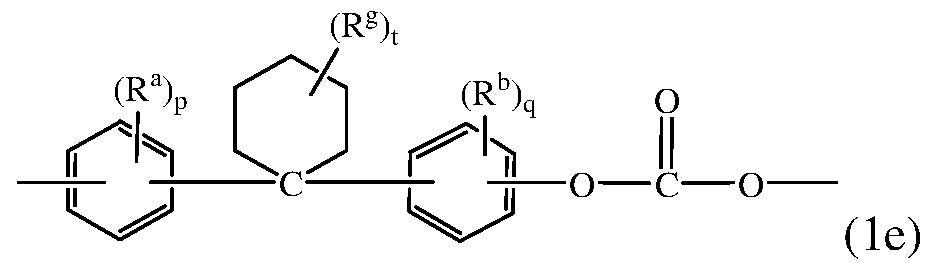
wherein Ra and Rb are each independently C1-12 alkyl, Rg is C1-12 alkyl, p and q are each independently 0 to 4, and t is 0 to 10. At least one of each of Ra and Rb can be disposed meta to the cyclohexylidene bridging group. Each Ra and Rb can independently be C1-4 alkyl, Rg is
alkyl, p and q are each 0 or 1, and t is 0 to 5. Ra, Rb, and Rg can each be methyl, p and q can each be 0 or 1, and t can be 0 or 3, specifically 0.
[0014] Examples of other bisphenol carbonate units derived from bisphenol (3) wherein Xa is a substituted or unsubstituted C3_i8 cycloalkylidene include adamantyl units of formula If) and fluorenyl units of formula (lg)

wherein Ra and Rb are each independently C1-12 alkyl, and p and q are each independently 1 to 4. At least one of each of Ra and Rb can be disposed meta to the cycloalkylidene bridging group. Ra and Rb can each be independently Ci_3 alkyl, and p and q can be each 0 or 1;
specifically, Ra, Rb can each be methyl, p and q are each 0 or 1, and when p and q are 1, the methyl group can be disposed meta to the cycloalkylidene bridging group. Carbonates containing units (la) to (lg) are useful for making polycarbonates with high glass transition temperatures (Tg) and high heat distortion temperatures.
[0015] Other useful dihydroxy compounds of the formula HO-R^OH include aromatic dihydroxy compounds of formula (6)
 (6)
(6)
wherein each R is independently a halogen atom, CMO hydrocarbyl group such as a Ci_io alkyl, a halogen-substituted CMO alkyl, a C6 io aryl, or a halogen-substituted C6 io aryl, and n is 0 to 4. The halogen is usually bromine.
[0016] Some illustrative examples of specific dihydroxy compounds include the following: 4,4'-dihydroxybiphenyl, 1,6-dihydroxynaphthalene, 2,6-dihydroxynaphthalene, bis(4-hydroxyphenyl)methane, bis(4-hydroxyphenyl)diphenylmethane, bis(4- hydroxyphenyl)- 1 -naphthylmethane, 1 ,2-bis(4-hydroxyphenyl)ethane, 1 , 1 -bis(4- hydroxyphenyl)-l-phenylethane, 2-(4-hydroxyphenyl)-2-(3-hydroxyphenyl)propane, bis(4- hydroxyphenyl)phenylmethane, 2,2-bis(4-hydroxy-3-bromophenyl)propane, 1,1 -bis
(hydroxyphenyl)cyclopentane, 1 , 1 -bis(4-hydroxyphenyl)cyclohexane, 1 , 1 -bis(4- hydroxyphenyl)isobutene, l,l-bis(4-hydroxyphenyl)cyclododecane, trans-2,3-bis(4- hydroxyphenyl)-2-butene, 2,2-bis(4-hydroxyphenyl)adamantane, alpha, alpha' -bis(4-
hydroxyphenyl)toluene, bis(4-hydroxyphenyl)acetonitrile, 2,2-bis(3-methyl-4- hydroxyphenyl)propane, 2,2-bis(3-ethyl-4-hydroxyphenyl)propane, 2,2-bis(3-n-propyl-4- hydroxyphenyl)propane, 2,2-bis(3-isopropyl-4-hydroxyphenyl)propane, 2,2-bis(3-sec-butyl- 4-hydroxyphenyl)propane, 2,2-bis(3 -t-butyl-4-hydroxyphenyl)propane, 2,2-bis(3 -cyclohexyl-
4- hydroxyphenyl)propane, 2,2-bis(3-allyl-4-hydroxyphenyl)propane, 2,2-bis(3-methoxy-4- hydroxyphenyl)propane, 2,2-bis(4-hydroxyphenyl)hexafluoropropane, l,l-dichloro-2,2- bis(4-hydroxyphenyl)ethylene, l,l-dibromo-2,2-bis(4-hydroxyphenyl)ethylene, 1,1-dichloro- 2,2-bis(5-phenoxy-4-hydroxyphenyl)ethylene, 4,4'-dihydroxybenzophenone, 3,3-bis(4- hydroxyphenyl)-2-butanone, l,6-bis(4-hydroxyphenyl)-l,6-hexanedione, ethylene glycol bis(4-hydroxyphenyl)ether, bis(4-hydroxyphenyl)ether, bis(4-hydroxyphenyl)sulfide, bis(4- hydroxyphenyl) sulfoxide, bis(4-hydroxyphenyl)sulfone, 9,9-bis(4-hydroxyphenyl)fluorine, 2,7-dihydroxypyrene, 6,6'-dihydroxy-3,3,3',3'- tetramethylspiro(bis)indane ("spirobiindane bisphenol"), 3,3-bis(4-hydroxyphenyl)phthalimide, 2,6-dihydroxydibenzo-p-dioxin, 2,6- dihydroxythianthrene, 2,7-dihydroxyphenoxathin, 2,7-dihydroxy-9, 10-dimethylphenazine, 3,6-dihydroxydibenzofuran, 3,6-dihydroxydibenzothiophene, and 2,7-dihydroxycarbazole, resorcinol, substituted resorcinol compounds such as 5-methyl resorcinol, 5-ethyl resorcinol,
5- propyl resorcinol, 5-butyl resorcinol, 5-t-butyl resorcinol, 5-phenyl resorcinol, 5-cumyl resorcinol, 2,4,5, 6-tetrafluoro resorcinol, 2,4,5, 6-tetrabromo resorcinol, or the like; catechol; hydroquinone; substituted hydroquinones such as 2-methyl hydroquinone, 2-ethyl hydroquinone, 2-propyl hydroquinone, 2-butyl hydroquinone, 2-t-butyl hydroquinone, 2- phenyl hydroquinone, 2-cumyl hydroquinone, 2,3,5,6-tetramethyl hydroquinone, 2,3,5,6- tetra-t-butyl hydroquinone, 2,3,5,6-tetrafluoro hydroquinone, 2,3,5, 6-tetrabromo
hydroquinone, or the like, or combinations comprising at least one of the foregoing dihydroxy compounds.
[0017] Specific examples of bisphenol compounds of formula (3) include l,l-bis(4- hydroxyphenyl) methane, l,l-bis(4-hydroxyphenyl) ethane, 2,2-bis(4-hydroxyphenyl) propane (hereinafter "bisphenol A" or "BPA"), 2,2-bis(4-hydroxyphenyl) butane, 2,2-bis(4- hydroxyphenyl) octane, l,l-bis(4-hydroxyphenyl) propane, l,l-bis(4-hydroxyphenyl) n- butane, 2,2-bis(4-hydroxy-2-methylphenyl) propane, l,l-bis(4-hydroxy-t-butylphenyl) propane, 3,3-bis(4-hydroxyphenyl) phthalimidine, 2-phenyl-3,3-bis(4-hydroxyphenyl) phthalimidine (PPPBP), and l,l-bis(4-hydroxy-3-methylphenyl)cyclohexane (DMBPC). Combinations comprising at least one of the foregoing dihydroxy compounds can also be
used. The polycarbonate can be a linear homopolymer derived from bisphenol A, in which each of A 1 and A2 is p-phenylene and Y 1 is isopropylidene in formula (3).
[0018] The polycarbonate herein is prepared via the melt polymerization of a bisphenol and a carbonate precursor. Exemplary carbonate precursors include a carbonyl halide such as carbonyl bromide or carbonyl chloride (phosgene) a bishaloformate of a dihydroxy compound (e.g., the bischloro formate of bisphenol A, hydroquinone ethylene glycol, neopentyl glycol, or the like), and diaryl carbonates. Combinations comprising at least one of the foregoing types of carbonate precursors can also be used. The diaryl carbonate ester can be diphenyl carbonate, or an activated diphenyl carbonate having electron-withdrawing substituents on each aryl, such as bis(4-nitrophenyl)carbonate, bis(2- chlorophenyl)carbonate, bis(4-chlorophenyl)carbonate, bis(methyl salicyl)carbonate, bis(4- methylcarboxylphenyl) carbonate, bis(2-acetylphenyl) carboxylate, bis(4-acetylphenyl) carboxylate, or a combination comprising at least one of the foregoing.
[0019] The present polymerization can occur in the presence of a branching agent. Examples of branching agents include polyfunctional organic compounds containing at least three functional groups selected from hydroxyl, carboxyl, carboxylic anhydride, haloformyl, and mixtures of the foregoing functional groups. Such branching agents include aromatic triacyl halides, for example triacyl chlorides of formula 20)

wherein Z is a halogen, Ci_3 alkyl, Ci_3 alkoxy, C7_i2 arylalkylene, C7_i2 alkylarylene, or nitro, and z is 0 to 3; a tri-substituted henol of formula (21)

wherein T is a C1-2o alkyl, C1-2o alkoxy, C7-12 arylalkyl, or C7-12 alkylaryl, Y is a halogen, C1-3 alkyl, Ci_3 alkoxy, C7_i2 arylalkyl, C7_i2 alkylaryl, or nitro, s is 0 to 4.
[0020] Specific examples of branching agents include trimellitic acid, trimellitic anhydride, trimellitic trichloride, tris-p-hydroxyphenylethane, isatin-bis-phenol of formula
(22)

tris-phenol TC (l,3,5-tris((p-hydroxyphenyl)isopropyl)benzene), tris-phenol PA (4(4(1,1- bis(p-hydroxyphenyl)-ethyl) alpha, alpha-dimethyl benzyl)phenol), 4-chloroformyl phthalic anhydride, trimesic acid, and benzophenone tetracarboxylic acid. Likewise, the present melt polymerization process can be performed in the absence of a branching agent.
[0021] In the melt polymerization process, the polycarbonate can be prepared by co- reacting, in a molten state, a dihydroxy reactant and a carbonate precursor in the presence of a transesterification catalyst. The reaction can be carried out in typical polymerization equipment, such as a continuously stirred reactor (CSTR), plug flow reactor, wire wetting fall polymerizers, free fall polymerizers, horizontal polymerizers, wiped film polymerizers, BANBURY mixers, single or twin screw extruders, or a combination comprising one or more of the foregoing. Volatile monohydric phenol is removed from the molten reactants by distillation and the polymer is isolated as a molten residue. Melt polymerization can be conducted as a batch process or as a continuous process. In either case, the melt
polymerization conditions used can comprise two or more distinct reaction stages. For example, the polymerization can comprise a first reaction stage in which the starting dihydroxy aromatic compound and diaryl carbonate are converted into an oligomeric polycarbonate and a second reaction stage wherein the oligomeric polycarbonate formed in the first reaction stage is converted to high molecular weight polycarbonate. The first reaction stage can comprise 1 or more, specifically, 2 or more, more specifically, 2 to 4 first stage polymerization units (for example 2 to 4 continuously stirred tanks). When 2 or more first stage polymerization units are present in series, one or both of an increase in temperature or a decrease in pressure can occur from one unit to the next. The second reaction stage can comprise 1 or more, specifically, 2 or more, more specifically, 2 second stage polymerization units (for example 2 horizontal or wire wetting fall polymerizers). When the second reaction stage comprises 2 second stage polymerization units, the first-second stage polymerization
unit can polymerize the polycarbonate to a molecular weight of, for example, 20,000 to 50,000 Daltons, the polycarbonate composition can then be optionally quenched, and a second- second stage polymerization unit can function as a devolitalization unit, where the molecular weight of the polycarbonate does not significantly increase (for example, the molecular weight does not increase by greater than 10 weight percent (wt%)) and a temperature, a pressure, and a residence time are used to reduce the concentration of low molecular weight components (such as those with a molecular weight of less than 1,000 Daltons). The first stage polymerization unit is herein defined as a polymerization unit that results in polycarbonates oligomers with a number average molecular weight of less than or equal to 8,000 Daltons and a second stage polymerization unit is herein defined as a polymerization unit that produces polycarbonate with a number average molecular weight of greater than 8,000 Daltons. It is noted that while less than or equal to 8,000 Daltons is used here to define a molecular weight achieved in the first stage, one skilled in the art readily understands that said molecular weight is used to define an oligomerization stage, where the oligomer molecular weight could be greater than 8,000 Daltons. A "staged" polymerization reaction condition can be used in continuous polymerization systems, wherein the starting monomers are oligomerized in a first reaction vessel and the oligomeric polycarbonate formed therein is continuously transferred to one or more downstream reactors in which the oligomeric polycarbonate is converted to high molecular weight polycarbonate. Typically, in the oligomerization stage the oligomeric polycarbonate produced has a number average molecular weight of 1,000 to 7,500 Daltons. In one or more subsequent polymerization stages the number average molecular weight (Mn) of the polycarbonate can be increased to, for example, 8,000 and 25,000 Daltons (using polycarbonate standard), specifically, 13,000 to 18,000 Daltons.
[0022] Typically, solvents are not used in the process, and the reactants dihydroxy aromatic compound and the diaryl carbonate are in a molten state. The reaction temperature can be 100 to 350 degrees Celsius (°C), specifically, 180 to 310°C. The pressure can be at atmospheric pressure, supra- atmospheric pressure, or a range of pressures from atmospheric pressure to 15 torr in the initial stages of the reaction, and at a reduced pressure at later stages, for example 0.2 to 15 torr. Likewise, the polymerization can occur in a series of polymerization vessels that can have increasing temperature and vacuum. For example, a first stage can occur at a temperature of 100 to 260°C, specifically, 140 to 240°C and a second stage can occur at a temperature of 240 to 350°C, specifically 280 to 300°C or 240 to
270°C, where the temperature in the second stage is greater than the temperature in the first stage. A first stage can occur at a temperature of 100 to 285°C. The reaction time from the initial polymerization unit to the final polymerization unit is generally 0.1 to 15 hours.
[0023] After a final polymerization vessel (also referred to as a final polymerization unit), the polymer can be introduced to a reactor, extruded, subjected to filtration in a melt filter, or a combination comprising one or more of the foregoing. It is noted that the melt filter can be located before or after the extruder. For example, the melt polymerization process for the manufacture of a polycarbonate composition can comprise: melt
polymerizing a dihydroxy reactant and a carbonate compound to produce a molten reaction product; quenching the molten reaction product; filtering the molten reaction product in a melt filter upstream of any extruders; optionally, introducing an additive to form a mixture; and extruding the mixture to form the polycarbonate composition. Likewise, the melt polymerization process for the manufacture of a polycarbonate composition can comprise: melt polymerizing a dihydroxy reactant and a carbonate compound to produce a molten reaction product; introducing a quencher composition and optionally an additive for form a mixture; and extruding the mixture to form the polycarbonate composition.
[0024] Catalysts used in the melt transesterification polymerization production of polycarbonates can include alpha and/or beta catalysts. Beta catalysts are transesterification catalysts that are typically volatile and degrade at elevated temperatures. Beta catalysts can therefore be used at early low-temperature polymerization stages (e.g., during
oligomerization). Alpha catalysts are transesterification catalysts that are typically more thermally stable and less volatile than beta catalysts, and therefore can be used throughout transesterification, including during oligomerization, and after oligomerization, e.g., in the polymerization vessels, during polymerization. The alpha catalyst can be a catalyst capable of withstanding temperatures of 270°C (specifically 280°C, and more specifically 300°C), e.g., the alpha catalyst will be present in the composition after operation at temperatures of 270°C.
[0025] The alpha catalyst can comprise a source of alkali and/or alkaline earth ions. The sources of these ions include alkali metal hydroxides such as lithium hydroxide, sodium hydroxide, and potassium hydroxide, as well as alkaline earth hydroxides such as magnesium hydroxide and calcium hydroxide. Other possible sources of alkali and alkaline earth metal ions include the corresponding salts of carboxylic acids (such as sodium acetate) and derivatives of ethylene diamine tetraacetic acid (EDTA) (such as EDTA tetrasodium salt, and
EDTA magnesium disodium salt). Other alpha transesterification catalysts include alkali or alkaline earth metal salts of carbonate, such as CS2CO3, NaHC03, and Na2C03, and the like, non-volatile inorganic acid such as NaH2P03, NaH2P04, Na2HP03, KH2P04, CsH2P04, Cs2HP04, and the like, or mixed salts of phosphoric acid, such as NaKHP04, CsNaHP04, CsKHP04, and the like. Combinations comprising at least one of any of the foregoing catalysts can be used. The first catalyst composition and the second catalyst composition can comprise the same or different alpha catalyst.
[0026] Specifically, the alpha catalyst can comprise lithium hydroxide, sodium hydroxide, barium hydroxide, strontium hydroxide, potassium hydroxide, magnesium hydroxide, calcium hydroxide, sodium acetate, potassium acetate, lithium acetate, calcium acetate, barium acetate, magnesium acetate, strontium acetate, EDTA tetra sodium salt, EDTA magnesium disodium salt, Cs2C03, sodium bicarbonate (NaHC03), sodium carbonate (Na2C03), potassium bicarbonate, lithium bicarbonate, calcium bicarbonate, barium bicarbonate, magnesium bicarbonate, strontium bicarbonate, potassium carbonate, lithium carbonate, calcium carbonate, barium carbonate, magnesium carbonate, strontium carbonate, lithium stearate, sodium stearate, strontium stearate, potassium stearate, lithium
hydroxyborate, sodium hydroxyborate, sodium phenoxyborate, sodium benzoate, potassium benzoate, lithium benzoate, disodium hydrogen phosphate, dipotassium hydrogen phosphate, dilithium hydrogen phosphate, disodium salts of bisphenol A, dipotassium salts of bisphenol A, and dilithium salts of bisphenol A, sodium salts of phenol, potassium salts of phenol, lithium salts of phenol, NaH2P03, NaH2P04, Na2HP04, KH2P04, CsH2P04, Cs2 HP04, NaKHP04, NaCsHP04, KCsHP04, Na2S04, NaHS04, NaSb03, LiSb03, KSb03, Mg(Sb03)2, Na2Ge03, K2Ge03, Li2Ge03, MgGe03, Mg2Ge04, or a combination comprising one or more of the foregoing.
[0027] Possible beta catalysts can comprise a quaternary ammonium compound, a quaternary phosphonium compound, or a combination comprising at least one of the foregoing. The quaternary ammonium compound can be a compound of the structure (R4)4N+X~, wherein each R4 is the same or different, and is a Ci_2o alkyl, a C4_2o cycloalkyl, or a C4_2o aryl; and X" is an organic or inorganic anion, for example a hydroxide, halide, carboxylate, sulfonate, sulfate, formate, carbonate, or bicarbonate. Examples of organic quaternary ammonium compounds include tetramethyl ammonium hydroxide, tetrabutyl ammonium hydroxide, tetramethyl ammonium acetate, tetramethyl ammonium formate, tetrabutyl ammonium acetate, and combinations comprising at least one of the foregoing.
Tetramethyl ammonium hydroxide is often used. The quaternary phosphonium compound can be a compound of the structure (R5)4P+X~, wherein each R5 is the same or different, and is a Ci_2o alkyl, a C4_2o cycloalkyl, or a C4_2o aryl; and X" is an organic or inorganic anion, for example a hydroxide, phenoxide, halide, carboxylate such as acetate or formate, sulfonate, sulfate, formate, carbonate, or bicarbonate. Where X" is a polyvalent anion such as carbonate or sulfate it is understood that the positive and negative charges in the quaternary ammonium and phosphonium structures are properly balanced. For example, where R 20 to R 23 are each methyls and X" is carbonate, it is understood that X -" represents 2(C03 -~2 ). Examples of organic quaternary phosphonium compounds include tetramethyl phosphonium hydroxide, tetramethyl phosphonium acetate, tetramethyl phosphonium formate, tetrabutyl phosphonium hydroxide, tetraphenyl phosphonium acetate, tetraphenyl phosphonium phenoxide, tetraethyl phosphonium acetate, tetrapropyl phosphonium acetate, tetrabutyl phosphonium acetate, tetrapentyl phosphonium acetate, tetrahexyl phosphonium acetate, tetraheptyl phosphonium acetate, tetraoctyl phosphonium acetate, tetradecyl phosphonium acetate, tetradodecyl phosphonium acetate, tetratolyl phosphonium acetate, tetramethyl phosphonium benzoate, tetraethyl phosphonium benzoate, tetrapropyl phosphonium benzoate, tetraphenyl
phosphonium benzoate, tetraethyl phosphonium formate, tetrapropyl phosphonium formate, tetraphenyl phosphonium formate, tetramethyl phosphonium propionate, tetraethyl phosphonium propionate, tetrapropyl phosphonium propionate, tetramethyl phosphonium butyrate, tetraethyl phosphonium butyrate, and tetrapropyl phosphonium butyrate, and combinations comprising at least one of the foregoing. The catalyst can comprise TBPA.
[0028] The polycarbonate can be a bisphenol A polycarbonate with a weight average molecular weight of 21800 Daltons with a melt flow of 24 to 32 g/lOmin (ASTM D1238-04, 300°C, 2.16 kg).
[0029] The polycarbonate can have a melt flow of 4 to 40 g/10 min, for example, 4.5 to 15 g/10 min or 15 to 35 g/10 min as determined by ASTM D1238-04 at 300°C, 1.5 kg. The polycarbonate can have a melt flow of 5 to 15 g/10 min as determined by ASTM D1238- 04 at 250°C, 1.5 kg.
[0030] A quencher composition can be added at one or more locations in the present melt preparation of the polycarbonate to reduce the activity of the catalyst. The quencher composition comprises a quenching agent (also referred to herein as a quencher). For example, the quenching agent can comprise a sulfonic acid ester such as an alkyl sulfonic ester of the formula RiS03R2 wherein Ri is hydrogen, C1-C12 alkyl, C6-Ci8 aryl, or C7-C19
alkylaryl, and R2 is C1-C12 alkyl, C6-Ci8 aryl, or C7-C19 alkylaryl. Examples of alkyl sulfonic esters include benzenesulfonate, p-toluenesulfonate, methylbenzene sulfonate, ethylbenzene sulfonate, n-butyl benzenesulfonate, octyl benzenesulfonate and phenyl benzenesulfonate, methyl p-toluenesulfonate, ethyl p-toluenesulfonate, n-butyl p-toluene sulfonate, octyl p- toluenesulfonate and phenyl p- toluenesulfonate. The sulfonic acid ester can comprise alkyl tosylates such as n-butyl tosylate. The sulfonic acid ester can be present in the quencher composition in an amount of 0.1 to 10 volume percent (vol%), specifically, 0.1 to 5 vol%, more specifically, 0.5 to 2 vol% based on the total volume of the quencher composition.
[0031] The quenching agent can comprise boric acid esters (e.g., B(OCH3)3,
B(OCH2CH3)3, and B(OC6H6)3), zinc borate, boron phosphate, aluminum stearate, aluminum silicate, zirconium carbonate, zirconium C1-C12 alkoxides, zirconium hydroxycarboxylates, gallium phosphide, gallium antimonide, germanium oxide, Ci-C32 organogermanium compounds, C4-C32 tetraorganotin tin compound, C6-C32 hexaorganotin compound (e.g., [(C6H60)Sn(CH2CH2CH2CH3)2]20), Sb20 , antimony oxide, Ci-C 2 alkylantimony, bismuth oxide, C1-C12 alkylbismuth, zinc acetate, zinc stearate, Ci-C32 alkoxytitanium, and titanium oxide, phosphoric acid, phosphorous acid, hypophosphorous acid, pyrophosphoric acid, polyphosphoric acid, boric acid, hydrochloric acid, hydrobromic acid, sulfuric acid, sulfurous acid, adipic acid, azelaic acid, dodecanoic acid, L-ascorbic acid, aspartic acid, benzoic acid, formic acid, acetic acid, citric acid, glutamic acid, salicylic acid, nicotinic acid, fumaric acid, maleic acid, oxalic acid, benzenesulfinic acid, C1-C12 dialkyl sulfates (e.g., dimethyl sulfate and dibutyl sulfate), sulfonic acid phosphonium salts of the formula (RaS03 ")(PRb 4)+ wherein Ra is hydrogen, C1-C12 alkyl, C6-Ci8 aryl, or C7-C19 alkylaryl, and each Rb is independently hydrogen, C1-C12 alkyl or C6-Ci8 aryl, sulfonic acid derivatives of the formula A1-^1- SC^X1)™ wherein A1 is a Ci-C4o hydrocarbon group having a valence of m, Y1 is a single bond or an oxygen atom, X1 is a secondary or tertiary alkyl group of the formula - CR15R16R17, a metal cation of one equivalent, an ammonium cation (e.g, NRb 3 + wherein each Rb is independently hydrogen, C1-C12 alkyl or C6-Ci8 aryl), or a phosphonium (e.g, PRb 4 + wherein each Rb is independently hydrogen, C1-C12 alkyl or C6-Ci8 aryl) wherein R15 is a hydrogen atom or an alkyl group having 1 to 5 carbon atoms, R16 is a hydrogen atom, a phenyl group or an alky group having 1 to 5 carbon atoms, and R 17 is the same as or different from R15 and has the same definition as R15, provided that two of R15, R16, and R17 cannot be hydrogen atoms, and m is an integer of 1 to 4, provided that when Y1 is a single bond, all of X1 in an amount of m cannot be metal cations of one equivalent, a compound of the formula
 is a secondary, tertiary or quaternary ammonium cation or a secondary (e.g., , tertiary or quaternary phosphonium cation, and Y1 is a single bond or an oxygen atom, a compound of the formula A3-(+X3)n-(R- Y^S )!! wherein A3 is a Ci-C4o hydrocarbon group having a valence of n, +X3 is a secondary, tertiary or quaternary ammonium cation (e.g., NRb 3 + wherein each Rb is independently hydrogen, C1-C12 alkyl or C6-Ci8 aryl), or a secondary, tertiary or quaternary phosphonium cation (e.g., PRb 4 + wherein each Rb is independently hydrogen, C1-C12 alkyl or C6-Ci8 aryl), R is a monovalent Ci-C4o hydrocarbon group, n is an integer of 2 to 4, and Y1 is a single bond or an oxygen atom, a compound of the formula A5-Ad1-A4-(Ad2-A5)t wherein A5 is a monovalent or divalent Ci-C4o hydrocarbon group, A4 is a divalent Ci-C4o
hydrocarbon group, each of Ad 1 and Ad 2 is independently an acid anhydride group selected from -SO2-O-SO2-, -SO2-O-CO- and -CO-0-S02-, and £ is 0 or 1, provided that when I is O, -(Ad2-A5)t is a hydrogen atom or a bond between A4 and A5, in which A5 is a divalent hydrocarbon group or a single bond, aminosulfonic esters having the formula RaRbN-A- S03Rc, wherein Ra and R are each independently hydrogen, C1-C12 alkyl, C6-C22 aryl, C7-C19 alkylaryl or Ra and R , either singly or in combination, form an aromatic or non-aromatic heterocyclic compound with N (e.g., pyrrolyl, pyridinyl, pyrimidyl, pyrazinyl, carbazolyl, quinolinyl, imidazoyl, piperazinyl, oxazolyl, thiazolyl, pyrazolyl, pyrrolinyl, indolyl, purinyl, pyrrolydinyl, or the like), Rc is hydrogen, and A is C1-C12 alkyl, C6-Ci8 aryl, or C17-C19 alkylaryl (e.g., compounds such as N-(2-hydroxyethyl) piperazine-N'-3-propanesulfonic acid, 1,4,-piperazinebis (ethanesulfonic acid), and 5-dimethylamino-l-napthalenesulfonic acid), ammonium sulfonic esters of the formula RaRbRcN+— A— S03 ", wherein Ra, Rb, are each independently hydrogen, C1-C12 alkyl, C1-C12 aryl, C7-C19 alkylaryl, or Ra and Rb, either singly or in combination, form an aromatic or non-aromatic heterocyclic compound with N (e.g., pyrrolyl, pyridinyl, pyrimidyl, pyrazinyl, carbazolyl, quinolinyl, imidazoyl, piperazinyl, oxazolyl, thiazolyl, pyrazolyl, pyrrolinyl, indolyl, purinyl, pyrrolydinyl, or the like), Rc is a hydrogen, and A is C1-C12 alkyl, C6-Ci8 aryl, or C7-C19 alkylaryl, sulfonated polystyrene, methyl acrylate-sulfonated styrene copolymer, and combinations comprising at least one of the foregoing.
[0032] The quencher can be added in an amount of greater than or equal to 5 parts per million by weight (ppm), specifically, greater than or equal to 10 ppm based on the total amount of the polymerized polycarbonate. The quencher can be added in an amount of less than or equal to 5 ppm, specifically, less than or equal to 10 ppm based on the total amount of
the polymerized polycarbonate. The quencher composition be added to the polymerization unit such that the quencher is added in an amount of 0.5 to 15 ppm, specifically, 1 to 10 ppm, more specifically, 1.5 to 5 ppm, even more specifically, 1.5 to 3 ppm based on the total weight of the polymerized polycarbonate. Likewise, the quencher composition be added to the polymerization unit such that the quencher is added in an amount of 5 to 10 ppm, specifically, 6 to 8 ppm based on the total weight of the polymerized polycarbonate.
Likewise, the quencher can be added such that the quencher or derivatives thereof are present in an amount of 0.1 to 50 times, specifically, 0.5 to 30 times, per the neutralization equivalent of the catalyst used.
[0033] The present process comprises sequentially adding a first catalyst composition, adding a quencher composition to result in a quenched polycarbonate, introducing an inert gas to the quenched polycarbonate, and adding a second catalyst composition to a
polymerized polycarbonate, where the first catalyst composition and the second catalyst composition comprise an alpha catalyst. A second quencher composition can be added after the addition of the second catalyst composition. A beta catalyst can be added prior to and/or at the same time as and/or subsequent to addition of the first catalyst composition. The beta catalyst can be added prior to the addition of the second catalyst composition.
[0034] The first catalyst composition, the quencher composition, the inert gas, and the second catalyst composition are added downstream of each other, wherein downstream refers to a physical location downstream in the polymerization process or in a same physical location but at a later time (such as after a polymerization time in the same polymerization unit).
[0035] The first catalyst composition, the quencher composition, the inert gas, and the second catalyst composition can each independently be added in the process at various locations provided they are added in the specified order. The first catalyst composition, the quencher composition, and the second catalyst composition can each independently be added upstream of a polymerization unit, directly into a polymerization unit (for example, at an inlet, in a side feeder, in an outlet, or a combination comprising one or more of the
foregoing), downstream of a polymerization unit, in a reactor that is not polymerizing polycarbonate, upstream of an extruder, directly into an extruder (for example, at the throat of the extruder, in a side feeder, in an outlet, or a combination comprising one or more of the foregoing), downstream of an extruder. For example, the first catalyst composition can be added prior to a first polymerization unit, the quencher composition can be added in the outlet
of the first polymerization unit, and the second catalyst composition can be added thereafter. For example, the first catalyst composition can be added prior to a first polymerization unit, the first quencher composition can be added after an initial polymerization unit, the second catalyst composition can then be added to the same polymerization unit and/or downstream of the initial polymerization, and after further polymerization, a second quencher composition can be added. It is understood that further quencher and/or catalyst compositions can be further added, for example, a third catalyst composition comprising an alpha catalyst can be added before or after the second catalyst composition and a further quencher composition can be added as a master batch in an extruder and/or by spraying onto solid polycarbonate pellets.
[0036] A second quencher composition can be added in any location, provided it is added after the second catalyst composition, where it is noted that additional quencher compositions can be added, for example, a third quencher composition can be added after the first quencher composition and prior to adding both the second catalyst composition and the second quencher composition. The second quencher composition can be added, for example, in a reactor located in between a final polymerization unit and an extruder, in an extruder, or after an extruder, for example, it can be added in a master batch to a pelletized polycarbonate. A second quencher composition can be added after the formation of the polycarbonate composition, i.e., after extruding and/or melt filtering. For example, after the polycarbonate composition is prepared, the polycarbonate composition can be mixed with a second quencher composition, for example, in an in-line mixer, a twin barrel mixer, or the like and then pelletized. Likewise, the polycarbonate composition can first be pelletized and then the second quencher composition can be introduced. For example, the second quencher composition can be sprayed in the solid or liquid form onto polycarbonate pellets and can be mixed with the pellets in, for example, a melt kneader.
[0037] The first catalyst composition, the quencher composition, and the second catalyst composition can each independently be added at a pressure of greater than or equal to 2 bars, specifically, 2 to 10 bars, more specifically, 5 to 10 bars.
[0038] When a catalyst composition and/or a quencher composition is added to a polymerization unit and/or to an extruder, the quencher composition can optionally be mixed, for example, by means of a Henschel mixer, and introduced to a feeder, such as a gravimetric feeder, and then fed to a polymerization unit and/or to an extruder through a feeder, such as a side feeder and/or directly into a throat of the extruder.
[0039] When a catalyst composition and/or a quencher composition is added to a connecting stream that connects a first unit to a second unit, then the connecting stream comprising the added composition can be mixed via, for example, the establishment of a turbulent flow, an in-line mixer, for example, a static mixer located in a pipe that contains the connecting stream and/or in a mixer unit that houses a rotating paddle, for example, a continuously stirred tank. Mixing can occur for 0.3 to 5 minutes, for example, 0.5 to 3 minutes, for example, 1 to 2 minutes. Likewise, catalyst composition and/or the quencher composition can be added to the connecting stream without mixing.
[0040] The amount of alpha and beta catalyst used can be based upon the total number of moles of dihydroxy compound used in the polymerization reaction. When referring to the ratio of beta catalyst, for example, a phosphonium salt, to all dihydroxy compounds used in the polymerization reaction, it is convenient to refer to moles of catalyst per mole of the dihydroxy compound, meaning the number of moles of catalyst divided by the sum of the moles of each individual dihydroxy compound present in the reaction mixture.
The transesterification catalyst can be used in an amount sufficient to provide 1 x 10 -"8 to 1 x 10"5, specifically, 1 x 10"7 to 8 x 10"6, more specifically, 3 x 10"7 to 2 x 10"6 moles of catalyst per mole of aromatic dihydroxy compound used. The alpha catalyst can be used in an amount sufficient to provide 1 x 10 -"2 to 1 x 10 -"8 moles, specifically, 1 x 10 -"4 to 1 x 10 -"7 moles of metal per mole of the dihydroxy compound used. For example, the first catalyst composition can comprise 1 to 99 wt%, specifically, 1 to 50 wt% more catalyst then the second catalyst composition. The amount of beta catalyst (e.g., organic ammonium or phosphonium salts) can be 1 x 10"2 to 1 x 10"5, specifically 1 x 10"3 to 1 x 10"4 moles per total mole of the dihydroxy compound in the reaction mixture. Quenching of the
transesterification catalysts and any reactive catalyst residues with an acidic compound after polymerization is completed can also be useful in some melt polymerization processes.
Removal of catalyst residues and/or quenching agent and other volatile residues from the melt polymerization reaction after polymerization can also be useful in some melt polymerization processes.
[0041] An inert gas is introduced to the quenched polycarbonate after the addition of the quencher composition and prior to the addition of a second catalyst composition. The inert gas can be any gas, which has no reactivity with the molten aromatic polycarbonate prepolymer and is stable under the polymerization conditions. For example, the inert gas can comprise nitrogen, argon, helium, carbon dioxide, an organic gas, or a combination
comprising one or more of the foregoing. The organic gas is an organic compound that is in the gas state at the inert gas introduction temperature and pressure. For example, the organic gas can comprise one or more hydrocarbons having 1 to 8 carbon atoms.
[0042] The introduction of the inert gas results in an inert gas that is dispersed and/or dissolved in the quenched polycarbonate. The term "dispersed" as used herein indicates that the inert gas is present in the quenched polycarbonate in the form of bubbles to thereby form a gas-liquid mixed phase composed of the quenched polycarbonate having the inert gas dispersed therein. The term "dissolved" used above indicates that the inert gas is present in such a form as intimately mixed with the quenched polycarbonate to thereby form a uniform liquid phase composed of the quenched polycarbonate having the inert gas dissolved therein.
[0043] The introducing of the inert gas can occur in an absorption device that allows the quenched polycarbonate to absorb the inert gas. For example, the absorption device can function to increase the gas-liquid interface between the inert gas and the quenched polycarbonate. Examples of absorption devices such as a packed column type absorption device, a tray-containing column type absorption device, a spraying device-containing column type absorption device (in which a liquid is sprayed in a gas to be absorbed in the liquid), a turbulent contact absorption device, a gas-liquid film cross-contacting type absorption device, a high-speed rotary flow type absorption device, an absorption device utilizing mechanical force (such as agitation force), and a device in which the quenched polycarbonate is allowed to fall along and in contact with the surface of a guide in an atmosphere of an inert gas, where the quenched polycarbonate absorbs the inert gas during the fall thereof. Alternatively, instead of, or in addition to using an absorption device, the inert gas absorption can be conducted by introducing the inert gas into the quenched polycarbonate, which is present in a pipe for the introduction of the quenched polycarbonate into a polymerization unit to thereby cause the quenched polycarbonate to absorb the inert gas in the pipe.
[0044] Further, as an absorption device, a device which is generally used as a polymerization unit can be used. However, it is noted that when such a device (generally used as a polymerization unit) is used as an absorption device, the device is generally operated under conditions wherein the polymerization of the quenched polycarbonate hardly proceeds, so that the device does not function as a polymerization unit.
[0045] The introducing can occur in a manner such that all of or essentially all of the inert gas supplied to the quenched polycarbonate is absorbed or in a manner such that an
excess amount of inert gas is introduced to the quenched polycarbonate and any inert gas that is not absorbed is removed and optionally recycled back into the absorption device. Small molecules, such as phenol, can be separated from the removed inert gas prior to recycling. The amount of the inert gas that can be absorbed in the quenched polycarbonate can be 0.0001 to 1 liter(s) per kg of the quenched polycarbonate as measured under the normal temperature and pressure conditions (nL/kg), specifically, 0.001 to 0.8 nL/kg, more specifically, 0.005 to 0.6 nL/kg.
[0046] The introducing can be conducted either in a continuous manner, in which the quenched polycarbonate is continuously fed to the inert gas absorption device to thereby allow the quenched polycarbonate to absorb the inert gas, and the quenched polycarbonate having the inert gas absorbed therein is continuously withdrawn from the device, or in a batchwise manner in which the quenched polycarbonate is batchwise fed to the inert gas absorption device to thereby allow the quenched polycarbonate to absorb the inert gas.
[0047] The amount of the inert gas absorbed in the quenched polycarbonate can be determined by determining the amount of the inert gas fed to the inert gas absorption device. For example, when the quenched polycarbonate is allowed to absorb the inert gas while flowing the inert gas through the inert gas absorption device, the amount of the inert gas absorbed in the quenched polycarbonate can be obtained as a difference between the amount of the inert gas fed to the device and the amount of the inert gas discharged from the device. Alternatively, when a predetermined amount of the quenched polycarbonate is fed to the inert gas absorption device containing the inert gas having a predetermined pressure, the amount of the inert gas absorbed in the quenched polycarbonate can be obtained from the decrease in pressure in the inert gas absorption device, which is caused by the absorption of the inert gas by the quenched polycarbonate.
[0048] During the introducing of the inert gas, the number average molecular weight of the polycarbonate can increase by less than or equal to 10 wt%, specifically, less than or equal to 5 wt%, more specifically, less than or equal to 1 wt%, as determined by gel permeation chromatography based on polycarbonate standards.
[0049] The introducing can occur at a temperature of 150 to 350°C, specifically, 180 to 300°C, more specifically, 230 to 290°C. The introducing can occur at a pressure that is greater than or equal to a first stage polymerization pressure. For example, the introducing pressure, Pi in Pascal (Pa), can be determined by the following equation 1
Pi > 4 x 10¹² x Mf2'6871 (1)
where Mi is the number average molecular weight in g/mol of the polycarbonate (as determined by gel permeation chromatography in tetrahydrofuran based on polycarbonate standards) before the inert gas is introduced. A maximum introducing pressure can be 2 x 10⁷ Pa, specifically, 1 x 10⁷ Pa, more specifically, 5 x 10⁶ Pa. For example, the introducing pressure can be 250 to 10,000,000 Pa, specifically, 400 to 500,000 Pa.
[0050] The quenched polycarbonate comprising the inert gas can then be directed to a polymerization unit, where the second catalyst composition can be added upstream of the polymerization unit, directly into, downstream of the polymerization unit provided it is added prior to a polymerization in a subsequent polymerization unit, or a combination comprising one or more of the foregoing. The quenched polycarbonate comprising the inert gas can be directed to the polymerization unit in a batchwise manner or in a continuous manner. The polymerization pressure (Pp) in the polymerization unit after the absorption device that can be located directly after the absorption device can be less than Pi.
[0051] The quenched composition can be essentially free of chlorine and bromine. "Essentially free of chlorine and bromine" is defined as having a bromine and/or chlorine content of less than or equal to 100 parts per million by weight (ppm), less than or equal to 75 ppm, or less than or equal to 50 ppm, based on the total parts by weight of the composition, excluding any filler.
[0052] The introducing of the inert gas can occur before one or more polymerization units. For example, the polymerized polycarbonate can be quenched, a first inert gas can be introduced, a second catalyst composition can be added, the polycarbonate can be
polymerized in a first polymerization unit, the polymerized polycarbonate can optionally be quenched, a second inert gas can be introduced, a third catalyst composition can optionally be added, and the polycarbonate can be polymerized in a second polymerization unit. Likewise, the polymerized polycarbonate optionally can be quenched, a first inert gas can be introduced, a second catalyst composition can optionally be added, the polycarbonate can be polymerized in a first polymerization unit, the polymerized polycarbonate can be quenched, a second inert gas can be introduced, a third catalyst composition can be added, and the polycarbonate can be polymerized in a second polymerization unit. Further, the polymerized polycarbonate can be quenched, a first inert gas can be introduced, a second catalyst composition can be added, the polycarbonate can be polymerized in a first polymerization unit, the polycarbonate can then be polymerized in a second polymerization unit, the polycarbonate can optionally be quenched, a second inert gas can be introduced, a third
catalyst composition can optionally be added, and the polycarbonate can be polymerized in a third polymerization unit. One skilled in the art can readily envision further embodiments where the introducing occurs in multiple locations.
[0053] Additionally, an inert gas can further be introduced in a polymerization unit.
[0054] The polymerization process can comprise a section of parallel polymerization, where parallel polymerization refers to the splitting of a polymerized polycarbonate stream into two or more streams that may or may not experience the same polymerization conditions thereafter (i.e., they can attain different molecular weights, have different additives added thereto, etc.). For example, polycarbonate can be prepared in a first portion of the
polymerization process; a stream comprising polymerized polycarbonate can be split into two or more streams and directed to 2 or more parallel operating lines. For example, a process can comprise polymerizing polycarbonate in a series of first stage polymerization units; a stream exiting the first stage can be split into two streams: A and B, where stream A is directed to second stage polymerization unit A and stream B is directed to second stage polymerization unit B. Likewise, a process can comprise polymerizing polycarbonate in a series of first stage polymerization units followed by polymerizing in a series of second stage polymerization units; a stream exiting the second stage can be split into two streams: A and B, where stream A is directed to extruder A and stream B is directed to extruder B. Likewise, a process can comprise polymerizing polycarbonate in a series of first stage polymerization units followed by polymerizing in a series of two second stage polymerization units; a stream exiting the first- second stage polymerization unit can be split into two streams: A and B, where stream A is directed to second- second stage polymerization unit A and stream B is directed to second- second stage polymerization unit B. In any of the aforementioned scenarios, a quencher composition can be added to one or both of streams A and B, where the quencher composition can be the same or different. One skilled in the art can readily envision other embodiments comprising more than 2 parallel streams and embodiments where the streams are split at different locations.
[0055] An additive can further be added at one or more locations in the present melt preparation of the polycarbonate. For example, the additive can be added upstream of a polymerization unit, directly into a polymerization unit (for example, at an inlet, in a side feeder, in an outlet, or a combination comprising one or more of the foregoing), downstream of a polymerization unit, in a reactor that is not polymerizing polycarbonate, upstream of an extruder, directly into an extruder (for example, at the throat of the extruder, in a side feeder,
in an outlet, or a combination comprising one or more of the foregoing), downstream of an extruder, or a combination comprising one or more of the foregoing. The additive can be added as part of the quencher composition or can be added separately. The additive can be added in a molten state or can be added after an extruded polycarbonate is re-melted. The additive can be filtered prior to being added into the polymerization unit.
[0056] The additive can comprise, for example, an impact modifier, a flow modifier, a filler (e.g., a particulate polytetrafluoroethylene (PTFE), glass, carbon, a mineral, or metal), a reinforcing agent (e.g., glass fibers), an antioxidant, a heat stabilizer, a light stabilizer, an ultraviolet (UV) agent (such as a UV light stabilizer and a UV absorbing additive), a plasticizer, a lubricant, a release agent (such as a mold release agent (such as glycerol monostearate, pentaerythritol stearate, glycerol tristearate, stearyl stearate, and the like)), an antistatic agent, an anti-fog agent, an anti-frost agent, an antimicrobial agent, a colorant (e.g., a dye or pigment), a surface effect additive, a radiation stabilizer, a flame retardant, an anti- drip agent (e.g., a PTFE-encapsulated styrene-acrylonitrile copolymer (TSAN)), or a combination comprising one or more of the foregoing. For example, a combination of a heat stabilizer, mold release agent, and ultraviolet light stabilizer can be used. In general, the additives are used in the amounts generally known to be effective. For example, the total amount of the additive composition (other than any impact modifier, filler, or reinforcing agent) can be 0.001 to 10.0 weight percent (wt%), or 0.01 to 5 wt%, each based on the total weight of the polymer in the polymerized composition.
[0057] The quenched composition can have a light transparency of greater than 90% as determined using 3.2 mm thick samples using ASTM D 1003-00, Procedure B using CIE standard illuminant C, with unidirectional viewing. Accordingly, when the quenched composition has such a light transparency, it is herein referred to as an "optical grade" composition.
[0058] Set forth below are some embodiments of the present melt polymerization and polycarbonates prepared therefrom.
[0059] Embodiment 1: A melt polymerization process comprising: melt
polymerizing reactants in at least two polymerization units, in the presence of a first catalyst composition and a second catalyst composition to form polymerized polycarbonate, wherein the first catalyst composition and the second catalyst composition comprise an alpha catalyst; filtering the polymerized polycarbonate; and directing the polymerized polycarbonate to an extruder; wherein the melt polymerizing comprises: adding the first catalyst composition to a
polymerized polycarbonate; adding a first quencher composition to the polymerized polycarbonate downstream of adding the first catalyst to form a quenched polycarbonate; introducing an inert gas to the polymerized polycarbonate downstream of the adding of the first quencher composition; and adding the second catalyst composition to the polymerized polycarbonate downstream of the introducing the inert gas.
[0060] Embodiment 2: The process of Embodiment 1, wherein the first catalyst composition comprises more alpha catalyst than the second catalyst composition based on the relative amount of dihydroxy compound present at the respective addition locations.
[0061] Embodiment 3: The process of any of Embodiments 1-2, wherein the melt polymerizing comprises a first stage polymerizing and a second stage polymerizing.
[0062] Embodiment 4: The process of Embodiment 3, wherein the adding the first catalyst composition, adding the first quencher composition, introducing the inert gas, and adding the second catalyst composition occur in the first stage.
[0063] Embodiment 5: The process of Embodiment 3, wherein the adding the first catalyst composition, adding the first quencher composition, and introducing the inert gas occur in the first stage and adding the second catalyst composition occurs in the second stage.
[0064] Embodiment 6: The process of Embodiment 3, wherein adding the first catalyst composition and adding the first quencher composition occur in the first stage; and introducing the inert gas and adding the second catalyst composition occur in the second stage.
[0065] Embodiment 7: The process of any of Embodiments 1-3, wherein adding the first catalyst composition occurs in a first polymerization stage and adding the first quencher composition, introducing the inert gas, and adding the second catalyst composition occur in a second stage polymerization.
[0066] Embodiment 8: The process of any of Embodiments 1-7, further comprising adding a second quencher composition after adding the second catalyst composition.
[0067] Embodiment 9: The process of Embodiment 8, wherein the second quencher is added upstream of an extruder, directly into the extruder, downstream of an extruder, or a combination comprising one or more of the foregoing.
[0068] Embodiment 10: The process of any of Embodiments 1-9, further comprising adding a third quencher composition.
[0069] Embodiment 11: The process of any of Embodiments 1-10, wherein the inert gas comprises nitrogen, argon, helium, carbon dioxide, an organic gas, or a combination comprising one or more of the foregoing.
[0070] Embodiment 12: The process of Embodiment 11, wherein the organic gas comprises one or more hydrocarbons having 1 to 8 carbon atoms.
[0071] Embodiment 13: The process of any of Embodiments 1-12, wherein the introducing occurs in a packed column type absorption device, a tray-containing column type absorption device, a spraying device-containing column type absorption, a turbulent contact absorption device, a gas-liquid film cross -contacting type absorption device, a high-speed rotary flow type absorption device, an absorption device utilizing mechanical force, a device in which the polymerized polycarbonate is allowed to fall along and in contact with the surface of a guide in an atmosphere of an inert gas, where the polymerized polycarbonate absorbs the inert gas during the fall thereof, in a pipe, in a polymerization unit, or in a combination comprising one or more of the foregoing.
[0072] Embodiment 14: The process of any of Embodiments 1-13, wherein the introducing results in 0.0001 to 1 nL/kg of inert gas.
[0073] Embodiment 15: The process of any of Embodiments 1-14, wherein the introducing is a batchwise process.
[0074] Embodiment 16: The process of any of Embodiments 1-14, wherein the introducing is a continuous process.
[0075] Embodiment 17: The process of any of Embodiments 1-16, wherein the introducing occurs at a temperature of 150 to 350°C.
[0076] Embodiment 18: The process of any of Embodiments 1-17, wherein the introducing occurs at a pressure of 250 to 10,000,000 Pa.
[0077] Embodiment 19: The process of any of Embodiments 1-18, wherein a polymerization pressure in a polymerization unit located downstream of the introducing is less than an introducing pressure.
[0078] Embodiment 20: The process of any of Embodiments 1-19, further comprising introducing a second inert gas to the polymerized polycarbonate.
[0079] Embodiment 21: The process of any of Embodiments 1-20, wherein the quencher composition comprises 10 to 99 wt% quencher.
[0080] Embodiment 22: The process of any of Embodiments 1-21, further comprising adding an antioxidant, a release agent, a UV agent, a flame retardant, or a combination comprising one or more of the foregoing.
[0081] Embodiment 23: The process of any of Embodiments 1-22, wherein the first quencher composition is a liquid.
[0082] Embodiment 24: The process of any of Embodiments 1-23, further comprising adding a beta catalyst.
[0083] Embodiment 25: The process of Embodiment 24, wherein the melt polymerizing comprises using a greater amount of beta catalyst than alpha catalyst.
[0084] Embodiment 26: The process of any of Embodiments 1-23, wherein the melt polymerization uses only the alpha catalyst.
[0085] Embodiment 27: The process of any of Embodiments 1-26, wherein the polymerized polycarbonate is a bisphenol A polycarbonate.
[0086] Embodiment 28: The process of any of Embodiments 1-27, wherein the quencher composition comprises 1 to 10 ppm of a sulfonic acid ester, based upon 100 parts of the polymerized polycarbonate.
[0087] Embodiment 29: The process of any of Embodiments 1-28, wherein the quencher composition comprises 1 to 10 ppm phosphorous acid, based upon 100 parts of the polymerized polycarbonate.
[0088] Embodiment 30: The process of any of Embodiments 1-29, wherein the quencher composition comprises 2 to 5 ppm sulfonic acid ester and 2 to 5 ppm phosphorous acid, based upon 100 parts of the polymerized polycarbonate.
[0089] Embodiment 31: The process of any of Embodiments 1-30, wherein the quencher composition comprises n-butyl tosylate.
[0090] Embodiment 32: The process of any of Embodiments 1-31, wherein the quencher composition comprises 1 to 7 ppm quencher, based upon 100 parts of the polymerized polycarbonate.
[0091] Embodiment 33: The process of any of Embodiments 1-29, wherein the quencher composition comprises 1.5 to 3 ppm quencher, based upon 100 parts of the polymerized polycarbonate.
[0092] Embodiment 34: The process of any of Embodiments 1-33, wherein the quencher comprises a difunctional compound having an acid or acid ester moiety and an amine moiety.
[0093] Embodiment 35: The process of any of Embodiments 1-34, wherein the quenching composition includes a compound of formula:
RaRbRc N+-A-S03 "
wherein Ra and Rb are each independently hydrogen, C1-C12 alkyl, C1-C12 aryl, or Ci-Ci8 alkylaryl; Rc is a hydrogen; Ra, Rb, singly or in combination form a heterocyclic ring structure with N; and A is C1-C12 alkyl, C1-C12 aryl, or Ci-Ci8 alkylaryl.
[0094] Embodiment 36: The process of any of Embodiments 1-35, wherein the melt polymerized polycarbonate has a branching of less than or equal to 100 ppm based on the total weight of the melt polymerized polycarbonate.
[0095] Embodiment 37: The process of any of Embodiments 1-36, wherein the melt polymerizing comprises reacting the reactants in a wire-wetting fall polymerizer.
[0096] Embodiment 38: The process of any of Embodiments 1-37, further comprising introducing an additive after adding the quencher composition, and wherein the additive comprises a release agent and a UV agent.
[0097] Embodiment 39: The process of Embodiment 38, further comprising filtering the additive prior to introducing the additive to the polymerized polycarbonate.
[0098] Embodiment 40: The process of any of Embodiments 3-6, wherein the first stage polymerizing occurs at a first stage temperature of 100 to 280°C, and the second stage polymerizing at a second stage temperature of 250 to 310°C, and wherein the first stage temperature is less than the second stage temperature.
[0099] Embodiment 41: The process of Embodiment 40, wherein the first stage polymerizing is at a first stage pressure of greater than 100 mbara.
[0100] Embodiment 42: The process of any of Embodiments 3-6 and 40-41, wherein the first stage polymerizing comprising first- first stage temperature of 150 to 260°C at an first-first stage pressure of greater than or equal to 100 mbara; and a second-first stage temperature of 230 to 280°C, and a second-first stage pressure of 15 to 90 mbara.
[0101] Embodiment 43: The process of any of Embodiments 3-6 and 40-42, wherein the second stage polymerizing comprising first-second stage temperature of 260 to 310°C at an first-second stage pressure of 1 to 10 mbara; and a second-second stage temperature of 260 to 300°C, and a second-second stage pressure of less than or equal to 5 mbara.
[0102] Embodiment 44: The process of Embodiment 43, wherein the first-second stage temperature is 260 to 285°C; and the second-second stage temperature is 260 to 285°C.
[0103] Embodiment 45: The process of any of Embodiments 42-44, wherein the first-second stage temperature is 270 to 280°C; and the second-second stage temperature is 270 to 280°C.
[0104] Embodiment 46: The process of any of Embodiments 42-45, wherein the second stage polymerizing is in one or more wire wetting polymerizers and the second stage temperature is 200 to 300°C, and the second stage pressure is less than or equal to 4 mbara.
[0105] Embodiment 47: The process of Embodiment 46, wherein the second stage temperature is 250 to 280°C.
[0106] Embodiment 48: The process of any of Embodiments 3-6 and 42-46, wherein the second stage polymerizing comprises a first- second stage polymerization unit and a second-second stage polymerization unit, wherein a polycarbonate produced in the first- second stage polymerization unit has a number average molecular weight of 20,000 to 50,000 Daltons.
[0107] Embodiment 49: The process of Embodiment 48, wherein the polycarbonate increases its molecular weight by less than or equal to 10 wt% in the second-second stage polymerization unit and wherein the process further comprises devolatizing in the second- second stage polymerization unit.
[0108] Embodiment 50: The process of any of Embodiments 1-49, wherein the extruder is a counter rotating twin screw extruder.
[0109] Embodiment 51: The process of any of Embodiments 1-50, wherein a ratio of quencher to catalyst is 3: 1 to 2: 1.
[0110] Embodiment 52: The process of any of Embodiments 1-51, wherein the reactants comprise a diaryl carbonate and dihydroxy compound.
[0111] Embodiment 53: The process of any of Embodiments 1-52, further comprising devolatizing the polycarbonate.
[0112] Embodiment 54: The process of Embodiment 53, wherein the devolatizing occurs in the extruder and/or in a polymerization unit.
[0113] Embodiment 55: The process of any of Embodiments 53-54, wherein the devolatizing occurs after quenching.
[0114] Embodiment 56: The process of any of Embodiments 1-55, further comprising polymerizing polycarbonate in a series of first stage polymerization units;
splitting a stream exiting the first stage into a stream A and a stream B, directing stream A to
a second stage polymerization unit A and directing stream B to a second stage polymerization unit B.
[0115] Embodiment 57: The process of any of Embodiments 1-55, further comprising polymerizing polycarbonate in a series of first stage polymerization units, then polymerizing in a series of second stage polymerization units, splitting a stream exiting a final second stage polymerization unit into a stream A and a stream B, directing stream A to an extruder A and directing stream B to an extruder B.
[0116] Embodiment 58: The process of any of Embodiments 1-55, further comprising polymerizing polycarbonate in a series of first stage polymerization units, then polymerizing in a series of two second stage polymerization units; splitting a stream exiting a first- second stage polymerization unit into a stream A and a stream B, directing stream A to a second-second stage polymerization unit A and directing stream B to a second-second stage polymerization unit B.
[0117] Embodiment 59: The process of any of Embodiments 1-58, further comprising pelletizing the polymerized polycarbonate.
[0118] Embodiment 60: The process of any of Embodiments 24-25, wherein the beta catalyst comprises tetraphenyl phosphonium acetate.
[0119] Embodiment 61: The process of any of Embodiments 1-60, wherein adding the quencher composition occurs at a pressure of greater than or equal to 2 bars.
[0120] Embodiment 62: The process of any of Embodiments 1-61, wherein adding the quencher composition occurs at a pressure of greater than or equal to 3 bars.
[0121] Embodiment 63: The process of any of Embodiments 1-62, wherein adding the quencher composition occurs at a pressure of 3 to 10 bars.
[0122] Embodiment 64: The process of any of Embodiments 1-64, wherein the first catalyst composition and the second catalyst composition comprise the same alpha catalyst.
[0123] Embodiment 65: The process of any of Embodiments 1-64, wherein the first catalyst composition and the second catalyst composition comprise a different alpha catalyst.
[0124] Embodiment 66: The process of any of Embodiments 1-65, wherein the alpha catalyst comprises an alkali metal hydroxide, an alkaline earth hydroxide, a salt of a carboxylic acid, a derivative of ethylene diamine tetraacetic acid, an alkali or an alkaline earth metal salt of carbonate, a non- volatile inorganic acid, a mixed salt of phosphoric acid, or a combination comprising one or more of the foregoing.
[0125] Embodiment 67: The process of any of Embodiments 1-65, wherein the alpha catalyst comprises lithium hydroxide, sodium hydroxide, and potassium hydroxide, magnesium hydroxide, calcium hydroxide, sodium acetate, EDTA tetrasodium salt, EDTA magnesium disodium salt, Cs2C03, NaHC03, Na2C03, NaH2P03, NaH2P04, Na2HP03, KH2P04, CsH2P04, Cs2HP04, NaKHP04, CsNaHP04, CsKHP04, or a combination comprising one or more of the foregoing.
[0126] Embodiment 68: The process of any of Embodiments 1-67, wherein the quencher reduces the activity of the catalyst.
[0127] Embodiment 69: The process of any of Embodiments 1-68, wherein an alpha catalyst is a transesterification catalyst
[0128] Embodiment 70: The process of any of Embodiments 1-69, wherein an alpha catalyst is a catalyst capable of withstanding temperatures of 270°C.
[0129] Embodiment 71: The process of any of Embodiments 1-70, wherein an alpha catalyst is a catalyst capable of withstanding temperatures of 300°C.
[0130] Embodiment 72: The process of any of Embodiments 1-71, wherein an alpha catalyst comprises at least one of an alkali metal and an alkaline earth metal.
[0131] Embodiment 73: A melt polycarbonate made by the process of any of Embodiments 1-72.
[0132] As used herein, when referring to a "reactive group", e.g., having a reactive OH" group or a reactive ester group, the reactivity is with respect to polycarbonate.
[0133] As used herein, when referring to polymerization units in the first and second stages, the number after the dash refers to the stage the polymerization unit is in and the number before the dash refers to the location of the polymerization within the stage. For example, a first- second stage polymerization unit is the first polymerization unit of the second stage polymerization units.
[0134] In general, the invention may alternately comprise, consist of, or consist essentially of, any appropriate components herein disclosed. The invention may additionally, or alternatively, be formulated so as to be devoid, or substantially free, of any components, materials, ingredients, adjuvants or species used in the prior art compositions or that are otherwise not necessary to the achievement of the function and/or objectives of the present invention.
[0135] All ranges disclosed herein are inclusive of the endpoints, and the endpoints are independently combinable with each other (e.g., ranges of "up to 25 wt%, or, more
specifically, 5 to 20 wt%", is inclusive of the endpoints and all intermediate values of the ranges of "5 to 25 wt%," etc.). "Combination" is inclusive of blends, mixtures, alloys, reaction products, and the like. Furthermore, the terms "first," "second," and the like, herein do not denote any order, quantity, or importance, but rather are used to denote one element from another. The terms "a" and "an" and "the" herein do not denote a limitation of quantity, and are to be construed to cover both the singular and the plural, unless otherwise indicated herein or clearly contradicted by context. The suffix "(s)" as used herein is intended to include both the singular and the plural of the term that it modifies, thereby including one or more of that term (e.g., the film(s) includes one or more films). Reference throughout the specification to "one embodiment," "another embodiment," "an embodiment," and so forth, means that a particular element (e.g., feature, structure, and/or characteristic) described in connection with the embodiment is included in at least one embodiment described herein, and may or may not be present in other embodiments. In addition, it is to be understood that the described elements may be combined in any suitable manner in the various embodiments. Disclosure of a narrower range or more specific group in addition to a broader range is not a disclaimer of the broader range or larger group. This application claims priority to European Patent Application 13382430.0 filed October 28, 2013, which is incorporated herein by reference in its entirety.
[0136] While particular embodiments have been described, alternatives,
modifications, variations, improvements, and substantial equivalents that are or may be presently unforeseen may arise to applicants or others skilled in the art. Accordingly, the appended claims as filed and as they may be amended are intended to embrace all such alternatives, modifications variations, improvements, and substantial equivalents.
[0137] I/we claim:
Claims
1. A melt polymerization process comprising:
melt polymerizing reactants in at least two polymerization units, in the presence of a first catalyst composition and a second catalyst composition to form polymerized
polycarbonate, wherein the first catalyst composition and the second catalyst composition comprise an alpha catalyst;
filtering the polymerized polycarbonate; and
directing the polymerized polycarbonate to an extruder;
wherein the melt polymerizing comprises:
adding the first catalyst composition to a polymerized polycarbonate;
adding a first quencher composition to the polymerized polycarbonate downstream of adding the first catalyst to form a quenched polycarbonate;
introducing an inert gas to the polymerized polycarbonate downstream of the adding of the first quencher composition; and
adding the second catalyst composition to the polymerized polycarbonate downstream of the introducing the inert gas.
2. The process of Claim 1, wherein the first catalyst composition comprises more alpha catalyst than the second catalyst composition based on the relative amount of dihydroxy compound present at the respective addition locations.
3. The process of any of Claims 1-2, wherein the melt polymerizing comprises a first stage polymerizing and a second stage polymerizing.
4. The process of Claim 3, wherein adding the first catalyst composition, adding the first quencher composition, introducing the inert gas, and adding the second catalyst composition occurs in the first stage or wherein adding the first catalyst composition, adding the first quencher composition, and introducing the inert gas occur in the first stage and adding the second catalyst composition occurs in the second stage or wherein adding the first catalyst composition and adding the first quencher composition occurs in the first stage; and introducing the inert gas and adding the second catalyst composition occurs in the second stage or wherein adding the first catalyst composition occurs in a first polymerization stage and adding the first quencher composition, introducing the inert gas, and adding the second catalyst composition occurs in a second stage polymerization.
5. The process of any of Claims 1-4, further comprising adding a second quencher composition after adding the second catalyst composition.
6. The process of any of Claims 1-5, wherein the inert gas comprises nitrogen, argon, helium, carbon dioxide, an organic gas, or a combination comprising one or more of the foregoing.
7. The process of Claim 6, wherein the organic gas comprises one or more hydrocarbons having 1 to 8 carbon atoms.
8. The process of any of Claims 1-7, wherein the introducing occurs in a packed column type absorption device, a tray-containing column type absorption device, a spraying device-containing column type absorption, a turbulent contact absorption device, a gas-liquid film cross-contacting type absorption device, a high-speed rotary flow type absorption device, an absorption device utilizing mechanical force, a device in which the polymerized polycarbonate is allowed to fall along and in contact with the surface of a guide in an atmosphere of an inert gas, where the polymerized polycarbonate absorbs the inert gas during the fall thereof, in a pipe, in a polymerization unit or in a combination comprising one or more of the foregoing.
9. The process of any of Claims 1-8, wherein the introducing results in 0.0001 to 1 nL/kg of inert gas.
10. The process of any of Claims 1-9, wherein the introducing is a batchwise process.
11. The process of any of Claims 1-9, wherein the introducing is a continuous process.
12. The process of any of Claims 1-11, wherein the introducing occurs at a temperature of 150 to 350°C.
13. The process of any of Claims 1-12, wherein the introducing occurs at a pressure of 250 to 10,000,000 Pa.
14. The process of any of Claims 1-13, wherein a polymerization pressure in a polymerization unit located downstream of the introducing is less than an introducing pressure.
15. The process of any of Claims 1-14, wherein the first catalyst composition and the second catalyst composition comprise the same alpha catalyst.
16. The process of any of Claims 1-14, wherein the first catalyst composition and the second catalyst composition comprise a different alpha catalyst.
17. The process of any of Claims 1-16, wherein the alpha catalyst comprises an alkali metal hydroxide, an alkaline earth hydroxide, a salt of a carboxylic acid, a derivative of ethylene diamine tetraacetic acid, an alkali or an alkaline earth metal salt of carbonate, a nonvolatile inorganic acid, a mixed salt of phosphoric acid, or a combination comprising one or more of the foregoing.
18. The process of any of Claims 1-17, wherein the alpha catalyst comprises lithium hydroxide, sodium hydroxide, and potassium hydroxide, magnesium hydroxide, calcium hydroxide, sodium acetate, EDTA tetrasodium salt, EDTA magnesium disodium salt, Cs2C03, NaHC03, Na2C03, NaH2P03, NaH2P04, Na2HP03, KH2P04, CsH2P04, Cs2HP04, NaKHP04, CsNaHP04, CsKHP04, or a combination comprising one or more of the foregoing.
19. The process of any of Claims 1 - 18, wherein the first quencher composition reduces the catalytic activity of the first catalyst composition
Priority Applications (2)
| Application Number | Priority Date | Filing Date | Title |
|---|---|---|---|
| KR1020167010126A KR101764277B1 (en) | 2013-10-28 | 2014-10-16 | Melt polymerization polycarbonate quenching with inert gas saturation |
| CN201480059546.2A CN105849154B (en) | 2013-10-28 | 2014-10-16 | It is quenched using the melt polymerization makrolon of inert gas saturation |
Applications Claiming Priority (2)
| Application Number | Priority Date | Filing Date | Title |
|---|---|---|---|
| EP13382430.0A EP2865699B1 (en) | 2013-10-28 | 2013-10-28 | Melt polymerization polycarbonate quenching with inert gas saturation |
| EP13382430.0 | 2013-10-28 |
Publications (1)
| Publication Number | Publication Date |
|---|---|
| WO2015063642A1 true WO2015063642A1 (en) | 2015-05-07 |
Family
ID=49518901
Family Applications (1)
| Application Number | Title | Priority Date | Filing Date |
|---|---|---|---|
| PCT/IB2014/065384 Ceased WO2015063642A1 (en) | 2013-10-28 | 2014-10-16 | Melt polymerization polycarbonate quenching with inert gas saturation |
Country Status (7)
| Country | Link |
|---|---|
| EP (1) | EP2865699B1 (en) |
| KR (1) | KR101764277B1 (en) |
| CN (1) | CN105849154B (en) |
| DK (1) | DK2865699T3 (en) |
| HU (1) | HUE032006T2 (en) |
| PL (1) | PL2865699T3 (en) |
| WO (1) | WO2015063642A1 (en) |
Cited By (1)
| Publication number | Priority date | Publication date | Assignee | Title |
|---|---|---|---|---|
| WO2018006146A1 (en) * | 2016-07-07 | 2018-01-11 | Universidade Estadual De Campinas - Unicamp | Method for obtaining hydroxylated oligomers of bisphenol a polycarbonate and use |
Families Citing this family (3)
| Publication number | Priority date | Publication date | Assignee | Title |
|---|---|---|---|---|
| CN108368291A (en) * | 2015-11-06 | 2018-08-03 | 沙特基础工业全球技术公司 | The classification of fire retardant melt polycarbonate is online compound |
| KR102907313B1 (en) * | 2021-08-09 | 2025-12-31 | 주식회사 엘지화학 | Polycarbonate copolymer |
| KR102905908B1 (en) * | 2022-05-30 | 2026-01-02 | 주식회사 엘지화학 | Polycarbonate copolymer |
Citations (5)
| Publication number | Priority date | Publication date | Assignee | Title |
|---|---|---|---|---|
| EP0995768A2 (en) * | 1998-10-19 | 2000-04-26 | Teijin Limited | Process for production of aromatic polycarbonate resin and molded article of aromatic polycarbonate resin |
| US6365703B1 (en) * | 2001-05-31 | 2002-04-02 | General Electric Company | Branched polycarbonate and method |
| US20030154859A1 (en) * | 1998-08-04 | 2003-08-21 | Masasi Simonaru | Twin screw extruder, method of making aromatic polycarbonate using a twin screw extruder, and method of removing volatiles from an aromatic polycarbonate melt |
| JP2003335853A (en) * | 2002-05-17 | 2003-11-28 | Mitsubishi Gas Chem Co Inc | Process for producing aromatic-aliphatic copolymer polycarbonate resin composition |
| EP2540758A1 (en) * | 2011-06-29 | 2013-01-02 | SABIC Innovative Plastics B.V. | Late-addition catalyst formulation, reactor system, and method for producing polycarbonate |
-
2013
- 2013-10-28 DK DK13382430.0T patent/DK2865699T3/en active
- 2013-10-28 PL PL13382430T patent/PL2865699T3/en unknown
- 2013-10-28 EP EP13382430.0A patent/EP2865699B1/en active Active
- 2013-10-28 HU HUE13382430A patent/HUE032006T2/en unknown
-
2014
- 2014-10-16 WO PCT/IB2014/065384 patent/WO2015063642A1/en not_active Ceased
- 2014-10-16 CN CN201480059546.2A patent/CN105849154B/en active Active
- 2014-10-16 KR KR1020167010126A patent/KR101764277B1/en active Active
Patent Citations (5)
| Publication number | Priority date | Publication date | Assignee | Title |
|---|---|---|---|---|
| US20030154859A1 (en) * | 1998-08-04 | 2003-08-21 | Masasi Simonaru | Twin screw extruder, method of making aromatic polycarbonate using a twin screw extruder, and method of removing volatiles from an aromatic polycarbonate melt |
| EP0995768A2 (en) * | 1998-10-19 | 2000-04-26 | Teijin Limited | Process for production of aromatic polycarbonate resin and molded article of aromatic polycarbonate resin |
| US6365703B1 (en) * | 2001-05-31 | 2002-04-02 | General Electric Company | Branched polycarbonate and method |
| JP2003335853A (en) * | 2002-05-17 | 2003-11-28 | Mitsubishi Gas Chem Co Inc | Process for producing aromatic-aliphatic copolymer polycarbonate resin composition |
| EP2540758A1 (en) * | 2011-06-29 | 2013-01-02 | SABIC Innovative Plastics B.V. | Late-addition catalyst formulation, reactor system, and method for producing polycarbonate |
Cited By (1)
| Publication number | Priority date | Publication date | Assignee | Title |
|---|---|---|---|---|
| WO2018006146A1 (en) * | 2016-07-07 | 2018-01-11 | Universidade Estadual De Campinas - Unicamp | Method for obtaining hydroxylated oligomers of bisphenol a polycarbonate and use |
Also Published As
| Publication number | Publication date |
|---|---|
| KR20160079782A (en) | 2016-07-06 |
| PL2865699T3 (en) | 2017-07-31 |
| EP2865699B1 (en) | 2016-08-24 |
| HUE032006T2 (en) | 2017-08-28 |
| EP2865699A1 (en) | 2015-04-29 |
| CN105849154A (en) | 2016-08-10 |
| CN105849154B (en) | 2018-03-09 |
| DK2865699T3 (en) | 2016-11-07 |
| KR101764277B1 (en) | 2017-08-03 |
Similar Documents
| Publication | Publication Date | Title |
|---|---|---|
| EP3221380B1 (en) | A method of polymerizing end-capped polycarbonate and end-capped polycarbonates derived therefrom | |
| WO2015063642A1 (en) | Melt polymerization polycarbonate quenching with inert gas saturation | |
| EP3274393B1 (en) | A melt polymerization process and the polycarbonate prepared therefrom | |
| EP2947110B1 (en) | Melt filter alignment in a continuous melt polycarbonate production process | |
| CN110072910B (en) | Color-reduced polycarbonate compositions, methods of making and articles thereof | |
| KR102300586B1 (en) | Ionic catalyst for the melt polymerization of polycarbonate and method of using the same | |
| WO2016144309A1 (en) | Compositions and articles of manufacture containing branched polycarbonate | |
| EP3063203A2 (en) | Method of adding a catalyst in a melt polymerization process and the polycarbonate polymerized therefrom | |
| EP3224297A1 (en) | A method of adding a catalyst in a melt polymerization and the polycarbonate prepared therefrom | |
| CN112752786B (en) | Polycarbonate compositions with improved oxidative stability and methods for their preparation |
Legal Events
| Date | Code | Title | Description |
|---|---|---|---|
| 121 | Ep: the epo has been informed by wipo that ep was designated in this application |
Ref document number: 14799005 Country of ref document: EP Kind code of ref document: A1 |
|
| ENP | Entry into the national phase |
Ref document number: 20167010126 Country of ref document: KR Kind code of ref document: A |
|
| NENP | Non-entry into the national phase |
Ref country code: DE |
|
| 122 | Ep: pct application non-entry in european phase |
Ref document number: 14799005 Country of ref document: EP Kind code of ref document: A1 |