WO2015037656A1 - オートファジーを調節するマイクロrna - Google Patents
オートファジーを調節するマイクロrna Download PDFInfo
- Publication number
- WO2015037656A1 WO2015037656A1 PCT/JP2014/074055 JP2014074055W WO2015037656A1 WO 2015037656 A1 WO2015037656 A1 WO 2015037656A1 JP 2014074055 W JP2014074055 W JP 2014074055W WO 2015037656 A1 WO2015037656 A1 WO 2015037656A1
- Authority
- WO
- WIPO (PCT)
- Prior art keywords
- mirna
- autophagy
- seq
- nos
- disease
- Prior art date
- Legal status (The legal status is an assumption and is not a legal conclusion. Google has not performed a legal analysis and makes no representation as to the accuracy of the status listed.)
- Ceased
Links
Classifications
-
- A—HUMAN NECESSITIES
- A61—MEDICAL OR VETERINARY SCIENCE; HYGIENE
- A61K—PREPARATIONS FOR MEDICAL, DENTAL OR TOILETRY PURPOSES
- A61K31/00—Medicinal preparations containing organic active ingredients
- A61K31/70—Carbohydrates; Sugars; Derivatives thereof
- A61K31/7088—Compounds having three or more nucleosides or nucleotides
- A61K31/7105—Natural ribonucleic acids, i.e. containing only riboses attached to adenine, guanine, cytosine or uracil and having 3'-5' phosphodiester links
-
- A—HUMAN NECESSITIES
- A61—MEDICAL OR VETERINARY SCIENCE; HYGIENE
- A61K—PREPARATIONS FOR MEDICAL, DENTAL OR TOILETRY PURPOSES
- A61K31/00—Medicinal preparations containing organic active ingredients
- A61K31/70—Carbohydrates; Sugars; Derivatives thereof
- A61K31/7088—Compounds having three or more nucleosides or nucleotides
- A61K31/711—Natural deoxyribonucleic acids, i.e. containing only 2'-deoxyriboses attached to adenine, guanine, cytosine or thymine and having 3'-5' phosphodiester links
-
- A—HUMAN NECESSITIES
- A61—MEDICAL OR VETERINARY SCIENCE; HYGIENE
- A61P—SPECIFIC THERAPEUTIC ACTIVITY OF CHEMICAL COMPOUNDS OR MEDICINAL PREPARATIONS
- A61P21/00—Drugs for disorders of the muscular or neuromuscular system
-
- A—HUMAN NECESSITIES
- A61—MEDICAL OR VETERINARY SCIENCE; HYGIENE
- A61P—SPECIFIC THERAPEUTIC ACTIVITY OF CHEMICAL COMPOUNDS OR MEDICINAL PREPARATIONS
- A61P21/00—Drugs for disorders of the muscular or neuromuscular system
- A61P21/02—Muscle relaxants, e.g. for tetanus or cramps
-
- A—HUMAN NECESSITIES
- A61—MEDICAL OR VETERINARY SCIENCE; HYGIENE
- A61P—SPECIFIC THERAPEUTIC ACTIVITY OF CHEMICAL COMPOUNDS OR MEDICINAL PREPARATIONS
- A61P25/00—Drugs for disorders of the nervous system
-
- A—HUMAN NECESSITIES
- A61—MEDICAL OR VETERINARY SCIENCE; HYGIENE
- A61P—SPECIFIC THERAPEUTIC ACTIVITY OF CHEMICAL COMPOUNDS OR MEDICINAL PREPARATIONS
- A61P25/00—Drugs for disorders of the nervous system
- A61P25/14—Drugs for disorders of the nervous system for treating abnormal movements, e.g. chorea, dyskinesia
- A61P25/16—Anti-Parkinson drugs
-
- A—HUMAN NECESSITIES
- A61—MEDICAL OR VETERINARY SCIENCE; HYGIENE
- A61P—SPECIFIC THERAPEUTIC ACTIVITY OF CHEMICAL COMPOUNDS OR MEDICINAL PREPARATIONS
- A61P25/00—Drugs for disorders of the nervous system
- A61P25/28—Drugs for disorders of the nervous system for treating neurodegenerative disorders of the central nervous system, e.g. nootropic agents, cognition enhancers, drugs for treating Alzheimer's disease or other forms of dementia
-
- A—HUMAN NECESSITIES
- A61—MEDICAL OR VETERINARY SCIENCE; HYGIENE
- A61P—SPECIFIC THERAPEUTIC ACTIVITY OF CHEMICAL COMPOUNDS OR MEDICINAL PREPARATIONS
- A61P43/00—Drugs for specific purposes, not provided for in groups A61P1/00-A61P41/00
-
- C—CHEMISTRY; METALLURGY
- C12—BIOCHEMISTRY; BEER; SPIRITS; WINE; VINEGAR; MICROBIOLOGY; ENZYMOLOGY; MUTATION OR GENETIC ENGINEERING
- C12Q—MEASURING OR TESTING PROCESSES INVOLVING ENZYMES, NUCLEIC ACIDS OR MICROORGANISMS; COMPOSITIONS OR TEST PAPERS THEREFOR; PROCESSES OF PREPARING SUCH COMPOSITIONS; CONDITION-RESPONSIVE CONTROL IN MICROBIOLOGICAL OR ENZYMOLOGICAL PROCESSES
- C12Q1/00—Measuring or testing processes involving enzymes, nucleic acids or microorganisms; Compositions therefor; Processes of preparing such compositions
- C12Q1/68—Measuring or testing processes involving enzymes, nucleic acids or microorganisms; Compositions therefor; Processes of preparing such compositions involving nucleic acids
- C12Q1/6876—Nucleic acid products used in the analysis of nucleic acids, e.g. primers or probes
-
- C—CHEMISTRY; METALLURGY
- C12—BIOCHEMISTRY; BEER; SPIRITS; WINE; VINEGAR; MICROBIOLOGY; ENZYMOLOGY; MUTATION OR GENETIC ENGINEERING
- C12Q—MEASURING OR TESTING PROCESSES INVOLVING ENZYMES, NUCLEIC ACIDS OR MICROORGANISMS; COMPOSITIONS OR TEST PAPERS THEREFOR; PROCESSES OF PREPARING SUCH COMPOSITIONS; CONDITION-RESPONSIVE CONTROL IN MICROBIOLOGICAL OR ENZYMOLOGICAL PROCESSES
- C12Q2600/00—Oligonucleotides characterized by their use
- C12Q2600/178—Oligonucleotides characterized by their use miRNA, siRNA or ncRNA
Definitions
- the present invention relates to a method for selecting miRNAs that regulate in vivo reaction pathways, miRNA molecules that have the activity to regulate autophagy in living cells identified by the method (hereinafter referred to as “autophagy-regulated miRNAs (molecules)”). And the use of the miRNA.
- the cell has not only a mechanism for creating a new protein, but also a mechanism for degrading the produced protein when it is no longer needed.
- the ubiquitin-proteasome system is a selective proteolytic system in which each protein to be degraded is recognized and degraded by the proteasome by binding multiple ubiquitin molecules, and individual proteins are degraded.
- autophagy degrades many proteins at once. For this reason, proteolysis by autophagy is also called a bulk degradation system.
- the mechanism of autophagy is well preserved from yeast to higher animals and plants. Autophagy is considered to be involved in the maintenance of homeostasis and various diseases, and its control is thought to be able to lead to the treatment of many diseases (Non-patent Document 1).
- ALS Amyotrophic Lateral Sclerosis
- aggregates such as SOD1, TARDBP (TDP-43), FUS, and Optinurin
- ALS Amyotrophic Lateral Sclerosis
- mTOR mimmalian target rapamycin
- FUS FUS
- rapamycin a typical mTOR inhibitor
- Non-patent Document 3 there is also a report that motor neurodegeneration of ALS model mice (SOD1-G93A) did not improve and conversely there were many early deaths. That is, in the ALS model mouse, there are both reports that the disease state has been improved and reports that have been deteriorated by the activation of autophagy, and these are all model mice that have enhanced the characteristic lesions of ALS, Since there is no actual human ALS effect, there is a limit to the unified interpretation.
- miRNA has attracted attention as a regulator of gene expression in vivo.
- miRNA is a protein non-translated RNA (small 22 non-coding RNA) of about 22 bases, and it is suggested that there are about 1000 or more types in humans. miRNA attracts attention as a molecule that suppresses the expression of various genes in vivo.
- a region of each miRNA gene exists on the genome and is transcribed by RNA polymerase II to form a miRNA initial transcription product of about several hundred bases.
- the miRNA initial transcript is processed by two types of RNase III enzymes called Drosha in the nucleus and Dicer in the cytoplasm to form mature miRNA. It is known that mature miRNA interacts with mRNAs of a plurality of target genes having complementary sequences while cooperating with a regulatory protein complex (RNA-induced silencing complex: RISC) to suppress gene expression.
- RISC regulatory protein complex
- Non-patent Document 4 Regarding the industrial use of miRNA, it is mainly used in the field of cancer, but it has finally begun to be reported for use in drug discovery for various diseases (Non-patent Document 5).
- Patent Document 2 a method using miRNA for regeneration of nerves after injury (Patent Document 2), a method for stimulating neuronal differentiation of pluripotent stromal cells (Patent Document 3), and miRNA-206 for suppressing progression of ALS.
- Patent Document 3 a method using miRNA for regeneration of nerves after injury
- Patent Document 3 a method for stimulating neuronal differentiation of pluripotent stromal cells
- miRNA-206 for suppressing progression of ALS.
- MiRNA has been discovered successively, and the reported miRNA is registered in the integrated database miRBBase (http://www.mirbase.org/). Identification of miRNA and target gene (mRNA) is often carried out in an experimental system using cultured cells in which miRNA is silenced, but an algorithm for evaluating the possibility of binding between miRNA sequence and target gene sequence. (MiRNA target prediction tool). However, even if this miRNA target prediction tool is used, the accuracy is such that hundreds of target genes for one miRNA are listed, and hundreds of miRNAs that may bind to one other gene are listed. For this reason, miRNAs involved in intracellular pathways involving a plurality of genes are predicted to be tens of thousands or more (with duplication).
- miRNAs that control one gene as a target.
- the object of the present invention is to narrow down the miRNA that regulates autophagy and provide a means for enabling the development of a new disease treatment method by the regulation of autophagy and a new disease diagnosis method using the autophagy-regulated miRNA as an index. There is to do.
- a certain limited group of miRNAs may be commonly involved in the expression of the plurality of genes.
- the present invention provides, for each factor, a first step of obtaining a miRNA group that is predicted to bind to mRNA encoding the factor for each of a plurality of factors that function in one in vivo reaction pathway.
- a method for selecting miRNAs that regulate the in vivo reaction pathway which includes a second step of extracting miRNAs common to at least two of the obtained miRNA groups.
- the present invention also provides a miRNA molecule comprising the nucleotide sequence set forth in any one of SEQ ID NOs: 1 to 203 in the sequence listing and having an activity of regulating autophagy.
- the present invention provides an autophagy regulator comprising the miRNA molecule of the present invention or a vector capable of producing the miRNA molecule in a living cell as an active ingredient. Furthermore, the present invention provides an autophagy-regulating agent comprising a nucleic acid molecule that inhibits the miRNA molecule of the present invention or a vector capable of producing the nucleic acid molecule in vivo as an active ingredient. Furthermore, the present invention provides a method for detecting an autophagy-related disease, comprising measuring at least one of miRNAs consisting of the nucleotide sequences set forth in SEQ ID NOs: 1 to 203 in a sample isolated from a subject. provide.
- the present invention provides a first step of obtaining a miRNA group predicted to bind to mRNA encoding the factor for each of a plurality of factors functioning in one in vivo reaction pathway, and for each factor Abnormalities in the in vivo reaction pathway using the miRNA selected by the miRNA selection method for regulating the in vivo reaction pathway, including a second step of extracting miRNA common to at least two of the obtained miRNA groups
- the present invention provides a method for selecting a therapeutic agent for a disease caused by the above, and a therapeutic agent for a disease caused by an abnormality in an in vivo reaction pathway, which is selected by the method.
- the present invention provides a novel method capable of narrowing down miRNAs that regulate in vivo reaction pathways in which a large number of factors function.
- the method also identifies an autophagy-regulated miRNA molecule useful for the treatment and diagnosis of diseases (sometimes referred to as “autophagy-related diseases”) caused by autophagy abnormalities (promotion or suppression of autophagy).
- autophagy-related diseases sometimes referred to as “autophagy-related diseases” caused by autophagy abnormalities (promotion or suppression of autophagy).
- autophagy-related diseases sometimes referred to as “autophagy-related diseases” caused by autophagy abnormalities (promotion or suppression of autophagy).
- the present invention contributes to the treatment and diagnosis of diseases caused by autophagy abnormalities, such as neurodegenerative diseases.
- in vivo reaction pathway refers to a reaction pathway in a living cell in which a plurality of protein factors controls the activation, progression and suppression of the pathway, and various metabolic pathways (biosynthesis, degradation). And signal transduction pathway, autophagy pathway, ubiquitin-proteasome pathway, and mitochondrial control pathway.
- the miRNA selection method was implemented for 18 types of factors that function in autophagy, which is one of the protein metabolism pathways. However, the method should be similarly implemented for other in vivo reaction pathways. Can do.
- each of a plurality of factors functioning in one in vivo reaction pathway is predicted to bind to mRNA encoding the factor.
- a miRNA group is obtained (first step).
- the number of the plurality of factors to be targeted is not particularly limited, but it is desirable to target major factors that function characteristically in the pathway.
- the plurality of factors can be unified into factors that function in a suppressive manner in the in vivo reaction pathway, or can be unified into factors that function in an accelerated manner. If miRNA is extracted and selected for a plurality of factors that suppress a certain in vivo reaction pathway, miRNA that suppresses the expression of the plurality of suppressors, that is, miRNA that promotes the pathway can be selected. On the contrary, if miRNA is extracted and selected for a plurality of factors that promote or activate a certain in vivo reaction pathway, miRNA that suppresses the expression of the plurality of promoters, that is, the pathway is suppressed.
- miRNA can be selected.
- suppression and promotion of the in vivo reaction pathway are regulated by mutual balance, it is possible to extract miRNAs involved in both of the factors of both suppression and promotion.
- RNAhybrid 2004, Vol. 10, 1507-1517.http: //bibiserv.techfak.uni-bielefeld.de/rnahybrid/)
- the target prediction tool miRmap When performing the first step using the target prediction tool miRmap, it may be performed as follows.
- the gene names of a plurality of factors involved in the intracellular event pathway selected as the target are input, and miRNAs predicted to bind to these are output.
- miRNAs that are predicted to bind to a single gene. Therefore, narrow down to miRNAs that have a binding prediction score (miRmapcorescore) of a certain level or higher, or a certain number of miRNAs that are higher in the score.
- the number of miRNAs constituting the miRNA group may be limited.
- 100 or less, for example, 50 or less miRNAs are selected from the highest binding predictors for one factor, a miRNA group having high binding properties can be obtained.
- a score that is a measure of the reliability of the binding prediction is calculated, so that a miRNA group can be extracted based on such a score.
- miRNA common to at least two miRNA groups is extracted from the plurality of miRNA groups extracted for each factor (second step).
- miRNA extraction in the second step may be performed on condition that it is common to at least three groups, at least four groups, or more groups. it can.
- the miRNA selected by the above steps binds to two or more factors out of a plurality of factors that function in one in vivo reaction pathway, and suppresses the expression of the factor, thereby reducing the in vivo reaction pathway. It is a candidate for miRNA to regulate.
- the selected miRNA can be experimentally confirmed in cell function and developed as a therapeutic or diagnostic agent for diseases.
- an antisense nucleic acid molecule including siRNA, shRNA, etc.
- the function of the miRNA in the cell is inhibited and the response of the cell is observed.
- This functionality evaluation can be performed on single or multiple miRNAs simultaneously. If promotion or suppression of the target biological reaction pathway is observed, it can be determined that the candidate miRNA is actually involved in the regulation of the biological reaction pathway in the cell.
- the candidate miRNA or a nucleic acid molecule such as an RNAi molecule that inhibits the candidate miRNA can be used as a therapeutic agent for a disease associated with the reaction pathway, and the candidate miRNA can also be used as a marker for the disease. is there.
- a candidate miRNA into a cell and observe the cell response.
- This functionality evaluation can also be performed on single or multiple miRNAs simultaneously. If promotion or suppression of the target biological reaction pathway is observed, it can be determined that the candidate miRNA has an action of promoting or suppressing the biological reaction pathway in the cell.
- the candidate miRNA molecule can be used as a therapeutic agent for a disease associated with the reaction pathway.
- the candidate miRNAs or antisense nucleic acid molecules against the candidate miRNAs can be used singly or in plural.
- a diagnostic test agent is a multiplex type test agent
- a therapeutic agent is a nucleic acid pharmaceutical cocktail. possible.
- it can be administered by encapsulating it in liposomes or by stabilizing it with an RNAase resistant tag.
- a more favorable result can be obtained by using a plurality of candidate miRNAs than by single use.
- the miRNAs listed in Tables 1-1 to 1-6 were identified as miRNAs that were identified as miRNAs that were predicted to bind to at least two mRNAs among 18 autophagy factor genes. Fuzzy regulatory miRNA.
- “Frequency” represents the number of autophagy factor genes predicted to bind to each miRNA.
- “Accession No.” is the accession number of the microRNA database miRBase (http://www.mirbase.org/).
- the miRNAs shown in the above table can be used as miRNA molecules having an activity of regulating autophagy in living cells.
- the modulation of autophagy can be suppression of the autophagy pathway.
- modulation of autophagy can be promotion of the autophagy pathway.
- Autophagy can be regulated in various ways by appropriately combining miRNAs that act suppressively on the autophagy pathway and miRNAs that act facilitatingly.
- surface is not specifically limited, It can be preferably used for suppression of an autophagy pathway.
- the autophagy-regulated miRNA molecules in the present invention include, for example, miRNA molecules consisting of the base sequences set forth in any of SEQ ID NOs: 1-31, 33-92, and 94-203; SEQ ID NOs: 1-8, 12-17 20-23, 27-30, 33-37, 39, 40, 42, 44-56, 58-66, 68-70, 72-75, 77, 79-81, 84, 86-92, 94-97 99-112, 115-126, 128-140, 142-148, 150-156, 158-163, 165-182, 184-186, 188-190, 193-195, and 197-203 MiRNA molecules consisting of the described base sequences; or SEQ ID NOs: 1, 4-8, 12-17, 20-23, 27-30, 33-37, 39, 40, 42, 45 50, 52-56, 58-66, 68-70, 72-75, 77, 79-81, 84, 86-92, 94-97, 99-11
- the autophagy-regulated miRNA molecule include miRNA molecules consisting of the nucleotide sequence set forth in any of SEQ ID NOs: 1 to 71, which are predicted to bind to three or more autophagy factor gene mRNAs. .
- the miRNA molecule is, for example, a miRNA molecule consisting of the base sequence described in any one of SEQ ID NOs: 1 to 31 and 33 to 71; SEQ ID NOs: 1 to 8, 12 to 17, 20 to 23, 27 to 30, 33-37, 39, 40, 42, 44-56, 58-66, and miRNA molecule consisting of the base sequence described in 68-70; or SEQ ID NOs: 1, 4-8, 12-17,
- a miRNA molecule comprising a base sequence described in any of 20 to 23, 27 to 30, 33 to 37, 39, 40, 42, 45 to 50, 52 to 56, 58 to 66, and 68 to 70 obtain.
- the autophagy-regulated miRNA molecule include miRNA molecules consisting of the base sequences described in any one of SEQ ID NOs: 1 to 16, which are predicted to bind to four or more autophagy factor gene mRNAs. Can do.
- the miRNA molecule is, for example, a miRNA molecule consisting of a base sequence described in any of SEQ ID NOs: 1 to 8 and 12 to 16, or any one of SEQ ID NOs: 1, 4 to 8, and 12 to 16. It can be a miRNA molecule consisting of the described base sequence.
- an autophagy-regulated miRNA molecule a miRNA molecule consisting of a base sequence described in any one of SEQ ID NOs: 1 to 5 that is predicted to bind to five or more types of autophagy factor gene mRNAs.
- the miRNA molecule can be, for example, a miRNA molecule consisting of the base sequence described in any one of SEQ ID NOs: 1, 4, and 5.
- miRNA molecules consisting of the nucleotide sequence set forth in SEQ ID NO: 1 that are predicted to bind to seven types of autophagy factor gene mRNA are preferred.
- Autophagy-regulating miRNA molecules and nucleic acid molecules that inhibit the miRNA molecules can be used as autophagy-regulating agents. Molecules that act suppressively on the autophagy pathway can be used as regulators that suppress autophagy. Molecules that act positively on the autophagy pathway can be used as modulators that promote autophagy. It is also possible to adjust the balance of the autophagy pathway by using a combination of a molecule that acts inhibitory to the autophagy pathway and a molecule that acts promotingly. In addition, the autophagy-regulated miRNA molecule and the nucleic acid molecule that inhibits the miRNA molecule may be used as a regulator in the form of a vector capable of producing each molecule in living cells.
- the autophagy-regulating agent at least one of the above-mentioned autophagy-regulating miRNA molecules or a vector capable of producing the miRNA molecules in living cells is contained as an active ingredient.
- the active ingredient contains at least one nucleic acid molecule that inhibits the above-mentioned autophagy-regulated miRNA molecule or a vector capable of producing the nucleic acid molecule in living cells.
- a regulator can be preferably used, for example, as a regulator that promotes autophagy.
- the regulator that promotes autophagy is useful as a therapeutic agent for diseases for which regulation of autophagy, particularly promotion is desired.
- diseases include malignant tumors, neurodegenerative diseases (multisystem atrophy, amyotrophic lateral sclerosis, multiple sclerosis, Alzheimer's disease, Parkinson's disease, synuclein disease, iron-accumulating neurodegenerative disease. Etc.), and diseases involving autophagosome abnormalities such as amyloidosis.
- neurodegenerative diseases multisystem atrophy, amyotrophic lateral sclerosis, multiple sclerosis, Alzheimer's disease, Parkinson's disease, synuclein disease, iron-accumulating neurodegenerative disease. Etc.
- diseases involving autophagosome abnormalities such as amyloidosis.
- the nucleic acid molecule that inhibits the autophagy-regulated miRNA can be, for example, a nucleic acid molecule that includes a sequence complementary to at least a part of the miRNA to be inhibited (about 5 to 10 bases or more). In the present invention, such a nucleic acid molecule is referred to as an “antisense nucleic acid molecule against miRNA”.
- the nucleic acid may be RNA or DNA, or may be an artificial nucleic acid such as PNA or LNA.
- Antisense nucleic acid molecules also include siRNA and shRNA.
- Means for delivering small molecule nucleic acids such as miRNA to living bodies are known.
- a method of encapsulating a small molecule nucleic acid in a liposome mimicking an exosome a method of slow release as a complex with collagen, 2′-F in which O (oxygen) in the sugar part of RNA is replaced with S (sulfur)
- O oxygen
- S sulfur
- the vector that can be included in the autophagy regulator may be a plasmid vector or a viral vector. All of these are known techniques in the field of nucleic acid medicine.
- the dose can be appropriately set according to the disease state, symptoms, patient age / weight, and the like.
- the amount of the active ingredient about 0.1 ⁇ g to 1 g or about 1 ⁇ g to 100 mg per kg body weight can be administered once or divided into several times.
- the route of administration is preferably subcutaneous, intramuscular, intraperitoneal, intraarterial, intravenous, intrarectal, etc., but oral administration is also possible depending on the delivery means employed in the formulation. Systemic administration may be used, and local administration may be performed near the lesion.
- the dosage form of the autophagy-regulating agent is not particularly limited, and additives such as pharmaceutically acceptable carriers, diluents, excipients and the like are appropriately combined with the above active ingredients depending on each administration route and the delivery means employed. It can be mixed and formulated.
- autophagy-regulated miRNA can be used as a diagnostic marker for autophagy-related diseases, and can be used for testing / diagnosis such as screening tests for autophagy-related diseases, and for diagnosis assistance.
- Autophagy-related diseases are diseases caused by abnormalities (promotion or suppression) of autophagy, and include both diseases that can be treated by promoting autophagy and diseases that can be treated by suppressing autophagy.
- One specific example of the present invention is a neurodegenerative disease which is an example of a disease for which promotion of autophagy is desired.
- the autophagy-regulated miRNA of the present invention has the function of controlling membrane formation, and can be used to diagnose diseases caused by abnormalities in molecules present in cell membranes. It can also be used for treatment.
- a typical membrane molecule includes a receptor.
- At least one autophagy-regulated miRNA may be measured using a sample isolated from a subject.
- An autophagy-related disease of a subject is detected when the measured value of the subject's autophagy-regulated miRNA is significantly higher or lower than the autophagy-regulated miRNA value of a healthy subject.
- the subject suffers from a disease caused by suppression of autophagy, such as a neurodegenerative disease. It can be judged that there is a possibility.
- Only one autophagy-regulated miRNA may be measured, or a plurality (eg, at least 2, at least 3, at least 4, at least 5 or more) of autophagy-regulated miRNAs may be measured.
- a plurality of autophagy-regulated miRNAs if some of them are higher than the healthy person miRNA value and the rest are lower than the healthy person miRNA value, for example, there is a significant difference between the healthy person miRNA value.
- the measurement result may be determined according to the number of miRNAs with the larger number. Specifically, there are two miRNAs that were significantly different from healthy miRNA values among miRNAs that were high, and one miRNA that was significantly different from healthy miRNA values among miRNAs that were low. In such a case, it can be determined that the subject is in a suppressed state of autophagy and may have a disease caused by the suppression of autophagy.
- the autophagy-regulated miRNA value of a healthy person is determined by measuring the autophagy-regulated miRNA value in a plurality (preferably as many as possible) of healthy persons and calculating the average value of the obtained miRNA amount measurement values. It can be defined as a healthy reference value. In carrying out the detection method of the present invention, a predetermined healthy reference value can be used.
- the disease reference value can be determined by the same procedure.
- the disease reference value is “low reference value” that is a reference value of a disease caused by a decrease in autophagy-regulated miRNA, and “high reference value” that is a reference value of a disease caused by an increase in autophagy-control miRNA. You can set the type. For example, when an autophagy-regulated miRNA that inhibits the autophagy pathway is the target of measurement, the low reference value is used as a reference value for diseases caused by the promotion of autophagy, and the high reference value is set to auto It can be used as a reference value for diseases caused by suppression of fuzzy.
- Samples used to detect autophagy-related diseases include body fluid samples such as blood (whole blood, plasma, serum), saliva, tears, nasal discharge, urine, lymph, cerebrospinal fluid, as well as biopsy and surgery. Tissue samples such as lesions, pathological specimens, tissue sample extracts, and the like can be used.
- Nucleic acid measurement methods themselves are well known.
- examples of the measurement method by nucleic acid amplification method using primers include real-time PCR and NASBA method.
- examples of the measurement method using the probe include an array analysis method using a solid phase probe.
- in-situ PCR or in-situ hybridization can be used. Any known measurement method may be used in the method of the present invention.
- An example of measurement by real-time PCR is to introduce a primer site into the 3 'end of RNA extracted from a sample, synthesize cDNA, and then perform real-time PCR using primers specific to various miRNAs. , The presence and amount of miRNA can be measured.
- kits for measuring miRNA for example, Applied Biosystems TaqMan Probe MicroRNA Assays
- measurement includes detection, quantification, and semi-quantification.
- the miRNA selected by the miRNA selection method of the present invention can also be used for selecting a pharmaceutical product.
- the miRNA selected by the selection method of the present invention itself, the target gene of the miRNA, or a substance that regulates the transcription and translation product of the target gene of the miRNA is selected as a therapeutic target molecule, so that the in vivo reaction pathway It can be used to select a therapeutic agent for diseases caused by abnormalities in the above.
- examples of the substance to be selected include low molecular compounds, siRNA, and nucleic acids, and are not particularly limited.
- a disease caused by an abnormality in the in vivo reaction pathway is not particularly limited, and examples thereof include autophagy-related diseases such as the neurodegenerative diseases.
- Example 1 Extraction of miRNA controlling autophagy factor Since autophagy is activated in cooperation with a plurality of genes, the following 18 genes were selected as important factors for activation.
- ATG3 autophagy related 3
- ATG5 autophagy related 5
- ATG7 autophagy related 7
- ATG9A autophagy related 9A
- ATG16L1 autophagy related 16-like 1
- AMBRA1 activating molecule in BECN1-regulated autophagy protein 1
- BCL2 B-cell CLL / lymphoma 2
- BECN1 beclin 1, autophagy related
- GABARAP GABA (A) receptor-associated protein
- GABARAPL1 GABA (A) receptor-associated protein like 1
- GABARAPL2 GABA (A) receptor-associated protein-like 2
- MAP1LC3A microtubule-associated protein 1 light chain 3 alpha (LC3)
- PIK3C3 phosphoinositide-3-kinase
- miRNAs having a binding property to these individual genes are converted into miRmap (Nucleic Acids Research, 2012, Vol. 40, No. 22 11673-11683, http: //mirmap.ezlab. org /) and extracted. Approximately 200 to 500 miRNAs were extracted per gene. For each gene, the top 50 miRNAs predicted for binding were further extracted, and a total of 900 miRNAs (with duplication) of the 18 genes were used as the population.
- miRNAs common to at least two kinds of genes are extracted, and 900 types obtained From these miRNA populations, 18 genes were sorted for redundancy, and it was determined that these were miRNAs that regulate autophagy by controlling autophagy factors.
- 197 kinds of miRNAs shown in Table 1 were identified as autophagy factor control miRNAs. That is, it was possible to narrow down to about 1/4 or less from a total population of 900 species, and the identified miRNA was common to a maximum of 7 types of autophagy-related genes.
- Example 2 Analysis of coverage of autophagy factor control miRNAs Since autophagy factor control miRNAs were selected from miRNA groups predicted to target autophagy-related genes, among the target miRNAs of individual autophagy-related genes MiRNA should be contained in a high proportion. In order to verify this, the ratio of autophagy factor-control miRNAs present in the top 50 species in the group targeting 18 autophagy-related genes was calculated. As a result, as shown in Table 2, the autophagy factor-controlled miRNA specified in Example 1 was included in the miRNA group of autophagy-related genes at a rate of 28-80%, and the average value was 53.9%. there were.
- the abundance ratio of the autophagy factor control miRNA to the gene in a state where autophagy is not functioning was examined.
- the autophagy factor-controlled miRNA should not be highly involved in events other than the autophagy system, the abundance should be well below the above 53.9%.
- protein aggregates that are assumed not to be degraded by autophagy accumulate in nerve cells, and thus the genes encoding these intracellular aggregates are present together with autophagy dysfunction. It can be considered that the protein gene forming the aggregate deviates from the normal control of autophagy, such as no negative feedback of synthesis. Therefore, miRNAs targeting these genes are also considered not to operate normally.
- the miRNA group acting on the aggregate protein gene should be different from the miRNA group acting on the autophagy-related gene.
- the miRNA group targeting the aggregate protein gene and the miRNA group targeting the autophagy-related factor should be low in common, that is, control of the autophagy factor in the miRNA group acting on the aggregate protein gene. The abundance of miRNA will be low.
- APP Amyotrophic lateral sclerosis
- FUS fused in sarcoma, translocated in liposarcoma protein (TLS)
- LRRK2 leucine-rich repeat kinase 2
- OPTN optical nerve growth factor
- SNCA synuclein, alpha
- SOD1 superoxide
- TARDBP TAR DNA binding protein, TDP-43
- UBQLN2 ubiquilin 2
- VCP valosin containing protein
- the miRNA having binding was extracted using miRmap, which is a miRNA target prediction web tool, and the ratio of the autophagy factor-control miRNA present in the top 50 species was calculated.
- the autophagy factor-controlled miRNA specified in Example 1 was included in the miRNA group of intracellular aggregate protein genes at a rate of 8 to 26%, and the average value was 14.6. The result was much lower than 53.9% of the abundance ratio in autophagy-related genes.
- the method for selecting miRNAs that regulate in vivo reaction pathways is shown to be an appropriate technique for extracting and identifying major miRNAs that control factors that function in in vivo reaction pathways. It was. At the same time, the abundance ratio of the autophagy-factor-controlled miRNA identified in Example 1 is higher in the case of an autophagy-related gene than in the case of a neuron-accumulating protein-related gene (assuming that the gene does not function). It is clear that autophagy control is greatly involved in neurodegenerative diseases.
- Example 3 Variation in expression of autophagy-related factors in focal tissue of neurodegenerative disease
- brain FFPE formalin-fixed paraffin-embedded
- ALS and MSA focal tissue of neurodegenerative disease
- AMBRA1 (SDIX, Newark, DE, USA); GABARAP / GABARAPL1 (MBL); GATE-16 (MBL; ProteinTech Group, Inc., USA); NBR1 (ProteinTec Group, Inc ., IL, USA)
- AAC method Avidin-Biotin Complex method
- Example 4 Presence of autophagy factor-controlled miRNA in neurodegenerative lesions MiRNA profiling was performed at a site of neurodegenerative disease where autophagy abnormality is assumed to occur.
- Cerebellar lesion site in patients with multisystem atrophy (MSA) with a definite diagnosis, brain motor field lesion site in a patient with definitive amyotrophic lateral sclerosis (ALS), and non-lesional site of the brain as a healthy control group was collected after autopsy, fixed in 10% formalin, embedded in paraffin, and used as an FFPE specimen.
- FFPE specimens 5x5mm, 5 ⁇ m, 2-4 pieces
- the microarray uses a 3D-gene chip (manufactured by Toray Industries, Inc.). About 1,800 human miRNA probes selected from the manufacturer-specified miRNA extract and hybridization reagent set and Human miRNA Oligo chip (database miRBase Release 17.0) The signal value of 30 or more was detected as an effective signal. As a result, 541 types of miRNAs for MSA and 510 types of miRNAs for ALS were evaluated.
- the miRNA to be the search group was 197 types of autophagy factor control miRNA groups (Table 1) and the miRNA group controlling the intracellular accumulation factor described in Table 2.
- the latter miRNA group controlling the neuronal accumulation factor is identified by the same method as in Example 1, that is, APP (amyloid beta (A4) curprecursor protein), FUS (fused in sarcoma, translocated in liposarcoma) protein (TLS)), LRRK2 (leucine-rich repeat kinase 2), OPTN (optineurin), SNCA (synuclein, syalpha), SOD1 (superoxide dismutase 1, soluble), TARDBP (TAR DNA binding protein, TDP-43), UBQLN2
- APP amphideficib, asarcoma
- FUS fused in sarcoma, translocated in liposarcoma) protein (TLS)
- LRRK2 leucine-rich repeat kinase
- the expression of the accumulation factor control miRNA should be low” that controls the production of these proteins, while autophagy is suppressed Therefore, it is considered that the expression of autophagy factor-controlled miRNA should be high.
- the abundance ratios of autophagy factor control miRNA and accumulating factor control miRNA in the top 50 miRNA groups with increased expression at the lesion sites of ALS and MSA and the top 50 miRNA groups with decreased expression were determined. Asked.
- Example 5 Tissue selectivity of autophagy factor-controlled miRNA miRNA exists widely in organs and blood in vivo, and blood miRNA is also considered as a disease-related biomarker for use in laboratory diagnosis.
- autophagy is a mechanism that can be called a protein recycling system in cells
- the autophagy factor-controlled miRNA group obtained in Example 1 should often exist in cells. In order to verify this, the abundance ratio of autophagy factor-controlled miRNA in the miRNA group in the organ and blood was examined.
- miRNA in neurodegenerative tissue was identified from samples of 5 MSA patients, 3 MSA non-lesioned controls, 3 ALS patients, and 3 ALS non-lesioned controls.
- the miRNAs in plasma were 6 ALS patients (4 males, 2 females, 62.8 ⁇ 8.5 years old), 6 MSA patients (3 males, 3 females, 58.8 ⁇ 1.5 years old), and 6 healthy individuals (3 males, 3 females, 60.6 ⁇ ). 1.8 years old), 20 mL of peripheral blood was collected from the brachial vein with the consent of the individual, immediately centrifuged at 4 ° C. and 3000 rpm for 10 minutes, and 0.6 mL of the supernatant was placed in a polypropylene tube.
- the miRNA to be evaluated was a miRNA that significantly expressed a signal value of 30 or more after global normalization. As a result, 541 types of miRNAs were evaluated in MSA brain lesion sites, 510 types in ALS brain lesion sites, 181 types in MSA patient plasma, and 189 types of miRNA in ALS patient plasma.
- the ratio (commonness) in which the autophagy factor control miRNA exists was determined.
- the autophagy factor control miRNA specified in Example 1 is plasma. It was strongly suggested that it was more abundant in brain lesion tissue than in the middle, and more in nerve cells. This is because the autophagy factor-control miRNA specified in Example 1 is selectively present in the lesioned nerve cells, and thus the autophagy factor-control miRNA and its target gene are used to treat neurodegenerative diseases such as ALS and MSA. It shows that it can be a target molecule.
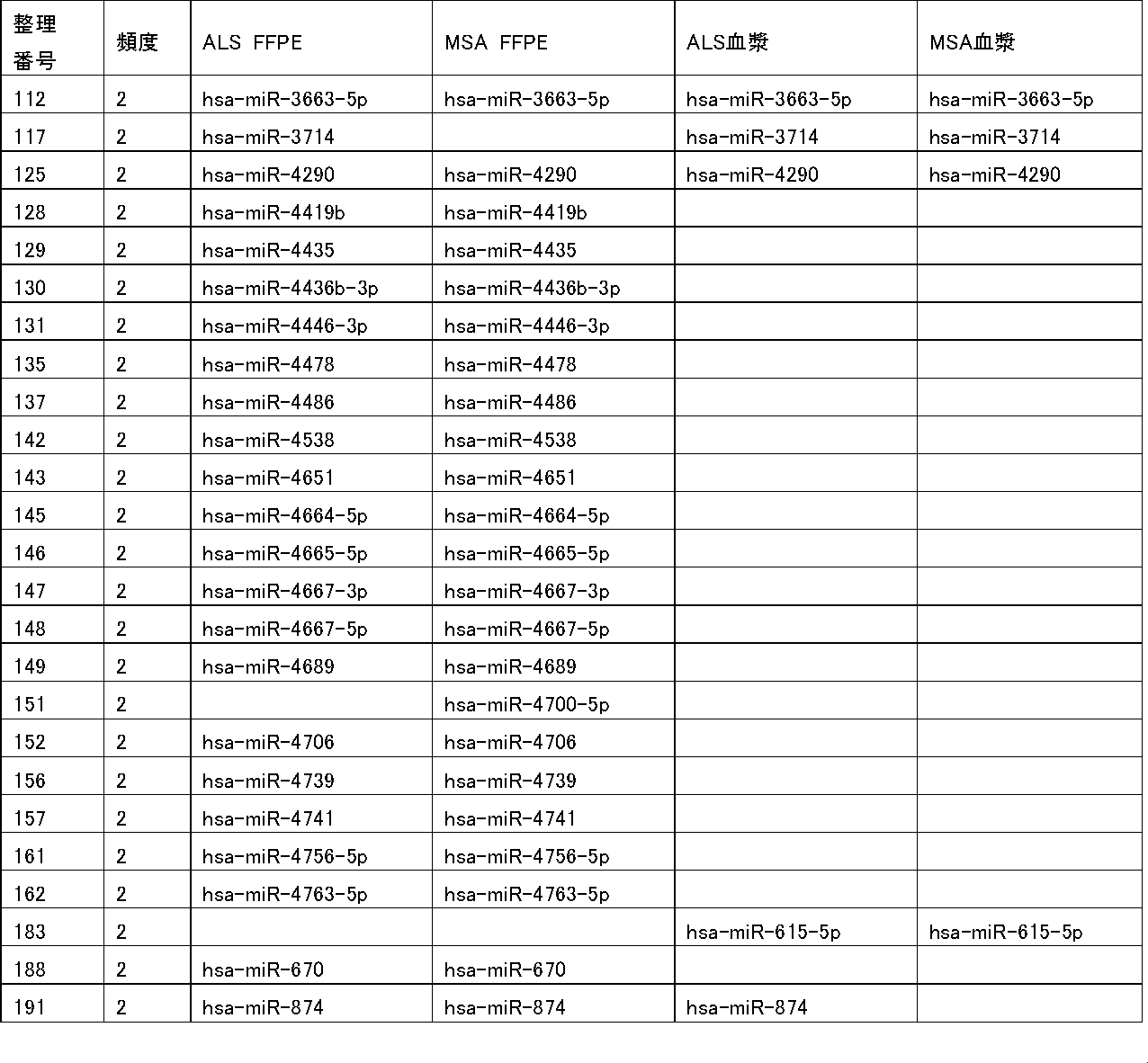
- the miRNA groups detected at the lesion sites of ALS and MSA are 63 types shown in Tables 7-1 and 7-2. It can be preferably used when selecting a target molecule.
- Example 6 Involvement of autophagy factor-controlled miRNA in degeneration due to iron accumulation in cranial nerves
- iron As one of the mechanisms of cranial nerve degeneration, degeneration due to intracellular iron accumulation (Aceruloplasminemia, Neuroferritinopathy, Neurodegeneration with iron accumulation, etc.) is known.
- As a transition metal iron, which is a transition metal, is an important metal element that is involved in various redox reactions in vivo and is essential for maintaining cell functions.
- activation of active oxygen and free radicals is promoted, and as a result, apoptosis, cell membrane destruction, and protein aggregation are also promoted. Therefore, it is thought that cytotoxicity occurs when excess iron is deposited in cells.
- Ceruloplasmin CP
- Ferritin light chain FTL
- Transferrin TF
- solute carrier family 40 iron-regulated transporter
- SLC40A1 iron accumulation 1
- PANK2 Pantothenate kinase2
- the common overlap between miRNA group targeting autophagy-related factor WDR45 and autophagy factor control miRNA group is 50%, and ATP13A2 is 46%.
- the abundance ratio in the case of autophagy factor (average 53.9%) was similar.
- the abundance ratio (commonality) of autophagy factor control miRNA is 20% or less, which is higher than the ratio of WDR45 and ATP13A2. It was quite low.
- Example 7 Disease-related analysis of target genes of autophagy factor control miRNA
- the gene group targeted by autophagy factor control miRNA should be deeply involved in diseases in which autophagy abnormalities are considered to be the cause of pathological conditions.
- many aggregates are observed in nerve cells, and it is strongly speculated that some autophagy abnormality has occurred.
- Extraction of target genes of 5 types of autophagy-factor-controlled miRNAs uses miRmap, a miRNA target prediction web tool, and selects the top 50 target genes in descending order of likelihood of binding to each miRNA. 250 target genes were extracted. Next, since 96 genes were duplicated among these 250 target genes, it was assumed that these 96 genes are common targets for five autophagy factor control miRNAs. That is, it can be considered that the disease involving 96 genes is a disease involving autophagy factor-control miRNA with a high probability. Geneontology and related disease candidates, which are the results of this hypothesis evaluation, were estimated using the Web tool MetaCore (ThomsonReuter / GeneGo) that enables integrated bioinformatics analysis.
Landscapes
- Health & Medical Sciences (AREA)
- Life Sciences & Earth Sciences (AREA)
- Chemical & Material Sciences (AREA)
- Engineering & Computer Science (AREA)
- Organic Chemistry (AREA)
- Bioinformatics & Cheminformatics (AREA)
- General Health & Medical Sciences (AREA)
- Medicinal Chemistry (AREA)
- Public Health (AREA)
- Pharmacology & Pharmacy (AREA)
- Animal Behavior & Ethology (AREA)
- Veterinary Medicine (AREA)
- Neurology (AREA)
- General Chemical & Material Sciences (AREA)
- Nuclear Medicine, Radiotherapy & Molecular Imaging (AREA)
- Chemical Kinetics & Catalysis (AREA)
- Neurosurgery (AREA)
- Biomedical Technology (AREA)
- Biochemistry (AREA)
- Molecular Biology (AREA)
- Proteomics, Peptides & Aminoacids (AREA)
- Wood Science & Technology (AREA)
- Physical Education & Sports Medicine (AREA)
- Orthopedic Medicine & Surgery (AREA)
- Epidemiology (AREA)
- Analytical Chemistry (AREA)
- Zoology (AREA)
- Psychiatry (AREA)
- Biotechnology (AREA)
- Immunology (AREA)
- Microbiology (AREA)
- Biophysics (AREA)
- Physics & Mathematics (AREA)
- General Engineering & Computer Science (AREA)
- Genetics & Genomics (AREA)
- Hospice & Palliative Care (AREA)
- Psychology (AREA)
- Pain & Pain Management (AREA)
- Pharmaceuticals Containing Other Organic And Inorganic Compounds (AREA)
- Medicines Containing Material From Animals Or Micro-Organisms (AREA)
Abstract
本発明のオートファジー調節miRNA分子は、配列表の配列番号1~203のいずれかに記載された塩基配列からなる。これらのmiRNA分子は、本願発明者らが新規に開発したmiRNA選定方法により同定された。該選定方法は、1つの生体内反応経路で機能する複数の因子のそれぞれについて、該因子をコードするmRNAに結合すると予測されるmiRNA群を取得する第一工程、及び、各因子に対して得られたmiRNA群の少なくとも2群に共通するmiRNAを抽出する第二工程を含む。
Description
本発明は、生体内反応経路を調節するmiRNAの選定方法、該方法により同定された生体細胞内のオートファジーを調節する活性を有するmiRNA分子(以下、「オートファジー調節miRNA(分子)」と称することもある)、及び、該miRNAの利用に関する。
近年、生命維持のためのタンパク質分解系の研究が大きく進んだ。細胞には、タンパク質を新たに作り出す機構だけでなく、作ったタンパク質が不要になった場合に分解する機構もあり、(1)ユビキチン-プロテアソーム系、(2)オートファジーの二つの主要な機構が存在する。ユビキチン-プロテアソーム系では、分解するべきタンパク質の一つ一つに、ユビキチン分子が複数結合することでプロテアソームにより認識されて分解されるという選択的タンパク質分解系で、個々のタンパク質ごとの分解が行われるのに対し、オートファジーでは一度に多くのタンパク質が分解される。このためオートファジーによるタンパク質分解のことはバルク分解系とも呼ばれる。オートファジーの機構は酵母から高等動植物にまでよく保存されている。オートファジーは、生体の恒常性維持と種々の疾患に関与すると考えられており、その制御は多くの疾患の治療につなげることができると考えられている(非特許文献1)。
たとえば、神経変性疾患では、病理学的に細胞内封入体が観察され、その中に特定のタンパク質の凝集物が認められている。この細胞内封入体は、細胞内タンパク質分解系の不全による結果と考えられ、これが神経細胞機能の障害を引き起こす可能性が指摘される一方、これらの封入体と凝集体の生成抑制と分解除去が治療法につながる可能性が考えられる。実際に、神経変性疾患の診断や治療への利用に関しては、シヌクレイノパチーの治療に酸性β-グルコセレブロシダーゼ(GBA)ポリペプチド類やカテプシンD類の利用が提案されている(特許文献1)。
代表的な難治性神経変性疾患である筋萎縮性側索硬化症(Amyotrophic Lateral Sclerosis:ALS)においては、SOD1、TARDBP(TDP-43)、FUS、Optineurinなどの凝集体が知られており、このうち、TARDBP凝集体の分解を狙ったオートファジーの活性化が、ALS病態モデルであるFTLD-Uマウスの病態を改善させたという報告がある(非特許文献2)。他方、細胞における組織再生や修復の制御因子であるmTOR(mammalian target of rapamycin)の阻害はオートファジーを促進させることから、代表的mTOR阻害薬であるラパマイシンを投与してオートファジーの活性化を図ったものの、ALSモデルマウス(SOD1-G93A)の運動神経変性は改善せず、逆に早期死亡が多かったことという報告もある(非特許文献3)。すなわち、ALSモデルマウスにおいては、オートファジーの活性化によって、病態が改善した報告と悪化した報告の両方が存在しているが、これらはいずれもALSの特徴的病変を増強したモデルマウスであり、実際のヒトのALSにおける効果を見たものではないことから、統一的な解釈には限界があると思われる。
ALSモデルマウスにおける結果の違いは、mTORはオートファジーのみならず免疫系に作用することや過度のオートファジーは細胞死につながる可能性があることも関連していると思われる。また、mTORの調節よりは、オートファジーを選択的に活性化することが適切である可能性がある。それゆえ、直接的にオートファジーを調節することが重要であることが示唆される。
以上のように、難治性疾患ではタンパク質分解系に関する因子に注目した診断や治療法の開発が注目されているものの、診断や治療にオートファジーを調節する因子を利用する手法については、未だ確立されていない。
一方、生体内の遺伝子発現の調節因子として、マイクロRNA(miRNAと略す)が注目されている。miRNAは、約22塩基の蛋白質非翻訳RNA(small non-coding RNA)であり、ヒトには約1000種類以上存在することが示唆されている。miRNAは生体内でさまざまな遺伝子の発現抑制を行う分子として注目されている。ゲノム上には各miRNA遺伝子の領域が存在し、RNAポリメラーゼIIによって転写され、約数百塩基のmiRNA初期転写産物が形成される。miRNA初期転写産物は核内でDrosha、細胞質内でDicerと呼ばれる2種類のRNase III酵素によってプロセシングされ、成熟miRNAが形成される。成熟miRNAは制御タンパク質複合体(RNA-induced silencing complex:RISC)と協調しつつ、相補的配列をもつ複数のターゲット遺伝子のmRNAと相互作用し、遺伝子の発現を抑制することが知られている。
miRNAはヒト疾患に広く関連が示唆されているが、特にがんとmiRNAの関係に関して、様々な臓器において正常組織とがん組織で多くのmiRNAの発現様式が異なる事から、発がん過程へのmiRNA発現異常の関与が強く示唆されている。すなわち、腫瘍抑制的miRNAの発現低下あるいは発がん促進的miRNAの発現上昇がヒト発がん過程に関与している可能性が強く示唆されている(非特許文献4)。miRNAの産業上の利用に関しても、もっぱらがんの領域での利用が主体であるが、ようやく各種疾患に対する創薬への利用が報告され始めてきた(非特許文献5)。神経疾患関係においては、損傷後の神経の再生にmiRNAを利用する方法(特許文献2)や多能性ストローマ細胞のニューロン分化を刺激する方法(特許文献3)、ALSの進行抑制にmiRNA-206が利用できることを示唆する報告(非文献情報6)などがある。
以上のように、疾患に関連するmiRNAを特定し、これを診断や治療に利用することは、新技術として非常に有望である。
MIzushima N and Komatsu M, Cell. 2011;147(4):728-41.
Wang IF et al., Autophagy. 2012;9(2):1-2.
Zhang X et al., Autophagy. 2011;7(4):412-25.
「microRNAの制御異常と癌」、実験医学 vol.27, No.8, 2009.
「臨床・創薬利用が見えてきたmicroRNA」、遺伝子医学MOOK23 2012.
Williams AH et al., Science. 2009;326(5959):1549-54.
上記のとおり、オートファジーを調節して新たな疾患治療法を開発することは期待されることであり、その手段としてmiRNAをオートファジーの調節に用いることが考えられる。しかしながら、大きな課題がある。それは、オートファジーが複数の遺伝子発現が協調して発動される仕組みであること、他方、1種の遺伝子発現は複数のmiRNA(結合性から予測して数百種類)の制御を受けるという関係があることから、この両者が組み合わさると、オートファジーを調節するmiRNAは膨大な数となってしまい、治療への応用は難しくなるということである。たとえば、オートファジーが10種の遺伝子発現で誘導され、1種の遺伝子発現に300種のmiRNAが関与すると仮定すると、実に3000種のmiRNAが候補となる。この膨大な数の候補の中から、実際にオートファジー因子の発現を抑制してオートファジー機構を調節することができるmiRNAを特定することは容易なことではなく、その手法も確立されていない。
miRNAは逐次発見が続いており、報告されたmiRNAは統合データベースmiRBase(http://www.mirbase.org/)に登録される。miRNAと標的となる遺伝子(mRNA)の同定は、miRNAをサイレンシングするようにした培養細胞を用いた実験系で行われることが多いが、miRNA配列と標的遺伝子配列の結合可能性を評価するアルゴリズム(miRNA標的予測ツール)で予測することができる。しかしながら、このmiRNA標的予測ツールを用いても、1種のmiRNAに対する標的遺伝子は百種以上、他方1種の遺伝子に結合する可能性のあるmiRNAは数百種がリストアップされるという精度であることから、複数の遺伝子が関与する細胞内経路に関与するmiRNAは数万以上(重複あり)という予測結果になってしまう。従って、特定のmiRNA群を絞り込むには有効な手法が必要となっているが、そうした手法は報告されていない。このmiRNAを絞り込む技術が未完成なことが、miRNAという、遺伝子発現からタンパク質の合成という生命現象の最重要プロセスを制御する分子が発見されながら、miRNAの産業上利用が進まない大きな理由のひとつである。
もう一つ重要な課題は、miRNAを一定のグループで扱うことの重要性である。すでに述べたように、1つの遺伝子を標的として制御するmiRNAは複数ある。すなわち、「1種の遺伝子に1種のmiRNA」という対応がなく、「1種の遺伝子に特定のmiRNA群」という対応になるため、標的とする遺伝子に対して特定のmiRNA群を絞り込むということの方が妥当であるということである。そのため、ある疾患の検査診断や治療にmiRNAを利用しようとする場合、疾患の原因遺伝子や病態の増悪遺伝子に対しては、それらを標的とする特定のmiRNA群を利用することが有用である。こうした考えに基づくmiRNAの絞り込み法も、未だ開発されていない。
従って、本発明の目的は、オートファジーを調節するmiRNAを絞り込み、オートファジーの調節による新たな疾患治療法及びオートファジー調節miRNAを指標とした新たな疾患診断法の開発を可能にする手段を提供することにある。
本願発明者らは、オートファジーは複数の遺伝子が協調して発動される機構であることから、それら複数の遺伝子の発現に対し、一定の限定されたmiRNA群が共通して関与している可能性があることに想到した。すなわち、miRNAの主たる作用機序が標的遺伝子mRNAの発現調節であるならば、一連の因子群が連続的に構成されてオートファジーという現象を発現するのであるから、一連の因子群の発現を調節するmiRNAには共通性があるはずであるということに想到した。この前提で、オートファジーを構成する一連の因子群をオートファジー因子とし、このなかで主要な18種の遺伝子のそれぞれについて、公知のmiRNA標的予測ツールを用いて結合が予測されるmiRNAを抽出し、結合予測上位50種をさらに抽出した。そして、各50種、のべ900種のmiRNA集団の中から、18種の遺伝子のうちの複数の遺伝子に共通するmiRNAを抽出することにより、オートファジーを調節するmiRNAの候補を絞り込むことに成功した。そして、オートファジー経路以外の様々な生体内反応経路についても、上記の手法を適用することにより、当該反応経路を調節するmiRNAを絞り込むことが可能であることを見出し、本願発明を完成した。
すなわち、本発明は、1つの生体内反応経路で機能する複数の因子のそれぞれについて、該因子をコードするmRNAに結合すると予測されるmiRNA群を取得する第一工程、及び、各因子に対して得られたmiRNA群の少なくとも2群に共通するmiRNAを抽出する第二工程を含む、前記生体内反応経路を調節するmiRNAの選定方法を提供する。また、本発明は、配列表の配列番号1~203のいずれかに記載された塩基配列からなり、オートファジーを調節する活性を有するmiRNA分子を提供する。さらに、本発明は、上記本発明のmiRNA分子、又は、該miRNA分子を生体細胞内で産生可能なベクターを有効成分として含む、オートファジー調節剤を提供する。さらに、本発明は、上記本発明のmiRNA分子を阻害する核酸分子、又は、該核酸分子を生体内で産生可能なベクターを有効成分として含む、オートファジー調節剤を提供する。さらに、本発明は、被検者から分離された試料中の、配列番号1~203に記載された塩基配列からなるmiRNAの少なくとも1つを測定することを含む、オートファジー関連疾患の検出方法を提供する。さらに、本発明は、1つの生体内反応経路で機能する複数の因子のそれぞれについて、該因子をコードするmRNAに結合すると予測されるmiRNA群を取得する第一工程、及び、各因子に対して得られたmiRNA群の少なくとも2群に共通するmiRNAを抽出する第二工程を含む、前記生体内反応経路を調節するmiRNAの選定方法により選定されたmiRNAを用いて、前記生体内反応経路の異常により引き起こされる疾患の治療薬を選定する方法、並びに、当該方法により選定される、生体内反応経路の異常により引き起こされる疾患の治療薬を提供する。
本発明により、多数の因子が機能している生体内反応経路を調節するmiRNAを絞り込むことができる新規な方法が提供される。また、該方法により、オートファジーの異常(オートファジーの促進又は抑制)により引き起こされる疾患(「オートファジー関連疾患」と称することもある)の治療や診断に有用なオートファジー調節miRNA分子が同定される。本発明は、オートファジーの異常により引き起こされる疾患、例えば神経変性疾患等の治療や診断に貢献する。
本発明において、「生体内反応経路」とは、複数のタンパク質因子がその経路の発動、進行及び抑制を制御している生体細胞内の反応経路をいい、各種の代謝経路(生合成、分解)やシグナル伝達経路、オートファジー経路、ユビキチン-プロテアソーム経路、ミトコンドリア制御経路が包含される。下記実施例では、タンパク質代謝経路の1つであるオートファジーで機能する18種の因子を対象にしてmiRNA選定方法を実施したが、他の生体内反応経路についても同様に当該方法を実施することができる。
本願発明者らが開発した生体内反応経路を調節するmiRNAの選定方法では、まず、1つの生体内反応経路で機能する複数の因子のそれぞれについて、該因子をコードするmRNAに結合すると予測されるmiRNA群を取得する(第一工程)。
対象とする複数の因子の数は特に限定されないが、当該経路の中で特徴的に働く主要な因子を対象とすることが望ましい。当該複数の因子は、生体内反応経路において抑制的に機能している因子に統一するか、又は促進的に機能している因子に統一することができる。ある1つの生体内反応経路を抑制する複数の因子を対象にmiRNAを抽出して選定すれば、複数の抑制因子の発現を抑制するmiRNA、すなわち当該経路を促進するmiRNAを選定することができる。これとは逆に、ある1つの生体内反応経路を促進ないしは発動する複数の因子を対象にmiRNAを抽出して選定すれば、複数の促進因子の発現を抑制するmiRNA、すなわち当該経路を抑制するmiRNAを選定することができる。
あるいはまた、生体内反応経路の抑制と促進は相互バランスで調節されていることから、抑制と促進の両方の因子を対象にして、両方に関与するmiRNAを抽出することも可能である。抑制と促進の両方のイベントに関与するmiRNAと、抑制あるいは促進のどちらか一方に関与するmiRNAを特定することで、miRNAの用途に応じてより精密なmiRNAの抽出が可能となる。
あるいはまた、生体内反応経路の抑制と促進は相互バランスで調節されていることから、抑制と促進の両方の因子を対象にして、両方に関与するmiRNAを抽出することも可能である。抑制と促進の両方のイベントに関与するmiRNAと、抑制あるいは促進のどちらか一方に関与するmiRNAを特定することで、miRNAの用途に応じてより精密なmiRNAの抽出が可能となる。
既に膨大な数の遺伝子配列が同定され、様々な生物種のmiRNAも多数同定されている。これらの配列情報に基づき、任意の遺伝子のmRNAとmiRNAとの結合を予測する標的予測ツールも各種のものが知られている。上記の第一工程は、そのような公知のツールを用いて実施することができる。標的予測ツールの具体例を挙げると、例えば以下のようなものが知られている。
ComiR(Nucleic Acids Research, 2013, W159-W164. http://www.benoslab.pitt.edu/comir/)
miRmap(Nucleic Acids Research, 2012, Vol. 40, No. 22 11673-11683.http://mirmap.ezlab.org/)
MAGIA (Nucleic Acids Res. 2010,W352-359.http://gencomp.bio.unipd.it/magia/start/)
TargetScan(Mol. Cell, 2007, Vol. 27,91-105.http://www.targetscan.org/)
PITA(Nat. Genet., 2007, Vol. 39, 1278-1284.http://genie.weizmann.ac.il/pubs/mir07/index.html)
PicTar(Nat. Genet., 2005, Vol. 37, 495-500. http://pictar.mdc-berlin.de/)
miRanda(PLoS Biol., 2004, Vol. 2,e363.http://www.microrna.org/microrna/home.do)
PITA(Nat. Gen. 2007, Vol. 39, 1278-1284. http://genie.weizmann.ac.il/pubs/mir07/mir07_data.html)
RNAhybrid(RNA, 2004, Vol. 10, 1507-1517.http://bibiserv.techfak.uni-bielefeld.de/rnahybrid/)
ComiR(Nucleic Acids Research, 2013, W159-W164. http://www.benoslab.pitt.edu/comir/)
miRmap(Nucleic Acids Research, 2012, Vol. 40, No. 22 11673-11683.http://mirmap.ezlab.org/)
MAGIA (Nucleic Acids Res. 2010,W352-359.http://gencomp.bio.unipd.it/magia/start/)
TargetScan(Mol. Cell, 2007, Vol. 27,91-105.http://www.targetscan.org/)
PITA(Nat. Genet., 2007, Vol. 39, 1278-1284.http://genie.weizmann.ac.il/pubs/mir07/index.html)
PicTar(Nat. Genet., 2005, Vol. 37, 495-500. http://pictar.mdc-berlin.de/)
miRanda(PLoS Biol., 2004, Vol. 2,e363.http://www.microrna.org/microrna/home.do)
PITA(Nat. Gen. 2007, Vol. 39, 1278-1284. http://genie.weizmann.ac.il/pubs/mir07/mir07_data.html)
RNAhybrid(RNA, 2004, Vol. 10, 1507-1517.http://bibiserv.techfak.uni-bielefeld.de/rnahybrid/)
標的予測ツールmiRmapを用いて第一工程を実施する場合、以下のようにして行なえばよい。対象として選んだ細胞内イベント経路に関与する複数の因子の遺伝子名を入力し、これに結合すると予測されるmiRNAを出力させる。通常、1つの遺伝子に対し、結合が予測されるmiRNAは数百種に上るので、結合予測のスコア(miRmap score)が一定以上のmiRNAに絞る、あるいはスコア上位の一定数のmiRNAに絞る、などの基準を設けて、miRNA群を構成するmiRNAの数を限定してよい。1つの因子に対し、100種以下、例えば50種以下のmiRNAを結合予測上位のものから選択すると、結合性の高いmiRNA群を取得することができる。miRmap以外の予測ツールを使用した場合でも、結合予測の信頼性の高さの目安となるスコアが算出されるので、そのようなスコアに基づいてmiRNA群を抽出することができる。
次いで、各因子に対して抽出された複数のmiRNA群の中から、少なくとも2つのmiRNA群に共通しているmiRNAを抽出する(第二工程)。第一工程で対象とした因子の数に応じて、第二工程でのmiRNAの抽出は、少なくとも3群、少なくとも4群、あるいはそれ以上の数の群に共通することを条件として実施することができる。
以上の工程により選定されたmiRNAは、一つの生体内反応経路で機能する複数の因子のうちの2つ以上の因子に結合し、該因子の発現を抑制することにより、当該生体内反応経路を調節するmiRNAの候補である。選定されたmiRNAは、細胞内での機能を実験的に確認し、疾患の治療薬や診断薬として開発することができる。
例えば、選定された候補miRNAに対するアンチセンス核酸分子(siRNA,shRNAなどが包含される)を作製して細胞を処理することにより、細胞内の当該miRNAの機能を阻害し、細胞の応答を観察する。この機能性評価は、単独または複数のmiRNAに対して同時に行うことができる。対象とした生体反応経路の促進ないしは抑制が観察されれば、当該候補miRNAは実際に細胞内で当該生体反応経路の調節に関与していると判断できる。この場合は、当該候補miRNA又はこれを阻害するRNAi分子等の核酸分子を、当該反応経路に関連する疾患の治療剤として利用できるほか、当該候補miRNAを該疾患のマーカーとして利用することも可能である。
あるいは、細胞に候補miRNAを導入し、細胞の応答を観察する。この機能性評価も、単独または複数のmiRNAに対して同時に行うことができる。対象とした生体反応経路の促進ないしは抑制が観察されれば、当該候補miRNAは細胞内で当該生体反応経路を促進ないしは抑制する作用があると判断できる。この場合は、当該候補miRNA分子を、当該反応経路に関連する疾患の治療剤として利用することができる。
上記の候補miRNAあるいは候補miRNAに対するアンチセンス核酸分子は、単独または複数で用いることができ、複数で用いる場合は、たとえば検査診断薬としてはマルチプレックスタイプの検査薬、治療薬としては核酸医薬カクテルであり得る。治療薬の場合には、リポソームへ封入したり、RNAase抵抗性のタグをつけて安定化したりして、投与することができる。特定の細胞内経路の調節には、対応する複数のmiRNAが関与することを考えると、単独利用よりは複数の候補miRNAを用いる方が好ましい結果を得ることができると期待される。
表1-1~1-6に記載したmiRNAは、実施例において、オートファジー因子遺伝子18種のうちの少なくとも2種のmRNAに結合することが予測されるmiRNAとして特定された、197種のオートファジー調節miRNAである。表中、「頻度」は、各miRNAが結合すると予測されたオートファジー因子遺伝子の個数を表す。「Accession No.」は、マイクロRNAデータベースmiRBase(http://www.mirbase.org/)のアクセッション番号である。

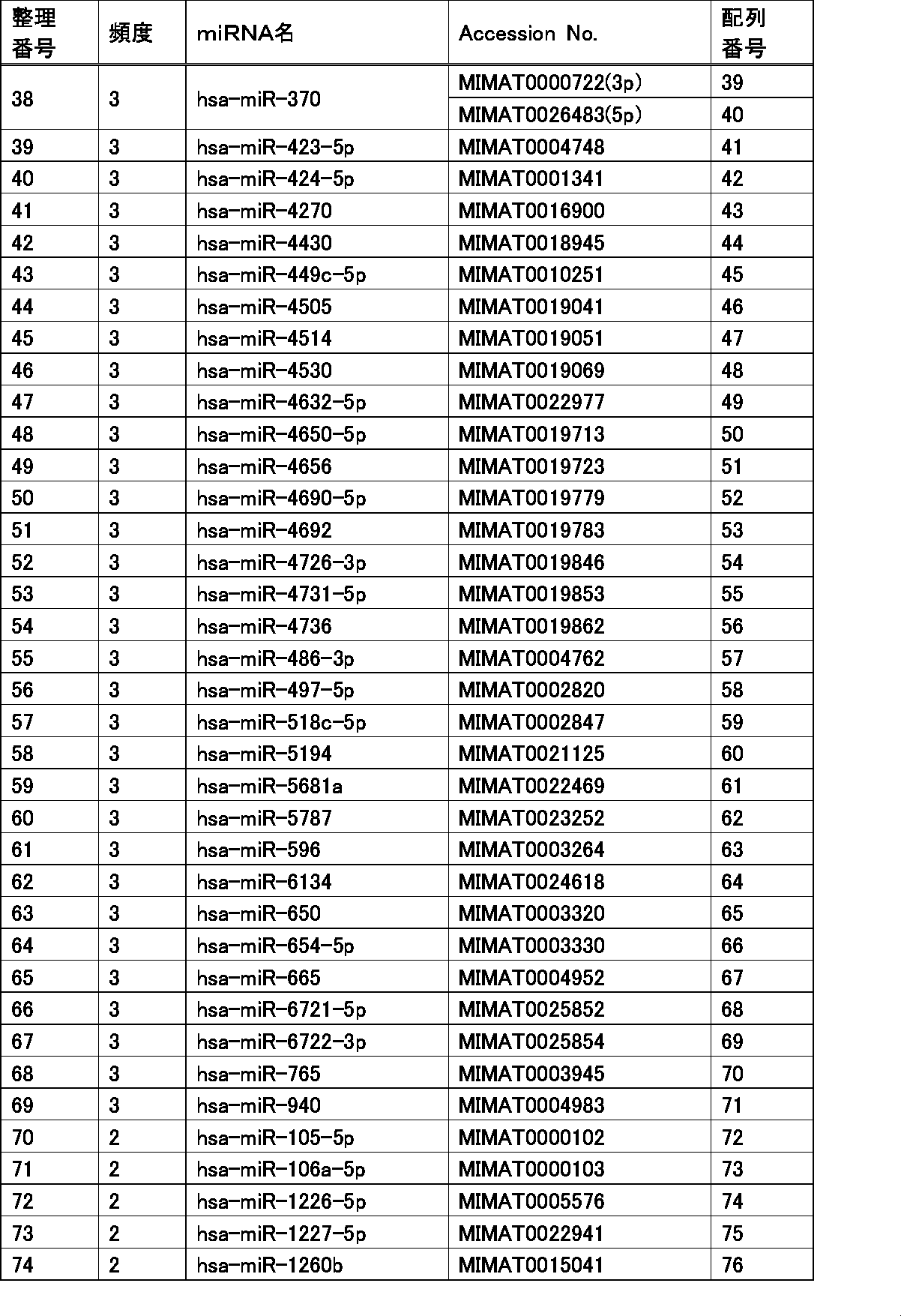
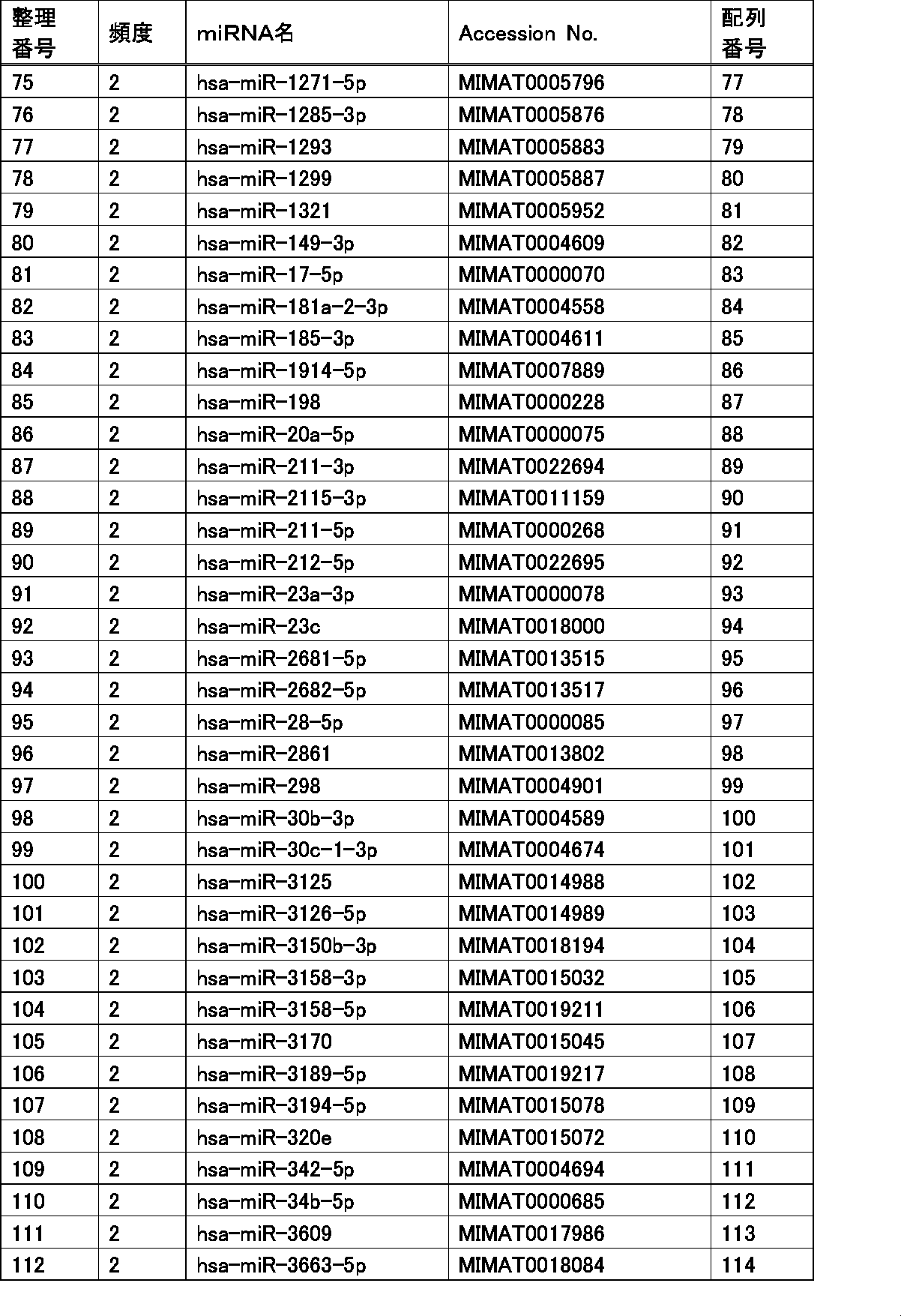
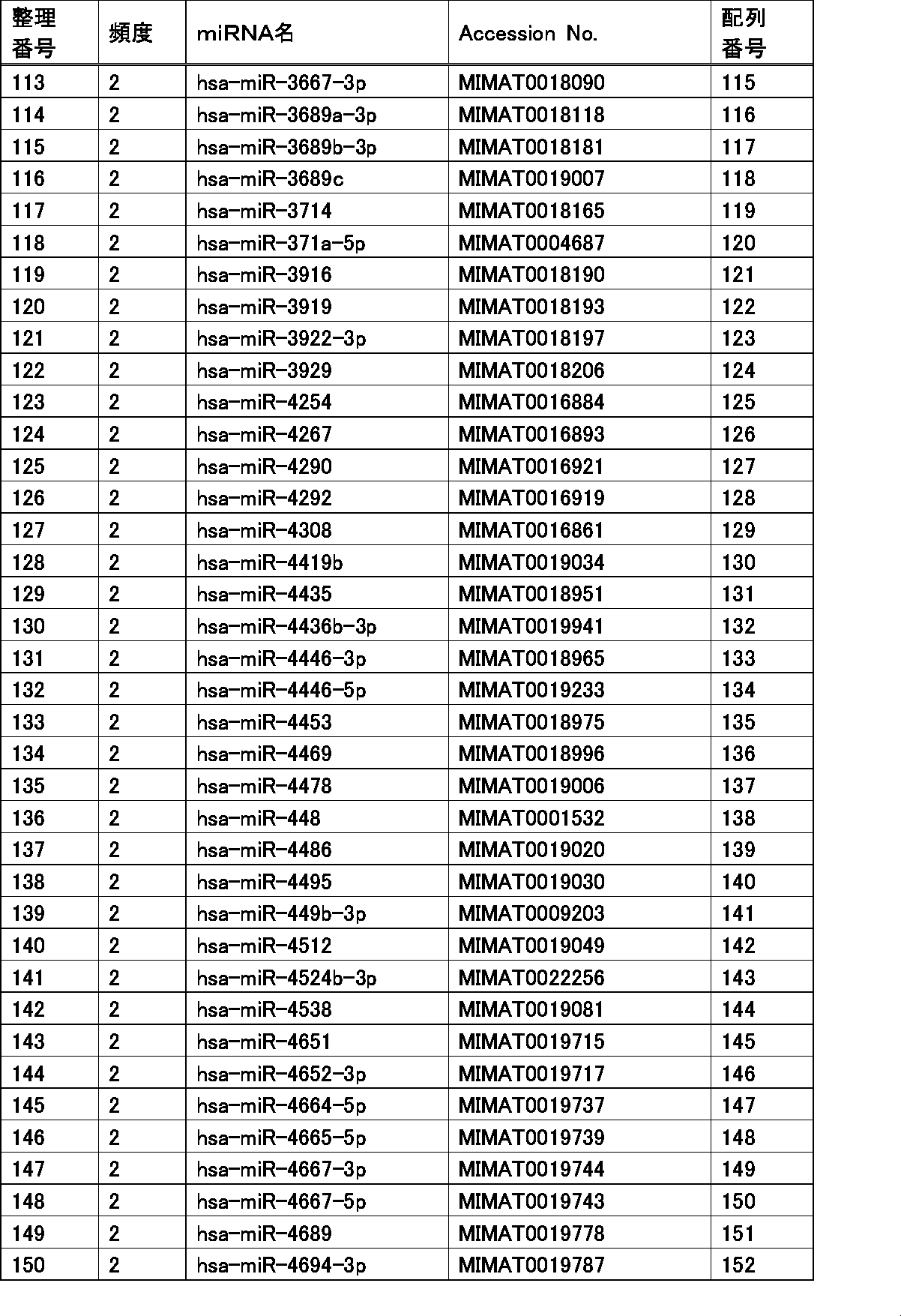

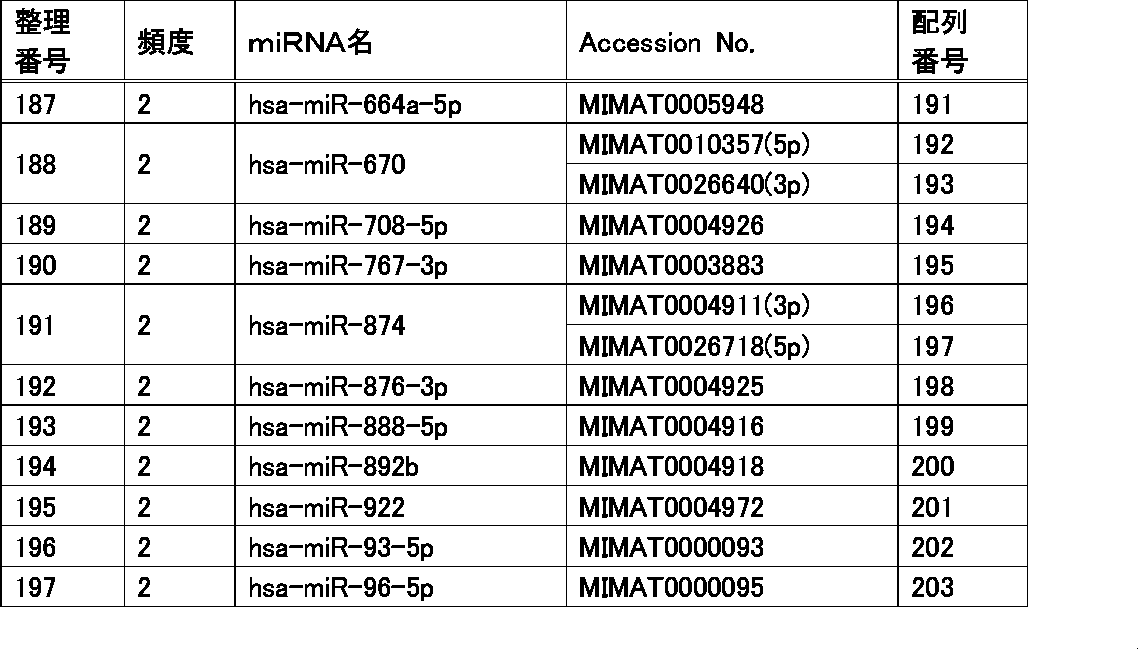
上記表に示したmiRNAは、生体細胞内のオートファジーを調節する活性を有するmiRNA分子として用いることができる。オートファジーの調節は、オートファジー経路の抑制であり得る。あるいは、オートファジーの調節は、オートファジー経路の促進であり得る。オートファジー経路に抑制的に作用するmiRNAと促進的に作用するmiRNAを適宜組み合わせて用いることで、オートファジーを様々に調節することができる。上記表に示したmiRNAは、特に限定されないが、オートファジー経路の抑制に好ましく使用し得る。
本発明におけるオートファジー調節miRNA分子は、例えば、配列番号1~31、33~92、及び、94~203のいずれかに記載された塩基配列からなるmiRNA分子;配列番号1~8、12~17、20~23、27~30、33~37、39、40、42、44~56、58~66、68~70、72~75、77、79~81、84、86~92、94~97、99~112、115~126、128~140、142~148、150~156、158~163、165~182、184~186、188~190、193~195、及び、197~203のいずれかに記載された塩基配列からなるmiRNA分子;又は配列番号1、4~8、12~17、20~23、27~30、33~37、39、40、42、45~50、52~56、58~66、68~70、72~75、77、79~81、84、86~92、94~97、99~112、115~126、128~140、142~148、150~153、155、156、158~163、165~182、184~186、188~190、193~195、及び、197~203のいずれかに記載された塩基配列からなるmiRNA分子であり得る。
オートファジー調節miRNA分子の好ましい例としては、3種以上のオートファジー因子遺伝子mRNAへの結合が予測された、配列番号1~71のいずれかに記載の塩基配列からなるmiRNA分子を挙げることができる。該miRNA分子は、例えば、配列番号1~31、及び、33~71のいずれかに記載された塩基配列からなるmiRNA分子;配列番号1~8、12~17、20~23、27~30、33~37、39、40、42、44~56、58~66、及び、68~70のいずれかに記載された塩基配列からなるmiRNA分子;又は配列番号1、4~8、12~17、20~23、27~30、33~37、39、40、42、45~50、52~56、58~66、及び、68~70のいずれかに記載された塩基配列からなるmiRNA分子であり得る。
オートファジー調節miRNA分子のさらに好ましい例としては、4種以上のオートファジー因子遺伝子mRNAへの結合が予測された、配列番号1~16のいずれかに記載された塩基配列からなるmiRNA分子を挙げることができる。該miRNA分子は、例えば、配列番号1~8、及び、12~16のいずれかに記載された塩基配列からなるmiRNA分子、又は配列番号1、4~8、及び、12~16のいずれかに記載された塩基配列からなるmiRNA分子であり得る。
オートファジー調節miRNA分子の特に好ましい例としては、5種以上のオートファジー因子遺伝子mRNAへの結合が予測された、配列番号1~5のいずれかに記載された塩基配列からなるmiRNA分子を挙げることができる。該miRNA分子は、例えば、配列番号1、4、及び、5のいずれかに記載された塩基配列からなるmiRNA分子であり得る。中でもとりわけ、7種のオートファジー因子遺伝子mRNAへの結合が予測された、配列番号1に記載された塩基配列からなるmiRNA分子が好ましい。
オートファジー調節miRNA分子及び該miRNA分子を阻害する核酸分子は、オートファジー調節剤として利用することができる。オートファジー経路に対し抑制的に作用する分子は、オートファジーを抑制する調節剤として利用することができる。オートファジー経路に対し促進的に作用する分子は、オートファジーを促進する調節剤として利用することができる。オートファジー経路に対し抑制的に作用する分子と促進的に作用する分子を組み合わせて利用し、オートファジー経路のバランス等を調節することも可能である。また、オートファジー調節miRNA分子及び該miRNA分子を阻害する核酸分子は、各分子を生体細胞内で産生可能なベクターの形態で調節剤として使用してもよい。
オートファジー調節剤の1つの例では、少なくとも1種の上記したオートファジー調節miRNA分子、又は該miRNA分子を生体細胞内で産生可能なベクターを有効成分として含有する。また、オートファジー調節剤のさらなる一例では、少なくとも1種の上記したオートファジー調節miRNA分子を阻害する核酸分子、又は該核酸分子を生体細胞内で産生可能なベクターを有効成分として含有する。このような調節剤は、例えば、オートファジーを促進する調節剤として好ましく使用し得る。オートファジーを促進する調節剤は、オートファジーの調節、特に促進が望まれる疾患の治療剤として有用である。そのような疾患の具体例としては、悪性腫瘍、神経変性疾患(多系統萎縮症、筋萎縮性側索硬化症、多発性硬化症、アルツハイマー病、パーキンソン病、シヌクレイン病、鉄蓄積性神経変性病等)、アミロイドーシスなどのオートファゴソームの異常が関与する疾患を挙げることができる。
オートファジー調節miRNAを阻害する核酸分子は、例えば、阻害対象のmiRNAの少なくとも一部(5~10塩基程度以上)と相補的な配列を含む核酸分子であり得る。本発明ではこのような核酸分子を「miRNAに対するアンチセンス核酸分子」という。核酸は、RNAでもDNAでもよく、また、PNAやLNA等の人工核酸であってもよい。また、アンチセンス核酸分子には、siRNAやshRNAなども包含される。
miRNA等の小分子核酸を生体に送達する手段は公知である。例えば、エキソソームを模倣したリポソームに小分子核酸を封入する方法、コラーゲンとの複合体として徐放化させる方法、RNAの糖部分のO(酸素)をS(硫黄)で置き換えた2'-F、2'-O-メチル、2'-O-メトキシエチルに修飾した化学修飾体の利用、などの方法により、生体内での安定性を高めて送達することができる。
オートファジー調節剤に含まれ得るベクターは、プラスミドベクターでもウイルスベクターでもよい。いずれもそれ自体は核酸医薬の分野において公知の技術である。
オートファジー調節剤を疾患の治療に用いる場合、投与量は、疾患の状態、症状、患者の年齢・体重等に応じて適宜設定することができる。例えば、有効成分量として、体重1kg当たり0.1μg~1g程度、又は1μg~100mg程度を、1回で又は数回に分けて投与することができる。投与経路は、皮下、筋肉内、腹腔内、動脈内、静脈内、直腸内等への非経口投与が好ましいが、製剤に採用する送達手段次第では経口投与も可能である。全身投与でもよいし、病変部近傍に局所投与してもよい。
オートファジー調節剤の剤形は特に限定されず、各投与経路及び採用する送達手段に応じて、薬剤的に許容される担体、希釈剤、賦形剤等の添加剤を上記の有効成分と適宜混合させて製剤することができる。
また、オートファジー調節miRNAは、オートファジー関連疾患の診断マーカーとして利用可能であり、オートファジー関連疾患のスクリーニング検査等の検査・診断、診断補助に活用できる。「オートファジー関連疾患」とは、オートファジーの異常(促進又は抑制)により引き起こされる疾患であり、オートファジーの促進により治療可能な疾患とオートファジーの抑制により治療可能な疾患の両者が包含される。本発明における具体例のひとつとして、上記したオートファジーの促進が望まれる疾患の例である神経変性疾患を挙げることができる。また、オートファジーの制御は細胞内におけるファゴソーム性の膜の制御でもあるので、本発明のオートファジー調節miRNAは、膜形成制御の機能から、細胞膜に存在する分子の異常によって発症する疾患の診断や治療にも利用することができる。代表的な膜分子としては、受容体を挙げることができる。
オートファジー関連疾患の検出では、被検者から分離された試料を用いて、少なくとも1種のオートファジー調節miRNAを測定すればよい。健常者のオートファジー調節miRNA値と比較して、被検者のオートファジー調節miRNAの測定値が有意に高い又は低い場合に、該被検者のオートファジー関連疾患が検出される。例えば、オートファジー経路に対し抑制的に作用するオートファジー調節miRNAの測定値が被検者において高値である場合、該被検者は、オートファジーの抑制により生じる疾患、例えば神経変性疾患に罹患している可能性があると判断することができる。
測定するオートファジー調節miRNAは1つだけでもよいし、複数(例えば、少なくとも2つ、少なくとも3つ、少なくとも4つ、少なくとも5つ又はそれ以上)のオートファジー調節miRNAを測定してもよい。複数のオートファジー調節miRNAを測定した結果、一部が健常者miRNA値よりも高く、残りが健常者miRNA値よりも低く検出された場合には、例えば、健常者miRNA値との間で有意差があったmiRNAの数が多い方に従って測定結果を判断してもよい。具体的には、高値であったmiRNAのうち健常者miRNA値と有意差があったmiRNAが2つで、低値であったmiRNAのうち健常者miRNA値と有意差があったmiRNAが1つであった場合には、当該被検者ではオートファジーが抑制状態にあり、オートファジーの抑制により生じる疾患に罹患している可能性があると判断することができる。
健常者のオートファジー調節miRNA値は、複数(できる限り多数であることが好ましい)の健常者を対象にオートファジー調節miRNA値を測定し、得られたmiRNA量測定値の平均値を算出して、健常基準値として定めることができる。本発明の検出方法の実施においては、予め定められた健常基準値を用いることができる。
健常基準値に加えて、同様の手順により疾患基準値を定めることも可能である。疾患基準値は、オートファジー調節miRNAの低下により引き起こされる疾患の基準値である「低値基準値」と、オートファジー調節miRNAの上昇により引き起こされる疾患の基準値である「高値基準値」の2種類を設定し得る。例えば、オートファジー経路に対し抑制的に作用するオートファジー調節miRNAを測定対象とする場合、低値基準値は、オートファジーの促進により引き起こされる疾患の基準値として、また、高値基準値は、オートファジーの抑制により引き起こされる疾患の基準値として使用し得る。
オートファジー関連疾患の検出に供する試料としては、血液(全血、血漿、血清)、唾液、涙液、鼻汁、尿、リンパ液、脳脊髄液等の体液試料の他、生検や手術で採取された病変部等の組織試料、病理標本及び組織試料の抽出物等を用いることができる。
核酸の測定方法自体は周知である。例えば、プライマーを用いた核酸増幅法による測定法としては、リアルタイムPCRやNASBA法等を挙げることができる。また、プローブを用いた測定法としては、ノーザンブロット、サザンブロットの他、固相化プローブを用いたアレイ解析法等を挙げることができる。試料が組織標本の場合、in situ PCRやin situハイブリダイゼーション法を用いることができる。本発明の方法では周知のいずれの測定法を用いてもよい。リアルタイムPCRによる測定を一例として説明すると、例えば、試料から抽出したRNAの3'末端にプライマーサイトを導入してcDNAを合成した後、各種miRNAに特異的なプライマーを用いてリアルタイムPCRを行なうことにより、miRNAの有無およびその量を測定することができる。また、miRNAの測定のためのキット(例えばApplied Biosystems社のTaqMan Probe microRNA Assays)が市販されており、そのような市販品を用いて測定を実施することができる。なお、本発明において、「測定」には、検出、定量、半定量が包含される。
なお、本願発明のmiRNAの選定方法により選定されたmiRNAは、医薬品の選定にも利用することができる。例えば、本願発明の選定方法により選定されたmiRNAそれ自体、当該miRNAの標的遺伝子、又は、当該miRNAの標的遺伝子の転写翻訳産物を調節する物質を治療標的分子として選定することにより、生体内反応経路の異常により引き起こされる疾患の治療薬の選定に利用することが可能である。ここで、選定される物質としては、低分子化合物、siRNA、核酸などが挙げられ、特に限定されるものではない。また、生体内反応経路の異常により引き起こされる疾患としても、特に限定されるものではないが、例えば、前記神経変性疾患などのオートファジー関連疾患等が挙げられる。
以下、本発明を実施例に基づきより具体的に説明する。もっとも、本発明は下記実施例に限定されるものではない。
実施例1:オートファジー因子を制御するmiRNAの抽出
オートファジーは複数の遺伝子が協調して発動されることから、発動のための重要因子として、以下の18種の遺伝子を選択した。
ATG3(autophagy related 3)
ATG5(autophagy related 5)
ATG7(autophagy related 7)
ATG9A(autophagy related 9A)
ATG16L1(autophagy related 16-like 1)
AMBRA1(activating molecule in BECN1-regulated autophagy protein 1)
BCL2(B-cell CLL/lymphoma 2)
BECN1(beclin 1, autophagy related)
GABARAP(GABA(A) receptor-associated protein)
GABARAPL1(GABA(A) receptor-associated protein like 1)
GABARAPL2(GABA(A) receptor-associated protein-like 2, GATE-16)
MAP1LC3A(microtubule-associated protein 1 light chain 3 alpha (LC3))
NBR1(neighbor of BRCA1 gene 1)
PIK3C3(phosphoinositide-3-kinase, class 3)
SQSTM1(sequestosome 1, p62)
ULK1(unc-51 like autophagy activating kinase 1)
ULK2(unc-51 like autophagy activating kinase 2)
ZFYVE1(ZFYVE1 zinc finger, FYVE domain containing 1, DFCP1)
オートファジーは複数の遺伝子が協調して発動されることから、発動のための重要因子として、以下の18種の遺伝子を選択した。
ATG3(autophagy related 3)
ATG5(autophagy related 5)
ATG7(autophagy related 7)
ATG9A(autophagy related 9A)
ATG16L1(autophagy related 16-like 1)
AMBRA1(activating molecule in BECN1-regulated autophagy protein 1)
BCL2(B-cell CLL/lymphoma 2)
BECN1(beclin 1, autophagy related)
GABARAP(GABA(A) receptor-associated protein)
GABARAPL1(GABA(A) receptor-associated protein like 1)
GABARAPL2(GABA(A) receptor-associated protein-like 2, GATE-16)
MAP1LC3A(microtubule-associated protein 1 light chain 3 alpha (LC3))
NBR1(neighbor of BRCA1 gene 1)
PIK3C3(phosphoinositide-3-kinase, class 3)
SQSTM1(sequestosome 1, p62)
ULK1(unc-51 like autophagy activating kinase 1)
ULK2(unc-51 like autophagy activating kinase 2)
ZFYVE1(ZFYVE1 zinc finger, FYVE domain containing 1, DFCP1)
次に、これらの個々の遺伝子に結合性を有するmiRNAを、miRNA標的予測ウェブツールであるmiRmap(Nucleic Acids Research, 2012, Vol. 40, No. 22 11673-11683, http://mirmap.ezlab.org/)を用いて抽出した。1遺伝子当たりおおむね200~500種のmiRNAが抽出された。各遺伝子について、結合予測上位50種のmiRNAをさらに抽出し、18種の遺伝子全体でのべ900種(重複あり)のmiRNAを母集団とした。
オートファジーは複数の遺伝子が協調して発動されることから、共通したmiRNAが遺伝子発現に関与するはずという前提で、少なくとも2種の遺伝子に共通するmiRNAを抽出することとし、得られた900種のmiRNA集団から18遺伝子間で重複性のソートを行い、これらがオートファジー因子を制御してオートファジーを調節するmiRNAになると判断した。
その結果、表1(上掲)に示した197種のmiRNAがオートファジー因子制御miRNAとして特定された。すなわち、のべ900種の母集団から約1/4以下に絞り込むことができ、特定されたmiRNAは、最大で7種のオートファジー関連遺伝子に共通していた。
実施例2:オートファジー因子制御miRNAのカバー率の分析
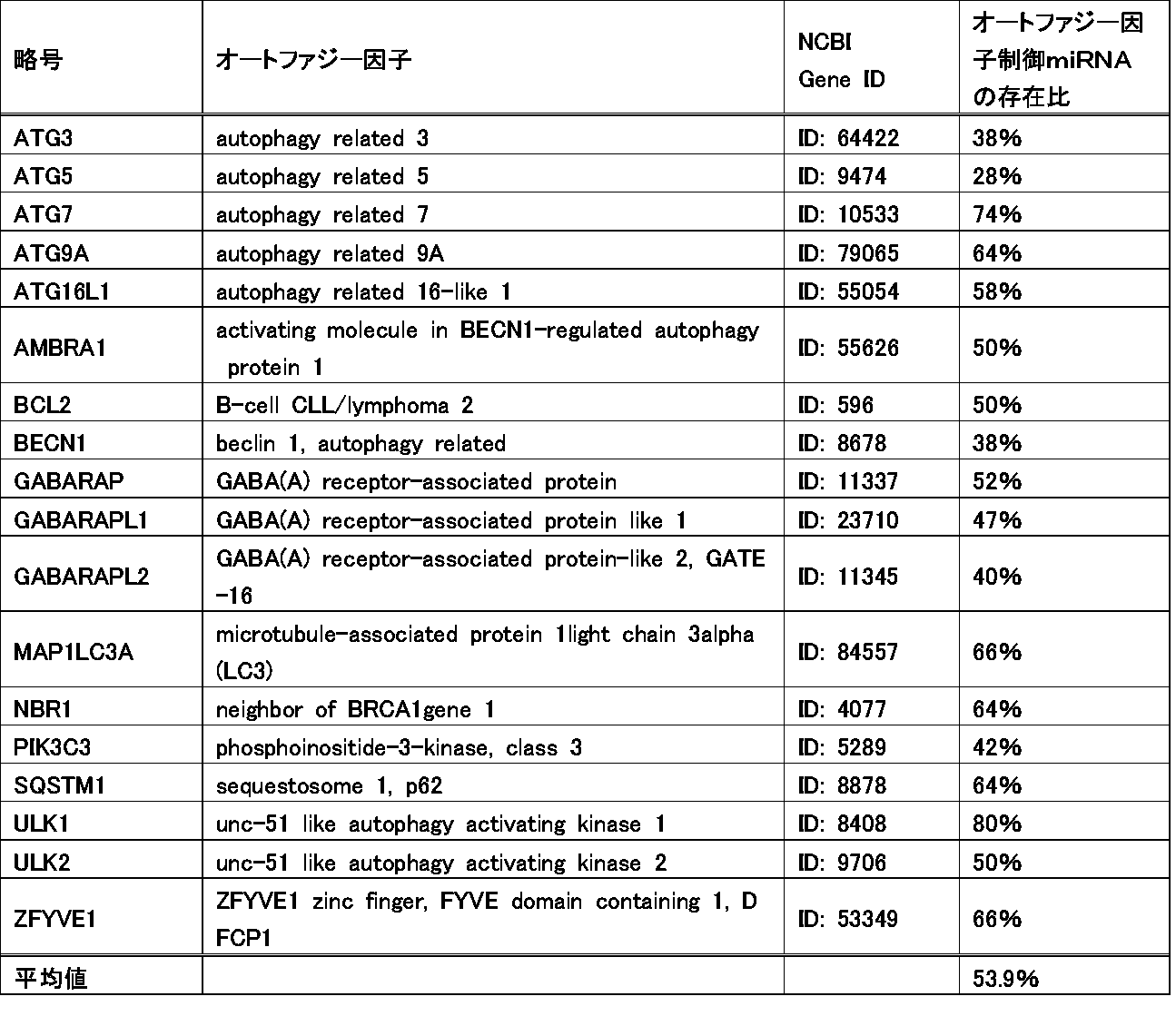
オートファジー因子制御miRNAはオートファジー関連遺伝子を標的とすると予測されたmiRNA群から選ばれたので、個別のオートファジー関連遺伝子の標的miRNAの中に高い割合で含まれなくてはmiRNAならないはずである。これを検証するために、18種のオートファジー関連遺伝子を標的とする群において、それぞれ上位50種の中に存在するオートファジー因子制御miRNAの割合を算出した。その結果、表2に示すように、実施例1で特定したオートファジー因子制御miRNAは、オートファジー関連遺伝子のmiRNA群には28~80%の割合で含まれ、平均値は53.9%であった。
オートファジー因子制御miRNAはオートファジー関連遺伝子を標的とすると予測されたmiRNA群から選ばれたので、個別のオートファジー関連遺伝子の標的miRNAの中に高い割合で含まれなくてはmiRNAならないはずである。これを検証するために、18種のオートファジー関連遺伝子を標的とする群において、それぞれ上位50種の中に存在するオートファジー因子制御miRNAの割合を算出した。その結果、表2に示すように、実施例1で特定したオートファジー因子制御miRNAは、オートファジー関連遺伝子のmiRNA群には28~80%の割合で含まれ、平均値は53.9%であった。
他方、対照として、オートファジーが機能していない状況の遺伝子に対するオートファジー因子制御miRNAの存在比を調べた。仮説として、オートファジー因子制御miRNAはオートファジー系以外のイベントには関与が高くないはずであるから、存在比は上記の53.9%をはるかに下回るはずである。神経変性疾患を例にとると、神経細胞内にはオートファジーで分解されないと想定されるタンパク質凝集物が蓄積することから、これら細胞内凝集物をコードする遺伝子は、オートファジーの機能不全とともに生合成のネガティブフィードバックがかからないなど、凝集体を形成するタンパク質遺伝子はオートファジーの正常な制御から逸脱していると考えることができる。それゆえ、これらの遺伝子を標的とするmiRNAも正常に作動していないと考えられる。同一細胞内で作動するmiRNA群は同一であることを前提とすると、凝集体タンパク質遺伝子に作用するmiRNA群とオートファジー関連遺伝子に作用するmiRNA群は異なるはずである。言い換えると、凝集体タンパク質遺伝子を標的とするmiRNA群とオートファジー関連因子を標的とするmiRNA群の共通性は低いはずで、すなわち、凝集体タンパク質遺伝子に作用するmiRNA群の中のオートファジー因子制御miRNAの存在率は低いことになる。
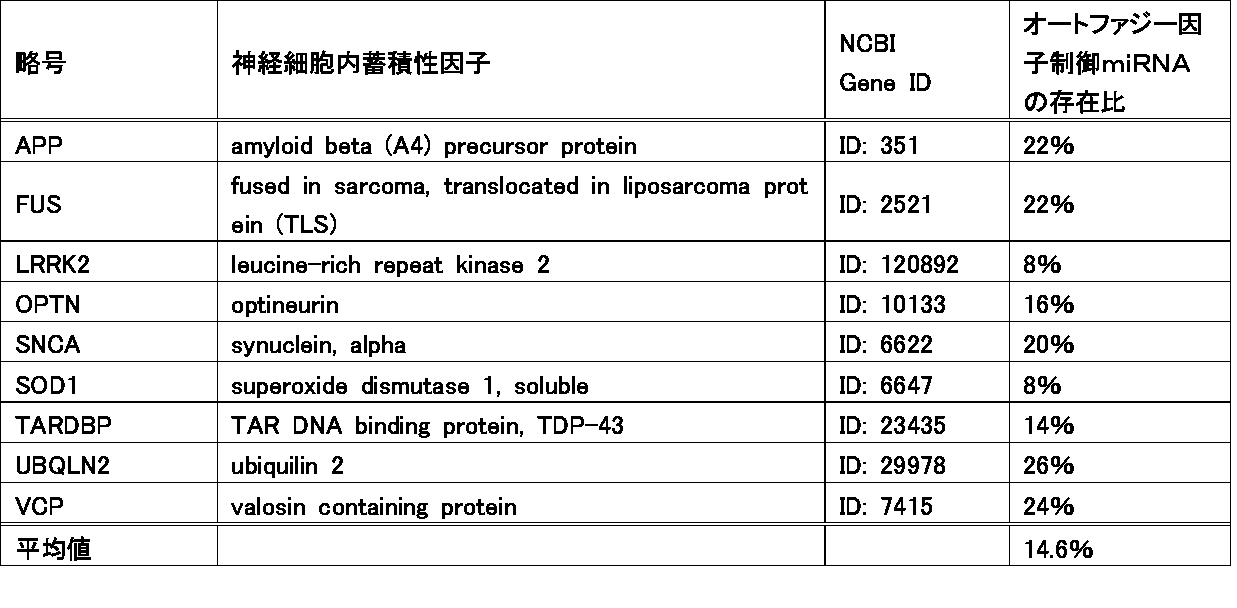
上記の仮説を確かめるために、神経細胞内凝集体タンパク質として、アルツハイマー病、筋萎縮性側索性硬化症(ALS)、多系統萎縮症(MSA)などで病的な凝集が報告されている、APP(amyloid beta (A4) precursor protein)、FUS(fused in sarcoma, translocated in liposarcoma protein (TLS))、LRRK2 (leucine-rich repeat kinase 2)、OPTN(optineurin)、SNCA(synuclein, alpha)、SOD1(superoxide dismutase 1, soluble)、TARDBP(TAR DNA binding protein, TDP-43)、UBQLN2(ubiquilin 2)、VCP(valosin containing protein)の9種の遺伝子に対して、実施例1と同様に、個々の遺伝子に結合性を有するmiRNAを、miRNA標的予測ウェブツールであるmiRmapを用いて抽出し、上位50種の中に存在するオートファジー因子制御miRNAの割合を算出した。その結果、表3に示すように、実施例1で特定したオートファジー因子制御miRNAは、細胞内凝集体タンパク質遺伝子のmiRNA群には8~26%の割合で含まれ、平均値は14.6%であり、オートファジー関連遺伝子における存在比の53.9%をはるかに下回る結果であった。
以上のとおり、本発明に係る生体内反応経路を調節するmiRNAの選定方法では、生体内反応経路で機能する因子を制御する主要なmiRNAを抽出同定するのに妥当な手法であることを示された。また同時に、実施例1で特定したオートファジー因子制御miRNAは、神経細胞内蓄積性タンパク質関連遺伝子の場合(オートファジーが機能していない遺伝子と想定)に比べてオートファジー関連遺伝子の場合の存在比が明らかに大きく、神経変性疾患には、オートファジー制御が大きく関与することが示唆された。
実施例3:神経変性疾患の病巣組織におけるオートファジー関連因子の発現変動
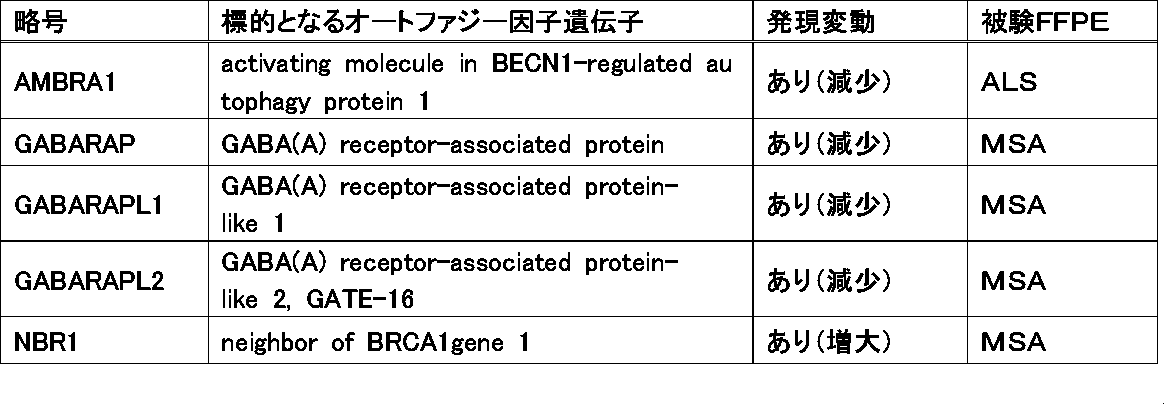
正常対照に加え、神経変性疾患(ALS及びMSA)の病巣組織である剖検後の疾患患者の脳FFPE(ホルマリン固定パラフィン包埋切片)におけるオートファジー関連因子の変動を、免疫組織化学によって染色し、光学顕微鏡で観察した。オートファジー関連因子の検出には市販抗体(AMBRA1(SDIX, Newark, DE, USA); GABARAP/GABARAPL1 (MBL); GATE-16 (MBL; ProteinTech Group, Inc.,USA); NBR1 (ProteinTec Group, Inc., IL, USA))を用い、アビジン・ビオチン複合体Avidin-Biotin Complex 法(ABC法)を用いて染色した。検索部位としては、ALS及び正常対照の脊髄、MSA及び正常対照の橋(各5例)を用いた。
正常対照に加え、神経変性疾患(ALS及びMSA)の病巣組織である剖検後の疾患患者の脳FFPE(ホルマリン固定パラフィン包埋切片)におけるオートファジー関連因子の変動を、免疫組織化学によって染色し、光学顕微鏡で観察した。オートファジー関連因子の検出には市販抗体(AMBRA1(SDIX, Newark, DE, USA); GABARAP/GABARAPL1 (MBL); GATE-16 (MBL; ProteinTech Group, Inc.,USA); NBR1 (ProteinTec Group, Inc., IL, USA))を用い、アビジン・ビオチン複合体Avidin-Biotin Complex 法(ABC法)を用いて染色した。検索部位としては、ALS及び正常対照の脊髄、MSA及び正常対照の橋(各5例)を用いた。
その結果、表4のとおり、6種のオートファジー関連因子で発現変動が観察され、オートファジー異常が起きていることが示唆された。FFPEにおける変動は、オートファジー因子(タンパク質)の存在状況を検出しており、増大あるいは減少のどちらの変動でもオートファジー経路の抑制や遮断などの異常が起きていることが示唆される。ALSでは神経細胞内にTARDBP(TDP-43)やSOD1など、MSAではalpha-synucleinなどの病的なタンパク質凝集体の存在が知られており、これらの病巣部位ではオートファジー因子の制御に異常が起きていることが示唆された。
実施例4:オートファジー因子制御miRNAの神経変性病巣における存在
オートファジーの異常が起きていると想定される神経変性疾患部位におけるmiRNAのプロファイリングを行った。
オートファジーの異常が起きていると想定される神経変性疾患部位におけるmiRNAのプロファイリングを行った。
確定診断された多系統萎縮症(MSA)患者の小脳病巣部位、確定診断された筋萎縮性側索硬化症(ALS)の患者の脳運動野病巣部位、及び健常対照群として脳の非病変部位を、剖検後に採取し、10%ホルマリンにて固定し、パラフィンにて包埋し、FFPE標本とした。FFPE標本(5x5mm、5μm、2~4枚)を材料とし、MSA患者5例、MSA非病変対照3例、ALS患者3例、ALS非病変対照3例の標本から、それぞれRNA抽出後、マイクロアレイによるmiRNA分析を行った。
マイクロアレイは3D-geneチップ(東レ(株)製)を用い、メーカー指定のmiRNA抽出液並びにハイブリダイゼーション試薬セットとHuman miRNA Oligo chip(データベースmiRBase Release17.0から選定したヒト約1,800種のmiRNAプローブを搭載)で行い、シグナル値30以上を有効なシグナルとして検出した。その結果、MSAでは541種、ALSでは510種のmiRNAが評価対象となった。
次に検索群となるmiRNAは、オートファジー因子制御miRNA群197種(表1)と表2に記載した神経細胞内蓄積性因子を制御するmiRNA群とした。後者の神経細胞内蓄積性因子を制御するmiRNA群の特定は、実施例1と同一の手法によるもので、すなわち、APP(amyloid beta (A4) precursor protein)、FUS(fused in sarcoma, translocated in liposarcoma protein (TLS))、LRRK2(leucine-rich repeat kinase 2)、OPTN(optineurin)、SNCA(synuclein, alpha)、SOD1(superoxide dismutase 1, soluble)、TARDBP(TAR DNA binding protein, TDP-43)、UBQLN2(ubiquilin 2)、VCP(valosin containing protein)の9種の遺伝子に対して、個々の遺伝子に結合性を有するmiRNAを、miRNA標的予測ウェブツールであるmiRmapを用いて抽出し、それぞれ上位50種(9種の遺伝子について、のべ450種)のmiRNAで2種以上の遺伝子で共通するmiRNAを蓄積性因子制御miRNA群として抽出し、55種のmiRNAを特定した。
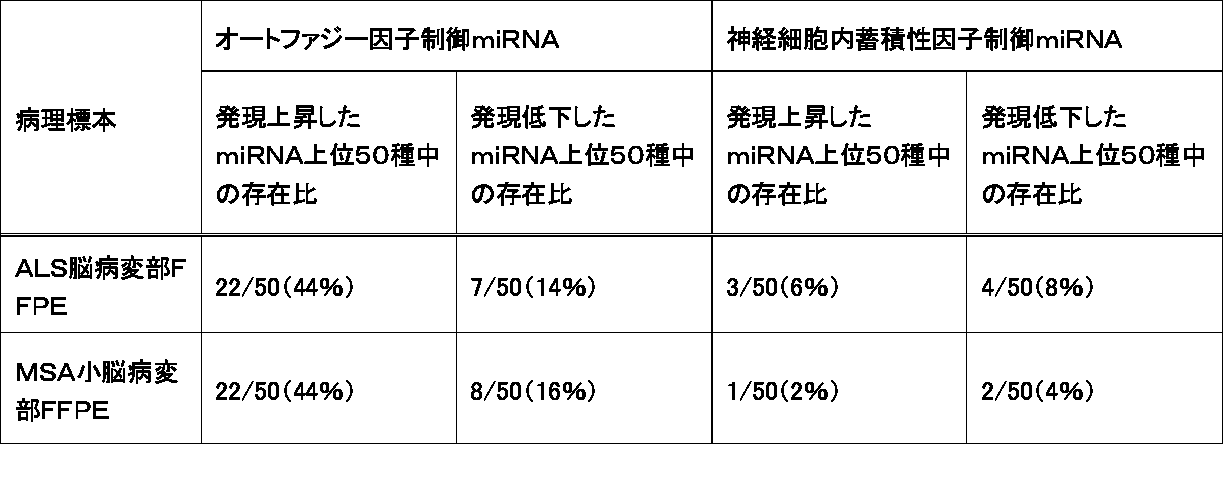
検証すべき仮説としては、神経変性部位ではタンパク質凝集体が存在するという事実から、これらのタンパク質の生成を制御する「蓄積性因子制御miRNAの発現は低いはず」、一方、オートファジーは抑制されていることから「オートファジー因子制御miRNAの発現は高いはず」、という二つの命題と考えられる。これを検証するために、ALSとMSAの病巣部位で発現上昇した上位50種のmiRNA群と、発現低下した上位50種のmiRNA群におけるオートファジー因子制御miRNAと蓄積性因子制御miRNAの存在比率を求めた。
その結果、表5に示すように、ALSでもMSAでもオートファジー因子制御miRNAは発現上昇したmiRNA群に多く存在しており、結果、オートファジーは抑制される方向が示された。他方、蓄積性因子制御miRNAは発現低下したmiRNA群に多い傾向があったので、神経細胞内蓄積性因子は生成される方向であることが示された。このことは、蓄積性因子mRNAは一定レベルで発現する環境であるが、他方、オートファジー系因子mRNAの発現は抑えられる環境にあり、結果として、細胞内ではオートファジー機能の低下が惹起されて蓄積性因子が凝集して蓄積する可能性を示唆している。すなわち、神経変性疾患における神経細胞内凝集体の生成という病理学的事象がmiRNAが関与したオートファジーの異常と関連していることを強く示唆している。
実施例5:オートファジー因子制御miRNAの組織選択性
miRNAは生体内で臓器や血液中にも広く存在し、血中miRNAは疾患関連バイオマーカーとして、検査診断への用途も考えられている。しかしながら、オートファジーは細胞内におけるタンパク質のリサイクルシステムとも言うべき仕組みであるので、実施例1で得られたオートファジー因子制御miRNA群は細胞内に存在することが多いはずである。これを検証するために、臓器中と血中のmiRNA群におけるオートファジー因子制御miRNAの存在比率を調べた。
miRNAは生体内で臓器や血液中にも広く存在し、血中miRNAは疾患関連バイオマーカーとして、検査診断への用途も考えられている。しかしながら、オートファジーは細胞内におけるタンパク質のリサイクルシステムとも言うべき仕組みであるので、実施例1で得られたオートファジー因子制御miRNA群は細胞内に存在することが多いはずである。これを検証するために、臓器中と血中のmiRNA群におけるオートファジー因子制御miRNAの存在比率を調べた。
神経変性組織中のmiRNAは実施例4のとおり、MSA患者5例、MSA非病変対照3例、ALS患者3例、ALS非病変対照3例の標本から同定された。血漿中のmiRNAは、ALS患者6例(男性4+女性2、62.8±8.5歳)、MSA患者6例(男性3+女性3、58.8±1.5歳)、健常者6例(男性3+女性3、60.6±1.8歳)に対して、本人の同意の下に血液を上腕静脈から20mLの末梢血を採取し、速やかに4℃、3000rpmで10分間、遠心処理し、上清を0.6mLずつポリプロピレンチューブに分注して-80℃で凍結保存した。各検体からRNAを抽出し、実施例3と同様にマイクロアレイによるmiRNA分析を行った。評価対象のmiRNAは、グルーバルノーマライゼーション後のシグナル値30以上を有意な発現をするmiRNAとした。その結果、MSA脳病巣部位では541種、ALS脳病巣部位では510種、MSA患者血漿では181種、ALS患者血漿では189種のmiRNAがそれぞれ評価対象となった。
次に、これらの組織由来miRNA群において、オートファジー因子制御miRNAが存在する比率(共通性)を求めたところ、表6に示すように、実施例1で特定されたオートファジー因子制御miRNAは血漿中よりは脳病巣組織中に明らかに多く、神経細胞内に多く存在することが強く示唆された。このことは、実施例1で特定したオートファジー因子制御miRNAが病変部神経細胞に選択的に存在することから、オートファジー因子制御miRNA並びにその標的遺伝子が、ALSやMSAなどの神経変性疾患の治療標的分子になり得ることを示している。

また、197種のオートファジー因子制御miRNAのうち、ALSとMSAの病巣部位で検出されたmiRNA群は表7-1及び7-2に示した63種であり、神経変性疾患の検査診断や治療標的分子の選定の際に、好んで用いることができる。

実施例6 脳神経の鉄蓄積による変性におけるオートファジー因子制御miRNAの関与
脳神経変性の機序のひとつとして、細胞内の鉄蓄積による変性(Aceruloplasminemia、Neuroferritinopathy、Neurodegeneration with iron accumulationなど)が知られている。遷移金属である鉄はヘモグロビンに含まれるように、生体内で種々の酸化還元反応に関与して細胞機能の維持に必須の重要な金属元素である。その一方で、活性酸素やフリーラジカルの活性化を促進し、結果としてアポトーシス、細胞膜破壊、蛋白凝集も促進するため、過剰な鉄が細胞内に沈着すると細胞毒性を示すと考えられている。この鉄蓄積による細胞変性においてもオートファジーの異常があり、それに関与する遺伝子はWD repeat domain 45 (WDR45)とATPase type 13A2 (ATP13A2)であることが最近報告されている(Levi S, Finazzi D.,Front Pharmacol. 2014; 5(99): 1-20)。
脳神経変性の機序のひとつとして、細胞内の鉄蓄積による変性(Aceruloplasminemia、Neuroferritinopathy、Neurodegeneration with iron accumulationなど)が知られている。遷移金属である鉄はヘモグロビンに含まれるように、生体内で種々の酸化還元反応に関与して細胞機能の維持に必須の重要な金属元素である。その一方で、活性酸素やフリーラジカルの活性化を促進し、結果としてアポトーシス、細胞膜破壊、蛋白凝集も促進するため、過剰な鉄が細胞内に沈着すると細胞毒性を示すと考えられている。この鉄蓄積による細胞変性においてもオートファジーの異常があり、それに関与する遺伝子はWD repeat domain 45 (WDR45)とATPase type 13A2 (ATP13A2)であることが最近報告されている(Levi S, Finazzi D.,Front Pharmacol. 2014; 5(99): 1-20)。
そうであれば、これらWDR45遺伝子とATP13A2遺伝子もオートファジー因子制御miRNAの制御を受けている可能性が高いと推察される。そこで、これら2つの遺伝子を標的とするmiRNAをmiRNA標的予測ウェブツールであるmiRmapで抽出し、その上位50種のmiRNAに含まれる197種のオートファジー因子制御miRNA(表1)の存在比を算出した。この仮説が正しければ、WDR45遺伝子とATP13A2遺伝子を標的とするmiRNA群とオートファジー因子制御miRNA群の間には高い重複性があるはずである。比較対象の遺伝子として、同様に鉄蓄積による神経変性の関連因子として報告されているCeruloplasmin(CP)、Ferritin light chain (FTL)、Transferrin (TF)、solute carrier family 40 (iron-regulated transporter), member 1 (SLC40A1)、Pantothenate kinase2 (PANK2)を選定し、同じ手法でオートファジー因子制御miRNAの存在比を算出した。この5種の遺伝子では、オートファジー因子制御miRNAの存在比は低いはずである。
結果は表8に示したように、オートファジー関連因子であるWDR45を標的とするmiRNA群とオートファジー因子制御miRNA群との間で重複する共通性は50%、ATP13A2では46%で、表2のオートファジー因子の場合の存在比(平均53.9%)と同程度であった。一方、比較対象遺伝子のCP、FTL、TF、SLC40A1、PANK2を標的とするmiRNA群では、オートファジー因子制御miRNAの存在比(共通性)は20数%以下であり、WDR45とATP13A2の比率よりもかなり低かった。
この結果は、WDR45とATP13A2もオートファジー因子制御miRNAの制御を受けている可能性が高いこと、また本発明のオートファジー因子制御miRNAが鉄蓄積時のオートファジーにも関与することを示している。

実施例7 オートファジー因子制御miRNAの標的遺伝子の疾患関連性解析
オートファジー因子制御miRNAが標的とする遺伝子群は、オートファジー異常が病態の原因と考えられる疾患に深く関与するはずである。神経変性疾患の病理像では、神経細胞内に凝集体が多く観察され、何らかのオートファジー異常が起きていることが強く推察されている。
オートファジー因子制御miRNAが標的とする遺伝子群は、オートファジー異常が病態の原因と考えられる疾患に深く関与するはずである。神経変性疾患の病理像では、神経細胞内に凝集体が多く観察され、何らかのオートファジー異常が起きていることが強く推察されている。
そこで、表1-1に記載したオートファジー因子制御miRNAのうち、上位5種(hsa-miR-4685-5p、hsa-miR-3619-5p、hsa-miR-4763-3p、hsa-miR-612、hsa-miR-939-3p、hsa-miR-1207-5p)を選び、これらが標的とする遺伝子群を調べ、この遺伝子群の機能(Gene ontology)が、神経変性の病態に強く関連するか否かをバイオインフォマティクスの手法で検討した。5種のオートファジー因子制御miRNAの標的遺伝子の抽出は、miRNA標的予測ウェブツールであるmiRmapを用い、各miRNAと結合する可能性が高い順に上位50種の標的遺伝子を選択し、5種合計で250種の標的遺伝子が抽出された。次に、これら250種の標的遺伝子のうち96遺伝子が重複していたことから、この96遺伝子は5種のオートファジー因子制御miRNAの共通標的となっていると仮定した。すなわち、この96遺伝子が関与する疾患は、オートファジー因子制御miRNAが高い確率で関わる疾患であると考えることができる。この仮説の評価結果となるGene ontologyと関連疾患候補の推定は、統合的バイオインフォマティクス解析ができるウェブ・ツールMetaCore(ThomsonReuter/GeneGo)を用いて行った。
その結果、表9に示すように、Gene ontologyは神経細胞機能に関するプロセスが多く検出された。また表10に示すように、上位10種に関連性の高い疾患として精神神経関連疾患が多く検出された。これらのことは、本発明における5種のオートファジー因子制御miRNAが標的とする遺伝子は、神経系機能に大きく影響し、その結果、神経系疾患に強く関与していること、逆に神経系の病態発現に強く関与するオートファジー異常には本発明で同定したオートファジー因子制御miRNAが強く関与することを示している。


Claims (35)
- 1つの生体内反応経路で機能する複数の因子のそれぞれについて、該因子をコードするmRNAに結合すると予測されるmiRNA群を取得する第一工程、及び、
各因子に対して得られたmiRNA群の少なくとも2群に共通するmiRNAを抽出する第二工程
を含む、前記生体内反応経路を調節するmiRNAの選定方法。 - 生体内反応経路が、オートファジー経路、ユビキチン-プロテアソーム経路、ミトコンドリア制御経路、シグナル伝達経路又は代謝経路である請求項1記載の方法。
- 複数の因子が、生体内反応経路を活性化する因子であり、前記生体内反応経路を調節するmiRNAが、前記生体内反応経路を抑制するmiRNAである、請求項1又は2記載の方法。
- 複数の因子が、生体内反応経路を抑制する因子であり、前記生体内反応経路を調節するmiRNAが、前記生体内反応経路を促進するmiRNAである、請求項1又は2記載の方法。
- 第一工程において、複数の因子のうちの1つの因子に対し100種以下のmiRNAをmiRNA群として取得する、請求項1ないし4のいずれか1項に記載の方法。
- 第二工程において、miRNA群の少なくとも3群に共通するmiRNAを抽出する、請求項1ないし5のいずれか1項に記載の方法。
- 配列表の配列番号1~203のいずれかに記載された塩基配列からなり、オートファジーを調節する活性を有するmiRNA分子。
- 配列番号1~31、33~92、及び、94~203のいずれかに記載された塩基配列からなる請求項7記載のmiRNA分子。
- 配列番号1~8、12~17、20~23、27~30、33~37、39、40、42、44~56、58~66、68~70、72~75、77、79~81、84、86~92、94~97、99~112、115~126、128~140、142~148、150~156、158~163、165~182、184~186、188~190、193~195、及び、197~203のいずれかに記載された塩基配列からなる請求項8記載のmiRNA分子。
- 配列番号1、4~8、12~17、20~23、27~30、33~37、39、40、42、45~50、52~56、58~66、68~70、72~75、77、79~81、84、86~92、94~97、99~112、115~126、128~140、142~148、150~153、155、156、158~163、165~182、184~186、188~190、193~195、及び、197~203のいずれかに記載された塩基配列からなる請求項9記載のmiRNA分子。
- 配列番号1~71のいずれかに記載された塩基配列からなる請求項7記載のmiRNA分子。
- 配列番号1~31、及び、33~71のいずれかに記載された塩基配列からなる請求項11記載のmiRNA分子。
- 配列番号1~8、12~17、20~23、27~30、33~37、39、40、42、44~56、58~66、及び、68~70のいずれかに記載された塩基配列からなる請求項11記載のmiRNA分子。
- 配列番号1、4~8、12~17、20~23、27~30、33~37、39、40、42、45~50、52~56、58~66、及び、68~70のいずれかに記載された塩基配列からなる請求項11記載のmiRNA分子。
- 配列番号1~16のいずれかに記載された塩基配列からなる請求項7記載のmiRNA分子。
- 配列番号1~8、及び、12~16のいずれかに記載された塩基配列からなる請求項15記載のmiRNA分子。
- 配列番号1、4~8、及び、12~16のいずれかに記載された塩基配列からなる請求項15記載のmiRNA分子。
- 配列番号1~5のいずれかに記載された塩基配列からなる請求項7記載のmiRNA分子。
- 配列番号1、4、及び、5のいずれかに記載された塩基配列からなる請求項18記載のmiRNA分子。
- 請求項7ないし19のいずれか1項に記載のmiRNA分子、又は、該miRNA分子を生体細胞内で産生可能なベクターを有効成分として含む、オートファジー調節剤。
- オートファジーの抑制に用いられる請求項20記載のオートファジー調節剤。
- 請求項7ないし19のいずれか1項に記載のmiRNA分子を阻害する核酸分子、又は、該核酸分子を生体内で産生可能なベクターを有効成分として含む、オートファジー調節剤。
- 前記核酸分子は、miRNAに対するアンチセンス核酸分子である請求項22記載のオートファジー調節剤。
- オートファジーの促進に用いられる請求項22又は23記載のオートファジー調節剤。
- オートファジーの調節が望まれる疾患の治療剤である請求項20ないし24のいずれか1項に記載の剤。
- 前記疾患が神経変性疾患又はアミロイドーシスである請求項25記載の剤。
- 前記神経変性疾患が、筋萎縮性側索硬化症、多系統萎縮症、アルツハイマー病、パーキンソン病、シヌクレイン病、又は鉄蓄積性神経変性病である請求項26記載の剤。
- 被検者から分離された試料中の、配列番号1~203に記載された塩基配列からなるmiRNAの少なくとも1つを測定することを含む、オートファジー関連疾患の検出方法。
- 配列番号1~31、33~92、及び、94~203に記載された塩基配列からなるmiRNAの少なくとも1つを測定する、請求項28記載の方法。
- 配列番号1~8、12~17、20~23、27~30、33~37、39、40、42、44~56、58~66、68~70、72~75、77、79~81、84、86~92、94~97、99~112、115~126、128~140、142~148、150~156、158~163、165~182、184~186、188~190、193~195、及び、197~203に記載された塩基配列からなるmiRNAの少なくとも1つを測定する、請求項28または29記載の方法。
- 配列番号1、4~8、12~17、20~23、27~30、33~37、39、40、42、45~50、52~56、58~66、68~70、72~75、77、79~81、84、86~92、94~97、99~112、115~126、128~140、142~148、150~153、155、156、158~163、165~182、184~186、188~190、193~195、及び197~203に記載された塩基配列からなるmiRNAの少なくとも1つを測定する、請求項28または29記載の方法。
- 前記オートファジー関連疾患が神経変性疾患である請求項28ないし31のいずれか1項に記載の方法。
- 前記神経変性疾患が、筋萎縮性側索硬化症、多系統萎縮症、アルツハイマー病、パーキンソン病、シヌクレイン病、又は鉄蓄積性神経変性病である請求項32記載の方法。
- 1つの生体内反応経路で機能する複数の因子のそれぞれについて、該因子をコードするmRNAに結合すると予測されるmiRNA群を取得する第一工程、及び、
各因子に対して得られたmiRNA群の少なくとも2群に共通するmiRNAを抽出する第二工程
を含む、前記生体内反応経路を調節するmiRNAの選定方法により選定されたmiRNAを用いて、前記生体内反応経路の異常により引き起こされる疾患の治療薬を選定する方法。 - 請求項34に記載の方法により選定される、生体内反応経路の異常により引き起こされる疾患の治療薬。
Priority Applications (1)
| Application Number | Priority Date | Filing Date | Title |
|---|---|---|---|
| JP2015536620A JPWO2015037656A1 (ja) | 2013-09-11 | 2014-09-11 | オートファジーを調節するマイクロrna |
Applications Claiming Priority (2)
| Application Number | Priority Date | Filing Date | Title |
|---|---|---|---|
| JP2013-188234 | 2013-09-11 | ||
| JP2013188234 | 2013-09-11 |
Publications (1)
| Publication Number | Publication Date |
|---|---|
| WO2015037656A1 true WO2015037656A1 (ja) | 2015-03-19 |
Family
ID=52665756
Family Applications (1)
| Application Number | Title | Priority Date | Filing Date |
|---|---|---|---|
| PCT/JP2014/074055 Ceased WO2015037656A1 (ja) | 2013-09-11 | 2014-09-11 | オートファジーを調節するマイクロrna |
Country Status (2)
| Country | Link |
|---|---|
| JP (1) | JPWO2015037656A1 (ja) |
| WO (1) | WO2015037656A1 (ja) |
Cited By (2)
| Publication number | Priority date | Publication date | Assignee | Title |
|---|---|---|---|---|
| WO2020100994A1 (ja) * | 2018-11-16 | 2020-05-22 | 公益財団法人東京都医学総合研究所 | B型肝炎ウイルスの複製阻害組成物 |
| US11884979B2 (en) | 2016-09-16 | 2024-01-30 | Takeda Pharmaceutical Company Limited | RNA biomarkers for hereditary angioedema |
Citations (1)
| Publication number | Priority date | Publication date | Assignee | Title |
|---|---|---|---|---|
| WO2013033640A1 (en) * | 2011-09-01 | 2013-03-07 | Allegro Diagnostics Corp. | Methods and compositions for detecting cancer based on mirna expression profiles |
-
2014
- 2014-09-11 JP JP2015536620A patent/JPWO2015037656A1/ja active Pending
- 2014-09-11 WO PCT/JP2014/074055 patent/WO2015037656A1/ja not_active Ceased
Patent Citations (1)
| Publication number | Priority date | Publication date | Assignee | Title |
|---|---|---|---|---|
| WO2013033640A1 (en) * | 2011-09-01 | 2013-03-07 | Allegro Diagnostics Corp. | Methods and compositions for detecting cancer based on mirna expression profiles |
Non-Patent Citations (3)
| Title |
|---|
| FRANKEL LB ET AL.: "MicroRNA regulation of autophagy", CARCINOGENESIS, vol. 33, 2012, pages 2018 - 2025 * |
| NAKAJIMA M ET AL.: "Role of MicroRNAs in the Regulation of Cytochrome P450s and Transcriptional Factors", YAKUGAKU ZASSHI, vol. 132, 2012, pages 107 - 116 * |
| PERSSON H ET AL.: "Identification of new microRNAs in paired normal and tumor breast tissue suggests a dual role for the ERBB2/Her2 gene", CANCER RES., vol. 71, 2007, pages 78 - 86 * |
Cited By (5)
| Publication number | Priority date | Publication date | Assignee | Title |
|---|---|---|---|---|
| US11884979B2 (en) | 2016-09-16 | 2024-01-30 | Takeda Pharmaceutical Company Limited | RNA biomarkers for hereditary angioedema |
| WO2020100994A1 (ja) * | 2018-11-16 | 2020-05-22 | 公益財団法人東京都医学総合研究所 | B型肝炎ウイルスの複製阻害組成物 |
| JPWO2020100994A1 (ja) * | 2018-11-16 | 2021-09-30 | 公益財団法人東京都医学総合研究所 | B型肝炎ウイルスの複製阻害組成物 |
| JP7441174B2 (ja) | 2018-11-16 | 2024-02-29 | 公益財団法人東京都医学総合研究所 | B型肝炎ウイルスの複製阻害組成物 |
| US12458658B2 (en) | 2018-11-16 | 2025-11-04 | Tokyo Metropolitan Institute Of Medical Science | Composition for inhibiting replication of hepatitis B virus |
Also Published As
| Publication number | Publication date |
|---|---|
| JPWO2015037656A1 (ja) | 2017-03-02 |
Similar Documents
| Publication | Publication Date | Title |
|---|---|---|
| US9914977B2 (en) | Individualized cancer therapy | |
| US9062351B2 (en) | Diagnostic, prognostic and therapeutic uses of long non-coding RNAs for cancer and regenerative medicine | |
| US9528991B2 (en) | Individualized cancer therapy | |
| US9322016B2 (en) | MicroRNA-based methods and assays for osteosarcoma | |
| CA2690144A1 (en) | Methods for determining hepatocellular carcinoma subtype and detecting hepatic cancer stem cells | |
| KR20090036299A (ko) | 여성 호르몬 결핍으로 초래되는 여성 피부의 노화 진단방법 및 이를 이용한 진단 키트 | |
| Barreiro et al. | An in vitro approach to understand contribution of kidney cells to human urinary extracellular vesicles | |
| CN117224687A (zh) | 用于心脏肥大治疗和诊断的LncRNA | |
| US20230250478A1 (en) | Diagnosis and treatment of chronic diabetic complications using long noncoding rnas as targets | |
| JP6193269B2 (ja) | miR−199a−5p、その標的及び/又は阻害剤の、線維増殖障害の診断、予後予測及び治療のための使用 | |
| Campanini et al. | CTNNB1 gene mutations, pituitary transcription factors, and MicroRNA expression involvement in the pathogenesis of adamantinomatous craniopharyngiomas | |
| US8841269B2 (en) | Polynucleotides for use in treating and diagnosing cancers | |
| WO2015037656A1 (ja) | オートファジーを調節するマイクロrna | |
| US20220389420A1 (en) | Agents for the treatment of patients with nsclc and methods to predict response | |
| JP2014128249A (ja) | 神経変性疾患の検査と治療に対するmiRNA又はその標的遺伝子の利用 | |
| CN111375063B (zh) | 蛋白功能抑制剂在制备治疗功能性垂体腺瘤的药物中的用途 | |
| Cao | Markers of TDP-43 Loss-of-function in Motor Neuron Disease | |
| US20140073686A1 (en) | Compositions for modulating invasion ability of a tumor and methods thereof | |
| WO2014033262A1 (en) | Therapeutic and diagnostic mirna regulator in kidney disease | |
| KR20130062310A (ko) | 여성 호르몬 결핍으로 초래되는 여성 피부 노화 억제제 스크리닝 방법 | |
| CN103242442A (zh) | 一种淋巴细胞白血病分子标志物应用于制备治疗制剂的方法 | |
| KR20130062312A (ko) | 여성 호르몬 결핍으로 초래되는 여성 피부 노화 억제제 스크리닝 방법 | |
| KR20100044750A (ko) | 여성 호르몬 결핍으로 초래되는 여성 피부 노화 억제제 스크리닝 방법 | |
| KR20130062311A (ko) | 여성 호르몬 결핍으로 초래되는 여성 피부 노화 억제제 스크리닝 방법 | |
| KR20130062315A (ko) | 여성 호르몬 결핍으로 초래되는 여성 피부 노화 억제제 스크리닝 방법 |
Legal Events
| Date | Code | Title | Description |
|---|---|---|---|
| 121 | Ep: the epo has been informed by wipo that ep was designated in this application |
Ref document number: 14843725 Country of ref document: EP Kind code of ref document: A1 |
|
| ENP | Entry into the national phase |
Ref document number: 2015536620 Country of ref document: JP Kind code of ref document: A |
|
| NENP | Non-entry into the national phase |
Ref country code: DE |
|
| 122 | Ep: pct application non-entry in european phase |
Ref document number: 14843725 Country of ref document: EP Kind code of ref document: A1 |